Governance and Psychology – 1 The Democratic Socialist Republic of SriLanka

January 2nd, 2019

Kanthar Balanathan

Before we examine the framework of Governance, let us study deep into each of the frames and the psychology of humans who go into the parliament to take over the function.

https://policyandpoliticsblog.com/2014/05/09/behaviour-change-as-psychological-governance-making-psy-citizens/

http://www.powertopersuade.org.au/blog/trust-and-governance-5-insights-from-psychology

http://nrnmind.blogspot.com/2009/08/mind-science-intelligence-perception.html

Governance

Quote (Google): The concept of “governance” is not new. … Governance refers to a process whereby elements in society wield power, authority, and influence and enact policies and decisions concerning public life and social upliftment.”

The eight characteristics of good governance?

  • All men and women should have a voice in decision-making, either directly or through legitimate intermediate institutions that represent their interests.
  • Rule of law.
  • Transparency.
  • Responsiveness.
  • Consensus orientation.
  • Equity.
  • Effectiveness and efficiency
  • Accountability

 For good governance to be in place the politicians and people who vote should be enlightened with political, and knowledge of economics, and social science. People who vote should know their candidate’s integrity, educational level and their competence in politics and governance.

Mass Communication:  is a term used to describe the academic study of the various medium by which individuals relay information through mass media to large segments of the populace at the same time. It’s understood that newspapers, magazine publishing, radio, TV, and film are those which disseminate news. Mass media denotes a section of the media which is specifically designed to reach a very large audience of a nation. The term was coined with the advent of mass circulation newspapers and magazines. The common man, which is the public”, relies on mass circulation media, newspaper because it is a competitive form of media that disseminates news to the public. The common man could afford to purchase a newspaper or go to the Community Centre and digest the information from it.

What is the integrity and reliability of the SriLankan mass media? Do they provoke violence, potential enmity between political parties, establish racial hatred among citizens? These are questions to be asked. Do they operate for profit or do they support good governance?Definitly most of the Tamil media does propogate racial conflicts.

What about the journalists? Are they racial? Do journalism promote racism, separatism, religious fanatism? Do the journalists promote racial intimidation?

Therefore, primarily good governance depends on citizens who vote for the candidates to institute good governance. Citizens and politicians shall have good perception and intelligence. Although education is a basic requirement in politics, perception and intelligence is not taught in schools. It is inborn characteristics of a person and the environment in which they were brought up.

What is Perception?

 The ability to see, hear, or become aware of something through the senses. “the normal limits to human perception”

Perception is the organization, identification, and interpretation of sensory information in order to represent and understand the presented information, or the environment. Wikipedia

Perception is the organization, identification, and interpretation of sensory information in order to represent and understand the presented information, or the environment. Wikipedia

While our sensory receptors are constantly collecting information from the environment, it is ultimately how we interpret that information that affects how we interact with the world. Perception refers to the way sensory information is organized, interpreted, and consciously experienced. Perception involves both bottom-up and top-down processing. Bottom-up processing refers to the fact that perceptions are built from sensory input. On the other hand, how we interpret those sensations is influenced by our available knowledge, our experiences, and our thoughts. This is called top-down processing. Ref; (https://courses.lumenlearning.com/msstate-waymaker-psychology/chapter/reading-what-is-perception/)

Perception occurs in five stages: stimulation, organization, interpretation-evaluation, memory and recall.

Quote CIA: The process of perception links people to their environment and is critical to the accurate understanding of the world about us. Accurate intelligence analysis obviously requires accurate perception. Yet research into human perception demonstrates that the process is beset by many pitfalls. Moreover, the circumstances under which intelligence analysis is conducted are precisely the circumstances in which accurate perception tends to be most difficult. This chapter discusses perception in general, then applies this information to illuminate some of the difficulties of intelligence analysis. Ref: https://www.cia.gov/library/center-for-the-study-of-intelligence/csi-publications/books-and-monographs/psychology-of-intelligence-analysis/art5.html

To be continued

Governance and Psychology -2 The Democratic Socialist Republic of SriLanka

January 2nd, 2019

Kanthar Balanathan

What is Intelligence

The ability to acquire and apply knowledge and skills.” an eminent man of great intelligence”

Intellect, intellect, mind, brain, brains, brainpower, powers of reasoning, judgment, understanding, comprehension, and quickness of mind.

The collection of information of military or political value. “the chief of military intelligence”

The True Meaning of Intelligence Essays. … This simple definition is often used by many common people, but a more in-depth definition is the ability to derive information, learn from experience, adapt to the environment, understand, and correctly utilize thought and reaction” (APA Dictionary of Psychology: Intelligence) …

A typical dictionary definition of intelligence is the capacity to acquire and apply knowledge.” Intelligence includes the ability to benefit from past experience, act purposefully, solve problems, and adapt to new situations. Intelligence can also be defined as the ability that intelligence tests measure.”

Separate good leaders from a bad one.

  • Honesty and Integrity. …
  • Inspire Others. …
  • Commitment and Passion. …
  • Good Communicator. …
  • Decision-Making Capabilities. …
  • Accountability.
  • Delegation and Empowerment. …
  • Creativity and Innovation.

Essential Characteristics for Good Leaders

  • Courage.
  • Caring.
  • Optimism.
  • Self-control.
  • Communication.

https://www.unescap.org/sites/default/files/good-governance.pdf

https://www.researchgate.net/profile/Sarah_Forberger/publication/269107473_What_is_governance/links/548173090cf22525dcb61443/What-is-governance.pdf

Political Corruption

POLITICAL CORRUPTION IS THE USE OF POWERS BY GOVERNMENT OFFICIALS OR THEIR NETWORK CONTACTS FOR ILLEGITIMATE PRIVATE GAIN. … FORMS OF CORRUPTION VARY BUT INCLUDE BRIBERY, EXTORTION, CRONYISM, NEPOTISM, PAROCHIALISM, PATRONAGE, INFLUENCE PEDDLING, GRAFT, AND EMBEZZLEMENT.

The Corruption Perceptions Index (CPI) is an index published annually by Transparency International since 1995 which ranks countries “by their perceived levels of corruption, as determined by expert assessments and opinion surveys.”[1] The CPI generally defines corruption as “the misuse of public power for private benefit.

Ref: https://en.wikipedia.org/wiki/Corruption_Perceptions_Index

The CPI Index reflects that SriLanka has an index of 36 as against 90 for Denmark in 2016.

Let us conclude who are the champions of BRIBERY, EXTORTION, CRONYISM, NEPOTISM, PAROCHIALISM, PATRONAGE, INFLUENCE PEDDLING, GRAFT, AND EMBEZZLEMENT in SriLanka?. 

To be continued


Governance and Psychology – 3 The Democratic Socialist Republic of SriLanka

January 2nd, 2019

Kanthar Balanathan

SriLanka became a republic on the 22nd May 1972.

However, the JVP insurrection was launched on the 5th April 1971 and lasted till June 1971. To date, the root cause (RCA) of this insurrection was not released by any analysts. The revolt was under Srimavo’s government. It could be assumed that the revolt could have been driven by a foreign power to stop the republicanizing SriLanka. The only item that can be assumed is: who will financially lose if SL becomes a republic.

JVP organization was the first set of a terrorist organization that gave birth in SL. Most of the JVP terrorists ran to the UK initially and now live in Commonwealth countries. Is there a secret that the Sri Lankans do not know?

To join hands with the JVP, the second batch of terrorists (LTTE) gave birth on the 5th May 1976.

However, Tamil New Tigers (TNT) was a militant Tamil organization founded by Velupillai Prabhakaran on May 22, 1972. This date coincides with the date on which SL became a republic. (Ref: https://en.wikipedia.org/wiki/Tamil_New_Tigers)

Can we interpret anything from these events of JVP/TNT/LTTE?

Right from inception, JVP has no policies, objectives, goals and no values. Even the present day they are unable to attract votes from the people but operate like a slave operating to the ruling party. Votes are split and dumped waste, which people do not understand.

Right from independence, 4th Feb 1948, SL has been faced with the bitter unstable political and economic disorder. What is the root cause of this shortfall? Has anyone done an RCA for this cause? Its high time a student who wants a Ph.D. complete research in this area.

Is it a racial differential conflict which has inflicted into the minds of the people?

Is it a religious differential conflict which has inflicted into the minds of the people?

Is it the caste differential conflict which has inflicted into the minds of the people?

Is it the Up-country—Low country differential which has deep rooted hard into the minds of the Sinhala people?

GOSL did not follow the democratic stream right from 1948, and Tamil politicians are a main player for the downfall.

SriLanka calls itself as, DEMOCRATIC SOCIALIST REPUBLIC OF SRILANKA”.

Do the politicians practice democracy in governance? Elections are conducted on a collateral basis. Votes are bought from citizens. The recent events in November 2018 is a typical example of our environment. Ranil W stated that the people have spoken after the results from the Supreme Court. No! it is not the people who have spoken. God knows who spoke. The constitution places a hierarchy for administration. However, the Prime Minister takes control of the administration without realizing that he is not the Chief Executive.

What is a hierarchy: A hierarchy is an organizational structure in which items are ranked according to levels of importance? Most governments, corporations and organized religions are hierarchical.

Here the PM of SL does not understand the concept and the constitution. The President was treated like a FINGER-PUPPET although the President was elected the Chief Executive by the people of SriLanka. It is presumed that the President being a politically a matured person, tolerated diplomatically for some time.

Socialist: – Is there any socialism built into the governance? When pressed, he calls himself a Democratic socialist. … Webster’s dictionary defines socialism as a form of society in which government owns or controls major industries. Marxist theory says socialism is the transitional stage between capitalism and communism.

Members of the governing club make an effort and accomplish to be Capitalists, through political corruption. Most of the politician own industries in SL or through Benami overseas and do not obey, follow the regulatory measures placed through Law & Order. Every portfolio is held by a person in a dictatorial environment.

SriLanka is a REPUBLIC.

Quote from Google: A Republic is a form of government in which power resides with the people, and the government is ruled by elected leaders who govern according to laws designed to help citizens. … This form of government believes society should be ruled by its wealthiest members.

In SL the politicians think that they are the individual monarchy rulers and take decisions and implement. The Bond Scam is a typical example of several irregularities. The Corruption Perception Index reflects the integrity and honesty of our parliament. A poor MP, when elected and becomes a minister, accumulates wealth which is adequate to gain victory in the next election. If the Tax system in SriLanka is effective and have adequate power, the inspectors can audit these culprits on how they acquired the wealth.

A wide operating style exists between European MPs and SriLankan MPs. A SriLankan MP, once elected forgets that he/she is people representative to work for the people, however, they forget the people and their responsibility, and operate like stray cattle. Again, the Bond Scam is a typical example.

It is preferred that in the next general elections GOSL parties ask for a name change from the Democratic Socialist Republic of SriLanka” TO something else which is more appropriate.

Celebrate the Republican day 22nd May rather the Independence Day celebration on the 4th of February, which is meaningless. SL is on a higher level now. Rose from slavery to Republican”. Is this a valid statement? No! we still carry that slave mentality to the West. Selling lands, giving a base etc. Particularly we note that the UNP and Ranil have that slave mentality.


To be continued.

Abolish Executive Presidency: 60% Sinhala Voters Rejected President Sirisena But TNA Won

January 2nd, 2019

Dilrook Kannangara

Executive presidency was introduced to create an unfair advantage for the UNP as it has a lion’s share of the minority vote. This was the intention in 1978 when it was created. In a 1966 speech to the Ceylon Association for the Advancement of Science, JR Jayawardena proposed executive presidency as the UNP faced tough Sinhala opposition for coming into a governance coalition with Tamil parties ACTC and ITAK (D-C Pact). True to its purpose, executive presidency turned Sinhalese into political refugees and worthless voters in their own country. At the 2015 presidential election, 60% of Sinhala voters rejected Sirisena but it had no impact on the outcome. Sirisena easily won the race with the support of separatists, LTTE Rump, extremists and NGOs. Mahinda did his very best to appease separatists and extremists but still lost very badly for an incumbent. Mahinda is the only incumbent president to lose a presidential election.

Executive Presidency Reduced the Majority into a Minority

Presidential elections are a mockery of democracy. Majority’s rejection can become all powerful executive president and appoint the Prime Minister and the Cabinet. He can even appoint top officers of the Central Bank and government institutions. As per Singapore Principles (June 2013) to which Sirisena agreed as the Common Candidate, the heart of the national economy – the Central Bank – must remain in the hands of a Tamil. Sirisena follows it to the letter. Tamil loan mafia operates hand in glove with the Central Bank. Tamil lenders have lent loans to Vanni residents at over 20% interest rate per month and the Central Bank intervenes to settle those loans! It also obliged him to devolve more powers to Tamils beyond the current federal state of the nation.

In 1987 when India invaded the island nation, the entire parliament except one MP rejected it but the executive president surrendered the nation to Indian invaders. He agreed to advance Indian hegemonic interests into the island and turn the nation into a federal country. The word ‘unitary’ was left in the Constitution just to fool the majority. Despite the sham unitary word, Sri Lanka is an extreme federal nation since 1987 with the parliament or the president unable to take back provincial powers without all provincial councils agreeing.

Since 1994 all executive presidents and main contestants have promised even more federal (devolution) powers to the periphery. The longer executive presidency is kept, the more the nation disintegrates.

Presidential Elections During War Time

Presidential elections during war time is no equal to peacetime presidential elections. Tamils were not allowed to vote in full force during the war and the presidential election outcome changed as a result. At the 1988 presidential election voters’ turnout in the Northern Province and parts of the Eastern Province (they were merged then) were dismally low. As a result the more nationalist candidate (Premadasa) won. If Tamils voted in full force, Sirima would have won. In 1988 Sirima entered into an electoral alliance with Ponnambalam of the ACTC. Anura, Lasantha Wicrkamatunga and Ponnambalam were caught by the Indian army after visiting the LTTE to gain election support!

However, in 1994, the candidate sympathetic to the LTTE won after her main rival was killed by Tamils.

In 1999 the less separatist candidate narrowly won thanks to voting disruptions in the north. If there was no war, she could not have secured 50% and a re-run would have ensured her rival winning it. In 2005, Mahinda won with a razor thin margin. If Tamils voted in full force, the more separatist candidate would have won.

Relying on Tamils not voting at a presidential election during peacetime is foolish. Tamils always vote for the more separatist candidate.

Manipulate Just One Person and the Whole Nation Surrenders

Buying a president is far easier than buying 150 MPs. This is what happened in 1987 and many times thereafter. India used threats to buy JR Jayawardena the executive president. He then used threats of violence to get the parliament and the Supreme Court approve 13A to federalize the nation. Government MPs and their families were trapped in hotels and forced them to vote in support of 13A. The same thing happened after 2010. The president was terrorized with false war crimes allegations forcing him to shower various benefits on the Tamil community, remove military bases in the north and keep Sinhala and Muslim displaced people away from the north.

Chandrika also tried her very best to introduce her ‘package’. It failed only thanks to the parliament and the LTTE.

This is the true nature of the executive presidency. It must be abolished before further destruction is caused to the nation.

“PRINS GUNASEKARA IS NO MORE”

January 2nd, 2019

Sarath Wijesinghe   (former Ambassador to UAE and Israel)

Prins 94 years  is no more with us having sacrificed the life for the needy and downtrodden over  seventy five years as a young activist, Journalist, Leader of the villagers, Politician, writer, senior member of the Parliament  and a rare breed  as one of the most honest politicians ever in the parliamentary history as declared by none other than Sam Wijesinghe former Secretary of the Parliament and first Ombudsman a legendary in public life as   Prins is one of the honest Members of the Parliament I have ever come across. He is a great politician who will not compromise for his views on the nation and for the citizen committed to serve.” He has been a unique personality as a clean politician fought for independence of the judiciary, rule of law, human rights when the standards are miserably lowering  down to the lowest ebb – especially the rampant bribery and  corruption in the legislature and the administration with the administration of justice with laws delays and lack of proper access to justice for the litigants against which Prins fought hard in Sri Lanka and United Kingdom as an activist and patrons of many international organizations.

As a Journalist he pioneered Lankadeepa Sinhala Daily” in the capacity of  the first deputy editor under D. B. Dhanapala the great legendary Journalist Guru, and continued his career as a journals and a lawyer fearlessly until he was forced to leave Sri Lanka to flee to save his life and the family from JVP and Government death squads resulted on  deaths and disappearances of  over 60,000 deaths of Sri Lankan  youth when the world was looking the other way on mass murders and destructions by JVP and death squads by then para military forces alleged by then government on clamping terrorism engulfed the entire country in fear of deaths and destructions. Over 32 lawyers were killed including his nephew and junior lawyers by terrorists and government goons then. He was taken to UK by HE David Gladstone personally – then High Commissioner and the family was  looked after in UK by Lord Avebury – a world renewed human right activist. He has authored large number of books in Sinhala and English and the presence was felt in all courts in Sri Lanka as a senior Lawyer and a Barrister in the United Kingdom. He contributed immensely to the Sri Lankan and UK jurisprudence and the development of the international human rights and humanitarian law and practice.

Prins is a clean politician without bribery and corruption with exemplary qualities with humility for the human kind and a person dedicated to serve others a rare breed in the society today He led an exemplary family life with Dr Sriya and the three daughters who stood by him in all seasons and stormy conditions due to his political and activism on human rights. He is famous for leading a simple life and speak straight with the golden quality of the ability to walk with kings not leaving the common touch with the village villagers and the common man he loved so much. He is the last in his era of politicians of highest integrity leaving a vacuum in the society. He and his great services are ever remembered.

Sarath Wijesinghe

Sarath7@Hotmail.co.uk

Let us triumph  over TNA/UNP/JVP  Conspiracies.  – Happy Near 2019

January 2nd, 2019

By ; A.A.M.NIZAM – MATARA    

Dear Lankaweb readers and all patriotic people of Sri Lanka resident in the country and in overseas

I sincerely wish a very happy, prosperous peaceful New Year in 2019, a year to be free of terrorist threats, western Indian and neo liberal subjugation and people’s uprising against attempts to colonise this country by  aliens.

The year 2019 will be different from all these years after the 2nd liberation of Sri Lanka in 2009 as it would compel of peace loving, magnanimous Sri Lankans to face enormous threats which would include:

  • Threat of  losing the sovereignty and Sri Lankan identity for ever by adoption of a federal and secular constitution under the pressurization of western, Indian and diaspora elements;
  • The permanent expulsion of Sinhala and Muslim people from the North and East;
  • Establishment of ISGA (Internal Self Government Authority) under which the Sri Lankan government will not be allowed to utilize any of the country’s national and natural resources and even send Mahaveli waters for the cultivation of Mahaweli areas in the East that would come under the so-called ISGA.;
  • The armed forces that even helped.fed, nursed, and rescued the Tamils stranded in the recent Kilinochchi, Malative floods will unsympathetically be forced to leave North and East;
  • Foreign countries, India and diaspora will share all national and natural resources in the North and East under ISGA;
  • And no access for Sinhala Buddhists to visit Nagqadeepa and other Buddhist shrines in the ISGA territory, the North and East;

Given below are the ISGA Proposals for the implementation of which had been agreed by both the Victor Ivan’s bandit queen Chandrika and the paragethi koti hithrthi (foreign servile and tiger fondly) Ranil Wickremasinghe.  You may be wondering what this bogey ISGA proposals are and which would become valid under the horrendous new constitution.  In brief the ISGA consists the following: An ISGA until a final negotiated settlement is reached and implemented.

  • Initially the members of the ISGA(Internal Self Governing Authority) will be appointed by the parties to this agreement with the LTTE (now the TNA, TGTE, GLF and the diaspora – the neo LTTE) appointing an absolute majority.
  • Democraticelections will be held if no final negotiated settlement is reached and implemented within five years.
  • The ISGA shall haveplenary power for the governance of the North and East including powers in relation to resettlement, rehabilitation, reconstruction, development, raising revenue including imposition of taxesrevenuelevies and duties, law and order, and over land.
  • Any and all of its expenditures by the government of Sri Lanka or for the north and east shall be subject to the control of the ISGA.
  • The ISGA shall have powers to borrowinternally and externally, provide guarantees and indemnities, receive aid directly, and engage in or regulate internal and external trade.
  • The ISGA shall have direction and control over any and all administrative structures and personnel in the north and east.
  • The ISGA shall have the power to alienateand determine the appropriate use of all land in the north and east that is not privately owned.
  • Land occupied the armed forces of the GOSL must be immediately vacated and restored to the possession of the previous owners. The GOSL must also compensate the owners for the past dispossession of their land.
  • The ISGA shall be responsible for the resettlement and rehabilitation of displaced civilians and refugees in such lands.
  • The ISGA shall have control over the marine and off shore resources of the adjacent seas and the power to regulate access thereto.
  • The ISGA will have control over the natural resources in the north-east region. The GOSL shall ensure that all monies due under existing agreements are paid to the ISGA.
  • All future agreements concerning matters under the jurisdiction of the ISGA shall be made with the ISGA.


Meanwhile the most dangerous terrorist in the country, Sumanthiran  has told the media on 30th December 20 18 the proposed constitution will get approved prior to February 4th and 21 SLFP MPs will vote for it to make a majority of over 2/3 of the members.  The statement of this Tiger terrorist who work in close collaboration with  diaspora elements such as TGTE (Transitional Government of Tamil Eelam)’s self-appointed Prime Minister V.Rudrakumar, resident in the U.S.A   and the leader of the GTF (the Global Tamil Forum) Fr. Emmanuel resident in UK and who have become a terrorist leader more dangerous than the slain megalomaniac Prabhakaran indicates that this guy Sumanthiran has worked round the clock during the recent days indulging in soliciting the support of the SLFP members for his objective of getting somehow the proposed federal and secular constitution adopted  as this is the last chance for them to get their goals achieved through the parliament.  This terrorist who will soon be the future  TNA leader after the demise of Sambandan whose days are limited and who will be passing out his last breath soon, seems to have even  bribed to have the 21 disgruntled SLFP members as they are in the last few months of their political life and it is highly unlikely that they would get nominations from any party to contest in the next election and their getting  re-elected would be a mirage.

It was realising this fact that some of them attempted to get appointed as Ministers and this attempt miserably failed as  President Sirisena was adamant in not appointing any SLFPer as a Minister in the Ranil Wickremasinghe government. The foregoing situations may have made it easy for Sumanthiran to net these disgruntled and bleak future SLFPers at cheap rates and use them as scapegoats for getting his objectives fulfilled. . It is also reported that bandit queen Chandrika is also making all efforts to split the SLFP and make this disgruntled and politically invalid cabal servile to her whims and fancy .

The TGTE leader Rudrakumaran has clearly outlined the tasks of Tamil diaspora throughout the world and the tasks as that have been assigned to this to this local terrorist leader sumanthiran in order to achieve their  eternal objective.

Sumanthiran has said that apart from the UNP, the JEPPO leadership also extensively contributed to the new constitution which has features for amalgamating two provinces under a referendum of the people of those two provinces for such an amalgamation.  The last patriot in the JVP Mr. Somawansa Amerasinghe gone, nothing can now be expected from the JEPPOs that could contribute to the welfare of this country.  There only concern now of these scoundrels is to protect reactionary capitalists and neo liberalists instead of the suffering proletariats, and their new founder  leader Ranil and serve the sources that could fill their pockets with dollar notes.  It was a pity that several thousand youths in 1971 and nearly 100,000 youths during 1988 – 1990 sacrificed their precious life for upholding JVP policies and pave the way for a gang of robbers and quislings to reign in this country.

Under these circumstances the crucial time has come for all patriotic people, the national minded /MPs in the UNP and the national minded innocent rural members represented in the JV, all professionals, erudite persons, working and other masses in the country join together as a single body devoid of party politics, ethnicity, religiosity and other difference and demand for the abrogation of the proposed constitution and stage their Holy Hartal until the people of the country achieve the goal of saving the country from the threat that loom before all of us and vanquish terrorism from the soil of this country

Failure to get this objective achieved would result in the country getting divided into several parts and people becoming subjected to several autocratic rulers and the national and natural resources continuously plundered by foreign powers.

In an unfortunate situation if treacherous TNA, and the butterflies and the JEPPO scoundrels it will become imperative for the people to take up even arms and to rise against these anti national forces in villages, towns and work places  and complete eradicate them from this Holy Land.

Let the New Year 2019  be a  Year of Liberation from terrorism, slavery and foreign domination

Sino-Lankan joint venture CICT accounts for 38% of Colombo port’s volume

January 1st, 2019
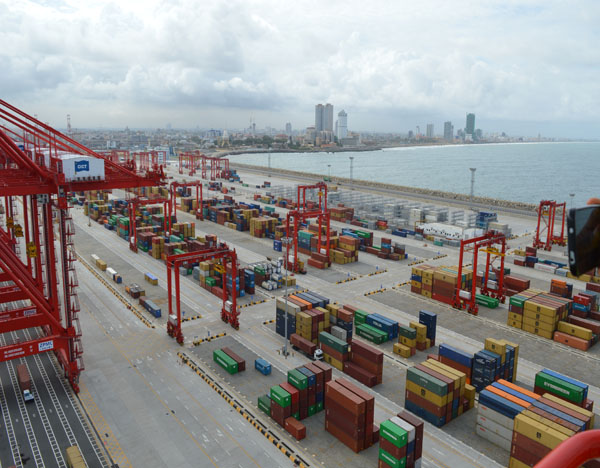
  Colombo, January 1 (newsin.asia): Colombo International Container Terminals (CICT) has reported handling 2.65 million teus for the 12 months ending December 31, recording a 13 per cent increase in its annual throughput and contributing 38 per cent of the Port of Colombo’s volumes in the year just concluded.

Colombo International Container Terminals Ltd., (CICT) is a joint venture Company between China Merchants Port Holdings Company Limited.(CMPH)(formerly known as) China Merchants Holdings (International) Company Limited (CMHI) a listed blue chip company in the Hong Kong stock exchange and the Sri Lanka Ports Authority (SLPA). Under a 35 year Build Operate and Transfer Agreement with SLPA, Colombo’s third container terminal with a 2.4 million teus capacity was constructed in the Port of Colombo, Sri Lanka, under the Colombo South Harbour expansion project. CMPH holds 85% of the partnership whilst the balance 15% is being held by SLPA.

A significant factor in the achievement of 7 million TEUS by the Port of Colombo, CICT’s performance helped the port increase its total throughput by 14% in 2018, a noteworthy accomplishment in the region.

Sino-Lankan joint venture CICT accounts for 38% of Colombo port’s volume

Announcing the year’s final volume, CICT said ULCCs (Ultra Large Container Carriers) of a size that only CICT is capable of handling, had contributed 70% to the volumes the Terminal achieved for the year. CICT handles mega container vessels from all three major shipping line alliances. With the geographical coverage of these services and the high frequency of mainline liner service connections, CICT has helped the Port of Colombo to move up the Drewry’s Port Connectivity Index to be ranked the 11th best connected port in the world.

While our deep water capacity is one of the main factors driving growth, constant innovations and commitment to service excellence including facilities such as autogate, dual cycle operation, intelligent truck pooling and dispatch, a fully automated customer service kiosk, our unique mobile application and CICT e-billing have been game changers in the Port of Colombo,” CICT CEO Jack Huang said.

The combination of state-of-the-art infrastructure and equipment, efficiency and convenience enhancing features and the synergies developed through our parent company CMPort, has enabled CICT to generate incremental volumes for Colombo, which was the primary objective of the deep water terminal,” he said. Additionally, the ability to access the CMPort global network enabled us to attract new transshipment volumes to the Port of Colombo.”

The concluded year has been a prolific one for CICT: besides being adjudged the Best Container Terminal in Asia in the Under 4 million TEUs at the Asian Freight, Logistics and Supply Chain (AFLAS) Awards for the second consecutive year, CICT also handled MV. Ever Golden, the first 20,000+ TEU vessel of Evergreen to call on Colombo, as well as the 14,000 TEU ‘One Columba’ – the first magenta color vessel to call on Colombo. The company was also responsible for salvaging the storm-ravaged ‘MV Theseus’ earlier in the year.

CICT recently also announced the addition of two new mega Quay Gantry Cranes (QGCs), six new Rubber-tyred Gantry Cranes (RTGs) and 12 Prime Movers to enable the handling of 22,000+ teu vessels and further develop the deepwater capacity of the Port of Colombo. This enhancement is planned for completion by March 2019.

Besides its significant contributions to the growth of the Port of Colombo in volume terms, CICT is also responsible for several firsts in service innovation and eco-friendly operations. In early 2016, the company launched a US$ 10 million programme to convert its fleet of diesel operated rubber-tyred-gantry cranes to electricity driven rubber-tyred gantry cranes (E-RTGs) which have zero carbon emissions.

CICT is the first and currently the only deep-water terminal in South Asia equipped with facilities to handle the largest vessels afloat. Since its inception in 2014, the terminal has incrementally grown the volume it has handled; from 686,639 TEUs in 2014, to 1,561,931 TEUs in 2015, 2,002,580 TEUs in 2016, and 2,388,506 TEUs in 2017.

In its last four full years of operation, CICT has brought some of the largest vessels plying the Asia-Europe routes to Colombo. Of these, Milan Maersk (20,568 TEU), MSC Maya (19,224 TEU), Mogens Maersk (18,300 TEU), MSC New York (16,652 TEU), CMA CGM Marco Polo (16,020 TEU), Edith Maersk and EMC Thalassa Hellas (each 14,000 plus TEUs) and their sister vessels are now regular callers at CICT

Wijeyadasa alleges House blocked swift legal action Treasury bond scams:

January 1st, 2019

UNP MP Dr. Wijeyadasa Rajapakse, PC, yesterday said that the passage of the Presidential Inquiry Commission Amendment Act should be the priority for parliament in 2019.

Colombo District MP Rajapakse said that in fact the House owed an explanation as to why all political parties represented in parliament unanimously agreed to defer the vote on Presidential Inquiry Commission Amendment Act.

Rajapakse said that it was meant to empower the CIABOC (Commission to Investigate Allegations of Bribery or Corruption) to utilize available evidence to prosecute those involved in corruption.

article_image

Responding to a query by The Island, the UNPer said that he had presented the proposed Amendment Act in parliament on Oct. 12, 2018 on behalf of President Maithripala Sirisena.

President Sirisena expected Amendment Act to be ratified fast as it was aimed at enabling the CIABOC to prosecute those allegedly involved in Treasury bond scams perpetrated in Feb 2015 and March 2016.

Rajapakse said that though the President was the head of government, the other MPs of the UNF except him had refrained from speaking during the debate.

Rajapakse challenged political parties to give one good reason why a vote was required on Presidential Inquiry Commission Amendment Act, introduced to expedite judicial process in respect of the Treasury bond scams involving disgraced primary dealer Perpetual Treasuries Ltd. (PTL). It should have been ratified unanimously if everyone had been sincere in fighting corruption, he said

Parliament is scheduled to meet on January 08, 2019.

Rajapakse alleged that in addition to the UNF, which scuttled the President’s move, none of the other recognised political parties and groups in Parliament had backed the proposed Amendment.

Now that President Sirisena had declared that the main focus in 2019 would be the introduction of a cohesive anti-corruption strategy, it would be the responsibility of Parliament to empower the CIABOC without further delay.

“Perhaps, the JO felt that it, too, could be affected by unprecedented powers given to the CIABOC.”

Rajapakse emphasised that President Sirisena’s decision to sack the UNP led administration on Oct. 26, 2018 should be examined against the backdrop of political parties represented in parliament collectively working together to thwart President Sirisena’s bid to expedite judicial inquiry into the Treasury bond scams.

The JVP had refrained from backing the vital piece of legislation though one of its MPs headed the second COPE (Committee on Public Enterprises) probe on Treasury bond scams, Rajapakse said.

Rajapakse said that he had been quite surprised when Joint Opposition Leader in parliament Dinesh Gunawardena, at that time, queried why the Amendment Act had been presented by him in his capacity as Higher Education and Cultural affairs Minister instead of Justice Minister Thalatha Atukorale.

Rajapakse said that an Act proposed by the President could be presented in parliament by any minister.

Responding to another query, Rajapakse said the President had blamed Thalatha Atukorale for deliberately delaying the Amendment Act. President Sirisena taken up the issue at a meeting at the Presidential Secretariat on Dec 16 afternoon attended by Prime Minister Ranil Wickremesinghe, Rajapakse said. Ravi Karunanayake, Malik Samarawickrema and Kabir Hashim had also been present at the meeting, Rajapakse said.

It would be the responsibility of party leaders’ committee, chaired by Speaker Karu Jayasuriya to ensure the passage of the amendment unanimously or set an early date for a vote, Rajapakse said.

The President’s Counsel noted that a statement, issued by the Presidential Secretariat on Dec 21, blamed the relevant Sectoral Oversight Committee in Parliament for deliberately delaying the process.

Rajapakse explained that the Amendment would enable the CIABOC to use evidence gathered by the K.T. Chitrasena P CoI. Otherwise, the CIABOC would have to collect evidence afresh thereby prolonging the judicial investigation, Rajapakse said, adding that Parliament, instead of spearheading the anti-corruption drive, was undermining it.

“Sri Lanka is too weak to enter into FTAs like the one with Singapore”, says Presidential experts committee

December 31st, 2018

It recommends that any future FTA be preceded by feasibility studies to map its need and effectiveness.

“Sri Lanka is too weak to enter into FTAs like the one with Singapore”, says Presidential experts committee

The report of the Presidential Committee of Experts (CoE), spanning over 280 pages, also evaluated the New Trade Policy (NTP) and found it wanting in many aspects, going so far as to say it failed to meet its goal as a national trade policy.

The CoE is of the view that entering into FTAs is of no use in the current context of Sri Lanka’s extremely weak competitiveness in the global economic setup. It is only through domestic economic reforms aimed at national development goals that the constraints impeding competitiveness can be eliminated and conditions conducive to sustainable and inclusive development in the country.

Hence, the CoE recommends that first order priority be given to making domestic policy reforms with main focus on the national interest, instead of pursuing the ambiguous field of FTAs,” the report said.

FTAs are not the best way to improve Sri Lanka’s competitiveness or productivity which are constrained by structural factors such as technology backwardness, inadequate innovation, low business sophistication, drawbacks in education and training, institutional failures, poor infrastructure, political instability, macroeconomic imbalances, goods and labour market inefficiencies and financial market fragmentation. None of these problems can be resolved simply by signing FTAs, though they may have isolated positive effects on certain sectors,” the report added.

The five member CoE was appointed in August 2018 and comprised of former Vice Chancellor of the Colombo University and Emeritus Professor of Economics Deshamanya Prof. W. D. Lakshman (Chairman), Prof. Sirimevan Colombage, an Emeritus Professor of the Open University, Prof. Ajitha Tennakoon, Emeritus Professor of Economics at the Kelaniya University, and Dr. Santha Jayanetti, Independent Consultant and R.A. Jayatissa former Assistant Governor of the Central Bank.

Referring to the Government embarking on an Economic Technology Cooperation Agreements (ETCA) with India as well as negotiations with China and Thailand, the CoEwarned such parallel agreements would only complicate the situation and not readily improve the local doing business climate.

Proliferation of FTAs with different countries involving multiple Rules of Origin gives rise to the ‘spaghetti bowl effect,’ making the foreign trade system extremely complicated and distortionary.

The CoE is of the opinion that a comprehensive feasibility study of strengths, weaknesses, opportunities and threats (SWOT) and a strategic impact assessment is a prerequisite to any FTA to determine the long-term impacts of entering into trade agreements and create a framework to ensure the equal rights of all professionals. It is a lapse on the part of the Government that no such studies have been conducted before the negotiations with Singapore for liberalisation of trade in services commenced.”

Before the FTA was signed on 15 January this year, the Attorney General had said it could only be inked if three measures were met: (a) Concurrence was obtained from the National Procurement Commission for the Chapter on Government Procurement, (b) Necessary approvals were obtained from appropriate authorities for the relevant chapters, and (c) No opinion was expressed on the policy considerations or technical, financial and economic implications of the proposed SLSFTA.

However, the report points out that Cabinet approval was given the very next day subject to the Ministry of Development Strategies and International Trade Ministry (MoDSIT) meeting the requirements listed out by the Attorney General but no update was ever presented to Cabinet. The report also points out multiple procedural lapses and says changes were made to the FTA even after it was presented to Cabinet.

The CoE observes that some serious lapses were allowed to occur, perhaps deliberately or inadvertently to expedite matters in the process of signing the FTA by the Minister, MoDSIT. The Minister had indeed acted without attending to the conditions laid down by the Cabinet of Ministers in its conditional approval granted to the Minister. These lapses relate to non-compliance with the ‘matters highlighted by the Attorney General’ as clearly included in the Cabinet approval as a necessary condition to be fulfilled before signing.”

The CoE also agreed that there should have been a more systematic and comprehensive process of engagement.

Another accusation placed before the CoE was that the entire negotiation process was conducted in a hurried and a non-transparent manner without having adequate consultations with stakeholders. The CoE is of the opinion that consultations conducted by MoDSIT were rather limited. There should have been a more systematic and comprehensive consultative process to take care of conflicting views of, and alternatives suggested by, stakeholders.

The negotiations were conducted without any overall or sectoral feasibility studies. This is clearly not appropriate, as the entire negotiation process was carried out without giving due regard to the pros and cons of the deal from the viewpoint of national interest.”

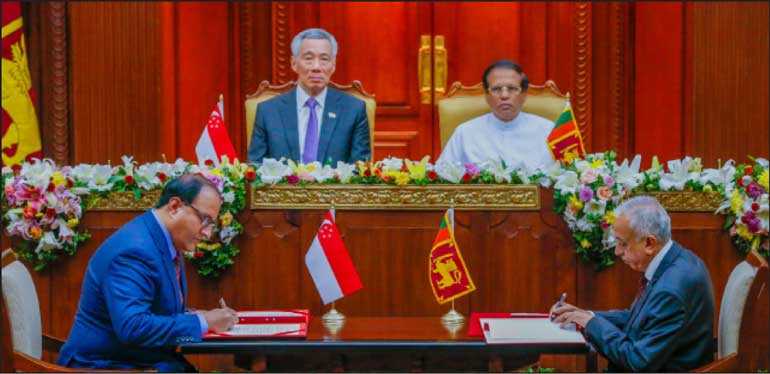
The Signing of Singapore-Sri Lanka FTA in the presence of Singapore Prime Minister Lee Hsien Loong and Lankan President Maithripala Sirisena

The report also raises concerns over some members of the negotiating team having conflicts of interest and highlights the fact that negotiations were begun without a trade policy. The New Trade Policy (NTP) was only presented months afterwards and was dismissed by the CoE as not meeting the standards of a national trade policy.

The NTP is far from being a national foreign trade policy, given its structure and content. It has been presented largely in the style of an academic paper. The New Trade Policy is a stand-alone document without clearly identified linkages to any other national economic policy. The CoE recommends that a future National Foreign Trade Policy (NFTP) be based on a national development framework giving due regard not only to export led growth, but also to social equity and sustainable environment in all spheres.”

The CoE also recommends a slew of commission be appointed to deal with several controversial aspects of the FTA including movement of people and the possibility of dumping waste. It also suggests a Presidential Trade and Tariff Commission to look at the impact of phasing out some of the existing tariff structure in three years as it could have wide impact for local businesses.

The CoE has concerns about elimination of para-tariff over a three-year period under SLSFTA, as this will be carried out in isolation without restructuring of the country’s tariff schedules. While phasing out tariffs and para-tariffs, it is important to ensure that emerging domestic industries are not unduly exposed to foreign competition. One could argue that such exposure is desirable, as Sri Lanka’s infant industries never grow. But it should be noted that their failure to reach maturity is not totally due to their deficiencies alone. It has much to do with the uncompetitive production environment caused by policy uncertainties, high energy costs, macroeconomic instability, labour market rigidities and unsatisfactory infrastructure.

Considering these constraints, a desirable policy option would be to focus on targeted liberalization so as to avoid interference with the growing industries, drawing from the successful experiences of Japan, South Korea and Brazil during 1965-’80 before they became complete free traders,” the report said.

The committee said that priority should be given to domestic policy reforms with focus on the national interest, instead of pursuing FTAs.

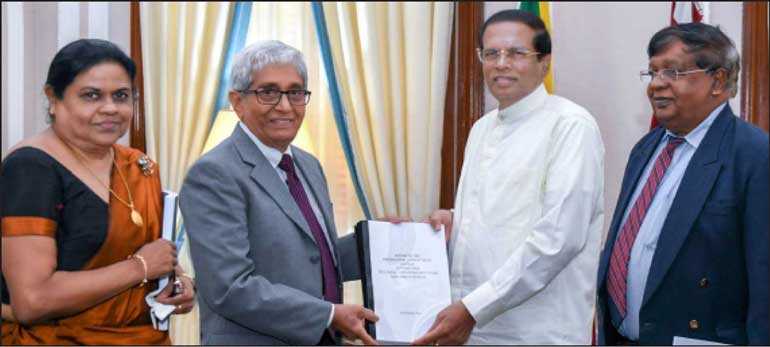
(The featured image at the top shows the Presidential Committee of Experts which went into the Sri Lanka-Singapore Free Trade Agreement submitting its report to President Maithripala Sirisena)

2019 a year to ‘work without corruption’- President

December 31st, 2018

Courtesy Adaderana

President Maithripala Sirisena visited the historic Temple of the Sacred Tooth Relic today (31) to pay homage to the sacred Tooth Relic and secure blessings for the New Year, the President’s Media Division stated.

Later, he had visited the Malwathu Maha Viharaya and called on the Most Venerable Thibbatuwawe Sri Sumangala Maha Nayake Thero.

During this meeting, the Nayake Thero, chanting Seth Pirith, invoked blessings on the President for the New Year.

As the Mahanayaka Thero of the Asgiriya chapter has travelled overseas, the President visited the Asgiriya Gedige Rajamaha Viharaya and met with the Anunayaka Thero of the Asgiri Chapter, Venerable Wedaruwe Upali Thero.


Venerable Wedaruwe Upali Thero has also chanted Seth Pirith and invoked blessings on the President for the New Year.

President Sirisena also observed the construction works of the new ‘Dana Shala’ (a hall for almsgiving) and Archaeology Centre at the Asgiriya Gedige Rajamaha Viharaya.

Addressing the media personnel at the venue, the President said that he had named the year 2019 as a year to ‘Work without Corruption’.

The President said that all should unite to face the challenge of building the country and integrity through their conscience.

After that, the President also inquired into the wellbeing of the Mahanayake Thero of the Ramanya Maha Nikaya, Ven. Napana Pemasiri Nayaka Thero, who is currently receiving treatment at the Kandy General Hospital.

The President had then visited the Nayaka Thero at the hospital to inquire into his health condition and to wish him an immediate recovery.

Central Province Chief Minister Sarath Ekanayake, Former Minister S.B. Dissanayake were also present with the President on this occasion.

-PMD

OPEN LETTER TO SINHALA BUDDHISTS

December 31st, 2018

Stanley Perera Melbourne, Australia.

My dear Sri Lankan Buddhists,

DON’T TRUST OR BELIEVE THE WOLF IN SHEEPS CLOTHES

For nearly four years this man Ranil Wickremasinghe did not vist the Mahanayaka theros or any other buddhist temples.  Let alone the church, mosques or Hindu Temples.  For that the people friendly Mahinda Rajapakse never failed to visit the Maha Sanga and Cardinal Malcolm Ranjith so frequently not forgetting the Hindu Temples as well.  Patriotic Sinhalayas believe Mahinda Rajapakse is their xaviour who has great leadership qualities.  80% of the Sri Lanka’s population is Sinhalayos.  Mahinda Rajapakse believes it is this Sinhalaya’s hearts and minds are important factors to rule the island nation of Sri Lanka.  Whereas, Rani l Wickremasinge believes that it is the white skinned barbarian Ambassadoze, dirty Indians, racists Tamils and Saibu nana are important to him rather than the working class Sinhala Buddhists.  Ranil’s supporters are those uppish class toffe noses in Colombo.

After Wickremasinghe got beaten up severely in the last couple of months, overnight he changed his whole behaviour in visiting maha sanga and buddhist temples and distancing himself from the racist TNA.  Wickremasinghe realised that 80% of the total population do not acknowledge the secret pact with the racists TNA,  But the cat is out of the bag.  Sinhalaya learnt in the last four years that Wickremasinghe is only a puppet manipulated by racists and bogus Tamil refugees world wide and white skinned barabarian Ambassadozes who are good in clapping hands in the gallery.

Wickremasinghe won the no confidance vote with the power of the American dollars and funds raised by the racist Tamil Dispora world wide.

Wickremasinghe jailed Buddhist monks.

Wickremasinghe jaild war heroes.

Wicremasinghe has a secret pact with the racist TNA.

Wickremasinghe planned to re-merge North and East appoint Saibu Nana as the Prime Minister of the East and  Racist Tamil Sampanthan or Vigneswaran as the Prime Minister of the North.

Wickremasinghe planned to break the Island Nation in to Nine Seperate independent states.

Wickremasinghe planned to sell Colombo Port, Palali air port and Trincomalee harbour to India.

Wickremasinghe sold Hambantota harbour to Chine and was planning to sell Hambantota air port to Chine.

Wickremasinghe planned to sell 5000 acre blocks of land in the North and East to the foreigners.

Wickremasinghe is only trying to hoodwinck buddhist votes.  Wickremasinghe is not a true buddhist.  It is only superficial.  Wickremasinghe is an anglican.  He wants you to stop eating rice and eat bacon and sausages.  This wolf is in sheep’s clothing.  Somebody said he is a butterfly.  Don’t believe this man Wickremasinghe.  He is public nuisance, a pest and a health hazard.

Stanley Perera

Melbourne, Australia.

An Anomaly in Buddhist Practice

December 31st, 2018

R Chandrasoma

On opening the Newspapers one is often regaled with the sight of a Political Big-Wig humbly worshipping a Buddhist priest in an ornate Temple with friends and onlookers in attendance.

Nobody questions the worth of this sacerdotal performance by our elected leaders – but why is it that a female of like religious standing is not worshipped in the same regal fashion? Indeed, the point at issue is  the subordination or studied neglect of the sisterhood of Bhikkunis – females who aspire to Buddhahood.  In the desire and ardency with which our sisters and daughters in Sri Lanka  seek the state of supreme enlightment, they are certainly not inferior to the males.

Indeed, it is clear to all dispassionate observers that the greater part of our religious ardency and strength lies with our womenfolk,
What, then, is the problem – if the word ‘problem’ is is appropriate in this connection?  It is a social problem connected with the asymmetry of institutional strength – the male dominance of society.

We have no great temples managed and run by Bhikkunis because of male opposition – not religious opposition but the more primeval force of male chauvinism. The belief that this a ‘doctrinal’ issue is a red-herring – it is more a power struggle with male chauvinist of all brands fighting off a threat to their dominance.

We must call upon the Buddhist Women of Sri Lanka to establish Great Temples of Learning and Worship – not in a spirit of spiteful animosity but to redress an unbecoming  asymmetry.

We hope that the day is not far off when Bhikkunis of Sri Lanka will be the true guardians of this country  – with Political Big-Wigs beholden to them in much the same way that a coteri of Bhikkus (males) dominated politics in the recent past.

Sri Lanka – Buddhism The State Religion

December 31st, 2018

Prof. Hudson McLean

As President Donald Trump declared that United States of America may now Celebrate Christmas, as a Christian Nation with Freedom of Worship available to other religious beliefs, Sri Lanka may declare the Island as a Buddhist Nation with similar Democratic & Humane Rights to other religions.

Kingdom of Saudi Arabia is a Muslim Nation and the Guardian of the Most Holy Sites of Islam, and till recent, did not recognize any other religions. However other Nations like the Philippines, a pre-dominantly Catholic country, Indonesia with a majority of Muslims, Thailand with a majority Buddhists, India, where Lord Buddha originate from, now a Hindu Republic, have allowed the Freedom of Worship to other beliefs.

Portuguese, Dutch & British introduced Christianity and converted Sinhala Buddhists to follow the Faith of the Colonial masters, offered education and opportunities to a select few who had converted to Christianity.

As a Christian Catholic, I have the highest respect, regard and honour to the Preachings of Lord Buddha, and have contributed to renovations of a Buddhist Temple near Kelaniya.

I have the highest trust & faith of the Sinhala Buddhist culture of non-violence and respect of life of all creatures, to treat all other Faiths with due compassion.

Whist wishing all the Readers of Lanka Web, 

A Glorious Prosperous Healthy Peaceful New 2019

I Hope & Pray that Sri Lanka will overcome the current political turmoils and starts to Shine as the Pearl of the Indian Ocean!

Express Your Opinion – Read What Others Say!
The Independent Interactive Voice of Sri Lanka on the Internet.

Please visit -: http://www.lankaweb.com/

New year greetings

December 31st, 2018

Mahinda Rajapaksa Former President and Leader of the Opposition

I wish all Sri Lankans a new year full of new hope and optimism. With the dawn of 2019, it is my fervernt hope that all Sri Lankans will be able to lay aside differences based on religion and ethnicity and unite to protect our motherland from enemy forces. May all your expectations be fulfilled and all your endeavours succeed in the new year.

ජාතිවාදි ලේබලය නිසි තැන අලවමු!

December 31st, 2018

 Isuru Prasanga

”ව්‍යවස්ථා” ද්‍රෝහීකමට සම්බන්ධ වන්න එපා !! ඒ සඳහා ඔබට අයිතියක් නැත !!

December 31st, 2018

මහාචාර්ය චන්න ජයසුමන මහ ලේකම් ජාතික විශ්ව විද්‍යාල ආචාර්ය සංගමය වෙනුවෙන්,

එක්සත් ජනතා නිදහස් සන්ධානයේ සියලූ පාර්ලිමේන්තු මන්ත‍්‍රීවරු වෙත,

ගරු මන්ත‍්‍රීතුමනි,

”ව්‍යවස්ථා” ද්‍රෝහීකමට සම්බන්ධ වන්න එපා !! ඒ සඳහා ඔබට අයිතියක් නැත !!

එක්සත් ජාතික පක්ෂය, ජනතා විමුක්ති පෙරමුණ සහ දෙමළ ජාතික සන්ධානය එක්ව නව ව්‍යවස්ථාවක්/සංශෝධනයක් ගෙන ඒමට ලහි ලහියේ කටයුතු යොදන බව අපි දැනුම්වත් වී සිටිමු.

එකී නව ව්‍යවස්ථාව/සංශෝධනය මගින් විධායක ජනාධිපතිධුරය මුළු මුණින් අකර්මන්‍ය වූ නාමික තනතුරක් බවට පත් කිරීමටත්, උතුරු සහ නැගෙනහිර පළාත් එක් කර එම පළාත් දෙමළ ජනතාවගේ නිජබිම ලෙස පිළිගැනීමටත්, පළාත් එකකට හෝ ඊට වැඩි ගණනකට එක්ව හෝ වෙන් වෙන්ව ජනමත  චාරණ පවත්වා තීන්දු තීරණ ලබා ගැනීමේ අවස්ථාව ලබා දීමටත් යෝජනා වී ඇති බව ද අපි දැනුම්වත් වී සිටිමු.

තව ද මෙකී ව්‍යවස්ථාව කිසි දිනක වෙනස් කළ නොහැකි පරිදි, සංශෝධනය කිරීමට අවශ්‍යනම් ”සියලූ පළාත් සභාවල අනුමැතිය අවශ්‍ය වේ” යනුවෙන් වගන්තියක් යෙදීමට කටයුතු කර ඇති බව ද අපි දැනුම්වත් වී සිටිමු.

මෙකී නව ව්‍යවස්ථාව/සංශෝධනය ගෙන ඒම සඳහා දැනට පවතින පාර්ලිමේන්තුවේ 150 දෙනකුගේ ජන්දය අවශ්‍යය. නමුත් එක්සත් ජාතික පක්ෂය, ජනතා විමුක්ති පෙරමුණ සහ දෙමළ ජාතික සන්ධානය එක්ව ගත් විට එම ප‍්‍රමාණය නොසැපිරෙන නිසා, මදිපාඩුව එක්සත් ජනතා නිදහස් සන්ධානයේ (එ.ජ.නි.ස.* පාර්ලිමේන්තු මන්ත‍්‍රීවරුන් වන ඔබතුමන්ලාගෙන් සපුරා ගැනීමට දැවැන්ත ව්‍යාපෘතියක් දියත් වී ඇති බව ද අපි දැනුම්වත් වී සිටිමු.

එසේ ඇතැම් මන්ත‍්‍රීවරුන් මේ ව්‍යාපෘතිය සඳහා එක්වීමට උත්සාහ දරද්දී අප සංගමයේ ඇතැම් සාමාජික ආචාර්යවරුන්ගේ ද මැදිහත් වීමෙන් ඒ කටයුත්ත ව්‍යවර්ථ කිරීමට මහත් උත්සාහයක් පසුගිය සතියේ දී ගැනුණු බව ද සිහිපත් කරමු.

එ.ජ.නි.ස. එක් මන්ත‍්‍රීවරයකු මිලදී ගැනීම සඳහා මේ රටේ සාමාන්‍ය මිනිසකුට ඇදහීමට පවා නොහැකි ඉහළ මිලක් නියම වී ඇති බව ද අපි දැනුම්වත් වී සිටිමු.

එ.ජ.නි.ස. පිහිට වූයේ බෙදුම්වාදයට, ත‍්‍රස්තවාදයට එරෙහිව ජාතික ව්‍යාපාරයක් ලෙසයි. ඒකීය රට රැුක ගැනීම, කොටි ත‍්‍රස්තවාදය පරාජය කිරීම, ජාතිවාදී පදනමින් පළාත් බෙදීමට හෝ පළාත් එක් කිරීමට එරෙහි වීම එම දේශපාලන ව්‍යාපාරය ඇරඹීමට මූලික වූ කාරණාය. 2001-04 සමයේ ජාතිවාදී සහ විජාතික බලමුළු ශක්තිමත්ව තිබූ අවදියක ඒවා පරාජය කරමින් රට ජයග‍්‍රාහී මගකට යොමු කළේ එ.ජ.නි.ස. මුල් වූ බලවේගයයි. කොටි ත‍්‍රස්තවාදය දේශපාලනිකව සහ යුදමය වශයෙන් පරාජය කෙරුනේ එ.ජ.නි.ස. ආණ්ඩු බලය දැරූ කාලයකදී ය. 2015 අගෝස්තු මහ මැතිවරණයේදී ද කිසිදු අඩුවකින් තොරව ජාතිවාදී අභිලාෂයන්ට එරෙහිව ඒකීය රටක් වෙනුවෙන් එ.ජ.නි.ස. පෙනී සිටියේය. එ.ජ.නි.ස. නියෝජනය කළ ඔබ වෙනුවෙන් ජනතාව ජන්දය ලබා දී පාර්ලිමේන්තු යැවූයේ ඒ මතය නියෝජනය කිරීමටයි. එහෙත් දැන් ගෙන ඒමට උත්සාහ දරන නව ව්‍යවස්ථාව/සංශෝධනය මුළුමුනින්ම විජාතික ව්‍යාපෘතියකි; නූපන් පරපුරත් අභාග්‍ය සම්පන්න ඉරණමකට ඇද දමන කොඩිවිනයකි.

2004 දී සහ 2009 දී යුදමය අතින් පරාජය වූ බලවේග අද වෙනත් මුහුණුවරකින් නව ව්‍යවස්ථාවක්/සංශෝධනක් රැුගෙන අප හමුවට පැමිණ ඇත. නව ව්‍යවස්ථාව/සංශෝධනය සඳහා කැමැත්ත පළ කිරීම ඔබට ජන්දය ලබා දුන් ජනතාවගේ අභිලාෂයට පිටු පෑමකි; මහා ද්‍රෝහීකමකි; අහස පොළව නුහුලන අපරාධයකි. එවැන්නක් සඳහා ඔබට කිසිඳු අයිතියක් නැති බව අප සිහිපත් කරන අතර මේ මහා පාවා දීමට දායක නොවන ලෙස අපි මහත්  ඕනෑකමින් ඔබතුමාගෙන්/තුමියගෙන් ඉල්ලා සිටිමු.

තෙරුවන් සරණයි!

ජාතික විශ්ව විද්‍යාල ආචාර්ය සංගමය වෙනුවෙන්,

මහාචාර්ය චන්න ජයසුමන

මහ ලේකම්

National University Teachers’ Association

21/1A, Upananda Road, Dehiwala, Sri Lanka

Tp: 0714393989/ 0112715540 Fax: 0252227034 E mail: nutasrilanaka@gmail.com-

ජාතික විශ්වවිද්‍යාල ආචාර්ය සංගමය

Where have Buddhists in Sri Lanka got Privileged treatment?

December 30th, 2018

There is a notion being spread that the Sinhale Buddhists are a privileged lot in Sri Lanka & that Buddhism’s foremost place is responsible & therefore should be removed. This notion is being peddled by the usual culprits who have for donkey’s years being peddling all types of solutions for various problems in society none of which have been workable or even successful. Nevertheless, it is time we take this notion head on & ask some direct questions for those who are making the allegations.

Attempting to erase Sri Lanka’s Buddhist heritage has a long history. It needs to be mentioned as the present efforts to remove Buddhism from the constitution & state patronage is linked to that historical attempt.

Ever since foreign invaders landed in our island nation to destroy the cultural, historical heritage that had been part & parcel of the civilization that proudly stands over 2500 years, efforts to erase that proud past & replace it with anything non-Buddhist has been taking place. Part of that objective is to erase people’s knowledge of the history so that people do not feel proud of their roots/heritage or feel a duty to protect that rich heritage except maintain at a ceremonial level while at the other end, there is a well-planned, well-funded campaign to vilify, embarrass, ridicule the Sinhale Buddhists and make them feel small, feel scared to speak up for their heritage & psychologically adopt a defeatist attitude, giving in to & allowing anyone to walk in & take over their heritage. Confounding matters is that we have to deal with a set of brown sahib Buddhist kalu suddas who have come to think that anything is better than being a Sinhale Buddhist & they are roped in to further embarrass the Sinhale Buddhists.

Before explorers went travelling the world, every land & territory followed their own customs & traditions & had their own social/legal systems. Sinhale, as the island was known at the time of signing the Kandyan Convention ceded rule to the British in 1815, too had its own historical customs, legal systems etc which revolved around the philosophy of Buddhism & practiced by King & all citizens. Therefore, there is a long & cherished link that ties Buddhism to society & that is something no new government voted for a term has any right to delete, diminish or replace. Anything new cannot erase that proud past or overturn that proud past or undermine that proud past. Every country in the world preserves their past history and take pains to teach their history as a national syllabus while legal provisions are set in place with strict rules & regulations denying any new religions to change their past. Same right should apply to Sri Lanka.

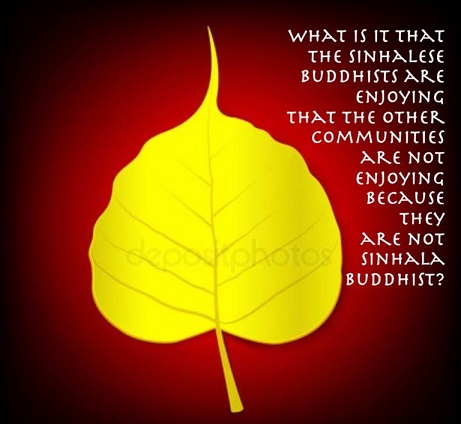
Having said that we come to the real question – what is it that the Sinhalese Buddhists are enjoying that the other communities are not enjoying because they are not Sinhala Buddhist? This is the question anyone who is throwing stones at the Sinhala Buddhists must answer. 

Do we get special treatment while waiting for the bus/train, are Buddhists given special seating areas? Do the banks have a special queue for Sinhale Buddhists? Do Sinhala Buddhists wear a special attire that differentiates us from the rest? Do we have Buddhist food labels? Do hotels and public places not serve beef because majority of Buddhists do not eat it? Are jobs given to only Sinhale Buddhists? Do Buddhists get special discounts because they are Buddhists? Do hospitals & doctors give preferential treatment to only Buddhists…We can ask many more such questions – so for anyone to claim grievance and blame Sinhala Buddhists, they must show us what special treatment we get that they do not get because they are not Buddhists. We would seriously like to have an answer for this.

Falsely claiming to be discriminated & demanding as solution the erasing of our Buddhist history is nothing we will tolerate or even consider for discussion or even compromise.

Nothing & no one can change the historical past of Sri Lanka & the traditions & customs that come with it & associated to governance, cultural, ritual, traditions etc. The State is bound to foster, protect & preserve Buddhism because all others are institutionalized religions with their own lobby groups that are tied to foreign governments which in turn are connected to NGOs that foreign governments fund & to aid & other assistance given by these governments. Therefore, preservation of Buddhism is mandatory of the State (any government that comes to power)

The state patronage of Buddhism has not in any way stopped plethora of churches, kovils, mosques, prayer centres and now radicalized faiths emerging & being spread across the island. We can even statistically prove this. Some areas where minorities are the majority – the minority rule prevails to such levels that the Buddhist majority have politely shifted residence to avoid conflict and this has created a new electoral demographic change now seen in the delimitation proposals made. Has that ever happened to minorities where majority is the majority? Be honest & answer.

Therefore, before anyone even touches the constitution to replace the place held by Buddhism we want to know where Buddhists are a privileged lot just because we are Buddhists – do we not suffer poverty, unemployment, housing, paying bills, saving money for a rainy day, victims of loans/interest as monthly income is not enough, issues in admitting children to schools, transport & other issues just like the minorities?

As an example just take the present government – the Prime Minister has taken an additional portfolio of developing the Northern province – how fair is this of all the other 8 provinces? The Minister of Higher Education is a Muslim, Minister of Industries & Resettlement is also a Muslim, Minister of State language is a Tamil, Minister of State Education is also a Tamil similarly, how many more minorities hold public & private sector roles are these in keeping with even the ethnic ratio?

It has become a fashionable trend to shout down majority view by flagging it as racist/racial/communal etc… but when minorities flag mono-ethno religious demands we have to accept it as their rights and any questions posed immediately becomes racial profiling.

It is now time we question and demand answers instead of meekly being subjugated.

Sinhalese are just 14.8m people globally against 1.3billion Muslims, 1.2b Christians & 1.1b Hindus. Who are the real minority – it is the Sinhalese Buddhists.

However, we have never said that the island is ours, we have said that the island was built by the Sinhale kings following the Buddhas teachings and that identity is a sine qua non while all other communities are welcome to live peacefully, but no mono-ethno religious ghetto areas/shadow cultural rule/dual governing systems. One law equally applicable to all without discrimination is what we have always promoted and if you count the prison population it clearly showcases Sinhalese do not get favoritism legally either – so we again ask all those claiming Sinhalese to be discriminating them – what is it that we enjoy because we are Buddhists that others are not enjoying because they are not Sinhale Buddhists?

If anyone is being discriminated at all it is the Sinhale Buddhists at every level.


Shenali D Waduge

MORE PARTITION OR FURTHER DIVISION OF INDIA

December 30th, 2018

ALI SUKHANVER

A judge of India’s Meghalaya High Court, Justice S.R.Sen has recently said in a statement that India should have been declared a Hindu country after Partition, and that if anyone tried to make it an Islamic country, it would be doomsday for India and the world. The honourable justice gave this ‘wisely-sensitive’ statement while delivering a judgment on a petition filed by an Army recruit Amon Rana, who was denied a domicile certificate by Meghalaya administration. Justice Sen further added, ‘Pakistan declared themselves as an Islamic country and India since was divided on the basis of religion should have also been declared as a Hindu country but it remained as a secular country.’ This statement of the Justice S.R.Sen has given rise to a severe uneasiness among different communities living in India particularly the Sikh community. The Sikhs are worried about their future after India is announced a Hindu-homeland. Moreover if the government of India mistakenly takes the statement of Justice S.R.Sen serious, where would drown the slogan of the ‘Secular India’.

The secular status rather the ‘self-claimed’ secular status of India has ever been looked at with a lot of doubts and suspicions. It is true to some extent that constitutionally India is a secular state but when we see the Muslims being butchered in the streets of Gujarat and in the valleys of the Indian Occupied Kashmir, the impact and impression goes rather otherwise. It is a very unfortunate fact that in the Secular India, the Muslims, the Sikhs and even the Christians are brutally persecuted every day. According to a report prepared in August 2017, the US Commission on International Religious Freedom ranked India’s persecution severity at ‘Tier 2’ along with Iraq and Afghanistan. Moreover on Open Doors’ World Watch List India has risen from No. 31 to No. 11 in the past six years.

Human Rights Watch says in an analysis that ‘violence against Christians in India is used as a tool to meet political ends’. The analysis further says, ‘The acts of violence include arson of churches, conversion of Christians by force and threats of physical violence, sexual assaults, murder of Christian priests and destruction of Christian schools, colleges, and cemeteries.’ And all this is done by the Hindu extremists who are never taken to task; in most of the cases they remain scot-free. Same is the case with the Sikh community. An online magazine Media Diversified has recently published an article of Shuranjeet Singh Takhar. The writer says, Since the election of the B.J.P in 2014, Sikhs have felt vilified within a Hindu nationalist imagination of India, an ideology known as Hindutva. Looking to silence and erase those who do not conform to its beliefs, Hindutva posits that India is a state solely for Hindus.”

In the light of different definitions of a Secular State, one can easily understand what a secular state is. According to the definition provided by the World Atlas, ‘A secular state is a country where religion does not play a part in law making’. Another definition says, ‘A secular state is or purports to be officially neutral in matters of religion, supporting neither religion nor irreligion. A secular state claims to treat all its citizens equally regardless of religion, and claims to avoid preferential treatment for a citizen from a particular religion or non-religion over other religion or non-religion. Secular states do not have a state religion or an equivalent.’ If we analyze India in the light of all these definitions, we would find no secularity there in India. In the name of religion, every year, hundreds of people are burnt alive in the blazing inferno of religious extremism in India. Be it the Sikh, Christian or the Muslim community, no one is safe and secure at the hands of the Hindu extremists. The government machinery fully protects these extremists by using all fair and foul means. We have the example of the Babri Mosque; if India were a secular state, the Babri Mosque would never have been demolished in December 1992. The demolition resulted in several months of inter-communal rioting between Hindu and Muslim communities, causing the death of at least 2,000 people, most of them were the Muslims.  If India were really a secular state, all perpetrators of this demolition must have been taken to task but no such thing ever happened. Former Intelligence Bureau Joint Director, Maloy Krishna Dhar claimed in a statement that Babri mosque demolition was planned 10 months in advance by top leaders of the RSS and BJP. Judges, all over the world are usually very learned and well-knowing people but the matter with Justice S.R.Sen seems altogether different. It seems either he knows nothing about the so-called secularity in India or he is intentionally expressing his ignorance. The condition of Justice S.R.Sen doesn’t seem different from that of King Hamlet for which Shakespeare has used the term ‘antic-disposition’. After his statement on Partition, the government of India may go for his mental-check up.


DISAPPEARANCES, REPARATION, MISSING PERSONS AND YAHAPALANA Part 1

December 29th, 2018

Last Revised 12.6.19

In 2015,    the UN Human Rights Council in Geneva approved a Resolution titled   Promoting reconciliation, accountability and human rights in Sri Lanka”. (UNHRC Resolution 30/1). Sri Lanka’s     Yahapalana government supported the Resolution.   This Resolution included inter alia,  provisions  to establish an  Office  of Missing  Persons  and  an  Office  for  Reparations ,   to sign and ratify  the  International  Convention  for  the  Protection  of  All  Persons  from  Enforced Disappearance, This essay looks at these three provisions.

Pt 1 OFFICE ON MISSING PERSONS.

The Office on Missing Persons Act, No. 14 of 2016” was passed in Parliament on 12th August 2016. This Bill was not referred to Supreme Court. Instead it was rammed through Parliament, disregarding objections of the Joint Opposition.  It went through all three readings very quickly within just 40 minutes, amidst the shouts and protests of the Joint Opposition, said the media.

Mahinda Rajapaksa observed the government forcibly passed the Office of Missing Persons Bill after giving Parliament less than 40 minutes to debate it. The better part of that time was spent in arguing whether that Bill should be taken up for debate at all because the government had pledged not to take it up on that day. Sittings were suspended for a time, and the Opposition was deprived of its time to speak on the Bill.  The original plan was to have a two day debate and hold a vote at the end. This was not done. It was suggested that the House should go on debating till 9.30 p.m. This was rejected.

The Joint Opposition refused to accept the OMP Bill as properly passed saying it was passed against the Standing Orders of Parliament. Only a bill passed in accordance with the Standing Orders could be accepted as a proper piece of legislation.  Also, they said a Bill cannot be deemed to have been passed when more than half of the MPs were standing on the floor of the house. Even government MPs were not in their seats.  Government claims 2/3 majority for the Bill but is unable to state the number of votes, reported the media.  When asked at a press conference    whether he could reveal the number of votes the Minister concerned had side stepped the issue. 

Section 21 of the OMP Act empowered the OMP to receive funding from any source, local or foreign. This was amended on 22nd June 2017 by a unanimous vote in Parliament. This removed a key paragraph that had explicitly allowed the OMP to enter into independent financing arrangements with external sources.  OMP could have received funding from foreign governments, international NGOs and even from pro-LTTE Diaspora organization, using this, said critics. On the other hand, many victims groups and analysts saw   the amendment as seriously compromising the independence of the OMP because it would now be entirely dependent on the government for finances.

Nisha Biswal, Assistant Secretary of State for South and Central Asian Affairs, and Atul Keshap, US ambassador to Sri Lanka hailed the new Act. Biswal said it was a historical step in the pursuit of justice, reconciliation and accountability. National Peace Council issued a statement that the OMP bill was a good thing.

The OMP was to be run by a seven member Commission, whose names were decided by the 10-member Constitutional Council,  The OMP Act says that if the President fails to appoint members within 14 days of the Constitutional Council’s nominations, the nominees will be automatically appointed. President Sirisena therefore had no alternative but to appoint the persons recommended though he had his reservations about them. They were appointed for three years. The Chairman was Saliya Pieris, President’s Counsel. The Sri Lanka Treasury allocated Rs 1.3 billion in the 2017 Budget for its operations.

The salaries of the members of the Office would be determined by Parliament and will be paid out of the Consolidated Fund. Payments to the Chairman will include a monthly allowance of Rs 100,000, a monthly telephone allowance of Rs 10,000 and an official vehicle with a monthly quota of 225 litres of fuel. For the other members of the OMP, a monthly allowance of Rs 75,000, a monthly telephone allowance of Rs 8,000 and a monthly transport allowance of Rs 25,000 to a limit of 350 km or, a transport allowance of Rs 50,000 for a distance over and above 350 km, depending on the distance from the residence to the office, will be paid.

Critics did not greet the OMP Commissioners with admiration. All the ten members of the Constitutional Council are Yahapalanites and hence all members of the OMP are also Yahapalanites, observed Chandraprema. The danger in a lot like that exercising the powers vested in the OMP should be obvious, he said. Given the present composition of the OMP, can one even begin to imagine the implications this will have for the country, he added.

But Jehan Perera, National Peace Council, said the government needs to be commended for having established the OMP and for having appointed credible members to be its first commissioners. Apart from the former legal head of the army, the members include well respected human rights activists of long standing who have worked to uphold human rights in a non-partisan manner in the face of violations by successive governments.

The Act specified that members of the Office must be persons with previous experience in fact finding or investigation, human rights law, international humanitarian law. This meant that the appointees will for the most part be representatives of western funded NGOs, said critics. Looking at the people who have been appointed to the OMP that seems to be so, said Chandraprema. A howl of protest has already arisen in this regard.

Manohara de Silva pointed out that the seven appointed members could delegate the work to others who need not be even Sri Lankans. Foreigners can be appointed as officers and staff of the OMP as well.  OMP was free to establish committees, divisions or units and can delegate its power to them.

Dayan Jayatilleke     observed that OMPs were set up in Latin America for persons missing under military juntas. OMPs were also set up for mediation between governments and guerillas.  The situation in Sri Lanka is completely different. Sri Lanka is a democratic state with democratically elected government whose legitimate army fought a war strictly within its borders against a secessionist army and won an outright victory. Nowhere in Asia, in the aftermath of such a war has a mechanism such as the OMP been set up concluded Jayatilleke. This OMP must be viewed together with war crimes charges, hybrid courts, and purges of the armed forces as interlocking components of Resolution 30/1, said G.L.Pieris.

The ‘Missing Persons’ to be examined by the OMP were limited to those connected with armed conflict, political unrest and civil disturbances. Section 27 of the Act said, Unless the context otherwise requires, in this Act -missing person” is a person missing in connection with the conflict which took place in the Northern and Eastern Provinces or its aftermath, or is a members of the armed forces or police who is (ii) in connection with political unrest or civil disturbances; or (iii) as an enforced disappearance as defined in the International Convention on Protection of All Persons from Enforced Disappearances”.

The OMP Act equates terrorists and the armed force when it comes to ‘missing persons’, said critics. When this was pointed out, Jehan Perera maintained that ‘both are human beings and therefore have to be treated equally’. Palitha Senanayake comments. This was the type of thinking that these NGO’s with their propaganda attempted to instill in the ‘educated and international’ segment of the Sri Lanka society in the name of humanity, he said. This deranged thinking, treated the subversives who perpetrated crimes against humanity with kid gloves. 

The Office of Missing Persons (OMP) is no office” at all,   denounced critics.  OMP is a quasi judicial body just one step away from a fully fledged war crimes tribunal. It can receive statements, examine witnesses, issue summons and hold hearings.

 OMP can summon any person in Sri Lanka before it. Anyone who refuses to cooperate with the OMP will be treated as contempt of court and punished by the Court of Appeal as though it were an offence against the Court of Appeal.  OMP is equated with the Court of Appeal   for this purpose, observed critics.

An OMP officer can enter without warrant and investigate, day or night, any place of detention, police station, prison or any other place where a suspect is said to be detained, make inquiries and retain any documents or objects. Government bodies at all levels including the armed forces and intelligence services are mandatorily required to render fullest assistance to the OMP. All local authorities ranked below the OMP. Information gathered by the OMP can be referred to the relevant law enforcement or prosecuting authority.

 The OMP had great immunity. Nothing that the OMP does can be called into question by any Court of law except the Supreme Court under Articles 126 and 140 of the Constitution. However, as the OMP can withhold information under Section 15 of the Act, there will be no practical use in moving even the Supreme Court against the OMP said analysts.  The Official Secrets Act and the Right to Information Act will not apply to the work of the OMP, either.

All officers of the OMP, including those to assist it have been granted complete immunity from civil and criminal liability for any act or omission on their part or the contents of any report they may publish. No court, not even the Supreme Court can order any officer of the OMP to submit to courts any material communicated to him in confidence. Not even Supreme Court of Sri Lanka can penetrate this fog of secrecy, said G.L.Pieris 

The OMP is empowered to entertain complaints not only from relations and friends of missing persons but from any interested party, both local and foreign. Obviously, the pro-LTTE Diaspora organizations   will be heavily involved in the OMP, said Chandraprema. OMP can also initiate an inquiry on the basis of a secret complaint. This means that anyone can charge anyone else in secret at the OMP, observed analysts.

The OMP Act allows the OMP to admit as evidence any statement or material, disregarding all criteria laid down in the Evidence Ordinance. OMP can admit matters contrary to the Evidence Ordinance or matters considered inadmissible in civil or criminal proceedings. This is a gross travesty of natural justice, said G.L.Pieris. Disregarding the Evidence Ordinance will result in the safeguards available to any accused in this country being denied to those brought before the OMP. 

OMP can   arrive at ‘findings’ relating to serious crimes like abduction and murder without any of the routine safeguards available to suspects in ordinary courts. They can admit any kind of evidence in building up a story against a person which could cause serious damage to the reputation and career of that person. A person can be removed from the armed forces because a ‘case’ would have been built up against him in the OMP without safeguards of the Evidence Ordinance,

I do not think  Yahapalana or the OMP   has any intention of prosecuting anybody in Sri Lanka, they will get the information  and then prosecute abroad, because our government has agreed to universal jurisdiction, said  Manohara de Silva. Once the OMP makes an allegation against an individual in a report, a foreign country can ask for his extradition, to be either tried in that country or handed over to an international criminal tribunal for prosecution.

Lastly, if a person who is declared missing is found, the OMP need not announce the fact. If a missing persons is found, if he so wishes he can remain missing, as unless he agrees, his relatives will not be informed.  The missing person   may be hale and hearty and living abroad, observed critics.

 It was pointed out that the workload of OMP would reduce substantially in the event missing/dead persons are found to be alive. International organizations and the USA accused Sri Lanka army of killing Kathiravelu Thyapararajah in the second week of September 2009. On May 06, 2014, he was arrested by the Tamilnadu police in Dhanushkodi together with nine others, attempting to enter India without valid travel documents. Australia issued a new passport to Kumar Gunaratnam under the name Noel Mudalige. Jesuthasan Antonythasan, who was listed among the disappeared, starred in the film Dheepan” which won an award at Cannes film festival in 2015.

Here is further information on the validity of this ‘Disappeared’ data. The US State Department Country report on Human rights, 2007 gave a list of 335 disappeared.  Government of Sri Lanka  looked at this list and  found that 5 names had been duplicated, 6 had left the island, 4 were traced  and they included a couple who had eloped,  4 had died,  3  were under arrest. 6 were Sri Lanka security personnel who had been killed by a LTTE bomb. Their names had been altered to resemble Tamil names.  One disappeared person was actually an NGO.  106 cases listed in this document had not been reported to the police. The US embassy was asked to provide more information, which it did not do. 

The first meeting of the OMP and the relatives of the missing was arranged by an NGO, Families of the Disappeared”, of the Right to Life” movement.  Commissioners met with the family members of the disappeared.  The OMP thereafter held outreach sessions in Jaffna, Mannar Matara, Mullaitivu and Trincomalee in 2018.  These meetings followed a set pattern. The Commissioners first met with families of the disappeared, then they met with civil society organizations and activists working on disappearances.

The introductory meeting of the OMP in Jaffna was disrupted by protestors while the introductory meeting in Kilinochchi was entirely scuttled, reported Jehan Perera. The protestors in the North took the position that they had no confidence in the OMP and instead demanded an international investigation as the only way to secure truth and justice for the victims. They objected to the inclusion of a former Major General of the army among the seven members of the Commission. A battlefield commander of the Sri Lanka army would dominate the OMP and suppress the truth.

However, at the public meeting in Jaffna which was eventually held over the opposition of the protestors, it was revealed that this Commissioner, a former major general of the army, was the head of the division which pursued internal legal processes against delinquent army personnel. The Commissioner was a woman and was Tamil.  When they got to know this, the families of missing persons directed all their questions and hopes at her, said Jehan.

The OMP Commission issued an Interim Report in August 2018 after six months of work. Individuals suspected of having committed enforced disappearances and related offences are being permitted to remain in positions of power, said the report, especially within the armed forces and the police, where they can influence the progress of an investigation. There have been instances where members of the armed forces, who were willing to provide information on disappearances, were subject to harassment.

The OMP notes with concern that in at least one case, an officer of the armed forces who is a suspect in an on-going court case relating to abductions and enforced disappearances has neither been suspended nor removed from exercising the duties and functions of his office. It is reported in at least one case an officer has been granted a promotion within the armed forces, whilst the case against him is still pending. Such suspected officers should be suspended from exercising the duties and functions of their office, said the Interim report.

The most immediate issue the missing persons’ families are undergoing is the economic hardships.  This cannot wait until a final reparations scheme is devised, said the OMP.  OMP proposes a debt-relief programme, housing development programme, educational support programme, vocational training and livelihood development programmes to the family members of the missing/disappeared.

Families of the missing or disappeared should be a separate priority category within the existing housing programmes of the Ministry of Housing and the introduction of a scholarship scheme under the Ministry of Education for the children of the missing or disappeared in the form of a monthly allowance of Rs. 2,000 to cover essential educational expenses required for the completion of their primary and secondary education. These families should be included in a priority category in a debt relief programme that would either write off debts such as micro finance loans or in a financial aid programme or loan scheme.

OMP    suggested a monthly living allowance of Rs.6, 000 to the surviving spouse, child/children and/or surviving parents of a missing or disappeared parent who has no permanent income, until the final preparations are provided.   Also an employment quota of 1% to family members of the missing/disappeared when vacancies in the public and semi-governmental sectors are filled.

 A lot of publicity was given to this subject of ‘Missing Persons’ around this time. Family members of disappeared persons across Sri Lanka came together and shared their stories of struggle and suffering on the International Day of the Disappeared in September 2018. ” Hundreds of family members attended this OMP event, but some observed that such acts of solidarity and remembrance can only go so far. We have commemorated disappearances for many years. Commemorating is not enough. The government should take concrete action. The OMP is the last hope for us.”

 Sri Lanka has one of the world’s highest number of disappearances, with a backlog of between 60,000 and 100,000 alleged disappearances since the late 1980s, said Amnesty International . Amnesty International has called on the Sri Lankan government to provide information to the families of the disappeared, with detailed lists and information of persons who surrendered to the armed forces in the final phase of the war.

Amnesty International’s report, “Only Justice can heal our wounds”, was launched in April 2017, at a meeting with families of the disappeared in Mannar. The report tells the story of relatives, many of them women, who have spent years searching for truth and justice. Sri Lanka will not break with its violent past until it reckons with the cruel history of enforced disappearance and delivers justice to as many as 100,000 families who have spent years waiting for it, the report said. The authorities have failed to investigate these cases, identify the whereabouts or fate of the victim, or prosecute those suspected of the crimes.

“There is no community in Sri Lanka that remains untouched by the trauma of enforced disappearance. Most people in the country suffer the absence of a loved one or know someone who does. They have waited years, and in some cases, decades, to learn of the fate of their relatives. Until justice is delivered to these victims, the country cannot begin to heal, let alone move towards a more promising future,” said Salil Shetty, Amnesty International’s Secretary General.

Amnesty International has focused attention on those taken away by the army. AI has called on the Sri Lankan government to provide information to the families of the disappeared, with detailed lists and information of persons who surrendered to the armed forces in the final phase of the war.

Amnesty International  said according to surviving family members, more than 100 cadres of the LTTE, who surrendered to the Sri Lankan army near the Vadduvaikkal Bridge in Mullaitivu at the end of the war in May 2009, have subsequently disappeared. One group of surrenders was led by Father Francis Joseph, a Catholic Priest who was disappeared thereafter. According to family members who witnessed the surrenders, they were transported from the site by the army in a convoy of buses: their fate and whereabouts since then remain unknown. They claim to have last seen their family members in the custody of the 58th Division of the Sri Lankan Army.

Minoli Salgado  conducted a workshop on Writing Truths: The Power of Testimony, In September 2018. Jehan Perera attended this workshop. As part of the workshop methodology, the participants were asked to share a story of a war victim that they had heard from the person sitting next to them.  Sitting next to me was a female and she told me this story of a mother who had lost her daughter, said Jehan. It was the last days of the war in May 2009. About a hundred youth in an area were rounded up by the Sri Lankan military and put into a bus. The daughter of the woman was one of them. The mother got onto the bus along with another mother. They were permitted to travel for a while but at a certain point they were offloaded and the bus went on. They never saw their children again.

Jehan Perera says the Tamil people are united  on  the position that those who are families of victims who went missing have a right to know what happened to them, especially those who were handed over by their families to the Sri Lankan security forces and disappeared thereafter. Political opponents of the government have been alleging that the OMP is meant to find evidence against the Sri Lankan security forces and take them to international war crimes tribunals and The Hague. They have accused the government of betraying the security forces.

Pt 2 INTERNATIONAL CONVENTION FOR THEPROTECTION OF ALL PERSONS FROM ENFORCED DISAPPEARANCE, ACT NO 5 OF 2018,

The  UN  International Convention for the Protection of All Persons from Enforced Disappearance (ICPPED) is an international human rights instrument of the United Nations and intended to prevent forced disappearance defined in international law, crimes against humanity. The text was adopted by the United Nations General Assembly on 20 December 2006 and opened for signature on 6 February 2007. It entered into force on 23 December 2010. As of September 2018, 98 states have signed the convention and 59 have ratified it.

 This Convention makes Enforced Disappearance carried out by state agencies into a crime and provides mechanisms to ensure individual criminal responsibility for these acts. But enforced disappearance by non-state actors are excluded. This means that non-state agents can evade international criminal responsibility for acts of enforced disappearance, said analysts.

Sri Lanka signed the International Convention for the Protection of All Persons from Enforced Disappearance on December 10, 2015 and it entered into force in June 2016. Article 2 of ICPPED stated  “For the purposes of this Convention, ‘enforced disappearance’ is considered to be the arrest, detention, abduction or any other form of deprivation of liberty by agents of the State or those supported by the State, followed by concealment of the whereabouts of the disappeared person. There are no exceptions. ‘Enforced Disappearances’ cannot be justified even in an emergency, observed Ladduwahetty.

The Convention is applicable   therefore only to State Actors, which means that this is aimed only at the armed forces. Any arrests, prosecutions, requests for extradition or handing over to international criminal courts of Sri Lankans by interested foreign governments will only apply to Sri Lankan armed forces personnel or other agents of the State. No action will be taken by any foreign country against LTTE members, because ICPPED does not include non-State actors.

Article 10 of this Convention makes it clear that any State in whose territory a person (who can be a citizen of any other member state) suspected of having committed an offence of enforced disappearance is present, can take that person into custody.  In other words, any person suspected of causing enforced disappearances can be arrested in the home state or any other member state.

 According to Article 11, after making an arrest in that manner, the member state concerned can take one of three alternative courses of action – (a) extradite that person to another country in accordance with its international obligations, (b) prosecute that person under its own laws or (c) hand him over for prosecution to an international criminal tribunal whose jurisdiction that member state has recognized.

Article 13 says states that any member state may request the extradition of a person suspected of being responsible for enforced disappearances in any other member state and all member states must respect such requests for extradition. Because Sri Lanka is now a signatory to the International Convention for the Protection of All Persons from Enforced Disappearance, the provisions of Articles 10, 11 and 13 form a part of our obligations under this Convention. 

 Article 32 enables any member State to complain to the 10-member ‘Committee on Enforced Disappearances’ in Geneva that Sri Lanka is not fulfilling her obligations under this Convention and the Committee can investigate such complaints. Put together, this means that foreign countries which are members of the ICPPED will have complete jurisdiction over Sri Lankans who are alleged to have carried out enforced disappearances in Sri Lanka.

UN Working group on Enforced Disappearances (UNWGEID) arrived in 2015   at the invitation of the Government of Sri Lanka  to study the situation and make a report of their visit to the UNHRC. The UNWGEID forms part of the Special Procedures trick imposed on the UN system, said Kamal Wickremasinghe.  This involved the deployment of independent human rights experts or groups of such experts, drawn from vassal NGOs to report and advice on Human Rights issues. UNWGEID said it supported the establishment of an OMP .They said the government must issue clear instructions at all level of the military security and law enforcement forces that all types of threats, harassment and intimidation towards families searching for their loved one must immediate cease, and will be severely sanctioned. 

The Bill known as Enforced Disappearances Bill was brought  to incorporate into the law of Sri Lanka, the provisions of the UN Convention. The Bill was scheduled to be taken up for debate on July 5 and September 19, 2016 but the Government had to defer it due to objections of various groups. The Joint Opposition raised objections to the Bill stating that it posed a threat to the security forces.  The Bill was aimed only at punishing the armed forces with the LTTE getting off scot free for the many thousands of enforced disappearances that they were responsible for. They wanted the Bill withdrawn.

Critics observed that all matters that relate to an enforced disappearance, such as abduction, illegal confinement, murder and the illegal disposal of dead bodies are more than adequately covered by the Penal Code and the existing criminal law in Sri Lanka.

 G.L.Pieris reported that ambassadors of several EU nations had been present at the meeting held in December 2016, to finalize the new Bill. Those present included the British High Commissioner, Ambassadors of France, European Union, Netherlands, Germany, Italy, and Romania. Pieris deplored the fact that the ambassadors of foreign countries were directly involved in the process of drafting legislation which related to the public security of the country.

The Human Rights Commission of Sri Lanka had wanted the Bill to be presented in Parliament

saying that that this legislation is a positive step towards addressing the long history of disappearances in Sri Lanka and stemming impunity for human rights. The Government presented the Bill in Parliament on March 7, 2017.  The Bill was passed and the International Convention for the Protection of all persons from Enforced Disappearance Act no 5 of 2018, came into existence. This Act made Enforced Disappearance committed by state actors into a crime which could be prosecuted in a law court.

The Bill was passed with a majority of 37 votes, obtaining 53 votes in favor and 16 votes against.  A total of 156 members were absent. The Second Reading of the Bill received 53 votes in favor and 19 votes against, and the number of votes against the Bill reduced further at the Third Reading vote, reported the media. The Bill was passed without amendments, amidst disturbances from the Joint Opposition. The JO said that they had not received a copy of the document.

Critics observed that the government passed the Prevention of Enforced Disappearances Act No: 5 when the attention of the whole nation was focused on the Sinhala-Muslim riots that broke out in the Kandy district. They passed this law despite repeated requests from the Mahanayaka Theras and the Karaka Sangha Sabhas of all three nikayas to jettison it.

Chandraprema commented on the provisions of this Act. Section 8 of this Act enables foreign countries to seek the extradition of a Sri Lankan who is suspected, accused or convicted of having caused enforced disappearances in Sri Lanka. When such a request is made, the government of Sri Lanka is obliged to inform the foreign country of the measures it intends taking to prosecute or extradite that person.

Section 14 says (1) Every victim and relative of a victim shall have the right to know the truth regarding the circumstances of an enforced disappearance, the progress and results of the investigation as are carried out by the law enforcement authorities, and the fate of the disappeared person. (2) Every victim and relative of a victim shall, subject to restrictions placed by law, have the right to form and freely participate in organizations and associations concerned with attempting to establish the circumstances of offences committed under section 3 and the fate of disappeared persons, and to assist victims of offences under section 3. (3) Where there are reasonable grounds for believing that a person has been subjected to an offence under section 3, law enforcement authorities shall undertake an investigation, even if there has been no formal complaint.

Clause 21 seeks to give ‘full effect’ to the International Convention Against Disappearances in Sri Lanka. Clause 23 says the Act will override all other written law. the provisions of this Act shall have effect notwithstanding anything to the contrary in any other written law and accordingly in the event of any inconsistency or conflict between the provisions of this Act and such other written law, the provisions of this Act shall prevail.” 

Because Sri Lanka is now a signatory to the International Convention for the Protection of All Persons from Enforced Disappearance, the provisions of Articles 10, 11 and 13 of ICPPED form a part of our obligations under this Convention. When you read Articles 10, 11 and 13 of the International Convention Against Enforced Disappearances together with Sections 8 and 21 of Act No: 5 of 2018 show the gravity of this legislation, said Chandraprema.

the Bill seeks to give foreign countries complete and untrammeled criminal jurisdiction over Sri Lankans with regard to ‘enforced disappearances.’ Foreign countries which are members of the ICPPED now have complete jurisdiction over Sri Lankans who are alleged to have been involved in causing enforced disappearances in Sri Lanka. Any member state of this international convention can get a Sri Lankan extradited to their country, to be prosecuted or handed over to an international criminal tribunal. When a foreign country which has complete jurisdiction over Sri Lankans in that manner arrests a person on suspicion over an offence relating to this convention, and that foreign country also happens to be a member of the International Criminal Court, that person can be handed over to the ICC to be dealt with as they would a citizen of the foreign country that carried out the arrest.

This Bill seeks to enable foreign countries to request the extradition of a Sri Lankan who is suspected, accused or convicted of having caused enforced disappearances in Sri Lanka. Under this law foreign countries would also be authorized to arrest and try Sri Lankans for disappearances that allegedly took place in Sri Lanka and even to hand over persons so arrested to an international criminal tribunal even if Sri Lanka does not come under the jurisdiction of that international tribunal.

The proposed law is an attempt to subject our armed forces to international war crimes prosecutions without using the term ‘war crimes’ and rephrasing it as ‘disappearances’. The use of the word ‘disappearances’ makes this look like an attempt to trace missing persons. But the purpose of this Bill is not to trace missing persons but to hunt down and prosecute those who won the war.

The only ‘disappeared’ persons, whose cases will be dealt with under this proposed law, will be those of the LTTE because the armed forces have already categorized the thousands of soldiers who disappeared as ‘assumed to be dead’. However LTTE combatants who have either died in battle or fled overseas still continue to be categorized as having ‘disappeared’ by all interested parties, said Chandraprema.

Many countries have kept away from this Convention altogether, because of its intrusive nature, observed critics,  Australia, Britain, Canada, China, Russia and Pakistan and United States have not signed this Convention. Denmark, Finland, Ireland, India, Norway and Sweden signed but never ratified it.”  Sri Lanka was therefore signing a convention which other countries were avoiding, observed Mahinda Rajapaksa.

 G.L.Pieris   observed that that the United States, Britain, Australia and Canada, had not signed this Convention. USA’s policy is that no foreign government can try an American soldier. Scandinavian countries which are usually at the forefront of any human rights initiative had signed it in 2007, but never ratified it. India also had signed it in 2007, but had never ratified it. Yet Sri Lanka had signed and ratified this Convention within a few months.

Pieris   pointed out that this Bill would apply to the past as well under Article 13(6) of the Constitution of Sri Lanka. Prof. Pieris charged that this Bill was probably not even drafted here but sent from overseas He said that Clause 23 enables the proposed law to supersede all other written laws in Sri Lanka giving it a status akin to the Constitution.

Pieris said that earlier the controversy was about whether foreign judges should be allowed to serve in a war crimes tribunal in Sri Lanka but that now the government seems to have changed their strategy and instead of bringing foreign judges here, they are trying through this proposed legislation to send our armed forces personnel overseas to be tried by interested foreign governments.

Pieris pointed out that this legislation seeks to circumvent the safeguards in Sri Lanka’s Extradition Law No 8 of 1977. One of those protections was that no person can be extradited for an offence of a political nature.  This protection which is also enshrined in customary international law is specifically taken away and furthermore, through this Act, it becomes possible to send Sri Lankans for indictment to The Hague through a foreign country.

the purpose of this law is to take our war veterans to be tried in other countries.  Allowing our war veterans to be tried in other countries for alleged crimes committed here is worse than being tried by an international criminal tribunal. an international criminal tribunal is a multilateral body whereas another country is a different matter altogether. No one who is prosecuted in the courts of a foreign country or by an international criminal tribunal which is controlled by a foreign country can really expect justice. Such prosecutions are always politically motivated. If the country carrying out the arrest has accepted the jurisdiction of the ICC then any Sri Lankan who is arrested in such a country or is extradited to such a country by our own government can in fact be handed over to the ICC at the Hague. The ICC is the only standing international criminal tribunal.

anyone can be extradited to another state on a mere accusation. Such accusations could originate in Sri Lanka or elsewhere. the Bill has no provision for any procedures that should be followed within Sri Lanka or outside; not even a preliminary investigation, except for what the Minister in charge of the subject decides. The lack of any formal procedures to establish the credibility of the accusation prior to extradition presents ample opportunities for victimization.  Further, this law is retroactive . The Bill can apply to someone who disappeared 10 or even 20 years ago .

The government went out of its way to defend the Bill. The persistent campaign of misinformation that the Yahapalana government  conducted on the matter and the fact that it was presented to Parliament twice despite public protests and the opposition of the Maha Sangha, shows how important this piece of proposed legislation is in the Yahapalana scheme of things, observed Chandraprema. Why was the Yahapalana government so interested in pushing this legislation?

The government made a deliberate bid to deceive the masses by repeatedly claiming that the Bill wouldn’t be retroactive. There was an essay on a website titled “Extradition Clause in Enforced Disappearances Bill is Identical to Section 7(2) of Torture Act No 22 of 1994 .This article sought to argue that Clause 8 of the Bill is identical to Section 7(2) of the Convention Against Torture Act, No. 22 of 1994. The author of this article stated that both documents had a provision for extradition .On this basis, the author of this article argued that there is absolutely nothing to worry about in Clause 8 of the proposed Disappearances Bill because this was a standard Clause and that we have had an identical provision in a very similar statute for over 20 years.

Chandraprema had pointed out thatthat Clause 8 of the Bill refers to Sri Lankans whose extradition has been requested by foreign countries due to enforced disappearances. But the 1994 Act refers to foreign nationals wanted in their own countries over allegations of torture, who may happen to be in Sri Lanka. thereafter there were no more well argued articles from the Yahapalana camp on the matter. It appears that since it is not possible to argue the matter out, the best fallback position is to resort to an outright campaign of lies and misinformation, Chandraprema commented.

The Office on Missing Persons (OMP) has recommended amendments to the Enforced Disappearance Act. The Office of Missing Persons has recommended t he suspension of state officials, including members of the armed forces and police who are named as suspects or are indicted in cases relating to abductions and enforced disappearances till the final determination of those cases. It has also recommended to provide adequate material and human resources to law enforcement officers, the Attorney-General’s Department as well as the judiciary to investigate, prosecute and punish perpetrators of enforced disappearances.

Some individuals suspected of having committed enforced disappearances and related offences are being permitted to remain in positions of power—especially within the armed forces and the police—where they can influence the progress of an investigation, continued the report. There have been instances where members of the armed forces, who were willing to provide information on disappearances, were subject to harassment.

Pt 3 THE OFFICE FOR REPARATIONS

The Office for Reparations bill was passed in Parliament in October 2018 with a majority of 16 votes. It received 59 votes in favor, while 43 votes against, following a division called by the Joint Opposition. The UNP, SLFP members in the Government and the TNA voted in favor of the Bill. The JVP MPs were absent. The Joint Opposition together with the ‘SLFP Group of 15,’ voted against.

The Office for Reparations will consist of five members appointed by the President on the recommendation of the Constitution Council and will be answerable to Parliament. Provision has been made for the functioning of regional, temporary or mobile offices as may be necessary, to ensure that reparations are accessible to victims and their relatives. The main Office is to be a situated in Colombo.

The Rehabilitation of Persons, Properties and Industries Authority Act, No. 29 of 1987 would be repealed by the new Bill  and all funds presently lying to the credit of the Authority will be taken over. The Office will also receive such sums as may be voted upon by Parliament and the money received from outside Sri Lanka.

The idea of setting up an Office for Reparations was obviously inspired by the South African example where a Committee of Reparations was set up under the Truth and Reconciliation Commission that came into being after the agreement to end the Apartheid regime in South Africa in 1995.

However the circumstances that led to reparations in South Africa were very different to the situation in Sri Lanka. In South Africa, there was a white minority dominating a black majority. There was genuine oppression in South Africa based on race and the victims who were to be awarded reparations were easily identifiable. This was not the case in Sri Lanka. In Sri Lanka it was a case of armed groups attempting to seize control of a part of the country.

The Office is empowered to receive recommendations as to reparations from the Office of Missing Persons, to receive claims from victims of serious human rights violations for monetary and non-monetary reparations, and also to verify the authenticity of the claims and assess eligibility.  The Office must  also formulate and recommend reparations policies to the Cabinet,   provide criteria for eligibility, also for the  form and quantum of reparations and the prioritizing of the claims.

In formulating policies on reparations, and issuing guidelines, the Office for Reparations is required to consult aggrieved persons, organizations representing aggrieved persons and any other authority, or body of persons, and to have a victim-centered approach. the reference to ‘organizations representing aggrieved persons’ can only mean the various pro-LTTE and independent Tamil Diaspora organizations headquartered in foreign capitals, said Chandraprema.

The Office for Reparations Act applied only to those in four specific situations. These are:  in the context of the war that took place in the Northern and Eastern Provinces, in connection with political unrest of civil disturbances, in the course of systemic gross violations of the rights of individuals, groups or communities of people in Sri Lanka or due to an enforced disappearance.  Jehan Perera noted that  does not exclude the LTTE members or their families from receiving reparations if they have suffered human rights violations.

The Office   also has to provide protection, with the assistance of law enforcement authorities, to victims or their relatives under threat. The term ‘victim’ has been defined to include a person who has suffered a serious violation of human rights or humanitarian law as a result of the conflict in the North and East or its aftermath, in connection with political unrest or civil disturbances or in the course of systemic, gross violations of the rights of individuals, groups or communities of the people of Sri Lanka or due to an enforced disappearance.

Jehan Perera said that at a workshop for community leaders and members of the Youth Parliament in the Ratnapura district, When the Office for Reparations was  discussed, some of the participants said that the Office for Reparations would be compensating LTTE members and their families and this was not an appropriate or just use of national resources. They pointed out that it was an inequitable use of government resources to use funds to compensate LTTE members and their families when the LTTE’s primary focus was on dividing the country.

MP Susil Prem Jayantha questioned in Parliament as to why the Act, then a Bill, had given weight to the people in the North and the East when it comes to paying compensation.   This Bill does not provide for reparation to be paid to those who were killed by bombs set off by the LTTE in Colombo. Don’t they have a right to reparation payments as well?” he asked. 

The Act provides for the provision of individual and collective reparations for aggrieved persons. Under the individual reparations,” the Bill facilitates any monetary payment or material benefit provided to an aggrieved person, micro-finance and concessionary loans, educational programmes, training and skills development programmes, administrative assistance and welfare services, including psycho-social support provided to an aggrieved person, measures of restitution, including the provision of land and housing and other appropriate measures identified by the Office for Reparations.

Under the Collective reparations,” the Bill facilitates development of infrastructure, educational programmes, training and skills development programmes, community development programmes or services and other appropriate programmes as identified by the Office of Reparations in consultation with affected communities.

Collective reparation also  includes ‘specialized policies on public education’ and ‘memorialization’.  Memorialization has been borrowed straight from South Africa, observed Chandraprema. In Sri Lanka  the memorialization will include LTTE. Memorialization of LTTE is a problematic matter. It is unlikely to be received well by the people who were at the receiving end of this terror said Chandraprema. Similarly, specialized policies on public education’ would suggest portraying the LTTE as heroes of the Tamils in school textbooks. This would be ok in South Africa but in Sri Lanka would be totally unacceptable, concluded Chandraprema.

Any quantum of compensation decided on by the Office for Reparations should accord with reason and be subject to a limit as in South Africa, said Chandraprema. The Office of Reparations law has in fact provided for such limits by providing that in formulating policies on reparations, the reparations already received by the aggrieved persons with regard to the violation of the right in question will have to be taken into account. In deciding the quantum of monetary reparations, the availability of resources, has to be taken into account. It has also been provided that in granting individual reparations which are monetary, the need to restrict such reparations to aggrieved persons who have the most serious grievance and the level of need and the indigence of the aggrieved persons have to be taken into consideration in granting monetary reparations.

However, The Act has specifically provided that “…the receipt of reparations shall not preclude aggrieved persons from pursuing any remedy available in law to such persons, against any person who may have violated the rights of such persons.” That is not right and the government should review this provision. Nobody should be able to claim reparations from the state and then claim damages from real or imagined violators of human rights through civil actions, said Chandraprema.

 The government has in fact gazetted another Bill which enables victims to file civil actions against people they think were responsible for the deaths or disappearances of family members. If a person has been convicted by a court of law of causing the disappearance or death of a person will in addition to any other punishment ordered by the court, also have to pay compensation to the victim. If it has not been established that a person has committed a particular crime, making it possible for any party to initiate court action against someone they think was responsible for the deaths of their next of kin, will be yet another way of harassing armed forces personnel and law enforcement officers, said Chandraprema.

In July 2018, Media reported that  D.M.Swaminathan Rehabilitation, Resettlement and Hindu Religious Affairs Minister, had submitted for the third week in a row, a Cabinet Paper which proposed to pay reparations for families of dead LTTE cadres. He wanted enhanced compensation” paid to Tiger guerrilla ex-combatants who were defeated in the separatist war that ended in 2009 and their next of kin. He said this was based on an LLRC recommendation.  This  Cabinet Memorandum was rejected. The Cabinet Paper had been deferred over the last two weeks but this time, due to continued protests from ministers, it  was stopped for good, reported the media  on 20.6.18.

Swaminathan had  forwarded two other Cabinet memoranda at the same time. Second memorandum related to the payment of special compensation” to Beruwala and Aluthgama families who lost their properties” due to the incidents that took place between June 15, 2014 and June 16, 2014. He had sought Rs 185,962,050 to pay compensation for the affected persons in accordance with the recommendations made by a Valuation Committee appointed by the District Secretary.

The third memorandum is for relocation of families who live in welfare centers in the Jaffna District.” According to Minister Swaminathan, in the Jaffna District there are 34,248 families who were temporarily resettled in their own land up till October 31, 2017 and 721 families are yet to be resettled from 29 welfare centers. In addition, 8,987 families need to be resettled as they are living with friends and relatives in the Jaffna District. I think these two memoranda are still pending.

One cannot but help notice the expeditious manner in which the Yahapalana government had been fulfilling the pledges given to their international masters while taking little interest in fulfilling the pledges they gave in 2015 to the local population such as abolishing the executive presidency and reforming the electoral system, observed Chandraprema.

The names of the Commissioners were announced in April 2019 and the Office for Reparations was due to start functioning htereafter. President Maithripala Sirisena has appointed former Ministry Secretary Dhara Wijayatilake the Chairperson of the Office for Reparations. The other members of the Office for Reparations are retired Lieutenant Colonel W.W. Rathnapriya Bandu, Dr. J.M. Swaminathan, Sellathambi Sumithra and A.A.M Faththeeu. The appointments are effective from April 1.

Whereas both institutions could be expected to achieve a certain degree of success in their endeavors, its work is also hampered due to the fact that of western nations vehemently refuse to divulge identities of LTTE cadre who have been granted asylum and new identities. . Both OMP and Office of Reparation would lose credibility should it be the case that a death certificate is issued and his/her family members granted reparations was to be discovered living in the west. The government will find it difficult to explain such a situation to the general public. (Continued)

The need to end the tyranny of minority politics in Sri Lanka” Part 11

December 29th, 2018

Dr Sudath Gunasekara

29. 12.2018.

(Continued from 24th Dec 2018)

(Ending the tyranny of minority politics in Sri Lanka constitutes the number one in restoring political stability, economic and social development and preserving the 2500-year-old Sinhala Buddhist civilization in this country)

Before I  present my proposed  solutions to this vexed problem as stated in the foregoing backdrop and further elaborated below, I would like to state few more factors that have heavily contributed to this disproportionate rise of the tyranny of minority politics in this country

If you carefully analyse how our political system has been functioning in the post-independence era ever since 1948, within this divide and rule colonial policy and the subversive political matrix created by the British you will see how the following salient outstanding raisons d’etre have been responsible  for this unfortunate situation.

Among them I would like to list the following factors as the most important

1 The failure on the part  of  all politicians headed by the UNP in 1948 at the time of receiving Independence, to demand the British to restore the status quo in the Lankan State that was there in 1815 and abolish certain colonial creations as listed below.

For example the original name of the country ‘Sinhale’ (the Land of the native Sinhala people); the Sinhala  language (the language of the  native people}; the State religion Buddhism; the Law of the Land; the name of the Nation (Sinhala); and the vacant possession of the motherland (without over 1 million Indian indentured labourers, the British had imported to work on their plantations, who were not there in 1815) should have been the minimum demands the agitators for freedom should have made to make this country a free, independent and sovereign State. They should also have objected  for the inclusion of the concept of minority to Lankan politics under Sec 29 of the Soulbury Constitution, that gave legitimacy for a new set of people called minorities who were not there in 1815 (In 1815 and before from the inception of history there was only one nation in this country and that was Sinhala nation), demanded abolition of Thesavalamei and Muslim Law introduce by the British, the Provinces  created by the British to divide the country on ethnic basis  with an  idea of a future EELAM for Tamils in this country and demanded full independence instead of Dominion status so that they could declare an Independent Republic like what they did in India. Furthermore they also should have objected for naming the first political party  to form the Government under the Soulbury Constitution as UNP (United national Party) as it explicitly means the presence of many ‘Nations’ within this country, where as there was only one nation, that is Sinhala  Nation in this country at that time as it had been there continuously for 2500 years.

Had our leaders got the British to comply with these conditions in Constitution making, I think, none of the minority problems like ethnic or religious tension would be there today.

It is a sad tragedy this country did not have mature and patriotic politician with such far-reaching vision at the time of negotiating Independence.

Beside these appalling failures abhorrence, rejection and neglect of our millennia old native values, customs, indigenous technology and blind acceptance of technologies alien and inappropriate to our physical and socio-cultural environment, on the part of our politicians, the legacies of Western industrial and Jewish-catholic culture, failure of politicians and policy makers to invent suitable strategies of economic and social development have heavily contributed to the present confusions. Blind dependence on outdated development theories of Western origin like that of Rostove without going back to the roots of our  own rich indigenous wisdom that is more appropriate to local environment and the failure on the part of our politicians and policy makers to clearly understand the flaws and dangers of British imposed political, legal and institutional also have hampered  our forward march as an independent and free nation. Beside these major constraints  one could also highlight the  dismal failure on the part of our politicians firstly, to comprehend these  limitations and secondly, to find  a way out of this matrix and thirdly, to formulate  alternative policies and approaches to overcome this trap in order to reach  development goals expected by a newly independent nation.

Additionally foreign interference in domestic affairs with concepts like self-rule, human rights and RP2, the latest colonial inventions of the West, to destabilize the so-called third world countries struggling to rise from the ugly legacies of colonial exploitation, followed by false minority claims  like self-respect, human rights and  the claim for self-rule and separation also have contributed heavily for the present situation.

Above all, the increased political power of the minorities resulting from these colonial interventions and the apathy and of Sinhala leaders right throughout the post independent era and more particularly in recent times, is really alarming. This shows how the British conspiracies have been successful in destabilizing this Island nation and also how the colonial legacy has anaesthetized our politicians and got them to behave like their puppets to cater to their  global agendas.

To quote the latest three events a) removing Mahinda Rajapaksa as President in 2015, b) depriving the JO of the post of the Leader of Opposition with 54 MPP in 2015  August Parliament even after MS hooked some 44 MPP from the MR Camp, again removing MR as PM and reappointing Ranil again as PM and the ongoing  joint UNP -TNA-  Muslim conspiracy to remove MR even as the Leader of the Opposition who has 104 numbers in Parliament, both by the UNP,TNA and Muslim  MPP and finally the Speaker’s attempt to remove MR and reinstall TNA  leader with 11 seats in Parliament (after disqualifying the three MPP who have dual citizenship) are glairing evidence for one to understand  the strength of the minorities inside this Parliament. What is even more  nauseating, and disgusting  is the Speaker’s calculated and deliberate negligence to remove Sambandan, before he appointed MR as Leader of Opposition and not asking Sambandan to vacate the Office of the Leader of Opposition further strengthen this argument. All these events one after the other clearly shows that the Speaker is again back in his seat to protect the treacherous Government of Ranil in which he is also a member and not only deprive MR of his legitimate place in Parliament but also the democratic rights and Sovereignty of the people. Why MR and party does not bring out these issues in courts or go before the people is also a moot question.

All these events clearly show the disproportionate power of the minorities that manipulate Sri Lankan politics and conversely how impotent and how powerless the majority Sinhala politicians  gone to Parliament on their back.  It is true that International intervention  and support given to the minorities have largely contributed for this situation. But I opine the division in to rival political Parties like UNP, SLFP and JVP and the resulting disunity among the Sinhala majority plus the struggle for political power among them is far more responsible for this  disaster than any other.

Under these circumstances, as I opine, political parties are left with only two options.  But before  you think of these options all Sinhala Political Parties will have to seriously understand the imminent peril before the nation and they have to begin to think and act at least now the way  Tamils and Muslims think and act about their communities  and their wellbeing and at least now after 70 years  of Independence they should start to think and act like Sinhalese and not like Europeans, Russians or someone come from another planet or those who  belong to the Sinhala  and anti-Buddhist pseudo internationalist who work treacherously against their motherland and their own nation shamelessly, merely for few dollars they get from conspirators and predators.

I see two options open for them.

Option one. It  is shorter, quicker and easier as well. That is  for all the Sinhalese  Political parties to forget about their hungry private agendas, think as Sinhalese at least now, and to come together as one Front on a  broader nation building agenda and work as one party at least for ten years and thick of preserving first, the rights of your own without betraying them, before trying to protect the rights of the minorities just to get few votes. Just follow what Tamil and Muslim politicians do. All of you should begin at least now to think and act as Sinhala people first. This does not mean that you should discriminate other communities. While first preserving the rights of the Homeports you still can serve the others as well without creating  the environment for the to dictate you a sit is done now. There is a long tradition to this in this country coming down for centuries until the arrival of the western powers. Please remember we Sinhalese have only this tiny Island of 25,000 square miles where as there are many countries and nations  all over the planet, both for Tamils and Muslims where they can go and from whom they can get support while we don’t have any. Also the Tamils have their motherland in India and the Muslims all over the Middle east and SE Asia.

But I know none of our politicians will think so. That is why you fellows like parrots call it a multinational, multiracial and multicultural nation as if you have come from some other planet. Because, from my own experience, I know for certain that you will never call ‘this is your own land. You will also never say ‘This is my own my native land” Because I am sorry to say your present-day Sinhala politicians of this country have never thought this is your country; you have only thought of votes, money and power. I warn you unpatriotic bunch, unless you change your heart, at least now, doubly dying as  Sir Walter Scott said shall go down to the vile dust, from whence you sprung, unwept, unhonoured and unsung.’ And of you Sinhala politicians of the day, every one of you has been only an axe to your mother’s virginity as  Alagiyavanna Mukaveti said in his Subhasithaya.

Option 2. If you cannot do that then you immediately dissolve all your parties and let the Sinahala people led by the Mahasangha and patriotic people  to prepare their own manifesto  and elect a set of statesmen to form a non-party  Government of their own and save this nation from the appalling situation you Politian’s have dumped it over the past 70 years.

Now I go for the last option which is briefly given below under my proposals.

A Homemade native system of government

This is why I consistently maintain that the political party system introduced by the British is the biggest disaster of our nation and  I therefore reiterate that it has to be replaced immediately with some native system of people’s government by consensus that fits in to our customs, values and environment  as soon as possible before the doom day of the Sinhala  country and the Sinhala Nation, together with Sambuddha Sasana, call at our door. This is the only way available to rescue this country from the abyss in to which our politicians have put this country, envied as a paradise on earth by many a foreigner. This again  has to be done by  an eminent group of patriotic statesmen like leaders under the leadership of  Mahasangha organize both at the grassroot lend National level. This is why I am fully convinced that there is no other way, beside this path I have stated here, for us to rise from this socio-political abyss and save the country and the nation for posterity.

The above analysis clearly shows that the root cause of this political and social instability is directly linked with the legacy British have left behind and their continuing interference in our domestic affairs violating all principles laid down in the Geneva and Vienna conventions  regarding intervention in internal affairs of other countries. An analysis of how our political parties have functioned ever since 1948 and their yielding to Western pressure up to date, clearly shows how these externally driven  policies have influenced the internal  politics of this country and ruined it. Take for instance Indian  citizenship problem, the claim by Tamils for 50 x  50 and the ITAK Federal demand of 1947, EELAM 1983 -2009, Amirthalingam becoming the Leader of the Opposition and Sambandan assuming  the same position with 16 seats in  parliament in 2015 while denying the 54 JO MPP the legitimacy of holding that position, and how people like Thondaman, Ashroff, Hakeem, Badurheen, Ganeshan and  Digambaran win their demands at the peril of the Sinhala majority and how they behave and destroy our heritage with impunity and how extremists like Vigneshvarana, Sambandan and Pakyasothi Saravanamuttu behave and openly talk and act in a country with 75 % Sinahlese. In fact these minority politicians are the people who held the reins of government at all times.

The so-called International Community behave and interfere in our internal matters as if we are their vassals. It bis a shame how minority communal politicians control the Majority Sinhalese political parties who own the undisputed credentials to rule this country with a 2500-year civilization in this country, though sadly our present-day foolish Sinhala politicians don’t understand this reality.

Another significant factor in this field of external interference is their involvement in regime change  from time to time. Starting from 1956 General Elections in this country, one can see continuous US interference in this field by way of providing funds and imposing economic sanctions and even direct interface through international agencies like the World Bank, IMF, USAID, British Commonwealth of Nations and allied and interlinked agencies like NORAD, ADB CIA and RAW and also world Media under their control. Now the latest is the Internationally powerful Tamil Diaspora linked to all these institutions through political and monetary linkages.

Ending the tyranny of minority politics in this country under these circumstances is a Herculean task. It is indeed an  epic challenge.

Nevertheless I am fully confident that it is definitely not impossible. As the say goes  ‘if there is a will there is a way, but of cause it has to be followed by a well-designed master plan armed with a clear strategy, fortified with courage, determination and strong commitment. It is only two decades ago the whole world in one voice  said the war against the LTTE was unwinnable. For 30 long years  3 Presidents (JR, Premadasa, Chandrika and one Prime Minister Ranil) had almost accepted defeat and  knelt down  before Prabhakaran and Chandrika and Ranil were almost on the verge of handing over the North and  East comprising 1/3 of the Motherland for a Tamil Homeland comprising 2/3 the coastline with adjoining marine territory just for a mere 5% of the population of this  for 10 years, before Mahinda Rajapaksa came in to power in 2005. Fortunately for the Sinhala nation and the Sambuddha Sasana, unlike his predecessors he thought otherwise and finally defeated the LTTE in 2009.  This episode clearly shows that even the current problem of defeating the tyranny of minority politics could be definitely done and it is not beyond the capabilities of  the valiant Sinhala Forces under a patriotic and able leadership

My proposals to end this minority tyranny

1 To make this a reality the Sinhalese have to first unite  as the  Sinhala nation,  discarding all petty political ideologies and social and religious differences in keeping the word ‘Sinhala’ as the guiding moto to rescue their beloved motherland and the pristine identity of their 2500-year-old proud Sinhala  nation. they have to first understand our patent strength as a nation and before becoming international first, they should become national without dabbling in foolish hair-splitting rhetoric’s and Until such time, you will never be able to understand what I say here.

In this regard the first and foremost condition is we have to first discard this deadly virus and get rid of the blind  political party mentality  and servility of the Sinhala modayas, the ‘Keupwath kola- kepuwath nil’ mentality  in which most of them are blindly indulged in, (not for their gain but that of their party leaders, to keep them in power for their benefit only), which has ruined this Island nation for the past 70 years by dividing the Sinhala nation almost beyond recovery, as it has never been before in known history. I reiterate the need for this sine qua non  repeatedly as the most crucial prerequisite for nation building, as it has proved to be the most dangerous virous introduced and left behind by the colonial British in 1948 for the purpose of dividing the Sinhala nation.

  1. Next what we need is a deeply committed and a strong national liberation plan and a fool proof strategy of  a countrywide people’s movement charged under a-patriotic Sinhala Buddhist leader invariably under the command of the Maha Sangha who had saved and rescued this country and the Sinhala nation right throughout history.

In order to realize this dream, first the Sinhala majority has to unite under one slogan, “The motherland and the nation first”, leaving aside all their petty religious, political, social and regional differences like ‘Keuwath kola- kepuwath nil mentality and servility’ on a broad common programme with a clearly spelled out  priorities of national targets that should include restoring the status quo that was there in 1815 and failed to regain even in 1948, including all rights and privileges we lost as a nation  such as the name of the state as Sinhale, the national language of the Nation (Sinhala), the Religion (Buddhism as the State religion) and the Law of the land applicable to all citizens to replace the currently prevailing  imported  Roman-Dutch and English Law imposed on us by force by the British. This also entails the abolition of Thesawalamei and Muslim law applicable to Tamils and Muslims introduced by the British as special privileges to minorities to divide and weaken the Sinahla nation.  This is the only way   to form a stable  and sustainable and strong government under which not only the Sinhalese also all other communities can live happily and peacefully.

This proposed national  movement should have its own election manifesto to mobilize the masses and  compel the politicians  to  fall in line with its demands. In fact the Sinhala people comprising over 75% should prepare their own nation building manifesto to be replaced with the hitherto practice of manifestoes prepared by Colombo based self-cantered parasitic political parties being blindly swallowed hook, line and sinker by the people. Under this approach the politicians have to abide by the people’s agenda for the first time in history and carry that out to  their satisfaction failing which they will lose their job as politicians. The present practice of ‘politics being a naked practice by the politicians, for the politicians’ and of the politicians will come to an end and it will become ‘a sacred practice by the people, for the people and of the people’ thereafter.

This national manifesto should include the following conditions as sine qua non constitutional provisions.

1 One country – Sinhale as it was mentioned in the Kandyan Convention in 1815 at the time of ceding to British and as it had also been known for 2500 years or Sri Lanka as an alternative.  Therefore to call it by any other  name like Ilankai or Ehelam by any one should be proscribed and declared illegal

2 One Nation– Sinhala as it had been for 2500 years, minorities like Tamil and Muslim shall be referred to as communities only. Thus like in any other country this Island also shall have only one nation

3 One State (Official) language  Sinhala -again as it had been for 2500 years

4 Buddhism -The State religion –                again as it had been for 2500 years.

Buddhism should be declared as The State religion and enshrined in the Constitution subject to the rights of minorities to freely observe their respective religions  without causing any problem for the Buddhists

5 One Law  for the whole country. Thereafter all Citizens of this country have to be governed  under that Law. Again as it had been for 2500 years. Thesawalamei and Muslim Laws introduced by the British to discriminate against the Sinhala Bhumiputras should be abolished

6 One National flag and one National Anthem

Citizenship (Ratavesikama) Twofold

  1. a) By Descent -Those who descend from people who were living here prior to 1815
  2. b) by registration-For a person to be registered as a citizen he/she should abide by the above conditions, give up citizenship of any other country, learn the official language of the Land that is-Sinhala, pass a test in Sinhala and History of the land, agree to accept this country as the Traditional Homeland only of the Sinhala race as it had been so from the inception of history and agree to integrate with the Sinhala nation as it had been the practice up to 1815 and also agree to not to engage in any anti Sri Lankan activity.

All South Indian Estate Tamils brought by British should be registered as citizens only under the Nehru Kotaaklawala Accord of 1954 .All subsequent citizenships awarded under all other forms should be declared null and void. Those who  decline to accept these conditions should be repatriated to either South India or Briton, as they were British Citizens on 4th February 1948. They also have to give up all allegiance to India and agree to get fully integrated  with the native Sinhalese not as Indian Tamils but fully integrates Sinhalese thereafter as it was done in the past.

8 Both Tamils and Muslims should forthwith stop calling themselves separate Nations within this country. They should be designated only as communities and thereafter and they should give up all agitations for separate States, self-rule and claim for Tamil or Muslim Homelands. Any violation should be made punishable by law. If they still want to maintain their identity,  they can call themselves Sri Lankan Tamils and Sri Lankan Muslims.

9 Stop all direct dealings by India, Arab countries or any country with any minority ethnic group    like Tamil and Muslim in this country

10 The Rajive/JR Accord of 1987 and the 13th Amendment should be abolished forthwith . together with the abolition of cancerous white elephants Provincial Councils system.

11 Abolish the Provinces set up by  British from 1832 – 1897 to divide the country on ethnic lines and to pave the way for EELAM

12 Ban bigamy throughout the country

13 Allocate all State jobs on ethnic population  ratio basis

14 Ban burcha for Muslim females that arouse religious tension and pose a   to national security

15  Ban ethnic segregation of all type in all parts of the Island

16 Ban naming any school after ethnicity, religion or by another name that does not go with our traditions and cultural identity

17  Ban all International schools and rename them as Private schools with names that do not  go against the nativity of the country and it should be made compulsory for them to strictly follow the Government’s Education policy.

18 Divert all Foreign assistance through Government and the Government should decide the project for such used. No country or any international organization should be allowed to operate any local Project directly

19 All Embassies must be advised to strictly restrict their dealings with he government of the country and all direct contacts with individuals or agencies  of any ethnic group should be banned and they should be advised to strictly adhere to Vienna and Geneva conventions in their business. Those who violate should be banished and Diplomatic relations with such countries should be terminated forth with.

20 Abolish the present District, Proportional and preferential systems. Even multi-member system, and the National list should be abolished

21 Implement the provisions of the 6th Amendment to the very letter and give maximum punishment to those who violate it

22   Re settle all displace Sinhala and Muslim people in the North and east due to LTTE atrocities.

23 Punish all those who  destroy any religion place  particularly in the north and the East and restore all Buddhist religious sites encroached by Tamils and Muslims back to the previous Buddhist Temples

24 Ban all political parties  named after ethnicity, race,  religion, language or  geographical region (TNA, SLMC,CTC Federal etc)

25 Establishment of a Supreme National  Advisory (Purohitha) Committee above all political institutions consisting of the following persons to advise the Government on all matters on National policies as a mechanism of checks and balance to avoid arbitrary  decisions by all the political institutions including the President and the Cabinet

1 The Mahanaayka Theras of the Three Nikayas                                                                     4

2 Mahanayaka Theras of Kalyani, Kotte. Ruhunu, Dambulu  Vanavaasi Sects                   4

3 Another 2  outstanding erudite scholarly Monks nominated by the above 7 Mahanayaks Theras                                                                                                                                                                                             2

4 Three other members to represent the Catholic, Hindu, and Muslim Religions             3

5 Attorney General                                                                                                                           1

6 President of the Uttara Mantri Mandalaya (proposed to be set up)                                1

7 The  Kathanayaka of the Jatika Rajya sabhava                                                                     1

8 The Head of the Public service                                                                                                1

Beside these major  I have made, I am sure my readers also can add their own ideas to  make it a perfect prescription. for this national malady which has almost reached  incurable levels by now failure to arrest it definitely destroy this wonderful and beautiful paradise island for the world including all three communities, Sinhala, Demala and Muslim who have lived together in peace  as  brothers and sisters  for centuries.

Note: On the name of the country:

(All countries in the ancient world were named after the Language used by the people who invented the civilisation of that land, Examples: England, Germany ,France, Spain , Portugal, Italy  Greece, Russia, Iran, Egypt, India, Burma, Thailand, Japan, Korea and China to name a few. At the same time some countries have been referred to  by a second name under different reasons or for some distinctive feature they possessed. For example England = Briton, India=Bharathdesh and China=Cathe. Similarly this country also was known by two distinct names from very early times as Lanka and Sinhale.  Lanka in our context was used in two contexts, firstly meaning resplendent or beautiful and second meaning central (Lakshaya) in relation to its location on the globe and secondly Sinhale meaning the Land of the Sinhala people. Meanwhile some countries call their people by both names for the  purpose of citizenship: Britton refers to its people both as British and English. England calls its citizens, British citizens but not English citizens Similarly people of this country also had been referred to as Lankans as well as Sinhalese and the country had been named both as Lanka and Sinhale in all historical contexts from the days of Ramayana or even before. Therefore citizens or Ratavesiyo of this country also could be called Lankans, Sri Lankans  or Sinhalese only. However it should be clearly noted here that they can never be known as EELAMISTS or Tamilians  or Ilankeyists as this country had never been named as EELAM or Ilankai until very recently when the separatist communal Tamils did so, under the pretext of claiming a separate historical Tamil Home Land (A  Tamil  Home, in addition to the original Tmilnadu already they have in India

Russia-India trade turnover to surge three-fold by 2025

December 29th, 2018

Courtesy RT

The volume of trade between Russia and India has been steadily growing and exceeded $10 billion last year. The two nations are aiming to boost trade and encourage investment.

According to Russia’s Federal Customs Service, the trade turnover between Russia and India has been hovering between $8 billion and $10 billion over the past several years. Machines and equipment, mineral commodities, oil and oil refining products, precious stones and metals account for the bulk of Russian exports,” Vice President of the Russian Chamber of Commerce and Industry Vladimir Padalko told TASS.

ALSO ON RT.COMRussia & India seek to boost trade, switch to national currenciesHe said that the leaders of Russia and India have set a reasonable task of bringing the trade turnover between the two countries to $30 billion, and mutual investments to $15 billion by 2025.”

READ MORE: Russia to construct 6 nuclear power plant units in India

Padalko added that the expansion of Russia’s exports to India is possible by increasing supplies of energy, transport, metals and mining equipment, oil, gas, coal, agriculture equipment, ferrous and non-ferrous metals, timber and newsprint, chemical products and fertilizers, and so on.

ALSO ON RT.COMIndia suggests setting up special economic zone for Russian companiesIn October, during his official two-day visit to India, Russian President Vladimir Putin said the expansion of trade and investment interactions is a priority for both nations.

New Delhi had earlier suggested setting up a special economic zone for Russian companies. The two countries also discussed creating a ‘green corridor’ for the smooth transit of goods. They want to create a list of entrepreneurs or companies whose goods will be exempt from regular customs inspections.

20th Amendment without repeal of 13A: A recipe for disaster

December 29th, 2018

Malinda Seneviratne

‘Stand Alone’ is a term that was used a lot during the discussion on the power of the president to dissolve parliament. The issue was whether the clause preventing dissolution until Parliament completes four and a half years supersedes the surreptitiously inserted clause permitting dissolution. That insertion was pernicious as was the entire 19th Amendment, clearly introduced for partisan purposes by the chief architects, meaning representatives of the United National Party and the Tamil National Alliance (Jayampathy Wickramaratne and M.A. Sumanthiran respectively). That the Sri Lanka Freedom Party (SLFP) voted for it should be noted and seen as an example of political puerility.

Well, that’s been resolved by the Supreme Court. At the end of the day, much heartache  was caused to diehard UNPers thinly disguised as born-again democrats. They are cured now and the chances are that they will retire their democratic urges until the party’s political future is next threatened.

There were positives. The notion of a ‘national government,’ in effect rather than in constitutional edict, was sorted out. The UNP plus the Sri Lanka Musilm Congress will not add up to ‘national government.’  So, although the ‘national government’ clause was inserted (against surreptitiously and against the grain of ‘good governance as well as rhetoric regarding cabinet size), the cabinet will be limited to 30. Secondly, the post of Leader of the Opposition went to the true Opposition instead of a staunch pro-government adjunct, the TNA, that is currently a tail wagging the dog as the adage goes.

There’s a third positive. It’s a positive that might jog the memories of retired leftists who’ve found lucrative positions in the NGO industry, have long since forgotten class struggle, have no qualms about being quiet on capitalism and would love people to believe that the UNP is the vanguard of the democratic revolution. Simply, Maithripala Sirisena is the first President of the country to actually speak up against neoliberalism.

His word? Well! But that’s a different matter. It’s a small positive, that’s it.

The talk now is about the Executive Presidency. That’s where the ‘stand alone’ matter comes into play. People talk about the Executive Presidency as the Mother of All Anti-Democratic Evils.

Make no mistake, there’s nothing angelic about the executive presidency. On the other hand, we need to remember that it is not the only evil around. And, as evil goes, it has its redeeming features, especially with respect to what I consider the most pernicious piece of legislation to follow J.R. Jayewardene’s constitutional tinkering exercise, i.e. the 13th Amendment.

The people of this country were conspicuously absent(ed) in that process. It was thrust down our throats to resolve a mis-defined ‘conflict’ and (partially, according to some, including the aggrieved) exaggerated grievances.  And today, ladies and gentlemen (especially those chest-beating ‘democrats’ who came out of the woodworks recently), no one seems to really care about Provincial Councils. Six PCs are effectively non-functional. The terms of three more will expire in a few months. Not even the TNA, a party that wants more than what the 13th gave by way of devolution, doesn’t appear to mind the current state of affairs. As for the people, they have not uttered one word of concern.

That said, the 13th is still a part of the Constitution. This is where the 20th Amendment (which proposes to abolish the Executive Presidency) comes into play. The executive president is a key part of the 13th Amendment because it carries the safeguards against moves by provinces to break away.

Any move to abolish the executive presidency that does not at the same time address the impact of such an amendment to the operationalizing of the 13th is erroneous and irresponsible. Patali Champika Ranawaka’s party, the Jathika Hela Urumaya has consistently reminded lawmakers and others of this danger. What Ranawaka has to say now will indicate to what extent the party (and of course he himself) has dissolved its ideology for political profit.

A related issue is the fact that it would be a travesty of justice if these 225 Members of Parliament touch this constitution. Sure, that’s part of the Job Description as per the constitution, but they’ve demonstrated beyond any shadow of doubt that they are absolutely incompetent. 

Only one member, Sarath Weerasekera, objected to the 19th Amendment, let us not forget, and that is as mentioned above a piece of garbage.

Moreover they had the opportunity to do away with the executive presidency (Note: Sirisena’s manifesto mentioned ‘change’ and not ‘abolish’). They didn’t. Events proved that the 19th, as far as pruning presidential powers, was eyewash. The checks introduced, namely the independent institutions, constituted a monumental joke considering the composition of the Constitutional Council (politician-heavy, federalist-heavy) and in terms of the appointments they oversaw (bypassing seniority in appointing judges for example).

Today, after being stumped by the hero-turned-zero Sirisena, those who used him and turned a blind eye to his many faults, want to bulldoze his office. That’s what it boils down to. And that’s exactly the wrong reason to engage in constitutional reform. You don’t do things just because you like the immediate beneficiary or because it helps you checkmate with a political opponent. 

That’s the logic that has prevailed in the 40 years that passed after the Second Republican Constitution was instituted. Apart from the 17th, it was all about political expedience (leaving out the 13th because it was extracted from a weak UNP President who, like his successors didn’t have faith in the citizens of this country) and not about the larger interests of the nation.

This parliament has outlived it’s usefulness on account of incompetence, subterfuge and downright disrespect for the people. They’ve prostituted the word ‘democracy’ enough. They are not to be trusted. Today, the movers and shakers in Parliament are essentially the Jathana Vimukthi Peramuna (JVP) and the TNA, the former a shameless lackey of the UNP and the latter operating as though the UNP is its lackey.  Both parties have terrorist pasts: the JVP in 1971 and in 1988//89 and the TNA as the mouthpiece of the LTTE. They are batting here with the UNP, which while in power unleashed terror and ‘disappeared’ some 60,000 Thajudeens, Ekneligodas and Lasanthas.  The SLFP has it’s own violent history (1971). All these parties have shamed themselves to the point that they really don’t deserve the right to use the word ‘democracy’.

Ideally, the people should have the opportunity to state their opinion of this lot in a General Election. This side of such an eventuality, it is appropriate to point out the danger of constitutional tinkering by this Parliament. The 20th, as proposed, is a mischievous and dangerous document which can only make sense if the 13th Amendment is repealed simultaneously.

The UNP, fighting shy of holding even PC elections, ought to salivate at the prospect of not having to face the people before a General or Presidential Election, but this is not about the political tastes of a particular party. It is about sovereignty and territorial integrity. It is also about the blood and lost body parts of all those who fought against separatist terrorists. That memory must also be factored in.

If true representational democracy, territorial integrity and sovereignty are babies, then you can make a case for calling the executive presidency ‘bathwater’ but let’s not forget that the baby will be at risk of all kinds of infections if you throw THAT bathwater out whilst keeping the toilet wash that is the 13th Amendment.

malindasenevi@gmail.com. www.malindawords.blogspot.com 

Sri Lanka rode the roller coaster in 2018

December 29th, 2018

By P.K.Balachandran/Daily Express Courtesy NewsIn.Asia

Colombo, December 28: Sri Lanka saw cataclysmic political events in 2018. Democracy, which was introduced way back in 1931 and was thought to be well and truly entrenched in Sri Lanka, was put in danger in October-November when President Maithripala Sirisena dismissed Prime Minister Prime Minister Ranil Wickremesinghe and dissolved parliament in brazen violation of the country’s constitution.

Wickremesinghe was sacked on October 26, even though he was enjoying the support of the majority in parliament. And parliament was dissolved on November 9, in violation of the 19 th. Amendment of the constitution which had removed the discretionary power of the President in this matter in 2015.

However, after 50-odd days of continuous but peaceful struggle led by the media and civil society, a seven-judge bench of the Supreme Court restored democracy by unanimously nullifying the sacking of the Prime Minister and the dissolution of parliament.

Long History

But the events which led to the drastic action of the President have a history going back to February 2015.And the issues involved have deep roots. Therefore, the animosities underlying the conflict between President Sirisena and Prime Minister Wickremesinghe will remain to haunt Sri Lankan politics through 2019 and 2020 when provincial, Presidential and parliamentary election will hopefully bring the curtains down on them.

In the short term, there is little evidence to suggest that the Lankan government will function smoothly. Even after re-installing Wickremesinghe in his office, President Sirisena has continued to be unsparing in his criticism of the Prime Minister. He still holds on to the view that Wickremesinghe and his cohorts are corrupt, arrogant and anti-national” and that he was right in sacking them and saying that he would not appoint Wickremesinghe as PM even if all the 225 members of parliament demand it.”

The President-Premier tussle is only set to intensify because Sri Lanka is to have provincial, Presidential and parliamentary elections in 2019-2020.

To carry the political fight forward, Sirisena has formed an unofficial alliance with his former rival and present comrade-in-arms, Mahinda Rajapaksa, to take on the common enemy, Wickremesinghe.

Facing a Sirisena-Rajapaksa combine in the coming elections is not going to be easy for Wickremesinghe because his stock among the masses is low given his neo-liberal policies and lackluster performance as a development initiator and development implementer since he assumed charge as Prime Minister in January 2015.

Wickremesinghe’s mettle was tested in the local bodies’ elections of February 2018. The United National Party (UNP) led by him, came a poor second to Rajapaksa’s fledgling outfit, the Sri Lanka Podujana Peramuna (SLPP).

Deep Set Animosity

The sacking of Wickremesinghe and the installation of Rajapaksa as Prime Minister on October 26 was only a climax of a long drawn out conflict between President Sirisena and Prime Minister Wickremesinghe.

The President and his outfits the Sri Lanka Freedom Party (SLFP) and the United Peoples’ Freedom Alliance (UPFA) felt sidelined and deprived of power by the Prime Minister and his UNP. The latter enjoyed primacy as the senior partner in the coalition with more members in parliament.

A section of the SLFP/UPFA, which had always had serious reservations about being in alliance with traditional rival UNP led by Wickremesinghe, wanted Sirisena to break with the UNP/UNF and go into an alliance with former President Rajapaksa who was, after all, the chairman of the SLFP and UPFA for almost two decades.

The Central Bank Bonds Scam which came to light in February 2015 was the first irritant in the relationship. The scam involved Central Bank Governor Arjuna Mahendran ( a close friend of Wickremesinghe’s) and Mahendran’s stock broker son-in-law Arjuna Aloysius.

Gentle efforts by Sirisena to persuade Wickremesinghe to bring Mahendran to book were stonewalled. Subsequently, Sirisena set up a Presidential Commission to investigate the scam which he dubbed as robbery”. The commission found Mahendran culpable, but the Prime Minister took no steps to get him extradited from Singapore. Sirisena felt disregarded by the Prime Minister and his cohorts in this as well as other matters.

Overtime, Sirisena also found that the Prime Minister and the clique around him were taking decisions without taking him into confidence though he is the repository of executive power as a directly-elected Executive President, and not just a ceremonial President of Sri Lanka.

There were ideological differences too. While Wickremesinghe was neo-liberal, pro-West and internationalist, Sirisena was leftist and nationalist.

Sirisena disapproved of the deal with China on the Hambantota port and prevented the Colombo Port East Container completion project from going to India. Apparently, a number of other joint ventures with India were also thwarted by Sirisena. Later, Sirisena openly accused Wickremesinghe of selling off” national assets to foreign entities.

In an effort to steer economic decision-making his way, the President set up his own Economic Council in competition with a cabinet economic council set up by Wickremesinghe. The President also countermanded several economic decisions which he felt were anti-people.

Sirisena opposed Wickremesinghe’s policy of meeting the West’s and the UN’s demands on human rights and ethnic reconciliation at the cost of sovereignty, majority and military rights. He vehemently criticized the arrest of military personnel for deeds allegedly committed during the war against terrorists.

President Maithripala Sirisena swearing in Ranil Wickremesinghe as Prime Minister after court orders re-installation

Initial Reluctance

In 2017, moves to break ties with the UNP were initiated by a ginger group in the SLFP and the UPFA. But Sirisena was against the idea because he still felt obliged to Wickremesinghe and the UNP for getting him elected as the President in January 2015. Sirisena was the candidate of the Joint Opposition led by UNP and its leader Wickremesinghe.

When moves to get somebody other than Wickremesinghe from the UNP to take up the Premiership failed, and pressure to sack Wickremesinghe mounted, Sirisena agreed. But he was told by his lawyers that under the 19 th.Amendment of 2015, the President had no power to sack the Prime Minister so long as the latter had majority support in parliament. And Wickremesinghe had such support.

However, after the February 10,2018 local bodies’ elections, in which Rajapaksa’s SLPP took control of an overwhelming majority of the 341 councils which went to the polls, 16 SLFP ministers left the Sirisena-Wickremesinghe government and sat with the Joint Opposition Group led by Rajapaksa.

Later, they moved a Motion of No Confidence against the Prime Minister. But this failed because Sirisena developed cold feet at the eleventh hour apparently because of pressure from India which is believed to have wanted Wickremesinghe to be Premier. The motion was defeated.

However, those SLFP members who had quit the coalition government kept mounting pressure on Sirisena to leave the alliance, or at least sack Wickremesinghe. It was then that Sirisena took the drastic step of reaching out to Rajapaksa and offering him the Premiership.

Rajapaksa, cooling his heels in the opposition, fell for the bait and grabbed the opportunity with alacrity. Rajapaksa assumed that given his established popularity, he would be able to get enough support from all sections of parliament to establish a stable government.

But this was not to be. Slighted by the way Sirisena removed Wickremesinghe, the UNP/UNF combine closed ranks, and despite dissatisfaction with Wickremesinghe’s performance as a leader, insisted that he, and only he, will be the PM.

The President prorogued parliament to give Rajapaksa time to get majority support in the 225-member parliament. When he failed, parliament was dissolved.

But the judiciary stayed the dissolution. When parliament met, two No Confidence Motions against Rajapaksa were passed. Subsequently, Parliament also passed a Motion of Confidence in Wickremesinghe.

Meanwhile, the President continued his campaign to fix Wickremesinghe by asking the Central Bank to start a forensic audit of the bonds scam. He also decided to oppose the Sri Lanka-Singapore Free Trade Agreement. A committee appointed by him had alleged that it was signed without adequate consultation with all Lankan stakeholders.

(The featured image at the top shows President Maithripala Sirisena and Prime Mahinda Rajapaksa at a Buddhist shrine after they got together to oust Wickremesinghe)

A tribute

December 29th, 2018

Laksiri Warnakula

All of them are about to retire and you could see the tell-tale signs of aging. Once bright and healthy colours have now faded to an unhealthy sallow and most of them are emaciated to paper-thin bodies, a far cry from what they were some moons ago. Some of them have been wounded in the course of their duty and you would also see the sheer abuse many of them were subjected to; parched, pinched and poked at from all sides, for no reason. And they were taking it all with total submission and without even the slightest rebellion.

For many centuries humans have been depending on them for many reasons. Even though they have a long and somewhat colourful history, they never talk about it.

As much as they are generally loved and cared for by many of us, there are some out there, who would not dare look in their faces. They may avoid them like plague for fear of being reminded of things that they wish, would never come. School children, who have spent more hours outdoors and less amongst books is a good example. As the thoughts of exams come to their minds, some of them wish that they were never there. And the one, who has borrowed money with compound interest would rather not go anywhere near them as they always remind him of that dreaded encounter with Shylock the money lender.

It is a species with lots of variety in size, colour and shape. Some of them show us the natural beauty of our country, our past glory and proud heritage and the beauty of the world beyond too.

And then, there are a few very extraordinary ones too.

The one I happened to come across few years back amused me no end, when I saw what it had to offer. It was something to do with the finalists of a very unique competition held in Brazil and all the contestants were almost in their full natural glory too.

They help us keep track of time in a different way than some of the other more exotic-looking types. They are always at our beck and call, keeping a year-long day-in and day-out vigil, and all this without any demand, whatsoever. It seems that they do not have any unions to fight for their rights, a rather strange circumstance these days!

And this is the most appropriate time to pay a little tribute to them, whose services are taken for granted and never appreciated by us for what they do for us. And let us also welcome the new recruits, who I am sure are as eager to serve us as their now retiring elders once were.

Before I end this, please permit me to raise a toast to say a word of ‘thank you’ to Julian and Gregory, without whom, we probably wouldn’t be having these dutiful servants that we are lucky to have alongside us today.

Laksiri Warnakula

Parakrama first-ever industry professional to be made Ports, Shipping, and Southern Development Secretary

December 29th, 2018

Dr Sarath n Obeyskera  

Top industry professional Dr. Parakrama Dissanayake has been appointed as the Secretary to the Ministry of Ports, Shipping, and Southern Development by President Maithripala Sirisena.

When I read above news article I noted that ruling class is getting senses into their brains .Whenever a minister is not an expert in the field ,it is essential to have a secretary who is thorough in the subject of the ministry .I was at the swearing ceremony of the Newly appointed Non Cabinet minister for Science and Technology as I was invited as co chairman of the government appointed advisory committee for development of boat building .EDB which is spearheading the National Export Strategy ( NES) will also come under the new minister’s purview.

When I went for the ceremony , the tiny office where  minister was to swear in was full of Buddhist clergy and his supporters .We technocrats were not having any space to be in the vicinity of the minister, We expected a meeting after a short swearing-in to discuss how to go forward with NES .But the ceremony was full of political speeches and religious praying .Famous Mevin Silva was making a speech and act as the entertainer with his sharp tongue !.

There was no Secretary appointed, but the signal given was that a SLAS nonacademic will be appointed as the Secretary ,who may not have nay any clue about NES and Science and Technology .

Government should at least take clue form Singapore   and appoint ministers with exposure to the relevant field, if it is not possible due to other priorities, they should at least select an Industry Specialist like the one appointed to ports.

In many countries some ministers are appointed from  outside parliament .In some European countries non-partisan ministers are appointed ,who are selected by the president .In Sri Lanka key ministries which  are involved in generation of Foreign Reserves and who are involved in Investments should be Non Partisan so that president can put country in front of political alienations .

We should follow similar practices if we are to move ahead

Dr Sarath n Obeyskera

We demand 225 Sri Lankan MPs & President present Affidavits to confirm they are not dual citizens

December 29th, 2018

The inclusion of the clause to deny any Member of Parliament or the President to be a dual citizen looks rather silly if we have to trust in the MP to be honorable enough to declare so. If Article 92(b) and Clause 20(4) of the 19th amendment & Article 91 (1) (d) (xiii) of the Constitution says persons who are dual citizens are disqualified from being elected as MPs or the President, then it should mean that even after entering parliament they cannot obtain dual citizenship. Therefore, given that close to 4 years has lapsed since the implementation of the 19th amendment & only 1 MP who declared she was a dual citizen has lost her right to become a MP, it is only fair that the President should lead by example & present an affidavit to pronounce that he is not a dual citizen & he should order all 225 MPs to also produce affidavits to declare they are not dual citizens too.

Other than an affidavit what other ways can we know if a MP is a dual citizen

a) The Foreign Ministry can request selected countries to reconfirm with their records if any of the 225 MPs are dual citizens (a response from these countries is unlikely)
b) The Election Commission can also make similar demand (unlikely to get response either)
c) The MP personally admitting to being a dual citizen – this is hardly likely to happen

Therefore, to make this clause in the 19th amendment meaningful it is morally & ethically correct that all 225MPs produce affidavits to declare they are not dual citizens.

Before the August 2015 elections, given that the 19a was passed in April 2015 inserting the dual citizenship clause, the election commissioner should have asked every contestant to produce affidavits to the effect that they are not dual citizens at time of nominations & this should also apply to any person being nominated under the national list too.

It was only Geetha Kumarasinghe who when filing her nomination papers had been honest enough to declare she was a dual citizen. However, it questions the dishonesty of all others who were dual citizens at the time of nomination but were not honest enough to state so. If Geetha Kumarasinghe is disqualified by virtue of her honesty, it is totally unfair that the dishonest others are allowed to remain in Parliament while being dual citizens.

This is not democracy & all those democracy-first, voice of justice crusaders need to also demand affidavits of all 225MPs to confirm they are not dual citizens.

When the 19a dual citizenship was first brought the immediate response was that it was specifically being inserted to prevent targeted individuals from harboring any intention of contesting elections & entering politics. If constitutional amendments/clauses have been inserted with such shallow intentions in mind, it is natural that these maneuvers backfire via natural justice.

While it is commendable to have such a clause we must also be realistic. The person in question against whom the clause was said to have been inserted inspite of his dual citizenship did a magnanimous role in providing support to defeat the LTTE, coordinating the armed forces & redefining urban development post-LTTE defeat. Can that be said of all the other Sri Lankan citizens only who held that position before him?

This is no different to the noise that people make about qualifications in parliament – while certainly a basic educational qualification is required but that alone is not enough – a knowledge of the country’s history, geopolitics, political systems etc is also a must. We do not elect MPs to be talking rot, slandering one another, destroying public property or opening toilets 24×7. Yet, there are plenty of Doctorate holders, Professors, civil servants, lawyers inside parliament – how have their behavior been different from that of the uneducated lot who have entered? Do we see a difference? So where does the buck stop?

What good is lovely worded clauses if it doesn’t apply to all equally? Fair enough no one can contest if they are dual citizens but what if they become dual citizens after getting elected and don’t declare it? Therefore, not only an affidavit confirming the present MPs are not dual citizen is needed but an oath to the effect that they will not apply for dual citizenship while holding office as MP. Any MP that violates this the provision to file against them is available & this is the type of checks & balances we want in a democracy.

There is nothing for any MP to make a fuss about – we are only throwing what they all put up their hands and passed in April 2015. The only person who can object to any clause in the 19th amendment is Admiral Sarath Weerasekera who voted against it, all others by voting in favor of it are bound by committing to every clause in it, unless none of them knew what they were voting for.

Citizens must therefore make a public demand that the President & the Election Commission is bound to ask all 225MPs to produce affidavits confirming they are not dual citizens & the President can lead by example while also taking an oath that they would not apply to be dual citizens while serving the Nation.

Shenali D Waduge

The power and the glory of Mahavamsa Part 1

December 28th, 2018

H. L. D. Mahindapala

And the soothsayers, when they saw the seats prepared, foretold: ‘The earth is occupied by these (bhikkus); they will be lords upon the island.’  – Mahavamsa–IV:53.                                                                                                                    

In the opening paragraph Bhikku Mahanama, the Father of Sri Lankan history, makes it clear that he didn’t sit down to write the Mahavamsa because he had oodles of time hanging on his hands and did not know what to do with it. He declares in no uncertain terms that his mission was to write a new history from the available old histories (example: Atthakathas, Dipawamsa). The result was a classic text in historiography that gave meaning and purpose to the adventurous, intrepid and creative journey of the descendants of the Aryan First Settlers.

Though there were pre-Aryans like the Nagas and the Yakkas it is the indelible footprints left behind by the First Settlers that elevates them as the pioneering makers of history in the island.  In time they came to be known as the Sinhala-Buddhists who steered their way triumphantly down the passage of time into the 21st century. The Mahavamsa says that all those (followers of Vijaya) were (also) called Sihala.” (MV – VII: 42).  (Please note that all MV quotes in this article are from Wilhelm Geiger’s translation).

With or without the Mahavamsa, the epigraphical and archaeological evidence would confirm that the Sinhala-Buddhists were not only the pre-eminent makers of history but also the guardians of history and its heritage. The monumental legacies left behind by the Aryan-Sihalas” establish incontrovertibly that it was they who laid the foundations for a new civilisation. Their declared mission, as stated in the Mahavamsa, was to make the island a fit dwelling-place for men” (MV-1:43). They accomplished that mission with monumental contributions to art, architecture, engineering, humane culture, language, religion, and other achievements that could match any other civilisation of its time. And according to accepted tradition making the the island a fit dwelling-place for men” makes them the legitimate inheritors of its territory, history and the legacy left behind by their forefathers. For instance, the history that rules America, Australia, etc., is based on this principle.

Mahavamsa is the document that goes back in time to trace the footsteps of those who made history. The committed and dedicated purpose of their historic journey in the island was clearly defined from the outset. It set out the purpose, meaning and the direction taken by the Aryan First settlers who opened up the virgin land and paved the paths for the unfolding future fulfilled by the descendants of the Sihalas”. Mahavamsa, therefore, is just not a record of who did what, when and where. It depicts history as a secular and spiritual journey.

Whether it is in spelling out the goals of history, or in defining the guiding ideology, or in narrating the events that shaped the evolving history, historian Mahanama took great care to weave all factors into a holistic panorama. By the time he wrote his history the nation had advanced into a cultural and political maturity and unity, including the act of giving the final touches to the new Sinhala language which had been evolving in the preceding centuries. He had also witnessed the great unthinkable: the rift that split the Sangha into two camps with King Mahasena taking the side of the Mahavihara. With all these events behind him he was in a commanding position to survey the past and portray the sense of nationhood that had gathered momentum into a lasting and formidable historical force.

In the compassionate and universal language of the Mahavamsa the sole objective was to make the island a fit dwelling-place for men”– the ultimate goal of religious leaders, utopians, visionaries and secular philosophers. From Isaiah to Marx they all agreed on this fundamental. Making the world a fit dwelling-place for men” is the ultimate pragmatic and humane vision. It projects the attainable resting place for worldlings running in search of elusive havens. It is the soteriological and the teleological goal available for all human agents struggling to make history work for all mankind. There are no messianic missionaries prophesying the end of the world and leading the people to dead-ends as in the Middle Ages of Europe. Mahanama’s concise and compressed definition of making the world a fit dwelling-place for men” found its expanded and detailed expression in the UN Charter.

It can be argued that it is Mahanama’s seminal thoughts expressed in the broad terms that evolved in time to the detailed contents in the UN Charter. Every bit of the UN Charter is to create a fit dwelling-place for men” in the world. The benign underlying objective of political theories, which wound its way into the UN Charter as the ultimate repository of the ideals of the political man, is to make the world – all of it – into a fit dwelling place for men”. Unlike millenarian wild dreams of Christian Europe which have ended in dystopias, Mahanama’s objective is an attainable goal.

The single thread that runs through political philosophers and visionaries, from Isaiah to Marx, is the hope of making the world a fit dwelling-place for men” with all its freedoms, liberties, equalities, fraternities, resources, dignity, respect and the universality of the rights of man, rising above caste, class, creed, race, and gender. In this day and age, these fundamentals are taken for granted as basic secular necessities that would go to make the world a fit dwelling-place for men”. But to have conceived this concept in the 5th century can be attributed to the universality of Buddhist compassion for all sentient beings. In crafting this felicitous and comprehensive phrase it is fair to assume that Mahanama would have envisaged the inclusion of these fundamentals in a spirit of compassion and tolerance.

Of course, considering the limitations of his time, he could not have thought of it in the refined political terms of the 21st century. But life, liberty and happiness are fundamentals inherent in the Dhamma. Certainly, it is not dressed in the secular manifestations found in materialistic America. But Buddha was the first to recognise the worth of the individual and his responsibilities and duties for his own salvation and, by extension, that of society. For it to be defined so succinctly in the 5th century highlights the intellectual depth and the pragmatic insights of historian Mahanama.

The Sihala” descendants of the First Aryan settlers made the island a fit dwelling place for all men” by creating (1) a new civilisation, (2) a new culture and (3) a new language. These three unique contributions, which no other community even attempted to create, stand today as the pillars of the nation. In making history down the ages the Sihalas” were conscious of their responsibilities and duties to their future as well as to the non-Sihalas”, most of whom were absorbed into the mainstream. The role they played indicates that they were driven by a deep sense of history, protecting and defending their identity and territory, particularly from Indian and Western invaders.

The Mahavamsa shines today as the symbol and the transmitter of that deep sense of history. Though it dealt with the past it was meant for the future. It shaped the future of the evolving a nation. No other known text has had the ideological and political impact as Bhikku Mahanama’s 37 chapters. There are 17 universities and 4,500 faculties in Sri Lankan university system”. (The Island, 19/6/18 – Devenesan Nesiah).  Which university or faculty has produced anything comparable to that of the Mahavamsa? The laboured doctoral theses of current holders of chairs in academia are gathering dust in the morgues of university libraries where the MA and PhD theses pile up like discarded cadavers, unread, unsung, unwanted and unknown.

The Mahavamsa, on the contrary, remains as live force to this day, renewing its power with each passing century. Eminent scholars have been falling over each other to analyse its contents in minute detail. There are four main translations in English, starting from that of George Turnour (1837) of the Ceylon Civil Service. Before Turnour’s translation there was a French translation done by Eugene Burnouf  (1826). Scholars also have discovered Burmese and the Cambodian translations of the Mahavamsa. Dr. Hema Goonatilake, UN adviser to Cambodia, has documented in her essays on Buddhism in South East Asia that epic scenes from the Mahavamsa have been painted on the walls of the Myinkaba Kubyank-gyi temple by the Burmese King Kyanzitta in 1113 in  honour of his dying father. (Goonatilake, 12th century paintings of Mahavamsa in Burma, Sri Lanka Puravidya Samhita, Vol 2, Archaeological Society of Sri Lanka, 2006).

The Mahavamsa advanced further into Thailand, Cambodia and Laos. Dr. Goonatilake’s research has revealed the role of Sinhala monks as missionaries who had to first combat  legacies of Hinduism and Mahayana Buddhism in converting these nations to  Theravada Buddhism.  The best known translation is that of the Indologist Wilhelm Geiger. It became so popular that one of the most respected historian / archaeologist, Prof. S. Paranavitana, said: Poor Mahanama! Everyone calls his book as Geiger’s Mahavamsa!” (p.21, Mahavamsa, The Great Chronicle of Sri Lanka, edited by Dr. Ananda Guruge, Lake House publications.)

Nevertheless, the Mahavamsa has come in for criticism, and even derision, by the anti-Sinhala-Buddhist lobby, particularly in academia, because they are under the misapprehension that it has glorified the Sinhala-Buddhists, denying the minorities their rightful place. But nowhere in the Mahavamsa has historian Mahanama said that it was written for the Sinhala-Buddhists. He is quite specific on this aspect. He says, at the end of each chapter that it was compiled for the serene joy and emotional peace of the pious.” Like all good historians he is conscious of plurality and diversity. He points to the political principle that the king (state) is anointed mindful of the good of all” (MV – 1V:7). He is emphatic that the king (state) is not anointed for the Sinhala-Buddhists alone which he could have done if he was a propagandist for the Sinhala-Buddhists.

He is conscious of the presence of the non-Sinhala-Buddhists. In particular he gives a prominent place to the Tamils. For instance, he places the Tamil king Elara on a pedestal. The extent of the honour he confers on Elara for his just rule demotes some of the Sinhala kings to a lesser grade of rulers. Mahanama was to history what Elara was to his subjects – a fair, objective and just judge of events. It is his neutrality and objectivity that makes Mahanama a great historian.

His use of neutral language without keeling heavily and excessively to glorify Buddhism is, for a Buddhist monk, a remarkable achievement. He neither preaches overly nor excoriates the other” as Satanic forces that should be exterminated.  Occasionally, he talks of asawas” without resorting to severe condemnation. His references to Buddhism are measured, subtle and indirect. His refrain at the end of every chapter is a case in point. When he says that each chapter was compiled for the serene joy and emotional peace of the pious” it comes from the depths of Buddhist philosophy. But he does not couch it in Buddhist terminology. It does not sound like another precept of Buddhism. He phrases it in tempered non-Buddhistic terminology that is acceptable to every layman, Buddhist or non-Buddhist. The heavy hand of Buddhist preaching is kept out, as much as possible, for the flow of the overall secular narrative.

The power and the glory of Mahavamsa- Part 11

December 28th, 2018

H. L. D. Mahindapala

Undoubtedly, Mahavamsa focuses essentially on the Sinhala-Buddhists. What else could historian Mahanama do writing in the 5th century? What else was there for  him to write about at the time? He couldn’t write about the Tamils because they were not a part of the evolving historical events. Nor had they established a permanent settlement in the 6th century when he wrote his classic. Historians can deal only with the available material. There were no other makers of history at the time he wrote his magnum opus. The Aryan-Sihalas” were the primary makers of history until the first wave of Tamil settlers established a permanent base in Jaffna in the 12th – 13th centuries.

This new colonizing wave (of S. Indian migrants) set forth from the Malabar coast and must have settled down before the 11th century,” wrote Heinz Bechert. This group of  people are in the main the Mukkuvas……The second migratory wave – perhaps in the 13th and 14th centuries – brought mainly families of the Tamilian Vellala-caste, the high caste peasants (the so-called high caste sudras” from the east Tamilian region to North Ceylon.” (p.30 – Heinz Bechert,  The Ceylon Journal of Historical and Social Studies, Vol 6, January – June 1963, No. 1.). Bechert, a leading Indologist, outlines the dominant migratory waves of S. Indians that came across the Palk Strait to settle down as permanent dwellers in Jaffna. Even Tamil historians like S. Arasaratnam and K. Indrapala agree that the first permanent Tamil settlements were in the 12th and 13th centuries.

The role of Tamils in Sri Lankan history is put more precisely by Dr. Ananda Guruge. He wrote: : …..(L)inguistically and culturally, the Dravidian element in the Sri Lankan population had remained sporadic, intermittent and secondary. On the whole, the material evidence of its presence and impact dates from a much later period than the arrival and the entrenchment of Indo-Aryan Sinhala population in the entire island. Archaeological and epigraphical evidence, as well as the place names of proven antiquity, confirm the distribution in all parts of the Island without exception.” (p. 90 – Mahavamasa, the Great Chronicale of Sri Lanka, Ananda W. P. Guruge – Associated Newspapers of Ceylon Ltd, 1989).

The extant evidence points to the fact that the Tamils did not put down their roots as permanent dwellers before the 12th- – 13th centuries. They were all tied physically and mentally to S. India, their only homeland. Besides, they did not believe that they had a history of their own in Sri Lanka worth recording. If they did they would have certainly done so as they did in their original and only homeland in S. India.

In fact, they had no inclination to engage in such creative or scholarly endeavours as writing history. It is the Dutch Governor, Jan Maccaras, who had to order the writing of a history of Jaffna for his guidance, after Vellalas rebelled against the Dutch for appointing a member of the rival caste of Madapallis to the post of a Canakepulle in Jaffnapatnam. Poet Mylvaganam undertook the task of writing a history. He produced a sketchy account of Jaffna, Yalpana Vaipava Malai, (circa 1736 ) to please the Dutch governor. Unlike the Mahavamsa, which is a household name, hardly any Tamils know the existence of this text. What is noteworthy is that this text came out of the needs of a Dutch Governor and not from a deep-rooted sense of history like the Mahavamsa. Even Ancient Jaffna was dedicated by Mudliyar Rasanayagam in the 20th century to please the British Governor, not the Tamil people.

Mahanama, on the contrary, records with reverence and sensitivity, the sacred moral, spiritual and historic forces he inherited. As he states repeatedly, he wrote it for the serene and emotional peace of the pious” and not as a racist tract. As an objective historian Mahanama documents the failures and the achievements of the Sinhala-Buddhists. Nevertheless, he is demonised as a racist historian who had deliberately downgraded the Tamils. But this is a politically motivated perversion of history:  if the Tamils of S. India had only settled down in and around the 12th – 13th centuries how could Mahanama write about the transitory and scattered Tamils, without a permanent abode, in the 6th century?

Besides, there were many sojourners, drifters and transit passengers in Sri Lanka from the year dot and Tamils were among them. Like all other histories the Mahavamsa dealt essentially with the permanent and constructive makers of history. The Tamils, by and large, played a destructive role and due place was given to the Tamil invaders and marauders. Historian Mahanama did not miss any significant details. As he stated in his first line in he will recite the Mahavamsa of varied content and lacking nothing.” (MV – 1:1). If there was any noteworthy contribution he would have recorded it dutifully and scrupulously as seen in the prominent place given to Elara’s bell of justice. Other than that the Tamils did not come into the picture until the 12th – 13th centuries. The details he mentions add colour and depth to his narrative. For instance, he did not fail to mention the titillating role played by Tamils as active partners in the bed of Queen Anula, the nymphomaniac. With his critical eye he would not miss a telling or a consequential event. And being a truthful witness, he could not write about Tamils who were not  there in the 6th century.

The anti-Sinhala-Buddhist lobby denigrates the Mahavamsa venomously because it does not substantiate their claim that the Tamils were in possession” of divided Sri Lanka from the dawn of time”. (Opening line in the Vadukoddai Resolution). They need this historical fiction desperately to substantiate their claim to the Northern and Eastern territories, which constitute 2/3rd of the littoral strip and its hinterland. Like all foreign invaders, the Tamils acted as colonial masters exploiting the resources for their glory and interests. Dutugemunu was able to mobilise the national forces, and wage a war for 15 years, because he was leading a war of liberation against invading colonialists. Like the colonial Portuguese, Dutch and the British they came, they plundered, they aimed at destroying  the local culture and impose their foreign culture, and they went. History repeating itself ended the second war of liberation at Nandikadal.

Mahavamsa provides no evidence of the Demalas” (Tamils) playing any historical or significant role in laying or developing the solid foundations of Sri Lanka, or occupying the Northern and Eastern coastline and its hinterland exclusively. Giving what is due to the Tamils Mahanama mentioned their role even as gigolos in the court of Queen Anula.  He makes only few references to the Sihalas” but makes numerous references to the Demalas” describing the role they played as colonisers who were driven away by the Sihala” nation-builders.. But nowhere does he mention the Tamils as makers of a great new civilisation. The credit for making a new civilisation goes decisively, on historical evidence, to the Sihalas”.

The roles of the Demalas” and the Sihalas” are recorded without bias. If he was a partisan historian he would not have given Elara, the Tamil coloniser, the respectable place he occupies in the Mahavamsa. He does not demonise Elara the way our hack-ademics” denigrate Dutugemunu. The problem with the detractors of the Mahavamsa is that they are frustrated because Mahanama did not write a history glorifying the Demalas” as makers of Sri Lankan history. In other words, they wanted him to write fiction and not history as it happened. They would have praised him to the skies if he wrote a script that would help them to legitimise the mono-ethnic politics of glorifying Jaffna jingoism of the 20th century.

Historians and political scientists have been unsparingly critical of the Western imperialists who occupied Afro-Asia. But Mahanama has been very considerate and just in dealing with Elara, the leading Tamil coloniser, whose primary objective would have been, like all colonial masters, to live off the Sinhala-Buddhist people. Dutugemunu is elevated to a central place in the Mahavamsa not because he defeated Tamil Elara but because he overthrew an alien colonial regime and restored the territorial integrity and the unity of the nation. Anti-colonial leaders who triumphed over imperialists are given a place of honour in all histories. Mahanama’s account of Elara is no different from that of any other historian who would reject colonialists and embrace the national leaders who fought against the foreign invaders.

Mahanama’s stated ambition in writing the Mahavamsa, however, was humble and simple. He stated that his endeavours were to make his new text easy to read and understand unlike the faulty” old texts. But he never dreamt that his classic would reverberate down the ages, inspiring generations to look back with pride about the achievements of their ancestors. It is a book that held together the descendants of the Aryan First Settlers in a shared history. It made them feel that the Aryan First Settlers did not live in vain.

They left their indelible mark on sand, rock, tree and land. The overall design, the integrated structure, and the easy flowing narrative, placing the secular movement of history as the central drama, within the overarching ambience of Buddhism, had stood the test of time and proved to be an invaluable historical document throwing light into the dim distant past. In short, he had succeeded in achieving the mission he set out to fulfil: write a consolidated history of the people, or as he put it, to recite the Mahavamsa, of varied content and lacking nothing.” (MV – Chapt 1: 1).

His skill in editing the available material has proved that he had mastered the art of historiography of his time.  The interplay of Buddhist dynamics with the secular politics is handled deftly to maintain a balance between the two competing factors in the evolving history.  The relevance and the accuracy of his text have been acknowledged by international scholars exploring South Asian historiography. For instance, the missing links in the history of Emperor Asoka were filled by the records in the Mahavamsa. George Turnour’s first translation into English (1837) helped the restoration of India history.

Besides Mahanama’s commitment to revise the available narratives, which, according to him, had not been told with clarity and felicity, and his ambition to take the available material and give it depth of meaning, confirm that he was imbued with a deep sense of history. His basic methodology, as stated by him, was to cut here and chop there and edit the available histories to give shape and meaning to the daring and creative journey of the Sinhala-Buddhist, as the pioneering history-makers came to be known later. He wrote: That (Mahavamsa) which was compiled by the ancient (sages) was here too long drawn out and there too closely knit; and contained many repetitions. Attend ye now to this (Mahavamsa) that is free from such faults, easy to understand and remember, arousing serene joy and emotion and handed down (to us) by tradition….” (MV 1: 2-4).

Having redacted the text expertly, he emerges in his narrative as a scholarly analyst determined to put the record straight for posterity. The Mahavamsa he produced stands, even today, as a guiding historical source that had directly influenced the course of history just not in Sri Lanka but in the Theravada movement that fanned out across the South East Asia as  well. In the forefront of this Theravada Movement were the Sinhala Buddhist monks, whom the Mahavamsa predicted would be the lords of the island.” (MV – XIV : 53). Detractors of Mahanama had made a living, and also advanced their careers, in academia and in NGO circles by distorting the text with their perverse interpretations. But none succeeded in coming anywhere near the fame, impact, power and the glory of  the Mahavamsa.

With the ‘Fifth Column’ in Action in Cohort with our Corrupt Parliament, and the Divisive 13th Amendment in the Constitution, we Must have the Executive Branch Part-3 of 3

December 28th, 2018

Geethanjana Kudaligamage

Why Executive Presidency Must be Preserved and Prevailed?

People make mistakes. And one of the mistakes that the United States constantly made was that it could intervene and somehow adjust people’s governments”

Wesley K. Clark, Sr. Retired General of the United States Army.

Today in this era of globalization of late capitalism, where color revolutions are frequent occurrence, deposing elected presidents has become a new normal like in Ukraine, and civil war situations that are largely waged by foreign mercenaries to topple elected leaders like in Syria, have become justifiable things of the global political culture of our time. The justification of this kind of culture has been maintained due to the near monopoly of media that controls the flow of information world over. They have become sole authority for the explanations and above all, the interpretations of these situations. This giant media apparatus is owned by about six larger western corporations. For them, it is not the truth what matters, they will explain anything and everything, and interpret any situation in any part of the world to advance the western foreign policy agenda. That is what US president called ‘Fake News.’

After the collapse of the Soviet Union, the civility in the world affairs has been disappeared. Now it is run by the rules of the jungle, where might has become right. This is the global context, the political milieu, where we must position our Executive presidency and evaluate it.

When it comes to reshaping the world according to the ‘new world order,’ direct military option has been kept within reach on the table in western power centers, while an indirect military operation is been conducted, a war waged by a plain clothed army has been going on in the world for quite some time. This indirect military of a plain clothed army is called ‘fifth column’ in political vocabulary.

A fifth column is any group of people who undermine a larger group from within, usually in favour of an enemy group or nation. The activities of a fifth column can be overt or clandestine. Forces gathered in secret can mobilize openly to assist an external attack. This term is also extended to organised actions by military personnel. Clandestine fifth column activities can involve acts of sabotage, disinformation, or espionage executed within defense lines by secret sympathizers with an external force. (Wikipedia)

It is widely believed that this term ‘Fifth Column’ originated during Spanish civil war. During the Siege of Madrid, Nationalist general Emilio Mola told a journalist in 1936 that as his four columns of troops approached Madrid, a “fifth column” of supporters inside the city would support him and undermine the Republican government from within.

This plain clothed army of fifth column is active in most countries in the world. They facilitate western interventions, or prepare the necessary groundwork for western interferences in countries they are operating in. We have a lot of them in Sri Lanka. They are very well paid by western governments and institutions. In Sri Lanka they have become so powerful to the point, that they have infiltrated all key institutions, nerve centers of power. Not only that, some NGO bigwigs, major players have been appointed into parliament through national list. Their tentacles are all over in the current administration. However most alarming thing is that they have hijacked our parliament and the administration. They gained this control only after the beginning of current Yahapalana regime.

We should never underestimate the role of NGOs in third world internal politics. NGOs are major politico-military arm of western foreign policy since 1980s. In Sri Lanka, this army is comprised with mostly Anglophone Colombians. Their work, their agendas, their finances, or funding sources are not transparent. They are not accountable to the people of Sri Lanka. But it’s so funny, they demand transparency and accountability from the government while they do not live up to their own slogans.

In the USA and Russia, any organization that receive external funding must be registered as ‘foreign agents.’ In Sri Lanka we must do the same if we are to survive as a single political entity. Their finances must be audited annually and their activities must be regulated within strict code of guidelines.

There is a school of thinking which perpetuates that parliamentary system is better solution for Sri Lanka. But Westminster Parliamentary system never been a good system for developing world struggling to develop their countries after centuries of colonial rule. Current problems in our country has proved beyond any doubt that Westminster model is too weak to safeguard our country. This system is too vulnerable for external manipulations. It is good for powerful countries that are less vulnerable for outside manipulations, but not for small nations like Sri Lanka.

Rajapaksha would never be allowed to win the war if the war effort was depended on parliament of Westminster system. Let us just adapt the current culture of our parliament to the scenario of the peak of the war. If we had an Executive prime minister, whose survival was depended on the parliament, and was handling the war effort that was depended on parliament, would that be allowed? Then that government would have been easily toppled by buying off members of parliament through either defeating a budget or bringing a no-confidence motion against the prime minister. Folks, there is plenty of money falling from the sky. Don’t forget Victoria Nuland, former US assistant sec. for European Affairs on record has admitted that US spent 5 billion of dollars in Ukrainian affairs to bring a regime change in that country. Then John Kerry, former Sec. State has admitted that millions or billions has spent in Sri Lankan affairs to bring a regime change here as well. Where did this money go? Do you think that money spent to buy ‘Paan Piti’ පාන් පිටි to make ‘Paappa’ ‘පාප්ප’ for pasting posters of the opposition candidate? No, I don’t think so.

Now Sri Lankan polity has been divided by a clear line between treacherous politics of Colombians political class and the political aspirations of the people of the hinterland, the village of Sri Lanka. On one side, there is this Anglophone Colombians, who doesn’t care about integrity whatsoever. Some of them are in the parliament. And others working in NGOs depending on money supply from the west, uttering all their new-invented flashy words that they had invented to win the hearts and minds of their paymasters, not the people, with imported concepts serving their donors. On the opposite side, there are the Sri Lankan masses, true sons/daughters of the soil, with different solutions originated locally for their problems.

The recent events exposed so many hidden conspiracies and mechanisms that had been perpetrated to handle the affairs in the process of dividing the nation. For Ranil and the clans, these hidden conspiracies and mechanisms are the biggest service they had envisioned to contribute to our country. These hidden devices were arranged to advance from parliamentary select committee, election process and independent judiciary. So that entire conspiracy had begun from the day that the speaker recognized the TNA as the opposition even though they had only 16 seats in oppose to over 80+ seats in the joint opposition. The JVP was given chief opposition whip position so the large part of the parliamentary debating time will be occupied by the UNP, TNA and JVP all were singing the same song, working hand in hand in the same agenda of dividing the nation. Crafty design isn’t it?

This is the mode of democracy that Anura Kumara Disanayaka proclaiming from the rooftop to safeguard. So parliamentary select committee also was filled with same people who were scratching each other’s back. The select committee had recommended same birds for everywhere including selecting the judges they preferred for the supreme court. The president revealed that the senior judges’ names he proposed to the select committee for consideration being rejected and appointed the judges they wanted to be there in the supreme court. All these preparations were intended for one major event. That is to get parliamentary approval for the proposed treacherous new constitution dividing country. If that was challenged in the Supreme court, that also would have been resolved in their favor. They knew it. If this is not a conspiracy, what is it?

This reveals that UNP, JVP and the TNA worked together in the same agenda in the parliament. In practice, there was no opposition in the parliament from day one.

So, a lot of system devices had been created for the same agenda of dividing the nation in concert effort by UNP, JVP and the TNL. The machinery and its wheels, cogs, lubricating organs such as NGOs, all were in place for the big event. All system devises that Ranil had created for the anticipated big event were all in place. That was to introduce a new constitution dividing the nation by law. But however, the true nature of this grand conspiracy, especially the true intentions of the legal organs he created to handle his separatist agenda has been exposed to the nation prematurely; before the big event! He wanted to keep it secret until he brings the new constitution to divide the country, but this ‘independent’ judiciary unanimously exposed Ranil’s plans before the anticipated big event. Thus, Sri Lanka was saved this time very narrowly.

The crude hand grenade that Ranil was busily making to kill mother Lanka has been exploded while it was still in his hands- still wrapping it. This exposé only could have happened in a miracle. I didn’t believe in superstitions. But this time, this narrow escape has daunted me to rethink about the widely held rural belief of Hathrawaram Deyiyo’ හතරවරං දෙයියො, who believed to be protecting Sri Lanka from all its perils. Such a grand design would never have been exposed if president Sirisena rightly or wrongly had not dissolved the parliament.

This entire episode proved so many things we never expected. In this situation, since we have an extremely corrupt parliamentary system, the only option people have is to select a capable, honest and patriotic candidate who understand the people, their culture and traditions as their executive president. So, I think we must protect executive presidency at any cost.

Under this dangerous global condition, we do really need to have fully powered Executive branch in our constitution to deal with such global conditions. If this executive branch had to depend on parliament, then again above said fifth column will be able to manipulate it. To avoid such danger, we must preserve fully powered Executive Presidency. It is not another innocent political wish. It is an essential demand of the historical moment we live in.

Fortunately, president had decided to reappoint Ranil for the premiership after supreme court decision and Mahinda also had decided to resign. That was a very good thing. If they had decided to stick to their positions ignoring court rule, then the UNP, JVP and the foreign funded NGOs might have brought their supporters into streets to launch a rainbow ‘color revolution.’ As one of my JVP friend revealed, this is the exact turmoil that JVP ‘Panu Nyaaya’ (පණු න්‍යාය) expecting to exploit.

If that happened it might have been ended in a massive bloodbath. It might have been ended like Euromaidan Revolution in Ukraine killing thousands. Western countries might have spent billions of dollars like they had done in Ukraine.

NGOs and so-called civil society are in a collision course with true mass movements.  In fact, they are suppressing peoples’ voices. They are manufacturing fake social consciousness to cater their funding organizations political agendas. Ordinary people do not want to see our country being divided. But NGOs do everything to pave the way for division. People want to preserve the essential branches of our government and its constitution that can save the country from being divided into many separate states. But NGOs want to abrogate them, and to remove all legal barriers and obstacles in the constitution so the separatist can advance their separatist agenda without any hindrance. Here in fairness to JRJ, I must admit one thing about former president J. R. Jayawardene. Despite the fact that JRJ had committed so many unpopular, unpardonable sins in his time in office, he never gone to the low-level, to the depths that Ranil has gone to undermine national security and territorial integrity, to sell off our sovereignty.

Actually, today what Ranil is trying to do is to remove all the constitutional obstacles, legal ‘SafetyNet’ that JRJ had brought into the constitution after 13th amendment to prevent further division of the country. (how 13th amendment ruined the country is another story) It seems that Ranil thinks that sovereignty is an obstacle for his political agenda.

Ranil hates sovereignty of Sri Lanka. He thinks sovereignty is too a big luxury for these third world ‘subhuman’ Sri Lankans. Perhaps he thinks that sovereign rights are too luxurious for Sri Lankans similar to that of a classy Gucci jacket for a slave. When he hears the word sovereignty, hastily he runs away in disgust with a snivel. Sovereignty to Ranli is like Kerosene oil to a Rat Snake- (Ptyas mucosa). (ගැරඬියට භූමිතෙල් වගේ.)

Similarly, he hates Sri Lankan culture. His disjuncture towards Sri Lankan culture is so obvious so his reactions are predictable to anyone. For instance, say, he’s being offered a Pie and a Bibikkan for dessert. It is so predictable that he definitely will pick the pie instead of Bibikkan. Pie is a delicacy in western culture, especially in American culture. Every dinner table, in every festivity, they have variety of pies. Similarly, in Sri Lankan culture, especially on the New Year breakfast table, Bibikkan gets prominence among other delicacies and sweets. No one can deny the fact that Bibikkan is very much a Sri Lankan cultural thing and it brings a sweet experience into the taste of Sri Lanka. But Ranil rejects it. He is out of it. So, one can argue that Ranil pugnaciously hated two things in his entire life…. ‘Sovereignty and Bibikkan.’

අනේ… දෙව්දත් නොදුටි මොක්පුර.”

During the heightened argument of the recent constitutional crisis, Ranil many times reiterated and proclaimed that people’s sovereignty is represented by the parliament only, but no any other branches. So, everything must be resolved within the parliament because people have entrusted their sovereignty in the parliament. ජනතාවගේ පරමාධිපත්‍යය තියෙන්නේ පාලිමේන්තුවේ. Implying that other two branches have nothing to do with sovereignty of the people. Only Ranil and hisdirty forty’ thieves have it. This is not true when it comes to a system of government where, an executive president is also entrusted with similar sovereignty by people. The reality is that all three branches of our government exercise people’s sovereignty, but again on a temporary contract. Two of them are appointed directly through elections and the members for the judiciary branch is selected by a select committee and appointed by the president. Under such condition, theoretically whenever people deem necessary, they can repeal the contract with these politicians. But practically they can’t.

But how people can repeal these contracts if sudden necessity arises? Say, majority of the parliament members become corrupt. They break the central bank and steel billions. If there is a legal barrier that prevents dissolution of the parliament prematurely before 4 and ½ years, and if vote of no confidence is also futile attempt to think due to majority of the parliamentarians are thieves benefiting the looting of the country, what are the options people have? You may be surprised, but the answer is ‘Nothing.’ People have no options. That is how it has been designed through 19th amendment. The constitution has been changed with amendments for the parliament to do anything unabated and unchallenged, creating a dictatorship through legal gimmicks. Under current condition there needs to be a parallel branch, like EP that can counter balance the other branch going astray. It is not wise to put all our eggs into this single basket of the legislature in our messed-up country. That is my personal opinion as a layman. But hopefully our legal experts will decide what is good for our country considering our contemporary challenges.

All the charlatans who are singing the same lovely song of abolishing EP pretend as if they do a yeomen service to the people of Sri Lanka by struggling to abrogate Executive Presidency. But they know they are backstabbing the nation by doing so. They know that they are digging the very foundation of the main pillar of support of the unitary state. They know the end result of it, which is nothing but creating many different separate states in Sri Lanka. They know it very well, but since it is exactly their goal, they hide it from the masses.

By introducing 13th amendment, we must understand that JRJ divided the country into nine parts, and then reunited them through executive branch. Given current situation of various threats, repealing even entire 1978 constitution together with its EP and provincial councils of 13th amendment, won’t resolve our problems today if we do not resolutely and decisively deal with external meddling. Because today our parliament is not serving the nation but serving external powers. They are dancing to the tune of western ambassadors, NGOs, so-called civil society. Some of these people have become members of the parliament through the national list.

My argument is simple, abrogating executive presidency or even going back to 1972 constitution will make our vulnerabilities even worst because we are being encircled by various forms external forces. And they are interfering our internal affairs. It is easy to deal with terrorism, but it might be harder to deal with this plain clothed army of the ‘fifth column.’ Therefore, we must preserve the Executive branch of our government. Executive branch is the only fine thread that binding all these loose, wobbly parts of our country.

In conclusion I must say that executive presidency might be allergic to many. But it is a time-tested constitutional tool of our government safeguarding our national security. It has proved its effectiveness in the litmus test of the modern history of Sri Lanka. Above all, it had saved our motherland from one of the gravest perils it had ever encountered, the LTTE terrorism. Executive presidency might be the best constitutional instrument that can overcome the existential threat that Sri Lanka is facing now as a unitary state. It is our duty to make our decisions wisely since we are in our historic crossroads. The decisions we make today may determine whether Sri Lanka will remain as a nation in the future or vanish into thin-air in the history of mankind.

(Concluded)

ජයදේව උයන්ගොඩ Anidda e Paper යට ලියු ගිය සතියේ නඩු තීන්දු සහ ප්‍රජාතන්ත්‍රවාදය රැකගැනීමේ නොනිමි අරගලය නමැති ලිපියට කෙටි පිළිතුරක්.

December 28th, 2018

චාර්ල්ස් එස් පෙරේරා විසින්

මේ අන් ජී ඕ  නඩයේ ජයදෙව මහත්තයලා  ලංකාවේ දේශපාලන හා ප්‍රජාචන්ත්‍ර වාදයේ ඔටුණු පලන්දා සිටින විශේෂන්ඥයන් හැටියටයි පෙනීසිටින්නේ. මේ මහත්තයා  එදා ඔක්තොඹර 26 වනදා පටන්ගෙන ශ්‍රේෂ්ටාධිකරණයේ ඊනියා ප්‍රජාතන්ද්‍රවාදී  නඩුතීන්දුව නිසා   දේශපාලන සිහිවිකලත්වයේ අතරමං වී තිබුණු ලංකාවේ දේශපාලන අර්බුදයේ අවසානය සිදු උනායි සාඩම්බරයෙන් පවසයි. එතුමන්ලාට ඒ එසේ උවත් රටේ ආර්ථික අපහසුතාවයෙන් මිරිකී සිටින මහජනතාවටනම් එදා තිබු දේශපාලනයේ විකුලත්වයක් වත් අධිකරණ තීන්දුවේ ප්‍රජාතන්ත්‍ර වාදී භවක් වත් එදා නොපෙණුනා මෙන්ම, අදත් නොපෙනේ.

ඇත්ත වශයෙන්ම ඒ නඩු තීන්දුවෙන්  සිදුවුයේ මහජනතාව විසින් තොරා පත්කරගත් ජනාධිපතිතුමන් ඔක්තොඹර 26 වනදා ප්‍රජාචන්ද්‍රවාදී දේශපාලන ප්‍රවේශයෙන්, අවුරුදු තුන හමාරකට පසු  ජනතාවට ලබාගන්නට හැකිවූ ආර්ථික නිදහස හා  තදකරගත් පටි ලිහාගෙන නිදහසේ හුස්මගන්ට පුළුවන් අවස්තාව, අවාසනාවකට ජනතාවගේ හිතුම් පැතුම් වලින් ජයදේව මහත්තයාලාමෙන්ම ඈත්වුණු කිසිම ප්‍රජාචන්ද්‍ර වාදී බවක් නොමැති  ජනතාව විසින් පත් නොකරන ලද ආගන්තුක ශ්‍රේෂ්ඨාධිකරණයකින් අහෝසි කර නැවතත් දේශපාලන නිදහසින් තොර නැවතත්  පටිතදකරගෙන පහසුවෙන් හුස්මගන්නවත්  නොපුළුවන්  කාලයක් නැවතත් උදා උනබවයි..  

ජයදෙවමහත්තයා  වර්ණනාකරණ අධිකරණයේ එම සාධනීය මැදිහත්වීම උන්ගේම දේශද්‍රෝහී වැඩකටයුතුවලට  සාධනීය නමුත් එයින් මහජන්තාවටනම් සිදුවූයෙ ජනවරමක් සඳහා ඔවුන්ට ලැබුන ප්‍රජාතන්ත්‍ර චන්දය දීමේ  අයිතිවාසිකමද නොලැබීම මිස වෙන ලැබුන සාධානීකත් වයක් නම් නැත. 

මේ සතියේ සිට ලංකාවේ දිගහැරෙන දේශපාලන නාටකයේ අලුත් අවධිය ගැන විචාරණයක ආරම්භය විය යුත්තේ, ශ්රේෂ්ඨාධිකරණයේ මෙම මැදිහත්වීමේ ඇති බැරෑරුම් අර්ථය විදහා දැක්වීමයි. මගේ තේරුම් ගැනීමට අනුව එහි පහත සඳහන් අර්ථ තිබේ. ඒ ජයදේව මහත්තයාගේ කියවීමයි. නමුත් ජනතාවත්සමග  සිටින මගේ කියවීම ම එසේ නොවෙ.

එතනින් පසු අපේ විශේසඤ ජයදේව මැතිතුමා ශ්‍රේෂ්ඨාධිකරණයේ මෙම මැදිහත්වීමේ ඇති බැරෑරුම් අර්ථය විදහා දක්වයි. එ අර්තනිරුපනය මහජනයා වූ අපේ පැත්තෙන් දකින්නේ කොහොමදැයි බලමු. 2015 ජනවාරි මාසේ සිදුවූ ආණ්ඩු වෙනසින් සහ 19 වැනි සංශෝධනයෙන් සිදුවුයේ ජනාධිපති මහින්ද රාජපක්ස මහතා විසින් 2005 සිට අපේ රටවෙනුවෙන් තීරණාත්මක තීරනයක්ගෙන ත්‍රස්තවාදය සහමුලුන්ම  උදුරාදම සාමය ආරක්ෂාව හා රටේ ජනතාව අතර එකමුතුවක් ඇතිකර ගෙනගිය රටේ  දියුණුවෙ ඉදිරි ගමනට ගැසූ මහා පොලුපහරක්වැදී මුළු ලංකා දීපයම පොලොවට ඇදවැටීමක්ය.

ජයදේව මහත්තයාලාට වගේ අතලොස්සක් ඇන් ගී ඕ කාරයන්ගේ සාක්කුවල සල්ලි පිරුණත් රටේ ජනතාවගේ සාක්කු හිස්විය. ජයදේව මහත්තයලා හා ස්වාධිනයයි කියාගන්න නඩුකාරහාමුදුරුවරුන්ලාට හොඳකාලයක් ප්‍රජාතන්ත්‍රවාදයක් අත්පත් උනත්  මහජනතාවටනම් ඒ සමග ලැබුනේ මහා අපල කාලයකි.  ඒ  අපලය නිසාම වෙන්න ඇති මේ ස්වාධීනයයි කියාගන්න අධිකරණයත් ලෑබුනේ. ඒකනම්  මහජනතාවගේ පිනට ලැබිච්ච දෙයක් නොවේ. ඒ ස්වාධින කියන අධිකරණයෙන්  දුප්පත් ජනතාව අන්ත දුගී බවට පත්කරන ප්‍රතිපල දැන් ලැබෙමින් පවතින ආකාරයකුයි පෙනෙන්නේ.

අධිකරණයට ලොකු ආවැඩීමක් ජයදේව මහත්තය කරන්නේ. මොකක්ද මේකේ හොර රහස ඇත්තටම අධිකරනය  ස්වාධීන ජනහිතකාමී තීරණයක්ද එදා දුන්නේ ?

බොහෝ දෙනෙක් හිතනවා අපේ වගේ දියුනුචෙමින් පවතින රටවල් විදේශීය ඇඟිලිගැසීම් ව්ලින් මුදවාගෙන විධායකයයි, නීතිසම්පාධකයයි, අධිකරණයයි එක්ව රටේ ජනතාවගේ ඉදිරිගමන සඳහා සාමුහිකව කටයුතුකලයුතුයි කියල.  නැතුව මේ අංශ තුන වෙන වෙන අතට අදින්න ගියොත්  දියුණුවෙමින් පවතින රටවල් විදේශීය බලවේගවලට අසුවී  ඔවුන්ගේ යටතට පත්වෙනවා. මේක ඉතිහාසයෙන් ඉරානයට, චිලි රටට, ගෞතමාලාවට,  පැනමාවටම, කොන්ගොවට සිදුවුණා සැටි  අප අසාතියෙනවා. මේක යු ඇන් පී කාරයින්ටවත් එන් ජී  ඕ කාරයින්ටවත් සාක්කුවලටවැටෙන ඩොලර් නිසා  හෝ දේශපාලන බල ලෝභය නිසා හෝ තේරුම් ගන්න උවමනාවක් නෑ.

මොන්ටෙස්කුයි ගේ දේශපාලන දර්ශණය යුරෝපීය රටවලට හොඳයි නමුත් ලෝකයේ දියුනුවෙන්නට උත්සහ දරන රටවල් තමන්ගේ අනන්‍යතාවය රැකගෙන ඒ අනුව නවතම ක්‍රමයකට ඉදිරියට යන්න උවමනායි. ඒ ගමන යාමට බටහිර රටවල් බලාගෙන ඔවුන්ගේ අනුගාමිකයන් විය යුතු නැ. මේක ධනවාදය කරපින්නගත් එක්සත් ජාතික පක්ෂයටවත් ඔවුන් උසිගන්වන එන් ජී ඕ නඩයටවත් උවමනාවක් නැ.

එකයි ජයදෙවමහත්තයෝ, අවුරුදු තුන හමාරක් මේ අන්තොනොමතික  එක්සත් ජාතික පක්ෂයේ හා බටහිරට ආවඩන  එන ජී ඕ නඩයේ  ග්‍රහණයට වැටී ආර්තික සාමාජික හා මානසික අසහනයට පත්වී යම් සහනයක් බලාපොරුතුවෙන් බලා සිට රටේ ජනතාව ගැන කිසි සැලකීමක් නැතිවයි  ශ්‍රේෂ්ඨාධිකරණයෙන්  මේ  පුදුම ජනතා විරෝධී නඩු තීන්දුවක් දුන්නේ.

ඒ නඩු තීන්දුව ජනතා හිතකාමී නඩු තීන්දුවක්නම් නොවේ  එය ජයදේව මහත්තය කියන ආකාරයේ  පුරවැසියන්ට, ස්වාධීන සහ නිර්භීත අධිකරණයක් තිබෙන්නේය යන විශ්වාසයෙන් යුතුව ජීවත් විය හැකිය , සටන් කළ හැකිය යන හැංගී මක් නම් ඇති නොවීය. ඇති උයේ,    අධිකරණයත් ජනතාවගේ අයිතිවාසි කම් ඕනෑ එපාකම් වලට පිටුපා,  නැවතත්  එක්සත් ජාතික පක්ෂයේ හා බටහිරට ආවඩන  එන ජී ඕ නඩයේ  අවුරුදු තුන හමාරක් වැටී සිටි  ග්‍රහණයටම  නැවතත් ඇදවැටීමක් බවය.

නඩුවේ විසඳිය යුතු ප්‍රධානතම විවාදාත්මක කරුණ වූයේ, ජනාධිපති සිරිසේන මහතා කළ පාර්ලිමේන්තුව විසිරවීම, ව්‍යවස්ථානුකූලද නැද්ද යන්නයි. ඒ පිළිබඳව විවිධ තර්ක මතුකලහැකිය. නමුත් නඩුකාර මඩුල්ල මෙන්ම, නීතිතිපති දෙපාරතමේන්තුවේ නීතිඥ මහතුන්ද ඉතා හොඳින් සොයාබලා ඔවුන්ගේ නිගමනයන්ට පැමිණ  ඔවුන්ගේ තීරණ ශ්‍රේස්තාධිකරණයට ඉදිරිපත්කරතිබේ. නමුත් ඒ  නීති උපදෙස් සම්බන්ධව එන් ජී ඕ කාර ජයදෙව මහතත්යා කරන ප්‍රකාශය නින්දා සහගතයි. ඔහු කැමති නඩුකාර මඩුල්ලේ තීරණයට පටහැනි නිසා මේ ජයදේව  මහත්තයා  නීතිපති ගේ නීතිය පැහැදීලි කීරීම පිළිබඳව කියන්නේ  මෙසෙයි .

තර්ක සියල්ලම පාහේ, කෙනෙකුට සිතා ගැනීමටත් බැරි තරමේ වැරදි තර්ක වීමයි. නීතිපතිතුමා පවා මේ තරම් වැරදි තර්ක ඉදිරිපත් කෙළේ, ජනාධිපතිතුමාගේ ක්රියාව ව්යවස්ථාව අමුඅමුවේ උල්ලංඝනය කිරීමක් බව දැන දැනම, තම ස්වාමියාවෙනුවෙන් කරන්නට වෙන විකල්පයක් එතුමාට නොමැති වූ නිසාද යන අදහස කෙනෙකුගේ සිතේ ඇතිවීම වැළැක්විය නොහැකිය.

මේ නින්දා සගත අදහස  එන ජී ඕ කාර ජයදෙව මහතත්යාගේ මෝඩ ඔලුවේ ඇති උනත් සාමාන්‍ය ජනතාවගේ පිරිසිඳු මොළවලට එවැනි හැඟීමක් නොඑයි.  අතිරේක සොලිසිටර් ජෙනේරාල්  දප්පුල ද ලිවේරා  වැනි නීතිඥ මහතුන් ජයදේව  හිතන හැටියේ බලයට හිසනමා නීතිය  කිසිම ‘ස්වාමි යෙකු’ සතුටු කිරිම සඳහා විකුර්ති කරන්නෙක් නොවන බව ජයදේව දන්නේ නැතිබවයි පෙනෙන්නේ.
එන් ජී ඕ ඩොලර්වලට ආසාවෙන් හෝ රනිල්ගේ ආණ්ඩුවෙන් ලබාගතහැකි යම්තනතුරකට ආසාවෙන්  ජයදේව නොදන්නා නීතියක් ගැන කතාකරමින් 18 වන සංශෝධනය  පාදකකොට ගෙන 19 වන සංශෝධනය අර්ථකතනය කිරීම පිලිබඳ සිරිසේන-රාජපක්‍ෂ උප්පරවැට්ටිය සහ නෛතික ප්‍රතිවිප්ලවවාදී ප්‍රයත්නයක් ගැන කතාවක් කියයි.

මෙහි කිසිම ගත යුතු ප්‍රයෝජන අර්ථ තර්ක අපිට නොපෙනේ .   ලංකාවේ ව්‍යවස්ථාව සිංහල කියවිය හැකි කාටත් බලා කියවා තේරුම් ගන්න පුළුවන්. නීතිය ඔය කියන තරම් තේරුම් ගත නොහැකි ප්‍රහේලිකා වක් නොවේ. නීතිඥ වරුන්ට හා නඩුකාරවරුන්ට  තියෙන්නේ තර්ක කරලා එක එක කාරණා බලලා වඩාත් ගැලපෙන තර්කය අනුමත කිරීමයි.

මේ නඩුතීන්දුව ගැන වචනයක් කියල ජයදෙවගේ ආවේගශීලී හරයක් නැති ලිපියට උත්තර දීම නවත්වන්නම්.  මේ නඩු තීන්දුව අපි දකින්නේ ජනතාවගේ  චන්දය දීමේ ප්‍රජාඅයිතිය අහෝසිකළ එන් ජී ඕ කාරයන් බලවත්කරන  විදේශ බලවේග හා  එක්සත් ජාතික පක්ෂයට ඔවුන්ගේ ජනතා විරෝධී දේශපාලන ක්‍රමයට  ප්‍රයෝජනවත්වන පරිදි  දෙන ලද විලම්බීත  නඩු තීන්දුවක් හැටියටයි.  මේ නඩු තීන්දුව නිසා  මෙතෙක් ජනතාවතුල අධිකරණය කෙරෙහි තිබුණු  විශ්වාශය සම්පුර්ණයෙන් නැතිවී ගිය බව ශ්‍රේෂ්ඨාධිකරණ නඩුකට්ටලය  සිහිතබාගත යුතුය.

නීතිය අර්ථකථනය කිරීම කාටත් කලහැකිය.  නමුත් ශ්‍රේෂ්ඨාධිකරණ නඩුකට්ටලයකින් බලපොරුත්තුවන්නේ  නීතිය අර්තකතනය පොතටත්, උසාවිය්ටත්, තෝරාගත් පන්තියකටවත්  නොව, මහජනතාව හිතේ තබාගෙන ඔවුන්ගේ යහපත සඳහා නීතිය අර්ථ කථනය කල යුතුය.

මේ නදඩුතීන්දුවෙන් පසු  ඇප රටේ  දේශපාලන අර්බුදයවත්, රටේ පවතින දේශපාලන අර්බුදයවත් අවසන්වී නැත. මෙයට හේතුව  දේශපාලන අර්බුදය නැවැත්විය හැකි නඩු තීන්දුවක් ලබා දීමට ශ්‍රේෂ්ඨාධිකරණ නඩුකට්ටලය අසමත් වූ නිසාය.   ජයදෙවම, ජෙහාන් පෙරේරම, අමිල දඹර හාමුදුරුවෝ  ආදී නොයෙක් විධියෙ එන් ජී ඕ කාරයන්ට නම් මේ නඩුතීන්දුව ඉමහත් සතුටට හේතුවී තිබෙන බවක් නම් පෙනේ, ඔවුන්ට දුගී දුප්පත් ජනතාවගේ දුක් කඳුළු නොපෙනේ.

ජයදේව මහත්තයාලාට ලැබෙන අසීමිත විදේශීය උදව් උපකාර නිසා දිග ලිපි සම්පාදනයකරන්න අපහසුවක් නැත. අපට ඒ සහන නොමැති නිසා දිගට ලියන්නට බොහෝදෙ තිබෙන නමූත්  කාර්යය වෙහෙසදායක බැවින් කෙටියෙන් අවසන් කිරීමට සිදුවෙයි.


Copyright © 2026 LankaWeb.com. All Rights Reserved. Powered by Wordpress