Parliament can’t resolve present crisis – Tamara Kunanayakam

December 5th, 2018
Former Permanent Representative and Ambassador of Sri Lanka to the United Nations in Geneva, Tamara Kunanayakam speaks to the Sunday Observer on democracy, the current political situation in Sri Lanka and how it will effect the lives of the citizenry.

Q. Some say democracy is in danger and must be defended. This is also the position of Western Embassies in Colombo. What do you think?

A. Democracy as used by the West and parroted by their local backers is an empty phrase without substance. For them, it provides a pretext for interfering in the internal affairs of countries of strategic importance to them. Today, it is the buzzword of neoliberals whose interest it is to advance the global ambitions of a handful of Western oligarchs. For the pro-Western trans-nationalised elite within Sri Lanka, it ensures they receive their share of the wealth. For western-funded human rights NGOs in Colombo, it is a way of life, maintaining high standards of living and free trips abroad.

They all have an interest in keeping the people divided artificially, according to ethnicity, religion, language, colour and sexual orientation, masking the essential contradictions between the rich and the poor, the exploiters and the exploited.

The word democracy comes from the Greek demos, which means citizens within a city-state, and kratos meaning power or rule. Democracy then means people’s power or people’s rule. Ordinary people are not concerned about ‘democracy’ in the abstract. Democracy for them is about achieving a life with dignity, free from exploitation, oppression, debt, and ignorance; improving their well-being and that of their children and community and having the means to achieving those goals.

But that is not what the UNP, its political allies, including the JVP, the Colombo-based Western funded NGOs, Western diplomats and the UN Resident Coordinator Hanaa Singer, are concerned about. You may know that Singer was involved in a controversy as Unicef representative in Syria. She had reportedly called on the Syrian government in March 2015 to negotiate with ISIS, one of the world’s most violent terrorist groups, and Unicefhad been forced to publicly clarify that her remarks had been misconstrued.

Q. So is ‘democracy’ in danger?

A. Yes, in the sense I’ve described above.

However, the threat to democracy began not on October 26, but in 1978, when the J.R. Jayewardene regime opened up the economy, allowing Western global corporates to determine the country’s socio-economic policies according to their own needs, not those of the large majority of Sri Lankans whose livelihood depended on the national economy. Subsequent governments, even of the centre-left, pursued the agenda, although less aggressively. They failed to provide an alternative, their politics being driven by circumstance rather than strategic vision.

It was under the Sirisena-Wickremesinge regime that anti-people, anti-democratic policies received new impetus with the neoliberal Good Governance program known as Yahapalanaya – of course, all in the name of democracy. Even the World Bank, which coined the word and imposed it on indebted countries, admitted that it may be unpopular among … even a majority of the population” (World Bank report, 2002).

Neoliberalism is essentially a political project to prevent the emergence of countervailing forces and permit transnational capital override democratic processes, determine national economic and social priorities and secure control over the value of what is produced by the nation, its wealth, natural resources, economic activities, workforce, and currency. On the part of local allies, it implies abdication of State power and the duty to act on behalf of nation and people.

Today, Yahapalanaya has become synonymous with the biggest-ever Central Bank robbery of public money and cover-up in Sri Lanka’s history. In today’s struggle, people are hardly visible; they are the silent majority. What people expect today is real change that impacts positively on their lives, not rhetoric.

Had Ranil Wickremesinghe been a genuine democrat, he would have called upon the people to decide in a general election; instead, he and his political allies turned to the West for a solution.

Q. How would you describe the present crisis?

A. It is not one single event that provoked what the UNP and the West describe as a ‘political crisis’. It is the result of a series of decisions and actions of the Yahapalana regime taken over the past 3 ½ years. The President’s decisions are manifestations of a much larger systemic crisis encompassing the economic, financial, social, institutional, cultural, ecological, energetic, food and the political. The people had massively rejected the anti-popular, anti-national, pro-Western neoliberal policies of a regime that is not in touch with their reality.

The total losses incurred by the bond scams remain to be calculated, but the losses are counted in billions of rupees to the Employees’ Provident Fund (EPF) and other state institutions. EPF, Sri Lanka Insurance Corporation (SLIC) and National Savings Bank (NSB) are said to have lost over Rs 31 billion, the loss to EPF is estimated at over Rs 26 billion (The Island, February 5, 2018).

Economists also say it has contributed to a three percent increase in interest rates, adding millions to the public debt and debt burden. According to Former Central Bank Governor Ajith Nivard Cabraal, by end July 2018, Sri Lanka’s public debt had increased by 59 percent in three and half years and total foreign debt by 33 percent since end 2014 (DailyFT, 10.09.2018).

In 2017, GDP growth dropped to 3.19%, the lowest in 16 years. The Balance of Payments is in huge deficit. The trade deficit has expanded significantly and continues to grow according to an August 2018 Central Bank communiqué. In June 2018, the current account deficit was US$ 1.1 billion. The foreign debt burden has risen sharply, eroding the value of Sri Lanka’s public assets – labour, public enterprises, utilities, land and its resources and rivers, making it easier for a Western oligarchy to purchase them cheaply.

Such a profound systemic crisis cannot be resolved by Parliament, certainly not by one that has violated its own rules since the 2015 General Elections.

Q. What does this mean for the lives of ordinary Sri Lankans?

A. Workers, farmers, fisherman, public servants, the liberal professions and local businesses have been badly affected by a crippled national economy. Unemployment, underemployment, and job insecurity, as well as a ballooning debt burden, depreciation of the rupee, inflation and rise in cost of living have led to a dramatic drop in real wages, income and pensions and a rise in inequalities. Some 70% of our labour force works in the informal sector; they have almost no access to social security schemes.

Q. What do you think precipitated the President’s decision to replace the Prime Minister, prorogue Parliament, then dissolve it?

A. The reason has been best explained by the President himself: revelation of credible information about a plot to assassinate him and Gotabhaya Rajapaksa in which a cabinet Minister was reportedly involved and yet the then Prime Minister had failed to act. In case of the President’s death, the Prime Minister, according to the Constitution, would have replaced him. In similar circumstances, how do you think a President in any other country would have reacted?

Q. What about the Tamil people? The TNA has requested Western powers to intervene to solve the crisis. Can the Tamil issue be resolved through external intervention?

A. Whatever grievances we have among ourselves as Sri Lankans must and can only be resolved by ourselves, without external interference. The US, Europe, Canada and Australia, in particular, have lost all credibility, internationally, as champions of human rights and democracy and that reputation goes way back to colonialism, the pillage of Asia, Africa and the Americas, the genocide of indigenous peoples, and the slave trade.

Sri Lanka’s most recent experience of such savage wars in which they were involved and their hypocrisy is their support to LTTE, which terrorised not only the ‘Sinhala enemy’, but other Tamils. Critiques were hanged or assassinated as traitors; children were forcibly abducted and sent to the battlefront; Tamils here and abroad were threatened and intimidated to extort money…

Ordinary people, whether Tamil, Sinhalese, Muslim, German, French, have similar aspirations. Neoliberal policies deprive them of control over their lives, with so-called globalization shifting decision-making to global corporates, taking it beyond their reach. That’s what Brexit was about and the struggle of the Greek people, or the growing movement in Europe for the restoration of sovereignty.

Let’s not forget that ordinary Tamils in the north and east began to support the LTTE only after the UNP regime under J.R. Jayewardene threw open the national economy, depriving farmers of their markets as cheap imports of onions, chilies, potatoes, vegetables, tobacco, even rice, flooded the market, and affecting also the livelihood of fishermen. It is noteworthy that in 1983, one-third of fisheries exports were from Jaffna.

Q. Have foreign diplomats and UN officials the right to interfere in the internal affairs of States?

A. International law prohibits states from interfering in the internal affairs of other States.

This is based on the UN Charter principles of sovereign equality between States, the maintenance of international peace and security, and the promotion of friendly relations among nations, which have subsequently been further elaborated and incorporated into numerous international conventions governing relations between states.

The prohibition of interference by diplomats is expressly codified in diplomatic law, particularly, the 1961 Vienna Convention on Diplomatic Relations, which stipulates in Article 41 that they have a duty to respect the laws and regulations of the receiving State” and not to interfere in the internal affairs of that State.” It also provides that all official business with the receiving State shall be conducted with or through the Ministry for Foreign Affairs of the receiving State or such other ministry as may be agreed”.

A few days ago, in a tweet to Namal Rajapaksa, the German Ambassador Joern Rohde and Canadian High Commissioner David McKinnon sought to divert attention from the furore caused by Western interference in Sri Lanka’s internal affairs, acting as though we are still a colony and they, proconsuls. The German Ambassador tweeted in defense of his Canadian and other Western colleagues, To listen to all sides is part of our job!”

It was not listening to all sides” that was the problem. Listening to all sides by all lawful means” so as to ascertain conditions and developments in the receiving State and report back to the sending State is a recognised diplomatic function (1961 Vienna Convention, Art. 3).

The problem was elsewhere. They were not just ‘listening’ to all sides, but taking sides in an internal dispute, which is not authorised by the Vienna Convention. They were demanding that parliament be reconvened to express its opinion without delay”, they had taken it upon themselves to determine that the decisions taken by Sri Lanka’s President were unconstitutional and Canada even called on the President to rescind the decision to prorogue”. Those accusations came bolstered with threats of sanctions.

Sri Lanka has its own Constitution, which is the expression of the sovereign will of our people, it has its laws, it is a functioning democracy. The President derives his power from the people.

The sole and exclusive jurisdiction to hear and determine questions relating to interpretation of the Constitution belongs to the Supreme Court, according to Art. 125 of the Constitution. The other option is a general election so that the people in whom sovereignty is vested may express their will.

Ambassador Rohde will know what I am talking about. In his own country, only recently, there was a huge political outcry to expel the US Ambassador Richard Grenell for taking sides. Martin Schulz, former leader of the Social Democratic Party (SDP), said, What this man is doing is unprecedented in international diplomacy.

If a German Ambassador in Washington said ‘I’m here to strengthen the Democratic Party’, he would be thrown out immediately.” He accused Grenell of not behaving like a diplomat by maintaining a neutral stance toward his host country, but acting like a right-wing colonial officer.”

The Co-chair of the Die Linke Party, Sahra Wagenknecht, called for Grenell’s withdrawal. She said if people like him can dictate like a lord of the manor who rules in Europe and who doesn’t, they can no longer remain in Germany as a diplomat.”

Another SPD MP added, European citizens don’t need a Trump vassal to tell them who to vote for. A US ambassador who meddles in the democratic process to such a degree is simply misplaced.”

In yet another controversial statement, the US Ambassador called on German companies to wind down operations immediately” with Iran, to which a former German ambassador to Washington Wolfgang Ischinger tweeted: Ric: my advice, after a long ambassadorial career: … never tell the host country what to do, if you want to stay out of trouble. Germans are eager to listen, but they will resent instructions.”

What is valid for the US Ambassador in Germany is valid for the German Ambassador in Sri Lanka, and what is good for Germans must be good for Sri Lankans! After all, states enjoy sovereign equality!

Our leaders must have the political will, the courage and the dignity to defend our country’s independence, sovereignty, and territorial integrity. If we are a free nation today, it is precisely because brave patriots – Sinhala, Tamil, Muslim, Burgher, Malay – were ready to make even the ultimate sacrifice to fight British colonialism, and more recently, LTTE terror and separatism.

Sri Lanka has on other occasions declared foreign diplomatic officials persona non grata and expelled them for interfering in our internal affairs, under Article 9 of the Vienna Convention. The expulsion of British High Commissioner David Gladstone in June 1991 by the then President Ranasinghe Premadasa, is a well-known case. In June this year, even a small country like Nepal directed the UN to close its Department of Political Affairs (DPA) unit in Nepal with immediate effect, asking staff to leave the country within three months. The closure came in the backdrop of accusations that UN cover was being used to aid secessionist activities in collaboration with western countries. The DPA unit was also found conducting an unauthorized political survey under cover of the UN Resident Coordinator.

In December 2011, the Government of Nepal closed the UN Human Rights Office (OHCHR) in the country, despite pressures from the US, Europe, and OHCHR. Nepal’s National Human Rights Commission (NHRC) had opposed the direct involvement of OHCHR in training the Nepal Army, Nepal Police and the Armed Police Force.

Q. The West has threatened sanctions if Sri Lanka does not fulfil commitments made under Human Rights Council resolution 30/1. The previous regime co-sponsored the resolution. Should the people fear sanctions?

A. The European Union and the Canadian High Commissioner McKinnon made that threat in the current context. The EU blatantly violated the 1961 Vienna Conventon by linking sanctions to the return of Mahinda Rajapaksa, as Prime Minister.” McKinnon’s target was both the President and the new Prime Minister, not Ranil Wickremesinghe, who signed that ignominious resolution. Sanctions are a foreign policy tool of the West aimed at pressuring or changing governments that refuse servility by making life difficult for ordinary people. In reality, it is not the imposition of sanctions that is successful, but the threat. Many countries do not carry out the threat, because imposing sanctions have often proven counterproductive, stiffening resistance and contributing to growth of patriotism and nationalism. It can also boomerang back on their own economy.

If imposed, their effectiveness depends on the extent to which the country is politically and economically dependent on those imposing sanctions. They have been most effective against friends and allies, because by aligning yourself with your real adversary, you isolate yourself politically and economically, making yourself even more vulnerable. We must keep in mind sanctions against Sri Lanka will be Western, never African, Latin American, Asian, or Russian.

They will be unilateral, not multilateral, which are a violation of international law, international humanitarian law, the Charter and the norms and principles governing peaceful relations among States. It is therefore important that Sri Lanka does not isolate itself from its natural friends and allies.

Under Yahapalana, Sri Lanka’s financial dependence on the West has grown, especially on more risky financial markets and corporate banks whose interest rates are higher and repayment periods shorter, increasing the dollar-denominated foreign debt. Despite an incessant campaign about Sri Lanka being dragged into a Chinese debt trap, loans from China by end 2014 amounted to only 8% of Total Debt or 18.8% of its foreign debt; the amount owed for the Hambantota Port was 2.1% of the Total Debt.

We should start thinking of ourselves as a free people, not slaves. We must develop an economy that relies on its own people and resources, and strengthen economic and other relations with states that respect the principle of sovereign equality, cooperation, solidarity, and complementarity.

We must remember that it is because they need us more than we need them that the US and its allies exercise disproportionate pressure on us, act in ways that support partition of the country, investing heavily in regime change in 2015, imposing the HRC resolution 30/1, pursuing its implementation, and heavily funding neoliberal think tanks and NGOs in Sri Lanka. They need our territory, our resources, our ports and harbours, our land and rivers, our markets, our labour, our savings, our capital and our institutions, to maintain global hegemony, control a strategic maritime route to Asia’s wealth and establish a military command post to fight their war against China.

Those afraid of sanctions should take a closer look at how the Cuban people have fared despite 56 years of a criminal US blockade and third party sanctions imposed by a country separated only by 90 miles of ocean. In 2018, Cuba had a high ranking of 73 in the UNDP Human Development Index, with Sri Lanka coming behind, ranked 76.

We should keep in mind that it is not sanctions that are the cause of the systemic crisis we face today; it is the neoliberal policies imposed by the same countries that threaten us with sanctions. We have more to fear from Ranil Wickremesinghe’s pro-Western neoliberal policies than from Western sanctions!

How the West destroyed Sukarno -The First President of Indonesia

December 5th, 2018

By Paul Lashmar and James Oliver Courtesy Independent (UK)

UK Foreign Office `dirty tricks’ helped overthrow Indonesia’s President Sukarno in 1966. Over the next 30 years, half a million people died.

In autumn 1965, Norman Reddaway, a lean and erudite rising star of the Foreign Office, was briefed for a special mission. The British Ambassador to Indonesia, Sir Andrew Gilchrist, had just visited London for discussions with the head of the Foreign Office, Joe Garner. Covert operations to undermine Sukarno, the troublesome and independently minded President of Indonesia, were not going well. Garner was persuaded to send Reddaway, the FO’s propaganda expert, to Indonesia. His task: to take on anti-Sukarno propaganda operations run by the Foreign Office and M16. Garner gave Reddaway pounds 100,000 in cash “to do anything I could do to get rid of Sukarno”, he says.

Reddaway thus joined the loose amalgam of groups from the Foreign Office, M16, the State Department and the CIA in the Far East, all striving to depose Sukarno in diffuse and devious ways. For the next six months he and his colleagues chipped away at Sukarno’s regime, undermining his reputation and assisting his enemies in the army. By March 1966 Sukarno’s power base was in tatters and he was forced to hand over his presidential authority to General Suharto, the head of the army, who was already running a campaign of mass murder against alleged communists.

According to Reddaway, the overthrow of Sukarno was one of the Foreign Office’s “most successful” coups, which they have kept a secret until now. The British intervention in Indonesia, alongside complimentary CIA operations, shows how far the Foreign Office was prepared to go in intervening in other countries’ affairs during the Cold War. Indonesia was important both economically and strategically. In 1952 the US noted that if Indonesia fell out of Western influence, neighbours such as Malaya might follow, resulting in the loss of the “principal world source of natural rubber and tin and a producer of petroleum and other strategically important commodities”.

The Japanese occupation during the Second World War, which to the Indonesians amounted to another period of colonial rule, had revitalised the nationalist movement which after the war, declared independence and assumed power. Ahmed Sukarno became Indonesia’s first president. Western concern regarding Sukarno’s regime grew owing to the strength of the Indonesian communist party, the PKI, which at its peak had a membership of over 10 million, the largest communist party in the non-communist world. Concerns were not allayed by Sukarno’s internal and external policies, including nationalising Western assets and a governmental role for the PKI.

By the early Sixties Sukarno had become a major thorn in the side of both the British and the Americans. They believed there was a real danger that Indonesia would fall to the communists. To balance the army’s growing power, Sukarno aligned himself closer to the PKI.

The first indication of British interest in removing Sukarno appears in a CIA memorandum of 1962. Prime Minister Macmillan and President Kennedy agreed to “liquidate President Sukarno, depending on the situation and available opportunities”.

In 1963 his objections crystallised in his policy of Konfrontasi, a breaking off of all relations with Malaysia, soon coupled with low-level military intervention. A protracted border war began along the 700-mile-long front in Borneo.

 According to Foreign Office sources the decision to get rid of Sukarno had been taken by Macmillan’s Conservative government and carried through during Wilson’s 1964 Labour government. The Foreign Office had worked in conjunction with their American counterparts on a plan to oust the turbulent Sukarno. A covert operation and psychological warfare strategy was instigated, based at Phoenix Park, in Singapore, the British headquarters in the region. The M16 team kept close links with key elements in the Indonesian army through the British Embassy. One of these was Ali Murtopo, later General Suharto’s intelligence chief, and M16 officers constantly travelled back and forth between Singapore and Jakarta.

The Foreign Office’s Information Research Department (IRD) also worked out of Phoenix Park, reinforcing the work of M16 and the military psychological warfare experts.

IRD had been established by the Labour government in 1948 to conduct an anti-communist propaganda war against the Soviets, but had swiftly become enlisted in various anti-independence movement operations in the declining British Empire. By the Sixties, IRD had a staff of around 400 in London and information officers around the world influencing media coverage in areas of British interest.

According to Roland Challis, the BBC correspondent at the time in Singapore, journalists were open to manipulation by IRD, owing, ironically, to Sukarno’s own policies: “In a curious way, by keeping correspondents out of the country Sukarno made them the victims of official channels, because almost the only information you could get was from the British ambassador in Jakarta.” The opportunity to isolate Sukarno and the PKI came in October 1965 when an alleged PKI coup attempt was the pretext for the army to sideline Sukarno and eradicate the PKI. Who exactly instigated the coup and for what purposes remains a matter of speculation. However, within days the coup had been crushed and the army was firmly in control. Suharto accused the PKI of being behind the coup, and set about suppressing them.

Following the attempted coup Britain set about exploiting the situation. On 5 October, Alec Adams, political adviser to the Commander-in-Chief, Far East, advised the Foreign Office: “We should have no hesitation in doing what we can surreptitiously to blacken the PKI in the eyes of the army and the people of Indonesia.” The Foreign Office agreed and suggested “suitable propaganda themes” such as PKI atrocities and Chinese intervention.

One of the main themes pursued by IRD was the threat posed by the PKI and “Chinese communists”. Newspaper reports continually emphasised the danger of the PKI. Drawing upon their experience in Malaya in the Fifties, the British emphasised the Chinese nature of the communist threat. Roland Challis said: “One of the more successful things which the West wished on to the non-communist politicians in Indonesia was to transfer the whole idea of communism onto the Chinese minority in Indonesia. It turned it into an ethnic thing. It is a terrible thing to have done to incite the Indonesians to rise and slaughter the Chinese.”

But it was the involvement of Sukarno with the PKI in the bloody months following the coup that was to be the British trump card. According to Reddaway: “The communist leader, Aidit, went on the run and Sukarno, being a great politician, went to the front of the palace and said that the communist leader Aidit must be hunted down and brought to justice. From the side door of the palace, he was dealing with him every day by courier.”

This information was revealed by the signal intelligence of Britain’s GCHQ. The Indonesians didn’t have a clue about radio silence and this double-dealing was picked up by GCHQ; the British had its main eavesdropping base in Hong Kong tuned into events in Indonesia.

The discrediting of Sukarno was of fundamental importance. Sukarno remained a respected and popular leader against whom Suharto could not move openly until the conditions were right. The constant barrage of bad international coverage and Sukarno’s plummeting political position fatally undermined him. On 10 March 1966, Sukarno was forced to sign over his powers to General Suharto. Now perceived as closely associated with the attempted coup and the PKI, Sukarno had been discredited to the point where the army felt able to act. The PKI was eliminated as a significant force and a pro-Western military dictatorship firmly established.

It was not long before Suharto quietly ended the inactive policy of Konfrontasi resulting in a swift improvement in Anglo-Indonesian relations, which continue to be close to this day.

From: `Britain’s Secret Propaganda War 1948-77′, by Paul Lashmar and James Oliver, to be published by Sutton on 7 December

No authority for SC to hear petitions on President’s order – AG

December 5th, 2018

Attorney General has commenced making submissions before the Supreme Court over the petition against the dissolution of the Parliament.

Accordingly, he has stated that the Supreme Court does not have the legal authority to hear the petitions against the dissolution of the Parliament.

Attorney General stated that the fundamental rights petitions filed against the dissolution of the Parliament charge that President Maithripala Sirisena has violated the Constitution of the country.

Presenting submissions further, he said that Article 38 (2) of the Constitution has clearly mentioned the actions that should be taken at a situation in which the President has violated the Constitution.

In accordance with the relevant Article of the Constitution, if the President has intentionally violated the Constitution, a resolution should be passed by not less than two-thirds of the whole number of Members voting in its favour and the allegations contained in the relevant resolution should then be referred by the Speaker to the Supreme Court for inquiry and report, the Attorney General said.

Stating that, the Supreme Court should subsequently conduct a hearing on the allegations charged against the President and submit a report to the Speaker of the Parliament in that regard, the Attorney General pointed out the incapability of filing fundamental rights petitions challenging the President’s orders in this manner.

Had the President violated the Constitution of the country, his actions can be challenged only at the Parliament, the Attorney General has pointed out further.

Reportedly, the hearing of the petitions against the dissolution of the Parliament is still ongoing.

The petitions filed against the dissolution of the Parliament was taken up before the Supreme Court today (05) for the second consecutive day before the seven-judge bench consisting of Supreme Court Justices consisting of Chief Justice Nalin Perera, Priyantha Jayawardena, Prasanna Jayawardena, Sisira de Abrew, Vijith Malalgoda, Buwaneka Aluwihare and Murdu Fernando.

The relevant petitions have been filed by several political parties including the United National Party (UNP), Janatha Vimukthi Peramuna (JVP), the Tamil National Alliance (TNA), Tamil Progressive Alliance (TPA) and the All Ceylon People’s Congress and organisations and activists such as the Centre for Policy Alternatives (CPA), Attorney Aruna Laksiri and also a member of Elections Commission Prof. S. R. H. Hoole.

APPROVING 19A IGNORING PEOPLE SOVEREIGNTY

December 5th, 2018

By M D P DISSANAYAKE

It is crystal clear that 19A has embarked on the “curtailment of some of his powers which may impact on the sovereignty of the people without asking them, would amount to a breach of sovereignty” as clearly identified by N A DE S AMARATUNGA in Lankaweb.

The mandate to curtail President’s power are vested with the PEOPLE, the PEOPLE have not delegated the authority to the Legislature to decide on their behalf.   State power emanates from the people of the State. The ” sovereignty has resided in the people as a whole as organized in a changeable and changing government. ”

The Constitution was made by the PEOPLE FOR THE PEOPLE.  The Constitution is controlled by the PEOPLE.  Therefore Constitution is not sovereign because it is controlled by the PEOPLE.

Despite the Supreme Court directive as to how to seek amendments to the Constitution, ( in this instance curtailment of Powers of the Executive President of Sri Lanka), the Legislature ignored Supreme Court directive and took into their hands of exercising the will of the people by themselves, which has not been delegated to the Legislature by the People.

However there are exceptions for occasional dicta or amendments, but the doctrine of sovereignty always RESIDE IN THE PEOPLE.  The Legislature has acted on implied authority, which they did not possess.

Sri Lankan VOTERS MUST identify irreversible damages & treacheries when voting

December 5th, 2018

The question is important primarily because despite Sri Lanka having a high literacy rate, being well read & aware of global politics, Sri Lankan voters are unable to distinguish the record sheet of political parties. Undeniable fact is that corruption is a major faux pas in governance at all levels even down to the common citizen. It is impossible to find people of integrity in society today. As a result, money & bribery have come to play a key role. Corruptions are aspects that we can deal with & address but can the same be said of treachery, treason & decisions that are virtually impossible to reverse? This is where the voter needs to be educated on what are reversible damage & what are irreversible damage helping them to totally eliminate voting for politicians or political parties that are guilty of irreversible & treacherous acts.

What are reversible acts?

Reversible acts are those that another political party coming to power can change. These acts affect our own citizens and therefore remedial actions can be sought with minimum damage. Corruption & bribery can be dealt within the existing laws or by new laws introduced, checks & balances, regulatory bodies to monitor & mechanisms where People can report & seek grievance intervention & remedial action & punishments with no one being above the law.

The corrupt – big or small must be punished & the damage can be mitigated & even recovered.

In the case of the 6th amendment to Sri Lanka’s constitution it clearly establishes the punitive actions for any individual, politician or group found guilty of attempting to separate Sri Lanka. Therefore, there are laws in place & all it requires is the political will & the necessary legal actions to carry out justice. Therefore, the damage can be reversed.


What are irreversible acts?

Irreversible acts are that which cannot be easily reversed or impossible to reverse & with a big price tag – corporates are now even taking governments to international courts & citizens end up paying massive compensation for decisions taken by a government they had no clue about.


Giving LTTE a banned terrorist group territory under a foreign negotiated cease fire agreement in 2002. Setting a precedent by signing an agreement where the government was one party & a banned terrorist group being another will face legal ramifications in the future.


Allowing banned LTTE to bring in satellite equipment via the country’s port & customs levies & duties borne by the state also committed in 2002. These are acts of treachery & treason & any other country would have imprisoned those responsible.


Co-sponsorship of UNHRC Resolutions agreeing to war crimes by the national armed forces when these Resolutions are legally questionable in view of them being based on a personal report called for by the former UNSG which did not have either the UNSC or UNGA mandate while the demands placed by the resolutions have nothing whatsoever to do with the conflict but are imperial in nature & violating the UN Charter by interfering into the internal affairs of a sovereign nation. Though UNHRC resolutions are non-binding of nations, by repeatedly committing to them reversing these commitments will become an arduous diplomatic task.


Committing to changing the existing constitution & drafting a new constitution with the inputs of players that wish to insert their agendas – again a constitution is no joke & it must have the buy in of all after the majority of people calls for a new constitution – we see no such calls except external parties desiring a new constitution. Newly drafted constitutions with foreign inputs in Kosovo, South Sudan etc have proven failures that Sri Lanka should not knowingly repeat. Libyans are crying at the fate they are suffering after being delivered democracy!


Moreover, let us not forget that the parties that are peddling for a new constitution have uncleared links to the LTTE, they have not been investigated & exonerated, their election manifestos have openly declared LTTE objectives equal to theirs, they speak on LTTE stages, they are funded by LTTE fronts & these are the entities demanding asymmetrical federalism giving powers to the provinces aligned to their bigger objective of separatism. How can voters allow their political party to promote a new constitution that is virtually facilitating a future separation of Sri Lanka. Can a constitution hurriedly passed with detrimental clauses be reversed or changed easily? When we know the parties that are pushing hard for a new constitution will such a reversal be even allowed? In such a scenario should we not allow a new constitution to be passed working on the premise that the known devil is better than an unknown angel?


Agreeing to give Ports, Harbours, Airports, strategic assets etc are not only detrimental but dangerous to the sovereignty & territorial integrity of Sri Lanka. Sri Lanka being an island the value of Sri Lanka’s ports is immeasurable. Hand these strategic assets over to a foreign country – can we demand them back & knowing the importance of Sri Lanka’s geopolitical position which is the reason why every country is interested in Sri Lanka, will these countries give back what a government hands over on a platter for the help given to bring them to power?


If we loose our ports, airports, harbours & other strategic assets will these not be choke points & result in detrimental consequences to our people? Have people forgotten the economic embargo placed by India against Nepal simply because Nepal refused to adopt clauses into their new constitution that India wanted inserted? Nepal being a landlocked country was dependent on border relations with India to bring fuel, medicines, food etc… India disallowed any vehicle to enter Nepal passing its borders resulting in China having to help by flying essential commodities to Nepal.


What if the foreign country we give our ports, airports, harbors etc too decided not to allow imports to enter for our consumption? What can we do? Will there be any point in shouting at the government that gave these assets to them?


Will the privatization schemes used to argue about foreign investments coming to the country be of any use if food is not allowed into the country for our consumption as in the case of Nepal? Aren’t these irreversible dangers and should voters sit silent & allow these handovers simply because it is being done by their favorite party. Will that favorite party be able to go back to the country they gave our assets to & tell them please allow food into the country, our people are in hunger & will they listen? India did not listen to appeals by Nepal or even foreign countries! (Now think of the dangers of giving Colombo East Terminal, Palaly Airport, KKS, LNG Terminal, Trincomalee port, Trinco Oil tank farm & adjacent area, Mattala airport) especially to countries that have had hostile relationship with Sri Lanka & countries like the West that have blood-soaked hands whatever human rights & rule of law democracy mantras they preach to the world. While, we have to even be cautious of our dealings with China & ensure we have proper exit clauses & our end of every deal is carefully negotiated, unlike India & West, China has never been hostile to Sri Lanka or interfered in the internal affairs of Sri Lanka.


The President of Sri Lanka gave several addresses to the nation explaining to the people why he decided to remove the PM one of these reasons was the proposed plan to privatize 83% of Sri Lanka’s land. How irreversible would be this damage? Is it also not true that the laws in place denying foreigners the ability to purchase land was removed in 2015 & in 2018 privatizing land meant that foreigners could easily buy up land & we know that the same opportunity given in 2002 resulted in foreigners buying cemeteries along the coastal belt of Sri Lanka. If Sri Lanka’s land became privatized & foreigners, foreign conglomerates, transnational corporations etc started buying land in a strategically important but small island such as Sri Lanka, what would happen to the citizens? We would become landless citizens & end up fighting by proving by blood DNA as in Hawaii of our heritage in our own country. If this new land ordinance act had been passed could it have been reversed? Where do we have the money to buy back land bought by foreign parties when we are already in debt?


Detrimental trade pacts are another irreversible & dangerous acts that citizens & voters must be aware of. Have voters thought about the impact of allowing foreign citizens to buy land, property, to establish their own commercial establishments, to allow them to bring their own nationals to work, to bring their families to work & live with no mechanism to monitor them, with no rules or regulations will this not result in major demographic problems if they start marrying & acquiring citizenship rights with time in view of 100% land ownership plus marriage? What is a quantum of trouble we are inviting simply because a country agrees to invest a lump sum which ends up not reducing the countries loan ratio even. How can voters agree or accept their political parties & political leaders who peddle such pacts on the ruse of foreign investment? Shouldn’t people be wiser to be cautious & apprehensive & think about the damage resulting from opening Sri Lanka as is being done?


Allowing foreign interference/intervention & undue foreign involvement through their local proxies. What happens when a countries secrets, confidential documents, military strategies plans etc are allowed to be perused by foreign parties & groups? They are able to devise ways to manipulate our structures to their advantage & devise ways to limit our ability to counter them. When foreign envoys are issuing statements that have nothing to do with their diplomatic role, when they are present in the parliament gallery or inside our courts what kind of message are they giving to the people? It clearly points to the fact that they are interfering quite openly into our internal affairs which is disallowed by UN Charter & as a consequence of goodwill between nations. But their interference is as a result of them being allowed to interfere & voters must realize what party has placed Sri Lanka in such a vulnerable position so much so that foreign countries are dictating how we should govern our country and we have to conform to their rules & regulations. Are we then a sovereign & independent nation? Can these interferences be reversed or stopped without causing diplomatic friction but who is really at fault – isn’t it the political party that opened the door & allowed them to interfere? Think about it, think how irreversible these damages are to our nation. Small as we are we cannot even exert our sovereignty now because of the vulnerable position to which we have been crippled into. How damaging this is to our future & our ability to exert our rights & freedoms. This is certainly a major irreversible damage.


In walking voters through the need to think about who you vote for, top on that list must be to question whether the acts & decisions by your favorite party are those that can be reversed or that will cause irreversible damage. If they are causing irreversible damage, you should seriously wonder whether you helping to bring that party to power will make you also accountable for the vulnerable & weak status you will make the country & its people suffer. Is it worth it simply to bring your favorite party to power when the entire country & its people will suffer immeasurable consequences?


Think about it a bit more than you have…. Should I vote for a party that is engaged in irreversible damage to my country & my people is the question you should ask & answer.


Shenali D Waduge

AG tells SC, President’s decision to dissolve parliament within his powers

December 5th, 2018

By Chitra Weerarathne Courtesy The Island

Attorney General Jayantha Jayasuriya, President’s Counsel yesterday objected to the Supreme Court, undertaking to examine the decisions taken by the President, as Head of State and Head of the Armed forces.

The AG explained that the impugned conduct of the President to dissolve the parliament fell within the Powers of the President as the head of State. It was not subject to Article 126 on fundamental rights. The judicial powers of the president was exercised through the Supreme Court, Article 33/3 referred to the President’s power to dissolve the parliament, as the Head of State, Armed forces etc.

The Attorney General also referred to Article 70 of the Constitution, which dealing with the President’s power to dissolve Parliament.

article_image

Article 33/2 refers to the powers of the President to dissolve the Parliament, subsequent to the 19th Amendment to the constitution.

Attorney General Jayasuriya has been cited as a respondent, in the fundamental rights violation petitions, filed by the UNP, TNA, JVP, SLMC against the Presidential gazette of November 9, 2018, dissolving Parliament and calling a general election on January 5, 2019.

The bench comprised Chief Justice Nalin Perera, Justice Buwanake Aluwihara, Justice Siria de Abrew, Justice Priyantha Jayawardene, Justice Prassana Jayawardena, Justice Vijith Malalgoda and Justice Murdhu Fernando.

The Attorney General appeared with Senior Additional Solicitor General Dappula de Livera PC, Additional Solicitor General, Sanjaya Rajaratnam PC, and Deputy Solicitor General Nerin Pulle.

The constitutional crisis and need for general election

December 5th, 2018

By DR. W. D. RODRIGO President’s Counsel, Former Principal of Sri Lanka Law College, President of the ‘Association of Professionals for Sri Lanka’.

The present constitutional crisis in Sri Lanka that originated with the dissolution of Parliament by the President on 9th November 2018 has aroused unprecedented interest of the people. This is a good omen as the Constitution imposes a fundamental duty on every Sri Lankan to uphold and defend the Constitution and the law.

Several fundamental rights applications had been filed in the Supreme Court on 12th of November 2018 seeking inter alia-

article_image

a. To quash the orders contained in the Extraordinary Gazette notification bearing number 2096/70 dated Friday 09th November, 2018 which dissolved the Parliament; and

b. Interim relief including a Stay Order against the Respondents from acting in terms of the said Extraordinary Gazette.

After hearing the petitioners, the intervenient petitioners, and the Attorney General, the Supreme Court granted leave to proceed to the Petitioners in all the said fundamental rights applications and issued interim orders operative until 7th December 2018 staying the operation of gazette extraordinary No. 2096/70 dated 9th Nov 2018. The Court also issued an interim order restraining the Respondents and or their servants, subordinates and agents from acting in terms of the said gazette. This second interim order is also operative only until 7th December 2018.

It is important to remember that the interim order of the Supreme Court is only a stay order and not an order quashing the said gazette. Therefore, until such Extraordinary Gazette is nullified/quashed or declared null and void, the said proclamation stands valid. However, the continuation of the proceedings of Parliament in disregard of the stay order undermines the authority and the legal effect of the stay order made by the Supreme Court. In Sri Lanka sovereignty is in the People and is inalienable. Nevertheless, as a representative democracy the exercise of the legislative, executive and judicial power which comprise three of the main components of the People’s sovereignty have been entrusted to the three organs of government.

The three organs of government, namely, the legislature, the executive and the judiciary, must exercise the powers entrusted to them in trust for the People. In the event of any doubt it is the duty of the organ of government concerned to seek a clarification and/or opinion from the Supreme Court, which has the sole and exclusive jurisdiction to interpret the Constitution. The failure on the part of the authorities to do so in the present context amounts to a serious breach of the People’s trust reposed on them and undermining of the People’s sovereignty. This may also have serious consequences. Since this may have adverse effects on the legitimacy of parliamentary proceedings conducted between the date of the interim stay order (13th November 2018) and date of the final decision of the Supreme Court, the true meaning of a stay order must be examined in the light of authorities. In Billimoria vs. Minister of Lands and Land Development & Mahaweli Development reported in 1978-79-80 1 Sri Lanka Law Reports 10 the Supreme Court held that:

“A stay order is an interim order and not one which finally decides the case.”

In the same case Neville Samarakoon C. J. held at page 15 that:

“The interests of justice required that a stay order be made as an interim measure. It would not be correct to judge such orders in the same strict manner as a final order. Interim orders by their very nature must depend a great deal on a judge’s opinion as to the necessity for interim action”

Neville Samarakoon C. J.’s view may be substantiated with the decision of the Supreme Court of India in B.P.L. Ltd. And Others vs. R. Sudhakar And Others 2004 Supp (2) SCR 414, where the Court has distinguished between quashing of an order and stay of operation of an order in the following words at Page 5:

“While considering the effect of an interim order staying the operation of the order under challenge, a distinction has to be made between quashing of an order and stay of operation of an order. Quashing of an order results in restoration of the position as it stood on the date of passing of the order which has been quashed. The stay of operation of an order does not, however, lead to such a result. It only means that the order which has been stayed would not be operative from the date of passing of the stay order and it does not mean that the said order has been wiped out from existence.”

It appears that the rationale behind his Lordship Neville Samarakoon C. J.’s dictum in the above mentioned case is the necessity to ensure that the final order of the Court would not be rendered nugatory by the conduct and acts of the parties and their servants, subordinates and agents between the time of the interim order and final order.

As the Parliament has been dissolved by proclamation, the interim order staying the operation of the same cannot have the effect of re-summoning/re-convening of the Parliament, which continues to stand dissolved until the nullification or quashing of the said proclamation. The true legal effect of the said interim orders is to stay the operation of gazette extraordinary No. 2096/70 dated 9th Nov 2018 and to restrain the Respondents and their servants, subordinates and agents from acting in terms of the said gazette until 7th December 2018. Consequently neither the President nor the Elections Commissioner can act in disregard of the said interim order of the Supreme Court.

Serious disagreement has sprung between the Legislature and the Executive President as the Parliament continued to meet and conduct its business. These disagreements have caused a political instability in the country. The political instability has distracted foreign investors and investors in the share market. Inability to attract foreign investors and the fall of the share market has had an adverse effect on the national economy of the country, with an adverse effect on every aspect of community life. The Rupee depreciates and the Dollar appreciates to unprecedented levels. This situation has caused serious problems of inflation, unemployment, underemployment and cost of living. More than anything else, people have lost faith and confidence in the Constitution and the democratic system of government.

The failure to give effect to the stay order of the Supreme Court has resulted in the Parliament not being properly constituted. This situation has an adverse impact on the basic structure of the Constitution of the Democratic Socialist Republic of Sri Lanka relating to the sovereignty of the People, particularly the legislative sovereignty of the People as declared in Articles 3 and 4 (a) of the Constitution.

In the circumstances the rights of the People of Sri Lanka to exercise the legislative sovereignty through a validly constituted Parliament would be violated contravening Articles 3 and 4 (a) of the Constitution. This would deprive the People of Sri Lanka of their right to equal protection of the law guaranteed by Article 12 (1) of the Constitution. In the circumstances the fundamental rights of the citizens of Sri Lanka to equal protection of the law guaranteed by Article 12 (1) have been violated and will continue to be violated.

In Faiz vs. Attorney General and Others reported in [1995] 1 Sri L. R. 372 Perera J. stated at 404:

“It is clear that Article 126(4) gives this Court very wide powers in this regard. I am of the view that responsibility under Article 126 would extend to any respondent who has no executive status but is proved to be guilty of impropriety, connivance or any such similar conduct with the executive in the wrongful acts violative of fundamental rights”.

Judging from the aggressive manner in which Parliamentary proceedings are conducted it appears that the Parliament is unlikely to be able to sort out this Constitutional issue within the Parliament. Hence the most appropriate solution is to seek a fresh mandate at a general election from the People who have the sovereign power of this country.

People seem ‘pretty comfortable’ without a government: SLIA president

December 5th, 2018

by Sanath Nanayakkare Courtesy The Island

No-one seems to be spooked by the ongoing political crisis, and in a way, people seem pretty happy, comfortable and more relieved without a government, D. H. Wijewardene, president of Sri Lanka Institute of Architects (SLIA) said on Tuesday.

However, when The Island Financial Review asked him whether he seriously thought that investors also won’t be spooked when there is no government, he said, “The current crisis and the way the businesses and the people react to it shows that a government is not needed to a certain extent. You see, businesses can’t let the crisis dishearten them as they have to move forward, and the general public just take a look at what’s going and then they simply go about their daily business. Sri Lanka is a country with enough resources which are yet to be tapped in full. The country is not governed by the ‘correct’ people. I believe that the ‘correct’ people will come at the ‘correct’ time to take over the administration. We need to replace old faces in parliament with young blood. People’s attitude towards politicians is changing. Now they don’t give politicians unnecessary honour and veneration as they used to. This crisis is not the end of the road. The citizens are looking after themselves without the support of the authorities who are mandated to do so”, he said.

article_image
Architect D.H. Wijewardene (centre) poses for a group photograph with senior members of SLIA and main sponsors of its upcoming “A 19- The Exhibition” to be held from February 20-24, 2019 at the BMICH. Colombo
Pic by Nishendra Silva

Architect Wijewardene made these comments at an event held at Galadari Colombo where SLIA announced the “A 19- The Exhibition” and other events of the 37th Annual Sessions which are scheduled to be held from February 20-24, 2019 at the BMICH Colombo.

The Exhibition comprises a series of events including the most prominent event of “A19- Members’ Work and Trade Exhibition” under this year’s theme – “Emergence: Entrepreneurial Architect “.

The ceremony of signing MoUs between SLIA and the sponsors for the sessions of 2018-2019 also took place at the event.

“A19″- The Exhibition” will have a virtual reality web where trade and architects will be in a mutual electronic forum with unique products and services presented in this legendary Sri Lankan Exhibition of Architects that is scheduled to be held in February 2019.

A number of esteemed organizations have partnered with SLIA to add strength to the Exhibition and its Annual Sessions. Holding on to the top spot for the past several years, Alumex PLC is the strategic sponsor with Nippon Paint Lanka joining hands with SLIA as principal sponsor.

රනිල් අගමැති ධුරයෙන් ඉවත්කිරීම ජාතියේ වාසනාවක්

December 5th, 2018

උපුටාගැණීම  මව්බිම

මෛත්‍රි – මහින්ද පාර්ශ්ව දෙක එකතු වීම ගෝලීය ශ්‍රී ලංකා සංසදය විදියට ඔබ දකින්නේ කොහොමද?

ඉතාමත් හොඳ දෙයක්. මේ නිසා රටට වෙන්න ගිය බලගතු අර්බුදවලින් ගොඩ එන්න පුළුවන්කම ලැබෙනවා. රනිල් අගමැති ධුරයෙන් ඉවත් කිරීම ජාතියේ වාසනාවක්. අපිට ඕනි මහින්ද මහත්තයා අගමැති කිරීම නෙවෙයි. රනිල් වික්‍රමසිංහ අගමැතිකමින් ඉවත් කිරීමයි.

රනිල්ට 2015දී ලැබුණේ පාර්ලිමේන්තුවේ ආසන 106යි. 113ක් ඕනි සරල බහුතරයකට. සරල බහුතරයකින් සාමාන්‍ය පනතක්වත් සම්මත කරන්න බලයක් නොතිබූ රනිල් 2/3ක් ඕන වෙන ව්‍යවස්ථාවක් ගෙනාවා. ඒ ව්‍යවස්ථාවට ව්‍යවස්ථා සම්පාදක මණ්ඩලයක් පත් කළා. අනු කමිටු පත් කළා. අනු කමිටු වාර්තා ගෙනාවා. කෙටුම්පත් ඉදිරිපත් කළා. එය කැබිනට් එකට ඇවිත් පාර්ලිමේන්තුවට එන අවසන් අවස්ථාවේ හිටියේ. එය ආවා නම් රට කෑලිවලට කැඩෙනවා. රට බෙදීමේ ක්‍රියාවලියට අලගු තැබීමේ ක්‍රියාවක් තමයි මේ සිද්ධ වුණේ.

එහෙත් දැන් රට අරාජිකයි කියලා
බොහෝ දෙනා චෝදනා නඟනවා?

ජනතාව වීදි බැහැලා සටන් කිරීමෙන් ඉවත්වන්න ඕනි. බටහිරට ඕනි අපේ රටේ ලේ වගුරුවන්න. රෝස වසන්තයක් උදාකරන්න. රට අරාජිකයි කියලා මතයක් පතුරුවන්නේ ඒ නිසයි. අද ජාත්‍යන්තර පුවත්පත් හැසිරෙන විදිය අපිට පේනවා. ඔවුන් කියන්නේ මෙය බෞද්ධ බලවේගයක් විසින් පෙරළලා දැම්මා කියලයි. ඉන් අදහස් වෙන්නේ මෙතෙක් කල් තිබී තියෙන්නේ අබෞද්ධ බලවේගයක් කියන එක නෙවෙයිද? බටහිර රටවල් පෙන්වන්න හදන්නේ මෙම පෙරළිය ජාතිවාදී, ආගම්වාදී බලවේගවලින් මෙහෙය වූ දෙයක් විදියටයි. මෙයට පිළිතුරු දිය යුත්තේ ජනතාවමයි. අනවශ්‍ය විරෝධතාවලට සහභාගි නොවී බුද්ධිමත්ව තීරණ ගෙන කටයුතු කළ යුතුයි.

2015දී බිහි වූ යහපාලන ආණ්ඩුව නීති විරෝධී බව ඇතැම් පිරිස් චෝදනා කරනවා. එහි පදනමක් තිබෙනවාද?

ඔව්. අපිත් මුල ඉඳලම ඒ ගැන කිව්වා. ගෙවුණු ඔක්තෝබර් වෙනකම් තිබුණේ ඒ ආණ්ඩුව. එය ඊනියා ජාතික ආණ්ඩුවක්.

ඒ ඊනියා ජාතික ආණ්ඩුව ජනාධිපති මෛත්‍රිපාල සිරිසේන මහතාගේ සහයෝගයෙන් ඉල්ලා අස්කර ගැනීම නිසා විසුරුවා හැරියා. ව්‍යවස්ථාවට අනුව මන්ත්‍රිවරු හා ඇමැතිවරු 30 කට වඩා මෙහි ඉන්න බැහැ. ඇමැති මණ්ඩලය විසුරුවා හරිනවා කියන්නේ අගමැති තනතුර පුරප්පාඩුයි. එවැනි විටෙක අගමැති පත් කිරීමේ බලය තියෙන්නේ ජනාධිපතිට. ඒ ක්‍රමය නීති විරෝධියි නම් ඒ අවස්ථාවේ එජාපය, ජවිපෙ හා එන්.ජී. ඕ. කණ්ඩායම් උසාවි නොගියේ ඇයි? එහෙම නොගියේ අගමැති පත්වීම් නීත්‍යනුකූල නිසයි. ජනාධිපතිතුමා පාර්ලිමේන්තුව විසුරුවා හැරියා කියලා නම් උසාවි ගියා. එයට උසාවි යන්නයි අනෙකට නොයන්නයි අතර වෙනස මොකක්ද? අධිකරණ ක්‍රියාමාර්ගයක් ඔස්සේ රනිල් ඉවත් කිරීම හෝ මහින්ද පත් කිරීම අභියෝගයට ලක් නොකිරීම තුළ ව්‍යාංගාකාරයෙන් එම ක්‍රියාවලිය නීත්‍යනුකූලයි කියලා පිළි අරන් තියෙනවා. පාර්ලිමේන්තුවේ ඉන්නේ නීත්‍යනුකූලව පත් කළ අගමැති කෙනෙක්.

අගමැති මහින්ද රාජපක්ෂට එරෙහිව මන්ත්‍රිවරුන් 122ක් සිටින බව පාර්ලිමේන්තුවේදී ඔප්පු වුණා නේද?

බහුතරය තියෙනවා කියන එකෙන් අදහස් වෙන්නේ ජනාධිපතිවරයාගේ විශ්වාසය අනුව බහුතරය තියෙනවා කියන එකයි. මහින්ද මහත්තයාට විශ්වාසය නෑ කියලා, 122ක් අස්සන් කළාට ජනාධිපතිගේ අභිමතයට මඟපෙන්වීම සඳහා රනිල් වික්‍රමසිංහට හෝ වෙනත් අයකුට විශ්වාසය පළ කරලා කිසිම මන්ත්‍රිවරයෙක් අස්සන් කරලා දීලා නෑ. හරි නම් දිවුරුම් පෙත්සම්වලින් කියන්න ඕනි අපේ විශ්වාසය තියෙන්නේ අහවල් මන්ත්‍රිවරයාට කියලා. ජවිපෙ අස්සන් කරලා දිවුරුම් පෙත්සමක් දෙයිද රනිල් අගමැති කරන්න කියලා. දෙමළ ජාතික සන්ධානය ඒ විදියට දෙයිද? එහෙම දෙනවා නම් හොඳයි. එතකොට අපිට බලාගන්න පුළුවන් ඒ අය හරියටම ඉන්න තැන කොතැනද කියලා.

මෛත්‍රි – මහින්ද පාර්ශ්ව දෙක එකතු වීමෙන් 56%ක ඡන්ද බලයක් ලැබිලා තියෙනවා. ජාතිවාදී බලවේග, කප්පම් ඉල්ලන කල්ලි එතැන නෑ. කප්පම් නොදී තමයි 56%ක ඡන්ද බලයක් ගත්තේ. බහුතරයක් නෑ. සුළු ජාතික ඡන්ද නෑ කියලා එදා කිව්වාට ඒක වැරැදියි. ඒ 56% තුළ සුළු ජාතික ඡන්දත් තිබුණා. සහජීවනය බලාපොරොත්තු වන අයගේ ඡන්ද එතැන තිබුණා. ඒවා අපි තේරුම් ගත යුතුයි.

ත්‍රිවිධ හමුදාව සම්බන්ධයෙන් ඔබ ජිනීවාවල ගෙනයන කාර්යභාරය මේ වෙද්දී කොහොමද?

2015 යහපාලන ආණ්ඩුව බලයට පත්වෙද්දී අපිට තේරුණා ඉදිරියේදී රණවිරුවන්ට කටුක අත්දැකීම් රාශියකට මුහුණ දෙන්න වෙන බව. රණවිරු සැමරුම් ආණ්ඩුවෙන් නැවැත්වුවත් අපි දිගටම ඒ දේවල් කළා. මේ කාලෙදීම අපිට මාධ්‍ය හිතවතෙක්ගේ මාර්ගයෙන් දැනගන්න ලැබුණා, රණවිරුවන් වෙනුවෙන් ආණ්ඩුවක් විසින් හරියාකාරව ඉටුකරන්නේ නැති කාරණා පිළිබඳව. ඒ නිසා තමයි තවදුරටත් ජිනීවාවලින් අපට ප්‍රශ්න ඇතිවෙන්නේ කියලා ඔහු පැවැසුවා. ‍ෙදාස්තර වසන්ත බණ්ඩාරයනුත් ඒ දේම කිව්වා. ඒ අනුව අපි විද්වත් මණ්ඩලයක් ස්ථාපනය කළා.

ඒ අපේ රටට විරුද්ධව ගෙනා ර්ණීධ්ඉඹ් වාර්තාවේ තියෙන චෝදනා නිෂ්ප්‍රභ කිරීමට. ජේ‍යෂ්ඨ නීතිඥ කල්‍යාණන්ද තිරාණගම, ජේ‍යෂ්ඨ නීතිඥ රාජා ගුණරත්න, ‍ෙදාස්තර වසන්ත බණ්ඩාර, නීතිඥ දර්ශන් වීරසේකර, විද්වත් මණ්ඩලයට ඇතුළත් වුණා. ඒ අනුව තමයි විරුවන්ගේ විත්ති වාචකය සකස් කළේ. අපිට එරෙහිව නඟලා තියෙන චෝදනා ප්‍රතික්ෂේප කිරීමටයි එය සකස් කළේ. අද වුණත් අපේ ජනාධිපතිවරයා පිළිගන්නේ නෑ අපිට විරුද්ධව යුද අපරාධ චෝදනා තියෙනවා කියලා. ර්ණීධ්ඉඹ් වාර්තාවේ අපේ රටට විරුද්ධව තැන් 37ක චෝදනා තියෙනවා. යුද අපරාධ කියන වචනයම ඊට යොදා තියෙනවා.

මීට දින කිහිපයකට පෙර ගෝලීය ශ්‍රී ලංකා සංසදයේ විධායක කමිටුව ජනාධිපතිවරයා මුණ ගැසුණා. එහිදී සාකච්ඡා කළේ මොනවාද?

අපි ජනාධිපතිතුමාට තවදුරටත් මේ පිළිබඳව පැහැදිලි කළා. එහි ඇතුළත් චෝදනා 11න් 7ක් තියෙනවා අපේ රටට විරුද්ධව. ඉතිරි චෝදනා 4 එල්ටීටීඊයට විරුද්ධව. අපිට විරුද්ධව තියෙන චෝදනා 7 නිෂ්ප්‍රභ කරන විදියටයි අපි විරුවන්ගේ විත්ති වාචකය සකස් කළේ. ඉන් සියලු චෝදනා නිශේධනය කළා.

කැනඩා පාර්ලිමේන්තුවෙත් විශාල විවාදයක් ගිහින් තියෙනවා, ලංකාවේ දෙමළ අය සමූල ඝාතනය කළා කියලා. ඒකට පිළිතුරු දුන්නේ අපි නෙවෙයි. කැනේඩියානු පාර්ලිමේන්තුවේ අයෙක්ම ඊට පිළිතුරු දුන්නා. ඔහු කියනවා කැනේඩියාවේ සිටින දෙමළ ජාතිකයන් 8,000ක් ඉල්ලුම්පත් යොමු කරලා තියෙනවා කියලා, නිවාඩුවට ලංකාවට එන්න. සමූල ඝාතනය කරන රටකට එතරම් පිරිසක් යයිද කියලා ඔහු අහනවා. මේ වාර්තාවට අපි ඒ සියල්ල ඇතුළත් කළා. එහි පිටපතක් ජනාධිපතිතුමාට අපි දුන්නා. අපේ රටට එල්ල වන තර්ජනවලට මුහුණ දෙන්න ඒවාට විසඳුම් සොයන්න ඉදිරියේදීත් අපි සූදානම්.

විදේශ විනිශ්චයකාරවරුන් මේ රටට ගේන්න දෙන්නේ නෑ කියලා ජනාධිපතිවරයා ප්‍රකාශ කළා නේද?

ඔහු රණවිරුවන් ආරක්ෂා කරනවා කිව්වත් රනිල් වික්‍රමසිංහ ඊට ප්‍රතිවිරුද්ධව ගිහින් මේකට සම අනුග්‍රහය දැක්වූවා. අත් දෙකම උස්සලා කිව්වා අපේ එකා මිනීමැරුවා කියලා. ඔක්තෝබර් 26 වැනිදා ජනාධිපතිවරයා කළ ප්‍රකාශයේ තියෙනවා, ඒ සංස්කෘතිකමය බෙදීම. රනිල් එකක් කියනවා, ජනාධිපතිවරයා තව දෙයක් කියනවා. දෙන්නා කැත්තට පොල්ල වගේ. මෙහෙම වුණාම රටේ ප්‍රගමනයක් නෑ.

ජනාධිපතිවරයාට හිතවත්ව වැඩ කළ හැකි අගමැතිවරයකු පත් කරගන්න වුණේ ඒ නිසයි. කවුරු අගමැති කළත් විදේශ කටයුතු අමාත්‍යංශය ජනාධිපතිතුමාට තියාගන්න කියලත් අපි කිව්වා. මානව හිමිකම් කමිටුව වැඩක් නෑ කියලා ඇමෙරිකාවත් ඉන් ඉවත් වුණා. අපිත් ඒ සම අනුග්‍රහය ඉල්ලා අස්කරගත යුතුයි. අපේ රටේ ජනතාව කැමැති ආණ්ඩුවට විදේශීයයන් කැමැති නෑ. එහෙව් ආණ්ඩුව ඔවුන් පිළිගන්නේ ජාතිවාදී ආණ්ඩුවක් විදියටයි. මානව හිමිකම් කමිටුව අපි තවදුරටත් එල්ලා ගෙන ඉන්නවා කියන්නේ ඒක අපිට අවාසියක්. හරියට නිහඬ බෝම්බයක් වගේ.

රනිල් වගේ නිවට කෙනෙක් නම් මෙය සාක්කුවේ දාගෙන තියාගනියි. ඒ නිසා මේ බෝම්බය අපි ඉවත් කළ යුතුයි.

සංලාපය - චාමිණී ගම්මන්පිල 

මහා මැතිවරණයක් වහාම පවත්වන්න ඕනෑ ජනතා පරමාධිපත්‍යයට එරෙහිවීම රටේ ආණ්ඩු ක්‍රම ව්‍යවස්ථාවට පිටුපෑමක- සරත් එන්. සිල්වා

December 5th, 2018

ශිරාන් රණසිංහ උපුටාගැණීම  මව්බිම

විධායකය, ව්‍යවස්ථාදායකය සහ අධිකරණය යන ආයතන ඇත්තේ ජනතා පරමාධිපත්‍යය ආරක්‍ෂා කිරීමට යැයිද කවුරු හෝ එම ජනතා අයිතියට එරෙහිවන්නේ නම් එය ආණ්ඩුක්‍රම ව්‍යවස්ථාවට එරෙහිවීමකැයි හිටපු අගවිනිසුරු සරත් එන්. සිල්වා මහතා පැවැසීය.

හිටපු අගවිනිසුරු සරත් එන්. සිල්වා මහතා මේ බව කියා සිටියේ ජාතික එකමුතුව මඟින් සංවිධානය කළ ‘ජනවරමට අවසරයි’ යන තේමාව යටතේ ඊයේ (03 වැනිදා) සවස මරදානේ පැවැති රැස්වීමකදීය.
මෙම රැස්වීම සඳහා සිවිල් සංවිධාන නියෝජනය කරමින් වෘත්තිකයන් ඇතුළු සංවිධාන 27ක නියෝජිතයන් එක්ව සිටි අතර රැලිය නැරැඹීම සඳහා ආණ්ඩුව නියෝජනය කරන මැති ඇමැතිවරු ඇතුළු විශාල පිරිසක් එක්ව සිටියහ.

මෙම රැලිය ඊයේ සවස 3.00ට පමණ ආරම්භ වූ අතර එහිදී රැලියට එක්වූ හිටපු අගවිනිසුරු සරත් එන්. සිල්වා මහතා මෙසේද පැවැසීය.

‘රට බරපතළ අර්බුදයකට ගිහින්. මම මේ රැස්වීමට එන්න තීරණය කළෙත් මේ අර්බුදය ඉතා තීරණාත්මක තැනකට ඇවිත් තිබෙන නිසයි.’

ආණ්ඩුක්‍රම ව්‍යවස්ථාවට අනුව ආණ්ඩුව විසුරුවීමේ බලය ඇත්තේ ජනාධිපතිවරයාටයි. ආණ්ඩුව විසුරුවීමට ගත් තීරණය ශේ්‍රෂ්ඨාධිකරණය අත්හිටෙව්වා. මහ මැතිවරණය පැත්තක එල්ලලා. අභියාචනාධිකරණය විසින් කැබිනට් මණ්ඩලයත් පැත්තකින් එල්ලලා දාලා ඔක්කොම ටික එල්ලලා. රට කරන්න බෑ. ජනතාව ඒ නිසයි මේ බලාගෙ ඉන්නේ සිදුවන දේ දිහා.

හැමදේම එල්ලලා හරියන්නේ නෑ. රනිල්ට ඒක හරි වෙන්න පුළුවන්. නමුත් රටට අවශ්‍ය ස්ථාවර ආණ්ඩුවක්. එක එක දේවල් එල්ලලා තියලා හරියන්නේ නෑ.’

‘මෙහෙම රටක් ගෙනියන්න පුළුවන්ද? රටක ව්‍යවස්ථාව අස්ථාවර කරලා රටක් ගෙනියන්න බෑ. වසර පනහකට වඩා මට තියෙන අත්දැකීම්වලින් තමයි මම කියන්නේ’

‘1931 සර්වජන ඡන්ද බලය ලැබුණට පස්සේ රට තුළ කිසි දවසක මෙවැනි අස්ථාවර තත්ත්වයක් ඇතිවෙලා නෑ. ජනතාවගේ ඉවසීම ඉතා වැදගත්. එය උත්තම තත්ත්වයක්. උත්තරීතරයි.

අද වන විට ඡන්ද බලය උදුරාගෙන තියෙන්නෙ. රට මේ වගේ තත්ත්වයකට කවදාවත් පත්වෙලා නෑ. අලුත් වචන දාලා තමයි මේ දේ කරලා තියෙන්නෙ. විධායකය, ව්‍යවස්ථාදායකය, අධිකරණය ඇත්තේ ජනතා පරමාධිපත්‍ය ආරක්‍ෂා කරන ආයතනයි. කවුරු හරි ඒ ඡන්ද බලය ජනතා පරමාධිපත්‍යය නවත්වනවා නම් එය ආණ්ඩුක්‍රම ව්‍යවස්ථාවට එරෙහිවීමක්. නීතියේ සර්ව සාධාරණ තත්ත්වය එයයි. ඇයි මේ අය ඡන්දවලට බය.

රට දිනෙන් දින කඩා වැටෙනවා. ආර්ථිකය කඩා වැටෙනවා. ඩොලරය නඟිනවා. අන්ධ භූතයෝ වගේ ඉඳලා පුළුවන්ද? ඊට පස්සේ මේ අය කියයි රට බංකොලොත් වෙලා කියලා. මතු පරපුරට වගකිව යුත්තේ වත්මන් පරපුරයි. පළාත් පාලන ඡන්ද කල්දාලා කල්දාලා අන්තිමට තියලා පරාජය වුණා. ඒක තමයි ජනතාවගේ කැමැත්ත.

විශ්‍රාමික මේජර් ජෙනරාල් කමල් ගුණරත්න: ටිබෙටයේ උපන් එස්. මහින්ද හිමියෝ ලංකාවට ඇවිත් කවි ලිව්වා. ජාතිය අවදි කළා ජාතිය රන් විමනක් වේ, ආගම මිණි පහනක් වේ කියලා ඒ හිමියෝ ලීවා. ජාතිය, ආගමටත් වඩා මුලින්ම රැක ගත යුත්තේ රටයි.

අපට කුරිරු ත්‍රස්තවාදය තාමත් මතකයි. අපේ තරුණ කාලය ගෙව්වේ කැලේ. නමුත් අපිට දුක නෑ. අපි රට වෙනුවෙන් අපේ යුතුකම ඉටු කළා. ඒ සතුට අපිට තියෙනවා. මඩකළපුවේ පොලිසියේ දෙදෙනෙක් ඊයේ පෙරේදා මියයන තෙක් යුද්ධෙන් පසු කිසිදෙයක් වුණේ නෑ. පසුගිය වසර තුනහමාරක කාලයේදී රනිල් ඇතුළු එ.ජා.ප. කොටි පැටවුට කිරි පෙව්වා. ඒක තමයි යළි යුද්ධයක් ඇතිවීමට නොදී මේ රට රකින පිරිසකට රට භාරදිය යුතුයි.

යුතුකම ජාතික සංවිධානයේ ගෙවිඳු කුමාරතුංග: රට පුරාම බෝම්බ පිපුරුණු හැටි මතකයි. රණවිරුවන් ජීවිත පරිත්‍යාග කළා. සිවිල් ජනතාව බෝම්බවලට බිලිවුණා. එදා බේරාගත් රට යළි විනාශ වෙන්න ඉඩදිය යුතු නෑ.

බෙංගමුවේ නාලක හිමි: රෝම, ලන්දේසි නීතියේ බොහෝ අඩුපාඩු තියෙනවා. ජනතාව ඉල්ලන්නේ මහ මැතිවරණයක්. තමන් කැමැති කැමැති අය තෝරා ගන්න ජනතාවට ඉඩදිය යුතුයි. මේ රට රකින දේශීය මිනිසා මහින්දයි. විදේශීය මිනිසා රනිල්. මහ බැංකුව කඩපු අයට තව ඕනෑම පහත් දෙයක් කළ හැකියි.

ජාතික විශ්වවිද්‍යාල ආචාර්යවරුන්ගේ සංගමයේ මහ ලේකම් මහාචාර්ය වෛද්‍ය චන්න ජයසුමන: ඔක්තෝබර් 26 වැනිදා වන විට මේ රට පංචමහා භීෂණයකට ලක්වෙලයි තිබුණේ. පංචමහා අනතුරකට ලක්වෙලයි තිබුණේ. එවැනි මොහොතක තමයි මහින්ද රාජපක්‍ෂ මහත්තයා මේ රට භාර ගත්තේ. ඒ ගත්ත නිවැරැදි, එඩිතර තීරණයට විශ්වවිද්‍යාල ආචාර්යවරු ලෙස අපි ආශීර්වාද එක්කළා.

මේ රට කෑලි කෑලිවලට කඩලා විනාශ කරන්න විජාතික බලවේග ක්‍රියාත්මක වෙමින් තිබුණ මොහොතකයි මහින්ද මහත්තයා මේ රට භාර ගත්තේ.

බැඳුම්කර හොරකමට සම්බන්ධ මහ හොරු අල්ලන්න තමයි මහින්ද රට භාර ගත්තෙ. අනාදිමත් කාලයක සිට මේ රට තුළ තිබූ සංස්කෘතිය විනාශ කරලා.

වෘත්තිකයන්ගේ ජාතික පෙරමුණ වෙනුවෙන් කතා කළ වෛද්‍ය නිමල් කරුණාසිරි: මේ අය දිගටම රට කන්නයි ඉල්ලන්නෙ. එදා අපි සිංගප්පූරු ගිවිසුමට එරෙහි වුණා. රටේ වටිනා සම්පත් ටික කුණු කොල්ලයට පිටරටවලට විකුණනවට අපි විරුද්ධ වුණා.

ශිරාන් රණසිංහ

ඡායාරූප: උදේශ් රණසිංහ

ජනපති ඝාතන කුමන්ත්‍රණයට පොලිස්පතිත් සම්බන්ධයි – නාමල් කුමාරගෙන් තවත් හෙළිදරව්වක්

December 5th, 2018

Lanka Lead News

ජනාධිපති මෛත්‍රීපාල සිරිසේන මහතා සහ හිටපු ආරක්‍ෂක ලේකම් ගෝඨාභය රාජපක්ෂ මහතා ඝාතන කුමන්ත්‍රණයට පොලිස්පතිවරයාද සම්බන්ධ බව දූෂණ විරෝධි බලකායේ මෙහෙයුම් අධ්‍යක්‍ෂ නාමල් කුමාර මහතා තවත් හෙළිදරව්වක් සිදු කරමින් පවසයි.

ඔහු මේම හෙළිදරව්ව සිදුකරනු ලැබුවේ අද (05) අම්පාර ප්‍රදේශයේ පැවැති ජනහමුවක් අමතමිනි.

https://www.facebook.com/LankaLeadNews/videos/1833010286821116/

ප්‍රජාතන්ත්‍රවාදය ජනතාවට දෙන්න.

December 5th, 2018

ලසන්ත වික්රමසිංහ (ලේකම්තොරතුරු තාක්ෂන වෘත්තීයවේදීන්ගේ සංසදය)

මේ මොහොතේ රටේ ඇතිවී තිබෙන තත්වය, ඇත්ත ඇති සැටියෙන් තේරුම් ගැනීම සෑම රටවැසියෙකුගේම යුතුකමක් හා වගකීමක් වෙනවා. ඒ නිසා තමයි අපි තීරණය කළේ මේ සම්බන්ධව සාධාරණ අපක්ෂපාතී මතයක් ජනතාවගේ පැත්තේ සිට ඉදිරිපත් කළ යුතු කියා.

ආර් සම්බන්ධන් ඇතුළු දෙමළ ජාතික සන්ධානයේ මන්ත්‍රීවරුන් විසින් නොවැම්බර් 29 වන දින ජනාධිපතිවරයා වෙත යොමු කළ ලිපිය මඟින් ඉල්ලා සිටින්නේ ඔක්තෝම්බර 26 වැනිදාට පෙර තත්වයක් යළි ඇති කරන ලෙසයි. එසේම කතානායක කරූ ජයසූරිය මහතා විසින් නොවැම්බර් 5 වන දින නිකුත් කරන ලද නිවේදනයේද සඳහන් වන්නේ පෙර පැවති තත්වය ඔහුට පිලිගන්නට සිදු වන බවකි. එසේ නම් ඔක්තෝම්බර් 26 වනදාට පෙර පැවති තත්වය කුමක්ද යන්න නිවැරදිව තේරුම් ගැනීම අත්‍යවශ්‍යය කාරණයක්.

ඔක්තෝම්බර් 26 වනදාට පෙර පැවතියේ එක්සත් ජාතික පෙරමුණ සහ එක්සත් ජනතා නිදහස් සන්ධානය එක්ව සාදාගත් ජාතික ආණ්ඩුවකි. මන්ත්‍රීවරුන් 16 ක් පමණක් හිමි දෙමළ සන්ධානයේ ආර්. සම්බන්ධන් මහතා විපක්ෂ නායකවරයා විය. ආසන 6ක් පමණක් හිමි ජනතා විමුක්ති පෙරමුණ විපක්ෂයේ ප්‍රධාන සංවිධායකවරයා විය. එපමණක් නොව, විපක්ෂ නායක මෙන්ම විපක්ෂයේ ප්‍රධාන සංවිධායකවරයාද ආණ්ඩු පක්ෂයේම ඉත්තන් දෙදෙනෙකු වූ බව මෙරට පොදු ජනයාට රහසක් නොවීය. ඔක්තෝම්බර් 26 වනදාට පෙර පැවති පාර්ලිමේන්තුව තුළ මේ රටේ ජනතාවගේ මතය  නිවැරදි ලෙස නියෝජනය නොවූ බව කිසිදු මධ්‍යස්ථ පුද්ගලයෙකුට බැහැර කළ නොහැකියි. එනම් ඔක්තෝම්බර් 26 වනදාට පෙර පැවති පාර්ලිමේන්තුව නියෝජිත ප්‍රජාතන්ත්‍රවාදය කියන සංකල්පය අනුව, ප්‍රජාතන්ත්‍ර විරෝධී පාර්ලිමේන්තුවක්.

දැන්, ආර්. සම්බන්බධන් ඔක්තෝම්බර් 26 වනදාට පෙර පැවති තත්වය යනුවෙන් අදහස් කරන්නේ තමන්ට නැවත විපක්ෂ නායක කම ලබාගැනීමත්, එක්සත් ජාතික පෙරමුණේ අයෙකු අගමැති කරවීමත් යළි සිදු කරන්න කියන එකයි. එසේම කතානායකවරයා පෙර පැවති තත්වය පිලිගැනීම යනුවෙන් අදහස් කරන්නේ කුමක්දැයි පැහැදිලි නැත. ඔක්තෝමබර් 26 වනදා, ප්‍රථමයෙන්ම සිදු වූයේ එක්සත් ජනතා නිදහස් සන්ධානය ජාතික ආණ්ඩුවෙන් ඉවත් වීමත් සමඟම පාර්ලිමේන්තුවේ සංසුතිය වෙනස් වීමයි. එනිසා ඊට පෙර පැවති තත්වයක් ඇති කිරීමට නම් යළි එක්සත් ජනතා නිදහස් සන්ධානය සහ එක්සත් ජාතික පෙරමුණ එක්ව ආණ්ඩුවක් පිහිටවිය යුතුය. ආර්. සම්බන්ධන් මහතා හෝ කරූ ජයසූරිය මහතා හෝ එවැන්නක් සඳහා ප්‍රකාශ නිකුත් කිරීම විහිළුවකි.

මේ මොහොතේ අග්‍රාමාත්‍යවරයාට විරුද්ධව 122 ක පමණ සංඛ්‍යාවක් පාර්ලිමේන්තුව තුළ සිටින බව සත්‍යක්. නමුත් දෙමළ ජාතික සන්ධානය හෝ ජනතා විමුක්ති පෙරමුණ හෝ එක්සත් ජාතික පෙරමුණ සමඟ එක්ව ආණ්ඩුවක් සකස් කරන බව මෙතෙක් ප්‍රකාශ කර නැත. එවැනි තත්වයක් තුළ එම 122 න් එම පක්ෂ දෙකේ මන්ත්‍රීන් සංඛ්‍යාව අඩු කළ විට එක්සත් ජාතික පෙරමුණ සමඟ මන්ත්‍රී වරුන් 100ක් පමණ සිටින බව පේනවා. 225න් 122 අඩු කළ විට, ආණ්ඩු පක්ෂය සමඟ 103 ක් පමණ මන්ත්‍රීවරුන් සිටින බව හිතන්න පුලුවන්.  එනිසා පැහැදිලිවම කිසිදු පාර්ශවයකට  පාර්ලිමේන්තුව තුළ 113 ක බහුතරයක් නැත. නමුත් පාර්ලිමේන්තුවේ දැනට වැඩිම පිරිසක් සිටින්නේ මහින්ද රාජපක්ෂ මහතා ප්‍රමුඛ කණ්ඩායමට බව පෙනෙන්නට තියෙනවා. සුළුතර ආණ්ඩු නීතිවිරෝධී නැහැ. 2005 දී මහින්ද රාජපක්ෂ රජය ආරම්භ කරන ලද්දේ සුලුතර ආණ්ඩුවක් ලෙසයි. ඉන් පෙරද යම් යම් අවස්ථාවල ශ්‍රී ලංකාවේ සුලුතර ආණ්ඩු තිබුණා. නමුත් සුළුතර ආණ්ඩුවකට වැඩ කරගෙන යාම අපහසුයි.

ඊට විරුද්ධ පාර්ශය විසින් ස්ථාවර නියෝගවලට අනුව විශ්වාස භංග යෝජනාවක් ගෙන ඒම හෝ පනතක් පරාජය කිරීම හෝ සිදු කළ හැකිය. නමුත් යළිත් වරක් පාර්ලිමේන්තුව තුළ වැඩි දෙනෙකුගේ විශ්වාසය දිනාගත් පුද්ගලයා වන්නේ කුමන පාර්ශවයක අයෙක්ද කියන ගැටලුව මතු වෙනවා. දෙමළ ජාතික සන්ධානයට හා ජනතා විමුක්ති පෙරමුණට විපක්ෂයේ සිටිමින් එක්සත් ජාතික පෙරමුණු ආණ්ඩුවකට සහය දිය නොහැකිය. එනිසා රට නැවත වතාවක් පත් වන්නේ තීරණයක් නොමැති තත්වයකටයි.

එවැනි අවස්ථාවක කළ යුතු සුදුසුම දෙය පාර්ලිමේන්තුව විසුරුවා හැර මහජනතාව කැමති ආණ්ඩුවක් සකස් කරන්නට ඉඩ ලබා දීම බව අවිවාදිතය. ප්‍රජාතන්ත්‍රවාදය යනු එයයි. නමුත් දැන් ඇති වී තිබෙන ගැටලුව වන්නේ 19 වන ව්‍යවස්ථා සංශෝධනය මඟින් ඒ සඳහා ප්‍රතිපාදන අහුරා ඇතිද යන්නයි. යම් හෙයකින් ශ්‍රේෂ්ඨාධිකරණය විසින් එසේ තීරණය කළහොත් , 19 වන ව්‍යවස්ථා සංශෝධනය මුලුමනින්ම ප්‍රජාතන්ත්‍රවිරෝධී ව්‍යවස්ථා සංශෝධනයක් බව ඉන් කියැවේ. එසේම 2002 දී එවැනිම වූ ව්‍යවස්ථා සංශෝධනයක් ඉදිරිපත් වූ අවස්ථාවකදී සත්පුද්ගල විනිසුරු මඩුල්ලක් විසින් ජනාධිපතිවරයා සතු පාර්ලිමේන්තුව විසිරුවා හැරීමේ බලතල ඉවත් කිරීම මඟින් ව්‍යවස්ථාදායකය, අධිකරණය සහ විධායකය අතර ඇති බලතුලනය බිඳ වැටී ජනතා පරමාධිපත්‍ය බලයට හානි වන බවට තීරණය කර ඇති බව අප අමතක කළ යුතු නැත. 19 වන ව්‍යවස්ථා සංශෝධන කෙටුම්පත ශ්‍රේෂ්ටාධිකරණය වෙත ගිය අවස්ථාවේ ඒ නඩු තීන්දුව අමතක වී ඇති බවක් නීති විශාරදයෝ පෙන්වා දෙති. ඒ නිසා දැන් ඉතාම පැහැදිලියි ශ්‍රේෂ්ටාධිකරණය 2002 දුන්නු තීන්දුව කොතරම් නිවැරදි ද කියන කාරණයත් , 19 වන ව්‍යවස්ථා සංශෝධනය කොතරම් ව්‍යවසනයක්ද කියන කාරණයත්.

ඇමරිකාව සහ බරහිර රටවල් විසින් ඉරාකයට, ලිබියාවට, සිරියාවට, යේමනයට,  ලබා දුන්නු ප්‍රජාතන්ත්‍රවාදය අපට මතකයි. ඔවුන් කිව්වේ ඉරාකයේ, ලිබියාවේ, සිරියාවේ ජනතාවට ප්‍රජාතන්ත්‍රවාදය ලබාදෙනවා කියලයි. නමුත් ඔවුන් ඒ රටවලට කළ දේ අප කවුරුත් දන්නවා. ඒ නිසා ප්‍රජාතන්ත්‍රවාදය කියන සටන් පාටය බොරුවට අතේ තියාගෙන ඇත්ත ප්‍රජාතන්ත්‍රවාදය වළක්වන්න කටයුතු කිරීම ඉතාම භයානක ප්‍රතිපල අත්කරලා දෙන්න පුලුවන්.

ජනාධිපතිවරයාට පාර්ලිමේන්තුව විසුරුවා හරින්න හැකියාව ඇතැයි අධිකරණය තීන්දු කළොත් ජනතාවට තමන් කැමති රජයක් තෝරන්න අවස්ථාව ලැබිලා ප්‍රජාතන්ත්‍රවාදයට මඟ විවර වනවා. එහෙම නොවුනත් ප්‍රජාතන්ත්‍රවාදයට ඇති මඟ ඇහිරෙනවා. එවැනි අවස්ථාවක පාර්ලිමේන්තුවේ ඉන්නේ අපේ ජනතා නියෝජිතයින් නම් ඔවුන්ගේ වගකීම විය යුත්තේ එක එක ආතභූත තර්ක ඈදාගෙන මේ රටේ ජනතාවගෙන් ප්‍රජාතන්ත්‍රවාදය උදුරා නොගෙන සියලු දෙනාගේම කැමැත්තෙන් පාර්ලිමේන්තුව විසුරුවා මහමැතිවරණයකට යාමට යෝජනාවක් සම්මත කරගැනීමයි.

ඇත්ත ප්‍රජාතන්ත්‍රවාදය ජනතාවට ලබා දීම පැත්තක තියලා තානාපති කාර්යාල එක්ක කුමන්ත්‍රණය කරලා රට අස්ථාවර නොකර පාර්ලිමේන්තුව විසුරුවලා මහමැතිවරණයක් පවත්වා, “තානාපති ප්‍රජාතන්ත්‍රවාදය” පරදා “ජනතා ප්‍රජාතන්ත්‍රවාදය” ස්ථාපිත කරන්න මැදිහත් වෙන්න කියලා සියලු පාර්ශව වෙතින් මේ රටේ වෘත්තිකයන් ලෙස අප ඉල්ලා සිටිනවා. කාට හරි ‘මහ මැතිවරණයක් එපා!’ කියලා සටන් කරන්න ඕනා නම්, මහ මැතිවරණයක් එපා කියලා සටන් කරන්න. එහෙම නැතුව, ජනතාවගේ ඡන්ද බලය උඳුරගන්න සටන් කරලා, ඒකට “ප්‍රජාතන්ත්‍රවාදය” කියලා ව්‍යාජ ලේබල් අලවලා, වචනවල අර්ථ විකෘති කරලා ජනතාව රැවටීමට කටයුතු නොකළ යුතු බව අපි සියලුම මහජන නියෝජිතයන්ට අවධාරණය කරනවා.

ඉංජිනේරු කපිල පෙරේරා, (සභාපති, තොරතුරු තාක්ෂණ වෘත්තීය වේදීන්ගේ සංසදය)


රටේ අධිකාරි බලය සතු විධායකය, ව්‍යවස්ථාදායකය සහ අධිකරණය යන තුනම තවමත් අසමත් වෙලා තියෙනවා මේ පවතින අර්බුදයට විසඳුමක් දෙන්න. විධායකය, ව්‍යවස්ථාදායකය සහ අධිකරණය ලබාදුන් තීරණ සියල්ලෙන්ම සිදුවුණේ තත්වය තව තවත් ව්‍යාකුල බවට පත්වීම. මේ අර්බුදය එක් වරම ඇතිවූ යමක් ලෙස හෝ දේශපාලන හෝ ව්‍යවස්ථා අර්බුදයක් ලෙස හෝ කුමන්ත්‍රණ හෝ බල අරගල ලෙස හෝ ලඝු කොට නිර්වචනය කළ නොහැකියි.

අද පවතින තත්වයට රට පත්වුණේ, ප්‍රජාතන්ත්‍රවාදය නැත්තටම නැති යුගයක අවසාන ප්‍රතිපලය ලෙස. කැබිනට් මණ්ඩලයේ අනුමැතිය නොමැතිව සිංගප්පූරු ගිවිසුම අත්සන් කෙරුණා. පනත් රාශියක් අධිකරණයට එකක් පෙන්නා පසුව කාරකසභා අවස්ථාවල වෙනස් කරලා සම්මත කළා. ජනතාවගේ වෘත්තිකයන්ගේ, විද්වතුන්ගේ හඬට සවන් නොදී, කවුරු කෙසේ කීවත් එට්කා ආදී රට වනසන ගිවිසුම් අත්සන් කරන බවට හිටපු අගමැති සපත කළා. රට බෙදන, රට විකුණන සහ හොරා කන ප්‍රතිපත්තියක කටයුතු සිද්ධ වුණා. මේ වගේ යහපාලනය සම්මුති වාදය වගේ ලේබල් ගහගෙන ඊට සම්පූර්ණයෙන්ම පරස්පර ආකාරයේ කටයුතු කෙරෙමින් පැවතුණා. ප්‍රජාතන්ත්‍රවාදයෙහි මූලිකම අංගයක් වූ ඡන්දය දිනෙන් දිනම ජනතාවගෙන් ඈත් කළා.

ඉන්පසුව සභාග ආණ්ඩුව අවසන් වෙනවා ආණ්ඩු පාර්ශවයේ පාර්ශවයන් වෙන් වීමත් සමග. තවදුරටත් පැවති ආණ්ඩුව වලංගු වෙන්නේ නෑ එයින් මතුවට. එතැන් සිට බොහෝ දේ සිදුවෙනවා, වියවුලෙන් වියවුලට පත්වෙන ආකාරයේ. පවතින ව්‍යවස්ථාව සහ නීතිරීති මත එකවර තීරණයක් නොදී අධිකරණය අතුරු තහනම් නියෝග ආදිය පනවමින් කල්ගන්නා අතරේ විවිධ පාර්ශව බොරදියේ මාළු බාමින්, පාර්ලිමේන්තුවේ රැස්වෙමින් නොගැලපෙන ක්‍රියා රාශියක් සිදුවෙනවා.

පැහැදිලිව ජනතාව ලෙස අපි මේ පවතින වාතාවරණයට විරුද්ධයි. මේ විකාර විගඩම් සියල්ල අවසන් කලයුතුයි. නමුත් මීට පෙර පැවති ප්‍රජාතන්ත්‍ර විරෝධී ක්‍රියාවලියටත් විරුද්ධයි. ප්‍රජාතන්ත්‍රවාදය ගිලිහුණු රාජ්‍යයක් පවත්වාගෙන යාමේ ප්‍රතිපලය තමා අද අපි මේ දකින්නේ. එම නිසා දැන් මේ සිදුවීම් සියල්ලේ නිවැරදි කොතනදැයි විමසීමට නොහැක්කේ පෙර පැවති රජයේ ක්‍රියාවලිය ආරම්භයේ සිටම වැරදි වූ හෙයිනි. ඒ ගෙන ආ ප්‍රතිපත්ති මත රනිල් වික්‍රමසිංහ, මලික් සමරවික්‍රම ආදී වූ මැති ඇමතිවරු ඉවත් කිරීම නිවැරදි බවත් එය අපි ඉල්ලා සිටි ප්‍රධානාම ඉල්ලීමකි. එහෙත් නව අගමැතිවරයෙක් පත්කිරීමට ජනාධිපති තුමාට ව්‍යවස්ථාවෙන් පැවරී ඇති බලය කෙසේ වෙතත්, මෙවන් අර්බුධකාරී මොහොතක වඩාත් ගැලපෙන්නේ ජනතා වරමක් සහිතව නැවත පාර්ලිමෙතුවතුවක් පත්වීමට ඉඩ හැරීමයි. මේ මොහොතේ එයින් අවාසි සිදුවන පාර්ශවයන් ඊට විරුද්ධ වුවත්, මැතිවරණයක් හමුවේ සහ ඉන් මතුව නැවත මහා වැස්සකින් අනතුරුව මෙන් පෙරමෙන් රටක් ලෙස පිය මනිනු ඇත. ඒ ජනතාවගේ පරමාධිපත්‍යය හමුවේ සියල්ල නිහඬ වන හෙයින්. වෙනත් කිසිදු විසඳුමක් සාර්ථක නොවන අතර අවුලෙන් වියවුලට රට ඇදගෙන යනු ඇත. එනිසා ජනතාව සහ රටේ සියලු බල අධිකාරීන් බොරදියේ මාළු බෑමට හෝ විසඳුම් ගෙන නොඑන අසාර්ථක කෙස්පැලෙන තර්ක මතුකිරීමෙන් ඉවත්ව මීට ඇති එකම තිරසාර විසඳුම වන මැතිවරණයක් සඳහා මග සැලසිය යුතුය. අද රට පුරා මේ ඉල්ලීම තදින් මතුවෙමින් පවතියි.

එහෙයින්ම  රටේ අධිකාරි බලය සතු සියලු ආයතන වල වගකීම වන්නේ මේ මොහොතේ මහා මැතිවරණයක් හරහා රට ස්ථාවර වීමට ඉඩ සැලසීමය. ජනතාවගේ පරමාධිපත්‍ය අත්පත් කොට නොගෙන ජනතාව අතටම පත් කිරීමය.

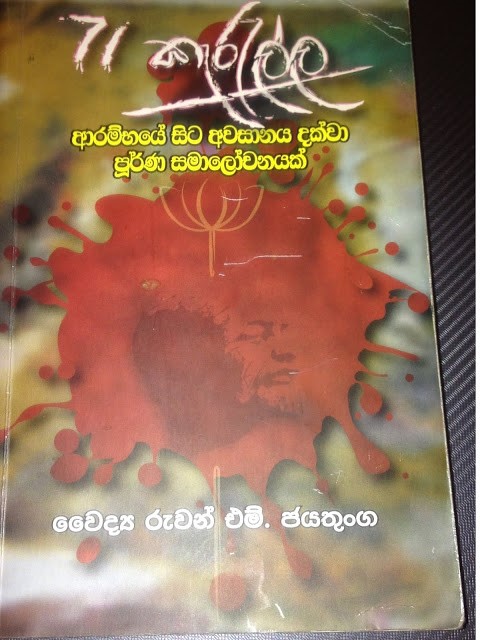
1971 කැරැල්ල කෘතිය පිළිබඳ කෙටි සටහනක්

December 5th, 2018

මහාචාර්ය සිරි හෙට්ටිගේ සමාජ විද්යාව පිළිබද සම්මානිත මහාචාර්ය කොළඹ විශ්ව විද්යාලය

1971 වසරේ, අප්‍රේල් මස ජනතා විමුක්ති පෙරමුණේ මෙහෙයවීම යටතේ ලංකාවේ දකුණු පළාත මුල් කරගෙන දියත් කෙරුණු, රාජ්‍ය විරෝධී ආයුධ සන්නද්ධ තරුණ කැරැල්ල ශ්‍රි ලංකාව 1948 නිදහස ලැබීමෙන් පසු රට තුළ ඇතිවූ ප්‍රථම දේශපාලන අර්බුදය සනිටුහන් කළේය. දින ගණනාවක් තිස්සේ සිදුවු ප්‍රචන්ඩ ක්‍රියා රටතුළ හදිසි තත්වයක්, දේශපාලන අස්ථාවරභාවයක් හා සමාජ ආර්ථික වශයෙන් වියවුල් බවක් ඇති කිරීමට සමත් විය. 

මෙම තරුණ නැගිටීම අහඔු සිදු වීමක් නොවුයේ ඊට පසුබිම දශක දෙකක පමණ කාලයක් තුළ නිර්මාණය වූ නිසාය. තරුණයින් මෙම ප්‍රචන්ඩකාරී කැරැල්ලට යොමු කිරීමට හේතු සාධක වූ කරුණු පිළිබඳව පැවති රජයේ අවදානයට යොමු වූ අතර යම් යම් ප්‍රතිපත්තීමය ප්‍රතිචාරයන් රාජ්‍ය පාර්ෂවයෙන් ඉදිරි වසර කිහිපය තුළ දැක ගත හැකි විය. කැරැල්ල ආයුධ සන්නද්ධ රාජ්‍ය විරෝධී තරුණ නැගිටීමක් වූ බැවින් වහා නිතිමය හා ආරක්ෂක පියවර ගත් අතර, සැලකිව යුතු තරුණ පිරිසකගේ ජීවිත හානි ඉතා කෙටි කාලයකින් සිදුවූ අතර, සම්බන්ද වූ පිරිස අත් අඩංගුවට ගැනීම හා නිතිමය පියවර ඒ අය සඳහා ගැනීමද වේගවත්ව සිදු විය. එහි ප්‍රතිඵලයක් ලෙස, සෘජුවම සම්බන්ද බොහෝ පිරිසක් සඳහා සිර දඩුවම් නියම කෙරිණ. බොහෝ අය පුනරුත්ථාපන ක්‍රියාවලියක් තුළින් නැවත සමාජගත කරණු ලැබීය. සිරගෙට නියම වූ පිරිස වසර හතකට පසු පොදු සමාවක් යටතේ නිදහස් කරනු ලැබීය.

ඉහත සඳහන් රාජ්‍ය විරෝධී තරුණ කැරැල්ල, මෙරට පසුව සිදුවූ ප්‍රචන්ඩ ක්‍රියාවල ආරම්භයක් සනිටුහන් කළේය. මන්ද, ඉදිරි දශක කිහිපයම රටතුල 1971 කැරැල්ලටත් වඩා බිහිසුණු දේශපාලන ප්‍රචණ්ඩත්වයක් නිර්මාණය වීමක් දැකිය හැකිව ඇති නිසාය. මේ සියල්ල 1980 දශකයේ මුල් කාලයේ ආරම්භ වූ උතුරු නැගෙනහිර මුල් කොටගත් ජනවාර්ගික යුද්ධය රටේ ආනාගතය කෙරෙහි දැඩිලෙසම බලපෑ සිවිල් ගැටුම වූ අතර, එහි බලපෑම අදටත් පැහැදිලිව දුෂ්‍යමාන වේ. මේ සියළු කැරලි හා යුධමය තත්වයන් කෙරෙහි බලපෑ පොදු සාධක හදුනා ගැනීම මෑත ඉතිහාසය දෙස සුපරික්ෂාකාරීව බලනවිට අපහසු නොවන අතර ඒවාට බලපෑ සුවිශේෂ තත්වයන්ද හදුනාගත ගැනීම අපහසු නොවේ. 

1971 කැරැල්ල සුවිශේෂිව සලකා බලනවිට, ඒ පිළිබඳව මේ වන විට සැලකිය යුතු ලිඛිත සාහිත්‍යයක් දැකිය හැකිය. රුවන් ජයතුංග විසින් රචිත මෙම ග්‍රන්ථය ඊට එක්කළ තවත් සැලකිය යුතු ප්‍රකාශනයක් වන අතර, 1971 කැරැල්ල පිළබඳව පාඨකයාට ඒ මගින් සැලකිය යුතු අවබෝධයක් ලබා දෙනවාට සැක නැත.

මෙම ග්‍රන්ථයේ සුවිශේෂත්වය වන්නේ, කැරැල්ලට සම්බන්ද සැලකිව යුතු නායකයින් රැසක්ද සමග කරන ලඳ සම්මුඛ සාකච්ඡා එකතුවක් ඊට ඇතුළු කර තිබීමය. මේ ප්‍රත්‍යෙකයන් ඉතා සවිස්තරාත්මක තොරතුරු පාඨකයාට ලබා දෙන අතර,ඒ මගින් 1971 කැරැල්ල පිළිබඳව යම් යම් ගැඔුරු තොරතුරු රැසක් ඒක රාශී කර ඇත. මෙම ප්‍රත්‍යෙකයන් පිළිබඳ පුළුල් විග්‍රහයක් ග්‍රන්ථයේ ඇතුළත් නොවූවත්, උනන්දුවක් දක්වන පාඨකයාට ඒ සඳහා අවස්ථාව කතුවරයා විසින් ලබා දී ඇත.

තරුණ කැරලි, ප්‍රචණ්ඩකාරී තරුණ නැගිටීම් ආදිය පිළිබඳව රටතුල පවතින සමාජ හා දේශපාලන කථිකාවන් විවිධය. ඒ විවිධත්වය සඳහා බලපාන සාධක අතර, දේශපාලන මතවාදයන් ප්‍රධාන වශයෙන් වැදගත් වූවත්, මෙම සංසිද්ධිය පිළිබඳව විවිධ පුද්ගලයින් හා කණ්ඩායම් දරණ මතය කෙරෙහි සමාජ කථීකාවන්ද ඉතා වැදගත් වේ. මෙම සමාජ කථිකාවන් පෝෂණය විය යුත්තේ, හුදු පුද්ගල නිශ්චිත අදහස් මත නොවිය යුතු අතර, ඒ සඳහා තරුණ කැරලි හා ප්‍රචණ්ඩත්වයට බලපාන සමාජ, ආර්ථික හා සංස්කෘතික සාධක පිළිබඳව කෙරෙන බෙහෙවින් අපක්ෂපාති හා වාස්ථවික විග්‍රහයන් ඉතා වැදගත් වේ. 

සවිස්තරාත්මක තොරතුරු ඇතුළත් රුවන් ජයතුංගගේ ප්‍රකාශනය මෙහිදී වැදගත් වේ. සටහන අවසන් කිරීම සදහාත්, පාඨකයාගේ කුතුහලය ඇවිස්සීම සදහාත්, යමක් කිය යුතුය. මෙම ග්‍රන්ථයේ විස්තර සපයන පුද්ගලයින් විශාල පිරිසක් දෙස බලන විට, පසු කාලීනව ඔවුන් සමාජයේ විවිධ ක්‍ෂෙත්‍ර වලට අවතිර්ණ වී කටයුතු කළ හා කරන බව මෙරට බොහෝ අය දන්නා සත්‍යයකි. මෙයින් ඇතැමුන්, සමාජයේ ඉතාම ප්‍රභූත්වයට පත් විය. මෙම තරුණ කැරලි පිළිබඳව උනන්දුවක් දක්වන සෑම කෙනෙක්ගේම අවදානය යොමු වි යුතු වැදගත් සංසිද්ධියකි. පසුව සිදුූ වූ තරුණ ගැටුම් පිළිබඳ අපගේ අත්දැකීම් 1971 කැරැල්ලට වඩා බෙහෙවින් වෙනස් වූයේ, ඒවායේ ස්වරූපය වෙනස්වීම පමණක් නිසා නොව, ඒවා කෙරෙහි බලධාරීන් දක්වූ ප්‍රතිචාරයේ ස්භාවය නිසා බවද සඳහන් කළ යුතුය.


Vavunativu killings: ‘Rehabilitated’ Tigers to be prosecuted under PTA Gen. Ratnayake urges govt. to take remedial measures

December 4th, 2018


The rehabilitated ex-LTTE cadres, arrested in connection with last Friday’s killing of two police constables at Vavunativu, Batticaloa, would be charged under the Prevention of Terrorism Act (PTA), a senior police officer said yesterday.

The Criminal Investigation Department (CID), investigating the incident, would have to use the PTA to prosecute the suspects though there was a government decision to repeal the law, the officer said.

The previous government agreed to annul the PTA following talks with the UN, the EU and the TNA.

A senior security officer told The Island that so far three hardcore LTTE cadres, including one from the North, had been arrested and further investigations were continuing.

According to him, all three had undergone rehabilitation conducted by the military.

Since the previous government brought the war to a successful conclusion in May 2009, a section of the international community had been demanding that the PTA be replaced with new law compatible with international norms.

Peacetime Army Chief and first Commissioner General of Rehabilitation General Daya Ratnayake yesterday told The Island that the alleged involvement of rehabilitated LTTE cadres in Vavnativu killings shouldn’t be made a political issue under any circumstances.

Ratnayake said those in authority at different levels should examine the circumstances leading to some rehabilitated cadres taking up weapons nearly a decade after the end of the conflict. Asserting that Vavnativu incident was likely to be an isolated one, Ratnayake said that a re-assessment of the rehabilitated lot should be undertaken immediately.

The former Army Chief noted nearly 12,000 rehabilitated LTTE cadres had been integrated into society over the years. Responding to a query, Ratnayake, the chief architect of the internationally accepted rehabilitation project said that Sri Lanka could be really proud of its effort.

Ratnayake warned of dire consequences unless tangible measures were taken to bring simmering political and constitutional turmoil to an early end. Pointing out that there were LTTE cadres who hadn’t been rehabilitated, Ratnayake said that continuing uncertainty could influence not only ex-Tigers but various other interested parties as well.

JVP General Secretary Tilvin Silva declined to comment on the Vavnativu killings when the issue was raised at a recent media briefing.

MP Dullas Alahapperuma, addressing the media, compared the recent attack with that of July 2001 commando-style LTTE raid on the Bandaranaike International Airport and the adjoining Katunayake air base. He said the government wouldn’t give in to terrorism or succumb to pressure under any circumstances.

The police said that in addition to those so far taken into custody there were likely to be more arrests.

The practical effect of imposing restrictions on dissolution of Parliament

December 4th, 2018

By C. A. Chandraprema Courtesy The Island

The rallying cry of the UNP, the JVP TNA and their allied political parties is that after the introduction of the 19th Amendment, Parliament cannot be dissolved under any circumstances until the lapse of four and a half years, and the only way it can be dissolved before that is for Parliament itself to pass a resolution by a two-thirds majority, making a request to that effect to the President. We have to bear in mind that the UNP-JVP-TNA argument is that Parliament cannot be dissolved under any circumstances – despite repeated defeats of the budget, despite repeated rejection of the statement of government policy and repeated passage of no-confidence motions against the government. In all such instances, only the government will stand dissolved and not Parliament. After each such event it is the President who will have to form new governments. Thus, even though drafters of the 19th Amendment claimed that their intention was to reduce the powers of the President, they have ended up making the President more powerful than he ever was under the original 1978 Constitution.

One has to keep in mind the fact that under the proportional representation system, it is only in 1989 and 2010 that any single political party or coalition has got a clear majority in Parliament. At all other Parliamentary elections in 2000, 2001, 2004 and 2015, the winning party did not receive a clear majority in Parliament. Even though the 2004 Parliamentary election was won by the party backed by the incumbent President, even then the UPFA failed to get a clear majority in Parliament. We saw much the same thing happening at the 2015 Parliamentary elections. Because of this factor, one has to provide for the possibility of a government losing a vote on the budget, a vote on the statement of government policy and losing a no confidence motion. It is now being argued that Parliament cannot be dissolved even if such events take place.

article_image

If an incumbent government loses a vote on the budget, a vote on the statement of government policy or a no-confidence motion, what that will mean is that the leader of the party that won the most number of seats in Parliament will no longer be eligible to hold the position of Prime Minister in that Parliament. What then is the President supposed to do? He can then call the leader of the political party that led the campaign to defeat the government in Parliament to form a new government. However, the political forces that came together to defeat the incumbent government may not necessarily unite to form a government. That is very real possibility in Sri Lanka even at present with the JVP saying that they will not support a government formed by the UNP and even the TNA making their support conditional – which means that there is the very real possibility that they may withdraw that support if they are not satisfied. When a government falls in such circumstances, since Parliament still cannot be dissolved, the President will have to cobble together a government with whoever is willing to join and continue till it is possible to dissolve Parliament and let the people decide.

President vested with enhanced powers

Throughout this process, the President will be the central figure around which everything revolves. Thus, contrary to the claims being made that the 19th Amendment reduced the powers of the executive presidency, what they have done in actual fact is to increase the power and importance of the Presidency by blocking the dissolution of Parliament. According to the elections schedule, parliamentary elections take place a few months after a presidential election and the likelihood is that it will be the President’s political party that gets the most number of seats in parliament as well. Thanks to this argument that Parliament cannot be dissolved, if the President loses public support and support within Parliament as well, it will still be he who is required to cobble together a government and continue in power!

We must remember what happened to Chandrika Kumaratunga in 2001. After a hung parliament was elected at the 2000 parliamentary election, within a few months, President Chandrika Kumaratunga lost the tenuous majority she had managed to muster in Parliament in 2001. Then she was forced to call a general election and her party lost and the UNP formed a Cabinet. But now as is being argued by the UNP-TNA-JVP combine, even if a situation like 2001 manifests itself, the President will still have a to cobble together a government from somewhere and continue. All of us who lived through the events of 2001 know that would have been an impossible demand to meet at that time.

Presidents tend to lose popular support very fast during their second term and there could be situations where as in 2001, nothing that a President does will induce parliamentarians to form a government with him or her for fear of the voter’s wrath. What happens then? This is why no one who has any commonsense will draft a constitution that makes it impossible to dissolve parliament. Dissolving Parliament and allowing the people to decide is the only way in which a political deadlock could be resolved. In 2001, CBK had no option but to dissolve parliament and to allow the people to decide and, that is what preserved democracy in this country. Under the provisions of the constitution before the 19th Amendment, parliament could resolve to dissolve itself with a simple majority. So if the incumbent President loses public support and the support of Parliament, the parliamentarians opposed to the President could pass a resolution requesting the President to dissolve parliament and call for fresh elections. Now after the 19th amendment, an unpopular President can carry on regardless because parliament cannot vote to dissolve itself without a two-thirds majority – an impossible target in practical terms. Thus Parliament has been weakened and the hand of the President strengthened infinitely.

There are other dangers too. Just picture the scenario that may take place after the next presidential election next year. A new president will be installed in power by December next year. A few months later, a parliamentary election will be held. Each of the newly appointed institutions will have four and a half years to five years in office. Both parties will enjoy security of tenure because the President will not be able to dissolve parliament without a two-thirds majority in parliament and Parliament will not be able to impeach the President without a two-thirds majority. In these circumstances, it is the President who will have the upper hand because he is the authority that appoints the Prime Minister and the Cabinet and in doing so he has unfettered discretionary power. He can appoint as Prime Minister anybody who ‘in his opinion’ is most likely to command the confidence of Parliament. Likewise, in appointing Ministers, Articles 43, 44 and 45 of the Constitution even after the 19th Amendment clearly Indicates that it is the President who has the final say in appointing and assigning subjects to Ministers, State Ministers and Deputy Ministers.

The subjective selection of the President is still paramount in making these appointments. At the present moment, due to Supreme Court rulings, the President also has the power to appoint as Ministers any of the 225 MPs in Parliament. When the President and Parliament both have 4 to 5 years of their tenure left, the President’s power will be at its peak. After the next Presidential elections in December 2019, and the Parliamentary elections that will follow in a few months, what the new President will get is in fact a harem of 225 MPs who he can use at will. So long as the President and parliament have four three, two, or even one full year of tenure left, he will be able to offer Ministries and other perks to attract MPs from any party to form a government. If the dissolution of Parliament before the lapse of four and a half years is not allowed, the political party system is going to be the main casualty. The political party will become merely a vehicle to get into Parliament. Once you are in parliament, you are a free agent deciding to sit in government or in opposition as your own needs and fancies guide you.

We have to bear in mind that serving as a Minister is not a case of leaving one’s political Party, it is a case of serving one’s country at the behest of the President who wields the sovereign people’s executive power! Or at least that is how it’s portrayed. We have already had a taste of this in the past. When Mahinda Rajapaksa became President in November 2005, he inherited a minority government in parliament. So he took some MPs from the UNP and cobbled together a government and went forward and the UNP was crying foul saying that he was destroying political party system in the country. What the 19th Amendment has done is to institutionalise that situation for all perpetuity. Due to the proportional representation system, the likelihood is that except in rare instances, the political party winning the election will not have a clear majority in Parliament or will have only a slim majority. It is at this stage that the entire Parliament becomes the President’s harem. In 1994, the PA which had 105 Members in Parliament formed a government. In 2001, the UNP which had 106 MPs and in 2004, the UPFA which had 105 MPs formed governments.

Today, however, in the event where no political party gets a clear majority in Parliament, the tendency will be for the President to take the initiative to start making ‘kottu rotti’ governments taking a little bit from here and a little bit from there. Since Parliament cannot be dissolved, the President may end up making ‘kotthu roti’ governments more than once. Providing there is at least a year of tenure left, there will be many MPs who will betray their voters and political parties to gain office which, if he remains subordinate to his party hierarchy, he may never gain in his lifetime. When it comes to the tail end of the tenure of Parliament and of the Presidency when it will no longer be possible to attract MPs with the lure of office, he will end up doing a solo lap with the Ministry Secretaries and no Cabinet.

Possibility of 113 man ministerial teams

Another issue that will arise if Parliament cannot be dissolved is that the MPs will have security of tenure and everyone will be extracting the maximum pound of flesh for their support of any government. When the stability of tenure of an MP increases, the stability of governments formed with the participation of such MPs decreases in direct proportion because MPs make all kinds of demands to extend their support to a government formed even by their own party. We have seen backbenchers ganging up to make demands under all governments. We have seen back bench MPs holding separate press conferences under all governments. It is not for nothing that the power of dissolution became an integral part of the Parliamentary tradition. The Parliamentary system cannot function without it. The possibility of dissolution and the prospect of having to face the people at an election is one of the key incentives to remain loyal to one’s political party and to continue to support it in Parliament.

This is why no country in the world that has a parliamentary form of government (except Norway, as the former President pointed out in his recent speech) has ever sought to prevent Parliament from being dissolved until the end of its tenure. Such a restriction does not empower Parliament – it empowers the person who is cast with the responsibility of forming governments and continuing till it is possible to hold an election. If the power of dissolution is removed for four and a half years, that will be an open invitation to the MPs elected to sell themselves to the highest bidder during that four and a half years. The bidder will of course always be the President. Even though the 19th Amendment purports to have reduced the powers of the president it has actually enhanced those powers by creating a situation where after a parliamentary election, the president can do anything he likes in Parliament disregarding all political party boundaries. Someone may say that blocks have been put in place to prevent the President from dissolving Parliament to prevent him from abusing that power. No president will dissolve Parliament without carefully considering matters, because if he dissolves Parliament and his party loses the ensuing Parliamentary election that will undermine his legitimacy and end his political career. The president himself is elected and the dissolution of Parliament will affect him and his political party as well.

So dissolution will in practice rarely be overused or abused. But when it comes to forming and dissolving cabinets, the president can do that as often as he likes with little or no consequences because the President as the head of the executive and Cabinet can continue to rule the country through the ministry secretaries despite frequent changes of ministers. We heard of such a one man show being run by President Premadasa. What the 19th Amendment has done in effect is to create the legal framework necessary to make the Premadasa style one man show the norm in Sri Lankan politics.

According to the provisions of the 19th Amendment, when a national government is formed, parliament can decide to appoint any number of ministers. A national government is defined as a government formed ‘between the largest political party in parliament and other parties’. It does not say how many political parties have to join a national government – it could be just the party that gets the most number of seats in Parliament plus one other party and together they can decide to appoint if necessary a total of 113 cabinet, state and deputy ministers. Thanks to the party system it was possible to have at least a few MPs who would function as backbenchers. But with it not being possible to dissolve Parliament despite repeated defeats of the budget, or repeated rejection of the statement of government policy and repeated passage of no confidence motions against the government, the tendency will be for the President to appoint all 113 MPs necessary to maintain a bare majority to some kind of office, to keep them happy and to minimize the possibility of defections.

All of the above in varying combinations will be the direct consequence of preventing the dissolution of Parliament until the lapse of four and a half years or the passage of a resolution requesting dissolution with a two-thirds majority.

Hidden dangers

December 4th, 2018

The Editorial Courtesy The Island


We are without a government! The Court of Appeal has restrained the newly appointed PM and ministers from functioning pending a final determination on the petitions before it. Paradoxically, the country has come to be dependent on the Executive President, who is mainly responsible for this unfortunate situation, to ward off anarchy. He is now running a one-man show to all intents and purposes.

The Sri Lanka Podujana Peramuna, yesterday, moved the Supreme Court against the Appeal Court interim order and now the matter is before the learned judges and it is best left to them.

What we are struggling to grapple with had the look of a political issue, initially. If President Maithripala Sirisena had not sacked Ranil Wickremesinghe as Prime Minister, nobody would have made an issue of the flaws in the 19th Amendment and the glaring constitutional ambiguities they have given rise to. But, today, what started off as a political battle has got eclipsed by a host of legal and constitutional issues.

President Sirisena reiterated, yesterday, at an SLFP convention in Colombo, that he would not reappoint Ranil Wickremesinghe Prime Minister, come what may. Thus, the political problem which has led to the present crisis is bound to persist in spite of legal remedies to be found.

The country is now within a hailing distance of anarchy. Some political observers insist that it is already there. However, on the bright side, the current crisis has led to a public discussion on the Constitution and the questionable aspects of the 19-A have come to light. The public has evinced a keen interest in constitutional affairs at a time efforts are being made to write a new Constitution.

The current Constitution contains some serious flaws, which can be attributed to certain sections which were either badly drafted or incorporated on the sly by way of amendments. It took several decades for even veteran politicians to realise that the constitutional provisions, governing the National List, had been altered surreptitiously, after being ratified by Parliament, to enable defeated candidates to be brought in as appointed MPs. Last year, a Bill was stuffed with sections sans judicial sanction in the most despicable manner at the committee stage before being passed with a two-thirds majority to postpone provincial council polls and, thereby, deny the people their franchise, enshrined in the Constitution.

‘Jilmaat’ is a term the late JVP leader Somawansa Amarasinghe gifted to Sri Lanka’s political lexicon; roughly rendered into English, it means ‘fraudulent act’. What was done to the Provincial Councils Elections (Amendment) Bill, last year, can be called a jilmaat in that it has made a mockery of the people’s franchise. Those who introduced and backed that Bill are fighting for democracy, today!

What one gathers from the ongoing debate on the 19-A is that some vital powers of the President have been transferred to Parliament and fundamental changes effected to the Constitution without being referred to the people at a referendum. Some legal experts are of the view that, today, the executive presidency is not a shadow of its former self owing to the 19-A, which has caused a severe erosion of the executive powers of the President. Chief Architect of the 19-A Dr. Jayampathy Wickremaratne himself has gone on record as saying that the President cannot even sack a deputy minister. If so, how come this radical changeover has come about without the consent of the people, in whom sovereignty is said to reside?

If a constitutional amendment, passed with a mere two-thirds majority, can take away the executive powers of the President, derived from provisions which cannot be changed without a referendum, then there is the possibility of the same modus operandi being adopted, in the future, to amend other such provisions, whose amendment or abolition require referenda besides special majorities in Parliament. Will such amendments, making inroads into even entrenched clauses, gain legitimacy and judicial sanction and help the architects thereof advance their hidden political agendas in violation of the people’s sovereignty?

19A – Confusing in present political crisis

December 4th, 2018

N. A. DE S. AMARATUNGA

If the Constitution is to be sacrosanct, in the first place, it has to be totally free of ambiguity and confusion. The 19th Amendment to the Sri Lankan Constitution appears to be a product of political expedience, rather than something that makes the government more democratic in the service of the people. It has been constructed in haste and mainly to serve a particular agenda. In trying to bring in amendments that need a referendum, through the back door as it were, in order to avoid a referendum, it has produced a document that could be interpreted in different ways, and it is being interpreted so by constitutional experts.

For instance, the reason why there are two articles dealing with the subject of the president’s powers to dissolve parliament is not clear. Some say when there are two articles the later one prevails over the earlier. These people, however, would not explain why there are two articles, why there has to be an earlier clause, so that lesser beings like us would understand the Constitution. Others say the article that carries the specific provisions would override the one that is more general. Again they don’t explain why there has to be an article that deals with the general situation, which seems to be superfluous and confusing.

The two articles that deal with the above matter are 33 (2) (c) and 70 (1). The latter gives the specific requirements that need to be met before the President could dissolve the parliament. It says the President could dissolve parliament only after 4 ½ years of its tenure. In the 1978 Constitution, the President had powers to dissolve the parliament after one year. Clearly the question arises whether this drastic curtailment of presidential powers needs a referendum. The Supreme Court which looked at the 19th A, had ruled that such changes may need a mandate from the people. It appears that in order to get over this problem the authors of the 19th A had introduced Article 33 (2) (c) which is a copy of Article 42 of the 1978 Constitution verbatim. Was the Parliament duped by the presence of this article into voting in favour of the 19th A almost unanimously? Now that the 19th A has gone into the Statute Book it is the law, but a very confusing one at that and everybody has extreme difficulty in interpreting it without causing injustice to the people of the country.

In all probability the intention of the designers of 19th A, who in all probability have designs on the country, was to cause such confusion so that they have the freedom to interpret it the way they want.

However, the incongruity between the ruling of the Supreme Court and the interpretation of the Constitution by its authors remains, and is of vital significance. The point at issue is the fact that the sovereignty of the people is reposed on the President as stated in the Constitution, and curtailment of some of his powers which may impact on the sovereignty of the people without asking them, would amount to a breach of sovereignty. Article 70 (1) is one such clause, and when interpreting it the constitutional experts must take special care not to cause further damage to the sovereignty of the people, which is already much eroded by the misdeeds of the “Yahapalanaya”.

A Textbook Case for the Supreme Court

December 4th, 2018

Dilrook Kannangara

Can the President dissolve parliament in 2018? This is the most crucial question affecting political circles today and keenly watched by all politicians. The Supreme Court has to decide. It is a straightforward textbook case. The simple answer is – no; the parliament cannot be dissolved before February 2020. However, if the President dissolves it, there is nothing anyone can do. It is a violation of the Constitution, but as long as he is not impeached, he is safe and he will get away with dissolving the parliament unconstitutionally.

This doesn’t mean the 19A is any good. Personal opinions about 19A and political clans are irrelevant to a legal decision. Unfortunately, most people airing their opinion have been unable to look at the issue professionally. They are politically biased.

The fact remains that in 2015 only one MP opposed 19A. That MP was rejected by the voters (right or wrong). Over 200 MPs supported it. This has given it legitimacy. 19A is very much part of the Constitution. Article 70(1) introduced by 19A prevents the President from dissolving this parliament for four and a half years since its convening in September 2015.

If the Supreme Court interprets the Constitution word to word, it is obvious the President cannot dissolve parliament before February 2020.

If the Supreme Court interprets the Constitution based on the intention of lawmakers, the President still cannot dissolve parliament earlier than that as it was a widely touted promise and a matter boasted by the then parliament and the president. The President boasted at the UN General Assembly how he took it upon himself to walk to each MP and plead for their support to reduce presidential powers and he succeeded in passing the 19A. The intention of lawmakers cannot be clearer. Just because the thinking of 2015 changed in 2018 doesn’t mean the Constitution interpretation changes. Thankfully, the Constitution doesn’t change so suddenly and sharply as Sirisena’s mind.

Even if the Supreme Court goes to first principles of democratic governance, the three branches of governance that exercise people’s sovereignty must be independent. The Executive, Legislature and the Judiciary must be independent of one another. The Executive must not be allowed to dissolve the Legislature just because he cannot work with the majority there.

Sadly, in the Lankan context, the Executive frequently interferes with the other branches of governance. This makes the Office of the President extremely important. Therefore, the right approach at this juncture is for Sirisena to seek a fresh mandate via a presidential election. The 2015 mandate has elapsed. He not only failed but also reversed and ridiculed his mandate. There is no Constitutional bar on holding a presidential election. In fact, all Presidents seeking reelection called for presidential elections one year before their term ended. Sirisena’s term is five years after 19A. His term ends in 2020 January. However, a presidential election must be held by November 2019. It is just appropriate that he too call for a presidential election a year earlier in 2018. JR didn’t wait till 1983; Chandrika didn’t wait till 2000; Mahinda didn’t wait till 2011 and 2016 to hold presidential elections. At that time the presidential tenure was six years. All of them held it a year earlier. Sirisena must do the same.

Parliamentary Democracy in Sri Lanka-can it works?

December 4th, 2018

Nawagamu Deshabandu

I have written about our constitution many years ago on this website calling it outrageous, indicating that it is having circular definitions and contradictory statements.  One part of the constitution violates the other parts of the constitution.  It is only good for politicians and lawyers who are hell bent on making money. It does more injustice than justice for the common man.

The way it is written is not straight forward because it is written according to the Western thought and its culture which is not suitable for our culture in our country.

In our culture, at least Sinhala culture, we believe we belong to the land not that we believe the land belong to us!  This is one of the subtle differences between the Western culture and our culture. Even in the Bible, it says man is made to mange the land and not to own it.

We actually cannot own any land forever,  because we do not live forever and we do not own creatures and vegetation that live on the land.

Therefore,  no one has any right to sell even an inch of the land.

One may say it is only for lease but lease is an agreement to sell for a time period. But no one has right to sell its living

creatures and resources even for one minute. This is universal justice but it is not in our constitution. We need a clear and straight forward definitive statements in our constitution. We need a constitution that guarantees freedom of individuals equally. Freedom should not be related to factors such as gender, race, religion or the area of a person who lives.

Any rule that is in the constitution should be valid in every inch of the country.

The law should not be an Ass. In our history there were situations where the pole -mallgaha- that was used to grind spicesbecame the murderer, and a murderer became an innocent due to the proper Sinhala words used by a victim just because the judge at that time could not understand the Sinhala language which is the language of the majority.

Officially in the constitution, Sinhala language version is supposed to be the one that applies when there is a difference in the meaning of a clause written in English or Tamil, but it is ridiculous that there are some judges who cannot read Sinhala language. Can any person in the Great Britain be a judge without knowing English?

How can a Sinhalease or Tamil expect justice from a judge who cannot read the official language?

It is now a fact that our parliament has full of corrupt politicians who can be auctioned and sold for money. Recently, the president Sirisena has publicly declared this fact. Given this fact, it is clear for anyone with an iota of brain that parliamentary democracy does not work in Sri Lanka.  If a prime minister is elected by a majority of votes that are bought from the members of the parliament, then there is no need for a president to appoint a prime minister. The prime minister in this case has bought the parliament! I am not writing this against Mr. Wickramasinghe. But I am writing this to indicate the possible future blunders of the parliament democracy  in Sri Lanka.

Because the prime minister is only accountable to the parliament that is bought by him, he is free to do any corrupt activity as long as he can muster a little more than one third of the members of the parliament for his corrupted deals such as selling parts of Sri lanka under his or her own terms without approval from the parliament.

The prime minister can stay in tact because a little more than one third of the parliament members are on his side and therefore no confidence motion cannot oust him.

The prime minister is practically and financially above the president!

Save the country from TNA’s treachery – Part IV

December 4th, 2018

BY : A.A.M.NIZAM – MATARA

The treacherous terrorist grandpa became jubilant when the Court of Appeal issued an interim restraining order on the government although the order was not a final one.  The Jeppo leader the other dollar vulture double tongued fellow has also expressed sentiments like Sambandan.  The terrorist grandpa has said that the President would meet the National Security Council and other relevant officials regarding the interim order. The foreign servile UNP taking advantage of this interim order has warned the government servants not to carry out any orders coming from either Rajapaksa or members of his  cabinet. A UNP scribe dedicated even to sit on his to protect and promote the reactionary UNP has said that President Sirisena will now accept Ranil as the PM. He said that the UNP Chairman Kabir Hashim has written to the TNA – which has agreed to  back Ranil  Wickremesinghe, stating that Wickremesinghe was its nominee for Prime Minister. A certified copy of the letter has been sent to the President.

Sumanthiran. The terrorist proxy alleged to be under the payroll of Tamil diaspore being paid through TGTE,   has blamed in a move like his warning to UNP Deputy Leader Lakshman Kiriella in the parliament,  the President for appointing Mt. Mahinda Rajapaksa without getting verified that Mr. Rajapaksa commands majority support in the Parliament.   He has reprimanded the President that he could have avoided the chaos in Parliament and  in the  government sector, if only if he had found out in advance,  if the majority of the people’s representatives in the National Legislature would  accept  Mahinda Rajapaksa as premier and  recognise his government and If the President had consulted them as the  the main Opposition party they would have made it clear that a change in the status quo would not be acceptable to  Parliament. Sumanthirran  as per this UNP servile scribe has said that the President had accepted his mistake in not obtaining  the views of all parties. Sumanthiran has stated that even though Sirisena had reiterated he would not recognise Ranil as the legitimate Prime Minister, as demanded by the UNP, he believed that Sirisena would backtrack, since he had no choice, considering the support Ranil had in Parliament and due to the legal implications of his actions.

A report published in the  island said that the Central Committee member of the Tamil Eelam Liberation Organization (TELO), a constituent of the TNA, M.K.Sivajilingamhascriticized TNA’s  announcement announced that it would support the UNP to form a government. He has alleged that Sampanthan’s decision to support the UNP has been taken  without consulting the central committees of the constituent parties, and has said that taking a side in the conflict between the UNP and the United People’s freedom Alliance (UPFA) would be detrimental to the interests of the Tamils


Another Island report on 4th December said that the Secretary of the  Sri Lanka Podujana Muslim Peramuna (SLPMP) Abdul Sathar told a news conference in Kandy on Sunday that the government to be formed jointly with the United National Party (UNP) and the Tamil National Alliance (TNA) would be a threat to the Muslim community in Sri Lanka.

HE SAIDE that The TNA was an appendage of the LTTE, which was hostile to the Muslim community, Recalling the grave harm the Tigers did to the Muslim community during the 30-year war and even afterwards Mr. Sattar told the media the that Tigers had attacked Muslims in the East, not sparing even pregnant mothers, who were murdered in cold blood. Those praying in the Kattankudi mosque were killed by the LTTE cadres and even the houses of Muslims in the East were set on fire. The Muslims suffered during reign of Ranil Wickremesinghe government such as in Gintota, Ampara, Digana, Katigastota and some other areas. Mr. Sattar stated that Ranil Wickremasinghe is only supportive of Tamils in this country and he desists Sinhalese and Muslims and he also reminded that when thousands of Muslims were being massacred in Iraq  by the Americans Ranil went to UN and justified the American killings in Iraq.  He said that the TNA supporting the UNP to form a government with Ranil Wickremesinghe at the helm was highly dangerous.

He said that the Muslims enjoyed freedom only under former President Mahinda Rajapaksa, who was strong enough to meet the threat of terrorism. Sattar stated that the Muslims should not get deceived by SLMC leader Rauff Hakeem and ACMC leader Rishad Bathiudeen as they had entered into agreement with the UNP to support it and they are getting paid handsomely from the UNP. He also said that these so-called leaders undertook Umra pilgrimages recently together with their coterie which were alleged to have been sponsored by the UNP with Bond Scam haram money.


Now let us look at the long article published in the Sinhala daily Mawbima today 9TH Dec) titled මඟ හිරවුණු රට බෙදන කොන්ත්‍රාත්තුව (The contract of dividing the country stalled pom the way) which extensively deals with betrayal being done in [m Sri Lanka in the run up to 2015 elections and after that.

On 19th May 2009 the war against terrorism ended with a victory/  On that day the people of the country held celebrations thinking honestly hat the country got5 freed from the separatists.   But just after several years the dark thoughts of the terrorism began to r-reappear once again. In thus insurance the separatists chose the battle front as the UN Human Rights Council and in this instance,  they came forward to the battle not solitarily but with the support of several countries. The huge financial resources that had been accumulated by the tiger terrorists also came to their assistance.

F

The leaders of this front lighters were strategically ahead of Prabhakaran.  The first thing they did was to help Ranil Wickremasinghe who was in a state despair after having lost 29 times in elections to defeat the 5th executive President Mr. Mahinda Rajapaksa. For this task they have got Ranil Wickremasinghe, Mangala Samaraweera clan to agree to this vicious plan.   A cancerous resolution passed in the UNHRC in 2012 had got strengthened buy 2015.  In the original resolution of 2012 it was said that it should be investigated whether there had been any crimes committed at that the last stages of the war.  As the proposal was not a serious on the surface the support of many countries was received for the resolution. In the 2nd proposal of 2013 there was reference in addition to war matters about political activities taking place in Sri Lanka.  in the proposal presented in the year 2014 there were matters that would seriously affect the sovereignty of Sri Lanka and it ordered the UN Human Rights Councillor]s Office to undertake an investigation on Sri Lanka.  This proposal had been approved despite strong opposition from many countries favourable to Sri Lanka.

For example, both India and Pakistan opposed the 2014 resolution saying that it was an inference in the internal affairs of an independent State.  But the western nations, under the pressurization of the Tamil diaspora succeeded in getting third proposal approved.  By this time western countries such as U..S.A, United Kingdom, Germany, France, Norway, Canada, were in the forefront of shouldering the task of toppling the Rajapaksa government.

The b2015 Presidential election was a contest between Rajapaksas and the above referenced external forces.   It seems that the new Indian Prime Minister who held a wrong impression relating to the close connection between the Sri Lankan government and China was also lured to this foreign force.  .Accordingly, it was these foreign forces which led, steered, and financed the tasks of finding a common candidate, and converging of divergent political and social forces.

In the year 2016 the first State of the United States stated that the United States spent U.S.DOLLAR 680- Million in the year 2015 to change the governments of Sri Lanka, Myanmar and Nigeria. Id one third of this amount of 680 U.S.Dollars was spent for Sri Lanka, the amount spent by America to change the Rajapaksa government exceeds 30,000 Million rupees.  This shows clearly how the opposition can propagate a mountain f lies, buy over many politicians and other individuals and carry out a massive hitherto unseen political campaign.

.The 4th UNHRC proposal against Sri Lanka was submitted after the presidential and general elections 2915.   The proposal which was to be submitted in March was postponed to September because it would have been detrimental to the UNP’s August election campaign.

The proposal No. 30/1 submitted in September 2015 clearly shows that it contains a list of diktats submitted by a colonial power to one of its colonies This list of items has presented a challenge to the sovereignty of Sri Lanka,  these proposals which should not have been accepted buy any respectable government wholeheartedly accepted by the Ranil Wickremasinghe government then in power.  The worst thing was the government not only accepted it but also became a co-sponsor for that proposal.  By co-sponsoring it the government also prevented expression of critical opinion by other countries.

What the government did until 2018cSeptember was implementing one by one the assurances it had given in that co=-sponsored proposal.  Among the 20 assurances given in that resolution the only thing that remain to be fulfilled is to introduce a new constitution.

Anyone who cannot understand that those who have drafted this so-called constitution are those who have links with the diaspora in many ways has no right to even speak about politics.  The objective of this envisaged constitution is to weaken the central government and empower the local government institutions.  It is not necessary to have a deep knowledge to understand the next of this game.   Prabhakaran should be wondering how a ca bal of fellows wearing tie-coat and Vettis achieved easily what he was unable to achieve by a 30 year long armed struggle

The person who was selected by the western powers to implement their programme was not Maithripala Sirisena but their minion Ranil Wickremasinghe who was ever ready to implement their diktats.  Therefore, it is important for them to keep their coolie Ranil Wickremasinghe in power until they achieve success from their contract.

(To be continued)

ඌව වෙල්ලස්ස සටනේ පාඩම්  මගින් මේ පෙරළිය කියැවිය හැකිද?

December 4th, 2018

මතුගමසෙනෙවිරුවන්

        ඉංග්‍රීසීන් විසින් පිහිටුවන ලද අධිකරණ පද්ධතිය නමැති ගහලයා භාවිතා කොට අගමැති මහින්ද රාජපක්ෂ මහතාගේ අගමැති ශීර්ෂය ඡේදනය කර ඇත. කිසිවෙකුත් බලාපොරොත්තු නොවූ පරිදි ගත් මෙම අධිකරණ තීරණය රටේ ඉරණම කෙරෙහි බරපතල අන්දමින් විශාල අභියෝගයක් එල්ල කොට තිබේ.එක් පැත්තකින් රට දේශපාලන වශයෙන් අස්ථාවරය. තවත් පැත්තකින් ආර්ථික වශයෙන් බිංදුවට වැටී තිබේ.අනෙක් පැත්තකින් රට බෙදීමේ බලවේග සියල්ල සිය සූක්ෂම ඥානයෙන් එක මිටට ගන්නට සුමන්තිරන් නම් ඒජන්තයා සමත් ව සිටී. අහෝ අපගේ ලංකා මාතාව අතිශයින් දුක් වන කාලයක් නැවතත් උදාවූයේ කෙලෙසකද.මේ ගැන තේරුම් ගන්නට තිබෙන හොඳම ඉතිහාස සාක්ෂිය 1818 ජාතික විමුක්ති අරගලයයි.අප රටේ දේශපාලන අධිකාරිය වසර දෙසීයක් තිස්සේ එම අරගලයේ සුවිශේෂී සිදුවීම් අධ්‍යනය නොකර අන්ධයන් සේ කටයුතු කිරීමේ විපාක අපගේ කරමත කඩා වැටී තිබෙනවා නොවේද.

       එක් දහස් අටසිය දාහත වර්ෂයේ  දී ඉංග්‍රීසීන්ට විරුද්ධව සිංහලයන් විසින් ආරම්බ කරන ලද ජාතික විමුක්ති   අරගලයට හේතු වූයේ 1815 වසරේදී අත්සන් කරන ලද සිංහලේ බ්‍රිතාන්‍ය ගිවිසුම ඉංග්‍රීසීන් විසින් ඒකපාක්ෂිකව කඩ කිරීමයි.වඩුග රජෙකු වූ ශ්‍රී වික්‍රම රාජසිංහයන් ගේ ක්‍රෑර පාලනයට එරෙහිව නැගී සිටි ඇහැලේපොළ නිලමේ ඉංග්‍රීසින් වෙතට පැන ගොස් කරන ලද සාකච්ඡාවක ප්‍රතිඵලයක් ලෙසට උඩරට ස්වාධීන කාලපය තමන් සන්තක කර ගැනීමට ඉංග්‍රීසීන් විවිධ කුමන්ත්‍රණ දියත් කළහ. සපරගමුව භාරව පැමිණි ඇහැලේපොළ මහ අදිකාරම ප්‍රබල රදළ පරපුරකින් පැවත එන එසේම සුවිශේෂී   ඥාති  බලයක් ‍ගොඩනගා ගෙන සිටියෙකි. රජ වාසලේ පළමුවන අධිකාරම වූ පිළිමතලව්වේ මෙන්ම දෙවන අධිකාරම වූ ඇහැලේපොළද රජුට යටි සිතින් ද්වේශ කලේය.ශ්‍රී වික්‍රම රාජසිංහ නොහොත් කන්නසාමි ගේ රාජ්‍ය පාලනය ලංකාවේ අතිශයින්ම තීරණාත්මක අවදියක් බවට පත් වන්නේ පිළිමතලව්වේ මහ අදිකාරම් විසින් මේ රජු සහ පාලනය තම සියතට ගැනීමේ කූඨ උපක්‍රමයක යෙදී සිටි බැවින්ය.තරුණ කන්නසාමි මේ බැව් මුලින් දැන නොසිටියද පසුව සිය ආධිපත්‍ය තහවුරු කරගැනීම පිණිස රදළවරුන් ගේ බලය අඩු කරලීමට පියවර ගත්තේය.වඩුග පාලනය පිළබඳව නොසතුටෙන් සිටි භික්ෂූන් වහන්සේලා මේ අවදියේදී කළ කුමන්ත්‍රණ ගැනද ඉතිහාසයේ සඳහන්ය. සංඝරාජ හිමියන් භික්ෂු සමාජය කෙරෙහි ඇති කරන ලද බලපෑම නිසා ඒ වන විට උපසම්පදා භික්ෂූන් රාශියක් ලංකාවේ තැන තැන ශක්තිමත් වෙමින් සිටියහ. රජු මේ බැව් දුටුවේය. සිය වඩුග  නෑ පිරිස් වලට රජ වාසලේ ඉහළතනතුරු ප්‍රධානය කළ ඔහු ඉන්දියාවේදී අහිමි වූ නායක්කර් පාලනය ලංකාවේ පිහිටුවීමට අවශ්‍ය පසුබිම සකසමින් සිටියේය.

                 ශ්‍රී වික්‍රම රාජසිංහ සිංහාසනප්‍රාප්ත වූයේ 1798 දීය. ඒ වන විට රජ වාසල අරක්ගෙන සිටි නායක්කර් වඩුගයන් ජාතික ආර්ථිකයේ කොඳු නාරටිය අත්පත් කර ගෙන උන්හ.ආනයන අපනයන වෙළෙඳාම සහමුලින්ම වඩුගයන් කීප දෙනෙකු අතර විය. රදළවරුන්ට අල්ලස් දීමෙන්ද වැදගත් ඨානාන්තර පිරිනැමීමෙන්ද තම අණසකට ගැනීම නිසා සිංහල නිලමේලා බලවත් වුවද කළ හැකි කිසි දෙයක් නොවීය. ආන්ද්‍ර බස රජ වාසලේ ප්‍රධාන බස බවට පත් විය. සිංහල නිළමේලා වුවද සිය මුද්‍රාව තැබූවේ ආන්ද්‍ර අක්ෂර වලිනි.පිළමතලව්වේ අධිකාරම විසින් කන්නසාමි සිංහාසනයේ තැබෙව්වේ මේ තර්ජනයන්ට මුහුණ දීම පිණිසය. තමන්ට ගැති රූකඩ රජෙකු මගින් සිය අභිප්‍රායන් ඉටු කර ගැනීම එහි බලාපොරොත්තුව විය. ඒ සඳහා ඉංග්‍රීසීන්ගේ අනුග්‍රහය ලබා ගැනීමට ඔහු ක්‍රියාකලේ 1800 දී පමණය. පිලිමතලව්වේ ගේ අනුග්‍රය ගැන සැලකිලිමත් වූ ඉංග්‍රීසීහු කලින් සකසන ලද ගිවිසුමක් ද අතැතිව කනකමය මංජුසාවක් සහ අශ්ව රථයක් ඇතුළු පඬුරු රැගෙන 1800 මාර්තු 2 දා කොළඹන් පිටත් විය. ගිවිසුම මෙසේය. රජු ගේ ආරක්ෂාව පිණිස කොළඹ ආණ්ඩුකාරයාගේ මෙහෙයවීමෙන් හත්සීයක පමණ ඉංග්‍රීසි හමුදාවක් උඩරට නැවැත්වීම. මේ පිරිසගේ වියදම සිංහලගේ රජු විසින් දැරිය යුතුවීම.අවශ්‍යතාව මත  ඉදිරියේ දී එම සෙබළු ප්‍රමාණය වැඩිකිරීම ආදි වශයෙන් විය. වගන්ති නවයකින් සමන්විත මේ ගිවිසුමට රජු එකඟ නොවීය. මේ ගිවිසුම රැගෙන උඩරටට පැමිණි සෙන්පතියා වූයේ මැක්ඩොවල්ය.  මේ ගිවිසුම අසාර්ථක වූවායින්  පසු 1803 දී නෝර්ත් අණුඩුකාරයාගේ ඇණවීමෙන් මැක්ඩොවල් උඩරට ආක්‍රමණය කලේය. සෙන්කඩගලට පැමිණි විට ශ්‍රී වික්‍රම හෝ කිසිවෙක් එහි නොවූයෙන් මුත්තුසාමි එහි රජ කොට ගිවිසුම පරිදි ආරක්ෂාව සැපයීමට ඉංග්‍රීසි ආණ්ඩුව එකඟවිය. ඒ සමගම කොළඹ සිට ත්‍රිකුණාමලය තෙක් මාවතක් ඉඳිකරනු වස් බිම් තීරුවක් දීමටද සත් කෝරළයේ පලනය ඉංග්‍රීසීන් වෙත පවරා දීමද කළ යුතු විය. නමුත් පිලිමතලව්වේගේ හමුදාව නුවරට පැමිණි ඉංග්‍රීසින් පළවා හැරියෙන් ගිවිසුම ඵල රහිත විය.

         මුත්තුසාමි සමග පසුබසිමින් සිටි මැක්ඩොවල් සෙනවි මේ අතරවාරයේ පිලිමතලව්වේ සමග ගිවිසුමක් ඇතිකර ගත්තේය. රජු නෙරපා හැර පිළමතලව්වේට රට භාරවන පරිදි මේ ගිවිසුම සකස් විය.  මීගස්තැන්නේ අදිකාරමත්  මුත්තුසාමිත් මැක්ඩොවල් සෙනවියාත්  මේ ගිවිසුමට අත්සන් කළ බව පැවසේ. මේ තුන් හවුල් ගිවිසුම අනුව කලින් මුත්තුසාමි සමග වූ එකඟතා අළුත්කර ගන්නටත් මුත්තුසාමි වෙනුවෙන්  උතුම් වූ කුමාරයා යන නමින් සිංහලේරටවල් පාලනය පිලිමතලව්වේට ලබාදීමටත් ඉංග්‍රීසීන් ගෙන් පතාග 30000 ක් ලබා යාපනයේ සිට රජ කිරීමටත් එකඟතාවය විය. මෙම ගිවිසුමෙන් පසු හමුදා භට පිරිසක් මහනුවර නවත්වා මැක්ඩොවල් කොළඹ බලා පිටත් විය. එහෙත් සැඟවී සිට ශ්‍රී වික්‍රම රජුගේ දසදහසකට වැඩිතර සෙනග ඉංග්‍රීසීන් වටලා ඔවුන් සමූලඝාතනය කොට මහනුවර යළි අල්වාගෙන පිළමතලව්වේ සහ මුත්තුසාමි ඇතුළු රාජ ද්‍රෝහීනට දඬුවම් ලබා දුන්නේය.

                 ඇහැලේපොළ  මහ අධිකාරම සපරගමුවට යැවෙන්නේ ඔහුට විරුද්ධව රජුට ගතු කියූ පිලමතලව්වේ ගේ මෙහෙයවීමෙනි.මේ අතරවාරයේ අධිකාරම් නිලයට තෙවැන්නෙකුද පත් විය. ඒ මොල්ලිගොඩයි.රජුගේ අරමුණ වූයේ රදළයන් ගේ බලය ක්‍රමයෙන් අඩු කරලීම බව පෙනේ.කෙසේ වුවත් සපරගමුවට වන් මහ නිලමේ එහි වැව් අමුණු සදවා වෙල් අස්වද්දවා රජයට ලැබෙන ආදායම තර කලෙන් රාජ ප්‍රසාදයද ජනතා ප්‍රසාදයද දිනා ගත්තේය. මෙයට ඉරිසියා කළ මහනුවර නිලමේලා ඇහැලේපොළට විරුද්ධවරජුට ගතු කීහ. රජු විසින් පිළමතලව්වේ මැරවූයේ 1811 වර්ෂයේ මාර්තු 26 වනදාය. ඉන්පසු මහ අදිකාරම් ධුරයට පත්වූයේ ඇහැලේපොළය. නමුත් පෙර කී කුමන්ත්‍රණ මධ්‍යයේ  සපරගමුව කරමින් සිටි ඇහැලේපොළ බිඳ වීමට මොල්ලිගොඩ විසින් එවන ලද ලිපියක් හේතු වී යැයි පැවසේ. රජු ඇහැලේපොළ කැඳවූයේ වෙනත් කරුණකටය. එහෙත්  වෙනත් ලිපියක් මගින් ඔහුට දැනුම් දී තිබුණේ රජු උදහස් වී ඇති බවත් නුවර නොපැමිණිය යුතු බවත්ය. එම නිසා රජු කෝප විය. ඇහැලේපොළ ඉංග්‍රීසීන් වෙතට පැණ යන්නේ යැයි රජුට කේලාම් බස් පැවසිණ. මේ වන විටද ජෝන් ඩොයිලි නම් ඔත්තුකරුවා සමග ඇහැලේපොළ සම්බන්ධකම් පවත්වමින් සිටියේය.  කල හැකි දෙයක් නොවූ කළ කළුගඟදිගේ අඟුලක් මගින් පහළට ආ ඇහැලේපොළ පාණදුරයට පැමිණ ඉංග්‍රීසි හමුදාවේ සහායෙන් කොළඹ කොටුවට සැපත් වී ඉංග්‍රීසි ආණ්ඩුකාරවරයා සම්මුඛ විය. කන්නසාමි පැන්නවීමට ඉංග්‍රීසින් සමග ඇති කර ගත් ගිවිසුම ක්‍රියාත්මක වීමට පටන් ගත්තේ එතැන් සිටයි.

        වඩුග රජෙකු වූ ශ්‍රී වික්‍රම සිංහල සම්ප්‍රදාය ඉක්මවා දශරාජ ධර්මය කඩකොට රට පාලනය කළ තැනැත්තෙකි. සියවස් ගණනාවක් තිස්සේ රාජඅභිෂේකයේදී ලක් රජවරු නාථ දෙවියන් ඉදිරියේ දිවුරුම් දුන්හ. ඒ දැහැමි පාලකයෙක් වන බවට සපථ කරමින්ය. නමුත් උද්දච්ච පුද්ගලයෙකු වූ ශ්‍රී වික්‍රම රාජ සිංහ නාථ දේවල භූමියෙන් නාථ දේවාලය ඉවත් කිරීමට පවා සැලසුම් කලේය. ඒ යුගයේදී නාථ දෙවියන් වෙනුවට පිටියේ දෙවියන් බලවත්ව සිටියේ යයි සැලකෙන්නේඒ නිසාය. කෙසේ වෙතත් එක දිගට රදළවරු සමග ඇති වූ විරසකයන් නිසා 1815 වර්ෂයට ආසන්න කාල වකවානුවේදී ඝාතන රැසක් සිදු විය. අවසාන වශයෙන් ඇහැලේ පෙළ නිළමේ ගේ භාර්යාව කුමාරිහාමි සහ දරුවන් විනාශ කිරීමට අණදී ඒය මහත් අභිරුචියෙන් බලා සිටි ආකාරය ඉතිහාසයේ සඳහන්ය. මෙයට හේතුව නම් ජෝන් ඩොයිලි නම් ඔත්තුකරුවා උඩරට රාජධානිය සියතට ගැනීම පිණිස කළ මෙහෙයුමයි. මෙහිදී රදළවරුන්ට හා රජුට උසස් වර්ගයේ මධ්‍යසාර ගෙන්වා පිළිගන්වා සිහිවිකල් තත්ත්වයට පත් කළ ආකාරය සඳහන්ය.මහාචාර්ය තෙන්නකෝන් වමලානන්ද මහතා ජෝන් ඩොයිලි ගැන සඳහන් කරන්නේ මෙසේය.

       ඩොයිලි අවික්ෂප්තව සන්සුන්ව හා ජයග්‍රහණය පිළිබඳව අධිෂ්ඨානයෙන් යුතුව තම උපාය මාර්ග ක්‍රියාත්මක කිරීම සඳහා දේශපාලන වේදිකාවක් නිර්මාණය කළේය. මේ දේශපාලන වේදිකාවේ ප්‍රධාන නළුවෝ නම් ශ්‍රී වික්‍රම රාජසිංහ රොබට් බ්‍රවුන්රිග් ඇහැලේපොල මහ නිළමේ මොල්ලිගොඩ මහ නිළමේ ජේම්ස් සදර්ලන්ඩ් එඩ්වඩ් ගිෆර්ඩ් කොබ්බෑකඩුව මල්වත්තේ මහානායක හිමියන් අස්ගිරි විහාරයේ යටවත්තේ මහානායක හිමියන් දුනුවිල දිසාවේ කපුලියද්දේ දෙවෙනි අදිකාරම් තම්බි මුදියන්සේ මැලේ මුහන්දිරම් ඉලංගකෝන් මුදලි සේරම් මුදලි හා තල්ගම උන්නාන්සේ වූහ. මේ හැම දෙන ඩොයිලි ගැසූ තාලයට නැටූහ. මේ සියලු දෙනාගේ නිසැක භක්තිය හා විශ්වාසය දිනාගත් අතරම ඔවුන්ගේ ප්‍රකාශනයන්හි සත්‍යාසත්‍ය භාවය වගවිභාගකරන ක්‍රමයද ඩොයිලි සතු විය.

         ඩොයිල් අවසාන වශයෙන් තම අභිමතාර්ථ සාධනයෙහි යොදා ගත් ඇහැලේපොළ මහ නිලමේ දක්ෂ ප්‍රාදේශීය පාලකයෙක් වශයෙන් අවංකව රජුට සේවය කළ තැනැත්තෙකි. එහෙත් අවසාන කාලයේදී රදළවරුන්ගේ උසිගැන්වීම් මත රජු ඔහු හා විරසක වුණි. ඉන්පසු ඔහුට ඕනෑ වූයේ රජු පාවා දී ඉංග්‍රීසින් ගේ සහායෙන් සිහසුන් ගැනීමයි. මෙහි මුල් අදියර සාර්ථක ලෙස ක්‍රියාත්මක වුවද ඉංග්‍රීසින් සිය අභිලාෂය මත සිංහල ජාතික බලවේගය යටපත් කර ගත්තේය. සිංහල බෞද්ධයන්ට ඉතිරිවූයේ උඩරට ගිවිසුමේ පස්වන වග වගන්තිය පමණකි. නූතන ඩොයිලිලා එක්නැලිගොඩලා එක්ව මේ පසවන් වගන්තියෙන් කියැවෙන රටේ  ශාසනික උරුමය ඉවත් කර රට අනාගමික කරන්නටද කෑලී කෑලි වලට කඩා දක්වන්නටද කැසකවති. සිරිසේන ජනාධිපතිවරයා තාවකාලිකව හෝ පරාජයට පත් කරන ලද්දේ මේ පියවරයි. එහෙත් එම පියවර ආපස්සට හැරවීමට විදෙස් බලවේග සියල්ල ඒකාරාශී වී ඇත.රනිල් බලවත්ය.1817-18 සටනේ රජු වූ දොරේසාමි මෙන් ජනාධිපතිවරයා දුර්වල කර තිබේ. දැන් වන විට නූතන කැප්පෙටිපොළ දේශපාලනික වශයෙන් ඝාතනය කර තිබේ. එහෙත් ජනතාවගේ ආදාරයට පත් මහින්ද රාජපක්ෂ ඝාතනයට ලක්ව නොමැත. ඔහු නැවතත් ජයග්‍රහණය කරා යන්නේ මහා මැතිවරණයකින්ම පමණි. නූතන නිදහස් අරගලයේ නව ආරම්භය මේ මගින් සනිටුහන් කරවීමට සිතින් කයින් මෙන්ම අධ්‍යත්මික වශයෙන්ද කැප වීම අප සැමගේ යුතුකමයි.

මතුගමසෙනෙවිරුවන්


UFPA decides to skip Parliament session tomorrow

December 4th, 2018

Courtesy Adaderana

The United People’s Freedom Alliance (UPFA) has decided not to attend the parliamentary session scheduled for tomorrow (5), MP Dinesh Gunawardena said.

Speaking at a press conference in Colombo today, he claimed that the Speaker has decided to convene the Parliament in this manner by preparing an agenda as per his will.

UPFA Parliamentarians had boycotted parliament proceeding on four separate days while accusing the Speaker of bias.

On November 30, the Speaker had adjourned the parliament until 10.30 a.m. on Wednesday (5).

During the press briefing, MP Dinesh Gunawardena also spoke about the interim order issued by the Appeals Court yesterday (3).

He said that the interim order has not barred the premiership and the Cabinet of Ministers and that the order has only restrained Mahinda Rajapaksa and the Cabinet from executing their duties.

He said that the correct decision will be given by the court on December 12.

රනිල් ව්‍යවස්ථා උගුලකින් බලයට ඒමේ සැලසුමක් – ජේ. ආර්. මුනුපුරා හෙළි කරයි

December 4th, 2018

Lanka Lead News

ප්‍රදීප් ජයවර්ධන යනු මේ රටේ පළමු විධායක ජනාධිපති ජේ. ආර්. ජයවර්ධන මහතාගේ ලොකු මුනුපුරායි. ඔහු ජර්මනියේ හිටපු කොන්සල්වරයාද වේ. වර්තමානයේ මෙරට තුළ මතුව තිබෙන දේශපාලන තත්ත්වයයට මූලික හේතුව ජේ. ආර්. ජයවර්ධන මහතාගේ ව්‍යවස්ථාව බව සමහරු කියති. මේ පිළිබඳව ප්‍රදීප් ජයවර්ධන මහතා පළ කරනුයේ මෙබඳු අදහසකි.

අද නිර්මාණය වී තිබෙන්නේ ව්‍යවස්ථාමය අර්බුදයක්. මේක ජේ.ආර්.ගේ බහුබූත ව්‍යවස්ථාව කියලනේ ඔවුන් කියන්නේ. ඇත්තටම මේක බහුබූත ව්‍යවස්ථාවක් තමයි. එක බූත කණ්ඩායමක් ඇවිල්ලා මනාප ඡන්ද ක්‍රමයක් ගෙනාවා. ඇත්තටම මුලදී ව්‍යවස්ථාවේ මනාප ඡන්ද ක්‍රමයක් තිබුණේ නැහැ. මුලදි තිබුණේ කොට්ඨාස ඡන්ද ක්‍රමයක්. ඒ ක්‍රමයේදී පක්ෂෙ තමයි තීරණය කළේ ඡන්ද නාම ලේඛනයේ අපේක්ෂකයා ඉන්න ඕනැ තැන. එහිදී අපේක්ෂකයාගේ දේශපාලන පරිණතකම, විනය වගේම කොට්ඨාසයේ ඡන්ද පදනම සලකලා බැලුවා. යම් කිසි බලපෑමක් නිසා පෞද්ගලික වුවමනාවක් නිසා මුළු දිස්ත්‍රික්කයේම තරග කරන්න සිද්ධ වෙන විදිහට මේක වෙනස් කළා. ඊට පස්සේ මේ ක්‍රමයෙන් ඡන්ද කරන කොට ඒකට විශාල මුදලක් සහ ශ්‍රමයක් යොදවන්න ඕනැ වුණා.

මේක වෙනස් කළේ ලලිත් ඇතුළත්මුදලි මහතා. ඒ කාලේ එතුමාට මේක වාසිදායකයි. මොකද: එතුමා රටම දන්න ජාතික නායකයෙක්. ඒ වගේ කෙනකුට දිස්ත්‍රික්කයක තරග කරලා දිනන්න ලේසියි. ඒ් කොට්ඨාසයක ඉන්න පොඩි මන්ත්‍රී කෙනකුට සිද්ධ වෙනවා, විශාල මුදලක් වියදම් කරලා ලලිත් ඇතුළත්මුදලි වගේ නමක් හදාගන්න. මොකද එයාට මුළු දිස්ත්‍රික්කයේම ඡන්ද ගන්න ඕනැ වෙන නිසා. එතකොට තමයි ලිස්ට්” එකේ ඉහළට පහළට යන්න පුළුවන්. පළමුවැනි විකෘති කිරීම ඒක තමයි කියලා මම හිතනවා.

ඒ විකෘති කිරීම සිද්ධ වුණේ ජේ. ආර්. ජයවර්ධන ජනාධිපතිතුමාගේ අවසාන කාලෙ. 1989 ඡන්දෙට කලින් මේක සිද්ධ වුණේ. ඒක පළමුවැනි විකෘති කිරීම.

දෙවැනි එක සිද්ධ වුණේ ප්‍රේමදාස ජනාධිපතිතුමාගේ කාලයේ. පක්ෂයට මන්ත්‍රීවරයෙක් ගන්න නම් සියයට දොළහයි දශම පහක ඡන්ද ප්‍රතිශතයක් ඒ කාලේ ගත යුතුව තිබුණා . ඒක සියයට පහකට අඩු කෙරුවා. අද පාර්ලිමේන්තුවට තරග කරන කුඩා පක්ෂ 68ක් තියෙනවා. ඒකෙන් වෙන්නේ ප්‍රධාන පක්ෂ දෙකට බලය අඩු වෙලා, පොඩි පක්ෂ විශාල ප්‍රමාණයක් ඇතුළත් වන එකයි. මේ පොඩි පක්ෂ අද කරන දේ පැහැදිලියි නේ. ඒ අය එහාට මෙහාට පැනලා බලය හුවමාරු කරනවා. ඒක තමයි දෙවැනි විකෘති කිරීම.

තුන්වැනි විකෘතිය සිද්ධ වුණේ චන්ද්‍රිකා බණ්ඩාරනායක ඉන්න කාලේ. පිල් මාරුකරලාත් පක්ෂයේ ඉන්න පුළුවන්කම හදාගත්තා. ඒක ශ්‍රේෂ්ඨාධිකරණයට ගිහිල්ලා කරගත් දෙයක්. ඒකෙන් සිද්ධ වුණේ මුදල් හෝ වෙනයම් අවශ්‍යතා මත මන්ත්‍රීවරුන්ට එහාට මෙහාට පනින්න පුළුවන් වීමයි. එයින් පාර්ලිමේන්තුවේ ස්ථාවර භාවය සහ පක්ෂවල ශක්තිය නැති වුණා. ඊළඟ එක සිද්ධ වුණේ 19 වැනි සංශෝධනයෙන්. ඒකෙන් සිද්ධ වුණේ ජනාධිපතිතුමාගේ ස්වාධීනභාවය අඩු කරලා ජනාධිපතිතුමා පාර්ලිමේන්තුවේ හා අගමැතිතුමාගේ බලයට යම් කිසි විදහකට යටත් කිරීමයි. එයින් සිද්ධ වුණේ තවත් මේ ක්‍රමය විකෘති වීමයි. 1966 දී කියනවා පාර්ලිමේන්තුවේ ඕනෑ එපාකම්වලට හසු නොවන ශක්තිමත් විධායකයක් කෙටි කාලෙකට අවශ්‍ය වෙනවා, මේ රට දියුණු කරන්න කියලා.

එතුමා කිව්වා අපි රටේ නිදහස ලබා ගත්තා. ඒත් ආර්ථික නිදහස ලබාගත්තේ නැහැ කියලා. පාර්ලිමේන්තුවේ තිබෙන බල හුවමාරුව නිසා රට දියුණු කරන්න අමාරු නිසා එයින් යම් කිසි ප්‍රමාණයකට ස්වාධීන වෙන විධායකයක් අවශ්‍යයි කියලා එතුමා කියනවා.

ඒ මුල් අදහස අපි සම්පූර්ණයෙන්ම විනාශ කරලා තියෙනවා.

1978 දී ශ්‍රී ලංකා විශ්වවිද්‍යාලයේ උපාධි ප්‍රදානෝත්ස්වයේදී විධායක ජනාධිපතිවරයෙක් නොකළ යුතු දේවල් 10ක් ගැන ජේ. ආර්.ජනාධිපතිතුමා කියනවා. ඔක්කොම මට මතක නැහැ. කාරණා කීපයක් මතකයි. එතුමා කිව්වා ජනාධිපතිතුමාගේ මිනිස්සු හෝ ගැහැනු කියලා වෙනම කණ්ඩායමක් හදන්නේ නෑ කියලා. ඒ වගේම එතුමා කිව්වා හැමවිටම පාලනය ගෙනි යන්නේ කැබිනට් මණ්ඩලයේ තීරණ සහ උපදෙස් අනුව කියලා.

එතුමා මේවා කිව්වේ මහාචාර්ය ඒ. ජේ.විල්සන් ගෙනාපු යෝජනාවක් නිසා. ඔහු කිව්වා ඇමෙරිකාවේ වගේ වෙනම ජනාධිපති කාර්යාලයක් හදාගන්න කියලා. එතුමා ඒක ප්‍රතික්ෂේප කළා.

එහෙත් එතුමගෙන් පස්සේ මේක වෙනස් වුණා. බලයට පත් වුණු අය ඔවුන්ගේ කණ්ඩායමක් වෙනම හදාගත්තා. ඒකෙන් වුණේ ඒ කණ්ඩායම නිසා කැබිනට් එකේ ප්‍රශ්න ඇති වුණ එකයි. වත්මන් ජනාධිපති මෛත්‍රීපාල සිරිසේන මහතාට 2014 දී වෙනම යන්න වුණෙත් මේ කණ්ඩායම් නිසා කියලයි මම හිතන්නේ.

එහෙත් ජනාධිපතිවරයකුට යම් යම් කාරණා පිළිබඳ උපදෙස් ගැනීමට විශේෂඥ ඥානය තියෙන උපදේශකවරු ඕනැ වෙලාවක ගන්න පුළුවන් කියලයි. ජනාධිපති උපදේශක කියලා තනතුරක් දීලා කාර්යාලයක් දීලා වෙන් කිරීමක් කළොත් වෙන්නේ ඒ වටා යම්කිසි බල කේන්ද්‍ර හැදෙන එකයි. ඒ බල කේන්ද්‍රයි ඡන්දෙන් පත් වෙලා බලයට ආපු අය අතරෙයි යම්කිසි ගැටුමක් ඇති වෙනවා. ඒක අපි හොඳින්ම දැක්කා. ඇමෙරිකාවේත් මේ ප්‍රශ්නෙ තියෙනවා. අද ඔවුන්ට තියෙන එක ප්‍රධාන ප්‍රශ්නයක් මේක.

ජේ.ආර්. ජනාධිපතිතුමා මේ ව්‍යවස්ථාව හදලා තියෙන්නේ ලෝකයේ අනෙක් රටවල තියෙන ව්‍යවස්ථා හොඳට අධ්‍යයනය කරලා. නිකං එතුමාගේ ඕනෑ-එපාකම්වලට හදපු එකක් නෙවෙයි. එහෙත් හැත්තෑ අටට පස්සේ ලොකු මතයක් ගොඩනඟාගෙන ගියා මේක හදලා තියෙන්නේ එතුමගේ උවමනාවට කියලා. අවාසනාවකට මේ ව්‍යවස්ථාව යටතේ බලයට පත් වුණු උදවියත් මේ මතයේ ඉඳගෙන තමයි බලයට පත් වුණේ. ඔවුන් ඇත්තටම ස්වාධීනව මේක දිහා බැලුවේ නැහැ. මේක වැරැදියි, වැරැදියි, වැරැදියි කියලා බලයට පත් වුණා. බලයට පත් වුණාට පස්සේ තමයි දැන ගත්තේ මේකෙන් වැඩ කරන්නේ කොහොමද කියලා. සමහර වෙලාවට මේක පාවිච්චි කරන්නේ කොහොමද කියලා දැනගත්තම කාලෙත් ගිහිල්ලා ඉවරයි. ඒත්් මේ ව්‍යවස්ථාව නිසා ඇත්තටම රට ආරක්ෂා වුණා කියලා බය නැතුව කියන්න පුළුවන්.

අපට ලෝකේ දරුණුම ත්‍රස්තවාදී කණ්ඩායමක් එක්ක සටන් කරලා රට බේරාගන්න පුළුවන් වුණේ මේ ව්‍යවස්ථාව නිසා.

ඇත්තටම අපිට ජනාධිපති ක්‍රමයක් නැතුව පාර්ලිමේන්තු ක්‍රමයක් තිබුණ නම් එල්ටීටීඊය වගේ විශාල ත්‍රස්තවාදී කණ්ඩායමකින් රටට මොකක්ද වෙන්නේ කියලා අපට හිතාගන්න බැහැ.

ඔබ දන්නවා ජනාධිපති ප්‍රේමදාස ඝාතනය කළත් එක මොහොතකටවත් රට හෙල්ලුණේ නැහැ. බල අර්බුද ඇති වුණේ නැහැ. ඒ කාලේ ලලිත් ඇතුළත්මුදලි, ගාමිණී දිසානායක වගේ අය ලොකු බලයක් තිබුණු නායකයෝ. ඒත්් කිසිම බල අර්බුදයක් ඇති වුණේ නැහැ. ඒක තමයි ව්‍යවස්ථාවේ ශක්තිය.

මේ ව්‍යවස්ථාව කැබැලි කැබැලි කරලා දාන්න දැඩි උත්සායක යෙදෙන්නේ රනිල් වික්‍රමසිංහ මහත්තයා. මං හිතන්නේ ඔහුට මේ ව්‍යවස්ථාව ප්‍රශ්නයක්. මේ ව්‍යවස්ථාවෙන් බලය අත් කරගන්න සියයට පනහකට වැඩිය ඡන්දයක් ගන්න අවශ්‍යයි. ඔහුට සියයට පනහක ඡන්දයක් ගන්න බැහැ. ඔහුට බහුතර ජනතාවගේ විශ්වාසය නැති වෙලා තියෙනවා. ඒ නැති වුණු විශ්වාසය නැවත ගන්න අමාරුයි. මොකද, බහුතර ජනතාවක් ඔහුව විශ්වාස කරන්නේ නැහැ. ඒ නිසා ඔහු බලයට එන්න හදන්නේ සුළු පක්ෂවල සහායෙන්. ඒ නිසයි ඔහු මේ ක්‍රමය වෙනස් කරන්න හදන්නේ.

For first time in history, Sri Lanka has no Prime Minister or Council of Ministers

December 4th, 2018

 Courtesy NewsIn.Asia

Colombo, December 4 (newsin.asia): For the first time in the history of Sri Lanka, the country has no Prime Minister or a Council of Ministers. Given the deep seated conflict between President Maithripala Sirisena and ousted Prime Minister Ranil Wickremesinghe, the stalemate over who should be Prime Minister is not likely to end anytime soon.

After the Court of Appeal on Monday stayed the functioning of Mahinda Rajapaksa as Prime Minister and his colleagues as ministers, Rajapaksa and his ministers had stopped attending  office.

All government work is now being done by President Maithripala Sirisena with the help of the Secretaries of the various ministries.

V.Anandasangaree, a very senior Tamil politician who was MP for Kilinochchi in the 1960s and is currently leader of the Tamil United Liberation Front (TULF) said: Never has anything like this happened before.”

For first time in history, Sri Lanka has no Prime Minister or Council of Ministers

Government Boycotts Parliament

In another first in post-independence Sri Lankan political history, parties in the government have been continuously boycotting parliamentary settings, saying that the Speaker has unconstitutionally declined to recognize the Rajapaksa regime as a legitimate government duly appointed by President Sirisena.

If the Speaker (Karu Jayasuriya) does not recognize us, we do not recognize the Speaker either,” said Udaya Gamannpilla a government MP.

On November 29, the opposition presented to parliament a motion to deprive the Office of the Prime Minister of public funds. It passed this by a majority of 123 votes, but in the absence of government MPs and ministers.

Education Minister Dr Wijeyadasa Rajapakse did attend the sitting, but after making a special address, quit the House before voting.

On November 30, a motion submitted by the opposition United National Front (UNF) to curtail funds to cabinet ministers, deputy ministers and state ministers, was passed in parliament with 122 MPs voting for it. But this too was done in the absence of ministers and government MPs,  who had declared a boycott of parliament earlier.

On December 5, at the request of President Sirisena, the opposition is to move its third Motion of  No Confidence against the government of Rajapaksa in which the electronic voting machine will be used. But the ruling United Peoples’ Freedom Alliance (UPFA) has said that it will boycott parliament on this occasion too.

Cases in Supreme Court

On Tuesday, Rajapaksa’s lawyers filed an appeal in the Supreme Court against an interim order issued by the Court of Appeal restraining Rajapaksa and his cabinet from functioning as Prime Minister or Ministers.

The court had stayed their functioning  till the case is adjudicated. Notices sent in this connection were made returnable on December 12.

The 122 MPs who had signed the Writ of Quo Warranto petition against Rajapaksa’s holding office as Prime Minister, had been named as respondents in the appeal.

The appeal states that the interim order issued by the Court of Appeal was unconstitutional as the Court of Appeal had no authority to issue such orders. According to the constitution only the Supreme Court could take up constitutional matters such as this, Rajapaksa’s lawyers contended.

The lawyers requested the Supreme Court to issue an order declaring the interim order of the Court of Appeal as unlawful and sought an interim order preventing the implementation of the Appeal Court’s order until the hearing on the appeal was concluded.

Case on Dissolution

The Supreme Court is already hearing a case filed by opposition MPs questioning the dissolution of parliament by a Presidential gazette on November 9.

The opposition contends that parliament could not be dissolved when the present House had not completed four and a half years or had not asked for dissolution by a resolution passed by a two third majority.

Moreover, the then Prime Minister Ranil Wickremesinghe had the support of 122 MPs out of a total House membership of 225 which was a comfortable  majority.

Hearings on this case began on December 4 and will continue till December 6. A ruling is expected on December 7.

Three Member Bench Expanded To Seven

However, since the original three-judge bench had been expanded to a seven-bench court, and since Rajapaksa’s appeal against the Court of Appeal’s stay is also to be adjudicated, the Supreme Court’s ruling may be delayed by a few days, lawyers felt.

Till then, the government benches” occupied by the Sirisena’s UPFA and Rajapaksa’s Sri Lanka Podujana Peramna (SLPP) will be empty.

Supporters of ousted Prime Minister Ranil Wickremesinghe say that the President should immediately appoint him as Prime Minister and ask him to form a cabinet to run the country to end the constitutional impasse.

But President Sirisena has categorically said that he will not appoint Wickremesinghe even if all the 225 MPs sign a petition asking for his appointment.”

No Mediator

Since this is the President’s stand and the opposition is equally adamant about putting up Wickremesinghe and none other MP, there is a deadlock, a logjam which can be cleared only by a mediator acceptable to both sides.

But there is no mediator in sight. The four Mahanayakas or the top most Buddhist monks in Sri Lanka could fill the bill. But they appear to be reluctant and are politically divided too.

Ball in Supreme Court

However, the Supreme Court’s rulings in the two cases before it could resolve the issue.

If the court upholds the dissolution of parliament, the elections to follow will determine what should be done. But on the other hand, if the dissolution is declared unconstitutional, the ball will be back in the highly contentious political court.

(The featured pictured at the tops shows Mahinda Rajapaksa, Ranil Wickremesinghe and President Maithripala Sirisena. Photo: Daily Mirror)

SRI LANKA NEEDS NEW CONSTITUTION AFTER NEXT GENERAL ELECTION

December 3rd, 2018

BY EDWARD THEOPHILUS

The current constitutional crisis in Sri Lanka clearly indicates that the existing constitution has created an instability to the country.  The nature of this instability is that country cannot govern as the way people expect and cannot implement economic and social policies to gain prosperity to people.  In fact, current constitution is good for lawyers to make arguments and make gossips, jokes and fabrications for publics and politicians to refrain from their responsibilities to people playing in political platforms misleading voters.  In this environment it clearly indicates that the constitution does not work as a viable instrument to govern the country.

When Sri Lanka gained independence in 1948, a constitution drafted by British rulers was received, which was based on parliamentary democracy and was a unitary government.  Many shortcomings were in the constitution, but it was difficult to amend due the requirement of two third approval of the parliament.  The election held in 1970 provided two third majority of the parliament and the constitutional council appointed by the parliament produced a new constitution, which was within parliamentary democracy, but it introduced the concept of republic with executive authority to the president.  After 1977 election, the elected government introduced a new constitution in 1978, which based on executive presidential system within a unitary framework.

The presidential power in 1978 constitution was supreme and the authority of the parliament limited to legislative council (parliament) with approval of the president. With the constitution in 1978, a constitutional court established with a view to interpret and make judgements on constitutional matters, but later the role was shifted to the Supreme Court, which is a busy institution that needs to consider large volume of cases in the country.  The experience indicates that Sri Lanka needs a new constitution as well as a constitutional court to interpret and make decisions on the constitutional cases.  When the decision-making authority given to the Supreme Court, it would be an additional pressure to the Supreme Court and with a new constitution, the establishment of permanent constitutional court is essential.

After 1978 presidential constitution within unitary framework, several amendments were introduced from 1978 to today, but they were with many errors and omissions and such amendments were motivated by political ideologies and racial purposes.  The major weakness of the constitution was that it doesn’t encourage to consider people as a one nation and it also encourage to consider constitutional matters on communal basis.  This situation has motivated to divide people and complicated the governance and allowed outside forces to put hands on Sri Lanka’s matter.  As a result, there is an instability in the country.

To resolve these problems, Sri Lanka needs a new constitution, which should be drafted by a wide, knowledgeable drafting committee without political interest.  So far it was reflected that constitutional decisions and matters were handled by political and communal supporters, who destroyed the fundamental wish of the people.

To achieve this purpose, political parties need to clear give a promise to voters in the next general election and need to get public approval for drafting and approval of a new constitution.

Next essential requirements are banning or crossover in the parliament of elected members and criminalizing the behaviour of elected members accepting bribery style payments to change political party for various purposes.  If there is effective legislation to control these two points, it would not difficult to treat the parliament of Sri Lanka is clean place.

Mahinda to file appeal with Supreme Court against interim order

December 3rd, 2018

Courtesy Adaderana

Mahinda Rajapaksa says that they will file an appeal before the Supreme Court against the interim order issued today by the Appeals Court as they do not agree with it.

The Court of Appeal today issued an interim order preventing Mahinda Rajapaksa and his cabinet from holding office.

This was after the court decided to proceed with hearing a Writ of Quo Warranto petition signed by 122 legislators that challenges Rajapaksa’s authority to hold office after he lost two no-confidence votes last month.

The judge issued the interim order against Rajapaksa and his cabinet, and asked them to appear in court on Dec. 12 to explain on what basis they hold office.

However, issuing a press release today, Mahinda Rajapaksa said that they do not agree with the interim order issued by the Court of Appeal.

He said that they are currently working on an appeal which will be filed against it with the Supreme Court at the earliest tomorrow morning (4).

Save the country from TNA’s treachery – Part III

December 3rd, 2018

BY : A.A.M.NIZAM – MATARA

The TNA which was not concerned at all about the affairs of Sri Lanka however played a prominent role like the JEPPOs when there was an issue that could destabilize peace and harmony in the country.  It hailed the Sri Lankan government’s mobilisation of the military to suppress strike action by Ceylon Petroleum Cooperation (CPC) workers. TNA’s treacherous  leaders Sambandan and Sumanthiran accused the strikers of attempting to bring down the government.

During the parliamentary debate, on this strike issue Sambandan attempted to present the government’s crackdown as democratic” while denouncing the strike as anti-democratic.” Echoing Ranil Wickremesinghe’s denunciations of the striking workers, in line with his anti-working-class policies Sambandan shedding crocodile tears said the unions had crippled fuel distribution and the essential services order was necessary to guarantee fuel supply peacefully to the people without any impediment.

Sambandan claimed the strike was part of a conspiracy” organised by a group of opposition MPs led by former President Mahinda Rajapakse. He warned the oil workers: saying that they cannot topple the government through strikes.” He repeatedly urged the government to take bold decisions” to suppress workers’ struggles.

Political analysts point out that TNA is a latter day shylock” who ruthlessly exploited Ranil’s weakness and extracted huge concessions harmful to the country in extending their support to the NCM against Ranil in April. These analysts also point out that once it became apparent that the proposed NCM against Ranil was a tripartite plot hatched by Anti-UNP elements, Sections of the SLFP led by Sirisena and the Sri Lanka Podu Jana Peramuna (SLPP) the TNA hierarchy began to get perturbed and  these sentiments got further exacerbated when media reports speculated that Sirisena was having plans of replacing Ranil with Karu Jayasuriya as a stop gap measure, and bring in ex – Defence secretary Gotabhaya Rajapaksa to Parliament on the National list and then replace Karu Jayasuriya  with Gota as premier. Apart from terminating the Constitution reform process, as per them the TNA felt such an axis would result in the country regressing backwards and negate the limited progress achieved by them since 2015.

This 85-year-old terrorist grandpa is the senior most Tamil leader in Parliament today and is on the terminal journey to the hell and he deserves to be sent in this final journey through Welikada or Jaffna prisons in punishment for his treachery to this peaceful country.

.He has participated in almost every attempt to bring about a negotiated settlement to the Tamil national question over the past 40 years since 1977. Currently he has fully involved himself with the Constitutional assembly and in the formulation of a new constitution. He has dedicated himself to the task of achieving political equality for Tamils in the Island through this envisaged federal and secular constitution. Sampanthan has hitched the TNA wagon to the new Constitution currently being stalled with Mr. Mahinda Rajapaksa being appointed as the Prime Minister.

Sampanthan realises and recognizes that among the active frontline Sinhala political leaders only Ranil Wickremesinghe has shown keen and genuine interest in bringing about a lasting settlement of the Tamil national question although in the perspective of majority Sri Lankans such a question does not exist.

The neo liberal, foreign servile butterfly leader Ranil Wickremesinghe is indispensable to Sampanthan’s vision and political goals. There is a convergence and identity of interestbetween both. In recent times the TNA leader has been somewhat miffed with Ranil for the tardy progress on the Constitutional front ever since the interim report of the steering committee was released. These feelings however have paled into insignificance with Ranil being toppled and replaced. Despite all his shortcomings and faults, Ranil Wickremesinghe remains the best choice of what is available for Sri Lankan Tamils. For TNA leaders like Sampanthan and Maavai” Senathirajah it was a case of Hobson’s choice and there was no alternative to Ranil whose  unseating was certain to paralyse the political quest of a new power-sharing Constitution.

There was another reason for the TNA to support Ranil. The TNA has been closely associating with India and other western nations like the USA, Britain, Canada and Norway to help bring about a political settlement and ethnic reconciliation in Sri Lanka. Most of these despotic nations were also of the view that it was politically important and imperative to ensure the continuation of Wickremesinghe as Prime Minister. President Sirisena’s re-alignment with the Rajapaksas has jarred and jolted the so-called minority group (20 out of nearly 200) international community which now regards Ranil as the sheet anchor of the present Govt. Replacing Ranil with another – least of all a member of the Rajapaksas – was not to be countenanced.

The TNA being on the same political wavelength concurred with this perspective.They say however there are some hitches. One of the TNA constituents the EPRLF had pulled out of the configuration prior to the local government elections and had contested against the TNA in the polls. Of the two EPRLF MP’s Dr. Sivamohan remained with the TNA but Siva Shakthi Anandan was out of the TNA and kept away from the TNA parliamentary group. Thus, the TNA which had 16 MP’s earlier had been reduced to 15. The EPRLF said it would arrive at its own decision after discussing with Wickremesinghe. The other TNA constituent was the TELO which also had two MP’s. The TELO met separately and had decided that it would abstain from voting. The third TNA constituent PLOTE’s position was also uncertain and unknown as the leader Dharmalingam Siddarthan was undergoing the traditional period of mourning after the death of his mother. Mrs. Dharmalingam was the widow of former ITAK and TULF MP for Uduvil and Manipay V. Dharmalingam. The much respected, left-leaning Dharmalingam who served as MP from 1960 to 1983 was killed by the TELO along with Ex – MP Aallalasundaram in 1985.

Speculative reports appeared in sections of the Tamil media that there were serious differences of opinion among TNA parliamentarians about supporting Wickremesinghe. Although the TNA leadership had taken a policy decision in late March to oppose the No confidence motion, it appeared that there was no unanimity among MP’s. The TNA was apparently divided on this and the chances of a bloc vote being delivered in support of Ranil seemed to be slim if not remote. This made the TNA somewhat apprehensive on the question and when the media tried to find out what the party position on the NCM a definite answer was not forthcoming. The question was evaded with the announcement that the TNA would decide on its stance on the eve of the NCM vote.

It was against this backdrop that  13 MP’s of the TNA met on the morning of April 3rd in  Colombo. Not all members of the TNA parliamentary group were favourable to the idea of supporting Wickremesinghe. Some felt that the TNA should not interfere in what was essentially an intra-Sinhala dispute. They opined that the TNA should abstain from voting. Others of a more pro-tiger disposition wanted to keep away from voting so that Ranil would suffer his come-up pence, A few were of the view that Ranil was certainly going to lose with or without TNA support and therefore it would be better to not vote against and lose out in the end. Interestingly none of the TNA parliamentarians wanted to support the No Confidence motion against Wickremesinghe. They only wanted the TNA to abstain and not support Ranil. Voting for the NCM was firmly ruled out.

TNA leader Sampanthan however took a different view and expounded it powerfully. He told the MP’s how important it was for Ranil to remain as Prime Minister for resolving the ethnic problem and that his removal may result in the return of the Rajapaksas. The possibility of a Rajapaksa return had a dam effect on many of the TNA MP’s. Still there were some misgivings and fiery exchanges of words. Among those dissenting initially were MP’s

Selvam Adaikkalanathan, Iruthayaraj Charles Nirmalanathan ,S. Shritharan and E.Saravanabavan. MP’s Senathirajah and Sumanthiran endorsed Sampanthan’s position and argued in favour of supporting Ranil. The discussions were rather heated at times and at one-point Sridharan pointed out to Sampanthan in an insulting manner that he had got more votes in Kilinochchi than Sampanthan in Trincomalee.

Finally, the inner -party discussions ended with all MP’s agreeing that the TNA should support the PM by voting against the NCM. However, some MP’s now felt   that they should extract some concessions from the Prime Minister in return for supporting him. It was pointed out that the UNP Jaffna MP Ms. Vijayakala Maheswaran and some UNP organizers had been given a quota” in job appointments whereby they were able to provide employment to their supporters. Some TNA MP’s wanted to demand such quotas from the PM.

Principled Position Based on Higher Ideals

A visibly angry Sampanthan rejected this suggestion saying he would not subscribe to this course of action. He said the TNA position on this was that the present Govt under this Prime minister should continue in order to implement the democratization and Constitution making process. Several other MP’s including Senathirajah and Sumanthiran also rejected this suggestion saying this amounted to asking for political patronage”. Sampanthan pointed out that the TNA was taking a principled position based on higher ideals and should not stoop down to the level of exchanging votes for jobs. This viewpoint was accepted with a compromise. It was suggested that the TNA parliamentarians should meet the Prime Minister directly and inform him of their decision to support him. However, they would air their grievances about the slow progress in constitution making, release of Tamil détentes, return of lands and other issues to Wickremesinghe and seek a guarantee that he would provide redress.

A delegation of TNA parliamentarians led by Sampanthan therefore called upon Wickremesinghe and explained the position. The MP’s outlined their grievances and sought a guarantee from Wickremesinghe that he would address them in due course. Most of the matters raised were not new with some being issues of discussion from the time this Govt came into being. A common thread in the grievances was the lack of speed and not enough being done to address concerns. The issues raised were categorised into ten main points. They were as follows –

1.Expediting the political discussions to bring about a negotiated settlement
2.Renewing the dormant Constitution making process to enact a new Constitution.
3.Hastening the return of lands in the North-east occupied by the armed forces back to the civilian owners.
4.Speedy release of all Tamil political détentes
5.Tracing the whereabouts of Missing persons and those made to disappear during the war
6.Greater employment opportunities for youths in the North and East
7.Giving preference to people already resident in the areas over non -residents when making  Go vt service appointments in the North and East
8.Appointment of Tamil -speaking administrators in Tamil speaking divisions in the North and East
9.Prioritising development projects being undertaken by the Northern and Eastern provincial councils
10.Giving top consideration to proposals made by MP’s of the North and East when launching development projects in those areas.


 Understanding Reached Without a Formal Agreement

As stated earlier there was nothing new or problematic in these proposals and the Prime Minister had no difficulty in agreeing to them. The ten categories of issues discussed were itemised into twelve points and put on paper. Two of the points raised had been broken up into two thereby increasing the number to twelve.,\ Ranil Wickremesinghe placed his signature along with a few lines indicating that he had taken due note of the points mentioned and that he would guarantee speedy implementation of those proposals. He said that he would refer to them in his parliamentary speech and asked Finance minister Mangala Samaraweera who was present to elaborate more on the issues raised in his speech. Samaraweera consented. Thereafter a satisfied TNA departed having reached an understanding with the Prime minister and obtaining assurances without entering into any formal pact or forging a UNP- TNA agreement.

However, the TNA felt that as a matter of courtesy they should inform President Sirisena also of their decision to vote against the no confidence motion. TNA leader Sampanthan and Deputy -leader Senathirajah sought an appointment and met with President Sirisena. They told the President that the TNA wanted the present Govt to continue with the same Prime  Minister for the 2015 Mandate to be implemented and promises fulfilled. Sirisena was non-committal. After informing the president about the NCM the TNA leaders also complained about irregular land settlement practices under the Mahaweli development scheme in  Mullaitheevu district. Sirisena who is the Mahaweli development minister promised to investigate the problem and resolve it.

What the TNA did not know at the time they met the President was that Maithripala Sirisena had earlier reacted strongly against the notion of TNA supporting Wickremesinghe against the NCM. When a UNP delegation had called on him, President Sirisena had said that if the NCM were to be defeated with the help of TNA votes it would not go down well with the Sinhala people. Minister Mangala Samaraweera had then retorted by asking Sirisena why it was wrong to get TNA votes in Parliament against the NCM when Sirisena had obtained millions of Tamil votes mobilised by the TNA to win the Presidential contest against Mahinda Rajapaksa in 2015/. The president was silent. Later in Parliament the TNA’s MA Sumanthiran was to refer to this incident in his speech but there has been no response from the President so far.

D-day dawned on April 4th. All 15 TNA parliamentarians including the bereaved Siddharthan met in the morning where Sumanthiran read out once again the 12 points discussed with Prime Minister Wickremesinghe in English and translated them into Tamil for the record. All MP’s then pledged that they would vote against the no confidence motion. TELO leader Selvam Adaikkalanathan noted that the TELO would vote against the NCM though his party central committee had unanimously decided to abstain. When Parliament commenced Sampanthan outlined the TNA position succinctly in his speech and emphasised why the party was voting against the NCM.

At voting time all 16 MP’s elected from the TNA in 2015 voted against the NCM. This included the EPRLF’s Sivasakthy Anandan also. The motion was defeated by 46 votes. The voting once again revealed that the minority ethnicities of the Island were solidly behind Ranil Wickremesinghe.

The Tamil National Alliance can take justifiable pride in voting against the no confidence motion. It was the TNA decision that removed uncertainty and tilted the decision in the Premier’s favour. It was after the TNA decision that President Sirisena realising the NCM battle was lost backed out and asked the SLFP to abstain from voting. It was the TNA decision that thwarted the conspiracy within UNP ranks to vote against their leader. It was also the TNA decision that convinced the fence sitters among Muslim parties to decide firmly on voting against the NCM instead of abstaining. Once it became known that the TNA was firmly behind Wickremesinghe , it was obvious that the NCM would be defeated and this impacted on the voting stances of undecided parties and MP’s. Also, it was the TNA support which helped Ranil Wickremesinghe greatly to exceed the magic number of 113 by nine more votes.

It remains to be seen whether Ranil Wickremesinghe would be able to function as an effective prime minister in the future despite proving he has the confidence of the majority in Parliament. It is patently clear that President Sirisena is yet opposed to his Prime Minister. This is likely to result in further friction or paralyse the administration. Although the TNA voted on the basis that retention of the Prime minister and Govt were necessary to implement the 2015 mandate including the promulgation of a new Constitution , it is highly unlikely that such an eventuality would come to pass

What is likely to happen or not happen in the future is in the realm of the unknown. Ranil Wickremesinghe has withstood and overcome a tripartite conspiracy to topple him from his post. The minority political parties especially the TNA have played a constructive role in helping the Premier to defeat the no confidence motion. The TNA has demonstrated that it is a political party that will not shirk its duties despite racist intimidation to do what is right and ensure the stability and continuity of an elected government. The decision has been based on principle rather than expediency. Reports said that it is very probable that the TNA will be severely criticised by those supportive of the NCM, but the party seems to be feeling proud that it has done the right thing and saved Ranil Wickremasinghe from falling into disgrace.

(To be continued)

HE Mahinda Rajapaksa – An Opinion of a Non-Sri Lankan Citizen

December 3rd, 2018

Prof. Hudson McLean

Governor Generals, Presidents and Prime Ministers in Ceylon / Sri Lanka have come & gone.

I was a youth, an under-age driver, at the Orient Club, Colombo 7, the morning when General Sir John Kotalawala lost the election to SWRD. Furious Sir John simply called Ananda Tissa-de Alwis and gave a thundering kick to his back-side.  No one was shocked. That was Sir John, the aristocratic arrogant British trained military officer.

When Sir Oliver Goonetilleke, the Governor General of Ceylon appointed W. Dahanayake as Prime Minister when SWRD was assassinated, he suggested that the Beira Lake might have Gondolas, if Ceylon imported a pair for breeding.

When I met Esmond Wickramasinghe, Legal Eagle, the Press Baron, King-maker, (father of Ranil) in his dimly-lit library in Colombo, he was in doubt if his son Ranil would ever lead Sri Lanka or Ceylon. The old man knew that Ranil had his limits.

Of all the Presidents & Prime Ministers of Sri Lanka I met, in my time of life, I would not hasten to nominate, in my humble opinion, the best out of the lot, Numero Uno – HE Mahinda Rajapaksa, followed by late HE Ranasinghe Premadasa.

I hope the citizens of Sri Lanka hedge their bets on HE Mahinda Rajapaksa, and get the political campaign to get the greedy politicos to put the country FIRST before their luxuries of life, in their list of priorities.

I also wish that the Sri Lankans put past the old Colonial Terminology of “Kalu Sudda”, Race, Colour, Religion, Tamil & Marakkala, and just treat each and every son of Sri Lanka with the same measure of rice.

May Blessings of Your Chosen God Shower Upon You!

Express Your Opinion – Read What Others Say!
The Independent Interactive Voice of Sri Lanka on the Internet.

Please visit -: http://www.lankaweb.com/

No new  Presidential hopefuls could  equal the experience, determination and sincere patriotism of Mahinda Rajapakse.

December 3rd, 2018

By Charles S.Perera

The young Minister of  President Francois Holland Emmanuel Macron at 39 contested the 2017 French Presidential election on his own without the backing of the recognised Socialist or Republican parties  to win  the Presidential election with the resounding majority of 62 percent. He has influenced at least two not so young persons without a political background to announce that they would be  candidates for the Sri Lanka Presidential election of 2020.

But President Emmanuel Macron who swam into French Presidency in the  flood waters of hope  and enthusiasm of the French population , has become today the  most unpopular President,  and  the same people who with overwhelming enthusiasm hailed him  as the  President of France in 2017 have risen up today from all classes and professions, from all over France wearing yellow jackets calling him for goodness sake to resign.

It was a short lived marriage between a non-political inexperienced politician as a President  and the people who had lot of hope for a new comfortable experience of  life under a new President with new ideas,  which seem to be ending as suddenly as it rose.

What lesson does  this give to Sri Lanka. The people cannot place hope on political leaders , without political experience, nor with those who talk a lot looking for benefit of power for themselves, and others without lack of love and sincere patriotism to shamelessly rob the country to  build their own lives and those of their kith and kin.

The UNP and its partners may have political experience but we saw in the past three years where their political experience has led the country.  JVP make lot of noise and make lot of promises, can people hope they will do what they promise or despite their ideas once they come to power will the people of Sri Lanka face the same deception of the French people who voted  for untried promises which fell like logs into a flowing river.

Sri Lanka is not a virgin damsel, but an experienced mature old woman  who had gone through 2600 years or  more of a life through a glorious a past, followed by dependence and misery.  Sri Lanka today is capable of taking her destiny into her own hand , if it is entrusted to a capable experienced and already tried political leaders, without depending  on the rich and powerful, but with wisdom and serenity to accept what is good,  rejecting  what is bad to find the middle path of development into which we were introduced  first by the wisdom of a wise woman Sirimavo Bandaranayake who took the path of non-alignment.

Sri Lanka though became independent of colonialism seventy years ago, it began  tasting real independence with SWRD Bandaranaike in 1956, and after that we groped between hope and deception until we found in 2005 a real patriot with experience, determination and patriotism  who first saved us from  certain division and destruction by the  evil force of terrorism which lasted for thirty years with considerable loss of life, psychological loss of a will to exist, made to live stressfully under fear of a lurking death.

Developing countries as opposed to the countries of the West, are hampered in their development  by the constant interference by the West and making their own plans  of development for our countries. If we step out of their planned development processes  the price we may have to pay is immeasurable. This process is to a great extent supported  by our own politicians as we saw in the past three years, and to get out  of the clutches of  the West is not an easy task.

Many developing countries, like Iran, Guatamala, Chile, Congo, Iraq, Libya are a few victims of the Western trap.  Therefore , we have to be careful selecting the correct politicians who are capable to take the risk to swim amoung  whales to take the country to the correct destination.

It is there that political experience, determination and devoted patriotism count. For seventy years since independence we could not find  a correct political leadership, and through out a period of ruthless terrorism our political leaders did not have the vision,  courage and determination to end  the canker  of terrorism, until in 2005 the people elected Mahinda Rajapakse as the President of Sri Lanka.

Of course, those self interested politicians greedy to hold on to power, and those who yearn for English educated West imitators  as politicians  oppose Mahinda Rajapakse and his way of governance to give the West  the necessary power to use Sri Lanka to suit their political strategies.

Sri Lanka has  a strange Judiciary, with a questionable independence. The Judges are after all men. And to what extent can one expect them to have the ability to think  independently not like an ordinary  man,  but as  a Judge ? 

We have an example of a retired Supreme Court Judge Wigneswaran the Chief Minister of the NPC whose attitude as man out of his judicial training is utterly questionable. We cannot even believes such a man as Wigneswaran had been a Judge of the Sri Lanka Sureeme Court. He is a racist and concocts falsehood to separate communities.

Judging judges taking Wigneswaran as  an example make us fear who we really have as Judges. A retired judge who become an ordinary man should have, justice , fairness and  mental collectedness built in him to take correct independent decisions.

Recent Judgements coming one after another , make one really begin to wonder what is in the minds of the Sri Lanka Judges . Is it justice  and rendering  fair and independent judgement in their mind or  an effort to please those who are powerful and accrue to them selves applause for judgements considered independent by them,  even though their seem to have no logic in their judgements.

The first judgment withheld a gazette notification dissolving the parliament to hold elections without considering the consequences the judgement would lead to,  if the Parliament is allowed to sit two weeks during the interim judgment until a judgment is given.

The second is no better than the first, because it  withholds the work that had been under taken by a Prime Minister and his Cabinet duly appointed by the President to redress the people who had been suffering under decisions taken by a West Oriented Prime Minister Ranil Wickramasinghe  and a visionless cabinet of Ministers, proved to have mismanaged the finances of the Country, for nine whole days making Sri Lanka function without a Government. All that smells litro gaz.

Talks fail between President and UNF leaders

December 3rd, 2018

Courtesy Adaderana

The second round of discussions between President Maithripala Sirisena and representatives of the United National Front (UNF) ended unsuccessfully, according to UNP MP Lakshman Kiriella.

Speaking to reporters following the meeting held at Presidential Secretariat, he said that the President had insisted that the premiership will not be given to UNP leader Ranil Wickremesinghe.

The meeting between the President and UNF leaders was initially slated to be held yesterday, but was pushed to 8.00 p.m. today (3).

The first round of talks between the President and the UNF, which also failed to see any agreement being reached, was held on Friday (Nov. 30).

During a discussion with Speaker Karu Jayasuriya on Thursday, the President had agreed to meet with the Tamil National Alliance (TNA) and the UNF leadership to find an immediate and amicable solution to the prevailing political crisis in the country.

Meanwhile the Court of Appeal today temporary halted Mahinda Rajapaksa and his Cabinet from functioning in their positions in response to a petition filed by 122 legislators against the disputed government.


Copyright © 2026 LankaWeb.com. All Rights Reserved. Powered by Wordpress