Will crisis-ridden Lanka opt for a national government to get out of the mess?

November 7th, 2018

By P.K.Balachandran Courtesy NewsIn.Asia

Colombo, November 6: The Sri Lankan political situation is currently in a kind of mess not seen in recent times. President Maithripala Sirisena, who is the Executive head of the country, is at loggerheads with the Speaker, Karu Jayasuriya.

The conflict between the two high constitutional functionaries may lead to an ugly brawl in parliament when it meets on November 14. And if the fracas goes beyond limits, it could result in a complete constitutional breakdown.

Will crisis-ridden Lanka opt for a national government to get out of the mess?

The ousted Prime Minister Ranil Wickremesinghe is brazenly defying the newly appointed Prime Minister Mahinda Rajapaksa, even refusing to vacate his official residence Temple Trees” though he was sacked on October 26.

President Sirisena says that his differences with Wickremesinghe are so deep and pronounced that if the latter defeats Rajapaksa in the No Trust Vote in parliament and has to be sworn in as Prime Minister he will quit the Presidency within hour.

Dissolving parliament  and ordering fresh elections is one way out of the conundrum. But parliament cannot be dissolved now except through a resolution passed by two thirds of the membership of the House.

However, dissolution will be the last option to be exercised. It is generally not favored by Members of Parliament (MPs). They would lose their pension if parliament does not complete its five year term.

If parliament cannot be dissolved, what is the way out?

There are straws in the wind which suggest that behind the hyperbolic and high voltage rhetoric from both sides of the political divide,  there are tentative moves from both sides to form a national government comprising the United Peoples’ Freedom Alliance (UPFA) led by President Sirisena and Prime Minister Mahinda Rajapaksa, and a section of the opposition United National Front (UNF).

Karu Jayasuriya

UNF’s Move

Perhaps it was the fear of dissolution which made UNF stalwarts Champika Ranawaka, Kabir Hasim and Rajitha Senaratne to publicly propose, as early as October 31, that a national government be formed again.

But the trio’s appeal fell on deaf ears at that time. President Sirisena and the newly appointed Prime Minister Mahinda Rajapaksa, were confident that they will get overwhelming support in parliament to run the government till elections come in mid- 2020.

However to their dismay, the UNF stood together. The expected mass defection did not take place. Poaching of UNF MPs has clearly been a hard task, despite the large amount of time given by the President by proroguing parliament from  October 27 to November 15.

There is still intense distaste in the UNF over President Sirisena’s use of Machiavellian subterfuge to sack its leader and Prime Minister Ranil Wickremesinghe and his Council of Ministers and appoint Rajapaksa as Prime Minister on October 26.

The ruling Sirisena-Rajapaksa group claims that it already has around” 113 MPs (the number required to form a government and defeat a vote of no confidence in the House with a total membership of 225). But there is no certainty about such support.

As on November 6, the Sirisena-Rajapaksa group needs nine more to get 113 to remain in the government, and the UNF-Tamil National Alliance combine has 114.

The Sirisena-Rajapaksa group is hoping that it will be able to get more MPs by the time parliament resumes on November 14. But loyalties are extremely fragile in Sri Lankan politics. Vadivel Suresh crossed over from UNP to UPFA on day one; went back to UNP on day two; and on the third day, went back to the UPFA to be sworn-in as State Minister.

MPs may change sides even after being sworn-in as ministers. Manusha Nanayakkara shifted from UPFA to the UNF after taking oath as a Deputy Minister.

Even if the Rajapaksa government is defeated on the motion of no confidence, and Wickremesinghe stakes a claim to the Premiership again, the President may not agree to re-appoint him. The constitution allows the President to choose any MP who, in his opinion, is likely to command the confidence of the House.

Sirisena has already publicly stated that if Wickremesinghe becomes Prime Minister again, he will quit the Presidency within an hour”. Therefore the appointment of Wickremesinghe appears to be out of the question.

It is to prevent these that the President is now reaching out to the United National Party (UNP)-led UNF, albeit in a subtle way.

At the public meeting held in Colombo on Monday, Sirisena invited UNF MPs to support Prime Minister Rajapaksa. He assured that they need not be worried about their future.

Earlier, at a public function, he had praised the contribution of UNP leaders of the past such as D.S.Senanayake, Dudley Senanayake and R.Premadasa, while lambasting the present leaders (Wickremesinghe and his cohorts).

Sirisena portrayed the UNP of the past as a nationalist and pro-people party in contrast to the present UNP which he dubbed as an anti-people organization working with an agenda set by foreign (Western) powers.

Sajith Premadasa

Dark Horse Sajith Premadasa

Sirisena’s mentioning  President Premadasa was partly motivated by a  desire to get Premadasa’s son, Sajith Premadasa,  to cross over.

In Monday’s speech Sirisena also revealed that he thought highly of UNP members Sajith Premadasa and parliament Speaker Karu Jayasuriya. The President said that he had in fact offered the Premiership to Karu Jayasuriya first, when his party men were demanding the dismissal of Wickremesinghe. But Jayasuriya declined the offer.

The offer was then made to Sajith Premadasa, but he too declined. It was only thereafter that he invited Mahinda Rajapaksa, Sirisena said.

The public narration of this part of recent history indicated that Sirisena could function with Jayasuriya and Sajith, something he would not be able to do if Wickremesinghe were Prime Minister.

As part of the strategy to consolidate the regime, a proposal to form a national government composed of several parties may be made and propagated.

But this national government will have no truck with Wickremesinghe and his loyalists, given President Sirisena’s openly declared incompatibility with them.

This may lead to a split in the UNP, with an anti-Wickremesinghe group joining the government. Bulk of the UNF MPs may also pledge support to the national government, because the alternative, which is the dissolution of parliament, is undesirable.

Pros and cons of crossovers

November 7th, 2018

By P.K.Balachandran/Daily Mirror

Colombo, November 6: Crossovers from one party to another in Parliament have been a constant feature in Sri Lanka in recent years. They were endemic in India till the Constitution was amended by the 52nd Amendment in 1985 and by the 91st Amendment in 2003 to make defections difficult.

There are mixed feelings among political scientists about crossovers. At times, they have helped form stable Governments, and at other times they have brought down Governments creating instability.

Pros and cons of crossovers

In 2001, a severe political crisis-afflicted the Sri Lankan Parliament, which had been elected only in the previous year.

Numerous MPs from the ruling Peoples’ Alliance (PA) quit the group and joined the Opposition led by Ranil Wickremesinghe of the United National Party (UNP).
In June 2001, 11 members of the Sri Lanka Muslim Congress (SLMC) and National Unity Alliance (NUA) had quit the PA, peeved by the sacking of Minister Rauff Hakeem by President Chandrika Kumaratunga.

On October 10, 2001, with the political crisis in the PA deepening, eight Sri Lanka Freedom Party (SLFP) MPs: S.B. Dissanayake, Wijepala Mendis, Ananda Moonesinghe, Bandula Nanayakkara, G.L. Peiris, Ediriweera Premaratne, Jayasundara Wijekoon and Mahinda Wijesekara and four MPs of the Ceylon Workers’ Congress (CWC) crossed over to the Opposition.

This created a fear in the government that it could lose a vote of no confidence. Parliament was dissolved and elections to Parliament were held in December 2001. The instability in 2000 and 2001 was due to the bad way in which the war against Tamil Tigers was going, and the poor condition of the Sri Lankan economy at that time.

The Parliamentary elections held in 2004 did not give a decisive mandate. The new United Peoples’ Freedom Alliance (UPFA) led by President Chandrika Kumaratunga was able to get only 105 seats in a House of 225.

Being the single largest party, the UPFA formed a Minority” Government. But post-election defections from the Opposition front gave the Government then headed by Prime Minister Mahinda Rajapaksa, 129 supporters in Parliament, which enabled Rajapaksa to rule comfortably.

However, the defections were engineered by largesse handed out in the form of Ministerial Posts and other benefits, which made the process of political accretion unsavoury.

Parliament had become a marketplace for buying MPs.

In the 2010 elections to Parliament, the UPFA under President Mahinda Rajapaksa won 144 seats. Even though the Rajapaksa Government was blessed with an overwhelming majority, it encouraged crossovers from the Opposition with the distribution of Ministerial posts to give Rajapaksa an aura of great power and invincibility.

In the elections held in August 2015, the United National Front for Good Governance (UNFGG) led by Ranil Wickremesinghe, won 106 seats and the UPFA, 95.
However, though short of the required 113 supporters, the UNF was able to form a Government by getting various parties to support it.

The apple cart was upset when on October 26, 2018, President Maithripala Sirisena sacked Prime Minister Wickremesinghe and his cabinet and appointed Mahinda Rajapaksa as PM, even though the latter had only 95 MPs backing him.

To get the required 113 seats, Rajapaksa set about catching MPs with offers of Ministerial posts and allegedly with large amounts also.

President Sirisena prorogued Parliament from October 27 to November 15 allegedly to give Rajapaksa enough time to acquire a majority by engineering defections from the UNFGG.

Whether Rajapaksa would succeed in getting a majority or not would be known when his Vote on Account or the No-Confident Motion is put to vote after Parliament is convened on November 14.

Vocal sections of society, comprising the educated middle class mostly, are critical of the defections and the way they are engineered. But the hoi polloi appear to be keen on getting a strong, performing Government which will deliver the goods and look after the downtrodden.

They feel that Rajapaksa would provide such a Government in contrast to Wickremesinghe.

Therefore, there appears to be a difference between the way the elite and the middle class see defections.

Many feel that Sri Lanka should have an anti-defection law to prevent political horse trading.

But as seen earlier, defections have, in some situations, helped form stable governments and in some others destroyed governments and forced fresh and expensive elections on the people.

However, what is truly despicable is the purchasing of MPs with money and other inducements with no connection whatsoever with policy or ideological issues.
It is the purchase of MPs and their willingness to sell themselves to the highest bidder, which have made defections ‘vulgar.’

About 40 countries have anti-defection laws. India has been having one since 1985. Between 1985 and 2004, 113 Indian legislators in Parliament and State Assemblies were unseated for defecting from one party to another.

Under Indian law, a Legislator will be unseated if he voluntarily gives up his membership of the political party he represents; if he votes or abstains from voting in the House contrary to the direction issued by his political party or without obtaining prior permission.

As per the 1985 Act, a ‘defection’ by one-third of the elected members of a political party was authorized and declared legitimate. Later, in 2003, two-thirds of the MPs of a party would have to defect for the defection to be recognized as legitimate and condoned. The 2003 condition made defection more difficult than it was under the 1985 law.

However, there will be no disqualification if an entire political party merges with another; if a new political party is formed by some of the elected members of a party; if he or she or other members of the party have not accepted the merger between the two parties and opted to function as a separate group from the time of such a merger.

Under the 1985 Act, courts were barred from entertaining petitions against disqualification. Decisions on expulsion and unseating were left to party leaders and the Speaker or Chairman of the legislature.

But this was subsequently struck down by the Supreme Court. Currently, the anti-defection law comes under Judicial Review.

Critics of the anti-defection law say that it prevents free speech and allows party heads to dictate terms to members of their parties in the legislature.

Bound hand and foot by their party leaders, legislators are unable to correct wrong policies and prevent political disasters.

For instance, in the Maldives under Abdulla Yameen’s Presidency, 12 MPs of the ruling Progressive Party of the Maldives (PPM) were unseated in 2017 for planning to join the Opposition in voting for the ouster of the controversial Speaker Abdullah Maseeh Mohamed.

It was only after Yameen’s defeat in the September 23 Presidential election, that the Supreme Court reinstated them.

Given the unsavoury role of the anti-defection rules in the Maldivian Opposition’s struggle against Yameen’s autocracy, the anti-PPM parties, which now have a majority in Parliament, have repealed the anti-defection law.

New Zealand has given up its anti-defection law. The US allows defections on the grounds that the law violates individual freedom.

According to an Indian Supreme Court ruling in 1992, the anti-defection law does not violate any rights or freedoms, or the basic structure of Parliamentary democracy.

Since the final decision on punishing defectors is subject to appeal in the High Courts and the Supreme Court, many defectors go to the courts and manage to hold on to their seats.

Therefore, anti-defection laws have their upside and downside. It is also noted by scholars that while older democracies like those in the West do not feel the need to have an anti-defection law and are quite comfortable with dissenters, the younger democracies, which fear political instability, show greater eagerness to enact anti-crossover laws.

(The featured image at the top shows the UNP MP Vadivel Suresh crossing over to the UPFA by garlanding the newly appointed Prime Minister Mahinda Rajapaksa)  

Lankan President and speaker on war path: Executive-Legislature clash on the cards

November 7th, 2018

I will not step back from the decisions I have taken and will not bow down to pressure,” Sirisena told the Ratama Rakina Jana Mahimaya” rally here on Monday.

The President also said that the government formed by the newly appointed Prime Minister Mahinda Rajapaksa already has 113 MPs on its side to defeat any No Confidence Motion against him. The opposition United National Front (UNF) has presented a No Confidence Motion against the government headed by Rajapaksa.

Speaking further, the President informed that when he was on the lookout for a Prime Minister after he won the Presidential election in January 2015, he had first offered the post to Karu Jayasyuriya and Sajith Premadasa, but both had refused to take up the post.

Lankan President and speaker on war path: Executive-Legislature clash on the cards

I invited Speaker Karu Jayasuriya to take up the Premiership about eight months earlier. But he refused it saying that he cannot let down the leader. Then I invited Sajith Premadasa to take up the premiership about two months earlier as I could not work with Ranil Wickremesinghe. He also refused it,” he said addressing a rally in support of the new government.

The President said he wanted to select a leader suitable for the country and with whom he could work and added that he selected Mahinda Rajapaksa, who valued nationalism and tradition.

We cannot work on foreign agendas,” Sirisena said.

Speaker Jayasuriya’s Statement

Speaker Karu Jayasuriya’s statement on Nov, 5, 2018

On the other hand, Speaker Jayasuriya said in a statement that he will have to continue with the previous statuses in Parliament until a clear majority is shown in parliament as a majority of the MPs have requested him to accept the previous composition (with United National Front leader Ranil Wickremesighe as Prime Minister).

Parliament is to meet on November 14 as per a gazette notification issued by the President. But speaker Jayasuriya said that the President had verbally told him that it would be meet on November 7.

The Speaker said in a statement that MPs had pointed out that changes which had been made in parliament were against the Constitution and the parliamentary tradition and they had requested him to accept the previous composition in Parliament.

He said he cannot remain silent anymore on the information received by him saying that peoples’ representatives are being offered perks and privileges, violating democratic principles.

Addressing the rally, the newly appointed Prime Minister Mahinda Rajapaksa said that he will work closely with President Sirisena for economic development and people’s welfare.

Meanwhile, President Sirisena’s Sri Lanka Freedom Party (SLFP) asked the Speaker to withdraw his statement.

:Making such a biased statement is unconstitutional and illegal. Decision on certain matters have to be taken according o the Constitution. The Speaker has no right to decide, who should be the Prime Minister. The Prime Minister should be appointed by the President,” Foreign Minister Sarath Amunugama said.

He said Prime Minister Mahinda Rajapaksa had been appointed by the President according to the Constitution and added that proroguing of the Parliament could also be done only by the President.

Former Deputy Speaker Thilanga Sumathipala said the Speaker has no provision to take a stance like this and requested him to withdraw the statement. He said that the Speaker is trying to destabilize the country.

(The featured image at the top shows Speaker Karu Jayasuriya and Prime Minister Ranil Wickremesinghe greeting President Maithripala in better times. Photo.Presidents Media Division)

Lankan Speaker’s declaration that he wont recognize MR’s govt draws flak

November 7th, 2018

Courtesy NewsIn.Asia

Colombo, Nov 5 (newsin.asia): Sri Lanka’s Executive and the Legislature seem to be heading for a head-on clash when parliament meets on November 14.

Parliament Speaker Karu Jayasuriya, on Monday said he will not recognize the new government sworn in by President Maithripala Sirisena recently until it proves its majority in Parliament.

The Speaker also vowed to summon parliament by November 7 based on the verbal assurance given by the President that parliament will be convened on November 7 and restore stability in the country”.

But the newly appointed Foreign Minister Dr.Sarath Amunugama reacted sharply to this saying that the Speaker has no right to say what he did because it is not for him to pronounce whether a government and its ministers are legitimate or not. It is the prerogative of the President of Sri Lanka to appoint anyone, who in his opinion, commands the majority in the House.

Lankan Speaker’s declaration that he wont recognize MR’s govt draws flakthe parliament Speaker Karu Jayasuriya

Dr.Amunugama added that Speaker Jayasuriya is partisan when he ought to be neutral.

In a statement, Jayasuriya said he would continue to recognize ousted Prime Minister Ranil Wickremesinghe and his administration as the government in power as the President’s decision to sack Wickremesinghe and dissolve the earlier cabinet was unconstitutional.

The majority of members are of the view that the changes are unconstitutional and against traditions,” Jayasuriya said in the statement.

Until the group demonstrates a majority in parliament I re-iterate that I am compelled to recognize the situation that prevailed earlier,” Jayasuriya added.

Summoning parliament

The President had earlier told foreign envoys presenting credentials that parliament will meet on November 5. Prime Minister Mahinda Rajapaksa had stated that publicly. But the President told the Speaker later over phone, that the House will meet on November 7. Eventually, he issued a proclamation saying that parliament will gather on November 14, two days ahead of the original schedule.

But the Speaker is holding on to the view that the President should keep his verbal promise to summon the House to meet on November 7. He then went on to say that he will act on that promise and summon the House by November 7.

President’s Party Raps Speakers

Dr.Sarath Amunugama

The United People’s Freedom Alliance, which is headed by President Sirisena, in a statement said they rejected the Speaker’s statement saying ‘he did not have a legal right to chose the Prime Minister’ while the United National Party, headed by Wickremesinghe welcomed the Speaker’s decision.

Sri Lanka has been plunged into a political turmoil since Oct 26, when President Sirisena, in a surprising move dissolved his cabinet and sacked Prime Minister Wickremesinghe and appointed former President Mahinda Rajapakse to the post.

President Sirisena made the decision after his United People’s Freedom Alliance pulled out of the national unity government which it had formed with Wickremesinghe’s United National Party.

A new caretaker government has since then been appointed, with Wickremesinghe and other political parties calling the move illegal and urging Speaker Jayasuriya to convene Parliament to prove their majority.

On Oct 27, President Sirisena prorogued Parliament till Nov 16, but on Sunday evening he issued a special gazette notification saying Parliament would convene on Nov 14.


The ‘CRISIS’ In Sri Lanka – Invented by the Western Media!

November 7th, 2018

The change of Government in Sri Lanka, following the unceremonious sacking of Prime Minister Ranil Wickremesinghe by President Maithripala Sirisena, has given rise to a crescendo of alarmist commentary in the Western media, which is slowly seeping in to the non-Western media as well. One after the other, the Western media outlets have taken a critical approach to the change and have begun to characterize the replacement of the Prime Minister as a “Crisis”. Suave, comfortable in a European life style, fluent in the only European language he knows, English, neo liberal in thinking, and from an elite background, the former Prime Minister is fondly addressed as “Ranil” by the European diplomats and the dominant Western media representatives. He moves in Western circles with ease and is the darling of the mainly Western funded NGOs. Ranil enjoys an easy relationship with the Occident, having cultivated individuals and institutions there over the years.

article_image

The sacking of Ranil was unexpected, caught the Western diplomats by surprise and they reacted with undiplomatic shock. It disrupted a securely established network of relations and convenient expectations. The discomfiture in this group was palpable. Certain heads will roll and promotion prospects of others will suffer in some diplomatic establishments of the West. Being caught so totally unprepared is a reflection of the effectiveness with which Ranil and his cohorts managed the Western diplomatic community and Western media representatives along with the active concurrence of the mainly Western funded NGO community and resident American and European nationals. They simply swallowed the government line, living in a make believe world that did not reflect real world of Sri Lankan politics, and were blissfully unaware of the gathering storm of popular resentment. Others appear to have just hidden their heads in the sand and fervently hoped that the suggestions of a brewing storm was just a bad dream.

In a strange use of terminology, the Western media has chosen to characterise Ranil’s sacking as demonstrating a “lack of respect for democratic institutions” such as the Parliament despite the reams of legal justification provided by experts and the explosion of popular support that followed for the action. It is probably a forlorn hope to expect them to tag the sacking by a fond color like the “Orange Revolution – Ukraine” or a season “Arab Spring”. Both of which enjoyed Western sponsorship, now quietly forgotten due to the mayhem that followed.

The irony is that the same commentators never expressed their derision in such strong terms when local government elections kept being postponed sine die, when a parliamentary report on the scandalous Central Bank bond scam by Ranil’s close friend Arjuna Mahendran was sidelined by a prorogation of parliament, or when Ranil engaged in unruly and unparliamentary behaviour in Parliament when confronted with this issue. The agonised concern of the West would have sounded more convincing had there been a more even handed approach and the commentary of Western diplomats would have found more sympathetic listeners. There are lessons for both sides here.

But more importantly, consistent with established diplomatic practice, it would have been more appropriate if the Western diplomatic community and the UN representative had been more circumspect and even handed in expressing their support for democracy rather than instinctively rushing to endorse only Ranil as the guardian of democracy. In this instance, the measured tones of the Indian and Australian response suggests a greater appreciation of the real situation.

A diplomat needs to read the tea leaves of domestic politics more cleverly. There was little room for speculation or for error in the case of Sri Lanka unless it was self induced. The vast majority of the population of Sri Lanka was clearly hoping for a change in the leadership of the country. When the party owing allegiance to Mahinda Rajapaksa won over 239 of the 340 local government bodies contested in February the message was stark. The huge and adoring crowds that flocked to listen to Mahinda conveyed an obvious message. In September, a peoples’ march ‘Janabalayaa Kolambata,’ organized by the youth wing of Mahinda Rajapaksa’s SLPP brought over 300,000 people from across the country  to Colombo, demanding an immediate dissolution of the government. A similar crowd gathered in pouring rain when the President and his new Prime Minister addressed them in front of the Parliament on 5 October. University students, industrial unions, farmers, even university professors and doctors had been mounting protest action against government economic policies. The strikes affecting various parts of the economy were to a considerable extent a reflection of the disaffection felt by the people. The voices of the disgruntled had reached a crescendo but appears to have by passed the Western diplomatic community.

The heads of the highly influential Buddhist establishment, including the prelates in Kandy, and the minority Catholic establishment had forcefully reflected the popular sentiment. Sadly, either the West chose to ignore the clear signs on the ground or simply misread the signs.

Within an hour of the announcement of the sacking of Ranil, Sri Lankan media broadcast images of people lighting celebratory fire crackers across the country including in the Tamil-dominated Jaffna which is still trying to recover from the devastation of the terrorist conflict. Consistent with the traditional form of celebrating victory, many businesses provided milk rice to passers by along main roads. Leaders of business had already begun to express their dissatisfaction with Ranil’s lack of firm leadership, the absence of direction in economic policies, the implementation of policies without much consultation with the key stake holders, the erratic policy implementation, the lack of confidence in the business community, etc. The signs were obvious, only if one wished to take note.

The President articulated many of these sentiments a few days after the sacking. He highlighted Ranil’s inability to connect with the common people and his disrespect for those outside a small circle of the Colombo-based elite, and his disregard for the country’s sovereignty and his tendency to favour foreign business over locals. Ranil’s lack of enthusiasm to bring the Central Bank scammers to justice had annoyed the President who was elected on a platform of introducing good governance. He obviously felt aggrieved by Ranil’s supercillious attitude towards him as President. The President said, “Mr Ranil Wickremesinghe’s political conduct was unbecoming of civilized politics and belittled the victory achieved risking my life in 2015. I believe that Mr Wickremesinghe and his group of closest friends, who belonged to a privileged class and did not understand the pulse of the people conducted themselves as if shaping the future of the country was a fun game they played.” The President was more scathing and critical in his comments at the address on 5 October.

“Corruption and fraud spread widely in the country”.

PM Wickremasinghe, was increasingly seen as a puppet of the West, particularly the U.S., supporting their geo-political agenda in Asia. Sri Lanka has a history of rebellious politics and being perceived as pro West is not necessarily a guarantee of popular support.

The West also has been trumpeting the dangers posed by Rajapaksa, allegedly an ally of China. He has also been described as authoritarian and poer hungry. This may have gone down well with certain sections of the Indian establishment but not necessarily with the vast majority of Sri Lankans who entertain historical sympathies for China. While it is true that Rajapaksa obtained significant loans from China to fund development projects, to characterise him as pro China is a convenient excuse for not understanding him well or simply succumbing to assessments provided by Ranil and the NGO community. During his presidency, Rajapaksa turned to China for funding assistance only after being snubbed by India and international funding agencies. The EU had withdrawn the GSP Plus facility from Sri Lanka and the US had pulled the Millennium Challenge Account. After ending the terrorist inspired conflict Rajapaksa was in a hurry to develop the country and China was willing to help. It is important to remember that while Rajapaksa borrowed from China to fund development projects, (ONLY 8% of Sri Lanka’s external debt is owed to China) that also after lengthy negotiations, it was Ranil who injudiciously gave the port of Hambanthota on a 99 year lease to Chinese companies. Rajapaksa could hardly be described as anti West when his choice for advanced studies for two of his sons was England (and not China) and three of his brothers have homes in the US. He visited the US almost every year when he was President.

The narrative purveyed in the Western media characterises the situation in Sri Lanka as a “crisis”. This reflects the views of mainly Western funded NGOS and of Ranil. “The current constitutional crisis is unprecedented in that Sri Lanka has never had the legality and legitimacy of its government called into question in this way. We regret and deplore the course of action that has resulted in this unnecessary crisis and democratic backsliding,” the Centre for Policy Alternatives, a Western funded local NGO said in a statement. But those who make this assessment have not challenged the sacking before the courts which incidentally consist predominantly of judges appointed in the last three years, during Ranil’s tenure as Prime Minister. Now the Speaker of the Parliament, perhaps egged on by Ranil’s party and the encouraged by the stance taken by the West, has refused to recognize the new Prime Minister.

The U.S., the UK and some other European countries have publicly articulated concerns about Russian and even Chinese interference in their domestic electoral processes, but the behaviour of their own missions in Colombo has not contributed to enhancing their reputations with the majority of the people. The contradiction looms large to all observers. Again this might be a case of misreading the mood of the majority or simply dismissing the wishes of the majority despite all their purported commitment to championing democracy. Western ambassadors have met publicly with the ousted PM, Ranil, NGOs and opposition groups and issued statements from their capitals calling for the “Immediate convening” of parliament and “restoration” of democracy. Many in Sri Lanka have queried the propriety of such blatant interposition in the domestic political processes.

During a meeting with the President on 30 October, the EU Ambassador Tung-Lai Margue warned that if democratic norms and constitutional provisions are not observed in handling the on-going political crisis in Sri Lanka, the EU may consider withdrawing the trade concessions the island nation enjoys under the General System of Preferences Plus (GSP Plus). A similar threat by Japan and the US have been reported in the pro Western media. One notes an unfortunate return to the days when the West insensitively threatened and pulled out financial concessions from the previous Rajapaksa administration forcing it to reluctantly move further towards China. There were also statements demanding that Sri Lanka abide by the Resolutions adopted by the UN Human Rights Council on Sri Lanka, especially the much derided Res 30/1, despite almost the entire country having objected to its provisions and some even suggesting that the then Foreign Minister, Mangala Samaraweera, who cosponsored it despite the overt opposition of the Ambassador in Geneva, be hauled before the courts for treason. One is confused by the approach of the US which has recently, on the basis of national interest, denounced even solemnly concluded treaties.

Sirisena has quietly told the Western envoys that they appeared to be “unaware of the pulse of the people”. The President has advised the envoys to understand the common man’s thinking, and that the people are with him. He has also told the envoys that it is best to leave the governance of Sri Lanka to Sri Lankans and that the government and the people of Sri Lanka know best what is good for them.

A REFERANDUM TO CONFIRM THE PRIME MINISTERSHIP

November 7th, 2018

BY EDWARD THEOPHILUS

There are no legal arguments that the appoint of Mr Mahinda Rajapaksa as the prime minister of the country was a legitimate decision of the president. In fact, Mr Rajapaksa wanted to go to an election, but there is a constitutional restriction for it. Mr Rajapaksa always said that the current government is a caretaker government until a new government will be elected by people at the next general election.

Mr Ranil Wickramasinghe does not accept the legitimacy of the appointment of Mr Rajapakse or he doesn’t like to resolve the problem going to the Supreme Court or face to a general election at this moment.  In short, Mr Wickremasinghe indirectly showing that his status should be confirmed by his supportive diplomatic missions in Colombo but not by the people of Sri Lanka. We have a reasonable question what type of democracy, he is talking about.

As Mr JR Jayewardene assumed, does Mr Wickramasinghe too assumes democracy is as a wish of himself. Does he has no faith on the principles of democracy?  It also seems that Mr Wickremasinghe attempts to interpret the democracy as the way he is thinking. Why the Western democratic countries cannot explain this simple truth to Mr Wickremasinghe, who is attempting mislead the public.

I think at this moment, it is quite good having a public referendum to determine who is the prime minister.

Are the vegetables sold in Sri Lankan markets full of Toxic Pesticides?

November 7th, 2018

Chandre Dharmawardana, Ottawa Canada

According to a news report, a scientific meeting of the Dept. of Agriculture (DOA)  was held in Peradeniya on the 6th and 7th   of September 2018 on  Agriculture beyond production”. One aspect  of this topic was bringing farm produce to the consumer with the minimum of waste. It is well known that 40% to 60% of agricultural products get wasted, attacked  by bugs, microbes, vermin etc.,  and become rotten before it reaches the market, especially in tropical countries. Another aspect of this study was an evaluation of potentially toxic  pesticide residues found in vegetables.

A journalist writing in the Irida Divaina (http://divaina.com/sunday/index.php/visheshanga2/6301-2018-10-04-10-13-56) claimed that the The bundle of leafy vegetables has got fire in it- there is danger hidden in Gotukola and Mukunuwaenna. Sometimes 700 times more than the safe limit of pesticide residues are found in these vegetables. Farmers spray poison even before the plants get sick”. We explain that the above declaration of danger to health  is  a false alarm.

Concern about toxins” in food has been sharpened by the organic food movement. It is currently in a global  market struggle to capture supermarket space for its products. Here the upper-class elites who adopt Californian concerns,  and the romantic traditionalists who claim a golden past”  have joined hands. They espouse organic food”,  and seek  a Toxin-Free Nation” even in Sri Lanka by adopting many myths of Western green” activists. They have their own myths too – ancient Lankans were well-fed and lived long, Methuselah-like, using only traditional agriculture without pesticides and fertilizers, except for natural fertilizers”.  They ignore the written record of multiple famines, and the record of sequential droughts seen in the rings of South-Asian tree trunks studied by dendro-climatologists. The heady claim that Lanka was the granary of the East is a literal truth to these romantics. In reality, the common people teetered between subsistence and famine, while only the palace and temple had it  good.

Given the heightened concern about  pesticide residues in food, the presentation by  Ms. Y. Lakshani, a scientist from the laboratory of the Registrar of pesticides has attracted media interest.

The study was in collaboration with J.A. Sumith, K. Rajapaksha, B. Bambaradeniya and T. Chathurangi from Wayamaba University. Popular leafy vegetables like Gotukola (Centella asiatica) and Mukunuwenna (Alternanthera sessilis) grown in Kalutara, Puththalama (Puttlam) and Nuwara (Kandy) districts had been tested;  residues of four popular pesticides were found in 50% of the samples, most of which came from the Puththalama area, with the Kandy district coming second.

Four insecticides were found in significant quantities in vegetables. Of these, the most significant amounts were for the insecticide  Prifenofos and the fipronil.

  1. fipronil is used to control ants, beetles, cockroaches, fleas, ticks, termites, mole crickets, thrips, rootworms, weevils, and other insects. The maximum allowed limit (MAL) on this insecticide residue on leafy vegetables is five parts per billion (ppb) in some countries. That is,  only one tea spoon of the residue finely distributed in one thousand metric tons of the vegetable is allowed! On the other hand, the US limit is one ppb, while twice as much is allowed in tea, and 10 times as much are allowed on rice! Does the pesticide become ten times less toxic when found in rice?

No at all. The maximum allowed limit quoted is NOT a measure of toxicity;  it is a measure of good farming practice (GFP), with differing  GFP based MALs for different crops, and in different countries. The public, journalists, Green-Lobby groups like the AVAAZ team, and even many medical doctors who write about public health matters do not understand that this MAL has nothing to do with toxicity.

While the Dept. of Agriculture  is interested in ensuring GFP, scientists should  instruct reporters to use these numbers correctly. They should not use these tiny ppbs  to fan public fear.  What they need is not the GFP-MALs, but the admissible daily intake (ADI)  for chronic toxicity arising from the ingestion of such insecticide residues. These are stipulated jointly by the WHO and FAO. Chronic toxicity is the form of slow poisoning that occurs if you take a small amount of a substance for many years. If the intake is less than the ADI, then there is no health risk.

The WHO-FAO (Sept. 2016) ADI of fipronil is  0.0002 mg/kg of body weight. So, an adult weighing 60 kg should take less than 0.012 mg of this insecticide daily, to avoid chronic toxicity. According to Ms. Yhoshida Lakshani, gotukola and mukunuwenna had 372 ppb of fipronil residues. Thus, eating such  gotukola or Mukunuwenna  becomes risky on eating about 35 grams (7  spoons) of it without cooking or cleaning.  Washing will not remove these insecticides as they are largely water insoluble.

However,  washing and cooking are very important as vegetables in tropical countries are contaminated with amoeba, shigella, E-coli, hookworm and other organisms. They are more dangerous than small amounts of insecticide residues found in crops.

Furthermore, if vegetables are cooked with some water in an open pan (i.e., adopting the Sri Lankan method of making a ‘maelluma’ ), the pesticide  volatilizes with the steam. According to research by Xavier and collaborators ( Environmental Monitoring and Assessment Volume 186, p 5429) even sun drying, or dipping in solutions of tamarind, turmeric, vinegar and slaked lime and wet scrubbing could remove more than 90 % of fipronil residues.  Even if nothing is done, the fipronil disappears with a half life of about four  days. So, not applying the insecticide close to harvesting greatly reduces the level of fipronil contamination.

In fact, most of these pesticides are not needed for growing Mukunuwenna and Gotukola.

  1. Profenofos. This insecticide is used against MealyBugs, caterpillars, and aphids. The European MAL for this is 10 parts per billion (ppb), while the US limit is 1000 ppb, i.e., some 100 times higher. This does not mean that the substance suddenly becomes 100 times less toxic when inside the USA, but simply that different farming practices (mainly used on cotton) are used, and within those practices, one may tolerate 100 times more insecticide residues than in colder Northern Europe.

From a health point of view, the  Admissible Daily Intake  for chronic toxicity applies.  The WHO-FAO stipulates 0.03 mg per kg of body weight per day as the ADI, while china uses 1.0 mg/kg of body weight. An adult weighing  60 kg may take up to 60 mg every day.  According to a Divaina newspaper report (3-11-2018)  Ms.  Lakshani had found some 7583 ppb of this insecticide while the MAL quoted by her was 10 ppb. So, the reporter had concluded that the pesticide residues were alarmingly high and pose a health risk. Instead, if we use the Chinese ADI value of 60 mg, given a contamination level of 7583 ppb, a 60 kg man  must  eat over 79 kg of vegetable per day. If we use 0.03 mg/kg of body weight as the ADI,  it is still about 2.4  kg  of the contaminated vegetable DAILY to run a health risk!

Hence the claim that eating such vegetables pose a health risk is utter nonsense. However, the use of excess pesticide is a waste of money. Nor should we load it to the ecosystem even if the decay times are short. We should also not take to organic farming” fashionable among the elite classes, because of its negative environmental  impact.  Such farming needs more water, more land and more manual labour to obtain mere meager harvests. Manual labour (as opposed to no-tillage agriculture) strongly increases soil erosin.

The other pesticides detected, namely , Phenthoate (insecticide) and Tebuconazole (Fungicide) have admissible daily intake (ADI) amounts such that a 60 kg adult has to take 0.06 mg to 1.8 mg to reach chronic toxicity. If the gotukola or Mukunuwenna had, say 300 ppb of the pesticide, it is necessary to eat about 3 to18 kg of the vegetable DAILY for there to be a health risk from the pesticide residues. Since even a  goat wouldn’t eat such large amounts of gotukola daily, these residues pose absolutely no health risk to us.

  1. Glyphosate.

Although glyphosate  has been very much in the news, it has not figured at the Peradeniya meeting.  Instead we go to the Sri Lanka Medical Association journal (SLMA) where  a lecture by Dr. Sanath Gunatilake (SG) is reported in August 2018.  SG is a California doctor who joined with Ms. Seananayke (a Kelaniya psychic), and Dr. Jayasumana (a very recent medical graduate)  in publishing an article claiming that glyphosate together with arsenic and hard water causes kidney disease in the North central province. SG claims that the adjuvants (substances added in small amounts to glyphosate formulations) are a thousand times more toxic than glyphosate. Yet, he ignores that these same adjuvants are also found in greater amounts in common shampoos and household detergents. Field trials by Professor Acquavella showed  that the adjuvants are found in parts per trillion (truly negligible and at the limit of detection) in the blood of farmers who use the herbicide regularly.

Dr. Gunatillake too makes the mistake that the agricultural MALs  determine toxicity.  SG and the public who read the websites and newsletters of EcoWatch, Organic Consumers, Dr. Mercola, Moms across America, Whole-Food consumers, Beyond Pesticides, Detox, Food-democracy-Now, Avaaz team, Alliance for Natural Health,  etc., ignore what the MRLs imply, and talk of alarmingly dangerous levels of pesticides in food” after comparing pesticide residues with the MALs.

Contrary to what seemed to be assumed by Dr. Gunatilake, and by most members of the public including various Jurors who pronounce on glyphosate lawsuits,  we already noted that the MALs are NOT related to the health risk from the contamination, but to good agricultural practice! When Dr. SG  claims  (SLMA Journal) that Taiwan set a limit of  1 ppb of glyphosate in Oates, he should ask why America allows 30 ppm of glyphosate in the same Oates, i.e., 30,000 times more! It clearly cannot be a matter of toxicity of the glyphosate residues to human health!

According to the WHO-FAO 2016-May press release, the admissible daily intake (ADI) for glyphosate residues is 1 mg per body weight. That is, a 60 kg person can regularly ingest up to 60 mg of glyphosate daily without risk of chronic toxicity. Dr. Sanath Gunatilleke seems to think that even 10 ppb is too  unsafe, because Taiwan sets  an MAL of 1 ppb. Now, if the  Oates had 10 ppb, to reach the unsafe ADI, an adult must consume  6000 kg, or six metric tons of Oates daily! And yet, Dr. Sanath Gunatilleke had stated this Taiwanese concern about  1ppb of glyphosate in Oates, without blinking in front of the Sri Lanka Medical Association.

Sometimes MALs are mere weapons of trade wars. In Sri Lanka it has been a political weapon in the hand of the Toxin-free” lobby which ignores particulate dust,  exhaust-gas pollution, urban garbage mounds, and  many other  acute  health risks.  Sri Lanka lost over 60 billion in three years due to the ban on glyphosate, debilitated the tea farmer and destroyed the maize farmers. But Dr. Gunatilleke and others who follow him  seem to believe that that these MALs, and not the ADI that are a measure of the safety threshold. In fact, he seems to go even further.

We present below, a figure from Dr. Gunatilleke’s address published in the SLMA journal, where we have added the caption Cum Grano Salis” – that is, we are saying, take all this with a grain of salt”. Why? The data” in the blue region are  far too close to instrumental error to be trustworthy.
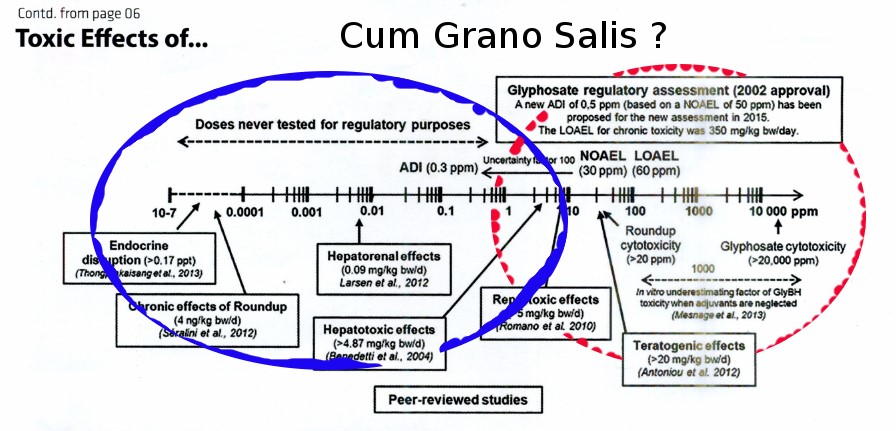
We have added the blue and red ellipses. The region enclosed in blue in this figure contains claims of studies at levels of glyphosate below 2ppb. In effect, results in this regime are effectively beyond standard analytical techniques, and so great care must be taken in quoting or using such data” unless they have been confirmed by several laboratories having the protocols and capacity to do analytical work with  picogram” accuracy.

Dr. SG is claiming essentially that the effect of very low doses (below few parts per billion) of glyphosate has not been tested. Taking such trace amounts in isolation, without including the effect of a multiplicity of other substances and ions is nothing but simple falsification of biochemistry.  It is no different to the claims of homeopaths about just the memory of a drug in water is enough to cure a disease, even without the drug being present”.

Dr. SG  gives several items indicating Endocrine disruption at 0.17 parts per trillion,  chronic effects of Roundup at 4 parts per trillion, Hepatorenal effects at 90 parts per trillion. These are simply an exercise in gullibility. Furthermore, claims of highly questionable individuals like Seralini (2012) are listed and presented as Peer-Reviewed” research. In fact , Seralini et al.  have a habit of publication by press release”since they had to retract their publications from peer-reviewed journals when false claims were detected (http://retractionwatch.com/2014/06/24/retracted-seralini-gmo-rat-study-republished/)

The region in the figure enclosed in the RED ellipse involves glyphsate-herbicide toxicity claimed to be caused by the presence of adjuvants which are a 1000 times more toxic” than glyphosate.  But such adjuvants   may only be present in the blood at mere parts per trillion! If we picked one man out of the whole world population, that is 1 in seven billion. One in a trillion is one man from nearly a hundred such worlds! These are not credible quantities.

Dr. S. G. refers to the work of Mesnage et al (2013) and claims that if adjuvants are included, then the toxicity increases by 1000 fold. Is he talking of chronic toxicity or acute toxicity? Is he talking of ingestion via the gut or via the lungs? Toxicities differ in all different cases. What has been presented in Dr. SG’s figure has no connection with what happens in the field-environment. But artificial in-vitro situations can be created where only  glyphosate and adjuvants are present in a test tube at the ppb levels, together with a few victim cells. Even then the results remain inconclusive! Has Dr. SG or Dr. Mesnage tested common detergents and shampoos (containing similar adjuvants) at parts per trillion level for their toxicity” as well?

The kind of claims  by Dr Sanath Gunatilleke and his team are possible because most people are not used to thinking quantitatively. They do not understand that one part in a trillion is like finding a needle in a whole solar system of needles. And yet, public policy is dictated by such mythology.

It is  not only parts per trillion chemistry that Dr. Gunatilleke puts into his grain of salt. He also abuses basic synthetic organic chemistry and established knowledge in bond energies as well stereo-chemistry.  He repeats an unsubstantiated  claim of the computer engineer Dr. Stephanie Seneff that glyphosate can become a building block” into DNA and disrupt” the biochemistry of the body by substituting for glycine.  After all, Stephanie Seneff is also said to claim that those who purchase her life-style program can live to the age of 111 years!

[The author was the Professor of Chemistry and Vice Chancellor of Vidyodaya (now Jayawardenapura) University in the mid-1970s, and  pioneered food technology and environmental science  programs in Sri Lankan academia. He currently works in Canada, on topics related to quantum physics as well as environmental science. His most recent contribution to environmental science was on Cadmium in fertilizers, soil and food”, Environ. Geochem. Health. 2018 Jun 23. doi: 10.1007/s10653-018-0140-x.]

Comment on the Gomin Dayasiri’s  Interview on the Pathikada Program.

November 7th, 2018

Chandre Dharmawardana

Many of you may have listened to the interview given on 5th November on the Pathikada-Sirasa program, with Bandula Jayasekera himself hosting the interview.

The lawyer held the view that this government should have been allowed to continued to run its course, and gave mainly legalistic arguments, or arguments based on predicting the future, including the claim that “any Booruwek” (donkey) can beat Ranil Wickremasinghe.  He contends that there are “young people” in these parties who will take the baton into their hands. This too is a whimsical prediction and he couldn’t  name any favourite horses.

Only recently, at the no-confidence vote against Ranil W,  a gang of “Booruwas” (using Dayasiri’s parlance) in parliament couldn’t beat Ranil W, and nor did they succeed in August 2015.  As for the future, he predicts that MR, and the country  would have done better if MR had waited till the election is proclaimed. We  should  not take predictions seriously, be they made by astrologers, or by lawyers. But let us look at the claim that the government should have been allowed to continue till it comes to term, beyond the legalistic (not to be confused with “legal”) flavour given to this claim. We look at it from a commonsense point of view.

We as some simple, common-sense questions.

If the president and the PM detest and distrust each other, shouldn’t one of them go? Does the government enjoy the confidence of the public? That the Ranil-Sirisena government had lost the support of the public is seen in its dismal performance at the February 2018 local government elections, and its hesitancy to go to the polls in regard to local as well as provincial governments. That it only pays lip service to the constitution is evident. You just have to see how the government ignored the ruling given by the Supreme court regarding the Local Government elections amendment. The supreme court demanded a referendum but the amendments were  pushed in thorough the “back door”,  the report of the delimitation commission  were derailed, and elections delayed. This was just one example of the  highly unconstitutional things done by this  government. Various controversial free trade deals and other legislation have been approved when the house was not vigilant, or when there was some crisis in the country.

This method of making commitments without the knowledge of parliament has been a hall mark of Mr. Wickremasinghe’s rule even in earlier times when he was in power.  Even the cease-fire agreements with the LTTE was crafted by Mr. Wickremasinghe in a most undemocratic manner – perhaps he discussed it only with his advisors from the LTTE diaspora, but apparently not with any elected legislator. While some emotional topics should not be aired in public too soon, was there ANY discussion with competent civil servants or military leaders? Even the conflict between Ranil Wickemasinghe and Chandrika Kumaratunga was due to Wickremasinghe’s unconstitutional acts where he went beyond the President. Mangala Samaraweer’s complete genuflection  in Geneva had never been discussed by the cabinet or sanctioned by the parliament, but it is certain that he had the private support  of Mr. Wickremasinghe’s private cabal   and powerful external forces. Mr. Wickremasinghe’s approach to the so-called National question may even be the right approach, but it is not the democratic approach to execute  secret  back-door actions given that such actions imply long-term consequences. Mr. Wickremasinghe, an experienced,  educated and respected leader, had a golden opportunity in 2015 to ride the high moral road and push his considered approach, but he failed beyond  all expectations.

Even the Bond-scam, various coal-tender scandals, port-city or Hamabantota handovers, re-negotiation of highway contracts, non-existent Volkswagen factories,  Glyphosate debacle costing the nation some sixty  billion, etc.,  can all be regarded as part of the on-going corruption and mismanagement  taken over from a previous highly corrupt administration; but the clear assault on the sovereignty of the nation was the unmistakable new character of the Yahapalanaya government that was actually far more dangerous to the future of the nation. It is surprising that Gomin Dayasiri had decided to ignore this, and was ready to allow this government to continue to rule for approximately another two years. Does he not admit that the government is made up of the foot-note brigade on the other hand, and the masters of paying only lip service to the constitution. Does Mr. Dayasiri  completely dismiss the possibility of the president being deposed, and a puppet chosen by the West put into the chair of the president, as argued by Prof. Gerald  H. Peiris in an Island newspaper article?  Giving  a further window of time for this possibility, even if rather slim, is surely to turn common-sense upside down.

A highly controversial aspect of the government, linked to its assault on the sovereignty of the nation is its continued attempt to craft a constitution using an NGO weighted process, especially when it is obvious that the government does not have the confidence of the country to engage in such a far reaching endeavour. An amateur who found the study of chemistry too hard for him and switched to law has come through a back door opened for him by his Marxist cronies to write the constitution. His mess up of the 19th amendment and the confusion caused is clear testimony to his incompetence. Mr. Gomin Dayasiri himself acknowledges this fact, but seems oblivious to the  greater damage that is already set to be done if this government were allowed to continue, and push forward the constitution that will get passed by parliament via some subterfuge. Western governments who are complicit in this effort  are waiting to support and underwrite any act of this government, however unconstitutional it is, if the objectives of the international community” could be achieved within any  remaining lifespan of the Yahapalanaya government. Their objectives involve the creation of a constitution, a country  and an economy that will splintered enough to be at their mercy of global capital. A secret meeting of a group of Western diplomats with the Speaker, where the speaker has agreed to keep the names and the content of the discussion secret from the members of the parliament or the president  is another serious breach of the right of the people for transparency. Was it after this meeting that the speaker suddenly decided that as far as he is concerned, Mr. Wickremasinghe’s government is still in office?

So it is clear that Sirisena’s decision to end this government which has flouted the constitution far more frequently than the Rajapaksa government, turns out to be  a life-saving decision even for the constitutional process. It may very well be the case that Sirisena acted for egoistic reasons; he found himself in a hard place, not seeing any way to  continue in high office without going to the extreme of joining hands with Rajapaksa. It may be that all this fitted in with the ambitions of Rajapaksa.  But the fact is, Sirisena’s  move has saved the country from imminent danger in the hands of  those who were churning up the  waters,  for the benefit of  their masters who were waiting to reach the benefits accruing from disaster capitalism”. But Gomin Dayasiri fails to see all this, and condemns Sirisena’s daring and unhesitating acts as unconstitutional”, even though he himself admits that the 19th amendment is unclear and maladroitly crafted.

Of course, escaping one set of devils does  not mean that there are no other perils on John Banyan’s path.

Chandre Dharmawardana

The Rajapaksa family should not disappoint the Muslims who stood with “Mahinda pela”, Basil, Gotabaya and Namal since they were defeated in January 8th., 2015. Caution needed not to allow them dominate the MY3-Mahinda New Government.

November 7th, 2018

By Noor Nizam, Convener – The Muslim Voice”. November 6th., 2018.

The advice of The Muslim Voice” is that we should see reality now. Though the Muslim political leaders will finally crawl towards Mahinda and Maithri (MY3) at the last moment, signals are now confirmed as suggested by “The Muslim Voice” earlier that both Muslim leaders, especially Rishard Bathiudeen is trying to make a deal with Basil Rajapaksa to cross over at the appropriate moment. “The Muslim Voice” thinks that former minister Basil Rajapaksa knows much about the activities of these deceptive Muslim leaders”, Rishad Batiudeen and Rauf Hakeem. We should therefore warn Hon. PM Mahinda Rajapaksa, Hon. Basil Rajapaksa and Hon. Dullas Alahapperuma to be ALERT about the MUNAAFIKK” (deceptive) Muslim politicians, who will be FLOCKING to them to gain personal benefits trying to say they are the Muslim votes. They should handle them carefully and make sure that they will NOT try to dominate the MY3-Mahinda New Government with their UNTRUSTWORTY PRANKS”, if it be so, that their support should be imperative to show a majority in parliament on November 17th., 2018.

When dealing with these deceptive Muslim leaders – Hon. PM Mahinda Rajapaksa, Hon. Basil Rajapaksa and Hon. Dullas Alahapperuma should NOT forget those Muslims, Muslim voters and Muslim politicians who stood with Mahinda pela”, Basil, Gotabaya and Namal since they were defeated in January 8th., 2015. In recent times, the Beruwela, Aluthgama and Eastern province Muslims have extended their support to Mahinda Rajapaksa with a hope of understating and trust that the New PM” will resolve their issues democratically and listen to them.

They are the people/Muslim representatives who should be our VOICE in the new Mahinda – MY3 government. The Muslim Voice” hope and pray that this message will reach all Muslims and Hon. Mahinda Rajapaksa our new PM, Hon. Basil Rajapaksa, former Defense secretary Gotabya Rajapaksa and Hon. Dallas Alahapperuma who are entrusted with negotiating with the Muslim leaders to support MY3-Mahinda government on November 17th., 2018 when parliament is reconvened. The fact remains NOW, the Muslim voters are acting on their own and do NOT wish to be represented by these “MUNAAFIKK and DECEPTIVE POLITICIANS”.

The Rajapaksa family should not disappoint the Muslims who stood with Mahinda pela”, Basil, Gotabaya and Namal since they were defeated in January 8th., 2015 when dealing with the two deceptive (MUNAAFIKK) leaders of the SLMC and ACMC.

Wijedasa tells where UNP went wrong

November 7th, 2018

එජාපයට වැරදුන තැන විජේදාස කියයි 

 Please note the selling of the Hambantota Harbor to a Chinese Company (Hong Kong Chinese) was done by Ranil against all the protests by the people. Since then all the other issues have followed as pointed out by Wijedasa Rajapaksa.

හකීම්-බදියුදීන් හා ජනපති අතර අවබෝධතා ගිවිසුම් සූදානම්..

November 6th, 2018

 lanka C news

රවුෆ් හකීම් මහතාගේ නායකත්වයෙන් යුතු ශ්‍රී ලංකා මුස්ලිම් කොංග්‍රසය හා රිෂාඩ් බදියුදීන් මහතාගේ නායකත්වයෙන් යුතු සමස්ත ලංකා මහජන කොංග්‍රසය ජනපති මෛත්‍රීපාල සිරිසේන මහතා සමග අවබෝධතා ගිවිසුම් අත්සන් කිරීමට සූදානමින් සිටින බව වාර්තා වෙයි.

කෙසේ වෙතත් අදාල ගිවිසුම සම්බන්දයෙන් කව දුරටත් සාකච්ඡා සිදුවෙමින් පවතින්නේ යයිද සදහන්ය.

මෙම පක්‍ෂ දෙක පාර්ලිමේන්තුවේ ආසන 12ක් නියෝජනය කරන අතර ගිවිසුම් ගත වීමෙන් පසු ආණ්ඩුවට එක්වීමට නියමිතය.

මේ අතර මොනයම් හේතුවක් මත හෝ ගිවිසුම් වැඩපිලිවෙල අසාර්ථක වුවහොත් එම පක්‍ස දෙකේ මන්ත‍්‍රීන් අවම 05 දෙනෙකු ආණ්ඩුවට එක්වීමට නියමිත අතර ඒ බව දැනටමත් පක්‍ෂ නාකයන්ට දන්වා ඇතැයිද වාර්තා වෙයි.

හකීම්-බදියුදීන් හා ජනපති අතර අවබෝධතා ගිවිසුම් සූදානම්..

පාර්ලිමේන්තුව විසුරුවීමට සුදානමක්.. ජනපති නීති අංශ කැදවයි..

November 6th, 2018

 lanka C news

පාර්ලිමේන්තුව විසුරුවා හැරීම සම්බන්දයෙන් ජනාධිපති මෛත‍්‍රිපාල සිරිසේන මහතා ව්‍යවස්ථා විශාරධයන් කිහිප දෙනෙකුගෙන්ම උපදෙස් ලබාගෙන ඇති බව විශ්වාස කටයුතු ආරංචි මාර්ග සදහන් කරයි.

19 වන ව්‍යවස්ථා සංශෝධනය අනුව වසර හතරහමාරක් යන තෙක් පාර්ලිමේන්තුව විසුරුවා හැරීමේ බලය ජනාධිපතිවරයාට සීමා කර ඇති නමුත් මහ මැතිවරණයක් කැදවිය හැකි ආකාර කිහිපයක්ම ඔවුන් විසින් ජනාධිපතිවරයාට පෙන්වා දී ඇත.

පාර්ලිමේන්තුව විසුරුවීමට සුදානමක්.. ජනපති නීති අංශ කැදවයි..

පිරිසක් පෙන්වා දී ඇත්තේ 19 වන සංශෝධනය නොසලකා පාර්ලිමේන්තුව විසුරුවා හැරිය හැකි ප‍්‍රතිපාදන ව්‍යවස්ථාවේ ඇති බවයි.

එමෙන්ම පාර්ලිමේන්තුව විසුරුවා මහ මැතිවරණයක් අවශ්‍ය දැයි ජනමත විචාරණයක් කැදවා මහජන මතය අනුව මහ මැතිවරණයක් කැදවිය හැකි බවත් තවත් පිරිසක් පෙන්වා දී ඇත

ජනතාවගේ වුවමනාවට ආණ්ඩුව පෙරළුවත් අපි වහා ජනවරමකට යා යුතුයි

November 6th, 2018

හිදෝගම _ අමිල ප්‍රභාත් උපුටාගැණීම  මව්බිම

ජනතාවගේ අවශ්‍යතාව මත ආණ්ඩුව පෙරළුවද මේ ආණ්ඩුව කෙටි කාලීන එකක්. මීට වඩා ආණ්ඩුවකට බලයක් අවශ්‍යයි. ඒ සඳහා ජනතාව ඉදිරියට යා යුතු බව හිටපු රාජ්‍ය ආරක්ෂක ලේකම් ගෝඨාභය රාජපක්ෂ පැවැසීය.

තිස් වසරක කුරිරු යුද්ධයේදී මියගිය ත්‍රිවිධ හමුදා සාමාජිකයන්, පොලිස් නිලධාරීන් සහ සිවිල් ආරක්ෂක නිලධාරීන් සඳහා පින් පැමිණවීම සඳහා රන්වැලි සෑ සියපත් වන්දනා නමින් රුවන්වැලි මහා චෛත්‍යය අබිසදී ඉකුත්දා (03දා) පස්වරුවේදී සංවිධානය කොට තිබූ රණවිරු ආශීර්වාද පූජාවට එක්වෙමින් ගෝඨාභය රාජපක්ෂ මහතා මේ බව සඳහන් කළේය.

එහිදී මාධ්‍යට අදහස් දක්වමින් හිටපු ආරක්ෂක ලේකම්වරයා මෙසේද පැවැසීය.

පසුගිය ආණ්ඩු කාලයේ රණවිරුවන්ට විරුද්ධව සිදුකළ සියලුම දේවල් භංග වේවා. මේ ආණ්ඩුවටත් කියනවා ඒවා අතුගාලම දාන්න කියලා. අද ටී.එන්.ඒ. එක කොටස් දෙකකට කැඩිලා තිබෙනවා. දෙමළ ජනතාවට ආදරය කරන මේ මන්ත්‍රිවරුන්ගෙන් පිරිසක් අගමැති මහින්ද රාජපක්ෂ මහතාට සහාය දෙයි කියලා බලාපොරොත්තු වෙනවා.

ඇමෙරිකානු විදේශ ලේකම් කියලා තිබුණා 2015දී ආණ්ඩුව පෙරළන්න ඩොලර් මිලියන 400ක් වැය කරලා තිබුණා කියලා. ඒ කාලේ දැක්කනේ මන්ත්‍රිවරු මුදල්වලට ගත්ත හැටි. සිංගප්පූරුවට යනවා මුදල් ගන්නවා. අපිට ඒ වාගේ සල්ලි දෙන්න රටක් සම්බන්ධ වෙලා නැහැ. අපි කාටවත් මුදල් දීලාත් නැහැ. පාර්ලිමේන්තුව කල්දැමීමට ජනාධිපතිවරයාට බලතල තියෙනවා. රටේ මොනයම් අවස්ථාවකදී ස්ථාවර භාවය ආරක්ෂා කිරීමට පාර්ලිමේන්තුව විසුරුවා හැරීමේ බලය ජනාධිපතිවරයාට තිබෙනවා. මේ බලය රටේ සෑම ජනාධිපතිවරයෙක්ම භාවිත කර තිබෙනවා. එක්සත් ජාතික පක්ෂයේ ජනාධිපතිවරයෙක් කලක් පාර්ලිමේන්තුව මාස දෙකකින් කල්දමා තිබෙනවා.

රටේ ජනතාවගේ අවශ්‍යතාව මත තිබුණු ආණ්ඩුව පෙරළා දැමුවත් මේ ආණ්ඩුව කෙටි කාලීන එකක්. ආණ්ඩුවට මීට වඩා බලයක් අවශ්‍යයි. මගේ පෞද්ගලික මතය නම් ශක්තිමත් ආණ්ඩුවක් පිහිටුවීමට ජනතාව අතරට යා යුතුයි.


What type of a leader Sri Lankans want??

November 6th, 2018

Dr Sarath Obeysekera

Just like the Kelaniya Prelate said to the press, I also voted for Ranil and the party .As everybody else we wanted a new and  better leader whose name was not with allegation . I became disgruntled day by day during last three and half years, when I personally encountered the leader and the ministers during official meetings which were held to help entrepreneurs in solving their day to problems .I had many issues related to delay in decision making process in establishing much needed industry like boat and shipbuilding.

During my presence in CECM ( chaired by then Prime Minister ) and OCEM  ( Chaired by Mr Paskeralingam ) meeting including Southern Development Committee  ( chaired by Minister Sagala Ratnayake)  I was not happy ( rather disanointed ) to note that leaders were either not taking firm decisions or they were unable to get the Officials and other line ministers to follow orders issues by the leaders .

These leaders were not listening to opinions expressed by other members or the aggrieved parties, but showing off their power and take decisions to their personal likings.

I remember attending meeting where Minister Sagala Ratnayake chaired southern development committee meeting ,where re-commencing of Galle Yacht and Boat Repair Industry was taken up .I detailed the grievance I had about the SLPA not allowing me to proceed and the minister brought out a absurd reasoning and postponed decision making for no apparent reason .At my age where I had nothing lose,  I lowered my head shaking a little bit unknowingly expressing by disappointed  ,The minister saw my behaviour and asked with somewhat arrogant way Mr Obeysekera ,Why are you shaking your  head ? –You look like not happy. but we are not prepared to do anything today” I profusely apologized but walked out disgruntled.

In an another meeting in the CECM chaired by Prime Minister ,I again brought out the same problem expecting some decision making,PM instructed the minister concerned to allow the project despite some ludicrous reasoning by the minister against it ,I argued about it but once the meeting was over I knew that minister was against it .

Later some of our higher-ups in the company want to see the minister to get a decision, where I was absent minister has asked Where is that Pandithaya ( wise man )? Apparently referring to me.

This are type of leaders we had during last three and half years who could not get things moving and ministers pulling the cart in different directions. Business leaders expected more decisive leaders who have the attitude to foresee the future .

We never had that.

When you talk about charisma and leadership ,I can also refresh my mind when I was in UK .Current prime minister came to the London Buddhist temple just before his first presidential election for a religious ceremony where I was present .He saw me after over 10 years ,standing on the other side of the gathering ,waved and called me to come to him .Held my hands with his both hands and asked me when are you returning to Sri Lanka to do something for the country ?He was playing the role of a politician who would reach the people’s hearts .One of my friend who was travelling from Kataragama accidently encountered the President MR at that time ,MR extended both hands and asked him I assume that you went to Katharagama?” My friend told me that he would not have known him personally and yet he says that MR played his public relationship stunt.

When I had an industrial unrest in the company when MR was the labour minister .I had to shut the gates of the shipyard because the working class was behaving badly creating unrest .After few days of sun buring outside the gates of the Port they went to labour ministry to complain .I was called in by the then Minster none other than MR who was asking me why I took a drastic decision in a quite aggressive voice .I told him in similar confrontational voice that I wanted discipline in the yard ,hence I wanted to teach all a lesson ,He got little irritated and told me that I was type of a person who even did not listen to a minister under whom I worked a s chairman .I told the minister that it is irrelevant here in the current situation

Labour minster apparently got irritated, and expressly warned me with this exact words Why ,you want to fight with me ? I am also a good street fighter .Let us go out and fight !

And yet he winked at me showing that he was playing gallery to the workers and not that serious!

Workers came back to work after signing a there year collective agreement .MR and I achieved what we both wanted

Breaking the impasse >

If you meet the ex PM he may not even look at you and greet you the way MR does.

A leader should have these qualities to win the heart of the people if you want him to lead the country.

I am telling my heart out, despite the fact that someone may tell that I am changing colours.

I am not.

We need a  leader , and I am repeating the same words .

We need a Benevolent Dictator with a Heart ,In Sinhala we say that we need Saundarya Ekadipathi nayakeyek ?

Dr Sarath Obeysekera

සමනල සමලිංගික ප‍්‍රහාරයෙන් එජාපය හාන්සියි… දෙතුන් වරක් රස විදිය යුතු ජනපතිගේ ‘ජනමහිම’ සම්පූර්ණ කතාව මෙන්න..[Video]

November 5th, 2018

 lanka C news

කොලඹ පැවති ‘ජනමහිමය’ ජනරැලියේදී ජනාධිපති මෛත‍්‍රීපාල සිරිසේන මහතා විසින් සිදු කරන ලද කතාව දැඩි අවධානයක් දිනා ගන්න සමත් වී ඇත.

එක්සත් ජාතික පක්‍ෂ නායකත්වය ඉලක්ක කරමින් ජනාධිපතිවරයා විසින් එල්ල කරන බව දරුණු විවේචයන් හේතුවන් එජාප ඉදිරිපෙල ක‍්‍රියාකාරීන් දැඩි අපේක්‍ෂා භංගත්වයටත් කෝපයටත් පත්ව සිටින බව ඔවුන්ගේ සමාජ ජාලා පිටු නිරීක්‍ෂණයෙන් පෙනී යයි.

රනිල් වික‍්‍රමසිංහට ඉවත් කර අගමැති ධුරය ගන්නැයි තමන් විසින් කරන ලද ආරාධනාව අවස්ථා කිහිපයකදීම කරු ජයසූරිය හා සජිත් පේ‍්‍රමදාස මහත්වරුන් විසින් ප‍්‍රතික්‍ෂෙප කරන ලද්දේ රනිල් එක්ක හැප්පෙන්න බෑ කියා බව පැවසුවේ යයිද ජනාධිපතිවරයා පැවසීය.

අන්තිමේ තමන් විසින් රනිල් එක්ක හැප්පෙන්න නොව රනිල් පෙරලාගෙන යන්න පුළුවන් මිනිහෙක් වන මහින්ද රාජපක්‍ෂ අගමැති කල බවද සදහන් කලේය.

Masses gather for ‘Ratama Rakina Jana Mahimaya ‘ rally

November 5th, 2018

රට රකින ජන මහිමය ට මහා ජන ගඟක්

Questions to the Foreign Media writing on Sri Lanka

November 5th, 2018

Quite a lot of mainstream media agencies some who are even having local reporters writing for them are ranting away juggling the same words and parroting the same thing. Please pause for a moment & answer some questions or at least think about them before writing & trying to fool the readers. With alternate media & opinions a plenty, people are not as fooled or as ignorant as mainstream media like to believe.

Here are some of the news headlines

UK Guardian

Sri Lanka faces crisis as two stake claim to be lawful prime minister

NDTV

US, Japan Freeze Aid To Lanka Over Constitutional Crisis, Says Former PM

TheDiplomat

Sri Lanka’s Constitutional Crisis: Rajapaksa’s Dark Past Shapes the Present

TheNational

Colombo on edge as Sri Lanka faces constitutional crisis

CNN

Sri Lanka’s Constitutional Crisis turns violent (co-author of this is Iqbal Athas)

BBC

Sri Lanka crisis: Fears of a ‘bloodbath’ in power struggle

New York Times

Sri Lanka Faces Constitutional Crisis as President Unseats Prime Minister (co-author of this is Dharisha Bastians whom Ranil’s Government appointed Editor at a state newspaper Sunday Observer)

CNBC

‘Constitutional crisis’ could destabilize Sri Lanka, pushing it closer to China

Here’s some questions for media personnel (foreign & local) to ask themselves & answer

  • Have you sought legal advice to see whether the decision is legally questionable before sensationalizing the story for commercial & political purposes?
  • The UNP leader & former PM is a lawyer & so too are most UNP MPs as are their inner circles – they should be the first to know if anything is unconstitutional & they are the best people to file case in Supreme Court if it is not – why have they not done so, afterall the UNP leadership boasted that after they came to power in 2015 the judiciary became independent?
  • Where is the ‘bloodbath’ – we are into the 11th day since democratic ouster & nothing of a bloodbath media presents. However, a personal security officer attached to a Minister in former PM’s Govt shot dead in innocent civilian inside the Ceylon Petroleum Corporation. Why does Foreign media not demand action for this crime! Why does media not question the likely outcome of UNP MPs who are more worried about losing their portfolios & perks & are trying to surround parliament & intentionally trying to cause chaos with an ulterior plan in mind. People be warned that this is plan B of their modus operandi. These protests have nothing to do with the legal or illegal removal of a PM except to survive politically knowing their political future is now at stake. We are dealing with some worried UNPers trying to stir trouble manipulating the people into action.
  • Everyone is going on a tangent over a supposed constitutional crisis – legal experts are expressing their views but why are they not moving Court? Why does Friday Forum, Church of Ceylon, Transparency International, Centre for Policy Alternatives, National Peace Council not file in Supreme Court instead of issuing statements, running online petitions, writing articles, giving interviews? What do they expect to achieve – no legal action simply public drama to fool masses
  • How can you people ignore the most important fact that with the exiting of the SLFP MPs from the so-called National Government the entire cabinet collapsed & along with it the PM & President was well within his powers to appoint a new cabinet headed by a new PM. Reading 19a without reading clause applicable to national government is rather silly. Moreover, another legal question is while the 19a refers to national government the present UNF refers to themselves as national unity government so how valid are these terms legally too. Moreover, only SLFP & UNP signed a MOU for two years which expired in August 2017 & was not renewed.
  • Public sentiment & public disappointment gaged by interviewing only UNP circles or foreign-funded NGO members & their cronies is not public sentiment. We have not seen any spontaneous protests against the decision by the President except the one’s organized by the UNP – how can media use this as an argument that the public is against the ouster of the former PM? If media is going to speak to the same circles that the former PM mingles with, naturally they will be weeping & wanting his return because they will be the first to lose their perks & privileges. Trying to make the public hysterical by quoting these Colombo circles is only making these circles hysterical & a public nuisance to the rest of the country!
  • On 26 October 2018 the former PM was constitutionally ousted did people come to the streets shouting in protest? NO, they lit crackers to celebrate. That showed the will of the people which the President too echoed when he informed foreign envoys that 75% of people wanted the change.
  • Calls about sanctions by West/India/Japan – on what legal or constitutional basis – just because a handful of people claim the President’s decision is wrong without any legal backing? Is this how these countries the custodians of democracy function?
  • Can the UN Secretary General phone democratically elected leaders & tell them to hold elections, tell them to convene parliament – are these not violations of the UN Charter?
  • Why was the same media & same actors now crying foul when after a presidential election Ranil Wickreamsinghe was appointed Prime Minister on the lame excuse (election manifestos are not legally binding & candidates can promise the stars & moon but once elected he has to abide by the constitution & the law of the country) that the President promised in his election pledge. Ranil Wickremasinghe was then Opposition leader & with 46 UNP MPs he did not command any majority in the House to be named PM. Wasn’t that disappointing the people? Moreover, he was appointed PM without removing the sitting PM (DM Jayaratne) Even if we accept this lame excuse of appointing Ranil as PM in 2015, the President did not promise to make UNP MPs the government but that was what happened & elections were promised in April 2015 which didn’t happen & elections were only held in August 2015 when Ranil W had no choice but to dissolve parliament before the COPE report held him directly responsible for the 2 Central Bank bond scams. Why is media hiding these important facts?
  • Why is the media ignoring the plot to assassinate a President with a foreign intelligence agency name associated with the plot?
  • Why is the media not highlighting UN interference in Sri Lanka by the manner even the UN Secretary General is demanding reconvening of Parliament & virtually saying to reinstate the dislodged Prime Minister. Aren’t these violations of the UN Charter & the spirit in which the UN is supposed to function?
  • How can everything be illegal & irregular only now when media ignored a string of illegalities that took place since January 2015?
  • Manner that CJ Mohan Pieris was removed without any due process
  • Manner 2 Central Bank Bond Scams took place the main cause for the economic crisis in Sri Lanka in particular how the former PM took the CB directly under him to facilitate the 2 scams.
  • Manner state land is being sold & enterprises set up manned by foreigners that function even without ministry approvals
  • Manner ethnic & communal tensions are being ignited in order to justify clamp down on opposition targets & bring in new laws that curtail the people’s freedoms & rights

Do the right thing – Rule of Law – Good governance – such lovely terms but all of them have life only if they are followed. Simply stating them in official statements or reading them out at public podiums is just useless & is now making people laugh. It has come to a point where we can tell what these foreign envoys, foreign statements etc will say even before they issue them! Again, assume that the new government is not following rule or law, good governance, righteous rule blah blah blah…then can the media explain why a removed Prime Minister is not doing the right thing but refusing to evacuate Temple Trees and not only that allowing all sorts of people to enter the official premises & they are not only dirtying the place there is even a likelihood that security aspects are also getting exposed & items belonging to the State (including gifts from other States) may also disappear with no one accounting for these losses. What is the point in not leaving even when the removal has been gazette making it official while not even taking the legal avenue available by going to courts? How can media justify this?

Now the latest is ‘do not sell my vote’ seriously full marks for creativity to fool the masses. How did Rajapakse’s MPs jump to the MS-Ranil Alliance in 2014 that set the stage for the unseating of Rajapakse in January 2015… didn’t every Rajapakse MP going to Singapore do a leap jump after landing? Buying MPs & facilitating their crossovers has been happening for quite some time but never forget only 29 MPs are selected from the National List all 196 are voted by the People…how about not voting candidates without a clean record! If so the former PM with a string of controversies & allegations linked to his name should not stand a chance either!

Honest journalism is dead. Social media at least gives a podium for people to challenge. Print media on the other hand bats on with lies & controversies without giving right of replies. But if you are well read enough, if you can balance versions against the backdrop of lies & extremes – real eyes, can realize, real lies! Truth must matter whoever tells it, justice must matter whoever receives it & whoever it is against.

Shenali D Waduge

IT IS NOW THE RIGHT TIME FOR YOU TO COME OUT AND SUPPORT MY3-MAHINDA GOVERNMENT.-An open letter to Rishad Bathiudeen and Rauf Hakeem.

November 5th, 2018

By Noor Nizam, Convener – “The Muslim Voice”, November 5th., 2018.

With my involvement with the SLFP since 1969, beginning with the Late Sirimavo R.D.Bandaranaike and to supporting Mahinda at the 2015 Presidential and General elections, being a staunch supporter of the SLFP/Mahinda Pela/JO and the SLPP, I know that the political cuemanship of the late T.B.Jaya’s advice “that we Muslims should not place all our eggs in one basket” has to be the best political “SAFETY VALUE”, Insha Allah for the Muslims of Sri Lanka. Even though, as a voice heard in the wilderness, I have stood with the SLFP/Mahinda Pela/JO and the SLPP, without changing colours or the party till to-date, Alhamdulillah. I have written nearly 900 “REBUTTALS” since January 8th., 2015 after the MY3-Ranil (Hansaya) government took office, till to date, DEFENDING Mahinda Rajapaksa, SLFP JO and then the SLPP in Tamil and English social media and internet news websites and forums. My primary focus was to enlighten the Muslim voters and the Sinhalese English reading internet audience who had been misguided by politically motivated “anti Mahinda forces” journalists. Today, the Muslim voters are acting on their own and do NOT wish to be represented by you leaders. But let’s look at the reality. Whatever said and done – the Mahinda -MY3 political steam roller is moving forward.

It is the free trade policy of the UNF/UNP and the free for all attitude of the UNF/UNP in the handling of all state and public matters and the economy of the country and the UNF/UNP political and hierarchical system of the big wigs of the UNP, since January 8th, 2015, involved in mega corruption with their minority coalition partners, which has resulted in the pathetic state of affairs in our country and the selling of our country’s assets to the political vultures of the eastern and western world. The BURDEN has befallen our poor citizens and the nation to redeem them for our next generations which cannot continue.

The 72% Sinhala people will finally support Mahinda, including the Police and the 3 Security Forces. That is the powerful political force needed to safeguard our MAATHRUBOOMIYA” from the crutches of the Western powers that are trying to make us their slaves economically and destroy our SOVEREIGNTY as an independent FREE STATE of the UN and a member of the COMMONWEALTH FAMILY, in the international political arena. It is the free trade policy of the UNF/UNP and the free for all attitude of the UNF/UNP in the handling of all state and public matters and the economy of the country and the UNF/UNP political and hierarchical system of the big wigs of the UNP, since January 8th, 2015, involved in mega corruption with their minority coalition partners, which has resulted in the pathetic state of affairs in our country and the selling of our country’s assets to the political vultures of the Eastern and Western world.

It is now the right time for you to come out and support MY3-Mahinda New government and do not allow the Muslim voters to hate you both in the next elections, Insha Allah. If you do not do so, you will make the 72% Sinhala people hate the Muslims too, God AllMighty Allah forbid, Insha Allah.

Noor Nizam.

Convener -“The Muslim Voice”.

MASTERS OF THE UNIVERSE BUT LACK THE WISDOM OF OUR ANCESTORS  – A Sri Lankan Perspective

November 5th, 2018

By Dr Janaka Goonetilleke

Humanity in the last century has achieved immense technological skills that are far beyond once comprehension. They have gone to the moon, deciphered the Genome, Communications have resulted in people communicating across the globe in seconds that are unbelievable but do they have the wisdom to use it is the prime reason for this article. Blindly led into self annihilation by a group of advocates consisting of illiterate politicians, professional classes, a media that believes in a philosophy of make belief and a set of blind economists who have of mixed up statistics with human development. This is the plight of the present generation.

Individualism against the collectivism of our ancestors

Sri lanka was a fine example of collectivism until the invasion and subjugation by the colonialists Europeans. The colonists imposed a set of values that undermined the ancient ideas of collectivism. Collectivism of our ancestors believed in our ancient idea of integration, assimilation and diversity. The best example of this is in the maritime provinces of Sri Lanka. The fisherman are all migrants from India arriving in the northern part of sri Lanka and spreading down south where the islanders were most prosperous. Interestingly the fisherman in the north speaks Tamil, migrating south in the northwestern province they speak a dialect that is a mixture of Sinhalese and Tamil. In the south they speak Sinhalese and are strong Buddhists.  In the south the oldest migrants are blessed with Hindu Gods whom they can worship in the Buddhist shrine rooms in temples. In fact up to today the businessman visit the kovil in the morning before they start work. A fantastic example of humanism and harmony. Today this aspect of humanism is lacking in the thought process of the islanders where inter communal harmony is at the lowest ebb with antagonism and intolerance taking pride of place. A reflection of the individualism that breeds greed, hate and delusion. The question is one of both economic and social sustainability. A point most intelligent Sri Lankans lament after a 30 year old destructive war where all sri lankans have been made to pay. The price

INDIVIDUALISM AND SOCIAL PERFECTIONISM

Individualism has brought into society to desire achievement where the object is self fulfillment we push and push to building great cities, digging more mines, destroying climates we get what we want. We pursue our dreams with greed, ambition relentlessly. Self destruction is not a part of the plan but it is.

  1. Around 10 % of the people in the west are on antidepressants
  2. Suicide is increasing although reduced amongst the people on anti depressives. A result of an acute feeling of failure in their inability to pursue their desires. In other words they have sold their soul and have nothing to protect.
  3. Children are the next generation that is paying a price. Driven by over ambitious parents that a wish their children to be multi talented been taken for different activities are gradually brought into the army of social perfectionists. Mental disease amongst the young is rising especially in the west. With both parents working and the little time they have with the parents been destroyed by extra school activities they are emotionally deprived leading to mental disease that is rising amongst the young in the west. The rest of the world led by the west is closely following.

Another example of the emotional deprivation is rising number of School massacres and rapes in the USA.

The overzealous parents have failed to realize is that mental stability amongst the adolescents does not occur until they are about 25 years of age. To be exposed to social perfection at the time of vulnerability is only going to make matters worse.

  1. d) The emotionally deprived children brought up to be socially perfect having sold their souls are unable to even identify themselves with their own families. This is made worse by the high divorce rates (60%) and single parent families. In the USA it is said that 15% of the 13 to 15 year olds do not speak to their parents. The reasons are multifactorial but on the whole are a reflection of the present Social order of the masters of the Universe. This makes a mockery of the family and repercussions for the future are very negative. It has negated the evolutionary process over millennia.

4) Social Media

Social media have made especially the young addicted to face book, Instagram etc. where people from different cultures, different communities, different religions express a globalized version of the truth distorting the real issues of the local communities.  . A locally arrived solution is most appropriate for that society. A globalized version thus distorts and undermines democracy leading to communal and religious disharmony. These issues are most prominent in the Middle East where religious, communal disharmony has created millions of refugees, thousands dead and social disruption that will take years to remedy.

The masters have forgotten to understand that people from different backgrounds cannot be assimilated into one globalized unit.

World economy

Open Economy and the Politics

Individualism and greed are the main criterion on which the economy is developed well fueled by a Banking system where making a quick buck is the main philosophy. The altitude to money making is just looking for profit on a transaction but does not maximize profit on the long term. In fact unless we learn from our past financial myopia this will lead to bankruptcies and market failures as we saw in 2008 economic collapse.

Plenty of Power No Responsibility

The masters of the world have still not realized the implication of plenty of power but no responsibility. The political class is the best example in Sri Lanka. They have borrowed money from china at the rates of about 6% on the dollar when the market rate was .5%. The borrowed money has been invested in hyped up projects where the return on equity makes a mockery of investment. No wonder the politicians who get commissions on the investments have now gradually got heir families involved in the industry. Up till today  no sri Lankan Politician has been charged for corruption. It is a question of you scratch my back I will scratch yours. A disgusting phenomenon of a group of people who come pretending  to serve the people.

Banking System

The masters of the universe are still to realize that the creation of money is in the hands of the private sector not the central banks. In the west 95% of the money created is in private hands. These banks create wealth by investment and lending which is called the multiplier effect. The short termism is the theme.  Forests for instance are a good example. You cut down the trees and sell the timber making a big profit on the short term but the countries are left with bear land and the local societies are left with the losses and a wasteland. This is how this unhealthy relation ship between the politicians, Banking system and money lenders have prospered leaving the poor to carry the can.

The result of the banking crisis in 2008 is a standing example. 1% of the rich own 70% of the wealth whilst 99% own 30 % . Dwindling money in the majority can only lead to a collapse of the market system.

Lets forget about the unnecessary fluff about human rights, Democracy etc. that are the moral sold to the populace but it is the social and economic sustainability that matters which the masters of the universe has forgotten. This self destructive process advocated by the great powers of the world hope to sustain it by wars and destruction as we see in the Middle East. This does not sustain growth of wealth on the contrary helps in the destruction of wealth.

A LESSON FROM OUR ANCESTORS

The vast irrigation canal system of our ancestors and the difference between it and the present Mahaweli Project of the 1980s created to make Sri Lanka self sufficient in Rice and En energy.  The present mahaweli scheme lacks unfortunately the practical scientific thinking of our ancestors.

  • The mahaweli scheme made a dam across the main river thus causing environmentally damaging results in the riverbed beyond the dam. Our ancestors on the other hand built dams across tributaries never on the main river. Thus the area around the main river was protected.
  • Around the tributary they developed forbidden forests where even the produce could be only consumed by the king. In the forests were grown a tree called Vera that minimized evo evaporation. This made the soil damp allowing many varieties of herbs to grow that had a stable biodiversity that was protected by law. The purpose of the forests was to protect the environment that according to Buddhism was the perfect eco system that helped in the colonization of the area. The forests were the forest reserves that are protected in most countries. Unfortunately the foreign consultants did not realize the potential of these forbidden forests recommended that the versa tees to be cut and used as timber creating wastelands that were unproductive to the local populace
  • Silting Tanks or BISO KOTUWA

These tanks had a pipe at the bottom in the entrance and at the top at the exit. It allowed decanting the water free of silt. When the tank needed desalting they used elephants stir the silt that was carried to the Paddy fields as fertilizer. The masters used caterpillar machines to de silt. It is difficult to fathom out he depth to which one should de silt was risky as it could damage the crest of the earth. Once the crest was damaged the water could not be contained in the tank.

  • The present mahaweli scheme diverts all the fertilizer from the tea estates to the North Central Province that has resulted in 15% of the people  suffering  from kidney disease. This has been made worse by deforestation.
  • Our ancestors were aware of the risks of heavy metals in the water that was transferred to the paddy fields and how it could affect the rice. They cooked the rice with excess water and decanted the excess water after the rice was cooked. This supernatant carried the pollutants out. Today we cook in rice cookers and do not have a mechanism to get rid of pollutants. The masters have failed again.

CONCLUSION

common sense of our ancestors cannot be matched by the masters as they lack a policy of sustainability be it in technology or otherwise. The masters believe in a policy of might is right as against harmony of our ancestors and interdependence with nature. This hubris of the masters is the cause of major environmental damage.


පොරොන්දු දේශයේ රන් අසිපත

November 5th, 2018

විශේෂ ලියුම්කරු කීර්ති රත්නායක 

2005 මහින්ද රට බාර ගන්නා විට ඒකීය ශ්‍රිලංකාවක් පිලිබද බලාපොරොත්තු මියදෙමින් තිබුනි. ප්‍රභාකරන් යුද්ධයෙන් පරාජය කල නොහැකියයි මතයක් ගොඩනැගී තිබුනි. බටහිර ප්‍රජාවේ අධීක්ෂනය නොමැතිව කිසිවක් කල නොහැකි යයි සිතූහ. ගැටලුවට එකම විසදුම සාකච්ඡා වටමේසයක යැයි කීහ. පාලකයන් ත්‍රස්තවාදීන් ඉදිරියේ දන නමන නිව‍ටුන් බවට පත් වී තිබුනි. නමුත් ඇලේ දොලේ සල්ලං වූ මැදමුලන මහින්දට වැල්වැටිතුරේ ප්‍රභාකරන් කෙරුමෙක් නොවීය. මාවිල් ආරුවේන් පටන් ගත් ව්‍යාපෘතිය නන්දිකඩාල් කලපුවෙන් විජයග්‍රාහීව අවසන් කලේය. කොටියාට වෙඩි තිබ්බේ කවුද, වෙඩි වැදුනේ මොන ඇටයටද සෙවීම අපට නම් අදාලම නැත

ලක් ඉතිහාසයේ ස්වර්ණමය පරිඡේදයක සක්ෂිකරුවන් අප වෙමු . බෙදී තිබුනු මව් බිම යලි එක්සේසත් කලේ අපගේ මේ පනගසන හුස්ම තුලය. ලියන මමත් කියවන ඔබත් එහි සාක්ෂි කරුවෝ වෙමු. සපුමල් කුමරු කොඩිකාමම් හි එසවූ සිංහ කොඩිය යලි එසවූයේ වසර 700 කට පසුය. ක්‍රිස්තු පූර්ව දෙවන සියවසේ රෝහනයෙන් එලිබට දු‍ටුගැමුනු නොවන්නට හෙල ඉතිහාසය එලාරගේ දමිල ඉතිහාසයට යට වන්නේ යම් සේද 21 සියවසේ රෝහනයෙන් පැමිනි රාජපක්ෂලා නොවන්නටලක්බිමේ හෙල ඉතිහාසය ඊලාම් ආක්‍රමනයෙන් බුල්ඩෝසර් වන්නේය.

එනමුත්  නොසිතු මොහොතක පෙරදිග සුලග යටපත් කරමින් බටහිර සුලග හමා ගියේ ය. වල්මත් වූ ජනයා හරිත වර්ණයෙන් උදාවූ වසන්තය නොව  යහපාලන මිරිගුදිය වැලද ගත්හ. නිලංකාර වූ දෑස්  සිහියට එලඹෙන විට සියල්ල සිදුවී හමාරය. සර්වජන ඡන්දයේ අවිචාරවත් ප්‍රතිඵලය තුල පරාජය වූයේ රාජපක්ෂලා නොවේ, සමස්ථ පුරවැසියන්ය.  ලක් භූමියේ ඒකීය භාවය බන්දේසියක බහා ප්‍රධානය කලා නොව සොල්දාදුවන්ගේ ලෙයින් එහි මිල ගෙවා ඇත. මාතෘභූමියේ උරුමය මතු පරපුරට රක්ෂා කලේ ඔවුන්ය. දේශය අනාරක්ෂිත නම් එහි මුල්ම වින්දිතයන් අපගේ ආදරනීය දුවා දරුවන්ය. අනාරක්ෂිත බිමක මුලින්ම වියකීයන්නේ හෙට දවසේ ඔවුන්ගේ මුහුනුවල සිනහවය

ලොව පුරා වසන දෙමල ජනයා එක් සිත්ව පහන් දල්වමින් හෘර්දයාංගමව සමරන එක් දිනයක් වෙයි. ඒ අන් කිසිවක් නොව ඊනියා විමුක්ති නායක වේලුපිල්ලේ ප්‍රභාකරන්ගේ උපන්දිනයයි. යකඩින් සහ ලෙයින් ප්‍රභාකරන් මෙහෙයවූ ව්‍යපෘතිය තුලින් දෙමල ප්‍රජාව පරිහානිය කරා ‍රැගෙන ගියා මිස ලබා දුන් විමුක්තියක් නොමැත. එනමුත් දෙමල ජනයාට ප්‍රභාකරන් වීරයෙකි, මල් පහන් දල්වා දේවත්වයෙන් පිදුම් දෙන්නේය.. සිංහලයා කෙතරම් තුච්ච ගුනමකු ජාතියක්දයත් මව්බිම එක් සේසත් කරමින් සාමය ‍රැගන ආ මහින්ද හොරෙකි. සිංහලයේ මහා අග රජ රාවණ ගැනූ සොරකමේ ගිය සල් ලාලයෙකි , ඉන්දියාවෙන් පැමිනි පාදඩවිජය ජාතියේ පියාය හෙලයාගේ සහ දෙමලාගේ වෙනස මෙයයි

රාජ්යක් අරාජිකත්වයට දක්කා එය සූරාකෑම ඇමෙරිකානු ක්‍රමයයි. එ.ජා.පයේ සිටින්නේ ජනතා නියෝජිතයන් නොව බටහිරයෙන්ගේ කූට අරමුනු ඉ‍ටුකරන කුලී හේවායන් පිරිසකි. ශක්තිමත් නායකයෙකු සිටිනතාක් ඔවුන්ට ඉලක්ක කරා යාම දුෂ්කරය. ස්වදේශික ජනතාව ගොනාට අන්දවා ඔවුන්ගේ ‍රැකවලා ඔවුන් අතින්ම නැතිකිරීම බටහිරයන්ගේ උපායයි. ලිබියාව සුපිරි දේශයක් බවට පත් කල ගඩාපිට, ඉරාකය කෙලින් සිටවූ සදාම්ට, යුක්රේනය එලිය කල යනුකොවිච්ට පමනක් නොව බටහිරයන්ගේ මිනීමරු සුරතලාගේ ඔලුවට වෙඩි තැබූ මහින්දටද අත් වූයේ එම ඉරණමයි.

ඇමෙරිකානුවන් යනු හිරෝෂිමා නාගසාකි භූමියට පරමානු බෝම්බ දමා මිලියනයක ජනසංහාරයක් සිදු කල ජාතියකි. කිසිදු එදිවාදිකමක් නොවූ වියට්නාමයට බෝම්බ ටොන් 7850000 ගැසූ ජාතියකි. දුප්පත් කම්බෝජයට සහ ලාඕසයට ටොන් 613820 කවිෂ රසායන හෙලූ ජාතියකි. ශිෂ්ඨාචාරයක තොටිල්ල වූ ඉරාකය එක් රැයකින් නටබුන් කලේ ඇමෙරිකානුවන්ය. සිරියාව යේමනය ගෙවමින් සිටින්නේද ඇමෙරිකන් කාරයින්ගේ පව් කදුය.අද ලංකාවට ප්‍රජාතන්ත්‍රවාදය පිලිබද පාඩම් කියාදීම්ට පැමිනෙන්නේ එහෙව් ඇමෙරිකාවය.

මාතෘ භූමිය සු‍රැකීමේ යුතුකම අත් හල නොහැකි වගකීමකි. මව් බිමේ ආරක්ෂාව වෙනුවෙන් වෙනුවෙන් යුක්ති යුක්ත දේශපාලන ඉලක්ක හඹා යා යුතුව ඇත. යුක්ති යුක්ත දේශපාලන ඉලක්ක සමග නැගී සිටින ජාතිය පරයින්ගේ කුමන්ත්‍රන මගින් යටපත් කල නොහැක. ස්වර්ණ භූමියේ උරුමය රැකීමට ගොඩ නැගෙන දේශමාමක පවුර අධිරාජ්‍යවාදීන්ගේ සැටලයිට් වලට ඉලක්ක කළ නොහැක. මාතෘ භූමියේ ප්‍රතාපවත් හඩ යලි අවදිව ඇත. සිංහ කොඩියේ සිංහයා රණ බිම දෙවනත් කරමින් ඉදිරියට ඇදෙන්නේය, සොයුරණි , පරයන් ඉදිරියේ දනින් වැටෙන රාජ්‍යක නිව‍ටුන් ලෙස නොව සටන්කාමී ධජය මව් බිමේ නාමයෙන් වැලදගත යුතු හෝරාව එලඹ ඇත.

විශේෂ ලියුම්කරු කීර්ති රත්නායක 

මහින්ද සුලඟයි ජනතා පැතුමයි එක්වූ වගයි

November 5th, 2018

තිස්ස ගුණතිලක

මීට අවුරැදු 10-15 කට පමන පෙර තැන තැන බෝම්බ පිපුරැන මේ දෙරනේ, කුඞුවී සුනුවිසුනු වුන තම මෑණියන්ගේ, පියාණන්ගේ, සහෝදර සහෝදරියන් ගේ කැබලි ඇහිදමින්, මිහිදන් කරමින් ජීවත්වුන ජාතියකට බියෙන් තොරව ජීවත් වීමේ  සුන්දර නිදහස ලබාදුන්නේත්, 2015 ජනවාරි 8 වනදා රාත්‍රියේ ජනපති පදවියෙන් ඉවත්කර සාමාන්‍ය මිනිසෙකු බවට පත්කලේත් එදා මෙදාතුර ශ්‍රි ලංකාව බිහිකල අභීතම ජනනායකයාය.

කුරිරැ ත්‍රස්තවාදයෙන් අපවත් රටත් මුදවාගෙන එවකට ලෝකයේ ප්‍රබලම රාජ්‍ය නයකයාව සිට ඉතාම කෙටිකලකින් බටහිර බලවේගයන්ගේ ගැත්තන් විසින් ශ්‍රි ලංකාවේ ඉහලම විධායක තනතුරෙන් මොහුව නෙරපා දමා, ශ්‍රි ලංකා නිදහස් පක්ෂයේ නායකත්වයද ඔහුගේන් උදුරාගන්නා විටද අප නිසොල්මන්ව සිටියෙමු. ඔහු හා ඔහුගේ බිරිඳ ප්‍රමුඛ සහෝදර පිරිසට ඊනියා දූෂණ චෝදනා නගන විටත් තම වැඞිමහල් පුතුන් දෙදෙනාවම රිමාන්ඞ් සිරභාරයට ගන්නාවිටත් ඇතිවූ වේදනාව ඔහු විඳදරාගෙන සිටියේ අවංක ගැමි සුවද හඳුනන ජනතාව ඔහු හැර නොදමා සිටි බැවින් විය යුතුය.

මේ උපන් හපන් මිනිසා සියඵ තනතුරැ අහිමිවී සාමාන්‍ය මිනිසෙක්ව සිටියදී ඵතුමාට සිදුවුන අවනඞුවෙන් ප්‍රකොපවු ජනතාව තමුන්ට බියෙන් තොරව ජීවත්වීමේ අයිතිය ලබාදුන් නායකයා දකින්නට, පුදන්නට වැල නොකැඞී මැදමූලනටත් තංගල්ලටත් පැමිනිම සිදුනොවන්ට ඔහු දේශපාලනයෙන් සදහටම සමුගන්නට ඉඞතිබුනි.

එතෙක් මෙතෙක් අප ශ්‍රි ලංකාවේ ඇතිවු විශාලතම ජනගඟ තම නායකයාගේ ඡායාවක් හෝ නොදැක ගැලුවේ නුගේගොඞින් ඇරඹී රට වටා පැවති `මහින්ද සුළඟ’ ජන රැලිවලටය.  ඡායාරෑපයෙන් පමනක් මහින්ද දුටු ජනතාවගේ ඵකරාෂිත්වය දිනෙන් දින වැඞිවූයේ තම නායකයා නැවත කවදා හෝ දිනක ශ්‍රි ලංකාවේම නායකයාවී තමන්වද රටද රැකගනීවි යයි යන උතුම් බලාපොරොත්තුවෙන්මය.

මෙසේ ඇරඹි ජනතා පැතුම ඡන්ද වලට පරිවර්තනය වීමට ගතවුයේ මාස අටක පමන කෙටි කාලයකි. ඒ 2015 අගෝස්තු පාර්ලිමේන්තු මැතිවරණයයි. සියඵම පක්ෂවලට වඞා ඉදිරියෙන් සිටි මහින්ද ප්‍රමුඛ ශ්‍රි ලංතා නිදහස් පක්ෂයේ ජයග්‍රහණය පෙනි පෙනී මහින්ද දිනුවත් අගමැතිකම නොදෙන බවටකල ප්‍රකාශයෙන්වූ දෙය අප සියඵ දෙනාම දන්නා කාරනයකි. පරාජය අභියස සිටි රනිල් නැවත හිස ඵසවීමට සමත්විය. අප රට බටහිර ගැති හොර කැලෙන් බේරාගැනීමට තිබූ දෙවන අවස්ථාවද අපට අහිමිවිය.

`පොහොට්ටුව` ලාංචනාත්මක කරමින් ඵයින් මාස හයකට පමන පසුව බිහිවූ නව පක්ෂය වටා මහින්ද බලවේගය ඵක් රොක්වී පැවති ජන රැලියටත්, 2017 කොළඹ පැවති මැයිදින රැළියටත් සහභාගිවූ ජනතාව දැක බියෙන් මුසපත්වූ පක්ෂ නායකත්වය `පොහොට්ටුව`ට සම්බන්ද සියල්ලන් පක්ෂ ධූර වලින්ද පක්ෂ සංවිධායක ධූර වලින්ද නෙරපා දැමුවේ `මහින්ද සුළඟ’ සැර බාලකරනු පිනිසය.

මේ වන විට රනිල් ප්‍රමුඛ බටහිර ගැති පිරිස රටේ සෑම දර්ශකයක්ම පාහේ පහලට හරවා හමාරය. දැන් ඇත්තේ රල පහරට හසුවූ නැව චන්ඞ මාරැතයට දෙසට පැදවීම පමනි.

මේ චසරේ පෙබරවාරි මස 10 වනදා පැවති පලාත්පාලන මැතිවරණය දේශීය දේශපාලනයේ හැරවුම් ලක්ෂය වූවාට සැකයක් නැත. පොහොට්ටුව මහින්දගේ නායකත්වය යටතේ පලාත්පාලන ආයතන 231 ක බලය ලබාගන්නා විට රනිල්ගේ UNPයට ලබාගත හැකිවූයේ ආයතන 37 ක් හා ශ්‍රි ලංකා නිදහස් පක්ෂය ප්‍රධාන සංධානයට ආයතන 9 ක් පමනි. වර්තමාන පාලනය කෙරෙහි ජනතා ප්‍රකෝපය මෙයටත් වඞා පැහැදිලි ලෙස ප්‍රකාශ කල හැකිද?

මහ බැංකු මංකොල්ලයේ මුදල්වලින් පසුගිය අප්‍රේල් මස විශ්වාසභංගයෙන් බේරැනත් වත්මන් පාලනයේ දේශපාලන දින ගනන සීමිත බව ජනතාවට අවබෝධය විය.

ජනපතිගේත් ගෝඨාභයගේත් ඝාතන කුමන්ත්‍රණය හමුවේ අගමැති තනතුර බාරගැනීමට මහින්දට කල ආරාධනය දිනෙන් දින වර්ධනයවූ ජනතා ප්‍රකෝපයේ අවසාන ප්‍රතිඵලය ලෙස සැලකිය හැකිය.

`නෙත් පුරා ඵක හීනයෙන් මුලු ලෝකයා නිදනා පැයේ` ඔබ මේ හෙලබිමේ අගමැති වූවේ ජන බලය නිරතුරැචම ඔබ සමග සිටිනා බැවිනි. ඉතාමත් වාසනාවන්ත ජනතාවකට වාසභූමිය වූ මේ හෙලබිම නැවතවරක් රැකගැනීමට මහින්ද රාජපක්ෂයානණි ඔබට ශක්තිය හා ධෛර්ය ලැබේවා.

කරැනාදාස සපුතන්ත්‍රි ගේ අදහසක් සුනිල් එදිරිසිංහයන් අපේ දෙසවන හඬවන්නේ මෙලෙසිනි

රන් මලක් ලෙස දෙව් බඹුන්

දෝතින් පිදූ මේ පින් බිමේ

පස් පිඞක් ගිලිහී නොයන්නට

රන් වැටක් ඇත සිව් කොනේ

නෙත් පුරා එක හීනයේ

මුළු ලෝකයා නිදනා රැයේ

දේශයේ මුර දේවතා එලි

රෑ පුරා දැල්වී තියේ

ඔබට සුභ පැතුම්

තිස්ස ගුණතිලක සිඞ්නි නුවර සිට

2018 නොචැම්බර් මස 05 වනදා

eMail: tgunite@tpg.com.au

ජනතා පරමාධිපත්‍යයට හදිකළ “19”

November 5th, 2018

ආචාර්ය වරුණ චන්ද්‍රකීර්ති

1972 අවුරුද්දේ ඉඳලා අපේ රට ජනරජයක්. ඉතින් අපේ රටේ පරමාධිපත්‍යය බලය හිමිවෙලා තියෙන්නේ ජනතාවට. ජනතාව කියන්නේ ඡන්ද බලය හිමි පිරිස විතරක් නෙවෙයි. තවමත් ඡන්ද බලය හිමි නැති දරුවන් පවා ජනතාව කියන ගොඩට අයිතියි. ඒ විතරක් නෙවෙයි. ඉදිරියේ දී උපදින අයත් මේ ජනතාව කියන ගොඩට අයිතිවෙනවා. ඉතින් ජනතා පරමාධිපත්‍යය කියලා කියන්නේ ඉතාමත් පුළුල්, ඒ වගේ ම සාමූහික හිමිකමක්. මේ හිමිකම අන්සතුකරන්න බෑ. මේ බව ඉතාමත් පැහැදිළිව අපේ ආණ්ඩුක්‍රම ව්‍යවස්ථාවේ 3 වැනි වගන්තියේ දක්වලා තියෙනවා.

  1. ශ්‍රී ලංකා ජනරජයේ පරමාධිපත්‍යය ජනතාව කෙරෙහි පිහිටා ඇත්තේ ය. පරමාධිපත්‍යය අත්හළ නොහැක්කේ ය. පරමාධිපත්‍යයට පාලන බලතල, මූලික අයිතිවාසිකම් සහ ඡන්ද බලය ද ඇතුළත්වන්නේ ය.

මේ වගන්තිය වෙනස්කරන්න පාර්ලිමේන්තුවට බෑ. මේක වෙනස්කරන්න නම් පාර්ලිමේන්තුවේ මන්ත්‍රීවරු 150 කට වඩා ඡන්දය දීලා සම්මත කරගත්ත යෝජනාවක් ජනමත විචාරණයකටත් ඉදිරිපත්කරලා සම්මත කරගන්නත් ඕන. එහෙම වුනත් ඒක නීතියක් වෙන්නේ නෑ. ඒක නීතියක් වෙන්න නම් ඒ විදිහට අනුමත කරගත්ත යෝජනාව ජනාධිපතිවරයාගේ අත්සනින් සහතික කරන්නත් ඕන.

මේ කියපු 3 වැනි වගන්තියේ අවසන් වාක්‍යයෙන් කියැවෙන පාලන බලතල, මූලික අයිතිවාසිකම් සහ ඡන්ද බලය පිළිබඳ පරමාධිපත්‍යය ජනතාව ක්‍රියාත්මක කරන්නේ කොහොම ද? මිනිස්සුන්ට එකතුවෙලා රට පාලනයකරන්න බෑ. මූලික අයිතිවාසිකම් ආරක්‍ෂාකරන්නත් බෑ. ඡන්ද බලය ක්‍රියාත්මකකරන්නත් බෑ. මේකට ක්‍රමයක් ඕන. ආණ්ඩුක්‍රම ව්‍යවස්ථාවේ 4 වැනි වගන්තියෙන් විස්තර කරලා තියෙන්නේ ඒ ක්‍රමය.

ඒ හින්දා, 4 වැනි වගන්තිය වෙනම ඉදිරිපත් කරලා තිබුණත් ඒක සළකන්න ඕන 3 වැනි වගන්තියට ම අයිති එකක් විදිහට. ඒක 3 වැනි වගන්තියේ අනු ව්‍යවස්ථාවක් විදිහට සළකන්නත් පුළුවන්. එහෙම නැතිව රටේ පරමාධිපත්‍යය ජනතාවට තියෙනවා කියලා ඒක ක්‍රියාත්මක කරන ක්‍රමය ඒ පරමාධිපත්‍යය අයිතියෙන් වෙන්කරලා දක්වන්න පුළුවන්කමක් නෑ. ඒ හින්දා, 3 වැනි වගන්තියෙනුත් 4 වැනි වගන්තියෙනුත් කියැවෙන්නේ එක ම කාරණයක් කියලා අපි තේරුම්ගන්න ඕන.

ඉතින් 4 වැනි වගන්තියෙන් විස්තර කරලා තියෙන්නේ ජනතාවගේ පරමාධිපත්‍යය ක්‍රියාත්මකවීමත්, භුක්තිවිඳීමත්. කලින් කියපු විදිහට මේ බලතල ක්‍රියාත්මකවීමත්, අයිතිවාසිකම් භුකිත්විඳීමත් ජනතා පරමාධිපත්‍යයට ම අයිති කටයුතු. අපි මේ කාරණයට අදාළ බලතල (ඒ කියන්නේ, පාලන බලතල) ගැන විතරක් සළකා බලමු. ජනතා පරමාධිපත්‍යයට අයත් බලතල තුන් ආකාරයකට වර්ගකරලා ව්‍යවස්ථාවේ දක්වලා තියෙනවා. ව්‍යවස්ථාදායක, විධායක, සහ අධිකරණ කියන විදිහට කරන ඒ බලතල බෙදීම ගැන අපි කවුරුත් දන්නවා.

ජනතාව ගේ ඡන්දයෙන් තෝරාපත් කරගනු ලබන මන්ත්‍රීවරයන්ගෙන් සමන්විත පාර්ලිමේන්තුව විසිනුත් ජනමත විචාරණයක දී ජනතාව විසිනුත් ව්‍යවස්ථාදායක බලය ක්‍රියාත්මකකරන්න පුළුවන්. කවුරු කොහොම ක්‍රියාත්මක කරත් මේක ජනතාවට අයිති බලයක්. මේ කාරණය අපේ ව්‍යවස්ථාවේ 4. (අ) වගන්තියෙන් පැහැදිළිකරලා තියෙනවා.

ඊට පස්සේ තියෙන්නේ 4. (ආ) වගන්තිය. මේ වගන්තියෙන් කියන්නේ “රටේ ආරක්‍ෂාව ඇතුළු ජනතාවගේ විධායක බලය ජනතාව විසින් තෝරාපත් කරගනු ලබන ජනරජයේ ජනාධිපතිවරයා විසින් ක්‍රියාත්මක කළ යුත්තේ ය” කියලා.

අධිකරණ බලය ක්‍රියාත්මක කරන විදිහ ගැන කියැවෙන 4. (ඇ) වගන්තිය ගැන කරුණු කියන අදහසක් මේ ලේඛකයාට නෑ. අපි මුලින් ම 4. (ආ) වගන්තිය ගැන විතරක් සළකලා බලමු.

දැන් මේ 4. (ආ) වගන්තියෙන් විස්තරකරන්නේ කාගේ බලයක් ක්‍රියාත්මකකිරීමක් ගැන ද? මේ කියන්නෙත් ජනතාවගේ පරමාධිපත්‍යය බලයට ම අයිති විධායක බලය ක්‍රියාත්මක කරන විදිහ ගැන. මේ විධායක බලය ජනතාවට අයිති එකක්. එහෙම නැතිව ජනාධිපතිවරයාට අයිති එකක් නෙවෙයි. අපි අපේ විධායක බලය ක්‍රියාත්මක කරවන්න ජනාධිපතිවරයෙක් තෝරාපත් කරගන්නවා. ඒ මුළු රට ම එකතුවෙලා, තනි ඡන්ද කොට්ඨාශයක් විදිහට ක්‍රියාකරලා.

මෙ තැන දී, අපි එක කාරණයක් ඉතා හොඳින් තේරුම්ගන්න ඕන. විධායක ජනාධිපතිවරයා විසින් ක්‍රියාත්මක කරවන්නේ ඔහුට අයිති බලයක් නෙවෙයි. ඔහු හෝ ඇය හෝ විසින් ක්‍රියාත්මක කරවන්නේ ජනතාවට අයිති බලයක්.

මේ විධායක බලයට අයිති දේවල් ව්‍යවස්ථාවේ විවිධ වගන්තිවල විවිධ ආකාරයෙන් විස්තර කරලා තියෙනවා. ඒ බලතලවලින් විශාල ප්‍රමාණයක් සාරාංශ ගතකරලා 33 වැනි වගන්තියේ දක්වලා තියෙනවා. 33 වැනි වගන්තියේ තියෙන්නේ කාට අයිති බලතල ද කියන කාරණය ගැන අපි හොඳින් කල්පනා කරලා තේරුම්ගන්න ඕන. “ජනාධිපතිවරයාගේ බලතල, කාර්යය සහ කර්තව්‍යය” කියලා ඒ වගන්තිය නම් කරලා තිබුණත් ඒ වගන්තියෙන් කියැවෙන්නෙත් ජනතාවට අයිති බලතල ගැන කියන එක අපි අමතක කරන්න හොඳ නෑ. ජනාධිපතිවරයා ක්‍රියාත්මක කරන්නේ අපේ බලතල.

ව්‍යවස්ථාවේ 33. (2) (ඇ) වගන්තියෙන් කියැවෙන “පාර්ලිමේන්තුව කැඳවීමට, වාර අවසන්කිරීමට සහ විසුරුවාහැරීමට” ඇති විධායක බලයත් ඒ විදිහට ම ජනාධිපතිවරයා විසින් ක්‍රියාත්මක කළ යුතු ජනතාවට අයිති බලයක්. මේ බලය ක්‍රියාත්මක කරන විදිහ පැහැදිළිකරලා තියෙන්නේ අපේ ආණ්ඩුක්‍රම ව්‍යවස්ථාවේ 70 වැනි වගන්තියෙන්. 2015 අවුරුද්දේ ජනවාරි 8 වැනි දා අපේ රටේ ජනතාව ඡන්දය දීලා විධායක ජනාධිපතිවරයෙක් තෝරාපත් කරගන්න වෙලාව වෙද්දි “පාර්ලිමේන්තුව කැඳවීමට, වාර අවසන්කිරීමට සහ විසුරුවාහැරීමට” ඇති ඒ බලය ක්‍රියාත්මක කරන විදිහ අපේ ව්‍යවස්ථාවෙන් මේ විදිහට පැහැදිළි කරලා තිබුණා. (ඉඩකඩ සීමා ගැන සළකලා මේ සාකච්ඡාවට අදාළ උප වගන්තිය විතරක් මෙහි ඉදිරිපත්කරනවා).

  1. (1) ජනාධිපතිවරයා විසින් කලින් කල ප්‍රකාශනයක් මඟින් පාර්ලිමේන්තුව කැඳවීම, පාර්ලිමේන්තුව වාරාවසාන කිරීම සහ පාර්ලිමේන්තුව විසුරුවා හැරීම කළ හැක්කේ ය;

එසේ වුව ද,

(අ) (ඈ) ඡේදයේ විධිවිධානවලට යටත්ව ජනාධිපතිවරයා විසින් පාර්ලිමේන්තුව විසුරුවා හැරීමේ ප්‍රතිඵලයක් වශයෙන් මහ මැතිවරණයක් පවත්වනු ලැබ ඇති විට ඉන් ඉක්බිතිව පාර්ලිමේන්තුව විසුරුවා හරින ලෙස යෝජනා සම්මතයෙන් පාර්ලිමේන්තුව ඉල්ලා සිටයහොත් මිස ඒ මහ මැතිවරණය පැවැත් වූ දින සිට එක් අවුරුද්දක කාල සීමාවක් ඉකුත් වන තෙක් ජනාධිපතිවරයා විසින් පාර්ලිමේන්තුව විසුරුවා නොහැරිය යුත්තේ ය.

මේ විදිහට ව්‍යවස්ථාවේ සඳහන් කරලා තිබුණේ ජනතාවට අයිති විධායක බලයක්. ඒත් 19 වැනි සංශෝධනයෙන් මේ කාරණය වෙනස්කරලා. ඒ කියන්නේ ජනතාවට අයිති විධායක බලයක් වෙනස්කරලා. ඒ, මේ විදිහට.

  1. (1) ජනාධිපතිවරයා විසින් ප්‍රකාශයක් මඟින් පාර්ලිමේන්තුව කැඳවීම, පාර්ලිමේන්තුවේ වාරාවසාන කිරීම සහ පාර්ලිමේන්තුව විසුරුවා හැරීම කළ හැක්කේ ය; 

එසේ වුව ද, පාර්ලිමේන්තුව විසින් එහි නොපැමිණි මන්ත්‍රීවරයන් ද ඇතුලුව මුළු මන්ත්‍රීවරයන්ගේ සංඛ්‍යාවෙන් තුනෙන් දෙකකට නොඅඩු සංඛ්‍යාවකගේ යෝජනා සම්මතයක් මඟින් පාර්ලිමේන්තුව විසුරුවා හරින ලෙස ජනාධිපතිවරයාගෙන් ඉල්ලීමක් කරනු ලබන්නේ නම් මිස, පාර්ලිමේන්තුවේ ප්‍රථම රැස්වීම සඳහා නියම කරගනු ලැබූ දිනයෙන් අවුරුදු හතරක් සහ මාස හයක කාලයක් අවසන් වන තෙක් ජනාධිපතිවරයා විසින් පාර්ලිමේන්තුව විසුරුවා හැරීම නොකළ යුත්තේ ය.

මේ මොකක්ද කරලා තියෙන්නේ? මේ කරලා තියෙන්නේ 2015 ජනවාරි 8 වැනි දා අපේ රටේ ජනතාව ඡන්දය ප්‍රකාශයට පත්කරලා තෝරාපත් කරගත්ත විධායක ජනාධිපතිවරයාට ජනතාව පවරපු ජනතාවගේ පාලන බලයක් බරපතල විදිහට කප්පාදුකිරීමයි. මේ මාර්ගයෙන් ඒ පාලන බලය මුළුමනින් ම අකර්මණ්‍ය කරලා තියෙනවා.

මහ මැතිවරණය පැවැත් වූ දින සිට” කියන කාරණය පාර්ලිමේන්තුවේ ප්‍රථම රැස්වීම සඳහා නියම කරගනු ලැබූ දිනයෙන්” කියලා වෙනස් කරලා. එක් අවුරුද්දක කාල සීමාවක් ඉකුත් වන තෙක්” කියන කාරණය අවුරුදු හතරක් සහ මාස හයක කාලයක් අවසන් වන තෙක්” කියලා වෙනස් කරලා. පාර්ලිමේන්තුව විසුරුවා හරින ලෙස යෝජනා සම්මතයෙන් පාර්ලිමේන්තුව ඉල්ලා සිටයහොත් මිස” කියන කාරණය නොපැමිණි මන්ත්‍රීවරයන් ද ඇතුලුව මුළු මන්ත්‍රීවරයන්ගේ සංඛ්‍යාවෙන් තුනෙන් දෙකකට නොඅඩු සංඛ්‍යාවකගේ යෝජනා සම්මතයක් මඟින් පාර්ලිමේන්තුව විසුරුවා හරින ලෙස ජනාධිපතිවරයාගෙන් ඉල්ලීමක් කරනු ලබන්නේ නම් මිස” කියලා වෙනස් කරලා.

අවුරුදු හතරක් සහ මාස හයක කාලයක් අවසන් වන තෙක්” කියන සඳහනේ අර්ථය මොකක් ද? ව්‍යවස්ථාවේ 62. (2) වගන්තියේ තියෙන විධිවිධානත් එක්ක සසඳලා තමයි මේ කාරණය තේරුම්ගන්න පුළුවන්. ඒ වගන්තියෙන් මෙහෙම කියනවා.

  1. (2) සෑම පාර්ලිමේන්තුවක්ම පළමුවරට රැස්වීමට නියමිත දින පටන් පස් අවුරුද්දකට නොවැඩි කාලයක් පවත්නේය. එහෙත් නියමිත කාල සීමාව ඉකුත්වීමට පෙර පාර්ලිමේන්තුව විසුරුවා හැරිය හැක්කේ ය. එකී පස් අවුරුදු කාලය ඉකුත්ව ගිය විට ම පාර්ලිමේන්තුව විසිර ගියාක් සේ සැළකෙන්නේ ය.

මේ කියන විදිහට පාර්ලිමේන්තුවේ ආයු කාලය පස් අවුරුද්දක් ඉක්මවන්න බෑ. අවශ්‍ය නම් ඒ කාල සීමාව ඉක්මවන්න කලින් පාර්ලිමේන්තුව විසුරුවන්න පුළුවන්. හැබැයි අවුරුදු හතරක් සහ මාස හයක කාලයක් අවසන් වන තෙක්” ඒක කරන්න බෑ.

ඒ කියන්නේ, පාර්ලිමේන්තුව විසුරුවාහැරීම සඳහා තමන්ට තියෙන විධායක බලය ජනාධිපතිවරයා හරහා ක්‍රියාත්මක කරවන්න ජනතාවට ඉඩදීලා තියෙන්නේ පාර්ලිමේන්තු කාලයේ අවසාන මාස හය ඇතුළේ විතරයි. මේ කරලා තියෙන්නේ ජනතාවගේ විධායක බලය බරපතල විදිහට සීමා කරවීමක් නෙවෙයි ද? මේ වෙනස කරන්න ඕන ජනතාවගේ අනුමැතිය ජනමත විචාරණයක් පවත්තලා ලබාගත්තා ද?

මේ විතරක් නෙවෙයි.

අගමැතිවරයා පත්කිරීමත්, ඉවත්කිරීමත් ජනතාව විසින් විධායක ජනාධිපතිවරයා හරහා ක්‍රියාත්මක කරවනු ලැබූ කාර්යයන්. 2015 ජනවාරි 8 වැනි දා තෝරාපත් කරගත්ත ජනාධිපතිවරයාටත් ජනතාව විසින් මේ බලය පවරලා දුන්නා. අගමැති පත්කිරීමේ කාරණය 43. (3) වගන්තියේ සඳහන් කරලා තිබුණා. ඒ, මේ විදිහට.

  1. (3) පාර්ලිමේන්තුවේ යම් කිසි මන්ත්‍රීවරයකු කෙරෙහි පාර්ලිමේන්තුවේ විශ්වාසය උපරිම පමණින් ඇතැයි ජනාධිපතිවරයා කල්පනා කෙරේ ද ජනාධිපතිවරයා විසින් ඒ මන්ත්‍රීවරයා අග්‍රාමාත්‍ය ධූරයට පත් කළ යුත්තේ ය.

19 වැනි ව්‍යවස්ථා සංශෝධනයෙන් මේ කටයුත්ත 42. (4) වගන්තියට ඇතුළත් කරලා තියෙනවා. ඒ, මේ විදිහට.

  1. (4) ජනාධිපතිවරයාගේ මතය අනුව පාර්ලිමේන්තුවේ විශ්වාසය උපරිම වශයෙන් ඇති පාර්ලිමේන්තු මන්ත්‍රීවරයා ජනාධිපතිවරයා විසින් අග්‍රාමාත්‍යවරයා ලෙස පත්කරනු ලැබිය යුත්තේ ය.

වගන්තිවල ඉලක්කම් මාරු කළාට, වචනයක් දෙකක් එහෙ මෙහෙ කළාට මේ වැඩේට යොදාගන්න ජනතාවගේ බලය වෙනස්කිරීමක් 19 වැනි සංශෝධනයෙන් කරලා නෑ. ඒත් අග්‍රාමාත්‍යවරයා ඉවත්කරවන්න තිබුණු ජනතා බලයට මොකක්ද කරලා තියෙන්නේ? 2015 ජනවාරි 8 වැනි දා ජනතාව විසින් තෝරාපත් කරගත්ත ජනාධිපතිවරයාට පැවැරුවේ මෙහෙම බලයක්.

  1. අග්‍රාමාත්‍යවරයා හෝ අමාත්‍ය මණ්ඩලයේ අමාත්‍යවරයෙක් හෝ වෙනත් යම් අමාත්‍යවරයෙක් හෝ නියෝජ්‍ය අමාත්‍යවරයෙක් : –

(අ) ජනාධිපතිවරයාගේ අත්සන යටතේ යවන ලිපියක් මඟින් ඉවත්කරනු ලැබුවහොත්; හෝ

(ආ) ස්වකීය අත්සන යටතේ ජනාධිපතිවරයා වෙත යවන ලිපියක් මඟින් ස්වකීය ධූරයෙන් අස්වුවහොත්; හෝ

(ඇ) තවදුරටත් පාර්ලිමේන්තුවේ මන්ත්‍රීවරයකු නොවුවහොත් හෝ

මිස, ආණ්ඩුක්‍රම ව්‍යවස්ථාවේ විධිවිධාන යටතේ යම්තාක් කල් අමාත්‍ය මණ්ඩලය පවත්නේ ද ඒ තාක් කල් ස්වකීය ධූරය දරන්නේ ය.

මෙහි දී අපේ සාකච්ඡාවට අදාළවෙන්නේ 47. (අ) වගන්තිය විතරයි. ඒ වගන්තියේ සඳහන් කරලා තිබුණෙත් ජනතාවට අයිති බලයක්. 47. (ආ) සහ 47. (ඇ) කියන වගන්ති දෙකේ එහෙම බලයක් ගැන කියැවෙන්නේ නෑ.

19 වැනි ව්‍යවස්ථා සංශෝධනයෙන් සිද්දකරලා තියෙන්නේ මොකක් ද? මේකට අදාළ ව්‍යවස්ථාවේ 46. 2 වගන්තියේ සඳහන් කරුණු.

  1. (2) අග්‍රාමාත්‍යවරයා –

(අ) ස්වකීය අත්සන යටතේ ජනාධිපතිවරයා වෙත යවන ලිපියක් මඟින් ස්වකීය ධූරයෙන් ඉල්ලා අස්වුවහොත්; හෝ

(ආ) තවදුරටත් පාර්ලිමේන්තු මන්ත්‍රීවරයකු නොවුවහොත්; හෝ

මිස, ආණ්ඩුක්‍රම ව්‍යවස්ථාවේ විධිවිධාන යටතේ යම් තාක් කල් අමාත්‍ය මණ්ඩලය පවත්නේ ද ඒ තාක් කල් ස්වකීය ධූරය දරන්නේ ය.

19 වැනි සංශෝධනයට පෙර පැවැති ආණ්ඩුක්‍රම ව්‍යවස්ථාවේ 47. (අ) වගන්තිය යටතේ ක්‍රියාත්මක වූ ජනතාවගේ විධායක බලයට සිදු වී ඇත්තේ කුමක් ද? ඒ බලය (ඒ කියන්නේ, ඒ සඳහා වූ ජනතාවගේ බලය) මුළුමනින් ම ඉවත් කරදැමීමට 19 සංශෝධනයෙන් කටයුතු කරලා තියෙනවා. මේ කරලා තියෙන්නේ ජනාධිපති ධූරය සතු අසීමාන්තික බලතල ඉවත්කිරීමක් කියලා කාට හරි කියන්න පුළුවන්. එත්, අපි අමතක නොකළ යුතු වැදගත් කාරණයක් තියෙනවා. ඒ තමයි, මේ බලය අයිති ජනතාවට කියන එක. ජනාධිපතිවරයා හරහා ක්‍රියාත්මක කළේ ජනතාව සතුව තිබුණු බලයක්. දැන් ඒ බලය අහිමි කරලා. ඒක අහිමිකරලා තියෙන්නේ විධායක ජනාධිපතිවරයාට නෙවෙයි. ජනතාවට!

විධායක ජනාධිපති ක්‍රමය තුළ අසීමාන්තික බලතල ක්‍රියාත්මක වෙනවා කියලා හිතනවා නම්, ඒක වෙනස්කරන්න පුළුවන් වෙනත් ක්‍රම ගැන හිතන එකේ වැරැද්දක් නෑ. හැබැයි ජනතාවට හිමි බලය නැතිකරන්න බෑ. බලය අයිති ජනතාවට.

අපි උඩින් කියපු කාරණා දෙක ම උදාහරණ විදිහට සළකමු.

පාර්ලිමේන්තුව විසුරුවන්න, අගමැතිවරයා ධූරයෙන් ඉවත්කරවන්න බලයක් අපේ ජනතාවට තිබුණා. ඒ බලය සහිත ජනාධිපතිවරයෙක් අපි 2015 ජනවාරි 8 වැනි දා තෝරාපත් කරගත්තා.

මේ කාරණා දෙකට අදාළ ජනතාවගේ විධායක බලය එක පුද්ගලයෙක් හරහා ක්‍රියාත්මක කරද්දි ඒකාධිපති තත්ත්වයක් නිර්මාණය වෙනවා කියලා හිතනවා නම් කරන්න ඕන මොකක් ද? මේ බලය ක්‍රියාත්මක කරන්න විකල්ප ක්‍රියාදාමයක් සම්පාදනය කරන එකයි.

ජනාධිපතිවරයා, ආණ්ඩු පක්‍ෂයේ මන්ත්‍රීවරුන්ගේ ඡන්දයෙන් තෝරාපත් කරගන්නා නියෝජිතයකු, සහ ඒ නියෝජිතයාට විරුද්ධ මන්ත්‍රීවරුන්ගේ ඡන්දයෙන් තෝරාපත් කරගන්නා නියෝජිතයකු එකතුවෙලා ඒ තිදෙනාගේ රහස් ඡන්දයෙන් උක්ත තීරණ දෙක ගන්න ක්‍රමයක් සම්පාදනය කරනවා කියලා අපි හිතමු. එහෙමත් නැතිනම් උක්ත කාරණා දෙකින් එකක් සඳහා වන ජනාධිපතිවරයාගේ යෝජනාවක් පාර්ලිමේන්තුවේ නොපැමිණි මන්ත්‍රීවරයන් ද ඇතුලුව මුළු මන්ත්‍රීවරයන්ගේ සංඛ්‍යාවෙන් තුනෙන් එකකට නොඅඩු සංඛ්‍යාවකගේ” ඡන්දයෙන් සම්මත කරගන්නවා කියලා අපි හිතමු.

මේ වගේ ක්‍රමයකින් ජනතාවගේ බලය ජනතාවට අහිමිවෙන්නේ නෑ. ඒ බලය තවදුරටත් ඒ විදිහට ම තියෙනවා. ඒ බලය ක්‍රියාත්මක කරන විදිහ පමණක් වෙනස්කරනවා. ඒත් 19 වැනි සංශෝධනයෙන් සිද්දවෙලා තියෙන්නේ ජනතාවට තිබුණු බලයක් අහිමිකරවීම. මේක ජනතාවගේ පරමාධිපත්‍යය උල්ලංඝනය කිරීමක්.

19 වැනි සංශෝධනයෙන් ජනාධිපතිවරයාගේ ධූර කාලයත්, පාර්ලිමේන්තුවේ සභා කාලයත් වසර පහකට සීමා කරලා. මේ වෙනසේ වැරැද්දක් නෑ. ඒ වෙනසින් වෙලා තියෙන්නේ ජනතාවට තම ඡන්දය ප්‍රකාශකරන්න වැඩි අවස්ථාවක් ලබාදීම. ඒත්, කලින් කියපු වෙනස්කම් දෙකින් වෙලා තියෙන්නේ ජනතාවට හිමිවෙලා තිබුණු බලතල දෙකක් අහිමිකරවීමයි.

මේ කාර්යය පාර්ලිමේන්තුව එකතුවෙලා සම්මත කරගෙන අවසන් බවත්. ඒ වැඩේට අවශ්‍ය නීතිමය අවසරය අධිකරණයෙන් ලැබිලා තියෙන බවත් කාට හරි කියන්න පුළුවන්. ඒත් මේ කටයුත්ත සිද්දවෙච්ච පරිසරය, ඒ වෙලාවේ පැවැතුණු සුවිශේෂි වාතාවරණය අපි අමතක කළ යුතු නෑ.

19 වැනි සංශෝධනය සම්මත කරවාගත්තේ සුළුතරයක අගමැති කෙනෙක් නායකත්වය දීපු ආණ්ඩුවකින්. අගමැතිවරයාගේ පක්‍ෂයට හිමිවෙලා තිබුණේ පාර්ලිමේන්තුවේ මන්ත්‍රීරු හතළිස් ගණනක් පමණයි. කලින් සිටි අගමැතිවරයාට පාර්ලිමේන්තුවේ මන්ත්‍රීවරු එකසිය හතළිස් ගණනකගේ සහාය හිමිවෙලා තිබුණා. ඒ හින්දා, සුළුතරය විසින් බහුතරය අකර්මන්‍ය කරවපු වාතාවරණයක් ඒ වෙද්දි ඇතිවෙලා තිබුණා කියලා අපිට කියන්න පුළුවන්.

ඒ විතරක් නෙවෙයි. 2015 ජනවාරි 28 වැනි දා වන තෙක් හිටිය අග්‍රවිනිශ්චයකාරයා (මොහාන් පීරිස් මහත්තයා) අසාමාන්‍ය ක්‍රමයකින් ඉවත්කරනු ලැබුවා. 2013 ජනවාරි 11 වැනි දා දෝෂාභියෝගයකින් ඉවත් කරපු ශ්‍රියාණි බණ්ඩාරනායක මහත්මිය 2015 ජනවාරි 29 වැනි දා රාජකාරියට වාර්තා කරලා එදා ම විශ්‍රාම ගත්තා. ඊට පස්සේ කේ, ශ්‍රීපවන් මහත්තයාව අගවිනිසුරු ධූරයට පත්කළා.

මේකෙන් කියැවෙන්නේ මොකක් ද? මේ කරුණු ගැන අපිට හොඳින් හිතලා බලන්න පුළුවන්.

19 වැනි ව්‍යවස්ථා සංශෝධනය පාර්ලිමේන්තුවේ සම්මත වුනේ 2015 අප්‍රේල් මස 28 වැනි දා. ඉතින් මේ කටයුත්ත ඒ දවස්වල පැවැතිච්ච විශේෂිත වාතාවරණයක් යටතේ, බොහොම කලබලෙන්, විධිමත් ජනතා සංවාදයකින් තොරව සිදුවෙච්ච එකක් බව පැහැදිළියි. සිංහල පිටපතේ සහ ඉංග්‍රීසි පිටපතේ ඇති වෙනස්කම් (උදාහරණ 48. 1) පවා මේ කලබලය තහවුරු කරන කාරණයක්.

ඒ හින්දා, ජනතාවට හිමිවෙලා තිබුණු බලයක් 19 වැනි ව්‍යවස්ථා සංශෝධනයෙන් ජනතාවට අහිමි කළ බව අපි තේරුම්ගත යුතුයි. ඒ බලතල වහා ම නැවතත් ජනතාවට ලබාදීමට අපේ පාර්ලිමේන්තුව කටයුතු කළ යුතුයි. ඒ කාර්යය සඳහා අවශ්‍ය ව්‍යවස්ථා ප්‍රතිසංශෝධන සහ අධිකරණමය ක්‍රියාමාර්ග වහාම ආරම්භ කළ යුතුයි.

ආචාර්ය වරුණ චන්ද්‍රකීර්ති

iamwaruna@yahoo.com

2018 නොවැම්බර් 5

සැළැකිය යුතුයි: 18 වැනි ව්‍යවස්ථා සංශෝධනයෙන් ජනාධිපතිවරයාගේ බලතල අසීමිත ලෙසින් වැඩි කළ බවට චෝදනාවක් තිබෙන නිසා, මෙම ලිපියට ඇසුරු කළේ 2001 අවුරුද්දේ ඔක්තෝබර් 3 වැනි දින දක්වා සංශෝධිත (එනම් 17 වැනි සංශෝධනය ඇතුළත්) ව්‍යවස්ථාවත් 2015 මැයි මස 15 වැනි දින දක්වා සංශෝධිත (එනම් 19 වැනි සංශෝධනය ඇතුළත්) ව්‍යවස්ථාවත් බව සළකන්න

සංස්කෘතියට ජාතියට කරන විනාශය දැක දැක මේ වසර තුන මම හිටියේ කම්පාවෙන්

November 5th, 2018

උදයන්ති මුණසිංහ, කැලණිය _ කුසුම් එස්. හැන්නදි උපුටාගැණීම  මව්බිම

‘බටහිර රටවල් අපේ රටට කෙතරම් සම්බාධක පැනෙව්වත් මහින්ද රාජපක්ෂ මහතාගේ නායකත්වයෙන් දවසකට එක වේලක් කාලා හරි අපි මේ රට ගොඩනඟමු’ යැයි කැලණිය රජ මහා විහාරයේ විහාරාධිපති මහාචාර්ය කොල්ලුපිටියේ මහින්ද සංඝරක්ඛිත හිමියෝ පැවැසූහ.

අග්‍රාමාත්‍ය මහින්ද රාජපක්ෂ මහතා පෙරේදා (03දා) කැලණිය රජ මහා විහාරය වෙත පැමිණි අවස්ථාවේදී උන්වහන්සේ මේ බව සඳහන් කළහ.
වසර තුනහමාරක පමණ කාලයක සිට මෙරට මහ ජාතියට සහ සංස්කෘතියට සිදුකරන විනාශයත්, මේ රට බේරා ගත් උදාර රණවිරුවන්ට සිදු කරන බරපතළ මානසික කම්පනයත් පිළිබඳව අප්‍රමාණව කම්පාවට පත්ව සිටි බවද උන්වහන්සේ පැවැසූහ.

කෙසේ වුවත් එයින් රට බේරා ගැනීමට දෙවියන්ගේ ආශීර්වාදය හිමි වූවාක් මෙන් ජනාධිපතිවරයා හා අගමැතිවරයා එක් වී එකම අදහසකට පැමිණ මේ පරිවර්තනය සිදු කළ බවත් එය පෞද්ගලික සිතුවිල්ලක් නොව මේ රට වෙනුවෙන් ගත් දැඩි තීරණයක් බවත් සංඝරක්ඛිත හිමියෝ පෙන්වා දුන්හ.

එහිදී වැඩිදුරටත් අදහස් දක්වමින් උන්වහන්සේ මෙසේද පැවැසූහ.

මේ සිදුවුණු පරිවර්නය කරණකොටගෙන මේ රටේ මහා සංඝයා වහන්සේ රටේ ජනතාව පුදුම විදියේ ශක්තියක් ආරෝපණය කරගෙන ජීවත් වෙනවා, අපිට නැවතත් පිළිසරණක් තියෙනවා කියලා. ගිය ආණ්ඩුවට මම පෞද්ගලිකව ඡන්දය ලබා දුන්නා. නමුත් පසුගිය රජය රටට කරපු විනාශය නිසා පෞද්ගලිකව මම දැන් ඒ රජයට කැමැති නැහැ.

පාර්ලිමේන්තුවේ හිස්ගෙඩිවලින් නොවේ කැමැත්ත බැලිය යුත්තේ රටේ ජනතාවගේ හිස් ගෙඩිවලිනුයි.

අද අපිට පුවත්පත්වලින් දැන ගන්න ලැබෙනවා බටහිර රටවල් අපේ රටට තහංචි පනවන්න යනවා කියලා. තහංචි දානවාට මම පෞද්ගලිකව කැමැතියි. තහංචි දැම්මාට පස්සේ තමයි මේ රටේ මිනිස්සු අවදි වෙන්නේ. එතකොට මේ රටේ මිනිස්සු මහන්සි වෙනවා. එතකොට රට දියුණු වෙනවා. කොච්චර තහංචි දැම්මත් මහින්ද රාජපක්ෂ මහතාගේ නායකත්වයෙන් දවසකට තුන්වේලෙන් එක වේලක්වත් කාලා හරි අපි මේ රට ගොඩනඟමු.

පසුගිය කාලේ ස්වභාවධර්මය පවා මේ රජය සමඟ හිටියේ නැහැ. විපත්ති ආවා. දැන් හොඳට වැහැලා රට සශ්‍රීක කරන්න පුළුවන් පරිසරයක් පවා නිර්මාණය වෙලා තියෙනවා.

ජනපතිගේ තීරණය ප්‍රශ්න කිරීමට කිසිදු අධිකරණයකට බලයක් නෑ

November 5th, 2018

සටහන – ඉෂාරා සිල්වා උපුටාගැණීම  මව්බිම

ප්‍රගතිශීලී විශ්වවිද්‍යාල ආචාර්යවරුන්ගේ එකමුතුව නව අගමැතිවරයා පත් කිරීම සහ හිටපු අගමැතිවරයා ඉවත් කිරීම සම්බන්ධයෙන් 19 වැනි ආණ්ඩුක්‍රම ව්‍යවස්ථාවෙන් ජනාධිපතිවරයා වෙත පැවැරී තිබෙන බලතල පිළිබඳ ඊයේ (04දා) අගමැති කාර්යාලයේදී මාධ්‍ය හමුවක් පැවැත්විය. එහිදී ඒ පිළිබඳව විග්‍රහ කරමින් විවෘත විශ්වවිද්‍යාලයේ නීති පීඨයේ වැඩබලන පීඨාධිපති නීතිඥ රාජා ගුණරත්න පැවැත් වූ දේශනය.

මේ වන විට මේ රටේ මතු වී තිබෙන ප්‍රශ්නය ජාත්‍යන්තරයේ කෘත්‍රිම ප්‍රශ්නයක් බවට මතු කරමින් තිබෙනවා. මෙහි සත්‍ය වශයෙන්ම ප්‍රශ්නයක් තිබෙනවාද? ලෝකයේ සෑම රටකම නීති පද්ධතිය තුළ, ශිෂ්ට සම්පන්න නීති පද්ධතියක් තිබෙන සෑම රටකම සංකල්පය තමයි ආණ්ඩුක්‍රම ව්‍යවස්ථාව මූලික නීතිය යන්න. එම ආණ්ඩුක්‍රම ව්‍යවස්ථාව යටතේ රාජ්‍ය පාලනයේ ප්‍රධාන නියමුවන් වන්නේ ජනාධිපතිවරයා අගමැතිවරයා සහ කැබිනට් මණ්ඩලය. අපේ රටේ ආණ්ඩුක්‍රම ව්‍යවස්ථාව අනුව රාජ්‍යයේ නායකයා වන්නේ ජනාධිපතිවරයා. කැබිනට් මණ්ඩලයේ නායකයා වන්නේත් ජනාධිපතිවරයා. සේනාධිනායකයා වන්නෙත් ජනාධිපතිවරයා.

එපමණක් නොවෙයි කැබිනට් මණ්ඩලයේ විෂයයන් වෙනස් කිරීමට ජනාධිපතිවරයාට හැකියි. විෂයයන් සංඛ්‍යාව එකතු කිරීමට, වැඩි කිරීමට ජනාධිපතිවරයාට හැකියි. පාර්ලිමේන්තුව ඕනෑම වේලාවක කැඳවීමට, ඒ වගේම සභාවාර කල් තැබීමට, විසුරුවා හැරීමට බලය ඔහුට තිබෙනවා.

මේ යනාදී සියලු බලතල ආණ්ඩුක්‍රම ව්‍යවස්ථාවේ ඉතා පැහැදිලිව දක්වා තිබෙනවා. මෙය මෙසේ නොවනවා කියලා කවුරු හරි කියනවා නම් අපි අභියෝග කරනවා එය වැරැදි බවට. මේ සියලු කාරණාවලින් ඉතා පැහැදිලිව පෙන්නුම් කර තිබෙන්නේ ජනාධිපතිවරයා රාජ්‍ය නායකයා ලෙස සියලු බලතල සංකේන්ද්‍රණය වූ ධුරයක් ලෙස.

එහෙම නම් ජනාධිපතිවරයා කරපු කාර්යය විමසා බලමු. ජනාධිපතිවරයා තමාගේ බලතල ක්‍රියාත්මක කරලා 19 වන ආණ්ඩුක්‍රම ව්‍යවස්ථාවේ 41(4) වගන්තියට අනුව හිටපු අගමැතිවරයා ඉවත් කරලා නව අගමැතිවරයකු පත් කළා. මේ සඳහා තිබෙන ප්‍රතිපාදනය වන්නේ 19 වැනි ආණ්ඩුක්‍රම ව්‍යවස්ථා සංශෝධනයෙන් දක්වනවා පාර්ලිමේන්තුවේ උපරිම විශ්වාසය ඇතැයි ජනාධිපතිවරයාගේ මතය අනුව ඔහු සිතන පුද්ගලයා අගමැතිවරයා ලෙස පත් කළ හැකි බව. මෙහි නිර්ණායක දෙකක් තිබෙනවා. එකක් තමයි මනෝමූලික නිර්ණායකය. අනෙක තමයි විෂය මූලික නිර්ණායකය.

මනෝ මූලික නිර්ණායකය කියන්නේ ජනාධිපතිවරයාගේ මතය. එය අගමැතිවරයාගේ හෝ කථානායකවරයාගේ හෝ මැති ඇමැතිවරුන්ගේ මතය නොවෙයි. මෙය ඉතාමත් පිරිසිදු මනෝ මූලික කාරණයක්. ජනාධිපතිවරයාගේ මනෝමූලික මතය විෂය මූලිකව සාධනය විය යුතුයි. හැබැයි මොනවද මේ විෂය මූලිකව සාධනය වන කරුණු.

හිටපු අගමැතිවරයා විසින් මේ රාජ්‍ය පාලනය කරගෙන ගිය ආකාරය, ආර්ථිකය මෙහෙයවූ ආකාරය, මුල්‍ය තත්ත්වය මෙහෙය වූ ආකාරය, පාර්ලිමේන්තුවේ සාමූහික බව රැකපු ආකාරය, ඒ වගේම විශේෂයෙන්ම අවසානයේ පදනම් වූ කාරණය තමයි ජනාධිපතිවරයා ඝාතනය කිරීම පිළිබඳ කුමන්ත්‍රණයේදී අල්ලා ගත් සැකකරුවන් කළ ප්‍රකාශ. මේ වාස්තවික විෂය මූලික කරුණු සැලකිල්ලට ගෙන ජනාධිපතිවරයා තීරණය කර තිබෙනවා මේ අගමැතිවරයා තනතුරෙන් ඉවත් කළ යුතුයි කියලා. ඒ තීරණය කිසිදු අධිකරණයක ප්‍රශ්න කරන්න බලය නැහැ. එය සම්පූර්ණයෙන්ම ආණ්ඩුක්‍රම ව්‍යවස්ථාවට අනුකූලයි.

නව අගමැතිවරයා පත් කිරීමේ ක්‍රියාවලියත් ජනාධිපතිවරයා සිදුකරන්නේ ඉහත සඳහන් නිර්ණායක මත. එතැනදී දැනට පාර්ලිමේන්තුවේ උපරිම විශ්වාසය තිබෙන පාර්ලිමේන්තු මන්ත්‍රිවරයා කවුද කියන එක තීරණය කළේ, ඒ වන විට එක්සත් ජාතික පෙරමුණෙන් එ.ජ.නි.ස. ඉවත් වෙනවා. එවිට ජාතික ආණ්ඩු සංකල්ප නැති වෙනවා. ඒ වගේම ඉතුරු වන්නේ තනි පක්‍ෂයක් හැටියට එ.ජා.ප.ය පමණයි. ඒ සංඛ්‍යාවට වඩා අනෙක් කණ්ඩායමේ සංඛ්‍යාව 95ක් දක්වා වැඩි වුණා. ඒ අවස්ථාවේදී උපරිම විශ්වාසය තිබෙන තනි කණ්ඩායම හැටියට සිටින ඒ වන විට මන්ත්‍රිවරයක්ව හිටපු මේ රටේ 05 වැනි විධායක ජනාධිපති මහින්ද රාජපක්‍ෂ අගමැතිවරයා ලෙස පත් වුණා.

මේ තත්ත්වය ප්‍රශ්න කරන්න අභියෝග කරන්න ඒ කිසිවකුට බලය නැහැ. මෙවැනි තත්ත්වයන් ලෝකයේ රටවල්වල ඇති වෙලා තිබෙනවා. වෙස්මිනිස්ටර් පාර්ලිමේන්තු ක්‍රමයට අනුව මේකට කියන්නේ “කේ‍රාස් ද ෆ්ලෝ” කියලා. මෙය අතිශයින්ම නෛතික සංකල්පයක්. තමන් නියෝජනය කරන දේශපාලන පක්‍ෂය අතහැර අනෙක් පක්‍ෂයට එකතු වෙලා පාර්ලිමේන්තුවේ විශ්වාසය වැඩි කණ්ඩායමක් ගොඩනඟලා ආණ්ඩුවක් පිහිටුවීමට කටයුතු කිරීම අතිශයින්ම නෛතිකයි.

මෙය ආණ්ඩුක්‍රම ව්‍යවස්ථානුකූලව විප්ලවයක්. මේක කිසිම රාජ්‍යයකට, කිසිම නීතිවේදියකුට, ආණ්ඩුක්‍රම ව්‍යවස්ථාවට පටහැනි කියලා කියන්න බෑ. අපි ලෑස්තියි ඒ අභියෝගය භාර ගැනීමට.
කථානායකවරයා කියන්නේ මන්ත්‍රිවරයෙක් පමණයි. හැබැයි පළමු පාර්ලිමේන්තු රැස්වීමේදී සියලු දෙනා ඒකමතිකව තෝරාගන්නවා මෙයා තමයි කථානායක කියලා. පත් වුණ ගමන් කථානායකවරයා නිර්පාක්‍ෂික භාවයෙන් කටයුතු කරනවා. ඔහුගේ මූලික කාරණය තමයි පාර්ලිමේන්තු කටයුතු නිර්පාක්‍ෂිකව මෙහෙයවීම. එම මෙහෙයවීමේ කටයුතු සිදුකරන නීති පද්ධතියක් තිබෙනවා. එම ස්ථාවර නියෝගවලට අනුව පාර්ලිමේන්තු මන්ත්‍රිවරුන්ට කාලය ලබා දීලා, ඔවුන්ගේ වරප්‍රසාද ආරක්‍ෂා කරමින්, විවාද සඳහා කාලය ලබා දෙමින් කටයුතු කළ යුතුයි.

මේ කටයුත්තේදී ලංකාවේ මෙතෙක් හිටපු ශේ‍ර්ෂ්ඨ කථානායකවරුන්ගේ ක්‍රියාදාමය පූර්වාදර්ශයක් ඇති කළා. අනුර බණ්ඩාරනායක මහතා ඉතාමත් නිර්පාක්‍ෂික ලෙස නියෝග ලබා දුන්නා. නමුත් මේ කථානායකවරයාගේ ක්‍රියාකලාපය ගෙන බැලූ විට ඔහු නිර්පාක්‍ෂිකයකුද කියන කාරණයේදී විශාල ප්‍රශ්නාර්ථය මතු වෙනවා. ඔහු සනාථ කරනවා නිර්පාක්‍ෂික නැති බව. ඒ ඔහු පාර්ලිමේන්තුව කැඳවිමෙන්. ඉන් මන්ත්‍රිවරුන්ට ප්‍රශ්නයක් මතු වෙනවා මේ අවස්ථාවේදී කථානායකවරයාට පාර්ලිමේන්තුව කැඳවන්න පුළුවන්ද කියලා. පාර්ලිමේන්තුව කැඳවීම සඳහා මේ අවස්ථාවේ කථානායකවරයාට කිසිම බලයක් නැහැ.

19 වැනි ආණ්ඩුක්‍රම ව්‍යවස්ථාවේ 17 වැනි වගන්තියේ පළමු වගන්තිය මඟින් ඉතා පැහැදිලිව කියනවා පාර්ලිමේන්තුව කැඳවීමේ, නැවත කැඳවීමේ සභාවාර කල් තැබීමේ හෝ විසුරුවා හැරීමේ බල ජනාධිපතිවරයාට ඇත. එය කිරීමට ජනාධිපතිවරයා, කථානායකවරයාගේ මතය විමසීමට කිසිදු අවශ්‍යතාවක් නැහැ.

ලංකාවේ පාර්ලිමේන්තුව මේ වන විට 50 වතාවක් කල් දමලා තිබෙනවා. ඒ කිසිදු අවස්ථාවක මේ කථානායකවරයා කළා වගේ පාර්ලිමේන්තුවේ ‍ෙදාර ඇරලා දුන්නේ නැහැ. මොකද පාර්ලිමේන්තු සම්ප්‍රදාය අනුව එලෙස සිදුකරන්නේ නැහැ. පාර්ලිමේන්තුවක් සභාවාරය අවසන් කළාට පසුව එතෙක් පැවැති සියලුම කටයුතු නැවැත්වෙනවා. කිසිම කමිටුවක් පාර්ලිමේන්තුවට රැස්කරන්න බැහැ වාර අවසාන කළාට පසුව කථානායකවරයාට.

එපමණක් නොවෙයි පාර්ලිමේන්තුවේ මහ ලේකම්වරයාගේ කාර්යභාරයක් තිබෙනවා. පාර්ලිමේන්තු මහ ලේකම්වරයා තමයි පාර්ලිමේන්තුවේ කාර්යාවලියේ ලිපි කටයුතු කිරීම, පාර්ලිමේන්තුවේ භාරකරු වශයෙන් ක්‍රියා කරන්නේ. වාර අවසාන කරලා තියෙන වෙලාවක පාර්ලිමේන්තුවට රැස්වීමට කිසිදු පුද්ගලයකු ක්‍රියා නොකළ යුතුයි. එය නීති විරෝධී ක්‍රියාවක්.

මේ රටේ පුරවැසියන්ට අයිතියක් තිබෙනවා පාර්ලිමේන්තු මහ ලේකම්වරයාට විරුද්ධව නෛතික ක්‍රියාමාර්ගයකට යෑමට.

මේ රටේ ජනතාවට අපි කියනවා විශ්වාසය තබන්න නොමඟ යැවීම් කරන්න එපා කියලා. එ.ජා.ප.යෙන් ඉල්ලා සිටිනවා, හිටපු අගමැතිවරයාගෙන් අපි ඉල්ලා සිටිනවා වෙස්මිනිස්ටර් පාර්ලිමේන්තු සංස්කෘතියේ අවම නිර්ණායකයවත් පිළිගන්නවා නම් මේ ක්‍රියාදාමය විකෘතිකරණයට ලක් නොකර ඊට අනුගත වන ලෙස.


Let people decide

November 5th, 2018

The Editorial Courtesy The Island

The crisis situation has taken a turn for the worse with Speaker Karu Jayasuriya refusing to recognise the newly formed government until it proves that it commands the confidence of Parliament. The President’s side insists that the Speaker is not constitutionally empowered to do so and he is overstepping his limits for political reasons.

The Speaker having thus placed himself on a collision course with the President, how the latter will react remains to be seen.

The Speaker previously announced that seating arrangements in Parliament had been made in keeping with the appointment of Prime Minister Mahinda Rajapaksa. What made him change his mind a few days later and issue a statement, which runs counter to his previous position?

The Attorney General has refrained from expressing his opinion on the change of government in response to Speaker Jayasuriya’s request. On whose advice has the Speaker acted in challenging the President’s discretionary powers? An explanation is called for.

The genesis of the present crisis is traceable to the change of government in Jan. 2015, when President Sirisena appointed the then Opposition Leader Ranil Wickremesinghe, who had only 47 seats, as Prime Minister, though the ousted Prime Minister D. M. Jayaratne commanded a two-thirds majority in Parliament. Nobody made an issue of the fact that PM Wickremesinghe had no majority in the House. Later, in the run-up to the general election in that year, President Sirisena, in an address to the nation, declared that he would not appoint Mahinda Rajapaksa Prime Minister even if the UPFA won the polls.

Rajapaksa contested as the UPFA’s prime ministerial candidate, but nobody said that the President was wrong in threatening not to appoint Rajapaksa PM even in case of the latter being able to command the confidence of the majority of MPs in Parliament. The President’s declaration at issue stood the UNP in good stead in that it demoralised the SLFP voters beyond measure. The present-day critics of President Sirisena defended him to the hilt as regards his actions and statements at that time as they helped advance their political agenda. They would have had some credibility today and been able to convince the public if they had defended democracy consistently without being swayed by their political affiliations, in the past. The SLPP and its allies are defending the very presidential action they condemned vehemently as undemocratic about three and a half years ago.

Strangely, why hasn’t the Supreme Court been consulted so far on the present situation? What matters in respect of a constitutional issue is not the opinion of UNP or SLFP lawyers or the members of the Colombo-based diplomatic community but that of the apex court, which alone can interpret the Constitution officially. The people are watching Hamlet without the Prince of Denmark!

If the parties to the ongoing dispute are of the view that they can handle constitutional issues themselves with the assistance of their legal consultants, then what is the Supreme Court there for?

Ad hoc measures that both sides to the dispute have adopted in dealing with the current constitutional issue will only enfeeble democracy further and plunge the country into anarchy. The SLPP-UPFA combine yesterday held a rally near Parliament by way of an answer to the UNP’s recent show of strength near Temple Trees. The signs are that the issue will spill over on to the streets.

Meanwhile, there has been a call for a general election. This is a sensible suggestion in that the people did not give any party a working majority in Parliament at the last parliamentary election and the country is on the throes of a crisis. People are the best judges.

Prez: Govt. has majority ‘More than 113 already mustered’ Primiership offered to Karu, Sajith Could not work with Ranil

November 5th, 2018

By Rathindra Kuruwita Courtesy The Island

President Maithripala Sirisena yesterday said that the new government had already mustered more than 113 MPs out of 225 MPs. Addressing a rally in support of the new government near the Parliament complex, the President said that he had been compelled to appoint Mahinda Rajapaksa Prime Minister as Karu Jayasuriya and Sajith Premadasa had refused to take up the post.

article_image

President Maithripala Sirisena and Prime Minister Mahinda Rajapaksa waving at their supporters during a rally held near the Parliament complex yesterday. Pic by Sudath Silva

“I invited Speaker Karu Jayasuriya to take up premiership about eight months ago. But he turned it down saying that he could not let down his leader. Then, I invited Sajith Premadasa to accept the post about two months ago as I could not work with Ranil Wickremesinghe. He also turned it down,”

The President said Wickremesinghe and the UNP had tried to create a rift between the UPFA wing of the former government and India. All vital decisions of the former regime had been made by ‘a butterfly group’ close to the ousted PM, the President added.

The President said he had wanted to appoint a leader with whom he could work and, therefore, he had appointed Mahinda Rajapaksa PM.

Prime Minister Mahinda Rajapaksa said, addressing the rally, that he respected the President for the historic decision the latter had made for the sake of the country.

He said that it would not be hard for him to cooperate with President Sirisena who was from the SLFP and represented the progressive forces of the country.

“We will continue to work together for the benefit of the future generations of this country without letting anyone destroy this alliance.”

Govt. condemns Speaker’s statement

November 5th, 2018

Foreign Minister Dr. Sarath Amunugama says that Speaker Karu Jayasuriya issuing statements biased and advantageous to one party is unconstitutional and against convention.

Minster states that the Speaker does not have the right to decide who should be the Prime Minister.

He stated this attending a press conference being held currently in Colombo.

Speaker Karu Jayasuriya had released a statement this morning (05) stating that until the new faction is capable of showing the majority in parliament, he is compelled to accept the situation as it was before the change.

Stating that they condemn the statement issued by the Speaker, Dr. Amunugama states that this is a mere personal and political revenge of the Speaker. He further says that favoritism towards one party is unconstitutional and this behavior is not suitable for a Speaker of the Parliament.

For some issues actions should be taken according to the provisions under the constitution and the reason behind the reconvening of the prorogued parliament was to compile a budget proposal, states Amunugama.

This explains practicality behind the decision and the Speaker has no legal right to criticize the decision, he added.

Under the constitution, president has the power to prorogue the parliament up to 2 months and the parliament was prorogued in this situation to allocate time for Finance Minister to prepare the budget proposal, he said.
He further said the Speaker of the Parliament doesn’t have the power to even choose who occupies the Prime Minister’s seat in the parliament.

There is no legal ability to issue a statement stating a private discussion with the President, he added.

Meanwhile, joining the press conference, MP Thilanga Sumathipala stated that the Speaker released such a statement in order to create political crisis in the country.

The press conference was joined by Ministers Mahinda Samarasinghe, Wijeyadasa Rajapakshe as well.

Speaker calls current situation ‘unpleasant’ and undemocratic

November 5th, 2018

Courtesy Adaderana

Speaker Karu jayasuriya issuing a statement has stated that until the new faction is capable of showing the majority in parliament, he is compelled to accept the situation as it was before the change.

Further in the statement he says that the whole situation is an unpleasant incident which should not have occurred in a democratic country.

He also says that as the Speaker it is his responsibility to act according to the verbal promise of President Maithripala Sirisena over reconvening the Parliament on November 7th and stabilizing the country. He stated that it is also the President’s responsibility to  support him with it.

Complete message of the Speaker is as follows:

Even though I have remained silent so far at a time our motherland is embroiled in an unprecedented crisis,   I consider it my paramount duty to act in accordance with my conscience for the protection of rights and privileges of the majority of the Members of Parliament including the Leader of the Opposition of the Parliament and the prevention of the destruction of democracy that we have safeguarded up to now.

I am of the opinion that the request submitted to me under the hand of 116 Members of Parliament of the United National Party, the Tamil National Alliance, the Janatha Vimukthi Peramuna and the Muslim Congress stating that the decision made by His Excellency the President was unconstitutional and undemocratic and as they are not in agreement with the said decision that the Parliament should be summoned forthwith and seek approval thereto is extremely reasonable.

When I met His Excellency the President on 01st of November, he conveyed to me that he would pay attention to the request made by me to summon Parliament and would brief me on the evening of that day itself.

Though it did not materialize, he contacted me over the phone the following day around 10.30 a.m. and informed me that the gazette notification proclaiming the summoning of Parliament on 07th November would be issued and during a meeting with the ambassadors of Japan, France, the U.S.A. and Afghanistan in the morning of the same day, His Excellency had reiterated that Parliament would be summoned on 5th November.

The Hon. Mahinda Rajapaksa, too, confirmed during a meeting with a group of university teachers that the Parliament would be summoned on 5th November.

If I am to follow the verbal assurance given by His Excellency the President, it is my duty as Speaker to summon Parliament by 7th November and restore stability in the country. I consider it as the duty of His Excellency the President too to extend his support to me towards this end.

It is difficult for me to remain silent in the face of severe violation of democratic principles, forcible taking over of administration of media institutions and other public sector institutions disregarding the moderate employees and information to the effect that various perks and privileges are offered to Members of Parliament.

At a time it has been brought to my attention by the majority that the lawful summoning of Parliament has been prevented and the rights of the Members of Parliament have been usurped, in the name of justice and fair play, I have to make my stance known to the world.

As the majority is of the opinion that all changes made in the Parliament are undemocratic and inconsistent with traditions of Parliament and as the majority of Parliament have requested that the status that existed before these changes were made shall be accepted, I wish to emphasize that I am compelled to accept the status that existed previously until such time that they and the new political alliance prove their majority in Parliament.

Finally, I wish to state that these events which should not have occurred in a democratic society is an unpleasant phenomenon that took place without the use of arms.”

I wouldn’t have taken that decision had I been President – Mahinda

November 5th, 2018

Prime Minster Mahinda Rajapaksa, addressing the ‘Jana Mahimaya’ rally, stated that he once again respects the decision taken by President Maithripala Sirisena.

The ‘Jana Mahimaya’ rally organized to support the newly established government is currently ongoing at the Parliament roundabout.

Rajapaksa says that this decision taken by the President after working with Ranil Wickremesinghe is very important.


President and I worked separately for a long time and many things were said, says Prime Minister.

He said that he is grateful towards President Sirisena for accepting people’s opinion shown through the last election and making this decision.

Prime Minister Mahinda Rajapaksa stated that he wouldn’t have taken the decision President took if he had been the President and that he would have continued regardless.

Working with the President is not at all difficult as he and President had worked together in the past, he said.

This decision was made considering the future of the unborn children in Sri Lanka, he mentioned.

However, he will work dedicatedly for the welfare of the country, says PM Rajapaksa.

This government was built by sacrifices of many and he will not let this be broken by others’ tales, further said Rajapaksa.

වරප්‍රසාද පනත කඩකළොත් කථානායකට සිර දඬුවම් – වි.ජ.මු ලොකුබණ්ඩාර

November 5th, 2018

Lanka Lead News

පාර්ලිමේන්තු වරප්‍රසාද පනත කඩකරමින් කථානානයක කරු ජයසූරිය මහතා කටයුතු කළ හොත් ඔහුට දැඩි දඬුවම් විදීමට සිදුවනු ඇති බව හිටපු කථානායක විජමු ලොකු බණ්ඩාර මහතා පවසයි. ජනමහිම ජන රැළියට පාර්ලිමේන්තු වටරවුමේදී එක්වෙමින් ඔහු මේ බව සඳහන් කළේය.

මෙහිදි අදහස් දැක්වූ නව සභානායක දිනේෂ් ගුණවර්ධන මහතාද සඳහන් කළේ කථානායක කරු ජයසූරිය මහතා ව්‍යවස්ථාව අභිබවමින් කටයුතු කරන බවයි. පාර්ලිමේන්තුව කැදවිමේ හැකියාව ඇත්තේ ජනපති මෛත්‍රිපාල සිරිසේන මහතාට පමණක් බවද ඔහු සඳහන් කළේය.


Copyright © 2026 LankaWeb.com. All Rights Reserved. Powered by Wordpress