Germany arrests LTTE for killing Sri Lankan soldiers – Sri Lanka arresting Sri Lankan soldiers!

August 3rd, 2018

The title crudely portrays the hypocrisy that prevails in the present government’s policy in not siding with the national army against a banned terrorist movement that does not enjoy any international legal provisions given its status as a banned non-state actor and a country has every right to take action against it in the larger interest of the citizens that were affected by its terror reign. While the world seems to be alert & taking action against LTTE terrorists, Sri Lanka’s Government is not only releasing hard core LTTE cadres from prison but inviting the runaway cadres to return to Sri Lanka while engaging with LTTE fronts that run the LTTE foreign networks but arresting Sri Lankan soldiers & putting them in prison without bail. The world must be watching with shock & laughing at the stupidity of the Sri Lankan government that is agreeing to do everything that anyone is demanding of it.


News has been abuzz of the German authorities in Duesseldorf arresting on the orders of a judge 36 year old Sivatheeban B for killing 16 soldiers in 2008.

https://www.wral.com/germany-arrests-suspect-over-alleged-sri-lanka-war-crimes/17742695/

This news comes alongside the claim by former Malaysian Inspector General of Police Tan Sri Musa Hassan that LTTE ideology & sympathizers still exist inspite of LTTE defeat in 2009. He went on to say that in view of the LTTE’s ideology & support base, LTTE still posed a threat to countries including Malaysia and that LTTE should not be taken lightly. This is so true as two newly armed groups have emerged in the North (AAVA Group & Dhanu-Rock Group) both which did not exist before January 2015 while regular cache of arms & ammunitions are springing up across the country which should raise serious concern given that the Government has pruned down the army & reduced bases in the North & given up strategically located bases as well.

The relevance of this can be understood in the context of every country that banned LTTE continuing to maintain the ban even after 2009 while the Sri Lankan Government for no reason has delisted 8 of the 16 LTTE fronts banned by the previous government incorporating UNSC Resolution 1373.

Some of these deproscribed LTTE fronts are now directing policy of the present government & dictating how the Sri Lankan Government should govern the country!

Moreover, a deputy MP of the ruling Sri Lankan UNP has publicly stated her goal is the return of the LTTE (UNP Vijaykala Maheswaran is now under investigation for this statement) while in Malaysia the Penang Deputy Chief Minister Dr P Ramasamy is under heavy criticism for his involvement with the LTTE. Malaysia had arrested even lawyers & accountants for involvement with the LTTE in the past.

That the LTTE networks continue to exist was confirmed even by the US State Department – Country Terror Report

http://www.freemalaysiatoday.com/category/nation/2018/07/31/ltte-ideology-still-poses-threat-says-ex-igp/ (LTTE ideology & support base still exists – Malaysian IGP)

https://indianexpress.com/article/world/asia/lttes-international-network-financial-support-still-active-us-terror-report/ (LTTE international network & financial support still active – US)

However, Switzerland in early 2018 released 13 LTTE financiers http://www.sundayobserver.lk/2018/06/17/news/swiss-court-releases-thirteen-alleged-ltte-financiers

There are calls to release LTTE claiming them to be ‘political prisoners’. There is no international legal definition for terrorists, however, LTTE are unlawful combatants engaged in a non-international armed conflict (NIAC) and the applicable laws for NIAC are International Humanitarian Law, Customary IHL & Local laws.

While IHL does not confer legal status to a non-state actor like LTTE, LTTE does have to abide by laws that govern IHL.

IHL Treaty Law permits a state’s domestic law to determine appropriate detention & internment & IHL does allow a government to domestically deal with a non-state actor. Therefore, the Sri Lankan Govt has every right to put on trial even Prabakaran posthumously for his crimes over 30 years. LTTE are not immune from criminal charges in a domestic court for violations of IHL. Therefore, why is the GOSL releasing them without charging the LTTE for their crimes?

Laws governing NIAC are the Common Article 3 to the Geneva Convention, Article 1 of the 1977 Additional Protocol II to the 1949 Geneva Conventions. NIAC does not confer the title of combatants or prisoner of war to armed non-state actors. LTTE are unlawful combatants/illegal combatants/belligerents & are not entitled to prisoner of war status. Unlawful combatants are not protected by conventions on civilians as civilians engaged in hostilities lose their civilian status.

The Government has been arresting Sri Lankan Armed Forces personnel alleging them of murder even without a dead body  https://www.independent.co.uk/news/world/asia/four-sri-lankan-soldiers-arrested-in-connection-with-claimed-abduction-and-murder-of-journalist-10471660.html

https://www.tamilguardian.com/content/former-sri-lankan-military-intelligence-director-arrested-over-journalist-abduction

Immediately after coming to power from a well-orchestrated regime change, one of the first steps taken by the new government was to deproscribe 8 key LTTE fronts that were banned in April 2014. http://www.sundaytimes.lk/151122/news/eight-diaspora-groups-269-people-deproscribed-172578.html not stopping there without the mandate of the President or informing the general public the then foreign minister co-sponsors a legally questionable UNHRC Resolution that deems the Sri Lankan Armed Forces to have committed war crimes during the final phase of the conflict. This co-sponsorship runs contrary to the legal opinion sought by several international terrorism experts who had provided a clean chit to the Sri Lankan Armed Forces. The co-sponsorship also conflicts with the diplomatic-despatches sought by Lord Naseby using the UK Right to Information Act where Col. Anton Gash, the former Defence Attaché of the British High Commission despatches to the UK Government corroborates with the Sri Lankan Government figures of civilian casualty to be below 8000 of which 20% were LTTE cadres.

http://www.dailymirror.lk/article/Statement-from-Lord-Naseby-Sends-detailed-evidence-to-United-Nations-including-Gash-Despatches–142022.html

The basis for the resolution against Sri Lanka rests on the allegations of war crimes of Tamil civilians. While those that make the allegations cannot produce even names/details of the supposed 40,000 or more dead or even mass graves or skeletons, those making the allegations are mum on the Tamils killed by LTTE when civilians tried to flee from the LTTE.

To claim genocide or war crimes took place & create a tribunal against the Sri Lankan Army the least those making the allegations should do is to produce the names of the supposed dead or at least the birth certificates to prove they were actually born. Without any such basic & fundamental proof, how can a Sri Lankan Government even commit to co-sponsoring a legally questionable UNHRC resolution on the grounds that the Darusman Report was only a personal report to the UNSG which was never officially tabled in the UN General Assembly or to the UNSC but which the UNHRC head used as the foundation to the successive resolutions drafted against a UN member state where key statements in the report are not only questionable for truth & validity.

No one can even put a number to the LTTE killed in civilian clothing while engaged in hostilities or the number of civilians killed engaged in hostilities as LTTE had a civilian armed force trained in combat. While the government has in keeping with the demands of the UNHRC resolution established an office of missing persons, no official seem to be concerned about finding the missing 5000 soldiers all of whom have names, IDs & whose details have been handed over to the UNHRC after 2009. Are the 16 soldiers killed by this LTTE cadre arrested in Germany included into this 5000 missing soldier list?

Moreover, close to 12,000 LTTE cadres surrendered to the the Sri Lankan Armed Forces all of them were in civilian clothing of which 595 child soldiers were given a presidential pardon & rehabilitated by sending them to school, allowing them to sit public exams & training them in vocational activities. Some of these rehabilitated cadres are now acting, singing, some have married each other, others have married Sri Lankan Army soldiers while some are working in the civil defence force. Many of these LTTE cadres in villages like Vishwamadu & other areas of Kilinochchi were recently seen crying when the government announced the transfer of Col. Ratnapriya Bandu, the Sinhala soldier who had made them feel human & helped them restart their lives which no Tamil politician, no Tamil leader, no Tamil civil society worker had come forward to do. This was a major blow to the ‘let us look after our people’ song that the TNA, the chief minister Wigneswaran & other prominent Tamil leaders have been singing to the international community. Moreover, we now see new leaders like Dr. Ramasundaram publicly come out to say that the Tamil leaders are lying to the world & that the Tamil people love the Army, want them to remain in the North, that the Tamil people are virtually worshipping the soldiers & if the Sri Lankan Army is removed it will be the end of the Tamils in the North. These are shock waves for the TNA, the LTTE diaspora & even some Tamils in Colombo who have been carrying a distorted message to the Sri Lankan public & to the international community.

There are other Tamil youth too coming out to say that they don’t want federal constitutions & all they want is to educate their children, a home to live in, a job & infrastructure. https://www.lankaweb.com/news/items/2016/05/02/attention-international-community-we-want-homes-not-merging-of-north-east-says-tamils/

So invariably these political solutions the politicians & their cronies are promoting is only a means for them to control the people & have nothing to do with providing relief to the people. This is why any constitutional changes even amendments must be refused because it is lacking in honesty & genuine concern for the masses.

There is major mismatch in what people like Dr. Ramasundaram, Arun Tambimuttu, Wijayarathnam Surendram are saying praising the Sri Lankan Armed Forces & the lies & reports that have been generated by TNA, Chief Minister Wigneswaran, foreign paid NGOs, human rights activists working for foreign interests. It is based on these lies that the constitutional changes & other alarming administrative changes to Sri Lanka’s penal codes, PTA etc are taking place & these must be immediately stopped in view of the lies & hypocrisies that prevail.

Shenali D Waduge
Towards a Government without Political Parties; Key to a new home grown political culture in Sri Lanka – Part 1V 

August 3rd, 2018

Dr Sudath Gunasekara

30.7.2018

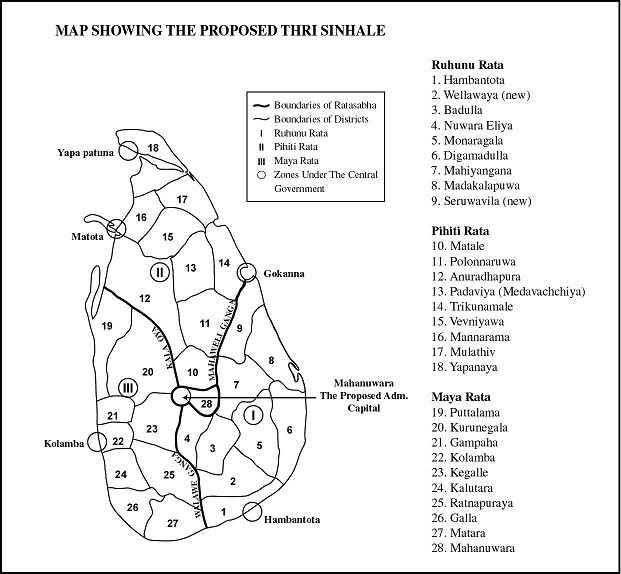
The Tun Rata: Ruhunu, Pihiti and Maya (Tun Sinhale)

Best model of devolution and decentralization, both political and executive power to the periphery and the people.

The whole Island and its territorial waters will be divided in to three Regions (Prantha) to be named ‘Ratasabha’; viz Ruhunu, Pihiti and Maya keeping with the age old tradition that had been there in this country from 427 BC to 1815 AD. (no other country in the world has had an uninterrupted geopolitical system for such a long time like this)

This is how Mahavamsa narrates the demarcation of village boundaries by Pandukabhaya in 427 BC.

Dasavassabhisitto so – gamasiima nivesayi

Lakadeepamhi sakale – Lankindo Pandukabhayo’    (MV.X.103).

(King Pandukabhaya attained the throne in 437 BC).

(This demarcation of village boundaries were later incorporated in to the Tun-Sinhale map which continued until 1815 with minor boundary changes, the last being the Udarata Rajadhaniya (Kandyan Kingdom) with its capital in Senkadagala Pura (Mahanuwara-Kandy) extending up to the sea right round the Island with access to the sea excepting a narrow coastal belts occupied by the Portuguese, Dutch and British successively, more particularly in the South Western littorals.

It must be noted with precision that the Sinhale or Ceylon as the British called it, when it was handed over to us to be governed as a dominion under the Ceylon Independence Act 1947 within the British Commonwealth of Nations (10th Dec 1947) included the whole Island. However the Maldives Islands that was a part of the ancient Sinhale Kingdom was not handed back to us in 1948. Deceitfully the British kept it with them as one of their protectorates under clause 2 Part 1 of the said order until 26th July 1965, when it was declared as a separate country. Besides failing to claim for Maldives our politicians could not get restored even the very name of this country- Sinhale” ceded to British in 1815. They also failed to send out nearly 1 million South Indian coolies like what Burma did in 1947. Today they occupy nearly 13 lahks of acres of our Motherland on the hills right at the centre of the country where the present government has now taken steps to establish a Malayanadu for these Indian Tamils, thereby betraying the sons of the soil who owned it from the dawn of history. Whose lands are given to whom by this Government is the question all patriotic Sinhalese must ask this Government

It is in this backdrop the following proposal is made with the best of intentions with a view to rescuing the country from the present tragic situation by bringing all communities together as one nation. In order to achieve this noble goal, it is suggested that we go back to the re-establishment of the ancient Thri-Sinhale with boundaries as shown in this map. This division will ensure equitable distribution of resources, both physical and human, among the three units (land, water, coast line and even people), restore ethnic reconciliation and firmly establish a permanent geopolitical framework that will, once and for all, put an end to the present political and ethnic crisis and lay the foundation for re-building a strong and vibrant nation state.

Above all it will enable us to get rid of the curse of the British Provincial System imposed on us in 1833 along with the Huniyama that is Palalth Sabha thrust on us by force by India in 1987.

This I am confident will provide the golden key to National, Regional, Divisional and Village level god governance and all round development in this country.

The following map shows the proposed Tun Rata Divisions, 27 Districts and the Capital District.

Map Sudath Gunasekara 2004

The 3 Rata Sabhas shall be re-established accordingly. I have used Mahaweli, Walawe and Deduru Oya as their boundaries. But boundary changes could be altered after factors like population; area and ethnicity are carefully studied in detail before we finally decide on the boundaries to avoid future ethnic segregation. The need to not to disturb the overall historic ethnic composition, needed to avoid communal segregation, as a safeguard to territorial integrity etc to be born in mind, when demarcating these boundaries has to be stressed.  The boundaries of the proposed geopolitical division will extend from top to the sea coast. These three Rata Sabhas, the Disa Sbbhas and the Pradesiya Sabhas will be the main arms of the government in the Regions in implementing Government policies and Programmes in the periphery.

Each Rata Sabha will be divided in to nine Districts totaling to twenty seven (27) for the whole country. The 28th District where the Capital will be located shall be named as a special District (Capital District- This could be either Mahanuwara or Anuradhapura) with special arrangements to represent it in the Jatika Rajya Sabha and the Uttara Mantrana Sabha. Within this geopolitical demarcation one has to give up all divisive dreams like Tamil or Muslim autonomy. Everybody has to think in terms of one nation and one country.

Each District will be demarcated in to five electorates using population and area as the criteria

Each Rata Sabha area will also send 28 elected Members to the Senate, at one for each Disava?

Members to Jatika Rajaya Sabha and Rata Sabha

Each District Council will nominate fifteen 15 names at 3 per electorate names of outstanding persons from among whom the voters will elect five to represent them in the Rajaya Sabha and five to the Rata Sabbha. The five members who come first will go to the Rajya Sabha and those who come second will go to the Rata Sabha. All these Members should he permanent residents at least for 5 years within that electorate for which his/her name is proposed and their term of office is 5 years.

The members of the Rata Sabha at their first meeting will elect the Chairmen and Deputy of the Rata Sabha and also the Chairmen and Deputies of the 15 Committees. The Chairmen and Deputies of Committees in turn elect the Chief Minister and the Chairman of each Committee will be designated as a Minister of the Rata Sabha. The Chief Minister will be appointed by the President on the recommendation of the Governor in consultation with the religious dignitaries of the Rata area. The other Ministers will be appointed by the Governor in consultation with the Chief Minister and religious dignitaries of the Rata.

A Governor appointed by the President in consultation with the Prime Minister, the Chief Minister and the Religious Dignitaries of the Rata will function as the chief executive of the Rata Sabha. The present practice of appointing defeated politicians and political catchers as Governors should be done away with and only persons of outstanding merit and proven abilities in Administration and management who could command the respect of Council Members and the people of the area should be appointed as Governors of these Rata Sabhas.  In order to make it easy for the President the Rata Sabha will nominate three names to the President from among persons who have rendered a distinguished service to the country or the Rata Sabha area who have permanent residence within that Rata Sabha area to be appointed as Governors

There will be a Council of Ministers consisting 15 members presided over by a Chief Minister who will again be appointed by the President in consultation with the Prime Minister who will make his recommendations after consulting the MPP of Jatika Rajya Sabha representing the particular Rata Sabha area and Rata Sabha Members of the relevant Rata Sabha and the Religious Dignitaries of the area.

The Chief Minister will be in charge of the Ministry of Finance and Public Administration and Lands in addition to any other subject as decided by the central government

The term of office of all members other than the Governor who will remain in office until the new Sabha takes office after swearing in will be 5 years

Other than the President of the Republic all other elected Members (electorate) and Governors (Rata) should be permanent residents of the electorate or the Rata Sabha for which he/she seeks election or appointment to qualify to be elected or appointed to such posts. No person from an outside area shall be appointed or nomination given.

Any Citizen resident in any part of the country could be nominated for the post of President provided he/she has the necessary qualifications stipulated in the Constitution.

The Governor should be eligible for reappointment on the recommendation of the new Council of Ministers of the Rata Sabha in consultation with the Members of the Rata Sabha and religious dignitaries of the area.

Constitutional provisions shall be made to provide for the recall of any elected member in case of his or her failure to fulfill the task assigned to him/her as a representative of the Public.

Present        Proposed

President             1                 1

Prime Minister 1                 1

Governors           9                 3

Total                  11                  5

Present                         Proposed

MPP Parliament                 225        Parliament         152

Provincial CS                      638        (3 Ratasabhas)   151

Ministers Parliament       112*       Parliament         18*

Ministers PCC                     45*      (3 Ratasabhas)    18*

Senators                        nill                                          35

Total No Politicians    10+225+638=873                374

The 3 Rata Sabhas (Ruhunu, Pihiti and Maya) under this system will have 3 Governors and 3 Chief Ministers and 151 Ratasabha Members (including the CM), instead of 9 Governors, 9 Chief Ministers, and 638 odd parasitic and rogue Provincial Councilors?

This will  save more than Rs 600 Billion annually wasted now just to upkeep Provincial Councilors, their kith and kin and this monstrous and wasteful system for no benefit absolutely to the country and that takes the country and the nation down the Gadarene slope for total disaster and bankruptcy.

All development work at each level will be done jointly by the respective Councils and Government Departments. But intra-Divisional and Intra District and Intra-Rata Sabha project will be handled by the central Government. But no local work should be done by outsiders without the concurrence of the respective Councils. The central Government in this case will only facilitate the work with funds, technical knowhow etc. This will ensure much desired self- rule for the local people. All regional development within the villages, Upa Disa. Disa and Rata, other than major intra rata or intra Disa and Intra Upa Disa should be given to the people of those respective areas.

All elected people other than the President of the Janarajaya should have permanent residence within the electorate which they represent. However, the nominees for the post of President could be from anywhere in the Island.

Planning for the grass root level under this system will start at the Grama Sabha (Village Council)  and Gam Sabha level

No politician or public servant, either directly or indirectly shall be allowed to engage in contracts with the Government at any level.

The Provinces, Provincial Councils, and the existing Pradesiya Sabha will be abolished under this system immediately.

I also suggest that we implement the recommendations given in my Siya Panatha (100) to make the new system more effective and meaningful

The proposed Tun Rata Model will benefit the country in the following manner.

It will,

1 Remove the Provinces introduced by the British in 1833 to divide and rule this Island and also the Indian imposed Provincial Council System and the 13th Amendment embraced by JR firstly to the North and East for his survival and rest of the country for dirty political maneuvering when no one asked for it in these regions.

2 Firmly establish a sound, strong and sustainable geopolitical framework that will consolidate the political map of the Island that conforms to geographical, regional, and cultural differences and lays the foundation for re-building a strong and vibrant nation state.

3   Provide a framework for maximum decentralization to ensure balanced and contented development in the regions.

4 Stop ethnic segregation and polarization and promote ethnic and regional harmony and reconciliation that leads to national integration. It will also put an end to all agitations for separate and independent Tamil and Muslim political entities and induce them to think and behave as full citizens of this country without having allegiance to India, Arab world or in the alternative leave for any Land of Promise.

5 It will also result in drastic reduction in expenditure on Provincial Council Councils and Pradesiya Sabhas white elephants and reduce the number of politicians and superficial politico-administrative institutions and the so-called public servants to a workable and economic minimum that suits the country, thereby saving billions annually wasted at present to maintain a ceremonial, corrupt and wasteful system

6 Drastically cut down the Government expenditure and make available more funds for national development that will improve the standards of living of the common people.

7 Put an end to colonial administrative and political legacies that nurtured ethnic polarization and colonial servility, their divide and rule policy that seriously hampered the forward march of the post-independent Sri Lanka and open up new vistas for a united and prosperous new Lanka.

8   Ensure fair and equitable distribution of resources both natural and human among the regions        and promote maximum and balanced regional development.

9 Provides a political framework where all people will begin to think firstly, as members of a Rata (Ruhunu, Pihiti or Maya), and secondly, as one nation instead of the present tendency of thinking as Sinhalese (Low country and Kandyans), Tamils or Muslims etc.

10 Restore the lost core historical, political, cultural and economic heritage of the people of this Island nation and lay the foundation for future political stability and socio-economic prosperity.

11 Put an end to the curse of provinces that were designed by the British to divide and dis-integrate this country on ethnic grounds and the Provinces and Provincial Councils forced on us by Britain and India to achieve their sinister   objective of creating a Tamilnadu within this country.

12 Prevent the formation of the Malayanadu in Central Sri Lanka and I the hill country will get equally divided between the Tun Rata. The dream EELAM of Tamils in the North will get divided between Rajarata and Ruhuna

13 This system will do away with political rivalries and wastage of time, money and election related crimes and bring about a system of government of our own keeping with the age old traditions of the country where the will of the people will reign instead of the present practice of the whole nation becoming the victims of the Colombo base agents of the International and colonial masters.

14 Drastically reduce political and administrative positions and Institutions and overheads.  Therefore it will result in drastic reduction of Government expenditure on salaries, vehicles, buildings and Elections etc

15 Remove dictatorial powers and immunity of the President and empower people with decision making power down to the very grass root level and make their sovereignty meaningful.

16 Will result in the devolution of power to the grass root level and people will share the power of governance making it fully democratic.

17 The number of Ministers and Ministries at the centre will get reduced to eighteen (18)

18 Party politics will disappear from Trade Unions, Universities and government offices thereby millions of man hours lost per day on demonstration etc could be gainfully used for nation building.

19 Finally it will mark the formation of a government by the people, for the people and of the people. Every citizen under this system will feel proud that he is also a part of the Government.

20 It will mark the dawn of a new era in democracy in practice and might become a model for all countries that have become victims of colonial exploitation discarding the western systems of government utterly inappropriate to their native environments.

21 This will end the present system of Government by the politicians, for the politicians and of the politicians, their families and cronies” and instead we will have a Home grown system of self Government by the people, for the people and of the people”

22 This system of government is expected to guarantee governance in accordance with Dasarajadharma and enthrone the principle of ‘Bahujana sukhaya Bahujana hitaya” preached by the Buddha.

23 The new system of Government will also be based on the principle where the Wheel of Power will revolve on the Wheel of Dhamma and where Dhamma will form the solid Foundation of Governance culminating in righteous government

24 It will mark the dawn of an era of new political culture leading the way to a ”civilization’ State as Martin Jaque has described in his book ‘When China Rules the world’’.

25 The whole country will begin to move forward with one national policy

26 There will a closer relationship between the representatives and voters

27 No politician will be able to run away from responsibility firstly as they have become local people who have a moral obligation to the people and secondly as they could be recalled by the people at any time.

28 All institutions will have politicians who are compelled to do what the people want and none will be able to deceive and rob the people and do what they want.

29 The word political victimization will never be heard in this country thereafter as there are no political parties

30 There want be any claim for devolution as maximum power will be decentralized up to the village level under this system for people to take their decisions within the framework of broad National Policies.

31 With an Independent and strong Judiciary and Public Service; a New Political Culture in Sri Lanka and A new approach to Good Governance, all this you can expect under this system

32 Finally political, socio-economic, ethnic and regional conflicts will hopefully come to an end

Proposed action Plan

It is suggested first we appoint a panel of experts to finalize this document. It would be very useful to have public sittings on a District wise basis to get public participation before the preparation of the final Report on which we should base the Charter 2017; Towards a New Political Culture in Tun Sinhale”

Thereafter we invite party leaders for a joint meeting and present our document. The group that acceps our proposals and gives a definite written undertaking to implement our programme to the letter after they win the election, we will organize the whole country to support them. Just like what the Sinhala Buddhist patriotic people did in 1956, but with a difference, that is they cannot go back  on their promises like how they have been doing ever since 1948, with impunity.

Besides acceding to our above requests they also have to agree to accommodate 28 candidates recommended by us to represent the 28 Districts and agree to reserve a minimum of five important ministry positions and five Deputy Ministry positions to our movement.

After coming to power under the present Constitution they have to agree to promulgate the new Constitution as agreed within six months and dissolve the Government. Thereafter new Elections have to be held under the new Constitution and immediately begin to implement the new Constitution and this Charter

Overall these are only some random thoughts that came to my mind. Details have to be worked out jointly by a panel of patriotic experts in each field like eminent persons well versed in Local Government, Constitutional Law, systems of government including our own traditional Sinhala system that was there from ancient times.

Dr. Sudath Gunasekara21.Gemunu Mawatha, Hanthana Pedesa Mahanuwara. 081 2232744—071 8075326 28.7.2018

Imperialists’ Fear And Loathing Of Being Colonized – OpEd

August 3rd, 2018

By 

For decades and longer, the United States and Europe lectured and encouraged countries in Latin America, Africa and Asia to welcome and accept foreign investment as the virtuous path to modernization, growth and prosperity.

With few notable exceptions western leaders and academics promoted unlimited flows of capital (and the outflows of profits). No section of the targeted economies was off-limits – agriculture, mining, manufacturers, utilities, transport and communication were to be ‘modernized’ through US and European ownership and control.

Third World leaders, whether generals, bankers or landowners who abided by the ‘open markets’doctrine and ‘invited’ foreign ownership, were praised, whether they were dictators or elected by hook or crook. Nationalism and nationalists were condemned as restricting the wheels of progress and blocking the March of History.

To be fair, the western regimes encouraged all countries to open their doors to capital flows – but of course only the imperial countries had the capital, technology and political power to do so.
Economists preached the doctrine of specialization in ‘comparative advantage’: the West to invest, profit and dominate markets and the South to accept low wages, junior partnerships and dependent industries.

This system worked very well for the West as long as they were the dominant power and shaped the markets, flows of capital and the terms of exchange.

Nationalist leaders were condemned, sanctioned, ousted and demonized throughout the time of Anglo-American ascendancy.

Through time and efforts, Third World countries followed another path – through revolutions or reforms, through state direction and national entrepreneurs, they invested, innovated, borrowed and transformed their economies. Over time, some like China, began to successfully compete with Western powers for markets, minerals and technology.

Role Reversal: Imperial Washington Denounces China for Colonizing the Economy

As the US Empire failed to out- compete China, not only in overseas markets, but in sectors of the domestic economy, local manufacturers relocated to China and Mexico or went bankrupt or merged or were acquired by foreign capital – notably China.

Nationalism replaced neo-liberalism and globalism among sectors of the ruling class especially among political ideologies grouped around President Trump.

The nationalists forged a national pluto-populist alliance, linking Wall Street, backward sectors of the capitalist class with displaced and under and unemployed workers under the umbrella of ‘protectionist rhetoric’: massive business tax cuts and tariffs, quotas and taxes on European, Asian and North American competitors. Gone were Washington lectures on free markets and the virtues of globalization and multi- lateral trade agreements.

The new protectionism echoed the rhetoric of 18th and 19th century America and the Great Depresion era Smoot- Hawley tariff. Earlier the US claimed tariffs were necessary to protect and foster so-called ‘infant’ industries; twenty-first century protectionism claims it is to protect ‘national security’ from cross oceanic rival (China) and cross border (Canada, Mexico)—- mortal military threats…

President Trump adopted the ideology of Third World national liberation governments to undermine its— imperial competitors. Washington,s ersatz ‘nationalist’ empire builders were abated by their media allies, who spilled tons of ink attacking ‘imperial’ China’s overseas investments as ‘plundering’ Africa, Latin America and Asia.

Washington projected an image of the US surrounded by enemies everywhere, who were ‘taking advantage’ of their privileged position in order to exploit a ‘weak America’.

President Trump reverted the nationalist slogans of Third World liberation into imperialist calls to Make Americas Empire Strong”

Third World nationalism is an ideology to create domestic markets and industries in largely agro-mineral economies, through public-private investment and state ownership, oversight, regulation and subsidies.
Nationalism of declining empires is the ideology of authoritarian militarists and fascist regimes which no longer can compete in the market place.

Imperial countries in decline have several options.

1) They can adapt to the new realities by upgrading their economies , reducing overseas military commitments, reallocating budgets and investments and educating their labor force to productive activity.

2) They can form partnerships with emerging competitors via power sharing, innovations, joint ventures and multi-lateral trade agreements.

3) They can engage in trade wars, overseas military conquests or encircle emerging rivals through sanctions, tariffs and protectionist fiats.

Nostalgia for the past ‘glory’ of unipolarity , economic supremacy and unquestioned ideological superiority, is a formula for losing wars and a Hobbesian world of all against the predator.

Conclusion

In the beginning a nationalist-populist revival can stimulate growth as rivals will appease the aggressor; the imperial classes will prosper through lower taxes; the ‘deplorables’ may glory in the rhetoric of nationalism and expectation of ‘great thing are coming’.

But tax gains mean bigger debts; appeaser nations in the face of permanent losses of vital exports will retaliate .. and succumb to the protectionist contagion. Imperial globalists will turn into nationalists.

Nationalist will replace impotent neo-liberal social democrats. Workers will turn to nationalists to recover their lost workplace and neighborhood solidarity; nationalists will exploit downward mobility and appeal to images of past prosperity.

National plutocrats will turn to authoritarians who speak to popular grievances in order to deflect class antagonism.Nationalists will gain a popular audience in the face of a left that avoids , dismisses or rejects the shared values of local communities. Liberal and progressive support of overseas wars which increase the flow of immigrants , alienates the working and middle class taxpayers. The declining empire will not die early.

The nationalist revival can revive imperial ‘last hurrah! The fear and loathing of being colonized is the driving force for the new imperial revival.The lies and hypocrisy accompanying the older imperial claims of conquest in the name of ‘defending western values’ no long works.

A consequential opposition can only emerge if it links class and nationalist appeals to community values and social solidarity.

The bigger, the better?

August 3rd, 2018

Editorial Courtesy The Island

Prime Minister Ranil Wickremesinghe has done a President Maithripala Sirisena. Whenever the government takes unpopular decisions and riles the public in the process, the President, invariably, claims to be unaware of them. His stock excuse is that he has got to know about them from the newspapers. What a song and dance he made about the recent fuel price hikes; he went so far as to halt their implementation only to make an about-turn a few days later.

Now, the PM is reported to have demanded to know from the Finance Ministry how long the massive increase in import duties on small cars is going to last. The impression he has given the public is that the highly unpopular move, which has sent the ordinary people reeling, has been made unbeknownst to him.

The yahapalana leaders ought to realise that the masses are no asses; they have their own way of taking revenge; they dealt a knuckle sandwich to President Mahinda Rajapaksa in 2015 and gave both President Sirisena and PM Wickremesinghe a body blow each at the last local government polls.

In times of forex crunches, imports have to be controlled to prevent the depletion of foreign reserves. Such measures make economic sense. The rupee is depreciating rapidly against the US dollar, aggravating the country’s balance of payment woes. The economic pundits of the yahapalana government have manifestly failed to manage the economy properly, much less live up to people’s expectations. They promised economic miracles and gave the state workers a huge pay hike immediately after coming to power. They now regret having ever done so. Never did they tell the public that the going would be tough due to debt servicing and other such issues.

The government and the country are in the current predicament because the yahapalana leaders’ dream of receiving funds from their foreign masters did not materialise. Promises are said to be like babies—easy to make but hard to deliver. It may be recalled that the UNP-led UNF government crashed in 2004 because the US and other self-appointed Co-Chairs of Sri Lanka’s peace process did not honour their aid pledge (USD 4.5 bn). A similar fate has befallen the UNP-led yahapalana administration without any financial assistance from its international allies.

The problem is not the government adopting measures to curtail imports to maintain dollar reserves as such, but the fact that its politicians do not care a tinker’s cuss about forex crunches when it comes to feathering their nests. If they led by example and opted for austerity measures themselves, the public would follow suit without complaining. But, the yahapalana leaders waste public funds to the tune of billions of rupees unconscionably to buy themselves super luxury vehicles while trying to save forex at the expense of the people who can afford only small cars. Their foreign junkets also cost Citizen Perera an arm and a leg.

The yahapalana alliance has been in power for more than three-and-a half years. If it had cared to develop the public transport sector and promote the use of renewable energy it would have been able to reduce the country’s dependence on fossil fuel and cut down on the import bill considerably. It promised flyovers, more trains, track development, solar power projects, expressways and monorail. If a mass rapid transit system had been introduced as promised, the demand for small cars would not have increased so drastically.

Thanks to the new duty hike, the ordinary people who were planning to buy small cars will have to suffer in congested buses and trains while the yahapalana leaders and their kith and kin move about in luxury vehicles. The government seems to think small is ugly and the bigger, the better.

Fiscal position management prompted vehicle and gold import tax hikes says CBSL Governor

August 3rd, 2018

By Hiran H.Senewiratne Courtesy The Island

The government has imposed taxes on gold and vehicle imports to manage the country’s fiscal position, which has already resulted in some relief for the economy, Central Bank Governor Dr. Indrajit Coomaraswamy said.

“At present with the new tax imposition, gold imports have come down to manageable levels, while vehicle imports, which account for more than 50 percent of the non petroleum import bill, will also contain with the new tax imposition on 1000 CC and below capacity vehicles, Dr Coomaraswamy told the media at the monthly monetary policy meeting. The event was held at the Central Bank auditorium yesterday.

He said that in the first five months of 2017, Sri Lanka imported US $ 26 million worth of 1000 CC vehicles into the country while in the first five months of 2018, it moved up US$195 million, which is a 1000 percent increase.

article_image

Dr. Coomaraswamy

‘During the last few years, 1000 CC vehicle imports have gone up in an unimaginable manner, which has a big fiscal pressure on the economy. Due to that the government imposed taxes on such vehicles, he said.

Dr Coomaraswamy said that the economy is beyond control on the fuel import bill, which is also increasing at a rapid pace.

The Governor also said that there would be a gradual pickup in domestic economic growth from the second quarter of 2018 and inflation is expected to remain in mid-single digits in spite of the recent uptick.

“The economy is projected to reach its potential over the medium term, benefiting from a competitive flexible exchange rate, a low inflation environment and a stronger policy framework to support exports and investment, amid continued fiscal consolidation, the Governor said.

He added: ‘Although inflation is projected to remain at the higher end of the inflation target of 4 – 6 per cent in August as well, the onset of the harvest towards the end of the third quarter of 2018 is expected to lower inflation thereafter.

‘The gross official reserve position was estimated at US dollars 8.4 billion at end July 2018 compared to US dollars 8.0 billion recorded at end 2017.

‘So far during the year, the Sri Lankan rupee has depreciated against the US dollar by 4.2 percent.

‘The continuation of the current monetary stance is appropriate at this juncture.

‘Accordingly, the Standing Deposit Facility Rate (SDFR) and Standing Lending Facility Rate (SLFR) remain at 7.25 percent and 8.50 percent, respectively, while the Statutory Reserve Ratio remains at 7.50 percent.’

Dr. Coomaraswamy said that after considering the current and expected domestic and global economic developments, the Monetary Board has decided to keep rates unchanged in keeping with its aim to stabilize inflation at mid-single digit levels in the medium term, thereby contributing to a favorable growth outlook for the Sri Lankan economy.

‘Both national and Colombo inflation remained at low single digit levels, in spite of the transient acceleration, mainly arising from the upward revisions to prices of domestic petroleum products and other administratively determined prices, he added.

Sri Lankan PM Ranil Wickremesinghe visits Tirupati Temple

August 3rd, 2018

Courtesy ANI

Chittoor (Andhra Pradesh), Aug 03 (ANI): Sri Lankan Prime Minister Ranil Wickremesinghe, his wife and other ministers on Friday visited Tirupati Temple in Chittoor district in Andhra Pradesh. Wickremesinghe along with his wife Maitree Wickremesinghe among other ministers and their families visited the shrine to offer their prayers to Lord Venkateswara. His last visit to the temple was in 2016. Wickremesinghe thanked Government of India (GoI) and the state government of Andhra Pradesh for facilitating their visit.

Sri Lanka secures $1 billion Chinese loan

August 3rd, 2018

By AFP Courtesy Daily Mail

The huge port under construction in Colombo straddles the world’s busiest east-west shipping route and also gives a strategic foothold to China in a region long dominated by India

Sri Lanka’s central bank on Friday announced it had secured a $1 billion Chinese loan as the island, a key link in Beijing’s ambitious Belt and Road initiative, develops closer relations with Asia’s largest economy.

Central bank Governor Indrajit Coomaraswamy said that first half of the loan will be released later this month and the balance will be received in October.

“During consultations (with the Chinese over the loan) it was clear that they see us as a key strategic partner as far as the (Belt and Road) initiative is concerned, given our location,” Coomaraswamy told reporters in Colombo.

The huge port under construction in Colombo straddles the world's busiest east-west shipping route and also gives a strategic foothold to China in a region long dominated by India

The eight-year loan by China Development Bank carries a 5.25 percent interest rate with a three year grace period.

Coomaraswamy said that the terms of Chinese loan were better than other international lenders and the country hopes to secure additional $200 to $250 million from China’s domestic financial market by issuing “Panda bonds”.

Last month, China vowed to keep providing financial help, including loans, to Sri Lanka despite warnings about the island nation’s mounting debt.

Sri Lanka last year granted a 99-year lease on a strategic port to Beijing over its inability to repay Chinese loans for the $1.4 billion project.

The port in Colombo straddles the world’s busiest east-west shipping route and also gives a strategic foothold to China in a region long dominated by India.

China had said its loan portfolio in Sri Lanka was $5.5 billion as of last month, just over a tenth of Colombo’s total $51.82 billion external debt.

“China will continue to provide selfless support, including much-needed funds for the development of Sri Lanka,” the Chinese embassy in Colombo said last month.

China’s Belt and Road infrastructure project seeks to revive ancient trade routes through a massive rail and maritime network via $1 trillion in investments across Asia and Europe.

The International Monetary Fund, which bailed out Sri Lanka in June 2016 with a $1.5 billion staggered loan, has warned that Colombo over its heavy debt.

Sri Lanka’s economy has been on the mend since the IMF bailout, but growth in 2017 at 3.1 percent was the slowest in 16 years.

The central bank had forecast 2018 growth at between 4.0 to 4.5 percent, but Coomaraswamy on Friday revised his estimate for the calendar year to below 4.0 percent.

Sri Lanka part of China’s One Belt One Road initiative: Communist Party

August 3rd, 2018

Courtesy wionews

A Communist Party on Friday said that Sri Lanka is a partner in China’s ambitious One Belt One Road initiative.

This multi-billion initiative of Chinese President Xi Jinping focuses on improving connectivity and cooperation among Asian countries, Africa, and Europe.

Guo Yehou, a Chinese Vice Minister, met Sri Lankan Prime Minister Ranil Wickremesinghe as part of the ongoing close relationship between the ruling Communist Party of China (CPC) and Wickremesinghe’s United National Party (UNP), the prime minister’s office said in a statement.

Wickremesinghe is the main negotiator of the Sri Lankan government’s trade links with China.

The Chinese delegation assured Wickremesinghe of all assistance to make Sri Lanka a commercial and financial hub in South Asia, the statement said.

The prime minister has faced internal criticism for his furtherance of the Chinese projects including the construction of the port city in Colombo and the industrial park around the seaport in Hambantota.

Both were Chinese infrastructure projects funded under commercial loans during the 10-year rule of former president Mahinda Rajapaksa.

Last year in December, Sri Lanka Handed over the control of the southern seaport of Hambantota to China on a 99-year lease, focusing on the concern over Beijing’s efforts to expand influence in the region.

The opposition has set the deals as the sell out of national assets.

බලගතු සේනා දැන් නම් ඕනෑ

August 3rd, 2018

උපුටාගැණීම  මව්බිම

රටේ නායකත්වයට පත් නොවී දෙවැනි පෙළ පුටුවේ කාලයක්ම වාඩි වී සිටිමින් රටට සේවය කළ මිනිසුන් බොහෝය. ඔවුන්ට අනුව රට ගොඩනැඟීම ප්‍රමුඛ වූවා මිස තමන් ගොඩනැඟී මුල් පුටුවට ඒම ප්‍රමුඛ කාරිය නොවීය. කෙසේ වෙනත් රටක නායකයකු වන්නට සිතා සිටින්නකු වෙත්නම් හේ මහත් ඉවසිලිවන්තයකු විය යුතුය. බැනුම් අහන්නට පමණක් නොව නොයෙකුත් අකටයුතුකම්වලටද මුහුණ දෙන්නට හැකි අයකු විය යුතුය. දරා ගැනීමේ ශක්තිය නායකයකු ළඟ නැතිනම් ඔහුට වැඩි කලක් යන්නට බැරිය. ඒ අනුව ඔහු ඇද වැටුණාය යනු රටක් ඇද වැටුණාක් මෙන් වැනසෙනු ඇත.

විරුද්ධ පාර්ශ්වයේ බොහෝ අය ජේ.ආර්.ට තවමත් බනින්නේ එසේ නොබැන බැරි නිසාය. එසේත් නැතිනම් කලින් බැනලා තිබුණු හැටියට ඒ බැනපු ඒවා වෙනස් කරන්නට බැරි නිසාය. තවත් විදියකින් කියනවා නම් මේ උන්දැලාට ජේ.ආර්. දැකපු ඇත්ත දැන් තේරුම් ගිහින් තිබුණා වුණත් “ජේ.ආර්. හොඳය” කියා කියන්නට බැරි වෙන තරමට බරපතළ විදියට ගොළුවන් සේය.

එක්සත් ජාතික පක්‍ෂයේ නායක පුටුව බලාගෙන කටයුතු කරන්නට සිතා සිටින හා නායකයන් වන්නට සිතා සිටින්නන්ට ජේ.ආර්.ගේ ඉවසීමේ ගුණය හදාරන්නට ඕනෑ වී ඇත්තේ ඒ තරමටම මේ අයට ඉවසීමක් හා තමන්ගේ යුතුකම හා වගකීම ගැන වැටහීමක් නොමැති නිසාය. ජේ.ආර්.ට බලය ලැබෙන විට එනම් හයෙන් පහක බලය සහිත බලගතුම පිරිසක් සමඟ අගමැති වන්නට වන විට ඔහුට වයස අවුරුදු 72කි.

අවුරුදු හැත්තෑ දෙකක් වයස ගතවන තුරුම ජේ.ආර්. ඉවසුව නිසා ඔහුට ඉතා හොඳ මිණිකැට මල්ලක් ගරා ගන්නට හැකි වූයේය. වයසත් එක්ක, ඉවසීමත් එක්ක අමතර ලබා ගත් දැනුමත් එක්ක මිනිසුන්ගේ හැසිරීම් ගැන සටකපටකම් ගැන ප්‍රායෝගිකව ලබාගත් දැනුමත් එක්ක ජේ.ආර්. ඉතා ඉහළ මට්ටමෙන් දේශපාලනයේ තෙම්පරාදු වුණේය.
“එක වෙලාවකට හිතෙනවා මට මේ කෙරුවාව අල්ලා දාලා ඔය කෑ මොර දීලා නායකකම ගන්න ඉන්න උදවියටම මේක කරගන්න දීලා ගෙදර යන්න” කියලා ජේ.ආර්.ට හිතුණා නම්, එසේ වූවා නම් 77 පෙරළිය සිදුවන්නේ නැත. මේ රටේ ආර්ථිකය ලෝකයාට විවෘත කරන්නට ලැබෙන්නේ නැත. වේගයෙන් දියුණු වන ලෝකයට මේ රට බද්ධ කරන්නට ලැබෙන්නේ නැත. ඉන්දියාවේ, බංග්ලාදේශයේ, චීනයේ නායකයන් දෙවරක් හිත හිතා පස්ස ගහද්දී විවෘත ආර්ථික ක්‍රමයට අප යා යුතු යැයි ජේ.ආර්. සිතුවේ ඊට බොහෝ කලකට පෙරය. ජේ.ආර්. ඉස්සර වුණේය. ඉන්දිරා ගාන්ධිට මේ හැරවුම තේරුම් ගිය නිසා ඉන්දියාවට වඩා අප එක සීරුවේ යෝධ පිම්මක් පනින්නට සූදානම් වූ බව දැනී ඇය සැලුණු වාර අනන්ත විය. ජේ.ආර්. තනිව මේ ගේම ගැහුවේ නැත. ඔහුට වයස 72ක් වන තුරු දැනුම් තේරුම් ඇතිව සොයාගත හැකිව තිබුණු මිණිකැට මල්ලක් එකතු කරගනිමින් පසු වුණේය.

රොනී ද මැල් ඔහුගේ හොඳ තේරීමකි. රොනීට මුදල් ඇමැතිකම කරන්නට වෘත්තීය සුදුසුකම අන් අයටත් වඩා ඕනෑවටත් වඩා පූර්ණ වී තිබුණේය. රොනී දක්‍ෂ පරිපාලකයෙකි. නිලධාරියෙකි. ශාන්ත තෝමස් විද්‍යාලයේ දීප්තිමත් සිසුවෙකි. කොළඹ විශ්වවිද්‍යාලයේ හොඳ ප්‍රතිඵල ලද්දෙකි. ශ්‍රී ලනිපයෙන් රොනී ගලවා ගන්න ජේ.ආර්.ට හැකි විය. 1925 අප්‍රේල් 11දා උපන් රොනී, ජේ.ආර්. 77 ආණ්ඩුව හදද්දී ඔහුගේ වයස අවුරුදු 52කි. එය හො¼දට තෙම්පරාදු වූ පරිණත වයසකි.

රොනී එවක ලෝකයේ සිදුවන ආර්ථික පෙරළිය ගැන හොඳින් කියවා තිබුණෙකි. ජේ.ආර්.ට දැනුණු ඉව ඔස්සේ රොනී 77 පිහිටුවන ආණ්ඩුවේ මුදල් ඇමැතිකමට ඕනෑ කරන දැනුමින් පිරී සිටියේය. ජේ.ආර්.ගේ තවත් මැණිකක් වූයේ ලලිත්ය. ලලිත්ගේ උගත්කමත් ලලිත්ගේ දැනුමත් ගැන ජේ.ආර්. හොඳින් දැන උන්නේය. ලලිත්ටවත් නොදැනීම ජේ.ආර්. සැලසුම් හැදුවේය. හාවඩ් සරසවියේ දීප්තිමත් ශිෂ්‍යයකු වූ නව දැනුම හඹා ගිය අලුත් ලෝකයක ප්‍රවණතාවන් දුටු ලලිත් ඕනෑම වගකීමක් දැරිය හැකි නායකත්ව ලකුණු තිබුණු අයෙකි. 1936 නොවැම්බර් 26දා උපන් ලලිත් 77 පෙරළිය වෙද්දී වයස අවුරුදු 41ක ශක්තිමත් වැඩ කළ හැකි වැඩි ධාරිතාවකින් හෙබියේය. ලලිත්ට රටේ ආර්ථිකය විවර කරද්දී වෙළෙ¼දාමත් නාවික හා භාණ්ඩ ප්‍රවාහන ප්‍රවණතාවන් නවමු මඟක් ඔස්සේ නංවන්නට හැකියාවක් තිබුණේය.

ජේ.ආර්. එකතු කරගත් තවත් මැණිකක් වූයේ ගාමිණීය. ගාමිණී ඇතැම් විට ජේ.ආර්.ට අන් අයට වඩා ළෙන්ගතුව සමීපව සිටියේය. 1942 මාර්තු 20දා උපන් ගාමිණීට 77 ජේ.ආර්.ගේ ආණ්ඩුව පිහිටුවද්දී වයස අවුරුදු 35කි. ලලිත්ට වඩා අවුරුදු 6කින් බාල වුවත් ලලිත් තරමටම ගාමිණී ද හපනෙක් විය. ඔහු වඩාත් අකර්ෂණීය රූප සම්පත්තියකට හිමි නායකත්ව ලක්‍ෂණ පළකළ අයෙකි. ජේ.ආර්. තම විශ්වකර්ම බලාපොරොත්තුව ගාමිණීට පවරන්නට සිතා උන්නේ මේ සියල්ල ඉවසීමෙන් නිරීක්‍ෂණය කරමින් සිටි නිසාය. මහනුවර ත්‍රිත්ව විද්‍යාලයේ හා බි්‍රතාන්‍ය කේම්බි්‍රජ් සරසවියේ දීප්තිමත් සිසුවකු වූ ගාමිණීට ඓතිහාසික පෙරැළියක වගකීම භාර වන්නේ ඒ අනුවය.

මේ සියලු දැන උගත් අය හදා ගන්නා සිහිනය දකිමින් සිටි ජේ.ආර්.ට ඊටත් වඩා මැණිකක් තිබුණේය. ඒ ප්‍රේමදාසය. ප්‍රේමදාස සමඟ ජේ.ආර්.ට පන්තිමය ගැටලුවක් තිබුණේය යැයි ඇතැමුන් කියූවත් ප්‍රේමදාස පොදු ජනතාව තුළින් මතුවූ පොළොවේ පය ගසා ජීවත්වී පොදුජන නායකයකුව සිටි බව ජේ.ආර්. අත්දැකීමෙන්ම දැනගෙන උන්නේය. ඉතාමත් පහළම තැනක සිට සමාජයේ දැවැන්ත යුතුකම් සම්භාරයක් ඉටුකළ හැකි, පොදු ජනතාවගේ හැඟීම් වටහා ගත හැකි ප්‍රේමදාස ඕනෑම කෙනකු බව ජේ.ආර්. දැන උන්නේය. 1924 ජුනි 23දා උපන් ප්‍රේමදාස ජේ.ආර්. ගේ 77 ආණ්ඩුව පිහිටුවද්දී වයස අවුරුදු 53ක අයෙකි. හොඳින් තෙම්පරාදු වූ අයෙකි. ප්‍රේමදාස ඒ අනුව රොනීට වඩා අවුරුද්දකින් වැඩිමල්ය. රොනී, ලලිත්, ගාමිණී වැනි තෝරා ගැනීම්වලට එහා ගිය දැක්මකුත් ජේ.ආර්. ළඟ තිබුණේය.

ජේ.ආර්.ගේ “ප්ලෑන් ඒ” හි සුපිරි තෝරා ගැනීම ප්‍රේමදාස, රොනී, ලලිත්, ගාමිණීය. එහෙත් දුර දැක්මක් ඇති ජේ.ආර්.ට “ප්ලෑන් ඕ” කියාද දෙයක් තිබුණේය. එහි ව්‍යාපාරික ඥානයත්, ලෝකයේ ආයෝජන රටා හා නව නිපැයුම් ගැනත් දැක්මක් ඇති උපාලි විජයවර්ධන ද ඉලක්ක ගතව තිබුණේය. තෝරා ගැනුණු ලැයිස්තුවේ එකට සිටියේය. 1938 පෙබරවාරි 17දා උපන් උපාලි රාජකීය විද්‍යාලයේ දීප්තිමත් සිසුවෙකි. 77 ජේ.ආර්.ගේ ආණ්ඩුව පිහිටුවද්දී උපාලිගේ වයස අවුරුදු 39කි. ගාමිණීට වඩා උපාලි අවුරුදු තුනකින් වැඩිමල්ය. උපාලි ඍජුවම, එක හෙළාම, මුල් වටයේදීම ජේ.ආර්.ගේ ආණ්ඩුවට එකතු වූයේ නැති වුවත් ජේ.ආර්.ගේ හිතේ උපාලි ගැන ලොකු බලාපොරොත්තුවක් තිබුණේය.

ජේ.ආර්.ගේ “ප්ලෑන් ඛ්” හි සිටි ප්‍රමුඛයා රනිල්ය. 1949 මාර්තු 24දා උපන් රනිල් 77 ආණ්ඩුව පිහිටුවද්දී වයස අවුරුදු 28ක තරුණයෙකි. යමක් හඹා යද්දී ඉවසිලිවන්තව ඒ කරා යන තරුණ නීතිවේදියකු වූ රනිල් ගැන ජේ.ආර්. මේ කාටත් වඩා හොඳින් දැන උන්නේය. ගාමිණී අතුකෝරල ද තවත් තෝරා ගැනීමකි. ගාමිණී අතුකෝරලද 77 ආණ්ඩුව පිහිටුවද්දී වයස අවුරුදු 26ක තරුණයෙකි. ඒ නිසා රනිල්ට වඩා අවුරුදු 2ක් බාල ගාමිණී රනිල්ගේ නියෝජ්‍ය ඇමැති සගයා කරන්නේය.

ජේ.ආර්.ගේ ඉවසීමේ දුෂ්කර චාරිකාව තුළ එකතු කරගත් අය අතරින් අද ඉතිරිව සිටින්නේ රනිල්ය. ඒ නිසා රනිල්ට ජේ.ආර්.ගේ ප්‍රායෝගික දේශපාලන පොතේ පිටු අතරින් “ජේ.ආර්.ගේ ඉවසීමේ කලාව” කියවා තව තවත් තෙම්පරාදු වන්නට ඉඩහසර ලැබුණේය.

ජේ.ආර්.ගේ ආණ්ඩුවේ නවකයකු වූ රනිල් “ප්ලෑන් ඛ්” හි සිටි ජේ.ආර්. තෝරාගත් චරිතයකි. අවුරුදු 28දී ජේ.ආර්.ගේ අත්වාරුවෙන් සුළැඟිල්ලේ එල්ලී ආ රනිල් ඒ ආශීර්වාදයෙන් මේ වෙද්දී දිගු ගමනක් පැමිණ සිටින්නේය. දැන් රනිල්ට වයස අවුරුදු 69කි. මේ කාලය තුළ ඔහුද නායකයන් කිහිප දෙනකු යටතේම ඉවසා පදම් වී තෙම්පරාදු වී හොඳට පත්තියම් වී සිටින්නේය.

රනිල්ටද ජේ.ආර්.ට මෙන් ප්ලෑන් ඒ,ඕ,ඛ් තිබිය හැකිය. ඒ ප්ලෑන්වල ප්‍රායෝගික නායකයන් සිටිය හැකිය. ආර්ථිකය, ආයෝජනය, වෙළෙ¼දාම, විදෙස් කටයුතු, නාගරික සංවර්ධනය, නිවාස හා ඉදිකිරීම් තාක්‍ෂණය වැනි පුළුල් විෂයයන් ධාරා යටතේ ඒ අය තෝරාගෙන තිබිය හැකිය. රනිල්ට මේ ඉවසීමෙන් ලබාගත් අත්දැකීම්වලින් ලබාගත් දැනුම මේ මහ පොළොවේ පැළ කරන්නට අනාගත නායකයන්ගෙන්ද උපරිම දායකත්වය දැනුම අවැසි වන්නේය.

මේ මොහොතේදී අන් කවරදාකටත් වඩා ඒ කැපවීම, අවංක බව, නැඟී සිටීම අවශ්‍ය වන්නේය. දායක විය යුත්තේය. එසේ නොමැතිව ජේ.ආර්. ගහපු ගේම ගහන්න රනිල්ට තනිවම සටන් කළ නොහැක්කේය. කළ හැක්කක් වෙතොත් ඒ ‘ටීම් වර්ක්’ එකක් තුළින් පමණය. රනිල් ඉවසිලිවන්ත නායකයකු වන නිසාම නැඟී සිටින්නට දෙවැනි පෙළ නායකයන්ගෙන් මීට වඩා දැනෙන සහායක් ඕනෑම වන්නේය.

තවත් එක් වෙසක් පොහොයකින් පසුව අපි පිහිටුවන ආණ්ඩුවෙන් බදු බර අඩු කරනවා

August 3rd, 2018

කේ.එස්. උදය කුමාර්  උපුටාගැණීම  මව්බිම

වත්මන් යහපාලන ආණ්ඩුව මහජනතාව මත පටවමින් සිටින අධික බදු බර සහ ජීවන වියදම් ගැටලු තවත් එක් වෙසක් පොහොයකින් පසුව මහින්ද රාජපක්‍ෂ හිටපු ජනාධිපතිවරයාගේ නායකත්වය යටතේ පිහිටුවනු ලබන ආණ්ඩුවක් මඟින් අවසන් කරන බවත් එම නව ආණ්ඩුව යටතේ වත්මන් ආණ්ඩුව විසින් මහජනතාව මත පටවා තිබෙන අධික බදු බර 20%කට වඩා අඩු කිරීමට කටයුතු කරන බවත් ඒකාබද්ධ විපක්‍ෂයේ පාර්ලිමේන්තු මන්ත්‍රි බන්දුල ගුණවර්ධන ප්‍රකාශ කළේය.

ශ්‍රී ලංකා පොදුජන පෙරමුණේ නාවලපිටිය ආසන බල මණ්ඩල රැස්වීමට එක් වෙමින් බන්දුල ගුණවර්ධන මහතා මේ බව කියා සිටියේය. මධ්‍යම පළාතේ සංවිධානය කරනු ලබන ‘පොදුජන ජනරැළ’ රැස්වීම් මාලාවේ පළමු වැනි රැස්වීමද වේ.

එහිදී බන්දුල ගුණවර්ධන මහතා මෙසේද කීවේය.

මහින්ද රාජපක්‍ෂ හිටපු ජනාධිපතිතුමා ආණ්ඩුව භාර ගන්නා අවස්ථාවේ ඒ මහතාට අභියෝග 07කට මුහුණ දෙන්න සිදුවුණා. සුනාමියෙන් පීඩාවට පත්වූවන් නඟාසිටුවීම, උතුරු – නැඟෙනහිර යුද්ධය සහ ලෝක වෙළෙඳපොළේ බොරතෙල් මිල ශීඝ්‍ර ලෙස ඉහළ යෑම ඒ අතර ප්‍රධාන තැනක් ගත්තා. බොරතෙල් ගෙන්වීම සඳහා වාර්ෂිකව එදා අපේ රජයට ඇමෙරිකානු ඩොලර් බිලියන 5.1ක මුදලක් වැය කරන්න සිදුවුණා. ඒක දරාගත නොහැකි පිරිවැයක්. එසේ තිබියදීත් අපි සහනාධාර මිල ගණන්වලට භූමිතෙල් ආදිය ජනතාවට ලබා දුන්නා. එහෙත් යහපාලන ආණ්ඩුව බලයට පත්වීමෙන් පසුව ලෝක වෙළෙඳපොළේ බොරතෙල් බැරලයක මිල ඇමෙරිකානු ඩොලර් 50 සිට 30ක් දක්වා අඩු වුණා. එහෙත් යහපාලන ආණ්ඩුව අදූරදර්ශී ආර්ථික ප්‍රතිපත්තිය හේතුවෙන් රුපියල බරපතළ ලෙස බාල්දු වී වටිනාකම පිරිහී යෑම නිසා බොරතෙල් මිල අඩුවීමේ වාසිය මහජනතාව වෙත ලබා දෙන්න ආණ්ඩුවට නොහැකි වුණා. රුපියල ශක්තිමත්ව තිබුණා නම් එහෙම වෙන්නේ නැහැ. බොරතෙල් මිල අඩුවීමේ වාසිය ආණ්ඩුව ප්‍රයෝජනයට ගෙන තිබුණේ නම් හම්බන්තොට වරාය චීනයට විකුණන්න වෙන්නේ නෑ. මත්තල ගුවන්තොටුපළ ඉන්දියාවට විකුණන්න වෙන්නේ නැහැ.

අපි දේශීය ව්‍යාපාරිකයන්ට කියන්න සතුටුයි ඉදිරියේදී පිහිටුවන මහින්ද රාජපක්‍ෂ මහතාගේ නායකත්වයෙන් යුත් ආණ්ඩුවක් යටතේ ණය බරින් පීඩාවට පත්ව සිටින දේශීය ව්‍යාපාරිකයන්ගේ බැංකු ණය ප්‍රතිසමාලෝචනය කර ඔවුන්ට සහනයක් ලබාදීමට කටයුතු කරනවා.

ශ්‍රී ලංකා – සිංගප්පූරු නිදහස් වෙළෙඳ ගිවිසුම යටතේ ගවයන්ගේ හා උෟරන්ගෙන් ශුක්‍ර ධාතු සහ කලල ආනයනය කිරීම සඳහා වූ බදු සම්පූර්ණයෙන්ම නිදහස් කර තිබෙනවා. මේ තුළින් මහජනයාට සෙතක් අත්වන්නේ කෙසේද? කියා ප්‍රශ්න කරනවා.

පාර්ලිමේන්තු මන්ත්‍රි මහින්දානන්ද අලුත්ගමගේ,

හිටපු ජනාධිපති මහින්ද රාජපක්‍ෂ මහතාට දෙමළ සහ මුස්ලිම් ජනතාවගේ ඡන්ද දිනාගත නොහැකි බවට වත්මන් ආණ්ඩුව වපුරා තිබෙන මිථ්‍යා මතය මේ වනවිට පුස්සක් වී තිබෙනවා.
සුළු ජාතීන් මහින්ද රාජපක්‍ෂ මහතා මත විශ්වාසය තැබීම නිසා තමයි අපිට මේ තරම් විශාල ජයග්‍රහණයක් අත්පත් කරගන්න හැකිවුණේ. ඉදිරියේදී කුමන මැතිවරණයක් පැමිණියත් මහින්ද රාජපක්‍ෂ මහතා සමඟ එක්ව වත්මන් ආණ්ඩුව පෙරළා දැමීමට සුළු ජාතිකයන් බලා සිටිනවා.

පාර්ලිමේන්තු මන්ත්‍රී රෝහිත අබේගුණවර්ධන

මේ ආණ්ඩුව බලයට පත්වීමෙන් පසුව උඩුවේ ධම්මාලෝක හිමියන් ඇතුළු භික්ෂුන් වහන්සේ 67 නමක් සිරගත කර තිබෙනවා. ඒ වගේම වෛද්‍යවරුන්ටත් වත්මන් ආණ්ඩුව විවිධ හිරිහැර සිදු කරමින් සිටිනවා.’පොහොර සහනාධාර අපට දියව්’ කියා ගොවියෝ බෝඩ් අල්ලමින් පාරවල්වල ඉන්නවා. කම්කරුවන්ටත් අද යන එන මං නැහැ.
පාර්ලිමේන්තු මන්ත්‍රී නාමල් රාජපක්‍ෂ

මේ ආණ්ඩුව විදේශීය ආයෝජකයන්ට විශාල වශයෙන් බදු සහන ලබා දෙනවා. එහෙත් කිසිම ආයෝජකයෙක් ලංකාවට එන්නේ නෑ. මලික් සමරවික්‍රම ඇමැතිතුමා සඳහන් කරලා තිබුණා අපි හොඳ ආයෝජකයෙක් ලංකාවට ගේනවා කියලා. මාත් බැලුවා කවුද මේ අලුත් ආයෝජකයා කියලා. බැලුවාම ඒ වෙන කවුරුවත් නොවෙයි ඩුබායිහි ‘මැරියට්’ හෝටලයේ අයිතිකාරයා. අපේ ආණ්ඩුව තියෙනකොට කිව්වේ ‘මැරියට්’ හෝටලය නාමල්ගේ කියලා. මේ වගේ බොරු ප්‍රචාර පතුරුවලා තමයි යහපාලන ආණ්ඩුව බලයට ආවේ.

මේ ආණ්ඩුව විරුද්ධවාදීන් මර්දනය කරමින් වෛරය පතුරවනවා

August 3rd, 2018

දෙනගම ධම්මික රණවීර – ආරියරත්න ගනේගොඩ  උපුටාගැණීම  මව්බිම

සැලසුමක් නැතිව බලයට පැමිණි ආණ්ඩුවේ එකම ඉලක්කය දේශපාලන විරුද්ධවාදීන් මර්දනය කරමින් වෛරය පැතිරවීම පමණක් බව හිටපු ආරක්ෂක ලේකම් ගෝඨාභය රාජපක්‍ෂ ප්‍රකාශ කළේය.

හෙතෙම එසේ පැවැසුවේ ‘හරිමඟ’ දෙවැනි සම්මන්ත්‍රණයට සහභාගි වෙමින්ය. වැල්ලවත්ත එම්.අයි.සී.එච්. ශාලාවේදී පසුගියදා (01දා) පැවැති එම සම්මන්ත්‍රණය මුස්ලිම් ප්‍රජාව විසින් සංවිධානය කොට තිබුණු අතර එහිදී ගෝඨාභය රාජපක්‍ෂ මහතා වැඩිදුරටත් මෙසේද පැවැසීය.

මේ රටට සාමය ගෙන ඒමේ ජයග්‍රහණයට නොදෙවැනි ජයග්‍රහණ රැසක්ම යුද්ධයෙන් පසුවත් රටට ගෙන ඒමට අපට හැකි වුණා. අවුරුදු ගණනාවක් තිස්සේ තිබූ යුද්ධය නිසා සියලුම ජන කොටස්වලට ජීවත්වීමේ අයිතිය අහිමි වී තිබුණා.


යුද්ධය අවසන් වෙලා වසර 5ක කාලය තුළ තමයි සංවර්ධන කාර්ය කරන්න සිදු වුණේ. උතුරු – නැඟෙනහිර ප්‍රදේශ සංවර්ධනයට විශාල අභියෝගයක් තිබුණා. ත්‍රස්තවාදය අවසන් කරන්න කැපවුණු සෙබළු එම ප්‍රදේශවල සංවර්ධනයට විශාල වැඩ කොටසක් කළා. ලක්‍ෂ 3ක් පමණ අවතැන් වූ ජනතාව යළි පදිංචි කරන්න කටයුතු කළා.
2015 අපි රට භාරදෙන කොට මාර්ග බාධක තිබුණේ නැහැ. ඒත් 2005 වන විට මීටර් සියයෙන් සියයට මාර්ග බාධක යොදා තිබුණා.

කොළඹ ඇතුළු නගර සංවර්ධනයට මහින්ද රාජපක්‍ෂ ජනාධිපතිතුමා මට උපදෙස් දුන්නා. ඒ අනුව කොළඹ නගරයේ ජනතාවට මුහුණපාන්න සිදුවුණු ගැටලු හඳුනා ගත්තා. පැල්පත් නිවාස වෙනුවට නව නිවෙසක් සඳහා විශාල වැඩසටහනක් පටන් ගත්තා. නිවාස ඒකක පනස් දහසක් ආරම්භ කළ අතර නිවාස ඒකක පන්දහසක් 2014 වනවිට භාර දුන්නා.
එදා අපි නිවාස හදනවිට විවිධ ප්‍රචාර ගෙන ගියා. මුස්ලිම් ජනතාව කොළඹින් පිට කිරීමට කටයුතු කරන බව කිව්වා. අපි ඒක තේරුම් කර දෙන්න කටයුතු කළත් ඇතැමුන් ගෙතූ බොරු විශ්වාස කළා. අපි වැඩියෙන්ම නිවාස දුන්නේ දෙමළ හා මුස්ලිම් ජනතාවටයි.

එදා කොළඹ නගරය හා ඒ අවට ජනාධිපති මහින්ද රාජපක්‍ෂ මහත්තයාට පක්‍ෂපාතීව තිබුණේ නැහැ. ඒත් සංවර්ධනය කරන කොට ඒක ගණන් ගත්තේ නැහැ. ලෝකයේ අනෙකුත් නගර වගේ පහසුකම් ඇති අගනගරය ලෙස දියුණු කිරීමට පියවර ගත්තා.

සංවර්ධනයේදී සෑම ජන කොටසකටම ප්‍රතිලාභ ලැබිය යුතුයි. එය එක ප්‍රදේශයකට හෝ එක පිරිසකට පමණක් සීමා වන්නේ නැහැ. මහින්ද චින්තනය ඒකයි. සුළු හා මධ්‍ය ව්‍යාපාරිකයන් ඇති කරන්න කටයුතු කළේ ඒ වෙනුවෙනුයි.

අද සුළු හා මධ්‍ය පරිමාණ ව්‍යාපාරිකයන් අපහසු තත්ත්වයට පත් වෙලා. ආර්ථිකය කඩා වැටීමට අමතරව බදු පැනවීම නිසා ව්‍යාපාර තව තවත් අඩපණ කරන තත්ත්වයට පත් වෙලා.
ඉදිකිරීම් අංශය සම්පූර්ණයෙන් කඩා වැටීමෙන් සෘජු හා වක්‍ර රැකියා නැවතිලා. මේ ආණ්ඩුවේ අදූරදර්ශී බව ඊට හේතුවයි. ඒ වගේම අද කුමන ක්‍ෂේත්‍රයක හෝ අයකුට කතා කළොත් ඒක දැනගන්න පුළුවන්.

මේ ආණ්ඩුව බලයට පත් වුණේ සැලසුම් නැතිවයි. තීරණ ගන්න පුළුවන් නායකයකු නැහැ.
අපි සටන් කළේ ත්‍රස්තවාදයට එරෙහිව මිසක් දෙමළ ජනතාවට විරුද්ධව නොවේ. එම ජනතාවට එරෙහිව කටයුතු කළා නම් දෙමළ හා මුස්ලිම් ජනතාව එම ප්‍රදේශවලින් ඇවිත් කොළඹ පදිංචි වන්නේ නැහැ.

යහපාලන ආණ්ඩුව බලයට ආවේ නීතියේ ආධිපත්‍ය යටතේ පාලනය කරනවා කියලයි. යුද්ධය අවසන් කළ පසු උතුරේ ආරක්‍ෂාව තහවුරු කළා. පෝස්ටරයක්වත් ඇලෙව්වෙ නැහැ. අද ඒ තත්ත්වය වෙනස් වෙලා.

විශ්‍රාමික මේජර් ජෙනරාල් කමල් ගුණරත්න,

යුද හමුදාවේ සන්නද්ධ බුද්ධි බළකායේ වැඩි පිරිසක් සිටියේ මුස්ලිම් ජාතිකයනුයි. හොඳම බුද්ධි නිලධාරියා වූ නිසාම් මුතාලිෆ්ගෙන් සිදුවූ සේවය අති විශාලයි.
ජනාධිපති නීතිඥ අලි සබ්රි,

පසුගිය කාලයේ සිටම මුස්ලිම් ජනතාව රාජපක්‍ෂවරුන්ගෙන් ඉවත් කිරීම සඳහා කල්ලියක් කූට ක්‍රියාකාරකම්වල නිරත වෙනවා. මම රාජපක්‍ෂ ආණ්ඩුවෙන් කිසිදු තනතුරක් අරගෙන නැහැ. ඒත් මා ඔවුන් වෙනුවෙන් පෙනී සිටින්නේ මුස්ලිම් ජනතාවට කිසිදු හානියක් නොකළ නිසයි.

ඡායාරූප – සන්සඳ ලියනාරච්චි

Former President Mahinda Rajapaksa warns foreign countries not to accept assets offered by Govt.

August 3rd, 2018

Lahiru Pothmulla Courtesy The Daily Mirror

Former President Mahinda Rajapaksa yesterday warned foreign countries not to accept any asset offered by the Sri Lankan government saying he would ‘pay attention’ to these agreements when they come to power.

Addressing the ‘Jana Bala Sena’ protest rally organised by the Joint Opposition at the Vihara Maha Devi Park in Colombo, Mr. Rajapaksa said the government was leasing out national assets such as the Hambantota Port and the Mattala Airport in an authoritarian manner.

There is a group of people behind this sale of assets. We request the international players not to purchase anything offered by this government. We will pay attention to them when we come to power. The government was not given a mandate to sell any asset,” he said.

He criticized the government’s move to increase Customs duty on small cars and said the government was not even paying any attention to the needs of the people who voted for it.

The cost of living is skyrocketing. On top of that, the customs duty on vehicles were increased. There was a popular advertisement of this government before the election, which showed a girl assuring that the youth could buy vehicles if this government comes to power. These pledges have become jokes now,” he said.

Corruption Greetings to Imran Khan

August 3rd, 2018

By Lucien Karunanayake Courtesy The Island

The ever-dwindling Yahapalana Kattiya involved in Pubudimu Polonnaruwa and Colombata Kelimu were thinking of inviting Imran Khan for his first official visit abroad as Pakistan’s Prime Minister to Sri Lanka, to give support to his pledge to fight corruption.

“What will be the theme of our invitation”, asked Yahapala.

“That is simple. We were the first South Asian country to elect a government with a commitment to fight corruption. This could even be considered an aspect of SAARC cooperation. Surely Imran Khan will be able to gain a lot from our achievements,” said Yamapala.

“What are the main achievements we can convey to him?”

article_image

Imran Khan

“We must tell him about the soft-touch and kid-glove approach. We gave a pledge to fight corruption, but not to get rid of the forces of corruption.”

“Do you think Imran Khan will be interested in a kid-glove approach? Don’t forget that he is a World Cup winner in Cricket. He will want to see a real fight,” said Yahapala.

“Come on we are also a World Cup winning country, and our winning captain is in the Government,” said Yamapala.

“But is there any record we can present of how we have fought corruption, in keeping with the pledge we gave to the people,” asked Yahadasa.

“Come on. We are a country with a South Asian culture. It is a culture of Corruption, which helps politicians to give pledges to fight it; but make sure it remains for others to make similar promises. The Culture of Corruption in the stuff of South Asian politics and governance. Imran Khan must understand that,” said Pagapala.
“Look, are we serious about this invitation. He has given the Pakistani people a pledge to fight corruption, and take it out of government. We must show him something. Don’t we have any example of how we carried out the pledge given to our people, even though the stuff of corruption is still in our system?” asked Yahapala.

They continued to discuss the text of the Yahapalana Invitation to the new Pakistani Prime Minister, when Pagamaruva came up with a new idea.

He said, “Look, if he is to learn anything, it will be from our failures. Let us show him what we have tried to do, and how we have failed. We had so much of failures in the past three years; Imran Khan will certainly have a lot to learn here.”

“Sounds interesting. What shall we start with?” asked Yahapala.

There was a quick response from Pagaranga. “We can organize a great welcome to Imran Khan. Have a special show of the Rajapaksas Pavula. Invite them as the power that prevails in this country, and the possible power of the future, too. That will be a real South Asian Paga Renguma.”

“Don’t you think that is giving a new celebratory place to the Rajapaksas?” asked Yamapala.

“There is something we must understand. The Rajapaksa are now going about with flying colours, thanks to the repeated failures of Yahapalanaya. So why not give them some more celebrations. We can show how Namal and his brother displayed their handcuffs when leaving the courts, just like family jewels.

“There is more. We can show how the Rajapaksa leader went so often to the Remand Prison to visit those held under suspicions or corruption…It may even awaken a new mood to fight corruption in the country. Imran Khan will surely be impressed,” said Pagaranga.

Yahapala had to raise a question. “What is the point of all this, if we can’t show him anyone who has been caught and punished for corruption, in keeping with our pledge to the people?’

“Come on, pledges and performance are different things. He will learn that catching the crooks is not easy. He may even begin to re-think his own pledges to the Pakistani people. Which means the Culture of Corruption in South Asia will be further strengthened,” said Pagamaruva.

After further discussion, the Yahapalana Kattiya concluded that Imran Khan be invited here for a special ceremony to make the Culture of Corruption, an operational policy of South Asian Governance, and included for adoption at the next meeting of the SAARC countries.

“Sri Lanka will have the honour of proposing this to the SAARC members and Yahapalana will have a great day of glory,” said Pagaranga.

Meanwhile, Arjuna Mahendran and Udayanga Weeratunga will have more celebrations in their foreign hangouts, far away from Sri Lanka’s fight against corruption, if there is any such fight.

Will not give up this fight until govt resigns – Mahinda Rajapaksa (English)

August 2nd, 2018


හේ මහින්ද නම් විය.. ‘මේ ආණ්ඩුව විකුණන දේවල් ගන්න එපා.. අපි ආවම ආපහු ගන්නවා..’ මහින්ද ලෝකයේ සියළු රටවලට කෙලින්ම කියයි.. [Video]

August 2nd, 2018

lanka C news

ශ‍්‍රී ලංකා ආණ්ඩුව විසින් විකුණා දමන කිසිදු දේපලක් මිලට නොගන්නා ලෙස ජාත්‍යන්තරයෙන් ඉල්ලා සිටින බව හිටපු ජනාධිපති මහින්ද රාජපක්‍ෂ මහතා පවසයි.

තම ආණ්ඩුවක් ආ පසු එම දේපල පිළිබදව සැලකිලිමත් වන බව ජාතියේ නාමයෙන් තමන් ප‍්‍රකාශ කරන බව රාජපක්‍ෂ මහතා අවධාරණය කර සිටියේය.

ඒකාබද්ද විපක්‍ෂය විසින් කොළඹදී පවත්වන ලද ‘ජනබල සේනා’ විරෝධතා රැළිය අමතමින් හිටපු ජනාධිපතිවරයා මෙම අදහස් පල කලේය.

ජනහිතකාමී ආණ්ඩුවක් හදන හැටි .. ගෝඨාභය රාජපක්‍ෂ කියයි

August 2nd, 2018

චාමින්ද කරුණාරත්න

හරිමග සංවිධානය සහ කොළඹ 5 සංසදය මගින් වැල්ලවත්තේදී සංවිධානය කර තිබූ සම්මන්ත‍්‍රණයක් අමතමිනි හිටපු ආරක්‍ෂක ලේකම් ගෝඨාභය රාජපක්‍ෂ මහතා මෙම අදහස් පල කලේය.

අවුරුදු ගණනාවක් තිස්සේ ත‍්‍රස්තවාදය නිසා සියලූම ජනතාවට අහිමි වෙලා තිබූ මේ රටේ ජීවත් වීමේ අයිතිය ලබා දුන්නා. තම දරුවන්ව සාමකාමීව හදාවඩා ගන්න තිබූ අයිතිය නැති වෙලා තිබුණා. යුද්ධය අවසන් කළා සේම රට සංවර්ධනය කරමින් සියලූම දෙනාට සාමකාමීව ජීවත් වීමට වටපිටාවක් හදලා දුන්නා. කෙටි කාලයකින් යුද්ධය අවසන් වුණාට පසුව කෙටි කාලයකින් තමයි මේ සංවර්ධනය ඇති කළේ. යුද්ධය අවසන් වීමෙන් පසුව උතුරු නැගෙනහිර දියුණු කරන්න විශාල අභියෝගයක් අපට තිබුණා. අද උතුරු නැගෙනහිර මේ තත්ත්වය ඇති කළේ මහින්ද රාජපක්‍ෂ රජයයි. එදා ත‍්‍රස්තවාදය අවසාන කරන්නට කැපවුණු සෙබළුන් එම ප‍්‍රදේශ ගොඩනැංවීමට විශාල කැපවීමක් කළා. බිම් බෝම්බ ඉවත් කරන්නට, ප‍්‍රදේශ සංවර්ධනය කරන්නට විශාල දායකත්වයක් ලබා දුන්නා. 2015 අපි මේ රට භාර දෙන අවස්ථාවේදී උතුරු නැගෙනහිර හෝ ලංකාවේ කිසිම තැනක මාර්ග බාධකයක් තිබුණේ නැහැ. එදා අපි මේ රට භාර ගන්න විට රටේ සෑම තැනකම මාර්ග බාධක තිබුණා. මෙවැනි යුගයක් පසු කරලා තමයි 2015 දී අපි මේ රට වත්මන් රජයට භාර දුන්නේ.

එදා කොළඹ සංවර්ධනය කිරීමේ කටයුතුවලදී එදා හිටපු කොළඹ නගරාධිපති වශයෙන් ඕමාර් කාමීල් අපට විශාල සහායක් දුන්නා. මහින්ද රාජපක්‍ෂ ජනාධිපතිතුමා ප‍්‍රතිපත්තියක් වශයෙන් මට උපදෙස් දුන්නේ විශේෂයෙන්ම කොළඹ නගරය ඉහළ තත්ත්වයකට ගෙන ඒමටයි. කොළඹ නගරයේ තිබෙන විවිධ ප‍්‍රශ්නවලට අපි පිළිතුරු සෙව්වා. එහිදී කොළඹ නගරවාසීන් මුහුණපෑ ගැටලූ අපි හඳුනා ගත්තා. අඩු ආදායම්ලාභී ජනතාව ජීවත් වූ පැල්පත් නැති කරලා ඔවුන්ට සාධාරණ නිවසක් ලබා දෙන්නට මහින්ද රාජපක්ෂ මහතා උපදෙස් දුන්නා. ඒ අනුව තමයි අපි නිවාස ඒකක පනස්දහසක ව්‍යාපෘතියක් ආරම්භ කළේ. මේකට අපි විවිධ ක‍්‍රම භාවිතා කළා. රජයේ මුදල්වලින් මෙවැනි ව්‍යාපෘති රැුසක් ආරම්භ කළා. 2014 වන විට ඒකක පන්දහසකට ආසන්න සංඛ්‍යාවක් ඉදිකරන්න හැකි වුණා. ඒ වගේම තවත් නිවාස පන්දහසක් නිම කරන තත්ත්වයේ තිබුණේ. නමුත් අපට ඒවා භාර දෙන්න හැකියාවක් තිබුණේ නැහැ රජය පෙරළීම හේතුවෙන්. විවිධ ආයතනවලටත් නිවාස ඒකක හදන්න භාර දුන්නා. තව අවුරුදු දෙකක් අපේ රජය තිබුණා නම් නිවාස ඒකක පනස් දහසක් හදන්න පුළුවන්කම තිබුණා. එදා මේ ව්‍යාපෘති කරන විට ඇතැමුන් විවිධ අසත්‍ය ප‍්‍රචාර ගෙන ගියා. කොළඹ පැල්පත්වල ජීවත් වූ බහුතරයක්ම හිටියේ මුස්ලිම් ප‍්‍රජාවයි. අපි ඒ ව්‍යාපෘති කරන විට ඇතැමුන් කිව්වා අපි කොළඹින් මුස්ලිම් ජනතාව ඉවත් කරන්න හදනවා කියලා. නමුත් අපි ඒ වෙලාවේ ඇත්ත තත්ත්වය පෙන්වා දුන්නා උත්සාහ කළා. සමහරු ඒවා පිළිගත්තේ නැහැ. අපේ රජය ජාතිබේදයකින් තොරව සෑම කෙනෙක්ටම නිවාස ලබා දුන්නා. ඇත්තටම බැලූුවොත් නිවාස වැඩිහරියක් ලබා දුන්නේ මුස්ලිම් හා දෙමළ ජනතාවටයි.

කොළඹ අවිධිමත්ව සකස් වෙලා තිබූ මාර්ග වැඩිදියුණු කළා. නිසි පරිදි පදික වේදිකා තිබුණේ නැහැ. කොළඹ ජීවත් වන ජනතාවට ජනතා හිතවාදී නගර බිහි කරන්න අපි සැලසුම් සකස් කළා. කොළඹ මංමාවත් නැවත සකස් කළා. බංකර් කටු කම්බි ඉවත් කරලා නගරය ලස්සන කළා. එදා පොඩි වැස්සකටත් පාරවල් යට වුණා. ඒ සඳහා අපි සැලසුම් කරලා බේරේවැව, කාණු පද්ධති සකස් කළා. ක්‍ෂණික ගංවතුරින් ජනතාව බේරා ගන්න හැකි වුණා. බේරේ වැව මුළුමණින්ම ප‍්‍රතිසංස්කරණය කළා. කොළඹ නගරයෙන් කසළ ඉවත් කිරීමට හැකියාව ලැබුණා. මේ සියල්ලක්ම සැලැස්මක් ඇතිවයි කළේ. එදා දේශපාලනික වශයෙන් ගත්තොත් කොළඹ නගරය හිටපු රජයට පක්‍ෂපාතීව තිබූ නගරයක් නෙමෙයි. නමුත් මහින්ද රාජපක්‍ෂ ජනාධිපතිවරයා රටේ සංවර්ධනය ක‍්‍රියාවලියේදී දේශපාලනය බැලූවේ නැහැ. කොළඹ කියන්නේ අපේ අග නගරයයි. ලෝකයේ අනික් හා සමානව කොළඹ අගනගරය සකස් විය යුතුයි කියන ප‍්‍රතිපත්තියේ හිටියේ. සංචාරකයන් මුලින්ම එන්නේ කොලඹ නගරයටයි. රාජ්‍ය නායකයන් මුලින්ම එන්නේ අග නගරයටයි. යුද්ධයේදී හෝ සංවර්ධනයේදී හෝ වේවා තිබුණේ අපි සැලැස්මයි. ඒ සැලැස්ම ක‍්‍රියාත්මක කරන්නට පුළුවන් නායකයන් අපට හිටියා. ඒ නිසා තමයි ඉතා කෙටි කාලයක් තුළ යෝධ සංවර්ධන ව්‍යාපෘති ඇති කරන්න හැකියාව ලැබුණේ. අපේ සංවර්ධනයේ ප‍්‍රතිලාභ සෑම කෙනෙක්ට ලැබිය යුතුයි කියන ප‍්‍රතිපත්තිියේ තමයි මහින්ද රාජපක්‍ෂ රජය හිටියේ. නියම සංවර්ධනයක් ලැබෙන්නේ එවිටයි.

සුළු හා මධ්‍ය පරිමාණයේ ව්‍යවසායකයන් ඇති කිරීමේ වාතාවරණය ඇති කළා. යුද්ධයෙන් පසුව සුළු හා මධ්‍ය පරිමාණයේ ව්‍යාපාර විශාල ප‍්‍රමාණයක් ඇති වුණා. එදා ඔවුන් හොඳින් ඒ ව්‍යාපාර කරගෙන ගියා. අද වන විට විශේෂයෙන්ම සුළු හා මධ්‍ය පරිමාණ ව්‍යාපාරිකයන් ගැටලූ රැුසකට මුහුණ දී සිටිනවා. රටේ ආර්ථිකය කඩාවැටිලා. ව්‍යාපාරිකයන් අපහසුතාවට ලක් කරමින් බදු ප‍්‍රතිපත්ති හඳුන්වා දී තිබෙනවා. ස්වයං රැුකියා නියුක්තිකයන්ට ප‍්‍රශ්න ඇති වෙලා. එදා මේ සියලූම දෙනාට සුදුසු වාතාවරණයක් අපි ඇති කරලා තිබුණා. කුඩා ලොරි රථ ව්‍යාපාර ඇති කළා. මේවා අද සම්පූර්ණයෙන්ම කඩාවැටිලා. එදා අපි කළ ඉදිකිරීම් අද නැති වූ නිසා සෘජුව හා අනියම් වශයෙන් ඉදිකිරීම් අංශයේ ලක්‍ෂ හතරකට වැඩි ප‍්‍රමාණයකට පමණ රැුකියා අහිමි වෙලා. වත්මන් රජයේ අ¥රදර්ශී පාලනය නිසා තමයි මේ තත්ත්වයට හේතුව වෙලා තිබෙන්නේ. රටේ සෑම ක්‍ෂේත‍්‍රයක්ම අසීරු තත්ත්වයකට පත් වෙලා. අද රටට නිසි නායකයෙක් නැහැ. තීරණ ගන්න පුළුවන් නායකයෙක් නැහැ. තීරණවලට වගකියන නායකයෙක් නැහැ.

අලූත්ගම සිද්ධිය වෙලාවේ ඒ ස්ථානයට මම පොලිස්පතිවරයා ඇතුළු ජ්‍යෙෂ්ඨතම ආරක්‍ෂක නිලධාරීන් යොමු කළා. කෙටි කාලයක් තුළ ඒ තත්ත්වය පාලනය කළා. සිද්ධීන් ඇති වුණත් ක්‍ෂණිකව කි‍්‍රයාත්මක වීමයි වැදගත්. විවිධ අයගේ ඕනෑකම් ඉටු කර ගන්නට, මුස්ලිම් ජනතාව මහින්ද රාජපක්‍ෂ රජයෙන් ඈත් කරවන්නට දේශීය හා විදේශීය බලවේග විසින් සිද්ධීන් කෘත‍්‍රීමව ඇති කළා. ඒ කාලය තුළදී හිටපු ජනාධිපතිතුමා විවිධ කොටස් සමග කතා කරන්නට උත්සාහ කළා. දෙපාර්ශ්වයේම පූජ්‍ය පක්‍ෂය සමග එක මේසයක සිට සාකච්ඡුා කළා. සමහර ඒවා විසඳා ගන්න හැකි වුණා. වැරදි මත ජනතාව තුළට ගියත් අපි සෑම විටම උත්සාහ ගත්තේ මේ ප‍්‍රශ්න විසඳා ගන්නයි. පුත්තලමේ සිද්ධියක් වූ අවස්ථාවේ එක් පොලිස් නිලධාරියෙක් මියගියා. මෙවැනි අවාසනාවන්ත සිද්ධීන් වූ වෙලාවේ ආරක්‍ෂක අංශ ඒ ප‍්‍රදේශවලට යවලා සිද්ධීන් සමථයකට පත් කරන්නට හැකි වුණා.

ප‍්‍රශ්න ඇති වුණාම රජයක් වශයෙන් මැදිහත් වෙලා ඒවා විසඳා ගත යුතුයි. එදා යම් යම් දේවල් ඕනෑවටත් වඩා තේරුම් කරලා දෙන්නට අපිට බැරි වෙන්න ඇති. අපි යුද්ධය කළේ දෙමළ ජනතාවට එරෙහිව නෙමෙයි. මේ සියලූ ජාතීන් වෙනුවෙන් තමයි යුද්ධය කළේ. ත‍්‍රස්තවාදයෙන් සෑම කෙනෙක්ම එක හා සමානව බැටකෑවා. යුද්ධයෙන් අසරණ වෙලා සිටි උතුරු නැගෙනහිර ජනතාව වෙනුවෙන් සංවර්ධන ව්‍යාපෘති ඇති කළා. රටේ ත‍්‍රස්තවාදය අවසන් කළාට පසුව අපට රටේ කලබල අවශ්‍ය වුණේ නැහැ. ඒවා සිදුවුණේ විවිධ කණ්ඩායම්වල න්‍යාය පත‍්‍රවල වුවමනාවටයි ඇති වුණේ. මේ රටේ සෑම ජනකොටසකටම ගෞරවණීය ලෙස ජීවත් වීමට සුදුසු වාතාවරණයක් තිබිය යුතුයි කියන මතයේ තමයි මහින්ද රාජපක්‍ෂ රජය හිටියේ. ඕනෑම කෙනෙක්ටම තමන් අදහන ආගම නිදහසේ ඇදහීමට සුදුසු වාතාවරණයක් තිබිය යුතුයි කියා එතුමා විශ්වාස කළා. අපි ඇති කළේ එවැනි වාතාවරණයක් තමයි.

අන්තවාදීන් ඉන්නේ සුළු කොටසයි. ඒ අය තමයි දෙමළ ජනතාව තුළත් ත‍්‍රස්තවාදය දක්වා මෙහෙයවූයේ. බහුතර ජනතාව සාමකාමීයි. අපි ඒ අයගේ ජීවිත ආරක්‍ෂා කළ යුතුයි. රජයක් තිබෙන්නේ සෑම කෙනෙක්ගේම ජීවිත ආරක්‍ෂා කරන්නයි. අද පාතාලය හිසඔසවලා. ඇතැමුන් පාතාලය ගැන කතා කරන්නත් බයයි. අද පාසල් ළඟත් කුඩු විකුණනවා. මෙවැනි තත්ත්වයක් ඇති වෙලා තිබෙනවා. මේ රජය බලයට ආවේ නීතියේ ආධිපත්‍යයට අනුව රට පාලනය කරනවා කියලයි. නමුත් ඔබ සැම දන්නවා නීතියට කුමක්ද වෙලා තිබෙන්නේ කියලා. යුද්ධයෙන් පසුව කිසිදු සිද්ධියක් උතුරේ ඇති වුණේ නැහැ. අඩුම තරමේ පෝස්ටරයක්වත් ඇලවුණේ නැහැ. මේ රජයේ එකම පරමාර්ථය තමයි විරුද්ධවාදීන් මර්දනය කිරීමයි. දේශපාලන විරුද්ධවාදීන්ට එරෙහිව උසාවි ඇති කරලා තීන්දු තීරණ ගන්නේ ඒ අයමයි. සෑම අතකින්ම බොරු කියලා, රටේ ජනතාවගේ හිත වෙනස් කරලා බලයට ආවා. මේ රජය තරම් කෙටි කාලයකින්ම ජනතාවගේ අප‍්‍රසාදයට පත්වූ වෙනත් රජයක් තිබුණේ නැහැ. මේ රජය පෙරළා දමලා මහජනතාවට හිතැති රජයක් බිහි කරන්නට සියලූම දෙනාම එක්විය යුතුයි.


ජනාධිපති නීතීඥ අලි සබ්‍රි

August 2nd, 2018

ජනාධිපති නීතීඥ අලි සබ්‍රි

River for Jaffna A Dream Come True

August 2nd, 2018

Senaka A. Samarasinghe – (Retired) Mahaweli Authority of Sri Lanka, Winnipeg, Canada –

June 18th, 2018

God made the earth, but the Dutch made Holland” This famous proverb express the nature of the country. In Dutch language

Netherlands means low country. Out of total land area (41,568 sq. km.) about half of the country is less than one meter above the sea level. Currently more than 2,400 km of dikes are protecting the country. During the period of 1500 and 1800, in Netherlands there was a rapid population growth and large scale enhancement of hydraulic engineering for land reclamation (desalination). They pumped saline water by using windmills as low-cost energy.

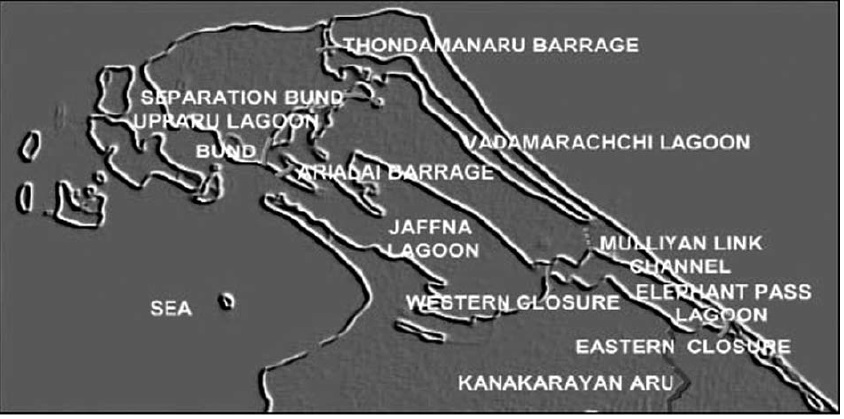
Rijcklof van Goens (1619 – 1682) was the Dutch Governor of Ceylon appointed Captain Hendrick van Rheede (1636 – 1691) as the Dutch Commander for Jaffna. Rheede was very much interested in natural history and wrote classic books on the subject. With this background the historian Dr. M. Gunasingam found that Rheede was the first Dutch ruler who started constructing dykes to converts Vadamarachchi (dyke at Thondamanar) and Upparu (dyke at Nieweli) lagoons into fresh water ponds to create new arable land for the use of Jaffna farming community.

The total area (including inland water) of Jaffna peninsula is 1030 sq. km. The terrain of the region is almost flat. The central part of the western region around Tellippalai the height is about 10.5 m above sea level. From there gently slope towards the south and south east, where as to the north the elevation suddenly dropped.

Before establishing Irrigation Department (ID) in 1900 Central Irrigation Board undertook restoration of Giant Tank in Mannar District during the period of Sir Arthur Havelock (late 1890s). One of the main objectives of establishing ID was to restoration of Dry Zone irrigation systems.

During this year (1900) population of the country was 3.5 million and 5.6 million tons of rice were imported. This is one of the main reason British colonial rulers decided to establish ID. This era renowned pioneers namely Dr. John Davy (1812), Sir Emmerson Tennent (1845) and R.L. Brohier (1933) in irrigation sector identified ancient sluices and other old structures in various parts of the island. The new department was assigned to restore and construct all irrigation works and maintain large irrigation schemes. Maintenance of minor irrigation works came under the control of the Government Agent in each District. In the 1930s ID focused its functions into on- farm water management, flood protection, construct saltwater intrusion structures in the Wet Zone. ID was not a revenue earning Department but spend money for construct and maintain tanks and canal system.

The Gal Oya Scheme, the first river basin development, was started during 1948. Gal Oya Multipurpose Development Project was started in 1948 which was modelled on the Tennessee Valley Authority (TVA) in the US. This concept was not only to develop irrigation but also consider other activities such as power generationandindustries.TVAconcepttakenupafterthe World War II. The Gal Oya Development Board (GODB) established to manage this project. GODB was the first statutory body to set up in independent Ceylon. Construction of the dam began in 1949, completed within four years in late 1953. The project was completed and paid for within our own resources.

In 1969 with the creation of Uda Walawa Reservoir the second river basin development started. Instead of GODB new statutory organisation named as River Valley Development Board (RVDB) established to manage multipurpose second river basin development scheme.

In 1961, UNDP/FAO recommended for 30 year 13 river system development project based on Mahaweli river and inter-basin river diversions. Recommended to implement over a period of 30 years for 13 river systems marked as A to M. This programme included to irrigate 365,000 ha and generate 470 MW hydro power. The phase one was completed in 1978. Project implementing agency was Mahaweli Development Board (MDB). With the establisment of MDB, GODB was liquidated.

In 1978 the Government decdied to implement Accelerated Mahaweli Development Programme. For this Mahaweli Authiruty of Sri Lanka (MASL) eatblished to realize above objective. MASL is still functionng as a river basin developemnt agency.

In 1954 Eng. S. Arumugam (1905-2000) published River for Jaffna illustrating of a new concept for the peninsula which is almost flat and no rivers. This model is faraway from ancient river-based irrigated hydraulic system. The underlying limestone aquifer recharge by annual rainfall of 1270 mm which is more than 80 per cent from North-East monsoon in October to November. Eng. S. Armugam’s son Eng. Thiru Arumugam is carrying out this idea up-to-date to supply fresh water facility for the comminity in Jaffna peninsula.

It is intersting to note River for Jaffna conscept upraised in two occations. This proposal submitted to the Presdent J. R. Jayewardene. In May 1983 President called for a meeting for a discussion. During this period due to the trouble situation in the country unable to proceed with the proposal. Minister for Irrigation and Water Management, Mr Gamini Jayawickrerna Perera visited Jaffan. In July 2003 Minister submitted a Cabint Paper to obtain approval for implemention. Due to change of Goverement the project was shelved.

Asian Development Bank (ADB) approved a loan of 130 million US dollars (in 2010) for providing safe drinking water for 300,000 people in Jaffna Town and surrounding areas and sanitation facilities for 80,000 people in Jaffna Town. The water source was Iranamadu tank in Kilinochchi District. The farmers of Kilinochchi protesetd as they were cultivating only 30 per cent of rice during the Yala (dry) season. If water pumped to Jaffna the farmers in Killinochchi would not be available for Yala cultivation.

In May 2017 tenders have been invited from contractors to Design, Build and Operate (DBO) for 24 million litres per day (Mld) for a sea water desalination plant at Thalaiyadi in Jaffna Peninsula. This will consume about five to six megawatts of electrical power. Further according to National Water Supply and Drainage Board (NWSDB) the cost of water produced by the proposed plant will be more than six times the average cost of water produced by all the other plants.

In the mid 2010s Goveremenet of Sri Lanka (GOSL) requested the Dutch Government to solve the fresh water problems in the Jaffna Peninsula. As a result they sent an expert to Jaffna in January 2017. Based on that in Feb 2018 they sent a team of six experts (Team Leader, SjefIJzermans) to observe the viabilty of the River for Jaffna project to conduct a preliminery study. Tentative findings are as follows:

Benefits

  • Benefits for lands alongside of lagoons:
  • Less damage by salty inundations o Additional irrigation
  • Recharge of aquifers (limited)
  • Recharge of aquifers could be increased by pumping
  • Infiltration through irrigation to now uncultivated areas
  • Special infiltration canals

GOSL is waiting for the final report with alloction of funds from the Dutch Government to construct and implement the Project.

The present Dutch Ambassador in Colombo, Ms. Joanne Doornewaard has also been briefed how Dutch Colonial admainstration initiated the similer to River for Jaffna project about more than 350 years ago.

During the last few years water resources develpment in Jaffna peninsula was one of the main subjects discussed at the Cabinet Ministers’ level. Prime Minister Mr. Ranil Wickremesinghe is working closely with Policy Development Office to introduce a new project for water supply to Jaffna utilizing rainfall into the Vadmarachchi Lagoon. This project was approved by the the Chief Minister of Northern Province and the Cabinet of Ministers in Sept. 2017.

Nortren Provincil Council conducted a three-day seminar 28th-30th Jan 2017 at Jaffna Public Library Auditorum. The theme was Towards Sustainable Water Resources Management and nine research papers were presented during three teachnical sessions. This was inaugarated by Mr. C.V. Wigneswaran Chief Miniister, Norther Provincal Council (NCP) and the Special Guest was Mr. C.V.K. Sivagnanam Chairman NCP. Members of NCP, Secretaries to the NCP Ministries, Heads of Department and staff participated in this event.

During the last several decades river-based irrigation water distribution was the main political theme in other parts of Sri Lanka. At present National and Provincil level political williningness is building up on non-river base water resources developemt in Jaffan peninsula.

This new trend will be helpful to plan and implementation of 350-year old concept of River for Jaffna.


කලු ලෝගුව හෙවත් බිල්ලන් ගේ ඇඳුමට නීතියක් නැද්ද?

August 2nd, 2018

මතුගම සෙනෙවිරුවන්

දැන් දශකයක පමණ සිට මෙරට ජීවත්වන මුස්ලිම් ජන සමාජය වෙනස් වෙමින් ඇත. සිංහල ජන සමාජය සමග සමීපව සුහදව සිටි ඔවුහු අන්තවාදී ලෙස කොටුකර ගත මුස්ලිම් දේශපාලන පක්ෂ නිසා ජාත්‍යන්තර මුස්ලිම් සමාජයේ බල පවැත්වෙන මූලධර්මවාදී නීති බලෙන් ආරෝපණය කරගත්  බවක් පෙනේ. එසේම ඉස්ලාම් ශරියා නීති පද්ධතියේ ඇතැම් කොටස් සමාජ ආර්ථික නීති ක්ෂේත්‍රයන්ට රිංගවා තිබේ. මෙරට ජීවත් වූ පැරණි මුස්ලිම් කාන්තාවගේ ඇඳුම වූයේ ඉන්දියන් සාරිය සහ එහි පොට හිස වටා දවටා ගත් ස්වරූපයයි. එයට කිසි විරුද්ධත්වයක් සමාජයෙන් නොතිබුණි. නමුත් පසුගිය දශකය තුළ කලු ලෝගුව  හිස සහ දෙනෙත් සම්පූර්ණයෙන්ම වසාගත් කුලු ලෝගුව වශයෙන් යම් පරිවර්තනයක්  ඇඳුමේ සිදු විය. සමස්ත මුස්ලිම් සමාජයම එයට අවතීර්ණ නොවී ඇති නමුදු මඩකලපුව නුවර  කොළඹ පුත්තලම වැනි දිස්ත්‍රිකයන්හි මේ දර්ශන වඩාත් ම දැකිය හැකිය.මේ කලු ලෝගුව පොරවා ගත් පිරිස හොරකමේ මංකොල්කෑමේ ගිය අවස්ථාවන්ද වර්තමානය වන විට හෙළි වී තිබේ.මේ තත්ත්වය ජාතික ආරක්ෂාවට තර්ජනයක් බව නොකිවමනාය. එසේම රජයේ නිළධාරින් ගේ රාජකාරියටද බාධාවක් බව අමුතුවෙන් කිව යුතු නොවේ.

      කොලොන්නාව ප්‍රා දේශීය ලේකම් සුගත් සිසිර  කුමාර මහතාටද මෙවැනි අත්දැකීමකට මුහුණ දෙන්නට සිදු විය.එම නිසා  තම කාර්යාලයට ඇතුළුවන පිරිස මුහුණ වසා ගෙන නොපැමිණිය යුතු බවත් අනන්‍යතාවය හෙළි කිරීම වැදගත් බවත් දන්වා සිට ඇත . මෙම තීරණය මත වැල්ලම්පිටිය ගෝතමී මාවතේ අංක 223 හි පදිංචි ෆාතිමා නිස්නියා මහත්මිය විසින් ජනාධිපති කාර්යාලයේ මහජන දුක් ගැනවිලි කළමනාකරණ ඒකකය වෙත වාචික පැමිණිල්ලක් කර ඇත.ඒ අනුව මෙම නිළධාරියා ගෙන් නිදහසට කරුණු විමසීමක් කර තිබේ. එහිදී එයට පිළිතුරු වශයෙන් දීර්ඝ එසේම එඩිතරව කරුණු රැසක් සටහන් කර යවා තිබේ. එම ලිපයේ තුන්වන වගන්තිය අනුව පැමිණිලිකාරිය විසින් කරන ලද සාවද්‍ය ප්‍රකාශයට පිළිතුරක් දක්වා ඇත.එය මෙසේය.

මුස්ලිම් කාන්තාවන්ට රාජකාරි සඳහා කොලොන්නාව ප්‍රා දේශීය ලේකම් කාර්යාලයට යෑමට ඉඩ ලබා නෙදෙන බව උක්ත පැමිණිල්ලේ සඳහන් කර ඇත. එය සම්පූර්ණ සාවද්‍ය ප්‍රකාශයකි. මුස්ලිම් කාන්තාවන්ටද සෙසු සියළු පුරවැසියන්ට මෙන්ම කිසිදු භේදයකින් තොරව ප්‍රා දේශීය ලේකම් කාර්යාලයට පැමිණි තම රාජකාරි ඉටුකර ගැනීමේ හැකියාව ඇත. දිනපතාම මුස්ලිම් කාන්තාවන් කාර්යාලයට පැමිණ තම රාජකාරි අවශ්‍යතා ඉටු කර ගන්නා බව පැහැදිලි කරුණකි.එම ලිපියේ සටහන් වූ වැදගත්ම කරුණ දක්වා තිබුණේ   මෙවැනි පුද්ගලයන් ආරක්ෂාවට දැඩි තර්ජනයකි. යනුවෙනි. එම ප්‍රකාශය තව දුරටත් මෙසේය.

       මොවුන් හිස සහ මුහුණ සම්පූර්ණයෙන් ආවරණය කර දිගු ලෝගුවක් ඇඳ අත් ආවරණ පවා පැළඳ සම්පූර්ණ ශරීරයම පූර්ණ වශයෙන් ආවරණය කර සිටින අතර එයට මුවා වී ගිනි අවියක් හෝ වෙනත් ආයුධයක් හෝ බෝම්බයක් පවා සඟවාගෙන රැගෙන විත් දැඩි විනාශයක් සිදු කිරීමේ අවදානම පවතී. විවිධ අපරාධ සිදු කිරීමට හා සමාජයෙන් වසන් වීමට මෙම ඇඳුම භාවිතා කිරීම පීළිබඳ අප රටේ මෙන්ම විදේශවලද උදාහරණ ඇත. කාර්යාලය තුළ හා පරිශ්‍රයේදී නිළධාරීන් ගේ හා සෙසු මහජනයාගේ ආරක්ෂාව තහවුරු කිරීම මාගේ වගකීමකි. එය ප්‍රමුඛ හා අත්‍යාවශ්‍ය කරුණක් මෙන්ම බැහැර කළ නොහැකි වගකීමකි.

         ලංකාවේ බලපැවැත්වෙන වර්තමාන නීතිය ඉංග්‍රීසීන් විසින් පණවා පසුව එම අණපණත් යාවත්කාලීන කර පාර්ලිමේන්තුව මගින් සම්මත කර අධිකරණ පද්ධතිය තුළ ක්‍රියාත්මක වන්නකි.විධායකය ව්‍යවස්ථාදායකය සහ අධිකරණය යනුවෙන් පද්ධති තුනක් මූලික නීතිය බවට පත් කර ඇත්තේය.මෙම මූලික නීතියට අදාලව නීති සංග්‍රහ කර ඇති අතර අතැම් නීති ප්‍රතිපාදන සඳහන් කර නොමැති අවස්ථාවල මූලික නීතියේ ප්‍රතිපාදන පිහිට කොට ගැනේ.එසේම ආරක්ෂාව සම්බන්ධව ප්‍රශ්ණයක් ඇති විට පොලිස් නියෝග නිකුත් කිරීමේ රීතියක්ද ඇත.

      හඳුනා ගැනීමට නොහැකිවන සේ කළු රෙදි වලින් සම්පූර්ණ ශරීරය ආවරණය කරගෙන රිය පැදවීම සම්බන්ධයෙන් දැනුම්දීම යනුවෙන් 2017/11/19 දාතම යටතේ නීතිඥ ප්‍රසාදීනි මුදුන්කොටුව මහත්මිය පොලිස් පති තුමාට ලිපියක් යොමු කරන ලද්දේ මේ අතරය.  2018/05/05 වන දින(මාස හයකට පසු ) පොලිස් නීති කොට්ඨාශය භාර අධ්‍යක්ෂ පොලිස් අධිකාරී නීතිඥ ඩබ්.ජේ.එන් සේනාරත්න මහතා මෙම ලිපියට පිළිතුරක් සපායා ඇත.එහි ගම්‍ය වන ප්‍රධාන අදහස මෙයයි..

    අපරාධ නඩු විධාන සංග්‍රහය අනුව තත්කාලයේ ශ්‍රී ලංකාවේ බලපවත්නා යම් නීතියක් මගින් දඬුවම් පැමිණවිය හැකි යම් ක්‍රියාවක් හෝ නොකර හැරීමක් වරදක් ලෙසට අර්ථ නිරූපණය කර ඇත.ඒ අනුව ඔබ විසින් යොමු කර ඇති ලිපියේ සඳහන් කර ඇති කරුණ සම්බන්ධයෙන් නීතිය ක්‍රියාත්මක කිරීම සඳහා ශ්‍රී ලංකාවේ බලපවත්වනා යම් නීතියක් වගන්තියක් හේ වගන්ති සහ එම වගන්ති යටතේ දඬුවම් කළ හැකි වගන්ති හෝ වගන්ති පිළිබඳව මා දැනුවත් කිරීමට කටයුතු කරනු ලබන්නේ නම් ඒ පිළබඳව තෘතඥතාව පළ කර සිටිමි. නීතිඥ ප්‍රසාදීනී මුදුන්කොටුව මහත්මිය මෙම ලිපියට පිළිතුරු වශයෙන් 2018/07/04 දාතම යටතේ පොලිස් නීති කොට්ඨාශයට යොමු කරලද ලිපියේ මුඛ්‍ය සාරංශය මෙසේය.

ඔබ වෙත ඉදිරිපත් කරන ලද ලිපියට පිළිතුරු වශයෙන් ඊට අදාල නෛතික ප්‍රතිපාදන පවතින්නේ ශ්‍රී ලංකාවේ පවතින කුමන් නීතියක් යටතේද යන්න නැවත මා වෙතින් විමසීමෙන් පෙනී යන්නේ මෙම කරුණ ශ්‍රී ලංකාවේ නීතිය අනුව වරදක් ලෙස නොසලකන බවත් ඊට දඬුවම් ලබා දීමට දැනට ශ්‍රී ලංකාවේ නීතයක් නොමැති බවත්ය.

කරුණු එසේ නම් පහත් සඳහන් කාරණා සම්බන්ධයෙන්ද ඊට බලපවත්නා නීතියක් ශ්‍රී ලංකාවේ ක්‍රියාත්මක වන්නේද නැද්ද යන්න පිළිබඳව සැකහැර දැන ගැනීමට මම කැමැත්තෙමි.

1/ යතුරු පැදි ධාවනයේ දී සම්පූර්ණයෙන්ම මුහුණ වැසෙන සේ හෙල්මටයක් පැළඳීම ශ්‍රී ලංකාවේ කවර හෝ නීතියක් යටතේ වරදක් ලෙස සලකනවාද නැද්ද  එය වරදක් නොවන්නේ නම් වරදක් සේ හුවා දක්වමින් මීට පෙර අවස්ථා ගණනාවකදී පොලිස් දෙපාර්තමේන්තුව මගින් හෙල්මට් පැළඳ යතුරු පැදි ධාවනය කිරීම  තහනම් කිරීමට උත්සාහ ගත්තේ ශ්‍රී ලංකාවේ බලපවත්වන කුමන් නීතයක් යටතේ ද යන්න සහ එහිදී සම්පූර්ණයෙන්ම මුහුණ වැසෙන සේ හෙල්මටයක් පැළඳීම වරදක් වන්නේ කවර හේතු නිසාද යන්න.

2/ එසේම මෝටර් රථ වල ඉදිරි පස සහ පසුපස පැති වීදුරු ටින්ටඩ් කර ඇති බව මා දැක ඇත්තෙමි.එසේ ටින්ටඩ් කිරීමේදී මොටර් රථයේ ඇතුලත ගමන් කරන පුද්ගලයෙක් පිටත සිට බලන අයෙකුට නොපෙනෙන පරිදි ටින්ටඩ් කිරීම ශ්‍රී ලංකාවේ කවර හෝ නීතයක් යටතේ වරදක් ලෙස වරදක් ලෙස සලකනවාද නැද්ද යන්න එය වරදක් ලෙස සලකනවානම් ඒ කවර නීතියක් යටතේද යන්න සහ එය වරදක් වන්නේ කවර හේතු නිසාද යන්න

4/ සම්පූර්ණයෙන්ම මුහුණ ආවරණය කරගෙන රිය ධාවනය කිරීමට එරෙහිව ක්‍රියාත්මක කිරීමට හෝ දීමට දඬුවමක් හෝ නීතියේ නෙමැති කම හේතුවෙන් ඉදිරියේදී අවශ්‍ය නම් ඕනෑම අයෙකුට සම්පූර්ණයෙන්ම මුහුණ ආවරණය කරගෙන රිය පැදවීමට හැකියාව ඇත්ද යන්න සහ එවැනි අවස්ථාවල පොලිසිය ට ඊට විරුද්ධව කිසිවක් කළ නොහැකිද යන්න පිළිබඳව මා දැනුම්වත් කරන ලෙසද ඉතා කාරුණිකව ඔබ තුමාගෙන් ඉල්ලා සිටිමි.

   වගන්ති අටකින් යුත් මෙම ලිපිය පොලිස් නීති කොට්ඨාශයට පාඩමකි. එක් ජන වර්ගයකට එක් නීතියක්ද තවත් ජන කොට්ඨාශයකට තවත් නීතියක්ද සිංහලජාතියට පොදු නීතියක්ද වශයෙන් සලකන පොලිසිය. ආණ්ඩුක්‍රම ව්‍යවස්ථාවේ 111 වන පරිඡේදයේ(මූලික අයිතිවාසිකම්) 12(1) සහ (2) වගන්ති අනුව( කිසිම පුරවැසියෙකු වර්ගය ආගම භාෂාවද කුලයස්ත්‍රී පුරුෂ භේදය දේශපාලන මතය හෝ උපන් ස්ථානය යන හේතු මත හෝ කවර හේතුවක් මත හෝ වෙනස්කමකට හෝ විශේෂයකට හෝ භාජන නොවිය යුත්තේය.) කටයුතු කර නොමැති බවද පැහැදිලිව පෙන්නුම් කෙරේ.වර්තමානය වන විට පොලිස් මාධ්‍ය ප්‍රකාශක විසින්ද අගතියට පත් පාර්ශවයන්ට චෝදනා කරන තත්වයක් යටතේ මහජනයාට ඇත්තේ කුමන ආරක්ෂාවක් දැයි සැකයක් මතුවේ. සැබවින්ම  ඇස් බැඳ තිබෙන යුක්තියේ දෙවඟන පැහැදිලිවම  එළිපිටම දූෂණය කොට  ඇති බවද  මෙම කරුණු වලින් මනාව පැහැදිලි වේ.

මතුගම සෙනෙවිරුවන්

අශෝක හඳගම සමග පිළිසඳරක්

August 2nd, 2018

සාකච්ඡා කලේ වෛද්‍ය රුවන් එම් ජයතුංග 

1) සිනමාකරුවෙකුගේ සමාජ  වගකීම කුමක්ද 

සිනමාව කියන්නේ රූපය මුලික කරගත් ප්‍රකාශන මාධ්‍යයක්. එය විවිධ අරමුණු වලට පාවිච්චි කරන්න පුළුවන්. ඒ අතුරින් වඩාත්ම ප්‍රථමික ආකාරය තමයි, විනෝදාස්වාදය සඳහා භාවිතා කිරීම. විනෝදයට අපි කවුරුත් කැමතියි. ඒ නිසාම විනෝදාස්වාදය සපයන සිනමාවට වැඩි ඉල්ලුමක් තියෙනවා. ආර්ථික අතින් විනොදස්වදන සිනමාව ලාභ දායකයි. ඒ නිසා අපට වැඩිපුර වෙළඳපොලේ දකින්න ලැබෙන්නේ මේ සිනමාව. ඒත් සිනමාව දියුණු කලාත්මක භාවිතාවක් ලෙසත් යොදාගන්න පුළුවන්. එවැනි සිනමාවකින් ලැබෙන්නේ රසවින්දනයක්. කලා රසවින්දනයයි විනෝදයයි කියන්නේ දෙකක්. රසවින්දනයක් හරහා කෙනෙකුගේ බුද්ධියට ආමන්ත්‍රණය කරන්න පුළුවන්. ජීවිතය පිලිබඳ, සමාජය පිලිබඳ අවබෝධය පුළුල් කරන්න යොදා ගන්න පුළුවන්. ඒක ටිකක් බැරෑරුම් අභ්‍යාසයක්. මම සිනමා කරුවෙකු හැටියට යෙදී ඉන්න කැමති මේ බැරෑරුම් අභ්‍යාසයෙයි. මම හිතන්නේ සිනමා කරුවෙකු හැටියට මට පැවරෙන වගකීම මේ අවදානම් සහගත් අභ්‍යාසයේ යෙදීම කියලයි.

2) ඔබගේ චිත්‍රපට වලින් සමාජයට දීමට අදහස් කරන පණිවිඩය කුමක්ද ?

මම මගේ සිනමාව හරහා පණිවිඩ දෙන්නේ නැහැ. පණිවිඩ දීම,උපදෙස් දීම සඳහාත් සිනමාව යොදා ගත හැකි තමයි. ඒත් මම සිනමාව පණිවිඩ දීම සඳහා භාවිතා කරන්නේ නැහැ. ඒ වෙනුවට සිනමාව කලාවක් විදියට පරිහරණය කරන්නයි මා වෙහෙසෙන්නේ. ඒ නිසා මම කලින් කීවාක් මෙන්, රසාස්වාදය හරහා සමාජයේත් තමා තුලමත් ඇති ප්‍රතිවිරෝධයන් පිලිබඳ කිසියම් අවබෝධයක් වටහා ගැනීමක් ලබා ගැනීමට දොරටුවක් විවර කිරීම මගේ සිනමා භාවිතාවේ අරමුණ කියලා තරමක් පුළුල් අර්ථයකින් කියන්න පුළුවන්.

3) පසුගිය කාලයේ ඔබගේ සහ විමුක්ති ජයසුන්දර ගේ චිත්‍රපට වල ත්‍රිවිධ හමුදාව හෑල්ලුවට පත් කිරීම නිසා එවැනි සිනමාකරුවන් එල්ලා මරා දැමිය යුතු බව වරක් ප්‍රකට අද්මිරාල්වරයෙකු කීවා. මේ ගැන ඔබගේ අදහස කුමක්ද 

අපට කිසිම වෘත්තිකයෙක් හෝ පුද්ගලයෙක් උත්කර්ෂයට නංවන්න වත්, සැහැල්ලුවට ලක් කරන්නවත් වුවමනා නැහැ. සිනමාව කියන්නේ සියලු වෘත්තීය නිල ඇඳුම් යට සැඟවුණු මිනිස් ආත්මය ගවේෂණය කිරීමක්. යුද්ධය කාලේ අපි කලේ පිලිකාවක් වගේ අපේ සමාජ දේහය විනාශකරන යුද්ධය අපේ ජන ජීවිතයට කර ඇති විනාශකාරී බලපෑම පිලිඹද විවේචණාත්මක කියවීමකට අපේ සිනමව මෙහෙයවීමයි. අපේ සංස්කෘතික වටිනාකම්, මිනිස් සම්බන්ධකම් වෙනස් ව ඇති සැටි පිළිඹඳ විචාරාත්මකව බැලීමයි.

ඔය ගැටලුව පැනනැගී දවස්වලම, එවකට චිත්‍රපට සංස්ථාවේ සභාපති හැටියට තිස්ස අබේසේකර මහතාගේ ප්‍රධානත්වයෙන් සිනමා කරුවන් වන අපත් හමුදා නියෝජිතයින් ලෙස සරත් වීරසේකර, දයා රත්නායක ඇතුළු ත්‍රිවිධ හමුදා ඉහල නිලධාරීනුත් සහභාගී වුනු රැස්වීමක මේ ගැන මුහුණට මුහුණ කතා කළා. අප දෙපිරිසම යුද්ධය විනාශකාරී පිළිලයක් ලෙස දකිනවුන් බව එහිදී පිළිගැනුනා. හමුදාවකට තියෙන්නේ ‘යුද්ධයෙන් ජය ගැනීම’ පිලිබඳ ඉලක්කයක්. කලා කරුවන් හැටියට අපට තියෙන්නේ ‘යුද්ධය පරාජය කිරීම’ කියන ඉලක්කය. ඒ නිසා යුද්ධය විෂයයෙහි අප දෙගොල්ල ගමන් කරන්නේ කිසිදා නොපෑහෙන රේල් පීලි දෙකක ගමන් මගක බව අවබෝධ කරගත යුතු බවත් අපේ පාර්ශවයෙන් ඔවුනට පැහැදිලි කර දෙන්න උත්සාහ කලා.

යුධ යාන්ත්‍රණයට සම්බන්ධ කොටසකට අපේ සිනමා භාවිතාව පිළිඹඳ විවේචනයක් තියෙන්න පුළුවන්. ඒ වූ පමණින් අප සිනමාව හැසිරවිය යුත්තේ මේ අකාරයෙන් යැයි අපට අණ  කිසිවෙකුට බැහැ. යුද්ධය ඔවුන් ගේ විෂයය. සිනමාව අපේ විෂයය.

4) සිනමාව සඳහා වාරණයේ සීමාවන් මොනවාද 

මම කොන්දේසි විරහිත සිනමාවක් වෙනුවෙන් පෙනී සිටින කෙනෙක්. සිනමාත්මක ප්‍රකාශනයේ නිදහස වෙනුවෙන් මම පෙනී සිටිනවා. කෙනෙකුට තර්ක කරන්න පුළුවන් එතකොට ඕන කුනුහරුපයක් සිනමාව කියලා හදන්න පුළුවන් නේ ද කියලා. ඔවු. පුළුවන් තමයි. එහෙම කරන අය ඉඳියි. හැබැයි එහෙම කරන අය නවත්වන්න වාරණ සීමාවන් හඳුන්වා දුනහොත් ඒ නිසා ඉතා උසස් කෘතියක උපත අංග විකල එකක් වන්නට පුළුවන්. ඒක අපරාධයක්. නිදහස සහතික කරන්න. සද්භාවයෙන් යුතුව නිදහස පරිහරණය කිරීම වගකීම් සහගත සිනමා කරුවෙකු ගේ හැසිරීමයි. සභ්‍ය අසභ්‍ය බවට නිරපේක්ෂ අර්ථ දැක්වීම් නැහැ.

5)   ශ්‍රී ලංකා හමුදාවන් ප්‍රචණ්ඩත්වයේ යෙදුනු බව ඔබ ඔබගේ චිත්‍රපට වලින් පෙන්වා දුන්නාද ?

නැහැ. මම මෙතෙක් කල සිනමා කෘති වලට තේමා වුනේ මිනිසුන්. ඒ මිනිසා හමුදා සොල්දාදුවෙක්, කම්කරුවෙක්, හාමුදුරු කෙනෙක්  හෝ වෙනත් වෘත්තිකයෙක් වෙන්න පුළුවන්. ඔවුන් ගේ හොඳ නරක දෙකම තියනවා. ඒ මිසක් හමුදාව යන්ත්‍රයක් විදියට මම විෂය කරගන නැහැ.

6) එල්.ටී.ටී.ඊ සංවිධානය ජන ඝාතන මානව අයිතිවාසිකම් උල්ලංඝනය කිරීම ගැන ඔබගේ අදහස් කවරේද ?

ජන ඝාතනය කියන්නේ කුමන අරමුණකින් කවුරු කලත් අපරාධයක්. ජන ඝාතනය කරන කවර පාර්ශවයක් හෝ  සම්බන්දයෙන් මට තියෙන්නේ පිළිකුලක්. සියලු ජන ඝාතන ක්‍රියාකාරකම්, මම පිළිකුලෙන් හෙලා දකිනවා.

ඒත්, කිසියම් කණ්ඩායමක් දේශපාලන වුවමනාවක් වෙනුවෙන් ජන ඝාතනය උපායමාර්ගයක් ලෙස තෝරා ගන්න බලකරන තත්වයන් නොසලකා මග හරින්න අප කාටවත් බැහැ. ඒ නිසා LTTE එක ජනඝතන කළා කියන එක හුදකලාව අරගන අහන ප්‍රශ්නයකට පිළිතුරු බැන්දොත් ලැබෙන්නේ අසම්පුර්ණ උත්තරයක්.

7) එල්.ටී.ටී.ඊ සංවිධානයේ කුරිරුකම් ගැන ඔබගේ චිත්‍රපට වලින් පෙන්වාදීමක් කලාද ඒ පිලිබඳව ඔබට යමක් පැහැදිලි කල හැකිද 

මේ ප්‍රශ්නයත් ඉහත ප්‍රශ්නය හා බැඳෙනවා. LTTE එක කුරිරුකම් කළා කියන එක කවුරුත් දන්නා සත්‍යයක්. එක්තරා කලෙක ජේ වී පී එකටත් ජන ඝාතනය තෝරාගන්න සිදු වුනා. ඇයි ? එහෙම වුනේ කියන දේශපාලන කාරනාව මග හැරලා අපි ජන ඝාතනය ගැන විතරක් කතාකරනවා. මෙය වැරදියි. යුද්ද්ධය කියන්නේ කිසියම් ඵලයක්. ඒ ඵලය දැරූ ගස මග හැරලා ගස ගැන කතා කිරීම තේරුමක් නැහැ. ඒ නිසා මගේ නිර්මාණ වලින් කලේ ගස ගැන කතා කරන එක.  දැන් යුද්ධය ඉවරයි. ඒ කියන්නේ ගෙඩිය කඩලා විසිකරලා. ඒත් ගස තාම තියෙනවා. මේ ගස කපා නොදැම්මොත් තව ගෙඩි හටගන්න පුළුවන් බව අපි මතක තබා යුතුයි.

8) වර්තමනයේ අපගේ සමාජය මුහුණ දෙන මූලික ගැටළු මොනවාද 

සමාජයක් හැටියට මුහුණ දෙන ප්‍රධාන ගැටළු කිහිපයක් තියෙනවා. අපට අපේ ආර්ථික ගමන් මග තොරාගන නිශ්චිත වැඩපිළිවෙලක් ඔස්සේ ආර්ථිකය  මෙහෙයවන්න බැරි කම ඉන් ප්‍රධානයි.  කාලයක් තිස්සේ ජනතාවට පොරොන්දු වන ‘සහන’ මතම දේශපාලනය කරලා බලයට එන්න පුරුදු වෙලා තියෙන  ආණ්ඩුවකට මේ ආර්ථික ප්‍රතිසංස්කරණ සඳහා හැමවිටම ප්‍රතිරෝධයක මුහුණ දෙන්න වෙනවා.

දෙවෙනි එක තමයි, එන්න එන්න වර්ධනය වන ආගමික සහ වාර්ගික උමතුව. මෙය අතිශය භයානකයි. ආගම් රාජ්‍යයට ඇඳා ගැනීමෙන් වහාම ගැලවෙන්න ඕන. රාජ්‍ය කටයුතු පන්සලෙන් පල්ලියෙන් කෝවිලෙන් නිදහස් වීමෙන් තොරව මේ උමතුව පරාජය කරන්න බැහැ. මේක විනාශකාරී පිළිලයක්.

9) මේ ගැටළු අපගේ සිනමාකරුවන් තම සිනමාවෙන්  ස්පර්ශ කොට තිබෙනවාද 

පාරක් ලොකු කරගන්න බාධාවක් වෙන බෝ ගහක් කපන්න නොදෙන තරමට මේ ආගමික උමතුව ඔඩු දුවලා තියෙන්නේ. පාරවල් අයිනේ කුණු දාන එක නවත්තන්නත් මිනිස්සු බුදු පිළිම අටවනවා. ආගම වෙනුවෙන් මිනිහෙක් මරන්න හිත හදා ගන්න එක ලේසි වෙලා. සිවුරට ලෝගුවට මුවා වෙලා අපරාද කරන වුන්ට නීතිය ක්‍රියාත්මක කරන්න  බැහැ. මේ කාරනා පිලිබඳ සිනමා කෘතියක් ඇතුලේ කතා කරන්න බැරි සීමාවන් තියෙනවා. කවුරුත් ඒ නිසා ඇත ගහන්නේ නැහැ.  ආගමික සංස්ථාව ක් සිනමාව හෝ ප්‍රසිද්ධ මහජන ප්‍රදර්ශනය ට පෙළ ගස්වන කලා කෘතියක්  ඇතුලේ ප්‍රශ්න කරන්න බැරි වාරණ සීමාවන් තිබෙනවා. ඒ සීමාවන් මැද්දේ වුනත් අප යම් ප්‍රමාණයකට මේ තත්වයන් විෂය කරගන තිබෙනවා. එහෙත් එය ප්‍රමානවත් නැති බව සත්‍යයක්.

10) සමහරක් සමාජ ප්‍රශ්න සිනමාකරුවන් සිතාමතා මඟ හරින හේතුව කුමක්ද එය ඔබ දකින්නේ කෙසේද 

සමහර විට ඒවා පිලිබඳ ප්‍රමාණවත් අවබෝධයක් නැති කම වෙන්න පුළුවන්. අවදානමක් සහිත වැඩකට අත ගහන්න තියෙන අකමැත්ත වෙන්නත් පුළුවන්. සමහර විට ඒවා ඇතැමෙකුට අදාළ නොවනවා වෙන්නත් පුළුවන්.


Govt. regulations seen as hindering SL from becoming ship-building hub

August 2nd, 2018

By Hiran H.Senewiratne Courtesy The Island

Sri Lanka will lose the chance of becoming a ship-building hub  in the region due to the  government’s regulations pertaining to the ship-building industry  and the country’s tax structure. If the government supports this sector, the country could earn a large sum of foreign exchange, Executive Vice President, Walkers CML Group,  Dr. Sarath Obeysekera said.

”  Sri Lanka has the potential to become a small and medium size ship/vessel manufacturing hub in the region but unfortunately certain government rules and regulations and the tax structure negatively impact the industry, Dr Obeysekera told The Island Financial Review. The company is known as  Walkers Colombo Shipyard (Pvt) Limited , a subsidiary of MTD Walkers PLC and  is a fully equipped shipyard with advanced facilities to facilitate vessel repairs, ship-building and other marine engineering capabilities. This  is the country’s second ship-building company, which is 100 percent Sri Lankan owned.

article_image

Ship-building in progress

He said that at present they are manufacturing 100 ton  and 300 ton landing craft for the Maldives, which are valued at US $ one million. ‘Since they have all the facilities, including the technology, they are looking at getting orders from other counties as well, he said.

Dr Obeysekera said that the government is not giving proper support for this industry to grow as it has enormous potential to attract foreign orders into the country. ” Unfortunately, the  Sri Lanka Ports Authority, most of the time, in calling for tenders gives preference to foreign companies, he said.

“This is a multi-billion dollar business but needs to get duty free facilities  and a simplified regulatory framework to boost the boat/ship building industry as a life style development or leisure sector industry, he explained.

The CEO also said that in Sri Lanka there are 20 fisheries harbors within the country , which could be developed as marinas targeting  tourism sector.

He also said that the national export strategy 2018 of the government has identified the vessel and leisure craft manufacturing sector as a potential export sector in the country. ‘This is an excellent move by the government, he added.

‘Walkers will give special concessionary rates for multi-day fishing boat owners for docking and undocking since we need to promote the fisheries industry of the country , provide high standard reliable repair services for them, that could ultimately cause to uplift the quality of fish which goes to the local and foreign market, Dr Obeysekera added.

‘Further, we build fibre glass boats at the Galle boatyard and we repair boats in Codbay in trincomalee using our boat lift, he said.

The CEO added: ‘Sri Lankans have a habit of buying SUV cars rather than buy pleasure craft, so we invite businessmen, hotel owners and the young to buy their own pleasure craft/yacht and enjoy the inland and offshore cruises.  We will provide a 24 hour security service and berthing facility for their yachts at Mutwal harbour.’

‘At present, the Walkers Shipyard is located at the Mutwal fisheries harbour having the capacity to offer floating repair for vessels up to 80 m in length, dry berth repair services for vessel up to 65 m in length.

‘The company’s shipping team builds a wide range of ships and vessels of high quality, where they meet the highest level of construction and safety standards with Korean technology and know how.’

The Draft Constitution:  Impact on nation and state

August 2nd, 2018

By Neville Ladduwahetty

Documents relating to a draft Constitution intended for “discussion only” are now out in the public domain. These documents are the work of a panel of 10 experts. The Resolution setting up a Constitutional Assembly intended them to synthesize the opinions contained in the reports of the 6 sub-committees appointed by the Steering Committee, into a form that would embody the makings of the draft constitution. Although it was expected that there would be a single report reflecting a consensus among them, what turned up was a multiplicity of reports.

article_image

According to media reports, since some who were not part of the expert panel had intervened and attempted to influence the outcome of the scope of the draft, only 6 of the 10 in the expert panel had signed the report. This draft contains 38 chapters and covers the full scope of what is intended to be a discussion paper. Although those who intervened have since been asked to stay out, the consequence of this direction was that there are now an additional 10 unsigned reports covering a variety of subjects.

If what is reported above is factual, the experts and interventionists have not only collectively debased the constitution making process, but have also made the debating task very complex, because members of the Constitutional Assembly would not know whether to accept opinions in the report signed by the 6 experts, or those in the 10 individual reports.

SIGNIFICANT FEATURES in the DRAFT

Despite the chicanery associated with preparation of the draft constitution, what is of great significance to the nation is the direction the draft constitution is taking judging from recommendations common to most reports. For instance, some of the specific recommendations are:

1. The State would cease to be Unitary. Instead, it would be described as being ‘undivided and indivisible’. The Legislative, Executive and Judicial powers of the People shall be exercised as per the Constitution. The territory of Sri Lanka would be its geographical territory including the Provinces, thus identifying the territory in terms of the Province. The National Anthem is to be sung in 2 languages.

2. The President to be elected by two chambers of Parliament. President’s powers diluted to that of a figurehead to the point that he acts on the advice of the Prime Minister.

3. A second chamber represented by 5 members from each Province and 10 others.

4. The powers of the Governor of each Province diluted to the point that he acts on the advice of the Chief Minister.

5. The Executive and Legislative powers of the Province shall be exercised by the Chief Minister and the Council.

6. The Central Government shall be entitled to the use of State land only in the Capital Territory, and every Provincial Council shall be entitled to the use of all other State land.

7. The provision for two or three adjoining Provinces to merge based on a referendum limited to each Province concerned.

In summary, the draft constitution weakens the powers of the President elected by two chambers of Parliament and makes the Prime Minister the head of the Executive, the consequence of which is to weaken the powers of the Governor, strengthen the Province with Legislative and Executive powers and recognize the Province as the unit that describes the territory of Sri Lanka, with a provision also for 2 or 3 Provinces to merge, based on a referendum limited to each Province concerned.

DIRECTION of the DRAFT CONSTITUTION

The first paragraph of the Resolution establishing the Constitutional Assembly states that the President “…in his desire to give effect to the will of the People expressed at the aforesaid Presidential Election by enacting a new Constitution that, inter alia, abolishing the Executive Presidency…..”.

Abolishing the Executive Presidency is therefore justified on the basis of giving “effect to the will of the People”. The question is: Which “People”? In this instance the “People” has to mean those who elected the President. Considering that the President is committed to “give effect” to several issues during the run up to the election, how legitimate is it to single out an issue such as abolishing the Executive Presidency out of the many issues pledged, and justify it on the basis that it gives effect to the “will of the People”, without an exclusive referendum.

In the absence of such clear and definitive determination the need to abolish the current Executive Presidential system is nothing but the fulfillment of a personal commitment of the political leadership regardless of whether it serves the interests of the Nation and State. As far as the leadership in the North is concerned, the direction of the draft constitution facilitates the inexorable movement towards federalism to start with, and a separate State at a time of their choosing, encouraged by the provision in Article 176 for 2 or 3 adjoining Provinces to merge based on a referendum limited to each Province concerned.

VIOLATION of FUNDAMENTAL RIGHTS

What the draft embodies is a diabolical attempt to dismantle the core values of what is of significant importance to the Sri Lankan nation as a whole, and replacing it with aspirations of a segment of the population, thereby violating the right that “All Peoples” have, namely, the right of self-determination of the collective nation to determine its form of government and its political arrangements.

The 13th Amendment with the Province as the unit was definitely not such a collective determination. Furthermore, no opportunity was given by successive governments for the nation to exercise its right to self-determination regarding devolution as a concept, with its unit as the Province. That denial has compelled the nation to accept a form of government at the periphery that is operationally dysfunctional, and at a cost that diverts much needed funds for human development from the nation as a whole.

Territorial integrity is another determination that is sacrosanct to the majority of the nation. The proposal for 2 or 3 adjoining Provinces to merge based on a referendum limited to each Province concerned is a violation of the right of self-determination of the rest of the country. The architecture that would result from this provision is to create a single political unit consisting of the Northern and Eastern Provinces. Territorially such a unit would consist of one-third of the land mass of Sri Lanka and two-thirds of its coast line with Legislative and Executive powers, beside 7 separate Provincial units in the rest of the country. Words in a Constitution such as “undivided” and “indivisible” would not protect the territorial integrity of Sri Lanka under such a set-up.

The fact that the draft is a discussion paper, and therefore, this particular proposal or any other could be rejected, is not the issue. The issue is the fact that the ‘expert panel’ did not mind the denial of fundamental rights such as the right of self-determination embodied in international law, in instruments such as the International Covenant on Civil and Political Rights and the International Covenant on Social, Economic and Cultural Rights, which form the very bedrock of Human Rights. The least one would expect from such a panel is for them to bring to the attention of the Steering Committee the implications involved, while fulfilling its primary function of synthesizing the opinions in the 6 sub-committee reports.

EXECUTIVE PRESIDENCY

The other all important issue is the abolition of the Executive Presidency. What needs to be understood is that an Executive Presidential system in the context of Sri Lanka and its many Peoples is not another political arrangement of governance. It goes far beyond and symbolizes the unitary nature of the State, because the President, as a person elected by the whole nation is therefore a unifier; a concept that cannot be replaced by words such as “undivided and indivisible”. Consequently, the Presidential system is inextricably linked with the unitary character of the State.

A nationally elected President is the protector of the integrity of the State in terms of its physical territory, and ideologically the protector of the core values enshrined in the entrenched Article that includes Article 4 of the 1978 Constitution. Such traditions are an integral part of the memory of Sri Lanka’s heritage in the form of the ruler who was the guardian of the State and the religion. This tradition has to continue with safeguards to meet evolved concepts such as separation of powers between Legislative, Executive and Judicial powers. Such separation of powers is represented at the periphery by the Governor who is responsible for executive action, and as the President’s representative in the periphery, is responsible for guarding the integrity and unitary character of the State in the manner in which the Provinces operate.

CONCLUSION

While the expert panel of 10 was expected to synthesize the opinions in the 6 sub-committee reports into a single unified report, what transpired was a botched up job due to the intervention of a few persons unassociated with the process, with the result that there is now one report signed by only 6 of the 10 experts, and 10 other unsigned reports covering various aspects relating to this draft constitution. The fact that the draft constitution in its present form has been seriously compromised means that the task of debating issues would become a daunting challenge.

Abolishing the Executive Presidency although justified in order to “give effect to the will of the People”, has many direct political beneficiaries. One set would be those who are constitutionally barred from contesting a Presidential election. Another set would be those who are unsure of securing a majority at a national Presidential election. For the Tamil leadership it would be an opportunity to weaken the power of the Governor to the point of him acting on the advice of the Chief Minister and the Board of Ministers, thereby transferring Legislative and Executive power to the Council; a process that would be the first step towards federalism (by eliminating the concurrent list), and to eventual separation. The losers would be the People in whose name all this is being done.

The genesis for these incrementally progressive developments is the 13th Amendment with the Province as the peripheral unit. The concept of devolution and its unit of devolution – the Province, never were and have never been the seeking of the nation as a whole. This is a violation of the fundamental right of self-determination that “All Peoples” are entitled to and recognized in the International Instruments that form the bed rock of Human Rights. It is nothing but a top down approach whose cost effectiveness cannot be justified. This injustice has to be corrected not only because it compels a majority to be governed under a system that is not of their choosing, but also the fact that the system is operationally complex because of 2 parallel systems which function at a cost that diverts much needed funds from human development of the collective nation. This too is a violation of Human Rights.

The hope of those whose interests have hitherto been ignored is that at least a third of the Members of Parliament led by a strong leader would have the courage to oppose the draft constitution on moral grounds, because it not only violates fundamentals of justice and equality, but that it also does not represent the core values cherished by the nation as a whole. However, opposition for the sake of opposition is not right either. Therefore, those opposing the draft constitution should follow up and propose an alternative that in principle is for the three major communities to share Legislative and Executive powers at the center with the District as the principal operating unit in the periphery. The nation is waiting for a leadership that would set aside their personal ambitions and fulfill the nation’s long awaited dream of doing what is right by them as a whole, and in the interest of the entire country as well as the generations to come.

Janabala sena protest: AG summoned to Justice Minister’s office – Former President Mahinda Rajapaksa

August 2nd, 2018

By Saman Gamage Courtesy The Island

Former President Mahinda Rajapaksa, yesterday, alleged the Sirisena-Wickremesinghe government did not care to do anything to bring back former Central Bank Governor Arjuna Mahendran wanted in connection with treasury bonds scams perpetrated in 2015 and 2016.

Mahendran lived overseas without any trouble, Rajapaksa said.The government was trying to silence the genuine Opposition by setting up Special High Courts, the former President said. The decisions in respect of those who were to be summoned by the Special High Courts had been taken by the Justice Minister after summoning the Attorney General to her office, the former President said.

The country lacked proper leadership, the former President said, urging the people to rally behind the Joint Opposition and the Sri Lanka Podujana Peramuna.

article_image

Former President Rajapaksa greeting supporters at Viharamaha Devi Open Air Theatre yesterday (pic by Jude Denzil Pathiraja)

Rajapaksa was addressing a protest rally at the Viharamaha Devi open air theatre. He alleged the government was selling public property. He urged foreigners to be wary of acquiring Sri Lankan assets. Former President Rajapaksa said that a future government would investigate all questionable transactions under the present administration. He said the government had not received a mandate to divest state assets. He accused the government leader of selling state ventures to get kickbacks.

The Joint Opposition/Sri Lanka Podujana Peramun (SLPP) members and supporters protested at the Lipton Circus yesterday and marched to the Viharamaha Devi open air theatre, where the former President and JO leaders spoke.

A section of the SLFP’s Group of 16, too, joined the protest march and later Senior Vice President of the SLFP MP John Seneviratne addressed the gathering.

Rajapaksa said the government was using various ruses to distract public attention from the political fallout of the biggest ever financial crime in the country—the Treasury bond scams.

Rajapaksa alleged that the government was rapidly moving towards a dictatorship having taken control of the judiciary. Those who had been worried about the independence of judiciary were silent today, he added.

The former President flayed the government for using the New Inland Revenue Act to impose more economic burdens on the people who were struggling to make ends meet.

Govt took power without a proper plan – Gotabaya

August 2nd, 2018

Courtesy Adaderana

Former Defence Secretary Gotabaya Rajapaksa says that his intention was to provide houses for the low income people living in Colombo city in order to increase their quality of life.

Speaking during an event in Wellawatta, he said that the objective of the programme carried out by him during his time as the Defence Secretary was to remove the shanty homes and turn Colombo into an attractive city.

He stated that today Sri Lanka’s construction sector has completely collapsed and that directly and indirectly over 4-500,000 jobs have been lost due to this.

He said that the government shortsighted actions led to the halting of all development projects as soon as it came to power. The Colombo Port City project was stalled for 2 years and at the same time development projects across the country came to a standstill, Rajapaksa charged.

He said that the incumbent government took power without any proper plan. The former Defence Secretary said that currently there is no leader to take decisions and that nobody is taking responsibility to take decisions when a problem surfaces.

He stated that the underworld has raised its head once again and that some people are even afraid to talk about the underworld.

The ‘small car dream’ has truly become just a dream now – JO

August 2nd, 2018

Joint Opposition MP Shehan Semasinghe says that there is absolutely no preparation to hold elections by the current government, which is attempting govern the country in a dictatorial fashion.

He stated that the ‘small car dream’ has truly become just a dream presently and the government has disregarded all the promises it had given to the youths.

Semasinghe also charged that the current government lacks a proper understanding regarding debt management.

Pope Francis declares death penalty inadmissible in all cases

August 2nd, 2018

Pope Francis has changed the teachings of the Catholic faith to oppose the death penalty in all circumstances, the Vatican has said.

The Catechism of the Church, which sums up the teachings, had previously stated that the death penalty could be used in some cases.

It now says it is inadmissible because it is an attack on the inviolability and dignity of the person”.

Pope Francis has in the past spoken out against executions.

Last October, he had said the Church’s policy on the death penalty was one area where teaching was not static and could change with modern concerns.

The text of the catechism was first set by Pope John Paul II in October 1992.

The teachings had earlier stated that the death penalty was an appropriate response to the gravity of certain crimes and an acceptable, albeit extreme, means of safeguarding the common good”.

However, the new text says there is an increasing awareness that the dignity of the person is not lost even after the commission of very serious crimes”.

It also argues that today’s more effective detention methods protect citizens and do not definitively deprive the guilty of the possibility of redemption”.

The Church will now work with determination for the abolition of the death penalty worldwide, a statement from the Holy See said.

Historically, the Church has mostly been unopposed to the death penalty, including into the 20th Century. In 1952, Pope Pius XII said it was not a violation of the universal right to life.

Pope John Paul II argued for imprisonment over execution wherever possible, although Joseph Ratzinger, who later became Pope Benedict XVI, wrote that the death penalty could be permissible.

Source: BBC

ගිවිසුම් ද පඤ්ඤං

August 2nd, 2018

උපුටාගැණීම  මව්බිම

“බණ්ඩාරනායක-චෙල්වනායක් ගිවිසුම සිංහල ජාතිය පාවාදීමක්”

බණ්ඩාරනායක-චෙල්වනායකම් ගිවිසුම ප්‍රකාශයට පත්කළේ 1957 ජූලි 26 දා ය. එදිනම රැස් වූ එජාප කෘත්‍යාධිකාරි සභාව ගිවිසුමට එරෙහිව පළමු වෙඩි මුරය පත්තු කළේ එහෙම ය.
උතුර සහ නැඟෙනහිර පළාත් ආවරණය වන ලෙස ස්වාධීන දෙමළ රාජ්‍යයක් දිනා ගැනීම සඳහා තබනු ලබන ඉදිරි පියවරකි. පුරවැසි පනත් අවලංගු කිරීමත්, ලංකාවේ වෙසෙන දශලක්ෂයක් වන ඉන්දීය නේවාසිකයන්ට ස්මපූර්ණ පුරවැසිභාවය ලබා ගැනීමත් සඳහා ෆෙඩරල් පක්ෂයත්, ඉන්දීය දමිළයන් නියෝජනය කරන පක්ෂත්, ඒකාබද්ධ ව්‍යාපාරයක් ආරම්භ කිරීම මීළඟ පියවර විය යුතු යැයි ඔවුහු අදහස් කරති.

මේ ගිවිසුමට පදනම් වී ඇත්තේ, මෑතකදී භාවිතයට ආ, හුදෙක්ම කෘත්‍රිම වූ, පළාත් මායිම් පිළිගැනීම මත ය. නැඟෙනහිර පළාත හෝ මුළු උතුරු පළාත හෝ පාරම්පරික වශයෙන් දෙමළ ජනතාවට අයත් ප්‍රදේශ හැටියට කිසිදාක පිළිගෙන නොතිබුණු බව ඓතිහාසික සත්‍යයකි. නැඟෙනහිර සහ උතුරු පළාත් එක් කොටසක් වශයෙන් ද සෙසු පළාත් හත අනෙක් කොටස වශයෙන් ද රට කොටස් දෙකකට බෙදීම මේ ගිවිසුමෙන් පිළිගනු ලැබ ඇති බව මේ කරුණුවලින් පැහැදිලි වෙයි.”

1957 අගෝස්තු 3වැනිදා යූඑන්පීය දෙවැනි වෙඩි මුරය පත්තු කළේ එහෙම ය. මේ වෙඩි දෙකටම වෙඩි බෙහෙත් කෙටුවේ ජේ.ආර්. ය.

1956 බණ්ඩාරනායක බලයට එන්නේ සිංහල බෞද්ධ බලවේගයේ ආවේගයෙනි. එහෙම බලයට ආපු බණ්ඩාරනායකට, යථාර්ථය තේරුණේ සිංහල භාෂාව රාජ්‍ය භාෂාව කරන්නට යද්දී ය. බණ්ඩාරනායක හිටියේ ගිරයට අහුවුණු පුවක් ගෙඩියක් මෙන් ය. දෙමළ නායකයන්ගෙන් ආපු විරෝධය හමුවේ බණ්ඩාරනායක නැවෙද්දී දේශප්‍රේමී බලවේග කුපිත වුණේ ය.

උතුරු සහ නැඟෙනහිර පළාත්වල පරිපාලන කටයුතුවලදී දෙමළ භාෂාවට ප්‍රමුඛ තැන දීම, රට සභා කෙටුම්පත සංශෝධය කිරීම, උතුර සහ නැඟෙනහිර වාරිමාර්ග ව්‍යාපෘතිවලදී සිංහල පදිංචි කිරීම් සීමා කිරීම, ඉන්දියානු සම්භවයක් ඇති අයට ලංකාවේ පුරවැසිකම ලබා දීම. යන යෝජනා බණ්ඩාරනායක-චෙල්වනායකම් ගිවිසුමෙ ප්‍රධාන කරුණු ලෙස පිළිගැනුණේ ය.

කොන්දේසි ටික එළියට ආපු ගමන් බණ්ඩාරනායක කඳවුරේ භාෂා ප්‍රේමීන් කුපිත වුණේ ය. ඒ වාසිය දුටු ජේ.ආර්. විසින් ආණ්ඩුව ගෙදර යැවීමේ මෙහෙයුම අතට ගත්තේ ය. බණ්ඩාරනායක-චෙල්වනායකම් ගිවිසුමට එරෙහිව ජේ.ආර්. මල්ටි බැරල් ගැසුුවේ ය. යූඑන්පී පත්තරයෙන් දිගට හරහට ගැසුවේ ය. දෙමළ පාලනයට යටත් වෙන ප්‍රදේශ නම් කොට සිතියම් පළ කළේ ය. ලංකාවෙන් භාගයක් දෙමළ පාලනයට යටත් වන බවට ප්‍රචාරය කළේ ය. පත්‍රිකා බෙදා හැරියේ ය. මහා සංඝයා එකතු කරගෙන රටටම අඬබෙර ගැසුවේ ය. ජේ.ආර්. ප්‍රමුඛ යූඑන්පිය ගෙන ගිය දැවැන්ත ප්‍රචාරයෙන් නැඟී ආ මහා සංඝයාගේ සහ ජනතාවගේ විරෝධය හමුවේ අගමැති බණ්ඩාරනායක ගිවිසුම ඉරා දැම්මේ ය. අන්තිමට ආණ්ඩුවත් පිරිහුණේ ය. කරුණු කාරණා සිද්ධ වුණේ එහෙම ය.

ජේ.ආර්. උෟරාගේ මාළු උෟරාගේ පිටේම තියලා කැපුවේ ය. බණ්ඩාරනායකලා බලයට ගෙනා සිංහල බෞද්ධ බලවේගයම බණ්ඩාරනායකලා බලයෙන් පහ කරන්න යොදා ගත්තේ ය.

1964දී යූඑන්පිය මෙහෙය වූ සාර්ථක පාර්ලිමේන්තු කුමන්ත්‍රණයකින් මැතිනිගේ ආණ්ඩුවේ බල බිඳුණේ ය. ඕනෑම මොහොතක ඡන්දයකට යෑමේ බලය විපක්ෂයට හිමි වුණේ ය. 1965 මහ මැතිවරණය පැවැත්වුණේ එහෙම ය. ඡන්දය පක්ෂ දෙකටම තීරණාත්මක විය. ඒත් ප්‍රතිඵල දෙපැත්තටම නැති විය. යූඑන්පිය දින්නේ ආසන 66ක් පමණි. බහුතරයට තව 7ක් ඕනෑ විය. ඩඩ්ලිලාට ජේ.ආර්.ලාට දෙලෝ රත් වුණේ එවිට ය. ප්‍රතිඵල නිකුත් වී දින දෙක තුනක් යන තෙක්ම වෙන දෙයක් හිතා ගන්නට බැරි විය. බණ්ඩාරනායක-චෙල්වනායකම් ගිවිසුම අල්ලගෙන රට ගිනි තියපු ජේ.ආර්. – ඩඩ්ලි ප්‍රමුඛ යූඑන්පිය අන්තිමට ලැජ්ජා නැතිව චෙල්වනායකම් පස්සේ වැටුණේ ය. චෙල්වනායකම්ගේ ෆෙඩරල් පක්ෂය සමඟ ගිවිසුම් ගසා කොහොමහරි බලය ගත්තේ ය. 1965 යූඑන්පී ආණ්ඩුව පිහිටුවූයේ එහෙම ය.

එහෙම ගේම ගහලා හදපු 1965 යූඑන්පී ආණ්ඩුවයි 2015 යහපාලන ආණ්ඩුවයි අතර වැඩි වෙනසක් පේන්නට නැත. ජේ.ආර්. ජයවර්ධන චරිතාපදානයෙහි පහත දැක්වෙන කොටස කියවන ඕනෑ අයෙක් එය හොඳින්ම තේරුම් ගන්නවා ඇත.

‘මේ වතාවේ ඔහු විසින් පිහිටුවා ගන්නා ලද සභාගය වෛවාරන්න කණ්ඩායම්වල එකතුවක් වූ අතර, බලයට ඇති කෑදරකමත්, බණ්ඩාරනායක මහත්මිය සහ ඇගේ සගයන් බලයෙන් වියුක්ත කොට තබා ගැනීමේ දැඩි වුවමනාවත් හැරුණු විට ඔවුන් අතර වෙනත් ආකාරයක පොදු අපේක්‍ෂා තිබුණු බවක් කිව නොහැකිය. එ.ජා. පක්‍ෂය මේ සභාගයේ අරටුව වූ අතර, ෆෙඩරල් පක්‍ෂයත් ඔවුන්ගේ දීර්ඝ කාලීන විරුද්ධවාදීන් වූ කේ.ඇම්.පී. රාජරත්නගේ ජාතික විමුක්ති පෙරමුණත් (පාර්ලිමේන්තුවෙහි එම පක්‍ෂය නියෝජනය වූයේ ඔහුගේ භාර්යාවගෙනි) පිලිප් ගුණවර්ධනගේ මහජන එක්සත් පෙරමුණත් එයට ඇතුළත් විය. ඩඩ්ලි සේනානායක පෞද්ගලිකව වගාකරගෙන තිබූ ප්‍රසාදය හා ගෞරවයත්, කෘතහස්ත දේශපාලනයත් නිසා විනා මේ සභාගය එක්තැන් කිරීමට නොපිළිවන් විය හැකිව තිබිණි. සභාගය ඇතුළත තිබුණු කලබලකාරී තත්ත්වය අනුව සලකන විට, ඉහත සඳහන් ගුණාංග ස්වකීය සභාගය ජාතික රජයක් වශයෙන් හැඳින්වීමට ඔහු පෙලැඹුණද ඇත්ත වශයෙන් පාර්ලිමේන්තුවේ නියෝජනය වුණු ඉතා විශාල කොටසක් අත්හැර තිබුණු නිසා, එය ඒ නමින් හැදින්වීම පැහැදිලි ලෙසම සාවද්‍ය විය.

එකිනෙකා පරස්පර විරෝධී වුවමනා එපාකම් ඇතිව සිටි කණ්ඩායම් තුලනයක් ඇති වන සේ අමාත්‍ය මණ්ඩලය සංයුක්ත කළ යුතු විය. එය අසාමාන්‍ය ලෙස දුෂ්කර කාර්යයක් වූ අතර මේ තුලනය පවත්වා ගැනීමේ අවශ්‍යතාව, නව පරපුරේ දේශපාලනඥයන්ගේ නියෝජිතයන් අමාත්‍ය මණ්ඩලයට ඇතුළත් කර ගැනීමේ අවශ්‍යතාව යටපත් කරමින් නැඟී සිටියේය.’

1965දී චෙල්වනායගම්ලා එක්ක සාකච්ඡාවට පෙරමුණ ගත්තේ රනිල්ගේ මාමා වන ජේ.ආර්. ය. අනුබල දුන්නේ තාත්තා වන එස්මන්ඩ් ය. 2015 ත් එහෙම ය. ඒ චෙල්වනායගම්ලා ය. මේ සම්පන්දන්ලා ය. ඒ මාමා ජේ.ආර්. ය. තාත්තා එස්මන්ඩ් ය. මේ බෑණා රනිල්. යහපාලන ආණ්ඩුව පිහිටුවන්න රනිල්ලා සම්පන්දන් එක්ක ගිවිසුම් ගැසුවේ ය. මහින්දලා එළවන්න රටේ සියලුම බලවේග එකතු කරගෙන ආණ්ඩුව හැදුව රනිල්ලාට දැන් බලය රැක ගන්න නම් සම්පන්දන්ලාගේ අවශ්‍යතා ඉටු කිරීමට සිදුව ඇත. සම්පන්දන්ලා පොරොන්දු ඉටු කරන තෙක් රනිල්ගේ පස්සෙන් පන්නනවා ඇත. අලුත් ව්‍යවස්ථාව සම්පන්දන්ලාගේ එකම බලාපොරොත්තුව ය.

එදා විපක්ෂයේ ඉඳන් ජේ.ආර්.ලා කරපු රෝල් එක අද විමල්ලා, ගම්මන්පිලලා කරති. ‘රට පාවා දෙන ව්‍යවස්ථා මර උගුල’ කියා ඔවුහු රට වටේ යති. දැන හෝ නොදැන මහා සංඝයා ඇතුළු රටේ සාමාන්‍ය ජනතාව බහුතරයකට මේ අලුත් ව්‍යවස්ථාව දැන් අරහං ය. 1949 සිටම මේ රටේ වුණේ ඕක ය. එදා චෙල්වනායකම්ලා ය. අතර මැද ප්‍රභාකරන්ලා ය. දැන් සම්පන්දන්, සුමන්තිරන්ලා ය. ප්‍රශ්නේ එතැනමය. යූඑන්පිය එදත් එහෙම ය. 1965 බලය ගන්න ඩඩ්ලිලා – ජේ.ආර්.ලා චෙල්වනායකම් ගාව දණින් වැටී ආණ්ඩුකාරවරයාට දෙන්න ඔහුගෙන් ලියුමක් අරන් ගිහින් බලය අතට ගත්තේ ය. අන්තිමේ ඩඩ්ලිත් රට සභා පනත ගේන්න ගිහින් නා ගත්තේ ය. “ඩඩ්ලිගේ බඩෙ මසල වඩේ” කියා මිනිස්සු පෙළපාළි ගියහ. ඒ ආණ්ඩුවත් ඒකෙන්ම ඉවර වුණේ ය. සම්පන්දන්ලාගේ ඕනෑ එපාකම් ඉටු කරන්න ගිහින් මේ ආණ්ඩුවත් ගෙදර යන දවස වැඩි අෑතක නොවේ ය. මේක බලය පිළිබඳ ප්‍රශ්නයක් ය. බලය ගන්නකම් ඕන දේකට ඔට්ටු ය. ඕන ගිවිසුමක් පඤ්ඤං ය. බලය ගත් දාට හැසිරෙන්නේ කුම්බලා මාළු කාපු බළලුන් මෙන් ය.

Yahapalana Democracy? Not even Procedural

August 2nd, 2018

By Kusal Perera Courtesy The Daily Mirror

For once Prof. G.L has said something worth discussing. He had told media last Monday, his party, the Sri Lanka Podujana Peramuna (SLPP) would file a petition in the Supreme Court requesting a Writ against the Elections Commission (EC) over its failure to hold elections for the dissolved Provincial Councils.
The Sabaragamuwa, North Central and the Eastern Provincial Councils stand dissolved for 10 months now, since September 2017.
In two months from now, the North, Wayamba and the Central Provincial Councils would stand dissolved.
He has told media, legal action would be instituted when the Court vacation comes to an end in late August.
Reason for not instituting legal action immediately as he says is because; it is only a week more for Court vacations to begin.
For a politically valid intervention, to stay mute for a month is too cheap a ploy to buy. For a legal luminary in fulltime politics, a week would be more than enough, if the statement made is firm and genuine.
Almost two months ago President Sirisena addressing his faction of the SLFP on June 2 had said the PC elections would be held before the year-end.
The UNP decided at its Working Committee last week to request the EC to hold the PC elections without delay” (!) either on the old or the new system of electing members.


By then, the Chairman of the Commission Mahinda Deshapriya had on April 25 (2018) told the media (CDN) the Commission would hold elections to PCs in December, once the legal and Constitutional hindrances are swiftly resolved”.
Neither had they been resolved swiftly” during the past three months. Nor has the Government chosen any of the four options Deshapriya told the CDN (Ceylon Daily News), Parliament could adopt, to have early PC elections.
Firstly, Parliament can approve the delimitation report as it is, with a two-thirds majority.
Secondly, MPs can opt to revise the report by a committee appointed by the Prime Minister. If not, they can change the 50-50 ratio and prepare an early and speedy delimitation report again.

Or they can go back to the previous Preferential Ratio (PR) vote system,”
He told the CDN, that if Parliament could decide on any one of those options, the EC could hold elections in December before the GCE O/L examinations began.
Now it is August and over three months after the options were spelt out by Chairman EC. No decision had been taken by the Government or by the two main allies in Government, the UNP and the SLFP of President Sirisena as to what option they would go with.
Instead, the UNP wants the EC to hold elections anyway it can and President tells his men they would be December.
In end June the same Minister, who kept tearing off calendar pages one after another for the LG elections, tells the new Delimitation Committee in the presence of Speaker Karu Jayasuriya, it would be December (2018) when the Government could be ready with a Road Map for holding PC elections.
He wouldn’t surely decide on a Road Map for December, on his own. He is definitely in consultation with the President and the PM, is playing it soft with President, while on a collision course on many issues.
As it goes, PC elections will not be held end 2018 with only a Road Map proposed.  The hurdle President Sirisena fears to hold PC elections is no doubt the MR Factor.

“Now it is August and no decision has been taken by the Government or by the two main allies in Government, the UNP and the SLFP of President Sirisena as to what option they would go with”

As Finance Minister Samaraweera’sGam Peraliya that’s rolled out with gusto to be given a fillip with a populist budget for the year 2019 in November indicates, the UNP is readying itself for the 2020 January Presidential Election and not for PC elections in December.
For Mahinda Rajapaksa, who has in his hands the political network at the local level after LG polls, needs to have with him the next level of political networking at the provincial level to push for Parliamentary Elections in mid or late 2019.
There certainly is a difference in calculations within the JO too. Loners like Weerawansa and Gammanpila would want the Presidential and Parliamentary Elections as constitutionally scheduled for 2020 January and anytime after 2020 February, respectively.
They need to be of importance in a Presidential poll to successfully contest Parliamentary Elections thereafter.
Yet, MR’s strategy that is worked on by Basil Rajapaksa is often heard through JO stalwarts like Dinesh Gunawardane and Vasudeva Nanayakkara, who also talk of Parliamentary Elections.

This Government cannot rule a country and that needs to be changed before it is too late, goes their main argument.
The Colombo protest last Wednesday led by the JO targeting the Government as anti-people is perhaps a beginning.
At the rate, the Government is fumbling with every issue without clear decisions made and then the two partners in Government getting into contradicting positions on almost all issues and mega corruption no less than during the Rajapaksas, the frustration building up in urban and semi-urban societies is what MR seems to be banking on.
He perhaps believes there will be the last straw on the camel’s back when people would want a change of Government before a change of presidency.
That’s when the PCs also become important for MR.
It would be a proverbial walk behind the goat, for MR to wait for his SLPP President Prof Peiris to go to Courts to provide him with the PC elections without any further delay.

  • Elections Commission should be held responsible for denying the people their right to elections

  • The EC that aids and abets the Yahapalana Government to further erode democracy

  • This makes the ground easy for Rajapaksa to run a totalitarian rule if he returns

It was this same Professor who was reported in the media a month ago on July 2 saying his SLPP would sue the FCID, the CID, the Rupavahini Corporation and the Associated Newspapers (Ceylon) Limited for a series of alleged defamatory stories that claimed China Harbour Engineering Limited had in 2014 provided US$ 07 million for Mahinda Rajapaksa’s Presidential Election campaign.
At the same media briefing, he was also reported as having said the SLPP would take legal action against the New York Times, for publishing similar defamatory allegations. He doesn’t seem to have done what he said he would, and taking time over Court vacations seems, he would go the same way with this proposed legal action against the EC as well.
In short, it would not be anything more than his statement to media.
Yet, the fact remains, for once, his argument is on solid grounds. Chapter I Article 03 of the Constitution is clear about the right of franchise being an inalienable right of people’s sovereignty.

It says”
In the Republic of Sri Lanka sovereignty is in the People and is inalienable. Sovereignty includes the powers of Government, Fundamental Rights and the franchise.”
That, therefore, is a basic, Fundamental Right of the people, the EC is constitutionally bound to protect and give validity to.
Read along with article 104B (1) of the Constitution, Article 104B (2) says,
It shall be the duty of the Commission to secure the enforcement of all laws relating to the holding of any such election or the conduct of Referenda and it shall be the duty of all authorities of the State charged with the enforcement of such laws, to co-operate with the Commission to secure such enforcement.”
But has the EC been living with the Constitutional mandate? Sadly not as an Independent Commission constituted under Amendment 19.
The role of the EC in holding elections to LG bodies proved it beyond doubt. According to the Constitution, the EC should treat franchise as an inalienable. Sovereign” Right of the people and thus should secure the enforcement of all laws relating to the holding of any such election”
It means ‘laws’ that are valid at the time an election should be duly held is what the EC has to abide by.

“The EC is playing with a vacillating and  hesitant Government through publicity stunts, proposing options to keep the PC elections postponed”

It more than implies the EC need not wait for new laws” the Government is contemplating in bringing or are still in the making.
Thus, if Parliament has not made required law to hold elections on the mixed system of PR (Proportional Representation) and FFP (First-Past-the-Post) with whatever gender representation and with the new delimitation report approved in Parliament at the time the PCs were dissolved, it only means the existing law that allows elections on the PR system is the law the EC has to hold elections to those PCs.
Instead, the EC is playing with a vacillating and hesitant Government through publicity stunts, proposing options to keep the PC elections postponed, violating its own mandate in the process.

It is the EC that should now be held totally responsible for denying the people their right to elect representative bodies.
It is the EC that aids and abets the Yahapalana Government to further erode democracy when it is there to safeguard democracy.
And thanks to this EC and Yahapalanaya, we don’t even have the procedural democracy there was under Rajapaksa. Perhaps they are making the ground easy for Rajapaksa to run a totalitarian rule if he returns.

Colombo cuts rates after India eases cabotage rules

August 2nd, 2018

P MANOJ Courtesy The Hindu Business Line

MUMBAI, AUGUST 2

Colombo port, which thrives on Indian cargo containers that passes through it, has cut transshipment rates by 9.5 per cent after India lifted cabotage restrictions in May, allowing foreign ships to operate on local routes to reduce the country’s dependence on the neighbouring hub to transport cargo.

The island nation, one of the major container transshipment hubs in the region along with Singapore, Port Klang and Jebel Ali, is taking the fight for containers to the Indian shores.

Transshipping containers through Colombo entails extra time and costs, hurting India’s competitiveness in the global market.

Transshipment fight hotting up

Lankan discount

After India relaxed cabotage, Colombo reduced the transshipment tariffs by offering a discount of 9.5 per cent,” said Deepak Tiwari, Chairman of the Container Shipping Lines Association (CSLA), adding that shipping lines were not in love with Colombo.”

Individual terminals must be offering volume-based rebates to shipping lines as part of their agreement, but on the general published rates, no revision was done recently. Customers bringing incremental volumes are offered volume discounts by terminals,” Upul Jayatissa, Chief Manager (Marketing and Business Development), Sri Lanka Ports Authority, told BusinessLine over phone from Colombo.

Jayatissa reckons that India’s decision to relax cabotage will have an impact on Colombo traffic. But, it will depend on the shipping lines; they are the ones who decide the routing of services. They have to decide what they really want to do. So far, we have not felt any impact on our transshipment business, but I don’t know what will happen in the future,” he said.

The transshipment volumes of Colombo, according to Jayatissa, have grown by 20 per cent in the first half of 2018 calendar year compared to last year. Colombo port handled 4.8 million twenty-foot equivalent units (TEUs) in 2017 from four terminals. Of this, about 45 per cent was India-bound or originating containers, underlining Colombo’s dependence on Indian cargo for its sustenance.

Marine charges

The vessel-related charges or marine charges at Indian ports are four times more than in Colombo, said VK Singh, Managing Director, Shreyas Shipping & Logistics Ltd.

For instance, the marine charges for a 24-hour stay for a 5,000-TEU capacity ship is about $40,000 in India and $10,000 in Colombo. This is a big attraction for the lines. That’s why they don’t want to stop calling Colombo,” said Suresh Amirapu, CEO, Bharat Mumbai Container Terminals Pvt Ltd, a unit of Singapore’s PSA International Pte Ltd.

The marine charges are low in Colombo because the Sri Lankan government funds basic infrastructure, including dredging, unlike in India.

The networking is already established in Colombo,” said Jibu Kurien Itty, CEO, India Gateway Terminal Pvt Ltd, the transshipment terminal-run by DP World at Vallarpadam in Cochin Port Trust. So, when you are looking to divert containers away from Colombo, you have to be actually two steps ahead in the game,” he said, stressing the need to rationalise marine charges in India.”

When you are competing with Colombo, you have to play to your strengths. India has the cargo; that’s what Colombo does not have,” Jibu added.

India concerned over China’s rising investments in Sri Lankan port projects

August 2nd, 2018

AMRITA NAIR GHASWALLA Courtesy BusinessLine

MUMBAI, AUGUST 2

As China rushes to invest in more ports in Sri Lanka, India views with concern the Asian neighbour’s bid to increase its footprint in the Indo-Pacific region. China also recently gifted a naval frigate to the island nation.

Sri Lanka has started to emerge as the new battleground for the two Asian super powers, India and China. China, Sri Lanka Ports Authority and India are to invest over $700 million for the development of three key ports over the next three years in Sri Lanka,” said a government official.

Though no details have been released about the recent frigate that was gifted to Sri Lanka, market observers believe it could be a Type 053 frigate, or even a Type C28A or C13B corvette, since these three classes are the most common Chinese warships exported to other countries.

The official pointed out that though China’s inroads into the Indian Ocean region need to be carefully monitored, vessels are regularly handed over as part of military aid packages, and that India, too, has done so in the recent past. Apart from ports in Sri Lanka, India has committed an investment of $500 million towards the management and operation of two dedicated berths at the Chabahar port in Iran, and has been assisting Myanmar with infrastructure improvement projects at the Sittwe and Paletwa ports.


Sri Lanka is said to have received an aid of $974 million for the Hambantota port project from China

Sources said China could gain exponentially” through extending financial aid for the development of Sri Lanka’s ports.

Though several of China’s projects in Sri Lanka have faced censure, concerns have been raised by the US, India and Japan that China might use Sri Lanka as a military base.

The next three years are set to see fresh investments in Sri Lanka, both from China and India. While India is to invest $40 million to upgrade the Kankesanthurai Port in northern Sri Lanka into a commercial port, and has extended financial assistance from the Export Import bank, the Sri Lankan Treasury has reportedly received aid of $974 million for the Hambantota port project from China, which has already invested $146 million for port development work.

In January, the Export-Import Bank of India (Exim Bank) approved $45.27 million in credit for the reconstruction of Sri Lanka’s Kankesanthurai Port, which was devastated by the December 2004 tsunami and Cyclone Nisha in 2008. Reports indicate that this brings India’s aid for various infrastructure projects in Sri Lanka to $1.4 billion. The Sri Lanka Ports Authority is to invest $100 million for the construction of the East Container Terminal, which is part of the master plan of the Colombo Port Expansion Project. Plans are also afoot for the conversion of Galle Harbour into a tourism port.

Sri Lanka’s maritime sector master plan, developed by Maritime and Transport Business Solutions, a consultancy firm from the Netherlands, and funded by the Asian Development Bank, is said to be nearing completion. As the government looks to promote Sri Lanka’s cruise liner business, more infrastructure facilities are also to be added to the Colombo Port, to get more cruise liners to dock there.


Copyright © 2026 LankaWeb.com. All Rights Reserved. Powered by Wordpress