HOME | CLASSIFIED | FORUM | POLITICS | TERRORISM | VIEWS

Lanka likely to set up special courts for Buddhist monks after landmark jailing

June 20th, 2018

 Courtesy NewsIn.Asia

 Colombo, June 19 (newsin.asia): There are indications that the Sri Lankan coalition government headed by President Maithripala Sirisena of the Sri Lanka Freedom Party (SLFP) and Prime Minister Ranil Wickremesinhe of the United National Party (UNP), will accede to the demand for special courts to try cases against Buddhist monks.

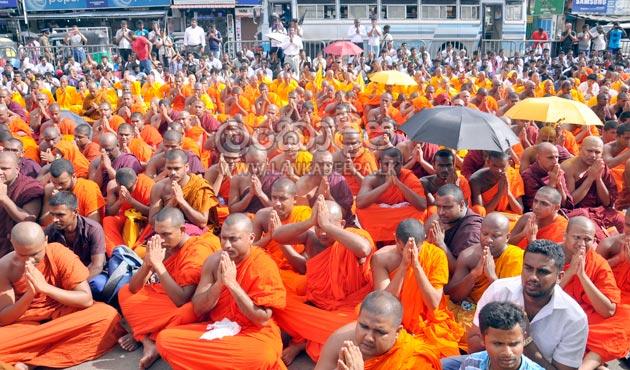
There has  been a growing demand from influential sections of Sri Lanka’s majority Sinhalese-Buddhist community to set up special courts to try cases against Buddhist monks, following the jailing of the high profile monk, Ven. Galagodaaththe Gnanasara Thera, General Secretary of the radical Buddhist organization Bodu Bala Sena (BBS) for contempt of court.

Lanka likely to set up special courts for Buddhist monks after landmark jailing

The monk had abused and intimidated in court, Sandya Eknaligoda, who had filed a case against the military intelligence for the disappearance of her journalist cum cartoonist husband Prageeth Eknaligoda.

Both the SLFP and UNP are amenable to the demand for special courts for monks because they are challenged by the Sri Lanka Podujana Peramuna (SLPP) headed by former President Mahinda Rajapaksa, who has already established himself as the foremost protector of Buddhism in the country.

The urgency of pleasing the Sinhalese-Buddhist majority in Sri Lanka stems from the fact that the Presidential and parliamentary elections are to take place in January and August 2020 respectively and parties  are already on an election mode.

All the three main parties in Sri Lanka (the SLFP, UNP and SLPP) are depending on securing a good chunk of the Sinhalese-Buddhist vote as the Sinhalese-Buddhists are more than 75% of the population of Sri Lanka.

All three parties swear by the constitutional provision on Buddhism which says that the Republic of Sri Lanka shall give to Buddhism the foremost place, and accordingly it shall be the duty of the State to protect and foster the Buddha Sasana, while assuring to all religions the rights granted by Articles 10 and 14(1)(e).”

The  Secretary General of the Asgiriya Chapter of the Buddhist Sangha (organization of monks), Dr.Medagama Dammananda Thera, declared that the severe action” taken  against Gananasara Thera was an attempt by the government to please international forces and West-inspired Non-Government Organizations”.

The Kandy-based high Buddhist official said that the arrest and jailing of Gnanasara Thera will be taken up with President Sirisena.

Members of the BBS and another radical Sinhalese-Buddhist organization Sinhala Ravaya” broke coconut at the Seenigama Devalaya, in South West Sri Lanka, cursing those who had disrespected the order of monks and sentenced Gnanasara to imprisonment.

Meanwhile, in Colombo, the Buddhist Affairs Minister, Gamini Jayawickrama Perera, said that he would take up Gnanasara Thera’s arrest and the need for the setting up of special courts for monks, with President Sirisena; the Minister of Justice Thapatha Athukorale;  and the General Secretary of the Jathika Hela Urumaya  (JHU) Champika Ranawaka.

Perera also said the Mahanayakes (the highest functionaries in the Buddhist hierarchy of monks) should be consulted when action is taken against monks.

There are constitutional provisions to set up special courts for monks and they should be set up,” the Minister said.

Following Minister Perera’s statement, fellow cabinet minister Champika Ranawaka said that special courts should be set up to try cases against Buddhist monks in consultation with the Mahanayakes.

Ranawaka pointed out that while the judiciary sentenced Gnanasara Thera quickly it was dragging its feet in regard very many important cases involving laymen who had looted the exchequer.

Is A Constitutional Amendment Necessary?

According to most constitutional lawyers, the government can set up special courts to try cases involving Buddhist monks under the existing provisions in the constitution and that there is no need for a constitutional amendment.

They point to the constitutional provision on Buddhism which says that the Republic of Sri Lanka shall give to Buddhism the foremost place and accordingly it shall be the duty of the State to protect and foster the Buddha Sasana, while assuring to all religions the rights granted by Articles 10 and 14(1)(e).”

According to lawyer cum leader of the Pivithuru Jathika Hela Urumaya MP, Udaya Gammanpila, the Presidential Commission on the Buddha Sasana set up during the tenure of President Chandrika Kumaratunga, had defined the term Buddha Sasana very broadly. It could very  well include monks, he added.

The pledge to protect the Buddha Sasana implies a pledge to protect the monks too, he said.

However, Prof.Tamil Maran of the Colombo University Faculty of Law, said that setting up special courts for monks would certainly need a constitutional amendment because it will violate the   principle of quality of all before the law.

You cannot have special courts for Buddhist monks without setting up similar courts for Hindu priests and Muslim Maulavis,” Maran pointed out.

Additionally setting up special courts for Buddhist monks and not for the clergy of other religions, will violate the international covenants Sri Lanka has signed”  Maran added.

Defiant Monk

As he was sentenced on June 14  Gnanasara Thera was taken aback. But only for a moment.

Minutes later he was on his feet, ignoring the pleas of his lawyer as he launched into a familiar tirade that questioned both the magistrate’s integrity and his sentence.,” The Sunday Observer reported.

In a court system which rarely convicts clergy, Thursday’s ruling was monumental, with legal experts claiming it may set precedence for similar cases in the future to ensure protection of witnesses and victims of crime,” the report added.

Recalling the incident in 2016 that led to the intimidation case, the Senior State Counsel said it was in the same Homagama court house that Gnanasara Thera had told Mrs.Eknaligoda: Your husband is a Tiger, go beg on the streets”.

Amnesty Hails

In a statement released after the jailing, Amnesty International called it a victory for human rights defenders in Sri Lanka.”

This is an important verdict for all people who fight for human rights in Sri Lanka. A clear message has gone out to those who seek to intimidate, threaten and silence people seeking justice,” said Amnesty International’s Deputy Director for South Asia, Omar Waraich.

Notorious Monk

Ven.Gnanasara Thera had earned notoriety when he agitated against the branding of food stuffs in the market as halal”. The branding was done by the Muslim organization the All Ceylon Jamaithul Ulama.

He then took up the issue of  Sri Lankan Muslim women wearing the Abaya, especially those who cover their face fully.

In 2014, the Thera’s incendiary speeches led to anti-Muslim riots in Aluthgama, south of Colombo. A lot of property was damaged or destroyed as the police looked on.

Suspecting that the rioters had the full backing of the Rajapaksa government, Sri Lanka’s Muslims voted against Rajapaksa in the January 8, 2015 Presidential election. Lacking the  support of the minorities, Rajapaksa had to bow out of office.

(The featured image at the top shows Ven.Gnanasara Thera about to board the prison bus)

No Comments »

Former External Affairs Minister Prof. G. L. Peiris says US repeating Lanka’s allegations against UNHRC

June 20th, 2018

By Shamindra Ferdinando Courtesy The Island

Having had brazenly used the Geneva-based United Nations Human Rights Council (UNHRC) to adopt an anti-Sri Lanka Resolution in Oct 2015 on the basis of unsubstantiated war crimes allegations, the US has endorsed what we have been saying with regard to the inherent bias and lack of objectivity on the part of the UN agency, former External Affairs Minister Prof. G. L. Peiris says.

Responding to a query by The Island, Prof. Peiris, yesterday, alleged that the Geneva body always treated Sri Lanka with preconceived notions and shuts its eyes to compelling evidence contrary to the conclusions which they wished to reach.

article_image

Prof. Peiris pointed out that US envoy to the UN Nikki Haley was quoted in the international media as having called the council a “cesspool of political bias.”

The former Law Professor said that it was funny for Haley to now accuse the UNHRC at a joint media conference with Secretary of State Mike Pompeo that it was a “hypocritical and self-serving” body that “makes a mockery of human rights.”

The US quit the 47-member organization alleging its hostility towards Israel.

The UN transformed the human rights commission to a council in 2006.

Prof. Peiris recollected the circumstances under which the US coerced Sri Lanka to co-sponsor the Resolution just over a week after the then Sri Lanka Permanent Representative in Geneva quite rightly rejected the text.

The Sirisena-Wickremesinghe government certainly owed an explanation to the public over its refusal to make fresh representations on behalf of Sri Lanka in respect of Geneva Resolution 30/1 in the wake of Naseby revelations in Oct last year.

Asked whether the US move would have a bearing on Sri Lanka situation, Prof. Peiris said that both UN and the US couldn’t ignore the post-US pullout situation. Prof. Peiris pointed out how a US led group had been pursuing Sri Lanka at Geneva since the conclusion of the conflict in May 2009 and finally achieved their objectives after the change of government in January 2015.

Israel on Tuesday night praised the US move a “courageous decision against the hypocrisy and the lies” of the international body.

Prime Minister Benjamin Netanyahu hailed the US move, branding the council “a biased, hostile, anti-Israel organization that has betrayed its mission of protecting human rights.”

Prof. Peiris said that the US couldn’t expect the world to believe that Geneva had been biased towards one country and impartial in handling other situations.

Former Minister Prof. Peiris recalled how the US had intervened to have rescinded Goldstone war crimes report on Gaza invasion by Israel commissioned by the UN years ago, while pursuing Sri Lanka.

Prof. Peiris said that the Joint Opposition and the Sri Lanka Podujana Peramuna (SLPP) would critically examine the situation.

The SLPP Chairman alleged that the government had been simply following Western dictates and struggling to implement the Geneva Resolution in spite of it being inimical to Sri Lanka’s interest. The government was on record as having said that it secured two year additional period to fulfill Geneva obligations while the country responsible for our predicament now accused UN body of playing politics.

No Comments »

Govt. determined to keep BBS monk in prison garb … receives BASL backing

June 20th, 2018

By Shamindra Ferdinando Courtesy The Island

Justice and Prisons Reforms Minister and attorney-at-law Thalatha Atukorale has informed Kotte Sri Kalyani Samagri Sri Dharma Sangha Sabhawa that  Bodu Bala Sena General Secretary Ven. Galagodaatte Gnanasara would be treated like any other prisoner.

In her letter, dated June 19, 2018, Minister Atukorale has insisted that the Commissioner General of Prisons had no option but to treat Ven. Gnanasara in accordance with the Prisons Ordinance.

The letter was addressed to the Most Ven. Prof. Kottapitiye Rahula, Chief Registrar, Kotte Sri Kalyani Samagri Sri Dharma Sangha Sabhawa.

article_image

Thalatha

Justice Minister’s spokesperson Nalin Rajapaksha told The Island that the letter had been delivered to the Thera yesterday in response to a missive, dated June 16, from Kotte Sri Kalyani Samagri Sri Dharma Sangha Sabhawa in respect of Ven. Gnanasara.

The Homagama Magistrate, on June 14, sentenced Ven Gnanasasa to one year RI to be served in six months for threatening Sandya Ekneligoda, wife of missing media personality, Prageeth within the court premises.

Addressing the media, on Tuesday, at the Sunethradevi Pirivena, Pepiliyana, Ven. Prof  Medagoda Abhayatissa Thera said that according to the disciplinary texts, the Vinaya Pitakaya, a bikkhu who spent seven days out of the robe could lose his status as per the rule cheevara vippavaasi (residing out of the robe).

The Thera pointed out that in other instances bikkhus who were found guilty of transgressing established laws were punished but never forced to remove their robes.

Justice Minister Atukorale insisted that the prisoner would be dealt with the Section 106 of the Prisons Ordinance therefore Ven. Gnanasara, too, was to receive usual prison garb, commonly referred to as ‘jumper suit’.

Earlier, Kotte Sri Kalyani Samagri Sri Dharma Sangha Sabhawa has advised Minister Atukorale that the power to disrobe a monk lies with the Sangha Sabha that ordained him. The Sangha Sabhawa asserted that even the Commissioner General of Buddhist Affairs couldn’t take a decision in respect of a monk unless specifically instructed by the relevant Mahanayaka Thera.

Minister Atukorale has informed the Sangha Sabhawa that the measures mentioned by Ven Rahula couldn’t be accepted as part of the law of the land. She has pointed out that in addition to the steps that could be taken in respect of those who had been found guilty of offences, monks could give up robes voluntarily.

While assuring the Sangha Sabhva that the government, political leaders or any section of the administration wouldn’t hinder or interfere with the way the clergy responded to such situation, Atukorale has stressed that all citizens, irrespective of their social status, should be dealt with equally under the law.

Minister Atukorale responded to Ven. Rahula in the wake of President of the Bar Association of Sri Lanka (BASL) U. R. de Silva, PC, asserting that members of the clergy, too, were subjected to the law of land.

The BASL chief told The Island yesterday that there had been about 15 Buddhist monks and three other clergymen at Welikada at the time Ven. Gnanasara was brought in. Responding to a query, De Silva said that the Homagama Magistrate could have dealt with the monk’s bail application, on Tuesday (June 19), without putting off the hearing to Friday afternoon (June 22).

The President’s Counsel pointed out that no one had objected to other monks being compelled to wear usual prison garb. “The BASL believes that there shouldn’t be interference of any sort from any part and the judiciary should be allowed to address the issue.”

No Comments »

Buddha civaraya

June 19th, 2018

Pannadasa Punchihewa 

The demonstration by the Maha Sangha over the Rev .Gnanasara issue yesterday, as befitting the Sangha was very orderly, and restrained although according to some reports more than thousands participated. Demonstrations had also taken place in other places like Moneragala,Padukka,Tissamaharama and Badulla showing the wide spread discontent of the Buddhist public .This is one of the rare occasions when the Members of the Maha Sangha came out in such numbers on a matter of great importance.

In the Buddhist countries it is a well-known fact that the Buddha civaraya is held in the highest esteem .I am told that in 1942 when the Japanese attacked Ceylon, a low flying plane over Kelaniya hit a temple premises and a British soldier who was running  to save his life fell on the ground. A Buddhist priest seeing him, removed his upper robe and threw it over the British soldier. The Jap plane came down further down, noticed  the yellow robe and  returned to the base without attacking.

Buddha civaraya   is the world’s oldest uniform .It had not changed over the last 2,600 years in the Theravada tradition .At the end of Vas season even the cloth that is taken around the villages in the early hours of the morning  is held in high esteem even though  that  would be turned to a full pledged civarya only after several hours.

So it is nothing but correct that the Buddha civaraya be treated with the due respect it deserves.

However it is surprising that particularly the English media seems to have played down the significance of the yesterday’s event comparing to the publicity received by trade union activities of other organizations. Was there an unseen hand working to partially black out the publicity?

A leading monk while addressing the gathering said If the sad situation continue they might refuse to participate in state functions  .There have been instances when such action brought redress  to others earlier!


1 Comment »

The foreign hands behind the LTTE

June 19th, 2018

If you wondered why LTTE could not be defeated for 3 decades there is no one reason. When you look at the plethora of players that were backing the LTTE over the years, you will never want to stop showering accolades at the Sri Lankan Armed Forces as well as the political leadership that had the guts to withstand these multiple forces that were using the LTTE to advance their own geopolitical agendas in the region.

Let’s take a step back & run through just some of these players most of whom we know well enough

Indian intelligence wing RAW was created in 1968 led by Rameshwar Nath Kao till retirement in 1977. According to Stephen P Cohen of Brookings Institute CIA assisted the creation of RAW.

The ‘Tamil New Tigers’ was formed in 1972 immediately after the country’s 1st republican constitution.

TNT was re-christened as ‘Liberation of Tigers of Tamil Eelam’ (LTTE) in 1976 immediately after the Tamil racist leaders put forward the separatist agenda with the Vaddukoddai Resolution.

India

Poignant to note is that Sri Lankan Tamil armed militancy began training in India in the 1970s well before July 1983.

Indira Gandhi’s government

The Indian Government saved a cornered Prabakaran in Vadamarachchi in 1987 & flew him to India

RAW (Research & Analysis Wing)

LTTE leader’s deputy, Gopalaswamy Mahendrarajah, alias Mahattaya, was a RAW agent

Advanced training of the LTTE was arranged by the Indian intelligence agency in Lebanon under Russian General Mikhail Barsukov in early 1990s.

RAW also managed LTTE’s sophisticated training in Israel in collaboration with its intelligence agency MOSSAD.

Prabhakaran’s ‘handler’ when the LTTE leader was in India, Chandran additional secretary in the Cabinet Secretariat and in charge of RAW in Sri Lanka

Tamil Nadu Leaders/Politicians

In the 1970s LTTE developed links with Tamil Nadu political groups – Dravida Kazhagam headed by Veramani, the Kamraj Congress headed by Nedumaran and the Pure Tamil Movement headed by Perinchintanarayanan.

LTTE had links to M G R Ramachandran, Karunanidhi

In April 1984 Pirapaharan met for the first-time Tamil Nadu Chief Minister M. G. Ramachandran,’

In April 1984, Balasingham and Adele lived in a house in Thiruvanmiyur. Pirapaharan lived in another house nearby.

Many a Tamil politician have been pro-LTTE. An interesting video has emerged in social media highlighting the church involved in the great Tamil Eelam project.

Foreign Intelligence

CIA

Daya Gamage in his article the US early flirtation with Tamil militancy shows examples of ambiguity in responses by the US. In 2003 he quotes Deputy Secretary of State Armitrage of saying the United States government is encouraged by the vision of the LTTE as a genuine political entity.”

When pro-US President Jayawardena requested US military assistance in 1980s to defeat LTTE, the US refused.

MOSSAD

What is interesting is that in 1970 Sri Lanka severed ties with Israel for its refusal to withdraw from Palestinian territory but in 1980s Palestine began aiding LTTE in the 1980s while President Jayawardena renewed links with Mossad allowing 50 officers to provide Sri Lanka Army training in 1983 & Mossad ended up training both Sri Lanka Army & Tamil militants. Sri Lanka paid

According to Victor Ostrovsky’s book ‘By way of deception: The making of a Mossad officer’ RAW had been paid by Mossad for brining Tamils (TELO) to train in Israel. In 1987, the Hindustan Times reported that in the Sri Lankan city of Jaffna, the troops seized large quantities of arms with Israeli markings, meant for the Tamils.

British Intel

According to A Bharathkumar LTTE began training in 1970s & obtained arms from OXFAM who he refers to as ‘one of the most powerful & secretive British intelligence organizations acting under non-governmental cover”.

That British mercenaries were training LTTE was revealed by John Glover, a British writer to the Western Mail in Wales a band of mercenary soldiers recruited in South Wales is training a Tamil army to fight for a separate state in Sri Lanka. About 20 mercenaries were signed up after a meeting in Cardiff and have spent the last 2 months in southern India preparing a secret army to fight the majority Sinhalese, the the cause of a separate Tamil state in Sri Lanka”.

In June 2018 it was announced that the British Foreign Office had destroyed some 200 files belonging to 1978-1980 period

http://www.dailymirror.lk/article/Files-on-LTTE-and-MI-in-SL-erased-at-UK-Foreign-Office-150331.html

The British Special Air Services firm Keenie Meenie Services also trained the Sri Lankan Army & the LTTE in the 1980s (A Bharatkumar P K T – Terrorism Comes from Us”)

In 2003 a trial of Michael McKevitt held in Dublin, Ireland revealed attempts by the Real IRA (Irish Republican Army) to develop links with Tamil Tigers.

According to Dushy Ranetunge Deirdre McConnel (IRA) was linked to LTTE & worked as a LTTE humanitarian lobbyist in the LTTE led front, the Tamil Centre for Human Rights (TCHR) in Manchester. http://www.island.lk/2003/07/26/news01.html

LTTE reaches out to Scottish separatists – https://defence.pk/pdf/threads/ltte-reaches-out-to-scottish-separatists.326941/

Britain

Britain banned LTTE on February 28, 2000. MPs Robert Evans, Linda Perham, Andrew Dismore, Dr. Jenny Tong, Jeremy Corbyn, John MacDonald, Andy Love raised objections against ban.

LTTE’s defacto headquarters was in London masquerading under the name British Tamil Association” with debit accounts in Natwest Bank.

MPs Hon Andrew Love (Labour), Hon Simon Hughes (Lib Dem), Hon Jeremy Corbyn (Lab), Hon John McDonnell (Lab), Hon Paul Burstow (Lib Dem), Hon Susan Kramer (Lib Dem), Hon Andrew Dismore (Lab), Hon Andrew Pelling (Independent), Hon Lee Scott (Conservative), Rt. Hon Keith Vaz (Lab) and the Hon Minister Bill Rammell (Lab) Gavin Barwell, Tom Brake, James Brokenshire, David Burrowes, Edward Davey, Duncan Smith, Barry Gardiner, Zac Goldsmith, Robert, Halfon, Stephen Hammond, Nick Hurd, Joseph Johnson, Sadiq Khan, Siobhain McDonagh, Bob Neill, Richard Ottoway, Stephen Pound, Andrew Rosindell, Sarah Teather, Gareth Thomas, Stephen Timms, Theresa Villiers, Angela Watkinson, Angus Robertson, Dianne Abbot, Jon Trickett, Mark Hendrik, Philip Davies, Peter Bottomley, David Miliband, Stella Creasy & John Mann, have all been openly supportive of LTTE. http://www.srilankaguardian.org/2011/10/why-are-uk-mps-supporting-ltte.html

British MPs – Siobhan McDonagh and Joan Ryan

For Prabakaran’s 50th birthday 5000 Tamils gathered in Wembley Arena with entrance fee £35 per head.

MR Barry Gardiner MP arrived in Sri Lanka in 2001 without even informing the SL High Commission. He has been a regular attendee of LTTE events in the UK. He together with LTTE front Confederation of Tamil Associations UK” organized an event booked under Gardiners name.

In 2010 – British MPs attend a fundraising dinner in Harrow organized LTTE front – Nick Hurd, David Ashton, Jean Lammiman, Richard Almond, Golsie Simms,

In October 2010 – Siobhain McDonagh MP calls for the UK to take action against Sri Lanka. Hansard transcript http://www.publications.parliament.uk/pa/cm201011/cmhansrd/cm101027/debtext/101027-0001.htm#10102752000011

In September 2011 – Rt. Hon. Douglas Alexander MP calls for an international commission on inquiry into war crimes against Sri Lanka speaking at a Tamils for Labor event at the Labour Party Conference

In September 2012 – Gareth Thomas MP makes an emergency Point of Order” speech in the House of Commons raising concerns about the Human Rights Watch report about Tamil asylum seekers deported from UK and being tortured in Sri Lanka.

In January 2013 – Lee Scott MP calls for, justice for Tamil people – he is the Chairman of the APPGT

In 2011 –  41 British MPs wrote to PM Cameron calling for an independent, international inquiry against Sri Lanka. These MPs – Lee Scott (Chair) Virendra Sharma (Vice Chair) Siobhain McDonagh (Vice Chair) Simon Hughes (Vice Chair)

Heidi Alexander, Ian Austin Hazel, Blears Peter Bottomley Russell Brown David Cairns Martin Caton Katy Clark Jeremy Corbyn Stella Creasy Jon Cruddas Jim Cunningham John Cryer Jim Dowd Clive Efford Mike Gapes Barry Gardiner Mary Glindon Robert Halfon Tom Harris Margaret Hodge Sharon Hodgson George Howarth David Lammy Andy Love John Mann Stephen McCabe John McDonnell Teresa Pearce Steve Pound Nick Raynsford Chris Ruane Joan Ruddock Stephen Timms Emily Thornberry Gareth Thomas Keith Vaz.

UK even gave permission for World Tamil Conference on November 10, 2012 at the British House of Parliament where Jeremy Corbyn urged the international community to recognize Tamil’s aspirations and their right to self-determination in Sri Lanka. Also present were Siobhain McDonagh, Mike Gapes, Barry Gardiner, Seema Malhotra, Stella Creasy, Kate Green while Garath Thomas urged to set up international independent inquiries. Conservative MPs were Steve Baker, Steve Brine, Bob Blackman, Alok Sharma, Stephen Hammond, Mike Freer, Nick de Bois, Iain Stewart, Lord Popat of Harrow. Liberal Democrat MPs Tom Brake

Norway

Fredrica Jansz in an article titled the LTTE rides high in Norway while Lanka gets torn apart” that LTTE raises half a million US dollars per month in Norway & Scandinavian countries, with 6 offices out of Norway operating as fronts. Jon Westborg, the Norwegian ambassador in Colombo denies LTTE offices in Norway.

In a 2014 Wikileaks release, revealed a confidential US embassy cable on 23 Oct 2003 that the then President Chandrika B requested the removal of the SLMM chief Tryggve Teleffsen as he & the Sri Lanka Monitoring Mission had tipped off LTTE vessel helping it escape from the Sri Lanka Navy.

Shamindra Ferdinando writing to the Island in 2016 ‘a secret Norwegian missive to Dear Mr. Prabakaran” in the wake of the Kadiragamar assassination” claims that LTTE women leader Thamilini confirmed that Prabakaran ordered the assassination of Lakshman Kadiragamar

What more is there to say when an interview with Eric Solheim says that he regrets he ‘could not spend more time with Prabakaran”

Norway, Solheim helped establish LTTE-Eritrea links for arms deals http://infolanka.asia/news/general/norway-solheim-helped-establish-ltte-eritrea-links-for-arms-deals

Sri Lanka accuses Oslo envoy Erik Solheim of financing Tamil Tigers 2014 http://www.scmp.com/news/asia/article/1641542/sri-lanka-accuses-oslo-envoy-erik-solheim-financing-tamil-tigers

Canada

Canada’s Prime Minister Stephen Harper threatened to boycott Commonwealth Summit in 2013 Sri Lanka. Pro-LTTE TNA parliamentarian Sumitharann thanked Canadian MP Stephen Harper and Foreign Minister John Baird for supporting their cause.

In 2007 Liberal MPs Jim Karygiannis, Derek Lee, Maria Minna, Yasmin Ratansi & Borys Wrzesnewskyi participated in an event to commemorate death of LTTE Tamilselvan. MP Karygiannis had met Tamilselvan in 2004 in Sri Lanka.

MP Bob Rae

On June 9, 2009, Rae was denied entry by Sri Lankan Immigration officials (in 2006 the Canadian Govt did not allow British MP George Galloway to enter Canada citing his links to Hamas) Bob Rae set up the Forum of Federation together with Centre for Policy Alternatives organized several workshops in the Wanni on federalism in 2002. http://www.cpalanka.org/wp-content/uploads/2007/8/cpa_forum_report.pdf

Forum of Federations has been active in Nepal since 2008 sponsored by Global Affairs Canada. The Forum worked extensively with Nepali Constituent Assembly members assisting their efforts to draft a federal constitution.

The Forum is also involved in Myanmar in training sessions in Yangon and Nay Pyi Daw for Burma politicians, civil society representatives and media personnel.

Former PM Paul Martin when he was Finance Minister & MP Ms. M. Minna and several MPs attended an LTTE fundraiser in 2000 (Dining with Terrorists – Judi McLeod)

Cabinet Minister for Foreign Affairs and International Trade, Bill Graham prevented LTTE proscription in Canada in 2003.

Liberal member of the Canadian Parliament Gurbax Malhi addressed a rally in Ottawa on March 5 against the backdrop of Liberation Tigers of Tamil Eelam flags.

Proscribed pro-LTTE event attended by Federal Citizenship and Immigration Minister Hon. Chris Alexander, Ontario Premier Hon. Kathleen Wynne, , Parliamentary Assistant to the Prime Minister M.P. Paul Calandra, Markham Mayor Frank Scarpitti, John Tory, York Region Police Chief Eric Jolliffe, Consul General for India in Toronto Mr. Akhilesh Mishra, U.S. Consulate General Vice Consul in Toronto Mr. David Swalley, academics, members of law enforcement, and business and community leaders (Jan 2014) in which Federal Liberal leader Mr. Justin Trudeau was the chief guest.

Conservative Party MP Roxanne James laid flowers inside the Canadian Parliament on the 5th year Anniversary of May 2009, ‘Vanished Voices Memorial’ in 2014 others who attended were other MPs – Dr. Kirsty Duncan, David Smith, John McKay, Don Meredith & the Human Rights critic Wayne Marston,

Conservative MP Deepak Obhrai visited Jaffna in 2013 & laid a wreath allegedly for dead LTTE.

Australia

SPUR spokesman Mr. Ranjith Soysa in a hard hitting letter to MP John Murphy regarding his statement made to the Australian parliament on 28 June 2008 questioned by he was reluctatnt to name & shame the LTTE for its crimes.

Australian Green party Senator Lee Rhiannon has been a frequent glorifier of LTTE terrorists even inside the Australian parliament calling to celebrate the Tamil Terrorism’ day on 27 Nov 2014.

Funding panel discussions by LTTE diaspora has been another means of promoting itself globally. The Human Rights Law Centre was the venue in 2013 where despite the organizers being notified of a biased panel the program went on as scheduled. The panel included one Dr. Sam Pari who had been connected with LTTE with a member of the audience even producing copies of her LTTE ID.

Another pro-LTTE supporter Bruce Haig who claims all asylum seekers should be allowed into Australia.

The extent of LTTE infiltration into international government & international systems was clearly visible in the manner that ‘Tamil Eelam’ was featured as a country in Australia’s census in 2016.

The Church

In July 1995, US national Kenneth Mulder employed with National Council for Christian Churches (NCCC) was arrested by Sri Lankan police in Vavuniya for links to LTTE after NCCC’s offices were raided by police.

Also in 1995 when the conflict escalated the International Committee of the Red Cross refused to put its food-ships through the government security at the port of Kankasanthurai & wanted to be allowed to directly travel to the LTTE’s Point Pedro pier (we can recall they tried similar stunts during the final phase of the conflict too)

LTTE Terrorism-Church Links – Can someone explain these photos? http://www.sinhalanet.net/ltte-terrorism-church-links-can-someone-explain-these-photos

LTTE-Christian ties – http://ltte-christian-ties.blogspot.com

The Church & Its Links to Sri Lanka’s Terrorism & Elsewhere  http://unethicalconversionwatch.org/2012/the-church-its-links-to-sri-lanka’s-terrorism-elsewhere/

Voice of Tigers ties up with Veritas – http://www.infolanka.com/org/kalaya/new168.htm

Praising The Lord & Passing The Ammunition To Prabhakaran (H D L Mahindapala) https://www.colombotelegraph.com/index.php/praising-the-lord-passing-the-ammunition-to-prabhakaran/

Catholic Church, an ally of Tamil Tiger terrorists http://www.srilankaguardian.org/2009/04/catholic-church-ally-of-tamil-tiger.html

The Catholic Church as the backbone of the international LTTE resurgence. https://www.lankaweb.com/news/items/2012/01/11/the-catholic-church-as-the-backbone-of-the-international-ltte-resurgence/


Foreign Media

Frances Harrison ‘Counting the Dead’ from overseas!

C4 lies has been exposed enough of times and the fact that LTTE blood money has been instrumental in its ‘edited’ documentaries is now an open secret.

http://www.adaderana.lk/news/30917/who-is-the-giant-black-tiger-that-backs-the-pro-ltte-elements

Who is the giant ‘black tiger’ that backs the pro-LTTE elements?

We all know the level former UN official Gordon Weiss stooped to in doctoring ‘dead’ estimates so he could sell his book ‘the Cage’.

The foreign media stands guilty of guestimating numbers of dead and building sensationalism around the last phase of the conflict completely ridiculing the humanitarian effort that save 300,000 Tamils & running down the only military that was able to defeat a terrorist outfit.

Foreign Lawyers

Former United States Attorney General, Ramsey Clark is now a legal counsel for a US-based LTTE front that remains proscribed under UNSC 1373

Bruce Feinn is another lawyer retained by the LTTE fronts. ‘Why Bruce Fein has come forward to deproscribe the LTTE in the US ?’  http://www.asiantribune.com/node/12269

 Pro-LTTE Attorney ordered to pay the defendant he sued: Bruce Fein gets drubbing in US Federal Court https://www.lankaweb.com/news/items/2011/01/29/pro-ltte-attorney-ordered-to-pay-the-defendant-he-sued-bruce-fein-gets-drubbing-in-us-federal-court/

The LTTE’s Bruce Fein and the IMF Loan http://www.island.lk/2009/06/11/features3.html

 Foreign NGOs/Human Rights Organizations

Amnesty International accepted Canadian dollars 50,000 from a proscribed pro-LTTE front operating from Canada

Sri Lanka Campaign for Peace & Justice

Professor Craig Scott, M.P. and founding member of the Sri Lanka Campaign for Peace and Justice.

What exactly is World Vision upto again in North Sri Lanka? https://www.lankaweb.com/news/items/2013/10/14/what-exactly-is-world-vision-upto-again-in-north-sri-lanka/

Save the Children in Sri Lanka refutes providing funds to the LTTE

https://reliefweb.int/report/sri-lanka/save-children-sri-lanka-refutes-providing-funds-ltte

LTTE used notorious Norwegian NGO’s vehicles for military activities http://www.asiantribune.com/?q=node/12428

The above names linked to LTTE is not even near the full total & some of the names are likely to emerge after their demise. However, from the names given any reader should understand the pressures that the Sri Lankan governments in power had to deal with. However, while all of the Sri Lankan Governments caved into these foreign pressures it took one President to defy all the odds & give his military the orders to annihilate the LTTE, you can therefore understand why the same parties & personalities wish to take revenge on that President & all those who were involved in the elimination of the LTTE.

Is it therefore, not our national duty to protect those that defied the odds to ensure we are living without LTTE bombs, suicide missions, assassinations simply to advance the geopolitical agendas of external parties & enable a set of others to get rich enjoying perks & privileges for helping LTTE thrive?


Shenali D Waduge

4 Comments »

ගිරුවාපත්තුවේ නියමුවා හිටපු රාජ්‍ය ආරක‍ෂක ලේකම් ගෝඨාභය රාජපක්ෂ

June 19th, 2018

ඇමෙරිකාවේ ප්‍රධාන සංඝනායක අග්ගමහා පණ්ඩිත, ආචාර්ය වල්පොළ පියනන්ද නාහිමි

හිටපු රාජ්‍ය ආරක‍ෂක හා නාගරික සංවර්ධන ලේකම් ගෝඨාභය රාජපක්ෂ මැතිතුමාගේ ජන්ම දිනය අදට (ජුනි 20) යෙදේ. මේ ලිපිය ඒ නිමිත්තෙනි.

මුළු මහත් ශ්‍රී ලාංකීය ජාතියම අ`දුරු වළාවකින් වෙළා ගෙන සිටි තිස් වසරක කුරිරු යුද්ධය අතිගරු මහින්ද රාජපක‍ෂ මැතිතුමාගේ අභීත නායකත්වය යටතේ අවසන් කොට සියලූම ජාතීන්ට ගෞරවාන්විතව ජීවත් වීමට නිදහස ලබාදීමේ සටනේ නියමුවා ගෝඨාභය රාජපක‍ෂ මහතා ය. එහෙයින් නිතැතින්ම කෘතගුණ දන්නා සියලූම ශ්‍රී ලාංකිකයන්ගේ ආශිර්වාදය එතුමාට හිමි වේ.

ඔහු ආරක‍ෂක ලේකම් පදවිය භාරගන්නා විට ශ්‍රී ලංකා ආරක‍ෂ අංශයන් පැවතියේ ඉතා දුර්වල මානසික මට්ටමක බව නොරහසකි. 2002 බලයට පත් රජය විසින් ක්‍රියාත්මක කළ බටහිර ගැති, එන්. ජී. ඕ. රූකඩවලට නැටවුණු, ඊනියා සටන් විරාම ගිවිසුම මේ ස`දහා බලපෑ මූලික හේතුව විය. උසස් හමුදා නිළධාරියාගේ සිට පහළ මට්ටමේ සිටින සොල්දාදුවා දක්වා හිමි විය යුතු ගෞරවය හා අභිමානය නොලැබීමත් අවිය අත දරාගෙන ත්‍රස්තයන්ගේ උසුළු විසුළු සමච්චලයන්ට හසුවීමට සිදුවීම තවත් හේතු වේ. මේ තත්වය වෙනස් කිරීමට ගෝඨාභය මැතිතුමා ඉතා දූරදර්ශීව කටයුතු බව අද බොහෝ දෙනෙකුට අමතක ය. එකල ඔහු zඅපි වෙනුවෙන් අපිZ යන තේමාව යටතේ විවිධ වැඩසටහන් ක්‍රියාත්මක කරමින් හා ශ්‍රව්‍ය දෘශ්‍ය මාධ්‍ය මගින් ප්‍රචාරණය ලබාදෙමින් සියලූ රටවැසියාගේ අවධානය හමුදාවන් දෙසට නතු කරගෙන සමස්ත හමුදාවේ ම චිත්ත ධෛර්යය වර්ධනය කිරීමට සමත් විය. ඇතැම් ඉහළ හමුදා නිළධාරීන් විරුද්ධ වුව ද, අද ප්‍රශස්ති ගී ගයන ඇතැම් දේශපාලනඥයන් එදා විවිධ කරුණු ඉදිරිපත් කරමින් තියුණු විවේචන එල්ල කළ ද දින කිහිපයකින් විශ්‍රාම යෑමට සිටි ජ්‍යෙෂ්ඨ හමුදා නිළධාරියා හමුදාපති තනතුරට ගෙන ඒමට මුල් වූයේ යුධ බිමේ දී ඔහුට කළ නොහැකි දෑ ප්‍රායෝගික අත්දැකීමෙන් ම ගෝඨාභය මහතා දැන සිටි හෙයිනි. ඔහු සතු සුදුසු අවස්ථාවේ නියම සුදුස්සා තේරීමේ හැකියාව අද මුළු රටම භුක්ති වි`දිති. එහෙත් අදාළ පුද්ගලයා එය තේරුම් නොගැනීම ජාතියේ අවාසනාවක් ලෙස දකිමි. යුධ ජයග්‍රහණය වෙනුවෙන් එතුමා කළ අසීමිත කැපකිරීම මා පෞද්ගලිකවම දැක ඇත. එහෙත් ඔහු කිසිවිටෙකත් ඒ ගැන උදම් අනන්නේ ද නැත. ඔහු නිතර පවසනුයේ zරට වෙනුවෙන් මගේ යුතුකම ඉටු කළා එපමණයිZ යනුවෙනි. මෙහිලා පැරැණි සිංහල ආප්තෝපදේශයක් මගේ සිහියට එයි. එක් සිංහල වෛද්‍යවරයෙක් එක්තරා රෝගියෙකුගේ රෝග නිදානය හො`දින් පරීක‍ෂා කොට නියම පරිදි ප්‍රතිකාර කොට රෝගය සුවපත් කළේය. රෝගියා සුවපත් වූ පසු තෙල් සාත්තු කළ තැනැත්තා පැමිණ zමම හරියට නියම වෙලාවට තෙල් ගෑම කළ නිසා තමයි මේ රෝගියා සුවපත් වුණේ යැයිZ පැවසීය. කෂාය තැම්බූ තැනැත්තා zමම හරියට පදමට කෂාය තම්බපු නිසා තමයි මේ රෝගියා සුවපත් වුනේZ යැයි උදන් ඇනීය. ආවතේවකම් කළ තැනැත්තා පැමිණ කීවේ zමම හරියට වැඩ ටික නොකළ නම් ලෙඩා සුවවෙන හැටි බලාගන්න තිබ්බාZ යනුවෙනි. යුධ ජයග්‍රහණය සම්බන්ධයෙන් ද මේ ආප්තෝපදේශය ඉතා අගනේ ය.

කිසියම් වැඩක් භාරදුන් පසු ගෝඨාභය මහතාගේ සිරිත ඒ ගැන හො`දින් අධ්‍යයනය කිරීමයි. අධ්‍යයනය කොට අතීතයේ වැරදුන් තැන් ඇත්නම් ඒවා නිවැරැදි කොට ගෙන, තමාගේ මතයට විරුද්ධ අයකුගේ වුව ඵලදායී වටිනා අදහසක් හෝ යෝජනාවක් ඇත් නම් එය සිය කාර්යයන්ට එකතු කර ගනී. හො`ද දේ අගය කිරීමට හා ඒවාට වටිනාකමක් දීමට ඔහුට ජාති, ආගම්, පාට පක‍ෂ ආදී භේදයක් නැත. මානුෂීය යුධ මෙහෙයුමෙන් පසුව

ඔහුට භාර කෙරුණේ නාගරික සංවර්ධනයයි. zයුධ විරුවා මමZ යැයි ද zයුධ ජයග්‍රහණයට පාර කැපුයේ තමාZ යැයි ද වහසි බස් දොඩවා බලයට පැමිණි අය අද දේශපාලනික වශයෙන් බලවත් වුව ද ඔවුන්ගේ හැකියාවේ තරම සමස්ත රට වැසියාට ම ප්‍රදර්ශනය කොට ඇත. ගෝඨාභය මහතා නාගරික සංවර්ධන විප්ලවයේ දී පෞරාණික දේ ආරක‍ෂා කර ගනිමින් හා දියුණු රටවල භාවිත නවීන තාක‍ෂණය යොදා ගනිමින් කටයුතු කිරීමට සමත් විය. ඇමෙරිකාවේ ලොස් ඇන්ජලීස් නුවර zලොයලාZ විශ්වවිද්‍යාලයේ පරිපාලකයෙකු වශයෙන් කටයුතු කරන සමයේ සියලූ දෙනාගේ ම සිත් දිනාගෙන කටයුතු කළ බව ඔහුගේ සමකාලීනයෝ අදත් ගෞරවයෙන් සිහිපත් කරති. ඇමෙරිකාවේ දී ඔහු ලබා ඇති අත්දැකීම් ලංකාවේ නාගරික සංවර්ධනයට යොදා ගැනීමට සමත් විය. නාගරික සංවර්ධන අංශයෙන් පසුගිය රජය සමයේ ලබා තිබූ දියුණුවේ පුරෝගාමියා ගෝඨාභය මැතිතුමා බව ඉතා සු`එ අතළොස්සක් හැර අන් සියල්ලෝ ම පාහේ පිළිගනිති. යුධ ජයග්‍රහණයෙන් පසුව අවිය අත දරා සටන් වැදුණු හමුදා සොල්දාදුවන් බෞද්ධ විහාරස්ථාන ඇතු`එව අනෙකුත් ආගමික ස්ථානවල සංවර්ධනයට යොදවා කළ සේවය අගය කළ යුතු ක්‍රියාවකි. වියෙට්නාම් යුද්ධයට සම්බන්ධ වූ ඇමෙරිකන් සොල්දාදුවෝ අදත් ගෙවල් අහිමි තැනැත්තන් (හෝම්ලස්) ලෙස ප්‍රධාන නගරවල ජීවත් වෙති. ඇමෙරිකාව ලෝකයේ දියුණුම රට වුව ද මේ තත්වය ම`ගහරවා ගැනීමට තවමත් සමත් වී නැත. ඊට හේතුව පශ්චාත් යුධ සමයෙන් පසු ඊට සම්බන්ධ සොල්දාදුවන්ගේ මානසික තත්වය න`ගා සිටුවීමට විධිමත් වැඩපිළිවෙලක් ක්‍රියාවට නොනැගීමයි. එහෙත් ලංකාවේ එවැනි තත්වයක් උදා නොවූයේ හමුදා සාමාජිකයන් සමාජ ප්‍රගතිශීලි කටයුතුවලට සම්බන්ධ කර ගෙන ඔවුන්ගේ මානසික තත්වයන් න`ගා සිටුවා ගැනීමට අවස්ථාවක් ලබාදීම හේතුවෙනි.

ලංකාවේ පැවැති තිස්වසරක යුද්ධයේ දී මව්බිම වෙනුවෙන් යුධ වැදුණු සාමාජිකයන්ගෙන් සාතිශය බහුතරය සිංහල බෞද්ධයෝ ය. ඒ ගැන කිසි`දු විවාදයක් ද නැත. අප වෙනුවෙන් ජීවිත පරිත්‍යාග කළ එවැනි උතුමන්ට පිංකම් කොට පුණ්‍යානුමෝදනාවන් කිරීම අපගේ යුතුකමයි. ගෝඨාභය මැතිතුමා හමුදාවේ නියමුවා ලෙස යුධ ජයග්‍රහණයේ සැමරුම් මාසය වූ මැයි මාසය තුළ ලංකාවේ සිව් දෙසින් ම මහා සංඝරත්නය වඩමවා සියලූ ලාංකිකයන්ගේ අවධානය ඒ කෙරෙහි යොමු කරවා පිරිත් දේශනාවන් පවත්වවා දන් පූජා කොට රණවිරුවන්ට පිංදීමේ චාරිත්‍රය ගෞරවයෙන් හා මහත් වූ ශ්‍රද්ධාවෙන් ම සිදු කළහ. එහෙත් වත්මන් ආණ්ඩුව එය පුහු ආටෝපයක් සේ කල්පනා කොට නොසලකා හැර ඇත. පසුගිය වසර 03 තුළ දී ලංකාව ස්වභාවික විපත්වලින් ලෝකයෙන්ම සිව්වන ස්ථානයට පත් වී ඇත. බොහෝ විට එම අවාසනාවන්ත ඉරණමට ගොදුරු වනුයේ මැයි මාසය තුළ ය. එබැවින් මේ ගැන අදාළ බලධාරීන් අවධානය යොමු කිරීම ඉතා සුදුසු බව අපගේ අදහසයි.

විවිධ ෙක‍ෂ්ත්‍රයන්හි නිපුණතාවක් ඇති වෘත්තීයවේදීන්ගේ අදහස් හා යෝජනා ලබා ගෙන ඒවා අනාගත ශ්‍රී ලංකාවේ දියුණුවට යොදා ගත හැක්කේ කෙසේ දැයි zවියත්මගZ ඔස්සේ සාකච්ඡා කෙරේ. එහි නියමුවාණන් ද ගෝඨාභය මැතිතුමායි. අද ජන්ම දිනය සමරණ ගෝඨාභය මැතිතුමාට අනන්ත ගුණ ඇති උතුම් වූ රත්නත්‍රයේ ආශිර්වාදයෙන් නිදුක් නිරෝගී සුවය හා චිර ජීවනය ලැබේවාZයි ආශංසනය කරමි.

ඇමෙරිකාවේ ප්‍රධාන සංඝනායක

අග්ගමහා පණ්ඩිත, ආචාර්ය

වල්පොළ පියනන්ද නාහිමි

5 Comments »

WHITHER EDUCATION REFORMS IN SECONDARY CONTEXT OF SRI LANKA (PART 1)

June 19th, 2018

BY EDWARD THEOPHILUS

The free education system in Sri Lanka was successfully initiated by Mr. CWW Kannangara who represented the State Council in the colonial era, animated education of the country with a view to developing as an asset of common people. Currently, education in Sri Lanka has translated to a way, which supports human resource development empowering disadvantaged people as John Dewy stated in How to Think.  The literacy rate of Sri Lanka compared to other Asian nations seems to be significantly higher or parallel to emerging nations and parents of the country also highly motivated to educate children as they have better understanding that education would be an asset that kids could be given by parents.  A traditional saying of Sri Lanka also expresses that the monumental wealth that children are supposed to be given by parents is education, which would lead kids to be in a prime place in the society of educated people. Practically, Mr. Kannanga’s strategic initiatives effectively worked in Sri Lanka’s society as successfully educated people have become richer than non-educated people. It was visibly accepted by the community to motivate for educating kids.

Historical evidence confirms that a reasonably organized education system had been managed in Sri Lanka since Anuradhapura era, which existed 2000 years ago. Universities were also a part of the education system in that society although they were not named as universities.  Recent research articles published in Sri Lanka expressed that there were universities in Anuradhapura era which offered a range of courses, such as religion, languages, law, arts, medicine and many other to students. Faxian’s report clearly articulated about Abhayagiri University and confirmed the historical existence of universities in Sri Lanka.

The offering of education in the history was either a role of religious institutions or a role of private business of educated individuals. It is quite correct if we assume that privately owned education system was operated in the country.   No recorded evidence so far found that the government had been playing a vital role in education distribution or was active in developing education policies to the country as an essential service to the community. Educating people under the administration of kings/queens was either a private or corporate activity without any influences from the government.  The historical evidence also confirms that the general public did not object to the way education distributed or public was apathetic on education policy had been in the country. The attitudes of political administrators showed that the distribution of education was not a concerned matter for them. Sometimes, it encouraged to assume that education was operated as an opportunity to privileged class than a common service to everybody. Feudalistic society in Sri Lanka under the leadership of Kings and Queens seriously marginalized the rights of poor or lower-class people.

However, the State Council under the colonial rule encouraged the government to make national-level policies for the structuring of educational programs in diverse contexts because the offering of education and the policy-making process were individually done by schools owned by religious or any other groups before Kannangara’s policy come into light. The stories about various prominent people such as poets and authors point out that they attended to schools, which were managed by Buddhist temples and the house of teacher (Guru Gedara).   The policy decisions of individual organizations were strongly based on the philosophy of such organizations, which were offering education to the community and they did not represent or support the requirements of the society and a national uniformity of offered education was not being in the system. There were contradictory objectives of school administrators on the purpose of education, which was inconsistent with required education quality and the development needs and the process of the country which demanded skillful people.  The other vital concern of the colonial administration was that the widening gap between educated and uneducated people, which might cause to create an unrest in the country.

The traditional education system in Sri Lanka seemed to be inclined to divide the society as educated and uneducated people and in the society without caste dictions educated individuals attracted wide respect from the community. It is also difficult to determine whether the concept of equal opportunity was applied in that society as the story in relation to Saliya and Asoka Mala in the history leads us to assume that there were caste dictions, which influenced on the day to day life of people. Therefore, I could reasonably conclude that caste dictions highly influenced education distribution in the history and also it influenced to determine who were the right people to obtain an education.

Mr. Kannangara enacted the policy for free education in the country considering many factors with a view to making justice to everyone and established central colleges in each electorate providing a reasonable opportunity and facilities for education to common people.  It was a strong and remarkable policy initiative to equally distribute education for both rich and poor and to commonly provide education in English medium for rich and poor too.  This was how rural people learn an international language, which had been used in workplaces.

Although the free education from kindergarten to the university allowed to a wider participation for education distribution, which was based on the state council policy on education, the strategic policy developments for implementation at school level was at seriously snail’s pace because of the role was not motivated by the political level. It was a responsibility of administration level, which encountered tremendous difficulties as the administrators in education at school level or district education offices were not adequately experienced personnel with a good understanding of education strategies and policies. Their knowledge and skills relating to curriculum, teaching and education policy developments were not commensurate to play a successful and effective role in the country.

The evolution of curriculum and teaching in the world has radically been changed over the time considering psychological aspects of students and contextual requirements of education levels.  The strategies in relation to curriculum and teaching have changed as a result of scientific and technological innovations in different educational contexts such as early childhood education, primary education, secondary education, TVET and the university education.  In all education contexts, curriculum development and teaching methods were based on learning objectives for a long period, in which students were supposed to achieve learning objectives through participation in learning activities.  Curriculum documents or syllabi were considered as legally valid instructions for teachers to develop a variety of objectives, which were based on topics and sub-topics of the subject. Consistent with curriculum documents or syllabi, teachers were required to plan and prepare lessons and present lessons in classrooms and evaluate lessons after the presentation and assess students consistent with curriculum objectives.  In most of the western countries, educational strategies were based on general objectives and teachers were supposed to plan and organize teaching focusing on objectives, but it was involved in a serious constraint to determine what level students achieve objectives or quantify the achievements. Teachers training and textbooks writing were congruous with the objectives-based curriculum documents.

However, before educational legislation in the State Council education strategies in the country were not clear whether they were focused on achievable objectives, but it is possible to assume that it might have focused on educational and learning objectives in relation to content knowledge rather than the applicability of knowledge in the real environment.  Teachers training and textbooks writing were not aligned to objective based education and many teachers of Sri Lanka were/ are really confused about the achievements of educational objectives and many teachers did not plan lessons, present lessons, evaluate lessons and assess students consistent with objectives as they were conjectured to do.

Internationally objective based educational strategies encountered many issues and criticisms on the measurement of objectives achievement. Many educationists were of confused that how to measure the achievement of objectives and evaluate the accountability of educators in relation to the achievement of objectives by students.  Objectives mean some kind of expectations in relation to teaching and learning but the achievement of such expectations might not definite or, quantify or it led to questioning whether students have gained the valid knowledge and skills through the learning process. It may have been a 50 to 50 gamble. The education environment of Sri Lanka found that a large volume of student failures in grade 10 and 12 exams, which meant that students did not achieve learning objectives.  The logical answer to failures could be regarded either student have not achieved objectives or teachers failed to evaluate the achievement of objectives using the right strategy.

When students failed from competitive exams such as grade 10 and 12, parents and students in Sri Lanka used to a habit of blaming teachers thinking that education was a teacher-centred activity. It is an issue that when students failed from exams, would it be right to blame teachers. On what ground such false generalizations be justified?  There is no argument that many teachers in public schools in Sri Lanka habitually failed to play the right roles in discharging the duties. The accountability for this failure is taken to light in education administration process in the country.  In this environment, many parents sent their kids to private tuition classes and it seems that private tuition masters also are not properly trained teachers but talkative individuals in the classrooms rather than directing students for student-centred education. Parents and students in many third-world countries have a false assumption that if the teacher was loudly talked in the classroom he/she was an effective teacher.  The teacher’s effectiveness is determined in modern era, how he /she played the role as a facilitator and mentor to students, which helps students to achieve learning outcomes.

Western countries were able to develop more successful strategies in place of objectives-based education in which the strategy focuses on developing educational outcomes in advanced and assessing the achievement of outcomes after the learning process.  The strategic policy development was underpinned by philosophical, sociological and psychological aspects and the best achievement in the 19th century was called a generation of outcome-based education, which has been extended to many countries.

The outcome-based education was tested in some Pacific countries with the support of Australian government but it was not successful due to training and resources related issues and when education policymakers and implementation of micro-level educators have no right training for content knowledge, teaching methods, and student assessment, the strategic policies would not succeed as expected.  However, UNESCO recognizes that Outcome-based education and competency-based training are highly successful in Australia.

Sri Lanka has been attempted to reform primary and secondary contexts since 1965 as the Mr. IMRA Irriyagolla, the minister of education had a keen interest in reforms and he was admonished by good advisors.  The effort was not successful as the politics in the country involved to create problems with a view to destroying the effort.  People of Sri Lanka could easily mislead using bogus information and this situation is continuing in the country.  The education reforms began in 1965 focused on diversification of education system giving a reasonable weight to skills requirement of the country and it should have commenced from primary and secondary contexts.

The traditional education in the country focused on literacy as well as skills requirements of the different industry and new reforms needed to stress on the employment growth and the productivity in workplaces.  The education strategies used under the reforming objectives didn’t go along with the prime aims of reforms and later the government attempted to change the strategy from teacher-centred education to student-centred learning.  When compared to many developing countries and even developed countries, Sri Lanka has a strong capacity to implement the new system as students are generally intelligent and capable of understanding the applicability of educational outcomes.  However, education information in the country indicates that outcome-based education has not successfully implemented in the country due to several reasons.

The major issue in relation to the implementation of outcome-based education involves the administration level, which has no highly skilled administrators to develop a practical policy for curriculum developing for a variety of subjects consistent with students’ psychological abilities to cope with outcomes. Current administrators were trained under the old education strategy and the changing of them to new strategy invites offering effective training to the new system.  This is a quite costly exercise and the government needs allocating sufficient funds to retrain education administrators.

Once policy-makers trained to develop right policy, teachers at micro level need to train for the policy implementation. This means that teachers need radically changing their teaching methods, evaluation, and assessment strategies consistent with educational outcomes.  It seems that retraining of teachers for new strategies would be critical aspect because attitudes of students, teachers, and parent in relation to the strategy is a challenge.

No Comments »

WHITHER EDUCATION REFORMS AT SECONDARY CONTEXT IN SRI LANKA (PART 2)

June 19th, 2018

 BY EDWARD THEOPHILUS

As mentioned in the part one of this article, parents and students have a propensity to blaming teachers and schools when kids achieved failures in competitive exams. How far could the blame be justified if teachers have done the right in a school environment?  The success of examinations is not the one-way responsibility of teachers and students too are responsible for own learning. This critical issue should be considered in educational reforms at secondary context.

When students achieved failures in competitive exams or parents have a doubt that students would be failed, many parent’s decision seems to be directing kids to private tuition classes. However, private tuition masters are not properly trained teachers, who have a clear understanding of learning outcomes and national education policy of the country. The concept of individual facilitation defines that tutoring is an individual or small group activity rather than a large class with speakers.  In fact, private tutors are not better teachers than those who are employed in schools and tuition classes have no facilities similar to schools.  In this situation, education reforms should be focused on developing the confidence of students and parents that teacher education directly aims to provide the right service to students. As the private tuition service has become a broader educational business in Sri Lanka, educational reforms also need to stress transforming tuition as a licensed service.

The best achievement in the 20th century was the invention of outcome-based education, which clearly focuses on what is essential for students to be able to do successfully and finding and designing effective ways students to demonstrate outcomes.  Education experts indicate that the quality of an educational system can be judged from three perspectives, a. the Input to the system, b. what happens within the system and c. the outputs from the system.  Education philosophers believe that outcome-based education was originated on the basis of B.F Skinners’ Behaviourism philosophy which explains that the behavior of a person is influenced by environmental conditions.  If students have good learning facilitation and a classroom environment then students motivate to learning and good teachers trained for facilitation and mentoring, kids would successfully learn and pass exams. Outcome-based education directs the clearly focusing and organizing everything and educational system.

Sri Lanka has been experimenting with reforms in secondary education context since late1960s and the effort was not successful as the party politics in the country involved in creating problems and misleading parents.  People of Sri Lanka could easily mislead using bogus information and this situation is still continuing in the country.  The education reforms began in the 1960s focused on the diversification of education system giving a reasonable weight to skill requirements of the country and it needed to initiate from primary and secondary contexts. However, it was abortive with party politics and neither ruling government nor opposition was able to separate party politics from educational reforms.

The traditional education in the country focused on literacy and limited skills requirement of the different industry and some educationists in Sri Lanka have expressed that education reforms need to go beyond the literacy skills to creating an intelligent young generation. In addition to these aspects, new reforms are obligatory to stress on the employment growth and the productivity in workplaces rather than sending kids to universities which are working like degree factories without offering practical skills.

Therefore, educational reforms at secondary context must emphasis on making quality generation in the country.  The education strategies used in reforms was not going along with the broader aim of the reforms and later the government attempted to change the strategy from teacher-centered education to student-centered learning.  Sri Lanka has a strong capacity to implement the new system as students are generally intelligent and capable of understanding the applicability of educational outcomes.  However, education information in the country indicates that outcome-based education has not successfully implemented due to several reasons.

The major issue in relation to the implementation of outcome-based education associates with the administration level, which lacks the highly skilled personnel to develop a practical policy and procedures for curriculum development, lesson planning, lesson presentation and student assessment. These are essential for a clear and observable demonstration of students learning. The secondary context offers a broader range of courses and administrators must be able to produce materials on every aspect in the format of outcome-based education.  For this purpose, education administrators must have updated content knowledge and skills in the subject area.  Many administrators have not been trained for this purpose as they were trained under the old education strategy and the changing of them to new strategy might be a costly exercise and the government needs allocating sufficient funds to retrain education administrators.

Once administrators trained to develop right policies and procedures, teachers at micro level need to be trained for the policy implementation. This means that teachers need radically changing teaching methods, evaluation, and assessment strategies consistent with educational outcomes.  It seems that retraining of teachers for new strategies would be required a massive sum of funds as well as the changing of attitudes of students, teachers, and parent in relation to the new strategy.  When poli1tics involves in this type of radical changes in education, there would be many resistances especially from parents and political parties.

As the outcome-based education concerns with knowledge, skills, and application of knowledge and skills, the successful teaching would be dependent on the many factors such as the experience of teachers, planning, organization, problems solving and decisions making skills which are completely different from the teachers’ qualification.  Teachers get these knowledge and skills facing problems and experience in the different environment.  In Western countries, teachers are given such skills through industrial attachment, which means that teachers are given short training in practical fields with a view to providing opportunities to understand changes in practical environment related to teaching subjects and to observe the real practical approach day to day problem-solving.  Once teachers get this type of training, they would be able to participate in or play the role of facilitators and mentors.

Sri Lanka requires an educated young generation, which has more practical in approach and problems solvable and generates the productivity.  These are fundamental thinking that should be focused on education reforms.  As long as a traditional way of education operating, teachers give knowledge in the classroom and students take them to memory and feedback on the tests and exams.  The making decisions to classify students would not consistent with the underpinning policy objectives of educational reforms.

Sri Lanka’s government annually spends a considerable volume of funds for primary and secondary contexts, in which the participants have a considerable disparity in rural and urban areas, in addition to this the distribution of resources are dissimilar between urban and rural areas.  Despite these visible differences, the government of Sri Lanka needs an acceptable pace of returns from the investments in education. The current educational environment in high education appears that it is eminently interfered by politics and the process helps to decline the quality of high education. The involvement in heavy politics in higher education began in the late 1960s and it was gradually increased to reduce the time of educational participation of students and sometimes to close down entire university structure.  In this environment, Sri Lanka has difficulty to recruit good and quality teachers with knowledge, skills, and values.  This situation undermines the quality and fundamental objectives of education reforms in the primary and secondary context.

The education reforms in primary and secondary context need giving equal opportunity for kids to participate in education without differences whether they are from regional Sri Lanka or urban locations.  There is a competition for popular schools and trained and qualified teachers preference is urban schools creating a shortage of educators in rural schools.  This partiality in education distribution and as a result, the achievement of expectations in reform agenda would remote.

The major issue in relation to spending in the country was a terrorist war which consumed a large sum of budgetary funds.  Sri Lanka’s government successfully controlled the war in 2009 and after that, the policy focus of the government should be directed to education with more spending to successfully achieve the objectives of reforms.  There is a wide gap in education distribution and the quality of education between urban and rural areas.  The major focus should be the elimination of the gap between the urban area and rural area.  The cost for quality and modern education with technology in rural areas are higher than urban area as the infrastructure in the rural area is poor with a view to offering quality and advanced education.  The education reforms in the state council were to give more opportunities for rural people to participate in education and provide facilities for education in English medium in a rural area too.  When the world becomes closer place to people by scientific and technological innovation, people in the country need to gain education in international languages and educational reforms effected after the political revolution in 1956, the opportunity for rural people gaining education in English medium unexpectedly lost as the government did not spend sufficient funds for English education in rural area.

As a result of the visible gap in education distribution, international schools in the country have emerged but the system addresses only the problem of wealthy people in rural areas.  Many parents in a rural area cannot afford for education in international schools and the best reform option in primary and secondary context is to converting all rural government schools to international schools’ level by increase of budget funds for education in rural area.  Maintaining education gap in the rural and urban area would be the biggest constraint to economic development and to increasing disparities of the social system in the country.

No Comments »

MR must learn from past mistakes

June 19th, 2018

S.AKURUGODA

The excellent political analysis done by Mr. N.A.DE S. Amaratunga under the above titled , appeared in The Island dated 17 June 2018 (http://island.lk/index.php?page_cat=article-details&page=article-details&code_title=186475)  is an I opener to the people who can sense the perilous situation the country is in under the present Sirisena – Ranil regime.

Mr. Amarathunga, while analyzing positives and negatives of MR, concluded his analysis saying The country at this perilous moment in its history is fortunate to have a leader with Rajapaksa’s stature, proven ability, and patriotic love for the country, and courage to resist imperialist pressure and above, all people’s wide acceptance and love.”

In addition to the positives pointed out by the writer, in my view, there is a hidden reason for MR to be the most popular person/leader at present while the popularity of all his leading opponents are fading away rapidly.

MR never criticizes his political opponents, directly, the way his opponents do in public. He never insults his opponents in public the way his opponents do. His expressions, while addressing the public, do not give any sign of taking revenge while his opponents do the other way.

Although all most all his opponents call him hora”, we have not heard him calling even  his main opponents   (who are well known ‘horas’) as ‘horas”.  One example cited by Mr Amarathunga is incidence of the parliamentarians of the government which robbed its own bank call him “Rajapaksa hora” while the prime minister, under whose watch the Central Bank functioned when it was robbed, asks in parliament “kavuda hora?”

In addition to the negatives pointed out by the writer, in my view, MR failed to recognize his true enemies who were active around him while in power.

4 Comments »

Royal Asiatic Society of Sri Lanka Monthly Public Lecture on Monday 25th June 2018 at 5.00 p.m.

June 19th, 2018

Royal Asiatic Society of Sri Lanka (RASSL)

Public Lecture

‘Water Deliveries and Diversions in Ancient Sri Lanka: Some Alternative Interpretations’

by

 Eng. Chandana Jayawardana

on

Monday 25th June 2018 at 5.00 p.m.

at the

Gamini Dissanayake Auditorium

No. 96, Ananda Coomaraswamy Mawatha, Colombo 07 

ALL ARE WELCOME

                Ancient Irrigation System in Sri Lanka is a vastly discussed topic. The inputs and outputs of this system as well as the forms and the functions of the system components have been studied, interpreted and documented since the colonial times. However, the validity and the consistency of some of those interpretations are contentious and the methodologies adopted in formulating such interpretations need to be re-addressed. This lecture attempts to provide some alternative interpretations for few system components and their possible function in the original form.

No Comments »

ශ‍්‍රී ලංකා ගුරු සේවයේ 3-1 (අ) සහ 2(ii) ශ්‍රේණි සඳහා බඳවා ගැනීමේ තරඟ විභාග අවස්ථාව සියලූම සංවර්ධන නිලධාරීන්ට ලබාදෙන්න

June 19th, 2018

සංවර්ධන නිලධාරී සේවා සංගමය. Development Officers Service Union. Servicio 

2018.06.19

ගරු අධ්‍යාපන අමාත්‍ය, 

අකිල විරාජ් කාරියවසම් මැතිතුමා,

අධ්‍යාපන අමාත්‍යාංශය,

ඉසුරුපාය,

බත්තරමුල්ල.


Hon. Minister of Education,

Akila Viraj Kariyawasam,

Ministry of Education,

Isurupaya,

Battaramulla.

ගරු අමාත්‍යතුමනි,

ශ‍්‍රී ලංකා ගුරු සේවයේ 3-1 (අ) සහ 2(ii) ශ්‍රේණි සඳහා බඳවා ගැනීමේ තරඟ විභාග අවස්ථාව සියලූම සංවර්ධන නිලධාරීන්ට ලබාදෙන්න

උපාධිධාරීන් රැකියාගත කිරීමේ වැඩසටහන යටතේ අධ්‍යාපන අමාත්‍යාංශයේ හා ඊට අනුයුක්ත ආයතනවල සිටින සංවර්ධන නිලධාරීන්ට පමණක් සීමා නොකර රාජ්‍ය සේවයේ සියලූම සංවර්ධන නිලධාරීන්ට ගුරු සේවා තරඟ විභාගය සඳහා ඉල්ලූම්කිරීමේ අවස්ථාව ලබාදෙන මෙන් ඉතා  ඕනෑකමින් පළමුව ඉල්ලා සිටිමු.

අධ්‍යාපන අමාත්‍යාංශය යටතේ 2005, 2008 වර්ෂවල බඳවාගත් උපාධිධාරීන් ගුරු සේවයට අන්තර්ග‍්‍රහණය කිරීම සඳහා අප සංගමය විසින් කිහිප අවස්ථාවක් ඔබ අමාත්‍යාංශයෙන් ඉල්ලීම් කර ඇත. ඒ ඉල්ලීම් ඇතුලූ සියලූ ඉල්ලීම් සලකා බලා අධ්‍යාපන අමාත්‍යාංශය යටතේ සිටින උපාධිධාරීන්ට ගුරු සේවයට ඇතුළත් වීමේ අවස්ථාවට ඉඩදීම පිළිබඳව සතුටුවෙමු. 2005 වර්ෂයේ අධ්‍යාපන අමාත්‍යාංශය යටතේ බඳවාගත් උපාධිධාරීන්ගෙන් විශාල ප‍්‍රමාණයක් 2007 වර්ෂය වන විට අප සංගමය මැදිහත්වීමෙන් ගුරු සේවයට අන්තර්ග‍්‍රහණය කර ගැනීමට එවකට හැකි වූ බවද දන්වා සිටිමු.

2005/2008 වර්ෂවල අධ්‍යාපන අමාත්‍යාංශය යටතේ රැුකියාගත කරන ලද උපාධිධාරීන්ගේ පත්වීම් බලධරයා වනුයේ ඝෘජුවම අධ්‍යාපන අමාත්‍යාංශ ලේකම්වරයාය. 2012 වර්ෂයේ සිට උපාධිධාරීන් බඳවාගනු ලබන්නේ ඒකාබද්ධ සේවාවක් යටතේ වන බැවින් ඔවුන්ගේ පත්වීම් බලධරයා ඒකාබද්ධ සේවා අධ්‍යක්‍ෂ ජනරාල්වරයාය. සංවර්ධන නිලධාරීන් අයත්වන්නේ ඒ යටතේ වන බැවින් රට පුරා සිටින සියලූම සංවර්ධන නිලධාරීන්ට සමාන හිමිකමක් පවතින බැවින් ඉහත ගුරු සේවා තරඟ විභාගය සඳහා රාජ්‍ය සේවයේ සියලූම සංවර්ධන නිලධාරීන්ට අවස්ථාව හිමිවීම වඩා සුදුසු වේ. අධ්‍යාපන අමාත්‍යාංශය යටතේ සිටින 2012 වර්ෂයේ සංවර්ධන නිලධාරීන්ට තරඟ විභාග අවස්ථා ලබාදීම පිළිබඳව කිසිදු විරෝධතාවයක් නොමැත.

2005-2008 රැකියාගත අධ්‍යාපන අමාත්‍යාංශ උපාධිධාරීන් ඍජුවම ගුරු සේවයට අන්තර්ග‍්‍රහණය කිරීමට හැකි වූයේ නම් වඩා සුදුසුය. නමුත් ඒ සඳහා පවත්වන්නේ තරඟ විභාගයක් වන බැවින් අදාල සුදුසුකම් සහිත සංවර්ධන නිලධාරීන්ට එම අවස්ථාව ලබාදීම ගැටලූවක් නොවන බව අපගේ අදහසයි. අදාල ගැසට් නිවේදනය අනුව අයදුම්පත් භාර ගැනීමේ අවසාන දිනය ජූනි 22 සිට ඉදිරියට දීර්ඝ කර රාජ්‍ය සේවයේ සියලූම සංවර්ධන සහකාර/සංවර්ධන නිලධාරීන්ට තරඟ විභාගය සඳහා ඉල්ලූම් කිරීමේ අවස්ථාව ලබාදෙන මෙන් ඉල්ලා සිටිමු.

එමෙන්ම රටපුරා පවතින තැපැල් දෙපාර්තමේන්තු සේවකයින්ගේ වෘත්තීය ක‍්‍රියාමාර්ගය හේතුවෙන් රටපුරා සියලූම තැපැල් කාර්යාල අක‍්‍රීයව ඇති බැවින් දැනට හිමිකම් සහිත නිලධාරීන්ගේ පවා අයදුම්පත් භාර ගැනීමේ අවසාන දිනය දීර්ඝ විය යුතු බැවින් ඒ සඳහා කඩිනම් පියවරක් ගන්නා මෙන්ද ඉල්ලා සිටිමු.

ඉහත කරුණු සම්බන්ධයෙන් අප සංගමය ඔබතුමා සමග සාකච්ඡා කිරීමට අපේක්‍ෂා කරන අතර ඒ සඳහා ආසන්නම දිනයක් හා වේලාවක් ලබාදෙන මෙන්ද කාරුණිකව ඉල්ලා සිටිමු.

ස්තුතියි.

මෙයට, 

විශ්වාසි,

චන්දන සූරියආරච්චි

ප‍්‍රධාන ලේකම් 


සම්බන්ධිකරණය– 0718178268

Coordination – +94 71 8178268


පිටපත් :-

  1. ගරු ජනාධිපතිතුමා – ( අ.ක.ස. / දැ.ගැ.පි.) 
  2. ගරු අග‍්‍රාමාත්‍යතුමා-( අ.ක.ස. / දැ.ගැ.පි.)
  3. ලේකම් – අධ්‍යාපන අමාත්‍යාංශය -( අ.ක.ස. / දැ.ගැ.පි.)
  4. ලේකම් – රාජ්‍ය පරිපාලන අමාත්‍යාංශය ( අ.ක.ස. / දැ.ගැ.පි.)
  5. සභාපති – රාජ්‍ය සේවා කොමිසම ( අ.ක.ස. / දැ.ගැ.පි.)
  6. ඒකාබද්ධ සේවා අධ්‍යක්‍ෂ ජනරාල් ( අ.ක.ස. / දැ.ගැ.පි.)


No Comments »

Delaying trial for 12 years: Supreme Court orders Ceylon Tobacco Company to pay widow Rs.400,000 as costs

June 19th, 2018

 Courtesy The Daily Mirror 

The Supreme Court in a landmark judgment, on Thursday, ordered the Ceylon Tobacco Company (CTC) to pay Rs.400,000 as costs to a smoker’s widow after the company was found to have prolonged the trial for more than 12 years by filing petitions in the Appeal Court and the SC.

Chief Justice Priyasath Dep concurring with Justices Sisira J. De Abrew and Prasanna Jayawardena held that the District Court should hear and determine the trial on its merit as soon as possible and dismissed the appeal filed by CTC and affirmed the Orders of District Court and the Court of Appeal.

The SC observed that the CTC had succeeded in delaying the case in the District Court for more than 12 years causing the widow to incur expenses which would have been to her a heavy burden and a considerable inconvenience.

It said these obstacles might have even prompted the plaintiff, probably with limited resources to be discouraged and giving up on the legal action.

The plaintiff Lalitha Padmini Fernando was the widow of K.S. Perera, a tailor, who had started smoking when he was a teenager. In September 1996, he was diagnosed with incurable cancer and died on April 13, 2001 at the age of 60.

Prior to his death, he had instituted legal action in the Colombo District Court against the Ceylon Tobacco Company to recover damages on account of suffering from cancer allegedly caused by smoking cigarettes manufactured by the company.

On April 11, 2003, the plaintiff instituted legal action against CTC pleading four alleged causes of action and seeking Rs.5 million from the CTC.

Manoj Bandara with T. Herath instructed by Sudath Perera Associates appeared for the CTC while Kanishka Witharana with H.M. Tillakaratne instructed by Medha N. Gamage appeared for plaintiff Lalitha Padmini Fernando. 

No Comments »

Breaking News Conduct of the Tobacco Company criticized by  Apex Court in Sri Lanka

June 19th, 2018

Gallege Punyawardana,Head, Swarna Hansa Foundation.

K. S. Perera, started smoking when he was a teenager. Later he was diagnosed with cancer caused by smoking in 1996 and died on 13th April 2001. During his life time he filed a case against the Ceylon Tobacco Company –CTC- claiming damages for manufacturing and marketing a defective product, cigarette, but he died pending that case.

Thereafter his wife filed the present case on 11.04.2003 in the District Court of Colombo claiming Rs.5 Million as damages from the CTC – a subsidiary of BAT- for causing the death of her husband by making available to the public –including her husband- a defective product containing addictive and harmful substances which were not fit for human consumption. The basis of the claim was deprivation of care, protection and maintenance she received from her husband.

When the case was taken up the CTC raised preliminary objections that, i. the Plaintiff’s case was prescribed on the face of the plaint, ii. The Plaint did not disclose a cause and action and did not conform to the imperative provisions of the civil procedure code and iii. The plaintiff cannot maintain this action for the Reason of dismissal of her earlier application to intervene in her husband’s case upon his death.

The District Court overruled such objections, and CTC again appealed against that order to the Court of Appeal. The Court of Appeal too affirmed that order, and again the CTC appealed to the Supreme Court. This process took about 12 years and finally the Supreme Court delivered its Judgement on 14.06.2018.

The salient feature of this Judgement is that the Apex Court in Sri Lanka very straightforwardly decided that CTC was responsible for delaying the case for more than 12 years and thereby caused hardships to the Plaintiff. Their Lordships of the Supreme Court –comprising of the Chief Justice and another two- very categorically stated in the Judgment that;

Accordingly, this appeal is dismissed. The Orders of the District Court and the Court of Appeal are affirmed. As set out above, this appeal, which is on preliminary issues, has no merit. However, by its applications to the Court of Appeal and to this Court, the defendant company has succeeded in delaying the trial by more than 12 years and would have caused the plaintiff to incur expenses which are likely to have imposed a difficult burden on her the plaintiff would have also been put to considerable inconvenience. In another case, these obstacles may even have led to the plaintiff, whose resources are likely to be limited, caving in and giving up the action. In these circumstances, the defendant company shall pay the plaintiff a sum of Rs. 400,000/- as costs, within one month of today. The District Court should hear and determine the trial, on its merits based on the evidence and the law, as soon as possible.”

The Court has admitted that CTC purposely –successfully- delayed the process and placed the Plaintiff at a disadvantageous position. Though, this was the usual conduct of CTC, such conduct has now been criticized by the Apex Court of Law of Sri Lanka, which finally imposed a heavy cost of Rs. 400,000/ on CTC. This presupposes that tobacco industry interference in tobacco control is no longer tolerated.

Now the court cleared that a smoker whose health was damaged by smoking or a person –wife or a child – depending on the deceased for care, protection or maintenance –including services-can file action claiming damages from CTC.

The court also recognized the right of a widower –or a child- to institute legal action against CTC in similar situations, within 2 years from the death –not from the date of diagnosing cancer.

Another significant aspect of the judgement is that it has opened a new dimension in Tobacco Control.

Refer to your letter dated 08th June 2018.

I strongly oppose to your perceptions of historical facts stated in your letter as they are mere distortions and fabrications.

Therefore I, without any hesitation, hereby state my willingness to prove the contrary to your purported and hypothetical perceptions with real and existing evidence.

Please let me know your arrangements to proceed to the next stage in this regard.

Gallege Punyawardana,

Head, Swarna Hansa Foundation.

No Comments »

FOREIGN-ENGINEERED DISTURBANCE IN BALOCHISTAN

June 19th, 2018

ALI SUKHANVER

All wishes, all dreams never come true; same is the case with the desire and dream of turning Pakistan into a wasteland particularly with reference to Balochistan. A long portion of Pakistan’s boundaries is guarded and protected by the people most loyal to this land, the people of Balochistan. This loyalty of them is the basic reason of all foreign-engineered law and order disturbance in Balochistan.

It is true that things have never been all-fine and all-good in Balochistan particularly with reference to the provision of basic necessities of life including drinking water, health and education but it is also true that the government and the security agencies of Pakistan are doing all their best to solve these problems on priority basis. But the most important issue to be resolved has ever been the interference of foreign elements which has always remained harmful to the law and order situation there. Without maintenance of peace and tranquility in the area no development projects could be fruitful and no prosperity could be guaranteed.

The worst troublesome factor is the still uncontrolled flood of rumours and disinformation. A few days back an article appeared on different web-pages and blogs which blamed that the Armed Forces of Pakistan are poisoning different wells and water reservoirs to frighten the local people getting water out of them.

The article said that the Armed Forces are doing this cruelty because they want the local people leave the area. Here are the exact words of that propaganda write-up, At least six people including a woman have died and hundreds of other severely affected after drinking contaminated water from a pond in Tedanch village of district Awaran Balochistan. The reasons for the sudden outbreak of the gastro breakout are unknown. However, some unconfirmed reports suggest that the only water resource in the village has been deliberately contaminated by Pakistan army.”

God knows better if the hands behind this disgustingly foolish rumour would succeed in getting their objective but as far as the on ground realities are concerned most of the people in Balochistan very sincerely admit and acknowledge the help and support provided to them by the Pakistan Army. They are logical people and they know it very well that the Army is there to help and secure them not to harm and hurt rather poison them.

The Pakistan Army has sacrificed hundreds of lives of its soldiers and officers in fighting with the miscreants who have been a serious threat to the peace and prosperity of Balochistan since long. No doubt it is a very encouraging fact that the political leadership of Balochistan has also always admired and appreciated the positive role of Pakistan Army in bringing peace and prosperity in Balochistan.

Sardar Sanaullah Khan Zehri is also one of those who have great regard and respect for the services of the Army in Balochistan. In January 2016, when he was the Chief Minister of Balochistan, he had said addressing a passing out parade of police personnel, We are thankful to the army and the Commander Southern Command for providing professional training to the Balochistan police personnel to combat terrorism. Army and other security forces have been playing a vital role in restoration of peace in Balochistan.” He had further said, The army is a symbol of national solidarity. It has been serving people of Balochistan in different sectors, including health and education.”

The role of Pakistan Army in Balochistan has always been very constructive and productive. It seems that ‘innocent mouth-pieces’ of the forces hostile to Pakistan are not aware of the fact that Pakistani security forces have their roots very deep in the hearts of the people of Balochistan. It is also a fact that thousands of Baloch people are a part of the Armed Forces and other security institutions of Pakistan.

These forces are there to provide security, safety, trust and confidence to the local people; they are not there to contaminate wells of drinking water. It is an honour for Pakistan Army that it is extending full support to the socio-economic development projects in Balochistan. As far as projects of supply of clean drinking water to the people of Balochistan are concerned, Pakistan Army is doing specific efforts in this context. In the first week of March 2018, the foundation-stone of a desalination plant was laid in Gwadar by Pakistan’s Chief of Army Staff General Qamar Javed Bajwa.

This project would be completed with support and assistance of the UAE and Swiss governments. According to the details provided to the media, the said project would fulfill a long-awaited demand of the local population by providing them with 4.4 million gallons of water per day with a capacity to increase the production to 8.8 million gallons per day. This desalination plant would reach its completion by November 2018 and it would help a lot in resolving the issue of scarcity of drinking water in the area. This project of water desalination plant is a part of the Khushhal Balochistan Program.

This program includes opening of new schools and colleges, provision of electricity and natural-gas and construction of new roads and bridges in the far-flung areas of Balochistan. Khushhal Balochistan is in fact a ten-year package plan for the people of Balochistan and it is initiated by the Pakistan Army with the help, assistance and support of the Federal government. Experts are of the view that these development projects will transform the lives of people of Balochistan.

The so-called and self-claimed liberators of an already independent Balochistan are really frightened of the development projects resulting in peace and prosperity of Balochistan. They must come forward and give a helping hand to those who are trying to paint the picture of Balochistan with colours of peace and prosperity.


No Comments »

SF’s jumbo op has irked UNESCO, say environmentalists

June 19th, 2018

Courtesy The Island

Wildlife Minister Sarath Fonseka’s efforts to translocate the remaining two elephants in Sinharaja had caused concern to the United Nations Educational, Scientific and Cultural Organization (UNESCO), environmentalists alleged yesterday.

“The UNESCO wrote to the Sri Lankan Ambassador to France, raising concerns about proposed translocation of the last two wild elephants in the Sinharaja forest reserve. In response the Minister has said, ‘If UNESCO promises to solve the issue and ensures that not a single elephant or human will die in the area, I accept that the two elephants are part of heritage.’

article_image

Ven. Pahiyangala Anandasagara Thera, Chairman of Surakimu Sri Lanka (Let’s Protect Sri Lanka) has in a letter to President Maithripala Sirisena, said Fonseka does not care that such responses tarnished the image of the country.

The Thera has said that instead of trying to address the issue in an ad hoc manner, the authorities should focus on preparing a management plan to ensure the safety of the elephants as well as the people of the area. He has also requested the President to appoint a committee comprising relevant officials, technical experts, environmentalists and representatives of the community based organizations in the area, to study the issue.

“Another simple thing to do is place collars on the elephants to track their movements so as to prevent them from straying into villages,: the Thera has said.

Environmentalist, Sajeewa Chamikara said. “In the past several decades a number of unauthorised settlements and farm lands had been established near the Sinharaja Forest. Local politicians and their henchmen are running a number of illegal operations in and around the forest including illicit brewing, illegal gem mining, illicit felling and harvesting wallapatta. These groups were behind the moves to translocate two elephants from the forest.”

“Most residents don’t want the trans-location of the two elephants. These two elephants are the biggest problem these racketeers are faced with because they cause problems to their illegal operations. We thank the President for stopping the attempt to translocate the two elephants.”

No Comments »

Ven. Gnanasara Thera’s appeal postponed till June 22

June 19th, 2018

Text and Pix by Buddika Kumara Courtesy The Daily Mirror

Homagama Magistrate’s Court today postponed the hearing of the appeal made by Bodu Bala Sena (BBS) General Secretary Ven. Galagodaaththe Gnanasara Thera till 2 p.m June 22 for not appearing of officials of the Attorney General’s Department.

No Comments »

Sinhala Ravaya alleges conspiracy against Gnanasara Thero

June 19th, 2018

Courtesy Adaderana

The General Secretary of the Sinhala Ravaya  organisation Ven.  Magalkande Sudatta Thero accuses the Attorney General’s Department for evading the case of Ven. Galagoda Aththe Gnanasara Thero, General Secretary of the Bodu Bala Sena (BBS) organisation.

The bail application filed on behalf of Gnanasara Thero was to be called before the Homagama Magistrate Court today (19). However, the issuance of the bail decision has been postponed due to the absence of an officer from the Attorney General’s Department.

Sudatta Thero further stated that they suspected of a continuing conspiracy related to the case of Gnanasara Thero and accused NGOs and foreign conspirators for their attempts to keep Gnanasara Thero imprisoned.

He stated that their struggle will continue until the current Bhikku hunt” is halted.   He also emphasized that a separate court system (Sanghadhikarana) to deal with cases pertaining to Buddhist monks is essential.

No Comments »

Mahinda intervenes to return Udayanga Weeratunga to Sri Lanka-දයංග වීරතුංග මෙරටට ගෙන්වා ගැනීමට මහින්ද මැදිහත් වෙයි

June 19th, 2018

වහා අත්අඩංගුවට ගන්නැයි අධිකරණය විසින් වරෙන්තු නිකුත් කර ඇති රුසියාවේ හිටපු ශ‍්‍රී ලංකා තානාපති උදයංග වීරතුංග ශ‍්‍රී ලංකාවට ගෙන්වා දෙන්නට තමන් සූදානම් බව හිටපු ජනාධිපති මහින්ද රාජපක්‍ෂ මහතා පවසයි.

ශ‍්‍රී ලංකාවට පැමිණෙන ලෙම මේ වන විටත් උදයංග වීරතුංග මහතාට දන්වා ඇතැයිද ඔහු සදහන් කරයි.

ඒ ආකාරයෙන්ම අර්ජුන් මහේන්ද්‍රන් හිටපු මහ බැංකු අධිපතිවරයා මෙරටට ගෙන්වා දීමට අගමැතිවරයා කටයුතු කරනු ඇතැයිද රාජපක්‍ස මහතා විශ්වාසය පල කලේය.

අනුරාධපුරයේදී මාධ්‍ය අමතමින් ඔහු මේ බව කියා සිටියේය

1 Comment »

බුදු පුතුන් සහ වීරයන් සිරගත වෙද්දී පාවා දෙන්නන්ට සුරසැපද?

June 19th, 2018

 සමන් ගමගේ  උපුටා ගැන්ම දිවයින

මේ රට එල්ටීටීඊ ත්‍රස්‌තවාදයෙන් බේරා ගැනීමට දිවිහිමියෙන් කැප වූ රණවිරුවන් පිරිසක්‌ අරබයා පෙනී සිටිමින් ප්‍රගීත් එක්‌නැලිගොඩගේ බිරිඳ සන්ධ්‍යා එක්‌නැලිගොඩට බැණවැදීමේ සිද්ධියක්‌ මුල් කරගනිමින් පැවති නඩු විභාගයකින් වරදකරු වීම හමුවේ ගලගොඩඅත්තේ ඥණසාර හිමියන් දැන් සිටින්නේ සිරගතවය. 
 
 ඉහත චෝදනාව හමුවේ උන්වහන්සේට හිමිව ඇත්තේ සය මසක සිර දඬුවමකි. බන්ධනාගාරගත කෙරුණු ගලගොඩඅත්තේ හිමියන්ගේ චීවරය ගලවා උන්වහන්සේට සිරිකරුවනට නියමිත ජම්පරය සහ කොට කලිසම ඇන්දවීම යන්න අද දවසේ මෙරට සමස්‌ත භික්‌ෂූන් වහන්සේගේ මෙන්ම බෞද්ධ ජනතාවගේද සංවේගයට කරුණක්‌ වී ඇත. 

p11 1

 දැනගැනීමට ඇති පරිදි නම් තවමත් ගලගොඩ අත්තේ හිමියන්ට එසේ ජම්පරය ඇන්දවීමක්‌ සිදුව නැත. උන්වහන්සේ චීවරය ඉවත් කර අඳනයපිටින් බන්ධනාගාරයේ සිටින බව එහි අභ්‍යන්තර ආරංචි මාර්ග සඳහන් කරති.
 
 මේ අන්දමට චීවරය ඉවත් කිරීම ම සත් දිනක්‌ තුළ ගලගොඩඅත්තේ හිමියන්ගේ භික්‌ෂූත්වය අහිමිවීමට කරුණක්‌ වන බව බෞද්ධ විනය කරුණු මත පදනම්ව අදහස්‌ දක්‌වන උතුම් මහා සංඝරත්නයේ අදහස වන්නාහ. එහෙත් බුදුහිමියන්ගේ විනය නියමයන්ට අදාළ වූ එA සංවේදී කරුණ පිළිබඳ මෙතෙක්‌ බලධාරීන්ගේ අවධානය යොමුවූ බවක්‌ නම් පෙනෙන්නට නැත.
p11 4
 මේ රට බෞද්ධය. එහි ජීවත් වනේනෝ අති බහුතරයද බෞද්ධයෝ වන්නාහ. ශ්‍රී ලංකා ප්‍රජාතන්ත්‍රවාදී සමාජවාදී ජනරජයේ ආණ්‌ඩුක්‍රම ව්‍යවස්‌ථාවට අනුවද මෙරට තුළ බෞද්ධාගමට හිමිව ඇත්තේ මුල්තැනය. ඒ ව්‍යවස්‌ථාව මත පදනම්ව රට පාලනය කරන රජයක්‌ අපට ඇත. එයට කියන්නේ සම්මුතිවාදී යහපාලන ආණ්‌ඩුව කියාය.
 
 එහෙත් මේ සිදුව ඇත්තේ එකී යහපාලනය තුළ අද රටේ නීතියත්, බුද්ධ නීතියත් අතර ගැටීමක්‌ ඇතිවීම නොවේද? බෞද්ධ ශ්‍රී ලංකාව නිරාගමික, බහු සංස්‌කෘතික මඟුල් සක්‌වලක්‌ කිරීමට සැරසෙමින් සුජාතබවක්‌ නැත්තවුන් සේ හැසිරෙන සට්‌ටඹියන් අතලොස්‌සක්‌ යහපාලනයේ කසකරුවන් වීම මෙවන් ව්‍යසනයන්ට හේතු වී නොතිබේද?
 
 අප මේ කතා කරන්නේ ගරු හෝමාගම මහෙස්‌ත්‍රාත්වරයා ඥනසාර හිමියන් සම්බන්ධයෙන් වූ නඩු විභාගයේදී ලබා දුන් තීන්දුව පිළිබඳ නොවේ. එකී තීන්දුව රටේ නීතියට අනුව ඉතාම නිවැරදිය. ඒ පිළිබඳ අපට කිසිදු තර්කයක්‌ නැත. එයට අපි හිස නමා ගරු කරන්නෙමු. මහෙස්‌ත්‍රාත්වරයා කටයුතු කර ඇත්තේ අදාළ නෛතික රාමුව තුළය. යළි යළිත් කීමට ඇත්තේ එය ඉතාම නිවැරදියි යන්නය.
 
 එහෙත් ඥනසාර හිමියන් සිරගත වීම සහ ඉන්පසුව පසු උන්වහන්සේට ජම්පරය ඇන්දවීමත් චීවරය ගැලවීමත් යන කරුණු මත පදනම්ව රටේ නීතිය සහ බුද්ධ නීතිය අතර සිදු නොවිය යුතු ගැටුමක්‌ ඇතිවන තැන දක්‌වා මේ කතාව ආරම්භයේ සිට ඇදී එද්දී රටකරවන බලධාරීන් නිදොස්‌ කළ යුතු සදොස්‌ තැන් දෙස ඇහැක්‌ ඇර නොබැලීම මේ සියල්ලට හේතු වී නොතිබේද?
 
 යහපාලනයත් සමඟ ප්‍රගීත් එක්‌නැලිගොඩ විමර්ශනය ආරම්භ කළ රහස්‌ පොලිසිය ඒ සම්බන්ධයෙන් අත්අඩංගුවට ගනු ලැබූ යුද හමුදා සන්නද්ධ බුද්ධි බළකායේ රණවිරුවන් නව දෙනකු හෝමාගම මහේස්‌ත්‍රාත් අධිකරණයට ඉදිරිපත් කිරීමෙන් පසු රක්‍ෂිත බන්ධනාගාරගත කර තිබිණි.
 
 මේ රණවිරුවෝ කොටින්ගේ අඩවියට ගොස්‌ කොටි අතර සිට උන් රවටා රට වෙනුවෙන් දිවි පරදුවට තබමින් බොහෝ දේ කෙරුවෝ වූහ. එසේම යුද ජයග්‍රහණයෙන් පසුවද එල්ටීටීඊයේ නැවත නැගී සිටීම වැලක්‌වීම සඳහාද ඒ වන විට ඔවුහු ලොවම නොදත් රහස්‌ මෙහෙයුමකද නිරතව සිටියහ. 
 
 යහපාලනයට පිංසිදු වන්නට අද ඒ සියලු රහස්‌ ලෝකයට අනාවරණය වී අවසන්ය. ඒ පිළිබඳ කතා කිරීමෙන්ද පළක්‌ නැත. එක්‌නැලිගොඩ විමර්ශනයත් සමඟ මේ රණවිරුවන් පිරිස අත්අඩංගුවට ගත් රහස්‌ පොලිසිය ඔවුන්ට මිනී මැරුම් චෝදනා එල්ල කර තිබිණි. ඔවුන් රක්‍ෂිත බන්ධනාගාරගත කර තිබුණේ එකී චෝදනාව අනුවය. 
 
 එහෙත් එවකට සිටි හෝමාගම මහෙස්‌ත්‍රතාත් ගරු රංග දිසානායක මහතා රහස්‌ පොලිසියේ එකී චෝදනා හමුවේ වරක්‌ විවෘත අධිකරණයේදී රහස්‌ පොලිසියේ ඉතාම වැදගත් ප්‍රශ්නයක්‌ අසනු ලැබීය. එම ප්‍රශ්නය වූයේ අත්අඩංගුවට ගත් යුද හමුදා බුද්ධි නිලධාරීන්ට මිනී මැරුම් චෝදනා එල්ල කළ මෙම සිද්ධියට අදාළ ප්‍රගීත් එක්‌නැලිගොඩ මැරිලාද නැද්ද යන්නය. 
 
 එදා එයට දෙන්නට පිළිතුරක්‌ රහස්‌ පොලිසියට නොතිබිණි. එය ඉකුත් 2016 වසරේ ජනවවාරි 25 වැනිදාය. එදිනද හෝමාගම අධිකරණයේදී එක්‌නැලිගොඩ නඩුව විභාගයට ගැනිණි. ඒ අවස්‌ථාවේ ගලගොඩඅත්තේ ඥණසාර හිමියෝද අධිකරණයේ වූහ. නඩුවිභාගයෙන් පසු යළිත් චූදිත යුද හමුදා බුද්ධි අංශ නිලධාරීන් පිරිස වැඩිදුරටත් රක්‍ෂිත බන්ධනාගාරගත කෙරිණි.
 
 එයින් පසු ඥණසාර හිමියන් අධිකරණයෙන් පිටව යන්නට වූ අතර උන්වහන්සේ අධිකරණ පරිශ්‍රය තුළදී තමන්ගේ මුහුණට හමුවූ එක්‌නැලිගොඩගේ බිරිඳ සන්ධ්‍යා එක්‌නැලිගොඩට බැණවදින්නේ ඒ අවස්‌ථාවේදීය. ඥණසාර හිමියන් එහිදී කළ දේ වැරදිය. එය අධිකරණයේ ගරුත්වයටද හානිදායකය. 
 
 ඒ වරදට උන්වහන්සේ දැන් සිටින්නේ දඬුවම් නියම වී සිරගතවය. එසේම රහස්‌ පොලිසිය ඇරඹූ එක්‌නැලිගොඩ විමර්ශනයට අනුව අදාළ බුද්ධි අංශ නිලධාරීහු බන්ධනාගාරගතව සිට ඇප මත නිදහස්‌වීමෙන් පසු තවමත් හෝමාගම අධිකරණයේ පැවත්වෙන නඩු විභාගයට සහභාගි වන්නාහ.
 
 සියල්ල එසේ සිදුව ඇත. එහෙත් අදටත් එක්‌නැලිගොඩ මැරිලාද නැද්ද යන ප්‍රශ්නයට පිළිතුරක්‌ කිසිවකුත් නොදන්නාහ. එසේ වුවද දැනට ඇපමත සිටින රණවිරුවන් පිරිසට එල්ල වී තිබෙන්නේ මිනිමරුම් චෝදනාය. 
 
 එදා ඥණසාර හිමියන් කෝපවී සන්ධ්‍යා එක්‌නැලිගොඩට බැණවැදීමටත් ඒ වරදට දඬුවම් නියම වූ ඥණසාර හිමියන්ට ජම්පරය ඇන්දවීම තුළ රටේ නීතියත්, බුද්ධ නීතියත් අතර ගැටුමක්‌ නිර්මාණය වීමටත් මේ අප්‍රබ්‍රංශය විමර්ශනය හේතු නොවූයේද?
 
 අප ඒ ප්‍රශ්නය මෙහිදී මතු කරන්නේ සිදුවන රණවිරු දඩයම හමුවේ අදටත් ඇස්‌කන් පියාගෙන සිටින රටකරවන ඇත්තන්ගේ අවධානය සියල්ලට යොමු කරනු පිණිසය.
 
 ඥණසාර හිමියන් සේම මේ වන විට දීර්ඝ කාලයක්‌ තිස්‌සේ රක්‍ෂිත බන්ධනාගාරගතව වැලිකඩ බන්ධනාගාරයේ රඳවා සිටින තවත් සුවිශේෂී චරිතයක්‌ද ඇත. ඒ අන් කිසිවකුත් නොව, එල්ටීටීඊයට එරෙහි යුද්ධයේදී යුද හමුදා බුද්ධි බළකායට නායකත්වය දුන් මේජර් ජෙනරාල් අමල් කරුණාසේකරය. 
 
 මේ සුවිශේෂී රණවිරුවා කොයි මොහොතේ හෝ රහස්‌ පොලිසිය අත්අඩංගුවට ගනු ඇතැයි අපි කලක සිටම අනාවැකි කීවෙමු. ඒ රටේ සිදුවන දේ පැහැදිලිවම අපට පෙනුණු නිසාය. අප කී ලෙසම එය දැන් සිදුව ඇත. ඔහුව අත්අඩංගුවට ගත්තේ කුමකටද?
 
 ඒ කීත් නොයාර් පැහැරගත දිනයේ ඉහළින් ආ දුරකථන ඇමතුමකට අනුව එවකට ටි්‍රපෝලි බුද්ධි කඳවුරේ අණදෙන නිලධාරියාට ඇමතුමක්‌ ලබා දුන්නේ යෑයි කියන සිද්ධියක්‌ අද හමුවේය. මෙසේ දුරකථන සංවාද පෙළක්‌ මුල්කරගිනිමින් අද මේ අන්දමට සිරගතව සිටින අමල් කරුණාසේකර යනු කවරෙක්‌ද?
 
 අටුවාටීකා අවශ්‍ය නැත. මේ සිරගතව සිටින්නේ වෙලුපිල්ලේ ප්‍රභාකරන් නන්දිකඩාල් කලපුවේදී වෙඩි කා මැරී වැටෙද්දී මේ රටේ යුද හමුදාවේ සන්නද්ධ බුද්ධි බළකායට නායකත්වය දුන් රටට උපරිමයෙන් සේවය කළ වීරයන් අතරේ සිටි තවත් වීරයෙකි. 
 
 තමන්ට පහර දුන් සිද්ධිය හමුවේ රහස්‌ පොලිසිය සිදු කරන විමර්ශනවලට සහාය දක්‌වමින් ඕස්‌ටේ්‍රලියාවේ සිට ශ්‍රී ලංකාවට පැමිණීමට අද කීත් නොයාර්ටවත් වුවමණාවක්‌ නැත. ඇතැම්විට විමර්ශන පිළිබඳ ඇති නොකැමැත්ත ඔහුගේ ඒ හැසිරීමට හේතු වී තිබෙනවාද විය හැකිය. වරක්‌ කීත් නොයාර් මහතා විදේශ මාධ්‍යයකට ඒ බව සඳහන් කළ බවක්‌ද ප්‍රචාරය විය. 
 
 එහෙත් කීත් නොයාර්ට එපා වුවද මේවා ලෙහෙසියෙන් අතහරින්නට අපේ අය සූදානම් නැත. යුද හමුදා බුද්ධි බළකායට නායකත්වය දුන් අමල් කරුණාසේකර වැනි මේජර් ජෙනරාල්ලාත් හිරේ සිටින්නේ එනිසා විය යුතුය. 
 
 කෙසේ වෙතත් අපේ විශ්වාසයේ හැටියට නම් රහස්‌ පොලිසිය ඉදිරිපත් කරන වැඩිදුර වාර්තා අනුව අඩුම තරමේ ලබන සැත්තැම්බරයේදී ස්‌විට්‌සර්ලන්තයේ ජිනීවා නුවරදී ඇරඹෙන මානව හිමිකම් කවුන්සලයේ 38 වැනි සැසිවාරය අවසන් වන තුරුවත් මේජර් ජෙනරාල් මෙසේ සිරබත බුදිනු ඇත. 
 
 අප එසේ කියන්නේ ගෙවී ගිය තෙවසරක යහපාලනය තුළ සියල්ල සිදුවූයේ ඒ අන්දමට වන නිසාය. එහෙත් මේජර් ජෙනරාල් අමල් කරුණාසේකරලා එසේ සිරගත වෙද්දී තවත් පැත්තකින් අද මේ රට තුළ සිදු වෙමින් තිබෙන්නේ කුමක්‌ද?
 
 මේ රටේ මෑත ඉතිහාසයේ සිදුවූ සුවිශේෂීම පාවාදීමක්‌ ලෙස “මිලිනියම් සිටි” පාවා දීම පෙන්වා දිය හැකිය. එය පැහැදිලි පාවා දීමකි. ඒ පිළිබඳ කතා දෙකක්‌ නැත. අප එසේ කියන්නේ එම සිද්ධිය පිළිබඳ එකල පැවති ජනාධිපති කොමිසමකින් පවා එය තහවුරු කළ නිසාය. 
 
 එහෙත් අද මේජර් ජෙනරාල් අමල් කරුණාසේකර ඇතුළු රට බේරා ගැනීමට ජීවිත පරදුවට තැබූ වීරයන් රහස්‌ පොලිස්‌ විමර්ශන හමුවේ එකාපිට එකා හිරේ යදAදී එදා එසේ මහා පාවාදීමක්‌ සිදු කළ බවට ජනාධිපති කොමිසමකින් තහවුරු කළ වුන්ට දැන් යහපාලනය සලකමින් සිටින්නේ කෙසේද?
 
 “මිලේනියම් සිටි” පාවාදීම හමුවේ එවකට යුද හමුදා බුද්ධි බළකා අණදෙන නිලධාරියා ඇතුළු යුද හමුදා නිලධාරීන් පිරිසක්‌ අපකීර්තිමත් ලෙස හමුදා සේවයෙන් ඉවත් කරන ලෙස එවකට පැවති ජනාධිපති කොමිසම මගින් නිර්දේශ කිරීම හමුවේ ඔවුන්ව යුද හමුදා සේවයෙන් පලවා හැර තිබිණි. 
 
 එහෙත් එදා හිමි වූ ඬුවම එය වුවද මෙදා යහපාලනය මගින් මේ පිරිස යළි හමුදා සේවයට කැඳඳවා අතීතයට බලපාන පරිදි උසස්‌වීම්ද ලබාදී විශ්‍රාම ගන්වා ඇත්තේ රුපියල් ලක්‍ෂ ගණනින් හිඟ විශ්‍රාම වැටුප්ද ප්‍රදානය කරමිනි. 
 
 ජනොධිපති කොමිසමක තීරණයක්‌ මෙසේ කණපිට හැරීම නම් ඉතාම විශ්මිතය. එහෙත් බොහෝ විශ්මිත දේ සිදු කරන යහපාලනය කිසිදු හිරිකිතයකින් තොරව එසේ සිදු කර ඇත. එහිදී මේ නිලධාරීන්ට යුද හමුදා කඳවුරු තුළට ඇතුළු වීමට නොහැකි ලෙස පනවා තිබූ කඳවුරු තහනමද ඉවත් කිරීමට කටයුතු කර ඇත්තේ කිසිදු විලිලඡ්ජාවක්‌ නැතිවය. 
 
 මෙහි අවසන් ප්‍රතිඵලය ලෙස පෙනෙන්නට ඇත්තේ කුමක්‌ද? අද පාවා දෙන්නෝ සුරක්‍ෂිතව වැජඹෙන්නාහ. එසේ වෙද්දී එල්ටීටීඊය වැනසූ සටනේදී රටට යළි ජීවය දෙන්නට කැපවූ වීරයෝ අපරාධකරුවන් සෙල සිරගතවී පසුව හමුදා කඳවුරකට වැරදිලාවත් යා නොහැකි සේ කඳවුරු තහනමකටද යටත්ව සිටින්නාහ. 
 
 ඇත්තටම එය කොච්චර සුන්දරද? යහපාලනය හරිම අපූරුය. ඇත්තෙන්ම මේ ආණ්‌ඩුව සිදු කරමින් සිටින්නේ විජාතික වුවමණාවන් ඉටු කිරීමක්‌ නොවේද? 2015 දී සම්මුතිවාදය බලයට ගෙන එමින් මේ රටේ ජනතාව ආණ්‌ඩුවට සහය දුන්නේ මෙවැනි කුණුහරුප කිරීමට යෑයි ආණ්‌ඩුවේ බලධාරීන් සිතා සිටින්නේද?
 
 එසේ නම් අපට අවසන් වශයෙන් කීමට ඇත්තේ හැළියේ දිය කෙළි කකුළුවාත් සිටියේ අද අDණ්‌ඩුව සිටින මතයේම කියාය. 
 
 සමන් ගමගේ

No Comments »

මෙරට ආර්ථික ඉතිහාසයේ දැවැන්ත ඛේදවාචකයට අපි මුහුණදීලා

June 19th, 2018

ක්‍රිෂාන් පතිරත් ජයසූරිය ඡායා – වෙනුර චන්ද්‍රමාලිත උපුටාගැණීම  මව්බිම

වර්තමානයේදී රුපියලට සාපේක්ෂව ඩොලරයේ අගය රුපියල් 162 දක්වා වැඩිවී ඇති බවත් එය අප රටේ ආර්ථික ඉතිහාසයේ දැවැන්තම ඛේදවාචකය වන අතර සිංගප්පූරු – ශ්‍රී ලංකා නිදහස් වෙළෙඳ ගිවිසුම ක්‍රියාත්මක කළහොත් රුපියලට සාපේක්ෂව ඩොලරයේ අගය 200ක් දක්වා වැඩිවීම වැළැක්විය නොහැකි බවත් ඒකාබද්ධ විපක්ෂයේ ආර්ථික කටයුතු පිළිබඳ අංශයේ ප්‍රධානි පාර්ලිමේන්තු මන්ත්‍රි ආචාර්ය බන්දුල ගුණවර්ධන ප්‍රකාශ කරයි.

ඒ මහතා ඊයේ (19දා) කොළඹදී පැවැති මාධ්‍ය හමුවකට එක්වෙමින් මේ බව පැවැසීය.
හෙතෙම මෙසේද පැවැසීය.

අද වන විට වාණිජ බැංකු විසින් ඩොලර් 1ක් අලෙවි කරන්නේ රුපියල් 162.30කටයි. මෙය අප රටේ ආර්ථික ඉතිහාසයේ දැවැන්ත ඛේදවාචකයක්. මහින්ද රාජපක්ෂ මහත්තයා රට භාරගන්නා විට ඇමෙරිකානු ඩොලරයක් සඳහා රුපියල් 105ක් ගෙව්වා. එතුමා රට පාලනය කළ වසර 10දී දැවැන්ත අර්බුද ගණනාවක් අපේ රටේ ඇතිවුණා.
ඒ කාලයේ අපේ රටේ යුද්ධයක් පැවැතියා. ලෝක ඛනිජ තෙල් අර්බුද සියල්ල තිබියදීත් අපි ආණ්ඩුව භාර දෙන විට ඩොලරයක් රුපියල් 131යි. අවුරුදු 10ටම වැඩිවෙලා තියෙන්නේ රුපියල් 26ක් පමණයි. නමුත් පසුගිය අවුරුදු 3 1/2ක කාලය තුළදී එම ගණන රුපියල් 31කින් වැඩිවෙලා.

හිටපු මුදල් අමාත්‍යවරයා පැවැසුවේ ඩොලරය රුපියල් 130ට ස්ථාවර කරනවා කියලා. නමුත් එහෙම දෙයක් වෙලා තිබෙනවාද? එහෙම නම් කොහොමද අද ඩොලරය 162කට විකිණෙන්නේ. මේ විනාශය වන බව
ඒකාබද්ධ විපක්ෂය දැනගෙන සිටියා. මම
වර්ෂයකට පෙර මේ පිළිබඳ පැවැසුවා. මෙය නවත්වා ගැනීම වෙනුවෙන් අපිට කළ හැකි දේ අප කළා. විනිමය පාලන පනත සංශෝධනය කරන අවස්ථාවේදී ඊට විරුද්ධව ශේ්‍රෂ්ඨාධිකරණයට ගියේ ඒකාබද්ධ විපක්ෂයට සම්බන්ධ පාර්ලිමේන්තු මන්ත්‍රිවරුන් පමණයි.
අර්බුද දුරදිග ගිය නිසා හිටපු මුදල් ඇමැතිවරයා 2016දී ජාත්‍යන්තර මූල්‍ය අරමුදල සමඟ ගිවිසුමකට අස්සන් කළා. එහි තිබුණු එක් කොන්දේසියක් තමයි විනිමය අනුපාතය නිදහසේ තීරණය වීමට ඉඩ හැරීම.

සම්පූර්ණ නිදහස් ආර්ථිකයක් බවට පරිවර්තනය කිරීමයි එහි අරමුණ වන්නේ.
මේ ආර්ථිකයේ ඇති ප්‍රශ්නකාරී තත්ත්වයන් පිළිබඳව ජනාධිපතිවරයාටවත් කැබිනට් මණ්ඩලයටවත් අබමල් රේණුවකවත් තක්සේරුවක් නැහැ. සිංගප්පූරු නිදහස් වෙළෙඳ ගිවිසුම් වැනි ගිවිසුම් අස්සන් කරන්නේ ඒ නිසයි. රටේ ආර්ථිකය වෙනත් රටවලට නිදහස් කළාට පසුව රටින් පිටට ගලායන මුදල් ප්‍රමාණය වැඩි වෙනවා. රට ඇතුළට ගලා එන සල්ලි වැඩි කරන්නට හැකි වාතාවරණයක් අපට නැහැ. සිංගප්පූරුවත් සමඟ අස්සන් කළ ගිවිසුම නීති විරෝධී ගිවිසුමක්. මේ රටේ ජනතාව අසාමාන්‍ය ආර්ථික අර්බුදයකට මුහුණ දීලයි සිටින්නේ.

රුපියල පහළ බසින එක නතර කරන්නට ඩොලර් වෙළෙඳපොළට දමන්නට කටයුතු කරලා තිබෙනවා ශ්‍රී ලංකා මහ බැංකුව විසින්.

එක වරක මෙම උත්සාහය සම්පූර්ණයෙන් අසාර්ථක වුණාම 7.4%කට තිබුණු මේ රටේ ආර්ථික වර්ධන වේගය 2017දී 3.1%කට අඩු වුණා. ඉතින් ආර්ථිකය ගැන කුමන කතාද? ආණ්ඩුවේ ආර්ථික වැඩපිළිවෙළ ලෝකය පිළිගන්නේ නැහැ. රුපියල බේරාගැනීමට නම් වහාම ක්‍රියාත්මක වන පරිදි සිංගප්පූරු නිදහස් වෙළෙඳ ගිවිසුම සමාලෝචනය කළ යුතුයි.

ශ්‍රී ලංකා පොදුජන පෙරමුණේ සභාපති මහාචාර්ය ජී.එල්. පීරිස්
අද ඇමැති මණ්ඩලය විශාල වශයෙන් වැඩිවෙලා. තමන්ට අවශ්‍ය දේවල් කර ගැනීම වෙනුවෙන් ඔවුන්ට විශේෂ වරප්‍රසාද ලබා දෙමින් පවතිනවා. දේශීය ආදායම් පනත දැන් සංශෝධනය කරමින් පවතිනවා. ශ්‍රී ලනිපයට තාවකාලික නිලධාරීන් පත්කරලා. එහෙම තනතුරු ශ්‍රී ලනිපයේ ව්‍යාවස්ථාවේ නැහැ. දවස් 45ක් තුළ පක්ෂයක් ප්‍රතිසංවිධානය කරන්න බැහැ. මේ රටේ විශාලම මූල්‍ය වංචාව වුණේ මෙම යහපාලන ආණ්ඩුව යටතේයි.

නමුත් ජනාධිපතිතුමා “මව්බිම” පුවත්පතට කුමක්ද පවසන්නේ. පොලිසිය මගේ අතේ නැහැ. පොලිසිය භාර ඇමැතිවරු අමාත්‍යාංශ මේවාට වගකිව යුතුයි යනුවෙනුයි. කිසිම වගකීමක් නැතිවයි මෙම ආණ්ඩුව හැසිරෙන්නේ.

No Comments »

ආණ්ඩුව හදන්නේ හාමුදුරුවන්ගේ සිවුර ගලවන්නද කියලා සැකයි-හිටපු ජනාධිපති මහින්ද රාජපක්ෂ

June 19th, 2018

මැදවච්චිය – ගයාන් උපුටාගැණීම  මව්බිම

මේ ආණ්ඩුව වයස අවුරුදු දහ අටට වැඩි හැමෝටම බදු ගහනවා. චෙක්පතක් මාරු කරන්නට ගියාම ගාණක් අඩු කරනවා. ඔබට නොදැනීම බදු අය කරනවා. මරණාධාර සමිතියෙනුත් පන්සලේ පින් කැටෙනුත් බදු ගන්න තත්ත්වයක් උදා වෙලා තියෙන්නේ යැයි හිටපු ජනාධිපති මහින්ද රාජපක්ෂ පැවැසීය.

පසුගියදා (18දා) හොරොව්පතාන මුක්කුරෑව මුස්ලිම් පල්ලියේ පැවැති ජනහමුව අමතමින් හිටපු ජනාධිපතිවරයා මෙසේද කීය.

හාමුදුරුවන්ගේ සිවුරු ගලවන එක අප අනුමත කරන්නේ නැහැ කියලා නායක හාමුදුරුවන් ප්‍රකාශයක් කළා. ඒ ප්‍රකාශය නිවැරැදියි. මේක ඉතිං ආණ්ඩුවේ වැඩක් නේ. සමහරවිට ආණ්ඩුව විසින්ම වෙනත් ආකාරයට ඥානසාර හාමුදුරුවන් යොදාගන්න යනවාද කියන සැකය මතු වෙනවා.

මේ ආණ්ඩුව අරගෙන මෙන්න මේ වැඩේ කළා කියලා පෙන්වන්න වැඩක් කරලා නැහැ. ඒක තමයි ඇත්ත කතාව. ඒ හින්දා තමයි එයාලා හැමදාම විරුද්ධ පාක්ෂිකයාට නඩු පිට නඩු පවරලා අපිව හිර කරලා දේශපාලනය කරන්න තමයි මේ අයගේ අදහස. මොනවා කළත් ජනතාව ජනතාවගේ යුතුකම අප වෙනුවෙන් ඉටු කරනවා. ජනතාව හැමදාම රවටන්න බැහැ.

ජනතාවගේ ඕනෑ එපාකම් මේ ආණ්ඩුව ඉටු කරන්නේ නැහැ. සමහරු එක වේලයි කන්නේ. අතේ සල්ලිත් නැහැ. ව්‍යාපාරිකයන්ටත් සල්ලි නැහැ. ඉතින් ව්‍යාපාර කරන්නට බැහැ.

ව්‍යාපාර කඩා වැටිලා. රට තුළ ආර්ථිකය කඩා වැටිලා. ඩොලරය රුපියල් එකසිය හැටට නැඟලා. පිටරටින් ගේන හැම දේකම මිල වැඩි වෙලා. තෙල්වල මිල එකසිය ගාණට වැඩි කරලා හැත්තෑවට අඩු කළා. ඒකත් අලුත් ක්‍රියාවක්. වැඩියෙන් වැඩි කරලා ඊට පස්සේ බොරුවට තව ගාණක් අඩු කළාම තිබුණ ගාණට වඩා වැඩි වෙනවා. ධීවරයන්ට වේවා, ගොවියන්ට වේවා, ඔවුන්ට අද ඒ අයිතිය නැති වෙලා.

අද හැම තරුණයකුටම බදු ගහනවා. ඔවුන් මිලදී ගෙන තිබෙන ඔරලෝසුව, දුරකථනය දිහා බලලා මේවට ආදායම් බදු එකෙන් ලිපිය එවනවා. මේක තමයි අද අලුත්ම තත්ත්වය. ඔබට නොදැනීම ඔබෙන් බදු අය කරගන්නවා.

නිදහසේ පන්සල් හදන්න පල්ලි හදන්න ඉඩ තිබුණා. ඒ අයිතිය අද නැති කරන්න පාර්ලිමේන්තුවේ පනතක් ගෙනැල්ලා. පන්සල් හදන්න, පල්ලිය හදන්න කමිටුවෙන් අවසර ගන්න ඕනෑ. හැම ආගමකටම සිද්ධස්ථාන හැදීමේ අයිතිය ආණ්ඩුව අතට ගන්නවා.

මෙවැනි කටයුතු තුළින් ජනතා අයිතිය විනාශ කරන්නයි ආණ්ඩුව හදන්නේ. සංකර ජාතියක් ගොඩනඟන්නයි සූදානම්.

No Comments »

May Buddhists look to the Mahanayake Theras at this hour of need!

June 18th, 2018

By Rohana R. Wasala

(The following consists of the first few paragraphs of an article of mine under the title No more backing out at the hour of need, please!”, which happens to be of current relevance. The aforementioned article was published in The Island newspaper and Lankaweb simultaneously on February 1, 2016. I inserted the year (2016) where dates are mentioned in the original text to prevent confusion.)

Ven. Galaboda Atthe Gnanasara Thera, General Secretary of Bodu Bala Sena, who had been charged with contempt of court, was arrested and remanded on surrendering to the Homagama magistrate’s court on 26 Tuesday (February 2016). Some young monks of the BBS behaved riotously trying to prevent their leader from being taken to prison. But Ven. Gnanasara calmly advised them to restrain themselves. He spoke words to this effect: It is true that I raised my voice in the court because my emotions were frayed; that constituted contempt of court. It must be admitted that what I did was wrong. I am being remanded for that offence. That’s OK. What’s a day or two in prison? We have no quarrel with the law enforcement officers. We must all respect and obey the law. Our struggle is only with the ‘big ones’. This is just the beginning. Now, all of you please disperse peacefully”. His advice seemed to take effect, more or less. (At the time of writing, 28 Thursday (2016), the media reported that a bail application filed on behalf of the remanded monk was rejected by the court.)

When State Minister of National Integration and Reconciliation A.H.M. Fowzie called on the Mahanayake of the Asgiriya Chapter Reverend Galagama Sri Atthadassi Thera in Kandy on 27 January (2016), the latter made some grave comments on the arrest of Ven. Galaboda Atthe Gnanasara Thera. The Prelate reminded the minister of the historical fact that (Sri Lankan) Buddhist monks always acted even at the risk of their life whenever the country faced critical situations. He said that Ven. Gnanasara Thera who has been remanded is also a monk who serves the country with similar dedication; therefore the case must be handled properly. He stressed that communal harmony must not be harmed. The High Monk added that (when dealing with the problem) duplicitous talk should be avoided, and that sincerity of intention, and humaneness must prevail

I remembered that on a previous occasion, Ven. Gnanasara of the BBS, along with a group of fellow activist monks, visited the Mahanayake Thera of the Malwatte Chapter Reverend Thibbotuwawe Sri Siddhattha, and asked him for advice. In response the Nayake thera suggested that they continue with their agitation if those responsible in the government neglected to address their grievances, which, at the time, I described in an article as not very wise counsel! The monks’ ‘agitation’ at that time had acquired a rather violent character in speech as well as in deeds, which was very unbecoming of even law abiding ordinary citizens, let alone Buddhist bhikkhus.

The current problem of the monks is almost entirely the responsibility of the Mahanayakes of the three Chapters, which they must execute with the help other leading monks. It is known that there are some 30,000 monks in the country. If they are so organized as to be able to speak with one voice on any issue, no political potentate, however powerful, can go against their advice. The monks’ power is apolitical, though. For this to work, the Nayake theras must take the initiative. They must not back out at the hour of need on some pretext or other. The Asgiriya Mahanayake Thera has given the right signal.

3 Comments »

“WAR CRIMES” IN EELAM WAR IV Part 6

June 18th, 2018

KAMALIKA PIERIS

The Sri Lanka armed forces strenuously deny that they committed ‘war crimes’. Retd. Major General Lalin Fernando said firmly that the army did not have heavy artillery (175 mm guns and above) or cluster munitions as alleged. The  Army also denied accusations by two Catholic bishops,    Rayappu and Saundranayagam that the army had used cluster bombs at the last stage of the Eelam war IV.  The ‘international community’ was closely watching the military action on the ground at the end of the war, said Major General Shavendra Silva. Had there been any loss of civilian lives, this community would have definitely tried to stop the offensive.

A charge had been made in 2017 that after the war, there was sexual exploitation and abuses of Tamil women by the Army. The Sri Lanka Army issued a statement saying the army categorically denies this. It is a baseless allegation. Civil administration was firmly established in the North in 2010 and the Army withdrew from all forms of civil administration. The question of sexual exploitation and abuses does not arise.

The Sri Lanka army said that they knew    International Humanitarian Law. Army Commander Srilal Weerasooriya set up a Directorate of International Humanitarian Law (IHL) in the army, in 2000 to teach IHL to fighting forces. Sri Lanka is one of the first to set up such a Directorate, he said. Laksiri Mendis had joined the ICRC as legal advisor and one of his duties was to teach IHL to the forces. He said the armed forces were trained in maintaining IHL standards in the battlefield.

Though the North East conflict was not recognized as a non international armed conflict, continued Mendis,   Sri Lanka armed forces always adhered to the standard and norms of the IHL and were trained extensively to uphold IHL standards in the battlefield and therefore it is unlikely the armed force will commit grave breaches as alleged. On many occasions the generals who visited Sri Lanka for IHL dissemination commented favorably on the way our armed forces had retaliated in the ‘fog of war’ concluded Laksiri Mendis.

However, Sarala Fernando observed in 2015 that army had focused on a strong IHL component in the training, ‘but that is not enough. During combat operations, a strong full time internal legal division is required to advice on IHL parameters’.

Professionals who were helping the army spoke up on behalf of the army. Sri Lanka College of Obstetricians and Gynecologists held a press briefing in 2012. ‘A special medical team was deployed in the war areas [in 2009]’ they said ‘and this team saw the real situation. We want to tell the world that no war crimes were committed and victims were cared for with utmost compassion by the government. We state that no human rights were violated, no war victim was abandoned during the humanitarian operation.’

The armed forces of Sri Lanka have received much praise for their victory in Eelam War IV. Army commander, Lieutenant General Ratnayake observed ‘Armed forces around the world are talking of our victory.’ Foreign military officers who attended the  seminar ‘Defeating terrorism, Sri Lanka experience’ in 2012,  said that Sri Lanka armed forces were among the best in the world considering the strategies they had used in Eelam war IV and the way they handled the humanitarian operation. The Pakistan media (2013) spoke of ‘Lanka’s amazing low cost war’ noting that   Sri Lanka had only spent USD 5.5 billion between 2006 and 2009 to defeat the LTTE.

In 2011, Indian Military academy at   Dehra Dun, India’s most prestigious military school honored the Sri Lanka Army by inviting its commander, General Jagath Jaysuriya as chief guest of the passing out parade. This is the first ever Sri Lanka Army Commander to have been invited to the occasion as Chief Guest. In 2010, Major General Mahinda Hathurusinghe, Commander, Security forces headquarters, Jaffna, was awarded the Gusi Peace Prize, Manila.

Requests came in from abroad for training in the strategies used against the LTTE, including small team operations. Manuals used by the army were translated from Sinhala into English and course material incorporating Eelam war tactics prepared.  Many countries have requested training from us, said the Army Commander. ‘We have visited many countries and told them our methods of winning. Our officers regularly   take part in various military conferences in the world, and the Sri Lanka army had become a regular invitee for these conferences.  The army was also consulted by local and international civilian and business organizations.

The Ministry of Defence holds an annual Defence seminar from 2001. Participation has increased from 11 countries at the first seminar to 35 in 2013. The first         seminar was to share with the world our expertise what we did and how we succeeded, said the Ministry. The fifth Defence seminar, 2015 ‘was to make the world understand that we are a professional military. It is a disciplined armed force. We discharge our duties professionally and our officers and men are as good as any professional army in the world’.

The joint ‘War Gaming centre’ at the Defence Services Command and Staff College, Sapugaskanda provided training   for local and foreign personnel. The 2014 course had 101 middle grade officers from Sri Lanka and 16 from Bangladesh, China, Indonesia, Malaysia, Maldives, Nepal, Oman, Pakistan, Rwanda, Senegal and Vietnam. The newspapers carried a photo of this group examining a large map of Vanni west and Gulf of Mannar.  In 2015, there were   participants from Australia, India, Singapore, Sudan and Turkey as well.

There is also the Sri Lanka army field training exercise, ‘Cormorant strike’ from 2000. This is a mock field training exercise designed for joint special operations working as one team. The purpose was to share the skills the Sri Lanka army had acquired in the May 2009 operation.  It was conducted at Kokilai in 2015. It was a mega exercise with commandos and Special Forces of the army, 245 sailors and 140 airmen. There were 53 foreign participants and observers from Bangladesh, China, India, Indonesia, Malaysia, Nepal, Pakistan and USA.


In 2017, Cormorant Strike VIII was held at Infantry Training Centre, Minneriya. It had 69 foreign participants from Bangladesh, Brazil, China, India, Indonesia, Iran, Iraq, Israel, Kenya, Malaysia, Maldives, Nepal, Oman, Pakistan, Russia, Sudan, Turkey, and USA.

Sri Lanka army’s epic hostage rescue is also a feat of heroism and dedication. Military authorities repeatedly stated that the operation was done at the sacrifice of soldiers who died in the process. This hostage rescue was achieved at tremendous cost to the army, they said, soldiers lost their lives, limbs and eyesight. The army went to the extent of taking losses in a bid to minimize loss of civilian life. The earth bund behind which the hostages were held was breached at great sacrifice by the army. Many died in the process. Troops assigned to clear civilians rushing to the government held areas had also done so at the risk of their lives. Army officers pointed out that the Tamil civilians owed their lives to the bravery of our soldiers.

The 58 division has meticulously planned the rescue operation which was carried out jointly with the elite army commandos and the Special Forces.  At Puthumathalan, the troops had infiltrated LTTE held positions along about one km long stretch and then fought their way out to clear a path for civilians to escape.

The   civilians had surrendered to the army at the end of the war by walking along the Mullivaikkal road.  The army had made special arrangements to receive them. The 58 division set up about 40 points to welcome civilians, Troops assigned to clear civilians rushing to government held positions had done so at the risk of their lives. These people have never acknowledged the efforts made by the army to safely receive Tamils on the Vanni east front”, observed Shamindra Ferdinando.

Sri Lanka Forces took time to overcome the LTTE defences in Mullivaikkal only because the LTTE held 300,000 Tamil civilians hostage there, using them as a human shield. Otherwise they could have finished off the LTTE in 48 hours, said Lalin Fernando. Shavendra Silva, former commander of 58 division, which spearheaded the offensive on the northwester front, said the army could have      finished off the LTTE much earlier had the military conducted the offensive without taking into consideration civilian concerns.  The    army went to the extent of taking losses in a bid to minimise loss of civilians.  TF1 and 56 divisions paid a heavy price to capture targets given to the respective formations.

The air force, could have easily decimated the LTTE, but did not do so, because of civilians. We took our targets in the Air Force when we were 100 percent certain they were only LTTE targets, said the former head of the Air Force, Roshan Goonetilleke. We abandoned over 150 targets with which we could inflict massive destruction as they were close to civilian habitation, LTTE lasted two years and ten months only because the air force had gone out of their way to avoid civilian casualties, added Shamindra Ferdinando.

Gordon Weiss writing on the last phase of the Eelam War in his book ‘The Cage’ observed During the course of research for this book, dozens of Tamils described the Sinhalese as inherently kind and gentle people”

On the whole,   continued Weiss, the vast majority of people who escaped seem to have been received with relative restraint and care by the front-line SLA troops who quickly passed them up the line for tea, rice, and first aid. Thin, bedraggled  women clutching children to their breasts and pleading in a foreign tongue, fell at their feet The front-line soldiers who received the first civilians as they escaped to government lines, those who guarded them in the camps and the civilian and military doctors who provided vital treatment distinguished themselves through their mercy and care.”

It remains a credit to many of the front-line SLA soldiers that, despite odd cruel exceptions, they so often seem to have made the effort to draw civilians out from the morass of fighting ahead of them in an attempt to save lives. Soldiers yelled out to civilians, left gaps in their lines while they waved white flags to attract people forward and bodily plucked the wounded from foxholes and bunkers. Troops bravely waded into the lagoon under fire to rescue wounded people threading their way out of the battlefield or to help parents with their children, and gave their rations to civilians as they lay in fields, exhausted in their first moments of safety after years of living under the roar and threat of gunfire” said Gordon Weiss.

‘We are being asked how we created a humane soldier’ said Army Commander Ratnayake. ’ It is not military training. It is our culture. In battle, you see the worst and best sides of a person. Our soldiers are well balanced. They can fight battles of high intensity and then turn to gently helping the elderly or feeble.’ He concluded ‘I do not think this is possible for the western soldier. Our soldiers are unique in that respect.’

Until the hostages were rescued, the Sri Lanka forces were hamstrung. They could not use their fire power that included MBRLs and aircraft to the full. That caused the delay. Once the hostages were rescued there was nothing legally or morally as far as waging wars go, to restrain the Forces. The land the terrorists were occupying was Sri Lanka sovereign land. The proscribed, fully armed terrorists were a military target by law. Their destruction was justifiable. The force used was proportionate and legitimate, said Lalin Fernando.

Since the defeated Eelamists were making a mighty fuss over the defeat, a Presidential Commission to Investigate into Complaints regarding Missing Persons, known as the Paranagama Commission, was appointed in August 2013 by President Rajapaksa. The committee consisted of Maxwell P. Paranagama (Chairman) Manohari Ramanathan and Suranjana Vidyaratne, Director General of Census and Statistics.

The scope of the Commission’s mandate was expanded into a second mandate by Gazette notification on 15 July 2014, to address the facts and circumstances surrounding civilian loss of life and the question of the responsibility of any individual, group, or institution for violations of international law during the conflict that ended in May 2009”. The Paranagama Commission is the only one of the four commissions set up to examine the Eelam War   that deals in depth with war crimes. (Darusman, OISL, LLRC, and PC). The Commission requested more time to complete their work, but the Commission was wound up by the Yahapalana government. The report was published in August 2015. This report met with opposition from the UNHRC. The OISL report wanted the Paranagama Commission disbanded, cases transferred to credible and independent institutions, and   war crimes prosecuted under universal jurisdiction.

The Paranagama report states that it aimed to analyze “the complex legal standards applicable to military operations such as those that occurred in the final phase of the Sri Lankan conflict and to apply them to the unique set of factual circumstances that presented itself during the relevant time period”. The Commission said and that “This exercise has not been adequately carried out in the Darusman Report)”.

The Paranagama Commission set up a Legal Advisory Council to assist the Commission. This team of international legal and military experts included Sir Desmond de Silva QC, Prof. David Crane, Sir Geoffrey Nice, Rodney Dixon and Maj. Gen. John Holmes. Sir Desmond was involved in Human Rights violation and war crime issues in Sierra Leone, Belgrade and Syria. Prof. Crane was the Chief Prosecutor of the Special Court for Sierra Leone and has spent 30 years working for the US federal government. Sir Geoffrey was the deputy prosecutor to the International Criminal Tribunal for the Former Yugoslavia (ICTY).

These lawyers provided legal opinion on the law of armed conflict   as well as a comprehensive analysis of the law of armed conflict in relation to the allegations against Sri Lanka . These legal opinions take the bottom out of the case that the OHCHR  was trying to make against Sri Lanka . This group, without exception dismissed the one-sided charges leveled against Sri Lanka observed the media.

These lawyers were impressed by the military actions of the government. The resolve of the government to end the conflict even when faced with the unpalatable choice of killing or injuring civilians in the vicinity of LTTE artillery batteries likely saved many more civilian lives, said Newton. A hostage rescue operation where some 295,000 were saved,  is a successful operation, said de Silva and Crane.

Nice and Dixon said that the Sri Lankan government had a responsibility to recover its proper lawful authority over the occupied territory. This was not a problem that a legitimate government could overlook, postpone indefinitely or   ask others to solve it. The lawyers also observed that the war situation in the final months of the conflict are distinctive and possibly unique. No other known conflict has had the characteristics of the final phase of Eelam War IV. LTTE used hostages as human shields to delay the defeat, draw international attention and intervention, and perhaps arrange a cease-fire to allow it to re-group.

Nice and Dixon observed that various reports produced to date have blamed the Government of Sri Lanka for its armed forces unlawfully attacking civilians in the final stages of the conflict. Therefore the question is whether government forces used a lawful weapon (artillery) against lawful military objectives in a lawful manner. These five lawyers think the government did the correct thing. Our conclusion is that, subject to the full factual circumstances being established, the applicable legal standards did allow Sri Lanka Government forces to attack the LTTE and its military locations, concluded Nice and Dixon.

it is my unqualified opinion, said Newton,  that there was an urgent need to end the war and  the commanders were entitled to use the most suitable form of attack,  which was long distance artillery. No report has proposed alternatives to the military approach taken by the Government of Sri Lanka and backed up such alternatives by expert military opinion, observed Nice and Dixon.

I am satisfied that the proportionality principle was respected by the Sri Lanka army  so far as the circumstances permitted,   said Newton. The Sri Lanka Army can almost certainly produce evidence that it undertook artillery strikes designed to minimize or to eliminate civilian casualties. They were experts at using suitable artillery batteries.

There is no evidence to suggest that the government used indiscriminate weapons such as barrel bombs or Grad rockets 15. They used on-scene observers whenever possible. There were stringent rules of engagement which required higher level approval for the return of artillery fire. These would have served to minimize civilian casualties. The Sri Lanka military cannot be responsible for a higher margin of error than anticipated, concluded Newton.

The evidence is clear that targets were specifically attacked in response to LTTE fire emanating from within the civilian areas. LTTE combatants fired artillery from civilian areas and from civilian installations in the No-Fire Zones. In my opinion, the Sri Lanka military had every right to respond to those provocations with artillery fires targeting the LTTE positions, provided that the estimate of civilian casualties was not “clearly excessive”, said Newton.

There is at present, no set formula or ratio of civilian losses to military advantage, available, to decide whether an attack was within the IHL or not. There is no clear rule on ‘excessive shelling’ or ‘military advantage’, said Nice and Dixon. It is a subjective evaluation, said ICRC. In every attack they must carefully weigh up the humanitarian and military interests at stake, using  common sense and good faith

It would have been very difficult for the Government forces to determine the extent to which these civilians were voluntarily serving as human shields. LTTE had conscripted civilians of all ages into the LTTE forces making it very difficult for the Government forces to differentiate between civilians and fighters, as well as between fighters and human shields said Nice and Dixon. The absence of any uniforms worn by the LTTE combatants would have made the distinctions to be drawn between civilians and fighters even harder for the Government forces, they added.

It is most unlikely that the SLA could be held liable for incidental civilian deaths due to the failure to distinguish lawful targets, said de Silva and Crane. It is not unlawful under IHL to target military objectives (including soldiers, military equipment, locations etc) when they are guarded or surrounded by involuntary civilian human shields or hostages. These human shields were legitimate military targets, said Nice and Dixon.  Government forces were entitled, under IHL, to regard the deaths of civilians participating as human shields as justifiable.  There is no prohibition on the use of artillery shells in urban areas either.

Assessments of the lawfulness of attacks must take account of the reaction of field commanders on the ground to the situations they faced as well, said Nice and Dixon.  Those officers will often have made judgments in the heat of battle with necessarily incomplete information and intelligence. The Government’s forces should, in accordance with the rules of IHL, be afforded a margin of latitude commensurate with the military exigencies that they encountered and taking into account the widespread unlawful use of civilians by the LTTE.

No military commander in the world could be expected to stand by while its forces were attacked by the enemy, simply because there was a legal obligation not to respond.  Field commanders have every right to consider the safety of their own forces. They are perfectly justified in not sending ground forces into the war zone to respond to the LTTE artillery fire.

U.S. Embassy had reported that the Sri Lankan military expressly took “the utmost care” to avoid civilian casualties. This is like the difficult balancing faced by NATO in Kosovo,  said Newton.  NATO had said ‘every day we did our very best to limit collateral damage and limit the loss of life on the adversary’s side’. Similar statements were made by Sri Lankan officials and there is no evidence to contradict that assertion, said Newton.

Nice and Dixon searched for a legal framework within which the Government forces could have been permitted to act without transgressing the limits of IHL, and against which their actions can be measured in accordance with properly defined legal standards. Any future inquiry, whether by the UN or any other body, is strongly encouraged to draw on this legal framework for its work, and to avoid making findings based on generalized statements about the law,  without rigorous analysis, they said.

No report to date has sought to provide a thorough analysis of the application of the law, as presently defined  and understood, to the specific factual circumstances of the latter stages of the Sri Lanka – LTTE conflict, they said. The earlier reports, had not even considered the complex legal standards applicable to this particular conflict.

Nice and Dixon made several observations. They said that principles of distinction and legitimate targeting, military necessity and proportionality have to be addressed before judgment about the rights and wrongs of a military attack can be made. The law in this field is not at all settled and could be regarded as generally undefined.

There is no hard and fast rule on the precise limits of acceptable civilian casualties under IHL, and each situation must be assessed on its merits. Very careful consideration must therefore be given to the circumstances of any conflict before judgments about legality or illegality of military actions in the conflict are made publicly. They also observed that  uncertainties in international law could not have made it easy for Sri Lankan field commanders.

The legality of specific artillery strikes conducted by Sri Lanka  must be judged on case by case, target by target. This is the  analysis common to the assessment of any operational decisions in the context of an armed conflict, said Newton. This is an exercise those criticizing the Government of Sri Lanka have not performed. Instead of seeking independent military analysis, the discussions so far has generated an emotional response by presenting emotionally charged visual imagery and a simple explanation of the law (at best), all coupled to statistical information that is usually or always highly controversial, concluded Nice and Dixon. The relevant law, should not be discussed in a casual way in the press and  on television.

Nice and Dixon also stated, firmly that this matter was not one which could be decided by legal opinion alone. This issue was not one that could be solved ‘on paper’ by lawyers they said. Whether what was done was lawful or unlawful could not be established by lawyers alone.  An assessment of the final phase of the war must be done by independent top-level military personnel from countries completely uninvolved in the conflict, said Nice and Dixon..

The issue of human shields was discussed extensively. These lawyers are all  agreed that LTTE’s act of taking civilians as hostages and using them as human shields in combat areas   makes the LTTE guilty of the international crime of Human Shielding. The use of human shields in war is specifically prohibited under International Humanitarian Law, (IHL) they said. International Criminal Tribunal for former Yugoslavia (ICTY) considered human shielding a violation of the international law of warfare.

However, there has been a dramatic increase in the use of human shields today. Wars now take place inside populated areas and the weaker party uses the presence of civilians to deter military strikes from a superior force. Human shields therefore   now present military decision-makers with one of the biggest challenges when implementing IHL.

Legal experts now increasingly feel that the party using human shields should not be allowed to get away with this tactic. The use of human shields should not be permitted to profit from such   a clear violation of the laws of war, said de Silva and Crane. It is wholly inconsistent with the broader legal and moral principles to reward such intentional misconduct, said Newton.

The LTTE should not be rewarded for having committed the crime of taking human hostages and taking advantage of them as human shields to support their military campaign. The responsibility for the harmful consequences to civilians used as shields has been unfairly shifted to the  government,

Modern international law remains unsettled on the precise application of the proportionality principle in the face of human shields. There is no known case law on the subject said Nice and Dixon. Case law providing guidance on the issue of human shields is relatively sparse, said de Silva and Crane.

The legal team of  Crane,  de Silva,  Dixon, Nice and  Newton had much to say about the LTTE. Here are  some of their comments.

LTTE, on the verge of defeat, used civilians to avoid defeat. The war was clearly lost by then.  LTTE refused civilians permission to leave, using them as hostages. LTTE shot point-blank at civilians who attempted to escape the conflict zone. This added to the death toll in the final stages of the war. The act of forcibly preventing civilians who wished to leave is a separate war crime of the LTTE,.

By engaging in perfidy and human shielding, it was the LTTE that failed to take the necessary precautions to minimize civilian casualties and so it is the LTTE that was truly liable for failure to comply with the principle of distinction and thus for civilian deaths that resulted.

LTTE alone is fully responsible for the civilian deaths. If the LTTE did not take civilians as hostages, there would have been no   civilians casualties of any significance. But for the LTTE use of artillery fire from civilian areas, the civilians were perfectly safe based on the government declaration of the area as protected.” Only the LTTE could have known the correct figures of death or injury to civilians located in the area.    The civilian casualties should be considered collateral damage and the ultimate responsibility for their loss would rest on the LTTE due to their grave breaches of IHL.”

Paranagama commission  said that the principal reason for loss of life during the last phase of the war was the hostage   taking and use of human shields. . Paranagama Commission also found that it was the LTTE that killed majority of Tamil civilians during the last 12 hours of the final siege.

Countries have   been saying for a long time, that the current laws of warfare do not apply to the modern asymmetrical battlefield in which standing armies battle loosely organized militias. It is wrong to punish law abiding nations for their observance of the laws of war and reward the non-state actors who disregard them. As the nature of conflict changes, IHL needs to keep abreast with modern asymmetric warfare. The rules of war must be modified, to ensure that they do not favor those violating the law, The Sri Lanka experiences could be used to rewrite the IHL rules.

Liability must be assessed in the light of the unique context of this war. It was a war fought under extraordinary circumstances, where a large civilian population was forcibly held within the battle zone and deliberate positioned to gain military advantage; the LTTE merged the No Fire Zones into the theatre of war. There for it was very difficult for the army to apply humanitarian principles fully.

Military tactics have been briefly discussed. There is no such thing as a ‘clean’ and ‘surgical’ war said Prof J. Krause, Director of the Institute of Security policy, Germany when he attended the Colombo Defense seminar 2013, Field Commanders are permitted to use their discretion when making decisions in situ. They  will decide upon an attack on the basis of the  information available to them at the time. An attack which affects s  civilian object is not unlawful as long as it is aimed at a military target and the damage to civilians is not excessive. . Only direct attack against civilian objects are prohibited, not incidental damage resulting from attacks directed against military objectives.

Here are the references and links to  the statements of  Desmond de Silva, Crane, Newton , Nice and Dixon.

  • The opinion by Desmond de Silva and D. M. Crane was published in ‘Island’ 3.3.2015. (http://www.island.lk/index.php?page_cat=article-details&page=article-details&code_title=120653).
  • The opinion by Nice and Dixon in ‘Island’ 10.3.2015 http://www.island.lk/index.php?page_cat=article-details&page=article- details&code_title=121064
  • Abridged version of this review by Nice and Dixon at Island 24.3.2015 http://www.island.lk/index.php?page_cat=article-details&page=article-details&code_title=121960
  • The opinion by Newton in Island” 28.9..2015 http://www.island.lk/index.php?page_cat=article-details&page=article-details&code_title=120653
  • Review of “Report of the Secretary-General’s Panel of Experts on Accountability in Sri Lanka” by Sir Geoffrey Nice & Rodney Dixon  published  24 .7. 2014 Island”    http://www.island.lk/index.php?page_cat=article-details&page=article-details&code_title=121959)  ( continued)


1 Comment »

මහින්ද තව වසර කිහිපයක් රට පාලනය කළේ නම් දුප්පත්කම රටින් තුරන් කරන්න ඉඩ තිබුණා

June 18th, 2018

අවිස්සාවේල්ල – මුදලිගේ තිලකරත්න, කරවනැල්ල – හේමන්ත මාහින්කන්ද

මහින්ද රාජපක්‍ෂ ආණ්ඩුව තව වසර කිහිපයක් එදා රට පාලනය කළේ නම් මේ වන විට අඩු ආදායම්ලාභී පවුල් කියන කොටස නිම කිරීමට හැකියාව තිබූ බව හිටපු ආර්ථික සංවර්ධන ඇමැති, ශ්‍රී ලංකා පොදුජන පෙරමුණේ ජාතික සංවිධායක බැසිල් රාජපක්‍ෂ දෙහිඕවිටදී පැවැසීය.

වැඩිදුරටත් ඒ මහතා මෙසේද පැවැසීය.

සුනාමිය නිසා ලක්‍ෂ ගණනක් ජීවිත හා දේපොළ විනාශ වුණා. ඒ හරහා අසරණ වූ කූඩාරම්වල හිටපු ජනතාව බේරා ගැනීමට එදා අපේ ආණ්ඩුවට සිද්ධ වුණා.
ඒ විතරක් නෙවෙයි. ත්‍රස්තවාදීන් විසින් අල්ලාගත් ප්‍රදේශ නිදහස් කර ගනිමින් උතුර හා නැඟෙනහිර වසන්තය යටතේ රට සංවර්ධනය කළා.

ඒ විතරක් නෙවෙයි. අපි එදා භාර ගත්තේ ණය බර නිසා වස බොන ගොවීන් සිටි රටක්. මරණ බයෙන් පීඩිත වූ රටක් තමයි අපි භාර ගත්තේ. රණවිරුවන්ගේ කැප කීරීම මත ආගමික නායකයන්ගේ අනුශාසනා ඇතිව මේ රටේ ඒ සියලු දුක් ‍ෙදාම්නස් නැති කළා. මුළු රටම දිනෙව්වා. ජාතීන් අතර සමඟියෙන් ජීවත් වෙන්න පුළුවන් රටක් නිර්මාණය කළා. ඒ කාලයේ සියලු දිනවීම් අතරේ අපි පැරදවූයේ යුද්ධය පමණයි.

ඒ විතරක් නෙවෙයි ගෘහ ආර්ථිකය නඟාසිටුවමින්, කෘෂිකර්මාන්තය, ගෙවතු වගාව දියුණු කළා. බීජ ලබා දෙමින් ගෙවතු වගාවට නව ආරක් එක් කළා. ඒ තුළින් අපේ ගෘහණියන් ගෙදර ආහාරවේලට අවශ්‍ය එළවළු ටික වවා ගත්තා. අමතර ආදායමකුත් එකතු කර ගත්තා.

වර්තමානයේ දරු පවුල්වලට නින්ද යන්නේ නැහැ. හරිහමන් ආදායම් මාර්ග නැති නිසා. ගමේ මයියොක්කා ටික විකුණ ගන්න බැහැ. ඒවා පිටරට යවන කොට බද්දක් ගහනවා. මේ ආණ්ඩුව බදු ආදායම් සූරාකන රටක් බවට මේ වන විට පත්වෙලා. මට අල්ලස් නඩු නැහැ. ජනතාවට යමක් ලබා දුන්නා කියලා අද මට නඩු වැටී තියෙන්නේ. ඒකයි උසාවි ගාණේ යන්න වෙලා තියෙන්නේ.

දැනුම, ආර්ථිකය කේන්ද්‍රකර ගත් රටක් හදන්නයි මහින්ද එදා කටයුතු කළේ. නවීන ලෝකය සමඟ අපිටත් ඉහළට යන්න අවශ්‍ය කරන තාක්‍ෂණ ශිල්පී ඥානය ලබා දෙන්නයි එදා කටයුතු කළේ. මොකද අනාගත ලෝකය නිර්මාණය කරන්නේ දරු පරපුර වන නිසා ඔවුන් දක්‍ෂ විය යුතුයි.


No Comments »

ඥානසාර හිමියන්ගේ සහාය කුමන්ත්‍රණකාරීව ලබාගෙන බලයට පැමිණි ආණ්ඩුව උන්වහන්සේව සිරගත කළා

June 18th, 2018

උදයන්ති මුණසිංහ උපුටාගැණීම  මව්බිම

වත්මන් ආණ්ඩුව බලයට පත් වීමේදී ගලගොඩඅත්තේ ඥානසාර හිමියන්ගේ අනියම් උපකාරය කුමන්ත්‍රණකාරීව ලබා ගත් බවත් අද එම ගුණයද අමතක කරමින් වත්මන් ආණ්ඩුව එම හිමියන් සිරගත කළ බවත් උඩුවේ ධම්මාලෝක හිමියෝ පවසති.

පැවිදි හඬ සංවිධානය ඊයේ (18දා) නාරාහේන්පිට අභයාරාමයේදී පැවැත්වූ මාධ්‍ය හමුවකට එක්වෙමින් ධම්මාලෝක හිමියෝ මේ බව පැවැසූහ.

මෙහිදී වැඩිදුරටත් අදහස් දැක්වූ ධම්මාලෝක හිමි

මේ ආණ්ඩුව පත්වීමේදී අපේ ඥානසාර හාමුදුරුවන්වත් මේ ආණ්ඩුව ප්‍රයෝජනයට ගත්තා. ඒක උන්වහන්සේත් නොදන්නවා වෙන්න පුළුවන්. අධිරාජ්‍යවාදීන්ගේ යුගයේවත් සිදු නොවුණු විදියේ ඉතා නරක විදියට සම්බුද්ධ ශාසනයට හානි කරනවා.

බොහෝ වෙලාවට අපි මේ දේවල් ගැන කතා කරනකොට බොහෝ දෙනෙක් කියන්නේ ඉස්සරහට එන ඡන්දයේදී අපි පිළිතුරු දෙන්නම් කියලා. නමුත් ඡන්දය එනකොට මේ අය කරන්න තියෙන සියලුම විනාශය කරලා ඉවරයි. ඊට පස්සේ අපිට නිවැරැදි කරගන්න හම්බ වෙන්නේ නැහැ. විශේෂයෙන්ම ඡන්දයක් එනතුරු බලාගෙන ඉන්නේ නැතිව අපි සියලු දෙනාම මැදිහත්වෙලා මෙවැනි තීරණාත්මක අවස්ථාවලදී කටයුතු කරමු කියලා මම සියලු දෙනාගෙන් ඉල්ලා සිටිනවා.

ඥානසාර හිමියන් සිරගත කිරීම සමස්ත සම්බුද්ධ ශාසනයටම කරපු අගෞරවයක්. ඒ නිසා මේක අවසාන එකත් නෙවෙයි පළමුවැනි එකත් නෙවෙයි.

මෙහිදී අදහස් දැක්වූ රෝහණ සංඝ සභාවේ අනුනායක ඕමාරේ කස්සප හිමි
ඥානසාර හාමුදුරුවන්ට දීලා තියෙන දඬුවම සම්බන්ධයෙන් ගැටලු ගණනාවක් මතු වෙනවා. මේ සිද්ධියත් එක්ක සම්බුද්ධ ශාසනයේ පැවැත්මට හා ආරක්ෂාවට බරපතළ හානියක් එල්ල වෙලා තියෙනවා. මහණ වෙන්නේ ඒ පුද්ගලයාගේ කැමැත්තෙන්. පැවිදි කරවපු පුද්ගලයාටවත් සිවුරු අරවන්න බැහැ. ඒ පුද්ගලයාගේ අකැමැත්තෙන්. එවැනි තත්ත්වයක් තුළ උන්වහන්සේගේ සිවුර මේ හිර ගෙදරදී අයින් කළා නම් ආපහු මේ සම්බුද්ධ ශාසනයට එකතු වෙන්න පිරිසක් එයිද කියන ගැටලුව තියෙනවා.

ආණ්ඩුක්‍රම ව්‍යවස්ථාවේ 9 වැනි වගන්තියේ තියෙනවා බුදු දහම සුරක්ෂිත කොට පෝෂණය කරනවා කියලා. එහෙම නම් ඥානසාර හිමියන්ට සමාව දීලා නිදහස් කරන තැනට ආණ්ඩුව කටයුතු කරන්න ඕනි.

එහෙම නැතිව මේ ප්‍රශ්නය නිසා රටේ අනෙක් ප්‍රශ්න යටගහගෙන කටයුතු කරන්න ආණ්ඩුව මේක ආයුධයක් කරගන්නවා නම්
සංඝයා වහන්සේගේ ආත්ම ගෞරවය බේරා ගන්න මේ රටේ රාජ්‍ය උත්සව වර්ජනය කරන්න වෙයි.
පැවිදි හඬ සංවිධානයේ සභාපති මුරුත්තෙට්ටුවේ ආනන්ද හිමි

මේ ආණ්ඩුව බලයට ආපු දවසේ ඉඳලාම මේ රටේ විවිධ ක්ෂේත්‍ර තුළ නොයෙක් විදියේ හැලහැප්පිලි තියෙනවා. මාසෙකට වතාවක් සොබාදහමත් හැප්පෙනවා මේ ආණ්ඩුව එක්ක. මේ රටේ ජනතාව අන්ත දුගී භාවයට පත් වෙලා. අද වෙනකොට ජීවත් වීමේ තරගයට මුහුණ දීලා තියෙනවා රටේ ජනතාව.

පසුගිය වකවානුව තුළ භික්ෂුන් වහන්සේ 48 නමක් බන්ධනාගාර ගත කළා. ඊට අමතරව භික්ෂුන් වහන්සේ 16 නමක් සිරගෙයි ඉන්නවා. තව කොච්චර ගනීද දන්නේ නැහැ. මේ රටේ ජාතිය වෙනුවෙන් භාෂාව වෙනුවෙන් අපේ ආගම වෙනුවෙන් කතා කරන භික්ෂුන් වහන්සේට තමයි මේ තර්ජන ඇතිවෙලා තියෙන්නේ.

ඥානසාර හිමියන් එක්නැලිගොඩ උපාසිකාවට අපහාසයක් කළා කියලා වරදක් නොකරපු ඥානසාර හිමියන්ව හිරේ දාලා තියෙනවා.

මෛත්‍රිපාල සිරිසේන මහතා මෛත්‍රි පාලනයක් කරන නිසා තමයි අද මේ රට විනාශ වෙලා තියෙන්නේ. අපි ජනාධිපතිට කියනවා දැන් මෛත්‍රි පාලනය කළා ඇති මෛත්‍රි වර්ධනයක් කරන්න කියලා. මෛත්‍රි පාලනය කරපු නිසා තමයි රටේ ජනතාවගේ ඊර්ෂ්‍යාව, වෛරය, කේ‍රා්ධය වැඩිවෙලා තියෙන්නේ.

ඒ වගේම තමයි අධිකරණය භාරව ඉන්න උපාසක අම්මා කියනවා නීතිය කාටත් එක හා සමානයි කියලා. අපිත් ඒකට විරුද්ධ නැහැ. බුදු හාමුදුරුවෝ කියලා තියෙන්නේ මනුෂ්‍යත්වය පදනම් කරගෙන නීති හදන්න කියලා. ඉතින් ඒ උපාසක අම්මාට මං කියන්න කැමැතියි මේ රට විනාශ කරන නීති රීති ගේනවා නම් අණ පනත් ගේනවා නම් මේකටත් ඒ උපාසක අම්මා පාර්ලිමේන්තුවට පනතක් ගෙනල්ලා මැදිහත් වෙන්න කියලා.

ඥානසාර හිමියන්ට අද මේ ආණ්ඩුව තියපු අත අනාගතයේ රට, ජාතිය ගැන කතා කරන ඕනෑම භික්ෂුන් වහන්සේ කෙනෙකුට තියන්න පුළුවන්. භික්ෂුන් වහන්සේලාට කරපු අනියම් තර්ජනයක් මේක.

ජනාධිපතිවරයාට අපි කියනවා ඔබතුමා සතු විධායක බලතල පාවිච්චි කරලා පොදු සමාවක් ඥානසාර හාමුදුරුවන්ට ලබා දෙන්න. ගෝනවල සුනිල් වගේ අයට පොදු සමාව දීලා දවසෙන් එළියට අරගෙන සාම විනිසුරුකම් දුන්නා. ස්ත්‍රී දූෂණ චෝදනා ලබා සිටි අය පොදු සමාවෙන් එළියට ගන්න පුළුවන් නම් ඥානසාර හිමියන්ට පොදු සමාව දුන්නාට කාටවත් මොකුත් කියන්න බැහැ. ජනාධිපතිතුමා කොන්ද කෙළින් තියාගෙන තීරණ ගන්නා බව මෙයින් පෙන්වන්න පුළුවන්.

උදයන්ති මුණසිංහ

2 Comments »

ඥානසාර හිමිට නිදහස ඉල්ලා සත්‍යග්‍රහයක්

June 18th, 2018

ජයමාල් ජන්ද්‍රසිරි උපුටාගැණීම ලංකාදීප

සිර දඬුවම් නියම වූ බොදු බල සේනා සංවිධානයේ මහ ලේකම් ගලගොඩඅත්තේ ඥානසාර හිමියන්ට  නිදහස ප්‍රාර්ථනා කරන සත්‍යග්‍රහයක්  අද   (18)   කොළඹ කොටුව  දුම්රියපොළ ඉදිරිපිටදී පැවැතිවිණි.

ඊට සහභාගී වූ හිමිවරුන් කොටුව දුම්රියපොළ  ඉදිරිපිට සිට   පා ගමනකින් පිටකොටුව බෝධිය අසලට ගියහ.
 
බොදුබල සේනා සංවිධානය එම සත්‍යග්‍රහය සහ පාගමන සංවිධානය කර තිබිණි..

Reco

1 Comment »

Waiting for Mahinda mahaththaya

June 18th, 2018

Courtesy Ceylon Today

Reading the Result

Law and Trust Society Review May 2018 says according to the election results, it is clear that – except in the area subject to the Weliweriya – Rathupaswala drinking water controversy and brutal attack on protestors – in Bandarawela, Beruwela and Lahugala, the SLPP has failed to secure the landslide victory depicted by their overall island-wide result. Therefore, it could be assumed that people in these field survey sites still bear a grudge against Mahinda Rajapaksa for the harms to them which took place during his presidency.

However, in order to understand the underlying reality, the ethnic composition of the wards that the SLPP has lost should be studied. The majority of the population in Nayabeddawatta ward that the SLPP lost in Bandarawela Pradeshiya Sabha (PS); as well as those of the wards of Ella, Ballakatuwa and Demodara in Ella PS, are Hill-Country Tamils (who overwhelmingly supported the Sirisena candidacy in the January 2015 Presidential election and voted for the UNP/UNF in the August 2015 Parliamentary election).

Similarly, the Muslim community forms the majority of the population in the wards of Dharga Town, Weliwitiya, Maggona and Malewana that SLPP lost in the Beruwala PS. This minority community also opposed the previous government in 2015. Likewise, Enderamulla-1 which is the only ward the SLPP lost in Mahara Pradeshiya Sabha, is the only area where Sinhalese are a numerical minority (it is a Muslim majority electorate).  Bandarawela Municipal Council, where Muslim and Tamil communities are usually important in deciding elections, was won by an independent group backed by the SLPP, SLFP and CWC (thus gathering votes of non-Sinhala communities supportive of the SLFP and CWC candidates). The leader of that independent group is currently a strong supporter of Mahinda Rajapaksa; and previously held the office of Mayor for over 20 years representing the UNP.

To explain this confusing scenario, this independent group were not official candidates of the SLPP. Thus, none of their candidates participated in the SLPP election rally in Bandarawela town which was addressed by Rajapaksa. Neither did the former President call upon people to vote for that independent group, despite some of his supporters contesting on that independent list.

It is true that in Lahugala PS, where a majority of the population in the five wards that faced the land-grab issue in Paanama are Sinhalese, the SLPP lost in four out of five wards. However, this result should be interpreted in the context of the result of previous elections in that division. Traditionally, this area is a UNP stronghold and it won all the five wards in the 2011 Local Government election. This time they won only three wards; while one ward was won by the UPFA and the other by SLPP. According to the views expressed by residents of Paanama, the SLPP result is not a setback but an advance in a former UNP stronghold.
We thought the UNP would win this ward by a great majority. However, they won only by 10 votes. More people voted for Mahinda than expected.”

By the manner the SLPP executed its election campaign in areas of multi-ethnic composition, it is clear that it has realized it is difficult to win the support of non-Sinhala communities. For instance, the strategy adopted by the SLPP to win the Beruwala PS was to focus on winning the Sinhala-majority wards by a great majority; rather than making efforts at getting more votes in wards such as Dharga Town where the numerical majority are Muslims.

In their election propaganda in Sinhala majority wards, the SLPP charged the present government with being one formed with the support of minority communities and thereby dancing to their tune rather than the wishes of the majority community. The SLPP appeal to the Sinhala majority was to strengthen Mahinda Rajapaksa in order to recover that community’s lost superiority.

JVP and the Bandarawela campaign

The JVP had formed an organization named ‘Peoples’ Front Against Uma Oya Multi-Destructive Project’ with the support of community activists from affected areas. It also organized many protests including a highly successful Hartal which brought Bandarawela town to a standstill and led to the direct intervention of the President in mediating this issue.

At the 2018 Local Government election, this movement contested as an Independent Group in the Bandarawela PS and Bandarawela Municipal Council. Instead of an election campaign similar to that of the mainstream political parties, based on national-level power politics and needs, the approach the JVP took was to highlight the crucial issue of people in the area – which is the destructive consequences of the Uma Oya project on their homes, land, livelihood and water supply. Also the Peoples’ Front presented a local development plan for the two local bodies. Although this movement was clearly backed by the JVP, in the submission of nominations, the opportunities to contest were equally divided between the JVP’s own supporters and non-JVP leaders of the movement. There were no large-scale rallies in its election campaign.

Their approach was to raise awareness among people by explaining their future plans through house-to-house canvassing and by holding pocket meetings in different places. Although the JVP organized rallies throughout the island, none were organized in Bandarawela. Instead the Independent Group decided its own strategy which was to campaign using community networks.

However, there were occasions where some persons (particularly a Buddhist monk) who participated as speakers in the pocket meetings of the Independent Group made contradictory statements. The monks emphasised that every vote cast for the Independent Group was a vote for the JVP. Such statements undermined the positive approach of the JVP towards the Independent Group. In fact, the JVP’s approach in Bandarawela should be appreciated in terms of the promotion of representative democracy at the local government level.

This unique step taken by the JVP enthused people elsewhere and raised expectations of a victory against the mainstream parties in the Bandarawela PS. Unfortunately this hope was not reflected in the election result. It was the SLPP that gained an overwhelming victory in the Bandarawela PS. This result is a blow to those who believed that the new electoral system allows for local aspirations and local people to come to the fore in local government.

Waiting for Mahinda mahaththaya

In its election campaign, the SLPP repeatedly asked people to make use of this election as an opportunity to protest against the coalition government. It further requested people to make this the first move to bring Mahinda Rajapaksa back into power.

From the election results in the four field research locations, it is clear that many people have indeed taken the chance to express their displeasure in the present government. There are multiple reasons for such disappointment.  People in Paanama are disappointed in the present government’s failure to solve their demand for return of their land. After the change of government, they accused a powerful UNP minister of planning to continue the proposed hotel project on their lands.

People in Dharga town are frustrated that the present government has failed to bring any of the Sinhala Buddhist perpetrators of the 2014 attacks before the law.
People of Weliweriya are angry with the broken promise of the present President, who visited them during the 2015 Presidential election campaign and promised to solve all their problems. But up to date, he has failed to make any positive intervention; even regarding the cases that were filed against the villagers by the company allegedly responsible for the contamination of water.

People affected by the Uma Oya project in Bandarawela are furious with the present government for proceeding with the destructive project. Although it was initiated by the Rajapaksa government, only 20% of the project had been completed by the end of 2014; whereas the remainder has been implemented by the current government.

Further, residents complain that most of the damage was caused by the sudden halting of the excavation of the tunnel for a few months after the change of government in 2015 (when all development projects associated with the previous regime were suspended).

They also believe that the present government failed to take immediate steps to stop the water leakage inside the tunnel. Moreover, dissatisfaction about payment of compensation for cracked and damaged houses; problems related to payment of compensation for destruction of cultivation; and a reduction in fertilizer subsidy by the government, too have become major factors to the political disadvantage of the present government. In summary, the people have expressed their displeasure over the failure of the coalition government to work out practical solutions to their problems.

Nevertheless, the paradox is that people in these four places, who are unhappy with the actions and inactions of the government, have expressed their sentiment by resorting to vote in favour of the very person who is responsible for beginning or adding to their troubles. Significantly, what was revealed through our interviews is that the majority of the people have no faith or confidence in Mahinda Rajapaksa’s ability or interest in bringing them better solutions. Instead, what people expect from him is simply a change – even if it is negative in nature – in place of a government that has failed to make any meaningful change to their lives.

It seems that the reason for people to reach this conclusion is that they believe Mahinda Rajapaksa to be a strong leader who is authoritative and action-oriented. This is connected with the image his supporters always attribute to him, i.e. as ‘the hero who won the war’.

Conclusion

Karu Jayasuriya, Speaker of Parliament, when placing his signature on the Local Authorities Elections (Amendment) Bill to assent to its enactment, said in the presence of the media in October 2017, that the most significant feature of this new electoral system is that it provides voters a direct opportunity of electing a representative for their area; and is therefore a vital step in taking representative democracy to the local level.

After the local government election that was held under the said new electoral system, Member of Parliament Bandula Gunawardana (who supports SLPP/Joint Opposition), stated at a press conference that this result is a victory for former President Mahinda Rajapaksa. He further said that even if a coconut husk had been presented as a local candidate by the SLPP, it would have won through the charisma of Mahinda Rajapaksa.

This statement obviously implies that the new electoral system, which was created exerting a lot of effort over a long period of time, has failed to strengthen representative democracy. The way the political parties of this country acted in the election process shows that they have taken action to subvert those expectations. The mass media too has made a considerable contribution in that regard.  Further, this election result reveals that the SLPP, which intends to gain the governing power in future (most probably in 2019/20), keeps confidence in its Sinhala voter base. This election result too, has proved that Mahinda Rajapaksa is not attractive to non-Sinhala ethnic communities.

Further, (Sinhala) people choose Mahinda Rajapaksa not because they always expect goodness and justice from him, but because he is considered to be strong and decisive as against the weakness and wavering of the coalition government.
Thus, it is not wrong to analyze the political change that people expect to achieve in 2019/2020 as a complex expression of utter disappointment in the present scenario.

1 Comment »

Sri Lanka has never had traitors as committed and enthusiastic as current govt – MR

June 18th, 2018

Courtesy Adaderana

Former President Mahinda Rajapaksa says that the amendments proposed to the Mutual Assistance in Criminal Matters Act of 2002 are clearly aimed at assisting foreign courts in the trial of Sri Lankans for offences allegedly committed in Sri Lanka.

This is the latest betrayal by the yahapalana government,” he said, adding that the manner in which the government has been implementing the demands of their foreign patrons should also be taken note of by the public.

He claimed that the proposed amendment will widen the applicability of the Act to every country that is a party to any international Convention that involves criminal matters.

Though the original Act applied only to states, the proposed amendment will make it applicable to international organisations such as the International Criminal Court as well, Rajapaksa alleged.

It will also make documentary evidence and evidence obtained through video conferencing from persons resident in foreign countries admissible in judicial proceedings.”

The administrative machinery to respond expeditiously to requests from overseas is also to be expanded, he said.

This country has had its share of traitors in its long history, but never anyone as committed and enthusiastic in their betrayal as the present government,” he said in a statement.

Full Statement:

The government has introduced in Parliament, a Bill to amend the Mutual Assistance in Criminal Matters Act, No. 25 of 2002. The purpose of the original law was to facilitate cooperation between Sri Lanka and specified foreign countries in locating and identifying witnesses or suspects, the service of documents on such persons, the examination of witnesses, the obtaining of evidence, execution of requests for search and seizure, temporarily transferring a person in custody to appear as a witness, facilitation of the personal appearance of witnesses, the location of the proceeds of any criminal activity, and enforcing orders for the freezing of property etc. It applied only to specified Commonwealth countries and to other countries that had signed agreements with Sri Lanka to render mutual assistance in criminal matters.

The Bill to amend Act No: 25 of 2002 will repeal and replace entire sections of the original Act and substantially change its character. The proposed amendment will widen the applicability of the Act to every country that is a party to any international Convention that involves criminal matters. Though the original Act applied only to states, the proposed amendment will make it applicable to international organisations such as the International Criminal Court as well. It will also make documentary evidence and evidence obtained through video conferencing from persons resident in foreign countries admissible in judicial proceedings. The administrative machinery to respond expeditiously to requests from overseas is also to be expanded.

The proposed legislation complements two previous laws introduced by the present government – the Office of Missing Persons Act and the Act relating to the International Convention on Enforced Disappearances.  The Office of Missing Persons is a tribunal which can examine witnesses, issue summons and hold hearings. Its officers can enter without warrant at any time of day or night, any police station, prison or military installation and seize any document or object they require for investigations. Anyone who fails or refuses to cooperate with the OMP may be punished for contempt of court. Government bodies at all levels including the armed forces and intelligence services are mandatorily required to render fullest assistance to the OMP and the provisions of the Official Secrets Act will not apply to investigations carried out by this body.

The International Convention against Enforced Disappearances which has been incorporated into the law of Sri Lanka through Act No: 5 of 2018, confers jurisdiction over offences related to enforced disappearances on all the signatories to the international Convention so that an offence committed in Sri Lanka can be tried in a foreign country as if it was an offence committed in that country. Under Articles 10, 11 and 13 of the international Convention Sri Lankans can be arrested in foreign countries and either tried in the country that makes the arrest or handed over to the International Criminal Court. Under Sections 8 and 21 of Sri Lanka’s Act No: 5 of 2018, foreign states can request the extradition of persons suspected of having committed enforced disappearances in Sri Lanka to stand trial overseas.

The Bill to amend the Mutual Assistance in Criminal Matters Act, No. 25 of 2002 complements Act No: 5 of 2018 because it would not be possible to prosecute Sri Lankans in foreign courts for offences allegedly committed in Sri Lanka unless there was a mechanism to obtain evidence from Sri Lanka. The amendments proposed to the Mutual Assistance in Criminal Matters Act of 2002 are clearly aimed at assisting foreign courts in the trial of Sri Lankans for offences allegedly committed in Sri Lanka. This is the latest betrayal by the yahapalana government. The manner in which this government has been implementing the demands of their foreign patrons should also be taken note of by the public.  In August 2016, the government forcibly passed the Office of Missing Persons Bill after giving Parliament less than 40 minutes to debate it. The better part of that time was spent in arguing whether that that Bill should be taken up for debate at all because the government had pledged not to take it up on that day.

In March 2018, the government passed the Prevention of Enforced Disappearances Act No: 5 when the attention of the whole nation was focused on the Sinhala-Muslim riots that broke out in the Kandy district. They passed this law despite repeated requests from the Mahanayaka Theras and the Karaka Sangha Sabhas of all three nikayas to jettison it. On May 18 this year, on the very anniversary of the victory against the LTTE, the government gazetted the Bill to amend the Mutual Assistance in Criminal Matters Act of 2002 at a moment when the people were preoccupied with the floods that affected many parts of the country. This country has had its share of traitors in its long history, but never anyone as committed and enthusiastic in their betrayal as the present government.

Mahinda Rajapaksa
Former President of Sri Lanka

1 Comment »

China allays ‘public fears’ on loans provided to Sri Lanka

June 18th, 2018

by Sanath Nanayakkare Courtesy The Island

June 18, 2018, 8:42 pm
Li Jiming, Director General of the Foreign Affairs Office of the Yunnan Provincial Government of China told the foreign media recently that there is no reason for Sri Lankans to fear their country falling into a debt trap because of the Chinese infrastructure loans.

He made this remark in response to a question asked by Indian journalist Venket Narayan who also contributes to The Island newspaper, at the first China-South Asia Cooperation Forum held in Yunnan, China.

“I know that South Asian countries lncluding Sri Lanka are concerned about this. I have seen a number of media reports to this effect. Chinese loans can be characterised into two types; government to government (G2G)loans and business loans. G2G loans are provided at a very low interest, so it can hardly put any pressure on the national economy.

“And business loans are given at a relatively higher interest rate. But both these loans have undergone a thorough feasibility study and all the parties have agreed upon the repayment framework. In fact, it is not China that decided on this framework. The recipient parties decided on it, he said.

No Comments »

Quo Vadis Sirisena –Ranil ?

June 18th, 2018

by Charles.S.Perera

We have had a heroic political leader with a equally heroic Armed Forces to save the country from destruction and its people from the threat of death hanging over their heads . But unfortunate planetary changes had brought to power two destructive elements to lead a wrongly labelled Yahapalanaya Government to take our country and its people to destruction and ensuing suffering.

With the elimination of terrorism it was reported  that  the army Commander who for what ever unknown” reason  negotiated to  buy arms at the end of terrorism and recalled ex Army offices and housed them in two big hotels in Colombo…,  the Commander of the Army was thereafter arrested, court marshalled and herded into the Prison. This incident was  later used as a means to  insult and scandalise the President of Sri Lanka who saved the country  from terrorism, and brought peace and freedom to his people.

The Army Commander was maid a Field Marshal by the Yahaplanaya Government and later appointed as a Minister with the special duty of  making speeches in the Parliament  insulting, scandalising, reviling and abusing the former President Mahinda Rajapakse

The present Yahapalanaya politicians try to escape blame for their political misdeeds by putting responsibility for what ever death, kidnapping, murder that had taken place during the previous government directly to the Rajapakse family.

If one were to follow the same  pattern of throwing responsibility to President Rajapakse for all ills reported to have been committed at the time, we can do the same today to accuse without hesitation the President Maithripala Sirisena  responsible for the Bond scam as he authorised the appointment of a non Sri Lankan as the Governor of the Central Bank, for not refusing to  allow the Prime Minister to take the administration of the  Central Bank from the Ministry of Finance, and include it under his Ministry.  Maithripala Sirisena after the Central Bank theft was committed and the Criminals were identified did not ask his Prime Minister not to re-employ Arjun Mahendran as an advisor to the Prime Minister.

President  Sirisena further waited a long time after the Bond scam to appoint a Commission  of inquiry, and after receiving the report of the Commission, the President only presented a part of the report having removed hundreds of pages from it.

Under these circumstances should not the President Maithripala Sirisena be accused for the negligence of  his duty as the executive President for having knowingly or unknowingly allowed the theft of the Central Bank by the Minister in-charge of the Central Bank, the Governor of the Central Bank and others ?  The President Maithripala Srisena has seemingly played a part in the Central Bank  Bond Scam .


What is happening to Buddhism under  disastrous Yahapalanaya ?

The Sinhala and Buddhism have become victims of the Yahapalanaya Government which is giving priority to a reconciliation with the Tamil Community. It is their effort to keep their Western benefactors happy and receive the applause of the Tamil Diaspora and Western Human Right activists and the local NGO agents that they got even the Venerable Galabodaatte Gnanasara thero arrested.

The Tamil politicians including Wigneswaran who is doing all he can to become a part of the Tamil Community of the North as he had separated himself from the Tamils since his birth, studying in the South and becoming a Judge and got his sons marry women from Sinhala families. After his retirement and invited by the TNA to become the Chief Minister he had a guilty feeling for not being a real Tamil. Therefore now he is doing his utmost to become one by accusing the Sinhala indiscriminately for genocide of   Tamils, and demanding  to make a Tamil only Province and remove the Military camps from the North.

Wigneswarana, Sampanthan and other Tamil politicians keep on telling lies to discredit Sinhala and Buddhism demanding Constitutional changes to make Sri Lanka a secular country without giving special protection to Buddhism.

But if the Sinhala Politicians and Buddhist Priests speak out the truth they are arrested prosecuted and put in Prison. Venerable Galabodaatte  Gnanasara thero never said a lie. He would threaten but he would not physically harm any one. Therefore there is no reason that a  Sinhala Buddhist Judge should have found him guilty for  threatening a woman in court, and sentence him to a prison term as an ordinary man.

No one has the right to disrobe a monk for whatever reason, and it was wrong if the Judge passing judgement did not instruct the Prison authorities to treat the Venerable G.Gnanasara thero with  the respect due to him as a Buddhist  Monk. Law is one thing,  but this is a Buddhist Country and the Judges should know how they use the law intelligently.

There is either something wrong with the legal system or the Government or the lack of developed  thinking of the Judges who make judgements. In English law there is a law of equity which is the fairness in the interpretation of law which goes beyond the common law.

These laws  have trained the British  judges to be fair in making judgments without remaining strictly within the law. Some judgements of English Judges like Lord Denning are classic interpretation of law.  Do our Sri Lanka judges have that capacity to go beyond the law without breaking the laws but yet be fair in the judgements ?

No ! our Judges are not so delicate and philosophic. The recent judgement  made against Venerable Gnanasara Thero a Buddhist Monk in a Buddhiust country is a shame  which one feels ashamed of Sri Lanka judiciary.  It should have been the duty of the judge to give the prison authorities instruction to treat the venerable monk differently from other prisoners. To force a Buddhist Priest to get into a prisoners pant is in it self a criminal offence in the face of the Buddhists who venerates  him , whatever the offence he had committed.

It had been said that there were occasions the Buddhist monks were reprimanded for not getting up from their seats when the Judge enters into the Court.  There were monks remanded for having kept an elephant in the Temple. It is true that every one no matter what his standing in society is equal before the law, but surely there should be an exception in the case of a Venerable Monk as Sri Lanka is no more a British Colony but a sovereign State with a 2600 year old Buddhist Culture.

Of course the court verdict has been hailed by the anti Buddhist foreign elements such as the Omar Waraich of the Amnesty International.

Venerable Gnanasara thero’s incarceration is part of Sirisena Ranil Yahapalanaya Government’s reconciliation efforts to please the Tamil politicians and the West.

In the mean time Buddhist monks are being shot in their temples. The dead Bodies of Buddhist monks are being refused to be cremated in the North by the Tamil Provincial Councilors. What has  President Sirisena got to say ? Has Yahapalanaya forgotten that Sri Laka is a Sinhala Buddhist country ?

Sirisena Ranil duo should get the Venerable Gnanasaro thero released from the prison and apologise to the Maha Sangha and the Sinhala Buddhists for the Judgement given by a Sinhala Judge against  Venerable Maha Thero Galabodaattte Gnanasara.

8 Comments »

« Older Entries
Newer Entries »
  • May 2026
    M T W T F S S
     123
    45678910
    11121314151617
    18192021222324
    25262728293031
    « Apr    
  • Archives

  • Recent Posts

    • Why Sri Lanka’s Pro-butcher, Anti-Animal, Animal “Cruelty” Act of 2022 should not be passed as it is
    • ප්‍රජාතන්ත්‍රවාදයේ දෙවොලට මම ගිනි තිබ්බා | Royal Taprobanian
    • Sri Lanka–India Land Bridge: Opportunity or Strategic Risk?
    • How interest fuels war: The US-Iran conflict as a case study
    • Alleged Suicide and the $2.2 Million Treasury Scam: Conspiracies, Autopsies, and Public Distrust
    • Easter Sunday Allegations by Asad Maulana: He Cannot Reverse or Revise his 2023 Statements
    • Nature’s Superfood- Control Diabetes, BP, PCOD, | Dr. Khader Vali on Body to Beiing | Shlloka
    • TO TAKE THE LAW INTO ONE’S OWN HANDS
    • අස්වැසුම ප්‍රතිලාභීන් වෙත දෙවරක්/අතිරේක මුදල් ගෙවීම සම්බන්ධයෙන් පාර්ලිමේන්තුව හරහා විමර්ශනයක් සිදු කරන ලෙස ඉල්ලීමයි.
    • Sri Lanka’s invaluable contribution to the restoration of Buddhism to its rightful place in South Vietnam.
  • Most Popular

    • Sri Lanka’s invaluable contribution to the restoration of Buddhism to its rightful place in South Vietnam.
    • Sri Lanka’s support to South Vietnamese Buddhists in 1963 was a significant moment of international Buddhist solidarity that had never been seen before
    • Wind Power that abounds in our hills
    • Beg Peter and Pay Paul, Then Restructure All debts; Import everything with dollars; Allow the rich to use dollars endless; Are we not fools to follow the IMF and to see our foreign debt grow.
    • Easter Sunday Investigation: Can One Man Be Blamed for Everything?
  • Recent comments

    • . on Clear Japan’s name from the records of the Tokyo Trials (1946 – 1948) of committing war crimes
    • Gunasinghe on Mahinda Rajapaksa: The President who freed a Nation from Fear
    • . on The arrest of Former President Ranil Wickremesinghe
    • Sudath Gunasekara on Sri Lankan Marxists have not been pro – Sinhala or pro – Buddhist
    • Sudath Gunasekara on Proposal to Set up a “Memorial Museum of Patriotic Wars of Kandyan Sinhalese (1505-1848) and an International Institute of Postgraduate Research on Colonial Crimes in Sri Lanka” -Prospects and Challenges Under the Current Government
    • Sudath Gunasekara on LTTE Diaspora and ISIS Diaspora Send Drones to Their Sri Lankan Relatives
    • . on The Failure of the Sri Lankan Delegation in U.S. Trade Negotiations
    • chamarakl on China willing to promote strategic cooperative partnership with Sri Lanka: Chinese FM
    • Sudath Gunasekara on Why Sri Lanka must reject all foreign agreements that violate Article 9 and Buddhist Jurisprudence”
    • Sudath Gunasekara on Mahinda Rajapaksa: The President who freed a Nation from Fear
  • Categories

    •  Dr. Darini Rajasingham-Senanayake
    • “Sri Lanka Study Circle”
    • 13th Amendment
    • A.A.M.NIZAM
    • Agriculture
    • Ahmadi News
    • Ajit Randeniya
    • Akila Weerasekera
    • ALI SUKHANVER
    • Aloy Perera
    • Aloysius Hettiarachchi
    • Aragalaya
    • Arcadius
    • Asada M Erpini
    • ASANGA ABEYAGOONASEKERA
    • Asoka Bandarage
    • ASOKA S.
    • ASOKA WEERASINGHE
    • Bandu de Silva
    • Bandula Kothalawala
    • Basil Rajapaksa
    • Ben Silva
    • Bernard Wijeyasingha
    • Bodhi Dhanapala
    • Buddhism
    • Business
    • By Dr.Tilak S. Fernando
    • By Garvin Karunaratne
    • By Ian
    • C. Wijeyawickrema
    • Chanaka Bandarage
    • Chandrasena Pandithage
    • Chandre Dharmawardana
    • Charles.S.Perera
    • Chemical Fertilizer Ban
    • Corruption and bribery
    • Crimes
    • Darmitha-Kotte
    • Development Strategies
    • Dharman Wickremeratne
    • Dharshan Weerasekera
    • Dilrook Kannangara
    • Dr Donald Chandraratna
    • Dr Hector Perera
    • Dr M D P DISSANAYAKE
    • Dr Ruwan M Jayatunge M.D.
    • Dr Sarath Obeysekera
    • Dr Sudath Gunasekara
    • Dr Upatissa Pethiyagoda.
    • Dr Victor Gunasekara
    • Dr. Daya Hewapathirane
    • Dr.P.A.Samaraweera
    • Easter attack probe
    • Economy
    • Editorial
    • Education
    • EDWARD THEOPHILUS
    • Energy
    • Entertainments
    • Environment
    • Fake News
    • Food
    • Forum & Letters
    • G. de Silva
    • Gandara John
    • Geethanjana Kudaligamage
    • Geopolitics
    • Gomin Dayasri
    • Gotabaya Rajapaksa
    • H. L. D. Mahindapala
    • Hafizur Talukdar
    • Hameed Abdul Karim
    • Health
    • Herold Leelawardena
    • History
    • IMF bailout package
    • Ira de Silva
    • Janaka Alahapperuma
    • Janaka Perera
    • Janaka Yagirala
    • Jay Deshabandu
    • John MacKinnon
    • Judiciary
    • JVP Anti-National Activities
    • JVP promises
    • Kamalika Pieris
    • Kanthar Balanathan
    • Kumar Moses
    • L. Jayasooriya
    • Laksiri Warnakula
    • Law & Order
    • MahamahaRaja
    • Mahinda Rajapaksa
    • Mahinda Weerasinghe
    • Malin Abeyatunga
    • Malinda Seneviratne
    • Mario Perera
    • MD Pathik Hasan
    • Michael Roberts
    • Michelle Alexander
    • N.A.de S. Amaratunga
    • Nalin De Silva
    • Nalliah Thayabharan
    • Nature
    • Nava Thakuria
    • New Constitution
    • News
    • Nimal Fernando
    • Noor Nizam
    • Orpheus Perera
    • Philip Fernando
    • Politics
    • PREM RAJ
    • President Anura Kumara Dissanayake
    • President Gotabaya Rajapaksa
    • Prof. Chandana Jayalath
    • Prof. Hudson McLean
    • Prof. Rajiva Wijesinha
    • Professor Sunil J. Wimalawansa
    • R Chandrasoma
    • Raj Gonsalkorale
    • RAJPAL ABEYNAYAKE
    • Ramanie de Zoysa
    • Ranil
    • RANJANGATE SCANDAL
    • RANJITH SOYSA
    • Ratanapala
    • Ravi Randeniya
    • Rohana R. Wasala
    • S. Akurugoda
    • Sajith Premadasa
    • Samagi Jana Balawegaya
    • Sarath Wijesinghe
    • Sasanka De Silva
    • Science
    • Security
    • Sena Thoradeniya
    • Senaka Weeraratna
    • Shelton Gunaratne
    • Shenali Waduge
    • Shripal Nishshanka Fernando
    • Sirisena
    • SJB JVP promises
    • Sports
    • Sri Lanka Support Group
    • Sugath Kulatunga
    • Sugath Samarasinghe
    • Sunil Kumar
    • Sunil Yatalamatta Gamage 
    • Susantha Goonatilake
    • Tamara Kunanayakam
    • Technology
    • Terrorism
    • Tilak Dias
    • Tourism
    • U. B.Gunasinghe
    • Uncategorized
    • Vajiragnana Warnakulasuriya
    • Vichara
    • Walter Jayawardhana
    • Wick.
    • Wimal Weerawansa
    • World
    • කීර්ති රත්නායක
    • කෝවිඩ් -19 විශේෂාංගය
    • ජයන්ත හේරත්
    • තිස්ස ගුණතිලක
    • තේජා ගොඩකන්දෙආරච්චි
    • දිනසේන රතුගමගේ
    • ධරණි රාජසිංහම් සේනානායක
    • ධර්මන් වික්‍රමරත්න
    • ධර්මසිරි සෙනෙවිරත්න
    • ප්‍ර සමරසිංහ
    • පාලිත ආරියරත්න
    • මතුගම සෙනෙවිරුවන්
    • යහපාලන දුෂණ
    • රජිත් කීර්ති තෙන්නකෝන්
    • වන්දි ඉල්ලයි
    • වරුණ චන්ද්‍රකීර්ති
    • විමල් පටබැඳිගේ
  • Meta

    • Log in
    • Entries feed
    • Comments feed
    • WordPress.org


Copyright © 2026 LankaWeb.com. All Rights Reserved. Powered by Wordpress