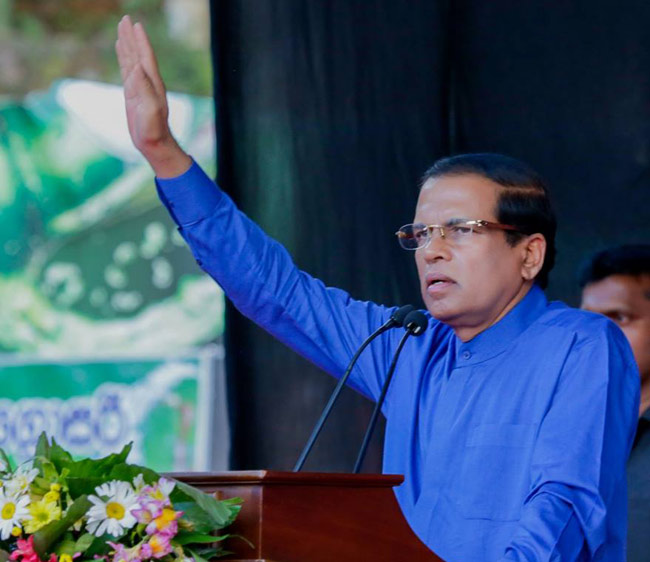
ජනපති ධුර කාලය දීර්ඝ කරගන්නේ බලය තහවුරු කරගන්නයි – ජ්‍යෙෂ්ඨ අධිනීතිඥ ගෝමින් දයාසිරි

January 14th, 2018

 සාකච්ඡා සටහන පාලිත සේනානායක

වසර 6 ක්‌ දක්‌වා ජනාධිපති ධුරයේ රැඳී සිටීමට තමාට ව්‍යවස්‌ථාමය බාධාවක්‌ තිබේ ද යන්න පිළිබඳව ජනාධිපතිතුමා ශ්‍රේෂ්ඨාධිකරණයේ මතය විමසා තිබෙනවා. එතුමා එවැන්නක්‌ සිදුකිරීම පිළිබඳව ඔබේ අදහස කුමක්‌ද?
 
 ජනාධිපතිතුමාගේ එම තීරණය සම්පූර්ණයෙන්ම දේශපාලනික එකක්‌ බවයි මගේ අදහස. එය අගමැති රනිල් වික්‍රමසිංහ මහතාට අද මුහුණ දීමට සිදුව තිබෙන අභියෝග හමුවේ ජනාධිපතිතුමා ගත් තීන්දුවක්‌. එය රනිල් වික්‍රමසිංහ මහතා අභිබවා යැමක්‌ හැටියටත් මා දකිනවා.
 
 ජනාධිපතිතුමා එවැනි තීරණයක්‌ ගන්නේ ඇයි?
 
 රනිල් වික්‍රමසිංහ මහතා අපේ රටේ පිරිසිදු දේශපාලනය වෙනුවෙන් පෙනී සිටි පුද්ගලයකු වුවත් මහබැංකුවේ සිදුවූ බැඳුම්කර වංචාව සෙවීමට පත් කළ ජනාධිපති කොමිසමේ නිර්දේශ තුළින් ඔහුත් එම වංචාවට වරදකරුවකු යෑයි ජනතාවට හැඟුණා. එය මීළඟ මැතිවරණවලදී එක්‌සත් ජාතික පක්‌ෂයේ පරාජයට බලපාන්නට ඉඩ තිබෙනවා. යුද්ධය ජයග්‍රහණය කර ජනතා වීරයකු බවට පත්ව සිටි මහින්ද රාජපක්‌ෂ මහතාට පසුගිය ජනාධිපතිවරණයෙන් පරාද වීමට ප්‍රධාන හේතුවක්‌ වූයේ ඔහුගේ දේශපාලනික පවිත්‍රභාවය පිළිබඳ ජනතාව තුළ සැක සංකා හට ගැනීමයි. පිරිසිදු දේශපාලනඥයකු ලෙස මෙතෙක්‌ කල් රනිල් වික්‍රමසිංහ මහතා රැකගෙන ආ හොඳ නම මහ බැංකුවේ බැඳුම්කර සිද්ධිය නිසා විනාශ වීමෙන් ඔහුත් අද දේශපාලනික වශයෙන් බරපතළ අර්බුදයකට මුහුණ දී සිටිනවා. තම ධුර කාලය දීර්ඝ කර ගැනීමට ගෙන ඇති තීරණය මා දකින්නේ මේ මොහොතේ රනිල් වික්‍රමසිංහ මහතා පත්ව ඇති තත්ත්වය දේශපාලනික වශයෙන් තමාට වාසිදායක තත්ත්වයකට පත් කරගැනීමක්‌ ලෙසයි.
 
 රනිල් වික්‍රමසිංහ මහතාගේ ක්‍රියාකලාපය අද එක්‌සත් ජාතික පක්‌ෂය තුළ අර්බුදයක්‌ නිර්මාණය කර තිබෙනවා. ඔහුගේ මේ ක්‍රියා කලාපය ඉදිරි මැතිවරණයකදී එක්‌සත් ජාතික පක්‌ෂයට බලවත් බාධාවක්‌. මහ බැංකු වංචාවේ ප්‍රධාන චූදිතයා වන අර්ජුන් මහේන්ද්‍රන් පත් කළේ ඔහු. එපමණක්‌ නොවෙයි, කොමිටියක්‌ පත් කර මහේන්ද්‍රන් කළ වංචාවන් ඔහු වසන් කළා. මහේන්ද්‍රන්ගේ ක්‍රියාකලාපය සාධාරණීකරණය කරන්න නොයෙක්‌ වර ඔහු වෑයම් කළා. ජිනීවා යෝජනාවලට එකඟ වීම වැනි ඔහුගත් අදූරදර්ශී තීරණ ජාතික වශයෙන් රටට අයහපත් ලෙස බලපෑවා. මේ සියල්ල නිසා ජනාධිපතිතුමාට ඔහුව ඉවත් කිරීමේ අවශ්‍යතාවක්‌ තිබෙන බව මට පෙනෙනවා. බැඳුම්කර කොමිසමේ නිර්දේශ ක්‍රියාත්මක කර යහපාලනය ස්‌ථාවර කිරීමත් එහි එක්‌ අරමුණක්‌.
 
 19 වැනි ව්‍යවස්‌ථා සංශෝධනය 2015 ජනවාරි 08 පැවති ජනාධිපතිවරණයට බලනොපාන්නේ නම් තමන්ටත් මීළඟ ජනාධිපතිවරණයට තරග කළ හැකි බව මහින්ද රාජපක්‌ෂ මහතාත් පසුගියදා ප්‍රකාශ කළා. 19 වැනි ව්‍යවස්‌ථා සංශෝධනය මීළඟ ජනාධිපතිවරණයට කෙසේ බලපානු ඇද්ද?
 
 මගේ විශ්වාසය නම් ජනාධිපති ධුර කාලය අවුරුදු 5 කට නීතියෙන් තීන්දු කළාට පසු යළි දීර්ඝ කළ නොහැකි බවයි.

මෛත්‍රිපාල

January 14th, 2018

ප්‍රියදර්ශන ලියනගේ උපුටා ගැන්ම දිවයින

පළාත් පාලන මැතිවරණයෙන් පසු රනිල් වික්‍රමසිංහ මහතා අගමැති ධුරයෙන් ඉවත් කර ජනාධිපති මෛත්‍රිපාල සිරිසේන මහතාගේ ප්‍රධානත්වයෙන් අලුත් යහපාලන ආණ්‌ඩුවක්‌ පිහිටුවන්නේ නම් ඒ සඳහා ජනාධිපතිsවරයාට සහය දීමට එක්‌සත් ජාතික පක්‍ෂයේ මන්ත්‍රීවරු 43 දෙනෙකු සූදානමින් සිටින බව ශ්‍රී ලංකා නිදහස්‌ පක්‍ෂයේ ජ්‍යෙෂ්ඨ ඇමැතිවරයකු “දිවයින ඉරිදා සංග්‍රහය”ට පැවසීය.
 
 මහා බැංකු බැඳුම්කර හොරුන්ට සහ මහින්ද රාජපක්‍ෂ ආණ්‌ඩුවේ හොරුන්ට දඬුවම් ලබාදීමට නම් අලුත් අගමැතිවරයකු යටතේ යහපාලන ආණ්‌ඩුවක්‌ පිහිටුවිය යුතු බව එක්‌සත් ජාතික පක්‍ෂයේ සහ ශ්‍රී ලංකා නිදහස්‌ පක්‍ෂයේ ප්‍රබලයන් රැසක්‌ ජනාධිපතිවරයාට දැනුම් දී ඇතැයි ද හෙතෙම පැවසීය.
 
 නව ආණ්‌ඩුවක්‌ පිහිටුවන්නේ නම් ඒකාබද්ධ විපක්‍ෂය නියෝජනය කරන දූෂණ චෝදනා නැති මන්ත්‍රීවරු රැසක්‌ ද මහින්ද රාජපක්‍ෂ අතහැර ආණ්‌ඩුවට එකතු වීමට සූදානමින් සිටින බවද ඇමැතිවරයා පැවසීය.

පොලිසිය කතා ගොතයි හිටපු කොටියා ඇත්ත කියයි

January 14th, 2018

මනෝඡ් අබයදීර  උපුටා ගැන්ම දිවයින

මාස දහයකට ආසන්න කාලයක්‌ නිරපාරදේ රිමාන්ඩ් ගත කර සිටි කොමදෝරු ඩී. පී. කේ. දසනායකට සහ කමාන්ඩර් සුමිත් රණසිංහ ඇතුලු නාවික හමුදා විරුවන්ට පසුගියදා ඇප ලැබුණි. යහපාලනයේ ඊලාම්ගැති ප්‍රතිපත්තිය රට ඉදිරියේ තබමින් නාවික හමුදාවේ වීර පිරිස මාස දහයක්‌ පුරා හරිහමන් හේතුවක්‌ නොමැතිව රිමාන්ඩ්ගත වී සිටියේය. 
 
 දෙසැම්බර් 4 වෙනිදා සිට 14 වෙනිදා දක්‌වා ලංකාවේ සංචාරයක නියුතු එක්‌සත් ජාතීන්ගේ බලහත්කාරයෙන් රඳවා ගැනීම් පිළිබඳ නිළධාරීන් මේ පිළිබ`දව විමසා බැලීම සඳහා බන්ධනාගාරයෙන් බන්ධනාගාරයට ගියේය. එපමණක්‌ නොව හමුදා කදවුරු ඇතුලේ පවා ඇවිද්ද නමුත් දසනායක හෝ සුමිත් රණසිංහ බලහත්කාරයෙන් සිරගත කර තිබෙන ආකාරය පිළිබඳව සොයා බලන්නට නොගියේය. දසානායකගේ දියණිය සිය පියාට සිදු වී ඇති අසාධාරණය පිළිබඳව දැනුවත් කිරීම සඳහා එම කණ්‌ඩායම හමුවීමට උත්සාහ කළ ද අවම තරමින් ඇය කියන්නට උත්සාහ දරන්නේ කුමක්‌දැයි අසන්නටවත් එක්‌සත් ජාතීන්ගේ එම කණ්‌ඩායමට වුවමනා නොවීය.

dasa500

 2009 මැයි 28 දින තමන්ගේ ප්‍රධාන ආරක්‍ෂක නිලධාරි ලුතිනන් කමාන්ඩර් සම්පත් මුණසිංහ විසින් පිරිසක්‌ පැහැරගෙන රඳවා තබා කප්පම් ලබාගෙන ඇතැයි යන චෝදනාව පිළිබඳව මුලින්ම පැමිණිල්ලක්‌ සිදුකරන්නේ හිටපු නාවික හමුදාපති අද්මිරාල් වසන්ත කරන්නාගොඩ විසිනි. මේ චෝදනාව පිළිබඳ විමර්ශනය ඇරඹෙන්නේ ඊට වසර හතකට පසුවය.
 
 විමර්ශනය සම්පූර්ණයෙන්ම උඩුයටිකුරු වෙමින් එදා චෝදනාලාභියා වූ සම්පත් මුණසිංහ වෙනුවට දසනායක සහ සුමිත් රණසිංහ වෙත පුද්ගලයන් එකොළොස්‌ දෙනෙකු රඳවා තබාගෙන කප්පම් ලබාගෙන ඇතැයි යන චෝදනාව එල්ල කරන්නට පොලිසිය ඉදිරිපත් විය. එසේ වෙතත් ඒ සඳහා වන හරිහමන් චෝදනා පත්‍රයක්‌ පොලිසිය අත තිබුණේ නැත. මානව හිමිකම් සහ ත්‍රස්‌තවාදයට එරෙහිව කරන මෙහෙයුම් සම්බන්ධයෙන් කටයුතු කරන බ්‍රිතාන්‍ය ජාතික බෙන් එමර්සන් 2017 ජුලි 14 වැනි දින කොළඹදී මෙම පැහැර ගැනීම් සම්බන්ධයෙන් පැහැදිලි ප්‍රකාශයක්‌ කළේය. එනම් යුද සමයේ සිදුවූ පැහැර ගැනීම් 11 ක්‌ සම්බන්ධයෙන් ජ්‍යෙෂ්ඨ නාවික හමුදා කමාන්ඩර්වරයකු රජය අත්අඩංගුවට ගෙන ඇති බවය. එමර්සන් ඒ පිළිබඳව තම සතුට ප්‍රකාශ කළේය. එමර්සන් වැඩිදුරටත් එහිදී ප්‍රකාශ කළේ රජය දැනට ගෙන ඇති ක්‍රියාමාර්ග පිළිබඳව එක්‌සත් ජාතීන් සතුටු වන නමුත් එම යහපාලන රජයට තව බොහෝ දුරක්‌ යැමට ඇති බවත් ය.
 
 මේ චෝදනාව එල්ල වනුයේ මුහුදු කොටි නායක සුසෙයි ගේ බිරිඳ සහ දරුවන් ඇතුළු පිරිස අත්අඩංගුවට ගෙන නිය පහරක තරමේවත් හානියක්‌ නොකර ඔවුන්ට අභය දානය ලබා දුන් මිනිසාටය. යුද්ධයේ අවසන් දින කිහිහිපය අතිශය සංකීර්ණ විය. කුඩා බෝට්‌ටු 700 පමණ පැමිණි සිවිල් වැසියන් 13000 ආසන්න ප්‍රමාණයක්‌ නාවික හමුදා ආරක්‍ෂක වළල්ලට ඇතුළු වූහ. මේ පිරිස නිරුපද්‍රිත කිරීමේ වගකීම දැරුවේ දසනායකය. එහෙව් දසනායකට කප්පම් පතා මිනිස්‌ ඝාතන කළා යෑයි චෝදනා එල්ල වී තිබේ. රටක ඇති බරපතළම අපරාධය අපරාධකරුවන් රිසිසේ හැසිරීම නොවේ. අවංක මිනිසුන් ඒ දෙස නිසොල්මනේ බලා සිටීමය. කොමදෝරු දසනායක වැනි විරුවන් දඟගෙට යන විට, ඇති වේදනාව එයය. එක්‌ නාවික හමුදා නිලධාරියෙක්‌ දසනායකට සිරගෙය ප්‍රාර්ථනා කරන්නේ, දසනායකට ලැබීය යුතු ශිෂ්‍යත්ව ඔහුට දිනා ගැනීමටය. කාලය, දේශය ඒ තරමටම නපුරු වී ඇත. 

දසනායකට එල්ල වී ඇති චෝදනාව සරල ලෙස ගත් කල මෙසේය. 
 
 පොලිස්‌ වාර්තා අනුව මෙම පැහැරගැනීම සිදුවන්නේ වර්ෂ 2008 සැප්තැම්බර් මස 17 දිනය. මෙම සමූහ ඝාතනයේ පළමු සැකකරු මේ වනවිට ඉන්නේ ඇප පිට නිදහස්‌වය. ඔහු එවකට සිටි නාවික හමුදාපති වසන්ත කරන්නාගොඩගේ ප්‍රධාන ආරක්‌ෂක නිලධාරියාය. එවකට ලුතිනන් කමාන්ඩර්වරයෙක්‌ වන ප්‍රධාන සැකකරු සම්පත් මුණසිංහ නමැත්තෙකි. ඔහුගේ උපදෙස්‌පිට අලි අන්වර් නමැති ඔත්තුකරුවකුගේ තොරතුරු මත දෙහිවල ප්‍රනාන්දු මාවතේ පිහිටි නිවසකදී රජීව් නාගනාදන්, ප්‍රදීප් විශ්වනාදන්, තිලකේෂ්වරම් රාමලිංගම්, මොහොමඩ් තිලාන්, මොහොමඩ් සාජිත් යන අය පැහැර ගෙන තිබිණි. ප්‍රධාන සැකකරුගේ උපදෙස්‌ පිට ඔවුන් පැහැර ගන්නේ එල්.ටී.ටී.ඊ සංවිධානයට මුදල් උපයන ත්‍රොaනන් අන්නා නමැති පුද්ගලයෙක්‌ හා සම්බන්ධව ව්‍යාජ ක්‍රෙඩිට්‌කාඩ් ඇසුරින් කොළඹ අවට ප්‍රදේශයේ මුදල් කොල්ලකන බවට ලද තොරතුරු අනුව බව අධිකරණ වාර්තාවල සඳහන් වේ.
 
 මෙසේ පැහැරගත් පුද්ගලයන් කොළඹ චෛත්‍ය පාරේ නාවික හමුදා මූලස්‌ථානය පිහිටි ස්‌ථානයකට රැගෙන ගොස්‌ ඇත. අනතුරුව 2008 අගෝස්‌තු මාසයේ සිට 2009 මාර්තු මාසය තෙක්‌ ශ්‍රී ලංකා නාවික නෞකා පරාක්‍රම ආයතනයේ හා 2009 අප්‍රේල් මාසයේ සිට ජුනි මාසය දක්‌වා ශ්‍රී ලංකා නාවික තාටාකාංගන ආයතනය තුළ හා ශ්‍රී ලංකා නාවික සාගරික විද්‍යා ආයතනය තුළ පිහිටි ගන් සයිඩ් නමැති ස්‌ථානයේ රඳවා තබාගෙන ඇතැයි එම වාර්තා දක්‌වයි. මේ පුද්ගලයන් අතුරුදන් වී ඇත්තේ ඉන් අනතුරුවය. මේ පිළිබඳ සැලවූ පසු නාවික හමුදාව සිද්ධියට සම්බන්ධ ප්‍රධාන සැකකරුවා පිළිබඳව පරීක්‍ෂා කළ බවත්, එහිදී අතුරුදන් කළ තවත් පුද්ගලයින් පස්‌දෙනකුගේ ජාතික හැඳුනුම්පත් හා වෙනත් සාක්‍ෂි හමුවූ බවත් මේ අනුව අතුරුදන් කර ඇති මුළු පුද්ගලයන් ගණන 11 බවත් නාවික හමුදාව වාර්තා කර තිබුණේය.
 
 මේ පුද්ගල අතුරුදන් වීම සම්බන්ධව මුලින්ම රහස්‌ පොලිසියට පැමිණිලි කරන්නේ එවකට නාවික හමුදාපති රියර් අද්මිරාල් වසන්ත කරන්නාගොඩය. ඔහු පැමිණිල්ල ගොනු කරන්නේ පුද්ගලික ආරක්‍ෂක නිලධාරියාට එරෙහිවය. ඒ වර්ෂ 2009.05.28 දිනය. නාවික හමුදාපතිවරයා ලෙස කරන්නාගොඩ විසින් එම පැමිණිල්ල කරන්නේ කොළඹ අපරාධ කොට්‌ඨාසය වෙතය. පැමිණිල්ල ගොනුකරන විට නාවික හමුදාවෙන් පැන ගොස්‌ සිටි මේ තැනැත්තා රහස්‌ පොලිස්‌ අත්අඩංගුවට පත්වන්නේය. පුරා වසරක්‌ රඳවා තබාගෙන ප්‍රශ්න කිරීමෙන් අනතුරුව රහස්‌ පොලිසිය විසින් වර්ෂ 2011 මාර්තු මස 30 දා අධිකරණයට වාර්තා කරන්නේ මේ අපරාධයට මෙම සැකකරු සම්බන්ධ බවය. 
 
 එහෙත් අධිකරණ ක්‍රියාවලිය වෙනත් මඟක්‌ ගන්නේ තමන් මේ අපරාධයට සම්බන්ධ නැති බවත්, තමන් සමඟ වූ පුද්ගලික ආරවුලක්‌ මත මේ අපරාධයට තමන් පැටලවීම සඳහා හිටපු නාවික හමුදාපති වසන්ත කරන්නාගොඩ හා ඩී. කේ. පී. දසනායක එක්‌කළ සැළසුමක්‌ බවත් ප්‍රකාශ කිරීමෙන් අනතුරුවය. ඩී. කේ. ප.දසනායකට චෝදනා එල්ලවන්නේ ඉන් අනතුරුවය.
 
 අධිකරණය හමුවේ ඇති බී වාර්තා අනුව ඔහු සැකකරුවෙක්‌ බවට ඉදිරිපත් වී ඇති චෝදනා තුනකි. එක්‌ චෝදනාවකින් කියෑවෙන්නේ පැහැරගත් පුද්ගලයන් දෙදෙනෙක්‌ පැහැර ගැනීම පිළිබඳව ඔහු දැනුවත්ව සිටි බවය. ඒ සම්බන්ධව ඔහු ක්‍රියාත්මක නොවූ බවය. අනෙක්‌ චෝදනාවෙන් කියැවෙන්නේ මේ පැහැර ගැනීම සිදුකළ වකවානුවේ එම සිද්ධියට සැකපිට අත්අඩංගුවට ගෙන සිටින නිලධාරීන් දෙදෙනකුගේ ප්‍රධානියා ලෙස කොමදෝරු දසනායක කටයුතු කර ඇති බවය. තුන්වැනි චෝදනාව එල්ලවන්නේ නඩුවේ ප්‍රධාන සැකකරුගෙනි. ඔහු අධිකරණයට කියන්නේ මෙම ඝාතන වැල සිදුවන්නේ එවකට නාවික හමුදාපති වසන්ත කරන්නාගොඩ හා ඩී. කේ. පී. දසනායකගේ මෙහෙයවීම යටතේය.
 
 මේ චෝදනා සම්බන්ධව ඩී. කේ. පී. දසනායක විසින් දිවුරුම් ප්‍රකාශයක්‌ මගින් අධිකරණයට කරුණු දක්‌වා තිබේ. සාක්‍ෂි සහිතව ඉදිරිපත් වූ එම දිවුරුම් ප්‍රකාශය ප්‍රකාරව පුද්ගලයන් පැහැර ගැනීම ගැන දැනුවත් කළා යෑයි කියන වකවානුවේ ඔහු ලංකාවේත් සිට නැත. ඒ වනවිට ඔහු සිටින්නේ කොරියාවේ විශේෂ පාඨමාලාවක්‌ හදාරමිනි. එමෙන්ම හිටපු නාවික හමුදාපතිවරයාගේ හා චූදිත නිලධාරීන්ගේ සාක්‍ෂි උපුටා දක්‌වමින් දිවුරුම් ප්‍රකාශයට අනුව ඔහු කිසිම විටෙක උක්‌ත නිලධාරීන් දෙදෙනාගේ ප්‍රධානියා ලෙස කටයුතු කර නැත. 
 
 එමෙන්ම වර්ෂ 2016 ඔක්‌තෝබර් 05 දින රහස්‌ පොලිසිය හමුවේ සාක්‍ෂි දෙන හිටපු හමුදාපති අද්මිරාල් වසන්ත කරන්නාගොඩ දීර්ඝ ප්‍රකාශයක්‌ කරමින් තමන්ට එල්ල වුණ චෝදනා මෙන්ම කොමදෝරු ඩී. කේ. පී දසනායකට එරෙහිව ඇති චෝදනා තර්කානුකූලව ප්‍රතික්‍ෂේප කරයි.
 
 ඩී. කේ. පී. දසනායක දැනට නාවික හමුදාවේ සිටිනා විශිෂ්ටතම නිලධාරීන් අතලොස්‌ස අතරින් කෙනෙකි. 
 
 වර්ෂ 1992 වන විට එල්.ටී.ටී.ඊ යට යාපනය සම්බන්ධ කරනා එකම සැපයුම් මාර්ගය පිහිටි කිලාලි කලපුවේ නව අනුඛණ්‌ඩ පිහිටුවා එම මාර්ගය අවහිර කරනු ලැබීම, රිවිරැස මෙහෙයුම ඇරඹී තිබූ වර්ෂ 1995 දී එල්.ටී.ටී.ඊ හමුදා සෙබලුන් 250 ක්‌ සමඟ එල්.ටී.ටී.ඊ බෝට්‌ටු 12 කට කොටු වූ රණගජ නෞකාව මුදා ගැනීමට 486 ඩෝරා යාත්‍රාවේ අණ භාර නිලධාරියා ලෙස කටයුතු කිරීම, වර්ෂ 1995 – 96 කාල වලදී කොළඹ වරාය ආශ්‍රිත මුහුදු මංකොල්ලකෑම් වැළැක්‌වීම, වර්ෂ 1997 පරාක්‍රමබාහු නෞකාවට එල්ල වූ ත්‍රස්‌ත ප්‍රහාර වළක්‌වා එය බේරා ගැනීමට කටයුතු කළ පී 440 ඩෝරා යාත්‍රාවේ අණ භාර නිලධාරියා ලෙස කටයුතු කිරීම, එම යාත්‍රාවේම අණ බාර නිලධාරියා ලෙස කොටි වෛද්‍ය අංශ ප්‍රධානී දොස්‌තර ඩෙස්‌ ඇතුළු සිව් දෙනෙක්‌ යාත්‍රාවක්‌ සමඟ අත්අඩංගුවට ගෙන එල්.ටී.ටී.ඊ බෝට්‌ටු විනාශ කිරීම, ඇතුළු ක්‍රියාන්විත ගණනාවක්‌ ඔහුගේ නාවුක හමුදා සංග්‍රාම ජීවිතයේදී දසනායක විසින් සිදුකර තිබිණි. යුද සමයේ නාවික හමුදා මාධ්‍ය ප්‍රකාශක ලෙස ඔහු කටයුතු කළේය. ඒ අවසන් මහා සටනේ දී මුලතිව් මුහුදේ නාවුක වළල්ලේ අණ දෙන නිලධාරියා ලෙස කටයුතු කරමිනි.
 
 ජනාධිපතිවරයෙක්‌ විසින් ලිතව ප්‍රශංසාවට ලක්‌කළ, දැනට නාවික හමුදාවේ සිටිනා එකම නිලධාරියා දසනායකය. ඒ රෙකමදාරුව ඔහුට ලැබෙන්නේ හිටපු ජනාධිපති චන්ද්‍රිකා කුමාරතුංග ගෙනි. නාවික හමුදාපතිවරුන් සිවුදෙනෙක්‌ යටතේ ප්‍රශංසා ලේඛන 10 ක්‌ ලද නිලධාරියා ඔහුය. හෙතෙම රණවික්‍රම පදක්‌කම් 04 ක්‌ දිනා ගත්තේය. රණ සූර පදක්‌කම් දිනා ගත්තේය. ඩී. කේ. පී. දසනායක එවැනි නිලධාරියෙකි. 
 
 හරියාකාර චෝදනා ගොනු කිරීමකින් තොරව, එක්‌සත් ජාතීන්ගේ නිලධාරීන් සතුටු කිරීම උදෙසා හෝ ඊළාම්වාදීන්ට තුටු පඬුරු ලබාදීම උදෙසා දසනායක සහ සුමිත් යන වීරයන් දෙදෙනාට කප්පම් චෝදනා එල්ල කර දස මාසයක්‌ සිරගත කර සිටියදී ඔවුන්ට ඇප ලබන්නේ අමුතු ආකාරයටය. එල්.ටී.ටී.ඊ.යේ හිටපු සාමාජිකයකු විසින් අධිකරණයට දන්වා සිටින්නේ, තමන් පොලිසියේ කියමන අනුව අසත්‍ය ප්‍රකාශයක්‌ කළ බවත් ඒ අනුව තමන්ට අධිකරණය හමුවේ විශේෂ සාක්‌ෂියක්‌ ලබා දීමට වුවමනා බවත්ය. සිය සාක්‌ෂියේදී හිටපු එල්.ටී.ටී.ඊ. සාමාජික විජයකාන්ත සඳහන් කරන ලද්දේ, රහස්‌ පොලිසිය විසින් තමන්ට සාක්‌ෂි ලබා දිය යුතු ආකාරය කියා දී එය ලියා ගත් බවය. 
 
 විජයකාන්තන්ගේ සාක්‌ෂියෙන් පසුව දසානායක සහ සුමිත් රණසිංහ ඇතුළු හයදෙනා තවදුරටත් රිමාන්ඩ් ගත කර තබා ගැනීමට නොහැකි තත්ත්වයක්‌ උදා විය. පස්‌වැනි හා හයවැනි සැකකරුවන්ට ඇප දීම සම්බන්ධයෙන් අපරාධ පරීක්‌ෂණ දෙපාර්තමේන්තුව විරුද්ධත්වයක්‌ නොදක්‌වන බව මෙම අවස්‌ථාවේ අධිකරණයට දැනුම් දුන්නේය. එසේම ඩී. කේ. පී. දසනායක හා සුමිත් රණසිංහ ඇතුළු සෙසු සැකකරුවන්ට ඇප ලබාදීම සම්බන්ධයෙන් තමන් විරුද්ධ වන බව අපරාධ පරීක්‍ෂණ දෙපාර්තමේන්තුව දැනුම්දී ඇතැයි ද රජයේ ජ්‍යෙෂ්ඨ අධිනීතිඥවරයා එහිදී අධිකරණයට දැනුම් දුන්නේය.
 
 එකම සිද්ධිය සම්බන්ධයෙන් රක්‍ෂිත බන්ධනාගාර ගත කර සිටින හයදෙනා අතරින් දෙදෙනකුට ඇප ලබාදීමට විරුද්ධත්වයක්‌ දැක්‌වීමත් සෙසු සැකකරුවන් හතර දෙනාට ඇපදීමට විරුද්ධත්වයක්‌ නොදැක්‌වීමත් අධිකරණයට උභතෝටික ප්‍රශ්නයක්‌ වන බව ප්‍රකාශ කළ ප්‍රධාන මහාධිකරණ විනිසුරු මනිලාල් වෛද්‍යතිලක මහතා නාවික හමුදා රණවිරුවන් සියලුදෙනාටම ඇප ලබා දුන්නේය.
 
 
 මනෝඡ් අබයදීර 

Implications of a six year term for Maithripala Sirisena

January 13th, 2018

by C.A.Chandraprema Courtesy The Island

President Sirisena’s request for a determination from the Supreme Court as to whether he could remain in power for six years even after the 19th Amendment reduced the term of the President to five years has caused consternation in the pro-yahapalana camp and quiet glee among their opponents. One of the pioneers of the yahapalana project, university lecturer Nirmal Ranjith Devasiri, has reproduced on his facebook page the Colombo Telegraph report of Sirisena asking the SC whether there is any impediment to his remaining in power for six years with a cryptic message in Sinhala suggesting that they (the yahapalanites) were now completely naked before the people. Among those who made representations in the Supreme Court against Sirisena was the Centre for Policy Alternatives and the elections monitoring outfit CAFFE which were firmly within the yahapalana camp.

The President’s query addressed to the Supreme Court left no doubt as to what he had in mind. The query went as follows: “Whether, in terms of Provisions of the Constitution, I, as the person elected and succeeding to the office of President and having assumed such office in terms of Article 32(1) of the Constitution on 09 January 2015, have any impediment to continue in the office of President for a period of 6 years from 09 January 2015, the date on which the result of my election to the office of President was declared”. In the wake of the caterwaul of protest that this evoked, the President’s Media Office issued a statement claiming that the President was only trying to clear the confusion surrounding this matter by asking for a SC determination on the subject, but the wording of the query implies otherwise.

This is a very clear attempt on the part of the President to extend his term to six years once again after it was reduced to five years by the 19th Amendment. The 19th Amendment was brought for the purpose of abolishing the executive Presidency as Sirisena had promised at the 2015 Presidential election. When Jayampathy Wickremeratne and others took to the newly elected President Sirisena the original draft of the 19th Amendment, the President had barked at them “Mawa pambayek karannada hadanne?” (Are you trying to turn me into a scarecrow?) and he had chased them away. Thereafter, Sirisena and the JHU whittled down the 19th Amendment until there was nothing left except the establishment of the constitutional council to recommend appointments to key state posts and this reduction of the term of the President from six to five years. It was the JHU that surreptitiously included in Sirisena’s manifesto a clause saying that he would agree to constitutional changes only to the extent that a referendum would not be necessary.

Since there was no way to abolish the executive presidency without a referendum, all talk of abolishing the executive presidency ceased. Now with Sirisena’s move to claw back through judicial interpretation what he himself claimed to have voluntarily relinquished and with his own loyalists and opponents voting for it in parliament (only one vote against and one abstention with 215 votes for and six absent), the 19th Amendment is to be almost completely vitiated – which is why virtually all yahapalana stakeholders have roundly condemned Sirisena’s move.  The most immediate reason for President Sirisena to ask the Supreme Court for a determination is a comment made in passing by former President Mahinda Rajapaksa in a media release issued on 14 December 2017 about the local government election.

What gave Sirisena the jitters

In that media release, the former President had stated that the LG election would be the first in a string of elections leading up to the next presidential election which has to be held before 9 December 2019 in terms of the 19th Amendment. What the former President said in this regard was as follows. “According to the change effected by the 19th Amendment to Article 30(2) of the Constitution, the term of office of the President was reduced to five years. By the provisions of Section 49(1)(b) of the 19th Amendment, that change has been made specifically applicable to the incumbent President as well. Hence the term of office of the incumbent President ends on 9 January 2020. According to Article 31(3) of our Constitution, a Presidential election has to be held not more than two months and not less than one month before the incumbent President’s term of office expires. Hence the next presidential election will have to be held between 9 November and 9 December 2019. When the mandatory periods between the declaration of the election, calling for nominations and the subsequent period up to the poll laid down in the Presidential Elections Act of 1981 are taken into account, it is clear that the next presidential election process will have to begin by October 2019…”

This appears to have been the immediate trigger for the President’s query to the Supreme Court. The Attorney General who represented the government had argued in open court last Thursday that the President had been elected on 9 January for a term of office of six years and that this power emanated from the sovereignty of the people and that the 19th Amendment to the Constitution was promulgated and made operative only after the incumbent President was elected for a term of six years by the people. He said there cannot be retrospective effect unless it has been specifically made retrospective. The crux of the Attorney General’s argument is that the President had received a mandate from the people for a six-year term in office, and that any change in that would affect the sovereignty of the people. However, in his argument, the AG has ignored some important matters. Firstly, Section 49(1)(b) of the 19th Amendment states as follows: “49. (1) For the avoidance of doubt it is hereby declared that,– (b) the persons holding office respectively, as the President and Prime Minister on the day preceding April 22, 2015 shall continue to hold such office after such date, subject to the provisions of the Constitution as amended by this Act.”

The AG has not explained what Section 49(1)(b) means if it is not to be taken as making the 19th Amendment applicable to president Maithripala Sirisena as well. Section 3 of the 19th Amendment had repealed the earlier Article 30(2) of the Constitution and substituted in its place the following “The President of the Republic shall be elected by the People and shall hold office for a term of five years.” If the AG argues that the shortening of the term of the President does not apply to the incumbent President despite the transitional provision in Section 49(1)(b) of the 19th Amendment, because Sirisena was elected and sworn in before the 19th Amendment was passed, that puts many other provisions in this Constitutional Amendment in jeopardy. For example, the main limitation on presidential power imposed by the 19th Amendment is to make it mandatory for the president to appoint key officers of the state such as the Attorney General, Judges of the Supreme Court and the members of the independent commissions from among persons nominated by the Constitutional Council.

Does anything at all in 19A apply to Sirisena?

If the 19th Amendment does not apply to President Sirisena because he was elected and sworn into office before the 19th Amendment was promulgated, then it follows that he is under no obligation to follow the procedure laid down in the 19th Amendment in making appointments to key state offices and independent commissions either. However the President has already made appointments based on recommendations made to him by the constitutional council in accordance with the provisions of the 19th Amendment. Examples of this would be the present IGP and the Attorney General himself. One assumes that the President made these appointments in accordance with the 19th Amendment because of the transitional provision in Section 49(1)(b) of the 19th Amendment which clearly states that the incumbent president will hold office after the promulgation of the 19th Amendment, only in accordance with the provisions of the Constitution as amended by the 19th Amendment.

If the transitional provision in Section 49(1)(b) is deemed not to apply to President Sirisena, an anomalous situation will arise where the Constitutional Council and the independent commissions will be set up under the 19th Amendment but the President will be under no obligation to take any of the recommendations of the CC into account in making key state appointments because the president was elected and sworn in under the 18th Amendment and the 19th Amendment does not apply to him.  If we take Section 49(1)(b) of the 19th Amendment which has been reproduced above, the phrases used “For the avoidance of doubt it is hereby declared”; “the persons holding office respectively, as the President and Prime Minister”, “shall continue to hold such office after such date, subject to the provisions of the Constitution as amended by this Act.” do not leave any doubt whatsoever as to the fact that the President and Prime Minister now hold office only in accordance with the Constitution as amended by the 19th Amendment.

There is also another very important factor to be considered. After the August 2015 parliamentary election, a government was formed on the basis of the power sharing arrangement between the President and the Prime Minister laid down in the 19A.  If the SC accepts the AG’s interpretation of the Constitution, it will also have the effect of throwing the entire basis of the yahapalana power sharing arrangement into jeopardy. For instance, the 19th Amendment states that in appointing cabinet ministers, the President shall, in consultation with the Prime Minister, where he considers such consultation to be necessary, determine the number of Ministers of the Cabinet of Ministers and the Ministries and the assignment of subjects and functions to such Ministers. Thus, when it comes to determining the subjects and the number of ministries, the President has the final say. But when it comes to appointing individuals MPs to fill those cabinet positions, the President has an obligation to act on the advice of the Prime Minister. If the provisions of the 19th Amendment do not apply to President Sirisena because he was elected President before the 19th Amendment was promulgated, what happens to these power sharing provisions?

If the SC upholds the Attorney General’s argument, in the remaining period of Sirisena’s term he will be exempt from all limitations imposed on the President’s power in appointing the cabinet. After all, it can be argued that since Sirisena was elected President without such limitations, to impose such limitations on him by Parliament later would be against the people’s sovereignty!

Yahapalana NGO raises a valid point

In their submissions to the SC, the advocacy NGO Centre for Policy Alternatives had pointed out that the 19th Amendment to the Constitution clearly states which parts of the Amendment do not apply to President Sirisena as the incumbent President and the reduction of the term of office is not such a provision. This in fact is true. Take for instance Sections 50 and 51 of the 19th Amendment which specifically exempts the person holding the position of President at the time when the 19th Amendment comes into operation from the changes introduced in Section 9 of the Amendment which refers to the appointment of Ministers. As a result of this exemption, between the time the 19th Amendment comes into operation and the parliamentary election of August 2015, the President may, with the concurrence of the Prime Minister, assign to himself any subject or function and may, with like concurrence, determine the Ministries to be in his (the President’s) charge.

Section 51 of the 19th Amendment likewise grants Sirisena an exemption from the operation of Section 9 of the 19A on the appointment of the cabinet by allowing Sirisena to hold the Defence, Mahaweli Development and Environment ministries for as long as he remains President. So as the CPA says, the 19th Amendment does have specific provisions exempting the incumbent President from the operation of certain Sections of the Amendment but the reduction in the term of the President is not among those exemptions.

By the time this newspaper is published, the determination of the SC would have been communicated to the President. Since this is a case of the President consulting the SC on a constitutional matter, he is under no obligation to make known to the public what the SC determination was. In fact speculation is rife that he may seek to keep the determination a secret so that his henchmen can claim that the President will be in office until January 2021. In fact ever before the SC had delivered its determination, Sirisena loyalists were claiming that the President will be in office until 2021 as a way of boosting their prospects at the local government election. It may be necessary to file a separate FR application in the SC for the public to get to know when the next presidential election will be held. Since President Sirisena has already applied to the SC for a determination on when the next Presidential election has to be held, the public now has a right to know what the determination of the SC was.

Perhaps the SC cannot make their determination public on their own. However if the Sirisena faction tries to misrepresent what the determination said, so as to gain political advantage, the SC should inform the public of what they really said. One of the lawyers who appeared before the Supreme Court, Faiz Mustapha, had argued that the public pronouncements made by President Sirisena before and after the 19th Amendment explaining how he reduced his term by one year are irrelevant. How can those pronouncements be irrelevant? They were made by the President of the country who was elected to power on the people’s franchise and he was making those pronouncements on a matter of public importance. If the President said publicly that he had wanted the term of the President reduced to four years but had reluctantly agreed to make it five because his MPs had pointed out that it would not be feasible to have elections once every four years, the SC should have taken that fact into consideration in their deliberations.

 How Sirisena can get his extra one year

The 19th Amendment is very clear on two things. Firstly, it reduced the term of the President from six to five years. Secondly, the President and Prime Minister holding office at the time it was promulgated will continue to hold office only under the terms of the Constitution as amended by the 19A. If the SC determines that Sirisena can hold power for six years, the SC will have to explain what the transitional provision in Section 49(1)(b) actually means. The AG most certainly had not offered any explanation of what that transitional provision meant. Be that as it may, there is a perfectly legal way of extending President Sirisena’s term by one year. That is to make use of the loophole in Article 83 of the Constitution which was not amended by the 19th Amendment. Everyone knows that President J.R.Jayewardene put in place safeguards to prevent the term of the President and Parliament from being extended beyond six years by including in his Constitution a provision that such an extension cannot be done without a two thirds majority in Parliament plus a referendum.

That provision was not changed in any way by the 19th Amendment. So even though the terms of the President and Parliament were reduced to five years by the 19th Amendment, a referendum would be needed to extend the term of the President only beyond six years. Theoretically it should be possible to extend the term of the President from five years to six years with just a two thirds majority in parliament! What Article 83(b) in the present Constitution even after it was amended by the 19th Amendment says now is the following: “a Bill for the amendment or for the repeal and replacement of or which is inconsistent with the provisions of paragraph (2) of Article 30 or of, paragraph (2) of Article 62 which would extend the term of office of the President, or the duration of Parliament, as the case may be, to over six years, shall become law if the number of votes cast in favour thereof amounts to not less than two-thirds of the whole number of Members (including those not present), and is approved by the People at a Referendum…”

So here’s a loophole that can be made use of! A Bill can be brought in Parliament extending the term of the President from five to six years again and the UNP can be persuaded to vote for it on the promise that the bond commission report will be shoved under the carpet. With a little bit of horse trading, President Sirisena will be able to get what he wants. There is no shame in any of this. If a senior President’s Counsel like Faiz Mustapha can present himself in no less than the Supreme Court and argue before the Chief Justice and judges of the Supreme Court that the numerous public pronouncements made by the President – the Head of State, Head of Government and the Commander in Chief of the Armed Forces elected by the sovereign people of Sri Lanka should not be given any value by the court, then there is no depth that is too low to be plumbed. So there will be no shame in getting an Act passed in Parliament to reverse the reduction in the President’s term. As for the Joint Opposition, they too will not really lose anything if President Sirisena gets his term extended by one year. The extension will create such a wave of negative opinion that the Joint Opposition will be able to win the elections that will inevitably follow that one year extension, without having to campaign or even spend any money.

Please be prepared to watch the display of Karate antics and many more Bank robbery dramas and circuses by 8968 “People’s Representatives” inside 351 Monkey cages in 2018 and thereafter, at National, Provincial, Town and Village levels.

January 13th, 2018

Sudath Gunasekara

11.1.2018.

                          Democracy is the art of running the circus from the monkey cage”.  H L MENCKEN”

(Henry Louis Mencken (September 12, 1880 – January 29, 1956) was an American journalist, satirist, cultural critic and scholar of American English. Known as the “Sage of Baltimore”, he is regarded as one of the most influential American writers and prose stylists of the first half of the twentieth century. He commented widely).

In the above heading the Monkey Cage” he refers to” is the Parliament. He also has called the proceedings of the House to a circus.

Looking at yesterday’s stupid brawl in Parliament one is surprised as to how wonderfully MENCKEN has foreseen the Sri Lankan Parliament. In this context one wonders whether we can call it the supreme legislative body of the nation any more.

The whole rumpus is attributed by many to the fault of the Speaker who deviated from the main agenda of the day. Firstly by not tabling the CB Commission Report as agreed upon at the Heads of Parties in the previous day and secondly by allowing the Prime Minister to make an ad hock silly statement where he was talking on a subject completely outside the agenda fixed for the day. You don’t need to be a parliamentarian with 47 year experience to understand that this is wrong and it clearly violates the Parliamentary procedure. Finally the way he danced on the floor of this august assembly ‘shouting Kavuda Hora, Kavuda Hora and Kavuda Hora’ has reduced him to a third grade clown on the Maradana pavement. Behold! This is the Prime minister of this country!

Now you see the appropriateness of what Mencken said years ago about the Parliament and its members?

I am sure millions of voters who have taken the pain to stand on long queues for hours to elect these people to Parliament expect much more from them.

I am lost to understand as to why we pay millions and billions to maintain a set of clowns like this. If this is how the National Parliament discharges its functions one can imagine how things happen in Provincial councils, MCC, UCC and Preadesiya Sabhas all over the country at the lower levels, packed with men and women with even lesser attainments and more notorious records. Also think of the 4000 odd additional members elected this time to the Local Government bodies. I remember the President once saying that he doesn’t like this100% increase. If so why did he not object it in the Cabinet? Mr President You can fool all the people some of the time and some of the people all the time, but you cannot fool all the people all the time (Dec 11, 2013 Abram Lincoln) I hope you will realize this at the forthcoming Local bodies Elections.

Any way we can watch how 351 Monkey cages at National, Provincial, Town and Village levels (1Parliament 9 Provincial Councils and 341 local authorities (MCC, UCC and Pradesiya Sabhas) in the periphery) with 225 (1 P), nearly 450 (9 PCC) and 8,293 (341 LGC) members will display their Karate antics in the near future inside these monkey cages, at the expense of the tax payers money with no service to people or the country, within the framework of a new genre of democracy which I would like to define as Government by the politicians, for the politician and of the politicians” and may be termed Sri Lanka democracy. This they will of cause call yahapalanaya

Celebrate Independence with a Pirith ceremony!

January 13th, 2018

By Dr. Tilak S. Fernando

2018-01-13

The month of January 2018 strikes a chord with the writer for two reasons; firstly he has grown older by yet another year, and secondly, it dawns on his second anniversary with Ceylon Today Newspaper.

In the 1980s, The Sri Lanka’s High Commissioner in London, Chandra Monerawala, had come up with a novel idea of overriding the decades old practice of razzmatazz, to celebrate Sri Lanka’s Independence Day with an overnight Pirith Ceremony. The writer, as a student, had given publicity to this original idea in an Indian tabloid published in London. The impressed High Commissioner had invited the writer to his office, out of the blue, and introduced him to the late Dr. Sivali Ratwatte, the then Chairman of Upali Group of Newspapers. At the meeting, Dr. Ratwatte had requested the writer to be the London Correspondent for the Island newspaper, but nothing was to be expected from Dr. Ratwatte for declining the offer. He was thus introduced to Gamini Weerakoon, Editor of the Island.

Skills and Tools

Such unexpected events had encouraged the writer to learn the skills and tools of writing by undergoing a course in journalism, at the London School of Journalism. Seemingly, with experience, he was accredited as the London Correspondent to the CPU (Commonwealth Press Union) to represent all three National English newspapers, published at the time, in Sri Lanka.

On his return to his roots in the late 2000, after being pre-maturely retired in the UK, he had realized that the public was not hot and bothered at all, about any issues affecting them, except the odd individual lamenting in the press occasionally on the lassitude of government officials and parliamentarians. This very fact had made the writer to emulate one of his former editors, Vijitha Yapa (The Sunday Times), who believed in the maximum ‘comment is free, but facts are sacred’ in journalism, while primarily being objective and balanced in one’s comments.

Daily News

He had continued with his weekly column in the Daily News after returning to Sri Lanka, for over eight years. However, with the arrival of Yahapalanaya, the newly appointed editor to the Daily News, suddenly thought that the writer ‘had been a columnist for far too long! His thoughts were not conveyed direct to the writer, but through his secretary!

Journalists do have in their blood stream what can be described as ‘the urge to purge,’ in a manner of speaking, for healthy reasons, rather than selfish, to put public’s unease or unhappiness into words. The voluntary silence in the face of oppression or injustice would, therefore, be considered as spiritual suicide for a journalist. The writer, through experience, was able to dip his ‘proverbial pen in garlic‘, so that it stinks to high heaven when injustices are exposed, and give maximum credit wherever it deserves. In such a backdrop, he had approached the Ceylon Today newspaper to enquire about the possibilities that existed in contributing to The Ceylon Today.

The Editor’s positive response has helped the writer to continue with his writing and this January brings his 2nd year anniversary with Ceylon Today.

Topics

Some of the complimentary feedbacks from the Ceylon Today readers include the article written under ‘Harming or Healing a Nation’, which had discussed the new Unity Government’s maiden Budget in 2016.

The article under ‘Comments is free, but facts remained sacred,’ quoting the words of C.P. Scott, discussed the validity of constructive criticism in journalism.

A two part series on ‘How to Dig for News’ presumably has helped many budding cubs with some vital hints on journalism.

After Death, Struggle for the living“, portrayed to what extent funerals have been transformed into a commercialised hype currently, where the living who attempt to keep up with the Joneses having to ‘go through hell’ by getting indebted to banks, or by seeking loans at high weekly interest rates, to spend unnecessarily on exorbitant and flashy coffins, and transforming funeral houses into buffets, by hiring professional caterers at an additional cost.

“Problems with Dual Nationality” managed to bring a lot of feedbacks from many expatriates living abroad particularly. It dealt with a young lass, born to Sri Lankan parents in London, where her birth had not been allowed to register at the Sri Lankan High Commission due to existed regulations that her father having opted for British nationality at the time of her birth; her mother’s Sri Lankan citizenship by descent was rejected by the immigration authorities in Sri Lanka.

The young lady, after attaining the age of 21 years, wanted very much to be part of her parent’s culture and the country, yet she had to face numerous problems as how to go about in sorting out such a riddle and going through a maze in Sri Lankan administration.

Several articles on Dengue fever, and about the magic homoeopathic drug Eupatorium 30C, with proven records of curing dengue affected patients by a homeopath, and quoting a civilian with 20 years of experience of using homeopathy, fell on deaf years of the Health Authorities, despite Sri Lanka having a Ministry of Alternative Medicine!

It was rather pathetic when the death toll out of dengue fever increased on a daily basis, yet Government Health Authorities imposed orders on all government hospital doctors prohibiting the use or practice of homeopathy; instead they decided on alternative modus operandi at a cost to government coffers.

“Uncle Syndrome” was rather a satirical piece where the trend in Sri Lanka has now become calling everyone ‘uncle’. So was the one of the latest pieces on ‘Grip on your sarong’ that seemed to have gone quite well with the readership.

After all, the encouraging feed backs from Joe de Livera, Dr. Mass R.Usuf, Ben Simon, Asoka Jayewardene, Egerton Senananayake, to name a few, who came out with brazenly outspoken comments, have certainly inspired the writer.

Debacles suffered by our forces under Chandrika’s reign – Part III

January 13th, 2018

By: A.A.M.NIZAM – MATARA.

Victor Ivan’s notorious Bandit Queen Chandrika in her dementia keeps on telling the blatant lie that it is she who completed ¾ of the 30 year’ of war.  Although this claim is not even believed by her trusted friends and acolytes this is part III the final part of the article that disproves her malicious claim with some detailed accounts of facts outlining the misery and setbacks suffered by our armed forces during her reign.

The military losses and civilian massacres during the reign of Chandrika.

1995

  • May 25Kallarawa massacre: LTTE cadres attack a fishing village in Kallarawa, and hacked and shot to death 42 civilians (22 males, twelve females and eight children)
  • May 26: Ven. Kithalagama Sri Seelalankara Thera, the chief prelate of Dimbulagala Raja Maha Viharaand his driver Anton Silva were shot and killed by LTTE members, when they drove to a fruit and vegetable farm, two and a half kilometers away from the temple in Polonnaruwa District. An acolyte, H. Bauddhasara Thera, who too was in the vehicle was critically injured.
  • August 7Colombo: An LTTE suicide bomber exploded a suicide rickshaw killing 22 civilians.
  • October 20: Kolonnawa, Colombo: LTTE attacked the oil storagecomplexes at Kolonnawa and Orugodawatta. At least three suicide bombers fought their way into the tanks and blew themselves up destroying the tanks. LTTE lost four cadres in the action while killing 22 security personnel and destroying diesel, kerosene, aviation fuel and crude oil worth over US $10 million.
  • October 21: Mangalagama: LTTE cadres killed 16 civilians.
  • October 25: Panama: LTTE cadres killeed twelve Sinhala farmers.
  • November 11: Colombo: A LTTE suicide bomber caused an explosion near the Slave Island railway station resulting in the death of 15 children and two soldiers
  • November 24: Colombo: An attack by two LTTE female suicide bombers on the Sri Lanka ArmyHeadquarters resulted in the death of 16 people
  • December 11: Colombo: Two LTTE suicide bombers blew themselves up at the Army Headquarters, resulting in the deaths of 15 civilians and three soldiers.
  • December 23: The LTTE attacked an army detachment in Batticaloa district, killing 32 troops.

1996

  • January 31Central Bank bombing: An attack by the LTTE on the Colombo Central Bank killed 90 and injured a further 1,400 civilians, damaging other buildings also in the process. It was the most deadly LTTE attack on a civilian target in the history of the group’s operations.
  • June 11: Lunuoya LTTE killed 14 civilians. According to Amnesty International, this attack was reportedly led by an LTTE member whose family had been killed in communal violence.
  • July 4Jaffna: An attack by an LTTE suicide bomber on a Sri Lankan minister resulted in the death of 25 people.
  • July 18Battle of Mullaitivu (1996): The LTTE overran the Sri Lanka Army camp at Mullaitivu. The number of killed in action and missing in action Sri Lankan soldiers from this attack was over 1200. The LTTE appear to have burnt alive hundreds of Sri Lankan soldiers who had surrendered during the attack on the Mullaitivu army camp.
  • July 24Dehiwala train bombing (1996): The LTTE exploded 4 bombs on Colombo-Alutgama train at Dehiwala killing between 60 and 70 civilians. The technique of simultaneously exploding multiple bombs in several carriages was used during this attack.

1997

  • 10 February – The Muslim village of Oddamavadi in the Batticaloa district was attacked by a group of LTTE terrorists who shot dead 5 civilians and 3 others
  • 12 May – The Morawewa village and the Police Station in the Trincomalee district were attacked LTTE terrorists and butchered 5 civilians.
  • 2 July – The Muslim village of Erakkandy in the Trincomalee district was stormed by a group of over 100 LTTE terrorists wielding sharp weapons, clubs and firearms and butchered 34 civilians.

1998

  • January 251998 Temple of the Tooth attack: Four members of the Black Tiger squad drove an explosives-laden truck into the Temple of the Toothin Kandy, killing seven and injuring 25. The attack took place just days before foreign dignitaries were expected to attend celebrations of the fiftieth anniversary of Sri Lankan independence at the temple.
  • March 5: LTTE exploded two bombs aboard buses in Colombo killing thirty-two civilians and injuring 252 others
  • May 14: A member of the Black Tiger squad jumped in front of a vehicle carrying Sri Lankan Brigadier Larry Wijeratneand detonated explosives, killing the general and two guards. Wijeratne was the commander of Sri Lankan forces in the Point Pedro area of the Jaffna peninsula. Press reports described the assassination as a “serious blow” to the government’s war effort in the area.
  • May 17Jaffnamayor Sarojini Yogeswaran was assassinated near her home. In 1987, her husband,  Yogeswaran, was assassinated in 1987.
  • August 29: The LTTE shot down an AN-24Lionair Flight 602 with 55 passengers (including 48 Tamils) and crew while it was flying over LTTE held territory. Everyone on board was killed.
  • September1998 Battle of Kilinochchi: In a massive LTTE offensive 1,500 soldiers were killed, 3,000 wounded and 500 were missing.


1999

  • April 11:Bus Bombing in Kandy Central Bus Stand by a LTTE suicide bomber killed 2 civilians.
  • June 2: Eleven Sinhalese civilians were murdered at Inginiyagala.
  • July 29: An LTTE suicide bomber killed Sri Lankan Tamil MP Neelan Thiruchelvamalong with two others. Six civilians were injured. At the time of his death Dr.Neelan Thiruchelvam was working on Chandrika’s constitutional package aimed at ending the decades long ethnic conflict in Sri Lanka
  • September 18Gonagala massacre: LTTE cadres massacre at least 50 Sinhalese civilians in three villages in Ampara District.
  • November 1Oddusuddan offensive (1999): An LTTE attack on an army camp at Oddusuddan resulted in an SLA defeat with 800 soldiers killed or missing and another 1,200 deserted
  • December 11 – January 2, 2000: 212 soldiers are killed in heavy fighting. Also another 37 are missing and 2,118 are wounded.[34]
  • December 18: A LTTE suicide bomber killed 23 civilians in the attempt to kill Chandrika at a pre-election rally in Colombo.
  • December 18: In Colombo LTTE suicide bomber Skandaraja Ashoka killed eleven people and retired Sri Lanka Army Major General Lucky Algama.


2000

  • January 5: An LTTE suicide bomber blew herself up outside the office of the Prime Minister of Sri Lanka killing 13 civilians and three police officers.
  • January 7: An LTTE suicide bomber killed Sri Lankan Industrial Minister V. Gunaratneand and 24 civilians.
  • January 27: LTTE bombed a post office killing eleven and injuring 70
  • March 11: 14 civilians and six police officers died when four LTTE suicide bombers attempted to assassinate the defence minister. 46 others were injured
  • April 22Second Battle of Elephant Pass: The LTTE overran the most important military base in the Northern province, the Elephant Passbase
  • May 17: An LTTE bomber killed 23 and injured 70 at a Buddhist temple in Batticaloa during celebrations of the Vesak holiday
  • June 26: LTTE suicide boats sunk a chartered private ship M.V. Uhana. Five civilian crew and three navy personnel died.
  • September 15: A suicide bomber exploded in front of the main government hospital in Colombo resulting in seven civilian deaths. And 28 civilians were injured.
  • October 3: An LTTE bomb killed parliamentary candidate Mohammed Baithullah and more than twenty others in Muttur. At least 49 others were injured.
  • October 5: In Medawacchchiya, Anuradhapuraan attack by an LTTE suicide bomber on the Health and Indigenous Medicine Deputy Minister Tissa Karaliyadda resulted in the death of seven civilians and injuries to 40 civilians.

2001

 
LTTE terror attack on Sri Lanka’s civilian


24 July – Bandaranaike Airport attack: An LTTE 14-man suicide squad attacked the Sri Lanka Air Force base and the adjoining Bandaranaike International Airport and destroyed many aircraft, crippling the country’s economy and reducing tourism. The death toll amounted to 21.

2005

12 August – Lakshman Kadirgamar, the world renowned Foreign Minister of Sri Lanka and an ethnic Tamil was shot by a LTTE sniper.

List of combat and other aircrafts and security personnel lost by our forces with relevant dates during the period of war under Chandrika’s tenure of office.   

  • January 22, 1996: A SLAF Mi-17 crashed into sea near Vettilakerny, 39 missing.Along with a Lieutenant Colonel [1]
  • March 19, 1996: A SLAF Mi-24 was shot down into the Bay of Bengal off Mullaittivu, killing seven passengers.[1]
  • March 1996: A SLAF Kfir C.2 crashed.[1]
  • December 7, 1996: A SLAF Bell 212that took off from Jaffna carrying a number of generals landed on territory controlled by LTTE due to technical problems; crew and passengers were evacuated by another helicopter, while the aircraft was destroyed by the Sri Lankan Army on the ground.[1]
  • January 20, 1997: A Y-12 crashed, four dead.[1]
  • January 21, 1997: After experiencing unknown technical difficulties and a SLAF Kfir C.7 crashed into the Negombo Laguna.[1]
  • February 21, 1997: A An-32 crashed at Ratmalanafollowing aborted take-off, 3 or 4 KIA.[1]
  • March 2, 1997: Two SLAF Mi-17s collided near Anuradhapura.[1]
  • March 5, 1997: Two LTTE suicide bombers penetrated the airfield at China Bay and exploded one of the Y-12 transports stationed there.[1]
  • March 15, 1997: A SLAF FMA IA 58 Pucarácrashed after a bomb exploded immediately upon release, in Kaudala area, the pilot ejected and was recovered later.[1]
  • June 14, 1997: SF.260 crashed during training flight near Talawa, instructor dead.[1]
  • November 10, 1997. A SLAF Mi-24 was shot down, two dead. A Mi-17 crash-landed in the same incident.[1]
  • November 25, 1997: A SLAF Bell 212 crashed near Puliyankulamduring a MEDEVAC mission, crew of four killed.[1]
  • January 7, 1998: Mi-17 damaged beyond repair by RPG and mortar hits while attempting to evacuate 20 injured soldiers.[1]
  • June 26, 1998: Mi-24 shot down south of Vavunia, killing four. LTTE claimed the helicopter to have been shot down, but SLAF sources credited the loss to technical problems.[1]
  • December 17, 1999: Mi-24 shot down near Parantan, four crewmembers killed.[1]
  • February 18, 2000: A Bell 412 on a MEDEVAC sortie claimed shot down by LTTE over the ThenmaradchiDivision of the Jaffna Peninsula. Two SLAF crewmembers were killed, four Army casualties on board, pilot, and another crewmember were recovered.[1]
  • May 24, 2000: A SLAF Mi-24 was shot down by a MANPAD, with 2 people dead.[1]
  • September 15, 2000: A Mi-17 crashed in the eastern region of Sri Lanka, killing all on board including a minister in SL government.[1]
  • October 19, 2000: A SLAF Mi-24 was shot down near Nogar Covil.[2]
  • October 23, 2000: A SLAF Mi-24 was shot down near the Trincomalee harbour.[3]
  • July 24, 2001Bandaranaike Airport attack; eight aircraft were attacked on ground: two Kfir C.7s, two K-8s, one MiG-27M, one Mi-24V, two Mi-17s, and one Bell 412 were completely destroyed; one MiG-27M was badly damaged.[1]

It is shameful  and at the samr time hilarious to find her claiming with all these setbacks that she completed 3/4 of the war.

The forgoing details the accounts of the humiliation our gallant soldiers suffered under the reign of Chandrika but it were the same soldiers who shattered in less than 9 years the myth that the tiger terrorists cannot be defeated militarily and vanquished them including their megalomaniac leader Prabhakaran and several other prominent tiger terrorists under the commandeership of Mr. Mahinda Rajapaksa and the right guidance provided by Mr. Gotabhaya Rajapaksa.

However, since Mrs. Chandrika keeps on claiming that she completed 3/4 of the war we would apprciate if she let the people of this country know at least through her minions the extent of territory captured and liberated by her from the terrorists with details of their locations, the approximate number of terrorists killed when and where with names of killed terrorist leaders, weapons, armoury and aetillery captured from the terrorists with approximate details, the number of terrorist camps destroyed or captured with details of their locations without just making rubbish speeches at trivial meetings sparsely attended.Hope the people will soon get the opportunity of knowing these details.  (concluded)

උතුරේ පක්ෂ මැතිවරණ ව්‍යාපාරය සදහා ජාතිකවාදී හා එල්ටීටීඊ ගීත හා ප්‍ර‍චාරක පාඨ ගැනීම සම්බන්ධයෙන් කැෆේ

January 13th, 2018

සංවිධානයේ  නිවේදනය. මාධ්‍ය ඒකකය කැෆේ සංවිධානය  – 2018 ජනවාරි 13 – යාපනය දී.

යාපනය, කිලිනොච්චි හා මුලතීව් දිස්ත්‍රික්කයන් හි දේශපාලන පක්ෂ කිහිපයකටම අයත් අපේක්ෂකයින් කිහිප දෙනෙකු සිය ප්‍ර‍චාරක කටයුතු සදහා ජාතිකවාදී හා එල්ටීටීඊ සංවිධානය විසින් ප්‍ර‍චලිත කළ ගීත යොදා ගැනීම නවතා දමන ලෙස කැෆේ සංවිධානය ඉල්ලා සිටී.

යාපනය ඥානම් ශාලාවේ පැවති ඡන්ද විමසීමට ඉදිරිපත් වන අපේක්ෂකයින්ගේ රැස්වීමක් ඇමතු කැෆේ විධායක අධ්‍යක්ෂ කීර්ති තෙන්නකෝන් මහතා මෙසේ පැවසීය.  

”යාපනය, කිලිනොච්ච් හා මුලතීව් පළාත් පාලන ආයතන සදහා අපේක්ෂකයින් කිහිප දෙනෙකුම එල්ටීටීඊ සංවිධානය විසින් ප්‍ර‍චලිත කළ ගීත සිය මැතිවරණ ව්‍යාපාරය සදහා යොදා ගන්නා බව අප නිරීක්ෂණය කළා.  එල්ටීටීඊ  විමුක්ති ගීත මැතිවරණ ප්‍ර‍චාරයට යොදා ගැනීම මැතිවරණ නීතිය උල්ලංඝනය කිරීමක් පමණක් නොව රටේ නීතිය ද උල්ලංඝන කිරීමක්.  මෙතැන සිටින සියලුම අපේක්ෂකයින්ගෙන්  හා දේශපාලන පක්ෂ හා ස්වාධීන කණ්ඩායම් වලින් මැතිවරණ නීතියත්, රටේ නීතියත් ගරු කරමින් මැතිවරණ ප්‍ර‍චාරක කටයුතු සිදුකරන ලෙස කාරුණිකව ඉල්ලනවා”

උතුරු පළාතේ සමහර ප්‍රදේශවල පළාත් පාලන ඡන්ද විමසීමක් පැවැත්වෙන්නේ වසර 67 කට පසුවයි. ඡන්දයට ඉදිරිපත් වන දේශපාලන පක්ෂ හා කණ්ඩායම් කිහිපයක්  ජාතිකවාදී ගීත පමණක් නොවෙයි එල්ටීටීඊ සංවිධානය  මගින් ප්‍ර‍චලිත කළ ගීත පවා මැතිවරණ ව්‍යාපාරයට යොදා ගන්නවා. මැතිවරණ නීතියත්, රටේ නීතියත් ගරු කිරීම උතුරු පළාතේ පමණක් නොව රටේම ඡන්දයට ඉදිරිපත්වන අපේක්ෂකයින්ගේ වගකීමක්  බව කැෆේ සංවිධානය අවධාරණය කරයි.

Official statement released by Dr Mareena Thaha Reffai,  Coordinator of Darun Nusra, House of benevolence 

January 13th, 2018

Dr.Reffai  Almuslimaath Sri Lankan Association of Muslim Women & Girls

We of the administration at the orphanage Darun Nusra would like to address recent events regarding the children of Darun Nusra and the unfortunate events that they have been embroiled in.
There have been a lot of varying versions of these events circulated through social media and many statements made by me and my colleagues but we would like to make a final and formal one to set the record straight.
Despite the fact that the court case is ongoing and the verdict is yet to be released upon the accused, me and my colleagues in the administration would like to officially state that our first priority is the wellbeing of the children who are  in our care.
Firstly, we would like to affirm that we completely want to help the authorities in any way we can in their endeavors to ensure the safety and protection as well as justice for  the children at Darun Nusra and at no time had we refused to do so, and that we are determined against any perpetrator who, if has caused them any harm, and would like to cooperate with those who, like us, have the children in their best interest.
It gives me and my colleagues deep pain to think of any misfortune that these children may have ever had to encounter, and we are certainly on the side of justice, recompense and the movement to ensure them a bright future.
The events that have occurred are also unfortunately mixed up in internal politics of the organisation  which has confused a lot of the information that has been released to the public.
However at the moment, the children, who are currently in good health and have resumed their lives and their schooling, are our primary concern; we would like them to be able to live good, healthy lives, recovering through counseling, untainted by public scandal, continuing to excel in their studies and work as they have for so long now.
For this to happen it is important that we, the admin at Darun Nusra, and you, the public, maintain a common ground of interest: the growth and happiness of the children.
We also want to reiterate here that except one child, none of them are true orphans, all of them have some relative, a mother, father or both,  but they are at Darun nusra  because of some difficulty they face being brought up in their own homes. They regularly go home for holidays and all of them are brought back to the darun nusra by their guardians though there is no compulsion for them  to come back.
We welcome you to visit them yourselves, or contribute and donate to their wellbeing, and to respect their right to a life that is free of public scrutiny. Meanwhile, me and my colleagues pray that they continue to shine, that they move on successfully from their tribulations, that most certainly justice is served in court to those who have caused them any harm, Inshallah.


බැදුම්කර මගඩිය යටපත් කිරීමට දරන උත්සාහය සහ පළාත් පාලන මැතිවරණය

January 13th, 2018

මාධ්‍ය ඒකකය දූෂණ විරෝධී පෙරමුණ     

බැදුම්කර මගඩිය යටපත් කිරීමට දරන උත්සාහය සහ පළාත් පාලන මැතිවරණය ගැන අදහස් දක්වන ලද මාධ්‍ය හමුවක් පසුගියදා රාජගිරියේ පිහිටි දූෂණ විරෝධී පෙරමුණු කාර්යාලයේ දී පවත්වන ලදී. එම අවස්ථාවට දූෂණ විරෝධී පෙරමුණේ සභාපති පූජ්‍ය උලපනේ සුමංගල හිමි, දූෂණ විරෝධී පෙරමුණේ උපදේශක නිශාන්ත වර්ණසිංහ සහ දූෂණ විරෝධී පෙරමුණේ සංවිධායක තුසිත බාලසූරිය යන අය සහභාගි විය.
එහි දී මාධ්‍ය වෙත අදහස් දැක්වු දූෂණ විරෝධී පෙරමුණේ සභාපති උලපනේ සුමංගල හිමියන් ප්‍ර‍කාශ කර සිටියේ බැදුම්කර මගඩිය යටපත් කිරීමට අගමැතිවරයා හෝඩිය පන්තියේ වැඩ කරන බවයි. අගමැතිවරයා පසුගියදා පාර්ලිමේන්තුවේ දී හැසිරුනු ආකාරය පිළිබද බලවත් අප්‍ර‍සාදය හා විරෝධය ප්‍ර‍කාශ කර සිටින බවත් කතානායකවරයා අගමැතිවරයාගේ හැසිරීම ගැන නිසි පියවර ගත යුතු බවද වැඩිදුරටත් අදහස් දක්වමින් සුමංගල කියා සිටියහ.
අද වනවිට බැදුම්කර මගඩිය ගැන තිබෙන අවදානය සමාජයෙන් ගිලිහෙමින් තිබෙන බැවින් බැදුම්කර මගඩියේ සියලු වැරදි රවී කරුණානායක මන්ත්‍රීවරයා මත පැටවීමට රජය උත්සාහ කරන බවද උලපනේ සුමංගල හිමියන් මාධ්‍ය වෙත අදහස් දක්වමින් කියා සිටියේ ය. 
අර්ජුන මහේන්ද්‍රන් අත්අඩංගුවට ගැනීමට තබා ඔහු සිටින ස්ථානයවත් සොයා ගැනීමට නොහැකිවීම ගැන මෙරට නීතිය ක්‍රියාත්මක කරන ආයතන ලැජ්ජා විය යුතු බවද උලපනේ සුමංගල හිමියන් මෙහිදී අවධාරණය කළහ.
මුදල් අමාත්‍යාංශය සතුව පැවති ශ්‍රී ලංකා මහ බැංකුව සිය යටතට ගෙන අගමැතිවරයා තම ගජමිතුරෙකු එහි අධිපතිවරයා බවට පත් කරන ලද්දේ මහ බැංකු මගඩිය සිදු කිරීම සදහාම වන නිසා මහ බැංකු බැදුම්කර මගඩියට සෘජුවම වගකිව යුතු අගමැතිවරයාව වහාම නීති හමුවට පැමිණ විය යුතු බව දූෂණ විරෝධී පෙරමුණේ සභාපති උලපනේ සුමංගල හිමියන් ප්‍ර‍කාශ කර සිටියහ.
මහ බැදුම්කර මගඩිය සිදුවු දින සිටම ඊට එරෙහිව කටයුතු කළ දූෂණ විරෝධී පෙරමුණ මෙම බැංකු මංකොල්ලයට වගකිව යුතු හොරුන්ට දඩුවම් ලබාදෙන තුරුම සටන අත නොහරින බවද උන්වහන්සේ අවධාරණය කර සිටියහ.
ඒකාබද්ධ විපක්ෂයේ සිටින පල් හොරුන්ට බැදුම්කර මගඩිය ගැන කතා කිරීමට සදාචාරාත්මක අයිතියක් නොමැති බවත්, කෝටි ගණන් හොරා කන ලද බවට සිය බිරිද විසින්ම ඔප්පු කරන ලද මහින්දානන්ද අලුත්ගමගේ රනිල් වික්‍ර‍මසිංහට හොරා කියන බවත්, නයා ගැසුවා කියා අධිකරණය මගහැරපු රෝහිත අබේගුණවර්ධන රනිල් වික්‍ර‍මසිංහට හොරා කීමට කිසිදු අයිතියක් නොමැති බවත් කියා සිටි උලපනේ සුමංගල හිමියන් රාජපක්ෂ හොරු සහ යහපාලන හොරු එක සිරගෙට ගාල් කළ යුතු බව අවධාරණය කළහ.
දූෂණ විරෝදී පෙරමුණ සංවිධානය කළ එම මාධ්‍ය හමුවට සහභාගී වෙමින් අදහස් දැක්වු දූෂණ විරෝධී පෙරමුණේ උපදේශක නිශාන්ත වර්ණසිංහ ප්‍ර‍කාශ කර සිටියේ දූෂණ විරෝධී පෙරමුණ සැමවිටම මෙරට යහපත් හා ශීලාචාර දේශපාලන සංස්කෘතියක් වෙනුවෙන් පෙනී සිටින බවයි. 
මෙරට දේශපාලනයට පුර්වාදර්ශයක් සැපයිය යුතු පාර්ලිමේන්තුව තුළ පසුගියදා සිදුවු ගැටුම ඉතාම පිලිකුලින් යුතුව හෙලා දකින බවත් පාර්ලිමේන්තුව තුළ සිදුවන මෙවැනි සිද්ධි යහපාලනය පිලිබද අප කතා කරන සියල්ල වැදි බණ බවට පත් කරන බවත් ඔහුගේ අදහස විය.
පාර්ලිමේන්තුව තුළ පසුගියදා සිදුවු සිද්ධියට කතානායකවරයා වගකිව යුතු බවත් උත්තරීතර පාර්ලිමේන්තුව තුළ සිටින පුද්ගලයින් මෙලෙස හැසිරෙන විට පළාත් සභා හා පළාත් පාලන ආයතනවලට අත්වන ඉරණම කුමක්දැයි ඔහු රජයෙන් ප්‍ර‍ශ්න කර සිටියේ ය. 
බැදුම්කර වාර්තාව ගැන සාකච්ඡා කිරීමට රැස් කරන ලද පාර්ලිමේන්තුවට අදාළ වාර්තාව ලැබී නැත්නම් කතානායකවරයා කළ යුතුව තිබුනේ පාර්ලිමේන්තුව කල්තැබීම බවත් එය සිදු නොකර බැදුම්කර සිද්ධියට අදාළ වෙනත් ප්‍ර‍කාශ කිරීමට ඉඩ දීමෙන් ඉහත ගැටුම සිදුවු බව දූෂණ විරෝධී පෙරමුණේ උපදේශක නිශාන්ත වර්ණසිංහ කියා සිටියේ ය. 
මෙවැනි සිදුවීම් රටේ ප්‍ර‍ජාතන්ත්‍ර‍වාදයට සුබදායක නොවන බවත් ජනතාවට දේශපාලනය සහ දේශපාලකයන් ගැන තිබෙන විශ්වාසය මෙයින් පලුදු වන බවත් එමනිසා ඉදිරි මැතිවරණයට ජනතා සහභාගිත්වය තවත් අඩු විය හැකි බව ඔහු අවධාරණය කළේය.
අනතුරුව අදහස් දැක්වු දූෂණ විරෝධී පෙරමුණේ සංවිධායක තුසිත බාලසූරිය කියා සිටියේ යහපාලන ආණ්ඩුවේ තුන වසරේ ප්‍ර‍ගති වාර්තාව පරික්ෂා කළ විට හොරු වෙනුවෙන් හොරු රැකපු, නීතිය නවපු වැඩවල ප්‍රතිළුල දිස්වන බවයි.
හිටපු හොරුන්ට නඩු නොඅසා සමාව දීම නිසා, නඩු නොඅසා නිදහස් කිරීම නිසා අලුත් හොරු රැසක් බිහිව ඇති බවත් පළාත් පාලන ආයතන වලට සියලුම පක්ෂවලින් හොර, මැර හා ජඩ අපේක්ෂකයන් ඉදිරිපත් වන බවට දූෂණ විරෝධී පෙරමුණට වාර්තා වීමට එය හේතුවක් වී ඇති බවත් ඔහුගේ අදහස විය.
හම්බන්තොට දිස්ත්‍රික්කයේ අගුණකොළපැලැස්ස ප්‍රාදේශීය සභාවය කුප්‍රකට කුඩු ව්‍යාපාරිකයෙක් මැතිවරණයට ඉදිපත් වන බවත්, කුරුණෑගල දිස්ත්‍රික්කයේ කුරුණෑගල නගර සභාවට ගණිකා ජාවාරමෙහි නිරත වන පුද්ගලයෙකු ඉදිරිපත් වන බවත්, කොළඹ දිස්ත්‍රික්කයේ කඩුවෙල නගර සභාවට කුප්‍ර‍කට පාතාල කල්ලි සාමාජිකයෙක් ඉදිරිපත් වන බවත් ඔහු විසින් හෙළිදරව් කළේය.
ඉදිරි කාලය තුළ තවත් දූෂිත අපේක්ෂකයන් නම් කිරීමට බලාපොරොත්තු වන බව පැවසු දූෂණ විරෝධී පෙරමුණේ සංවිධායක තුසිත බාලසූරිය ජනතාවගෙන් ඉල්ලා සිටියේ ඉදිරි පළාත් පාලන මැතිවරණයෙදී මෙම හොර, මැර සහ ජඩ අපේක්ෂකයන් පරාජයට පත් කරන ලෙසයි.
මාධ්‍ය ඒකකය
දූෂණ විරෝධී පෙරමුණ     
​2018 ජනවාරි මස 13 වනදා

මෛත්‍රීපාල සිරිසේන ජනාධිපතිවරයාට බලපාන්නේ 2015 ජනවාරි 09 දින ජනාධිපති ධුරයේ දිව්රුම් දුන් අවස්ථාවේ පැවති ආණ්ඩුක්‍රම ව්‍යවස්ථා විධිවිධාන වන්නේ නම් ඔහු ක්‍රියා කළ යුතු සහ යටත් විය යුතු සහ පිළිපැදිය යුතු නීතිය සහ තත්ත්වය………..?

January 13th, 2018

නීතීඥ අරුණ ලක්සිරි උණවටුන B.Sc(Col), PGDC(Col)

මෛත්‍රීපාල සිරිසේන ජනාධිපතිවරයාට බලපාන්නේ 2015 ජනවාරි 09 දින ජනාධිපති ධුරයේ දිව්රුම් දුන් අවස්ථාවේ පැවති ආණ්ඩුක්‍රම ව්‍යවස්ථා විධිවිධාන වන්නේ නම් ඔහු ක්‍රියා කළ යුතු සහ යටත් විය යුතු සහ පිළිපැදිය යුතු නීතිය සහ තත්ත්වය………..?

(ජනාධිපතිවරයාගේ ධුර කාලය සම්බන්ධව පමණක් 2015 ජනවාරි 09 දින වන විට පැවති ආණ්ඩුක්‍රම ව්‍යවස්ථා විධිවිධාන අදාල වන්නේ නම් ජනතා පරමාධිපත්‍යය යටතේ කිව හැක්කේ වැටත් නියරත් ගොයම් කා නම් කාට කියනු ද ඒ අමාරු යන්නද?.)

  1. ධුර කාලය
  • මෛත්‍රීපාල සිරිසේන ජනාධිපතිවරයා 2015 ජනවාරි 09 දින ජනාධිපති ධුරයේ දිව්රුම් දෙන අවස්ථාවේ ධුර කාලයට අදාල 30.2 ව්‍යවස්ථාව මෙසේ ය.

ජනරජයේ ජනාධිපතිවරයා ජනතාව විසින් තෝරා පත්කර ගත යුත්තේ ය. ජනාධිපතිවරයා සාවුරුදු කාලයක් ධුරය දරන්නේ ය.”

  • 2015 මැයි 15 වැනි දින කථානායකවරයා විසින් සහතික කරන ලද 19වන ආණ්ඩුක්‍රම ව්‍යවස්ථා සංශෝධන පනතේ 3 වැනි වගන්තිය මගින් ජනාධිපතිවරයාගේ ධුර කාලය සම්බන්ධව පෙර පැවති 30.2 ව්‍යවස්ථාව සංශෝධනය කර ඇත.

ඒ මෙසේ ය…

ජනරජයේ ජනාධිපතිවරයා ජනතාව විසින් තෝරා පත්කර ගත යුතු අතර පස් අවුරුදු කාලයක් ධුරය දරන්නේ ය.”

පැහැදිලි කිරීම

ඒ අනුව මෛත්‍රීපාල සිරිසේන ජනාධිපතිවරයාට බලපාන්නේ 2015 ජනවාරි 09 දින ජනාධිපතිධූරයේ දිව්රුම් දුන් අවස්ථාවේ  පැවති ආණ්ඩුක්‍රම ව්‍යවස්ථා විධිවිධාන නම් ඔහු ක්‍රියා කළ යුතු සහ යටත් විය යුතු සහ පිළිපැදිය යුතු නීතිය සහ තත්ත්වය වන්නේ සාවුරුද්දක කාලයකට ධුරය දරන බවට වන 2015 ජනවාරි 09 දින පැවති ආණ්ඩුක්‍රම ව්‍යවස්ථාවේ 30.2 ව්‍යවස්ථාවේ විධිවිධානය.

  1. දෙවරකට වැඩි වාරයක් ජනතාව විසින් තෝරාපත් කර ගනු ලැබීමට සුදුස්සෙක් ද? යන්න
  • මෛත්‍රීපාල සිරිසේන ජනාධිපතිවරයා 2015 ජනවාරි 09 දින ජනාධිපති ධුරයේ දිව්රුම් දෙන අවස්ථාවේ ජනතාව විසින් දෙවරක් ජනාධිපති ධුරයට තෝරා පත් කර ගනු ලැබූ කිසිම තැනැත්තෙක් ඉන් පසුව එම ධුරයට ජනතාව විසින් තෝරා පත් කර ගනු ලැබීමට සුදුස්සෙක් නොවන්නේ ය” යන ආණ්ඩුක්‍රම ව්‍යවස්ථා විධිවිධානයක් ආණ්ඩුක්‍රම ව්‍යවස්ථාවේ නො තිබුණි.
  • 2015 මැයි 15 වැනි දින කථානායකවරයා විසින් සහතික කරන ලද 19වන ආණ්ඩුක්‍රම ව්‍යවස්ථා සංශෝධන පනතේ 4 වැනි වගන්තිය මගින් දෙවරකට වැඩි වාරයක් ජනාධිපතිවරයාගේ ධුරයට ජනතාව විසින් තෝරාපත් කර ගනු නොලැබිය යුතු බවට විධිවිධානයක් ඇතුළත් කර ඇත.

ඒ මෙසේ ය…

ජනතාව විසින් ජනාධිපති ධූරයට දෙවරක් තෝරා පත් කර ගනු ලැබූ තැනැත්තකු ජනතාව විසින් නැවත එකී ධූරය සඳහා තෝරා පත් කර ගනු ලැබීමට සුදුස්සකු නොවන්නේ ය”

පැහැදිලි කිරීම

ඒ අනුව මෛත්‍රීපාල සිරිසේන ජනාධිපතිවරයාට බලපාන්නේ 2015 ජනවාරි 09 දින ජනාධිපතිධූරයේ දිව්රුම් දුන් අවස්ථාවේ  පැවති ආණ්ඩුක්‍රම ව්‍යවස්ථා විධිවිධාන නම් ඔහු ක්‍රියා කළ යුතු සහ යටත් විය යුතු සහ පිළිපැදිය යුතු නීතිය සහ තත්ත්වය වන්නේ ඒ අවස්ථාවේ නීතිමය සීමාවකින් තොරව ඕනෑම වාර ගණනක් ජනාධිපති ධූරයට පත් වීමට 2015 ජනවාරි 09 දින පැවති සීමාවකින් තොර නිදහස් තත්ත්වයයි…

  1. ජනාධිපතිවරයාගේ බලතල, කාර්ය සහ කර්තව්‍ය
  • ෛත්‍රීපාල සිරිසේන ජනාධිපතිවරයා 2015 ජනවාරි 09 දින ජනාධිපති ධුරයේ දිව්රුම් දෙන අවස්ථාවේ ජනාධිපතිවරයාගේ බලතල, කාර්ය සහ කර්තව්‍ය ආණ්ඩුක්‍රම ව්‍යවස්ථාවේ 33 ව්‍යවස්ථාවේ දක්වා ඇත.

ඒ මෙසේ ය.

  • 2015 මැයි 15 වැනි දින කථානායකවරයා විසින් සහතික කරන ලද 19වන ආණ්ඩුක්‍රම ව්‍යවස්ථා සංශෝධන පනතේ 5 වැනි වගන්තිය මගින් ආණ්ඩුක්‍රම ව්‍යවස්ථාවේ පෙර පැවති 33වන ව්‍යවස්ථාව ඉවත් කරමින් පහත දැක්වෙන ව්‍යවස්ථාව ආදේශ කරන ලදී.
  1. (1) ජනාධිපතිවරයාගේ කාර්යය විය යුත්තේ :-

(අ) ආණ්ඩුක්‍රම ව්‍යවස්ථාව අනුගමනය කරන බවට ද, ආරක්ෂා කරන බවට ද වගබලා ගැනීම,

(ආ) ජාතික ප්‍රතිසන්ධානය හා ඒකාබද්ධතාවය ප්‍රවර්ධනය කිරීම.

(ඇ) ආණ්ඩුක්‍රම ව්‍යවස්ථා සභාවේ සහ VIIඅ  ව්‍යවස්ථාවේ සඳහන් ආයතනවල නිසි ක්‍රියාකාරීත්වය පහසුකරලීම සහ

(ඈ) මැතිවරණ කොමිෂන් සභාවේ උපදෙස් මත, නිදහස් හා සාධාරණ ඡන්ද විමසීම් සහ ජනමත විචාරණ පැවැත්වීම සඳහා උචිත වාතාවරණ නිර්මාණය කිරීම  තහවුරු කිරීම, වන්නේ ය.

(2) ආණ්ඩුක්‍රම ව්‍යවස්ථාවෙන් හෝ වෙනත් ලිඛිත නීතියකින් හෝ ප්‍රකාශිතවම ජනාධිපතිවරයා වෙත පවරා හෝ නියම කර ඇත්තා වූ බලතලවලට සහ කාර්යයන්ට අමතරව, ජනාධිපතිවරයාට –

(අ) පාර්ලිමේන්තුවේ එක් එක් සැසිවාරය ආරම්භයේ, පාර්ලිමේන්තුවේ දී ආණ්ඩුවේ ප්‍රතිපත්ති ප්‍රකාශය කිරීමට බලය ඇත්තේ ය.

(ආ) පාර්ලිමේන්තුවේ මංගල රැස්වීම්වල මුලසුන දැරීමට බලය ඇත්තේ ය.

(ඇ) පාර්ලිමේන්තුව කැඳවීමට, වාර අවසන් කිරස්මට සහ විසුරුවා හැරීමට බලය ඇත්තේ ය.

(ඈ) තානාපතිවරයන්, මහකොමසාරිස්වරයන්, පූර්ණාධිකාරී රාජ්‍ය දූතයන් හා වෙනත් තානාපති නියෝජිතයන් පත් කිරීමට හා ඔවුන්ට බලතල පැවරීමට ද, ඔවුන් පිළිගැනීමට ද බලය ඇත්තේ ය.

(ඉ) නීතීඥ වෘත්තියෙහි විශිෂ්ඨත්වයට පත්ව ඇත්තා වූ ද, පැවැත්මෙහි හා වෘත්තිය කටයුතු පිළිබඳ අවංකභාවයෙහි උත්කෘෂ්ඨ තත්වයක් පවත්වාගෙන ඇත්තාවූ ද නීතිඥවරයන්, ජනාධිපති නීතීඥවරයන් වශයෙන් පත් කිරස්මට බලය ඇත්තේ ය. මේ ඡේදය යටතේ පත් කරනු ලබන සෑම ජනාධිපති නීතීඥවරයකුටම ඒ දක්වා රාජ නීතීඥවරයන් විසින් භුක්ති වි¢න ලද සියලු වරප්‍රසාදවලට හිමිකම ඇත්තේ ය.

(ඊ) ජනරජයේ රාජ්‍ය මුද්‍රාව භාරයේ තබා ගැනීමට ද අග්‍රාමාත්‍යවරයා ද අමාත්‍ය මණ්ඩලයේ අනෙකුත් අමාත්‍යවරයන් ද ශ්‍රේෂ්ඨාධිකරණයේ අග්‍රවිනිශ්චයකාරවර‍යා සහ ශ්‍රේෂ්ඨාධිකරණයේ අනෙකුත් විනිශ්චයකාරවරයන් ද අභියාචනාධිකරණයේ සභාපතිවරයා සහ අභියාචනාධිකරණයේ අනෙකුත් විනිශ්චයකාරවරයන් ද පත් කිරීමේ අධිකාර පත්‍රවල සහ ජනරජයට අයත් වූ ද ප්‍රදානය කිරීමට හා පවරා දීමට ජනාධිපතිවරයාට නීතියෙන් නියමව ඇත්තා වූ නැතහොත් බලය පැවරී ඇත්තා වූ ද ඉඩකඩම් හා අනෙකුත් නිශ්චල දේපළ ප්‍රදානය කිරීමේ දී හෝ පවරා දීමේ දී, ඒ සම්බන්ධ ප්‍රදාන ප්‍රත්‍රවල හා පැවරුම් පත්‍රවල රාජ්‍ය මුද්‍රාව තබා, අත්සන් කිරීමට ද රාජ්‍ය මුද්‍රාව තැබිය යුතු වෙනත් සෑම ලේඛනයකම රාජ්‍ය මුද්‍රාව තබා අත්සන් කිරීමට ද බලය ඇත්තේ ය.

(උ) යුද්ධය ප්‍රකාශ කිරීමට හා සාමය ප්‍රකාශ කිරීමට බලය ඇත්තේ යත සහ

(ඌ) ආණ්ඩුක්‍රම ව්‍යවස්ථාවේ හෝ වෙනත් යම් ලිඛිත නීතියක හෝ විධිවිධානවලට පටහැනි නොවන්නා වූ ද ජාත්‍යන්තර නීතිය, චාරිත්‍ර වාරිත්‍ර හෝ භාවිතය අනුව ඉටු කිරීමට ජනාධිපතිවරයාට බලය ලැබී ඇත්තා වූ හෝ නියමිතව ඇත්තා වූ ද සියලු ක්‍රියා හා දේ කිරීමට බලය ඇත්තේ ය.

පැහැදිලි කිරීම

  • ඒ අනුව මෛත්‍රීපාල සිරිසේන ජනාධිපතිවරයාට බලපාන්නේ 2015 ජනවාරි 09 දින ජනාධිපතිධූරයේ දිව්රුම් දුන් අවස්ථාවේ පැවති ආණ්ඩුක්‍රම ව්‍යවස්ථා විධිවිධාන අනුව ජනාධිපතිවරයාගේ බලතල, කාර්ය සහ කර්තව්‍ය වන්නේ නම් 2015 මැයි 15 වැනි දින කථානායකවරයා විසින් සහතික කරන ලද 19වන ආණ්ඩුක්‍රම ව්‍යවස්ථා සංශෝධන පනතේ 5 වැනි වගන්තිය මගින් ආණ්ඩුක්‍රම ව්‍යවස්ථාවේ 33 ව්‍යවස්ථාවට ආදේශකර ඇති  ජනාධිපතිවරයාගේ බලතල, කාර්ය සහ කර්තව්‍ය අනුව ක්‍රියා කිරීම නීතියට පටහැනි වේ.

එනම් 2015 මැයි 15 වැනි දින කථානායකවරයා විසින් සහතික කරන ලද 19වන ආණ්ඩුක්‍රම ව්‍යවස්ථා සංශෝධන පනතේ 5 වැනි වගන්තිය මගින් ආණ්ඩුක්‍රම ව්‍යවස්ථාවේ 33 ව්‍යවස්ථාවට ආදේශකර ඇති  ජනාධිපතිවරයාගේ බලතල, කාර්ය සහ කර්තව්‍ය අනුව ක්‍රියා කිරීම 2015 ජනවාරි 09 දින ජනාධිපතිධූරයේ දිව්රුම් දුන් මෛත්‍රීපාල සිරිසේන ජනාධිපතිවරයාට නොහැකි වේ. මන්ද යත් මෛත්‍රීපාල සිරිසේන ජනාධිපතිවරයා 2015 ජනවාරි 09 දින ජනාධිපතිධූරයේ දිව්රුම් දෙන අවස්ථාවේ එකී විධිවිධාන සිය  බලතල, කාර්ය සහ කර්තව්‍ය යටතේ දක්වා නොතිබුණි.

එකී නොහැකියාවන් පහත දැක්වේ…

  • ජාතික ප්‍රතිසන්ධානය හා ඒකාබද්ධතාවය ප්‍රවර්ධනය කිරීම.
  • ආණ්ඩුක්‍රම ව්‍යවස්ථා සභාවේ සහ VIIඅ ව්‍යවස්ථාවේ සඳහන් ආයතනවල නිසි ක්‍රියාකාරීත්වය පහසුකරලීම සහ
  • මැතිවරණ කොමිෂන් සභාවේ උපදෙස් මත, නිදහස් හා සාධාරණ ඡන්ද විමසීම් සහ ජනමත විචාරණ පැවැත්වීම සඳහා උචිත වාතාවරණ නිර්මාණය කිරීම තහවුරු කිරීම.

4. ජනාධිපතිවරයා පාර්ලිමේන්තුවට වග කිව යුතු බව…

  • ෛත්‍රීපාල සිරිසේන ජනාධිපතිවරයා 2015 ජනවාරි 09 දින ජනාධිපති ධුරයේ දිව්රුම් දෙන අවස්ථාවේ ජනාධිපතිවරයා පාර්ලිමේන්තුවට වගකිව යුතු බවට වන විධිවිධානයක් ආණ්ඩුක්‍රම ව්‍යවස්ථාවේ ප්‍රතිපාදන සළස්වා නොතිබුණි.
  • 2015 මැයි 15 වැනි දින කථානායකවරයා විසින් සහතික කරන ලද 19වන ආණ්ඩුක්‍රම ව්‍යවස්ථා සංශෝධන පනතේ 6 වැනි වගන්තිය මගින් ආණ්ඩුක්‍රම ව්‍යවස්ථාවේ පෙර පැවති 33 ව්‍යවස්ථාවෙන් ඉක්බිතිව 33අ ලෙස ව්‍යවස්ථාවක් ඇතුළත් කර ජනාධිපතිවරයා පාර්ලිමේන්තුවට වගකිවයුතු වන ව්‍යවස්ථාවක් ඇතුළත් කරන ලදී.

එකී 33අ. ව්‍යවස්ථාව මෙසේ ය.

ආණ්ඩුක්‍රම ව්‍යවස්ථාව යටතේ ද මහජන ආරක්ෂාව සම්බන්ධයෙන් තත්කාලයේ බලපවත්නා නීතිය ඇතුඵ යම් ලිඛිත නීතියක් යටතේ ද ස්වකීය බලතල, කාර්ය සහ  කර්තව්‍ය යථා පරිදි ක්‍රියාත්මක කිරීම සහ යථා පරිදි ඉටුකිරීම සම්බන්ධයෙන් ජනාධිපතිවරයා පාර්ලිමේන්තුවට වගකිව යුත්තේ ය.

පැහැදිලි කිරීම

  • ඒ අනුව මෛත්‍රීපාල සිරිසේන ජනාධිපතිවරයාට බලපාන්නේ 2015 ජනවාරි 09 දින ජනාධිපතිධූරයේ දිව්රුම් දුන් අවස්ථාවේ පැවති ආණ්ඩුක්‍රම ව්‍යවස්ථා විධිවිධාන වන්නේ නම්  2015 මැයි 15 වැනි දින කථානායකවරයා විසින් සහතික කරන ලද 19වන ආණ්ඩුක්‍රම ව්‍යවස්ථා සංශෝධන පනතේ 6 වැනි වගන්තිය මගින් ආණ්ඩුක්‍රම ව්‍යවස්ථාවේ 33අ. ලෙස ආණ්ඩුක්‍රම ව්‍යවස්ථාවට ඇතුළත් කර ඇති  ජනාධිපතිවරයා පාර්ලිමේන්තුවට වගකිවයුතු වන ව්‍යවස්ථාව අනුව ක්‍රියා කිරීම නීතියට පටහැනි වේ.


5. ජනාධිපතිවරයාට එරෙහිව නඩු පැවරීම….

  • ෛත්‍රීපාල සිරිසේන ජනාධිපතිවරයා 2015 ජනවාරි 09 දින ජනාධිපති ධුරයේ දිව්රුම් දෙන අවස්ථාවේ ජනාධිපතිවරයට එරෙහිව නඩු පැවරීමට ජනතාවට අවස්ථාව සළසා දෙන විධිවිධානයක් ආණ්ඩුක්‍රම ව්‍යවස්ථාවේ ප්‍රතිපාදන සළස්වා නොතිබුණි.

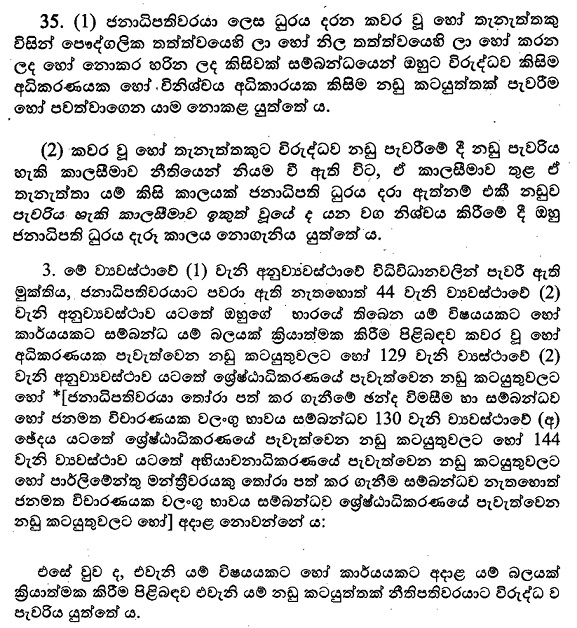
ජනාධිපතිවරයා 2015 ජනවාරි 09 දින ජනාධිපති ධුරයේ දිව්රුම් දෙන අවස්ථාවේ ඔහු සම්බන්ධව නඩු පැවරීමට අදාලව පැවති ආණ්ඩුක්‍රම ව්‍යවස්ථාවේ 35 ව්‍යවස්ථාව මෙසේ ය.

  • 2015 මැයි 15 වැනි දින කථානායකවරයා විසින් සහතික කරන ලද 19වන ආණ්ඩුක්‍රම ව්‍යවස්ථා සංශෝධන පනතේ 7 වැනි වගන්තිය මගින් ආණ්ඩුක්‍රම ව්‍යවස්ථාවේ පෙර පැවති 35වන ව්‍යවස්ථාව ඉවත් කරමින් පහත දැක්වෙන ව්‍යවස්ථාව ආදේශ කරන ලදී.

එකී ආදේශ කරන ලද 35 වන ව්‍යවස්ථාව මෙසේ ය.

(1) යම් තැනැත්තකු ශ්‍රී ලංකා ජනරජයේ ජනාධිපතිවරයා ලෙස ධූරය දරන අවස්ථාවක දී, ඔහු විසින් පෞද්ගලික තත්ත්වයෙහි ලා හෝ නිල තත්ත්වයෙහි ලා කරන ලද හෝ නොකර හරින ලද කිසිවක් සම්බන්ධයෙන් ඔහුට විරුද්ධව කිසිම සිවිල් හෝ අපරාධ නඩු කටයුත්තක්  පැවරීම හෝ පවත්වාගෙන යාම හෝ නොකළ යුත්තේ ය :

එසේ වුව ද, ජනාධිපතිවරයා විසින් ඔහුගේ නිල තත්වයෙහි ලා කරන ලද හෝ නොකර හරින ලද කිසිවක් සම්බන්ධයෙන් නීතිපතිවරයාට විරුද්ධව 126 වන ව්‍යවස්ථාව යටතේ ඉල්ලීමක් කිරීමට යම් තැනැත්තකුට ඇති අයිතිය සීමා කරන ලෙස මේ අනුව්‍යවස්ථාවේ කිසිවක්, කියවා තේරුම් නොගත යුත්තේ ය :

එසේම තවදුරටත්, ජනාධිපතිවරයා විසින් 33(2)(උ) ව්‍යවස්ථාව යටතේ බලතල ක්‍රියාත්මක කිරීම මත ප්‍රඥාපනය කිරීමට, ශ්‍රේෂ්ඨාධිකරණයට අධිකරණ බලය නොතිබිය යුත්තේ ය.

(2) කවර වූ හෝ තැනැත්තකුට විරුද්ධව, කවර හෝ විස්තරයක නඩුවක් පැවරිය හැකි කාලය සීමා කරමින් නීතියෙන් විධිවිධාන සකසා ඇති විට, ඒ තැනැත්තා යම් කිසි කාලයක් ශ්‍රී ලංකා ජනරජයේ ජනාධිපති ධූරය දරා ඇත්නම් එකී නඩුව පැවරිය හැකි කාලසීමාව ලෙස නීතියෙන් නියමව ඇති කාලය නිශ්චය කිරීමේ දී ඒ තැනැත්තා ජනාධිපති ධූරය දැරූ කාලය නොගැනිය යුත්තේ ය.

(3) මේ ව්‍යස්ථාවේ (1) වන අනු ව්‍යවස්ථාවේ විධිවිධානවලින් පැවරී ඇති මුක්තිය, 129 වන ව්‍යවස්ථාවේ (2) වන අනු ව්‍යඅවස්ථාව යටතේ හෝ ජනාධිපතිවරයා තෝරා පත්කර ගැනීමේ ඡන්ද විමසීම හා සම්බන්ධව හෝ ජනමත විචාරණයක වලංගුභාවය හා සම්බන්ධව 130 වන ව්‍යවස්ථාවේ (අ) ඡේදය යටතේ ශ්‍රේෂ්ඨාධිකරණයේ පැවැත්වෙන නඩු කටයුතුවලට හෝ අදාළ නොවන්නේ ය.

පැහැදිලි කිරීම

ඒ අනුව මෛත්‍රීපාල සිරිසේන ජනාධිපතිවරයාට බලපාන්නේ 2015 ජනවාරි 09 දින ජනාධිපතිධූරයේ දිව්රුම් දුන් අවස්ථාවේ  පැවති ආණ්ඩුක්‍රම ව්‍යවස්ථා විධිවිධාන වන්නේ නම්  2015 මැයි 15 වැනි දින කථානායකවරයා විසින් සහතික කරන ලද 19වන ආණ්ඩුක්‍රම ව්‍යවස්ථා සංශෝධන පනතේ 7 වැනි වගන්තිය මගින් ආණ්ඩුක්‍රම ව්‍යවස්ථාවේ 35 ව්‍යවස්ථාව ඉවත් කරමින් ආදේශකර ඇති ව්‍යවස්ථාව මගින් ආණ්ඩුක්‍රම ව්‍යවස්ථාවට ඇතුළත් කර ඇති ජනාධිපතිවරයා විසින් ඔහුගේ නිල තත්වයෙහි ලා කරන ලද හෝ නොකර හරින ලද කිසිවක් සම්බන්ධයෙන් නීතිපතිවරයාට විරුද්ධව 126 වන ව්‍යවස්ථාව යටතේ ඉල්ලීමක් කිරීමට යම් තැනැත්තකුට ඇති අයිතිය සීමා කරන ලෙස මේ අනුව්‍යවස්ථාවේ කිසිවක්, කියවා තේරුම් නොගත යුත්තේ ය” යන ආණ්ඩුක්‍රම ව්‍යවස්ථා විධිවිධානය වලංගු නොවේ.

මන්ද යත් මෛත්‍රීපාල සිරිසේන ජනාධිපතිවරයාට බලපාන්නේ 2015 ජනවාරි 09 දින ජනාධිපතිධූරයේ දිව්රුම් දුන් අවස්ථාවේ පැවති නීතිමය තත්ත්වය නම් එවැනි ආකාරයේ ජනාධිපතිවරයාට එරෙහිව ආණ්ඩුක්‍රම ව්‍යවස්ථාවේ 126 ව්‍යවස්ථාව යටතේ නඩු පැවරීමක් (මූලික අයිතිවාසිකම් නඩු) සදහා ජනතාවට අයිතිය පිරිනමා නොතිබූ හෙයින් ඔහුට එරෙහිව මූලික අයිතිවාසිකම් නඩු පැවරීමේ නොහැකියාවක් හටගෙන ඇත.

මෛත්‍රීපාල සිරිසේන ජනාධිපතිවරයාට බලපාන්නේ 2015 ජනවාරි 09 දින ජනාධිපතිධූරයේ දිව්රුම් දුන් අවස්ථාවේ පැවති ආණ්ඩුක්‍රම ව්‍යවස්ථා විධිවිධාන නම් ඔහු ක්‍රියා කළ යුතු සහ යටත් විය යුතු සහ පිළිපැදිය යුතු නීතිය සහ තත්ත්වයද? යන්න විමසීමේදී 2015 මැයි 15 වැනි දින කථානායකවරයා විසින් සහතික කරන ලද 19වන ආණ්ඩුක්‍රම ව්‍යවස්ථා සංශෝධන පනතේ සැක දුරුකිරීම සදහා දක්වා ඇති 49.1.ආ වගන්තිය දක්වනු නො ලැබුවහොත් මෙම ලිපිය කියවන පාඨකයාට බලවත් අසාධාරණයක් සිදු වෙයි.

සැක දුරුකිරීම සදහා 19වන ආණ්ඩුක්‍රම ව්‍යවස්ථා සංශෝධන පනතේ දක්වා ඇති 49.1.ආ වගන්තිය මෙසේ ය.

2015 අප්‍රේල් මස 22 වන දිනට පෙර පිළිවෙලින් ජනාධිපති ධුරය සහ අග්‍රාමාත්‍ය ධුරය දරන තැනැත්තන් එම දිනෙන් පසු, මෙම පනත මගින් සංශෝධිත ආණ්ඩුක්‍රම ව්‍යවස්ථාවේ විධිවිධානවලට යටත්ව එම ධුර දැරිය යුතු වන්නේ ය

සමාප්තිය….

ආණ්ඩුක්‍රම ව්‍යවස්ථාවේ 3 වැනි ව්‍යවස්ථාවේ දක්වා ඇත්තේ ශ්‍රී ලංකා ජනරජයේ පරමාධිපත්‍යය ජනතාව කෙරෙහි පිහිටුවා ඇති බවයි. එකී ජනතාව සතු පරමාධිපත්‍යය අංග වන ජනතාවගේ විධායක බලය, ජනතාවගේ ව්‍යවස්ථාදායක බලය සහ ජනතාවගේ අධිකරණ බලය භාරයක් විලස පිළිවෙලින් ජනාධිපතිවරයාත්, පාර්ලිමේන්තුවත්, ශ්‍රේෂ්ඨාධිකරණය ඇතුළු අධිකරණ විසිනුත් ක්‍රියාත්මක කරන බව එකී අධිකාරීන් නිරන්තරයෙන් සිහි කිරීම වටී.

(මෛත්‍රීපාල සිරිසේන ජනාධිපතිවරයාට බලපාන්නේ 2015 ජනවාරි 09 දින ජනාධිපතිධූරයේ දිව්රුම් දුන් අවස්ථාවේ  පැවති ආණ්ඩුක්‍රම ව්‍යවස්ථා විධිවිධාන වන්නේ නම්  2015 මැයි 15 වැනි දින කථානායකවරයා විසින් සහතික කරන ලද 19වන ආණ්ඩුක්‍රම ව්‍යවස්ථා සංශෝධන පනතේ දැක්වෙන විධිවිධාන සමග සැළකීමේදී ඉහත දැක්වෙන ආකාරයට අමතර  තවත් බොහෝ වෙනස් කම් දැක්විය හැකි වුවත් මෙම ලිපිය දිගුවන හෙයින් ඒවා මෙහි දක්වා නැත.)

නීතීඥ අරුණ ලක්සිරි උණවටුන

B.Sc(Col), PGDC(Col)

2018.01.12


Five years or six?

January 13th, 2018

Editorial Courtesy The Island


The ruling of the five-judge bench of the Supreme Court determining whether President Maithripala Sirisena’s term ends in 2020 or the following year will reach him by today. He is likely to communicate the decision of the court to the country soon thereafter and any uncertainty in that regard would then be cleared. Those who followed the pleadings of the Attorney General heard him say that the incumbent president was elected in January 2015 for a six-year term under the law that existed at that time and this stands. The 19th Amendment to the Constitution, enacted unanimously by the sitting Parliament, repealed President Mahinda Rajapaksas’s abolition of the two-term limit on the presidency and additionally reduced the presidential term from six to five years. This, the AG argued, was prospective and not retrospective so President Sirisena can continue till 2021 though his successors will only have five-year term. There were vigorous arguments to the contrary with opponents to a six-year term for Sirisena rightly pointing out that the president himself had said that he had voluntarily reduced his term by a year. Sirisena had, in fact. said he personally favored a four-year term but bowed to expert opinion and the five years was finally agreed upon.

There is no question that the president, whatever the legal position, is morally bound to serve for five years and no longer. If the judges rule that his term is six years, there is nothing to stop him from vacating office at the conclusion of the fifth year and proclaiming a presidential election to elect a successor if the presidency is then in existence. Let us not forget that Presidents Chandrika Kumaratunga, Mahinda Rajapaksa and Maithripala Sirisena all solemnly pledged to the country that they will abolish the executive presidency created by what CBK, with her talent for colloquial expression, called a bahubootha constitution. President Sirisena declared before the bier of Ven. Madulwawe Sobitha, who led the movement for a common opposition candidate against Mahinda Rajapaksa with the abolition of the executive presidency as its major plank, that he would deliver on these promises. In his first address to the nation following his swearing, Sirisena declared he would not run for a second term but now there is a deafening silence on this subject.

This country has been cheated by several of its elected leaders on the matter of how long they would serve without a fresh mandate from the people. Prime Minister Sirima Bandaranaike, elected in 1970 with a two thirds majority enabling constitutional amendment, was the first culprit. Claiming that the JVP insurrection of 1971 deprived her United Front government of two years of its term, she postponed the parliamentary elections that should have been called in 1975 to 1977 through a constitutional amendment. Opposition Leader J.R. Jayewardene resigned his Colombo West parliamentary seat saying that he was elected for five years and no longer, forcing a by-election he won by a large majority. But what did he do thereafter when he swept into office with a massive five sixths majority? He extended the 1977 parliament for a further term soon after he was elected president (not re-elected as commonly stated because he was ‘deemed’ elected the first time in 1978) in 1982 by obtaining the people’s ‘consent’ at a national referendum in December that year. Whether that was free, fair and conducted by the rules remains debatable though it is generally accepted that JRJ would have won a parliamentary election in 1982, but not with his 1977 majority.

Thereafter Mahinda Rajapaksa at the 2010 parliamentary elections sought, but did not win, a two thirds majority enabling amending the constitution. But he got what the voters narrowly denied him by engineering defections from the opposition and amended the constitution abolishing the two-term limit on the presidency. This was to cost him dearly in 2015. That history is too well known to merit repetition. President Kumaratunga, first elected for a six-year term in Aug. 1994 called a snap poll in 1999 an year ahead of schedule and was re-elected. In August 2005 she sought to continue till 2006 arguing that she could serve balance of her first term. Five judges of the Supreme Court headed by Chief Justice Sarath N. Silva unanimously ruled she could not and Chandrika Bandaranaike Kumaratunga was compelled to ride off into the sunset a year earlier than she had hoped.

We will soon know whether President Sirisena’s term ends in 2020 or one year later. Even if the legal position is that he can continue till 2021, that was not something of his own doing although it will be clear that the 19th Amendment was badly drafted at least where the reduction of the six year presidential term to five years was concerned. The people verily believed that this applied to all presidents beginning with Maithripala Sirisena and not just those who would follow him. Given that he was rightly credited for doing away with his predecessor’s Mugabe-like greed for at least another term, that proved disastrous as Rajapaksa has lived to learn. Sirisena reduced his own term from six to five years without any demand or pressure for which all praise is due to him. We hope that the president will earn himself the honor of doing what is right on the matter presently at issue regardless of the legal position even if he does becomes the third consecutive president to welsh on the promise of abolishing the executive presidency.

Bond fallouts: President goes to court, PM provokes brawl in parliament

January 13th, 2018

Rajan Philips Courtesy The Island

Is it the beginning of the end? The end of what, you may interject. As Doric de Souza did when colonial sleuths asked him if he was a member of the Fourth International. “I teach English”, Doric snapped, “International is an adjective. International what?” The police had no answer to Doric. But there are multiple-choice answers to today’s question: the end of what; especially after last week’s developments. The unexpected was the President’s unilateral and undisclosed (till the court documents bared it) referral to the Supreme Court to clarify if there is any ‘impediment’ to his serving out six years from the date of his election on January 8, 2015. Then there was the fracas in parliament when the Prime Minister made his pre-emptive and self-justificatory statement on the Commission of Inquiry report on Central Bank bonds. The President’s move was seen as calculated and pre-meditated. But no less calculated and pre-meditated, it would seem, was the UNP’s hand in convening parliament to debate the bond report without ‘anybody’ tabling the report, and the Prime Minister insistently making a statement and provoking a brawl between his MPs and Mahinda’s.

Is the Sirisena-Ranil cohabitation over? Is it the end of the national-unity government? Is it going to be the end of SLFP disunity? Or is the politics of the seven provinces getting permanently polarised into three political alliances – the UNP, the SLFP and the SLPP? There have been screaming headlines about the end of yahapalanaya. It is as if the scribes have been waiting for this to happen. There are quite a few who want to prove the point that the Sirisena-Wickremesinghe government was never serious about yahapalanaya. But they miss the point that the people, at least a voting majority of them, identified with what that term stood for and voted in a new government to change the way governments are run in Sri Lanka. The lesson from the bond saga is not that yahapalanaya was doomed to fail. Rather, it was made to fail. It is not ‘yahapalanaya’ that deserves derision, but those who failed yahapalanaya politically deserve political punishment. But there is no mechanism to inflict punishment on the political wrongdoers.

The developments last week were efforts to avoid responsibility and shift blame in the wake of the bond report. That was/is clearly the stratagem of Ranil Wickremesinghe and the UNP. On the other hand, President Sirisena, while asserting zero involvement in the scam and claiming credit for the commission of inquiry, is clearly frustrated that he is not getting much by way of political dividends – either for his tenuous presidency or for his beleaguered party. The SLPP as the de facto opposition party in parliament should be the real beneficiaries of the troubles of the Sirisena-Wickremesinghe government. But it is stuck in the same place where it was in January 2015. The Nugegoda acclamation to bring back Mahinda did not get traction as many predicted it would. Instead of Mahinda, it is Basil who has returned to pick up from where he left after the last defeat.

The truth of the matter is that none of the three leaders and their alliances has shown any capacity to offer anything new or different that will resonate with the people and win their support. Instead, the three groups are pulling at each other and no one seems capable of striking out a palpable political lead. Without it, a long stalemate in national politics seems increasingly inevitable. It is doubtful if the local government elections will light a spark in an otherwise gloomy political night. Unless something dramatically ignites the situation, no party is unlikely to emerge a clear winner on February 10. In point of fact, none of the three parties deserves to emerge a clear winner in the local elections. Even allowing for the relative appeals of the three alliances, the main determinant of the results will be the voter turnout. Historically, local government elections register the lowest turnout. It was 65% in 2011 and anything lower could be seen as protest apathy against all three parties.

As well, regardless of the results in February, national political institutions and actors will be stuck where they are for another two years, or for three years, depending on what the Supreme Court will tell the President today. ‘Stability’ is what Sri Lanka is supposed to have gained from the JRJ (1978) constitution and the presidential system. Never mind there has been far greater instability in Sri Lanka, politically and otherwise, after 1978 than before. What is obtaining now is not stability but immobility. The promises to reform the constitution including the abolishment of the presidential system and the experiment in national-unity government are all stuck in the existing constitutional straight jacket. President Sirisena’s Supreme Court referral is the result of an incomplete constitutional reform, not to mention the fact that the constitutional involvement of the Supreme Court to decide political questions is one of the chief defects of the JRJ constitution. This is according to NM Perera and AJ Wilson, not table talk.

President’s panic attack and PM’s counter-attack

The bigger political question is what prompted President Sirisena to ask the Supreme Court for clarification about the length of his term. Why did he do it unilaterally without consulting his national-unity partner, Prime Minister Wickremesinghe? Why now? He has naturally come under criticism for going back on the Nineteenth Amendment’s reduction of the presidential term from six year to five years, and his own commitment to not only reduce the term of executive presidency but also abolish it. What is striking, more than the retraction, is the absence of any reference to 19A in his court referral, going by what was published in the media. He asks the court if there is any ‘impediment’ without mentioning the only impediment, i.e. 19A, by name! Speaking at Akuressa on Friday, the President once again was in promise-mode: that he would abide by the Court’s ruling (is there a choice otherwise?), and played the sacrificial card that he is prepared to step down from office on Friday itself.

Given his growing estrangement with the Prime Minister and the frustration of his efforts to strike an electoral alliance with the SLPP/JO, President Sirisena’s only political safe-space is his office. Extending it even by one year would make sense from his standpoint. He will at least have one additional year to try some of his old and failed maneuvers, or even entirely new ones, to strengthen his position and that of his bifurcated party. Asking the court now will also help set the stage for another run for a full second term. If the Court says that there is no impediment to his completing a six-year term, it could bolster his and his party’s chances at the local elections. It could also backfire at the elections if the court were to determine that 19A is indeed an insurmountable impediment.

The President’s choosing not to consult the Prime Minister about the court referral speaks volumes of the state of the relationship between the two men. Equally, the President chose not to share the report of the Commission of Inquiry with the Prime Minister before he made his public statement on the report. A handful of non-elected government officials have copies of the report, but not the PM, the Speaker, or Parliament itself. On the one hand, the President may be thinking that he is sending a message to the public that he is keeping at arm’s length and more, the PM and everyone else directly or indirectly associated with the bond scam. On the other hand, it may be that the President has lost both his official and personal camaraderie with the Prime Minister to have a free and frank discussion on the bond scam, the Commission’s report, and the almost daily fallouts from it.

Ideally, if President Sirisena and Prime Minister Wickremesinghe were to salvage anything from/for yahapalanaya after the bond fiasco, they should have engaged in face-to-face talks on the matter and decided on a course of action that would have included at the minimum: unimpeded legal proceedings against those criminally implicated; the relocation of the Central Bank to the Ministry of Finance; and the removal of Ravi Karunanayake from the public face of the government and even that of the UNP. The President’s unilateral actions show that either he did not want to deal with the Prime Minister, or he was not hopeful of getting the Prime Minister to agree to any of the minimum action items.

The Prime Minister’s and the UNP’s response to the Commission report would seem to vindicate the President’s unilateral actions. Rather than showing even a pretence of remorse and willingness to take corrective actions, the PM and the UNP leadership would seem to have decided to use the party muscle and go on the counter-attack. Notwithstanding the Commission’s strictures against him, Ravi Karunanayake remains the public face and the physical bulwark of the UNP. If the brawl in parliament was not an accident, its real purpose was to rile up the UNP base to defend the party politically against the fallouts from the bond scam of its own making. The fisticuffs and the orchestrated catcalls, apparently led by the Prime Minister himself, clearly show that when push comes to shove the UNP will not hesitate to fall back on its time-honoured thuggish traditions – yahapalanaya or no yahapalanaya. With a riled up base and a strong campaign, there can be a good showing at the local elections. And a good showing there will help sweep away the fallouts from the bond scam. If that is the thinking, it is a betrayal of good governance.

It is worse. It brings to nought all the efforts on constitutional reform expended over the last two years. It puts the TNA in a quandary, having little to show to a skeptical electorate after two years of reconciliation. It has no answers to the survivors of victims of murders after two years of tantalizing promises. It will also be bizarre after the local elections and the people’s vaunted exercise of their sovereignty this time through the local version of the franchise, the stable JRJ constitution will ensure that the country will have the same President and the Prime Minister. Thanks to 19A, the President cannot easily, or not at all, fire the Prime Minister. And the Prime Minister will have to work with the same President at least for two more years, and potentially three, depending on what the Supreme Court decides. And the parliament, given all the crisscrossing movements across party lines over 20 years, will remain one large extended and dysfunctional family. There will be governance. But is there an adjective suitable enough to describe it?

බූරුවා ගැසීම අල්ලන්න ආ ආණ්ඩුව කැසිනෝ ගහනවා

January 13th, 2018

උපුටාගැණීම  මව්බිම

බැඳුම්කර වංචාවෙන් ඔප්පු කළේ බූරුවා ගැසීම් ඇල්ලීමට ආ ආණ්ඩුව කැසිනෝ ගැසීමෙන් නැවතුණු බව යැයි කෝප් කමිටු සභාපති, ජවිපෙ පාර්ලිමේන්තු මන්ත්‍රි සුනිල් හඳුන්නෙත්ති කියයි.

මන්ත්‍රිවරයා පැවැසුවේ මහ බැංකු බැඳුම්කර පිළිබඳ ජනපති කොමිෂන් වාර්තාව පාර්ලිමේන්තුවට සභාගත කිරීමට නියමිතව තිබූ දින ඇති වූ ගාලගෝට්ටියේ සතුට හිටපු මහ බැංකු අධිපති අර්ජුන මහේන්ද්‍රන් සිංගප්පූරුවට වී භුක්ති විඳිනු ඇති බවය.
එකී වාර්තාව සභාගත කිරීම හා බැඳුම්කර වංචාවට වගකිවයුතු වූවන් ඇතුළු සමස්ත කරුණු දැන ගැනීමට බලා සිටි ජනතාවට පසුදින මාධ්‍යවලින් දැකගැනීමට හැකිවූයේ දෙපිරිසක් අතර ගෝරනාඩුවක් පමණක් බවද හඳුන්නෙත්ති මහතා කීය.

කෙසේ නමුත් බැඳුම්කර වාර්තාව පාර්ලිමේන්තුවට ඉදිරිපත් නොකර පාර්ලිමේන්තුව කැඳවිය නොහැකි බව අගමැතිවරයා නොදන්නවා යැයි සිතිය නොහැකි බැවින් නැවත මෙවන් තත්ත්වයකට ඉඩ නොතබා එකී වංචනිකයන් රටට හෙළිදරව් කිරීමත්, නීතිමය ක්‍රියාමාර්ග ගැනීමත් කඩිනම් විය යුතු බව හෙතෙම වැඩිදුරටත් කීය.

පාර්ලිමේන්තු ගුටි කෙළියට කතානායක වගකිව යුතුයි

January 13th, 2018

ජේ.ටී.ද සිල්වා උපුටාගැණීම  මව්බිම

පාර්ලිමේන්තුවේ සභා ගර්භය තුළ ආණ්ඩු පක්ෂයේත්, විපක්ෂයේත් මැති ඇමැතිවරුන් අතර ගුටිබැට හුවමාරුවක් ඇතිවී, ලේ හලාගන්නා තත්ත්වයක් නිර්මාණය වීමට කතානායකවරයා සම්පූර්ණයෙන්ම වගකීම භාරගත යුතුව ඇතැයි, ඒකාබද්ධ විපක්ෂයේ නායක, පාර්ලිමේන්තු මන්ත්‍රි දිනේෂ් ගුණවර්ධන ‘මව්බිම’ට පැවසීය.

පක්ෂ නායක රැස්විමේදී කලින් දිනයේ ගනු ලැබූ තීරණයට පටහැනිව කතානායකවරයා ක්‍රියාකිරීම නිසා එම අවාසනාවන්ත හා කනගාටුදායක සිද්ධිය ඇතිවූ බවත්, මෙම සිද්ධිය පාර්ලිමේන්තු ඉතිහාසයට තවත් කළු පැල්ලමක් එක්කළ බවත් හෙතෙම පැවසීය.

මෙවැනි උද්වේග කර තත්ත්වයක් ඇතිවන අවස්ථාවකදී, සභාවේ කටයුතු තාවකාලිකව අත්හිටුවා පක්ෂ නායක රැස්වීමක් කැඳවීමට මීට ඉහතදී කතානායකවරයාගේ ප්‍රධානත්වයෙන් පැවැති පක්ෂ නායක රැස්වීමකදී ගනු ලැබූ තීරණය, ඒ අවස්ථාවේ නොසලකා හරිමින් කතානායකවරයා කටයුතු කළ බව දිනේෂ් ගුණවර්ධන මහතා පැවැසීය.
ප්‍රශ්නය උග්‍රවන තුරු බලා නොසිට, සභාවේ කටයුතු විනාඩි 10කට අත්හිටුවා පක්ෂ නායක රැස්වීමක් කැඳවන ලෙස, කතානායකවරයා අසලට ගොස් තමා ඉල්ලා සිටි බවත් එම ඉල්ලීමට කතානායකවරයා කන්දුන්නා නම්, මෙම අපකීර්තිමත්, කනගාටුදායක සිද්ධිය ඇති නොවන බවත් ගුණවර්ධන මහතා අවධාරණය කළේය.

මහින්ද ජනාධිපතිවරණයට ගේන හැටි උදය කියයි

January 13th, 2018

ඩබ්ලිව්.කේ. ප්‍රසාද් මංජු  උපුටාගැණීම  මව්බිම

ජනාධිපති මෛත්‍රිපාල සිරිසේන මහතාට 2021 දක්වා සය අවුරුදු කාලයක් ධුරයේ සිටීමට ශේ‍ර්ෂ්ඨාධිකරණය තීරණය…කළහොත් ඒකාබද්ධ විපක්ෂය ප්‍රමුඛ ශ්‍රී ලංකා පොදුජන පෙරමුණ විසින් ඊළඟ ජනාධිපතිවරණය සඳහා හිටපු ජනාධිපති මහින්ද රාජපක්ෂ මහතා ඉදිරිපත් කරන බව පිවිතුරු හෙළ උරුමයේ නායක, පාර්ලිමේන්තු මන්ත්‍රි නීතිඥ උදය ගම්මන්පිල මහතා ‘ඉරිදා මව්බිම’ ට ප්‍රකාශ කළේය.

මේ සම්බන්ධයෙන් දැනටමත් නීති විශාරදයන් සමඟ සාකච්ඡා කර තිබෙන බවත්, 18 වැනි ආණ්ඩුක්‍රම ව්‍යවස්ථා සංශෝධනය අනුව ශේ‍ර්ෂ්ඨාධිකරණයේ තීන්දුව වසර 6ක ධුරකාලය මෛත්‍රිපාල සිරිසේන ජනාධිපතිතුමාට ලැබුණොත් ඒ අනුව මහින්ද රාජපක්ෂ හිටපු ජනාධිපතිතුමාටද ඉදිරි ජනාධිපතිවරණය සඳහා තරග කළ හැකි බව ගම්මන්පිල මන්ත්‍රිවරයා පෙන්වා දෙයි.

බෞද්ධ ජාතක කතා පොත විශ්ව සාහිත්‍යට එකතු විය යුතුය

January 12th, 2018

වෛද්‍ය රුවන් එම් ජයතුංග

බෞද්ධ ජාතක කතා පොත විශ්ව සාහිත්‍යට එකතු විය යුතු අගනා පොතක් බව මාර්ටින් වික්‍රමසිංහ විසින් ප්‍රකාශ කොට තිබේ. එසේම වික්‍රමසිංහන් පවසන පරිදි ප්‍රථම මනෝ විශ්ලේෂකයා සිග්මන් ෆ්‍රොයිඩ් නොව ජාතක කතාකරුය​.  

 පන්සීය පනස් ජාතක පොත ඉංග්‍රීසි භාෂාවට පරිවර්තනය කිරීමේ හැකියාව ගැන සොයා බැලීමට මම 2001 වසරේදී  සිරි සුමන ගොඩගේ මහතා හමු වූයෙමි. ජාතක කතා පොත ඉංග්‍රීසි භාෂාවට පරිවර්තනය කිරීමට ගොඩගේ මහතාද උනන්දු විය​. එහෙත් සුදුසු පරිවර්තකයෙක් සොයා ගැනීමට අපට නොහැකි විය​. එම නිසා ඒ ව්‍යාපෘතිය මිය ගියේය​. 
බෞද්ධ ජාතක කතා පොත බටහිර ලෝකයට හඳුන්වා දීම සඳහා මනෝ වෛද්‍ය විශේෂඥ ඩී.වී.ජේ හරිස්චන්ද්‍ර මහතා පොතක් ලිව්වේය එම පොත Psychiatric Aspects of Jataka stories නම් විය​. එහෙත් එතුමා බලාපොරොත්තු වූ පරිදි එම පොත බටහිර ලෝකයේ විද්වතුන් අතට සහමුලින්ම පත් වූයේ නැත​. එයට එක් හේතුවක් නම් මනෝ වෛද්‍ය ක්ශේත්‍රයේ සිටි එතුමාගේ  (ලාංකික)  සමකාලීනයන් බොහෝ දෙනෙකු කුහක භාවය නිසා මේ පොත  ගැන කථිකාවක් ඉදිරිය​ට ගෙන ගියේ නැති නිසාය​. අන්තර්ජාතික මනෝ වෛද්‍ය සම්මේලන ගනනාවක් ලංකාවේ තිබුනද  මනෝ වෛද්‍ය විශේෂඥ ඩී.වී.ජේ හරිස්චන්ද්‍ර  මහතාගේ Psychiatric Aspects of Jataka stories පොත ගැන විදේශිකයන් ඉදිරියේ කතා කිරීමට කිසිවෙකු උත්සහයක් ගත්තේ නැත​. ඒ පිලිබඳව එතුමා තුල යම් කණගාටුවක්ද තිබුනේය​. 
 2015 වසරේදී මා විසින් ලියන ලද Psychological Aspects of Buddhist Jathaka Stories ග්‍රන්ථය මා ඉලක්ක කර ගත්තේ  බුදු දහම සහ මනෝ විද්‍යාව ගැන උනන්දු වන බටහිර විද්වතුන්වය​. මෙම පොතට පෙරවදන ලබා දුන්නේද ඇමරිකානු මනෝ විද්‍යාඥයෙකු වූ අාචාර්‍ය රොල්ෆ් ගේනර් විසිනි. මෙම පොත ගැන ලංකාවේදී කිසිම කතිකාවක් නොකල නමුදු මහාචාර්‍ය ජිම් ඇල්කොක් සමග කැනඩාවේ යෝක් විශ්ව විද්‍යාලයේද මහාචාර්‍ය  ජුඩිත් හර්මන් ගේ අනුග්‍රහයෙන් ඇමරිකාවේ හාවර්ඩ් විශ්ව විද්‍යාලයේද කතිකාවන් පවත්වන ලදි. 
මෙම ග්‍රන්ථයෙන් මම පන්සීය පනස් ජාතක පොත හඳුන්වා දෙන ලද්දේ ලෝකයේ ඉපැරණිම මානසික රෝග කාර්‍ය සංග්‍රහය  හෙවත් The Ancient DSM  ( Diagnostic and Statistical Manual of Mental Disorders) ලෙසටය​.බෞද්ධ ජාතක කතා වල තිබෙන සායනික වටිනාකම බටහිර ලෝකයේ මනෝ විද්වතුන් වෙත තේරුම් කර දීම මගේ මූලික අරමුණ විය​. 
මෙම පොත එළි දැක්වීමට සිරි සුමන ගොඩගේ මහතා මෙන්ම සුප්‍රකට ලේඛකයෙකු වන නාරද කරුණාතිලක මහතා උපකාර වූහ​.  මෙම පොත පළ කිරීම නිසා යම් කුසලයක් වූයේද එය ඔවුන්ට අත් විය යුතුය​.

රාජගිරියේ ගුවන් පාලම ”සෝභිත ගුවන් පාලම” ලෙස නම් කළ බව ජනාධිපති ඊයේ කිවේය. ඒ අනුව ජනාධිපතිවරයාගේ දැනුමට සහ මොළයට අභියෝග නොකර එතුමා කියූ ලෙස රාජගිරිය ගුවන් පාලම ”සෝභිත පාලම” ලෙස හැදින්විමෙන් පසු මෙවන් දේද අසන්නට ලැබෙනු ඇත.

January 12th, 2018

1. ”මචං…සෝභිතේ ගාව පට්ට ට්‍රැෆික්, ඒ අස්සේ ගියොත් හිරවෙන්න වෙන්නේ ඒ නිසා උඹ වෙන පාරකින් දාලා වරෙන්”

2. ” බබා ඔයා කොහෙද ඉන්නේ, මම දැන් විනාඩි විස්සක් වෙනවා මේ සොභිතේ යටට වෙලා බලං ඉදන්, වට පිට යන උනුත් බල බල යනවා ඉක්මනට එන්නකො”

3. ”සර්..මං මේ සෝහිතේ උඩින් කාර් එක දැම්මා විතරයි, මං ටක්ගාලා එන්නං සර් ඔතනම ඉන්න.”

4.අනාගතේ පත්තරේක කවි පිටුවෙන් …
”පෙම් කරන හැමදාම තනි රකින්නට ඉදපු
සෝභිතේ උඹ තමයි හිතවතා මට හිටපු …”

5.අනාගතේ අඩන සිංදුවක
”තවමත් ඔයා එනවද කියා….
අඩ අඩා… මං බලං ඉන්නවා….
සෝභිතේ යට ඉදන්……ආආආආආ…..

6. ”මේ කමල් සෝභිතේ යට පිකට් එකක්ලු, ගිහින් පොටෝ ටිකක් ගහන් එනවා… මතක ඇතුව සෝභිතෙත් අහුවෙන්න හොද පොටෝ ටිකක් ගන්නවා.”

7. ”සර්… සෝභිතේ උඩ ඇක්සිඩන්ට් එකක් වෙලා අන්න, වාහන හතරක් එකට වැදිලා පොඩ්ඩක් බලන්න වෙයි, මිනිස්සු ගහගන්නවත් එක්ක.”

8.ලහිපිටේ දැන්වීමක්
”සෝභිතේ පෙනෙන දුරින්, පර්චස් 10ක වටිනා ඉඩමක් විකිණීමට ඇත, බ්‍රෝකර්වරු අනවශ්‍යයි.”

9.රූපවාහිනි පුවත්
”අද උදෑසන සෝභිත අසළ වෙළද සැළක ඇතිවූ ගින්නකින් වෙළදසැල සම්පුර්නයෙන්ම ගිනිගෙන විනාශ වී ඇති අතර අලාභය මෙතෙක් ගණනයකොට නැති බව වෙළදසැල් හිමිකරු කියයි.

10.ලංකාදීපේ පුවතක්
”සෝභිත අසළ ගැවසෙමින් සිටි ඉහළ මිලට අලෙවිවන ප්‍රසිද්ධ ගණිකාවක් වැලිකඩ පොලිසියේ අත්අඩංගුවට”

දැන් කියන්න එපා මේවා අපහස කරන්න දැම්මා කියලා.
ජනාධිපතිතුමා තමා එතුමාගේ දැනුමේ හැටියට ඒ විදිහට නම දැම්මේ

SLR in shady move over new RMS/TTOIS MoD quotes Rs 8M for ADB funded feasibility study Existing RMS/TTOS stands neglected

January 12th, 2018

BY Kavindya Chris Thomas and Ruwan Laknath Jayakody  Courtesy Ceylon Today

Despite there being a computer based Railway Management System (RMS), which has been rendered dysfunctional owing to neglect, the Sri Lanka Railways (SLR) intends to undertake a separate Rs 8 million quoted feasibility study…… this month, with the hopes of creating a new computer based RMS.

The Train Traffic Optimisation System (TTOS), developed by former Research and Development Officer of the SLR, Anura Pushpakumara Kasthoori, had run for more than a year on the Colombo Fort-Matara line since its introduction in 2013. However, come 2015 and Kasthoori’s alleged forced retirement, the system had seen severe dilapidation due to the alleged sheer neglect and apathy of the SLR administration.

Dr Sarath Obeysekera

What we need is a computerised easily accessible grievance record of grievances of Railway workers to prevent frequent strikes  and an effective rail management system before anything else .You may have read a news item where Japanese Railway apologized to the commuters for laving a train 1-3 minutes before the scheduled time !.We should learn from this .

Our Railway system is badly managed since British left, Tracks need improvement ,engines need revamping and painting ,rail wagons are worse than toilets ( there is an article in the Island today hoe bad the Railway toilets  are )

If the train system is developed as in India we will not be using cars to go to work .

Railway Minister surely travelled in Indian Trains when he went to India on a Pooja and shaved his head and came back with a pitch black wig !

Dr Sarath Obeysekera

Need to be colour-blind

January 12th, 2018

Editorial Courtesy The Island

Time was when nobody took local government polls seriously. That’s why they came to be dubbed kaanu-bokku (drain-culvert) elections. But, this time around, they have assumed the same importance as a general election. For, the incumbent government postponed them for more than two years by causing a delimitation review process to drag on as it was wary of facing a midterm electoral contest. The SLFP and UPFA dissidents who have banded together to challenge the government are all out to give it an electoral shock and weaken it as part of its strategy to recapture power. The SLFP and the UNP have had to vie with each other, with President Maithripala Sirisena and Prime Minister Ranil Wickremesinghe leading their campaigns respectively while staying together at the same time. This is a political high wire act the two leaders have to perform without a safety net.

Former President Mahinda Rajapaksa, who leads the Sri Lanka Podujana Peramuna (SLPP) campaign, has called upon the public to consider the upcoming mini polls a referendum on the performance of the yahapalana government. UNP and SLFP leaders, engaged in a fiercely contested electoral battle, are urging the people to give them a fresh mandate for their joint agenda. The holier-than-thou JVP is vilifying the two main parties in a bid to make inroads into their vote banks. The TNA is using the federal carrot again to garner votes in the North and the East.

Voters are in a dilemma. They know all these political parties for what they really are—dens of thieves. But, people have to keep voting for the mainstream parties, hoping for the best. Madness has been defined as doing the same thing over and over again, expecting a different result. The choice people have is between Tweedledum and Tweedledee where political organisations are concerned. It is not a question of selecting the best out of a bad lot; all are equally bad.

The blame for what has befallen the country owing to bribery and corruption and abuse of power should be apportioned to the people who elect rogues. Those who brawled so shamelessly like a bunch of ruffians, turning Parliament into a fish market of sorts, the other day, are elected representatives. The same goes for the racketeers who have helped themselves to public funds under successive governments. Even notorious drug dealers, killers and robbers have got elected. True, the present Parliament has quite a few defeated candidates appointed on the National List and people cannot be blamed for what they are doing. But, basically, it is the public who elects rogues responsible for bringing political institutions into disrepute. People are said to get the governments they deserve.

The forthcoming local government polls will provide the public with an opportunity to try to make a difference. Political parties have fielded many lawbreakers in most parts of the country as polls monitors say. A cursory look at their nomination lists reveals that there are hosts of such unsavoury elements who deserve to be behind bars. However, the fact remains that not all candidates are crooks. The onus is on the people to handpick the decent men and women in the fray, without being blinded by party loyalties or swayed by other factors such as caste etc.

A prerequisite for cleaning politics is for the public to be blind to party colours and to elect only the good candidates contesting the Feb. 10 election. Sadly, the new electoral system also enables party leaders to appoint unsavoury elements loyal to them, but people can still return good candidates if they really want to do so. The time has come for them to act responsibly.

Chairman of Sri Lanka Podujana Peramuna (SLPP) former External Affairs Minister Prof. G.L. Peiris alleges timing meant to influence electorate Prez seeking SC clarification over 6-year term

January 12th, 2018

by Shamindra Ferdinando Courtesy The Island

Chairman of Sri Lanka Podujana Peramuna (SLPP) and former External Affairs Minister Prof. G.L. Peiris yesterday alleged that President Maithripala Sirisena was making an obvious attempt to sharply influence the electorate in the run-up to the Feb 10 local government polls by seeking confirmation of the original six-year presidential term.

Prof Peiris said it should be a matter for concern for the National Election Commission (NEC) and all those election monitoring bodies wanting a level playing field.

Prof. Peiris said so when The Island asked him whether the SLPP would make representations to the NEC as regards President Sirisena seeking Supreme Court opinion on the impact of the 19 Amendment adopted in 2015 April on the six-year term.

The Joint Opposition (JO) has nominated candidates for local government elections through the SLPP and was seriously concerned over the way the SLFP leader manipulated the electoral process. Prof. Peiris asserted that President Sirisena’s move on behalf of the SLFP was meant to entice staunch supporters who had switched allegiance to the JO/SLPP.

NEC Chairman Mahinda Deshapriya declined to comment on President Sirisena’s decision to seek Supreme Court opinion as stipulated in the Constitution. Deshapriya said so when The Island sought his response to Prof. Peiris’ allegations directed at the President. However,those who had asserted that it would be advantageous to the SLFP in case the Supreme Court decided to grant President Sirisena original six year term were silent on the possibility of the apex court deciding otherwise, Deshapriya said.

Prof. Peiris said that had President sought opinion of the SC soon after assuming the presidency there wouldn’t have been an issue. The academic said that the JO/SLPP were seriously concerned about the president’s move and hoped polls monitors would take up this issue.

Responding to a query, Prof. Peiris pointed out that the NEC warned local government polls candidates against unauthorized display of posters and banners whereas a major political party received undue favours at the expense of others in the fray.

Prof. Peiris said President Sirisena’s move was certainly not to the liking of his major partner, the UNP as the latter obviously didn’t want to face the next parliamentary polls scheduled for 2020 August under Sirisena’s watch.

Authoritative political sources told The Island that president’s move had surprised the coalition partners and placed ongoing constitution making process in difficulty. Sources said the move not being challenged by coalition members shouldn’t be construed as tacit consensus among them.

Attorney-at-law Nagananda Kodituwakku yesterday strongly criticized the SLFP’s move in a live Sirasa Pathikada programme. Responding to host Bandula Jayasekera, Kodituwakku said that it couldn’t be endorsed under any circumstances as the President repeatedly promised to abolish the executive presidency.

Civil society activist and Convener of the National Movement for a Just Society Prof. Sarath Wijesuriya told The Island that yahapalanaya had suffered irrevocable setback due to the President’s move. Prof. Wijesuriya said that they were taken aback by the move that would undermine the very basis of the Sirisena-Wickremesinghe administration. Wijesuriya, who took over the grouping in the aftermath of Ven. Maduluwawe Sobitha’s demise, said that a move to extend executive presidency even by a day wasn’t acceptable.

Prof. Peiris alleged that the SLFP had been placed in an extremely difficult situation, politically, in the wake of breakdown of talks with the JO/SLPP, hence various strategies to strengthen itself.

රටේ ලොකුම හොරකම සිදු කළ විදේශිකයාට යන්න දීලා අලුත් හොරු සොයනවා – දිලුම් අමුණුගම

January 12th, 2018

සිරිල් විමලසුරේන්ද්‍ර උපුටා ගැන්ම දිවයින

ලංකා ඉතිහාසයේ ජනතාවට අයත් ලොකුම මුදල් සොරකම සිදු කළ විදේශිකයාට යන්ට හැර යහපාලන ආණ්‌ඩුව දැන් අලුත් හොරුන් සොයන්ට උත්සාහ කරන බව මහනුවර දිස්‌ත්‍රික්‌ පාර්ලිමේන්තු මන්ත්‍රී දිලුම් අමුණුගම මහතා (ඒකාබද්ධ විපක්‌ෂය) නුගවෙලදී පැවති මාධ්‍ය හමුවකදී පෙරේදා (10 දා) පස්‌වරුවේ පැවසීය.

සොරකම් කළ රුපියල් එකළොස්‌ කෝටිය මේ වනවිට ලංකාවේ තිබේද නැත්ද කියා සැකයක්‌ තිබේ යෑයිද පාර්ලිමේන්තු මන්ත්‍රී දිලුම් අමුණුගම මහතා පැවසීය.

රටේ සිදු වූ මහා මුදල් වංචාවට අගමැති රනිල් වික්‍රමසිංහ මහතා පමණක්‌ නොව නීත්‍යානුකූලව පත්වී සිටි අග්‍රාමාත්‍ය දි. මු. ජයරත්න මහතා අස්‌ කර නීති විරෝධී රනිල් වික්‍රමසිංහ මහතා පත් කළ වත්මන් ජනාධිපතිවරයාත් වගකිව යුතු යෑයිද පාර්ලිමේන්තු මන්ත්‍රී දිලුම් අමුණුගම මහතා පැවසීය.

වත්මන් ජනාධිපතිවරයා පත් කිරීමටත් යහපාලන ආණ්‌ඩුව ජයග්‍රහණය කරවීමටත් දින 100 වැඩසටහනටත් සහාය දුන් ජනතා විමුක්‌ති පෙරමුණත් මහ බැංකු බැඳුම්කර මුදල් කොල්ලයට වගකිවයුතු බවද අමුණුගම මහතා පැවසීය.

තවදුරටත් අදහස්‌ දක්‌වමින් පාර්ලිමේන්තු මන්ත්‍රී දිලුම් අමුණුගම මහතා මෙසේද පැවසීය. මහ බැංකු මුදල් සොරකම සම්බන්ධයෙන් නිකුත් කළ කොමිෂන් වාර්තාවේ පිටපතක්‌ රවි කරුණානායක මහතා ඉල්ලා සිටින්නේ ජනාධිපති මෛත්‍රිපාල සිරිසේන මහතා කළ ප්‍රකාශය විශ්වාස නොකරන නිසා විය හැකියි. අල්ලා ගත් හොරා අතහැර දමා අලුතෙන් හොරුන් සොයන්ට අග්‍රාමාත්‍ය රනිල් වික්‍රමසිංහ මහතා බලකරන්නේ නියම හොරා අමතක කර දැමීමටයි. නැවත ජනාධිපති පදවියට තරග කිරීමට ඉදිරිපත් නොවන බවට මුලදී පොරොන්දු වුණ මෛත්‍රිපාල සිරිසේන මහතා දැන් අධිකරණයේ පිහිට පතනවා තවත් වරක්‌ ජනාධිපති පදවියේ ඉන්ට තිබෙන ඕනෑකම නිසයි. තවත් ටිකක්‌ ඉන්ට පුළුවන් කියා බලනවා.

අද රට ඉතාම කනගාටුදායක තත්ත්වයකට පත්වී තිබෙන බව පිළිගන්නවා. පළාත් පාලන මැතිවරණය මේ රජයට විරුද්ධ ජනමත විචාරණයක්‌ බව දකින්ට තිබෙන නිසා ආණ්‌ඩුව නොයෙක්‌ උපක්‍රම යොදනවා. දැන් බොහෝ දේ ජනතාවට බෙදනවා. විවෘත කරනවා. පොරොන්දු දෙනවා. මේවාට ජනතාව රැවටෙන්නේ නැහැ. ආණ්‌ඩුවට විරුද්ධව දැන් ජනමතය ගොඩනැඟී අවසානයි.

මන්ත්‍රීවරයාගේ නුගවෙල කාර්යාලයේදී මෙම මාධ්‍ය හමුව පැවැත්විණි.

සිරිල් විමලසුරේන්ද්‍ර


උතුරේ සියයට 75 ක්‌ මුදා ගත්තේ කවුද?

January 12th, 2018

කීර්ති වර්ණකුලසූරිය උපුටා ගැන්ම දිවයින

2000 වසරේ අප්‍රේල් මස ප්‍රභාකරන් යාපනය දොරටුව අභියසට පැමිණ උතුරේ සිටි 40000 ක්‌ පමණ අපේ හමුදාවට සුදු කොඩි ඔසවා යටත් වන ලෙස නියෝග කරද්දී කළ යුත්තේ කුමක්‌දැයි රජයේ බලධාරීන්ට පෙන්නුම් කිරීමට කිසිදු මාධ්‍ය පාර්ශවයක්‌ සිටියේ නැත. එදා විදේශ මාධ්‍ය කොළඹ තරු හෝටල්වලට පැමිණ ප්‍රභාකරන් ශ්‍රී ලංකා හමුදාව යටත් කරගන්නා අයුරු මුළු ලොවටම ප්‍රකාශ කිරීමට පුන පුනා බලා සිටියි.
 
 මේ අවස්‌ථාවේ හමුදාව බේරා ගැනීමට ගත යුතු ක්‍රියා මාර්ගය පැවසුවේ “දිවයින” පමණකි.
 
 ඉන්පසු වන්නි මෙහෙයුම දියත් වන අවස්‌ථාවේ ශ්‍රී ලංකා හමුදාව ඉල්ලන් කනු ඇතැයි දේශපාලනයන් බොහෝ දෙනා තරයේ විශ්වාස කළහ.
 
 යුද මහාචාර්ය යෑයි හඳුන්වනු ලැබූවන් පැවසූවේ ප්‍රභාකරන් පැරදවිය නොහැකි බවයි. එසේම ඉංග්‍රීසි පුවත්පතක ආරක්‍ෂක වාර්තාකරුවෙක්‌ සහ කැනඩාවේ ද්‍රවිඩ මාධ්‍යවේදියෙක්‌ද පැවසූවේ වන්නි මෙහෙයුම ජයගත නොහැකි බවයි.
 
 එහෙත් වන්නි මෙහෙයුම ජයගත හැකි යෑයි පැවසූවේ දිවයින පමණක්‌ මේ පසුබිම මැද 2002 පෙබරවාරි මස 21 සහ 22 ඊනියා සටන් විරාම ගිවිසුම අත්සන් කෙරුණි. මේ ගිවිසුම විනාශයක්‌ සිදු කරන බව “දිවයින” පවසද්දී දිවයින ජාතිවාදී පුවත්පතක්‌ බවට හංවඩු ගසනු ලැබීය.
 
 කෙසේ වෙතත් ඕස්‌ටේ්‍රලියාව – එක්‌සත් එමීර් රාජ්‍යය, කැනඩාව, බ්‍රිතාන්‍යය යන රටවල සිටි දේශප්‍රේමීන්ට සම්බන්ධ ස්‌පර් සංවිධානය ඊනියා සටන් විරාම ගිවිසුමට එරෙහිව ක්‍රියාත්මක විය.
 
 මෙයට වසර 25 කට පෙර දියත් වූ විදේශගත දේශප්‍රේමීන්ගේ සටන නතර වූයේ නැත. දැන් එය ගෝලීය ශ්‍රී ලංකා සංසදය ව්‍යාප්ත වෙමින් පවතී.
 
 මේ දේශප්‍රේමී සටනේදී බ්‍රිතාන්‍ය කොටි ඩයස්‌පෝරාවට එරෙහිව බ්‍රිතාන්‍යයේ දේශප්‍රේමියකු වූ ඩග්ලස්‌ වික්‍රමරත්න මහත් සේවාවක්‌ කළේය. එය කිසිදිනෙක අමතක කළ නොහැකිය. පසුගිය රජය සමයේ බ්‍රිතාන්‍යයේ සිටින දේශපාලන අනාථයෙක්‌ චැනල් ෙµda රූපවාහිනියේ අධ්‍යක්‍ෂ කැලම් මැක්‌රේට ස්‌ටර්ලින් පවුම් ටි්‍රලියනයක්‌ ඉල්ලා නඩු පවරන බවට වහසි බස්‌ දොඩද්දී ඩග්ලස්‌ වික්‍රමරත්න බලාසිටියේ මේ බොරු දේශප්‍රෙAමීන් නටන නාඩගම ගැනය.
 
 එහෙත් අද හතු පිපෙන්නාක්‌ මෙන් ව්‍යාජ දේශප්‍රේමීන් බිහි වී ඇත. මෙය හාස්‍යජිනක තත්ත්වයක්‌ නොවේද? එය හිටපු ජනාධිපතිවරයා බලයට පැමිණි විට සතුරන් විශාල ලෙසින් ඔහුට සමීප වීමට සමානය. මෙය පුදුමයක්‌ නොවේ. ඊළාම් ගීතය ගැයූ පුද්ගලයාට ද ආයතනයක සභාපතිධූරයක්‌ හිමි විය.
 
 මේ තත්ත්වය මත සැබෑ දේශප්‍රේමීන් සිදු වන්නේ කුමක්‌දැයි නිහඬව බලා සිටී.
 
 අද කටමැත දොඩන එක්‌ දේශපාලනඥයෙන් පාර්ලිමේන්තුවේද පැවසුවේ ගොවි සංවිධානය මැර කල්ලියක්‌ නොවන බවත් ඔවුන් අවතක්‌සේරුවකට ලක්‌ නොකළ යුතු බවත්ය.
 
 මේ අතර ශ්‍රී ලංකාවේ ඒකීයභාවය උදෙසා සටන් කළ දෙස්‌ විදෙස්‌ දේශප්‍රේමීන්ට අවලාද නැඟීමේ ක්‍රියාමාර්ග දියත් විය.
 
 උතුරේ ද්‍රවිඩ නිජබිම පිළිගත යුතු බවට පැවසූ රාජ්‍ය නොවන සංවිධාන ක්‍රියාකාරිකයෙක්‌ එක්‌තරා දේශපාලනඥයකුට “දිවයන” ජාතිවාදී පුවත්පතක්‌ බව කියා සිටියේය. එම දේශපාලනඥයා ඒ බව ප්‍රසිද්ධියේ පවසමින් තමාට කේලම කී තැනැත්තා හෙළි කළේය.
 
 රජයේ විද්යුත් නාලිකාවක සේවය කරන අයෙකු මෑතකදී “දිවයින”ට ජාතිවාදී ලේබලය අලවනු ලැබීය.
 
 ඔහු විදේශගත රටක පෙඩරල් වැඩමුළුවකට සහභාගි වූවෙක්‌ බව දැන් හෙළි වී ඇත.
 
 එහෙත් ආණ්‌ඩු මාරුවෙත්ම මොවුන් සිය වෙස්‌ මුහුණු ගලවා දමා දේශප්‍රේමීන් බවට පත්වේ.
 
 එහෙත් සැබෑ දේශප්‍රේමීන් කවුදැයි ජනතාව දනී. මේ අතර උතුරෙන් සියයට 75 ක්‌ මුදාගත්තේ තමා බව පසුගියදා හිටපු ජනාධිපතිනි චන්ද්‍රිකා කුමාරතුංග පැවසුවාය. එහෙත් විශාල අලිමංකඩ සහ මුලතිව් කඳවුරු අහිමි වූයේ ඇගේ පාලන සමයේදීය.
 
 නියෝජ්‍ය ආරක්‍ෂක ඇමැති අනුරුද්ධ රත්වත්තේ යාපනය මුදාගැනීමේ රිවිරැස මෙහෙයුම දියත් කිරීමට සැලසුම් කළ අවස්‌ථාවේ එය නතර කිරීමට උත්සාහ ගනු ලැබුවේ ඇගේ පාලන සමයේදීය.
 
 මේ අතීතය අද බොහෝ දෙනකුට අමතක වී ඇත. බ්‍රිතාන්‍යයේ සිට මෙරටට පැමිණි වසන්ත රාජා නමැති කොටි හිතවාදියා ජාතික රූපවාහිනියේ සභාපති කරන ලද්දේ ඇගේ පාලන සමයේදී බව අමතක වී තිබේ.
 
 මේ අතීතය අමතක වී ඇත්තේ 1995 සමයේ සිටි මාධ්‍ය පාර්ශව මිය පරලොව ගොස්‌ ඇති බවට දේශපාලනඥයන් අදහස්‌ කිරීම හා දැන් සිටින නවක පරපුර ඒ ගැන නොදන්නා කමත් නිසාය.
 
 එසේම හිටපු ජනාධිපතිනියට නොකියා නෝර්වේ සමඟ ඊනියා සටන් විරාම ගිවිසුම පවා අත්සන් කෙරුණි.
 
 මේ තත්ත්වය මත මාවිල්ආරු සිට සාම්පූර් දක්‌වාත් එතැන් සිට තොප්පිගල හා ඉන්පසු මන්නාරම දක්‌වා සහ මුළු වන්නියම මුදාගනු ලැබුවේ වන්නි මෙහෙයුම සමයේදීය. එසේම කනගරායන්කුලම් හමුදා කඳවුර පමණක්‌ නොව රුපියල් මිලියන ගණනක අවි ආයුධ ද අපට අහිමි වූයේ කුමාරතුංග මහත්මියගේ පාලන සමයේ බව අමතක නොවේ.
 

Seeking SC determination; UNP says Prez should have consulted Govt. allies

January 12th, 2018

Kelum Bandara Courtesy The Daily Mirror

The United National Party (UNP) said yesterday it would have been much better for President Maithripala Sirisena to have consulted the government allies before seeking a determination from the Supreme Court on the expiry of his term of office.

In an interview with Daily Mirror, Minister and House Leader Lakshman Kiriella said this had caused some uneasiness among the government allies.

He said even if the Court ruled it to be at the end of six years, the President had the option of calling for an early presidential election at the end of five years.

The Supreme Court is expected to convey its determination to the President on Sunday.

With Parliament approving the 19th Amendment to the Constitution the President’s term of office was reduced from the previous six years to five creating an ambiguity. ()

Ready to leave presidency even today: President Maithripala Sirisena

January 12th, 2018

Courtesy The Daily Mirror

President Maithripala Sirisena said today he would accept the Supreme Court determination whatever it might be on his term of office and was ready to leave the presidency even today.

The President told a public rally at Akuressa that no one needs to get worked up over him seeking a SC determination on the expiry of his tenure.

I sought an SC determination to clarify the two public opinions expressed on the term of the presidency and not to find out how many years I can continue to function as President,” he said.

The President said he didn’t come to stay in the presidency forever. However, I will stay committed to fulfil the dream of uplifting the country which is well-accepted by the world and that is where reconciliation reigns,” he said.

The March of Folly Understanding why Mahinda Rajapaksa lost

January 12th, 2018

By Prof. Rajiva Wijesinha Courtesy Ceylon Today

I looked last week at Nalaka Godahewa’s account of why Mahinda Rajapaksa lost, which he attributed to the excessive influence of eight people who “were not listening to the voices of the grassroots anymore.” Though an intelligent analysis of some aspects of the last years of the Rajapaksa Administration, the article failed to distinguish between positive influences and those who contributed heavily to the defeat.

I was happy though that Godahewa was complimentary about Gotabaya Rajapaksa, and I wished he had also noted how effectively P.B. Jayasundera and Ajith Nivard Cabraal had contributed to the economic wellbeing of the country, certainly in comparison with the current mess. And I felt too that there was more to be said for Lalith Weeratunga, though he failed to exercise his undoubted influence productively.

With regard to the four others Godahewa identifies, I feel he is generally right, though again the analysis could have been less perfunctory. And I was sorry he left out two characters who I felt did more than anyone else to destroy the President, though again neither has been accused of financial misdemeanours.

One was G.L. Peiris, whose influence Godahewa belittles in asserting that “Sajin de Vass Gunawardena was a huge influence in the External Affairs Ministry, though officially, Peiris was in charge.”

Peiris endemic insecurity

That does not reduce Peiris’ culpability for disastrous foreign relations, and his failure for instance to go to America to meet Hillary Clinton when she invited him, to reply to Manmohan Singh’s letter when the Indians were debating which way to vote at the Human Rights Council in March 2014, to move on matters which were agreed with the TNA when we were negotiating with them and the President told us to proceed.

But Godahewa does have a point in that perhaps Peiris’ endemic insecurity was exacerbated by the way Sajin was, as it was put, in charge of him. And certainly perhaps the worst influence on the President was Sajin. What finally convinced me to come out against the President (as opposed to staying neutral, for we had told him we could not support him if there were no reforms) was Sajin’s attack on Chris Nonis, and the fact that Mahinda Rajapaksa took Sajin’s side when that outrageous assault occurred.

Sajin’s evil influence, in also sabotaging talks with the TNA, and in helping Kshenuka Seneviratne destroy our foreign relations, in particular with India, I can testify to, having indeed written about it.

I cannot, however, comment on another individual Godahewa mentions, Gamini Senarath who allegedly ‘influenced all key appointments in the government.’ But that may be true and perhaps indicates why Lalith failed. Though it is said he “had the power to make or break anyone’s relationship with the former President,” the influence attributed to Senarath suggests Lalith had been superseded (which is why he should indeed have resigned, when he could no longer influence policy either).

Responsiveness to peoples needs

Senarath was not one of my dwarfs, but someone else Godahewa mentions, namely Namal Rajapaksa was amongst them.

Though I now realize that a story Arjuna Ranatunga told me about him, which I credited, may not have been true, it is certainly true that Mahinda Rajapaksa could not control him and some of his initiatives did not benefit the country or the people. That worried me, for right to the end I felt that, while Basil Rajapaksa was not responsive in many respects to people’s needs, Mahinda had his measure and could rein him in when necessary.

Basil indeed is the most complicated of those Godahewa identifies as having exercised seminal influence during the Rajapaksa Administration.

I myself felt that this influence was perverse, not least because he usurped the authority of many SLFP ministers, which is why none of them are mentioned in the article, but at the same time he achieved much in terms of development.

Though he failed to consult people in the areas in which he worked, and contributed to the alienation of the Tamils, his contribution should not be ignored, not least because it is far in advance of anything this government has done.

Bribery Commission commences preliminary steps on bond report

January 12th, 2018

By Yusuf Ariff  Courtesy adaderana

The Commission to Investigate Allegations of Bribery or Corruption says that the preliminary steps with regard to implementing the recommendations of the Bond Commission report.

A copy of the report has been received by the Bribery Commission, according to a spokesman. He said that the commission’s investigative officers will carry out the necessary investigations based on the report.

He further added that the commission would not need to utilize external parties to carry out the investigations as its officers and attorneys would suffice.

The spokesman said that the commission intends to complete the investigations as soon as possible and present facts to the court.

Omalpe Sobitha Thero condemns Finance Minister’s decision on liquor

January 12th, 2018

By Manushi Silva Courtesy Adaderana

Ven. Omalpe Sobitha Thero condemns the decision taken by the Finance Minister Mangala Samaraweera on liquor.

Sobitha Thero said that firm actions will be taken against the decision.

Finance Ministry revoked the ban on selling liquor to females and employing females in places where liquor is manufactured or sold on January 10.

Minister Samaraweera signed the Excise notification Gazette Extraordinary in this regard under the Excise Ordinance.

Excise Notification No 666 of the Gazette Extraordinary had imposed bar on selling liquor to women and employing women in the liquor related fields.

SriLankan & Mihin probe will expose more corrupt politicians – President

January 12th, 2018

In my tenure as President, I will not only build a clean party, but to create a clean government and a clean country,” he tweeted.

SriLankan & Mihin probe will expose more corrupt politicians - President

Sirisena also said that more revelations will be made and more corrupt politicians will be exposed when he appoints a Presidential Commission of Inquiry to probe Sri Lanka’s national carrier and the budget airline, Mihin Lanka.

When I appoint the Presidential Commission on Mihin Lanka and Sri Lankan Airlines, more revelations will be made, and more corrupt politicians will be exposed.”

Debacles suffered by our forces under Chandrika’s reign – Part II

January 11th, 2018

By: A.A.M.NIZAM – MATARA.

Victor Ivan’s notorious Bandit Queen Chandrika in her dementia keeps on telling the blatant lie that it is she who completed ¾ of the 30 year’ of war.  Although this claim is not even believed by her trusted friends and acolytes this is part II of the article that disproves her malicious claim with some detailed accounts of facts outlining the misery and setbacks suffered by our armed forces during her reign.

Tiger terrorisrs overran government military units in the northern town of Pallai on April 30, just one week after taking the strategic Elephant Pass, which had guarded access to the rest of the Jaffna Peninsula in northern Sri Lanka. The victories made it increasingly likely that the traditional Tamil capital of Jaffna will fall to the guerrillas after five years in government hands.

The increasing success of the campaign by the Tiger Terrorists created the seeds of disarray for the government. The terrorists progressed quickly from hit-and-run guerrilla warfare to coordinated, combined arms action and Chandrika faced growing pressure from opposition political parties and a humiliated military. A coordinated and renewed military campaign began in November 1999, when the terrorists overran 10 bases in less than a week. During the offensive, LTTE forces made extensive use of long-range artillery, a tactic repeated in their recent defeat of government forces at Elephant Pass, a vital northern route into the regional capital at Jaffna.

The fall of Elephant Pass and the continued advance of the terrorists had sent shockwaves through Colombo and the leader of the opposition United National Party (UNP), Ranil Wickremesinghe, called the loss of Elephant Pass “a military and political setback” and blamed it squarely on the president.

LTTE terrorisrs hauling away artillery pieces following the fall of Elephant Pass

Chandrika’s moves to engage the LTTE in peace negotiations mediated by Norway drew increasing opposition and commentators said that the losses also exposed rifts between military commanders and Chandrikaa herself, who served as both defense minister and commander-in-chief. On April 28, in a public address to the nation, Chandrika accused the military of showing weakness at Elephant Pass by withdrawing troops and she accused some military officials of placing personal interest above that of the nation.

To counter claims that she is to blame for the army’s humiliating string of defeats, without any strategic planning and on her own decision making Chandrika suspended several military officers and  sacked or replaced some others.  Her government’s punitive measures against military officers were matched by accelerating purchases of military supplies and equipment. However, experts said that it was unlikely the army will be able to resupply fast enough to avoid the loss of the Jaffna Peninsula.

Listed below are some other strategic military gains made by the terrorists mainy due to ill treatment of the forces and demoralising them by the President o the country.

  • Operation Unceasing Waves II:The LTTE launched Operation Unceasing Waves II also known as 1998 Battle of Kilinochchi. . LTTE recaptured Kilinochchi town from Army after 3 days of intense battle.
  • Operation Unceasing Waves III: The LTTE launched Operation Unceasing Waves III on the first week of November 1999. On the first day LTTE began Oddusuddan offensive (1999). After capturing the base they attacked Kanakarayankulam Army HQ. After the fall of the base LTTE recaptured most part of Vanni .
  • Second Battle of Elephant Pass:The LTTE after liberating Vanni launched their attack to liberate Jaffna Peninsula. Known as Second Battle of Elephant Pass. The LTTE stepped up operation inside Jaffna Peninsula. Under the leadership of Kandiah Balasegaran the LTTE launched Sri Lanka’s Terrorist War’s largest behind enemy line operation. After 34 days long battle Elephant Pass base fell to Tamil Tigers.
  • Operation Unceasing Waves IV:On 26th September 2000 the LTTE launched Operation Unceasing Waves IV. The objective of the operation was to liberate Jaffna.
  • LTTE’s Unilateral ceasefire:On 24th December 2000 LTTE declared Unilateral ceasefire. It was ended on 24th April 2001. Analysts said that anticipating a large scale military operation by Army Prabhakatan used these 4 months effectively organising his fighting formations..
  • Operation Agni keela:The Army launched Operation Agnikeela on 25th April 2001 within few hours after LTTE ended their unilateral ceasefire. It’s main objective was to retake Elephant Pass Garrison which they lost to LTTE one year back. LTTE had Booby trapped the whole paths and effectively positioned their artillery and mortar units. Due to heavy casualties the Army abandoned the operation.

List o Civilian Killings

Kallarawa massacre

The Kallarawa massacre is an incident that took place on May 25, 1995 during which LTTE terrorists massacred 42 Sinhalese men, women and children in Kallarawa All the remaining civilian survivors fled the village after this incident leading to its depopulation However survivors from the Sinhalese, Tamil and Muslim communities returned to Kallarawa several months later under the protection of the Sri Lankan Army

Gonagala massacre

The Gongala Massacre was a massacre that occurred on September 18, 1999, in the small village of Gonagala, located in the Ampara District. Over 50 men, women and children were inhumany hacked to death in the middle of the night by the terrorists who stormed the village.

The Gonagala massacre is one of several such attacks carried out by the terrorists.. However Gonagala murders gained notoriety because, unlike previous attacks, most of the terrorists who took part in it were women. According to survivors, there was a significant presence of female terrorists among the 75 terrorists who took part in the killings

The Tamilnation.org website reported on 26rg Jul, 2000 that the human rights record of Sri Lanka under President Chandrika Kumaratunga is increasingly coming under international scrutiny. Criticism against President and her government it said was swelling in frequency and tempo and Richard Howitt and Robert Evans, two MEPs who visited Sri Lanka recently, without mincing words accused the Sri Lankan government “of not doing enough to protect civilians caught up in the war against Tamil Tiger rebels and is covering up their suffering.” They compared the plight of the displaced Tamil people in and around the conflict zone with those of Sierra Leone and Chechnya the website said.  It said earlier the two MEPs visited the border town of Vavuniya, where they met Tamil civilians displaced by fighting in the northern Jaffna peninsula and Vanni. The two MEPs directed their harshest criticism against the government for implementing an oppressive press-censorship policy and of not allowing essential supplies, including baby food and medicine, to be distributed in areas controlled by the Tamil Tigers.

Writing further the website said that Mr.Evans, a member of the Parliament’s South Asia delegation, said that President Kumaratunga’s proposals to end the civil war would not work unless she sat down and negotiated with the Tamil Tigers.
The website also stated that before the diplomatic and political ripples raised by the MEPs could die down came hot on the heels a report by Amnesty International (AI). It said that in a hard hitting report dated July 20, 2000, the human rights watchdog AI slammed the Sri Lankan government for continued violation of the rights of the Tamil detainees arrested under the emergency regulations.
The Amnesty International said that it has received reports of at least 540 cases of “disappearance” since the change of government in 1994.

The promulgation of the new emergency regulations was presented by the government as part of a package of measures to put the country on a “war footing”. Other measures included the suspension of all non-essential development activities for three months and the acquisition of sophisticated arms from abroad.

The government also depreciated the rupee as much as 6%, the first in 22 years, and the Central Bank linked the one-stroke depreciation to the ballooning defence expenditure.

The sharp depreciation followed a 14 percent drop in Sri Lanka’s foreign reserves to 1.40 billion dollars at the end of May compared to 1.64 billion dollars at the end of the previous year. There was a further drain on the foreign reserves as the government announced in May that it hoped to spend an additional 175 million dollars to buy urgently needed military hardware. Consequently, the defence budget ballooned to 880 million dollars up from the original estimate of about 706 million dollars.

Military analysts pointed out that when Chandrika assumed office large military bases including Thalladi, Elephant Pass, Mulaitivu, Pooneryn and Kilinochchi were under army control. These were defended with valuable sacrifices of Hasalaka Gamini and the like. However, when she left office these bases had fallen and the terrorists controlled not only the North but the East as well.  They said that the fall of Elephant Pass in 2000 is the worst military debacle of Sri Lanka and the region.

They also pointed that the terrorists killed Denzil Kobbekaduwa, Lalith Athulathmudali, Premadasa and Gamini Dissanayake in rapid succession and if not for these killings she would be unknown to most.

The military analysts said that the fall of Mulaitivu camp (1996) was a turning point in the war. On 19th July the Mulaitivu camp fell killing 1,200 soldiers. They were not given instructions to attack. The air force and the navy were not sent in offensive missions to eliminate the Tamil Tigers.

They pointed out that to cover up the debacle, Chandrika administration launched Operation Sathjaya and later Operation Jayasikuru and both operations failed to weaken the LTTE to the point of surrender. The operation was then reversed causing the fall of previously held army camps as well.  The militry analysts emphasized that it is absurd for Chandrika to claim any credit for war victory.

Having got defeated militarily Chandrika sought to pass her political package as a solution to the problem and allowed the Ceasefire Agreement (CFA) to be signed under her watch which is termed the greatest betrayal of modern times.

The Indian website Radiff.com rported on 23rd May, 2000 that upon a request made by Sri Lankan President Mrs. Chandrika Kumaratunga the Atal Bihari Vajpayee government is seriouslay considering evacuation of a large number of trapped Lankan troops amounting to more than 40,000 from Jaffna peninsula to the Indian shores.  But Tamil Nadu Chief Minister M Karunanidhi has insisted that the Sri Lankan forces should not be brought to Tamil Nadu shores even for a temporary passage as it could incite political passions in the state.

The report said that a[i]senior Indian Navy official at the Southern Command said evacuating all the trapped Sri Lankan troops, their military equipment, arms and ammunition and hundreds of stranded civilians to safer places will be a mammoth operation. “If it happens it will be the biggest such operation the Indian forces have ever undertaken. It is impossible to airlift all of them. So the most possible route is through the sea, and since Karunanidhi has insisted that the Sri Lankan troops should not be brought to the Tamil Nadu state, it is likely that they could be taken to the Indian Navy and Air Force bases in Bangalore, Thiruvananthapuram, Mangalore and Cochin.

The website also stated that Sri Lankan Chief of Defence Staff General Rohan de Silva Daluvatte and the country’s Deputy External Affairs Minister Lakshman Kiriella held high-level talks with Indian officials in Bangalore and discussed the logistics of the proposed Indian operation in Jaffna.

(To be continued)


Copyright © 2026 LankaWeb.com. All Rights Reserved. Powered by Wordpress