FOREMOST PLACE GIVEN TO BUDDHISM IN DANGER

October 8th, 2017

By Udaya P. Gammanpila Courtesy Ceylon Today

President Maithripala Sirisena and Prime Minister Ranil Wickremesinghe have repeatedly said they would not touch the unitary State and the foremost place given to Buddhism. However, Buddha Sasana Karya Sadhaka Mandalaya which includes several Maha Nayake Theras emphatically states that the interim report of the steering committee had caused a severe damage to the status of Buddhism guaranteed by the Constitution.

In response, Jayampathi Wickremaratne, Parliamentarian and the architect of the new Constitution, vehemently rejected the allegation. Hence, let us examine how the interim report surreptitiously attempted to destroy the status of Buddhism. The report has proposed two alternatives for Article 9 of the present Constitution. The first alternative is almost the same as the existing Article. Hence, let us examine the second alternative. It says, “Sri Lanka shall give to Buddhism the foremost place and accordingly it shall be the duty of the State to protect and foster the Buddha Sasana, while treating all religions and beliefs with honour and dignity, and without discrimination, and guaranteeing to all persons the fundamental rights guaranteed by the Constitution.”

Foremost place

The first sentence of the above Article has given to Buddhism the foremost place. However, the second sentence says all religions should be treated without discrimination. Hence, if Buddhism is given the foremost place, it should be given to all other religions negating the special status given to Buddhism by the first sentence.

The present Article contains a phrase, “while assuring to all religions the rights granted by Article 10 and 14(1)(e)”. Article 10 guarantees the freedom to have or adopt a religion of his choice to every person. Article 14(1)(e) guarantees to every citizen, among others, the freedom to manifest, practise and teach his religion in public. It should be highlighted that although religious freedom guaranteed by Article 10 is for any person, the freedoms guaranteed by Article 14(1)(e) are available only for citizens.

However, the proposed article grants all fundamental rights to all persons, not limited to citizens. Hence, foreign fundamentalist missionaries will receive constitutional protection to teach religions using unethical means. The third proposed change to the Article is the addition of beliefs in addition to religions. A religion means an organized faith. People who have faith in the Bible have organized themselves as Christians. Similarly, people who have faith in Quran have organized themselves as Muslims.

Collective work and institutions and well-established doctrines are common features of any religion. Unlike religions, beliefs can be possessed independently or as small cults. For instance, although Buddhists believe that a Tooth Relic of Gauthama Buddha is at the Temple of the Sacred Tooth Relic in Kandy, Ven. Samanthabadra, however, does not believe it. The proposed Article grants the same status to Buddhism and the said individual belief. Hence, this individual monk gets the constitutional protection for spreading his belief.

Article 9

There is a long history for changing Article 9. President Chandrika Kumaratunga also attempted to provide constitutional protection to foreign missionaries in her Federal Constitution of 2000 as evinced by Article 7 and 15 of the draft Constitution.

When the draft was burnt in Parliament, dreams of the fundamentalists were also shattered. A renewed attempt of changing Article 9 came to limelight after the election of the present government. Parliamentarian M.A. Sumanthiran is the first person to propose the removal of the foremost place given to Buddhism. Thereafter, Lal Wijenayake Committee appointed by the Cabinet for compiling a report for public representations, recommended amending Article 9. Only two members out of 19-member committee recommended to keep the Article as it is.

When the Cabinet seeks an ideological recommendation from a committee, it is fully aware of the fact that the recommendation of the committee depends on individual beliefs of the committee members. For instance, if Prof. Nalin De Silva was a member of the committee, he would have recommended to retain Article 9 as it is. Similarly, if Dr. Wickremabahu was a member of the Committee, he would have recommended for the repeal of the Article. In this backdrop, after considering the ideological background of the individuals appointed to the committee, it can be concluded that Cabinet was strongly of the view that Article 9 should substantially be amended.

Strong objections

Although we strongly objected to recommendations of the committee report, the government did not bother to respond.

Nevertheless, the government was forced to respond when Asgiriya Maha Nayaka Thera and Cardinal Malcom Ranjith strongly protested to changing Article 9. Hence, both the President and the Prime Minister broke their silence and pledged not to change the Article.

People realized that the pledge given was another broken promise when the draft interim report contained seven alternatives for Article 9 when it was leaked to the media by us. Public protests against the proposal reached its peak when Asgiriya Karaka Sangha Sabha issued a media statement vehemently protesting against the proposals. The government leaders had to repeat their previous pledge. However, the government has not given up its attempt to change Article 9 as it has proposed two alternatives to Article 9 in its interim report.

Government leaders repeatedly say that they have no intention of changing Article 9. If it is a genuine statement, why do they repeatedly suggest different alternatives instead of keeping the present Article as it is?

Political feasibility of a referendum for the constitution

October 8th, 2017

by C. A. Chandraprema Courtesy The Island


The interim report of the Steering Committee of the Constitutional Assembly is now on the table and there seems to be a stand off developing between the UNP and the pro-Sirisena SLFP over its contents. President Sirisena is being furiously assailed in pro-UNP websites like Lanka e News. Simultaneously we see the noose tightening around the UNP in relation to the bond scam. This is not to suggest that anybody is stage managing the events taking place in the Bond Commission – such a thing is not possible but it can be seen that the Bond Commission has reached another high point with the evidence given by the three heads of state owned banks.

article_image

These events do have the practical effect of a stand off between the UNP and the SLFP. Lanka e News has taken up in a major way the fact that the construction giant SMEC of Australia was recently blacklisted by the World Bank for having paid bribes to the authorities in Sri Lanka to obtain a contract relating to a WB funded project – a matter in which Sirisena’s name had also transpired. Another line of attack has been that the defence ministry which is under Sirisena has purchased an old war ship for the Navy from Russia for over Rs 20 billion – an expenditure that Sri Lanka can ill afford at this point in time. Lanka e News claims that Sirisena in incurring this unnecessary expenditure at this point in time for no other reason than to pocket the commission. This has led to the SLFP youth wing leader Shantha Bandara stating that the ‘Central Bank bond thieves’ are trying to malign the President.

This furious exchange is taking place in a context where the UNP needs to persuade Sirisena to agree to abolish the executive presidency which will be the main selling point for the new constitution. Without being able to present the abolition of the executive presidency as the centerpiece of the constitutional reform process, it does not have a snowflake’s chance in hell of being able to garner public support. However, Sirisena does not seem to be in any mood to do a Sirisangabo. The SLFP proposals to the Steering Committee has stated that the executive presidency should not be abolished. Since the next presidential election is due only in Jan. 2020, Sirisena has two years left of his presidential term and he may be reluctant to give up his position at this stage. One would think that a compromise position that could be arrived at would be for him to agree to abolish the executive presidency at the end of his term so that there will be no executive president from the beginning of 2020 onwards.

However it would appear that Sirisena is not willing to consider that option either which is certainly strange because he cannot possibly be entertaining any illusions about being able to win a presidential election again. There is no doubt about the fact that once the report of the Bond Commission is in his hands, he will have the entire UNP by its jugular and he may be able to use that report to make the UNP hierarchy back his candidacy once more. However, that will not necessarily result in a repetition of 8 January 2015. Back then, many in the UNP voted for Maithripala Sirisena because they thought he is going to abolish the executive presidency, hand over power to Ranil Wickremesinghe and walk off into the sunset. In fact Sirisena played the part of Uriah Heep to perfection promising before the assembled UNP activists at Sirikotha that even after becoming president he would always address RW as ‘Sir’ and pledging that he would never set foot in any of the presidential abodes. If the average UNP voter had any inkling that Sirisena would not only stay on as president but also give the best ministries to his SLFP followers, leaving the UNP with just the leftovers, they may have voted en masse for Mahinda Rajapaksa!

 Referendum instead of an election

If Sirisena contests the post of president once again, the ordinary UNP voter is certainly not going to vote for him in the required numbers. He may have some enthusiastic voters among the minorities, but not among the UNP. Only the UNP voters who go to vote mechanically at every election will even bother to go to the polling booth. Even the minority vote that Sirisena gets will diminish markedly if the new federal constitution does not see the light of day. The TNA got the Tamil voters of the north and east to vote for Sirisena in unprecedented numbers by promising them that they will be able to win a virtual Eelam through the ballot. It was like the pledge given by the TULF to the Tamil people in 1977 – ‘if you vote for the TULF today, you will get Eelam tomorrow!’ The TNA has a lot riding on this constitution. If they fail to deliver, they may be overtaken in the north by the Wigneswaran group.

Journalist J.S.Tissainayagam has in a recent article stated that the interim report of the Steering Committee falls ‘far short’ of what the Tamils have asked for. C.V. Wigneswaran has also rejected the interim report for the same reason. If this is the reaction to the report which obviously takes devolution to the level of a federal state, just imagine the reaction against the TNA if the constitutional process stalls and there is no new constitution at all. So if Sirisena has plans to stay on, it will be at an enormous cost to the very forces that delivered the bulk of the votes to make him President. One would think that his best option would be to prepare to abolish the executive presidency and to bow out gracefully, but there are no signs of anything of the sort happening. Nobody in the government is really thinking straight, with each person engaged in a headlong quest to prolong his stay in whatever position he may happen to be holding for as long as is possible.

Just over two and a half years into his presidency, his government dares not hold any kind of election for fear of defeat. Apologists for the government have been pushing for the holding of a referendum first on the grounds that a referendum will provide an opportunity for the entire yahapalana coalition to come together once again and that therefore it is at a referendum that the yahapalana camp stands the best chance of being able to prevail against the Joint Opposition. The idea is that all the yahapalana forces being able to come together combined with money from the foreign backers of the yahapalana project and the Tamil diaspora for the campaign would be able to win the day.

There is the fact that a referendum does not have any candidates and without a personal interest to drive the campaign, the opposition may not be as forceful as it would be at an election. This factor could place the government at an advantage and there is reason to think that they may be able to win by spending money lavishly. Theoretically at least, a referendum is the best option for the government but there are many caveats to this. If a referendum is held for a constitution formulated along the lines of the interim report that was tabled in parliament, the Tamil voters of the north may be persuaded to vote overwhelmingly for it on the grounds that it carves out a federal state for them which at a later date can hold a Kurdistan or Catalonia style referendum for independence. However it is doubtful whether the Muslims in the north and east will have quite the same incentive to vote for it with the same enthusiasm as the Tamils.

If the final draft of the new constitution contains some of the provisions that have appeared in the interim report, there is even the possibility that the northern and eastern Muslim vote will go completely in the opposite direction. For example, there is a suggestion in this interim report that the northern and eastern provinces be considered one province – a peremptory merger of the kind that one never saw even in the Indo-Lanka Peace Accord of 1987. The Indo-Lanka Peace Accord was polite enough to include provisions for a referendum in the east to inquire from the people of the east whether they would like to be merged with the north. Even if this radical proposition never finds itself into the final draft of the constitution, the minorities living in the Northern Province will not relish the prospect of greater autonomy and powers for the Northern Provincial Council. The Muslims and the Sinhalese minorities living in the Northern Province in particular will have a direct incentive to vote against granting more powers to the NPC.

 Minority interests at provincial level

The same applies to the Tamils of the Eastern Province where they are in a minority and will be living under a Muslim Chief Minister. The Up-Country Tamils who will be living within the Central and Uva Provinces will also not have any incentive to vote for more powers to be granted to those PCs. If for example police powers are accorded to the provincial councils through the new constitution, the Up-Country Tamil political parties may actually end up on the opposition platform campaigning against the new Constitution. In fact in this whole question of a new Constitution, one can see that only the TNA is actively pushing for it while the Muslim and Up-Country Tamil leaders are just passive onlookers at best. Depending on what appears on the final draft of the constitution, this passivity could well turn into alarm and even panic on the part of Muslims, the Up-Country Tamils and the Eastern Tamils. In fact there will be regional variations in the way the various minority communities react to this idea of a union of federal units.

When Austin Fernando was the Governor of the Eastern Province, he protected the Tamil minority in the province from Muslim domination. But under the new constitution when the Governor is placed under the thumb of the Chief Minister, the Eastern Tamils will lose that protection. It is only in the unlikely scenario that the Northern and Eastern Provinces are turned into one Province by the new constitution as has been proposed, that the Eastern Tamils will have as much incentive as their Northern brethren to vote for the new constitution.

So the yahapalanites may have to rethink this formula that it may be more feasible to hold a referendum first before holding an election. Yahapalana apologists have fixated on holding a referendum because it seems to provide an opportunity for all the yahapalana partners to come together in a common endeavour once again. However voting for a new system of government based on autonomous federal units is very different to voting for Maithripala Sirisena and against Mahinda Rajapaksa. In January 2015, all the minorities united against Mahinda Rajapaksa for various reasons. Each group had its own reasons for voting against Mahinda Rajapaksa. The Tamils of the north and east were told that by defeating Mahinda Rajapaksa they will come closer to achieving their goal of statehood. The Muslims all over the country voted en masse against the Rajapaksas as a protest against the activities of the Bodu Bala Sena. The Up-Country Tamils may not have had any special reason to vote against the Rajapaksas but they too were caught up in the general mood of the minorities at that time, so what we saw was a huge minority wave against the Rajapaksas.

It would be extremely naive to think that a similar unconditional, headlong minority stampede can be evoked in favour of a new constitution when the effect it will have on the various minority communities differ so radically from one group to another. Depending on who you are, where you live and by whom you will be ruled, the minority communities living in various parts of the country will be riven with splits on the constitution vertically as well as horizontally. No such splits are visible now because things are still on the drawing board. Once a proper draft of a new constitution is available and the various communities find out who will get what and who will be living under whom, the whole mood in the country will change. In fact, the mood in the country would have changed with the interim report of the steering committee if it had been more specific. What we have is a neither fish, flesh nor fowl interim report. It says both yes and no and looking at it some may think that the door is half open while others may think its half closed.

Even though there is a proposal in the interim report to turn the north and east into one province, there is yet another proposal to disallow mergers and yet another to allow mergers to take place with referendums in each of the provinces concerned. So this is still a document that is neither here nor there. It is only after something more concrete emerges that the splits in the various voting blocs will become apparent. There is already a team of people in the Joint Opposition particularly within the Eliya Organization trying  to work out two or three alternative models of what the final draft of the constitution will look like and designing province by province propaganda campaigns to educate the minority communities living in them of the implications of the new constitution.

What many people fail to realize is that the level of devolution proposed in this interim report is such that the people of this country will not be living in ‘Sri Lanka’ as such but in the ‘northern federal unit’, the ‘eastern federal unit’, the ‘central federal unit’ and so on. The province will become the effective government with relevance for the day to day lives of the people. In fact if the devolution proposals in this interim report actually become law, there will be little point in contesting parliamentary elections because all real power will reside in the provincial administrations and the minority leaders who are now in parliament will be better off becoming chief ministers in the provinces rather than cabinet ministers in a powerless central government. The yahapalanites who think that a referendum for a new constitution will be able to reunite the entire yahapalana coalition as at the last presidential elections have not taken into account the changes that the new constitution will bring about in the way the country is governed and the impact this will have on all politicians at the centre.

 Hakeem as Eastern Province CM?

Up to now, the minority leaders in the country with the exception of the Tamil leadership of the north and east have always sought power at the centre. Even though R. Sampanthan and the TNA have opted to remain outside the government, all other minority leaders Rauff Hakeem and Rishard Baithiudeen among the Muslims and Arumugam Thondaman and Palani Digambaram among the Up-Country Tamils and Mano Ganesan among the Colombo Tamils have sought positions at the centre because power resides now in the central government. The members of the Up-country Tamil and Muslim in the provincial councils are second tier politicians. But once power shifts from the centre to the provinces with the new constitution, it will not be feasible for these leaders to remain in parliament and the centre.

Today, even the top leadership of the TNA is in parliament while those in the Northern PC are second tier leaders. But with the federal constitution after all real power shifts to the provinces, the front rankers will have to move to the provinces or risk being upstaged by their own second rank leadership. Cabinet ministers at the centre will not be able to deliver anything to their followers, and after a while will become irrelevant to the voters. As of now the constitution making process is being carried forward by individuals like Jayampathy Wickremeratne and M.A.Sumanthiran who are not in touch with these ground realities. They have not taken into account the fact that politicians like Rauff Hakeem, Rishard Baithiudeen, Arumugam Thonadaman and Palani Digambaram hold power at the centre and dispense patronage to their constituents from the centre.

If power shifts from the centre to the provinces in the manner envisaged in this interim report, Hakeem and Baithiudeen will have to give up their parliamentary seats and cabinet portfolios and contest one another for the position of Eastern Chief Minister and they will not get even that without the backing of the Sinhala voters in the province to muster the necessary majority. Neither of them can afford to have a Muslim chief minister in the east who has more power than they have. Today, because they wield power at the centre, both of them can be in cabinet. But once power shifts to the provinces only one of them can be the chief minister of the East. In any case Hakeem is from the Central Province while Baithiudeen is based in the Northern Province.  Nobody has really thought out the practical implications of shifting real power from the centre to the provinces.

If the proposals in this interim report are actually implemented, only retired senior citizens would want to sit in parliament and become cabinet ministers – much like the provincial governors of today. All the others who want to wield real power will have to remain at the provincial level. It is only when the final draft of the constitution is on the table that the minority leaders will realize what is in store for them. If power shifts to the provinces, no Up-Country Tamil politician will ever have a chance of becoming the chief minister of the Central Province or the Uva Province. Though some apologists of the government think that a referendum on the constitution will reunite the yahapalana partners, it may well in fact have exactly the opposite effect when the minority leaders realize the practical effects of the contemplated constitutional changes.

Some commentators have said that the government may lose a referendum for the constitution because all those fed up with this government may use the opportunity to cast an anti-govt. protest vote. The greater likelihood is that the government may lose the referendum because of the inability to muster the minority vote in the manner they expect.

America: The Dictatress of the World

October 8th, 2017

By Jacob G. Hornberger Courtesy Information Clearing House” 

October 03, 2017 “Information Clearing House” – On July 21, 1821, John Quincy Adams, who would go on to become the sixth president of the United States, warned that if America were ever to abandon its founding principle of non-interventionism in foreign affairs, she might well become the dictatress of the world.

Adams issued his warning in a speech he delivered to Congress, a speech that has gone down in history with the title In Search of Monsters to Destroy.”

Adams was referring to the fact that the United States was founded as a constitutional republic, one whose military forces did not go around the world helping people who were suffering the horrors of dictators, despots, civil wars, revolutions, famines, oppression, or anything else. That’s not to say that America didn’t sympathize with people struggling to experience lives of freedom, peace, and prosperity. It was simply that the U.S. government would not go abroad to slay such monsters.

Here is how Adams expressed it:

Wherever the standard of freedom and independence has been or shall be unfurled, there will her heart, her benedictions and her prayers be. But she goes not abroad in search of monsters to destroy. She is the well-wisher to the freedom and independence of all. She is the champion and vindicator only of her own. She will recommend the general cause, by the countenance of her voice, and the benignant sympathy of her example.

Adams was summing up the founding foreign policy of the United States, a policy of non-interventionism in the affairs of other nations, specifically Europe and Asia.

And that’s the way the American people wanted it. If Americans had been told after the Constitutional Convention that the U.S. government would be intervening around the world, there is no way that they would have ever approved the Constitution.

In fact, as a practical matter, throughout the 18th and 19th centuries, there is no way that U.S. officials could have gone abroad in search of monsters to destroy. That’s because a nation needs a powerful military to go abroad and free people from dictators and despots or save people from famines or other bad things that happen in life.

When the Constitution called the federal government into existence, the last thing the American people wanted was a powerful military. They were overwhelmingly opposed to what they called standing armies,” which was a term used describe a big, permanent military establishment. That was why there was Pentagon, no big, permanent military-industrial complex, no CIA, and no NSA for more than 100 years after the country was established. The American people didn’t want those types of governmental apparatuses to be part of our nation’s political system.

The reason Americans were so opposed to standing armies is because they believed that standing armies constituted a grave threat to their freedom and economic well-being. They knew, from both first-hand experience and through history, that dictators and despots used powerful military establishments to destroy the freedom and prosperity of the citizenry, oftentimes in the name of keeping them safe, secure, and prosperous.

So, while there was a basic military force throughout the 19th century — large enough to suppress Native Americans or even to defeat a neighboring Third World nation like Mexico in the Mexican War, it certainly was nowhere near as large enough to cross the oceans and invade and conquer European or Asian countries. The one big exception, of course, was the Civil War, but the army immediately demobilized upon the conclusion of the war.

Things started changing with the Spanish American War in 1898. There were those who argued that America could not be a great nation without owning overseas colonies, like the British and French Empires. Opposed to that sentiment was the mindset that had guided the founding of the country: that empire and foreign interventionism would end up destroying the country from within.

The interventionists prevailed. First, U.S. officials misled and double-crossed the colonies of the Spanish Empire by leading them to believe that the United States was intervening against Spain to help the colonies win their independence. It was a lie. As the colonies soon learned, the real aim was to step into the shoes of the Spanish Empire by acquiring its colonies. That’s how the United States ended with Puerto Rico, Guam, the Philippines, and Cuba.

Second, the trend toward empire as a way to make America great was followed by foreign interventionism, with World War I and World War II being premier examples.

That was followed by massive interventions in search of monsters to destroy” through assassinations, coups, invasions, occupations, support of dictatorships, and regime change: Korea, Guatemala, Iran, Cuba, Congo, Brazil, Chile, Grenada, Panama, Iraq, Afghanistan, Yemen, Syria, and others.That was followed by the conversion of the U.S. government from a constitutional republic to what is known as a national-security state,” a governmental apparatus characterized by a massive, permanent standing military establishment and secretive agencies with the power to assassinate and spy on the citizenry, in the name of preserving national security.”

Here is how Adams eloquently expressed what would happen to America if she were ever to abandon our nation’s founding principles of anti-empire and non-interventionism:

She well knows that by once enlisting under other banners than her own, were they even the banners of foreign independence, she would involve herself, beyond the power of extrication, in all the wars of interest and intrigue, of individual avarice, envy, and ambition, which assume the colors and usurp the standard of freedom. The fundamental maxims of her policy would insensibly change from liberty to force. The frontlet upon her brows would no longer beam with the ineffable splendor of freedom and independence; but in its stead would soon be substituted an imperial diadem, flashing in false and tarnished lustre the murky radiance of dominion and power. She might become the dictatress of the world: she would be no longer the ruler of her own spirit.

No one can seriously deny that Adams has been proven correct — that America — or, more correctly, the U.S. government — has become the dictatress of the world — issuing orders and commands to people and regimes all over the world and backing them up with coups, assassinations, sanctions, embargoes, invasions, and occupations, and all headed today by a democratically elected president who has all the traditional traits of an old-fashioned dictator or despot.

Jacob G. Hornberger is founder and president of The Future of Freedom Foundation. https://www.fff.org/

The Rising of Britain’s ‘New Politics’

October 8th, 2017

By John Pilger Courtesy “Information Clearing House

October 06, 2017 “Information Clearing House” – Delegates to the recent Labour Party conference in the English seaside town of Brighton seemed not to notice a video playing in the main entrance.  The world’s third biggest arms manufacturer, BAE Systems, supplier to Saudi Arabia, was promoting its guns, bombs, missiles, naval ships and fighter aircraft.

It seemed a perfidious symbol of a party in which millions of Britons now invest their political hopes. Once the preserve of Tony Blair, it is now led by Jeremy Corbyn, whose career has been very different and is rare in British establishment politics.

Addressing the Labour conference, the campaigner Naomi Klein described the rise of Corbyn as “part of a global phenomenon. We saw it in Bernie Sanders’ historic campaign in the US primaries, powered by millennials who know that safe centrist politics offers them no kind of safe future.”

In fact, at the end of the US primary elections last year, Sanders led his followers into the arms of Hillary Clinton, a liberal warmonger from a long tradition in the Democratic Party.

As President Obama’s Secretary of State, Clinton presided over the invasion of Libya in 2011, which led to a stampede of refugees to Europe. She gloated at the gruesome murder of Libya’s president. Two years earlier, Clinton signed off on a coup that overthrew the democratically elected president of Honduras. That she has been invited to Wales on 14 October to be given an honorary doctorate by the University of Swansea because she is “synonymous with human rights” is unfathomable.

Like Clinton, Sanders is a cold-warrior and “anti-communist” obsessive with a proprietorial view of the world beyond the United States. He supported Bill Clinton’s and Tony Blair’s illegal assault on Yugoslavia in 1998 and the invasions of Afghanistan, Syria and Libya, as well as Barack Obama’s campaign of terrorism by drone. He backs the provocation of Russia and agrees that the whistleblower Edward Snowden should stand trial. He has called the late Hugo Chavez – a social democrat who won multiple elections – “a dead communist dictator”.

While Sanders is a familiar liberal politician, Corbyn may be a phenomenon, with his indefatigable support for the victims of American and British imperial adventures and for popular resistance movements.

For example, in the 1960s and 70s, the Chagos islanders were expelled from their homeland, a British colony in the Indian Ocean, by a Labour government. An entire population was kidnapped. The aim was to make way for a US military base on the main island of Diego Garcia: a secret deal for which the British were “compensated” with a discount of $14 million off the price of a Polaris nuclear submarine.

I have had much to do with the Chagos islanders and have filmed them in exile in Mauritius and the Seychelles, where they suffered and some of them “died from sadness”, as I was told. They found a political champion in a Labour Member of Parliament, Jeremy Corbyn.

So did the Palestinians. So did Iraqis terrorised by a Labour prime minister’s invasion of their country in 2003. So did others struggling to break free from the designs of western power. Corbyn supported the likes of Hugo Chavez, who brought more than hope to societies subverted by the US behemoth.

And yet, now Corbyn is closer to power than he might have ever imagined, his foreign policy remains a secret.

By secret, I mean there has been rhetoric and little else. “We must put our values at the heart of our foreign policy,” said Corbyn at the Labour conference. But what are these “values”?

Since 1945, like the Tories, British Labour has been an imperial party, obsequious to Washington: a record exemplified by the crime in the Chagos islands.

What has changed? Is Corbyn saying Labour will uncouple itself from the US war machine, and the US spying apparatus and US economic blockades that scar humanity?

His shadow Foreign Secretary, Emily Thornberry, says a Corbyn government “will put human rights back at the heart of Britain’s foreign policy”. But human rights have never been at the heart of British foreign policy – only “interests”, as Lord Palmerston declared in the 19th century: the interests of those at the apex of British society.

Thornberry quoted the late Robin Cook who, as Tony Blair’s first Foreign Secretary in 1997, pledged an “ethical foreign policy” that would “make Britain once again a force for good in the world”.

History is not kind to imperial nostalgia. The recently commemorated division of India by a Labour government in 1947 – with a border hurriedly drawn up by a London barrister, Gordon Radcliffe, who had never been to India and never returned – led to blood-letting on a genocidal scale.

Shut up in a lonely mansion, with police night and day

Patrolling the gardens to keep the assassins away,

He got down to work, to the task of settling the fate

Of millions. The maps at his disposal were out of date

And the Census Returns almost certainly incorrect,

But there was no time to check them, no time to inspect

Contested areas. The weather was frightfully hot,

And a bout of dysentery kept him constantly on the trot,

But in seven weeks it was done, the frontiers decided,

A continent for better or worse divided.

W.H. Auden, ‘Partition’
It was the same Labour government (1945–51), led by Prime Minister Clement Attlee – “radical” by today’s standards – that dispatched General Douglas Gracey’s British imperial army to Saigon with orders to re-arm the defeated Japanese in order to prevent Vietnamese nationalists from liberating their own country. Thus, the longest war of the century was ignited.

It was a Labour Foreign Secretary, Ernest Bevin, whose policy of “mutuality” and “partnership” with some of the world’s most vicious despots, especially in the Middle East, forged relationships that endure today, often sidelining and crushing the human rights of whole communities and societies. The cause was British “interests” – oil, power, wealth.

In the “radical” 1960s, Labour’s Defence Secretary, Denis Healey, set up the Defence Sales Organisation (DSO) specifically to boost the arms trade and make money from selling lethal weapons to the world. Healey told Parliament, “While we attach the highest importance to making progress in the field of arms control and disarmament, we must also take what practical steps we can to ensure that this country does not fail to secure its rightful share of this valuable market.”

The doublethink was quintessentially Labour. When I later asked Healey about this “valuable market”, he claimed his decision made no difference to the volume of military exports. In fact, it led to an almost doubling of Britain’s share of the arms market. Today, Britain is the second biggest arms dealer on earth, selling arms and fighter planes, machine guns and “riot control” vehicles, to 22 of the 30 countries on the British Government’s own list of human rights violators.

Will this cease under a Corbyn government? The preferred model – Robin Cook’s “ethical foreign policy” – is revealing. Like Jeremy Corbyn, Cook made his name as a backbencher and critic of the arms trade. “Wherever weapons are sold,” wrote Cook, “there is a tacit conspiracy to conceal the reality of war” and “it is a truism that every war for the past two decades has been fought by poor countries with weapons supplied by rich countries”.

Cook singled out the sale of British Hawk fighters to Indonesia as “particularly disturbing”. Indonesia “is not only repressive but actually at war on two fronts: in East Timor, where perhaps a sixth of the population has been slaughtered… and in West Papua, where it confronts an indigenous liberation movement”.

As Foreign Secretary, Cook promised “a thorough review of arms sales”. The then Nobel Peace Laureate, Bishop Carlos Belo of East Timor, appealed directly to Cook: “Please, I beg you, do not sustain any longer a conflict which without these arms sales could never have been pursued in the first place and not for so very long.” He was referring to Indonesia’s bombing of East Timor with British Hawks and the slaughter of his people with British machine guns. He received no reply.

The following week Cook called journalists to the Foreign Office to announce his “mission statement” for “human rights in a new century”. This PR event included the usual private briefings for selected journalists, including the BBC, in which Foreign Office officials lied that there was “no evidence” that British Hawk aircraft were deployed in East Timor.

A few days later, the Foreign Office issued the results of Cook’s “thorough review” of arms sales policy. “It was not realistic or practical,” wrote Cook, “to revoke licences which were valid and in force at the time of Labour’s election victory”. Suharto’s Minister for Defence, Edi Sudradjat, said that talks were already under way with Britain for the purchase of 18 more Hawk fighters. “The political change in Britain will not affect our negotiations,” he said. He was right.

Today, replace Indonesia with Saudi Arabia and East Timor with Yemen. British military aircraft – sold with the approval of both Tory and Labour governments and built by the firm whose promotional video had pride of place at the Labour Party conference – are bombing the life out of Yemen, one of the most impoverished countries in the world, where half the children are malnourished and there is the greatest cholera epidemic in modern times.

Hospitals and schools, weddings and funerals have been attacked. In Ryadh, British military personnel are reported to be training the Saudis in selecting targets.

In Labour’s 2017 manifesto, Jeremy Corbyn and his party colleagues promised that “Labour will demand a comprehensive, independent, UN-led investigation into alleged violations… in Yemen, including air strikes on civilians by the Saudi-led coalition. We will immediately suspend any further arms sales for use in the conflict until that investigation is concluded.”

But the evidence of Saudi Arabia’s crimes in Yemen is already documented by Amnesty and others, notably by the courageous reporting of the British journalist Iona Craig. The dossier is voluminous.

Labour does not promise to stop arms exports to Saudi Arabia. It does not say Britain will withdraw its support for governments responsible for the export of Islamist jihadism. There is no commitment to dismantle the arms trade.

The manifesto describes a “special relationship [with the US] based on shared values… When the current Trump administration chooses to ignore them… we will not be afraid to disagree”.

As Jeremy Corbyn knows, dealing with the US is not about merely “disagreeing”. The US is a rapacious, rogue power that ought not to be regarded as a natural ally of any state championing human rights, irrespective of whether Trump or anyone else is President.

When Emily Thornberry linked Venezuela with the Philippines as “increasingly autocratic regimes” – slogans bereft of facts and ignoring the subversive US role in Venezuela – she was consciously playing to the enemy: a tactic with which Jeremy Corbyn will be familiar.

A Corbyn government will allow the Chagos islanders the right of return. But Labour says nothing about renegotiating the 50-year renewal agreement that Britain has just signed with the US allowing it to use the base on Diego Garcia from which it has bombed Afghanistan and Iraq.

A Corbyn government will “immediately recognise the state of Palestine”. But it is silent on whether Britain will continue to arm Israel, continue to acquiesce in the illegal trade in Israel’s illegal “settlements” and treat Israel merely as a warring party, rather than as an historic oppressor given immunity by Washington and London.

On Britain’s support for Nato’s current war preparations, Labour boasts that the “last Labour government spent above the benchmark of 2 per cent of GDP” on Nato. It says, “Conservative spending cuts have put Britain’s security at risk” and promises to boost Britain’s military “obligations”.

In fact, most of the £40 billion Britain currently spends on the military is not for territorial defence of the UK but for offensive purposes to enhance British “interests” as defined by those who have tried to smear Jeremy Corbyn as unpatriotic.

If the polls are reliable, most Britons are well ahead of their politicians, Tory and Labour. They would accept higher taxes to pay for public services; they want the National Health Service restored to full health. They want decent jobs and wages and housing and schools; they do not hate foreigners but resent exploitative labour. They have no fond memory of an empire on which the sun never set.

They oppose the invasion of other countries and regard Blair as a liar.  The rise of Donald Trump has reminded them what a menace the United States can be, especially with their own country in tow.

The Labour Party is the beneficiary of this mood, but many of its pledges – certainly in foreign policy – are qualified and compromised, suggesting, for many Britons, more of the same.

Jeremy Corbyn is widely and properly recognised for his integrity; he opposes the renewal of Trident nuclear weapons; the Labour Party supports it. But he has given shadow cabinet positions to pro-war MPs who support Blairism, tried to get rid of him and abused him as “unelectable”.

“We are the political mainstream now,” says Corbyn. Yes, but at what price?

Follow John Pilger on twitter @johnpilger – http://johnpilger.com/

YAHAPALANA AND THE ECONOMY Part 5

October 6th, 2017

KAMALIKA PIERIS

REVISED ESSAY.

Yahapalana has an ambitious economic plan for Sri Lanka. Here is the plan taken from Vision 2025, published in 2017.  Our vision is to make Sri Lanka a rich country by 2025. We will do so by transforming Sri Lanka into the hub of the Indian Ocean, with a knowledge-based, highly competitive, social-market economy. We will position Sri Lanka as an export-oriented economic hub at the centre of the Indian Ocean”.

A new development strategy will come into effect. The budget deficit will be reduced from 1.5 % in 2014 to 0.2 % in 2016 and by 2020 we hope to ensure an income surplus. We have formulated a new Trade Policy, along with an original National Export Strategy. Private investment will be the key driver of growth in Sri Lanka, together with increased inflows of FDI. We will encourage Public-Private Partnerships”, continued Yahapalana.

The Megapolis Development Plan, the Financial City (commonly known as Port City),  Hambantota Industrial Park Development and the proposed plan for the development of Trincomalee currently being prepared by Jurong of Singapore, will  help propel Sri Lanka to prominence”, concluded Yahapalana .

Indrajit Coomaraswamy, a highly   respected economist and presently, Governor of the Central Bank said ‘We are at a very promising point in our economic life. Sri Lanka can make a breakthrough, but there must be a new economic model and new paths. The economy must be private sector led, with emphasis on, exports, FDI and a greater integration into the global supply chain.’

It is difficult to see Yahapalana achieve any of this. Laksiri Fernando observed ‘the present government and particularly the UNP leaders are following an extreme form of neo-liberalism without taking any responsibility to build the national economy and the public sector’.  According to Yahapalana the only engine of growth is the private sector and the masses are asked to wait for the trickledown effect.

We have so far not seen any serious economic reforms, said Razeen Sally in 2016. A questionnaire was issued at Sri Lanka Economic Summit, 2016.  Respondents were critical of the economic progress made so far. They did not know what the government economic policy was and they were skeptical about the Budget 2017.  These responses hint at a wider dissatisfaction among the business community, said analysts.

LMD magazine reported in 2017 that the current situation is not very favorable to investors. There are no solid initiatives carried out by the government to promote investment and the lack of transparency in the investment climate is causing many to think twice before investing. 51% in the survey stated that investment conditions are poor or worse.

The Index of Economic Freedom 2017, compiled by the US based Heritage Foundation and Wall Street Journal,  places Sri Lanka at 112 out of 180 countries with a score of 57.4 points, down by 2.5 points from 2016. Sri Lanka ranks well below countries such as Mali, Uganda, Benin, Swaziland, Nicaragua, and Honduras.

Sri Lanka ranks 85 in the Global Competitiveness Report 2017/2018 issued by World Economic Forum, falling 14 notches. It was ranked 71 last year. In World Bank ‘Ease of Doing Business Index’ 2017 Sri Lanka has gone to 110 position from 109. In 2017, Transparency International rated Sri Lanka at 95th place out of 176 countries in its Corruption Perceptions Index. Census Department reported that inflation has increased to 7.9% in August 2017 from 6.3% in July 2017.

Yahapalana has placed high reliance on Foreign Direct Investment.  FDI was expected to flow merrily in  with the change of government in 2015, but that did not happen. Instead, in the two and a half years of Yahapalana rule, foreign direct investment has declined. In the first half of 2017, FDI amounted to a paltry USD 146.5 million, said economist Sanderatne. The expected 5 billion per year FDI will not come, predicted economists. Sri Lanka needs a miracle to reach this target.

Economists point out that there certainly are lots of investments funds available in the global market. Capital is flowing out of the rich countries, investors are seeking new investments, FDI is now moving to Asia, and countries are competing for FDI  but conditions are not encouraging for FDI in Sri Lanka. The environment is not conducive, said analysts. Investors must be able to trust the country. They look for political stability. Doing business in Sri Lanka is not easy ether. Labor regulations, work ethic and costs of production are not encouraging. Corruption is still continuing under Yahapalana. Sri Lanka is no longer a cheap labor country either. Labor is cheaper in Vietnam and Bangladesh.

The Prime Minister will be setting up an economic plan for the next five years, announced Yahapalana in 2016.  Ranil Wickremesinghe in his role as Minister of National Policies and Economic Management has engaged the services of McKinsey And Company, a US Consultancy group to prepare a plan    for an ‘Accelerated Economic Transformation in Sri Lanka’, providing big, fast economic results for the country’. The agreement between the two parties was signed in November 2016.

The McKinsey consultants have identified the three main areas for acceleration, tourism, agriculture and manufacture. In Tourism, they advocate focus on six ‘tier 1 ‘countries,  India, China, UK, Germany Russia and France.  Also the luxury segment of Tier 2 countries in Middle East, USA, Singapore, Australia and Japan. Manufacturing will focus on textiles, apparel, electronics, food and beverage. Agriculture will focus tea processing, coconut processing and rice. McKinsey said they have developed similar programmes in over 20 other countries. The company has charged the government USD 2,997,666 million for their efforts.

Let us now look at selected aspects of the Yahapalana economic plan. Yahapalana’s main economic thrust is exports. Our immediate goal for the next three years is to increase exports to USD 20 billion by 2020, said Yahapalana. Exports must play a crucial role in our economy. Product diversification and market diversification are vital. We need to diversify our markets. Our exports are mainly to USA, EU and India.  Our two main exports are not among the top ten product categories traded in the world either. In most other Asian countries the two key export products fall within at least one of the top five products traded in the world.

However, analysts point out that our exports have been declining or stagnant since 2010, reaching USD 10.3 billion in 2016. Our main exports, textiles and garments have continued to record a negative trend in spite of regaining of the GSP+ facility, they said. The most Sri Lanka could hope to reach in exports is USD  15 billion by 2020 as opposed to the national target of USD 20 billion, which requires an annual growth rate of 20%.That is unlikely observed President, National Chamber of Exporters. Also Yahapalana does not seem to know, or care, what the new exports are going to be, and the product categories to which they will belong.  GSP+ will allow us to send over 6000 products to the EU markets, said Yahapalana, ignoring the fact that Sri Lanka is not producing 6000 different goods.

There is also the question of employment. Critics want to know why ‘Vision 2050 ‘ speaks of one million jobs when  unemployment is  only 5%   Yahapalana is talking of providing one million jobs but they were unable to give even ten, they said.

Sri Lanka’s apparel industry, with a 400,000 strong workforce, is finding it difficult to attract   new employees. Once an industry which easily attracted labor, the industry today finds it difficult to retain staff in the face of stiff competition from other sectors like tourism and supermarkets. The workforce that was available at the time the apparel industry started out about 30 years   differs from the new generation.  Today, people are looking for more socially inclined jobs. Campaigns to attract workers by marketing the garments industry in the provinces had not brought the desired results. Hiring overseas workers is not desirable, the industry would have to incur a higher cost. The garments industry  is  therefore  moving towards technology and innovation.

Yahapalana  is obsessed with Free Trade Zones. Usually a country has a limited number of carefully set up   FTZs, under the control of  the host country.  Yahapalana  appears  ready to parcel out the whole of Sri Lanka into FTZs  which will be controlled by other countries, not us.  New industrial zones would be established said Yahapalana  enthusiastically.  Eight to nine are  already planned. They will bring development to rural areas.   We have identified lands that will be made available for industrial use.


The industrial townships in Mirigama and Horana have already commenced said Yahapalana. Economic zones will be established in Bandaragama, Embilipitiya, Vavuniya, Kuliyapitiya and Eravur. Mawathagama in Kalutara district is to get a FTZ, 500 acres have been allocated.  Homagama and Malabe areas have been identified as techo-cities with infrastructure for innovation based industries. There will be a logistics and industrial zone centered on the Hambantota air-sea hub.

An Industrial Park  of 400 acres  in Millaniya, Kalutara,   will be established by Rojana Industrial Park. Rojana is a public listed company in Thailand, owned by Japan’s Nippon Steel and Thailand’s Vinichbutr Group.  Yahapalana government will spend Rs. 3.5 billion to build the necessary infrastructure. The FTZ would be ready by December 2018.  Initially the FTZ will manufacture electronic home appliances like television sets.  ‘We will market some of these products locally. ‘

Rojana said that it has over 500 companies in their industrial zones in Thailand. ‘We will talk with them to set up their operations in this Park.’  Establishing a manufacturing zone in Sri Lanka is commercially viable for us. Labor costs in Sri Lanka are still lower than in Thailand and are ‘workable’.  We can think long term in Sri Lanka. We see much investment potential for manufacturers to set up plants here. There is the possibility of catering to both the domestic and international market, Rojana said. The FTZ will be handed back to   Sri Lanka in 50 years without any strings attached, said Yahapalana.

The Planters Association has complained that Yahapalana has requested estate lands amounting to approximately 6120 hectares, in five plots from  Kotagala Plantations, Horana Plantations and Pussellawa Plantations for establishment of industrial zones. This is the largest extent of land ever requested for acquisition by the state in the history of the Regional Plantation Companies, the Association said. Such a request was ‘going beyond the limit’. The reduction in cultivable lands will affect the plantation crops also the thousands living on the estates. The state had acquired properties in the 1980s for the Matugama Industrial village. Even today there are large amounts of land lying vacant. In Ratnapura another estate property was used to establish an industrial village but was later converted to gem mining which is continuing.

There will be FTAs with India, China, Singapore, USA and Afghanistan. A Free Trade Agreement with USA is planned. A China – Sri Lanka Free Trade Agreement, first mooted in 2015  will, it is hoped, be finalized by the end of 2017. FTA with Afghanistan will provide lithium for manufacture of laptops in Sri Lanka. FTA with Singapore will provide access to  ASEAN markets.

Singapore is already an investor in Sri Lanka ,  USD 102 million worth of FDI came into Sri Lanka in 2014.   Currently over 100 Singapore companies operate in Sri Lanka    in a wide range of activities, property, tourism food and beverage and telecommunications. Singapore has invested  further USD 530 million in Sri Lanka  and  companies have expressed an interest in urban infrastructure projects, EPZs, project in and around Colombo and manufacturing.

These FTAs create problems for the local industries.  Here’s one complaint. The Non vessel owning common carrier agents SLANA have objected to future changes in port policy which may put them out of business. They state that it is they who carried Ceylon tea to Iran and Iraq when mainlines did not call at these ports. It is also they who carried bitumen from Bandar Abbas port to Sri Lanka for road development in the last 6-7 years, when Iran was facing trade embargoes.  With the planned FTA, instead of increasing their involvement, the regional Non vessel owning agents were turning away from Colombo seeing it as a negative port, due to the fact that the terminal handling charge could not be recovered from the consignee as was the practice globally, the government must be advised of the adverse effects of over regulating the industry.

The Yahapalana economic plan includes several huge mega-development zones .Yahapalana comments on this are rather confusing. There are a whole lot of ‘corridors’.  There is one ‘corridor’ between Colombo and Trincomalee and another connecting Nuwara Eliya and Badulla Districts via the Kandy-Colombo Expressway and the Southern Expressway through Mattala to Hambantota, which will  help develop agro-based industries and tourism.

The North Eastern economic corridor will be centered around the Trincomalee port. It will bring large-scale development to the Eastern and the Northern Provinces, it will help the North Central Province as well,  with the completion of the Moragahakanda and the Malwatu Oya reservoirs.

The western corridor includes the Western Megapolis zone centered around the Colombo port . The Western Region Megalopolis project, is a mammoth  project, the like of which has never before been undertaken in Sri Lanka. It will need huge funds, around USD 44 billion. The same media report then says, ‘the funds for this are not coming in’. But the dream persists. Here  is the dream.

The proposed Western Region Megapolis Project Master plan, will include a Triple Hub of maritime, aviation, and trade. the Aero Hub will be geographically bi-centric with the Maritime City centered on the Sea-Port of Colombo and the Aero City centered on the Bandaranaike International Airport, Katunayake, with the two city-centres connected by the proposed ‘Port-to-Air Port’ highway to be built through the ‘Modera Bridge’ across the Kelani River, extending to the Air Port Expressway. Both aero and maritime hubs will be efficiently connected to the ‘Logistics Village’ to be set up as part of the plan. The word  Hub” is too ambitious. Can’t be achieved said analysts.

The Aero City, will involve development of airport infrastructure including Aerodrome, New Passenger Terminal, Aero-City Business-Park, Airport Hotel, and an International Convention Centre, along with the development of an Aero-City Residential Township at Minuwangoda. The project will consist of the airport cluster and a residential township cluster.

The airport cluster is aimed at growing the aviation related businesses around the airport, including the development of second runway, the airport extension, the development of aviation industries, logistic and MICE businesses around the airport, while the residential clusters will complement the airport city development by providing well planned residential areas in proximity to the employment centre around the airport. Various types of housing, recreational, commercial and public facilities will be integrated in the township, ensuring a good quality living environment.

The  Rajapakse government initiated a plan to develop the Beira Lake area. Their plan included casinos in a special zone in Colombo’s D.R. Wijewardena Mawatha/Beira Lake area. Yahapalana  has rejected this. Instead,  Yahapalana plans to have a ‘Sri Lanka Eye’ on Beira lake constructed similar to London Eye, the giant  Ferris wheel on Thames. Apart from this absurd decision, Yahapalana appears not have any clear idea of what to do.

Private and public institutions in the area are asked to make suggestions. local and foreign investors are asked to send in proposals. More than 70 government and private institutions, and over 1,000 smaller private institutions and residential properties are located in the area, says Yahapalana . Warehouses and garages by the side of Beira Lake will be relocated.   Families living in shanties along the lake will be provided housing units with more facilities in the condominium housing schemes under construction.

Yahapalana government  will entertain unsolicited proposals for these  mega development projects  carrying high foreign investments under a new procurement system on the lines of ‘Swiss Challenge’ process.  In  the ‘Swiss Challenge’ an unsolicited project proposal made by a company to the government will be put forward for public opinion and other interested parties are given an opportunity  to make counter proposals.  The  Prime Minister has directed the Finance Ministry to prepare guidelines  similar to ‘Swiss Challenge’,    under the supervision of Ministry advisor R.Paskaralingam.   new guidelines are now  being prepared for the awarding of project contracts to local and foreign investors without bidding.

Another interesting feature in the Yahapalana economy  is the appearance of Surbana Jurong, a large Singapore based consulting firm. The Board of Investment of Sri Lanka (BOI) has signed an MOU with Surbana Jurong to set up a technical consultancy services joint venture   which will  open employment avenues for local engineering, architecture and technical professionals  here and overseas,.

Surbana Jurong will also be given the task of carrying out accurate assessment of investment potentialities of Sri Lanka.  it will provide professional services, such as feasibility studies, project management and project implementation for urbanization and infrastructure projects in LL    so as to attract top-rung investors.

Further, Beira lake redevelopment was to be given to Subana Jurong without tender.  this is not an expensive contract,  said    critics.  it could easily be done by a Sri Lanka firm.  Sri Lanka had world renowned architects, structural engineers and other skilled personnel,  but there is no input of Sri Lanka professionals. How do we know that Surbana this is best firm  for this?

Janaki Chandraratne observed that Yahapalana was promising an unprecedented growth in employment so that every Sri Lankan would lead a prosperous life, but the ‘how’ of the plan is not explained. Here is some data which may help.  Prime Minister Ranil  Wickremesinghe said that a tourism plan is underway to attract high income tourists to Elpitiya, Dedduwa, Balapitiya, Akurala,  Koggala, Kalpitiya and Galle,  A new tea factory will be set up at Charleymount in Weligama, he added. Yahapalana also plans to capture the international oyster market. National Aquatic Resources and Research Agency (NARA) has  taken steps to introduce pearl culture, using new technology.  A special type of rope would be used to stock eggs inside the oysters.

මෛත්රීට ලෝක බැංකුවෙන් එල්ල වී ඇති දූෂණ චෝදනාව ගැන පැහැදිලි කිරිමක් ඕස්ට්රේලියානු මාධ්ය වෙත කරන්නැයි ඉල්ලයි.. මහ කොමසිරිස් නිහඬයි..

October 6th, 2017

October 6, 2017 at 12:14 am | lanka C news

ලෝක බැංකුවේ ආධාර මත 2009 වර්ෂයේ මෙරටේ ඉදිකල වේල්ලක් සම්බන්ධයෙන් මහින්ද රාජපක්ෂ ජනාධිපතිවරයා යුගයේ  වාරිමාර්ග හා මහවැලි සංවර්ධන අමාත්යවරයා සිටි මෛත්රීපාල සිරිසේන මහතා විසින් .ඩොලර් මිලියන 1.8 ක් ව්යපතියක් එම සමාගමට දීමේදී විශාල කොමිස් මුදලක් ලබා ගත් බවට හෙලු වු කරුණු අනුව ලෝක බැංකුව World Bank සිදු කල දීර්ඝ පරික්ෂණයකින් පසුව එම දූෂණය අදාළ සමගම විසින් ශ්රීලංකාවේ එවකට සිටි අමාත්යවරයා සමග සිදු කොට ඇති බව තහවරු වීමෙන් පසුව එම ඕස්ට්රේලියානු සමාගම  අසාදු ලේඛන ගත කොට ඇති බැව් ඕස්ට්රේලියාවේ සියලම මාධ් පසුගිය සති  අන්තයේ වාර්තා කොට තිබුනි.

ඕස්ට්රේලියාවේ සියලු ප්රධාන මාධ් මෙසේ එම සිද්ධිය වාර්තා කොට ඇත.

·         ද සිඩ්නි මෝනිං හැරල්ඩ්

·         බිස්බෙන් ටෛම්ස්

·         ඕස්ට්‍රේලියා නිව්ස්

·         ට්‍රේන්ඩ්ස් හබ්ස්

·         කැන්බරා ටයිම්ස

ඕස්ට්රේලියාවේ පදිංචි ශ්රීලාංකික ඕස්ට්රේලියානුවන් මෛත්රීපාල සිරිසේන එවකට අමාත්යවරයාගේ දූෂණය චෝදනාව සම්බන්ධව පැහැදිලි කිරිමක් ඕස්ට්රේලියානු මාධ් වෙත පලකරන ලෙස බලධාරීන් දැනුවත් කරමින් ඕස්ට්රේලියානු ශ්රීලංකා මහා කොමසාරිස් වෙත මේල් පනණිවිඩයක් මගින් දැනුම් දී ඇත.

මෙම මේල් පණිවුඩයේ පිටපත් ඕස්ට්රේලියානු කැන්බරා ටෛම්ස් ප්රධාන කතෘ වෙතත් ශ්රීලංකාවේ ජනාධිපති කාර්යාලය වෙතත් යොමුකර ඇත. එහිදි  ශ්රීලාංකික ඕස්ට්රේලියානුවන් ඉල්ලා සිටින්නේ එසේ දූෂණ ක්රියාවක එවකට සිටි වාරිමාර්ග අමාත්යවරයා යෙදි නොමැති නම්  මෙය වහා නිවැරැදි කොට ශ්රීලංකාවේ ගරුත්වය රැක ගන්නා ලෙසයි.

Subject: the Engineering Company SMEC amd alleged payment requested by the President of Sri Lanka and then the Minister of Irrigation
Date: Thu, 5 Oct 2017 17:48:40 +1100
From: Ranjith Soysa <ranjiths@spur.asn.au>
To: highcomACT <highcommissioner@slhcaust.org>, Vic consul genSL <mail@slcgmel.org>
CC: Canberra Times ED Asst <editors.assistant@canberratimes.com.au>, President <president@presidentsoffice.lk>

Dear High Commissioner

As Australians of Sri Lankan origin, we wish to draw your attention to the following story and connected articles in the leading news papers in Sydney and Brisbane
and request you to release  a statement refuting the allegation that a payment was requested by Mr Maithripala Sirrsena when he was a minister as
it gives a bad impression about Sri Lanka’s relationship with the foreign companies relegating Sri Lanka’s transparency in her commercial dealings.

Thanking you
RANJITH SOYSA
Spokesperson

1,924 Viewers

Lanka eNews reports 

මෛත්‍රී වාරිමාර්ග ඇමැතිව සිටියදී අල්ලස් ලබා ගත් බව ලෝක බැංකුව පිළිගනී: අල්ලස් දුන් සමාගම බ්ලැක් ලිස්ට්..!

(ලංකා ඊ නිව්ස් -2017.ඔක්.05,  පෙ.ව‍‍.5.40) ජනාධිපති මෛත්රීපාල සිරිසේන මහතා වාරිමාර්ග ඇමැතිවරයාව සිටියදී SMEC නමැති ඕස්ට්රේලියානු සමාගමකින් අල්ලස් ලබා ගත් බව ලෝක බැංකුව විසින් පිළිගෙන තිබේ

මේ බව තහවුරු වන්නේ අල්ලස් දීම හේතුවෙන් එකී සමාගම ලෝක බැංකුව විසින් පසුගියදාබ්ලැක් ලිස්ට්කිරීම නිසා .

මෛත්‍රීපාල සිරිසේන මහතාගේ අල්ලස් ගැනීම පිලිබඳ පසුගිය වසරේ දී ඕස්ට්‍රේලියානු ජනමාධ්‍ය මගින් ප්‍රථම වරට හෙළිදරව් කරන ලද අතර ඒ පිලිබඳ ජනාධිපති මෛත්‍රී කියා සිටියේ තම සුපුරුදු පිළිතුර වන ‘මං දන්නේ නෑ‘ යන්නයි.  නමුත් දැන් තත්ත්වය බැරෑරුම් වී ඇත්තේ ලෝක බැංකුව එය තහවුරු කරමින් එකී සමාගම ‘බ්ලැක් ලිස්ට්‘ කිරීමත් සමගය.

අදාල සිද්ධිය මෙසේය.

මෛත්රීපාල සිරිසේන මහතා වාරිමාර්ග ඇමැතිව සිටියදී 2009 වසරේ දී ලෝක බැංකුව විසින් වාරි ව්යාපෘතියක් සඳහා ලංකාවට ආධාර වශයෙන් ඩොලර් මිලියන 1.82 ක් ලබා දී තිබේ. එම ව්යාපෘතිය නිමැවීම සඳහා ඕස්ට්රේලියාවේ SMEC නමැති සමාගම ඉදිරිපත් වී තිබේ. මෛත්රීපාල සිරිසේන මහතා ව්යාපෘතිය නිමැවීම එම ආයතනයට ලබා දීම සඳහාඅල්ලස්ඉල්ලා ඇත.

ඕස්ට්රේලියාවේ නීතිය අනුව එම රටේ සමාගමක් වෙනත් රටක කාට හෝ අල්ලසක් ලබා දුන්නද එය අපරාධයක් ලෙස දඬුවම් ලැබිය යුතු වරදකි. එබැවින් මේ සම්බන්ධයෙන් එරට දූෂන විරෝධී සංවිධාන සහ ජනමාධ් SMEC සමාගම පිලිබඳ පැමිණිලි කෙළෝ . ගැන ඕස්ට්රේලියානු ෆෙඩරල් පොලිසිය පරීක්ෂණ කරද්දී ලෝක බැංකුවද තවත් පරීක්ෂණයක් කෙළේය. මන්ද යත් අප වැනි රටවලට දෙන ලෝක බැංකු ආධාර දූෂණ කටයුතු සඳහා වැය වීම ගැන ලෝක බැංකුවද දැඩි සේ සංවේදී කාරණයක් වන නිසාය. සත් වශයෙන්ම ගුඩ් ගවර්නන්ස් හෙවත් යහපාලන සංකල්පය අප වැනි රටවල් අනුගමනය කළ යුතුය යන්න ලෝක බැංකුවේ බලපෑමකි. මන්ද යත් ඔවුන් ලබා දෙන ආධාර මුදල් අප වැනි රටවල සිටින දූෂිත දේශපාලකයන් සහ නිලධාරීන් විසින් ගසා කෑම වළක්වා ගැනීම අවශ් නිසා

මේ හේතු අනුව SMEC සමාගමට පෙර කී ලංකාවේ වාරි ව්යාපෘතිය ලබා දීමට ඔවුන්ගෙන් එවක වාරිමාර්ග ඇමැති මෛත්රීපාල සිරිසේන මහතා අල්ලස් ඉල්ලුවා යැයි කියන කතාව ගැන ෆෙඩරල් පොලිසියෙන් සහ ලෝක බැංකුව නමැති ආයතන දෙකකින්ම පරීක්ෂණ සිදුකෙරිණ. එහිදී SMEC සමාගමේ ලංකාවේ ප්රධානියා (මේ සිද්ධිය ඇදී ඒමත් සමග එම නිලධාරියා සමාගමෙන් ඉවත් කරන ලදී) මව් සමාගමට යවන ලද ඊමේලයක සඳහන් කරුණක් හෙලිවිය. එහි සඳහන් කර තිබුනේ මෙම ව්යාපෘතිය SMEC සමාගමට ලබා ගැනීමට නම් මෛත්රීපාල සිරිසේන මහතාගේ සම්බන්ධීකරණ ලේකම් වරයෙකු හෝ උපදේශකයෙකු විසින් ඇමැතිවරයාටදේශපාලන පරිත්යාගයක්කළ යුතු යැයි කියන බවයි. ඉන්පසුව මව් සමාගමෙන් විශාල මුදලක් ලංකාවේ ප්රධානියාට යවා ඇති බවත් එම මුදල් කිසිවෙකු විසින් ලබාගෙන ඇති බවත් හෙළි වී තිබේ. නමුත් අවසානයට මුදල් ගිය ස්ථානය තවමත් අබිරහසකි

ඒ අතර වාරයේ මෛත්‍රීපාල සිරිසේන මහතා යහපාලන ජනාධිපතිවරයා බවටද පත්ව තිබූ අතර මේ සිද්ධිය පසුගිය කාලයේ හෙළිදරව් වූ විට තමන් මේ ගැන කිසිවක් නොදන්නා නමුත් ඒ ගැන සොයා බලන බව සිරිසේන මහතා ප්‍රකාශ කර තිබිණ. නමුත් ලංකාවේ එවැනි සොයා බැලීමක් සිදුකෙරුණේ නැත. ඒ වෙනුවට ඔහු සොයන ලද්දේ බැඳුම්කරය පමණි.

කෙසේ වෙතත් මේ වන විට ලෝක බැංකුව පෙර කී SMEC සමාගම අල්ලස් ලබා දී ඇති බව තහවුරු කරගෙන ඇති බැවින් එම සමාගම ලෝක බැංකුවේ අසාදු ලේඛන ගත කර හෙවත්බ්ලැක් ලිස්ට්ගත කර තිබේ. සඳහා බල පා ඇත්තේ මෛත්රීපාල සිරිසේන මහතාට අල්ලස් දීම පමණක් නොව බංග්ලා දේශයේ ව්යාපෘතියකදී අල්ලස් ලබා දීම ඊට හේතු වී තිබේ.

ඕස්ට්‍රේලියාවේ ප්‍රකාශයට පත් කරන  සිඩ්නි මෝර්නිං හෙරල්ඩ්‘ නමැති මාධ්‍ය මගින් ඊයේ (04) පළ කරන ලද පුවතකින් මේ පිලිබඳව දීර්ඝ හෙළිදරව්වක් කර තිබේ. ( කියවන්න http://www.smh.com.au/federal-politics/political-news/turnbull-government-faces-questions-over-snowy-hydro-20-as-firm-banned-over-corruption-allegations-20171004-gyu7q4.html )

මෙවැනි තත්ත්වයක් මත මෛත්‍රීපාල සිරිසේන මහතාට පෙර තිබූ අන්තර්ජාතික පිළිගැනීම දැවැන්ත ලෙස කඩා වැටෙමින් තිබේ. වන්දිභට්ටයන් නොබෙල් තෑගි කතා දෙඩෙව්වද සත්‍ය තත්ත්වය එයයි. ඊට හොඳම උදාහරණය සපයන්නේ ඔහුගේ පසුගිය එක්සත් ජාතීන්ගේ මහා සමුළු සංචාරයයි. මුල් කාලයේ දී ඔබාමා වැනි ලෝක නායකයන් හුනස්න වලින් නැගිට අවුත් මෛත්‍රීපාල සිරිසේන මහතා හමුවී සාකච්ඡා කළද මෙවර එවැනි කිසිදු පිළිගැනීමකට ලක් වූයේ නැත. සිරිසේන ජනාධිපතිවරයා එම සංචාරයේ දී හමුවී සාකච්ඡා කෙළේ ජාත්‍යන්තර තලයේ 5 දෙනෙකු සමග පමණි. ඉන් දෙදෙනෙකුම කවුරුත් හමුවන එ.ජාතීන්ගේ මහ ලේකම්වරයා සහ එ.ජාතීන්ගේ මානව හිමිකම් කවුන්සිලයේ කොමසාරිස් වරයා යි. මෛත්‍රීපාල ජනාධිපතිවරයා හමුවූ අනෙක් තිදෙනා නම් නේපාල අගමැති, පාකිස්ථාන අගමැති සහ ඇමරිකාවේ දේශපාලන අංශයේ නියෝජ්‍ය රාජ්‍ය ලේකම්වරයෙකි. නේපාලය සහ පාකිස්තානය යනු අපේම කලාපයේ රටවල් දෙකකි. අනෙකා රාජ්‍ය නායකයෙකු නොව නිලධාරියෙකි. එසේ මිස කිසිදු බලවත් රාජ්‍ය නායකයෙකු මෙවර ජනාධිපති මෛත්‍රී හමුවූයේ නැත. එයට හේතුව ජනාධිපතිවරයාගේ ප්‍රතිරූපය කඩා වැටීම පමණක් නොව නිව්යෝර්ක්හි පිහිටා ඇති එක්සත් ජාතීන්ගේ ශ්‍රී ලංකා  කාර්යාලයේ නිලධාරීන්ගේ ද තිබූ සංවිධානයේ දුර්වල කමයි. විදේශ සේවයට ඒ.එස්.පී ලියනගේ ලා වැනි ගොබ්බ වාහේලා පත් කරන ලද්දේ ද ජනාධිපතිවරයා විසින්ම බැවින් අවසන් ප්‍රතිඵලයට වග කිව යුත්තේ ද ඔහුම ය.

කෙසේ වෙතත් දැන් සිදුවී ඇති ලෝක බැංකු බ්ලැක් ලිස්ට් සිද්ධියමං දන්නේ නෑකියා ලිස්සා හැරිය හැක්කක් නොවේ. මෙවැනි අනතුරුදායක තත්ත්වයක හිඳිමින් තව දුරටත් මහාරාජා වැනි තක්කඩියන් සමග එක් වී යුද නැව් ඩීල් දැමීම වැනි ඩීල් වලට යෑමෙන් මෛත්රීපාල සිරිසේන මහතා රාජපක්ෂලාටත් අන්ත අඩියකට වැටෙන බව නම් ඉන්තේරුවෙන්ම කිව හැකිය. (මහාරාජාලා සමග එක් වූ කිසිදු දේශපාලකයෙකු ගොඩ ගොස් නැති බව මෛත්‍රීපාල සිරිසේන මහතාට කිසිවෙකු හෝ කියා දිය යුතුය)

මෛත්‍රීපාල සිරිසේන මහතා යහපාලන ජනාධිපති පුටුවේ හිඳවීමට මහන්සි වූ මාධ්‍යයක් ලෙස කල් තියා අනතුර පෙන්වා දීම ලංකා ඊ නිව්ස් යුතුකමක් බැවින් මෙය සටහන් කර තබන්නෙමු. චතුරිකාලා ඇත්තටම ජනාධිපති තාත්තාට ආදරේ නම් කළ යුත්තේ තමන්ගේ හොර තක්කඩි ඩීල් වලට ‘ජනාධිපති තාත්තා‘ ගාවා නොගෙන හිඳීම ය. කෙතරම් රහසේ ඩීල් දැම්මත් ඒවා හෙලිවන බවද මතක තබා ගත යුතුය.

(ලංකා ඊ නිව්ස් විශේෂ ලියුම්කරුවෙකු විසිනි)

World bank confirms bribery involving Maithri –Australian Co. that gave it blacklisted

(Lanka-e-News – 05.Oct.2017, 9.30PM) The World bank has acknowledged and accepted that president Maithripala Sirisena took  bribes from the Australian Co. SMEC when he was the minister of Irrigation. This was confirmed  when the World bank blacklisted that Co. on grounds of giving bribes.

The bribe- taking of Maithripala Sirisena was for the first time highlighted by the Australian mass media last year. Maithripala in response to that most scandalous exposure only gave his characteristic answer – I do not know’’ . However , this scandal became most grave when the world bank confirmed this , and blacklisted that Co.

Hereunder are details ..
The World bank released a sum of US dollars 1.82 million  as aid towards Sri Lanka ‘s Irrigation project when Maithripala was the  minister of Irrigation in 2009. When the Australian Co. SMEC came  forward  for the completion of this project , Maithripala  demanded a bribe if that project was to be entrusted to that Co. According to Australian  laws, if a Co. of that country  grants a bribe to anybody of another country it is a punishable offence. Based on that, the anti corruption organization and the media of that country filed a complaint against SMEC  Co.

While the Australian Federal Police were investigating this , the world bank too launched an investigation. That was because the World bank views any corruption tainting the aid granted by it to countries like ours as most serious , sensitive and grave. Truly , it is the aim and objective of the world bank that countries like ours should work in conformity with the concept of good governance. The world bank in fact exerts pressures towards this in order to preclude officers down the line from plundering what are  granted legitimately .

Both the Federal police and World bank have probed into this bribery demanded by Maithripala Sirisena from SMEC if he was to grant the SL Irrigation project to that Co.  The chief of SMEC in SL was sacked  from the Co. as soon as this racket came to light  ( the email sent to the  parent  Co. revealed important details ) .

It was mentioned in that , if that project is to be granted to SMEC Co.  the coordinating secretary  or advisor must make a ‘political donation’ to the minister. Thereafter ,the parent Co. had remitted a huge sum of money to their local chief here , and that has been collected by someone , it revealed.  Where this sum was channeled finally is still a mystery .

Meanwhile, Maithripala Sirisena was elected as the good governance  president of the country , and when this accusation  came to light in the past  , he said he knew nothing about it , and that he would investigate this. However such an investigation has not so far been  initiated in SL. Instead, he began probing only into  the bond transaction.

In any event , since the World bank has by now confirmed that a bribe was paid by the SMEC Co. , the latter was black listed.  What led to this black listing were mainly the bribe paid to Maithripala Sirisena , and the bribe paid in respect of a Bangla Desh project by the Co. 

‘The Sydney morning Herald’ media of Australia published a long news report on the 4 th giving details in this regard  …
Read  ….   http://www.smh.com.au/federal-politics/political-news/turnbull-government-faces-questions-over-snowy-hydro-20-as-firm-banned-over-corruption-allegations-20171004-gyu7q4.html ) .

Following this exposure Maithripala Sirisena’s international image is  hugely dented. While this is  the unalloyed stark  truth,  his henchmen, hangers on and lackeys on the other hand  are making a big din about Nobel prize award prospect , and blabbering about it.

His recent UN tour debacle  further  illustrated to what extent president Maithripala’s  international image is tarnished.  Previously when Maithripala attended the UN soon after he became president , leaders like  former US president Obama came to him from their seats to meet , greet and discuss . But on his last tour  nothing of that sort took place. Maithripala on this recent tour could meet  and discuss only with five international personalities .

Of them  , two were the general secretary of the UN who is met by everyone as a routine .  The other was , UN Human Rights Commissioner . The other three personalities who met Maithripala  were , Nepal P.M. , Pakistan P.M. and US   deputy secretary of State  (political division). 

Nepal and Pakistan are two countries belonging to our zone .The other personality  who met the president was not a state leader but a state official. In other words no powerful international leader met president Maithripala on this occasion. The contributory cause for this was not only the presently dented international image of the president but even the gross organizing incompetence of the SL officers at the SL branch of the  UN  office in New York . As it is the president himself who appointed morons and misfits like A S.P. Liyanage to those posts , it is he who had to suffer the consequences thereof.

The bottom line is , the black list record confirmed by the world bank cannot be sidelined by saying ’ I do not know.’ If Maithripala amidst this scandalous and perilous situation affecting him is to still get himself involved in the  deal with wheeler dealer Kili Maharaja ,  certainly Maithripala is going to tumble into a worse despicable and disgraceful state  than the ‘Rajapakses’ whose name is now synonymous with monumental frauds and corruption. Moreover his incurring  the wrath and curse of the masses is inevitable.  It is therefore hoped somebody will tell him at least at this belated stage , no politico had reached their goals by associating with Maharaja another name for ‘Mahajara’ (dirt and dross)  .

As a media website that worked indefatigably and was largely contributory to install Maithripala as the president , it deems it is its duty to forewarn  well ahead that , if ‘Chathurikas’ are  truly loving their ‘president father’  it is best they keep  their ‘president father ‘ out from their sordid and squalid deals. As human even the greatest leaders have met with their Waterloo through inordinate greed. It is therefore the duty of the children of ‘president father’ to keep him ‘clean out’  from their rackets when he is still  at the  crease  though without any score, instead of making  him clean out for a ‘duck’.

By an LeN special correspondent


පළාත් සභා මැතිවරණය 4 ඉ ව්‍යවස්ථාව තුළට ගැනීමෙන් බෙදුම්වාදයට සුජාතබව ලැබෙයිද?

October 6th, 2017

අරුන උනවටුන

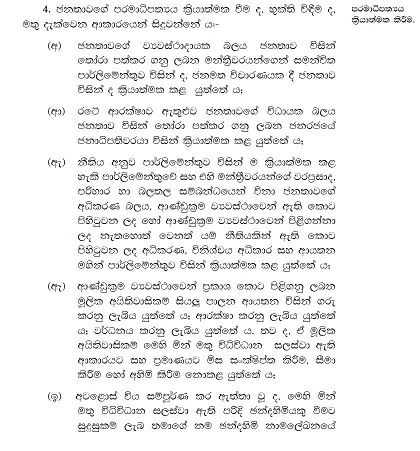
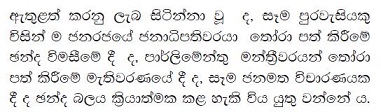
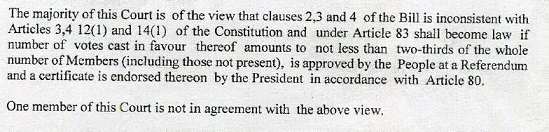
(20 වැනි ආණ්ඩුක්‍රම ව්‍යවස්ථා සංශෝධනයට අදාල ශ්‍රේෂ්ඨාධිකරණ මතයට අදාල 2017.09.19 දින හැන්සාර්ඩ් වාර්තාව ඇසුරෙන් නීතිය ගලපා ඇත)

සෝල්බරි සාමිවරයාගේ මූලිකත්වයෙන් සහ පේරාදෙනිය සරසවියේ නිර්මාතෘ ජෙනිංග්ස් පෙරදැරිව 1947 දී ආණ්ඩුක්‍රම ව්‍යවස්ථාව කෙටුම්පත්කර දී බ්‍රිතාන්‍යය කිරීටයට වගකියන ලංකාවේ පුරවැසියෙකුට රටේ අගමැතිධුරය ලබාදී 1948 පෙබරවාරි 04 වැනි දින ඩොමීනියන් නිදහස ලබා දෙන ලදී.

1815 දී උඩරට ගිවිසුමෙන් දෙපාර්ශවයේ එකගත්වයෙන් ලංකාවේ ජනතාවගේ පරමාධිපත්‍යය බලය බ්‍රිතාන්‍යයන් ලබා ගත් අතර එදින සිට මුළු රටටම බලපාන පරිදි විධායක, ව්‍යවස්ථාදායක සහ අධිකරණ බලය එංගලන්තයේ මහරජුන් සහ මහ රැජිණියන් විසින් ලංකාවේ එවකට සිලෝන්” පාලනය කිරීම සදහා යොදා ගනු ලැබී ය.

දෙවන ලෝක යුද්ධයෙන් පසු බ්‍රිතාන්‍යය කිරීටයේ බලය සීඝ්‍රයෙන් පිරිහී ගිය අතර හිරු  නොබසින අධිරාජ්‍යයේ බලය කෙමෙන් දියවන තත්ත්වයක් ඇති වෙමින් තිබූ අතර සිය යටත් විජිත වූ රටවල නිදහස් අරගල ආරම්භ වී තිබීමත් මත ප්‍රජාතන්ත්‍රවාදය නම් භූමිකාව නිරූපණය කරන ආයතන පිහිටුවා එම රටවල් දිගටම සිය නොනිල පාලනයේ තබා ගැනීමට බ්‍රිතාන්‍යය බුද්ධිමත් හු ක්‍රියාකාරී විය.

ඒ අනුව ප්‍රජාතන්ත්‍රවාදී පියවර අනුව ජනතාවගේ නියෝජිකයින් පත්කර රට පාලනය කරන බව 1947 ආණ්ඩුක්‍රමයෙන් පෙන්වා දුන්නද විධායකයත්, අධිකරණයත්, ව්‍යවස්ථාදායකයත් පාලනනය කරන තීරක බලය බ්‍රිතාන්‍යය කිරීටයටත්, රාජාධිකරණයටත් විය.

ලංකාවේ ජනතාවගේ පරමාධිපත්‍යය බලය ඉතා සියුම්ව බ්‍රිතාන්‍යයන් විසින් පාලනය කරනා බව දුටු 1970 බලයට පැමිණි සමගි පෙරමුණු” ආණ්ඩුව එවකට පැවති 1947 සෝල්බරි ව්‍යවස්ථාවට පටහැනිව යමින් පළමු ජනරජ ආණ්ඩුක්‍රම ව්‍යවස්ථාව රාජකීය විදුහලේ නවරගහලේ ආණ්ඩුක්‍රම ව්‍යවස්ථා සම්පාදක මණ්ඩලයක් ඉදිරියේ දී කෙටුම්පත් කර 1972 දී ශ්‍රී ලංකා ආණ්ඩුක්‍රම ව්‍යවස්ථාව ලංකාවට හදුන්වා දෙන ලදී.

1972 දී ශ්‍රී ලංකා ආණ්ඩුක්‍රම ව්‍යවස්ථාවේ 1වැනි පරිච්ඡේදය ජනතාව, රජය සහ පරමාධිපත්‍යය ලෙස දක්වන ලද අතර එය මෙසේ ය…,

ආණ්ඩුක්‍රම ව්‍යවස්ථා සම්පාදක මණ්ඩලයක් විසින් 1972 ආණ්ඩුක්‍රම ව්‍යවස්ථාව කෙටුම්පත් කරමින් යන අවස්ථාවේ සී සුන්දරලිංගම් විසින් ශ්‍රේෂ්ඨාධිකරණයේ නඩු පවරා එකී ව්‍යවස්ථා සම්පාදක මණ්ඩලයේ ක්‍රියාවන් නතර කර ගැනීමට උත්සාහ ගත් බව සී. සුන්දරලංගම් එ. නීතිපති සහ තවත් දෙදෙනකු 75 න.නී. වා. 126 පිටුවේ දැක්වේ. එය සාර්ථක වූයේ නැත. එකී නඩුව සම්බන්ධව අදාල නීති වාර්තාවේ එකී නඩුවේ තීන්දුව කෙටියෙන් මෙසේ දක්වා ඇත.

එනම් 1947 සෝලිබරි ව්‍යවස්ථාව මගින් බ්‍රිතාන්‍යය කිරීටයේ විධායක, ව්‍යවස්ථාදායක සහ අධිකරණ බලය මගින් ලංකාවේ ජනතාවගේ පරමාධිපත්‍ය බලය බැද දමා තිබීම නිදහස් කර ගැනීමට 1972 ආණ්ඩුක්‍රම ව්‍යවස්ථා සම්පාදකයින් ක්‍රියා කරගෙන යද්දී එය නතර කරමින් එංගලන්ත කිරීටය ලංකාවේ විධායකය, ව්‍යවස්ථාදායකය සහ අධිකරණය යටත් කිරීම ආරක්ෂා කිරීමට සහ සෝල්බරි ව්‍යවස්ථාව් විධිවිධාන ආරක්ෂා කිරීම වෙනුවෙන් එම නඩුව පවරා තිබුණි.

කෙසේ වෙතත් එංගලන්ත කිරීටයට ලංකාවේ විධායකය, ව්‍යවස්ථාදායකය සහ අධිකරණය යටත් කිරීම පවත්වාගෙන යාම පූර්ණ ලෙසම කරගෙන යාමට නොහැකි වූ අතර 1972 සහ 1978 ආණ්ඩුක්‍රම ව්‍යවස්ථා මගින් ඒ තත්ත්වය සෑහෙන ප්‍රමණයකින් මුදා ගන්නා ලදී.

1972 ආණ්ඩුක්‍රම ව්‍යවස්ථාවේ මෙන්ම 1978 ආණ්ඩුක්‍රම ව්‍යවස්ථාවේද 1 වැනි පරිච්ඡේදය ජනතාව, රජය සහ පරමාධිපත්‍යය ලෙස දක්වා ඇත. එය මෙසේ ය…,


ඒ අනුව වර්තමානයේ වලංගු 1978 ආණ්ඩුක්‍රම ව්‍යවස්ථාවේ 3 ව්‍යවස්ථාවේ ජනතාවගේ පරමාධිපත්‍ය ජනතාව කෙරෙහි පිහිටුවා ඇති බවත්, එකී පරමාධිපත්‍යය අත්හළ නොහැකි බවත් දක්වා ඇති අතර පරමාධිපත්‍ය යන්නට සහ පරමාධිපත්‍ය ක්‍රියාත්මකවීම සහ භුක්තිවිදීම දැක්වෙන ජනතාවගේ පරමාධිපත්‍ය බල වර්ග 05ක් සම්බන්ධ විධිවිධාන දැක්වෙන අතර එය 4වන ව්‍යවස්ථාවේ දක්වා ඇත.

එනම් එකී පරමාධිපත්‍ය බල වර්ග 05 වන්නේ..,

  1. ජනතාවගේ විධායක බලය.
  2. ජනතාවගේ ව්‍යවස්ථාදායක බලය.
  3. ජනතාවගේ අධිකරණ බලය.
  4. ජනතාවගේ මූලික අයිතිවාසිකම්.
  5. ජනතාවගේ ඡන්ද බලය.

මෙම ලිපිය පළාතකට පමණක් අදාල පළාත් සභා මැතිවරණය 4 ඉ ව්‍යවස්ථාව තුළට ගැනීමෙන් බෙදුම්වාදයට සුජාතබව ලැබෙන අයුරු පිළිබද සාකච්ඡා කරන හෙයින් 1978 ආණ්ඩුක්‍රම ව්‍යවස්ථාවේ 3 ව්‍යවස්ථාවේ ජනතාවගේ පරමාධිපත්‍ය ක්‍රියාත්මකවීම සහ භුක්තිවිදීම දැක්වෙන 4 ඉ ව්‍යවස්ථාවට පිළිබද අධ්‍යයනය කිරීමට මූලිකත්වය දී ඇත.

1978 ආණ්ඩුක්‍රම ව්‍යවස්ථාවේ 4 ඉ ව්‍යවස්ථාව මෙසේ දැක් වේ.


ආණ්ඩුක්‍රම ව්‍යවස්ථාවේ 4ඉ ව්‍යවස්ථාව අනුව ජනතාවගේ පරමාධිපත්‍යය බලයේ කුළුණක් වන ජනතාවගේ ඡන්ද බලයේ පරමාධිපත්‍යය ක්‍රියාත්මක කරන මැතිවරණ 03ක් පමණක් දක්වා ඇත.

එනම්…,

  1. ජනරජයේ ජනාධිපතිවරයා තෝරාපත් කිරීමේ ඡන්ද විමසීම
  2. පාර්ලිමේන්තු මන්ත්‍රීවරයන් තෝරා පත් කිරීමේ මැතිවරණය
  3. සෑම ජනමතවිචාරණයක්

ඒ අනුව ආණ්ඩුක්‍රම ව්‍යවස්ථාවේ 4 ඉ ව්‍යවස්ථාව පිළිගන්නා ජනතාවගේ පරමාධිපත්‍යය ක්‍රියාත්මක කරන සහ භුක්තිවිදින ජන්ද විමසීම් පවත්වන මැතිවරණ 03ක් පමණක් පිළිගෙන ඇත.

ජනතාව විසින් ඡන්දය දෙන සෑම අවස්ථාවකදීම ජනතාවගේ පරමාධිපත්‍යය ඡන්ද බලය ක්‍රියාත්මක කිරීමක් බව ආණ්ඩුක්‍රම ව්‍යවස්ථාව පිළිගෙන නැති අතර ඒ අනුව ප්‍රාදේශිය සභා මැතිවරණ, නගර සභා මැතිවරණ, මහනගර සභා මැතිවරණ සහ පළාත් සභා මැතිවරණ ඉහත ආණ්ඩුක්‍රම ව්‍යවස්ථාවේ 4 ඉ ව්‍යවස්ථාව අනුව ජනතාවගේ පරමාධිපත්‍යය බලය ක්‍රියාත්මකවීම සහ භුක්තිවිදීම සදහා පවත්වන මැතිවරණ නොව අදාල මැතිවරණ නීතිය අනුව පවත්වන මැතිවරණ පමණක් වේ.

ජනතාවගේ පරමාධිපත්‍ය ක්‍රියාත්මකවීම සහ භුක්තිවිදීම සදහා පවත්වන මැතිවරණයක අනන්‍ය ප්‍රධාන  ලක්ෂණ 07 ක් අධ්‍යයනය කළ හැකිය.

  1. ලංකාව පුරා එක් අවස්ථාවකදී ඡන්දය පවත්වනු ලැබේ.
  2. ලංකාවේ සියලුම ඡන්ද දායකයින්ගේ ඡන්ද එක් ස්ථානයකට නියෝජිතයින් තේරීම සදහා යෙද වේ. (තේරීපත්වන අය එක් ස්ථානයකට එනම් පාර්ලිමේන්තුවට සාමාජිකයින් තේරීම හෝ ජනාධිපතිවරා පත් කිරීමට හෝ ජනමතවිචාරණය තීරණය)
  3. මුළු රටටම බලපාන පරිදි තීරණ / නීති පැනවීම සදහා තීරණ ගැනීමට ඡන්දය පවත්වනු ලැබේ.
  4. ලංකාවේ කොටසකට පමණක් බලපාන තීරණ / නීති පැනවීමට නියෝජිතයින් පත් කිරීමට නො පවත්වයි.
  5. ලංකාවේ සියලුම ජනතාවගේ අදහස් / කැමැත්ත තීරණය කරමින් සියලුම ජනතාව එක් කුලකයක් ලෙස සළකා ඡන්දය පවත්වයි.
  6. තේරීපත්වන අය සම්මත කරන්නට යන නීති අභියෝග කිරීමට රටේ සියලුම දෙනාටම සමාන අවස්ථාව ලැබේ.
  7. ශ්‍රී ලංකා ජනරජයේ ජනතාවගේ ඡන්දය ආයතන කිහිපයක් පිහිටුවීම සදහා යොදා නොගනී.

(ඒ අනුව පළාත් සභා මැතිවරණය පවත්වන්නේ පළාත් සභා 09ක් පිහිටුවීමට හෙයින් පළාත් සභා මැතිවරණය ශ්‍රී ලංකා ජනරජයේ ජනතාවගේ පරමාධිපත්‍ය ක්‍රියාත්මකවීම සහ භුක්තිවිදීම සදහා පවත්වන මැතිවරණයක අනන්‍ය ප්‍රධාන  ලක්ෂණ නොමැතිව පවත්වන මැතිවරණයක් බවට පත් වී ඇත.)

ඒ අනුව ප්‍රාදේශිය සභා මැතිවරණ, නගර සභා මැතිවරණ, මහනගර සභා මැතිවරණ සහ පළාත් සභා මැතිවරණ ඉහත ආණ්ඩුක්‍රම ව්‍යවස්ථාවේ 4 ඉ ව්‍යවස්ථාව අනුව ජනතාවගේ පරමාධිපත්‍යය බලය ක්‍රියාත්මකවීම සහ භුක්තිවිදීම සදහා පවත්වන මැතිවරණ වන්නේද යන්න ජනතාවගේ අවධානයට යොමු විය යුතුය. එම මැතිවරණවල දී ජනතාවගේ පරමාධිපත්‍යය බලය නියෝජනය නොවන්නේද යන්න සහ අදාල ප්‍රදේශයේ හෝ කොට්ඨාශයේ හෝ පළාත සදහා පමණක් අදාල වන මැතිවරණයක් පමණක් වන්නේද යන්න විමසා බැලිය යුතුය.

දැනට පළාත් සභා 09ක් ඇති අතර එමෙන්ම ප්‍රාදේශිය සභා, නගර සභා, මහනගර සභා විශාල සංඛ්‍යාවක් ඇති අතර ඒ ඒ පළාත්වල / ප්‍රදේශවල ජනතාව එවැනි ඡන්ද විමසීම් වලදී නිදහස්, සමාන, රහස් ඡන්දයක් ප්‍රකාශ කළද ජනතාවගේ පරමාධිපත්‍යය  ක්‍රියාත්මකවීම සහ භුක්තිවිදීම සදහා පවත්වන මැතිවරණයක අනන්‍ය ප්‍රධාන ලක්ෂණ නොමැතිව සීමිත විධායක, ව්‍යවස්ථායක සහ අධිකරණ බලයක් ක්‍රියාත්මක කිරීමට පනවා ඇති ව්‍යවස්ථා විධිවිධාන අරමුණු කර පවත්වන මැතිවරණ වන අතර එවැනි මැතිවරණ ආණ්ඩුක්‍රම ව්‍යවස්ථාවේ 4 ඉ ව්‍යවස්ථාවටද ඇතුළත් කර නැත.

ඒ අනුව ජනතාවගේ පරමාධිපත්‍යය බලය ක්‍රියාත්මකවීම සහ භුක්තිවිදීම සදහා පවත්වන මැතිවරණයක ලක්ෂණ ප්‍රාදේශිය සභා, නගර සභා, මහනගර සභා, පළාත් සභා සදහා පවත්වන මැතිවරණයක තිබෙන්නේද යන්න පිළිබද ප්‍රභල සැකයක් ඇති වේ. ජනතාවගේ පරමාධිපත්‍යය විස්තර කර ඇති ආණ්ඩුක්‍රම ව්‍යවස්ථාවේ 4 ඉ ව්‍යවස්ථාවට වෙනත් මැතිවරණයක් ඇතුළත් කිරීමට ආණ්ඩුක්‍රම ව්‍යවස්ථා සංශෝධනයක් පාර්ලිමේන්තුව විසින් ගෙන එනු නොලැබූ අතර ඒ මන්ද යන්නත් විමසා බැලිය යුතුය. ආණ්ඩුක්‍රම ව්‍යවස්ථාවේ විධිවිධාන සංශෝධනය කිරීම පාර්ලිමේන්තුවේ සහ ජනතාවගේ කාර්යයක් පමණක බවත් ආණ්ඩුක්‍රම ව්‍යවස්ථාව අර්ථනිරෑපණය මුවාවෙන් ආණ්ඩුක්‍රම ව්‍යවස්ථාවට කොටස් එකතු කිරීම නිසි ක්‍රමවේදය නො වේ.

පළාත් සභා 09 සදහා වෙන්වෙන්ව පවත්වන පළාත් සභා මැතිවරණ ආණ්ඩුක්‍රම ව්‍යවස්ථාවේ 4 ඉ ව්‍යවස්ථාව අනුව ජනතාවගේ පරමාධිපත්‍යය බලය ක්‍රියාත්මකවීම සහ භුක්තිවිදීම සදහා පවත්වන මැතිවරණයක්ද?

(පළාත් සභා සදහා නියෝජිතයින් තෝරා ගන්නා මැතිවරණයක් ආණ්ඩුක්‍රම ව්‍යවස්ථාවේ 4 ඉ ව්‍යවස්ථාවට ඇතුළත් නොවන බවට මැදිහත් පෙත්සම්කරුවන් කරුණු ඉදිරිපත් කර ඇති බව 20 වැනි ආණ්ඩුක්‍රම ව්‍යවස්ථා සංශෝධනයට අදාල ශ්‍රේෂ්ඨාධිකරණ මතයට අදාල 2017.09.19 දින හැන්සාර්ඩ් වාර්තාවේ දැක්වේ.)

1978 ආණ්ඩුක්‍රම ව්‍යවස්ථාවේ 13 වැනි ආණ්ඩුක්‍රම ව්‍යවස්ථා සංශෝධනය සම්මත කරගන්නා ලද්දේ ජනමත විචාරණයකින් නො වේ. පාර්ලිමේන්තුවේ මුළු මන්ත්‍රී සංඛ්‍යාවෙන 2/3 බහුතර ඡන්දයෙනි. එනම් 13 වැනි ආණ්ඩුක්‍රම ව්‍යවස්ථා සංශෝධනය මගින් ජනමතවිචාරණයකින් සංශෝධනය කළ යුතුබවට එතෙක් පැවති ආණ්ඩුක්‍රම ව්‍යවස්ථා විධිවිධාන කිසිවක් සංශෝධනය කිරීමට අපේක්ෂාවක් තිබී නැත. ජනතාවගේ පරමාධිපත්‍යය බලයට හදුන්වා දී ඇති 3 වැනි ව්‍යවස්ථාවේ කිසිම විධිවිධානයක් 13 වැනි ආණ්ඩුක්‍රම ව්‍යවස්ථා සංශෝධනය මගින් සංශෝධනය වී නැත. මන්ද 13 වැනි ආණ්ඩුක්‍රම ව්‍යවස්ථා සංශෝධනය මගින් 3 වැනි ව්‍යවස්ථාව සංශෝධනය වූයේ නම් 13 වැනි ආණ්ඩුක්‍රම ව්‍යවස්ථා සංශෝධනය සදහා ජනමත විචාරණයකින් තොරව සම්මත කරගත නොහැකි වේ.

එනම් පළාත් සභා මගින් ඇති කරන ඕනෑම ව්‍යුහයක්, අධිකාරියක්, ක්‍රම පිළිවෙලක් (154 අ සිට 154ඩ දක්වා ව්‍යවස්ථා) සදහා අවශ්‍ය වන්නේ උපරිම ලෙස පාර්ලිමේන්තුවේ මුළු මන්ත්‍රී සංඛ්‍යාවෙන් 2/3 බහුතර ඡන්දයකි. මන්ද එකී ව්‍යවස්ථා ආණ්ඩුක්‍රම ව්‍යවස්ථාවට හදුන්වා දී ඇත්තේ පාර්ලිමේන්තුවේ මුළු මන්ත්‍රී සංඛ්‍යාවෙන් 2/3 බහුතර ඡන්දයකින් වීමයි. එනයින්ම පළාත් සභා මගින් ඇති කරන ඕනෑම ව්‍යුහයක්, අධිකාරියක්, ක්‍රම පිළිවෙලක් (154 අ සිට 154ඩ දක්වා ව්‍යවස්ථා) ඉවත් කිරීම සදහා අවශ්‍ය වූයේත් පාර්ලිමේන්තුවේ මුළු මන්ත්‍රී සංඛ්‍යාවෙන් 2/3 බහුතර ඡන්දයක් පමණි. මන්ද  13 වැනි ආණ්ඩුක්‍රම ව්‍යවස්ථාවේ 154 අ සිට 154ඩ දක්වා ව්‍යවස්ථා මගින් ආණ්ඩුක්‍රම ව්‍යවස්ථාවේ 85 ව්‍යවස්ථාවේ දැක්වෙන ව්‍යවස්ථා කිසිවක් සංශෝධනය කිරීමක් සිදු නොවීමයි.

ඒ බව තවදුරටත් පැහැදිලි වන්නේ 1978 ආණ්ඩුක්‍රම ව්‍යවස්ථාවේ 4 ව්‍යවස්ථාව ජනමතවිචාරණයකින් තොරව සංශෝධනය කළ හැකි වුවත්, 13 වැනි ආණ්ඩුක්‍රම ව්‍යවස්ථා සංශෝධනය අවස්ථාවේ සිට පසුගිය 20 වැනි ආණ්ඩුක්‍රම ව්‍යවස්ථා සංශෝධනයට අදාල ශ්‍රේෂ්ඨාධිකරණ මතය පාර්ලිමේන්තුවට ප්‍රකාශ කළ 2017.09.19 දින තෙක් පාර්ලිමේන්තුව විසින් 4ඉ ව්‍යවස්ථාවට පළාත් සභා මැතිවරණ ඇතුළත් කර නො තිබීමෙනි. එනම් 3 වැනි ව්‍යවස්ථාවට 13 වැනි ආණ්ඩුක්‍රම ව්‍යවස්ථාවේ 154 අ සිට 154ඩ දක්වා ව්‍යවස්ථා මගින් කිසිම බැලපෑමක් එල්ල කර නො තිබිණ. අඩුම තරමේ 13 වැනි ආණ්ඩුක්‍රම ව්‍යවස්ථාවේ 154 අ සිට 154 ඩ දක්වා ව්‍යවස්ථා මගින් ආණ්ඩුක්‍රම ව්‍යවස්ථාවේ 3 වැනි ව්‍යවස්ථාවට බලපෑමක් එල්ල කළේ නම් එනම් ජනතාවගේ පරමාධිපත්‍යයට බලපෑමක් එල්ල කළේනම් අනිවාර්්‍යයෙන්ම 13 වැනි ආණ්ඩුක්‍රම ව්‍යවස්ථා සංශෝධනය නීතිගත විය යුතුව තිබුණේ පාර්ලිමේන්තුවේ මුළු මන්ත්‍රී සංඛ්‍යාවෙන් 2/3 බහුතර ඡන්දයකින් සහ ජනමතවිචාරණයකින් පමණි. 13 වැනි ආණ්ඩුක්‍රම ව්‍යවස්ථා සංශෝධනය සදහා ජනමතවිචාරණයක් නොපවත්වන ලද හෙයින් ආණ්ඩුක්‍රම ව්‍යවස්ථාවේ 3 වැනි ව්‍යවස්ථාව සංශෝධනයක් හෝ පළාත් සභා මගින් ජනතාවගේ පරමාධිපත්‍යය බලය ක්‍රියාත්මක වීම හෝ බුක්තිවිදීම සිදුවී නැත.

මේ නීතිමය තත්ත්වය 4 ඉ ව්‍යවස්ථාවේ දැක්වෙන මැතිවරණ 3 පමණක් ජනතාවගේ පරමාධිපත්‍යය බලයට අයත් බවට 1978 ආණ්ඩුක්‍රම ව්‍යවස්ථාව පිළිගෙන තිබීමෙන් ම පැහැදිලි වේ. එසේ වුවත් 20 වැනි ආණ්ඩුක්‍රම ව්‍යවස්ථා සංශෝධනයට අදාල ශ්‍රේෂ්ඨාධිකරණ මතය 2017.09.19 දින පාර්ලිමේන්තුවට යොමු කිරීමත් සමග ඒ තත්ත්වය වෙනස් වී ඇති අතර 4 ඉ ව්‍යවස්ථාවේ දැක්වෙන මැතිවරණ 3, තවත් මැතිවරණයක්ද සමග කියවිය යුතු තත්ත්වයක් මේ වන විට එකී ශ්‍රේෂ්ඨාධිකරණ තීරණය හරහා නිර්මාණය වී ඇත.

20 වැනි ආණ්ඩුක්‍රම ව්‍යවස්ථා සංශෝධනයට අදාල ශ්‍රේෂ්ඨාධිකරණ මතය 2017.09.19 දින යොමු කිරීමේදී ආණ්ඩුක්‍රම ව්‍යවස්ථාවේ 4 ඉ ව්‍යවස්ථාවට පළාත් සභා සදහා සාමාජිකයින් තෝරණ  මැතිවරණද ඇතුළත් බව තීරණය කර ඇත. 

(පළාත් සභා සදහා නියෝජිතයින් තෝරා ගන්නා මැතිවරණයක් ආණ්ඩුක්‍රම ව්‍යවස්ථාවේ 4 ඉ ව්‍යවස්ථාවට ඇතුළත් වන බවට 20 වැනි ආණ්ඩුක්‍රම ව්‍යවස්ථා සංශෝධනයට අදාල ශ්‍රේෂ්ඨාධිකරණ මතයට අදාල 2017.09.19 දින හැන්සාර්ඩ් වාර්තාවේ දැක්වේ.)

13 වැනි ආණ්ඩුක්‍රම ව්‍යවස්ථා සංශෝධනය මගින් හෝ එකී සංශෝධනයෙන් පසු මේ දක්වා ආණ්ඩුක්‍රම ව්‍යවස්ථාවට සිදු කර ඇති කිසිම සංශෝධනයකින් 4 ඉ ව්‍යවස්ථාවට පළාත් සභා මැතිවරණයක් ජනතාවගේ පරමාධිපත්‍ය බලය සහිතව පවත්වන මැතිවරණයක් ලෙස ඇතුළත් කර නොතිබුණ තත්ත්වයකදී 20 වැනි ආණ්ඩුක්‍රම ව්‍යවස්ථා සංශෝධනයට අදාලව ශ්‍රේෂ්ඨාධිකරණය විසින් 4 ඉ ව්‍යවස්ථාවට පළාත් සභා මැතිවරණයද ඇතුළත් කර කිබීම නීතිමය ලෙස අධ්‍යයනය කිරීමට සෑම පුරවැසියෙක්ම අවධානය යොමු කළ යුත්තේ එමගින් ආණ්ඩුක්‍රම ව්‍යවස්ථාවේ 1 වැනි ව්‍යවස්ථාවට සිදුකරන බලපෑම සහ 3 වැනි ව්‍යවස්ථාවට සිදුකරන බලපෑම 83 ව්‍යවස්ථාව අනුව ජනමතවිචාරණයක් දක්වා දුරදිග යාමට හැකි තත්ත්වයේ නීතිමය අර්බුදයක් දක්වා මතු විය හැකි හෙයිනි.

පළාත් සභා මැතිවරණය මගින් ජනතාවගේ පරමාධිපත්‍ය බලය නිරූපණය කරන්නේ නම් පළාත් සභා පිහිටවූ 13 වැනි ආණ්ඩුක්‍රම ව්‍යවස්ථා සංශෝධනයට අදාල 154 අ සිට 154ඩ දක්වා ව්‍යවස්ථා ආණ්ඩුක්‍රම ව්‍යවස්ථාවට ඇතුළත් විය යුතු වූයේ 83 ව්‍යවස්ථාව පාර්ලිමේන්තුවේ මුළු මන්ත්‍රී සංඛ්‍යාවෙන් 2/3 බහුතර ඡන්දයකින් සහ ජනමතවිචාරණයකින් සම්මත වීමෙන් පසු ය. 13 වැනි ආණ්ඩුක්‍රම ව්‍යවස්ථා සංශෝධනය සදහා ජනමතවිචාරණයක් නොපැවැත් වූ හෙයින් ආණ්ඩුක්‍රම ව්‍යවස්ථාවේ 154 අ සිට 154ඩ ව්‍යවස්ථා වලින් ජනමතවිචාරණයකට බලපාන කිසිදු ව්‍යවස්ථා සංශෝධනයක් එනම් 1, 2, 3, 6, 7, 8, 9, 10 සහ 11 සහ 30.2 සහ 62.2 ව්‍යවස්ථාවලට බලපාන්නේ යැයි තීනිමය ලෙස අවධානය යොමු කළ නො හැකිය. ඒ අනුව  වර්තමාන ආණ්ඩුක්‍රම ව්‍යවස්ථාව යටතේ පළාත් සභා 09 සදහා වෙන් වෙන්ව පවත්වන පළාත් සභා මැතිවරණ ආණ්ඩුක්‍රම ව්‍යවස්ථාවේ 4 ඉ ව්‍යවස්ථාව අනුව ජනතාවගේ පරමාධිපත්‍යය බලය ක්‍රියාත්මකවීම සහ භුක්තිවිදීම සදහා පවත්වන මැතිවරණයක් නොවන බව ආණ්ඩුක්‍රම ව්‍යවස්ථාව අනුව පැහැදිලිය. තත්ත්වය එසේ වුවත්, 20 වැනි ආණ්ඩුක්‍රම ව්‍යවස්ථා සංශෝධනය සම්බන්ධව ශ්‍රේෂ්ඨාධිකරණය විසින් දෙන ලද 2: 1 බෙදුනු තීන්දුව අනුව පළාත් සභා මැතිවරණයද ආණ්ඩුක්‍රම ව්‍යවස්ථාවේ 4 ඉ ව්‍යවස්ථාවට ඇතුළත් කර ඇති හෙයින් ඉදිරියේදී පවත්වන පළාත් සභා මැතිවරණ පෙර පැවති පළාත් සභා මැතිවරණ මෙන් නොව ජනතාවගේ පරමාධිපත්‍ය බලය සහිතව පවත්වන ජනාධිපතිවරණ, ජනමතවිචාරණ සහ ජනමතවිචාරණ මෙන් පරමාධිපත්‍ය බලයක් සහිතව  පවත්වන මැතිවරණයක් ලෙස උසස් වී පවත්වන අතර එය ආණ්ඩුක්‍රම ව්‍යවස්ථාවේ 1 වැනි ව්‍යවස්ථාවට බරපතල අනතුරක් වන්නේද යන්න ඉදිරියේදී සමාජය විසින් සාකච්ඡා කළ යුතු තත්ත්වයකි.

(20 වැනි ආණ්ඩුක්‍රම ව්‍යවස්ථා සංශෝධනයට අදාල) පනත් කෙටුම්පතේ 2, 3, 4 වගන්ති ආණ්ඩුක්‍රම ව්‍යවස්ථාවේ 3, 4, 12.1 ව්‍යවස්ථාවලට නොගැලපෙන බවත් ඒ අනුව පක්ෂව ඡන්දය දෙනලද ඡන්ද සංඛ්‍යාව (නොපැමිණි මන්ත්‍රීවරයන්ද ඇතුළුව) මුළු මන්ත්‍රී සංඛ්‍යාවෙන් තුනෙන් දෙකකට අඩු නොවේ නම්ද, ජනමතවිචාරණයකදී ජනතාව විසින් ජනමතවිචාරණයකදී අනුමත කර ඇත්නම් සහ  ආණ්ඩුක්‍රම ව්‍යවස්ථාවේ 80 ව්‍යවස්ථාව යටතේ ජනමතවිචාරණයකදී ජනතාව විසින් අනුමත කළ බවට ජනාධිපතිවරයා සහතික විසින් එහි සහතිකයක් ස්වකීය අත්සන ඇතිව සටහන් කර ඇත්නම් නීතිය බවට පත්වන බව බහුතර තීරණය බව  ශ්‍රේෂ්ඨාධිකරණ මතයට අදාල 2017.09.19 දින හැන්සාර්ඩ් වාර්තාවේ දැක්වේ.)

මෙහිදී මතුවන අනෙක් නීතිමය තත්ත්වය වන්නේ ජනාධිපතිවරණ, ජනමතවිචාරණ සහ ජනමතවිචාරණ සදහා සිය පරමාධිපත්‍ය ඡන්ද බලය භාවිතා කරන පුරවැසියන් ඒ හා සමාන පරමාධිපත්‍ය බලයක් සහිතව පළාත් සභා ඡන්ද විමසීම සදහා සිය ඡන්දය ලබා දීමට කැමති වේද? යන්නයි. මන්ද පරමාධිපත්‍ය බලය සහිතව එනම් ආණ්ඩුක්‍රම ව්‍යවස්ථාවේ 4 ඉ ව්‍යවස්ථාවට පළාත් සභා මැතිවරණයද ඇතුළත් කර ඇති අවස්ථාවකදී ඉදිරියේදී පවත්වන පළාත් සභා මැතිවරණයකදී බලය ලබා ගන්නා යම් පළාත් සභාවක් ජනතාවගේ පරමාධිපත්‍යය බලය නිරූපණය කරන බවට හිතුවක්කාරී ලෙස තීරණය කර ශ්‍රී ලංකා ප්‍රජාතන්ත්‍රවාදී ජනරජයෙන් වෙන්වී යාමට ක්‍රියා කළහොත් ඇති වන තත්ත්වය නීතිමය වලංගුතාවයක්ද ලබා ගනී. මන්ද ඉදිරියේ පළාත් සභා මැතිවරණ පවත්වනු ලබන්නේ ආණ්ඩුක්‍රම ව්‍යවස්ථාවේ 4 ඉ ව්‍යවස්ථාවට පළාත් සභා මැතිවරණයද ඇතුළත් කරගෙන ඇති වටපිටාවකදී වීමයි.

එකම දිනක පළාත් සභා මැතිවරණ පැවැත්වීම සදහා අරමුණු කර ගත් 20 වැනි ආණ්ඩුක්‍රම ව්‍යවස්ථා සංශෝධනය අවසානයේ දිශානති වී තිබෙන්නේ ආණ්ඩුක්‍රම ව්‍යවස්ථාවේ 4 ඉ ව්‍යවස්ථාවට පළාත් සභා මැතිවරණයද ඇතුළත් කරගෙන පළාත් සභාවල ටද පාර්ලිමේන්තුවට මෙන් ජනතාවගේ පරමාධිපත්‍ය බලය ලබා දීමෙන් බව පෙනී යයි. ජනතාවගේ පරමාධිපත්‍යය බලය පළාත් සභාවලට හිමිවීමත් සමගම ආණ්ඩුක්‍රම ව්‍යවස්ථාවේ 1 වැනි ව්‍යවස්ථාව උල්ලංඝණය වන තත්ත්වයක් සහ පාර්ලිමේන්තුව මෙන් සමාගාමීව නීති පැනවීමේ අධිකාරියද පළාත් සභාවට හිමිවන නීතිමය තත්ත්වය ආරම්භ වේ. එනම් පාර්ලිමේන්තුව මෙන් ජනතා පරමාධිපත්‍ය පළාත් සභාද නියෝජනය කිරීමෙන්  ආණ්ඩුක්‍රම ව්‍යවස්ථාවේ XI පරිච්ඡේදයේ ඇති 76 ව්‍යවස්ථාවට පටහැනි තත්ත්වයක්ද ඇති වන අතර ආණ්ඩුක්‍රම ව්‍යවස්ථාවේ 6, 7 සහ 8 වැනි ව්‍යවස්ථාවලින් ආරක්ෂා කර ඇති ශ්‍රී ලංකා ප්‍රජාතන්ත්‍රවාදී ජනරජයේ අනන්‍යතාවයට අදාල ලක්ෂණ, ජනතාවගේ පරමාධිපත්‍යබලය හිමි කරදී ඇති පළාත් සභා මගින් අත්කර ගැනීමටද නීතිමය අවස්ථාව වීවෘත කර දී ඇත.

මෙහිදී විසදා ගත යුත්තේ ආණ්ඩුක්‍රම ව්‍යවස්ථාවේ 4 ඉ ව්‍යවස්ථාවේ දැක්වෙන ජනාධිපතිවරණය, පාර්ලිමේන්තු මැතිවරණය සහ ජනමතවිචාරණය මෙන් ජනතාවගේ පරමාධිපත්‍යදැක්වෙන අවස්ථාවක් පළාත් සභා මැතිවරණවලින් පෙන්නුම් කරනවාද? යන්නයි. ජනාධිපතිවරණය, පාර්ලිමේන්තු මැතිවරණය සහ ජනමතවිචාරණය යන මැතිවරණ කුලකය සහ පළාත් සභා 09 සදහා පවත්වන පළාත් සභා මැතිවරණය ප්‍රාදේශිය සභා මැතිවරණය, නගර සභා මැතිවරණය සහ මහනගර සභා මැතිවරණය යන මැතිවරණ කුලක සෑම අතින්ම සමාන ලෙස සැළකිය හැකිය යන ගැටළුව නීතිමය ලෙස නිරාකරණය කර ගත යුතුය. එනම් එම කුලක දෙක මගින්ම ආණ්ඩුක්‍රම ව්‍යවස්ථාව දක්වන ජනතාවගේ පරමාධිපත්‍ය බලය ක්‍රියාත්මක වනවාද? යන්නයි. මේ කුලක දෙකටම අදාල මැතිවරණ ආණ්ඩුක්‍රම ව්‍යවස්ථාවේ 4 ඉ ව්‍යවස්ථාවේ දක්වෙන්නේ නම් මේ දක්වා 4 ඉ ව්‍යවස්ථාව සංශෝධනය කිරීමට පාර්ලිමේන්තුව චේතනා නොකළේ මන්ද යන්නයි.  මෙම කුලක දෙක සමාන විය නොහැකි ය.

ඒ සමගම පැන නගින්නේ ආණ්ඩුක්‍රම ව්‍යවස්ථාවේ 3 වැනි ව්‍යවස්ථාව දක්වන ජනතාවගේ පරමාධිපත්‍ය බලය අත් නොහළ යුතු බවට වන විධානය සහ ඉහත නීතිමය කරුණු මත ලංකාවේ සෑම පුරවැසියෙකුටම මෙය අදාල බවත් එනම් ජනතාව සම්බන්ධයෙන් වැදගත්වන සහ පොදු වැදගත්කමක් ඇති බැවින් ඒ අනුව මේ තත්ත්වය නීතිමය ලෙස නිරාකරණය කර ගැනීමට එනම් ආණඩුක්‍රම ව්‍යවස්ථාවේ 132 ව්‍යවස්ථාව යටතේ ශ්‍රේෂ්ඨාධිකරණයේ පූර්ණ විනිශ්චය මණ්ඩලයක් යටතේ මේ තත්ත්වය එනම් 20 වැනි ආණ්ඩුක්‍රම ව්‍යවස්ථා සංශෝධනයට අදාලව ශ්‍රේෂ්ඨාධිකරණයේ බෙදුනු තීරණය අභියෝග කර  ආණඩුක්‍රම ව්‍යවස්ථාවේ 4 ඉ ව්‍යවස්ථාවට පළාත් සභා මැතිවරණය ඇතුළත් කිරීමේ නීතිමය හැකියාව නිරාකරණය කර ගැනීමයි.

ඒ සමගම විසදා ගත යුත්තේ ඉදිරියේ පවත්වන පළාත් සභා මැතිවරණයක් පැවැත්විය යුත්තේ ආණ්ඩුක්‍රම ව්‍යවස්ථාවේ 4 ඉ ව්‍යවස්ථාවට ඇතුළත් ජනතාවගේ පරමාධිපත්‍ය බලයද ඇතුළත් පළාත් සභා මැතිවරණයක්ද නොඑසේ නම් 4 ඉ ව්‍යවස්ථාවට ඇතුළත් නැති ජනතාවගේ පරමාධිපත්‍ය බලයක් නැති  පළාත් සභා මැතිවරණයක්ද  යන්නයි. ඉදිරි පළාත් සභා මැතිවරණ හෝ මැතිවරණයක් පැවැත්වීමට පෙර මේ ගැටළුව නීතිමය ලෙස නිරාකරණය කර නොගත හොත් සංකීර්ණ ආණ්ඩුක්‍රම ව්‍යවස්ථාමය ගැටළුවලට ලාංකීය පුරවැසියන්ට මුහුණ දීමට සිදුවනු ඇත. (උතුරු නැගෙනහිර පළාත් සභා මේ සදහා එකග නොවනු ඇත.)

ආණ්ඩුක්‍රම ව්‍යවස්ථාවේ 3 වැනි ව්‍යවස්ථාවට අනුව ශ්‍රී ලංකා ජනරජයේ පරමාධිපත්‍ය ජනතාව කෙරෙහි පිහිටුවා තිබෙන අතර ඒ පරමාධිපත්‍ය ක්‍රියාත්මක කරන සහ භුක්තිවිදින ආකාරය 4 ව්‍යවස්ථාවේ නියම කර ඇත. එකී ව්‍යවස්ථාවලින් නියම කර ඇති ආකාරයෙන් පිට පරමාධිපත්‍ය ක්‍රියාත්මක වීම සහ භුක්තිවිදිම සිදුවීම ආණ්ඩුක්‍රම ව්‍යවස්ථාව අනුමත කරන්නේද යන්න නීතිමය ලෙස විමසා බැලිය යුතුය. ශ්‍රී ලංකා ජනරජයේ පරමාධිපත්‍ය ජනතාව කෙරෙහි පිහිටුවා ඇති නමුත් ශ්‍රී ලංකා ජනරජයේ පරමාධිපත්‍ය පළාත් සභාවක වෙසෙන ජනතාව කෙරෙහි පිහිටුවා නැත. මන්ද ශ්‍රී ලංකා ජනරජයේ පරමාධිපත්‍ය පළාත් සභාවක වෙසෙන ජනතාවට පිහිටුවා තිබුණහොත් ඒ පළාත් සභාවේ ජනතාවට ශ්‍රී ලංකා ජනරජයන් වෙන්වී යාමේ පරමාධිපත්‍යය බලයත් නිතැතින්ම හිමකර ගන්නා හෙයිනි. රටේම ජනතාවගේ පරමාධිපත්‍ය බලය ක්‍රියාත්මක කරන සහ භුක්තිවිදින අංගයක් වන ජනතාවගේ ඡන්ද බලය සමග ජනතාව සීරුවෙන් ක්‍රියා කළ යුත්තේ එහෙයිනි. එසේ කටයුතු කිරීමේදී ඡන්ද පිපාසයෙන් ඉන්නා ජනතාවට ඡන්දය දෙන මුවාවෙන් මෙතෙක් පැවති බලයට වැඩි පරමාධිපත්‍ය බලයක් සහිත පළාත් සභා මැතිවරණයක් පැවැත්වීම සදහා නීතිමය අධිකාරිය ලබා ගැනීම ජනතාවගේ බුද්ධිමය අවධානයට යොමු විය යුතුය.

SRI LANKA: Human Rights Defender illegally arrested for allegedly participating in Protest against Police

October 6th, 2017

ASIAN HUMAN RIGHTS COMMISSION-URGENT APPEALS PROGRAM

Dear Friends,

The Asian Human Rights Commission (AHRC) has received information regarding Mrs. Kariyawasam Aarachchilage Ramani Kusumalatha (46), a resident of the Kantale Police Division. She was well reputed as a human rights defender in the area. On 13 June, Kusumalatha assisted three torture victims at the Kantale Base Hospital. Then she asked the Police Officers not to beat those who were protesting against Police who tortured victims. She was able to point out that human rights were being violated by the Police who used force and beat the protestors in public. Finally, the Police illegally arrested her, detained her for 4 hours at the Kantale Police Station and later produced her in front of the Kantale Magistrate Court on fabricated charges.

SHE DEMANDS JUSTICE.

Case Narrative:

The Asian Human Rights Commission has received information regarding Mrs. Kariyawasam Aarachchilage Ramani Kusumalatha (46) of No: 247/C, Trincomalee Road, Kantale in the Trincomalee District. Kusumalatha is one of the most active civil society activists in the village. She is a member of several civil society organizations and has participated in many demonstrations in the area and nationwide. She demanded protection for human rights and the civil liberties of the people. She is widely known for her social work and is a law-abiding citizen of Trincomalee.

Kusumalatha learned in the evening of 3 June 2017 about three young persons of the village. They were tortured, IN PUBLIC, by Kantale Police Station Officers. She further learned that the victims had to be admitted to the Kantale Base Hospital for treatment. Kusumalatha immediately went to the hospital and visited the patients facilitated by the medical staff.

Meanwhile, she learned that large gatherings of people surrounded the hospital and raised their voices in support of the three young boys—now patients. They demanded that Hospital Authorities assist the victims. They demanded that the Police Officers responsible for the torture be arrested.

She observed that large numbers of Police reported to the hospital premises, preparing to use force. She noted that Senior Police Officials were positioned among the ordinary Policemen. Kusumalatha, approached the Senior Police officers directly. She did not approve their move to assault the protestors and demanded that they listen peacefully to the protestors. She raised her voice to resolve the problem by providing JUSTICE. In this way, she would be able to stop a massive human rights violation from happening.

Several days later, on 23 June, a team of 5 Police Officers went to her home and questioned her as to why she obstructed their duties. She was arrested and brought to the Kantale Police Station. After a detention of 4 hours, she was produced before the Kantale Magistrate and granted bail.

She learned that the Police filed fabricated charges against her for obstructing their work. Kusumalatha states that she was illegally arrested and held in a cell by Kantale Police, thereby violating her fundamental rights guaranteed by the Constitution.

Suggested Action:

Please send letters to the Authorities listed below expressing your concern about this case. Request an immediate investigation into the allegation of illegal arrest by Police. Under Criminal Law, prosecute those proved to be responsible for misusing the powers of the State. Officers involved should face an internal investigation for breach of Police Departmental Orders. Please request the National Police Commission (NPC) and the Inspector General of Police (IGP) to open a special investigation into the malpractice of Police Officers who abuse their powers.

To support this case, please click here:


SAMPLE LETTER:

Dear _______

SRI LANKA: Human Rights Defender illegally arrested for allegedly participating in a Protest against Police

Name of Victims: Mrs. Kariyawasam Aarachchilage Ramani Kusumalatha (46) of No: 247/C,                                    Trincomalee Road, Kantale in the Trincomalee District

Alleged perpetrators: Police Officers attached to the Kantale Police Station

Date of incident: On 23 June 2017

Place of incident: Kantale Police Division

According to information I have received Mrs. Kariyawasam Aarachchilage Ramani Kusumalatha (46) of No: 247/C, Trincomalee Road, Kantale in the Trincomalee District. Kusumalatha is one of the most active civil society activists in the village. She is a member of several civil society organizations and has participated in many demonstrations in the area and nationwide. She demanded protection for human rights and the civil liberties of the people. She is widely known for her social work and is a law-abiding citizen of Trincomalee.

Kusumalatha learned in the evening of 3 June 2017 about three young persons of the village. They were tortured, IN PUBLIC, by Kantale Police Station Officers. She further learned that the victims had to be admitted to the Kantale Base Hospital for treatment. Kusumalatha immediately went to the hospital and visited the patients facilitated by the medical staff.

Meanwhile, she learned that large gatherings of people surrounded the hospital and raised their voices in support of the three young boys—now patients. They demanded that Hospital Authorities assist the victims. They demanded that the Police Officers responsible for the torture be arrested.

She observed that large numbers of Police reported to the hospital premises, preparing to use force. She noted that Senior Police Officials were positioned among the ordinary Policemen. Kusumalatha, approached the Senior Police officers directly. She did not approve their move to assault the protestors and demanded that they listen peacefully to the protestors. She raised her voice to resolve the problem by providing JUSTICE. In this way, she would be able to stop a massive human rights violation from happening.

Several days later, on 23 June, a team of 5 Police Officers went to her home and questioned her as to why she obstructed their duties. She was arrested and brought to the Kantale Police Station. After a detention of 4 hours, she was produced before the Kantale Magistrate and granted bail.

She learned that the Police filed fabricated charges against her for obstructing their work. Kusumalatha states that she was illegally arrested and held in a cell by Kantale Police, thereby violating her fundamental rights guaranteed by the Constitution.

I request the intervention of your good offices. Ensure that the Authorities listed below open an immediate investigation into the allegation of violations of the fundamental rights of the victim by Officers of the Sri Lanka Police Department. The Officers involved should be subject to an internal investigation for breach of Police Departmental Orders.

Yours sincerely,

———————
PLEASE SEND YOUR LETTERS TO:

1. Mr. Pujith Jayasundara
Inspector General of Police
New Secretariat
Colombo 1
SRI LANKA
Fax: +94 11 2 440440 / 327877
E-mail: igp@police.lk

2. Mr. Jayantha Jayasooriya PC
Attorney General
Attorney General’s Department
Colombo 12
SRI LANKA
Fax: +94 11 2 436421
E-mail: ag@attorneygeneral.gov.lk

3. Secretary
National Police Commission
3rd Floor, Rotunda Towers
109 Galle Road
Colombo 03
SRI LANKA
Tel: +94 11 2 395310
Fax: +94 11 2 395867
E-mail: npcgen@sltnet.lk or polcom@sltnet.lk

4. Secretary
Human Rights Commission
No. 36, Kynsey Road
Colombo 8
SRI LANKA
Tel: +94 11 2 694 925 / 673 806
Fax: +94 11 2 694 924 / 696 470
E-mail: sechrc@sltnet.lk

Thank you.

Urgent Appeals Program
Asian Human Rights Commission (ua@ahrc.asia)

Read this UAC online

මා විසින් Daily News පුවත් පතට ලියූ ලිපි

October 6th, 2017

වෛද්‍ය රුවන් එම් ජයතුංග 

1 ) පුනර්භවය පිලිබඳ ලිපියක්  පිලිබඳව

http://dailynews.lk/2016/11/02/features/97714

2) ගජමන් නෝනා පිලිබඳව

http://dailynews.lk/2015/11/11/features/poetesss-plight

3) පිකාසෝ ගේ චිත්‍රයක්  පිලිබඳව

http://dailynews.lk/2015/09/22/features/pablo-picasso%E2%80%99s-anti-war-mural-tortured-guernica

4) වින්සන්ට් වැන්ගෝ පිලිබඳව

http://dailynews.lk/2015/09/22/features/psychological-reflections-vincent-van-gogh%E2%80%99s-art

5) මානසික සෞඛ්‍යය  පිලිබඳව

http://dailynews.lk/2016/09/19/features/93483

6) ජාතක කතා පිලිබඳව

http://dailynews.lk/2016/09/27/features/94211

7) දෙවන ලෝක යුද්ධයේ දී යුදෙව් සංහාරය පිලිබඳව

http://dailynews.lk/2016/10/25/features/96932

8) යූක්‍රයීන ජන සංහාරය පිලිබඳව

http://dailynews.lk/2016/11/30/features/100567

9) ඩන්ටේ  පිලිබඳව

http://dailynews.lk/2016/12/21/features/102502

10) සිංහබාහු සහ ඊඩිපස් සංකීර්ණය

http://dailynews.lk/2016/12/28/features/103038

11)  Between Litrature and Psychology පොත  පිලිබඳව

http://dailynews.lk/2016/08/10/features/89965

12) ජෝසෆ් ස්ටාලින් ගේ මනෝ භාවයන් පිලිබඳව

http://dailynews.lk/2016/05/03/features/80467

13) නිර්වානය යන සංකල්පය මනෝ විද්‍යාත්මක ඇසින්

http://archives.dailynews.lk/2007/04/04/fea06.asp

14) විශ්වයේ සම් භවය පිලිබඳව ලියන ලද ලිපියකට පිලිතුරක්

http://archives.dailynews.lk/2007/07/12/fea02.asp

15) මාර්ටින් වික්‍රමසිංහ ගේ භව තරණය කෘතිය පිලිබඳව

http://archives.dailynews.lk/2011/01/13/fea22.asp

16) අපරාධ පිලිබඳ මනෝ සමාජවිද්‍යා දැක්ම

http://archives.dailynews.lk/2011/03/17/fea01.asp

17) රැඩ්‍ යඩ් කිප්ලිං පිලිබඳව

http://archives.dailynews.lk/2011/02/01/fea37.asp

18) යුද ආතතිය පිලිබඳව

http://archives.dailynews.lk/2009/08/20/fea01.asp

19) යුද ආතතිය සහ සමාජය

http://archives.dailynews.lk/2009/08/20/fea01.asp

20) ශ්‍රී ලංකාවේ ළමා සොල්දාදුවන් පිලිබඳව( මහාචාර්‍ය දයා සෝම සුන්දරම් සමග )

http://archives.dailynews.lk/2012/05/24/fea01.asp

21) රුවන්ඩා ජන සංහාරය පිලිබඳව

http://archives.dailynews.lk/2012/01/02/fea03.asp

22) ADHD අනවධාන / අධි ක්‍රියාශීලී අක්‍රමතාවය  පිලිබඳව

http://archives.dailynews.lk/2008/09/15/fea10.asp

23) පාසල් දරුවන් ගේ විභාග භීතිකාව පිලිබඳව

http://archives.dailynews.lk/2008/07/07/fea10.asp

24) පාසල් දරුවන් ගේ මනෝ කායික රෝග පිලිබඳව

http://archives.dailynews.lk/2010/01/18/fea17.asp

25) ඇමරිකානු යුද හමුදාවේ කාන්තා ලිංගික හිංසනය

http://archives.dailynews.lk/2009/10/15/fea026.asp

26) එර්නස්ට් හිමිංවේ පිලිබඳව

http://www.dailynews.lk/2017/03/15/features/110370/how-be-ernest-hemingway

27) ඩී.එච් ලෝරන්ස්  පිලිබඳව

http://dailynews.lk/2016/11/09/features/98476

28) ලේඛක කේ ජයතිලක පිලිබඳව

http://archives.dailynews.lk/2011/09/17/fea03.asp

29) විලියම් වර්ඩ්වත්  පිලිබඳව

http://archives.dailynews.lk/2010/11/22/fea31.asp

30 )  වෛද්‍ය රුවන් එම් ජයතුංග ගේ කෘතියක් පිලිබඳව මහාචාර්‍ය සුනන්ද මහේන්ද්‍ර අදහස් දක්වයි

http://archives.dailynews.lk/2008/11/26/art06.asp

31) වෛද්‍ය රුවන් එම් ජයතුංග විසින් ලියන ලද කවියක්

http://archives.dailynews.lk/2008/12/10/fea50.pdf

32) ජාතක කතා වල මනෝ විද්‍යාත්මක පාර්ශවය

http://archives.dailynews.lk/2008/07/30/fea10.asp

33) ශෙල්ටන් රණසිංහගේ කෘතියක් පිලිබඳව

http://archives.dailynews.lk/2010/03/03/art13.asp

34)  කුමාරතුංග මුණිදාස සහ ඩෙරීඩා

http://archives.dailynews.lk/2008/12/26/fea06.asp

35) එඩ්වර්ඩ් කෙන​ඩි පිලිබඳව

http://archives.dailynews.lk/2009/08/28/fea02.asp

36) පශ්චාත් ව්‍යසන ක්ලමථ අක්‍රමතාව පිලිබඳව ( මනෝ වෛද්‍ය නීල් ප්‍රනාන්දු සමග ලියූ ලිපියක්)

http://archives.dailynews.lk/2010/12/11/fea05.asp

New PC Election Law not passed on general merits and principles

October 6th, 2017

 By Kelum Bandara Courtesy The Daily Mirror

Parliament should be mindful of the fact that it exercises legislative power of the people It’s the Constitution that is supreme 

Parliament is subordinate to the Constitution 

I’m trying to get a court ruling to have elections to PCs as soon as possible 

In the absence of elected representatives, PC functions will become chaotic 

The Speaker has no judicial power

The Government’s constitution making process is unconstitutional 

What the President does is the exact opposite of what he promised before the elections

Former Chief Justice Sarath N. Silva, who petitioned the Supreme Court against the newly enacted Provincial Councils Elections (Amendment) Act, in an interview with the Dailymirror  aired his views about its consequences. Following are excerpts of the interview.


Q You, as the former Chief Justice, decided to challenge the constitutionality of the Provincial Council Elections (Amendment) Act. What prompted you to do so?

To begin with, we are the Socialist Democratic Republic of Sri Lanka. A Republic is a country governed by the people themselves. The sovereignty is with the people. The Republican Constitution started with the American war of independence in 1780. We are basically a republican democratic country. We have four levels of Government- the President, Parliament, Provincial Councils and Local Government. It’s very important that people should understand this. All these levels of Government derive their authority from the Constitution. The main link between these four levels of Government and the people is the franchise. That is the right to vote. It is inalienable. Franchise and fundamental rights are inalienable.

The local authorities or the fourth level of Government are the closest to people. They maintain roads, clear garbage, maintain sanitary conditions, meet public health requirements etc. We have had a system of Local Government coming from the time of the British. During the period of our ancient kings, we had Rata Sabhas and Gam Sabhas. The Local Government is an essential part of our system. All these bodies are elected.

One person who understood the real significance of Local Governments was former President R. Premadasa. He brought about Pradeshiya Sabhas. He realized the value of having elected bodies at all times. In 1987, there was one law governing all these bodies. He amended it and inserted a section. It says six months before the term of elected council ceases, the election should be conducted. Then, there is a council ready to take over. He realized continuity. It’s like the US Presidential System. The new President is elected before the incumbent leaves office. Although Premadasa hadn’t been educated, he knew these things.

The essential element of good governance is democracy and the rule of law. This Government, elected for good governance, hasn’t conducted elections. The local bodies have been without elected representatives for about two years

We were having the proportional representation for Local Elections at that time. Then, there was a Select Committee headed by Dinesh Gunawardane. It formulated these electoral wards. Now, there is a mix system. That new law was passed in 2012. There was a committee appointed to look into the creation of wards. By August 2015, the present President published the demarcation of wards. All the local authorities went out of office by 2016.

The essential element of good governance is democracy and the rule of law. This Government, elected for good governance, hasn’t conducted elections. The local bodies have been without elected representatives for about two years.

One level of Government, provided for in the Constitution, has ceased to function. People have lost their democratic rights.

QActually what made you challenge the law related to the provincial council elections?

The next level of Government is provincial councils. Article 155 (e) of the Constitution states that every provincial council elected holds office for a period of five years of the first meeting. Three provincial councils are out of office. These elections must be conducted. The Provincial Councils Election Act states that the Election Commission, within one week, shall publish a notice informing that the elections will be held. These are very clear-cut laws. It has worked for 30 years.

This isn’t the Bill that was published in the gazette. People never had an opportunity to challenge it.

The Government used the 20th Amendment to the Constitution to prevent it. It says Parliament can extend the term of provincial councils notwithstanding Article 155(e). When it was taken, the Supreme Court said franchise is affected and Parliament can’t exercise this power. So, the court specified that this law required not only a two-thirds majority, but also the approval of people at a referendum.

In the meantime, there was a law that was in Parliament to have a minimum quota for woman candidates. It is a small enactment. It is only one page. The Government dropped the 20th Amendment and took this up. The public are involved in respect of Bills. Article 78 of the Constitution states the Bill has to be published in the gazette one week before it is placed on the Order Paper of Parliament. This Government extended this period to two weeks in the 19th Amendment. That is for people to have prior notice of the Bill to be enacted. That is a commendable thing. Then, the first reading of the Bill proceeds. That is only a reading of the title of the Bill. Within one week, any person can challenge it in the Supreme Court.

This particular bill wasn’t challenged by anyone because it is fairly straightforward. Then, it was taken for the Second Reading. Section 51 of the Standing Orders states: On the Second Reading of a Bill, a debate may arise covering the general merits and principles of the Bill. When it is passed, it is referred to the committee stage. There is line by line reading of the respective clauses to enable some corrections to be made. What the Government did on that day is that they deleted all these lines. They introduced a whole new Act coming into 21 pages. Now, an entirely new system of election has been introduced. This isn’t the Bill that was published in the gazette. It isn’t the Bill which people were informed of. People never had an opportunity to challenge it. This isn’t a Bill passed on general merits and principles of the Second Reading.

One person who understood the real significance of Local Governments was former President R. Premadasa. He brought about Pradeshiya Sabhas. He realized the value of having elected bodies at all times

It is hilarious situation. There is one page during the First Reading and the Second Reading. There are 21 pages in the committee stage. That is why I decided to go to court regarding this. Otherwise, they can smuggle in any legislation this way.

QNow, The Speaker Karu Jayasuriya has certified the Bill into Act. The Parliament is considered supreme. Then, will there be any use of your action?

That is a misconception. They say Parliament is supreme. Under our Constitution, no one is supreme. What is supreme is the Constitution. The Constitution starts by stating that this is the supreme law of the Republic. All the other bodies are subordinate. If The Speaker shows me one word saying Parliament is supreme, I will withdraw this case. In Britain, it was earlier held that the Parliament was supreme. There it is now held that the Constitution is supreme although they don’t have any written Constitution. Parliament is subordinate to the Constitution. They have to be mindful that they exercise the legislative power of people. In that sense, people must be informed of what they are going to enact.

The Speaker has certified. It is true. His certification under Article 79 is, I hereby certify that the Bill has been duly passed by the Parliament. It isn’t just passed. He has overlooked the words ‘duly passed’.

The Constitution starts by stating that this is the supreme law of the Republic. All the other bodies are subordinate. If The Speaker shows me one word saying Parliament is supreme, I will withdraw this case

As for the 19th Amendment, this Government brought in substantial amendments during the committee stage. They did the same regarding the Local Government Election Law. But, they didn’t change a lot. In this case, they have brought a whole new thing. If this goes like this, they will publish something and pass another entirely different. If this happens, the whole purpose of exercising people’s legislative power will be lost. That is why I have gone to court.

People are deprived of their sovereignty. Now the Chairman of the Elections Commission says he doesn’t have the pitch to play on. He clowns around with this.

QDoes he have the legal authority to withhold elections since the Act is now in play?

He has to make an announcement. He will say his announcement is made, but he can’t have elections until constituencies are created. They have smuggled in these clauses. We will get a final ruling some time later. For the moment, there is a law in operation for 30 years. We had all the elections under that law. We must have an immediate solution until delimitation is done.

QDoes it mean your sole intention is to have an election immediately?

That is right. That is the point. There is an applicable law. This law has been in operation since 1988. There must be a council. The important thing is there is a whole list of exclusive powers vested with the Provincial Councils. If there is no elected provincials, all these things become dysfunctional. Most of the hospitals and schools come under the provincial ministries.

After 1987, we have had a separation of functions. We have the provincial council list, the reserved list and the concurrent list. The provincial council list is exclusive to the provincial councils. There are so many subjects. The implementation of provincial economic planning, education, educational services and Local Governments falls under the purview of the provincial council. You also get roads, bridges, social services, rehabilitation, and agriculture among them.

QNow the Government states that the councils will be placed under the respective Governors to be ruled. What is your view?

On the other hand, this Government is talking about devolution of power. They are trying to frame a new Constitution. Yet, they are silent on the provisions of the Constitution related to devolution itself

The Governor has no legislative power. He is only a repository of the executive power. The Constitution states there shall be a board of minsters with the Chief Minister as the head with not more than four others to aid and advise the Governor of the province in the exercise of functions. Powers are exercised in the name of Governor. The Governor shall in the exercise of his functions act in accordance with such advice. He has no independent rights. He can’t act on his own. He has to act upon the Chief Minister and the board of ministers.

There is a chaotic situation at Local Governments. That is a continuing problem. Now, little by little, all the institutions are ceasing to function.

On the other hand, this Government is talking about devolution of power. They are trying to frame a new Constitution. Yet, they are silent on the provisions of the Constitution related to devolution itself. The Tamil parties also say it is alright. Then, they can repeal the Provincial Council System. That can be done in a systematic way. I have received information that the Tamil parties also don’t mind the Provincial Councils ceasing to function in this manner. From their point of view, Northern Province Chief Minister C.V. Wigneswaran is a problem to TNA leader R. Sampanthan.

QIf the Supreme Court decides in your favour, won’t it lead to a clash between the judiciary and Legislature?

The Speaker has nothing to do with this thing at all. The interpretation of the Constitution and law is exclusively with the court. It has the sole and exclusive jurisdiction. The Supreme Court is vested with jurisdiction related to constitutional matters. It is the final authority on constitutional matters. The Speaker has no judicial power. Earlier, there was a ruling by the then Speaker the late Anura Bandaranaike. There was an impeachment motion. The Supreme Court gave a stay order. Then, Anura Bandaranaike said no. He said the impeachment process was parliamentary business. That is correct. It is something to do with the removal of judges. It is certainly within the role of Parliament. The Supreme Court can’t intervene in that. It doesn’t mean that the Supreme Court can’t decide on constitutional matters. The enactment of this law isn’t constitutional. It isn’t the law that was published in the gazette.

QSome fear that the Government will take steps for the enactment of the new Constitution in the same way it circumvented the procedure. What is your view?

The entire Constitution making process is also unconstitutional. There are particular ways providing for the amendment of the Constitution. They are given very clearly. The Bill for the amendment of the Constitution should be determined by the Cabinet. Then, the Cabinet should decide whether it should be passed by a two-thirds and referendum. If the Cabinet decides, the Supreme Court won’t exercise its jurisdiction. It must go according to this. Otherwise, the Supreme Court can order a referendum.

There is no provision made in the Constitution for a Constitutional Assembly. At least it must derive its authority from the Constitution. It derives authority from some resolution in Parliament. The Parliament can’t do that. The Parliament must act according to the Constitution. The Government derailed the procedure.

That is a serious matter. In the United States, the Constitution has existed for 200 years. They go strictly according to the Constitution. Here, it has become a fashion to change the Constitution. Today, Dr. Jayampathi Wickramaratne is involved. In 1996, he was involved with Chandrika Kumaratunga to draft the Constitution. It was put to the Parliament. The UNP burned the copies of that Constitution. The same man is doing it now. It is frightening. These are people with no respect for the due process. We fear that they will subvert the process and enact something unacceptable to the people.
If it is put to a referendum, it will be divisive. In such a situation, Tamils will say it’s Federalism and the Sinhala Buddhists unitary status. Once again, tension will build up.
QWhat do you think of the interim report of the Constitutional Reforms?

They are raising issues. An interim report is not a draft legislation. It has vague ideas. Persons will interpret ideas in different ways. There is now a huge dispute building up between the parties.

President Sirisena, in his manifesto, didn’t mention a new Constitution. He only said the Constitution would be subjected to certain amendments. He said the 19th amendment, proposed by Ven. Athuraliye Ratana Thera’s Pivithuru Hetak Organization and Ven. Maduluwave Sobhitha Thera, would be done. I was involved in drafting those proposals for Ven. Ratana Thera Thera. According to those proposals, the President has one term. After his election, he ceases to be a member of a political party. If President Sirisena stuck to that, he would have faced no problem. At the end of five years, he would have retired gracefully. Now, he has become the leader of a party. He did the exact opposite of what he promised and has got in to a big mess.

 QAre you planning to play a role in politics?

No. I support the Joint Opposition in their political activities. Issues like this have to be fought on a political basis. I am fighting on a legal basis. They must give political leadership to this. I won’t contest elections or hold any office. I have come here in the interest of the public.

Govt. may lose referendum on new Constitution

October 6th, 2017

By D.B.S. Jeyaraj Courtesy The Daily Mirror

Possibility of a drastically-altered final report

Strategists count ethno-religious factors in referendum-voting estimates

Overwhelming support of minorities might augment shortfall in Sinhala-Buddhist votes

Making political calculations on the basis of 2015 could prove dangerously-wrong in 2017 and years to follow

The coalition government of President Maithripala Sirisena and Prime Minister Ranil Wickremesinghe has – as one of its primary objectives – the political project of enacting and passing a new Constitution. This requires a two-thirds majority in Parliament and endorsement by the people in an islandwide referendum.

More importantly, the government has been trying to justify its move to introduce a new Constitution saying the envisaged Constitution would be sanctioned by the people. While the government appears to be optimistic about garnering the necessary parliamentary majority and obtaining the people’s approval at a referendum, current political trends as well as ground realities suggest holding a referendum in the current context may very well backfire on the government.

The Constitutional Assembly Steering Committee chaired by Prime Minister Ranil Wickremesinghe released its Interim Report on Proposals to be considered in the envisaged Constitution. The report was presented to the Parliament/Constitutional Assembly by the Premier on September 21. The parliamentary debate on the Interim Report will be held for three days on October 30, 31 and November 1 respectively. Thereafter, if everything goes according to schedule, the final report would be compiled and completed by year end and placed before the Parliament/Constitutional Assembly in January 2018. But then as observed by Robert Burns, in life, the best laid plans of men and mice often go awry.”

It is understood clearly that the Interim Report, though referred to as a consensual document, is not so in reality. The differing viewpoints expressed by the parties concerned in the annexures, euphemistically-described as observations and principles, make it crystal clear that there is a serious divide among the would-be Constitution-makers. Thus the ongoing Constitutional conversation could breakdown or suffer serious setbacks as discussions progress towards the final report. There is also the chance of a drastically-altered final report as a result of compromises and adjustments to bring about consensus.

Whatever may or may not be its transformed version, the Steering Committee’s final report of draft Constitutional Proposals is expected to be submitted for the consideration of the Constitutional Assembly early next year. If the proposals were accepted and approved by the Constitutional Assembly, it would be submitted to the Cabinet. The Cabinet will then approve it with or without changes and present the Constitutional provisions to Parliament as a Bill to get passed by a two-thirds majority. The Constitutional Assembly would stand dissolved. If passed by Parliament with a two-thirds majority, the approval and sanction of the people would be obtained by way of an islandwide referendum. Winning the referendum on the Constitution therefore is of crucial importance for this government legally, politically and above all, morally.

It is in this context that the question of the government winning the Constitutional referendum arises. Of course the draft Constitution or final report is not ready yet. The result of the referendum would very much depend upon the contents of or the substance of the envisaged Constitution. The fate of the referendum would also be determined by the relative strengths and merits of the respective for and against campaigns. The opposition to the new Constitution right now relies more on imagined or speculative complaints than on tangible evidence. It is only when the final version materialises that the opposition can train its guns more effectively on it. The final version would also facilitate the government campaign to market the new Constitution.

Buoyant optimism
Notwithstanding these realities, it is obvious that the dominant line of thought within the government and its allies at the present juncture is one of buoyant optimism that the referendum could and can be won. It is most unlikely that the government would have embarked upon the Constitution project and proceeded so far without some degree of confidence that the referendum battle can be fought and won. Tamil Progressive Alliance (TPA) leader and National Co-existence, Dialogue and Official Languages Minister Mano Ganesan summed up the government’s position aptly when he observed that winning the referendum would be difficult but it had to be won and so it would be.

It would be foolish on the part of the government and even the respective leaders of ethnic-oriented parties to take the minority voters for granted. The hiatus between pledge and performance by the Sirisena-Wickremesinghe duo and the so-called ‘Good Governance’ government headed by them is so vast that there is a rising groundswell of resentment against the ruling regime

The government’s greatest source of confidence in winning a referendum would naturally be its reliance on the strength of numbers. Numerical strength in this instance would mean the number of votes. At the January 2015 Presidential election, Maithripala Sirisena secured 6,217,1625 votes and skunked Mahinda Rajapaksa who obtained 5,768,09047. In the parliamentary elections of August 2015, the United National Party (UNP) led United National Front for Good Governance (UNFGG) polled 5,098,916 votes. The opposition United People’s Freedom Alliance (UPFA) garnered 4,732,664. A significant number of Sri Lanka Freedom Party (SLFP) MPs elected on the UPFA ticket in 2015 crossed over and currently are part and parcel of the ruling regime. The Sirisena-Wickremesinghe Government is today called a UNP- SLFP coalition government.

Government strategists opine that the electoral results of 2015 would be repeated in a referendum too. Political support demonstrated by the UNP at the 2015 polls along with the fresh support brought in by the pro-Sirisena SLFP MPs is calculated to be greater than the prevailing strength of the pro-Rajapaksa joint opposition. It is surmised that the UNP-SLFP strength in Parliament would be reflected at the referendum. In addition, the government has the support of two key allies. The Tamil National Alliance (TNA) and Janatha Vimukthi Peramuna (JVP) polled 515,963 and 543,944 votes respectively at the 2015 hustings. Besides, parties like the Ceylon Workers Congress (CWC) and Eelam People’s Democratic Party (EPDP) are also expected to support the new Constitution. Sheer arithmetic therefore makes the government hopeful of winning the referendum.

Already, several Provincial Councillors in the East and North-Central provinces have deserted Maithripala and crossed over to Mahinda. President Sirisena may have given them posts and perks, but it is to the Mahinda Rajapaksa star to which they must hitch their political wagons to gain electoral victory

If politics could always be determined by arithmetic alone, the expectations of the government may succeed. But then politics is not a numbers game always. As Leon Trotsky observed, Politics is more like algebra than like elementary arithmetic, and still more like higher rather than elementary mathematics” (Oft quoted by Dayan Jayatilleka in his writings). In this instance too, an assumption that arithmetic or numbers based on the votes polled in 2015 alone would deliver the goods at the referendum could be proved wrong.

Greek Philosopher Heraclitus stated, No man ever steps in the same river twice, for it’s not the same river and he’s not the same man.” If I may adapt and adopt it to present circumstances, the electoral rivers of 2015 do not flow now in Sri  Lanka. Likewise, the political strengths of the different political parties in 2015 are not the same now. The electorate has changed. The electoral mood has changed. The perceptions and political views of the voting public have changed. The stock of political parties has risen in some cases and fallen in other. Making political calculations on the basis of 2015 could prove dangerously-wrong in 2017 and years to follow.
Voting  pattern
In the first place, people voted for political parties and individual candidates at elections. There were a number of issues, options and preferences involved. This is not so in a referendum which is conducted to determine a single idea or decide upon a single case.

In this instance, the referendum would be on whether to accept or reject the new Constitution. While a large number of voters may let party or personal loyalties influence their voting at the referendum, an equally-large number of voters could also treat the matter on its own merits and cast their vote for or against. If that happens, a large number of people would cut across traditional party lines and vote. This would render calculations based on the 2015 polls irrelevant in assessing the referendum voting pattern. The possibility of some government constituents like the Jathika Hela Urumaya (JHU) going against the new Constitution cannot be ruled out.

Government political strategists also take ethno-religious factors into account in referendum-voting estimates.

It is widely-acknowledged that Mahinda Rajapaksa remains the single most popular mass figure among Sinhala Buddhist voters. Already, several Provincial Councillors in the East and North-Central provinces have deserted Maithripala and crossed over to Mahinda. President Sirisena may have given them posts and perks, but it is to the Mahinda Rajapaksa star to which they must hitch their political wagons to gain electoral victory.

In the current political environment, it is expected that Mahinda would spearhead the opposition campaign against the new Constitution at the referendum. In that situation, a larger percentage of Sinhala votes may be polled against the new Constitution. If that happens, the government could lose the referendum as the Sinhalese are the numerically-large ethnicity in the island.

Government strategists hope to counter that possibility by relying on the minority vote. It is expected that the Sri Lankan Tamils, Muslims, up-country Tamils of recent Indian origin and Sinhala Christians would vote in large numbers for the Constitution. The overwhelming support of the minorities is expected to augment the shortfall in Sinhala-Buddhist votes. This prognosis is on the basis that there would be a re-play of preponderant minority support shown in 2015 for Sirisena at the presidential poll and for the UNP at the parliamentary elections.

Once again, this assessment could be erroneous. It would be foolish on the part of the government and even the respective leaders of ethnic-oriented parties to take the minority voters for granted.
The hiatus between pledge and performance by the Sirisena-Wickremesinghe duo and the so-called ‘Good Governance’ government headed by them is so vast that there is a rising groundswell of resentment against the ruling regime. This has rubbed off greatly on its constituents within the government and parties supporting it from outside.

Besides, the minorities are likely to be disappointed if the new Constitution does not accommodate all of their aspirations or redress their grievances; virtually impossible. Even those from the minority ethnicities could vote against the new Constitution or not vote at all.

The greater portion of minority community voters could vote in favour of the Constitution, but a significantly-large number of minority community voters may boycott polls openly or refrain from voting at the referendum. This would cause a deficit in the number of minority community
votes expected.

Sinhala Buddhist 
The minority ethnicity votes may influence the people’s verdict one way or another, yet the ultimate factor that would determine the result of a referendum of this nature would be the majority or the Sinhala-Buddhist vote. This is because a referendum on the Constitution is being depicted and portrayed as a ‘life or death’ situation concerning the future of the predominantly Buddhist Sinhala population. It is being propagated already that the new Constitution would pave the way for division of the country. It is also being said that some powerful Western nations, Non-governmental Organisations and Tiger-ish elements in the diaspora are conspiring to roll back the territorial re-unification achieved by the armed forces and establish Tamil Eelam. Former Defence Secretary Gotabaya Rajapaksa has formed the ‘Eliya’ (Light) movement with the single point agenda of opposing and/or preventing the new Constitution.

This columnist does not propose at this juncture to delve in detail into the merits and defects of the propaganda by the Sinhala ‘nationalist’ lobby that the new Constitution would result in separation and setting up of Tamil Eelam. What is noteworthy is the growing perception or suspicion among many members of the majority community that the new Constitution is indeed a conspiracy to divide the nation and establish Tamil Eelam. This perception, however wrong it may seem, is the prevailing reality.

Such a perception can only be challenged and changed by an effective counter-response. Such a response can only be mounted by Sinhala political leaders within the government. Sadly, such a powerful response has not surfaced so far. What we have seen are apologetic semantics by the President and evasive backtracking by the Prime Minister. In essence, the government is on the defensive with weak arguments in the aftermath of just an interim report. What is needed here is a powerful political offensive in support of the proposed new Constitution. I doubt very much whether any senior minister in this Cabinet other than Mangala Samaraweera or Rajitha Senaratne would and could lead a proactive campaign in support of the Constitution at the time of the referendum.

The tragedy of the Sinhalese and by extension Sri Lanka has been the deep seated insecurity and fears of the majority community. The Sinhala psyche has often been called a Majority with a minority complex.” It is only a strong, secure and confident numerical majority that will be more tolerant, accommodative and magnanimous towards numerically-smaller minorities. Sadly, the majority within the Sinhala majority continues to feel threatened and vulnerable even after the Liberation Tigers of Tamil Eelam (LTTE) was militarily-defeated by the armed forces.

State of mind
I was speaking to a Sinhala, left-leaning academic, hailing from the Southern province, about the current situation. This long-standing friend of mine was one who supported Sirisena and even the UNP-led front in 2015. He belongs to a family that has abhorred the ‘green elephant’ for decades. Yet, he voted in 2015 for the elephant symbol in order to bring about change. Today he is disgusted at the turn of events. In a long, insightful conversation, a point he emphasised strongly was the confused, indecisive state of affairs under the Sirisena-Wickremesinghe dispensation. This has affected the people on the whole and was leading to a breakdown in society. He used the term ‘anomie’ popularised by sociologist Durkheim to describe the condition of the people. He also concurred with me about the beleaguered state of mind among many Sinhalese.

It is most unlikely that the government would have embarked upon the Constitution project and proceeded so far without some degree of confidence that the referendum battle can be fought and won

Again I do not wish to comment on the prevailing Sinhala state of mind and say whether it is right, wrong or in between. What is of importance here is to recognise the reality of its existence. In such a beleaguered, insecure state of mind, people believing themselves to be besieged and vulnerable can only be on the defensive and somewhat defiant. Against that backdrop, the referendum provides them an opportunity to articulate their suppressed feelings and strike a blow for themselves and against the perceived enemy. They will most likely vote against the proposed Constitution at the referendum.The Sirisena-Wickremesinghe Government has aggravated the issue by its economic policies and bad governance. Agriculture, the backbone of the nation, is being neglected while grandiose schemes to turn Lanka into a tourist and shopping paradise are being mooted.

Cost of living keeps rising. It took about four to five years for the term ‘Dharmishta Aanduwa’ coined by J.R. Jayewardene to fall from grace and be mocked by the people. But in the case of ‘Yahapalana,’ the fall has been in less than two years. Furthermore, it is being ridiculed as ‘Yamapalana.’

In such a situation, disappointed and frustrated people will like to display their feelings democratically at some sort of poll. Here, the Sirisena-Wickremesinghe Government has erred badly by denying the voters of their franchise. The local authority polls have been postponed for long, followed by the denial of provincial council polls. The amendments to elections, both local authorities and provincial councils, were passed in Parliament through ‘unorthodox’ procedures during committee stages. Denying the people of the right to vote for long periods and then providing a chance to vote at a referendum can lead to a crushing defeat for the government.
‘Us and Them’
Finally, there is the emotive ‘us and them’ syndrome in politics. The proposed Constitution with some progressive provisions to help resolve the national question through maximum devolution will cause consternation (already begun) among those perceived as Sinhala ‘hawks.’ The anti-Constitution referendum campaign will definitely be conducted within the Sinhala community on ethnic lines with an emotional appeal in terms of race and religion.

This in turn would result in similar sentiments rising to the fore among the Tamil and Muslim communities. Ultimately, the appeal to voters would turn primordial and the referendum would become an ‘us versus them’ contest. In such a context, a closing of ranks among the Sinhala people will result in the government facing defeat.

For all these reasons and more, the government is very likely to lose the referendum on the Constitution, unless a political miracle occurs. The Sirisena-Wickremesinghe Government needs to proceed carefully before rushing into areas where even angels may fear to tread. Furthermore, the referendum – whatever the result – can fracture ethnic relations and further divide
the country.

The country needs to reconcile and the government and its allies feel the new Constitution could hasten the reconciliation process further. Winning the referendum on the Constitution is expected to boost reconciliation and ethnic harmony. It would be a cruel irony if the referendum backfires on the government and defeats the very purpose for which it was conducted.
D.B.S. Jeyaraj can be reached at dbsjeyaraj@yahoo.com 

AM – PM – RK

October 6th, 2017

By Lucien Rajakarunanayake Courtesy The Island


Why did the Central Bank move from direct placements to public auctions for Treasury bonds?

Because the Prime Minister – PM, who else, wanted it that way. We have the word of guess who, Arjuna Mahendran, on that. He is the AM guy.

So did it help to expand the local –T-bond market, boost investor confidence, and drive down government borrowing costs, as they said it would?

Come one, you don’t have to talk bond shit, about all that has happened.

article_image

The Crooked action that moved to the very nadir of corruption was seen in how the Chairmen of the three major national banks were treated over the Treasury bond issue.

None other than the then Minister of Finance – Ravi Karunanayake – RK – asked them to bid the lowest at two Treasury bond auctions, with the assurance there would be no higher bids, and lo and behold, there were higher bids, and from Perpetual Treasuries – a treasure house of perpetually crooked financial dealings.

You mean RK let down or in fact cheated the national bank chairmen?

It is not easy to find a simpler word for that – downright crooked cheating.

Why do you think he did such a thing?

Well, it must be for the Penthouse pleasure and comfort, worth millions that he earned, although he knows nothing about that.

So, it is a somewhat simple trail of the crooked. The PM wants the T-bonds to be on public auction; the Finance Minister – RK- tells the national bank chiefs to bid very low, and no one will bid higher, and the son-in-law of Arjuna Mahendran – AM bids much higher. This is a real Penthouse Tale.

Dammit, how much more crooked can any government get?

We are learning all this from the Presidential Commission on the T-bond frauds. Looks like we will need many more Presidential Commissions to know about the other corruption going on. But, there will be a limit to that, because, how much more can the President expose his Prime Minister?

You mean this is systemic corruption in government today?

Read the reports of the Presidential Commission sittings, especially how AM is trying to be as ignorant as RK, and even more forgetful than him.

Yeah, there is an interesting puzzle about initials – picked from the erased telephone conversations of the key people Perpetual Treasuries.

You mean the perpetually crooked dealers?

Arjuna Mahendran does not know or is not ready to accept that the initials AM in the phone calls refer to him. He even states they could refer to his daughter – who we know is Anjali Mahendran. Of course, there was nothing said whether this AM daughter knew anything about –T-Bond transactions. Possibly nothing from him, because he has said he did not discuss anything about such matters at home – or forgets about such talk, just like RK.

Didn’t the initial puzzle, as AM tried to show it was, make one Commissioner ask an interesting and humourous question?

Yes… he asked whether AM knew Angelo Mathews.

But the lawyer of AM did something more laughable, drawing attention to AM and PM in the hours of the day.

You mean without realizing he was drawing the PM into the picture?

Looks like it. The fact is that even the best lawyers are known to make such slips. He would never have thought of the PM’s order to have only auctions on T-bond, so faithfully followed by AM, leading to the crooked bank chiefs’ cheating activity by RK, which has led to all this exposure of corruption.

So where does all this lead us to?

Not anywhere else but to the crooked corruption in this yahapalana government, which was elected by the people to get rid of corruption, but has now sent down roots and put out shoots showing it to be a hugely corrupt hardwood, posing a huge danger to clean government.

What do you think should be done?

Well, we will have to await the report of the Presidential Commission. But, till then it is good to raise questions as to why Ravi Karunanayake – RK – remains a frontline member of the UNP? Is it his wealth that he boasted about in Parliament when resigning his portfolio, or is it his permanent forgetfulness about Penthouse funding?

This certainly goes beyond an initial probe into corruption. It is an exposure of the initial holders of crooked corruption.

Bond scam probe: Political interference and public-private sector complicity frightening-Dew

October 6th, 2017

by Shamindra Ferdinando Courtesy The Island

One-time Chairman of the Committee on Public Enterprises (CoPE) Dew Gunasekera yesterday declined to comment on state banks, Bank of Ceylon, the People’s Bank and the National Savings Bank receiving instructions twice in 2016 to make bids at the treasury bond auctions at lower interest (yield) rates as that particular matter hadn’t been investigated by his committee.

General Secretary of the Communist Party Gunasekera said so when The Island asked him how his committee had failed to unravel state banks receiving instructions inimical to them from the then Finance Minister Ravi Karunanayake. “My committee probed the first controversial issuance of treasury bonds in late Feb. 2015 just eight weeks after the change of government.”

The second COPE probe dealt with both transactions, Gunasekera said, adding that specific instances of political interference and officials’ complicity at various levels had to be established. Gunasekera said that he was really perturbed by state banks assertion how they were misled by the very minister in charge of them. The complicity of politicians and public and private sector officials in alleged bond scams was frightening, he said.The former minister pointed out that the revelations had been made at the Presidential Commission of Inquiry (P-CoI) on Wednesday pertaining to the second alleged bond scam involving the CBSL and influential Primary Dealer (PD) Perpetual Treasuries Limited (PTL).

The veteran politician recalled how Karunanayake, in spite of being appointed finance minister in President Maithripala Sirisena’s 100-day administration remained a CoPE member. People had forgotten that in the wake of January 2015 presidential election defeat, the government, too, changed to pave the way for first bond scam.

Gunasekera said the then Speaker Chamal Rajapaksa had told him to select a special team comprising CoPE members to probe the scandalous transaction. According to CP veteran, Karunanayake hadn’t been included in the first ever CoPE team appointed outside usual procedure. Gunasekera explained that until then all CoPE investigations had been based on Auditor General’s findings in respect of public enterprises. There had never been an instance where the CoPE had been asked to inquire into a transaction before the Auditor General scrutinized it, Gunasekera said.

In the light of the then Finance Minister giving adverse instructions to state banks as transpired at P-CoI, Gunasekera emphasized the urgent need to review safeguards in place to prevent recurrence. Gunasekera pointed out that the second far bigger and damaging issuance of treasury bonds had taken place over a year after the first alleged scam.

Responding to another query, Gunasekera said that the Monetary Board had suspended the PD under a cloud in early July 2017 for a period of six months. Since then there had been significant developments at the P-CoI and Monetary Board would certainly have to take them into consideration before deciding on renewal, Gunasekera said.

Former Deputy Governor of the Central Bank Dr. W. A. Wijewardena yesterday told The Island that both politicians and officials alike had acted in contravention of rules and regulations governing banking operations. Dr. Wijewardena said that obviously all concerned had carried out the ‘business’ with impunity and weren’t bothered at all about serious violations.

Dr. Wijewardena said against the backdrop of the top management of state banks assertion that they had received wrong advice pertaining to March 2016 transaction, it would be pertinent to establish who had actually authorized the Chief Dealer at the Bank of Ceylon (BC) to bid Rs 13 bn on behalf of PTL.

The expert who had advised a three-member team of lawyers appointed by Premier Wickremesinghe to probe the first alleged scam and Dew Gunasekera’s committee said that as the Chief Dealer lacked authority to commit such a huge amount of funds he would have had to certainly clear that transaction with BC superiors .

Dr. Wijewardena said there hadn’t been a thorough examination into serious violations of internal controls and safeguards in state banks though the top management recently admitted them being deceived by the minister in charge of the subject.

If not for the P-CoI, the issuance of controversial ministerial instructions wouldn’t have come out, Dr. Wijewardena said, urging review of safeguards.

When Chairmen of state banks realized that they had been wrongly advised what did they do? Dr. Wijewardena asked.

Dew Gunasekera said there hadn’t been any indication that they had taken up that matter until P-CoI launched fact finding probe.

Current Chairman of CoPE responsible for the second parliamentary inquiry, JVP MP Sunil Handunetti couldn’t be contacted as he was overseas.

Lacille De Silva says Ranil is not reliable

October 6th, 2017

By Rasika Hemamali Courtesy Ceylon Today

Former Secretary of the Presidential Commission of Inquiry to Investigate and Inquire into Serious Acts of Fraud, Corruption and Abuse of Power, State Resources and Privileges (PRECIFAC) and Attorney-at-Law Lacille De Silva says Ministers Hakeem and Ravi Karunanayake had clearly been subject to accusations. “They influenced the President, directly, to remove me from the PRECIFAC”, he noted.

Excerpts of the interview:

On 8 January there was a political transformation in this country, how do you view the period that followed?

A: Promises were made, to combat corruption, make Government Service more efficient, and ensure media freedom also to ensure independence of the judiciary. Of the initial promises what we expected first was implementing a procedure against corruption. A Presidential Commission was appointed against corruption and fraud. An opportunity was granted to select a clever active staff. The Commission was established in the month of March. By the month of June about eight hundred petitions were received and the hearings had also begun. The first report was handed over. At the end of February I was removed from the post of Secretary.

Why do you think you were removed?

A: There were influences to halt the investigations on corruption. I think investigations on former President Mahinda Rajapaksa, as well as many in the Joint Opposition had commenced. Some of the people against whom there were charges joined the Government. In addition Ministers Hakeem and Ravi Karunanayake were clearly subject to accusations. They too influenced the President directly to remove me.

Q: Are you saying this with responsibility?

A: I am saying it with responsibility. SATHOSA had granted approval for importing rice. By importing rice, a loss of Rs.15.15 billion had to be borne by the Government. Our investigations became a threat to ministers in the present Government too. They did not want to come before the Commission and what they did was send their officers to the Commission. This request had been put to the Prime Minister. At that time, the President was of the stance that investigations should be carried out into corruption and fraud. At the end of February, before I was removed, I can recall the President told me to continue with the work and that it was good, but, when there was pressure he may have asked his Secretary to remove me from the post.

Are you saying that the President was put under pressure?

A: Definitely, there would have been some pressure that is why it was decided to remove me. President had discussions with the Prime Minister on the stance that officials did not want to go before the Commission. All of this happened during the same period.

The first step was to get rid of me. Then bringing in Government officials also gradually slowed down and all investigations came to a standstill. In this manner fulfilling of all promises is coming to an end. Once again, corruption investigations are being empowered through various other organizations in the country.

As a country, corruption and fraud should be stopped. If not we cannot progress. It is the innocent people who are suffering. Today youth are engaged in protests. Those are just demands. We remember how they took up arms against the Government. As a country we have not given careful thought to these; it is because those in Government do not possess the ability, neither do they see the need to do so. They cannot even prepare a plan.

Today we have reached a valuable turning point. After a serious war, in 2009, the then Government managed to raise the country to a certain standard, even they were unsuccessful in going beyond that.

The present ones came into power saying corruption, fraud, tender frauds, this and that. Ranil Wickremesinghe is not someone who will fulfil anything he says. I am saying this very clearly. In the Treasury Bond issue from the inception he gave unnecessary protection. It is totally wrong. Fortunately, the President took some decision. Through that decision, in some way, it became clear what the truth is. However, even today there is some sort of doubt whether these will be covered up. I am 100 per cent certain they will not be covered up.

Can we believe that if a Treasury Bond fraud took place, those found guilty will be punished?

A: Most definitely. It will be done. What he did by getting rid of us is dig his own grave. I do not believe he will be so foolish again. People also expect that from him.

He went to the United Nations Conference and said this path will be corrected. If not, it is hard to believe that even the President will have a political future. This is the final chance. It is clear. This situation cannot be corrected due to large scale interference from Government.

Are you satisfied with those in Government?

A: This Government has an idiotic Cabinet. When briefing the media on Cabinet decisions it is democratic to reply to questions in a civil manner, that is not how it happens, they use just one or two words and try to win, in an undemocratic manner. That is not how these should be solved. Cabinet is continually making the situation worse they don’t seem to be able to untie the knots. Finally it is the President who has to intervene in everything and solve them.

Where should the country head?

A: Agriculture should be developed also there should be a successful plan in place to generate employment. Today we are in a very regressive state that should be corrected. The resources of this country are being spent on the welfare and happiness of parliamentarians and ministers. The world’s best vehicles are being brought to Sri Lanka. The current economic status is a result of the incompetence of politicians.

We should spend the most on developing education. The Health Services, Transport, Judiciary as well as the overall Government Service has collapsed. To take the country forward it is essential to build up the Government Service. By bringing a new Constitution these problems will not get solved.

Are you saying that there is no need for a new Constitution?

A: We said very clearly that a new Constitution was required. See the Procurement Commission. It was said that such a Commission was required because all the corruption and the frauds under the previous Government was due to the procurement procedure being corrupt. Even the concept of a Procurement Commission was a proposal by Ranil Wickremesinghe. By proposing and not implementing can we expect that through the new Constitution people will get just solutions to their problems?

The 225 Members in Parliament will increase to 233 the number of Pradeshiya Sabhas which is at 4,000 will be increased to 6,000 or more. Those who are defeated and those who win will be 50 per cent, each. A strong Opposition is required for a country. Through this presidential system, the Opposition is being completely done away with.

What Ranil Wickremesinghe is doing involves a situation that goes beyond even that. Therefore the country is being dragged down further. Therefore we do not need a new Constitution at this stage.

At the conclusion of the ‘Sil Redi’ case, the JO said that due to such verdicts, Government officials will become apprehensive
A: That verdict was 100 per cent correct. Based on the current situation appoints are made by politicians. As a result they have to become political henchmen. However, if a certain official refuses to take an order, they appoint another to that chair and get it done. That is what is happening. At the same time Government officials should be held responsible for their actions. Judge Gihan Kulatunga’s verdict is certainly a turning point in history. A Government Service that refuses to act on a wrong order should be implemented.

Sri Lankans working abroad, they are Sinhala, Tamil and Muslim, maintain their integrity. No one can work under these decadent politicians.

If this country is to be developed the President has to fulfil all the promises he made. It is not apparent that Ranil Wickremesinghe is fulfilling five cents worth of that. He is swaying from side to side similar to a stick in the mud swaying from side to side. This country cannot be taken forward with such a leadership.

If I am to be upset it has to be with the President. The President was aware of the work I was doing, but, I was thrown out without even without being informed. I can see what is happening.

Are you criticizing the Government because of the displeasure on being removed from the Commission?

A: I am speaking as an honest citizen. I did not after that go behind people and ask for jobs. I do not have anything to gain neither do I have anything to lose. If so it is the President that I should criticize.

Do you believe that by changing the Government you will not be able to achieve the difference you expect?

A: It is the characters that should change. In a democratic country, there should be leaders who honour democracy in order to implement democracy. They should be a learned and knowledgeable group. There are ploys to have the same Government in place so that the same group will benefit.

How can you find such a group of people?

A: Clever persons should be selected at regional level and if that happens this country can be rebuilt.

Lalith the fall man

October 6th, 2017

By Hemantha Warnakulasuriya Courtesy Ceylon Today

I felt saddened by the sentence and heavy fines imposed on Lalith Weeratunga. It is very unfortunate that in our endeavours to arrest, remand and imprison those responsible for stealing the coffers of the Treasury, the first victim of that attempt happened to be Lalith Weeratunga. To my mind and to those of many others who worked with Lalith Weeratunga, I am yet to find a person who claims to know him as being a dishonest predator of public money. Instead of which I have found, that if there is a flaw in Lalith’s character it was that he was very slow in carrying out instructions of Mr. Mahinda Rajapaksa. The ex-President employed a ploy to dismiss supporters and direct them to either Lalith Weeratunga or P.B. Jayasundera.

Both of them knew how to give excuses and diplomatically refuse the applications for various favours. He instructed his subordinates at the Presidential Secretariat to strictly adhere to Administrative Regulations and Financial Regulations.

Many beneficiaries have found fault with Lalith Weeratunga for having failed to carry out the President’s instructions. Mr. Rajapaksa knew that in order to keep his MPs’ happy and contented; he had to please them and agree to their proposals and more often than not, violate the Financial Regulations. Mr. P.B. Jayasundera and Lalith Weeratunga became unpopular with Mahinda Rajapaksa’s supporters as they refused to carry out orders which may not strictly adhere to the rules in the book.

Another journalist told me that he knew for a certainty that Lalith Weeratunga is an honest, absolutely clean officer and one who even handed over the official presents he received from foreign and local dignitaries.

Chandrika vs Mahinda

I remember Mahinda Rajapaksa holding Lalith Weeratunga in a deep depth of gratitude as he and he alone saved him from the tsunami catastrophe that was orchestrated by Chandrika Bandaranaike Kumaratunga to defeat Mahinda Rajapaksa. Mahinda Rajapaksa virtually took a mandate of the SLFP to be nominated as Presidential Candidate. Chandrika was earlier very keen to appoint Lakshman Kadirigamar, the best Foreign Minister this country had produced and who had done a yeoman service to this country in getting the LTTE banned. Even the JVP was very supportive of making Lakshman Kadirgamar the Prime Minister over Mahinda Rajapaksa, who drew the wrath of Chandrika Bandaranaike Kumaratunga. When it was abundantly clear that Lakshman Kadirgamar was to be nominated Prime Minister, it was ironical and paradoxical that the then Secretary of the SLFP and current President Maithripala Sirisena went and pleaded with Chandrika not to appoint Lakshman Kadirgamar as the Prime Minister, as if it happened, there was a strong possibility that the Party would split in two. It is interesting to note that the JVP was totally opposed to Mahinda Rajapaksa, who gave an ultimatum to Chandrika, that unless Lakshman Kadirgamar is appointed as Prime Minister they would sit in the Opposition.

This tickled an antipathy towards the JVP and Nirupama Sen, who was the High Commissioner of India, informed Chandrika that they would prefer Mahinda Rajapaksa to be the Prime Minister. So, much against her own liking, Mahinda Rajapaksa became the Prime Minister of Sri Lanka and moved to Temple Trees. Lakshman Kadirgamar was sad and despondent that Chandrika did not appoint him as the Prime Minister. Lakshman Kadirgamar wrote a ‘magnum opus’ in the form of a long winded submission expressing regret over Chandrika’s decision. Even great advocates and politicians sometimes become so enamoured by the office, that they have to bend and kneel before officers to get what they think was due to them.

When Mahinda Rajapaksa aspired to be the Presidential Candidate, the first person to publicly endorse his candidature was Wimal Weerawansa the Media Secretary of the JVP. At that time there was another candidate, the Crown Prince of Sri Lanka Anura Bandaranaike.

When Mahinda Rajapaksa was nominated Chandrika thought that Mahinda would be defeated by the UNP. Through fear that Mahinda Rajapaksa would win the election, Chandrika then planned and even conspired with the UNP to defeat Mahinda Rajapaksa. In the same way that Sirimavo Bandaranaike and Anura Bandaranaike cut the sod under the feet of Hector Kobbekaduwa and defeated him.

Amunugama factor

Mr. Sarath Amunugama, who was a confidante of Chandrika, whispered to her that there was a serious allegation against Mahinda Rajapaksa, that of embezzling the tsunami funds and appropriating it for his own use. He was certain that if a proper investigation was carried out MR’s march towards victory could be thwarted.

A special handpicked CID Team, headed by the Director himself, was instructed to make secret investigations into the alleged tsunami fund fraud and record evidence under the supervision of a very young State Counsel, who was known as a workaholic in the department. It is said that he would come to the department at 4 O’ clock in the morning, and work so that no one knew what was going on about the Tsunami Misappropriation Case. As the election was nearing it was a very close fight. As usual Mahinda Rajapaksa got the Sinhala Buddhist support. The majority population of this country was opposed to the anti-Sinhala Buddhist pro-minority leanings of the Leader of the UNP, Ranil Wickremesinghe. The last leader who had these qualities was President Ranasinghe Premadasa who had been assassinated.

Thereafter, with the ascension of Ranil Wickremesinghe to the leadership of the UNP, even the practice, very strictly observed by his predecessor, Mr. Ranasinghe Premadasa, for Buddhists to observe Pansil and others to observe their own religious observances before the commencement of the day’s work, was done away with. The pleasure of the minority UNP member was huge at abandoning this practice which had been created by Ranasinghe Premadasa. The Jaffna vote was crucial, but the Eastern Province seemed to be equally divided. Chandrika dreaded the thought of Mahinda becoming the leader of this country.

One night, I got a call from my good friend Sarath Kongahage and he told me some very disturbing news. He told me that everything had been arranged to arrest Mahinda Rajapaksa produce him in Court and get him remanded on charges of misappropriation of public property, involving tsunami funding. A campaign had already been brought to the fore by the UNP on the misappropriation of the tsunami money handed over by foreigners to Rajapaksa, as then, he was acting for the President who was abroad during the catastrophe. The money that was collected by Mahinda Rajapaksa came from well wishers here and abroad who gave the money to alleviate the suffering of the Coastal Fishermen, which would directly help them to reconstruct their houses and boats and provide them with fishing nets.

The moment I heard this information from Mr. Kongahage I rushed to Temple Trees and gave Mahinda Rajapaksa the bad news. He told me that my information was absolutely false and that nothing of that sort could happen as the AG’s Department would never agree as Mahinda’s good friend, C.R. de Silva (Bulla) was in charge of criminal prosecutions. I told him I don’t know the veracity of his information, but there is no reason to disbelieve Mr. Kongahage because according to him everything had been arranged to arrest and produce him in Court, and even the Fort Magistrate had been informed of this. Even if Mr. Rajapaksa retained the best of lawyers, nothing could save him as the ‘B’ report would allege that he has committed an act chargeable under the offences against the Public Property Act and that the Magistrate is thereby deprived of the power to grant bail. Mr. Rajapaksa as the then Prime Minister immediately phoned Mr. C.R. de Silva who assured him that there was no investigation on any matter concerning the tsunami funds against him, but he agreed to reconfirm this in one hour’s time. We waited for one hour, which was the most anxious time for both Mahinda Rajapaksa and Lalith Weeratunga, who was also present. As there was no response, I returned home.

Tsunami funds

Thereafter, I got a call from Mr. Weeratunga who confirmed that what I said about the arrest of Mahinda Rajapaksa was true, and that they would be coming to see me at my chambers. After a long consultation with Mr. Weeratunga, we decided that the only alternative left was to file a Fundamental Rights case in the Supreme Court, requesting the Court to issue an order preventing the arrest of Mahinda Rajapaksa and we decided to retain President’s Counsel Mr. D.S. Wijesinghe, who was the Chief Legal Adviser to Mahinda for a very long time.What transpired in Court and also at consultation was that the monies were remitted to a fund specially set up to assist the people in the Southern Province, but, not a single cent was withdrawn from the fund as Lalith Weeratunga made certain important strictures to prevent any unlawful withdrawal of the money. Though Mahinda Rajapaksa was accused of stealing money from the poor, who had lost everything due to the tsunami, and it was used as a political slogan, it was proved that the monies were in fact intact in the Bank, even when the matter went to the Supreme Court.

Mr. Weeratunga explained to me how he had ensured that this money was not misappropriated as it was an uphill task to fulfil all the stipulations set out by the Secretary to the Prime Minister.

When Mr. Willie Gamage, one of Mahinda Rajapaksa’s cronies, withdrew Rupees Three Million (Rs. 3,000,000), without the proper procedure being followed, when the Accountant reported this matter to Mr. Weeratunga, he insisted and ensured that the money was deposited back into the account. These measures stood in good stead and the Supreme Court nullified the on-going investigations conducted at the behest of Chandrika Bandaranaike Kumaratunga, and Mahinda Rajapaksa became the President of Sri Lanka to the detriment of the LTTE. Therefore, the whole episode of distributing Sil Redi, and charging Mr. Weeratunga with criminal misappropriation, is something that I could not comprehend. I thought, one of the elements of criminal misappropriation is converting someone else’s property which you have got innocently, and subsequently, converting it towards your own use. I remember my Criminal Law Lecturer, Mr. L.A.T. Williams teaching us by example, when a person has committed a crime of criminal misappropriation, he said, “if you borrow my book and then after sometime if you go and sell it, and pocket the money, you have committed Criminal Misappropriation”. From what was reported in the papers, Mr. Weeratunga is supposed to have got Anusha Palpita, the CEO of the TRC, to transfer Rs.600,000,000 (Rupees Six Hundred Million) to an account maintained by the Secretary to the President, and other witnesses have said the moneys were utilized to obtain Sil Redi and that a proper tender procedure was adopted and the tender was given to the lowest bidder and the items were distributed to the temples and to the devotees at the temples who had observed Sil on that day. The learned High Court Judge has said that as he was satisfied that no monies were taken by both accused and therefore, is convicting them and ordering a lenient sentence.

Sri Lanka’s Parliament accused of perpetuating majority rule

October 6th, 2017

By KRISHAN FRANCIS, ASSOCIATED PRESS Courtesy abc News

As lawmakers in Sri Lanka celebrate the 70th anniversary of one of the oldest parliamentary democracies in Asia, minorities including Tamils, Christians and Muslims remain on the fringes of society.

They have some representation in Parliament but say they are sidelined by Buddhist Sinhalese, who are the majority in the country and control the legislature. It has done little to heal the wounds from a quarter-century civil war that ended in 2009 and still refuses to acknowledge or investigate allegations of wartime atrocities.

The legislature has been accused of perpetuating rule by the Sinhalese, who are 70 percent of the population, instead of unifying the multicultural nation.

With tensions growing, some, including the prime minister, have questioned whether Sri Lanka has been successful in building a nation.

“We started 1947 as a united people, but over the past years we had an ethnic conflict … to the point of a civil war,” Prime Minister Ranil Wickremesinghe told a special session of Parliament on Tuesday to celebrate its 70th anniversary.

“We safeguarded democracy through all that, but we are yet to provide a political solution and unify the country,” he said.

Others say that, while democracy has helped Sri Lanka on many fronts, it has also harmed. Jehan Perera of the National Peace Council, a research and activist group, argues the political system has increased divisions.

“In a country of ethnic divisions, majority rule can be a dictatorship by a permanent majority over a permanent minority,” he said.

The divisions surfaced quickly after the tropical island nation then known as Ceylon won independence from British rule in 1948.

Within two years, the first post-independence Parliament stripped hundreds of thousands of mostly Tamil tea plantation workers of Indian origin of their citizenship and right to vote. That prompted fears among indigenous Tamil leaders, who demanded a federal form of self-rule in the country’s north and east where they form a majority.

In 1956 a new government came to power on a wave of Sinhalese Buddhist nationalism and quickly abolished English as the language of government, instituting Sinhala as the only national language. That marked the starting point of an ethnic conflict that later flared into a vicious civil war that killed at least 100,000 people, according to U.N. estimates.

Non-violent campaigns by Tamil leaders demanding equal status for minority Tamils were attacked, and anti-Tamil riots killed hundreds of people. Thousands of other Tamils fled the country.

A cry for an independent Tamil state soon strengthened, and from the early 1970s Tamil youths in the north and east began taking up arms and launching sporadic attacks on police and government installations. Tamil politicians, meanwhile, boycotted discussions on crafting the first constitution because they said their concerns were not considered by the Parliament at the time.

It wasn’t until state-backed Sinhalese mobs launched countrywide riots and attacks against Tamils in 1983 that civil war erupted in earnest. The riots left Tamil villages burned and hundreds dead. Hundreds of thousands fled the country, while many of those who remained joined Tamil militant groups.

Faced with a bloody conflict, Parliament attempted several constitutional changes to share some power with the Tamil minority and nullify the call for separatism. It introduced provincial councils through an India-brokered peace accord in 1987.

But the councils fell short of Tamil demands for autonomy, and Sinhalese opposed them for giving too much power to the minority group.

Parliament had also changed its stand on the language issue and included Tamil as an official language, but statelessness and voting rights of plantation workers of Indian origin weren’t fully settled until the early 2000s.

“There is no reason to be proud of our parliamentary democracy, it has been a failure,” said senior Tamil journalist Veeragathy Thanabalasingham.

“As early as 1948 the government started enacting laws to suppress minorities. As a result, a war erupted. Even after such destruction, the Sinhala polity has not had a change of mind in order to prevent more conflicts in the future,” he said.

The war ended in 2009 after Sri Lankan soldiers killed the leader of the Tamil Tiger rebels, and many hoped that would lead to a period of post-war reconciliation and a resolution of widespread war crimes allegedly perpetrated by both sides.

But no independent investigations have been allowed. Meanwhile, the military remains powerful, occupying barracks lined with barbed wire and private lands across the former conflict zone. Efforts to reform Sri Lanka’s police, judiciary and other institutions to reflect the country’s ethnic composition have crawled, exacerbating minority fears.

Last year, Parliament passed a proposal by Wickremesinghe to begin writing a new constitution to provide more minority rights and power sharing. However, the drafting has been delayed by political divisions and opposition from influential Buddhist monks.

Any proposed new constitution would have to be passed by a two-thirds majority in the Sinhalese-controlled Parliament and then be approved in a public referendum.

Meanwhile, Parliament remains far from achieving a consensus on how to deal with the allegations of wartime atrocities and human rights abuses — both efforts that draw strong protests from Sinhalese nationalists.

There are also divisions between the two main parliamentary parties that have formed a unity government, with Wickremesinghe’s group pushing reforms while President Maithripala Sirisena’s party has been more circumspect.

The patience of Tamil leaders has been dwindling.

“We have all learned many lessons from the most harmful situations that have prevailed in our country,” said Rajavarothayam Sampanthan, an opposition leader in Parliament and the main Tamil leader.

“It would be a tragedy if in the name of patriotism, more exactly pseudo patriotism, anyone seeks to prolong these harmful situations.”


Moving towards contentious constitutional reform

October 6th, 2017

Courtesy The Economist

Constitutional reforms, if not a full blown new constitution, were always on the cards after the reformist Maithripala Sirisena was elected president in 2015. This was reinforced after the United National Party (UNP) and Sri Lanka Freedom Party (SLFP) formed a coalition government in the same year, providing them with a large parliamentary majority. However, as reflected in the interim report on the new constitution, differences between the two parties over some of the proposed changes remain. The Economist Intelligence Unit expects negotiations over the content of the new constitution to heat up in the months ahead.

In March 2016 the parliament adopted a resolution to establish a Constitutional Assembly (CA). The CA was to consist of all members of parliament sitting as a separate body. It set up a 21-member steering committee, its composition reflecting the strength of each of the parties represented in parliament. By April 2016 the steering committee had sat down to work on identifying 12 main subject areas, and it was decided that certain subjects would be dealt with directly by the committee itself.

This includes matters covered by chapters one and two of the present constitution: nature of the state, sovereignty, religion, form of government, electoral reforms, principles of devolution and land. The other six subjects were assigned to set up sub-committees specially. The CA, at its first sitting on in May 2016, appointed six thematic sub-committees to assist the steering committee in drafting a constitutional proposal. The six sub-committees and their themes were fundamental rights, the judiciary, law and order, public finance, public services, and centre-periphery relations. Most of these issues are highly sensitive in Sri Lanka and touch on issues that have been sources of political, racial or ethnic tensions for decades. It was therefore never likely that a swift solution, agreeable to all sides, would be found despite the democratic process in which the new constitution is being drafted.

A vital step has been made…

The interim report of the steering committee on the new constitution was finally presented in September this year by the prime minister, Ranil Wickremesinghe. The report is based largely on the recommendations of the constitutional reform sub-committee on centre-periphery relations and the expansion of the 13th amendment of the constitution. Under this amendment, passed in 1987, extensive powers are required to be devolved to nine directly elected provincial councils with a view to meeting Tamil demands for greater autonomy. However, the amendment has not yet been fully implemented.

As we had expected, not all parties were in full agreement with the draft. The report contains annexures that set out the observations and positions of various parties such as the joint opposition (largely supporting a former authoritarian president, Mahinda Rajapaksa); Mr Sirisena’s SLFP; the Tamil National Congress (TNA); Jatika Hela Urumaya and the Janata Vimukti Peramuna (Peoples’ Liberation Front). Importantly, the UNP has not made a separate submission to be included as it is in agreement with the interim report.

… but difficult talks will follow

Three days (October 30th to November 1st) have been set aside for the CA to debate the interim report. The fact that parties have presented individual observations to be included in the interim report points to the existence of some sharp and contrasting positions. For instance, even the UNP and the SLFP—the coalition members of the so-called national unity government—hold contrasting positions of the subject of the executive presidency.

Parts of the SLFP appear to have changed their mind and now want to retain the executive presidency despite heavily criticising it in the past. This change of heart is likely to be for short-term political reasons. Although some senior SLFP members criticised the previous Rajapaksa presidency for its authoritarian tendencies, they have realised that the party would lose a lot of leverage in the coalition if Mr Sirisena’s influence were to be weakened under the new constitution. As we have pointed out in the past, the UNP remains dominant and virtually controls the coalition’s agenda for economic issues.

The UNP retains its support for the abolition of the executive powers of the president, which are then supposed to be passed on to the prime minister. This shift in power from the presidency to the prime minister would have major ramifications for Sri Lanka’s political system and its economic policy in the long term, but for now the diverging positions between the UNP and SLFP are driven by short-term considerations. (The UNP is unlikely to field a successful candidate for the 2020 presidential election but stands a strong chance of remaining in government throughout the forecast period.)

More bones of contention

We expect the upcoming three-day debate to show that there are other knots that also need to be unravelled if the constitution-making process is to proceed smoothly. For instance, there is a long-held dispute over the rights of minorities and whether Sri Lanka’s Sinhalese-Buddhist majority would agree to the country devolving more power to the periphery. The Tamil minority TNA is arguing for a federal solution within an “undivided and indivisible” country.

The report recommends that Sinhalese and Tamil replace the word “unitary”, but there are already public protests, with some Buddhist monks taking a particularly strong stand against this proposed change. Some of them perceive this as an attempt to dilute Sri Lanka’s status as a unitary state and pave the way for a federal system. The joint opposition insists that the unitary state term must be preserved. This was expected, as the opposition block rests heavily on electoral support from the Sinhalese population. Many Sinhalese fear that granting more power to the periphery, including minority Tamil areas, would pave the way for separatism to rise again and lead to renewed violence.

Consensus-building a tough challenge

Mr Wickremesinghe remains keen to push ahead with the new constitution, with the understanding that the UNP’s electoral prospects are closely tied to finally making significant progress in reforming the country’s political system. As reformist and liberal party the UNP has a strong incentive to focus on ensuring parliamentary and public support for the new constitution. However, the UNP will have to work closely with the SLFP and other parties to secure the required two-thirds majority in parliament before the constitution can be put to a referendum.

We expect debate over the new constitution to heat up in the weeks and months ahead and believe that there will be some give and take between the parties, resulting in an eventual consensus on the broad shape of the constitution. Given the fractious nature of Sri Lanka’s politics, this will be an arduous task. The question whether to schedule a referendum on the constitution before or after local government polls (which have been due for more than two years) will also play a role in the upcoming negotiations on the new constitution.

India always stood for united, sovereign Sri Lanka: Lok Sabha Speaker

October 6th, 2017

IANS | Colombo | 

India has always stood for a united and sovereign Sri Lanka, Lok Sabha Speaker Sumitra Mahajan said on Friday, as her counterpart from the island nation’s parliament assured her that the proposed new constitution would take care of all ethnic groups.

After the conclusion of the 8th Conference of the Association of SAARC Speakers and Parliamentarians, the Indian Parliamentary Delegation led by Mahajan met the Sri Lankan delegation led by Speaker Karu Jayasuriya and told him of India’s stand, an official statement said.

In response, Jayasuriya informed Mahajan that the proposed new Constitution of Sri Lanka would take care of all ethnic groups and other stakeholders. To achieve this goal, the draft of the new Constitution would be widely debated, he said.

Sri Lanka has a major chunk of population of Tamil origin, which constitutes more than 11 per cent of its population.

Referring to rich cultural ties between the two countries, Mahajan suggested that religious tourism for Indian tourists in Sri Lanka could be further increased. In this regard, she also referred to the Buddhist Circuit being developed in India.

Both delegations expressed interest in consolidating closer ties between the two Parliaments and to organise a friendly cricket match between their members.

It was felt that regular dialogue between the two Parliaments would provide a fillip to bilateral ties,” the statement said.

Appreciating the capacity-building programmes being organised by the Bureau of Parliamentary Studies and Training (BPST) of Lok Sabha Secretariat for the their parliamentarians and officials, the Sri Lankan Delegation suggested that the capacity-buildings programmes, including attachment programmes, might be customized for the officials of the Sri Lanka Parliament.

Mahajan assured that all such suggestions would be considered sincerely.


Sri Lanka’s Parliament accused of perpetuating majority rule

October 6th, 2017

 Courtesy The Washington Post

COLOMBO, Sri Lanka — As lawmakers in Sri Lanka celebrate the 70th anniversary of one of the oldest parliamentary democracies in Asia, minorities including Tamils, Christians and Muslims remain on the fringes of society.

They have some representation in Parliament but say they are sidelined by Buddhist Sinhalese, who are the majority in the country and control the legislature. It has done little to heal the wounds from a quarter-century civil war that ended in 2009 and still refuses to acknowledge or investigate allegations of wartime atrocities.

The legislature has been accused of perpetuating rule by the Sinhalese, who are 70 percent of the population, instead of unifying the multicultural nation.

With tensions growing, some, including the prime minister, have questioned whether Sri Lanka has been successful in building a nation.

We started 1947 as a united people, but over the past years we had an ethnic conflict … to the point of a civil war,” Prime Minister Ranil Wickremesinghe told a special session of Parliament on Tuesday to celebrate its 70th anniversary.

Full Article

https://www.washingtonpost.com/world/asia_pacific/sri-lankas-parliament-accused-of-perpetuating-majority-rule/2017/10/06/772235ac-aa4b-11e7-9a98-07140d2eed02_story.html?utm_term=.84c93b8a9224

The UNHRC Resolution And Implications For Sri Lanka – Analysis

October 6th, 2017

By Dr Palitha Kohona Courtesy eurasiareview.com

The UN Human Rights Council (UNHRC) adopted the resolution entitled Promoting reconciliation, accountability and human rights in Sri Lanka” on October 1, 2015, Resolution 30/1. This has been described by some critics as a constitution amendment project for Sri Lanka. Interestingly, it was cosponsored by Sri Lanka. In 2017, Sri Lanka obtained a two-year grace period to implement the resolution, further confirming the country’s acquiescence with Resolution 30/1.

Ominously, this year, the High Commissioner commented that in the absence of progress on the implementation of Res. 30/1, other countries could invoke the universal jurisdiction” principle to start judicial proceedings against persons accused of having committed war crimes.

This quantitative leap in the approach of the normally circumspect and erudite High Commissioner has caused more than a few eyebrows to be raised. Special Mandate Holder, Ben Emerson, went way beyond his brief when he threatened dire consequences for Sri Lanka not vigorously implementing the resolution. We have reached the end of another Human Rights Council (HRC) Session. Sri Lankan NGOs took centre stage at this session.

Prior to 2015, the HRC had adopted three resolutions critical of Sri Lanka since 2012 with every year witnessing a diminishing number of votes in support of Sri Lanka and a gradual tightening of the provisions in the resolutions. Interestingly, with the change of government, Sri Lanka decided to cosponsor the 2015 resolution.

The key objective of the new government in cosponsoring the resolution appears to be to accommodate the concerns of its main sponsors (mainly some key Western counties) and appease them with a view to ending the increasingly bitter confrontation that was developing between them on the one side and Sri Lanka on the other. Perhaps, the Government even expected to be rewarded with large dollops of aid money from the West. (The new administration in Washington has reduced the small amount of aid funding provided to Sri Lanka, $35 million, to a measly $3.4 million).

Earlier with the gradual deterioration of key bilateral relationships, and the slow motion drift away from each other, the U.S. began to take the lead in driving the resolution critical of Sri Lanka in 2012 at the HRC. A country that was once considered a warm friend of Sri Lanka was now acting in an outright hostile manner. The U.S. military had even shared vital intel with the Sri Lankan military during the critical last stages of the war although other parts of the administration, with the Leahy Act providing the inspiration, were taking an increasingly hostile attitude.

The U.S. lead was followed by the UK and Canada, with the EU joining in. The result was inevitable. The U.S., with diplomatic missions in a majority of countries of the world and far reaching economic and military clout, had the type of diplomatic influence that could overpower many challengers. Even friends such as India, a stalwart of the Non-Aligned Movement (NAM), advised Sri Lanka to reach an accommodation with the West.

Unfortunately, Sri Lanka, for reasons that cannot be explained in a few words, decided to confront the U.S. at the HRC and to oppose the resolution. Sri Lanka just did not have the diplomatic and financial muscle to take on the U.S. head on. The U.S. was able to ensure that India, despite its long standing proximate relationship with Sri Lanka, joined those who would vote against us in 2014.

And Sri Lanka, by far, was not even the worst offender to incur the wrath of the international human rights lobby groups and the leading Western human rights champions. However, once the decision was made in Colombo to confront the U.S., the diplomats gamely spearheaded Sri Lanka’s campaign, including in New York.

Unfortunately, the U.S. position continued to harden and Sri Lanka was getting pushed in to the same basket of usual suspects reserved for the states regularly black listed by Washington. E.g. North Korea, Burma, Iran, Belarus and Syria. This was an unfortunate development in the bilateral relationship.

Could this change in the relationship be explained in a simple manner? Much more research will need to be done. In my mind one thing was clear. It was not only the possibility that the Sri Lankan forces may have committed human rights violations that drove Washington to spearhead a campaign to demonise Sri Lanka and its leadership. There were other more likely candidates for this demonic label of really nasty state”. In my view there were political and personal goals and prejudices at play as well. Some have even suggested that this was part of a regime change project.

The three human rights champions of Washington, all women, (Power, Rice, Donoghue) may have decided to pick on Sri Lanka for their own reasons. Iraq, Afghanistan and, definitely, Israel were No Go” areas for any American official with ambition. Iran and Syria were a waste of time because the countries concerned were in the habit of ignoring Washington’s agonised and vitriolic complaints about human rights violations.

Sri Lanka was always in the limelight, thanks to an array of human rights organisations that targeted the country regularly and a good candidate to be dragged over the coals. The media could not get enough of the bad side of Sri Lanka. UK’s Channel 4 made it a habit of producing a heart-wrenching documentary on Sri Lanka’s war on terrorism from an anti-government perspective annually and, intriguingly, prior to the l sessions. Channel 4 seemed to popularise the view that Sri Lanka was the nastiest of them all, largely based on allegations, which have been challenged by Sri Lanka. Reich Minister of Propaganda of Nazi Germany, Joseph Goebbles, once said that a lie repeated often enough would become the truth. This was happening in the case of Sri Lanka.

In addition, prominent elements of the Sri Lankan leadership glowed in the light of Western approbation. The elements behind the resolution may have figured out that denying them the approbation that was so eagerly sought, was a punishment by itself.

Most importantly, Sri Lanka seemed to take the bait and respond as expected. Was it was more like a game?

Personal confrontations and prejudices most certainly encouraged powerful individuals in the West to strive for the kill in Sri Lanka. There is no doubt that personal relations are a major part of diplomacy.

Sri Lanka, for its part, may not have adequately addressed some of the allegations or orchestrated its message contradicting the Channel 4 documentaries, the media stories and the perceptions that were mounting. There was considerable opportunity to do so without appearing to toe the Human Rights Council line. Sometimes we may have missed the trees for the woods.

But these opportunities were not used, ignored or simply dismissed. Significantly, well-resourced LTTE support groups kept up the anti Sri Lanka campaign using influential members of the Western political establishment, the NGO community and the media. Yasmin Sooka, a member of the Secretary General’s personal Panel of Experts, has continued to highlight absurd numbers of civilian deaths with no substantiation. She has even made the outrageous suggestion that the government deliberately starved the civilians. You will recall that Hilary Clinton received funding from the group, Tamils for Hillary” which was affiliated with the LTTE while the LTTE was a proscribed foreign terrorist organisation in the U.S. Later the campaign was obliged to return the contribution after we made representations at the highest level. That did not stop Hilary Clinton from subsequently talking about bad terrorists and good freedom fighters.

The possibility of orchestrating a regime change may also have entered the minds of the powerful in the West. The UNHRC provided a useful platform to enhance the negative image of Sri Lanka.

What are the consequences of cosponsoring the resolution for Sri Lanka?

First, it must be remembered that a resolution of the Human Rights Council is not binding. There is no obligation on the part of the target country to give effect to such a resolution.

A Human Rights Council resolution is binding on the UN High Commissioner for Human Rights and his Secretariat but not on Member States of the UN. One must remember that even a resolution of the UN General Assembly is not binding. The freedom of action of the High Commissioner pursuant to a Council resolution is limited by what the target country would allow him to do within its jurisdiction. The impotence of the High Commissioner has been demonstrated, in a practical sense, time and time again, by countries, which were targets of Council resolutions. Iran, Israel, Belorussia, Syria, et al have had many resolutions adopted against them. And they happily ignore these. There are many such resolutions and reports produced by the High Commissioner which are gathering dust in the Secretariat simply because the target countries have refused to cooperate.

Are there possible consequences for non-compliance with a Council resolution? The Council is not empowered to impose penalties on a recalcitrant state, but the matter of a serious and persistent violator of human rights could be raised at an appropriate UN agency with punitive powers, such as the UN Security Council.

Given the political nature of the Security Council, it takes considerable effort to get approval for any sanctions initiative, even if the other requirements of the Charter are satisfied. Those with powerful friends are always shielded at the Security Council. It will also not set a precedent that could make lives difficult for its members. It was not without reason that the West did not bring the matter of alleged Sri Lankan violations of global human rights standards before the UN Security Council.

The option of bilateral measures against Sri Lanka was always a possibility and due to their political nature, they were not dependent on HRC resolutions. The EU suspended Sri Lanka’s GSP Plus concession before there was any action adopted by the HRC. Similarly, Washington suspended the Millennium Challenge Account with no sight of any HRC action against Sri lanka.

It could legitimately be asked whether the Council exceeded its mandate in adopting the resolution in its final form. The Council was established by the UN GA to assist countries to improve their human rights standards. Not to drag them over the coals in a targeted manner for alleged violations of global human rights standards. Certainly, political victimisation was not one of the objectives of establishing the HRC. The Council has been overly politicised and it has been severely criticised for its selective application of global standards mainly to non-European countries.

Sri Lanka decided to cosponsor the 2015 resolution. This, while not creating a legal obligation, certainly creates at least a powerful moral obligation to implement its provisions. But moral obligations in the international arena belong to a grey area. Many states would interpret moral obligations to suit their own circumstances. Others would give effect to them in bits and pieces. Yet others would simply let them drift into history. Having said that, one could argue that a country’s credibility would depend on complying with obligations it has voluntarily undertaken. In the international arena, it is not advisable to walk away from voluntarily adopted obligations, especially for a small country.

It is possible that a country which is not obliged to comply with a resolution, to be talked in to complying. We note that a range of international players, including Prince Zeid Ra’ad Al Hussein, the High Commissioner for Human Rights and Ben Emerson, the Special Mandate Holder, Alice Wells, Assistant Secretary of State, and even the U.S. Ambassador in Colombo, Atul Keshap, are doing exactly that.

Or it could convince itself in to complying. This may also be happening in Sri Lanka today. Egged on by the West dependent NGO community, the government appears to be bending over backwards to comply with the resolution, occasionally stopping to worry about the gathering public criticism, although the President and the Prime Minister, both, have said that there will be no foreign judges in the tribunals to investigate allegations against military personnel.

The President has further said that war heroes will not be allowed to be dragged before international tribunals. It would have been so much more sensible to have inserted a suitable qualification to the resolution at the time of cosponsoring. The struggle to qualify the resolution under domestic pressure, post facto, does our international image no good.

A stream of Western dignitaries and the UN Secretary-General have visited the country and have given copious advice on the value of complying with the Human Rights Council resolution. Some would say that considerable pressure has been applied on Sri Lanka. They have included the former Secretary of State, John Kerry. The former UN Secretary-General, having resisted visiting Sri Lanka since the end of the conflict during the Rajapaksa presidency, decided to drop in with only four months left of his tenure of office, perhaps to add weight to the efforts of those trying to convince Sri Lanka to comply with the resolution. It is more than likely that he received a nod and a wink from Washington before he undertook this journey.

Intriguingly, the Secretary-General apparently had given an assurance that he would have the resolution implemented. Is this another occasion that he has simply shot his mouth off without appreciating the gravity of what he was saying? His powers of implementation are only illusory. As the Russian Foreign Minister Sergey Lavrov once observed, when he was the Ambassador in New York and was requested not to smoke in the building on the orders of the SG, The Secretary-General is no General. Just a Secretary”. Lavrov continued to smoke.

Compliance with the resolution, we are told, is the passport to enter the heaven of acceptance provided by the international community. (In reality, a small group of Western countries whose economic and military clout in the world may not be as significant as it used to be). In parallel, elements of the opposition continue to harp on the dangers of the UN Human Rights Council resolution, forcing the government to defend itself ever so vigorously and its efforts to comply with it.

Thus we have the ideal combination of circumstances, both external and internal, conducive to giving effect to the resolution. It is noted that many of the UN Human Rights Council country specific resolutions adopted by majority vote remain unimplemented. Many resolutions targeting the bad apples, as identified by the so-called international community”, have been regularly adopted by the UNHRC and are just as routinely ignored. We have the usual club of usual suspects such as North Korea, Syria, Iran, and Belarus in this category. Israel gets targeted regularly by the majority of the membership of the Council while some members of the international community”, the champions of human rights, abstain or vote against the resolutions on Israel.

The U.S. has even threatened to pull out of the whole process given the unfair” treatment of Israel by the Council. Myanmar has escaped the basket of bad apples and, up until the eruption of the Rohingya crisis, asked to pay a relatively small price for its newly acquired status. The real question is whether much has changed in the behaviour of the bad apples as a consequence of the adoption of UNHCR resolutions and increasingly shrill cries of the human rights community. The answer has to be a resounding NO.

The extreme selectivity of UN Human Rights Council resolutions, and the avoidance of the rich and the powerful in its criticisms, has made these resolutions all but meaningless. The big powers studiously avoid criticising each other. Serious and repeated violations of internationally agreed human rights standards by certain countries tend to escape the attention of the Council. While others get targeted regularly. No country quakes in its boots at the prospect of a Council resolution being adopted against it. Countries prefer the UPR (Universal Periodic Review) process which actually helps to advance human rightds standards.

Many members of the HRC could not understand why Sri Lanka spent so much time, energy and resources fighting the adoption of resolutions in the past when the outcome seemed to be obvious and the willingness with which it cosponsored the resolution in 2015 with such objectionable provisions.

Many provisions of the 2015 resolution 30/1 have gone way beyond the mandate of the Council. For example it welcomes the government’s commitment to devolve political authority by taking necessary constitutional measures, affirms the importance of participation in a Sri Lankan judicial mechanism, including the special counsel’s office, of foreign judges, defence lawyers and authorized prosecutors and investigators, encourages the government to accelerate the return of land to civilians and end the involvement of the military in civilian activity, etc.

It could be argued that the Council, established with a mandate to advance the adherence to global human rights standards, not just standards favoured by a group of western countries, had no business calling on a sovereign state which had only recently emerged from a devastating terrorist challenge to its territorial integrity and sovereignty, to leave all else aside and proceed to reduce its security forces from a part of the country, return land acquired for security reasons or introduce constitutional amendments. And now there is pressure to do these things post haste, fuelling the goals of extremist elements.

Sri Lanka’s enthusiasm for cosponsoring the resolution of 2015 may not have gone down too well with its traditional supporters. The precedent it set could be unhelpful to many. It is doubtful if Sri Lanka did itself any substantive favours either. If Sri Lanka were to renege on the commitments, that it so readily undertook, it may be confronted with the wrath of the so called international community” and it would not be surprising if the traditional supporters just turned the other way.

The enthusiasm with which Sri Lanka agreed to comply with prescriptions for reconciliation recommended by external entities will come to bite it sooner than later. As to whether these external entities, essentially the so called international community”, took the trouble to take in to account the views of all elements of the Sri Lankan population or only the concerns of the pressure groups operating in their own countries is a valid question to ask.

Judging by the reactions of a significant and vocal part of the Sri Lankan population, it is doubtful that they took much pain to reflect the concerns of the majority of the people. Unfortunately, this could be a recipe for generating serious disenchantment and the releasing of uncontrollable forces as has happened in the past.

Have the High Commissioner and his advisers paused to consider the consequences of pushing for the implementation of the resolution knowing the widespread resentment that it has generated? Is his desire to see blood on the streets to achieve his goals? One recalls the situation resulting from the Indo-Lanka accord and the years of bloodshed that followed.

External prescriptions have hardly ever assisted a country to resolve its internal problems. Usually, a country’s problems are exacerbated by blind adherence to externally prescribed cures.

*The writer is a former Permanent Representative of Sri Lanka to the United Nations. The following are extracts from his presentation to the Organisation of Professional Associations, Colombo.

Mr. President why don’t you sack them and order them to be arrested immediately pending legal action, at least now, that the cat has jumped out of the bag.

October 5th, 2017

Dr.Sudath Gunasekara

4.10.2017.

Mr. President why don’t you sack Ranil Wickramasinha and Ravi Karunanayaka at least now and order them to be arrested along with Arjuna Mahendram and Arjuna Alosyas pending legal action going by the latest glaring revelations of serious crimes committed by them in the bank sector and the country in general collectively, as disclosed before the CB scam Commission appointed by you.

CB was directly under Ranil at the time of these crimes were committed. It had been taken over by him from the Finance Ministry for the first time in history. You should have objected and not allowed this unprecedented transfer to take place as the Executive President at that time. There appears to be a close nexus between Ranils decision to take the Central Bank under him and appointing Arjuna Mahendran (his close friend and school mate and a non-citizen of this country) as Governor and the subsequent mega loot of public funds. Ranil is the man who got a non-citizen of this country appointed as the Governor against your objections. As such I opine him to be the key man behind this unprecedented robbery. Don’t you realize at least now that you have been led up a gum tree by you trusted PM for him to come to power and remain in power by hook or crook.

In this backdrop are you also not responsible for this crime as you are the one who appointed him as Prime Minister even violating the Constitution at the behest of both external and internal pressure, for which I am sure you must be undergoing grave compunction these days. You being the President from whom this man has got his appointment as the Governor of the nations ‘prime financial and monetary hub’ of the nation  surely should have got him to subscribe to that basic requirement under schedule 4 of the Constitution of the Republic before finally you place your signature to his appointment letter. At least your Secretary whoever it may have been should have got that done. You could also have removed him subsequently for not complying with that Constitutional and legal requirement. In the circumstances don’t you think that you have miserably failed to get Arjuna to subscribe to that most important requirements stipulated in the 4th Schedule to the Constitution, which all public servants are required to comply with. Arjuna has admitted before the Commission that he did not sign it. My assumption is Ranil may have intentionally asked him not to sing the oath as he may have had a sinister plan up his sleeves to do this scam. I do not know as to whether even the bank notes he singed, apart from all other underhand work he has done are legally valid. These are serious matters that need a thorough public scrutiny.

Arjuna Mahendran must have already revealed the roles played by Ranil and Ravi in this mega loot even by influencing the other State Banks. He may have spilled the beans to prove his innocence, I wonder.  If I was caught red handed like this I would have committed suicide by now or at least resigned forthwith for robing public money like this. Knowing our politicians, particularly Ranil, so well, I don’t think they will do either. That is why I request you to take necessary actions immediately against these looters. That I think is the only way you can get exonerated from this sin and go before the people keeping your head above your shoulder wearing the same white suite.

In fairness to what you have so far done regarding this issue the whole country thank you for appointing this Commission as it has enabled the country to know who the real looters are, who actually have manipulated it and how much public money has been robbed by this Alibaba and his thieves. Usually these kind of nefarious things are done behind the curtain. But in this case they have done it quite openly and directly in person not only by aiding and abetting but also by doing the real act of robing. I am unable to understand as to what strengths and forces are there behind this mega drama.

Finally I would also like to remind the President that the ongoing constitutional betrayal will be thousand or even more times far more serious than the CB scam if he fails to stop it as he has already promised the Mahasangha, the Guardian Gods of this country that he will not allow it. He being the Executive President is the only man who can do it with one word. If he does it the whole country will be with him. If he does not do that the whole country will rise in revolt, not only against him but also against the whole Government. No force on earth will be able to suppress or stop that and finally they will win.

The money lost due to the CB scam could be recovered or earned one day. But if the proposed Constitution is allowed to be enacted that will be the end of the 25000 year old Sinhala Buddhist civilization in this country. This is why I say that the whole nation must rise in one voice irrespective of party differences against this constitutional scandal until it is withdrawn by its perpetrators.

This is my final call to all patriotic forces. If you miss this chance you will miss all what is yours for ever.

The  Broken World  –  Buddhism and Existentialism.

October 5th, 2017

R Chandrasoma Koswatte  Nawala 

The renowned existentialist philosopher Gabriel Marcel used the memorable phrase ‘The Broken World’  to denote what he believed to be the cause of the ‘existential parlousness’  of mankind – the unremitting denial (or defeat) of  the  ‘ontological exigencies’ that irrevocably characterize his condition. Let us unpack the thinking behind this unsettling general proposition.  Life – in its myriad forms – is a continuous struggle to beat off the forces that conspire to defeat it. Being alive is an ‘attainment’ wherein a continuously assailed organization struggles to keep going – even, briefly, to prosper – before defeat and death. The great 19th century physiologist Claude Bernard found the defining feature of life to be the ‘constant adjustment of Internal Relations to External Relations’ meaning that life lacks the stability and definability of a truly eternal presence.  The leading characteristic of life in its myriad forms is the battle – that which Darwin called ‘the Struggle for Existence’.  Before proceeding further it is important to distance ourselves from a common use of the expression ‘broken’ or ‘ravaged’ by concerned nature-lovers  and others distressed at the planetary destruction going on due to man’s greed and insensitivity. Such assaults on the biosphere are nothing new and the history of our planet is replete with instances of vast destruction.  The Permian Extinctions and the Cretaceous-Oligocene  disappearance   of the Dinosaurs mark huge changes in the Biosphere due to a System-Breaking of some kind but our reference is to something radically different  – an inescapable metaphysical ‘breaking’ involving human life in its essence and the challenges structurally rooted in the world-system we live in.  The ‘brokenness’ that we highlight is a feature of life in a world that spawns us in order to defeat and kill us. The writer and philosopher Albert Camus  sees ‘absurdity’ as the best descriptive word to summarize our overall plight as hapless captives briefly nurtured and then pushed into decay and oblivion. Like Camus we must ask, what is the point of this tragi-comic farce? More pertinently, he asks ‘What can we do – given our brief life and our impotence – to counter the overwhelming odds of defeat and despair in confronting the ‘ontological exigencies’ that bedevil our life as sentient beings? The devout will speak of God, his supreme rationality and his encompassing benevolence but – as famously stated by Kierkegaard – God is dead.

It is this very problem – the most fundamental of all problems facing mankind – that The Buddha sought to illuminate and resolve more than twenty-five centuries ago. The word ‘Problem’ diminishes the deep and foundational metaphysics that triggers our questionings and reflections.  The Enlightened One realizing that the understanding of the very nature of life must be prior to prescriptions as to how life must be lived. He identified the cardinal attributes of the human condition –Anichcha,  Anatta and Dhukka. Orthodox Buddhist scholars and the devout translate these key words as ‘Transience, Soullessness and Sorrow’ and highlight them as ‘barriers’ that the human kind faces in ‘overcoming the world’.  In contemporary  jargon, the Arrow of Time, Decay and Impermanence make captive all that has being and bedevil all..  Attaining a kind of transcendence that stifles these ‘obstacles’ is an option much favoured by those who believe that there is an ‘awakening’ of an inner spirit that redefines life and puts meaning and purpose into what we see and do in this doleful world.  That this hope – of extracting goodness and meaning in a broken world – is radically unachievable – is the thesis of the ‘absurdists’ led by Camus. We must add parenthetically that The Buddha resolved the seemingly  insuperable conundrum by seeing a veiled transcendence  – a path to a true and higher vision by contemplating the festering  ‘rottenness’ of the world that nurtures us as a plaything.. In rejecting the Broken World, the Buddhist ‘solution’ is look beyond the world (through meditative insight) at the wellsprings of this misery and thereby re-define existence. This redefinition secures absolute release from a seemingly inescapable thralldom. This is attained through a vision (the Nirvanic Vision) that is vouchsafed to elite seekers of the truth.

Notwithstanding the charge of making a mockery of religion, it must be stated there is another route to transcendence that exploits science and technology to radically cast off the shackles that enchain us to this broken world. Since we cannot change or ‘repair’ the world, we must change ourselves – but not through moral crusades or a lofty spirituality but through a re-invention of our biological being. This is called Transhumanism – the engineering a new version of our species through bioengineering and computer knowhow. This transformed human may find the ‘slings and arrows of outrageous fortune ‘ a challenge easily mastered and the ‘existential exigencies’ that plague us gone forever. Henceforth, life will be beautiful – so it is hoped.

R Chandrasoma

Koswatte  Nawala

Constitutional game plan of yahapalana govt.

October 5th, 2017

By C. A. Chandraprema Courtesy The Island

When looking at the interim report of the Steering Committee of the Constitutional Assembly, the game plan of the yahapalana coalition becomes immediately apparent. For over one and a half years, we have been intermittently receiving various documents from the Steering Committee which made it only too clear what the yahapalana government has in mind in terms of constitutional reform. The most immediate thing that becomes apparent in this interim report is the strategy they seem to have adopted to see that they get the Constitutional reforms they desire. On the first three numbered pages of this interim report, they have proposed various changes to Articles 1 to 9 of the present Constitution. In actual fact, not much damage will be done to the yahapalana purpose even if they drop all the proposals made to change Articles 1 to 9 of the present Constitution. However, the contents of Articles 1 to 9 are such that the mere fact that changes have been proposed to them is enough to spark off controversy.

article_image

Yet, these are the very provisions where they can back off without doing any substantial damage to their real objectives. The game plan obviously is that once a controversy is generated, for the yahapalana side to retreat on all reforms proposed to Articles 1 to 9 of the present Constitution and to agree to retain the present provisions as they are so that the real reforms they want can be got through as a compromise measure. This is the same principle used by drug smugglers. When a big shipment is being brought in, the smugglers also ship in dummy consignments which are supposed to get caught to the authorities while the main shipment gets through. Here, too, we have a dummy consignment in the first few pages which they can afford to discard without doing much damage to their ultimate purpose.

The interim report has stated that whilst people in the south were fearful of the word “federal”, people in the north were fearful of the word “unitary.” Therefore they have suggested that the word “unitary” be dropped and articles 1 and 2 of the present be reformulated as follows: “Sri Lanka (Ceylon) is a free, sovereign and independent Republic which is an aekiya rajyaya / orumiththa nadu, consisting of the institutions of the Centre and of the Provinces which shall exercise power as laid down in the Constitution.” In similar fashion, they have proposed changes to Article, 3, 4 and 5, 7 and 9 as well. The proposed changes look substantial – for example, the change made to Article 2 seems to remove the English word ‘unitary’ and to replace it with two Sinhala and Tamil words.

In Article 3, the word ‘Republic’ is to be dropped so that sovereignty is diffused among the people and not through the inhabitants of the Republic – a manoeuvre that seems to smack of an attempt to imbue the populations of parts of the country with the attributes of stand-alone sovereignty. In Article 5, the territory of the Republic is going to be defined in terms of an unspecified number of provinces and not the fixed number of 25 districts as at present. Article 7 is to be changed by adding the Tamil version of the national anthem ‘Sri Lanka thaye’. A change has also been changed to Article 9 of the Constitution which guarantees the foremost place to Buddhism as follows. “Sri Lanka shall give to Buddhism the foremost place and accordingly it shall be the duty of the State to protect and foster the Buddha Sasana, while treating all religions and beliefs with honour and dignity, and without discrimination, and guaranteeing to all persons the fundamental rights guaranteed by the Constitution”.

The changes proposed to Articles 1 to 9 are such as to arouse controversy and a furious debate about the unitary state, about the place accorded to Buddhism, about the planned removal of the word ‘Republic’ from places where it is vital to indicate the collective identity of the nation, etc. These are the provisions in particular which would immediately capture the attention of the Buddhist monks in particular. It’s very rarely that one hears of a Buddhist monk talking about the powers of the provincial governors, the lawmaking powers of parliament on matters coming under the provincial councils and subjects like that. The Bhikku community is known to take up topics like the place accorded to Buddhism and the preservation of the unitary state.

However, the matters dealt with in Articles 1 to 9 of the present constitution are about outward form, and the substance that the yahapalana camp seeks change in the Constitution will not be affected even if they jettison all the reforms proposed to Articles 1 to 9. TNA parliamentarian M. A. Sumathiran is famously supposed to have said that the Sinhalese are interested in labels and that they should be allowed to have their labels and their nomenclature while they get the substance of what they want. The only reform that the yahapalana camp may be genuinely keen to get through to Articles 1 to 9 may perhaps be the jettisoning of the English phrase ‘unitary’. Even in this case, it has been proposed to drop the word unitary only in English while retaining its Sinhala equivalent ‘ekeeya’ in the Constitution. The Sinhalese are going to have their beloved label in Sinhala but not in English!

Given the long term project that certain people seem to having, they seem to be keen on getting rid of the English term ‘unitary’ if that is possible. Indeed the best case scenario for the yahapalana camp would be to get the proposed changes to Aticles 1 to 9 passed along with everything else. If they fail in that the next best scenario would be for them to get only the English term ‘unitary’ dropped while agreeing to retain everything else in Articles 1 to 9 in the present Constitution as they are. In the worst case scenario, they will effect a headlong retreat and agree to jettison all the proposed changes to Articles 1 to 9 and once the Bhikku community is kept happy by not changing Article 9 and retaining the term ‘unitary’, they hope to be able to push through the other reforms they have in mind.

The real reforms the yahapalana Constitution makers have in mind start only from Part II of the interim report. This is the part they hope to get through by ‘sacrificing’ the reforms they have proposed to articles 1 to 9. They have started off this section by positing what they call the principle of ‘subsidiarity’ as the basis of devolution. What they mean by this term is that whatever could be handled by the lowest tier should be vested in it. One would think the Vadukkodai proclamation of 1972 was based on this principle of ‘subsidiarity’ albeit without the terminology. The contention of the separatist lobby since the Vadukkodai proclamation has been that they could run a sovereign nation in the northern and eastern provinces of this country. In this country, one has to be insane to agree to the kind of proposition posited by this so-called ‘principle of subsidiarity’. Be that as it may, starting with this principle of subsidiarity, the interim report has proposed a series of reforms including restrictions on the legislative powers of Parliament, reducing the powers of the provincial governors and the president (vis- a-vis the PCs), and increasing the powers of the provincial councils.

Even if the yahapalana camp has to retreat on all reforms proposed to Articles 1 to 9, all their purposes will be met if they manage to get the other reforms through. For the time being, their game plan seems to be working – everybody is only talking about the unitary state and the place accorded to Buddhism while the other reforms proposed are hardly discussed at all.

Army provides relief to Jaffna residents

October 5th, 2017

Dr Sarath Obeysekera

Army provides relief to Jaffna .[October 04 2017]

A project to provide relief to people facing water shortages in the Jaffna Peninsula has been mooted by the Sri Lanka Army in Jaffna. According to Army media, the project initiated by the troops of Security Force Headquarters -Jaffna (SFHQ-J) got off the ground last month (26th September) covering the Navatkuli and Kovilkandi areas.

The prevailing dry weather has resulted in people living in several parts of the Peninsula facing drinking water shortages. In order to provide much needed water, troops have placed water storage tanks in several locations and are continuing to supply water using water bowsers. This social responsibility initiative of the Army has benefitted more than 10,000 people in the region

While welcoming above news and initiative taken by the Army, Navy shall also join the fray in another way. Navy is occupying prime land and water front in Jaffna peninsula ,justifies the need to help all the people in the coastal belts ,There any many fishermen who are going through much hardships and sward wielding youngsters riding motor bikes doing nothing productive for the people or the national economy need help.

I visited Karainagar ex fishery harbour which was abandoned an destroyed by tigers and Navy many years back .I noted the potential the water front can offer to people

Government is constructing a boat building project with no private party involvement, I propose that the Naval ratings are used to operate with Private Public Partnerships and employ youngsters in the area to learn how to build fishing vessels and yachts etc. Roadway to Karainagar and the even Nagadeep are surrounded by shallow water fronts which are not used except for some shrimp farming.

Navy can build and operate with PPP partnership of cooperative societies can develop aqua farming in the area.

Foreign visitors who come Sri Lanka hardly go to Jaffna as there are no places for them to rest like in the south. Navy can build some water bungalows or floating restaurants with water sports and use local youngsters to manage, by doing so they can accelerate re conciliation process and raise the living standards of the people.

Wiggy has not done anything neither the front line Tamil politicians  have done nothing to the people .Minister of Northern Development has no clout do anything ,We have a Tamil Governor of CB who could persuade the treasury to release some funds to the Navy ( may be rather than buying a used Russian Frigate which can be burden to run ?)

We Sinhalese and some Buddhist monks who are ultra-nationalistic) I call them racists) are talking about plans to give autonomy to Tamils, but none of them talk about improving the living standards of the poor Tamils

Unless we divert the development to the North, I can assure that ugly face of terrorism will re appear.

President and the Governor shall hold mobile presidential office regularly in Jaffna and the north eastern part   and spearhead private sector to join with the Navy to develop the area.

Dr Sarath Obeysekera

People’s Bank, BoC, NSB heads reveal: Ravi asked state banks to bid at lower interest rates-Bond Scam Probe

October 4th, 2017

By Shyam Nuwan Ganewatte and Sarath Dharmasena Courtesy The Island


Phone recording of Aloysius mentioning FM’s instructions played before commission
Paskaralingam, Samaratunga, Samarasinghe attend meetings

Chairmen and senior officials of three major state banks––the Bank of Ceylon, the People’s Bank and the National Savings Bank–– testifying before the presidential commission of inquiry probing the bond scams yesterday said that on two occasions in 2016, the then Finance Minister Ravi Karunanayake had instructed them to make bids at the treasury bond auctions at lower interest (yield) rates and their institutions had therefore been deprived of an opportunity to make substantial profits.

article_image

Those who testified before the Commission yesterday included Chairman People’s Bank Hemasiri Fernando, Chairman Bank of Ceylon Roland Perera and Chairman National Savings Bank Ashwin de Silva and some key officials of the three institutions.

The senior officials of the three banks also said that though they had followed the instructions given by Minister Ravi Karunanayake, the latter had failed to honour his promise that the Central Bank would not accept bids at rates higher than the yield rate range he had mentioned to them.

A telephone recording of Perpetual Treasures Pvt. Ltd owner Arjun Aloysius mentioning the Finance Minister’s directions to his Chief dealer Kasun Palisena, was played before the commission yesterday.

General Manager of the People’s Bank N. Wasantha Kumara said it was the first time in the country’s history that a finance minister had asked the state banks to bid for treasury bonds at lower interest rates.

Wasantha Kumara further said that at meetings held on March 28, 2016 and March 30,2016, chaired by the then Finance Minister Ravi Karunanayake the aforesaid instructions had been given to the state banks and Prime Minister Ranil Wickremesinghe’s Senior Advisor R. Paskaralingam had also been present there.

In addition to the Chairmen of the three state banks and the General Manager of the People’s Bank Wasantha Kumara, Consultant to the Treasury Department of the National Savings Bank and its former Deputy General Manager P. A. Lionel , Assistant General Manager (Treasury Department of the Bank of Ceylon Shantha Kumar Wickramaarachchi, Chief General Manager of the Bank of Ceylon D. M. Gunasekera, Retired Deputy General Manager of the Bank of Ceylon Sarathchandra Jayasuriya also testified before the Commission yesterday.

Chairman People’s Bank Hemasiri Fernando said that at the meeting chaired by Finance Minster Karunanayake on March 28, 2016, in addition to R. Paskeralingam, former Deputy Governor of the Central Bank P. Samarasiri had also been present.

Questioned by Senior State Counsel Dr. Avanthi Perera, National Savings Bank Chairman Ashwin de Silva also confirmed that Samarasiri had been present at that meeting. He further said that the then Finance Ministry Secretary Dr. R. H. S. Samaratunge had also attended the meetings.

The senior state bank officials and chairmen besides testifying before the Commission gave affidavits to corroborate what they had said about the proceedings of the aforesaid meetings summoned by the then Finance Minister Karunanayake.

There were no counsel representing Katunayake yesterday. Chairman Justice K. T. Chitrasiri said Rienzie Arsacularatne had been informed of the witnesses appearing before the commission.

In answer to a question why the state banks had carried out Karunanayake’s instructions, Hemasiri Fernando said the state banks belonged to the Treasury and therefore they had to abide by those instructions. He also said Karunanayake was the line minister therefore they had followed those instructions.

PTL’s files referring to ‘AM’ and ‘RK’ feature in Aloysius’ text messages

October 4th, 2017

By Shehan Chamika Silva Courtesy The Daily Mirror

Several text messages extracted from PTL owner Arjun Aloysius’ phone, referring to files maintained at PTL titled as to do list to AM and RK” were submitted before the Presidential Commission of Inquiry (PCoI) yesterday by Additional Solicitor General Dappula De Livera who continued to cross examine former Central Bank Governor Arjuna Mahendran.

Continuing the cross-examination of former CBSL Governor Arjuna Mahendran, Additional Solicitor General Dappula de Livera yesterday questioned the witness over the relationship he had with his son-in-law’s company (Perpetual Treasuries Ltd) after he resigned from the post of Governor at CBSL on June 30, 2016.

ASG Dappula de Livera: Did you get involve in PTL affairs after you stepped down from the post of Governor?

Witness: No. But on one occasion in November 2016 they spoke with me and said that PTL had been curtailed by the CBSL from engaging in business activities. But at that time I told them that I don’t have any control as the Governor now.

ASG: Did Aloysius discuss with you?

W: Yes

ASG: And you advised him?

W: No I only listened to what he said. And I told to consult his lawyer regarding the matter. That was the only occasion.

ASG: Are you 100% certain about that?

W: Yes

ASG: After you stepped down, did you have anything to do with the Finance Ministry?

W: No

ASG: Did you visit the Finance Ministry after June 2016?

W: Yes

ASG: Why?

Witness said that he had the right to continue dealing with the Finance Ministry as it was a relevant entity with regard to his professional field.

ASG De Livera thereafter questioned whether he knows about the person called ‘Steve Samuel’, who was the personal assistance of the witness’ son-in-law, Arjun Aloysius.

ASG: Was Steve Samuel known to you?

W: No

ASG: Have you seen him?

W: No

ASG: Steve Samuel used to communicate matters pertaining to Aloysius’ daily schedule to him, would you know that?

W: No. But I take your word.

At this moment ASG De Livera strived to question the witness based on a document, which reflected some extractions of data from Arjun Aloysius’ mobile phone. These data were relating to several incoming text messages received by Aloysius from his personal assistant, Steve Samuel.

However, there was confusion after President’s Counsel Anuja Premaratne who was appearing on behalf of Aloysius sought full details of extracted data by the experts.

After a long heated argument, in which all counsel and the Commissioners were involved, it was explained that the entirety of the data extracted from Aloysius’ phone (8600 pages) had been given to the Commission’s secretary in a storage form of CDs which were available to the counsel.

When he was questioned by the Commission, ASG Yasantha Kodagoda explained that the data relating to the Aloysius and Samual (text messages) were found from that extraction (8600 pages).

After some confusion, ASG De Livera questioned Mr. Mahendran showing a document contained several pages over the content of the incoming text messages received by Aloysius from his personal assistant.

ASG: Are you aware that your son-in-law Aloysius was maintaining a file titled with ‘Things to do list to AM” at Perpetual Treasuries Ltd?

W: No.

ASG: There are certain text messages between Steve Samual and Aloysius which reflect the existence of such a file?

W: I’m not aware of it.

When questioned about the reference of AM, witness Mahendran said that he had never heard people call him AM.

At this point Justice Prasanna Jayawardena asked ASG De Livera whether Mahendran was the correct person to answer what was reflected in the text messages.

In reply ASG De Livera said: The problem is that the Commission deprived itself by giving an order on Aloysius’ testimony”

We have crossed that bridge. We gave the order on the basis of the rule of law”, Justice Jayawardena” said.

We do not agree with that order”, ASG De Livera said.

That is a different matter, you have not challenged it in a different forum so far,” Justice Jayawardena said.

Time will tell that”, the ASG answered.

President’s Counsel Romesh de Silva who was appearing on behalf of Mahendran at this moment expressed the view that since his client said he did not know about the text messages, he cannot be further questioned on the content of those text messages.

However, the ASG said that there were references to Mr. Mahendran’s name in these text messages.

The Commission then said to continue with the questioning.

1st Text message- Date: November 22, 2016,

Steve Samuel to Aloysius

…We also have A Mahendran’s ‘to do list’….”

ASG: This ‘A Mahendran’ was referred to you, right?

W: That could be my son, or daughter and ‘A Mahendran’ could be anyone, there are various people.

ASG: I suggest to you that it refers to you, wasn’t it?

W: I don’t think

2nd Text message – Date: same day November 22, 2016

Steve Samuel to Aloysius

…Chairman waiting to update Arjun M and RK….”

When the witness was questioned about the content of the text message, he said that he did not know about it but it could be relating to the matter that PTL discussed with him over the curtailment of business activities by the CBSL.

ASG: Do you know about whom ‘RK’ refers to?

W: No

ASG: Was that Ravi Karunanayake?

W: I have not heard of him being called RK. I have only heard people call him Ravi K.

ASG: But Mr. Ravi Karunanayake rejected that stance on him being known as Ravi K when he was testifying before the Commission. Thank you for bringing that up.

3rd Text message- Date: between November 2016 and January 2017

Samuel to Aloysius

…..I’m going to Flower Road to deliver both RK’s and AM’s files….”

ASG: Do you know about this file?

W: I did not know any files

The witness at this point said that he was not confident about the accuracy of the data extracted from the phone. The ASG however said that he would prove the accuracy of the extraction in due cause with the experts evidence who extracted the data.

The witness replying said: This could be a fiction”. (Counsel laughed)

4th text message- Date: January 3, 2017

Samuel to Aloysius

Reminder form text message:10 p.m. with RKA new ‘to do list’ file

….AM ‘to do list file will be sent home…..Asela brought it to me….do you want me to bring to Flower road….”

When the witness was questioned whether ‘AM’ referred to him, he said that ‘AM’ could be even his daughter ‘Anjali Mahendran”.

ASG De Livera asked the witness whether he was aware that a file had been maintained for him at PTL.

The witness said that he did not know.

Citing the content of an incoming call, ASG De Livera explained that Samuel in this call tells Aloysius that he saw Arjun Mahendran while he was returning from some place.

However, the witness rejected this stance and said that he did not know Steve Samuel even though he would have seen him.

5th Text message- Date between November 2016 and January 2017

Reminder:

* Meeting with AM and Lasantha

ASG: Do you know Lasantha?

W: No

ASG: Do you know Lasantha Somaratne?

W: Name is familiar

ASG: He was the financial advisor of Ravi Karunanayake’s Ministry at that time. And this text message reflects about a meeting at Flower road residence, right?

W: Don’t know

ASG: Point is who is AM?

W: I don’t think that it was me

At this point, when witness said that AM could be even his daughter; the ASG questioned the employment of his daughter. It was revealed that Mahendran’s daughter was an employee of a company in Singapore.

ASG: Why would she be dealing with some Somaratne in the Finance Ministry? It sounds absurd. You are lying through your big teeth.

At this point Justice Jayawardena adding some amusement to the query said: Mahendran’s son-in-law (Aloysius) could be a friend of Angelo Mathews (AM)”

The court room burst out in laughter at this comment.

ASG: You had dealt with PTL within the period of your tenure as the Governor and even after, right?

Witness was of the view that he did not deal with PTL in that manner and the extraction was made in an unprofessional manner by the experts because the text messages shown by the ASG were not in order.

ASG De Livera thereafter questioned the witness on the content of the two deleted phone conversations which were earlier played before the Commission while PTL CEO Kasun Palisena was testifying.

These conversations reflected earlier that Aloysius were instructing his CEO Palisena regarding particular information on the March 29, 2016 auction.

ASG De Livera was of the view that this auction was also a similar one to the February 27 , 2015 auction. The ASG questioned the witness whether he could imply that Aloysius was giving price sensitive information to his CEO.

However, the witness said that he is unable to appreciate the quality of the information reflected in those conversations and therefore cannot comment on that because he does not have enough material to say so.

At this point Justice Prasanna Jayawardena questioned the witness.

Justice Jayawardena: Despite the accuracy or inaccuracy of the information would you consider that a primary dealer obtaining information relating to state banks’ bidding rate was price sensitive information?

W: Yes

Justice Jayawardena: Would you consider that a primary dealer having the information with regard to the EPF’s bidding amount was price sensitive?

W: Yes

J: Would you consider that a primary dealer having information of a rate cut was price sensitive?

W: Yes

ASG: Aloysius was referring to a department in that conversation, would not it be a department at CBSL?

W: It appears so

ASG: could the Department he referred was PDD (Public Debt Department)

W: That I cannot say

ASG: Aloysius referred to persons in powerful places, do you know who they were?

W: Can’t recall that. I don’t know.

The witness said that those phone conversations were weird conversations to him.

ASG: Aloysius was receiving price sensitive information regarding March 29, 2016 auction, right?

W: I can’t confirm or deny

ASG: Thereby Aloysius manipulated the Market, right?

W: I can’t confirm or deny

ASG De Livera then questioned the witness about the 5 percent penal rate removal on February 27, 2015.

Based on the sudden market influences on the exchange rate of the country, Mahendran said that he had decided to remove the penal rate on February 27, 2015 after discussing about it with Deputy Governor Mr. Weerasinghe and the members of the Market Operation Committee (MOC). This decision was questioned during the cross-examination.

Justice Jayawardena: Was it correct to say that on February 23, 2015, the Monetary Board decided not to change that rate until the next Monetary Board gathering?

W: Yes

J: And there was an instant need to remove the penal rate, right?

W: Yes

J: Would it be proper not to talk about it with the Monetary Board before taking such decision?

W: Yes but this had to be taken very quickly.

J: Do you agree that this rate removal directly affected the profitability of the auction?

W: Yes

During the cross-examination, when the document marked ‘AM 22’ (the undated letter given to Mahnedran by Finance Minister Ravi Karunanayke) was referred to, ASG De Livera in a sarcastic manner told the witness that AM referred to him. He said that even the document ‘AM 22’ was named in the proceedings to refer to Arjun Mahendran.

However, the witness said that it was the first time in these proceedings that he was called ‘AM.’

The ASG quipped That is how liars get caught”

Counsel Chanaka de Silva who was appearing for Mahendran in a lighter vein said AM is a.m. and PM is p.m.”

Adding to the amusement Justice Jayawardena cracked: Your thoughts get the poor Commission stuck at noon”

During the cross-examination, when Justice Jayawardena questioned, the witness said that huge losses had occurred at the CBSL in 2014 and 2013 prior to his appointment as the Governor. He explained three reasons as to why such losses were incurred by CBSL.

Decision to sell and repurchase the gold in expectation of meeting profits, holding unto Australian dollars and guaranteeing three banks the foreign exchange guarantee had caused these losses, he said.

Meanwhile, when ASG De Livera was questioning the witness on the transfers that were said to have taken place on February 9, 2015 at the CBSL after the new appointment of Mahendran as the Governor, the ASG repeatedly went on to say that Mr. Mahendran was a liar.

ASG: You are not a great liar Mahendran

Justice Jayawardena: That is for us to decide.

Counsel De Silva: It was a cheap allegation.

The Presidential Commission of Inquiry (PCoI) comprising Justice K.T. Chitrasiri (Chairman), Justice Prsanna Jayawardena and retired Deputy Auditor General Velupillai Kandasamy, will meet again at 10 am today.

W: No.

ASG: There are certain text messages between Steve Samual and Aloysius which reflect the existence of such a file?

W: I’m not aware of it.

()

රවි ගස් යන ලකුණු.. බැදුම්කර කොමිසමේදී රාජ්‍ය බැංකු තුන සාක්‍ෂි දෙයි..

October 4th, 2017

lanka C news

ප‍්‍රශ්ණගත බැඳුම්කර නිකුතුව සිදුවෙද්දී ඒ සදහා අඩු ලංසු ඉදිරිපත් කරන්නැයි එවකට මුදල් ඇමති රවී කරුණානායක විසින් රාජ්‍ය බැංකුවලට උපදෙස් දුන්නේ යයි ඒ සම්බන්ධයෙන් සොයා බලන ජනාධිපති විශේෂ විමර්ෂණ කොමිසමේදී අද හෙලි විය.

මහජන බැංකුව, ලංකා බැංකුව, ජාතික ඉතිරි කිරීමේ බැංකුව යන රාජ්‍ය බැංකුවල සභාපතිවරුන් අද දිනයේ කොමිසම හමුවට කැදවා ප‍්‍රශ්ණ කරනු ලැබීය.

රවි ගස් යන ලකුණු.. බැදුම්කර කොමිසමේදී රාජ්‍ය බැංකු තුන සාක්‍ෂි දෙයි..

මෙම බැංකුවල සභාපතිවරැන් කොමිසම හමුවට අද කැදවූ නිසා හිටපු මහ බැංකු අධිපති අර්ජුන් මහේන්ද්‍රන්ගෙන් හරස් ප‍්‍රශ්න ඇසීම වෙනත් දිනකට කල් දමා ඇත.

බැදුම්කර මගඩියේ සියල්ල හෙලිවෙයි… ධුරයෙන් ඉල්ලා අස්වන්නැයි අගමැති රනිල්ට දන්වයි..

October 4th, 2017

lanka C news

බැදුම්කර මගඩිය සම්බන්ධයෙන් පරීක්‍ෂණ සිදු කරන ජනාධිපති කොමිසම හමුවේ හෙලිදරවු වී ඇති කරුණු අනුව එල්ල වන චෝදනා නිසා අගමැති රනිල් වික‍්‍රමසිංහ මහතාට ධුරයෙන් ඉල්ලා අස්වන ලෙසට ඒකාබද්ද විපක්‍ෂය යෝජනා කරයි.

මාධ්‍ය හමුවක් අමතමින් පාර්ලිමේන්තු මන්ත‍්‍රී මහින්දානන්ද අලුත්ගමගේ මහතා කියා සිටියේ බැදුම්කර නිකුත් කරන ක‍්‍රමවේදය වෙනස් කරන්නැයි අගමැති රනිල් වික‍්‍රමසිංහ මහතා උපදෙස් දුන් බව හිටපු මහ බැංකු අධිපති අර්ජුන් මහේන්ද‍්‍රන් කොමිසම හමුවේ හෙලි කර ඇති බවයි.

බැදුම්කර මගඩියේ සියල්ල හෙලිවෙයි… ධුරයෙන් ඉල්ලා අස්වන්නැයි අගමැති රනිල්ට දන්වයි..

2015 ජනාධිපතිවරණයෙවන් පසුව ජනාධිපතිවරයා විසින් රනිල් වික‍්‍රමසිංහ මහතා අගමැති ධුරයට පත් කරනු ලැබුවේ පාර්ලිමේන්තු ආසන 54ක් පමණක් තිබියදී බවත් එය සහමුලින්ම ව්‍යවස්ථාව උල්ලංඝනය කිරීමක් බවත් මන්ත‍්‍රීවරයා කියා සිටියේය.

Three branches of govt. should coexist to achieve prosperity – Prez – By Saman Indrajith The Island

October 4th, 2017

Dr Sarath Obeysekera 

October 3, 2017, 11:11 pm

Quote
President Maithripala Sirisena yesterday said that in order to achieve prosperity and development there should be no conflicts among the three main branches of governance the executive, legislature and judiciary.

Unquote

Statement made above by HE The President needs an amendment ,Thre tree of government should surely have three branches with leaves representing  the Lawmakers representing Ligsilature ,President and his team representing Executive. And Judges and State Law enforcement representing Judiciary .

Government to last long sustainable years require a good foundation .representing the roots of democracy by Good Governance .

In today’s context the branch of Judiciary is dying due the inability to maintain law and order due to corruption and in efficiency and bureaucracy. Legislature does not perform due to non-cooperation of the members to take country forward as some of the ruling and opposition party members act with self interest .Executive is not effective citing need to maintain democracy and allowing some sections of the society to behave to rabid dogs .

The root -Good governance – seems ailing and failing .Stories we hear daily indicates that corruption is rampant ,an transparency is getting oblique .State apparatchik  is inefficient and non caring due to fear of being persecution .Development project are stalling and getting more and more expensive due to delays .

If we need to achieve prosperity, we need to provide fertiliser to the root-good governance by opening up a dialogue among all parties and discuss and agree how to take the country forward considering the plights of all sectors of the society .

Today Executive is unable to perform because of fear of making some decisions in changing some bureaucratic laws with the help of legislature ,with blessing s from Judiciary .Everyday we hear some parties and individuals initiating court action against any action proposed by the Legislature and the Executive .

Only solution we have is to prop the Executive using the powers vested and issue executive decrees pertaining to changes and development project which are needed to develop the country .

What I mean is in addition to strong roots ,we need a Benevolent Dictator .

Dr Sarath Obeysekera


FROM SOUTH ASIAN INTELLIGENCE REVIEW- OCT 2017

October 4th, 2017

BANGLADESH

Militants using secured messaging apps to dodge cops, say Anti-Terrorism Unit officials: Police’s Anti-Terrorism Unit officials said that militant outfits have apparently smartened up and become tech-savvy as they are now using encrypted communications applications or apps more and more to maintain communications online, making it harder for the law enforcement agencies to trace them. They said the militants initially used popular apps like Facebook and its Messenger, and Google Hangouts to communicate. Dhaka Tribune, October 2, 2017.

440 people accused in 331 militancy related cases have fled country after getting bail, say security agencies: At the National Committee on Militancy Resistance and Prevention meeting on September 4, members from the security agencies said 440 people accused in 331 militancy related cases have fled the country after getting bail. According to different law enforcement agencies, more than 200 suspected militants are out on bail since January. Most of these militants are members of Neo-Jama’atul Mujahideen Bangladesh (Neo-JMB), old JMB, Ansar al-Islam, Harkat-ul-Jihad-al Islami Bangladesh (HuJI-B) and Hizb-ut Tahrir, said jail sources. It is usually the delay in investigation and legal proceedings that allow militants take advantage of the system. Dhaka Tribune, September 26, 2017.

INDIA

75 locations identified as vulnerable to Rohingya infiltration, says report: A day after India decided to review the free movement regime with Myanmar, Security Forces (SFs) have managed to push back several Rohingya Muslims trying to cross over and identified 75 locations as vulnerable to infiltration. Following the decision by the Government to deport Rohingya Muslims, the Border Security Force (BSF) has reviewed several vulnerable locations along the border. During this operation, the BSF managed to push back over 15 Rohingya Muslims. BSF officials also identified 75 locations and termed them as vulnerable to infiltration. One India, September 27, 2017.


Copyright © 2026 LankaWeb.com. All Rights Reserved. Powered by Wordpress