YAHAPALANA ELECTIONS AND ‘REGIME CHANGE’ Part 4

August 31st, 2017

KAMALIKA PIERIS

The Yahapalana election is still in the minds of the Sri Lanka public. Analysts see a clear connection between the 2010 election which featured Sarath Fonseka and the 2015 election which ousted Rajapaksa. They say that there has been US interference in these two Sri Lankan elections.

The US intervention, in 2010 was to help Fonseka win, said analysts. Wikileaks showed that US brought pressure on the Illankai Thamil Arasu Kadchi-led Tamil National Alliance (TNA) to throw its weight behind General Fonseka. The US also put pressure on the SLMC to join a coalition, comprising the UNP, JVP, and TNA. The US plan proved unsuccessful in 2010. However, a similar strategy succeeded in January 2015, observed Shamindra Ferdinando.

US Ambassador in Colombo, Michelle Sisson, among others,   had been ‘adamant’ that the 2015 presidential candidate should not be Ranil Wickremesinghe but a ‘common’ candidate, said Chandraprema. The first choice for President was Champika Ranawake, leader of Jathika Hela Urumaya, as ‘Buddhist candidate’. He was later replaced by Maithripala Sirisena. This shows that Jatika Hela Urumaya was a part of the regime change plan from the start, observed Chandraprema. JHU is supportive of US policy in Sri Lanka.

Ven. Maduluwawe Sobitha Thera had been ‘cultivated’ for years by Ravi Karunanayake and his perseverance paid off when Ven. Sobitha who had been a key figure in the Sinhala nationalist camp became the principle Buddhist figure in the Yahapalana campaign. It is doubtful whether the Yahapalana campaign would have succeeded without Ven. Sobitha to give it a veneer of acceptability among the Buddhist population or at least to reassure Buddhists that they would not be sold down the river by the alliance which included the TNA and the Muslim political parties, concluded Chandraprema. If not for Ravi Karunanayake’s cultivation of Ven. Sobitha thera, the Yahapalana victory itself may not have been possible.

Analysts have also focused on the role of the Bodu Bala Sena (BBS) and its leader Ven. Galagodaathe Gnanasara in the 2015 Presidential elections.  There is more information about this now. The BBS was formed after the monks were taken on a trip to Norway.  Norwegian government had also provided funds for Gnanasara’s trip to Europe, said G.H. Peiris. Gnanasara is likely to have received sponsorship and support from the United States as well. The BBS seemed to have plenty of money for their activities.  BBS may have had clandestine links with the UNP leadership as well, concluded Pieris.

Gnanasara was unknown to the public till there was this militant organization called Bodu Bala Sena, said Chandraprema. The monks of the BBS were not even heard of till they came onto the street. Suddenly the streets were full of monks surrounding and stoning Muslim owned establishments and attacking Sinhala Christians because there was a sandakadapahana in a church in the Kalutara district.  The high point was the Alutgama incident.   The hate rhetoric was anti Christian as well as anti Muslim.  This turned a large section of the Sinhala Christian and Muslim vote against Rajapakse. After the defeat of Rajapakse in 2015 the BBS became redundant and other bhikku organizations that emerged as carbon copies of the BBS also disappeared, observed Chandraprema.

The BBS is seen as a western ploy.  The strategy was to look at thought they were backed by Rajapaksa and then engage in activities that turn people against Rajapaksa. At least some of the outbursts of violence attributed to the BBS appear to have been stage-managed, said G.H.Pieris.  This type of destabilization, sponsored by the CIA occurred in Pakistan during Bhutto’s time. The assassination of King Birendra and nine members of the royal family in palace carnage in 2001, it is suspected, was also CIA plot.

At the Bodu Bala Sena press conference held in June 2017, it emerged that it was Champika Ranawaka and Ven. Athureliye Rathana who had pushed Gnanasara towards violence (prachandathwaya). Usually it is the monk that advices the layman, this time it was the other way round. Gnanasara’s training had started well ahead of time.

Gnanasara was one of the monks who had disrupted meetings of the Anti-War Front led by Kumar Rupesinghe and Dr Rajitha Senaratne in 2005/06. There was no need to send a monk to disrupt those meetings, said Chandraprema. There were plenty of laymen who were only too happy to do so. When the Anti-War Front tried to hold a meeting in Polonnaruwa, there had been more people waiting to disrupt the meeting than to participate in it! Yet Gnanasara was sent by Champika on such missions. Gnanasara was given ‘contracts’ by Champika, said Dilanta Vitanage. Champika used Gnanasara as his personal ‘hit man’, added Chandraprema.

Ven. Hedigalle Wimalasara of the JHU had ‘handled’ Gnanasara on behalf of Champika Ranawaka in the run up to 2015. At the JHU press conferences, notes indicating what Gnanasara was to say were placed before him on the table. But Wimalasara thera would sit near Gnanasara and whisper in his ear, the notes would be forgotten and what was finally said was what Wimalasara wanted, said Vitanage. Gnanasara is undoubtedly the biggest disaster to befall the Buddhist community since Mapitigama Buddharakkitha and Talduwe Somarama concluded C.A.Chandraprema.

The Yahapalana government is now viewed with disgust. There are many charges against the government. Janaki Chandraratne noted that the number of Ministries had increased. Defeated candidates were given government appointments. Several key Government officials were sacked and replaced by Yahapalana supporters.  The Yahapalana leaders who were to eliminate bribery and corruption were immersed in bribery and corruption from the beginning. The Central Bank bond scam engineered with great precision only eroded the country’s coffers and also resulted in a drain of foreign reserves and investments.

The state of the economy, she said, was shown in the economic indicators, published in Central Bank Annual Report 2016.   The government debt and government expenditure had increased by 4.2% and 2.4 % of the GDP during the period– 2014 – 2016. Despite this dismal performance the government shamelessly continued to mislead the electorate that the Yahapalana negative performance is due to the previous regime’s debts. The government has not stopped its selling spree of nation’s assets. The Mattala Airport, Colombo Harbour, Trincomalee   Oil Tanks,  Sri Lankan Airlines are all listed as ‘White Elephants’ to be sold in the short term. This indeed is a national tragedy perpetrated by Yahapalana against the current and future generations of Sri Lankans, concluded Chandraratne.

Yahapalana supporters    say they are disappointed that Yahapalana has not kept to its promise of good governance. A contemplative look back at the past two years shows that the gains of the 2015 people’s rejection of the Rajapaksa brand of non-governance were frittered away as a result of major mistakes made by this Government, said Kishali Pinto Jayawardene. It is a complete betrayal of the trust and the hope placed by hundreds and thousands of courageous Sri Lankans who believed (against all expectations) that the country would take a turn for the better in 2015. As a result of this bitter betrayal, the possibility of another reform movement being accepted in the near future with sincerity and genuineness by ordinary people had dwindled to nothingness, concluded Kishali.

Satana television programme   of 31.8.16 was on corruption charges against the Yahapalana government. Sarath Wijesooriya faulted everybody except President Sirisena and Prime Minister Ranil Wickremesinghe, who he said were the best persons to run the country at the time. He criticized the media, doctors, citizens, government servants, but said the police were poorly paid and could not be blamed. He disparaged Rajapaksa as an uneducated person. Yahapalana is a concept, not a government, Wijesooriya said.  Yahapalana is the responsibility of all. There must be a proper ideology of Yahapalana, with good values.

Friday Forum” gave a long list of Yahapalana defects. After Yahapalana came siblings were appointed to offices of high profit, friends were appointed to high offices of state, and their misdemeanor were overlooked, said Friday Forum. The corruption, invariably involved with development, remains unchanged in the ‘Yahapalana’ government and continues to be associated with bribes and nepotism.  The examples of corruption after the last election are getting more numerous by the day, including scandals and breach of tender procedures associated with sugar, coal and road development, the Forum said.

Quick fixes were sought to problems which needed wide consultation with stake holders. There were glaring departures from established practices, by passing experience and competent public officials, whose advice and implementation capacity went unused. Large investment projects whose feasibility was questioned have been renegotiated. Advice from short term visitors are not suitable for problems of domestic origin.    Too large a number of ministries, also too generous additional payments to public sector employees and perquisites to MPs, concluded Friday Forum”.

Nepotism has reached a record level in a matter of 10 months, said another critic.  Ministers are appointing sons, daughters, brothers and family members without the slightest hesitation. What is particularly striking is the brazen attitude displayed.  One minister appointing his brother to one of the largest corporatism wanted to know what was wrong with this. Another appointed both son and daughter saying they worked hard for my election.  The total number of cabinet ministers, state ministers and deputy ministers exceed the number under the previous government.  And the numbers continue to grow.  The Ministries of higher education and Highways were joined.  The Finance Minister has no control over the state banks or Central bank.  Ministers complain that they have no financial allocation, not even an office in some cases.

Sunday Times BT-RCB Poll did street interview in Colombo and Galle in September 2016,  and found that there was high awareness among the public of the Central Bank bond scam, coal tender, Port city project. The survey recorded several  anti-Yahapalana  observations. ‘This government is corrupt. It is branding the former President as at thief, while malpractices are happening on a large scale ‘said one respondent.  ‘Yahapalana has helped the favorites of the politicos earn big commissions on projects without tender procedure, as in the case of the Kandy highway deal. The Kandy highway tender was given to a second party with ulterior motives, said another.

Respondents to this survey also said, this government is taking loans to repay loans and dancing to the tune of the lending institutions. This government accused the previous government of being rogues but within the first 100 days, the bond scam emerged followed by the coal tender. The corrupt from the other side have crossed to this side and they protect the system. There is no transparency or tender system of public projects. Norochcholai issue is the same then and now. This government is completing Mahinda Rajapaksa’s programme of work.  The development of Trincomalee under Yahapalana is unacceptable since it opens the doors to our resources being taken away by foreigners. Lastly, they observed, there is no strong leadership in the state   Mahinda Rajapaksa was a strong leader.’

The Maha sangha are also very dissatisfied with Yahapalana. The Maha sangha is a very formidable force in the country. The Maha sangha spoke out for the first time at Asgiriya in June 2017. This was soon followed by the Ramanna Nikaya also making a statement on similar terms.

The statement made in June 2017   by the Asgiriya chapter  of the Siyam Maha Nikaya headed by Most Venerable Warakagoda Sri Gnanaratana ,is one of the most important political interventions made by the Bhikku community in recent times said Chandraprema. Asgiriya Chapter statement dealt with many matters of national importance.

.Asgiriya referred to the various new laws that the government has been introducing that seem to be targeting the Sinhala Buddhist community, the government’s attempt to assume control over certain key Buddhist sites to promote tourism, the systematic encroachment on state land and forest reserves by certain minority communities,  the inflammatory statements made by certain minority community politicians with complete impunity and even reported attempts on the part of certain elements to eliminate the Sinhala race. The Asgiriya statement also contained an unequivocal warning to followers of other religions that the Buddhist way of life should not be disrespected. It is rarely indeed that one sees such a broadside against a government by such an important section of the Buddhist establishment, said Chandraprema.

The riskiest part of that statement was the part that pertained to Gnanasara thera said Chandraprema. Basically, what the Asgiriya Chapter statement said about Gnanasara thera is that they do not approve or condone his behavior but that they will not dismiss the issues that he has been raising and that the government should find out whether there is any truth in what that monk has been saying.  Asgiriya also took exception to Gnanasara thera being singled out while inflammatory statements had been made by members of other communities who had got off Scot free.  The Maha Sangha also took exception to people referring to Gnanasara thera only by name. It’s not just Gnanasara thera who has been put on notice but the government that is using him as well, concluded Chandraprema.

Then in August 2017,   Asgiriya held another media conference.   Asgiriya was opposed to attempts being made to bring a no-faith motion against Justice and Buddha asana Minister Dr. Wijeyadasa Rajapakse, said its General Secretary, Ven. Dr. Medagama Dhammananda Nayake. Ven. Dhammananda said the Maha Sangha throughout the history of Sri Lanka had always defended persons or organizations that protected the country and Buddhism. The attempt to bring about a motion of no-confidence against Minister Wijayadasa Rajapakse, who had spoken for the country’s interests, was an attempt to harass him, Venerable Dhammananda said. Also, a group of politicians with hidden motives were making an attempt to harm minister Rajapakse because he had exposed ill-effects of leasing out the Hambantota Port to a Chinese company.

Yahapalana is unique in that there are three Presidents active in it, Maithripala Sirisena, Chandrika Kumaratunga and Mahinda Rajapakse. Most countries only have one.   Prime Minister Ranil Wickremesinghe’s 40 years in Parliament was celebrated by a special session in Parliament in August 2017. Those who spoke were         Rauff Hakeem, Rishad Bathiudeen, Palani Digambaram, Douglas Devananda,  R.  Sampanthan, Mano Ganeshan, Nimal Siripala de Silva, Kabir Hashim , Gamini Jayawickreme Perera and Gayantha Karunatilleke. The  TNA was present. The  Joint Opposition   and JVP  boycotted the  function.. Conspicuous by his absence was Maithripala Sirisena who was in Anuradhapura taking part in official function.

Prime Minister Ranil  Wickremesinghe  is criticized on all side. When Ranil  Wickremesinghe left the country for discussions in New York one commentator said,  on social media  ‘don’t come back, stay there’.  Ryp Van Winkle said ‘Ranil I think many will agree with me when I say that you must  be the most ridiculed politician this country has had. Your critics have lampooned the way you speak, the way you dress and even the way you clap or wave to the people.’

There are plenty of requests for removal of  Ranil  Wickremesinghe from the government . The LSSP demanded the immediate resignation of  Ranil  Wickremesinghe  as Prime Minister  or his removal by the President, because in December 2016, he  was in the process of implementing the once halted programme of ‘regaining Sri Lanka.   The real meaning is ‘recapturing’ Sri Lanka  and it is part of promoting US domination in the world, said critics.

Others want Ranil  Wickremesinghe taken before the Bribery and Corruption Commission. Vasudeva Nanayakkara wanted the FCID to probe  Ranil  Wickremesinghe  over his decision to bring Indian oil company IOC to Sri Lanka to compete with Ceylon Petroleum Corporation. At presents LIOC earned huge profits.

Joint Opposition  lodged a complaint with the Commission to Investigate Allegations of Bribery or Corruption (CIABOC) and the Criminal Investigations Department (CID) against Prime Minister Ranil Wickremesinghe, Minister of Development Strategies and International Trade Malik Samarawickrema, Economic Advisers to the Prime Minister R. Paskaralingam and Charitha Ratwatte over alleged loss of Rs. 5,000 million to the state coffers owing to a questionable coal tender.

.According to the tender procedure Noble Resources Company had been selected, but the tender was awarded to Swiss Singapore Company, which was in the fifth place on the list in violation of the tender procedure on the order of the Economic Management Committee headed by Prime Minister Wickremesinghe. The state had incurred a loss of Rs. 5,000 million due to purchasing coal through Swiss Singapore Company.

But the greatest  criticism is about Ranil  Wickremesinghe ‘s   connection to the Central Bank bond scam. The Central Bank, where all these shady deals happened, was under the Prime Minister. Without his knowledge, it is unlikely that Arjuna Mahendran could act unilaterally in favor of  Perpetual Treasuries, said observers. There was his disgraceful defence of Arjuna Mahendran in Parliament despite the findings of the Committee appointed by him, said Laksiri Fernando. Ranil Wickremesinghe’s responsibility for the bond controversies ­cannot be ruled out.

One of the  email messages  from Perpetual Treasuries  that emerged in the Bond scam investigation  said as follows,  Reminder: to request Hon. PM and RK to get a copy of the Monetary Board meeting papers, need to be submitted today.’ Another email referred to meeting with PM tomorrow with a US Treasury [official]” . It is  not difficult to imagine the identity of this person said observers.

Prime Minister Ranil Wickremesinghe was directly involved in the Treasury bond scams and he cannot absolve himself of the responsibility for them, said the JVP. The Central Bank has been under the Prime Minister. He is the one who appointed Arjuna Mahendran to the post of Governor of the Central Bank. Therefore, he should take the blame for the bond scams. He cannot say his hands are clean. The entire country is aware of his involvement. We demand that he too be summoned before the presidential commission investigating the Treasury bond scandals. . If Mr. Wickremesinghe is clean, he himself should come before the Commission and give evidence.

Former Cabinet Minister ,Ravi   Karunanayake ranks among the top leaders of the Yahapalana cabal, along with Sirisena, Chandrika Kumaratunga, Ranil Wickremesinghe, Mangala Samaraweera, Champika Ranawaka and  Rajitha Senaratne, said Chandraprema. Ranil, Ravi and Malik Samarawickreme are a very close group within the party  in the government. They are almost like a ‘kitchen cabinet.’

Ravi Karunanayake, we are told, had paved the way for Maithripala Sirisena to contest as the common candidate by dissuading party leader Ranil Wickremesinghe from contesting the presidency in 2015. It was also through the political party owned by Ravi Karunanayake, the swan party (nobody remembers its name) that the common opposition candidates had contested the presidential elections in 2010 and 2015.

However, Karunanayake got into trouble in the Yahapalana government .There is enough evidence to politically determine that there had been a shady deal between Ravi Karunanayake and the businessman Arjuna Aloysius, said observers. The President must remove Ravi Karunanayake,  from the Cabinet forthwith. Karunanayake resigned but not because of the Bond scam.

Ravi  Karunanayake, was part owner of  the firm, Global Logistics, with T.V. Lakshmikantha, Lakshmi Shankar, wife   Mela  and daughter Onella. The Chief Financial officer of Global was  B.H.I. Sinniah. A  penthouse   had been rented for the Karunanaykes by Arjun Aloysius, paying Rs 10 million as lease payment. The apartment  was subsequently bought  by the  Karunanayakes  using 70 million of Lakshmikanth’s money , suspected to be black money since it was held in cash in the Global safe.

Ravi Karunanayake was defiantly proud of his decision to resign from his portfolio, asserting in Parliament that he was doing it for the sake of the government and good governance. Critics stated that there was nothing to be proud of,  Karunanayake  had no alternative but to resign. Thereafter, Karunanayake met a group of supporters outside his own home (now under reconstruction) along Parliament Road and later drove to his apartment. A group of  over 30 UNP parliamentarians,  had gathered at his apartment at Monarch Residencies. Premier Wickremesinghe arrived there and spent over an hour. The UNP is the same old political outfit, inheriting the corrupt-power practices of JR Jayewardene and Premadasa times, said critics.

There is a deep revulsion against Yahapalana regime..  Yahapalana knew it  had to do something to mop up the  anger and dissatisfaction.  JHU’s Athureliye Rathana  who  was  firmly with the government,  said he wanted to build a ‘movement’ which would work with different groups such as NGOs, civil society groups, and apolitical entities. Many people like to be a part of something outside a political party. I could bring together different groups on one platform.

The public  now heartily wish they had never voted for Hansaya .They are now  looking for an alternative. Yahapalana ‘s western handlers anticipated this as well  and  have kept two other political parties, on standby,    so that western control can continue. The two parties are Jatika Hela  Urumaya (JHU) and the JVP. The JHU had sent its special agent Ven. Hedigalle Wimalasara thera to infiltrate the anti-government movement that has been taking shape by joining the anti-SAITM protests. Ven, Wimalasara in fact is now a familiar presence at such protests.

Of these two parties, the JVP is older and has a higher profile. JVP leader Anura Kumara Dissanayake  who is also Chief Opposition Whip  is a highly visible, talkative MP.  He makes it a point to speak forcefully in Parliament and the television news features him regularly. He speaks well and  has the ability to project.

JVP speaks for and against Yahapalana government, depending  on the subject. There is no point in toppling the government as there is no better alternative, Dissanayake   said. Who  will take over? It is better to develop a group to take over power rather than toppling the government.  We are in the process of educating and directing the public to develop such an alternative group concluded Dissanayake.

The JVP was an enthusiastic supporter of the new electoral reforms that were introduced by the government at the committee stage. However, JVP  questioned the role of the Prime Minister in the bond scandal. Dissanayake also  told Parliament  that police had given protection to thugs who attacked the striking workers of the Ceylon Petroleum Corporation (CPC). Union leaders  were arrested, taken to the Welikada police station and assaulted.  He wanted the government and the IGP to take action and also inquire into the conduct of the Welikada OIC.

It is necessary for Yahapalana to start thinking of the next Presidential election. President Sirisena  says he intends to contest the Presidential election of  2019.An  assertive poster of Sirisena,  hand raised with finger pointed upwards, appeared in May 2017.  There is now a question of who will vote for him in 2019, said Chandraprema.

The question arises whether Sirisena ever had any vote base among the Sinhalese other than the UNP vote base. No election has been held so far, to test his base among the Sinhalese. Sirisena knows that the mass of people following the Joint Opposition will never support him.  For instance UPFA Puttalam district MP Sanath Nishantha threatened to move courts against  President Sirisena if he removed him from the party. He will not accept President Sirisena as Chairman of the  SLFP, he said. Sirisena  contested the election from a different party, against Rajapaksa then leader of the SLFP.

Champika Ranawaka and President Maithripala Sirisena  are interested in using the Bodu Bala Sena to split the Sinhala Buddhist vote  once again at the next election in 2019,  said Chandraprema.  The latest spate of anti-Muslim violence unleashed by the Bodu Bala Sena has been orchestrated by elements within the Yahapalana government. They are trying to win over the  section of the Sinhala Buddhist vote which has been gravitating heavily to the Joint Opposition.

Gnanasara thera created legal history by obtaining bail on three occasions in the course of a single day. In one case he was formally arrested and a statement was recorded from him and he was presented before a Magistrate and released on bail all within minutes. The police had amended their report so that the offence for which he was to be arrested would be made bailable.

Gnanasara will never perform unless he has patronage from powerful places. He had patronage when the Rajapaksas were in power and the same elements are protecting him under the Yahapalana government, said Chandraprema. And chief among his protectors is obviously President Maithripala Sirisena himself. No minister would be able to give protection to Gnanasara without at least the tacit acknowledgement of the President. A Yahapalana stalwart, Ven. Ulapane Sumangala was present at the Fort Magistrate’s court when bail was granted to Gnanasara Thera.

The reason why Gnanasara  has the same immunity under this government that he enjoyed under the Rajapaksa government is because the same elements under whose patronage he functioned under the previous government are protecting him under the present government as well. The link is the Jathika Hela Urumaya, said Chandraprema. Champika Ranawaka and Maithripala Sirisena are in this together.

Ven. Magalkande Sudaththa  who has emerged as the second in command of the BBS, hinted that Gnanasara may contest the next presidential elections in 2020. Gnansara’s candidacy is a very real possibility, but  Gnanasara is only a  tool in this game being played by ambitious politicians. The people to watch are his handlers, continued Chandraprema.

Mahinda Rajapaksa lost in 2015,  not because the Muslims defected en masse to the other side but because he lost a proportion of the Sinhala Buddhist vote. Rajapaksa  did not have much Muslim votes to begin with and the difference was not made by more Muslims voting for the other side. The difference was really made through the displacement of a crucial minority of the Sinhala vote and that is what is obviously anticipated this time around as well.

By doing nothing when Muslims are being thrashed or intimidated, there is the risk of antagonizing a part of the Muslim vote as well. But the calculation obviously is that the Muslims will be more apprehensive of bringing a Rajapaksa government into power than giving Sirisena another term. After all, Gnanasara had even greater impunity during the Rajapaksa government.  Tami, Muslim and Christian votes will keep the Yahapalana government going.

Champika Ranawaka  wears the white cloth and banian ‘national suit’ and puts on a demeanour of being a devout Sinhala Buddhist upasaka mahattaya with a manner of speaking to match, said Chandraprema. At one point, he and several other members of the JHU actually took temporary ordination and they were seen with shaven heads walking single file with eyes cast on the ground as monks are supposed to walk. While playing the role of an upasaka mahattaya who eschews violence he sends monks to engage in violence.

Gnanasara and monks associated with Champika will be going on the rampage either against the halal symbol or cattle slaughter or against Muslim owned businesses or in Alutgama and Champika and his JHU cohorts would be sitting behind a table dressed in immaculate white and justifying in calm and measured terms what the marauding monks were doing, continued Chandraprema. That was  what we have been seeing since 2012 when all this started. This shows absolute unscrupulousness and cynicism and a willingness to use anything and anybody to achieve a political purpose.

The fact that Champika had no qualms about using Buddhist monks as storm troopers to achieve his political goals shows that he is a type of politician never seen in this country’s post independence history.  Whether there was anybody like that even in pre-colonial history is doubtful, concluded Chandraprema.  (Continued)
මැරයන් කඩා පනිද්දී කතරගම දෙවියන් සිටියේ කොහේද?

August 31st, 2017

චන්ද්‍රසේන පණ්ඩිතගේ 

මේ දිනවල සමහරකගේ ප්‍රධාන මාතෘකාව බවට පත්ව ඇත්තේ ඉහත සදහන් පැනයයි. මේ පැනය  විසින් සිදුකරන සමාජ සත්කාරය කුමක්ද යන්න අවබෝධ කරගැනීම මෙරට ජනතාවගේ ශුභ සිද්ධියට ඉවහල් වන කරුණක් බැවින් මේ සටහන ඉදිරිපත් කිරීමට සිතුනී.

මුළු මහත් සමාජයම ඒකාකාරී මිනිසුන්ගෙන් සමන්විත නොවේ. විවිධත්වය මේ සමාජයට ආරෝපණය කරන්නේ සුන්දරත්වයකි. සිංහල, දෙමල, මුස්ලිම් මෙන්ම බෞද්ධ, හින්දු, කතෝලික හා ඉස්ලාම් යන ආගමික නියෝජනයන්ද මේ සමාජ සත්වයාගේ මනස තුලට කඩා වැදී  විවිධ ආකාරයේ පෙරලි සිදු කරයි. අයෙක් දෙවියන් විශ්වාස කරන අතර අයෙක් දෙවියන් විශ්වාස නොකරයි. අයෙක් දෙවියන් දකින අතර අයෙක් දෙවියන් නොදකියි. මෙය ඒ ඒ පුද්ගලයාට අයත් බුද්ධිය හා ඥානය විසින් ප්‍රධානය කරන සිද්ධිදාමයක් වන අතර, දෙවියන් දකින්නා හා දෙවියන් නොදකින්නා අතර ඇත්තේ,ඔවුන් අතර ඇති ඥාණ පරාසයයි. අප දකින්නේ ඇස් වලින් පමණක් නොවේ. ඇස් වලට අමතරව, කනෙන්ද, නසයෙන්ද, ස්පර්ශයෙන්ද, මනසින්ද දකින මිනිසුන් රාශියක් මේ භුමිය තුල ජීවත්වේ. නමුත් සමහක් අය දකින්නේ ඇස් වලින් පමණය. ඇස් වලින් පමණක් දකින්නාට, කන්වලින්, නාසයෙන් හා මනසින් දකින දේවල් කිසිදා පහදා දිය හැකි නොවේ. එම නිසා බොහොමයක් දේ නොදකින දෑස් ඉතා හොදින් පෙනෙන අන්ධ ජනතාවක්ද මේ රටේ ජීවත්වේ.

මේ දෙවියන් විරෝධී ජනතාව දැක්කේ, බස්නායක නිලමේ දේවාල භූමියට කඩා වැදී දේවාලයේ, දොරගුලුලා දෙවියන් උදෙසා පැවැත්වීමට නියමිතව තිබු පුද පුජාවන් නවත්වා දැමු ආකාරයයි. දෙවියන් විශ්වාස නොකරන කිසිදා දෙවියන් දැක නැති මේ මිනිසුන් මේ අවස්ථාවේදී බලාපොරොත්තුවි ඇත්තේ, දෙවියන්ද, බස්නායක් නිලමේතුමා මෙන්ම, පුජා භූමියට කඩාවැදී, හරි හරියට බස්නායක නිලමේ තුමා සමග පොර බදිමින් දේව බලය මේ යයි පෙන්වන දසුනකි. ඔවුන් අපේක්ෂා කල දේ සිදු නොවිණි. ඔවුනට මේ බස්නායක නිලමේ තුමාද තමන් මෙන්ම, දෙවියන් විශ්වාස නොකරන පුද්ගලයෙකු බව වත් නොදැනුනි. මේ බස්නායක නිලමේතුමාගේ ක්‍රියාකලාපය නිසා දුටුගැමුණු රජ සමයේ ඉතිහාසය හා සබැදි වර්තමානයට මහා විනාශයක් සිදුකල බවක්ද නොවැටහිණි. තවද ඒ මහා සම්බන්ධතාවයට නොමැකෙන කැළලක් එක් කල බවක්ද නොදැණිනි. එපමණක්ද නොවේ, දස දෙසින් පැමිණි, බැතිමතුන්ට සිදු කරන ලද පීඩනය සම්බන්ධවද නොසිතිනි.

ඔවුන් නොදැනුවත්වම ඔවුන්ගේ වීරයා බවට දේව පුජාවන් අවුරා දැමු බස්නායක නිලමේතුමා පත්විය. මෙවන් නිලමේතුමෙක් ඉතිහාසයේ කවරදාකවත් කතරගම දේවාලයේ,බස්නායක නිලමේ බවට පත්ව නොසිටි අතර, දෙවියන්ට එරෙහිව නොබියව නැගී සිටීම මහා විර කමක් සේ ඔවුන් දකින ලදී. සෑම බස්නායක පත් කිරීමක් තුලම දේශපාලනයක්ද අන්තර්ගතව තිබේ. මේ බස්නායක නිලමේ තුමා පත් කිරීම සමගත් දේශපාලන ක්‍රියාකාරිත්වය බද්ධව ඇත. ඒ අනුව මේ පත්ව සිටින්නේ, යහපාලනයේ ප්‍රතිමුර්තියක් බදුවූ බස්නායක නිලමේ වරයෙකි. ඔහු දෙවියන් හා පවතින රජය අතර ඇති සම්බන්ධීකරණය සිදුකරන්නා ලෙස කටයුතු කල යුතු වුවද, ඔහු එයට එරෙහිව කටයුතු කර අප මෙතෙක් දුටු යහපාලන ක්‍රියා මාර්ගයේම ගමන් ගන්නාවූ මිනිසෙක් බව පැහැදිලිවම ඔප්පු කර තිබේ. මෙතන ඇත්තේ දෙවියන් සිටිනවාද, දේව බලයට මොකද වුණේ යන සන්දර්භයක් නොවේ, නුසුදුස්සෙක් ඉතිහාසගත කාර්යයක් සිදු කිරීමට පත් කිරීම නිසා ඇතිවූ වියවුලයි. කොටින්ම කියනවා නම් මේ පිලිබිබු කරන්නේ නුතන දේශපාලනේ ඇති වියරු බාවයයි. මේ යතාර්ථය කතා කිරීම මග හැරවීම සදහා කෝ! කතරගම දෙවියෝ, කෝ! දේව බලය යනුවෙන් හඩ තලමින් යම් යම් පිරිස් සිදු කරන්නේ, ජන අවධානය වෙනතකට යොමු කිරීමේ ක්‍රියාවලියයි. සැබෑ තත්වය එසේ වුවද, අප සැබවින්ම දෙවියන් සම්බන්ධව අවබෝධයක් ලබාගත යුතුමය. එම කටයුත්ත මෙරට ජනතාව වහ වහා සිදුකරගත යුතු කාර්යයභාරයක් බවට පත්ව තිබේ.

මේ කතරගම සිදුවූ කාර්යයට සමාන කාර්යයන් මෙන්ම ඊට වඩා බරපතල කාර්යයන්ද මේ රට තුල මිට පෙරදී, සිදුව තිබේ. වර්තමානයේදී  මෙන්ම බුදු දහමට තාඩන පීඩන ඇතිවූ තවත් යුගයක් වන්නේ,දොන් ජුවන් ධර්මපාලයන්ගේ කෝට්ටේ රාජ්‍ය පාලන සමයයි. කෝට්ටේ දළදා මන්දිරය කඩා දමා එය කතෝලික පල්ලියක් බවට පරිවර්තනය කොට ධර්මපාල කුමරුන්ගේ බෞතිස්ම මංගල්‍ය සිදු කරන විටත්, සමහර පිරිස් කෝ මේ දෙවියන්! කෝ දෙවියන්ගේ බලය යන පැනයම ඉස්මතු කරන ලදී. පෘතුගීසින් කැළණි විහාරයට පැන වෙහෙර බිද නිදන් වස්තු කොල්ල කන විටදීත් කෝ මේ විභීෂණ දෙවියන්? කෝ දෙවියන්ගේ බලය යන පැනයම් ඉස්මතු විය. නමුත් බ්‍රිතාන්‍ය සමයේදී, ශ්‍රී ලාංකික සිංහලයින් හා දෙවියන් අතර බැදී සම්බන්ධතාවයන් ගැන ඉංග්‍රීසින් සැහැල්ලුවෙන් බැලීමට තරම් අඥාන නොවුහ. එය මනාව වැටහෙන්නේ, ජෝන් ඩොයිලිලා සිදු කරන ලද නඩු විභාගයන් තුලින් ගමන් කරන විටදීය. මෙරට ජනතාව විශ්වාස කලද නොකලද දෙවියන් මෙරට ජනතාව සමග අත්වැල් බදාගෙන සිටියහ. උපතේ සිට මරණය දක්වාම මෙරට ජනතාව සමගම බද්ධව සිටියහ. මිනිසුන් සිදු කලේ ඉපදෙමින්, ජීවත්වෙමින් මරණයෙන් කෙලවර විම වූ අතර, දෙවියන් විසින් ඒ ඉපදුන, ජීවත්වුණා හා මරණයට පත්වුණා  සැම දෙනා අතරම ජීවත්වෙමින් අවැසි අයට ශක්තිය ලබාදීමද කළහ. දුටුගැමුණු මහා රජතුමාගේ යුගයේ සිට මේ දක්වා, පවත්වාගෙන් ආ කතරගම පුජෝත්සවයට, එදා සිට මෙදා දක්වාම මහා පිරිසක් සහභාගිවුහ. එදා සිටම මෙදා දක්වා මේ පවත්වන පුජෝත්සවය දෙස උපහාසාත්මකව බලා මේ කාර්යයේ, නිසරු බවට උදාහරණ පෙන්වමින් පෙරලි කල ජන කන්දරාවක්ද විය. නමුත් මේ කිසිවෙකුටත් දෙවියන් මරා දැමීමේ කර්තව්‍යට ලගාවිය හැකි නොවී තිබේ. අප මහා ශක්තිමත් ජාතියකි. අපට මහා ශිෂ්ඨාචාරයක් උරුමව තිබේ. ඒ ශිෂ්ඨාචාරය විසින් අපට මහා දැනුම් කන්දරාවක් දායාදය කොට ඇත. පුදබිම, කෙත්බිම්, සාගර වන්වූ වැව් පද්ධතීන්, මාහා පුස්තකයන්, බුදු දහම, හින්දු දර්ශනය, කිතුනු දහම හා බැදුණු මහා දේව බල ශක්තියක්ද අපට උරුමව ඇත. දෙවියන් අපෙන් වෙන් කිරීමට බැරි තරමට දෙවියන් අපට බද්ධව ඇත.

ශ්‍රී ලාංකික ජනතාවගෙන් අති බහුතරයක් බෞද්ධයින් වන අතර, බෞද්ධයා හා දෙවියන් අතර ඇති සහසම්බන්ධතාවය ඉතා ප්‍රබල බව ඔවුන් දනී. බුදු දහම මුළු මහත් විශ්වයම සම්බන්ධව සාකච්ඡ කරන දහමක් වන අතර එය තුල දෙවියන් හා බ්‍රහ්මයන් සම්බන්ධව මහා දිගු කතන්දරයක් ගලා යයි, දෙවියන් හා බ්‍රහමනයන් සම්බන්ධ නොවුන බෞද්ධ චරිතයක් අපට විදහා දැක්විය නොහැක. දෙවියන් විශ්වාස නොකරන බෞද්ධයෙන් මෙලොව සිටිය නොහැකි අතර එසේ සිටි නම් ඔවුන් බෞද්ධයෝ නොවෙති. සිංහලයා තුල දෙවියන් ලැගුම ගන්නේ බුදුදහම තුලින් පමණක් නොවේ. සිංහල සාහිත්‍ය තුල දෙවියන් වැඩ සිටින්නේ, ජිවමාන ආකාරයෙනි. අප ඉගෙනුම ලබන සද්ධර්මාලංකාරය, සද්ධර්ම රත්නාවලිය, අමාවතුර, බුත්සරණ, ථූපවංශය, සැළලිහිණි සංදේශය ප්‍රමුඛ සංදේශ කාව්‍යන්ද, අප රස විදින ගුත්තිල කාව්‍ය අප ඉදිරියේ මවා පාන දෙව්ලිය රංගනයන් කිසිදා අප තුලින් බැහැරව නොයයි. සිංහල සාහිත්‍ය සමගම බද්ධව, නැටුම, වායුම හා ගායනය ඉගෙනුම අරභන්නේ, දෙවියන් හා සහසම්බන්ධව වන අතර, මේ කිසිවක් නැති සිංහලයා පෙට්ටිය කඩා එලියට ගත බ්‍රෑන්ඩ් නිව් කම්පියුටරයකට සමානවේ.

සිංහල බෞද්ධයාට පසු මෙරට සිටින ප්‍රබලම දර්ශනයට උරුමකම් කියාපාන්නේ,හින්දු භක්තික ජන කණ්ඩායමයි. හින්දු ආගම සෘජුවම දෙවියන් අදහන අතර, සැබෑ සංහිදියාව පැවතිම හේතුවෙන්,සිංහල බුද්ධාය හා හින්දු භක්තිකයා අතර හොද බන්ධනයක්ද පැවතිනි. හින්දු දර්ශනය ඉතා පැරණි මුලුලොවටම මහා දැනුම් සම්භාරයක් ප්‍රධානය කල දර්ශනයක් වූ අතර, එයින් පෝෂිතවූ ඉන්දියාව තුල බුදු දහමට ඉතා සරුවට වැඩෙන්නට ඉඩ කඩ පැවතිනි. ඒ දෙවියන්ගේ මහත්වූ ආශිර්වාද මධ්‍යයේය. හින්දු දර්ශනය ඉතා පැහැදිලිවම ලොකොත්තරත්වය සම්බන්ධව විශේෂිත අවධානයක් යොමුකරන අතර “භගවත් ගීතාව” මගින් ජනතාව දැනුමින් පෝෂණය කරනු ලබන්නේද දෙලොවේම සුභ සිද්ධිය අරමුණු කරගෙනය. මග පෙන්වන්නා ක්‍රිෂ්ණා වන අතර, අප හින්දු දර්ශනයතුලඩි, “දේවත්වයේ,පරමොත්කෘෂ්ඨ පෞර්ශවය” වශයෙන්ද ක්‍රිෂ්ණාව හදුන්වයි. ක්‍රිෂ්ණා කිසිදාක සතුරාට සමාවදීම අනුමත නොකරණ අතර, සතුරා තමන්ගේ කවරෙකු වුවද විනාශ කර දැමිය යුතුයි තරයේ අවවාද කරයි. විශේෂයෙන් යුද්ධයකදී සතුරාව සහමුලින්ම විනාශ කර දැමිය යුතුබව ක්‍රිෂ්ණා ගේ ඉල්ලීමයි. මේ ඉල්ලීම අර්ජුනගෙන් ඉල්ලන්නේ ඔහු තමන්ගේ ඥාතීන්ගේ ජිවිත වෙනුවෙන් හඩා වැළපෙන අවස්ථාවකදීය.

දෙවියන් සැලසුම් සහගතව වැඩකරණ බවත් ඒවා නිසි ආකාරයට මෙහෙයවන බවත් “මිලින්ද ප්‍රශ්නය” අපුරුවට පෙන්වා දෙයි. කතරගම දෙවියන්ද සිය කාර්යයන් සිදු කරන්නේ, මිනිසුන් මෙන් නොව දෙවි කෙනෙකු ලෙස බැවින්, මේ බස්නායක නිලමේ හා පොරබදීමක් හා සටනක් අපට දැකගත නොහැකි විය. නමුත් මිනිසුන්, බස්නායක නිලමේගේ ගෙදරට කඩා වැදී දේවාලයේ යතුරු ගෙන දේවාලය විවෘත කරගෙන් සියලු තේවාවන් නැවත පටන් ගැනීම හරහා මුළු සමාජයටම නව පණිවුඩයක් නිකුත් කර ඇත. එනම්, පාලකයින්ගේ පෞද්ගලික නිවහන් වටලා කරන අරගලය තුල සාර්ථකත්වයක් ඇති බවයි. එවිට එහි යන ජනතාව විනාශ කරන්නේ පොදු දේපල නොවන බැවින්, රිමාන්ඩ් කිරීමට ඇති හැකියාවන් අඩුවෙන බවයි. මේ පණිවුඩය සමාජයට දුන්නේ, කතරගම දෙවියන්ද එසේ නැතිනම් එය සිදු කල ජනතාවදැයි අපට පැහැදිලි නැත. කෙසේ වෙතත් මේ ජන අරගලයට සහභාගිවූ සියලුම ජනතාවට දෙවියන්ගේම පිහිටයි!

Royal Asiatic Society of Sri Lanka (RASSL) A Special Public Lecture on Thursday Sept 7th at 5.00 p.m.

August 31st, 2017

Royal Asiatic Society of Sri Lanka (RASSL)

A Special Public Lecture


 Combining Theory and Practice in Buddhist Meditation”

by

Keith Munnings

PGCE MTH (Master of Theology), Buddhist Chaplain in UK
on

Thursday Sept 7th at 5.00 p.m.

at the

Gamini Dissanayake Auditorium

No. 96, Ananda Coomaraswamy Mawatha, Colombo 07

ALL ARE WELCOME


Keith Munnings is a well-known British mediation teacher who has practised Samatha meditation since 1973 and has taught the practice for over thirty years. He was involved from the early days of developing the Samatha Association in the UK. In recent years, he has been working in hospitals and universities as a volunteer Buddhist Chaplain.


Since 1987 what we have in Sri Lanka is a federal system, what is now being proposed is  form of a confederal system

August 31st, 2017

Chanaka Bandarage

Reports by the Parliament’s six sub committees

Undoubtedly the reports published in 2016 by the Parliament’s six sub committees on constitutional reform are most damaging and frightening. They threaten the sovereignty and territorial integrity of the nation. Among  the  proposals are giving land and police powers to the provinces.  This means the Chief Minister of the Northern Province will be able to decide not only who can  own land in that province, but, who can enter those lands as well. Basically, if he so wishes (with concurrence of his Northern Provincial Council Parliament), the Chief Minister can prevent Sinhalese from entering northern lands (ie beyond  Vavuniya towards Jaffna); the Chief Minister can offer northern land to Thamilnadu people. Basically, he would be able to do anything with this most important, vast, prosperous land (where Nagadipa, Dambakola Patuna, Thambapanni are located. Jaffna was formally named, Yapa Patuna). The Sinhalese who were ethnically cleansed from this province by Prabhakaran in late 1970s and early 1980s can be totally restricted from re-entering the province (the writer’s group works with Northern Sinhalese who are keen to return to the North).  Sinhalese who wish to establish farms, businesses or want to live in the north with families  are already prohibited from doing so (freedom of movement is implied in our Constitution!). On the contrary, Tamils are able to freely move in the country and live wherever they like. Those who preach ‘Sanhindiyawa’ fail to acknowledge and address this grave injustice to the Sinhalese.

The same scenario can apply in the Eastern Province.

The North and East consist of 1/3 of Sri Lanka’s land mass and about 2/3 of the coast. These are the best parts of Sri Lanka and where empty land is available in plenty.  The South is chock a blocked, and people build houses even on 2 perches of land.

There is hardly any new land available in the South for citizens of Sri Lanka to live except in the North and East. The situation will become very grave in the future.

Again, the proposed constitutional reforms are so damaging and dangerous, they have the potential to create  nine separate states within one Sri Lanka.  Yet there is lukewarm response to them from the  majority Sinhalese.  It seems the general populous is not concerned about the danger that the current proposals will bringforth to the country. The reason for this will be discussed later in this paper (that, we patriots are also partly to be blamed for creating this public apathy).

13th Amendment

The 13th Amendment enacted in 1987 under the JR Jayawardane government led the way to create nine Provincial Councils (governments) in the country. This was a massive watershed in Sri Lanka’s political landscape. With so many layers of governments in place, we became one of the highly governed states of the world.

The enactment was done amid huge public protest and discontentment. The public outcry was so outraged and huge that the government declared an island wide curfew in order to sign the infamous Indo-Lanka accord.  Hundreds of protesters were shot dead by the government’s security forces.  It is believed closer to 500 buses belonging to the Sri Lanka Transport Board (SLTB) were set on fire by ‘unruly’ mobs. Further, large scale destructions were caused to public property in major cities. A navy soldier who detested the new system, went on assaulting the then Indian Prime Minister who had come to sign the Indo-Lanka accord.

The creation of the provincial council governments is one of the worst things that has happened to Sri Lanka since the independence. It has caused enormous economic and social damage to the country.  It has confused our way of living, and the country has become a beehive of corruption.

Furthermore, the provincial government system has made Sri Lanka poorer.

Unlike India (1.2 billion people), Sri Lanka (21 million people) is too small to be governed by nine separate provincial governments. What Sri Lanka needs is a strong central government with a decentralised administration system (emphasis on strong local government – Pradeshiya Sabhas, Municipal Councils etc). In this regard, the Saulbury Constitution served the country very well. It is believed when we gained independence Sri Lanka had the 2nd strongest economy in Asia, after Japan. Today we are considered a basket case in Asia (to understand how we have come to this situation, read the writer’s two books, හොඳ උවදෙස් 1 & 2 – KKN publications 2016; Sarasawi- Nugegoda/arwdc@bigpond,com).

Provincial Governments are White Elephants

The provincial governments are heavily dependent on the central government; the central government spends billions of rupees to manage and maintain the provincial governments every year. For this, it borrows heavily from the international money markets leaving, scores of our future generations debt ridden.

Up keeping the provincial government machinery and staff  has been a nightmarish exercise to central governments.  Maintenance of the newly created provincial governments are so expensive, they are often referred to as white elephants. The provincial government memebers  are required to be  provided with wages, luxury vehicles, plush offices, comfortable residences, body guards,  security, other staff, foreign trips and many other perks and facilities – all at the public’s expense. Not even wealthy governments can sustain such a huge scale expenditure. But, Sri Lanka has done so for the last 30 years; again, at the expense of the innocent public, some of whom do not know where the next meal will come from.

Maladministration, bribery and corruption of the Governments

To raise funds for the increased expenditure, the central governments in the past 25 years have borrowed heavily internationally. They have also increased taxes by tenfold. Though they do not have taxation  power, the provincial governments too have gradually introduced various levies, duties, fines etc within their systems. These measures have resulted in Sri Lanka becoming one of the most heavily debt ridden and taxed nations in the world.  The country’s people have realised it has become impossible for them to ‘tighten their belts’ any more. Many educated people left the country in the 1980s and 1990s to escape the war, maladministration, bribery and corruption etc.

The country’s cost of living has sky rocketed. A loaf of bread that was 35 cents about three decades ago now costs about Rs 80 (an increase by 228 times). True the middle class has expanded (largely due to remittances from the migrant labour; the vast economic growth of India and China have benefitted the country tremendously), they have money to build houses and buy expensive vehicles.  But, the condition of the poor has transformed from bad to worse. Though the governments do not want to acknowledge, people have died of starvation and this will continue to be the case. In some hospitals people sleep on the floor and classes in rural schools, owing to lack of buildings, are conducted under trees.  People travel in rickety old buses and trains, jammed as sardines. There is hardly any public transport available in the country after 8 pm (private bus owners have the say in deciding  routes and timetables). There is no effective social security system in the country where the unemployed, the sick and the socially disadvantaged can be well assisted and cared for.

To make things worse, recent governments have concentrated on mega projects to develop the country rather than focusing on small scale projects like incentives to small business, micro credit, assisting poor women who want to be self-reliant  and improving rural infrastructure like repairing remote roads, bridges, irrigation tanks and providing an effective public transport system (buses and trains). It is lucrative for the politicians to engage in mega projects as commissions they receive would make them mega rich.

Why the populous is so lethargic and complacent about the proposed Constitutional changes?:  

One of the main faults we patriots have committed was that we have not been able to convince the populace that the proposed changes has the potential to create nine separate countries within one country (please refer to the writer’s article ‘යෝජිත නව ආණ්‌ඩුක්‍රම ව්‍යවස්ථාවට අප තරයේ  විරුද්ධ වෙමු, යෝජිත නව ආණ්‌ඩුක්‍රම ව්‍යවස්ථාවෙන් අවසානයේදී බිහි වෙන්නේ ඊලාම් රාජ්‍යයකි’ dated 12 December 2016, published in Lankaweb). Patriots continue to say that the new constitutional proposals will create a federal state in the country. This is a misnomer. This is a major error on their part.

It is believed that through the Constitutional proposals each province will have its own head of the Police (similar to the present IGP), a separate Attorney- General and with the introduction of a Constitutional Court, the powers of the current Supreme Court (the highest court of the land) will be significantly curtailed. The Central government will no longer be able to carry out ‘national policies’ (like ‘Mahinda Chinthana’, ‘Yahapalanaya’) and the State Governors will  be appointed with concurrence of the Chief Ministers of the province (currently, the President holds this exclusive power). Even Gramasevakas who are currently federal government employees, who represent the federal government at grassroots level will become provincial government employees.

Many Sri Lankans openly say if the new proposals lead to a federal state, then, they will not oppose them. They falsely believe that as far as the country remains one nation, the  army is in the north; power should be devolved from the centre to the periphery to the maximum so that the minorities will be happy and will not rebel again. As the war has ended and bombs are not blasting on roadsides and the politicians cannot be trusted, many people do not care about Constitutional reforms. For them, their day to day issues are more important.

There is some justification in the populous thinking in this manner. Countries that have federal governments such as Canada, Australia, India, France, Mexico, Brazil, Germany have remained one nation and Sri Lankan people  know this.

But, this is a misconception on their part. And, we have thus far been unable to convince Sri Lankans that it is unlikely that  Sri Lanka will remain as one nation if the constitutional reforms in its current form are carried out. One of the main reasons for this is that the new proposals will create a federation, when what it will actually create would be a form of confederation (we have a federal system already!).

Furthermore, unlike other federal countries, there is a strong group in Sri Lanka who wants to divide Sri Lanka and create a separate nation.

We patriots have failed to articulate to the masses that a  strong federal state was already created in 1987 under JR Jayewardene’s 13th Amendment (‘federal’, ‘federalism’ were not cunningly mentioned in that document).

As it is already there, nothing more is required to be done to create a federal state in Sri Lanka.

This federal structure significantly and considerably eroded the supremacy and sovereignty of the Sri Lanka’s Parliament.

Sri Lanka’s federal system is far more elaborate and substantive than that of India’s and Australia’s.  For example, Article 154 G(3) of the Constitution that was introduced by the 13th Amendment requires a majority of 2/3 of the members of Parliament to repeal or amend any statute passed by a Provincial Council; in India the federal parliament is able to repeal such a law only with a simple majority.  In Australia, any state law that is inconsistent with a federal law is deemed illegal to the extent of the inconsistency. We have 73 subjects included in the concurrent list; it is far less than that of India’s and Australia’s.

Article 154A (3) of the current Constitution (as a result of the 13th Amendment) allows the merger of provinces.  Such provisions are not included in the Indian and Australian Constitutions.

It is true that per Article 154J, on the ground that maintenance of essential supplies and services are threatened or that security of the country is  threatened by war or external aggression or armed rebellion, the President may be able to dissolve  a  provincial government after issuing a Proclamation under the  ‘Public Security Ordinance’ (note: not under the 13th Amendment). The then President Ranasinghe Premadasa used this provision in 1991 to dissolve Vardharaja Perumal’s provincial government because Perumal used the police force like an ‘Army’ and unilaterally declared the ‘Tamil Eelam’ in northern Sri Lanka. It is highly likely that even under the current federal system, such a scenario can re-occur. Under a TNA led Northern Provincial government, they can merge with the East (with the latter’s consent), and create the new  country ‘North-Eastern Sri Lanka’ (or Tamil Eelam) – encompassing 1/3 of Sri Lanka’s land mass and 2/3 of the coast. There is no requirement for an islandwide plebiscite for this process to happen.

The irony is that in the proposed new Constitution, Article 154J may be removed; we are unsure about this at this stage.

It is in this framework that the government is anticipating to amend the Constitution yet again to give more powers to the provincial governments. A country’s Constitution is not a Dog’s Act – to amend so many times during a short period of time.  Within 30 years, we are about to amend it for the 20th time. Developed countries amend their Constitutions very rarely.  Lee Kwan Yu (Singapore) and John Howard (Australia) both leaders stated that their countries should learn from Sri Lanka, and not change their Constitution.

Federalism and confederalism

The main difference between federalism and confederalism is that in federalism the devolution of power happens within a unitary state and it creates regional (provincial level of governments) that are subordinate to the central, main government. It represents a central form in the pathway of regional integration.

A confederate system sits at the other extreme in terms of centralisation. In a confederacy the central government is subordinate to the provincial governments.  We definitely do not want such a system in Sri Lanka.  As patriots we must educate the masses about this.  A confederacy is a very loose relationship among a number of smaller political units. The vast majority of political power rests with the provincial/regional governments; the central (confederal) government has very little power. The independent States of the former Soviet Union, Switzerland’s 26 canton system and the Confederate States of America (1861-1865), the Colonies of Australia (1778 – 1900) before the federation are examples of confederal states. These confederal states no longer exist as they evolved to become separate nations.

Recent past mistakes

The then government in 2009 soon after winning the war had the golden opportunity to disband the provincial governments altogether. The then leader on 19 May 2009 when he addressed the nation ought to have stated that the 13th Amendment  was enacted owing to the terrorist war and since the terrorists were totally annihilated by the country’s brave armed forces there was no need to continue with the 13th Amendment.  He ought to have stated that all people henceforth should live as one people. Unfortunately, this did not happen.  The brave leadership that was expected from the leader, who provided fine political leadership to the war (2006 – 2009), at that time did not come across. Then, again, in 2012, the then government had a golden opportunity to dismantle the provincial government system in entirety through an island wide plebiscite (all-island referendum), prior to holding the Northern Provincial Council election in 2013. We patriots worked day and night campaigning to make the referendum a reality; the government  was hell bent on preserving the provincial council system. Our meetings with very senior government officials became to no avail. Again, genuine leadership was not shown then.  The government showed its extreme desire to maintain the provincial council system and to establish a new Northern Provincial Council, knowing well that that new Northern provincial government will be a threat to the country’s sovereignty and territorial integrity. The government was not brave and forthright in thinking about the country’s future as one nation – that, it is our paramount duty to preserve the country’s sovereignty.  The then leadership so desperate on holding CHOGM, very much wanted to hold the Northern Provincial Council election mainly to please the western world. The government knew that holding of the Northern Provincial Council election meant that giving power to a TNA led Northern Provincial Council that will not allow new Sinhalese to buy land and/or live in the north. We all know CHOGM ended as a total publicity disaster for the then government and the new Northern Provincial Government as expected has become racist. One example is that it does little to stop elements from trying to remove Buddha statutes from their current places of religious worship. The examples of racism that Sinhalese have suffered in the North since 2013 are numerous (we have accounted some of them in our records, and have assisted people in taking action against some perpetrators).

End

It is time we patriots come out of our ‘nests’ and say loudly and elaborately that the country already has a strong federal system (created in 1987), the proposed system will be the introduction of type of a confederal system which would eventually lead to secession (specifically due to our election of weak leaders in the country). We as a nation should oppose the Constitutional reforms as they currently stand.

We should not disregard what the Parliament’s subcommittee on centre-periphery relations, under the chairmanship of Dharmalingamn Siddhartham, TNA Member of Parliament from the North, articulated in its report that the unitary character of the current Constitution is an impediment to the effective functioning of provincial councils. Basically Mr Siddhartham was arguing that the current federal structure is inefficient and form of a confederation structure is required. He knows that that will lead to creation of the Tamil Eelam.

Once something closer confederation is formed, with more powers (especially the  Police and Land powers), the TNA led Northern Provincial government, may be able to make a successful UDI (Unilateral Declaration of Independence).  Their constant demand to remove army camps from the north is also due to having this in mind. This is how Kosovo was accepted as a new nation – a declaration of independence by a group of people. The main criteria for Kosovo’s formation and the recognition of the Balkan nations (Croatia, Bosnia, Albania and Bosnia Herzegovina) was the West’s perceived interest to create such new nations. Even if we oppose it at that time, it will be a case of trying to shut the stable after the horse has bolted.

We must never forget that TNA was the former LTTE proxy in the Parliament.

The writer is a Lawyer

srilankasupportgroup@bigpond.com

Special appeal to the Tamil

August 31st, 2017

V.Anandasangaree Secretary General – TULF

The Tamil United Liberation Front having gone through all aspects of the present Political situation have decided, to take a positive decision as regards the ethnic problem, that is getting dragged on indefinitely. During the last 60 years in politics, I have seen our ethnic problem coming very close to a solution and slipping away without reaching the goal.  I am strongly of the view that the inordinate delay in finding a solution is mainly due to the disunity prevailing among the Tamil people. The TULF had on several occasions brought to the notice of the TNA the urgent need for united action in this matter. The TULF, in-spite of the fact that it had not recognized the TNA as a legitimate body, in the interest of the Tamil community, tolerated all its activities and even went to the extent of offering full cooperation of the TULF. But the TULF is thoroughly disappointed with the indifferent attitude of the TNA towards the TULF.

As a result of this the TULF had decided, at the general body meeting and also discussed at the convention of the party held recently, to stake its claim over all the other Tamil political parties to contest all the elections to be held in the future, without going for any alliance with any party, but to form a coalition with all political parties that wish to contest the elections, on a common symbol, a common policy and under one umbrella.    Each party can provide suitable candidates at the forth coming election and once the election is over all elected members come under one umbrella. This is exactly what the various Tamil organizations, Political Parties, University students, Academics and many such others wanted to do at the General Election held in 2004. This proposal was fully backed by all Political Parties, people like Taraki and also the LTTE which wanted only one Party to contest the elections. In other words the LTTE had indirectly indicated their desire to give up fighting and to enter into negotiations with the government. Unfortunately for the country and for the Tamil people, due to a sabotage planed by somebody, implementation of this scheme failed in 2004. It is my ambition that it should succeed at all elections in the future.  By this scheme the interest groups in the North and the East had been working hard for more than two years, to bring under one Tamil National umbrella, all Tamil parties and groups in the North and the East, regardless of their deep divisions and regardless of their long association with the military and allegations of rights abuses. By adopting this policy, there is no need to keep out any organizations willing to come under one umbrella. The redeeming feature in this scheme is that the LTTE had agreed to accommodate the militant  groups EPRLF, TELO and PLOTE regardless of their deep divisions.

At least now let us concede, as pointed out by Taraki, a very pro LTTE journalist, that the Tamil National Alliance has been made out to be more than what it actually is and also it is a myth that it is managed by the LTTE. He had also said that some of the leading politicians have had no scruples in running with the hare and hunting with the hound and smartly exploiting the LTTE for their own political advantage. The TNA was never the political paw of the LTTE. It is high time now for the people of Sri Lanka to challenge the authority of the Tamil National Alliance (TNA), to act and speak on their behalf, on various matters be they political or otherwise.

It is not necessary now for the people to find out who should be blamed for the grave crises the Tamil community is facing today. Everyone makes mistakes but no one should be allowed to meddle with human life. Every political party in Sri Lanka had made mistakes some of which are very grave. However let all of us seek divine pardon for our sins, forget our differences, refrain from showing greed for power, forget everything bad and determine to serve the people honestly.

A close study of Taraki’s article clearly reveals how foolishly the TNA leaders had handled the ethnic issue which is the main stumbling block for the progress of the country. We had several opportunities that came on our way, all of which failed on flimsy grounds. A very rare and a good opportunity was made available to us to reach a solution in 2004. Whether we succeeded in it or not is a different matter but the question is whether we tried it honestly?

In conclusion I humbly appeal to everybody not to betray Thanthai Selva who founded the Federal Party and virtually wound it up after forming the TULF in 1972 and died as the President of the TULF which office he shared with Hon.G.G.Ponnambalam and Hon. Sowmiyamoorthy Thondaman. He did it to strengthen the TULF.  Neither S.J.V.Chelvanayagam nor G.G.Ponnambalam ever wanted to revive their respective Political Parties the Federal Party (ITAK) and the All Ceylon Tamil Congress (ACTC). Mrs.Mankayarkarasi Amirthalingam before her demise issued a statement condemning the revival of the Federal Party, 28 years after the demise of the founder S.J.V.Chelvanayagam. The statement says, It is a pity that some of those who have been groomed by him (husband), have attempted to misuse the name of the Federal Party and are trying to revive it. They have only breached the trust he had placed on them”.

An important question that could be asked is, whether some leaders of the TNA who paved the way for the total eradication of a strong force like the LTTE, are going to find a solution for the Tamil people, who are undergoing severe hardships.  The TNA must also accept responsibility for the undue delay in finding solutions for some of the serious issues. One glaring example is the structure of the state. We should agree that the country came very close to a solution in 2005. At the Presidential Election, the UNP’s (UNF) Presidential candidate Hon.Ranil Wickramasinghe offered a Federal Constitution as a solution to our ethnic problem which was supported by 48.43% of the voters against 50.29 % who voted for the UPFA candidate, Hon.Mahinda Rajapakse who was opposed to Federalism. The TNA that had been boasting itself as the Political wing of the LTTE could have advised them not to be boycott the 2005 Presidential Election and could have easily got 2/3 of votes for a Federal solution. Furthermore my proposal for an Indian Model received good response from all communities. The TNA did not bother about it. Realizing the incapacity of the TNA, the TULF calls upon all Political Parties to get together and form a common front.

V.Anandasangaree      Secretary General – TULF

A look at the insurgency behind Myanmar attacks

August 31st, 2017

Courtesy Dhaka Trbune

Analysts blame Myanmar’s government for the conditions that led to Arakan Rohingya Salvation Army (ARSA)’s creation

Armed with machetes and rifles, a ragtag band of insurgents comprised of members of Myanmar’s Muslim Rohingya minority launched unprecedented attacks last week, triggering fighting with security forces that has left more than 100 people dead and forced at least 18,000 to flee into neighbouring Bangladesh, reports the Associated Press.

Here’s a closer look at the Arakan Rohingya Salvation Army (ARSA), the group that claimed responsibility for the attacks:

The origins of ARSA

The group was formed last year by Rohingya exiles living in Saudi Arabia, according to the International Crisis Group, which detailed ARSA’s origins in a report last year. It is led by Attullah Abu Amar Jununi, a Pakistani-born Rohingya who grew up in Mecca, and a committee of about 20 Rohingya emigres. ICG says there are indications Jununi and others received militant training in Pakistan and possibly Afghanistan.

ARSA is believed to receive funding from the Rohingya diaspora and donors in Saudi Arabia, as well as other parts of the Middle East, ICG says.

Analysts blame Myanmar’s government for the conditions that led to the group’s creation. Successive governments in the predominantly Buddhist country have denied the Rohingya basic rights and citizenship, deeming most of them to be foreign invaders from Bangladesh, even though Rohingya have lived in Myanmar, also known as Burma, for generations. Bangladesh also rejects them.

The lack of a political solution to their plight, particularly after anti-Muslim violence in 2012 displaced more than 120,000 Rohingya, helped sow the seeds for armed rebellion. The disenfranchisement of Rohingya in the 2015 election, and a regional crackdown on human trafficking that cut off an escape by sea also left Myanmar’s Rohingya feeling boxed in.

The escalation of the violence

In ARSA’s first known operation, on October 9, 2016, hundreds of Rohingya men armed with knives, slingshots and rifles attacked three separate police posts in Rakhine state, killing nine officers.

The army responded with a savage counterinsurgency sweep that lasted months and, according to human rights groups, left entire villages burned to the ground. The United Nations accused security forces of gang-raping women and carrying out extrajudicial killings of children, even babies. The world body says some of the atrocities could amount to crimes against humanity.

The scale and scope of the latest violence is far greater. ARSA attacked at least two dozen police posts, and satellite imagery analysed by Human Rights Watch indicates homes were set ablaze as well, in an area about five times larger than what was burned in 2016.

An evolving message

When the group was first established, the insurgents called themselves the Harakah al-Yaqin, meaning Faith Movement.” In their first video, that name was overlaid with Arabic script, which helped fuel speculation they could be aligned with global terrorist groups.

Analysts say the group does not appear to have jihadist motivations, and ARSA has stated that it does not associate with terrorist organizations. In recent months, the group has tried to dispel that perception and bolster the argument that they are freedom fighters who took up arms only to defend their people, said David Mathieson, an independent analyst in Yangon, Myanmar.

The insurgents, who posts statements through a Twitter account, changed their name to the Arakan Rohingya Salvation Army – Arakan is another word for the Rakhine region. And in a video statement released August 28, Jununi – standing beside two masked militants with assault rifles – described the insurgents as the guardians and protectors of the oppressed Rohingya,” claiming they were waging a defensive war with the brutal Burmese military regime.” It’s unclear how many fighters the group currently has.

After the latest attacks, Myanmar’s government has insisted they should only be referred to as extreme Bengali terrorists.”

Prospects for peace

It’s unclear how much support the insurgents have among the Rohingya population, which numbers about 1 million in Myanmar. Neelakantan said there are reports that ARSA has executed suspected informants as part of a brutal effort to boost the insurgent group’s influence and control.

Given the deadly military sweep that followed their attacks last year, ARSA must have known an even greater backlash would come this time, Neelakantan said.

They’re clearly harming their cause more than they are helping it,” she said. But if they wanted attention, they’re going to get it.”

The violence has already hardened both sides and deepened communal hatred. Mathieson said things will get worse before they get better. Once the killing starts, it’s hard to put that back in the box.”

http://www.dhakatribune.com/world/2017/08/31/look-insurgency-behind-myanmar-attacks/

Germany Ahmadiyya Convention Concludes with a faith inspiring address by Ahmadiyya Khalifa.

August 31st, 2017

By A. Abdul Aziz

More than 41,000 people attend three-day convention in Karlsruhe 

According to our International Press Desk U.K., the World Head of the Ahmadiyya Muslim Community, the Fifth Khalifa (Caliph), His Holiness, Hazrat Mirza Masroor Ahmad concluded the 42nd Annual Convention (Jalsa Salana) of the Ahmadiyya Muslim Community in Germany on 27 August 2017 with an inspirational and faith inspiring address.

During the address, His Holiness presented a comprehensive response to those who alleged that Islam was a violent or extremist religion by explaining that the wars fought by Muslims in the early period of Islam were entirely defensive and were fought in order to defend the principle of universal freedom of belief.

His Holiness said that all major faiths and religions had met opposition in their early stages, however in today’s world only Islam continued to face sustained opposition from critics. Tragically, so-called ‘Jihadi groups’ and certain Muslim governments were providing ammunition to the critics of Islam by conducting heinous atrocities and violating the rights of their people.

His Holiness said that the current state of the Muslim world was in fact a sign of the truth of the Holy Prophet Muhammad (peace be upon him) as he had foretold that the state of the Muslims would degenerate to such an extent that the so-called Muslim scholars would be the worst creatures under the canopy of heavens.” 

Yet alongside this warning, the Holy Prophet Muhammad (peace be upon him) prophesied the advent of the true Messiah and Reformer, who would rejuvenate Islam’s true teachings. 

Hazrat Mirza Masroor Ahmad said:

The Promised Messiah (peace be upon him) was sent by Allah to enlighten the world of Islam’s true and complete teachings, which cover all possible issues within society, from domestic relations within a home, to international relations and establishing peace in the world.”

 Explaining the context of the defensive wars fought by the Holy Prophet (peace be upon him), His Holiness said that the early Muslims were relentlessly persecuted and tormented for thirteen years. 

For example, Muslim women had each of their legs tied to different camels who were then made to run in opposite directions so that the bodies of the Muslim ladies were wrenched apart.

Other Muslims were mercilessly beaten or made to lie on the burning desert sands of Arabia as heavy stones were placed upon them. Their persecutors demanded that the Muslims renounced their faith, yet they never countenanced abandoning Islam.

Further, after being driven out of their homes, the Holy Prophet (peace be upon him) and his followers were not left in peace, rather the opponents of Islam pursued them to wage war in order to eliminate Islam once and for all. It was then that Allah the Almighty permitted the Muslims to defend themselves but not just to defend Islam but to defend the institution of religion itself and in order to defend the principle of universal freedom of belief.

Hazrat Mirza Masroor Ahmad said:

The Muslims who were tortured by non-Muslims in early Islam never wavered in their faith because they had been given the glad tidings of attaining heaven. However, the terrorists and unjust rulers of today, who perpetrate the most heinous cruelties, will never enter heaven, rather their only destiny is hell.”

His Holiness quoted chapter 2, verse 194 of the Holy Quran which states:

And fight them until there is no persecution, and religion is freely professed for Allah. But if they desist, then remember that no hostility is allowed except against the aggressors.”

Explaining the meaning of this verse, Hazrat Mirza Masroor Ahmad said:

This verse gives a very clear injunction that Muslims are only permitted to engage in war in a defensive capacity, when an attack is made to destroy religion. Wars are not permitted to pursue vested interests or in order to seize the wealth of others or to conquer lands or people.”

Hazrat Mirza Masroor Ahmad continued:

Even in defensive warfare, Islam is very clear that only the aggressors can be targeted and it is not permitted to attack innocent people. Thus, if Muslim extremists are waging wars where innocents are being killed it is completely barbaric and can never be justified. Similarly, those governments that are conducting airstrikes in which innocent people are dying are also committing great cruelties.”

Later, His Holiness referred to the example of the Holy Prophet (peace be upon him) when he returned victoriously to Mecca as a ruler and had the opportunity to avenge those who had tortured and murdered countless Muslims in years gone by.

Hazrat Mirza Masroor Ahmad said:

The cruelties and crimes committed by the Meccan non-Muslims over many years meant that the Holy Prophet Muhammad (peace be upon him) would have been justified in authorising all means of punishment. Yet, he who was the true ‘mercy for all of mankind’ and the ‘King of Peace’ proclaimed that all transgressions and cruelties were to be forgiven. He said that all those willing to live in peace were free and all would have the right to practice their beliefs without any fear.” 

Earlier in the day, over 41,000 Ahmadi Muslims attending the event in Karlsruhe took part in an emotional pledge of allegiance (Bai’at) at the hand of the Fifth Successor to the Promised Messiah (peace be upon him), whilst Ahmadi Muslims around the world also took part through viewing the proceedings live on MTA International. 

During the ceremony, a number of people took the pledge for the very first time.

මාර්ග සංවර්ධන අධිකාරියේ අධිෙවිගී මාර්ග ක‍්‍රියාකාරීත්වය, නඩත්තු හා කළමනාකරණ අංශය පෞද්ගලීකරණය කිරීම. (EOM&M)

August 31st, 2017

මාධ් නිවේදනය Road Development Employees Union 

ගරු ලක්ෂ්මන් කිරිඇල්ල මැතිතුමා,
උසස් අධ්යාපන හා මහාමාර්ග අමාත්,
9 වෙනි මහල මගනැගුම මහමැදුර,
ඩෙන්සිල් කොබ්බෑකඩුව මාවත,
කොස්වත්ත,
බත්තරමුල්ල.

ගරු ඇමතිතුමනි,

මාර්ග සංවර්ධන අධිකාරියේ අධිෙවිගී මාර්ග රියාකාරීත්වය, නඩත්තු හා කළමනාකරණ අංශය පෞද්ගලීකරණය කිරීම. (EOM&M)

අධිවේගී මාර්ගය පුද්ගලීකරණය කිරීම හෝ ඒ සඳහා මග පාදන සියලූ ක‍්‍රියාවන් හෙලා දකින අතර ඒ සඳහා විරෝධය පළකරමු. සියලූ අධිවේගී මාර්ග වලින් ලැබෙන ආදායම ඒවාට අනුකූලව ඉදිරි නඩත්තු කටයුතු සඳහා යෙදවීමට නිසි ක‍්‍රියාමාර්ග ගැනීමෙන් ඉදිරි අවධානම් වලින් මිදිය හැකි බව අපේ විශ්වාසය වන අතර එහි තැන්පත් මුදල් වලින් වෙනත් කටයුතු සඳහා යොදවා ගැනීමට කරන උත්සාහය පිළිබඳවද අපගේ විරෝධය ප‍්‍රකාශකර සිටිමු.

මාර්ග සංවර්ධන අධිකාරියේ පරිපාලනයේදී අවිධිමත් ක‍්‍රියා නිසා විවිධ ගැටළු ඇතිවී ඇත. තවද මාර්ග ඉදිකිරීම් හා නඩත්තු කිරීම, ව්‍යාපෘතිවලදී ටෙන්ඩර් කැඳවීම,මිලදී ගැනීම,උපදේශන කටයුතුවලදී සංවිධානාත්මකව තාක්ෂණික උපක‍්‍රම මගින් මූල්‍ය වංචා සිදුවෙන බව ප‍්‍රකාශ කරමි.

ඉහත කරුණු ගැන සොයා බලා ඒ සඳහා නිසි ක‍්‍රියාමාර්ග ගන්නා ලෙසත් ඒ සඳහා සාකච්ඡා කිරීමට හැකි ඉක්මණින් අවස්ථාවක් ලබා දෙන ලෙස ඉල්ලා සිටින අතර එසේ නොමැති නම් ඉදිරියේදී අනෙකුත් වෘත්තීය සමිති සමග එකමුතුව වෘත්තීය ක‍්‍රියාමාර්ග ගැනීමට සිදුවන බව කරුණිකව දන්වා සිටිමු.

මීට විශ්වාසී,

බී.එම්.ඞී.කේ බණ්ඩාරනායක

රධාන ලේකම්

Is he getting old?

August 31st, 2017

Sri Lanka News

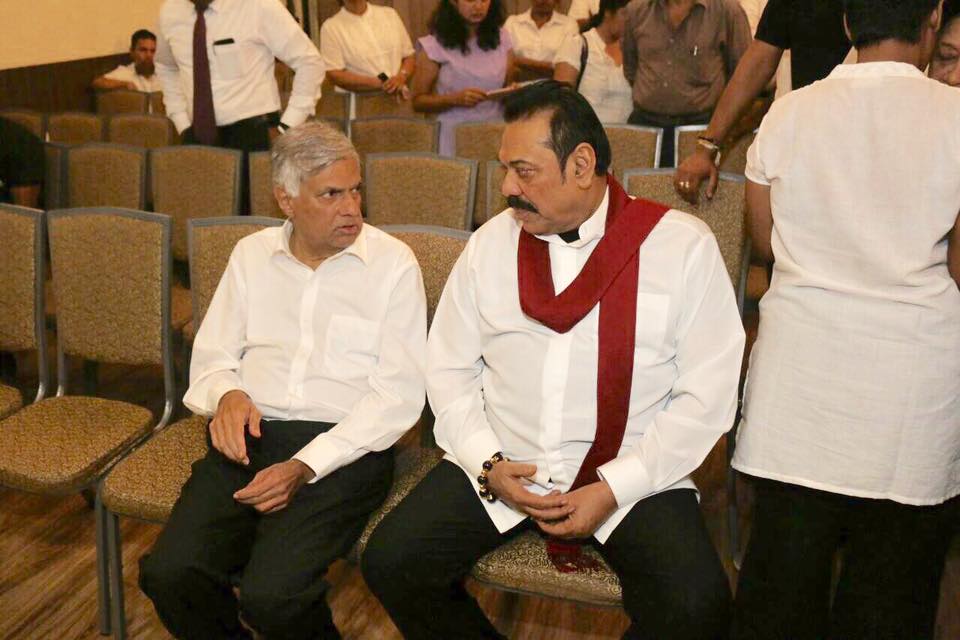
On a recent visit to the deceased Uva Provincial Council member, Senarathne Aththanayaka, Prime Minister Ranil Wickremesinghe met with former President Mahinda Rajapaksa.

The two of them have been sitting together and chatting to each other. , Prime Minister Ranil Wickremesinghe looks old and feeble even though he is  3 years younger, perhaps first sign of Osteoporosis.


President’s dilemma

August 31st, 2017

Editorial Courtesy The Island


President Maithripala Sirisena has told media heads and editors at a recent meeting in Colombo that he will complete his full term come hell or high water. He may be able to retain the presidency, but what guarantee is there that there won’t be any change in the composition of Parliament. Nothing is so certain as the unexpected in politics. What befell the Kumaratunga government in 2001 is a case in point. President Chandrika Kumaratunga lost her parliamentary majority due to mass crossovers and her government fell a few months later. Whoever would have thought the Rajapaksa government would crash in 2015.

Interestingly, President Sirisena has, in answer to a question from a journalist about a report that the UNP is mulling over quitting the ruling coalition next year, said he will keep the government going with the help of those who are willing to join it. Is he really equal to that task? He is heavily dependent on the UNP for his political survival though he leads the SLFP. The forces that rallied behind him to make his victory possible at the 2015 presidential election did not do so out of any love for him. They expected him to help topple the Rajapaksa regime, act as a figurehead and then fade away after completing his first term. But, he has become assertive and their plan has gone awry.

The UNP, however, took precautions, curtailed President Sirisena’s powers and, thereby succeeded in putting him in a constitutional straitjacket through the 19th Amendment, which, among other things, did away with his power to dissolve parliament prematurely.

Ranasinghe Premadasa, while he was the Prime Minister of the JRJ government, once, lamented that a peon had more powers than he. However, when the Prime Minister and the President happen to represent two different parties, the former becomes stronger than the latter to all intents and purposes as we saw from 2001 to 2004 unless, of course, they form a joint administration.

If the UNP breaks ranks and President Sirisena loses control over Parliament as a result, he will find himself in the same predicament as Kumaratunga, who had her opponents undermining her power between 2001 and 2004. President Sirisena’s position is more vulnerable in that the UPFA parliamentary group, which consists of 95 MPs, is divided. The Joint Opposition (J0) led by former President Mahinda Rajapaksa has about 50 UPFA MPs within its ranks. The UNP has 107 seats and needs only six more MPs to muster a working majority in Parliament without being dependent on the SLFP. UNP ministers and their SLFP counterparts are at daggers drawn; there have been instances where some irate UNPers even asked the SLFP ministers to leave the government.

The main enemy of the JO, mostly consisting of SLFP dissidents, is not the UNP but President Sirisena. It is highly unlikely that it will throw a lifeline to the President if the UNP ditches him. The JO members may let the President stew in his own juice in such an eventuality so as to exploit his plight to regain control of the SLFP.

Meanwhile, it is advantageous for the UNP to face an election while the SLFP is divided. However, the UNP will have to win back its resentful supporters who are fed up with its honeymoon with the SLFP if it is not to suffer an electoral setback. Therefore, it may be compelled to pull out of the yahapalana coalition and consolidate its power in Parliament in time for the next presidential election which it won’t be able to avoid again.

This is the harsh political reality President Sirisena should not lose sight of.

AG can’t act hastily -Thalatha Cases against wrongdoers of previous regime

August 31st, 2017

By Shamindra Ferdinando Courtesy The Island

Justice Minister Thalatha Atukorale yesterday stressed that her predecessor Dr. Wijeyadasa Rajapakshe, PC, had been removed solely due to him violating collective cabinet responsibility in respect of the leasing of Hambantota port to China.

Sri Lanka and China finalized the agreement on a 99-year lease on July 29, 2017.

Atukorale will continue to hold the foreign employment portfolio in addition to Justice.

Declaring that the agreement had been finalized in accordance with the instructions and advise received from the Attorney General, attorney-at-law Atukorale said that one person couldn’t under any circumstances challenge a cabinet decision.

Minister Atukorale said so in response to a query by The Island whether she could confirm the UNP demanded Rajapakse’s removal over him challenging the validity of the Hambantota port agreement and holding up investigations into high profile cases involving the Rajapaksas and those loyal to them.

When pressed for a response to the second allegation, Atukorale stressed that the UNP only faulted Rajapakse for acting contrary to collective cabinet responsibility.

Athukorale asserted perhaps Rajapakse couldn’t have comprehend the terms of the port agreement.

Attorney General Jayantha Jayasuriya, PC, was among senior officials who met the new Justice Minister before she addressed the media.

Asked by The Island whether she had at least inquired from her former cabinet colleague to find out what had gone wrong after she received justice portfolio from President Maithripala Sirisena on Aug. 25, Atukorale said that there was no requirement to do so.

SLFP/UPFA MP Rajapakse switched allegiance to the UNP in mid Nov 2007.

Athukorale said that she knew Rajapakse since 1977 and never felt the need to clarify matters from the former cabinet colleague.

Atukorale denied allegations regarding delays and lapses on the part of Attorney General’s Department as well as interference in presidential commission of inquiry into alleged Central Bank-Perpetual Treasuries bond scams.

The first woman justice minister acknowledged the need to inquire into allegations regardless of who made them targeting whom.

Atukorale said the Attorney General couldn’t hastily act in respect of investigations conducted by law enforcement authorities into various cases.

Responding to another query, Atukorale said the setting up of trial at bar to expedite cases could be taken by the Chief Justice on a request made by the Attorney General.

Those who had been severely critical of the Attorney General’s Department today never uttered a word when former President Mahinda Rajapaksa brought it under his purview, Atukorale said. The minister chided the media for not having the guts to take on the previous government though they now enjoyed the freedom thanks to yahapalana policies.

Commenting on National Freedom Front (NFF) leader Wimal Weerawansa’s recent accusation that she had received orders from the government to remand ten Joint Opposition members of parliament in the run-up to next local government or provincial council polls, Atukorale said that gang of thieves called the JO had directed corruption charges at PM Wickremesinghe and several other ministers, including Kabir Hashim, Malik Samarawickrema and herself.

Atukorale alleged that the then Minister Weerawansa had been one of those who took ‘policy’ decisions. The UNPer said that the likes of Weerawansa couldn’t remember the days when decisions regarding the executive and the judiciary were taken at one place.

Minister Atukorale and Secretary to the Justice Ministry Padmasiri Jayamanne refrained from responding to The Island query whether PC Rajapakse got into trouble over an exchange of words with UN Special Rapporteur Ben Emmerson in mid July.

Atukorale said she would discuss and examine accountability issues with her officials before deciding on talks with the Foreign Ministry as well as other institutions, including the Army. Atukorale said so when The Island asked her whether she would take a fresh look at war crimes allegations, including the claim more than 40,000 Tamil civilians were massacred on the Vanni east front in 2009.

Atukorale said that the armed forces wouldn’t be subjected to foreign jurisdiction under any circumstances. The minister said that the government took tangible measures to protect the interests of the armed forces whereas the former President claimed of an attempt to drag him to non existent electric chair.

When The Island pointed out that Geneva Resolution 30/1 that had been co-sponsored by the incumbent government on Oct 1, 2015 made specific reference to foreign judges, including those from the Commonwealth, the Minister said that she would like to see the relevant document.

………………………………………………….

Wijeyadasa’s deputy sorry minister had to go

Deputy Minister of Justice and SLFPer Sarathi Dushmantha Mithrapala yesterday paid a glowing tribute to the leadership given by former Justice Minister Dr. Wijeyadasa Rajapakse, PC, since the change of government in January 2015.

MP Mithrapala said that he was sorry and sad about Dr. Rajapakse having to lose justice portfolio over what he called cabinet controversy. The Kegalle District MP was responding to The Island query as to how he felt about Rajapakse being kicked out.

The Deputy Minister said that during Rajapakse’s tenure as the minister, the Justice Ministry had received the appreciation of the judiciary.

Mithrapala said he was happy new minister Thalatha Atukorale was from his province though he regretted the fate that befell Rajapakse (SF)

Sri Lanka releases 76 Tamil Nadu fishermen as Sushma Swaraj begins Colombo visit

August 31st, 2017

Courtesy FirstPost

Rameswaram: Seventy-six Tamil Nadu fishermen, arrested by the Sri Lankan Navy for allegedly fishing in the island nation’s territorial waters, were on Thursday ordered to be released by a Lankan court, police officials said in Rameswaram.

Representational Image. Reuters

Representational Image. Reuters

The Oorkavalthurai court set free the fishermen, lodged in a Jaffna jail following their arrest in separate incidents over three months this year, they said.

Among those ordered to be released were 12 fishermen from Rameswaram, six from Mandapam, 46 from Pudukottai and eight from Nagapattinam.

Rameswaram Fishermen’s Association President S Emirit said the fishermen are expected to reach Karaikal in a day or two.

Their release came on a day when External Affairs Minister Sushma Swaraj is visiting Colombo to participate in the two-day Indian Ocean Conference from Thursday.

Fishermen Association sources said four fishermen are still lodged in Jaffna jail.

Meanwhile, eight fishermen from Tamil Nadu were arrested and their two boats seized by the Sri Lankan Navy in separate incidents on Thursday for allegedly fishing in the island nation’s territorial waters, fisheries department officials said.

Sri Lankan Navy arrests eight Tamil Nadu fishermen

August 31st, 2017

Courtesy  The New Indian Express

RAMESWARAM: Eight fishermen from Tamil Nadu were arrested and their two boats seized by the Sri Lankan Navy in separate incidents today for allegedly fishing in the island nation’s territorial waters, fisheries department officials said.

Four fishermen each from Rameswaram and nearby Mandapam were arrested when they were allegedly fishing near Neduntheevu, the officials said.

The fishermen were later taken to Karainagar port in northern Sri Lanka, Assistant Directors of Fisheries in Rameswaram and Mandapam said.

The arrests came on a day when India’s External Affairs Minister Sushma Swaraj is visiting Colombo to participate in the two-day Indian Ocean Conference from today.

Sri Lanka to cut 2017 spending to meet deficit goal – finance secretary

August 31st, 2017

COLOMBO, Aug 31 (Reuters) – Sri Lanka will cut government expenditure to stick to its 2017 budget deficit target of 4.6 percent of gross domestic product (GDP) and compensate for a fall in revenue, the top bureaucrat in the finance ministry said on Thursday.

We will re-arrange and cut some expenditure to meet the deficit target,” Finance Secretary R.H.S. Samaratunga told Reuters on the sidelines of a meeting in the capital, Colombo.

Sri Lanka will fall short of its 2017 revenue target because of delays in adopting budget proposals. (Reporting by Shihar Aneez; Editing by Clarence Fernandez)

Sri Lanka emerging as transit hub for cocaine smugglers: officials

August 31st, 2017

COLOMBO (Reuters) – International cocaine smugglers are increasingly turning to Sri Lankan as a transit hub in Asia, authorities say, after they made a series of seizures of the drug, some smuggled in containers of sugar from Brazil.

Sri Lankan customs have seized six shipments of high-purity South American cocaine in 14 months, including Asia’s largest-ever haul of the drug in December, at its main port.

Sri Lanka is becoming a hub for cocaine as it is a risk-free location with less legal restrictions,” a top police official who is aware of investigations into the smuggling told Reuters this week.

We don’t believe that these containers came here mistakenly. Why are these cocaine containers not going to any other country which imports Brazil sugar?”

About 1,770 kg, or $140 million worth of cocaine, had been seized in Sri Lanka, of which 840 kg was found in five sugar shipments from Brazil.

 A 928 kg seizure – the largest cocaine haul in Asia – was found in a container of timber on a Colombian ship bound for India.

Police could not say if Sri Lanka was the final destination for any of the cocaine but a government minister said he believed all of the drugs were bound for elsewhere.

Sri Lanka is a transit point for mass-scale drug dealers,” Minister of Law and Order Sagala Ratnayaka told Reuters.

He cited Sri Lanka’s location at the center of Asia, but declined to speculate on where the drugs were heading, while adding that it would be unfair” to label Sri Lanka Asia’s new cocaine hub.

Sugar importers have stopped buying from Brazil, citing problems with customs clearance following increased scrutiny at the port.

Customs spokesman Sunil Jayaratne said the smugglers were also believed to sometimes transfer shipments to small boats at sea before bringing the drugs ashore.

After reaching here, they go out in small boats, they use fishing boats,” Jayaratne told Reuters.

The senior police official said the gangs were looking to mask their shipments to Australian and European markets by bringing them into Sir Lanka, then sending them on in Sri Lankan containers.

South Asian counter-narcotics agencies have traditionally focused on heroin and synthetic drugs and the recent cocaine seizures were a surprise, a U.N. anti-drugs official said.

This is very confusing as to why this amount of cocaine is transiting through Colombo,” Shanaka Jayasekara, program coordinator for United Nations Office on Drugs and Crime in Colombo told Reuters.

He said Colombo port had possibly been identified as an easy trans-shipment point” as containers are not checked.

Sri Lanka does not have a market for cocaine,” he said, adding the final destination of the drugs could be Europe.

‘Mehema Epa’ Chandrika, ‘Mehema Epa’: MR

August 31st, 2017

Courtesy The Daily Mirror

Former President Mahinda Rajapaksa today said ‘hatred and jealousy’ are two qualities his predecessor Chandrika Bandaranaike Kumaratunga shouldn’t possess.

Responding to a journalist following an event held at the BMICH, Mr. Rajapaksa said hatred was visible through former President Kumaratunga as she was aging.

He said if there was an issue with his education, which was criticized by Ms. Kumaratunga, it should be raised by the Supreme Court judges as he was sworn-in as a lawyer in the Supreme Court.

She is behaving like this, with jealousy and hatred as she ages. Don’t stoop to this level (Mehema epa Chandrika, Mehema epa). That’s all I have to say,” he said.

The rest of the questions and answers are as follows,

Q: Is Ms. Kumaratunga educated?

A: I’m not going to comment on that. You better ask her.

Q: But Minister S.B. Dissanayake has commented on that.

A: Exactly, you should ask about that from SB.

Over the weekend, former president Kumaratunga said none of the Rajapaksas possesed an education which exceeded grade 8 level.


“STATE OF LEGAL EDUCATION AND LEGAL SYSTEM IN SRI LANKA ON GOOD GOVERNANCE”.

August 30th, 2017

Sarath Wijesinghe Solicitor/Attorney –At- Law and former Ambassador to UAE and Israel

Complicated Legal System in Sri Lanka

Legal system in Sri Lanka is complicated and controversial with a mixture of English Law, Property Law based on Roman- Dutch Law in addition to Kandian, Tamil and Muslim on Personal laws. Areas on Business and Commerce are governed by the English and Western Jurisprudence and International Law is based on the principles of the Convention of United Nations and International Organizations. International Arbitrations, WTO and International Trade Agreements have entered the jurisprudence with contested international trade disputes of multinational companies and the local traders including the State. Situation has become still complicated after the change of power structure and legal system on independence from the British Colonial Powers from 4th February 1948 when the power was transferred to the indigenous but western oriented rulers by the Order in Council. Law College was established in 1874 and the University College continued academic Legal education and Courts were established under the Saulbury Constitution for the delivery of justice unchanged headed by the Queen of Great Britain. English is dominated in the legal field despite making Sinhala, Tamil and English as official/court languages expecting English as a link language to communicate with the international legal fields and the world.

Judicial System and independence of the Judiciary

Changes made by the 1972 and 1978 Constitutions are in the public domain and known to the people. Under the 1978 Constitution which is in force today,

judicial power of the People is exercised by the Parliament through courts, tribunals and institutions established guaranteeing the independence of the courts and the judiciary respecting and recognizing the principles of separation of powers placed in compartments. Constitution as the source of all other legislature made laws have set up the court structure with the Supreme Court as the Apex court with enormous powers and to manage and control the legal education through the Law College as the institutions to permit the legal profession to act as officers of the court system to assist courts. Those who are qualified from the Universities in Sri Lanka and worldwide are bound to qualify themselves at the Law College as attorneys-at-Law to be eligible to perform duties of officers in court of law and private practice. In the UK and Western jurisprudence the lawyers are serving in many capacities in addition to engaging in active practice whereas in Sri Lanka the tendency of professionals is to engage mostly in practice courts as the centre.

UN Guidelines and Dhammapada”

According to UN guidelines and accepted norms the Judiciary should be kept away and insulated from other branches maintaining freedom on appointments, promotions and transfers which includes the Attorney General – the Chief Adviser to the State as an independent entity. Now that the former Justice Minister Dr Wijayadasa Rajapaksa has become a casualty as a result of refusing influence to influence the Attorney General to set up special Courts to run on daily basis and the sudden meeting of the AG with the Prime Minister raises eyebrows of the Legal profession and concerned citizens. There were talks of ‘trephine Justice’ during the last regime- especially under the leadership of the most controversial Chief Justice Sarath Silva who was responsible for the degrading the integrity of the judiciary. Today Hulftsdorf Gossip echoes telephone justice is rampant even more than before and may be worse when the inexperienced new Minister Justice has been armed with the mandate to direct intervention over the AG and the other institutions of justice and peace. The Quotation on Dharamapada” that not by passing arbitrary judgments a man become wise and the judgement should be given according to the truth applies all the time to any society appear to be the most relevant during the current era .

Laws delays, incompetence, Bribery and Corruption

Currently 10% of the population are litigants complaining of laws delays, injustice, corruption, and short comings on the delivery justice which has become a main issue in the legal system facing criticism by the public on daily basis. Backlog and delay of concluding cases are high with the citizen attempting law into their hands due to excessive delay with 95000 unresolved cases and backlogs of 800,000 cases pending including the controversial 105 cases demanding the Attorney Generals Department to put on the fast track to be heard on daily basis by special courts established most probably outside the constitution akin to the steps taken to deal with Madam Bandaraneika then main contender of H.E. Jayawardena who won the Presidential Elections easily in the absence of Madam Bandaraneike – the most popular and powerful also the person aimed to win the Presidential Elections. It seems the attempts of repeating history by appointing special fast track cases aiming at political opponents. Some partition and land cases take over 30 years when Rape or Murder takes around 20 years when the witnesses and productions are lost and police officers are dead or retired. Rape victims at the age of 12 are bound to wait until they are majors in marriageable age common in the public domain. This phenomenon is common problems in jurisdictions such as UK with a backlog of 63000 of Immigration appeals and India with hundreds of thousands of backlog and delay in criminal and civil matters also in search of solutions. Therefore laws delays are due to the weakness of ineffective system and not due to incompetence of the AG, Judiciary, or the Legal Profession. Bribery and corruption is rampant and all over as air and breath taking place uncontrolled despite pledges, announcements and pronouncements by the leaders of Good Governance, who got rid of Madam Dilrukshi – the former director of the Bribery Commission and – Lacille de Silva the former secretary of the Commission appointed to fight corruption. They are good officers compelled to vacate leaving a black hole leaving the bribery and underworld to act free. Most corrupt state offices and institutions in the good governance machinery are the offices of the courts, motor traffic, Immigration, Customs, and finance and trade related establishments carrying on the business of corruption with no interception from the good governance machinery consisting of 15% of the population as government servants. Deputy Minister Ranjan Ramanayaka is in hot water with the erroneous statement that most Judges and Lawyers are corrupt is challenged by the BASL planning to file

papers on contempt of court. Hon Ramanayaka has forgotten that we have the most corrupt Parliament Mafia” working together shedding party politics and other differences to earn money at any cost by selling vehicle permits (including him) with the loss of 3.1 billion to the citizen and more to be exposed. Unprecedented and unusual Meeting of the Attorney General with the Prime Minister at Temple Trees has resulted in accelerating prosecution of selected political cases against one family and clan on political grounds based on pressure is a worrying the citizen at large.

Ignorance of Law is no excuse

Ignorance of law is no excuse (Ignoratia excusa –famous Latin phrase) is accepted and followed in the Sri Lankan jurisprudence where a person unaware of law may not escape liability merely because one was unaware of law whereby the citizen is presumed to know the law and procedure on the land. It is due to this practice that the state should take steps to educate the citizen of the basic knowledge on law and procedure from school to adulthood and legal profession is equipped with sufficient to assist the litigants and the courts as officers to assist the judiciary. Legal profession have been an honourable profession where during the Roman Empire the lawyers represented and assisted the litigants as a voluntary service the Cloke” lawyers wear over the dress signifies the litigants to leave whatever they could as the fee to the pocket in the official dress. The members of the legal profession should be honourable and knowledgeable in law and procedure. Legal education and professionalism is developed to meet this requirement to the citizen depends on the calibre lawyers available for assistance to the public and judges. Then there is an issue whether the lawyers and honest and honourable and also knowledgeable and conversant on law and procedure are doubtful issues and it is the citizen who are capable of answering this question.

Legal Education – Improve the quality discipline and honesty of major players

Majority of law books, decisions, and judgements are in English most of the present generation lawyers are not conversant with which is a worrying factor in the legal education and law practice. In the United Kingdom the legal profession is disciplined and rigorous punishments are given for unprofessionalism, dishonesty, inefficiency and misdirecting the clients. In the

United Kingdom Solicitor Dijit Bechada age 45 found guilty of fraud and obstructing the course of justice and jailed after inquiry by the Solicitor’s disciplinary tribunal after reporting to courts not heard in Sri Lanka. UK has a developed free legal system supported by law centres and citizen advice bureaus which are not found in Sri Lanka found in nutshell in Sri Lanka. Sri Lanka Law College has not improved for the current needs and challenges and still the out-dated methods are followed without taking the current needs of the citizen into consideration. Sri Lanka Law College is managed by the Council of Legal Education headed by the Chief Justice following the old traditions without taking the modern challenges and needs into consideration. Therefore revolutionary changes are required to educate the profession and the citizen to equip them with knowledge by making the complicated legal system simple and accessible to the common man by encouraging and assisting the students and the legal profession on enhancing the knowledge on English language and the subject matter with the assistance of the dormant and ineffective Law Commission with the vision to promote the reforms of the law to promote and implement good governance asleep and inactive full of bribery and corruption. None of the institutions appear to be active and vibrant. Law college is fortunate to be managed by an able head – only an employee with no powers to change the system which in the hands of the main management team.

Way forward towards Good Governance and Rule of Law

Collective attempts of the law College, Bar Association, Faculties of Universities, Legal Aid Commission non-governmental organisations with the court network and the state departments should be mobilised with a vision to assist the citizen to regain the lost confidence to prevent taking law into their hands for justice when justice and fair play is not forthcoming from the justice system. Process of decision making and process by which decisions are made and implemented should be independent, participatory, with consensus based, responsive, efficient, equitable, inclusive which are main features of principles of good governance akin to principles of Lichchive Kings” historically took collective decisions and dispersed peacefully according to the proponents’ of God governance. Do the rulers who are appointed by the people as trustees of the nation for a specified period living up to the expectations and principles

good governance is a million dollar question capable of answering only by the people at the receiving end supposed to be powerful on paper.

Writer claims responsibility to the contents of the article and could be contacted on sarath7@hotmail.co.uk/0777880166

Corruption in the ancient world 

August 30th, 2017

Upali Cooray

It is not possible to compose in detail an essay because the field is vast. Therefore this attempt is to highlight a few random examples of corruption in the ancient world.

Ancient man’s difference was, during the evolutionary process from Ape to man his brain developed more than in other animals.His instincts as an animal was selfish and required survival in a competitive primitive animal world. His becoming civilized was an imposition. What we call ancient civilizations were a necessity to bring law and order and other cultural advances. However even the modern day man carries these instincts covered under civility.

Corruption is not a recent phenomenon. It has precisely been defined as a deviant human behavior, associated with the motivation of private gain at public expenseand, as such, has persisted for centuries. Corruption promotes illegality, unethicalism, subjectivity, inequity, injustice, waste, inefficiency and inconsistency in administrative conduct and behavior.  It destroys the moral fabric of society and erodes the faith of the common man in the legitimacy of the politico-administrative set up.

Ancient India

There are several references to the prevalence of official corruption in ancient India.  But the text that provides an elaborate description of the menace is the Arthashastra of Kautilya. This sophisticated and detailed treatise on statecraft is essentially prescriptive or normative in nature, belonging to a genre of literature that suggests what the state ought to be and not what it really was. Nevertheless, one should realize that norms are prescribed only when digressions or abnormalities exist. This confirms the fact that corruption was rampant enough in ancient India to necessitate expert advice on how to tame it.

Kautilya was a sagacious minister in the Kingdom of Chandragupta Maurya(324/321‒297 Before the Common Era). He expressed his views on a range of issues including state, war, social structures, diplomacy, ethics, and politics. He believed that men are naturally fickle minded” and are comparable to horses at work exhibitconstant change in their temper”.  This means that honesty is not a virtue that would remain consistent lifelong and the temptation to make easy gains through corrupt means can override the trait of honesty any time. Similarly, he compared the process of generation and collection of revenue (by officials) with honey or poison on the tip of the tongue, which becomes impossible not to taste.

During Mauryan times, superintendents were the highest officials, a position they received for possessing the desired ‘individual capacity’ and adequate ‘ministerial qualifications’.  Given the general emphasis of Kautilya on observing ethics and morality in relation to the functioning of a state, it seems the selection process would have involved not just a scrutiny of the educational attainments but also the right kind of aptitude for the job including traits of honesty and impartiality. This shows that despite the greatest care taken in recruiting officials, corrupt persons made their way into the system.

Kautilya was a great administrative thinker of his times. As he argued, too much of personal interaction or union among the higher executives leads to departmental goals being compromised and leads to corruption. This is because human emotions and personal concerns act as impediments to the successful running of an administration, which is basically a rule-based impersonal affair. Similarly, dissension among executives when team effort is required results in a poor outcome. Kautilya suggested that the decline in output and corruption can be curbed by promoting professionalism at work. The superintendents should execute work with the subordinate officials such as accountants, writers, coin-examiners, treasurers and military officers in a team spirit.  Such an effort creates a sense of belonging among members of the department who start identifying and synchronizing their goals with the larger goals of the organization, thereby contributing to the eventual success of the state.

Kautilya provides a comprehensive list of 40 kinds of embezzlement. In all these cases, the concerned functionaries such as the treasurer (nidhayaka), the prescriber (nibandhaka), the receiver (pratigrahaka), the payer (dayak), the person who caused the payment (dapaka) and the ministerial servants (mantri-vaiyavrityakara) were to be separately interrogated. In case any of these officials were to lie, their punishment was to be enhanced to the level meted out to the chief officer (yukta) mainly responsible for the crime. After the enquiry, a public proclamation (prachara) was to be made asking the common people to claim compensation in case they were aggrieved and suffered from the embezzlement.  Thus, Kautilya was concerned about carrying the cases of fraud to their logical conclusion.

The Arthashastra states that an increase in expenditure and lower revenue collection (parihapan) was an indication of embezzlement of funds by corrupt officials.  Kautilya was sensitive enough to acknowledge the waste of labor of the workforce involved in generating revenues.  He defined self-enjoyment (upbhoga) by government functionaries as making use of or causing others to enjoy what belongs to the king.  He was perhaps alluding to the current practice of misusing government offices for selfish motives such as unduly benefitting the self, family members, friends and relatives either in monetary or non-monetary form which harms the larger public good.

Kautilya was also not unaware of corruption in the judicial administration. He prescribed the imposition of varying degrees of fines on judges trying to proceed with a trial without evidence, or unjustly maintaining silence, or threatening, defaming or abusing the complainants, arbitrarily dismissing responses provided to questions raised by the judge himself, unnecessarily delaying the trial or giving unjust punishments.  This shows that there were incidents of judicial pronouncements being biased, favoring one party to the detriment of others. In an atmosphere of corruption prevailing in the judicial administration as well, Kautilyaperhaps wanted to ensure that the litigants are encouraged and given voice to air their legitimate grievances. He expected judges to be more receptive to the complaints and be fair in delivering justice.

Kautilya prescribed reliance on an elaborate espionage network for detecting financial misappropriation and judicial impropriety. Spies were recruited for their honesty and good conduct.  They were to keep a watch even over the activities of accountants and clerks for reporting cases of fabrication of accounts (avastara). On successful detection of embezzlement cases, Kautilya advocated hefty fines to be imposed apart from the confiscation of ill-earned hordes. If a functionary was charged and proved even of a single offence, he was made answerable for all other associated offences related to the case.  Since taxes paid by the people are utilized for their welfare, any loss of revenue affects the welfare of the society at large. This is precisely the reason why Kautilya explicitly argued that the fines imposed should be in proportion to the value of work done, the number of days taken, the amount of capital spent and the amount of daily wages paid at various levels.

Corruption is so obvious, and yet so mysterious. Even Kautilya reflected serious concerns about opacity in the operations of the world of the corrupt. Illegal transactions were so shrouded in mist that he compared embezzlers to fish moving under water and the virtual impossibility of detecting when exactly the fish is drinking water.  He also noted that while it is possible to ascertain the movements of bird flying in the sky, it is difficult to gauge the corrupt activities of government officials.

CHINA

Corruption in China dates back over a thousand years and has been present through countless dynasties. In fact, widespread corruption is often cited as one of the factors that led to the collapse of the Qing Dynasty in the 19th century.

In dynastic China, the implementation and enforcement of laws and regulations were the task of local officials. Their official salary was entirely at their disposal, but they had to finance office expenses, pay their assistants and bestow lavish treatments upon higher ranking state officials, as well as pay them a so-called regular fee”.

However, the imperial budget allocated to the administration was rather low. Local officials, the prefects, also received a small sum, jang-lien jin”, meaning the silver to maintain integrity”, yet it didn’t quite prevent them from accepting bribes in just about any form.

Even though taking bribes was generally considered to be an uncouth custom or bad habit, it was nevertheless a well-known and widely accepted one. In practice it meant that officials at every level required extra payments from their subordinates or citizens under various names.

It was not unusual that extra fees were charged several times for the same service” resulting in bribery becoming so complex that the central government was simply unable to control the situation. It was also very unclear as to what counted as legal corruption” and what fell outside of that. As a result, the labyrinth of bribes and favors, corruption became an integral part of the entire administration. A European traveller in the 18th century described Chinese corruption as follows: The man who preserved his integrity is generally considered as incapable or a dreamer. It is not easy to swim against the stream.”

In this complex system it was only normal that government officials would trade their influence for money. They also formed strong cliques to protect themselves from punishments by state businessmen, officials, military leaders and other high ranking state employees.

New people entering the administration carried on these traditions because they firmly believed that corruption was a normal facet of the job. According to historical records, less than three out of ten civilservants could preserve their integrity. China’s emperors were aware of the corruption problem and many of them made desperate attempts to eradicate it, but their endeavors were often futile. One of the most successful was the Great Qing Legal Code, introduced in 1644 and enforced from early 270 years. The code specified sanctions against corruption according to the severity of the crime. Depending upon the receivedamount of money or the value of gifts, the punishments varied from beatings with a bamboo stick to the death penalty.

One of the most infamous corrupt state officials was He Shen, the prime minister of Emperor Qianlon. He accumulated his wealth during two decades in office. In 1799, he lost the Emperor’s trust and the court ordered an investigation against him. Around 1,100 million taels of silver were discovered when his home was searched, an amount equivalent to the revenue of the Qing government for 15 years. His wrongdoings ended when, at the age 49, he was given a court decree to hang himself.

The Confucian concept of renzhi or people’s government” largely contributed to widespread corruption throughout China. In Confucians’ view, a true and honest state bureaucrat should be guided by moral principles. Therefore, striving for material wealth was considered inappropriate. Wang Anshi, the famous Chinese economist of the Song dynasty, wanted to introduce reforms in monetary institutions that would reduce corruption and nepotism, but his ideas were dismissed by the Confucian elite.

As a result, corruption continued to exist on an even larger scale, involving the court itself and the local elite. In practice it meant that the more important an issue was, the deeper one would need to reach in to his pocket.

Corruption has left its mark on the Chinese language and culture. Proverbs such as a big rooster eats no small rice” or money falls into the hands office” illustrate how corruption was present in everyday life of yamen secretaries as lamb into mouth of the tiger” (yamen” = state).Chinese literature also suggests that officials were corrupt and that it was only natural for them to expect bribes and gifts in return for a favorabledecision. The long history of corruption in China, moving from dynasty to dynasty, suggests that an honest and morally correct magister was indeed an exception to the rule.

MESAPOTAMIA

In ancient Mesopotamia, Gimil- Ninurta, a poor but free man and a citizen of Nippur, seeks to improve his lot. All he has is his goat. Leading the goat by his left hand, he brings it to the residence of the mayor, and is made to wait. But when the mayor hears that he has something to offer he is indignant at his slaves. A citizen of Nippur, he says, should be admitted promptly. He sends for Gimil- Ninurta and asks, What is your problem that you bring me an offering?” Gimil- Ninurta says nothing but greets him with his right hand, invokes blessings on him, and gives him the goat. The mayor announces he will hold a feast. But when the feast is held, all that Gimil- Ninurta receives is a bone and a sinew of the goat and stale beer. He asks the meaning of such treatment. In reply he is beaten on the mayor’s orders. He departs, vowing vengeance. Later, Gimil -Ninurtavisits the king of the entire country and offers him one mina(a measure of weight) of gold in return for the use of the royal chariot for a day. The king asks no questions but agrees at once. In the chariot Gimil- Ninurta returns to Nippur, where the mayor receives him as a high official of the realm. Installed in the mayor’s residence, he secretly opens the chest he has brought and pretends the gold he says was in it has disappeared. He implies that the mayor is guilty of stealing it and gives the mayor three beatings for his crime. The mayor also placates him with a gift of two minas of gold. This story, which appears in Bribes, by John Thomas Noonan— one of the few authors who has attempted to explore in a thorough and diachronic manner the topic of political corruption over the centuries— and is known by the title The Poor Man of Nippur,” probably dates from 1500 B.C. It shows how among the peoples of ancient Mesopotamia the law of reciprocity— the natural rule of quid pro quo— was strictly respected, whereas any wandering from the straight and narrow path was punished. The misdeed lay not in the act of making an interested gift but rather in breaking with the logic of the exchange: in failing to offer value in exchange for value received. Noonan comments that the most serious misdeed lay not in the act of corrupting but in the effect of corruption: breaking one’s word in a society where keeping one’s word The Gift in Antiquity 25 was considered to be a divine characteristic. He cites in this connection a fragment of a hymn to the sun god Shamash, preserved in the library of Ashurbanipal in Nineveh, where we can read the following phrase: Your manifest utterance may not be changed.” The word tatu used in the text of Hammurabi, in a section titled The Corrupt Judge,” generically indicates the offering of a subordinate. Offering and corruption therefore trail off one into the other, and a more generalized condemnation of corrupt giving will only arrive later, in the modern age, even while the practice of exchange will in any case remain a constant custom.

Greece

The great legislator Solon established in the 5th century BC the Seisachtheia, i.e. the debt cancellation. As Aristotle writes, just before the announcement of the debt cancellation, he informed his friends to rush and get large loans, which eventually were cleared of any debt, hence making them really rich. Themistocles claimed that it has no value to be a leader if you cannot enrich your friends. Agisilaos, King of Sparta believed exactly the same thing.  Even the monuments on the Acropolis were connected to the biggest scandal of abuse during the Golden Century of Pericles (5th century BC).  The main issues were both; using money from the treasury of the Athenian Alliance by Pericles and the suspicion that Phidias had distorted the gold in the statue of Athena. Plutarch writes that Pericles introduced the “secret funds” by taking 10 talents, an enormous sum for that period. When questioned in Pnika he answered “I gave them where they were needed”, without explaining further.

Demosthenes was exiled and imprisoned twice due to corruption charges. The first time he took money of Alexander the Great’s treasurer, Arpalo, who took the funds from Babylon and fled to Athens. The second time he took money from the Amfises in order to cover a scandal at Delphi. Arpalos had escaped to Athens in order to avoid the wrath of Alexander the Great because he stole the army’s finance and the treasury of Babylon, which had been entrusted to him. Finally, Demosthenes was convicted and exiled from Athens in 324 BC for choosing to work with the biggest abuser of his time, Arpalo.

In ancient Greece, the laws and the constitution did not work by divine right but by the right of the people. That is why Pericles was given a trial date, although he was never tried, since during that time the Peloponnesian War commenced. Nevertheless, before the temple of Athena Nike began, the auditors looked thoroughly at Kalikratis’ designs. As for Phidias, he achieved to demonstrate his innocence in court, however he didn’t escape prison. The key reason was his arrogance in immortalizing Pericles and himself on the shield of the goddess Athena.

Italy

Niccolo Machiavelli is well known as one of the most important and earliest realist thinkers and promoters.Machiavelli in his work discusses a lot of themes in general framework of good state: establishment of a city, rule of law, good and bad governor, role of religion in society, virtue and corrupt people and many others. Machiavelli’s thoughts about corrupt people and their interdependence with good state.What does Machiavelli mean when he uses the termscorrupt” and corruption”.Sometimes, very rarely, he uses corruption” as a synonym of bribery”. But in general corruption” and corrupt people” for Machiavelli in this book are antonyms of virtue people”; corrupt” people are bad, spoilt citizens that live only for their own profit, that don’t respect laws or adopt new laws for become even more corrupt, thecorrupt society” lives without respect among participants, in such society the rich become richer and the poor become poorer; the richest class usurps the power and doesn’t permit to good people that will work for entire society benefit come to the power. In corrupt societies the power has the strongest and the richest, while the mostmeritorious abstained from being candidates from fear.” So the corrupt society becomesworse because people that can improve community don’t have the possibility and opportunity to do anything. Such society becomes more corrupt and it seems to be more difficult to change the regime.Machiavelli tells us a lot about transformation of corrupt state to a good one. He sees two various scenarios: impossible and conditionally possible. The impossible one, which implies that transformation, is completely difficult. Machiavelli states that it is strange if someone comes to power using bad means even if he serves for good aims in the future. The person that is able to use such means for obtain power in the state can use them against the people of the state. This question is very complicated from moral point of view. Is man still virtue if he behaves as a corrupt one? no, because it is very difficult to earnauthority and very easy to lose it. Even he will make good things the way he came to power doesn’t allow him to do a lot and govern long for two reasons.

Juvenal

Satires and collection of satirical poem by the Latin author Juvenal written in the late 1st and early 2nd centuries A D. Juvenal is credited with sixteen known poems divided among five books: all are in the Roman genre of satire, which, at its most basic in the time of the author, comprised a wide-ranging discussion of society and social moresin dactylic hexameter. The sixth and tenth satires are some of the most renowned works in the collection. The poems are not individually titled, but translators have often added titles for the convenience of readers

 Hypocrites are Intolerable

I get an itch to run off beyond the Sarmatians and the frozen sea,

every time those men who pretend to be old-time paragons of virtue

and live an orgy, dare to spout something about morals.”


There is no Room in Rome for a Roman

What could I do at Rome? I don’t know how to lie;

If a book is bad, I am unable to praise it and ask for one;

I don’t understand the motions of the stars – I am neither willing

nor able to predict the death of someone’s father; I never inspected the guts

of frogs; other men know all about ferrying what the adulterers send to brides;

nobody is going to be a thief with me as his accomplice,

and that right there is why I’m going in no governor’s entourage

– I’m like a cripple, a useless body with a dead right hand.”


Sri Lanka

Ancient Sri Lanka seems to have refused to accept bribery and corruption as a part of the system. The Badulla pillar inscription of Udaya IV records an instance when the public protested to the king regarding corruption. The merchants and householders of the market town of Hopitigama in Sorabora district petitioned the king, when the king visited the area. They said that they were subject to harassment, extortion, and bribes. The officers delegated by the dandanayake who was in charge of Hopitigama, exacted five hundred instead of the 25 kalandas which was the official payment. The officers accepted presents, had the village surrounded, houses occupied and householders taken away by force. A statute was written on the orders of the king prohibiting these activities and stating that corrupt officers should be reported to the authorities.

Some stone inscriptions of the late Anuradhapura period have It is evident, through these few examples that the phenomenon of corruption is timeless; however it is not a characteristic of one people or nation, but of all of mankind, starting from Adam and Eve. Nevertheless that does not mean that regulations and laws shouldn’t exist in order to prevent and minimize this bad habit.

been categorized as codes of disciplinary rules for the perpetuation of the Buddha Sasana. The kings, in order to protect the Buddha Sasana worked for the purification of the order of the monks when it was beset by corrupt practices. The documentation of regulation of the Buddhist Order by the kings in the form of the rock edicts continued up to the late Anuradhapura period as Kathika, which later came to be known as Kathikawathas. With the formal introduction of Buddhism to the island in the 3rd century B.C. by the mission led by Arahat Mahinda, the Sangha was established in a more organized manner. What we witnessed after that was the rapid expansion of the Sanghawith overt royal patronage. The rapid expansion and institutionalization of the sangha created the need, from time to time, to protect it from deviations, disorders and interpretations. As a result, the enactment of disciplinary rules (Patimokkha) .

It is evident from the above random selections of corruption in the ancient world;the phenomenon is everlasting as long as man exists. However the level of corruption varies according to rulers and scholars.

What we see today in our country is the worst corruption in our history.

Upali Cooray

Egalawan288@gmail.com

Bibliography:- 1) History of Ceylon (volume 1 part 1)

                             2) Wikipedia

                             3) Senarath Paranawithana

                            4) Chanakya- kautilya :- Ancient history encyclopedia

                             5) Crime and punishment in ancient Sri Lanka-Kamalika Peiris

                              (The Island” newspaper)

                             6) Institute of Defense Studies- India

                                (IDSA issue briefs- internet)

                             7) Corrupt people and good state in” discouses” by Machiavelli

                                 Nick Tyan

                            8 )The role of Bhikkus in ancient Sri Lanka and Bhikku Katikawat in ancient inscriptions.

Ranasinghe, S.K.


ROHINGHA MUSLIM TERRORISM : RECENT INCIDENCES

August 30th, 2017

Dr. Daya Hewapathirane

 On 9 October 2016, hundreds of unidentified Rohingha Muslim insurgents attacked three Burmese border posts along Myanmar’s border with Bangladesh.  The attackers brandished knives, machetes and homemade slingshots that fired metal bolts. Several dozen firearms and boxes of ammunition were looted by the attackers from the border posts. The attack resulted in the deaths of nine Buddhist border officers. 

 On 11 October 2016, four Buddhist  Burmese Army soldiers were killed on the third day of fighting.[32] 

 On 15 November 2016, the Burmese Army announced that 69 Rohingya insurgents and 17 security forces (10 policemen, 7 soldiers) had been killed in recent clashes in northern Rakhine State, bringing the death toll to 134 (102 insurgents and 32 security forces). It was also announced that 234 people suspected of being connected to the attack were arrested.

 In March 2017, a police document obtained by Reuters   listed 423 Rohingyas detained by the police since 9 October 2016. The police justified the arrests saying, “We the police have to arrest those who collaborated with the attackers….” Myanmar police also claimed that children had confessed to their alleged crimes during interrogations.

 On 25 August 2017, the government announced that 71 people (one soldier, one immigration officer, 10 policemen and 59 insurgents) had been killed overnight during coordinated attacks by up to 150 Rohingha Muslim insurgents on 26 police posts and the 552nd Light Infantry Battalion army base in Rakhine State.

 On 25 August 2017, the Central Committee for Counter Terrorism of Myanmar declared the Arakan Rohingya Salvation Army  (ARSA) a terrorist group in accordance with the country’s counter terrorism law. 

 ARAKAN ROHINGYA SALVATION ARMY (ARSA)

 The Arakan Rohingya Salvation Army (ARSA), also known by its former name Harakah al-Yaqin[ and by its former English name the Faith Movement, is the Rohingya insurgent group active in the jungles of northern Rakhine StateMyanmar.

 The goal of the Arakan Rohingya Salvation Army (ARSA) is to create a “Muslim state for the Rohingya”.  

 The ARSA is led by Ata Ullah, a Rohingya Muslim man who was born in KarachiPakistan, and grew up in MeccaSaudi Arabia.

 The  Burmese government suspects that ARSA is involved with, and subsidized by foreign Islamists. 

Dr. Daya Hewapathirane

GURMEET SINGH – A VOICE AGAINST EXTREMISM

August 30th, 2017

ALI SUKHANVER

Gurmeet Ram Rahim Singh, the mystery-man of India at last got 20 years imprisonment for raping two of his disciples. He is known as the ostentatious leader of the Dera Sacha Sauda religious sect. Before the commencement of the court-proceedings a few days back, the situation in the northern town of Panchkula sparked a lot of unrest leaving at least35 people dead. Thousands of army, police and paramilitary units have been deployed and there are chances of spreading violence throughout India. According to the Hindustan Times the case registered against Gurmeet is not a new and fresh one; the matter was brought to the knowledge of the legal authorities through a three-page anonymous letter written in 2002 by a female devotee. But Gurmeet Singh and his followers have flatly rejected all allegations. Aditaya Insan, the sect’s spokesman said talking to the Indian channel NDTV, “For the last 15 years there has been a subterranean string of conspiracy of various forces. There are people at work that instigate us, there’s a drug Mafia at work, there is a political Mafia at work, to create these problems at the Dera.” He said that it is simply a greater conspiracy to bring them down. Gurmeet Singh has more than 50 million followers and is considered one of the most politically influential personalities of India. He enjoys a Z+ security cover which is only reserved for high-risk individuals such as cabinet ministers and Supreme Court judges and only 36 people in India are under that level of security cover provided by the government. Gurmeet enjoys such a very strong political position in India that politicians call on his sect in search for his “blessings” during elections.

Gurmeet Singh is a man with a very mysterious character. He was born in August 1967 at Sri Gurusar Modia village in Ganganager district of Rajasthan. At the age of 7, he was initiated into the Dera Sacha Sauda sect by his predecessor Shah Satnam Singh. On 23 September 1990, Shah Satnam publicly conferred sainthood and succession of the spiritual leadership upon Gurmeet Ram Rahim. He had been a music producer, actor and director in the beginning phase of his life. The Indian Express placed him 96th in their list of the 100 most powerful Indians of 2015. But the most dominating introduction to his personality is that he has a large number of followers among Dalits and Other Backward Classes. Political analysts are of the opinion that Gurmeet Ram Rahim Singh has become a strong voice of the crushed ones in India particularly of the Dalits and other low-caste Hindus and he may prove a threat to the extremist-Hindus in the coming days. That is why the extremist Hindus are blaming him of his alleged involvement in rape, murder and forced castrations of his followers. But his followers have an altogether opinion about Gurmeet and his Dera. Prem Insaan is also one of Gurmeet’s followers. He is a resident of a colony near Bathinda Railway Station. He says, There is so much discrimination in society on the basis of caste. Different communities and castes have their own Temples and Gurdawaras in Punjab and Haryana, but at our Dera all are equal. We all have one surname—Insaan—which means human. The Dera advocates humanity. We may be Hindu, Sikh or anything else, but we have failed to end caste divisions in society. At the Dera, these divisions get erased. The Dera life provides an equal status to all castes.” Swarn Insaan from Bathinda is also one of Gurmeet’s followers. A media-man asked him; what are the things that attract the followers to Gurmeet and his Dera? Swarn Insaan replied, Subsidized food and free medicine is a huge attraction for the poor followers of Gurmeet Singh. The Dera headquarters in Sirsa and the district units provide subsidized ration to its members. This is a boon for the poor. Unlike government schemes which are often delayed or marred by corruption, the supply of subsidized ration at the Dera is smooth and equal for all.”

The belt comprising of Sangrur, Barnala, Mansa, Bathinda, Fazilka, Faridkot and Ferozepur districts has a large number of Gurmeet’s followers. The region, owing to the bad quality of water, is plagued by cancer and knee problems. The Dera Sacha Sauda offers free treatment to all such patients. A follower of Gurmeet Singh from Sangrur who himself is suffering from cancer said; They have a system of providing free treatment. A Bhangi Dass (Dalit) collects slips from the followers in his area about the disease they are suffering from. He coordinates with the Dera headquarters and takes appointment. The free treatment acts as a great pull for poor patients or even those from middle-class families.” In short, Gurmeet is providing the basic human needs to the poor and deprived people particularly to those belonging to the low-caste Hindus. His growing popularity has become a threat to the supremacy and hegemony of the corrupt politicians and cruel extremist Hindu leaders.

What Sudha Murthy did when called the “Cattle Class” at Heathrow Airport

August 30th, 2017

By untoldadmin Courtesy Untoldstory

August 10, 2017

For those who are not aware, Sudha Murthy is a Philanthropist, a founding member and Chairman of Infosys Foundation and also associated with Gates Foundation. The following is an excerpt from her book ‘Three Thousand Stitches: Ordinary People, Extraordinary Lives’.

Last year, I was at the Heathrow International Airport in London about to board a flight. Usually, I wear a sari even when I am abroad, but I prefer wearing a salwar kameez while travelling. So there I was — a senior citizen dressed in typical Indian apparel at the terminal gate. Since the boarding hadn’t started, I sat down and began to observe my surroundings. The flight was bound for Bengaluru and so I could hear people around me chatting in Kannada. I saw many old married couples of my age — they were most likely coming back from the US or UK after helping their children either through childbirth or a new home. I saw some British business executives talking to each other about India’s progress. Some teenagers were busy with the gadgets in their hands while the younger children were crying or running about the gate.

After a few minutes, the boarding announcement was made and I joined the queue. The woman in front of me was a well-groomed lady in an Indo-Western silk outfit, a Gucci handbag and high heels. Every single strand of her hair was in place and a friend stood next to her in an expensive silk sari, pearl necklace, matching earrings and delicate diamond bangles. I looked at the vending machine nearby and wondered if I should leave the queue to get some water.

Suddenly, the woman in front of me turned sideways and looked at me with what seemed like pity in her eyes. Extending her hand, she asked, ‘May I see your boarding pass, please?’

I was about to hand over my pass to her, but since she didn’t seem like an airline employee, I asked, ‘Why?’

‘Well, this line is meant for business class travellers only,’ she said confidently and pointed her finger towards the economy class queue. ‘You should go and stand there,’ she said.

I was about to tell her that I had a business class ticket, but on second thoughts, held back. I wanted to know why she had thought that I wasn’t worthy of being in the business class. So I repeated, ‘Why should I stand there?’

She sighed. ‘Let me explain. There is a big difference in the price of an economy and a business class ticket. The latter costs almost two and a half times more than . . .’I think it is three times more,’ her friend interrupted. ‘Exactly,’ said the woman. ‘So there are certain privileges that are associated with a business class ticket.’

‘Really?’ I decided to be mischievous and pretended not to know.

‘What kind of privileges are you talking about?’

She seemed annoyed. ‘We are allowed to bring two bags but you can only take one. We can board the flight from another, less-crowded queue. We are given better meals and seats. We can extend the seats and lie down flat on them. We always have television screens and there are four washrooms for a small number of passengers.’

Her friend added, ‘A priority check-in facility is available for our bags, which means they will come first upon arrival and we get more frequent flyer miles for the same flight.’

‘Now that you know the difference, you can go to the economy line,’ insisted the woman.

‘But I don’t want to go there.’ I was firm.

The lady turned to her friend. ‘It is hard to argue with these cattle-class people. Let the staff come and instruct her where to go. She isn’t going to listen to us.’

I didn’t get angry. The word ‘cattle class’ was like a blast from the past and reminded me of another incident. One day, I had gone to an upscale dinner party in my home city of Bengaluru. Plenty of local celebrities and socialites were in attendance. I was speaking to some guests in Kannada, when a man came to me and said very slowly and clearly in English, ‘May I introduce myself ? I am . . .’

It was obvious that he thought that I might have a problem understanding the language.

I smiled. ‘You can speak to me in English.’

‘Oh,’ he said, slightly flabbergasted. ‘I’m sorry. I thought you weren’t comfortable with English because I heard you speaking in Kannada.’

‘There’s nothing shameful in knowing one’s native language. It is, in fact, my right and my privilege. I only speak in English when somebody can’t understand Kannada.’

The line in front of me at the airport began moving forward and I came out of my reverie. The two women ahead were whispering among themselves, ‘Now she will be sent to the other line. It is so long now! We tried to tell her but she refused to listen to us.’

When it was my turn to show my boarding pass to the attendant, I saw them stop and wait a short distance away, waiting to see what would happen. The attendant took my boarding pass and said brightly, ‘Welcome back! We met last week, didn’t we?’

‘Yes,’ I replied. She smiled and moved on to the next traveller.

I walked a few steps ahead of the women intending to let this go, but then I changed my mind and came back.

‘Please tell me, what made you think that I couldn’t afford a business class ticket? Even if I didn’t have one, was it really your prerogative to tell me where I should stand? Did I ask you for help?’

The women stared at me in silence.

‘You refer to the term cattle class”. Class does not mean possession of a huge amount of money,’ I continued, unable to stop myself from giving them a piece of my mind.

‘There are plenty of wrong ways to earn money in this world. You may be rich enough to buy comfort and luxuries, but the same money doesn’t define class or give you the ability to purchase it. Mother Teresa was a classy woman. So is Manjul Bhargava, a great mathematician of Indian origin. The concept that you automatically gain class by acquiring money is an outdated thought process.’

I left without waiting for a reply.

Yahapalanaya at risk

August 30th, 2017

By Vishwamithra Courtesy The Daily Mirror

To know nothing of what happened before you were born, is to forever remain as a child”~ Cicero

Good Governance, however much it looks easy to shout about on platform and introduce, is incredibly hard to sustain even for a short period of time.
The present government is proving it. With each passing week and month, the level of trust and confidence and the enormous expectations the people placed on the incoming government are evaporating. And they are evaporating fast, albeit the forced resignation of former Finance Minister Ravi Karunanayake and firing of former Justice and Buddha Sasana Minister Wijeyadasa Rajapakshe. The people are opening their eyes. They thought they displaced a regime of corruption and nepotism and it does not seem to be so. At the beginning itself, the incoming government made many strategic blunders:
A) Not holding the general elections immediately after the presidential election.
B) Making a Cabinet of Ministers look like an inflated body of massive and unworkable committee. The present Cabinet consists of 48!
C) Absence of a macro-economic plan.
D) Continuance of the Presidential System. Instead of an overhaul of the Constitution, the passage of the 19th Amendment has paved the way for a confusing state of governance.
Let’s take these one by one. 

A) Not holding general elections immediately after the presidential election 

The government of Maithripala Sirisena lost all its sheen and sense of urgency with which the Rajapaksas were rejected at the elections when much-awaited general elections were not held immediately after the presidential election.
The electoral advantage that the incoming new administration would have had was given away by this imprudent decision. It was certainly a political one. Whether it was taken by new President Sirisena alone or a combined one arrived at with the consent of Ranil Wickremesinghe, the then opposition leader, soon to become the Prime Minister of the new government, is not publicly known.
Yet that decision cost a great deal of lead time and the political momentum the new government would have gathered was lost. But one reality was known to everyone interested in politics. That was the fate of the Sri Lanka Freedom Party and that of Maithripala Sirisena as its de jure leader.
New President, Maithripala Sirisena must have calculated that, had the general elections been held immediately after the presidential election, the SLFP would have suffered an immense loss. Had that happened, Maithripala Sirisena would not have liked to be the person under whose watch the SLFP disintegrated. From the point of view of the SLFP and Sirisena personally, the calculus was right; but in the long-term interest of the country, it was a terrible decision. He could have reached an agreement with the UNP leader, even if the SLFP were to lose badly at the general elections, a coalition government between the two parties, UNP and SLFP, was possible.

“The current rulers must, even late in the day, devise a well-thought out and researched economic plan that would indicate a strategic slant to the country’s economic welfare”

The advantage Mahinda Rajapaksa obtained as a result of the postponement of general elections paved the way for the emergence of a formidable joint opposition made up of some senior SLFPers who were no longer ministers and deputy ministers.
A coalition need not be between two strong parties. In the 1965 Dudley Senanayake coalition, the then Federal Party which had only about 14 parliamentary seats was an integral partner of the coalition. Demosthenes, a Greek statesman and orator of ancient Athens, once said thus: Small opportunities are often the beginning of great enterprises.” Both Maithripala Sirisena and Ranil Wickremesinghe missed that opportunity owing to their own shortsightedness. This was a self-inflicted wound and the country is now paying the price. And that was a tremendous strategic blunder of the current coalition.

  • India, a country that has a 1.2 billion population, has only twenty ministers, including the Prime Minister. Sri Lanka, which has 22 million people, has 48 

  • Government entangled in ‘retail politics’ 

  • Ouster of the Rajapaksas from power was a tremendous leap 

  • Government seems to be bogged down in a constant crisis-management mode

B) Size of the Cabinet

The size of the current Cabinet of Ministers, 48 in number, is beyond sustenance. Mahinda Rajapaksa had a Cabinet even larger than this and within the main Cabinet, he governed the country through an inner Cabinet that consisted of himself, his two brothers Basil Rajapaksa and Defence Secretary (although not in parliament, Gotabaya had more powers than a Cabinet Minister) and his Finance Secretary (once again, not in parliament but as powerful as a Cabinet member).
The current Cabinet comprises of 48 ministers; an unbelievable number for a small country such as ours. And it is unwieldy, to say the least. Being a coalition government and having to please everyone is no excuse. Follow the various compositions of Sri Lanka’s Cabinet since 1947: 
Mahinda Rajapaksa made a mockery of both the Cabinet size and its composition. Collective Responsibility, a lofty ideal of the traditional parliamentary system, was thrown out of the window. Scant respect was paid to routine matters such as meeting on one particular day of each week at one particular time. The usual Wednesday morning Cabinet meeting changed at the whims and fancies of the president. Cabinet secrets were available in the open marketplace for sale. The nation’s highest decision-making body became a mass meeting! All these historical facts may be boring to the curious reader, but it is vital that they are placed on record so that future governments are made aware of these unpalatable facts and figures. India, a country that has a 1.2 billion population, has only twenty ministers including the Prime Minister.
Sri Lanka which has 22 million people has Forty Eight (48).
That is not including those so-called ‘State Ministers.’ It is the height of absurdity! All credibility is gone. Those in power never realise how much the masses hate to see these bigwig politicians roam about the country in Mercedes and BMW cars. Hate and jealousy are extremely destructive emotions.

D.S. Senanayake’s Cabinet in 1947 – Fourteen
Dudley Senanayake’s Cabinet in 1952 – Fourteen
Sir John’s Cabinet in ‘53 – Fourteen
S.W.R.D.’s Cabinet in ‘56 – Eighteen
Mrs. Sirimavo’s Cabinet in ’60 – Sixteen
Dudley Senanayake’s Cabinet in ’65 – Eighteen
Sirimavo’s Cabinet in ’70 – Twenty Two
J.R.’s Cabinet in ’77– Eighteen to Twenty One 

C) Lack of macro-economic plan

Apart from the ‘One Hundred Day Programme’ unfurled at the presidential election campaign, the government did not spell out a macro-economic plan for the country, nor did they look to have one the way in which they got about.
A lot of tactical political moves were made just to satisfy some unhealthy elements in the SLFP. Other than the Megapolis and Western Development Ministry, which of course does not seem to be having any accelerated tone into the work of the outfit, no scheme, programme or visible development is taking place in the country in any sector.
Expansion or development of highways as was done during the Rajapaksa regime is no new development.
The advantage any government would have in developing highways is that it is one part that is visible to the public. Mahinda Rajapaksa realised it and chose to invest heavily in that type of economic development. Our highway infrastructure was developed but hardly any townships emerged along these highways which aspect of development that might have been able to sustain those highways in the future. Mahinda Chinthana was a load of crap filled with political slogans and pseudo-patriotic rhetoric. It was not a strategic approach to economic development. The current rulers must, even late in the day, devise a well-thought out and researched economic plan that would indicate a strategic slant to the country’s economic welfare.

“The usual Wednesday morning Cabinet meeting changed at the whims and fancies of the president. Cabinet secrets were available in the open marketplace for sale”

D) Constitutional Reforms

Abrogation of the Presidential System of government was one of the key components of the ‘One Hundred Day Programme’ the current rulers promulgated at the Hustings.
Yet, they seem to be quite comfortable with a mere 19th Amendment and its somewhat easy passage in parliament. This is a very complicated issue especially in the context of the very diverse and convoluted minds inside the coalition, particularly those who identify with the SLFP. It would have been not so complicated, nor mind-gruelling to have proposed an amendment to the constitution with the current president being named as the succeeding Prime Minister that had a total annulment of the Executive Presidency. We do have constitutional and legal luminaries among our judicial ranks who could have helped the government had they so chosen to seek them out.
Instead of adopting a strategic approach to the country’s burning problems and issues the government became entangled in ‘retail politics’
That is a sure way to lackadaisical governing style. The government seems to be bogged down in a constant crisis-management mode.  On the positive side, the very ouster of the Rajapaksas from power was a tremendous leap for a nation that was increasingly becoming accustomed to a grossly warped and corrupt culture.  We have not got over it and signs of getting over it are not on the horizon either, yet a consistent clamouring from outside forces should not stop. Forced resignations of two leading ministers would not be enough.

Dumbing-down to corruption-inevitability

August 30th, 2017

Malinda Seneviratne Courtesy The Daily Mirror

Dr Harsha De Silva, Deputy Minister of Policy Planning and Economic Development, has come out strong on the subject of corruption. He has observed that the entire country is corrupt. The implication of course is that his government is also corrupt. He has said that he’s ‘sick of it all.’

  • The deputy minister should be applauded for having the courage to say it as it is. One hopes that he will soon disassociate himself from the corrupt regime he is a part of and not give it any further legitimacy
  • We cannot afford to push the default option button; certainly not if we want a safe and sustainable Sri Lanka and a clean environment for our children

The deputy minister should be applauded for having the courage to say it as it is. One hopes that he will soon disassociate himself from the corrupt regime he is a part of and not give it any further legitimacy. One hopes, also, that he will in due course detail the corruption and identify the corrupt.

His, however, is not an isolated cry. Following the recent resignation of Ravi Karunanayake and the information that has surfaced in the course of investigating the Central Bank bond issue scam, ardent supporters of the yahapalana regime, perhaps in damage-control mode, have taken refuge in the timeless legitimator: ‘corruption there will always be.’

The subtext is easily obtained: ‘we are not going to get anything better if we throw these people out.’ That logic could of course be applied to a lot of ills. One could say, for example, ‘there will always be nepotism, abuse of state resources, violation of democratic principles, bribery, embezzlement, petty theft, murder, rape, child molestation, racism, and gender inequality.’ In short, it is a mischievous statement.  Another set of people, more cautious and cute, while chiding the government for its failures, nevertheless offer legitimacy by interjecting that the alternative would be worse. They talk of ‘fearful memories (of the previous regime).’

The Friday Forum, while conceding that the government’s agenda seems increasingly disconnected from the hopes and expectations (of the voters) and that its record on corruption [is] abysmal, interjects ‘the Joint Opposition is a spoiler’. [There is] abuse of executive power.’ Another ardent critic of the previous regime and campaigner for ‘good governance,’ during a recent television debate cautioned, ‘we can’t go back to the future,’ even as he lambasted the government along the same lines.

They may be unwilling to play the game of relative merits and this can be seen as a positive rather than a negative trend

Interestingly, most if not all of those taking this position, had no qualms in supporting people who had corrupt track records or were part of corrupt governments including the one they backed Maithripala Sirisena to oust in January 2015. At the time it was all about regime-change, never mind the integrity or competence of the would-be replacement(s).

So it’s all about relative merits at best, or more likely a matter of which faces one likes less (or more). What it also means is that the commentariat is intellectually and morally poor or worse, corrupt.

What is it that prevents people from imagining a state that is different, a political reality where corruption is seen as corruption and therefore objectionable and not reduced to a debate on degrees? Perhaps it is a mental block which stops people from imagining a Sri Lanka that is not governed by either of the major parties or coalitions led by them which include smaller political organizations the hands of whose leaders are dirty or bloody or both. It is that, or else, it is a simple matter of complicity which speaks of a serious integrity-deficit; simply, it is all about assessing marginal benefits against marginal costs.

The Chairman of the Elections Commission, Mahinda Deshapriya recently attributed declining numbers in voter-registration to disillusionment among young eligible voters, especially in the Greater Colombo area. That ‘disillusionment’ can be read in many ways.

One can be worried about it because it could indicate a lack of confidence in the democratic process and institutions, and therefore point to extra-democratic affirmations of citizenship. On the other hand, it could mean that a significant number of young people are not willing to go along with the kind of pussy-footing that supporters of the two main parties engage in. They may be unwilling to play the game of relative merits and this can be seen as a positive rather than a negative trend.

Time will tell if the rejection of the politician and political party implied in these developments translate into extra parliamentary political action or lead to the creation of a new political coalition where such parties do not figure. In any event, it is time that the citizens of this country do not short-change themselves by backing those they know for having short-changed them time and again.

If anyone says ‘corruption there always was and always will be,’ the chances are that he/she is peddling excuses on behalf of the corrupt or lack the courage, integrity and commitment. The question we should ask ourselves is, ‘are we really that impoverished?’ We need to ask that question because if that is the case then all talk of good or better governance is meaningless.

Now if we are not impoverished, what next? First and foremost, we need to shed our fixations on the two major parties and all those other parties, political groups, civil society organizations and the various individuals identified with such entities. They will not deliver, this they have established beyond all shadow of doubt.

We are fooling ourselves if we think it is prudent to support this government because it might do this, that and the other close to our hearts or as the case may be desist from doing this, that and the other that we abhor, even if we cannot stand the nepotism, corruption abuse of state resources and the by now established readiness to unleash violence on objectors. Similarly, we are fooling ourselves if we recall the positives of the previous regime and allow such recollections to erase from memory everything that was despicable about it.

We simply cannot afford to push the default option button again and again; certainly not if we want a safe and sustainable Sri Lanka and a clean environment for our children. We simply cannot suffer the corrupt just because the probable replacement is not to our taste. We need to look for a different pathway to the future and we need to think of different companions on that necessary journey. Dr Harsha De Silva has expressed disgust and if he were to make a clean break from the disgusting, he would be contributing greatly to the development of a different way of thinking about Sri Lanka, a Sri Lanka that is not willing to be resigned to corruption or be hoodwinked by the notion of corruption-inevitability.

Malinda Seneviratne is a freelance writer. Email: malindasenevi@gmail.com.
Blog: malindawords.blogspot.com

Current Govt. worsened debt crisis -Bandula

August 30th, 2017

By Kelum Bandara Courtesy The Daily Mirror

Joint Opposition MP Bandula Gunawardane, in an interview with Daily Mirror, spoke about the current economic situation in the country. The following are excerpts of the interview.   


  • Under China’s Belt and Road Initiative, Hambantota Port is the proverbial goose laying golden eggs
  • MP Ravi Karunanayake held responsible for debt crisis
  • Mega projects bring dividends only in the long run
  • The current regime has doubled the amount of annual borrowings during the short period it has been in power
  • We had maintained public debt at manageable level. It was worsened after the new government assumed office
  • We can say Rs.330 billion would suffice to settle all these loans together with interests accrued

Q The government always says that it inherited a huge debt burden from the previous government, you represented. The govt. maintains that the country can’t move forward as a result. What is your response?
This is falsehood created with a petty political vendetta in mind. It has no rationale. It is a political slogan. Actually, Prime Minister Ranil Wickremesinghe had to face the biggest debt crisis in 2001 during the post-independence period. Public debt accounted for 103 .3 percent of the GDP in 2001, 105.6 percent in 2002, 102.3 percent in 2003 and 102.3 in 2004. It’s the biggest debt crisis. The Prime Minister made a statement to the nation and stated the same in Parliament. He was under immense pressure to address the crisis. As a result, he introduced the Fiscal Responsibility Act No 3 of 2003. It provided for the fact that the government could make borrowings on ad hoc basis.

Though the Act was brought by him, its implementation took place during the time of former President Mahinda Rajapaksa. The former President had to grapple with seven issues. Among them the most essential ones were to rebuild the country devastated by the Tsunami, resurrect the country from terrorism and find a way out of the global oil and food crises. Besides, he had to cope with the global credit crunch and the debt crisis locally. The economy was stagnant.

By 2014, he managed to reduce the debt burden to 71.6 percent of GDP. However, former Finance Minister Ravi Karunanayake messed up the situation under the current regime.

During the period between 2005 and 2014, public debt rose only by Rs.517 billion annually on average. Karunanayake made borrowings after the new government took office. In 2014, outstanding public debt amount was Rs.7391 billion. In 2016, it was Rs.9402 billion. During the two year period, the annual increase of public debt amount was Rs.1095. It means the current regime has doubled the amount of annual borrowings during the short period it has been in power.

The Auditor General, in his report to Parliament, observed that the Public debt accounted for 83.3 percent of the GDP.

So, it’s a move by the government to cover up its incompetence. We had maintained public debt at manageable level. It was worsened after the new government assumed office.

By 2014, he managed to reduce the debt burden to 71.6 percent of GDP. However, former Finance Minister Ravi Karunanayake messed up the situation under the current regime

Q The government says it’s facing a crisis in settling external borrowings made by your government. What is your view?
It’s yet another irrational argument. As for the mega development projects of Sri Lanka, the government got Rs.175 billion for the Hambantota Port, Rs.27 billion for the Mattala Airport, Rs. 19 billion for the military complex, Rs.10 billion for the Lotus Tower, Rs. 3 billion for the Hambantota Conference Hall, Rs.14 billion for Mihin Lanka, 0.5 percent for the Technical Park in Suriyaweva and Rs. 41 billion for the Matara-Beliatte Railway Line. For all of them, the amount is only Rs.289 billion.

We can say Rs.330 billion would suffice to settle all these loans together with interests accrued. However, this government had a huge advantage due to the drop of fuel prices in the world market. It could save as much as Rs.620 billion in fuel imports under relatively low prices.

At that time, it cost US $ 4597 million to import fuel during the crisis period. In 2015, it dropped to US $ 2700 million. In 2016, it further dropped to US $ 2481million.

At present, the fuel bill accounts for 11 percent of the total import cost. The government could save a lot of foreign exchange. No other government had such an advantage in the global context. If we had that advantage, we could have performed miracles. Yet, the savings in terms of US dollars were lost without any valid purpose. Karunanayake said he would bring the dollar rate to Rs.130 within a week. He asked the Central Bank to make interventions by releasing dollar savings to the market. Finally, it didn’t even serve the intended purpose. The dollar rate rose to Rs.151 finally. Besides, investors also pulled back their dollar investments. Altogether we lost US $ 6 billion. Had we been able to keep it with us, we wouldn’t have faced any crisis in debt servicing.

In 2015, it cost US $ 4.6 for debt serving. In 2016, it was only US $ 4.4 billion. The government could have found foreign exchange for it from savings in fuel imports.

Today, the Bank of Ceylon and the People’s Bank successfully compete with private banks. I am not opposed to the involvement of the private sector in the management of ventures and other areas. I don’t admit that the state sector can’t manage commercial ventures

Q The government says the projects such as the Hambantota Port are white elephants. It justified the lease agreement in that manner. What is your view?
One can look at the 1952 report on the Colombo Port. After such a long time since its construction, the operational profit was only Rs.2 million. These mega projects are risk capital investments. They yield results in the long run only. Far sighted economists don’t look at short term gains from such projects. The Mahaweli project was implemented with external borrowings. It was a project worth Rs.500 billion. If it were left to be executed today, even Rs.5000 billion wouldn’t have sufficed. One shouldn’t look at mega projects through the prism of petty politics.

Under the Belt and Road Initiative of China, Kra Canal is being constructed for naval movements. Once that is done, the Hambantota Port can be best described by the proverbial phrase ‘the goose who lays the golden eggs’. If not for the construction of the Norochcholai Coal Project, using loans, we would have lost 900 megawatts of electricity to the national grid.

In 2009, we bought military equipment- artillery guns, MiG etc- and fought the war. If not for that, Prabhakaran would have been alive even today. Then, what would be the end result?

In the world today, borrowings are made to execute major projects. That is to avoid pressure from future price hikes. If you look at a high-rise building, its owner would have spent money only to lay its foundation. He has built the rest through a loan. We face the two gap theory of development in economics. Our savings increase slowly. When we improve investments, it leaves a gap between savings and investments. That gap has to be filled with external borrowings and grants. I always encourage speedy development of mega projects. Otherwise, those will become the dreams of future generations.

South Korea was lagging behind us. In the past, the then Korean leader took steps to build expressways. People protested. During some clashes, people were even killed. Yet, he built the road network. It’s a country that set an example to the world. It developed by investing on infrastructure and human capital.

Karunanayake said he would bring the dollar rate to Rs.130 within a week. He asked the Central Bank to make interventions by releasing dollar savings to the market. Finally, it didn’t even serve the intended purpose

Q Also, the government says it will obtain the tranche of US $ 400 million for the Hambantota Port agreement in December. It says this amount, along with other investments, will help stabilize the economy. Do you agree?
The government should announce to the people how it would recover US $ 6 billion which was lost without any benefit. The government has to spend a lot more on debt servicing in 2018 and 2019. It will cost at least US $ 4 billion. That amount has to be set aside. The country is in urgent need of US $ 10 billion. Some Government leaders can’t see this reality.

Q The present administration advocated the liberalization of the economy as much as possible. The role of the state is only to regulate the economy. What is your view?
It’s totally wrong. Be it China, Malaysia, Singapore or South Korea, we find guided market economies. The private sector alone can’t rejuvenate the economy without state support. The UNP has lost its credibility for the first time in the private sector. In 2015, the government introduced super gain tax on companies. Not only that, these companies were projected in bad light with various accusations against them.

Even the company authorities were victimized by the Financial Crimes Investigation Division (FCID).

Today, the bank interest rates have increased due to the bond scam.

Q It’s said that the Sri Lanka Ports Authority alone can’t revitalize the Hambantota Port. Therefore, the government justified the lease agreement with a Chinese company. What is your position?
Without foreign investors, we also can do it. As for the Colombo Port, it was nationalized only in 1956. Today, it has become one of the best ports in Asia. It was done without private investment at that time. Today, the Bank of Ceylon and the People’s Bank successfully compete with private banks. I am not opposed to the involvement of the private sector in the management of ventures and other areas. I don’t admit that the state sector can’t manage commercial ventures.

In the world today, borrowings are made to execute major projects. That is to avoid pressure from future price hikes. If you look at a high-rise building, its owner would have spent money only to lay its foundation. He has built the rest through a loan

Q In the proposed Inland Revenue Bill, the government has proposed to increase the direct tax component to 40 percent of the total. What is your view?
The government lives in a fantasy world. So, they are daydreaming. They think Sri Lanka is also a country like Switzerland. Ours is a lower middle income country. India, Pakistan. Bangladesh and Bhutan are like that. We have only a handful of people who can invest Rs.300-400 billion. We don’t have people with the capacity to pay direct taxes as such. Today, direct taxes account for 18 percent. If someone says it will be increased to 40 percent by 2020, it is impractical.

Police recover posters by ‘LTTE intelligence unit’

August 30th, 2017

Courtesy The Daily Mirror

The Police have recovered several posters alleged to have been left behind by an organized group identifying itself as an intelligence unit of the LTTE in Vavuniya.

According to reports these posters were found on Tuesday on the roadside close to Kurumankadu and the TELO party office in Vavuniya.

The posters titled ‘Liberation Tigers of Tamil Eelam’ contained several statements saying it would keep an eye on the behaviour of Tamil women attached to the LTTE intelligence units.

The posters also said Tamil women should not interact with Sinhala men and added that they should be of good behaviour.

It said stern action would be taken against any of the women who had violated these orders. (Romesh Madushanka)

Maithri determined to complete his term come what may

August 30th, 2017

By Shamindra Ferdinando Courtesy The Island


President Maithripala Sirisena yesterday declared that whatever the challenges, he was confident of completing his full five-year term.

The President who is also the leader of the SLFP stressed that he was in control in spite of various statements attributed to various political party spokesmen.

Addressing state and privately-owned media at the Presidential Secretariat President Sirisena dismissed recent speculative reports regarding the stability and future of the ‘unity’ government. The President called the media, on the eve of the SLFP’s 66th anniversary to explain measures taken by the new leadership to strengthen the party.

Referring to a recent report regarding the UNP to quit the government in January 2018 attributed to a senior UNP party spokesman, President Sirisena said that in such an eventuality, he would continue with his mandate. A smiling President said that he would continue with those willing to join the administration.

Responding to a media query, President Sirisena explained that the UNP had secured 106 seats plus one SLMC (SLMC contested on the UNP ticket as well as on its own) whereas the UPFA obtained 95 at the last parliamentary polls in Aug 2015. President explained how ‘unity’ government had come into being in the wake of growing challenges faced by the country due to actions of the previous Rajapaksa administration.

Asked whether the SLFP had decided on extending the agreement between the UNP and the SLFP in Dec 2017, President Sirisena said that the issue would be addressed at the appropriate time. President Sirisena said that there was no issue about it.

President Sirisena also confirmed that he had recently received a letter from Petroleum Resources Minister and former national cricket Captain Arjuna Ranatunga regarding the crisis in the national cricket team.

Ranatunga flayed Cricket Board President Thilanga Sumathipala, who is also the Deputy Speaker over recent humiliating debacles. Turning towards National List MP Sumathipala, President said that he would talk to the Cricket Board Chief. “I would have to get an appointment from him,” a smiling President said.

Ranatunga has urged President Sirisena and Prime Minister Ranil Wickremesinghe to appoint an interim committee to run the game.

President’s poser

August 30th, 2017

Editorial Courtesy The Island


President Maithripala Sirisena is reported to have asked at his meeting with media heads yesterday what would have happened to the country if the outcome of the 2015 presidential election had been different. Answering questions in the conditional perfect tense can be tricky in that it involves counterfactual thinking. However, we can’t resist the urge to field the President’s poser. We believe that if there had been no regime change two and a half years ago, there would have been a political witch-hunt of unprecedented proportion with wheels of justice spinning madly and Sirisena would have found himself behind bars just like Sarath Fonseka, who dared challenge the Rajapaksas politically in 2010. Police bigwigs would have gone all out to conduct various probes against the very yahapalana leaders, whose boots they are currently licking very faithfully.

One may also argue that if the status quo had remained in 2015 the Rajapaksa government would have been emboldened to do more of what it had been doing and people would have taken to the streets by now, calling for a regime change! Internationally, western states and their Asian lackeys would have turned more hostile towards this country and even manipulated the UNHRC to bring the Rajapaksa government to its knees; they would have even gone to the extent of making the Sri Lankan economy scream to achieve their objectives. True, the West has softened its stance on Sri Lanka to some extent owing to the ouster of the pro-Chinese dispensation, but the yahapalana leaders should not allow themselves to be lulled into a false sense of complacency. It is a mistake to assume all is quiet on the Geneva front. So long as the yahapalana leaders remain servile to their western masters they may be free from pressure to implement the 2015 joint UNHRC resolution which, inter alia, calls for a hybrid war crimes tribunal, but if they step out of line, by any chance, they will be forced to honour its Geneva commitments and commit political hara-kiri in the process. Perhaps, their western masters have chosen to soft-pedal the war crimes issue for the moment as they don’t want the present government to face any more trouble on the political front vis-à-vis its enemies’ relentless efforts to topple it.

The Rajapaksa government ruffled the feathers of western powers by getting too close to China and the latter gave the political enemies of the former administration much more than moral support to effect the 2015 regime change. Today, the yahapalana leaders have given China much more than the Rajapaksa government did. In fact, China couldn’t have asked for more! Having got a strategically important port close to its vital energy routes for a song besides a foothold near the Colombo Port, China is likely to gain control over Sri Lanka’s expressways, according to the Opposition. Neither the West nor India has taken kindly to yahapalana leaders’ policy U-turn; in the run-up to the 2015 presidential election they sought to humour the West by vowing to nix the deals that the previous government had struck with China including the Port City project.

The government may ask hypothetical questions about the 2015 regime change, which it makes out to be a victory for democracy. But, it should not lose sight of the current situation. Most people are in very straitened circumstances with the cost of living rapidly increasing. Champions of good governance stand accused of bribery and corruption. People’s franchise is blatantly violated. Draconian tax laws are in the pipeline. National ventures are being divested instead of being developed and turned around. Public opinion is totally disregarded and precious little is being done to curb bribery and corruption. The culture of impunity remains to all intents and purposes. Opposition politicians who allegedly misused vehicles while they were in power are arrested and remanded, but no one has been taken in and remanded over the biggest ever financial frauds in the country––the bond rackets.

President Sirisena has also told the media heads he will ensure that the current administration continues until 2020. The question one can’t but ask oneself is what will happen to the country if the present government remains in power until such time. People’s answer to this question will be known if they are allowed to exercise their franchise this side of 2019.

Possible Rohingya Terrorists Creeping into Sri Lanka

August 29th, 2017

– Kumar Moses

Global Islamic terrorism has reached Burma after devastating Afghanistan, Iraq, Yemen, Saudi, Libya, Pakistan, Nigeria, Sudan, Bosnia and the list goes on. As Sunni ISIS terrorists have been defeated in both Iraq and Syria by USA and Russia respectively, they are escaping to other countries. Concurrently there is a concerted effort to create Islamic terrorism elsewhere particularly in Burma which is seen as a weak nation due to its Buddhist identity. Islamic violence was ferociously countered by Christian, Jewish and Hindu nations convincing them not to go to war against them. Burma must stand firm and eliminate this terror threat with determination.

In an extremely dangerous development, Rohingya terrorists and refugees are making their way to Sri Lanka.

This is one such report this year when Sri Lanka Navy detained 32 Rohingya refugees in Sri Lankan waters. Sri Lanka’s navy has arrested 32 people suspected of being Rohingya refugees and their Indian traffickers off the country’s northern coast.

Chaminda Walakuluge, a navy spokesman, said a coastguard patrol observed the boat entering Sri Lankan waters on Sunday.”

http://www.aljazeera.com/news/2017/05/sri-lanka-navy-detains-suspected-rohingya-refugees-170501064928243.html

Refugees are the first sign of impending terrorism as Europe found out. They test the waters followed by terrorists. As they have been beaten to defeat by Burmese security forces, they harbor enormous hatred against Buddhists. They will carry out terrorist acts with vengeance in Sri Lanka. They must not be allowed into Sri Lanka under any circumstances.

(The writer is an expert on VOEs – Violent Extremist Organizations).

South America rights groups file war crimes suits against former Sri Lanka army general

August 29th, 2017

Courtesy JURIST

[JURIST] Human rights groups on Monday filed suits against Jagath Jayasuriya, a former Sri Lanka army general, for alleged war crimes and human rights violations he committed during the 2009 civil war in Sri Lanka. The suits are based on his role as a commander in the Sri Lanka military during the final phase of the government’s conflict against the Liberation Tigers of Tamil Eelam (LTTE) [Britannica backgrounder]. The suits allege [AP report] that Jayasuriya supervised units that are responsible for the torturing, killing or enforced disappearances of thousands of individuals, including civilians. Carlos Castresana Fernandez, a lawyer for the plaintiffs, stated: “This is one genocide that has been forgotten, but this will force democratic countries to do something … This is just the beginning of the fight.” According to Fernandez, suits have been filed in Brazil and Colombia, and will also be filed in Argentina, Chile and Peru. Fernandez also added that Jayasuriya has reportedly fled Brazil, although this fact could not be confirmed.

The global community has been calling on Sri Lanka to create more accountability, since the end of the country’s civil war in 2009. In March the UN High Commissioner for Human Rights Zeid Ra’ad Al Hussein [official profile] presented his report [JURIST report] on Sri Lanka to the UN Human Rights Council [official website] stating that much work remains to make Sri Lanka’s judiciary conform with international expectations. In January a panel of the Sri Lanka Consultation Task Force on Reconciliation Mechanisms [official website] recommended [JURIST report] that the nation temporarily adopt a hybrid court with both local and international judges working in tandem to adjudicate war crime allegations stemming from the nation’s civil war. In May 2016, a UN rights expert said that Sri Lanka was still torturing suspects [JURIST report] seven years after the conclusion of the civil war. In October the UN Independent Expert on minority issues, Rita Izsák-Ndiaye [official profile] urged [JURIST report] Sri Lanka to better protect minorities [JURIST report]. The UN released a report in 2015 finding that war crimes may have been committed[JURIST report] during the war. The UN report came amid mounting pressure from human rights groups and the international community to investigate and prosecute abuses during the conflict with the LTTE. In 2014 then-US Ambassador-at-Large for War Crimes Stephen Rapp [official profile] called on [JURIST report] Sri Lanka to investigate rights abuses by security forces during the civil war. In 2013 then UK Prime Minister David Cameron [Britannica profile] demanded [JURIST report] that Sri Lanka conduct its own investigation into war crime allegations.

The march of folly The mirror cracks

August 29th, 2017

Rajiva Wijesinha Courtesy Ceylon Today

Developments in the two weeks I was away suggest that the government is, a year before I expected it, hurtling towards its end. Or rather I should say towards its end as we know it, since the manner in which the Elections Bill was changed at whim suggests that we are back to the days of J. R. Jayewardene and his manoeuvres to stay in power at any cost.

We can therefore expect strategies on the lines of the first few amendments to the Constitutions which

Stymied the Courts which had delivered a judgment in favour of Sirimavo Bandaranaike when J.R. was engaged in stripping her of her Civic Rights

Allowed him to have a Presidential election at a convenient time whereas the Constitution had earlier had fixed terms which is the norm with regard to an Executive Presidency

Permitted a Referendum to extend the term of Parliament even though the Constitution itself specifically laid down that the term of that Parliament, elected under the first-past-the-post system, ended in July 1983

Joint Opposition

Unfortunately, the Joint Opposition is not very good at dealing with such manoeuvres, and we will see much sleight of hand with regard to perverting democracy in the months to come. The only positive aspect is that the President I think has a conscience and will not be the lead plotter, as Jayewardene was. But his conscience has not always triumphed. And as we saw when he dissolved Parliament before fulfilling his solemn promises, or when he sacked the secretaries of the parties he headed, including the coalition group which allowed him no such authority, he can be panicked into behaving badly.

The fact then that his heart still seems to be in the right place, as shown by his robust defence of the Attorney General’s Department against UNP calumnies, may not prove enough to save us from a repetition of the horrors of the mid-eighties. But the behaviour of others suggests that they too know that sticking with the Wickremesinghe formula of lopsided and selective development will destroy the last vestiges of popular favour.

The satisfaction Wijeyadasa Rajapakshe exudes suggests that he has no regrets about what has happened. This is in contrast to Ravi Karunanayake’s evident disappointment at the manner in which he was made to go. And whereas Ranil was able to replace Ravi with one of his trusted acolytes, the fact that he had to hand over justice to Thalatha Athukorale, who also has a conscience and understands how unreliable Ranil is, suggests that his grip over his party is loosening.

Challenges

Of course this has happened before, and he was able to overcome the challenges that for instance Karu Jayasuriya and Sajith Premadasa – and indeed Gamini Athukorale way back in 2001 – were thinking of launching. But even if he clings to power as he has so brilliantly done for 23 years, he has obviously lost the authority he regained by his support for Maithripala Sirisena at the 2015 election.

Another interesting indication of this is the fact that Champika Ranawaka has begun to pronounce more boldly now. Way back in 2015, it will be remembered, when he was in the forefront of the effort to stop Ranil abolishing the Presidency, he declared:

“Prime Minister Ranil Wickremesinghe must take the responsibility for the controversial sale of Central Bank Bonds as long as Arjuna Mahendran holds the post of CB Governor.”,

He said the Anti-Corruption Committee headed by the Prime Minister was biased when it came to several incidents including the Bond sales, the floating armoury, Avant Garde and RADA.

“The ministers including me and Minister Rajitha Senaratne opposed the appointment of Mahendran but the Prime Minister said it was one of his decisions and he will handle it,” the minister said.

Panicked

But then, when the President gave UPFA nomination to Mahinda Rajapaksa, he panicked and joined the UNP, which seemed in the next couple of years a gilded cage. Certainly we had nothing like the same intensity of public pronouncements as he had engaged in earlier, and indeed he contributed towards the muzzling also of Ven. Rathana when that worthy decided he needed to speak up.

Ven. Rathana has continued to be silent, but Champika weighed in once again on the bond issue earlier this month. I cannot now find the article, and I do not think he was quite as forthright in his criticisms of Ranil as he had been before being entrapped, but there seemed a spark again of the old radical. And though it is unlikely that he will make common cause with Wijeyadasa Rajapakshe, he will certainly not linger behind if Rajapakshe seems to be taking over his nationalist credentials.

Meanwhile senior members of the SLFP are also moving towards more sensible positions. John Seneviratne, whom I noted some time back would be the best General Secretary of the SLFP, since he is widely trusted and has never been a sycophant, seems now to be taking a leading role in quietly advocating independence from UNP perspectives.

The President would do well to use him more, given that his original imposition on the party, Duminda Dissanayake, has neither the personality nor the clout to provide the leadership the party needs. And while poor Nimal Siripala de Silva, whom I much like, seems once again to have missed the bus, Susil Premjayanth has also begun to assert himself. He too is widely acceptable, and deserves a more prominent position.

But of course if the President decides that Ranil has to go before his involvement in the bond scam becomes more obvious, he would have to choose first from the UNP. And while Sajith and Karu are slow to pick up, I would suggest that Ranil himself has now provided the President with a popular and generally acceptable alternative.

If Thalatha does not try to impose party perspectives on the Attorney General’s Department, she could step into the shoes her brother would have filled admirably had it not been for his premature death.


Copyright © 2026 LankaWeb.com. All Rights Reserved. Powered by Wordpress