Of that shotgun marriage

August 27th, 2015

Island Editorial Courtesy Island


The proposed national government project is likely to get off to a delayed start. The MoU signed by the UNP and the SLFP the other day to pave the way for their coming together has some loose ends to tie up and the issue of sharing ministerial portfolios is far from resolved. Beggars are said to be no choosers, but the SLFP which failed to obtain a popular mandate, at the recently concluded election, to savour power, is not satisfied with what is on offer. It is said to be doing an Oliver Twist!

The national government was conceived while the UNP and the SLFP were cohabiting for about seven months. Hence, their keenness to have a shotgun marriage!

The framers of the present Constitution should be blamed for the prevailing political uncertainty. They should have opted for a smaller National List (NL) and added some more bonus seats to districts to ensure that the winning party would get a working majority in Parliament. The NL has become a big joke today with party leaders abusing it to catapult defeated candidates to Parliament.

The UNP is in the current predicament because it put itself in the national government straitjacket. It may not have expected to get as many as 106 seats when it pledged to share power with other parties in Parliament. Else, it would have been able to cut the Gordian knot and formed a government on its terms as there are enough and more SLFP MPs willing to defect and hold ministerial posts. However, now, it has to accommodate to the ‘new political culture’ it promised.

The UPFA MPs are in an unenviable situation. They won without the backing of President Maithripala Sirisena. But, today, they have become his captives. Politically speaking, they are of two kinds—house slaves and field slaves. Those in the good books of President Sirisena belong to the former category and the dissidents to the latter.

President Sirisena has reportedly given the Rajapaksa loyalists the freedom to decide whether to join the national government on the cards or remain in the Opposition. But, he has said, in the same breath, he wants them to abide by the SLFP’s decisions. The SLFP does as its Central Committee says and the Central Committee does as President Sirisena says. And, thus, in effect, the President has said: ‘It’s my way or the highway!’ He has ensured that the fear of facing disciplinary action will haunt the dissidents!

Meanwhile, the JVP is smarting from its failure to obtain more seats. Its plan to eat into the SLFP’s support base with the help of the UNP boomeranged. It gained a lot of political mileage out of the Jan. 08 regime change, but it failed to gain lost ground electorally as it was seen to be backing the UNP. It was a case of swings and roundabout for the JVP. The UNP, too, trained its propaganda guns on the JVP, fearing that the latter would make inroads into its vote bank. JVP Propaganda Secretary Vijitha Herath has put forth an interesting argument as regards the proposed national government.

Herath has told the media that the 19th Amendment provides for a national government to be formed by the UNP with the UPFA, and not the SLFP, as a partner. The second largest block of seats has been secured by the UPFA of which the SLFP is only a constituent, and the UPFA is not amenable to a political marriage with the UNP, he has maintained. Some UPFA MPs are openly opposing a national government.

The next UNP-SLFP administration will have to have the national government tag if the size of the Cabinet is to be increased in keeping with the 19-A. UNP lawyers are of the view that there is no such legal barrier. However, all indications are that there will be a legal wrangle over the national government issue.


Kartel: an evolving mixed Muslim heritage in Slave Island-A story of saints, slaves, moneylenders and mercenaries at the heart of Colombo.

August 27th, 2015

By: Ramla Wahab-Salman

Branching from a walking tour of Slave Island conducted at Colomboscope 2015, the following article is a collection of ideas and stories shared over the festival backed by a personal interest and research in mosque spaces in the South West of Sri Lanka.

Once an island within a port city, the Slave Island of Colombo is known by the alternate names of Kompanna Veediya (Company Street) and Kartel. The island was given this name during the Dutch colonial administration as a marker of segregation of slave residence. It was the largest island from a series of land masses connected via ferry to the south of the Fort of Colombo. Slave Island remains a multicultural space.

Kartel is a traditional Malay name for the area of Slave Island. As its name suggests was an urban island space into which the slaves of African origin captured by the Dutch VOC were rowed into daily to be housed after their daily activities in the Fort in Colombo colonial Ceylon. Slave Island also known as Kompanna Veediya was a central point for trade and Company activity. The name of Slave Island was passed from the Dutch colonial administration to the British colonizers and with time from railway and postal identification- the name continues   despite the abolition of slavery in 1845.

Erected during the British colonial administration the Kompanna Veediya railway station was constructed to the design of the Liverpool-Manchester railway line in Britain. The station in the city of Colombo was surrounded by a lake ferry service. The key reason behind trade hubs setting base around this area was owing to the ferry proximity from their companies to the harbour. Being an island, the harbours were the vital sea links to global trade networks which connected Srilankan tea export markets to the rest of the world. To date, the streets of old ferry lane and  new ferry lane hark back to a time when Slave Island was connected three quarters through a ferry service. Such an industrial hub would not simply commission slaves and their masters. The oppurtunity for Indian Ocean trade attracted businessman, merchants, moneylenders and traders from across the world and with it enabling a space for social, cultural, commercial and personal interactions.

This article will explore three of the oldest mosques within the Kartel (Slave Island) area which is located south of the Colombo Fort. The construction of mosques serve as one of multiple markers of Muslim community identity and the demographic evolution of the religion of Islam. Wherever it may be situated, the aim of a mosque is not to sit isolated but integrate into the sociological and urban landscape. Apart from its distinct symbols of minarets and certain colours used in mosque spaces, they do for the most part accommodate wider architectural influences of the cities they are built in.

Of the many worlds seeped in history between the Kompanna Veediya railway tracks and Vauxhall Street the story of the mosques built by the Malay and South Indian mercenaries and merchants capture the story of multiple evolving community identities.

Slave Island is an example of mixed Muslim heritage in the heart of the city. Java Lane, Malay Street and Moor Street are markers of this co-existence within a trading hub. Proximately these mosques are located close to Churches and Kovils still patronised by locals. Of the ten mosques located within Slave Island, also knit in the Federation of Kompanna Veediya Mosques are three mosques which surpass the mark of a hundred years since establishment.  The Antiquities Ordinance of 1940 maintained by the Department of the Archaeology of Sri Lanka legally protects buildings in urban areas from being struck down for urban re-planning. Thus, these mosques just like the Churches and Kovils that surround them are protected by this law from demolition in the face of urban redevelopment.

The Rupee Fund Mosque

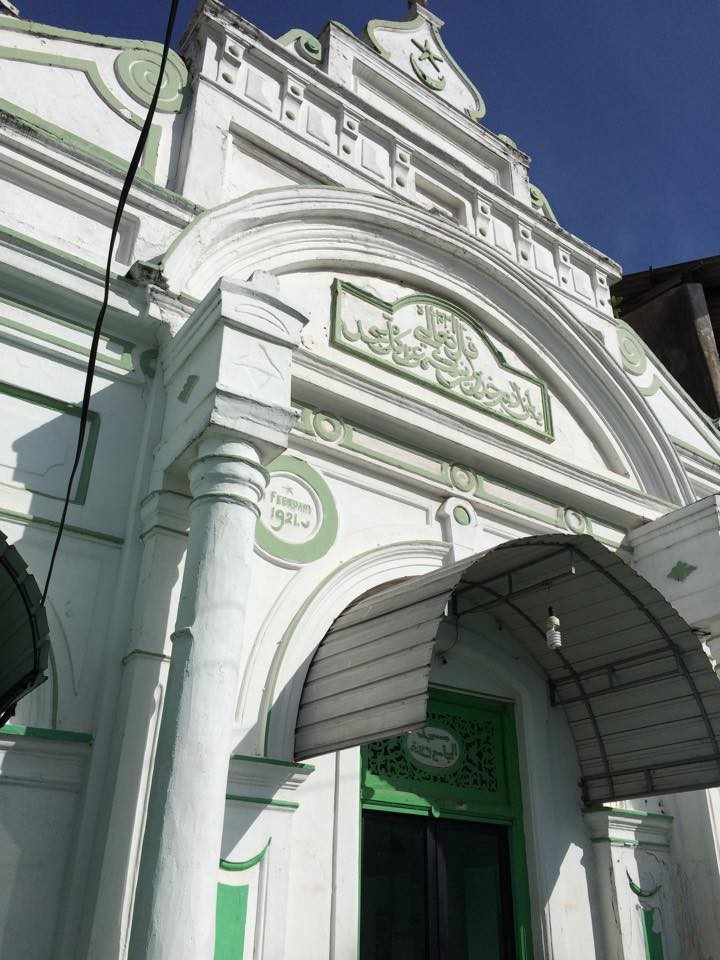
True to the reality of such a legal Act, on number one Java Lane stands the Malay Military Mosque also known as the Java Lane Mosque. Within all surrounding tenement houses attached to the mosque being struck down this mosque stands alone on a narrow path leading to it. The Malay Military Mosque founded in 1864 erected its present structure in 1921. A testimony to the existence of mercenary soldier trade from Java to the rest of the world over the First World War. The Malay race came to Sri Lanka mainly in two groups – one as soldiers to serve the Dutch and those who came later as Indonesian political exiles or `Staatsbannelingen’. The Java mosque is famously known as the Rupee Fund Mosque” as each mercenary soldier based in the area (of Java descent) contributed a rupee to the establishment of a mosque in the area. It is known as the Malay military mosque instead of Java military mosque as the Malay language served as the lingua franca for military personnel from South East Asia who was located in Slave Island either in mercenary or police positions.

Malaymosque

Malay Military Mosque

Exiled Malay nobility and a Pathan patron saint

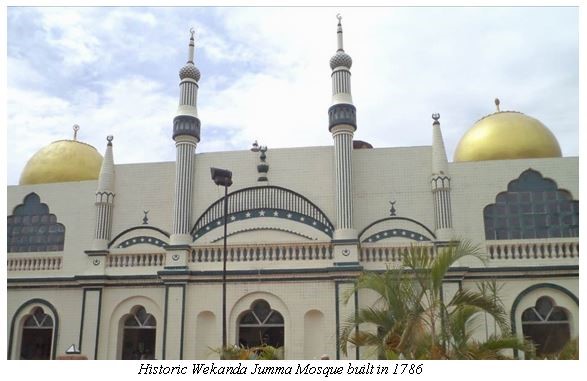
A second mosque preceding the Military Mosque in its establishment is the Wekanda Jummah Mosque. At the Slave Island junction formerly named Saunders Court Road where six roads meet stands this grand mosque and shrine of the Patron Saint of Slave Island Hussein Bee Bee Rali.  The land on which the mosque was built was purchased in 1786 by Pandan Bali, a Javanese nobleman who had been exiled to Ceylon.  The story as narrated by the caretaker of the mosque premises and pamphlets for the annual flag hoisting ceremony for the patron saint reads as follows. Hussein Bee Bee Rali was a lady of Pathan origin who was buried in Slave Island, amid clearance of the present mosque space her tombstone was discovered among others. Miracles as narrated by locals of the area over time established that Hussein Bee Bee Rali was a healer to the ill and afflicted and in fact the patron saint of the area. To date, crowds gather every Monday and Thursday evening to pray for and seek intercession in their prayers by Her Holiness Bee Bee Rali. It was around her tomb that the Wekanda Mosque was established in 1875 by the Sabu Latiff family of Malay origin. The trusteeship of the mosque is still in the hands of the Latif family with the head priests of the mosque also being of generational familial descent.  Despite the Malay descent of the Sabu Latiff family it is notable that the shrine of a Lady Saint (Awliya) is maintained and revered by mosque trustees and locals alike. The architecture of the mosque space preserves its original form with modern extensions to accommodate the crowds that gather for Friday Jummah prayers and daily prayers.

colombomosque2

Source: http://www.sailanmuslim.com/news/wekanda-mosque-opens-for-tourists/

colombomosque3colombomosque4

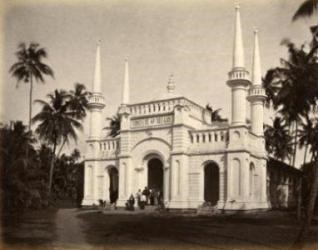
Masjithul Akbar photographed in 1880 by Charles Scrawley (Source: http://masjidulakbar.com/MosquePics.aspx)

The Lake Mosque

With a photographic history dating back to 1880, Charles Scrawley an Agent of the Empire placed Masjithul Akbar on the map on Ceylon. Located on Kew Road in Slave Island, the mosque stands across the Ridwaniyyah Arabic College. These markers of Muslim language and religion stand adjoining the Pilgrims Kovil also known as Kathiresan Kovil of Slave Island. Having being constructed within a similar timeframe the Akbar Masjid and Kathresan Kovil were built in 1859 and 1870 respectively. Locals of Slave Island narrate that the mosque is remembered to have been surrounded by lake during its establishment. As told by a sixth generation trustee of the Akbar Mosque, the origins of the founders of the Akbar Mosque trace back to the story of a South Indian horse merchant by the name of Talep Akbar who resided in Slave Island. By collecting money from Muslim locals the Akbar Masjid was built of sandstone and sand.

Apart from its religious history, an interesting feature Kew Road of Slave island (as noted at the Colomboscope tour) is that it was on this road that the botanical specimens began to be collected which inspired the Kew Gardens in Britain.

Forgotten Kabul moneylenders

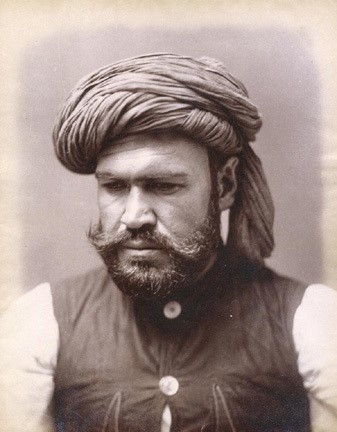
Of the disappeared communities of old Kartel are the Kabul Bhais of Pathan origin from Afghanistan and Pakistan. This community whose primary occupation was money lending was specialised in lending to the labouring class in companies of Slave Island and tea estate labour in the hills. Located near Java Lane of Slave Island, this community was notorious for its ruthless manner of debt collection and are described in oral history accounts as riding fast motorbikes and wearing staves for protection. However, with the Sri Lanka Money Lending Ordinance enacted in 1918 non-citizens of Sri Lanka were prevented from continuing money lending activity thus leaving the Kabul moneylenders no choice but to leave Sri Lanka for their homeland- or greener pastures.

colombomosque5

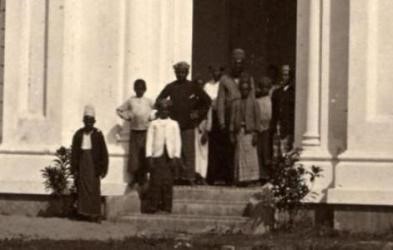
The Kabul Bhais would stand out in unique turbans and waistcoats

Source: http://asianworldnews.co.uk/featured/the-forgotten-afghans-of-sri-lanka/

The threads of multiple historical narratives running through Slave Island makes it a unique space in Colombo’s urban historical identity.

Sri Lanka: A Lesson for U.S. Strategy

August 27th, 2015

By Kadira Pethiyagoda Courtesy The Diplomat

For much of the period since its independence, Sri Lanka attracted scant regard throughout the West. At the culmination of its civil war, some attention did begin to be paid to human rights issues. In the last few years, however, Sri Lanka has begun to feature as a country of strategic relevance to the great powers. For one, it sits at the center of the Indian Ocean, likely to beone of the world’s most strategically contested regions in the coming century. Sri Lanka is also halfway between China and its energy sources in the Middle East, something Beijing had responded to largely successfully until January this year when Mahinda Rajapaksa lost the presidency. Last week’s parliamentary elections were a further blow to Beijing, when Rajapaksa’s party lost to the center-right United National Party led by pro-Western Ranil Wickramasinghe

All this is far from a deathblow to China in Sri Lanka though, and Western policymakers should not see the election as cause for again taking the island state for granted. Rather, Colombo’s interactions with the great powers should provide lessons for Washington on a re-emerging paradigm in world politics, one that it should note in its approach to the Middle East. A reprioritization of certain drivers of foreign policy is needed in order to successfully compete with China in the future multipolar world order.

In the decades following independence, Sri Lanka’s future looked bright and it was expected to develop more rapidly than Singapore. The two were compared because both were small, highly educated, multicultural Asian states straddling important shipping lanes. The winds of national fortune blew in another direction, however, and Sri Lanka became bogged down in a vicious insurgency that eventually became Asia’s longest running civil war. The war received little attention from the West until its culmination, at which point discussion was centered on human rights – what strategists might deem a second order security concern.

Newfound Interest

In the last couple of years, however, Sri Lanka began to appear on the West’s strategic radar. In May, John Kerry became the first Secretary of State to visit Colombo in over a decade. The foreign policy commentariat is publishing articles introducing Westerners to Sri Lanka. There have been reports in Sri Lankan media that Obama has also promised to visit, a trip that now looks more likely given Wickramasinghe’s victory.

Why this newfound interest? It is related to a first-tier security challenge: China. Rajapaksa’s government, unlike its predecessors, had prosecuted the war with full effort. In doing so, particularly at the conflict’s culmination and aftermath, Colombo fell out of favor with the U.S. and even more so with Western Europe. Citing non-implementation of good governance regulations, the European Union removed preferential tariff rates for Sri Lanka’s exports, causing thousands of garment factory workers, many escaping rural poverty for the first time, to lose their jobs. Western countries supported war crimes investigations at the UN. India, under pressure from Tamil Nadu state political parties, denied lethal weaponry to Colombo during the war and leaned on Sri Lanka to concede more legislative autonomy to Tamil-dominated provinces afterwards.

Unlike in previous decades, however, Colombo had an alternative great power to look to for military technology and investment, a power that preoccupied policymakers in both Washington and Delhi: China. Beijing obliged, joining Russia in using its veto to defend Sri Lanka at the UN. Sri Lanka was included as part of a chain of infrastructure projects along China’s One Belt, One Road” initiative. It built on the two states’ long history, with Sri Lanka being amongst the first countries to recognize the People’s Republic post-revolution. Rajapaksa’s move is reminiscent of the 17th century Sri Lankan Kingdom of Kandy inviting the Dutch in to oust the coastal domination of the Portuguese.

In terms of soft power, the U.S. and European stance drew a strong anti-Western public reaction in Sri Lanka, underpinned by existing suspicions of Western support for the Liberation Tigers of Tamil Eelam (LTTE), and anti-colonial and Cold War sentiment. Political parties connected to the government led mass protests against Western countries and the UN.

In January, however, Sri Lanka made a foreign policy 180 when Rajapaksa narrowly lost presidential elections in favor of the current government of Maithripala Sirisena. The new president reached out to the West, began governance reforms, and signaled a less nationalist approach to Tamil concerns. The U.S. responded positively, helping Sri Lanka to delay the release of UN Human Rights Council’s report on war crimes allegations until September 2015. Sirisena’s first foreign visit was to New Delhi and Modi repaid the gesture.

Strategic Importance

Washington, Delhi and Beijing’s interest in Sri Lanka is justified given its location at the heart of the Indian Ocean, which along with the Western Pacific will form the center of future world politics, strategy and economics. Indian Ocean sea lanes are the world’s busiest, with more than 80 percent of global seaborne oil trade transiting through them. A significant percentage of that trade must pass through chokepoints: 40 percent through the Strait of Hormuz and 35 percent through the Strait of Malacca. As such Sri Lanka is central to China’s string of pearls,” a series of ports in friendly countries to support and protect its massive exports of goods and imports of energy.

U.S. policymakers should also note that Sri Lanka’s maneuvering between China and the West may have been noted by Middle Eastern governments. The Middle East forms the source of the oil shipments passing by Sri Lanka to China. Given the recent steps by Gulf States in particular, to diversify their security partners, they may learn from Sri Lanka’s example of extracting the most from established and rising powers.

Middle Eastern states feeling hamstrung by the West’s inadequate support, or outright opposition to their own conflicts against non-state actors may draw lessons from Sri Lanka. Furthermore, Colombo accomplished something that neither the major powers, nor any Middle Eastern country with an enormous defense budget, including Israel, was able to achieve: It comprehensively defeated what was then one of the world’s most powerful terrorist armies. The LTTE had pioneered both female suicide bombers and the suicide bomber jacket, which was later copied by Al Qaeda. This is a relevant feat even considering Sri Lanka’s in-built strategic-military advantages over most Middle Eastern countries, such as the unified identity of the majority population and the ethno-territorial rather than religious basis for LTTE ideology.

Elections

The recent parliamentary elections were more significant than past polls because of the new powers bestowed on the prime minister. Rajapaksa, running on the ticket of the center-left United People’s Freedom Alliance, lost by a small margin to the most pro-West, pro-free market politician the country has seen in the last two decades. For the last decade, Ranil Wickramasinghe’s support for war crimes investigations against Rajapaksa had compounded his earlier unpopularity for concessions to the LTTE and accepting devolution in Tamil majority areas to render him unelectable. His party’s recent success owes to fears of a return to the corruption and abuse of power under Rajapaksa, who offered the same ministerial team he was surrounded by while in power. It was not a reflection of national security or foreign affairs issues.

The elections results are not a cause for Western complacency. Major moves by Wickramasinghe, either toward neoliberal economic policies or an appeasing” foreign policy may result in a swing back to the opposition at the next election. The UPFA needs only to recapture a small number of Sinhala voters who were turned off by Rajapaksa’s nepotism, but supported his nationalism.

This includes his being seen as standing up” to India and the West. After the January 2015 elections, Rajapaksa alleged that India’s intelligence service helped organize the opposition parties, something Delhi denied. In May, this author opined that Rajapaksa’s government might have benefited electorally had it employed the tactic of more strongly painting the Opposition as under Indian influence, playing on long-existing Sinhalese suspicions of India. His campaign seemed to have adopted that strategy in the run up to the August poll.

While Sri Lanka’s changes of government will not overturn economic anchors, such as the U.S. and Europe export markets, they still have significant impacts on Colombo’s geopolitical alignment. If the UPFA wins next time, major Chinese projects that were halted by Sirisena’s government may recommence. It may also revisit the Sirisena government’s stated decision to potentially bar Chinese submarines from docking in Sri Lankan ports in future

Beijing will have learnt its lesson from Sri Lanka: that spending billions on investment in potential small-power friends is sometimes less useful than spending millions, or even thousands, on gaining some insight and influence into the country’s domestic politics. Furthermore, during Rajapaksa’s decade in power, the Chinese made some strategic investments that will be difficult for any government to dislodge. Beijing helped develop the harbor at Hambantota into a port which can be redeployed for military purposes and may be included in aplanned string of naval bases from East Asia to the Middle East. Another location is Djibouti, which Kerry also visited on the same tour as Sri Lanka.

Even if the direct strategic benefits China acquires from having had a pro-Beijing government in Colombo are minimal, perceptions matter. Countries throughout Asia and the Middle East are re-evaluating their great power relationships. If states perceive Beijing’s strategic reach increasing it may tip their calculations toward acquiescing rather than resisting. They may lose trust in America’s will and ability to offer security, and commitment to their regions.

New Paradigm

Sri Lanka provides an important lesson for Washington policymakers. The very symbolic switching of great power friends by a small country following changes of government is something not seen in the region since the Cold War. Back then elections and revolutions in small states often equated to gains and losses by superpowers playing the Great Game.

The geopolitical vacation” of the post-Cold War era is over. The game is opening up. Traditional spheres of influence of regional powers like India are no longer sacrosanct. In future, small states, particularly those around Indian Ocean and the Middle East with strategic relevance, will have more options to switch between multiple poles. Great powers will have less leverage. This is exacerbated by the decreased control Western states have over their private corporations, reducing the levers of influence over other states – a challenge China does not face.

Moreover, increasing access to information means countries’ longstanding images can be rapidly altered. Sri Lankans’ approval of America’s world leadership fell from 36 percent at the end of the war in 2009, to just 14 percent in 2012 (U.S. Global Leadership Report, 2013, Gallup). Damage to image can translate to long-term harm to strategic interests. In Sri Lanka, anti-Western sentiment amongst the population has made being pro-Western more an electoral liability for politicians, than an asset. Rajapaksa supporters evidently saw political gain in alleging that his opponents were assisted by the CIA and M-I6.

The return of high stakes geopolitics means that the U.S. needs to work harder to win over small states, both governments and populations. This is particularly true for states that are geographically further from China and face little threat from her, those who feel the status quo has not served their security interests, and those with postcolonial sentiments. Sri Lanka fits all these categories, as do many Middle Eastern states.

In both these cases, the U.S. could harness its near-perennial advantage over China at the individual leader-level. Many of the anti-colonial elite in these countries are still attracted to the prestige of living in the West and association with Western institutions and imagery. They still prefer to send their children to study in American and British cities over Beijing or Shanghai. Two of Rajapaksa’s brothers, both former ministers and nationalists, are Green Card holders.

In addition, Washington needs to dilute the influence of domestic lobbies whose agendas are not always in line with U.S. national interest or values. There should be a smaller lag from the period when intelligence and strategic analysts determine that a foreign country’s strategic importance has significantly increased, to the time when high-level policymakers decide to base their approach to said country more on national strategic interests and less on lobby groups. In Sri Lanka’s case, this took too long. The same mistake should not be made in the Middle East and elsewhere. For their part, Sri Lankans would have better accepted a pragmatic approach publicly framed in U.S. national interests than one which they perceived as driven by Western domestic political constituencies.

Sri Lanka’s example provides a glimpse of small power-great power relations in a future multipolar world order. Obama and Kerry’s recent reassuring gestures to Gulf States suggests that the U.S. now may be recognizing the need to be more attentive to the interests of countries that were previously taken for granted, lest they fall into Beijing’s waiting arms.

Dr. Kadira Pethiyagoda is a visiting fellow in Asia-Middle East relations at the Brookings Doha Center and a former diplomat.


The post of High Commissioner in London An open letter to Sanga

August 26th, 2015

By Mario Perera

Dear Sanga,

Just a few days ago, speaking at the farewell offered to you on the cricket field, H.E.The President, made to you a generous offer, being the post of High Commissioner in London. Later in the day, at a press conference when questioned on the topic, you assessed your situation. You humbly mentioned your lack of experience in that particular field, and the need to discuss the issue further with President Sirisena. The latter clause indicated that you intended to pursue the matter.

As one who has followed your cricketing career from the beginning, as well as your tremendous personal development in the process, I have few comments to make regarding the subject. I for one would thoroughly dissuade you from accepting the presidential offer. You are totally capable of functioning in that post with dignity and honour, having all the trappings to emerge as an outstanding diplomat. That is not the issue. What is in issue is the price you will have to pay for it. What is it then? Well to my mind, should you take that post you will be confronted with situations compelling you to renounce to the noble ideals you set for himself throughout your cricketing career, which are profoundly embedded in the unique declarations you made during the ‘2011 MCC Spirit of Cricket Cowdrey Lecture’. Here are the relevant paragraphs of your famous speech:

In our cricket we display a unique spirit, a spirit enriched by lessons learned from a history spanning over two-and-a-half millennia. In our cricket you see the character of our people, our history, culture and tradition, our laughter, our joy, our tears and regrets. It is rich in emotion and talent. My responsibility as a Sri Lankan cricketer is to further enrich this beautiful sport, to add to it and enhance it and to leave a richer legacy for other cricketers to follow.

I will do that keeping paramount in my mind my Sri Lankan identity: play the game hard and fair and be a voice with which Sri Lanka can speak proudly and positively to the world. My loyalty will be to the ordinary Sri Lankan fan, their 20 million hearts beating collectively as one to our island rhythm and filled with an undying and ever-loyal love for this our game.

Fans of different races, castes, ethnicities and religions who together celebrate their diversity by uniting for a common national cause. They are my foundation, they are my family. I will play my cricket for them. Their spirit is the true spirit of cricket. With me are all my people. I am Tamil, Sinhalese, Muslim and Burgher. I am a Buddhist, a Hindu, a follower of Islam and Christianity. I am today, and always, proudly Sri Lankan.

I was deeply impressed by an impassioned anonymous comment in this regard that I read in ‘Cricinfo’. Here it goes: Please Kumar, do not accept the offer that you have received from the politicians. You don’t need their crumbs, you are bigger than any of them, regardless of which side they come from. Keep your dignity, keep your ethics and keep your principles that you so well adhered to all this time. Never even think of getting into politics, there are so many other noble ways that you can serve this country that you are so proud of. All the best. This view I whole-heartedly endorse.

Indeed politics is NOT the place for you as a Srilankan international beacon. A diplomatic post be it of the highest category would make you, our ‘one in all and all in one’ star, a partisan individual voicing the principles elaborated within a government ministry. They will make you espouse a political ideology, forcing you to twist and turn facts to suit your political mentors. You will be compelled, though unintentionally and unwittingly, to play which could seem to those with entrenched views, to be even racial and religious cards. You will have to take positions that compromise your status as the voice of Sri Lanka.

Furthermore you will by necessity find yourself in company of peers in the trade wallowing in the same quagmire. You gloriously proclaimed yourself to be Buddhist, Hindu, a follower of Islam and Christianity, and really and genuinely being a true Sri Lankan. The moment you accept to be a High Commissioner, you will be clothed by the very same tailors, though reborn in another time and clime, who once out-fitted up a legendary emperor for a parade among his subjects.

I would hate to see you demean yourself by joining a service that has long lost its luster. Just look at it squarely and you will appreciate what I state. It is a refuge for everyone other than quality individuals. The highly publicized brawl at a diplomatic gathering which ended with the previous High Commissioner in London being slapped and kicked (while on the ground) by the official supervisor of the foreign Ministry, a man not worth his salts and with a proven criminal record, now languishing in the dungeon. This same Foreign Service was clustered with individuals posted there for everything else other than capacity and competence. Even amorous relationships with higher echelon politicos was deemed sufficient ground for such appointments. Things might take a more positive turn in the years to come, yet the service itself will bear its stains far beyond your lifetime. We would not want our brightest sporting star to be incorporated into such a scarred body.

I could go on and on on this theme. Just permit me a few more observations. The word ‘High Commissioner or Ambassador’ would set many a mind awhirl, especially that of being Sri Lanka’s representative to the Court of St. James. Yet when the initial fluttering subsides and the oasis vanishes from our visual horizons, what remains is the desert. A country cannot become bigger than what it is through its extensions in foreign capitals. When the American ‘sun’ shines its rays spread over and affect the entire earth. What radiation does the Sri Lanka ‘sun’ have? This lack of importance, significance and relevancy affects the morale and the working of all our embassies, and naturally our ambassadors. The basic sentiments that assails one and all are neglect and boredom. They meet that menace each his own way: some do sight-seeing and tourism; other feather their nests in every conceivable way. One very famous ambassador to a country among the top four had a table tennis set up installed in a public place of the Embassy, and spent his time playing pim-pom with whomsoever was available to partner him. To tell you frankly partners were never missing. Given the size of our embassy buildings, please get rid of any nascent idea of constructing a cricket pitch in there for your pass-time activities. I do not think you intend going there to bowl a maiden over!”

What I and like-minded persons expect of you is that you be a living icon of the aspirations the country holds most dear to its heart. You should continue to aspire to being the man you projected before the world in your ‘Cowdrey’ speech, as above race and religion. Entering diplomacy is entering politics. Make no mistake about it. You will be compelled to take sides and very soon be submerged in race and religion controversies. Over there you will be batting against and battling vicious even murderous spin especially the illegal deliveries of the ‘diaspora’. You will be forced to hear as Kipling once wrote, the truth you have spoken, twisted by knaves to be a trap for fools. Do not put yourself in a position where you will have to watch the things you gave your life to, broken, and stoop and build ’em up with worn-out tools. Once that happens, there is no escape, no redemption. They will leave indelible marks on your character and personality. Do not forget that it is the evil that men do that lives after them.

Sanga, abide your time. As the Latin adage says: festina lente (make haste slowly). You have already achieved international glory, recognition, and fame. You have added luster and glamour to the name of the motherland. Your star is on the rise. Do not turn yourself into a falling star by accepting this post, though the offer in the mind of the giver was generous and gracious. Offers will come your way that will meet your aspirations. Your role in life, indeed your destiny, is to help this country shed its racial and religious tags and rise to the sense of being one nation. Your role is that of a healer of minds and hearts. You yourself could not have put it better than when you said: With me are all my people. I am Tamil, Sinhalese, Muslim and Burgher. I am a Buddhist, a Hindu, a follower of Islam and Christianity. I am today, and always, proudly Sri Lankan. Sanga, your destiny is not to become entrenched in partisan positions. Your destiny is to display a unique spirit, a spirit enriched by lessons learned from a history spanning over two-and-a-half millennia. Your destiny is to make the world see the character of our people, our history, culture and tradition, our laughter, our joy, our tears and regrets.

Sanga, my final words to you are those of the Latin poet: prospera, procede, et regna: prosper, proceed, and emerge victorious. You bear on your shoulders the deepest aspirations of your motherland the realization of which is beyond the scope of politics and diplomacy.

Mario Perera

Kadawata

පාවා දෙන්නන්ගේ අවසන් අවස්ථාව……

August 26th, 2015

Lankanewsweb.info

ඔහුගේ ඇතැම් ක්‍රියාකලාපයන් පිළිබඳව සලකා බැලිමේදි මහත්තයෙකු ලෙස ඔහු ආමන්ත්‍රණය කිරිම නුසුදුසු නැත. සිය ඉල්ලා අස්විම යවමින් ඔහු යැවු ලිපිය දෙස විමර්ශණාත්මකව බැලිම කාගෙත් ඇගට ගුණ බව අපගේ අදහසයි.

එසේනම් සූසිල් කියන ආකාරයට, සන්ධානයෙන් අපේක්ෂකත්වය හා කණ්ඩායම මෙහෙයවිමේ බලය මහින්දට ලබා දි ඇත්තේ මෛත්‍රීගේම කැමත්තේමි.

මහා මැතිවරණයට සන්ධානයක් ලෙස නාමයෝජනා ලබාදුන් දිනයේ සිට මැතිවරණයේ අවසාන දිනයේ සුසිල් දොට්ට දැමිම දක්වා මෛත්‍රී කරන ලද අවජාතක වැඩ කිසිවක් ගැන වචනයකින්වත් සුසිල් සිය ලිපියේ සටහන් නොකලේ එක්කෝ සුසිල් මෛත්‍රීට එති බය නිසා විය හැක….නැත්නම්…මේ සියල්ලම සුසිල් විසින් දැනුවත්ව සිදුවු එවා විය හැක.

වඩාත්ම ගැලපෙන පිලිතුර වන්නේ සුසිල් සියල්ල දැනුවත්ව සිදුවු  බව ඔහු මේ දක්වා ක්‍රියා කල අකාරයෙන් හැඟී යන බවයි.

සුසිල් ගහපු ගේම් එක ගැන වැඩිය කතා කරන්නට ඔනෑ…නැත…ඔහු ඒ ගේම නොගැහුවානම් අද ඔහුටත් වන්නේ මෛත්‍රීගේ පරාජිතයන්ගේ ජාතික ලැයිස්තුවෙන් පාර්ලිමේන්තුවට හොරෙන් රිංගා එජාපයේ පිළේ ලගින්නටය.නමුත් මේ අවසාන අවස්ථාව බව සුසිල් තරයේ මතක තබාගත යුතුය…රටේ ජනතාව යලිත් ඔබට අවස්ථාවක් ලබා නොදෙනු ඇත.

hhf

Kumara Welgama ready to accept the opposition leader post

August 26th, 2015

Adaderana

Former Minister Kumara Welgama says that he is ready to accept the opposition leader post.

Welgama told Ada Derana that he is of the view that he is the most appropriate for the post under the current political situation of the country.

Welgama obtained the highest preferential votes (218,614) from the Kalutara Polling District under the United People’s Freedom Alliance (UPFA) ticket at the General Election 2015.

A Fundamental Rights (FR) petition filed challenging UFPA National List

August 26th, 2015

Courtesy Adaderana

A Fundamental Rights (FR) petition has been filed today by a member of the Mahajana Eksath Peramuna (MEP) challenging the UFPA National List, which includes several candidates who were defeated at the general election.

The FR petition has been filed with the Supreme Court by MEP member Somaweera Chandrasiri, challenging the decision to name losing candidates in the UPFA National List.

The MEP, led by former Minister Dinesh Gunawardena, is a constituent party of the United People’s Freedom Alliance (UPFA), which had managed to secure 12 bonus seats despite losing the parliamentary polls.

The National List was announced last Friday (21) and includes 7 UPFA candidates who contested and lost at the General Election on August 17 while they were also not named in the party’s National List announced before polls.

US backs Sri Lanka’s domestic probe and offers resolution of collaboration with the government of Sri Lanka at the September session of the Human Rights Council.

August 26th, 2015

Courtesy Adaderana

The United States said Wednesday that it wants to sponsor a resolution at next month’s U.N. human rights session that is supportive of Sri Lanka’s government, which wants to conduct its own investigation into alleged war crimes.

The announcement by the visiting Assistant Secretary of State Nisha Biswal of a joint resolution with the Sri Lankan government presents a major shift by Washington on the South Asian island nation.

The U.S has announced it will be offering a resolution at the September session of the Human Rights Council. It will be a resolution of collaboration with the government of Sri Lanka and with other key stake holders,” she said.

The U.S was in the forefront in adopting three resolutions at the U.N. human rights session on Sri Lanka, the last of which last year called for an international independent investigation into the alleged abuses.

Biswal said, however, the U.S. now supports a local investigation that the new Sri Lanka government of President Maithripala Sirisena has promised.

We have recognized that there is a different opportunity that exists today and a different landscape for trying to advance reconciliation,” Nisha Biswal, she told reporters in Colombo. We look forward to a process in Geneva that allows an opportunity to reflect on that.”

Biswal did not say what the new resolution would contain, but said it will follow a report by the U.N. Human Rights Council scheduled to be released next month.

Relations between the U.S. and Sri Lanka were strained under previous President Mahinda Rajapaksa, who oversaw a military campaign that defeated separatist Tamil Tiger rebels six years ago and ended a decades-long civil war.

Both sides were accused of serious human rights violations amounting to war crimes, and an earlier U.N. report said some 40,000 ethnic Tamil civilians were killed in just the last few months of the fighting, largely as a result of the government’s shelling.

Rajapaksa’s repeated refusal to investigate the allegations and his increasing leaning toward China for support at international fora and financing of his infrastructure projects affected relations with U.S.

The relations have improved since Sirisena’s surprise election victory in January, with the new president moving away from a heavy pro-China policy and agreeing to conduct a local investigation into the abuse allegations.

Source: Associated Press/Reuters

ඡන්ද වංචාවක් ගැන උදය ගම්මන්පිළ මහතා හෙළි කරයි. ((video))

August 26th, 2015

Courtesy www.mahinda.info

2015 මහ මැතිවරණයේ ප්‍රතිඵලය අස්වාභාවික බවත්, එහි යම් ගැටළු කාරී තැන් ඇති බවත් mahinda.info විශේෂ ලිපියකින් පෙන්වා දුන්නා ඔබට මතක ඇති. පසුගිය දිනෙක උදය ගම්මන්පිල මහතාත් ඡන්දයේ වංචාකාරී සිදුවීම් පිළිබඳව අදහස් දැක්වූයේ මෙලෙසයි.

උදය ගම්මන්පිල මහතා මතු කළ කාරණා වල සාරාංශය.

1. මැතිවරණයට පෙර ස්වාධීන මත විමසුම් වලින් එක්සත් ජනතා නිදහස් සංධානය 110-115 ත් අතර මන්ත්‍රී ධූර දිනා ගන්නා බව පැවසීම.

2. රටේ බුද්ධි අංශ වලින් සෘජුව තොරතුරු ලබා ගන්නා රටේ ජනාධිපතිවරයා අග්‍රාමාත්‍ය ධූරය වෙනත් ජේෂ්ඨයෙකුට ලබා දීම ගැන පැවසීම. විපක්ෂ නායක ධූරයක් ගැන නොකීම. අගමැති ධූරය ගැන කතා කරන්නේ ජයග්‍රාහී පක්ෂය සමග මිස පරාජයට පත් වෙන පක්ෂය සමග නොවෙයි.

3. පෙරේදා ශ්‍රීලනිප මන්ත්‍රීවරුන් හමු වූ අවස්ථාවේදී ජනපති මෛත්‍රීපාල මහතා තහවුරු කර ඇත්තේ තමන්ට ලැබුණ වාර්තා අනුව සංධානය මන්ත්‍රීධූර 110 ත් 115 ත් අතර ගණනකින් දිනන්න හිටි බවත් තමන්ට අනාරක්ෂිත භාවයක් දැනුණ නිසා ලිපිය යවන්නත් ලේකම්වරු ඉවත් කරන්නත් සිදු වුණ බව. එනම් සංධානය දිනන්න හිටි බවත් එය පරාජය කළේ තමන් බවත් සංධාන නායක මෛත්‍රීපාල මහතා පිළිගනී.

4. එම කතාව තවත් තහවුරු කරමින් මෛත්‍රීපාල මහතාගේ නිජබිම වන පොළොන්නරුවේ ජයග්‍රහණය එජාපය ලබද්දී මහින්ද රාජපක්ෂ මහතාගේ ගම් පළාත වන හම්බන්තොටත් එතුමා තරග කළ කුරුණෑගලත් සංධානය ජයග්‍රහණය ලැබීම.

උදය ගම්මන්පිළ මහතාගේ පෞද්ගලික අත්දැකීම් මෙතැන් සිට…

5. ඡන්දය දින රාත්‍රී 7.30 ට වෙන විටත් (ඒ වන විට කළුවර වැටී ඇත) මහරගම විවේකාරාමය ඡන්ද මධ්‍යස්ථානයේ ඡන්ද පෙට්ටි ගෙන ගිහින් නොතිබීම. පසුව මෝටර් රථයකින් පැමිණි කාන්තාවක් ඡන්ද පෙට්ටි රැගෙන යාම.

6. ගණන් කිරීමේ මධ්‍යස්ථාන 70 දී බුලත් කොළයට කතිරය ගැසූ ඡන්ද පත්‍රිකා 200 කට වඩා ප්‍රමාණයක් නිල මුද්‍රාව නෑ කියමින් (නිලධාරීන්ගේ වරදක් නිසා) ප්‍රතික්ෂේප කිරීම.

7. සමහර ඡන්ද මධ්‍යස්ථාන වල ඡන්ද පෙට්ටිය සීල් තබද්දී වෙනදා මෙන් ලාකඩ වලින් සීල් තැබුවේ නැති බවට තොරතුරු ලැබීම.

8.සමහර අපේක්ෂකයින් මාධ්‍ය ආයතන වලට සංග්‍රහ කර තමන්ට වාසිදායක ලෙසට මාධ්‍ය මෙහෙයවා ගැනීමට උත්සාහ දරා ඇත. එමගින් පාර්ලිමේන්තු මැතිවරණ පනතේ 79 වන වගන්තිය උල්ලංඝනය කිරීමක් බැවින් ඔවුන්ට එරෙහිවත් ක්‍රියාමාර්ග ගනු ලැබේ.

ශ්‍රේෂ්ඨාධිකරණ තීන්දුවක් අනුව මැතිවරණ දූෂණයක් සිදුවූ බව සනාථ කිරීම පමණක් ප්‍රමාණවත් නොවන අතර, එම දූෂණය නිසා මැතිවරණ ප්‍රතිඵලය වෙනස් වුණ බවට ඔප්පු කළ යුතුයි. ඒ අනුව ලැබෙන සාධක අනුව ඉදිරියේදී මැතිවරණ පෙත්සම් ඉදිරිපත් කරනු ඇත.

එසේම විමල් වීරවංශ මහතාත් මැතිවරණය සම්බන්ධයෙන් මාධ්‍ය හමුවකදී අදහස් දැක්වුයේය. ඔහු පැවසුවේත් දිස්ත්‍රික්ක කිහිපයක ඡන්ද ප්‍රතිඵලය සම්බන්ධයෙන් ගැටළුකාරී තත්ත්වයන් ඇති බවත් ඒ සම්බන්ධයෙන් ඉදිරියේදී ක්‍රියාමාර්ග ගන්නා බවත් ය.

යාලුවන්ටත් දැනුවත් වීමට Share කරන්න.

Lucky rejects and hypocrites

August 26th, 2015

By Dr Upul Wijayawardhana Courtesy Island

The editorial ‘Lucky rejects’ (The Island 25 August) ‘hits the nail on the head’ and the Editor deserves to be congratulated on exposing the hypocrisy of not only the two major political parties but also of the proponents of good governance, who seem to have double standards, when he states:

“But, when the incumbent President unflinchingly uses the draconian constitutional provisions to further his interests, the campaigners for good governance blame the Constitution and not him! They used to float like butterflies and sting like bees when Rajapaksa was at fault, but today they are floating like bees and stinging like butterflies, so to speak! Is it that they cannot bring themselves to inveigh against their heroes who have been found to have feet of clay?”

A story, even better, came to my mind; that of the man when caught coming down a ‘Kitul’ tree after stealing toddy giving the excuse that he went up to cut grass!

In an opinion piece I wrote on ‘Good Governance’ and published on Saturday 23 July, the concluding paragraph was:

“Front page photograph of The Island on 24 July shows Ven. Madulawe Sobhitha Thera receiving the manifesto of the UNP led United National Front for Good Governance from RanilWickramasinghe. I wonder why he did not ask Ranil about the bond scam. Does he trust Ranil for good governance under these circumstances?”

But, I like to add the final line that was edited out;

“Or, by association, unfortunately, is he also joining the band of hypocrites?”

Politics in Sri Lanka never seem to stop amazing us. The two major parties that should have joined forces to defeat terrorism, which they refused to do and one party was liberal with sarcasm not only towards the opponents but also at the services fighting for the integrity of the country, are very keen to be bed-fellows now! The only possible explanation is that they are jockeying for positions forgetting that, at times of peace, the opposition is the vanguard of democracy. As a result, an ethnically based minority party is now demanding the position of the Leader of the Opposition. When such an appointment was made under JR, albeit under different circumstances, he strengthened the position to supress Mrs B resulting in the holder going round the world spreading false propaganda.

The electorate seems as confused as the leaders best illustrated by the most paradoxical result of the last election. President Sirisena’s former electorate and the adjoining one voted UNP in spite of President Sirisena being the leader of the SLFP. It surely cannot be a rebuff to the President. Did the electorate believe that the President was supporting the UNP than his own party? Surely not. May be that it was their way of showing gratitude to the UNP for having enabled ‘ape miniha’ to be the President.

Can we ever hope for honest politicians? Is good governance only a day-dream? Pondering over these, I am reminded of two incidents.

When I was working in the Cardiology Unit, a Member of Parliament who was a regular patient of mine and was then in opposition told me “Doctor, wait for the next election. We will be in power and will show them how to earn. We will do better than them!” He was naively honest with his doctor in whom he could confide. He was correct; it is an undeniable fact that every Government in Sri Lanka has been more corrupt than the previous Government.

The other story was told by my father which I am sure he got from the horse’s mouth.

A very well-known and much respected high priest had approached Dudley Senanayaka and told him:

“Prime Minister, if you appoint Mr ———-(a well-known politician from the South belonging to his caste} as a Minister, I will support your Government and get our people also to support you’’

To which Dudley has promptly replied “Venerable Sir, Please leave politics to me and you should look after religion”

The high priest continued to criticize Dudley as his nominee was not made a Minister.

Paradise Lost – From Bad to Worse!

August 25th, 2015

Prof. Hudson McLean

Although I have kept silent during the past few months, I maintain my regular watch over Sri Lanka politics, reading LankaWeb, Daily News and other media publications.

The content published in LankaWeb is excellent reading and gives an objective analysis of the sad situation in Sri Lanka.

Appreciate the lead by Mahindapala & Waduge et al.

Whilst the Presidential Elections in January was a disaster for the development of Sri Lanka, the Parliamentary Elections, with all the allegations against the Governance, if are true, spell  a slow drive to the “Valley of Death”!

It is pretty obvious that, President Sirisena with his limited IQ is not the Mastermind behind the manipulations.  The reason why CBK & RW promoted Sirisena, as coerced by India – USA and by the Tamil Brigade in Singapore, was to “Put a Donkey but Not a Horse” to be the “Front”.

This Planning Exercise is also beyond the Simple Intelligence and Logic of CBK & RW.

From the “Post-Mortem” exercise some of my contacts have reached that the Primary Objective is to “side-line” China from Sri Lankan territorial land & sea.

China is creating itself to be a “pimple-in-the-a*se” for USA, as well as a “kick-between-the-legs” for India.  The strategic intelligence of CIA and the cunningness of RAW, made a spiced burger to suit all tastes.  These two powers are already settled comfortably within the Sri Lanka political-military infrastructure.

With the low IQ of President Sirisena, it is pretty obvious that Sirisena is now being driven as a Tamil Rickshaw Wallah by CBK-RW, couched “comfortably”.

Lets face facts. The President, “In Shalla” has almost another five years on the Hot Seat. Prime Minister will last pretty long in the current stable, since there will not be any Parliamentary Elections in the horizon.  In any case, the Music Song Sheet is written not in Sri Lanka but by CIA-RAW and possibly Singapore, and the power-hungry CBK-RW will “sing” accordingly.

There is only one distant option!  The Military!

Like in the distant past, Uganda, Libya, Iraq, Iran, Indonesia, Egypt, Ivory Coast, have demonstrated, a Coup d’Etat does not need a Field Marshal or a Five Star General.  Even a soldier with no medals or a smart Colonel can lead the field to over-throw a Government.

In the past, late Commodore Royce de Mel and his brother Maurice failed even with the tacit support of  brilliant late Senator Edmund Cooray LlM, failed, only due to the “slip-of-the-tongue” of a cocktail-happy woman.

There is hardly any point wasting time and space on planning Democracy or Democratic Relief of Power in Sri Lanka at this moment. That takes time and the current power-base in CIA-RAW will end that even before it starts.

Unfortunately, ex-President Mahinda Rajapaksa, will not lead any unlawful, but absolutely necessary “Regime Change” from his private abode. Neither will Colonel Gotabhaya Rajapaksa.  These are Gentlemen!

The future of Sri Lanka will depend on one brave soldier, who is prepared to “Take the Reins to drive the Donkeys and Rickshaw Wallah to Sunset and Regain Paradise!”


Express Your Opinion – Read What Others Say!
The Independent Interactive Voice of Sri Lanka on the Internet.

Please visit -: http://www.lankaweb.com/

PAKISTAN’S WAR AGAINST TERRORISM

August 25th, 2015

ALI SUKHANVER    

For the last many weeks, it has been a very popular statement of different politicians, defense analysts and of different TV anchors that the Operation Zarb-e-Azb in Pakistan is reaching its climax. This statement gives an impression that the menace of terrorism has been completely uprooted from the Pakistani society and that there is no more danger from their side now. But the fact of the matter is that the Operation Zarb-e-Azb still needs to be carried on for a long time. Everywhere terrorism is the name of a disease which could never be treated with simple medicines; it always ends up in a surgical treatment followed by a long term follow-up. And in most of the cases this disease adopts the form and shape of a malignant tumor which ultimately becomes a serious threat to life if not properly taken care of. In short one has to be very much offensive in dealing with the menace of terrorism but at the same time it does not mean that the scourge of terrorism is incurable.

Just cast a look at the devastated and ruined lands of Sri Lanka a few years back. The enchanting island of waters and mountains had been the ever-worst victim to the terrorist activities of the LTTE for about three decades. The LTTE began conducting extensive and deadly terrorist attacks against the Sri Lankan government and civilians in 1983. As a result of this brutal terrorism more than 80000 people lost their lives and thousands got seriously injured. The LTTE terrorists pioneered the use of suicide bombings with the help of women and children suicide bombers. The LTTE terrorists did all they could do to destroy the whole of the social structure of the Sri Lankan society. From the ordinary common people to the political leaders, from government officials to the representatives of other countries posted there in Sri Lanka, journalists, Army officers, in short no one was safe at the hands of the Tamil fighters. Under the umbrella of moral and financial support of India, the LTTE’s terror war continued for more than 26 years. At last in May 2009 the Sri Lankan army succeeded in putting an end to this war by killing the LTTE’s main leader Prabhakaran. Talking of the 1983 riots in Sri Lanka, Shenali D Waduge, a world known Sri Lankan analyst on strategic affairs says, The 1983 July riots said to have been caused as a response to the LTTE killing of 13 soldiers remains a very contentious topic even 30 years later. It was the first time that a large number of military personnel had been slaughtered in one go and was a shock to not only the families of the deceased but a shock to the military itself. Aware of its own limitations in military hardware Sri Lanka was unaware that India had not only been training LTTE and other militant groups but had also been arming them and financially supporting them as well. This means that whatever weapons, ammunition and even LTTE targets had to have been with the explicit knowledge and even instructions of India and its intelligence agencies which were handling them.”

Now same is the situation the people of Pakistan have been passing through for a long time. Whether it is the so-called sectarian blood-shed or suicide attacks on innocent citizens or the brutal slaughtering of the children at the Army Public School Peshawar or the so-called separatist movement in Baluchistan, the Law Enforcement Agencies of Pakistan have solid proofs of Indian interference in all these incidents. So many times these proofs have been presented to the Indian authorities but these authorities never showed a positive response to these proofs. Instead of looking into the matter sympathetically, the Indian authorities have always showed a very soft corner for the terrorists involved in terrorist activities in Pakistan. A recent example in this regard is of granting bail to Swami Aseemanand, the main culprit behind the Samjhota Express tragedy. This culprit had openly admitted that he was involved not only in the Samjhota Express tragedy but also in so many of other terrorist activities. Samjhota Express was bombed in February, 2007 resulting in the death of 42 people. The government of Pakistan and the Military authorities of Pakistan are very well aware of the horrible reality that the terrorists working in Pakistan are enjoying a very strong support and favour from the countries hostile to Pakistan. Terrorism in Pakistan is not the handiwork of a small group of people; it is something far more than that. Recent suicide-attack on Col. (R) Shuja Khanzada is a proof that the terrorists need to be dealt with more ruthless hands. By talking of putting an end to the Operation Zarb-e-Azb, we would do nothing but encourage and support the terrorists.

A serious look at hijacking democracy in this country by appointing defeated and rejected candidates at elections to Parliament via the National List and making them even Cabinet Ministers

August 25th, 2015

 Sudath Gunasekara 21.8.2015

To me the so-called National list concept is a big fraud. In this country it appears to be a combination of the Machiavellian and Kautilyan strategies in state craft with a pinch of salt from JRJ’S political cunningness and acumen. So one can just imagine what kind of vicious political invention it would be. This Sri Lankan invention is the most undemocratic mechanism designed by any to subvert and rob the people’s mandate and install the dictatorship of the politician. It goes even further to the extent of a total negation of the people’s sovereignty which is said to be inalienable at the beginning of the Constitution in article 3.

Looking at the development of this idea in this country, the 1987 Constitution provided for 196 seats in Parliament. In 1988, by the 14 A (24th May 1988) it was increased to 225 as stated in article 99a. But I could not find the words ‘national list members’ under any article or section therein other than in the heading appearing before the Short title of 14th A given below.

(‘The Fourteenth Amendment to the Constitution of Sri Lanka extended the immunity of the President, increased the number of MPs to 225, provided a 1/8 (12.5%) cut-off for parliamentary representation, and dealt with Delimitation Commission, referendums and national list members. The amendment came into effect on 24 May 1988’.)

Again within 6 months on 17 Dec 1988, 99a of 14th A was repealed by the 15th Amendment and a new mechanism was introduced. Provision for defeated members to be appointed is included in the latter part of para 3 article 8A under the 14th A, most probably on second thought, to take in men rejected by the people but indispensable for the leadership, for various shady reasons. The fact that none in Parliament appears to have objected this underhand provision clearly shows that all the politicians harp on the same common denominator, that is their own survival and self interest rather than the interest of the people. The hurry with which this amendment was passed and the confusion associated further proves their hidden intention behind this provision. That is why I call this provision one of the most undemocratic, unethical and uncivilized constitutional provisions invented by any Parliament anywhere in the world that has humiliated the voter and robbed his fundamental democratic right to elect a desirable and reject an undesirable politician. If you carefully go through the list of people who have been nominated under this provision from the inception you will see what I am trying to say here.  I don’t think you need further proof than the UPFA list just submitted to testify this argument.

The rising public protest and outcry on this issue spearheaded by prominent members of the Mahasangha such as Maduluwave Sobitha Thera clearly shows public disapproval of this mala fide decision taken by the President

‘Rejects are rejects” this is how the Island Editor calls defeated candidates proposed to be appointed to Parliament via the National list in his forthright Editorial of 21st Aug 2015. Not only I, but all sensible people in this country fully agree with you Prabath. Well said and well done. Your editorial is revealing and it should be read by everybody in this country. I suggest you get the Sinhala Divaina to publish it in Sinhala without fail because they are the people who should get this message, although the President and JVP appear to think otherwise. JVP has appointed  Handunhetti and the President Sirisena appointed S.B. Dissanayaka, Vijitamuni Soysa and five others from among defeated candidates to the so-called National list, which I would call an anti-national list out right. Though the 14th A to the Constitution under Sec 8, rather deceptively and undemocratically has made provision for defeated candidates to be appointed to Parliament via the national list, I don’t think one need to continue with this mala fide invention. Though our politicians have numerous ways of humiliating the voters I would say this is the most heinous and treacherous among them. It is undemocratic, unethical, deceptive, dishonest, hypocritical and shameless and it also shatters the very foundation of representative democracy.

The National List (NL) mechanism was originally introduced in 1988 that provided for 29 places out of 225 in Parliament as said before. No qualifications for the national list members have been laid down in the Constitution, although provision for defeated candidates has been introduced under Sec 8 of the14th A, perhaps on second thought. The architects of the Constitution may have left it open and flexible to enable them to name legitimately anyone whom they want. This lack of clarity and flexibility alone shows the hidden agenda they had in mind when they added this provision. The so-called national list is submitted at the time of handing over nominations. Usually it is meant for people with brains and distinguished track records who do not like to enter the fray but whose contribution is very valuable for good governance. Their public image and stature is used as a bait to catch voters. If any party drops those already listed and appoint new people or defeated men and women on second thought for political expedisncy, in the first place, it betrays and rejects the voter who cast his /her vote on the presumption that at least few men of character and education in the said list will be there in Parliament. Secondly definitely representative democracy becomes a big joke with such intruders and rejects being introduced subsequently. Appointing defeated people makes it still worse. Because it tantamount to a total disregard of the people’s vote and their will. No civilized society should allow politicians to murder democracy in broad day light in this manner to fulfill their sinister wants.

As the Island Editor further says those who vote for a particular political party at parliamentary polls, endorse its NL. Therefore, using the mechanism to appoint candidates rejected by the voters as MPP on second thought is tantamount to a distortion of the will of the electorate”.

Meanwhile I also fully endorse the Editors comment that ‘the UNP’s decision against appointing political rejects to Parliament via the NL is to be highly commended”.

‘Appointment of some of the defeated UPFA candidates in the good books of President Maithripala Sirisena to Parliament through the NL’, as he further says is also deplorable and undemocratic. This is neither democracy no maîtree or yahapalanaya in practice by any standards.

Polls monitors also have condemned the appointment of defeated candidates. ‘A candidate fails to get elected at a general election because voters do not consider him or her fit enough to enter Parliament’.  So under what democratic principle or ethical or moral criterion such people are appointed to Parliament making use of a dirty loophole in the Constitution.

As the Island editorial has correctly pointed out there is no difference between admitting a student who fails to obtain enough marks at the GCE A/L to a national university and appointing to the national legislature via the NL a candidate who loses an election. Therefore, no one who claims to be a proponent of good governance can endorse the appointment of political rejects to Parliament through the backdoor’.

This type of political chess game in Sri Lanka is no surprise to Sri Lankan people because they know very well the Constitution itself is not designed to safeguard the interests of the people. In other words it is not a people’s constitutions. It is a politicians Constitution drafted behind doors by the politicians for the benefit of politicians.   If you peruse through it carefully you will see how craftily they have masterminded it to safeguard their interests so that they can make use of it to run a Government by the politicians for the politicians and of the politicians”.  It is designed to safeguard the rights of politicians at every point. This applies to the number of MPP as well as all other aspects such as the election process and enormous privileges granted to politicians like a fat pension within five years. This is why I always argue for a new constitution that safeguards the interests of the people as the first priority. Nevertheless unlike in previous times people should demand that their views are also entertained and embodied in the final document.

First this concept originated as appointed MPP. For example 1948 constitution provided for 6 appointed MPP to provide for the appointment of ‘persons who have rendered distinguished public service or are persons of eminence in professional, commercial, industrial or agricultural life including education, law, medicine science, engineering and banking’. It provided an avenue for eminent persons to enter Parliament without contesting elections which they detest’. But, today sadly, it is used by political parties to appoint any crook or even defeated candidates to the national legislature. At present the list is used only to select the favourites of the political party leadership who can never get in to Parliament through elections. These MPP are mainly used to increase the voting strength and not for any worthy contribution they make. You will see this clearly if you go through the past lists of national list MPP in our Parliament.

The most dangerous part of this process is that they don’t represent the people. They represent only the person who has appointed them and his interests. It follows then that they are answerable and obliged only to the party leadership who appoint them. Rejects are rejects as the Editor says and therefore such people should never be accommodated in the National list. Such accommodations will tantamount to nullification of the people’s democratic right to elect a person they prefer. Such action leads to a complete erosion of the people’s right to franchise and democracy become a joke. Therefore everybody who value democratic principle should vehemently oppose this move. I wonder as to how the Commissioner of Elections declare such people as elected under sec 8 of the 14th A when they have been rejected  and are only actually selected by the Leader of the party. I am surprised as to how one can call this representative democracy.

In my opinion not only defeated persons at elections should not be nominated to Parliament but they also should never be appointed to any other public post at Home or abroad. I reiterate this point as there is a habit of such defeated people being appointed as Ambassadors and Chairmen of corporations etc.

I wish eminent civil society leaders like Rev Maduluwave Sobitha Thera will take up this matter seriously as a national priority and try to convince the political hierarchy not to nominate any political reject to the national list. Secondly to do away with this national list concept that has become an instrument of political expediency rather than a mechanism of public necessity.

Mr President People in this country have voted you on Jan 8 to restore good Governance. Appointing a bunch of sycophants, who have been rejected by the people to Parliament and dropping people like GLP, Dew, Vitarana and Rajiev, from the list, jut to hurt MR  or to take revenge from those who supported him is neither good governance no maîtree Governance either.

President has no ethical right to select National List MPs, says Gammanpila

August 25th, 2015

Adaderana

The President has no ethical right to select Parliamentarians through the National List, Pivithuru Hela Urumaya Leader Udaya Gammanpila says.

The observation was made at a press conference held in Colombo this afternoon (25).

Gammanpila also severely criticised the manner in which the United People’s Freedom Party’s (UPFA) national list MPs were selected.

It is not a secret that the UPFA supporters are disappointed about the National List,” he added.

Gammanpila also vowed not to contest under the UPFA ticket with the present leadership at a forthcoming election.

He also charged that the new government is attempting to bring an international investigation on the alleged human rights violations in the guise of a domestic mechanism.

Has Sirisena Dug His Road to the Supreme Court to be Doomed for Gross Violation of Human Rights?

August 25th, 2015

by Gandara John

With the winners and losers at the recently concluded elections announced, Sirisena immediately set about to disenfranchise nearly five million UPFA voters, by inserting fresh names in the UPFA National List.

And the fresh names on the list also included seven who had been rejected outright by the UPFA voters.

Millions of voters reposed their faith in the UPFA in the hope that the United People’s Freedom Alliance would form a government that would safeguard the sovereignty of the country or, if not the government, would form a strong opposition in Parliament that would thwart the conspiracy that they strongly believe has been hatched to barter away the sovereignty of the people.

Assuming the election to be genuine the UPFA voters made their choice in voting for their team; their team choice included the list of names on the National List which they found attractive; they believed that those persons on that list would never betray their country.

And while making that choice the near five million of UPFA voters, by choice, rejected outright several UPFA candidates.

Acting like a potty dictator in a banana republic Sirisena slashed the National List violating the Human Rights of a 5 million voters enunciated in and protected by the International Covenant on ‘Civil and Political Rights’ to which Sri Lanka is a signatory.

By substituting a fresh list of names in the National List of the UPFA and including in that list UPFA candidates totally rejected by UPFA voters, Sirisena was making the election a travesty of democracy.

Sirisena, consumed by an indefinable anger and acting irrationally, badly dented the suffrage of the people. Sirisena leaves himself wide open to be hauled before the Supreme Court for the gross violation of Human Rights of 5 million people.

Sirisena’s conduct also gives just cause for the validity and genuineness of the Elections to be challenged.

Article 25 of the ‘International Covenant on Civil and Political Rights of 1976’ paraphrased reads, Every citizen shall have the right and the opportunity to vote at genuine elections which shall be by universal and equal suffrage guaranteeing the free expression of the will of the electors.”

 Surprisingly, the Commissioner General of Elections who thrives in the spotlight of the media was hoarsely silent on this body blow to democracy in Sri Lanka; so were the usually vociferous NGOs and the election monitors paid to pontificate.

Sirisena’s bizarre conduct was preceded by a bout of equally aberrant behavior; in the week before the election he unilaterally sacked the Secretaries of the UPFA and the SLFP and 25 members of the SLFP Central Committee; on 13 Aug 15 he sent an urgent letter to Mahinda Rajapakse which hit the headlines even before it could reach the recipient.

The strongly worded letter was contrived to reduce the vote bank of the UPFA; all this at the height of the election campaign when his actions would have earned a ‘normal’ person prosecution and imprisonment  for the violation of election laws.

One of the major concerns of the voters at this election was the quality of the persons representing them in Parliament; the UPFA voters used great discretion in rejecting the undesirables at the time of voting.

Sirisena however emasculated and enfeebled the voters by dictatorially reversing the decision of the voters and depriving them of their sovereign right to choose their representatives as they deem fit.

Sirisena’s motive is very clear. He, the ship’s captain if he ever were one, is steering his ship towards the rocks to compel those who would not abandon ship to jump ship or be wrecked

The Election has turned out to be a diabolical exercise in stifling democracy in the country. Power is heady and has already inebriated Sirisena. Democracy is at a low ebb. Is Sri Lanka slipping into a dictatorship or will the Supreme Court be Sri Lanka’s saving grace?

Clemency for Sergeant RM Sunil Rathnayake is justified.

August 25th, 2015

Dr Chandrika Iriyagolle

Sri Lanka is a resplendent island, famous for its scenic beauty and its Theravada Buddhist cultural heritage.

Our great nation epitomized the great and good in human nature. Compassion, selflessness, generosity, integrity and, above all, merciful benevolence, are qualities that shine through our long history.  Our culture and lifestyle was based on Buddhism in the most pure form, Theravada Buddhism.

The emergence of the Liberation Tigers of Tamil Eelam, a wealthy terrorist group, caused the Buddhist civilisation of this island to become splintered.  At the same time, the New United National Party gained power.  This formerly just and benevolent party became a dangerous and destructive political force.

A young man observed the terrible destructive forces around him that desecrated Buddhist holy places and massacred innocent civilians, and took the noble and courageous decision to serve his nation by joining the army.   His aim was to protect the nation, defend the unitary state of Sri Lanka and its Buddhist cultural heritage. For him, this was an extremely difficult decision, as he was brought up to respect all life.  This brave young man was Sergeant Sunil Ratnayake, who has now been betrayed and condemned to death.   He is not a Royalist or a Thomian.

Although the crime he is alleged to have committed is inhumane, it must be explored and judged in the appropriate context, and it is crucial to take his mental state into account.  Whilst justice has to be rendered to the victims, we must not forget that, in this case, Sergeant Sunil Ratnayake is also a victim himself; not only is he is a victim of the terrorists; he is also a victim of the corrupt political administration and the judiciary.

The emergence of the terrorist groups, and the anarchy and misrule which have resulted have been caused by corrupt and cruel politicians who are driven by greed and ambition.  The duplicity, cowardice and double standards of the politicians, law enforcement agencies and the judiciary should all be held responsible for crimes committed in this state.

The guilty are those politicians who brutalized this nation, resulting in the establishment of a tyrannical state and the construction of torture chambers around the island with scant regard for the Buddhist cultural heritage or humanity. They are also responsible for the forming of death squads, such as PRRA, the Green cats, and the Black cats.   With their white vans, these groups were responsible for a level of savagery hitherto unknown in Sri Lanka (1987-1994).

Double standards and Duplicity of the Judiciary, Law Enforcement agency and the Parliament.

The attitude of the Sinhalese is of profound concern to the civilised world.  Vinayagamoorthy Muralitharan (Karuna Amman), a Tamil Tiger terrorist was appointed as a National List Member of Parliament for the United People’s Freedom Alliance in 2008.   He is guilty of desecration of Buddhist holy places and is behind some of the most brutal atrocities ever committed by the Tamil tiger terrorists.  There were allegations that he was involved in both money laundering and illicit drug trafficking.   Rather than being judged and sentenced to death, he was rewarded for his crimes against the nation and against humanity by being made a member of Parliament and then sworn in as the Minister of National Integration in March 2009!

In this context, it is only right that the life of Sergeant RM Sunil Rathnayake should be spared.   This would be a justifiable act of mercy and clemency; it is the wish and will of this nation.

Why has the United Nations not investigated members of Parliament in Sri Lanka for their alleged crimes against this nation, such as the torture cells constructed in Sri Lanka 1987-1994) and the establishment of death squads?  Have they investigated how the Tamil tigers accumulated so much wealth? Who has been funding the terrorist activities of the Tamil Tigers for 26 years?

Psychiatric Assessment and Evaluation  to Render  Justice.

The necessary procedures and processes should have been followed to ensure that Sergeant Ratnayake received a fair trial.   However, Sergeant RM Sunil was in an extremely hostile environment where he had been fighting for both his country and his own life.   As a result, he suffered years of mental and physical trauma.  These factors may have caused him to suffer from Post Traumatic Stress Disorder, leading to a transient imbalance in his mental state with a psychotic episode.   Without a proper psychiatric assessment and evaluation,  he cannot have received a fair trial and is a victim in all aspects.   A sentence to engage in a   programme of rehabilitation would have been appropriate and  justified.

Sergeant Ratnayake has been targeted for punishment, while war criminals are leading a life of freedom and luxury and are not being held to account for their criminal activities.  The nation demands justice, which should be rendered without fear or favour.  Criminals should not be entertained in the highest echelons of Sri Lankan society or permitted to enter Parliament.

Betrayal and treachery are considered to be the most evil acts that can be performed by a human being, a civic society, or a nation.The greatness of a human being, a nation or a civilisation is measured by acts of mercy for the vulnerable in society.  The vulnerable Sergeant Ratnayake was selectively chosen to be sentenced to death by two judges.  It is an act of great betrayal, therefore he shoud be granted clemency to render justice.

 Clemency is justified.

The case against Sergeant Ratnayake has dragged on for over a decade.  Regardless of his guilt or innocence, this in itself has already subjected him to untold mental and physical trauma.

Sergeant RM Sunil Ratnayake should not be made a scapegoat or a martyr, he should be granted a reprieve.

May known and unknown powers protect Sergeant Ratnayake Mudiyanselage Sunil Ratnayake

I wrote that letter, sacked secretaries because I received intelligence reports that UPFA is on the verge of winning .. – President -ලියුම් ලිවුවේත්, ලේකම්වරුන් අස්කලේත් සන්ධානය දිනන බවට ලද වාර්තා නිසා.. – ජනපති කියයි…

August 25th, 2015

lanka C news

ලියුම් ලිවුවේත්, ලේකම්වරුන් අස්කලේත් සන්ධානය දිනන බවට ලද වාර්තා නිසා.. – ජනපති කියයි…

After receiving a national intelligence report that the UPFA is on the verge of winning the election, .President Sirisena said, he sent that infamous letter addressed to the former President informing him that he will not be nominated to the Prime Minister post and then he removed party secretaries as well.

President Sirisena disclosed this at his first meeting with the elected SLFP MPs to the parliament.

According to the National Intelligence  report he received UPFA alliance was expected to win around 110-113 seats in the parliament making it eligible to form a government with a highest number of seats won by single party  President said.

President further claimed that the public remarks made by Danasiri Amaratunga who contested from UPFA, to the effect that they will disrobe him after the elections and also similar statements made by Wimal, Gammampila, Bandula triggered him to send this letter out of fear.

President further confessed that when he realised that the effect was not adequate, then he removed the party secretaries swiftly.

 හිටපු ජනපති මහින්දට අගමැතිකම නොදෙන බවට ලිපියක් මගින් ලියා දැන්වුවේත්, සන්ධානයේ හා ශ‍්‍රීලනිපයේ ලේකම්ලා ධුරයන්ගෙන් ඉවත් කලේත් සන්ධානය මැතිවරණයෙන් ජයගන්නා බවට බුද්ධි තොරතුරු ලද පසු බව ජනාධිපති මෛත‍්‍රීපාල සිරිසේන මහතා පවසා තිබේ.ඔහු මෙසේ පවසා ඇත්තේ පසුගිය මැතිවරණයෙන් ජය ගන්නා ලද සන්ධාන මන්ත‍්‍රීන් පළාත් මට්ටමින් කැඳවමිනි.

මැතිවරණයට සතියකට කලින් තමන් අතට ලැබුනු ජාතික බුද්ධි අංශ වාර්තාවේ සන්ධානය ආසන 110-113ත් අතර ආසන ප‍්‍රමාණයක් ජයගන්නා බව සඳහන් වූ බව එහිදී ජනාධිපතිවරයා පවසා ඇත.

මැතිවරණයෙන් පසු කමන්ගේ රෙදි ගලවා දමන බවට සන්ධානයෙන් මැතිවණයට තරඟ කල ධනසිරි අමරතුංග විසින් කල ප‍්‍රකාශය, බන්දුල විමල් ගම්මන්පිල ආදීන් විසින් කල ඒ හා සමාන ප‍්‍රකාශ නිසා තමන් බියට පත් වූ බැවින් ඒ ආකාරයේ ලිපියක් බැවූ බවද කියා තිබේ.

එය ප‍්‍රමාණයත් නොවන බව මැතිවරණය අවසානය ලං වෙද්දී  තමනට තේරුම් ගිය නිසා ලේකම්වරුන් ඉවත් කල බවද ජනාධිපතිවරයා එහිදී පවසා ඇත.

– සියරට

Welgama is most suitable for post of Opposition leader – President Mahinda Rajapaksa විපක්‍ෂ නායක ධුරයට කුමාර වෙල්ගම සුදුසුයි – මහින්ද රාජපක්‍ෂ

August 25th, 2015

Hot News

Most of the elected members of SLFP parliamentarians believe that MP Kumara Welgama is the most suitable candidate for the opposition leader post, former president Mahinda Rajapakse said in reply to a question raised by Island Newspaper. When the paper contacted Mahinda and asked whether he is willing to take over the post of leader of the opposition, former president said he has no intension of working as the leader of the opposition.

President further said that he will not see any difficulties if some of the elected SLFP members join the government as it is easier to do politics with Ranil Wickremasinghe and he is a person who will never chase you to take a revenge.

පාර්ලිමේන්තු මන්ත්‍රී කුමාර වෙල්ගම මහතා විපක්‍ෂ නායක ධුරය සඳහා සුදුසු බව ශ්‍රී ලංකා නිදහස්‌ පක්‍ෂ මන්ත්‍රීවරුන් රැසක ගේ අදහස වී ඇතැයි හිටපු ජනාධිපති පාර්ලිමේන්තු මන්ත්‍රී මහින්ද රාජපක්‍ෂ මහතා ‘දිවයින’ කළ විමසුමකට පිළිතුරු දෙමින් ඊයේ (24 දා) පැවැසීය. පාර්ලිමේන්තුවේ විපක්‍ෂ නායක ධුරය භාරගන්නවාදැයි අප කළ විමසුමේදී මහින්ද රාජපක්‍ෂ මහතා කියා සිsටියේ ඒ සඳහා තමන්ට කිසිදු අදහසක්‌ නැති බවයි.

ශ්‍රී ලංකා නිදහස්‌ පක්‍ෂ පාර්ලිමේන්තු මන්ත්‍රීවරුන් පිsරිසක්‌ රජයට එක්‌වීම ගැටලුවක්‌ නොවන බවද මහින්ද රාජපක්‍ෂ මහතා සඳහන් කළේය. හිටපු ජනාධිපතිවරයා මෙසේද පැවැසීය. අග්‍රාමාත්‍ය රනිල් වික්‍රමසිංහ මහතා සමඟ දේශපාලනය කිරීම පහසුයි. ඔහු එලව එලවා පලිගන්නේ නැහැ.


Maithri offers to appoint Sanga Sri Lankan High Commissioner to the UK and Sanga declines .

August 25th, 2015

Hot News

President Maithripala Sirisena yesterday offered retiring national cricketer Kumar Sangakkara post of Sri Lanka’s High Commissioner to London, a post last held by top businessman Chris Nonis.

The offer was made in the presence of Prime Minister Ranil Wickremesinghe.

In response to this offer Sangakkara said he has not got sufficient experience and knowledge to accept that offer.

සාධාරණ සාමාජයෙන් මෛත්‍රීට අභියෝගයක් Rev Sobitha challenges Sirisena and blasts move to form jumbo Cabinet

August 25th, 2015

පරාජිත අපේක්ෂකයන් ජාතික ලයිස්තුව හරහා පත්කිරීම කිසිසේත් අනුමත නොකරණ බවත් ඔවුන්ට ඇමතිධූර ලබාදෙන්නේනම් ඊටත් වඩා එරෙහිවන බවත් පවසන සාධාරණ සමාජයක් සදහාවූ ජාතික ව්‍යාපාරය තවදුරටත් ජනතා අපේක්ෂා අනුව කටයුතු නොකරන්නේ නම් ඊට හේතුව ජනතාව ඉදිරියට විත් ප්‍රසිද්ධියේ ප්‍රකාශකරන ලෙස ජනපතිවරයාට වක්‍ර අභියෝගයක් එල්ල කළේය. National Movement for Social Justice (NMSJ) Leader the Ven. Maduluwawe Sobitha Thera today severely criticized appointment of rejected candidates to the parliament , move to appoint ministerial posts to them and move to appoint a large number of ministers for the purpose of accommodating a ‘National Government’.

කොළඹදී පැවැති මෙම මාධ්‍ය හමුවට මාදුළුවාවේ සෝපිත හිමියන් සහ සමන් රත්නප්‍රිය මහතා සහභාගීවී සිටියේය.

The strange MOU between the UNP and the SLFP

August 25th, 2015

By C. A. Chandraprema Courtesy Island

In 1994, the day after the August parliamentary election, this writer visited the then president D. B. Wijetunga at President’s House in the Colombo Fort. When I entered the conference room of the president, Mr Dharmadasa Banda, a minister of the then UNP government was having a conversation with DBW. If my memory does not fail me, Mr P. G.Wilson the private secretary to president Wijetunga was also in the room at that moment. Minister Dharmadasa Banda was suggesting to the president that a national government be formed. The SLFP led People’s Alliance had got 105 seats in parliament and the UNP had got 94 seats – a difference of just 11 seats. But in my presence president Wijetunga turned down Minister Banda’s national government proposal, saying, “The whole country wants this lady”. Those were his exact words!

So, bowing to the people’s will, president Wijetunga invited Chandrika Kumaratunga to form a government as her party had got the highest number of seats in parliament. Furthermore, president Wijetunga did not try to force the PA to give ministries to the defeated UNP. President Wijetunga could have done anything he wanted – it was after all he who had the power to appoint the prime minister and ministers. If he appointed some UNP parliamentarians as ministers, the PA could have done nothing. But like a true democrat, president Wijetunga took a step backwards and gave the PA a free hand to select its Cabinet. When Chandrika Kumaratunga’s PA was in turn defeated at the 2001 December parliamentary election President Kumaratunga, too, took a step backwards and gave the UNP a free hand to appoint its Cabinet.

In November 2003 however, CBK seized control of the finance, media and defence ministries which shows that she took a step backwards in December 2001 only because she had been frightened by the UNP victory and when she managed to screw up the courage to do her usual thing, she made her move and seized control of the three ministries mentioned earlier. Later she dissolved that parliament after just two and a half years. But at least she was democratic enough to get her seizure of three ministries endorsed at an election which her party won. Democracy depends on unwritten protocols as much as it does on written laws. Going by past practice Ranil Wickremesinghe should have been invited to form a government and allowed to distribute ministries as the winning party wished. If RW had wanted to share some of the ministries with other parties including the UPFA, that should have been done only at the UNP’s discretion.

Third party intervention

There should be no need to ‘negotiate’ between the UNP and the SLFP to decide on the ministries they were to share. The UNP won and the SLFP was defeated. The SLFP and its UPFA allies should sit in the Opposition. If the UNP was willing to offer then some portfolios then at that stage the UPFA/SLFP can decide among themselves to accept or reject the offer. But that is not what we are seeing here. We are seeing a third party, the president presiding over negotiations between the UNP and the SLFP on how ministries should be allocated. It is after a period of 20 years that the UNP has come back into power. The 30-month government of 2001-2004 cannot really be counted because it was cut short halfway. This time however that will not happen because parliament cannot be dissolved until the lapse of four and a half years. So the basic tenets of democracy require that those who have been in the wilderness have to be given a free hand to govern otherwise that will be a distortion of the people’s mandate.

We may disagree vehemently with some of the actions of the UNP such as using the FCID to persecute political rivals. Leaving that very important matter for later, the distortion of the people’s mandate is what should occupy our thoughts at this moment. It is not just in relation to the UNP that the people’s mandate is being distorted – the same thing is happening in the UPFA as well. The most recent incident being the appointment of several defeated candidates to parliament through the national list. While defeated candidates loyal to president Sirisena have made it through the backdoor to parliament in that manner, leaders of political parties like the LSSP and the CPSL which have been long standing partners of the UPFA have been kept out. Internal democracy within political parties or alliances may be more a figment of the imagination than a reality in this country. But what has been happening in the UPFA is extreme by even the standards that we are used to.

We may be excused for leaving aside the verbal and written statements made by Maithripala Sirisena before polling day despite the effect they may have had on potential UPFA voters, because there have been earlier instances of party leaders working to defeat their own party as what happened at the presidential elections of 1982. It is the misfortune of the political party in question to have leaders like that. Leaving that aside, the sacking of the secretaries of the SLFP and the UPFA on the eve of the parliamentary election, the sacking of 13 members of the SLFP central committee on the day of the election for the president to wrest control of his party’s main decision making body, the continued sackings of SLFP representatives on the UPFA executive committee in order to wrest control of that decision making body, and the inclusion of several defeated candidates on the national list because of their loyalty to the party leader are all actions of the kind that no political leader in this country has engaged in before.

The arbitrariness shown towards the SLFP and UPFA have now been extended to the UNP as well because the victor has been forced to negotiate and bargain with a faction of the defeated party for portfolios. This is not a situation that will conduce to the promotion of democracy in this country. President Sirisena may be able to claim that it was his guerrilla attacks on the UPFA that enabled the UNP to win a slim majority. But it was the UNP vote that made him president and his first loyalty is to the UNP voter who made him what he is. If you remove all the SLMC, ACMC and Tamil Progressive Alliance votes from the 5 million votes that the UNP got at this election, you can see clearly that well over two thirds of the 6.2 million votes that Sirisena got were solid UNP votes. Therefore after winning 106 seats in parliament, the UNP should not be forced to negotiate for a share of the power with the UPFA. But, that is exactly what is happening.

An MOU distorting people’s will

Has anyone read the memorandum of understanding signed between the UNP and the SLFP last Friday? One would think that when two political parties are about to get together to form a national government, the MOU signed between the two partners would be full of political compromises and agreements. Any such MOU should be full of political details such as the number of ministries that will be held by the respective partners, and possibly some mention of the subjects that would be handled by the partners and that kind of thing. It may also have a list of top priority matters that the national government intends to handle. But when we read the MOU that was signed on Friday, most of its contents are what one would see in an election manifesto.

Why is it necessary to have clauses about the rights of women and children and about increasing the budget allocations for education and health in an MOU between two political parties? It even says that government owned land under the Swarnabhoomi and Jayabhoomi schemes will be allocated on a freehold basis to the present recipients. These are all matters that were dealt with in the manifestos of the UNP and the UPFA. This MOU is full of verbiage about irrelevant matters which have been dealt with in the election manifestos of all political parties. There are only two or three important political matters dealt with in that MOU.

The first is that parliament should be convened as a constituent assembly to bring in a new constitution with a hybrid first past the post and proportional representation system and to ‘review’ the executive presidency and to give more powers to parliament. The other two important political points in this MOU is that the national government will last only two years (and can be renewed on mutual agreement) and during this two year period, crossovers from one party to the other will not be allowed. The day this MOU was signed, a pro-UNP website reported in a headline news story that the clause calling for the abolition of the executive presidency had been dropped from the MOU by the SLFP side. They blamed Nimal Siripala de Silva for this. When looking at the background to what has been happening, it is clear that the MOU has been signed only for three purposes the implications of which raise serious questions for democracy in this country.

The first motive appears to be to prevent the abolition of the executive presidency as promised by the UNP in their manifesto. The second is to limit the term of the government to just two years. Saying that crossovers will be held back for only two years puts the UNP-led government on notice because about 20 of the MPs elected on the UNP ticket are not UNP but members of affiliated parties and groups who can easily shift sides. If these 20 MPs shifted sides and joined the UPFA which has 95 MPs, the latter will be able to form a government. If you view president Sirisena’s moves to wrest control of the SLFP and the UPFA in this context it is easy to see which way things are moving.

The UNP won the election just as well as the winning parties in 1994 and 2001, yet it does not have a free hand in appointing ministers. Then an MOU has been signed which gives the UNP some relief in terms of the block on crossovers for two years, but the limit of two years once again puts the UNP at a disadvantage because they were elected for a five year term which has now been effectively truncated and the question of what happens after the first two years, left hanging in the air. Most importantly, this MOU prevents the UNP from abolishing the executive presidency which would have immensely strengthened the hand of the UNP. We are seeing strange manoeuvres taking place, none of which is conducive to promoting democracy. When the 19th Amendment was whittled down by Sirisena loyalists to prevent the abolition of the executive presidency, the UNP said nothing. Wijedasa Rajapakshe even went on record as hailing the truncated 19th Amendment as equivalent to the Magna Carta. Well, now the UNP is also feeling the effects of the local Magna Carta! The arbitrariness that was applied to the SLFP and UPFA is now being applied in equal measure to the UNP. The big question is what are they going to do about it?

ජනාධිපති  තුමනි රණවිරු සුනිල් රත්නායක  මරණ  යෙන් බේරාගන්න

August 24th, 2015

 ධර්මසිරි සෙනෙවිරත්න

   දිගුදුර විහිදුම් බල කා යේ  රණවිරු  සුනිල් රත්නායක  රට බේරා දීමට දිවිය කැපකළ විරුවෙකි . දෙමල බෙදුම් වාදීන්ගේ  සාක්ෂි මත පමණක් ඔහු වරදකරුවකු කර ඇත්තේ  නිල ඇඳුම්  නැති සාමාන් වැසියන් ඝාතනය කළේය යන චෝදනාව  ටය . ඔහුව හමුදා උසාවියට ඉදිරිපත් නොකර  සාමාන් උසාවියකට ඉදිරිපත් කලේ  අනෙක් රට ගැන ආදරය ඇති යුද්ධ නීතිය දන්නා  හමුදාවේ විනිසුරුවෝ   සාධාරණය ඉටුකරන බව දන්නා හෙයිනි  . ඩයස්පෝරාවේ අවශ් තාව මත හමුදාව ක්රියා නොකරන බව දන්නා හෙයිනි  .
ත්රස්තයෝ සටන් කලේ නිල ඇඳුම් ලාගෙන නොවේ   ප්රේම දාස මැරුවේ  චන්ද්රිකාට බෝම්බ ගැසුවේ රජීව් මැරුවේ නිල ඇඳුම් ඇඟ  ලාගත් නොවේ  කොටි සෙබළුන් අතර සරම් ඇඳගත්  සෙබළු මෙන්ම කොටින්ගේ ඔත්තු බලන්නොත් ඇතරණ විරුවා අවස්ථාවට අනුව   තීරනයගෙන   උන් මරා නොදමන්නේ නම්  කියන්නේ කොස් කොටන්නටද .   වෙන රට වල නම් සුනිල් මෙන්  විශේෂ සුදුසු කම්  ඇති රණවිරුවන්ට දහසින් බැඳී පියලි දී   ගරු සම්මාන  ලබාදෙනු ඇතඑහෙත්   රණවිරුවන්ට උසුළුවිසුළු කල වුන්ට ආවශ්ශ්ය  දෙමලු සතුටු කිරීමට රණ විරුවා බිලිදීමටය

             මයිත්රී  ජනපත තුමනි ඔබ රණවිරුවන්ට උසුළු කලේ නැත  දැන්  ඔබේ මයිත්ත්රිය සුනිල් පෙන්විය යුතුය  දේශපාලනයේදී මොනවා කලත්  මේ රණ විරුවා මරණයෙන් බේරා ජනාධිපති සමාව දෙන්න . මහා බැංකු කොල්ල කරුවන් නිදැල්ලේ පසුවන විට  ඔබ උන් නොඑ ලවනවිට  මේ  දුප්පතා  මරණයට දක්කන්නේ ය්  මොහුට ජනාධිපති සමාව දුන්නොත්   එය ඔබේ කීර්ති නාමයටත්  හොඳය සීගිරි ගලේ පහරු දෙමල්ච්චියට සමාව දුන් ඔබ  මේ ශ්රේෂ්ට රණවිරුවාට  ජීවිතය දෙයය් අපි බලාපොරොත්තුවෙමු
සියලු ලන්කාවාසීනි පෙත්සම් මගින් මේ රණවිරුවා බේරා දෙන ලෙස ජනපති ආයාචනා කරන්න    සුනිල් ඔබට ධීර්ගායු වේවා

Corrupting of Voters Verdict

August 24th, 2015

Professor Nishan Wijesinha

I noticed that several personalities who lost their seats at the general elections of SRI LANKA held on 2015 August 17, by the verdict of the voters; their names have been nominated back from the national list. This is what I call ‘ Corrupting of Voters Verdict’; which is detrimental to all democratic principles, of “Just Governance”; and a violation to the rule of law. And when the head of state of a nation is directly responsible for such violations of the law; where will that nation head to?  which was once built under the fear of the rule of law by its former head of state Honorable . Mahinda Rajapakse?

යමපාවාදීම ඇරඹෙයි 

August 24th, 2015

නලින් ද සිල්වා

අද කෙරීගෙන යන සියල්ල ම මෙන් අපි කල්තියා දුටුවෙමු. ඒ බව එකල ම කීවෙමු. ඊනියා මහින්ද මෛත්‍රී එකතුව විපතක් මිස ජයග්‍රහණයක් නොවන බව අප කියද්දී, වෙන ම තරග කිරීම සුදුසු ම ක්‍රියා මාර්ගය බව අප යෝජනා කරද්දී අපේ පිළේ පඬියෝ ම අපට සිනහසුණහ. අගොස්තු 17 වැනි දා පැවැත්වීමට නියමිත ව තිබූ මැතිවරණය මෙතෙක් ලංකාවේ පැවැත්වෙන දුෂිත ම මැතිවරණය බව අප කලකට පෙර ප්‍රකාශ කරද්දී යහපාලනයේ අනුශාසකයෝ පෝස්ටර් නැති වීම ගැන කතා කළහ. මැතිවරණයක් දුෂිත ද නැත් ද යන්න තීරණය කෙරෙන ප්‍රධාන නිර්ණායකය පෝස්ටර් ඇත් ද නැත් ද යන්න නොවන බව මැතිවරණ කොමසාරිස් නො දන්නේ ද? මෛත්‍රිපාලගේ නායකත්වයෙන් එ ජ නි සංධානයේ ජාතික ලැයිස්තුවට ඇතුළත්  කළ මගේ නම ඉල්ලා අස්කර ගත්විට බොහෝ දෙනා මට දොස් කීවෝ ය. මෛත්‍රිපාලගේ භූමිකාව මා දැනගත්තේ අද ඊයේ නො වේ. මම චම්පක මෙන් ම මෛත්‍රිපාල ද හඳුනමි. එමෙන් ම තවත් ඊනියා දේශහිතෛශීන් ද හඳුනමි.

තවමත් අසනීප තත්ත්වය තිබිය දී වුව ද,  ලිපියක් ලිවීම අත්‍යවශ්‍ය වෙයි. මෙරට ප්‍රජාතන්ත්‍රවාදය විශිෂ්ට මට්ටමක පවතින බවට බටහිර රටවල් හා ඉන්දියාව ලවා සහතික නිකුත් කරවා ගැනීම රනිල්ට හා මෛත්‍රිපාලට අපහසු නොවන්නේ ඔවුන් ඒ ඒ රටවල ඉත්තන් හා ගැත්තන් බැවිනි. මහජනයා විසින් ප්‍රතික්‍ෂෙප කරනු ලැබූ අප්පච්චි මළා කණ්ඩායමේ (මහින්ද විරෝධී ශ්‍රී ල නි ප කණ්ඩායම ම එනමින් හඳුන්වමු) අය ජාතික ලැයිස්තුව මගින් පාර්ලිමේන්තුවට පත්කිරීම ප්‍රජාතන්ත්‍රවදය, යහපාලනය නැත්නම් අහවල් එකදැයි සෝභිත හාමුදුරුවෝ අපට තේරුම් කර දෙන සේක් ද? හැමදාම කරන පරිදි බොරු පුවත්පත් ප්‍රකාශන මගින් සෝභිත හිමියන්ට රනිල් මෛත්‍රි දුස්සංයෝගය ආරක්‍ෂා කරගත නො හැකි ය. ඊනියා යහපාලනය වෙනුවෙන් සො ්භිත

හිමියන්ගේ අපවත්වීමාන්තික උපවාසය ඇරඹෙන්නේ කවදා ද?

මැතිවරණයේ අවසාන සතියේ දී මෛත්‍රිපාල මහින්දට යැවූ ලිපිය, ශ්‍රී ල නි ප මධ්‍යම කාරක සභාව තම හිතුමතයට වෙනස් කිරීම, වාරණ නියෝග ලබා ගැනීමට කටයුතු කිරීම, පක්‍ෂ හා සංධාන ලේකම්වරුන් වෙනස් කිරීම ආදී මෛත්‍රි සහගත නොවන ක්‍රියාමාර්ග මගින් රටේ ජනාධිපති ක්‍රියා කරද්දී මහානායක හිමිවරු යමපාලනය වෙනුවෙන් එක්කෝ මුනිවත රැක්කාහ. නැති්නම් ඒ අනුමත කළහ. සිංහල ථෙරවාද බුදුසසුන මහානාම හිමියන්ගෙන් අවුරුදු එක්දහස් පන්සියයකට පමණ පසුව තම ආයුකාලය අවසන් කරමින් සිටින බව ඊනියා යථාර්ථවාදී බෞද්ධයන්ට වැටහෙන විට ඒ ප්‍රමාද වැඩිවනු ඇත.

අද ලෝකයේ සියළු මහින්ද විරෝධීන්ගේ එකතුවක් දැකිය හැකි ය. බටහිර ලෝකයේ හා ඉන්දියාවේ එවැනි එකතුවක් දැකිය හැක්කේ මහින්ද රාජපක්‍ෂට එරෙහිවීම එක්තරා අතකින් ගත්කල මහින්දගේ ජයග්‍රහණයක් බව ද කියා පාමිණි.  රුසියාවේ පුටින්ටවත් ඒ අතින් ලංකාවේ මහින්ද පරාජය කළ නො හැකි ය. සිංහල බෞද්ධයෝ නැවතත් මහින්ද රැකගත්තෝ ය. ජ වි පෙරමුණ, එ ජ නි සංධානයේ ඡන්ද යම් ප්‍රමාණයකට නොකඩන්නට සංධානය මැතිවරණයෙන් ජයග්‍රහණය කිරීමට තිබිණි. ජ වි පෙ මොන බයිලා කීව ද ඔවුහු ද තමන්ට විශේෂිත වූ පොතේගුරු න්‍යායකට අනුව මහින්ද විරෝධි වෙති. ජ වි පෙරමුණට මැතිවරණයේ දී ඡන්දය දුන්නෝ ජනාධිපතිවරණයේ දී මෛත්‍රිපාලට ජ වි පෙරමුණ වෙනුවෙන් ඡන්දය දුන් අය ම නො වෙති. 

මහින්ද විරෝධය යනු අවසාන විග්‍රහයේ දී යටත්විජිත ගැති බව වෙයි. තිස්ස විතාරණට හා ඩිව් ගුණසේකරට ඇති යටත්විජිත විරෝධය මෛත්‍රිපාල සිරිසේනටවත්, චම්පක රණවකටවත්, අනුර දිසානායකටවත්, වික්‍රමබාහු කරුණාරත්නටවත් නැත. යටත්විජිත ගැති බව එක් අතෙකින් පැන නගින්නේ සිංහල බෞද්ධ විරෝධය මගිනි. මෙයින් කියැවෙන්නේ තිස්ස විතාරණ හා ඩිව් ගුණසේකර සිංහල බෞද්ධයනට පක්‍ෂපාති බව නො වේ. අද මහින්ද විරෝධීන්ගේ කාර්යභාරය වී ඇත්තේ මරා දැමුණු ශ්‍රී ල නි ප වළලා දැමීම ය. එහි දී ඔවුහු මෛත්‍රිපාල සිරිසේන උපරිම ලෙස යොදා ගනිති.

අප බොහෝවිට කියා ඇති පරිදි ශ්‍රී ල නි ප මෙරට ජාතිකත්වයේ පක්‍ෂය බවට පත්වීම ඇරඹුයේ පනහේ දශකයේ මුල මින්නේරිය අතුරු මැතිවරණයෙන් පසුව ය. එයින් පසු එහි ගමන්මග වෙනස්කිරීමට මින්නේරියට පසු කලෙක තරග කළ සිංහල බෞද්ධ විරෝධී විජය කුමාරතුංග, ජනවේග කල්ලියේ කමාර් රුපසිංහ, චන්ද්‍රිකා කුමාරතුංග ආදීහු උත්සාහ කළහ. එහෙත් ඔවුහු අසාර්ථක වූහ. ශ්‍රී ල නි පක්‍ෂය නමැති කැලේ  නැසීමට කැලේ ගසක් යොදා ගැනීම ගැන මෛත්‍රිපාල කදිම උදාහරණයක් සපයයි. එය පිටුපස අප ගැන හොඳින් දන්නා ඉන්දියාව වෙයි.  

ශ්‍රී ල නි ප මරා දමා ඇත. මහින්ද කණ්ඩායම තම මාරයා යටතේ තරග කිරීමට ගොස් වැඩ වරද්දා ගෙන ඇත. ශ්‍රී ල නි පක්‍ෂයේ කණ්ඩායම් දෙකක් ඇති කළේ මහින්ද නොව ඉන්දියාව හා මෛත්‍රිපාල ය. මෝදි ඉන්දියානු ජාතිකත්වයට ගරු කළත් නැතත් ඔහු සිංහල බුද්ධාගමට විරුද්ධ ය. ඉන්දියානු දේශපාලනඥයන් අනුරාධපුර අභයගිරියේ සමාධි පිළිම වහන්සේ ඉදිරියේ කරන ප්‍රකාශ අප සතපහකට ගණන් ගත යුතු නො වේ. අභයගිරිය දුර්වල කෙරී අවුරුදු එක්දහස් පන්සියයකට පමණ පසුව, එකල දඹදිවේ ආධාරයෙන් ලංකාවේ ඇති කෙරුණු බුදුසසුන නැතිකිරීම සඳහා අද ඉන්දියාව බටහිර රටවල ද ආධාරයෙන් යම් ප්‍රමාණයකට සාර්ථක ව ක්‍රියා කරමින් සිටියි. ඉන්දියාව රනිල් මෛත්‍රි ජයග්‍රහණය ගැන ද මහින්ද පරාජය ගැන ද සතුටු වෙයි.

රනිල් පොදුවේ ගත්කල බටහිරට ද මෛත්‍රිපාල පොදුවේ ගත්කල ඉන්දියාවට ද පක්‍ෂපාති වෙති. ඔවුන් අතර විරසක ද වෙයි. ඉන්දියාව හා ලංකාව අතර පාළම ඉදිරි අවුරුදු දෙක ඇතුළත නිම කරගැනීමට ඉන්දියාව උත්සාහ දරනු ඇත. විවිධ වෙළෙඳ ගිවිසුම් මගින් ලංකාව ඉන්දියාවේ සංස්කෘතික පමණක් නොව දේශපාලන හා ආර්ථික යටත්විජිතයක් කර ගැනීමට ඉන්දියාව උත්සාහ දරනු ඇත. අප දැනටමත් එක්තරා ආකාරයකින් දෙමළ සංස්කෘතික ආධිපත්‍යයකට අඩුම තරමින් චිත්‍රපටි නැරඹීම අතින් හසු වී සිටින්නේ සිංහල සිනමාවේ මුල් දකුණු ඉන්දියානු යුගය සිහිගන්වමිනි. පනස්හයේ ලෙස්ටර සරච්චන්ද්‍ර සංස්කෘතික විප්ලවය ව්‍යාජ එකක් බව ඉදිරියේ දී තවත් පැහැදිලි වනු ඇත. එය සිහිගන්වන්නේ මාර්ටින් වික්‍රමසිංහගේ ඊනියා යථාර්ථවාදී ව්‍යාජ සාහිත්‍ය විප්ලවය ය. 

බටහිර හා ඉන්දියාව අතර චීනය සම්බන්ධයෙන් ගත්කල එකඟත්වයක් ඇති නමුත් ඉන්දියාව වඩාත් බලවත් වීම ගැන බටහිර තදබල කැමැත්තක් නො දක්වයි. මේ සියලු පරස්පර අතර රනිල් හා රනිල් අතර පරස්පර ද වෙයි. ලිච්ඡවින්ගේ රනිල් බස්නාහිර පළාත ඉන්දියානු සාගරයේ මෙගානගරය (මහා පතරංග නගරය) බවට පත්කිරීමක් ගැන කතාකරයි. මෙය එතරම් ගණන් ගත යුතු දෙයක් නොවන්නේ මෙරට තරුණයන්ට තවමත් හප හපා සිටීමට චුවිං ගම් හා පැළඳීමට බ්‍රෙස්ට්ලට් ලැබී නොමැති බැවිනි. ඒ කෙසේ වෙතත් ලිච්ඡවි රජදරුවෝ ඉතා කුඩා පාලන ඒකකයක මහාසම්මතවාදී භාරකරුවෝ පමණක් වූහ. ඔවුහු මහා පතරංග නගර ගැන නො සිතූහ. රනිල්ට ලිච්ඡවින් ගැන තව බොහෝ දේ ඉගෙනීමට ඇත. 

අද එ ජා ප හා ශ්‍රී ල නි ප අතර ඊනියා ජාතික ආණ්ඩුවක් නිර්මාණය වෙමින් පවතින්නේ යැයි කියැවෙයි. කණින් කොණින් ඒ ගැන දැන ගන්නා ජනමාධ්‍යවේදීහු පු්‍රළුල් ප්‍රචාරයක් ලබා දෙති. එහෙත් දහනවවැනි ව්‍යවස්ථා සංශෝධනයෙන් පක්‍ෂ දෙකක් අතර ජාතික ආණ්ඩුවක් ගැන නො කියැවෙයි. පක්‍ෂ දෙකක් හෝ කිහිපයක් හෝ අතර ඇතිවිය හැක්කේ හවුල් (සභාග) ආණ්ඩුවක් පමණකි. දහනවවැනි ව්‍යවස්ථා සංශෝධනයේ 46(5) ව්‍යවස්ථාව අනුව ජාතික ආණ්ඩුවක් යනු පාර්ලිමේන්තුවේ වැඩිම ආසන සංඛ්‍යාවක් ලබාගන්නා දේශපාලන පක්‍ෂය හෝ කණ්ඩායම හෝ අනෙක් දේශපාලන පක්‍ෂ හා කණ්ඩායම් සමග පිහිටුවන ආණ්ඩුවකි. මේ පිහිටුවීමට යන ආණ්ඩුවට දේශපාලන පක්‍ෂ කොපමණ අයත්විය යුතු ද? ජාතික ආණ්ඩුවකට විරුද්ධ පක්‍ෂයක් තිබිය හැකි ද? ඒ පිළිබඳ අර්ථනිරූපණයක් ලබා ගැනීමට අධිකරණයට යා යුතු ද? 46(5) ව්‍යවස්ථාවට ඊනියා වාස්තවික අර්ථකථනයක් නමටවත් දිය නො හැකි ය. එය ඒ තරමට ම දියාරු ලෙස කෙටුම්පත් කෙරී ඇත. පසුගිය පාර්ලිමේන්තුව නීති විශාරදයන් අඩු තැනක් වී යැයි කිව නො හැකි ය. ජාතික ආණ්ඩු සංකල්පය රනිල් මෛතී්‍ර යමපාලනයේ තවත් ව්‍යාජයක් පමණකි. එයින් සිදුවන්නේ හවුල් ආණ්ඩුවකට ඊනියා ජාතික ආණ්ඩු සංකල්පයක් පට බැඳී ඇමතිවරුන් සංඛ්‍යාව වැඩිකර යමපාවාදීමකට මග පෑදීම පමණකි. ඊනියා ජාතිවාදයකට විරුද්ධව කතා කිරීමට පටන්ගෙන ඇති මෛත්‍රිපාල සාම්පූර් ඉඩම් බෙදීම දැනටමත් ආරම්භ කර ඇත. අපට මෛත්‍රිපාල ඇතුළු ඊනියා මානව හිතවාදීන්ගෙන් අසන්නට ඇත්තේ එකම එක ප්‍රශ්නයක් පමණකි. එංගලන්තයේ ක්‍රිස්තියානි සංස්කෘතියට හිමි තැන ලංකාවේ කිනම් වුව බෞද්ධ සංස්කෘතියකට තිබේ ද? ඒ ප්‍රශ්නයට දෙන පිළිතුර අනුව අපි ජාතිවාදය ගැන සාකච්ඡාවක් ආරම්භ කරමු. 

මිය ගිය ශ්‍රී ල නි පක්‍ෂයට යළි පණදිය නො හැකි ය. අද නැවතත් ජාතිකත්වයේ පක්‍ෂයක් පිහිටුවීමට අවස්ථාව එළඹී ඇත. එහෙත් එය ශ්‍රී ල නි පක්‍ෂයට විරුද්ධ වූ ජාතිකත්වයේ ව්‍යාජ නායකයන් අතින් සිදුවිය හැක්කක් නො වේ. රනිල් මෛත්‍රී ආණ්ඩුව ඊනියා ජාතික ආණ්ඩුවක් නොවූවත් තුනෙන් දෙකේ බලයක් ලබාගෙන වරදකාර මන්ත්‍රීන් බියගන්වා පළිගැනීම් ක්‍රියා මාර්ගයකට එළඹෙනු ඇත. එහි දී ව්‍යාජ නායකයන් හෙළිදරවු වනු ඇත.  

අද තිබෙන තත්ත්වය අනුව බටහිර නූතනත්වයේ නිව්ටෝනීය සුසමාදර්ශයේ දැනුම් ආධිපත්‍යය මගින් අප පාලනය කරනු ලැබෙයි. මේ සුසමාදර්ශය ථෙරවාදය සමග ගැලැප්පීම කලක සිට මෙරට බෞද්ධ උගතුන්ගේ කාර්යභාරයක් වී ඇත. බටහිරයන්ට කෑලිවලට (කොටස්වලට) නොකඩන සමස්තය ගැන කතාකිරීමට උත්සාහ දරණ ක්වොන්ටම් සුසමාදර්ශය පවා අවබෝධ කර ගැනීමට නො හැකි වී ඇත. ඔවුන් සිංහල බෞද්ධ සුසමාදර්ශයක්, චින්තනයක් ගැන අවබෝධ කර ගැනීම ගැන කවර කතා ද?  සිංහල වෙදකමේ සුසමාදර්ශය බටහිර වෙදකමේ නිව්ටෝනීය සුසමාදර්ශයේ දැනුම් ආධිපත්‍යය හමුවේ දේශපාලනික ව පොඩිපට්ටම් කෙරෙනු මගේ අසනීපය සමග මම නැවතත් අත්විඳිමින් සිටිමි. එය සංස්කෘතික ආධිපත්‍යයේ කොටසකි. 

මගේ ලිපි නාභිගත (focused) නොවන විසිරුණු ලිපි යැයි බටහිර අනුකාරක පඬියකු කියනු ඇත. නාභිගත වීම සිංහල බෞද්ධ සංස්කෘතියෙහි ලක්‍ෂණයක් නොවේ. ඒ බව ධර්මදේශනාවලට සවන් දෙන්නෝ දනිති. අපට ඉගෙන ගැනීමට බොහෝ දේ ඇත. පනස්හයේ වැරදුණු තැන් අපට නිවැරදි කර ගැනීමට සිදු වී ඇත. ඒ කළ හැක්කේ කෙසේ ද? කාගේ නායකත්වයෙන් ද? ශ්‍රී ල නි පක්‍ෂය මරා දමා ඇති නමුත් ථෙරවාදය තම  ආයු කාලය අවසන් කරමින් සිටින නමුත් සිංහල බුද්ධාගම මැරී නැත. අප නැවතත් චුල්ලහත්ථිපදොපම සූත්‍රයට (උගත් බෞද්ධයන්ගේ එනමින් හැඳින්වෙන සූත්‍රයට නොව) පමණක් නොව දම්සක් පැවතුම් සූත්‍රයටත් මධ්‍යම ප්‍රතිපදාවටත් ආපසු යා යුතු ය. 

ශ්‍රී ල නි පක්‍ෂය බණ්ඩාරනායක මහතාගේ කාලයෙහි සිට මධ්‍යම ප්‍රතිපදාව ගැන කතා කරයි. චන්ද්‍රිකාට හෝ මෛත්‍රිපාලට හෝ ඇති මධ්‍යම ප්‍රතිපදාවක් නැත. මහින්ද රාජපක්‍ෂගේ කෙතරම් අඩුපාඩුකම් තිබුණත් සිංහල බුද්ධාගමකට වඩා සම්ප ඔහු ය. අද මහින්ද හැඳින්වීම සඳහා බටහිර ගැත්තන් නියෝෆැසිස්ට් බෞද්ධයා ආදී ප්‍රකාශන යොදා ගන්නේ නිකමට නො වේ. මේ ඊනියා ජාතික ආණ්ඩුව සිංහල බෞද්ධ විරෝධී ආණ්ඩුවක් මිස වෙනත් දෙයක් නො වේ. 

අවුරුදු දෙකක් කරගෙන යෑමට බලාපොරොත්තුවන නමුදු සිංහල බෞද්ධ විරෝධී ආණ්ඩුවට එතරම් ආයුකාලයක් නැත. එකිනෙකා අවිශ්වාස කරන පළිගැනීම හා ගසාකෑම මිස වෙනත් අරමුණු නැති ගැත්තන්ගේ ආණ්ඩුවකට පරස්පර විරෝධතා මත වැඩිකලක් පැවතිය නො හැකි ය. බටහිර හා ඉන්දියාව ලංකා වසන්තය මගින් ඉටුකර ගැනීමට බලාපොරොත්තුවන දේ සිංහල බුද්ධාගමට පරාජය කළ හැකි ය. එහෙත් අපි ඒ සඳහා පළමුව සිංහල බෞද්ධ චින්තනය හඳුනාගෙන බටහිර  ව්‍යාජ ප්‍රජාතන්ත්‍රවාදයෙන් ගැලවිය යුතු ය. මේ ව්‍යාජ ප්‍රජාතන්ත්‍රවාදයෙන් බිහි වී ඇත්තේ ආත්මාර්ථකාමී කපටි රැළක් මිස මහාසම්මතය ගරු කරන පිරිසක් නො වේ.  මහාසම්මතය යනු කෙසේ නමුත් සියල්ලන් එකතු කිරීම නොවන බව මහින්ද රාජපක්‍ෂ තේරුම් ගැනීම මෙහි දී වැදගත් වෙයි. මහින්ද සමග මුල දී එකතුවන ශ්‍රී ල නි ප මන්ත්‍රීන් සංඛ්‍යාව සුළු විය හැකි ය. එහෙත් ඒ ප්‍රශ්නයක් නො වේ.

නලින් ද සිල්වා

2015 අගෝස්තු 24

No legal basis for international investigation within Sri Lanka; it has to be domestic – PM

August 24th, 2015

Courtesy  Adaderana

There is no legal basis for international investigation within Sri Lanka; it has to be domestic, Prime Minister Ranil Wickremasinghe said in an interview to the Hindu. The reason some of the people have been calling for international investigation is the loss of confidence in the judiciary, he added.

The Sri Lankan political situation has taken an interesting turn with the fairly narrow victory of the United National Party in the general election, its leader Ranil Wickremesinghe being sworn in as Prime Minister for the fourth time, and the signing of a Memorandum of Understanding between the two main parties, the UNP and the Sri Lanka Freedom Party, paving the way for a ‘unity’ or national government. A day after he assumed office, Prime Minister Wickremesinghe spoke to The Hindu in the Prime Minister’s office at Temple Trees on a wide range of issues, including the project of working out a new Constitution for Sri Lanka, finding an enduring political solution to the Tamil question, and livelihood, development, and human rights issues. Excerpts from the interview by N. Ram:

Prime Minister, you announced a very ambitious task: working out a new Constitution for Sri Lanka. The last Constitution of course was in 1978 – you also were part of that process – and before that in 1972. There is a lot of experience going into this. But will this not take a long time?

Well, the SLFP [Sri Lanka Freedom Party] thinks it will take one year and we [the United National Party] think it should take six months. The main issue will be the new system of elections. We are all agreed that it should be a mixed proportional system. But we still haven’t agreed on the break-up between the constituencies and those who come on the general list. There is also the issue of the presidency, with the citizens’ group wanting the executive presidency to be abolished completely while the SLFP is opposed to it. So we said we would have to review the whole thing and then see how we strengthen Parliament. The more we strengthen Parliament… the executive presidency will be whittled away. But we also have to look at the Provincial Councils and how we make them really work. There is a general feeling that it is a white elephant but we have to make them work. Those are the main issues we will have to go into.

So you are confident it can be done within this time-frame?

I think the areas are narrow. If we want to, we can do it. If we get over the issue of electoral representation, then I think we can put the other things into place.

Do you have any strong, clear views on electoral representation?

It has to be a mixed-member proportional system. We will have to bridge the gap between the two main parties which are looking at stability and the smaller parties which want to increase their share, so they will have a bigger say. But the general trend at this election seems to be working towards a three-party system, two major parties and maybe one smaller party.

You have seen what has happened in Nepal, where there was a lot of promise and then they have got stuck on this Constituent Assembly. But you can do it differently?

I think we can. We have a Constitution. It’s a question of replacing it. Nepal had no Constitution. And there’s agreement [here] that we have to change the system. But when you go to change the electoral system, the different interests come into play – regional parties, small parties, big parties.

On Cabinet formation: you have a limit of 30.

It is now 30, unless there is a national government. When we brought this 19th Amendment in and we limited the size to 30, some of us – I was one of them – said, ‘Look, we may try to form a unity government, in which case the reality is that 30 won’t suffice.’ So Parliament went into this and added the provision that if you have a national government, then you can exceed 30 but Parliament will fix the number. So we will exceed 30 and now we are negotiating on the number.

The key posts will be Finance, Foreign Affairs, Justice…

There are many Ministries that are important. But the development Ministries are the ones that people will look at.

The international community will be looking to you to provide strong leadership, particularly on the economy.

I think we will go ahead and do well. But I would like to get a consensus – because then it will stay on long after we finish politics.

There is a feeling that the present political situation provides an opportunity to move fairly quickly towards a political solution to what is regarded as your principal national question – the Tamil question in the North and East. You have been emphasizing the need for this over a long period. You have supported devolution. What are the prospects of making progress towards a permanent political solution? A lot of time was lost after the war ended in 2009.

There have been a lot of administrative barriers, which have to be removed. Secondly, there has been a request by some of the Provincial Councils that as far as the powers exercised jointly, by both the Centre and the Provinces, concurrent powers, are concerned, some of it could be transferred to the Provinces. Those are the main issues and we have to work this out. We have to discuss this, the two main parties and the TNA [Tamil National Alliance], the third one. They will be the three key players in formulating [the proposals].

And the SLMC [Sri Lanka Muslim Congress]?

The SLMC will come along. They will look at how they are going to protect the interests of the SLMC and the ACMC [All Ceylon Muslim Congress], Muslims in the East and the North.

Over a long period, the Tamils have been emphasizing the need to empower the Provincial Council or Councils with respect to land and police powers. There were efforts to resolve these issues but nothing came of them.

I think a lot of people are satisfied with land. The real issue in the North and the East now is re-settlement of people who got evicted from their land – in Jaffna and in the East. We say that subject to the main issues of national security, we will release the land. The services, the armed forces, are working out the modalities. As far as police powers are concerned, I think there is a lot of re-thinking going on – on the politicisation of the police and that we should not allow that. So let the Independent Police Commission be strengthened further and look at this, then see what role the Provincial Councils play. To take one example, it is quite possible that had the 13th Amendment operated in full in respect of police powers, the TNA might have got locked up in the Eastern Province and there was little we could have done! We all have had our experiences – the politicisation of the police under President [Mahinda] Rajapaksa. We will all work at it. We accept the fact that the Provincial Council must have a say in the law and order situation, no going back on that. But at the same time, how do you work this out in a practical way so that the police are freed from political influence and the Inspector-General of Police can lay down national policy and insist and ensure that law and order is enforced? And he has to report to Parliament.

As for the issue of merger of the North and the East, that was struck down [in 2006] by the judiciary, the Supreme Court of Sri Lanka. Has it come on to the agenda?

That was a temporary merger; there was no permanent merger. The Constitution provides that two Provinces or more can be merged if it is passed by the Provincial Councils and accepted at a referendum held in the respective Provinces separately. So that formula stays as it is.

The terminological gap remains. One side speaks of a ‘federal’ solution. Earlier the demand was for a separatist solution, a separate state, but the real, longstanding demand on the Tamil side has been federalism. The Constitution on the other hand provides for a ‘unitary’ state. Is it not possible to avoid getting caught in a terminological dispute but instead concentrate on the substance of what you call ‘devolution’ or what perhaps can be called ‘a substantial measure of self-administering opportunities within a united and undivided Sri Lanka’? As you know, the Indian Constitution doesn’t mention federalism at all. It is a Union of States. Is it not possible to get round that issue and focus just on the substance?

Substance is what we have to look at. Actually even today, the devolved powers in Sri Lanka are sometimes more than the powers given in federal Constitutions. So let us look at how we could work this whole system out and go ahead. The formula which was accepted by India also, let’s see how we work it out within the 13th Amendment, maximise it. Let’s build on this. That’s what we are talking about now.

Some far-going constitutional proposals were made during the Chandrika Kumaratunga presidency. Do they hold something worthwhile, you think?

There has been a lot of discussion behind the scenes in the last few years. It is a question now of putting that together and how we work it out.

So you are confident about making progress?

I think we should be able to do that.

And on the human rights issues, there is a demand for an international investigation. But clearly there is a consensus in Sri Lanka that the investigation should be domestic.

We have agreed it is domestic for the simple reason that we did not sign the Statute of Rome. The commitment that was given by the Rajapaksa administration to the U.N. Human Rights Council (UNHRC) in 2009 could be interpreted in many ways. At one stage they were moving towards international investigation. But we always said, the UNP, that there was no legal basis for international investigation within Sri Lanka; it had to be domestic. The reason some of the people have been calling for international investigation is the loss of confidence in the judiciary. We’ve had this problem before, in the North and in the South. People did not question the independence of the judiciary and of the law enforcement machinery. But that machinery ceased to function properly. The call has come for international investigation. We would like to put forward a domestic mechanism which would be within the four corners of our Constitution but would also be acceptable to all the communities in Sri Lanka plus the international community.

So that would be the key difference between your approach and the approach of the previous administration?

We would look at a strong, independent internal judicial mechanism. Independent and one that is acceptable to all ethnic groups in Sri Lanka and to the international community. This is also a way for us to build up independence of the judiciary within Sri Lanka.

What kind of role do you see former President Kumaratunga playing at this juncture?

She heads the Office for National Unity. She is also now playing a leading role in the SLFP. And she chaired the Committee which drafted the MoU from their side. President Maithripala Sirisena and the former President Kumaratunga have a moderating influence in the SLFP and I think they are spearheading a movement to revive the SLFP brand, as we call it. We the UNP never gave up identity; we may have alliances but we never gave up identity. The SLFP is suffering the consequence of submerging their identity in the UPFA and having their personality cults.

She can also play in helping forge a political solution [to the Tamil question in the North and the East]. When she was President, there were some good ideas in the constitutional proposals made at that time.

She has. She and Rev. Maduluwave Sobitha [Thero] have been working in one group. We have one group. Others have different views. So let’s look at common meeting points. I have tried to keep the UNP position flexible so that we can bridge the differences.

The plantation Tamils have made a real difference to the election outcome, contributed substantial votes to the UNP victory. Some of them told me they were a little disappointed that they didn’t get even one preference seat, a seat on your national list.

They are well represented. The Tamils living in the hill country will have their own communities to live with, and they get integrated with the communities. I think they have made a lot of advancement in the last few months compared to earlier. But we have to go ahead. I prefer to call them Sri Lankan Tamils living in the hill country rather than plantation Tamils, because I don’t know how long this plantation system can carry on. From a few schools which did A-level science in the Tamil medium, we have added 25 more. In the next ten years, with more and more people going towards the science and the maths stream, there will be a reluctance to be involved in the plantation system. We have to accept the fact that the plantation system as we know it now may not be there. To call them the plantation community will be like trying to identify a ghetto. Many of them will move out into other areas, to Colombo and some other developed areas. And that’s the way it should be. Finally, all the people in the hill country, whether those who worked earlier in the plantations or those who worked in the villages, are all citizens of Sri Lanka.

There was an attempt in the recent general election campaign to send out the message to voters that this political change was the work of the minorities, ganging up, and that if you allowed it to go further, there would be a threat of the revival or return of the LTTE [Liberation Tigers of Tamil Eelam]. Did that make an impact on the elections?

I don’t think so. It may have catered to the hard core of the Rajapaksa supporters. But anyway they would have voted for Rajapaksa. I think communal issues ceased to be an item in this election. They did their best; some of them tried it and finally found it very, very embarrassing. When they accused us of dividing the country, we told them, ‘Look, in the event of the LTTE returning, we have the best Defence Minister available, and that is the President who is your leader!” They had no answer to that. They would have got suspended from their party for accusing their leader! There is enough evidence on how the former regime, President Rajapaksa and others, had contact with the LTTE. I always said, ‘I prefer to go into defeat and spend ten years in the wilderness rather than come to any electoral arrangement with [Velupillai] Prabakaran.’ I had a ceasefire, which was signed formally by me, not with Prabakaran but with the Norway government. I was not willing to enter into any electoral agreement.

Did it cost you victory in the 2005 presidential election?

It cost me ten years.

Is it clear there was a deal?

There was a deal. That is accepted; they have not rejected it. Money was passed, two hundred million [Sri Lankan] rupees initially, well over two billion rupees finally, which went out of government funds, for restoring houses damaged by the tsunami. But no houses had been restored. Payments had gone on till about until the end of 2006 – early 2007.

You are putting all this behind you, are you?

We have put it behind us. Unless someone brings it up, we are not going to raise this subject.

The former President may have surprised some people by coming to your swearing-in [as Prime Minister]. We saw you shake hands and chat with him warmly. What will be his role in the new dispensation?

Mine has been a political rivalry with him. And I said I was going to oppose him for the simple reason I didn’t agree with the way the country was run, especially with regard to national unity and democracy. Other than that, he has got to determine what his role is. I think it will take him some time. As he gets moving, he may want take a back seat and only speak out on the main issues. It is up to him to decide and I think different people are giving him different types of advice.

But there will be a line of communication between him and you as Prime Minister?

Oh yes, I speak to him, he speaks to me, we speak over the telephone. I say it is a political rivalry, nothing personal between the two sides.

What would you say is the main difference, in terms of characterisation of the parties, between the UNP and the SLFP as they stand today?

It has all changed now. General elections are campaigns between the UNP and anti-UNP groups. But in the presidential election in January, because of what President Rajapaksa did, it became a campaign between pro–Mahinda Rajapaksa and anti–Mahinda Rajapaksa groups. In this [parliamentary] election, there was confusion within the SLFP fold. Some of them, having opposed Mahinda Rajapaksa, came over to the UNP, those who would otherwise not have joined with the UNP. There ceased to be an anti-UNP bloc. And within the UPFA (United People’s Freedom Alliance), one group was a strong Mahinda Rajapaksa group, the other was not with Mahinda Rajapaksa. It’s a question of how the numbers play out. But the President’s leadership has not been challenged.

The arrangement that you have initiated, that you and the President perhaps have initiated, rules out what would have been unseemly defection, some MPs breaking away from the SLFP to join you. Was that ever on? There was speculation in the media about this.

We decided that wouldn’t be the way. We could have got ten or fifteen people over from the other side but then again, it would have put the President in a very, very embarrassing position. But if we could cooperate with the SLFP, that was far more advantageous to us than getting fifteen of them over. Because we are trying to set a national framework for at least the next ten years. We will try and work this out.

Will this arrangement, which needs to be firmed up, send a positive message to the Tamils? Will they be reassured by this?

I think they will be re-assured.

Not worried by this?

We didn’t have an overall majority in Parliament. But then we had to have a working system. Now, if you look at India, the BJP [Bharatiya Janata Party] has an overall majority, a clear majority, in the Lok Sabha but they are in a minority in the Rajya Sabha. So everything is divided, nothing is moving. I didn’t want to come to that state or to be fighting for every piece of main legislation. It’s better we agree and get this through and see how it works out. If it succeeds, every one will be on board. If it doesn’t succeed, people will go their own way. But I am a hundred per cent confident that we can succeed. We have tremendous issues to resolve, more than our personal or political rivalries. The employment issue; how you are going to fit into the international economy; restoring national democracy; working on national unity; upgrading our system of education; free education, free health; and the national debt. Instead of shouting at who was responsible, let’s see how we get out of where we are.

Finally, on international relations. There were problems earlier. Relations with western powers deteriorated. There were some issues in relations with India. Is there going to be a real change in approach now?

A lot of people are unhappy about the approach taken by President Rajapaksa. I think that was a mistake; we shouldn’t have antagonised the west. Our approach is: we get back to having the close relations we had with the west and with India while maintaining our relationship with China, which has also been a longstanding one. And looking at our own role in the region and what stand we will take on some of the main international issues.

Since there is so much on your plate by way of domestic issues, will you be able to devote time to some of your favourite projects, like the land bridge between Sri Lanka and India? Or will that take some time?

We will first have to get the country moving – that’s the priority – and then to look at all other issues.

Courtesy the Hindu

India not capable of providing large investment and loans to SL?

August 24th, 2015

Courtesy Adaderana

August 24, 2015  11:40 pm

 China’s state media today said Sri Lanka should retain friendship with cash-rich China as India is not capable of providing large investment and loans”, in the first commentary following the defeat of pro-Beijing Mahinda Rajapaksa in the recent parliamentary elections.

As the new Sri Lankan government seeks to reverse the pro-China policy pursued by Rajapaksa, an article by a state- run thinktank said the former president turned pro-China only after he was pressured by India and the West over alleged human rights violations following the war with the LTTE.

Rajapaksa, 69, was defeated politically for the second time by an alliance led by Prime Minister Ranil Wickramasinghe who was backed by President Maithripala Sirisena.

Rajapaks’a defeat in the August 17 polls has cemented the hold of Sirisena over the government and the opposition United Peoples’ Freedom Alliance (UPFA) and its main constituent, the Sri Lanka Freedom Party (SLFP), analysts say.

Sirisena’s wish to get investment and assistance from India is unrealistic. India itself needs enormous funds to improve its own basic infrastructure. Despite (Prime Minister) Modi’s ambition, the Indian government is not capable of providing large investment and loans,” the article in Global Times said.

It said: Besides, Indian enterprises, especially in the construction and infrastructure sectors, cannot compete with Chinese ones in either funds or technology and can hardly replace the Chinese ones in Sri Lanka.”

It is not that Rajapaksa didn’t want close ties with India. But when Rajapaksa asked for funding and contracts from India when the country built the Hambantota Port, India declined to help and Rajapaksa had no choice but to turn to China.”

The article said that India is willing to see Sirisena reduce his dependency on China with an omni-directional diplomacy, but India doesn’t like it unless Sri Lanka puts India first.”

It said despite rivalry with Japan, China is willing to see” more Japanese investments in Sri Lanka as the two have common interests in safeguarding freedom of navigation in the Indian Ocean.”

China is willing to see Japan provide assistance to Sri Lanka. At the same time, India is not against Japan’s presence in the Indian Ocean,” it said.

The growing importance of the Indian Ocean has made Sri Lanka of greater interest to big powers, which will bring huge development opportunities for the country. Sirisena should retain a good relationship with China, and meanwhile warm up ties with the West, India and Japan.

He should inject new impetus to the country’s development rather than striking a poor balance with these partners at the cost of relations with China,” it said.

The Chinese media has earlier blamed western and Indian media for projecting Rajapaksa’s pro-China. Sri Lanka had secured a USD 5 billion loan for strategic projects from China during Rajapaksa’s tenure, expanding Beijing’s influence in India’s backyard. (PTI)

Khalifa of Islam makes announcement during UK Convention-International Initiation Ceremony.

August 24th, 2015

by A. Abdul Aziz.

Press Secretary,

According to media rep[orts, on 22 August 2015, the World Head of the Ahmadiyya Muslim Community, the Fifth Khalifa (Caliph), His Holiness, Hazrat Mirza Masroor Ahmad announced that over 567,000 have joined the Ahmadiyya Muslim Community during the past year.
His Holiness made the announcement during his afternoon address at the 49th Jalsa Salana (Annual Convention) of the Ahmadiyya Muslim Community in the UK, held in Hampshire.
His Holiness also announced that the Ahmadiyya Muslim Community had built over 400 new Mosques across the world during the past year.
His Holiness further announced that the Ahmadiyya Muslim Community was now established in 207 countries of the world.
His Holiness announced that the Ahmadiyya Muslim Community has now translated the Holy Quran into 74 languages.
Hazrat Mirza Masroor Ahmad also gave a report of the activities and continued progress of the Ahmadiyya Muslim Community in all parts of the world.

Earlier in the day, Hazrat Mirza Masroor Ahmad addressed members of Lajna Imaillah (Ladies Auxiliary organisation) where he said that Islam had granted true freedoms and independence to women.

 This three-day Convention included a world-wide Initiation (Bai’at) Ceremony that is held every year at the time of Annual Convention in which large numbers of people from different countries gather at some places in their respective countries and then via satellite take an oath of allegiance at the hand of the Caliph of the Ahmadfiyya Muslim Community Hazrat Mirza Masroor Ahmad.  This historical ceremony was held on Sunday 23rd of August 2015 (last day of the Convention) at 5.30 P.M. local time. In Sri Lanka too, Ahmadi Muslims across the country assembling in their mosques situated at Colombo, Negombo, Pasyala and Polonnaruawa and taking part in this Initiation Ceremony via MTA (Muslim Television Ahmadiyya) – Community’s FREE satellite TV.   The convention concluded on the same day with the Concluding Address of His Holiness, Hadrat Mirza Masroor Ahmad followed by a silent prayer in thanks to God Almighty.
In an interview with BBC London, the leader of the Muslim Ahmadiyya community has called for the authorities in the UK to monitor what happens in mosques and madrassas or Islamic religious schools, to help counter radicalisation.

Ahmadiyya Muslims number many million across the world, and are a movement that started in India more than 100 years ago, the reports added.

Petition seeks re-appointment of Yapa and Susil

August 24th, 2015

Courtesy Adaderana

A petition has been filed at the Colombo District Court requesting to revoke the previous enjoining order issued to prevent Anura Priyadharshana Yapa and Susil Premajayantha from acting and discharging duties as the General Secretaries of the SLFP and UPFA.

The petition was filed by Attorney at Law Aruna Laksiri, Ada Derana reporter said.

The District Court earlier issued the enjoining order to prevent Yapa and Premajayantha from acting and discharging duties as the General Secretaries of the SLFP and UPFA respectively until August 28, 2015.

President Maithripala Sirisena in his capacity as the Chairman of the SLFP and UPFA has suspended the party memberships of Yapa and Premajayantha and has also removed them from the posts of General Secretary.

The President later appointed Minister Duminda Dissanayake as the Acting General Secretary of the SLFP and ex-Minister Prof. Vishwa Warnapala as Acting General Secretary of UPFA.

Consequently Duminda Dissanayake and Prof. Warnapala have sought an enjoining order to prevent the former General Secretaries from carrying out duties in their former capacities.

The petition will be taken up for hearing on 28 August.

Sri Lanka War Crimes Farce: US Law of War Manual on Human Shields

August 23rd, 2015

Shenali D Waduge

In June 2015 the US released the Law of War Manual. Some of its contents are legally and morally indefensible which is why there is need to selectively pick items relevant to Sri Lanka. Nonetheless, it reading through the contents of proportionality and how the US Department of Defense views involuntary human shields, the Sri Lankan case needs to be clearly disassociated to highlight that the precautions and actions taken by Sri Lanka’s military stood out and continues to remain morally and legally defensible though Western media and Western funded international reports and envoys project an opposite notion. Has Sri Lanka adopted the thinking in the US Law of War manual the military offensive would not have gone on for over 3 months, Sri Lankan military would not have needed to rescue close to 300,000 Tamils (some of them were LTTE in civilian clothing) and lose close to 2500 soldiers, put up reception centres manned with Tamil speaking soldiers, send tonnes of food, medicines and essentials to the conflict areas much of which were confiscated by the LTTE and not given to the civilians. So no amount of reports and training bogus witnesses whose identities are kept hidden for 20 years cannot press war crimes charges until and unless 40,000 names are produced as being killed. It doesn’t matter if the figures are 200,000 but they must have names and addresses to claim that they have been killed. Showing 45 witnesses and projecting that as being sufficient to have killed 40,000 is creating laws of insanity!

US Law of War Manual takes the position that hostage-taking is prohibited by international law that civilians must not be used as shields or as hostages.” Refer paragraphs. 2.5.3.3, 5.16.3, 10.5.1.4, and 11.6.1. In addition paragraph 5.3.2 says that civilians — including hostages — must not be made the object of an attack.

The manual also says wanton disregard for civilian casualties or harm to other protected persons and objects is clearly prohibited.” paragraph 5.3.3.2

What is relevant to Sri Lanka are the lines in the manual that says in some cases, a party to a conflict may attempt to use the presence or movement of the civilian population or individual civilians in order to shield military objectives from seizure or attack.” Is this not what the LTTE committed in using civilians to shield itself from attack and attacking from among civilians?

The question that the Sri Lankan military will be asked is to answer inspite of LTTE committing above whether precautions were taken. enemy persons engage in such behavior, commanders should continue to seek to discriminate in conducting attacks and to take feasible precautions to reduce the risk of harm to the civilian population and civilian objects” (para. 5.4.4)

What LTTE stands guilty of and has no excuse against is the fact that LTTE did keep civilians by force. Evidence to prove this is the UNSG’s appeal to release civilians, Foreign Envoys appeal to release civilians, civilian witness accounts that those attempting to flee were shot at by LTTE, the embedded journalist accounts (Murali Reddy), Ban Ki Moon’s Panel of Expert report.

The US Laws of Manual states this about human shields:

5.12.3.3 Harm to Human Shields. Use of human shields violates the rule that civilians may not be used to shield, favor, or impede military operations. The party that employs human shields in an attempt to shield military objectives from attack assumes responsibility for their injury, provided that the attacker takes feasible precautions in conducting its attack.

The Defense Department apparently thinks that it may lawfully kill an unlimited number of civilians forced to serve as involuntary human shields in order to achieve even a trivial military advantage. The Manual draws no distinction between civilians who voluntarily choose to serve as human shields and civilians who are involuntarily forced to serve as human shields. The Manual draws no distinction between civilians who actively shield combatants carrying out an attack and civilians who passively shield military objectives from attack. Finally, the Manual draws no distinction between civilians whose presence creates potential physical obstacles to military operations and civilians whose presence creates potential legal obstacles to military operations. According to the Manual, all of these count for nothing in determining proportionality under international law.

As an example the US feels that it can destroy a residential building and kill its civilian inhabitants to eliminate a single combatant hiding inside or firing from the roof and such an attack is not disproportionate if the combatant enters the building with the intent to use the civilians as passive, involuntary human shields. US manual denies these civilians legal protection from excessive incidental harm.

One then wonders on what grounds the US is actually co-championing the UNHRC resolutions against Sri Lanka if the US position is clear as given above.

However, Protocol I to the Geneva Conventions prohibits the use of human shields. The US law of war manual upholds the view that if a defending force (ex LTTE) violates the prohibition on using civilians as involuntary human shields then the attacking force (ex Sri Lanka Military) is in effect, released from its obligation not to inflict excessive incidental harm on those civilians. US is not a signatory to Protocol 1 but is bound by customary international law which entails that international humanitarian law (IHL) applies unconditionally to each party to an armed conflict irrespective of the conduct of opposing parties.

Laws of non-international armed conflict & principle of proportionality

  • parties to the conflict must not launch an attack against lawful military objectives if the attack ‘may be expected’ to result in excessive civilian harm (deaths, injuries, or damage to civilian objects, or a combination thereof) compared to the ‘concrete and direct military advantage anticipated’. If conducted intentionally a disproportionate attack may constitute a war crime.

Wiki cable clearly exonerates Sri Lanka Army from the false allegations being made

The relevance of this cable is that it was the US Ambassador himself sending a memo after his meeting with ICRC head of operations which clearly indicated that the army did not deliberately shell and in fact delayed the inevitable victory taking to consideration the civilian factor while the LTTE purposely kept civilians or kept themselves among the civilians. Proof of this was evident when a suicide bomber dressed as a civilian blew herself up near a makeshift refugee reception center killing military personnel as well as Tamil civilians.

Wiki cable by US Ambassador to Geneva Clint Williamson on July 15, 2009 after meeting with Jacque de Maio, ICRC Head of Operations for South Asia on 9 July 2009.

On the LTTE, de Maio said that it had tried to keep civilians in the middle of a permanent state of violence. It (LTTE) saw the civilian population as a ‘protective asset’ and kept its fighters embedded amongst them. De Maio said that the LTTE commanders, objective was to keep the distinction between civilian and military assets blurred. They would often respond positively when ICRC complained to the LTTE about stationing weapons at a hospital, for example. The LTTE would move the assets away, but as they were constantly shifting these assets, they might just show up in another unacceptable place shortly thereafter.”

De Maio said it would be hard to state that there was a systematic order to LTTE fighters to stick with civilians in order to draw fire. Civilians were indeed under ‘physical coercion not to go here or there,’ he said. Thus, the dynamics of the conflict were that civilians were present all the time. This makes it very difficult to determine though at what point such a situation becomes a case of ‘human shields.’ –  (If civilians were kept by force while LTTE was fighting with the Sri Lankan Army, the LTTE must shoulder all blame for putting civilians in harms way. Numerous appeals both international and local were made to the LTTE to release these civilians – LTTE refused to do so. Not stopping at that LTTE even used these civilians in combat and in an armed conflict these civilians automatically become combatants)

The army was determined not to let the LTTE escape from its shrinking territory, even though this meant the civilians being kept hostage by the LTTE were at increasing risk….de Maio said, while one could safely say that there were ‘serious, widespread violations of IHL,’ by the Sri Lankan forces, it did not amount to genocide. He could site examples of where the army had stopped shelling when ICRC informed them it was killing civilians. In fact, the army actually could have won the military battle faster with higher civilian casualties, yet chosen a slower approach which led to a greater number of Sri Lankan military deaths. He concluded however, by asserting that the GSL failed to recognize its obligation to protect civilians despite the approach leading to higher military casualties. From his standpoint, a soldier at war should be more likely to die than a civilian.” (What is significant about what the ICRC head said to the US ambassador was that there was NO GENOCIDE committed by the Sri Lankan Army, that in desiring to save civilians the Army took longer to finish the operation thus compromising its own soldiers who died as a result. The military objective was to destroy the LTTE while also attempting to save the civilians kept by force or civilians staying voluntarily with the LTTE – this is something Western armies will not understand because their superiors order them to ‘shoot everything that moves’ or soldiers are ordered to engage in 360 degree rotational fire)

Lets put things into context

  • Sri Lanka’s 30 years of terrorism started out by India functioning as state sponsor in clandestinely training unemployed Sri Lankan Tamil youth in armed warfare
  • These armed groups were initially trained, armed and funded by India eventually LTTE becoming supreme after bumping off leaders of the other armed groups
  • Over time LTTE became contracted to parties that were linked to external sources that began to use LTTE as a smokescreen for a bigger agenda. Terrorism became a convenient camouflage that would enable these external parties to send their representatives regularly to Sri Lanka to work on the bigger agenda while pretending to help solve the conflict
  • It is important that we view these solutions being offered as being part of a bigger agenda/plan that has nothing to do with peace building, conflict resolution, peaceful coexistence among any of the communities in Sri Lanka. Until and unless Sri Lankans can realize this the whole nation remains doomed and vulnerable.
  • The unexpected end to terror shook the plans and it is this anger that has turned to revenge coming with venom in the form of a personally commissioned report by the UNSG which has become the foundation to successive illegal resolutions, western government funded reports projected as being ‘independent’ highlighting poor ethics, western owned media providing the necessary negative publicity against the targeted enemy, foreign funded panel discussions, documentaries, book releases, foreign statements all spending a lot of money on propaganda but not one of them caring to answer fundamental and basic questions

The questions left unanswered

  • If the Sri Lankan military was ordered to kill (disregarding all laws of war) why did they save close to 300,000 while sacrificing 2500 soldiers over 5 months of attempting to liberate the civilians said to be kept hostage by the LTTE
  • If the propaganda of 40,000 to 200,000 said to have been killed by the Sri Lanka military is true why have those giving the numbers failed to give at least 100 names of the dead including their details? If they can give a number of dead surely they can give their names!
  • On what grounds can the producing of anonymous 45 supposed ‘witnesses’ whose identities are sealed for 20 years be accepted to press war crimes charges for killing x number of people when again we don’t know whether they were killed or even born! Leave aside naming the dead there are no skeletons even found after 6 years! And we know how the US/NATO lied about mass graves during the Yugoslavia conflict, so we are not going to fall for media hype and bogus lies by the same envoys unless there is proof.

These are factors that the new Sri Lankan Government must be realistically looking at. We are not saying to exonerate anyone of any crime. But any crime must have evidence. Just because some foreign funded reports are emerging with anonymous witnesses we can’t except that has a legal reason to claim war crimes were committed and 40,000 or more were killed when so far none of these names are lodged with the Presidential Commission on Missing Persons with a mandate to investigate missing from 1983 to 2009.

Therefore, in looking at all the Western-backed UN war crimes charges and realizing that the war crimes are for every leader other than the US/UK and their allies the people of Sri Lanka must be aware of the lies that went into accuse other nations of war crimes and have their leaders either locked up or killed. This is a gross violation of the entire justice system.

Sri Lanka fought the LTTE fair and square. They were given 3 times to lay down and surrender. All 3 times they refused to comply. The conflict was fought fair and the fact that the 11000 LTTE cadres who surrendered have been rehabilitated and reintegrated except those that refused show how fair the Sri Lankan authorities have been even beyond the end of the conflict. The fact that the North is today a developed area from the stone age look it had during LTTE reign in just 5 years also goes to show how much loans and grants the GOSL took to improve the lives of the North.

The people of Sri Lanka must stand up for those that liberated the country and not fall for the lies being hatched.

Shenali D Waduge

Use of human shields: LTTE violated int’l humanitarian laws http://www.sundayobserver.lk/2012/10/14/fea03.asp

ICRC Sri Lanka during final phase of war

http://www.onlanka.com/news/icrc-sri-lanka-during-final-phase-of-war.html

Sri Lanka Missing Persons Commission: 40,000-225,000 accused of being killed but only 18,590 missing complaints filed

https://www.lankaweb.com/news/items/2014/06/08/sri-lanka-missing-persons-commission-40000-225000-accused-of-being-killed-but-only-18590-missing-complaints-filed/


National Government or opposition: President grants freedom to decide

August 23rd, 2015

Courtesy Adaderana

The MP-elects of the Sri Lanka Freedom Party (SLFP) have been given freedom to choose whether to join the National Government or function in the opposition, MP-elect Mahinda Amaraweera quoted the President as saying.

President Maithripala Sirisena has made the observation during a meeting held at the President’s official residence in Colombo this evening (23), said Amaraweera.

However, sources close to the SLFP told Ada Derana that many MP-elects including Wimal Weerawansam, Dinesh Gunawardena, Vasudeva Nanayakkara, and Udaya Gammanpila have already decided to function in the opposition.


Copyright © 2026 LankaWeb.com. All Rights Reserved. Powered by Wordpress