MONSTERS ON THE ROAD

August 20th, 2015

OPINION BY  Dr Tilak S  Fernando

 If there is anything that saturates the overall news on television and newspapers these days, excluding an eye full of politics, then certainly the road accidents and associated deaths take an equal share to dominate news. Last year statistics revealed a figure of 35,000 road accidents, out of which 2439 persons had been killed. During the first half of this year (2015), road accidents have claimed 790 lives in traffic accidents while it becomes apparent that on average at least six individuals become victims of road accidents everyday in Sri Lanka, let alone the vast number of casualties who get injured and/or disfigured.

 A carefully designed transport system in a country, with its effective motor traffic law enforcement, becomes the main artery of a nation’s healthy existence. All-great powers in the modern world have been benefitted out of an efficient transport system by buttressing their economic growth.

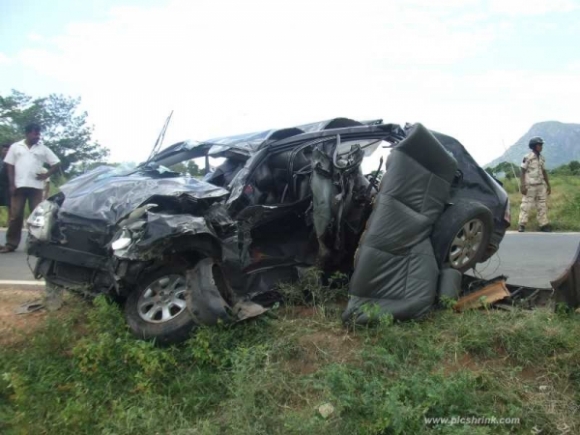
crashed  car after an accident

Today what do we get to see on TV or in national newspapers constantly? Either a motorcyclist has been hit by a heavy vehicle, a bus crashed into some other property or fallen off a precipice killing a few and injuring many, or head-on crashes of busses, lorries, containers with three wheelers and/motor cycles, giving a gloomy picture on deaths and/or injuries.

The public in general, as well as the media, have been crying out for years to the authorities, ‘until the sun begins to rise from the east and the moon loses its splendor, to tackle this problem on a serious note. It is however encouraging at least to note now that many policemen and women, apart from the traffic police, are going to be deployed to nab and book traffic offenders in order to address this problem in a constructive manner.

One of the problems Sri Lanka faces today is the increase in number of new vehicle registration, which contributes to road accidents. In such a backdrop road/traffic/town town planners and traffic control and implantation authorities need to work abreast with each other to obtain optimum results without simply blaming the traffic police alone, who most of the time suffer burning in the hot sun and getting wet in heavy showers, to deal with the problem.

Traffic Lights.

Syncronisation of traffic colour light signals with balanced time intervals, after careful studies by taking a particular congested area into consideration, will greatly enhance the traffic flow. Today in Sri Lanka, however, policemen on duty at clogged junctions have a habit of turning off the traffic lights and attempt to control the passage manually by hand gestures which becomes counter productive.

Traffic signals on the other hand are installed after a careful analysis of traffic patterns at an enormous cost to the government; professionals and experts, at either Moratuwa University or other relevant institutions, give preference to the busiest lanes depending on the time and place of the day generally prior to such time settings.

Switching off traffic signals during peak hours by police officers and taking its responsibility upon themselves is often criticised by motorists as making a complete mess on the roads which invariably gives rise to long and uneven traffic jams and queues. If Sri Lanka were to abide by the international modes of operandi in controlling and filtering traffic in a smooth manner, then it would be essential to keep the policemen out without having to interfere with electronic colour signals. Their participation could be more beneficial by being vigilant on traffic offenders and imposing heavy fines rather than many of them who seem to act as only ‘ by-standers’! How can the efficiency levels of a human brain be compared with that of a computer programmed pre-setting of colour light signal operation?  It does not simply add up to.

Errant motorists too are a pain in the present day traffic/road debacle. Either their total lack of knowledge on the highway code or many who are familiar with the motor traffic law but are taking the attitude of ‘ if you cant win ‘em, why not join them’ and turn public roads into a chaos.

Traffic police should be more vigilant and strict on the despicable behaviour of high speed bus drivers who deem to think roads are their private domain; ‘three-wheelers’ (tuk tucks) creeping in and out of vehicle gaps like cockroaches as much as the selfish motor cyclists who hug the middle of the road or climb onto pavements at traffic blocks by completely ignoring the pedestrians safety and their right to use such pavements need to be severely apprehended.  There is no point in the presence of a uniformed policeman on the roadside if only he/she behaves as a by-stander while errant motorists blatantly break the law right in front of their eyes.

‘On- the- spot’ fines for negligent drivers with a point system and suspension of their driving for offences, will undoubtedly be a bitter pill and it could cure the present state of chronic disease prevalent among Sri Lankan motorists.

Blatant Violation

The Ceylon/Sri Lanka Motor Traffic Act categorically emphasises that one should always overtake only from the right. DIG Ashoka Wijetilaka was once quoted as saying, drivers should always use the left lane and the right lane should be used only to overtake a vehicle”. This warrants lane discipline to be thoroughly monitored and strict action taken by mobile patrol Traffic Police units as much as every police officer who stands on the roads from morning till night. Regrettably, to-date, almost every motorist flagrantly breaks this basic statute while the Traffic Police are seen  turning a Nelsonian eye! Rigid enforcement of this fundamental law can turn into a money-spinner for the Police Department only if the latest move of extra police personnel deployed .

The presence of a policeman near a zebra crossing or at pelican crossing can always act as a deterrent to a would be motor offender. By such presence, the police officer should be conscious and duty bound to be firm and impose heavy fines at every moment he detects an errant motorist breaking the traffic law. Hefty fines do work in combatting the increase in disruptive drivers on the road but that should not be made the general criteria to get convictions recorded in a policeman’s daily diary only to ‘ upgrade the officer’s status’!

Motorists often complain that some of the policemen conceal behind trees or sit inside a ‘tuk tuk’ to catch errant drivers and issue penalty notices and/or refer them straight to courts. This does not help much in tackling the issue. Ideally when an aberrant motorist is penalised and issued with a penalty notice, he should in the first instance be banned immediately from driving for at least for two weeks and make him/her attend a specially designed class room as a punishment during that prohibition period and made he/she listen to lectures and video clips by senior police officers on safety and driving techniques along with familiarizing them with the highway code. For this purpose either the department of police or Ministry of Transport needs take the initiative to organise such classes. This could be regarded as very harsh, but bitter medicine certainly helps to cure chronic diseases! Through experience of such criteria where one tends to lose one’s wages by attending to such punitive classes, soon the message will go down well.

The ‘ Yaha palanaya motto’ of abandoning of politicians motorcades that used to harass and intimidate all the other road users when they were flying on road at speed needs to be admired with due credit. If no one is above the law, the police is duty bound to book any vehicle whether it bears armed forces number plates, huge luxury Landcrusers or four wheel drive vehicles whenever any traffic laws are violated. In the UK motorway traffic police had fined even Prince Charles and the late Princess Diana for over speeding on motorways, and they have gracefully accepted the mistake and paid their fines, of course by sending a representative to the courts.

It is evident that the traffic police take so much of trouble in trying to reduce the congestion in Colombo roads by constantly making various roads into one way streets. Among priorities in curbing road accidents      the left lane policy” was introduced once in Colombo and seems to have died a natural death after a week or so!

What is most important today is strictly to make the three wheelers, trucks, 30-40’containers hugging the middle of the road and the overtaking lanes at speed.  Unruly private bus drivers blaring ear piercing hones from behind and attempting to intimidate the driver in front needs special attention as they can themselves cause road accidents by being so impatient or bulling and another driver in front into a panic and cause an accident. For all these offences there are rules only confined to the rulebook unfortunately!

Traffic offenders

The current procedure of dealing with traffic offenders is regarded as antiquated and causing inconvenience to victims. If international norms are to be followed, any driver who violates the traffic law can be served with an on-the- spot penalty notice, demand his/her driver’s licence (by the prosecuting officer) and documents forwarded to a police station nominated by the offender at the time of the offence; the officer then hands over   a note to the offender indicating the amount of the fine to be paid and gives him/her seven days to pay the fine. The offender then pays the fine to a post office/bank and visits his nominated police station with the payment slip to recover his licence. The drunken drivers could be referred to Magistrates Courts for necessary action.

This is what happens in the UK where the offender is given seven days to produce the payment slip to the nearest police station he/she nominates at the time of the incident and the prosecuting police officer is bound to send the charge sheet details and the licence to that particular police station.  By this way motorists are not inconvenienced.

The methods adopted today are so outdated and troublesome for anyone to get the licence back, and for this purpose having to travel all the way up the police station where the offence had been committed. There were much talk about helping the public by introducing a method of paying such motor fines with the help of mobile phones, however such hopes and suggestions seem to have died a natural death!  In this computer and IT age, such fines can be made payable even on the Internet (on line) which will make it most convenient to every one by nominating the nearest police station by the offender.

Undoubtedly the Police is making a desperate attempt by introducing various methods to educate the Lankan motorists but appears to be faced with a problem, as the Police Commissioner himself has spelt out, that many recruits were trained only to handle guns during the terrorist insurgency and they need to be given refresher and orientation courses on policing and/or traffic matters.

tilakfernando@gmail.com

සතුරු ඉසව්ව

August 20th, 2015

වෛද් රුවන් එම් ජයතුංග 

හිම මත ඇද වැටුණු ආටිලරි උණ්ඩය පුපුරා ගියේ ලෝහ කැබලි දසත විහිදුවමිනි. සුදු පැහැති හිම මත වෙඩි බෙහෙත් වලින් පිලිස්සී ගිය  ක​ළු පැහැති විශාල ආවාටයක් මොහොතකින් දැකගත හැකි විය. අප ගරා වැටුණු ගොඩනැගිල්ල දෙසට දිව ගියේ තවත් ආටිලරි ප්‍රහාර අප සිටි දිශාවට එල්ල වීම අනිවාර්ය නිසාය. අපගේ අදහස සනාථ කරමින් ගොඩනැගිල්ලේ දකුණු කෙළවරට තවත් ආටිලරි උණ්ඩයක් ඇද වැටුණි.

සූ හඞ නගමින් එන ආටිලරි මාරයාගෙන් බේරීමට අපි බිම වැතිරුණෙමු. හිම සහ පස් මහා වර්ෂාවක් මෙන් අපගේ ශරීර මතට ඇද හැළුණි. ආටිලරි ශබ්දය නිසා කම්පනයට පත්වීම නිසාදෝ වේරා අඩ සිහියෙන් නැගිට ඉදිරියට දිව ගියාය. තෙවන ආටිලරි ප්‍රහාරය එනවිට අප හිස් පොලවට තදකර ගත්තෙමු.

හැකි ඉක්මනින් අපි ගරාවැටුණු ගොඩනැගිල්ල දෙසට බඩගා ගියෙමු. අපට යාර විස්සක් පමණ දුරින් වේරා වැටී සිටියාය. ඇයගේ දකුණු කකුළ දණහිස ළඟින් වෙන්ව ගොසිනි. කකුළෙන් ගැලු රුධිරය හිම මත රතු පැල්ලම් ඇති කළේය.

sathuruissavva

ලූතිනන් ඊගර් කිරිලවිච් වේරා දෙසට දිවගියේ ආටිලරි අනතුරු නොතකමිනි. ඒ අතරවාරයේ අප ගරා වැටුණු ගොඩනැගිල්ල තුළට වැදුණේ වැලි මීයන් මෙනි.

මහල් හයකින් යුත් ගොඩනැගිල්ල යුද්ධයට පෙර සපත්තු නිෂ්පාදනය කළ කම්හලකි. කාලතුවක්කු උණ්ඩ නිසා කඩාවැටී ඇති ගොඩනැගිල්ලේ විශාල කුහර අපට රක්ෂිත ස්ථාන වූ බව සැබවි. කඩා වැටී ඇති කොන්ක්‍රීට් බිත්ති, යකඩ බාල්ක අපව ආටිලරි ප්‍රහාරවලින් ආරක්ෂා කළේය. එහෙත් සෑම අටිලරි ප්‍රහාරයක් සමගම මුළු ගොඩනැගිල්ලම දෙදරුම් කෑවේ ධූලි හා පස්  නාස් පුඩු වලට යවමිනි.

ලූතිනන් ඊගර් කිරිලවිච් හතිලමින් වේරා ඔසවාගෙන අප සිටි දිශාවට පැමිණියේය. වේරාගේ දෙනෙත්   පියවී ඇත. ඇයගේ දකුණු කකුලේ දණහිස දෙස බැලීම පවා බිය ගෙනදේ. එල්ලෙන මස් වැදලි, සුදු පැහැති ස්නායු තන්තු සහ කලව අස්ථීයේ කොටස් පෙන්නුම් කළේ ෆැසිස්ට් සතුරාගේ මෘග භාවයයි.

හෙදි සහායිකාවක වූ යුල්යා වේරාගේ තුවාලයට ඉහළින් තිරිංගයක් දමා රුධිර වහනය  අඩු කළාය. ලේ වහනය නිසා ඇයගේ ලා දුඹුරු පැහැති නිළ ඇඳුම තද රතු පාටට හැරී තිබේ. ඇයට හුස්ම ගැනීම පහසු කරනු වස් ඊගර් කිරිලවිච් වේරාගේ නිළ ඇඳුමේ බඳ පටිය බුරුල් කළේය. 

මීළගට කළ යුත්ත කුමක්ද යන්න පිළිබඳව අප සියළු දෙනාටම හරි හැටි කල්පනාවක් නොවීය. රතු හමුදාවේ සෙබළුන් හය දෙනෙක්, හෙද සහායිකාවක් හා මරණීය තුවාල ලත් සෙබලියක් ජර්මානු ප්‍රහාරවලට කොටුවී සිටිති. ආටිලරි ප්‍රහාරය නැවතුණු වහාම ජර්මානු භටයන් ගරා වැටුණු ගොඩනැගිල්ල දෙසට එනු නිසැකය. ඔවුන් වළකාලීමට අපට ඇති සීමිත පතුරොම් ප්‍රමාණය සමත් නොවනු ඇත. ඇරත් ගැසොලීන් ටැංකි පිටේ බැඳගත් ගිණි  විහිදන්නන් කිහිප දෙනකු අප සිටි දිහාවට  ගිනි ප්‍රහාර එල්ලකළ හොත් අප සියළු දෙනා මෙම කොන්ක්‍රීට් ගුහාව තුළ  පණපිටින් පිලිස්සී යනු ඇත.   

ඊගර් කිරිලවිච් අපගේ කණ්ඩායමේ නායකයා මෙන්ම ඒකකයේ දේශපාලන කොමිසාර්වරයාද වෙයි.  ඔහු හා වේරා අතර ආදර සබඳතාවක් තිබූ බව මම දැනගෙන සිටියෙමි. පෙම්වතකු ලෙස ඔහුගේ හිතේ ඇවිලෙන වේදනාව මට සිතාගත හැක. ඔහු වේරාගේ හිස පිරි මැද්දේය. ඇය හුස්ම ගන්නේ අසීරුවෙනි. හෙද සහායිකාව වේරාගේ වේදනාව අඩුකරනු වස් ඇයට මෝෆීන් එන්නත් කළාය.

ආටිලරි ප්‍රහාරය නතරවූ අතර එළඹුණු නිහැඞියාව අපව තවත් ව්‍යාකූල කළේය. අපගේ ගොඩනැගිල්ලේ පසුපස දෙසින් කිලෝමීටරයක් පමණ දුරින් රතු හමුදා බංකර පෙලක් තිබේ. එම ස්ථානයට බඩ ගාගෙන ගියහොත් අපට අපගේ සගයන් මුණගැසිය හැකිය. එහෙත් ජර්මානු ස්නයිපර්වරුන්ගේ ඇස වසා යාමද ඉතා අසීරු කර්තව්‍යයකි. ඇරත් බරපතල තුවාල ලැබූ වේරා රැගෙන යා හැක්කේ කෙසේද?

 දිමිත්‍රි  අපගේ කණ්ඩායමේ ලාබාලයාය. ඔහුගේ වයස අවුරුදු 17 ක් පමණ වේ. වොල්ගා නදිය අසබඩ ඉපදී එහි හැදී වැඩී සිටි ඔහු කදිම ඉලක්කකරුවෙකි. ඔහු තම රයිෆලය ගෙන කොන්ක්‍රීට් ගුහාවේ කට මුර කළේය. මම සාෂා ,පාවෙල් හා නිකොලායි සමඟ අපට ඉතිරිවී තිඛෙන ආයුධ එක්රැස් කළෙමි. පතුරන් ඇරුණු කොට අපට තිබුණේ අත් බෝම්බ හයක් පමණි.

දෙපැයක් පමණ ගතවී ගියේය. වේරා වරක් දෑස් හැර යමක් කීවාය. එහෙත් ඇය කීවේ කුමක්ද යන්න පැහැදිලි නොවීය. ශීත හා කුසගින්න අපව තදින් පෙළීය. සාෂා තමා ළඟ තිබුණු අවසන් පාන් ගෙඩිය පෙති හයකට කැපීය. ඊගර් කිරිලිවිච් තම මල්ලට අත දමා කැකිරි ගෙඩි දෙකක් දුන්නේය. සාෂා තම සන්තකයේ තිබූ ඌරුමේදය තෙල් කැබැල්ලක් සමූහ ආහාර වේලට එක් කළේය. මම මගේ මල්ලේ තිබූ ඇපල් ගෙඩි කිහිපය ඊට එක් කළෙමි. 

ඉතා දිළිඳු හා සුළු ආහාරය කිසිසේත් ප්‍රමාණවත් නොවීය. එහෙත් දින එකහමාරක් පමණ කුසගින්නේ සිටි අපට එය දිව්‍ය භෝජනයක් විය. 

ජර්මානුන්ගේ පණිවිඩ හුවමාරු සබඳතා කපා දැමීම පිණිස අප කණ්ඩායම සතුරා ස්ථානගතවී ඇති ඉසව්වට පිටත් කළේ කපිතාන් කිර්ගීන් විසිනි. ඔහු අපට මෙම කර්තව්‍යයේ භයානක පාර්ශවයද නෙවලහා එළි කළේය. එහෙත් අප සියළු දෙනාම සිය කැමැත්තෙන්ම මෙම කටයුත්තට එක්වූයෙමු.

අප මුලින්ම කැඩීබිඳී ගිය ගොඩනැගිලි අතරින් බඩගාගෙන ගොස් ජර්මානු පැන්සර් ඩිවිෂනයේ මූලස්ථානය යාකරමින් එලාතිබූ ටෙලිෆෝන් කම්බි කපා දැමූවෙමු. ටෙලිෆෝන් කම්බි කැපීමේ ලා පාවෙල් ඉතා අනගි දක්ෂතාවයක් පෙන්වීය. උස් තැන්වලට  ඔහු බඩගෑවේ වඳුරෙකු මෙනි. ඇතැම් කම්බි පොළවේ වළලා තිබුණි. එවැනි ස්ථාන අප හඳුනා ගත්තේ පොළවට ඇණගසා තිබූ කම්බි කොකු මගිනි. සොයා ගත් සෑම ටෙලිෆෝන් කම්බියක්ම ඊගර්  කිරිලවිච් තම අත තිබූ යකඩ අඞුවෙන් කපා දැමීය.

අප ජර්මානුන්ගේ පණිවිඩ සබඳතා කපා දමන විට ඔවුහු කඩිනමින්ම ඒ  බව දැනගත්හ. යුද්ධයේ නිපුන ජර්මානුවෝ මෝඩයෝ නොවෙති. ඔවුන් තම දුරකථන කම්බි විදුලි පුවරුවක් හරහා ඇද තිබේ. අප දුරකථන කම්බි කපන විට ඔවුන්ගේ මූලස්ථානයේ පණිවුඩ පුවරුවේ විදුලි බුබුළු දැල්වේ. එමගින් ඔවුන් කඩාකප්පල්කාර ක්‍රියාව  සිදුවන ඉසව්ව දැන ගනිති. 

අප ජර්මානුන්ගේ පණිවුඩ ජාල රැසක් කපාදැමුවෙමු. මෙම සියල්ල යථා තත්වයට පත්කිරීමට ඔවුන්ට සති ගණනාවක් ගතවෙනු ඇත. ඒ  පිළිබඳව සිතනවිට විශාල ප්‍රීතියක් දැනේ. ජර්මානු සතුරා අපගේ භූමියෙන් පලවා හැරිය යුතුය.

අප කම්බි කපන විට දිමිත්‍රි  සහ සාෂා අවට නිරීක්ෂණය කළේ සතුරන් අප සිටි ඉසව්වට පැමිණේද යන්න බැලීමටය. ඔවුන් ඉතා ඉක්මනට අප සිටි දිශාවට එන බව අපි දැනගෙන සිටියෙමු.

හදිසියේම දිමිත්‍රි  ඈත එන ජර්මානු මුරභට කණ්ඩායමක් ගැන අනතුරු හැඟවීම නිසා අපි වහාම බිම දිගාවී පසුපසට බඩගෑවෙමු. ඔවුන් අප සිටින දිශාවට ඒම ප්‍රමාද කිරීම සඳහා හොඳහැටි ඉලක්කය ගත් දිමිත්‍රි කණ්ඩායම් නායකයාගේ හිසට රයිෆල් උණ්ඩයක්  යැවීය.

සෑම ජර්මානු භට කණ්ඩායමක නායකයා අත මවුසර් වර්ගයේ පිස්තෝලයක් තිබේ. එම නිසා අප සැම විටම පිස්තෝලයක් අතින් ගත් ජර්මානුවන්ව ඉලක්කයට ගත්තෙමු. කණ්ඩායම් නායකයා මැරී වැටෙත්ම සෙබළුන් සී සී කඩ දිව ගොස් සැඟවෙති. යළිත් දෙවන පෙළ නායකයකු අණ දෙන තෙක් ඔවුන් සිටි තැන්වලම සිටිති. එහෙත් ඇතැම් කණ්ඩායම් වඩාත් කල්පනාකාරීය. ඔවුන් බර අවි යොදා පහර එල්ල කරති. එසේම සෑම සෙබලෙක්ම නායකත්වය ගෙන ක්‍රියා කරති. 

ස්ටැලින්ග්‍රාද් ආක්‍රම​ණ  යුද්ධයට අණදෙන්නේ ජර්මානු හය වැනි හමුදාවේ ජෙනරාල් පවුලස් බව මා අසා තිබේ. ඔහුගේ හමුදාව ප්‍රංශය යටත් කර ගත්තේය. දැන් ඔවුන් අපගේ එළිපත්තටම පැමිණ ඇත.

ජර්මානුවන් අපගේ චිත්ත ධෛර්යය කඩනු වස් ශබ්ද විකාශන යන්ත්‍ර මගින් රතු හමුදා  සෙබලූන්ට යටත් වන ලෙස පවසති. අපගේ සදාදරණීය නායක ස්ටාර්ලින්ගේ නුගුණ කියති. යටත් වුවහොත් අපට උණුසුම්  අැඳුම්ද, උණුසුම් ආහාරද දෙන බවට පොරොන්දු වෙති. එහෙත් පැසිස්ට් සතුරා වොල්ගා නදිය අසබඩ ගම්මානවල අහිංසක ගම්මුන් මරා දැමූ හැටි අපට අමතක කළ නොහැකිය. ඔවුන් නිරායුධ වැසියන් එකට ගැටගසා ඔවුන්ව වොල්ගා නදියේ ගිල්වා මැරුවේ උණ්ඩ ඉතිරි කර ගැනීමටය.

දිමිත්‍රිගේ රයිෆලය දෙවන වරද පත්තු විය. ඒ පහරින්ද ජර්මානුවෙකු වැටුණු බව මම නිසැකවම දැන සිටියෙමි. ඔහු සුප්‍රක්‍රට ස්ටැලින්ග්‍රාද් වීරයෙකු වන වැසිලි සායිස්සොව් මෙනි. දිමිත්‍රිගේ  ඉලක්කය නිවැරදිවම ජර්මානුවන් නිසල කළේය.

රතු හමුදා ස්නයිපර්වරයා නිසා සැඟවුණු ජර්මානු භට පිරිස් අප සිටි දිශාව අනිවාර්යයෙන්ම කාලතුවක්කු ඛන්ඩයට දන්වන්නට ඇත. පසු පසට යන අප වෙතට ආටිලරි වර්ෂාවක් එන්නට විය. ආටිලරි ප්‍රහාරයෙන් ගැලවෙනු වස් අප ගරාවැටුණු ගොඩනැගිලි තුළට ගියමුත් දැන් අපට එළියට ඒමට නොහැකිය. 

තව හෝරාවක් ගතවී ගියේ සතුරන් පිළිබඳ කිසිම හෝඩුවාවක් නොමැතිවය. ඔවුන් ගොඩනැගිල්ල  වටලා ඇද්ද? ඔවුන් බලා සිටින්නේ මන්ද? අපව පණපිටින් පුලූස්සා දැමීමට ගිනි විහිදුවන භටයන් එනතෙක් ඔවුන් සිටින්නේද?

මම අත්බෝම්බයක් අතට ගත්තේමි. මෙය ජර්මනියේ නිෂ්පාදිත බෝම්බයකි. එහි අගට ලී මිටක් සවිකොට තිබෙන බැවින් ඉතා ඈතට එය විසි කළ හැක. යම් හෙයකින් ජර්මානු ගිනිජාලා විහිදුවන භටයන් අපගේ කොන්ක්‍රීට් ගුහාව අසලට පැමිණියහොත් මම මෙම අත් බෝම්බය ගසන බවට තීරණය කළෙමි. පණ පිටින් පිලිස්සීම ගැන සිතීමටත් අපහසුය.

යුධ ටැංකි නාශක උණ්ඩයක් ඇනතෝලි සින්චෙන්කෝ ගේ යුධ ටැංකියට වැදී ගිනි ජාලා මතුවන අයුරු මම වරක් දුටුවෙමි. යුක්රේන ජාතිකයකු වූ ඇනතෝලි සින්චෙන්කෝ උස මහත ශරීරයක් ඇත්තෙකි.  ඒ නිසා ගිනි ගන්නා යුධ ටැංකියෙන් බිමට පැනීමට ඔහු ප්‍රමාද විය. 

ඔහුගේ මුහුණ හා අතපය පිළිස්සී තිබුණ ආකාරය මම දුටුවෙමු. වේදනාව නිසා ඔහු හිම මත මුහුණ ඔබා ගත්තේය. එහෙත් ඉන් පැය දෙකකට පමණ පසු ඇනතොලි සින්චෙන්කෝ  මියගියේ වේදනාවෙන් කෑ ගසමිනි. එලෙස මිය යාමට මට කිසිසේත් අවශ්‍ය නැත. 

ජර්මානුන් අපට ප්‍රහාරයක්  එල්ල නොකළේ මන්ද? අපි කුහරය තුළ සුදානමින් සිටියෙමු. එහෙත් එළියේ සිදුවන්නේ කුමක්ද යන්න ප්‍රහේළිකාවකි. 

අප අටදෙනා සිටි කොන්ක්‍රීට් ගුහාව අපට ආරක්ෂිත ස්ථානයක් නොවේ. යම් ලෙසකින් යළි ගොඩනැගිල්ලට ආටිලරි උණ්ඩයක් වැටුනොත් අඩමානයට ඇති විශාල කොන්ක්‍රීට් බිත්ති කඩාවැටී කුහරයේ දොර වසා දමනු ඇත. එවිට අපට සිදුවන්නේ පණ පිටින් සිරවී මිය යාමටයි.

දැන් ක්‍රම ක්‍රමයෙන් අඳුර වැටීගෙන යයි. වේරාගේ මුහුණ මලානිකය. ඇය තවමත් අසීරුවෙන් හුස්ම ගනියි. කුහරය තුළට වැද සිටි නිසා  අප තුළ අනාරක්ෂිත බව වර්ධනය වෙයි. ලූතිනන් ඊගර් කිරිලවිච්ගේ  අනුමැතියෙන් දිමිත්‍රි හා මා කොන්ක්‍රීට් ගුහාවේ කටින් එළියට පැමිණියේ අපට පලා යාමට සුදුසු තත්වයක් තිබේදැයි බැලීමටය. අඳුර වැටී ඇති නිසා ජර්මානු ස්නයිපර්වරුන්ට අපට නොපෙනීම සහනයකි. 

ගොඩනැගිල්ල තුළට අප පැමිණි දොරටුවෙන් එළියට යනවා වෙනුවට ගොඩනැගිල්ලෙන් එළියට පැනයා හැකි වෙනත් මගක් තිබේදැයි මම සොයා බැලූවෙමි. ඉතා විශාල ගොඩනැගිලි සංකීර්ණයකට අප මැදිවී සිටින බව තේරුම් ගියේය. බෝම්බ ප්‍රහාරවලින් කැඩීගිය බිත්ති නිසා නිශ්චිත මාර්ගයක් දක්නට නොවීය. අපි සුන්බුන් ඉවත් කරමින් ගොඩනැගිල්ල තුළට ගියෙමු. 

සුන්බුන් පාදා ගැනීමෙන් පසු පඩි පෙලක් මතුවිය. මම දිමිත්‍රි සමග පඩිපෙළ ඔස්සේ පහළ මාලයට ගියෙමි. අප ගමන් කළේ සෙමිනි. සෑම මිනිත්තුවකදීම තුවක්කුව පත්තු කිරීමට අප සූදානමින් සිටියේ කොයි මොහොතේ හෝ සතුරා මුණගැසේ යැයි යන අනවරත සැකය නිසාය.

පියගැටපෙළ ඔස්සේ අපි පහත මාලයේ කාමරයකට පැමිණියෙමු. එහි තට්ටු දෙකේ ලී ඇඳ​කි. බිත්තිවල ජර්මානු බසින් යම් යම් දේවල් ලියා තිබු‚. මෙම ස්ථානය ෆැසිස්ට් භටයන් නැවතී සිටි ස්ථානයක් බවට සැක නැත. එහෙත් ඔවුන් දැන් මෙම ස්ථානයේ නොසිටීම පුදුමයකි. ඇතැම්විට මෙම ස්ථානය ඔවුන් තාවකාලිකව භාවිතා කළා විය හැක.

දිමිත්‍රි   හා මම කාමරය හොඳින් පරීක්ෂා කර බැලූවෙමු. බිත්තිය අද්දර පිළිස්සුණු දුම්වැටි ගොඩකි. තේ සෑදීම සඳහා යොදා ගත් කේතලයක්ද, සීත පළවා හැරීමට භාවිත කළ උදුනක්ද විය. උදුන සාදා  තිබුණේ විශාල කාලතුවක්කු උණ්ඩයක කවරයකිනි. දර ලෙස ෆැසිස්ට් සොල්දාදුවන් භාවිත කරන ලද්දේ ගොඩනැගිල්ලේ තිබුණු මේස පුටුය.

මෙට්ටයක් යට තිබී මට ජර්මානු භටයකුගේ යකඩ කිණිස්සක් හමුවිය. එහි මිටේ ජර්මානු ස්වස්තිකය කොටා තිබු‚. මම කිණිස්ස මගේ සෙබල කබාය තුළ රුවා ගතිමි.

උදුන අසල තිබී වියලී ගිය අර්තාපල් තොගයක්ද, ජර්මානු හමුදාවට ඛෙදා දෙන හරක් මස් ටින් දෙකක්ද අපට හමුවිය. මෙය අගනා සොයා ගැනීමකි. යටත් පිරිසෙයින් අපට තව දින දෙකකටවත් යැපිය හැකි ආහාර මෙහි තිබේ.

බිම්මහලේ සිට පසුපස දොරටුවට යෑමට අපට අවකාශයක් නොවූයේ විශාල බිත්තියක් කඩා වැටී දොරටුව අවහිර වී තිබූ හෙයිනි. මෙම බිත්තිය ඉවත් කිරීමට මිනිසුන් දස දෙනකුට දින තුනක්වත් ගතවෙනු ඇත. එහෙත් ගල් ඉන්නක්වත් නැති අප මෙය කරන්නේ කෙසේද? අපි ආහාර තොගය සහ උදුන සගයන් සිටි කුහරයට ගෙන ගියෙමු.

අප දෙදෙනාගේ සොයාගැනීම්වලට ලූතිනන් ඊගර් කිරිලවිච් ප්‍රසාදය පළ කළේය. එහෙත් ඔහුගේ දෙනෙත්වල ඇති කඳුළු මම දුටුවෙමි. වේරාගේ තත්වය දැන් අඩමානය. අධික රුධිර වහනය නිසා ඇයගේ මුහුණ සුදු පැහැ හුණු ගෑ බිත්තියක් මෙන්විය. ඇය කඩින් කඩ හුස්ම ගත්තාය. කොන්ක්‍රීට් ගුහාවේ ශීත පළවා හරිනුවස් සාෂා අප ගෙනා උදුනට පුටු කකුල් කීපයක් දමා ගින්නක් මෙලවිය.

අපි මුළු රාත්‍රියම  කුහරයේ ගුලිවී සිටියෙමු. වේලූනු අර්තාපල් හා මස් ස්වල්පය අපි සම සමව බෙදා ගතිමු. එලිවෙන ජාමයේදී වේරාගේ හුස්ම ගැනීම ඉතා දුර්වලවී ගිය අතර ඇයගේ අවසානය එළඹී ඇති බව අපට තේරුම් ගියේය.

වේරා අවසන් හුස්ම හෙලූවේ ලූතිනන් ඊගර් කිරිලවිච්ගේ දෑත් මතය. අපි වේරාගේ මළසිරුර පොරෝනයක ඔතා පහත මාලයේ වූ කාමරයේ ඇඳක් මත තැන්පත් කෙළෙමු. මිනිය වළ දැමීමට අපට අවකාශයක් නොවීය. අප වේරාගේ අවසන් කටයුතු කරන තෙක් ඊගර් කිරිලවිච් හිස් බැල්මකින් යුතුව වේරාගේ නිසල සිරුර දෙස බලා සිටියේය.

වේරාගේ සිරුර පහතමාලයේ තැන්පත් කොට අප යලි කොන්ක්‍රීට් කුහරය තුළට පැමි‚යේ දුක, සන්තාපය සහ අවිනිශ්චිතතාව සිත්තුළ දරා ගනිමිනි.

වෛද් රුවන් එම් ජයතුංග 

මැතිවරණ දැන්වීම් වලට මිනිත්තු 30 කට මිලියන 150 ක් වියදම් කළේ කවුද ?

August 20th, 2015

Adaderana

ශ්‍රී ලංකාවේ පවතින මැතිවරණ නීති වඩාත් හිතවාදී වන්නේ මැතිවරණ වලදී දැවැන්ත ලෙස මුදල් වියදම් කළ හැකි අපේක්ෂකයින්ට බව පැවති මහ මැතිවරණය නිරීක්ෂණය කළ නිදහස් මැතිවරණයක් සඳහා වූ ආසියානු ජාලය (ANFREL) අවධාරණය කරයි.

මෙම සංවිධානය මෙරට මූල්‍ය ක්ෂේත්‍රයේ ප්‍රමුඛයින් කිහිප දෙනෙකු උපුටා දක්වමින් සඳහන් කරන්නේ ගෙවුණු මහ මැතිවරණයේ මිනිත්තු 30 කටත් අඩු කාලයකදී තමන්ගේ වෙළඳ දැන්වීම් ප්‍රචාරය කිරීම සඳහා අපේක්ෂකයින් 10 දෙනෙකු පමණ රුපියල් මිලියන 150 ක් පමණ වියදම් කර තිබෙන බවයි.

මෙරට පාර්ලිමේන්තු මන්ත්‍රීවරයෙකුගේ මාසික වැටුප රුපියල් 89,000 ක් වන අතර වසර පහක කාලයක් සඳහා මාසික වැටුප් ලෙස පාර්ලිමේන්තු මන්ත්‍රීවරයෙකුට රුපියල් මිලියන 5.3 ක් පමණ උපයා ගැනීමට හැකිවේ.

කෙසේවෙතත්, ලබාගත හැකි වැටුප් ප්‍රමාණයට වඩා සිය ගුණයක් පමණ ඡන්ද සඳහා වියදම් කිරීමට සමහර අපේක්ෂකයින් පෙළඹී සිටීම අවධානයට යොමුකළ යුතු කරුණක් බව සඳහන්ය.

සමානුපාතික නියෝජන ක්‍රමය යටතේ මුළු දිස්ත්‍රික්කයෙන්ම මනාප ඡන්ද එකතු කර ගැනීමට අපේක්ෂකයින්ට සිදුවීම නිසා දැවැන්ත මුදල් ප්‍රමාණයක් වියදම් කිරීමට නොහැකි ගෞරවණීය පුද්ගලයින්ට පාර්ලිමේන්තුවට තේරී පත්වීමට නොහැකි අතර මෙවර පාර්ලිමේන්තු මැතිවරණයේදීද එවැනි උදාහරණ ඕනෑ තරම් ඉදිරිපත් කිරීමට හැකියාව තිබේ.

මේ නිසා, ශ්‍රී ලංකාව ගොඩනැගීම වෙනුවෙන් මෙම මැතිවරණ ක්‍රමය වෙනස් කරන 20 වන සංශෝධනය වහාම සම්මත කර ගැනීම ඉතාමත් වැදගත් කාරණාවකි.

China’s Cash Proves Too Irresistible for Sri Lanka to Ignore

August 20th, 2015

by Daniel Ten Kate and Anusha Ondaatjie Courtesy Adaderana

Most central bankers would relish an office with an unobstructed view of the Indian Ocean’s sparkling waters. Sri Lanka Governor Arjuna Mahendran finds it dull.

He would rather see skyscrapers dotting the horizon as cargo vessels deposit containers into Colombo’s ports. Right now, piles of sand and stones remind him daily of a stalled China-backed $1.4 billion plan to build a city on reclaimed land that may attract even more investment dollars.

I’m hopeful that they will actually recommence this project,” Mahendran said from the 15th floor of the central bank on the eve of parliamentary elections. It will be transformative in many ways for the Sri Lankan economy.”
The comments reflect a change in tone since President Maithripala Sirisena vowed to pivot away from China when he ended Mahinda Rajapaksa’s 10-year rule in January. Even though Rajapaksa failed in a bid to become prime minister in parliamentary elections on Monday, China appears resurgent — mostly because Sirisena needs its cash to jump start growth.

Results showed Prime Minister Ranil Wickremesinghe’s United National Party, which backed Sirisena, winning 106 seats in the 225-person parliament — just short of a majority. Rajapaksa’s party came in second. Sirisena is expected to appoint Wickremesinghe for another term as early as Wednesday.

The Colombo port city is now likely to go ahead even as Sri Lanka boosts ties with Western nations and India, according to Razeen Sally, an associate professor at the National University of Singapore. The project has a pretty strong commercial logic” and China has ample funds, he said.

Rice for Rubber

There was hostility among those in government now to the Chinese because they were so identified with the Rajapaksa regime,” Sally said. Realism has set in.”

Strong ties between the nations date back to the 1950s, when Sri Lanka traded rubber to China in exchange for rice. The move in the wake of the Korean War prompted the U.S. government to sanction Sri Lanka for selling strategic materials to a Communist nation.

Decades later under Rajapaksa, China became Sri Lanka’s top investor, biggest government lender and second-largest trade partner. Security ties also grew: A Chinese submarine docked twice in Colombo last year, raising alarm bells in India.

After taking power, Sirisena moved to meet a campaign pledge to reduce Sri Lanka’s dependence on China. He opened an investigation into the Colombo port city project, prompting sea reclamation and other activities to stop.

Different Tone

Now his administration is changing its approach. With an economy more than 100 times smaller than China’s, Sri Lanka has little choice but to play nice.

Last month, the chairman of Sri Lanka’s Board of Investment said the port city project was definitely not off” and work will soon be restarted after environmental issues are addressed.

For its part, China is also mending fences. Beijing’s leaders want to complete a free-trade deal with Sri Lanka by year’s end, Chinese Ambassador Yi Xianliang said in Colombo on July 29 as he announced more than $350 million in aid money.

Perhaps more damaging than Rajapaksa’s close ties with China was his antagonism toward the West. The U.S., Europe and India accounted for about 60 percent of Sri Lanka’s exports in 2014, compared with about 2 percent for China, according to data compiled by Bloomberg.

Sri Lanka’s shipments of textiles and garments floundered after 2010, when the European Union denied preferential trade access for exports because the country failed to improve its human rights record. Wickremesinghe last week assured Sri Lankan garment exporters that his government would work toward regaining those concessions by next year.

Friends Needed

Mahendran, Sri Lanka’s central bank governor, said the shift in foreign policy was one of the main differences between Sirisena and Rajapaksa. Even as the government improves relations with the U.S. and Europe, the notion that Sri Lanka is moving away from China was really overblown,” he said.

This is a pretty small economy and foreign policy has a big impact on how the economy works,” he said. We can’t afford not to have friendly relations with our largest markets.”

In his office, he looked out over a stretch of coastline that ran from Colombo’s harbor to the international airport about 35 kilometers (22 miles) away. In between, he said, the government would push for industrial parks, housing developments and other infrastructure that would transform Colombo into the most liveable city in South Asia.

China’s ability to attract capital is crucial for Sri Lanka to take advantage of its geographical position near the world’s fastest growing populations in Asia and Africa, Mahendran said – – even if it means losing his peaceful ocean view.

We need a little bit of busyness in Sri Lanka to be honest,” Mahendran said. It’s not busy enough.”

bloomberg

Sirisena – Ranil- CBK altogether setting up a National govt. just to give way for TNA to be the opposition.

August 20th, 2015

Mahinda K

This resembles the same situ that arose in 1977 July  when UNP won with 2/3rd majority and SLFP was downed to eight seats, the then Tamil party lead by A. Amirthalingam (TULF) sat as opposition of the parliament.

Just after two years, the LTTE started its fight, TULF played hell demanding Eelaam!
You already know this lasted for almost 30 years, costing thousands of lives, properties etc.
Isn’t this a repeating of the history?

People who wowed for prosperity from UNP will yield disparity instead, the USA and UK together with Europe will give you much expected damn balls!

For sure handful of them will keep making money for their generations ahead!

Poor people will pay through nose!

USA and UK will camp here!

Your Daughter and Son will be their prey!

There will nothing left for you this time, with even the land gone to Yankees unlike last time.

Await more surprises to come, and then helpless you regardless of colour will remember the Appachchee.

WHAT HAPPENED TO 58LAKH VOTES WHO VOTED FOR MAHINDA RAJAPAKSE

August 20th, 2015

Shenali Waduge

WHAT HAPPENED TO 58LAKH VOTES WHO VOTED FOR MAHINDA RAJAPAKSE

  2015 January Presidential Elections 2015 August Parliamentary Elections
Registered voters 15,044,490 15,044,490 (same number as January)
Who voted 12,264,377 11,684,098 (580,279 did not vote)
Rejected votes 140,925 517,123 (376,198 more rejected than January)
Voter turnout 81%
Votes for Maithripala Sirisena 6,217,162 – 51.28% UNF – 5,098,916 – 45.66%TNA – 515,963 – 4.62%JVP – 543,944 – 4.87%

(the 3 totals 6,158,823 come close to the votes MY3 received in January with a shortfall of 58339 which can be made up by totally below SL Muslim Congress and other votes which would have gone o MY3 in January)

Voters for Mahinda Rajapakse 5,768,090 – 47.58% UPFA – 4,732,664 – 42.38%There a 1,029,426 difference from January?
Total of votes secured by 17 other candidates 138,200 Total votes secured by below = 275,491SLMC – 44,193EPDP – 33,481

Independents – 42,828

ACMC – 33,102

DP – 28,587

BBS – 20,377

ACTC – 18,644

CWC – 17,107

FSP – 7,349

UPP – 5,353

Others – 24,467

  • The number of registered voters is the same as January
  • In January 2015 the number of voters were 12,264,377
  • In August 2015 the number of voters were 11,684,098
  • This means 580,279 did not vote in August 2015
  • In January 2015 the number of rejected votes were 140,925
  • In August 2015 the number of rejected votes were 517,123
  • There are 376,198 more rejected votes than January
  • The total of people who didn’t go to vote in August and those whose votes were rejected in August = 1,097,402
  • The question on a lot of people’s mind is what happened to the 58 lakhs Mahinda Rajapakse secured in January 2015 which the SLFP/UPFA was expecting would have increased throughout the past 8 months. However the January total 5,768,090 has come down to 4,732,664 with a deficit of 1,029,426
  • What happened to the 1,029,426?
  • The total of rejected votes and those who did not vote come to 1,097,402.
  • Can we believe that only Mahinda Rajapakse’s 517,123 supporters rejected their votes?
  • Can we believe that only SLFP/UPFA 580,279 supporters did not go to vote?
  • If we reduce 1,097,402 from the deficit of 1,029,426 we get 67976
  • Presuming we take the votes secured by all the independents / the BBS & the FSP we get 70554 (Reduce 70554 from 67976 you get 2578
  • Anyone wondering what happened to 1,209,426 now have somewhere to end their search and realize what happened to the missing numbers!

Didn’t someone say the computer crashed on counting day!

Further understanding

http://www.afr.com/news/world/lynton-crosby-helps-mastermind-sri-lanka-election-victory-20150819-gj2rbo

Lynton Crosby helps mastermind Sri Lanka election victory

Lynton Crosby: the man who really won the election for the Tories

http://www.theguardian.com/politics/2015/may/08/lynton-crosby-wedge-politics-general-election-tories

http://www.telegraph.co.uk/news/general-election-2015/11592230/Election-2015-How-David-Camerons-Conservatives-won.html Election 2015: How David Cameron’s Conservatives won – Tory success attributed to one of most disciplined, focused and ruthless campaigns in history of British politics. Here’s how they did it…


සන්ධාන ජාතික ලැයිස්තුව ගැන ඡන්ද දායකයෙකුගෙන් මැ.කොට ලිපියක්!

August 19th, 2015

Adaderana

එජනිස වැඩබලන මහලේකම් මහාචාර්ය විශ්ව වර්ණපාල  මහතා  විසින්  ජාතික ලැයිස්තු නාම යෝජනා ලබා දුනහොත්  තමා විසින් ඒ සම්බන්ධයෙන් අධිකරණයෙන්  සහනයක් ලබා ගන්නා තෙක් අදාළ නම් ගැසට් කිරීමෙන් වලකින ලෙස නීතීඥවරයෙකු වන අරුණ ලක්සිරි මහතා  මැතිවරණ මහලේකම් කාර්යාලය වෙත ලිපියක් බාරදී තිබේ.

අදාළ ලිපියෙහි නීතීඥ අරුණ ලක්සිරි මහතා විසින් පෙන්වා දී  ඇත්තේ ජාතික ලැයිස්තුව  ප්‍රකාශයට පත්කරන අවස්ථාවේ  සන්ධාන මහලේකම්වරයා නොවන, පිළිගත් නීතිමය ප්‍රතිපාදනවලින් බැහැරව පත්කළ වෙනත් අයෙකු ජාතික ලැයිස්තුවක් නම් කිරීමෙන් ඡන්ද දායකයාගේ අයිතිවාසිකම් කඩවීමත් සර්ව ජන ඡන්ද බලය උල්ලංඝණය වීමත් සිදු වන බවයි

 එ‍බැවින් ඒය වැලැක්වීමට   ශ්‍රී ලාංකික  පුරවැසි ඡන්දදායකයෙකු ලෙස අධිකරණයෙන් තමා සහනයක් අපේක්ෂා කරන බව ඔහු සඳහන් කර තිබේ.

එම සහනය ලබාගන්නා  තෙක්  මහාචාර්ය විශ්වා වර්ණපාල මහතා විසින් ජාතික ලැයිස්තු නාමයෝජනා ලබාදුනහොත් එම නම් ගැසට් කිරීමෙන් වලකින ලෙස මැතිවරණ කොමසාරිස් මහින්ද දේශප්‍රිය මහතා වෙත නීතීඥ අරුණ ලක්සිරි මහතා විසින් යොමුකරන ලද ලිපියෙන් ඉල්ලා ඇත.

VOTE RIGGING IN SRI LANKA- SINHALESE DEFEATED NATIONAL HERO TWICE OR UNP RIGGED THE ELECTION?

August 19th, 2015

By M D P DISSANAYAKE

NUMBERS GAME AND NUMBERS DON’T LIE:

On 8 January at the  Presidential  Election, President Mahinda Rajapakse garnered 5.8 million votes as against Aug 18 at the General Election the UPFA won only 4.7 million, a massive drop of 1.1million. On 8 January President Maithireeepala Sirisena secured 6.2 million votes with the combined support of some sections of SLFP, TNA, JVP, SLMC, JATHIKA HELA URUMAYA, compared with Aug 18, at the General Election  the coalition secured:

UNFGG     5.01 mn

TNA          0.52  mn

JVP           0.54   mn

OTHERS   0.28   mn

TOTAL      6.35   mn ( an increase of 130,000 votes for UNFGG whereas UPFA votes reduced by 1.10 mn.).

Many reliable websites are reporting that two sons of relatives of Mr Ranil Wickremasinghe have entered the voting centres.   Mr Yadamani Gunawardene ( son of Mr Dinesh Gunawardene), Messrs Bandula Gunawardene and Gamini Lokuge have lodged  complaints  with the District Secretary of the Department. Similary, several defeated candidates of UPFA have lodged complaints with the authorities regarding the change of their preferential votes, after the closure of voting.

MASSIVE MAJORITIES FOR UNP:

The above vote manipulation did translate results in favour of UNP.  Majority of seats were won by them with very high majorities.   This was caused by the reduction of UPFA votes as explained in the  in comparative analysis. 

The Western Puppets of UNP have already praised the government for conducting a free and fair election. 

QUESTIONS TO ASK:

How did UNP manage to increase its votes in excess of 6.1mn secured in January, in spite of allegations of massive fruads, inefficiencies committed by the government within 6 months period?

How UNP  prevented UPFA voters casting their votes, it is unimaginable that these voters who  were hightly pumped up and energised to BRING BACK MAHINDA, refrained from voting unless a large scale vote rigging had been carried out by the  three Musketeers RANIL/MS/CBK.


Did UNP interfere with the preferential voting, as the counting process was not foolproof.

There are three processes involved in the counting of Preferential votes.  They are:

Stage 1 – Counting of the number of ballot papers in each box and transferring them to the through.

Stage II – Sorting and counting the ballot papers according to the valid votes received and the preparation of the statement of votes received by each party and group in the Electoral District.

Stage III – Recording the preferences received by each candidate in the Tally Sheet and transferring them through a series of Summary Sheets into a District List for a party or a group, which gives the total of preferences received by each candidate in the Electoral District.

The Three Musketeers have identified a major area of weakness in verifying preferential votes, where neither Election Officials nor Election Monitors were  present.  This could have allowed, MS loyalists to change votes of their candidates, at the expense of  MR candidates.

The Mahinda Rajapakse loyalists must raise an awareness campaign immediately on these issues, coupled with legal actions against vote rigging.


ANFREL urges for controls, transparency on Sri Lanka’s polls funding resources

August 19th, 2015

Courtesy adaderana

The existing election laws in Sri Lanka favours candidates with huge financial resources, says the Asian Network for Free Elections (ANFREL) which deployed a team of election observers from countries across Asia to observe the August 17 Parliamentary Elections in Sri Lanka.

The monitoring mission added that, as mentioned by the People’s Action for Free and Fair Elections (PAFFREL), campaign finance is one of the means of leveling the playing field.

ANFREL added that when it interviewed several top executives in Sri Lanka’s finance industry, one had pointed out that according to his observations during the run-up to the 17 August General Elections in Sri Lanka, in less than 30 minutes Rs. 150 million was spent by less than 10 candidates on their political advertisements.

A Member of Parliament receives some Rs. 89,000 a month. If this is multiplied by 60 – the months for the five-year term, then he receives Rs. 5.3 million for his five-year period. Hence, a Parliamentarian running for office will spend millions of rupees in canvassing and propaganda campaigns.

Hence, there should be a limit on these expenditures and a definition on the lawful contributions to a particular party or candidate and also accurate reporting and auditing of the expenditure by a candidate or party as well as a listing or reporting of their donations.

කොටි බලමුළුවක් විසින්  සිංහයා වටකර පහරදෙය්

August 19th, 2015

 ධර්මසිරි සෙනෙවිරත්න

ලංකාවේ සිටියදී  අසුව දශකයේ සිටම  මම සිංහල යන්ගේ අයිතිවාසිකම් රක ගැනීමේ සටනේ නියලී සිටියෙමි  රැකියාවේ මහන්තත්තකම් නොසලකා  පිටකොටුවේ බෝගහයටත් හෙළදිව පත්තරේ විකුණමින් අනෙක් බොහෝ දේශප්රේමීන් සමග  එකට වැඩ කලෙමි සුරිය ගුණසේකර  චාමික මුණසිංහ  සමග මම හෙළදිව පත්තරේ  මගින් සිංහලයන් අවදිකරන්නට වැඩ කරන විට සතිස් චන්ද් එදිරිසිංහ වැනි යද  පත්තර විකිණීම සඳහා වීදි බටහ .    ස්වර්ණ හංස පදනම සමගද එක්වී මම වැඩ කලෙමි  අපේ රටට ඇති එකම     ජාතිකවූ  රාජ්යනොවන සංවිධානය ස්වර්ණ හංස පදනමය්. පසුව මහාචාර්ය නලින්ද සිල්වා දන හදුනා ගෙන  ඔහු සමගද එක්වීමි . නලින්  වැනි නොපසුබස්නා  දේශ ප්රේමියෙක් ඇසුරට ලැබීම මගේ භාග්යයකි   එහෙත්  අපි කල කාර්ය භාරය  ගඟට ඉනි කපුවා වැනිය  .

සියලු විදේශීය සිංහල බෞද්ධ  විරෝධී බලවේග   හමුවේ නොසැලී   ප්රභාකරන් මරා ත්රස්තවාදය නිම කිරීමට මහින්ද රාජපක්ෂ හිරිය ලැබුනේ මෙන්ම  බටහිර ගැතියන් විසි පුම්බා ඇති තරමට උන් බලවත් නොවන බව  සිංහලයන්ට  තේරුම් කරදීමට    නලින් තරම්  ලිපිලියමින් පොත් පළකරමින් දේශනා තියමින් අභීතව කටයුතු කල වෙන කිසිවෙක් නැත . මෙය අනෙක් අවතක්සේරු කිරීමක් නොවේ  මේ නිසාම  ජී එල් පීරිස්  වනියවුන්ගේ  ද්වේශයට ලක්වී නලින්ට වසර 10 කම රැකියාවක් නැතිව සිටීමද සිදුවිය  දිනේෂ් ගුනවර්දන හා   එස් එල් ගුණසේකර වැනි කීපදෙනෙක්  නලින් වෙනුවෙන්  මේ හිදී යම් වැඩකොටසක් කළහ

                                                         කෙසේ හොවෙවා . 2015 ජනවාරි  ජනපති වරණයේදී මහින්දට ලැබුන  ලක්ෂ 58  ත් අගෝස්තු  මහා චන්දයේදී  අඩුවිය මුළුමහත් රට වැසියාටම  බියෙන් සැකෙන් තොරව පාරට බහින්නට  ඉඩකඩ සලසා දුන්   මහින්ද නම්  විරුවා  ආණ්ඩු බලය නොලැබුනේය .      මෙය ඉබේ වුවක් නොවේ  කිසිසේත්ම එසේ විය නොහැක . ජනපතිවරනයෙදීත්  පරිගණක ජිල්මාට්  සිදුවිය  මෙවරත් එක්වරම පරිගණක ඇනහිටී බව වාර්තා වෙය් . මැතිවරණ කොමසාරිස් දේශප්රිය   කුප්රකට ජිල්මාට් චරිතයකි  සිංහලයන්ට විරුද්ධව ලියමින් කියමින්   NGO  වක වැඩකරමින් සිට මුල් චෝදනා එන විට රටින් පැනගිය   සුනන්ද දේශප්රිය  නම්වූ දේශද්රෝහී මුදල් හොරා චන්දයට  කිට්ටුව ලංකාවට ඇවිත් සොහොයුරා සමග එක්විය  යහමින් විදේශ මුදල් ජනතාවට බෙදා හරියේ මේ  ”වන්නියේ සුනන්දයා ”” එව්වේ බරහිරයන් හා දෙමල යස්පෝ රාවය .   රනිල්ගේ මහා බැංකු කොල්ලය  දන්නා කිසිවෙක් එජාපයට චන්දය දෙන්නේ නැත බටලන්ද ගැනත්  මිලේනියම්සිටි බුද්ධි අංශය විනාශකිරීම ගැනත්  රටටම හොරා කොටි සමග ගැසූ ගිවිසුම ගැනත් දන්නා එජාප මිනිස්සු  මේ ටරම් චන්දය රනිල්ට දෙන්නේ නැත  හැම එජාපාක්ෂිකයෙක්ම මොදයෝවත් දුර්ජනයෝවත් නොවෙති 

 එනිසය්  වඳ බැහැපු  වල්  රෝස ගස්  මුලිනුදුරා දැම්මේ  ප්රභාකරන්ගේ ශුක්රානු සොයමින් වහසි බස් කියූ සන්නස්  කෙටු ගල් බිමට සමතලා කලේ සේනම් වුයේ කුමක්දසන්නස්ගලට මෙන් ප්රභාකරන්ගේ ශුක්රානුවලින් යලිත් මිනීමරුවෙක්   බිහිකිරීමට අවශ් වූ   යේ රනිල්,,   වීරවීකරුන්කනායගම්   හා ප්රා මිනීමරු  ප්රාරා  ජිත   වැ නි වුන්ටය රාජිතයා ගේ මස්සිනා ජයලත් ජයවර්දන  මීට පෙරදීම මිය යාම  අපේ වාසනාවකි  අනිත් සිංහල කෝටියය . එකත් එකටම දේශප්රියයා  වැඩේ දෙන්නට ඇත කුරුනාගලින් සැඟවූ  චන්දපෙට්ටි හමුවුවායය් කියන්නේ සැබෑවක්ද

                                                මේවා ඔප්පු කරන්නට බැරිවිය හැක  දැන්  බඩුත් හාමුදුරුවන්ගේ නඩුත් හාමුදුරුවන්ගේය . මහින්දගේ හොරම්   ඔප්පු කරන්නට බරු විදිහට කර තිබෙයය් කිව්වේ රනිල් යා . . මහින්ද බලයේ නැතිවිටත් එසේ බොරු කියන උන්  තමන්ගේ වැඩ කිඩ  හොයන්නට  තම බලය යටතේ ඉඩතියයදා .

                                              ස්රිලනිපයෝ  දේශද්රෝහී මයිත්රී ගැ තියවුන් එළවා දමා ඇත එජාපයෝ නම් එළවා දමා ඇත්තේ ගණිකාවොත්   ශුක්රානු අඩපන වුවොත් විතරය .එයනම් කරන්නට ඇත්තේ විලිලජ්ජාවේ ඉවසන්නටම බැරි තැන     

                                මට නම් ඉවසන්නට  බැ රි දුක   වන්නේ අපේ පාර්ලිමේන්තුවට  අත්යවශ්යමවූ  සරත් වීරසේකර  පරාජය කිරීමය්   දිගාමඩුල්ලෙන් සන්ධානයේ වෙනත් සිංහලයන් දෙදෙනෙකු  ජයගෙන සරත් පරදවා ඇත්තේ  සිංහලයන්ය ජයගත් මෙදෙන්නා ගමේ යද . සරත් පරදුවේ ගමේ නොවන නිසාද  ගමට පිටතින්     සරත්  චන්ද ඉල්ලන්න පෙරත් වසර ගණනාවක් තිස්සේ නාවික හමුදාවේ සිටින කාලයේදීත් දිගාමඩුල්ල දිස්ත්රික්කයේ සිංහල මුස්ලිම් දෙවර්ගයම රගන්න්ට  මොන තරම් සේවයක් කර ඇත්ද . . මෙය සිදුවෙයය්  සිතුන නිසාම මීට පෙරදී සරතම්පාරෙන් පිට  වෙන සිංහල ප්රදේශයකින් ඉදිරිපත් කලයුතුයය් මම කීවෙමි        අහෝ අපට තවත් වීර පුතෙක්   තාවකාලිකව හෝ නැතිවිය .ඇත්තවශයෙන්ම සරත් අපේරට වෙනුවෙන් කර ඇති සේවය  අගයන සිංහල මිනිසුන් සිටින ප්රදේශයකින් ආවොත්  දිනිය යුත්තේ ප්රසන්නලා  වීරවංශලා     වඩා ඉතා ඉහළිනිඅනෙක් නරක යය් කියනවා නොවේ  නමුත්  සරත් නාවික හමුදාවේ සිටියදීම සිංහල රට බේරාදීමට අපකපවූ විරුවෙකි  ඔහු මෙසේ  පාවාදෙම රටේම කරුමයකි . දිනේෂ් ගුනවර්දන     හරිස්චන්ද් විජේ තුංග වැනි  දේශප්රේමීන්   සිංහලයන් කරන්නේ මෙවැනි     කටයුතුකම්ය ශ්රීලනිපයේ අන්ද බාලයොත්     ”පබාලා වැනි බබාලාට කැමතිය  දිනේෂ් සහ හරිස්චන්ද්රලා  වසර විසිතිස් ගණනක් තිස්සේ  රටට  වෙනදේ  කියාදුන්අ  යය් එහෙත් සිංහල බෞද්ධයෝ  වඩා කැමති බය්ලා කාරයන්ටය . ”’ ප්රතිපත්ති පුජා වලට වඩා ආමිෂ පුජාවලට කැමති උන් මේවා තෙරුම් ගනීද . ගියාදෙ ගියාවේ දැන්වත් කරුණු හරිහැටි තේරුම්ගෙන ඉදිරියට යමු    . නලින්ද සිල්වා වැනියවුන්ට අහුම්කන්දෙන සිංහලයෝ හෙටදී වඩාත් අවශ්ශ්යය .      

SHOULD THE ELECTION BE DECLARED NULL AND VOID DUE TO ACTIONS OF THE PRESIDENT SIRISENA

August 19th, 2015

Well Wisher.

Quote “The Commonwealth Observer Group commend that the election was credible and the final outcome reflected the will of the people of Sri Lanka. In a press briefing held today The Chairperson Dr.George Abela mentioned that the General Election held on last Monday was a democratic election and the environment of the election was calm and peaceful compared to elections held in the recent past”.

I am not sure how the election observers can say this when the President my3 created massive confusion in the mind of the voting public  first by sacking the two General Secretaries of the SLFP and the UPFA on Aug 14 Friday at 3:00 pm just before the election. This was during the period where there is supposed to be no electioneering activity. It was against the Election Commissioners rules as well as the SLFP and UPFA party constitutions. Then on the eve of the election on Aug 16 he has sacked 13 members from the Central Committee of the Sri Lanka Freedom Party (SLFP). The President in his capacity as the Chairman of the SLFP has sent a letter to the Elections Commissioner informing him of the removal and a list of the new 25 members of the Central Committee, a source from the Presidential Secretariat said.

​ This again is against the Election Commissioners rules and the constitution of the two parties. By his action he created a confusion in the mind of the voting public about the UPFA.

 It appears though he is supposed to be the leader of the party he was acting in a manner inimical to the party interests favoring the UNP.  This is a traitorous act by any measure and one can judge the calibre of the man by these actions. All those in favor of Yahapalanaya should take note of these actions of my3 and decide if these are the actions a just man would do.

In my opinion the Election Commissioner must declare the election null and void and have fresh elections. The two parties must vote my3 out as the leader and elect someone they can trust. ​

THIS SHOWS HOW DANGEROUS THE PRESIDENCY IS IN SMALL PLACE LIKE SRI LANKA. IT IS LIKE A KNIFE WHICH CAN SLASH/KILL AS WELL AS SOMETHING WHICH CAN CUT VEGETABLES ! WE SHOULD CONSIDER REMOVING THE PRESIDENCY AS REV. SOBITHA, CHAMPIKA, REV. RATHANA, AND JVP WANTED IN THE FIRST PLACE. 

WE SAW THE GOOD AND THE BAD IT CAN DO IN SRI LANKA.  PRESIDENT MAHINDA RAJAPAKSE HIS POWERS TO GOOD PURPOSE FOR ALL IN LANKA, WHILE CBK USED IT FOR LETTING RANIL W SIGN THE DISASTROUS AGREEMENT WITH LTTE IN 2002. A STUPID MAN/WOMAN AS PRESIDENT CAN DESTROY THE COUNTRY VERY FAST. 

Janatha Vimukthi Peramuna Politburo split over national list appointments Final decision tomorrow-ජනතා විමුක්ති පෙරමුණේ දේශපාලනය මණ්ඩලය ජාතික ලැයිස්තු පත් කිරීම් අර්බුදය මත දෙකඩ වේ අවසාන තීරණය හෙට

August 19th, 2015

JVP News

(August 19, 2015) Highly reliable sources within the Janatha Vimukthi Peramuna states that the Party Politburo is split over the appointment of two defeated candidates – Sunil Handuneththi and K. D. Lal Kantha, instead of the two names nominated to the Election Commissioner.

The Politburo is divided with one faction stating that two defeated candidates – Comrade Sunil Handuneththi who contested  and lost from Matara District, and Comrade K. D. Lal Kantha who lost from Colombo District should be appointed from the national list, whilst the other stating that the two top-most candidates from the apolitical list including distinguished good governance activist and former Auditor General Sarath Chandrasiri Mayadunne be appointed,” a source said.

Heavy criticism has been raised over the moves to appoint defeated candidates to national list stating that such moves would tarnish the image of the JVP, which stood for good governance and democracy.

In the run up to the election, we claimed that unlike the two main parties- UNP and UPFA, we would appointed only apolitical personalities who had rendered yeoman serve to the nation. Although no one refuses that Comrade Handuneththi or Comrade Lal Kantha or Comrade Bimal Rathnayake should be in Parliament, without being the laughing stock like other parties we should not tamper with the national list of distinguished persons,” the source further said.

As per the list sent to the Election Commissioner, former Auditor General Sarath Chandrasiri Mayadunne, who carried on a lonely battle against corruption in the public sector and Crishmal Warnasuriya who was a distinguished public interest litigation lawyer who was a member that fought against the illegal and politically-motivated arrest of General Sarath Fonseka and the unlawful removal of former Chief Justice Shirani Bandaranaike.

ජනතා විමුක්ති පෙරමුණේ දේශපාලනය මණ්ඩලය ජාතික ලැයිස්තු පත් කිරීම් අර්බුදය මත දෙකඩ වේ අවසාන තීරණය හෙට

(අගෝස්තු 19, 2015) ඉහළ පෙළේ ආරංචි මාර්ග වලට අනුව මැතිවරණ කොමසාරිස්ට යැවු ලැයිස්තුවේ නම් කල අය වෙනුවට පරාජිත අපේක්ෂකයන් දෙදෙනෙක් වන සුනිල් හඳුන්නෙත්ති හා කේ. ඩී. ලාල් කාන්ත ජාතික ලැයිස්තුවට පත් කිරීම සම්බන්ධයෙන් ජනතා විමුක්ති පෙරමුණේ දේශපාලනය මණ්ඩලය දෙකඩ වී ඇත.

“මාතර දිස්ත්‍රික්කයෙන් තරඟ කොට පරාජයට පත් වුණු සුනිල් හඳුන්නෙත්ති සහෝදරයා සහ කොළඹ දිස්ත්‍රික්කයේ පරාජයට පත් වුණ කේ. ඩී. ලාල් කාන්ත සහෝදරයා ජාතික ලැයිස්තුවෙන් පත් කළ යුතු බවට එක් කණ්ඩායමක් ප්‍රකාශ කර සිටින අතර දැනට යෝජනා කර තිඛෙන නිර්පාක්ෂික ලැයිස්තුවේ ඉහළින්ම සිටින යහපාලන ක්‍රියාකාරී හා හිටපු විගණකාධිපති සරත් චන්ද්‍රසිරි මායාදුන්නේ මහතා පත් කළ යුතු බවට තවත් කණ්ඩායමක් ප්‍රකාශ කර සිටියි,” යැයි ඔහු පැවසීය.

යහපාලනය හා ප්‍රජාතන්ත්‍රවාදය මත පෙනී සිටිමින් අනෙක් පක්ෂ මෙන්ම පැරදුණු අපේක්ෂකයන් ජාතික ලැයිස්තුවට පත් කිරීමෙන් ජ.වි.පෙ. හි හොඳ නම කැලැළ් වන බවට පක්ෂ ක්‍රියාකාරීහු බොහොමයක් පවසති.

“මහ මැතිවරණයට පෙර අප ප්‍රකාශ කර සිටියේ එ.ජ.නි.ස හෝ එ.ජා.ප ය මෙන් නොව රටට ඉමහත් සේවයක් ඉටු කළ නිර්පාක්ෂික පුද්ගලයින් පමණක් ජාතික ලැයිස්තුවෙන් පත් කරන බවයි. සුනිල් හඳුන්නෙත්ති සහෝදරයා හෝ කේ. ඩී. ලාල් කාන්ත සහෝදරයා හෝ බිමල් රත්නායක සහෝදරයා පාර්ලිමේන්තුවේ සිටිය යුතු බවට කිසිදු සැකයක් නැති වුවද විශිෂ්ට පුද්ගලයන්ගෙන් හෙබී ජාතික ලැයිස්තුවට ඇඟිලි ගැසීම නොකළ යුතු බව බොහෝ දෙනාගේ මතයයි.”

මැතිවරණ කොමසාරිස්ට යැවු ලැයිස්තුවට අනුව මායාදුන්නේ මහතා රාජ්‍ය සේවයේ දූෂණයට එරෙහිව තනිව සටන් කළ විශිෂ්ට පුද්ගලයකු වන අතර දෙවෙනියා වු නීතිඥ ක්‍රිෂ්මාල් වර්ණසූරිය මහතා ජෙනරාල් සරත් ෆොන්සේකාගේ අත් අඩංගුවට ගැනීම හා හිටපු අග විනිසුරු ශීරානි බණ්ඩාරනායක මහත්මියගේ දෝෂාභියෝගයට එරෙහි ව නඩුවලදි මෙන්ම නිතියේ ආධිපත්‍යය හා අධිකරණයේ ස්වාධිනත්වය සඳහා දිවි නොතකා සටන් කළ අයෙකි.

පාර්ලිමේන්තු එනවා ද? – මෙන්න මහින්ද මහතාගෙන් විශේෂ නිවේදනයක්! Mahinda to continue politics, to function within parliament

August 19th, 2015

www.mahinda.info

මහින්ද රාජපක්ෂ මහතා ඉදිරියේ දී ගනු ලබන ක්‍රියාමාර්ග සම්බන්ධයෙන් විශේෂ නිවේදනයක් නිකුත් කර තිබෙනවා. සන්ධානයට ඡන්දය දුන් සියලූම ඡන්ද දායකයින්ටත්, වෙහෙසුනු පාක්ෂිකයන්ටත් ස්තූතිය පළකර ඇති එතුමා දේශපාලනයේ දිගටම නිරත වන බවත්, පාර්ලිමේන්තුවේ අසුන්ගන්නා බවත් ඉන් දැනුම් දෙනවා. එම නිවේදනය පහතින්

I will continue to engage in politics in keeping with the people’s mandate and I will function within parliament to safeguard the nation and the democratic system, Former President Mahinda Rajapaksa said today in a statement.

mahinda-letter

Full statement;

I accept with humility, the result of the parliamentary election that just concluded and I thank the voters who placed their confidence in our party despite the unprecedented obstacles that we had to face. I also wish to extend my heartfelt thanks to all the activists and the people’s representatives of our party who worked indefatigably in the election campaign. I will continue to engage in politics in keeping with the people’s mandate and I will function within parliament to safeguard the nation and the democratic system.

5 comments to පාර්ලිමේන්තු එනවා ද? – මෙන්න මහින්ද මහතාගෙන් විශේෂ නිවේදනයක්!

Commonwealth Observers call for regulated campaign spending and party financing.

August 19th, 2015

Sri Lanka News

The Observer group of the Commonwealth presenting their key findings by observing all aspects related to the General Election held last Monday (17) emphasized the need to regulate campaign spending or  party financing with transparency in party political donors.  There are no regulations laid down in that regard and we believe that if such rules are imposed then it will be in favor of the citizens.”

Other aspect we observed which needs to emphasize the need to establish an independent Election Commission which according to them should be done as a matter of urgency. They also proposed to review the electoral system, legal measures taken to ensure adequate participation and representation of women in politics, revision of campaign methods.

The Commonwealth Observer Group commend that the election was credible and the final outcome reflected the will of the people of Sri Lanka. In a press briefing held today The Chairperson Dr.George Abela mentioned that the General Election held on last Monday was a democratic election and the environment of the election was calm and peaceful compared to elections held in the recent past.

All stakeholders viewed this election environment as remarkably calmer and more peaceful than those witnessed in the past,” said Abela.

The Chairperson appreciated the role played by the Election Commissioner, He was committed to a fair campaign environment” he said. Abela also expressed his gratitude over the proactive and even-handed approach of The Police department and all the officials contributed to conduct a free and fair election.

Interim statement issued by the of the Commonwealth Observer Group further states that the voters were able to exercise their franchise freely in a peaceful environment and they have also mentioned that the vote and preference counting was conducted transparently.

The final report will be completed within the next three days and it will be handed over to  the Commonwealth Secretary- General  and then to the government of Sri Lanka.

Sri Lanka heading for troubled waters

August 19th, 2015

Courtesy Adaderana

The parliamentary election in Sri Lanka on Monday has lost much of its geopolitical import because it is no more the ‘Chinese election’ it was meant to be. Actually, Reuters estimates, with a good measure of accuracy, that no matter which of the two electoral fronts wins the election – led respectively by Prime Minister Ranil Wickremesinghe and former President Mahinda Rajapaksa – Sri Lanka will be a non-aligned investment attraction”.
That is to say, even if Beijing’s preferred candidate, Rajapaksa, is defeated, the fact remains that Wickremesinghe, despite being pro-Western in outlook, is not about to slam the door on China”.

Nonetheless, the outcome of Monday’s election still assumes importance. The heart of the matter is that unless there is a decisive victory by either side, which seems improbable, the country is heading for political instability and the gathering storms on the horizon portend a time of troubles.

First and foremost, whichever side wins the election, given the fractious nature of Sri Lankan politics – especially since the current president Maithripala Sirisena backstabbed Rajapaksa and went on to win the presidential poll in January with the backing of Wickremesinghe – a deepening of the factional fight within the ruling Sinhala elite is almost certain to ensue.

Sirisena has threatened to keep Rajapaksa out of power, no matter the result of Monday’s poll. On the other hand, a government led by Wickremesinghe would have to heavily depend on the support of the Tamil and Muslim minorities, which in turn would leave a big chunk of the Sinhala electorate (supporting Rajapaksa) feeling disenfranchised.

Second, the Sri Lankan economy faces an adverse external environment in conditions where the commodity prices are slumping. Tea and rubber exports are hit badly. The apparel exports to the US and Europe have fallen. Unemployment is running high among the youth.

The debt-servicing expenditure is extremely high, amounting to over 95 percent of the revenue. Saddled with the rupee debt at 8.8 trillion rupee, borrowing from the International Monetary Fund has become imperative, and, sure enough, IMF has demanded deep spending cuts as the precondition of any new loan.

The new government – be it under Rajapaksa or Wickremesinghe – can be expected to impose an austerity agenda with drastic inroads into wages, working conditions and budget spending. In sum, Sri Lanka is heading for social unrest and political agitations by various discontented, dispossessed, disadvantaged sections of the population.

A third vector concerns Sri Lankan Tamil politics. Under combined American and Indian prodding, the main Tamil party, the Tamil National Alliance (TNA) has been pursuing the politics of power-sharing with the Sinhala elites in Colombo led by Sirisena and Wickremesinghe.

But in the past six-month period, nothing substantial has changed in the lives of the Tamil people. There has been no real easing of the repression of Tamils by Colombo. However, for the leadership of the TNA, drawn from the Tamil elites, the priority has been – and still is – to strike power-sharing bargains with Sirisena.

The TNA leadership is pinning hopes on the Sirisena-Wickremesinghe combine running the next government and itself becoming a coalition partner in it. To be sure, the TNA leaders will ultimately bargain for the loaves of office for themselves as quid pro quo for their support to Sirisena and Wickremesinghe.

The TNA leaders count on the international community” to intervene in Sri Lankan politics to help secure justice for the Tamil people. They seem to have forgotten the dubious role played by the international community” all along in exploiting the Tamil problem in their self-interests.

Curiously, the TNA’s election manifesto says, The TNA is firmly of the view that international auspices are necessary to achieve permanent peace through genuine reconciliation, thereby enabling all peoples living in Sri Lanka to live as equal citizens”. The tragedy (or bankruptcy) of Tamil nationalism in Sri Lanka seems to be repeating itself.

Policy Clarity from New Sri Lanka Government is Key -Fitch

August 19th, 2015

Courtesy Adaderana

Greater clarity over economic policy matters more for the credit than the party composition of Sri Lanka’s next government, says Fitch Ratings. Improved economic policy credibility and coherence would strengthen Sri Lanka’s resilience to growing investor uncertainty towards emerging Asia. The establishment of a new government with a clear electoral mandate following parliamentary elections on 17 August, should mitigate some political uncertainty, though the direction of economic policy and the stability of the likely coalition remain unclear.

Early election results indicate that the governing UNP is likely to emerge as the largest party in Sri Lanka’s parliament, defeating former President Mahinda Rajapaksa’s bid to return to power as prime minister. The broadly peaceful election campaign, which follows the orderly transition of the presidency in January 2015, will further reinforce the perceptions of Sri Lanka as a functioning democracy with relatively strong institutional capacity – in line with its ‘BB-’ rating.

The new administration inaugurated in January under President Maithripala Sirisena has made some progress in addressing perceived governance shortcomings, in particular by adopting a constitutional amendment limiting presidential powers and launching anti-corruption investigations. However, there has been no corresponding strengthening in economic management. A populist budget was introduced in February that raised public sector wages and reduced publicly administered prices. The government has also disclosed that the 2014 budget deficit was around 1pp higher than previously thought, owing to revenue shortfalls. This indicates that fiscal consolidation has stalled. Sri Lanka has the fourth-highest share of government debt – 72% of GDP – of any country in the ‘BB’ range, after Portugal. Hungary and Croatia.

Monetary policy has also been accommodative, allowing credit growth to accelerate sharply to 17.6% yoy in May 2015, from almost 0% in 3Q14. This has fuelled a 45% yoy rise in consumer goods imports in the first five months of the year at a time when exports were unchanged owing to stagnant agriculture and textiles. A rise in tourism receipts and remittances has acted as a buffer, although the trade deficit widened to USD3.4bn in May, up from USD3.1bn in May 2014. The current account deficit had narrowed to 2.7% of GDP in 2014 from 7.8% in 2011, but should widen back to 3.0% this year.

Gross foreign reserves had dropped sharply to USD6.8bn by end-May 2015 from USD7.5bn a month earlier, further highlighting pressures on external balances. The authorities indicated that reserves had been bolstered back up to USD7.5bn by end-June through a USD650m sovereign dollar debt issue and USD338m Sri Lanka Development Bond, though the latest data for end-July show reserves had fallen back down to USD6.9bn. External liquidity has been buffered by a USD1.1bn swap facility with the Reserve Bank of India in July. These factors have buffered external liquidity recently, though it is not a sustainable way of improving the stability of the external accounts.

Fundamental Rights violation: JVP with 543,944 has only 6 seats while ITAK with 515,963 has 16 seats

August 19th, 2015

Shenali D Waduge

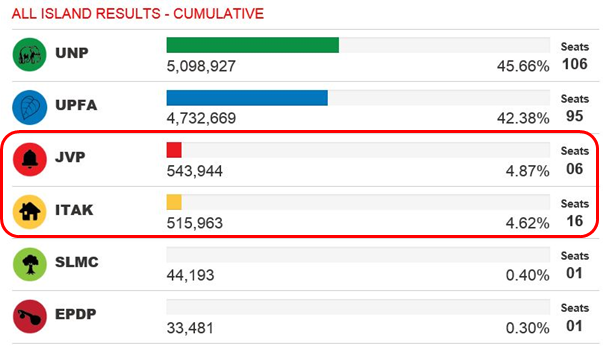
This is to raise a very important issue. In looking at results of the 2015 Parliamentary election results there is a very clear discrepancy at play. How is it that an ITAK has secured 16 seats (14 + 2 bonus seats) while the JVP contesting all island has secured just 6 seats (4 + 2 bonus)?

ITAK is an ethnic party vying for a separate state as envisaged repeatedly through its manifestos since 2001, 2004, 2010 and once again in 2015. ITAK links with LTTE have never been investigated. ITAK’s constitution itself is currently being questioned as not been federal but confederal though it poses as the Federal Party in the English translation of its party.

Nevertheless, it is a mockery on the election system were allocation of seats discriminate the votes received and this is best seen in the current election results highlighted below.

It is suggested that this be taken up at the highest levels as it is a violation of the equality in franchise where disproportionate number of seats is being allocated to a party which has less votes as can be seen in the below All Island results.

Why should ITAK which has 27981 votes less than the JVP get 16 seats while JVP has only 6 seats. This does not make logical sense at all to the voters and makes a mockery of the electoral system. It is wrong by the political party contesting as well as by the voters casting their vote.

Islandwideresults


Pro-Sirisena revisionists who were not elected

August 19th, 2015

Yahapalanaya News

The following United People’s Freedom Alliance (UPFA) heavy weights who were strongly supporting Sirisen’s destructive and vicious campaign against his own party and who kept on pulling MR’s leg at every move were not re-elected according to the results announced today.

S.B. Dissanayake,
Lakshman Seneviratne,
Lakshman Yapa Abeywardane
Mahinda Samarasinghe
Gamini Wijith Wijeyamuni Zoysa
Jagath Pushpakumara
Nandimithra Ekanayake
Rohana Kumara Dissanayake
Tissa Karaliyadda

Among the others who failed in their bid for re-election were former deputy minister of Water Supply and Drainage, Nirupama Rajapaksa who contested from the Hambantota district, former minister Piyasena Gamage who contested from the Galle and former MPs Chamika Buddhadasa, Udith Lokubandara and Dr. Rohana Pushpakumara.

Former ministers W.B. Ekanayake who contested from the Anuradhapura district and former MP C.A. Sooriyarachchi who contested from the Polonnaruwa district were not re-elected either.

Upeksha Swarnamali who contested for the General Elections from the UPFA in Gampaha district, former Deputy Minister of Skills Development and Vocational Training Thilanga Sumathipala contested from the UPFA in Colombo district and former State Minister of Children’s Affairs Rosy Senanayake contested from the UNP in Colombo district were among those who were not re-elected at the election

Chandrika’s techniques of character assassination-The lessons of Batalanda

August 18th, 2015

By Prof Rajiva Wijesingha

Seeing all the posters asserting that ruggerite Wasim Thajudeen was murdered, I was struck by the similarity to the allegations made when Chandrika Kumaratunga was President regarding Batalanda. The Sunday Leader in December 2001, soon after the UNP won the election she had called, wrote:

‘The legacy of evil that Kumaratunga has left behind is so rich that she is driven to defend her turf with all the tenacity she can muster. This is in part the genesis of her evil rhetoric in recent days, with talk of murders, plots and killing’.

The Sunday Times had the same idea about President Kumaratunga, and highlighted three occasions on which she came out with very harsh allegations about her then great enemy, Ranil Wickremesinghe. In August 2010 it noted that ‘Even those with short memories will recall that it was only a few weeks prior to the presidential election in December 1999 that the Batalanda Commission report was released to the media’.

That report was very hard on Ranil Wickremesinghe, but President Kumaratunga did nothing about it. This may of course have been because of the terrible injuries she suffered at Tiger hands just before the election. But by the time of the parliamentary election in October 2000, she was ready to resume the charge. In August of that year the Times reported the return of Douglas Peiris who had given evidence against Ranil as follows – ‘The ‘arrest’ of Peiris will surely be a prelude to major onslaught on Ranil Wickremesinghe linking him to the alleged atrocities committed at the so-called torture chamber in Batalanda.

The language is interesting. I have no idea whether Ranil was responsible in any way for what happened at Batalanda and would prefer to give him the benefit of the doubt, knowing how readily Chandrika jumped to conclusions and then found evidence to support her prejudices. One has only to remember her claim that it was the UNP that killed Vijaya Kumaratunga, which paved the way for her to enter into an alliance with the JVP, an alliance that now seems to have been renewed, though the common enemy now is the SLFP rather than the UNP. But even assuming as I would like to do that Ranil was not guilty of the atrocities at Batalanda, there is no doubt that atrocities did occur there, the death of Wijeyadasa Liyanaarachchi being only the most prominent amongst many horrors.

Chandrika had won the Presidential election in 1999 and then won the Parliamentary election in 2000. 2001 however was a disaster, and several members of her party abandoned her that year which precipitated another election which the UNP won. I voted for them then, but before long it was clear that Ranil had no idea how to control the Tigers, and rather concerned himself with busily dismantling the State.

It was understandable then that Chandrika, who had been persecuted in defeat (Ravi Karunanayake and her handbag being amongst the more entertaining episodes of her solitary struggle against the UNP cabinet) returned to the fray at the end of 2003. Ranil refused to compromise, assuming that he and the then LTTE dominated TULF would get more seats than the SLFP and its allies.

He was wrong, and Chandrika established her own government again in April 2004. Needless to say, Batalanda was trotted out again for that campaign. The Times reported in March that year that she had announced ‘if the Batalanda Commission recommendations related to the 1988-90 period were implemented properly, Prime Minister Ranil Wickremesinghe would not have been a free man today. President Kumaratunga addressing women’s organization representatives at the President’s House in Kandy said that in future, action would be taken to implement the law properly and corrupt persons, including 18 cabinet ministers, facing charges before the Bribery Commission would be firmly dealt with’.

Typically, nothing was done after the election. Chandrika works hard in adversity but, as I told her last November, if she succeeds she then relaxes. The 18 ministers did not face any charges, though perhaps she will now trot out allegations against those who are back with the SLFP.

On balance I suspect the Leader was right, and it is Chandrika who is behind the campaign to call her present hate figure a murderer. That was not Ranil’s style in the past. But people change, and succumb to the examples of politicians who seem to have succeeded through low tactics. So even the Times claimed that Chandrika’s persecution of Ranil happened because ‘she must have learnt her lessons locally. After all, she was witness to JR stripping her mother of her civic rights over some alleged land transaction and then saw the same JR accuse her husband of being a ‘Naxalite’ and then having him imprisoned. Now it appears that President Kumaratunga learnt the moral of the story well: ‘all is fair in not only love and war but in politics as well’.

Ironically the abuse of power JR engaged in to destroy the SLFP is now being used by both Ranil and Chandrika to try to destroy the SLFP again.

බොහෝ සිංහල බෞද්ධයෝ පඩි ක්කම තරම්වත්  කෙලෙහිගුණ නොදන්නාහුය

August 18th, 2015

 ධර්මසිරි සෙනෙවිරත්න

 බොහෝ බෞද්ධයන්  හිතන විදිහට  කෙලෙහිගුණ සැලකීම නම් ගුණ ධර්මය බුදුන් වහන්සේ විසින් අපට ඉගැන්වූ පළමුවන පාඩ මය්  එහෙත් බොහෝදෙනෙක් නොකරන්නේත් කෙලෙහිගුණ  සලකීමය් .  පිහිට පතා බෝධියට කිරිකල වක්කිරීමත්  කොඩි එල්ලීමත්  මිස බෝධිය අභියස බුදුගුණ මෙනෙහිකර  ධර්මය අවබෝධ කරගෙන එමග යමින්   බුදුන් දැක කෙලෙ හි   ගුන සැලකීමක් ගැන උහු නොදනිති  . කරන්නේ ලේසියෙන්  කල හැකි අමන වැඩය . සියල්ල  වාසියට පෙරලා ගෙන ඇති මොවුහු ගැමුණු ර ජු විසින් තැනවූ  රුවන් වැලි  සෑය  මළුවේ බිමපෙරලි පෙරලී වඳිති  බාර හාර වෙති එහෙත්  ගැමුණු මග නොයති  පර දෙමළුන්ගෙන් රට නිදහස් කර්රගත් ගැමුණු රජු  විසින් අපට දුන් සියල්ලෙන් ප්‍රයෝජන ගනි මීන්  එතුමන්ට පරිභව කරන  රට බෙදන දෙමළුන් හා එක්වූ රනිල් මයිත්ත්රී හවුලට චන්දය දෙති  ගැමුණු රජු නොවන්නට අද සිංහල ජාතියක් හෝ බුදුදහමක් සාශනයක්  අපරටේ නැතිබව දැනදැනත්  පිටරට කහවනු වලට උහු වහ වැටී  පරයන් සමගම  හාවෙති යාවෙති  ගැමුණු රජුට කෙලෙහිගුණ නොසලකන එමග නොයන   කෙස්නම් මහින්දට කල ගුණ සලකය් ද.
                                   වසර 30 ක් තිස්සේ  බියෙන් ගැහෙමින් දවසට හත් අට වාතාවක් සුළුදිය බඩදිය පහ කරමින්   ප්‍රභාකරන්ට බියෙන් කොළඹදීත් හැඟී හැංගී සිටි මොවුහු  මහින්ද විසින් ප්‍රභාකරන් මරාදමා   බෝම්බබිය දුරුකළ පසු   ඉද්ද ගසුවාසේ නැගේ සිටිමින්  අරක්කු බෝතල් හා කටගැස්ම සරි කරගෙන උතුරේ සංචාරයකරමින් සිත්සේ  සනකෙලිකෙලියහ   යමු යංඌ කොටි ජීවත්වූ හැටි උන් කල කීදේ  බලන්න යමු කියමින්  උතුරු දකුණු ප්‍රදේශවල  සැරිසරමින්  වසර තිහකට පසුව   ලද විනෝදයට අගෝස්තු 17 වෙනිදා මහින්දට  කෙලෙහිගුණ සලකු හැටි නින්දිතය  උන් සංචාරය කරමින්  බනින්නට ඇත්තේ  උතුර විනාශ කල කොටින්ට නොව මානුෂික මෙහ්යුමෙන්  ඒ ප්‍රදේශ විනාශ වෙන්නට අතය් කියමින්  මහින්දට ශාප කරමින් වියහැක   .  එජාපයෝ   මහින්දට උසුළු විසුළු කලේ මානුෂික මෙහෙයුමට විරුධ්ධාවය  එහෙත් ප්‍රභා මලපසු වැඩියෙන්ම  නාගදීපය වඳින්නට නොව බලන්නට යන්නට ඇත්තේ ඔවුන්විය හැක   . නියම බෞධයන් ට දඹදිව යන්නවත් උවමනාවක් නැත. ”’ යමෙක් ධර්මය දකීද හේ  මා දකී ”’  යන  වචනා දන්නා  නියම බෞද්ධයෝ  ”නරබන්නෝ ”’ නොවෙති බොදුමග යන්නෝ වෙති  .
                                     මහින්දට හොරා හොරා කියූ උන් රනිල්ගේ බැංකු හොරකම නොදන්නාසේ  කටයුතු කළහ  මිනීමැරුම්  නොදන්නාසේ සිටියහ . කදිමය් එජාප සිංහල බෞධ්ධයිනි  තොපි එකතුවී  ඇත්තේ දෙමල  හා මුස්ලිම් ත්‍රස්තයන් සමගත්  මිනී මරු ජවිපෙ ස හා ප්‍රා  රාජිට මිනීමරුවා  මෙන්ම රනිල් රෝසි හා  රවී කරු වැනි අබෞද්ධ ද්‍රෝහීන් සමගය  හෙලුරුමයෙන් ඇවිත්  ගරු සෝමහිමි විකුනා කා හෙළ නමත්  ආහොසිකර හෙළයන්ගේ හිසේ  පැහැරු  චම්පක රතන  මෙන්ම  ජාතිය විකුණා කන අබෞධ්ධරවී ප්‍රධාන දාය්යකයා කරගත් සොභිත්  සමගය .  තොප එක්වී ඇත්තේ  බටහිරාධිරාජ්‍යවාදීන් හා ඉන්දියානු අධිරාජ්‍ය වාදීන් සමගය   තොපට අවශ්‍ය සාශනයක් නැත .  13 යනු කුමක්දය් තොපි දන්නාහුද  අඩුගනනේ තොපේ 3 වත් ඉතුරු කර දුන්නේ  ක්වුදය් දන්නාහුද . ජේ ආර්ට අ වශ්ෂ්‍ය වූ  පරිදි   (1942 ) ලංකාව ඉන්දියාවේ ප්‍රාන්තයක් කිරීමේ සිහිනය සැ බාකිරීමට තොපි දැන් චන්දය දී ඇත්තේ ජේ ආර්ගේ  බෑ නාටය . රනිල් හනුමා  ඉන්දියාවත් ලංකාවත් හාකරන පාලම්ම  ළඟදීම ඉදිකළ පසු  උදෙට  උදේට කක්ක  දාන්නත් දෙමලු ලංකාවට දුවගෙන එනු ඇත උන්ට එහෙ කක්කුස්සි නැත උන් ඇවිත් තොපේ ඔලුවේ ම පහරා යනවිට   හිස සොදා පිරිසුදුවී පලයව් තොපිත් දඹදිව වන්දනාවේ   ඉන්පසු පලයව් කෝවිල් ගානේ   තොපේ බදු දහම එයනේ .
                                                                   මෙය ලියන විට ලංකාවේ වෙලාව රාත්‍රී 9. 30 පමණය   මේවන විට මහින්ද හැම පිරිස සමග සාකච්චාවකට සුදානම්වී ඇත . සියල් දෙමා මුස්ලිම් චන්ද  මහින්දට විරුධවදී ඇතිබව   දැන් මහින්ද අවාබෝධ කරගෙන ඇත . එමීන්ම සියලූ සිංහලයින් දැන් වත් අවබෝධකරගත යුත්තේ    මින් ඉදිරියට   කිසිදිනක  දෙමලු හා මුස්ලිම්වරු එජා පය අත්නොහරීමට    තී රණය  කර ඇතිබවය මුන් ඉගෙන ගත පාඩම නම් එජාපය සමග සිටියොත්  සිංහල බෞද්ධ පදනම රටෙන් ඉවත් කල හැකි බවය
 . උන් ඉගෙන ගත පාඩමේ අනෙක්  පැත්ත  අපේ උන් ඉගෙන නොගන්නාඑක ජාතියේම කරුමයකි දෙමලුන්ටත් මුස්ලිම් වරුන්ටත් උන්ගේ ජාතිය ආගම    අගනාම දෙය .ය්  එහෙත් සිංහලයනගෙන් අඩකට  ජාතිය  හෝ ආගමට වඩා   ඩො  ලර්  අගේය . ඉන්දියාවේ හින්දුන් මුස්ලිම් වරු සමගත් මුස්ලිම්වරු හින්දුන් සමග කොටාගන්නේ ජාතිය රක ගැනීමටය . අපේ සමහරුන්ට බේරාදුන් ජාතිය වත් රටවත් අවශ්ෂ්‍ය නැත .
                                 2009 ප්‍රභාමරාදම  13අ අහෝසිකර මුළු ලංකාව පුරාම  සිංහලයන්  ජන අනුපාතයට අනුව පදිංචි නොකර මහින්ද කර අරී ම හෝ හෝඒ  දවල් පසුවට තැබීම නිසා උතුරම දෙමල මන්ත්රීන්ගෙන් පිරී ඇත . . මහින්ද ඔබට කුරුනාගලින්  මනාප ලක්ෂ 4 කට ආසන්න ප්‍රමාණයක්  දී ඇත්තේ  එදාත් සිංහලයන් ඔබෙන්  තමා ආර්රක්ශාව පතු නිසය් එහෙත් ඔබ  ප්‍රමාදවිය  කමක් නැහැ තවමත් අපි ඔබසමගය   බලවු සින්හලා බෞධ්ධයිනි   දිගාමඩුල්ල දිස්ත්රික්කයැහැ  අබෞද්ධ යන්ට ගොස් ඇත . සරත් වීරසේකර නම් දේශප්‍රේමියා දිගාමඩුල්ලේ  දෙමළුන්ගෙන්  රැකගන්න මොනතරම් දේ කලාද එහි මුස්ලිම් වරු දෙමළුන්ගෙන් බෙරාගත්තේ  කවුද   එජාපයට චන්දය දුන් උන් චන්දය දුන්නේ  කොටි සමග හොර ගිවිසුම් ගැසූ  රනිල්ටය  මේවා තොපට පලදෙන දිනය වැඩි ඈතක නොවේ 
 පොළොන්නරුවේ එජාපයිනි මුස්ලිම්වරු සමග එක්වී දෙමලු සතපාවන්නට  රනිල්ට චන්දයදෙන විට මහා පරාක්‍රමබාහු පිලිරුවෙන් කඳුළු කඩා වැටුන බව තොපි දන්නෙහිද . අනුරාධපුරේ එජාපයිනි ශ්‍රීමහා බෝධිය  සුනු විසුනු කල පාපතරයින්ට කත අදින දේශද්‍රෝහී ර්රනිල්ට  තපි චන්දය දෙනවිට  ශ්‍රීමහා බෝධිය හඬා වටුනේ ”’අනේ මුන් මේ මට කෙලෙහි ගුණ සලකන හැටිදය්  ””  ශෝකයෙනි . අරන්තලා භික්ෂුන්  මිනීවළවල් වලින් නැගිට තොප දෙස් ශෝකයෙන් බලා සිටිය .හ
                            මම මහින්ද වාදියෙක් නොවෙමි එහෙත් ජාතික වාදියෙක් වෙමි ජාතිවාදීන් ඇත්තේ දෙමල හා මුඋස්ලිම් වරු අතරය   මේ දෙ ක වෙනස් බව  අමනයෝ තේරුම් ගත යුතුය .මම මහන්සියෙන් ධනය උපයා ගෙන අනුන්ගේ දේ කොල්ල නොකා දහමෙන්  හරි හම්බකරගත් දේපල  කොල්ල කන්න මම උන්ට ඉඩ නොතබමි . බටහිරයන් හෝ ඉන්දියානුන් මෙන් අනුන්ගේ  දේපල   මම සොරකම් නොකරමි . එහෙත් සොරුන්  ප ලවා හරිමි  එය ජාතික වාදයය්. දෙමලු හා මුස්ලිම්වරු මෙන්    සිංහලයන්ගේ දේපල රට කොල්ල කාම  හිමිකම් පෑ ම  ජාතිවාදයය් . එජාපයට චන්දය දුන් සිංහල බෞද්ධයෝ ජාති ජාතිත්   වින්දාවනු ඇත  මුන්ගෙන් සමහර දෙ නේ කුට මෙලෝ තේරුමක් නැති බව සැබෑ ය… බොහෝ එජාපයන්ට අවශ්ශ්ය්  මහන්ත ත්ත කමත්  කහවනුත් පමණය මේ  නිසා මය  එදා  ඩී  එස්  නිදහස් අද්යාපනයට විරුද්ධ වුයේ ‘ ”’ගහක ගෙඩියක් වත්   කඩා ගන්න   එකෙක්‌  ඉතිරි නොවෙයය්  ඔහු එදා  පිපිරුවේ  මේ නිසාය
                          දෙමලු සමග රනිල් සන්ධාන ගතවී රජයක් පිහිටුවුවහොත්  රනිල් ගෙන් ඉවත්වී   යන්නට සමහර එජාප මන්ත්‍රීන් සිටීයය් රාවයක් ද ඇත . අපාගත නොවී   එසේ  කරන්න සොයුරනි..
               මහින්ද රට බේරා දීමට  දිගු කල් ජීවත්  වේවා .

STRENGTHENING TALIBAN

August 18th, 2015

ALI SUKHANVER

‘A wave of attacks on Afghan police, army and NATO installations in Kabul killed at least 42 people and wounded hundreds, dashing hope that Taliban insurgents might be weakened by a leadership struggle after news of their longtime leader’s death’, reported The Reuters on 7th August, 2015,   ‘The attacks on Friday, which included a massive truck bomb in a heavily populated civilian area and a suicide attack on a police academy, were some of the most serious in months and the first in Kabul since the Taliban named a new leader last week. More than 40 police cadets and civilians were killed and wounded in a suicide bomb attack late on Friday at a police academy in the Afghan capital, the interior ministry said in a statement on Saturday.’ Thomas Rutting of the Afghanistan Analysts Network also expressed the same opinion in one of his recent analysis. He said, “The hope of some people was that the death of Mullah Omar would put the Taliban in disarray and possibly weaken them but I think that was a little over optimistic.” It was also a hope of the western policy makers that the death of Mullah Omer would disturb the whole process of peace talks between the Afghan government and the Taliban as these talks are not in the interest of the western forces because the Taliban rely more on Pakistan than anyone else in any type of peace-process. This supremacy of Pakistan is certainly not acceptable to the western countries and as well as to India. In case the peace-talks reach a positive and fruitful conclusion, the credit shall go no doubt to Pakistan. So the western countries apparently express their ‘verbal support’ whenever there are possibilities of any kind of negotiations between the Taliban representatives and the government of Afghanistan; inwardly they are not in favour.

The peace and stability of this region if directly linked with the things in Afghanistan. And as far as Afghanistan is concerned, it needs a very cordial atmosphere between Taliban and the government of Afghanistan. In other words no peace in Afghanistan is possible unless the Taliban co-operate with the Afghan government. If the Taliban are divided into further groups, it will not remain possible for the Afghan government or anyone else including Pakistan to bring them all to table for negotiations. In this situation Pakistan is the only force which can keep different Taliban groups united. Pakistan is very well aware of its important role in maintenance of peace in Afghanistan and it has always been doing all that is possible for the purpose. Pakistan’s efforts not only at official level but also at political level could never be ignored. It is also a fact that it is very difficult for India to accept Pakistan’s supremacy in this matter and that is why she is constantly involved in defaming Pakistan and introducing it as a terrorist country throughout the world with the help of its childish conspiracies. For a peaceful solution of the situation in Afghanistan, India must be kept out of the whole scenario.

Unity of the Taliban is the need of time for a better future of Afghanistan. Instead of handing over the steering of Afghan solution to India, other uniting forces must be given importance. Maulana Samiul Haq is also one of such strong forces. Most of the Afghan Taliban groups honour him a lot and usually never disobey him. Addressing the religious scholars of Pakistan and Afghanistan at Darul Uloom-i-Haqania, last week Maulana Samiul Haq announced full support for the new Afghan Taliban chief Maulana Akhtar Mansoor, and urged all jihadi groups to shun differences and accept his leadership. He appreciated the role of Taliban fighters for ‘forcing’ the US and former USSR to quit Afghanistan. Samiul Haq said it was need of the hour to stand united against foreign powers as they were hatching conspiracies against Afghan people who had rendered sacrifices of their lives for freeing their country from ‘foreign occupation’. Maulana Samiul Haq had always played a very positive role in collaboration with the government of Pakistan for bringing long-term and deep-rooted peace and stability in Afghanistan. It is very easy to visualize the future picture of Afghanistan if the Taliban are divided into hostile groups; hostile to one another and hostile to the government of Afghanistan? If unfortunately it happens so the result will be nothing but a never-ending bloodshed and destruction and the benefit would certainly go to the foreign forces that have been compelled by the Taliban to say good-bye to the Afghan land. Such a horrible situation would simply provide the foreign forces a golden opportunity of extending their stay in Afghanistan to an unlimited period of time. In the present situation, the Taliban will have to be very much careful and vigilant if they want to crush the western desire of ‘Divide and Rule’ in Afghanistan.

Let’s develop the country together as one family: Ranil, MR concedes election defeat

August 18th, 2015

A majority has mandated to continue the January 08 revelation. No winners or losers. We will develop the country together as one family, the Prime Minister said. PM Ranil Wickramasinghe made the observations in a statement issued on Tuesday (18).Wickramasinghe also thanked all those who helped ensure the holding of a free and fair election.

Former president Mahinda Rajapakse told AFP today that he had conceded defeat in parliamentary elections, but he will work as an opposition member of the legislature.

“My dream of becoming prime minister has faded away. I am conceding. We have lost a good fight,” Rajapakse told AFP. Rajapakse accepted that his United People’s Freedom Alliance had lost even before Elections Chief Mahinda Deshapriya could announce the final results.

“We have won eight districts and the UNP (ruling United National Party) has 11 (out of a total of 22), it means we have lost. It was a difficult fight, ” Rajapakse said.
Official figures showed the same breakdown of results. Remaining three districts were dominated by a minority Tamil party, officials said, adding that no party was set to secure an absolute majority of 113 seats in the 225-member parliament following Monday’s election.

Commissioner Mahinda Deshapriya said he expected the release of the final party positions by midday Tuesday, while individual votes garnered by candidates would be announced later. Rajapakse cast his ballot on Monday, he expressed confidence that he could return to power as Sri Lanka’s prime minister just months after he was toppled as president.election commissioner Deshapriya said the vote, called a year ahead of schedule by President Maithripala Sirisena who ousted the veteran leader in January, had been one of the most peaceful in Sri Lanka’s history. His surprise victory over his former mentor, Sirisena has struggled to impose his authority over his United people’s Freedom Alliance (UPFA) party and was powerless to prevent Rajapakse from standing as one of its candidates. – See more at:

http://www.dailymirror.lk/83859/ex-sri-lanka-leader-rajapakse-concedes-election-defeat#sthash.KvMNTO5c.dpuf

Dangers of striking deals with separatist minority parties in Sri Lanka

August 18th, 2015

Shenali D Waduge

For politicians whatever party or color, is elections about serving the people or serving their interests and the interests of those funding their campaigns. As election results are yet to conclude in the sudden Parliamentary elections being held to avoid impeaching the unelected Prime Minister and causing political embarrassment to him, the citizens have every right to feel worried at the trend taking place where with each election we are beginning to realize that external sources are influences the candidates, the political parties and even the voters.

If elections are about greed for power and the willingness of politicians and political parties to sacrifice principles and compromise the nation the voting public need to take a call and question their role in casting vote for such parties.

Must we hold elections for political parties to come to power by promising minority parties that they would separate the nation? The opposition to agreeing to separatism is primarily because the minority parties making the calls are spurred to demand separatism because it suits the agendas of external forces who are funding them.

The north-east merger proposed by India in the Indian drafted and forcibly imposed Indo-Lanka Accord of 1987 was to enable India to get close to taking the Trincomalee Harbor a quest they are not achieving using arm-twisting methods commercially. The new calls for re-merger of the North and East by Tamils and referring to Muslims as ‘Tamil-speaking’ is to politically get Muslims aligned to separating two key areas in what we can call a greater Eelam that hold strategic interest to both India and the West. The hurry is because Diego Garcia lease falls vacant in 2016 by which time they wish to rope in the political parties ready to prostitute themselves and declare these two areas as fully federal – autonomous enough to allow foreign missions / foreign aid and foreign bases to set up in the North without the approval of the Centre. The modalities for this new set up with new legal terminologies being introduced is probably being drafted creating a precedence using the UNHRC bogus resolutions as a front and excuse to grant full autonomy.

If we know the diabolical agendas of the West and are able to piece together the calls of these minority parties aligning it with the real intent of West and foolish India (also earmarked to be balkanized eventually) why are the politicians and the leaders of the two main political parties and their advisors clueless about this and lacking political will to address and confront this.

If a country is being earmarked to separate only to fulfil the geopolitical objectives of external powers it goes to show the arguments the minority parties are projecting as grievances are nothing but lies to canvass for the objective of those funding them.

No wonder to this date the TNA has yet to provide what Tamils are denied legally & constitutionally which legally and constitutionally are provided exclusively to Sinhalese only. This key question has been in limbo without answer for decades and instead we go on a merry go round with the external sources using their media and officials to promote the interests of the minority parties because it is through them that they can get what they want.

What we need to realize is that these ‘grievance’ crocodile tears are all synchronized and coordinated via money cables by external parties wanting to get a foothold in Sri Lanka for their own vested interest and have nothing to do with Tamils or Muslims. That the Tamil, Muslim populace have yet to realize that they are simply being used as pawns in a bigger game is nothing to be surprised because their brainwashing has not been happening yesterday but over a very long period of time using numerous incentives – refugee status to live abroad, minorities made to feel the privileged and preferred lot by the international community (aligned to the colonial divide and rule policy) the constant reference used by global ‘rights’ entities for minority rights again camouflaging the real agendas. It is only a handful of intelligent and well-read minority citizens able to understand this wish to have nothing to do with this diabolical agenda.

If external sources are influencing minorities the main political parties have without reading between the lines helped fortify the goals of the external sources in creating ghetto areas and using minorities in a ‘you scratch my back, I will scratch yours’ in a very dangerous game leading the country to a chaos.

As things stand it is obvious that the UNP has to reach out to the two separatist minority parties both claiming to want a separate state to form a government. The voters of the UNP need to next ask themselves do they want their party to enable separation just to come into a power carving Sri Lanka to pieces. This is a very serious question and it is very sad that there are no politicians or voters in this camp who have not come forward to say that their vote for UNP is not to agree to allow a separation of Sri Lanka under whatever name (because the West realizes that Sri Lankans are not as stupid as other countries and they are dabbling with words to fool the people – thus unitary but federal with full autonomy is not unitary at all.

For the UPFA it must understand that in areas of the island where minorities have been allowed to create ghetto areas, the UPFA loses votes because the minorities are funded to annoy the majority by their behaviour and actions by making new cultural demands and imposing these on the majority who find it an intrusion and are able to read the implications if allowed to go further. If UPFA/SLFP leaders and advisors have not realized this by now it is time they should before they begin to further lose the confidence of the majority that maintains their political existence. As results come the ghetto areas are giving big wins for separatist agenda. This is a very dangerous precedent and advisors need to take stock of this. What happens always is that the ghetto areas remain untouched and the majority areas get separated by drilling bogus issues into their minds.

A fault that both mainstream parties are equally accused of is that they spend 70% of their time wallowing over false grievances of minorities totally ignoring that the grievances of the majority that protects the very foundation and safety of the country is left unaddressed.

The TNA should have been neutralized by the appointment of a Presidential Commission to link it to LTTE and thus take legal action against it.

Why cant the two main political parties come to an agreement that the country will not be compromised and be separated/divided under whatever name the UN comes up with and this needs to be honoured and they should not align with minority parties vying for same. At the same time it is shameful that the minorities claiming hurt and crying that the majority are insensitive towards them when their separatist ways are pointed out still go in large numbers and cast their votes for the minority parties seeking separatism. The world media of course never highlights this hypocrisy and some Sinhalese are foolish enough only to fault the messenger and completely avoid what the warning is trying to project.

What tragically appears a foregone conclusion is that we have very few people who love this country. For most opportunism, one foot here and another foot overseas, selfishness, greed and hunger for power wins the day.

Understandably the minorities are all linked to foreign shores – Tamils to India/Tamil Nadu, Muslims to Middle East/India, Christian/Catholics following forced conversions after colonial rule. It is sadly the manner that the majority has been divided to forget that they have a role in protecting the history, heritage and identity of a country passed down to them through the sacrifices of national patriots and heroes and not be emissaries of Western liberal motives out to use them to devour the country and eliminate the identity first through multiculturalism/multifaith bringing a 2600 history on par with the colonial created modern systems and thereafter taking control of the future of the people through the Western media, trade, international systems in their control.

Cannot people read between the lines and simply ask what country has the West brought democracy to and enabled them to self-sustain their existence? Every country that the West has touched with their ‘democracy’ is today in tatters.

If the country is separated what next? have the parties thought about this and are the other countries that have been separated similarly on ethnic lines living as peacefully and happily as they believed they would? NO….

 Shenali D Waduge

‘International Community’ & Media totally silent on large scale irregularities/illegalities of Yahapalana Governance

August 17th, 2015

Shenali D Waduge

Who exactly are the ‘international community’ and how powerful are they. To answer that all you need is an enemy national leader and then watch how a very planned out attack takes place from all corners using every tool, method and tactic available to completely destroy the credibility of the leader internationally and completely purge him from the people as a write-off. Unfortunately, the methods used in the case of Mahinda Rajapakse had not worked as planned and the international community remain not only puzzled but completely blown apart by the magnitude of the manner people are rallying behind a former President 8 months after his defeat. No other living leader has had the affection that Mahinda Rajapakse commands.

Who are these powerful entities that we know as the ‘international community’?

  • They are the western super powers and their allies : US, UK, EU, Australia, India, Japan, US-friendly Muslim nations, the Vatican
  • Human Rights Organizations – HRW, Amnesty International, ICG, Asian Centre for Human Rights,
  • Think tanks – CFR, NED, Heritage Foundation, Open Society,
  • UN : UN Secretary General and all UN associated agencies
  • Mainstream media under corporate control of West : CNN, BBC, NDTV, New York Times, The Guardian, Telegraph
  • Their local agents funded by above to carry out their objectives : Centre for Policy Alternatives, Transparency International Sri Lanka Bar Association, National Peace Council
  • Foreign envoys of these countries stationed in Sri Lanka

There are thousands of other associated names all of which find roots somehow back to some key entity /individual or government that discretely funds them to be used to advance their agendas under the cover of humanitarian, relief, ‘democracy’ rights advocates etc.. their slogans are catchy, they preach as if they are so virtuous and angelic but beneath it all they carry out a very sinister program.

How does all this relate to Sri Lanka? To understand this we need to see the connectivity of these bloc nations and the power they wield together. India started terrorism and such clandestine training in India would have had the knowledge and silent approval of the British. Once terrorism was launched in Sri Lanka the fact that the arms, ammunition and propaganda were all steered from Western capitals also showed that the tacit approval of the West for terror prevailed. Apart from a handful of arrests to mark that the West were sincere about war on terror, nothing much has been done even with a UNSC Resolution banning LTTE fronts in force.

It is also good to note the reactions of the West and their response. Nothing much other than reporting took place throughout the beeshana years of 1980s/1990s when UNP & JVP together massacred scores of Sinhalese. Nothing much was said except reporting the deaths from LTTE bombs/suicide missions and LTTE were never referred to as terrorists. Nothing much was said against CBK or Ranil in the manner they led the country and it became quite interesting to see a shift in the aggressive coverage attributed to Mahinda Rajapakse ever since he became President in 2005.

What he said, did not say, should have said, who he met, did not meet all became an issue to the entities above. They were 24×7 glued to Mahinda Rajapakse so much so that even if he sneezed it was determined as a national virus!

All that is well and fine if the allegations, accusations, commentaries or even analysis has been fair and equally and consistently directed at all parties. But when it is only diverted with venom against one single individual and he is isolated it is unfair and not playing with a straight bat and completely ungentlemanly behaviour for the West to adopt given that they boast of mannerisms and fair play.

Returning to the CHANGE that they funded and covertly planned over a few years leading to the January 2015 elections, it was hoped that the very slogans they helped drill into the minds of the 62 lakhs that voted for CHANGE would question the very coalition that they helped indirectly come to power without good governance. The good governance started with bad governance when a Presidential Election ended up not only electing a President but bringing the minority Opposition into power and placing the Opposition Leader as Prime Minister without removing the sitting legal PM. That kickstarted an ugly 8 months of governance as a result of which an unexpected Parliamentary election had to be announced before the unelected PM became impeached over scams that he was sweeping under the carpet.

Yet the virtuous global entities have not made a hum about these illegalities, irregularities, unconstitutionalities and that is strange because were Mahinda Rajapakse committing the same the entire world would have come down on him.

This goes to show and highlights the hypocrisies involved and establishes that these global entities are mere puppets used by those in power to swing people’s sentiments and steer their opinion to adjust and align with their agendas. Those paid employees of these entities are mere spokesmen paid to follow their objectives therefore they are just mumbling what they are paid to publicly promote.

Yahapalana misadventures

  • Appointment of Ranil Wickremasinghe as Prime Minister without removing sitting Prime Minister – not a single questioned the validity of the appointment
  • Appointment of the Chief Justice without giving show cause to CJ Pieris or following due process to impeach him. In the case of CJ Bandaranaike a process was followed though the above entities championed her case. Why are they not doing the same for CJ Pieris?
  • Bringing the Central Bank & Securities & Exchange Commission under the PM – which had never been done previously
  • Appointment of a foreigner as Central Bank Governor – none of the above even wrote about it or linked his connections to the LTTE linked Raj Rajaratnam now in a US prison
  • Creation of the FCID and bringing that under the control of the Prime Minister resulting in political motivated arrests and questioning – not a word about this authoritative creation
  • Central Bank Bond Scam – no news reports of the Governor being accused of the same insider trading for which his friend is now in a US prison.
  • TNA claiming to separate endorsing same on their manifestos – if Western countries were for a country without division they would reprimand the TNA for dividing the communities.
  • Sudden sacking of the General Secretaries of the SLFP and UPFA by the President of Sri Lanka – not a hum by the above world entities as to the lack of good governance being practiced.
  • Sudden sacking of 25 SLFP Committee Members on election day – not a word reported by the world media and no objections whatsoever


Good governance cannot be based on hypocrisies and selective justice


Meditation and Brain Plasticity

August 17th, 2015

Dr. Ruwan M Jayatunge

The human mind is a complex phenomenon built on the physical scaffolding of the brain. (Nunez, 2010; Bassett & Gazzaniga, 2011). The human brain is not a static organ. It has ability to change and adapt as a result of experience. Experience alters the brain (Kolb, Gibb, & Robinson, 2003). This phenomena is known as Brain plasticity or neural plasticity or cortical remapping.

Neuroplasticity can be defined as the ability of the nervous system to respond to intrinsic or extrinsic stimuli by reorganizing its structure, function and connections (Cramer et al., 2011). Siegel (2010) describes Neuroplasticity as the capacity for creating new neural connections and growing neurons in response to experience.

Plasticity is an innate property of the human brain and represents evolution’s invention to enable the nervous system to escape the restrictions of its own genome and thus adapting to environmental pressures, physiologic changes, and experiences (Pascual-Leone et al., 2005). The entire central nervous system (CNS) is highly plastic and it changes continually throughout life.

The human brain can create new neural pathways and create novel memories. Neuronal connections and cortical maps are continuously remodeled by experience (Johansson, 2000). The brain has the capacity to undergo activity-dependent functional and morphological remodeling via mechanisms of plasticity (Bruel-Jungerman, Davis &Laroche, 2007).  There are two major types of neural plasticity: functional plasticity and structural plasticity. The human brain has the capacity for both.

Brian Plasticity: Historical Background

Italian psychiatrist Ernesto Lugaro can be regarded as responsible for introducing the term plasticity into neurosciences as early as 1906 (Berlucchi, 2002).  However before this time the American philosopher and psychologist William James hypothesized that brain plasticity existed. William James in The Principles of Psychology (1890) stated that nervous tissue endowed with an extraordinary degree of plasticity.

The Italian psychiatrist Eugenio Tanzi (1856–1934) hypothesized formation of new connections between cortical neurons. Tanzi postulated that practice and experience promote neuronal growth and shorten the minute spatial gaps between functionally associated neurons, thus facilitating their interactions (Berlucchi, 2002).

In his book, The Organization of Behavior” the Canadian neuro-psychologist Donald O. Hebb (1904 – 1985) introduced the concepts of synaptic plasticity and cell assemblies to provide a theory of the neurophysiological basis of behaviour (Brown, 2006).  The synaptic plasticity theory of learning was rehabilitated in the late 1940s when Konorski and particularly Hebb argued successfully that there was no better alternative way to think about the mercurial nature of the brain by experience and practice (Berlucchi&, Buchtel, 2009).

The Australian neurophysiologist Sir John Eccles (1903-1997) focused on plasticity at central synapses in the hippocampus, cerebellum, and neocortex. His endeavors extended from the plasticity associated with CNS lesions to the mechanisms responsible for the most complex and as yet mysterious products of neuronal plasticity, the substrates underlying learning and memory ( Wolpaw& Carp, 2006).

Meditation and Neuroplasticity

Meditation is a conscious mental process. Meditation in a clinical capacity can be defined as a form of mental training that aims to improve an individual’s core psychological capacities, such as attentional and emotional self-regulation (Tang,   Holzel, & Posner, 2015). Meditation comprises a series of practices mainly developed in eastern cultures aimed at accepting emotions and enhancing attentional processes (Sperduti, Martinelli & Piolino, 2012). Furthermore meditation is a complex neurocognitive task that is often associated with alterations in body physiology and psychological measures (Newberg et al., 2010).

Meditation has lately received considerable interest from cognitive neuroscience (Braboszcz et al., 2013). Studies suggest that daily meditation leads to long lasting attentional and neuronal plasticity. (Braboszcz et al., 2013).  Research has also shown that short courses can provide some degree of neuronal improvement as well. Various brain regions have been reported to be anatomically different between meditators and controls (Luders et al., 2012). According to Venkatesh and colleagues (1997) long term practice of meditation appears to produce structural as well as intensity changes in phenomenological experiences of consciousness.

Changes in Cerebral Blood Flow

Functional magnetic resonance imaging has detected changes in cerebral blood flow during meditation. Wang and team (2011) found that the frontal regions, anterior cingulate, limbic system and parietal lobes were affected during meditation and that there were different patterns of cerebral blood flow between the two meditation states ie- focused-based” practice and a “breath-based” practice. Meditation increases regional cerebral blood flow (rCBF) in the prefrontal cortex (Deepeshwar et al., 2015).   As reported by Newberg et al.,  (2010)  cerebral blood flow of long-term meditators was significantly higher compared to non-meditators in the prefrontal cortex, parietal cortex, thalamus, putamen, caudate, and midbrain.

Mindfulness Mediation

Mindfulness meditation is a set of attention-based, regulatory, and self-inquiry training regimes (Allen et al., 2012). It is also referred to as “insight meditation” or “Vipassana practice,” is playing an increasingly large role in defining how meditation can contribute to therapeutic growth and personal development (Lehrer,   Woolfolk &   Sime, 2007).  According to Kabat-Zinn (1994) Mindfulness is paying attention in a particular way: on purpose, in the present moment, and nonjudgementally. In the last few decades, mindfulness meditation has gained prominence as an adjunctive psychotherapeutic technique (Wolkin, 2015).

Mindfulness has been shown to lead to significant changes in the brain (Widdett, 2014).  As indicated by Hölzel et al., (2010) mindfulness practice is associated with changes in gray matter concentration in brain regions involved in learning and memory processes, emotion regulation, self-referential processing, and perspective taking.

Loving-kindness Meditation

Loving-kindness meditation has been used for centuries in the Buddhist tradition to develop love and transform anger into compassion (Carson et al., 2005). Loving-kindness meditation is a practice designed to enhance feelings of kindness and compassion for self and others (Kearney et al., 2013).These Kindness-based contemplative practices enhance prosocial emotions, social cognitive skills, and wellbeing. According to Leung et al.,  (2013) experience in LKM may influence brain structures associated with affective regulation and they further found increased gray matter volume in the right angular and posterior parahippocampal gyri in loving-kindness meditators.

Empathy and Brain Changes

Empathy is about both sharing and understanding the emotional state of others in relation to oneself. It is an affective dimension that involves a shared affective experience and also a cognitive dimension that includes the ability to understand or have some degree of conscious awareness that the affective experience is evoked by another (Mascaro et al., 2015).

Functional Magnetic Resonance Imaging (fMRI) indicates that when a person emphasizes brain regions such as insula, medial/anterior cingulate cortex become active (Lamm, Meltzoff & Decety, 2010). Klimecki and colleagues (2013) observed that, compared with a memory control group, compassion training elicited activity in a neural network including the medial orbitofrontal cortex, putamen, pallidum, and ventral tegmental area—brain regions previously associated with positive affect and affiliation.

Vedananupassana Meditation  

Mindfulness of sensation or contemplation of sensation is known as Vedananupassana or Body scan meditation. Vedananupassana meditation consists of minutely observing feelings such as aversion and desire as well as pleasant and unpleasant ones. It is a form of Vipassana meditation that is geared to enhance mind/body awareness (interoceptive awareness). According to Mirams , Poliakoff , Brown and  Lloyd  (2013) brief body-scan meditation practice improves somatosensory perceptual decision making. Fox and colleagues (2012) reported that   long-term meditators provide more accurate introspective reports than novices.

 Mediation Induced Morphological Changes of the Brain

The human brain is composed of approximately 100 billion neurons. The brain has many specialized cells, harboring sets of both common, widely distributed, as well as specialized and discretely localized proteins (Sjöstedtet al., 2015).  Experience produces multiple, dissociable changes in the brain including increases in dendritic length, increases (or decreases) in spine density, synapse formation, increased glial activity, and altered metabolic activity (Kolb & Whishaw ,1998). Psychopathology can cause detrimental changes in the brain. For instance in PTSD brain areas such as medial prefrontal cortex, hippocampus, and amygdale undergo changes. Brain imaging studies show that PTSD patients have increased amygdala reactivity during fear acquisition (Bremner et al., 2008).

Healthy brain structural changes have been reported following meditation practice. Meditation is associated with neuroplastic changes. Magnetic resonance imaging (MRI) and positron emission tomography (PET) reports of meditators indicate such changes.  Kang and team (2013) indicate that meditators, compared with controls, showed significantly greater cortical thickness in the anterior regions of the brain, located in frontal and temporal areas, including the medial prefrontal cortex, superior frontal cortex, temporal pole and the middle and interior temporal cortices.

Human Cerebral Cortex

The human cerebral cortex is a highly folded sheet of neurons the thickness of which varies between 1 and 4.5 mm, with an overall average of approximately 2.5 mm (1–3).The thickness of the cortex is of great interest in both normal development as well as a wide variety of neurodegenerative and psychiatric disorders. Accurate and automated methods for measuring the thickness of human cerebral cortex could provide powerful tools for diagnosing and studying a variety of neurodegenerative and psychiatric disorders (Fischl & Dale, 2000).

 The Anterior Cingulate Cortex (ACC)

The anterior cingulate cortex (ACC) also known as Area 25, is a region that is located towards the front of the corpus callosum, in the medial frontal lobe. It is a part of the brain’s limbic system. The ACC is important in decision making and emotional regulation. In addition the ACC plays an important role in attentional control (Crottaz-Herbette & Menon, 2006).  The anterior cingulate cortex has an important role in focused problem-solving, error recognition, and adaptive response to changing conditions ( Allman et al., 2001).  Meditation increases the ACC  activity (Tang et al., 2010) and white matter change (Tang et al., 2012), and improves self-regulation.

Neocortex

The neocortex is the most developed of the cerebral tissues (Dorland, 2012) and serves as the center of higher mental functions for humans. The neocortex contains  100 billion cells and   enables the most complex mental activities. Evolution of the neocortex in mammals is considered to be a key evolution that enabled higher cognitive function (Lui , Hansen & Kriegstein ,2011).  The neocortex is a particularly relevant region for plasticity because it performs sensory, motor, and cognitive tasks with strong learning components (Feldman, 2009).

Brain Stem

The brainstem is the region of the brain that connects the cerebrum with the spinal cord. It consists of the midbrain, medulla oblongata, and the pons. The brainstem has integrative functions especially in awareness, and consciousness.  Using magnetic resonance imaging Vestergaard-Poulsen and team (2009) observed higher gray matter density in lower brain stem regions of experienced meditators compared with age-matched non-meditators.

Insula

The human insula is hidden in the depth of the cerebral hemisphere by the overlying frontal and temporal opercula, and consists of three cytoarchitectonically distinct regions: the anterior agranular area, posterior granular area, and the transitional dysgranular zone; each has distinct histochemical staining patterns and specific connectivity (Cauda et al., 2011). The insula is   responsible for human ability to empathize with others According to Tang and colleagues (2015) short-term meditation increases blood flow in anterior cingulate cortex and insula.

 Corpus Callosum

The corpus callosum is involved in communication between brain hemispheres and facilitates interhemispheric communication. The corpus callosum is the largest white matter structure in the human brain, connecting cortical regions of both hemispheres ( Van der Knaap & Van der Ham ,2011). As indicated by Kurth et al.,  (2015) an increased fractional anisotropy and greater thickness in the anterior parts of the corpus callosum in meditation practitioners compared with control subjects .

Hippocampus

The hippocampus is a small organ located within the brain’s medial temporal lobe. The hippocampus plays a crucial role in memory (King et al., 2004) both in   memory encoding and retrieval (Naber et al., 2000).  The hippocampus atrophies with chronic stress and aging. The human hippocampus shows structural differences between meditators and non-meditators and larger hippocampal dimensions found in meditation practitioners (Luders ,  Thompson  &  Kurth  2015). A study done by Desbordes and team (2012) indicated that Mindful-Attention Training may promote neuroplasticity in the hippocampus in healthy subjects who engage in regular meditation practice over the course of 8 weeks.

Amygdala 

The amygdala is an almond-shaped group of nuclei at the heart of the telencephalon — it has been associated with a range of cognitive functions, including emotion, learning, memory, attention and perception (Baxter & Murray, 2002).  Taren,Creswell and  Gianaros  (2013) hypothesized that higher levels of dispositional mindfulness would be associated with decreased grey matter volume in the amgydala.

Concluding Thoughts

In the last few decades the neuroimaging research has shown evidence confirming the effects of meditation and its impact upon brain plasticity. Meditation enhances cortical remapping and brain functions.  Neuroimaging studies have shown the increased regional cerebral blood flow during meditation.  Further studies have indicated neural pathways and synapse changes among mediators. These results indicate that meditation is not merely an altered state of consciousness or a merely a state of relaxation. Meditation helps to uplift mental health and causes healthy changes in the brain.  Therefore mediation is one of the unique modes to improve mental health.

Acknowledgements

  • Joseph Barnby – Researcher at MAPrc (Alfre Hospital) – Melbourne, Australia
  • Professor Y.Y. Tang – Institute of Neuroinformatics and Lab for Body and Mind, Dalian University of Technology

References

Allen, M. , Dietz, M., Blair, K.S, van Beek, M., Rees, G., Vestergaard-Poulsen, P., Lutz A, Roepstorff ,A. (2012). J Neurosci.   31;32(44):15601-10.

Allman ,J.M., Hakeem, A., Erwin, J.M., Nimchinsky, E, Hof P.(2001).The anterior cingulate cortex. The evolution of an interface between emotion and cognition. Ann N Y Acad Sci. ;935:107-17.

Bassett, D. S., and Gazzaniga, M. S. (2011). Understanding complexity in the human brain. Trends Cogn. Sci. 15, 200–209.

Baxter, M.G., Murray, E.A., 2002. The amygdala and reward. Nature Reviews. Neuroscience 3, 563-573.

Berlucchi, G. (2002). The origin of the term plasticity in the neurosciences: Ernesto Lugaro and chemical synaptic transmission.JHistNeurosci. 11(3):305-9.

Berlucchi, G, Buchtel HA.(2009).Neuronal plasticity: historical roots and evolution of meaning.Exp Brain Res. ;192(3):307-19.

Braboszcz, C , Cahn BR , Balakrishnan B , Maturi RK  Grandchamp R , Delorme A . (2013).Plasticity of visual attention in Isha yoga meditation practitioners before and after a 3-month retreat.Front Psychol. 12;4:914.

Bremner, J.D, Elzinga B, Schmahl C, Vermetten E.(2008). Structural and functional plasticity of the human brain in posttraumatic stress disorder.Prog Brain Res. ;167:171-86.

Brown ,R.E. (2006). The life and work of Donald OldingHebb. ActaNeurol Taiwan.  ;15(2):127-42.

Bruel-Jungerman,E. , Davis, S., Laroche, S.(2007).Brain plasticity mechanisms and memory: a party of four. Neuroscientist. ;13(5):492-505.

Carson, J.W. , Keefe FJ, Lynch TR, Carson KM, Goli V, Fras AM, Thorp SR. (2005). Loving-kindness meditation for chronic low back pain: results from a pilot trial.J Holist Nurs.  ;23(3):287-304.

Cramer, S.C., Sur, M., Dobkin, B.H., O’Brien, C., Sanger, T.D, Trojanowski, J.Q, Rumsey, J.M, Hicks, R,. Cameron, J, Chen, D, Chen, W.G., Cohen, L.G., deCharms C, Duffy, C.J., Eden, G.F., Fetz, E.E., Filart, R., Freund, M., Grant, S.J., Haber, S., Kalivas, P.W., Kolb, B., Kramer, A.F., Lynch, M., Mayberg, H.S., McQuillen, P.S., Nitkin, R., Pascual-Leone, A., Reuter-Lorenz, P., Schiff, N., Sharma, A., Shekim, L., Stryker, M., Sullivan, E.V., Vinogradov, S. (2011).Harnessing neuroplasticity for clinical applications.Brain. 134(Pt 6):1591-609.

Cauda, F.  D’Agata, F., Sacco, K., Duca, S., Geminiani, G, Vercelli, A.(2011).Functional connectivity of the insula in the resting brain. Neuroimage.   1;55(1):8-23.

Crottaz-Herbette, S. and Menon, V. (2006) Where and when the anterior cingulate cortex modulates attentional response: Combined fMRI and ERP evidence. Journal of Cognitive Neuroscience, 18, 766-780.

Deepeshwar, S. , Vinchurkar, S.A. , Visweswaraiah ,N.K. , Nagendra, H.R. (2015).Hemodynamic responses on prefrontal cortex related to meditation and attentional task.Front Syst Neurosci.  17;8:252.

Desbordes, G, Negi, L.T., Pace, T.W., Wallace, B.A., Raison, C.L., Schwartz, E.L. (2012). Effects of mindful-attention and compassion meditation training on amygdala response to emotional stimuli in an ordinary, non-meditative state.Front Hum Neurosci. 1;6:292.

Dorland (2012). Dorland’s Illustrated Medical Dictionary (32nd ed.). Elsevier Saunders. p. 1238.

Doyère, V., Burette, F., Negro, C.R., Laroche, S.(1993).Long-term potentiation of hippocampal afferents and efferents to prefrontal cortex: implications for associative learning. Neuropsychologia. ;31(10):1031-53.

Feldman, D.E.(2009).Synaptic mechanisms for plasticity in neocortex. Annu Rev Neurosci.;32:33-55.

Fisch,l B., Dale, A.M.(2000).Measuring the thickness of the human cerebral cortex from magnetic resonance images. ProcNatlAcadSci U S A.   26;97(20):11050-5.

Fox, K.C, Zakarauskas, P., Dixon, M., Ellamil, M., Thompson, E., Christoff ,K.(2012). Meditation experience predicts introspective accuracy.  PLoS One. ;7(9):e45370.

Hölscher, C. (1999).Synaptic plasticity and learning and memory: LTP and beyond. J Neurosci Res. 1;58(1):62-75.

Hölzel, B.K., Carmody, J., Vangel, M., Congleton, C., Yerramsetti, S.M., Gard, T., Lazar, S.W.(2011). Mindfulness practice leads to increases in regional brain gray matter density. Psychiatry Res. 30;191(1):36-43.

Johansson, B.B. (2000).Brain plasticity and stroke rehabilitation. The Willis lecture. Stroke. 2000 Jan;31(1):223-30.

KabatZinnJ., (1994)Wherever You GoThere You Are: Mindfulness meditation ineveryday lifeHyperionNew York.

Kang ,D.H., Jo, H.J., Jung, W.H., Kim, S.H., Jung, Y.H., Choi, C.H., Lee, U.S., An, S.C., Jang, J.H., Kwon, J.S. (2013). The effect of meditation on brain structure: cortical thickness mapping and diffusion tensor imaging.Soc Cogn Affect Neurosci. ;8(1):27-33.

Kearney, D.J. , Malte, C.A., McManus, C., Martinez, M.E., Felleman, B., Simpson, T.L. (2013). Loving-kindness meditation for posttraumatic stress disorder: a pilot study.J Trauma Stress.  26(4):426-34.

King, J.A., Trinkler, I., Hartley, T., Vargha-Khadem, F., Burgess, N.(2004).The hippocampal role in spatial memory and the familiarity–recollection distinction: a case study. Neuropsychology. 2004 Jul;18(3):405-17.

Klimecki, O.M. , Leiberg, S., Lamm C, Singer, T.(2013).Functional neural plasticity and associated changes in positive affect after compassion training. Cereb Cortex.  ;23(7):1552-61.

Kolb, B., Whishaw, I.Q.(1998).Brain plasticity and behavior. Annu Rev Psychol. 1998;49:43-64.

Kolb, B., Gibb, R., & Robinson, T.E. (2003). Brain plasticity and behavior. Current Directions in Psychological Science, 14: 1-5.

Kurth, F. , MacKenzie-Graham, A. , Toga, A.W ., Luders, E.(2015).Shifting brain asymmetry: the link between meditation and structural lateralization.Soc Cogn Affect Neurosci.  ;10(1):55-61.

Lamm, C., Meltzoff, A.N., Decety, J.(2010).How do we empathize with someone who is not like us? A functional magnetic resonance imaging study.J Cogn Neurosci.  ;22(2):362-76.

Laroche, S. (1994).[Long term potentiation of the synaptic efficacy: mechanisms, functional properties and role in learning and memory].C R SeancesSocBiolFil. ;188(5-6):415-58.

Lehrer, R.L. Woolfolk & W.E. Sime. (2007). Principles and Practice of Stress Management. 3rd Edition. New York: Guilford Press.

Leung ,M.K. , Chan, C.C., Yin, J., Lee, C.F., So, K.F., Lee, T.M. (2013).Increased gray matter volume in the right angular and posterior parahippocampal gyri in loving-kindness meditators. Soc Cogn Affect Neurosci. 2013 Jan;8(1):34-9.

Luders, E. , Kurth, F., Mayer, E.A., Toga, A.W., Narr, K.L., Gaser, C.(2012).The unique brain anatomy of meditation practitioners: alterations in cortical gyrification. Front Hum Neurosci.  29;6:34.

Luders, E., Thompson, P.M., Kurth, F.(2015).Larger hippocampal dimensions in meditation practitioners: differential effects in women and men.Front Psychol.  6;6:186.

Lui, J.H ., Hansen, D.V., Kriegstein, A.R..(2011). Development and evolution of the human neocortex. Cell. 8;146(1):18-36.


Mascaro, J.S ., Darcher, A.,  Negi, L.T. , Raison, C.L.(2015).FThe neural mediators of kindness-based meditation: a theoretical model.Front Psychol. 12;6:109.

McEachern, J.C., Shaw, .CA.(1999).The plasticity-pathology continuum: defining a role for the LTP phenomenon.JNeurosci Res. 1;58(1):42-61.

Mirams, L., Poliakoff ,E., Brown, R.J., Lloyd, D.M.(2013).Brief body-scan meditation practice improves somatosensory perceptual decision making. Conscious Cogn.  ;22(1):348-59.

Naber, P. A., Witter, M. P., and Lopes Silva, F. H. (2000). Networks of the hippocampal memory system of the rat. The pivotal role of the subiculum. Ann. N.Y. Acad. Sci. 911, 392–403.

Newberg, A.B. , Wintering, N., Waldman, M.R., Amen, D., Khalsa, D.S., Alavi, A. (2010).Cerebral blood flow differences between long-term meditators and non-meditators. Conscious Cogn.  ;19(4):899-905.

Nunez, P.L. (2010) Brain, Mind, and the Structure of Reality, Oxford University Press.

Pascual-Leone, A., Amedi, A., Fregni, F., Merabe,t L.B.(2005).The plastic human brain cortex. Annu Rev Neurosci.  ;28:377-401.

Sarvey,J.M. ,Burgard, E.C, Decker, G.(1989).Long-term potentiation: studies in the hippocampal slice.JNeurosci Methods. ;28(1-2):109-24.

Siegel, D. (2010). Mindsight. New York: Random House Publishing Group

Sjöstedt, E. , Fagerberg, L. , Hallström, B.M. , Häggmark, A. , Mitsios ,N. , Nilsson, P. , Pontén, F. , Hökfelt ,T. , Uhlén, M. , Mulder, J. (2015). Defining the Human Brain Proteome Using Transcriptomics and Antibody-Based Profiling with a Focus on the Cerebral Cortex. PLoS One. 15;10(6):e0130028.

Sperduti, M., Martinelli, P., Piolino, P.(2012).A neurocognitive model of meditation based on activation likelihood estimation (ALE) meta-analysis.ConsciousCogn.  ;21(1):269-76.

Tang, Y.Y. , Lu Q, Geng, X., Stein, E.A., Yang, Y., Posner, M.I.(2010). Short-term meditation induces white matter changes in the anterior cingulate.Proc Natl Acad Sci U S A. 31;107(35):15649-52.

Tang ,Y.Y., Lu, Q., Fan, M., Yang, Y., Posner, M.I.(2012).Mechanisms of white matter changes induced by meditation. Proc Natl Acad Sci U S A.  26;109(26):10570-4.

Tang, Y.Y. , Lu, Q. , Feng, H. , Tang, R. , Posner, M.I.(2015).Short-term meditation increases blood flow in anterior cingulate cortex and insula. Front Psychol.   26;6:212.

Tang, Y., Holzel, B.K., & Posner, M.I. (2015). The neuroscience of mindfulness meditation. Nature Reviews: Neuroscience, 16, 213-226.

Taren, A.A., Creswell, J.D., Gianaros, P.J.(2013).Dispositional mindfulness co-varies with smaller amygdala and caudate volumes in community adults. PLoS One. 22;8(5):e64574

Teyler, T.J., Fountain, S.B.(1987).Neuronal plasticity in the mammalian brain: relevance to behavioral learning and memory.Child Dev. ;58(3):698-712.

van der Knaap, L..J, van der Ham, I.J.(2011).How does the corpus callosum mediate interhemispheric transfer? A review. Behav Brain Res.  30;223(1):211-21.

Venkatesh, S., Raju, T.R., Shivani, Y., Tompkins, G., Meti, B.L.(1997).A study of structure of phenomenology of consciousness in meditative and non-meditative states.Indian J PhysiolPharmacol.  ;41(2):149-53.

Vestergaard-Poulsen P, van Beek M, Skewes J, Bjarkam CR, Stubberup M, Bertelsen J, Roepstorff A. (2009).Long-term meditation is associated with increased gray matter density in the brain stem. Neuroreport.  28;20(2):170-4.

Wang, D.J., Rao, H., Korczykowski ,M., Wintering, N., Pluta, J., Khalsa, D.S., Newberg, A.B. (2011).Cerebral blood flow changes associated with different meditation practices and perceived depth of meditation.Psychiatry Res. 30;191(1):60-7.

Widdett, R. (2014). “Neuroplasticity and Mindfulness Meditation” (2014). Honors Theses. Paper 2469.

Wolkin, J.R..(2015).Cultivating multiple aspects of attention through mindfulness meditation accounts for psychological well-being through decreased rumination.Psychol Res Behav Manag. 2015 Jun 29;8:171-80.

Wolpaw, J.R., Carp, J.S.(2006).ProgNeurobiol. 2006 Feb-Apr;78(3-5):233-63.

එස් ටී එෆ්  යොදා මයිත්ත්රී රනිල් බලය  සියතට ගැනීමට  මහා කුමන්ත්‍රණයක්  

August 17th, 2015

ධර්මසිරි සෙනෙවිරත්න

   චන්දයෙන් මහින්ද දිනුවත්  බලහත් කාරයෙන් තමන්ගේ ආණ්ඩුවක් පිහිටුවීමට රනිල් මයිත්ත්රී දැන් කට  යුතු කර ගැන යන බව ආරංචි. . 18 වෙනිදා පන්සලකදී රනිල් දිවුරුම් දීමට  සුදානම් කරාතමහා ජන අදහස් මොනවා වුනත් මහින්දට අගමැතිකම නොදීමට තීරණය කර අවසන්ය . ජනතාව වීදි බැස්සොත් එස් ටී එෆ් ප්රහාරයකින් උන් මැඩපැවැත්වීමට   රනිල් සුදානම්ය   හමුදාව දැන් මහින්දගේ පැත්තේ නිසා මයිත්ත්රී  හමුදාව විශ්වාස කරන්නේ නැහැ .

    මේ සිංහල බෞධ්ධයන්ගේ අවසානයද . ශ්රීලනිපය හැරදමා අලුත් පක්ෂයකින්  යුතුබවට මහින්දට  කල යෝජනා මහින්ද පිළිගත්තානම්   10 දෙනෙක් ඉන් දිනුවත්   පිරිසුදු මහින්ද වාදීන්යඑසේ නව පක්ෂයක් පිහිටුවීම නුසුදුසුයය් කිව්වේ  මොකේද නීතිඥයෙකි . නලින්ද සිල්වා  ත්  හිටපු ඇමති සාලින්දත්  අලුත් පක්ෂයට කැමතිවු බව මම දනිමි  දැන් මහින්ද සමග ඇවිත් දිනන එවුනුත් කොටි ප්රකෝටි ගණනින්  මුදල් අරගෙන රනිල් හේත්තු වීමට නියමිතය . ටෝනි බ්ලෙයාර්  ආවේ සල්ලි බෙදීමටයමැතිවරණ කොමසාරිස්ගේ සහෝදර    සුනන්ද දේශප්රියද ලංකාවට ඇවිත්   මුදල් බෙදමින් මහින්දට චන්දය නොදෙන ලෙස   කියමින් අවිදිය් .

 මේ අලුත්ම තත් වයය්  අහෝ සිංහලයොත් ඔවුන්ගේත් රටත්  දැන් අනතුරේය   . මොනවා වුනත් අගමැතිකම් නැතත්  මහින්ද   මහින්ද  නිකම්ම මන්ත්රීවිදිහට හෝ සිටිය යුතුය . අවස්තාවක්  උදාවීම සිකුරුය   මහින්ද  අප තනි නොකර  වෙලාව එන තුරු  රන්දී ඉන්න

   —-    හදිසියෙනි—– 

Last bus to a Unitary Sri Lanka leaves at sundown today (Sri Lanka time) while the British undertaker is at the back door ready to bury the body of Sinhale!

August 17th, 2015

Ramanie de Zoysa

This is a time when all that needed to be said has been said and only the last action remains. After the last action is taken rightly or wrongly we shall all endure what comes out of our collective action!

To think that on that blessed day of 19 May 2009 we had it all, is surreal now. Did we squander it all on the 8 January 2015 or can we re-claim and re-instate our hard-won victory today?

Sri Lanka does nothing by halves; she handed defeat to a killer organisation LTTE- described by the US State Department as the most ruthless terrorist organisation in the world” – under the able command of former President Rajapakse- a world first! We woke up the next morning to a golden era of peace, progress and hope and there was eternal gratitude in our hearts for the 27,000 mainly Sinhala braves who fought a valiant and an honourable war and achieved a breathtaking victory. All civilians rejoiced the victory and thankful to be free citizens of a country with a great future again; Tamil children started schooling instead of carrying machine guns and stopping bullets and the people were beginning to feel like the proud nation they were in the past!

Alas, it was too good to last! Immediately after, it was time to undo the greatest winning combination. There was an ugly quarrel among the winning team in which no party acted appropriately resulting in the incarceration of the Army Commander of the winning team in the most inglorious manner- splitting the Sinhala loyalties in half! Sri Lanka’s enemies rejoiced and from then on the government was looking to the minority votes to stay alive and stay safe from the periodic threats from Geneva. Sri Lanka still prevailed. President Rajapakse and  the best Foreign Secretary Sri Lanka has ever known- Mr Gotabhaya Rajapakse  still proved a powerful combination in taking the country forward which saw Sri Lanka shine with development projects, a network of first class motorways and clean and beautiful cities! Time healed some of the wounds and it looked almost as if we were re-consolidating.

Once again, we could not hang on to a good thing for long! The President declared a presidential election two years before one was due thanks to simply bad advice from the clowns he allowed to hover around him! Sri Lanka’s enemies from India, Britain, USA and the Global Tamil terror psychopathic clinic took the new opportunity with glee. Much has been said about everything that transpired over the last intolerable 100 days plus, from

  •  *the great cleaning job of the Central Bank,
  •       *ditching of development and infrastructure projects,
  •     *  handing back the city pavements to the traders,
  •     *  closing 59 Army camps in the North,
  •       *releasing acres of critical land to refugees from India with a UNICHR card,
  •     *  releasing key terrorists from incarceration or rehabilitation, to
  •     *  sentencing to death the first top notch ranawiru based on the evidence” given by terrorists themselves,

that these need not be re-iterated.

What is left to say is that if we as a nation get this election wrong we cannot blame anyone else for not giving us fore-warning.

  1.  1.    Wijayakala Mahendran MP from the UNP publicly warned that as soon as UNP forms the new government” (that is if it does) all the Police Stations will be dismantled in the North and Prabhakaran’s (who she publicly announces is her leader) statue will grace the Province. It is also pertinent to remember that her election bill boards clearly mark the Eelaam demarcations on the Sri Lanka map.
  2.    2.  A TNA MP publicly declared that they are going to take revenge from our ranawiru forces for the killing of their leaders” (meaning the LTTE) and that after Sunil Ratnayaka who has now been given the death sentence there are 41 more in the list”.
  3.     3. Rauf Hakeem has openly talked about a pact he has with Ranil which hands Muslims a separate administrative unit” in the East. Wilpattu rapist Rishard Badiurdeen confirms this.
  4.    4.  Mrs Chandrika Kumaranatunga spoke publicly about the dire need she has to rid the country of the Sinhala Buddhist foundation” in order to make the minorities really happy.

The list actually goes on- those who heard the voices would have voted already to bring back the great leader we lost on 8th January.

The polls to date indicate that there are more wise people than idiotic ‘bada gosthara wadiyas’ in this country!!!

Chirang Jayathu Sri Lanka!

Ramanie de Zoysa

How Gaddafi’s Great Man-Made River Project became part of Water Wars

August 17th, 2015

by Linda Housman

April 14, 2013 – Libyans called it the eighth wonder of the world. Western media called it a pet project and the pipe dream of a mad dog. The “mad dog” himself in 1991 prophetically said about the largest civil engineering venture in the world: “After this achievement, American threats against Libya will double. The United States will make excuses, but the real reason is to stop this achievement, to keep the people of Libya oppressed.”

Gaddafi’s dream

It was Muammar Gaddafi’s dream to provide fresh water for all Libyans and to make Libya self-sufficient in food production. In 1953, the search for new oilfields in the deserts of southern Libya led to the discovery not just of significant oil reserves, but also of vast quantities of fresh water trapped in the underlying strata. The four ancient water aquifers that were discovered, each had estimated capacities ranging between 4,800 and 20,000 cubic kilometers. Most of this water was collected between 38,000 and 14,000 years ago, though some pockets are believed to be only 7,000 years old.

After Gaddafi and the Free Unitary Officers seized power in a bloodless coup from the corrupt King Idris during the Al-Fateh Revolution in 1969, the Jamahiriya government nationalized the oil companies and spent much of the oil revenues to harness the supply of fresh water from the desert aquifers by putting in hundreds of bore wells. Large farms were established in southern Libya to encourage the people to move to the desert. It turned out that the majority of the people however preferred life in the northern coastal areas.

Therefore Gaddafi subsequently conceived a plan to bring the water to the people instead. The Libyan Jamahiriya government conducted the initial feasibility studies in 1974, and in 1983 the Great Man-Made River Authority was set up. This fully government funded project was designed in five phases, each of them largely separate in itself, but which eventually would combine to form an integrated system. As water in Gaddafi’s Libya was regarded to be a human right, there has not been any charge on the people, nor were any international loans needed for the almost $30 billion cost of the project.

In 1996, during the opening of Phase II of the Great Man-Made River Project, Gaddafi said:

This is the biggest answer to America and all the evil forces who accuse us of being concerned with terrorism. We are only concerned with peace and progress. America is against life and progress; it pushes the world toward darkness.

Development and destruction

At the time of the NATO-led war against Libya in 2011, three phases of the Great Man-Made River Project were completed. The first and largest phase, providing two million cubic metres of water a day along a 1,200 km pipeline to Benghazi and Sirte, was formally inaugurated in August 1991. Phase II includes the delivery of one million cubic metres of water a day to the western coastal belt and also supplies Tripoli. Phase III provides the planned expansion of the existing Phase I system, and supplies Tobruk and the coast from a new wellfield.

The ‘rivers’ are a 4000-kilometer network of 4 meters diameter lined concrete pipes, buried below the desert sands to prevent evaporation. There are 1300 wells, 500,000 sections of pipe, 3700 kilometers of haul roads, and 250 million cubic meters of excavation. All material for the project was locally manufactured. Large reservoirs provide storage, and pumping stations control the flow into the cities.

The last two phases of the project should involve extending the distribution network together. When completed, the irrigation water from the Great Man-Made River would enable about 155,000 hectares of land to be cultivated. Or, as Gaddafi defined, the project would make the desert as green as the flag of the Libyan Jamahiriya.

In 1999, UNESCO accepted Libya’s offer to fund the Great Man-Made River International Water Prize, an award that rewards remarkable scientific research work on water usage in arid areas.

Many foreign nationals worked in Libya on the Great Man-Made River Project for decades. But after the start of NATO’s so-called humanitarian bombing of the North-African country in March 2011, most foreign workers have returned home. In July 2011, NATO not only bombed the Great Man-Made River water supply pipeline near Brega, but also destroyed the factory that produces the pipes to repair it, claiming in justification that it was used as “a military storage facility” and that “rockets were launched from there”. Six of the facility’s security guards were killed in the NATO attack, and the water supply for the 70% of the population who depend on the piped supply for personal use and for irrigation has been compromised with this damage to Libya’s vital infrastructure.

The construction on the last two phases of the Great Man-Made River Project were scheduled to continue over the next two decades, but NATO’s war on Libya has thrown the project’s future – and the wellbeing of the Libyan people – into great jeopardy.

A German language documentary shows the size and brilliance of the project:

http://www.youtube.com/watch?v=m1omQdyEkqk

Water Wars

Fresh clean water, as provided to the Libyans by the Great Man-Made River, is essential to all life forms. Without fresh water we simply cannot function. Right now, 40% of the global population has little to no access to clean water, and that figure is actually expected to jump to 50% by 2025. According to the United Nations Development Program 2007, global consumption of water is doubling every 20 years, more than twice the rate of human population growth. Simultaneously, every single year most of the major deserts around the world are becoming bigger and the amount of usable agricultural land in most areas is becoming smaller, while rivers, lakes and major underground aquifers around the globe are drying up – except in Gaddafi’s Libya.

In the light of the current world developments, there is more to the NATO destruction of the Great Man-Made River Project than being an isolated war crime. The United Nations Environment Program 2007 describes a so-called “water for profit scheme”, which actively promotes the privatization and monopolization for the world’s water supplies by multinational corporations. Meanwhile the World Bank recently adopted a policy of water privatization and full-cost water pricing, with one of its former directors, Ismail Serageldin, stating: “The wars of the 21st century will be fought over water”.

In practice this means that the United Nations in collaboration with the World Bank plans to secure water resources to use at their disposal, and that once they totally control these resources, the resources become assets to be reallocated back to the enslaved nations for a price. Those prices will rise while the quality of the water will decrease, and fresh water sources will become less accessible to those who desperately need it. Simply put, one of the most effective ways to enslave the people is to take control of their basic daily needs and to take away their self-sufficiency.

How this relates to the NATO destruction of Gaddafi’s Great Man-Made River Project in July 2011 can be best illustrated by the Hegelian Dialectic, popularly known as the concept of Problem -> Reaction -> Solution. In this case, by bombing the water supply and the pipes factory, a Problem was created with an ulterior motive, namely to gain control over the most precious part of Libya’s infrastructure. Subsequently a Reaction in the form of an immediate widespread need was provoked as a result of the Problem, since as much as 70% of the Libyans depend on the Great Man-Made River for personal use as well as for the watering of the land. A month after the destruction of the Great Man-Made River, more than half of Libya was without running water. Ultimately a predetermined Solution was implemented: in order to have access to fresh water, the inhabitants of the war-torn country had no choice but to fully depend on – and thus to be enslaved to – the NATO-installed government.

A ‘democratic’ and ‘democracy-bringing’ government that came to power through the wounding and killing of thousands of Libyans by ‘humanitarian bombs’, and that overthrow the ‘dictator’ whose dream it was to provide fresh water for all Libyans for free.

War is still peace, freedom is still slavery.

Linda Housman

Originally published in Pravda on11.12.2013 http://english.pravda.ru/history/11-12-2013/126361-gaddafi_man_made_river-0/#at_pco=smlre-1.0&at_si=55d13446ecf3b7e2&at_ab=per-12&at_pos=4&at_tot=4

August 17 will decide Sri Lanka’s fate

August 16th, 2015

By Janaka Perera

Without question the August 17 Parliamentary Election is going to be a most crucial one for Sri Lanka. The decision the majority of the voters take on Monday is bound to have the strongest impact on the Sinhalas, more than any other community.  Never before in recent years have they been so polarized.  Apparently it has turned almost into a ‘life-and-death’ battle between Mahinda lovers and Mahinda haters (rather than Ranil lovers).

This polarization, needless to say, is the outcome of external and internal forces inimical to Sri Lanka’s national interests exploiting to the maximum the blunders the Mahinda Rajapaksa regime made, especially after crushing the LTTE militarily in 2009.

Regardless of whether the Mahinda haters are going to be victorious or not the country’s tragedy is that in their obsession with what they call ‘good governance’ they have turned a virtual blind eye not only to the so-called Sinhalas among their camp who see no national importance in the Tigers’ defeat and the need to prevent their comeback by all means but also to the dubious deals struck with groups and individuals (some contesting on the UNP ticket in the North) who openly promote the cause of Tamil separatism and see Prabhakaran as a hero and liberator.

Was the appeal not to give nominations to corrupt individuals to ensure good governance anything new? People raised this issue a number of times during past elections.  And are the slogans politicians have raised today unusual?  They are virtually the same ones raised before.

Who are the lily white politicians among us today?  If at all they may be a handful no matter which party they belong to.  The difference between the politicians of one party and those of another in this matter is only in degree. It all depends how long they have been in power and the temptations.  Although a few political leaders themselves may not be corrupt they have given their supporters the freedom to do so in order to remain in power.

A new generation of voters has emerged during the past decade.  But the million rupee question is how many of them are aware of the country’s political history, at least since 1977.  Undoubtedly some parties would wish to keep them in ignorance since it serves the groups’ dubious objectives.

Says Senior Attorney Kalyananda Thiranagama, Executive Director of ‘Lawyers for Human Rights Development’: Many politicians who talk about misdeeds of past regimes of which they were opponents, are themselves criminals.  They always talk about others’ misdeeds not in order to prevent such wrongdoings but to seize power and create an opportunity for themselves to do the same.  This is my experience of having worked against the corrupt and fraudulent activities of politicians for a long period.”

He regrets that one of the big mistakes the Rajapaksa Government made was its failure to investigate and punish the individuals and parties which attempted to obstruct at every turn the anti-LTTE military operations.  He recalled the unsuccessful move to defeat the Budget and topple the government at the height of the war.

According to Attorney Thiranagama, every government in Sri Lanka has robbed public funds.   He concluded that the real threat facing Sri Lanka is not corruption, bribery, frauds and other misdeeds but the very existence of Sri Lanka as a unitary state, its territorial integrity.

As the President is from UPFA, the PM Too Must Be from UPFA to Ensure Political Stability – a Vote for UNP is a Waste

August 16th, 2015

Dilrook Kannangara

Previously no less than four (4) honeymoons between these actors ended in misery. UPFA Sirisena round hole does not fit UNP square peg. History shows the only stable governments are where the president and the PM are from the same party. A vote for the UNP is a waste. If UNP wins, its administration will again collapse within 200 days forcing fresh elections.

Sirisena is Chandrika’s man. Started his political career in the office of Anura Bandaranaike in the 1970s, Sirisena is a very loyal worker of the Bandaranaikes. Upon his suspension by Anura in early 1980s, he managed to get a job at the family library of Sirima Bandaranaike. He will not go against Chandrika in anyway.

If UNP voters and leaders think they can make use of Chandrika’s antagonism with Mahinda to their advantage, they are sadly mistaken. Chandrika has her own agenda which she executes through Sirisena. She is with the UNP only to the extent of getting rid of Mahinda. Thereafter, it will be ‘business as usual’. UNP is just a toilet tissue for Chandrika in her charge towards power again through proxy. Once used, it is of no worth.

Since August 17, 1994 until November 8, 1994 Chandrika worked closely with Ranil to dislodge DB Wijetunga and defeat Gamini Dissanayaka. Having achieved it, she shed the UNP like a toilet tissue. Faced with a nationwide crisis in 2000 due to Tamil terrorist attacks, she extended her hand to Ranil only to ridicule him and dump him eight months later. Chandrika agreed to help UNP and Ranil over the ‘peace process’ in 2002 but the moment she saw the tide was turning she sacked the UNP from power.

UNP is walking into the Chandrika-Sirisena den if it wishes to form a government under them. At the end of their adventure, UNP will be in pieces. If voters wish to avoid yet another election in months and resultant political instability, refrain from voting for the UNP.


Copyright © 2026 LankaWeb.com. All Rights Reserved. Powered by Wordpress