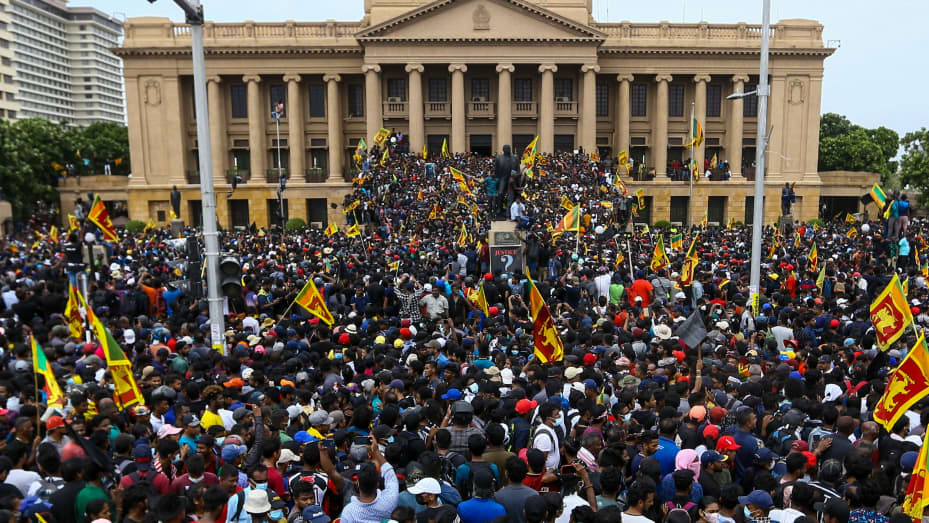
Fuel imports have to be restricted in next 12 months due to forex issues – Minister

July 25th, 2022

Courtesy Adaderana

Minister of Power and Energy Kanchan Wijesekera says that the ‘QR Code’ system was introduced since the country’s daily fuel demand cannot be fulfilled. 

Due to foreign exchange issues, fuel imports have to be restricted in the next 12 months, he said in a tweet. 

He also said that the Ceylon Petroleum Corporation (CPC) has never distributed fuel daily to every single fuel station and that is practically not possible even when stocks are unlimited.

It’s time normalcy was restored in Sri Lanka

July 25th, 2022

By Sugeeswara Senadhira/Ceylon Today

Colombo, July 25:  Two experienced politicians – Ranil Wickremesinghe, who entered Parliament as a 28-year-old youth in 1977, and Dinesh Gunawardena, who followed his Royal College classmate to the Legislature six years later in 1983, took the two top positions in the Government last week, those of President and Prime Minister respectively.

They are faced with an enormous task of solving the economic issues that include shortages of fuel, gas, and a few other essential items, dwindling foreign exchange reserves and debt restructuring. As they stressed after taking office, there is an imperative need for restoring normalcy in the country, as the 3-month-old protest movement had brought the country to a standstill, leading to a halt in economic activities and day-to-day life, leading to the exacerbation of the sufferings of the people.

ADVERTISEMENT

Hence, the government deployed Police and Armed Forces to remove  protestors who forcibly occupied the Presidential Secretariat, the highest office of public administration. As the protestors blocked the entrance to the Secretariat, the President and his staff had to function from makeshift offices in other government buildings.

As the Minister in charge of Public Security, Tiran Alles clarified, the Police and Armed Forces used only limited force to disperse the protestors. However, a few persons who attempted to resist were forcefully evicted. While the clearance of the entrance to the Secretariat was taking place, a separate Police unit was deployed to take the injured personnel to hospitals without undue delay. Both President Wickremesinghe and Prime Minister Gunawardena said they were willing to talk to Opposition parties as well as the representatives on Aragalaya protest movement. Hence, early steps could be expected to have a broad dialogue on political reforms.

One of the major issues highlighted by the leaders of the country-wide protest movement and various professional bodies was the need for constitutional reforms and a new political order. The people have determined that a new political order is required because of the negative experiences from the past, where the legislative and executive powers opposed each other, resulting in instability. Hence, the solid backing received by President Wickremesinghe from Parliament, where 134 MPs voted for him.This is of great significance, as acceptance within Parliament is crucial for implementation of major decisions, especially the unpopular and painful economic reforms that are urgently needed, will need bipartisan support in the House.

This was the basis upon which the argument for an All-Party Government was born a few months ago, and this is an opportunity to have Sri Lanka’s first true All-Party Government and push through important legislation, which would not only help Sri Lanka survive this crisis, but also thrive in the long term.

There are many practical reasons why the present system needs to be changed. There is a dire need which is recognized across the political spectrum for a constitutional division of powers between the Executive, Legislature, and the Judiciary.

The existing Constitution has given rise to many problems because of its inherent ambiguities. In order to safeguard the security, sovereignty, stability, and integrity of the country, it is essential that changes be made to the existing Constitution. Reforms will be required to establish a strong Executive, Legislature, and an independent Judiciary that can ensure the sovereignty of the people.

In post-independent Sri Lanka, there were a few significant political reforms, starting with the 1956 change of order initiated by S.W.R.D. Bandaranaike and later the first Republican Constitution of 1972 enacted by the Sirimavo Bandaranaike Government.

However, the most distinctive change was the switchover to the system of Executive Presidency, which was introduced in 1978 by the Government of President J.R. Jayewardene. The Executive President of Sri Lanka has enormous political powers and these were exercised by all the Presidents since 1978.

The first tenure of President Mahinda Rajapaksa from 2005 to 2010 proved that a strong Executive Presidency was required to defeat a ruthless terrorist movement such as the Liberation Tigers of Tamil Eelam (LTTE). The executive powers entrusted to him by the Constitution were very useful for him to take effective steps to eradicate LTTE terrorism and safeguard the independence, sovereignty, and territorial integrity of Sri Lanka.

However, with the growth of demand to devolve some executive powers to the Parliament, the 19th Amendment was introduced in 2015. It resulted in several ambiguities. The people had very negative experiences, in a situation where the Executive and Legislature were pulling in different directions.

The current government is in a position to foster a balance of power in  Parliament, as President Wickremesinghe is very keen to work with the Opposition to improve accountability through a vibrant function of Parliamentary bodies such as the Parliamentary Committees. It is expected to take early steps to protect democratic objectives through strengthening Parliamentary committee systems such as COPE and create a culture of self-criticism within the Government.

The crisis created by the 19A demonstrated both the weaknesses and the strengths of Sri Lanka’s constitutional democracy. Hence, before enacting new constitutional reforms, it is essential to have a prolonged national dialogue, a serious study, and create awareness among the public, especially the intellectual community. There should be a discussion between the Government, Opposition parties, intellectuals and others on Presidential powers, balancing with the Legislature and Judiciary, the vulnerability of Sri Lanka’s political system, institutional characteristics of that system, and then consider the relationship between the Executive and the Legislature in order t

Russian President Putin’s congratulatory message to President Ranil

July 25th, 2022

Courtesy Adaderana

President Ranil Wickremesinghe has met with Russia’s Ambassador to Sri Lanka, Yury Materiy this morning (25).

During the meeting, the Ambassador extended Russian President Vladimir Putin’s wishes on President Ranil Wickremesinghe’s election to the office of the Presidency.

In his congratulatory message to President Wickremesinghe, Russian President Vladimir Putin says he wishes for further development of the Russian-Sri Lankan relationship and constructive bilateral cooperation in all spheres for the benefit of the people in both countries.

The Russian President’s message reads: 

Please accept sincere congratulations on the occasion of your election as President. 

The Russian-Sri Lankan relations are of traditionally friendly nature. I am counting on your activities as Head of State to foster further development of the constructive bilateral cooperation in various spheres for the benefit of our peoples and in the interest of strengthening the regional stability and security.

I wish you every success as well as good health and prosperity.”

POHOTTU AS USA’ S PROXY Pt 7E1

July 24th, 2022

KAMALIKA PIERIS

Ten out of the island’s 22 Administrative Districts were battlegrounds, in the 1971 insurgence, said observers. There were attacks on police stations in all 22 districts. JVP attacked with home-made weapons in groups of 25 to 30. JVP believed that controlling these rural police stations would provide them with weapons and also provide them with secure bases for subsequent attacks by the JVP on towns.

 If not for the premature attack in Wellawaya which resulted in the police and military being placed on high alert, the situation would have been very grave. For not only would several police stations have been captured, but the JVP would have been able to arm itself with modern weapons.

When I approached the Wellawaya police station, the area around it was like a battlefield littered with spent shotgun cartridges, empty tins and items of clothing and footwear, recalled Capt FRAB Musafer. The police station had taken a battering; the telephone and power lines were cut. There was no electricity. Police and eyewitnesses said a large group of insurgents, some dressed in blue uniforms, had carried out the attack. It was unbelievable that such an outrageous raid had been conducted against the state. it was certainly a critical moment in Sri Lanka’s history, said Musafer.

The Kegalle, Kurunegala, Galle and Anuradhapura Districts were the worst affected. Kegalle and Galle were the hotbeds with over a thousand full-timers each. This was replicated in the Galle, Matara and Hambantota Districts.

With the exception of Dickwella all Police Stations in the Matara District were abandoned. In the Ambalangoda Police Area all stations, Elpitiya, Uragaha, Pitigala and Meetiyagoda fell to the JVP..Batapola, Deniyaya and Ambalangoda were under the control of the JVP. In areas like Batapola, the JVP had barricaded themselves with trees and lamp-posts.

A major attack occurred at Hanwella, where the A4 High Level and Low Level Roads converge. Early on the morning of the 6th about 100 JVP combatants using hand bombs, Molotov cocktails and firearms attacked the Police Station.  the police fled into the surrounding jungle. The JVP captured the station’s armoury of weapons, hoisted a red flag and stopped transport into Colombo. They held the town until armed police from Homagama, supported by troops from Panagoda overpowered them.

In Kegalle the Pindeniya JVP detachment attacked both the local Police Station and the Bogala Graphite Mines, capturing a lorry load of explosives from the mines. Warakapola Police Station was successfully attacked, its weapons including two sub machine guns seized and the building set ablaze, Police Stations at Bulathkohupitiya, Aranayaka, Mawanella, Rambukkana and Dedigama were also attacked and the station at Aranayake burned down. Only Kegalle police station and the area surrounding it remained under government control.

At Anuradhapura the JVP had established a base camp as well as six sub camps in the surrounding jungle where weapons, explosives and food had been stored. JVP operations in the Rajangana and Tambuttegama areas were controlled from this base camp.

Widespread JVP attacks were launched across the North Central Province, only the Anuradhapura Police Station was spared. The outlying stations had to be abandoned and personnel withdrawn to Anuradhapura. Vavuniya Police Station in the Northern Province was also attacked. The Army was only able to move into the outlying areas of the Anuradhapura District on the 30th of April.

Less intense activity was reported in the Kandy, Badulla and Moneragala Districts. Badulla where Sunanda Deshapriya was the District Secretary had around 500 JVP members. Despite the lack of weaponry, the full-timers were equipped with blue uniforms, military boots, and haversacks and were supposed to have a shotgun each. 

The Wellawaya group of insurgents had jumped the gun, and this alerted the government .The   insurgency was disrupted. Scattered across the country, knots of youth in their dark blue or black uniforms were in disarray, some attacking police stations but others holding back. Premasiri and his band of youth who were supposed to lay siege to the Gampaha police station which had a large contingent of 100 personnel abandoned their quest and slunk into the night.

At Potuhera the army had arrested a group of JVPers retreating from the Warakapola area. They were retreating to Ritigala jungles on instructions from their high command.They had been taught various ways to survive in the jungle. They had been told what to eat apart from fruits and berries and tender leaves. Even creatures such as lizards and snakes and insects particularly termites and earthworms were recommended.

Sunanda Deshapriya, JVP District Secretary for Badulla was retreating through the Walapane jungles. But after a starvation diet of murunga kola for days, the 150 cadres under his command began deserting.  Ultimately the group dwindled to 12. They had neither food, nor money. Some days they were lucky if they could dynamite fish. Bitten by leeches, they struggled on, until six decided to go back into the city, others on to Knuckles. Two were captured and killed and the remaining four, including Sunanda went back to Welimada. He travelled from there to Batapola, disguised as a mason.

JVP had planned to stage simultaneous attacks on the police stations islandwide under cover of darkness. This was openly conveyed to the authorities via threatening postcards. Police intelligence was also able to crack the JVP codes without much difficulty.

These code messages showed that the first targets would be the police stations. The attacks were to be carried out simultaneously on a particular day at a given time, the information would be sent through coded messages in newspapers. All police stations would come under attack at midnight on of April 5. The plan was to fire with guns at the station, and throw hand bombs and Molotov cocktails so that the policemen would run away or be killed. The attackers were to rush in and seize all the firearms in the stations.  Police were ordered to be on full alert on this day, said Edward Gunawardene.

Edward Gunawardene observed that the least damage was in areas where the police had taken the offensive. Kekirawa police Station, though attacked several times, held out.

At Ampara the ASP in charge A.S. Seneviratne on information received that a busload of armed insurgents were on the way to attack the police station in broad daylight had hurriedly evacuated the station and got men with arms to hide behind trees and bushes having placed a few dummy policemen near the reserve table that was visible as one entered the station. As the busload of insurgents turned into the police station premises a hail of gunfire had been directed at it. About 20 insurgents had been killed and the bus set ablaze.

Talangama Police station that policed Battaramulla was guarded by the people of the area. Even my brothers spent the nights there armed with my father’s shotgun, said Edward. IP Terrence Perera who was later shot dead by the JVP in 1987 was the OIC. The excellent reputation he had in the area made ordinary folk flock to the station and take up positions to defend it if it was attacked.  

There were also those who gave assistance in the form of food and drink for all those who had gone to the aid of the police there. Edward Rupasinghe a prominent businessman of Battaramulla supplied large quantities of bread and short eats from the Westown Bakery which he owned. However as the attacks on police stations and state property became more and more intense, the SP Nugegoda decided to close down the Talangama Police Station and withdraw all the officers to Mirihana.

A police patrol had just returned to Wellawaya and as customary the arms and ammunition were locked up in the strong room by the reserve PC on duty. He had thereafter ventured out to the verandah to have a smoke when the insurgents opened fire killing him. Another policeman was also shot. He died in hospital.

. The body of the reserve police constable was lying at the entrance of the police station. With no access to any firearms, there was very little the police could do .A brave policeman crawled up to the dead constable, and retrieved the keys to the guns. This enabled them to retaliate and return fire.  After a few hours, the attack was repulsed. Musafer said that it was surprising that the insurgents with such overwhelming numbers had not thought to over-run the police station during the lull.

The Police sleeping quarters at Wellawaya were attacked with petrol bombs. During the attack PC Banda had run across to the post office and opened fire from a flank with a .303 rifle. One JVPer was killed.  This turned the tide. The JVP fled. He probably saved the Police that day, said Lalin Fernando.  PC Banda was awarded a bravery medal by the Police.

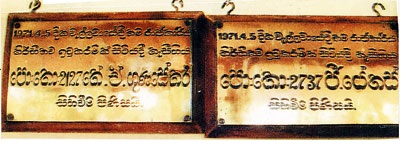
A memorial at Wellawaya in honour of the two policemen killed in the JVP attack on the Wellawaya police station in 1971.

The plight of the police in these stations has   been ignored by analyst. The fact that the police Department was a legitimate and useful part of the administration was not considered. The police were seen as agents of cruelty and repression. When Parliament finally met, many MPs mainly government MPs, brought in many allegations of abuse against the police. Mrs. Bandaranaike had dismissed them with the following words: “If not for the police, none of you will be here talking ill of them.

The media have focused only on the harassment and torture given to the darling JVP by the brutal police, and none at all on the fact that the police were the JVP targets. There is no sympathy at all for their plight or their natural resentment. They were attacked and killed while on duty in the police station.

The army, following its principles, opposed any attack on JVPers who had been arrested. For instance at Wellawaya when two teen age JVPers were found hiding in a paddy field, a constable aimed a kick at one of them and soldier    swung his rifle at them. The army officer in charge recalled I yelled at him to get out. I warned the Policemen baying for revenge that the ‘captives’ were not to be harmed in anyway”.

At Potuhera the army had arrested a group of JVPers. Boys in their teens dressed in blue shorts and shirts. They had all been badly beaten up. I cautioned the airmen not to beat them further and took them into police custody. They had bleeding wounds which were washed and attended to by several policemen as they were all innocent looking children, said Gunawardene.

 At Wellawaya, the army found a wounded insurgent who they thought was dead. Someone noticed a slight twitch in his body and shouted that he was alive. No sooner this was said, a rifle was raised by a policeman to squash his skull but he was thwarted by one of the soldiers who pushed him off balance. We dispatched the injured man in the Army truck to hospital but he was confirmed dead on arrival, said Musafer.

There was political interference during the insurgency. There is an interesting example of this at Kurunegala.  The Superintendent of Police Kurunegala has been on medical leave and Leo Perera ASP was bravely handling the situation almost single handed said Edward Gunawardene. The morale of the police at Kurunegala was high because Leo Perera had led them admirably.

The Pothuhera police station had been overrun and occupied by insurgents.  Leo Perera ASP Kurunegala had approached the station with a party in mufti unnoticed by the insurgents, taken them by surprise and shot six of them dead. The police station had been reestablished immediately after.

When Gunawardene visited the Potuhera police station, the officers were all full of praise for the exemplary courage shown by ASP Leo Perera in destroying the insurgents and re-establishing the station quickly. One officer even went to the extent of suggesting that a brass plaque be installed mentioning the feat of Leo Perera.

I complimented Leo him for the excellent work done and told him that the high morale of the Kurunegala police was solely due to his leadership. He smiled in acknowledgment. But I noticed that he was not all that happy. He had a worried look on his face, recalled Gunawardene.

In the evening I received a call from the IGP that he would be arriving in Kurunegala at 8 a.m. accompanied by General Attygalle, continued Gunawardene. He told me that they wanted to have a chat with Leo Perera. The undisclosed mission of the two top men was to take Leo back to Colombo with them.

 The IGP had been pressurized by Minister Felix Dias Bandaranaike to transfer the ASP, but the IGP had decided not to displease and discourage a young officer by making him feel that he had been punished. The IGP was more than conscious of the fact that the ASP had done an excellent job in quelling the insurgency in the Kurunegala District continued Gunawardene.

By that time I had come to know that several Kurunegala SLFP lawyers had made some serious complaints against the ASP. having received credible information that some of these lawyers were in league with insurgent leaders, Leo Perera had not only questioned and cautioned them but even got their houses searched. Three of the insurgents shot dead by Leo at Potuhera had been local criminals who had been associating closely with these lawyers.

Leo Perera told the IGP and General Attygalle of the underhand manner in which three lawyers, mentioning their names, who pretended to be great supporters of the government were behaving. He went on to emphasize that he even had proof how they were hand in glove with insurgents and local criminals. The IGP and Attygalle were silent.

Thereafter, a high level team of investigators arrived from Colombo. This team consisted of Kenneth Seneviratne, Director of Public Prosecutions; Francis Pietersz, Director of Establishments and Cyril Herath, Director of Intelligence. They visited several places including the Kurunegala, Potuhera and Mawathagama police stations; and the Rest House which had been the meeting place and ‘watering hole’ of some of the lawyers during the height of the troubles. Many lawyers and several police officers were also questioned. They completed their assignment after about a week and left for Colombo. They had not been able to find evidence of any wrongdoing by ASP Leo Perera. ( https://island.lk/a-senior-cop-remembers-april-1971/)

POHOTTU AS USA’ S PROXY Part 7E2

July 24th, 2022

KAMALIKA PIERIS

The government of Sri Lanka had received reports from intelligence that an armed insurrection was planned by a select group of youth. This information was ignored by the government.

 A report submitted later to Criminal Justice Commission inquiry no 1 indicated that two years prior to April 1971, groups of young persons between ages of 18-25 were known to be meeting in secret. These groups were active in many part of the island. They had formed cells, each of   5- 24 unemployed youth from poor families. They were trained in jungles and remote areas in basic of jungle warfare such as survival techniques, rope climbing, self defense, living off the land. Police had recovered maps diagram sketches, and data relating on police stations and military establishments, arms and ammunition dumps from the JVP and had made arrests.

Information was received that JVP  attacks were to be at night, therefore  Capt FRAB  Musafer who  headed a  platoon deployed in Weerawila,  had sent  a wireless message, in consultation with the GA, to Temple Trees requesting for flares to assist in night fighting operations. There was no response.  Musafer heard later, from another officer that he had been ridiculed, saying that Musafer had unnecessarily got the jitters. It was no laughing matter when news of the Wellawaya attack at night was received.,

The government had not given any special powers to the army to search and detain. At times we did observe groups of cyclists travelling further south but they carried nothing on them. We suspected they were couriers but there was nothing we could do about it. We did search Wijeweera’s neat and tidy home occupied by his mother and sister but found only magazines titled Red China” said Musafer.

For the officials at Kegalle, it had been like sitting on a powder keg. From January 1971, the signs of an attack had been evident. Information flowed in from two sources: Police intelligence and also the spy network floated by SP Seneviratne using a special vote of Rs. 50,000.

 Reports were received of “various” happenings in the countryside. Small groups of youth meeting in secret in lonely places. The ‘desana paha’ (five lectures) being delivered. Collection, manufacture and storage of weapons. Jungle training of fighting cadres. Testing of devices in the jungle. Shooting practice. Strange explosions.

“There were also reports brought in by grama sevakas, DROs and informants such as school principals, of young boys going ‘missing’ from home for days. Tailors in the area told us how orders for a large number of uniforms had been placed,” GA Wijedasa said. 

“As a professional cop, I was able to interpret the signs and symptoms. Little incidents were brought to my notice. Six-foot lengths of barbed wire were being removed from fences. These were subsequently cut into 1-1 1/2″ pieces and used in anti-personnel bombs,” said SP Seneviratne.

JVP cadres were also collecting fused bulbs and jam bottles, tins and similar-sized containers to make bombs and Molotov cocktails. The containers were filled with kerosene or petrol and had a fuse. “That was what saved us. Kegalle is a wet area and they couldn’t light the fuse, because the boxes of matches they carried were damp.”

Often at night, when the SP and GA met for dinner in the Residency, they would hear the tell-tale ‘clink-clink’ of the insurgents making their way through the forest. They were carrying ‘Molotov cocktails’ in their haversacks and as they walked over the uneven terrain, stumbling over rocks and roots, the bottles and cans would knock against each other.  What would also give them away was the sound of the dogs barking. As they walked past a house, the ‘game-ballo’ would sound the alarm.

Early in 1971, as the unrest in Kegalle escalated, GA Wijedasa activated the District Security Coordinating Committee of which he was chairman. It comprised the SP, the head of the army unit stationed in the area, the Additional Government Agent and the Headquarters DRO.

Information about the activity in Kegalle area was collated and analysed and many reports sent to the government. But nothing happened. Daily dispatches were sent through special messengers. But no action was taken. Defence Secretary A.R Ratnavale put them to Premier Sirimavo Bandaranaike, who discussed the intelligence reports at her Cabinet meetings with MPs from the area. But they only reassured her that “our boys” wouldn’t do such things. The matter was discussed and shelved many times. 

The Kegalle officials also made recommendations that in case of a massive attack, schools should be converted to detention centres. That was not taken seriously either. 

Athula Nimalasiri Jayasinghe, ‘Loku Athula’, (later MP for Gampaha and Deputy Minister of Power and Energy) was in charge of the Kegalle and Kurunegala Districts.  He was one of the four top leaders of the JVP. .He was responsible for armed wing of the group. He organized training camps. He was in command at Kegalle and Kurunegala.

Once the decision to attack was made Loku Ahtula moved into the area on the 3rd, meeting area Leaders at Weliveriya and coordinating operations with detachments in Veyangoda and Mirigama. About 600 JVP combatants were deployed across the Kegalle District, concentrated at Warakapola and Rambukkana. JVP had also established themselves in Aranayaka, Dedigama and Morontota and were dominating these areas. JVP had good knowledge of terrain n Kegalle .

Tholangamuwa Central College, located some five miles from Warakapola on the Kegalle road was the JVP headquarters. A bulldozer was parked across the entrance to the school so that no one could storm them.

The JVP insurgency at Kegalle  shows training and preparation well beyond that of a spontaneous uprising. It was clear that JVP were reasonably well trained in use of firearms, field craft, guerrilla tactics, and had numerical superiority said Cyril Ranatunge.

JVP had mastered the ambush technique which can be expected only from professional trained soldiers, noted the army. One patrol had been ambushed at Uthuvankande on Kandy-Colombo road, by about 75 JVP with rifles, sub machine guns, shot guns and homemade bombs. They had blocked the road with a lorry in a well selected site. One mobile patrolencountered stiff resistance in Aranayaka town and was ambushed  at Ussapitiya school premises.  The attack had been by 100 insurgents.

One captive JVP had told Cyril  Ranatunge, army officer in charge of Kegalle that he had been assigned to kill the Coordinating office (who was Cyril). They had been trained to hate the army, he said. Also, Ranatunge observed, the JVPhad their own transport system and their own courts of law where civilians were indicted. LTTE took years to establish law courts, JVP   did it in few days, Ranatunge remarked.

As soon as Government Agent K.H.J. Wijedasa and Superintendent of Police Ana Seneviratne heard of the Wellawaya attack, they put into action their secret contingency plans. All petrol stations in the Kegalle district were sealed to conserve fuel and police guards deployed at water supply stations, electrical sub-stations and the telecom exchange.  But the JVPers were one step ahead. They felled trees across the power lines, plunging whole areas into darkness. Cycle chains were thrown over high tension wires to cause short-circuits. Phone lines were cut and roads blocked with uprooted trees and lamp posts. 

Within the district, all 14 police stations had fallen. “There was minimal resistance by the Police.JVP had destroyed Warakapola police station, also Bulathkohupitiya, Aranayaka, Mawanella, Pindeniya, Rambukkana, and Dedigama police stations. Government was only in control of three acres which housed Kachcheri, police station, law courts. the police radio was their only link with the outside world.

The Army could only access the interior regions of the District on the 10th and initially had to focus on removing road blocks and repairing culverts and bridges to gain mobility. When they penetrated the countryside they were frequently ambushed as in Aranayake.

Once Wellawaya was attacked,  the government declared a State of Emergency, dusk to dawn curfew and the Army deployed two platoons of the 1st Battalion, Ceylon Light Infantry (1CLI) to the Kegalle District, which would soon become the centre of fierce fighting.

Colonel Cyril Ranatunge was appointed military coordinating officer for Kegalle in JVP insurrection 1971. This was the first military operation for his unit. At that time,  army and police were not experienced or trained to handle an insurrection of this scale and intensity.  However, we have learned too many lessons from Vietnam and Malaysia. We must destroy them completely,” army said.

Cyril set up an intelligence cell at Kegalle to gather and disseminate information. he contacted all government agencies, headmen, now grama sevaka, public sector and private sector persons. We gathered information on the hide outs and movement of JVP and then took on targets without wasting time. No operations were planned without proper intelligence.

Operations were not in the form of attacks on JVP camps. there weren’t any except for those in Rambukkana Dedigama and Morontota. We caught them through ambush. We got info on where they go their food, how they moved from village to village. The ambushes were set as late in the evening as possible and troop got into position and stayed without a murmur and got the targets. The JVP thought they had the run of the land at night.

They quickly re-established the police stations. they set up temporary police stations. This restored public confidence.    Cyril had set up vigilance committee consisting of local leaders, frequent meetings with people in Kegalle town and suburbs and villages were helpful. With success against the JVP, there was not difficult in getting valuable intelligence unlike at the start. We trained a large number of home guards they gave accurate info   on any suspicious activity through the police stations. We never gave the JVP in Kegalle a chance to regroup, we kept them on the run. The fury and intensity of the violence dissipated as quickly as it came. 

On the 12th at Utuwankande the Army was ambushed by the JVP using rifles and submachine guns. But the battle was turning in favour of the Army which brought to bear superior arms to put pressure on the rebels and gradually reopen the abandoned police stations in the district. They received new Saladin armored cars.

Finally on the 29th led by Loku Athula the JVP forces began their withdrawal from the District, from Balapattawa via Alawwa and then north. As they retreated in the direction of the Wilpattu Park they came under attack from the Army and from the air by Air Force helicopters. The Army finally ambushed them near Galgamuwa, killing some and capturing Loku Athula on 7th June. Around 16,500 JVP members were captured, arrested or surrendered. The remaining combatants withdrew into jungle sanctuaries in the Kegalle, Elpitiya, Deniyaya and Kataragama areas. GA Wijedasa estimates 15,000 had been killed in Kegalle district. “There was not much burning of bodies,  they were thrown into the Maha Oya.” 

Some counter insurgency operations however continued into the following year. A forward base was established  in Horowapatana as late as November 1972 from where they carried out combing out operations until April 1973.  1CLI’s D-Company closed its Kegalle operations only in December 1974.

When I threw out the insurgents in Kegalle, they emerged in Anuradhapura, where I then went, said Ranatunge. A platoon of 1CLI armed with 82mm mortars was sent to Anuradhapura in May and participated in Operation Otthappuwa, to take control of this area. By the end of May the insurrection was completely crushed.

Lalin Fernando who was in   charge at Wellawaya  in 1971 recounts. At Wellawaya I observed a fence at the rear of the police station. Behind it was a vast  paddy field. I climbed over the fence and saw two very young lads lying down by the side of the ‘niyara’ (bund) of the paddy field. At first, I mistook them for villagers and asked them to scram. They wouldn’t move. I then drew my .38  revolver and aimed it at them. I asked them to stand up. They were frightened and  hesitant. I then yelled at them  and the two stood up slowly.

 I was unnerved. They must have been about 14-15 years old. They were unarmed and came up to me in great fear. I called the Platoon Sergeant Punchi Banda and asked him to give them a ‘ducking’ at the station well and bring them back to me. After the ‘ducking in warm water, which the two boys had apparently relished after a whole day in the sun, they were separated and each given a piece of paper and a pencil and asked to write down the names of those who came with them to attack the police station. Sergeant Punchi Banda supervised them. We had 25 (not 500) identical names. This was passed on to the Battalion HQ. We had cracked the Wellawaya gang.

One ‘insurgent’ we caught later was Sirisena. He was 12 years old. He was an orphan being looked after by his grandmother. His job had been to carry the boxes of matches to light the petrol bombs. He soon became the mascot of the platoon, eating and sleeping with them and helping in doing odd jobs. Concerned by the possible  Police response, I released him on the day we pulled out of the Police Station, concluded Lalin.

The JVP couldn’t hold on to the areas they had captured, such as parts of Kegalle, because they lacked popular support, said  Kegalle’s GA Wijedasa. The defeat of the  JVP was primarily due to the lack of support from the masses agreed the JVP. This, it should be noted,  is very different to the Eelam war, where the public supported the LTTE .

“The people were not used to violence. They were not happy about the destruction of public property – buses and government buildings being set ablaze and the disruption of essential services, said GA Wijedasa.

 The JVP’s contention that tea and rubber estates should be uprooted and manioc and sweet potato planted instead did not go down well with the common man. The thinking that big houses and bungalows had to be shared by five families was met with disapproval. This may have all been misdirected JVP propaganda or misinformation, but the people opposed it. 

At Morontota public were happy army had come and gave them information. .  JVP killed anyone they suspected was an informant. The JVP held Batapola till April 23. Then the army with the help of villagers attacked their camp. 

Two youths had visited the house of a retired school master on the outskirts of Mawanella town and demanded his gun. He had gone in, and loaded his double barrel gun and come out on the pretext of handing it over to the two youths he had shot them both dead, discharging both barrels. The schoolmaster and his family had taken their belongings, got into a lorry and immediately left the area.

POHOTTU AS USA’ S PROXY Part 7E3

July 24th, 2022

KAMALIKA PIERIS

The 1971 JVP Insurgency was totally a new experience for Sri Lanka. Once the government woke up to the fact that they had a full blown insurgency on its hands, it moved fast to squash it, said Gamini Gunawardene. The Opposition UNP got to a side, did not obstruct and engage in the blame game.

The government responded strongly to the Insurgency and suppressed it successfully, using army, police and foreign assistance. We have learned too many lessons from Vietnam and Malaysia. We must destroy the insurgents completely. We have no choice, army said.

This was the first time that the Sri Lanka armed force had to face an attack against the state. The forces used their limited resources. In 1971 the Royal Ceylon Air Force (RCyAF) consisted of three squadrons: No. 1 Flying Training Squadron with nine Chipmunk trainers based at China Bay, No. 2 Transport Sq. equipped with five Doves, 4 Herons and three Pioneer fixed wing aircraft and four helicopters and No. 3 Reconnaissance Sq. with Cessna aircraft. In the 1960s Britain had gifted five Hunting Jet Provost T51s jet trainers which had gone out of service by 1971.

Beginning at 0900 hours on 5th April the Jet Provost, which were in storage at China Bay, began operating out of this airbase. Armed with Browning machine guns and rockets, they carried out air to ground attacks using 60 lb rockets. The three Bell 206A Jet Ranger helicopters protected by Bren Guns airlifted 36,500 lb of ammunition during April to critical police stations. In addition the Doves carried out supply missions and during the course of April, 900 soldiers and 100,000 lb of equipment were transported by the RCyAF.

The JVP seized parts of the Colombo-Kandy A1 Trunk Route at Warakapola and Kegalle, cutting off the main artery between Colombo and the tea growing highlands. In response the Jet Provost had to mount aerial attacks on the key bridge at Alawwa. This led to the downing of a Jet Provost and the death of her pilot.

India loaned us Gurkha soldiers to guard Katunayake Air Port. On 8th April a full day curfew was declared and a load of ammunition was air lifted here, as we had run short of ammunition.

In the aftermath of the insurgency the armed forces expanded. The Air Force which had 1,400 personnel in 1971 grew to 3,100 by 1976. New units were raised: a Special Police Reserve Force, a Volunteer RCyAF and a new Field Security Detachment targeting subversion was created.

The government was able to win the war against the JVP in 1971 because it received arms from abroad. China, Australia, Pakistan and Yugoslavia   sent arms and equipment. However the disparate array of equipment would pose a logistics dilemma for the military.

The sudden influx of arms and ammunition rapidly altered the balance of power against the JVP. For example the Army took Yugoslav artillery into Kegalle to flush out the rebels.

Within four days of the JVP attack, Air Ceylon’s Trident took off from Singapore carrying a consignment of small arms provided by Britain from its base there. The following day the UK agreed to supply six Bell-47G Jet Ranger helicopters armed with 7.62mm machine guns. On 12th April on board a US Air Force Lockheed C-141 Starlifter, Washington shipped out critical spare parts for the RCyAF helicopters which were flying twelve hour days. And at Colombo’s request New Delhi on the 14th sent six Indian Air Force Aérospatiale SA 315B Lama utility helicopters with crews to Katunayake Air Force Base, along with troops to guard them as well as arms, ammunition and grenades. They would remain in the country for three months.

On the 17th Air Ceylon flew in nine tons of military equipment which the Soviet Union made available from supplies in Cairo. While on the 22nd a Soviet Air Force Antonov AN-22 transporter arrived with two Kamov Ka-26 rescue helicopters and five Mikoyan-Gurevich MiG-15 jet fighters and one MiG-17 high-subsonic fighter. The Soviet aircraft were accompanied by 200 trainers and ground crew.

Meanwhile there were reports that the JVP were endeavouring to bring weapons in by sea. But the Royal Ceylon Navy’s frigate and Thorneycroft boats could not secure the island’s territory nor prevent supplies reaching the rebels. This compelled Colombo to rely on the Indian Navy which sent three of its Hunt-class escort destroyers, INS Ganga, INS Gomathi and INS Godawari to patrol Ceylon’s maritime perimeter.

There was also the need to catch and prosecute the offenders.    An ‘Ops Room’ was hastily set up at the Temple Trees. IGP Stanley Senanayake who had gone to England was recalled. A team was created which included handpicked persons such as former IGP Alaric Abeygunawardena.

An investigating office was set up elsewhere.  Abeygunawardane had a few CID and Intelligence officers attached to him, who continued to monitor and direct operations to arrest the balance rebel leaders who were hiding.

Police station OICs and ASPs were asked to send their investigation files direct to this office. Under Emergency Regulations, admissions made to ASPs by suspects were made admissible in courts. Abeygunawardane’s office had a few Senior State Counsels like Ranjith Abeysuriya, Kenneth Seneviratne and some others to prepare cases for prosecution and advise the police officers on further investigations. Thus cases were filed in courts without delay.

3, කාල කන්නි හා පාලකයෝ

July 24th, 2022

ජයන්ත හේරත්

3 ප්රයිම් සංඛ්යාවක්ය.

3 බෙදිය හැක්කේ

3 හා 1න් පමණක්ය.

3 ඉතිරි නැතිව

බෙදන්නට බැරිය.

මරුය.

අති විශිෂ්ඨය.

2 3 5 7 11 …

ප්රයිම් අංකයන්ය.

කාලෙක සිට

කැරකෙන්නෙ

JVPයටය

එය ආරක්ෂා කර ගන්නටද

ඔවුනට ඇති ශක්තිය

පුදුමාකාරය.

බටර් ලන්තයේදීත්

ආරක්ශාය.

අනිත් පක්ෂ

ලැබූ සංඛ්යා

එහෙ මෙහෙ වුනත්

JVP  3

ගලේ කෙටුවාක් වාගේ

නොසැලි තිබෙන්නේය.

’53

ඩඩ්ලි

ඉල්ලා අස් උනේ

හාල් ඇට වල මිල වැඩි කල නිසාය.

’65 ඩඩ්ලි

නිකං හාල් ඇට දුන්නට

’70 දි

ජන්දදායකයෝ ඩඩ්ලිට

චන්දය දුන්නේ නැත.

’77දි

ජේ ආර්

බලයට ආවේ

ඇට අටක් දෙන 

පොරොන්දුව උඩය,

ඒත්

දුන්නු ඇටක් නැත.

සිරිමාවෝගේ

හඳෙන් හෝ ගෙනවිත්

දෙන්නට

පොරොන්දු වූ හාල්

වාගේමය.

’77න් පසු 

ඡන්ද අපේක්ෂකයෙක්

කෑම පෙන්නුවේ නැත.

ඡන්දදායකයා

අර තරම් මෝඩ වූයේද නැත.

’87

ජේ ආර්

යන්න ගියේ

ෆේල් වූ

පාලකයෙක් ලෙසය.

ෆෝන්සේකා කියන්නේ

’89

බටර්-ලන්තයෙන්

ජීවිත දානය

ලැබූ

පෙරටුගාමියෝ

අද බලවත් වී ඇති බවය.

මුළු ලංකාවම

ආර්ථික වශයෙන්

අංශබාග රෝගියෙක් බවට පත් කර

තරුණ පරම්පරා ගණනාවක්

විනාශ  කලේ

බංකොලොත් කලේ

JVP  NPP  හා පෙරටුගාමියෝය.

රට

ගොඩ දැමීමට නම්

ඉහත පක්ෂ

සහමුලින්

සුද්ධ පවිත්ර

කර ගත යුතුය.

මුන්

හැමදාම කරන්නේ

වර්ජන ගර්ජන

හා

උද්ඝෝෂණය.

වර්ජන

නීති විරෝධී කල යුතුය

විශේෂයෙන්

අන්තරේ

පන්ති වර්ජන

වහාම නීති විරෝධී කර

වර්ජන කරන උන්

විශ්ව විද්යාල වලින්

නෙරපා  දැමිය යුතුය.

දරුවන්

වර්ජන කිරීමට, 

උසි ගන්වන

විශ්ව විද්යාල ආචාර්යවරු සිටිත් නම්

ඔවුන්ටද නිසි දඬුවම්

දිය යුතුය.

රටෙන් කටට

නොව

තමන්ගෙන්

රටට

සදාචාරාත්මකව විය යුතු යුතුකම්

ඉටුකිරීමට

සමත් පිරිසක්

විශ්ව විද්යාල වලින් බිහි කර ගත යුතුය.

රනිල්ට ඇත්තේ

අභියෝගයකි

ඒ නම්

රටේ නීතිය ප්රතිෂ්ඨාපනය කර

නිදහසේ

දැනුම

ලබා ගැනීමට

දරුවනට

ඉඩ ප්රස්ථා

ලබා දීම ය.

ඒ කාලයේ වාගේ

නැවත 

ධවල පත් ගෙන ඒමෙන් නම්

රටට වන සෙතක් නැත.

කිරි පිටි

ඉන්ධන

විදුලිය

ස්මාර්ට් ෆෝන්

වායු සමීකරණ

නොමැති-ජීවත් වීම

තුලින්

පරිසරයට වන

ශාන්තිය 

වටිනාකම පෙන්වා දිය යුතුය.

පාලකයෝ

එය පළමුව ආදර්ශයෙන්

පෙන්වා දෙන්නේ නම්

කිරි

ඉන්ධන

විදුලිය

අඩු පරිභෝජනයෙන්

ජීවත් වීම

අපහසු කාරියක් වන්නේ නැත.

Cash-strapped Sri Lanka & Seven-pronged Strategy by Dhammika Perera!  Good Thinking!

July 24th, 2022

Prof. Hudson McLean

Cash-strapped Sri Lanka is a Fact, and that goes to show Military men are not Administrators with Practical Vision, Innovation & Creativity.

The Rajapaksa family-run Sri Lanka was sitting on Yesterday’s Glory, letting the Island rot under mismanagement & corruption.

The Seven-pronged strategy on paper looks great but will take 3-5 years to bear fruit.  But there are other ideas which may return foreign revenue during 1-2 years!

Desperate diseases require desperate remedies!

Sri Lanka is in desperate need of a remedy!

Borrowing funds as a Stop-Gap from China to pay back the China loan is the only Stop-Gap short-term interim Sticking Plaster on a gaping wound!

*For the last 73 years, the country has not had a plan to earn foreign currency.” – Dhammika Perera.

LankaWeb – BUSINESSDhammika’s seven-pronged strategy to overcome SL’s foreign exchange crisis

LankaWeb – BUSINESSDhammika’s seven-pronged strategy to overcome SL’s fo…

1: University Town is a Great 5-year Idea.

2: Budget Airlines is a good 3-year maturity.

3: ICT courses are Brilliant – 3 years. Must be in English.

4: Develop the coconut industry – Natural concept 5-10 years.

5: Construct hospitals – Requires Credibility. Top Medical specialists – 5 years.

6: Fisheries Industry – 1-2 years. Practical. Requires development of commercial Ice production.

7: Business Sri Lanka – First Peace – No Credibility till Corruption is stamped-out. 

These are good seven (7) points that neither Rajapaksa nor Wickremasinghe gave any thought to during the past 25 years!!!

Point 8: During these 1-10 years Sri Lankans need to eat.  

However, there are over 100,000++ young men & women who could be trained with English skills to learn Human Care, Child Care, and Elder Care in the UK, USA, and Canada.  

Vacancies over 300,000++ in 2022.

The care workers earn starting USDollars  1,500 – 2,000/month.  Minimum Revenue US Dollars 1,5 billion/year.   No mouths to feed in Sri Lanka.

Point 9: Qualified Registered Nurses with English may earn immediately US Dollars 3000-;/ month.

Immediate vacancies – 25,000 in EU & the UK.

The families of the workers may receive Full Social Assistance + FREE Education for children in some EU countries & the UK.

Point 10: LTTE: – Whilst all these positive & negative solutions are being ‘thought’  the hungry Foxy LTTE is planning the next adventure. Whilst Gotabaya is gone, and Fonseka is sunbathing with his Arrack, there are other young Military hopefuls waiting in the wings.

Sri Lanka may not be influenced by LTTE operative politicians in the UK-Canada-Norway-USA.

There is NO ROOM for TERRORISM.  Zero Tolerance! 

As said, Wickremesinghe, who collided with the Tamil-LTTE, cannot and must not be trusted. Period!

I see Dhammika as a successful businessman, with No Need to Scrounge the State Assets, a Ray of Hope, Light at the end of the Tunnel!

Hopefully, Dhammika may give his support to quick start his thoughts to include Points 8,9,10.

Let us get more Honest Patriots to get Sri Lanka back on her feet!Express Your Opinion – Read What Others Say!
The Independent Interactive Voice of Sri Lanka on the Internet.

Please visit -: http://www.lankaweb.com/

President reaffirms commitment to uphold right to non-violent assembly – Statement from President’s office

July 24th, 2022

Courtesy Hiru News

President Ranil Wickremesinghe has reaffirmed Sri Lanka’s commitment to upholding the rights of peaceful, non-violent assembly. The President expressed this stance to the Colombo based Diplomats at a meeting held on Friday.

The meeting had been convened to brief the Diplomats on the removal of the protesters who had been illegally occupying the Presidential Secretariat. President Wickremesinghe stated that both Article 21 of the International Covenant on Civil and Political Rights, and Article 14 (1) (b) of the Constitution of Sri Lanka, which governs the rights of peaceful assembly, would be upheld by the Government.

The President further explained that the instructions given by the American Civil Liberties Union stated that protesters were not permitted to block government buildings and interfere with other purposes the property was designed for.

The Diplomats were also briefed on the measures being taken to ensure that non-violent protests were allowed to proceed within the city without endangering property or lives. Facilities within Colombo, such as the Open-Air theatre at Viharamahadevi Park, New Town Hall, Hyde Park and Campbell Park were all being made available to non-violent protests.

Addressing concerns regarding the GotaGoGama protest site, it was explained that it had not been removed by security forces, contrary to erroneous social media reports. Furthermore, the participants were also briefed by the Attorney General on the legal avenues being pursued, including producing all those arrested by the police before the Colombo Magistrate Court.

Rights group seeks arrest of former president Rajapaksa in Singapore

July 24th, 2022

Courtesy The Daily Mirror

A rights group documenting alleged abuses in Sri Lanka has filed a criminal complaint with Singapore’s attorney general, seeking the arrest of former President Gotabaya Rajapaksa for his role in the South Asian nation’s decades-long civil war, the Reuters reported.

The International Truth and Justice Project (ITJP) said Rajapaksa committed grave breaches of the Geneva Conventions during the civil war in 2009 when he was country’s defence chief, according to a copy of the complaint seen by Reuters.

The South Africa-based ITJP argued that based on universal jurisdiction the alleged abuses were subject to prosecution in Singapore, where he fled after months of unrest over his country’s economic crisis.

The criminal complaint that has been filed is (based on) verifiable information on both the crimes that have been committed, but also on evidence really linking the individual in question, who is now in Singapore,” Alexandra Lily Kather, one of the lawyers that drafted the complaint, told Reuters by telephone from Berlin.

Singapore really has a unique opportunity with this complaint, with its own law and with its own policy, to speak truth to power.”

Rajapaksa submitted his resignation in Singapore, a day after fleeing on July 13. Anti-government protesters had stormed the offices and official residences of the president and the prime minister. 

Rajapaksa could not be reached for comment through Sri Lanka’s High Commission in Singapore. He has previously strenuously denied allegations he was responsible for rights abuses during the war.

In response to questions from Reuters, a spokesperson for the Attorney-General’s Chambers said it had received a letter from the ITJP on July 23.

“We are not able to comment further on this matter,” the spokesperson said.

The country’s foreign ministry has said Rajapaksa entered the Southeast Asian city-state on a private visit and had not sought or been granted asylum.

Shubhankar Dam, a professor at the University of Portsmouth School of Law in Britain, who has taught in Singapore, said while its courts were able to try alleged war crimes, genocide, and torture, it has repeatedly stated that such jurisdiction should only be invoked as a last resort.

“The country’s foreign ministry has said Rajapaksa entered the Southeast Asian city-state on a private visit and had not sought or been granted asylum.

Shubhankar Dam, a professor at the University of Portsmouth School of Law in Britain, who has taught in Singapore, said while its courts were able to try alleged war crimes, genocide, and torture, it has repeatedly stated that such jurisdiction should only be invoked as a last resort.

The ITJP assisted in two civil lawsuits against Rajapaksa, proceedings for one of which were served in a California parking lot in 2019. Rajapaksa was a U.S. citizen at the time.

Both cases were withdrawn after Rajapaksa was granted diplomatic immunity upon becoming president later that year.

Three arrested with stolen goods from the President’s House

July 24th, 2022

Courtesy The Daily Mirror

Three persons who stormed into the President’s House at Fort on July 9 during protest, had been arrested with 40 gold-plated brass sockets that were fixed on the walls to hang window curtains.

The Welikada Police arrested the suspects while attempting to sell the stolen items yesterday.

Police launched investigations after a number of items at the President’s House was stolen following the protesters took control on the palace on July 9.

The arrested three suspects, aged 28, 34 and 37, were residents of Obeysekarapura in Rajagiriya. Police said the suspects were suspected drug addicts.

They will be handed over to the Colombo (North) Criminal Investigation Division, which is handling the investigations of the incidents. 

SLAF clarifies over airman who claims he does not want to be a slave to SLAF

July 24th, 2022

Courtesy The Daily Mirror

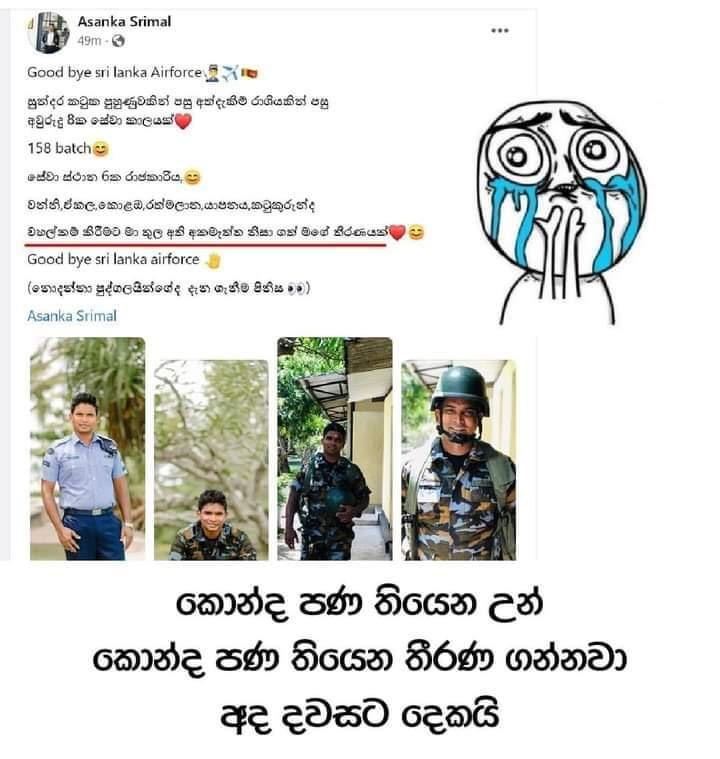
The Sri Lanka Air Force (SLAF) said that an airman who claimed that he did not want to be a slave to Sri Lanka Air Force, has left the SLAF on termination of his initial engagement of eight-years.

An airman named Asanka Srimal, who served in the Sri Lanka Air Force has posted a social media post that he left the service stating, My choice was taken because I did not want to be a slave to Sri Lanka Air Force”. 

However, SLAF Spokesman Group Captain Dushan Wijesinghe said that he left the Air Force on 21st July 2022 on termination of his initial engagement of eight-years.

“An Air Force member is generally entitled to serve up to 22 years in service at his or her own discretion.  Nevertheless, required provisions are vested to Air Force to decide the extension of service is approved after the termination of initial engagement, based on the conduct of the particular service member concern,” the SLAF said.  

Further, this airman was found guilty for the offences in two occasions for financial frauds during his last serving period at SLAF Station Katukurunda. However, this individual was officially discharged from the Air Force after termination of his initial engagement of 8 years owing to the reason that his extension was impossible to authorize due to his disgraceful conduct which has been sentenced under the Air Force act. 

Therefore, based on the aforementioned circumstances, his discharge was caused by the inability to prolong his service and it is baseless so say that frustration and dissatisfaction in the service led to him resigning, Group Captain Wijesinghe said.

Veteran Politician Takes Control of Sri Lanka’s Battered Economy

July 24th, 2022

VOA

COLOMBO, SRI LANKA — 

Former Sri Lankan prime minister Ranil Wickremesinghe has been sworn in as the country’s president and has promised to form an all-party government capable of securing a multibillion-dollar International Monetary Fund bailout.

Wickremesinghe’s victory followed the resignation of President Gotobaya Rajapaksa, who fled to Singapore after hundreds of thousands of Sri Lankans marched across the capital on July 9, overran the presidential palace, picnicked on the lawns and even swam in the president’s pool.

However, Wickremesinghe is also unpopular with many of the protesters given his close ties with the Rajapaskas. He served as prime minister under Gotabaya and despite promises that he would form an all-party government, most of his appointments in the new cabinet have been chosen from the ranks of Rajapaksa loyalists.

The Rajapaksa family ruled for 17 years and is widely blamed for bankrupting this country, with debts totaling $51 billion and foreign reserves of just $1.7 billion. The central bank says it needs $7 billion for debt obligations and to sustain Sri Lanka for the rest of this year.

Ganeshan Wignarjara, a senior fellow at the Institute of South Asian Studies at the National University of Singapore, said the crisis had been predicted at least four years ago but the Rajapaksas did not want to listen and initial approaches to the IMF in April had come much too late.

In this photo provided by Sri Lankan President's Office, Sri Lanka's newly elected president Ranil Wickremesinghe, signs after taking oath during his swearing-in ceremony in Colombo, Sri Lanka, July 21, 2022.
In this photo provided by Sri Lankan President’s Office, Sri Lanka’s newly elected president Ranil Wickremesinghe, signs after taking oath during his swearing-in ceremony in Colombo, Sri Lanka, July 21, 2022.

The Sri Lankan economy is at risk of crashing after it defaulted on its debt. Growth is at -4 to –6% in 2022 and inflation is between 50 and 70% this year and there is three-quarters of a million poor people that has been created through this crisis.

So it’s a terrible situation in Sri Lanka,” he said, adding that Wickremesinghe needs time to get his country’s finances in order.

Officials from Colombo are expected to meet with the IMF in August and negotiations are expected to include Sri Lanka’s top three lenders – Japan, the Asian Development Bank and China.

At the recent meeting of G-20 financial officials in Indonesia, U.S. Treasury Secretary Janet Yellen, urged China to help restructure Sri Lanka’s debt, telling journalists, Sri Lanka is clearly unable to repay that debt.”

And it’s my hope that China will be willing to work with Sri Lanka to restructure the debt – it would likely be both in China and Sri Lanka’s interest,” she said.

Wignaraja also said China must play a positive role in resolving the crisis but added that fear of a Chinese debt trap had been exaggerated as Beijing holds just 14% of Sri Lanka’s total debt.

China gave Sri Lanka $13.2 billion since 2006 for infrastructure projects. These projects have had mixed results; some good projects, some bad projects.

The total debt burden is something like $7.6 billion. It suggests a rising debt to China but does not indicate that Sri Lanka is yet in a Chinese debt trap,” he said.

Any IMF deal could be months away and Sri Lankans still need to contend with hyperinflation, acute food and fuel shortages, and power blackouts. Schools remain closed and many people work from home.

Shortages of medicine prompted doctors to warn people would die, particularly in the remote countryside, where distribution of essential items, including rice, has ground to a halt as the country has run out of fuel.

Protesters and politicians from all political parties are also demanding an independent investigation into the Rajapaksa family, their wealth and allegations of corruption.

Sri Lankan investigators have previously claimed that more than $2 billion had been transferred to bank accounts in Dubai, held by people close to Mahinda Rajapaksa, brother of Gotabaya, when he served as president, more than seven years ago. Mahinda dismissed those claims as “nonsense.”

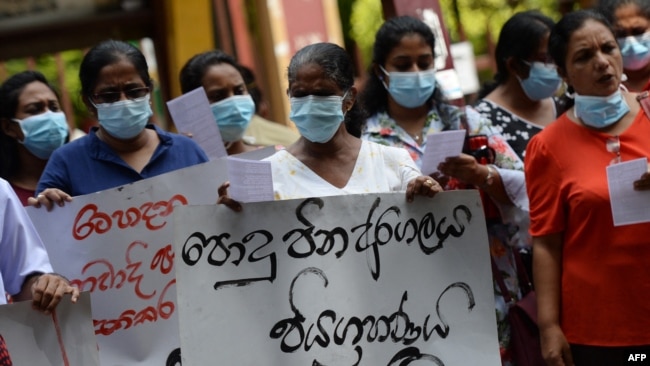
Health workers hold placards and shout slogans against Sri Lankan President Ranil Wickremesinghe during a protest in Colombo on July 23, 2022.

Protest numbers have dwindled since Rajapaksa fled the country but ill feeling toward the government remains high, with many demonstrators deeply skeptical and attempting to maintain their tent camp outside of the presidential complex. However, the army and police began forcibly dismantling the camp on Friday morning leading to clashes and arrests.

Our government, Sri Lankan government, they are killing the innocent people in the rural areas in this country. They have nothing to eat,” said Keith Gibson, a musician and protest leader.

They only be drinking water – and this corrupted regiment, they are killing the people and they are not leading, and they have no solution for the country, you know, and the people are suffering,” he said.

His sentiments were echoed by Sulaimaan Saim, a medical student who recently returned from studies in Belarus. He said people who once drove luxury vehicles now ride in tuk-tuks, and people who once rode in tuk-tuks are now forced to walk.

The government has been messing around too much. They’ve been playing around with our money. They’ve been taking people’s money. They’ve been basically stealing it,” he said.

Now we’re down to zero, nothing, completely nothing, we’ve got nothing, our country’s really messed up. We don’t have fuel, we don’t have food, we don’t have gas. We don’t have medicine. People are dying. Waiting in queues for fuel for like four or five days, it’s really bad,” he said.

Protesters disregarded multiple requests to vacate Presidential Secretariat: Police

July 24th, 2022

Adaderana

The police announced today that investigations are underway to identify all those who visited the Presidential Secretariat after it was occupied by the protesters on July 09, for the crime of trespassing.

Convening a media briefing on Saturday (July 23), the police spokesperson SSP Nihal Thalduwa said measures will also be taken to arrest all those who stole artifacts and other valuable items from the President’s House.

According to the police, the main suspects who stole valuable historical items from the establishment have been identified based on evidence on CCTV footage.

The police added that a broader investigation is underway to arrest all suspects involved.

In the meantime, the bomb disposal unit has also launched operations to ascertain whether any explosive devices have been placed at the President’s House and the Presidential Secretariat.

After the protesters occupying the presidential secretariat were removed from the premises on Friday morning in a joint operation carried out by the tri-forces, the police and the STF, they have now set camp at the GotaGoGama protest site. Meanwhile, this morning, part of the Lotus Road and the Galle Road that were barricaded from the Presidential Secretariat onwards were reopened for traffic.

Addressing the media briefing, SSP Thalduwa explained as to why the protesters were cleared of the historical building which was established in 1978.

The entrance to the Presidential Secretariat was blocked by the protesters for some time now. The Colombo Fort Police had requested the protesters on nine occasions to stop blocking the entrance. However, they disregarded that request.”

He remarked that the police were operating with restraint over the past couple of months, letting the public to engage in peaceful protests at the Presidential Secretariat’s entrance.

Speaking further, he said the protesters who entered the presidential secretariat on the 09th of July were requested to vacate the premises by the OIC of the Colombo Central Police Division, his assistant and the OIC of the Fort Police on July 14th and 18th.

However, they responded aggressively to the request and refused to vacate the premises, he continued, adding that, as a result, the police had a problem with placing their trust in the protesters.

Stressing that no one will be allowed to undermine the country’s law, the police spokesperson said: The new President does not have an office to carry out his duties, and responsibilities. The Presidential Secretariat is the only office. The Presidential Secretariat is the main administrative building where decisions are taken for the people of the country. After a new executive president is elected, it is our duty to have the premises cleared up in order to ensure that the officers could carry out their respective duties. We were in a situation where we could not trust their word when they stated that they would vacate the premises on an alternative day. This is why the tri-forces, the police and the STF worked together to remove the protesters who were illegally stationed at the premises.”

Even then, the police did not use emergency laws, SSP Thalduwa said further, noting that the law enforcement authorities and the military operated as per the common law of the country.

Presidential Secretariat to reopen on Monday?

July 24th, 2022

Courtesy Adaderana

Sri Lanka’s besieged presidential office will reopen on Monday (Jul 25), police said, days after anti-government demonstrators were flushed out in a military crackdown that triggered international condemnation.

Widespread public anger over the island’s unprecedented economic crisis saw protesters storm and occupy the colonial-era building earlier this month.

Soldiers were forced to rescue then-president Gotabaya Rajapaksa from his nearby residence on the same day, with the leader fleeing to Singapore and resigning days later.

Troops armed with batons and automatic weapons cleared the 92-year-old presidential secretariat in a pre-dawn raid on Friday.

At least 48 people were wounded and nine arrested in the operation, during which security forces tore down tents set up by protesters outside the complex since April.

The office is ready for reopening from Monday,” said a police official on Sunday, who declined to be named as he was not authorised to speak to the media.

He told AFP that forensics experts had visited the office to gather evidence of damage by protesters.

The siege of the secretariat, which lasted since May 9, has now been lifted.”

Western governments, the United Nations and human rights groups have condemned Presidnet Ranil Wickremesinghe for using violence against unarmed protesters who had announced their intention to vacate the site later on Friday.

Police spokesman Nihal Thalduwa said protesters were free to continue their demonstrations at a designated site near the presidential office.

They can remain at the official protest site. The government may even open a few more places for demonstrators in the city,” Thalduwa said on Sunday.

The military operation to clear the secretariat building and its immediate surroundings came less than 24 hours after Wickremesinghe was sworn in and just before a new Cabinet was appointed.

Wickremesinghe was elected by legislators on Wednesday to replace Rajapaksa, who fled to neighbouring Maldives in a military plane and then travelled to Singapore from where he sent his resignation.

Source: AFP

–Agencies

Wikileaks releases 2007 document related to Ranil

July 24th, 2022

Newsin.Asia

Colombo, July 24 (NewsWire) – Wikileaks has published a document pertaining to a conversation between the newly elected President of Sri Lanka Ranil Wickremeinghe and the Japanese government in 2007.

The document has been published hours after Ranil Wickremesinghe was elected the 8th Executive President of Sri Lanka in a secret ballot held in Parliament.

As per the document shared by Wikileaks, Ranil Wickremesinghe, who was the opposition leader in 2007, had asked Japan to suspend economic assistance to Sri Lanka.

The document further reveals that Japan had responded that the Sri Lankan people should not be punished for acts of commission and omission by their leaders”.

https://pbs.twimg.com/media/FYGNx_lWAAAcdKC?format=jpg&name=small

https://newsin.asia/wikileaks-releases-2007-document-related-to-ranil/

President raises unofficial concerns with Colombo based diplomats over statements

July 23rd, 2022

Courtesy The Daily Mirror

– Diplomats were briefed by the President on the military operations conducted to clear the protestors from the Presidential Secretariat area, but the diplomats were requested to check with the authorities as well to clarify matters when making statements in the future

– President Wickremesinghe in a light tone asked some of the diplomats if protestors could illegally occupy the President’s Office in their respective countries

– He informed them that the protestors had been informed to vacate the area by 6 am yesterday but the protestors had refused and instead provided an alternative time which was not accepted by the authorities 

By JAMILA HUSAIN

President Ranil Wickremesinghe yesterday evening invited the Colombo based diplomats to the President’s Office during which unofficial concerns were raised over their statements released over the operation carried out by the security forces to clear the Presidential Secretariat area.

The Daily Mirror learns that the diplomats were briefed by the President on the military operations conducted to clear the protestors from the Presidential Secretariat area, but the diplomats were requested to check with the authorities as well to clarify matters when making statements in the future.

During the meeting which was also attended by the IGP and Foreign Ministry officials, President Wickremesinghe in a light tone asked some of the diplomats if protestors could illegally occupy the President’s Office in their respective countries. 

He requested them that if statements were to be released in the future, authorities were available to clarify any queries rather than seeing only what was available on social media. 

President Wickremesinghe had briefed the diplomats over the military operation and informed them that protestors continued to occupy the area despite a court order and they continued to occupy the Presidential Secretariat illegally.

He informed them that the protestors had been informed to vacate the area by 6 am yesterday but the protestors had refused and instead provided an alternative time which was not accepted by the authorities. 

President Wickremesinghe also requested the diplomats to check with the relevant officials when making statements, as statements based on social media reports alone could damage Sri Lanka’s image globally, especially at a time when Sri Lanka needed assistance from friendly nations to recover from the economic crisis. 

Over 1,000 valuable artefacts missing in state premises taken over by protesters

July 23rd, 2022

Courtesy The Daily Mirror

More than 1,000 items with archaeological value are reportedly missing from the state premises such as President’s House and Temple Trees which were taken over by the protesters.

Police sources said special investigations have been launched to recover those items.

Investigating officers have received information that some people had stolen certain parts of valuable artefacts in those premises.

It was also reported that the Archaeological Department does not have official records of the artefacts in the President’s House though it was gazetted as a place of archaeological importance.

However, initial investigations revealed that at least 1000 items of value had been stolen.

It is also learnt that records of artefacts in the President’s House had not been maintained properly owing to restricted access to the President’s House which is situated in a high security area. (Sujith Hewajulige)

මාගේ පුද්ගලික නිවස ගිනි තැබීමේ සිද්ධිය සම්බන්ධයෙන් කිසිදු පාර්ශ්වයක් ට්විටර් පණිවිඩ නිකුත් නොකිරීම විමතියට කරුණක්’

July 23rd, 2022

උපුටා ගැන්ම  හිරු පුවත්

ගාලු මුවදොර විරෝධතාකරුවන්ට ඉන් ඉවත්වන ලෙස පූර්ව දැනුවත් කිරීම් කිහිපයක්ම සිදුකර තිබුණ ද, පෙරදින රාත්‍රිය වනතෙක්ම ඔවුන් ඉන් ඉවත් නොවීම හේතුවෙන් පොලිසිය සහ හමුදාව යොදා ඔවුන්ව ඉවත් කිරීමට කටයුතු කළ බව ජනාධිපති රනිල් වික්‍රමසිංහ විදෙස් තානාපතිවරුන් හමුවේ පවසා තිබෙනවා.

ඒ විදෙස් තානාපතිවරු කිහිපදෙනෙකු ජනාධිපතිවරයා සමග සිදු කළ සාකච්ඡාවක් අතරතුරයි.

මේ අතර ඊයේ අලුයම ඇතිවු සිද්ධියෙන් පසු ජනාධිපති ලේකම් කාර්යාලය ඇතුළු කොළඹ නගරයේ ස්ථාන කිහිපයක ආරක්ෂාව තවදුරටත් දැඩිකොට තිබෙනවා.

අරගලකරුවන් ඉන් ඉවත් කිරීමට ආරක්ෂක අංශ මෙහෙයුමක් දියත් කළ අතර එහිදී නොසන්සුන්තාවක් ද උද්ගත වී තිබුණා.

එහිදී ත්‍රිවිධ හමුදා සහ පොලිසිය ජනපති ලේකම් කාර්යාලය යළි සිය භාරයට ගැනීමට කටයුතු කළා.

මේ අතර ගාලුමුවදොර සිද්ධිය සම්බන්ධයෙන් එක්සත් ජාතීන්ගේ මානව හිමිකම් කාර්යාල ප්‍රකාශකවරයා විසින් ප්‍රකාශයක් නිකුත් කර තිබෙනවා.

එමඟින් සඳහන් කර ඇත්තේ, බලය යෙදවීමෙන් ශ්‍රී ලංකාවේ ආර්ථික හා දේශපාලන ගැටලුව විසඳීමට හැකියාවක් නොහැකි බවයි.

මේ අතර ගාලුමුවදොර සිද්ධිය සම්බන්ධයෙන් විදෙස් තානාපතිවරු ඇතුළු ජාත්‍යන්තරයේ දැඩි අවධානයක් යොමුවූ පසුබිමක මෙරට අමෙරිකානු තානාපතිනි ජුලී චංග් මහත්මිය ජනාධිපති රනිල් වික්‍රමසිංහ හමුවී සාකච්ඡාවක නිරත වී තිබෙනවා.

ට්විටර් සටහනක් නිකුත් කරමින් ඇය පවසන්නේ, යහපත් අනාගතයක් සඳහා ශ්‍රී ලාංකිකයන්ගේ ඉල්ලීම්වලට ප්‍රතිචාර දැක්වීමට ජනාධිපතිවරයාට සහ කැබිනට් මණ්ඩලයට අවස්ථාවක් හා වගකීමක් පවතින බවයි.

අමෙරිකානු තානාපතිවරියට අමතරව බ්‍රිතාන්‍ය, ජර්මානු, කැනඩා මෙන්ම යුරෝපා සංගමයේ තානාපතිවරු හා නියෝජිතයින් ද ජනාධිපති රනිල් වික්‍රමසිංහ හමුවී සාකච්ඡා කර ඇති බව අභ්‍යන්තර ආරංචි මාර්ග සඳහන් කළා.

එහිදී ජනාධිපතිවරයා පෙන්වා දී ඇත්තේ, ජනාධිපති ලේකම් කාර්යාලය මෙරට ප්‍රධාන පරිපාලන ගොඩනැගිල්ල බවත්, රාජ්‍යතාන්ත්‍රික කටයුතු මෙහෙයවන්නේ එමස්ථානයේ සිට බවයි.

ඓතිහාසික වශයෙන් වැදගත් ස්ථානයක් මෙන්ම වැදගත් ලියකියවිලි රැසක් එම ස්ථානයේ පවතින බව ද ජනාධිපතිවරයා සඳහන් කර තිබෙනවා.

විරෝධතාකරුවන්ට ඉන් ඉවත්වන ලෙස පූර්ව දැනුවත් කිරීමක් සිදුකර තිබුණ ද, පෙරදින රාත්‍රිය වනතෙක්ම ඔවුන් ඉන් ඉවත් නොවීම හේතුවෙන් පොලිසිය සහ හමුදාව යොදා ඔවුන්ව ඉවත් කිරීමට කටයුතු කළ බව ද ජනාධිපතිවරයා තානාපතිවරුන්ට ප්‍රකාශ කර තිබෙනවා.

ජනාධිපතිවරයා අමෙරිකානු තානාපතිවරියට පෙන්වා දී ඇත්තේ, අමෙරිකාවේ කැපිටල් ගොඩනැගිල්ල සහ කොංග්‍රස් මණ්ඩල ගොඩනැගිල්ල එරට විරෝධතාකරුවන්ගෙන් මුදාගැනීම සඳහා අමෙරිකානු ආරක්ෂක අංශ ද කටයුතු කරනු ලැබුවේ මෙවැනි ආකාරයෙන් බවයි.

වැඩබලන ජනාධිපතිවරයා ලෙස කටයුතු කළ අවස්ථාවේ තම නිවසට ගිනි තැබීමේ සිද්ධිය සම්බන්ධයෙන් කිසිඳු පාර්ශ්වයක් ට්විටර් පණිවුඩ නිකුත් නොකිරීම සම්බන්ධයෙන් විමතියට පත්වන බවද ජනාධිපතිවරයා තානාපතිවරු හමුවේ සඳහන් කර තිබෙනවා.

මේ අතර, ගාලු මුවදොර විරෝධතාකරුවන් මේ වනවිට රැඳී සිටින ස්ථානයේ අද තත්ත්වය සන්සුන්කාරී බවක් ඉසිලුවා.

ඔවුන් ඊයේ රාත්‍රියේ විවිධ ක්‍රියාකාරකම්වල නිරත වන ආකාරය ද දැකගත හැකිවුණා.<br /><br />අදත් කොළඹ කොටුව‍, ලෝටස් පාර හා ඒ අවට ප්‍රදේශවල ආරක්ෂාව තර කර ඇති ආකාරය දක්නට ලැබුණා.

මේ අතර අරගලකරුවන්ට එල්ල වු ප්‍රහාරයට විරෝධය පළ කරමින් සහ ආණ්ඩුවට විරෝධය පළ කරමින් ජාතික ජන බලවේගය ප්‍රදේශ කිහිපයකදී උද්ඝෝෂණ සංවිධානය කර තිබුණා.

ජනතා විමුක්ති පෙරමුණ සහ පෙරටුගාමි පක්ෂය සමඟ එක්ව වයඹ විශ්වවිද්‍යාල සිසුන් සංවිධාන කළ උත්ඝෝෂණයක් කුලියාපිටය නගරයේදී පැවැත්වුණා.

උගත් නීතීඥ මහත්ම මහත්මීන්ගේ  උදහසට ලක්වීම පිණිස ලියමි.

July 23rd, 2022

හිරාන් කුරේ

නඩත්තු නඩුවට ඇවිත් සැමියා දෙන රු10000/- න් ගෑණු මනුස්සයාගෙන් රු 2000/- ක් ගාස්තු ලෙස ගන්නත්,

          පොලිසිය හරහා අර මහත්තයා අල්ලන්න..ඇප ගන්නනම් කියලා visiting card එක දීගන්නටත්,

          දික්කසාද නඩුවේ නියත තීන්දුවේ සහතික පිටපත උසාවියෙන් අරන් දෙන්න රු 5000/- ක් ගැනීමටත්,

          කුඩු නඩුවේ මිනිහගෙ නඩුවට පෙනී ඉඳලා ගාස්තුවට හරි යන්න ගෑණිගේ කරාඹු ජෝඩුව ගලව ගන්නටත්,

         ඔප්පුවේ ප්‍රතිෂ්ඨාව අඩුවෙන් දාලා මුද්දර ගාස්තු වලින් රාජ්‍ය ආදායමට යන්න ඕන බදු ටිකට කෙලින්නටත්,

        ඇතුලේ ඉන්න රංජන් කියන්නා වගේ ගත්ත ගාස්තුවට රිසිට් එකක් දී ගන්නටත්,

             ඇත්ත දැන දැන බොරු හදලා හත් පොලේ දිවුරලා, සාක්ෂි වසන් කරලා,පොලිසිය අල්ලගෙන අපරාධකාරයෝ, මත්ද්‍රව්‍ය ජාවාරම් කාරයෝ, කප්පම් කාරයෝ, බේර ගන්නටත්,

           හම්බ කරන සල්ලි වසන් කරලා ආදායම් බදු ගෙවන එකට අරින්නටත්,

    හිතට එකඟව බැරි නිසාවෙන් නිදහස් අධ්‍යාපනයට පින් සිදුවෙන්න ලබපු අධ්‍යාපනය රට,ජාතිය වෙනුවෙන් යමක් කරගෙන ඉන්න මට මේ ටික අහන්නමහිතුනා

මට මේ ටික අහන්න දෙන්න අයියෝ

1.  ජනාධිපති ලේකම් කාර්‍යාලය නීතී විරෝධී  ලෙස අත්පත් කරගෙන එහි රැදීසිටීමට අයිතියක් තියෙනව කියල කියන්නෙ ආණ්ඩුක්‍රම ව්‍යවස්ථාවෙ කවර ව්‍යවස්ථාව යටතේද?           

2.  අරගල කරුවන් තමන් එයින් ඉවත්වෙන්නෙ අහවල් දිනේ අහවල් වෙලාවටයි කියන්න බලයක් ලැබෙන්නෙ කොහොමද? කවර නීතියක් යටතේද?

    එතෙක් ආරක්ෂක  අංශ සිල්සමාදන් වෙලා සිටිය යුතුයි කියන්නෙ කුමන නීතියකින්ද?       

 3.  අරගලකරුවන්ට රටේ නීතියට උඩින් විශේෂ  නීතියක් ක්‍රියාත්මක වේද?

නීතියේ ආධිපත්‍යය කියන්නෙ ඒකටද??

 4. හමුදා සාමාජිකයින්ට අමානුෂික ලෙස පහරදී තුවක්කු පැහරගෙන යද්දී හමුදාවන් නවගුණ වැලේ ඇට ගණන් කල යුතුද.?

5.  හමුදා සෙබලාට පහරදෙනව වීඩියෝ කරල කවුරුවත් දැම්මද? මේක වැරදියි කියල. ඇත්තටම  ඒක වරදක් නෙවේද?

ඔවුන්ට දණ්ඩ නීති සංග්‍රහය තුල89 සිට 99 දක්වා වගන්ති තුල සඳහන් ආත්මාරක්ෂාවේ අයිතිය අකැපද?

 6. හමුදා සාමාජිකයින් ප්‍රකෝප කරදමින් ඔවුන්ගේ අම්මා අප්පා මතක්කරමින් බැණ වදිමින් ඉල්ලන් කෑම පමණක් වීඩියෝගත කර දැම්මාම හරිද?

ඇත්තටම උන් මහජන බදු මුදලින් නඩත්තු වෙන උන් විතරද? උන් ගන්න පඩියෙන් ගෙදරට ගෙනියන හාල් ටිකට,පරිප්පු ටිකට බදු වදින්නේ නැද්ද? ටික ගෙවන්නෙත් ඔයාලාමද?

( වීඩියෝ නම් මොනාද? කොයි කවුරු ගාවත් තියෙනව අද කාලෙනිසි අධිකරණයක් ඉදිරියේ දකින්න ලැබේවි)

7. ව්‍යවස්ථාවෙ 3 පරිච්ඡේදයේ 10 සිට 14 දක්වා වන මූලික අයිතිවාසිකම් ගැන සද්දෙට කතා කරන්නා සේම සෑම අයිතිවාසිකමක්ම බුක්ති විඳිය යුත්තේ සීමාවන්ට යටත් බවට ආණ්ඩු ක්‍රම ව්‍යවස්ථාවේ 15 වන ව්‍යවස්ථාව තුල අන්තර්ගත සීමා කිරීම් ගැන නොදන්නේද?

වගේම, 28 වන ව්‍යවස්ථාව තුල පවත්නා පුරවැසි යුතුකම් ගැන කියවලා නැද්ද?

    ඔබේ සැරයටිය වනමින් ඔබට මේ අත යාමට ඇති අයිතිය අනෙකාගේ නාසය අසලින් කෙලවර වන බව උගත් බව අමතකද?

9. ජනාධිපති කාර්‍යාලය අත්පත් කරගැනීම , රාජ්‍ය නිලධාරීන් ගේ රාජකාරි වලට බාධා කිරීම් සියල්ල සාධාරණීකරණය කරන්න නීති පොත්පත්වල තියන මා නොදත් ඔබ පමණක් දත් නීති මොනවාද?

10.  ඔය කියන විදියට අරගල කරුවන් හමුදා මූලස්ථානය අල්ලාගෙන තව දින 10 කින් දෙනවායැයි කිව්වොත්😁

ඔවුන් දෙනකම් හමුදාවන් සීල ව්‍යාපාරයක් පටන් ගත යුතුද.??

   නීතිය නොදැනීම නිදහසට කරුණක් නොවන අතරම

නීතිය අතැඹුලක් සේ දැන දැනම නීතිය නොදත් පුරවැසියන්  නොමඟ යවමින් ඔවුන් අපරාධ කරුවන් බවට පත් කිරීම ඊට වඩා බරපතළ ක්‍රියාවකි.

      සාලිය පීරිස් සල්ලි💰 එන්නේ කොයින්ද? උපුල් කුමාරප්පෙරුම කඩේ යවන්නේ කාවද? CFPS අජිත් පී පෙරේරා ගේ ක්‍රියාත්මකභාවය කුමක්ද? cfps එකෙන් law college ගිය S3 නීතීඥ සිප්පි කටු කඩේ යන්නේ කාටද?

   සාමාන්‍ය මිනිස්සුන්ට  නීතිය අතට ගන්න පාර පෙන්නලාදැන් අඳ බිහිරි ගී කියන්නේ කවුද?? සරත් ජයමාන්න වැනි ජ්‍යේෂ්ඨයන් හැර ගියේ මන්ද?   

    රටේ සමස්ත නීතීඥ ප්‍රජාවගේම සංගමයක් කොටසකගේ අවශ්‍යතාව සඳහා වෛශ්‍යා සේවනයේ යෙදවිය හැකිද?

   රටේ අණ්ඩුක්‍රම ව්‍යවස්ථාව ආරක්ෂා කරන බවටත්, යුක්තිය පසිඳලීම පිණිස සහය වන බවටත් දිවුරුම් දෙන උගත් මිතුරන් ආණ්ඩුක්‍රම ව්‍යවස්ථාව  ගිනිතැබිය යුතු එකක් බවට රටේ  ප්‍රසිද්ධ මාධ්‍යයකට පවා පැමිණ ප්‍රකාශ කිරීමෙන් නීතිය සහමුලින්ම වැලලීමට පාර කපන්නේද? එය නිවැරැදිද?

    එලෙස ගිණි තැබිය යුතු ව්‍යවස්ථාවක පවත්නා අයිතිවාසිකම් ගැන පමණද? කතා කරන්නේ.

      අරගලය හරහා system change කරන්නට බලපෑම් කණ්ඩායමක් ලෙස නව ආණ්ඩුක්‍රම ව්‍යවස්ථාවක් කෙටුම්පත් කරන්නටත්, රටේ වෙනස් විය යුතු නීති,අණ පනත් සංශෝධනය කිරීමටත්, ක්‍රම වෙනසකට අවශ්‍ය නව නීති රීති ඇතිකරලීමටත්,

      කතිකාවතක්,වේදිකාවක් නිර්මාණය කර ගැනීමට මහඟු අවස්ථාවක් තිබියදී

     රටේ මුඛ්‍ය  නීතියටත් පටහැණිව යෝජනා මාලාවක් හදාගෙන ඇවිත් හත්පොලේ ගා ගත්තේ මන්ද?

      අරගලය ඇතුලේ ලකුණු දා ගන්න විතරමද?? බැලුවේ  😁💰

       පවත්නා නීතියට අනුගත වීමටත්, නීතීන් ප්‍රකාර හිමි බලය ක්‍රියාත්මක කිරීමටත් සන්නද්ධ හමුදාවන් වලට බැරිද? සඳහා සංගමයෙන් නීතියක් කියලා දෙනවද? නැතිනම් සභාපතිවරයාගේ හමුදා විරෝධී ආකල්පයට හමුදාවන් අනුගත විය යුතුද?

        පවත්නා නීතිය ප්‍රකාර ප්‍රජාතන්ත්‍රවාදීව පත්වූ ජනාධිපතිවරයකුට මහජන ආරක්ෂණ පනත ප්‍රකාර හදිසි නීතිය  පණවන්න බැරිද?

     නීතිය ගැන දන්න කියන කට්ටියගෙන් ඇහුවේ

   ගොඩ පෙරකදෝරු උදවිය ෆෝම් වීම අනවශ්‍යයි….

මුලදී අත දී පසුව පොහොට්ටුවට හිත දුන් ඩලස්ගේ පිරිස වෙනතක යන්නම යයි

July 23rd, 2022

උපුටා ගැන්ම නෙත්

ජනාධිපතිවරයා තේරීමේ ඡන්දයට ඉදිරිපත්වූ ඩලස් අලහප්පෙරුම මහතාට  සහාය දුන් ශ්‍රී ලංකා පොදුජන පෙරමුණේ මන්ත්‍රීවරුන් කණ්ඩායම ඉදිරියේ දී වෙනම කණ්ඩායමක් ලෙස කටයුතු කරන බව වාර්තා වෙනවා.

ඒ ඩලස්අලහප්පෙරුම මහතාගේ නායකත්වය යටතේයි .

එම කණ්ඩායමට මහාචාර්ය ජී එල් පීරිස්, මහාචාර්ය චරිත හේරත්, මහාචාර්ය චන්න ජයසුමන,ආචාර්ය නාලක ගොඩහේවා යන මහත්වරුන්ට අමතරව,පොදුජන පෙරමුණේ” හෘද සාක්ෂියට එකග මන්ත්‍රී කණ්ඩායමද ඇතළත් වනු ඇති බවයි දැනගන්නට  ලැබෙන්නේ.
 

ඇමරිකාවෙත් විරෝධතා පාලනය කලේ මෙහෙමයි ! ජනපති රනිල් තානාපතිනියට අතීතය සිහි කරයි

July 23rd, 2022

Courtesy Neth News උපුටා ගැන්ම නෙත්

ඊයෙ දිනයේදී ජනාධිපති මන්දිරය අත්පත් කර ගැනීම වෙනුවෙන් ආරක්ෂක අංශ විසින් සිදුකල මෙහෙයුම සම්බන්ධයෙන් ජනාධිපති රනිල් වික්‍රමසිංහ මහතා ඇමරිකානු තානාපතිනියට කරුණු පැහැදිලි කිරිමක් සිදුකර තිබෙනවා.

එහිදී ඔහු පවසා ඇත්තේ ඇමරිකාවේ කැපිටල් ගොඩනැඟිල්ල සහ කොංග්‍රස් මණ්ඩල ගොඩනැඟිල්ල විරෝධතාකරුවන්ගෙන් මුදා ගැනීමට ඇමරිකානු ආරක්ෂක අංශ ක්‍රියා කලේද මේ ආකාරයෙන්ම බවයි.

ජනාධිපතිවරයා මේ බව පවසා ඇත්තේ විදෙස් තානාපතිවරුන් හමුවූ අවස්ථාවකදියි.

පසුගිය මාසයේදී ලොස් ඇන්ජලිස් පොලිසියද විරෝධතා පාලනය කිරීමට මේ ආකාරයෙන් කටයුතු කල අතර එවන් විඩීයෝ කිහිපයක් ට්විටර් ඔස්සේ පසුගිය කාලය පුරාවටම ප්‍රචාරය වුනා.

https://youtube.com/watch?v=zVMLaweItQ0

එමෙන්ම ඊයේ සිදුවීම සම්බන්ධයෙන් ඇමරිකානු තානාපතිනියගේ හැසිරීම පිළිබඳව සමාජ මාධ්‍ය ඔස්සේ හුවමාරු වන සටහනක් පහතින්.

Dear Madam Ambassador of the USA.  
I have tweeted before also that the US has no right to interfere in Sri Lanka’s internal matters as we are a None Aligned Nation State.  Will the US Government allow the White House to be stormed? Any one who dared would have been shot at.
We saw how the military retook the Capitol building when protestors stormed it during the Senate meeting. 
Over 200 police shootings happen in a day in the US on simple traffic stops 6 to 7 are fatal. Its time SL established law and order before anything else. Support the majority people of SL who are trying to live through this crisis and not the fascists who are trying to form a government through undemocratic means. This is no more a citizens protest.  Its insurgency. And if you do tweet that the US will allow insurgency and fascism in the US. I will humbly withdraw this comment.
Dr sanjay perera

ජනාධිපතිවරණයේදී දාන්න ගිය දේශපාලන ඩීල් 

July 23rd, 2022

Turn National List 29 Members into an Advisory Council not MPs

July 22nd, 2022

Shenali D Waduge

Sri Lanka’s Parliament consists of 225 Members of Parliament from which 196 are elected by the People and 29 are not-elected but nominated by the respective parties & enter depending on the allocation as per the votes obtained by each party. Therefore, the composition of the National List corresponds to the votes won by parties. Given that the National List are supposed to be professionals who are not politicians, they should not enjoy perks given to politicians. The 29 Member National List should be transformed into an Advisory Council with no mandate to enforce laws but with ability to scrutinize Bills and make Proposals and Recommendations that the 196 MPs must respect.

From the last few months, it is apparent that the country faces some serious issues that it needs to deal with

  1. Unsuited candidates nominated by political parties ending in Parliament
  2. Inability to change these unsuited candidates once elected until next election
  3. National List manipulated & abused by Political parties
  4. External threats to Parliamentary democracy

Unsuited Candidates

They say one man’s freedom fighter is another man’s terrorist. Likewise, candidates that some deem distasteful maybe doing a service to their electorate. In such a scenario, it is the prerogative of the electorate to decide and others must respect it.

There is different schools of thought regarding criteria – some insist on a degree, some are happy with a basic A/L qualification or equivalent – a paper qualification is important but best to have criteria set for portfolios too. However, what we need to understand is that a politician is far different to a professional. Politicians are dealing with people and people’s wants, needs and problems are somewhat difficult for compartmentalize as professionals like to do. We can see the difficulties that professionals have found in adjusting to life as a politician. However, to filter bad eggs from wanting to come forward to contest not to serve the nation nor the people but to advance their agendas.

Remove unsuited candidates

As per the present system, once unsuited candidates enter Parliament, people have to wait till the next election to vote them out.

It has been suggested to incorporate a RIGHT OF RECALL – this is a petition to recall an elected MP for any misadventure or abuse of power. However, even in the countries where this provision is available, there are not too many cases of its success.

Instead would like to propose a new provision – RIGHT TO REJECT. Here candidates that apply for nomination to a political party, publish the final list & the public are able to petition to REJECT a candidate they feel is unsuited to be nominated from the party. By this method, unsuited candidates can be prevented from entering the political system at nomination stage itself.

Abusing National List

At times the one’s rejected by vote end up re-entering from the national list, while even those who cross-over and are expelled from their party run to the Supreme Court & obtain an injunction to prevent expulsion. Electoral reforms must address this.

  • No politician should have been included into the National List
  • No rejected candidate should have been allowed to re-enter from the National List

Parliamentary Democracy under threat

In 2016, the then government knowingly or unknowingly signed up to become Asia’s first Open Government plan to enable an inclusive parliament bringing in civil society & NGOs. The catch here is that these NGOs and civil society being promoted to be placed in Parliament are envoys of those that fund them. This means that the external entities are plotting to send their nominees without entering from an election into Parliament to determine policy and reforms. By now we should realize the dangers in store. These entrants are unlikely to be doing anything for the benefit of the nation or its people but only to advance the geopolitical agendas of their paymasters as they currently do and that can be revealed by examples.

Therefore, any civil society or NGO heads (whether they are or are not funded by foreign entities) if they so want to enter Parliament must do so by election and not via new initiatives with ulterior motives. This means, the plan is to manipulate the National List and include foreign-funded NGOs and Civil Society as professionals” into the national list quota.

Given these threats looming before us, it is important to decide to safeguard Parliamentary sovereignty and turn the National List into an Advisory Body only.

National List – as an Advisory Body

  • 29 Members to the Advisory Body can be nominated by State universities/ registered State professional bodies/chambers & local civil society/NGOs & presented to the Elections Commission.
  • A vote is held among those nominated & the most votes becomes the Chairman of the Advisory Body.
  • The Chairman of the Advisory Body selects a team of 5 depending on the subject area of the Bill they are called to give their observations on.
  • 29 Member National List must have a separate Chamber for their deliberations
  • 29 Members should not be given MP status
  • 29 Members should not get same perks & privileges as an MP – this is because these professionals will continue to function in their respective professional roles. Making them an MP creates conflict of interest & entertains unnecessary issues.
  • 29 Members should function as an advisory body but not a body allowed to make their proposals or recommendations mandatory upon MPs
  • 29 Members can present their proposals to the public & entertain public views and opinions as well. These submissions by public must be made available for public scrutiny on a website.
  • 29 Members must be presented copies of Bill prior to enactment & deadline should be given for the National List Advisory Body to submit their determinations on any Bill before enactment. This corresponds with the time given to the Public to file FR once a Bill is gazetted.

These are just a preliminary set of suggestions & open for review.

The rationale behind this is to make maximum use of professionals & their professional knowledge instead of putting them as politicians, an area which is now unsuited for them. What is important to realize is that if the National List was created to bring in Professionals – only professionals must be brought in, not to govern but to provide advice, help policy and suggest proposals.

By turning the 29 National List into an Advisory Body, these professionals can play a significant role where their knowledge and inputs are concerned.

This is open for discussion and debate

Shenali D Waduge

POHOTTU AS USA’ S PROXY Pt 7C

July 22nd, 2022

KAMALIKA PIERIS

The Janatha Vimukthi Peramuna   was created by Rohana Wijeweera, whose real name was Patabandige Don Nandasiri Wijeweera. He was a member of Sri Lanka’s Communist Party   (Moscow wing) led by S.A. Wickremasinghe and in 1962 was awarded a scholarship to Lumumba University in Moscow, to study medicine. Sunday Times carries biographical information on Wijeweera at https://www.sundaytimes.lk/010408/spec.html (See essay by Kumudini Hettiarachhci and Renuka Sadanandan.)

In Moscow, Wijeweera had apparently changed his loyalties from Moscow to China. When he came on a visit to Sri Lanka in 1964, Russia did not permit him to return. According to Wijeweera, the reason given was his new attachment to Communist China.

Unable to return to Moscow, Wijeweera had joined the Communist Party (Peking wing) in Colombo. Wijeweera was given the task of re-organizing its youth, but instead tried to promote his own ideas. He had apparently tried to oust the Shanmuganathan faction in the party as well.Wijeweera wasexpelled from the Communist Party (Peking wing) in 1966. It is clear that neither Moscow nor Peking wanted him.  He was not valuable to them. Also they did not trust him. Rohana Wijeweera, it is alleged, had been secretly recruited by USA when he was in Moscow.

Starting in 1965, Wijeweera set up a   well organized underground movement, initially labeled simply as’ Viyaparaya’.  The Viyaparaya had become Janatha Vimukthi Peramuna by May 1970. There was a political party called Janatha Vimukthi Peramuna led by KMP Rajaratne In the 1950’s. This party is forgotten today.

Wijeweera visited various parts of the country, to obtain support for his movement. The movement gained support in the rural areas   where there were many alienated youth.  He was able to build a base among the educated Sinhala youth there. The movement took no root in the towns, in the industrial coastal areas around Colombo, nor in the Tamil areas, reported Jayantha Somasunderam.

Wijeweera targeted O and A Level students and unemployed graduates. Only 19 per cent of the membership was poorly educated, concluded Gamini Samaranayake. 79% were from Maha Vidyalaya and 6.4% from Madhya Maya Vidyalaya.

The movement received strong support from University students. The Socialist League of the University of Peradeniya, the  Communist Party ( Moscow) breakaway faction  from the University of Vidyodaya led by M. Wijesekara  and the Communist Party ( Moscow) oriented  faction of the Student society of the University of Vidyalankara, headed by D. I. G. Dharmasekera joined the movement. Arasaratnam observed that there were definitely more University students in the JVP than the mere 156 given In Obeysekera’s sample.

Wijeweera was looking for followers, whom he could trust and who were dedicated. Recruitment of new members was therefore done at a personal level. ‘A’ brought in ‘B’ who had been a classmate and so on. Gathering new members into the fold was referred to as “koku gahanava”, to hook someone in. . The term is revealing. It indicates control.  A person was given a task, probably irregular, which thereafter committed him to the JVP.

Those seeking membership were initially exposed to a discussion on the prevailing political situation in Sri Lanka. Those who passed this’ test’ were then treated to a series of   ‘classes’, which were held in secret. Those who passed this hurdle were then admitted to the fifth lecture which dealt with the JVP strategy. The prospective members were thereafter placed under observation, to see whether they would be loyal to the movement and then admitted into the movement.

These five ‘classes’ were on five different subjects.  The first class dealt with the ‘economic crisis’, the problems facing the peasant farmer and the rural worker. The second was on ‘Independence’ giving a historical background into the ill-effects of colonial rule. The third on ‘Indian expansionism’ focused on how Indian capitalists were trying to spread their tentacles into smaller countries. The fourth was on the failure of the Left movement. The fifth class, which came later, was on ‘the path the Revolution should take’.  Classes were held in the night, in cemeteries for small groups of five or 10.

J. V. P.  Members were classified into two lists.List A consisted of full time members, trustworthy, loyal, and identified only by pseudonyms. There were 500 full-time members in 1970, said Samaranayake.  We had a sense of adventure and never felt the hardship. We would travel without any money for bus fare and walk into a boutique, eat and walk out without paying. “Polu thibba,” recalled a JVP member.

The B List consisted of part-time members, who were employed or studying, and were prepared to devoted their spare time to the activities of the group.These sympathizers were used mainly for propaganda activities, such as poster campaigns. There was also a C List” of those who could be approached for help. JVP established contacts in Buddhist temples. They   used them as hide outs   after the 1971 insurrection.

The strength of the JVP is not known. Gamini Samaranayake said that before 1970 the membership was 2,000, but by 1970 it had increased to about 3,000. 98 % were under 35 years of age. Cyril Ranatunge said the average age of JVP in 1971 was 20 years. The ages ranged from 16 years to 32.

The JVP   organization consisted of a Central committee and Politbureau at the top,  followed by district leaders,  district secretaries, village committees, police committees, grass roots units and full time volunteers. Cadres were organized according to police divisions and police districts.   The grass roots unit was a group of five, in each Police area, the ‘pahe’ committee. The police committees were charged with preparing an armed attack on the local police station. 

The Politbureau was not elected at a party congress. But was probably appointed by Wijeweera. There was even a doubt as to how many it contained. The leaders, when questioned could not agree on the number. Each gave a different figure.

The politbureau met every month in Colombo and the district secretaries would take the decisions back to their district and from there to the cadres. Couriers, the “mallis” who knew the hideouts would take the messages to the cadres. Communication was by code.

But decisions were not made by Central committee or Politbureau. All matters were decided by the Secretarial committee composed of Wijeweera, Sanath, Karunaratna and Loku Athula.Sanath” was Wijesena Vitharana, a teacher from Kalattawa, Karunaratna” was W.T. Karunaratne from the Inland Revenue Department, ‘Loku Athula’ was Nimalsiri Jayasinghe.

The high degree of security consciousness introduced into each of the JVP committees, is significant, said Indradasa Godahewa of Sri Lanka Intelligence, who had been assigned to investigate insurgent activities.  JVP conducted their political affairs in secret. The leaders used aliases to prevent identification.

Communication was by code. The Politburo met every two months in Colombo and the District Secretaries would take back the message to the districts. From the District Secretaries, couriers or “mallis” who knew the hideouts would take the messages to the cadres The JVP was organised on the lines of police divisions and police committees and this was a time when telephones were not freely available.

The ordinary members of the JVP did not know the structure of the organization. They were kept in the dark. It was only after I came to prison, that I came to know, that the Janatha Vimukthi Peramuna had a politbureau, one JVPer told the police.

The JVP had four working divisions, propaganda, education, organization and arms, with each division headed by one of the four members of the Secretarial committee.JVP started a propaganda section to conduct meetings all over the country, except North and East. JVP impressed the public through its poster campaigns. The same poster appeared island wide overnight. 

Several ‘farms’ were established, not for farming but for conducting secret classes and storing weapons. The first were in Anuradhapura, Tissamaharama and Kirinda. The Kirinda one was a poultry farm. The first educational camp was held in Akmeemana in 1967 followed by one in Tanamalwila.    Education camps were thereafter held secretly in remote parts of the country. Camps were held in Kurunegala, Anuradhapura   Tissamaharama, Elpitiya, Akmeemana, Tanamalwila, Tambuttegama, Kataragama and Middeniya. Each camp taught about   25 to 100 cadres. Food was obtained from chenas. .

It was ‘roughing out time’. The members had to live off the land getting vegetables and other produce from nearby chena cultivators recalled Sunanda. “Every year, the Movement collected rice and money for a big dansala in Anuradhapura. Some of this rice was kept for the camps.”

The trainees had to be up by 4 a.m. for military-style drills and arms training by navy personnel who had been drafted in. The youth were told that armed struggle was necessary, and they must be prepared to fight. Instructions in the use of arms were done through diagrams.  A rudimentary form of military training was given at the camps, with sketches of guns on the blackboard, pictures of rifles being circulated and rifle drills and karate being taught. The inadequacy of the military training was clearly shown in their attack on the Polonnaruwa police station, said Samaranayake, where 39 JVP were killed and many were wounded compared to few government casualties.

The JVP also started making bombs. hand bomb making had become a cottage industry in Pindenyia, Dedigama and Morontota. Bombs were made using condensed milk tins. These were collected in large quantities and sent to remote areas. JVP cadres were   collecting fused bulbs and jam bottles, tins and similar-sized containers to make bombs and Molotov cocktails. The containers were filled with kerosene or petrol and had a fuse.

Bombs were also being made using cheena chatti, cast iron shells, dynamite and had an elementary mechanism to blow them up.  In September 1970, Rohana Wijeweera ordered the distribution of 1000 bombs and 1000 Molotov cocktails (petrol bombs) to each JVP police division unit.JVP did not have much knowledge of explosives, commented   General Cyril Ranatunge. They tied bomb to middle of the bridge, not the two ends, as trained people will.

Every member was asked to have a gun and 10 cartridges ready. Due to this, there was a spate of robberies of guns and cartridges in 1970. They were removed from houses, taking nothing else.  There was an unprecedented increase in the theft of guns in the country, said Indradasa Godahewa. 

Although the movement was supposed to be secretive and undercover, JVP openly conducted political debates, contested University student council elections, and organized University student strikes.

The JVP o published its own paper, the Janatha Vimukthi, which was widely read. There was a wide range of JVP news sheets and publications like Kamkarupuwath, Janaka Vimukthi,  Ginipupura, Rrathubalaya,  Rathulanka,  Tharuna satana,  Virodaya, Rrathu kekulu,  and a Tamil paper Tholilali Seydi., said Cyril Ranatunge.

 The JVP came into the open, in 1969, through public meetings, the first of which was held at Vidyodaya University. Police responded with widespread arrests amounting to about a thousand JVP activists.. Fearing all out repression, they established protected villages in remote rural areas, as logistical bases.

JVP held 16 public meetings between August 1970 and February 1971.Between July and December 1970, Wijeweera addressed some twenty public rallies in places like Kegalle, Wellawaya, Tangalle, Negombo, Moratuwa and Elpitiya.

Wijeweera was arrested at Hambantota on 12th May 1970. When he was released in July, Wijeweera launched a series of public meetings across the country, going as far north as Anuradhapura. There was a pause after October and then came a massive meeting in Colombo at Hyde Park on 27 February 1971, recalled Jayantha Somasunderam. In March 1971 Wijeweera travelled around the country, visiting Hambantota, Colombo, Kandy, Matale, Dambulla, Polonnaruwa and Batticaloa.

By early 1971, recruitment to the JVP was stopped and members were urged to collect as much money as possible, through whatever means to arm the movement. Several heists were carried out, such as the Okkampitiya bank robbery, the Badulla mail bag robbery, the Ambalangoda bank robbery and the York Street robbery to raise funds. There were robberies also at branches of Peoples Bank, Bank of Ceylon, a CTB depot, a Mail train and the Urubokka sub-post office  They got their money by robbery of rural banks, payrolls of teachers, industrial firms and plantations, said Cyril Ranatunge.

The Movement was now gathering momentum. Each member was instructed to collect his uniform and kit consisting of a gun, box of cartridges, boots, stockings, black trousers, blue shirt with pockets, an army belt, black running shorts, black vest, steel helmet, knife, torch, Lighter, haversack, first aid box, and canvas cloth.

POHOTTU AS USA’ S PROXY Part 7D

July 22nd, 2022

KAMALIKA PIERIS

The subversive activities of the JVP had come to the attention of the intelligence services and  a special unit has been formed in the CID to watch them, said Indradasa Godahewa. The first police report of the existence of the JVP underground movement was presented to the Cabinet in 1968. In 1970 the government set up a special police unit nicknamed the `Guevara Bureau’, through which all intelligence pertaining to the subversive movement was channeled.

From January 1971, at Kegalle, police intelligence and the spy network floated by SP Seneviratne with the special vote of Rs. 50,000 started receiving significant information. Reports came in from grama sevaka, DROs and school principals in Kegalle district, of young boys going ‘missing’ from home for days. Tailors in the area told us how orders for a large number of uniforms had been placed. 

There were reports in Kegalle of small groups of youth meeting in secret in lonely places,  the ‘desana paha’ being delivered, collection, manufacture and storage of weapons, jungle training of fighting cadres, testing of devices in the jungle, shooting practice, strange explosions. Six-foot lengths of barbed wire were being removed from fences. These were subsequently cut into pieces and used in anti-personnel bombs”

At the Government Agent’s residence in Kegalle, one could hear at night, the tell-tale ‘clink-clink’ of the insurgents making their way through the forest behind the Residency. They were carrying ‘Molotov cocktails’ in their haversacks and as they walked over the uneven terrain, stumbling over rocks and roots, the bottles and cans would knock against each other.

Kegalle authorities informed the government .Daily dispatches were sent through special messengers, but no action was taken. Prime Minister Sirimavo Bandaranaike discussed the intelligence reports at her Cabinet meetings with MPs from the area. The MPs said repeatedly that our boys” wouldn’t do such things.

Then in February 1971, a clear warning went to the authorities that something was brewing among the university students. The JVP had hidden a large number of detonators in the ceiling of Peradeniya University’s Marrs Hall and due to the heat, they began exploding like firecrackers. The explosions went on for five days..

In March 1971, there was a massive blast at Nelundeniya in Kegalle. Five died. The authorities found a 15′ x 20′ pit with many tunnels leading from it. It was an arms dump. The army was alerted. The police began raiding JVP hideouts  police arrested about 500members and sympathizers of the J. V. P. Wijeweera was arrested on the 13th March and sent to the Jaffna jail. On March 16, the government declared a state of Emergency.

The JVP was not deterred by these developments. The JVP inner circle met in secret On April 2 at the Sangaramaya temple of Vidyodaya University, Kelaniya and decided that all police stations in the country would be attacked at 11 p. m.on April 5th.  This decision was communicated to the district cadres and local leaders. a coded telegram   saying ‘JVP Appuhamy expired. Funeral 5th”, would be sent to announce the start of the attack.

Wijeweera had sent a message that posters and leaflets should be published calling for his release and 500 comrades should be sent to Jaffna to secure his release. The   plan therefore was to launch a simultaneous night-time attack on the police stations. Also to attack concurrently the Jaffna police station, Jaffna naval base and Jaffna prison and rescue Wijeweera.

The police station attacks were to be launched by 15 separate groups, each consisting of 40 to 50 JVPers.The attackers were armed with shotguns, locally-made hand bombs and `Molotov cocktails’. They were in home-sewn dark blue uniforms,  military boots, and carried haversacks. They were ordered to fly the JVP flag, a lion on a red background, on captured police stations. Their  attack approach varied. Some launched frontal attacks arriving in buses and lorries which had been forcibly commandeered, while others resorted to more surreptitious approaches.

But things did not go according to plan. Wellawaya Police Station was attacked  prematurely   at dawn, 5.20 a.m.on the 5th April. Two policemen were killed. This  attack alerted the government.  An all-island curfew was declared on the 6th of April.This curfew lasted until mid-July. It continued till the end of November , 1971 in the Western Province.

This curfew prevented JVP attacks in Ampara, Nuwara Eliya, Badulla, Ratnapura and Monaragala,but did not deter the JVP elsewhere. JVP continued to attack police stations, in the rural areas till the  11th of April. Police stations around the country were placed on alert but they were ill-equipped to face the sudden onslaught. Police stations in remote areas were temporarily closed.

Ninety three police stations across the country were attacked in the week of 5-11 April 1971 and five, Deniyaya, Uragaha, Rajangane, Kataragama and Warakapola were  taken by the insurgents. Fifty-seven police stations were damaged.  43 police stations in Kegalle, Anuradhapura, Polonnaruwa, Galle and Ambalangoda districts were abandoned.  Police stations at Akuressa, Hakmana, Kamburupitiya and Mawarala were closed and the personnel were brought down to Matara. In the Matara District all police stations other than Dondra and Matara were attacked and several policemen were killed.. Several police stations were set on fire after the police withdrew.

After the initial attack on the 5th of April 1971,  there came a second phase which was confined to the following districts: Anuradhapura and Polonnaruwa in the North Central Province, Kurunegala in the Central Province, Monaragala in the Uva Province,  Kegalle in Sabaragamuwa Province,  Matara, Galle and Hambantota in the Southern Province. Kegalle and Galle were  hotbeds with over a thousand full-timers each.  Badulla had around 500 members.

JVP occupied several major towns in semi-urban and rural areas.In some cases the JVP  by passed  towns to secure the surrounding countryside, thereby isolating the government forces in the town centers.  There was long-term occupation, protracted guerrilla warfare  and open fighting with the military.

JVP assumed command in areas where the police had withdrawn and the civil administration was in disarray. They  took over  whole areas , disrupted the transport system, telecommunications, power supplies.Main roads and rail tracks were damaged. They ran  the post office, distributed food from cooperative stores  and even held their  own courts of law.

JVP had insurgencies in Kegalle and Ratnapura in Sabaragamuwa province  Anuradhapura and Polonnaruwa in North Central Province,,  Kurunegala in North Western Province,  Matale and Kandy in Central Province,  Moneragala in Uva,  Galle and Hambantota in Southern Province, Gampaha Kalutara and Colombo in Western Province. The Kegalle, Kurunegala, Galle and Anuradhapura Districts were the worst affected. the insurgency  fizzled out in Chilaw as  the weapons  were  too  few and unsatisfactory. 

The JVP  entrenched itself in Kegalle district. The Kachcheri  area, where  the police station and the Courts of Law are located, was held by the armed forces while the J. V. P. dominated the rest of the district. There were  fierce confrontations along the main road from Kegalle to Colombo. Tholangamuwa Central College, located some five miles from Warakapola on the Kegalle road was the JVP headquarters. A bulldozer was parked across the entrance to the school so that no one could storm them.

All petrol stations in the Kegalle district were sealed ,by the government  to conserve fuel and police guards deployed at water supply stations, electrical sub-stations and the telecom exchange.,  But the JVPers were one step ahead, said KHJ Wijedasa , who was GA, Kegalle, at the time.  They felled trees across the power lines, plunging whole areas into darkness. Cycle chains were thrown over high tension wires to cause short-circuits. Phone lines were cut and roads blocked with uprooted trees and lamp posts.   ,

“By midnight on April 5, there was a total blackout in the district. There was no transport, no communication, no vehicles on the roads, and no water. Kegalle was deserted,” said Wijedasa.  The police radio was their only link with the outside world. Within the district, all 14 police stations had fallen. “There was minimal resistance by the Police. The cops just vanished.

From Kegalle JVP moved to Anuradhapura then when that got hot they fled to Kantalai and Wilpattu. Anuradhapura unlike Kegalle was thick jungle in the interior with public in the central areas only.. then JVP went into difficulty areas off Kantalai, a vast are forest reserve on Trincomalee  Road.     JVP has had all this planned ahead.

JVP  fought in certain areas in the Anuradhapura District,and in the small towns of Elpitiya and Deniyaya. Elpitiya was under  the JVP for nearly three weeks.  At Batapola, in  Ambalangoda the JVP had barricaded themselves with trees and lamp-posts. Sentry points had been set up and big bungalows and walauwas commandeered. Some 300 shotguns had been stockpiled like firewood. The cadres got around on bicycles, with couriers going from one stronghold to another. Villagers were only allowed to leave their homes to find food.  The JVP held Batapola till April 23. Then the army with the help of villagers attacked their camp.

At Matara a lorry-load of bombs entered the fort. The moment we found the lorry of bombs we clamped a curfew and everyone chased away from all roads by the army. Later we found evidence of two other lorries coming with bombs. The cadres could not group and the lorries could not reach the cadres and Matara was saved from a bloodbath, said Garvin Karunaratne, then GA Matara.

At Deniyaya the police station was repeatedly attacked and the police retreated all the way to Rakwana and Embilipitiya as the roads to Matara had been taken over by the JVP.  Deniyaya was ruled by the JVP for around three to four weeks. In Deniyaya many well to do people were  killed. This included Dr. Rex de Costa. it was his murder that made Prime Minister dispatch a platoon of soldiers to the Matara District, said Karunaratne.

Akuressa was under the control of the insurgents. The army was ambushed  about ten miles from Matara and the JVP fire power was so strong that the army had to retreat. the Government had lost control of most of the Matara  District for around three weeks during which period the JVP ran their kangaroo courts arresting, charging people and punishing them even with death, said Karunaratne.

the armed forces delayed  launching a counterattack . Initially, the government  did not send army troops to the affected areas when the GAs asked for them. Garvin Karunaratne, then GA Matara and Neville Jayaweera, then GA Vavuniya,  said, independent of each other, that the government ignored their requests for  security forces   when the JVP attacks were at the initial stage. Army units were sent much later.

However, by the end of April the government forces had got their act together.  the J. V. P. ‘s entire plan of attack had been revealed to the security forces by an informant..J. V. P. ‘s camps were attacked by air and land. Mortars were  used. Military co-ordinators were `appointed to govern the districts previously   held by the JVP .

JVP,  retreated to   the jungle or national park nearest the areas they were in.  They went, in the south to Sinharaja , from Anuradhapura, Kegalle and Kurunegala districts to   Wilpattu, Ritigala and  from Dambulla and Polonnaruwa to the surrounding jungles. By the end of August 1971,69 guerrillas were hiding in Wilpattu and about 50 in the forest surrounding Dambulla. They did not know how to survive in the jungles.

At Haputale,  the 100 cadres who had gathered to attack the Haputale Police Station, retreated through Attampitiya to Uda Pussellawa and on to the Walapane jungles, heading for Hunnasgiriya. One they way, the seized guns from people who possessed licensed firearms. 

200 guerrillas from  the Kegalle and Kurunegala districts retreated to Wilpattu National Park in two lots under the cover of darkness and along unpopulated tracks. During the day they camped in isolated areas either on the mountains or in the jungles. A. C. Alles observed that this retreat was marked by murder, arson and looting. only about 30 reached their destination.

A special Department under  former IGP, Aleric  Abeygunawardena  was  set up to  investigate the  insurgency. OICs and ASPs were asked to send their investigation files direct to this office. Under Emergency Regulations, admissions made to ASPs by suspects were made admissible in courts. State Counsels and other lawyers were asked to prepare cases for prosecution and advise the police officers on further investigations. Cases were filed in courts without delay. This Department had CID and Intelligence officers to help  with arresting the balance rebel leaders who were hiding.

In May and June  1971, with the backbone of the uprising broken, Prime Minister Sirimavo Bandaranaike offered an amnesty to those who were willing to surrender. It is reported that 3,978 surrendered in response to this amnesty. Yet another amnesty was offered from the 7th to 9th of June when 236 surrendered. . It appears that another ten day amnesty was declared thereafter and ‘thousands surrendered to local DROs and temples.’

There were approximately 18,000 in custody by the end of 1971, said Samaranayake.11,748 arrested and 6,025 surrendered.Not all of them were  JVP. On the contrary, it is obvious that some of them were never involved in the armed struggle, said Samaranayake. He   suggests that only about 20,000 to 25,000, actually participated in the insurrection According to  Godahewa, 8000     JVPers, out of a possible 14,000, were arrested by government. However, the last JVP fighters were not captured until 1976, observed Samaranayake.

The J. V. P. members  in custody, were kept in detention camps in   the Universities, under army volunteer officers. Some 200 state officers were mobilized to question them and record their statements on ‘pink’ forms for those who had been arrested and ‘blue’ forms for those who had surrendered. charges were brought against 3,872 persons who were believed to have been involved in armed attacks on police stations and other acts of political violence.

A Criminal Justice Commission comprising five judges of the Supreme Court, including Justice Alles was hurriedly set up, in May 1972 to try those prisoners,  dispensing with the normal laws of evidence, to deal with the heap of cases.  when the C. J. C. trials concluded in 1975, 92 of the accused had been acquitted, 2,519 had been released on suspended sentences, and 365 had been sentenced to prison terms.

According to Sri Lankan Government statistics, about 12,000 suspects were placed in rehabilitation camps   Those not involved in the insurgency were released’. This process was slow.  Nevertheless, compared to release rates in other Third World countries, the rate of release in Sri Lanka was quite fair and timely, said Samaranayake.When the U. N. P. Government  came to power in 1977, the remaining detainees, including Wijeweera, were released.

The human cost of the JVP insurrection was high. Fifty-three Security Forces personnel had died and 323 were injured. 37 police officers were killed and 195 wounded. Though the government gave the figure  for JVP as 1,200 dead, it could be safely claimed that the actual number of deaths ranged between a minimum of 6,000 to a maximum of 8,000 said Samaranayake.it was estimated that some 8,000 -10,000 JVPers were killed said another source. According to Wijeweera, 15,000 of his cadres had died and twice that number of civilians had lost their lives. JVPers who escaped  death and custody went underground with the objective of re-organizing the JVP. 

Why did Indian Army Chief go to Bangladesh?

July 22nd, 2022

DR Arpita Hazarika

The chief of army staff of India, General Manoj Pande completed his Bangladesh visit recently (from July 18 to July 20) as part of the “outstanding” bilateral defense relations between Bangladesh and India.

General Manoj Pande was on his first trip abroad since taking over the post. First day of his visit, the army chief laid a wreath at Shikha Anirban to honor the valiant souls who made the ultimate sacrifices during the Liberation War of 1971.

Indian Army chief General Manoj Pande received a Guard of Honour at a convention centre of Bangladesh Armed Forces here on Monday.

Indian Army Chief General Manoj Pande paid a courtesy call on his Bangladesh counterpart General SM Shafiuddin Ahmed at the Army Headquarters in Dhaka on Monday.  The two discussed ways to enhance and strengthen bilateral defense cooperation. 

Manoj Pande met with senior members of the security establishment several times throughout the day to discuss defense-related topics. In Dhanmondi, at the Bangladesh’s Father of the Nation Bangabandhu Sheikh Mujibur Rahman Memorial Museum, he also paid respects. He met with Bangladesh PM Sheikh Hasina on Tuesday and focused on strengthening bilateral ties.

The army chief spoke the Defense Services Command and Staff College, Mirpur, professors and students on the second day of his visit.

After that, he met with staff at the Bangladesh Institute of Peace Support and Operation Training, a prestigious institution in Bangladesh that prepares peacekeepers for work in a variety of UN peace operations, and engage in conversation with them. After that, he visited the Bangabandhu Military Museum in Mirpur.

Manoj Pande’s visit has strengthened relations between the two armies on a bilateral level and served as a catalyst for improved coordination and collaboration between the two nations on a variety of strategic problems.

In South Asia, Bangladesh is an important ally of the India. The two nations work closely together on problems like climate change, counterterrorism, and regional security. This visit may serve to cement bilateral defense ties. Defense cooperation between nations could strengthen bilateral ties. Both India and Bangladesh are essential to the region. Despite some bilateral issues, both countries are greatly interested in further solidifying their bilateral ties, which was made clear by this visit. This could assist in bolstering bilateral ties and reflecting better bilateral understanding. This visit is highly important for Bangladesh and India in the region. Bangladesh and the India must work together as reliable partners to address some shared issues. Through this visit, India and Bangladesh have further reinforced their defense ties.

India played a significant role in the Bangladesh War of Liberation in 1971, helping the then-East Pakistan transform into the new country of Bangladesh, which permanently altered the dynamics of South Asia. India and Bangladesh agreed to a “Treaty of Friendship and Cooperation” that would last for 25 years. Given the numerous cultural, diplomatic, economic, and security linkages that exist between India and Bangladesh today, the two nations’ bilateral ties are now stronger than ever. Bangladesh occupies a special place in India’s heart as a close neighbor and an essential part of the country’s “Neighborhood First Policy.”

Defense, security, and strategic connections between India and Bangladesh are expanding daily. Bangladesh is seen by India as an enduring strategic ally. In addition to giving 18 brand-new 120mm mortars to the Bangladesh Army in December 2020 as part of army-to-army cooperation, India has granted a $500 million line of credit to Bangladesh for defense procurement from India.

A 122-member group from Bangladesh’s tri-services also took part in the Republic Day parade in India in January 2021.

From March 8–10, two Indian naval ships—INS Kulish and INS Sumedha—visited Bangladesh’s Mongla Port, making it the first naval visit India had made in the previous 50 years. Bangladesh is still India’s “closest neighbor,” and relations with it are at a “golden age.” India wants to strengthen its relationship with Bangladesh just as the US wants to engage with it more strategically. Of sure, both nations would benefit from the situation.

In an effort to improve bilateral defense cooperation, Bangladesh’s new army chief Gen S M Shafiuddin Ahmed and India’s new army chief General Manoj Pande spoke via video chat earlier this month.

It is believed that the two army commanders also discussed how the geopolitical landscape was changing and how that would affect regional security.

In recent years, India and Bangladesh’s defense and security relations have improved. The 50th anniversary of Bangladesh’s Liberation was in 2021. Both India and Bangladesh have highly trained, experienced military, and they work together to keep the Eastern region peaceful.

Due to the close ties between the two countries, India is also hosting a number of events to commemorate the liberation of Bangladesh 50 years ago.

The Bangladeshi and Indian militaries are increasingly collaborating on defense. Through a variety of initiatives, such as joint training and drills and defense discussions, the two countries’ armed forces have been working together more and more.

Two defense agreements were signed between Bangladesh and India during Sheikh Hasina’s four-day trip to New Delhi in April 2017. These were the first such pacts inked by India and any of its neighbors. According to the accords, the troops of the two nations would engage in cooperative training and exercises.

In order to achieve self-sufficiency in defense manufacturing in Bangladesh, India will assist Bangladesh in setting up manufacturing and service facilities for the defense platforms that both nations currently possess. Additionally, India will offer the Bangladesh military specialized training as well as technical and logistical support. India also gave a neighboring nation, Bangladesh, its first ever line of credit for defense-related purchases, in the amount of $500 million.

Additionally, the forces of the two nations have taken on a significant role in conducting training programs for dealing with counterterrorism challenges, natural catastrophes, and ensuring humanitarian assistance and disaster relief (HADR).

General M.M. Naravane, the current chief of staff of the Indian Army, visited General Aziz Ahmed, the chief of army staff of Bangladesh, in March 2019 while serving as GOC-in-C of the Eastern Army Command to discuss expanding intelligence sharing between the two nations and expanding other areas of defense cooperation. The visit most importantly took place at a time when Myanmar made the decision to take decisive action against insurgent groups that were active in foiling terrorist activities on both the sides of India and Myanmar. Discussions were also held about various ways to improve the conduct of military exercises at a more rapid and decisive scale.

Defence and security are significant elements of India and Bangladesh’s bilateral relations, and the armed forces of the two nations cooperate and coordinate with one another on numerous levels.

As some selected items are being prioritized, Bangladesh would soon import goods connected to defense from India under the US$ 500 million Line of Credit offered by New Delhi, according to Foreign Secretary Harsh Vardhan Shringla on December 16.

On December 15, 2021, President Ram Nath Kovind met with the top officials of Bangladesh during his first state visit there at the invitation of his counterpart, M Abdul Hamid, to attend the golden jubilee celebrations of Bangladesh’s independence from Pakistan in 1971.

Prime Minister Sheikh Hasina welcomed President Ram Nath Kovind, and the two leaders spoke about a range of topics of bilateral cooperation and shared interest. They talked about the development of their intricate and extensive bilateral relations.

The defense issue came up during President Kovind’s meetings with Bangladesh’s top officials.

India has added an additional $500 million to its line of credit for defense products. Under this line of credit, a number of items have been identified and are being accelerated quickly; their processing is at a fair degree of sophistication. (In accordance with news reports)

India presented Bangladesh with a $500 million line of credit in 2019 to help the neighboring nation purchase defense equipment.

The Armed Forces Division of Bangladesh and the Export Import Bank of India (Exim Bank) inked a contract on April 11 to allow the latter access to a US$ 500 million line of credit (LOC).

The Memorandum of Understanding aims to finance Bangladesh’s acquisition of defense equipment. In April 2017, India promised to provide Bangladesh with a US$ 500 million Line of Credit during Prime Minister Hasina’s visit to New Delhi.

Bangladesh has a “special place” in India’s “Neighborhood First” policy, according to President Ram Nath Kovind, who also told Bangladesh’s top leaders that the two countries’ relationship, which is based on sovereignty, equality, trust, and understanding, is mature enough to handle even the “most complex of problems.”

India and Bangladesh have been providing the most soldiers to United Nations peacekeeping missions in terms of bilateral military cooperation. The two Armies’ collaboration has grown in the field of counterterrorism.

India’s determination to combat terrorism in all its manifestations was echoed by Bangladesh’s resolute stance against terrorism. India is aware of Bangladesh’s efforts to prevent terrorist organizations from using space to conduct activities against India. In response, India should keep up its efforts to stop any terrorist group from using its territory to harm Bangladeshi interests.

India had encountered challenging circumstances in some of the States bordering Bangladesh, but since Prime Minister Shiekh Hasina’s government came to office in 2009, it has provided all assistance.

It made sure that no one could hurt a neighboring country by using Bangladeshi soil. Bangladesh has made a commitment to not support terrorism or radicalism in any form and to prevent these activities from taking place on its soil.

Indian Prime Minister Narendra Modi, Indian President Ramnath Kovind, Indian Foreign Minister, Indian Home Minister, and Chief Ministers of surrounding states have frequently voiced their praise for Bangladesh’s zero-tolerance approach to combating terrorism.

As a result of the insurgency’s current low point in North-East India, Chief Minister of Assam Hemant Bishwa Sharma has thanked Bangladesh for its assistance and emphasized his wish to improve trade and connection between Bangladesh and North-East India.

To strengthen the defense and security facets of their alliance, Bangladesh and India can cooperate in the field of defense. The two nations should be dedicated to further developing the defense and security component of their partnership based on the needs expressed and each party’s ability to respond to them using different methods, including through capacity building and potential technology transfer. India can assist Bangladesh in achieving the goal of implementation of Bangladesh’s visionary military plan “Forces Goal 2030.”

Geopolitcs

July 22nd, 2022

Sri Lanka Political News

European ambassadors gave President GR an “ultimatum”, a “last chance” to condemn Russia,

but Sri Lanka had refused to condemn either side. A few days later the Aragalaya started.

When things had cooled down somewhat, Gota arranged to talk to Putin. Within 24 hours of talking to Putin, two Russian oil officials came to Colombo for discussions.

Julie Chung endorsed the JVP.

The Aragalaya stormed President’s House and Gota resigned.

Sri Lanka won’t get a bailout from the IMF until chaos ends, Johns Hopkins professor says

July 22nd, 2022

Ravi Buddhavarapu Courtesy CNBC

KEY POINTS

  • The IMF cannot… interact with the government when things are in a continuing crisis mode. So until the government stabilizes, until they have a minister of finance, there’s no one for the IMF to talk with,” professor Deborah Brautigam told CNBC’s Squawk Box Asia” on Friday.
  • The IMF will not lend into a situation where they deem their money will not be repaid,” she added.

Sri Lanka will need to emerge from its current state of chaos before the International Monetary Fund can step in with a bailout, according to a professor from Johns Hopkins University.

The IMF cannot… interact with the government when things are in a continuing crisis mode. So until the government stabilizes, until they have a minister of finance, there’s no one for the IMF to talk with,” Deborah Brautigam told CNBC’s Squawk Box Asia” on Friday.

Sri Lanka has been wracked by months of protests and is suffering its worst economic crisis since independence.

Ordinary people are struggling to buy essentials such as food, medicine and fuel, setting off raging protests against the government’s mismanagement. Last week, ex-president Gotabaya Rajapaksa fled the country and resigned after protesters stormed his residence.

The country’s legislators have since elected Ranil Wickremesinghe, the country’s former prime minister, as president. The 73-year-old took over as prime minister in May when Rajapaksa’s elder brother Mahinda Rajapaksa resigned.

It is not yet clear if these changes in leadership will satisfy protesters.

TOPSHOT - Protestors participate in an anti-government demonstration outside the President's office in Colombo on July 9, 2022. - Sri Lanka's beleaguered President Gotabaya Rajapaksa fled his official residence in Colombo, a top defence source told AFP, before protesters gathered to demand his resignation stormed the compound. (Photo by AFP) (Photo by -/AFP via Getty Images)

The IMF cannot offer a program to Sri Lanka as long as the chaos in the country continues, says an expert. Raging protests have roiled the nation for months, with a file photo here capturing an anti-government demonstration outside the President’s office in Colombo earlier this month.

– | Afp | Getty Images

The IMF needs to be able to work with the Sri Lankan government to put together a program, said Brautigam, a professor of international political economy.

The IMF will not lend into a situation where they deem their money will not be repaid,” she added.

But uncertainty continued on Friday, with Wickremesinghe sending troops into a popular protest site, with soldiers destroying tents and makeshift camps a day after he was sworn in, Reuters reported.

The Johns Hopkins professor also said the IMF needs assurances from the government that it will get its fiscal house in order.”  She said the IMF would try to make sure that government revenues and their expenditures match up better.”

WATCH NOW

VIDEO02:21

Sri Lanka’s new president is showing that he’s in ‘full control’: Opposition MP

And so if Sri Lanka cannot provide assurances, there will be nothing forthcoming from the IMF,” Brautigam said, adding that Sri Lanka would be unable to provide what is needed as long as the crisis is ongoing.” 

She said the IMF will also seek assurances from Sri Lanka’s creditors that they will provide whatever assistance is necessary to bring the country’s debt to a sustainable level.

The IMF cannot go ahead with a program for the country without those assurances, she added.

China offers support for new Sri Lankan President

July 22nd, 2022

Courtesy Adaderana

Chinese President Xi Jinping says he is hopeful that Sri Lanka and China will carry forward the traditional friendship, consolidate political mutual trust and push forward the strategi cooperative partnership of sincere assistance and ever-lasting friendship.

He conveyed this in a letter to Sri Lanka’s new President Ranil Wickremesinghe to extend congratulations and best wishes on his new appointment.

In his letter, the Chinese President said he believes that under the leadership of his Sri Lankan counterpart, the island nation will be able to overcome temporary difficulties and advance the process of economic and social recovery.

I attach great importance to the development of China-Sri Lanka relations, and am willing to provide support and assistance to the best of my ability for you and the Sri Lankan people in your efforts.”


Copyright © 2026 LankaWeb.com. All Rights Reserved. Powered by Wordpress