Is foreign-funded “Civil Society” attempting to replace the Political System in Sri Lanka?

July 3rd, 2022

Shenali D Waduge

Do civil society” actually represent Sri Lankan citizens or are they representatives of those that fund or pay their salaries? Their connections and the manner they network provide clues. While they point fingers claiming politicians should serve a term, how long have they held posts in these organizations? While they project themselves as being better than politicians – how better are they, how trustworthy are they given that their funding determines the initiatives they take up & the topics they raise. It is they who began the ‘Reject 225+1” campaign as early as 2018 & we see that this campaign is in reality to replace politicians with themselves. There is increasing attempts to get ‘civil society’ involved in governance. By ‘civil society’ it is these foreign-funded entities that are attempting to take over governance.

Centre for Policy Alternatives

Board of Directors

  • Professor Chandraguptha Thenuwara, Senior Lecturer: Department of History & Art Theory, Faculty of Visual Arts, Colombo – Chairman
  • Aritha Wickremasinghe (Lawyer)
  • Chandana L. de Silva (Consultant)
  • Minoli De Soysa (Editor/Writer)
  • Dinusha Panditaratne (Lawyer)
  • Sukanya Devarajan (Former International Civil Servant)
  • Zameer Careem (Medical Doctor)
  • Paikiasothy Saravanamuttu – Executive Director

DONORS TO CPA

  • Academy for Education Development (AED)
  • ARD-USAID
  • Canadian International Development Agency (CIDA)
  • Diakonia
  • European Union (EU)
  • Ford Foundation
  • Forum of Federations
  • Gesellschaft für Technische Zusammenarbeit (GTZ)
  • International Budget Project
  • International Media Support (IMS)
  • National Democratic Institute (NDI)
  • NORAD
  • OXFAM GB
  • Save the Children in Sri Lanka
  • Swiss Mission in Sri Lanka
  • The Asia Foundation (TAF)
  • The Berghof Foundation for Conflict Studies in Sri Lanka
  • The Friedrich-Naumann-Stiftung für die Freiheit
  • The International Social Survey Programme (ISSP)
  • UNICEF
  • UNDP
  • UNHCR
  • USAID

In October 2014 CPA was exposed for funding corruption.  CPA was accused of billing for un-held workshops, getting grants from 2 donors for the same task (EU & UNESCO paid CPA to do same task – each paying EURO 99,497.16), duplicating receipts, hotel bills and hoodwinking donors. These are the people preaching anti-corruption! An article disclosed all details – International Federation of Journalists is one of the ‘most corrupted media organizations in the world’ including double-billing. The article included names of Rohan Edirisinghe, Sunanda Deshapriya, Victor Ivan.

Centre for Monitoring Election Violence (CMEV)

Convener

CMEV is made up of CPA, FMM and INFORM Human Rights Documentation Centre.

National Peace Council

Board

  • Joe William (Chairperson)
  • G. V. D. Tilakasiri (General Secretary)
  • Jehan Perera (Executive Director)
  • Professor T. Jayasingam (Joint Treasurer)
  • Professor M. S. Mookiah (Joint Treasurer)
  • Professor S. H. Hasbullah (Director – until August)
  • Venerable Buddhiyagama Chandrarathana Thero (Director)
  • Visaka Dharmadasa (Director)

Governing Council

  • Raja M. B. Senanayake
  • Javid Yusuf (member of yahapalana constitutional council)
  • A. Iyadurai
  • Saroja Sivachandran
  • M. H. M. Niyas
  • Fr. Joseph Mary
  • A. W. Hilmy Ahamed
  • Suresh Dayantha De Mel
  • Fr. T. Rohan Dominic
  • Rohana Hettiarachchi
  • Christobel Saverimuttu (Company Secretary)

ADVOCATA (earlier Advocata Institute)

Colombo-based neoliberal think tank connected to the US Govt  

https://www.advocata.org/about

launched in May 2016 at the Lakshman Kadirgamar Institute

3 months after the launch Minister Malik S quotes Advocata’s privatization plans.

BOARD

  • Murtaza Jafferjee – Chair – Advocata Institute
  • Sarath Rajapatirana – Chair – Academic Programme
  • Anarkali Moonesinghe – Board Member at Lankan Angel Network
  • Henry Ergas –Professor of Infrastructure Economics
  • Frank Lavin – Chairman & CEO – Export Now
  • Nishan de Mel – Executive Director – Verite Research
  • Fredrik Erixon – Director – ECIPE (European Centre for International Political Economy linked to CATO Institute)
  • Parth J Shah – President – Centre for Civil Society
  • Premachandra Athukorala – Professor of economics – ANU
  • Razeen Sally – Professor at Lee Kuan Yew School of Public Policy – NUS (Economic Advisor to former Finance Minister Mangala Samaraweera) also on board of Candle Aid Sri Lanka
  • Rohan Samarajiva – Chairman – Lirneasia
  • Sujata Gamage – Senior Research Fellow, LIRNEasia
  • Reuben Abraham – CEO – IDFC Institute
  • Suri Ratnapala – Professor of Law, Queensland Uni.
  • Sirimal Abeyratne – Professor in Eco., Colombo Uni.

VERITE RESEARCH

BOARD

  • Nishan de Mel – Executive Director
  • Subhashini Abeysinghe – Research Director
  • Cilani Wijesinghe – Finance Director

SENIOR ADVISORS

  • Tony Seneviratne
  • Vinoth Ramachandra
  • Chris Rodrigo
  • Sisira Jayasuriya
  • Nimal Sanderatne
  • Sunil Bastian
  • Michael Roberts
  • Sharya Scharenguivel
  • Sunil Hettiarachchi

ADVISORS

  • Rajesh Venugopal
  • Rozana Himaz Salih
  • Joy Pachuau
  • Saliya Wickramasuriya
  • Dinusha Panditaratne
  • Jesse Szeto
  • Amala Jayawardena
  • Ranil Dhammapala
  • Viran Corea

Note: Verite Research is promoting MCC economic corridor in Sri Lanka and is MCC agent in Sri Lanka

LIRNEASIA – established in 2005

BOARD

  • Rohan Samarajiva – Chair
  • Vinya Ariyaratne – Vinya is also on the board of Sarvodaya Fusion – so too are Rohan Samarajiva, Madhu Rathnayaka (Virtusa),
  • Jeeva Perumalpillai-Essex – Development Economist
  • Lakshman Bandaranayake – Chairman Sarvodaya SEEDS
  • Mervyn de Silva – Consultant Renewable Energy Development
  • Visaka Nanayakkara – Senior Lecturer Univ of Moratuwa
  • Shaheen Cader – former CEO Nielsen Sri Lanka

ALUMNI

  • Millie Rivera – Director Faculty Diversity, George Mason University, USA
  • Indrajit Coomaraswamy – Former Governor CBSL
  • Sandya Salgado – Director/CEO Ogilvy Action
  • W M Bandusena – Chairman Health Services, Public Service Commission
  • Sithie Tiruchelvam – Managing Partner – Tiruchelvam Associates
  • Anoja J Obeysekera – Consultant Telecom/Technology Business
  • Luxman Siriwardena – Former Executive Director Pathfinder Foundation
  • Thusitha Perera – Company Director & Senior Finance Professional

National People’s Movement 

Formed by Vinya Ariyaratna in 2018  with Deshodaya (entity within Sarvodaya) & United Professionals Movement together with 17 civil society groups.

Slogans used Together we can” promising to Save-Serve-Sri Lanka”. They are promoting to bring a new face” to Sri Lankan politics.

Nagahananda Kodituwakku of Vinivida Foundation is also a partner of NPM

The United People’s Movement 

comprises Deshodaya, Kalyanamithra Society, Sinhala Weera Widana Society. What is the link with United Professionals Movement & United People’s Movement?

National Democratic Institute (NDI) – SRI LANKA

National Endowment for Democracy NED is umbrella for 3 inter-related agencies:

  1. Center for International Private Enterprise
  2. National Democratic Institute for International Affairs
  3. National Republican Institute for International Affairs (International Republican Institute)

NDI is funded by NED, USAID, US State Dept, Consortium for Elections & Political Process Strengthening,

NDI also received contributions from Govt of Australia, Govt of Denmark, Govt of Belgium and Open Society Foundation of George Soros. Yasmin Sooka’s report against Sri Lanka was funded by George Soros Open Society Foundation. The Google balloon over Sri Lanka Google Loon Project” is also a George Soros project. In 2016 it was announced that George Soros was to fund a 3 year economic plan for Sri Lanka. http://www.sundaytimes.lk/160110/business-times/soros-to-boost-sri-lankan-economy-stiglitz-to-provide-sound-advice-177966.htm

NDI provided financial & technical assistance in Ukraine election.

SRI LANKA

Assisted in conducting election monitoring & civil education campaigns in 2000, 2005, 2010, 2015 and 2019 elections.

Sri Lanka became 1st South Asian Member of Open Government Partnership in 2015 to adopt an Open Parliament Plan alongside Civil Society.

NDI partners with Sarvodaya

Thusitha Pilapitiya, Sri Lanka Resident Senior Country Director

International Centre for Ethnic Studies (ICES)

BOARD

  • Radhika Coomaraswamy (Chairman) – Former Senior UN Diplomat
  • Rajan Asirwatham -Fellow of the Institute of Chartered Accountants of Sri Lanka, Corporate Director and former Senior Partner and Country Head of KPMG Ford Rhodes Thornton & Company
  • K.M.de Silva (Emeritus) Chancellor of University of Peradeniya, Peradeniya, Sri Lanka. Historian, political analyst and specialist in ethnic studies and conflict resolution; former professor of Sri Lanka History, University of Peradeniya; founder and former Chairman and Executive Director of ICES
  • Shafinaz Hassendeen Former Senior ILO Officer and Labour/Gender specialist
  • Tissa Jayatilaka was former Executive Director of the United States-Sri Lanka Fulbright Commission, and presently a Member/Council of Management, Bandaranaike Centre for International Studies (BCIS).
  • Wijaya Jayatilaka Senior Lecturer, Department of Agricultural Extension, University of Peradeniya and former Executive Director, Transparency International
  • Gnana Moonesinghe Civil Society Activist and Writer/Author
  • Jayadeva Uyangoda (Emeritus) Former Professor of Political Science and Public Policy, University of Colombo and presently Emeritus Professor, University of Colombo.

PATHFINDER FOUNDATION

  • Milinda Moragoda – Founder
  • Bernard Goonetilleke – Chairman since 2010 / DG Merchant Mercantile Bank
  • Dayaratna Silva – Exec Dir
  • Ahmed A. Jawad – diplomat – Norway, Saudi Arabia, Canada
  • Indrajit Coomaraswamy
  • Ganeshan Wignaraja – Director of Research at the ADB Institute in Tokyo, Chief Programme Officer at the Commonwealth Secretariat in London and Visiting Scholar at the IMF in Washington DC), Executive Director of the Sri Lankan Foreign Ministry’s think tank in Colombo, Member of the Prime Minister’s Task Force on the Indian Ocean Member of the Monetary Policy Consultative Committee of the Central Bank of Sri Lanka)
  • Rajendra Theagarajah

BAR ASSOCIATION OF SRI LANKA

Jan 2014 – US Govt via USAID sign MOU with BASL President Upul Jayasuriya. 

US will sponsor Civil Society Initiatives to support Rule of Law” linking BASL with US Bar Association.

Apr 2021 – US via USAID funds mobile app for Sri Lankan lawyers

Colombo Law Society members given access to online legal resources & court calendars, law reports.

Colombo Law Society in 2020 launched Hultsdorp Law Journal with US assistance providing online legal training for attorneys and law students.

CLS is affiliated to BASL with more than 4000 lawyers in Colombo.

Lawyers Collective:

Associated names: K S Ratnavale, Chrishantha Weliammuna, Jayampathi Wickremaratne, Lal Wijenayake, Chandrapala Kumarage, J C Weliamuna, Nagahananda Kodituwakku

They campaigned for 19a, they promoted the Aluth Parapura, they thanked all those who helped to remove Chief Justice Mohan Pieris.

BASL also called for the removal of CJ Mohan Pieris. No one has answered why there was a due process followed to remove CJ Shirani Bandarnayake while no such process was followed to remove CJ Mohan Pieris. CJ Shirani was CJ43, however CJ44 is both Mohan Pieris and CJ Sri Pavan.

Lawyers for Democracy

Senior Lawyer Ratnavel is also a member of Lawyers Collective

In December 2018, Lawyers for Democracy issued statement on dissolution of Parliament – signatories to this statement were K.S. Ratnavale, J.C. Weliamuna, Lakshan Dias, Sheath Nethsinhe.

No lawyers objected to present PM being appointed PM immediately after a Presidential election in Jan2015 nor objected to present PM who entered parliament after being rejected by voters.

National Movement for Social Justice

Led by late Ven. Madulawe Sobitha thero

In November 2014 its first meet was attended by Opposition Leader Ranil Wickremesinghe, Democratic Party Leader Sarath Fonseka and MP Arjuna Ranatunga, while the former President Chandrika Bandaranaike, issued a message pledging support to the group

Movement for a Just Society

Headed by Prof. Sarath Wijesooriya

‘Paravasi Balaya’  (පුරවැසි බලය Citizen’s Power)  

Co-Convener Gamini Viyangoda

Wickramabahu Karunaratne is also associated.

University Teachers’ for a Just Society

Convener Venerable Dambara Amila Thero, Prof. Jagath Kumarasinghe, Prof. Rohan Fernando, Dr. Mahim Mendis, Dr. Nirmal Ranjith Dewasiri all openly campaigned for 2015 Common Candidate Maithripala Sirisena.

They attended the November 2014 ‘yahapalana’ press meeting organized by Ven. Sobitha thero.

December 2014 – Nearly 150 civil society groups under leadership of Maduluwawe Sobitha thero signed agreement in December 2014 and August 2015.

Colombo-based Civil Society Group’ 

conveners were Pakiasothy Saravanamuttu, Nimalika Fernando, Shanti Sachithanandan, K S Ratnavale

‘Citizens Initiative for Constitutional Change’

Speakers at this event were – S G Punchihewa (human rights activist), Pakiasothy Saravanamuttu (CPA), Lal Wijenayake, Rohana Hettiarachchi (PAFFREL Executive Director), Kumuduini Samuel, Sudarshana Gunawardena Shan Wijetunga (Transparency International) Lionel Guruge CPA Senior Researcher in charge of CPA Outreach programas chaired the briefing.

https://outreachlk.wordpress.com/author/outreachlk/

People’s Movement Against Port City’ 

organized by Catholic priest Sarath Iddamalgoda led a protest to demand the government stop the Port City project.

Port City was stopped immediately in January 2015 by Ranil and recommenced by Ranil in 2016 but no Sarath Iddamalgoda to protest against it!

Aluth Parapura

personalities associated with this group are Sharmini Serasinghe, Samanalee Fonseka, Indrachapa Liyanage,

National Alliance of Alternative Forces 

Formed in August 2019 by Professor Krishan Deheragoda (President) and Dr. Rohan Pallewatta (Leader) of Social Democratic Party of Sri Lanka, Ananda Stephen (General Secretary) of National Development Front, Navin Guneratne of Movement to Unite Motherland, Dinesh Kirthinanda of Alternative Political National Alliance, Professor Siri Hettige of Movement for Democracy & Justice, Dr. Prasanna Cooray of Democratic Social Alliance and Swarajya Foundation.

Dr. Rohan Pallewatte and Mr. Nagananda Kodithuwakku supposedly contesting for 2020 Presidency joined NAAF pledging support for a single National Candidate under the theme Reject 225 + 1” and ‘total system change”.  35 Associations representing nearly 150 organizations took part in its meeting held on 22 August 2019.

So what is the link with NPM and NAAF?

Abhiman Lanka අබිමන් ලංකා” (Dignified Sri Lanka)

also launched on the same day by the same people promoting either Rohan Pallewatte or Nagananda Kodituwakku.

Abhiman Lanka invited JVP to join it –https://www.lankanewsweb.net/67-general-news/47670-’’Abhiman-Lanka’’-invites-JVP-to-join-alternative-force-amidst-presidential-polls–VIDEO-?utm_source=dlvr.it&utm_medium=facebook

Law & Society Trust

– formed by late Neelan Tiruchelvan had on its board of Directors – Chairman Chandra Jayaratne (supporter of yahapalana government) Prof. Jayadeva Uyangoda, G Alagaratnam (BASL President in 2015),

Donors are controversial – National Endowment for Democracy (NED) for land rights (note recent Land Privatization bill attempting to privatize all state land)

https://lstlanka.org/wp-content/uploads/2019/06/Annual-Report-2018-V2.20-for-website.pdf

Transparency International – Sri Lanka

In 2017 Coalition Against Corruption used Right to Information Act to demand information from Transparency International SL on its case against TISL Executive Director Asoka Obeysekera, report by J C Weliamuna, Rs.1.1m fraud, and providing job to a foreign female who did not have work visa. Fascinating how these so called civil-society paragons of virtue are all hiding skeletons in their closets but broadcasting to the world their virtues!

Incidentally Weliamuna was elected to global anti-corruption Board in 2010!

In April 2015 Weliamuna said Failure to bring in 19A will be a complete reversal of people’s mandate”

The RanilW Government paid Weliamuna Rs.3.5m for a 136page report on Sri Lankan Airlines which the Airline rejected!

Weliamuna also filed petition against dissolution of Parliament in October 2018 and reinstatement of Ranil as PM. Weliamuna was sent as Sri Lanka’s High Commissioner to Australia.

Top Donors in 2015: EU, Norway Foreign Ministry, Swiss Embassy, British High Commission, USAID, UNDP

Top Donors in 2016: Norway Foreign Ministry, National Endowment for Democracy (NED), USAID, Soros’s Open Society, Asia Foundation

Top Donors in 2017: Norway Foreign Ministry, NED (to mobilize citizens), USAID, Soros’s Open Society

Top Donors in 2018: Norway Foreign Ministry, Asia Foundation, Soros’s Open Society, Swiss Embassy, DAI, Neelan Tiruchelvan Trust, John Keels (Integrity Idol) It is interesting to see the type of projects that these entities have funded Transparency Sri Lanka to roll out across Sri Lanka. Putting these programs on a larger platter will help understand their overall bigger objectives – something Sri Lanka’s policy makers and advisors are obviously clueless about!

There are the paragons of virtue presenting themselves as ‘civil society’. They are all well-connected & move in the same circles and funded by the same bodies. They all speak on the same topics and advocate the same themes their paymasters and donors request of them.

The groups deem it their right to impose who the voters vote for and who voters should not vote for. This is their ‘democracy’.

Shenali D Waduge

Lessons for Sri Lanka: Libya after US-NATO “liberated Libya”

July 3rd, 2022

Shenali D Waduge

By the time we understand the truth it is too late, the damage has been done. For Libyans, they have to face their sad fate. Falling under heavily funded Western propaganda of lies turning Gaddafi into a ‘dictator’ and requiring to be ousted in order for Libyans to be liberated, Gaddafi was killed while US President & heads of armed forces watched. Hillary Clinton who was Vice President at the time laughed at his death we came, we saw, he died”. 20 October 2011 Gaddafi was killed. To comprehend the tragedy that befell Libya and Libyans, it is important that people understand what Libya was like under Gaddafi & what Libya turned out to be after US-NATO delivered democracy” to them. The liberation Libyans looked forward to after demise of Gaddafi never came. Libyans now realize, that Libyans were only promised lies to overthrow the US-NATO’s biggest obstacle – Gaddafi. Libyans were given a bogus deal Libya is a lost nation & Libyans have nowhere and no one to turn to. Is this the fate of Sri Lanka too. The Arab Spring is over & is Asian Spring starting off with Sri Lanka?

https://www.theguardian.com/world/2011/apr/20/libya-rebels-us-military-equipment-non-lethal Libya rebels get US aid

https://www.bbc.com/news/world-africa-13955751 – France airdrops arms to rebels

https://www.ejiltalk.org/does-sc-resolution-1973-permit-coalition-military-support-for-the-libyan-rebels/ – Is what US NATO doing legal while UN watches?

https://www.middleeastmonitor.com/20220427-how-the-un-failed-libya/

https://www.trtworld.com/opinion/after-seven-envoys-in-nine-years-is-the-un-failing-libya-42745

– UN failed Libya

https://www.youtube.com/watch?v=6DXDU48RHLU

We came, We Saw, He Died” – Hillary Clinton

How Gaddafi was killed

It is ironical that the same political pundits who portrayed Libyans living under an iron fist of Gaddafi today, give accounts of the deteriorating state of affairs in Libya now. In many ways, these people are also responsible for fooling Libyans into thinking they were in store for a superficial life that pro-West media & their commentators were promising.

How many countries are not guilty of committing human rights violations to be preaching to other countries? How many countries are not only guilty of human rights violations in their own countries, but committing greater human rights violations in other countries? US & NATO, please take the stand.

Those that accuse Gaddafi of being a cruel dictator may like to explain why he would ratify international human rights legislations, treaties and conventions

United Nations Covenant on Civil & Political Rights

United Nations Covenant on Economic Social and Cultural Rights,

Convention on the Elimination of All Forms of Discrimination against Women,

African Convention on Human and Peoples’ Rights,

Convention on the Rights of the Child,

Convention Against Torture and Other Cruel, Inhuman or Degrading Treatment or Punishment

International Convention on the Elimination of all Forms of Racial Discrimination.

Nationally, too Gaddafi enacted numerous laws

  • First Declaration of the Great Al Fateh Revolution” 1st of September 1969.
  • Declaration of the Institution of the People’s Power on 2nd of March 1977.
  • The Great Green Charter of Human Rights of the Jamahiriya-era (state of the masses) (the Charterer) enacted in June 1988.
  • Promotion of Freedom Act” was enacted in 1991
  • Gaddafi awarded a prize for human rights and it Gaddafi International Prize for Human Rights” annually for persons or organizations believed by an international committee to be a champion of human rights for that year. Some of the winners of the prize are Nelson Mandela, Louis Farrakhan, Fidel Castro, and Hugo Chávez.

Ironically the UN-backed transitional” government is not providing any women or children’s rights!

While there are enough critics to denounce Gaddafi & his record of human rights, not too many are desiring to say that the liberation that US-NATO promised Libyans has become far worse.

Libya never had Al Qaeda or other terrorist groups – today it is the hotbed for terrorism.

Libya never had armed groups controlling entire towns and cities – today Libyans are dictated by armed non-Libyans.

Libya that decried Gaddafi ‘dictatorial rule’ are today stuck in arbitrary detentions without any windows, clean toilets, bedsheets or medical care.

Libya that complained they had enough of a dictator are today riddled with no governance, no law & order, economic collapse (a country that was the richest in North Africa under Gaddafi)

With Gaddafi killed, a transitional authority was created. Notice the use of this term for Sri Lanka as well. After Gaddafi’s fall Libya came under the National Transitional Council formed in 2011. UN drafted a Libyan Political Agreement in 2015 creating a Unity Government – same created in Sri Lanka called yahapalana”.

Since 2011 US NATO & UN have been toying with the Libyan military – disarming them, demobilizing them, reintegrating them – these are all clues for Sri Lanka to watch out for.

Insecurity prevailed in Libya after 2011, the growing Western influence in Sri Lanka is doing same. Same objective different modus operandi being rolled out. Libya saw a major increase in criminal networks, human smuggling, smuggling drugs, illicit goods, kidnappings etc evolve in Libya post-2011. With the ferry and uncalled for security-risk initiatives Sri Lanka is likely to witness same. Where there is no law & order or security framework a country is a heaven for all types of vultures.

It is obvious today, that the reason for Gaddafi to be ousted was oil & his efforts to trade in gold instead of currency.

US President in 2016 declared Libya was a mistake looking at the chaos in Libya. But Obama did not apologize for confiscating $30billion from Libya’s Central Bank in August 2011, money Gaddafi had set aside to establish the African Central Bank.

All signs for Sri Lanka. Obama also criticized UK David Cameroon & French President Sarkozy. Cameroon has been a major critic of Sri Lanka & quite a sympathizer of LTTE.

The bogus propaganda spread across the world about Gaddafi, carefully omitted that he provided education and healthcare free to all Libyans, $50,000 were given to newly-weds to buy their first home, while little or no propaganda is given to the ancient irrigation marvels in Sri Lanka, a lot is spoken about the man-made River Project by Gaddafi.  Unlike Sri Lanka, Libya did not have debts.

What is the point is now saying Muammar will stay in our hearts forever” or Gaddafi was no dictator” , for Libyans to say we had security” under Gaddafi, says a lot about the plotters who promised to deliver democracy! It only now has dawned on Libyans that Gaddafi was hated because he was one of the few world leaders who had pluck to stand up to US, UK, France & UN.

US helped draft Libya’s new constitution, that has proved a failure too. Libyans stormed its Parliament & set fire to it. UN has failed Libya, US-UK-EU has failed Libya and now transitional” western propped Libyans have failed Libya.

The situation has uncanny similarities to what is unfolding in Sri Lanka – Libyan demonstrators vow to continue protests against political elites of all parties & demanding that they all resign (this haunts the calls for 225+1 to resign in Sri Lanka) security forces protecting parliament withdrew from site (another uncanny observation to make). Many believe these are backed once more by western covert players. In both situations, there are mischief makers making merry out of people’s sufferings. Most often, the suffering is also created to enable the outcome which is also orchestrated by the same players. People are being manipulated without their knowing.

If Gaddafi was removed to grab Libya’s oil, what are the reasons for the West-UN interest in Sri Lanka? Time Sri Lankans put their thinking caps before it’s too late.

Leaving aside the situation unfolding in Libya, the Sri Lankan situation is exasperating for inspite of so much of hardships that the general public is undergoing politicians of all colours and the elites that benefit from them are having a whale of a time oblivious and uncaring about the suffering or desiring to even do anything about it except point fingers at each other in Parliament and score brownie points to have it telecast on tv and then join each other for tea, probably laughing at the general public for being so gullible.

Sri Lankan politicians will sooner than later realize they cannot fool the mases forever, while the other coterie of camouflaged so-called civil society players also backed by the same forces that manipulate politicians & possibly waiting in line to take over realm, are unlikely to deliver anything better & are only part of a bogus transitional” hoodwinking.

Shenali D Waduge

US Senate says IMF agreement with SL must depend on key reforms

July 3rd, 2022

Courtesy The Daily Mirror

The United States Senate Foreign Relations Committee said yesterday that any IMF agreement with Sri Lanka must be contingent on independence of the Central Bank of Sri Lanka, strong anti-corruption measures, and promotion of the rule of law.

“Without these critical reforms, Sri Lanka could suffer further economic mismanagement and uncontrollable debt,” he tweeted.

Earlier, the IMF team which concluded its visit to Sri Lanka said they had had constructive and productive discussions with the Sri Lankan authorities on economic policies and reforms to be supported by an IMF Extended Fund Facility (EFF) arrangement and also said Executive Board approval would require adequate financing assurances from Sri Lanka’s creditors that debt sustainability will be restored and far-reaching tax reforms are urgently needed.

සියළුම අරගල කරුවන්, වැඩ වර්ජකයින්, රජයේ සහ විපක්ෂයේ බලලෝබී  විරෝධථා කරුවන් සියළුදෙනා වෙත: ඔවුන් සියළු දෙනාගේම දේශප්‍රේමී ඇස් ඇරේවා  යන ප්‍රාර්ථනාව සමඟ විවූර්ථ  සන්දේශයක්

July 3rd, 2022

ආචාර්‍ය සුදත් ගුණසේකර. මහනුවර අග්‍රාමාත්‍ය සිරිමාවෝ බන්ඩාරනයක මැතිනියගේ හිටපු ස්ථිර ලෙකම්,ශ්‍රි ලන්කා පරිපාලන සේවා සන්ගමයේ සභාපති (1991-1994) සහ මහනුවර සින්හල බෞද්ධ ජෙෂ්ඨ පුරවැසියන්ගේ සන්විධානයේ සභාපතී

දරුවනි,ඊණියා අරගල කරුවනි, මෝඩ වැඩ වර්ජකයිනි සියළුම දේශ පාලුවනි..

ඔබේ ගෙය මුළුමනින්ම ගිනිගෙන. එය නිවිමට හැකි දෙයක් කරණු මිස එයට තව තවත් පෙට්‍රල් වත් කරන්ට හෝ පිදුරු දමන්ට එපා. ඔබේ අම්මා සහ පියා යන දෙදෙනාම  ගේ ඉදිරිපස ලිඳේ ගිලෙනවා. ලක් මවද ඉන්දීය සාගරයේ සීග්‍රයෙන් ගිලෙනවා. ළිඳේ ගිලෙන මව, පියා දෙදෙනාත් සාගරයේ ගිලෙන ලක් මෑනියනුත් ජීවිත ආරක්ශාවට කඹයක් හෝ දමා ඒ තිදෙනා බේරාගැනීමට උත්සාහ කරනවා මිස ඔබ  කළයුත්තේ ඒ තිදෙනාගේම ගෙලෙහි ගල් තුනනක් බැඳ තමන්ගේ බෙල්ලේද ලොකු ගලක් බැඳගෙන තමනුත් එම ලිඳටම හෝ සාගරයටම පැන සියදිවි නසාගැනීම නොවේ..

ඔබ ඔබේ රට සහ ජාතිය ඉදිරියේ දැනට් මාස දෙකකට් වැඩි කළක් කරණ ඔය ඊනියා අරගලයෙන් සිදුකරන්නේද මා ඉහතින් සඳහන්කළ ආකාරයේ සියදිවි නසාගැනීමකි.

මන්ද, එක්කෙනෙක් දෙන්නෙක් හැර 1948 න් පසු මේ රට පාලනය කළායයි කියන සියලු දෙනාගේ මෙන්ම බොහෝ රාජ්‍ය නිලධාරීන්ගේද සාමූහික වරදින් අප මව්බිමේ මේ උදාවීගෙන එන්නේ මිනිසුන් දසදහස්  ගනණින් කෙසේ වෙතත් දහස් ගනණින් කුසගින්නේ මහමඟ මැරී වැටෙන කාළයකි.අනාදිමත් කාලයක සිට ලොව පුරා මිහිබට පාරාදීශයක් වෂයෙන් ප්‍රකට මේ පින් බිමට මෙම තත්වය උදාවූයේ ඔවුන් සැමගේම වරදිනි.

අභ්‍යන්තර බලවේග වල සහායද ඇතිව මේ රටේ සින්හල බෞද්ධ ශිෂ්ඨාචාරය

ට  එරෙහිව සන්විධානයවූ විදේෂ බලවේග විසින් ජාතිවිරෝධී, සමාජ විරෝධි,සින්හල බෞද්ධ විරෝධී, එසේම ජාතියක් ජන්මයක් නැති සමාජ වෛරය සහ ද්වේශය මේ රට ගැනවත්,රටේ ඉතිහාශය හෝ  ශිෂ්ඨාචාරය ගැනවත් නොදන්නා ජාති භ්‍රෂ්ඨ දේශද්‍රෝහී  පිරිසකගේ ඉත්තන්වී ඔවුන්ගේ මෙහෙයවීමෙන් තරුණ තරුනියන් පිරිසක් විසින් රටපුරා දැන් දියත්කොට ඇති ඊනියා අරගල සහ විරෝධතා නිසා, එක් දිනකට  මේ රටේ  ආර්ථිකයට අහිමිවන මිනිස් දින ගණන සහ ඒ තුලින් ජාතික නිශ්පාදනයට හා ආර්ථිකයට සදහටම අහිමිවන මිනිස් දින ලක්ශ ගණන නැවත ලබාගන්නේ කෙසේදැයි ඔබ කිසිවෙකු සිතුවේද.

එසේම මෙවැනි නිරර්ථක අරගල ඇතිකිරීමෙන්, ගෙවල්, වාහන ආදිය ගිනිතැබීමෙන් හා විනාශ කිරීමෙන් අද රටේ පවතින ආර්ථික බන්කොලොත් භාවය, ඩොලර් හිඟය, බඩුමිල වැඩිවීම, ඖෂධ හිඟය, ආහාර හිඟය හෝ බඩගින්න තව තවත් වැඩිවෙනවා මිස අඩුවීමක් නම් කිසිදා සිදුවන්නේ නැත. ඉන්ධන සහ ගෑස් හිඟයද ඉන් අඩුවන්නේ නැත. ඔබගේ මෙම අදූරධර්ෂී ක්‍රියාවන් නිසා රටක් හා ජාතියක් වශයෙන් අපි තවත්  අඝාධයටම පිම්මේ යන බව ඔබ නොදන්නේද?

 මෙය හරියෙට අර එක්තරා මිනිසෙක් මුහුණ සමඟ තරහවී නහය කපාගැනීම බඳු අමණ ක්‍රියාවකි.එම මිනිසා තම නහය කපාගැනීම නිසා නහය අහිමිවූයේ ඔහුට පමණි. එහෙත් මෙහිදී මොවුන්ගේ මෙම අවිචාරවත් ක්‍රියාවන් නිසා සමස්ථ ජාතියේම නහය පමණක් නොව හිස්ගෙඩි සියල්ලද  ගසාදැමෙන බව මේ මෝඩයින්ට නොතේරෙන්නේ ඇයි. 

මෙම අමණ අරගල. විරෝධතා සහ වර්ජන නිසා එක් දිනකට මිනිස් දින 1,00,000 ක් අහිමිවුවහොත් දැනට  දින 70 කට ආසන්න කලක් ගතවූ ගාලුමුවදොර පැවැත්වෙන සින්හල බෞද්ධ විරෝධී, දේශද්‍රෝහී ජාතිභ්‍රෂ්ඨ  සන්විධාන විසින් පවත්වාගෙන යන ගෝටා ගෝ හෝම් ගාලුමුවදොර  කානිවල් එක”  සහ විවිධප්‍රශන්ගය නිසා පමණක් රටේ නිශ්පාදනයට අහිවූ මිනිස් දින ගනණ ලක්ශ 70 ක් වත් ඉක්මවා ඇතැයි සිතිය හැක. මේ ගාලුමුවදොර සන්දර්ශනයේ නාඩගමට අමතරව, අරළිය ගහ මන්දිරය, දිවයිනේ අනෙකුත් නගර සහ මහපාරවල් දිගේ කෙරෙන උද්ඝෝෂන වලින් රටට අහිම්වන මිනිස්දින ගනණනින් ජාතික ආර්ථිකයට සිදුවන පාඩුව මෙතෙකැයි කිව හැක්කේ කාටද.ඒ අතර මීට අමතරව කාගේ වුවත් නිවාස, දේපල සහ යාන වාහන ආදියට මෙම අරගල කරුවන් විසින් දැනටමත්  සිදුකොට ඇති හානි සහ විනාශයන් කොපමණදැයි  ගනණය කිරීමද අපහසුය. ඒ විනාශයන් ඒවා අයිතිකාරුවනට පමණක් සිදුවූ හානි යයි කිසීවෙක් සිතන්නේනම් එය වැරදිය. ඒ වූකලී සමස්ත ජාතියටම සිදුවූ පාඩුවකි.

මේ  අලාභයන් ගෙවන්නේ කව්ද.  කොහෙන්ද. මේවාට අධාර අනුබල දෙන  ජාතික විමුක්ති පෙරමුණ ඊනියා පෙරටුගාමී පෙරමුණ නැත්නම් එම සන්විධානවල නායකයින් ජාතියට සිදුකොට ඇති මෙම විනාශයන් නැවත ඔවුන් ප්‍රකෘති කරණවාද. මගේ අදහසේ හැටියට මොවුන් විසින් දැන් මේ කරන විනාශය 1948 න් පසු පැවති සියළුම රජයන් විසින් කර ඇති විනාශයන් සහ කොටි ත්‍රස්ථවාදීන් වසර 30ක් තිස්සේ  සිදුකරණලද විනාශයන්ටත්  වැඩියයි මම සිතමි.

අද මේ විනාශයන්ට සාභාගීවන තරුණ තරුණියන්, ජාතියක් නැති, වෛරය, ඊර්ෂියාව සහ ක්‍රෝධය ආත්මකොටගත්  පන්ති විරෝධය මත ගොඩනැගුණු ඊනියා  ජාතික විමුක්ති පෙරමුණ, එසේම එහිම දිගුවක් වන ඊටත් වඩා භයානක අන්තවාදී කණ්ඩායමක් වන  පෙරටුගාමීන් 1971 සහ 1989 දී මේ රට සහ ජාතියට අහිමිකල ලක්ෂයකට ආසන්න අනාගතයේ රට භාරගැනීමට සීටි තරුණ තරුණියන් සහ ජාතික සම්පත් කොපමණ දැයි දන්නවාද.

පෙරටුගාමි නායක කුමාර් ගුනරත්නම් විසින් පසුගිය දිනක කර තිබුණු ප්‍රකාශයක් අනුව මේ රටේ සම්පූර්ණ සමාජවදය ඇතිකරන තුරු මේ සටන අත්නොහරින බව පවසා තිබිණ.එකී පූර්ණ සමාජවාදය කුමක්දැයි ඔහුවත් දන්නේදැයි නොදනිමි. එම සටන කොළඹින් පටන්ගෙන ප්‍රත්‍යන්ත නගර වලටද, ගමින් ගමටද ගෙන ගොස් මේ රජය පන්නාදමන තුරුම නොනවත්වන බවද එසේම මේරටින් ජාතිවාදයද දුරුකළයුතු බව ඔහු පවසා තිබිණ. කලක් ප්‍රබල කොටි ත්‍රස්ථවාදියෙක් වූ ඔහු මේ නොකියා කියන්නේ සින්හල බෞද්ධයින් මේ රටින් අතුගා දැමිය යුතුයි කියන කතාව නොවේද,

මේ රටේ ජනගහනයෙන් තවමත් 72 % වන සින්හල බෞද්ධයින් තව කොපමණ කලක් මේ ත්‍රස්ථවාදි ක්‍රියා ඉවසා සිටින්නේද. ගාලු මුවදොර අරගලය ඔහුගේ සන්විධානයක් බවද මෙහිදී කුමර් ගුණරත්නම් නමෑති මේ නරුමයා පිළිගෙන ඇත

මොවුන්ගේ මේ දුර්දාන්ත ක්‍රියාවන් නිසා මේ සින්හල බෞද්ධ රටට හා ජාතියට දැනටමත්  සිදුකොට ඇති එසේම තවදුරටත් ඔවුන් විසින් සිදුකරන සම්පත් විනාශයන් ඊටත් වඩා මේ රටේ අනාගතය භාරගැනීමට සිටින පසැල්වල සහ සියළුම විශ්වවිද්‍යාලවල  අන්තරේ හරහා තරුණ පරම්පරාවට සිදුකොට ඇති සහ දැනටත් සිදුකරමින් පවතින මහා විනාශය වහාම නතර කළයුතුව ඇත. වර්තමානයේ මෙම ඊනියා අන්තරේ දුෂ්ඨ, දේෂද්‍රෝහී ක්‍රියාවන් නිසා සමස්ථ සිසුපරපුරේම අනාගතය සම්පුර්ණයෙන්ම විනාසහවී ඇත.

රටක පාශැල් වල සහ විශ්ව විද්‍යාලවල ශිෂ්‍යයින්ගේ මූලික වගකීම වියයුත්තේ  ශිල්පශාස්ත්‍ර ඉගෙන අනාගතයේ රට භාරගැනීම මිස අන්තවාදී දේශපාලන කන්ඩායම්වල අතකොළුවී තම තාරුන්ණ්‍යය සහ ජීවිතය විනාශකොට ගැනීම නොවනබව ඔවුන්ට වබෝධකොට දී ඔවුන් රටට වැඩදායක ශාස්ත්‍රවන්තයින් බවට පත්කළයුතුය. ඒ සඳහා  ජා. වි පෙ. සහ.අන්තරේ වැනි මේ රටේ ශිස්ඨාචාරයට කිසිසේත්ම නොගැළැපෙන මෙවැනි සන්විධාන තහනම්කිරීම වැනි දැඩි පියවර පාලකයින් විසින් දැන්වත් ගත යුතුය.

හොඳයි අපි හිතමුකො ගෝඨා අස් උනා කියල. එතකොට වර්තමාන පාර්ලිමේන්තුවේ සිටින කව්ද  ජනපති වශයෙන් පත්කරගන්නේ. දැනට පාර්ලිමේන්තුවේ බහුතරය තිබෙන අන්දමට වැඩි සම්භාවිතාව ඇත්තේ කිසිදිනක නොපිපුණ  එසේම නොපිපෙන පොහොට්ටුවේම කෙනෙක් ජනාධිපති වශයෙන් පත්වීම නොවේද. විපක්ෂය තුල ඒ තුල සිටින නායකයකු වශයෙන් රට පිළිගන්නා පුද්ගලයා කව්ද.එතකොටරට       භාරදෙන්නේ  කාටද? මුලු රටටම විහිළු සපයන සජිත්ටද? නැත්නම් කුනුගොඩවල් ඇවිස්සිමට පමණක් දක්ශ අනුරටද. එහෙමත් නැත්නම් දියවන්නාවේ සිටින 225 දෙනාගෙන් කාටද.නැත්නම් චන්දයක් තියලා අලුත්ම කෙනෙක්  තෝරාගෙනද.

ගෑස්ටික, බෙහෙත්ටික.සහ ඉන්ධනටික ලබාගැනීමට තබා එදිනෙදා වේල පිරිමසා ගැනීමට බැරි මේ වෙලාවේ මැතිවරණ පවත්වන්ට කෝ සලී. අනෙක පවතින මැතිවරණ ක්‍රමය යටතේ  එහෙම කළත් නැවතත් පත්වන්නේ  කිසිම අයුරකින් මහජන් නියෝජිතයින් නොවෙන පාසැලකට වැස්සකටවත් ගොඩ නොවූ මෙවැනිම හොරෙකුගේ ගෝල බාල හොර රන්චුවක්ම නේද.ඉතින් එවැනි දේශපාලුවන්ගෙන් රටක් හදන්නේ කෙසේද?

එමනිසා ඊණියා අරගල කරුවන් රටේ සහ ජනතාවගේ යහපත ගැන සිතන්නේනම් ඔවුන් කළ යුත්තේ පවතින සමස්ත ජරාජීරණ දේශපාලන ක්‍රමයම පූර්ණ වෙනසකට භාජන කර ගැනීමයයි මම සිතමි. එම වෙනස ගෝඨාබයට පමණක් නොව සියලුම දේශපාකයින්ට අදාලවිය යුතුය. එමනිසා ඔබගේ ඉල්ලීම් 225 ටම අදාලවිය යුතු බව පැහැදිළිව කිවයුතුය. 

එසේ කරගැනීම සඳහා ගෝටා ගෝ හෝම්”නම්වූ විනාශකාරී ක්‍රමය  වෙනුවට අරගල කරුවන් විසින් අරගල කළයුත්තේ පහත සඳහන් පුලුල් ජාතික අරමුණු ඉටුකරවා ගැනීම සඳහා වර්තමාන පාර්ලිමේන්තුවෙන්ම  වඩාත් ප්‍රජාතන්ත්‍රවාදී මෙන්ම ජනතා හිතවාදී  ක්‍රමයක්යයි මම සිතමි. එසේ කළහොත් ගෝටා ගෝ හෝම් වැඩපිලිවෙලින් රටට අහිමිවන මිනිස්දින  ලක්ශගණනද එසේම ජතික සම්පත් විනාශයද නොවී සාමකාමීව රටේ ජාතික ප්‍රස්න විසඳගත හැකිවණු ඇත.

1 වර්ථමාන ජනාධිපති වරයා පත්වූ දා සිටම ඔහු අසාර්ථක වී ඇති බව සම්පූර්ණ ඇත්තකි. ගෝඨාභය ජනාධිපති කමට පත්වූදා සිටම එම තනතුරේ වගකීම් ඉටුකිරීමට සාකළ්‍යෙන්ම අපොහොසත්වී අසාර්තථක වී ඇති බව සම්පූර්ණ ඇත්තකි. ඔහු කෙරෙහි 69 ලක්ෂයක් තැබූ විශ්වාශය භන්ගවී ඇති බැවින් ගෝඨාභය ජනාධිපතිවරයා එම තනතුරෙන්  වහාම ඉල්ලා අස්වන මෙන් පාර්ලිමේන්තුවේ යෝජනාවකින් ඉල්ලා සිටිය යුතුය.

ඔහු එසේ නොකරන්නේනම් තවදුරටත් එම වගකිවයුතු මෙන්ම සම්භාවනීය තනතුර දැරීමට ඔහු සුදුසු නොවෙන නිසා  පාර්ලිමේන්තුවේ  සියලුදෙනාම එක්වි දෝෂාභියෝගකින් ඔහු ඉවත්කොට වර්තමාන පාර්ලිමේන්තුවේ ඉතිරි කාලයට නව ජනධිපතිවරයකු පත්කොට ගත  යුතුය

3 ඒ සමඟම වර්තමාන අගමැතිවරයාගේ පත්වීමද  විවස්ථා විරෝධී බැවින්ද, වසර 52ක් තිස්සේ මේ රටෑඉ තිබුණු ප්‍රබලම දේශපාලන පක්ශ්යට 2020 දී එකම ආශනයක් හෝ ලබාගැනීමට නොහැකිවූ එසේම තම ආශයනය පවා පරාජයවූ තවද  එම තනතුරේ වගකීම් ඉටුකිරීමට සාකළ්‍යෙන්ම අපොහොසත්වී ඇති බැවින් ඔහු  කෙරෙහිද  පාර්ලිමේන්තුවේ විස්වාශය භන්ගවී ඇති බැවින්ද ඔහු වෙනුවට පාර්ලිමේන්තුවේ බහුතරයකගේ කැමැත්තෙන්  නව අගමැතිවරයෙකුද පත්කරගත යුතුය

4 ඊ ළඟට රජයේ විධායක බලය ක්‍රියාත්මක කිරීම සඳහා උපරිම වශයෙන් 17 දෙනකුට නොවැඩි අමාත්‍ය මණ්ඩළයක් පත්කොට ගත යුතුය. ඒ සඳහා,පාර්ලිමේන්තුවේ සිටින පක්ශ නායකයින් හෝ ඔවුන් විසින් නම්කරණු ලබන වර්ථමාන  අර්බුධයෙන් රට ගොඩගැනීමට හැකි 10 දෙනෙකුට නොවැඩි සන්ක්‍යාවක් සහ ජාතික ළයිස්තුව හරහා එවැනිම සුදුසුකම් හා දක්ශකම් ඇති  නීති, ආර්ථික,පරිපාලන.විදේශ කටයුතු, වයිද්‍ය, ඉන්ජිනේරු මූල්‍ය (ගාමිනි විජේසින්හ වැනී, ව්‍යාපාරික (ධම්මික පෙරේරා වැනී, කෘෂිකාර්මික, වානිජ, අධ්‍යාපන,වැනි ශේස්ත්‍රයන්හි ප්‍රවීනයින්, යටත් පිරිසෙයින් 7 දෙනකු ගෙන් හෝ සමන්විත රට ගොඩගත හැකි කුඩා අමාත්‍ය මණ්ඩලයක් පත්කොටගෙන සර්වපාක්ෂික රජකින් 2025 වනතුරු රට පාලනය කිරීම

5 ඊ ළඟට කළයුත්තේ ඒ ඒ අමාත්‍යාන්ශවලට අදාල විෂයන් පිලිබඳ දැනුමක් ඇති ප්‍රවීන පරිපාලන නිලධාරීන් ලේකම්වරුන් වශයෙන් පත්කොට, විද්‍යාත්මක පදනමක් මත රාජ්‍ය දෙපාර්තමේන්තු  සහ සන්ස්ථා අනුබද්ධ කළයුතුය. එසේ කිරීමේදී රාජ්‍යවියදම අඩුකරගැනීම සඳහා.අනවශ්‍ය ආයතන සියල්ල වසා දැමීමටද වගබලාගතයුතුය.

6 ඒ සමඟම වහාම රට පුරා රාජ්‍යබලය පිහිටුවා නීතිය සහ සාමය  ස්ථාපිත කිරීම සහ රාජ්‍ය පරිපාලනය ස්ථාපිත කළයුතුය.

7 ඒ සමඟම ජනජීවිතයට අත්‍යාවශ්‍ය ආහාර ද්‍රව්‍ය ,ඉන්ධන, ගෑස්  සහ ඖෂධ  හිගයකින් තොරව ලබාගැනීමට සැළස්විය යුතුය.

එසේ නැතිව සජිත්,අනුර, සහ චම්පික වැන්නන් ගේ කටමැත අනුව ඔවුන්ට රජයක් පිහිටුවනමෙන් ආරාධනා කිරීම කබලෙන් ලිපට වැටීමකි.

8.එසේම දැනට රටේ පවතින ආර්ථික, සාමාජික සහ දේශපාලන අර්බුධකාරී තත්වයන් අනුව අනුර සහ සජිත් කියන පරිදි මැතිවරණයක් ගැන සිතීම පවා අන්ක එකේ මෝඩකමකි. මගේ අදහසේ හැටියට මැතිවරණයක්  පැවැත්විය යුත්තේ වර්තමාන පාර්ලිමේන්තුවේ ඉතිරි වසර දෙක තුල රට සාමාන්‍ය තත්වයට කිරීමෙන් පසුව පමණි.

එහෙත් එම මැතිවරණයද පැවැත්විය යුත්තේ කිසිදු ප්‍රජාතන්ත්‍රවාදයක අන්ශුමාත්‍ර ලකුණක් හෝ දක්නට නැති පවතින මැතිවරණ ක්‍රමය යටතේ නොවේ. එය කළයුත්තේ ඒ ඒ ආසනවල ජනතාව විසින් පළමුව තෝරාගෙන දෙවනුව පාර්ලිමේන්තුවට පත්කරගන්නා සැබෑ ජනතා නියෝජිතයින්ගෙනි. මෙම ක්‍රමය යටතේ පත්කරගන්නා ආණ්ඩුවක් ‘ජනතාව විසින්, ජනතාව සඳහා පත්කරගන්නා, ජනතාවගේම ආණ්ඩුවක් විය යුතුය.එසේ නැතිව එයද  කිසිසේත්ම දැනට පවත්නා පරිදි දේශපාලකයින් විසින්,  දේශපාලකයින් සඳහා පවත්නා, දේශපාලකයින්ගේම ආණ්ඩුවක් නොවිය යුතුය.

මන්ද මා මීට පෙරද  අනේක වාරයක් ප්‍රකාශකොට ඇතිපරිදි 

රටේ පවතින ආර්ථික, දේශපාලනික  හා සාමාජික තත්වයන් අනුව,

1 මැතිවරණයක් පැවැත්වීමේ පරිසරයක් රට තුල නොමැතිවීම

2 ඒ සඳහා අවශ‍ය රුපියල් කෝටි 1,500 ක් පමණ   සපයා ගැනීමේ අපහසුතාව

3.මැතිවරණයක් පැවැත්වුවද කිසිම පක්ශයකට රජයක් පිහිටුවීමට අවශ්‍ය ආසන සන්ක්‍යාවක් නොලැබීම මෙන්ම

4 මැතිවරණයක් පවත්වා රජයක් පිහිටුවා ගැනීමට මාස 6 ක් වත් ගතවන බැවින්ද

5 දැනට පවතින තත්වයම තවත් මාස 6 ක් රටතුල  පැවැතීම, නිසා ආණ්ඩුවකට පාලනය කිරීමට රටක් ඉතිරිවීමට පවා ඉඩක් නොමැතිවීම ආදී හේතූන් නිසා  වඩාත්ම හොඳ ක්‍රරමය වණුයේ. ඊණියා දේශපාලකයිණි!

ඔබ සියලු දෙනාගේම තනි තනි වැඩසටහන්, අරගල සහ විරෝධතාවන් නිසා පවතින තත්වය තවත් උග්‍රවී රට ජාතිය මුළුමනින්ම විනාශ වීමට ඉඩ නොතබා සියළු දෙනාම එකට එක්වී, සියළුම පුද්ගලික න්‍යාය පත්ත්‍ර පසෙක තබා රට ජාතිය ගැන දැන්වත් සිතා මේ රට අද වැටී ඇති අඝාධයෙන් ගොඩ ගැනීමට එකාවන්ව දේශප්‍රේමයෙන් ක්‍රියා කරණ මෙන්  ඔබ සැමගෙන් ජාත්‍යාලයෙන් මම ඉල්ලා සිටිමි.

රටේ අනාගත නායකයින් බිහිවන්නේ මෙම වැඩ පිලිවෙලේදී සාර්ථකතවය දක්වන පුද්ගලයින් අතුරෙන් බවද මම ප්‍රකාශ කරමි.

තම ත්හමන්ගේ පුද්ගලික න්‍යායපත්ත්‍ර පසෙක තබා මේ රටේ සහ ජාතියේ යහපත සහ ශුභසෙත ඔබ දැන්වත් අපේක්ෂා කරන්නේනම් සැබෑ අරගලය කළ යුතු කරුණු. කීපයක් ද පහතින් දක්වමි.

1 විධායක ජනාධිපති ක්‍රමය අහෝසිකොට මැතිසභයට වැඩි බලතල පවරාගැනීම

2 ඉතිහාශය පුරා මිහිබට පාරාදීශයක් වශයෙන් ලොවපුරා පූජිතව තිබුණු මේ රත්න දීපය නැවත එම තත්වයට පත්කර ගැනීමට ඔබ කැමතිනම් පවතින මැතිවරණ ක්‍රමය වෙනස්කොට මේ රටට ගැලපෙන ස්වදේෂීය ක්‍රමයක් නිර්මාණය කරගන්නා තුරු පවතින  ක්‍රමයම අනුව

1 නියෝජිත ප්‍රජාතන්ත්‍රවාදය විනාශකරණ,  ජනවර්ග අතර බේධ වපුරන, එසේම ආසනයක චන්දදායකයින්ට තමන්ගේ නියෝජිතයෙක් නැති,, දිස්ත්‍රික් මන්ත්‍රී කරමය, අනුපාත ක්‍රමය සහ මනාප ක්‍රමය  නැති බහු මන්ත්‍රී ක්‍රමය නැතිව පැරනි ආශන කරමය නැවත ඇතිකිරීම.

2 අදාල ආසනයේ ජනතාව විසින් නම්කොට තෝරාගන්නා ක්‍රමයක් යටතේ අපේක්ෂකයින් තෝරාගැනීම

3පාර්ලිමේන්තුවේ ජනතා නියෝජිතයකු වීම සඳහා අවශ්‍ය අදාල ආසනයේ ස්ථිර පදින්චිය තිබීම,  දැන උගත්කම, චරිතය, ජනතාසේවයට ඇති පලපුරුද්ධ සහ කැපවීම, සොරකම් කිරීම නතර කිරීම සඳහා අවශ්‍ය ප්‍රමාණවත් වත්පොහොසත්කම සහ විෂයාණුබද්ධ දැණුම ආදී ගුනාන්ග ඇති අය පමණක් තෝරාගැනීම.

වෙනත්

4මේ රටේ සින්හලයින්ගේ වස්‍ර 2500 ක ඉතිහාශය විකුර්තිකළ, රටෙන් 1/3 ක් උතුරු නැගෙනහිර දෙමළ නිජභූමිකකොට භූමිපුත්ත්‍රයින්ගේ උරුමය අහිමිකළ, වසර 2500 ක් තිස්සේ ඒකීය රටක් වශයෙන් පැවති මේ සින්හල රට දෙමලුන්ට කොටසක් ලියාදීම සඳහා සහ රට බෙදා පෙඩරල් රාජ්‍යයක් කිරීමට එකඟවූ 1987 ජූලි 29 ජේ ආර්/රජිව් ගිවිසුම අහෝසිකිරීම

5 එම ගිවිසුමෙන්ම උපන්, මේ රටේ වසර 1000 ගානක් පැවැති  දිසා පරිපාලනය  විනාශකල දේශපාලන ගැත්තන්ට රැකියා නිශ්පාදනය සඳහා ඇතිකල රටේ ජාතික ධනය ප්‍රකෝටි ගණක් වසර 35ක් තිස්සේ  විනාසහ්කොට රට් හිඟමනට පත්කළ  ජාතියට සුදු අලියෙක් වූ දැන්ටමත් වසර් 5 කට වැඩි කාලයක් වසා තිබුණු පලාත්සහා නමැති හූනියමද  වහාම අහෝසි කිරීම

6ජාතිය සතු සම්පත් පිට රැටියන්ට නොවිකිනීම සහ දැනටමත් දී ඇති සියල්ල ආපසු ලබාගැනීම හෝ යටත්පිරිසෙයින් ඒවායේ කොන්දේශි රටට අවාශි නොවෙන අන්දමින් ලිහිල් කරගැනීම

ඉහතින් දක්වනලද්දේ රට ජාතිය බෙරාගැන්නිමට දේශප්‍රේමී අරගල කරුවන් විසින් අරගල කළයුතු ප්‍රධාන කරුණු කීපයක් පමණි.

ඊට අමතරව

තවදුරටත් මේ සින්හල රටේ සියලුම සින්හලයින් විසින් රටේ සැබෑ නිදහස ලබාගැනීම සහ ජාතියේ අනන්‍ය තාව රැක ගැනීම සඳහා  සැබෑ අරගලයක් කළයුතු පුළුල් වැඩපිලිවෙලක් පහතින් දක්වමි

Posted on May 27th, 2022

සුදත් ගුන්ණසේකර මහනුවර

අග්‍රාමාත්‍ය සිරිමාවෝ බන්ඩාරනයක මැතිනියගේ හිටපු ස්ථිර ලෙකම්,ශ්‍රි ලන්කා පරිපාලන සේවා සන්ගමයේ සභාපති (1991-1994) සහ මහනුවර සින්හල බෞද්ධ ජෙෂ්ඨ පුරවැසියන්ගේ සන්විධානයේ සභාපතී

මේ රට සින්හල බෞද්ධ රාජ්‍යයකියන මූලික සම්මුතිය ඇතුළු පහත සඳහන් ජාතික ප්‍රතිපත්ති පිළිගෙන ඒවා ක්‍රියාත්මක කරණ බවට මහනුවර ශ්‍රී දළදා මාලිගාවේදී ත්‍රයිනිකායික නායක හිමිවරුන් ප්‍රමුඛ සන්ඝ සභාවක් ඉදිරියේදී දිවුරා පොරොන්දු නොවන කිසිවෙකුට මේ රටේ කිසිදාක පාලන බලය නොදිය යුතුය

                                           1 කොටස

මේ රටේ කුමන රජයක් බලයට පත්වුවද අනිවාර්‍යයෙන්ම එක්සත්, සව්භාග්‍යමත් ප්‍රබල ශ්‍රී ලාන්කික ජාතියක් ගොඩ නැගීම සඳහා එම රජය විසින් අවිවාදයෙන් පිළිගත යුතු ජාතික  සම්මුති මාලාවක් පහත දක්වම

1මේ රට සින්හල බෞද්ධ රාජ්‍යයකි

2.ශ්‍රි ලන්කාව ඒකචත්‍ර රාජ්‍යයකි

ලෝක ඉතිහාශය ආරම්භවූ දා සිටම ඉන්දීය සාගරයේ පිහිටි සින්හලද්වීපය නම්වූ, වර්ගසැතපුම් 25,332  (65,610 කි.මී)පමණ වු මේ දිවයින, ඒකචත්ත්‍ර රාජ්‍යයකි.

3 රටේ නම සින්හලේ (ලන්කාදීප) විය යුතුය

 ක්‍රි.පූ. 543 සිටම අඛණ්ඩව පැවති පරිදි මේ රටේ නම සින්හලේ/(ශ්‍රී ළන්කාව) විය යුතුය. ඒ හැර ඉලන්කයි, ඊළම්  ආදි වෙනත් වචනවලින් එය හැඳින්වීම රාජද්‍රෝහී අපරාධයක් වශයෙන් සැළකිය යුතුය.දෙමළෙන් ලන්කා යන අරුතින් ඉලන්කෙයි කියාද සින්හලයින්ගේ රට යන අරුතින් ඊළම් කියාද දකුනු ඉන්දියානුවන් අතර භාවිතා වී ඇත. ඉතිහාශය පුරාම නම් 23 කින් පමණ විවිධ ජාතීන් විසින්  (තම්බපන්නී වශයෙන් එක්වරක් හැර ) මේ රට හඳුන්වා ඇත්තේ  සින්හලයින්ගේ රට යන අර්ථයෙන්මය. සිලෝන් (Ceylon) කියා ඉන්ග්‍රීසීන් කීවේද සින්හල්යින්ගේ රට යන අර්ථයෙන්මය.

1815 මාර්තු 2 උඩරට ගීවිසුම අනුව ඉන්ග්‍රීසීන්ට භාරදී ඇත්තේ සින්හලේ නම්වූ රාජධානියයි. එබැවින් ඇත්ත වශයෙන්ම රටේ නිවැරදි නම ලබාගත යුතුව තිබුණේ,1948 දී රටේ පාලනය භාරගත් අමණ සින්හල නායකයින් විසින්මය.

4  මේ රට ලෝකයේ තිබෙන එකම සින්හල බෞද්ධ රාජ්‍යයයි.

කි පු. 307 සිට 1815 දක්වා නිලවශයෙනුත් එදා සිට අද දක්වාම නිලනොවන ලෙසිනුත් අඛන්ඩව වසර 2329 පැවති පරිදි මේ රට සින්හල බෞද්ධයින්ගේ පරම මාතෲ භූමිය බව මෙරට වාසී සෑමදෙනාම මෙන්ම සමස්ථ ලෝකවාසීන්ම අවිවාදයෙන් පිළිගතයුතුය

තවද කිසිම අවස්ථාවකදි කිසිවෙකුට ඒ තුල වෙනම රාජ්‍යයක් ඉල්ලීමට අයිතියක්ද නැත. එබඳු ප්‍රකාශ කිරීම හෝ ක්‍රියාවන්වල යෙදීම   රාජද්‍රෝහී වරදකි.

මේ අතර ඉතිහාශයේ වරින් වර මෙරටට  පැමිණ දැනට එහි පුරවැසියන් වශයෙන් ජීවත්වන දෙමළ, මුස්ලිම් සහ වෙනත් සුළුජන කොටස්, මේ බිමෙහි වසර 2500 කට වැඩි කාලයක් පුරා ශිෂ්ඨාචාරය බිහිකොට එහි  පරම උරුමකරුවන් වශයෙන් සිටි සින්හලයින් සමඟ සුහදව ජීවත් වී ඇත. ජාතියේ උරුමයට තර්ජනයක් නොවන තුරු ඔවුන්ද සින්හල අපගේම සොහොයුරන් වශයෙන් අපි සැමදා සලකමු. කෙසේ වුවද අපගේ එම පරම උරුමයට ඔවුන් යම් කිසිදිනක වචනයෙන් හෝ ක්‍රියාවෙන් තර්ජනයක් නොවිය යුතුය. එමනිසාම ඔවුන් කිසිවෙකුට මේ රටතුල අයිතිහාසික නිජබිම් හෝ වෙනම රාජ්‍යයන් ඉල්ලිමට කිසිදු අයිතියක්ද නැත. මේ රටේ ආණ්ඩුක්‍රම ව්‍යවස්ථාවේ දැන්වත් ඒ බව ව්‍යව වස්ථා  ගත කළ යුතුය.  එසේම සැමදෙනාම ඒ බව පැහැදිළිව වටහාගත යුතුය.

5 මේ රටේ ජාතිය සින්හල

 ක්‍රි පූ.548 සිට අඛණ්ඩව පැවති පරිදි මේ රටේ ජාතිය සින්හල වියයුතුය. දෙමළ, මුස්ලිම් සහ වෙනත් බෙර්ගර්, මැලේ ආදී ජනකොටස් යනු මේ සින්හලයින්ගේ රටට විටින් විට පැමිණි, සින්හලේ රජවරුන්ගේ සහ පසුව මේ රටේ පාලකයින්ගේ අනුග්‍රහය ඇතිව මෙහි පදින්චි පුරවැසිකම ලබාගත් සන්ක්‍රමනික ජනවර්ග පමණි. ඔවුන් අතීතයේදී කිසිම අවස්ථාවක මේ රට තුල වෙනම ජාතීන් වශයෙන් ප්‍රකාශ කොට නැත. එබැවින් වර්ථමානයේද නොකළ යුතුය. එසේම එවැනි ප්‍රකාශ කිරිම හෝ කටයුතුවල යෙදීම රාජද්‍රෝහී අපරාධයක් වශයෙන් නීතිගත කළයුතුය

6 රටේ රාජ්‍ය භාෂාව සින්හල විය යුතුය

1978 විවස්ථාවේ තිබුණු පරිදි රාජ්‍ය භාෂාව නැවතත් සින්හල විය යුතුය. (ඒ අනුව ජේ.ආර් ගේ දේශද්‍රෝහී සහ ජාතිද්‍රෝහී 16 වන ව්‍යවස්ථා සන්ශෝධනයද  අහෝසි කළයුතුය). මේ රටේ මුළු ජනගහනයෙන් 70-2 % ක් සින්හල වන අතර මුළු ජනගහනයෙන් 99 % කටම සින්හල කථා කිරීම හා ලිවීම කළ හැක.ඉන්දියාවේ දෙමළ ජනයා  7 කෝටියක් සිටියත් දෙමල භාෂාව, එහි  රාජ්‍ය භාෂාවක්ද නොවේ. එසේ තිබියදී මේ රටේ දෙමළ මිනිසුන් මෙන්ම ඉන්දියාවද දෙමළ භාඅෂාවත් රාජ්‍ය භාෂාවක් කරණ මෙන් අරගල කරණුයේ කුමණ පදණමක් මත දැයි මට නොතේරේ. ලෝකයේ පෞරාණික ශිෂ්ඨාචාරයන් ඇති සෑම රටකම ජාතිය නම්කර ඇත්තේ එම රටේ ශිෂ්ඨාචාරය බිහිකළ ප්‍රජාවගේ මව් භාෂාව නමින්ය.

ඒ අනුව මේ රටේ ශිෂ්ඨාචාරය බිහිකළ සින්හළයින්ගේ භාෂාව වූ සින්හල නමින් මේ රටද නම්කළ යුතුය. එය ඔවුන්ගේ පරම ජන්ම අයිතියයි.

7 මේ රටේ රාජ්‍ය ආගම බුද්ධාගම විය යුතුය.

ක්‍රි.පූ 307 සිට 1815 වනතුරු රටේ රාජ්‍ය ආගම වශයෙනුත් 1815 සිට අද දක්වාම රටේ ජනගහනයෙන් 70.2 % කට වැඩි පිරිසකගේ ආගම වශයෙනුත් පවතින බැවින් නිළ වශයෙන් රජය ඒ බව පිලිගත යුතුය. ඉතිරි 30% න්  මුහුදුබඩ ප්‍රදේශවල 5%  කතෝලික කලේ 1505 න් පසු සුද්දන් විසිනි. දෙමල සහ මුස්ලිම් වරුන් බෞද්ධයින්ට එරෙහිව සන්විධානය කලේද ඔවුන් විසින්මය. මේ රටේ හින්දූන් වර්ථමාණයේ පවතින පරිදි 12.6% (50% කින් වැඩිවූයේද) උඩරට වතුකරයට සුද්දන් විසින් ගෙන ආ  සුද්දන්ගේ දකුණු ඉන්දියාණු දෙමළ වහල් කම්කරුවන් නිසාය.

ක්‍රි. පූ.307. සිටම අඛ්ණ්ව බුද්ධාගම මේ රටේ රාජ්‍ය ආගම විය. එබැවින් වසර 2329 ක් තිස්සේ පැවති පරිදි අදද බුද්ධාගම මේ රටේ රාජ්‍ය ආගම විය යුතුය. එමනිසාම බුද්ධසාශනය සුරක්ස්ෂිතකොට පෝෂනය කිරීම  රජයේ පරම වගකීම වියයුත්තේය.කෙසේ වුවත් ඒ තුළ සියළුම ආගම් ඇදහීමේ පූර්ණ අයිතියද සහතික කළයුතුය.

8 මේ රටේ ජාතික කොඩිය 1815 තිබුණ සින්හලේ කොඩියයි.

1815 තිබුණ සින්හලේ කොඩිය නැවත මේ රටේ ජාතික කොඩිය වශයෙන් ප්‍රකාශකළ යුතුය.1952 දෙමළ සහ මුස්ලිම් ජනයා නියෝජනයට කියා පටි දෙකක් ඇතුලත් කළද  ඔවුන් කිසිදිනක මේ රටේ නීත්‍යානුකුල ජාතියේ කොටස්කරුවන් වශයෙන් පෙනී සිටියේ නැත. නිතරම ඔවුන් දෙගොල්ලගේම අරමුණ වන්නේ රටේ උරුමකරුවන්වන සින්හලයින් යටත් කරගෙන හෝ,එලවා දමා හෝ සමූල ඝාතනයකොට දමා හෝ  මේ රට අයිතිකර ගැනීමය. එමනිසා ඒ පටි දැමීමෙන් ඔවුන්ගේ ජාතිවාදය වැඩි උනා මිස සින්හලයින් සමඟ සහයෝගයෙන් ජීවත් වීමේ අදහස වර්ධනය වූ බවක් නොපෙනේ. එබැවින් ඒ පටි දෙක මේ රටේ කොඩියේ තිබීමෙන් කිසිදු පලක් නැත.

(මේ හැම එකක්ම ඉතිහාසයේ ආරම්භයේ සිටම  1815 දක්වා මේ රටේ තිබුණු, එතැන් සිට ඉන්ග්‍රීසි අධිරාජ්‍යවාදීන් විසින් විනාශකළ සින්හලයාගේ පරම ජාතික උරුමයන් මේ රටේ පරම උරුමකරුවන් වන සින්හලයින්ට නැවත ආපසු ලබාදීම මිස අලුතින් නිර්මාණය කරණ දෙයක් නොවේ )

9 ජාතික ගීය

ජාතික ගීය දිවයින පුරාම ගායනා කළ යුත්තේ රටේ රාජ්‍ය භාෂාව වන සින්හලෙන් පමණි. එයවත් කිරීමට අසතුටු පුද්ගලයින් හැකිපමණ ඉක්මනින් තම තමන්ගේ මව් රට්වලට යා යුතුය.

10. මුලු රටටම බලපාන පරිදි එක නීතියක්සින්හල රටේ සින්හල නීතියක්

එක රටක් හා රාජ්‍යයක් වෂයෙන්  රටේ සියළු දෙනාටම එක නීතියක් තිබිය යුතුය.එසේ නොකොට සුළුජන කොටස් වලට වෙනම නීති තීමෙන් රටේ උරුමකරුවන්ට බලවත් අයුක්තියක් හා අසාධාරණයක් සිදුවී ඇත.

මේ රටේ සියළු දෙනාටම එක නීතියක් තිබිය යුතුය. ඒ අනුව දැනට රට තුල ක්‍රියාත්මක වන සියළුම අන්දමේ මුස්ලිම් නීතිද එසේම තේසවලමෙයි නීතියද අවලන්ගු කළයුතුය.මන්ද එක රටක නීති කීපයක් තිබිය නොහැකි බැවිණි. ඒ අතරම මේ රටේ වසර 2500 කට වැඩි දීර්ගකාලීනව පැවති දේශීය නීතිය අනුව අපටම අනන්‍ය නීති පද්ධතියක් නිර්මාණය කිරීමට පාලකයින් දැන්වත් කටයුතු  කළ යුතුය..  ඔවුන්ගේ මව් රටවල නීති අනුව තම කටයුතු කිරීමට අවශ්‍ය මිනිසුන්ද ඔවුන්ගේ මවුරටවල් බලා යා යුතුය

11.මේ රටේ නිදහස් දිනය මැයි 22 වශයෙන් දැන්වත්   ප්‍රකාශ කළයුතුය.

1948 දී නිදහස ළැබුණායයි කිවද, මේ රට ජනරජයක් බවට ප්‍රකාශ කරමින් සැබෑ නිදහස උදා කළේ 1972 මැයි 22 දින බන්ඩාරනායක මැතිනිය විසිනි. එබැවින් ඒ වීර ලක් දියණියට කරණ ගෞරවයක් වශයෙන් හෝ මැයි 22 ජාතික නිදහස්  දිනය වශයෙන්  නැවතත් ප්‍රකාශ කළයුතුය.

1972 සිට 1977 දක්වා මැතිනියගේ රජයෙන් මැයි 22 නිදහස් දිනය අභිමානයෙන් සැමරින. නමුත් 1977 බලයට ආ ජේ. ආර්ගේ. අධිරාජ්‍යගැති  එ.ජා.ප රජය ජෙනින්ගේ බිරිඳගේ උපන් දිනය වූ පෙබ් 4 මේ රටේ නිදස්දිනය වෂයෙන්  නැවතත් ප්‍රකාශකලේය. 1994 එ.ජ. ප රජය පැරදුනද බණ්ඩාරනායක යුවලගේ දුව චන්ද්‍රිකාද සෝබෝන් ක්‍රමයට යමින්   පෙබ් 4 ම මේ හෙළුවැලි නිදහස් දිනය පැවත්හ්විය. ඊටත් වඩා පුදුමය කියන්නේ මැතිනිය නිසාම තම දේශපාලන අනාගතය උදාකරගත් මහින්දද ඉන් පසු ශ්‍රී ලන්කා පක්ෂයේම මයිත්‍රීපාල සිරිසේනද සුද්දාගේ දිනයේම නිදහස  සැ(මැරීය.) බන්ඩාරනායක පහණෙන් තම දේශපාලානයේ කිරුළු පලන් රාජපක්ෂලාද (ගෝඨාභය සහ මහින්ද) නැවතත් 2020, 21 සහ 22  කෝටි ගණන් මහජන මුදල් නාස්ති කරමින්  පෙබ් 4 ම මේ කවදාවත්ම නූපන් නිදහස් දරුවාගේ උපන්දිනය මැරීය. රටට හා ජාතියට  අබමල් රේණුවක ආදරයක් නැති රට ගැන හෝ ජාතිය ගැන අබැටක් පමණ හෝ ජාතික අභිමානයක්  නැති මෙවැනි අඳබාල පරගැති දේශ පාලුවන් අභිමානවත් සහ සෞභාග්‍යමත් දේශයක් ගොඩනගන්නේ කෙසේද?කවදාද?

1948 දි අපට පුර්ණ නිදසක් නොළැබුණු නිසා පෙබරවාරි 4  නිදහස් දිනය වශයෙන් සැමරීම ජාතික විහිලුවකි. එසේම එය තවමත් අධිරාජ්‍ය  ගැතිබව පිළිගැනීමේ නිවට කම ජාතියක් වශයෙන් ප්‍රසිද්ධියේ ප්‍රදර්ශනය කිරීමකි

12 මේ රටේ,ජනාධිපති, අගමැති, අග්‍රවිනිස්චයකාරතැන,ත්‍රි විධ හමුදාපතිවරුන්, පොලිස්පති සහ නීතිපති    හැමවිටම සින්හල බෞද්ධයින්ම වියයුතුය.

එඟලන්තය ඇතුලු හැම රටකම මේ තත්වය තිබේනම් වසර  2500 කට වැඩි කලක් ආරක්ෂාකරගත් සින්හල බෞද්ධ අපට ඒ තත්වය රැකගත නොහැක්කේ ඇයි?

13 මේ රටේ තිබිය යුත්තේ ජාතික දේශපාලන පක්ශ දෙකක් හෝ උපරිම 3 ක් pපමණි.

සියළුම ජන වර්ගවල චන්ද දායකයින් ඒ පක්ශ දෙකට අනුගත විය යුතුය

රටතුල භාෂා, ආගම් සහ වාර්ගිකත්වය අනුව දේශපාලන වෂයෙන් ජාතිය බෙදීමට හේතුවී ඇති බැවින් ජනවර්ග,ආගම්,ආදිය මුල්කරගෙන පිහිටුවා ඇති සියළුම දේශපාලන පක්ශ වහාම තහනම්කළ යුතුය. ආර්ථික ප්‍රතිපත්ති අනුව වෙනස්කම් අනුව ජාතික දේශපාලන පක්ෂ දෙකක් හෝ තුනක්   තිබිමට ව්‍යවස්ථාවෙන් අව්සර දිය හැක.

14 මේ රටේ මඩ්‍යම  කඳුකරය, ශ්‍රී ලන්කාවේ හදවත මෙන් රැකගත යුතුය.

මන්ද, හදවතේ ගැස්ම නතරවූ දාට ජීවියා මිය යන්නාසේ මධ්‍යම කඳුකරයේ භෞතික ස්ථාවරත්වය නැතිවූ දාට  මේ දිවයිනේ  සියලුම ගන්ගා ගැලීම නතරවීම නිසා සමස්ථ දිවයිනේම           සකළ ජීවී පද්ධතියම අතුරුදන් වී මේ රටේ ශිස්ඨාචාරයද අවසන් වන බැවිනි. ඒ නිසා මේ රට තව වසර 25 කින් බීමට ජල බිඳක් නැති, කිසිදු ජීවයක් නැති මරුකතරක් වීම වැලැක්වීම සඳහා යෝජිත  වැඩපිලිවෙලක් පහතින් දක්වමි.

1. මධ්‍යම  කඳුකරයේ මු. ම. අඩි 5000 ඉහල සෑම ප්‍රදේශයක්ම. අධිරක්ශි ප්‍රදේශ වශයෙන් ප්‍රකාශකිරීම. කිසිම වගාවක් හෝ ජනාවාශයක් මේ තුල  සපුරා තහනම් කළ යුතුය.

11. අඩි 3500-5000 අතර විශාල තේ වතු තිබුණද ඒ තුළද සෑම වර්ගයේම ජනාවාශ තහනම් කළයුතුය.

111.කඳුකරයේ සියළුම ජනාවාශ අඩි 3500 යේ සීමාවෙන් පහල ප්‍රදේශ වලට සීමා කළයුතුය.

1ව්.කඳුකරයේ   1000-3500 අතර ප්‍රදේශ ගම්මිරිස්,කරාඹු,කෝපි,එනසල්, පලතුරු වැනි මිශ්‍ර භෝග සහ, ගෘහස්ථ සත්ව පාලනය සහිත කුඩා ගොවිපල ව්‍යාපාර සඳහා වෙන්කළ යුතුය.මෙසේ කිරීමෙන් උඩරට ප්‍රදේශයේ ඉඩම් නැති ජනතාවගේ මෙන්ම ඉහල වතුකරයෙන් ඉවත් කෙරෙන වතු ශ්‍රී ලන්කා පුර වැසියන්වන දෙමල වැසියන්ගේ ඉඩම් ප්‍රස්නයද විසඳෙන අතර ඔවුන්ගේ ආර්ථිකයද දියුණු වණු ඇත.

15 ජාතික ආර්ථිකයේ මුල්තැන ගොවිතැනට දිය යුතුය.ඉනුත් වී වගාවට ප්‍රමුඛත්වය දිය යුතුය. ඒ සඳහා අවශ්ය ජලය,පොහොර, කෘෂිරසායනික, ව්‍යාප්ත සේවා  අලෙවි පහසුකම් සහ නිස්චිත මිල ක්‍රමයක් ආදි සියළු සේවා සහ පහසුකම් ලබා දිය යුතුය.

මේ රටේ ජාතික ආර්ථිකයේ මුල්තැන ගොවිතැනට දිය යුතුය.

16 රටේ ආර්ථිකය, සන්වර්ධනය, සන්ස්කෘතිය සහ අධ්‍යාපනය ආදිය පිලිබඳ ආණ්ඩු මාරුවීමත් සමඟ වෙනස් නොවෙ‍න ජාතික ප්‍රතිපත්තියක් තිබිය යුතුය.

17 රටේ රාජ්ය පාලනයේ සියළු කටයුතු රටේ සින්හල ජාතිය ප්‍රමුඛ සියළුම ජනවර්ග, ආගම් නායකයින් නියෝජනයවන, සහ රාජ්‍ය තන්ත්‍රයේ ප්‍රධානීන්ගෙන් සමන්විත උත්තරීතර ජාතික උපදේශක සභාවක  උපදෙස් අනුව සිදුවිය යුතුයි.

ඒ මණ්ඩළය මෙසේ විය යුතුයයි මම යෝජනා කරමි

1ත්‍රයිනිකායික මහනාහිමිවරුන්  හතර දෙනා                                      4

2කෝට්ටේ, දඹුල්ල, රුහුණු සහ වනවාසී නායක හිමිවරුන්             4

3.මහානායක හිමිවරුන් විසින් වසර 5 කට නම්කරණු ලබන පඬි හිමිවරුන් දෙදෙනෙක් (විද්යෝදයෙන් හා විද්‍යාලන්කාර පිරිවෙන් දෙකින්)                                                                                                 2

 4.ශ්‍රීලන්කා කතෝලික සභාවේ නියෝජිතයෙක්                                1

5 හින්දු පූජක වරයෙක්                                                                         14මුස්ලිම් පූජකවරයෙක්                                                                        15.අග්‍රවින්ස්චයකාරතැන                                                                     

6.නීතිපති.                                                                                             1

7 විගණනාධිපති                                                                                   1

8 පාර්ලිමේන්තුවේ කථානායක සහ                                                    1

9 රාජ්‍ය සේවයේ ප්‍රධානියා (භාණ්ඩාගාරයේ ලේකම්)                        1

     සභාවේ මුළුගණන                                                                        18                                    

18 මේ රට පාලනය කළයුත්තේ 100 නොවැඩි පාර්ලිමේන්තුවක් , 17 කට නොවැඩි අමාත්‍ය මණ්ඩලයක්  සහ විධායක බලතල රහිත ජනාධිපතිවරයකු සහිත රජයක් මගිනි,

19. රට පාලනය කළයුත්තේ  රජයන් මාරුවීමත් සමඟ වෙනස් නොවන ජාතික ප්‍රතිපත්තියක් අනුවය.

20. රාජ්‍ය ප්‍රතිපත්හ්ති සහ සැළැසුම් ජනතා හිතවාදීව ක්‍රියාත්මක කිරිම සඳහා දේශ පාලනයෙන් තොර ස්වාධීන අධිකරණයක්  හා රාජ්‍ය සේවයක් ස්ථාපිත කළයුතුය

                                11 කොටස

කුමන රජයක් බලයට පැමිණියද ශ්‍රී ලන්කා ජන රජය විසින් අනිවාර්‍යයෙන්ම කළයුතු කාර්යයන්

1.1815 වේ සිට මේ රටේ සින්හල ජාතියට අහිමිවූ සියළු උරුමයන් නැවත ලබාදීම (සියළු සුළු ජන කොටස්වල වාර්ගික හා ආගමික අයිතීන් ආරක්ශා කරමින්)

2.1948 ලබාගත්තායයි කියන ඊනියා නිදහස 1972 ජනරජයක් වූ දින සිට පූර්ණ නිදස් රාජ්‍යයක් බවට පත් කිරීම

3. 1987 ජූලි 29 රජිව්-ජේ.ආර්. ඉන්දු-ලන්කා ගිවිසුම සහ ඉන් උපන් මේ රටට සාපයක්වූ ඉන්දියාව විසින් බලහත්කාරයෙන් අප හිස මත පැටවූ 13 වන ආණ්ඩුක්‍රම ව්‍යවස්ථා සන්සෝධනය  සහ එහි අවජාත දරුවාවූ පලාත් සභා හූනියමද අහෝසි කිරීම

මේ රටේ ඉතිහාශයේ පළමු වතාවට, යුද්ධයකදි පරාජය වීමකින් හෝ රටේ ජනතාවගේ කැමැත්තකින් තොරව  එක් පුද්ගලයකුගේ තීරණයක් අනුව  ජනතා විරෝධය මද්ධ්‍යයේ හදිසි නීතිය ප්‍රකාශකොට මහජන නියෝජිතයින්ගෙන්  දින නොමැති අස්වීමේ ලිපි අත්සන්කොට ගෙන  ඔවුන් ප්‍රාණ ඇපකරුවන් වශයෙන් රඳවාගෙන චන්දය ගන්නා වෙලාවට පාර්ලිමේන්තුවට දක්කාගෙනවිත් විධායකයේ බලපෑමට යටත් කොට අත්සන්ගෙන  හදිසි නීතිය ප්‍රකාශකොට  නීති විරෝධීව අත්සන් ලබාගෙන ව්‍යවස්ථා විරෝධීව ජේ. ආර්. විසින් මේ රට ඉන්දියාවට පාවාදුන් 1987 ජූලි 29 රජිව්-ජේ.ආර්. ඉන්දු-ලන්කා ගිවිසුම සහ ඉන් උපන් මේ රටට සාපයක්වූ ඉන්දියාව විසින් බලහත්කාරයෙන් අප හිස මත පැටවූ 13 වන ආණ්ඩුක්‍රම ව්‍යවස්ථා සන්සෝධනය  සහ එහි අවජාත දරුවාවූ පලාත් සභා හූනියමද අහෝසි කිරීම

4. පලාත් සභා ක්‍රමය වහාම අහෝසි කිරීම දේශපාලකයින් විසින්මේ රටේ දිසා පාලනය ආයතන සහ රාජ්‍යසේවකයින්, විශාල වශයෙන් වැඩිකොට, රාජ්‍ය පාලනය විමධ්‍යගතකිරීමටයයි කියා, තවත් මඩ්‍යගතකොට, මහජන සේවයේ කාර්‍යක්ශමතාව බින්දුවටම බස්වා , රාජ්‍ය වියදම,    නාස්තිය සහ දුෂනය අසීමිත ලෙස වැඩිකරමින් රාජ්‍ය සේවයේ කාර්යක්ශමතාව නැත්තටම නැතිකොට දිස්ත්‍රික් පාලනය සේවාව අවුලෙන් අවුලට පත්කොට  සමස්ථ දිස්ත්‍රික් සේවයම විනාශකොට ඇති පලාත් සභා ක්‍රමය වහාම අහෝසිකොට,

රාජ්‍යසේවය ගැන මළපොතේ අකුරක් නොදන්නා දේශපාලන අනාතයින් සහ කොලඹ ලොක්කන්ගේ ගැත්තන් වන පින්පඩි කාරයින් රැළක් වන ආණ්ඩුකාරයින් වහාම ආපසු කැඳවා දිස්ත්‍රික් පාලනයේ වගකීම වුර්තීය රාජ්‍ය සේවකයින් වන  දිසාපති වරුන්, ප්‍රාදේශීය උප දිසාපතිවරුන් සහ ග්‍රාම සේවා නිලධාරින්ට භාරදී දැන්වත් දිස්ත්‍රික් පාලනය වැටී ඇති අඝාධයෙන් ගොඩගත යුතුව ඇත.

මෙසේ කිරීමෙන් රට ආර්ථික වශයෙන් ඉතා දුස්කර කාලයකට පත්ව ඇති මෙම අවස්ථාවේ  වසරකට රුපියල් බිලියන ගානක්  ඉතිරිකරගත හැක.

5.බෞද්ධ දේශපාලන ක්‍රමවේධයක් නිර්මානය කරගැනීම,

දැනට මේ රටේ පවතින බටහිරින් ආනයනය කරණළද අප සන්ස්කෘතියට ආගන්තුක පක්ෂ දේශපාලන ක්‍රමයේ පවතින බෙදීම් සහ ආත්මාර්ථය වෙනුවට බුදු දහමෙන් අපට උරුමවූ, රටේත්, ජනතාවගේත්  මෙන්ම සියලු සත්වයන්ගේත් සුභසෙත මූලික පදනම වශයෙන් සලකන බෞද්ධ දේශපාලන ක්‍රමවේධයක් නිර්මානය කරගැනීම,

6.මේ රටේ දේශීය සන්ස්කෘතිය, චිරාගත සම්ප්‍රදායන් සහ සිරිත් විරිත් පදනම් කරගත් දේශයට ගැලපෙන නව ආණ්ඩුක්‍රම ව්‍යවස්ථාවක් වසරක් තුල ජනමත විචාරණයට ඉදිරීපත් කිරීම, යන කරුණු සියල්ල ඉටුකිරීමට දිවුරා සපථ කිරීම.

තවදුරටත්,

7 නව මැතිවරණ ක්‍රමයක්

බෙදා පාලනය කිරීමට සුද්දා විසින් අපට උරුමකොට දී ගිය  මැතිවරණ ක්‍රමයටත් වඩා චන්දදායකයින් සිරස් සහ තිරස් අතට බෙදන  එසේම ජනතා කැමැත්ත කිසිසේත්ම ප්‍රකාශ නොවන පවතින මැතිවරණ ක්‍රමය වෙනස් කොට,ආසනයක මිනිසුන්ට පාර්ලිමේන්තුවේ නියෝජිතයෙක් සිටින පරිදි, පැරැණි ආසන ක්‍රමය යළි හඳුන්වා දිය යුතුය. අනුපාත, මනාප සහ බහු ආසන  ක්‍රමය ඉවත්  කිරීම, අපේක්ශකයන් තේරීම අදාල ආසනවල චන්දදායකයින්ට දීම සහ අපෙක්ශකයකු වීමට අදාල චන්ද කොට්ඨාශයේ වසර 5 ක් හෝ ඉස්ථිර පදින්චිය හෝ ඉපදී තිබීම අනිවාර්ය කිරීම

8 රාජ්‍ය  සභාවේ දැනට ඇති ආසන 225 හ 95 දක්වා අඩු කිරීම

 තවද මේ යටතේ රාජ්‍ය  සභාවේ දැනට ඇති ආසන 225 හ 95 දක්වා අඩුකොට දියවන්නාවේ පාර්ලිමේතුව නැවතත් ගාලුමුවදොර පාර්ලිමේන්තු ගොඩනැගිල්ලට ගෙන ආයුතුය. විධායක ජනාධිපති ක්‍රමය අහෝසිවූ විට එම ගොනැගිල්ලද හිස්වන බැවින් එහි ගැටලුවක්ද ඇති නොවනු ඇත.

9 ජාතික ලැයිස්තුව අහෝසිකිරීම. ඒ වෙනුවට රටට විශිෂ්ඨ සේවයක් කර ඇති යම් යම් ශේෂ්ත්‍ර පිලිබඳ විසේසඥ දැණුමක් ඇති කීපදෙනකු පත්කල මන්ත්‍රීන් වශයෙන් ගැනීමට ව්‍යවස්ථාවේ ප්‍රතිපාධන සැලසීම.

10 දරුණු අපාරධ වලට මරණ දඬුවම දීම

11 දේශීය සහ විදේශීය රාජ්‍ය සේවය වුර්තිකයින්ට පමණක් සීමා කිරීම සහ ශ්‍රී ලන්කා විදේශ සේවයට යන සෑම නිලධාරියෙකුට්ම රටේ ඉතිහාශය, සන්ස්කෘතිය, ආර්ථිකය  ජනතාවගේ අවශ්‍යතා යනාදිය පිළිබඳ යටත් පිරිසෙයින් වසර 3 ක හෝ න්‍යාය සහ ප්‍රායෝගික දැණුමක් ලබා දී පරීක්ෂනයකින් සමත් වීම අනිවාර්ය කළ යුතුය.

12 වෙනස්නොවන නොබැඳි විදේශ ප්‍රතිපත්තියක්

13 සෑම පුරවැසියෙකුටම රටේ ඔනෑම තැනක පදින්චියට, දේපල මිලදි ගැනීමට සහ රැකියා කිරීමට අව්ස්ථාව            සැළසීම

14    1987 ජූලි 29  ඉන්දු-ලන්කා ගිවිසුම සහ ඒ තුළින් උපන් 13 වන ව්‍යවස්ථා සන්සෝධනය අහෝසි කිරීම  

 මේ රට පෙඩරල් රාජ්‍යයක් කොට දෙමල බලය නන්ග්වා සින්හල බලය බිඳ දමා සින්හල ජාතිය විනාශ කිරිමට            ඉන්දියාව විසින් බලහත්කාරයෙන් අප හිසමත පැටවූ 1987 ජූලි 29  ඉන්දු-ලන්කා ගිවිසුම සහ ඒ තුළින් උපන් 13 වන ව්‍යවස්ථා සන්සෝධනය අහෝසිකොට මේ රටට හා ජාතියට  හූනිමක් වි ඇති පලාත්සභා වහාම අහෝසි කිරීම.

15 අධික රජයේ නිවාඩු දින ගණන අඩුකිරීම

 මේ රටේ ආර්ථිකය බිඳවැටීමට ප්‍රධාන හේතුවක් වන  දැනට පවතින අධික රජයේ නිවාඩු දින ගණන ජාත්‍යන්ත්‍ර සාමන්‍ය ගණන වන 12 හෝ ඊට ආසන්න සන්ක්‍යාවකට  අඩුකොට  වසරකට අපතේ යන මිනිස් දින ගණන රටේ සන්වර්ධනයට යොදාගතයුතුය.එය පහත සඳහන් පරිදි විය යුතුයයි යෝජනා කරමි

. නම                                   මාසය                    දින ගණන

1 සින්හල අලුත් අවුරුද්ද  අප්‍රේල්  13 &14               2

2 වෙසක්                             මැයි    වෙසක්  පෝය    2

3 ජනරජ දිනය                          මැයි  22                   1

4  ජාතික ගොවි කම්කරු දිනය    මැයි 1                 1

5  සින්හලේ ජාතික දිනය (පොසොන් පෝය)        1                                               

රජය විසින් තීරණය කලයුතු නිවාඩු දින

6    ජාතික වීර දිනය                                                 1

7   පරිසර දිනය                                                         1

8 ජාතික ළමා  දිනය                                                 1

9 ජාතික මව්වරුන්ගේ දිනය                                    1

10 ජාතික වැඩිහිටි දිනය                                           1

මුළු ගණන                                                              12                                                            

මීට අමතරව සෑම පෝය දිනයක්ම රජයේ නිවාඩු දිනයක් කිරීමෙන් තවත් නිවාඩු දින 49 ක් රජයේ සේවකයින්ට එක්වෙයි, ඒ අනුව පාසල් සතියද සකස්කරගත හැක. මේ අනුව රටේ සින්හල බෞද්ධ අනන්‍යයතාවද  ආරක්ශා වනු ඇත.

අනෙකුත් ආගමික නිවාඩු දින අදාල ආගම අදහන අයට පමණක් සීමා කලයුතුය

16 සියල්ළුම වුර්තීය සන්ගම් ක්‍රියාවන් අදාල වුර්තිය අවිතිවාසිකම් වලට පමණක් සීමා කළයුතුය

17 සියළුම මට්ටම්වල මැතිවරණ අපේක්ශකයින් සඳහා අවම වයසක්,අධ්‍යාපන, වත්කම්, චරිත සුදුසුකම් නියම කලයුතුය.

18 ජනතා නියෝජිතයින්ගේ සියළුම අමතර වරප්‍රසාද අහෝසි කිරිම උදා= විශ්‍රාම වැටුප්, තීරුබදු රහිත වාහන , නිලරථ,නිල නිවාශ ඇතුළු සාමාන්‍ය පුරවැසියෙකුට නැති සියළුම වරප්‍රසාද අහෝසිකළ යුතුය.

19 සෑම දේශපාලකයෙකු සහ රාජ්‍ය සේවකයෙකුගේම කාර්ය සාධනය පිළිබඳ නිරන්තරයෙන් කෙරෙන ප්‍රගති සමාලෝචනයක් තිබිය යුතුය. එය මාසිකව,6 මාසිකව හෝ වාර්ශිකව කලහැක.  ඉලක්ක නොසපුරන පුද්ගලයින් රැකියාවලින් ඉවත්කිරීමේ වැඩපිළිවෙලක් සකස්කළයුතුය.

20 රාජ්‍යසේවයේ. අතිරික්ත ආයතන මෙන්ම සේවකයින්ද ඉවත් කොට ඔවුන්ට විකල්ප ස්වයන් රැකියා වැඩපිලිවෙලක් සකස්කල යුතුය.

21 රාජ්‍ය ආයතනවකට සේවකයින් බඳවා ගැනීම භාණ්ඩාගරයේ සේවක සහ සන්ක්‍යා දෙපාර්තමේන්තුවේ නියමයන් නොක්මවිය යුතුය. එම දෙපාර්තමේන්තුව විසින් සෑම රාජ්‍ය අයතනක්යකටම සහ සන්ස්ථාවකටම අවශ්‍යය අවම සේවක සන්ක්‍යා සකස් කළ යුතුය.

22 රටේ ඉන්ධන අවස්‍යතා අනුව අමතර තෙල් තොග ගබඩාකර තබාගැනීමට ත්‍රිකුණාමලයේ තෙල් ටැන්කි යොදාගැනීට වැඩ පිලිවෙලක් සකස්කල යුතුය

23 මැති ඇමති, පලාත් සභා ආණ්ඩුකරවරුන්ගේ අරක්ශාව වහාම ඉවත්කළ යුතුය

24 දේශපාලකයින්ට තමන්ම හෝ වෙනත් අය හරහා රජයේ  කොන්ත්‍රාක් කිරීම සපුරා තනම් කළයුතුය.

25 දේශපාලකයින් හා රජයේඉ නිළධාරින්ගේ රාජකාරිය නිස්චිතව පැහැදිළි කල යුතුය එමෙන්ම රාජ්‍ය සේවයට දේශපාලන ඇන්ගිලිගැසීම් සම්පූර්ණයෙන්ම නතර කළ යුතුය නිලධාරින්ගේ කටයුතු පාලනය කළයුත්තේ පරිපාලන සහ මුදල් රෙගුලශි මගින් මිස දේශපාලකයින් විසින් නොවේ. එසේ වූ විට රාජ්‍යසේවය කාර්යක්ස්ෂම වනු ඇත.

26 රජයේ කාර්යාලයකට එවන ලිපියකට දින 3 ක් ඇතුලත පිළිතුරු එවන සුද්දන්ගේ කාලයේ තිබුණ සම්ප්‍රදාය වහාම නැවතත් ඇතිකළ යුතුය.

27 රාජ්‍ය සේවය දේවකාර්යක් මෙන් ඉටුකළයුතු බව දේශපාලකයින්ට මෙන්ම රාජ්‍ය සේවකයින්ටද අවභෝධ කළයුතුය.ජනතා සේවය ඒ අන්දමින් ඉටුකරන බවට සියළුම දේශපාලකයින් සහ රජයේ සේවකයින්ගෙන්ද පත්වීම් දෙන අව්ස්ථාවේම ලිඛිත පොරොන්දුවක් ගත යුතුය.

28දැනට මේ රටේ පවතින දේශපාලකයින් විසින් ,දේශපාලකයින් සඳහා පවත්වාගෙනයනු ලබන දේශපාලකයින්ගේ දේශපාලන සන්ස්කෘතිය සම්පූර්ණයෙන්ම උඩු යටිකුරුකොට, ජනතාව විසින්,ජනතාව සඳහා සිදුකෙරෙන ජනතාවගේම දේශපාලන ක්‍රමයක් මේ රටේ නිර්මාණය කළ යුතුය

29 එසේම දැනට ලන්කාණ්ඩුක්‍රම ව්‍යවස්තාවේ xx11 පරිච්චේදයේ සඳහන්වන පරිදි ජනාධිපති, කථානායක, ඇමතිවරු සහ නියෝජ්‍ය ඇමතිවරුන්, පාර්ලිමේන්තු මන්ත්‍රීවරුන් සහ පාර්ලිමේන්තුවෙ මහ ලේකම් අධිකරණ සේවා කොමිසමේ සහ රාජ්‍ය සේවා කොමිසමේ සාමාජිකයින් සහ මීට අමතරව අධිකරණ යේ සියළුම විනිස්චය කාරවරුන් වැනි අය රාජ්‍ය සේවකයින් නොවේ යන ප්‍රතිපාදනයද වහාම අහෝසිකොට ඒ වෙනුවට රජයෙන් වැටුප් ගන්නා සෑමකෙනෙක්ම රාජ්‍ය සේවකයින් වශයෙන් නම්කල යුතුය.

30.ඒ සමඟම ඒ සියළුම මට්ටම්වල දේශපාලනඥයින්ට සහ රාජ්‍ය සේවකයින්ටම දැඩි  ආචාර්ය ධර්ම මාලාවක් සහ දැඩි විනය මාලාවක්ද සකස්කොට ක්‍රියාත්මක කල යුතුය. එසේම  කිසිම දේශපාලනඥයකුට සාමාන්‍ය පුරවැසියෙකුට නැති කිසිම විෂේශ වරප්‍රසාදයක්ද නොතිබිය යුතුය.

මන්ද,

මෙවා මෙසේ තිබියදී සියළු දෙනාම නීතිය ඉදිරියේ සමානය සහ ශ්‍රී ලන්කා ජනරජයේ පරමාධිපත්‍ය ජනතාව කෙරෙහි පිහිටා ඇත්තේය ආදි වශයෙන් ව්‍යවස්තාවේ 3 යටතේ දක්වා තිබීම අර්ථ සූන්‍යය. එසේම හාස්‍ය දනවනසුළුය.

22A aims to achieve political stability – Minister Wijeyadasa

July 3rd, 2022

Courtesy Adaderana

The 22nd Amendment to the Constitution was presented to establish political stability in the country which is requested by most of the international agencies assisting Sri Lanka, Minister of Justice, Prison Affairs & Constitutional Reforms Wijeyadasa Rajapakshe says.

His views came in the backdrop where SLFP chairman Maithripala Sirisena criticized the 22nd constitutional amendment as an attempt to strengthen the powers of incumbent President Gotabaya Rajapaksa until the end of his tenure.

Speaking at a media briefing today (July 03), Minister Rajapakshe said they do not intend to protect any person or a family via the 22nd constitutional amendment.

We have taken necessary steps to protect the country through this [constitutional amendment. The 22A was approved after all political parties agreed to it.”

Speaking further, he said the Supreme Court has decided that the amendment presented bythe Opposition which includes 69 clauses covering 8 subject matters cannot be approved without a referendum.

Through the Bill that we have presented, we are avoiding a referendum,” he explained, adding that it has been presented in a way that none of the public representatives can object to it. They can object, however, their conscience knows that they are acting against the people’s desires.”

The condition set by the international organizations including IMF, the UN and the World Bank as well as the friendly nations that in talk with Sri Lanka at present, is that the law and order need to be established before obtaining their assistance to solve the country’s economic crisis, Minister Rajapakshe noted.

Until then, it is difficult to source assistance.”

The 21st Amendment to the Constitution is the constitutional amendments presented to the parliament by the main opposition Samagi Jana Balawegaya (SJB) in April as a private Bill.

It was later published in the government gazette and it was challenged in the Supreme Court.

Dr. Wijeyadasa Rajapakshe, who was appointed the Minister of Justice, Prison Affairs & Constitutional Reforms, later presented a government Bill to the Cabinet of Ministers in his ministerial capacity, which is referred to as the 22nd amendment.

The Supreme Court, delivering its determination, ruled that the 21st amendment put forward by the SJB cannot proceed further without a public referendum.

In such a backdrop, the Cabinet of Ministers gave the approval to gazette the 22nd amendment presented by the Justice Minister.

Once the 22nd amendment is passed in parliament, it will become the 21st amendment as the SJB’s amendment cannot proceed further.

Companies to get weekly guaranteed fuel quota if paying in USD

July 3rd, 2022

Courtesy Adaderana

Any company or industry that capable of paying in US dollars can open a consumer account at the Ceylon Petroleum Corporation (CPC) to obtain a weekly guaranteed fuel quota, Minister of Power & Energy Kanchana Wijesekara says.

They need to pay a month in advance and fuel will be issued either on a daily or weekly basis from the 12th of July, the minister said in a tweet.

Already paid customers will receive their quota starting from the aforementioned day, he added.

Schools to remain closed this week

July 3rd, 2022

Courtesy Adaderana

All government and government-approved private schools across the country will remain closed this week, the Ministry of Education says.

The decision was taken at a virtual meeting held with the Education Ministry officials, provincial secretaries and directors of education today.

The turnout of students, teachers and principals in schools and the Power & Energy Ministry’s fuel distribution process were taken up for discussion during the meeting.

Accordingly, it was decided that a week of holidays would be declared for government and government-approved private schools from 04th to 08th of July.

ජනපති ගෝඨාභය යටතේ අගමැති වෙන්න අනුර සූදානම්.. ඉන්ධන, ගෑස් ගැටළුව දින කිහිපයකින් විසදන්න පොරොන්දු වේ…

July 2nd, 2022

උපුටා ගැන්ම ලංකා සී නිව්ස්

අග්‍රාමාත්‍ය ධුරය සහ කැබිනට් පත් මණ්ඩලය පත් කිරීමේ අවස්ථාව ලබා දෙන්නේ නම් කොටි කාලයකට ආණ්ඩුවක් පිහිටුවීමට තම තම පක්ෂය සුදානම් බව ජනතා විමුක්ති පෙරමුණේ නායක අනුර දිසානායක මහතා සඳහන් කරයි.

කෙටි කාලයක් සඳහා පිහිටුවන එම පාලනය තුළදී ඉතා කෙටිකලක් තුළ මෙරට මූලික ගැටළු වූ ඉන්ධන, ගෑස්, කිරිපිටි, විදුලිය ආදී ගැටලු ඉතා කෙටි කාලයක් තුළ විසඳා දීමට සූදානම් බවද හෙතෙම පැවසීය.

නමුත් එම පාලනය යටතේ සියලු ප්‍රශ්න විසඳන බවට තමන් නොපවසන බවද හෙතෙම පැවසීය.

අම්බලන්තොට නගරයේ දී පැවති ජාතික ජන බලවේගය විරෝධතා පාගමනක් අමතමින් හෙතෙම මේ බව කියා සිටියේය.

Japan says closely paying attention to SL’s difficult economic situation, ready to assist

July 2nd, 2022

Courtesy The Daily Mirror

Japanese Ambassador to Sri Lanka Mizukoshi Hideaki said that Japan is ready to provide continuous
support to Sri Lanka while strengthening relations between the two countries, for Sri Lanka’s
economic program with the International Monetary Fund (IMF) and for the development activities
of the country.

In a statement, the President’s Media Division said that during discussions between President Gotabaya Rajapaksa and the Japanese Ambassador at the President’s House in Colombo, today, Ambassador Mizukoshi Hideaki said that continuous efforts will be made to further strengthen the economic, social and cultural relations with Sri Lanka.

President Rajapaksa had during the discussions expressed his deep appreciation to Japan for their support to Sri Lanka.

Meanwhile, the Japanese Embassy in a statement on their FaceBook page said that Japan is closely paying attention to the current difficult economic situation in Sri Lanka and the severe humanitarian situation accompanied.

“Considering such a situation, the Government of Japan has decided to provide Emergency Grant Aid of USD three (3) million through UNICEF and WFP in order to provide medicine and food in a manner that would directly benefit the Sri Lankan people. Japan sincerely hopes that this assistance will be of help to overcome the hardship faced by the people of Sri Lanka, Japan’s long-standing friends,” the Embassy said.

The statement added that the government of Japan would like to consider its further contribution to Sri Lanka in consultation with the Government of Sri Lanka and other developing partners, while giving attention to the situation of Sri Lanka and the negotiation progress between Sri Lanka and IMF.

Lessons for Sri Lanka : “psychological operations in guerilla warfare“ CIA Manual used in Nicaragua

July 1st, 2022

Shenali D Waduge

The reason US invaded countries of Latin America for 39 years was bananas. However, the Nicaraguan operation was different. US was involved in 2 covert operations in Nicaragua & Iran (1984-1987) The 1stoperation was to use a Honduran rebel group called Contras against the Nicaraguan Government of Sandinista. The 2nd covert operation was to sell arms to Iran to release American hostages held in Lebanon. The profits from the arms sales to Iran was used to support the Contras to overthrow the Nicaraguan government via third parties and private funds. It is the propaganda aspect used that Sri Lanka must look at.

US occupied Nicaragua from 1912 to 1932 & left after replacing a pro-US trained Somoza Garcia who took power in 1936 after murdering Sandino. Garcia regime held power for 43 years after which Sadinista took power in 1979 & declared emergency, expropriated land & businesses owned by old dynastic family, nationalized banks, mines, abolished old courts, denounced churches & nullified the constitution. Naturally, US did not take these actions lightly & began supporting those that were anti-Sandinista. These became known as the Contras.

President Reagan’s democracy decade” resulted in over 80 publicity stunts to influence public & congressional opinion to influence aid to Contras. However, many in Congress were skeptical, yet CIA was given a bigger role to train & fund Contras & twist propaganda in favor of the covert operation.

The National Security Act 26 July 1947 created the National Security Council & CIA enabling them to work around Congress & frame policy of US with third party actors. Both ended up performing covert operations bypassing State Dept.

The 1985 Intelligence Authorization Act outlawed US Govt agencies from soliciting money from third-party countries to fund Contras, it allowed US State dept to solicit funds as humanitarian assistance”! That was how loopholes were created and Nicaraguan Refuge Fund emerged and $12m was raised out of which $2.7m went to the Contras.

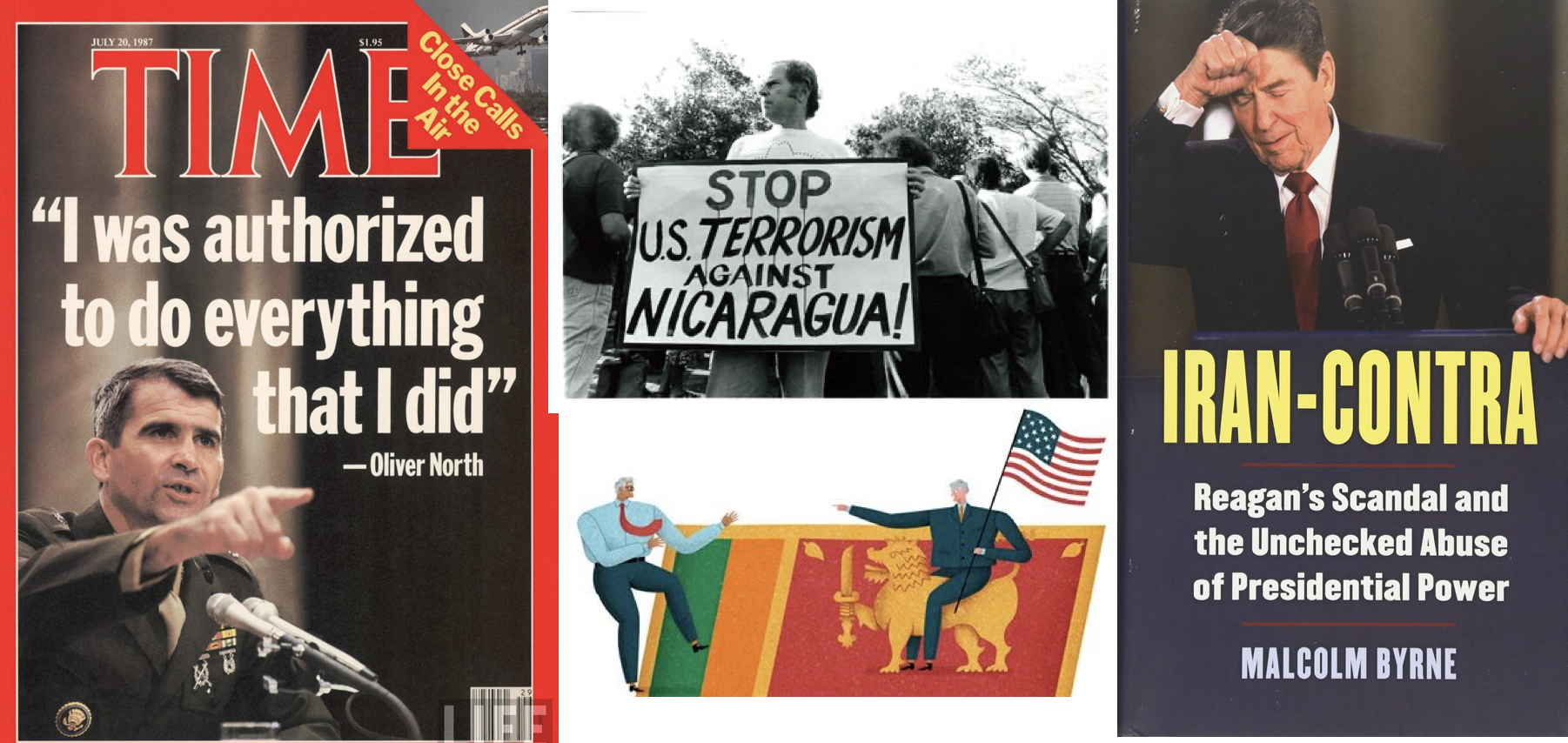
Lt. Col. Oliver North was the Deputy Director of Political-Military Affairs for NSC. It was Oliver North who suggested to overcharge Iran for weapons sold to them & to use the surplus to fund Contras.

In 1985 – $14m was given to Contras as humanitarian assistance”.

In 1986 $100m aid was given to Contras.

CIA supplied money to Contras via Saudi Arabia, Taiwan & Iran. An airstrip was built in Costa Rica to send supplies to the Contras – that ended when Sandinistas shot down the plan on 5 Oct 1986 capturing the US pilot. CIA also undertook air attacks on Nicaraguan storage tanks (destroying fuel), medicines. The same tactics used in US wars in Middle East & Africa.

CIA aircraft bombed Nicaraguan international airport while CIA operatives mined Nicaraguan harbors. This operation was recommended by Lt. Col. Oliver North!

Iran-Contra Hearings – Oliver North Testimony (1987)

CIA involvement in Contra cocaine trafficking Crack 2020 Full

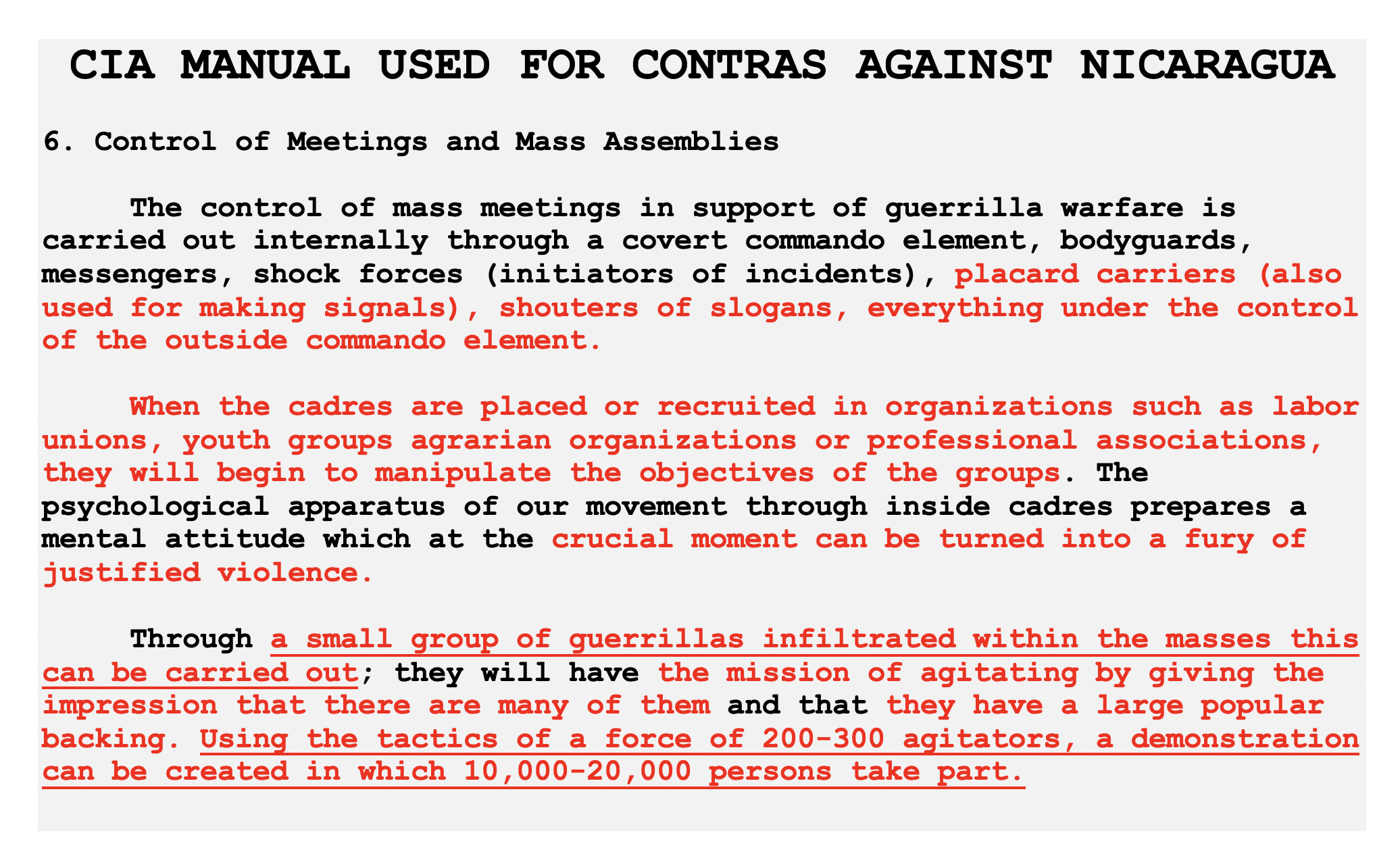
The CIA 98 page manual used for Nicaragua was title Psychological Operations in Guerilla Warfare”  https://irp.fas.org/cia/guerilla.htm

This was used to train, arm, fund the Contras to fight the Nicaraguan govt. The manual was revealed only in 1984.

https://www.muckrock.com/news/archives/2017/dec/18/cia-contras-manual/

The manual included

  • Armed propaganda teams use of deceit, intimidation & violence
  • Assassinations – Neutralize”
  • Taught Contras how to interact with civilian population
  • Taught ‘rules of engagement’
  • How to demonstrate & elevate demonstrations into clashes & provoke riots & shootings leading to killings & these deaths were to be treated as martyrs. This scenario was to enable to take advantage against the government & create bigger issues for the government.
  • The manual recommended selective use of armed force for psyop – carefully planned targets – judges, police officials, tax collectors etc
  • The key was to get the people to ‘concur’ by canvassing affected populace and promoting the ‘affected’.

The CIA also used Freedom Fighters Manual” (15 page) airdropped to Contra rebels and average citizens on how to work against the government.

The manual guided how to cause civil disruptions & initial instructions were simple, harmless & without risk – calling sick to work, leaving lights & faucets on (the aim was to decrease production & hinder economy)

Thereafter the instructions progressed to the next stage – people asked to steal food from the government, release livestock from farming, cooperatives, make false reports of fires & crimes, severe telephone lines, cables, disable vehicles,

The end of the manual gave violent instructions with diagrams showing how to make Molotov cocktails to use as firebombs on police stations, how to burn fuel supplies, how to perforate fuel tanks with ice picks.

Americans & the world came to know of US-Iran ties after ousting of Iran’s Mossadegh in 1953 & placing Shah till 1979 Ayatollah Khomeini came to power severing ties with US resulting in the US embassy seize & 53 hostages on 4 Nov 1979, embargo against Iran resulted in more US hostages in 1984, then came the Iran-Iraq war, the US arms deal with Iran was brokered by Saudi businessmen Adnan Khashoggi & $1m worth of arms was sent to Iran on 20 Aug 1985. According to Brown University, of the $1m – only $150,000 was spent on weapons the remaining $850,000 were for the Contras.

2 Lebanese newspapers broke the story about the Iran arms deal in November 1986 & US became exposed. Oliver North faced criminal charges while Pointdexter resigned as National Security Advisor.  The Tower Commission & the Majority Report of the Congressional Committee Investigating the Iran-Contra Affair simply faulted the President & the whole scandal was hushed up as just another affair.

In 1984 Nicaragua took US to the ICC claiming $17billion & won. US was ordered to pay reparations but hasn’t.

The ICJ held that the US was:

  • ‘in breach of its obligations under customary international law not to use force against another State’
  • not to intervene in its affairs”
  • not to violate its sovereignty”
  • not to interrupt peaceful maritime commerce”
  • in breach of its obligations under Article XiX of the Treaty of Friendship, Commerce & Navigation between the Parties signed in 1956.

The ICJ statements included:

Finds that the United States of America, by producing in 1983 a manual entitled Operaciones sicológicas en guerra de guerrillas, and disseminating it to contra forces, has encouraged the commission by them of acts contrary to general principles of humanitarian law”.

Nicaragua is today led by a former Sandinista leader – President Daniel Ortega.

It is a case study in itself that mighty US would go after a nation of just 6.5million people with propaganda that tapped over 100 editorial writers, over 1500 lectures & panel discussions, 107 religious organizations, reporters, lobbyists & even members of Congress. Much of the propaganda was based on lies told well and in such a way that it was believable and believed.

These are all lessons for Sri Lanka …. But most of the educated” in Sri Lanka seem to think no foreign involvement or interference prevails in Sri Lanka’s internal affairs & nothing of the propaganda types that US manuals replicate in all of the nations that are geopolitically important to them are also rolled out in Sri Lanka.

Shenali D Waduge

THE PRIVATE SECTORS OF SRI LANKA IS EQUALLY RESPONSIBLE FOR ECONOMIC MANAGEMENT

July 1st, 2022

BY EDWARD THEOPHILUS

According to the general understanding, the government sector and the private sector are equally responsible for the management of the economy, however, since the 1956 election, the responsibility of the management of the economy was unequally transferred to the public sector and this process was incurred by the nationalization of private enterprises, controlling the private investments and the spreading of the concept of socialism in the country that discouraged private investors and massively created investment problems in the country. The macroeconomic problems of the country were related to unemployment, distribution of income, increasing population more than the size of the country and many other problems. The changes in the concept of economic management have been significantly harmed and the policies of all governments elected after 1956 have supported misguided policies than addressing the issues.

The collapse of the Soviet Union in the early 1990s and the promotion of private investments in Russia and China since the 1990s clearly showed how private sectors are responsible for economic management in a country. However, this truth was not understood by stupid policymakers in Sri Lanka and they advised the government to take massive responsibility for investment in the public sector and a large volume of investment through misguided policies turned to the public sector.

The brushing aside investment in the private sector promoted attitude problems among Sri Lankans and it could be observed that negative attitudes of people when you talk to Sri Lankans. The truth is the investing capacity of the public sector is very lower but Sri Lankans put faith in the public sector disregarding the promotion of the private sector.  Compare to many Asian African and Latin American countries Sri Lankans have lower-level thinking concerning knowledge of English, the school studied and many matters. These are called attitude problems. I observed when I was working in the Bank of Ceylon before 1990, that graduates officers from villages were contempt by officers who studied in Colombo schools who had little knowledge of the subject area. The major reason for this situation was the attitude problems of people who studied in Colombo schools. The administrator of Colombo schools and old boys and girls socies of Colombo schools have been continuing the negative thinking.

The private sector in Sri Lanka is equally responsible economic management of the country. To achieve this, the government must privatize all enterprises and give responsibility to private investors, and the government should work as a regulatory authority. In this situation, the government should not be playing a double role as a regulator and market player in various areas. What is happening in Sri Lanka is the government plays the role of market player and regulator. 

In certain areas of the economy where the private sector could not make investments, the government can give investment support to private investors. The responsibility of investment would transfer to private entrepreneurs and the government could support private investors in a various way. 

Cricket Australia must take up DRS authorship issue with ICC and resolve it on footing of fair play and justice

July 1st, 2022

Shenali Waduge 

The Decision Review System known as UDRS or DRS or the Player Referral concept is in vogue not only in cricket but in many other sports activities where the Third Umpire plays the role of an Appeal Judge. Who came up with this concept & when is a question the International Cricket Committee (ICC) has consistently failed to answer despite incessant calls to do so. If every song has a singer and every lyric has an author, the DRS too must have emerged from somebody’s brain.

Sri Lankan Attorney Senaka Weeraratna is claiming authorship of the concept underlying DRS and his idea of ‘Player Referral’ was first published in the Australian” national newspaper on 25th March 1997, and thereafter in leading newspapers and journals of cricket playing nations. Not stopping there, he has made numerous appeals to the international cricketing body as well as the Sri Lanka (SLC) cricket board.

Before gaining accolades for his concept, Senaka Weeraratna may enter the Guinness Book for his patience in seeking justice for a concept he has conceived and authored. Given that the idea was first published in an Australian National Newspaper, this appeal is for the Australian newspapers & the Australian Cricket Board to take up the deserving case of Senaka Weeraratna & give the invention of DRS due recognition & declare him the author of the DRS system.

It is sad and shocking that Sri Lanka Cricket ( SLC) & a plethora of internationally recognized Sri Lankan cricketers some now aspiring to be Presidential candidates have also shied away from taking up the case of Senaka Weeraratna in his efforts to be recognized for seeding the concept of DRS system. If these former captains do not wish to speak for the cause of one Sri Lankan whose achievement will only be another feather on the cap of achievements to Sri Lanka’s cricket glories, how can they be of any use in politics to work on behalf of the people of Sri Lanka.

Some former top officials of the Sri Lanka Cricket Board are said to have adopted the view that taking up the case of Senaka Weeraratna with the ICC will upset” the ICC, and in turn harm their relationship with the ICC at all levels.

This treacherous stance of former SLC officials in return for perks and other personal favours from the ICC is no different to the shameless appeasement policy followed by Sri Lanka’s foreign ministry.

Is Sri Lanka Cricket – its officials & its captains past and present reluctant to take up the cause of Senaka Weeraratna as it may impact on their perks & other cosy relationships that they currently enjoy vis a vis the ICC?

However, ICC is duty bound to disclose the source of the brainchild behind the DRS. ICC cannot indefinitely hide this fact.

Senaka Weeraratna is claiming he is the brainchild of the DRS ‘player referral’ system. If he is not the author, ICC must disclose the name of the true author. This is a legitimate and fair request. The world of cricket has a moral right to know how the ICC arrived at the DRS. 

The ICC can be presumed to have had constructive notice of Senaka Weeraratna’s letter to the ‘Australian’ ( March 25, 1997) as it was published in a mainstream news paper of one of World’s leading cricket playing nations.

This date antedates the date on when  Tennis acquired the line calling mechanism (2004) which has been cited by a former CEO of ICC ( Dave Richardson) as the source of inspiration for DRS.

If there is no alternate party claiming to be the author, what is holding the ICC from accepting Senaka Weeraratne has the author of the DRS system?

Is it because he is not white? The cricket-loving public have gone beyond colonial racism and such discrimination should not exist in cricket or any type of sports.

The Govt. of Sri Lanka must step in without any further delay and the Minister of Sports must direct the President of SLC unhesitatingly to back the Sri Lanka’s candidate, Senaka Weeraratna in obtaining due recognition and credit from the ICC.

SLC cannot remain neutral or indifferent on a matter concerning the claim of a Sri Lankan to credit from the ICC. SLC must treat the DRS as an achievement of a fellow countryman of Sri Lanka and be unhesitatingly proud of it.

We appreciate the arrival of the Australian Cricket Team to Sri Lanka amidst an economic crisis and would like to have at least the governing body of Cricket Australia together with the ‘Australian’ Newspaper that first published Senaka Weeraratna’s concept in 1997 to assist in finally getting the ICC to formally recognize the authorship of the DRS.

25 years have passed since 1997 with no one knowing who came up with this player referral concept which has been adopted ( or stolen) by the ICC and renamed as DRS.

The Player Referral concept being the invention of a Sri Lankan, is now being used not only in cricket but in other sports as well.  Neither the Govt. of Sri Lanka nor the SLC not being proud of this singular achievement of a Sri Lankan with no other claimant in the would to compete with Weeraratna’s claims, is another clear illustration of that well known adage ‘ A prophet is never honoured in his own country.

If the Duckworth Lewis rule in rain affected one day international cricket matches can be named after the two co – authors, equity demands that DRS likewise be named after its author.

DRS system must be called the Senaka Weeraratna Decision Review System.

Let us hope the new Sports Minister Roshan Ranasinghe will have the foresight to do justice by Senaka Weeraratna and gain prestige for Sri Lanka as a result.

Shenali Waduge 

Sri Lanka seeks greater cooperation in the food processing and dairy sectors with India

July 1st, 2022

Gamini Sarath Godakanda

Sri Lanka and India agreed to explore further avenues towards greater cooperation in the food processing and dairy sectors, when Sri Lanka’s High Commissioner to India, Milinda Moragoda met with India’s Minister of Food Processing Industries Shri  Pashupati Kumar Paras today (01 July) in New Delhi.

At the outset, Minister Paras accorded a warm welcome to High Commissioner Moragoda and said that he and his government led by Prime Minister Shri Narendra Modi are always ready to help Sri Lanka in these difficult times.

While thanking the Minister, High Commissioner Moragoda stressed the importance of establishing close linkages between India and Sri Lanka in various sectors under the Minister’s purview, in particular the dairy industry. The High Commissioner observed that import of milk powder from India including through the existing credit line would contribute to increase nutrition levels among children in Sri Lanka.

The Minister and the High Commissioner agreed that cooperation could commence with the dairy sector, and it could later be expanded into other sectors falling under the supervision of the Ministry of Food Processing Industries. High Commissioner Moragoda said that the ultimate objective of these efforts would be greater economic integration of the two countries.    

With a view to looking into the way forward for cooperation in these sectors, it was decided to form a study group that would comprise officials from the Ministry of Food Processing Industries and the High Commission of Sri Lanka as well as other relevant stakeholders both in India and Sri Lanka. It was also decided to have the first meeting of the study group soon.

Minister Paras who hails from the State of Bihar is the incumbent President of the Rashtriya Lok Janshakti Party, which is part of the ruling National Democratic Alliance led by Prime Minister Narendra Modi. He has been a member of the Bihar Legislative Assembly seven times since 1977 and had served thrice as a Minister in the State.

Secretary to the Ministry of Food Processing Industries Smt. Anita Praveen, senior officials of the Ministry as well as senior diplomatic officers of the High Commission of Sri Lanka in New Delhi also attended the meeting. 

තෙල් ඉල්ලන්න කටාර් ගිය කංචන තහනම් සංවිධානයක් ලෙස නම් කර තිබූ කටාර් චැරිටි තහනම ඉවත් කිරීමට පොරොන්දු වෙලා 

July 1st, 2022

Lanka Lead News

මේ දිනවල කටාරයේ සංචාරයක නිරත වන විදුලිබල හා බලශක්ති අමාත්‍ය කාන්චන විජේසේකර මහතා ඊයේ(30) දිනයේ දී කටාර් චැරිටි සංවිධානයේ නියෝජිතයන් මුණ ගැසී කළ සාකච්ඡාවක් අතර තුර අදාල සංවිධානයට එරෙහිව ලංකාව පනවා ඇති තහනම ඉවත් කිරීමට තීරණය කර තිබෙන බව එම නියෝජිතයන්ට දැනුම් දී ඇති බව වාර්තාවේ.

මත භේදයට තුඩු දුන් කටාර් චැරිටි සංවිධානය 2019 වසරේ දි ජනාධිපති ගෝඨාභය රාජපක්ෂ මහ්තාගේ සෘජු මැදිහත්වීම යටතේ රජය විසින් තනහම් කරන ලදී.

එවකට පොලිසිය භාර අමාත්‍යවරයා වූ ආචාර්ය සරත් වීරසේකර මහතා පාර්ලිමේන්තුව හමුවේ ප්‍රකාශ කර සිටියේ, කටාර් චැරිටි, ත්‍රස්ත සංවිධානයක් ලෙස නම් කරන බවයි.

කටාර් චැරිටි සංවිධානයට එරෙහිව රජය එල්ල කළ එම චෝදනාව උපයෝගී කරගනිමින් නීතීඥ හිජාස් හිස්බුල්ලා ත්‍රස්තවාදය වැළැක්වීමේ පනත යටතේ අත් අඩංගුවට ගෙන රදවා තබා ගැනීමට ද රජය කටයුතු කළේය.

හිටපු අමාත්‍ය සරත් වීරසේකර පාර්ලිමේන්තුව හමුවේ ප්‍රකාශ කර සිටියේ හිජාස් හිස්බුල්ලාගේ සභාපතීත්වයෙන් යුතු සේව් ද පර්ල් නම් සංවිධානයට, කටාර් චැරිටි වෙතින් රුපියල් මිලියන 13 ක් ලැබී ඇති බවයි.එහිදි අමාත්‍යයවරයා වැඩිදුරටත් පවසා සිටියේ, කටාර් චැරිටි ත්‍රස්ත සංවිධානයක් බවත්, එම සංවිධානයෙන් මුදල් ලබා තිබෙන නීතීඥ හිජාස් හිස්බුල්ලා ත්‍රස්ත ක්‍රියා සම්බන්ධයෙන් සැකකරුවෙකු බවයි.

මේ අතර එවකට රජය කටාර් චැරිටි සංවිධානය සම්බන්ධයෙන් ගත් ක්‍රියා මාර්ග මෙන්ම නීතීඥ හිජාස් හිස්බුල් ත්‍රස්තවාදය වැළැක්වීමේ පනත යටතේ අත් අඩංගුවට ගෙන රදවා තබා ගැනීම සම්බන්ධයෙන් එක්සත් ජාතීන්ගේ මානව හිමිකම් සංවිධානය ඇතුළු ජාත්‍යන්තර සංවිධාන රැසක් දැඩි විරෝධයක් රජයට එරෙහිව එල්ල කිරීමටද කටයුතු කර තිබුණි.

සාෆි නිදහස් කලායැයි බොරු ප්‍රවෘත්ති පල කිරීම් ගැන සාක්ෂි ඉදිරිපත් කරන්න – කුරුණෑගල මහේස්ත්‍රාත් 

July 1st, 2022

Lanka Lead News

කැමැත්ත නොමැතිව ගැබිනි මවුවරුන්‌ වඳ භාවයට පත්‌ කිරීම හා ඒ සඳහා පෙළඹවීම ඇතුළු චෝදනා එල්ල වී ඇති වෛද්‍ය සෙයිගු සිහබ්ඳදීන්‌ මොහොමඩ්‌ සාෆි නමැත්තා තම අධිකරණය විසින්‌ නිදොස්‌ කොට නිදහස්‌ කර ඇති බවට මාධ්‍ය මගින්‌ අසත්‍ය ප්‍රවෘත්ති පළ කර ඇති බව ‘සනාථ කිරීම සඳහා අවශ්‍ය සාක්ෂි අධිකරණයට ඉදිරිපත්‌ කරන ලෙස කුරුණෑගල මහෙස්ත්‍රාත්‌ බන්දුල ගුණරත්න මහතා 24 දා  අගතියට පත්‌ පාර්ශ්වයට නියෝග කළේය.

එම සැකකාර වෛද්‍යවරයාට එරෙහිව අධිකරණය හමුවේ පවතින නඩුවේ විමර්ශන මේ දක්වා අවසන්‌ වී හෝ නඩු විභාගය අවසන්‌ කර නොමැතිව තිබියදීත්‌ ඇතැම්‌ ජනමාධ්‍ය මගින්‌ සියලු චෝදනා ඔප්පු කිරීමට නොහැති වීම නිසා වෛද්‍ය ෂාෆි නිදොස්‌ කොට නිදහස්‌ කර ඇති බවට” ප්‍රවෘත්ති පළකිරීම අධිකරණයට කළ අපහසායක්‌ වන බැවින්‌ ඒ සම්බන්ධයෙන්‌ විමර්ශනයක්‌ කරන්නැයි අගතියට පත්‌ පාර්ශ්වය වෙනුවෙන්‌ පෙනීසිටි නීතිඥ චානක අබේවික්‍රම කළ කරුණු දැක්වීම සලකා බැලූ මහෙස්ත්‍රාත්වරයා එම නියෝගය කළේය.

24 දා එම නඩුව කැඳවූ අවස්ථාවේදී අධිකරණය ඇමතූ නීතිඥ චානක අබේවික්‍රම මහතා මෙසේ ද අධිකරණයට පැවසීය.

ස්වාමිනි මෙම නඩුවේ සැකකාර වෛද්‍යවරයාට එල්ල වී තිබුණේ ඉතා බරපතළ චෝදනා. රුපියල්‌ 500ක අල්ලසක්‌ ලබාගත්‌ බවට චෝදනා එල්ල වන විටත්‌ විමර්ශන අවසන්‌ චනතුරු රාජ්‍ය සේවයෙන්‌ වැඩ තහනමට ලක්කරනවා. මේ සැකකරුට එරෙහිව රුපියල්‌ කෝටි 44ක මුදලක්‌ උපයා ගැනීම සම්බන්ධයෙන්‌ මුදල්‌ විශුද්ධිකරණය වැළැක්වීමේ පනත යටතේ චෝදනා එල්ල චී තිබියදීත්‌ ඔහු වැඩ තහනමට ලක්‌ නොකර අනිචාර්ය නිවාඩු යැව්වා. මෙලෙස සිදුවූයේ ඔහුට තිබෙන දේශපාලන සබඳතා නිසයි. වැඩ තහනම්‌ නොකර අනිවාර්ය නිවාඩු යැවීම නිසා ඔහුට හිඟ වැටුප්‌ ලැබුණා. පසුගිය 13වැනිදා ඔහුට ඒ චෙක්පත භාරදුන්‌ පසුව චෝදනා ඔප්පු වී නොමැති නිසා ඔහුව නිදොස්‌ කොට නිදහස්‌ කර ඇති බවට ජනමාධ්‍ය කිහිපයක ප්‍රවෘත්ති පළ වුණා.

මහෙස්ත්‍රාත්වරයා – ඒ බව සනාථ කරන්න අවශ්‍ය ලේඛන තිබෙනවාද? තිබෙනවා නම්‌ අධිකරණ රෙජිස්ට්‍රාර්වරයාට භාරදෙන්න.

නීතිඥ චානක අබේවික්‍රම මහතා – තිබෙනවා ස්වාමිනි අගතියට පත්‌ පාර්ශ්වය ඒවා අධිකරණයට භාරදීමට සූදානම්‌. ඒ අනුව විමර්ශනයක්‌ කර එකී මාධ්‍ය ආයතනවලට එරෙහිව අධිකරණයට අපහාස කිරීමේ චෝදනාව යටතේ නඩු පැවරීමට පියවර ගන්නා ලෙස ඉල්ලා සිටිනවා.”

එහිදී සැකකාර වෛද්‍යවරයාගේ ක්‍රියා කලාපය නිසා වඳභාවයට හා මදසරුභාවයට පත්‌ කාන්තාවන්‌ කොළඹ විශ්වවිද්‍යාලයේ වෛද්‍යය විද්‍යා පීඨයේ මහාචාර්යවරුන්‌ ප්‍රමුඛ විශේෂඥ වෛද්‍ය මණ්ඩලයට ඉදිරිපත්‌ කිරීමේ කටයුතු ලබන අගෝස්තු 5 වන දිනට පෙර අවසන්‌ කරන ලෙසට අපරාධ පරීක්ෂණ දෙපාර්තමේන්තුවට නියෝග කළ මහෙස්ත්‍රාත්වරයා එදිනට විමර්ශනවල ප්‍රගතිය අධිකරණයට වාර්තා කරනා ලෙසට ද නියෝග කළේය.

නීතිඥ ප්‍රේම්‌ බී. තෙන්නකෝන්‌ මහතා සැකකරු වෙනුවෙන්‌ පෙනීසිටි අතර නීතිඥ නිරුෂි උයන්වත්ත, නීතිඥ සමන්‌ බණ්ඩාර දිසානායක යන නීතිඥවරුන්‌ සමඟ නීතිඥ චානක අබේවික්‍රම මහතා අගතියට පත්‌ පාර්ශ්වය වෙනුවෙන්‌ පෙනීසිටියේය. සැකකාර වෛද්‍යවරයා ද අධිකරණය හමුවේ පෙනී සිටියේය. රටේ පවතින තත්ත්වය අනුව සැකකාර වෛද්‍යවරයාට පනවා ඇති ඇප කොන්දේසි ලිහිල්‌ කරන ලෙස සැකකරුගේ නීතිඥවරයා අධිකරණයෙන්‌ ඉල්ලාසිටි අතර ඒ අනුව අපරාධ පරීක්ෂණ දෙපාර්තමේන්තුව හමුවේ පෙනීසිටීමේ ඇප කොන්දේසිය ඉවත්‌ කිරීමට මහෙස්ත්‍රාත්වරයා නියෝග කළේය.

කෙසේ නමුත්‌ අධිකරණය නියම කරන දිනවලදී අධිකරණය හමුවේ පෙනී සිටීමට අපොහොසත්‌ වුවහොත්‌ එකී ඇප ලිහිල්‌ කිරීමේ කොන්දේසිය අවලංගු කරන බවට ද මහෙස්ත්‍රාත්වරයා සැකකරුට අවවාද කළේය.

Proposed Lankan constitutional amendment lets President Gotabaya off the hook

July 1st, 2022

By P.K.Balachandran Courtesy NewsIn.Asia

Colombo July 1 (Counterpoint): The Gazetted draft of the 22 nd. Amendment (22A) of the Sri Lankan constitution, which will be presented to parliament in the coming week, is a compromise between the interests of President Gotabaya Rajapaksa and Prime Minister Ranil Wickremesinghe. It is also designed to maintain the stability needed to tide over the current economic crisis and to avoid a referendum.

If passed by parliament, by the required two-thirds majority, the draft 22A will enter the constitution as the 21 st.,Amendment (21A).       

Constitutional Council and Independent Commissions

In a significant change, the draft 22A re-establishes the independent Constitutional Council (CC) to replace the Parliamentary Council of the 20 th.Amendment (20A). The CC will, in turn, appoint the Chairmen and members of the various Independent Commissions (ICs) which would make key appointments and oversee the work of sectors assigned to each.

The Independent Commissions are: the Elections Commission, Public Service Commission, Police Commission, Judicial Commission, Finance Commission, Bribery and Corruption Commission, Delimitation Commission, Human Rights Commission, Audit Service Commission and  National Procurement Commission.

The CC comprises the parliament Speaker (who will be its chairperson), the Prime Minister, the  Leader of the Opposition, one Member of Parliament (MP) appointed by the President, 5 MPs comprising one ruling party MP, one MP from the party of the Leader of the Opposition, three non-MPs appointed by the Speaker in consultation with the Prime Minister and the Leader of the Opposition and approved by a majority of MPs in parliament, and one MP from a party other than the one represented by the Prime Minister and the Leader of the Opposition.

All appointments should reflect the pluralistic character of Sri Lankan society. Non-MPs should be persons of repute and integrity. CC members will serve for three years. Vacancies will have to be filled in 14 days.

It is the President who makes appointments to the CC. But the 22A enjoins the President to make the appointments within 14 days of receiving recommendations from the CC. If he fails to do that, the appointments will be deemed to have been made as recommended by the CC.

In case parliament is dissolved, the Speaker, the Prime Minister and the Leader of the Opposition will continue to be members of the CC till a new parliament is elected and a government assumes office.

The CC’s nominations are necessary for high offices such as Attorney General, the Governor of the Central Bank, the Auditor General, the Ombudsman, and the Secretary General of parliament. The CC shall meet at least twice in a month. The quorum is five. Its decisions should generally be by consensus or be approved at least by five members.

President’s Powers  

Through the 22A, the Prime Minister gains authority over the President, but he will not be able to exercise the new provisions during the tenure of the current (the ninth) parliament. The new provisions will come into effect only from the next of 10 th. parliament. This is a major concession to President Gotabaya Rajapaksa and the votaries of a strong Executive Presidency, like the Sinhala nationalists including the present Justice Minister and the architect of the 22A, Wijesdasa Rajapakshe.

The 22A says that the President will take his decisions on appointments to the council of ministers and the distribution of portfolios among the ministers on the advice of the Prime Minister” and not in consultation with the Prime Minister, where he considers such consultation is necessary” as is the case now under the 20 th.Amendment.

But there is a condition attached to this. The above mentioned stipulation will not come into play during the life of the current parliament. During the life of the current parliament, the President may  consult” the Prime Minister only if, in his opinion, such a consultation is necessary. This provision constitutes a major concession by the Prime Minister Wickremesinghe to President Gotabaya.

The other concession made to the President is that he shall be entitled to hold the Defense portfolio. In the case of the absence or exist of a minister, the President can take over that ministry,  but only for 14 days.

Prime Minister’s Term of Office

The draft 22A says that the Prime Minister shall stay in office throughout the period the cabinet is in office, unless he resigns or ceases to be a Member of Parliament. However, from the time the 22A is enacted till the dissolution of the ninth parliament, the President can remove the Prime Minister from his office, if in his opinion, the Prime Minister has lost the confidence of the parliament.

Ministerial Secretaries’ Tenure  

At present, the Secretaries to the Ministries quit the moment the cabinet resigns or is dissolved. But under the proposed 22A, they would not be required to quit but await the appointment of a new cabinet.

Critique   

The draft 22A has the support of those who favor the present order with Gotabaya Rajapaksa continuing as Executive President and Ranil Wickremesinghe continuing as Prime Minister. They feel that the existing system has to be upheld for the sake of stability considered necessary to get desperately-needed humanitarian and financial aid from other countries. They fear that an opposition divided ideologically and politically will not provide a stable government and successfully operate the government machinery without a strong Executive Presidency which is immune to the vagaries of party politics, characteristic of the Westminster system. They feel that to solve the tremendous and unprecedented economic crisis, Sri Lanka needs the undivided attention of a strong center represented by the Executive Presidency.

The critics of the 22A however say that it is a big let-down, in the context of the public demand for a democratic system to end the  system of government based on concentration of power in the hands of one person or one family and its cronies. These critics expected the 22A to be a full resurrection of the 19A of 2015. But it is only a pale shadow of the 19A, says Constitutional  expert, Dr.Jayampathy Wickramaratne.

In a short note issued on Thursday, the Center of Policy Alternatives (CPA) said: The Gazetted 22A does not curtail the powers of the President nor introduce checks and balances in any meaningful manner, contrary to the demands of the people of Sri Lanka. In the absence of any genuine attempt to address the inherent problems of governance, this attempt at reform will only worsen the existing political and economic crisis and destroy whatever little remaining faith citizens might have in constitutional governance.”

CPA has carefully considered the contents of the Bill and notes that the Bill does not revert the Constitution to the structure of government that prevailed under the Nineteenth Amendment (2015-19).”

Dr.Wickramaratne regrets that the President will retain his powers for the duration of the present parliament, though he is allowed to hold only the Defense portfolio under the 22A. Any other ministry could beheld only for 14 days. The experts also regrets that there is no specific provision for the representation of the small parties in the CC and to ensure the pluralist nature of Sri Lankan society.

The main opposition Samagi Jana Balawegaya’s proposal for a 21A was a radical departure from the existing 20A and called a fundamental change in the constitution including the abolition of the Executive Presidency. But as expected, the Supreme Court said that the SJB’s 21A would need a two thirds majority in parliament and a referendum.

President Gotabaya and Prime Minister Wickremesinghe felt that the country could not afford a referendum under the present economic and financial conditions and got the Justice Minister Wijedasa Rajapakshe to draft an amendment which will not require a referendum.

Given the SJB’s opposition to the 22A draft, it is unlikely to vote for it in parliament. The National Peoples’ Power led by the Janatha Vimukthi Peramuna (JVP), and the Tamil National Alliance (TNA) would also oppose it. But the 11-party group is likely to support it as it wants a strong Executive Presidency.

The million dollar question is whether the 22A will get the two-thirds majority needed for a constitutional amendment..

Bankrupt Sri Lanka’s inflation jumps beyond 50%

July 1st, 2022

Sri Lankans have taken to the streets over an acute shortage of essentials including food, fuel and medicines – Copyright AFP –

Sri Lanka’s inflation hit a ninth consecutive record in June, official data showed Friday, rising to 54.6 percent a day after the IMF asked the bankrupt nation to rein in galloping prices and corruption.

It was the first time the increase in the Colombo Consumer Price Index (CCPI) crossed the psychologically important 50 percent mark, according to the department of census and statistics.

The figures came hours after the International Monetary Fund urged Sri Lanka to contain spiralling inflation and address corruption as part of efforts to salvage the troubled economy, which has been ravaged by a foreign exchange crisis.

The IMF ended 10 days of in-person discussions with Sri Lankan authorities in Colombo on Thursday following the country’s request for a possible bailout.

The CCPI has been setting new monthly highs since October, when year-on-year inflation stood at just 7.6 percent. In May it reached 39.1 percent.

The rupee has lost more than half its value against the US dollar this year.

Private economists say consumer prices are rising even faster than shown in official statistics.

According to an economist at Johns Hopkins university, Steve Hanke, who tracks price increases in the world’s troublespots, Sri Lanka’s current inflation is 128 percent, second only to Zimbabwe’s 365 percent.

Faced with an acute energy shortage, Sri Lanka is observing a shutdown of non-essential state institutions for two weeks, along with the closure of schools to reduce commuting.

The country’s 22 million people have been enduring acute shortages of essentials — including food, fuel and medicines — for months.

Protests are continuing outside President Gotabaya Rajapaksa’s office demanding his resignation over the unprecedented economic turmoil and his mismanagement.

Sri Lanka went to the IMF in April after the country defaulted on its $51 billion external debt.

Read more: https://www.digitaljournal.com/business/bankrupt-sri-lankas-inflation-jumps-beyond-50/article#ixzz7XpfubIvc

Sri Lanka fuel crisis: ‘Living in my car for two days to buy fuel’- BBC News

July 1st, 2022

Courtesy BBC

Being the first in the queue is usually a coveted spot, but Ajeewan Sadasivam has no idea how long he’ll be stuck in this one. “I’ve been in line for two days already,” he says, as he waits patiently outside a petrol station in the capital Colombo. As a taxi driver, fuel is his lifeblood, but Sri Lanka has no fresh supplies of petrol coming in. “I have been sleeping in this car. Sometimes I leave to go and get food, then I come back and wait… I haven’t bathed in days.” He says he has no choice but to wait it out: “I have to look after my family, my wife and two children… only if there’s fuel can I start running my cab and make a living.” With no international shipments of fuel coming in for at least two weeks, supplies are being sent to the capital from other parts of the island, where there are still some reserves. But the island nation runs low on supplies.

IMF highlights ‘corruption vulnerabilities’ in report on Sri Lanka

July 1st, 2022

Courtesy The Statesman

MF has clearly mentioned that Sri Lanka needs to first reduce the prevalent corruption conditions and overhaul the taxation structure.

Sri Lanka Economic Crises: The International Monetary Fund (IMF) shared its end-of-mission report on Thursday and highlighted the ‘corruption vulnerabilities’ in Sri Lanka. The IMF personnel had conducted a study after visiting Sri Lanka from 20th to 30th of June. The 10 day long study visit was aimed at identifying the possibilities to extend a financial bailout package to the island nation, reeling under extreme financial crisis.

IMF has clearly mentioned that Sri Lanka needs to first reduce the prevalent corruption conditions and overhaul the taxation structure. IMF insisted that these measures must first be adopted, before any talks about the bailout be furthered.

IMF in an official said, The authorities have made considerable progress in formulating their economic reform program and we are looking forward to continuing the dialogue with them”.

It is to be noted that President Gotabaya Rajapaksha introduced drastic tax cuts in 2019, which are widely being blamed for the current economic crisis being faced by the country.

The statement also said, Given the low level of revenues, far-reaching tax reforms are urgently needed”.

It is highly recommended in the report that the country needs to urgently address the inflation levels and the severe balance of payments (BOP), prevalent in the economy.

The official statement also said, The authorities have made considerable progress in formulating their economic reform program and we are looking forward to continuing the dialogue with them”.

Sri Lanka is facing the worst situation in terms of its fuel reserves and has banned the sale of petroleum fuel for its citizens till 10th of July. Since the past several months, the 22 million people of the country have faced severe shortages of food and other essential commodities. In the past couple of weeks, the condition has worsened further and the country has been reaching out to other nations for financial and material assistance. In April this year, Sri Lanka faltered on its foreign debt of $51 billion.

It is also estimated by the United Nations (UN), that about 80% of the total population of the country is skipping meals in order to cope with food shortages.

The country has been witnessing widespread protests seeking resignation of President Rajapaksa because of the government’s mismanagement of the economic crisis.

The international lender point out that Sri Lanka required immediate debt restructuring and raising the taxation. It is evident that revenue inflow is at the bottom, so the only way to restore economic progression is through far-reaching tax reforms.

The statistics office of the government, on Tuesday said that the economic growth of the first quarter of 2022, is expected to remain at negative 1.6%.

Meanwhile, the Ceylon Petroleum Corporation has not confirmed placing any new orders for petroleum supplies yet. There is still a dilemma as to how the sale of petrol fuel would return to normalcy after July 10th.

The IMF is still reviewing the situation in the country and the further talks between the country’s leadership and IMF personnel would decide the fate of the nation. 

HRCSL: No prisoners were used in 09 May attacks on protesters

July 1st, 2022

Courtesy The Island

AG, CJ asked to take action against lawyer for triggering violence

The Human Rights Commission of Sri Lanka (HRCSL) has declared that a false allegation by President of the Committee for Protecting Rights of Prisoners (CPRP) Attorney-at-Law Senaka Perera that some prisoners were used to attack anti-government protesters outside Temple Trees and at Galle Face on 09 May triggered violence in many parts of the country.

The HRCSL also faulted Sudesh Nadimal Silva also of the same organisation for propagating unsubstantiated allegations.

Justice (ret.) Rohini Marasinghe, in her capacity as the Chairperson of the HRCSL, said that both Senaka Perera and Sudesh Nandimal had failed to substantiate their allegations made at the Galle Face protest site on 10 May.

The HRCSL, in a statement issued yesterday (29) quoted Justice Marasinghe as having said: False propaganda as well as misinformation of the alleged use of Prisoners to have attacked the innocent protesters is both a diabolical lie and a deceitful action.”

The HRCSL has recommended that Attorney General Sanjaya Rajaratnam conduct a further investigations into allegations made by Senaka Perera and take necessary action

The HRCSL has requested Chief Justice Jayantha Jayasuriya, PC, to take note of the detrimental statements made by Attorney-at-Law Senaka Perera and take due action.

The HRCSL consists of Ven. Kalupahana Piyarathana Thera, Dr. M.H. Nimal Karunasiri, Dr. Vijitha Nanayakkara and Ms. Anusuya Shanmuganathan.

The HRCSL dealt with the issue in a statement titled ‘The HRCSL condemns the false media broadcast made by the President of the Committee for Protecting Rights of Prisoners’.

The HRCSL issued the statement after the conclusion of a special investigation by an appointed committee of investigators (Col).

CoI consisted of Sanjeewa Weerawickrama, Attorney -at- Law, Miss. lmasha Senadeera, Attorney-at-Law and Dr. Dilshani Bogollagama.

Referring to allegation that prisoners had been used to attack protesters at protest sites at Galle Face and Temple Trees, the HRCSL said that the CoI determined that no prisoners had been used in perpetrating any attack on the peaceful protesters.

The HRCSL asserted that the unsubstantiated allegations caused an irreversible damage to the country.

The HRCSL said that a group of prisoners had been seriously assaulted and subjected to mental and physical torture by an unidentified group on 09 May.

The HRCSL stated: The unprecedented ruthless nature of the attack on prisoners and officials resulted in injuries and hospitalization of many inmates.” Since the incidents, eight prisoners hadn’t been accounted for so far, it has said.

The prisoners had been made available to the private sector enterprises in terms of an agreement endorsed by the Cabinet of Ministers in Oct 2021. On the day of the incidents, a group of prisoners had been taken to a designated work place and were on their way back when gangs intercepted them.

Attorney at Law Mr. Senaka Perera, the convener of the conference identified himself as a Human Rights Activist. The COI provided the CPRP president Mr. Senaka Perera with the opportunity to justify his statements that caused an outrage in both Sri Lanka and the World at large. For the purpose of submission of any evidence, in either oral statements or picture documentation in support of his statements, Mr. Perera was extended a justifiable time period. However, he expressly affirmed before the Committee that at the time of the statement or even thereafter he did not have any tangible evidence in favor of his expressed views in regard to the alleged incident. Mr. Sudesh Nadimal Silva was also summoned to give evidence before the COl. The Committee explaining the paramount importance of the maintenance of professional ethics provided Mr. Sudesh Nadimal Silva with the opportunity to provide a justifiable explanation for his expressed allegations. However, he was unable to provide any acceptable evidence in support of his statements.

The COI observed that the press conference which was chaired by M. Senaka Perera had dispensed totally false statements without any sustantive evidence.

Following the above-mentioned facts, the COI has identified the grave consequences of the negligent attitude of making unfounded statements. Inciting agitation in the general public against state departments and personnel has inadvertently led to disruptions to the law and order of the Country.

The COI further observed that these inaccurate declarations conveyed by the above speakers directly contributed to the series of violent activities and right violations, reported island wide. The combined result of the atrocities that occurred within a mere 48 hours resulted in the loss of 12 human lives with several hundred injured casualties. In addition, intentional damage and arson to both public and private properties surmount to the loss of billions of rupees.

After a thorough and diligent inquiry, the COI has arrived at the following conclusions. The highly irresponsible misconduct by the Attorney-of-Law Senaka Perera, with his speculative allegations with no substantiated evidence, resulted in disastrous consequences.

Hence, it is of paramount importance that members of professional bodies need to be guided by the code of conduct or the professional ethics as set out by the respective professional bodies for the due conduct of the members. These conditions of misconduct from individuals of representation and influence should be held accountable by the respective professional bodies.

It is the view of the COI that national media institutions must consciously adhere to responsible reporting and promote journalism with integrity, especially during this volatile period of both political and economic instability. This tantamount to avoidance of direct reporting of incidence without due assessment of this veracity and credibility. The Committee further advocates promotion of investigative journalist practices with the objective of strengthening the democratic fabric of the Country.”

Chief Prelates write to President on country’s current situation

July 1st, 2022

Courtesy Adaderana

The Chief Incumbents of the four Buddhist Chapters have written to President Gotabaya Rajapaksa, stressing 10 matters, including the creation of economic stability and provision of relief to the people.

In their statement, the chief prelates said the 22nd Amendment to the Constitution should be passed in the parliament without delay.

They also stressed that the President should take expedite measures to convene political party leaders to appoint an honest, all-party government again.

The tenure of the all-party government should be limited to 6 months, the chief prelates emphasized, adding the tenure should be extended to 12 or 18 months only if it succeeds in stabilizing the economy and minimizing the issues faced by the public.

The Cabinet of Ministers of this all-party government should be limited to 15, and any politician convicted of corruption allegations should not be made part of it, the letter read further.

The chief prelates also called for proper coordination with international institutions and friendly countries for securing loan assistances and implementation of a proper mechanism to manage these funds.

.

Japanese Embassy denies media reports on Japan refusing to support Sri Lanka

July 1st, 2022

Courtesy Adaderana

The Embassy of Japan in Colombo today (July 01) categorically denied a media report which stated that Japan would not support Sri Lanka at the moment due to mismanagement of funds.

According to an article published by a local newspaper, the Ambassador of Japan to Sri Lanka reportedly mentioned this during a meeting with the TNA yesterday. The Japanese ambassador engaged in a visit to Jaffna from June 27 to 30.

Issuing a clarification on Japan’s position on the economic situation in Sri Lanka, the embassy dismissed the contents of the article as incorrect and misleading information”.

Japan is closely paying attention to the current difficult economic situation in Sri Lanka and severe humanitarian situation accompanied,” the statement noted.

The embassy also said: Considering such situation, the Government of Japan has decided to provide Emergency Grant Aid of USD 3 million through UNICEF and WFP in order to provide medicine and food in a manner that would directly benefit the Sri Lankan people. Japan sincerely hopes that this assistance will be of help to overcoming the hardship faced by the people of Sri Lanka, Japan’s long-standing friends.

The Government of Japan would like to consider its further contribution to Sri Lanka in consultation with the Government of Sri Lanka and other developing partners, while giving attention to the situation of Sri Lanka and the negotiation progress between Sri Lanka and IMF.

Japan, time-tested partner in Sri Lanka’s socio-economic development, has been supporting Sri Lanka and will continue to do its part in combining its efforts with the people and Government of Sri Lanka.”

Meanwhile, Deputy Ambassador of the Japanese Embassy, Katsuki Kotaro has written to the Prime Minister’s Office regarding the matter.

The PM’s office also stated that this would have a detrimental impact on the country’s economic recovery and the cordial bilateral relationship with Japan.

Why did Sabry-Nandalal & Sri Lanka’s top economists & business leaders recommend to stop debt repayment & float the rupee?

July 1st, 2022

Shenali D Waduge

Sri Lanka was always sitting on a time bomb. Our expenses were higher than our income/revenues, our imports were higher than our exports, we were living a superficial life on loans, taking more loans to settle loans and even loans to continue our lifestyle – it was only a matter of time that the bomb would explode. Confounding matters were several internal and global calamities – covid, global fuel crisis from Ukraine war, loss of revenues that Sri Lanka had been reliant on. The situation was well known to experts planning policy, advising governments and the top echelons of society. Now that we know the consequences of defaulting and free floating the rupee as well as the international legal cases against Sri Lanka – we have every right to question every expert” who prescribed these as their expert recommendation for Sri Lanka and citizens have every right to hold them equally accountable for the current plight. The situation has been made worse without dealing with the economic crisis but by creating a political crisis leading to double jeopardy for the nation.

These are the outcomes from declaring Sri Lanka bankrupt by Finance Minister Sabry & Governor Nandalal & recommended by business leaders in Sri Lanka

  • Sri Lanka became ranked D” – default country
  • Sri Lankan rupee value is out of control
  • Sri Lankan banks cannot open any LCs (Letter of Credit)
  • Sri Lanka nor the private sector can take new foreign currency loans
  • Sri Lankan banks are being asked by foreign banks to repay all loans taken
  • Sri Lankan banks have been made vulnerable
  • Sri Lankan businesses & importers cannot import
  • Sri Lankan citizens are facing tremendous economic challenges for survival
  • Sri Lankans are facing shortage of fuel, gas, medicines & other essentials.
  • Sri Lanka’s investments has stopped.
  • Sri Lankan interest rates are skyrocketing
  • Sri Lanka is facing legal action internationally
  • Sri Lanka has lost access to secure international loans

The present Governor – has been with not only Sri Lanka’s Central Bank but was a Director of the IMF as well & had been on every top expert Committee in the CBSL. He too should have known the adverse impact of defaulting debt repayment.

As for Finance Minister Sabry – his glorified speech in Parliament has only become

a pusswedilla following the outcome of defaulting.

Then there are the business and think tanks experts that prescribed to default repayment:

Note how all are justifying defaulting payment of loans claiming to save the money to purchase money for essentials. This is a layman’s answer and not one expected of experts knowing the above repercussions Sri Lanka has had to face as a result of non-payment.

https://www.ft.lk/business/Leaders-of-Ceylon-Chamber-top-economists-speak-out-on-forex-crisis/34-728960

What was the issue regarding honoring repayment of loans taken?

State of International Sovereign Bonds

  • From 2009 to 2014 – USD5000millon worth international sovereign bonds were issued by the Central Bank of SL

$5000m ISBs taken from 2009-2014 enabled Sri Lanka’s GDP growth from $42.1b in 2009 to $79.4b in 2014 (a growth of $37.3b in 5 years)

  • From 2015 to 2019 – 5billon worth international sovereign bonds had been issued by the Central Bank of SL agreeing to pay at high a interest rate of 7.85%

$12.5b ISBs taken from 2015-2019 saw a marginal GDP growth from $79.4b to $84b

Sri Lanka’s foreign exchange reserves from 2015-2019 was only $8.208m

  • From 2020 to 2022 no sovereign bonds were issued.

https://www.dailynews.lk/2022/05/04/features/278199/yahapalana-govt-borrowed-us-12050-million-2015-2019

At the end of Rajapakse term in early January 2015 Sri Lanka’s foreign reserves were $8.2b & ISB outstanding were $5b & net reserves were a positive $3.2b

By the end of 2019 Indrajit Coomaraswamy’s term as Governor, reserves were $7.6b & ISB outstanding were $15b & net reserves were a negative $7.4b

From early January 2022, there were regular calls for non-payment of foreign debt. This call emerged when the CBSL was to pay $500m on 18thJanuary 2022 for $500m ISB taken on 18 July 2016 at the rate of 5.75% interest.

In 2022 Sri Lanka also had to pay total $7b loan repayment.

Sri Lanka paid $1166m in March2022 (in addition to the $500m paid in Jan2022)

Sri Lanka was due to pay $78m in April2022 – why couldn’t Sabry & Nandalal do so?

More importantly, why couldn’t they have renegotiated its payment.

It is absolutely shocking that these 2 put Sri Lanka on bankruptcy status simply for $78m non-payment while the business experts of Sri Lanka also nodded approval! 

Had Sri Lanka taken the advice of these experts, Sri Lanka would have been in a pickle in January2022 itself.

Given that the economic crisis became a political crisis, we now have to wonder whether the economic crisis was part of the political crisis to which many were in the know.

Leading the political crisis as usual was the JVP openly calling for street riots by People.

JVP invites rioting in streets? – The Island

https://island.lk/jvp-organises-countrywide-protests-against-high-cost-of-living/
JVP organises countrywide protests against high cost of living – The Island

JVP inspires calls for protests against rising cost of living – The Island

Sumanthiran & EranW led the onslaught against repayment of debt loans (Jan2022) Sumanthiran was the Chairman of the Parliamentary Committee on Public Finance. Sumanthiran leads MPs’ call: Postpone debt repayment now – The Island

In the context of what Sri Lanka is facing as a result of defaulting, we have to question these calls for non-payment!

Was part of the crisis to leave no option but to go to IMF?

https://island.lk/gammanpila-favours-deal-with-imf-says-most-ministers-like-minded/ Udaya Gammanpila in Feb2022 declared  I have expressed my view that we should go to the IMF. Now most of the cabinet ministers are for an IMF deal,”

A pre-requisite to IMF program was to agree to a rate hike and a float of currency.

It was alleged that the CBSL was printing money at a rate prior to April 2022 but the amount of money currently being printed exceeds all previous amounts.

W A Wijewardena former Deputy Governor CBSL was a vociferous advocate of free floating of the rupee (a key IMF feature)Sri Lanka wouldn’t have been in crisis if CBSL had floated rupee in April last year –Dr. Wijewardena – The Island

Was this why Sabry-Nandalal declared Sri Lanka bankrupt embarrassing Sri Lanka & making Sri Lanka vulnerable?

Was the plan to make the nation & people suffer as it left no choice for Sri Lanka?

Was this choice already kept lined up with their wish list” in exchange for aid?

Was this why faces were quickly changed?

Whose decision was it to float the rupee? A collective decision by CBSL top management

Whose decision was it to default on repayment? Sabry-Nandalal & a coterie of 19 top businessmen/women

Thankfully, Sri Lanka CBSL not only paid $500m in Jan2022 but also $1066m in Mar2022. So why couldn’t CBSL pay $78m in April22?

If Sri Lanka had not honored repayment as advised by top business leaders, economists, politicians and even former Central Bank heads – Sri Lanka would have faced being sued by bondholders much earlier than the case currently filed against Sri Lanka in Jun2022 by Hamilton Reserve Bank Ltd for full payment of default on $1billion at 5.87% interest due on 25 July 2022.

https://ca.news.yahoo.com/sri-lanka-sued-bondholder-us-094716058.html

It is also baffling why Sabry-Nandalal defaulted on the $78m repayment due on 12 April 2022 when China had assured to support with $1b in cash & $1.5b in trade finance over and above the support extended by India.

All these experts” have landed Sri Lanka in this crisis status. People should evaluate their actions against what the People are having to face.

Shenali D Waduge

POHOTTU AS USA’ S PROXY Part 5Da

June 30th, 2022

KAMALIKA PIERIS

Sarath Fonseka is credited with two achievements relating to the Eelam war. Firstly he single handedly, opposed the Ceasefire Agreement of 2002 (CFA) and secondly he played a major role in winning Eelam War IV.

Fonseka had strongly opposed the Ceasefire Agreement. He was the only officer who had the guts to publicly oppose the CFA, said Shamindra Ferdinando, especially the move to remove high security zones.  He flatly refused to do so, as long as the LTTE had artillery pieces and long range mortars.

Austin Fernando, then in charge of the Peace process, had accused Fonseka of undermining the entire peace process by refusing to cooperate by vacating public buildings in the Jaffna peninsula.

Shamindra said that the country should be grateful to Fonseka for taking a firm stand on the CFA. Had he given in to political pressure at that time, the outcome of the war would have been different.  LTTE could have overrun the Jaffna peninsula and won the war.

Fonseka is admired for his role in   winning Eelam war IV.  He will always be given credit for that. Kamal Gunaratne in his book Road to Nanthikadal, states that Sarath Fonseka was essential” for Eelam War IV. All plans for the war were prepared under his direction. He selected the commanders of the units. He did so ignoring seniority, in favor of proven ability.

Fonseka supervised the battles, from long distance, I think. During the last siege at Mullaitivu, Kamal said Fonseka’s phone calls were a nuisance, because it took him away from the fighting but also a help because of the support Fonseka provided.

Fonseka was on holiday in China during the last days of the    war. During the final stages of the armed conflict, Fonseka went to China with his mobile phone and the map of the Wanni, said Jagath Jayasuriya. But  Fonseka was contactable on telephone. He used to call and verify reports.

Fonseka was in China from May 1 to May 17.  He returned on the night of May 17. The war ended onMay 18, 2009.  This helped Fonseka to avoid the charge of war crimes. Fonseka’s name is never mentioned in the war crime charges of the west, though he was the Commander of the army at the time, noted critics.

Channel 4, while throwing blame on the President, Defence Secretary, General Shavendra Silva and General Prasanna Silva, leaves out Sarath Fonseka from its war crimes charge, observed Rajiva Wijesinha. Amnesty International spokesman Sam Zarifi also stresses the responsibility of the first two, and absolutely omits Sarath Fonseka.

Sarath Fonseka had political ambitions and the USA took note of this. USA’s ambassador to Sri Lanka, Robert O Blake engaged Fonseka at the height of Eelam war IV, said critics. He persuaded Fonseka to apply for permanent residency in the US. Fonseka was awarded permanent residency in USA  well before the Eelam war ended.

To get a US Green card you normally need to live in USA for five years but it could also be got if the Head of CIA, Attorney general or Head of immigration advised that the applicant could provide confidential information vital to their country, said analysts.

Fonseka was Chief of Defense staff as well as Army commander at the time. He was therefore privy to defense and other official secrets. The public is entitled to ask Fonseka whether he had obtained US citizenship by giving confidential defense information to the US authorities, said critics.

Fonseka visited Washington at least three times, after the start of Eelam War IV. He went in November 2006, November 2008 and November 2009. He spent too much time hanging around Washington during the LTTE conflict, said John Stanton.  

In November 2006, he went to Washington on a three-day official visit. He had meetings at the Pentagon with the Chief of Staff US Army, the Joint Chiefs of Staff and other senior officials of the Army.

Fonseka went to the US in November2008 to tour Washington, while the Sri Lanka army was fighting at Muhamalai and Kilinochchi, commented critics. Fonseka is perhaps the only permanent resident of the US with the exception of Pakistan’s Musharraf, to be accorded such a reception in Washington, they said. Fonseka returned in December 2008.

His third visit was in 2009. Gen. Fonseka and his wife left for the U.S. on October 23 2009. Fonseka, who is a U.S. Green Card holder, has a residence in Oklahoma. His visit is in connection with renewing his Green Card which affords him residency in the U.S. This is a prelude to U.S. citizenship, media reported.

Their visit was to be partly official. Fonseka was invited to U.S. Pacific Command in Hawaii for farewell ceremonies to its commander Admiral Timothy J. Keating. But there was a complication.

US Department of Homeland Security  had wanted to interview Fonseka on a statement he had has made earlier regarding the Sri Lanka army refusing to accept the surrender of LTTE soldiers. Fonseka got alarmed. He contacted lawyers, the embassy and the Foreign ministry.

The Government of Sri Lanka had protested to the US ambassador. The interview should not take place, the government of Sri Lanka said.  Despite Fonseka’s status as a green-card holder, the U.S. does not have any jurisdiction over him because he entered the country on a Sri Lankan passport.

General Fonseka is a citizen of Sri Lanka and he holds a diplomatic passport from Sri Lanka.  Further, Fonseka could not divulge privileged information on the war and its conduct without approval from the government of Sri Lanka. “Fonseka returned to Sri Lanka without going for the interview.

It is suggested that Fonseka had engaged in covert and overt politics some time during these three  visits, while holding high position in the army. at one of these visits he had    made a politically incorrect speech at a Buddhist temple in the USA causing the chief prelate of the temple to intervene to lessen its negative impact. On his last visit Fonseka had ‘sung like a bird’, said Dayan Jayatilaka. (Rajiva Wijesinghe. Lakmahal at war. P 329).

In 2010 USA selected Sarath Fonseka to be their man in Sri Lanka. Fonseka      came forward as a candidate for the 2010 Presidential election. The US threw its weight behind Fonseka. Many Sri Lankans saw Fonseka as a tool of the US government and western interests, said John Stanton. other forces were also rallying behind Fonseka, added the media.

Sarath Fonseka’s campaign for the Presidency has a “made in USA” tag on it said a Daily News editorial. Sunday Observer ran the headline, ‘west behind moves to regime change’. if Fonseka comes, there will be external interference in Sri Lanka on an unprecedented scale, Sunday Observer added.

The problem was how to present a coarse, humorless general as an erudite individual of some refinement and polish and dent Mahinda Rajapaksa‘s unbelievable popularity. To this end, a massive USD 140 million was pumped into the country through conduits that include NGOs that has been identified as being friendly to US interests, reported Asian Tribune.

for the election campaign, USA borrowed items from Obama campaign such as the slogan, ‘change.’  The dirty tricks played via SMS, Twitter, and Face book are similar to those employed in the recent Iranian elections. Internet manipulations visa SMS, Face book and Twitter took place during the Sri Lanka presidential campaign. A disinformation campaign was unleashed with the connivance of the foreign press and certain foreign embassies, said the media.

Fonseka had a tremendous backing at the election. UK, US and Norway are supporting Sarath Fonseka, said critics. The day before the Presidential election, Fonseka group held a meeting with representatives of the Colombo based diplomatic community. Those attending included American ambassador, British, Australia, EU, and Norway.  When Sarath Fonseka, arrived in Parliament, after the general election ‘the first thing he did inside the House was to wave at the British and US envoys in the VIP gallery, noted the media.

Fonseka received the support of many local political parties. UNP-TNA-SLMC- JVP   backed Fonseka. JVP was getting huge sums from US and Norway to support Fonseka in the Presidential election, said critics.

 TNA declared its support for Fonseka’s candidature and the northern and eastern provinces responded accordingly. Fonseka comfortably won all northern and eastern districts.  Sampanthan said that Rajapakse refused to consider TNA demands, while Fonseka said he would consider the demand for merger of North and east.

TNA stated that Fonseka had agreed to their conditions. There is a signed agreement. Diplomats and foreign governments have been informed. Copies of the agreement were sent to foreign representatives too, said TNA. The LTTE overseas were also fully behind Fonseka.

In the Presidential election of  2010, we saw a scowling candidate issuing threats to all and sundry from the public platform, unlike before. Apart from the lack of smile, it is the pure hate that has been emanating from the opposition platform has been frightening to watch. Fonseka has entered the political forum to settle scores with his former boss and it shows.

 He threatened to dismiss police officers, court marital army officer, chase economists out of the country and to imprison literally all who cross his path. Never before have presidential elections had a candidate who so liberally doles out threats. How will he behave when in power, if he behaves like this   when out of power, onlookers asked. Those who saw Fonseka at work at close quarters and knew the plans he had if he won the election , were most relived that he lost.

In spite of the support of USA as well as a coalition comprising the UNP-JVP-TNA-SLMC-ACMC and the Civil society”, Fonseka suffered a humiliating defeat. Fonseka lost by a staggering 1.8 million votes. Fonseka won in North and east, also Colombo municipality, Dehiwela, Negombo, and Galle. He won in  places where there were less Sinahla Buddhist, said analysts. Roughly about 8% Sinhalese voted for Fonseka. Fonseka complained that the election had been rigged. He wanted foreign countries to interfere. He repeatedly said they must interfere.

After the election ended, the Fonseka    group, instead of going home, took up residence in a hotel with a large retinue of armed personnel. They took a whole floor of the hotel. My recall is that Karu Jayasuriya and Mangala Samaraweera also joined them.

The foreign press was kept standing by. False information was fed to the world from the hotel and it was taken up by the world media. There was speculation that they had planned to carry out a coup d’état there.

‘There was something going on’ before the election, Mahinda Rajapaksa said later. Fonseka was moving Special Forces to Colombo, also forces from Sinha regiment that he considered were loyal to him. he was harboring deserters as well.

After Fonseka’s defeat there was a reversal. Over 26 retired military officers who had supported Fonseka in his Presidential election campaign joined the government after the election. They said Fonseka was now with the JVP and did not help them at all, when they were in difficulties. Some of them were barred from entering his office after he joined the JVP.  He took no action when they were detained by the military. He did not have an iota of concern for his fellow officers and their families who underwent immense problems after the presidential election, they complained.

POHOTTU AS USA’ S PROXY Part 5Db

June 30th, 2022

KAMALIKA PIERIS

Fonseka went in for self promotion once the war ended. DBS Jeyaraj observed that on July 9 2009, Fonseka spoke at a book launch about the war, in which he heaped compliments upon himself lavishly. Token lip service was paid to the President’s role. Gotabaya was virtually ignored. According to Sarath he and he alone had won the war with the President’s support. It was a one-man show. This implied that Sarath and not Mahinda was the savior of the nation.

Another incident was the felicitation ceremony at Dharmasoka College, Ambalangoda on July 10. 2009. All traffic was stopped along the Galle Road for hours. There were massive security arrangements made arbitrarily by Fonseka’s security personnel causing much hardship to people. Sarath waxed eloquent about his role in winning the war alone to an appreciative home audience. There were increasing signs that Sarath and his merry-men in the Army were becoming a law unto themselves. It was as if a parallel authority was being exercised by Fonseka in certain spheres said DBS.

Sarath Fonseka also kept drawing attention to lapses in the war. On one occasion, he said, Many crimes had taken place at some places and they should be inquired into and those responsible, should be punished so that the dignity of the Sri Lanka Army could be protected. If all those who were involved in criminal activities were to be punished, the Sri Lanka Army would regain its lost dignity.

We see in hindsight that Fonseka had been planning his entry into politics for years. Here was a military officer seeking publicity or a monopoly of the credit for the war, the way a politician would, noted Chandraprema.

Fonseka will be remembered as the Army Commander who stated that his superiors had wanted soldiers who surrendered to be killed during Eelam War IV. This statement was flatly contradicted by Kamal Gunaratne in his book Road to Nanthikadal, (p 712) where he stated, Not a single LTTE laid down arms and came forward to surrender.”

Analysts notes that such allegations are usually made by persons outside the army, in this case it was made by a person within the army high command.  This is the first time in living memory, that any country in the world has had a former army commander like this, they said. Sarath Fonseka should be arrested for his sudu kodi story, the first step in war crime charges.

USA had noted in Nov 2009 that A media outlet reported on July 18 that at a celebrity event in Ambalangoda, Army Chief General Sarath Fonseka stated that in Eelam War IV, the military had been asked to ignore the rules of war and kill LTTE rebels who came to surrender carrying white flags”.

Then, Sunday Leader of 13.12.2009 stated that  Fonseka had said that that Defence secretary  Gotabaya  had instructed Brigadier Shavendra de Silva, commanding officer of the 58th divisor fighting in  Mullaitivu ,not to   take in any LTTE leaders who wanted to surrender. They must all be killed. The Sunday Leader gave this item the headline, ‘Gota ordered them to be shot.

Fonseka had said. “When Nadeshan, Pulidevan and Ramesh walked towards the Sri Lanka Army positions carrying white cloths in the first hours of 18 May 2009, soldiers opened fire on them and killed them. An unspecified number of family members of the three men were killed as well.

This allegation was partially withdrawn on 14.12.2009. Sarath Fonseka then said that a journalist had told him that Gotabhaya Rajapaksa had instructed the army to shoot those who were surrendering with white flags at the end of the LTTE war.

This white flag waving LTTE surrender statement is reportedly a transcript of a recording that was made in US which found its way into the island in the pouch of a roving envoy, which, again reportedly, was played to a journalist who had the privilege of listening but was not permitted to make a copy of the recording, said an analyst.

Critics noted that though Fonseka has said that he was been misquoted he had not rejected the news item and had not taken any action against the newspaper. The newspaper carried a clarification without an editor’s note to avert the public attention on this matter.

Chandraprema said he thought that Fonseka‘s statement to Sunday Leader was to get out of a sticky situation by putting the blame on Defense Secretary. He keeps returning to this issue, Chandraprema commented.

Lawyers expressed their dismay over the errant and treacherous statement” made by Fonseka, Fonseka’s statement that Gotabaya Rajapaksa said to kill the LTTE who were surrendering at end of war, could lead to a war crimes charge, analyst said. Security forces could be brought before an International War crimes tribunal based on this statement made by Fonseka.

Once a former army commander makes accusations such as the one made by Fonseka against a serving Defense secretary and serving senior army officers no country can ignore it, they added.

in December 2009 Philip Alston, UN Special Rapporteur on Extrajudicial, summary and arbitrary execution wrote  about the matter to the  Permanent Representative of Sri Lanka to the United Nations office at Geneva.  The United Nations has asked the Sri Lankan government to explain its position on the allegations leveled by the former army chief General Sarath Fonseka that three senior Tamil Tiger leaders were executed by soldiers as they came forward to surrender, Hindustan Times reported.

POHOTTU AS USA’ S PROXY Part 5Dc

June 30th, 2022

KAMALIKA PIERIS

Due to the much publicized animosity between the Army commander  Sarath Fonseka and the   head of the Navy,  Wasantha Karannagoda,  relations between navy and army was strained  during Eelam war IV .Officers in the army knew this and were wary and guarded in their actions, said Kamal Gunaratne .

The animosity between the two was well known, not only to the armed forces but also to the public. When Sarath Fonseka’s brother wrote an open letter to the President regarding Sarath, a reader responded that in the matter of rivalry among the Commanders of the armed forces, it is well known that it is Fonseka who spearheaded the rivalry.

Fonseka did not cooperate with the navy during Eelam war IV.  Navy wanted to move its boats to Chalai to help in the Mullaitivu campaign. They planned to beach at Chalai. Fonseka had said that since it was the army that had liberated Chalai, navy has no right to be there. Navy undaunted, said then they would keep the boats bobbing on the sea at Chalai. The sea was under the control of the navy.

 They anchored the boats at sea. Sailors went to and fro wading in water up to their waists. They carried out their duties in wet clothes. Karannagoda was told that the sailors were determined to support the war, regardless of any obstruction.  He provided additional uniforms for them to change into.

Fonseka created a serious issue at Kayts. The islands around Jaffna came under the control of the Navy. LTTE attacked Kayts and the army was sent in to defeat them. Fonseka then tried to take over Kayts from the navy. Fonseka had sent in army tanks and threatened to use them against the navy. Navy blocked the causeway and informed Karannagoda. Karannagoda contacted the Defence secretary who ordered the army to retreat. Within 15 minutes of receiving the order, the army tanks had left.

In 2006, LTTE had set up gun positions at Sampur. Artillery fired from these could cripple the naval base in Trincomalee.  All movements of naval vessels were also under the surveillance of the LTTE. Karannagoda wanted the LTTE camps at Sampur removed immediately.

He brought up the matter at the Joint Operations Headquarters and then at Defence Council. Fonseka had said that he needed a stronger army than he had to do this. He needed at least 2000 soldiers to attack Sampur.   This would weaken the army in the North. He will attend to the matter when the army got stronger.

It was clear that Fonseka was trying to postpone attacking Sampur, said Karannagoda .This did not last long. The government ordered that Sampur be cleared of LTTE and army did so with the help of air force, to the great relief of the navy.

The media had told Karannagoda that Fonseka insisted that the activities of the navy, especially navy victories should be not be given publicity. Therefore Navy got very little publicity for its valuable work in Eelam War IV. Instead foreign media   carried negative news about the navy. For instance, it stated that there were a number of civilian killings in Kayts Island, allegedly by the Sri Lanka Navy in 2006.

Chandraprema observed that Fonseka had his own coterie of journalists, who could only write about what happened on land. The air and sea were out of bounds. Fonseka   had to be the central figure. Keith Noyahr, the defense correspondent of the Nation got his defense stories from the navy. He was given a good beating, said Chandraprema.

Karannagoda stated that there were   5 newspaper men   supporting Fonseka and attacking him, Karannagoda. Upali Tennakoon, editor of Rivira   had contacted Karannagoda regarding a damaging statement made about the navy. Karannagoda had mentioned this at the next Defence Council meeting. Three days later, he heard that   Tennekoon and wife had been assaulted by persons who had come on motor cycles, with faces covered. Tennekoon family had   left the country thereafter.

Karannagoda in his book ‘Adhistanaya’ gave a first person account of his relationship with Fonseka. Karannagoda had been appointed Commander of Navy in 2005. The navy improved greatly under Karannagoda   and became a force to be reckoned with. There was the swarm attacks using Arrow boats, and the destroying of 8 foreign weapon ships using Sri Lanka’s aging ships. Karannagoda   had no political ambitions but Fonseka saw him as a rival.

The first indication of opposition came in 2006, when at the   Conference of heads of services,     Karannagoda found that Sarath Fonseka together with Daya Sandagiri, former navy commander and now chief of Defence staff started to attack the navy strongly. (p 275)The antagonism got worse and the attacks at the meetings increased. Karannagoda  was heavily criticized and ridiculed.  Fonseka behaved as though he was  chairing  the meeting, said Karannagoda .  

Then one day, Karannagoda found that he could not enter the premises with his full convoy of transport when he went to attend JOH meetings. An officer was stationed at the gate to tell him so. The  Head of Air force was allowed n with his full complement of vehicles. Karannagoda did not attend JOH meetings thereafter. Fonseka’s plan was to silence me somehow, Karannagoda decided.

Karannagoda states that after Kayts, Fonseka had tried very hard to get Karannagoda removed from the post of Commander of Navy. The navy was an obstacle to  Fonseka ‘s plan to take  full  control.  Fonseka wanted to say that he won the war alone.

Fonseka wanted to show that this war could not proceed without him and that he was under greater threat.  Fonseka went by helicopter with his chief aid and   4 soldiers.  We went with just one soldier.” Karannagoda also observed that Fonseka did not visit the battle zone. He went in battle proof trucks from the helicopter straight to the conference room and back home.

More than winning the war, what was important for Fonseka was to attack those he disliked. He  did not care if it benefited LTTE  or not. We won the war in a setting like this, stated Karannagoda in his memoir.

The clash between Fonseka and Wasantha Karannagoda, Commander of the navy was seen as a personal one, starting from school days. That was the explanation provided by the media.This is unlikely.  It was probably connected to his link to USA. It may have been a part of his briefing from USA. Fonseka clearly showed a confidence which went way beyond his position as Commander of the army, both during and after Eelam War IV.

Fonseka’s appointment as  Army commander was not a popular one. Media reported that Chief justice Sarath Silva,   had called Defence Secretary Gotabaya Rajapaksa and told him not to grant an extension to Fonseka as Army commander, since his actions had led to many injustices in the army ,causing a lot of dissent.

There was also Fonseka’s dictatorial tendency. Many others, including government and opposition politicians and retired and senior serving military officers had the same sentiments, Silva said. But Gotabaya Rajapaksa thought that changing the Army commander in the middle of a military campaign was not advisable.

Fonseka discriminated against some of his officers while favoring others whom he liked. Fonseka refused to let Jagath Jayasuriya  go up to the frontlines. He was kept in charge of administration and logistics and not allowed any battlefront duties. Jayasuriya was made Commander of the Wanni region.

In 2017as he was finishing his term as Ambassador for Brazil, Gen Jagath Jayasuriya, was charged for war crimes by International Truth and Justice Project. The executive director of ITJP was Yasmin Sooka.

 On 28 August 2017, ITJP filed complaints in Brazil, Colombia, and Chile and at the Embassy of Suriname against Jagath Jayasuriya, for his alleged involvement in war crimes and crimes against humanity committed during the final phase of the Sri Lankan civil war.

By the time the action got going, Jayasuriya’s period in Brazil had come to an end and he was back in Sri Lanka.There was a spate of media interviews where Jayasuriya denied all allegations against him. He said that he had been Commander in the Wanni from August 2007 till the war ended, in charge of logistics. He had not been involved in actual combat during the final phases of the war. Therefore he could not be accused of war crimes.

The divisions in the battle field were not brought under Jayasuriya. He was the Vanni Security Forces Commander overseeing the front line bunker line in Vavuniya. He was only entrusted with providing logistics facilities to Army personnel in the battle field and evacuating of casualties, reported the media.

Jayasuriya then said that if indeed war crimes had occurred they were likely to have happened in the frontlines. If so, the person responsible was the  Army Commander. The implication was that it was Fonseka as the Army Commander, who had to bear responsibility.

If Jayasuriya was allowed to continue in this manner without being challenged, it would only have been a matter of time before blame would have been attached to Fonseka. So Fonseka had to intervene.

 The ITJP had also charged that  human rights violation and war crimes has been committed in  Joseph Camp” in Vavuniya. Jayasuriya had been based in this camp which came under the Wanni command. Fonseka picked this up.

 Fonseka conducted a press conference in which he accused Jagath Jayasuriya of having committed war crimes. The Field Marshall claimed that he had proof and would be ready to testify against Jayasuriya if an investigation was held.

He said, that Maj. Gen. Jagath Jayasuriya had committed crimes during his tenure as the senior officer based in Vavuniya. Fonseka  said that he had information about some atrocious incidents happening to those detained at the Vavuniya headquarters camp.

Fonseka alleged that Jayasuriya had subjected those who were arrested by troops, under his command, to ‘criminal activity’. He had received many complaints that Jayasuriya had allegedly committed various offences. I was determined to take action against him after the war was over.” In an extensive interview given to  the media Jagath Jayasuriya denied charges that he had sanctioned or supervised the torture of detenues at the camp.

The heated exchanges between Field Marshall Sarath Fonseka and Lieutenant-General Jagath Jayasuriya   showed long standing, deep seated animosity, observed DBS Jeyaraj. One irritant was that Jayasuriya was a distant relative of the Rajapaksas and had access to both Mahinda and Gotabaya , said DBS .

The on-going  arguments between the Field Marshall and Lieutenant -General provided much entertainment to the casual observer but it  portrayed the armed forces in very poor light. The public spat between Fonseka and Jayasuriya may have continued further but Lt. Gen Mahesh Senanayake intervened and stopped it.

Senanayake expressed displeasure over Fonseka’s outburst. Senanayake pointed out that only an allegation, nothing else ,had been made in a foreign country against Jagath Jayasuriya. Senanayake said personal rivalries should not be allowed to sully the Sri Lankan Army’s reputation. He said that even if a single officer was criticized openly it affected the entire Army’s morale, concluded DBS Jeyaraj. 

De-dollarize!

June 30th, 2022

Malinda Seneviratne


Sometime in the year 1992, an Economics student at the University of Peradeniya confessed confusion over a comment by Dr S B De Silva regarding multinational corporations. Apparently he didn’t have an issue with MNCs and the student had been shocked. Elaboration cleared it all up. What he had meant was that it doesn’t really matter, strictly in an economic sense, who rakes up the profits from a capitalist system; surplus value is anyway extracted and the worker is exploited. Whether the profiteer is white or black, an MNC or a local, is therefore irrelevant.  

What’s the relevance of all this, though? Relevant in the context of Sri Lanka’s current economic crisis, nay meltdown, and the search for succour, with experts and politicians out-screaming one another with the acronymic mantra, ‘IMF, IMF, IMF!’ Envoys of all hue are being sent, it is reported, to various countries. Foreign delegates are a-visiting, pledging friendship and support.

The bucks aren’t really flowing though, at least not in volumes that can ease burdens or relieve anxiety, never mind rebooting the system and setting the country back on its proverbial feet. Through it all there is a discernible hope-slant towards the USA-led sections of the international community and of course the US-controlled multilateral (sic) institutions, the UN system and the Bretton Woods Institutions. Relevant happy-pills, so to speak, are being talked of, predictably predicated with misbegotten economic theories and uttered with appropriate tones of humbleness. It’s a ‘dollar crisis’ after all, or rather the absence of dollars.

Leaders cannot be faulted or rather their dollar-fixation is understandable. After all, that’s all they’ve known when it comes to external assistance. Dollars, pounds and of late euros. After all, leaders as well as their advisors have for decades worshipped politically-motivated and ideology-laden neoliberal economic theories that are less outdated than intellectually untenable. For years. No, decades. Many of them, no doubt, have personal ties with North America. It’s almost as though they’ve internalised northamericanism to the point that they, like the vast majority of North American kids, are pretty much ignorant of the world outside that continent. China and Russia for example exist only in terms of a black-balled list.

The world is not flat though. Neither is it static. The truth rises regardless. The long twentieth century of American domination is ending or, according to some, has ended. Prime Minister Ranil Wickremesinghe himself admitted a few years ago that Sri Lanka would have to look towards the East.

And yet, even those who talk of system-change still bank on the IMF, which is essentially a prescription for kicking the can down the road. The centre of global gravity has shifted and those who are in denial are the last that anyone should go to for help. If not anything else, the very fact that US belligerence succeeded in driving a knife into its own economic heart by imposing sanctions on Russia following the invasion of Ukraine.

Shiran Illanperuma in an article in newswire.lk titled ‘Eurasian integration is a prerequisite for de-dollarizing Sri Lanka,’ has detailed the relevant history pertaining to the rise of petrodollars and the steady decline in dollar-hegemony. The world is fast diversifying away from dollar-dominated assets, he argues, in order to manage economic and geopolitical risks. It’s worth quoting:

‘In 2019, Russia halved the dollar-denominated share of their forex reserves, opting to expand Euro, Yuan and gold holdings, which now comprise around 90% of Russia’s reserves. Meanwhile, China has been its US treasury holdings since 2015, opting instead to lend to developing countries through the Belt and Road Initiative (BRI) and accelerate Eurasian economic integration. By 2021, IMF data showed that the US Dollar share of global reserves had dropped to its lowest levels since 1995. According to a 2021 survey by London-based think tank OMFIF, 30% of central banks planned to increase their holding of Yuan, while 20% planned to reduce their holdings of the US dollar.’

Shiran argues that Sri Lanka can’t really de-dollarize despite strong ties with the de-dollarizing bloc, Russia and China, because the export address is essentially ‘West.’ Fair enough. One reason is that Sri Lanka has never explored other markets, because just like leaders, industrialists are geographically challenged. They just don’t see Russia or China. Or India, one might add. At the same time, given the current crisis, we are in a situation where production is grinding to a halt. If there’s nothing much to export, then fixations or lack thereof regarding export addresses cease to matter.

Of course the US, EU and the UK will have none of it. Our leaders or rather their advisors would be wary of venturing along untrodden paths. India, in a way, might be less bullish about policy preferences since India has committed herself to a policy regime that de-dollarizes without uttering the term. If India so loves Sri Lanka, as Indian leaders, diplomats and visiting dignitaries are fond of saying, then India would be honor-bound to protect Sri Lanka if the US, EU and UK try to arm-twist policy-makers into continued dollar-submission.

But forget India. Who has the money? The UK, US and EU? No. Who has oil and gas? The US, UK and EU? No. Who is willing to help at this point? The UK, US and EU? No. Who has helped (and not incapacitated Sri Lanka’s efforts to wean herself from dependency)? The US, EU and UK? No.  

So, why not China and Russia? The bad boys? Is that the objection? Well, what’s the difference, S B De Silva would have certainly asked. As Shiran points out these countries have had long histories of friendship with Sri Lanka. They’ve not arm-twisted or sought to mangle us in international forums. Anyway, they call the shots now, whether we like it or not.

How about existing debt, did someone squeak? Yes, there is existing debt. Compensation for the loot is yet to be paid. The loan-sharks can be directed to the British, Portuguese and Dutch. How about the fact that we are exchanging one system of dependence to what would be a different system of dependence? As mentioned, one can respond thus: ‘what’s the difference except the first set is broke and the other set is not; the first will play hard ball and the latter have not and may not; the first is struggling and the other has the resources.’  

But why be dependent at all? Well, look around you. We need not have come to this, but we have. We opted to party on borrowed bucks for decades. We didn’t develop our industries, we opted for an agricultural policy that enslaved us. We embraced an import mafia. We can turn all that back, but that will take us a lot of time. Should make the effort, but there’s an ‘in the meantime’ that we have to contend with.  

The aragalists and would-be champions of the aragalaya aren’t saying #dedolarizenow though. Makes one wonder, does it not? 


malindadocs@gmail.com

[Malinda Seneviratne is the Director/CEO of the Hector Kobbekaduwa Agrarian Research and Training Institute. These are his personal views.]

AK-47 හා කාන්තා අයිතිය

June 30th, 2022

ජයන්ත හේරත්

ඇමරිකාණු

තුවක්කු අයිතිය

ලිඛිත ව්යවස්ථාවෙන්

protected ය.

කාන්තා අයිතීන් 

එහෙම රකින්නට

ව්යවස්ථාවේ ලියවී නැත.

එබැවින්

පහුගියදා

ඇමෙරිකානු මහ උසාවිය

කාන්තාවන්ගේ

ගබ්සා කර ගැනීමේ අයිතිය

උදුරා දමන්නට

තීන්දු කළේය.

ජේන් ෆෝන්ඩා

කාන්තා සිරුර

AK-47 හැටියට

නිර්වචනය කරන

කාලය ඇවිත්

බව

මතක් කරන්නේ

එවිට

ව්යවස්ථානුකුලව

රැකවරණය ලබන්නට

හැකි බව පෙන්වා දෙමින්ය.

ඒ අදහසත් එක අතකට වැරදි නැත.

තවත් අතකින් නම් වැරදිය

ඒ නම්,

කාන්තා නිදහස,

තුවක්කු නිදහස

හා කිසි ලෙස සමපාතව

සැලකිය යුතු නැති නිසාය.

කෙසේ නමුත්

ආණ්ඩුවකට

කැමති කැමති විදියට

කාන්තා අයිතීන්

උදුරා දමන්නට

ඉඩ දිය යුතු නැත.

රටක සතු ඉඩම් වගේ ය

උදේ

පාන්දර නැගිට

හෝ

මධ්යම රාත්රියේ

අගමැටි ට

කැමති විදියට

unitary state එක

රටේ ඉඩම්

කඩා

බෙදා දී

විනාස කිරීමට

ඉඩ නොතැබිය යුතුය.

උතුරේ සිට දකුණට

හෝ

නැගෙනහිර සිට බටහිරට හෝ

රත්තරනින් සැරසුණ

රූමත් කාන්තාවකට 

නිරුපද්රිතව යෑමට ඊමට

හැකි කාලයක්

ලංකාවේ එකල

තිබුණු

බවක් අසා ඇත,

ඇමෙරිකාවේ

එදා තිබ්බෙ නැත්තේද එයය,

සම අයිතිවාසිකම්

හා

කාන්තා විමුක්තිය

කෙසේ වෙතත්,

මෙදා එවැන්නක් ඇති වෙතැයි

හිතන්නට බැරිය.

SECULARISM IN QUESTION

June 30th, 2022

ALI SUKHANVER

From Nepal to Pakistan and from Sri Lanka to India, the South-Asian region is no doubt a paradise on earth, blessed with a lot of scenic beauty, mystic serenity and natural sublimity. Most of the people belonging to this region have hearts enriched with love, kindness and sympathy for the whole humanity. Though the South-Asian region comprises of the people following different religious philosophies but their ‘philosophical’ differences never create hostile-distances among them. From Buddhism to Hinduism and from Sikhism to Islam, one finds the followers of every religion here in a large number; at some places in minority and at some places in majority. That is the reason that here we find countless temples, gurdwaras, churches and mosques in almost all areas of the South Asian region. For example in Pakistan the people from the Buddhist community are not more than a few thousand but there are countless religious icons here in Pakistan belonging to the Buddhist heritage. These icons include the Fasting Buddha in Lahore, Buddha’s Relics in Taxila, Dharma Rajika Stupa in Taxila, Shatial Rock Carving in Chilas, the Healing statue of Buddha and Seat of Saints in Jaulian, the statue of Sleeping Buddha in Haripur, Buddhist Stupa in Mohenjo-daro, Jehanabad Buddha in Swat and the Throne of the Water Spring inTakht-i-Bahi, Mardan. Same is the case with churches, Hindu temples and Gurdwaras; they are also in a large number. The government of Pakistan spends millions of rupees on looking after sacred places belonging to the Buddhist, Christian, Sikh and Hindu community.

Almost a decade back when Pakistan unfortunately was under a severe wave of terrorism, reportedly some of the historic Buddhist religious icons were damaged by the foreign-supported terrorists near Pak-Afghan border area. It is also very a very painful fact that because of some Indian patronized miscreants, Pakistan couldn’t be a safe place for the tourists, particularly for those who wished to visit Pakistan for seeing their sacred places; people from the Sikh and the Buddhist community were on top of the list among them. Recently the BJP government has issued an advisory for Sikhs and Hindu pilgrims coming to Pakistan directing them to desist staying as a guest of any Pakistani citizen. The advisory further warns that the Indian pilgrims who accept the hospitality of Pakistani citizens will be blacklisted for the future. Now-a-days about 495 Sikh pilgrims from India are visiting Pakistan to celebrate the anniversary of Maharaja Ranjit Singh. This unethical advisory rather warning is a proof that the people of Pakistan give a very warm welcome to the Hindu and Sikh pilgrims and certainly this warmth is not acceptable to the BJP government.

The relationship between Buddhism and Pakistan is no doubt it very deep-rooted. It was Raja Tri Dev Roy, the Chief of the Chakma tribe who openly supported and favoured Pakistan during the 1971 war with India. That war had resulted in separation of the West Pakistan from the East Pakistan. After that separation Raja Tri Dev Roy left Bangladesh’s Chittagong region and settled in Pakistan. In Pakistan he founded the Pakistan Buddhist Society and remained its Chairman from 1996 till his death in 2012. During all that period, his family remained settled in Bangladesh. Raja Tri Dev Roy lived a very active social, political and religious life in Pakistan. Still people of Pakistan admire and appreciate his role as a politician, diplomat and a writer. He had been the Minister of the Minority Affairs in Zulfikar Ali Bhutto cabinet too. It is also a very interesting fact that the Buddhist and the Muslim communities had never been hostile to each other because both religions promote love, kindness and equality for all human beings, though there had been conflicts and clashes between the people belonging to the two communities at some places, particularly in Bangladesh but not on religious basis. The basic reason for this harmony is that Buddhism, just like Islam, disregards the inhuman caste system. According to the Buddha’s preaching, individual people might be able to attain enlightenment in this life and moreover caste was not a punishment for deeds committed in a past life. Buddha further preached that prejudice is an example of ignorance and believing that we are in some way superior to those around us is an example of craving or of fear.

Today for the Hindu extremists in India, Buddhism has become the most serious threat because countless low-caste Hindus are tired of their everyday persecution at the hands of the Upper Caste Hindus and that is why they find a comfortable sheltering zone in Buddhism. For Buddhists, the caste system is an example of discrimination and is something that they do not support. No doubt it is very much true that all Hindus of India are not extremists; neither were they all in the past but extremism has always been a dominating factor in that society. Be it the Muslims, the Sikhs, the Christians or the Buddhists; and even the low-caste Hindus commonly known as the Dalits, everyone is being exploited and maltreated by the extremist Hindus. The low-caste Hindus in a big number are reverting to other religions simply because of this insulting maltreatment.

According to the Wikipedia, in the 1951 census of India, 181,000 (0.05%) respondents said they were Buddhist. The 1961 census showed an increase to 3.25 million (0.74%). According to the 2011 census, Scheduled Castes Buddhists grew by 38 percent in the country. In short, Buddhism is growing rapidly in the Scheduled Caste (Dalit) community. This large number of Dalits embracing the Buddhist religion is simply a reaction against maltreatment with the low-caste Hindus. But it seems that such a large number of the Hindus changing their religion are never disturbing for the BJP government. Experts say that Modi led government is intentionally working on a plan of making India a land only for the Hindus; the upper-caste Hindus only. Recently during Modi’s visit to Nepal on 16th and 17th May 2022, an incident of a very trivial nature occurred which proved that no one else could ever be more rigid, prejudiced and narrow-minded than Mr. Modi. Apparently he was there in Nepal to attend the celebration of the birth of Gautam Buddha in Lumbini but critics say that this visit was something more than the promotion of religious and cultural ties; it must be viewed through the larger geopolitical lens. They are of the opinion that this visit was to give a clear-cut message to Nepal that country’s growing closeness to China is not acceptable to India.

Here the point to be noted is that today China has the world’s largest Buddhist population, with an estimated 185–250 million practitioners. Closeness with China could mean inclination towards Buddhism and certainly this closeness and inclination could never be acceptable to India. That is why Mr. Modi chose to land via helicopter on a helipad in Lumbini which is just 18 kilometers away from the Gautam Buddha International Airport. Gautam Buddha is the second international airport in Nepal built with Chinese assistance and support. Honourable Prime Minister of Nepal Sher Bahadur Deuba had inaugurated that airport the same day in the morning of 16th May when Mr. Modi landed in Lumbini. By avoiding landing on that newly inaugurated airport, Mr. Modi reflected his personal hesitance to endorse a Buddhist majority country China’s infrastructural activities in Nepal. Such type of narrow-mindedness could never be expected from the prime minister of a country which claims of being the Largest Secular Democracy.

IMF tells Sri Lanka to fight graft, raise taxes

June 30th, 2022

Courtesy The Daily Star

Sri Lanka should stamp out corruption and substantially raise taxes to rescue its economy, the International Monetary Fund said Thursday after bailout talks with the bankrupt island nation.

Representatives from the global lender of last resort have just concluded a 10-day visit to the capital Colombo to map out a resolution to the South Asian country’s unprecedented economic crisis.

Their meetings follow months of lengthy blackouts and days-long queues for petrol as a financial crunch leaves Sri Lanka without the funds to meet its energy needs.

But the IMF said more work was needed to set the nation’s finances right and repair its runaway fiscal deficit before a deal could be struck on a funding arrangement to address its balance of payments crisis.


Copyright © 2026 LankaWeb.com. All Rights Reserved. Powered by Wordpress