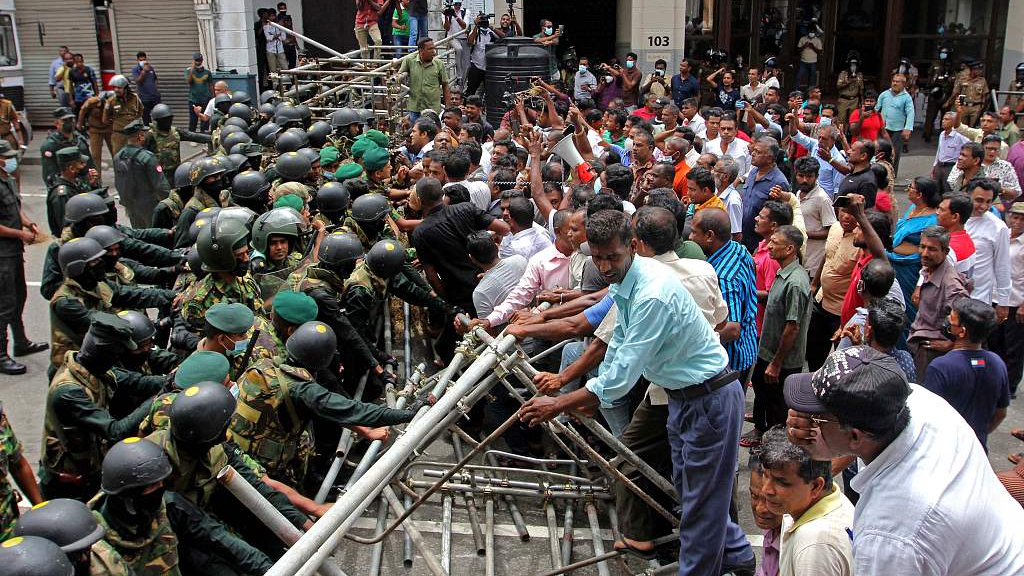
The Defence Secretary says the police and the armed forces empowered to use necessary force against those who endanger or harm the general public, engage in anti-social activities or cause damages to property.
In a video statement, General (Retd.) Kamal Gunaratne said certain groups are attempting to incite violence among the general public under the pretext of peaceful demonstrations.
Meanwhile, a police curfew order was also imposed in several police areas in the Western Province ahead of the series of mass anti-government protests expected to take place in and outskirts of Colombo tomorrow (July 09).
Accordingly, Negombo, Kelaniya, Nugegoda, Mount Lavinia, Colombo North, Colombo South and Colombo Central police areas are under police curfew from 9.00 p.m. today until further notice.
Police curfew will be imposed in several police areas of the Western Province with effect from 9.00 p.m. today (July 08), Inspector-General of Police C.D. Wickramaratne announced.
Thereby, the curfew orders will be effective in the following police areas until further notice:
• Negombo police area • Kelaniya police area • Nugegoda police area • Mount Lavinia police area • Colombo North police area • Colombo South police area • Colombo Central police area
Urging the residents of these areas to remain indoors while the curfew is effective, the police stressed law will be enforced strictly against those who violate the order.
Meanwhile, travelling through the areas where police curfew is in effect is completely prohibited, the police said further.
Accordingly, motorists are advised to use alternative routes for the time being.
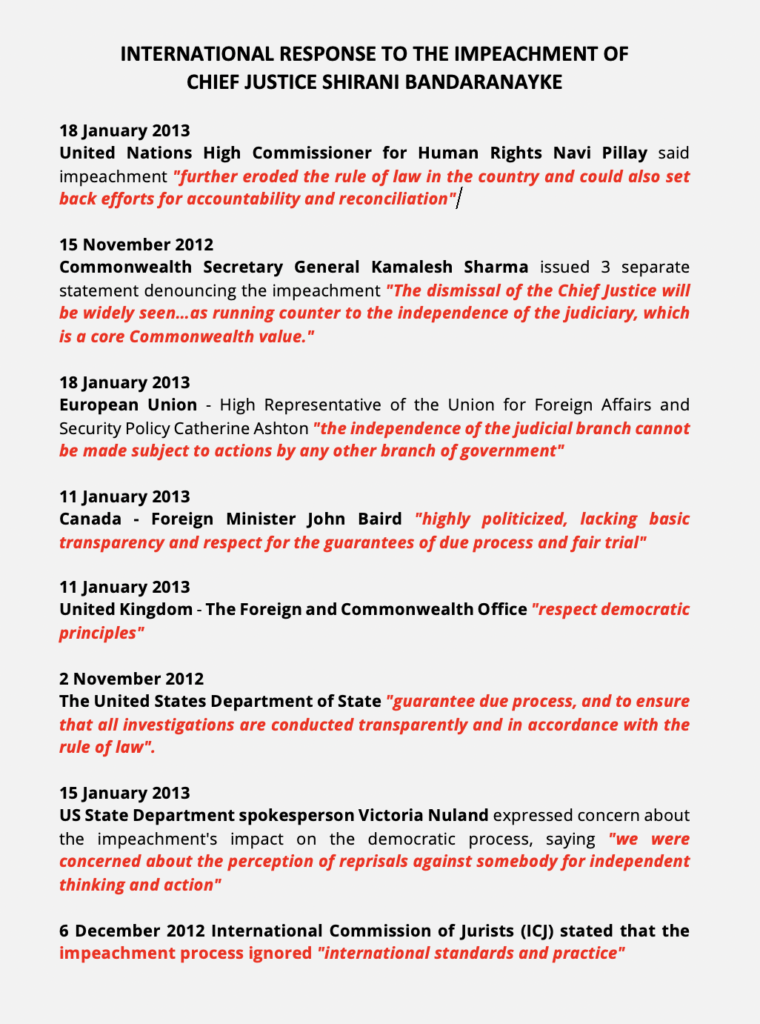
Let us return to the impeachment of 2 Chief Justices of Sri Lanka – how they were removed matters not so much as the trial or the allegations related therein. Another noteworthy feature is the manner one Chief Justice got full international backing while the other received only international condemnation. This is quite strange for the international community” & the legal fraternity that claims to be unbiased.
Shirani Bandaranayake was Chief Justice 43
Appointed on 18 May 2011
Impeachment motion in November 2012
Procedure to impeach a Chief Justice
Constitutional provisions – Articles 107(2) & 107(3) setting procedure to remove members of the Judiciary
Standing Orders of Parliament 78A(1)– Resolution presented to Speaker or placed on Order Paper of Parliament signed by 1/3 of total MPs
Speaker accepts Resolution & places in Order Paper of Parliament
Speaker appoints Select Committee of not less than 7 members to investigate & report to Parliament the allegations made
Select Committee hands to Chief Justice a copy of their deliberations & seeks written statement of defense from CJ
Chief Justice given opportunity to appear before Select Committee to give version
Select Committee given a month to conclude findings
Decision presented to President by Speaker on behalf of Parliament
Procedure followed to impeach CJ Shirani Bandaranayake
117 MPs handed a petition on 1st November 2012
Standing Orders of Parliament & Constitution was upheld
11 Member Select Committee appointed on 14 Nov 2012 – Anura Priyadarshana Yapa (Chairman) Nimal Siripala de Silva, Susil Premajayantha, Rajitha Senaratna, Dilan Perera, Wimal Weerawansa, Neomal Perera, John Amaratunga, Lakshman Kiriella, Vijitha Herath, R Sampanthan.
Select Committee handed report to Speaker on 8 Dec 2012
Parliament debated on 10th, 11th January 2013
Parliament vote taken – 155 voted in favor / 49 voted against – on 11 Jan 2013
Parliament impeached Chief Justice Shirani Bandaranayake on 11 January 2013
2 ½ months was taken for the due process
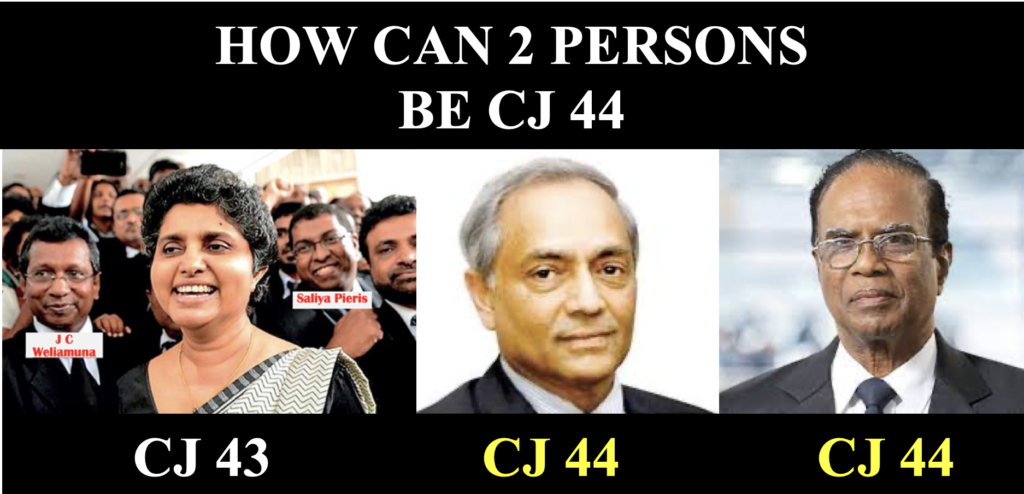
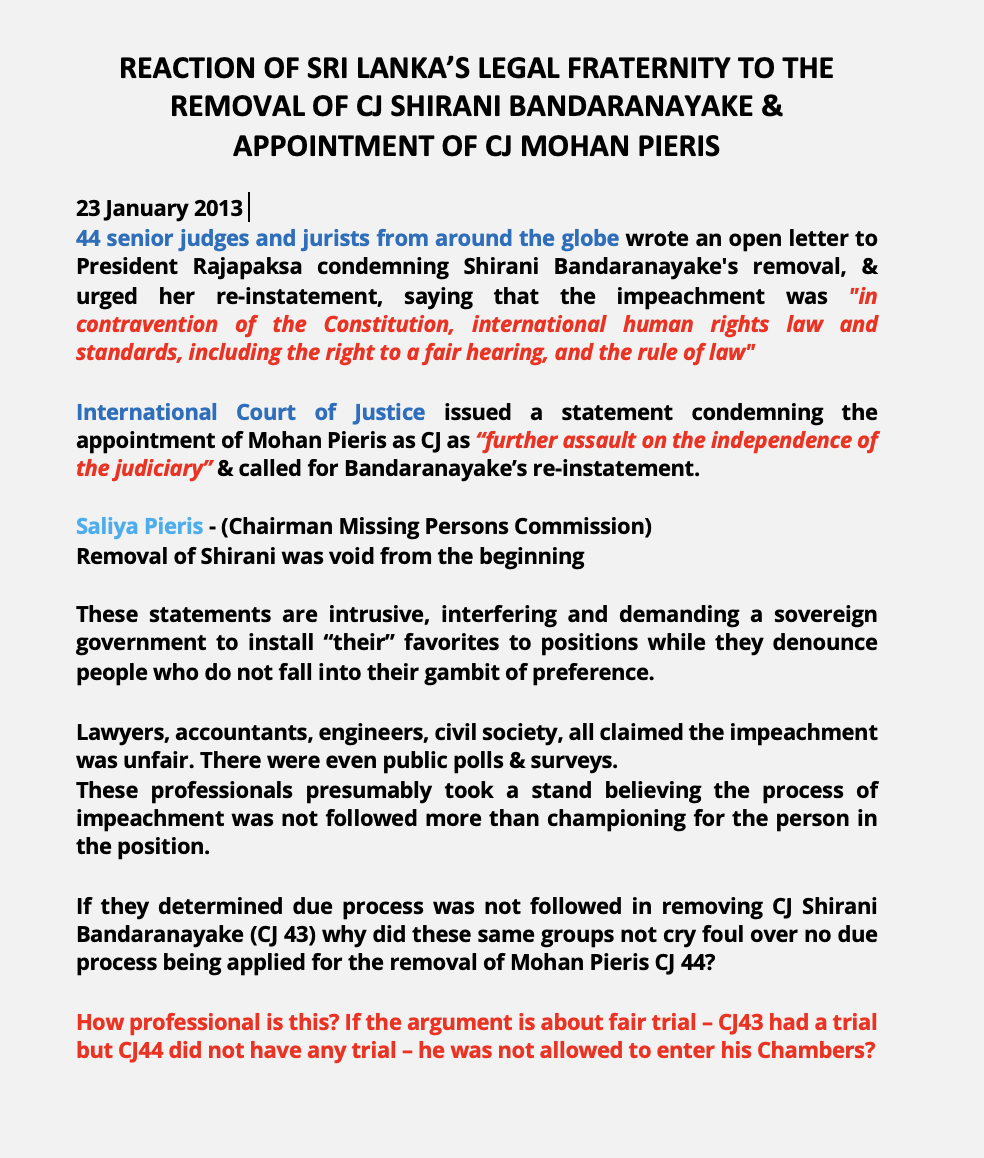
(CJ 43) Chief Justice Shirani Bandaranayake was impeached on 11 January 2013,
(CJ 44) Mohan Pieris was appointed Chief Justice on 15 January 2013.
9 January 2015 – the government changed / President Sirisena appointed President
Procedure followed to remove Mohan Pieris as Chief Justice
9 Jan 2015 – BASL meet new President & new PM Ranil – urging them to reinstate Shirani Bandaranayake as CJ
12 Jan 2015 – a group of lawyers & civil society organizations staged a protest in Hulftsdorp calling for CJ Mohan Pieris to step down.
These self-righteous rule of law” & democracy” proponents gave Mohan Pieris 48hours to step down gracefully”.
CJ Pieris was not able to even attend Supreme Court or enter his Chambers.
28 Jan 2015 – President Sirisena’s Secretary by letter informed CJ44 quoting void ab initio to claim his position as CJ was considered null & void claiming his appointment was not valid from the beginning.
28 Jan 2015 – CJ 43 reinstated for only 1 day & made to resign the same day. This was the fate of Shirani Bandaranayake who was at the forefront of a local and international campaign to be reinstated since her impeachment in 2013 to be reinstated in 2015 for one day!
30 Jan 2015 – Justice K Sripavan appointed Chief Justice & controversially is made CJ44 not CJ45.
Question is can the President alone remove the Chief Justice at his will & that too through a letter sent by his secretary?
The same parties that claimed due process was not followed to remove Shirani Bandaranayake removed Mohan Pieris by protesting and not allowing him to enter his chambers. Is this the due process they are promoting?
Is international standards & rule of law to protest & remove a CJ and obstruct him entering his Chambers and not the Constitutional provisions stated to remove a CJ?
A victim is a victim irrespective of the face! So where were these unbiased, impartial, rule of law, due process, upholders of law & constitution for victim CJ44?
Was a procedure followed for the removal of CJ43 & CJ44? Irrespective of any legal loopholes. Was there a process that was followed for both?
CJ43 is ShiraniB
CJ44 – MohanP & Sripavan (we have 2 CJs) – however Mohan Peiris’s name is expunged
CJ45 – Priyasath Depp
CJ46 – Nalin Perera
CJ47 – Jayantha Jayasuriya
Additionally, if void ab initio term is used it next raises another more important question of the legal validity of every judgment made by Mohan Pieris as CJ44 from his appointment in January 2013 to his removal in January 2015?
Why is no one answering this question?
How can there be two CJ44?
Ironically, not only did we have 2 Chief Justices in Sri Lanka in 2015 but 2 Prime Ministers as well. While PM D.M Jayaratne did not resign or was sacked as Prime Minister by gazette, RanilW was appointed as Prime Minister. Once again none of the rule of law, democracy, due process” bandwagon came forward to bemoan the illegality & unconstitutionality of this appointment. Ironically in the same controversial manner he has once again become PM and the same parties are once more silent.
This selective & partisan approach by the usual culprits is nothing to be surprised about.
The general public should realize the futility of their rhetoric, pretending to be upholders of good governance but doing the opposite.
It is our duty to highlight these violations & leave it for you the reader to decide.
The Government should immediately proscribe all these anti-national foreign agents called Civil Societies” and initiate a full investigation with a view to take legal action against their misdeeds and put an end to their activities.
The following letter by Shenali Waduge is a must, that should be read by all Sinhala people who love their Motherland and the glorious Sinhala nation. Sri Lankan politicians in particular, from the President and Prime Minister downward, who handle the destiny of the country and all policy makers and top Government officials who are in charge of the machinery of governance should take serious notice of the content of Shenalis letter. I am seriously concerned as to why they are sleeping and they remain deaf and blind on the irreparable disaster these anti national elements are doing against the Sinaha nation and while these bunches of anti- national and unpatriotic so-called Civil Society vultures are actively engaged in destroying this paradise Island and the Sinhala Buddhist nation even at international fora for fabulous financial gain from political and religious enemies that have been trying to destroy this Island nation form 1505 up to date.
Going by the list of these so-called Civil Organizations and the people who have listed as their Chairmen, Secretaries, Executive Directors, Conveners, Governors, Advisors and Board members together with these so-called colonial disguised doner agencies such as USAID, OXFAM, NORAD, CIDA, GTZ jointly set up to destabilize and keep the third world countries as they have named them and keep them permanently as their markets for their products and supply sources of cheap raw materials and labour and destroy native civilizations. On the other hand all the leading personalities who operate these Civil Societies like Pakyasothi Saravanamuththu, Radhika Kumaraswaamy, Jehan Perera, Raja Asirvadan, Milinda Moragoda, Indrajith Kumaaraswamy, Jayadeva Uyangoda, Sheffinaz Hasendeen, Reginold Thangaraja, W, C. Weliamuna, Sarath Wijesuriya, WickramaBahu Karunaratna, Gamini Viyangoda, Dambrla Amila, Nirmaal Ranjith Devasiri, Nimalka Fernando, Laal Wijenayaka, Priest Sarath Iddamalgoda and Shaanti Sellatambi are I only the proxies working for their foreign masters. It has becoms more than evident that all of them are a well- organized bunch of anti- Sinhala, anti- Buddhist anti -National paragons of fame acting as heavily paid proxies of the Western countries and Dollar shops in a network of interlocking mechanism to destroy this Island nation and its unique Sinhala Buddhist civilization. The absence of a government and a patriotic public service in this country like in what we have in India, as I see, is the main cause for this unfortunate situation.
proxies All these agencies and individuals are externally manipulated by political, financial and dogmatic forces and they are controlled by non-Sinhala Buddhists, mostly Catholics, Muslims and Tamils who have vouched to destroy the Sinhala Buddhist civilization in this country. This what they could not do from 1505 up to 1948. More over all these agencies and individuals are sworn enemies of the native Sinhala Buddhists of Sri Lanka who had reigned and prospered over this country as a world-renowned nation of fame from 307 BC after the advent of Buddhism. Each of these international agencies trying to make this island their Pivot of Asia and each ethnic group within the country dreaming to take over this Island as their Homeland with internal conspiracies and external support.
Absence of a strong patriotic political or national leadership since Independence, with the singular exception of Sirima Bandaranayaka, who made a bold attempt to put the country on the correct path during her regimes during 1960 to 65 and 1970-1977.
Moreover, all these so-called Civil Organizations are only international racketeer agencies founded and manned by self- seeking social crooks brought up, in the Colombian cultural environs, educated within the Western system of education, fully imbibed in Western culture and brainwashed to act as proxies of their Western masters. Their heads are full of alien political and social dogmas fully brain washed and completely uprooted and therefore alienated from the Sinhala Buddhist cultural matrix that form the rock foundation of its civilization and dominate the whole country. Therefore, all these Civil society barons are completely divorced from the native Sinhala milieu. And strangely it is this gang of of thupahiyas who are trying to dictate the governments of the country elected by 80 % of the native population who live in the villages all over the country which are completely different form Colombo society other than the TV, Cell phone and the Tricycle.
I call upon the government in power to proscribe all these organizations immediately and start a full investigation in to all their conspiracies against this nation and misappropriation of foreign donations and charge them for felonious treason and conspiracy against the Sinhala nation and Mother Lanka.
1 The constitution of all these organizations, except one or two, clearly shows that they are manned by activist, Tamils, Muslims Catholics and disgruntled Sinhala elements calling themselves intellectuals. The common denominator that unites them is their jealousy and antipathy against the Sinhala Buddhist Nation.
2The fact that all these organizations rise only against any move that benefits the native Sinha Buddhist and none of these organizations utter a single word when and where the native Sinhala people are affected
3 Whenever they talk or agitate about human rights they only talk about minorities and always use those so-called international standards and legal arguments and never refer to the native customs or traditions
4 None of these organizations accept that this country is the land of the Sinhala Buddhist nation for 2500 years or even more.
5 . None of them agitate for the rectification of the rights of the native Sinhalese that were lost after 1505 and that were not rectified in1948 at the time of so-called independence.
6.They always agitate only on behalf of the parasitic minority groups and their rights but never a word about the majority Sinhalese who were the Buhumiputras of this Island from the dawn of history.
7 All this evidence clearly shows that their continuance serves no purpose as arms of nation building in this country is concerned.
8 They only serve as a chain of lucrative employment for a set of Colombo based Thupahiya trouble makers, a veritable thorn in the body nation.
Usually, it is the job of the head of the state in situations like this to mobilize the State machinery to take appropriate actions in situations like this. But unfortunately, we don’t have an effective Head of State in this country at this moment. Obviously the person elected by 6.9 million in 2019 as the people‘s President has miserably failed in all three fundamental functions of a State namely, 1. Raksha or protection of the State from external aggression of the country.2.Palana or maintenance of law and order within the State and 3 Yogakshema or safeguarding the Welfare of the people as Katilya has laid down millennia ago.
Is foreign-funded Civil Society” attempting to replace the Political System in Sri Lanka?
Posted on July 3rd, 2022
Shenali D Waduge
Do civil society” actually represent Sri Lankan citizens or are they representatives of those that fund or pay their salaries? Their connections and the manner they network provide clues. While they point fingers claiming politicians should serve a term, how long have they held posts in these organizations? While they project themselves as being better than politicians – how better are they, how trustworthy are they given that their funding determines the initiatives they take up & the topics they raise. It is they who began the ‘Reject 225+1” campaign as early as 2018 & we see that this campaign is in reality to replace politicians with themselves. There is increasing attempts to get ‘civil society’ involved in governance. By ‘civil society’ it is these foreign-funded entities that are attempting to take over governance.
1. Centre for Policy Alternatives
Board of Directors
Professor Chandraguptha Thenuwara, Senior Lecturer: Department of History & Art Theory, Faculty of Visual Arts, Colombo – Chairman
Aritha Wickremasinghe (Lawyer)
Chandana L. de Silva (Consultant)
Minoli De Soysa (Editor/Writer)
Dinusha Panditaratne (Lawyer)
Sukanya Devarajan (Former International Civil Servant)
The Berghof Foundation for Conflict Studies in Sri Lanka
The Friedrich-Naumann-Stiftung für die Freiheit
The International Social Survey Programme (ISSP)
UNICEF
UNDP
UNHCR
USAID
In October 2014 CPA was exposed for funding corruption. CPA was accused of billing for un-held workshops, getting grants from 2 donors for the same task (EU & UNESCO paid CPA to do same task – each paying EURO 99,497.16), duplicating receipts, hotel bills and hoodwinking donors. These are the people preaching anti-corruption! An article disclosed all details – International Federation of Journalists is one of the ‘most corrupted media organizations in the world’ including double-billing. The article included names of Rohan Edirisinghe, Sunanda Deshapriya, Victor Ivan.
2.Centre for Monitoring Election Violence (CMEV)
Convener
CMEV is made up of CPA, FMM and INFORM Human Rights Documentation Centre.
3.National Peace Council
Board
Joe William (Chairperson)
G. V. D. Tilakasiri (General Secretary)
Jehan Perera (Executive Director)
Professor T. Jayasingam (Joint Treasurer)
Professor M. S. Mookiah (Joint Treasurer)
Professor S. H. Hasbullah (Director – until August)
Javid Yusuf (member of yahapalana constitutional council)
A. Iyadurai
Saroja Sivachandran
M. H. M. Niyas
Fr. Joseph Mary
A. W. Hilmy Ahamed
Suresh Dayantha De Mel
Fr. T. Rohan Dominic
Rohana Hettiarachchi
Christobel Saverimuttu (Company Secretary)
4.ADVOCATA (earlier Advocata Institute)
Colombo-based neoliberal think tank connected to the US Govt
https://www.advocata.org/about
launched in May 2016 at the Lakshman Kadirgamar Institute
3 months after the launch Minister Malik S quotes Advocata’s privatization plans.
BOARD
Murtaza Jafferjee – Chair – Advocata Institute
Sarath Rajapatirana – Chair – Academic Programme
Anarkali Moonesinghe – Board Member at Lankan Angel Network
Henry Ergas –Professor of Infrastructure Economics
Frank Lavin – Chairman & CEO – Export Now
Nishan de Mel – Executive Director – Verite Research
Fredrik Erixon – Director – ECIPE (European Centre for International Political Economy linked to CATO Institute)
Parth J Shah – President – Centre for Civil Society
Premachandra Athukorala – Professor of economics – ANU
Razeen Sally – Professor at Lee Kuan Yew School of Public Policy – NUS (Economic Advisor to former Finance Minister Mangala Samaraweera) also on board of Candle Aid Sri Lanka
Rohan Samarajiva – Chairman – Lirneasia
Sujata Gamage – Senior Research Fellow, LIRNEasia
Reuben Abraham – CEO – IDFC Institute
Suri Ratnapala – Professor of Law, Queensland Uni.
Sirimal Abeyratne – Professor in Eco., Colombo Uni.
5.VERITE RESEARCH
BOARD
Nishan de Mel – Executive Director
Subhashini Abeysinghe – Research Director
Cilani Wijesinghe – Finance Director
SENIOR ADVISORS
Tony Seneviratne
Vinoth Ramachandra
Chris Rodrigo
Sisira Jayasuriya
Nimal Sanderatne
Sunil Bastian
Michael Roberts
Sharya Scharenguivel
Sunil Hettiarachchi
ADVISORS
Rajesh Venugopal
Rozana Himaz Salih
Joy Pachuau
Saliya Wickramasuriya
Dinusha Panditaratne
Jesse Szeto
Amala Jayawardena
Ranil Dhammapala
Viran Corea
Note: Verite Research is promoting MCC economic corridor in Sri Lanka and is MCC agent in Sri Lanka
6.LIRNEASIA – established in 2005
BOARD
Rohan Samarajiva – Chair
Vinya Ariyaratne – Vinya is also on the board of Sarvodaya Fusion – so too are Rohan Samarajiva, Madhu Rathnayaka (Virtusa),
Jeeva Perumalpillai-Essex – Development Economist
Lakshman Bandaranayake – Chairman Sarvodaya SEEDS
Mervyn de Silva – Consultant Renewable Energy Development
Visaka Nanayakkara – Senior Lecturer Univ of Moratuwa
Shaheen Cader – former CEO Nielsen Sri Lanka
7.ALUMNI
Millie Rivera – Director Faculty Diversity, George Mason University, USA
Indrajit Coomaraswamy – Former Governor CBSL
Sandya Salgado – Director/CEO Ogilvy Action
W M Bandusena – Chairman Health Services, Public Service Commission
Anoja J Obeysekera – Consultant Telecom/Technology Business
Luxman Siriwardena – Former Executive Director Pathfinder Foundation
Thusitha Perera – Company Director & Senior Finance Professional
8.National People’s Movement
Formed by Vinya Ariyaratna in 2018 with Deshodaya (entity within Sarvodaya) & United Professionals Movement together with 17 civil society groups.
Slogans used Together we can” promising to Save-Serve-Sri Lanka”. They are promoting to bring a new face” to Sri Lankan politics.
Nagahananda Kodituwakku of Vinivida Foundation is also a partner of NPM
9.The United People’s Movement
comprises Deshodaya, Kalyanamithra Society, Sinhala Weera Widana Society. What is the link with United Professionals Movement & United People’s Movement?
National Democratic Institute (NDI) – SRI LANKA
National Endowment for Democracy NED is umbrella for 3 inter-related agencies:
Center for International Private Enterprise
National Democratic Institute for International Affairs
National Republican Institute for International Affairs (International Republican Institute)
NDI is funded by NED, USAID, US State Dept, Consortium for Elections & Political Process Strengthening,
NDI also received contributions from Govt of Australia, Govt of Denmark, Govt of Belgium and Open Society Foundation of George Soros. Yasmin Sooka’s report against Sri Lanka was funded by George Soros Open Society Foundation. The Google balloon over Sri Lanka Google Loon Project” is also a George Soros project. In 2016 it was announced that George Soros was to fund a 3 year economic plan for Sri Lanka. http://www.sundaytimes.lk/160110/business-times/soros-to-boost-sri-lankan-economy-stiglitz-to-provide-sound-advice-177966.htm
NDI provided financial & technical assistance in Ukraine election.
SRI LANKA
Assisted in conducting election monitoring & civil education campaigns in 2000, 2005, 2010, 2015 and 2019 elections.
Sri Lanka became 1st South Asian Member of Open Government Partnership in 2015 to adopt an Open Parliament Plan alongside Civil Society.
NDI partners with Sarvodaya
Thusitha Pilapitiya, Sri Lanka Resident Senior Country Director
International Centre for Ethnic Studies (ICES)
BOARD
Radhika Coomaraswamy (Chairman) – Former Senior UN Diplomat
Rajan Asirwatham -Fellow of the Institute of Chartered Accountants of Sri Lanka, Corporate Director and former Senior Partner and Country Head of KPMG Ford Rhodes Thornton & Company
K.M.de Silva (Emeritus) Chancellor of University of Peradeniya, Peradeniya, Sri Lanka. Historian, political analyst and specialist in ethnic studies and conflict resolution; former professor of Sri Lanka History, University of Peradeniya; founder and former Chairman and Executive Director of ICES
Shafinaz Hassendeen Former Senior ILO Officer and Labour/Gender specialist
Tissa Jayatilaka was former Executive Director of the United States-Sri Lanka Fulbright Commission, and presently a Member/Council of Management, Bandaranaike Centre for International Studies (BCIS).
Wijaya Jayatilaka Senior Lecturer, Department of Agricultural Extension, University of Peradeniya and former Executive Director, Transparency International
Gnana Moonesinghe Civil Society Activist and Writer/Author
Jayadeva Uyangoda (Emeritus) Former Professor of Political Science and Public Policy, University of Colombo and presently Emeritus Professor, University of Colombo.
10.PATHFINDER FOUNDATION
Milinda Moragoda – Founder
Bernard Goonetilleke – Chairman since 2010 / DG Merchant Mercantile Bank
Dayaratna Silva – Exec Dir
Ahmed A. Jawad – diplomat – Norway, Saudi Arabia, Canada
Indrajit Coomaraswamy
Ganeshan Wignaraja – Director of Research at the ADB Institute in Tokyo, Chief Programme Officer at the Commonwealth Secretariat in London and Visiting Scholar at the IMF in Washington DC), Executive Director of the Sri Lankan Foreign Ministry’s think tank in Colombo, Member of the Prime Minister’s Task Force on the Indian Ocean Member of the Monetary Policy Consultative Committee of the Central Bank of Sri Lanka)
Rajendra Theagarajah
11.BAR ASSOCIATION OF SRI LANKA
Jan 2014 – US Govt via USAID sign MOU with BASL President Upul Jayasuriya.
US will sponsor Civil Society Initiatives to support Rule of Law” linking BASL with US Bar Association.
Apr 2021 – US via USAID funds mobile app for Sri Lankan lawyers
Colombo Law Society members given access to online legal resources & court calendars, law reports.
Colombo Law Society in 2020 launched Hultsdorp Law Journal with US assistance providing online legal training for attorneys and law students.
CLS is affiliated to BASL with more than 4000 lawyers in Colombo.
12.Lawyers Collective:
Associated names: K S Ratnavale, Chrishantha Weliammuna, Jayampathi Wickremaratne, Lal Wijenayake, Chandrapala Kumarage, J C Weliamuna, Nagahananda Kodituwakku
They campaigned for 19a, they promoted the Aluth Parapura, they thanked all those who helped to remove Chief Justice Mohan Pieris.
BASL also called for the removal of CJ Mohan Pieris. No one has answered why there was a due process followed to remove CJ Shirani Bandarnayake while no such process was followed to remove CJ Mohan Pieris. CJ Shirani was CJ43, however CJ44 is both Mohan Pieris and CJ Sri Pavan.
13.Lawyers for Democracy
Senior Lawyer Ratnavel is also a member of Lawyers Collective
In December 2018, Lawyers for Democracy issued statement on dissolution of Parliament – signatories to this statement were K.S. Ratnavale, J.C. Weliamuna, Lakshan Dias, Sheath Nethsinhe.
No lawyers objected to present PM being appointed PM immediately after a Presidential election in Jan2015 nor objected to present PM who entered parliament after being rejected by voters.
14.National Movement for Social Justice
Led by late Ven. Madulawe Sobitha thero
In November 2014 its first meet was attended by Opposition Leader Ranil Wickremesinghe, Democratic Party Leader Sarath Fonseka and MP Arjuna Ranatunga, while the former President Chandrika Bandaranaike, issued a message pledging support to the group
15.Movement for a Just Society
Headed by Prof. Sarath Wijesooriya
16.‘Paravasi Balaya’ (පුරවැසිබලය Citizen’s Power)
Co-Convener Gamini Viyangoda
Wickramabahu Karunaratne is also associated.
17.University Teachers’ for a Just Society
Convener Venerable Dambara Amila Thero, Prof. Jagath Kumarasinghe, Prof. Rohan Fernando, Dr. Mahim Mendis, Dr. Nirmal Ranjith Dewasiri all openly campaigned for 2015 Common Candidate Maithripala Sirisena.
They attended the November 2014 ‘yahapalana’ press meeting organized by Ven. Sobitha thero.
December 2014 – Nearly 150 civil society groups under leadership of Maduluwawe Sobitha thero signed agreement in December 2014 and August 2015.
Colombo-based Civil Society Group’
conveners were Pakiasothy Saravanamuttu, Nimalika Fernando, Shanti Sachithanandan, K S Ratnavale
18.‘Citizens Initiative for Constitutional Change’
Speakers at this event were – S G Punchihewa (human rights activist), Pakiasothy Saravanamuttu (CPA), Lal Wijenayake, Rohana Hettiarachchi (PAFFREL Executive Director), Kumuduini Samuel, Sudarshana Gunawardena Shan Wijetunga (Transparency International) Lionel Guruge CPA Senior Researcher in charge of CPA Outreach programas chaired the briefing.
organized by Catholic priest Sarath Iddamalgoda led a protest to demand the government stop the Port City project.
Port City was stopped immediately in January 2015 by Ranil and recommenced by Ranil in 2016 but no Sarath Iddamalgoda to protest against it!
20.Aluth Parapura
personalities associated with this group are Sharmini Serasinghe, Samanalee Fonseka, Indrachapa Liyanage,
21.National Alliance of Alternative Forces
Formed in August 2019 by Professor Krishan Deheragoda (President) and Dr. Rohan Pallewatta (Leader) of Social Democratic Party of Sri Lanka, Ananda Stephen (General Secretary) of National Development Front, Navin Guneratne of Movement to Unite Motherland, Dinesh Kirthinanda of Alternative Political National Alliance, Professor Siri Hettige of Movement for Democracy & Justice, Dr. Prasanna Cooray of Democratic Social Alliance and Swarajya Foundation.
Dr. Rohan Pallewatte and Mr. Nagananda Kodithuwakku supposedly contesting for 2020 Presidency joined NAAF pledging support for a single National Candidate under the theme Reject 225 + 1” and ‘total system change”. 35 Associations representing nearly 150 organizations took part in its meeting held on 22 August 2019.
So what is the link with NPM and NAAF?
22.Abhiman Lanka අබිමන්ලංකා” (Dignified Sri Lanka)
also launched on the same day by the same people promoting either Rohan Pallewatte or Nagananda Kodituwakku.
Abhiman Lanka invited JVP to join it –https://www.lankanewsweb.net/67-general-news/47670-’’Abhiman-Lanka’’-invites-JVP-to-join-alternative-force-amidst-presidential-polls–VIDEO-?utm_source=dlvr.it&utm_medium=facebook
23.Law & Society Trust
– formed by late Neelan Tiruchelvan had on its board of Directors – Chairman Chandra Jayaratne (supporter of yahapalana government) Prof. Jayadeva Uyangoda, G Alagaratnam (BASL President in 2015),
Donors are controversial – National Endowment for Democracy (NED) for land rights (note recent Land Privatization bill attempting to privatize all state land)
In 2017 Coalition Against Corruption used Right to Information Act to demand information from Transparency International SL on its case against TISL Executive Director Asoka Obeysekera, report by J C Weliamuna, Rs.1.1m fraud, and providing job to a foreign female who did not have work visa. Fascinating how these so called civil-society paragons of virtue are all hiding skeletons in their closets but broadcasting to the world their virtues!
Incidentally Weliamuna was elected to global anti-corruption Board in 2010!
In April 2015 Weliamuna said Failure to bring in 19A will be a complete reversal of people’s mandate”
The RanilW Government paid Weliamuna Rs.3.5m for a 136page report on Sri Lankan Airlines which the Airline rejected!
Weliamuna also filed petition against dissolution of Parliament in October 2018 and reinstatement of Ranil as PM. Weliamuna was sent as Sri Lanka’s High Commissioner to Australia.
Top Donors in 2015: EU, Norway Foreign Ministry, Swiss Embassy, British High Commission, USAID, UNDP
Top Donors in 2016: Norway Foreign Ministry, National Endowment for Democracy (NED), USAID, Soros’s Open Society, Asia Foundation
Top Donors in 2017: Norway Foreign Ministry, NED (to mobilize citizens), USAID, Soros’s Open Society
Top Donors in 2018: Norway Foreign Ministry, Asia Foundation, Soros’s Open Society, Swiss Embassy, DAI, Neelan Tiruchelvan Trust, John Keels (Integrity Idol) It is interesting to see the type of projects that these entities have funded Transparency Sri Lanka to roll out across Sri Lanka. Putting these programs on a larger platter will help understand their overall bigger objectives – something Sri Lanka’s policy makers and advisors are obviously clueless about!
There are the paragons of virtue presenting themselves as ‘civil society’. They are all well-connected & move in the same circles and funded by the same bodies. They all speak on the same topics and advocate the same themes their paymasters and donors request of them.
The groups deem it their right to impose who the voters vote for and who voters should not vote for. This is their ‘democracy’.
In a show of goodwill, Bangladesh Prime Minister Sheikh Hasina gave 1000 kg of the renowned Amrapali mango to Shehbaz Sharif, the Prime Minister of Pakistan. The mango was given to the Prime Minister of Pakistan’s protocol officer by the Bangladesh High Commission in Islamabad in July 05, 2022.
According to a statement from the Bangladesh High Commission in Islamabad, “This gift will be considered a special example of bilateral friendship between the two fraternal countries.”
Since a few years ago, Bangladesh has been providing the leaders of South Asian, Southeast Asian, and Middle Eastern nations with a range of delectable mangoes as gifts. Analysts refer to this as “mango diplomacy,” a unique strategy for keeping cordial ties with the nations.
Mangoes: why? Similar to how the French or the Italians are proud of their wines, the Germans and the Japanese of their automobiles, or the Norwegians of their salmon and cloudberries, the mango is the pinnacle of Bangladeshi produce. The mango has recently developed into a crucial component of Bangladesh’s international public diplomacy, serving as a sign of friendship and goodwill.
The mango has recently emerged as a crucial component of Bangladesh’s international public diplomacy. A few days ago, Bangladesh PM sent Mangoes to the Indian president, PM, Bengal CM and Assam CM. It makes sense to send mangoes to India because Bangladesh wishes to foster a cordial relationship with its enormous neighbor. However, giving Pakistan a bushel of the fruit was also very significant.
50 years after the separation of what was then East and West Pakistan in 1971, the exchange of mangoes as gift of Bangladesh PM to Pak PM seems to be an indication that Bangladesh-Pakistan friendly ties is possible. Pakistan and Bangladesh are two of the top ten exporters of mangoes.
The Bangladesh President, the Prime Minister, and other important Bangladeshi figures received fresh, internationally renowned Pakistani mangoes Pakistani mangoes from the Pakistani government last year. On August 2, 2021, Bangladesh welcomed it with the greatest appreciation.
We are all aware of Pakistan’s mango diplomacy. Mao Ze Dong, the Communist Party’s then-chairman, and the Chinese people were taken aback by Pakistan’s mango diplomacy in the 1960s. A significant amount of mango output comes from Pakistan.
For the occasion of Eid-ul-Azha, Prime Minister Sheikh Hasina also gave former Pak PM Imran Khan rare Harivanga mangoes from Bangladesh as a show of goodwill in 2021.
As a continuous part, she sent her goodwill gift to her counterpart PM Shehbaz Sharif. PM Hasina demonstrated honesty and a desire for friendship with all global actors by taking a significant initiative in the situation of Pakistan. The prime minister of Bangladesh wants to maintain and bolster ties with other South Asian nations. Her efforts at mango diplomacy serve as evidence.
Both parties may put in a lot of work to maintain positive relations with the governments of Pakistan and Bangladesh.
Additionally, it will foster positive ties with Bangladeshi and Pakistani citizens. New generations on both sides demand closer ties in the business, tourism, etc. in the very near future.
People from both nations can gain from each other if the two governments work to build positive relationships. The government of Imran Khan was doing everything in its power to forge a solid connection with Bangladesh since it is crucial for the two countries’ interests and mutual advantages in a variety of industries. Now, PM Shehbaz Sharif must continue his predecessor’s effort.
There can be some issues between Pakistan and Bangladesh. However, both sides need to adequately handle these issues. Bangladesh is being seen an economic miracle in South Asia. At every major forum, the world community praises Bangladesh. Pakistan should establish solid ties in order to further its own interests.
Pakistan and Bangladesh are both in South Asia. We can all recall the 1970 Ping Pong diplomacy involving Sino-US relations.
Table tennis diplomacy helped China and the US establish and develop their relationship. The small effort improved relations between China and the US. We can also anticipate the use of mango diplomacy, another Ping Pong tactic. Mango diplomacy is a small undertaking, but it has a big impact.
This modest effort will grow into a significant accomplishment for both parties. We can now anticipate some next moves. Visits by high-ranking officials could be a step toward fostering closer ties. To mend fences, the two prime ministers might trade visits. Both countries’ decision-makers can exchange visits. Pakistan has a significant role to play in this.
Malice to none, friendship to all is the basic essential foreign policy of Bangladesh, a nation that values peace. State is very liberal.
Pakistan has a fantastic opportunity to improve the situation. Though there are several areas where relations between Pakistan and Bangladesh are tense. but the passage of time, Pakistan must resettle its ties with Bangladesh resolving the issues. Pakistan and Bangladesh must comprehend the state of the world now.
Geographically, both are countries in South Asia. Pakistan might be important to the process. Bangladesh is soon to become a South Asian Tiger. It has a flourishing economy. Bangladesh may contribute to the improvement of their business connections.
For its own benefit, Pakistan should maintain its connections with Bangladesh. The economy of Bangladesh is expanding. Pakistan may ask BD for assistance in the near future. For Pakistan to improve, relations with Bangladesh must be maintained. They have a ton of potential together. In terms of religion and culture, Bangladesh and Pakistan have certain similarities. Mutual trade, international counterterrorism initiatives, and regional connectivity could be other sectors.
Bangladesh PM congratulated PM Shehbaz after the selection as PM. Bilateral trade between Pakistan and Bangladesh is growing at a rapid pace and it will cross the $1 billion mark by the yearend, Bangladesh High Commissioner Ruhul Alam Siddique said recently. Bangladesh will host the 20th session of the Council of Ministers of D-8, also known as Developing-8, on 27 July. As an active member of the organization, Pak FM may join the meeting in Bangladesh.
Pakistan has thanked Hasina for the gift of this famous, delicious mango from that country. The international diplomatic community believes that this gift will be considered as a special example in the relations between the two countries.
However, as a result, both states’ policymakers need to be aware of the issue. Mango diplomacy is a small undertaking, but it has a big impact. In the case of bilateral ties, this initiative can encompass both. Both sides must be aware of that. If the realization is favorable, both the governments and the citizens of the states will gain.
Farmers take part in an anti-government protest demanding the resignation of Sri Lankan President Gotabaya Rajapaksa over the country’s ongoing economic crisis in Colombo, Sri Lanka, July 6, 2022. /VCG
Sri Lankan Prime Minister Ranil Wickremesinghe declared his country “bankrupt” on Tuesday, as a result of the island’s worst-ever economic crisis since independence in 1948.
Sri Lanka presently owes over $50 billion to international creditors. This April it announced it was suspending debt payments. Wickremesinghe said the crisis has made bailout negotiations with the International Monetary Fund (IMF) more difficult and complicated, dashing hopes that the nation’s much-needed recovery could begin soon after the talks concluded.
Wickremesinghe attributed the crisis to a combination of the prior government’s policy of reducing taxes and the economic-financial consequences of the COVID-19 pandemic. He told TASS news agency, the past policies deprived the budget of an estimated $40 billion, while the pandemic caused Sri Lanka to spend the rest of its reserves on emergency measures.
R. Ramakumar, an economics professor at the Tata Institute of Social Sciences in Mumbai, India, has some additional insight into the origins of Sri Lanka’s economic crisis. He wrote in an article that the island nation obtained 16 loans from the IMF from 1965 onward due to historical fluctuations in export earnings from agriculture and garments, two major industries.
Then the terrorist attacks in April 2019 that targeted churches and luxury hotels drastically reduced revenue from tourism, further draining foreign reserves. The tax policy that Wickremesinghe blames came during this period and subsequently, upon the onset of the pandemic, the government banned all fertilizer imports to “prevent the drain of foreign reserves.” The result was “a drastic fall in agricultural production and more imports.” As a result, “there was less money available to import food and food shortages arose,” leading to an increase in food prices.
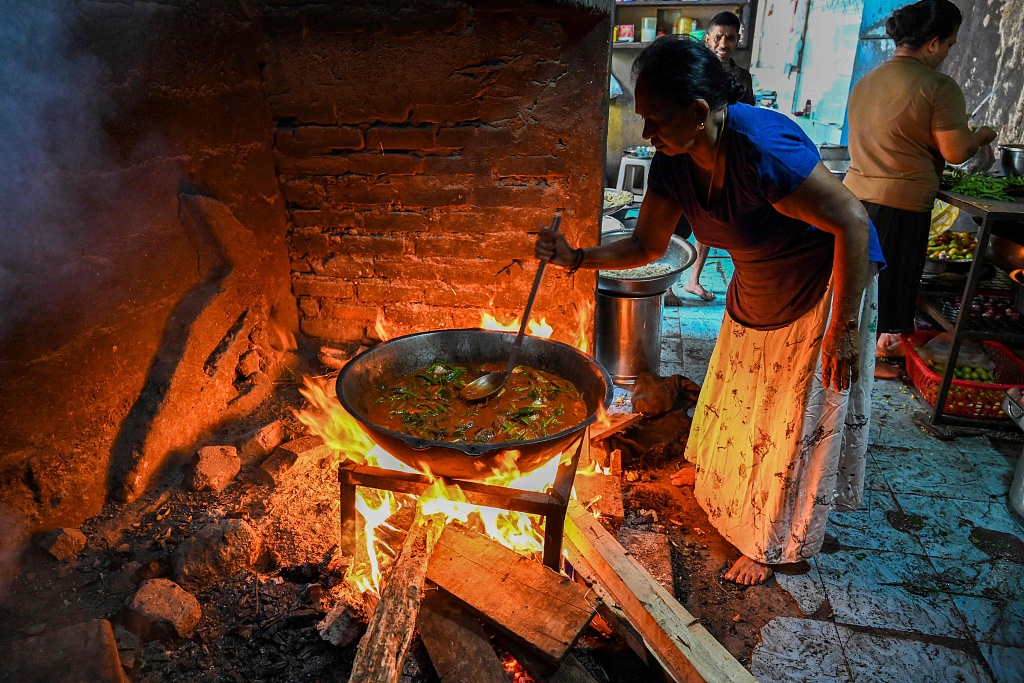
A woman uses firewood to cook food at a hotel in Colombo, Sri Lanka, March 15, 2022. /VCG
That’s crucial to keep in mind since some are blaming the Belt and Road Initiative for Sri Lanka’s bankruptcy. Loans from China accounted for only about 10 percent of Sri Lanka’s total foreign debt in 2020. Japan accounted for 11 percent while the largest portion, reportedly between 30 percent and 50 percent, is from international sovereign bonds that have a higher interest rate and a shorter repayment period.
By all indications, investing in Sri Lanka was a safe bet for everyone. The Financial Timesreported in February that “Sri Lanka first tapped bond markets more than a decade ago, taking advantage of Western investors’ thirst for high-yielding assets as it sought to finance reconstruction following a civil war that ended in 2009…[It] has never defaulted and its successive governments have been known for a market-friendly approach.”
In hindsight, while the terrorist attacks and COVID-19 were both black swan events that were unforeseen, the tax and fertilizer policies were self-inflicted damage. Without intending to, the government planted the seeds that would ultimately crash the economy. It, therefore, wasn’t loans, least of all Chinese, that are responsible for Sri Lanka going bankrupt, but those two ill-thought-out policies.
It’s too late to reverse the immense damage they have inflicted but that doesn’t mean the situation is hopeless. Close partners like China and India have extended emergency aid while Russia sold Sri Lanka oil in late May, all of which helped alleviate some suffering. Still, a lot more remains to be done to sustainably resolve this crisis, which will likely require painful structural reforms.
Wickremesinghe optimistically predicted in the TASS interview that the crisis might stabilize by the end of the year and be fully resolved after another few years. For that to happen and to get back on the right economic track, Sri Lanka will require the support of the entire international community.
Chaturanga Samarawickrama Courtesy The Daily Mirror
The Public Utilities Commission of Sri Lanka (PUCSL) Chairman, Janaka Rathnayake, today urged the government to investigate the Ceylon Petroleum Corporation (CPC) for making huge profit margins on fuel imports and sales.
While addressing the media, he said the revenue after importing and selling fuel not gone to the government or to the treasury but to the CPC where they had huge financial burdens.
The chairman referred to the CPC as a ‘dark hole’ and said the revenue after importing and selling fuel is sucked into the CPC and nobody sees anything. Even though the CPC is charging higher prices, they don’t have the funds to buy fuel.
However, there were two fuel price revisions during the last 45 days in May and June.
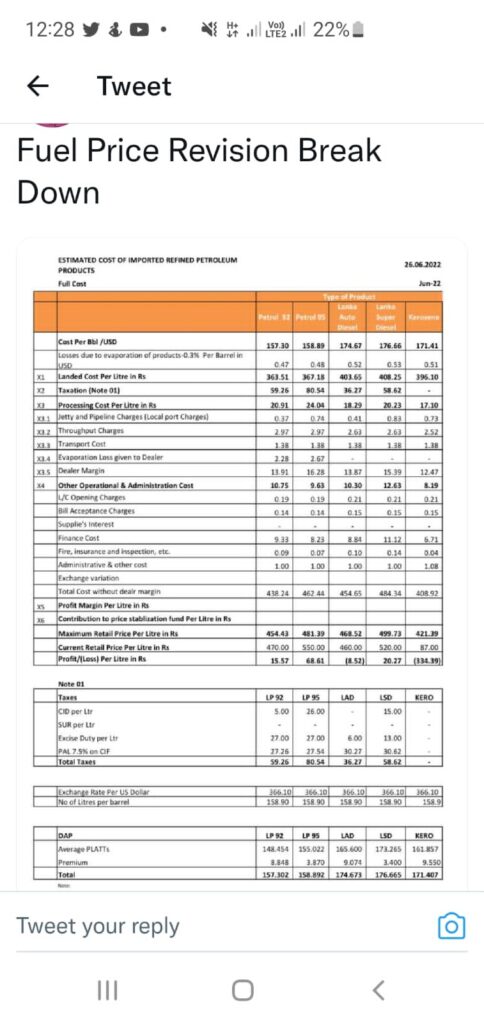
Rathnayake said based on the fuel formula that came out through the Power and Energy Ministry, it had mentioned exorbitant prices on imports of all these fuel varieties into the country.
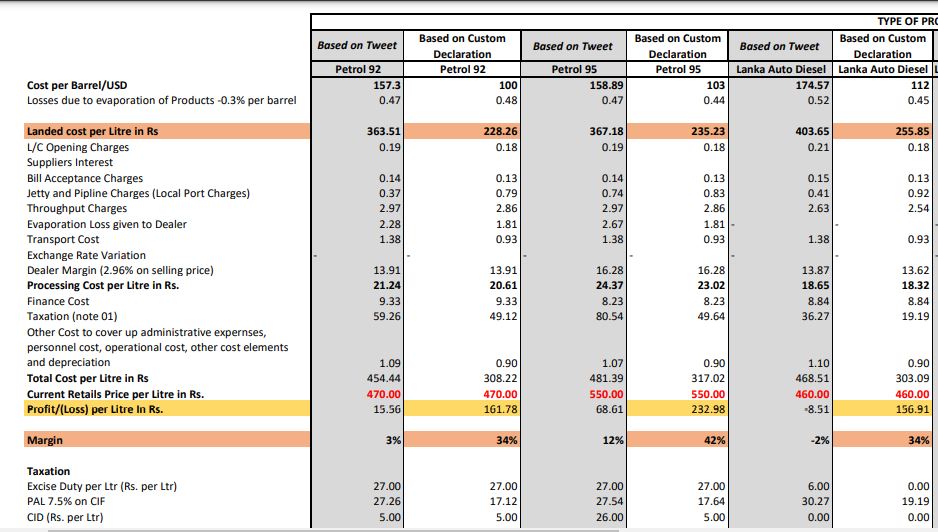
According to the latest revision, a barrel of octane 92 petrol was imported at US$157, octane 95 at US$158, diesel at US$174 per barrel, super diesel at US$176 per barrel and a barrel of kerosene at US$171, he said.
As per the information received from the Sri Lanka Customs Department (SLCD) a month ago, a barrel of kerosene was imported at US$105. A barrel of diesel was sold at US$ 111, a barrel of furnace oil was imported at US$ 75, and a barrel of petrol was imported at US$ 100.
However, according to the fuel formula which the CPC came up with, the price was almost US$50 per barrel, and they arrived at a huge cost figure. The CPC had determined the fuel price based on the latest fuel price revision.
Moreover, the government is charging lesser than Rs.50 as taxation for the above fuel imports per litre. Therefore, the CPC is having that opportunity to making a huge amount as profits ranging from Rs.171 to around Rs. 258 per litre on this imports and selling fuel.
This is the plight of these large organisations where the financial disciplines are not in proper order, he said.
Therefore, the PUCSL chairman urged the political hierarchy, Ministries, Ministers or any interested parliamentarians, treasury, central Bank, local banks to look into the matter to ensure that whether the pricing is done properly.
Sri Lanka’s headline inflation is expected to rise to 70 per cent in the coming months from the current level of 50%, the Governor of Central Bank of Sri Lanka, Dr. Nandalal Weerasinghe says.
His remarks came during a media briefing convened in Colombo to announce the Central Bank’s 5th monetary policy review for the year 2022.
The major concern and priority, from the Central Bank’s point of view, is to address inflation and inflation expectations going forward and bring it down to a reasonable level as soon as possible, Dr. Weerasinghe said. If you look at the impact of inflation on segments of people, the first and hardest hit would be the poor and vulnerable.”
If inflation goes beyond control, to a hyperinflation situation, no one will be able to continue businesses, he added.
On Wednesday (July 06), the Monetary Board of the Central Bank further increased its policy interest rates with the aim of containing inflation pressures while ensuring macroeconomic stability in the period ahead.
Accordingly, the Standing Deposit Facility Rate (SDFR) and the Standing Lending Facility Rate (SLFR) were increased by 100 basis points 14.50 points and 15.50 per cent, respectively.
In arriving at that decision, the Monetary Board weighed the impact of tighter monetary conditions on overall economic activity including the micro-, small- and medium-scale enterprises and the financial sector performance among others against far-reaching adverse consequences of any escalation of price pressures across all sectors of the economy in the near term.
According to the Central Bank, in June headline inflation was at a record high of 54.6 per cent, driven mainly by inflation in groups such as transport, restaurant and hotel, food and non-alcoholic beverages. In the month of June, overall food inflation was recorded at 80.1 per cent, while non-food inflation was at 42.4 per cent.
The Central Bank noted that the major factors that contributed to the unprecedented high-level acceleration in headline inflation were the global energy and food price hikes and associated passthrough to domestic prices, domestic supply side disruptions along with the impact of the depreciation of the rupee, tax adjustments and the lagged impact of monetary accommodation.
In the near term, there will be some acceleration in headline inflation until the end of this year, the CBSL said, adding that however, a significant deceleration is expected starting from the beginning of the year 2023. Headline inflation will reach the medium-term level of 46 per cent range by 2025.
This will be facilitated by both global and domestic developments. Major global developments will include a downward trend of food inflation and oil prices, the Central Bank said further. This has to be supported by appropriate policy measures form the local authorities including monetary and fiscal tightening that will subdue aggregate demand pressures in the period ahead, it added.
Coordinated approach for crisis management that would ensure public support and ultimately help bring about normalcy to the country’s economy, the Central Bank noted.
The Central Bank reinstated that remedial policy measures adopted need to be complemented by timely and appropriate policy adjustments by the government, including the need for expeditious implementation of fiscal consolidation measures, alongside efficient and effective social welfare programs to support the vulnerable groups of the society.
With regard to the negotiations with the International Monetary Fund, the Central Bank said significant progress has been made towards reaching a staff-level agreement on the Extended Fund Facility (EFF) arrangement in the near term.
Meanwhile, it was revealed that the gross official reserves of Sri Lanka, at the end of June, were estimated at USD 1,859 million including the swap facility from the People’s Bank of China which is equivalent to the tune of USD 1.5 billion.
The Ceylon Petroleum Corporation (CPC) says it has opened registration for priority consumer facility to purchase fuel for US dollars.
The applications could be downloaded from the CPC website (www.ceypetco.gov.lk).
The relevant conditions, the USD payment process and the infrastructure requirements to be complete by the applicant after authorization is grant by CPC can also be viewed on the CPC website.
The Minster of Power and Energy last week announced that any company or industry that capable of paying in US dollars can open a consumer account at the CPC to obtain a weekly guaranteed fuel quota.
However, he said they would be required to pay a month in advance and fuel will be issued either on a daily or weekly basis from the 12th of July.
Already paid customers will receive their quota starting from the aforementioned day, he added.
A shortage of exorbitantly privileged American Dollars, the global reserve fiat currency, which is not backed by gold, silver, oil or drugs, is the purported reason for Sri Lanka’s compounding crisis and the international media narrative of ‘famine’ in the country.
The financial crisis that has brought the strategic Indian Ocean island nation to a standstill, which co-incidentally stymies protests, originated with an International Sovereign Bond (ISB), debt trap and Default in April this year. Such defaults, often staged, render countries in the Global South vulnerable to International Monetary Fund (IMF), ‘bailouts’, structural reforms, austerity measures, and a ‘firesale’ of strategic assets that tend to benefit Euro-American holders of Odious Debt, including vulture funds like Blackrock, as well as, the governments that back them.[i] The Washington Consensus and Paris Club, in the business of ‘debt restructuring’, do not distinguish between illiquidity and insolvency.
As Sri Lanka’s economy has come to a virtual halt due to a sovereign default for the first time in the county’s 70 plus years of independence due to a purported lack of dollars to import fuel, the question is: why did Prime Minister Ranil Wickremasinghe who took office with a promise to help save the country on May 15, chosen to ignore the POLICY OPTION to import oil and gas from Russia which has de-dollarized and does NOT require or trade in dollars?
Sanction-hit Russia against which the dollar has been Weaponized is moreover selling oil at steeply discounted prices to neighbouring India, whose Indian Oil Company, ironically, sells petrol and diesel in fuel starved Sri Lanka. Would not the current shortage of ‘exorbitantly privileged’ and increasingly weaponized US dollars in normal circumstances compel any county with an independent foreign policy to de-dollarize and trade in a basket of currencies?
Should not Sri Lanka’s policy makers and the 225 members of parliament (whom the people on the streets wish would Go Home”), urgently reach out to Russia, Iran, or any other country rich in oil that does not ask for dollars? Or, is saving citizens from economic ruin and famine NOT a policy priority of the current Colombo regime? And, if not, why not? Co-incidentally, who makes economic policy decisions, for would it not be logical that a country suffering fuel shortages and ‘famine’ due to a lack of dollars, de-dollarize?
Should not Sri Lanka simply exchange its world famous Green Gold” for Russian Black Gold or oil? Tea, Sri Lanka’s green gold once made the island one of the richest Colonies of the British Empire, and many Russians and citizens of the post-Soviet republics love to drink it.
A Manchurian Candidate, Famine, and the IMF
Nobel-prize winning economist, Professor Amartya Sen, long ago showed us that Famine is a Policy Choice; the result of poor access to and distribution of food rather than an absolute lack of food production. So too, it seems is the seemingly self-inflicted fuel shortage, a policy choice of Mr. Ranil Wickramasinghe who took office as Prime Minister on May 15, 2022 with the military on the streets and citizens under curfew in what appeared to be a regime change operation similar to the one in Pakistan that saw Mr. Imran Khan ousted a month earlier. Mr. Khan accused Washington of a regime change operation in Pakistan and showed evidence.
Wickramasinghe’s appointment by erstwhile US citizen, President Gotabaya Rajapakse, was preceded by real and staged, albeit social media and digitally controlled Aragala people’s protests that tipped into one night of violence. RW claimed that he would save Sri Lanka and sort out the strategic island’s $ 50 billion debt crisis.
Shortly after taking office Wickramasinghe proclaimed that famine and 15-hour power cuts were ahead, which begs the question; why did he do nothing between May 15 and the July to source the needed oil, gas and jet fuel from Russia or any other country that does not trade in petrodollars (Iran for example), in order to keep the economy going and avert famine?
Wickramasinghe only dispatched his energy Minister to Qatar for oil in the last week of June when the country was at a virtual standstill and food shortages apparent, notably when the IMF team was in Colombo.
It is increasingly apparent that Wickramasinghe chose to wait until an IMF team arrived on June 18-29, as the Lankan economy ground to a standstill. Meanwhile, citizens waited days and even died in fuel queues, while schools and government institutions shut down due to transport and fuel shortages.
The IMF team arrived with special US government financial advisors” and legal firms Lazard and Clifford and Chance seemingly to bail out ISB traders and holders. A week later, June 6, following the IMF team departure, BBC World News ran a ticker message stating: The Sri Lankan Prime Minister says that his country is bankrupt and the economy has collapsed!”
For a comparative perspective on the relatively small amount of Sri Lanka’s debt relative to the Wealth of the Nation that sits on major Indian Ocean trade routes and sea lanes of communication with significant ocean and mineral resources, it is noteworthy that the President of Ukraine, a country of 44 million people, estimated that his country’s post-war reconstruction would cost a whopping $ 750 billion (or three-quarters of a Trillion), while Elon Musk bough Twitter for $44 million!
Sri Lanka, located at the center of the Indian Ocean with a population of 22 million, listed by the World Bank as an Upper Middle Income County (MIC) in 2019, and one of the wealthiest countries of South Asia with high Human and Social Development indicators has a debt estimated at a mere $ 50 billion. Almost 50% of this is owed to US-based ISB holders.
Somehow the data on the stage default for IMF intervention and now the ‘famine’ narrative don’t quite add up! This begs the question: was there intent to stage a fuel blockade and food shortage, bring the county to a standstill and deepen the debt to GDP ratio and inflation numbers, along with the famine narrative and ex post facto datafication to legitimize the Washington Consensus’ intervention in this strategic Indian Ocean island’s Domestic Affairs” at this time while distracting from analysis of the ‘Staged Default’?
Moreover, it is clear that the 2015 Central Bank Bondscam set the stage for Sri Lanka’s current woes – the debt trap built up through speculative and reckless ISB borrowing, rent-seeking and Odious Debt. Hence, questions arise, does RW, Washington’s Manchurian Candidate for Prime Minister of Sri Lanka who was implicated in the island’s biggest financial fraud the Bond scam at the Central Bank in 2015, and appointed recently during the first round of IMF talks that commenced on May 12, 2022 work in the interests of Sri Lankan citizens?
Something smells fishy: Fuel Crisis or Cyber Air-Sea Blockade?
It now appears that Prime Minister Wickramasinghe may have exacerbated Sri Lanka’s debt entrapment by failing to formulate a balanced and Non-Aligned foreign policy to enable the country to source it fuel supplies and keep the economy open in the interests of the citizens.
Something smell fishy about the current seemingly self-inflicted fuel embargo: Ships bringing much needed oil to the island in the middle of the Indian Ocean seem to have disappeared into thin air while the IMF was in town even as the dollars spent also appear to have disappeared –aided by cyber-hacks?
Strangely the fuel ships scheduled to bring oil to Sri Lanka in the month of June had also mysteriously disappeared in the high seas. Was there are de facto blockade on the island, whose fisheries sector and food security has been decimated by 4 years of economically-devastating lockdowns on various pretexts; starting with the mysterious 2019 Easter Sunday ISIS claimed attacks that targeted the tourism dependent island’s economy and coastal fisheries communities and food security, followed by 2 years of Covid-19 lockdowns 2020-2021, and now in 2022 with fuel shortages as hybrid maritime trade warfare roils the world?
Back in 2020 two ships, MV Diamond and MV Pearl mysteriously appeared from nowhere and leaked oil into the eastern seas and at the western coast near the Colombo Port causing real environmental catastrophe outside South Asia’s most important habour that also saw a Data hack.
Is Sri Lanka suffering from the policy myopia of the current US-backed regime in Colombo? Is it controlled by external actors that work against the interests of a sovereign people, whose right to self-determination food and energy security is underwritten in the United Nations Charter?
Is the current seemingly staged fuel crisis and the global media narrative of famine” and soup-kitchens to distract us from the Colombo Regime’s failure to steer a balanced and non-Aligned foreign policy that serves in the interests of citizens and national economic policy sovereignty? Somehow the data and the famine narrative of the Corporate global and local media houses don’t quite add up on the ground!
Muddying the Water: Datafication and Ex-post facto crises deepening after Default
Sri Lanka will present a debt restructuring program to the IMF by August to secure a bailout package, Prime Minister Ranil Wickremesinghe told Parliament on June 6. But the question remains: Did the Colombo regime make a deliberate policy choice to compound Sri Lanka’s debt crisis by not reaching out to Russia to source the island’s energy needs while enabling grounding of an Aeroflot flight in a scenario of Over the Horizon (OTH) Lawfare, to damage diplomatic relations with a long-standing friend of the people of Sri Lanka?
According to an economist at Johns Hopkins University, Steve Hanke, who tracks price increases in the world’s ‘troublespots’, Sri Lanka’s inflation is now at 128 percent, second only to Zimbabwe’s 365 percent! Its Debt to GDP ratio which was at 112 percent at the time of default two months ago, it is now estimated at 136 percent.
While the IMF team was in-country the Coalition for Economic Democracy called for Debt Cancellation as protests escalate amid austerity. A week after the IMF team left town, Wikcramasinghe, claimed that Sri Lanka’s economy is shrinking and the current economic growth rate is between negative four and negative five!
Ex post Facto datafication to deepen and prolong economic crisis following Default is one of the characteristics of IMF engagement in countries like Argentina, now on a record-breaking 21st IMF bailout program! So too Greece and Lebanon.
But just last week Argentina’s Minister for Economy who negotiated the IMF deal was forced to resign due to massive protests in Buenos Aires against the austerity measures in the wake of Covid-19 debt. Ex post facto deepening of financial crises triggering social unrest in vulnerable countries both prolongs and justifies IMF interventions and extended facilities.
This in turn enables further debt trapping and deepening the crisis to ensure that the Washington Con-sensus may tighten their grip also through Digital Colonialism via an envisaged social safety net” ensuring access to Sri Lankans’ personal data and further datafication with related big data companies – GAFAM – Google- Apple, Facebook, Microsoft and Amazon. This may also entail gaming the global and local corporate media narrative crafted with an army of Digital Nomads on extended visas perched in the strategic island, some who exaggerate ex post the crisis and mask the staged default with famine and soup-kitchen stories.
All this of course helps distract from the fact that there may be a fundamental miss-fit between the staged Default, the country-specific Data and the global media narrative vis-a-vis the scope and size of Sri Lanka’s financial crisis and the lived reality of people on the ground in fuel queues?
South-South Corporation and Local Experts
Sri Lanka clearly needs to look east at this time of staged default and compounding fuel and food crisis, and work with the BRICS Bank — the New Development Bank (NDB), of emerging economies Brazil, Russia, India, China and South Africa which prioritizes South-South co-operation in order to steer an independent foreign and economic development policy that serves the interests of her citizens.
The NDB is expanding with new members but the Staged Default and IMF’s bailout may stymie such economic and development policy autonomy, which also requires that the country have an independent foreign policy that serves the interests of her citizens.
There is an ex post facto numbers game ongoing with new debt to GDP ratios and inflation figures being compiled at this time of datafication for the IMF report. Steve Hanke, who claims that Sri Lanka’s current inflation is now at 128 percent is at Johns Hopkins University. Several research programs at JHU, including Area Studies Programs during Cold War 1.0, were and are known to have receive significant Central Intelligence Agency funding. JHU experts also collaborated with the World Health Organization’s Covid-19 Global Data Base and played the Covid-19 numbers game, promoting economically-devastating lockdowns leading to debt traps and asset stripping of vulnerable countries in the Global South.
In the context of big power geopolitics in the Indian Ocean with Cold War 2.0 hotting up in the Global South for its natural and human resources in Sri Lanka (like Ukraine) a cyber-proxy war site of great power rivalries questions may well be asked: Who does PM Ranil Wickramasinghe work for? The people of Sri Lanka or his Washington backers?
At this time the trillion-dollar question is who will draft the Report that Ranil Wickramsinghe plans to present on behalf of Sri Lankan citizens for a debt restructuring program to the IMF in August for a much hyped and long-awaited ‘bailout’ and whose interest will this report serve? On cue he noted in parliament: The expert companies which we have hired are in the process of preparing a debt restructuring programme and we will hand over the report on it to the IMF in August this year. These expert companies not doubt include Lazard, Clifford and Chance, Rothschilds and the various international accounting and legal firms and experts that work for and with hedge funds and vulture funds that engage in speculative and reckless lending while prey on the wretched of the earth.
But what of Sri Lanka’s legal luminaries, accounts experts and citizens’ voices? Are they bereft of the skills, intellectual capacities and expertise to write reports on how to re-structure odious debt to the IMF’s satisfaction? Or is the report just another Washington Consensus Cold War and Colonialism 2.0 project? When will an IMF Report factor in Global South voices and perspectives and the call for DEBT CANCELLATION?
[i] The Spider’s Web: Britain’s Second Empire | Documentary Film https://www.youtube.com/watch?v=np_ylvc8Zj8
When two people get together there is a question that each other ask. The question is what actions by the government would take against the Rajapaksa regime? Many information published on social media may not be true and it would be a willful fabrication. But, Sri Lankans believe that no smoke could come out without a fire. Many Sri Lankan people overseas are confused about social media information and express views against the Rajapksa regime. If the Rajapaksa regime has done corrupt practices against the government they must be investigated by a Royal Commission and the government should take action findings of the commission.
As a leader, Mr Mahinda Rajapaksa did a good contribution to the country. However, when his colleagues were doing the wrong things he was silent and it was not a way of behaviour of a leader should has been acted when party members and family members were doing corrupt practices. Finally, all wrongdoing came against the Rajapaksa regime and the current political situation in the country indicates that the three sons of Mr Rajapaksa could not come to power in the future and they were responsible for such backward and digging gravies for their bodies and the family branches of Mr Mahinda destroyed the future of the Rajapksa family.
The government should appoint a commission and request to submit cases against t the Rajapaksa regime and if there is probable evidence the government should take action. It seems that unnecessary problems are created in the country with sufficient evidence or without evidence and the instability could be removed if the government appoints a commission.
During the reign of Brezhnev in Soviet Union a currency called valid roubles” was introduced by Russian government
All foreign embassy staff and foreign Employees in Soviet Union were given a quota of a printed note called Valid Roubles ( vlutnaya rublaya) and the government established special shops in the city
These shops sold foreign tobacco like Marlborough Philip Morris 555 etc
The embassy staff sometimes sold the valid roubles at a higher rate to locals or students who visit these shops and buy foreign products like tobacco top quality Vodka called Staleeshnaya , Scotch Whiskey and sold in black market and made money
System was very well in place and It can be worked out in Sri Lanka
People working in embassies ,expat workers and workers who remit dollars to the country should be allowed to visit. ( or family members can visit) such specific shops to buy using foreign currency
One of the best options will be to open few petrol stations in the country where people can purchase petrol in Dollars
Certain items like electric bicycles and other essential equipment which can help to solve transport problems may also be sold in these outlets
Government should allow operators to import these stuff using their own dollars like the way they do in duty free shops
By doing this exercise the dollars coming in via Undial May be grabbed by the people who have excess rupees to purchase fuel
Other method to follow is to establish an array of casinos and entertainment streets like in Thailand to attract foreigners to the country
Part of port city which is restricted to locals with access straight from the airport is ideal for such operation
Another few hectares of land can be allocated in Mattala dedicated for gambling crazy” chinese
( Tongue in cheek – Lowering age to 21 years of our young lasses going to middle east to sell their labour and what ever else can be retained this industry !)
Hon Dammika Perera can take the lead and introduce such plans pronto
Sadly, much of the loss of confidence in Sri Lanka today , at the heart of it’ current misery , is the consequence of well organised, well funded and well orchestrated propaganda specifically designed to achieve Loss of Confidence In Sri Lanka , among expatriate workers and international community .
The propaganda uses clear examples of mismanagement by the current administration , exaggerates the consequences of these, and often also uses blatantly false claims and misinterpretations, to destroy confidence in the Administration .
From the moment this administration came into power, they used misrepresentation to obstruct and ridicule every attempt they tried to direct Sri Lankan economy towards in the direction they promised in their manifesto,. They use catch phrases like Selling The Country to Foreigners” , at every attempt at bringing in Foreign Investors. These forces also completely ignore significant achievements in Sri Lanka’s economy like the net increases in Export earnings despite falls in areas such as Tea.
Unfortunately for the govt Covid 19 hit them . Despite every obstacle and ridicule the govt was able to overcome Covid which provided the these forces a fertile covid free ground for these forces aiming to destroy confidence in SL, Without Covid Control Gota Gama, Maina Gama, Guru Uthgoshana’s, Farmenrs Uthgoshanas , etc, at the heart of this loss of confidence, would not have been possible.
However, what this govt has demonstrated is complete incapability of being able to counter these and complete disarray in their ranks.
The opposition both the JVP and SJB can promise to restore international confidence in SL, because they were behind most of the campaign to destroy it in the first place!. They also execute their campaign to cover up their letting down Sri Lanka ,when the President offered them an opportunity to direct Sri Lanka , in the direction of their vision,
There is no prospect of this administration in opposition being organised enough to mount such a undermining campaign .This is self seeking party politics at it’ worst , the basis of all of Sri Lanka’s woes.
Now there is a stalemate, with these forces carrying out a strangle hold on Sri Lanka’s economy with no regard to the misery it is causing to Sri Lanka’s people on the one hand, and the embattled President hiding away in his Bunker sticking to his constitutional right , on the other. There is no sign of resolution of this stalemate either way, despite this misery continuing for over 3 months.
The blatant contradiction Is seeing people in the petrol queue and phoning their mates in Dubai asking them not to send remittances via the banks ,instead send it via the money exchangers making them phenomenally rich but not fronting up to clear the gas or oil ships. They are also frightening the Tourists away with their images. The contradiction is that these are the two quickest remedies for the queues and misery they are in.
This is why I appeal that the quickest solution to Sri Lanka’s misery is by Permitting the Tourists and remittances to return by removing all the obstacles preventing them”.
Minister of Tourism Harin Fernando appointed Priantha Fernando as the Chairman of the Sri Lanka Tourism Development Authority (SLTB). Priantha Fernando is a professional with many years of experience. He qualified for an M.Sc. in tourism at the University of Surrey. Also, he gained experience in Hotel Management and Tourism at Belair College, UK.
Priantha Fernando held a number of senior positions in the public and private sector. When his appointment as the Chairman of the SLBT was announced, he was in Bangladesh on a significant project of the Bangladesh Tourism Board, which the IPE Global of India funded.
After becoming Chairman of the SLBT, Priantha Fernando appeared in the ‘Big Focus’ programme on Derana TV with Janaka Gajaba, Chairman, Sri Lanka Tourism Promotions Bureau. They were on the ball and announced around 4,000 tourist arrivals in Sri Lanka up to June 17, 2022.
Indian tourists topped the influxes, while Russian and US and UK came correspondingly next. Priantha Fernando disclosed that‘on January 22, 2022, the number of tourist arrivals in the country were 82,300, February 96,500’. However, after April 9, the tourist industry was affected; in April, 62,000 and in May, 30,000 respectively. The ‘Aeroflot plane dispute’ affected Sri Lanka’s second highest market. The country receives just under 400,000 tourists yearly, at present, compared with 2.1 million in 2018. Today, there is a marked reduction to between 10,000 -12,000 a day.’
Requirement
What is required to increase tourist input depends on the quality of the product Sri Lanka can offer to tourists. If Sri Lanka fails to deliver, she has to face long-term consequences. The areas that affect the tourists are primarily being stranded on the road due to non-availability petrol, diesel or gas for hotels.
‘In short, it affects the whole country. Suppose tourists in Sri Lanka who enjoy themselves are able convince others in their countries that Sri Lanka is a beautiful country with hospitable people.’ It goes a long way than an advertisement in a magazine or tour operator’s recommendation.
The SLTB Chairman said ‘in order to woo more tourists to Sri Lanka it needs the dedication and enthusiasm of everyone. The peak periods are from December to January. There is a build-up in February and March, and the off-season follows next. The country needs to improve its overall facilities; failing to do so, could lead to long-term consequences for Sri Lanka. For instance, like in the present state of affairs, the results will be terrible if tourists get stranded and face problems like due to the petrol shortages. Suppose a tourist who enjoys his stay can convey a positive message to the international community through social media, rather than adverse reports by the press (global and local), it will undoubtedly help with more tourist arrivals. Usually, the ‘repeat’ type of visitors is the majority. Indeed, word of mouth can increase the overall tourist arrivals. With Sri Lanka’s comprehensive strategies in marketing, it is possible to convey a positive message instead of being negative. Nevertheless, a tourist experience in Sri Lanka can convince his friends abroad immensely. Such messages should go a long to help the expected targets by the SLTB.’
A question was submitted during the programme on the airport, immigration and emigration and other governmental institutions’ willingness to cooperate? The anchor man questioned: ‘If you are discussing the soothing of peoples’ hearts, what have you got in mind? The answer was that they have already had discussions with such institutions with the Minister and received a positive response from those institutions.
Chairman Fernando took over from there and continued that the SLBT concentrated on short-term, medium-term and long-term programmes. Our short-term schedule is concentrated on March 2023 only. We focus on bringing about 800,000 tourists by the end of this year. It is not easy, but we can overcome many hurdles to achieve that target. If we can bring 800,000 tourists this year, we are thinking of the country’s US$ 800 million in foreign exchange earnings. Every tourist’s average stay is about 9.5 days. Our accommodation sector comprises star hotels, boutiques and guest houses, which have 47,000 rooms. We could expect an average income of 17%-18% occupancy. It is not enough to overcome the hotel industry’s deficit and needs about 38% – 40% to break even,” Chairman Fernando emphasised.
‘At the same time, there should be a beginning to get out of the present mess. If we bring 800,000 tourists this year, yet, there will be a one billion shortfall within the industry.’
A question arose during the TV programme concerning the visa tourists get for a one-month. The Chairman of Sri Lanka Tourism Promotions Bureau said they had discussions with President and the Prime Minister separately about this problem. They await a response still as they assumed new positions only ten days ago. This question was highly valid because Indian tourists, particularly the Eastern Europeans would like to stay in Sri Lanka for more than a month. If we can give them an extended visa, it certainly will benefit the industry and the country as well.”
Mentioning the short-term policy on ‘Ramayana Trail,’ he said the tourists are cultural valuers (out of mature from tourists from India). The Chairman of Sri Lanka Tourism Promotions Bureau spelt how they have progressed with the Indian youth. They plan to do a reality show by bringing 20 teams from India and connecting with an Indian TV channel to do a reality show. His idea was to invite Indian bloggers to encourage them to get many youth as tourists to Sri Lanka on a short-term programme. There is the Asia Cup, where 8 Asian countries participate, and the SLTB has also earmarked the Asia Cup.
Chairman Fernando then said the SLTB needs ‘to identify the segments of the markets. It always depends on the supply and demand of a product. Some tourists like to lie on the Beach. Others may visit historical places like Sigiriya. Some visitors may want to see archaeological sites such as ruins of old kings’ palaces in Anuradhapura and Polonnaruwa, the rest will want to see wildlife. We need to identify the markets. We place such demands and upgrade our schedules. Addressing the host, the Chairman said, as you know, there aren’t facilities even for local visitors apart from foreign tourists. At least there are no clean toilet facilities and no place to purchase a bottle of water. It is in a hellish unorganised state. We need to concentrate on what tourists take to their country. It is our responsibility to organise the industry as well as our product.
The question was raised about the ‘Ramayana Trail’ mentioning that 52 sites and displays are not yet properly done ‘due to internal politics and politicians’ demand of an ‘Indian influence.’ In such an environment, the host of the Big Focus programme wanted to know whether the present team had a clean sheet on this.
Priantha Fernando said, we need to change the mindset of our staff as well. If we can earn US$ 2.5 billion in 2025, it means that we will be able to be in the second place as income earners to the country, but our idea is to make the tourist industry the top earner in Sri Lanka”. The Tourism industry was in third place in Sri Lanka. The apparel industry and foreign employment were the next.
The value chain of tourism should spread across the entire society,” Fernando said. Forty-seven thousand rooms are there in the industry, and 2.5 direct employees and 1.5 indirect employees depend on the tourist industry. All that is required is dedication and commitment to reach targets.
Answering a question on Budget Airlines to Sri Lanka, Priantha Fernando said, Sri Lanka has 30 airline operations. They experience fewer load factors that affect their economic viability in various sectors, and they also have to pay in dollars for airport charges. The SLTB needs to find out what the Aviation policy in Sri Lanka is, but so far, SLTB has not had a chance to meet up with the Civil Aviation authorities to discuss their policy.”
The biggest problem is the moratorium because the tourist industry has Rs.480 billion in debt to Banks, and the moratorium ends shortly. To help the hoteliers, the SLTB had approached several foreign investors to buy hotel shares, which will help them solve their debt problem to a certain extent. The average occupancy rate in Sri Lanka right now is approximately 30%.
Other Areas in the Pipeline
The Nallur Festival is a popular event that millions from the East and Jaffna attend. The SLTB plans to concentrate on the diaspora during the Nallur Festival because during 1981-1991, the diaspora had different experiences during the terrorist war and was later affected by the COVID-19 pandemic. Therefore, the SLTB is preparing a festival calendar to help the diaspora and people in the East and Jaffna to help themselves.
Another tourist promotion by the SLTB is to conduct road shows in India in several states. The SLTB intends to approach the Indian Cricket Board and to persuade cricket lovers to visit Sri Lanka during international cricket tournaments. The SLTB also targets Russian tourists. Russian tourists at present have access only to a few countries. The SLTB keeps their eyes and ears open to see at what stage the Chinese market door will open.
Priantha Fernando was approached by the Loyal Orchid Hotel Group in India. They manage seventy hotels in India and want to find a 10-acre land in the Colombo area to establish a US$ 15 million project to set up banquet halls. They guarantee 75% occupancy from India. At present, Sri Lankan hotels are occupied only up to 30%.
The late Gomin Dayasri declared he didn’t want to be a President’s Counsel. Appearing on Sirasa Pathikada, the outspoken lawyer said that there was no point in requesting such a title. Dayasri said so during a conversation with the late Bandula Jayasekera, who invited him on several occasions. Dayasri pointed out the absurdity in the process of appointing President’s Counsel.
By Shamindra Ferdinando
The much respected senior Attorney-at-Law Gomin Dayasri, 77, is no more, but his voice carried such weight that he had the opportunity to advise the Mahinda Rajapaksa government (2005-2015) at the highest level, in his heyday, despite not fearing to admonish them whenever it was deserved. The final rites were conducted on July 02 at the Borella Cemetery.
A true patriot, Gomin had been among those who stood for Sri Lanka’s unitary status whatever the consequences. During the war, and after, Gomin, always mindful of the interests of the armed forces and the police, which was not a popular thing to do among those who had the ear and patronage of the self-appointed international community of the West and was among those few civil society activists who valiantly threw their weight behind the campaign against separatist terrorists as it was treated like heresy by those same elements who worshipped the West.
Sirasa and MTV/TV 1, although being constantly accused of undermining the war effort, earned the respect of the nationalists for the coverage given to the late lawyer. The writer received opportunities to participate in Sirasa and MTV/TV 1 programmes, sometimes, with the late Dayasiri who strongly opposed federalism, separatism and foreign interference.
Top lawyer, Gomin Dayasiri, and General Secretary of the Communist Party of Sri Lanka, Dew Gunasekera, declared that Sangakkara couldn’t have made that statement in the UK at a better time.
The late Dayasri never hesitated to take on the Rajapaksa government if he felt it was on the wrong path.
A case in point is Kumar Sangakkara’s controversial hour-long Sir Colin Cowdrey lecture delivered in July 2011, at Lords. A section of the then government depicted the lecture as a frontal attack on them. Those who resented Sangakkara for exposing their wrongs, cleverly deceived then President Mahinda Rajapaksa. They propagated the lie that the cricketer was challenging the government and was working with the Opposition. Sangakkara earned the wrath of the then government though he paid a glowing tribute to the war winning armed forces at such a prestigious forum at a time a section of the international community, including the UK, was and is literally hounding Sri Lanka’s valiant fighting units for bringing on an implausible victory against all odds, wherever possible.
He was neither a blind worshipper of patriots, the late Dayasri was among the few who dared to stand by Sangakkara. When the writer sought his response to the threats on Sangakkara, Dayasri was prompt and strongly supported Sangakkara’s demand to tackle waste, corruption and irregularities in the game, Dayasri declared that a cohesive strategy was required to stamp out corruption in both public and private sectors. Sangakkara’s speech couldn’t have come at a better time, Dayasri said, adding: The dashing batsman’s eloquent presentation was very pro-Sri Lanka as against the LTTE terrorism and cricket terrorism. If any politician, or the government, decides to take action against the player, there’ll be a public outcry because the sports personality has courageously exposed the insider dealings in Sri Lanka Cricket. More of Sangakkara’s kind should come to the forefront.” (The day Kumar Sangakkara felt humbled’, with strapline ‘Unpardonable failure to capitalize on ‘Spirit of Cricket’” lecture, on January 25, 2017 issue of The Island). Michael Roberts posted in The Island Midweek column article under the headline ‘Sangakkara’s MCC lecture and the Rajapaksa/ Wickemesinghe governments’ failures,’ in his Thuppahi blog.
Sangakkara became the first speaker to receive a standing ovation at Lords since Bishop Desmond Tutu in 2008. Both the UK-based, and Sri Lankan media focused on Sangakkara’s assault on the politically influential cricket administration and the criminal waste of funds, as well as resources belonging to Sri Lanka Cricket. The Sinhala print and electronic media completely ignored Sangakkara’s speech.
Dayasri asserted that the only shortcoming in Sangakkara’s superb speech was the absence of a reference to the Indian factor in Sri Lanka terrorism. Dayasri suggested that the writer left that out as Sangakkara must have had reason to be silent on the Indian factor.
The following post by Janaka Perera Gomin did not confuse patriotism with loyalty to any political party or consider it the monopoly of any group” in the US-based Gamini Edirisinghe’s e-mail thread, explained the late lawyer’s response to the situation.
Daya Gamage posted: I have been following Gomin Dayasiri’s trajectory for the past 30 to 40 years, his struggle to keep Sri Lanka undivided”.
Nimal Fernando posted: A true son of the soil, whose fierce patriotism was a source of solace for Mother Lanka.”
Dr. Anula Wijesundere declared in her post that Gomin was a true patriot and a great lawyer who spoke fearlessly and eloquently against LTTE terrorism. Like the other great patriotic lawyer, the late S.L. Gunasekera, Gomin, too, appeared free of charge and defended the armed forces and the police.
Lt. Col. Anil Amarasekera recalled the services rendered by Gomin Dayasri and the late S.L. Gunasekara.
The retired officer posted the following: … during their lifetime, they worked tirelessly to protect and preserve the unity and territorial integrity of our motherland for posterity”.
Gomin even appeared for me free of charge when I filed a case against the then Commander of the Army for violating my fundamental rights by not allowing me to enter the Sinhalese villages in the Weli Oya region to work against the devolution proposals of the then Chandrika Bandaranaike Kumaratunga government. The Commander of the Army withdrew the order preventing me from entering Weli Oya after a fundamental rights petition was filed in the Supreme Court. Therefore we withdrew our fundamental rights case.
Asoka Bandarage: Sri Lanka has lost a beloved patriot. Gomin Dayasiri was a brilliant, courageous and interesting individual. I communicated with him a number of times on matters pertaining to peace and sovereignty of Sri Lanka. Gomin gave advice freely when H.L.D. Mahindapala and I were faced with legal charges over our writings on Sri Lanka. I also had the opportunity to visit and enjoy lunch at Gomin’s home in the tranquil village setting off Thalawathugoda.”
Sudharshan Seneviratne: I do remember Gomin very well at Ananda. We admired him for his oratory skills and his sharp rebukes levelled at the opposing debating team!
In a limed way though, he did give his valued opinion on the College English Union magazine, the Spark, edited by Deva Rodrigo.
After he left college Gomin took time off while he was doing his Law exams to tutor me on the AL Government paper.
Later we met, not frequently though, at Anuradhapura when I was excavating at the citadel and Jetavanaramaya where he did have pointed questions on culture, identity and training of the next generation.”
Gamini Edirisinghe posted the News First video clip of Dayasri’s funeral.
Oct 2006 triumph
The judgment on the high profile case, filed by the JVP seeking de-merger of the Eastern Province, comprising Ampara, Batticaloa and Trincomalee Districts from the Northern Province, was delivered on Oct 16, 2006, the day an LTTE suicide attack on a Navy land convoy claimed the lives of nearly 100 of its personnel at Digampathaha (not Digampathana) between Habarana and Dambulla. Digampathaha attack was the single worst directed at a military convoy during the entire war whereas the judgment could be considered the most important as regards Sri Lanka’s unitary status.
The Supreme Court on Oct 16, 2006 declared the merger of the northern and eastern provinces, implemented in terms of the controversial 1987 Indo-Sri Lanka Accord, ‘null and void and illegal’. The Court declared that material provided by the petitioners resulted in volumes of material to establish the divisions that existed in historic times and that the eastern province was part of the Kandyan Kingdom at the time of the British conquest”.
The ruling was given in spite of heavy international pressure against de-merging the East from the North. It would be pertinent to mention that at the time of the SC judgment and Digampathaha suicide attack, the LTTE’s conventional military capacity was considered inviolable, especially by the West. In fact, the armed forces hadn’t been able to seriously challenge the LTTE, at least in the Eastern Province, at the time of the historic judgment.
In Sept. 2006, Co-Chairs backing the peace process – the United States, European Union, Japan and Norway – cautioned Sri Lanka against the move. Co-Chairs warned: There should be no change to the specific arrangements for the North and East which could endanger the achievement of peace. The legitimate interests and aspirations of all communities, including the Tamil, Muslims and Sinhala communities, must be accommodated as part of a political settlement.”
Prominent lawyers H.L. de Silva, S.L. Gunasekera and Gomin Dayasri appeared for the petitioners. Prof. Nalin de Silva, who served as Sri Lanka’s Ambassador in Myanmar (Sept 2020-Sept 2021), recalled in a piece on Gomin Dayasri, written in Sinhala, the role played by the three lawyers in the triumphant case.
Son of fearless N.Q. Dias, Permanent Secretary, Ministry of Defence, during Mrs. Sirimavo Bandaranaike’s first term (1960-65) as Prime Minister, has been given a new name. Showing his disdain for the colonial past his father, ditching the Portuguese derived last name Dias, still carried by many Sri Lankans, proudly and simply named him Gomin Dayasri and sent him to Ananda College though his mother very much preferred Anglican S. Thomas College, Mount Lavinia. But, N.Q. Dias, who had studied at an equally elitist Trinity College, Kandy, desired his son to receive an education at Ananda College for obvious reasons.
Prof. de Silva played a glowing tribute to Gomin’s father, legendary civil servant N.Q. Dias, for facilitating the recruitment of Sinhala Buddhists to the armed forces’ officer corps, which, along with top echelons of the police, was till then an almost exclusive club of Christians. Had that not happened, the armed forces couldn’t have brought the war to an end on the banks of the Nanthikadal lagoon in May 2009, Prof. de Silva asserted.
Declaring that the case against the merger of the Eastern Province from the Northern had been the most important one the late Dayasri appeared, Prof. de Silva declared that if not for lawyers H.L. de Silva, S.L. Gunasekera and Gomin Dayasri, Sri Lanka’s history could have been different. Pointing out that except Dayasri, other lawyers weren’t Sinhala Buddhists, Prof. de Silva emphasized the need to de-link the East from the North through the passage of a Parliament act. That should be done in honour of those lawyers who rendered great service to the motherland. We would however like to differ with Prof. Nalin de Silva on late S.L. de Silva, though born into a Christian family, he was a life-long agnostic.
Accountability issues
The late Dayasri had been seriously disappointed with the way Sri Lanka handled accountability issues both during the conflict and after. The Island reportage on the conflict and related matters certainly received a big boost, thanks to advice and suggestions the writer received from the late lawyer. Dayasri was always accessible and never declined to comment on contentious issues. Twice he visited The Island editorial after the conclusion of the sittings of the Presidential Commission of Inquiry (CoI) at the BMICH, into the killing of 17 persons employed by the Action Contra La Faim (ACF) to provide the writer a briefing of what was going on. The CoI also inquired into the killing of five youth in Trincomlee in January 2006.
On one occasion, Dayasri provided the writer several photographs of civil society representatives with foreigners involved in the process. With a mischievous grin, Dayasri said the role played by most foreign-funded NGOs here was quite treacherous. The lawyer asserted that successive governments pathetically failed to meet the challenge posed by those who represented the interests of separatists.
The ACF case took an unprecedented turn in late March 2008, when the late Dayasri challenged the right of one-time Government Agent Dr. Devanesan Nesiah to be Commissioner due to his close relationship with the Centre for Policy Alternatives (CPA). S.L. Gunasekera, who also appeared for the military, demanded Dr. Nesiah’s removal.
Appearing for the then Lt. Gen. Sarath Fonseka’s Army, free of charge, Dayasri opposed Dr. Nesiah’s role against the backdrop of the Centre for Policy Alternatives (CPA) being made party to the high profile case. Dayasri targeted Dr. Nesiah after the Presidential Commission accepted CPA and several other civil society groups, party to the inquiry on the basis of an application submitted by President’s Counsel and one-time President of Bar Association of Sri Lanka (BASL) the late Desmond Fernando. Justice N.K. Udalagama headed the Commission. The proceedings were held under the scrutiny of International Independent Group of Eminent Persons (IIGEP).
Dayasri didn’t mince his words when he questioned the failure on the part of Dr Nesiah to disclose his close relationship with the CPA at an earlier stage. Alleging that it had been a serious lapse on the part of the Commissioner, Dayasri bluntly told the former Jaffna Government Agent Nesiah: You cannot be a judge in your own case because not only justice must be done, but it must be seen to be so done, otherwise there’ll be the likelihood of bias.”
Dayasri and Desmond Fernando clashed at the inquiry over the latter’s claim that a minister confided in him that he (minister) knew the perpetrators of the Muttur massacre. Dayasri demanded that Fernando should get into the witness box. Fernando skipped the proceedings the following day (Probe into Muttur massacre takes a dramatic turn: Commissioner’s right to hear case challenged due to NGO link, The Island, March 27, 2008 edition).
As a result of the stand taken by Dayasri and Gunasekera, President Mahinda Rajapaksa had no option but to intervene. In a letter dated June 06, 2008, Presidential Secretary Lalith Weeratunga asked Dr. Nesiah to explain his relationship with the CPA and the payments received from the CPA. In spite of the presidential directive for him to step down, Dr. Nesiah joined the proceedings on June 10, 2008. Dayasri’s protests compelled the CoI to ask Dr. Nesiah to leave (Commission probing human rights violations: Nesiah dropped after President’s intervention, The Island, June 11, 2008)
Dayasri also argued against the 19th Amendment in a Fundamental Rights petition before the Supreme Court in 2015. Many an eyebrow was raised when Dayasri petitioned against President Maithripala Sirisena’s decision to dissolve Parliament in Oct 2018. Dayasiri told the Supreme Court though he opposed the 19A, since its passage in Parliament, yet the President was duty-bound to act in accordance with it, and the dissolution in less than four and a half years without a Parliament resolution was unconstitutional.
Dayasri simply ignored the fact that Mahinda Rajapaksa had received the premiership as a result of Maithripala Sirisena’s constitutional coup.
In conversation with the writer, Dayasri, lecturer in law and respected commentator on matters of national importance, expressed serious concerns over the failure on the part of the government to address the Geneva challenge. The absence of a clear action plan to use disclosures made by Lord Naseby offended Dayasri, who felt those who exercised political authority quite conveniently failed to exploit the advantage given by Lord Naseby. The cancellation of the Victory Day parade by the Sirisena-Wickremesinghe government in 2015 angered the lawyer. Calling the decision a disgrace, Dayasri explained that the President and the Premier should be ashamed of themselves.
Dayasri earned the respect of the armed forces and the vast majority of people. His contribution and influence would remain as the country struggles to cope up with an extremely difficult situation caused by waste, corruption, irregularities, mismanagement and, most of all, simple political incompetence at the highest level, being the prime cause of it.
The British government has again warned against all but essential travel to Sri Lanka as the island nation plunges deeper into economic turmoil.
Hours later, as tour operators scrambled to respond to the country’s worsening situation, Tui became the first to cancel all holidays to Sri Lanka until 18 July.
Britain’s largest tour operator said in a statement: Due to the ongoing political and economic instability in Sri Lanka, the Foreign, Commonwealth & Development Office (FCDO) have advised against all but essential travel.
As a result, we’ve unfortunately had to cancel all holidays to Sri Lanka departing up to and including 18 July 2022.”
It said customers will be proactively contacting all impacted customers in departure date order to discuss their options.”
The Foreign Office (FCDO) had placed a similar alert to travellers heading for The Pearl of the Indian Ocean” back in April amid rising tensions over shortages of fuel, cooking gas and medicine, as well as rolling power cuts.
Then it relaxed that advice on 13 May as the crisis appeared to ease after a state of emergency in the country was lifted.
But yesterday the FCDO reinstated the travel ban, warning of a severe economic crisis” that has led to shortages of basic necessities including medicines, cooking gas, fuel and food.”
There is a major shortage of fuel [diesel and petrol] affecting transport, businesses and emergency services,” the FCDO said. There are daily power cuts due to electricity rationing. This has led to protests and violent unrest.
Further protests, demonstrations, roadblocks and violent unrest could occur at short notice.”
What is happening in Sri Lanka?
Sri Lanka is in the grip of a devastating economic crisis that has engulfed the island of 22 million people.
While the pandemic has had some impact on Sri Lanka’s economy, the president, Gotabaya Rajapaksa, stands accused of economic mismanagement and corruption that has left the country in its worst financial crisis since independence.
Essentially, Sri Lanka’s foreign reserves have now dropped so low that the country cannot afford to import basic essentials such as fuel, food and medicines.
On 27 June the Government of Sri Lanka announced that remaining fuel stocks will be released only for essential services until 10 July.
After protests bled from the capital Colombo into the countryside, a state of emergency was declared on 6 May. The government then deployed troops and armoured vehicles across Colombo with security officials giving the military orders to shoot on sight anyone seen to be participating in violence or vandalism.
Protests against the government’s response to the crisis continue to pop up throughout the country. Government measures include electricity and fuel rationing causing daily power cuts and long waits at petrol stations. As a result, anger is growing as people and businesses battle to survive.
The situation has grown so bad in places that, two weeks ago, Sri Lanka’s military even opened fire to quell rioting at a fuel station as unprecedented queues for petrol and diesel were seen across the bankrupt country.
What is the UK foreign office saying?
In short, The Foreign Office’s advice is simple: don’t go.
It says: There may be delays accessing emergency services due to fuel shortages. There may be significant difficulties or delays obtaining fuel, food deliveries, taxis and other public transport. There are long queues at fuel stations (sometimes over 24 hours). Travellers should ensure transport plans are in place ahead of any journeys and have contingency plans.”
It said the Sri Lanka Tourism Development Authority (SLTDA) has launched an emergency assistance service to provide fuel for tourist service providers.
It adds: There are shortages of basic necessities, and there may be long queues at shops, supermarkets, and pharmacies. Hospitals and other medical services may be affected by shortages, including fuel shortages for ambulances. If you have a health condition, you should speak to your health care provider before travelling to Sri Lanka. Make sure you have adequate supplies of any medicines you need with you.”
I’ve a holiday booked – can I now cancel it?
Now that the Foreign Office (FCO) is advising against all travel to Sri Lanka, there is a good chance you CAN cancel and get a refund on your booking.
Your first port of call should be with your tour operator, as they may offer you a full refund. That is what happened the last time the FCO recommended against all but essential travel to Sri Lanka in May.
One tour operator which offers tours to Sri Lanka is Exodus Travels, which promised to refund any trips that are significantly affected by unavoidable and extraordinary circumstances”. It lists in its terms and conditions civil unrest or events arising out of political instability” as one such extraordinary circumstance, as is the UK Foreign, Commonwealth & Development Office (FCDO) advising against travel to a particular destination.”
Some airlines have also offered to refund cancelled tickets, too, including Emirates, Qatar and Sri Lankan Airlines.
If all that fails, your insurance policy should now pay out. Before the FCO issued its official advice, insurers would likely have refused to cover cancelled trips. But now the advice is official, most policies should cover your costs. But as always, it’s important to check with your insurer first.
MOSCOW. July 6 (Interfax) – Sri Lankan President Gotabaya Rajapaksa has called Russian President Vladimir Putin over the phone, the Kremlin press service said on Wednesday.
“Current aspects of bilateral trade and economic cooperation, including energy, agriculture and transport, have been discussed,” the press service said.
In the context of the 65th anniversary of bilateral diplomatic relations observed this year, the sides “reaffirmed the mutual desire to continue progressive development of the traditionally friendly relations between Russia and Sri Lanka,” it said.
It was agreed to continue contacts at various levels, the press service said.
Rajapaksa said on social media on Wednesday that he had spoken with Putin over the phone and asked for help with loans for fuel procurement and the resumption of Aeroflot flights to Sri Lanka.
He also said they agreed to step up bilateral cooperation in tourism, trade and culture.
Over the past few months, Sri Lanka has been going through the most serious crisis since 1948 when it became independent from the UK. There is a severe deficit of gasoline in Sri Lanka, which is also short on other kinds of fuel and imported food and drugs.
Sri Lankan Energy Minister Kanchana Wijesekera asked the population in June not to rush to buy fuel but admitted that new fuel supplies would be delayed for logistical and banking reasons.
Prior to that, Sri Lankan Prime Minister Ranil Wickremesinghe said that the country might have to buy oil from Russia again. He also said that Russia had offered wheat to Sri Lanka as it has been affected by food shortages. In the words of Wickremesinghe, the national economy is in shambles and Sri Lanka cannot afford to buy imported oil.
Prime Minister Ranil Wickremesinghe should step down from his Finance Minister portfolio, Minister Dhammika Perera says.
The parliamentarian told a media briefing today that Sri Lanka’s finance minister plans for disaster.”
The finance minister has no plans to resolve the current dollar crisis in the country, he continued, explaining that all of Sri Lanka’s economic challenges are linked to the dollar crisis.
Speaking further, Minister Perera said the finance minister has no future cash flow planning for the country either.
The finance minister also delays all matters related to dollar earnings, borrowing, bridging finance, available credit lines and credit lines for essential goods, he added.
For these reasons, the minister of finance should resign.”
The lawmaker went on to clarify that he does not have a problem with Wickremesinghe holding the portfolio of Prime Minister.
President Gotabaya Rajapaksa has sought an offer of credit support from Russian President Vladimir Putin to import fuel to Sri Lanka to ride out the current economic challenges.
Taking to his official Twitter account, the Head of State said he had a very productive telephone conversation with his Russian counterpart today (July 06).
The two leaders have unanimously agreed that strengthening bilateral relations in sectors such as tourism, trade and culture is paramount in reinforcing the friendship between the two nations.
During their conversation, President Rajapaksa has appealed to President Putin to resume Russian airline Aeroflot’s flight operations to Sri Lanka.
He also thanked President Putin for the support extended by the Russian government to overcome the challenges Sri Lanka faced in the past.
Despite the views of politicians and others, Sri Lanka should be forced to agree to strong conditions for economic support. Historical information indicates that the welfare economy has been operating against people working and many people in the country have been addicted to subsidies the government needs to change this situation. Subsidies are encouraged not to work and depend on government support. Poor people should be given support, it doesn’t mean that the country should be allowed the entire population to push depending on subsidies. IMF or any other organization need to impose a strong condition that supports or forces people to work. Galle Face Struggle is the best example that people aren’t ready to work but they open doors of houses for subsidies to come in.
Politicians may not agree with the harsh conditions of IMF and other donor agencies because they are depending on the votes of people who consume subsidies. When watching the behaviour of people on Television news nobody has sympathy toward Sri Lanka because they are so indisciplined and the harsh condition must impose to assist.
By Dr Sarath Obeysekera Chairman .Advisory Board fir EDB to develop Marine and Offshore Industry
1. Purpose
Sri Lanka is currently facing a severe shortage of foreign currencycreating hardships to the people in the country .Conventional foreign income generating avenues such as tourism,export of garments ,coconut products ,export of teas and spices are not performing .
Earlier, a few decades ago, casinos were not that common and casino cruises were negligible. In order to find a casino, a person would have to travel to that location where they were legal. But now the gambling scenario has changed altogether and several countries have taken the initiative to legalize gambling around the world.
It is timely identify unconventional methods of generating much needed foreign currency by way of inviting foreign investors to enter into agreements with the Tourism Ministry and affiliated government institutions to entice more foreign visitors to Sri Lanka on Casino Tours
2. Responsibility
Newly appointed minister of Investment Promotion shall be entrusted to initiate a program to fast track the tourist traffic from China and India by creating certain entertainment venue for the tourists to spend few days in cities of Galle and Colombo in addition to visiting historical locations within the country,with the support of Sri Lanka Tourism Board ,Sri Lanka Ports Authority and Sri Lanka Navy.
3. Methodoly
”Star Cruises is a subsidiary of Genting Hong Kong which is a leading global leisure, entertainment, and hospitality company. It is a huge company in the Asia Pacific cruise industry and it has been operating its fleet since 1993. It is known to take the bold initiative of growing the region as an international cruise destination offering a large fleet of six vessels including SuperStar Virgo, SuperStar Aquarius, SuperStar Libra, SuperStar Gemini, Star Pisces and, The Taipan.
Star Cruises’ dedication to offering world-class services and facilities can be witnessed in a host of recognitions and accolades received over the past few years. These include its induction into the prestigious Travel Trade Gazette’s Travel Hall of Fame” for a ninth year in 2016 in recognition of bagging Best Cruise Operator in the Asia-Pacific” for 10 consecutive years. This cruise has recently been voted Asia’s Leading Cruise Line” at the World Travel Awards for the fifth year in a row in 2016.
There are some other names also that have its name listed in the roster of casino cruise in Singapore which include Ocean Grand Cruise Casino Singapore and Casino Star Cruise Virgo Singapore.”
Operators based in Hongkong ,Singapore ,Thailand and Malaysia carrying out business using large passenger cruises with casino operations shall be invited to operate few cruises from Port City Marina and Galle Port.
Sri Lankan airlines or any other airline can operate tours with groups of tourists who will be given visa on arrival and arrange transport them to Port City Galle Port where they join Casino Tours of one week duration .They shall be allowed to operate Casino and other entertainments on board once the cruises depart the port and leave Sri Lanka Jurisdiction .
With the highway being completed between Colombo Airport and Port city and with direct highway connection between Colombo and Galle ,tourists can travel to the Cruises with minimum inconvenience
The tour can reach either Maldives or Eatern Port of Trinco on the journey where tourists can spend at ease which can generate good rate of return for the Cruise Operators .
Government of Sri Lanka can charge a tax per person from the cruise operator and generate income by providing transport of tourists to start the tour
Local seafarers and trained dealers in Casino Trade can be employed in board cruise .
Certain tour operators worldwide do not charge the tourists for the tour expecting them to spend on board for other entertainments
No Entrance fee – You do not have to shell out few bucks to get entry into this casinos resort or else you have to pay few dollars as entry fees in land-based casino resorts. That is not the case for lido casino.
The minimum bet for table games is $2 – At the big casinos, minimum bets are $25 for the table games. The Casino cruises in Singapore offers a more affordable gambling option.
Overnight stays and VIP parties are available – This allows people to enjoy their time on the casino cruise even more.
Getting to the cruises is fairly easy – You can reach some of the casino cruise taking a relatively short ferry ride. Once arriving at the casino cruise you need to show the proper documents so they can board the ship.
4. Other Income
Ports City can lease a certain area within the land area and request investors to install prefabricated buildings ( for quick mobilization) to accommodate Casino Operations for which government can impose a licence and generate income.Other locally owned Yacht Operators based in Mirissa ,Galle and Port City can organize short trips to visit Trinco ,Kalpitiya ,Trinco ,Jaffna to add value to the visits
Local investors may also be invited to eatablish Mini Marinas within few identified fishery harbours where smaller yachts can be parked for local tourists to sail around the island
Prefabricated restaurant buildings ( for fast mobilization) can be installed in the Port City Marina or in Galle Marina where state of the art Seafood can be served with Ceylon Crabs and Prawns which is loved by Chinese and Indian Tourists
By Dr Sarath Obeysekera
Chairman .Advisory Board fir EDB to develop Marine and Offshore Industry
Parliament was adjourned for 10 minutes after the opposition staged a protest during the Prime Minister’s speech.
Accordingly, the Parliament was adjourned at around 10.40 am today, Ada Derana correspondent said.
PM Ranil Wickremesinghe today delivered a special statement in Parliament regarding the progress of negotiations with the International Monetary Fund (IMF).
He said that Sri Lanka’s discussions with the IMF had ended successfully and that the next step is to submit a report on debt restructuring.
TEXT of PM’s special statement in Parliament
Today, in front of this Assembly and the citizens of this country, I am ready to outline the roadmap that we are following which will revive the economy that has collapsed.
We were able to successfully proceed with the round of negotiations with the International Monetary Fund.
Our country has held talks with the IMF on many occasions before. But this time the situation is different from all those previous occasions. In the past, we have held discussions as a developing country. In such a case, both parties have only to reach an agreement on the EFF or Extended Credit Facility. It is like moving along a straight line.
But now the situation is different. We are now participating in the negotiations as a bankrupt country. Therefore, we have to face a more difficult and complicated situation than previous negotiations. Once a staff-level agreement is reached, this will be submitted to the IMF Board of Directors for approval. But due to the state of bankruptcy our country is in, we have to submit a plan on our debt sustainability to them separately. Only when they are satisfied with that plan can we reach an agreement at the staff level. This is not a straight-forward process.
>But we have been able to end the round of discussion effectively despite these difficulties. According to the IMF’s official announcement, “Positive and productive discussions were held on supportive economic policies and reforms. Significant progress was achieved.”
Now the next step is to submit to them the plan on debt restructuring and sustainability, which is being prepared by financial and legal experts Lazard and Clifford Chance. We hope to submit this report to the IMF by August.
Once this is done we will be able to reach an agreement. However, even after this agreement, it must be presented to the IMF Board of Directors for approval. After approval for this plan is provided, a comprehensive loan assistance program will be prepared for a period of 4 years. We are now on that path.
After obtaining the staff-level agreement, we will organize a donor-aid conference by bringing together the friendly countries that provide us with loan assistance, such as India, China and Japan. We hope to create a system where we can get loan assistance through a common agreement.
Among the problems we are facing today, the primary problem is the fuel crisis. At the same time, we are also facing the problem of food availability. In terms of fuel and food, our country was going to have to face this crisis at some point in time. Fuel was scarce. Food prices went up.
Due to the recent global crises, this situation has become more acute and we who were in the frying pan fell into the oven. Due to the Ukraine-Russia war, our problem has been made worse. What has happened now is the addition of an international crises on top of our crisis. This situation is not unique to us. This affects other countries as well. India and Indonesia are also affected by this global crisis. Therefore, India has had to limit the loan assistance that they have given to us.
This situation affects the whole world equally. As a result of this, the United Nations Secretary General has warned that the gap between developed and under-developed countries will increase. He also warns that the gap between the upper class and the lower class within a country may increase. No country in the world can isolate itself themselves from this world crisis. We all have to face this.
We have prepared this road map considering all the domestic and global challenges that are facing us. We can refuse to change our ways. But if things do not change, the whole country will collapse.
Therefore, we should strive to move forward on this path. It is not an easy journey. I have reminded you of that from time to time. This will be a difficult and bitter journey. But we can get relief at the end of this journey. Progress can be made.
Our economy is currently shrinking. We are trying to reverse it. According to central bank statistics, our current economic growth rate is between negative four and negative five. According to IMF statistics, it is between negative six and negative seven. This is a serious situation. If we make a determined journey along this road map, we can achieve an economic growth rate of negative one by the end of 2023.
By 2025, our aim is to create a surplus in the primary budget. Our effort is to raise the economic growth rate to a stable level. Our expectation is to establish a stable economic base by 2026.<br /><br />I would like to give you an idea of the debt we have to pay off so far. $3.4 billion between June and December this year. $5.8 billion in 2023. $4.9 billion in 2024. $6.2 billion in 2025. $4.0 billion in 2026. $4.3 billion in 2027.
The total debt burden of the government at the end of 2021 was Rs 17.5 trillion and by March 2022 it has increased to Rs 21.6 trillion.
This is the real situation. In addition, we are facing the effects of many problems that have worsened in the past two or three years. These are not problems that can be solved in two days. We are suffering from the effects of certain traditional ideas that have been followed in our country for many years. Therefore, as I mentioned earlier, we will have to face difficulties in 2023 as well. This is the truth. This is the reality. Some may try to cover up this reality by showing the people a false image. But this reality will be confirmed in time.
Our plan is to control inflation. By the end of this year, inflation will rise to 60%. This is mainly due to the increase in the prices of goods in the world and the fall in the value of the rupee.<br /><br />Due to the current inflation, the depreciation of the rupee has reduced the value of the money in the Employees’ Provident Fund and the Employees’ Trust Fund by 50% and the real value of pensions has also decreased by 50%. Think about how this situation affects our senior citizens. Poverty is spreading among all of them. The value of the money they receive has decreased by 50%. Their purchasing power has decreased by about 50%. Presenting positive ideas is easy. But it is difficult to find answers to these problems.
What is the solution to this? Stabilizing the rupee as soon as possible, strengthening the rupee without letting it fall. For that purpose, we have implemented a plan to limit the printing of money in the future.
In 2023, we will have to print money with restrictions on several occasions. But by the end of 2024, it is our intention to stop printing money completely.
We aim to reduce the inflation rate to between 4 and 6 percent by 2025.
Another top priority for us is to protect the banking and financial system. The pressure on these systems during an economic crisis does not need to be explained anew to this House. But due to this pressure, we will not allow the banking system to be pressured by poor policies. The government has given priority to strengthening the banking and financial system.
Meanwhile, we pay special attention to state banks. They have been beaten from both sides. On the one hand, the economic crisis, on the other hand, the huge amount of loans they have given to state enterprises.
As of March 31, 2021, SriLankan Airlines owes Rs. 541 billion as of May 31, 2022, the Electricity Board owes Rs. 418 billion. Petroleum Corporation owes Rs. 1.46 trillion.
When public enterprises continue to incur losses, the entire citizenry suffers. People who have never traveled on a plane in their lifetime are suffering for the loss of SriLankan Airlines. The people who have paid money for fuel all their lives are suffering for the loss of the petroleum corporation. After hours, days and days of waiting in queues to get fuel, they pay compensation to the oil company to cover the loss of the company. The people who get electricity by paying money all their life, sit in the dark for several hours a day and suffer for the loss of the electricity board.
Excuse have been used for a long time to cover up the sufferings, persecutions and troubles of the people and the compensation paid for the losses of the institutions. People’s resources, people’s property as well as the failure of the respective institutions are covered up by this mask. If these are real people’s properties and people’s resources, they should provide relief, convenience, ease and profit to the people. But the people have inherited sufferings, troubles and losses from these institutions.
Therefore, we have to think anew about such institutions which have become a burden to the country and the people. Is it fair to burden the people like this for thirty or forty years? Should we continue to burden the people and run these institutions? Why can’t the services provided by these institutions be provided without burdening the people? Are there no other options for providing these services? Considering all these facts, we are taking immediate steps to restructure these institutions. It will be ensured that they are maintained in a manner that does not burden the country.
There are a number of other issues that need to be addressed in our journey forward to overcome the current challenges.
One is to prepare the background of getting food without shortages and keeping the increase in food prices under control.
On the other hand, taking steps to increase food availability. We have now prepared the necessary background for the successful harvest of the next season. All measures have already been taken to provide chemical fertilizers without shortage. Provisions for seeds and planting materials are allocated through the interim budget.
Also, we have started a program to increase food availability in collaboration with the World Food Program and the Food and Agriculture Organization. Currently, their delegation is studying the food crisis in Sri Lanka. At my invitation, the head of the Food and Agriculture Organization will visit Sri Lanka next week.
No matter how much we are in the middle of a huge economic crisis, we cannot forget the problems faced by the poorest sections of the society regarding food. The upcoming interim budget will allocate money to provide short-term relief to the highest sections of the society. This relief will be given to the people under the Social Welfare Benefits Act.
We are also launching activities to prevent malnutrition caused by lack of food.
In parallel to these activities, necessary incentives are being provided for cultivation. Facilities are being provided. An island-wide cultivation program is being launched with the intervention of the Prime Minister’s Office along with the Ministry of Agriculture and other relevant ministries. The aim of this program is to increase food availability at a decentralized level. In this regard, the responsible institutions meet weekly and take necessary actions. We hope to increase overall food production in the next six to seven months.
We are taking steps to take a number of policy decisions to boost the export economy. The upcoming Interim Budget will include detailed information about it.
If we continue on this planned path, we can have hope for a brighter future. All of us should shoulder that task unitedly. We must all come together to lift the net we are tangled in and fly.
If we do so, we will be able to fulfill the expectation of reaching the situation we were in 2019 by 2025. This journey cannot be stopped from there. We have to continue this journey until we create a new economy.
We hope to prepare the necessary background for this progress through the interim budget.
When I assumed the responsibility of the Prime Minister, I made a written request from the opposition parties to come forward to work together for the country in this difficult and crisis situation. You all know about the responses received at that time.
The importance of this unity, the importance of getting out of this difficult time together, has been pointed out by a number of our Parliamentarians from time to time.
Remembering that, I once again request all party representatives in this House to come together to overcome this challenge.
Our ultimate goal is to create a highly competitive social market economy. Here we also have examples to take from countries like China and Vietnam. They are countries that successfully maintain competitive socialist market economies.
As far as I know there are no shortcuts to achieve our goals. There is no magic or panacea. Dr. Harini Amarasuriya MP also emphasized that the other day. She said: “We get an empty pot. This is not easy. We don’t think that everything will be solved once we come to power. Everything will not be solved just by coming to power. There are several things that need to be done. It will take time to get this right. It will be a difficult time for all of us. You have to make commitments. You have to work very hard.”<br /><br />As MP Harini Amarasuriya said, this crisis is not one that can be resolved in a few days or a few months. A more serious one.
But if there is a more effective plan than the one we have presented, if there is a faster plan, then present it. We can discuss it. Run it if the most effective path to recovery.
MP Anura Kumara Dissanayake has stated that if he is handed over the country, it will be restored in six months. Indeed, it would be a very good thing if it could be done. Taking a country whose economic growth has fallen to negative six or seven to a positive economic growth rate in six months is an action that has never happened in any country in the world. But we cannot rule out Mr. Anura Kumara Dissanayake’s opinion that it has not happened so far. It would be great if he has a plan to restore the country within six months. With such a plan, we will be able to restore the economy in a short period of time. Not only that, it also sets a good precedent for the world.
That is why I am asking MP Anura Kumara Dissanayake to submit this plan to the President. If you don’t want to go to the President, present it to this Parliament. Let us discuss it in this Parliament. If that plan is better and more effective than the plan we are implementing now, we will implement it. Such a plan would be brilliant enough to win the Nobel Prize in Economics.
So if there is such a plan, I am ready to resign and let him take up this position. I am ready to give up my position and support that program. Because the positions I hold are not new to me. At a time when the country has become anarchic and no one has taken responsibility, I have not accepted this position out of desire for the chair.
At that time the country was in an anarchic and dangerous situation. If that situation had developed further, the country would have turned into a sea of blood. There would have been an environment where no country in the world would look at us with friendship.
I accepted this position with the aim of saving the country from that situation. I took up the responsibility for the country, using my experience and connections to help the country recover from its fallen state. That’s why I took over this anarchic country without any conditions and now we were able to prevent the country from falling into the abyss. Now we have to slowly raise the country again.
The main thing for me was not the power, but the country. Therefore, I have no desire or need for power. I only have a need to see this country recover. I would like to let this House know that we are moving forward in a planned and steady way towards meeting that need.
The journey we are on is a good opportunity to change the system that we followed in our country previously. Past experience has shown us that no victory or progress can be achieved by changing persons or characters. The importance of implementing a common national plan has been confirmed through past experiences.
So if there are better ways than the method we are following now, please point it out, put forward. Let us all join in the effort to lift the country up. Let’s join together as one people to rise again from this place. Let’s make this journey more an acceptable one through collective ideas and suggestions
Prime Minister Ranil Wickremesinghe today challenged Janatha Vimukthi Peramuna (JVP) leader MP Anura Kumara Dissanayake to revive Sri Lanka’s economy in 06 months.
Addressing the Parliament today, Prime Minister Wickremesinghe said he is ready to step down from the premiership in order to allow MP Dissanayake to implement his economic plans
“MP Anura Kumara Dissanayake has stated that if he is handed over the country, it will be restored in six months. Indeed, it would be a very good thing if it could be done. Taking a country whose economic growth has fallen to negative six or seven to a positive economic growth rate in six months is an action that has never happened in any country in the world. But we cannot rule out Mr. Anura Kumara Dissanayake’s opinion that it has not happened so far. It would be great if he has a plan to restore the country within six months. With such a plan, we will be able to restore the economy in a short period of time. Not only that, it also sets a good precedent for the world.
That is why I am asking MP Anura Kumara Dissanayake to submit this plan to the President. If you don’t want to go to the President, present it to this Parliament. Let us discuss it in this Parliament. If that plan is better and more effective than the plan we are implementing now, we will implement it. Such a plan would be brilliant enough to win the Nobel Prize in Economics.
So if there is such a plan, I am ready to resign and let him take up this position. I am ready to give up my position and support that program. Because the positions I hold are not new to me. At a time when the country has become anarchic and no one has taken responsibility, I have not accepted this position out of desire for the chair.”