The global inflationary crisis in 2021 and more dramatically in 2022 triggered a Sri Lankan default on payment of $78 million in matured foreign bonds in April 2022. On May 18, the Central Bank of Sri Lanka declared that the country was in a preemptive default status. Political unrest followed as the government failed to provide fuel and imported food, prices have dramatically increased while the government’s ability to provide foreign currency to support continued imports dried up.
The Western and components of the Indian mainstream media, think tanks and research centers, and even many government officials have made the Sri Lankan Hambantota Port a globally known name and the main example of “China’s debt trap diplomacy,” although this was entirely proven to be a false story. As our own research and interviews with experts will show here, the entire story of China being the source of Sri Lanka’s debt is fake through and through.
Who own’s Sri Lanka’s External Debt? Two essential facts are ignored when the media in the West deal with the external debt of Sri Lank: the composition of the debt, and the real causes of the debt. Exactly as in the case of Pakistan, China’s share of the external public debt of Sri Lanka is only 10 percent. Western financial institutions, including the private credit markets, and their ally, Japan, hold the lion’s share of the debt.
According to the Sri Lankan Department of Foreign Resources, the composition in percentage terms of the foreign debt of Sri Lanka in April 2021 was as follows:
International capital market borrowing 47 percent, Asian Development Bank 13 percent, China 10 percent, Japan 10 percent, World Bank 9 percent, India 2 percent, and others 9 percent.
Thus, a simple look at the facts that usually ignored or blacked out shows that China is not what is being portrayed to be. The real culprits, as shown here in this article, are from the same Western countries, in which the “China debt trap” narrative was concocted.
First, borrowing in international capital markets: After a devastating civil war ending in 2009, the government resorted to expensive borrowing from international bond markets for the reconstruction process. These sovereign loans, from mostly Western financial investors like American BlackRock and British Ashmore constitute the greatest part of the external debt of the country (47 percent). It was the scramble to repay some of this debt, that matured in 2017, that pushed the Sri Lankan government to offer the Hambantota Port for lease. China accepted the offer in return for $790 million that was used to repay the debt to the international markets, not to China.
The bond market is a brutal, profit-seeking force that has a secondary market where investors sell the sovereign debt of troubled countries to so-called “vulture funds” that buy the debt with big discount from the investors to later demand full payment from the debtor nations. Repayments must be made on time, otherwise the country will be shut down from lending. The vulture funds sue sovereign debtors in UK and US courts where, under the threat of seizing the assets of those nations abroad, the courts usually judge in favor of these vulture funds.
Second, the trade deficit: Sri Lanka has a major dependency on imports of oil and gas and their refined products for transport and power generation. In recent years, the global prices have increased but in 2021-2022 skyrocketed. These items, in addition to fertilizers, constitute the most part of the imports of the country. In 2020, total exports were $10 billion, while imports stood at $16 billion ($6 billion deficit). In 2021, the deficit increased to $8 billion as exports amounted to $12 billion and imports $20 billion. Consequently, the current account deficit widened significantly to 4 percent of the GDP in 2021, compared to 1.5 percent of GDP registered in 2020.
Third, collapse of tourism sector: According to the Sri Lankan Tourism Authority, earnings from tourism have been the major contributor to the surplus in the services account for many years. The income, in foreign currency, and level of employment were substantial until their collapse.
First, the Easter terror attack by suicide bombers in April 2019 was a major setback for the tourism sector. A second disaster hit with the 2020 outbreak of the COVID-19 pandemic, which reduced the number of tourists visiting the country to a trickle.
A look at the numbers gives a clear picture. Foreign tourism income reached $3.9 billion in 2017, $4.4 billion in 2018, $3.6 billion in 2019, $682 million in 2020, and $507 million in 2021.
The government supported the industry by compensating for the losses and avoids social and political unrest. The price the government paid was that borrowing increased internally and externally. It is important to note that the tourism sector has a large share of the labor force of Sri Lanka of 8 million workers (total population is 20 million).
Fourth, decline of remittances: Over the past two decades, annual remittances from Sri Lankan nationals abroad have represented nearly one-fourth of total credits to the external current account, on average, and exceptionally, this share exceeded more than one-third (35 percent) in 2020. The remittances declined from $7 billion in 2020 to $5 billion in 2021.
The government of Sri Lanka has been plagued by persistent fiscal deficits for decades, compelling the government to continually borrow from both domestic and foreign markets and in doing so accumulate public debt. As a result, a large fraction of government revenue and foreign currency inflows to the country are required for debt service payments, permitting little leeway for productive investments.
Increasing the productivity of the Sri Lankan economy represents the key solution. But this requires great investments in infrastructure, industrialization, and the modernization of the agricultural sector. Finding alternatives for the very expensive imports of petroleum products is one other very important element of the solution for Sri Lanka.
China does not have a magical wand to change the conditions of nations. The reason China managed to eliminate extreme poverty and build the world’s most productive economy is through hard work and massive investments in infrastructure and labor force through education.
China’s role in Sri Lanka is considered positive since it focuses on developing the productive aspects of the economy such as modernizing the infrastructure. Contrary to the “debt trap” narrative, China is not Sri Lanka’s largest creditor, but rather it is the largest foreign direct investor in the country. China’s investments in Sri Lanka are long-term projects that gradually increase the productivity of the economy. But they do not represent a quick fix.
What is needed from the US and Europe, rather than pushing the thoroughly debunked “debt trap” narrative against China, is to join hands with China and the Belt and Road Initiative to assist in rapidly raising the productive capabilities of Sri Lanka through investments and long-term, low interest credits for infrastructure projects, industries, and modern agricultural production.
The author is vice president of the Belt and Road Institute in Sweden. bizopinion@globaltimes.com.cn
Due to the situation, many Sri Lankans can no longer afford even one meal a day. Between 600 and 700 people show up at the community kitchen run by Rev Geeth Chamara De Silva. Talks for a credit line continue between Sri Lanka and the International Monetary Fund.
Colombo (AsiaNews) – Many people do bad things to quell their hunger, others commit suicide. Recently a father hanged himself because he had nothing to feed his children with while a mother threw her son into a river and then attempted suicide,” said Rev Geeth Chamara De Silva, pastor of the Assemblies of God Church in Kadawatha, a suburb of the capital Colombo.
“It is essential to provide food to the hungry, and even just one meal a day is a relief for those who suffer from hunger,” he explained.
Thanks to the support of many people, Rev Geeth Chamara De Silva set up a community kitchen a month ago at the Bethany Church and other churches in Rajagiriya, Negombo, Wattala, Matara, Ratnapura, Gampola, Batticaloa, Delft and Vavuniya. Between 600 and 700 people show up every day to receive a meal.
Since I have to go even to distant places to serve God, I have spoken to people who are suffering because of the economic crisis. They tell me that they survive on some fruit and boiling raw papaya. I saw tears in the eyes of parents desperately trying to feed their children.”
The community kitchen was made possible by the Voice Foundation, led by Father Moses, himself an orphan, who decided to devote his life to children after his seminary studies.
“Through the Voice Foundation we fight child abuse and meet the needs of the most vulnerable,” Rev Geeth Chamara explained.
“We provide mental care, medications and food in times of emergency, such as tsunamis and floods,” he noted. The community kitchen is an extension of this to make up for the difficulties created by the economic crisis.”
All aid is welcome. Donations can be made via the foundation’s account number on WhatsApp and Facebook.
One benefactor who preferred to remain anonymous told AsiaNews that “it was a great pleasure for me and my wife to be able to contribute” because food is man’s first need”.
Sumithra, one of the women using the kitchen in Kadawatha, said that she had difficulty getting food after her daughter-in-law’s death.
“Our neighbours occasionally donate something, but when I heard about this opportunity I rushed to the place. It’s a great blessing for people like us.”
Sri Lanka defaulted on its debt in mid-April, and is unable to import fuel and other necessities due to a lack of foreign currency.
For months, people have been protesting against the cost of living calling for the resignation of President Gotabaya Rajapaksa. Meanwhile, Sri Lankan authorities and the International Monetary Fund are working on opening a credit line for the cash-strapped country.
The talks with Sri Lankan authorities made significant progress” on defining a macroeconomic and structural policy package, the mission team of the International Monetary Fund (IMF) said in a statementissued upon concluding its visit to the island nation.
An IMF mission team led by Peter Breuer and Masahiro Nozaki visited Colombo from June 20 to 30 to discuss the Fund’s support for Sri Lanka and the authorities’ comprehensive economic reform program.
Anne-Marie Gulde-Wolf, Deputy Director of the IMF’s Asia and Pacific Department, also participated in policy discussions.
In its statement, the IMF team reaffirmed commitment to support Sri Lanka at this difficult time in line with the IMF’s policies.
The team said it had constructive and productive discussions with the Sri Lankan authorities on economic policies and reforms to be supported by an IMF Extended Fund Facility (EFF) arrangement.
The staff team and the authorities made significant progress on defining a macroeconomic and structural policy package, according to the statement. The discussions will continue virtually with a view to reaching a staff-level agreement on the EFF arrangement in the near term, it added.
The discussions focused on designing a comprehensive economic program to correct the macroeconomic imbalances, restore public debt sustainability, and realize Sri Lanka’s growth potential.
The focus of the talks also fell on the need to reduce the elevated fiscal deficit while ensuring adequate protection for the poor and vulnerable.
The IMF team stressed that far-reaching tax reforms are urgently required to achieve these objectives due to the low level of revenues. Other challenges that need addressing include containing rising levels of inflation, addressing the severe balance of payments pressures, reducing corruption vulnerabilities and embarking on growth-enhancing reforms, it noted.
According to the statement, the authorities have made considerable progress in formulating their economic reform program and the IMF team is looking forward to continuing the dialogue with them.
Read the IMF mission team’s full statement below:
Sri Lanka is going through a severe economic crisis. The economy is expected to contract significantly in 2022, while inflation is high and rising. The critically low level of foreign reserves has hampered the import of essential goods. During the in-person visit, the team witnessed some of the hardships currently faced by the Sri Lankan people, especially the poor and vulnerable who are affected disproportionately by the crisis. We reaffirm our commitment to support Sri Lanka at this difficult time in line with the IMF’s policies.
The authorities’ monetary, fiscal policy and other actions since early April were important first steps to address the crisis. The team had constructive and productive discussions with the Sri Lankan authorities on economic policies and reforms to be supported by an IMF Extended Fund Facility (EFF) arrangement. The staff team and the authorities made significant progress on defining a macroeconomic and structural policy package. The discussions will continue virtually with a view to reaching a staff-level agreement on the EFF arrangement in the near term. Because public debt is assessed as unsustainable, Executive Board approval would require adequate financing assurances from Sri Lanka’s creditors that debt sustainability will be restored.
In this context, discussions focused on designing a comprehensive economic program to correct the macroeconomic imbalances, restore public debt sustainability, and realize Sri Lanka’s growth potential. Discussions advanced substantially during the mission, including on the need to reduce the elevated fiscal deficit while ensuring adequate protection for the poor and vulnerable. Given the low level of revenues, far-reaching tax reforms are urgently needed to achieve these objectives. Other challenges that need addressing include containing rising levels of inflation, addressing the severe balance of payments pressures, reducing corruption vulnerabilities and embarking on growth-enhancing reforms. The authorities have made considerable progress in formulating their economic reform program and we are looking forward to continuing the dialogue with them.
The IMF team held meetings with President Gotabaya Rajapaksa, Prime Minister and Finance Minister Ranil Wickremesinghe, Central Bank of Sri Lanka Governor Dr. P. Nandalal Weerasinghe, Secretary to the Treasury K M Mahinda Siriwardana, and other senior government and CBSL officials. It also met with Parliamentarians, representatives from the private sector, civil society organizations, and development partners.
We would like to thank the authorities for the candid approach and warm hospitality and are looking forward to continuing our discussions in support of Sri Lanka and its people.”
Prime Minister Ranil Wickramasinghe instructed the officials to include the Samagi Janabalawegaya and the Janatha Vimukthi Peramuna in the Cultivation program launched by the government to overcome the food crisis.
This was when the Committee on Food Security met today under the chairmanship of the Prime Minister
Lawyer and ex-KGB officer, Vladimir Putin, President of the Russian Federation, has pulled together the countries of the Russian Federation after the fall of the Soviet Union in 1979 -1980. He has helped them regain their prosperity. After the fall of Communism, Russia was in the mud, weak and anyone could pick its pockets. Since then it has been a hard and difficult road to climb; but now, Russia and these mid-Asian republics are experiencing some economic prosperity and development.
This rising of the Phoenix or correctly the Duran, the two-headed eagle, has caused abject hostility and hatred in members of both the Democrats and Republican parties in the US. You can only call it irrational, but it is a mass psychosis. The State Department has Nazis who are driven by a hatred of Russia. A certain CIA top officer calls Russians subhuman! This is not rational. Why is this? What has caused this paranoia to take hold of large areas of the US Government, especially those who advise and carry out US international policy?
You must remember that the US Pentagon, the HQ of the US military, needs a constant stream of enemies, in order to ensure a constant stream of funding for itself, and give uninterrupted work for its powerful defence industry. (Once skilled craftsmen and engineers with specialist knowhow are laid off, they are lost, weakening the defence contractor company and the industry.) America, as the most powerful country in the world, is obliged to maintain its status. It thinks it is at the highest point of world civilization, the supremely powerful, most advanced civilization the world has ever known. Therefore, it is exceptional, and superior to all others. It is proud of itself and its power.
But Buddhism says that being proud is a serious form of delusion – madness. This madness leads to false views, wrong thinking and bad decisions. This is costly and/or dangerous for all those who get involved with them. Note that these same ideas about themselves were used by the Nazis of Germany, at that time to justify the Aryan white master race’s desire to conquer and rule the world. Therefore, a mass psychosis, irrationality arose then, and the same psychosis has arisen in America and Europe again, today.
Putin’s crime has been to strengthen the Russian Federation and by doing that, he has unavoidably created a power centre, not under the control of America which is the supreme world power. This is the new enemy the Pentagon needed, irrational as it seems. And together with China and India, these developing, large economies are able to question and challenge US activities around the world. These are most unwelcome developments for the supreme world power and the leader of the free world, who is exceptional, powerful and superior in all its authority.
It is known that recently America wanted to build a military base in Crimea, but Russia, in a very skillful military operation invaded Crimea, to keep it for themselves. They needed it as an outlet for Russia’s shipping to get access to warm-water sea routes. In addition, the people of Crimea are culturally more like Russians than Ukrainians. They are very happy to join Russia and get all the social payments and pensions. This unexpected move has thwarted US plans to have close relations with its Ukrainian ally, and with this association to influence the region. This blocking of US plans has caused US government officials to be very angry.
In addition to US officials’ dislike of growing Russian prosperity, development and power, there is the ‘carry over’ effect of the Russian Hoax. This was a false story or hoax perpetrated on President Donald Trump as soon as he got into office, where false allegations were made and powerful media outlets spouted ant- Trump and anti-Russian damaging stories for four years. They claimed Russia influenced the voting to get Trump into power – all without any evidence. The carry-over from this hoax would add to the bad feelings already held against Russia.
What has been revealed recently is that a considerable proportion of the population of Ukraine – up to 30 percent, support right wing extremism, especially those who live in western Ukraine. Support for this ideology tapers off as you move towards the Russian speaking East. Right wing Ukrainian extremists openly say Russians are inferior due to having been invaded by Mongols, etc., in the past. They also say they want to kill all Russians. These people worship a German Nazi officer, Stephan Bandera, friend of Hitler and who served in the War. At that time there were serious crimes against humanity being committed against Jews in Ukraine, and it was Ukrainians who actively shipped them off to German concentration camps, or massacred them themselves. The area of western Ukraine has some really crazy people. These Nazis of the Ukraine are being used by the US to irritate and undermine Russia.
The US has set up over 30 biological research laboratories doing research into banned, illegal, dangerous biological diseases in Ukraine. Why? Victoria Newland, of the State Department, has acknowledged this as being true. What is the purpose of these? In the Azov Steel Plant, there are extensive underground bunkers. A Canadian General has emerged and is now being questioned by the Russians. There are more US officers underground there, too. Why? What were they doing? Why Generals??
The US will fight Russia up to, and using the last Ukrainian, so the saying goes, as they pull the strings from a distance – from a world apart located on the American continent. The Ukrainian people as a whole are suffering from these plans. With every war in Ukraine it gets geographically smaller, but America does not care for Ukrainians – it cares only for itself.
NATO, as a military alliance for protecting Western Europe, lost its purpose after the fall of Communism. The staff and directors of the organization had to reinvent its purpose, and found one of ever expanding into eastern European countries – and even as far as Central Asia. Everyone warned that this expansion eastwards into Europe would be seen by Russia as a threat to its security and a provocation. Allowing Ukraine to join NATO would mean having ballistic missiles bases installed close to the Russian border, and who could tolerate that?! That was an unacceptable danger for Russia, a red line. Military strategists all around the world knew this NATO expansion would cause a progressive loss of security (or increasing danger) for Russia, and at some point, there would be a counter reaction by Russia.
But still the US carried on with its plans to integrate Ukraine into NATO. NATO acts as a foreign legion for the US around the world. NATO had made promises to Ukraine and Georgia of joining NATO at the Bucharest conference. An insurrection and coup instigated by the US Obama regime occurred in Kiev, Ukraine in February 2016, and the democratically elected president was replaced by a pro American president, surrounded by a team of far-right elements. People of the Donbas region rebelled at this and formed an independent enclave in Ukraine, which the Ukrainian military forces then attacked. Russian speaking Ukrainians were being shot and killed by the Ukrainian army – 13,000 people killed in eight years of shelling. The Ukrainian army were/are using prohibited weapons such as anti-personnel cluster bombs and even white phosphorous bombs – a most horrendous weapon, against the civilian population. Russian police and war crime tribunals are already overwhelmed by many cases. This loss of life went un-reported by the world’s press until Russia finally invaded to save these poor Ukrainian people of the Donbas region. But this action of mercy has been widely condemned around the world. The world’s press, the journalists have double standards, they are not impartial.
Around 2017, France and Germany met in Minsk with Ukrainians to end the killing in the Donbas and settle the problem of the breakaway enclaves peacefully. They set up the Minsk accords. They had met in Minsk and the Ukrainian government signed an agreement to implement these accords. The Ukrainian government was required to stop the shelling and to talk to the leaders of the Donetsk and Lugansk enclaves to get a settlement of the problem. But for eight years Ukraine did nothing to implement the agreement, but continued the shelling and recently, even planned to invade and overrun these Russian speaking Ukrainians in the Donbas.
In January 2022 Russia knew it had to act fast before the Ukrainian Army invaded the Donbas. Russia’s plan was first, simply recognize the Donetsk and Lugansk areas as independent territory, and then invade to protect them from the Ukrainian shelling and expected invasion. And they also needed to neutralize the Ukrainian army to prevent it from starting shelling again after the Russians went away. The Ukrainian army in the area was about 60,000 men.
Those were two large military campaigns, in themselves. Russians realized all the towns along the coast of the Azov Sea were a hotbed of Ukraine army intermingled with far-right fighters following Stepan Bandera. This fact obliged them to also invade Mariupol city, because these extreme right units of the Ukrainian army – the Azov brigade — had a stronghold in the Azovstal steel works there. What is shocking is that the CIA, France and Britain had been training these Nazi forces in an effort to counter any Russia invasion. By doing this they would prolong any war and more people would be killed. When Europe sends weapons to the Ukrainian side, this action also prolongs the war and more people on both sides are killed.
In 1945, Russia drove the Nazi forces back into Berlin at a great cost in human lives, and now, in 2022, it wants to de-Nazify Ukraine, because it does not want such an unpleasant enemy right on their doorstep, especially armed by NATO. After this new military incursion of 2022, the Russian forces have listed out their demands necessary to reach a peace deal with the Ukrainian government. This deNazification has become one of Russia’s main demands. Other demands are the official recognition of Crimea as being part of Russian territory; that the Donbas enclaves be independent, and that they allow the Russian language to be used legally and officially in Ukraine.
But as the fighting is prolonged, Russian demands will grow.
Ever since Mahinda Rajapakse came into political limelight he has been targeted. Perhaps the targeting and name calling became a primary reason for the majority populace to back him. He did not come from the Colombo elite coterie though from a well-known southern family. Yet, the elitist circles still regarded him an outcast of Colombo political society. Be that as it may, having been a shadow of Mrs. B, to a shadow of her daughter Chandrika, Mahinda Rajapakse was rebranded as the Mr. Coka Cola of Sinhala politics by none other than Mangala Samaraweera who led his campaign and made him president in 2005. Over the years, his stature has arisen & his unfortunate downfall has surrounded a plethora of accusations and allegations to which he and his family deserve an explanation to his supporters and legal action against anyone if these allegations are false.
Mahinda Rajapakse received the wrath of the West and all those who molly-coddled the LTTE & naturally those that lived off the LTTE business model were angry enough to seek revenge.
JVP would have also wanted revenge for breaking them up. Many other political oppositions must also be equally angry with him. His dynamic personality remains at the forefront of his charisma. Even Maithripala Sirisena who secretly exited to become President, wanted to reverse and make amends with Mahinda Rajapakse which led to reappointing Mahinda as PM and the 52day program. Similarly, all of his opponents continue to have the greatest of respect for him and many an opposition MP regard him as their political role model.
Nevertheless, the wrath that he faced is far more than seeking political revenge for political maneuverings. It has far more than well-funded election campaigns, it has far more to do with people’s angst at his spouse or his children and their extended families, or his brothers and their children who have entered parliament from the vote with exception of one. It is issues related to them that end up falling on Mahinda Rajapakse’s lap.
Every campaign has been playing the same record of corruptions at every election. These campaigns have only increased in tempo and included more and more allegations. It has come to such a level that there are people actually thinking that the economic crisis is because the country’s dollars & rupees have been taken by the Rajapakses.
However, far-fetched this notion may be, there are even educated people believing this.
Even a lie repeated enough times, becomes a truth and Goebbels theory is making rounds in Sri Lanka in a variety of ways. Everyone loves to hate the Rajapakses or everyone has to hate the Rajapakses to be deemed ‘democratic’ & ‘liberal’.
It therefore, behooves the Rajapakse family to take each & every allegation and respond to them and not stopping there, take legal action against those who are cooking up stories, if these are cooked up stories. If not, then an apology is long overdue.
The Rajapakse’s must respond not because of the campaigns against them but because a large number of their supporters are bewildered as to why the Rajapakses are keeping silent without responding and many of the supporters are now reluctant to even defend the Rajapakses primarily because they too are wondering why they should defend when the Rajapakse’s are keeping stoic silence.
Be that as it may, the patriarch of the Rajapakse dynasty remains Mahinda Rajapakse and he remains the most successful President in Sri Lanka under whose rule a 30 year terrorist movement was eliminated and under whose tenure development took place and under whose rule inspite of loans taken there was GDP positive growth including foreign reserves. No President has been able to match these achievements so far. It is why politicians of all colours and a majority of citizens still acknowledge his achievements whatever else clouds it. He remains Sri Lanka’s most charismatic leader, amiable with all citizens sans ethnicity, religion or any other denomination. No politician has been able to match his political acumen or his amiable character.
Therefore, before he closes his eyes, the rest of his family deserve to ensure his tarnished name is cleared and to set about doing this is to take up the major allegations and not simply deny, question them and counter with facts and evidence & even take legal action.
People are not bothered how the allegations are met, all they want is for the Rajapakses to respond to them.
The president Gotabaya should pick up his phone and call President Putin and request urgently the long term assistance from Russia to stabilize the fuel and gas supply. Sending of junior minister will not achieve the desired results as the dealing with a super power should follow the accepted method of diplomacy through the state to the state. The President. Gotabaya is well aware of the fact that Russia stood by Sri Lanka when he was the Secretary of Defense in protecting Sri Lanka at UN and for UNHCR from the devious agenda of some of the Western countries who were attempting to corner Sri Lanka,
The President should request Russia to consider approval for a long term fuel and gas supply and also refurbishing the Sapugaskanda oil refinery, the maintenance of which has become problematic, In fact, there was a Russian proposal which was overlooked by past governments. If the refinery is upgraded Sri Lanka will have a good supply of oil and also fertilizer.
If there is an issue with the West and the IMF regarding our decision to seek help from Russia, the Prime Minister and the Governor should be requested to explain the plight of the nation due to constant- weekly- shortages of oil and gas rendering the economy- agriculture. industries educational and health services and transposition-to crumble. The mass scale social unrest has resulted in the breach of peace,
If the President, is reluctant to make a positive move, Sri Lankan people should emulate the goodwill message sent to Australia in cricket through exhibiting of posters and placards at street corners and every petrol and gas station saying ” The President. call Mr Putin NOW for oil and gas “
Australia’s New South Wales (NSW) Parliament has passed new legislation to have tough punishments for protesters the state government says wish to wreak “economic chaos” on Sydney. Under legislation, people could be fined up to $22,000 and/or jailed for a maximum of two years for protesting illegally on public roads, rail lines, tunnels, bridges and industrial estates. It comes after a string of demonstrations by climate activists last month disrupted operations around Sydney’s Port Botany, the largest container hub in NSW. Members of Blockade Australia staged protests on bridges, roads, freight rail lines and a crane to call for greater action on climate change.
In a speech to parliament, NSW Labor leader Chris Minns said the opposition supported the legislation as it was important “to the safety and security” of NSW. “It is shameful to think that it’s appropriate to disrupt the lives of ordinary people as they go about their business in the pursuit of your own particular aims,” he said. (https://www.abc.net.au/news/2022-04-01/nsw-new-protest-laws-target-major-economic-disruption/100960746)
Apart from blocking public roads, rail lines etc (almost daily) disrupting the lives of ordinary people, protesters in Sri Lanka went to the extent of occupying and erecting illegal structures in public grounds for months, killing a parliamentarian, burning their houses and blocking entries to key government offices. We have observed that politicians, lawyers who talk about human rights and several others (including well known foreign diplomats representing the so-called champions of global democracy in Sri Lanka, notably the current US ambassador in Sri Lanka) are making statements, one after the other, claiming any action against protestors is deeply anti-democratic and violation of their human rights.
Australia is considered as a country following the western democracy and the said legislation is an example of how they interpret the human rights and democracy when there is a necessity to maintain the country’s economy and to secure the lives of the majority of the ordinary people.
Hence what is important at this crucial stage is to understand the sinister motives of the hidden forces behind the issues we are facing today and to apply pressure on the rulers to take necessary steps, at least now, to restore law and order, similar to what the other countries do to prevent disrupting the lives of ordinary people and furthering the economic disaster.
The current economic crisis in Sri Lanka is a consequence of misguided economic management based on deluded policies that have become operative since 1970 elected government and the management of government banks have been politicalized by the elected government and party members were attempting to control all affairs of banks, which were including recruitment of employees and granting credit facilities to customers. National Savings bank was established to promote savings, it was turned to manage the wrong way by beginning providing credits against public savings. The administrators had a lack of understanding of bank management.
The government banks became like a prostitute the consequence of such a situation was providing financial support to wrong customers without credit policies. The best option is to change this situation by providing credit support based on internationally accepted policies. When I was working in the Bank of Ceylon I developed credit policies with the support of international finance consultants and the bank management changed all these good policies and allowed to change credit policies and to play with the capital of banks. People of the country have no idea why the government banks need to privatize to make financial disciplines and convert them to be viable banks in the country with credit policies.
The following steps must be taken by the government.
Fifty per cent of the capital structure of all banks should be privatized and proceeds should be used to improve the capital structure of banks.
Credit facilities of banks based on policies and no political influence should be allowed to operate banks.
Banks must have independent management and the management decisions force them to be personally accountable to bank executives and
The current staff of banks should be reduced to the required level.
The current government is only a caretaker government with a cocktail cabinet. Its mandate was to only deal with the financial crisis. The prime minister has no mandate to give state land to anyone as title ownership. The same prime minister attempted to do same since 1999. He was ousted by the previous President for this very reason. The present President must also act & protect the State (People, Land, Resources) which he pledged to preserve & protect based on which he was elected President.
84% State land cannot be sold – State land can only be leased
Whether it is to citizens or foreigners land cannot be sold & is generally leased under various schemes for numerous terms.
Outright ownership cannot be given & if so given, it can be legally challenged.
Why can’t a govt sell land or give title ownership to State land?
A Govt is only a temporary custodian of the State (comprising the land, the resources & the people)
Public Trust Principle/Doctrine applies to State Land.
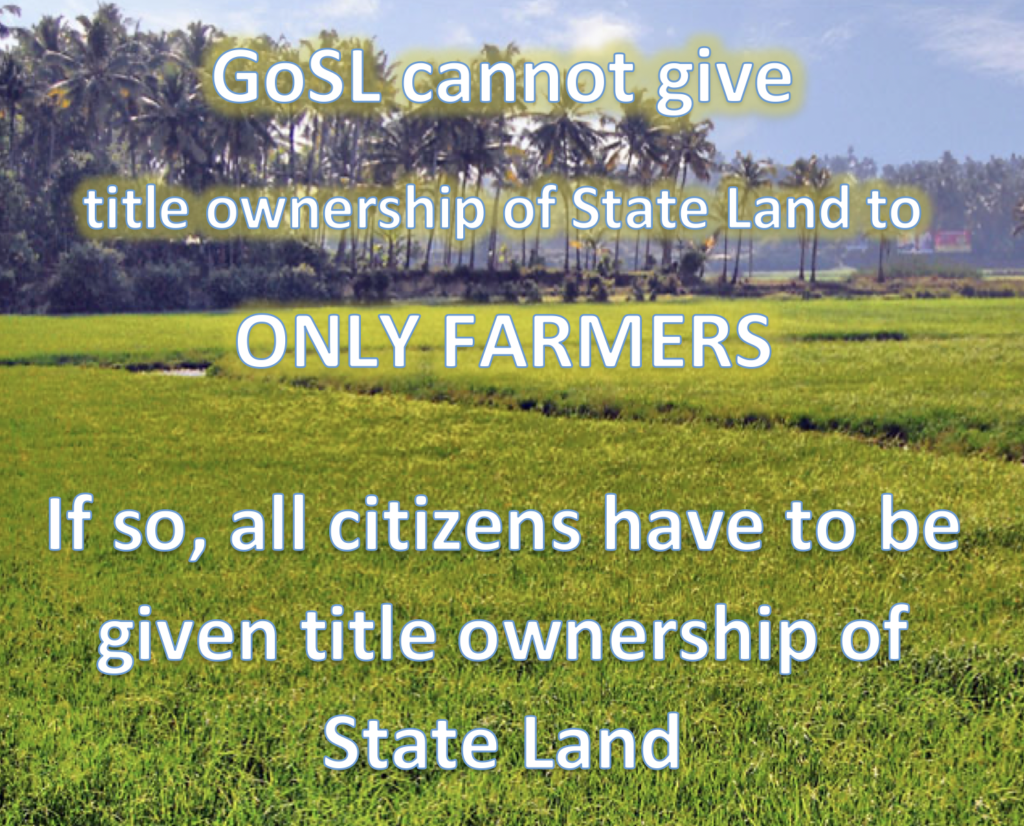
A Govt is only voted for a term of office & thus has no moral right to cut tracts of State land & sell or to give title ownership especially to only one segment of people (farmers)
State land & its resources belong not only to this generation but future generations as well.
The unwritten rule is that what we enjoy has to be left for future generations to enjoy just as we are enjoying what was left for us.
GoSL is committing a fundamental rights violation giving only farmers title ownership to state land ignoring all other citizens. That a Govt cannot give all citizens State land title ownership is the reason why a Govt is allowed to only lease State land not sell state land or give title ownership to State land which can be sold.
What if a govt sells or gives title ownership to the 84% State land?
If a govt decides to give title ownership of the 84% State land then State land no longer becomes under the State.
Giving title ownership of state land to a citizen or foreigner means land belonging to the State falls into private ownership. Once it falls into private ownership, the private owner can do as he/she likes with the land. The state has no legal right over the land.
This is why the statutes related to land clearly declare that State land can only be leased.
Successive governments for political & corrupt purposes have attempted to deviate from this principle & created emotive campaigns to justify giving away state land.
Campaign: to give farmers ownership of state land
The issue of state land has emerged following repeated attempts to give title ownership of large tracts of leased land to farmers as title ownership. That this effort failed previously shows that people realize the dangers of this initiative.
This campaign is cunningly using propaganda that farmers cannot take loans, farmers deserve their own piece of land etc. This is to arouse emotions of farmers to negate any opposition by people who see the greater dangers & long term implications that will be felt by the farmers themselves.
What those who wish to give title ownership to state land hides, is that foreign investors have been demanding large tracts of farmland under their control and Governments have tried various googlys to cater to this demand. The Millennium Challenge Corporation (MCC) is also eyeing these lands and explains why the sudden rush to give farmers state land ownership. This highlights how governments are not only endangering our sovereignty, by land sovereignty, our food sovereignty & people’s livelihood sovereignty as well.
No government should be allowed to take such unilateral decisions most of which is done without consultation, without looking at the long term repercussions & in secret.
We expect the legal fraternity to not be part of this same insidious campaign as these are fundamental right violations of the People, as the constitution clearly advocates that sovereignty is inalienable & with the people and the State is the people.
What are the advantages of a farmer given title ownership of leased State land
He gets a piece of paper saying he owns the land
He can mortgage the land
He can even sell the land
Note: contrary to what is being told, farmers do take loans from banks & banks do offer facilities to farmers to take loans and banks gives loans without a deed ownership to the land. Therefore, the key excuse being used by the Prime Minister to give state land title ownership is incorrect.
What are the disadvantages of a farmer given title ownership of leased State land
Co-Ownership of land is not allowed – so farmer can only write land to one family member even if he has many children. This can cause family disputes & create animosities.
Farmer who mortgages the land to the bank may lose the land if he defaults payment
Bank will acquire the land & auction it (foreigners are given approval to buy land & this is exactly what is likely to happen)
Farmer & family will be asked to vacate land
Farmer cannot seek intervention of govt as he is a private land owner
Farmer & family are left on the road – no home, no land, no livelihood – not even the piece of paper giving title ownership of a land he and his family had been living in for generations.
Imagine 50,000 farmers given title ownership of state land
50,000 farmers presume have an immediate family of 5.
He can only pass deed ownership of land to one member of family. What if this member asks others to vacate land. So many social disputes will emerge.
50,000 x 5 member families – all on the road with no home, no land, no livelihood – who is going to look into their welfare or future? No one, as the Govt is now helpless, as govt has forsaken control of state land & no longer has state land to resettle these farmers.
Imagine 84% state land falling into private ownership?
Govt will not have ability to tax
When a govt doesn’t have ability to tax – it has no revenue
A govt is virtually not required if the entire island is in private hands (owned by either locals or foreigners)
These seventy plus politicians will soon depart but not before leaving a legacy of problems to the country unless legal channels prevent them from doing so.
The legal fraternity in particular the judiciary must uphold the principle of Public Trust Doctrine and safeguard the land – for without land, there is no sovereignty of any kind for anyone.
High Commissioner of Sri Lanka to India Milinda Moragoda met with the Minister of Petroleum & Natural Gas and Housing and Urban Affairs of India Shri Hardeep Singh Puri, today (27) to discuss urgent matters pertaining to bilateral energy cooperation. The meeting was held at the Ministry of Housing & Urban Affairs in New Delhi.
At the outset, High Commissioner Moragoda briefed Minister Puri on the acute challenges that Sri Lanka is currently facing with regard to the supply and distribution of petroleum products and the severe hardships that the people are undergoing.
While thanking India for the assistance that was extended in the form of lines of credit to import fuel, the High Commissioner of Sri Lanka discussed with Minister Puri the possibility of securing petrol and diesel supplies that are required by Sri Lanka at present on an urgent basis. Minister Puri responded positively in this regard and assured the High Commissioner of all possible support to Sri Lanka at this critical juncture. The High Commissioner and the Minister also discussed modalities through which India and Sri Lanka could further expand cooperation in the petroleum sector to help overcome the immediate crisis and to ensure the energy security in Sri Lanka. In this context, High Commissioner Moragoda and Minister Puri discussed ways and means through which Sri Lanka could establish long-term ties in the petroleum, oil, gas and related logistics sectors
Colombo, June 27 (newsin.asia): A high-level US diplomatic delegation, which is currently in Sri Lanka met President Gotabaya Rajapaksa on Monday. The delegation stated that the US Government will continue to strengthen the relationship with the International Monetary Fund (IMF) at all levels. The delegations comprises officials belonging to the US State Department and the US Treasury.
President Gotabaya commended the delegation for their visit and briefed them on the current economic and social crisis in the country. The President also briefed them on the progress of the ongoing discussions with the International Monetary Fund.
Kelly Keiderling, Deputy Assistant Secretary of State for South and Central Asia, U.S. Department State and Robert Kaproth, Deputy Assistant Secretary of Treasury for Asia, U.S. Department of Treasury stated that US President Joe Biden is very interested in the future of Sri Lanka.
ADVERTISEMENT
The US President has instructed that Sri Lanka should be supported in this difficult period and all possible assistance to the country should be extended.
The delegation expressed confidence that with the implementation of the program with the International Monetary Fund, relief to the vulnerable families and will continue to have a positive impact on the future.
They said that they were pleased with the similarities between the President’s understanding and their understanding of the economic reform process taking place in the country.
The delegation commended the President on the free space given to anyone to express their opinions without any hindrance to the right to freedom of expression.
The US government has provided US $ 100 million as medium-term assistance to Commercial Bank to promote and uplift small scale businesses and also US$ 5.75 million and another US$ 6 million for humanitarian assistance to Sri Lanka.
Fuel volumes will be dispensed only to vehicles attached to essential services with effect from midnight today (June 27) until the 10th of July, Minister Bandula Gunawardena says.
He revealed this addressing a special media briefing held today to announce the decisions taken at the meeting of the Cabinet of Ministers.
Accordingly, the Ceylon Petroleum Corporation (CPC) will supply diesel and petrol only to essential services such as ports, health sector, distribution of essential food items, and transportation of agricultural products hereafter, the cabinet spokesperson noted.
The Cabinet of Ministers decided to continue essential services and suspend other operations until the 10th of July, the minister said further.
He went on to assure that a mechanism to provide a continuous supply of LP gas and fuel would be in place after the 10th of July.
Inter-provincial transport services will be temporarily halted due to the availability of limited stocks of fuel, Minister Gunawardena added.
Meanwhile, school principals and provincial education authorities are given permission to decide on how lessons are delivered to the students amidst this crisis situation.
The Cabinet of Ministers have approved the proposal to gazette the 22nd Amendment to the Constitution and to present it to the Parliament, Justice Minister Wijeyadasa Rajapakshe said.
The amendment, which had been referred to as the 21st Amendment so far, will in fact be the 22nd Amendment, as another draft 21st Amendment has already been gazetted.
Last week, the draft constitutional amendment was tabled and passed during the Cabinet meeting following extensive discussions.
The 22nd Amendment was initially tabled in the Cabinet on June 06 by Minister Wijeyadasa Rajapakshe and the discussion on it had been adjourned on multiple occasions due to failure to reach a consensus.
The Constitutional Amendment is expected to empower Parliament over the executive president and annul the 20A to the Constitution, which had given unfetted unfettered powers to President after abolishing the 19th Amendment.
Under the 22A, the President, the Cabinet of Ministers and the National Council will be held accountable to the Parliament. Fifteen Committees and Oversight Committees are also accountable to Parliament.
The final draft of the amendment has yet to be publicized.
Sri Lanka’s exports recorded the USD 5 billion mark in the first five months of this year, according to the Export Development Board (EDB).
Earnings from the merchandise exports increased by 9.9 % y-o-y to US$ 980.2 million in May 2022 as per the data released by the Sri Lanka Customs.
This was mainly due to the increase in earnings from export of Apparel & Textiles, Coconut based products and Electrical & Electronic Components.
Major product sectors except Spices & Concentrates, Tea and Rubber-based products; Apparel & Textiles, Coconut based products, Electrical & Electronic components and Food & Beverages, Seafood and Ornamental fish, recorded increased exports in May 2022.
Exports of Apparel & Textiles increased by 30.1% y-o-y to US$ 482.7 million in May 2022. The increase was driven by both Apparel and Textiles.
For the first five months of 2022, merchandise exports increased by 9.7% to US$ 2,400.6 Million compared to the corresponding period of 2021.
Major product sectors except Tea, Rubber-based products and Spices & Concentrates; Apparel & Textiles, Coconut based products, Electronics & Electronic Components, Food & Beverages, Seafood and Ornamental fish, recorded increased exports.
Apparel & Textile exports increased by 16.3% to US$ 2,400.6 Mn during the period of January to May 2022 compared to the same period of 2021.
Except Gloves, Mitts & Mittens of Textile (-2.61%) and Made-up Clothing Accessories (-9.99%), Yarn (-32.7%) and Made-up Textile Articles (-3.04%), exports of other sub categories of Apparel & Textiles sector increased.
Strong Export Growth recorded for top 5 export markets in the month of May 2022 and the period of January to May 2022.
During the month of May 2022, exports to United States, Sri Lanka’s single largest export destination, increased by 25.02% to US$ 266.42 Mn compared to the month of May 2021. The better performance led by increase in exports of Apparel & Textile (40.83%) and Coconut based products (29.69%).
The single largest export destination of United States of America recorded US$ 1,364.08 Mn worth of exports in the period of January to May 2022 – a significant year on year increase of 20.32 % in comparison to US$ 1,133.71 Mn recorded in 2021.
The Coalition for Economic Democracy in Sri Lanka (CEDSL) is a group of concerned academics, activists, agricultural, fisheries and industrial workers, students, business persons, trade unionists, and professionals based ‘in country’ and overseas, including the diaspora, who uphold the values of economic rights and justice in public policy making.
In the wake of two years of economically-devastating Covid-19 lockdowns, quantitative easing, and money printing globally, we call on international actors to heed the people’s demands for a DEBT JUBILEE and CANCELLATION as a priority.
We wish to draw your attention to key issues regarding the current debt crisis and its social, political and economic impacts which are not adequately represented in public discussion, yet crucial to the well-being and security of Sri Lanka’s citizenry.
A CALL FOR DEBT JUSTICE
International support is welcome to ease the economic burden on the people of Sri Lanka which includes shortages of fuel, food and medicines that impact livelihoods and health, increasing poverty and inequality. However, due to an International Sovereign Bond (ISB), debt trap and depreciation of the Sri Lankan rupee against the US dollar, sustainable solutions are needed rather than the short term sale of strategic assets that benefits ISB holders and hedge funds that sustain dependent development.
In May/June 2022 Sri Lanka’s debt was estimated to be US$51 billion with current debts of US$5 billion to be paid to ISB holders and hedge funds like BlackRock. They secured huge United States (US) government ‘Covid-19 bailout’ funds to asset-strip and impoverish countries around the world during the economically-devastating Covid-19 lockdowns.
Contrary to widespread media disinformation about the sources of debt and the causes of default, this is the first time that Sri Lanka, in April of this year, defaulted as an independent state. It is the debt owed to ISBs that amounts to almost 50% that has caused the default at this time.
The Asian Development Bank and World Bank have indicated willingness to roll over its multilateral debt, so too the bi-lateral debt holding Asian countries including Japan, China and India. Along with debt cancellation there is need for de-dollarization and trading in a basket of currencies. The loss of such autonomy and sovereignty due to the ISB debt tap and the International Monetary Fund (IMF) stepping in to devalue the currency is at the root of the current shortage of food, fuel, meds, fertilizer, gas, etc. The purported shortage of ‘exorbitantly privileged’ dollars is the most devastating impact of the entire staged” default.
While the return of stolen assets by the Rajapaksa family, some who are US citizens, is vital, we believe that there is an even greater need for DEBT JUSTICE, a DEBT JUBILEE, and DEBT CANCELLATION as the current international financial architecture is not fit for purpose, particularly, the IMF which works for the global 1 percent and imposes austerity on the rest.
SRI LANKA-IMF NEGOTIATIONS INHERENTLY UNEQUAL
The gross lack of transparency in on-going negotiations between the IMF and a government that lacks legitimacy but purports to represent the citizens, is a consequence of an inherently unequal relationship between Sri Lanka and the IMF, where the US and former European colonial powers have overwhelming decision-making power. While the IMF demands ‘transparency’ and that all creditors be treated ‘equally’, the names of the ISB holders behind Sri Lanka’s default are a closely guarded secret!
In 2019, Sri Lanka was classified by the World Bank as an Upper Middle Income Country (MIC), making it ineligible for concessionary development loans, and forcing it to borrow from private capital markets at high interest rates. The new government that came to power cut taxes causing a significant loss of government revenue. The 2019 Easter bombings and policies undertaken during two years of militarized Covid-19 lockdowns and mass injections have triggered the current debt crisis leading to the staged default.
In 2019, Sri Lanka was classified by the World Bank as an Upper Middle Income Country (MIC), but just three year later in 2022 certain international actors want Sri Lanka to be re-classified a ‘Least Developed Country’ (LDC), and the island to join the world’s poorest of the poor[1] – in Washington Consensus parlance, a “Highly Indebted Poor Country” (HIPC).
LDC status will mean a significant loss of economic and foreign policy autonomy and sovereignty at a time when it is vital that Sri Lanka and other developing countries act in their own self-interest rather than be forced to join geostrategic blocs that are being formed in the Indian Ocean region such as the QUAD at this time of Cold War 2.0.
We consider that the people’s sovereignty and national policy autonomy is being undermined through non-transparent deals with politicians who are not democratically elected and have a history of amassing ‘odious debt’, the burden of which citizens are being forced to bear. Particularly notable on the accumulation of odious debt are the current odious, newly appointed Prime Minister, implicated in the country’s biggest financial fraud over the Central Bank bond scam, and the President, a US citizen until 2019, whose family wallows in nepotism. They are now negotiating with the IMF to sell national assets?!
There is a clear pattern of disinformation, exaggeration and fear-generation regarding Sri Lanka’s debt in local and global media messaging. This understates the intrinsic Wealth of the Nation, its strategic assets, and the strengths of this country given the failure to differentiate between illiquidity and insolvency in the context of a proposed IMF fire sale of assets and State Owned Enterprises (SOEs).
The IMF’s traditional approach to debt restructuring though privatization of SOEs, austerity measures, and fire sale of assets of countries merely causes more problems and places the burden on the poor as is evident from Argentina, to Greece and Lebanon. However, odious debt is an outcome of speculative and reckless ISB lending sans due diligence to governments that lack legitimacy and are known to be corrupt. In fact, the IMF which works for the Global 1 percent is a part of the problem and not the solution. So too are processes of datafication, manipulation of matrices, indices and algorithms to ensure ‘pumping and dumping’ of countries into the MIC debt trap, LDC or HIPC status and Paris Club ‘solutions’ of asset stripping of countries.
SOUTHERN PEOPLE’S VOICES TO BE HEEDED
The bail out of the country should not lead to bailing out of the corrupt political and bureaucratic elites and related oligarchs whose policies, corrupt governance and deals have caused the present crisis of unprecedented scale in our country. The international institutions and people in Sri Lanka should work together to ensure that these elites are held accountable and appropriately dealt with.
There is an urgent need for Southern voices and perspectives in development, debt cancellation and debt justice in the International Aid Architecture as many countries in the Global South face a similar situation of odious debt as an outcome of speculative and reckless lending by ISB traders who must be also held accountable.[i][2]
The demand of many Sri Lankans is for debt cancellation and de-dollarization and trading in a basket of currencies, not IMF re-structuring; for example, to enable the purchase of discounted oil and gas from sanction-hit Russia perhaps in exchange for tea. Sri Lanka should have the economic and foreign policy sovereignty to source its needs from any country that offers good value for money.
A firm No” to a IMF fire sale of strategic assets and asset stripping: A list has already been prepared of strategic lands, airports, ports, transport, telecom frequencies and energy infrastructure to be privatized. The dastardly sale of the Yugadhanavi power plant to US-based New Fortress has already further compromised national energy security and policy sovereignty and autonomy.
Today the interests of Sri Lanka are being represented by foreign law firms, Lazard and Clifford Chance in so-called IMF negotiations with ISB traders. On numerous occasions, Lazard, which has been involved in both advising on privatisation and then profiting from its advice, has undervalued the price of state companies, enabling its asset management branch to purchase the stock at low prices and re-sell it for considerable profit.[3]
If the debt negotiations are so complex that Sri Lankan law firms and accountants cannot represent the interests of the citizens of the country, and the debt data is itself contested, the debt is odious, its holders unknown, and the negotiations none-transparent. Then fundamental question arise regarding legitimacy, transparency and accountability of the very process of so-called IMF negotiations. Such concerns were also raised in IMF negotiations in Greece, Lebanon, Argentina and other countries.
The United Nations Charter and international law affirm the Right of Peoples to Self-Determination and permanent sovereignty over their wealth, resources and economic activity as a precondition for the realisation of all human rights. So too, principles of sovereignty and independence of states, equality in relations with other states, and national policy-making autonomy cannot be eroded by global Covid-19 and other ‘pandemic’ and climate catastrophe narratives.
SUSTAINABLE SOLUTIONS: long-term, medium term, short term
We seek much more than debt relief, and demand DEBT JUSTICE. While the crisis in Sri Lanka is being framed as a humanitarian disaster” it is quite clear that it is more complex with economic, political, social and geopolitical dimensions and dynamics.[4] Solutions must hence be duly designed, tailored and targeted to improve the lives of the most vulnerable, and to restore sovereignty to the people of Sri Lanka and their State.
We demand a DEBT JUBILEE and to write off the odious debts held by ISB debt holders like BlackRock (that also holds Adani stock), that engage in reckless lending that has debt trapped several countries including Sri Lanka. Covid-19 saw the greatest transfer of wealth in human history from the bottom of the economic ladder to the top.
We call on the Government to urgently begin a process of de-dollarization and trade in a basket of currencies in order to restore Sri Lanka’s monetary sovereignty and pursue a course of development that promotes South-South cooperation and responds to the needs and aspirations of the Sri Lankan citizenry. The relevance of the current International Development Architecture for Sri Lanka and other debt trapped countries in the Global South must be questioned. Sri Lanka needs to reconsider its relations with institutions like the IMF, WB, OECD, and Paris Club of Donors in a manner that affirms, not dismantles, its sovereignty and policy autonomy, both exercising the ability to negotiate as an independent country free of IMF conditionality and US sanctions, and working in the interests of its citizens.
We call on the Government to immediately stop all initiatives and actions underway for the privatisation of strategic assets, including lands, airports, ports, telecom frequencies, transport and energy infrastructure, and reverse all actions already commenced or implemented as valuations did not consider the island’s geostrategic value and security concerns.
We call on the Government to develop aNational Energy & Food Security Policy taking full cognisance of the current global energy wars, geopolitics and ‘climate catastrophe’ discourses that force small states to bear the carbon costs of the Global Military Business Industrial Complex. Of utmost importance in ensuring food security is the maintenance of food supply chains, and prioritization of fuel for the Fisheries and Agriculture sectors in the context of fuel rationing; rationalization of taxation, and targeting the wealthy – to enable the most vulnerable groups such as farmers, fishers precarious workers in the informal sector, and small and medium term enterprises to regain their livelihoods. In the absence of such a policy, climate narratives like the rush to green energy” and organic fertilizer without an adequate transition plan and transfer of technology given the island’s tiny carbon footprint has contributed significantly to the current fuel, food and economic crisis in Sri Lanka and in other parts of the Global South.
The strengthening of governance and government institutions is paramount to address the effects of Covid-19 lockdowns which gave rise to a pandemic of corruption and a lack of accountability due to national institutions and oversight agencies being debilitated under the guise of lockdowns, holidays due to staged fuel shortages, de-centralization and inept digitalization. Services like public transport can be improved through more energy efficient and environment friendly measures, including the abolishing of duty free car permits for politicians and the privileged ‘professional’ class. Finally, there is an urgent need for a Buy local” State-led consumer education program so that citizens support local industry and manufacturers.
SIGNATORIES
Dr. Dharshana Kastiriaratne, Assistant Professor, Faculty of Computing, Computer Science & Software Engineering, Sri Lanka Institute of Information Technology (SLIIT)
Mr. Jeremy Liyanage was a teacher of the Social Science, lecturer in Community Development and held positions in the church, community and government sectors. Before founding the charity, Bridging Lanka, he worked in senior policy positions in local government in Australia
Dr. Michael Roberts – former Professor, Department of Anthropology, Adelaide University; Rhodes Scholar for Ceylon, and a historian and lecturer at the Dept of History at Peradeniya University. His major works are in agrarian history, social mobility, nationalism and ethnic conflict
Dr. Darini Rajasingham-Senanayake is a social and medical anthropologist with research expertise in international development and political economic analysis. She was a member of the International Steering Group on Southern Perspectives on Reform of the International Development Architecture”
Professor R. Cheran – Department of Sociology, Anthropology and Criminology, University of Windsor, Canada, and a prolific poet
Professor Jayadeva Uyangoda – Emeritus, Department of Political Science and Public Policy, University of Colombo, and constitutional expert in Sri Lanka
Professor Kristian Stokke – Department of Sociology and Human Geography
University of Oslo, specialising in political geography with focus on democratization and citizenship conflicts in Southeast Asia
Dr. Rohini Hensman is a writer, independent scholar and activist working on workers’ rights, feminism, minority rights and globalization
Mr. Herman Kumara – National Convener, National Fisheries Solidarity Movement, Chairperson, Praja Abilasha Land Rights Network and Board Member, Right to Life Human Rights Organization
Mr. P.C Nathan – Deputy Secretary General of Ceylon Mercantile and General Workers Union (CMU), one of the largest trade unions in the commercial sector in Sri Lanka
Mr. Lacille De Silva – former Director, Administration, and former Director, Legislative Services, Parliament of Sri Lanka
Mr. Ranjit Seneviratne – Marine Engineer and former official with the FAO in Rome who now champions non-chemical, biodiverse ‘forest garden’ methods of cultivation
Mr. Hiran Fernando – retired Chemical Engineer who worked at Unilever for more than 25 years and is now involved in civil service initiatives
Mr. Thiyagaraja Waradas – Senior Lecturer, Department of International Relations, University of Colombo, and Commonwealth Scholar, University of Bath
Dr. Asoka Bandarage – academic and distinguished (adjunct) professor at the California Institute of Integral Studies. She taught at Yale University, Brandeis University, Macalester College, Georgetown University, European Peace University and Mount Holyoke College, MA where she received tenure
Mr. Ananda Weerasekere – retired Human Resource Management Specialist and Social Activist
Mr. Gamini Lindagedara – Mechanical Engineer and Social Activist
Dr. Peter Rezel – Senior Consultant and Medical Doctor at Strategic Inspirations, and Director, Human Resources and Regional Internal Audit Audit – Asia with the International Union for Conservation of Nature
Mr. Asoka Siriwardena – former Lecturer in Political Science; international civil servant at the Commonwealth Telecom Organization London, and retired Deputy General Manager, Sri Lanka Telecom
Mr. Bernard Edirisinghe – Documentation Coordinator, Free Media Movements, former Programme Manager, South Asia Small Arms Network, and former Parliamentary Coordinator, Ministry of Power & Energy
[1] Should Sri Lanka join the ranks of the Poorest of the World’s Poor”?
News is just out that Sri lanka has been taken to the Courts in the USA by a bond holding company, Hamilton Reserve Bank Ltd, which owns $ 250 million of International Sovereign Bonds, requesting a Court Order for payment. This refers to a portion of the loan the payment of which Sri Lanka defaulted in April 2022.
This is an exact replica of what happened to Argentina. In my words, written in August 2014:
Argentina is in the dog’s house once again. This time it is hounded by the Vultures- the Hedge Funds who have obtained a ruling from the US Supreme Court that debts amounting to $ 1.5 billion on bonds has to be paid at full value immediately. This decision made the Argentinian Economic Minister remark that the Hedge Funds were Vultures as they refused to negotiate terms for payment and instead obtained a Court Order.”(From the IMF Sabotaged Third World Development, Godages: 2017).
Thus now Sri Lanka is being attacked by Vultures- because Sri lanka had to default on international sovereign bonds recently in April. I wonder how Sri Lanka can ever pay up a Court Order, because the sad situation today is that people are starving for the lack of food and medicines. I read a news item where patients in hospitals are groaning in pain due to the lack of medicines. People have been in queues for days to buy essential gas for cooking and fuel for automobilies and fifteen have died in queues. We live within powercuts as we have no dollars for coal and oil supplies. The Vultures will be on us, attacking us soon and I do not know how Sri Lanka can face it.
It is unfortunate that right now the country is ruled by a Prime Minister , Ranil Wickremasinghe who failed to enter parliament through the elections. The United National Party of which he was the leader was routed at the election and he crept into Parliament though the National List- in short he was not elected by the people.
Further it is quite evident now that Prime Minister Ranil Wickremasinghe is not trying to get the economy moving- by creating employment cum production programmes going. The people cannot afford to buy as they have lost their employment and it is up to any Government to come up with employment creation in such a manner that the people get involved in making what items they did import earlier. In 2020 I found Tomato sauce & Vinegar made in USA , fruit juice made in Australia , banana crisps made in Vietnam for sale and this is an endless list of small items that we can produce which we did import with borrowed dollars. The dollars have dried up and we can no longer import due to the lack of dollars. The immediate need is to get down to produce what we imported, which we are not doing. We do not need a single dollar to attend to this task. It is all an expense in Rupees in the manner we ran the country before 1977- then everything was done with Rupees and dollars were collected on a strict basis and used to import food and first and a small sum for a limited sum for essentials like fridges and cars. Not a single person is required as the public sector of 1.4 million is there.
But that is not how Prime Minister Ranill Wickremasinghe sees it. He talks big and states that Sri Lanka will face more severe hardships- perhaps starvation. Instead he has his own agenda- privatize loss making public ventures. Of course kick backs are associated with privatizations. We sell for a song and at the end the venture privatized does not belong to Sri lanka- a foreigner comes in and works it and takes away the profits- not in rupees but in dollars from our reserves. We do have a worthwhile public service that has been put into the barracks by the IMF in 1977 when the IMF decided that the public sector should not attend to any commercial activity and with that dictate the administrators who ran the powerlooms, the small industries, large industries, the sleuths that made Sri Lanka self sufficient in paddy- the staple crop in 1970- I happened to be one of them, were all made redundant- continued doing something, paying homage to petty politicians that were placed over them. This mass of administrators have to be called to work to direct programmes that will bring production and employment.
Instead of pursuing tasks aimed at alleviating the sufferings of the people, our Prime Minister’s latest task has been to grant deeds for crown lands, which he has done well, commencing last week- called a ‘Land For All’ Programme that has within a few days granted thousands of deeds to people who own crown land. It is all a piece of paper given with pomp and pagentry. These were crown lands alienated on a specific proviso that it has to remain with the peasantry and cannot end up with business magnates and multinationals. This was the dictate of our founder D.S.Senanayake. What is not said- hidden, is that this was a pre requisite for the MCC Grant of $480 million from the USA – the terms being to hand over a third of our country, a corridor from Colombo to Trincomalle including districts Kandy and Kurunegala to the USA for 200 years.
This was a prime concern in the 2019 Presidential Election where the then UNP under Ranil Wickremasinghe did commence giving deeds for crown land held by the peasantry which was stopped by public outcry, but Ranil Wickremasinghe said that he will sign the MCC Compact agreement the very next day if he won. President Gotabhaya declared that he would not sign such a give away of our sovereignty. Now as a Prime Minister instead of implementing production and employment programmes to bring incomes to the people and also produce what we imported he has commenced this granting land deeds. I will not be surprised to hear any one of these days that he has signed the MCC Compact Deal.
It is up to President Gotabhaya Rajapaksa and his Ministers to immediately look into this activity that may end in the sale of our sovereignty for 200 years to the USA. Mind you the British ruled Sri lanka for less than 150 years.
Garvin Karunaratne, former GA Matara, Ph.D. Michigan State University
Author of: Microenterprise Development… The Way Out of the IMF Stranglehold, Sarasavi, 1997
How the IMF Ruined Sri Lanka & Alternative Programmes of Success, Godages, 2006
How the IMF Sabotaged Third World Development, Godages, 2017
How the IMF’s Structural Adjustment Destroyed Sri lanka, Godages, 2022
Sri Lanka’s economic crisis in not unique. Other countries have been in it and some are currently in it too. Economics is all about trade-offs. One basic premise of economics is that resources are limited but needs and wants are unlimited. The way to succeed economically is to manage needs and wants (not resources) to achieve best economic outcomes. Having decided on what needs and wants are crucial (and what must be given up, sadly), then comes resources management.
A full-scale economic overhaul takes time. It is doubtful whether Sri Lanka can survive until then as a functioning society. Quick goals must be achieved first in order to keep the Sri Lankan society functioning so that bigger long-term goals can be achieved.
Foreign commercial loans (ISBs and SLDBs) cannot be repaid. This is a painful economic fact. They must be defaulted officially. No interest payments and no repayments. It will result in court cases and ultimately Sri Lanka will be declared officially bankrupt. This official declaration is only symbolic. In substance Sri Lanka is bankrupt for months. A bankrupt nation need not repay commercial loans. This alone can save Sri Lanka in the long run. Bilateral loans (loans from foreign countries) must be repaid. These are not a huge burden.
Despite the crisis, an enormous amount of foreign currency leaves Sri Lanka today. Gold is the most popular medium of taking value out of Sri Lanka. All ports and airports must be equipped to nab gold. Sri Lanka must ban the importation of gold too.
Dollars are hoarded by various individuals for profit. This is because banks do not give the best rate for foreign remittances. Banks must be instructed to pay a higher rate than the prevailing rate in the market. Banks must be compensated in rupees for the additional amount. This will attract a sufficient amount of forex into the banking system which can be used to purchase fuel, fertilizer and other necessities. The bad side is this will further drive up inflation which is already at 130%. However, it is an essential choice the government must make and suffer the cost. Once foreign reserves are built, inflation will ease. However, this painful initial step must be taken.
These three simple strategies can save Sri Lanka from total collapse. Once again, resources are limited. Painful choices must be made to manage limited resources. If scant resources are wasted on face-save measures, there won’t be enough resources to run the country.
Gotabaya Rajapaksa is the worst President we’ve had. He’s the worst leader, counting all presidents, prime ministers, ministers, chairpersons of local government authorities and maranaadhara samithi. He’s the worst Sri Lankan ever. Let’s assume.
Let’s assume that as the all-powerful Executive President, all ills are attributable to him. Let’s assume that although this implies that he can lay claim to all positives, he had nothing to do with effectively handling the Covid-19 situation, the vaccination drive and enforcement of safety protocols which (by the way) eventually enabled and empowered those who hate him the most (and whose hatred is rooted in political preferences and other things that predates the current economic crises) to rub shoulders with fellow political travelers in demonstrations, protest marches, arson, theft and thuggery. Let’s assume that he did nothing at all.
No, let’s go further. Let’s assume that Covid-19 was an insidious creation of Gotabaya Rajapaksa himself, a virus which he unleashed on the world with the express intent of wrecking the tourism sector, effecting a serious dent in remittances by expatriate workers, restricting movement etc., etc. Let’s assume that all this in aggregate made himself eminently eligible to the tag ‘party-pooper.’
Today, we are in the midst of an unprecedented economic crisis. Today, more than ever before, we have been forced to think about things like energy security, food security, food and nutritional sovereignty, the need for development banks and the folly of embracing uncritically and indeed nurturing to near perfection an import mafia. Let’s assume, though, that Gotabaya Rajapaksa’s rhetoric and action with regard to at least two of the above, namely renewable energy and environment-friendly agriculture, had nothing to do with such ‘needs.’
Let us not assume but acknowledge that regardless of intent, overall understanding and objectives pertaining to sovereignty that Gotabaya Rajapaksa was largely unsuccessful. Let’s assume that this had nothing to do with the resilience of entrenched interests of corporate thugs and public racketeers, but let’s not assume but rather acknowledge that party and family played a massive role in scuttling good intention, not just about energy and agriculture but basic management of the economy, upholding procedures established to ensure fiscal discipline, robust and meaningful tax regimes etc. Let’s not assume but acknowledge that Gotabaya Rajapaksa’s greatest failure was that he could not (or would not) unfetter himself from party and family.
Forget all that. Let’s return to the first assumption. Let us repeat. Gotabaya Rajapaksa is the worst President we’ve had. He’s the worst leader, counting all presidents, prime ministers, ministers, chairpersons of local government authorities and maranaadhara samithi. He’s the worst Sri Lankan ever. Let’s assume.
We should mention, at least parenthetically, that he is but (and at worst) a symptom of systemic flaw. At least that’s what those who can see beyond personality and party could (but probably for reasons of political convenience do not) conclude. Never mind. Let’s assume ‘Gota is the System’ and kid ourselves that getting rid of him gives us system-change. Well, let’s say it paves the way for system-change. Yes, let’s not talk about utter naïveté in these matters. Let’s assume. Let’s conclude.
Now, treating all assumptions as established fact, let us wave the flag of the logical response: ‘Gota should go!’ How do we move from there, i.e. beyond a slogan whose utterers aren’t political innocents and among whom are those who have benefited for decades (as a class and as individuals) or else are ill-educated about constitutions, constitutional reform and the whole brouhaha over amendments (the draft 21st was shot down by the Supreme Court, whose observations amount to law-makers being given a resounding F on the subject of ‘Constitutionality’)?
Of course Gotabaya Rajapaksa can resign. Can happen, but hasn’t. He can be removed, constitutionally. Can happen, but hasn’t. And so we have pundits saying ‘the people, the international community and the Opposition’ have to come together to remove him. In essence, to secure the numbers necessary to remove him constitutionally. He can be ousted in other ways, but no one is seriously talking about ‘revolution’ here. Revolution would include system-change and ‘system’ would include the economic theories (sic) that went a long way to bring us to where we are, dealings with the IMF and other Bretton Woods Institutions etc., but no one is seriously considering such options right now. It’s just ‘Gota must go,’ or ‘The international community, the Opposition and the people must get together and send Gota away.’ Thereafter, parliament (or rather ‘The Opposition’) can figure out who should be the next president. Lovely.
Let’s get back to the movers and shakers. The international Community, one. Yeah right! Do they mean, the US, UK, EU and other members of The Quad? Now if those are the addresses to which grievance are addressed and succour sought, good luck!
The Opposition, two. Yeah right! And yeah, those who want Gota sent away utter not a word about capabilities of the current Opposition (never mind legitimacy which is ultimately measurable only through the ballot). The Opposition, if we just take the SJB and the JVP, essentially back-stabbed the ‘Aragalaya’ and ‘Aragalists,’ not to mention the fact that they deliberately planned to pursue their party interests by preying on general anxiety, fear and anger. Sajith Premadasa and Anura Kumara Dissanayake hilariously claimed that they would take up the prime minister’s post if Gotabaya Rajapaksa resigned. Each ought to have been more honest and said ‘I become PM if Gota resigns, and then I have the inside track to the Presidency.’ Anyone who places bets on such dishonest people and parties (whose track records are as bad or worse than those of the SLPP) are ridiculously naive or at least politically suspect. The SLFP, then? Really?
‘The people,’ three. Now that’s a different category altogether. We cannot and should not say ‘yeah, right!’ or be dismissive in some other way. Democracy is about the people. How do we measure the weight of the people factor, though? The numbers at protests, the decibel levels of the rhetoric? Yes, in a way, never mind that among these ‘people’ are agents provocateurs and others whose political history doesn’t make one really cheer, especially given long and profound silence about what ‘the system’ has done and to whom for decades.
In a way, yes, ‘The people’ count. They need to be counted. Literally. My friend Sugath Kulatunga, commenting on dubious individuals including ‘intellectuals,’ professionals, the clergy and artists marking ‘presence’ at Galle Face, made a pertinent observation.
‘I believe [they] have had no lessons in Civics at school and are not aware that Sri Lanka is a democracy with a written constitution where tenets of majority rule and rule of law are enshrined.’
If you want to step out of all that, by all means. Just don’t dabble in constitutions and parliamentary affairs. A precedent set where a bunch of people even with legitimate reasons to protest (and the legitimacy of the protests are indisputable, let us not forget) browbeat the elected and obtain eviction without measuring the true nature of a) popular discontent, and b) agreement about the would-be successor’s ability to turn things around does not bode well for participatory democracy.
The silliness of all this talk about the Gota-Ranil combine being a failure is easily measured by a simple question: name another combine that can deliver. The truth is, politicians and parties as they stand today, given histories and fixations about economics, cannot deliver us from the evils they’ve showered us with. We might have to look elsewhere, but certainly not at the international community, the Opposition or ‘people’ who are deliberately left undefined.
Anarchy, then, by all means, but then call it that. Just don’t sugar-coat it with democracy-speak.
The most popular desire everywhere all around the world is of serving one’s own country. People feel honored when their sons sacrifice their lives for the esteemed and prestige of their homeland and it is really a hard luck for the whole youth of a nation if illogical restraints are hurdled into the way to completion of this sacred desire. Today the whole of the Indian nation is raising its protesting voice against BJP government’s decision of changing the procedure of induction into the Indian army. Now onwards, there won’t be the permanent soldiers but the temporary Agniveers defending the country. The status of the Agniveers would be like those of the daily-wagers and for a very short period of four years. For many of my esteemed readers the term Agniveer would be strange and new but today in India this term is very much popular and root cause of the rapidly disturbing law and order situation as well.
The Union Cabinet, according to media reports, has recently introduced the Agnipath scheme for the recruitment of soldiers in all three branches of the Indian Army including the Navy and the Air Force. This recruitment would be largely on a four-year short-term contractual basis. Just after a short period of four years the streets of India would be thronging with the innocent ‘Agniveers’ and there would be hundreds groups of extremists and terrorists alluring those Agniveers to join them. According to the details provided to the media the youngsters ranging from the age of 17 and a half to 21 years will be inducted into the three services of the Indian Army. After completion of the four-year tenure, 25% of the recruits will be retained for regular service and the remaining 75% would be said good-bye forever. It is yet not clear what those 75% would be doing after being kicked out of the army with no permanent benefits.
After getting a training of four years, experts apprehend, these Agniveers would be a hot-cake for those who are interested in establishing their personal armies and even for the groups involved in different terrorist activities. Moreover this new scheme of induction of personnel below officer rank would shatter the decades-old selection process which was however based on merit and there was a future surety to the employed ones. Now this tenure-track type of system of induction would give birth to depression and disappointment among the so called Agniveers. Reports say that every year around 45,000 to 50,000 soldiers will be recruited under this scheme and recruitment will be done twice a year.
Countless young men, who had been dreaming of becoming a part of the military forces, are protesting against the Agnipath scheme as they are unhappy over the changes in selection system. They say that after serving for four years in the army and after ending up with no pension and no monetary benefits, they would be standing nowhere. A number of experts on military affairs and opposition leaders belonging to different Indian political parties are of the opinion that this scheme would adversely impact the functioning of the armed forces. They are demanding the time-tested recruitment system which had been opted for decades.
More interesting is the fact that no specific criterion has yet been described for the selection of Agniveers. It seems that the selection procedure would be completed at local level and the local unit commanders would be all in all in making decisions. The only restriction is that of the age bracket. Keeping in view, India’s present ‘secular’ scenario, it is very much sure that in the suggested force there would be no place for the Muslim and the Sikh youth; only the Hindu young-men would be entertained. Since there would be only Hindu soldiers in this newly formulated force, it is quite sure that during their training, more poison would be injected in the veins of the Agniveers against the Muslims and other minorities and influenced by that venomous ‘preaching’, the Agniveers would target the Indian religious minorities like guided-missiles. After completion of the four year tenure, each of the Agniveers would be like a blazing suicide-bomber ready to explode on the minorities particularly on the Muslims and the Sikhs.
Mr. Modi’s desire of making India a Hindu country is not hidden from anyone; the present Agnipath induction scheme also reflects his desire. It seems that Mr. Modi has designed this scheme just to produce another RSS type of force which would be more skillful, more trained and more poisonous than the RSS. One finds a lot of resemblance between the RSS and the Agnipath force. An introduction leaflet about the RSS says, The initial motive behind formation of RSS was to provide character training through Hindu discipline and to unite the Hindu community to form a Hindu nation. The organization promotes the ideals of upholding Indian culture and the values of a civil society and spreads the ideology of Hindutva to strengthen the Hindu community.” In that entire introduction, there is no reference to the Indian nation; it is all about the Hindu nation. Various historians are of the opinion that the RSS drew its initial inspiration from the Italian Fascist Party which was very much vibrant during the World War 11. The RSS also started working on the same lines mapped out by the Italian Fascist Party and with the passage of time grew into a prominent Hindu nationalist umbrella organization sheltering rather feeding several affiliated organizations. These organizations patronize different educational institutions and think-tanks to spread Hindutva ideology. Now the Agnipath Force would provide another strong support to the RSS philosophy with the help of young Agniveers.
Mr. Modi is doing nothing unexpected by introducing Agnipath like schemes as ‘kill the minorities’ has ever been the salient feature of his character. His political party had been warning the Muslim and the Sikh community to get out of India. And above all the horrible pictures of burning houses and blood-dripping human bodies in Gujrat massacre 2002 are still there to describe Modi’s temperament but the problem is that in spite of all these facts and figures, Mr. Modi and his followers try to introduce themselves as the great ‘seculars’ and on the basis of that claim of secularism, they try to win sympathies and favors of the world. This ridiculous contradiction certainly needs world’s attention. No religion, either it is Hinduism or Sikhism, Buddhism or Islam advocates hatred; if someone tries to disfigure the philosophy of a religion in the name of love for that religion, he must be taken to task rather dealt with iron hands. Without doing so, an extremism-free world could never be dreamed of. Extremism is no doubt the first step to terrorism leading to a large scale endless destruction.
Mr. Ajith Nivard Cabraal, twice Central Bank Governor and former State Minister for Finance, issued the following media statement last week on exchange rate flexibility.
The decision to allow the Sri Lankan Rupee (LKR) to be flexible” from March 7, 2022 onwards is sometimes described by certain persons as being a unilateral” decision of then Governor Ajith Nivard Cabraal. Therefore, this statement is to provide the factual position so as to set the record straight.”The decision to allow flexibility in the exchange rate was taken by the Monetary Board of the Central Bank of Sri Lanka based on a Monetary Board Paper dated March 7, 2022 submitted by all three Deputy Governors (Mr Mahinda Siriwardene, Mr Dammika Nanayakkara & Mrs Yvette Fernando), Director – Economic Research Department and Director – International Operations Department.
The Board Paper stressed the need for changing the exchange rate policy immediately in order that the exchange rate acts as a shock absorber” in the face of adverse developments in the global front on Sri Lanka’s already fragile Balance of Payments, including the increase of the crude oil price to nearly USD 140 per barrel and the worsening Russia-Ukraine war.
Based on that Board Paper and the discussion at the meeting, the Monetary Board decided to ‘allow the market to have a greater flexibility in the exchange rate with immediate effect and communicate that the Central Bank is of the view that forex transactions would take place at levels which are not more than Rs. 230 per US dollar.’
From the above it will be clear that, while the Monetary Board had expressed its ‘view’ as to the level at which forex transactions would take place as a market guidance, a clear decision had been taken to allow for the flexibility of the LKR in the forex market. On the same day, a statement was issued to the media in line with the above decision.
Further, within about a week of floating the LKR, the President made a formal announcement that the government had initiated discussions with the International Monetary Fund (IMF) for a programme.
Subsequently, Governor Cabraal resigned on April 4, 2022, on which day, the LKR was trading at Rs. 289.73/299.99 per USD in accordance with the new ‘flexible’ exchange rate policy as announced by the Monetary Board. After Governor Cabraal’s exit, the Monetary Board chaired by the new Governor Dr. Weerasinghe continued with the ‘flexible’ exchange rate policy, whist the Government and CBSL also took a series of far reaching decisions which included the decisions to: sharply increase policy interest rates by 700 bps from April 8, 2022 onwards, and to discontinue repayments of forex loans and interest from April 12, 2022 onwards.
In the meantime, the LKR continued to depreciate to a range of Rs. 364.23/377.50 against the USD by May 12, 2022, at which point, the Monetary Board had apparently once again decided to ‘fix’ the exchange rate at a new range between Rs.355.00/Rs.365.00 per USD. Such move to ‘fix’ the exchange rate seems quite similar to the policy adopted by the Monetary Board chaired by Governor Professor W D Lakshman which ‘fixed’ the LKR exchange rate at a range of Rs.199.00/203.00 per USD from September 6, 2021 onwards.
It must of course be understood that there will always be conflicting opinions among stakeholders as to the value, timing and methodology to be followed in ‘fixing’, or ‘floating’ or ‘pegging’ a country’s currency. It is also quite possible that after decisions are taken to ‘float,’ ‘fix’ or ‘peg’ the currency, others could, claim that the decision was right or wrong or implemented differently.
However, it must be appreciated that the decision-making authority has to take its decision based on the prevailing circumstances, expert advice, practical ground conditions, judgment of future expectations and outcomes, etc. when viewed holistically. That is obviously why the Monetary Law Act provides the authority to the Monetary Board to change financial and monetary sector policies (including the exchange rate policy, interest rates, statutory reserve ratios, etc) when it deems appropriate to do so, from time to time.
It must also be appreciated that the implementation of policy measures is carried out by the professional and technical staff, of the Central Bank and they would naturally ensure that the policy measures being implemented are based on legal and binding decisions of the Monetary Board, which is the decision making authority, and not based on ‘unilateral’ decisions of a single person.”
Minister of Power and Energy Kanchana Wijesekera says that a token system to distribute fuel is to be introduced from tomorrow (June 27).
Speaking during a press briefing in Colombo today, he said the decision was taken at a meeting of the Security Council chaired by the President and the Prime Minister yesterday (25).
However, the Minister requested the public not to wait in queues at filling station until the next fuel shipment arrives as the stocks of fuel held by the Ceylon Petroleum Corporation (CPC) are being distributed only for essential purposes.
He further stated that the exact date of arrival for the next fuel shipment cannot be confirmed as the moment.
The Security Council had met last night, on the instructions of the President and the Prime Minister. Accordingly, they have decided that from tomorrow, if there are people queuing up at filling stations, the security forces including the Army, Air Force, Navy and Police will be deployed at every filling station from tomorrow to give everyone in the queues a token in the order they are queuing up,” he said.
He said that the token will be issued after obtaining their telephone number so that it cannot be changed. The minister said that by the day after tomorrow they will not be able to deliver to every filling station until they receive the next fuel shipment.
Until then, he said they intend to inform the consumers in the order of the tokens when a fuel bowser is delivered.
He therefore requested the public not to queue up for fuel in the next couple of days until the matter is managed in the coming days.
I know the pain. I know the pressure and the anger. It could be against me or the government or the ministry, the president or the prime minister, but I urge you not to line up at petrol stations in the next few days. You can get the token and go home,” he said.