අන්තර් රාජ්‍ය සේවක නිර්මාණ තරගාවලියේ ජයලැබූවන්ට අග්‍රාමාත්‍යතුමාගේ සුරතින් සම්මාන

March 24th, 2022

අග්‍රාමාත්‍ය මාධ්‍ය අංශය

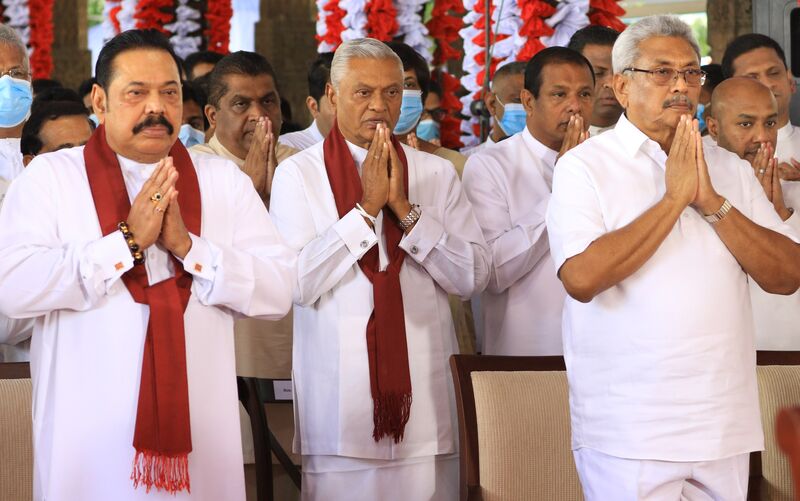
අන්තර් රාජ්‍ය සේවක නිර්මාණ තරගාවලිය – 2021” සම්මාන ප්‍රදානෝත්සවය අග්‍රාමාත්‍ය මහින්ද රාජපක්ෂ මහතාගේ ප්‍රධානත්වයෙන් බණ්ඩාරනායක අනුස්මරණ ජාත්‍යන්තර සම්මන්ත්‍රණ ශාලාවේ දී ඊයේ (23) පස්වරුවේ පැවැත්විණි.

රාජ්‍ය ආයතන සේවකයන්ගේ නිර්මාණ හැකියාවන් ඔප් නැංවීම,ඇගයීම සහ එම නිර්මාණ එළි දැක්වීමට අවස්ථාවක් උදාකිරීම හා එමගින් රාජ්‍ය ආයතනවල සංස්කෘතික කටයුතු ප්‍රවර්ධනය කිරීම අරමුණු කරගනිමින් විෂයභාර අමාත්‍ය අග්‍රාමාත්‍ය මහින්ද රාජපක්ෂ මහතාගේ උපදෙස් පරිදි බුද්ධශාසන, ආගමික හා සංස්කෘතික කටයුතු අමාත්‍යාංශය විසින් මෙම සම්මාන ප්‍රදානෝත්සවය සංවිධානය කරන ලදි.

සිංහල හා දෙමළ භාෂා මාධ්‍යවලින් ළමා කතා, පද්‍ය රචනා, ගීත රචනා, චිත්‍ර, කෙටිකතා, කෙටි චිත්‍රපට, ඡායාරූප සහ කෙටි නාට්‍ය යන අංශ ගණනාවක් යටතේ මෙම තරගාවලිය සඳහා දිවයිනපුරා සේවයේ නිරත රාජ්‍ය සේවකයින්ගෙන් නිර්මාණ ඉදිරිපත් වී තිබිණි. ඒ අතරින් තෝරාගත් සියලුම ජයග්‍රාහී නිර්මාණ සඳහා මෙහි දී සම්මාන ප්‍රදානය සිදුවිය.

බුද්ධශාසන, ආගමික හා සංස්කෘතික කටයුතු අමාත්‍යාංශයේ ලේකම් මහාචාර්ය කපිල ගුණවර්ධන මහතා විසින් අන්තර් රාජ්‍ය සේවක නිර්මාණ තරගාවලියේ සිංහල ජයග්‍රාහී නිර්මාණ එකතුව ප්‍රභාස්වර” සහ දෙමළ ජයග්‍රාහී නිර්මාණ එකතුවත්, සිංහල හා දෙමළ ජයග්‍රාහී ළමා ග්‍රන්ථ ද්විත්වයත් අග්‍රාමාත්‍යතුමාට මෙහි දී පිළිගන්වන ලදි.

සිංහල හා දෙමළ කෙටි නාට්‍ය සම්මාන ප්‍රදානයට අදාළව විශිෂ්ටතම නාට්‍ය,හොඳම නළුවා සහ හොඳම නිලිය ඇතුළු සම්මාන අග්‍රාමාත්‍ය මහින්ද රාජපක්ෂ මහතාගේ සුරතින් මෙහි දී ප්‍රදානය කෙරිණි.

අග්‍රාමාත්‍යතුමාගේ උපදෙස් පරිදි අන්තර් රාජ්‍ය සේවක නිර්මාණ තරගාවලි – 2021” සඳහා විශ්‍රාමික රාජ්‍ය සේවකයන්ට ද මෙවර අවස්ථාවක් හිමිව තිබූ අතර තරගාවලියට එක්වූ විශ්‍රාමික රාජ්‍ය සේවකයෝ මෙහිදී අග්‍රාමාත්‍යතුමාට සිය ස්තුතිය පුද කළහ.

ජාතික උරුම, ප්‍රාසාංග කලා හා ග්‍රාමීය කලා ශිල්පී ප්‍රවර්ධන කටයුතු රාජ්‍ය අමාත්‍ය විදුර වික්‍රමනායක, බුද්ධශාසන, ආගමික හා සංස්කෘතික කටයුතු අමාත්‍යාංශ ලේකම් මහාචාර්ය කපිල ගුණවර්ධන මහත්වරු ඇතුළු  කලාකරුවන් සහ රාජ්‍ය නිලධාරීහු රැසක් මෙම සම්මාන ප්‍රදානෝත්සවයට එක්ව සිටියහ.

Sri Lanka to seek World Bank support alongside IMF loan programme – report

March 24th, 2022

Courtesy NewsIn.Asia

March 24 (Reuters) – Sri Lanka will seek World Bank assistance to stave off a severe economic crisis in addition to an International Monetary Fund (IMF) rescue plan to be discussed next month, two sources said.

A 70% drop in foreign exchange reserves since January 2020 has left Sri Lanka struggling to pay for essential imports, including food and fuel, leading to growing unrest and even military deployments at gasoline stations.

For similar articles, join our Telegram channel for the latest updates. – click here

Holding paltry reserves of $2.31 billion as of February, the country must repay about $4 billion in debt over the rest of this year, including a $1 billion international sovereign bond that matures in July.

To seek a way out of the crisis, Finance Minister Basil Rajapaksa will fly to Washington DC next month to hold talks with the IMF and also officials from the World Bank, two sources with direct knowledge of the plans told Reuters.

What we need is budgetary support,” one of the sources said, referring to the financial assistance that the Sri Lankan government will ask the World Bank for.

READ: Sri Lanka to hire global law firm to aid debt restructuring

The source was unable to provide the size of World Bank assistance that Sri Lanka could seek.

The World Bank typically extends support to boost exports, improve economic competitiveness and aid growth, analysts said.

In heavily indebted Argentina, for example, the World Bank is working on approving a $2 billion loan package for 2022 that includes support for infrastructure, health, social inclusion and environment projects.

READ: Sri Lanka current economic crisis is similar to 1970s: New York Times article from 1974

Both sources, who declined to be named, since discussions were confidential, said such assistance would likely come after Sri Lanka entered into an IMF-supported loan programme.

In response to questions from Reuters, the World Bank said it was not currently in talks with Sri Lanka to provide budget support.

We are engaging with the authorities to identify a comprehensive structural reform program needed to ensure sustainable growth, and around which such support may be possible in the future,” the World Bank said.

Sri Lanka’s Finance Ministry did not respond to a request for comment.

‘DAMN TOUGH’

The amount of funding would depend on the specific goals set by an IMF programme as well as Sri Lanka’s trade and fiscal deficits, analysts said, estimating an annual requirement of up to $3 billion from several multilateral and bilateral sources.

If they have a credible IMF programme then there will be a period, perhaps six months to a year, maybe two, when it will be damn tough,” the second source said.

So how will people survive? That is where institutions like the World Bank will come in with budget support.”

An IMF programme will likely focus on external debt restructuring, greater exchange-rate flexibility and better-targeted subsidies, which may hit the poor, analysts said.

Transparent energy pricing is also likely to drive up fuel and electricity costs.

The World Bank could promote direct subsidy transfer, push green energy and develop human capital through improvements in health, education, and social protection, the second source said.

Subscribe to our Telegram channel for the latest updates from around the world

When Sweet Turns Sour

March 24th, 2022

By Gagani Weerakoon Courtesy Ceylon Today

When Sweet Turns Sour

By Gagani Weerakoon

Karunawathie belongs to a community that represents the poorest of the poor in Sri Lanka and lives in Uva Wellassa, one of the least developed areas. She has been paying land tax (Akkara Badda) for the land she seeks a shelter and cultivates to earn her family a daily pot of rice. However, she was recently informed that the land she was living on, no longer belongs to her, and in fact will be taken away from her to be invested in a promising” multinational project of cultivating sugarcane. 

Meanwhile, Karunawathie and others in Dehigama, Ridimaliyadda are now facing a bitter future, of having to consume contaminated water, increased human-elephant conflicts and in the long-term of being categorised as households with Chronic Kidney Disease of Unknown Aetiology (CKDu). 

Those in Dehigama are concerned, as their neighbours, who belong to the indigenous Vedda community, risk losing their traditional lands, and the only water resource they had access for potable water, Rambakan Oya, being highly polluted and contaminated as a result of a similar multinational project of maize.  

Background

In 2006, an area of land with a total extent of 65,000 acres in 11 Divisional Secretariat Divisions of Ridimaliyadda, Madagama, Bibile, Kandakatiya, Lunugala, Padiyathalava and Mahiyangana in the Badulla, Ampara and Monaragala Districts was earmarked for a sugarcane plantation project.

JVP Central Committee member Samantha Vidyaratna said the first company who intended to carry out the said project was a British multinational company. He added however when the initial project proposal was made, conservationists, after having inspected the aerial view of the plot of 500 acres land in Osu Uyana Aranyaya (Monastery), Nilgala Forest required for the construction of a sugarcane factory, protested against the move, observing that this land comprises a sensitive forest reserve.

He noted this was followed by a Chinese multinational company whose efforts were also defeated, adding that it was after these failed attempts, that the same project is being attempted to be brought forward in cooperation with a Singaporean company.

The company then looked for alternative lands in the Monaragala District and such effort was also opposed as the proposed land formed part of the Gal Oya National Park following which land in Dehigama was considered for the commencement of the long proposed project,” he added.

Senior adviser to the Centre for Environmental Justice (CEJ) and chair of friends of Earth International, Hemantha Withanage said in 2013, an Environmental Impact Assessment (EIA) was conducted on 300 hectares of land in Dehigama for a sugarcane factory, a power station and a plant nursery required for sugarcane which were all part of the project.

Withanage noted 300 hectares was only a portion of the total land required by the project for the construction and thereby the EIA has only been conducted on part of the land as opposed to the whole land as required by law. In addition to this, the company also required 3,000 hectares of land for Gliricidia, which would be used to establish a 16 MW power plant.

Concerns 

The land proposed to be utilised in this project has been recognised as a ‘special area’ in terms of the Sri Lanka Mahaweli Authority Act No. 23 of 1979.

Majority of the lands consists of ‘Other State Forests’ governed under Section 20 of the Forest Ordinance (as amended) and located between Maduru Oya National Park and Gal Oya National Park, Nilgala Forest and Other State Forests in Puwakpale Reserve Forest which is an elephant corridor and has been an elephant habitat for a considerable span of time.

Vidyaratna added apart from the environmental impact of the project, implementation of this project will result in sociological issues, as this area is home to the indigenous population, while the people in the area will also be exploited through cheap labour that would in turn impact their standard of living.

Monoculture 

There are currently a number of chena cultivations in the area which have been traditionally done by farmers paying a tax (Akkara Badda) to the Mahaweli Development Authority and the proposed sugarcane plantation will deprive them the arable lands for chena cultivation. 

Vidyaratna said according to the Cabinet Paper submitted for the proposed project, a hectare of land will be handed over to farmers for a commercial tax for the cultivation of only sugarcane, resulting in monoculture.

Designating 65,000 acres of land for a monoculture cultivation such as sugarcane can lead to unsustainable environments such as building up diseases pressure and degradation of the soil (reducing particular nutrition in the soil) resulting in the excessive use of chemical fertilisers and pesticides, the CEJ said.

Furthermore, the reuse of the same soil instead of following a determined crop rotation can lead to pathogens and diseases in a large expanse of land.

Impact on environment and elephant corridor

There are several areas of a great environmental value in this proposed area including the Nilgala Reserve, Gal Oya National Park, Maduru Oya National Park and also comprises several irrigation systems and if forest reserves are cleared, the water sources will also be immensely polluted, Vidyaratna said.

The CEJ observed there is an imminent threat of the water resources in the area drying up if the forest areas are being cleared to make way for the sugarcane cultivation, and sugarcane also absorbs a lot of water for its growth and this would convert fertile land into a parched desert in a short span of time.

The movement of elephants to Kumana National Park through Nilgala and Puwak-kele Forest Reserve and from the elephant corridor between Dehigama and Akiriyankumbura will be obstructed if the land is cleared and utilised. Elephants will loiter into villagers in search of food, further aggravating the human-elephant conflict.

Archaeological sites

Vidyaratna also noted that in the land proposed for the construction of the sugarcane factory, over 7 archaeological sites were identified. He added that several petitions were signed when a Cabinet Paper was submitted during the former Government and a Petition was also signed with blood by clergy and those who were genuinely concerned with the implementation of the project.

Laws

Section 20 of the Forest Conservation Ordinance No.16 of 1907, as amended, provides for the acts prohibited in any such forests. As per the Sub Sections 20 (f) and (k),  making any clearings and clearing or breaking up soil or digging any land for cultivation or any other purpose or cultivating any land already cleared is expressly prohibited and penal sanctions have been imposed for non-compliance and for aiding and abetting.

Due to the express prohibition spelt out in Section 20 of the Forest Conservation Ordinance No. 16 of 1907, such lands cannot in any manner whatsoever, be cleared and/ or be utilised for cultivation purposes. 

Further, in terms of Section 22 of the Mahaweli Authority of Sri Lanka Act, any written laws specified in Schedule B thereto shall have effect in every Special Area subject to the modification that it shall be lawful for the Authority to exercise and discharge in such area any of the powers or functions vested by any such written law in any authority, officer or person in like manner as though the reference in any such written law to the authority, officer or person empowered to exercise or discharge such powers or functions included a reference to the Authority.

The Forest Ordinance has been listed under Schedule B of the Mahaweli Authority of Sri Lanka Act and hence, the Section 20 of the Forest Ordinance as amended shall have effect in Special Areas which falls under the preview of the Mahaweli Authority of Sri Lanka.

Other sugar factories 

The Movement for Land and Agricultural Reform (MONLAR) moderator Chinthaka Rajapaksa said there are already four sugar industries that have been isolated and the land in which these industries have been set up, has been completely destroyed, adding that not even 10 per cent of the local sugar need in the country has been met through these four industries. He said thereby the current efforts are also for fraudulent income-earning mechanisms.

Rajapaksa said lessons have to be learnt from the past, as former similar projects have failed, and clearing of forests in areas of high environmental value has not in any manner contributed to the economy, and has also not enhanced the lives of those living in these areas. 

He added that if there is any intention to develop these lands, the ongoing cultivation of different crops should be facilitated better instead of approving and implementing such projects that push farmers to practice monoculture.

Impact on Vedda community

Leader of the Vedda community, Uru Warige Wannila Aththo said within the lands required for the entire project, there are forest reserves that contain medicinal plants that are of great value for Ayurvedic treatment. He added that the waste of sugar factories will be discharged to the water sources and those inhabiting the area, including the Vedda population will not be able to consume this water, as it will have a huge impact on their health as well as on the agricultural practices in the area.

He added that there are several who voice in favour of environment conservation, but at the pace that forests are being cleared for development purposes, there will hardly be any forest reserves even for the indigenous population who have been hugely dependent on such forests. The indigenous population has already faced a huge crisis with the clearing of lands in Pollebedda, which has contaminated the Rambakan Oya,” he said, adding that this proposed project will however result in a much worse impact on them.

The Rambakan Oya is an embankment dam in Maha Oya and currently functions under the directions of the Ministry of Irrigation and Water Resource Management. The Rambakan Oya Reservoir Project is a multipurpose irrigation project that aims to remedy the drinking water and irrigation problems in the area. 

Continuous concerns were in the past raised in regard to a proposed agriculture and livestock development project that was proposed to be implemented by clearing the water catchment area of the Rambakan Oya Reservoir. 

Withanage said initially it appeared as though the direct impact of clearing the forest reserve was the environmental destruction and the risk it posed to the livelihood of the indigenous population in the area, but the broader picture was later discovered with the growth of Cyanobacteria in the Rambakan Oya Reservoir after the lands were cleared for maize cultivation.

It was noted that the Cyanobacteria content identified in Rambakan Oya is also higher than that normally contained in a reservoir and in certain countries when this is over the value of 20,000, a public announcement will be made, advising not to use that water for any purpose, but that the Rambakan Oya’s Cyanobacteria value is over 40,000. Cyanotoxin in Rambakan Oya is also higher than the standard and this could not be expected from a recently established reservoir.

Wijedasa proposes 21st Amendment which enable Parliament to elect new President

March 24th, 2022

Courtesy The Daily Mirror

SLPP MP Wijedasa Rajapaksha has handed over the 21st Amendment to the constitution under which he proposed the transformation of executive powers of President Gotabaya Rajapaksa to the cabinet and to elect a new President by Parliament forthwith.

The MP, when inquired by the Daily Mirror, confirmed that he had handed over the private members Bill to the Secretary General Parliament through which he had proposed the 21st Amendment to the constitution.

Mr. Rajapaksa said he has proposed in his private members Bill the executive powers vested in the presidency shall be transferred to the cabinet members, making them responsible to Parliament and the people. Thereby he had proposed that the legislature be given the power to monitor the exercise of executive powers.

Also he proposed the election of a new President and the office of the incumbent President shall cease with such an election.

He had also proposed the new President to appoint the Member of Parliament who commands a majority, as the new Prime Minister.

Mr. Rajapaksha in his private members Bill has proposed the appointment of an interim cabinet which comprises MPs from all parties which represent Parliament, The Interim government shall continue until the term of the House is over or when it is dissolved. The interim government should formulate long term and short term policies to restore the economy. (Yohan Perera and Ajith Siriwardana)

Sri Lanka can be made the Asian destination of tourists – President

March 24th, 2022

Courtesy Adaderana

Sri Lanka can be made the Asian destination of tourists, says President Gotabaya Rajapaksa while pointing out that obstacles should be removed and plans should be made to attract tourists through global promotional programmes.

More than 260,000 tourists have arrived in the country in the first quarter of the year. That’s higher than last year’s overall tourist arrivals. 

The government expects to achieve the target of 1.3 million tourists by the end of the year. The President pointed out that all sectors of the tourism industry should be prepared to achieve this target, the PMD reported.

The President had made these remarks during an inspection visit to the Sri Lanka Tourism Development Authority (SLTDA) in Colombo 03 today (24). 

The Tourist Board was established in 1966 for rapid economic development through the systematic and streamlined development of the tourism industry and it later became the Sri Lanka Tourism Development Authority in 2005.

The Tourism Development Authority is empowered to oversee all areas related to the tourism industry, including tourist arrivals, planning resorts and accommodation facilities, registration and classification of tourist services including tourist hotels and travel agencies, and the issuance of licenses.

The President inspected the Sri Lanka Tourism Promotion Bureau (SLTPB), Institute of Tourism & Hotel Management, and Convention Bureau and commended the staff for their commitment to the promotion of the tourism industry.

The government aims to raise USD 10 billion annually from the tourism industry. The Easter Sunday attack was a major blow to the tourism industry. It was further devastated by the Covid-19 pandemic. The government has taken all necessary steps for the rapid development of the infrastructure in the tourism sector, the release said.

Minister of Tourism Prasanna Ranatunga says that the tourism industry is thriving again due to the success of the vaccination drive.

There are a large number of local as well as foreign employment opportunities associated with the tourism sector. The President said that training opportunities in this sector should be expanded accordingly. 

President Rajapaksa pointed out that a large number of job opportunities could be created by planning to provide practical training and theoretical knowledge to the youth with the assistance of the hotel system spread across the country.

Various forms of planned propaganda are being carried out to destroy the tourism industry. Even in such a context, tourist arrivals remain high. Strict attention should be paid to the safety of the tourists. 

The President said that it is the responsibility of the Tourism Development Authority to provide an attractive service with a high level of hospitality from the time of arrival to the time of return to their respective countries.

The President also instructed to take steps to increase the number of flights to Sri Lanka in consultation with the airlines.

Infrastructure development required to maintain Yala, Kumana, Minneriya and other wildlife parks and coastal areas as tourist attractions were also discussed, according to the President’s Media Division.

Minister of Tourism Prasanna Ranatunga, Principal Advisor to President Lalith Weeratunga, Ministry Secretary S. Hettiarachchi, Chairman of the Tourism Development Authority Kimarli Fernando and several others were present at the occasion.

Rs. 68 million worth loans obtained from SMIB using forged documents in 2017 – COPE

March 24th, 2022

Courtesy Adaderana

The Committee on Public Enterprises (COPE) has observed that in 2017, some 47 people were involved in preparing fake documents and submitting fake information and have obtained loans to the tune of Rs. 68 million from the State Mortgage and Investment Bank (SMIB).

This was taken into discussion during the meeting of the Committee on Public Enterprises (COPE) chaired by Prof. Charitha Herath held on Wednesday (23), to examine the Auditor General’s reports and current performance of the State Mortgage and Investment Bank for the financial years 2017 and 2018.

The officials present said that cases have been filed against the persons identified as debtors and that the CID is still investigating the matter. Disciplinary inquiries against the staff in particular to this matter is in process and disciplinary action against those whose investigations have been completed has already been taken, the officials further said.

The officials also stated that two external parties related to the said matter have been arrested by the CID and one of them has passed away. It was also stated that prompt action has been taken to obtain these loans, especially after the appointment of the new Chairman and the Board of Directors.

Accordingly, the COPE Chairman instructed the officials present to carry out the measures properly.

Focus was directed towards increasing home loans during the said years whilst the committee members present were of the view that the amount of loans provided for industries and agriculture should be increased. 

They also pointed out that this should be considered a need of the State Mortgage & Investment Bank in particular. Officials who were present at the committee meeting said that loans are already being given to small businesses with a focus on the aforementioned sectors.

The current vacancies at the bank were also taken into discussion. Officials said that steps have already been taken to fill several vacancies in the executive ranks and that some suitable candidates are not applying for vacancies in the executive ranks and some leave shortly after receiving appointments.

 If remuneration for those posts is not sufficient, the COPE Chairman instructed to make the necessary amendments for the purpose of filling the vacancies.

There was also a discussion on the presence of the State Mortgage & Investment Bank in a building which has been leased for about 30 years.

The activities to set up an automated banking system were also discussed.

Minister Sarath Weerasekera, State Minister Indika Anuruddha, and Members of Parliament (Dr.) Susil Premajayantha, Eran Wickramaratne, (Dr.) Harsha de Silva and Madhura Withanage were also present at this committee meeting.

Time for Sri Lanka to move from the Hydrocarbon age to the age of Electricity

March 23rd, 2022

Harvey Perera 

Currently, we are using hydrocarbons for all our energy needs. We use it for our transportation, for cooking, and production of some of the electricity. Due to global warming, it has become imperative that we start using renewable energy instead of hydrocarbons for our energy consumption. If we switch to electricity we can start switching our tuk-tuks, cars, trains, buses and cooking to electricity.

Most of the switching can be done by giving the correct tax incentives to consumers to switch to electricity. If it becomes cheaper for a household to use electricity for cooking they will do so gladly. We will be also rid of the problem of exploding gas cylinders and having to lug those heavy tanks home. It is the same with cars and tuk-tuks. It is a matter of providing the right incentives for people to switch. In Sri Lanka most of the distances are small. It will be easy for current electric vehicles which are manufactured to be used for transport since most of them have a capacity to travel about 200-300 miles on a charge. Some of the newer vehicles give even more. This means setting up charging stations in every town in the country. Again this can be done by the private sector if the right incentives are provided.

There is an added advantage in switching to electricity for transport since there will be less noise and air pollution when we switch to electric vehicles. I understand we cannot do it overnight and will have to be done gradually as our cars are wearing down. The maintenance on cars will be much less since there are very few moving parts in an electric car compared to a gas-powered car. There are supposed to be around 30,000 moving parts in a gas-powered car whereas the number of moving parts in an electric car will be about 10 at most. With the development of battery technology, each home can be independent of the grid and be self-sufficient in electricity needs for the home and for charging the car. This means no power cuts and it will be less work for the Govt too. There will be a certain part of the population who will need to connect to the grid such as high rises, and buildings that cannot have solar panels on the roof.

The question is where are we going to get cheap electricity? One of the most abundant things we have in Sri Lanka is sunlight and wind. We can get the full benefit from it and get all our energy needs from the sun and wind if we adopt what Germany did a few years ago. In Germany a few years ago, they introduced a guaranteed price for renewable energy for a period of 20 years. The net result is now Germany is leading in renewable energy. They shut down 84 coal plants and most of their Nuclear plants. The investment was mostly done by the Private Sector. Why don’t our leaders follow the same model that has worked for the Germans so well? If we do that, we could cut down on the import of coal, crude oil, and diesel, save Forex and solar energy electricity for all our needs such as cooking, vehicles, all powering, etc. In the USA too they give tax incentives for homeowners to install solar panels on the roofs. We need to think out of the box in terms of clean energy instead of using coal plants and diesel generators.

We have a lot of waterfalls and rivers which can be harnessed to generate power. See the article by Mr. Sugath Kulatunge ” Run of the River Hydroelectricity” Posted on February 23rd, 2022. – https://www.lankaweb.com/news/items/2022/02/23/run-of-the-river-hydroelectricity/.He has given many examples of rivers that utilize this method which does not involve building dams. There was also another good article in the Island by Mr. Parakrama Jayasinghe “Time to escape from the grip of fossil fuels -“https://island.lk/time-to-escape-from-grip-of-fossil-fuels/“.  In this article he is showing how to use renewable biomaterials to do our cooking very cheaply. There is also a good article in the Island “SOLAR POWER an ALTERNATE ENERGY source” by Mr. Tissa Jayaweera. –  https://www.dailymirror.lk/opinion/SOLAR-POWER-an-ALTERNATE-ENERGY-source/172-233414.

The Govt needs to appoint a panel of experts to study all these issues and make a long-term policy plan with ideas for tax incentives to bring about the required changes in our consumption of energy and also the generation of energy.  

Getting out of the economic anarchy

March 23rd, 2022

Bt Garvin Karunaratne

It is good news that we have reached an input of $ 1 billion aid from India and that China is considering and very likely to give a 2.5 b. loan, but this can bring us out of the economic mess we are in if only we act in a prudent manner. It all depends on how we spend the funds.

We do not have to wonder far, because if we closely copy the blueprint economic model of the days of Premier Dudley Senanayake, 1965-1970, days when we had no food, gas and fuel queues, we can be dead certain of victory. That was also the one model we followed earlier too when we built the Gal Oya Project spending dollars we had in 1950- 1954. when my father in law had purchased his A 40 brand new, as the first owner, not from the company but from someone who had deposited money and waited long. There were small allocations for valued imports. In 1958 I waited for two months to buy a new Peugeot 203. Then we did not provide any foreign exchange for foreign studies or for foreign travel. When I marched out of the Administrative Service and went abroad for study I was not given even a single dollar. I had to earn, live and study. Foreign exchange was a guarded item and we did not have private currency dealers, buying and selling dollars emassing a profit. The total intake of every bank was the property of the Government and disposed as decided by the Controller of Foreign Exchange of the Central Bank.

Today unless we are strict and spend for essentials first and see to an era of no queues for food and essentials like cooking gas, medicines and then detail a small allocation for fuel, etc we will not win. We have to forget skyscrapers, bridges, roads, flyovers for the time being till we do not have to hear of deaths of common people in food and gas queues. It is sad that four people have succumbed to deaths in queues by today(22/3). Then very small allocations were given for non essentials like cars, fridges, grapes etc. Working as the Additional Government Agent in Kegalla in 1969, I knew of no food queues or any shortages of essentials like food including medicines.

Our automobiles can easily guzzle out billions. We have that many. The rich have not one or two, but fleets of vehicles and enjoy endless travel. Allowing the rich to revel while some citizens are confined to be in queues for days to buy a can of gas is a No No situation that needs never to happen.

My mind travels back to my days at Matara as the Government Agent when the JVP struck on 5 thApril 1971, when the JVP actually controlled 90%of the District for close on three weeks. No fuel bowsers could be expected till roads were opened up. As the GA, I was in charge. Only some ten officers out of some 400 reported for work and that included my Assistant Govt Agent, Sugatadasa Jayawickrema. The two of us decided that we will impound all stocks of petrol and diesel. All petrol shed were closed to the public- told to issue only to army and police vehicles and on permits issued by either of us. If I had not made that decision the fuel would have run out and we would not have had any fuel for the army, police and essential services like the distribution of essential food. Then the Police withdrew the security at the katcheri, closed the Police station gates and barricaded the entrance with a large tree and were armed to the teeth with machine guns inside, awaiting the enemy- the JVP. Matara was saved by the Gemunu Watch volunteers running in katcheri jeeps with petrol found from my development funds, ensuring essential food transport for the area near Matara and the coast which we controlled at times. If I had not controlled the use of available fuel, the JVP would have had a walk over and we would not have lived to tell the tale. Casualties due to JVP bullets included my jeep driver, Major Wettasinghe and the Member of Parliament for Deniyaya, Sumanapala Dahanayake, the latter two moved to Colombo Hospitals in haste. We must limit the use of fuel to produce electricity and for essential services. There is no other way ahead. Permits have to be issued by the Divisional Secretaries to owners of motor vehicles for the essential travel like going to work and for schooling. Unless this is done the dollars will end in smoke.

One can also look to the manner in which Mahatir Muhammed responded when the East Asian Financial Crisis hit East Asia. I quote from my book:How the IMF Ruined Sri Lanka & Alternative Programmes of Success(Godages:2006):

In 1997, the East Asian Financial Crisis caused the death of many economies in East Asia. Malaysia, Thailand, Indonesia, Korea succumbed and the malaise spread to Russia, Brazil and Argentina. All these countries had their currencies trashed and their economies ruined. Prime Minister Mahatir Muhhamed of Malysia declared war with the IMF by doing the exact opposite of the IMF advice. He effectively controlled the economy of his own country. He was entitled to do it. He imposed very strict controls. Every country earns foreign exchange through exports and services and remittances. He grabbed this money and did not allow any foreign bank or anyone to spend on unnecessary imports. He clamped severe restrictions on the use of foreign exchange. This even went to the extent of stopping funds for Malaysians studying abroad. There was Mayhem in student circles in London. Some of my students took leave of studies and flew home, those who stayed back were compelled to do menial work in restaurants etc to pay themselves.”(Pg.238)

It was only Malaysia that faced the crisis without falling into debt. Thailand was given a loan of $ 17.1 billion, Korea $ 58.2 billion, Indonesia $ 39.9 billion. Their foreign debts commensurately increased by that amount. In each case the IMF insisted that the local economy should be further prise opened more to foreign investment. This means that the doors are yet being wider and wider opened for foreign exploitation, As Professor Stiglitz states, the IMF chose to squeeze the countries further thus driving their banks and corporations to deeper crisis and worsening investor confidence”(Stiglitz: IMF policies make patient sicker)”. The IMF has come up with two Aid Schemes- the Highly Improvised Poor Countries Initiative(HIPC)and supplemented with the Multilateral Debt Relief Initiative(MDRI). Both declare loans as paid up but open up the country more for foreign investment. As Carrasco of the University of Ohio opines that the HIPC is, a program designed by creditors to protect creditor’s interests, leaving countries with unsustainable debt burdens.”(Foreign Debt Forgiveness & Repudiation,University of Iowa, Center for International Finance & Debt, 2007) . The MDRI is no better.

Sri Lanka is currently negotiating with the IMF. It is hoped that the IMF will provide a chance for Sri Lanka to wipe out the food and fuel queues and subsequently provide a development agenda, which is not yet on its books.

It is sad that the IMF despite helping- giving loans on strict conditions to some 80 odd countries, cannot quote a single instance where any country has developed under their tutelage. However it is hoped that this message will serve to open their eyes and enable them to speak of success.

These words come from someone who designed and implemented the largest and premier employment creation programme the world has known- the Youth Self Employment Programme (YSEP) of Bangladesh, created when he served as the Commonwealth Fund Advisor to the Ministry of Labour and Manpower in 1982. That happened in the face of an ILO programme that spent millions and failed to establish a self employment programme in Tangail, Bangladesh in 1980-1982. The YSEP has in its four decades 1982- 2022, guided over three million youths to be commercially viable entrepreneurs.

It is hoped that the IMF will kindly consider allowing Sri Lanka the chance to wipe out the food and fuel queues first and will also help the country to stand on its feet in development. May I suggest that the IMF detail that Sri Lanka should show the development starved world that it is possible to enable true economic development, creating production locally bringing about employment and incomes for the people , within a successful development programme.

Such a programme will be a feather in the cap for the IMF and will get into the history of successes in development like Mahatir Muhammed in Malaysia in the days of the East Asian Financial Conflict of 1997 and the Youth Self Employment Programme of Bangladesh. The Sri Lankan High Commissioner in Delhi, His Excellency Milinda Moragoda in his Manifesto for Mayor of Colombo in 2011 refers to a scheme to solve the problems of youth unemployment: In this regard, he should seek to implement the Youth Self Employment Programme of Bangladesh which incidentally was an amazingly successful scheme introduced to that country by a distinguished son of Sri Lanka, Dr Garvin Karunaratne, who served Bangladesh as an international consultant.”

Let me live in hope that the IMF will get this message.

Garvin Karunaratne, Ph.D Michigan State University.

Author of:

How the IMF Ruined Sri Lanka & Alternative Programmes of Success(Godages:2006)

How the IMF Sabotaged Third World Development, (Godages/Kindle:2017)

How the IMF’s Structural Adjustment Destroyed Sri Lanka(Godages:2022)

23032022

Is “Eershiyawa” (Jealousy) blocking Senaka Weeraratna and Sri Lanka from gaining credit for the invention of DRS?

March 23rd, 2022

Shenali Waduge

On 25 March 1997, the prestigious Australian” national newspaper published a letter to the editor from Senaka Weeraratna entitled Third Umpire should perform the role of Appeal Judge”.  It spelled out the concept of ‘Player Referral’ which is now universally known as the UDRS or DRS (Decision Review System). It’s now exactly 25 years since that groundbreaking idea was first aired in public and the ICC administered cricket world making the best use of it, without even conveying a simple ‘Thank you’ acknowledgment to the inventor of the idea.  

Senaka Weeraratna continues to struggle to achieve the recognition he richly deserves for authorship of a concept that allows players to challenge the ruling of an on-field umpire, which is now used in all forms of sports, not only cricket.

While we may speculate on racism by the world cricket body ICC to stall and deny the rightful place Senaka Weeraratna deserves on account of him not being white, it does not make up for the shoddy treatment that mainstream cricket institutions in Sri Lanka that have been established to promote cricket and win accolades for Sri Lanka internationally, maintaining a deafening silence in respect to his justifiable claims.

We can only put it down to ‘Eershiyawa’ (Jealousy) & envy on the part of Sri Lankans to not take up the cause of a fellow Sri Lankan whose brainchild deserves the merit for authoring the umpire referral system. International bodies with a colonial mindset have a tendency to rob ideas of non-whites and register them as patents securing the intellectual property for themselves leaving no returns for the traditional owner of the intellectual property.  The ICC should not leave any room for anyone to accuse the ICC of stealing the ‘Player Referral’ idea from a Sri Lankan.  

From the Sri Lanka Cricket Board, all of the former Sri Lankan cricket captains and top players, to even successive Sports Ministers & other officials who are well aware of Senaka Weeraratna’s single-handed quest to achieve justice, so far not one has come forward with a view to extending their support.  While they all have plenty of time to make a profit, campaign for their personal glorifications none has thought it fit to rally a campaign to demand that the world cricketing body declare UDRS as the Weeraratna Referral System.  He is the only one claiming authorship worldwide with supporting publications and evidence.

Senaka Weeraratna has approached the local cricketing body countless times and made numerous appeals while numerous others have written on his behalf but to no avail. Jealousy has taken precedence over the sound judgment of both local cricket administrators and the cricket establishment comprising world – famous Sri Lankan cricketers.  They have no genuine excuses for their lapses.

Every Sri Lankan and even well-wishers of Sri Lanka must view Senaka Weeraratna’s brainchild ‘ Player Referral’ which evolved into DRS, as another cap to Sri Lanka’s international achievements. DRS is the most talked – about aspect of cricket today.  

Our country, Sri Lanka, can never aspire to prosper when our own do not wish to help another achieve due credit and recognition for creativity.  ‘Eershiyawa’ (Jealousy) unfortunately has become the bane of the decision – makers of this country.  

 Shenali Waduge

A Tribute to Podi hamuduruwo

March 23rd, 2022

By Dr. Tilak S. Fernando |

When I was in London my niece Shyamala Fernando asked me to interview Dr Galagoda Gnanissara Thera when I visited Sri Lanka on holiday in 2000, one of the most respected Buddhist prelates in Sri Lanka. He’s popularly known as Podihamuduruwo, the Chief Incumbent at the Gangarama Temple.  

A Tribute to Podi hamuduruwo

Venerable Nayaka Thera was born on 14 December 1943, ordained in the village of Galagoda, Matara, on 8 November 1954. After completing his primary education, he entered Vidyodaya University in 1961 and graduated with a Bachelor of Arts degree. He took up robes at the age of 10, graduated at 17 and had to take the reins of Gangarama Viharaya at the age of 17 when his guru Venerable Devundera Sri Vachissara passed away. Many admire his guidance. The Venerable helps orphans to face life with a strong sense of responsibility.

Kataragama Visit

I visited Kataragama before I approached the venerable in 2000. The last time I went to Kataragama was when I was a child, when devotees to the Kovil had to walk miles along narrow footpaths. By 2000, Kataragama town had developed to such an extent with shops, guest houses and other facilities; today Kataragama manifests itself as a busy town. 

Thanks to my niece, I received a letter of authority from Podihamuduruwo to stay at the chalet reserved for the late President Premadasa at the Gangarama ‘Rest’ in Kataragama administered by Podihamuduruwo. It consists of several acres of land with independent chalets attractively landscaped. The chalet I was offered had a modern bathroom. The Gangarama Rest helps pilgrims stay free of charge. 

Canteen

I noticed the canteen was highly subsidised and run by orphaned youths trained by Podihamuduruwo. The Rest helps the pilgrims to stay free of charge in the chalets. There were seventy-five children in the orphanage (2000), and further provision was extended to expand the hostel to accommodate 350 more children. A few yards away from the canteen was an orphanage for beggar families. The orphans of beggar families enjoyed food, clothing, and shelter free of charge. The children went to school for general studies, but, after school, they received practical training in the building, printing, or automobile trade to assist them in finding suitable employment in society. To help such projects, NORAD, the US Embassy and the Australian High Commission supplied the water service, the beds, and the room cupboards.  

First Meeting

Having seen and enjoyed all the facilities at the Gangarama Rest, I went to meet the architect of the project, Podihamuduruwo. My first impression of him was that he was unassuming, dextrous, determined and a dedicated Buddhist priest. A guided tour inside the Gangarama Temple enabled me to fathom to what extent Podihamuduruwo had transformed the temple into an inspiring and historical temple. I entered the shrine room where Lord Buddha’s corporeal relics were placed in a golden casket. Podihamuduruwo put the casket on my head to receive the supreme blessings of the Buddha; Pirith was chanted throughout the day. 

Dr. Galagoda Gnanissara disclosed that over 50,000 poor youth underwent training in 2000. Podihamuduruwo handpicked Sarath, the supervisor, to run the Gangarama canteen and the chalets. The Rest was offered free-of-charge to every pilgrim. The management of the Canteen and the Rest were maintained by orphaned youths based on a co-operative scheme as a registered charity.

Permission to write 

I wanted permission to write about what I had seen at Kataragama and Podihamuduruwo jested:  If you’re going to write about me, you must first write about all you have heard about me. Please don’t spare a single sentence.”

Podihamuduruwo’s idea was to build two factions of the community for Buddhist monks and a disciplined youth society. I asked the eminent priest that on a day when he was not there who was to succeed him? His resolute answer was that he had trained orphaned children and transformed them into practical human beings, as well as student priests. My student priests and my children are there to carry out what I have initiated.”

Podihamuduruwo was inspired by what he saw in Galena, Calvary in the US. On his return to Sri Lanka in 1976, the Venerable  constructed the Seemamalake at the centre of the Beira Lake, followed by the Kataragama projects. Podihamuduruwo was available to discuss any personal problems of the laity. Every religious devotee visiting the Gangarama Temple received the blessing by Podihamuduruwo, placing the reliquary of relics upon each devotee’s head and Paritta strings tied around the wrist.

Sri Jinaratana Technical Training Centre

Podihamuduruwo’ built the Sri Jinaratana Technical Training Centre near Beira Lake to help youths gain practical experience in many fields. His main ambition was to divert the misguided children, who went astray after the JVP insurrection to transform them into disciplined future citizens of Sri Lanka. The industrial training programmes have diversified into many areas such as electrical, house wiring, motor mechanism, printing, and computer technology. 

The Nawam Maha Perahera of the Gangarama annually paraded many elephants and traditional artistes. It has become a symbol of the annual processions that revolutionised the Sri Lankan Perahera dynasty. The ‘Buddha Rashmi Vesak Festival’ held annually with the collaboration of the Prime Minister’s Office has become world-famous. 

The prelate had access to the late President J.R. Jayewardene. Such cordial connections were severed when JR signed the Indo-Lanka pact, and the irate Venerable protested against the signing of the peace accord by holding black flags. Podihamuduruwo emphasised that he did not belong to any political party or a politician, but challenged even the late President Premadasa whenever he went out of the rails! His motto was to make good out of anything wrong”.

The character of Gnanissara Nayaka Thera is very exquisite and contemporary. In my personal experience and meeting with Podihamuduruwo and having a lengthy discussion, I could only say that the monk is an exceptional living example of a Buddhist priest. He cares for future generations of Sri Lanka. 

Finally, I wish Podihamuduruwo good health, happiness and longevity in life. 

tilakfernando@gmail.com

OIC Conference and Rohingya Refugee Issue

March 23rd, 2022

Hafizur Talukdar Dhaka city in Bangladesh

A conference of foreign ministers of the Organization of Islamic Cooperation (OIC) started at the Parliament House in the Pakistani capital Islamabad on March 22. This year the conference was held under the theme ‘Building Cooperation for Unity, Justice and Development. The conference was very important to address some common problems for the Muslim world.

At the beginning of the conference, the Foreign Minister of Pakistan Shah Mahmood Qureshi welcomed the OIC foreign ministers to the conference. The OIC is the collective voice of 200 million Muslims around the world,” he said. It is a bridge between the Muslim nations and the world community with Muslim world.  Foreign ministers from 46 countries of the 57-member bloc are taking part in the conference. Delegations from other countries are being led by senior foreign affairs officials from those countries. The conference discussed the challenges that the Muslim world is currently facing.

The Prime Minister of Pakistan Imran Khan delivered the inaugural address of the conference. He highlighted Pakistan’s role in the OIC. At the same time, the Pakistani Prime Minister talked about the challenges facing the Muslim world. Foreign Minister Shah Mahmood Qureshi also addressed the gathering.

It is pertinent to mention that the Rohingya refugee crisis is a crisis not only for Bangladesh-Myanmar but also for the whole Muslim world. There are many crises increasing day by day worldwide.

Bangladesh Foreign Secretary Masud bin Momen participated on behalf of Bangladesh. He said that the sustainable solution to the Rohingya issues lies in their repatriation. Bangladesh cannot bear the immense socio-economic and environmental costs by hosting millions of refugees for an indefinite period; therefore, these people must be repatriated to their origin in Rakhine State he said during his speech on the open-ended Meeting of the OIC Ad Hoc Ministerial Committee on Accountability for Human Rights Violations against the Rohingyas. The meeting was convened on the sidelines of the 48th session of the OIC) Council of Foreign Ministers in Islamabad on March 22.

Being as a major crisis in the Muslim world, members of OIC should be concerned on the Rohingya refugee crisis. There is no way for all members without supporting Bangladesh. The Muslim world must remember and consider Rohingyas are also one of the persecuted Muslim communities in the world like Palestinians etc.

Foreign Secretary Momen in his statement reiterated the importance of repatriation of the Rohingyas to avoid transnational socio-economic catastrophe due to millions of Rohingyas, especially thousands of juveniles and youths apprehensive of no hope for their future. While thanking the Gambia and the OIC and for the kind support for the legal action, he called for keeping the momentum going to provide justice to Rohingyas. He also called for strong solidarity from the member states by contributing voluntarily to meet the legal expenses of the case.

Turkey committed to contributing $2,00,000 to the fund. The members of the ad-hoc committee praised Bangladesh for hosting this large number of refugees over the years and even providing bringing them within the Covid vaccine program. But Bangladesh faces some challenges to deal with the problems. The member states must help Bangladesh resolve the Rohingya crisis.

The Organization of Islamic Cooperation (OIC) Secretary-General Hissein Brahim Taha stressed that the Rohingya case is one of the top priorities on the OIC’s agenda, one that the organization has been following for over two decades. OIC must be committed to resolve the crisis as soon as possible. Unity on the issue amongst the member states must essential to compel Myanmar to take back the Rohingyas.

In comments to mark the outcomes of the ad hoc Ministerial Committee on the Accountability for Myanmar over Human Rights Violations against Rohingya, he stated that the committee’s meeting was held at a critical time in the midst of important developments related to the case against Myanmar at the International Court of Justice.

As a Chinese foreign ministers attended the conference, OIC members state can sought assistance from China to help solve the Rohingya refugee crisis because China has warm relations with Myanmar.

He pointed out that this case sends a strong message to the international community about the OIC’s collective and coordinated work to support the Rohingya people, as well as its firm commitment to global ideals and principles of justice and accountability for human rights violations. The situation of the Rohingya has not improved despite the efforts and calls of the OIC and the international community, the Secretary-General noted.

He pointed out that Myanmar continues to turn a blind eye to the horrific violations against the Rohingya’s rights and did not fulfill its international obligations to create an environment for willful, safe, sustainable, and dignified return of the Rohingya to their homeland.

Moreover, the OIC Secretary-General praised the pivotal role of Gambia, in its capacity as chair of the committee, in leading the organization’s efforts on the international stage to ensure that Myanmar is held accountable for the atrocities committed against the Rohingya Muslims. He also commended Bangladesh for hosting and sheltering over a million Rohingya refugees.

Meanwhile, ever since Bangladesh welcomed the 1.2 million Rohingya refugees from Myanmar, she has been paying the price of her generosity. Despite many diplomatic efforts, the repatriation of Rohingya people has been lingering for quite a long. OIC must engage with Bangladesh. OIC members must try to compel Myanmar to repatriate the Rohingyas as Rohingyas must have birthrights in their original birthplace. Intensifying pressure as much as possible on Myanmar must be ensured by the OIC member states. The solidarity of the all members is very essential to address this common problem.

According to some media reports, with the backing of OIC, Gambia, an OIC member, volunteered to file a case against Myanmar at the International Court of Justice (ICJ) for the alleged genocide of the Rohingya in November 2019. On January 23, 2020, the ICJ unanimously passed a resolution on the protection of Rohingya refugees, preventing acts of genocide and killings. On the other hand, OIC countries commenced their fund-raising campaign in December 2020 and could donate $1.2 million to Bangladesh. All in all, OIC’s support in resolving the crisis has been commendable.

Apparently, OIC has contributed a lot but there is still a long way to go. In recent times the Rohingya refugee crisis and repatriation are not getting much attention as the focus shifted to other issues, such as the Ukraine war. The OIC must make sure that the Rohingya crisis never loses attention on international agencies. The OIC members states must help Bangladesh as much as possible. Don’t let Bangladesh alone bear the burden of Rohingyas.

Bangladesh has always been an obedient member of the OIC and promptly responded to any resolution. As pledged, the OIC should show solidarity with Bangladesh to help solve the humanitarian crisis of the Muslim world.

අග්‍රාමාත්‍ය මහින්ද රාජපක්ෂ මහතාගෙන් ඉන්දීය අග්‍රාමාත්‍යතුමාට ප්‍රණාමය

March 23rd, 2022

අග්‍රාමාත්‍ය මාධ්‍ය අංශය

ශ්‍රී ලංකාවේ ආර්ථික සංවර්ධනයට ඉන්දියානු රජය කරනු ලබන සහයෝගයන් පිළිබඳව අග්‍රාමාත්‍ය මහින්ද රාජපක්ෂ මහතා ඉන්දියානු අග්‍රාමාත්‍ය නරේන්ද්‍ර මෝදි මහතා වෙත සිය ස්තූතිය පළ කර ඇත.

විශේෂයෙන්ම පසුගියදා ශ්‍රී ලංකාවට ලබාදුන් ණය ආධාර පිළිබඳව ස්තුතිය පළ කළ අග්‍රාමාත්‍ය මහින්ද රාජපක්ෂ මහතා, ඉදිරියේදීත් ඉන්දියානු රජය  ශ්‍රී ලංකාවේ කටයුතු පිළිබඳව සහ ශ්‍රී ලංකාවේ සංවර්ධනය පිළිබඳව විශේෂ අවධානයක් යොමුකරනු ඇතැයි තමා අපේක්ෂා කරන බවත් සඳහන් කර තිබේ.

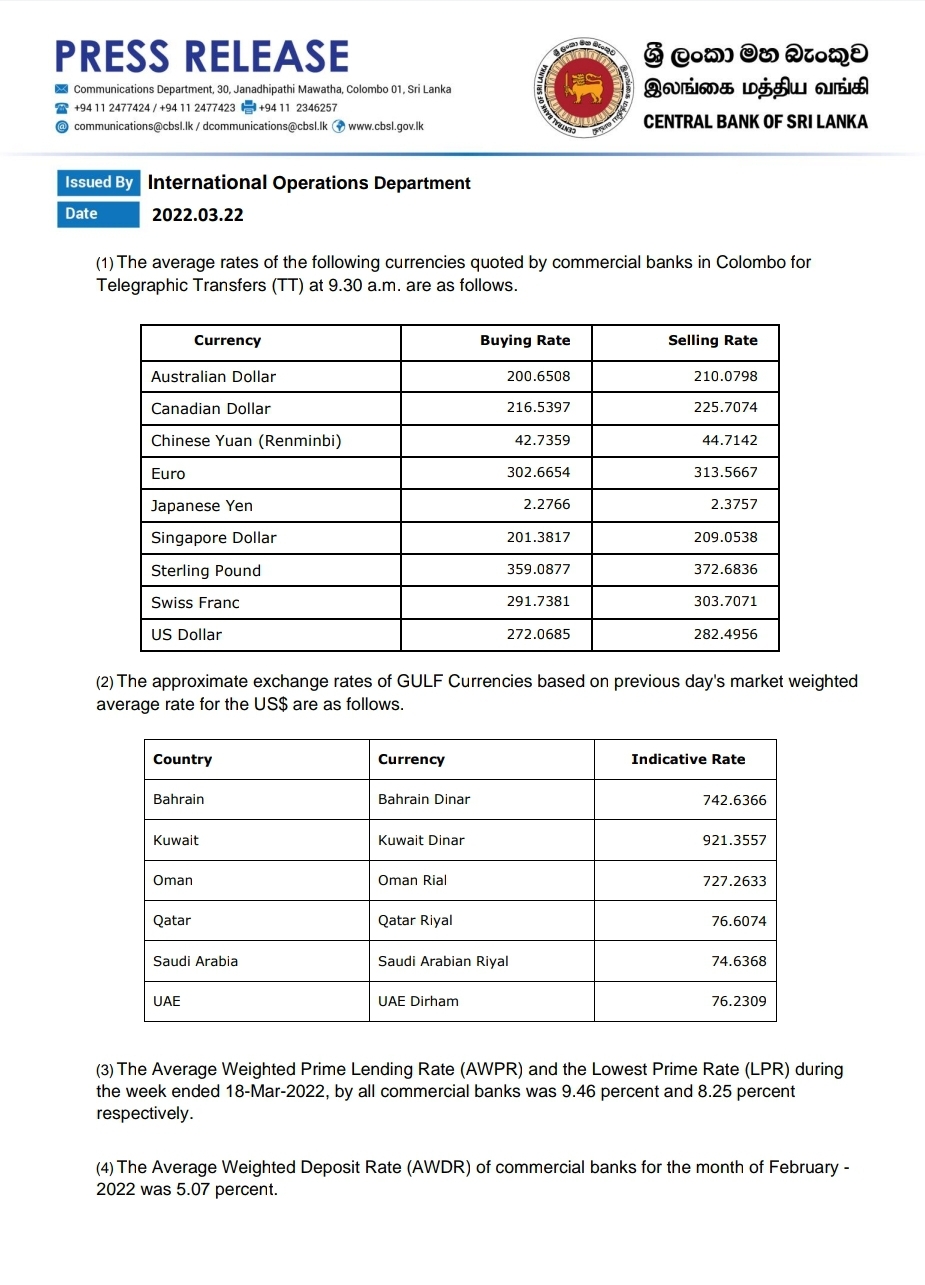
Foreign Exchange Rates in Sri Lanka; US dollar further increases

March 23rd, 2022

Courtesy NewsIn.Asia

Colombo, March 22 (newsin.asia) – The Sri Lanka Rupee has further depreciated against the US Dollar as per the official exchange rates for foreign currency issued by the Central Bank of Sri Lanka (CBSL) today. 

For similar articles, join our Whatsapp group for the latest updates. – click here

The exchange rates are as follows:

READ: 4 things you should keep in mind while investing

What Led To Sri Lanka’s Worst Economic Crisis In Recent History, What Is The Way Forward?

March 23rd, 2022

Courtesy Outlook

Sri Lanka is facing an acute economic and energy crisis triggered due to a shortage of foreign exchange. A sudden rise in prices of key commodities and fuel shortage forced tens of thousands of people to queue for hours outside petrol pumps.

What Led To Sri Lanka's Worst Economic Crisis In Recent History, What Is The Way Forward?
A Sri Lankan bus worker carries empty containers searching for fuel in Colombo, Sri Lanka AP

Two elderly men reportedly fainted on Sunday in Sri Lanka while waiting in a queue to secure fuel amid sky-rocketing prices leading to record inflation. Sri Lanka on Tuesday deployed military personnel at state-run petrol pumps to monitor and manage fuel distribution amid a shortage that led to long queues of consumers outside petrol pumps.

The island nation is facing an acute economic and energy crisis triggered due to a shortage of foreign exchange. A sudden rise in prices of key commodities and fuel shortage forced tens of thousands of people to queue for hours outside petrol pumps. People are also facing long hours of power cuts daily.

Energy minister Gamini Lokug said to reporters, We decided to deploy military personnel at petrol sheds to tackle unwanted situations where people are taking fuel in cans to do business. They will ensure that fuel is being distributed fairly amongst the people.”

Sri Lanka’s economy was facing “mounting challenges” with public debt reaching “unsustainable levels”. In early March, the International Monetary Fund (IMF) called for urgent reforms in the island nation’s economy as it is facing the worst economic crisis. Sri Lanka is currently reeling under a severe foreign exchange crisis with falling reserves and the government is unable to foot the bill for essential imports.

Why is Sri Lanka facing an increasing economic crisis?

Related Stories

Sri Lanka Deploys Soldiers At Petrol Pumps As Country Faces Worst Financial Crisis

Indian Economy Better Placed To Deal With Any Challenge, Says RBI Governor

Russian Economy Plummets As Brands Withdraw Operations

Sri Lanka has been hit hard by the Covid-19 pandemic. On the eve of the pandemic, the country was highly vulnerable to external shocks owing to inadequate external buffers and high risks to public debt sustainability, exacerbated by the Easter Sunday terrorist attacks in 2019 and major policy changes including large tax cuts at late 2019,” the IMF said in a release after global lender’s executive board’s consultative meeting held on February 25, early this year.

The acute shortage of US dollars in the country has pushed up the price of basic food items including milk, that are essential for regular meals and food businesses. The country is facing a double whammy of increasing prices and high external debt.

In September 2020, Sri Lankan President Gotabaya Rajapaksa announced an economic emergency. It allowed the government to take control of the supply of basic food items and set prices to control rising inflation, which spiked to 14.2% in January 2021.

According to economists, Sri Lanka’s debt spiral was already on an unsustainable path even before the pandemic dried up the tourism funds.

In an interview with CNBC,  Dushni Weerakoon, executive director at the Institute of Policy Studies of Sri Lanka said that successive Sri Lankan governments have been issuing sovereign bonds since 2007 without any plan of how to repay the loans. Further, reserves were built by borrowing foreign funds rather than a high earning through export services. This only exacerbated the foreign debts of the country.

The report further states that the Sri Lankan government spent the foreign currency on repaying the debt and the central bank has been running down foreign exchange reserves to prop up the Sri Lankan rupee. As a result, there is not much foreign currency left to repay the debt, causing inflation to rise to double digits.

Along with that, with the pandemic, the tourism sector completely dried up in an already weakening economy. This caused a slash in government revenue. The tax cuts in 2019 made the situation worse pushing the economy to further worsen.

Sri Lanka’s public debt is projected to have risen from 94 per cent in 2019 to 119 per cent of GDP in 2021.

What are economists and experts saying?

According to a report, the country’s official reserves fell by $779 million to $2.36 billion in January. In December 2021, it was at $3.1 billion.

Despite the ongoing economic recovery, directors noted that the country faces mounting challenges, including public debt that has risen to unsustainable levels, low international reserves, and persistently large financing needs in the coming years, the release said.

The IMF has also called for urgent reforms to the island’s economy. Analysts say that the government’s next big challenge is to repay the $1 billion bonds due in July.

Directors emphasised the need for an ambitious fiscal consolidation that is based on high-quality revenue measures. Noting Sri Lanka’s low tax-to-GDP ratio, they saw scope for raising income tax and VAT rates and minimising exemptions, complemented with revenue administration reform.

The bleak picture of the local economy has come in at a time when the government here is coming under increased pressure to seek an IMF bailout as the island’s foreign reserves have hit a critical low. Analysts said the country needs to either restructure the debt or go to the International Monetary Fund for a relief package.

However, the government has steadfastly refused to resort to the IMF even in the backdrop of the ongoing energy and power crisis and shortages of almost all essentials and medicine. Instead, it has approached India and China for financial aid.

India announced a $1 billion line of credit to Sri Lanka as part of its financial assistance to help the island nation deal with its economic crisis. After an agreement to extend the line of credit was inked, Ministry of External Affairs (MEA) spokesperson Arindam Bagchi said India has always stood with the people of Sri Lanka and will continue to extend all possible support to the country.

Protests to oust President

Mass protests have been roiling the country as it faces one of the worst economic crises. Anti-government protests have demanded the resignation of  President Gotabaya Rajapaksa over economic woes.

Demonstrators accused the government of mismanaging the economy, making the public face the brunt of fuel shortage along with the shortages of cooking gas, milk powder and medicine.

(with agency inputs)

Six Sri Lankan Tamil Refugees Land in TN to Escape Food Inflation, Unemployment

March 23rd, 2022

Courtesy Wire

As the foreign exchange crisis goes from bad to worse in India’s southern neighbour, an exodus of refugees into India seems more and more likely in the coming weeks.

Six Sri Lankan Tamil Refugees Land in TN to Escape Food Inflation, Unemployment

New Delhi: Six members from two ethnic Tamil families in Sri Lanka, including a four-month-old child, were found to have snuck into India in the wee hours of the morning of Tuesday, March 22, the Hindu reported.

The families were fleeing the rapidly rising inflation and unemployment in the country precipitated by the worsening economic crisis and are reportedly the first of thousands of people who are expected to cross over into India in the coming weeks.

According to a senior official of the Indian coast guard who questioned the families, they left Sri Lanka at around 10 pm on Monday night and reached Arichalmunai near Dhanushkodi in Tamil Nadu’s Rameshwaram district early in the morning. There, the boatman, who they had paid Rs 10,000 per adult for the trip, falsely told them that someone would pick them up.

Thereafter, they were spotted by a Coast Guard patrol and taken into custody.

What’s more, 10 other individuals in a different party arrived in India late Tuesday night, although their identities are yet to be confirmed.

Gajendran (24) told reporters that we has a casual worker in Jaffna and that he had recently lost his job. The prices of basic goods have touched a new high. I don’t have any money. I have some relatives in Rameswaram. Hence, I decided to come here,” the newspaper quoted him as saying.

His wife, Mary Clarin (23), said that all the members of the party, including her four-month-old son Nijath, last ate food at noon on Monday and had been waiting for a boat to take them to India from 4 pm that day. 

Another member of the group, Tiori Anistan (28), said she had two children, Moses (6) and Esther (9), and that she couldn’t leave them so she decided to come to India where she has some relatives.

After being rescued by a Coast Guard hovercraft, the group was taken to the Mandapam hover port where they were questioned and provided food. Thereafter, the were handed over to the police, who claim that they are all currently at the Mandapam refugee camp near Rameshwaram.

Sri Lanka has been facing a deepening economic crisis for years now and in August last year, had declared a food emergency, where the government was allowed to seize food stocks so essential items could be sold at government prices and arrest individuals hoarding supplies.

Then in September, Lankan foreign minister Basil Rajapaksha had called the country’s foreign exchange crisis dangerous” and had declared a state emergency. Luxury goods were banned and the government began asking non-resident Lankans to send funds back to the country to tide over the crisis. 

India, on March 17, extended a $1 billion line of credit to its neighbour.

Only the beginning of the exodus

report by the Indian Express noted that a second group of ten Sri Lankan nationals had set off from the Mannar region and, due to some technical snag with the fibre boat they were travelling in, only arrived at Rameshwaram around 9 pm on Tuesday.

What’s more, these two groups are expected to be only the first of many Lankan nationals who will attempt to flee the harsh food and job shortages in the country. The Express report notes that Tamil Nadu intelligence officers expect around 2,000 refugees to land on Indian shores in the coming weeks.

The report also notes the inordinately high and rapidly rising prices of essential foodstuffs such as rice (Rs 290/kg), sugar (Rs 290/kg), milk powder (Rs 790/ 400gm) in addition to other, non-food essentials. The government recently even indefinitely postponed school exams due to a shortage of paper.

Sri Lanka: Criminalisation Of Same-sex Sexual Activity Breached Rights Of A LGBTI Activist – UN Women’s Rights Committee

March 23rd, 2022

Press Release: UN Treaty Bodies

GENEVA (23 March 2022) – Sri Lanka violated the rights of a lesbian and leading LGBTI activist who was subjected to discrimination, threats and abuses due to the country’s Penal Code that criminalises same-sex sexual activity, the UN Committee on the Elimination of Discrimination against Women (CEDAW) has found.

In its decision published today, CEDAW found that Sri Lanka has breached the rights of Rosanna Flamer-Caldera, the founder and Executive Director of Equal Ground, an organisation defending the rights of the lesbian, gay, bisexual, transgender and intersex community in Sri Lanka.

Flamer-Caldera has been supporting lesbian and bisexual women in defending their rights after discovering in 1997 that the country’s Penal Code, which criminalises same-sex sexual activity, had been amended to include also sexual conduct between women. Since then, Flamer-Caldera has suffered high-profile attacks on her character, and she and her organisation have been subjected to discrimination, harassment, stigmatization and threats of violence by State officials and members of the public, including the press and social media.

In 2012 and 2013, the Women and Children’s Bureau of the Sri Lanka Police used Flamer-Caldera’s photo and her position with Equal Ground in presentations to assert that the rise of child abuse was mainly due to the growing homosexual culture”. They claimed that she and her organisation were responsible for spreading” homosexuality, implying that they were also responsible for spreading” paedophilia.

Despite facing harassment and stigmatization, Flamer-Caldera did not complain to the police as she was worried she would be arrested. As a result of the amended Penal Code, she has been under constant risk of arrest, detention and investigation of her private life and has had to modify her behaviour.

Flamer-Caldera brought her case to the Committee and claimed that the criminalisation of female same-sex sexual activity and the concomitant potential for arrest and prosecution amount to discrimination on the grounds of gender and sexual orientation, violating her right to non-discrimination.

Ms. Flamer-Caldera has been frequently threatened and harassed by the police, the media and the public, but she has been unable to report these abuses out of fear of being arrested,” said Committee member Hiroko Akizuki.

The criminalisation of same-sex sexual activity has meant that the discrimination, violence and harassment on the lesbian, gay, bisexual, transgender and intersex community in Sri Lanka will continue with impunity,” she added.

CEDAW found that the Sri Lankan authorities have subjected Flamer-Caldera to gender-based discrimination and violence.

It found that the Sri Lankan authorities had not taken any legal or other measures to respect and protect Flamer-Caldera’s right to a life free from gender-based violence or to eliminate the prejudices to which she has been exposed as a woman, lesbian and activist.

It also found that the authorities have breached her right to access to justice to complain of the abuses and her right to non-discrimination concerning her family relations.

The Committee urged Sri Lanka to decriminalise same-sex sexual conduct. It also requested that the State take immediate and effective action to stop the threats, harassment and abuse, which Flamer-Caldera has been subjected to, and to take criminal procedures to hold those responsible to account.

Inflation in Bangladesh better than neighbours’

March 23rd, 2022

Courtesy The Daily Star

Inflation in Bangladesh is at a better level than that in nearby countries like India, Pakistan and Sri Lanka alongside Southeast Asian countries, said Finance Minister AHM Mustafa Kamal yesterday.

“You can compare with nearby countries, as well as more Southeast Asian countries, and see what our inflation is and what theirs is,” he told a press briefing following a meeting of the cabinet committee on government purchase.

His comment comes against the backdrop of a recent observation of the Centre for Policy Dialogue (CPD) about price hikes of commodities in Bangladesh being substantially higher than that in other countries.

“We do not have any problem in our monitoring system (to control the market). Problems are in the CPD’s system. We do not have any problems here,” said the minister.

Since its inception the CPD has been opposing government policies, he said.

“When our inflation rate was around 5 per cent or below 6 per cent, they told us to devalue our currencies. I had been in altercations with them for a long time. I did not make a mistake,” he said.

“Today you can ask them, if we had devalued the currency what would have happened and where would you (people) have been now? We didn’t do it,” said Kamal.

Only the CPD understands all economics and no one else does — these types of concepts are incorrect, he said.

“The CPD does understand and they have numerous contributions to the economy of this country. I acknowledge their contributions. I have a good relationship with them. I have no problem (personally),” he said.

“What I’m thinking isn’t always correct, and what they’re thinking isn’t always correct. We must make trade-offs,” he said.

However, the minister said the recent Russia-Ukraine war could end up affecting gas prices.

“What would you (journalists) have done if you were the finance minister? Did we know that the Russia-Ukraine war would happen?” he asked.

There are both uncertainties and certainties involving the economy, he said.

“When uncertainty arises, we call it ‘challenge areas’. When it comes, we have to find the way out,” he said.

Regarding the upcoming national budget, he said, “Nobody will be the loser…All will benefit, particularly businesses…We will make every effort to help them run their business smoothly.”

“Prime Minister Sheikh Hasina also believes it and suggests we do so,” he said.

“We will give assistance for all small, large businesses through macroeconomic, monetary and fiscal policies so that they can be empowered more,” he said.

“We will give more benefits to all those businesses which will generate more employment. It will be a win-win situation,” he added. 

Sri Lanka’s Financial Meltdown Could Be End Of The Road For Rajapaksa Family

March 23rd, 2022

Seema Guha Courtesy Outlook

The Russia-Ukraine war which has led to a steep hike in oil prices has further amplified Sri Lanka’s economic problems. The crisis resulting from Sri Lanka running out of foreign reserves has led to shortages of almost everything.

Sri Lanka’s Financial Meltdown Could Be End Of The Road For Rajapaksa Family

Is this the end of the road for President Gotabaya Rajapaksa and the powerful Rajapaksa brothers that had dominated Sri Lankan politics for decades? Going by the anger in the streets triggered by financial mismanagement and the near melt down of the island’s economy, the Rajapaksa family firm is running  out of steam. Protest marches are now a daily occurrence. “Go back Gota” slogans and placards are held out by the same people who not long ago hailed the Rajapaksas as heroes.

The Russia-Ukraine war which has led to a steep hike in oil prices has further amplified Sri Lanka’s economic problems. The crisis resulting from Sri Lanka running out of foreign reserves has led to shortages of almost everything- from petroleum and cooking gas, to medicines, essential food staples, vegetables, fruits and all other items. Colombo, the thriving capital of the island state, is now a place of empty shelves and serpentine queues. Supermarket shelves are empty, there are long queues for bread.

The army had to be deployed to oversee the situation in petrol stations and kerosene distribution centres. Troops were called in after three elderly citizens dropped dead during the long wait in the queues.

Related Stories

What Led To Sri Lanka’s Worst Economic Crisis In Recent History, What Is The Way Forward?

Sri Lanka Deploys Soldiers At Petrol Pumps As Country Faces Worst Financial Crisis

People spend hours to collect a few litres of petrol, short-tempered drivers waiting in line are getting into scuffles with other equally tired and angry car owners. School exams are all cancelled indefinitely as the country has run out of paper. It is a nightmare for citizens. Power cuts are as long as 7.5hours daily, despite assurances from the country’s leadership that power outages would come to a halt from March 5. Summer in the island is hot and humid.   

“Most of us in Sri Lanka are plagued by uncertainty and fear. Our list of uncertainties keeps rising. We will we run out of milk powder, rice or vegetables. Will there be electricity and fuel? Will the gas cooker explode because the gas supplier has fiddled with the composition of gas? Will there be water? Will there be enough supplies of medicines…..the list goes on and on,’’ Samantha Mendes (name changed because of corporate rules), a senior professional, told Outlook.

This is her description of what she saw a few days back in a posh colony in Colombo.

“I was at HSBC Bank down Flower Road when I noticed a line of gas cylinders. Did a double take and realized that the line of empty cylinders was as far as the eye could see. Apparently, people came in as early as 6 am and they were still waiting at 1 pm. This was not a one-off event but a daily routine. I talked to a young lawyer who told me that he chased a gas delivery lorry for several kilometers and finally managed to get one.’’  

She blames this on the ‘lack of strategic thinking by the top leadership of the country.’

Sri Lanka’s economy depends heavily on tourism, but the pandemic had stopped all tourist inflows. The 2019 Eastern bombings in Colombo squeezed out western tourists. The government  believes that nearly $14 billion was lost due to non- arrival of tourists over the last two years. The economy is estimated to have contracted by 1.5 % in July, September 2021, according to the central bank.

While the government cannot be blamed for the lack of visitors, President Gotabaya’s sudden announcement on last April  of a complete ban on chemical fertislisers to make Sri Lanka the first in the world to go completely organic, wreaked havoc on the economy. Agriculture is the mainstay of nearly 70 per cent of the people, and the overnight change without careful planning backfired. Gotabaya said he took the decision because of health considerations, but also spoke of the need to cut imports due to the economic crisis. At that time, W.A. Wijewardena, a former central bank deputy governor, was reported in the local press as saying that the President’s overnight organic leap was a dream with unimaginable social, political and economic costs”. The isla­nd’s US $1.5 billion tea industry that employs a million people was also badly affected  by the fertiliser ban. Got­abaya finally had to withdraw the ban.

Gotabaya had refused to go to the IMF to bail him out of the economic mess. That was recommended by experts over three months back. Now, reluctantly, he has done so. Earlier, he appealed to India, China and Bangladesh for help.

India gave Colombo a one-billion-dollar credit line to help ease foreign exchange shortage and provide for food and medicines during finance minister Basil Rajapaksa’s recent visit. In January India had extended a $400 million currency swap and also offered $500 million credit for purchase of petroleum products.

China which had invested heavily in Sri Lanka had also extended credit and allowed a currency swap. Colombo is now approaching China for a fresh $2.5 billion to firm up its dwindling finances. Talks are on but the Chinese ambassador in Colombo had said that the loan would be in “competitive terms” the envoy was quoted by the local press as saying. Many in Sri Lanka are sceptical of Chinese terms, considering that in 2017 it had to lease the Hambantota port for 99 years, to China to convert it into equity as it failed to repay the huge loan.  Despite China’s large footprints across the island state, there is growing public mistrust over Chinese credit. However a desperate government has little option at the moment and will take whatever conditions China offers. 

Is an IPKF Invasion Imminent–Re-charting US Strategy After the War? 

March 22nd, 2022

By ‘The Socialist Vanguard Party for the Restoration of a Sovereign Unitary State of Sri Lanka’

Having inked the SOFA document permitting the American military to intervene in Sri Lanka with impunity, is an invasion by India, a US military ally (QUAD) in the region, imminent?

Could this be one reason why India did not vote with the US on the Ukrainian issue?   

Sri Lanka is fighting for her life; she is in the political ICU struggling with multiple complications stemming from treachery, corruption and chicanery.

There are rampant shortages of essential items all over. Shop shelves are empty. There is no money to import fuel or generate energy. Food prices are soaring. Endless queues everywhere. People are struggling to get necessities that would ensure food on the table. The economy is crumbling. The country is on the threshold of bankruptcy and collapse.

Nandasena is in denial. The crisis is deliberate and self-inflicted. The people say that the responsible dastards are Nandasena and Basil and that they must be held accountable.

The people demand that the below-average officer – who bolted from the Army the moment he completed the minimum time required to qualify for a pension, at a time when the country desperately required his services while his peers were selflessly putting their lives on line – must get out or else face the ignominy of impeachment.

The people also demand that ‘Kakka’ Basil, who swore eternal disloyalty to Sri Lanka, be arrested immediately and indicted for treachery and abuse of power.

Analysts say that Nandasena and Basil are playing their ordained roles, fulfilling the plans of the global super-villain, as did Kumaranatunge, Wickramasinghe, Sirisena and Premadasa, before them.

Following the unexpected defeat of the American mercenaries in Sri Lanka’s 30-year war, the Americans were compelled to rechart a new strategy for Sri Lanka.

The new strategy of the super-villain appears to be to dismantle and dismember the Nation State of Sri Lanka.

The government and the opposition forces influenced heavily by the largesse of this evil force, are conniving with the super-villain; his is prominently identified in the ranks of the IMF to whom Basil has turned.

Was it a surprise that many of the opposition in parliament concurred the sentiments of the Government when they said that the IMF is the panacea for Sri Lanka’s ills?

Some may rush to argue that the opposition has political objectives different to that of the government.

Do they seriously have such differences?

Readers may recall that it was the present opposition (then in Government) which engaged in running down the economy, selling off strategic assets, engaging in mega-corrupt practises, privatising State land and implementing the American MCC plan that would balkanise the country.

The present government was elected to power, on the promise that it would reverse all this. What happened? They reneged on their promises and instead accelerated the process that Sirisena and Wickramasinghe had begun.

It is pertinent that the present opposition has not taken up cudgels to reverse unequivocally, for example, the sell-offs at Kerawalapitiya, the oil tanks in Trincomalee, the West terminal in the Colombo harbour, the projects in Sampur, Mannar and Pooneryn.

It is relevant that the present opposition, has not made any pledges to the people that it would not give Land and Police powers to the provinces.

Has the opposition pledged to cancel, as a matter of priority, the ACSA and SOFA Agreements, which threaten Sri Lanka’s sovereignty and security?

The Mother of all US defence agreements with Sri Lanka was first signed by Nandasena in 2007; he did so secretly when he signed the first ACSA Agreement, whilst being an American citizen with undivided loyalty to the flag of America.

On 01 Jul 20 Cabinet spokesman Bandula Gunawardena, as reported by the ‘Asia Tribunal’, briefed the press that the Government had signed the much-delayed SOFA Agreement, initiated by Sirisena and Wickramasinghe. http://www.asiantribune.com/node/94361

As per the ‘Asia Tribunal’ report ‘this would allow the American forces to tour the country to conduct combined security operations with impunity for any criminal action on their part. In short, the American forces have been given a carte blanche to kill and maim Sri Lankans as they please.

Given the despicable record of the American military, this is cause for grave concern. 

Many analysts say that the objective of the government and the opposition are the same; viz to breakdown the structures of the Sri Lankan State, playing roles appropriate to their political status quo.  

The Americans are moving these puppets, cleverly; they control the blacks and the whites on the political chess board that is Sri Lanka; either way, they win because whatever political faction is in power, that faction would do the bidding of the Americans to ensure Sri Lanka is in lockstep with the US strategy, that was adopted following the defeat of their mercenary terrorists.  

The opposition will only play the part, scripted for them by the Americans, that includes the sham protests.

What is the core objective of America’s new strategy for Sri Lanka that has been charted after the war? Many analysts opine that it could be described as the ‘Breaking down the structures of the Sri Lankan State, namely the Legislature, the Executive and the Judiciary.

The Government and the Opposition have been described as two sides of an American coin, developed to fall heads or tails, alternatively, as decided by the Americans. Many people are of the view that the Americans have total control of Sri Lanka’s legislature as they do of the Executive.  

And what of the legal system which includes the bench, the official bar, the unofficial bar, the police?

There have been several instances where the bench has been ridiculed, intimidated, power usurped, the rule of Law transgressed, the endless use of nolle prosequi -a grudgingly used procedure – and an unofficial Bar found wanting in their obligations to the country, resulting in the foundation of the Legal structure of the country swaying perilously.  

And the Executive, in the words of many, has proved himself to be an American nincompoop with tunnel vision better equipped to be a parade-square sergeant capable only of carrying out orders and keeping the parade square clean.   

When the structures of the State – the Legislature, the Judiciary and the Executive – have been sufficiently weakened, the sovereign State of Sri Lanka would be ready to disintegrate; it would be the beginning of the end.

The country has been reduced to a failed State.

A failed State insinuates anarchy. In that backdrop, the country is easy prey for its predators.

All what is left for the Americans to do, to dismantle completely the once proud sovereign State of Sri Lanka, is to change the Constitution, empower the provinces with Police powers and the power to sell Government Land and resources to private parties, including foreigners

Would that be tough task to achieve given this political climate?

To achieve this, the Government needs only to allow the political temperature to rise further by continuing to be insensitive to public opinion, heaping further burdens on the people to a point of utter frustration and violence.

With NED money floating around the country, the opposition would oblige their paymasters

The opposition would raise the ante to a pitch reminiscent of the colour revolutions of the last decade, provoking and compelling the Government to respond in a manner that would endanger life.

When life has been endangered and mayhem follows the Americans, fortified by SOFA, will ‘intervene’ on ‘humanitarian’ grounds’ very likely with their QUAD military partner.

The Indians, biding their time for their entry cue, will invade the island.

To coordinate the action that needs to be taken by India including –  a new Constitution for the Island, Land and Police powers to the Provinces, the right of Provinces to cede from the Nation State of Sri Lanka, the right of any of the provinces to annex itself to India, sharing Sri Lanka’s Palk bay with Indian fishermen, making Adam’s bridge a National Heritage of India  – would require a National Government that would record for the India’s and America’s benefit – the fake unanimity of Sri Lanka in signing the contentious agreements.

Nandasena has a 2/3rd majority in parliament; he therefore does not require a National Government to implement contentious agreements. Why then a National Government?

The majority of the people voted for a government that would undo what the Sirisena-Wickramasinghe government did; the Nandasena government reneged on their promises and the people’s sovereignty was violated.

The ‘others’ in parliament are those whose policies were democratically rejected outright by the majority of the people. To take them now into a ‘National Government’ is to violate the sovereign franchise of the people and violate democracy by sneakily attempting to bring the ‘rejected’ into power, behind the backs of the people.

If there is a National Government it would be a double whammy for democracy.

A National Government suggests that it would be working on an agenda of its own for which the people have not given their consent; it would be a virtual coup and would therefore be illegal.

A National Government also suggests that Nandasena has given an indication that he is unable to provide leadership to the country; it suggests that he is relinquishing his presidential powers in favour of a multiheaded National leadership. 

Yes, Nandasena must go; he cannot be allowed to mangle democracy; he must resign or else be impeached.

To overcome the economic problems, the people demand that China’s assistance be sought; ask them to make a bid for development projects in Sampur, Pooneryn, Gulf of Mannar and proposals to develop projects in the Palk Bay.

Whatever provocation, people must desist from violence against the State; it only weakens the State structures further which it what the enemies of Sri Lanka want. Even agitating in international forums weakens the State.

Instead, agitate for the enforcement of the rule of law; for a start agitate for the immediate arrest and trial of Basil, Sirisena and Wickramasinghe. Agitate to pass legislation to make offshore banking illegal and to make it a Capital offence.

The entire cricket world should celebrate the 25th anniversary  of the publication of the ‘Player Referral’ concept in the ‘Australian’ newspaper ( March 25, 1997) which led to the formulation of the DRS

March 22nd, 2022

Senaka Weeraratna

Shashi Tharoor, the celebrated Indian writer, and author, recently expressed his views on the impact that the Decision Review System (DRS) has had on the modern game, and he stated unequivocally that it has been one of cricket’s best innovations. Tharoor further said that international cricket should never be without DRS in the future, given how many errors technology prevents.

DRS is such a major innovation. I never want to see international cricket without DRS ever again. It is so indispensable and eliminates so many bad decisions, and it creates an additional form of excitement for the viewer. It adds an extra element of tension to the plot and it is a very welcome addition as far as I’m concerned,” Tharoor said.

……………………………………

‘The second highest circulating Sinhala newspaper in Sri Lanka the ‘ Silumina’ has published an  article on March 19, 2022 written by Bandula Jayamanne, the Deputy Sports Editor of ‘Silumina’, saying that it is not only those who contribute within the boundary to cricket that are important but also those who contribute to cricket from outside the boundary. 

The headline of the article is that though DRS had its birth in Australia, the father of DRS is a Sri Lankan. The 25th anniversary of my publication in the prestigious national newspaper ‘Australian’ on March 25, 1997, as a 

Letter to the Editor under the title ‘ The Third Umpire must perform  Role of an Appeal Judge’ falls on March 25, 2022. 

The concept of ‘ Player Referral’ which is the lynchpin of the DRS was first aired on that day. It was given birth on March 25, 1997, in Australia, as I was then living in Darwin, Australia. The rest of the cricket world embraced this idea shortly afterward with publications in ‘ London Times’, The Melbourne ‘ Sunday Age’,  Pakistan ‘ Dawn’, Cricketer’ Magazine published in London by Richard Hutton, and almost all Sri Lankan newspapers e.g. Sunday Times, Sunday Island, Daily News, etc.

 The entire cricket world should celebrate this anniversary. My article and my brainchild ‘Player Referral’ changed the way the game of cricket is being played. The Silumina article questions whether I am denied due credit by the cricket fraternity because I am not white.

Senaka Weeraratna


The UNCELEBRATED ARTICLE THAT LED TO THE DECISION REVIEW SYSTEM (DRS) IN CRICKET 

Senaka Weeraratna (Sri Lanka) Father of the ICC’s DRS

The debate on DRS in Cricket explained

www.cricketudrs.com

23rd  March – Ahmadiyya Founder’s Day

March 22nd, 2022

By A. Abdul Aziz

On February 13th, 1835, in the small Indian village of Qadian, Punjab, India, a man named Hazrat Mirza Ghulam Ahmadwas born. He belonged to a well-known and noble family.

All religions contain prophecies that foretell the advent of a special individual, who will come as a reformer in the latter days. In Islam, Muslims await a promised Mahdi and Messiah. The advent of the Promised Messiahwas prophesized by the Prophet of Islam Muhammad (PBUH) himself. According to a tradition, the Holy Prophet(PBUH) was sitting among his companions, two verses from Holy Qur’an (Surah al Jum’uah) were revealed, it reads:

He it is Who has raised among the unlettered people a Messenger from among themselves who recites unto them His Signs, and purifies them, and teaches them the Book and Wisdom though before that they were in manifest error; And He will raise him among others of them who have not yet joined them. He is the Mighty, the Wise.” (62: Verse 3.4).

One of the companions of the Holy Prophet(PBUH) questioned to who this verse relates to, and the Prophet of Islam(PBUH) replied while putting his hand on Salman– A Companion, (a Persian man),

If faith were to go up to the Pleiades, a man from among these would surely find it.” (Bukhari).

Hazrat Mirza Ghulam Ahmad – Founder of the Ahmadiyya Muslim Community in Islam) is that Promised Reformer of the later age.

Starting from his childhood, the Promised Messiah’s unusual interest in religion was noticed by many, including his father, who nicknamed him ’Maseetar’ meaning ‘one who spends most of his time in a mosque observing prayer’.

At an early age, he began to receive revelations from God, as well as visions and true dreams. In the years 1864 or 1865, the Promised Messiah, peace be on him, had a vision where he saw the Holy Prophet of Islam (PBUH). This verified further, that Hazrat Mirza Ghulam Ahmad, peace be on him, had a strong connection with the Holy Prophet of Islam (PBUH). Hazrat Mirza Ghulam Ahmad, peace be on him, was shown that he would have a fruitful spiritual future.

The Promised Messiah’s father wanted for his son to pursue government service, which would allow him a handsome means to support his family financially. However, Hazrat Mirza Ghulam Ahmad, peace be on him, felt his time pursuing his worldly occupation was like a prison sentence” as he was deeply attached to spirituality and enhancing his religious knowledge. Therefore, during his spare time, he continued to study the Holy Qur’an, and always strove to serve humanity, often helping those who were in need. He also spent his time debating with Christian missionaries who lived in his neighborhood, defending his beloved faith, Islam.

The June of 1876 was a tragic time for the Promised Messiah, peace be on him, as his father passed away. Earlier, on the same day, Hazrat Mirza Ghulam Ahmad, peace be on him, had received a revelation from God revealing about his father’s death. The Promised Messiah, peace be on him, was quite saddened by the death, and was worried about the troubles his family would now face, with limited financial means.  However, since Hazrat Mirza Ghulam Ahmad, peace be on him, was an individual loved by God, Allah Almighty sent another revelation,

Is Allah not sufficient for his servant?” (Holy Qur’an: 39:37).

This assurance filled the Promised Messiah, peace be on him, with contentment that Allah Almighty would always provide for him. In 1868 or 1869, the Promised Messiah, peace be on him, received the revelation,

Thy God is well pleased with what thou hast done. He will bless thee greatly, so much so that Kings shall seek blessing from your garments.”

This seemed a strange revelation at the time–why would kings seek blessings from the clothes of someone hardly known outside this small remote village in India? But, history bears witness, that this revelation became reality, as the legacy of the Promised Messiah, peace be on him, unfolded and reached people from all over the world, from all walks of life, rich and poor, till today.

The flow of revelations and visions continued, until in 1882 he received the revelation which made it clear that he, Mirza Ghulam Ahmad, peace be on him, was to be the appointed one, the one commissioned by God to serve His cause; he was the Promised Messiah, peace be on him.

In January of 1886, he received a prophecy that foretold of a handsome and spiritually purified son, who would be born to the Promised Messiah, peace be on him. This prophecy was followed by one other. The second prophecy specified the context within which the Promised Messiah, peace be on him, would be granted his promised son. Both of these prophecies were indeed fulfilled on the 12th of January, 1889 when God blessed the Promised Messiah, peace be on him, with a son who was named Hazrat Mirza Bashiruddin Mahmud Ahmad. This Promised Son also became the second Khalifa (Caliph) of the Ahmadiyya Muslim Community in Islam.

In 1889 Hazrat Mirza Ghulam Ahmad, peace be on him, received the Divine revelation:

When thou hast determined, put thine trust in Allah. And build the Ark under Our eyes, as commanded by our revelation. Verily, those who swear allegiance to thee indeed swear allegiance to Allah. The hand of Allah is over their hand.”

After this revelation Hazrat Mirza Ghulam Ahmad, peace be on him, published a public announcement that read:

‘I have been ordained to announce that those who are seekers after truth should swear allegiance to me so that they may be enabled to find a way to the true faith, true purity and the love of God.’

The call for Initiation or Bai’at” was answered immediately by those who had already recognized that Hazrat Mirza Ghulam Ahmad, peace be on him, was indeed the Promised Messiah, and was appointed by God Almighty himself.  The first Initiation ceremony took place in Ludhiana, India, on 23rd March 1889, laying the foundation for the Ahmadiyya Muslim Community. Hazrat Maulvi Nurudin(r.a.) became the first person to be initiated at his hand.

Saturday 23rd March 1889 was the momentous day when Hazrat Mirza Ghulam Ahmad, the Promised Messiah, peace be on him,, accepted the hands of forty faithful servants in allegiance to the Ten Conditions of Bai’at (initiation) and founded the community which he called ‘The Ahmadiyya Muslim Community’. The Promised Messiah, peace be on him, took this oath of allegiance at the house of a spiritual preceptor Hazrat Sufi Ahmad Jan in the city of Ludhiana (Punjab, India). As stated, Hazrat Hakim Maulvi Noor al-Din(r.a.) was the first person to have the honor of taking the first Bai’at. This was a revolutionary yet a very modest beginning to a new chapter in the history of Islam.

In 1891 in Qadian, Hazrat Mirza Ghulam Ahmad, peace be on him, received repeated revelations that Jesus, peace be on him, of Nazareth, in whose second advent both the Muslims and Christians believed, had died a natural death and that what was meant by his second advent was that a person should appear in the spirit of Jesus and that he himself was that person, the Promised Messiah, peace be on him.

After writing over 80 books and tens of thousands of letters, delivering hundreds of lectures, and engaging in scores of public debates, the Promised Messiah, peace be on him, passed away on May 26, 1908. Yet his legacy as the founder of Ahmadiyya Muslim Community, continues to prevail throughout the world today. He was a man, deeply in love with and treaded on the footsteps of his beloved master, Prophet of Islam Muhammad (PBUH), with every breath of his life. He was man beloved by Allah Almighty, and was vouchsafed a revelation, Kings shall seek blessing from your garments”, which rings true to this very day.

The Ahmadiyya Muslim Community believes that God sent Mirza Ghulam Ahmad to end religious wars, condemn bloodshed, and restore morality, justice, and peace. He reformed Muslims of fanatical beliefs and practices by vigorously championing Islam’s true teachings. He also recognized the noble teachings of the great religious founders and saints, including Zoroaster, Abraham, Moses, Jesus, Krishna, Buddha, Confucius, Lao Tzu, and Guru Nanak, and explained how their original teachings converge into true Islam.

Today, the Ahmadiyya Muslim Community is the world’s largest Islamic community under one Divinely appointed leader (Fifth Khalifa), His Holiness Hazrat Mirza Masroor Ahmad (may Allah be his Helper) (born 1950). The Ahmadiyya Muslim Community spans over 200 nations with membership exceeding tens of millions.

The Ahmadiyya Muslim Community is the leading Islamic organization to categorically reject terrorism. Over a century ago, Mirza Ghulam Ahmad, peace be on him emphatically declared that the Jihad by sword” has no place in Islam. He instead taught Muslims to follow the Qur’an and Prophet Muhammad’s (PBUH) example and defend Islam with a bloodless, intellectual Jihad of the pen” Accordingly, as stated, Mirza Ghulam Ahmad penned over 80 books and tens of thousands of letters, delivered hundreds of lectures, and engaged in scores of public debates. The Ahmadiyya Muslim Community continues to use education to peacefully reform Muslims and revive Islam worldwide.

Mirza Ghulam Ahmad reminded Muslims of God’s promise to safeguard Islam through Khilafat (the spiritual institution of successorship to prophethood). The Ahmadiyya Muslim Community believes that only Islamic khilafat can peacefully unite humanity. Five Khalifas have succeeded Mirza Ghulam Ahmad since his demise.

The current Khalifa Mirza Masroor Ahmad may Allah be his Helper) resides in the United Kingdom and serves as the community’s spiritual and administrative head. Under the leadership of khilafat, the Ahmadiyya Muslim Community has built thousands of mosques, hundreds of schools, and number of hospitals. It has translated the Holy Qur’an into over 70 languages including Sinhala. The Ahmadiyya Muslim Community propagates Islam’s true teachings of peace and tolerance through a 24-hour satellite television channel (MTA), the Internet (www.alislam.org), and print (Islam International Publications). It stands at the forefront of disaster relief worldwide through Humanity First, a non-profit charity.

The Ahmadiyya Muslim Community is the only Islamic organization to endorse the separation of mosque and state. Despite facing bitter faith-based persecution in numerous Muslim majority nations, the Ahmadiyya Muslim Community continues to advocate for universal human rights for all religious and other persecuted minorities. It likewise invests heavily in women’s equality, education, and empowerment programs. Its members are among the most law-abiding, educated, and engaged Muslims in the world.

හිතන ක්‍රමය වෙනස් කර ආර්ථික දුක නැති කිරීම

March 22nd, 2022

ජයන්ත හේරත් 

ඉන්දියාවේ

ජනගහනය 1.5 බිලියන් ය.

ලඟදි අපට

බිලියන් 1 ක් දුන්නේය.

ඩොලර් ය.

අපේ හිතවතාය

friend in need ය.

friend indeed ය.

ඉන්දියාව ලොකු රටකි

අපි සිතිය යුත්තේ

ඉන්දියාව අපේ කියාය.

මනෝ පුබ්බන් ගමාය  

අපේ අසල්වාසියා අපේය.

අසල්වැසියාගේ

ඉඩම්

ධනය අපේය.

අපේ යටත් විජිතයක් කියා හිතීම හොඳ නැත.

ලෝක ගෝලය

දකුණු-උතුරු

කලාම

ඉන්දියාව යටින්ය

අපි උඩින්ය.

හිතන හැටිය.

අසල්වැසියා සමග

ගහ ගෙන

වැඩක් නැත.

අසල්වැසියාට

ප්‍රේම

කල යුතුය.

JR ට වැරදුනේ

එතනය.

මට

මගේ

advisor ගේ

අවවාද

මතක් වේ.

අපි කලයුත්තේ

හිතන හැටි

වෙනස් කිරීමය.

දුක් වේදනාවන් 

සුඛ වේදනා

ප්‍රීතිය

බවට පත් කර

සතුටින්

සිටීමේ කලාව

ප්‍රගුණ කල යුතුව  ඇත.

පිරිසිදු සිතින්

කථා කරන්න 

ක්‍රියා කරන්න

සතුට 

ඔබ 

සතුය.

හැම විටම

සිනහ වන්න. 

ඩොලර් බිලියන් 1

බිලියන් 1.5 ක ජනතාවට

ලොකු බරක් නොවේය.

එක ඉන්දියන් කාරයෙක්

ඩොලර් ශත 67 බැගින් ය.

1 බෙදීම 1.5 ය.

මහා ලොකු

කජ්ජක්

නොවේය.

හූණු බිජ්ජක්

තරම් වත් නැත.

ඉන්දියාව ධනවත්ය.

එච්චර ධනවත්

කියා අපේ

තාත්තා මුත්තා

කිත්ත කිරිකිත්ත වත්

දන්නේ නැත.

දැන සිටියේත් නැත.

හිඟන්නාට

ලැජ්ජාවක් නැත.

බයක් නැත.

නැතිවන්නට දෙයක් නැත.

ඉල්ලන්නේය.

ලැබෙන්නේය.

කිරි එරෙන්නේ අඬන  විටය.

බුදු හාමුදුරුවෝ

බුදු උනේ

කිරි

නැතුවය.

උන් වහන්සේට  ‘

මවු කිරිත් නැත.

පිටි කිරිත් නැත.

බුදු උනේය.

පිටි කිරි ළඟදී මතුවූ ලෙඩකි.

අනුගාමිකයින්ට කීවේ

හිඟමනේ යන්න.

හිඟන්න

ඉල්ලන්න

කියාය.

හැමෝම කරන්නේ හිඟන වැඩෙය.

කන්නේ

ඉල්ලන්ය 

අනාගමිනි. 

අපේ මිලියන් 20

රුපියල ගානේ

දුන්නොත්

හිඟන්නා

මිලියනෙයර් ය.

බැසිල් ට

ඉල්ලන්න තිබුනේ

බිලියන් 1.5ක් ය.

එක ඉන්දියානුවෙකු dolar  1 ය

කජ්ජක් නොවේය.

MicroSoft  CEO

සත්ය නදෙල්ල

ඉන්දියාවෙන් රට පැටවූ

ඇමෙරිකන්

ඉන්දියන්ය.

පඩිය Dolar මිලියන් ගනන්ය.

Networth එක $ 387 මිලියන් ය.

Google CEO

සුන්දර පිචෛ ද

අවුරුදු විසි ගණන් වල

ඉන්දියාවෙන් රට පැටවූ

ඇමෙරිකන්

ඉන්දියන්ය.

පඩිය Dolar මිලියන් ගනන්ය.

Net worth එක

ඩොලර් 600 මිලියන් ය.

අතේ

පිච්චිය

නැතිව සිටි මිනිසුන්ය.

අපි රට පැටවිය යුත්තේ

පුහුණු ශ්‍රමිකයන්ය.

බිලියන් දහස

ට්‍රිලියන් එකය.

ඇමෙරිකාව තම ආර්ථිකය බහින කොට

එය නගා සිටුවන්නට,

ඩොලර් ට්රිලියන් ගණන් අච්චු ගසා

සල්ලි පොම්ප කරන්නේය.

ලංකාව වාගේ රටක්

එහෙම කලොත්

පුප්පන්නේ ඇමරිකාවේ තින්ක් ටැංකිමය!

හා හා එහෙම කරන්න එපාය.

ඩබල් ස්ටෑන්ඩර්ඩ්ය.

දක්ශිනන්ශික

ආර්ථික විශේෂගවයෝ 

විපකෂයේ

ඉන්නකොට සල්ලි අච්චු ගැසීම ගැන

පුප්පයි

ගොරවයි

රවයි 

විරුද්ද වෙයි

උන් බලයට ආවමත් කරන්නේ ඒකමය.

ඇමෙරිකාව

ඒ සල්ලි වලින්

දුප්පත් රටවල ඉඩම් කුණු කොල්ලෙට ගනිමින්

එම් සී සී වැනි පහසුකම් සලසන්න

හරි ආසය.

ඒ වුනාට

ලංකාව හොල්ලන්න බැරිය

මෙතනමය

අරගෙන යන්න බැරිය.

Yuan එක

Dolar

replace කලවිට

අන්තිමට දිනන්නේ

ඇමෙරිකාවට

දිගටම ට්රිලියන් ගණන් නය දෙන

චීනයය.

ඇමෙරිකානු බදු ගෙවන්නන්ට පව්ය!

ණය දෙන්නෝ දිනන්නෝ ම නොවේ ය

ණය ගන්නෝ හැමදාම පරදින්නෝ නොවේ ය.

zelensky

comedian ය

යුද්දේ කරන්නේ

හිනා වෙවීය.

jacki – chun වගේය

විටෙක අඬයි

fight කරයි

හිනා වෙයි.

විටෙක හිනාවෙයි fight කරයි අඬයි.

විටෙක දුර්වල බව පෙන්නයි fight කරයි. අඬයි.

විටෙක ශක්තිය පෙන්නයි fight කරයි

ඔක්කොගෙන්ම ආධාර ඉල්ලයි fight කරයි

ඔක්කෝම ආධාර ගනියි fight කරයි

තමන්ගේ රටවැසියන් රටින් දුවයි හිනාවෙයි fight කරයි අඬයි. fight කරයි.

Ukraine ප්‍රශ්නය NATO  ප්‍රශ්නයකට transform  කර හිනාවෙයි.

Poland ඇද ගනියි නටයි හිනාවෙයි

ඇමෙරිකාවට තුරුළු වෙයි හිනාවෙයි

අනිත් උන්ට සතයක් වත් නොදී

උන්ගේ සල්ලි වලින් ගහයි.

fight කරන හැටි උගන්නයි.

WW තුන මතක් කර ලෝකය භය කර හිනාවෙයි.

comedian ලාගේ mind-set  එක analyze කර බැලීම වටීය.

මොනවා කලත්

යුක්‍රේනය

ඔතනමය

රුස්යාව

ලඟින්

හොල්ලන්න වත් බැරිය.

අනන්ත ආත්මයක් ඔතනමය.

Biden

ඩොලර් බිලියන් 1 ක්

අවි ආයුද දුන්නේය.

Trump හිටියා නම්

Russia – Ukraine

යුද්දයක් නැත.

ජාත්‍යන්තර කාන්තා දින සැමරුමක් හැටන්-අප්කට් හි දී.

March 22nd, 2022

-ප්‍රොටෙක්ට් සංගමය-

ජාත්‍යන්තර කාන්තා දිනයට සමගාමීව ප්‍රොටෙක්ට් සංගමය සහ ‘හා(ර්)ට් සංවිධානය එක්ව සංවිධානය කරන ලද කාන්තා දින සැමරුම් වැඩසටහනක් සහ පාගමනක් පසුගිය දා (20 දා) හැටන් අප්කට් ප්‍රදේශයේ දී පැවැත්විණි. පාගමන අප්කට්, බාග්‍රෝ ඇසෙම්බ්ලි ඔෆ් ගෝඩ් දේවස්ථානය අසලින් ආරම්භ වූ අතර එය හැටන් මස්කෙලිය මාර්ගය ඔස්සේ දිනේෂ් උත්සව ශාලාව වෙත පැමිණියේය. පාගමන සඳහා හාරසියයක පමණ පිරිසක් සහභාගි වී සිටියහ.

මෙම පාගමනට සහ කාන්තා දින සැමරුම් වැඩසටහන සඳහා ගෘහස්ථ ශ්‍රමිකයන්, කොළඹ සහ තදාසන්න ප්‍රදේශවල නිවාසවල නේවාසිකව සේවයෙහි නියුතු ගෘහස්ථ ශ්‍රමිකයන්ගේ පවුල්වල පිරිස්, සංක්‍රමණික ශ්‍රමිකයන්ගේ පවුල්වල සාමාජිකයන්, සාප්පු සංකීර්ණවල සේවයෙහි නියුතු අවිධිමත් අංශයේ කම්කරුවන් ඇතුළු අවිධිමත් අංශය නියෝජනය කරන කම්කරුවන් හා ඔවුන්ගේ පවුල්වල සාමාජිකයන් මෙන් ම පෙරපාසල් ගුරුවරියන් ද සහභාගි වී සිටියහ. ඊට අමතරව ප්‍රොටෙක්ට් සංගමයේ මව් ශාඛාවේත්, හැටන් සහ ලක්ෂපාන යන ශාඛාවල සාමාජිකයන් වන ගෘහස්ථ ශ්‍රමිකයන් පිරිසක් ද මෙම වැඩසටහන සඳහා සහභාගි වී සිටියේ ය.

මෙවර ජාත්‍යන්තර කාන්තා දිනයේ මූලික තේමාවන් දෙක වූ “පක්ෂග්‍රාහිත්වය බිඳ දමමු ! ” සහ ” තිරසාර හෙටක් සඳහා අද ස්ත්‍රී පුරුෂ සමාජභාවය වෙනුවෙන් නැගී සිටිමු ! ” යන තේමාවන් මුල් කොටගනිමින් මෙම වැඩසටහන පැවැත් වූ අතර, වතුකරයේ කාන්තාවන් මුහුණදෙන ගැටලු සහ මින් ඉදිරියට එම ගැටලුවලින් මිදීමට ඔවුන් විසින් ගත යුතු ක්‍රියා මාර්ග සහ ඒ සඳහා සංවිධානය වීමේ වැදගත්කම පිළිබඳ මෙහි දී සාච්ඡා කෙරුණි. ඒ අතරම සමස්තයක් ලෙස අවිධිමත් අංශය නියෝජනය කෙරෙන සියලු ම කම්කරුවන් සංවිධානය වීමේ වැදගත්කම මෙම වැඩසටනේ දී සාකච්ඡාවට බඳුන් විය.

මේ සඳහා හා(ර්)ට් සංවිධානයේ සභාපති එස්. පී මෝහන් මහතා, නීතීඥ හර්ෂන් කුමාර් මහතා, මස්කෙලිය පොලීසිය නියෝජනය කරමින් එහි පොලිස් නිලධාරිනී නිර්මලා මහත්මිය, රෙඩෝ සංවිධානයේ සභාපති පද්මිණී මහත්මිය, ග්‍රාම නිලධාරිනී ප්‍රදීපා මහත්මිය හා මලර් මහත්මියත්, ඒ.මෝහන් රාජ් හා සොගී උස්මාන් යන මහත්වරුන් හා විමෙන්ස් හෝප් සංවිධානය නියෝජනය කරමින් ලලිතා පත්මිනී මහත්මිය සහභාගි වී සිටියහ.

-ප්‍රොටෙක්ට් සංගමය-

උපදේශකවරු, විශේෂඥ කමිටු යෝජනාවෙන් පෙන්වන්නේ ජාතික ආර්ථික සභාවේ නිරුවතයි

March 22nd, 2022

හිටපු ආණ්ඩුකාර රජිත් කීර්ති තෙන්නකෝන් විධායක අධ්‍යක්ෂ/ශ්‍රී ලංකා මානව හිමිකම් කෙන්ද්‍රය

ලංකාවේ වැඩිම ආර්ථික විශේඥයින් හා මුල්‍ය විශේෂඥයින්ට බාහිරව ශ්‍රී ලංකා මහ බැංකුව හා මුදල් අමාත්‍යාංශයට පිටින් උපදේශකයින් හා නීති උපදේශකයින් පත් කිරීමට ‘ජාතික ආර්ථික සභාවේ යෝජනාව‘, කෘෂිකර්ම දෙපාර්තමේන්තුවේ නිලධාරීන්ගේ නිර්දේශ පසෙකලා අතුරලියේ රතන හිමි, වෛද්‍ය අනුරුද්ධ පාදෙනියගෙන් ‘කාබනික කෘෂිකර්මාන්තයට උපදෙස් ලබා ගැනීම‘ වැනි විනාශකාරී අවදානම් සහගත ක්‍රියාවකි.  

කෘෂිකර්ම දෙපාර්තමේන්තුවට පිටින් ව්‍යාපාරිකයින්, භික්ෂුන්, වෛද්‍යවරුන් දුන් උපදෙස් කෘෂිකර්මාන්තය විනාශ කර රට සාගතයකට ඇඳ දමා ඇත. මුදල් අමාත්‍යාංශය, මහ බැංකුවේ විශේඥයින්ට පිටින් උපදේශකයින් හා විශේෂඥ කමිටු හා නීති උපදේශකයින් ආර්ථික අර්බුදය තවදුරටත් වේගවත් කර මහා විනාශයකට පාර කපනු ඇතැයි ශ්‍රී ලංකා මානව හිමිකම් කේන්ද්‍රෙය් විධායක අධ්‍යක්ෂ හිටපු ආණ්ඩුකාර රජිත් කීර්ති තෙන්නකෝන් පවසයි.

ආර්ථික අර්බුදයට විසඳුම් සෙවීමේ ‘ජාතික ආර්ථික සභාවත්‘ එයට සහායවීමට පත් කළ උපදේශක කමිටුවත්  මාධ්‍ය සංදර්ශනයක් බව ජනාධිපති මාධ්‍ය ඒකකය මගින් නිකුත් කළ පුවත්පත් නිවේදනයෙන් තහවුරු වේ.

ජාත්‍යන්තර මුල්‍ය පහසුකම් යෝජනා කිරීම සඳහා තාක්ෂණික කමිටුවක් පිහිටුවීමට ‘උපදේශක කමිටුව‘ යෝජනා කර ඇත.  ලංකාවේ ඉහළම  වැටුප් ලබන, ඉහළම අධ්‍යාපන සුදුසුකම් සහිත වැඩිම ආර්ථික විශේෂඥයින්ගෙන් සමන්විත මානව සම්පත ඇති ආයතන ශ්‍රී ලංකා මහ බැංකුව සහ මහා භාණ්ඩාගාරය යි. ඔවුහු දේශීය හා ජාත්‍යන්තර අත්දැකීම්, අධ්‍යාපනය, යාවත්කාලීන දැනුම සහිත පිරිසකි.   මහ බැංකුවේ සහ භාණ්ඩාගාරයේ නිලධාරීන් ගේ ඒකාබද්ධ රැස්වීමක් යනු මෙරට ඉහළම තාක්ෂණික දැනුමේ එකතුවකි. 

අද ඇති ආර්ථික අර්බුදයට හේතුවී ඇත්තේ, මහ බැංකු අධිපතිවරයා සහ දේශපාලන නායකත්වය දේශීය විශේෂඥයින්ගේ දැනුම හා නිර්දේශ නොතකා හැරීමයි.  ජාත්‍යන්තර මුල්‍ය අරමුදල සමඟ ලංකා රජයේ ණය ප්‍රතිව්‍යුහගත කිරීමේ යාන්ත්‍රණයකට ජාත්‍යන්තර මැදිහත්කරුවන් හා නීති උපදේශකවරුන් ලබා ගැනීමේ අවශ්‍යතාවයක් පවතින නමුත්, පුවත්පත් නිවේදනයේ දැක්වෙන පරිදි ‘ජාත්‍යන්තර මූල්‍ය පහසුකම් යෝජනා කිරීමට‘ උපදේශකයින්, මහ බැංකුවේ නීති අංශයට පිටින් විශේෂඥ දැනුම අවශ්‍ය වන්නේ නැත.

ජනමාධ්‍ය ඉදිරියේ මහ බැංකුව විශේෂඥයින්ගේ දැනුම අවඥාවට ලක් කළ, පරිභව කළ සහ සමාජ මධ්‍ය යොදාගනිමින් ‘ස‘ බැන්නා විතරයි, මහ බැංකුව රෑ  ලයිට් දාගෙන වැඩ‘ යැයි උපහාස කළේ මේ ආර්ථික අර්බුදයේ නිර්මාතෘවරුන් ය.

මුදල් ඇමතිවරයාට සහාය වීමට විශේෂඥ කණ්ඩායම හඳුණා ගැනීම –  මුදල් අමාත්‍යාවරයාට මහා භාණ්ඩාගාරයේ පමණක් විශේෂඥ දෙපාර්තුමේන්තු 14 කට වැඩි සංඛ්‍යාවකි.  අමාත්‍යවරයාට විශේෂඥ  දැනුම සැපයීම සැකසූ යාන්ත්‍රණය ‘මුදල් අමාත්‍යාංශය‘ ය.  මුදල් අමාත්‍යාංශය හා අනුබද්ධ ආයතනයන් හි මාණ්ඩලික නිලධාරීන්ගේන් 72% ක් පශ්චාත් උපාධිධාරීන් වෙති. ආචාර්ය උපාධි හිමි 12 කට ආසන්න පිරිසක් ඒවායේ සේවය කරති.  ලංකාවේ ජ්‍යෙෂ්ඨතම පරිපාලන නිළධාරීන්, අධ්‍යක්ෂවරුන්, ඇතුළු පශ්චාත් උපාධිධාරීන් 120 කි.  භාණ්ඩාගාරයේ කටයුතු සම්බන්ධයෙන් දැනට පවතින යාන්ත්‍රණයෙන් පිට කණ්ඩායම් ස්ථාපනය කිරීමේ අවශ්‍යතාවයක් නොමැති අතර, අවශ්‍යවන්නේ දැනටමත් ස්ථාපත මානව සම්පත් හි විශේෂඥ දැනුම උපරිමයෙන් භාවිත කිරීම ය.  

තවද, මෙම යෝජනාව මගින් ‘ජාතික ආර්ථික සභාවත් එහි උපදේශකයිනුත්‘ මුදල් අමාත්‍යාංශයේ වත්මන් නිලධාරීන්ට විශේෂඥ හැකියාවක් නොමැති බව සෘජු හෝ වක්‍ර ආකාරයෙන් සන්නිවේදනය කරයි.  එසේ නම්, ජනාධිපතිවරයා සහ මුදල් අමාත්‍යාංශය මුලින්ම කළ යුත්තේ මුදල් අමාත්‍යාංශයේ නුසුදුසු පුද්ගලයින් එම තනතුරුවලින් ඉවත් කර, අද රාජ්‍ය සේවයේ සිටින සුදුසු පිරිසක් එම තනතුරු සඳහා පත් කර ගැනීම යි. 

රටේ මුල්‍ය අර්බුදයට විසඳුම් සෙවිය යුත්තේ, කුස්සි කැබිනට්ටුවක් වන් උපදේශකයින්ගේ කළු කඩයකින් නොව, විධිමත් ආයතන යාන්ත්‍රණයක් තුලය. 

පාර්ලිමේන්තුව සතු මූල්‍ය බලය පසෙක තිබිය දී, සර්ව පාක්ෂික සමුළුවක් වැනි නාමික මාධ්‍ය සංදර්ශනයකට ‘ජාතික ආර්ථික සභාව‘ ද ගමන් කරමින් සිටින බව පැහැදිලිය.  

ජාතික ආර්ථික සභාවත්, එහි උපදේශකවරුන් පමණක් නොව ජනාධිපති මාධ්‍ය ඒකකය ද, රාජ්‍ය මුල්‍ය සහ ආර්ථික විද්‍යාවේ පදනම පමණක් නොව  රාජ්‍ය පරිපාලනයේ සහ අමාත්‍යාංශ ව්‍යුහයත්, එහි තනතුරුධාරීන්ගේ කර්තව්‍ය හා වගකීම් ද වටහාගත යුතුව ඇත.    

රාජ්‍ය සේවයට පිටින්  කිසිදු නෛතික හෝ සමාජමය බැඳීමක්, වගකීමක් නොමැති ගජමිතුරන් පිරිසකට රටේ ආර්ථිකයේ ගමන්මඟ තීරණය කිරීමේ බලය හිමිවිය යුතු නැත.  එවැන්නි ගජමිතුරු ‘කුස්සි කැබිනට්ටුවක්‘ රටේ ආර්ථික පරිහාණිය වඩා වේගවත් කරනු ඇත්තේය.

හිටපු ආණ්ඩුකාර රජිත් කීර්ති තෙන්නකෝන් විධායක අධ්‍යක්ෂ/ශ්‍රී ලංකා මානව හිමිකම් කෙන්ද්‍රය 

Mahara Pradeshiya Sabha’s four storied multi-purpose building opens under the patronage of the Prime Minister

March 22nd, 2022

Prime Minister’s Media Unit

The four storied multipurpose building of the Mahara Pradeshiya Sabha was declared open by Prime Minister Mahinda Rajapaksa this morning (21).

This multi-purpose building constructed at a cost of Rs. 108 million consists of the Pradeshiya Sabha Head Office, Library, Ayurvedic Center and other Pradeshiya Sabha administrative units.

Mahara Neligama Sri Shailasannaramadhipathi Ven. Makure Piyananda Nayaka Thero and other members of the Maha Sangha graced the occasion.

Member of Parliament Sahan Pradeep Vithana, Chairperson of Mahara Pradeshiya Sabha A.A. Sudima Chandani, Deputy Chairman Ajantha Wickramaarachchi and Chairmen of Pradeshiya Sabhas, Mayors, Public Representatives and government officials were also present at the occasion.

Prime Minister is adorned the first flag to mark the 105th anniversary of Sri Lanka Girls Guide Movement

March 22nd, 2022

Prime Minister’s Media Unit

Nirmali Williams, Assistant Chief Commissioner of the Sri Lanka Girls Guide Movement adorned Prime Minister Mahinda Rajapakse the first flag at Temple Trees today (21) to mark the 105th anniversary of Sri Lanka Girls Guide Movement.

A book on the history of the Girl Scout Movement was also presented to the Prime Minister by Miss. Rukshani Aziz, Communications Commissioner, Sri Lanka Girl Scout Movement.

The Girls Guide Movement was started in 1910 under the leadership of Miss Olive Baden-Powell, the sister of Lord Robert Stevenson Smith Baden-Powell, the founder of the Scout Movement.

At present there are about 70,000 scouts in the country involved in the Sri Lanka Girls Guide Movement, including a group of scouts with special needs.

Secretary to the Prime Minister Anura Dissanayake, International Commissioner of Girls Guide Movement Nadeeka Gunasekara, Assistant Chief Commissioner of the Sri Lanka Girls Guide Movement Nirmali William and a group of girl guides representing different age groups participated in the event.

How Four Powerful Brothers Broke an Island Nation

March 22nd, 2022

The Rajapaksa clan may have defeated the Tamil rebellion, but they’ve lost control of Sri Lanka’s economy after two years of worsening crisis.

Mahinda, Chamal and Gotabaya Rajapaksa during a Cabinet swearing-in in August 2020.
Mahinda, Chamal and Gotabaya Rajapaksa during a Cabinet swearing-in in August 2020.Photographer: Tharaka Basnayaka/NurPhoto/Getty

Ruth Pollard is a columnist and editor with Bloomberg Opinion. Previously she was South and Southeast Asia Government team leader at Bloomberg News. She has reported from India and across the Middle East and focuses on foreign policy, defense and security. @rpollard+ Get alerts forRuth Pollard

In just over two years, Sri Lanka’s first family has presided over a series of crises mostly of its own making.

The island nation of 22 million people is facing its worst economic upheaval in a decade. From an ill-fated fertilizer ban that led to a dramatic fall in yields of crops like rice and tea, to its failure to deal with a foreign-currency crisis that’s now a humanitarian emergency, the government of President Gotabaya Rajapaksa is fast running out of solutions. Relying until now on help from its two major backers — India and China — and stubbornly refusing wider international aid, the country is on the verge of default. 

Protests roiled Colombo on Tuesday, with upwards of 10,000 opposition supporters gathering outside the president’s office to call for his resignation. Shortages of electricity, fuel, food and medicine are widespread and causing real pain for everyone from daily wage earners to operators trying to jumpstart the key tourism industry after two years of Covid interruptions and the 2019 Easter Sunday bombings that targeted churches and luxury hotels, killing nearly 270 people. Inflation has soared to 15% — the worst in Asia.

It’s hard to overstate the influence of the Rajapaksa clan in all this. Gotabaya, who won office in the November 2019 presidential elections, appointed his brother, Mahinda, as prime minister. If this pairing sounds familiar, it’s because it is. Mahinda first came to power in 2004, initially as prime minister and then as president. At the time, Gotabaya was defense secretary and was notorious for his role in the 2009 operation to end the civil war with Tamil rebels. Thousands died or disappeared amid allegations of torture, rape, extra-judicial killings and the abduction and assassination of Tamil separatists, journalists and opposition figures. Gotabaya denies all these allegations.More fromBloombergOpinionPeople Think Putin Is Losing. What If He’s Not?The SEC Will Regulate ClimateTheranos Show on Hulu Highlights Risk of Jury InfluencePutin May Finally Be Gearing Up for Cyber War

The Rajapaksas were out of power briefly from 2015, when Maithripala Sirisena and Ranil Wickremesinghe led the country, until Wickremesinghe was removed from his post in 2018, sparking a constitutional crisis. Their party won a landslide victory in the August 2020 general election, and quickly restored sweeping executive powers to the presidency that had been previously curbed. Another brother, Basil, was appointed finance minister in July 2021. He was already a controversial figure due to his American-Sri Lankan nationality — his entry into Parliament was only made possible when the government removed a constitutional provision barring dual citizens.

Their eldest brother, Chamal, is a Cabinet minister, while his son is a non-Cabinet minister. One of the prime minister’s sons is also in the Cabinet, another is his chief of staff, and a nephew is a member of Parliament. According to some estimates, about 75% of the budget is under the control of Rajapaksa ministers in government. It is dynastic politics at its purest.

But all the Rajapaksas in power haven’t been able to do what needed to be done to help Sri Lanka out of this mess.

Basil was in India March 16-17, where he secured a $1 billion credit line to help stave off the crisis, exacerbated by spikes in oil prices driven by Russia’s invasion of Ukraine. The war is also badly affecting the travel sector: About 30% of visitors so far this year were from Russia, Ukraine, Poland and Belarus, while Russia is also one of the biggest buyers of Sri Lankan tea, its main goods export.

Things are bad enough that the brothers’ resistance to seeking support from the International Monetary Fund is softening, Bloomberg News reported earlier this week. Sri Lankan officials began talks with the IMF on Monday and may present policy proposals by early next month. 

Authorities have recently allowed the rupee to weaken and borrowing costs to rise, in line with expectations of IMF conditions. But experts have criticized the sequencing of these moves. Debt restructuring was the first priority, said economist and executive director of the Colombo-based Verité Research, Nishan de Mel, told me. Increasing interest rates and depreciating the rupee should have come next.

The situation has snowballed because it was mismanaged for some time, de Mel said. What Sri Lankans are facing now is unprecedented, he said, and beyond anything experienced during the decades of civil war. Sri Lanka has about $2 billion of foreign-currency reserves against total debt repayment of as much as $7 billion for 2022, including a $1 billion dollar bond maturing in July. It has three months, maybe less, before a default, de Mel said.https://platform.twitter.com/embed/Tweet.html?dnt=true&embedId=twitter-widget-0&features=eyJ0ZndfZXhwZXJpbWVudHNfY29va2llX2V4cGlyYXRpb24iOnsiYnVja2V0IjoxMjA5NjAwLCJ2ZXJzaW9uIjpudWxsfSwidGZ3X2hvcml6b25fdHdlZXRfZW1iZWRfOTU1NSI6eyJidWNrZXQiOiJodGUiLCJ2ZXJzaW9uIjpudWxsfSwidGZ3X3NrZWxldG9uX2xvYWRpbmdfMTMzOTgiOnsiYnVja2V0IjoiY3RhIiwidmVyc2lvbiI6bnVsbH0sInRmd19zcGFjZV9jYXJkIjp7ImJ1Y2tldCI6Im9mZiIsInZlcnNpb24iOm51bGx9fQ%3D%3D&frame=false&hideCard=false&hideThread=false&id=1504353267848925186&lang=en&origin=https%3A%2F%2Fwww.bloomberg.com%2Fopinion%2Farticles%2F2022-03-17%2Fthe-rajapaksa-brothers-power-isn-t-enough-to-stop-sri-lanka-going-broke&sessionId=9a91789df09de7a4bd9ede3607a2cdb73117ef01&siteScreenName=bopinion&theme=light&widgetsVersion=2582c61%3A1645036219416&width=550px

There is now a growing demand for the government to clearly articulate some concrete solutions, said Dushni Weerakoon, executive director of the Institute of Policy Studies of Sri Lanka. There is no painless way out of this,” Weerakoon noted. The economic conditions will tighten before they get better.”

It all began with the government’s capital market borrowing back in 2007, she said. (Mahinda was president then.) That now accounts for 38% of the country’s foreign debt, while loans from China accounted for 10%. Given the severity of Sri Lanka’s plight, the initial reliance on government-to-government deals to finance the foreign exchange gap hasn’t been sufficient, she said. Approaching the IMF is now the best option, complemented by efforts to access financing from India and China. Sri Lanka has asked both Beijing and New Delhi to consider restructuring its debt repayments after India in January extended a $400 million swap line and deferred an Asian Clearing Union settlement of $500 million.

The country is also seeking to negotiate a new loan with China. The Hambantota port — part of China’s Belt and Road Initiative — is widely viewed as an example of what can go wrong with Beijing’s infrastructure drive. Sri Lanka borrowed heavily to build the port, couldn’t repay the loans, and then gave China a 99-year lease for debt relief.

Gotabaya is hardly the unifying figure Sri Lanka needs right now. However, with a two-thirds majority in Parliament and elections not due until 2024 and 2025, the opposition protests are unlikely to loosen the family’s grip on power. Opinion. Data. More Data.Get the most important Bloomberg Opinion pieces in one email.EmailSign UpBloomberg may send me offers and promotions.By submitting my information, I agree to the Privacy Policy and Terms of Service.

He addressed the nation Wednesday evening, vowing to work with the IMF to resolve the crisis and saying he was sensitive to the many sufferings the people have had to experience over the past two months.” But the clock is ticking and people are angry — and hungry. Any delay in an agreement with the IMF brings the country one step closer to a hard default. And that is a road no one wants Sri Lanka to travel. 

More From Bloomberg Opinion:

Sri Lanka current economic crisis is similar to 1970s: New York Times article from 1974

March 22nd, 2022

Courtesy NewsIn.Asia

Sri Lanka current economic crisis is similar to 1970s: New York Times article from 1974

March 22 – Sri Lanka’s current economic crisis is similar to that it faced in the 1970s, former Deputy Governor of the Central Bank of Sri Lanka W.A. Wijewardena has pointed out.

Wijewardena said Sri Lanka is facing shortages and queues similar to that what was reported in the 1970s.

Subscribe to our Telegram channel for the latest updates from around the world

He said during the 1970s the Government sought Chinese help to keep afloat and ship to mouth consumption.

Stating that the policy as today was to look inward rather than outward, Wijewardena questioned if Sri Lanka will not learn from past mistakes.

The former Deputy Governor of the Central Bank shared an article by the New York Times in 1974 that was published on Sri Lanka’s economic crisis at the time.

New York Times article on Sri Lanka in 1974:

For similar articles, join our Telegram channel for the latest updates. – click here

Escalating Fertilizer Prices and Subsidy Removal

March 22nd, 2022

by Dr Parakrama Waidyanatha Courtesy The Island

The Maha harvesting of rice is now nearing completion and the strong indications are that this season’s crop decline would be 40% to 50% due to lack of fertilizer. Concurrently, the yields of other crops too are dropping and the tea yields of 2022 could be the worst affected. According available information, whereas the 2021 producer price was only Rs90.33/kg green leaf, the cost of production was Rs94.05 and the corresponding values for 2020 were Rs92.15 and 68.18. On the other hand, increasing the purchase price of paddy to Rs 90 from about Rs 45 per kilogram, even at the prevailing high price of fertilizer, could theoretically double the net returns compared to previous years (Table 2). However all crops are yielding far less this year compared to previous years given the fertilizer scarcity and even when available, the prohibitive costs.

According to the 2021 Global Food Security rating, Sri Lanka has dropped down further from the previous position of 66th a few years ago to the 77th out of 113 countries. Of the food parameters, affordability, availability and quality, the worst decline is in the food availability index, as to be expected, with the current food shortages..

We have been hit by a ‘double whammy’. The decision to totally shift to organic farming or ‘green agriculture’, a term often proudly uttered by the Minister of Agriculture, and the total ban of chemical fertilizer imports without assessing the organic fertilizer availability. Of course the shift to ‘green agriculture’ is not for the love of ‘healthy food’, often uttered by many without knowing the scientific evidence, but because of the shortage of foreign exchange for chemical fertilizer imports. And as seen from the Table 2 below, organic fertilizer will be as costly as chemical at prevailing prices, and not all farmers have the raw material to produce their own organic matter requirements.

Escalating fertilizer prices

The key factors driving fertilizer prices up were a supply shortage in the global market and the growing costs of natural gas, which account for up to 80% of variable costs in producing nitrogenous fertilizers. Faced with the highly expensive energy resources, many European producers had to stop production as they couldn’t compete with counterparts in Russia, countries in the Persian Gulf and northern Africa. As a result, the global supply of fertilizer decreased which led to subsequent price increases. The impact of the Ukraine war is yet to be seen. The COVID epidemic, especially in the west as also the closure of some factories in the U.S due to the bad winter weather during 2021 also contributed to production shortages.

The unprecedented escalating of chemical fertilizer prices globally, as evident from the Table 1, will now make it difficult for the government to provide chemical fertilizer at heavily subsidized rates given the current foreign exchange crisis. In fact the government has, smartly lifted the ban on chemical fertilizer imports handing over the ‘baby’ to the private sector implying that if farmers want they can procure fertilizer at market prices. Then how can the President condone his faulty assertion that if he gives chemical fertilizer with one hand he will have to give the farmer a kidney with the other! Would private sector imported chemical fertilizer not cause the kidney disease? A recent report by the Health Secretary has stated that there is no evidence to implicate agrochemicals in the causation of the Rajarata kidney disease, a position that has been held by the majority of scientists but ignored by the President and the Agriculture Minister.

Table 1.Global Fertilizer Prices (USD/Mt)

The current global prices of not only ammonia and ammonia-based fertilizers(urea) but also of soluble phosphates and potash have increased by 250%.during the last 14 months!(Table 1). Increasing energy costs have also increased mining costs of potash and rock phosphate resulting in their comparable magnitude of increase as ammonium fertilizers. The forecast s that because of continuing supply chain constraints, in particular energy, the fertilizer prices will not come down in the near future.

The overall mean cost of chemical fertilizer at prevailing retail prices is about 24% of the total cost of production whereas it was only about 10% before the price escalation due essentially to subsidies and lower global fertilizer prices.

The data prior to fertilizer subsidy removal presented here are based on those published by the Department of Agriculture in 2019 as those for 2020 and 2021 are not yet available. The farm gate and retail prices of vegetables for 2021/2 were obtained from the Agrarian Research and Development Institute. The prevailing average retail fertilizer price of Rs 8,000 per 50 kg bag was used for 2021/2 calculations. In calculating the 2021/2 net returns which are hypothetical, it has been assumed that the yields were similar to those before the government’s banning of agrochemicals in April 2021. Clearly the farmers obtained much lower yields than before, but the hypothetical calculations were meant only to show that at prevailing farm gate prices, the farmers could have earned far more for many crops had they applied chemical fertilizers even at the current high retail prices. Of course the problem was that chemical fertilizer was not available until recently, and the high producer and retail prices were a result of low production.

Table 2. Fertilizer costs, producer prices and net returns for some crops before and after the price escalation

Fertilizer costs and producer prices

As evident from Table 2 data at the current farm gate (producer) prices, except for rainfed rice, tea and beans the hypothetical net returns have been much higher for the other crops in 2021/2 compared to 2019 because of substantial increase in farm gate (producer) prices consequent on the decrease in production due to fertilizer shortages and exorbitant costs apart from bad weather; and the corresponding increase in retail prices. The farm gate price of paddy increased by two fold with the government defining a paddy procurement price increase of 100%. By contrast, the mean farm gate tea price was 4% lower than the cost of production as pointed out above because of very high comparative increase in fertilizer price. Although the producer prices of brinjal, carrot and most other vegetables too increased several fold the farmers’, earnings were severely curtailed by low productivity due to unavailability of chemical fertilizer.

The writer has reservations regarding the maize yields and production costs as that is a crop cultivated in many parts of the dry and intermediate zones, especially Badulla and Moneragala with substantial returns. It may be because the Dept. of Agriculture’s return calculations are based on dry grain prices whereas a fair share of the crop is sold at comparatively high prices as tender corn cobs.

It should be noted that although, the government is vehemently promoting organic fertilizer under its so called ‘Green Agriculture’ program, except for rice and maize, it is more expensive to the producer than chemical fertilizer at prevailing prices (Table 2).

Judicious fertilizer use

Studies reveal that 60-70% of the applied nitrogenous fertilizer is lost through leaching, runoff and vaporization with most crops. Losses of some other nutrients too could be substantial though not as high as nitrogenous fertilizers. Farmers should be taught the principles of judicious fertilizer use through which substantial reduction in losses and costs could be saved. Little and often’ is one important principle in judicious fertilizer use.

It would appear that with judicious use, especially application based on soil nutrient levels and crop demand, the fertilizer costs could be substantially reduced. Although there is some effort to promote fertilizer use based on soil and foliar analysis to determine the exacting crop nutrient requirements, it is not adequately popular because of the high analytical costs. The government should strengthen the relevant services and make them available at reasonable costs to farmers. The consequent fertilizer savings could be substantial.

Fertilizer subsidy

The fertilizer subsidy policy has been changing, especially with change of governments. The Government in 2019 continued the policy introduced during the interim Government in 2018 to provide fertilizer at the concessionary prices of a 50 kg bag of any type of straight fertilizer at Rs. 1,000 and a 50 kg bag of mixed fertilizer to  Rs. 1,150.00 for crops other than paddy. The average subsidy borne by the Government on a 50 kg bag of paddy fertilizer then was around 86 percent of the market price.

A comprehensive study ( Ekanayake, H. K. J. 20060: Impact of fertilizer subsidy in paddy cultivation in Sri Lanka. Staff Studies; Central Bank of Sri Lanka, 36 (1 and 2): 73–92.) reveals that the fertilizer subsidy is not a key determinant of fertilizer usage in paddy cultivation. The study also found that there is a relatively higher correlation between fertilizer usage and paddy price than between fertilizer usage and fertilizer price. The author states that ‘the fertilizer subsidy could be withdrawn gradually over time. In its place, appropriate infrastructure and institutional facilities that are required to increase productivity in paddy cultivation and an effective mechanism for marketing the output that would result in favourable prices for paddy may be introduced for a more effective outcome’ The results of this study were also reported to be consistent with the findings of similar research in other countries.

Although the generally accepted view of economists is that governments should not indulge in business, would the above statement imply that if the Paddy Marketing Board is streamlined and effective, the paddy farmer can benefit substantially?

Further, a World Bank study(2013 ) entitled What is the Cost of a Bowl of Rice” points out that the increase in farmers’ net income is small relative to the fiscal cost of the fertilizer subsidy, and that the government spends between Rs1.4 to 2.4 per acre to increase farm income by only a rupee per acre.

In conclusion, as evident in Table 2, the cost of the subsidized fertilizer in 2019 was 10.6% of the total cost of production that in 2022 without subsidy is 17.1%. However, because of the doubling of purchase price of paddy as also the highly escalated producer prices of other arable crops consequent on corresponding escalation of retail prices due to supply shortages, the increased fertilizer prices or subsidies had little bearing on the producer margins which were substantially higher in 2021/2 In other words, in this situation the fertilizer subsidy has no overwhelming impact on the cost of production of arable crops, and the government’s decision to ban the chemical fertilizer subsidy could lead to farmers moving towards more remunerative crops from rice, especially in the Yala season, in the Dry Zone, when it is more practical. However, the high retail prices is a huge burden to the consumer.

As pointed out above the increased cost of production by 4% over the producer price is would be devastating to the tea industry. The exorbitant fertilizer costs is reducing tea productivity substantially and the government should put in place either a price support scheme for the producer or a fertilizer subsidy which should only be 1-2% of the tea export earnings.

Escalated fertilizer prices should make rain fed rice farming especially in the wet zone unprofitable as seen in Table 2, implying that these paddy fields should be diversified into more profitable crops. In any case wet zone contributes only an insignificant quantity of rice to the national supply.

Hypocrisy, false propaganda and war in Ukraine

March 22nd, 2022

Editorial Courtesy The Daily Mirror

Russia invaded Ukraine on February 24 this year and the war is entering its 26th day. Whilst one may sympathize with Russia’s anger at Ukraine and the Western countries led by the US for their attempts to expand NATO to Russia’s doorstep, and despite assurances that this would not take place by the NATO bloc, the invasion of one country by another cannot be condoned.


During its invasion of Ukraine, Russia has been accused of bombing civilian targets including hospitals, schools and apartment buildings. ‘Aljazeera’ on March 22, reported the confirmed civilian death toll in Ukraine was 691 and 1,143 wounded. The United Nations Human Rights Office said the actual toll would probably be considerably higher. While Ukrainian President Volodymyr Zelenskyy claimed 97 Ukrainian children have died since the invasion began.


The UN refugee agency announced around three million people have fled Ukraine, nearly half of them were children. Around 1.8 million are now in Poland and some 300,000 in Western Europe.
About 2,000 cars have left the besieged port city of Mariupol. Ukraine also accused Russia of blocking a convoy trying to take supplies to areas under attack, while the Red Cross said convoys of more than 100 buses ferrying civilians have left the besieged northeastern city of Sumy.


From the UK – the self-styled ‘mother of democracy’- to the US which believes it is the global policeman, Western countries have been quick not only to vociferously condemn Russia’s invasion of Ukraine, they have and also imposed unilateral sanctions on Russia and several personalities including Russian President Vladimir Putin.
While applauding the NATO countries for their concern regarding Russia’s invasion of Ukraine, we cannot, but wonder why these self-same countries have remained silent an inert in the face of Israeli forays into the State of Palestine since 1945.


To date, neither the US nor the Western ‘democracies’ have condemned Israel, for not only its invasion of Palestine, for its continued occupation of Palestine territories nor for its (Israel’s) imposition of policies of apartheid in its illegally occupied Palestinian territories.


To date, Israel occupies over 6,220 sq km of Palestinian territory. Israeli invasions have resulted in the creation of more than seven million Palestinian refugees scattered around the world. Amnesty International (AI) confirmed Israel applies apartheid policies on Palestinians living in lands illegally occupied by the state of Israel.
Yet, neither the US nor the West European NATO countries have subject Israel, its politicians or prime ministers to sanctions.


While the West and the US were rightfully quick to criticize the Russian bombing of Ukraine, we cannot, but remember that since 1945, the US has bombed Japan, Korea, Laos, Cambodia, Vietnam, Panama, Iraq, Serbia, Yugoslavia, Sudan, Afghanistan, Pakistan and Yemen. 
The countries mentioned do not form a complete list. but in all countries bombed by the US, the principal targets have been civilian ones.


In Japan, the US nuclear bombing the cities of Hiroshima and Nagasaki. Both were civilian targets and up to now, the US remains the only country in the world to have used nuclear weapons. Over 200,000 civilians were incinerated within minutes of the nuclear bombing of the cities. Even today, some of the victims of that bombing remain hospitalized. 


Yet, no talk of sanctions… worse the US has still not paid a single cent as compensation to the victims of its dastardly nuclear attacks. Equally bad, during its adventure in Vietnam the US used chemical weapons – defoliants and napalm – on civilian targets. No condemnation of the attacks, no imposition of sanctions on either the US its Presidents or those who make a profit from the war.


This however, is not to whitewash Russia for its invasion of Ukraine nor its bombing and shelling of civilian targets. But when the US levels its criticism of war crimes and crimes against humanity against a third country, it merely sounds like the ‘pot calling the kettle black.’ In another twist, the US and Western countries have imposed a blanket blockage on Russian news sites. Via the blockade, the US and the West have in fact imposed a form of news censorship, turning on its head the concept of media freedom.    


This is the reality of war. There are no just wars, civilians are going to get killed. Rockets, bombs, missiles have no means of discerning between civilians from combatants. Civilian casualties and principles of media freedom are always among the first victims in the event of war and wars feed off itself. 
An example… Ukraine President Zelenskyy’s acceptance that Ukraine will no longer seek NATO membership, and the US and West promising more war materials to that country. 


Copyright © 2026 LankaWeb.com. All Rights Reserved. Powered by Wordpress