The ancient Sinhalese people were known as the ‘Aryavamsa’ (Noble Race) by neighboring countries due to their high moral standards, especially their unique tradition of compassion towards animals, largely inspired by Buddhist principles.
Sri Lanka led the world on moral leadership in ancient times. It was the world’s leading country on Animal Rights.
Compassion and Moral Leadership
Ancient Sri Lankan society, guided by the Buddhist tenets of metta (loving-kindness) and karuna (compassion) toward all sentient beings, incorporated animal welfare into state policy and moral conduct.
Royal Decrees and Inscriptions: Following the introduction of Buddhism by Arahant Mahinda in the 3rd century BCE, King Devanampiyatissa was counseled that “the birds of the air and the beasts have as equal a right to live and move about in any part of this land as thou. The land belongs to the people and thou art only the guardian of it”. This ethic led to the establishment of some of the world’s earliest animal sanctuaries and reserves, with rock inscriptions bearing witness to the state’s responsibility for animal health and protection.
Moral Governance: Chronicles like the Mahavamsa recount stories of rulers who exemplified this compassion. King Buddhadasa (4th century CE) was a skilled physician who established hospitals for both humans and animals, showing “compassion for animals like a father to his sons”. This is one of the earliest examples of institutionalized veterinary care in the world.
King Elara, known for his commitment to justice, is said to have executed his own son for accidentally killing a calf, demonstrating the value placed on animal life.
Buddhism’s Influence: The Dhammapada states that a person who has “laid aside the cudgel that injures any creature whether moving or still” is called an Arya (noble person). This moral ideal was a cornerstone of personal and national identity.
Historical sources, primarily the Mahavamsa and Culavamsa chronicles, extensively document a strong tradition of animal welfare in ancient Sri Lanka, which was a core aspect of the society’s moral leadership.
Royal Decrees: Several ancient kings implemented laws and decrees ensuring the safety and preservation of life for all creatures, on land and water. Animal Sacrifice was banned in Sri Lanka.
The Buddha
outspokenly condemned animal sacrifice as a “huge, violent sacrifice” that yields no great fruit. He advocated for non-violent, compassionate treatment of all sentient beings based on the principle of ahimsa (non-violence).
Here are key quotes and teachings attributed to the Buddha regarding animal sacrifice and general animal welfare:
Condemnation of Animal Sacrifice
The Buddha directly critiqued the elaborate and violent sacrificial rituals of his time, as recorded in various texts, including the Sutta Pitaka:
“Horse sacrifice, human sacrifice, the sacrifices of the ‘stick-casting’, the ‘royal soma drinking’, and the ‘unbarred’—these huge violent sacrifices yield no great fruit.“
“The great sages of good conduct don’t attend sacrifices where goats, sheep, cattle and various creatures are killed.“
He encouraged a “non-violent sacrifice” that involves giving alms and fostering a good family tradition, which is truly abundant and even pleases deities.
When a man was preparing an animal for sacrifice to please the gods, the Buddha is said to have offered his own life instead, demonstrating that if a life was required, a human one would be considered more valuable, shaming the man into abandoning the practice.
Compassion and Non-Violence
The core of Buddhist ethics on this matter stems from the first precept: to refrain from taking life (Pāṇātipātā Veramaṇī). The Buddha taught that all beings fear death and pain and desire happiness, just as humans do.
“All living beings are afraid of the stick, All living beings fear death. Comparing oneself to others, Don’t hurt or cause another.“
“When a man has pity on all living creatures then only is he noble.“
“And so, with a boundless heart should one cherish all living beings.“
“If a man aspires towards a righteous life, his first act of abstinence is from injury to animals.”
Rebirth and Karma
Buddhism emphasizes the spiritual interconnection between humans and animals through the cycle of samsara (rebirth), which further discourages harm.
“There are no beings who have not been one’s mother, who have not been one’s sister through generations of wandering in beginningless and endless saṃsāra… one’s own flesh and the flesh of another are a single flesh, so Buddhas do not eat meat.” (Lankavatara Sutra, Mahāyāna text)
He taught that someone seeking happiness through torturing another being will not find happiness in this life or the next, according to the law of karma.
These teachings clearly demonstrate the Buddha’s strong stance against any form of harm or killing of animals, particularly for ritualistic purposes.
” Buddhism ought to be an animal rights religion par excellence. It teaches the unity of all life. It has long held that all life forms are sacred and considers kindness and compassion the highest virtues”.
Norm Phelps
The Great Compassion: Buddhism and Animal Rights. Lantern Books, New York, 2004. 240 pages.
Comments Off on Compassion to animals in ancient Sri Lanka gave moral leadership to Sinhalese Kings and raised the moral stature of the people of Sri Lanka
Former Sri Lankan Ambassador to Russia Dr. Saman Weerasinghe has been awarded the Order of Friendship (Orden Druzhby) by Russian President Vladimir Putin at a ceremony held at the Kremlin in Moscow recently. Dr. Weerasinghe speaks to Daily Mirror about the achievement and its significance as far as Russia –Sri Lanka ties are concerned.
QWhat does the Order of Friendship mean to you personally and diplomatically?
The Order of Friendship is awarded to individuals who have made exceptional contributions to strengthening international relations, cultural exchange, and humanitarian cooperation. For me, it is both a personal affirmation and a diplomatic milestone. Personally, it acknowledges decades of work, beginning with my education in Moscow and culminating in years of service as Sri Lanka’s Ambassador to Russia. Diplomatically, it signals Russia’s recognition of Sri Lanka as a trusted partner in Eurasian affairs. I am deeply humbled to be the only Asian recipient of this honour in 2025.
QHow did your education in Russia shape your worldview and career?
I graduated with honours from the Moscow Medical Academy, but my education extended far beyond the classroom. Russia taught me discipline, resilience, and the value of strategic thinking. Living among Russian peers, I developed a deep appreciation for their culture, history, and intellectual traditions. These experiences shaped my diplomatic style respectfully and focused on long-term outcomes. When I served as Ambassador from 2015 to 2018, I drew upon this foundation to navigate complex negotiations and foster genuine partnerships.
QWhat are the current pillars of Russia-Sri Lanka bilateral relations?
Today, our bilateral relations rest on three strong pillars:
Educational and cultural exchange: Thousands of Sri Lankan students have studied in Russia, creating a bridge of understanding and mutual respect. Russian language programs and cultural festivals continue to flourish in Colombo and beyond.
Economic cooperation: Russia remains a key market for Sri Lankan tea, while Russian tourists increasingly visit our island. Joint ventures in energy, agriculture, and infrastructure are expanding.
Scientific and humanitarian collaboration: Through the Centre of the Russian Geographical Society in Colombo, we are working on launching joint research projects in climate resilience, disaster management, and cartography.
These pillars are reinforced by shared values; sovereignty, mutual respect, and a commitment to peace.
QHow have Russia and Sri Lanka supported each other in global diplomatic forums?
Russia has consistently demonstrated principled solidarity with Sri Lanka in multilateral forums, including the United Nations Human Rights Council (UNHRC), where it has stood firmly against politically motivated resolutions and external interference in Sri Lanka’s domestic affairs. At critical junctures whether during post-conflict reconciliation debates or human rights reviews, Russia has upheld Sri Lanka’s sovereignty, advocating for constructive engagement over punitive measures.
Sri Lanka, in turn, has extended its support to Russia in international platforms, guided by a foreign policy rooted in non-alignment, mutual respect, and the peaceful resolution of disputes. We have consistently refrained from aligning with adversarial blocs or sanctions, choosing instead to promote dialogue and cooperation.
QWhat does the Order of Friendship signify in the broader context of Eurasian diplomacy?
The Order of Friendship is emblematic of Russia’s commitment to fostering peaceful and constructive relations across continents. For Sri Lanka, this honour reflects our strategic relevance in Eurasian diplomacy and our role as a bridge between South Asia and the wider region. It affirms that our contributions whether in education, culture, or humanitarian service are recognised and valued at the highest levels. The award also reinforces our shared vision for a multipolar world grounded in dialogue, respect, and cooperation.
QWhat is your vision for the future of Russia – Sri Lanka relations?
My vision for the future of Russia – Sri Lanka relations is one of deepened economic partnership and sustained intellectual exchange. While our historical ties have been rich in cultural and diplomatic goodwill, the next chapter must be defined by bilateral trade, investment, and educational collaboration.
We must work toward establishing a robust economic corridor between our nations, facilitating the export of Sri Lankan tea, spices, apparel, and technology services to Russia, while welcoming Russian expertise in energy, agriculture, and industrial innovation. A bilateral trade framework, supported by chambers of commerce and diplomatic facilitation, would ensure mutual benefit and resilience.
Equally vital is the expansion of educational cooperation. Russia has long been a destination for Sri Lankan scholars, particularly in medicine and engineering. I envision a new generation of exchange programs, joint research initiatives, and institutional partnerships that elevate our academic and scientific standing.
This vision is grounded in mutual respect, shared development goals, and a commitment to peace. It is my hope that our two nations will continue to stand together economically, intellectually, and diplomatically as partners in progress.
Closing Remarks…The Order of Friendship is a testament to the enduring spirit of diplomacy. It reminds us that international relations are not solely the domain of governments, they are built by educators, artists, scientists, and citizens. They are sustained through dialogue, empathy, and shared purpose. I extend my heartfelt gratitude to the Government of Russia, to my colleagues in Sri Lanka, and to my family and friends, whose unwavering support has been my foundation. May this honour inspire a new generation of bridge-builders, those who see beyond borders and believe in the transformative power of friendship.
Comments Off on Order of Friendship by Putin signifies SL significance in Eurasia Saman Weerasinghe
Colombo, Nov. 17 (Daily Mirror) – Mahanayaka Thera of the Amarapura Chapter, Most Venerable Karagoda Uyangoda Maithrimurthi Thera, in a letter addressed to President Anura Kumara Dissanayake, has expressed his dismay at the incident at the Bodhiraja Sambuddha Jayanthi Viharaya in Trincomalee.
The police have violated Article 9 of the Constitution by assaulting Buddhist monks and removing the Buddha statue at the Viharaya. Buddhism has to be safeguarded as per Article 9 of the Constitution. The injured monks have been admitted to hospital as they needed urgent treatment. The Buddhist population in the area have been saddened by this move. It is questionable as to who directed the police to act in the way they did. This alone is a blatant violation of Article 9 of the Constitution,” the Maha Nayaka Thera said in his letter to the President.
We request you to focus on this matter and see to it that the Viharaya is safeguarded and the initial plan to demolish some of the buildings is suspended,” he wrote.
He said that this Viharaya had existed at this site since 1951, and in 2014, the land ownership had been conferred on the temple authorities by a Presidential decree in 2014. Therefore, he said it is regrettable that resident monks are subjected to various forms of harassment today.
Comments Off on Police have violated the Constitution: Amarapura Nikaya Mahanayaka Thera
‘Before you study the economics, study the economists!’
Standard Chartered Withdraws from Retail Banking in Sri Lankaas US & England Escalate Covert Terror in South Asiae-Con e-News 09-15 November 2025
Chosen as Miss Universe Sri Lanka 2024, and honoured for the ‘Best Catwalk’, Melloney Dassanayaka, a Standard Chartered Bank (SCBSL) employee, was then selected to represent Sri Lanka at the Miss Universe 2024 pageant in Mexico. An ‘active’ participant in SCBSL’s ‘various extracurricular activities’, she was also a member of the bank’s ‘Diversity & Inclusive Council’ and ‘Women’s Association’. We wonder about how ‘included’ Dassanayaka now feels in the London bank’s decision this week to sell off its ‘wealth & retail banking business’ in Sri Lanka to DFCC Bank. Did she appreciatively purr, ‘Meow!’
‘One of the worst things ever done was the privatization of thedevelopment banks – NDB (National Development Bank) & the DFCC (Development Finance Corporation of Ceylon) … I was actually involved in this whole discussion about the NDB & DFCC being privatized, and at the time the IMF representative – it’s many years now so I can say this openly – he told me, It’s a war of ideas, Howard, we need the privatization of development banks. We cannot allow any more East Asian success stories…’– Economist Howard Nicolas (ee 16 May 2020)
*
On January 6, 2020, the then-new Central Bank Governor WD Lakshman said Sri Lanka needs a development bank. Well, we know what was done to him. He has now been silenced (no autobiographies are forthcoming) while the newest ‘independent’ CBSL governor cannot keep from frothing about what a great job he is doing, lying prone under the heavy breathing of the US Treasury.
*
Miss Universe contests have been getting bad press lately, so we will not ask that queen of the catwalk about their treatment of women. However, SCB employees in Sri Lanka have known, since March this year at least, that SCB was going to sell off their more troublesome segments (see ee Quotes, Bankers’ Repo Rip-offs). A few days before their announcement, SCBSL hosted their prestigious annual awards ceremony, themed Hall of Fame: Celebrating Excellence, at the Shangri-La Hotel, Colombo, on 22 March 2025, where SCB declared their ‘unwavering commitment to empowering its employees through recognition and appreciation of their hard work and dedication’.
A few days later, SCB announced they would be looking for a buyer to whom it could ‘divest its wealth & retail business in Sri Lanka, which includes priority banking, credit cards, retail lending, deposits and Small & Medium Enterprise (SME) portfolios. SCB assured their priority clients customers, they would continue to serve them as usual… Your deposits & monies remain safe.’ Priorities to whom? We don’t have to guess. Boru Shoke indeed! They declared, We have a rich legacy in Sri Lanka spanning over 130 years, and we remain committed to a strong presence in the country through our Corporate & Institutional Banking (CIB). They promised SCBSL’s wealth & retail banking employees would be ‘provided comparable roles and opportunities to continue to grow and further their careers with the new buyer’. SCB said the bank will look after their ditched clientele, during the transition period, which was expected to take 15-18 months. The deal is expected to close by March next year.
Well, efficient as they are, they seem to have wrapped things up in 6 months, with the ‘deal to be completed by early 2026,’ pending approval from the Central Bank of Sri Lanka. The deal follows the global trend of banks exiting retail banking in emerging markets. ‘Emerging’ markets, like ‘developing’ countries, are countries which never emerge or develop!
On 24 September, HSBC (HongKong & Shanghai Banking Corporation) announced they would sell their Sri Lankan retail banking business to Nations Trust Bank (NTB) for Rs18billion. We then compared these moves to the role the English banks gave to certain ‘minorities’ – Chettiar, Afghan (Baluchi), etc – to perform as buffers to lend to local, mainly Sinhala, borrowers (see ee 27 Sept 2025, HSBC Withdraws). The comparison remains true for SCB & DFCC. SCB says they are instead going to ‘focus more on corporate and institutional clients’. In April SCB’s parent company in London said they were committed ‘to concentrating resources where the group has the most distinctive client proposition’. We wonder what such euphemisms are supposed to mean: they have been big promoters of Sri Lanka’s import-export frauds, enabling such clients to launder their dollars and pounds into ‘safe havens’.
In September of 2020, the CIA-linked International Consortium of Investigative Journalists (ICIJ) dropped a ‘bombshell investigative report on money laundering by international banks.’ The ICIJ investigation was based on secret documents ‘leaked’ by the Financial Crimes Enforcement Network (FinCEN), a unit of the US Treasury. The documents showed that 5 multinational banks – JPMorgan, HSBC, Standard Chartered Bank, Deutsche Bank, & Bank of New York Mellon – kept profiting from ‘powerful & dangerous players’ even after US authorities fined these financial institutions for earlier failures to stem flows of dirty money. Dangerous? One of the complaints by multinational banks about retail banking in Asia & Africa have been increased surveillance of their activities related to money laundering, etc. So, they now wish others to take ‘the fall’.
England, with its ‘significant economic footprint’ in the country, claims to be Sri Lanka’s ‘2nd-largest export destination’, which includes profiting off the extraction of mostly raw materials and the flooding the country with consumer goods. Over 100 England-related companies make huge profits here, including HSBC, Standard Chartered, Unilever, Ceylon Tobacco, ICI-CIC, M&S, London Stock Exchange Group, De La Rue Currency, Tesco, and Next (which was in the news recently for ditching their ‘garment’ workers: there’s been little coverage of these workers’ terms & conditions since).
*
Staff are reviewing the published budget documents
to evaluate whether the 2026 budget is in line with the
program parameters. – Julie Kozack, IMF Communications
Director, to reporters in Washington (see ee Economists, IMF)
*
SCB – despite loud & regular virtue-signalling, like other multinationals claiming to be for ‘gender equality’ & a ‘best place to work’ – has a mass graveyard of many-gendered skeletons buried in its vaults. SCB’s origins may be traced to England’s chattel slave trade and mining in Africa, and their Indian-grown opium trade to China. But we need not go back that far.
In November 2024, a former SCB worker, writing a letter to the editor in a prominent daily newspaper under the pseudonym ‘Geriatric Non-Pensioner’, demanded: How about getting Standard Chartered to pay the Monthly Pension to all those employees who were sent home on forced retirement 25 years ago? First time in Sri Lanka’s history, employment of Pensionable Permanent Employees at Standard Chartered Colombo were terminated, whereas there was a Trust called the Standard Chartered Colombo Local Employees Pension Trust Fund.’ Stealing pensions, huh?
This week’s sale, which will cost DFCC Rs3.7billion, will be ‘funded entirely through internally generated capital’, says DFCC. DFCC Bank (Development Finance Corporation of Ceylon Act No 35 of 1955) and the National Development Bank (NDB) were started over 70 years ago as development banks, but their industrial functions were neutered under pressure from the IMF. This week, DFCC said: the sale was part of its strategic growth agenda to strengthen its retail and & management franchise. Is this ‘development’? They should rename themselves IFCC – Import Finance…
It was less than 2 weeks prior to announcing the selloff that the SCBSL hosted a visiting ‘Jerry Zhang, Global Co-Head of Financial Institutions (FI) Coverage, and Regional Head of Financial Intuitions [sic!] Prashant Shah’, who promised to ‘strengthen Standard Chartered’s presence in this important market. They met CEOs of leading financial institutions and senior government officials, including Central Bank Governor Nandalal Weerasinghe’. A few days later, on March 11, SCB expressed optimism about Sri Lanka’s economic outlook, highlighting ‘renewed confidence among portfolio investors’. So much for ‘confidence’. They then announced their intention to sell off retail… In May this year SCB even announced ‘their strong commitment to driving financial innovation in Sri Lanka. Perhaps these commercial shenanigans are what they mean by ‘financial innovation’.
The US Fitch Ratings Agency, which operates as another policing division in the country along with other ‘monitors’, had hinted that trouble was brewing: SCBSL’s small size, only about 0.1% of SCB’s total assets, implied that support, if needed, ‘would not be a burden to the head office’. Support for what?
Earlier SCBSL’s native chieftain declared that the country’s ‘big-ticket foreign direct investments (FDIs) remain weak with private-sector deals averaging around $20million – well below the half a billion dollar transactions required to make a meaningful economic impact’.
Along with other multinational corporations (MNCs), their economists decry supposed ‘populism’ (that has somehow ensured the continued colonial domination of the country by an import-export plantation economy) and keep demanding ‘policy stability’ complaining that Sri Lanka has historically altered key policies such as investment laws, land regulations and tax structures – every few years as Governments changed, deterring long-term investors. Investment in what?
*
‘For the first time since 1977, Sri Lanka has
a government that believes in a manufacturing base.
– Deputy Industry Minister Chathuranga Abeysinghe
(see ee Economists, National Cleaner Production Centre
*
• The last ee concluded Chapter 3 of SBD de Silva’s classic The Political Economy of Underdevelopment, where he dispensed with such fallacies as Sri Lanka having too small a market to industrialize. He showed how the principal difference between the wealthy settler-colonial countries and the impoverished non-settler countries was the domicile of the investors. Resident inside the country, they invested long-term in the local and regional home market and at first vigorously protected their nascent industries.
This ee Focus begins Chapter 4, examining concrete examples of the differences between adjacent countries in Southern Africa. He shows how settlers were ‘generally inwardly oriented’, producing for the local market, displacing imports; how dividends were not transferred out but reinvested, and were then spread into ‘different lines’. The settlers detached from the metropolitan economy & society whiletransforming ‘social relations and production technology’, producing ‘a high proportion of intermediate & capital goods, with imports ‘mainly of raw materials & equipment’ to advance production and not consumption. Even midst war, they doubled their industrial workforces. Their iron & steel industry was changed from imported scrap iron to local ore. What mattered more was the ‘pattern of investment’. Cultivation was maintained ‘on a small scale’. The capacity to finance their expenditures on modern production was partly due to the retention of export proceeds within the country. Meanwhile, the interests of expatriates in non-settler colonies like Sri Lanka, were transitory, narrow & inflexible; with their investments owned & controlled abroad. The ‘dominant economic activity’ was narrow and wholly extractive…
*
So how did Kerala, with both arms tied behind its back,
rid itself of poverty? The answer is the only weapon
that the powerless have at their disposal:organisation
*
• Indices that truly measure the state of the economy are almost made non-existent – instead we are engulfed by fake measures such as GDP (Gross Domestic Product), PCI (Per-Capita Index), CPI (Consumer Price Index), etc. Confronted with such estimates as PCI, the great scientist DD Kosambi once quipped, ‘It is the rare Indian who eats the grain assigned to him by the statistical averages.’ In this ee Focus, Shiran Illanperuma confronts the ‘rattle’ of feel-good numbers thrown at us after the budget, largely to please their white masters in Washington, who stand guard over the still colonial economy. He illustrates with the white guard’s (World Bank’s) own doctored numbers of the existence of the ‘extreme’ impoverishment around us (we abhor the Elizabethan construct of ‘poor’ which was a Frenchified derivative from the Latin pauper, to whitewash the horror of throwing the English peasantry off their ‘commons’ by ‘enclosure’). Illanperuma notes Sri Lanka’s earlier high ranking among the socialist giants, for social advances (health, literacy, etc) and the recent declaration by Kerala, the first Indian province to pull free of such a curse as ‘extreme poverty’. Despite being sabotaged by their own central government in Delhi, he details the steps taken by Kerala’s communist leaders – organizing social change: land reform, public health & education, and women’s empowerment. He examines why a purported party, parading as Marxist-Leninist, has been unable to challenge the disgusting rule of merchants & moneylenders, right here.
*
During the White Encirclement of 1919,
the US deployed troops to Russia, alongside
English, French & Japanese forces, fighting the
Red Army directly, with over 500 US casualties.
*
From 1931-41, as Japan carved up China,
Western banks maintained their offices in Tokyo,
Western oil fuelled Japanese warships, &
Western scrap metal became Japanese bullets
(US provided 90% of Japan’s scrap metal until 1940.
US metal became Zero fighters, battleships & bullets.
*
‘I hate Indians. They are a beastly people with a beastly religion’
– Winston Churchill
*
US priorities were clear: better a fascist Europe than
a socialist one. Better Japanese domination of Asia
than Chinese liberation & the expansion of socialism.
• The whites divided the world into3: democracy, communism, and fascism. It turns out that the world in fact has long been divided into 2 – Communism vs Fascism. Roy Singham in a powerful, line by line, footnote by footnote, exegesis, dismantles & takes down the myths bellowed & blasted into our skulls by Hollywood, BBC, Reuters, carefully tearing away the masks of such cardboard heroes as England’s Churchill and the USA’s Roosevelt etc, to expose their true & horrific role in those wars called worldly, such as WW2, which began not in 1939 as many a tinselled Hollywood flick has saturated us with, but in 1931, with Japan’s invasion of China. (see ee Focus)
*
• ee Focus also continues Gustavus Myers’ History of Tammany Hall, which details the relationship between corporations and the buying of legislators, to promote friendly legislation and kill laws hostile to private corporate control of national resources. This excerpt examines the graft practised by insurance and other companies. He here exposes the importance of sacrificing certain colleagues to proclaim reform, – an ostentatious sop to public opinion – and the ‘secret of colonizing voters & carrying elections’ , including the buying & installing of opponents. This required funds to be collected from mining, realty & transportation companies, so as to retain lawyers. It needed the learning of the arts of knowing ‘the ways of legislators’ & how to ‘approach them properly’. Such arts also included the installation of friends in offices that regulated industry, finance and trade,as well as controlling judges in the courts.
*
‘The recent explosion in Delhi, reportedly linked [by India]
to the Pakistan-based militant outfit Jaish-e-Muhammad (JeM),
the decision of the Sri Lankan cricket team to cut short its tour
citing security concerns, & the travel advisories issued by England
& the US all reveal how quickly the regional temperature is rising.’
–ee Security, The Shifting Landscape of Global Extremism
• Silences about silences, is how Island correspondent Shamindra Ferdinando describes the eerie quietude by almost all political formations surrounding some of India’s demands on Sri Lanka, to prevent questions about fishing invasions or fathering the LTTE. But it is not just about India’s role in funding & training terror and causing injury to the economy in Sri Lanka, it is also about the resounding silence about what right England (& Holland & Portugal) have to lecture us about human rights, when they have failed to repair the 500 years of damage, instead further hobbling us to enable the ongoing colonization of Sri Lanka by their North Atlantic master, the white-settler colony now known as the USA.
These resounding silences have much to do with the shared secrets that make for honor among thieves. While parties continue to trade insults & accusations on who was responsible for the April 2019 terrorism that shook the country, the US President this week sought to enlighten us yet again by inviting to the White House on November 10, former Al Qaeda & ISIS leaders who have helped them destabilize Syria. This week saw terrorist attacks on the capitals of 2 of the most populous countries in the region, both of which wield nuclear weapons, just as the US (with their satrapies in West Asia, including the UAE & Israel) escalate war on the Sudan, while moving military forces into the Caribbean Sea and encouraging terrorist subversion. They are also kindling wars in Southeast Asia, as between Thailand and Cambodia, and in Myanmar. The USA & England’s recent travel & investment advisories about Sri Lanka are all aimed at exacting further economic & military concessions, while whining & whingeing about how corrupt or difficult we are…even as they bomb us – this is the ruling sound of their music. The bombings in India & Pakistan, do not have to be by ‘opposing’ nations. They have agents in all our countries, of all types. Russian President V Putin is due to visit India on 6 December. Their aim is to prevent the ongoing attempts to unify countries that have suffered for too long under imperialist rule…So, what about our aim??
*
Amnesty for All – ‘With such a history, the government should
seriously explore all possibilities of Restorative Justice, starting with
a blanket Amnesty for all associated with the Insurrections
& Armed Conflict and extending it beyond to restore the livelihood
& the wellbeing of the survivors in all communities’
– Neville Ladduwahetty, (see, eeSovereignty,
The scope of Sri Lanka’s commitments to accountability0
The deployments come as part of an alleged ‘crackdown’ on ISIS cells across Syria, including near the Lebanese border
Foreign fighters from the Syrian army have recently been transferred from the country’s north to the border area with Lebanon, sources told The Cradle on 13 November.
In recent days, groups of foreign fighters have been transferred from the Harem area in Idlib province to the city of Al-Qusayr, near the Syrian–Lebanese border, coinciding with the movement of heavy military equipment, including vehicles and armored units,” the sources said.
At the same time, forces affiliated with the Ministry of Defense of the ‘Syrian Transitional Government’ attempted to advance and take positions inside Lebanese territory, specifically in the Wadi al-Thalajat area of Ras al-Maara, along the Syrian–Lebanese border in the Damascus countryside,” the sources said, referring to barren areas where the Lebanese army is not present.
According to Lebanese media reports from the last two days, the deployments come as part of clashes between the Syrian army and ISIS cells facing the Lebanese town of Arsal, in border areas on the Syrian side.
Just days ago, the US announced Syria’s official entry into Washington’s ‘anti-ISIS’ coalition, which was formed in 2014 and followed by a widespread US military occupation of Syrian oil fields.
As self-appointed Syrian President Ahmad al-Sharaa arrived in Washington on Sunday, Damascus’s forces began what they said was a widespread campaign against ISIS. Some of the images and videos released by state media appeared to be staged.
The Syrian military itself is made up of several extremist factions with links to both Al-Qaeda and ISIS. Scores of former ISIS fighters and commanders occupy positions in many of the Syrian army’s brigades.
Last month, Al Mayadeen cited diplomatic sources as saying that unusual” movements of thousands of armed extremists, including fighters from Uzbekistanis, Muslim minority Chechens from Russia, and Muslim Uyghurs from China, were being observed along the Syrian–Lebanese border.
Tens of thousands of foreign fighters entered Syria illegally to join the US-backed war to topple former president Bashar al-Assad’s government, which began in 2011. The new authorities in Damascus have given some of these Muslim foreigners and mercenaries top positions in the army, and said they are considering giving them Syrian citizenship.
Syria is an US-backed incubator to draw in and circulate global Islamist militia networks to destabilize countries, including China and Russia, where there are Muslim minorities. Reports of a buildup of Syrian army forces near the Lebanese border coincide with new US threats that they could be used against Hezbollah in Lebanon.
Damascus will now actively assist us in confronting and dismantling the remnants of ISIS, the [Iran’s Islamic Revolutionary Guard Corps] IRGC, Hamas, Hezbollah, and other terrorist networks, and will stand as a committed partner in the global effort to secure peace,” US envoy Tom Barrack said on Friday.
At the start of the Syrian war, ISIS and Al-Qaeda’s Nusra Front (headed by Sharaa at the time) occupied large swathes of the northern and eastern Lebanese border region.
They were eventually expelled by Hezbollah and the Lebanese Armed Forces (LAF) in 2017. .
Comments Off on Syria deploys foreign fighters to Lebanon border
Yes, the foundational concept of ‘Player Referral’, which is central to the Decision Review System (DRS) in cricket, was conceived by a Sri Lankan legal mind, Senaka Weeraratna.
In 1997, Senaka Weeraratna, a lawyer based in Colombo, first proposed the idea in a letter to an Australian newspaper, The Australian, and subsequently published it in various international journals and newspapers. He drew an analogy to the appellate function of the legal system, arguing that dissatisfied players should have the right to appeal an on-field umpire’s decision to a third umpire using modern technology like video replays to correct “manifest injustices”.
His concept was a radical challenge to the long-standing tradition that the umpire’s decision was final. The International Cricket Council (ICC) later developed and implemented this idea, first testing the system in a Test match between Sri Lanka and India in 2008 and officially launching it in 2009.
Despite his foundational and ground breaking contribution, Weeraratna has not received formal acknowledgment or recognition from the ICC, a point of ongoing debate and contention within the cricketing world. The review system has since been adopted by other major world sports, including international football (via VAR and goal-line technology) and tennis (Hawk-Eye challenges).
Furthermore, Sri Lankan cricket institutions (SLC), global scale cricket personalities such as Kumar Sangakkara, Arjuna Ranatunga, Muttiah Muralidharan, Mahela Jayawardena, Sanath Jayasuriya among others, and even professional bodies like the Bar Association of Sri Lanka (BASL), despite clear evidence of a Sri Lankan foundation in DRS, have failed to secure official recognition nor have they made a sincere credible effort to do so in the national interest.
Potential benefits: Official recognition could provide benefits to Sri Lanka, including financial royalties and an enhanced national brand associated with sports innovation.
see
Shenali Waduge
Is Eershiyawa” (Jealousy) blocking Senaka Weeraratna and Sri Lanka from gaining credit for the invention of DRS?
” Senaka Weeraratna’s vision was the catalyst for a transformation that has redefined cricket’s decision-making process. His contribution goes beyond an individual achievement—it marks a historical turning point in sports technology and fair play.“
Recently, Kachchativu Island has attracted attention not only from fisherfolk of India and Sri Lanka but also from political leaders of both nations and the judiciary. President Anura Kumara Dissanayake’s visit to Kachchativu in September marked a significant milestone. For the first time in history, the leader of Sri Lanka expressed interest in the ongoing debate over the island — an issue settled decades ago after lengthy negotiations. Meanwhile, India’s Chief Justice Surya Kant, who was in Colombo just weeks before his appointment, while not explicitly mentioning Kachchativu or illegal fishing activities by Indian fishers in Sri Lankan waters, emphasised that environmental cooperation is not a matter of charity or diplomacy; it is a necessity for survival.
Focusing on Palk Bay and the Gulf of Mannar, which are currently under severe stress from overfishing, destructive trawling, and unregulated coastal activities, as well as recurring confrontations between Indian trawlers and Sri Lankan fishers, he said the situation exemplifies a deeper ecological tragedy-competition for an exhausted resource base. Looking ahead, he added that the time has come for India and Sri Lanka to pioneer a regional model of environmental constitutionalism.” Among the suggestions he made were establishing a Joint Commission on Marine Ecology and creating data-sharing protocols for pollution and fisheries management between the two countries.
It has been over half a century since India and Sri Lanka established the International Maritime Boundary Line (IMBL) through two bilateral agreements in 1974 and 1976. These agreements—signed, ratified, and recognised internationally—not only defined sovereign maritime boundaries but also definitively confirmed Sri Lanka’s ownership of Kachchativu Island once and for all. These two agreements did not provide for traditional fishing rights for Indian fishermen to fish in Sri Lankan waters. Following these agreements, Sri Lankan fishermen withdrew from their traditional fishing grounds around the Wadge Bank, located south of Kanya Kumari and the southern part of Pedro Bank, north of the Jaffna Peninsula, which came under Indian control. However, Indian fishermen have continued to demand traditional fishing rights” in Sri Lankan waters.
Despite these agreements, reached after lengthy and intense negotiations, the issue of Kachchativu and illegal fishing persists, not due to any ambiguity in law or diplomacy, but because of a calculated political and economic interest in sustaining them. Tamil Nadu’s persistence in raising the issue is less about sovereignty and more about securing access to the rich fishing grounds around Kachchativu — and, unsurprisingly, far beyond that island.
According to reports this year, by mid-July, Sri Lanka had detained 24 Indian trawlers and taken into custody 181 fishermen for illegally entering Sri Lankan waters, fishing without licences, and engaging in bottom trawling. On 5th, 6th and 9th August, 31 fishermen were taken into custody, and on 28th September, another 12 were apprehended. These arrests continued in October, netting 47 fishermen and five trawlers, and in November, 49 fishermen and five fishing vessels.
The Real Issue: Industrial-Scale Poaching
Although Tamil Nadu’s claims suggest the dispute centres on fishing rights near Kachchativu, Indian trawlers frequently encroach into Sri Lankan waters well beyond the vicinity of that island. Their illegal activities have been observed along the northern, north-western, and even eastern coasts of Sri Lanka. It appears that Kachchativu is merely a distraction; the real issue lies in the pursuit of unsustainable and illegal bottom trawling in Sri Lankan waters, driven by profit.
Bottom trawling harms the marine environment. It not only harvests mature fish and prawns but also damages seabed habitats, kills juvenile marine life, and creates wasteful bycatch, accounting for about 30 per cent of the total catch. The damage is long-lasting and may take decades to repair, if it can be repaired at all. The fish catch in the northern peninsula, which was 35,000 MT in 1995, dropped to 17,000 MT in 1923—once a thriving industry in the conflict-affected Northern Province—serves as a silent reminder of the destruction caused.
Political Opportunism Across the Palk Strait
When a few of the hundreds of Indian trawlers that trespass into Sri Lankan waters are seized and the offenders are arrested, protests flare up in Tamil Nadu, from where most of the intruders originate. These protesters appeal to the state government, which then petitions New Delhi, demanding decisive action to recover Kachchativu Island. What took place during the 2024 Lok Sabha elections was turning Kachchativu, a non-issue, into a political football, not to score goals but to garner votes.
Sri Lanka, by comparison, has remained notably restrained and consistent. Over the past fifty years, the only activities undertaken by the Sri Lankan state on Kachchativu Island have been the renovation of St. Anthony’s Church and the organisation of annual church celebrations held in March, attended by pilgrims from Tamil Nadu and Sri Lanka.
Time for a Science-Based Solution
By the way, what has Sri Lanka done in the past half-century since asserting its rightful claim to the island? Absolutely nothing! That is strange behaviour after extensive, painstaking negotiations over the maritime boundary and the ownership of Kachchativu. Is it due to a lack of imagination or simply lethargy?
Although sovereignty over Kachchativu has been established, concerns about the health of the Palk Bay ecosystem persist, as Indian Chief Justice Kant highlighted. It is now essential to shift the debate from profits and politics to science and sustainability. Sri Lankan institutions must take the lead in achieving that goal.
Several years ago, the Pathfinder Foundation proposed establishing a marine research station on Kachchativu Island to make productive use of the currently barren land. This could be realised through collaboration with national organisations such as the Department of Fisheries, the National Aquatic Resources Research and Development Agency (NARA), and Sri Lankan universities. India has numerous research stations along its coastline, including regional centres of the Central Marine Fisheries Research Institute (CMFRI), the Gulf of Mannar Biosphere Research Units, and others. A research station in Kachchativu, among others, could:
Quantify the impact of illegal bottom trawling.
Monitor marine biodiversity and ecological degradation.
Document migratory patterns and spawning areas.
Make recommendations to arrest the deterioration of marine ecosystems and improve fish stocks.
Facilitate dialogue grounded in scientific evidence.
The old argument — that Kachchativu lacks basic facilities like power, water, and sanitation — no longer holds water. Today, solar power, desalination units, Battery Energy Storage Systems (BESS), and environmentally friendly sanitation systems are both cost-effective and easy to deploy. The island, covering 1.15 sq km, though small, is large enough for a low-impact scientific outpost and modular research laboratories to research and develop proposals to enhance fish stocks in the area.
Furthermore, research carried out at this station could be shared with Indian counterparts to enhance understanding of sustainability, transparency, and scientific diplomacy. A well-organised, collaborative framework could establish joint marine conservation initiatives and even future agreements for seasonal, well-regulated artisanal fishing that does not invovle bottom trawling.
Conclusion: Act Before It’s Too Late
India and Sri Lanka could benefit greatly from maritime cooperation and avoid substantial losses resulting from ecological collapse and ongoing bilateral tensions. Instead of insisting on revisiting a settled agreement, both countries—especially their coastal communities—would gain more from science-based management of the Palk Bay ecosystem.
Sri Lanka must avoid allowing political expediency to jeopardise regional stability and marine sustainability. It should exercise decisive leadership to seize the current opportunity. Pathfinder Foundation remains ready to help steer that course, grounded in legal principles, supported by scientific evidence, and driven by long-term national interests.
Argentina is back in the news with renewed financial turmoil spurred by President Milei’s poor political standing. That poor standing is the product of anger with Argentina’s dire economic performance and massive corruption within Milei’s administration, and it augurs poorly for his party’s performance in the forthcoming October 2025 election.
In response, the IMF and US have jumped into action to save Milei’s government. The IMF had already provided a $20 billion bailout in April 2025. Now, the US government has provided another $20 billion (in the form of a central bank currency swap line). Furthermore, the US has expressed willingness to provide additional stand-by credit and even purchase Argentine government debt.
The media has focused on Argentina’s long troubled financial history, the difficult inflation situation President Milei inherited, and President Trump’s political affinity with Milei. However, that fails to explain why the IMF and US have provided such huge assistance to Argentina, given its lack of credit worthiness.
The support for Milei should be understood as a continuation of past lending to Presidents Macri (2015-2019), and Menem (1989-1999). The purpose is to entrench Neoliberalism in Argentina and entrap it with dollar debt. It is supported by local elites because they are the beneficiaries of Neoliberalism, and they also get to loot the Argentine state via the process of debt entrapment.
1. The complicated truth in Argentina
Getting to the truth in Argentina is like skinning an onion.” First one must uncover the real economic situation which is fundamentally different from that described by mainstream media. Next, one must introduce politics and surface the real agendas driving events. Then, one must explain how those events work and their consequences.
Once the onion is skinned, the picture that emerges is IMF and US financial assistance are electoral interference aimed at saving President Milei and his extreme Neoliberal program; diminishing China’s economic influence; and financially handcuffing Argentina via entrapment with dollar debt. Additionally, the assistance enables tacit looting of the Argentine state by Argentine elites and US multinationals. That is a vastly different picture from that presented by the mainstream media and mainstream economists.
2. The myth of a Milei economic miracle
The starting point is Argentina’s economic performance, which has been gushingly described by mainstream media as an economic miracle.” For instance, The New York Times declares Milei was on the brink of achieving an economic miracle” prior to the recent financial turmoil. That framing is critical because it twists public perception, giving economic legitimacy to the loans from the IMF and the US.
The truth is there has been no miracle. Milei’s policies have been a catastrophe for both ordinary Argentinians and Argentina’s future. That reality explains Milei’s political unpopularity which has triggered financial market fears.
Milei took office in December 2023, and Argentina has been in deep recession since then. The recession has been caused by extreme fiscal austerity which slashed public services and investment; a hugely over-valued exchange rate which weakened the trade balance; and deregulation which increased profits at the expense of wages.
The recession is visible in the collapse of industrial output and GDP growth. Industrial output remains down, but some GDP growth has finally returned (as was always bound to happen because economies do not shrink forever). However, the rebound has been weak and the economy has shrunk.
Not only have Milei’s policies caused an economic recession, but they have also sabotaged Argentina’s future. The collapse of public and private investment means a lower capital stock. The slashing of education and health spending means a less educated and more unhealthy population. And the slashing of support for universities and the arts is an attack on high-value industries of the future (such as information technology, medical sciences, and movie production), and it has contributed to further brain drain from Argentina.
Milei’s foreign borrowing also means increased future interest payments which will burden the government budget, limit economic policy possibilities, and perennially threaten financial crisis.
The one positive economic outcome is the inflation rate which has come down significantly, but even here the story is complicated. Inflation initially increased significantly under Milei. Though it has come back down, it is still running at 35 percent annually. The previous Fernández government lost control of inflation, but it also inherited a 50 percent inflation rate from the prior Macri government. Moreover, inflation only accelerated in 2022 as the consequences of the Covid pandemic kicked in. Argentina’s inflation rate jumped five-fold, as also happened in other countries. However, given Argentina’s high initial inflation and structural vulnerability to inflation, the absolute increase was much larger.
In sum, there has been no economic miracle.” Milei’s program never could or intended to produce shared prosperity in Argentina. Instead, it is an ultra-Neoliberal program aimed at lowering inflation via deep recession and an over-valued exchange rate; increasing profits at the expense of wages via deregulation and weaking labor; enabling capital to exploit Argentina’s natural resources; and using fiscal austerity to gut societal institutions that promote societal well-being and progress.
3. The IMF and US: the politics of looting and debt entrapment
The disastrous character of Milei’s economic program begs the question of why the IMF and the US have raced to provide a bail-out. That introduces politics. For Milei, a bail-out is essential for his political future. Argentina’s elites are also supportive as they are the beneficiaries of the program. But what about the IMF and the US?
3.a The IMF as a useful US tool
The IMF is easiest to understand. It is dominated by the US and has long been a Neoliberal bastion, helping spread and enforce global Neoliberalism over the past forty years. That makes it easy to support Milei who is both submissive to the US and aligned with extreme Neoliberalism.
The unusual aspect of the current moment is the openness of the IMF’s complicity, which has it violating its own protocols in ways that put it in future legal jeopardy. The fingerprints of political corruption are all over the IMF’s $20 billion loan.
Second, the new loan was granted without tough economic conditionalities which are a standard part of IMF loan packages. That absence is not because the IMF has changed its Neoliberal disposition. It is because such conditionality would have undermined the Argentine economy, thereby undercutting the political purpose of the loan which is to help Milei win the October 2025 election.
3.b The US and electoral interference in Argentina
The US provision of financial assistance fails conventional economic tests, and its purpose is political. The goal is to save the Milei government, exclude China, and entrap Argentina with dollar debt.
The US has intervened on behalf of Milei because he is ideologically pro-US and pro-US business, whereas his rivals are pragmatic Argentine nationalists. They believe business (including US multi-nationals) should answer to the Argentine state, and they are willing to deal with China if it is to Argentina’s benefit. That is anathema for Washington DC.
For the US, Milei is our guy” who sides with the US and treats US multinational corporations favorably. Lending to Argentina is electoral interference. The hope is that a massive loan can stave-off a financial crisis until after October’s Congressional elections, thereby saving Milei’s government.
Initially, the US thought it could get Milei across the finish line with loans from the IMF, the World Bank, and the Inter-American Development Bank (IADB). However, that has proven insufficient, compelling the US Treasury to intervene directly.
Parenthetically, this process of IMF (and World Bank and IADB) lending for electoral interference purposes is not new. The same tactics were used in 2019 to support President Macri who was the US’s favored candidate then. The IMF loaned $40 billion to the Macri government, which was the largest loan in IMF history. Macri lost the election, the $40 billion evaporated, and the next administration was saddled with the burden therefrom.
The anti-Chinese animus motivating US policy is evident in the condition that US assistance is conditional on Argentina replacing its existing currency swap arrangement with China for a US-backed arrangement. The China – Argentina swap arrangement was established in 2009. It is rooted in commercial logic as the countries have a massive mutually beneficial trade involving manufactured goods and Argentine agricultural products. The US wants to sabotage that relationship as it protects Argentina from the US, thereby reducing US power.
Lastly, there are suggestions of improper private dealings on the part of US Treasury Secretary Bessent. It is reported that Bessent pushed both the April IMF loan and the September US proposal to bailout his Wall Street business associate Robert Citrone and other Wall Street funds which had speculatively bet on Argentine bonds. Those bets had gone belly-up with Milei’s growing political difficulties. Bessent’s bailout fueled an Argentine bond price rebound that has saved and benefitted Wall Street.
4. The mechanics of looting and debt entrapment of Argentina
The obvious part of these dealings is electoral interference and dollar debt entrapment. The less obvious part is the mechanics of looting.
The looting process centers on the over-valued exchange rate which artificially makes the peso more valuable. That means those with excess pesos (i.e., the Argentine elite) can profit from over-valuation by buying dollars at a subsidized price. The bill is paid for by the Argentine state which sells dollars it has borrowed and becomes dollar indebted. This process has been used repeatedly by past pro-business pro-US Argentine governments. It explains how the previous 2019 IMF loan of $40 billion to President Macri evaporated without trace.
The process was also on display following the US declaration of support. Argentina temporarily suspended the export tax on grain and soy, and there was an instant massive flood of exports. Those exports went out tax free, benefitting large agricultural exports who support Milei. The Argentine state lost a huge amount of export tax revenue which is central to Argentina’s public finances. Given the weaker capital controls, those bumper export sales could then be turned into dollars, making for a double hit. Agricultural exporters avoided taxes and bought subsidized dollars. The Argentine state lost tax revenue and became dollar indebted.
The over-valued dollar has also been used to loot Argentina’s middle class. Those families hoard dollars as a form of rainy day” fund. The economic recession caused by Milei’s policies has compelled them to sell dollars to make ends meet. The over-valued exchange rate means they have received less, and their dollars have been vacuumed up by those with excess pesos. It has thereby contributed to further adverse wealth redistribution within Argentina.
5. IMF and US loans are Odious debt”
Odious debt, also known as illegitimate debt, is a doctrine in international law whereby illegitimately incurred debt need not be repaid. Usually, it is viewed through the lens of the borrower’s character, but fraud can also be committed by lenders and borrowers who collaborate. Indeed, it is easier when they do.
To ensure proper use of credit, lenders have a legal responsibility and duty to ensure that funds are properly used and borrowers are capable of repayment. The loans by the IMF and US fail that fundamental test, making them odious debt. The loans have been explicitly made for political rather than commercial purposes, and they fail the appropriate credit-worthiness tests.
Additionally, the April 2025 IMF loan circumvented a 2021 Argentine law that required congressional approval for IMF loans. That law was explicitly passed to prevent a repeat of the looting that occurred with the 2019 IMF loan of $40 billion to President Macri. However, Milei authorized negotiations by executive decree which can only be over-ruled by a two-thirds majority in both houses of Congress. The IMF and US are both aware of that political maneuver, which further indicts them.
At this stage, to stop the further looting and dollar debt entrapment of Argentina, the political opposition should declare that the new IMF and US debts will be treated as odious and not repaid. Even if the declaration lacks immediate legal force, it should discourage additional lending and further delegitimize any additional lending that does take place.
6. Colonization by debt: quo vadis Argentina?
The story of Milei is the story of Presidents Macri and Menem, only more cruel. Each pursued extreme Neoliberal policies founded on an over-valued exchange rate, foreign borrowing, squeezing of the working class, and privatization and deregulation.
Each was presented as an economic miracle,” but that was never the case. Each time the Argentine state was painted as the fundamental problem, and each time the state was looted and further entrapped with dollar debt, while its wealth was transferred to economic elites. And every time, the IMF and US were key enablers.
Presidents Milei, Macri, and Menem are all part of a common story. That story is the Neoliberal looting and debt entrapment of Argentina. IMF and US election interference may yet secure victory for Milei. If that happens, Argentina will become a US debt colony. It will also become even more unequal with entrenched extreme Neoliberalism. Mainstream media and economists will describe it as a miracle, but it will be misery for those living the miracle.
Thomas Palley is an independent economist living in Washington DC. He founded Economics for Democratic & Open Societies. He is co-editor of the Review of Keynesian Economics.
Comments Off on How the IMF and US Helped Loot and Entrap Argentina with Debt
The statement is accurate: Sri Lanka’s pre-colonial Buddhist monks and scholars made substantial contributions to the development of Buddhist civilizational values and knowledge systems that have had a worldwide impact, particularly within the Theravāda tradition.
Key contributions include:
Preservation and Codification of the Pali Canon: The Tipitaka, the foundational scriptures of Theravāda Buddhism, was first committed to writing in Sri Lanka during the 1st century BCE. This textual preservation was crucial for the survival and dissemination of the Dhamma (Buddha’s doctrine) globally.
Development of Commentaries and Subcommentaries: Sri Lankan (Sinhala Buddhist) scholars (known as the Helabasa tradition) produced extensive commentaries (Aṭṭhakathā) in Sinhala, which were later translated into Pali by figures like Buddhaghosa, Dhammapala, and others. These influential works, such as the Visuddhimagga and Abhidhammattha-sangaha, became standard interpretive texts throughout the Theravāda world (Myanmar, Thailand, Cambodia, Laos).
Establishment of a Model for Buddhist Governance and Law: The Dasa Rāja Dharma (Ten Duties of a Righteous Ruler) served as a moral and ethical standard for ancient Sri Lankan ( primarily Sinhala) kings, and Buddhist principles were embedded in the pre-colonial legal system and customary laws, such as the Kandyan law. This integrated approach to governance, where statecraft aligned with the Dhamma, influenced other Buddhist kingdoms in Southeast Asia.
Role in Regional Transmission: The Mahāvihāra school of Theravāda Buddhism, which became dominant in Sri Lanka, gradually spread to mainland Southeast Asia, establishing itself in Myanmar, Thailand, Cambodia, and Laos, where it received royal support and became a major religious and social influence.
Modern Buddhist Revival: In the modern era, figures from Sri Lanka like Anagarika Dharmapala and Asoka Weeraratna ( later known as Ven Mitirigala Dhammanisanthi Thero) were instrumental in the global spread of Buddhism, pioneering the establishment of Buddhist Viharas in Western countries, including London and Germany.
The emphasis on textual study, ethical living, and a structured monastic life, developed by these ancient Sinhalese legal minds and scholars, continues to be admired and practiced by Buddhists and scholars worldwide.
Comments Off on Sri Lanka’s Sinhalese legal minds in the pre-colonial era made a substantial contribution to the development of Buddhist civilizational values that are still admired and reverberated world wide.
The accounts of the Chinese pilgrims Fa-hien (5th century CE) and Xuanzang (7th century CE) confirm that Bodh Gaya is the fundamental site of Buddhism’s origins in India because it is where Gautama Buddha attained enlightenment. Their writings provide detailed historical evidence of the site’s importance as a major pilgrimage center and offer crucial insights into the state of Buddhism in India during their respective visits.
Fa-hien’s Account (Early 5th Century CE)
Focus on Pilgrimage Sites: Fa-hien visited India around 400 CE during the Gupta period primarily to acquire complete copies of the Vinaya Pitaka (monastic rules).
Description of Bodh Gaya: While his account is less detailed on social conditions compared to Xuanzang’s, he meticulously documented the Buddhist sacred sites, including Bodh Gaya. He found Buddhism still flourishing in many areas like Mathura and Pataliputra, but noted that the condition of monasteries in places like Bodh Gaya and Kapilavastu was deteriorating.
Evidence of Active Practice: His account highlights the widespread veneration of the Buddha’s relics and the existence of numerous monasteries of both Mahayana and Hinayana schools, indicating that the roots of Buddhism were still visible and actively practiced in some areas, though its influence was waning in others.
Xuanzang’s Account (7th Century CE)
Focus on Documentation and Study: Traveling in the 7th century CE, Xuanzang’s primary purpose was to study Buddhism at its source, collect original scriptures, and visit the places associated with the Buddha’s life. He spent significant time at the great Nalanda University, studying logic, grammar, and Yogacara Buddhism.
Description of Bodh Gaya: Xuanzang’s records provide a more detailed and extensive view of the religious landscape. He visited Bodh Gaya and described the Mahabodhi Temple and the Bodhi Tree, confirming its central importance.
Evidence of Decline: A key aspect of Xuanzang’s account is his documentation of the decline of Buddhism in India compared to Fa-hien’s time. He noted the ascendancy of Hinduism (Brahmanism) and observed many deserted monasteries in places like Kapilavastu. However, in other areas like Nalanda, thousands of monks still resided, indicating that while declining, the religion was far from extinct.
Conclusion
The accounts of these two pilgrims, separated by two centuries, provide a chronological perspective on the state of Buddhism in India. They confirm that the fundamental roots of Buddhism are in sites like Bodh Gaya and other locations in the Gangetic plains, but they also serve as vital historical sources documenting the changing religious dynamics and the gradual decline of Buddhism in its land of origin over time.
Comments Off on The Accounts of the visits of Chinese Pilgrims Fa – hien (5th Century ) and Xuanzang (7th century) to Buddha Gaya reveal the Indian roots of Buddhism
(BBC) – People granted asylum in the UK will have to wait 20 years before they can apply to settle permanently, under plans due to be announced by Home Secretary Shabana Mahmood on Monday.
The major shake-up to asylum policy comes as the government seeks to reduce small boat crossings and asylum claims.
Under the plans, people who are granted asylum will only be allowed to stay in the country temporarily, with their refugee status regularly reviewed and those whose home countries are then deemed safe told to return.
Currently refugee status lasts for five years, after which people can apply for indefinite leave to remain.
Now the home secretary wants to cut the initial period from five years to two-and-a-half years, after which refugee status will be regularly reviewed.
But she plans to significantly lengthen the time it will take to gain permanent residence in the UK from five years to 20.
Mahmood told the Sunday Times the reforms were “designed to essentially say to people: do not come to this country as an illegal migrant, do not get on a boat”.
She continued: “Illegal migration is tearing our country apart”, adding that it was the government’s job to “unite our country”.
“If we don’t sort this out, I think our country becomes much more divided,” she told the newspaper.
The policy has been copied from Denmark, where a government led by the centre-left Social Democrats has presided over one of the toughest asylum and immigration systems in Europe.
In Denmark, refugees are given temporary residence permits, typically of two years, and in effect have to re-apply for asylum when they expire.
And Mahmood’s new approach will certainly face opposition from some Labour MPs.
Liberal Democrat home affairs spokesperson Max Wilkinson said it was “right the government looks at new ways to fix the disorderly asylum system created by the Conservatives”.
He added that Labour “shouldn’t kid itself that these measures are an alternative to processing claims quickly so we can remove those with no right to be here”.
Enver Solomon, chief executive at the Refugee Council, described the government’s plans as “harsh and unnecessary”, and said they “won’t deter people who have been persecuted, tortured or seen family members killed in brutal wars”.
Comments Off on Refugees to face 20-year wait to settle permanently under asylum reforms
Colombo, Nov. 16 (Daily Mirror) – Police have arrested a 23-year-old man sought over an incident involving a foreign tourist in Thirukkovil, after a video of the harassment went viral on social media.
The suspect, a resident of Kalawanchikudi, was taken into custody following a complaint lodged by a New Zealand national who had arrived in Sri Lanka on a tour.
According to the Tourist Police, the woman reported that on October 25, while travelling from Arugam Bay towards Passikudah, a young man behaved indecently during her excursion.
The incident gained widespread attention after the tourist posted a video online, showing the man exposing himself and attempting to sexually harass her.
She had reportedly stopped her tuk-tuk when the man approached her.
In the video, the visibly shaken tourist is heard expressing fear and disbelief over the encounter.
She said she had been filming her surroundings at the time and inadvertently captured the incident.
Comments Off on Man arrested after video of tourist harassment goes viral
Former Member of Parliament Patali Champika Ranawaka is demanding that the current government immediately disclose all agreements signed with the United States (US).
He emphasised that the government has a responsibility to ensure transparency regarding these agreements and called on the President to present these documents to Parliament.
Ranawaka further stressed that it is essential for both Parliament and the public to be informed about these agreements, as they directly affect the future of the country.
Comments Off on Patali demands government reveal all agreements signed with the US
Government is vigorously promoting boat building industry in Sri Lanka and appointed a dedicated state minister to support the industry. Export Development Board has also established a cabinet approved Advisory Board to develop Marine Industry with emphasis to further assist nautical tourism and ministers but the support is lacking.
Government and banks are also not supporting the industry because the importance has not been clearly understood.
As the CEO of a newly established shipyard in Sri Lanka I decided to highlight the woos related to difficulties of the boat building fraternity who are struggling with myriad of obstacles.
Question
What are the difficulties faced by you as a boat builder ?
Answer
Walkers Colombo Shipyard is the second shipyard in Sri Lanka next to Colombo Dockyard which handles large scale shipbuilding.An abandoned fishery harbour was leased out where a state of the art shipyard has been built with expectations to get state support vis a vis relaxations in local bureaucratic rules and regulations governed by the outdated Boat Building Ordnance in Sri Lanka.Several meetings were held with EDB and the Minister of boat building and sought speedy solutions .Director Merchant Shipping ( DMS) which is the custodian of the outdated Boat Building Ordnance need changes to suit today’s requirements but action is quite slow due to bureaucracy.
DMS has also added more bureaucratic rules by imposing a new code called SCV (Code of safety for Small commercial vessel Code) engaged in Sri Lankan waters which seems like doubling up the bureaucracy. Generally a boat built in Sri Lanka or abroad should carry a Certificate of Seaworthiness issued by a Classification Society like Lloyds ( UK) ,DNV/GL ( Norway/Germany ) , IRS ( India) ABS ( USA) , NKK ( Japan ) Rina ( Italy ) which DMS uses as a basis and issue another certificate to use in Sri Lankan Waters .This procedure has now become more cumbersome because DMS does not depend on the certificate issued by Classification Societies ,but re impose more rules under SCV code which not only delays the deployment of a boat built in Sri Lanka ,but also make then costlier. DMS which is understaffed and also having a very stringent mind-set keep visiting the boat builder imposing more rules and delay deployment to generate income. In order to overcome these problems EDB with the help of the Advisory Committee have proposed to establish a Regulatory Frame work based on single local rule book formulated on the basis of conditions stipulated in SCV codes and Classification Rules .At a meeting held with the new state minister, it was agreed that the authority of DMS is vested to function under the new ministry and Regulations based of newly established rules to be imposed on boat building and boat yards.
Sad to say that this action is at standstill as the enthusiasm of the government is somewhat lacking.
As per the latest budget proposals ,importing of boats older than two years has been curtailed by imposing additional taxes with a view to support local boat building but we cannot see any development in that sector.
Regarding the issues faced by our shipyard, the Fishery Harbour owner where the shipyard if located is trying increase the lease rental and contemplating to evict the investor citing low lease rental paid .Sadly government has not understood the importance of the Boat Building Industry and trying to milk the investor which may lead to the death of the shipyard .Many letters were written to the top level of the government to intervene and help but action is not foreseen.
Second issue which the shipyard is facing is with the Banks in Sri Lanka, repayment of the loan taken by the local investor to build the shipyard is defaulted due to lack of business hampered by the bureaucracy, and the banks have taken court action to acquire assets and kick the investor out.
Very soon the shipyard may be closed down unless government extends helping arm to resurrect the industry.
Question
What are the specific issues related to rules imposed by the Central Bank lately?
5000 ton capacity steel dump barge waiting for deployment
Answer
Shipyard has been awarded the repair of a large heavy capacity barge which was used to carry 5000 tons of agregate from India to Maldives .The barge named Sea grace which has turtled in Maldivian waters upside down was returned and towed to Colombo by the Malaysian Owner and Walkers Colombo Shipyard has been entrusted to repair, The work has been completed but the owner is unable to take the barge away due to restrictions imposed on travel for the crew and the owners and offered the shipyard to buy the barge for one tenth of the value and use it in Sri Lanka to generate income .The price quoted was mere 150,000 US dollars and company approached the banks to allow transfer of the funds which is provided by another local JV investor .Bank has informed the shipyard that transfer of money is prohibited by the Central Bank and shipyard has been told to get permission from the Central Bank and Import and Export Controller . We have written a request letter to Central Bank and our officers were not even allowed to meet the officer concerned and request was left at the reception. Officer concerned has been contacted and we informed that we are export oriented industry and we have to generated large sums of foreign currency to the country and requested a speedy solution.
Three days have gone but Central Bank is sitting on the request claiming that the request has to go to a committee.
Can you imagine that such a relatively small amount of Dollars cannot be transferred for a legitimate business due to such unnecessary rules?
Banks are also not keen to help and convince the Central Bank to help.
If the barge is acquired by the Shipyard and put to use in Sri Lankan Waters, enormous amount of foreign currency can be generated
We are waiting!
Question
What are the other issues faced in Development of Marine Industry and nautical tourism?
New Yacht lifting dock confiscated by Ceylon Fishery Harbours Coproration for delayed payment if lease in Trincomalee
Answer
There are few Fibre Glass Yacht manufacturers in Sri Lanka who have made a name in International market Launching space of boat built for export is lacking, Most of the protected waters and owned by Fishery Harbour Corporation or Sri Lank Ports Authority ,who have no interest in helping the boat builders .Despite the requests by the industry to allocate part of the 20 harbours around Sri Lanka to be used ad Mini Marinas for launching and operating in Sri Lanka .government turned a blind eye.
Few months back the representatives of Boat Builders met HE the President and emphasised the need to build a launching pad in Beruwala where clear instructions were issued to build a boat launching pad for boat builders .State minister took the initiative and entrusted the task to Sri Lanka Navy .Due to political issues and protests by fishing community building of launching pad is in abeyance.
Sri Lanka Ports Authority has been struggling to build Marina and Galle several tenders were called from local and foreign investors but the conditions stipulated in the Request for Proposal were not investor friendly and the Galle Marine seems like a dream.
Despite several articles in the national press government is not been convinced about the importance of development Nautical Tourism which can boost boat building industry and tourism in Sri Lanka.
Shipyard has been far ahead getting ready for Marina Development and built a 100 million Rs worth Yacht Lift ( picture above) which is now anchored in Trinco ,because Ceylon Fishery Harbour Corporation has confiscated for delay of lease of just 6 million Rupees.
What a waste ?
Question
What the other areas of Marine Sector Development which need attention ?
Answer
Being the chairman of advisory committed under EDB I have been promoting development of Marine and Offshore Industry in Sri Lanka ,with emphasis to use Trinco Harbour as the nucleus .A detailed concept paper with a specific plan to develop the Offshore Industry has been submitted to the Presidential Task Force on Economic Revival and Poverty Eradication under the able chairman Basil Rajapakse.more than six months ago .Despite reminders sent thru EDB ,government has not been convinced about the importance of developing the Marine and Offshore Industry with a view to support Mannar Gas Development and LNG projects which are coming up .
I feel that the advisors appointed HE president are not providing the correct advice to the government regarding importance of these development.
Question
What is your opinion about development of fishery Sector?
Answer
Being a boat builder ,I have been promoting further development of fishery boat development and several proposals were made to Minster of Fisheries .One of the main issue is 40 to 45 feet long multiday fishing vessels which go out to deep sea for over three weeks ,are not equipped with ice making or refrigeration facilities ,The boat owners who spend about 15 million rupees to build conventional fibre glass boats of this size and sail out with charged batteries to provide power in the night and without generators to run ice making plant .but carry tons of ice blocks to cool the fish which are caught .By the time these boats return to shored 70% of the fish is rotten and we consume the same with no idea about the quality.
Ministry of fisheries imposed a rule to build longer and bigger boats because there is lack of space in fishery harbours to berth smaller boats.
Boat owners can afford 15 million Rupees to build a new smaller boat which does not have space for ice plants, but building a bigger boat is not within their financial capability hence there is a reluctance to build bigger boats
We proposed to develop few large Fish Collector Vessels with all the facilities to help small boat owners to preserve the catch until it is brought to shore
Government tried to develop the Fish Collector concept but certain malpractices within Fishery Ministry ,the project was shutdown .
There is much to be done for existing fishery industry rather than building more and more fishery harbours which accommodates only small primitive fishing boats .
Question
What is your final advise to the government ?
Answer
Simple .Appoint right people with unblemished record of integrity to the right place with no hidden agenda.
Comments Off on Government and Banks should do more to help Marine Industry
Says Sri Lanka needs policies, infrastructure and administrative measures for value-added exports
Asserts signing free trade agreements not enough, processes need to be streamlined
By Shannine Daniel
Vijay Chauhan
Sri Lanka is at an advantageous position to bring in value-addition stages for its exports but to do so, significant focus needs to be given to bring in the necessary policies, infrastructure and administrative measures, said Deloitte India Executive Director Direct Tax Policy Vijay Chauhan.
Chauhan stressed on the administrative measures, which are necessary to assure the investors that there is stability in the country and that the benefits of trade would be provided to the investors.
He noted that President Anura Kumara Dissanayake emphasised the development of infrastructure at the Colombo Port and Bandaranaike International Airport, with a special focus on the transport of cargo, which can lead to the export of value-added goods.
Chauhan made these comments at a panel discussion organised by Deloitte Sri Lanka and Maldives, to provide insight into the 2026 national budget proposals.
The latest budget also focused greatly on exports, foreign investments, supply chains and logistics, which Chauhan said are areas that need a lot of attention, due to the US’ global tariff actions, import controls imposed by other countries and other global developments.
Exports are essential for foreign exchange and are an important component of economic stability. The International Monetary Fund has also been emphasising this,” Chauhan said.
In 2024, Sri Lanka’s exports as a percentage of its GDP was around 20 percent, far behind its peers Vietnam at 86 percent, Malaysia at 71 percent and Thailand at 70 percent, revealed Deloitte’s 2026 Budget Analysis Report.
Moreover, Deloitte noted that further diversification is needed for Sri Lanka to reduce dependency.
Chauhan also said a lot of countries are trying to focus on market access through free trade agreements and the streamlining of tariffs.
But tariffs are just one part of international trade,” he added, stressing that the USA’s current tariff structure may not continue in the foreseeable future.
According to Chauhan, international trade or the global supply chain, is also up for realignment, with many countries looking to source goods or set up manufacturing processes.
Signing free trade agreements alone is not enough, as the streamlining of processes, particularly those not related to tariffs, is also a necessity,” he stressed.
International investors will look into the clarity of relevant laws and some would also scrutinise the level of trust given by the government. Because many regulatory agencies are introduced, due to an absence of trust in international trade and investors,” he opined.
The 2026 budget proposals revealed that the government would introduce a new tariff policy, improve the necessary financial facilities for the promotion of new goods and services exports and establish a Trade National Single Window (TNSW).
Rs.2,500 million has been allocated for the TNSW facility and the existing trade agreements will also be reviewed and renegotiated by an expert committee.
Comments Off on Sri Lanka at an advantageous position to bring in value-addition for exports: Deloitte India

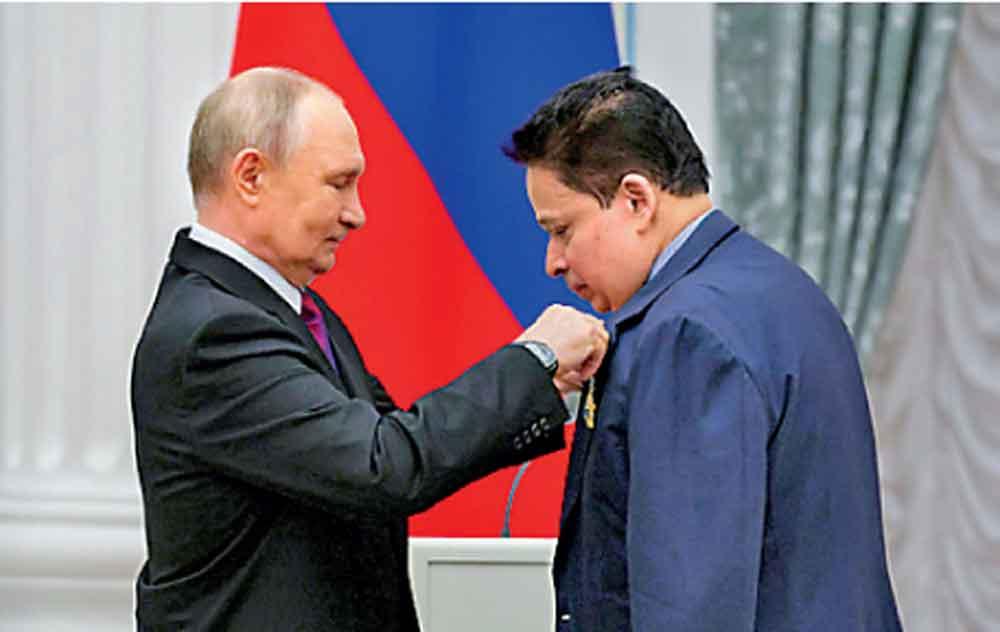
 QWhat does the Order of Friendship mean to you personally and diplomatically?
 QHow did your education in Russia shape your worldview and career?