A fundamental rights (FR) petition has been filed seeking the nullification of the agreement signed with India to develop the Trincomalee Oil Tank Farm.
The petition was lodged before the Supreme Court by the Secretary of National National Bhikkhu Front, Ven. Wakmulle Uditha Thera.
A total of 47 parties including the Attorney General on behalf of the President, the Cabinet of Ministers including Energy Minister Udaya Gammanpila, the Ceylon Petroleum Corporation and its chairman, the Trinco Petroleum Terminal Pvt. Ltd., the Auditor General, Lanka IOC and the Defence Secretary have been named as its respondents.
The petitioner says, pursuant to the Constitution, the Cabinet of Ministers does not have the authority take such decision and that the manner in which the agreement was inked with India is unlawful.
The Cabinet of Ministers has violated the trust the public has placed in the government and has undermined the rule of law through this move.
Accordingly, the petitioner has requested the Supreme Court to issue an order to revoke this ‘arbitrary’ agreement.
He has also called for an investigation into the disputed decision taken by the Cabinet of Ministers.
The petitioner also wants this petition to be taken up before a special bench of the Supreme Court in terms of Article 132(3) of the Constitution.
Sri Lanka and India had inked the agreement in question last evening (January 06).
Sri Lanka’s Treasury Secretary, the Commissioner General of Lands, the Ceylon Petroleum Corporation (CPC), Lanka ICO and the subsidiary company Trinco Petroleum Terminal Pvt. Ltd are among the signatories of the deal, Ada Derana learns.
The Cabinet of Ministers on Monday gave its approval to the proposal tabled by the Minister of Power, for the implementation of Trincomalee Oil Tank Farm development project with India.
Thereby, 61 tanks at the oil storage complex will be jointly developed by the Ceylon Petroleum Corporation (CPC) and Lanka IOC as a joint venture.
Lanka IOC is a subsidiary of the Indian Oil Corporation which is under the ownership of India’s Ministry of Petroleum and Natural Gas.
A subsidiary company named Trinco Petroleum Terminal Pvt. Ltd. will oversee the joint development of these 61 oil tanks.
According to the government, the CPC will retain 51% of the shares from this joint venture while Lanka IOC holds on to 49%.
Meanwhile, the Cabinet has given its nod to further lease out Lanka IOC-run 14 oil tanks of the Lower Oil Tank Complex to the company for its business activities.
Additionally, 24 oil tanks will be allocated for the business activities of the CPC as approved by the Cabinet.
Sri Lanka and India reached the agreement to implement a project to jointly develop Trincomalee Oil Tank Farm, after reviewing three existing deals between the countries through diplomatic talks.
The two countries agreed to jointly develop and operate the farm, which consists of 99 tanks, over three decades ago but the entire farm was leased to India in 2003 for 35 years and Sri Lanka was unsuccessful in taking part of the farm as a sublease from Indian state-controlled IOC’s subsidiary Lanka IOC (LIOC) in 2017.
All lawmakers should unite as one group for the country’s future, President Gotabaya Rajapaksa said today (January 07) during an event held in Monaragala.
He made this remark addressing the augural ceremony of the 1,000 New National Schools establishment programme at the Siyambalanduwa Maha Vidyalaya this morning.
It is their collective responsibility to face the setbacks as a team, the President said further.
Criticizing only the shortcomings while avoiding this collective responsibility depicts a person’s incompetence, he added.
Another 588 persons have tested positive for the novel coronavirus today (January 07), the Ministry of Health reported.
This figure includes 07 persons who recently arrived from overseas while the rest are new community cases.
The total number of Covid-19 cases registered in the country thus far stands at 590,651 with the new development while the number of infected patients currently undergoing treatment went up to 8,792.
The recoveries tally reached 566,760 as 5,203 more patients were discharged upon recovery today.
Meanwhile, the Director-General of Health Services has confirmed 16 more coronavirus-related deaths for January 06, increasing the death toll in the country due to the virus pandemic to 15,099.
According to the figures released by the Government Information Department, the deaths reported today include 08 males and 08 females.
Four of the patients are between the ages of 30-59 years. The remaining 12 are in the age group of 60 years.
Another 588 persons have tested positive for the novel coronavirus today (January 07), the Ministry of Health reported.
This figure includes 07 persons who recently arrived from overseas while the rest are new community cases.
The total number of Covid-19 cases registered in the country thus far stands at 590,651 with the new development while the number of infected patients currently undergoing treatment went up to 8,792.
The recoveries tally reached 566,760 as 5,203 more patients were discharged upon recovery today.
COLOMBO (News 1st); Sri Lankan Trade Unions have raised concerns with regard to the agreement on the Trincomalee Oil Tank Complex, citing that the agreement could be an attempt completely have over the facility to India.
Meanwhile, in Trincomalee in the presence of Minister of Mass Media Dullas Alahapperuma, the Maha Sangha warned that they would have to take to the streets to protect national resources.
The government has planned to divide the 99 tanks and 827 acres of land in the oil tank complex near the Trincomalee port into three parts and hand them over to three companies for a period of 50 years.
As per the resolution approved by the Cabinet in late December 2021, 14 tanks are to be leased to the Lanka IOC, 24 tanks to the Ceylon Petroleum Corporation, and the remaining 61 tanks to a joint venture between India and the Ceylon Petroleum Corporation.
A new company has already been registered to lease 61 tanks and the land for 50 years.
This new venture is called the Trinco Petroleum Terminal Pvt.
According to the government, the CPC owns 51 percent of the company and the Lanka IOC will own the remaining 49 percent.
According to data from the Registrar of Companies, the company is currently registered and its sole shareholder is the Petroleum Corporation.
Its current chairman Sumith Wijesinghe has been appointed as the sole director.
There are now mounting concerns over the future of Trinco Petroleum Terminal Pvt.
SL lags behind Pakistan, Bangladesh and Nepal in exports to China
Exported only US$ 280 million; imports US$ 4 billion from China in 2020
Huge potential for SL products such as tea, coconuts, seafood, readymade garments
Colombo should catch the bull by the horns and resume talks on FTA
Fertilizer incident addressed now
Sri Lankan ambassador to Beijing Dr. Palitha Kohona speaks to Daily Mirror regarding the present status of Sino-Lanka bilateral relations in the event of fertilizer crisis involving Chinese company Seawin Biotech which even threatened to complain against Sri Lankan state banks to the international rating agencies. The Excerpts:
Q As Sri Lankan ambassador to China, how do you view the bilateral relations in the context of the fertilizer crisis?
Our bilateral relationship is multi-dimensional. It is not dependent on one single factor or even a range of minor factors. There could be ups and downs. That could happen in any relationship whether it is personal or international. There are misunderstandings. There are issues that come up unexpectedly .The most important thing is to address them to the satisfaction of both the parties. I personally believe the fertilizer incident has been addressed. We are back on track. Hopefully, we will not have a similar situation again. Or even if something like that crops up again as it possibly might, we should be able to deal with them as two mature countries without getting carried away unnecessarily. Especially in commercial dealings, issues arise. That is why we have arbitration provisions in commercial agreements and mediation. We have the possibility of accessing to legal system, to the courts of law. All that is there because we anticipate disagreements and misunderstandings. I am sure that, given the nature of our relationship, we are capable of dealing with situations of this nature adequately to the satisfaction of both the countries.
Q But the Chinese company said that it would lodge a complaint to the international rating agencies against Sri Lanka’s state banks. How would it affect bilateral relationship?
According to information which I have received, the matter has been addressed and resolved. I have no access as to what the media is reporting and the background to it.
“We need to realize Sri Lanka is a country that cannot remain a poor third world country forever. All around us, countries are steaming ahead us. Even Bangladesh, which in 1971 was described as a basket case, is in a position today to assist Sri Lanka financially because they have taken a pragmatic approach to the world. Of course, when investors come in, we need to be careful how we manage them”
Q In which manner has it been addressed?
I must repeat that I don’t think I should go into details. Nothing has been publicly announced. I believe we should leave it at that. By stirring the pot, I don’t think we are going to get any satisfaction for either side.
Q In Sri Lanka, we notice a difference in Chinese approach to bilateral relations. The Chinese reach out to the north and seek to invest there. They remain engaged with the opposition. They made a donation to the opposition leader to carry out his Covid-related charity work. How do you see this approach as the Sri Lankan ambassador in Beijing?
This is quite normal as any ambassador who represents his own country overseas. He does not represent his country only with the ruling party. Especially in a democracy like ours, it is quite possible, conceivable that opposition would come into power at one point or the other. It happened in 2015. It is quite normal for a diplomatic mission to maintain good relations not only with the government but also with the opposition parties as well. You see this with western embassies. They engage with a whole range of political entities, the entire spectrum in fact. It is very common for ambassadors, political officers and other diplomats to deal constantly not only with the government officials, entities but also with the entities representing other political, social and religious viewpoints etc. I think it is a very good thing that the Chinese ambassador made a visit to the north. Everyone saw the photograph of him entering Nallur temple discarding his shirt. It is good that Chinese are reaching out to our main minority and also establishing good links with them.
Q China and Sri Lanka could not carry out a lot of activities because of the pandemic. The pandemic situation has eased a bit now. How do you intend to carry out bilateral activities?
The pandemic situation has been contained to some extent in Sri Lanka. In China, they have a very rigid policy. The country remains closed. No Chinese nationals are allowed to travel outside other than for specific purposes. Tourism does not exist anymore. No foreigners are allowed into the country other than going through very rigid entry controls. As far as China is concerned, although they are probably the safest country on the earth at the moment, the movement in and out of the country is strictly controlled. I don’t see the possibility of normal travel being restored between the two nations. As you know, we are expecting a visit by the Foreign Minister of China to Sri Lanka early January. As the embassy, we are hoping that we could arrange more visits of that nature. Bilateral visits are very important. For the last couple of years, no leader other than Wang Yi and Yang Jiechi , has visited Sri Lanka. No Sri Lankan leader has visited China. We would like to see high level visits resume. But again, it all depends on how the pandemic is controlled by both sides. China is particularly sensitive about the pandemic situation here. In Xian, the number of cases were detected over the last few days. The city was kept under lockdown. Here they maintain very strict control. If there is any slightest indication of cases occurring, they introduce very rigid controls. Other than that, China remains largely free of the virus. It is a good sign. This is a country with 1.4 billion people. The Chinese authorities have taken the view that it is very important to control the infections to the strictest extent possible.
“This is quite normal as any ambassador who represents his own country overseas. He does not represent his country only with the ruling party. Especially in a democracy like ours, it is quite possible, conceivable that opposition would come into power at one point or the other. It happened in 2015. It is quite normal for a diplomatic mission to maintain good relations not only with the government but also with the opposition parties as well”
Q How would it affect the investments?
That is a very important question. Over the last 12 months, we have been talking to a large number of Chinese companies. Many have expressed interest in the potential Sri Lanka has. I know that two big companies have sent their representatives to Sri Lanka. Power China is one. KY Electric is another. Power China is interested in building residential units in Colombo and outside. KY Electric is interested in renewable energy. We held talks with China Harbour, China Great Wall, Power Steel, etc. These are only a few of them. All of them have shown keen interest in investing in Sri Lanka catering not only to the domestic market but also to the wider regional markets. We have been encouraging them. One of the reasons for nothing tangible to be eventuated so far is the inability to send their specialists to Sri Lanka to assess the situation at ground levels. Once travel is restored to some extent, we can expect many of these companies to show greater interest in Sri Lanka. We have also encouraged travel companies to invest in Sri Lanka. One company with a client base of over 40 million is interested in developing resorts in Sri Lanka, like the resorts in southern Europe or Hainan Island. We can expect it once things return to some sort of normalcy. Many other companies will make a beeline to Sri Lanka. Sri Lanka has now got a stable government. It has easy access to the regional markets. It is not an insignificant regional market whether we are looking at Africa, the Middle-East, India, Pakistan, South-East Asia, and Australia. Then of course, we have been talking to everyone about the investor-friendly policies adopted by the government. Everyone knows Sri Lanka is a friendly country at political level. This creates a level of confidence. I think it is very important for investors, mostly the type of investors we are talking about. Some of them are in the global Fortune 500. It would be good for Sri Lanka to have some of those investors. They may also work as catalysts for investors from elsewhere, whether they are from the United States, Europe, Russia, Australia, Japan and Korea. The line we have been focusing is to encourage some of the big names to invest in Sri Lanka. That will operate as an incentive or a bait for other companies from around the world to come.
Q What are the investments lined up as far as Colombo Port City is concerned?
A very serious offer has been made by Power China and China Harbour. It is quite likely that over the next few months, they will invest substantial amounts in the port city. Again, this will be a flagship investment which will hopefully be an attraction to others to follow-suit. We are hopeful that companies from India, Europe and the United States will follow these big investments in the financial centre and the marina and in the convention centre. Our expectation is that once the Chinese companies move in, the others will find it difficult not to move in simply to maintain their presence in Sri Lanka and in the region.
“A very serious offer has been made by Power China and China Harbour. It is quite likely that over the next few months, they will invest substantial amounts in the port city. Again, this will be a flagship investment which will hopefully be an attraction to others to follow-suit. We are hopeful that companies from India, Europe and the United States will follow these big investments in the financial centre and the marina and in the convention centre”
Q There is an argument by some parties that Chinese presence in Sri Lanka is too much. How do you see this?
My job is to promote Chinese investments in Sri Lanka. Sri Lanka needs investments. We can get into this type of arguments. For 300 years, we had colonial occupation of the country. We need to be a little more rational. Investments are investments whether they are Chinese, Indian or European. The Europeans occupied us, controlled us and dominated us for three centuries. This continues to dominate our financial systems. I think we need to realize Sri Lanka is a country that cannot remain a poor third world country forever. All around us, countries are steaming ahead us. Even Bangladesh, which in 1971 was described as a basket case, is in a position today to assist Sri Lanka financially because they have taken a pragmatic approach to the world. Of course, when investors come in, we need to be careful how we manage them. Not every investor should be encouraged to come to Sri Lanka. We should decide what is best for us and what will be better for our future, children. Our children need opportunities. I don’t see any pride when people proudly say that 1.4 million of our youth are driving tuk-tuks. We need to get out of that mentality and provide opportunities for our young people to do better in life. To do that, we need investments.
Q What kind of cooperation is in store for Sri Lanka to get over the foreign exchange crisis?
China has helped us a great deal in the current situation. It approved a swap arrangement amounting to 10 billion RMB. It is roughly over US$ 1.5 billion. Earlier, China made available to us funds through China Development Bank, Asian Infrastructure Investment Bank (AIIB). China has been doing its bit to help us as much as possible. We need to be conscious of that. If not for these Chinese funds, we would have been in a deeper mess now. Of course, there are circumstances which are beyond our control. Nobody expected the pandemic to affect us in this manner. Our tourism crashed. That was a major source of foreign exchange for us. Our remittances from expatriate workers also shrunk substantially. Traditional markets for our exports were affected. Hopefully, the pandemic will ease up. Our exports, tourism and remittances will recover. In the meantime, we need to cope up with the problems. We are confronting problems such as repayment of loans and interest repayment. China has been more than willing to come to our help. In addition to findings that have been made available, they gifted three million doses of Sinopharm vaccines, and another 23 million doses were provided at very low, concessionary rates.
Now, one of the main areas we are focusing is to increase Sri Lanka’s exports to China. We are not exporting enough considering that the nature of our relationship is very close. In 2020, we managed to export only US$ 280 million worth of goods whereas China exported US$ 4 billion worth of goods. Our performance is weak compared to performance of countries like Pakistan, Bangladesh and even Nepal. We cannot even fall in the same league as Malaysia, Singapore or Vietnam. They export huge quantities of agricultural, fishery and industrial products to the Chinese market. We have been working towards increasing our exports. It is essential. We just cannot continuously look for financial assistance.
“Over the last 12 months, we have been talking to a large number of Chinese companies. Many have expressed interest in the potential Sri Lanka has. I know that two big companies have sent their representatives to Sri Lanka. Power China is one. KY Electric is another. Power China is interested in building residential units in Colombo and outside. KY Electric is interested in renewable energy. We held talks with China Harbour, China Great Wall, Power Steel, etc. These are only a few of them. All of them have shown keen interest in investing in Sri Lanka”
One of the suggestions made is that we need to resume our negotiations on the Free Trade Agreement (FTA) or an early harvest agreement. This was the approach taken by Pakistan, Bangladesh. They went for early harvest agreements. As a result today, Pakistan exports even Basmati rice and mangoes. ASEAN countries have FTAs with China. Shops are full of exports from ASEAN countries including young coconuts, pineapples, Durians and Rambutans. There are other high value items. We need to take this very seriously. We are working on this at the embassy. Of course, we need the necessary support from Colombo. Colombo needs to take the bull by the horns and resume negotiations on the FTA, or at least negotiate an early harvest agreement. Any agreement depends on how we negotiate. This is the most lucrative market in the world. Chinese are spending money in a crazy manner. They are buying up everything. I did a live streaming show for Sri Lankan tea and coconut products. The goods we had on sale were sold within 30 seconds after I came on the screen. In China, there is a great demand for Sri Lankan high quality black tea, especially if they are packed attractively with geographical indication. At the moment, we export tea work US$ 57 million. We can easily bump it up to over US$ 100 million in very quick time. Then, there are coconut products such as coconut water. King coconut is a product with a huge market in this country (China). We can expand it very, very quickly. We are trying to gain a wider range of seafood products. We have succeeded in 29 varieties of fishery products. We will work on more varieties of seafood.
The Chinese market for high quality readymade garments is expanding. We need to expand on that. I have suggested that the Joint Apparel Industry locate an officer in Beijing to pursue this market on their behalf. We need someone to concentrate on this market alone. We need to work on the Chinese tourism market. When the doors open, I am confident that Sri Lanka will be a prime destination for them. In 2019, 169 million Chinese travelled overseas. We need to get a small fraction of them to help us.
Q Geopolitical rivalry involving China, India, the USA and Japan play out in Sri Lanka. How can we strike a balance while maintaining good relations with all?
This is not something new to Sri Lanka. Even in 1950s, 1960s and 1970s, there were cold wars. We maintained a non-aligned stance. Both sides respected us. We did not give away bits and pieces of sovereign territory to keep this rivalry at bay. We just managed that relation well. We benefitted from it also. It can be done. It must be done in the future. Sri Lanka is a sovereign nation. We went through horrendous internal conflicts. We maintained our territorial integrity. We should treasure what we sacrificed for so much. We should go forward keeping that mind.
COLOMBO (News 1st); Adequate chemical fertilizer will be imported in time for the upcoming Yala season, says Minister of Agriculture, Mahindananda Aluthgamage.
Speaking to media, the Minister admitted that as there is not enough time to purchase chemical fertilizer and use it for the existing Maha season, the fertilizer necessary for the Yala season will be imported by upcoming April month.
Moreover, he stated that fertilizer companies have already placed orders and there will be no shortage of chemical fertilizers in the market by the coming Yala season.
Meanwhile, the Minister mentioned that the Paddy Marketing Board will purchase paddy from any farmer at Rs. 75 per kilo this season due to the complaints received regarding the reduction in production.
When inquired whether the Government would raise the selling price for paddy, the Minister said that a kilo of rice will still be sold for Rs. 50, and the Government will bear the loss of Rs. 25,000.
Politicians of the government, as well as the opposition and the Maha Sangha, expressed their views regarding the current political situation and various crises today (06)
Highways Minister Johnston Fernando states that although there are reports of gas explosions islandwide, there are no reports of gas explosions in Colombo 07.
The Minister pointed out that no such incidents have been reported in the Northern Province or in areas such as Kandy and Kurunegala and that doubts have arisen if there is a conspiracy behind these incidents
The ceremony to open the new three-storied building of the Maliyadeva Balika Vidyalaya in Kurunegala was held under the patronage of Prime Minister Mahinda Rajapaksa this morning (06).
Addressing the gathering, the Minister said that the new year should move forward with a positive outlook and that a proper program should be formulated to find solutions to the many crises caused by the COVID pandemic in recent years.
The Minister of Highways further stated that due to the depletion of foreign reserves in the country, the people have faced an increase in the prices of goods and the President has carried out a meticulous investigation into the gas explosions that have taken place.
The Minister said that the government has already taken all necessary steps to ensure that the education of children with disabilities is carried out systematically this year.
Minister of Education Dinesh Gunawardena and several others were also present at the occasion.
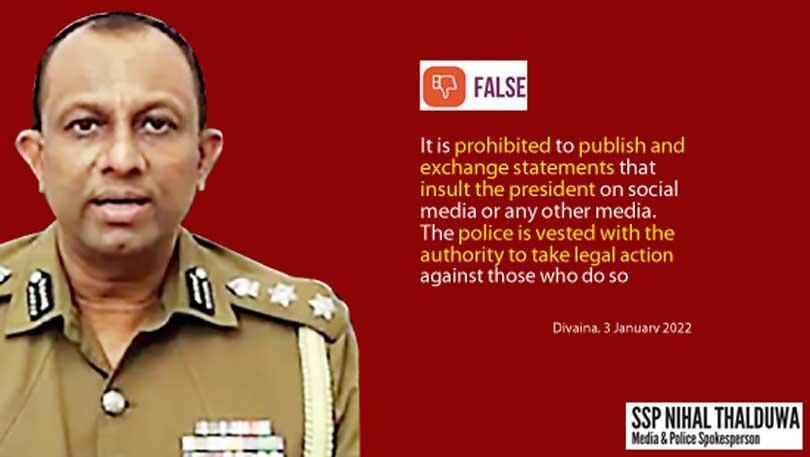
SSP Thalduwa made these claims to the media in relation to the incident where an activist was questioned by the CID for posting a video on social media of the public verbally protesting against President Gotabaya Rajapaksa as he was travelling through Mirihana. FactCheck.lk assessed these claims by analysing the provisions of the Constitution and judgments of the Supreme Court of Sri Lanka.
Article 14(1)(a) of the Constitution of Sri Lanka vests every citizen with the freedom of speech and expression. Under the Constitution, the freedom of expression can be restricted only by law for the protection of, among other things, national security, public order, racial and religious harmony, parliamentary privilege, or to prevent incitement to an offense. The legality of publishing insulting statements against the president or government was dealt with in the 2015 judgement of the Supreme Court (SC) in Wahalathanthri v. Jayantha Wickramaratne, Inspector General of Police [S.C. (F.R.) Application No. 768/2009]. In this case, the police sought to prosecute two persons under Section 120 of the Penal Code for carrying harshly worded placards that protested the government. In its determination, the SC declared that the publication of defamatory, embarrassing, or insulting statements against the president or government is a lawful and democratic exercise of the freedom of expression.
The SC also held that the police cannot prosecute members of the public for merely publishing defamatory, embarrassing, or insulting statements against the president or government, and that Section 120 of the Penal Code would apply only if such statements were intended to incite violence.
The above analysis confirms that publishing statements that merely insult or defame the president does not attract any criminal liability. As no criminal liability attaches to the making of statements that insult or defame the president, there is no lawful basis for the police to take legal action against persons who publish or exchange such statements. Therefore, we classify SSP Thalduwa’s statement as FALSE.
**FactCheck.lk’s verdict is based on the most recent information that is publicly accessible. As with every fact check, if new information becomes available, FactCheck.lk will revisit the assessment.
FactCheck is a platform run by Verité Research. For comments, suggestions and feedback, please visit www.factcheck.lk.
A total number of 11,380 tourists had arrived in the island in the first four days of the new year Russian tourists head the list with 2,032 visitors, Tourism Minister Prasanna Ranatunga said.
Moreover, 1,809 tourists, from India, 1,041 from Ukraine, 775 from Germany, 709 from the UK, 506 from Kazakhstan, 506 from the Maldives, 420 from Australia, 414 from France and 282 from Poland were among those arrived in the first four days of January.
The minister said 194,888 tourists have arrived in the country in the year 2021 after the reopening of the country.
The Minister said that only 1,682 tourists have visited Sri Lanka in January 2021.
He said steps will be taken to make this year, the best year for the tourism industry.(DarshanaSanjeewaBalasuriya)
Agreement to develop Trincomalee Oil Tank Farm was signed this evening, Energy Minister Udaya Gammanpila said.He said in a twitter post that signatories were Treasury Secretary, Land Commissioner General, Ceylon Petroleum Corporation (CPC), LIOC and Trinco Petroleum Terminal Ltd.”85 of the 99 tanks will come under Sri Lanka’s purview, which were under India,” the Minister tweeted.
The Ministry of Health reports that another 584 persons have tested positive for coronavirus within today (06), as the country’s tally of confirmed cases crossed the 59,000-mark on Thursday.
This figure includes 12 persons who had arrived from overseas while the rest are new community cases.
The total number of Covid-19 cases registered in the country thus far stands 590,063 with this while the number of infected patients currently undergoing treatment is 13,423
Meanwhile, the Director-General of Health Services has confirmed 18 more coronavirus-related deaths for January 04, increasing the death toll in the country due to the virus pandemic to 15,065.
According to the figures released by the Government Information Department, the deaths reported today include 12 males and 06 females.
Five of the patients are between the ages of 30-59 years. The remaining 13 are in the age group of 60 years.
Colombo, Jan 5 (EFE).- The severe economic crisis affecting Sri Lanka, with record inflation and the possibility of the country failing to pay its financial debts, has forced families to give up meals due to shortage of food and steep prices.
Our only option was to cut down on food consumption. Sometimes we only have two meals a day. At other times we cook once a day and eat sparingly,” Priyanka Kumari, 44, from Boralesgamuwa in the country’s Western Province, told EFE.
Household incomes have been hit hard by the crisis, while inflation shot up to 11 percent in November, the highest in 13 years.
Kumari said she used to make a living by selling cooked food but had to stop when prices of the ingredients soared, after the government imposed import restrictions to mitigate a foreign currency crisis.
When we increase prices, people don’t buy,” she said.
Vegetable prices have tripled this December compared to the same month last year, according to the latest National Consumer Price Index.
Prices of rice, a basic food item in the country, have also shot up along with flour and bread, while fuel prices have risen sharply, up to 85 percent in the case of cooking gas.
A drastic fall in tourism due to the pandemic, with the crucial sector coming to a complete halt due to borders being closed for months at a time, has been another blow for Sri Lankans.
When Covid-29 first hit, the country stopped allowing tourists. As a result, my salary was reduced by 50 percent,” Lahiru Sameera, a 26-year-old former employee of the sector, told EFE.
On Tuesday, the Sri Lankan government announced an aid package worth $1 billion for the poorest section of the country, public sector employees and senior citizens.
Cabinet spokesperson Dullas Alahapperuma said that the aid would help ease economic pressure on these sections of the population.
The measure includes a payout of 10,000 Sri Lankan rupees (around $50) per family to promote home gardening.
Amid the grave economic crisis, Sri Lanka has witnessed its foreign currency reserve dwindle in recent years and is now burdened with high levels of both public and private foreign debt.
The country needs to pay $500 million in international sovereign bonds by the end of January, and around $6.9 billion by the end of the year in domestic and foreign loans, according to rating agency Fitch, which reduced Sri Lanka’s long-term sovereign rating to CC from CCC last month, due to the possibility of the government defaulting on payments.
Sri Lanka’s foreign currency reserves have dropped by around $2 billion since August, going down to $1.6 billion by late November, according to the agency.
However, Colombo has insisted that it would not default on the payments.
Cabinet co-spokesperson and Plantations Minister Ramesh Pathirama told reporters on Tuesday that the tourism sector and exports were gradually improving.
We are also planning to increase local production. For example, distributing fresh milk instead of powdered milk. We have imported a large amount of medicine for a long time. We have started to produce our medicine,” he said in a presser.
The government is also negotiating credit line facilities with China, India and Japan.
Dharma Vijaya Buddhist Vihara organization has planned to give the opportunity to a team of youngsters (age 17+) to be sponsors and organizers of the 2022 Kathina ceremony. Our goal is to give full responsibility to this young team for conducting all the tasks and events from the initiation- Kathina invitation day (Saturday, July 9th, 2022) to the Katina Robe offering day (October 8 & 9th, 2022) at the end of the ceremony.
We kindly invite all the young devotees to join the “sponsoring and organizing team of the Kathina ceremony 2022” to gain experience of every single task of this wonderful and meritorious ceremony and help preserve our traditions for future generations.
Recently, Thailand has decided to provide the duty-free, quota-free (DFQF) market facility for Bangladeshi products in its market until 2026 to increase two-way trade volume. The declaration came as such facilities to Bangladesh by Thailand expired on 31 December 2020. It is high time to analyze the market situation of Thailand to devise appropriate strategies to get optimum benefits from the DFQF market facilities offered to Bangladesh.
The journey of Bangladesh–Thailand relations began on 5 October 1972 when Thailand recognized Bangladesh as a sovereign nation-state. The diplomatic ties began with the establishment of the Thai Embassy in Bangladesh in 1974. In order to promote bilateral trade between Bangladesh and Thailand, these two friendly countries signed a bilateral trade agreement on 22 August 1997. They have also formed a joint chamber of commerce to generate maximum output from their economic engagement.
From the very beginning of their relations, these two countries have been enjoying very warm bindings and have been working to deepen their bilateral ties for mutual benefits. The bilateral linkage between these two countries has been strengthened over time because of shared strong commitment to democratic values, efforts to foster international peace, harmony, and security. Their cultural, social, and religious linkage also contributed to blossoming the ties.
The current trade scenario between Bangladesh and Thailand
In South Asia, Bangladesh is the third-largest trading partner of Thailand. Although the bilateral trade between these two countries crossed USD 1.25 billion in 2018, it has experienced a declining trend after that time period. As Bilateral trade between them dropped to USD 910.05 million in 2020 from USD 1,067.90 million in 2019, they should work together to increase bilateral trade and investment.
Bangladesh basically exports vegetables, plastic items, rubber products, soap, animal goods, apparel, electrical & electronic equipment, fish, medicines, etc. to Thailand. On the other hand, Bangladesh imports cement, iron and steel, cereals, organic chemicals, machinery and mechanical appliances, synthetic fiber, and cotton fabrics, sugar, and sugar confectionery, etc. from Thailand. Bangladesh has a huge untapped bilateral trade prospect to discover with Thailand. It can export pharmaceuticals and health care goods, chemical products, leather goods, jute goods, frozen fish, knitwear and woven garments, ceramic tableware, tea, etc. to the Thai market. As these products have huge demand in Thailand, Bangladesh can earn huge foreign currency by exporting these goods with easy access, the DFQF, provided by Thailand. Bangladesh should also utilize this DFQF market access offered by Thailand to have competitive advantages
How can Bangladesh generate optimum benefit from the Thai Market?
If Bangladesh does its homework properly, then it can get maximum output from the DFQF facility offered by Thailand. Firstly, Bangladesh should analyze the Thai market to understand the Thai economy, its cultural practices, and social norms and then assess the consumption habits and patterns of Thai consumers. Bangladesh Embassy in Thailand, Ministry of Commerce and Industry, and Bangladesh-Thai Chamber of Commerce and Industry can jointly conduct this analysis.
Secondly, Bangladesh should promote local producers to boost their export to Thailand by providing different facilities such as creating backward linkage for easing production, arranging raw materials for the products that will be exported to Thailand, offering easy loans, etc. Thirdly, responsible government agencies should take initiative to promote and brand Bangladeshi products in the Thai market to increase market demand for Bangladeshi products.
Fourthly, Bangladesh may arrange or participate in a Trade fair organized in Thailand to inform the people there about Bangladeshi goods and services. Fifthly, a team of Bangladeshi businessmen may visit Thailand to have a better understanding of the products being sold there and to have an idea about the goods that might be exported there. Sixthly, the existing relations among the businessmen of both countries should be nurtured and expanded for giving the economic engagement a new shape. Seventhly, the governments of both countries should work shoulder-to-shoulder to simplify the regulations to boost exports and enhance bilateral economic engagement.
As Bangladesh has eight export processing zones (EPZs) and has undertaken initiatives to establish 100 Special Economic Zones (EZs), it should try to attract Thai investors by informing them of the different incentives and facilities available here such as tax holiday, One-Stop Service, etc. in EPZs and EZs. Government should allocate lands for the businessmen of Thailand in these EZs with easy terms and conditions. Both countries may rethink and take the joint initiative to flourish the tourism sectors in their respective countries. They should work to ease visa restrictions which not only will boost trade and investment but also make it easy for Bangladeshi to avail Thai healthcare facilities.
Bangladesh and Thailand have common membership in BIMSTEC which reflects that they have common interests and goals. Besides, in order to address bilateral trade-related issues, they have set up a joint trade commission which is really a praiseworthy initiative. As Bangladesh is officially going to be an LDC-graduate by 2026, it may face different challenges, e.g., cancellation of GSP facilities, which may have a negative impact on its export earnings. In order to avoid the decline in export earnings, Bangladesh should sign Free Trade Agreements with its friendly countries such as Thailand.
BIMSTEC or Bay of Bengal Initiative for Multi-Sectoral Technical and Economic Cooperation has 7 members – India, Nepal, Bhutan, Bangladesh, Myanmar, Thailand, and Sri Lanka. The grouping is more than 20 years old and was formed in 1997. The last summit took place in Kathmandu in 2018 with PM Modi and other member-leaders attending the meet. BIMSTEC region has huge prospects for economic cooperation.
Sri Lanka is the chair of the grouping and had earlier proposed holding a virtual summit on 9th December which has now been postponed. According to the media reports, the Bay of Bengal Initiative for Multi-Sectoral Technical and Economic Cooperation, better known as BIMSTEC, is likely to hold a summit of the heads of governments in Sri Lanka on March 30 in a hybrid setting providing scopes for both in-person and virtual participation.
Sri Lanka is a founding member of the Bay of Bengal Initiative for Multi-sectoral Technical and Economic Co-operation (BIMSTEC). Since its inception in 1997, Sri Lanka has been an active member of the Multilateral Forum. The archipelago presided over for the first time between 2002-2003, during which time Colombo promoted member states’ political commitments to strengthen sub-regional cooperation. As of 2016, BIMSTEC members accounted for only 17.4 percent of the total trade in Colombo trade goods. On the other hand, Bangladesh maintains friendly ties with almost all the neighbouring nations. This allows the country to play a bigger role in regional affairs.
Its imports from BIMSTEC accounted for only 23 per cent of its total imports and Sri Lankan exports to BIMSTEC members accounted for only 7 per cent. Moreover, India contributes more than 70 per cent of Sri Lanka’s trade with BIMSTEC. In parallel with the slow progress of BIMSTEC, Sri Lanka’s cooperation with BIMSTEC members has grown in place of snails.
In this context, Sri Lanka has been the Chairman of BIMSTEC from 2018-2020. Following which, Sri Lanka has the opportunity to ensure rapid cooperation between the member states of the Gulf region. During the Fourth Summit, the former President of Sri Lanka, Maithripala Sirisena, emphasized that BIMSTEC countries share shared aspirations for growth, development, trade and technology, and that Sri Lanka would facilitate this natural platform for the implementation of regional connectivity and economic cooperation. Actually, BIMSTEC has an important role to play in the regional trade area. All member states including Sri Lanka and Bangladesh should reap the benefits and exchanges this regional advantages. The BIMSTEC region has huge prospects for economic cooperation much of which still remains unexplored and unexploited.
Five members of the seven-member international organisation have already confirmed their participation in the summit, called by Sri Lankan president Gotabaya Rajapaksa, according tomedia reports. The countries that conveyed their confirmation are Bhutan, Myanmar, Nepal, Sri Lanka and Thailand.
Bangladesh and India, the two other members of the regional group of the countries around the Bay of Bengal, are expected to formally confirm their participation soon as the host, Sri Lanka, the outgoing chair of the group, sought concurrence of all member countries discretely about holding the meeting on March 30, media report said.
Prime minister Sheikh Hasina is expected to join the summit, to be held in Colombo. It is yet to be decided whether she will travel to Sri Lanka or join the meeting virtually. Foreign ministers and foreign secretaries of the BIMSTEC member countries are scheduled to meet on March 28 and 29 respectively for facilitating decision making at the summit on March 30.
The heads of the governments of the BIMSTEC member countries are expected to approve a charter for the organisation in the meeting after 24 years of its journey. The member countries ‘have completed the negotiation of the BIMSTEC charter and it is expected to be signed’ in the forthcoming fifth summit with participation of the heads of the governments in Colombo, BIMSTEC secretary general Tenzin Lekphell said in October.
The Colombo summit, the fifth meeting of the heads of the governments, was postponed twice in 2020 and 2021 due to the Covid pandemic. In addition to the BIMSTEC charter, three other legal instruments are expected to be signed at the summit. These are a BIMSTEC convention on mutual legal assistance in criminal matters, a memorandum of association on the establishment of BIMSTEC technology transfer facility in Colombo and a memorandum of understanding on mutual cooperation between diplomatic academies and training institutions of the member countries.
Bangladesh as the lead country for Trade, Investment and Development is strongly committed to strengthen BIMSTEC cooperation in this field. There is the importance of making all entities of the BIMSTEC process fully functional and operational. The BIMSTEC process needs concerted and quicker efforts and more intense engagements amongst the member states. It is imperative to forge more realistic partnership and shared endeavours to prosper together through exploitation of the full potential of this region.
The summit is also expected to reconstitute and rationalise 14 areas of cooperation into seven sectors, where each sector will be led by a member country. The foreign secretaries met 21 times, foreign ministers 17 times and heads of governments four times since the establishment of the BIMSTEC 24 years ago in 1997, while security advisers met thrice since 2017. Thailand is scheduled to take over the responsibilities of the BIMSTEC chair in the fifth summit in Sri Lanka.
BIMSTEC has identified 13 priority sectors, including trade and investment, transport and communication, counter-terrorism and transnational crimes, energy, climate, agriculture, poverty alleviation, tourism, public health and people-to-people contact. Bangladesh is the lead country for three areas – trade, investment, and climate, and has reiterated its fullest cooperation in this regard during the successive BIMSTEC ministerial meetings and summits.
According to media reports, in the current structure of bilateral trade among these countries, we see that most of the BIMSTEC members have experienced a considerable rise in bilateral trade over the years. A larger volume of exports was observed in the case of Thailand’s exports to India (US$ 5.5 billion in 2015); India’s exports to Sri Lanka (US$ 4.4 billion), Bangladesh (US$ 3.4 billion), and Nepal (US$ 2.6 billion); and Myanmar’s exports to Thailand (US$ 3.3 billion) and India (US$ 1.3 billion). Overall, India and Thailand are two major economies – both in terms of export and import – while Bangladesh, Sri Lanka, and Myanmar are three major economies in terms of import. The bilateral trade record of BIMSTEC countries indicates that the existing pattern of trade is heavily influenced by geographical proximity, relative size of the economies, and predominant trade routes.
BIMSTEC has received greater attention in the context of progressing co‑operation in the region. In addition to high-level diplomatic engagements, substantial steps have been taken towards co‑operation in a wide range of areas. In the fourth BIMSTEC summit meeting—which was held in Nepal’s capital, Kathmandu, in August 2018—member countries signed a memorandum of understanding on establishing a BIMSTEC Grid Interconnection to enhance energy co‑operation. This is expected to expedite the buying and selling of electricity between the countries—including those not directly bordering each other—once the cross-country grid infrastructure is in place. We expect tangible progress to be made in the field of energy co‑operation in 2019‑23.
New ground is also being broken in the security arena, as evidenced by the successful hosting of the first-ever joint military exercise between India and other BIMSTEC countries in September 2018. Each of the 14 areas of co‑operation under BIMSTEC is led by a particular country. That relating to security is headed by India and covers counterterrorism and transnational crimes. We expect that India will continue pushing for greater security co‑operation, particularly on counterterrorism. Furthermore, it is likely that in the next few years, member countries will undertake full ratification of conventions on mutual legal assistance in criminal matters and co‑operation in combating international terrorism.
The most significant breakthrough, however, is expected to be in connectivity. Five of the seven BIMSTEC member countries share a border with India, which includes the busiest land-customs checkpoint in Asia: The Petrapole-Benapole checkpoint between India and Bangladesh. Despite this, intra-regional trade accounts for only 5% of the grouping’s total trade; poor road connectivity is one of the main reasons. We expect progress to be made on transport connectivity over the 2019‑23 forecast period. In particular, the two main agreements, the BIMSTEC Coastal Shipping Agreement and the BIMSTEC Motor Vehicle Agreement—which are aimed at facilitating trade and transport linkages between member countries—are likely to be finalised over the next five years.
Despite the strong political thrust in favour of BIMSTEC, the organisation still faces manpower constraints and limited resources. This will be addressed partly by member countries’ increased commitment towards financial and human resources. Furthermore, areas such as negotiating a free-trade agreement—traditionally the focus of organisations that advocate regional co‑operation—will remain on the backburner in 2019‑23. Nevertheless, the importance of BIMSTEC will continue to grow, with India relying heavily on it to further its regional agenda. However, the upcoming BIMSTEC summit will ensure to create a common regional platform to address some common regional problems. Sri Lanka and Bangladesh as regional stakeholders have some common agenda such as strengthening connectivity, growing trade, tackling covid-19, terrorism, climate change, resolving and meditating Rohingya refugee crisis between Myanmar and Bangladesh etc. The upcoming BIMSTEC summit will provide the benefits for all regional states including Myanmar and Bangladesh. Sri Lanka and Bangladesh should fully utilize the potential.
Sri
Lankan economic challenges are because of many factors. Most
important of these was the economy was run down for 5 years by the Ayahapalana
govt where not a shred of economic activity was initiated and what had been
started before was thwarted ( Colombo Port City, Hambantota Port activity) and
then went back to the same after two to three years of delay on terms more
adverse to SL, Sri Lanka borrowed 7 Billion $ external debt for spending spree
and consumer goods to keep consumers happy blissfully ignorant of the damage
being done while the leaders thrived , while Islamic Terrorist funders
had a field day with unmonitored and unrestricted gulf money,.During this
period of no economic activity not even a ulvert (bokkuwa) was built.
The
prime activity then was creating a FCID an extra judicial
force under the direct control of PM, RW , above all law with the
primary objective of imprisoning MR & GR using bribery, threats , coercion
and victimisation of potential witnesses who all refused to testify
against GR & MR despite these. The other activity was a Constitutional
Council to appease the Tiger Diaspora that was funding them but had to fold
up after 4 years without anything show for the effort. The worst of them
all were not one but two centralbank robberies which money they
are still using to fund their misinformation campaign.
When
Covid hit against this back ground , the results were not unexpected with loss
of $4.5billion from tourism and $3.5 billion from remittances with workers
returning to SL from ME
This
admin. realised the prime importance of eradicating covid, embarked on a
vaccination program delayed to May because India who had earlier promised
their locally produced astra Zeneca vaccination renaged because they had to use
it on their population that was badly affected by then. President GR managed to
secure Chinese Zinofarm vaccination to replace it at short notice , testimony
to GR’s efforts and Chinese goodwill.. When it’s affects were seeing a
reductio in cases by June end, they released the Guru Udghoshanas which spewed
millions of viruses from their screaming throats which caused a relapse
starting July.
The
prophets of gloom led by the ex Ayahapalan leaders who had all the liability
for the current challenges had the unexpected help from an ill-advised sudden
total withdrawal of chemical fertiliser leading to shortfalls in production
which is being orchestrate by all sections of media , driven by rating
competition given that only negative news gets ratings, consistentg basest of
human emotions.Remedial actions for these errors are being instituted without
losing all the gains of organic farming.
This
was compounded by gas explosions consequent to ill-advised changes in
mixture of Propane/Butane probably done by a combination of motivation to
increase profit margin by decreasing the more expensive component unaware of it
leading to increase in it’s inflammability in the already existent gas cookers
designed for the earlier mixture.There might have been an element of deliberate
commission in this change too to embarrass the govt.
Now
with the very commendable though rarely mentioned monumental control of
Covid and tourism and foreign remittances returning the traitorous
prophets of gloom being their opportunity slipping through their fingers
are trying their level best to reactivate Covid and thwart the recovery
with more Uthgoshana’s , spreading rumour and destroying self confidence and
moral. These have been complemented by a series of traitorous undermining
activities including hoarding of essential food items and creating a
blackmarket.
The
improvement of FOREX. from returning tourism, foreign remittances ,
increase in local industry especially agro industry, manufacture of tyres for
export , local motor car assembly, never mentioned in media, increasing
in economic activity related to port city especially port city luxary Yatch
Marina now up and running,and activity in Hambantota free trade manufacturing
zone especially pharmaceutical and Hambantota port activity.. Nor is there
any mention of new economic activity stimulated by the current adversities,
like firewood industry , cottage food industry using every inch ov available
space in the household gardens of which there is limit. So also potential for
pot based foods using modern technology.
The
choice of whether more temprorary borrowings be made from friendly nations with
no adverse conditions or from the IMF that would impose harsh conditions that
would make the govt even more unpopular is obvious depending on whom you
support , the Govt or the opposition who when they were in power barely
two years ago, did nothing as made clear from the above.
The
people of SL have a choice. Believe the failed leaders who are
largely responsible for the current economic challenges despite all their
vociferous pontifications and promises now, or practice patience ,
wisdom and mindfulness focussing on the positives and the light now
being seen at the end of the tunnel likely to become progressively
brighter in the coming months .Are the people of to be moved by the
orchestrated baseless negatives , that seems to be the order of the day from
ratings driven media and unregulated social media or continue with mindfulness
and wisdom,
The
Coffin carrying the remains of Priantha Kumara at BIA
Priyantha Kumara, a Sri
Lankan Export Manager, employed by Rajko Industries, Sialkot, became an Islamic
fanatic group’s victim on 3 December 2021. Police records revealed that he was
beaten with sticks, fists and kicks by a group consisting of dozens of
assemblies before being dragged to the road outside the factory and set on fire
alive.
Rajko Industries
manufactured cricket jerseys and other gear for the Pakistan cricket team in
T20 World Cup. Priyantha Kumara was the youngest of six siblings. His mother
was not told how he was lynched and later burnt alive. Kamal, his brother, told
the international media how they concealed the
facts from their mother.
His family informed his
mother that his death was due to an accident and kept her mother away from
social media and television. His mother is 80 years old, suffering from
diabetes and hypertension. Priyantha’s family members said they were unable to
explain to her what exactly happened. The mother was repeatedly weeping from
the moment she heard about Priyantha’s death.
The family told the mother
they did not know the exact details about how the accident occurred. Priyantha
and his brother Kumara have lived in Pakistan for over ten years. They seemed
to have no complaints whatsoever while living in Pakistan. Kumara told the
international Media that many Pakistani friends made condolence calls. They
all sympathised with me and were crying and ashamed to call themselves
Pakistanis.”
Blaspheme means death
Priyantha Kumara was
alleged of blasphemy by Pakistan’s mob leader. The punishment for blasphemy is
death under a Pakistani law made by President Zia ul Haq in the 1980s. This
incident of Priyantha goes down in the annals of modern-day international
history as the worst act of criminality. According to Aljazeera TV, blasphemy
allegations have led to extrajudicial murders or mob lynching, with at least 80
people killed in such attacks since 1990.
The savage killing of
Priyantha Kumara shocked Pakistan. Religious leaders, civil society and
politicians in Pakistan utterly condemned the lynching. On Sunday, 5 December,
civil society groups demonstrated against Priyantha’s killing in Sialkot. It
appears to be an excuse for radicals to gain support and mileage for the
lynching. A recent news flash in a newspaper disclosed how the massacre of
Priyantha purposely prevented the perpetrators from manslaughter and the
investigations.
Priyantha Kumara worked in
Sialkot in Pakistan for over ten years. Protesters accused him of defacing
posters bearing Prophet Muhammad’s name and throwing it into a trash bin.
Another viewpoint was that he was a foreigner and may not have comprehended
Urdu lettering on the poster! Nevertheless, the whole world condemned the
lynching and setting fire to Priyantha’s body in a public place witnessed by
hundreds of spectators, who did not utter a word about the slaughter, except
for one decent Pakistani who tried to shield Priyantha and suffered.
Pakistan Government paid the highest honour to the man who attempted to rescue
Priyantha Kumara from mob violence. Videos on YouTube shared on social media
showed hundreds of men and young boys gathered at the scene.
Amnesty
International
Amnesty International
requested an impartial inquiry into the killing. Authorities in Pakistan caught
the perpetrators responsible for the lynching. They emphasised the urgency
where it enables such abuses and risks lives. In South Asian (Muslim) countries
religious violence in connection with blasphemy rose in recent years,
especially with the rising of the far-right Tehreek-e-Labbaik Pakistan (TLP).
The Pakistani authorities made an immediate investigation and arrested several
key suspects.
Meanwhile, Pakistani
religious scholars expressed sympathy on behalf of the entire Muslim community
in Pakistan. They declared: Islam is a religion of peace that declares a
murder of an innocent man as the murder of all humanity.” They further
mentioned that Rajko Industries have pledged to bear expenses for Priyantha
Kumara’s two children. The Muslim community in Pakistan said: We are satisfied
with measures taken by the Government of Pakistan concerning the probe and
action against culprits regarding the lynching.”
The Pakistani Police
have so far produced eighty-five suspects in connection with the Sialkot
lynching. Pakistan Court (ATC) initially remanded thirty-four people accused of
the murder of Priyantha Kumara. The judge remanded thirteen suspects and
ordered the Police to produce them in court on 3 January 2022. Meanwhile, the
Pakistani Upper House of Parliament unanimously passed a resolution condemning
the lynching of the Sri Lankan Export Manager at Rajko industries in
Sialkot.
The Chairman of the
Parliamentary Committee said he would send a delegation of senators to Sri
Lanka to hand over the parliamentary resolution to Priyantha Kumar’s family ( a
copy of the senate resolution) and express their deepest sympathies to the
family. He further added that the religion of Islam had nothing to do with
lynching, and several people interpreted blasphemy to suit themselves.”
The Prime Ministerial representative visited the Sri Lanka High Commission in
Islamabad to reveal how Priyantha’s loss was replaced by the administration of
Rajko industries in Sialkot by another Sri Lankan citizen in the factory
stating that, we are thankful to Sri Lankans in this hour of fear.”
History
Pakistan is a friend of Sri
Lanka. During the LTTE separatist war that lasted for thirty years, Pakistan
helped Sri Lanka by supplying the much needed arms and ammunition.
But this incident of lynching Priyantha Kumara and burning him alive by
religious fanatics in Sialkot may have affected the openness between the two
countries.
The Pakistan regime is
desperately endeavouring to alleviate any diplomatic confrontation over the
lynching incident. His brother in Sri Lanka had a completely different
interpretation. He said, Priyantha lived in Pakistan for so many years, and he
knew about the country, including the religious fanatics. Therefore, as claimed
by the mob, there was no question of blasphemy.”
Another aspect
highlighted was the pending salary increase for the factory workers!
Nevertheless, the whole world condemned Pakistan for the brutal killing of
Priyantha Kumara and burning his body alive in a public place. According to his
brother Kamal, Priyantha was not concerned about religious issues because he
always focussed on the workload in the factory.
He never participated in
any religious discussions. We both respect every
religion, and we never had any disrespectful opinions on any religion.” On
Tuesday, Priyantha’s post-mortem was carried out. His funeral took place in his
native Gampaha District. There are two factions of Islam – Wahhabism and
Sufism. Wahhabism originated in the 18th-century by an Islamic scholar, preacher
and activist named Muhammad ibn Abd al-Wahhab. For more than two centuries in
Saudi Arabia, Wahhabism remained the dominant faith.
It played a rigidly
puritanical outlook of Islam. Wahhabis sternly believe that those who do not
adhere to their way of tradition are heathens and their enemies. Sufism is the
opposite of Wahhabism. Sufism is concerned with the soul or the spirit rather
than material things. It is opposed to Wahhabism seeking to find the absolute
truth in God.
Agriculture Minister Mahindananda Aluthgamage said, if there is a food shortage in the country, then food items will be imported just like Dubai and Singapore do.
He was speaking at a ceremony to mark the 50th Anniversary of the Eppawala Phosphate Limited.
Many speak about food security and food shortages these days. Dubai does not have any agricultural produce. They import agricultural produce and the people never go hungry. The same applies to Singapore. If there is a food shortage, we will import it. This is standard procedure. Some people are trying to make an undue fuss about this,” Aluthgamage added.
Susil Premjayantha, who was stripped of his mintierial portfolio yesterday, said that he would return to his legal profession.
Premjayantha, speaking to journalists said: Last week, when I visited the Delkanda fair, I was asked by journalists there to comment on prices of essential goods. I responded that agriculture had failed and the government’s policy decisions were a disaster. I said that price of a kilo of chillies sold at Rs 1,200. I was speaking on behalf of the people. Losing this portfolio is not a big issue. It was in 2000 that I first became a minister. I held many ministerial posts under many presidents since then,” Premjayantha said.
He said some persons with no eductional qualifications were in the decision-making positions of the government. Some of them were not qualified to become even sanitary workers. They don’t know the value of education,” Premajayantha said.
Chief Government Whip and Highways Minister Johnston Fernando said Premajayantha had made public statements detrimental to the interests of the government. He being a senior politician should have known better. He as a state minister representing the government has responsibilities and should have acted within limits. He has a responsibility to protect the government and its policies. If there were shortcomings in those policies there are many forums where they should have been raised. There are many occasions when the President meets the ministers. Premjayantha should have raised the problems or opinions he had about the government policies then. Not even a minister, anyone who had played in a team, knows the need for standing as a single team of players. As a senior politician, Premajayantha is expected to set an example to the new MPs. We are bound by our duties and responsibilities and should uphold them.