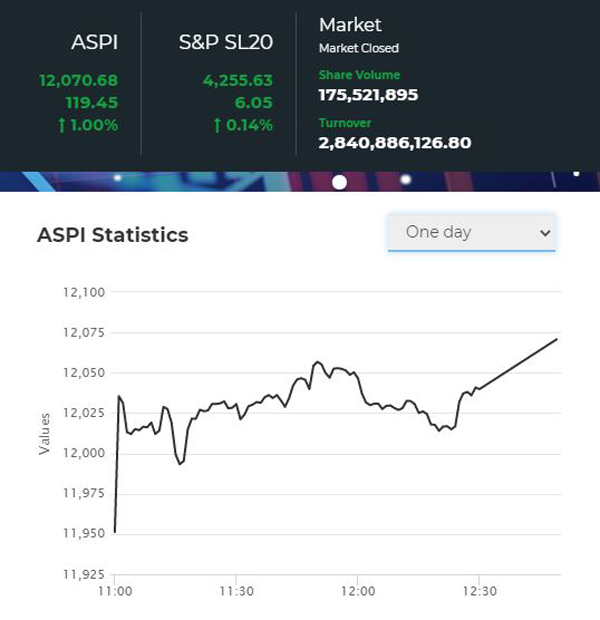
Colombo, Dec 24 (AdaDerana) – The Colombo Stock Exchange (CSE) set a new record today (December 24) as the All Share Price Index (ASPI) surpassed 12,000 points for the first time in history.
The ASPI closed at 12,070.68 points at the end of trading today (November 16), marking an increase of 1.00% (119.45 points) from the previous day.
The previous highest was recorded last month when the index closed at 11,008.33 points on November 16.
More than 175 million shares were traded overall within the day and the market turnover is recorded as Rs. 2.84 billion.
Meanwhile, the S&P SL20 closed at 4,255.63 points today, up by 0.14% from the previous day.
Today’s trading session was carried on for 90 minutes and was closed at 12.30 p.m. due to the additional half-holiday declared by the CSE in view of the Christmas festival.
During the past few weeks, wives, cooks at various hotels and restaurants and other family members were shocked by gas explosions originating from the domestic liquid petroleum (LP) gas cylinder. From 1 January to 5 December 2021 there were 244 explosions. President Gotabaya Rajapaksa appointed an eight-member committee to investigate the recent report of LP gas cylinder fires and to submit their recommendations within three days. The Committee, after the initial investigation, recommended the following guidelines for the public to follow.
The Committee’s recommendations:
(1) To ensure the gas cylinder purchased has no leaks at the point of purchase.
(2) A gas leak needs to be reported to the local police and the investigating committee by calling 011 5 811 927 or 011 5 811 929.
(3) To refrain from using various methods that are not scientifically proven.
(4) Leaks must only be tested by experts recognised by the committee.
(5) No gas cylinders exploded in the recent explosions.
(6) To ensure the regulator is not of inferior quality.
(7) To ensure the regulators come under SLS W1180 and hoses SLS 1172.
(8) A regulator’s lifetime is (maximum) five years and hoses up to two years.
(9) To pay attention to the distinctive odour of the gas coming out of cylinders.
(10) Not to remove any accessories (such as Valves, Rubber Hoses).
(11) To ensure there is a free flow of air around the cylinder.
Inconvenience and misery
Apart from the inconvenience caused to the public, one needs to consider the number of consumers injured directly due to gas explosions. Three persons were wounded on 4 November. On 16 November, another explosion took place in a Ratnapura Restaurant. On 20 November, a fast-food restaurant in Colombo 7 was entirely devastated by a fire caused by a gas leak. On the 29th of November, ten separate explosions took place in Hatton, Malliappuwa, Jaffna, Kilinochchi, Embulpitiya, Mawanella and Matara. The Committee consisting of an eight-member panel appointed by the President should investigate these explosions and consider who is responsible for paying compensation for such incidents where the whole kitchen area became violently shattered in various places? However, State Minister Alagiyawanna assured that on the 10th-night news coverage, the Government would pay compensation.
On 5 December, Ceylon Today carried a full-page advertisement from Laugfs Holdings. They defended the recent LP Gas cylinder mishaps due to ‘Improper Handling & ‘faulty Equipment ‘. They maintain they always follow the specifications in connection with LP gas and metal cylinders. Laugfs Holdings state they recheck their equipment against all given Government standards to ensure the customer safety.
Their advertisement admits that a few fire incidents took place on LP gas leakages across the country in the recent past. However, the social and other Media carried misleading information on such leaks, directly accusing gas companies of the composition of LP gas filled in a cylinder. Nevertheless, Laugfs Holdings claim that the recently reported incidents did not occur due to the composition of LP gas in the cylinders. They always follow the Government’s technical data, quoting SLS 712-1998 for LP gas and SLS 1178-2013 for gas cylinders.
Gas explosions!
LP gas is resourceful, ecosystems friendly, effective and a safe way to cook. Sri Lankans have used LP domestic gas since 1970. Gas companies, namely Litro and Laugfs, were blamed for amending the percentage of Propane and Butane inside the cylinder. These companies have come out stating that
explosions have occurred mainly due to leakages from ‘ faulty regulators and from connecting hoses from the gas cylinder to the cooker, but not the cylinder itself!”
Although gas companies and policymakers try to brush the issue under the carpet and place the entire blame on the consumer, what is relevant is that the recent explosions are far too many to ignore. Today everyone who gets near the LP gas cylinder does so in fear. Some women wear helmets when they use gas cookers! After the recent explosions, even the coconut shells used in clay ovens have rocketed in price. Are we to gradually approach the basic ancient techniques of cooking?
Nevertheless, the village folk would not mind going back to the ancient cooking methods of using the traditional hearths, commonly known as the lipa, but how can the wealthy folk who live in townships with modern facilities manage? Their only alternative is to spend the extra money and convert their cooking appliance to electricity. Here again, on the 4 December, the whole of Sri Lanka had a power outage in several areas of the country for six hours, placing the country in pitched darkness! It was allegedly due to a suspected mechanical failure or sabotage by some engineers working to rule linked to electricity unions. Under the circumstances, how could the consumer find an alternative?
Origination of LP Gas
In 1970 Sri Lanka used LP gas for the first time, with 30 per cent Propane and 70 per cent Butane. Authorities considered such a combination would be the best ratio because the mixture of Propane and Butane inside a gas cylinder would be liquid under compression. If there are leaks in the pressure system, the cylinder’s absolute pressure will exert on the cooker, resulting in a fire! Therefore, experts advise that it is not the material’s fault, thus becoming the full responsibility of the decision-makers to ensure what is the safest composition for the consumer.
What amazes the consumer is that from 1970 onwards, LP gas was used but no one experienced explosions of this nature as seen recently within the last two months! So far, there have been ten explosions per day. What is interesting to note is the Laugfs Company says the composition of 50 per cent of Propane and 50 per cent of Butane does not bring an additional income to the company. One tends to raise the question as to why did the gas companies alter the original percentages of Propane and Butane? According to Media reports Litro Gas has a composition in the ratio of 20 per cent Propane and 80 per cent Butane.
Journalist receives a writ notification
A journalist who exposed these gas explosions was summoned to appear in Court. The writer points out that journalists when there is a climate of fear, have a commitment towards their vocation and their conscience to throw light on whatever injustice in the interest of the public! How can society, companies, or the Government be helped if they keep quiet? Journalists must point out that whenever a Government or company goes off the rails to inform the public about their mistakes. They contribute to developing a moral society. Each person is socially and economically free to act. Similarly, journalists’ maintaining a voluntary silence tends to be suicidal and undermines the brotherhood of a journalistic fraternity.
LP gas importers enjoy a monopoly in deciding the percentage of Propane and Butane configuration to be used because boiling points differ in each country due to climatic conditions. Meanwhile, the Director of Engineering at the Engineering Standards Division (SLSI) states that measurements used for the quality of domestic LP Gas in Sri Lanka are outdated! There is no Standard Measurement of the composition of LPG in Sri Lanka.” Therefore, his recommendation is to take immediate action to change the existing antiquated laws and systems.
Finally, The Consumer Affairs Authority directed the two major LP gas distributors to supply new LP gas cylinders with coloured polythene seals depicting their logo in different colours. – e.g. Litro Gas with a red logo on a white seal and Laugfs with a blue on a yellow background. The consensus is the new gas cylinders need to be re-filled with fresh LP gas, but neither company has changed their colour on the gas cylinders yet. Consumers hope the new method will be safer to use. However, the Committee observed, valves, hoses, clips, and cookers should not be substandard but recommended by the Sri Lanka Standards Institute.
The latest is the Government wants to take the two LP gas distributors, namely Litro and Laugfs, to Courts and seek a decision. Meanwhile, the Nation sits on a time bomb in a volatile situation until the Courts decision is reached.
The evidence assembled by C.R. Panabokke, in ‘Evolution of the Indigenous Village Irrigation Systems of Sri Lanka’ (2010), shows the transition from rainfed to irrigated agriculture took place mainly in the 3rd century BCE. A study by Rukshan Jayawardena, ‘Ancient Irrigation and Related Settlements of the Early Historic Period’ (1997) yields useful information on the growth of irrigated agriculture during this period. There is no reliable evidence to indicate that rice was grown on the island during the ‘pre-Vijayan’ period. First came the village tank. Then came ‘irrigated’ rice cultivation in the field below the tank. By the beginning of the 2nd century BCE, the village tank had become an integral feature of the undulating terrain of the dry zone (Nicholas, C.W. History of Ceylon, Vol. 1, 1959).
Low-humic gleys
As in the past the soils now used for rice cultivation are mainly the poorly-drained low-humic gleys (LHGs), which occupy the valley bottoms and can be puddled. Since the well-drained reddish brown earths (RBEs), which occupy the mid and upper slopes of the dry zone landscape, cannot be puddled like the LHGs, they are unsuited to rice cultivation. In Sri Lanka the valley bottoms are called lowlands, whereas the mid and upper slopes of the undulating topography are called uplands. There is no hard evidence of rice having been grown under rainfed conditions in the dry zone uplands (RBEs) in the protohistoric period.
The evolution and spread of small village irrigation systems in Sri Lanka could be viewed as an internal development that occurred over a long period of time in response to the distinctive agro-ecological features of the dry zone, which were by no means uniform. As noted above, it was the lack of any form of shallow groundwater that necessitated the surface storage of water in the north-central dry zone – the cradle of civilization in Sri Lanka.
A typical village in the NCP consists of the village tank and a paddy field below it. Many experts, including Panabokke, have stated that without artificial storage of water, human existence in the NCP would have been impossible. The village tank provided water for multiple uses during the prolonged dry season, including agriculture. It enabled farmers to combine cultivation of kurakkan, gingelly and other seasonal food crops in the ‘rainfed’ uplands during the Maha season with rice cultivation in the ‘irrigated’ lowlands during the Yala season. This was a major technological breakthrough that greatly enhanced the food production potential of the north-central dry zone in the 3rd century BCE.
Nuwan Abeywardana, R.L. Brohier, R.A.L.H. Gunawardana, R.W. Levers, Rukshan Jayawardena, Madduma Bandara, C.W. Nicholas, C.R. Panabokke, Henry Parker, A.M.P. Senanayake, Sudharshana Seneviratne, M.U.A. Tennakoon, and many others, through their scholarly research, have deepened our understanding of how and why the tank village emerged as the basic unit of settlement in the dry zone in ancient times. Even today, these settlements dotting the hard rock basement terrain of the dry zone continue to play a vital role in preserving its economic integrity and cultural identity. A recent study indicates there are about 10,000 functional village tanks originating from the ancient water-harvesting system in the island (Abeywardana, Nuwan; Bebermeier, Wiebke; and Schutt, Brigitta, Ancient Water Management and Governance until Abandonment, and the Influence of Colonial Politics during Reclamation, 2018).
Tank Cascade System
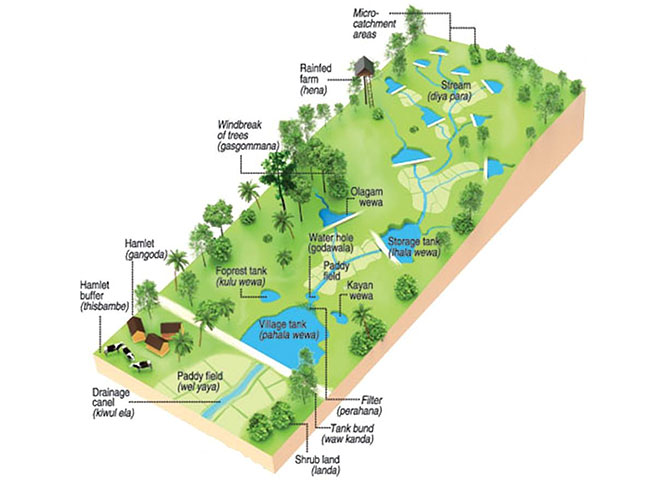
A tank cascade system could be defined as a chain of small tanks organized within a micro-catchment of the dry zone in Sri Lanka. The tanks in the upper catchment store water from a seasonal stream and convey it to other tanks downstream. The village tank is the lynchpin as it collects water from all the other tanks in the cascade system. The water stored in this manner is used for agriculture as well as other community activities. The proper functioning of the village tank therefore depends critically on the condition of all the other interconnected tanks which drain into it. When they fall into a state of disrepair, the system breaks down.
The number of cascade systems varies significantly from one river basin to another. For example, the Mee Oya river basin has only one associated cascade system. The Malwathu Oya river basin, on the other hand, has 179 associated cascade systems (IUCN Sri Lanka, , 2016). High priority should be given to ensuring the sustainability of the village tank settlements as they have been the backbone of civilization in the dry zone since the 3rd century BCE. Most of the entrenched problems pertaining to management and organization of small tanks identified in a report by Saleha Begum (Minor Tank Water Management in the Dry Zone of Sri Lanka, 1987) continue to remain unresolved.
The narrow inland valley systems carved out on the basement rock terrain is a distinctive feature of the areas comprising Sri Lanka’s dry zone, especially the North-central and North-western provinces. The small tank cascade system is found mainly in these regions, where the undulating landscape is crisscrossed by these inland valleys. This is a good example of the skill-level reached by the local ‘scientific’ community in such areas, in the form of irrigation engineering, soil and water management, and agronomy in the 3rd century BCE.
It is important to note that this development did not occur suddenly; rather, it was an ‘evolutionary’ process that occurred over a long period of time. A key feature of this process is that it produced the kinds of innovations that were suited to the various environmental conditions in the dry zone. Clearly, adaptation and sustainable development were concepts that were not only well understood but also practiced by the pioneers of small-scale irrigation and water management in Sri Lanka.
Due to the sustainable management structure set up within society, the small tank systems existed intact for more than two millennia…Different layers of management strategies were implemented, blending centralized larger irrigation schemes with locally controlled small irrigation systems. Buddhist temporalities were used to link the hinterland with the main settlements…” (Abeywardana et al, 2018).
Tamil Nadu also boasts of a modest small-tank cascade system, but whether it borrowed the technology from Sri Lanka or vice versa is not clear. An overview of this system is provided in a report by Krishnaveni, M.; Sankari, Siva; and Rajeswari A. (Rehabilitation of Irrigation Tank Cascade System Using Remote Sensing GIS and GPS, 2011). The physical and cultural landscape of Sri Lanka differs significantly from that of Tamil Nadu. Hence, in terms of future research, a study that compares the historical evolution and organizational structure of the tank cascade systems in these two regions would be a useful activity to undertake.
Caption Pic 1:
Tank cascade system. (Image courtesy: Paranage, K. [2018]. ‘Understanding the Relationship between Water Infrastructure and Socio-Political Configurations: A Case Study from Sri Lanka’)
The main Opposition Samagi Jana Balavegaya (SJB) has called for a thorough inquiry into the conduct of sacked Agriculture Secretary Senior Prof. Udith K. Jayasinghe by Auditor General W.P.C. Wickramaratne and other relevant authorities.
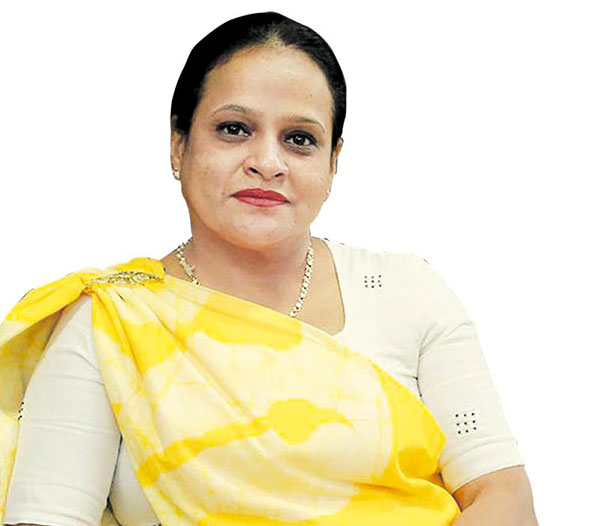
Matale District lawmaker Rohini Kaviratne on behalf of the SJB said that the truth couldn’t be suppressed by sacking Prof. Jayasinghe. Accusing Prof. Jayasinghe of importing liquid nano urea from India at a cost very much higher than in the Indian market in the wake of a stock of Chinese carbonic fertiliser being rejected, MP Kaviratne alleged that the sacked official was the main culprit.
Prof. Jayasinghe said that he was quite surprised by the SJB’s allegations. I have absolutely no idea why the Opposition directed a spate of accusations at me,” Prof. Jayasinghe said, adding that he, too, wanted to know what he did wrong and why. When pointed out the SJB held him responsible for ruination of the agriculture sector, Prof. Jayasinghe said that he would like to know how he achieved that in less than six months.
Prof. Jayasinghe was appointed the Agriculture Ministry Secretary in early June this year. At the time he received the appointment, Prof. Jayasinghe served as the Vice Chancellor of the Wayamba University. President Gotabaya Rajapaksa replaced Prof. Jayasinghe with D.M.L.D. Bandaranayake this week.
The former UNPer said that the government should explain the appointment of five Secretaries to the Agriculture Ministry since the last presidential election in Nov 2019.
Making a reference to the Secretary of another ministry owning property in Australia, lawmaker Kaviratne said that the government couldn’t address the issue by sacking the Agriculture Ministry Secretary.
MP Kaviratne said that Prof. Jayasinghe questioned the role played by Ven. Atureliye Rathana and President of the Government Medical Officers’ Association (GMOA) Dr. Anuruddha Padeniya in promoting carbonic fertilizer though he was actually the main person who promoted the interests of those private companies engaged in fertilizer imports.
MP Kaviratne pointed out that having declared in May 2021 what the government called a green agriculture development strategy, the Agriculture Ministry in June 2021 called for global bidding for organic fertiliser. Subsequently, on August 11, 2021 the Agriculture Ministry named the Qingdao Seawin Biotech Group Co., Ltd. as the supplier of 99,000 metric tons of carbonic fertilizer to Sri Lanka, MP Kaviratne said.
Responding to another query, MP Kaviratne emphasized that the government couldn’t absolve itself of the responsibility for the opening of a Letter of Credit and the immediate shipping of the first consignment even before the National Plant Quarantine Centre (NPQC) cleared the test samples. Referring to a statement issued by the Chinese company dated Oct 26, 2021 that dealt with the fertliser crisis, MP Kaviratne said that the supplier quite clearly acknowledged that the NPQC received product samples the same day (Sept 23, 2021) China shipped the organic fertilizer.
MP Kaviratne said that a wider investigation was required to expose all those who had profited immensely at the expense of the country. The outspoken MP said that China went to the extent of blacklisting People’s Bank in the wake of the issuance of an enjoying order by the Commercial High Court of Colombo in respect of the payment for the rejected stock of fertilizer.
The SJB MP urged those responsible to investigate why over a month after the government did away with the ban on agro-chemicals not a single product had been imported. Who got the Registrar of Pesticides removed and why, MP Kaviratne asked, warning the government that once President Gotabaya Rajapaksa opened the new session of Parliament on January 18 the Opposition intended to raise that issue.
The ruination of the agriculture sector couldn’t be blamed on the recently sacked Secretary alone, the MP said. She pointed out that the prorogation of the Parliament soon after the passage of the Budget for 2022 had been influenced by the devastation in the agriculture sector as a result of hasty abolition of agro-chemical use, the Yugadanavi betrayal, the deteriorating balance of payments crisis and the rising cost of living.
Having promised political stability and security, the incumbent dispensation had mercilessly destroyed every sector, MP Kaviratne said, the political leadership should accept the blame for the fertliser crisis.
The MP alleged that an Acting appointment had been made after the removal of the Registrar of Pesticides Dr. J.A. Sumith to pave the way for a certain company to receive the agro-chemicals tender. The SJB lawmaker urged the government to come clean on the issues at hand.
Responding to questions, MP Kaviratne said that the government couldn’t divert public attention from the CID recording statements from several persons, including the Editor of ‘Aruna’ Mahinda Illeperuma regarding the accusations directed at Dr. P.B. Jayasundera, Secretary to the President as regards the opening of an account at a particular branch of the People’s Bank to pave the way for nano urea imports from India. She pointed out that Gamini Senarath, Secretary to the Prime Minister Mahinda Rajapaksa, too, issued a statement following various allegations made pertaining to carbonic fertiliser imports from China.
The MP pointed out that the government had so far refrained from giving any specific reasons for Prof. Jayasinghe’s removal.
The Central Bank of Sri Lanka (CBSL) said on Wednesday that measures being taken at present would ensure that by end of 2021, official reserves would remain above US dollars 3 billion. Thus the government and the Central Bank remain confident that expected inflows will materialise and the reserve position will remain at comfortable level throughout the year 2022.
The full text of the CBSL statement is as follows.
Despite the headwinds of the economic impact of COVID-19 and challenges posed by adverse developments in the external sector, the Sri Lankan economy showed resilience throughout 2021.
Also, Sri Lanka successfully met its debt obligations by repaying foreign loans, including the payments of the International Sovereign Bonds. Since the beginning of the year both the Central Bank and the Government have been actively pursuing possible avenues to replenish official reserves, with an emphasis on encouraging non-debt flows, so that the existing foreign debt could be managed in a sustainable manner. These efforts were accelerated since October 2021 with the announcement of the Six-Month Road Map for Ensuring Macroeconomic and Financial System Stability, which set out envisaged targets for build up of official reserves in the near term.
As articulated in the Six-Month Road Map, number of foreign exchange inflows are envisaged in the very near term. Major foreign exchange inflows to the Central Bank include SWAP facilities with Middle Eastern and other regional central banks amounting to about US dollars 2.0 billion.
The government is also in the process of securing government to government financing, syndicated loans as well as loans from multilateral organisations. In addition, the expected foreign exchange facilities that were negotiated during the high-level visits abroad made by authorities are also progressing well.
Further, the interventions made by the Central Bank on several facets of the foreign exchange market, such as incentive scheme introduced for workers’ remittances, and the repatriation and conversion requirements on account of exports proceeds will improve the liquidity in the domestic market, thereby enabling the Central Bank to build up official reserves further.
With the recent rise in departures for foreign employment and exponential growth observed in tourist arrivals, the external sector is expected to recover well in the period ahead and the pressures observed at present are expected to moderate with increased inflows to the economy.
****
CBSL extends additional incentives for inward workers’ remittances
The Central Bank of Sri Lanka (CBSL), having considered the requests made by Sri Lankans
working abroad, has decided to continue the payment of additional Rs. 8.00 per US dollar for
worker remittances, paid in addition to the incentive of Rs. 2.00 per US dollar under Incentive Scheme on Inward Workers’ Remittances”, for such workers’ remittances channelled through Licensed Banks and other formal channels and converted into Sri Lankan rupees, until 31.01.2022.
The decision to continue this additional incentive of Rs. 10.00 per US dollar is in response to the favourable developments observed in workers’ remittances so far during December 2021.
Further, CBSL has also decided to bear the transaction cost incurred by Sri Lankans working
abroad up to a defined limit when remitting their money to Sri Lanka through exchange houses and / or banks.
Accordingly, a large segment of Sri Lankans working abroad would now be able to remit their money to Sri Lanka without any charges. The operating instructions in this regard including the date of commencement will be issued by CBSL in due course. -CBSL
Sri Lanka had not sought financial support from the International Monetary Fund (IMF) during a just concluded staff team visit to Colombo.
IMF’s mission chief for Sri Lanka, Masahiro Nozaki told Daily Mirror via email that the staff is still ready to discuss the option if requested.
Nozaki said a staff team from the IMF visited Colombo from December 7–20 to conduct the 2021 Article IV consultation with Sri Lanka.
Under Article IV of the IMF’s Articles of Agreement, the IMF holds regular bilateral discussions with all member countries to review economic developments and policies.
Following approval by IMF Management the IMF’s Executive Board discusses a Staff Report based on these discussions, Nozaki said.
The Cabinet had this week discussed an IMF bailout but had not reached a decision if to seek financial support from the global agency.
The Government is, so far, refusing to accept the conditions put forward by the IMF for a bailout package.(Easwaran Rutnam)
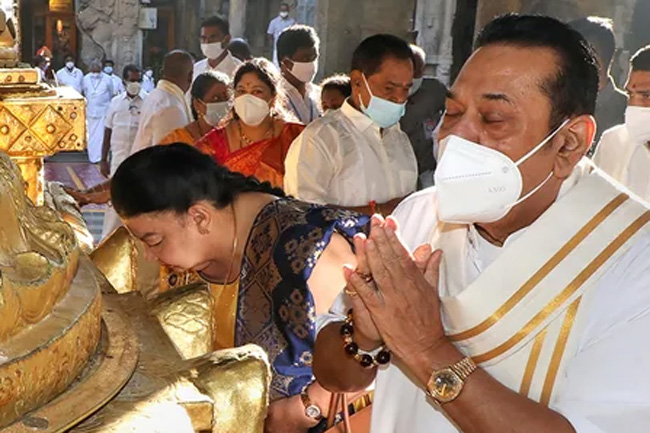
Sri Lankan Prime Minister Mahinda Rajapaksa, who is on a two-day spiritual visit to India, on Friday offered prayers at the famous hill shrine of Lord Venkateswara in Tirumala in India’s Andhra Pradesh along with his wife Shiranthi Rajapaksa.
PM Rajapaksa came to India on Thursday to pay his visit to the temple city of Tirupati.
He was accorded a warm welcome by the joint executive officer of Tirumala Tirupati Devasthanams (TTD) Veerabrahmam and chief vigilance and security officer Gopinath Jatti as he arrived at the temple gate.
After darshan, the priests performed a ritual associated with seeking blessings of Lord Shiva at the Ranganayakula Mandapam.
Andhra Pradesh’s deputy chief minister Narayana Swamy was also present during the Lankan prime minister’s Tirumala temple visit.
While taking a tour of the temple, PM Rajapaksa also deposited money into the ‘Hundi’ and the couple was presented with a memento, New Year calendar and diaries by authorities.
PM Rajapaksa visited the temple in February 2020 when a special ‘pooja’ was performed at the Devasthanam on the first anniversary of his current term.
The Health Ministry reports that 573 new cases of coronavirus have been detected in the country within today (24).
This includes two persons who had arrived from overseas, the Govt. Information Department said in a release.
Meanwhile this brings the tally of Covid-19 cases confirmed in Sri Lanka thus far to 582,722.
Presently approximately 9,020 patients infected with the virus are undergoing treatment across the island.
The Director-General of Health Services has confirmed 20 more coronavirus-related deaths for December 23, increasing the death toll in the country due to the virus pandemic to 14,832.
According to the figures released by the Government Information Department, the deaths reported today include 12 males and 08 females.
Six of the patients are between the ages of 30-59 years. The remaining 14 are in the age group of 60 years and above.
Minister of Agriculture Mahindananda Aluthgamage has assured that there would not be a food shortage in the country next year.
He says certain statements warning about a looming food shortage cannot be accepted as 90 to 95 percent of paddy fields in each district have already been cultivated now.
The minister’s remarks came after a statement made by Udith K. Jayasinghe, the former Secretary to the Agriculture Ministry sparked controversy.
Mr. Jayasinghe was subsequently removed as the agriculture secretary and Mr. D.M.L.D. Bandaranayake was appointed to the post.
Speaking to the media later, Mr. Jayasinghe said he is not aware of a specific reason for his sacking and that he is yet to be notified in writing of the move.
Meanwhile, SJB Parliamentarian J.C. Alawathuwala says the subject ministers should be sacked from their posts instead of ministerial secretaries, in order to resolve the prevailing issues.
Former Secretary to the Ministry of Agriculture Prof. Udith K. Jayasinghe stated that there was a fraud in importing nano fertilizer at a higher price.
He pointed out that a bottle of nano liquid fertilizer, which could have been bought for USD 5.25, has been bought for USD 10.
Meanwhile, farmers are still complaining that their crops are being destroyed due to the substandard fertilizer that was provided by the government.
Farmers in Welikanda, Susirigama, and Malinda villages in the Mahaweli B zone in the Polonnaruwa district have been affected in this manner.
This is due to the fact that the paddy cultivations cultivated under the Maha season this year have turned yellow, and the growth has slowed down.
Farmers in these areas have cultivated paddy in an area of nearly 1000 acres.
Although the government provides organic liquid fertilizer for these crops, farmers refuse to use them due to their substandard quality.
Meanwhile, the National Agrarian Union today (24) responded to the statement made by Agriculture Minister Mahindananda Aluthgamage that there will be no food shortage in the country.
Senaka Weeraratna Vice – President Justice for Animals and Nature
A man
preaches peace. He is world renown as ‘Prince of Peace’. Yet, ironically his
birthday anniversary is celebrated worldwide with unlimited bloodshed of
defenseless animals.
Turkeys,
cattle, pigs, goats, lambs, rabbits, and bird kinds such as ducks, hens,
roosters, fowls are all lined up and forced to lay down their precious lives
for human feasts on account of the ‘Prince of Peace’ – Jesus Christ.
Shame
on followers of Jesus Christ. Their idol deserves better than blood shed of
innocent animals as a gift for his birthday anniversary.
Killing
for Christmas
No
Merry Christmas for poor animals. In fact, Christmas is the worst period in the
calendar year for them. It is a sad reflection on humanity if the purpose of
Christmas is seen as to give Joy for humans to feast on animal flesh, and in
contrast, total misery for animals to suffer and die for the sake of feeding
humans. Christmas is hardly a win – win religious festival vis a vis, say, for
example, Vesak, where no animal is forced to sacrifice its precious life to
celebrate a religious festival. Buddhism is a life – affirming religion.
Nevertheless, Christmas is an apt time for
reflection on our civilizational values because it is the season where hundreds
of thousands of innocent animals undergo extreme suffering, exploitation, and
death. Millions of turkeys are slaughtered for Christmas dinner, along with
ducks, geese, pigs, lambs, and chickens. In western countries, puppies and
kittens are given away as presents, then often neglected or discarded by new
owners when the novelty has worn off. Rabbits and foxes have their
fur stripped from them to be turned into clothing and accessories.
The undeclared war that is being waged everyday
against countless millions of non-human animals all over the world with hardly
any opposition from the Abrahamic religions, takes on an aggravated turn during
the Christmas season. These practices are deeply unsettling to anyone who
values compassion and respect for the life of others. We cannot remain silent.
A human
being is an animal, a part of nature. But we single ourselves out from the
rest of nature. We classify other animals and living beings as nature, as if we
ourselves are not part of it. Then we pose the question, How should I deal
with Nature?” We should deal with nature the way we deal with ourselves. . . !
Harming nature is harming ourselves, and vice versa.” (Thích Nhất Hạnh )
The
greatest moral challenge faced at Christmas being a religion-based festival is
to make it slaughter – free. Violence towards innocent animals on a mass scale
is not an ethically correct way to celebrate the anniversary of the birth of
the founder of a religion renowned as the ‘Prince of Peace’.
Why
does not the Christian Clergy give voice to the suffering of animals? Why are
they deaf to the screams of animals inside slaughter – houses?
We
in Sri Lanka can set an example to the rest of the world by making Christmas a
slaughter-free day. The biggest beneficiaries would be the innocent
animals.
To
remain mute in the face of mass murder of animals to celebrate Christmas makes
the silent crowd complicit in this horror event.
Extend the spirit of goodwill to animals this Christmas
by avoiding meat altogether on Christmas Day. That will be a unique and truly
noble gesture.
Bangladesh is now one of the world’s developing economies. In 2015,
Bangladesh graduated from Least Developed Countries (LDC) status and became a low-middle-income
country. Many Asian, European and American economists are positive that soon
Bangladesh will become one of the middle-income countries in the world. Today,
Bangladesh is moving forward at a good pace in various indicators of the
economy.
The country, once infamously labeled a bottomless basket case” in
1972 by then US Secretary of State Henry Kissinger, is rapidly advancing in
national growth, per capita national income, export income, foreign exchange
reserves, electricity, communication, economic and social infrastructure which
are essential for development. India, Pakistan, Sri Lanka, Nepal, Maldives,
Bhutan, and even Afghanistan can follow Bangladesh’s economic growth model.
Despite the global coronavirus pandemic, the per capita national
income of Bangladesh is positive. According to various local and international
media outlets, in the fiscal year 2019-2020, the per capita income of
Bangladesh was USD 2064. And in the fiscal year 2020-2021, it went up to USD
2228. In the fiscal year 2018-2019, the Gross Domestic Product (GDP)
growth of Bangladesh was 8.15 percent. And in the2019-2020 fiscal, this growth
has been 5.24 percent. According to an Asian Development Bank (ADB) report, in
the 2020-2021 and 2021-22 fiscal year, this growth is expected to be 6.8
percent and 7.2 percent respectively even amidst the Covid-19 pandemic.
Under Prime Minister Sheikh Hasina, Bangladesh is on the highway of
development today. Bangladesh has fulfilled the various conditions of the
United Nations and is qualified to enter the list of developing nations.
According to a 2020 survey, Bangladesh is the 41st largest economy in the world
and one of the 11 countries being considered emerging for future development.
According to the Center for Economic and Business Research (CIBR),
a British economic research institute, Bangladesh will be the 34th largest
economy by 2025, 26th by 2030 and 25th by 2035 if its economy continues to grow
and develop like it is now,
Growth of exports, remittances
While the global economy is in the grip of coronavirus and
stagnant, Bangladesh’s economy is moving forward, albeit at a relatively slow
pace. And one of the strong factors behind this move is the growth of
Bangladesh’s overall export earnings, the growing inflow of remittances and the
positive flow of per capita national income. The other South Asian economies
can follow the Bangladesh model of quickly overcoming economic stagflation
during the Covid-19 period.
According to a survey by the World Bank’s Multi-Donor Trust Fund the
Global Knowledge Partnership and Development, Bangladesh ranks 8th among the
top ten countries in the world in terms of remittance flows by 2020. At
present, Bangladesh’s remittance reserves are over USD 45 billion and it ranks
45th in the world in terms of remittances. According to an EPP statistic, in
the first ten months of the 2020-2021 fiscal year, Bangladesh’s export earnings
were USD 32.07 billion, an increase of 8.75 percent over the same period last
year.
This rise and progress of Bangladesh’s economy is now a surprise to
the whole world. People all over the world are now amazed at the progress
Bangladesh has achieved.. State thinkers, economists and the mainstream media
of various countries are now praising Bangladesh. They are monitoring the country’s
economic development strategy. Some countries are also considering whether this
development strategy can be followed or implemented in their countries.
Another US daily, the Wal-Mart Journal, recently wrote that
Bangladesh’s economy is now the ‘fastest horse’ in South Asia. Mike Hard, a
commentator for the Washington Post, writes that at one time South Korea was
cited as an example of development. Now Bangladesh has occupied that slot.
Praise from India
The remarkable economic successes that Bangladesh has achieved are
reflected in various reports published by national and international news
outlets. Before presenting the 2021-2022 budget, India’s Finance Minister
Nirmala Sitharaman said in February that there was a lot to learn from
Bangladesh on increasing export earnings in certain sectors.
The Economic Survey presented by her commented, ‘Bangladesh has
emerged as an important exporter in the international arena. Between 2011 and
2019, the country’s compound annual growth rate was 7.8 percent, 0.9% higher
than India and 0.4% higher than the rest of the world.”
India has also been attracted to the growing per capita national
income of the people of Bangladesh. By end of 2020, the IMF had forecast that
Bangladesh would surpass India in terms of per capita national income. Towards
the end of 2020, the IMF predicted that Bangladesh would surpass India in terms
of per capita national income. And that has happened. On June 1, Blumberg
headlined, “South Asia now needs to look at the region’s stars.”
Needless to say, this star is Bangladesh. ‘
According to a report in the Indian online journal The Print on May
26, Bangladesh has built up deep ties with its neighbors, from sending India
Covid-19 epidemic relief supplies to Sri Lanka’s economic crisis through loan
assistance.
Moreover, Bangladesh is one of the 40 countries that sent relief
twice in the second wave of coronavirus to India. On May 8, Bangladesh sent
10,000 medicines to India. Later on, on May 16, Bangladesh also sent 2,072
boxes of antiviral drugs and Covid protection materials to India.
It may be noted that Bangladesh recently agreed to exchange USD 200
million with Sri Lanka. This money will go a long way in strengthening the Sri
Lankan economy. The currency exchange process will also help Colombo overcome
the huge debt crisis. Through this initiative, it is clear to the outside world
that Bangladesh is currently on a strong economic footing.
Praise from Pakistan
The rise and development of Bangladesh’s economy have also
attracted the attention of Pakistani intellectuals. Abid Hassan, a former
adviser to the World Bank’s Pakistan program, compared the situation in
Pakistan with Bangladesh’s economic accomplishments in an article in the
leading Pakistani daily The News International. He said even 20 years ago, it
was unthinkable that by 2020, Bangladesh’s per capita GDP would be higher than
Pakistan’s. He felt if Pakistan maintains its disappointing performance, it may
have to seek aid from Bangladesh by 2030.
If Bangladesh can pay USD 20 million to Sri Lanka, waive the IMF’s
Bangladeshi share of money from Somalia and Sudan, help Indonesia with Covid-19
medical equipment, shelter a large number of Rohingya refugees from Myanmar, it
can also extend financial help to Pakistan. This requires a change in
Pakistan’s mentality.
The Canada-based think tank International Forum for Rights and
Security recently published a report on Bangladesh and Pakistan. It has been
shown there that Bangladesh is ahead in all areas of the index.
So, it is expected that if the Bangladesh government can continue
to handle the Covid-19 epidemic in the same way as it has done in the past,
then in 2035 Bangladesh will be the 25th largest economy in the world and in
2041 emerge as a developed and prosperous country, fulfilling the dream of its
founding father Sheikh Mujibur Rahman.
South Asian countries such as India, Pakistan, Sri Lanka, Nepal,
Maldives, Bhutan even Afghanistan are very close to Bangladesh geographically.
The nature and trends of socio-economic factors in Bangladesh and other South
Asian states are almost alike, although Bangladesh is an overpopulated
country. There is also the burden of the Rohingya refugees on Bangladesh.
Bangladesh is developing despite having many other problems such as Covid-19,
climate change, etc. The other South Asian countries would be the gainer if
they follow the Bangladeshi approach and model of economic management and
system.
The Head of the Catholic Church of Sri Lanka Malcolm Cardinal
Ranjiths’ proposal to keep the shops closed that sell the spirits of cheer
(supposedly) during Christmas has met with stiff criticism coming from many
members of the public
Well on its own, it is always a sensible thing to do: to keep the
consumption of spirits down to a possible minimum, even during festivals such as
Christmas. After all, we Sri Lankans are said to be amongst the top
that drink their guts out, who cannot be easily out drunk by even the world’s
top drinkers, say Russians, for example.
Now there are some customs and habits, be them cultural,
religeous, social or other that can become so ingrained in the collective
mentality of people, who belong to a particular creed, it is not easy, to ask
them to stop it and forget the spirits but still stick to the cheer.
And if the time of the year is also synonymous with a specific custom, where it
is practised with gay abandon, even if going past the point of moderation
often, it is still not fair by many, who do enjoy a ‘drink’ not because they
are alcoholics, but sticking to a tradition going back for many
years.
So let us try our best, drink moderately in celebration of the
‘Birth of Jesus’, while not forgeting the ‘have nots’, who cannot afford to
have a decent meal, let alone a ‘drink’ that you and I the ‘haves’ can afford.
Sri Lanka and India discussed ways in which the
two countries could further enhance bilateral cultural relations when Sri
Lanka’s High Commissioner to India Milinda Moragoda met with Minister of State
for External Affairs & Culture of India Smt. Meenakashi Lekhi.
The meeting between the High Commissioner of
Sri Lanka and the Minister of State for External Affairs & Culture of India
was held in a very cordial manner. The discussion focused on further enhancing
bilateral cultural relations, in particular through promoting Theri Sanghamitta
and Sita of Ramayana, the two iconic figures who played unique roles in the
relations between India and Sri Lanka.
Both dignitaries noted that Theri Sanghamitta
and Sita of Ramayana were two extraordinary historical figures that have
contributed much to Indo-Lanka relations and agreed to explore ways and means
to promote modern bilateral cultural ties revolving around them.
Collaboration possibilities between Sri Lanka
and the National Museum of New Delhi and the National Gallery of Modern Art
were also discussed at this meeting. High Commissioner Moragoda invited State
Minister Meenakashi Lekhi to undertake a visit to Sri Lanka as well.
High
Commissioner Moragoda also shared a copy of his policy document, the
“Integrated Country Strategy for Sri Lanka Diplomatic Missions in India
2021/2023”, which includes a detailed road map
for bilateral cultural cooperation, and a copy of the Hindi version of
the booklet “The History of the Mahabodhi Temple in Bodh Gaya”,
published by the Anagarika Dharmapala Trust, to the State Minister.
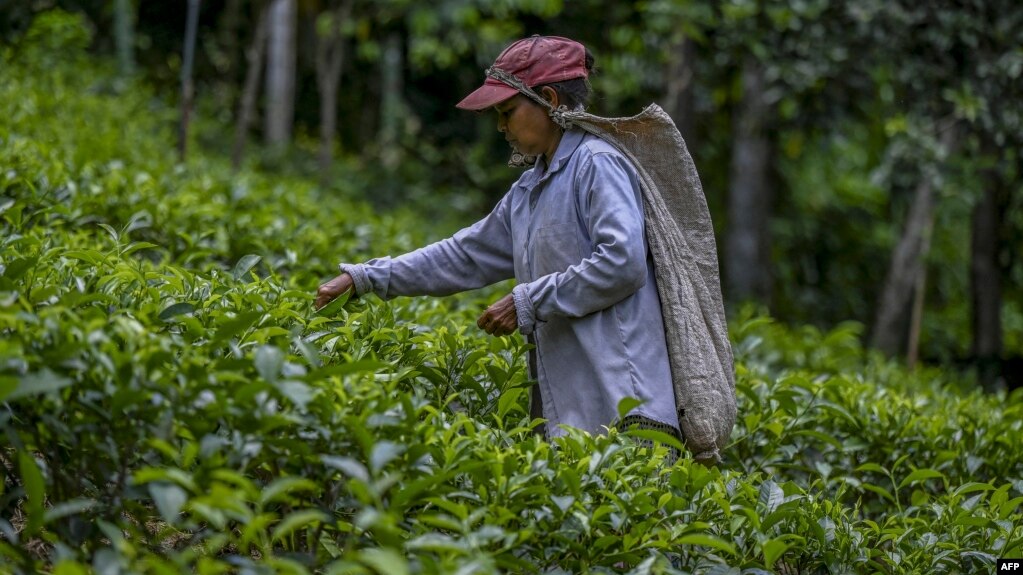
Iran has agreed to accept Ceylon tea in exchange for some $251 million in oil debt from the South Asian island nation of Sri Lanka, Iranian media report.
Alireza Peyman-Pak, the head of Iran’s Trade Promotion Organization, said on December 23 that “in recent negotiations, we reached a written deal to reimburse Iran’s debt and interest on it in the form of a monthly shipment of tea produced in Sri Lanka.”
According to Iranian media, Peyman-Pak said a deal was reached in which Sri Lanka will export tea to Iran every month “to settle a $251 million debt for Iranian oil supplied to Sri Lanka nine years ago.”
Sri Lanka, an island nation of some 22 million people, was formerly known as Ceylon.
Peyman-Pak said the deal will save Iran from having to use scarce hard currency to pay for imports of the widely consumed product.
Iran has been hit hard since the United States pulled out of the 2015 Iran nuclear deal and began reimposing crippling financial sanctions against Tehran.
Sri Lankan Plantation Industries Minister Ramesh Pathirana emphasized that the arrangement will not violate international sanctions as tea is exempt due to it being categorized as a food item.
Iranian banks that have been blacklisted under U.S. sanctions will not be involved in the transaction, he added.
Sir Lanka has also been experiencing severe financial difficulties, including a severe shortage of foreign currency. National reserves have declined to just $1.6 billion, leaving the government hard-pressed to meet payments for oil and food imports.
The Central Bank of Sri Lanka wishes to inform the general public that the measures being taken at present will ensure that by end of 2021 official reserves will remain above US dollars 3 billion.
Despite the headwinds of the economic impact of COVID-19 and challenges posed by adverse developments in the external sector, the Sri Lankan economy showed resilience throughout 2021. Also, Sri Lanka successfully met its debt obligations by repaying foreign loans, including the payments of the International Sovereign Bonds. Since the beginning of the year both the Central Bank and the Government have been actively pursuing possible avenues to replenish official reserves, with an emphasis on encouraging non-debt flows, so that the existing foreign debt could be managed in a sustainable manner. These efforts were accelerated since October 2021 with the announcement of the Six-Month Road Map for Ensuring Macroeconomic and Financial System Stability, which set out envisaged targets for build up of official reserves in the near term.
As articulated in the Six-Month Road Map, number of foreign exchange inflows are envisaged in the very near term. Major foreign exchange inflows to the Central Bank include SWAP facilities with Middle Eastern and other regional central banks amounting to about US dollars 2.0 billion. The Government is also in the process of securing Government to Government financing, syndicated loans as well as loans from multilateral organisations. In addition, the expected foreign exchange facilities that were negotiated during the high-level visits abroad made by authorities are also progressing well. Further, the interventions made by the Central Bank on several facets of the foreign exchange market, such as incentive scheme introduced for workers’ remittances, and the repatriation and conversion requirements on account of exports proceeds will improve the liquidity in the domestic market, thereby enabling the Central Bank to build up official reserves further. With the recent rise in departures for foreign employment and exponential growth observed in tourist arrivals, the external sector is expected to recover well in the period ahead and the pressures observed at present are expected to moderate with increased inflows to the economy. The Government and the Central Bank remain confident that these expected inflows will materialise and the reserve position will remain at comfortable level throughout the year 2022.
The Sinhalas do not want to trust New Delhi on its word, and their competitive political leaderships keep packaging it differently, but to the same end as far as India relations go
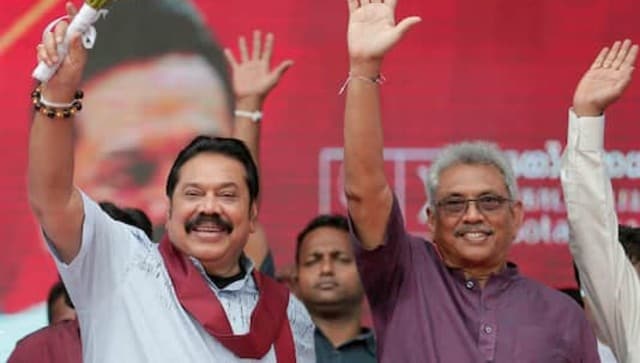
File image of Sri Lankan prime minister Mahinda Rajapaksa and President Gotabaya Rajapaksa. Reuters
Once again, much has been written about the recently reported upheaval in Sri Lanka’s China relations and the nation’s strategic tilt towards the larger Indian neighbour. Going by Colombo’s track record even of the short-span 21st century, independent of the party or leadership in power, it would continue to try and balance India and China relations. In geopolitical terms, it is often described as playing China and India against each other, leveraging on Sri Lanka’s locational advantage.
Sri Lanka’s relations with China is long, though it cannot be described as equal to the umbilical cord relations that geography first and history since had established centuries before the Cold War and post-Cold War geostrategic, geopolitical and geoeconomic dynamics began dictating intra-regional relations in South Asia, extending into the shared Indian Ocean, where there are other partners, players and claimants. Muscle-power and money-power dictate the second and direct the last one.
China argues, rather forcefully, that South China and East China Seas are its backwaters to the exclusion of other nation-states in the region, and extra-regional powers like the US, even more. If Beijing suffers from the US and the rest, who argue the case of ‘freedom of navigation’, citing UN legislations and resolutions, it’s only because it suits China in its hour of economic expansionism and dominance. It does not want to extend the courtesy or logic to India, viz Indian Ocean, for reasons whose history is less than a century old.
In this background, Sri Lanka’s India equations, especially of the majority Sinhala-South have at best been Yo-Yo relations at best. They will talk about how India gave them Buddhism, and in the same vein recall Rajaraja Chola’s invasion of the island a thousand years ago. They recall how a younger southern Sinhala king, Dutugamnu trounced septuagenarian Tamil ruler, Ellara, and simultaneously a millennium prior to Rajaraja but would jump two millennia to claim how LTTE’s Prabhakaran choice of Tiger/Tigers as the emblem and name for his terror-outfit drew from the Chola standard and how all of it found reflection in contemporary Indian state’s approach to the ‘ethnic issue’ in their midst.
Yo-yo relations
To speculate on contemporary triangular relations, particularly in the context of the recent Colombo decision to reject infected organic fertiliser and China black-listing the Sri Lankan public bank payment-guarantor for not clearing their bills of its exporter, is a little too far-fetched. In a way, it reflects the yo-yo nature of the triangular relationship. Otherwise, it, in essence, sums up the Indian strategic thinking about Sri Lanka, which has always been predicated on the nation’s regional/global adversary of the time, namely, the US during the Cold War, China post-Cold War and Pakistan, since the nation’s creation.
The Hambantota port deal is a case study of Sri Lanka’s disposition towards China. Indian strategic community blamed and those in government continue to blame the ruling Rajapaksas of the period, and also at present, for the Hambantota construction-cum-concession deal, and not revoking the same despite a poll promise in 2019. They either forget or conveniently side-step how the predecessor government of president Maithripala Sirisena and prime minister Ranil Wickremesinghe, with the latter in greater parliamentary control, converted such a contract into a 99-year-lease, purportedly blaming the earlier regime of president Mahinda Rajapaksa for pushing the nation into a China-centric debt-trap. It was a trap of an argument in which the international community / strategic community, starting with the all-knowing Indians, comfortably got themselves trapped.
In a nutshell, Sri Lanka as a nation decides what it thinks suits best for itself. There is a kind of national consensus over it, barring of course the minority Tamil community that has been fighting for ethnic equality for decades now. Even here, the Sinhala-Buddhists believe that the Tamils want to restore their ethnic superiority, which they would not accept. They leverage their numbers in a nation where electoral democracy made its beginning in these parts of the world, as far back as 1931. This has led to war, violence and the LTTE brand of terrorism, but with nothing achieved.
All this, the tactically-superior Sinhala-Buddhist polity have proved to their constituency, was India-inspired, or at least India-aided. Against this, the Tamil minority, which had benefited from the Indian political and strategic initiatives in the past decades, are a divided lot when it came to backing New Delhi to the hilt, in domestic politics. The LTTE thought otherwise and acted otherwise. To date, there is unanimity in the matter, as India is still wedded to the idea of ‘Tamil equality within a united Sri Lanka’. The Sinhalas do not want to trust New Delhi on its word, and their competitive political leaderships keep packaging it differently, but to the same end as far as India relations go.
Under the present circumstances prevailing in Sri Lanka, it suited China’s strategic intent to let Indians believe that the other two were caught in a political fight over Beijing’s supply of organic fertilisers to the island nation, and the latter denying/delaying payment, citing poor quality. It is anybody’s guess if Sri Lanka had named the barred microbes that should not be present in the Chinese exports, to be able to win an international arbitration.
That apart, by giving the impression that it was distancing from Sri Lanka in its hour of dire economic crisis, and counter-acting the ground realities by demanding payment for the fertiliser that Colombo would not accept, Beijing might have created an illusion for Indians to believe. It has only used the arm-twisting to gain greater strategic concessions than ever in the past viz India, including the past. The more recent Jaffna visit of China’s Sri Lankan envoy, Amb Qi Zhenhong, when he offered worship at the famed Nallur Murugan temple of the Tamil-Hindu community in the North, visited the iconic Jaffna Library, which Sinhala-Buddhist chauvinists imported from Colombo gutted in 1991, distributed $100,000 worth of assistance to local fishers affected by ‘poaching’ by Indian counterparts, took a boat-ride closer to the IMBL between the two South Asian neighbours and flew drones into the sea-skies in those parts, all have to be seen in this context.
Especially the latter ones, which is both unprecedented and provocative vis-à-vis India, and for which the Sri Lankan government had granted permission and facilitated, by letting the Chinese delegation use the navy’s speed-boat(s)!
The writer is Distinguished Fellow and Head-Chennai Initiative, Observer Research Foundation, the multi-disciplinary Indian public policy think-tank, headquartered in New Delhi. Views expressed are personal.
Udith K. Jayasinghe, the former Secretary to the Agriculture Ministry, says he is disappointed by the dismissal even after dedicating his time, labour and knowledge to serve in the post.
Speaking to the media, Mr. Jayasinghe said he is not aware of a specific reason for his sacking and that he is yet to be notified in writing of the move.
He was removed as the Agriculture Secretary not long after he sparked debate with a warning about an imminent food shortage due to the existing crisis in the country.
When asked if it was his remarks that led to his dismissal, Mr. Jayasinghe said this statement is ‘controversial’ to those who do not have a complete understanding of the prevailing situation.
He opined that the country can overcome the food crisis if we act on a scientific warning and forethought. Speaking up about a looming food shortage is not a violation of the government’s policy, the ex-agriculture secretary went on.
Further, Mr. Jayasinghe noted that the switch from chemical to organic fertiliser is not 100 percent possible.
The Chinese supplier of controversial organic fertilizer consignment says the reports of a Singaporean laboratory that tested its products shipped to Sri Lanka has confirmed that no plant, animal or human pathogens including Erwinia was detected in the samples.
MV Hippo Spirit carrying 20,000 tonnes of organic fertilizer from the Qingdao Seawin Biotech recently docked in Singapore for testing by SGS Testing & Control Services Singapore Pte. Ltd. after Sri Lanka rejected the shipment.
The fertilizer consignment in question was under the spotlight over the past few months after the National Plant Quarantine Services (NPQS), which tested the fertilizer samples sent by the Qingdao Seawin Biotech, revealed the detection of the microorganism called ‘Erwinia’ in September.
Several days later, Sri Lanka decided to suspend the importation of organic fertilizer from Seawin Biotech.
The Chinese firm retaliated, saying that the NPQS took only three days to draw a suspicious conclusion although it takes more than 6 days to identify Erwinia as per the ISPM27 rule in IPPC (International Plant Protection Convention).
The unscientific detection method and conclusion of NPQ in Sri Lanka” are not in compliance with the international animal and plant quarantine convention, Seawin Biotech claimed further and urged that Swiss SGS group, a top third-party testing organization, should re-test whether the samples contain Erwinia.
However, the Agriculture Minister had later insisted that the ship carrying the fertilizer consignment containing harmful bacteria will not be allowed to enter Sri Lanka. He had also said the samples from this fertilizer shipment will not be re-tested, nor will any payment be made to the Chinese firm in question.
The Chinese company later sent a letter of demand seeking USD 8 million in damages from the Additional Director of the National Plant Quarantine Services (NPQS) of Sri Lanka.
However, last week, the Sri Lankan government said a decision was taken to pay USD 6.7 million to the Chinese fertilizer company, on the advice of the Attorney General’s Department.
The Colombo Commercial High Court’s decision on extending or revoking the interim order preventing the payment on Letter of Credit to the Chinese company that shipped a disputed consignment of organic fertilizer to Sri Lanka is expected to be delivered on January 06.
Accordingly, the relevant court order, which prevents the payment to the Chinese firm on Letter of Credit, was extended until next month.
A petition filed by the Colombo Commercial Fertilizers Ltd. was taken up before Commercial High Court Judge Pradeep Hettiarachchi this morning (December 23).
The Ceylon Fertilizer Company (CFC) had previously secured two enjoining orders from the Colombo Commercial High Court against Seawin Biotech, its local agent and the state-run People’s Bank, preventing the payment on Letter of Credit.
The first court order against the Chinese firm in question was secured on October 23, blocking the People’s Bank from making any payment under a Letter of Credit opened in favour of the Chinese company.
During a previous proceeding, Additional Solicitor General Susantha Balapatabendi, who appeared on behalf of the CFC, told the court that China-based Qingdao Seawin Biotech Group Co., Ltd. had shipped a fertilizer consignment, which is a partial shipment worth more than a billion rupees that was procured through a tender process initiated by the Agriculture Ministry.
Although the said Chinese firm was required to ship sterile organic fertilizer under the tender contract, it had admitted in its shipping advice that the consignment may contain microorganisms, he had further told the court.
The National Plant Quarantine Services (NPQS), which tested the sample sent to them, had confirmed the presence of organisms, including certain types of harmful bacteria, the Additional Solicitor General had said, adding that, in this context, the Chinese firm in question had failed to complete the accepted terms of the tender.
As per the terms of the contracts, the payment for the controversial organic fertilizer shipment was slated to be made through a Letter of Credit established via the People’s Bank.
The daily count of COVID-19 cases confirmed in Sri Lanka moved to 554 today (December 23) as 82 more people were tested positive for the virus, the Epidemiology Unit said.
This brings the total number of confirmed cases of coronavirus reported in the country to 582,149.
As many as 558,527 recoveries and 14,832 deaths have been confirmed in Sri Lanka since the outbreak of the COVID-19 pandemic.
More than 8,700 active cases in total are currently under medical care, official figures showed.
The Director-General of Health Services has confirmed 21 more coronavirus-related deaths for December 22, increasing the death toll in the country due to the virus pandemic to 14,832.
According to the figures released by the Government Information Department, the deaths reported today include 14 males and 07 females.
Three of the patients are between the ages 30-59 years and the remaining 18 are in the age group of 60 years and above.
I would like to share my memories of a group of young boarders barely out of their teens, who later became household names in the fields of Arts, Music, Linguistics, Sinhala Literature, Journalism, and Medicine. They were boarders in my grandfather’s house in Mt. Lavinia, in the period 1940s – 1950s. Most of them were old boys of Mahinda College, Galle. They were all proponents of the Hela Havula language reform movement founded by the literary giant Cumaratunga Munidasa in 1941.
The likes of Edwin Ariyadasa, Vinnie Vitharana, Siri Gunasinghe, Martin Wickramasinghe, Dr.Ananda Mivanapalana (both living down Templer’s Road, Mt-Lavinia), Sunil Shantha, Ananda Samarakoon, P. L. A. Somapala and his wife Chitra, Arisen Ahubudu, Pragnadasa Kariyawasam, and W.D. Albert Perera who later changed his name and became famous as Pandit Amaradeva, used to live in this boarding house or visit this house often as it always provided a convivial atmosphere for warm, friendly social interaction.
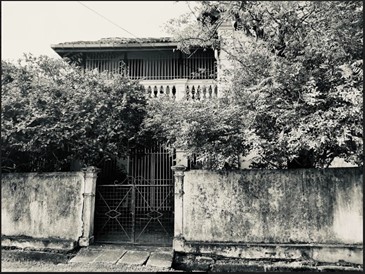
The boarding house was originally a six-bedroom up stair house situated at No.2, Old Station Road, Mount Lavinia and known as ‘Wije Niwasa’. It was built in 1920 by my paternal grandfather Paulus Wijeratne using the proceeds of a dowry given to him by his wife Caroline Wijeratne’s family along with the adjoining lands and houses. My grandparents have been living in this house since then. They had three boys and two girls as children. When the children became adults and settled down all the lands and houses were equally distributed among all the five children.
Boarding House
After the children went their own ways and settled down separately, the grandparents were left behind as the only occupants of this house. To ensure that the relatively large vacant space in the house was properly utilized, they commenced a boarding arrangement to provide accommodation to boys of next of kin and children of close friends attending the Law College, University and Medical College. These boarders a few years later passed out from Law College, Medical College and Universities, and in the course of time scaled great heights in their professional and academic callings. Some became reputed Supreme Court Judges and some after having obtained medical post – graduate qualifications became leading medical practitioners in the Island. Several others won fame in academia with astounding research and publications. One became successful in film productions while performing side by side his duties as a University Don. In 1945 my grandfather died. My grandmother was living in this house and as such she accommodated outsiders as boarders to earn an extra income. She was ably assisted by her daughter Mrs. Beatrice Abeyratne, who was living next door.
The landscape at that time was quite different to what it is today. The Galle Road was being widened at that time. There was nothing called drainage. All house holders used Bucket Latrines. There were paid scavenging labourers employed by the Urban Council who used to come daily to collect the sewage, and apart from their salaries the house holders used to remunerate them separately at the end of the month. These scavenging labourers belonged to a caste called ’Sakkili’. They were from South India. After pipe borne water was supplied and drainage came into being these labourers faded out of sight with no vocation to earn their living. Today there is no trace of them as they had been absorbed into mainstream society. As there was no pipe borne water at that time it was well water (‘linda’ is well in Sinhala) that was used. The well in our house supplied drinking water to about ten houses in the locality. Food items and provisions were brought by vendors to the doorstep. The Newspaper Man used to deliver the daily papers. The Fisherman used to bring fish on two wooden scales tied at both ends to a wooden pole carried on the shoulder. The bread and short eats were supplied by the breadman who used to travel on a tricycle with a big square box in front containing his wares. There were different vendors to supply grocery items like Rice, Dhal, Flour, condiments and the like, including vegetables. These were brought in Baskets or boxes. Even Hoppers, String Hoppers, Dosai, Pittu, Halapa with curries were supplied. Some of the vendors used to make a note of what was supplied daily and submit a bill at the end of the month for settlement. There was a Chinese man coming every week with a big box on his head containing clothing items for sale, followed by another seller bringing ornaments and accessories like trinkets etc., We used to call him the ‘Thoramble Karaya’. They are not to be seen today.
On the 2nd of January 1947 I joined St. Peter’s College Primary school, Bambalapitiya as a student. I was 9 years of age. As such I had to travel from my grandmother’s house to school. Only my grandmother and myself were living in the house apart from the boarders. The latter comprised Edwin Ariyadasa, his elder brother called Charlie or Daniel who was working at Walkers, Colombo, Vinnie Vitharana, Siri Gunasinghe, Pragnadasa Kariyawasam, B.W. Ariyawansha and P.G Dissanayake. They were all undergraduates at the University of Ceylon, Colombo, except Dissanayake who was at the Law College.
My grandmother was 80 years old at that time. She communicated and dealt only with Vinnie Vitharana, who I later came to know as the person who had acted in several capacities at the Boarding such as Coordinating Secretary, Prefect, Jack of all Trades, Master of Ceremonies etc., I found that all these boarders had previously studied at Mahinda College, Galle, Vinnie was the person who had recommended and got them admitted into the boarding.
During their stay they used to keep company with Martin Wickramasinghe and Dr. Ananda Mivanapalana both living down Templer’s Road, Mt-Lavinia and Sunil Shantha, Ananda Samarakoon, P. L. A. Somapala and his wife Chitra, Arisen Ahubudu, W.D. Albert Perera later changed his name and became famous as Pandit Amaradeva. Amaradeva used to visit the boarding house very often. All these boarders were ardent supporters of the ‘Hela Haula’ movement founded by Munidasa Kumaratunga, the pioneer Sinhalese linguist, grammarian, commentator and writer, who founded the ‘Hela’ movement, which sought to remove Sanskrit influences from the Sinhala language. Kumaratunga is idolized today for his profound knowledge of the Sinhala language and its literary works.
The boarders were all teetotalers
except for P.G. Dissanayake who enjoyed an occasional smoke.
Sir John Kotalawala
On Sundays, I used to go to the Mt-Lavinia Hotel beach bay for a swim with Vinnie Vitharana, Siri Gunasinghe, Ariyawansa and others. Every Sunday at around 9.45 a.m. the Right Hon. Sir John Kotalawala used to come to the bay for a half hour swim and we used to have a chit chat with him regularly. I became familiar with him as I used to go to the Kandawela Estate Ratmalana on scout camps and he used to provide us with breakfast. To me he was the finest gentleman that I have had the privilege of meeting. I admired his ‘I don’t care two hoots’, domineering, no nonsense attitude who had his way, without any fear. Incidentally, I became a Queen’s Scout. I received my Queen’s Scout Badge and Queen’s Certificate, along with six others, from the hands of the Chief Scout of the World, Lord Rowallen at the Big Jamboree held at Campbell Park, Havelock Town in 1953 in front of a crowd of about 30,000 people comprising Rovers, Scouts, Guides, Parents and well-wishers.
The house boarders were there from 1947. They used to have musical sessions on Saturdays and Sunday evenings which went on till late night. There was no liquor served at these sessions. Pragnadasa Kariyawasam who was studying Oriental Music i.e., the sitar, used to play the same. Vinnie Vitharana was versatile in playing most of the musical instruments. Mainly the Serpina. Other instruments were the flute, Bongos, Guitar, Dolac, Castanets, Drums, Tabla, Violin, Spoons and Forks to make a racket. All used to take turns to play these instruments. Most of the songs were classics, the songs of Sunil Shantha, Amaradeva, Ananda Samarakoon, Susil Premaratne, Arisen Ahubudu, and R. A. Chandrasena. The visitors were generally from the Arts side of tertiary education and some two or three persons used to stay overnight. I gained both knowledge and insights by listening to the lively discussions of the boarders and their guests on a variety of topics. There were sometimes lengthy arguments on a controversial topic. But there was no malice. All ended in good cheer.
After passing out of the University and Law College they gained employment and settled down elsewhere. However, Vinnie Vitharana and some others used to come to stay the night whenever they came to Colombo. They were well received by my parents who had come to re-settle in this house in 1953, after spending time in the outstations relating to my father’s employment. This resulted in the closure of the boarding. Vinne Vitharana and Arisen Ahubudu were very close family friends. Vinne Vitharana, upon his marriage, settled down next to our lane at Samudrasanna Road, Mount Lavinia. I used to meet him and Edwin Ariyadasa at various Public Lectures and Seminars and while in service, and they used to talk of the good old days at the former boarding house.
I am writing this article in remembrance of all the above boarders who are no longer among the living and who were able to live up to their reputations. Three became Legends in their own spheres of interest.
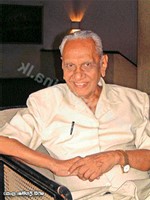
Edwin
Ariyadasa
Edwin Ariyadasa
He became a reputed newspaper editor, author and a media consultant. He grew into becoming an icon of the media, a pioneer in bilingual communication and wrote about Sinhala cinema in English in Sri Lanka. He was also the pioneer educator who brought the subject of mass communication closer to the general public.
Kalakirthi Dr. Wijethunga Karunaratne Edwin Ariyadasa was born on 3rd December 1922 and died at the age of 98 years on 22nd January 2021. He was from Unawatuna, Galle. Youngest of a family of three elder brothers and two elder sisters. He had his primary education at a Buddhist Mixed School in Unawatuna and received his secondary education at Mahinda College, Galle. He joined the University in 1945 and passed out with a Sinhala and English Language Bachelor’s Degree. He taught for a while at Mahinda College, and at the gentle persuasion of Dr. Ananda Mivanapalana, he gained employment at the General Insurance Company. Martin Wickramasinghe thereafter invited him to join Lake House. The then Chairman of Lake House offered him a choice between ‘Daily News’ and ‘Dinamina’. As the ‘Dinamina’ Editor, Priyasena Nissanka was keen to have his services he joined ‘Dinamina’ as a Sinhala medium Journalist. Later he became an English Language Journalist. He progressed to become an Editorial staff member of ‘Divaina’, ‘Daily News’, ‘Sunday Observer’, ‘Silumina’, ‘Janatha’ and then ended up as the Editor of ‘Nawaugaya’.
Upon leaving Lake House he launched a monthly journal called ‘Tulana’. He edited 10 books and translated 11 English books into Sinhala. He researched and wrote on all aspects of cultural activity in the country. He was a walking encyclopedia. He was a keen observer and commentator on global events. The awards bestowed on him for life time achievements came like peerless gifts. He was honored at home and abroad for his literary contributions over the years with 14 awards spanning over three generations. He was the recipient of the coveted honoris causa D.Litt. from the University of Kelaniya for the lifetime contribution in the field of journalism and communication. It is too numerous to mention separately each of his feats. He was well known as the Father of Communication in Sri Lanka. He was a Newspaper Editor, Film Critique, Author, Translator, Journalist, Lecturer and Media Consultant. He was honoured as a ‘Kala Keerthi’ on 22 May 1990. He was a Bachelor.
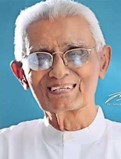
2) Vinnie Vitharana
Vinnie Vitharana
Kalakirthy Professor Emeritus Dr. Vinnie Vitharana was born on 11th June 1928. He studied at Christ Church College, Tangalle and later at Mahinda College, Galle. He later received Bachelor’s Degrees in Arts from the University of Ceylon, University of Peradeniya and University of London. He obtained a Doctorate in Philosophy in 1960 from the University of Peradeniya. He was the Assistant Editor of the Sinhala Encyclopedia from 1953 to 1959. In 1960, he was a visiting Lecturer in Sinhala at the Vidyodaya University. He was the recipient of the UNESCO award for his contribution to Sinhala Literature.
He was a person with vast experience
not only academically but also in various other fields. He served in such posts
as Lecturer, Linguist, Scholar, Researcher, Archeologist and Geographer, and
finally as a Professor. He was well known for his contribution to Sinhala
Literature. He was during his lifetime rated as one of the prominent and
notable Educators in the Country. He translated seven Sinhala books into
English. He was awarded twenty times from 1962 to 2019 for his good work. He
was the Founder Chairman of the Munidasa Kumaratunga Trust and Sunil Shantha
Society. He had a great sense of humour. He was presented with the’ Kala
Kirthi’ Award in 1993. He was married and had two children. He died on 2
December 2019 at the age of 91.
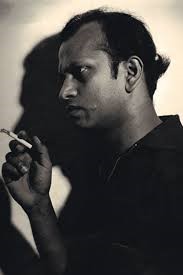
3) Siri Gunasinghe
Siri Gunasinghe
Professor Emeritus Siri Gunasinghe was born on 18th February 1925 at Avissawella. Passed away at the age of 92 on 25th May 2017 in Canada. He studied at Mahinda College, Galle. He passed out from the University of Ceylon with a Bachelor of Arts Degree. Thereafter, he joined the University of Peradeniya as a lecturer and later became a Professor in the University. He contributed substantially towards the improvement of the Sinhala Language. He made wide ranging contributions as a poet, Sanskritian, Art Historian, Author, Filmmaker and Director.
He wrote the following books, Mas Ley Neti Ata 1956, Hewanella 1960, Mee Hardu Rathu Kekula 1962, Poetry Abi Neluma 1958, Alokamandawa 1958 and some other works. In 1968 he directed the Sinhala Film ‘Sath Samudura’ with D. B. Nihalsinghe as the Cameraman. It won eight awards. In 1997 it was picked as one of the Ten Best Films of the First 50 years of Film Production of Sri Lanka. In 1970 he joined the University of Victoria in British Columbia, Canada as the Professor of the Department of History and Art. He was married and had two children.
4) Pragnadasa Kariyawasam
He was a native of Galle. He studied at Mahinda College, Galle and later passed out of the University of Ceylon with a Bachelor’s Degree in Arts in Pali and Sanskrit. He took to teaching and was later appointed as the Commissioner of Exams and retired in the 1990’s. He is said to have died in 2001, in Kotte. I lost contact with him after he left the Boarding. He was married and had three children. One of his sons, Mr. Prasad Kariyawasam, later became the Sri Lankan Ambassador to the USA and our permanent representative at the UN. He held several Senior Diplomatic Appointments.
5) B.P. Ariyawansha
B.P. Ariyawansha studied at Mahinda College, Galle and later passed out of the University of Ceylon with a Bachelor’s Degree in Arts and took to teaching. Subsequently, he was appointed as the Principal of Rahula College, Matara from 1956 to 1973. Upon retirement he settled down in New Zealand with his daughter. He died in New Zealand.
6) M.B. Dissanayake
M.B. Dissanayake studied at Mahinda College, Galle and passed out of the Law College as an Advocate and proceeded to practice in Civil and Criminal law matters at the Tangalle Courts. I have lost touch with him.
Conclusion
I consider myself privileged to have had an opportunity to associate with intellectuals of such high caliber in my childhood days. They have left a deep impression in me particularly in respect to character building and love of language, tradition and cultural heritage. They shone later in public life as exponents of things indigenous. I trust that these reflections will give the reader a good insight into their charismatic lives.
Tudor Wijeratne
(Tudor Wijeratne is a retired Senior Superintendent of Police (SSP). He
is an old boy of St. Peters’ College, Colombo 04.)
The Global Tamil Forum (GTF) -strong supporters of the
deposed Tamil tigerTerrorist in their
never ending cacophony about separatism and minority rights which are obsolete
and abstract in multicultural Sri Lanka, as usual has called on the Government
of Sri Lanka to reflect on recent messages conveyed by the US and the wider
international community through the newly imposed sanctions by the US State
Department on two former Sri Lankan Army officials albeit based on unproved
speculation.
There seems to be a total misinterpretation of the
protocols related and a display of their blatant continued moves towards
agitating minorities within and without Sri Lanka and need to be educated if
this is in anyway possible that they are stepping out of line with the realities
involved in the US Sanctions which by themselves are out of line and a display
of unwarranted US actions directed at SrI Lanka in recent times despite the so
called cordiality between the two countries where a certain duplicity appears
to be visible.
Indeed it is true that Sri Lanka is in the midst of many
crises but to suggest that “the trajectory is heading towards increasing
authoritarianism and militarised governance, further marginalisation of Tamil,
Muslim, Hindu, and Christian communities, the debilitating financial crisis and
the economic challenges engulfing the people and has the potential to seed new conflicts in
the country” is a bold and inciting statement by a puny group of minority
Tamil protesters who have neither the right nor the credibility to make such
statements without looking at themselves in the mirror and realizing that it is
a complete misconception of the issue where they are attempting to create a non
existent situation with much exaggeration where related facts seem to be
distorted perhaps in an attempt to stir up dissent with the minority
communities at a time when the Government is making valiant attempts to
stabilize the country for all citizens not merely the minorities referred to.A
government which has endeavored to deliver much to the country despite apparent
shortcomings which hopefully will be supplemented soon against many odds..
The GTF says that quote ” Marking the Human Rights
Day on 10 December, the US Government has imposed human rights-related
sanctions on two Sri Lankan military officials. The US sanctioning these two
officers appears more for the message it conveys to the Sri Lankan leadership,
than for its direct impact on the individual officers,” in a bold statement to the media without any
consideration of its impact on themselves and their interpretation of the issue
at hand which appear to have them confused as well as ignorant towards US
objectives and its relevance to US / Sri Lankan relations.
Furthermore the US State Department sanctions on Sri
Lanka Navy Intelligence Officer Chandana Hettiarachchi and former Sri Lanka
Army Staff Sergeant Sunil Ratnayake for their involvement in the gross
violation of human rights” on Human Rights Day on 10 December are based on unproven speculations portraying the GTF’s
haste to draw conclusions sans tangible proof and perhaps needs to be
confronted towards punitive action against them by the Government of Sri Lanka.
The links, sympathies and involvement of the GTA with the
TNA who are also surreptitious sympathizers of the former Tamil tigers and
continue to promote the cause of secession and separation are well known and
hence all the agitation by the GTA seems hardly worth a second glance from a
Government perspective in these turbulent times where the country faces greater
priorities beyond the bickering of vague entities such as the GTA and the
directionless TNA often clutching at straws in their desperate attempt to
survive.
It is also quite apparent that the Biden Administration
is on a spree of disentitlingcertain minority nations of their right towards
asserting sovereignity based on its own concept of righteousness and misconceived agendas which do not serve
them well and a stark reality in the world of today where Sri Lanka appears to
have become a target despite there being no tangible evidence or proof towards
complete credibility in the present climate of US accusations.!
The GTF based on all this are better off focusing on
things merit worthy to Sri Lanka as a collective part of the population albeit
under a different banner!.