The Sri Lanka Freedom Party (SLFP) suggests that it would be appropriate to hold the Provincial Council elections expeditiously, under the former election system the least limited to this particular election alone.
The suggestion was made at the Select Committee of Parliament to Identify Appropriate Reforms of the Election Laws and the Electoral System and to Recommend Necessary Amendments held today (02).
State Minister Dayasiri Jayasekara who testifying on behalf of the party at the committee stated that many problems have risen due to postponing of the provincial council elections for a long time.
He stated that his party was of the view that the provincial council elections should be held immediately. Furthermore, local government elections should be held in the first quarter of next year. The number of local government representatives should be limited to a maximum of 5500, he said.
Minister Mahinda Amaraweera stated at the committee that it is not appropriate to extend the term of local government bodies. The Minister also pointed out that the public opinion is that the number of seats in local government bodies should be reduced.
Minister Nimal Siripala de Silva explained that after the announcement of the Local Government Elections, the powers of those institutions should be transferred to a commissioner until the election is held and the new members are sworn in.
The Leader of the House, Minister Dinesh Gunawardena stated that the Attorney General is of the view that the Provincial Council elections cannot be held under the existing law and that the necessary legal provisions should be brought for the purpose of the stated. He also stated that the general opinion of the Committee is that the Provincial Council elections should be held expeditiously.
The SLFP proposed to the committee that the number of members to be elected from the divisions should be 60 percent and the number of members to be elected proportionally should be 40 percent when the electoral system is amended.
The party said necessary legal provisions should be made to limit election expenses and commended President Gotabaya Rajapaksa’s presentation of a Cabinet Memorandum on Limiting Election Expenditure. The SLFP also said that women’s representation at all levels should be 25 percent of the total number of candidates.
Furthermore, the conduct of media during election period should be regulated. The SLFP also emphasized the importance of regulating social media behaviour.
Professor Sudantha Liyanage, Vice Chancellor of the University of Sri Jayewardenepura, Chairman of the Expert Committee on the analysis of appropriate reforms of the election laws and the electoral system and to recommend necessary amendments stated if the new electoral system is adjusted to the 70:30 ratio, the existing number of seats in local government bodies could be reduced by 1,500.
He also pointed out the need to revise the electoral system so that the winning political party in the local government area gets two bonus seats. The Secretary to the Select Committee, Deputy Secretary General & Chief of Staff of Parliament Ms. Kushani Rohanadheera stated that the next meeting of the Parliamentary Select Committee will be held on the 07th.
State Ministers Lasantha Alagiyawanna and Duminda Dissanayake also represented the SLFP at the committee meeting. Members of Parliament M. A. Sumanthiran, Madhura Withanage and Sagara Kariyawasam were also present as members of the Committee.
Officials representing the Election Commission and the Attorney General’s Department were also present.
The Public Utilities Commission of Sri Lanka (PUCSL), the electricity sector regulator and the designated regulator for the petroleum industry, together with Sri Lanka Standards Institute (SLSI) has already formulated a standard for the much-talked LP gas in September this year and is ready to regulate LP Gas and other related industries, PUCSL Chairman Janaka Ratnayake said.
The LPG Gas Standard, developed under the supervision of the Sri Lanka Standards Institution, can be implemented immediately to ensure the protection of consumers of LPG. However, The PUCSL does not have the legal powers to enforce the standard,” Mr Ratnayake said.
The LP Gas standard has been drafted in accordance with the procedures of the Sri Lanka Standards Institute and the final draft is being prepared considering stakeholder comments and inputs received through the public consultation process.
The new standard includes consumer safety requirements when using LP gas cylinders, such as the maximum pressure of the gas cylinders, the maximum percentage of propane in domestic LPG, requirements to improve safety and specify markings such as net weight, test date of cylinder etc to be mentioned on the surface of the cylinder.
Commenting further on the updated LP Gas Standard, Mr Ratnayake said,
There was a standard that has been prepared much earlier for LP gas. Even that is not legalized or enforced yet. One of the reasons for not enforcing the standard is the lack of a regulatory body to regulate LP gas. In 2002, the Public Utilities Commission of Sri Lanka was appointed to regulate the petroleum industry, including LP gas. However, the Commission has not been legally empowered to regulate this area to date. In 2019, we started drafting standards for petroleum products with SLSI. We have already set standards for products such as petrol and diesel. These standards must be enforced to protect the consumer when using various products of petroleum. Therefore, we see the need for an institution with regulatory powers to enforce these,”
The earlier standard of LPG (SLS 712) of 1998 provides a specification for the use of commercial propane, commercial butane, propane and butane mixture and special duty propane. However, it does not mandate any ratio of propane to butane for domestic cooking.
The PUCSL chairman pointed out that the regulatory powers of the LP Gas Market could be delegated to the Public Utilities Commission of Sri Lanka, by amending the Petroleum Products Special Provisions Act to expedite the protection of consumers.
The issues we are facing now are results of not having a proper regulator for LPG. We should also regulate the entire petroleum product portfolio of petrol, diesel, aviation fuel, marine fuel, furnace oil, kerosene, Natural Gas, lubricants and grease in order to avoid such situations in future,” Mr Ratnayake added.
The industry act for PUCSL to regulate the downstream Petroleum Industry prepared by the Legal Draftsmen was cleared by the Attorney General in 2012. However, it needs to be recertified by the Attorney General after checking the accordance with the 20th Amendment to the Constitution and passed in the Parliament.
The PUCSL and the Ministry of Energy also launched a declaration of rights and obligations of consumers of Petroleum products and Procedure for Handling Complaints & Resolution of Disputes to resolve the grievances of consumers on 01st December 2021 to address the issues of lack of a proper mechanism to handle the complaints of consumers who uses all grades of Petrol, Kerosene and diesel and to address the issues that consumers face with regard to product and service quality.
The Chinese Embassy in Colombo says that the hybrid energy project planned in three islands off Jaffna peninsula has been suspended due to security concern” from a third party.
In a tweet, the embassy said that the Hybrid Energy system to be built in three northern islands of Sri Lanka by the Chinese high-tech renewable energy company, Sino Soar Hybrid Technology, has been suspended.
It said that the same company has now inked a contract with the Maldivian government to establish solar power plants at 12 of its islands.
Sino Soar Hybrid Technology, being suspended to build Hybrid Energy system in 3 northern islands of Sri Lanka due to ‘security concern’ from a third party, has inked a contract with Maldivian gov’t on 29 Nov to establish solar power plants at 12 islands in Maldives.”
On January 18, the Sri Lankan Cabinet approved a proposal to involve Sinosoar-Etechwin Joint Venture in China to install ‘hybrid renewable energy systems’ in Nainativu, Delft or Neduntheevu, and Analaitivu, located in the Palk Bay.
However, it was later reported that the Indian government had raised objections to the proposed energy project in islands in the sea area close to the Indian coast.
The Ministry of Health reports that another 197 persons have tested positive for the novel coronavirus today, increasing the daily count of new cases to 735.
This brings the total number of Covid-29 cases confirmed in the country to 565,471.
Nearly 10,000 infected patients are presently being treated for the virus across the island.
The Director-General of Health Services has confirmed another 27 coronavirus-related deaths for December 01, increasing the death toll in the country due to the virus pandemic to 14,399.
According to the figures released by the Govt. Information Department, the deaths reported today include 16 males and 11 females.
Eight of the patients are between the ages 30-59 years while the remaining 19 are in the age group of 60 years and above.
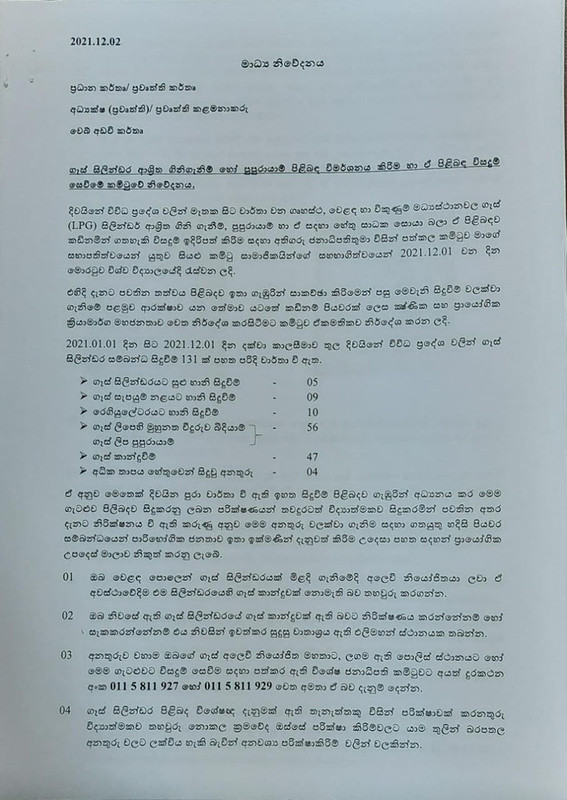
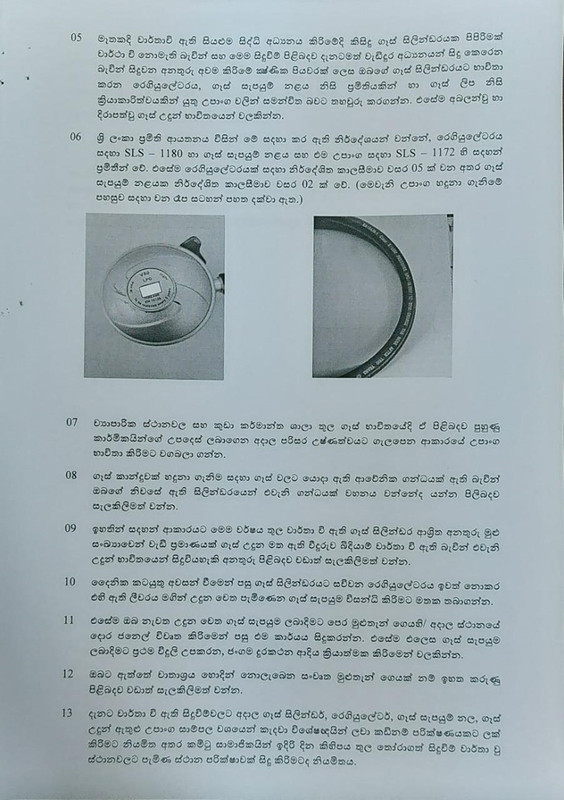
The general public is urged to contact the dealer, the nearest police station or the Presidential Committee looking into the recent accidents linked to Liquefied Petroleum Gas (LPG) cylinders, in the event of any explosions or related issues.
In a statement issued today (December 02), the committee’s chairman Prof. Shantha Walpolage said the panel can be contacted via 0115 811927 or 0115 811929.
The committee also mentioned a set of instructions for the general public to follow in case of an emergency.
The consumers are advised to ensure that LP gas regulators and supply hoses meet the required quality standards.
Further, the committee requested the public refrain from using dilapidated gas cookers.
Several prominent members of the board of directors of the Board of Investment (BOI) have stepped down from their positions.
According to a statement issued by the BOI, the Chairman, members of the Board of Directors and the Director-General are among the top officials who resigned.
The full statement of the Board of Investment is as follows:
Nearly 200,000 additional Pfizer-BioNTech vaccine doses arrived in Sri Lanka today (December 02) as a donation from the United States.
This gift demonstrates the ongoing commitment of the United States to support Sri Lanka in the fight against COVID-19, the U.S. Embassy in Colombo said in a statement.
As the pandemic continues and new variants emerge, the United States continues to partner with the Sri Lankan Ministry of Health, UNICEF, and the World Health Organization to vaccinate as many people as possible and build a world that is safer and more secure against the threat of infectious disease.”
The United States has now donated 2.6 million vaccines and over USD 17.9 million in emergency supplies and critical services to Sri Lanka.
Additionally, the U.S. Government’s Agency for International Development, USAID, is working in partnership with the Sri Lankan government to effectively distribute, administer, and safely transport these vaccines. U.S. assistance has reached millions of people in Sri Lanka to control the spread of COVID-19, address urgent health needs, and mitigate the pandemic’s negative economic impacts.
The United States has delivered more than 240 million COVID vaccines to over 100 countries free of charge as part of its commitment to donate more than 1.1 billion vaccines worldwide. These vaccine donations will save lives and help slow the spread of COVID-19. The United States is proud to work with Sri Lanka and countries around the world to end the pandemic and build back a better world.
The soapy water leak test allows for tell-tale gas leak soap bubbles that are indicative of a gas leak. You just coat all of the gas transmission gear (pipes, hoses & valves) with soapy water and then pressurise the system. If you see gas leak soap bubbles or smell rotten eggs, you know you have a leak.
It is important to know how do you check for gas cylinder leaks and regularly leak test your BBQ gas bottle (LPG gas cylinder), regulator and hose using the soap bubble test for gas leak.
Leaks from these items are frequently the cause of BBQ gas fires.
How to Detect LPG Gas Leakage
Using your nose is the first step to detect LPG gas leakage. The first hint would be the smell of rotten cabbage or rotten eggs. An odourant – Ethyl Mercaptan – is added to the naturally odourless LPG for the aid in detection of leaks.
Soap Test for Gas Leak – Gas Leak Detector Soapy Water
Apply soapy water to the entire hose assembly, including the tank’s valve and regulator, using a spray bottle or sponge. Pressurise the system without turning on any appliances. If you see bubbles or smell rotten eggs, you have a leak.
How Do You Check for Gas Cylinder Leaks & for Natural Gas Leaks? Soapy Water Leak Test
It is important to how do you check for gas cylinder leaks and for natural gas. One of the safest ways is something commonly called the soapy water leak test” or soap bubble test for gas leak.
The soapy water leak test allows you to search for tell-tale bubbles that are indicative of LPG or Natural Gas leakage.
In this very simple test, you just coat all of the gas transmission gear (pipes, hoses, valves, etc.) with soapy water and then pressurise the system.
If you see bubbles, you know you have a leak.
Soap Test for Gas Leak – Gas Leak Check Solution
To make the solution for the soap test for gas leak, simply mix dish detergent with water. The soap can be put in a spray bottle or placed in a bowl for sponging on. Dish washing soap is formulated to make lots of bubbles so it works better for the soap test for gas leak.
Liquid laundry detergent doesn’t work as well as dish soap, as it is formulated to be low sudsing.
Remember to cover the entire hose assembly from the gas bottle valve to the hose attachment to the BBQ or heater with soap solution. Open the valve to pressurise the system, without turning on the burners, and look for soap bubbles or sniff for the rotten egg smell.
This quick 60 second video shows how to perform the soap bubble test for gas leak – soapy water leak test:
How to Do Soapy Water Leak Test – How to Detect a Gas Leak in Your Home
♦ To detect a gas leak in your home, start by putting some soapy water in a spray bottle or a dish.
♦ Turn on the LPG gas bottle without turning on the BBQ. This pressurises the system.
♦ Next, spray the entire valve, regulator and hose assembly with the soapy water.
♦ Alternatively, you can apply the soapy water with a paint brush, basting brush or it can even be sponged on.
♦ Soap bubbles will form if there is a gas leak and you may also smell the gas.
♦ You need to test the entire assembly from the gas bottle valve all the way to where the gas hose attaches to the BBQ.
♦ When done, rinse with clean water to remove the soap solution.
♦ Remember to always soapy water leak test the lot every time you re-connect your gas bottle.
If you find a leak, turn off the gas bottle immediately!
Do not turn back on or attempt to use the BBQ until the problem is rectified.
How Do You Check for Gas Cylinder Leaks – Common Problem Areas
How Do You Check for Gas Cylinder Leaks
To check for gas cylinder leaks perform the soapy water leak test around the valve and connections. You use the same test to detect a gas leak in your home and how you check for gas cylinder leaks. Poor connection to the gas cylinder is the most frequent cause for gas cylinder leakage.
In many cases, the main connection is just not sufficiently tightened. Dirt or damage to the connectors are also common causes of leaks.
Main Connection
The standard BBQ gas regulator in Australia is a POL gas regulator.
The male connector of the gas regulator, which screws into the POL gas valve on your gas bottle, may have a rubber O-ring seal or it may rely on a metal to metal contact seal.
You should always inspect the regulator for damage, paying special attention to the connector, which screws into the gas bottle.
If it has a rubber O-ring, it also needs to be undamaged.
The connector and the female valve opening should both be clean and undamaged. Pieces of dirt, nicks and scratches can prevent the two components from sealing, resulting in a leak.
Gas Hose
The gas hose is attached to the regulator on one end and the BBQ on the other end.
It can become damaged or deteriorate with age.
Dogs and other animals can also cause damage by chewing on the dangling hose.
Visually inspect the hose for cracking, splitting or other damage.
You should replace the hose if it shows any signs of damage or degradation.
It is good practice to replace the entire regulator and hose assembly, if it is old enough for the hose to have deteriorated, as regulators also wear with age.
Valve Stem
In Australia, BBQ gas bottles must be tested every ten years.
The gas valve is changed upon inspection and the valves are expected to last for the full ten years.
However, occasionally the valve will fail prematurely and start leaking from around the valve stem. This is rare but it can happen.
The bleed screw is a small slotted screw on the side of the valve that lets gas vapour bleed off during the decanting refill process.
The refill technician opens it during the filling process and closes it, when done.
The screw can develop a slow leak if it becomes loose.
When to Test
The BBQ gas bottle, regulator & hose assembly should be checked using the soapy water leak test every time you reconnect your regulator to the BBQ gas bottle. You should also soapy water leak test after any long period of non-use, such as at the beginning of BBQ season.
Soapy Water Solution For Soapy Water Leak Test
You will need a soapy water solution to do the soapy water leak test.
Mixing liquid hand soap with water should work fine. Place the solution in a liquid spray bottle.
It’s a good idea to leave the spray bottle with the BBQ, so it’s always a handy reminder to perform the soapy water leak test.
No Ammonia
Your BBQ valve and fittings are made from brass. You must never use any soapy water leak test solution that contains ammonia, when you do your testing. Ammonia can cause brass to become brittle and crack. Be aware that ammonia is found in many pre-prepared glass and surface cleaners, so make sure you read the label before use.
Extra Safety Tip
The best practice gas safety advice is that gas bottles should only be in a vehicle for the minimum required transport time.
When you do transport a gas bottle, you should consider one added precaution.
After making sure that the valve is firmly closed, you should soapy water leak test the entire valve assembly to check for any possible leaks, prior to transport.
DO NOT leave BBQ bottles in enclose vehicle unnecessarily.
The information in this article is derived from various sources and is believed to be correct at the time of publication. However, the information may not be error free and may not be applicable in all circumstances
Litro Gas Lanka Ltd. today (Dec. 01) warned the consumers not to test their gas cylinders at home using methods such as soap water.
At a media briefing, Director of Sales and Marketing of Litro Gas Lanka, Janaka Pathirathna said people using soap water to test for liquefied petroleum gas leakages poses certain dangers.
The cylinder must remain sealed once it is brought home. the regulator must be fixed soon after the seal is removed. If not, the safety cap must be kept on.”
He urged the general public not to try to open the gas valve and use soap water or insert any sticks into the valve.
Pathirathna requested them to place the safety cap on and call the company’s hotline 1311, if they are having any suspicions regarding a leaking cylinder.
The officials of Litro Gas Lanka who visited the sites where explosions were reported previously have observed that gas leaked from the cylinder hose or the regulator, according to Pathirathna. We observed a regulator was more than 15 years old,” he said adding that two of the most recent incidents reported were due to gas leakage that occurred as a result of putting soap water into the valve of a cylinder that had been used for over one-and-a-half months without any issue.
Speaking further at the media briefing, Pathirathna clarified questions on changing the composition of LP gas. Quoting an expert, he said changing the propane-butane ratio does not cause cylinders to explode even if the valve is removed.
The atmospheric pressure is essential and the composition is not at fault, Pathirathna stressed. We follow the SLS 720 Standard. The standard pressure valve is around 1,000 bars. The pressure does not build up through the changing of the gas composition.”
The pressure level is around 700 bars if the gas composition is 100 percent propane. It will not exceed the standardised pressure levels according to SLS Standards. The cylinder can bear five times of the pressure created by this gas composition.
When asked about the laboratory report provided by the Ceylon Petroleum Corporation which concluded that the 12.5 kg gas cylinder has a 50-50 ratio of propane and butane, Pathirathna said the company is yet to receive the document.
t to test their gas cylinders at home using methods such as soap water.
In
the immediate term, all political parties in Parliament should bury their
respective hatchets, and agree on a political truce for the next two years.
They could take the next step and agree to form a national government or a
national governance council for two years. The theme of such a government or
entity should be responsible governance as the most important political
activity now is responsible governance.
Sri
Lanka’s dependency on export earnings, foreign remittances and tourist earnings
for its survival has made it very seriously vulnerable to the effects of the
latest COVID mutant, Omnicron. If it spreads and international travel
restrictions become widespread, foreign remittances and tourism earnings will
take a hit, and it could be a mortal hit for Sri Lanka which is already on the
brink of bankruptcy.
The
government appears to continue with its show of confidence that the economic
situation of the country will be resolved. Increasingly, governance ineptness,
infighting within the government, a seeming lack of leadership, is dashing the
hopes of many people who bestowed their hopes on the President and the
government. Government’s media strategists appear to be in a stupor as they
have failed to pro-actively capitalise on the positive activities of the
government. They have become a reactive, ineffective force.
The
Opposition, like a set of Vultures, is sniffing a political opportunity
thinking and hoping they will have a carcass to feed on soon. Some other politicians
continue to wax their eloquence on everything that is wrong but never offering
solutions as to how the wrongs can be made right. The TNA and some other North
Eastern Tamil political parties act symbolically like the three Monkeys (the
deaf, blind and mute) when it comes to national issues as they seem to be giving
the impression they are interested only in the welfare of the Tamils in the
North and East and not Tamils elsewhere, let alone the Sinhala and Muslim
people.
The
situation in the country reminds one of Sybil Wettasinghe’s children’s story
Labugediye Thoilaya”. Sri Lankan politicians of all hues appear to be inside
the labu gediya, participating in a political ritual to ward off evil forces
that have afflicted Mother Lanka, while the labu gediya has been swallowed by a
large fish as described in Wettasinghe’s story.
In
contemporary Sri Lanka, the labu gediya could be equivalent to the Parliament,
and the fish, to the country’s foreign debt which could very likely and very
soon, swallow the entire country along with the politicians and unfortunately,
the people of the country as well. Some may say not so cynically that the
Parliamentarians won’t be missed if so swallowed!
The
naivety of the Opposition is only superseded by the reported reliance on
personnel similar to devil dancers in the Labugediye Thoilaya by the powers
that be, trying to ward off evil that have afflicted them and the country.
For
the sake of the country and the future generations, one can only hope that this
collective tomfoolery ceases, and immediate remedial measures taken to keep the
country afloat until the global economic situation shows positive signs of a
sustainable recovery.
Dire
need for a political truce
In
the immediate term, all political parties in Parliament should bury their
respective hatchets, and agree on a political truce for the next two years.
They could take the next step and agree to form a national government or a
national governance council for two years. The theme of such a government or
entity should be responsible governance as the most important political
activity now is responsible governance.
What
should be the key tasks for a national political consensus when it comes to
responsible governance? There are many. However, three key areas are mentioned
here.
A
stable economic management structure
In
the current and foreseeable future, it is unlikely that Sri Lanka will be able
to earn enough foreign exchange to sustain itself, unless the entire foreign
debt repayments are delayed at least for two years by mutual agreement with the
lending entities. Considering that 45% of the foreign debt is in the form of
international sovereign bonds falling due in the short term, this is going to
be hard task. However, mechanisms will have to be found to do this.
One
avenue would be to seek IMF assistance to take over the short term foreign debt
component with a longer term, low interest long term repayment arrangement.
This alone may not be sufficient and IMF assistance may also be needed to
augment foreign exchange needs for import of petroleum, food items and
medicines.
IMF
conditions for such support will be stringent, but Sri Lanka is slowly but
surely heading towards a disaster and may not have any other choice left to
take but to agree to such measures.
This
is where a political truce becomes critical. All governments of Sri Lanka have
contributed to the perilous situation the country is in, and today, the Opposition
cannot afford to blow their trumpets saying they can do better, considering
they contributed hugely to the perilous state of the country with their
ineptness for four and a half years prior to the advent of the current
government.
So,
the problem is a creation of all previous governments, and therefore, the
solution too has to be worked out by all political parties who have been a part
of a previous government.
A
political consensus achieved through a two-year truce should engage in some high
level priority policy settings on economic management, foreign policy, defence,
food security, energy, environment and education. These key areas should not be
treated like political footballs as they have been for the last 73 years
endangering the hopes of future generations.
Measures
to curb corruption
Secondly
the political consensus must agree on measures to curb corruption, the bane of
the country’s society and which has a direct impact on the much sought after foreign
investments. The instability of the Sri Lankan rupee with official rate for a US
dollar being Rs 203 while the black-market converting it at around Rs 240, and
the real value of the US dollar suspected to be more than Rs 300, show the
volatility and the instability of the Sri Lankan rupee and why many would be
investors are not investing in Sri Lanka. Besides this, it is widely known that
bribery adds another impost to any would be investor, and the suspected range
of this impost is reportedly anything from 10% to 50% of the value of a project.
Corruption
has become endemic in the country and curbing it is in the hands of politicians
as they are the ones responsible for introducing it and propagating it to the
heights it has come to now. They need to enact new laws if what is there is not
sufficient, but very importantly, they need to leave the justice system and the
law enforcement system to carry out their tasks and responsibilities WITHOUT
interference. A strong anti-corruption body with strong teeth, including
judicial powers, is needed to instil some fear in potential bribe takers that
they and their families could be called upon to pay for the crimes committed
and languish in jail even for the rest of their lives depending on the severity
of the crime. Everyone from the President downwards must be subject to anti-corruption
laws and punishable irrespective of whether they are in office or not.
Legal
framework for media operations
Thirdly,
some measures should be taken through such a political consensus to determine
how the politicians and the public should act to facilitate responsible
governance via the media. A consensus on a legal framework for media operation
including, very importantly, the social media is needed.
Social
media in particular has become the repository and the facilitator of genuine
news as well as fake news. Some information that is circulated via social media
platforms is highly irresponsible and harmful to the very society in which such
platforms provide the avenues to proliferate information.
While the intent should never be any curtailment of media freedom,
responsible governance essentially has to be considered as a two-way process
where those governing and those being governed should take equal responsibility
about what they say and do. There may be many measures that could be taken to
introduce a framework for all media operations without impinging on media
freedom.
In this regard, Danushka Medawatte in an article titled Freedom of
the Wild Ass (https://danumedawatte.wordpress.com/2015/09/26/freedom-of-the-wild-ass/)
states quote Law is an ass” says Charles
Dickens. This certainly seems to hold true in the light of the freedom that is
enjoyed by media through the protections granted by both domestic legal systems
and international law. While I am reaping the benefits of freedom of expression
in making these claims, it needs to be highlighted that certain freedoms require
to be curtailed and/or reviewed in order for the other rights to exist. At
present, it is possible to note that some journalists exercise their freedom of
expression in a manner harmful to the society. It is questionable whether such
practices should be upheld in light of several recent circumstances. While
freedom of expression is, without a doubt, one of the most important rights
that perhaps functions as a premise for other rights, it is important to
establish the framework within which one may swing one’s fist without striking
another’s nose”
Medawatte
encapsulates the view of all fair minded citizens about democracy and media
freedom.
Essentially,
media freedom must be accompanied with responsibility as irresponsible
circulation of unchecked, unverified, inaccurate and harmful information is not
a characteristic of being responsible. Since politicians are tasked with the
responsibility of reviewing and enacting laws, a political consensus becomes
critical in ensuring that any media operation law including social media has
across the board support and does not become a political football to be kicked
around by political parties.
Major
social media platforms are under scrutiny throughout the world, and bona fides
of some companies are in question as they have created an impression that
revenue and revenue growth is what matters to them and not the means they
provide to the good, the bad and the ugly, to propagate information and
misinformation, with noble intentions as well as ignoble intentions. The
proliferators of irresponsible information using social media need to consider
whether they are doing a service or a disservice to the society and the country
they live in.
J Sai Deepak’s book ‘India That is Bharat’ is a rigorous survey
of India’s political history since the Papal Bull of 1493.
India
that is Bharat: Coloniality, Civilisation, Constitution. J Sai Deepak.
Bloomsbury India. 2021. Pages 484. Rs 404.
here’s a genre of videos on YouTube
called the ‘unBoxing video’. It mostly interests DIY buffs and techno-novices
who receive products by mail and need help to figure out how to use what they
had ordered, whether it be a gadget or a tool for home garden, hobby or
workshop.
J Sai Deepak’s book India That is Bharat: Coloniality,
Civilisation and Constitution quite unsettled me. I was
bewildered by all manner of information that began swirling around me. The
author on an over-drive with passion for his subject was difficult to keep pace
with.
It is more than an ordinary book. It is an empowering course
material with many resources to take away. It is not quite amenable to review
in the usual way.
That is when it struck me I best explain it in the manner of
unBoxing a set of resources.
When the proposed trilogy is published, a storm will have been
stirred up. By then, I expect there will be in the books, knowledge enough to
hold one’s ground, and maybe even engage in combat.
Sai Deepak’s credibility is high as a man who works with hard
facts from original sources. You can verify this from the tens of viral videos
at large in which he takes on all questions, however tricky and answers them
with ease and precision. He seldom wastes a word, nor lacks the right one for
his need, or deviates from the point in the discussion.
All these qualities come through in his writing., which doesn’t
mean he can be understood if you are paying less than full attention.
With that said, let me return to the question: ‘What’s in the
box of resources’, as I choose to call the book.
This Volume-1 begins with a long section (over 25 per cent of
the book’s length) identifying what Bharatiyas need to combat.
In a word, it is coloniality, which best is more quickly
understood and sized by defining its four etymological cousins. Colonialism is
the intent to capture territories, colonisation is the physical act of capture.
Colonialisation is the soft framework to control the captured land, its wealth
and people.
Coloniality is when the colonised people begin to be
unconsciously colonised.
Finally, there is postcolonialism, which is the acme of a
colonial project’s success. It happens when enough of the conquered minds begin
to consciously propagate the colonial cause.
As I understand it, the difference between coloniality and
post-coloniality is this: the former has unconsciously internalised the
coloniser’s prescriptions, and the latter is consciously aligned with the
coloniser’s mission.
Western universities of the US, in particular, are quite
slick-skilled in producing a steady supply of post-colonial minds, many of
which can be spotted in our academe, media, Bar & Bench and polity.
Incidentally, one of the crucial skills this book will teach you, is the
ability to identify colonial and post-colonial minds. To me, that’s more than
half the battle won.
The long section on coloniality ends with these words: The
battle must include European and Middle Eastern coloniality, in that order,
since the former protects the latter and the latter rides on the former’s
coattails to legitimise itself.”
Let me turn to the next goody in the box.
Quite early in the book, Sai Deepak will have introduced you to
the acronym OET, which expands as ontology epistemology theology. One may
describe the three respectively, as a culture’s metaphysical beliefs, knowledge
structure and praxis of rites and rules.
If one thinks it through, when coloniality rises, the acronym
OET will have lost its first letter, because its indigenous organic past will
have been slain and put away as dead. It will have equipped itself with a
single book to serve its epistemological needs and a single drill for its
ritual routines. On whether you feel enriched by the breadth and depth of the
OET you are heir to or find it retrograde, depends on your vulnerability to
coloniality.
Sai Deepak cites several intellectual sources, among them a
dozen little known Latin Americans, who have helped him understand the contours
of coloniality. Based on my experience with reading at least two of the authors
in the original, I confess I quite quickly came face to face with my inadequacy
to comprehend them with any ease. Sai Deepak’s sharp intellect and legal acumen
equip him to extract the essential from the complex and lucidly present his
summary without any loss of accuracy. This is a gift of much value for the
young and serious student.
Yet another bundle in the box consists of a large collection of
extracts from many original documents. Among these are the actual and saddening
words of some members of our Constituent Assembly battling — and, failing — to
keep ‘Bharat’ as the sole name for the new state; the Papal Bull of 1493 that
so generously offered the world to Portugal and Spain to carve up between
themselves; potted histories of the 30-year war, the Treaty of Westphalia, the
Treaty of Versailles and the League of Nations. Also included are extracts from
debates in the British Parliament on the Government of India Act, on the East
India Company Charter, and on educational reforms.
His reason for laying out all this as part of evidence puzzled
me at first. Then it hit me: we tend to dismiss colonialism merely as an
exercise in greedy wealth transfer. We also tend to believe only Catholic
countries of Southern Europe are of an evangelical bent, but not so an England
after Henry VIII, and the Lutheran and Calvinist nations that had spun away
from Papacy.
It, therefore, startled me to learn that post the Treaty of
Westphalia that ended a fratricidal 30-Year War among Christians, they had all
closed ranks for the common Christian cause.
In fact, the East India Company is more sinned against than
sinning in this regard. It would have been quite content to be left free to go
after gold, rather than market god. It was the British crown, parliament and
clergy that mandated it to evangelise, using part of its profits. When direct
rule by the crown followed, evangelical fervour was further stoked, with state
protection given to the church’s activities. All the while a sanctimonious
charade was maintained that the ruler will not intrude in the natives’ ways,
however distasteful they are thought to be.
In contrast to the finesse of the British conversion operations,
the Islamic colonials were laughably clumsy, what with bloodied swords held
aloft, eyes roving for women and the body doubled under the weight of the loot.
I can see the white man shake his head and mutter: Tut, tut.
That’s not the way to do it, you Turk.”
You get a clearer picture of the European coloniser’s suavity
from Sai Deepak’s own words:
Coloniality was the fount of
European colonialism, which in turn was rooted in the coloniser’s religious
beliefs that gave birth to his sense of racial superiority that placed the
Christian White European coloniser at the top of the world order. It was this
sense of superiority, which the European coloniser treated as both a divinely
ordained right and scientific fact, that led to the creation of racial
hierarchies the world over. Coloniality reshaped the very concept of history
and time through the creation of constructs as ‘modernity’ and ‘rationality’,
terms which are loosely used in contemporary everyday conversations without the
knowledge of their colonial origins. This colonial matrix of power, to which
both modernity and rationality were integral, had the effect of negating the
cultural experience and subjectivities of colonised societies, so much so that
according to the coloniser, their histories began only upon his advent.”
In addition to wealth transfer and proselytisation, there was
yet another colonial objective. It was to influence the Indian constitution-making
process with a view to alienate it from Bharat’s OET roots and rule it through
postcolonial proxies.
This project began with several British parliamentary debates
indicating what was desired: at best, an anglophone India that would retain
emotional bonds with the crown and by their god’s grace will also someday
become a devotee of Christ. This is equivalent to turning post-independent
India into a brown dominion with space for it on the same shelf as Australia,
New Zealand, South Africa and Canada. If that were not possible, then as a
minimum deal, a new nation is hamstrung by its own constitution.
The British parliament’s desires and directives were well
internalised by a duo and led to an action plan in the Montagu-Chelmsford
(Montford) Reforms 1918. Its mission was to keep the new nation tethered to the
crown.
In what must rank as brilliant sleuthing in historical research,
Sai Deepak establishes with evidence that the League of Nations armed with the
Standard of Civilisation metric, put paid to any hope of independent India
reconnecting with its OET.
It was quite simply achieved, and as follows:
Even as the League of Nations was readied for a 1919 launch, the
MontFord Reforms of 1918 had flattered India to become a founding member of it,
an honour with, as it turned out, a crown of thorns.
Once that happened, India was limited to being a nation (and not
a civilisational state, as befitted it) and agreed to be measured by LoN’s
Standard of Civilisation; which meant Bharat’s civilisation was open to evaluation
and certification by an essentially Anglo Saxon enterprise, which was certain
of the civilising power of its faith.
Also in 1919, as if on cue, the final Government of India Act
arrived and offered itself as the model for Bharat’s constitution. That this
did inspire the Constitution Drafting Committee was admitted by Dr B R
Ambedkar, its chairman.
Thoughtful Indians puzzled as to how we find ourselves where we
are, with a strange self-identity, will find this saga a very educative read.
I found myself going forward and backwards through the pages of
the book, panting to keep pace with the author while marvelling at the scope of
his undertaking, the labour that has gone into it and his virtuoso exposition
of varied subjects by pulling down parts from tens of shelves and fitting them
all neatly together until you get the big picture — which I must caution is not
pretty. But then, how pleasant is it ever, to know that Bharat faces an
existential threat?
There are hints in the book to believe Sai Deepak has taken note
of murmurs from the judiciary about it being its duty to recognise the primacy
of what’s called ‘constitutional morality. I suspect the two volumes to follow
will address this threat looming ahead.
Let me return to Sai Deepak’s book. Yes, it is not an easy book
to read, but then these are not easy times that we live in. So what does the
reviewer part of me recommend you do with it?
1 Buy the book and read it even if its rigour daunts you. Read
as much as you can, and let it live on your bookshelf. I wager you will return
to it sooner than you think.
2 It will help to first read Dr Gautam Sen’s magisterial
‘Foreword’ to it. And, read Sen again after you finish the book.
3 Watch the several tens of videos featuring Sai Deepak that
abound on YouTube, Watch them, whether or not they directly relate to this
book.
4 When you have read the book — or even just after reading this
article — see if you can identify the colonials and post colonials amongst us
and in politics, judiciary, legal fraternity, media and the academe. It would
be an awakening that will return you to the book.
5 If political and social turmoil trouble you, wear the book as
glasses through which to see happenings, for understanding what’s at work.
This is a book you will keep returning to refer to in the coming
decade. Whether or not you want or like, you will be pushed to take a position.
I believe this volume and the two to come, will offer you, wise counsel.
This piece was first
published on Medium,
and has been republished here with permission.
D V Sridharan was a
sea-going engineer in the 1960s. For the last 40 years, he has been passionate
about the environment, especially water conservation and eco-diversity. He’s
currently in the second decade of his land regeneration work at pointReturn, 100km
south of Chennai. He tweets at @strawsinthewind.
India, That Is Bharat, the first book of a
comprehensive trilogy, explores the influence of European ‘colonial
consciousness’ (or ‘coloniality’), in particular its religious and racial
roots, on Bharat as the successor state to the Indic civilisation and the
origins of the Indian Constitution. It lays the foundation for its sequels by
covering the period between the Age of Discovery, marked by Christopher
Columbus’ expedition in 1492, and the reshaping of Bharat through a
British-made constitution-the Government of India Act of 1919. This includes
international developments leading to the founding of the League of Nations by
Western powers that tangibly impacted this journey.
Further, this work also traces the origins of seemingly universal constructs
such as ‘toleration’, ‘secularism’ and ‘humanism’ to Christian political
theology. Their subsequent role in subverting the indigenous Indic
consciousness through a secularised and universalised Reformation, that is,
constitutionalism, is examined. It also puts forth the concept of Middle
Eastern coloniality, which preceded its European variant and allies with it in
the context of Bharat to advance their shared antipathy towards the Indic
worldview. In order to liberate Bharat’s distinctive indigeneity, ‘decoloniality’
is presented as a civilisational imperative in the spheres of nature, religion,
culture, history, education, language and, crucially, in the realm of
constitutionalism.
Myanmar
is one of the closest neighbors of Bangladesh. Which is also known as Burma.
Before the Second World War, many people from Bangladesh used to travel to
Burma in search of livelihood. Since then, the people of this country have
developed an economic and social relationship with Burma. Apart from India,
Bangladesh shares a border with Myanmar. The 271 km long Bangladesh-Myanmar border
is very important for Bangladesh due to geographical reasons. Bangladesh can
use Myanmar by land for communication in Southeast Asian countries including
China. Road connectivity is possible through Myanmar. Maybe a new horizon of
relationships and possibilities unfolds.
Myanmar
can also use Bangladesh to reach South Asia specially Nepal, Bhutan, Mainland
India. Bangladesh and Myanmar both share a common regional platform like
‘BIMSTEC’. On the other hand, Bangladesh is considered as a ‘Hub ‘between South
Asia and South East Asia. It is true that Bangladesh is a South East Asian
country geographically but South Asian country culturally, demographically and
historically. This is an outstanding geo-strategic characteristic of
Bangladesh. Therefore, without the involvement of Bangladesh, any connectivity
amongst the states of ASEAN and SAARC is absolutely impossible.
Myanmar
is a country rich in natural resources. There are huge amounts of natural
resources like tin, zinc, copper, tungsten, coal, marble, limestone, natural
gas, hydropower etc. The major resource of this country is mineral resources.
Myanmar can be a major source of energy for Bangladesh to ensure its energy
security. Food and grains are produced in large quantities in Myanmar. Myanmar
can also be a big helper of Bangladesh in the field of food security.
Myanmar
has a huge potential of rice cultivation. But lands of Myanmar are unutilized
for decades due to lack of human resource. Myanmar needs labors. Rice production in Myanmar accounts for approximately 43% of total
agricultural production in the country, making it the seventh largest producer
of rice in the world. Out of 67.6 million hectares of land, 12.8 million are
used for cultivation. In 2019 alone, Myanmar accounted for 13,300 million
metric tons of milled rice production. Rice
production in Myanmar is heavily dependent on human and animal power, both
traditional methods of cultivation. Myanmar has lack of Manpower and technology
in this regard. But Bangladesh has these two things. Bangladesh has surplus
human resource. Myanmar can utilize the human resource of Bangladesh for the
maximum gain.
But
Bangladesh has never been able to take full advantage of this opportunity. This
country of 135 tribes and different ethnic groups has been under military rule
for many years. That may be one of the reasons why the relationship is not
deep. If Bangladesh had good relations with Myanmar, its dependence on India
could be reduced in many cases. If contacts were made in Southeast Asia and
China through Myanmar, there would be immense potential for investment and
trade.
Bangladesh
and Myanmar are both on the way to be developed countries. Bangladesh is going
to be a South Asian Economic Miracle. Bangladesh can play a significant role in
Myanmar to some extent whole South East Asia. For this, Myanmar should increase
its diplomatic relations with Bangladesh for the better mutual interest for
whole South Asia and South East Asia. EU, China, India, Russia and North Korea
are becoming allies in Myanmar’s oil, gas, mineral resources and military
markets. Taking advantage of the US negligence, Myanmar’s military junta
extended a helping hand to China to invest. So, China is now the biggest
investor in this country. According to Earth-Rights International, a private
group, more than 26 Chinese companies are investing in Myanmar’s oil, gas,
mineral resources and allied sectors. China has already become its biggest ally
in building and supplying arms to Myanmar. Myanmar has developed relations not
only with China but also with India. India and China are building trade
relations with Myanmar. The United States is also changing its approach to the
Myanmar question. That is why America, a strong economic country, has started
taking new initiatives to develop relations.
Recently,
a 41-year dispute over the maritime border with Bangladesh-Myanmar has been
settled by the International Court of Justice. As a result, the rights of
Bangladesh have been established in an area of 1 lakh 11 thousand square
kilometers. Myanmar’s waters have also been identified. As a result, this
problem has been eliminated. The path of creating tension in the Bay of Bengal
has been blocked.
Myanmar
is rich in minerals, ores, oil, gas, precious stones and other natural
resources. The country is a major supplier of natural wood to the world. While
attracting foreign investment has been limited to the oil and gas sector, the
country has recently shifted its focus to attracting production-based
investment. The country is well ahead in power generation due to good
investment in hydropower generation. The tourism industry is also a promising
sector of the country. Myanmar’s economy has so far been limited to extracting
natural resources, said Nobel laureate economist Professor Joseph Stiglis, who
warned that the country would suffer a “curse of wealth” if it
continued. Some resource-rich countries in Africa, including Nigeria, Sudan and
Benin, have been plagued by corruption, internal strife and poverty. These
countries could not adopt proper wealth management system. Economists have the
opinions that if democracy is restored in Myanmar and corruption is reduced, it
will not have to go to the level of countries that have failed in wealth
management. Therefore, it can be assumed that Myanmar will become a country
with rapid economic growth in a few years. The country’s biggest economic
advantage is that they are members of the ten-nation ASEAN. ASEAN is one of the
three most successful trade blocs in the world. The trade consists of
Singapore, Malaysia, Indonesia, Thailand, Philippines, Brunei, Vietnam,
Cambodia, Laos and Myanmar. The alliance controls about 24 percent of total
world trade and their share in world trade is growing every year. Their trade
relations with China, Japan and South Korea are deepening due to the increase
in trade. ASEAN countries account for more than 50 percent of total trade
between themselves and the three countries. As a result, Bangladesh has the
opportunity to benefit by strengthening ties with this trade alliance, that is,
Myanmar. Bangladesh and Myanmar are among the seven member countries of the Bay
of Bengal Initiative for Multi-sectoral Technical and Economic Cooperation
(BIMSTEC). Therefore, there is ample opportunity to increase trade and
investment relations between the two countries through BIMSTEC.
There
are many opportunities to enhance Bangladesh’s bilateral trade and investment
relations with Myanmar. Through the import of gas and electricity, Bangladesh
can get future energy security. The two countries can jointly explore for oil
and gas in the Bay of Bengal. Bangladesh can also contribute to the development
of Myanmar’s infrastructure.
The
proposed construction of the Asian Highway, funded by the Asian Development
Bank and other donor groups, could also increase land connectivity between the
two countries. And there is ample opportunity to increase shipping. Besides,
joint investment can be made in fertilizer, plastic, cement, furniture etc.
Both countries will benefit if Myanmar produces raw materials and Bangladesh
with skills, technical knowledge and labor. Because, Myanmar imports every
product. Bangladesh can also export readymade garments.
Bangladesh
produces medicines, electronics. Myanmar can import these from Bangladesh
hugely. On the other hands, Myanmar is a source of agricultural products.
Bangladesh can import these from Myanmar. During the moment of Bangladesh’s
onion crisis with India in 2019, Myanmar provided onions to Bangladesh.
Bangladesh understood the importance of bilateral trade with Myanmar at that
time. On the other hands, Bangladesh is keen to provide assistance to Myanmar.
Covid-19
vaccine diplomacy, counter terrorism approach for the regional security are
some sectors. Rohingya refugee problem has made distance between Bangladesh and
Myanmar. Myanmar should solve this problem to serve its own and reginal
interest. Myanmar should understand that it is the issue of the region. Whole
South Asia and South East Asia may be volatile and unstable for this problem.
However,
the two countries can also increase production in the agricultural sector
through joint ventures. Apart from adopting joint investment projects,
Bangladesh can increase imports of various agricultural products including
pulses, spices, fish and rice. Thus, enhancing bilateral relations could
contribute to the growth of trade and investment relations with ASEAN and
BIMSTEC countries. This will create an opportunity to solve the Rohingya problem
and stop militant activities. Therefore, Myanmar should take effective steps to
strengthen bilateral relations. Pathik Hasan, Dhaka based NGO activist and
Writer on contemporary international issues. He can be reached at
pathikhasan1141@gmail.com
Maldives and Bangladesh both are
South Asian countries. Maldives and Bangladesh established diplomatic relations
on 22 September 1978. That was the
starting point. The relations between two South Asian countries are increasing
day by day. Maldives President Ibrahim
Mohammed Saleh’s visit to Bangladesh in March, 2021 added multidimensionality
to the two countries. Because the country has expressed its determination to
work together with Dhaka on bilateral, regional and international issues. Not
only that, a total of six Memoranda of Understanding (MoUs) has been signed
between Dhaka-Male within a month; Of which four have been completed in the
presence of the President during his visit to Dhaka to mark the Birth Centenary
celebration of Founder of Bangladesh Bangabandhu Sheikh Mujib in March.
The Indo-Pacific Strategy (IPS),
a new dimension in the region’s diplomacy, shares Bangladesh’s ideological
aspirations with Maldives, the geopolitically important country. For this
reason, the country intends to work together with Bangladesh while maintaining
peace and stability. At the same time, the two countries have agreed to
increase connectivity by air and sea.
Maldivian
Vice President Faisal Naseem visited Bangladesh recently. He has shown keen
interest to recruit specialised professionals and doctors from Bangladesh,
seeking to establish direct shipping line between Chattogram and Malé, to
enhance bilateral trade.
According to Bangladesh Prime
Minister, Bangladesh can extend technical support to the Maldives on human
resources development and healthcare. “Bangladesh can share our
health sector experiences with the Maldives as Bangladesh has set up community
clinics to ensure primary healthcare services. So, Bangladesh can help the
Maldives in this regard,” she added.
Bangladesh can cooperate in
higher education and development of human resources, training and capacity
building, particularly for the health sector of Maldives. Maldives can benefit
from importing world-class healthcare, garments, processed food, agro products,
household appliances, construction materials, eco-friendly jute, leather,
plastic, ceramic and light-engineering products from Bangladesh at competitive
prices. On the other hands, Maldives can invest Bangladesh in tourism sector.
It has huge experience in tourism sector. Bangladesh and Maldives can sign a
free trade agreement to boost up trade.
Maldivian President Ibrahim
Mohammed Saleh arrived in Dhaka on a two-day visit on the occasion of
Bangabandhu’s birth centenary and golden jubilee of independence. During his
bilateral meeting with Prime Minister Sheikh Hasina, four MoUs were signed
between Bangladesh and Maldives. The memoranda include the formation of a Joint
Commission (JCC), regular meetings at the Foreign Secretary level, assistance
in the extraction of marine resources and cultural exchanges.
The two leaders also discussed
bilateral trade, customs co-operation and avoidance of double taxation,
investment, migration issues, human resource and youth development, education,
health care and medicine, agriculture, tourism, Rohingya issues, climate change
issues and natural disasters. And mitigation. The two top leaders also agreed
to expand mutual cooperation on these issues.
In addition to First Lady Fazna
Ahmed, the Maldivian President was accompanied by 28 guests, including Foreign
Minister Abdullah Shahid and the Minister for Economic Development.
The Maldivian president’s visit
added a new dimension to the ongoing goodwill between the two countries. This
is especially a reflection of Bangladesh’s geopolitical importance in the
region and the support it has from neighboring countries. This visit provides
an opportunity for the Maldives to support Bangladesh’s rivalry over
connectivity in the Indian Ocean.
Saleh congratulated Bangladesh
for its economic progress and socio-economic development by celebrating the
Golden Jubilee across the path of friendship. He also expressed his gratitude
to Bangladesh. Highlighting the assistance of Bangladesh, provided to the
Maldives during the coronavirus epidemic, Saleh said the Maldives is grateful
for the friendship of the people of Bangladesh. This friendship is helping us
to meet the challenges posed by the epidemic. This cooperation is a sign of
friendly relations between the two countries.
On the second day of the visit,
the two leaders held a private meeting before the bilateral meeting. Later, in
their presence, a memorandum of understanding was signed on four issues, including
the formation of a joint commission to strengthen overall cooperation between
the two countries. In addition to emphasizing on enhancing communication and
trade between Dhaka and Male, the two countries also agreed to sign a
preferential trade agreement at a bilateral meeting chaired by the two
leaders.
After the Sheikh Hasina-Saleh
meeting, the two foreign ministers of the two countries came to the joint press
conference at Hotel Intercontinental in Dhaka in the afternoon. AK Abdul Momen
and Abdullah Shahid. Abdul Momen said the two countries have agreed to operate
direct ships and flights to the Maldives. Bangladesh and Maldives have agreed
to sign a Preferential Trade Agreement (PTA) to boost trade and
investment.
On the other hand, Abdullah Shahid
said the country welcomed Prime Minister Sheikh Hasina’s announcement to
increase connectivity. We want to increase communication by air as well as by
sea. We will work to maintain peace and stability in the Indian Ocean. Shahid
also promised that Maldives would stand by Bangladesh in resolving the Rohingya
crisis.
Regarding the Bangladeshi
expatriates in the Maldives, Shahid said the Prime Minister appreciated the
decision of the Maldivian President to provide free coronavirus vaccine to the
expatriates in the country. President Salih praised the contribution of
Bangladeshi expatriate workers in Maldives. He met with Abdul Hamid. There is
also talk of increasing connectivity
Meanwhile, a joint statement
issued by the two countries said that Bangladesh’s support for the Maldivian
Foreign Minister as President of the UN General Assembly this year has been
confirmed. On the other hand, Maldives will support the Bangladeshi candidate
for the post of Regional Director of the World Health Organization’s Southeast
Asia Regional Office for 2023.
We can say, this is the sign of
eternal brotherhood between Bangladesh-Male. Even though the Maldives is
a small island state, it has a geopolitical significance. Bangladesh got
multi-dimensional benefits during the visit of Maldives President to Dhaka. We
have always good relations with the Maldives. This visit has created an
opportunity to strengthen this relationship. The agreements reached between the
two countries strengthen the relationship between the two countries and reflect
the geopolitical importance of Bangladesh in the region and the support that
neighboring countries have for Bangladesh
There are huge sectors of
potentials to work together such as tourism, tackling covid-19,
counter-terrorism approach, maritime cooperation, Climate change issue,
fishing, supporting each other at common regional and international fora.
Maldives always supports the stance of Bangladesh regarding Rohingya refugees’
repatriation, relocation of Rohingyas to Bashanchar. These are very
appreciable. The Government of Maldives sent gift of 200,000 Covid-19
vaccines for the people of Bangladesh.
The average volume of the
country’s exports to Maldives is $6 million while imports amount to $50
million. The two countries want to augment their cooperation on climate issues,
tourism, trade and human resources development.
The Maldives bilateral relations
with Bangladesh and the maritime cooperation with Bangladesh in the Indian
Ocean in terms of a regional cooperation or connectivity will give a new
dimension to Maldives’ assistance there. Bangladesh is going to become a full
member of Colombo Security block. All in all, it will benefit mutual
diplomacy and the economic and other interests of bilateral relations between
both parties. The Maldivian economy is not very big, but it has geopolitical
advantages and diplomatic importance. The people of Bangladesh and
Maldives would benefit ultimately. Bangladesh-Maldives ties would be more
fraternal.
Legislation will be brought to Parliament shortly to permit the growing and export of ganja as a medicine for a number of noncommunicable diseases, State Minister Sisira Jayakody said yesterday.
Speaking during the committee stage debate on the budget in the House he said laws will be brought in to legalise growing and export of ganja only as a medicinal product.
It has been proven that diseases such as cancer and conditions such as strokes can be cured through ayurvedic treatment where ganja is used as a medicine. Therefore we intend to seek the approval of the House to grow and export these plants,” the State Minister said.
It is time we promote ayurvedic treatment and medicines as such treatment and medicines have proven to be effective. Traditional medicine has been put down by western medicine for a long time in this country. This is despite traditional medicine having been proved to be effective even for COVID 19. The Government has already launched a programme to start up post COVID Ayurvedic treatment centres in Sri Lanka.(YOHAN PERERA AND AJITH SIRIWARDANA)
Sri Lanka is confident of being able to “seamlessly” repay all of its sovereign debt that comes due in 2022, Central Bank Governor Ajith Nivard Cabraal said on Wednesday, while exploring new instruments to make its debt profile more sustainable.
“The repayments (for 2022) will go through seamlessly, we are confident we’ll be making those payments on time. There is absolutely no worry about that,” Cabraal told Reuters in an interview.
“At the same time we are taking many steps to deal with our debt in a sustainable manner and not just depend on a single instrument, we are developing several new instruments, several new inflows, which will hold us in better stead over the longer term, and that’s the whole plan we have initiated.”
Sri Lanka aims to shore up its shrinking reserves over the next few months from a range of sources including bilateral swaps, government-to-government loans and the securitisation of remittances to bolster investor sentiment and ensure timely debt servicing, he said.
Sri Lankan Finance Minister Basil Rajapaksa met his Indian counterpart Nirmala Sitharaman in New Delhi on Wednesday to discuss securing a $500 million credit line and new investments, two sources briefed on the matter said.
Sri Lanka’s foreign currency reserves dropped to $2.3 billion at the end of October, with both tourism and remittances dented by the coronavirus pandemic. It needs to pay about $4.5 billion to service its sovereign bonds in 2022, according to Finance Ministry data.
Cabraal said the pandemic has pushed Sri Lanka to reassess its debt profile.
“This pandemic exposed the vulnerabilities, which is a good thing, otherwise we may have been lulled into a comfort zone and not searched for alternatives. Now we see so many alternatives that we can pursue that are very good for our economy,” he said.
“In a way, I’m not unhappy that we’ve had to go through some pain, but I am confident going forward we will be a lot more stable as a result.”
Cabraal said he remained confident that growth would rebound in 2022, boosting government finances.
“We expect GDP growth to trend above 5.5% (in 2022). If we can get tourism back on track to even half of the pre-pandemic levels … we could even touch 6% to 6.5%, which would be very helpful.”
He said it was too early to speculate whether the new Omicron variant of the coronavirus would derail a rebound in tourism.
Cabraal said policy rates were likely to be kept unchanged at the next monetary board meeting in January, despite inflation hitting its highest levels in almost a decade, driven by skyrocketing food prices.
“I don’t really see a reason to adjust that any further in the near term because it looks appropriate,” he said.
Ceylon Electricity Board Engineers’ Union (CEBEU) says its members have withdrawn from power restoration activities with effect from 4.15 p.m. today (December 01).
The chairman of the union Mr. Saumya Kumarawadu told the media that the decision was taken to oppose the abrupt transfers of law-abiding officials.
Speaking further, the trade union chief said the CEB engineers attended power restoration activities even after the end of their shift despite their work-to-rule campaign.
We even restored the power outages on the day before yesterday just within a half-an-hour. However, we will not take part in restoration activities from today.”
The CEBEU members launched a work-to-rule campaign on November 25 over several issues including the controversial Yugadanavi power plant deal.
Among its other demands, the association urged the government not to proceed with the deal with US-based energy company New Fortress Energy Inc., which includes a transfer of 40% of shares of West Coast Power Private Limited (WCPL) – the owner of Yugadanavi power plant in Kerawalapitiya.
A special meeting of the Ministerial Consultative Committee on Trade was held in Parliament today (01) to seek the views and solutions of several parties regarding the sudden spike in gas cylinder-related incidents reported over the past couple of days.
The Ministerial Consultative Committee met under the chairmanship of Minister of Trade Bandula Gunawardana and State Minister Lasantha Alagiyawanna was present during the discussion held.
The special Ministerial Consultative Committee was held for further discussion on several issues raised by the Opposition in Parliament yesterday (30), discussing on the matter with the involvement of several other parties.
Ministry of Trade, State Ministry of Cooperative Services, Marketing Development and Consumer Protection, Ministry of Technology, State Ministry of Skills Development, Vocational Education, Research & Innovation, Sri Lanka Police, Consumer Affairs Authority, Department of Measurement Units, Standards and Services, Litro Gas Lanka Ltd, LAUGFS Gas PLC, Sri Lanka Standards Institute, Sri Lanka Accreditation Board, Officials representing the Ceylon Petroleum Corporation, the Ministry of Energy and the Department of Government Analyst were present at this meeting held.
Furthermore, the former professor at the University of Sri Jayewardenepura, Prof. W. D. W. Jayatilak and Prof. Shantha Walpolage representing the University of Moratuwa were also present. Petroleum expert Nimal de Silva also joined the committee.
The Leader of the Opposition Sajith Premadasa posed a number of questions at the Ministerial Consultative Committee and requested a reply in writing as soon as possible.
Views of all parties and the Members of Parliament present, were sought pertaining to the gas explosions, the statement said.
Several agreements regarding the change in gas composition affected the current eruptions, importance of using high quality devices, the release of gas to the market after obtaining a report on the smell of gases, obtaining the reports of the committee appointed by the President within two weeks and implementing its recommendations expeditiously, testing the quality of the imported gas on board the ship before it enters the country were made during the meeting.
Leader of the Opposition Sajith Premadasa, Chief Opposition Whip Lakshman Kiriella, Ministers Vasudeva Nanayakkara, Udaya Gammanpila, Nimal Siripala de Silva, Mahindananda Aluthgamage, State Ministers and a large number of Members of Parliament were also present at this special meeting.
The daily count of COVID-19 cases confirmed in Sri Lanka moved to 744 today (December 01) as 185 more people were tested positive for the virus, the Epidemiology Unit said.
This brings the total number of confirmed cases of coronavirus reported in the country to 564,733.
As many as 540,783 recoveries and 14,372 deaths have been confirmed in Sri Lanka since the COVID-19 outbreak.
More than 9,500 active cases in total are currently under medical care, official figures showed.
The Director General of Health Services has confirmed another 26 coronavirus related deaths for November 30, increasing the death toll in the country due to the virus pandemic to 14,372.
According to the figures released by the Govt. Information Department, the deaths reported today include 11 males and 15 females.
Eleven of the patients are between the ages 30-59 years while the remaining 15 are in the age group of 60 years and above.
Bank accounts of those who distribute and receive money through unlawful money transfer methods will be frozen with immediate effect, Governor of the Central Bank of Sri Lanka (CBSL) Ajith Nivard Cabraal said in a tweet today.
Accordingly, the Central Bank has urged all migrant Sri Lankans to use only legal channels to repatriate their earnings.
Earlier today, it was announced that Sri Lankan migrant workers would receive an additional Rs. 10 for each US Dollar they convert into Rupees in December this year, through the Sri Lankan Banking System and other formal channels.
The Central Bank said this is an exclusive offer for Sri Lankan migrant workers during this festive season.
A statement issued by the Central Bank noted that this incentive is paid under the Incentive Scheme on Inward Workers’ Remittances” when such funds are remitted through licensed banks and other internationally accepted formal channels and converted into Sri Lankan rupees during the month of December this year.
The additional incentive of Rs. 8.00 per US dollar for workers’ remittances, in addition to the existing incentive of Rs.2.00, provided by the Central Bank is expected to attract more workers’ remittances to the country through the formal banking channels, thereby improving the foreign currency liquidity in the domestic foreign exchange market.
At the same time, the Central Bank and law enforcement authorities are taking several measures to curtail informal fund transfer channels, which would, in turn, further encourage migrant workers to use formal channels to remit their hard-earned foreign exchange to the benefit of their dependents, the statement read further.
The Tamil
Separatist Movement says it is entitled to self determination and has the right
to set up a separate state. The Tamil Separatist Movement cites
the often repeated UN statement which says All peoples have the right to
self-determination and by virtue of that right to freely determine their
political status and freely pursue their economic, social and cultural development”.
Netherlands said in an opinion to the
International Court of Justice, given in 2018 that self-determination was a part of International law as a right. Netherlands pointed out that in 1970 UN
General Assembly said that the right of self-determination was a fundamental
principle of contemporary international law binding on all States.
Unfortunately for
the Tamil Separatist Movement, the UN decided that in the first instance only
countries under colonial rule have this right to self determination. UN said in 1952 that member states of the UN
must recognize and promote the right of self-determination of peoples of
Non-Self-Governing and Trust Territories who are under them.
This was followed
by General Assembly Resolution 1514(XV) of December 1960, Declaration on the
Granting of Independence to Colonial countries and Peoples.” The Resolution was
adopted with eighty-nine Member States voting in favor, no vote against, and
nine abstentions.
This Resolution
said that it was necessary to bring colonialism to a speedy end. Countries
under colonial occupation were entitled to obtain independence. However, the Resolution also said that there must be no
attempt at partial or total disruption of the national unity and territorial
integrity of a [sovereign state.] United
Nations General Assembly Resolution 1654 of 27 November 1961 reaffirmed
the 1960 resolution. Thus scuppering plans of the Tamil Separatist Movement to
create a breakaway Eelam.
This
was followed by Resolution 26/25 (XXV) of 1970, Declaration on
Principles of International Law concerning Friendly Relations and Co-operation
among States in Accordance with the Charter of the United Nations . This
Resolution also said that states must bring an end to colonialism. The
establishment of a sovereign and independent State, [or any other state] freely
determined by a people, constituted self determination.
But the 1970
Resolution also declared Nothing
in the foregoing paragraphs shall be construed as authorizing or encouraging
any action which would dismember or impair, totally or in part, the
territorial integrity or political unity of sovereign and independent States
conducting themselves in compliance with the principle of equal rights and
self-determination of peoples and possessed
of a government representing the whole people belonging to the territory
without distinction as to race, creed or color”. So no Eelam there either.
In 2018 it
was suggested that once the inhabitants of a colonial territory got their
independence or whatever, that territory was no longer a colony. Eventually, once all the colonies got
independence, self-determination of colonies will come to a natural end.
The Tamil
Separatist Movement was also unable to get any relief from the UN Declaration
on Minorities. Asbjorn Eide, Special
Rapporteur, stated in 1998 ‘Insofar as
the UN Committee on Protection of Minority Rights is concerned, it would not recognize
the right of Tamils in Sri Lanka for self determination
There is a strong
body of legal opinion which rejects claims to self determination based on ethno
nationalist grounds alone, said HL de Silva. Judge Rosalyn Higgins of ICJ
observed that the word ‘Peoples’ means all the people in the territory. This
means that minorities do not have the right of self-determination.
In the Helsinki declaration of 1975, adopted
by 35 states constituting the Conference on Security and Cooperation in Europe
(CSCE) national minorities were excluded from the scope of self determination.
Right was given only to entire populations of sovereign states, said HL de
Silva.
But self determination
did not disappear. It got a new lease of life. When World War II ended, the
ruling powers created new states, where none had existed before. These new
states contained groups which had no prior connection with each other. These
groups started to kick. Breakaway disputes arose and a new call for self determination
arose.
The International
Court of Justice (ICJ) was asked to intervene. ICJ found that the right to
self-determination was an unsettled issue in international law. There were many differing opinions. ICJ therefore
sought opinions from UN Member countries on the matter. Netherlands (2018) said
that decolonization was only one aspect of the right of self determination.
The right of self determination extended beyond decolonization and foreign
occupation.
Netherlands
pointed out that the right of self-determination has been included in several
international instruments that did not deal with decolonization or foreign
occupation. It was included in Articles
1 of the 1966 Covenants, General Assembly Resolution
2625, the African Charter on Human and Peoples’ Rights, 1993 Vienna
Declaration and Programme of Action, and Part VIII of the Final Act of the
Conference on Security and Co-operation in Europe.
A common
feature of these instruments is that they speak of all peoples” and not merely
to ‘colonial’ or ‘oppressed’ peoples as the holders of the right of
self-determination. This shows the universal and continuous character of the
right of self-determination, said Netherlands.
But there is a reluctance to define ‘people’
observed analysts. States wanted it
that way, so that interpretation could change as political priorities changed, replied
other analysts. But some criteria have
evolved, otherwise, any group could self-identify as a “people” and demand
to secede, replied Netherlands. One
such criteria is recognition by a competent international organization, said
Serbia.
Netherlands pointed out to the International
Court of Justice that self-determination could be achieved through (a) the
dissolution of a State, (b) the merger of one or more States, or (c) the
secession from a State. A people may
decide to dissolve a State and create two or more States out of it, or allow a
group to secede from that State.
International Court of Justice then looked at
Secession. International law does not prohibit the secession of a territory
from a sovereign State, ICJ observed and requested opinions on this.
Secession is a highly exceptional way of creating States, said Serbia. Consent from the
sovereign State has been present in ail the states that arose through
secession.International law does not authorize secession without the sovereign
State’s consent, agreed Netherlands. Partition of the colonial territory was
only permitted if that was the clear wish of the majority of all inhabitants of
the territory.
The Canadian Supreme Court said that even if the people of Quebec vote
Yes to separation at a referendum they still have to negotiate with the people
they are going to separate from.
Analysts observed that
once independent states are formed and recognized by the international
community, it is very difficult to form breakaway – states. There has to be a very strong justification, such as a long history of separate rule,
proof of recognition as a separate
country, and proof that it was yoked to another
country against its wishes. Continued)
Sri Lanka’s High Commissioner to India, Milinda Moragoda explored
avenues of further augmenting defence and security cooperation with India, when
he met the Defence Minister of India Shri Rajnath Singh in New Delhi, today
(30).
Minister Singh extended a warm welcome to High Commissioner Moragoda.
The Defence Minister of India and the High Commissioner of Sri Lanka discussed
a range of issues, reviewing the existing excellent defence and security ties
between the two countries.
High Commissioner Moragoda thanked the Defence Minister for the support
that the Indian defence establishment has been extending to Sri Lanka over the
years in many spheres. He thanked India for assisting in controlling the
disastrous fires onboard MT New Diamond and MV Express Pearl off the coast of
Sri Lanka, which would have resulted in unimaginable marine pollution in the
region, had they not been controlled in a timely and efficient manner.
The High Commissioner also thanked India for the training opportunities
accorded to Sri Lankan military students. It was noted that at any given time
there are around 700 Sri Lankan military students undergoing training in India.
Sri Lanka is the largest single recipient of Indian training berths in the
defence sector. The High Commissioner suggested that the possibility be
explored for the provision of further training opportunities for Sri Lankan
military students in India.
The High Commissioner particularly conveyed to Defence Minister Singh
his appreciation for the assistance extended by India to Sri Lanka by sending
military aircraft with medical supplies during the covid-19 pandemic,
transporting much needed medical grade oxygen to Sri Lanka by INS Shakti and
facilitating transportation of the same by SLNS Shakthi, and for air lifting a
consignment of urgently required nano-nitrogen fertilizer by transport aircraft
of the Indian Air Force recently. In this context, the offer by the Indian Navy
to donate a large-scale oxygen generator to Sri Lanka was also appreciated.
The High Commissioner also recalled how the Indian defence establishment
supported the repatriation of Sri Lankan military students during the initial
months of the lock-down in 2020, by way of facilitating their movement by road,
sea and air, and thanked the Minister for this facilitation.
The two dignitaries took note of the annual bilateral Joint Military and
Naval exercises and discussed avenues through which the existing bilateral
defence and security cooperation could be further strengthened. They also
observed with satisfaction the immense progress achieved by the Colombo
Security Conclave during the past one year.
High Commissioner Moragoda also presented a copy of his policy road map
“Integrated Country Strategy for Sri Lanka Diplomatic Missions in India
2021/2023” to the Defence Minister. The High Commissioner was accompanied
by the High Commission’s Defence Advisor Commodore Thushara Karunatunga (SLN)
to the meeting.
A former President of the Bhartiya Janata Party, Shri Rajnath Singh is a
veteran politician with an illustrious career. Prior to be appointed as the
Minister of Defence in May 2019, he held the portfolio of Home Minister in the
Cabinet of Prime Minister Narendra Modi. Shri Rajnath Singh had also served as
the Chief Minister of Uttar Pradesh in early 2000s. He is also the Deputy
Leader of the House of the Lok Sabha at present.
Turkey is a real well-wisher and
good friend of Bangladesh. It is Turkey that was, is, and will be with
Bangladesh in the crisis moment. Only the sky is the limit of Turkey-Bangladesh
ties. According to recent reports of Bangladeshi media outlets,
Bangladesh In recent times, Bangladesh and Turkey have become increasingly
close, with two main goals behind them. On the one hand, Turkey’s far-reaching
efforts to regain its influence in the Muslim world. On the other hand,
Bangladesh is willing to expand trade and defense ties including resolving the
Rohingya crisis. Based on these two goals, analysts in Dhaka believe that the
relations between the two countries are going to reach a ‘unique height’.
Turkey, a member of the NATO
alliance, has a strong position in international forums, including the United
Nations and the OIC, they say. Despite the distance from the country in the
past, the relationship was strengthened by supporting Bangladesh on the
Rohingya issue. After that, Dhaka focused on increasing trade relations with
Ankara, and the response was as expected. At present, bilateral trade between
Bangladesh and Turkey is 1 billion annually, but efforts are being made to
increase it to 2 billion. With the increase in defense cooperation, bilateral
relations are expected to deepen.
Now turkey wants to invest more in
Bangladesh. Bangladesh and Turkey agreed to boost up trade, tourism. Turkey has been able to attract the
attention of the world as it has made tremendous progress in the last decade.
On the contrary, Bangladesh has emerged as a country of new potential for
economic growth. These two issues are playing a role in strengthening mutual
unity and relations between the two countries.
Bangladesh has condemned a coup
attempt against Turkish President Recep Tayyip Erdogan in 2016. According to a
letter from Prime Minister Sheikh Hasina, relations between the two countries
are warming up. From time to time, Erdogan’s administration has been expressing
support for Dhaka on the Rohingya issue.
Later, Turkish First Lady Emin Erdogan
came to Bangladesh to visit the Rohingya camp in Cox’s Bazar. Turkey has taken
a strong stand in support of the Rohingya on the world stage, including the
UN-OIC. The country has taken a number of steps, including providing
humanitarian assistance. As these are practically in favor of Bangladesh, Dhaka
benefits in other areas including diplomacy.
As a result, the Chief of Air Staff
and Navy will visit Turkey in late 2020. Foreign Minister AK Abdul Momen went
to Ankara, Turkish Foreign Minister Mevlüt Çavuşoğlu came to Dhaka. They inaugurated
their embassies in the two countries as well as signed bilateral agreements.
Chief of Army Staff General SM
Shafiuddin Ahmed recently visited Turkey. He spoke with top military officials,
including the Turkish defense minister, about possible defense cooperation,
training and other issues. Analysts believe that his visit will add a ‘new
dimension’ to Bangladesh-Turkey strategic friendship and military cooperation.
Turkey is very interested to build a sustainable strategic and defense ties with Bangladesh. Bangladesh
has also agreed to buy military equipment from Turkey to strengthen the
country’s security system. In the coming days, the two governments will hold
talks with Turkey on joint production of military equipment in the country and
extensive training in the security sector between the two countries. The defense cooperation between Dhaka and
Ankara had been increasing for the last couple of years in view of Turkey’s
near self-sufficiency in defense manufacturing.
Experts say the development of
defense ties between the two countries is positive, adding a new dimension to
the relationship. In the future, the relationship between the two countries may
become even stronger. In FY2019-20 total trade with Turkey was $686.41
million out of which Bangladesh’s export was $453 million against the import of
$233.41 million reflecting a positive trade balance of $220.06 million in
favour of Bangladesh. Infrastructure,
construction materials, railway, renewable energy, automobile, healthcare, medical
equipment, shipbuilding, agriculture, home appliances etc. are some of the
potential areas for Turkish investment in Bangladesh.
Turkey is working on increasing
the trade volume with Bangladesh to the tune of $3
billion in the next few years, now that it has crossed the $1 billion-mark.
Turkish Ambassador in Dhaka Mustafa Osman Turan said this while speaking with
diplomatic correspondents at the new Turkish embassy in the capital on November
24, 2021. Trade potential between the two countries needs to be tapped to
increase the trade volume to $3 billion, said the Turkish envoy. Bangladesh was
Turkey’s second-biggest trade partner in South Asia after India, with a total
trade volume of $1.2
billion, Bangladesh was the fourth biggest buyer of Turkish defense products. In
FY2020-21 Bangladesh’s export to Turkey was $499.79 million, Turkey’s Asia
Anew” initiative, Bangladesh can be a key focus of Turkey for trade and
investment.
According to the Bangladesh Mission
in Ankara, Turkey, a new agreement was signed between the two countries in the
defense sector on June 29. On 29 June 2021, the
Government to Government (G2G) defense memorandum of understanding (MoU) was signed between Bangladesh and Turkey. According to the agreement,
Bangladesh will buy a significant amount of military equipment from Turkey. The
agreement was attended by Bangladesh Ambassador to Turkey Musad Mannan and
Defense Attache Brigadier General Rashed Iqbal.
According to various media outlets,
Diplomatic sources say Bangladesh wants to have multiple sources of military
equipment in the context of ongoing geopolitical changes. As part of this, this
agreement has been signed with Turkey. There are plans to sign the agreement
with several other countries in the coming days.
After his productive visit to
Indonesia, Foreign Minister Mevlüt Çavuşoğlu visited Bangladesh on 23 December
2020 upon the invitation of his Bangladeshi counterpart A.K. Abdul Momen and to
officially inaugurate our new Embassy compound in Dhaka. Turkish Foreign
Minister Mevlüt Çavuşoğlu arrived in Dhaka on December 23 for
a two-day visit. Before leaving Dhaka on December 23, Mevlüt Çavuşoğlu met Prime Minister Sheikh Hasina at
Ganobhaban and conveyed a message from Turkish President Recep Tayyip Erdogan.
In addition, the foreign minister said. He also held bilateral meetings with AK
Abdul Momen.
Turkish Foreign Minister Mevlüt Çavuşoğlu told reporters in Dhaka at the time
that Bangladesh was now the rising star of Asia. Bangladesh is one of the
important partners of Turkey in Asia policy. The progress that Bangladesh has
made in the economic sector in a very short period of time is commendable. The
big businessmen of Turkey want to take the opportunity to invest in different
sectors of Bangladesh.
In the military sector, Turkey can
produce to fulfill its own needs, which is standard and sustainable. Turkey
wants to cooperate with Bangladesh in this sector. Turkey is interested in
technology exchange and joint production in this sector if necessary.
Bangladesh and Turkey both need to
make progress with each other in the defense sector. Many foreign partners in
Bangladesh will not be happy. But Bangladesh needs to move forward with Turkey
to keep them happy. “Turkey is the only country Bangladesh can count on
that can come forward in times of crisis.”
Turkey has already called on
Bangladesh to jointly participate in the production and development of military
equipment. Turkey is advancing a lot in drone technology. Drone weapons will
play a very important role in the coming war situation. The situation may be
such that the drone will hover and it will be controlled sitting in the office.
Even 21 years ago, they were building an armed personal carrier, that’s when
they built a small plane. There is no doubt that they will build fighter jets
at some point. ‘
Turkey is a very good source. Turkey
is the source of military equipment for Bangladesh as well as Bangladesh can
jointly participate in the production and development of military equipment
with Turkey. Thus, we can say that Turkey is boosting its trade and
defense ties with Bangladesh. Turkey and Bangladesh could benefit from growing
trade and defense ties.
South
Asian neighbors Bangladesh and Bhutan have a harmonious relationship on the
strength of their mutual interest, shared history and culture. On December 6,
1971, Bhutan and India became the first countries to recognize the independence
of Bangladesh. Bangladesh-Bhutan ties started to deepen from this period.
Bhutan and Bangladesh signed ‘PTA’ on
December 06, 2020. After PTA, Bhutan and Bangladesh can cooperate to resolve
some regional crisis. Bhutan and Bangladesh can work together in resolving the
Rohingya refugee crisis because it is a regional crisis. For decades, Myanmar has gone through extreme
cruelty to the Rohingya. Never cared about the law. The Rohingya problem is not
new to Bangladesh. This problem, which started in 1978, became apparent in
August 2017. More than 1 million Rohingyas fled to Bangladesh to save their
lives when the Myanmar army launched a brutal operation against the Rohingya
ethnic group. Bangladesh is seeking the intervention of the United States, the
European Union and the United Nations as well as the regional alliance ASEAN
for a lasting and acceptable solution to the Rohingya problem.
Now
Bangladesh is facing serious problems for this artificial crisis committed by
Myanmar. Some socio-economic threats are
rising in Bangladesh. Bangladesh
has given shelter to Rohingyas for humanitarian reasons. But because of this
humanity, the country is now at risk. As a result, there is a danger of
Rohingyas spreading all over the country, there are also many challenges
The
forest is being uprooted, they are cutting down the mountains and destroying
them. There are also long-term economic risks Socio-economic and political
problems may also be evident, and security risks may increase. Illegal
narcotics trade, human trafficking, prostitution, terrorism in Rohingya camps
is increasing in camps.
Bangladesh
and Myanmar signed an agreement to repatriate the Rohingya to Myanmar within
two years in 2017 and 2019 respectively. The Myanmar authority did not take
back the Rohingyas according to the agreement. It is true that they don’t want
to repatriate Rohingyas in Myanmar. Bangladesh raised the issue in every
international forum. Many countries have supported Bangladesh. But Myanmar has
no respect the international law and norms. Some mighty powers may have behind
the scene.
Bangladesh
Prime Minister has raised the issue at UNGA on September 25, 2021 to draw the
attention in solving the Rohingya crisis. She has focused specially on the
engagement of ASEAN leaders. It is ASEAN which can solve Rohingya refugee
problem easily.
As
a South Asian country and well trusted friends of Bangladesh, Bhutan can easily
solve it. Bhutan can be mediator in this regard. Bhutan has very warm relations
with both Myanmar and Bangladesh.
Various
countries and international organizations have taken various measures to solve
the Rohingya problem. Former UN Secretary-General Ban Ki-moon has criticized
Myanmar authorities for being lax in repatriating displaced Rohingya. UN
Secretary General Antonio Guterres has expressed deep concern over the ongoing
Rohingya crisis. Yang Lee, the UN special envoy for human rights in Myanmar,
said all major countries in the world had a responsibility to resolve the
Rohingya crisis.
In
this regard, Bhutan can and should play a very significant role to solve the
crisis such ways:
Bhutan
can support Bangladesh at every international forum such as at UNGA, regional
conference. They can vote in favor of Bangladesh. They can raise the issue in BIMSTEC
and SAARC platforms.
Bhutan
can negotiate with Myanmar diplomatically and bilaterally. It has good bilateral
relations with Myanmar)
Bhutan
can engage with others regional states to solve the crisis.
Bhutan’s
Buddhist society can play an effective role in this regard. The relations of
Buddhists between Myanmar and Bhutan are well established. Bhutanese Buddhists can
do it very easily. Buddhism is more related to establishment of Peace and
non-violence. Bhutanese Buddhists can play a significant role in this regard.
They can exercise the path shown by the founder of Buddhism, Gautama Buddha.
Buddhist will be recognized as the Avatar of human rights if Buddhist community
plays to role in solving Rohingya crisis. It will ensure the regional to some
extant World peace and communal harmony.
Bhutan’s
businessmen can engage to some extent. Because stability in the region is very
needed for investment.
Why
should Bhutan should play role resolving the Problem?
This
issue is a humanitarian issue. Rohingyas are the son of Land in Rakhine in
Myanmar. They have birth rights to reside in Myanmar.
It is an issue of Justice. According to
Luther king Junior, “Injustice anywhere is
a threat to justice everywhere.” Myanmar authority committed genocide. The
perpetrators should be under international legal jurisdiction.
It is the issue of region. The whole South
Asia and South East Asia may be volatile for this issue. As a South Asian
state, Bhutan has some responsibilities.
Bhutan
has very good relations with both Myanmar and Bangladesh.
Enhancing bilateral relations could
contribute to the growth of trade and investment relations with ASEAN and SAARC
countries. This will create an opportunity to serve grater regional interest.
Re-establishing the Himalayan-South Asian connectivity
can occur if political and diplomatic solutions of Bangladesh-Myanmar strained
ties can be found.
Bangladesh has been supporting Bhutan
at every international forum. Now it is time and duty for Bhutan to stand by
Bangladesh in her crisis moment.
Bhutan and Bangladesh can work mutually in this regard.
Bangladesh and Bhutan have a common identity with their peace-loving people
sharing similar views on many regional issues. Both are democratic nations.
There are many potential areas where Bhutan and Bangladesh can work together
for the better promotion of democracy, peacekeeping, regional stability and
people’s welfare. However, Bhutan should consider this. Bhutan should do somethings in
favor of Bangladesh regarding Rohingya refugee repatriation to Myanmar. Bhutan can
make Myanmar understand and agree in this regard.
Bhutan
can play a very significant role in this regard. Bhutan can mediate to bolster
the strained relations between Bangladesh-Myanmar. Bhutan can play to
repatriate the Rohingyas in Rakhine in Myanmar. Bhutan can easily solve the
problem because it has a very good relations with Myanmar.
However,
as a well-wisher friend and partner in the development process and trade,
Bangladesh can expect cooperation and support of Bhutan regarding the
repatriation of Rohingya refugees to Myanmar. Bangladesh deserves it. So,
Bhutan should help, support Bangladesh and mediate in solving the crisis as
soon as possible.