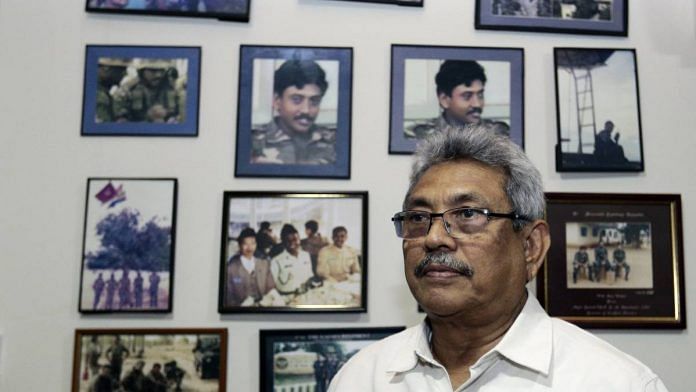
උත්තම මාතා ගුණ සමරු පූජා -2021 අග්‍රාමාත්‍යතුමාගේ සහභාගීත්වයෙන් පැවැත්වෙයි

November 3rd, 2021

අග්‍රාමාත්‍ය මාධ්‍ය අංශය

රාජපක්ෂ පවුලේ උතුම් මැණියන් ලෙස ගෞරවයට පාත්‍රවන ඩී.ඒ රාජපක්ෂ මැතිතුමාගේ ආදරණීය බිරිඳ දෝන දන්දිනා සමරසිංහ දිසානායක මැතිනිය සිහිපත් කරන උත්තම මාතා ගුණ සමරු පූජා-2021” ඇඹිලිපිටිය ඩී.ඒ රාජපක්ෂ අනුස්මරණ කේන්ද්‍රයේ දී අද (02) පස්වරුවේ අග්‍රාමාත්‍ය මහින්ද රාජපක්ෂ මහතාගේ  සහභාගීත්වයෙන් පැවැත්විණි.

ඇඹිලිපිටිය නගර සභාවේ නාගරික මන්ත්‍රී කේ. රුවන් පතිරණ මහතා විසින් පස්වැනි වරටත් සංවිධානය කර තිබූ මෙම උත්තම මාතා ගුණ සමරු පූජා උත්සවයේ මුලසුනට දක්ෂිණ ලංකාවේ ප්‍රධාන අධිකරණ සංඝනායක ඕමල්පේ සෝභිත හිමියෝ වැඩම කර සිටියහ.

අග්‍රාමාත්‍ය ආර්යා ශිරන්ති වික්‍රමසිංහ රාජපක්ෂ මහත්මිය මෙහි දී දෝන දන්දිනා සමරසිංහ දිසානායක මෑණියන්ගේ ඡායාරූපයට පළමුව මල් මාලාවක් පැළඳුවාය. අනතුරුව ඇමතිනි පවිත්‍රා වන්නිආරච්චි මහත්මිය ද මල් මාලාවක් පළඳවමින් දෝන දන්දිනා සමරසිංහ දිසානායක මැතිනියගේ ගුණ සිහි කළාය.

අමාත්‍ය චමල් රාජපක්ෂ, රාජ්‍ය අමාත්‍යවරුන්වන ලොහාන් රත්වත්තේ සහ ජානක වක්කුඹුර මහත්වරු ද මෙහි දී දෝන දන්දිනා සමරසිංහ දිසානායක මැතිනියගේ ඡායාරූපයට පුෂ්පෝපහාර දැක්වූහ.

දන්දිනා දිසානායක මැතිනියගේ දරුවන්ගෙන් අපට එතුමිය කුමන ආකාරයේ චරිතයක් ද යන්න තේරුම් ගත හැකි යැයි ගුණ සමරු දෙසුම ආරම්භයේ දී ම රජයේ ප්‍රවෘත්ති අධ්‍යක්ෂ ජනරාල් මොහාන් සමරනායක මහතා පෙන්වා දුන්නේය.  

දන්දිනා සමරසිංහ දිසානායක මැතිනිය ගැන මම පෞද්ගලිකව දන්නෙ නැහැ. නමුත් එතුමියගේ දරුවන්ගේ දේශපාලන භුමිකාව ගැන මට යමක් විශ්වාසයෙන් යුතුව පැවසිය හැකියි. අපි ගහක කොළයෙන් ගස අඳුනගන්නවා. දන්දිනා දිසානායක මැතිනියගේ දරුවන්ගෙන් අපට එතුමිය කුමන ආකාරයේ චරිතයක් ද යන්න තේරුම් ගත හැකියි. ඕනෑම මනුස්සයකුගේ පළමු පාසල නැතිනම්  පළමු  ගුරුවරයා ඔහුගේ හෝ ඇයගේ මවයි.

දන්දිනා සමරසිංහ දිසානායක මැතිණිය දුර්ලභ සුවිශේෂි කාන්තා චරිතයක් ලෙස අපට නිගමනය කරන්න පුළුවන්. එතුමියගේ සැමියා ඩී.ඒ රාජපක්ෂ මැතිතුමා අපේ රටේ නිදහසින් පසු දේශපාලන සමාජ පෙරළියක් විප්ලවයක් සටහන් කළ 1956 යුග පරිවර්තනයට දායක වූ නියමුවෙක්.

මන්ත්‍රීවරුන්, අමාත්‍යවරුන්, දෙවරක් ජනාධිපති ධුරයෙන් පිදුම් ලැබූ වත්මන් අග්‍රාමාත්‍යතුමා මෙන්ම වත්මන් ජනාධිපතිතුමාගේ මව ලෙස ඇය ඉතිහාසයට එක්වෙනවා. එතුමිය අපේ රටට දායාද කළ දරුවන් අපේ රටේ ස්වාධීනත්වයට, සමාජ සාමයට, ස්ථාවරත්වයට කළ මෙහෙවර විශිෂ්ටයි.

2015 සිදුවුණ වරද යළි සිදු වුවහොත් මේ රට යටත් විජිතයක් වීම වළක්වන්න බැහැ. එතුමිය රටට දායද කළ දරුවන්ට කළ හැකි ලොකුම උපකාරය මේ ගමන ස්ථිරව ගමන් කිරීමට අප සහය වීම යැයි” මොහාන් සමරනායක මහතා මෙහි දී පෙන්වා දුන්නේය.

මෙම අවස්ථාවට අග්‍රාමාත්‍ය ආර්යා ශිරන්ති වික්‍රමසිංහ රාජපක්ෂ, අමාත්‍ය චමල් රාජපක්ෂ, ඇමතිනි පවිත්‍රා දේවි වන්නිආරච්චි, රාජ්‍ය අමාත්‍යවරුන්වන ලොහාන් රත්වත්තේ, ජානක වක්කුඹුර, ඇඹිලිපිටිය නගර සභාවේ නාගරික මන්ත්‍රී කේ. රුවන් පතිරණ, රජයේ ප්‍රවෘත්ති අධ්‍යක්ෂ ජනරාල් මොහාන් සමරනායක, පැල්වත්ත සීනි කම්හලේ ප්‍රධාන විධායක නිලධාරී ගාමිණී රාසපුත්‍ර මහත්ම මහත්මීහු ඇතුළු පිරිසක් එක්ව සිටියහ.

Agriculture Minister ready to purchase organic paddy at Rs 100 (Video)

November 3rd, 2021

Courtesy Hiru News

Agriculture Minister Mahindananda Aluthgamage stated that the government is ready to purchase a kilo of paddy from organic farmers at Rs. 100 each.

Meanwhile, farmers in some parts of the country have organized protests demanding fertilizer in the wake of the commencement of their cultivation activities in anticipation of fertilizer.

A member of the Samagi Jana Balawegaya staged a protest in front of the Hanguranketha Pradeshiya Sabha against the fertilizer crisis and the increase in commodities.

Meanwhile, representatives of several bhikku organizations met Agriculture Minister Mahindananda Aluthgamage at the Ministry of Agriculture this morning to inquire about the fertilizer issue.

General Secretary of the New Sinhala Ravaya Organization Ven. Magalkande Sudaththa Thera, General Secretary of the Ravana Balaya Organization Ven. Ittekande Saddhatissa Thera and General Secretary of the Sinhala Organization Ven. Madille Pannaloka Thera and several others were present at the occasion. Later the delegation also met State Minister Shashindra Rajapaksa.

Meanwhile, the second consignment of nano nitrogen liquid fertilizer to be imported to Sri Lanka is to be brought to the island by air today.

ආණ්ඩුවට විරුද්දව ශ්‍රේෂ්ඨාධිකරණයේ සාක්‍ෂි දෙන්න ඇමති විමල් සූදානම්…

November 3rd, 2021

උපුටා ගැන්ම ලංකා සී නිව්ස්

යුගදනවි ගිවිසුම හා මෙරටට LNG සැපයුමේ ඒකාධිකාරය ඇමෙරිකානු සමාගමකට පැවරිමට එරෙහිව ශ්‍රේෂ්ඨාධිකරණය හමුවේ සාක්ෂි දීමට කර්මාන්ත අමාත්‍ය විමල් වීරවංශ මහතා සූදානම් බව දැනුම් දී තිබේ.

ලංකා විදුලි බල මණ්ඩල ඒකාබද්ධ වෘත්තීය සමිති සන්ධානයේ කැඳවුම්කරු රන්ජන් ජයලාල් මහතා කොළඹ පැවැති විරෝධතාවයක් අතරතුර මේ බව කියා සිටියේය.

තම වෘත්තිය සන්ධානය විසින් අදාළ ගිවිසුමට එරෙහිව ශ්‍රේෂ්ඨාධිකරණයේ නඩුවක් ගොනුකර ඇති බවත් එහි සාක්ෂිකරුවන් ලෙස විමල් වීරවංශ හා උදය ගම්මන්පිල ඇමතිවරුන් කැඳවීමට ඉල්ලා ඇති බවත් ඔහු පැවසීය.

මේ අතර අමාත්‍ය විහල් වීරවංශ මහතා මෑතකදී කොළඹ දී පවත්වන ලද මහජන මන්ත්‍රණ සභාවේ දී LNG ඒකාධිකාරය ඇමරිකාවට පැවරීමට විරුද්ධව දැඩි විරෝධය පළ කරමින් අදහස් පළ කළේය

‘නයිට්‍රො රජා’ ගෙන්වා කෝටි 800ක වංචාවක්.. ඉන්දියාවේ බෝතලේ රුපියල් 240යි..

November 3rd, 2021

උපුටා ගැන්ම ලංකා සී නිව්ස්

නැනෝ නයිට්‍රිජන් ආනයනය සහ හරහා මහා පරිමාණ වංචාවක් සිදු කර ඇතැයි සමගි ජන බලවේගය පාර්ලිමේන්තු මන්ත්‍රී චම්පික රණවක මහතා කියා සිටී.

නැනෝ නයිට‍්‍රජන් මිලි මීටර 500 බෝතලයක් ඉන්දියානු රුපියල් 240කට මිලට ගත හැකි බව ඔවුන්ගේ වෙබ් අඩවියෙන් වාර්තා කරන බවද මන්ත්‍රීවරයා පැවසීය.

ඒ අනුව දැනට මෙරටට ගෙන්වා ඇති සම්පූර්ණ තොගයට ගෙවා ඇත්තේ ඩොලර් තුන් ලක්ෂ අසූ හත් දහසක් පමණක් බවත් ඉතුරු සියලු මුදල් වංචා කර ඇති බවටත් ඔහු චෝදනා කළේය.

මෙසේ වංචා කර ඇති මුදල ආසන්න වශයෙන් කෝටි 800 ක් බවත් ඔහු කියා සිටියේය.

මන්ත‍්‍රීවරයා මේ බව කියා සිටියේ විපක්ෂනායක කාර්යාලයේ පැවති මාධ්‍ය හමුවක් අමතමිනි.

ඇමති ජී.එල්. දැඩි අවුලක.. ලේකම් සමග බෑ කියා ඉහලටම දන්වයි.. ස්කොට්ලන්ත සංචාරය මැදත් ගෝරි..

November 3rd, 2021

උපුටා ගැන්ම ලංකා සී නිව්ස්

පොහොට්ටුව පක්ෂයේ ආරම්භක සභාපති ලෙස කටයුතු කළ ඇමැති ජී. එල්. පීරිස්ද බලවත් සිත් තැවුලට ලක්ව ඇති බව ආරංචි මාර්ග කියයි. මීට හේතුවී ඇත්තේ විදේශ කටයුතු අමාත්‍යංශයේ ලේකම්වරයාගේ ක්‍රියාකලාපය බවද කියවේ.

විදේශ කටයුතු අමාත්‍යංශයේ ලේකම්වරයා වශයෙන් කටයුතු කරන්නේ අද්මිරාල් ජයන්ත කොළඹගේය. ජී. එල්. හා කොළඹ ගේ ගැටුම කරළියට පැමිණ ඇත්තේ මීට දවස් දෙක තුනකට පෙරය. ජනාධිපතිවරයා ස්කොට්ලන්තයට යාමට පෙර ඒ වැඩ කටයුතු සූදානම් කිරීමට ජී. එල්. ලන්ඩන් නුවර බල පිටත් වී ඇත. ජී. එල්. මෙම ගමනට ඔහුගේ පෞද්ගලික කාර්යමණ්ඩලයේ අයෙක් වූ ගම්ලත් නැමැත්තකුද සහභාගී කරගෙන ඇත.

නමුත් ලන්ඩන් සිට ස්කොට්ලන්තය බලා යන කණ්ඩායමෙන් ගම්ලත්ගේ නම ඉවත් කර ඇත. ඇමැතිගේ පෞද්ගලික කාර්යමණ්ඩලයේ කෙනෙක් රැගෙන යාමට දෙන්න බෑ කියා අද්මිරාල් දුන් නියෝගයකට අනුව ගම්ලත්ගේ නම කැපී ඇති බව කියවේ.

නමුත් ඇමැති ජි .එල්. ගම්ලත්ව ස්කොට්ලන්තය බලා රැගෙන ගොස් ඇත. ‘‘අඩුම ගානේ වයස ගැනවත් හිතන්න තිබුණා. බෑග් එකවත් අරගෙන යන්න කෙනෙක් ගෙනිච්චාම මොකද වෙන්නේ ‘‘ කියා මේ වන විට ඇමැතිවරයාට හිතවත් අමත්‍යංශයේ අය කතාබහ වන බව ආරංචි මාර්ග කියයි.

එකී ආරංචි මාර්ගම වැඩි දුරටත් පවසන්නේ ඇමැතිට පෞද්ගලික කාර්ය මණ්ඩලයේ අය ගෙනියන්න බෑ කියන අද්මිරල් පසු ගිය දිනක මොස්කවු හී කළ සංචාරයට තමන්ගේ පෞද්ගලිකකාර්ය මණ්ඩලයේ අයෙක් රැගෙන ගිය බවයි. මෙලෙස අමාත්‍යංශ ලේකම්වරයෙක් තමන්ගේ බෑග් එක උස්සගෙන යාමට සහයකයෙක් රැගෙන ගියේ ප්‍රථම වතාවට බවත් කියයි.

මේ දෙදෙනාගේ ගැටුමේ උච්චතම අවස්ථාව උදාවී ඇත්තේ‍ ජනාධිපතිවරයා සිය දේශනය කිරීමට යන විටදීය. දේශනය සඳහා ජනාධිපති සමග ඇතුළට යන්න දෙන්නේ එක් අයකුට පමණි. ‍අද්මිරාල් එතැනදීත් ජී. එල්. ගේ නම කපා ලලිත් වීරතුංගගේ නම දමා ඇත. කෝපය ඉහ වහ ගිය ජී .එල්. බැරිම තැන කෙලින්ම බැසිල්ට ඇමැතුමක් දී සියල්ල මුල සිට කියා ඇත.

– Aruna

CEB chairman admits Yugadanavi deal bypassed tender procedure

November 3rd, 2021

Tharaka Samman Courtesy Ceylon Today

Trade unions of the Ceylon Electricity Board say they will decide after tomorrow (04) a date to launch a strike in protest against the handover of shares of Yugadanavi power plant and the liquified natural gas supplies to New Fortress energy firm of the US.

Convener of the CEB Joint TUs Alliance Ranjan Jayalal said so during a demonstration in front of the CEB head office in Colombo today.

Meanwhile, CEB chairman M.C. Ferdinando says the agreement relating to the Yugadanavi power plant was inked after obtaining the attorney general’s approval for its basic content.

Speaking to journalists, he said, By now, the CEB has been unsuccessful with two coal tenders. There is no money to pay up front. There are no dollars to open the letters of credit. That crisis is there. Because of the CEB’s fuel purchases, the Petroleum Corporation is on the verge of collapse. What exists now is an abnormal situation. Since the government is faced with a burning issue, the procurement procedure was bypassed. If the CEB collapses, no one needs to cut power, it will happen automatically.”

අමෙරිකා ගිවිසුම ගැහුවේ‌ ටෙන්ඩර්වලින් තොරව බව විදුලි බල සභාපති පිළිගනී

November 3rd, 2021

තාරක සම්මාන් මව්බිම දැන්

යුගදනවි බලාගාරයේ කොටස් හා මෙරට LNG සැපයුම අමෙරිකාවේ නිව් ෆෝට්‍රස් සමාගමට ලබා දීමට එරෙහිව වැඩ වර්ජනයක් දියත් කිරීම සම්බන්ධයෙන් හෙටින් පසුව දින නියම කර තීන්දුවක් ගන්නා බව ලංකා විදුලිබල මණ්ඩලයේ ඒකාබද්ධ වෘත්තීය සමිති සන්ධානය පවසයි.

එහි කැඳවුම්කරු රන්ජන් ජයලාල් මහතා අද (නොවැ: 3) කොළඹ ලංකා විදුලිබල මණ්ඩල මූලස්ථානය ඉදිරිපිටදී පැවති විරෝධතාව අතරතුර මේ බව සඳහන් කළේ ය.

“මේ අමෙරිකානු ගිවිසුම අවලංගු කරන්න කියලා අපි ආණ්ඩුවට බල කරන්නේ ජනතාව පීඩාවට පත්කරන්නේ නැතිව. මේ ක්‍රියාමාර්ගගය ජනග්‍රහණයකින් තමයි අවසන් වෙන්නේ. ගත්ත වැඩවර්ජන තීන්දුවට හෙට දවස තුළ අපි දින නියම කරලා ප්‍රකාශයට පත්කරනවා.”

යුගදනවි බලාගාරයේ කොටස් හා මෙරට LNG සැපයුම අමෙරිකාවේ නිව් ෆෝට්‍රෙස් සමාගමට ලබා දීමට විරෝධය පළ කරමින් ඛනිජ තෙල්, වරාය සහ විදුලිබල මණ්ඩල සේවකයින් සංවිධානය කළ උද්ඝෝෂණ අද කොළඹ ස්ථාන 4 කදී පැවැත්විණි. 

මේ අතර, යුගදනවි ගිවිසුම අත්සන් කරනු ලැබුවේ එහි මූලික කරුණු සම්බන්ධයෙන් නීතිපතිවරයාගේ අනුමැතිය ලබා ගැනීමෙන් පසුව බව ලංකා විදුලිබල මණ්ඩලයේ සභාපති එම්.සී. ෆර්ඩිනැන්ඩු මහතා පවසයි.    

ජනාධිපති මාධ්‍ය කේන්ද්‍රයේ යුගදනවි ඇත්ත කතාව යන තේමාව යටතේ අද (නොවැ: 3) පැවති මාධ්‍ය හමුවට එක්වෙමින් සභාපතිවරයා මේ බව සඳහන් කළේ ය.

ඔහු එහිදී සඳහන් කළේ, ආණ්ඩුව “දැවෙන ප්‍රශ්නයකට මුහුණ දෙමින් සිටින බැවින් ප්‍රසම්පාදන ක්‍රියාවලිය මග අමෙරිකාව සමග ගිවිසුමට එළැඹි බව ය.

“ඒ ගිවිසුම සකස් කළේ සියලු ම පාර්ශවයන්ගේ එකඟතාව ඇති කරගෙන අවසානයේ හැම වචනයක් වචනයක් පාසා ම නීතිපති විසින් බලලා නිෂ්කාෂණය වීමෙන් අනතුරුවයි. හැබැයි මේක තවමත් ඉදිරිපත් කරන්න බැරි වුණා, විදුලිබල මණ්ඩලයටවත් ආවේ නැහැ. මොක ද මේකේ තියෙනවා කොන්දේසියක් disclose කරන්න පාර්ශවයන්ගේ කැමැත්ත තියෙන්න ඕනේ. ඒක සම්බන්ධයෙන් දැනට භාණ්ඩාගාරයේ මා දන්නා තරමට භාණ්ඩාගාරයෙන් නීතිපතිගේ අදහස් විමසලා තියෙනවා මේක ඉදිරිපත් කිරීම තුළින් රජයට යම් අවහිරතාවක් වේවි ද කියන එක. මේවා වාණිජ ගනුදෙනු. මේ වාණිජ ගනුදෙනු අනවශ්‍ය පුද්ගලයින් අතට ගියා ම, ඒ වාණිජ ක්‍රියාවලියේ තියෙන මූල්‍ය විචල්‍යතාව පිළිබඳ ලොකු ලොකු අර්බුද ඇවිල්ලා ඒවා arbitration බේරුම් කරන එක විශාල වන්දි ගෙවීම්වලට තුඩු දෙන හේතු වෙනවා. අමාත්‍ය මණ්ඩලය මේකට අනුමැතිය දුන්නේ රාමුව අනුමත කරලා, සිද්ධාන්ත අනුමත කරලා විස්තරාත්මකව ඒක අත්සන් කරාට පස්සේ අමාත්‍ය මණ්ඩලයට ඉදිරිපත් කරන්න කියලා ඒ අමාත්‍ය මණ්ඩලය අනුමැතිය අරගෙන, මම හිතන්නේ අපේ ඇමැතිතුමාත් ප්‍රකාශ කළා පාර්ලිමේන්තුවටත් ඉදිරිපත් කරනවා කියලා. මේවා හංගන්න තියෙන කරුණු නෙමෙයි. 

මේ වෙනකොට විදුලිබල මණ්ඩලයට ගල් අඟුරු ටෙන්ඩර් දෙකක් අසාර්ථක වුණා. අත්පිට මුදලට ගෙවන්න සල්ලි නෑ. ණයවර ලිපි විවෘත කරන්න ඩොලර් නෑ. ඒ අර්බුදය තියෙනවා. තෙල් මිලදී ගැනීම සඳහාත් විදුලිබල මණ්ඩලය හින්දා ඛණිජ තෙල් සංස්ථාවත් දැන් බිම වැටෙන තත්ත්වයට ඇවිල්ලා තියෙන්නේ. ඉතින් මේ වෙලාවේ තියෙන්නේ, අසාමාන්‍ය තත්ත්වයක්. ඉතින් ඒ හින්දා මේ ප්‍රසම්පාදන ක්‍රියාවලිය මග ඇරලා හරි මේ ගියේ මොක ද දැවෙන ප්‍රශ්නයකට ආණ්ඩුව මුහුණ දෙනවා. මොක ද විදුලිබල මණ්ඩලය කඩාගෙන වැටුණොත් එහෙම විදුලිය නිකම් කවුරුවත් කපන්න ඕනේ නෑ, නිකම්ම කැපෙනවා.”

Farmers’ agitation weighs heavily with Govt.

November 3rd, 2021

Courtesy The Daily Mirror

Prime Minister Mahinda Rajapaksa has sensed the gravity of the problem in the agriculture sector

The prime minister said the farmers’ protest, like that of the school teachers, would not have snowballed to such an extent had the party engaged them politically

Public uprisings, coupled with internal squabbling, have sent the government reeling

Still, there is a vague idea within the government about the extent of cultivation undertaken this time

Farmers’ agitation has become an issue that weighs heavily with the government. Rice, fruit and vegetable growers took to the streets urging the government to provide them with fertilizer for cultivation. The fertilizer shortage, triggered by President Gotabaya Rajapaksa’s decision to ban chemical farming, is now bound to create multiple effects in the agricultural supply chain; possibly leading to a high cost of living in the end. The political cost is already visible, and the rulers themselves have felt the pinch of it.


Prime Minister Mahinda Rajapaksa has sensed the gravity of the problem in the agriculture sector. Normally, he has taken a back seat in the affairs of the government. Nonetheless, he opened up his mind at the event to mark the fifth anniversary of the ruling Sri Lanka Podujana Peramuna (SLPP) on November 2, 2021 at Nelum Pokuna Theatre. He did mince his words when referring to the problem. In fact, he took an indirect swipe at those calling the shots in the government and the party. The prime minister said the farmers’ protest, like that of the school teachers, would not have snowballed to such an extent had the party engaged them politically. He emphasised that politicking is also important to remain engaged with the people rather than leaving it to government officials.

Otherwise, he said the forces that the SLPP defeated would capture the political momentum for their ends.


The prime minister’s remarks did not come out of the blues. Instead, he had observed developments after various radical decisions taken by the president and their political implications for the ruling side. He sounded an alarm for the party in this regard and called for immediate course correction. He also cautioned against creating ruptures with the minor allies of the government, and asked the party to not consider them as mere appendages or sidekicks.  

No matter what, crop reduction is expected. In the event of it, it will lead to a supply shortage of items such as rice, maize and vegetables. In the Maha season, 800,000 hectares are normally cultivated with rice. According to State Minister Shasheendra Rajapaksa, 435,000 have been or are under cultivation at the moment


Public uprisings, coupled with internal squabbling, have sent the government reeling.


Food crop cultivations have already been hampered since farmers, in some cases, are reluctant to work their fields due to uncertainty over availability of fertilizer despite the government having taken some measures to bring consignments of Nano liquid nitrogen fertilizer from India to be used as a substitute for Urea hitherto used in the agricultural areas. Lack of cultivation means impact on food security. In addition to recovering from the political shock of the farmers’ struggle, the government has now been compelled to look for measures to avert any impact on food security.


Still, there is a vague idea within the government about the extent of cultivation undertaken this time. Proper reports have not been worked out yet though the ruling party politicians give varying figures. No matter what, crop reduction is expected. In the event of it, it will lead to a supply shortage of items such as rice, maize and vegetables. In the Maha season, 800,000 hectares are normally cultivated with rice. According to State Minister Shasheendra Rajapaksa, 435,000 have been or are under cultivation at the moment. Cultivation for the current season continues until the end of this month.


The government has been compelled to brace any shortage. Mr. Rajapaksa said the government would be ready to import to make up for any shortage in the local supply.


I don’t think the problem will arise,” he said.


Besides, he said the Agrarian Insurance Board would closely observe the acreage of cultivation this time and identify the farmers involved.


We will pay them incentive grants in terms of better prices for their produce. We have not decided on the rates yet. But, the Cabinet paper will be presented next Monday for it,” he said.  

Food crop cultivations have already been hampered since farmers, in some cases, are reluctant to work their fields due to uncertainty over availability of fertilizer despite the government having taken some measures to bring consignments of Nano liquid nitrogen fertilizer from India to be used as a substitute for Urea hitherto used in the agricultural areas


Despite practical difficulties involved in the transformation of chemical farming into organic agriculture within a short period, the president is unlikely to budge from his decision in this regard.


Delivering his remarks at a special conference organized by Sri Lanka on the sidelines of the United Nations Climate Change Conference (COP 26) in Glasgow, Scotland, under the theme Rediscovering Nitrogen: Solutions and Synergies for Climate Change, Health, Biodiversity and Circular Economy”, the president reaffirmed his position about what he termed ‘a new agricultural revolution ‘which is in harmony with nature.  


My Government’s policy frameworks emphasise sustainability. This is reflected in Sri Lanka’s ambitious updated Nationally Determined Contributions to the United Nations Framework Convention on Climate Change (UNFCCC) Mechanism,” President Rajapaksa said.


The challenge facing us now is to use modern scientific techniques and practices to enhance agricultural production without causing environmental degradation.  For decades, chronic kidney disease has been a serious issue in Sri Lanka’s agricultural heartland. The overuse of chemical fertilizers has contributed significantly to this problem,” the President said.


Although this action has been broadly appreciated, it has also met with some criticism and resistance. In addition to chemical fertilizer lobby groups, this resistance has come from farmers who have grown accustomed to overusing fertilizer as an easy means of increasing yields,” the President said. This is particularly unfortunate considering Sri Lanka’s rich agricultural heritage,” the President added.


Total reversion to chemical farming is now unlikely. The total use of organic manure looks unthinkable. As a result, the government appears to have taken a step back to achieve moderation in this regard. 

Colombo Uni. Students’ Union opposes Ven. Murutthettuwe Ananda’s appointment as new Chancellor

November 3rd, 2021

Courtesy The Daily Mirror

The Colombo University Students’ Union and the Student Community unanimously expressed their displeasure over the appointment of Ven. Murutthettuwe Ananda Thera as the new Chancellor of Colombo University.

The University Students’ Union claims that the Chancellorship of a university should never be a political appointment or to fulfill a political agenda.

Although the Chancellor has no statutory administrative powers, the he is a symbol of the University’s honour, especially at the graduation ceremony.

However, the government has appointed Ven. Murutthettuwe Ananda as the next Chancellor of the University of Colombo.

“It is in this context that the independence and dignity of the university administration are preserved. But we believe that a political appointment to the post of a Chancellor of the University could destroy both the independence of the university administration and the dignity of the University overall,” the Students’ Union said.

Therefore, we, as the Students’ Union, and on behalf of the entire student community, express our strong opposition to this political appointment to the University of Colombo, which has a distinguished history and is still a prestigious university today, the Students’ Union added. 

Agreement with NFE cannot be disclosed due to certain conditions: CEB Chairman

November 3rd, 2021

Courtesy The Daily Mirror

Claiming that the agreement pertaining to the Kerawalapitiya Power Plant was signed with the US-based New Fortress Energy (NFE) following the approval of the Attorney General, CEB Chairman M.M.C. Ferdinando said today that the content of the agreement could not be disclosed due to a condition in the agreement.

He said the approval of all parties concerned was received for the agreement and that it was approved by the AG after thorough study.

The Chairman said there was a condition in the agreement that it should not be disclosed without the consent of the both parties and added that was why the agreement was not published.

The agreement has not even been presented to the CEB as yet. As far as I know, the Treasury has sought advice from the Attorney General whether there would be any issue for the State if the content of the agreement was disclosed,” he said.

He said it was a commercial agreement and that there would be negative impacts if unauthorized people got hold of such agreements.

The Chairman said there was nothing to hide and said even the framework agreement was signed with the Cabinet approval and the Subject Minister assured to present the agreement in parliament.(Ajith Siriwardana)

Maithri, security establishments only concerned of their own safety: Cardinal

November 3rd, 2021

Courtesy The Daily Mirror

Former President Maithripala Sirisena and those who were in the security establishments only tried to ensure their own safety when they received prior warnings on impending Easter Sunday attacks , Archbishop of Colombo His Eminence Cardinal Malcolm Ranjith said. 

Cardinal Ranjith who visited the residence of a native of Katuwapitiya who has lost his entire family members during the Easter Sunday carnage said the the former President and the  security establishment during that time had failed their duty. 

“Former President and others in the security establishment only exchanged letters among them and only ensured their safety. The Presidential Commission had recommended that all these persons should be punished. However the present regime had not done it as yet. We have been informed that a sum of Rs. 600 million has been spent for the Presidential Commission. These funds have gone down the drain as the recommendations made by the commission has not been implemented,” Cardinal said. 

“We feel that those in the present government had prior knowledge about the attacks. Also it is not fair for some of us to appear before the CID or legal action being filed against us when we express our suspicions. It is also unfair to stick political labels on me. We will fight to unveil the truth behind the Easter Sunday mayhem even if we are killed in the process,” he added. 

Sri Lanka, World Bank ink USD 500 million financing agreement

November 3rd, 2021

Courtesy Adaderana

The Government of Sri Lanka and the World Bank signed a $500 million financing agreement to provide safe, efficient and climate resilient connectivity to strengthen agricultural supply chains through the Inclusive Connectivity and Development Project.

This project is expected to benefit around 16 million people living in rural communities in selected districts of Sri Lanka.

Sajith Atygalle, Secretary to the Ministry of Finance, signed on behalf of the government and Hartwig Schafer, World Bank Vice President for South Asia, signed on behalf of the World Bank.

In Sri Lanka, agriculture – the main livelihood source of the rural community – is heavily dependent on roads to connect farmers to resources and domestic and international markets. While nearly all national roads are paved, only 67 percent of provincial roads, and 13 percent of rural roads are in good condition. Sri Lanka also has the highest rate of road fatalities in the South Asia Region with around 3,000 deaths per year.

An uninterrupted and safe road network in Sri Lanka is crucial to connect rural communities to health and education services and economic opportunities,” said Hartwig Schafer, World Bank Vice President for South Asia. Scaled-up road investments will contribute to the acceleration of human capital in Sri Lanka, leading to sustainable and inclusive economic growth.”

This Project is part of the 100,000 KM Rural Roads Development Program”, a key initiative of the national development strategy of the Government of Sri Lanka.

We are extremely happy with the design of this project and its impact on our local communities,” said Hon. Johnston Fernando, Minister of Highways of Sri Lanka. The holistic approach to ensure safety, climate resilience and sustainability for our road network is critical for building back better post pandemic”.

The project is expected to build on the ongoing provincial and rural roads rehabilitation initiatives under the World Bank financed Transport Connectivity and Asset Management Project and the Asian Development Bank funded Integrated Road Investment Programs – iRoad I and II. The project will support the Government of Sri Lanka to expand its services by building on the lessons learned and establishing a comprehensive system to improve rural connectivity in an inclusive manner, while improving rural livelihoods.

This project is implemented by the Ministry of Highways. A National Steering Committee will be established to oversee the project. 


-World Bank

Daily cases count reaches 581 today and 21 more COVID-related deaths

November 3rd, 2021

Courtesy Adaderana

The daily count of COVID-19 cases confirmed in Sri Lanka moved 581 today (November 03) as 107 more people were tested positive for the virus, says the Epidemiology Unit.

This brings the total number of confirmed cases of coronavirus reported in the country to 542,793.

As many as 513,880 recoveries and 13,791 deaths have been confirmed in Sri Lanka since the outbreak of the pandemic.

More than 15,122 active cases in total are currently under medical care, official figures showed.

The total number of people who died of COVID-19 infection in Sri Lanka moved up as 21 more fatalities were confirmed by the Director-General of Health Services on Tuesday (November 02).

The new development has pushed the official death toll from the virus outbreak in the country to 13,791.

The latest victims include 06 males and 15 females, the Department of Government Information said.

According to official data, 16 deaths were reported among elderly people aged above 60 years. In addition, 05 people aged between 30-59 years have also fallen victim to the virus infection.

Dhaka, Colombo mull launching cruise service to boost regional tourism

November 3rd, 2021

Courtesy Adaderana

Bangladesh and Sri Lanka are considering launching a cruise service between the countries to boost regional tourism.

Regarding the issue, a virtual meeting was held recently by the Bangladesh Tourism Board (BTB) with the participation of the concerned stakeholders, said sources at the BTB.

Dhaka, Colombo mull launching cruise service to boost regional tourism

BTB Chief Executive Officer Dr Jabed Ahmed told The Business Standard, We have memoranda of understanding (MoU) on tourism with a number of countries. Now, we are going to sign an MoU regarding tourism with Sri Lanka too.”

One of the provisions in the agreement would be to start a cruise line as part of the blue economy. We may include India in the cruise line considering the business viability,” he said.

If we can start ocean cruises in the region, other businesspersons will come forward to launch cruises in Bangladesh,” he added.

Reportedly, during a meeting at the Ministry of Tourism in Colombo, Bangladesh High Commissioner to Sri Lanka Tareq Md Ariful Islam and Sri Lankan Tourism Minister Prasanna Ranatunga have decided to take steps to launch cruise service between the two countries.

During Sri Lankan Prime Minister Mahinda Rajapaksa’s visit to Bangladesh earlier this year, it was decided to sign the MoU between the two countries.

Tareq Md Ariful Islam said the MoU on tourism has been drafted and is expected to be signed soon. 

Sri Lankan Tourism Minister Prasanna Ranatunga said more attention should be paid to uplift the tourism industry in the South Asian region through regional platforms such as Bay of Bengal Initiative for Multi-Sectoral Technical and Economic Cooperation and South Asian Association for Regional Cooperation.

He also said a joint tourism action plan should be implemented in these countries through a conference of tourism ministers of South Asian countries.

Bangladesh High Commissioner to Sri Lanka Tareq Md Ariful Islam pointed out that the assistance of those involved in the tourism industry in Sri Lanka is essential for the revival of the tourism industry in Bangladesh and requested the Sri Lankan tourism minister to assist in that endeavour.

Prasanna Ranatunga said Sri Lanka is ready to come forward in this regard any time.

Journey Plus, a Bangladeshi tour operator, arranged the first ever trip by an international cruise liner in Bangladesh in 2017, and then again in 2019.

Journey Plus Chief Executive Tawfiq Rahman said, We faced many difficulties to include Bangladesh on the world’s cruise map. We did not get sufficient cooperation from the government. Then, we did not take any further initiative to arrange such a tour after 2019.”

Journey Plus arranged the ‘Silversea Discover Expeditions’ to bring 162 foreign tourists from 17 countries to Maheshkhali Island and the Sundarbans in 2017.  They were on the Colombo to Kolkata Asia Expedition Cruise.

Journey Plus had to try for several years to bring Silversea, a luxury cruise line headquartered in Monaco, to this region and to open new routes that would include Bangladesh.

SJB’s FR petition against Yugadanavi deal fixed for consideration

November 3rd, 2021

Courtesy Adaderana

A Fundamental Rights (FR) petition filed by the Main Opposition, Samagi Jana Balawegaya (SJB), challenging the agreement signed between a U.S. company and the Sri Lankan government pertaining to the Yugadanavi power plant in Kerawalapitiya has been fixed for consideration.

A three-judge bench of the Supreme Court, consisting of Justices Murdu Fernando, Kumudini Wickremesinghe and Mahinda Samayawardhane, accordingly decided to take the petition up for consideration on the 12th of November.

PM Mahinda Rajapaksa and other Ministers of the Cabinet, the West Coast Power Limited – the owner of 310 MW Yugadanavi Power Plant in Kerawalapitiya, US-based New Fortress Energy, the Attorney General and several others have been named as the respondents of the petition.

It was put forward by SJB’s General Secretary, MP Ranjith Madduma Bandara.

The petitioner alleged that the decision taken by the Cabinet to transfer the shares of Yugadanavi power plant to the US-based company was unlawful and that proper tender procedure has not been followed in the process.

Thereby, the SJB has sought the court to issue a writ order annulling the decision.

Rajapaksa’s experiment with organic farming in Sri Lanka a warning to developing countries

November 3rd, 2021

  Courtesy The Print

The Sri Lankan government would do well to listen to the country’s agricultural scientists and not to quacks masquerading as experts.

File photo of Gotabaya Rajapaksa, Sri Lanka's president, at his home in Colombo, Sri Lanka, in 2018 | Tharaka Basnayaka | Bloomberg

An influential section of Sri Lankan agricultural economists and scientists has deplored the recent course change in the country’s agricultural policy made by the Gotabaya Rajapaksa government. The decision by the government to ban the use and import of chemical fertilisers and pesticides in pursuit of a 100 per cent organic food producer” status for Sri Lanka has already had disastrous consequences for the economy of the island nation, the Sri Lanka Agricultural Economics Association (SAEA) warned in a letter to President Rajapaksa on May 25, 2021. It pointed to the adverse effects of the policy on food security, farm incomes, foreign exchange earnings and rural poverty.”

President Rajapaksa’s ill-conceived and extremist policy, announced in April this year, of banning the import of all chemical fertilisers and pesticides as a way of promoting organic farming, is threatening to plunge the country’s agriculture into a deep production slump. As a consequence, the export of tea, Sri Lanka’s primary agricultural export, and of other commodities are projected to decline. The economy appears set for a fall in foreign exchange earnings in the midst of the Covid-19 pandemic.

The SAEA letter provided the following detailed estimates of the potential economic loss to farmers due to the policy:

When converting from conventional agriculture into organic farming, the Government should weigh the technological, environmental, and economic costs and benefits. The preliminary findings of the studies conducted by the SAEA on potential economic losses of the import ban and respective estimations are given below for your consideration.

(a) Agronomic studies reveal that the average yields from paddy can drop by 25 per cent if chemical fertilisers are fully replaced by organic fertilisers. This loss in productivity could reduce the profitability of paddy farming by 33 per cent and rice consumption by 27 per cent if paddy is cultivated just with organic fertilisers with a complete ban on rice imports. In contrast, applying organic fertiliser with the recommended dosages of chemical fertilisers would improve the profitability of farming by 16 per cent.

(b) Absence of chemical fertiliser would drastically reduce the productivity of the Vegetatively Propagated Tea (VPT). With a 35 per cent productivity drop, the export volume of tea would go down from 279 to 181 million kg, causing an income loss of Rs. 84 billion. The estate sector will likely incur significant losses compared to those of tea smallholders. These losses could further be aggravated due to increased cost of labour to apply bulky organic fertilisers.

(c) The coconut yields would go down by 30 per cent if chemical fertilisers and pesticides are not applied. This situation will adversely impact fresh coconut availability for the production of coconut oil, desiccated coconut and other coconut products. The loss in foreign exchange earnings can be as high as Rs. 18 billion, based on the assumption that only 26 per cent of the total coconut extent is fertilised. When the additional cost for the importation of edible oils is considered, the loss of foreign exchange earnings will be even higher.

(d) The above results were derived considering the immediate effects on three agricultural sub-sectors. An analysis performed accommodating adjustments in the economy over the medium to long run reveals that a reduction in average agricultural productivity by 20 per cent could cause a decrease in Gross Domestic Product (GDP) by 3.05 per cent suggesting an overall contraction of the economy with the implementation of the import ban. (emphases added)”

The letter requested the President to substitute the import ban on chemical fertilisers and pesticides with the set of alternative measures” that included making scientifically validated Good Agricultural Practices (GAP) as a mandatory national standard and disincentivising overuse of chemicals in agriculture through an appropriate mix of legal standards, taxes, subsidies and output price support. The letter also asked for the strengthening of agricultural extension to improve awareness of the safe use of chemical fertilisers and pesticides”.

On coming to office in 2019, President Rajapaksa promised subsidised imported fertilisers to farmers. Yet in a matter of just two years, the Sri Lankan cabinet approved Rajapaksa’s proposal to completely ban the import of inorganic fertilisers and all synthetic agro-chemicals — effectively, the imports of all chemical fertilisers, pesticides, fungicides and weedicides. A gazette notification on May 6, 2021 brought this into immediate effect. For any shipment after 6th May 2021, permissions for unloading were cancelled, and banks told not to issue Letters of Credit on the import of banned substances.

What caused this about-turn?

The two factors behind the change in policy direction, according to news reports, are first, Sri Lanka’s foreign exchange crisis, and second, the rise in food prices owing to the lockdowns and other disruptions induced by Covid-19. It is estimated that Sri Lanka spends about US$ 400 million on fertiliser imports annually. A ban on chemical fertilisers, it was thought, would reduce the pressures on foreign exchange. Added to this was the pressure from President Rajapaksa’s group of advisors that included a medical doctor, who reportedly convinced him that the use of chemicals in agriculture was leading to the spread of chronic kidney disease. Sri Lankan scientists have in fact argued that there are no links between the use of chemicals as farm inputs and kidney disease. They attributed the rise in kidney diseases to hard water in conjunction with fluoride present in many wells” (for a short review, see here). But these voices of reason were disregarded, and the organic farming lobby pushed the policy through.

On May 10 2021, the Presidential Task Force on Creating a Green Sri Lanka with Sustainable Solutions to Climate Change” was formed under President Rajapaksa’s Chairpersonship. The Task Force was authorised to implement the import ban and submit a plan to create a Green Sri Lanka”. Initially, the Task Force had 46 members, but later the number of members was reduced to 25 with Mahinda Amaraweera as the Chairperson. Many senior agricultural scientists were excluded from its membership, and it appears that it was filled with people with questionable scientific credentials. One member of this task force, for example, had once claimed to have identified a self-generating rice variety of yore that had fed the ten giant warriors of the Sinhala King Dutugemunu of the Anuradhapura Kingdom between 205 BC to 161 BC. Agricultural scientists tested the claim and found that the claimed variety was of sorghum and not of rice at all! Yet another member had claimed that glyphosate even dissolved reservoir bunds! Such was the state of scientific rigour within the Task Force.

A decision was also taken to import large quantities of compost, as well as boost the domestic production of compost, to substitute for chemical fertilisers. It is well-known that compost can hardly be classed as organic” as it contains many potentially toxic trace elements, a fact that, alas, has never persuaded the soldiers of organic agriculture to stop promoting it as an alternative to chemical fertilizers.

It is not just the SAEA that sounded the alarm over the outcome of the new policy. Growers of tea, which is the most severely affected crop in the present crisis followed by rice, pepper and cinnamon, are very worried. Herman Gunaratne, a master tea maker from Ahangama and a member of Task Force himself, says that Sri Lanka’s tea production of 300,000 tonnes may be halved due to the organic farming policy. Given that 10 per cent of Sri Lanka’s export incomes come from tea, this presents a serious potential problem. In an interview to the South China Morning Post, he said:

The ban has drawn the tea industry into complete disarray … The consequences for the country are unimaginable … The tea industry depends on nitrogen (N), phosphorus (P) and potash (K) … Mainly it is the nitrogen component that we cannot do without. Without it, you can expect the decline in production by as much as 50 per cent … I cannot subscribe to the view that it [i.e., going organic] helps the tea quality except for the fact that if we go completely organic, we will lose 50 per cent of the crop. [But] we are not going to get 50 per cent higher prices … And there is an extremely limited market for organic tea in the world. There is no way in which it can compensate for the decline in the crop.

Sensing trouble and responding to widespread protests from farmers and growers, the Rajapaksa government reversed some aspects of the policy by the end of May 2021. On 31st May 2021, the Cabinet approved the import of carbonic fertilisers, natural minerals and chelated herbal trace minerals”. A tender was also floated to import organic fertilisers with a minimum of 10 per cent nitrogen, even though such a product is not known to exist outside blood meal, which contains about 13.25 per cent nitrogen. On 31st July 2021, some fertiliser mixtures were permitted to be imported by the protected agriculture sector”. However, no detailed guidelines exist for the orders issued above, and much confusion exists on what can be imported and what cannot. A list of 25 agrochemicals were recommended for imports for emergency use by agricultural scientists, but this recommendation was rejected by the government. To top it all, even the import of compost was banned after officials raised questions about the violation of the regulations pertaining to plant and animal quarantine.

The muddled and unscientific policy has caused damage in other sectors as well. For instance, 20,000 out of 107,000 hectares of rubber in Sri Lanka are affected by Pestalotiopsis, a fungal leaf disease that is controlled by Carbendazim and Hexaconazole application through spraying. Further, chemical fertilisers need to be applied to promote better leaf growth. Neither are available in the market. As a result, the Colombo Rubber Traders Association expects rubber production to drop by 15-20 per cent. According to the Association, This leaf disease is possibly best described as the equivalent of Covid-19 in the case of the rubber industry, considering both its devastation and the rapid speed at which it is spreading.”

The havoc caused by the Sri Lankan experiment with organic farming is a warning to developing countries across the world against falling into a similar trap.  The irrational reduction in chemical inputs to agriculture even at low levels of productivity can spell disaster. Take a country like India where soils are generally poor in organic matter content. An estimated 59 per cent of soils are low in available nitrogen, about 49 per cent in available phosphorus, and about 48 per cent in available potassium. Indian soils are also deficient in varying degrees in micronutrients such as zinc, iron, manganese, copper, molybdenum and boron. Micronutrient deficiencies are not just yield-limiting in themselves; they also disallow the full expression of other nutrients in the soil, leading to an overall decline in fertility.

Agricultural scientists have always been aware of the nutrient deficiencies of soil, as well as the perils of overuse of chemicals and the improper/imbalanced application of fertilisers. They therefore recommend location-specific solutions to nurture soil health and sustain increases in soil fertility. They suggest soil-test-based location-specific balanced fertilisation and integrated nutrient management methods combining organic manures (i.e., farmyard manure, compost, crop residues, biofertilisers, green manure) with chemical fertilisers. Thus, while they may advocate reducing the use of chemical fertilisers in some locations, they would promote its use in others.

Such a comprehensive and integrated approach requires a firm adherence to science and the scientific method, and an equally firm rejection of anti-science models dressed up as organic,” eco-friendly,” pro-nature” and so on. President Rajapaksa’s policy falls squarely into the latter category, much like the promotion of Zero Budget Natural Farming (ZBNF) by the present Government of India. Only the total withdrawal of this policy can save Sri Lankan agriculture. The Sri Lankan government would do well to listen to the country’s agricultural scientists and not to quacks masquerading as experts.

R. Ramakumar is Professor, School of Development Studies, Tata Institute of Social Sciences, Mumbai. Views are personal.

The article originally appeared on the Foundation for Agrarian Studies website. It has been published with permission.

We Must Learn From Sri Lanka’s Man-Made Organic Agriculture Disaster

November 3rd, 2021

By V. Ravichandran:  Poongulam Village, Tamil Nadu, India

Sri Lanka has partially reversed a hasty decision to experiment with farming, but the country and its citizens are already paying for this bad mistake in the form of a food crisis.

President Gotabaya Rajapaksa announced a plan this spring to make Sri Lanka the first country in the world to ban inorganic fertilizers and crop-protection products that fight pests. This week, he changed his mind.

Yet as we commemorate World Food Day this month, we know that Sri Lanka is suffering from its original, anti-scientific choice: The government recently declared a food emergency, imposing price controls and strict rationing. It forced farmers to sell their rice to a state agency and it has seized supplies from private warehouses. Meanwhile, Sri Lankans wait in line for hours to receive their portions of rice, sugar, milk powder, and other basic commodities.

This is what happens when a government pushes anti-scientific ideas onto farmers and consumers.

I’ve never visited Sri Lanka, which hangs like a teardrop off the southern coast of my native India, but it holds a special place in my daily routine: I drink its delicious tea every morning, as I begin to work on my farm.

Sri Lanka’s tea is perhaps the best in the world, due to the island nation’s favorable climate and long history of production. The country’s economy depends on these exports.

They are now in jeopardy, though the president’s change of heart may soften the blow. Organic tea is much more expensive to produce. Under a mandate, yields will plummet, and these producers will suffer significant consequences because of this disastrous policy.

Yet this crisis is about much more than tea: It has affected every sector of Sri Lanka’s agricultural economy, effectively paralyzing the smallholder farmers who produce much of Sri Lanka’s rice, vegetables, and fruit. Even its natural rubber production may decrease.

Sri Lanka’s government decided to go backward into primitivism at a time when farmers around the world are surging forward with new technologies that help us grow more food on less land than ever before. Through remarkable advances in everything from plant genetics to precision irrigation to satellite imagery, we’ve become better and more sustainable producers.

If we were to apply Sri Lanka’s strange thinking on agriculture to communications, for example, we’d relinquish our mobile phones and turn to carrier pigeons. Instead of emails, we’d send handwritten letters. Rather than learning about the news from televisions and radios, we’d wait a long time for the news to reach us and perhaps not hear it at all.

When President Rajapaksa introduced his organic-farming rules, he boasted that no other country had ever tried such a thing. What he failed to understand is that most other countries already knew that this was a misguided and unscientific idea voiced by anti-development activists.

At least he is now beginning to understand his mistake.

Sri Lanka’s organic-farming blunder hardly could have come at a worse moment. COVID-19 has hurt economies everywhere, and it has taken a special toll on those that rely on tourism. After booming in the first part of this century, tourism in Sri Lanka has dropped sharply. This is partly the result of terrorist attacks on Christians in 2019, but mostly because of the pandemic. Foreigners have stopped flocking to its beaches, scuba-diving destinations, and natural beauty.

The value of its currency also has fallen, making it harder for Sri Lankans to purchase the goods and services they need from their international trading partners.

Compounding the problem is the logjam in the global supply chain, as container ships sit outside ports. Everything from semiconductors to medical devices is in short supply.

The most tragic aspect of Sri Lanka’s food crisis, however, is that much of it was avoidable. In choosing to push its agricultural mandates, the government refused to listen to the warnings of farmers.

I know that my farm couldn’t operate under Sri Lanka’s ridiculous rules. My yields of rice, cotton, and other crops would decrease significantly. The result would be simply disastrous.

If India’s population of more than 1 billion people were ordered to adopt the organic regulations thrust upon Sri Lanka’s 22 million people, we’d witness a catastrophe of malnutrition and starvation like the world has never seen. Our economy would crumble, and we would exhaust our foreign-exchange resources to feed our huge population, diverting our national wealth and stalling all other developmental activities. Finally, we’d have to expand our arable land by converting forest land for farming purpose, chopping down countless trees and global warming.

I don’t wish even to imagine such dreadful conditions.

It took only six months for Sri Lanka to begin to recognize that its organic-farming mandates are a massive failure. The lesson is to let farmers make judicious use of organic and chemical inputs, used in combination with other important technology options such as integrated pest, water and disease management practices. Trust science and technology so that its farmers and citizens stop paying a price they can’t afford.

Let the policy makers of all other nations understand the realities of Sri Lanka’s man-made disaster.

Mr. V Ravichandran owns a 60-acre farm at Poongulam Village in Tamil Nadu, India where he grows rice, sugar cane, cotton and pulses (small grains).  Mr. Ravichandran is a member of the Global Farmer Network, 2013 recipient of the Kleckner Award and serves on the World Economic Forum New Vision for Agriculture Transformational Leaders Network. 

Sri Lanka – 100% Organic Agriculture: A costly experiment leading to National disaster – Part 2

November 3rd, 2021

By Professor W.A.J.M. De Costa
Senior Professor and Chair of Crop Science, University of Peradeniya

Source: The Island Online

Measures that contravene the principles of organic agriculture

According to President Gotabaya Rajapaksa, one of the key advantages of converting Sri Lanka’s agriculture into 100% organic is the expectation of a higher price premium for its agricultural products in the global market. It was also argued that any reduction in yield would be off-set by the higher price premium for organic food products. However, with the realisation that crop requirements of potassium and phosphorus, two major plant nutrients which are essential for production of any crop on an economically viable scale, could not be supplied with organic fertilisers, the government decided to import Potassium Chloride (KCl) and to use Eppawala Rock Phosphate (ERP) as sources of potassium and phosphorus, respectively.

Similarly, it dawned upon the advocates of 100% organic agriculture that some of the key pests, diseases and weeds, in large scale agricultural crops, in Sri Lanka, cannot be controlled by exclusively organic means. Blights and soft rots in a range of vegetable crops caused by various bacteria (including Erwinia species) are a case in point. Consequently, the government has allowed the import of certain synthetic pesticides and herbicides.

These are rational moves that bring the initial idealism of 100% organic agriculture back to reality. However, the downside is that despite the rhetoric of 100% organic agriculture, Sri Lankan agricultural products will not receive international certification as ‘Organic’. Therefore, the expected higher price premiums will not materialise and farmer incomes will plummet because of the decreased crop yields.

Many soil scientists, who have expertise on fertiliser, have pointed out that the claimed concentrations of nitrogen, the foremost plant nutrient that is required for crop production, in the organic fertiliser that was to be imported from China, could not have come exclusively from its organic source, the seaweeds. They expressed the strong possibility of this organic fertiliser being fortified with an inorganic source of nitrogen, such as urea, to raise its nitrogen concentration to the levels that were claimed. Therefore, it is possible that this consignment was ‘organic fertiliser’ only by name.

A darker side of this issue emanates from reports of these agrochemicals being smuggled into the country, from India, via the Southern coast. It is reported that the government, and the relevant regulatory authorities and armed forces, are turning a blind eye to this activity. Such tacit approval by the government is akin to how it managed the COVID19-related restrictions during recent months. Therefore, while the government tells the whole world that it promotes 100% organic agriculture, agrochemicals are used on the ground. A similar situation prevailed when the ban on Glyphosate imports was in place, from 2015 to 2018, where smuggled Glyphosate, of dubious quality, was available in the blackmarket.

On 13 October, a government media release claimed commencement of the distribution of 30,000 tons of ‘organic potassium chloride’ imported from Lithuania. It is difficult to determine whether this is a demonstration of ignorance or an attempt to delude the farming community and the general public. There is nothing called ‘organic potassium chloride’. Potassium chloride (KCl) is an inorganic fertiliser obtained from the Earth’s mineral deposits. For well over 50 years, KCl has been the main form of potassium fertiliser for agricultural crops all over the world, including Sri Lanka. In organic agriculture, potassium is supplied in the form of crop residues (e.g. rice straw) which contain potassium as a component of their tissues.

Promised payment of compensation to farmers for loss of crop yield

In the immediate aftermath of the issuance of the Gazette notification, in May, when the strong possibility of plummeting crop yields was pointed out by several stakeholder groups, the Cabinet Minister said that farmers would be compensated for loss of yield due to the absence inorganic of fertiliser and synthetic agrochemicals. The advisors to the Minister, and the few hard-core organic agriculture advocates, claimed that these compensations could be paid from the substantial savings of foreign exchange that would become available because of the ban. However, to this date, this promise has not been fulfilled, despite a significant proportion of the national farmer population, growing a wide range of crops, including paddy, pulses, onions, potato, low-country and up-country vegetables, tea and various horticultural crops, including cutflower and pasture, already incurring substantial losses of production due to the ban of inorganic fertiliser and synthetic agrochemicals during the yala season of 2021.

Ministry officials, task forces and advisory panels

The dis-jointed management (or mis-management) of this vital national issue is exemplified by various personnel in-charge of the Ministry of Agriculture and in advisory panels to the President and the Minister. The Secretary to the Ministry of Agriculture, at the time of implementation of the ban, who showed enthusiasm and optimism for successfully implementing the conversion to 100% organic agriculture, resigned after three months in office, reportedly over a disagreement with a key proponent of the inorganic fertiliser and agrochemical ban who was functioning as the top advisor to the Minister, on importing organic fertiliser in contravention of the Plant Protection Act. Following this resignation, a senior academic, who is an agricultural economist by training, has been appointed as the Ministry Secretary to oversee implementation of the organic agriculture policy. Despite his brilliant academic record as an undergraduate in the Faculty of Agriculture of the University of Peradeniya, in the early 1990s, this official has so far demonstrated little understanding of the biological realities of meeting the national food production targets with the limited nutrients from organic fertiliser and in the absence of commonly-used synthetic agrochemicals to control pests, diseases and weeds of crops.

In the week following the issuance of the Gazette notification, in early May, a Presidential Task Force, consisting of 46 members, which included 20 politicians, several hard-core activists promoting organic agriculture and a miscellaneous collection of agriculture practitioners, academics, industrialists and businessmen, was appointed with the task of transforming Sri Lanka’s economy into a green socio-economy with sustainable solutions to climate change. Preparing a roadmap for the complete transition from ‘chemical farming’ to organic farming (as per the Media Release from the Presidential Secretariat on 10 May) was listed as one task of this Task Force. However, it is notable that the Gazette notification, banning the import of inorganic fertiliser and synthetic agrochemicals, had already been issued on 06 May, effectively transforming Sri Lankan agriculture from the so-called ‘chemical farming’ to organic farming overnight. On examining the track record of the personnel in this Task Force, it is clear that it lacked the balanced scientific expertise to analyse all aspects of a complex issue and plan a difficult operation and provide advice to the President. This deficiency has been borne out by the absence of meaningful action taken by the Task Force and the news of some its members expressing the impossibility of their task. Events of the last five months have shown that there certainly is no roadmap developed and put in place.

In September, the Cabinet Minister of Agriculture also appointed a 14-member Task Force for Sustainable Agriculture, consisting of academics and a few administrators and entrepreneurs. This Task Force also has the same weaknesses of the larger Presidential Task Force in terms of balance and competence in expertise. As expected, no tangible outcomes have emanated from this Ministerial Task Forc, as well.

Given the national importance of the plantation sector of agriculture, the Cabinet Minister of Plantation Agriculture has been conspicuous by his silence and inaction in the Cabinet, the Parliament and in public forums that address this critical national issue.

Visible impacts on different crop sectors and prognosis for next year

The yala cropping season, which immediately followed the implementation of the ban, was completed largely with inorganic fertiliser stocks that had been imported before the ban, but were sold to farmers at exorbitant prices by traders. Although the production statistics are not yet available, it is highly likely that, for a majority of crops, both yields per unit land area and total production in yala 2021 have been below-average. This is because of the yield reductions due to lower rates of fertiliser application and increased yield losses caused by pests, diseases and weeds, which are predominantly controlled by agrochemicals in large-scale crop cultivations. There are reports and images of vegetable crops, both in the up-country and low-country areas, shrunken in size by shortage of nutrition and decimated by diseases and pests in the absence of agrochemicals for their control.

The prognosis for the coming maha season is frightening. There are daily media reports of farmers, from almost all parts of the country, expressing either reluctance or point blank refusal at Pre-Seasonal Meetings (i.e. Kanne Rasweem) to start crop cultivation in the absence of an assured supply of fertiliser and agrochemicals. In a majority of these occasions, farmers specifically request inorganic fertiliser saying that organic fertiliser is simply not suitable for cultivation of paddy and some of the key other field crops such as maize. The government officials at these meetings are unable to provide the assurances that the farmers are seeking. If this situation prevails in the next month and a half, the area cultivated with paddy and maize during this major cropping season will decrease substantially. When coupled with the lower expected yields per unit land area because of the lower nutrition from organic fertilizers and non-chemical control of pests, diseases and weeds, a substantial decline in the total production of paddy, maize and almost all other crops is inevitable. Repercussions of this will be felt in many related food sectors. For example, reduced maize production and the resulting shortage of animal feed in which maize is a major component will cause a reduction in poultry products (eggs, chicken).

The potential social consequences of an overall shortage of essential food items are disturbing to the say the least. A population that has been inducted recently to queuing for rice, sugar, milk powder and gas will have to get used to queues for many essential food items. How disciplined the people will be in the face of this situation over a prolonged period is anybody’s guess.

How has the President and the government responded to this situation?

It is patently clear that the authority to make situation-changing decisions lies with the President. It is also clear that the President has been wrongly-advised by his advisors. More depressing is the observation that members of the Presidential and Ministerial Task Forces are either ignorant or incompetent to analyse the situation and recommend appropriate action or lack strength of character to tell the truth to the President and advise him about what should be done immediately without delay. The bottom line is that the current uncertainty in national food security undermines the national security, the very platform on which the President campaigned and got elected.

After towing the President’s line for a long time, a few government lawmakers have started to acknowledge the reality and have started making noises about being prepared to listen to the ‘peoples’ voice’ and ‘take a step back’. Last week, the immediate-past President went on record saying that Sri Lankan agriculture is at a historic low and that a day may come when he would not be able to go to his home town. Following these statements from those in his own ranks, there was expectation that the President would review his decision. However, his latest reference to the current fertiliser and agrochemical policy during his speech at the Sri Lanka Army’s 72nd Anniversary showed that nothing has changed. While acknowledging that it is difficult, he still wants the current policy to continue.

The President’s argument that he received a mandate from the people to embark on the current policy on fertiliser and agrochemicals because he had included it (even though not to be operationalised in this specific manner), in his manifesto, is a flawed argument. The people do not approve manifestos in their entirety. In an election, people make their choices based on a few key aspects (e.g. national security on the most recent occasion) without reading each and every statement in a manifesto. Therefore, it is nothing more than self-delusion to still take up the position that he has the peoples’ endorsement to continue the current policy.

What should be done immediately?

In view of the clear and present danger of a nationwide crop failure in the coming maha season and the possibility of food shortages, the President has no option but to reverse the ban on inorganic fertiliser and synthetic agrochemicals. Steps should be taken immediately to import, at least 50% of the requirement of inorganic nitrogen fertiliser (i.e. urea). This is assuming that at least a limited fraction of the nitrogen requirement will be supplied from the organic fertiliser that has been produced in-country. In view of the shortage of foreign exchange for importation of nitrogen and potassium fertiliser, crops in the current maha season will have to be managed with 50-60% of the recommendations of inorganic fertiliser, which will provide an economically-viable crop yield to the farmer and a level of food supply to the consumers to avert the impending food crisis and social unrest.

Distribution of this fertiliser among farmers, should be strictly regulated and should be done in phases during the cropping season. This is to prevent their over-application and encourage split-application (i.e. providing the requirement in several splits) and thereby minimise leaching and evaporation losses of urea. The same should be done for potassium chloride fertiliser (the so-called ‘organic potassium chloride’), which is equally vulnerable to leaching losses.

What should be done on medium- and long-term?

Continuation of recent initiatives to expand the share of organic agriculture in the local agricultural production

The drive to produce organic fertiliser, by a wide range of stakeholders and entrepreneurs, in both public and private sectors, is one positive outcome of the ban on inorganic fertiliser and synthetic agrochemicals. These initiatives should be continued. An important step in this regard will be to develop and implement quality standards for organic fertilisers that are locally-produced.

In parallel to the production of organic fertilisers, a drive to produce a variety of organic-based agrochemicals has been initiated. These initiatives should be incentivised and continued with a view to reduce the use of synthetic agrochemicals to expand the practicing of Integrated Pest Management (IPM).

Phased out reduction or complete withdrawal of the subsidies on inorganic fertiliser

The nearly 100% subsidy of inorganic fertiliser that was in place for nearly three decades in Sri Lanka contributed to their over-use and excessive farmer reliance on them while diminishing their interest in adding organic amendments for natural regeneration of soil fertility. While being a financial drain of public funds and foreign exchange, the fertiliser subsidy also inflated the true economic profitability of farming in Sri Lanka. Its gradual reduction (or complete withdrawal) will prompt farmers to seek ways of increasing the profitability of their farming by improving crop management with efficient cultivation practices (collectively called ‘Good Agricultural Practices’).

Promotion and support of research on an economically-viable mixture of conventional and organic agriculture

Excessive reliance of the farmers on subsidized inorganic fertiliser and widely-available, commercially-supported synthetic agrochemicals contributed indirectly to suppression of research on eco-friendly farming practices with less reliance on inorganic fertiliser and agrochemicals. This has contributed to the failure of the current drive to ‘go 100% organic overnight’ because the researchers in the Department of Agriculture had not developed sufficiently effective alternative cultivation technologies when the ban came into effect. However, researchers in the universities and other research institutions (e.g. National Institute of Fundamental Studies, Sri Lanka Institute of Nanotechnology) have carried out useful work over a prolonged period and developed useful technologies, which to a large extent, have been ignored by researchers in the Department of Agriculture and higher officials in the Ministry of Agriculture. Some of these technologies are: (a) biofertilisers and biopesticides developed from microorganisms isolated from local soils and plants; (b) chemicals which are generally regarded as safe to human health (called GRAS chemicals). These technologies and products that are already developed have to be up-scaled and commercialised with government support.

The level of inorganic fertiliser that needs to be used for viable crop production and the feasibility of organic agriculture depends on the soil fertility status of a land and the market needs for an organically-produced product. Therefore, a comprehensive survey of these aspects needs to be undertaken with a view to develop a rational mixture of conventional and organic agriculture in different regions of Sri Lanka.

The hard-core proponents of 100% organic agriculture should realise that it is just not biologically possible. It is turning out to be a costly experiment which is leading to a national disaster.

100% Organic Agriculture: A costly experiment leading to National disaster- Part 1

November 3rd, 2021

by Professor W.A.J.M. De Costa Senior Professor and Chair of Crop Science, University of Peradeniya Courtesy The Island

Afghanistan: A Country devastated by armed invasions & Sri Lanka devastated by following the IMF Advice

November 2nd, 2021

By Garvin Karunaratne

There are two methods of subjugating a country. One is by direct armed intervention. The other is by making a country indebted. Direct intervention is obvious, an  invasion, while making a country indebted is done covertly and a gradual process. The Pauperization of Sri Lanka took four decades. The people were taken unawares. Our leaders were fooled and taken for a ride.

Two invasions- first  by  Soviet Russia and then by the USA has left Afghanistan torn and tattered.

Garvin, When you have finished your doctorate and I have finished mine, do come to Afghanistan for a month. Be my guest and I will take you everywhere in Afghanistan in my car when I go on circuit.”

These words ring in my ears again and again.. That was Rohith from Afghanistan,  a Director in their Adult Education Department, who studied with me, reading for  the Ph.D. at Ericson Hall, Michigan State University. That was in 1978. He was a scholar sent by the country to be trained to serve the country.

I have lost touch and I know not where he is. 

Once not long ago Afghanistan was a live country just like Sri Lanka in the days of Premiers Dudley and DS.  Poring over a few books in my small library I came across the FAO Production Book and the FAO Trade Year Book for 1990. In 1988  as much as . 2.6 million hectares were cultivated with cereals and the production was 3.5 million metric tons. Comparatively Sri Lanka cultivated  cereals only on  865,000 hectares and the production was 2.5 million  metric tons.  Afghanistan held a population of 15.3 million. In 1988, exports of raisins amounted to 48,000 metric tons while exports of sugar  amounted to 221,000 metric tons. .Agricultural statistics do speak of a highly developed country.

Over to education, 12,000 high school graduates competed for  3000 places at Kabul University in 1977. . . The secondary schools had an enrollment of 628,000 pupils including 212,000 girls. In  2002, there were  3.3 million students in schools.

Scholars were sent off for further studies at international universities, just in the manner that we administrators were sent off for study at Manchester and Cambridge Universities by the Sri Lankan Government.  and Rohith was one of them.

Today Afghanistan is totally destabilized.   Two invasions by Superpowers over three decades eroded down a country that was self reliant, not in debt and a people  vibrant with  life.

Over to Sri Lanka , we have had  attempts to destablize our country. .

 Many of us do not know and have forgotten that the 1971 JVP Rebellion was an invasion. The JVP struck on 5 th April and the government forces controlled only the main city areas. The rest of the country was in the hands of the JVP for a few weeks. If not for the fact that at seven in the morning of 5 th April, Radio Ceylon announced that Wellawaya and Moneragala Police Stations were attacked enabling our patriotic armed forces to expect the worst, things could have been far worse.  In Matara where I was the G.A we controlled only the coastal towns. Even Akuressa  a mere ten miles away was in the hands of the JVP. The first contingent by our armed forces to recapture  Akuressa was attacked  before it reached  Akuressa and two of the fourteen jeeps in our convoy  were set ablaze and had to be abandoned. The commmnder Major Wettasinghe   and several others were injured and had to retreat.

There are unconfirmed reports of foreign vessels been seen in Colombo waters in April 1971. However at Matara, on a day immediately after 5 th April,  a massive ship appeared. Sri Lanka never had so large a ship. I quote from my Paper:  How the JVP Ruined Sri Lanka (Lanka Web: 18/07/2020):

  It is of interest to note that the first insurrection in 1971,was entirely orchestrated by North Korea. Implicating evidence was found and the North Korea Embassy was immediately closed down and the diplomats banished from Sri Lanka It may be of interest to note that in the days immediately after April 5, 1971, when we were holding onto the coastal towns at Matara, a very large ship appeared on the coast and came very close to Dondra. Sri Lanka did not have a ship of that size then. Watching  through binoculars from the Army camp I saw a number of boats being lowered to the sea and things being put into them. Major Wettasinghe had his Light machine gun loaded but said that the boats were beyond its range. 

Dondra was more or less under the JVP control at that time except for the police station and the adjacent areas and there was no possibility of conducting checks in the area. We morse cvoded Army Headquarters and one of our planes came, hovered around the ship and we heard machine gun fire for around fifteen minutes. The ship vanished just afterwards and this is an episode known only to me and the Army on duty at that time.. 

The 1971 insurrection was essentially an attempt by the communist bloc, especially North Korea to take control of Sri Lanka.” 

Sri Lanka luckily survived the attempt thanks to our police and army.  

Another such move to destroy our sovereignty was the move by the MCC Compact- the USA desperately tried to impose on SriLanka in 2018 and 2019. It is even reported that the MCC had an office at Temple Trees, the office of our Prime Minister. Sarojini Dutt in her paper: Sri Lankan Cabinet  Surrenders  the Country for the Americans” in Lanka Web(6/11/2019) details this attempt.  The MCCCompact Agreement included the grant of a land mass- a 200 mile corridor from Colombo to Trincomalle- a third of our Motherland to the USA for a period of 200 years, in return for a grant of a mere $ 480 million to be spent on roads and surveys. The conditions were  detailed by MCC Team Leader Steve Dobrolovic, at a meeting at Temple Trees on 25/11/2018. My paper: The MCC Compact Method oif Creating More Poverty: The USA Can definitely do better’(Lanka Web:26/10/220) details this surrender of our country for 200 years. Mind you, the British ruled our country only for less than 150 years! In the General Election in 2019, the UNP declared that if it won they would ink this MCC agreement the very next day! 

The next invasion is of a different type. We are today stuck in the throes of this invasion..  Our Motherland’s economy is in dire straits unable to finance even the basic necessities of  life for its citizens. The situation today in Professor Srrimevan Colambage’s words are: 

Externally, the country’s foreign reserves have fallen to less than $ 3 billion, as against the debt commitments of over $ 6 billion to be settled within the next 12 months, apart from having to meet day-to-day import outlays. The banking sector is running short of foreign exchange. As a result, the US dollar is traded at around Rs. 230 within the banking circles, despite the Central Bank’s insistence to keep it at Rs. 200 per dollar. The black-market rate is reported to be high as much as Rs. 260 per dollar.”  

It needs to be emphatically stated that the economic situation in Sri Lanka today  is not due to the current Government of President Gotabhaya.  

How did we come to this plight?  In the early Fifties we had funds to construct the Gal Oya Development Project, a massive project that built up the Amparai Distrcit with a major tank. Sri Lanka  was not in debt in 1976.  On the other hand today we are in debt to the tune of $ 56 billion. We have had to restrict imports. Even in the early Fifties the country restricted imports. Then there was a limited allocation to import cars. Buyers had to wait in turn. In 1958 I waited for over a month in turn to buy my new Peugeot 203.  Money was not allowed for foreign travel and no money was released for studies abroad. Every dollar that came in was carefully  taken in by the State and there were no foreign money changers, collecting dollars and selling dollars as they wish.  In 1970, I was myself in charge of giving grants of foreign exchange allocations to small industrialists to import machinery or other requirements and we were extremely strict. We had effective price controls and methods of enabling the people to obtain supplies at reasonable prices. There was a Rice Ration Scheme till 1979..  

 Even when the oil sheiks increased the price of oil four fold in the early Seventies Premier Sirimavo had foreign exchange  to buyfuel. When the UK insisted that foreign estates taken over under Land Reform had to be immediately paid in foreign funds, Sirimavo met it.  We did not have to raise foreign loans to meet these commitment.  

Todays situation is entirely due to our following the IMF’s  Structural Adjustment Programme of allowing the free use of foreign exchange and meeting it with loans, the advice given by the IMF and our leaders agreeing to it and allowing the rich in the country to live in luxury. The debt mounted gradually to $ 5 billion by 1989, $ 24 billion by 2010, to $ 42.9 billion by the end of 2014 and to $ 56 billion today. This is entirely due to the free use of foreign exchange for use by our rich for luxury holidays, to send off their children for foreign studies and import all luxuries including luxury cars all for the rich. In this process the funds obtained on loans get shunted back to the donor countries while leaving the country saddled with the debt. This was the advice of the IMF which President Jayawardena and Foreign Minister Ronnie de Mel agreed to follow in 1977 in exchange for loans The first loans were given with a grace period where the leaders did not have to bear the responsibility of repayment. This total demise is detailed in my Books: Microenterprise Development: The Way Out of the World Bank & IMF Stranglehold(Sarasavi, 1997) How the IMF Ruined Sri Lanka & Alternative Programmes of Success(2006) and  How the IMF Sabotaged Third World Development( Godages/Kindle:2017)  

We have today to pay for funding this luxury life of the rich. It is necessary that the masses should not get penalized for this extravaganza for which they were not responsible. Instead of de controlling prices we have to get back to the days when the economy was managed during the time of Premier Dudley and earlier. That was by careful collection of the foreign exchange that came in. Banks that took in foreign exchange had to declare it to the Government and it was the Government that allocated funds for essential imports and then made small allocations for the import of fridges, motorcars etc.  

We also had a development infrastructure to enable people to get to work making things that the country required. We never imported buses, coaches or railway carriages. These wre made by our own carpenters. We even made crayons, a sophisticated product equal to the Reeves, the best of that day and sold it islandwide. This was done under my personal direction- a myriad experiments by our Planning Officer, a chemistry grad and the Rahula science teachers, every night from six to midnight for three months at the Rahula College science lab and established   by no less a person than SumanapalaDahanayake, the MP for Deniyaya in his capacity as the President of the Morawak Korale Cooperative Union. He marshaled the Morawaka youths to make crayons. It was done in three weeks working day and night at Morawaka.  Sumanapala developed Coop Crayon to have islandwide sales. That was the showpiece success of the Divisional Development Programme of the Sirimavo days. 

We have to immediately get down to make everything the country needs We have to re establish the Marketing Department with its vegetable purchasing scheme and its Cannery. This Cannery made Sri Lanka self sufficient in all jam  and fruit juice and food preparations within the three years 1955to 1958. It was this Scheme that indirectly controlled prices. We have to reestablish power looms and handooms to enable us to become self sufficient in all textiles. In 1972 suiting from the Hakmana Powerloom found ready sales in London! We made all our fabric in 1976. That was the Department of Small Industries at work. To assure food supplies we had two giant departments- the Food Commissioners Department to buy and ensure that people had a rice and essential food ration and the Agrarian Services Department to purchase paddy, mill paddy to rice and feed the Food Commissioners Department.  These three Departments have to be immediately re established. 

Kiss Goodbye to the IMF- it is because Sri Lanka followed the IMF dictates that we were fooled. The IMF  even gave grace periods of no payment to fool our foolish leaders to follow. The IMF  therefore does not have the right to expect any repayment.  The IMF  enticed our leaders to follow their advice by bribing them!.  

The IMF does not hold any hope. Countries like Ghana.that sought IMF help fell from the frying pan to the fire. Let us have import controls and foreign exchange restrictions in the national interest, collect every dollar that comes in, re establish the development infrastructure that we once had,  re establish industries to make everything we need. Sad to say we are perhaps the only country that does not make a bicycle today. We do not even make our step ladders! We collect waste cardboard and export 8,000 tons a month to India and buy back cardboard from them. We really need to have our heads examined. It is a simple process to make cardboard out of waste paper and the Divisional Secretary at Kotmale did that in the DDC Programme of 1970-1976.  It is entirely following the IMF that pauperized our country.  

New thinking has to emerge and we have to get down to work as fast as we can. Let me hope that this message gets to our leaders.  

Garvin Karunaratne, Ph D Michigan State University 

Former G,A. Matara, 02/11/2021 

Author of Microenterprise Development.. The Way Out of the World Bank and IMF Stranglehold(Sarasavi: 1997). 

How the IMF Ruined Sri Lanka & Alternative Programmes of Success(Godages: 2006) 

How the IMF Sabotaged Third World Development (Kindle/Godages:2017)

Minister Ali Sabry should resign from the post of Minister of Justice immediately and also cease to be an MP any further.

November 2nd, 2021

Dr. Sudath Gunasekara 3.40 Am on 1st November 2021. Mahanuwara.

Minister Ali Sabry should make a public apology to the Sinhala nation and the Buddhist clergy of this country and resign from the post of Minister of Justice immediately in view of his following uncalled for anti-government, anti-President and anti-Sinhala Nation comments purported to have been made by him that appeared in the Sunday Times of 3.10 2021 and also broadcasted over the news the same day (if that news is true). If he doesn’t do that the President should immediately sack him and appoint a Sinhala Buddhist like Wijedasa Rajapaksa to fill that vacancy. 

Because these nasty comments made by Ali has already ignited a island wide wave of anti – President, anti-government and anti-Sinhala anti-Buddhist tension like wild fire among the communal minded and extremist Muslims as already exposed by the communal comments made by a wide range of Muslim extremists, as if they are living in an Arabian country.  I am still waiting to see the wave of statements from people like Rauf Hakeem and ilk such as Asad Sali, Abdul Rahuman and Hisbulla within the country and the reaction including protests and even trade embargoes and diplomatic interference from Muslim countries the world over, tarnishing the image of this country and the GR Government putting the country and its economy from the prying pan to the fire.

Just imagine for a movement as to how Ali Sabry an unknown man becoming a key personality in the country and the whole world overnight thanks to President as he was appointed as the Minister of Justice in this country by him in 2019. He is not even a MP elected by the people. Therefore he was not responsible to the people but only to his Party leader. This is a very good example to  where an appointed MP becomes not answerable even to his own Party leader who has given his/her job when it comes to his personal and communal interest. This is another strong reason as to why the National list should be abolished. In this case now it appears that Ali Sabry is not responsible even to his Party leader He was brought to Parliament by GR through that rogue list of the so-called National list which I have been agitating all governments to do away since it is utterly undemocratic and unconstitutional to have a backdoor list like that in a democratic society.  I just can’t imagine as to how he could be so ungrateful to the President.  If the President had not brought him he would never have been even a back bencher MP.

In a way I am not surprised on his behavior as a Muslim who is only a descendant of another itinerant Muslim trader who had come to this paradise Island of gems and ivory of the Sinhala people as a wondering sea farer for trader in the distant past, either from India or the Arab world who were welcomed by the foolish Sinhala Kings of the yore, the same way present day politicians do, not only with gems and ivory but with land and even local women to be married as their wives. These were the people who had been spying against the Sinhala people as a community right throughout history. As a community they are worse than any other as an ungrateful set of people. The best example is the Muslims in the Panama Pattuwa in the Eastern Province who descend from Muslim refugees descending from those who were settled there by King Senarath in his magnanimity in 1665 when they rushed in to him and pleaded for protection after mass scale killing by Portuguese in the SW coastal belt, now claiming a separate Muslim kingdom. So historically right throughout, Muslims were an anti- Sinhala community ‘eating the ear while resting on the horn’ as the famous Sinhala saying goes

Therefore there is nothing new or surprising in Ali Sabry’s inherent behavior that is a common trait to all Muslims in this country that never disappear until and unless they also disappear from this land of the Sinhala nation. What I can’t understand is the folly and the inability of the Sinhala leaders to realize this gospel truth. Starting from the 2019 Good Friday carnage Ai Sabry had been supporting the Muslim terrorist and the Muslim community at large although GR does not know it or pretends to be so..

So in this case the fault is with the President and nobody else. He should be ashamed for appointing Ali Sabry in the first place as a National list MP and then as the Minister of Justice in this country of all the Cabinet positions, in this time tested and historically proven backdrop in this country which had been a Sinhala Buddhist Kingdom for more than 2500 years. In fact I as a person who had canvassed widely and wrote volumes for him and who had also voted him and as the first man and perhaps the only person to predict his victory long before the Presidential  Election that he will definitely win the Election with a thumping majority. I had had also predicted him of this appointment as Minister of Justice is going to be a political suicide and it might end up even in a collapse of the Government. But unfortunately he didn’t care a penny as he thinks he is always right.  I, as a person who has worked with people like Mrs Bandaranayka,  Lalith Atulathmudala and President Premadasa, was perplexed to have this bitter experience as long as he is surrounded by the present set of Advisers I can assure, that he can never get out of this trap and continue rapidly to his downfall unless he bring about some radical changes replacing his present set of selfish and- self-seeking advisors  and Ministers like Ali Subry, Aluthgamage and Keheliya Rambukwella with some saner blood who put the country and the people first, rather than their purses , the day the entire 6.9 million voter base turning against him is not that far.  If he fails to take immediate corrective measures,  I  would like to remind him of a famous saying by Mao Tsetung  it is with the same hands that put you on the thrown that the people will again lift and throw you on the ground”

A word about the Ulamas and Bassaas, who have declared war against the President on this Task force and for appointing Ven Galaboda Atteas its Gnaanasara as its Chairman as already they  live in a Muslim country.  These Muslims should at least understand that this is not Ssaudi Arabia or another Arab country. This was and still is the Land of the Sinhala Buddhists eternally protected by the Buddhist monks as it had been for the past 2500 years at least from 307 BC since Buddhism was officially declared the State Religion of the King and the subject alike. You are only descendants of a migratory community of wandering birds who have to understand that gospel truth and adjust to that social milieu if you need to enjoy the salubrious life here without madly conspiring to create a Muslim Kingdom here. Within that scenario there is no room for separate laws or administration for Muslims or any other, for that matter. Therefore One Country and One law should be the Law of the Land and that has to be Sinhale and Sinhala Law as that was there for 2500 years, with suitable adaptations to suit the present day needs.

If you examine carefully you will see the only nation on earth who does not have their own law is the Sinhala nation. The Sinhalese, the Bhoomiputra Sinhalese are the only people in this country who don’t have a law of their own. They are governed under the Roman Dutch Law, while introduced by the Dutch in the 17th century and the British in 1852. On the other hand the Tamils and Muslims have been given their own Laws by the Colonial powers.  

In fact we have to add few more things like one language also to that list. Since this country had been a Sinhala Buddhist Kingdom at least from 307 BC, no one should dare to disturb that cultural rock foundation. If there is anyone who cannot concede to that inalienable truth, whether he is Muslim or Tamil and is not prepared to coexist peacefully within that framework then he/she has no alternative but to go back immediately to the motherlands where the hell he/she had come from, without creating headache for us the Sinhalese, the Bhoomiputras of this Land from the inception of history. AS THE FAMOUS Sinhala say goes ‘Wavulage magul gedara giyaanam wavulek wage hasirenta one”

Then on the other hand no Sinhala man or woman who cannot say this boldly and openly and act accordingly and is still dreaming to be the leader of this country while sleeping with lice for personal benefits and votes having got elected by the Sinhala votes can also say good bye to this country and fly or sail to the countries of those lice along with them

Now as far as the appointment of Ven Galabaodatte Gnasara Thero as the Chairman of this Committee I don’t think the President could have done better. In spite of his other blunders  like the mad Organic Fertilizer rush, the messing up his heart of the vote base the farmer in the village ,  the silence on the truant teacher strike and certain appointments bot at home and abroad, I congratulate him for this appointment. In my view he is the best person for that job. He is blessed with all the faculties including knowledge, personality and erudition to lead any National Committee or movement in this country even by virtue of the simple fact that he is an outstanding and outspoken Buddhist prelate, since it were the Buddhist prelates who had given the national leadership to Kings and Queens in this country right throughout the history of this country. In fact they were the people who had made and unmade rulers in this country and they were the cornerstone of the entire cultural fabric of this Island nation. Any person who cannot concede to that fact should never aspire to be a permanent citizen here apart from becoming a national leader. In this backdrop anyone who criticizes his appointment is an utter mutt.

(Dr. Sudath Gunasekara was a former Permanent Secretary to Mrs. Sirimavo Bandaranayaka and the President Mahanuwara Sinhala Buddhist Senior Citizens Movement and was also the President of the Sri Lanka Administrative Service Association (1991-1994) who saved the SLAS from its demise in 1992 from an attempt to amalgamate the Divisional Secretaries Offices and Pradesiya sabha and appoint Div Secs as the Secretaries to the PS chairmen)

News item referred above

One country, one law: Justice Minister Sabry not consulted about task force, not happy over move

By Chris Kamalendran

Muslim members claim they were unaware who was to head it implies that they have to be consulted before

View(s): 2125

Justice Minister Ali Sabry said he was unaware of the setting up of the One Country, One Law” Presidential Task Force headed by Bodu Bala Sena (BBS) General Secretary Ven. Galagoda-aththe Gnanasara Thera. This also implies that the President has to get his permission before such a task force is appointed.

Mr Sabry told the Sunday Times he was not consulted on the setting up of the Task Force. I am not happy about the move,” he said.

President Gotabaya Rajapaksa issued a gazette notification on Tuesday announcing the appointment of a 13-member Presidential Task Force for One Country, One Law,” with Ven. Gnanasara Thera appointed as its chairperson. The task force’s other members are Prof. Dayananda Banda, Prof. Shanthinandana Wijesinghe, Prof. Sumedha Siriwardana, N.G. Sujeewa Panditharathna, Iresh Senevirathne, Sanjaya Marambe, Eranda Navarathna, Pani Wewala, Moulavi Mohomad, Mohomad Inthikab, Kaleel Rahuman and Azeez Nizardeen.

The Sunday Times understands that none of the task force’s Muslim members was aware that the task force would be headed by Ven. Gnanasara Thera or even that he was going to be a member. Does this means that the President has to get their consent before the President take a decision mean

Colombo Municipal Councilor Kaleel Rahuman claimed he was not informed” that he would be appointed to such a task force and only found out about his inclusion only through the media. Does this mean the President has to get his consent before he is appointed to that a committee?

Mr Rahuman had been elected to the CMC from the United Peace Alliance (UPA). Its party leader Basheer Segu Dawood said they would meet next week to discuss the issue. Mr Segu Dawood said the party would take disciplinary action against Mr Rahuman if he chose to accept the position of task force member under Ven. Gnanasara Thera. That means Mr Segu Dawoodis against Mr Rahuman’s appointment

Meanwhile, during the government party leaders’ meeting at Temple Trees on Thursday, Ceylon Workers’ Congress (CWC) Vice President and former Provincial Councilor Senthil Thondaman raised issue over non-representation of the Tamil community in the Presidential Task Force. Mr Thondaman told the Sunday Times President Rajapaksa had asked them to propose names of Tamils who should be on the task force and assured that he will appoint Tamil members to it.

Issuing a statement, the All Ceylon Jamiyyathul Ulama (ACJU) said it was shocked and dismayed by the establishment of the ‘Presidential Task Force for One Country, One Law’ under the leadership of a controversial individual.” This demonstrate Ulamas objection as well. I wonder whether he can mention any public figure who is not controversial.

The ACJU statement, issued under by its Secretary Ash Sheikh M. Arkam Nooramith, did not mention Ven. Gnanasara Thera by name, referring to him only as a controversial individual.”

Share This Post

Pakistan should seek apology to Bangladesh within December 16, 2021

November 2nd, 2021

MD Pathik Hasan

Upcoming December 16, 2021 is knocking on the door. Bangladesh will celebrate its 50th anniversary of victory day with full spirit. On December 16, 1971, almost 93,000 Pakistani soldiers surrendered in Dhaka, leading to the creation of the sovereign nation-state of Bangladesh. Dec. 16 is Victory Day in Bangladesh. On this day in 1971, some 93,000 Pakistani soldiers settled for an unconditional surrender to India-Bangladesh joint forces in Dhaka that led to the emergence of a new nation state in South Asia. Bangladesh got its independence from Pakistan in 1971. Bangladesh was a part of Pakistan from 1947 to 1971. Bangladesh had to separate itself from Pakistan due to various reasons through the prolonged independent movement. After the hardcore struggle, it placed itself in the world map as a sovereign state. During this period, the people of Bangladesh basically faced a serious exploitation and genocidal activities committed by the Pakistan army. Consequently, India had to stand a huge number of influx of refugees. According to Bangladesh government, nearly 3milion people were martyred and 2.5 lacks women were raped by Pakistani military and its local associates.

After a long and bloody struggle of nine months, East Pakistan emerged on the world map as a completely independent state called Independent Bangladesh. Since then, in long 50 years, Bangladesh’s position and acceptance increased to every country in the world.

Everyone around the world is praising the sustainable development of Bangladesh. Bangladesh is being recognized as a rising star in South Asia. Bangladesh is improving so much today, said an economist in Pakistan. Abid Hassan said in an article in The News International, a Pakistani newspaper, that Pakistan may seek financial assistance from Bangladesh by 2030. The former World Bank economist has just predicted the future. If Bangladesh can pay 20 million US dollars to Sri Lanka, waive the IMF’s Bangladeshi share of money from Somalia and Sudan, help Indonesia with Covid-19 medical equipment, shelter a large number of Rohingya refugees from Myanmar, it can also help Pakistan financially. Bangladesh is a humanitarian state in South Asia.

Its foreign policy is friendship to all, enmity with none. Pakistan, which exploited Bangladesh for 24 years, today lags far behind in socio-economic fields. In an interview, a Pakistani journalist asked Prime Minister Imran Khan to make Pakistan like Bangladesh. The Canada-based International Forum for Rights and Security, a think tank, recently published a report on Bangladesh and Pakistan. It has been shown there that Bangladesh is ahead in all areas of the index. Many Indian economists have called on all countries to follow the Bangladesh model in the development of South Asia. Former Pakistani ambassador to the United States Hossain Haqqani said that Pakistan carried out the worst genocide in Bangladesh in 1971.

But there is no indication of Pakistani government seeking apology for the genocide. He made the remarks at a webinar organized by the Bangladesh Embassy in Brussels in late March 2021.

The people of Pakistan should call on their government to apologize for all the atrocities that took place against Bangladesh in 1971.The people of Pakistan are also sympathetic to Bangladesh that had to bear the genocide during the liberation war. Although the government of Pakistan distortedly presented Pakistani textbooks and various publications. But in this age of globalization, people are much more aware.

We can also know the views of Pakistani citizens by the welfare of social media. They also want the government of Pakistan to formally apologize to Bangladesh for their brutal deeds in 1971. Pakistan should apologize to Bangladesh for the way in which Pakistan attacked innocent Bengalis in 1971 and killed them. Pakistan should understand everything and normalize relations with all the countries of South Asia.

Even in this corona, leaders from all over South Asia came to Bangladesh in March on the occasion of the birth centenary of Father of the Nation and the golden jubilee of Bangladesh’s independence. But no Pakistani leader came. Pakistan has just officially sent a congratulatory message. Pakistan’s highest sincerity was needed here.

On December 16, Bangladesh will celebrate the golden jubilee of her victory day. I think this is a golden opportunity for Pakistan. Pakistan’s Prime Minister Imran Khan can visit Bangladesh on December 16 to mark the Victory Day and formally apologize to Bangladesh. Imran Khan should seek apology.  Pakistan’s leadership should give up their egoistic mindset. They have to remember that Pakistan committed genocide in Bangladesh at that time. They did misdeed. So, it is their responsibility to apologize to Bangladesh. I firmly believe that Bangladesh will take it in a positive way because Bangladesh knows how to forgive. To some extent, A Pakistan apology could heal Bangladesh’s war wounds.

Bangladesh is going to be recognized as an emerging power in South Asia. Many senior citizens of Pakistan can put pressure on the government of Pakistan in this regard. The time has come to realize the heinous act that Pakistan did. The government of Pakistan should understand why the burden of this past act of Pakistan will carry the future of Pakistan. Although Imran Khan used to talk a lot about this issue before he became the Prime Minister, Imran Khan is not able to do anything as the army has a big role in the politics of the country.

Yet it is not good for the military and the civilian government to ignore Pakistan’s public opinion. Pakistan should realize this now. The time has come to formally apologize to Bangladesh. Because the souls of three million martyrs and the cries of losing honour of about two and a half million mothers and sisters are still heard.

Seeking forgiveness to someone after doing wrong does not mean being small, but expressing oneself as a symbol of greatness and humility. If France and Germany can apologize to Rwanda after all this time, why can’t Pakistan apologize to Bangladesh?

If Europe’s two biggest former colonial powers – France and Germany – can do it, then no one else should have a problem doing it. Pakistan should realize this. Since Bangladesh won on 16 December 1971, it was on 16 December that Pakistan could formally apologize to Bangladesh. Still, Bangladesh will get some consolation. This should be realized by the government of Pakistan. Because they need Bangladesh’s help and support in reviving their fragile economy and in various international issues. The sooner the Pakistani government realizes this, the better for them. If Pakistan wants to take steps to improve relations with Bangladesh, it must apologize for the 1971 war crimes. Only then is it possible to advance diplomatic and economic relations between the two countries. So, it would be better for Pakistan if Pakistan should seek state apology to Bangladesh as soon as possible.

දුෂ්කර අවස්ථාවල එක් අරමුණක් වෙනුවෙන් සටන් කළ පක්ෂ ලොකු කුඩා වුණත් මේ කවුරුවත් අපට ඈත් කරන්න බැහැ.

November 2nd, 2021

අග්‍රාමාත්‍ය මාධ්‍ය අංශය

දුෂ්කර අවස්ථාවල එක් අරමුණක් වෙනුවෙන් සටන් කළ පක්ෂ ලොකු කුඩා වුණත් මේ කවුරුවත් අපට ඈත් කරන්න බැහැ. ඒ අය අපේ අපේ ආධාරක නෙමෙයි. අපේ කිහිලිකරුත් නෙමෙයි. ඒ අය අපේ අතකොළුත් නෙවෙයි. ඒ නිසා එදා හිටපු සියලු පක්ෂ එක රෑනට එකට ඉන්න ඕනෑ – ශ්‍රී ලංකා පොදුජන පෙරමුණේ නායක අග්‍රාමාත්‍ය මහින්ද රාජපක්ෂ මහතා

  • තාප්පවල චිත්‍ර ඇන්ඳ තරුණයො අද රට හැර යන්න පාස්පෝට් ගන්න පෝලිමේ ඉන්නවා ද කියලා හොයලා ඒ අය ආයේ මේ රටට කැඳවාගන්න පුළුවන් දේශපාලනයක යෙදෙන්න
  • ජනතාවගෙ ප්‍රශ්නවලට ආවේගවලට මුහුණ දෙන දේශපාලනය පොදුජන පෙරමුණෙන් ඉටු කරන්න
  • එදා අපිව හිරේ විලංගුවේ දැම්මත් ජනතාව කලබල කරලා වර්ජන රැළි මෙහෙයවලා ජනතාව අඳුරේ තියන්න කටයුතු කළේ නෑ.
  • පක්ෂයක කීර්තිය ජනප්‍රියත්වය රැකෙන්නේ ආණ්ඩු බලයෙන් නොවෙයි. ආණ්ඩුව තිබෙන කාලෙත් ජනතාව අතර දේශපාලනය කරන්නත් ඕනෑ
  • අපි තේරුම් ගන්න ඕනෑ අපිට ඡන්දය දුන් ජනතාව දැන් ඉන්නේ ඉතාම අපහසු දුෂ්කර තත්ත්වයක. 
  • බේරගත්ත රට අපි පාවා දෙන්නේ නෑ. අපි ගැන මතුවටත් ඒ විශ්වාසය තියන්න පුළුවන්
  • දෙමළ, මුස්ලිම් ජාතීන් ළං කරගන්න පුළුවන් නම් ඒක තමයි පොදුජන පෙරමුණට කරන්න පුළුවන් හොඳම කාර්යය.

දේශපාලන පක්ෂ ලොකු කුඩා වුණත් දුෂ්කර අවස්ථාවල එක් අරමුණක් වෙනුවෙන් එකට එක පිලේ එක් අරමුණකට සටන් කළ අය මේ කවුරුවත් අපට ඈත් කරන්න බෑ. ඒ අය අපේ ආධාරක නෙමෙයි. අපේ කිහිලිකරුත් නෙමෙයි. ඒ අය අපේ අතකොළුත් නෙවෙයි. ඒනිසා එදා හිටපු සියලු පක්ෂ එක රෑනට එකට ඉන්න ඕනෑ. ඒ සමගිය රකින එක ප්‍රධාන පක්ෂයේ අපේ වගකීම යැයි ශ්‍රී ලංකා පොදුජන පෙරමුණේ නායක අග්‍රාමාත්‍ය මහින්ද රාජපක්ෂ මහතා පැවසීය.

අභිමානයෙන් සෞභාග්‍ය කරා”තේමාවෙන් නෙළුම් පොකුණ මහින්ද රාජපක්ෂ රඟහලේ දී අද(02) දින පෙරවරුවේ පැවති ශ්‍රී ලංකා පොදුජන පෙරමුණේ පස්වන ජාතික මහා සම්මේලනය අමතමින් අග්‍රාමාත්‍යතුමා මේ බව අවධාරණය කළේය.

තාප්පවල චිත්‍ර ඇඳලා දේශපාලනයෙන් රට අවලස්සන කරන්න එපා කිව්ව තරුණයන් අද රට හැර යන්න පාස්පෝට් ගන්න පෝලිමේ ඉන්නවාද කියලා හොයලා බලලා,එහෙම ඉන්නව නම් ඒ අය ආයෙත් මේ රටට කැඳවාගන්න පුළුවන් විධියේ දේශපාලනයක යෙදීම පොදුජන පෙරමුණට ඇති ඓතිහාසික අනාගතවාදී කාර්යය බව ද අග්‍රාමාත්‍යතුමා මෙහි දී පෙන්වා දුන්නේය.

අතිගරු ජනාධිපති ගෝඨාභය රාජපක්ෂ මහතාගේ ආශිර්වාදයෙන් අග්‍රාමාත්‍ය මහින්ද රාජපක්ෂ මහතාගේ ප්‍රධානත්වයෙන් පැවති ශ්‍රී ලංකා පොදුජන පෙරමුණේ පස්වැනි ජාතික මහා සම්මේලනය, පක්ෂයේ නිර්මාතෘ මුදල් අමාත්‍ය බැසිල් රාජපක්ෂ මහතාගේ සංවිධාන ශක්තියෙන් අභිෂේක ගැන්විණි.

ශ්‍රී ලංකා පොදුජන පෙරමුණේ පස්වන ජාතික මහා සම්මේලනයේ දී පක්ෂ නායක අග්‍රාමාත්‍ය මහින්ද රාජපක්ෂ මහතා කළ සම්පූර්ණ කතාව මෙසේය.

මිත්‍රවරුනි,

පොදුජන පෙරමුණේ පස්වෙනි සංවත්සරයටයි අද අපි එකතුවෙලා ඉන්නෙ. අළුත්ම පක්ෂයකට වසර පහක් තුළ ජනාධිපතිවරයෙක් බිහි කරලා තුනෙන් දෙකක බහුතරයක් සහිත පාර්ලිමේන්තු බලයකුත් අරගෙන පස්වැනි සංවත්සරය සමරන්න ලැබෙයි කියලා එදා මේ රටේ කිසිම කෙනෙක් විශ්වාස කළේ නෑ. නමුත් අලුත් දේශපාලන පක්ෂයකට ‍ඓතිහාසිකව කරන්න පුළුවන් මහා පෙරළිය අද අපි කරලා තියෙනවා. ඒ සඳහා හිරේ විලංගුවේ වැටෙන්න හෝ මහපාරට වැටෙන්න සුදානමින් වුනත් කැපවුණ සියලු දෙනාට මම මගේ ගෞරවය මේ මොහොතේ පිරිනමනවා.

මිත්‍රවරුනි,

පොදුජන පෙරමුණේ ගෙවුන පස් වසරක කෙටි ඉතිහාසයෙන් ලංකාවේ දේශපාලනයට ලොකු පාඩමක් ඉගෙන ගන්න තියෙනවා. ආණ්ඩු බලය අහිමි වෙලා මර්දනයට ලක් වුණාම නැගිටින්නේ කොහොමද කියන එක ඉගෙන ගන්න නම් පොදුජන පෙරමුණ ගත කරපු ගෙවුණ වසර පහ දිහා බලන්න. ඒ වාගේම විපක්ෂයේ ඉන්නකොට පොදු ජනතාව මුහුණ දෙන ප්‍රශ්න අතට අරගෙන ආණ්ඩුවක් එක්ක අරගල කරන්නේ කොහොමද කියන එක තේරුම් ගන්නන් පොදුජන පෙරමුණේ පක්ෂ ඉතිහාසයෙන් පුළුවන්.

පොදුජන පෙරමුණ ගොඩ නගාගෙන යනකොට තමයි එදා දිගන ජාතිවාදී ගැටුම සිද්ධ වුණේ. පාස්කු ප්‍රහාරය සිද්ධ වුණෙත් අපි පොදුජන පෙරමුණ ගොඩනගමින් විපක්ෂයේ ඉන්න කොට. එබදු අවස්ථාවල ජනතාව කුමන්ත්‍රණකාරීව අවුස්සන්නේ නැතිව කෝප කරන්නේ නැතිව කටයුතු කරන්නේ කෙහොමද කියන එක තේරුම් ගන්නත් අපේ ගෙවුන ඉතිහාසයෙන් පුළුවන්. එපමණක් නොවෙයි පොදුජන පෙරමුණ මේ රටේ වාගේම විදේශවලත් බලපෑමට ලක්වුණා. මට මතකයි දින පනස් දෙකේ ආණ්ඩුව පිහිටවලා පාර්ලිමේන්තුවේ බලය ලබා ගන්න කටයුතු කළ මොහොත. එදා පාර්ලිමේන්තුවට ආව විදේශ නියෝජිතයෝ අපිට එරෙහිව පාර්ලිමේන්තු ගැලරියේ ඉඳන් ජයඝෝෂා කරලා අත්පුඩි ගැහුවා. එබඳු බලවේගවලටත් මුහුණ දෙමින් තමයි  පොදුජන පෙරමුණ ගොඩනැගුවේ.

මිත්‍රවරුනි

මොන තරම් මර්දනයට ලක් වුණත් මොන තරම් පීඩනයට ලක් වුණත් අපි ප්‍රජාතන්ත්‍රවාදය ගැන විශ්වාසය තියලා වැඩ කළා. අපිව හිරේ විලංගුවේ දැම්මත් ජනතාව කලබල කරවලා වර්ජන රැළි මෙහෙයවලා ජනතාව අඳුරේ තියන්න කටයුතු කළේ නෑ. ඒ නිසාම තමයි වගකිවයුතු පක්ෂයක් හැටියට ජනතාව අපිව භාර ගත්තේ. ඒ වාගේම මොන බාධක කම්කටොලු ආවත් ජනතාව අත හැරලා දිව්වෙ නෑ. බය වෙලා කලබල වෙලා තීරණ ගත්තේ නෑ. ඒ නිසා තමයි මේ තරම් ඉක්මනට අපි මේ ගමන ආවේ. ඒ ඉතිහාසය මතක තියාගෙන තමයි ඉදිරියට යන්න ඕනෑ.

මිත්‍රවරුනි,

ආණ්ඩු බලය ගන්නා තුරු ඉතාම ඉවසීමෙන් කැපවීමෙන් අපි දේශපාලනය කරනවා. ආණ්ඩු බලය ගත්තාට පස්සේ අපි දේශපාලන කටයුතුවලින් ඈත් වෙනවා. හැබැයි ආණ්ඩු බලය ගත්තාට පසු දේශපාලන කටයුතු අමතක කරලා රාජ්‍ය පාලන වැඩවලට කාලෙ වෙන් කරන්න පටන් අරන් තියෙනවා. අද අපිට වෙලා තියෙන්නෙ ඒකයි. පක්ෂයක කීර්තිය ජනප්‍රියත්වය රැකෙන්නේ ආණ්ඩු බලයෙන් නොවෙයි.

ආණ්ඩු බලය ලබාගෙන රාජ්‍ය ආයතන හරියට කරනවා වාගේම ජනතාව අතර දේශපාලනයක් කරන්නත් ඕනෑ. ආණ්ඩු බලයෙන් අමාත්‍යාංශවලින් රාජ්‍ය ආයතනවලින් කරන්න බැරි බොහෝ දේවල් තියෙනවා. පසුගිය කාලේ ගුරු වර්ජනය දුරදිග ඇදිලා ගියේ අපි දේශපාලන කටයුතුවලින් ඈත් වුණ නිසා.

අද ගොවි උද්ඝෝෂණ වුණත් මේ තරම් බරපතළ විදිහට ඇදිලා යන්නේ ඒ අය අතරේ වැඩ නොකළ නිසා. ඒ ජනතාවගේ හඬ අපි තේරුම් ගන්න ඕනෑ. ඒ හඬ අපට ඇහෙන්න ඕනෑ. දේශපාලනයෙන් ඈත් වෙන්න ඈත් වෙන්න අපි පරාද කරපු බලවේග පටු වාසි ගන්න  ජනතාව අතරට රිංගලා විශාල අවුල් ඇති කරනවා. ඒ නිසා පොදුජන එක්සත් පෙරමුණ මේ රටේ තහවුරු කරගන්න නම් පක්ෂයක් විදිහට ආණ්ඩුව තිබෙන කාලෙත් ජනතාව අතර දේශපාලනය කරන්න ඕනෑ.

රජයේ බලධාරීන්, නිලධාරීන් පමණක් අපි වෙනුවෙන් ජනතාවට සේවය කරයි කියලා බලා ඉන්න එපා. සෞභාග්‍යයේ දැක්මේ තියෙන දේශපාලනය ක්‍රියාත්මක කරන්න වගකීම තියෙන්නේ ඔබගේ අතේ. කම්හලේ,වැඩබිමේ, ගොවිබිමේ අපේ පක්ෂයේ බලය තහවුරු කර ගන්න ඕනෑ.

මිත්‍රවරුනි,

අපි තේරුම් ගන්න ඕනෑ අපිට ඡන්දය දුන් ජනතාව දැන් ඉන්නේ ඉතාම අපහසු දුෂ්කර තත්ත්වයක. මේ වාගේ දුෂ්කර කාලවලට  මුහුණ දීලා මට නම් හොඳට පුරුදුයි. මේ වාගේ කාලවල නොකළ වැරදිවලට වුණත් ජනතාව බනින්නේ ආණ්ඩුවට. ඒක තමයි සිරිත.

ජනතාව බනින්න පුළුවන් පඹයො පුච්චන්න පුළුවන්. ඒත් අපි ජනතාව අතරට යන්න ඕනෑ. තමුන්නාන්සේලාට මතක ඇති කැබිතිගොල්ලෑවේ බස් බෝම්බය පුපුරපු වෙලාවේ මම එතැනට ගියා. ජනතාව දොස් කිව්වා. ඇඬුවා. මගෙන් ඉල්ලීම් කළා. මට එදා ඔවුන් සනසන්න පුළුවන් වුණා. ඒ අය ඉදිරියේදීම මම ජාතියේ ආරක්ෂාවේ වගකීම බාර ගත්තා.

ඒ වාගේම ඔබට මතක ඇති බේරුවල, අලුත්ගම සිද්ධිය. ඒ වෙලාවෙත් මම එතැනට ගියා. වුණ දේ දෑසින් දැක්කා.

ආණ්ඩුවේ වාගේම විපක්ෂයේ ඉන්නකොටත් මම එහෙමයි කටයුතු කළේ. පාස්කු ප්‍රහාරය වෙලාවේ ආණ්ඩුවේ අය විනාස වුණ පල්ලියට යන්නත් කලින් මම එතැනට ගියා. ජනතාවගෙ ප්‍රශ්නවලට ආවේගවලට මුහුණ දුන්නා. එහෙම දේශපාලනයක් අද අපිට වුවමනායි. පොදුජන පෙරමුණ ඒ වගකීම යුතුකම ඉටු කරන්න ඕනෑ.

මිත්‍රවරුනි

අපි නිතරම සමගියට අත වනන පක්ෂයක්. ඒක ශ්‍රී ලංකා නිදහස් පක්ෂයෙන් අපට ලැබුණු උරුමයක්. ශ්‍රී ලංකා නිදහස් පක්ෂය හැමදාම වමේ දේශපාලන පක්ෂ එක්ක එකට හිටියා. වාද විවාද මැද වුණත් එකට වැඩ කළා.

පොදුජන පෙරමුණත් ඒ ගැන හිතන්න ඕනෑ. සමහර පක්ෂවලට පාර්ලිමේන්තු නියෝජනයක් නොතිබෙන්න පුළුවන්. පක්ෂ කුඩා වෙන්න පුළුවන්. ලොකු කුඩා නෙවෙයි දේශපාලනයේදී වැදගත් වෙන්නෙ. අරමුණයි වැදගත්. මේ හැමෝම අපිත් එක්ක එක මග යන අය. අපේ දුෂ්කර අවස්ථාවල එකට එක පිලේ සිටි අය.

 එක අරමුණකට සටන් කළ අය. මේ කවුරුත් අපිට ඈත් කරන්න බෑ. ඒ අය අපේ ආධාරක නෙමෙයි. අපේ කිහිලිකරු නෙමෙයි. ඒ අය අපේ අතකොළුත් නෙවෙයි.

ඒ අයත් අපිත් එක්ක එකට එක අරමුණකට ගමන් කරන අය. ඒ නිසා ඒ සියලු පක්ෂ එදා හිටපු සියලු පක්ෂ එක රෑනට එකට ඉන්න ඕනෑ. ඒ සමගිය රකින එක ප්‍රධාන පක්ෂයේ අපේ වගකීම.

මිත්‍රවරුනි,

අද තියෙන ප්‍රශ්න අපි ගෙනාපු ඒවා නොවෙයි. 2015 දී අපි බාර දීපු රට නොවෙයි 2019 අපි බාර ගත්තේ. අපි 2019 පොදුජන පෙරමුණ බලයට එනකොට ඇස් හිස් මස් ලේ පූජා කරලා රට බේර ගත්ත රණවිරුවෝ දං ගෙඩියට ගෙන යන ජාත්‍යන්තර යෝජනාවට ආණ්ඩුව එකඟ වෙලා තිබුනා.

යහපාලන ආණ්ඩුව කාලේ මුලතිව්වල ගුරු කන්ද පංසලේ නායක හාමුදුරුවෝ අපවත් වුනහම උන් වහන්සේගේ සිරුරවත් උතුරේ තියන්න, ඒ පංසල් බිමේ ආදාහනය කරන්න ඉඩ දුන්නේ නෑ. එදා උතුරේ තිබුණ තත්වය ඒක තමයි. මුළු භික්ෂු ශාසනයටම කතා කළේ චීවරධාරීන් කියලා.

ජාතික ආරක්ෂාව කියලා දෙයක් තිබුණෙම නෑ. ඒ විතරක් නෙමෙයි එම්.සී.සී. අත්සන් කරන්න සියලු කටයුතු සූදානම් කරලා තිබුනේ. එම්.සී.සී. ගිවිසුම අත්සන් කරන එක නතර කළා වගේම එක්සත් ජාතීන්ගේ සංවිධානයට ඉදිරිපත් කරලා තිබුණු යෝජනාවත් අපි බලයට ඇවිත් ඉවත් කර ගත්තා. ඒත් ඒ සියල්ල අපි දැන් ආපස්සට හරවලා තියෙනවා.

අපි ජාත්‍යන්තරය එක්ක හැප්පිලා මේවා කළේ එන ඕනම අභියෝගයකට මුහුණ දෙන්න සූදානම් වෙලා. මේ නොයෙක් විදිහට වෙස් වලාගෙන නොයෙක් සටන් නාමයෙන් අපේ ඉස්සරහට එන්නේ අපි ඒ කරපු දේවල්වල ප්‍රතිඵල. අපි ඒවායේ තියෙන දේශපාලනේ ජාතියට තේරුම් බේරුම් කරලා දීමේ වගකීම පක්ෂයක් හැටියට බාර ගන්න ඕනෑ.

මිත්‍රවරුනි,

අද රටේ ස්වාධීනත්වය වෙනුවෙන් මේ ගෙවුණ කාලය තුළ කළ කැපවීම ගැන කවුරුවත් කතා කරන්නේ නෑ. ඇයි ඒ.කතා කරන්න දෙයක් නෑ අපි එහෙමයි කියලා මේ රටේ ජනතාව දන්නවා.

ඒ නිසා මම කියන්න ඕනේ නෝර්වේ සටන් විරාම ගිවිසුම ඉරා දාලා බේරගත්ත රට, එක්සත් ජාතීන්ගේ මානව හිමිකම් යෝජනාව ප්‍රතික්ෂේප කරලා, එයින් ඉවත්වෙලා බේරගත්ත රට, එම්.සී.සී. ගිවිසුම අත්සන් නොකර ඉඳලා බේරගත්ත රට අපි පාවා දෙන්නේ නෑ. රට වෙනුවෙන් ලෝකේ දරුණුම ත්‍රස්තවාදීන්ට එරෙහිව යුද්ධ කරපු අපි ගැන මතුවටත් ඒ විශ්වාසය තියන්න පුළුවන් බව මම කියන්න කැමැතියි.

මිත්‍රවරුනි,

පසුගිය ජනාධිපතිවරණය ගෝඨාභය රාජපක්ෂ ජනාධිපතිවරයාගේ පැමිණීම අපට විශාල ශක්තියක් වුණා. එතුමාගේ කැපවීම අවංකකම ගැන ජාතියේ විශාල විශ්වාසයක් තිබුණා. මේ පක්ෂය එතුමාට ශක්තියක් වුණා වාගේම එතුමාත් පොදුජන පෙරමුණට ආකර්ශනයක් ගෙනාවා. දේශපාලනය ඈත් කරලා සිටි විශාල තරුණ පිරිසක් එතුමා ගැන විශ්වාසය තියලා ඡන්ද පොළට ගියා.

ඒ නිසාම පොදුජන පෙරමුණේ තරුණ මන්ත්‍රීවරු විශාල පිරිසක් ගැන එතුමා විශ්වාසය තියලා තියෙනවා. ඒ නව තරුණ පිරිස ඒ විශ්වාසය ආරක්ෂා කරන්න ඕනෑ. 

මිත්‍රවරුනි,

රට කරවන ප්‍රධාන දේශපාලන පක්ෂය හැටියට අපේ රටේ වර්තමාන තත්වය ගැන පැහැදිලි තක්සේරුවක් අපිට තියෙන්න ඕනේ. අපි ජනාධිපතිවරණයේදි ලබපු ජයග්‍රහණයත්, පාර්ලිමේන්තුවේ ලබපු ජයග්‍රහණයත් ඉතිහාසයේ කිසිම මැතිවරණ ජයග්‍රහණයක් සමඟ සංසන්දනය කරන්න බෑ. උතුරු නැගෙනහිර අන්තවාදී දේශපාලන පක්ෂවල සහයෝගය නැතුව ජනාධිපතිවරයෙක් බිහි කරන්න බෑ කියන විශ්වාසය හැමදාම තිබුණා. සෑම ජනාධිපතිවරණයකදීම අන්තවාදීන්ගේ ඉල්ලීම්වලට ඉඩ දෙන්න සිද්ද වෙලා තිබුණා. නමුත් එබඳු ජාතිවාදී දේශපාලන පක්ෂවල බලපෑමට යටත් නොවී ජනාධිපතිවරෙක් බිහි කරන්න අපිට පුලුවන් වෙලා තියෙනවා. ඒකෙන් අදහස් කරන්නේ නෑ අපි දෙමළ, මුස්ලිම් ජනතාවගෙන් ඈත් වෙලා දේශපාලනය කරන්න ඕනෑ කියලා. ඒ ජාතීන් ළං කරගන්න පුළුවන් නම් ඒක තමයි පොදුජන පෙරමුණට කරන්න පුළුවන් හොඳම කාර්යය.

ඒ වගේම අන්තවාදී දෙමළ මුස්ලිම් දේශපාලන පක්ෂවල පදයට නටන්නේ නැතුව තුනෙන් දෙකක පාර්ලිමේන්තු බලයක් ලබන්න අපිට පුලුවන් උනා. වසර 70 කට වඩා ඉතිහාසයක් තියෙන ආණ්ඩු බලය තිබුණු එක්සත් ජාතික පක්ෂය එක ආසනයට බස්සන්න පොහොට්ටුවට පුලුවන් උණා.‍

මතක තියාගන්න ඒක ඓතිහාසික ජයග්‍රහණයක් ඒ වාගේ ජයග්‍රහණයක් ලබා දීලා ජනතාව ජාතිය අපෙන් ඉල්ලපු දේ අපි තේරුම් ගන්න ඕනැ.

මිත්‍රවරුනි,

මට මතකයි අපි ජයග්‍රහණය කල මුල් දිනවල මේ රටේ තරුණයෝ මුළු රටේම තාප්පවල චිත්‍ර ඇන්දා. නන්නාදුන තරුණයෝ නම් ගම් ලියන්නේ නැතිව චිත්‍ර ඇන්දා. අතේ වියදමෙන් තීන්ත අරගෙන කාණුවල බැහැගෙන, බස් නැවතුම් පොළවල් රජයේ කාර්යාලවල තාප්ප, පාසල් තාප්ප මේ හැමතැනම මහ රෑ චිත්‍ර ඇන්දා. කාගෙවත් ඇරයුමක් තිබු‍ණේ නෑ. කාගෙවත් ඇණවුමක් තිබුණේ නෑ.

ඒ අය රටට ආදරය කරන නන්නාදුනන තරුණයෝ. ඒ අය තමන්ගේ නම් වත් කොහෙවත් සටහන් කළේ නෑ.

මිත්‍රවරුනි,

අද ඒ චිත්‍ර ඇන්ද තරුණ පරපුර කොහේද කියලා අපි දන්නේ නෑ. පක්ෂ දේශපාලනය පටන්ගත්ත දා ඉඳලා පෝස්ටර්වලින් තාප්ප කැත උණා. නගර අවලස්සන උනා. තරුණයෝ තාප්පවල චිත්‍ර ඇඳලා කිව්වේ, මෙතෙක් කරගෙන ආපු දේශපාලනයෙන් රට කැත කරන්න එපා කියලයි. ඒ දේශපාලනයෙන් රට අවලස්සන කරන්න එපා කියලයි. අපි ඒ පණිවුඩය තේරුම් ගන්න ඕනා.

අද රට හැර යන්න පාස්පෝට් ගන්න පෝලිමේ ඒ තරුණයෝ ඉන්නවද කියලා හොයලා බලන්න. ඒ පෝලිමට එකතුවෙලා ඉන්නවා නම් ආයෙත් මේ රටට කැඳවාගන්න පුළුවන් විදිහේ දේශපාලනයක යෙදෙන්න. ඒක තමයි පොදුජන පෙරමුණේ අපිට තියෙන ඓතිහාසික අනාගතවාදී කාර්යය.ඔබ සැමට සුබ අනාගතයක්! යැයි අග්‍රාමාත්‍යතුමා පැවසීය.

දීපවාලි සුභාශිංසන පණිවිඩය

November 2nd, 2021

අග්‍රාමාත්‍ය මාධ්‍ය අංශය

රට ගොඩනඟන ‘සෞභාග්‍යයේ දැක්ම’ යන රජයේ ජාතික ප්‍රතිපත්තියට අනුකූලව බාධක රැසක් ජයගනිමින් අපි ප්‍රබුද්ධ සංවර්ධන මාවතක් උදෙසා ගමන් කරමින් සිටිමු. අපේ ජාතිය සෑම ක්ෂේත්‍රයකම ප්‍රගතිය දැකීම අප කාගේත් අපේක්ෂාවයි.

අද ලෝකයටම තර්ජනයක් වී ඇති කොවිඩ් 19 වසංගතයෙන් ශ්‍රී ලාංකීය ජනතාව ආරක්ෂා කර ගැනීම සඳහා අපි ප්‍රගතිශීලී සහ ඵලදායී ක්‍රියාකාරකම් රැසක් සිදු කරමින් සිටිමු. සියලු දෙනාගේ සිතුම් පැතුම් ඉටුවී, ශ්‍රී ලංකාව සමෘද්ධිමත් ජාතියක් ලෙස දියුණු වන යහපත් අනාගතයක ආරම්භය ලෙස මෙම දීපවාලි උත්සවය දිනය උදා වේවා.

අඳුරු මාවතක ආලෝකය ඇත්නම්, එය අප යන මාවතට සහාය වනු ඇත. දීපවාලි යනු එවැනි අධ්‍යාත්මික ප්‍රඥාවේ ආලෝකය නමස්කාරය තුලින් ලබා ගන්නා සුවිශේෂී දිනයකි. දීපවාලි උත්සවය ඉතා භක්තියෙන් සමරන සියලුම හින්දු බැතිමතුන් වෙනුවෙන් මාගේ සුභාශිංසන එක්කරන්නේ ඉමහත් සතුටුනි.

ජාතික සමගිය සැමරීමට මෙය විශිෂ්ට දිනයකි. පහන් වන්දනාව සෑම ආගමකටම පොදු වේ. අප තුළ ඇති අවිද්‍යාව නමැති අඳුර දුරු වී, අභ්‍යන්තර ආලෝකය බැබළිමයි එම පහන් පූජාවේ අරමුණ. මෙම සුවිශේෂි දිනයේ දල්වන ආලෝකය ප්‍රජාවන් අතර වඩා හොඳ අවබෝධයක් සඳහා සංඥාවක් ලෙස සැලකිය යුතුය. මෙතරම් කාලයක් අපේ ජනතාව භේද භින්න කළ සියලු වෙනස්කම් මකා දමන මොහොතක් ලෙස දීපවාලි උත්සවය සමරමු. මේ ආලෝකය නිවී යන්නට ඉඩ නොදී නැවත අඳුරේ ගිලී නොයනලෙස අපි ආරක්‍ෂා කර ගත යුතු බව ශ්‍රී ලංකා මාතාවගේ දරුවන්ගෙන් කාරුණිකව ඉල්ලා සිටිමි.

ශ්‍රී ලාංකික සියලු හින්දු බැතිමතුන්ට ප්‍රීතිමත් දීපවාලි දිනයක් වේවා! යැයි ප්‍රාර්ථනා කරමි.

මහින්ද රාජපක්ෂ

ශ්‍රී ලංකා ප්‍රජාතාන්ත්‍රික සමාජවාදී ජනරජයේ අග්‍රාමාත්‍ය

COP-26 conference started: This planet must be made habitable

November 2nd, 2021

Hafizur Talukdar

The 26th World Climate Conference (COP-26) kicked off on Sunday in Glasgow, Scotland. About 30,000 people, including leaders from around the world, climate experts and arbitrators, are expected to attend. The participating countries are expected to present their plans to reduce carbon emissions by 2030. The countries that signed the Paris Agreement in 2015 agreed to take measures to ensure that global warming does not rise above 2 degrees Celsius beyond the pre-industrial era. Under the agreement, in order to reduce carbon emissions to virtually zero by 2050, various countries will now have to reduce their carbon emissions at a massive rate. Bangladesh Prime Minister Sheikh Hasina is scheduled to address the COP-26 summit. In this year’s conference, the Prime Minister of Bangladesh will lead the CVF (Climate Vulnerable Forum), a forum of 46 nations besides Bangladesh. Bangladesh is currently the President of CVF. All concerned, including the people of the CVF-affiliated countries, are particularly hopeful that the CVF-COP-26 Leaders Dialogue will lead to crucial decisions aimed at mitigating, adapting and financing climate change.

This is the 26th conference since the first UN-sponsored conference was held in 1995. When the World Climate Conference is about to take place, many of the evils of climate change are particularly visible to the world. Canada has recently experienced the highest heatwave in history. The floods in Europe are also unprecedented. A record amount of rain has fallen in western Germany, causing floods. The floods have inundated the Netherlands, Switzerland and Belgium. Fires have increased in California in the United States, parts of North America, Siberia, and southern Europe. 134 countries in the world are now facing the threat of fire which is a new record. By 2020, about 20 percent of the world’s land area will be affected by drought. All this has happened due to climate change. Earth’s temperature is rising rapidly. The last 5 years have been the warmest compared to the last 150 years. Compared to 1901, the rate of sea level rise has tripled. If this situation continues, scientists estimate that by the end of this century, sea level will rise by about two meters. As a result, people living in the sea area will have to face massive floods. People will be displaced. Now the demand is that all the countries that are responsible for the creation of climate refugees should take their responsibility.

Excess carbon emissions are a major cause of climate change. This crisis started from the beginning of the industrial age. The more industrialized the countries, the more polluted the environment. But the countries lagging behind in the industry are suffering the most. The responsibility for dealing with this environmental catastrophe rests heavily on the rich countries. Sadly, rich countries are not yet sincere in keeping their promises. Scientists say the goal of the Paris Agreement on global warming must be achieved if the earth is to be kept in balance. In order to make this planet habitable, everyone must reach a consensus at the World Climate Conference and show responsibility and sincerity in implementing the decision.

පොහොට්ටුවේ මරණය සංවත්සරයේදී තහවුරු වුණා!

November 2nd, 2021
https://youtu.be/OFkGM2BAwLk

‘එදා චිත‍්‍ර ඇන්ද තරුණයා කෝ.. පාස්පෝට් පෝලිමේද..’- පොහොට්ටු සමුළුවේදී මහින්දගෙන් රත්වෙන කතාවක්..

November 2nd, 2021

උපුටා ගැන්ම ලංකා සී නිව්ස්

දේශපාලන පක්ෂ ලොකු කුඩා වුණත් දුෂ්කර අවස්ථාවල එක් අරමුණක් වෙනුවෙන් එකට එක පිලේ එක් අරමුණකට සටන් කළ අය මේ කවුරුවත් අපට ඈත් කරන්න බෑ. ඒ අය අපේ ආධාරක නෙමෙයි. අපේ කිහිලිකරුත් නෙමෙයි. ඒ අය අපේ අතකොළුත් නෙවෙයි. ඒනිසා එදා හිටපු සියලු පක්ෂ එක රෑනට එකට ඉන්න ඕනෑ. ඒ සමගිය රකින එක ප්‍රධාන පක්ෂයේ අපේ වගකීම යැයි ශ්‍රී ලංකා පොදුජන පෙරමුණේ නායක අග්‍රාමාත්‍ය මහින්ද රාජපක්ෂ මහතා පැවසීය.

අභිමානයෙන් සෞභාග්‍ය කරා”තේමාවෙන් නෙළුම් පොකුණ මහින්ද රාජපක්ෂ රඟහලේ දී අද(02) දින පෙරවරුවේ පැවති ශ්‍රී ලංකා පොදුජන පෙරමුණේ පස්වන ජාතික මහා සම්මේලනය අමතමින් අග්‍රාමාත්‍යතුමා මේ බව අවධාරණය කළේය.

තාප්පවල චිත්‍ර ඇඳලා දේශපාලනයෙන් රට අවලස්සන කරන්න එපා කිව්ව තරුණයන් අද රට හැර යන්න පාස්පෝට් ගන්න පෝලිමේ ඉන්නවාද කියලා හොයලා බලලා,එහෙම ඉන්නව නම් ඒ අය ආයෙත් මේ රටට කැඳවාගන්න පුළුවන් විධියේ දේශපාලනයක යෙදීම පොදුජන පෙරමුණට ඇති ඓතිහාසික අනාගතවාදී කාර්යය බව ද අග්‍රාමාත්‍යතුමා මෙහි දී පෙන්වා දුන්නේය.

අතිගරු ජනාධිපති ගෝඨාභය රාජපක්ෂ මහතාගේ ආශිර්වාදයෙන් අග්‍රාමාත්‍ය මහින්ද රාජපක්ෂ මහතාගේ ප්‍රධානත්වයෙන් පැවති ශ්‍රී ලංකා පොදුජන පෙරමුණේ පස්වැනි ජාතික මහා සම්මේලනය, පක්ෂයේ නිර්මාතෘ මුදල් අමාත්‍ය බැසිල් රාජපක්ෂ මහතාගේ සංවිධාන ශක්තියෙන් අභිෂේක ගැන්විණි.

ශ්‍රී ලංකා පොදුජන පෙරමුණේ පස්වන ජාතික මහා සම්මේලනයේ දී පක්ෂ නායක අග්‍රාමාත්‍ය මහින්ද රාජපක්ෂ මහතා කළ සම්පූර්ණ කතාව මෙසේය.

මිත්‍රවරුනි,

පොදුජන පෙරමුණේ පස්වෙනි සංවත්සරයටයි අද අපි එකතුවෙලා ඉන්නෙ. අළුත්ම පක්ෂයකට වසර පහක් තුළ ජනාධිපතිවරයෙක් බිහි කරලා තුනෙන් දෙකක බහුතරයක් සහිත පාර්ලිමේන්තු බලයකුත් අරගෙන පස්වැනි සංවත්සරය සමරන්න ලැබෙයි කියලා එදා මේ රටේ කිසිම කෙනෙක් විශ්වාස කළේ නෑ. නමුත් අලුත් දේශපාලන පක්ෂයකට ‍ඓතිහාසිකව කරන්න පුළුවන් මහා පෙරළිය අද අපි කරලා තියෙනවා. ඒ සඳහා හිරේ විලංගුවේ වැටෙන්න හෝ මහපාරට වැටෙන්න සුදානමින් වුනත් කැපවුණ සියලු දෙනාට මම මගේ ගෞරවය මේ මොහොතේ පිරිනමනවා.

මිත්‍රවරුනි,

පොදුජන පෙරමුණේ ගෙවුන පස් වසරක කෙටි ඉතිහාසයෙන් ලංකාවේ දේශපාලනයට ලොකු පාඩමක් ඉගෙන ගන්න තියෙනවා. ආණ්ඩු බලය අහිමි වෙලා මර්දනයට ලක් වුණාම නැගිටින්නේ කොහොමද කියන එක ඉගෙන ගන්න නම් පොදුජන පෙරමුණ ගත කරපු ගෙවුණ වසර පහ දිහා බලන්න. ඒ වාගේම විපක්ෂයේ ඉන්නකොට පොදු ජනතාව මුහුණ දෙන ප්‍රශ්න අතට අරගෙන ආණ්ඩුවක් එක්ක අරගල කරන්නේ කොහොමද කියන එක තේරුම් ගන්නන් පොදුජන පෙරමුණේ පක්ෂ ඉතිහාසයෙන් පුළුවන්.

පොදුජන පෙරමුණ ගොඩ නගාගෙන යනකොට තමයි එදා දිගන ජාතිවාදී ගැටුම සිද්ධ වුණේ. පාස්කු ප්‍රහාරය සිද්ධ වුණෙත් අපි පොදුජන පෙරමුණ ගොඩනගමින් විපක්ෂයේ ඉන්න කොට. එබදු අවස්ථාවල ජනතාව කුමන්ත්‍රණකාරීව අවුස්සන්නේ නැතිව කෝප කරන්නේ නැතිව කටයුතු කරන්නේ කෙහොමද කියන එක තේරුම් ගන්නත් අපේ ගෙවුන ඉතිහාසයෙන් පුළුවන්. එපමණක් නොවෙයි පොදුජන පෙරමුණ මේ රටේ වාගේම විදේශවලත් බලපෑමට ලක්වුණා. මට මතකයි දින පනස් දෙකේ ආණ්ඩුව පිහිටවලා පාර්ලිමේන්තුවේ බලය ලබා ගන්න කටයුතු කළ මොහොත. එදා පාර්ලිමේන්තුවට ආව විදේශ නියෝජිතයෝ අපිට එරෙහිව පාර්ලිමේන්තු ගැලරියේ ඉඳන් ජයඝෝෂා කරලා අත්පුඩි ගැහුවා. එබඳු බලවේගවලටත් මුහුණ දෙමින් තමයි  පොදුජන පෙරමුණ ගොඩනැගුවේ.

මිත්‍රවරුනි

මොන තරම් මර්දනයට ලක් වුණත් මොන තරම් පීඩනයට ලක් වුණත් අපි ප්‍රජාතන්ත්‍රවාදය ගැන විශ්වාසය තියලා වැඩ කළා. අපිව හිරේ විලංගුවේ දැම්මත් ජනතාව කලබල කරවලා වර්ජන රැළි මෙහෙයවලා ජනතාව අඳුරේ තියන්න කටයුතු කළේ නෑ. ඒ නිසාම තමයි වගකිවයුතු පක්ෂයක් හැටියට ජනතාව අපිව භාර ගත්තේ. ඒ වාගේම මොන බාධක කම්කටොලු ආවත් ජනතාව අත හැරලා දිව්වෙ නෑ. බය වෙලා කලබල වෙලා තීරණ ගත්තේ නෑ. ඒ නිසා තමයි මේ තරම් ඉක්මනට අපි මේ ගමන ආවේ. ඒ ඉතිහාසය මතක තියාගෙන තමයි ඉදිරියට යන්න ඕනෑ.

මිත්‍රවරුනි,

ආණ්ඩු බලය ගන්නා තුරු ඉතාම ඉවසීමෙන් කැපවීමෙන් අපි දේශපාලනය කරනවා. ආණ්ඩු බලය ගත්තාට පස්සේ අපි දේශපාලන කටයුතුවලින් ඈත් වෙනවා. හැබැයි ආණ්ඩු බලය ගත්තාට පසු දේශපාලන කටයුතු අමතක කරලා රාජ්‍ය පාලන වැඩවලට කාලෙ වෙන් කරන්න පටන් අරන් තියෙනවා. අද අපිට වෙලා තියෙන්නෙ ඒකයි. පක්ෂයක කීර්තිය ජනප්‍රියත්වය රැකෙන්නේ ආණ්ඩු බලයෙන් නොවෙයි.

ආණ්ඩු බලය ලබාගෙන රාජ්‍ය ආයතන හරියට කරනවා වාගේම ජනතාව අතර දේශපාලනයක් කරන්නත් ඕනෑ. ආණ්ඩු බලයෙන් අමාත්‍යාංශවලින් රාජ්‍ය ආයතනවලින් කරන්න බැරි බොහෝ දේවල් තියෙනවා. පසුගිය කාලේ ගුරු වර්ජනය දුරදිග ඇදිලා ගියේ අපි දේශපාලන කටයුතුවලින් ඈත් වුණ නිසා.

අද ගොවි උද්ඝෝෂණ වුණත් මේ තරම් බරපතළ විදිහට ඇදිලා යන්නේ ඒ අය අතරේ වැඩ නොකළ නිසා. ඒ ජනතාවගේ හඬ අපි තේරුම් ගන්න ඕනෑ. ඒ හඬ අපට ඇහෙන්න ඕනෑ. දේශපාලනයෙන් ඈත් වෙන්න ඈත් වෙන්න අපි පරාද කරපු බලවේග පටු වාසි ගන්න  ජනතාව අතරට රිංගලා විශාල අවුල් ඇති කරනවා. ඒ නිසා පොදුජන එක්සත් පෙරමුණ මේ රටේ තහවුරු කරගන්න නම් පක්ෂයක් විදිහට ආණ්ඩුව තිබෙන කාලෙත් ජනතාව අතර දේශපාලනය කරන්න ඕනෑ.

රජයේ බලධාරීන්, නිලධාරීන් පමණක් අපි වෙනුවෙන් ජනතාවට සේවය කරයි කියලා බලා ඉන්න එපා. සෞභාග්‍යයේ දැක්මේ තියෙන දේශපාලනය ක්‍රියාත්මක කරන්න වගකීම තියෙන්නේ ඔබගේ අතේ. කම්හලේ,වැඩබිමේ, ගොවිබිමේ අපේ පක්ෂයේ බලය තහවුරු කර ගන්න ඕනෑ.

මිත්‍රවරුනි,

අපි තේරුම් ගන්න ඕනෑ අපිට ඡන්දය දුන් ජනතාව දැන් ඉන්නේ ඉතාම අපහසු දුෂ්කර තත්ත්වයක. මේ වාගේ දුෂ්කර කාලවලට  මුහුණ දීලා මට නම් හොඳට පුරුදුයි. මේ වාගේ කාලවල නොකළ වැරදිවලට වුණත් ජනතාව බනින්නේ ආණ්ඩුවට. ඒක තමයි සිරිත.

ජනතාව බනින්න පුළුවන් පඹයො පුච්චන්න පුළුවන්. ඒත් අපි ජනතාව අතරට යන්න ඕනෑ. තමුන්නාන්සේලාට මතක ඇති කැබිතිගොල්ලෑවේ බස් බෝම්බය පුපුරපු වෙලාවේ මම එතැනට ගියා. ජනතාව දොස් කිව්වා. ඇඬුවා. මගෙන් ඉල්ලීම් කළා. මට එදා ඔවුන් සනසන්න පුළුවන් වුණා. ඒ අය ඉදිරියේදීම මම ජාතියේ ආරක්ෂාවේ වගකීම බාර ගත්තා.

ඒ වාගේම ඔබට මතක ඇති බේරුවල, අලුත්ගම සිද්ධිය. ඒ වෙලාවෙත් මම එතැනට ගියා. වුණ දේ දෑසින් දැක්කා.

ආණ්ඩුවේ වාගේම විපක්ෂයේ ඉන්නකොටත් මම එහෙමයි කටයුතු කළේ. පාස්කු ප්‍රහාරය වෙලාවේ ආණ්ඩුවේ අය විනාස වුණ පල්ලියට යන්නත් කලින් මම එතැනට ගියා. ජනතාවගෙ ප්‍රශ්නවලට ආවේගවලට මුහුණ දුන්නා. එහෙම දේශපාලනයක් අද අපිට වුවමනායි. පොදුජන පෙරමුණ ඒ වගකීම යුතුකම ඉටු කරන්න ඕනෑ.

මිත්‍රවරුනි

අපි නිතරම සමගියට අත වනන පක්ෂයක්. ඒක ශ්‍රී ලංකා නිදහස් පක්ෂයෙන් අපට ලැබුණු උරුමයක්. ශ්‍රී ලංකා නිදහස් පක්ෂය හැමදාම වමේ දේශපාලන පක්ෂ එක්ක එකට හිටියා. වාද විවාද මැද වුණත් එකට වැඩ කළා.

පොදුජන පෙරමුණත් ඒ ගැන හිතන්න ඕනෑ. සමහර පක්ෂවලට පාර්ලිමේන්තු නියෝජනයක් නොතිබෙන්න පුළුවන්. පක්ෂ කුඩා වෙන්න පුළුවන්. ලොකු කුඩා නෙවෙයි දේශපාලනයේදී වැදගත් වෙන්නෙ. අරමුණයි වැදගත්. මේ හැමෝම අපිත් එක්ක එක මග යන අය. අපේ දුෂ්කර අවස්ථාවල එකට එක පිලේ සිටි අය.

එක අරමුණකට සටන් කළ අය. මේ කවුරුත් අපිට ඈත් කරන්න බෑ. ඒ අය අපේ ආධාරක නෙමෙයි. අපේ කිහිලිකරු නෙමෙයි. ඒ අය අපේ අතකොළුත් නෙවෙයි.

ඒ අයත් අපිත් එක්ක එකට එක අරමුණකට ගමන් කරන අය. ඒ නිසා ඒ සියලු පක්ෂ එදා හිටපු සියලු පක්ෂ එක රෑනට එකට ඉන්න ඕනෑ. ඒ සමගිය රකින එක ප්‍රධාන පක්ෂයේ අපේ වගකීම.

මිත්‍රවරුනි,

අද තියෙන ප්‍රශ්න අපි ගෙනාපු ඒවා නොවෙයි. 2015 දී අපි බාර දීපු රට නොවෙයි 2019 අපි බාර ගත්තේ. අපි 2019 පොදුජන පෙරමුණ බලයට එනකොට ඇස් හිස් මස් ලේ පූජා කරලා රට බේර ගත්ත රණවිරුවෝ දං ගෙඩියට ගෙන යන ජාත්‍යන්තර යෝජනාවට ආණ්ඩුව එකඟ වෙලා තිබුනා.

යහපාලන ආණ්ඩුව කාලේ මුලතිව්වල ගුරු කන්ද පංසලේ නායක හාමුදුරුවෝ අපවත් වුනහම උන් වහන්සේගේ සිරුරවත් උතුරේ තියන්න, ඒ පංසල් බිමේ ආදාහනය කරන්න ඉඩ දුන්නේ නෑ. එදා උතුරේ තිබුණ තත්වය ඒක තමයි. මුළු භික්ෂු ශාසනයටම කතා කළේ චීවරධාරීන් කියලා.

ජාතික ආරක්ෂාව කියලා දෙයක් තිබුණෙම නෑ. ඒ විතරක් නෙමෙයි එම්.සී.සී. අත්සන් කරන්න සියලු කටයුතු සූදානම් කරලා තිබුනේ. එම්.සී.සී. ගිවිසුම අත්සන් කරන එක නතර කළා වගේම එක්සත් ජාතීන්ගේ සංවිධානයට ඉදිරිපත් කරලා තිබුණු යෝජනාවත් අපි බලයට ඇවිත් ඉවත් කර ගත්තා. ඒත් ඒ සියල්ල අපි දැන් ආපස්සට හරවලා තියෙනවා.

අපි ජාත්‍යන්තරය එක්ක හැප්පිලා මේවා කළේ එන ඕනම අභියෝගයකට මුහුණ දෙන්න සූදානම් වෙලා. මේ නොයෙක් විදිහට වෙස් වලාගෙන නොයෙක් සටන් නාමයෙන් අපේ ඉස්සරහට එන්නේ අපි ඒ කරපු දේවල්වල ප්‍රතිඵල. අපි ඒවායේ තියෙන දේශපාලනේ ජාතියට තේරුම් බේරුම් කරලා දීමේ වගකීම පක්ෂයක් හැටියට බාර ගන්න ඕනෑ.

මිත්‍රවරුනි,

අද රටේ ස්වාධීනත්වය වෙනුවෙන් මේ ගෙවුණ කාලය තුළ කළ කැපවීම ගැන කවුරුවත් කතා කරන්නේ නෑ. ඇයි ඒ.කතා කරන්න දෙයක් නෑ අපි එහෙමයි කියලා මේ රටේ ජනතාව දන්නවා.

ඒ නිසා මම කියන්න ඕනේ නෝර්වේ සටන් විරාම ගිවිසුම ඉරා දාලා බේරගත්ත රට, එක්සත් ජාතීන්ගේ මානව හිමිකම් යෝජනාව ප්‍රතික්ෂේප කරලා, එයින් ඉවත්වෙලා බේරගත්ත රට, එම්.සී.සී. ගිවිසුම අත්සන් නොකර ඉඳලා බේරගත්ත රට අපි පාවා දෙන්නේ නෑ. රට වෙනුවෙන් ලෝකේ දරුණුම ත්‍රස්තවාදීන්ට එරෙහිව යුද්ධ කරපු අපි ගැන මතුවටත් ඒ විශ්වාසය තියන්න පුළුවන් බව මම කියන්න කැමැතියි.

මිත්‍රවරුනි,

පසුගිය ජනාධිපතිවරණය ගෝඨාභය රාජපක්ෂ ජනාධිපතිවරයාගේ පැමිණීම අපට විශාල ශක්තියක් වුණා. එතුමාගේ කැපවීම අවංකකම ගැන ජාතියේ විශාල විශ්වාසයක් තිබුණා. මේ පක්ෂය එතුමාට ශක්තියක් වුණා වාගේම එතුමාත් පොදුජන පෙරමුණට ආකර්ශනයක් ගෙනාවා. දේශපාලනය ඈත් කරලා සිටි විශාල තරුණ පිරිසක් එතුමා ගැන විශ්වාසය තියලා ඡන්ද පොළට ගියා.

ඒ නිසාම පොදුජන පෙරමුණේ තරුණ මන්ත්‍රීවරු විශාල පිරිසක් ගැන එතුමා විශ්වාසය තියලා තියෙනවා. ඒ නව තරුණ පිරිස ඒ විශ්වාසය ආරක්ෂා කරන්න ඕනෑ.

මිත්‍රවරුනි,

රට කරවන ප්‍රධාන දේශපාලන පක්ෂය හැටියට අපේ රටේ වර්තමාන තත්වය ගැන පැහැදිලි තක්සේරුවක් අපිට තියෙන්න ඕනේ. අපි ජනාධිපතිවරණයේදි ලබපු ජයග්‍රහණයත්, පාර්ලිමේන්තුවේ ලබපු ජයග්‍රහණයත් ඉතිහාසයේ කිසිම මැතිවරණ ජයග්‍රහණයක් සමඟ සංසන්දනය කරන්න බෑ. උතුරු නැගෙනහිර අන්තවාදී දේශපාලන පක්ෂවල සහයෝගය නැතුව ජනාධිපතිවරයෙක් බිහි කරන්න බෑ කියන විශ්වාසය හැමදාම තිබුණා. සෑම ජනාධිපතිවරණයකදීම අන්තවාදීන්ගේ ඉල්ලීම්වලට ඉඩ දෙන්න සිද්ද වෙලා තිබුණා. නමුත් එබඳු ජාතිවාදී දේශපාලන පක්ෂවල බලපෑමට යටත් නොවී ජනාධිපතිවරෙක් බිහි කරන්න අපිට පුලුවන් වෙලා තියෙනවා. ඒකෙන් අදහස් කරන්නේ නෑ අපි දෙමළ, මුස්ලිම් ජනතාවගෙන් ඈත් වෙලා දේශපාලනය කරන්න ඕනෑ කියලා. ඒ ජාතීන් ළං කරගන්න පුළුවන් නම් ඒක තමයි පොදුජන පෙරමුණට කරන්න පුළුවන් හොඳම කාර්යය.

ඒ වගේම අන්තවාදී දෙමළ මුස්ලිම් දේශපාලන පක්ෂවල පදයට නටන්නේ නැතුව තුනෙන් දෙකක පාර්ලිමේන්තු බලයක් ලබන්න අපිට පුලුවන් උනා. වසර 70 කට වඩා ඉතිහාසයක් තියෙන ආණ්ඩු බලය තිබුණු එක්සත් ජාතික පක්ෂය එක ආසනයට බස්සන්න පොහොට්ටුවට පුලුවන් උණා.‍

මතක තියාගන්න ඒක ඓතිහාසික ජයග්‍රහණයක් ඒ වාගේ ජයග්‍රහණයක් ලබා දීලා ජනතාව ජාතිය අපෙන් ඉල්ලපු දේ අපි තේරුම් ගන්න ඕනැ.

මිත්‍රවරුනි,

මට මතකයි අපි ජයග්‍රහණය කල මුල් දිනවල මේ රටේ තරුණයෝ මුළු රටේම තාප්පවල චිත්‍ර ඇන්දා. නන්නාදුන තරුණයෝ නම් ගම් ලියන්නේ නැතිව චිත්‍ර ඇන්දා. අතේ වියදමෙන් තීන්ත අරගෙන කාණුවල බැහැගෙන, බස් නැවතුම් පොළවල් රජයේ කාර්යාලවල තාප්ප, පාසල් තාප්ප මේ හැමතැනම මහ රෑ චිත්‍ර ඇන්දා. කාගෙවත් ඇරයුමක් තිබු‍ණේ නෑ. කාගෙවත් ඇණවුමක් තිබුණේ නෑ.

ඒ අය රටට ආදරය කරන නන්නාදුනන තරුණයෝ. ඒ අය තමන්ගේ නම් වත් කොහෙවත් සටහන් කළේ නෑ.

මිත්‍රවරුනි,

අද ඒ චිත්‍ර ඇන්ද තරුණ පරපුර කොහේද කියලා අපි දන්නේ නෑ. පක්ෂ දේශපාලනය පටන්ගත්ත දා ඉඳලා පෝස්ටර්වලින් තාප්ප කැත උණා. නගර අවලස්සන උනා. තරුණයෝ තාප්පවල චිත්‍ර ඇඳලා කිව්වේ, මෙතෙක් කරගෙන ආපු දේශපාලනයෙන් රට කැත කරන්න එපා කියලයි. ඒ දේශපාලනයෙන් රට අවලස්සන කරන්න එපා කියලයි. අපි ඒ පණිවුඩය තේරුම් ගන්න ඕනා.

අද රට හැර යන්න පාස්පෝට් ගන්න පෝලිමේ ඒ තරුණයෝ ඉන්නවද කියලා හොයලා බලන්න. ඒ පෝලිමට එකතුවෙලා ඉන්නවා නම් ආයෙත් මේ රටට කැඳවාගන්න පුළුවන් විදිහේ දේශපාලනයක යෙදෙන්න. ඒක තමයි පොදුජන පෙරමුණේ අපිට තියෙන ඓතිහාසික අනාගතවාදී කාර්යය.ඔබ සැමට සුබ අනාගතයක්! යැයි අග්‍රාමාත්‍යතුමා පැවසීය.

රොහාන් වැලිවිට,
අග්‍රාමාත්‍ය මාධ්‍ය ලේකම්

Control price on sugar removed

November 2nd, 2021

Courtesy Hiru News

Internal sources have confirmed that the controlled price imposed on sugar will be removed, while a decision was also taken to import rice stocks.

Vice President of the Sugar Importers’ Association, Nihal Seneviratne stated that the decision was taken following a discussion with Finance Minister Basil Rajapaksa.

Expressing his views to Hiru News, Seneviratne stated that one kilogram of sugar will be priced at between Rs 135 to Rs 140 in wholesale and Rs 150 in retail.

He further stated that 976 essential item containers remain at the Colombo Port, while US$ 16 million are required to release the relevant containers.

Seneviratne further noted that the discussion with the Finance Minister was positive and they hope that relevant foreign reserves will be given to release the sugar containers.

Second batch of nano nitrogen liquid fertilizer delayed (Video)

November 2nd, 2021

Courtesy Hiru News

The second batch of nano nitrogen liquid fertilizer imported to Sri Lanka is scheduled to arrive in the island today. However, an airport official noted that he was notified that the relevant flights will not arrive in the country today (02).

Meanwhile, the farmers’ hunger strike held in Bakamuna town demanding a solution to the fertilizer problem ended today after 10 days. Later the attic where the farmers were conducting the hunger strike was also removed from that place.

Protests were also organized in many parts of the island today demanding a solution to the fertilizer problem. The farmers also stated that their crops have been damaged due to the lack of fertilizer.

A group of farmers also alleged that the water of the Sorabora tank had been released for cultivation without providing fertilizer.

Meanwhile, the Fleetmon website stated that the ship Hippo Spirit, which is said to be bringing a consignment of organic fertilizer that has been confirmed to contain harmful bacteria, has arrived in Sri Lankan waters.

It was anchored 44.82 nautical miles from the Hambantota port eight days ago. However, the ship is 81.2 nautical miles from the Hambantota port today.

It is reported that the enjoining order imposed on the ship is anchored near the Hambantota port until it is considered in court 05 November and after that it is preparing to reach the Hambantota port.

It was also reported that organic manure is being successfully cultivated in a 03 acre home garden in the Hingurakgoda – Yudaganawa area. They grow fruit crops including avocados, mangoes, vines, oranges, pomegranates, bananas and oranges, as well as aloe vera using organic fertilizers.

Daily COVID cases count climbs to 573 and 10 new COVID deaths

November 2nd, 2021

Courtesy Adaderana

The daily count of COVID-19 cases confirmed in Sri Lanka moved to 573 today (November 02) as 75 more people were tested positive for the virus, says the Epidemiology Unit.

This brings the total number of confirmed cases of coronavirus reported in the country to 542,212.

As many as 513,540 recoveries and 13,770 deaths have been confirmed in Sri Lanka since the outbreak of the pandemic.

More than 14,900 active cases in total are currently under medical care, official figures showed.

The Director-General of Health Services has confirmed 10 more coronavirus-related deaths for November 01, pushing the death toll in the country due to the virus to 13,770.

This includes 05 males and 05 female patients, according to the Department of Government Information.

One of the victims is aged between 30-59 years while 08 others are aged 60 years and above. The remaining victim is a female aged below 30 years.


Copyright © 2026 LankaWeb.com. All Rights Reserved. Powered by Wordpress