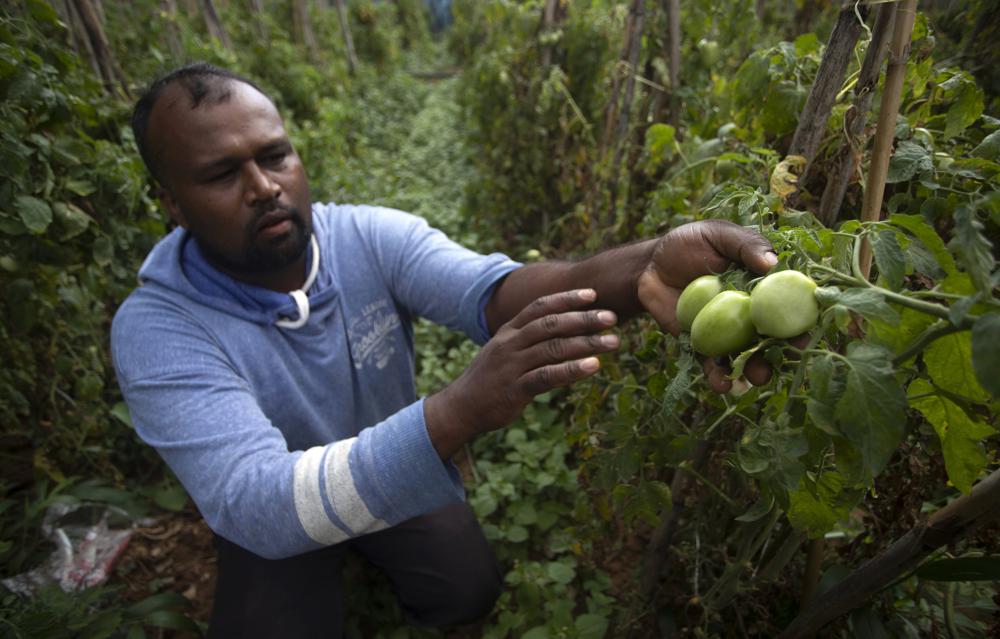
COLOMBO, Sri Lanka (AP) — Sri Lanka’s government has withdrawn a ban on imports of agrochemicals that it said was aimed at encouraging organic cultivation.
Agriculture Minister Mahindananda Aluthgamage announced on Wednesday the revocation of the ban, which took effect in April. But he said government subsidies, price guarantees for produce and technical support will only be provided to those who use organic fertilizer.
The ban, which many analysts said was more an effort to preserve Sri Lanka’s scarce foreign reserves, drew months of protests, with farmers saying they were in danger of crop failures and poverty.
Tea growers complained that the famous Ceylon Tea brand was at risk if yields fell, creating more opportunities for competitors.
Agriculturists said that while organic farming was a welcome approach, the shift away from chemicals should be gradual to avoid food shortages.
Sri Lanka’s foreign reserves dwindled to just two months’ worth of imports in August and its rupee currency depreciated 7.4% against the dollar in the first eight months of the year, according to the World Bank.
NEW DELHI — Sri Lanka will tap a Chinese company for a port project in Colombo, its largest city, that had been awarded to Japan and India before the partnership was scrapped this year.
President Gotabaya Rajapaksa’s cabinet on Tuesday agreed to have state-run China Harbour Engineering develop the Eastern Container Terminal while stipulating that local authorities would handle all operations. It cited recommendations by a cabinet-appointed committee as the basis for the decision.
The apparent pro-China tilt of Rajapaksa’s government is seen as a factor in the change of plans. Beijing has invested heavily in projects on the strategically positioned island under its Belt and Road infrastructure initiative.
Sri Lanka had signed a memorandum of understanding with Japan and India in May 2019, under previous President Maithripala Sirisena, to jointly develop the Colombo terminal. The operating company would be 51% owned by the Sri Lankan government, with the rest held by Japan and India.
Rajapaksa, who took office in November of that year, indicated at first that the project would stay on course.
That changed this past February, when the cabinet decided that the operating company would be wholly owned by Sri Lanka, pushing Japan and India out of the project. The Japanese government called the unilateral move “regrettable.”
China has continued to provide financing for Sri Lankan infrastructure, taking control of projects such as roads and port facilities in the process. Concerns have been raised that this support is pushing the country into a debt trap.
Rajapaksa has said he wants to be “neutral” in Sri Lanka’s relations with India and China. The government recently reached an agreement with India’s Adani Group conglomerate to develop Colombo’s West Container Terminal.
The All Ceylon Farmers’ Federation stated that despite the decision to allow the private sector to import chemical fertilizers and pesticides from today(24), farmers will have to be compensated for the damage caused to their crops over the past few months.
Meanwhile, Agriculture Minister Mahindananda Aluthgamage stated in a statement that the government’s decision on a green Sri Lanka will not be reversed.
The importation of chemical fertilizers, pesticides and herbicides was banned following a Cabinet Memorandum dated April 27.
At the same time, protests were staged across the country and farmers withdrew from cultivation during the Maha season.
Permission will be granted to the private sector to import agrochemicals such as chemical fertilizers and weedicides with effect from today (November 24), says Minister of Agriculture Mahindananda Aluthgamage.
He made this remark addressing the special media briefing held this morning to announce Cabinet decisions.
However, the government’s policy to promote green agriculture in the country will not be rolled back, the minister stressed.
He added that a gazette notification green-lighting the import of chemical fertilizer by the private sector is expected to be issued within the day.
The President tabled a Cabinet paper on April 26 for promoting green agriculture and a gazette notification was issued subsequently issued to ban the import of fungicides and weedicides completely,” the minister went on, noting that almost seven months have passed since reaching the decision.
Yesterday, as a government receptive to the people, we decided to revoke the gazette notification dated April 26. Accordingly, permission will be given to import chemical fertilizers, and pesticides effective from today. However, no changes will be made to the government’s policy. The private sector is given the nod to import and sell chemical fertilizers.”
The government has decided to roll out a booster dose of COVID-19 vaccine to people above the age of 20 years, Minister of Health Keheliya Rambukwella said today.
Relevant details of the vaccination program are expected to be announced in due course.
Meanwhile, administration of the COVID third dose for fully vaccinated immunocompromised and highly vulnerable comorbid individuals aged 20 years and above began on November 20.
The daily count of COVID-19 cases confirmed in Sri Lanka moved to 745 today (November 24) as 227 more people were tested positive for the virus, the Epidemiology Unit said.
This brings the total number of confirmed cases of coronavirus reported in the country to 559,605.
As many as 527,929 recoveries and 14,205 deaths have been confirmed in Sri Lanka since the COVID-19 outbreak.
More than 17,400 active cases in total are currently under medical care, official figures showed.
The Director General of Health Services has confirmed another 23 coronavirus related deaths for November 2, increasing the death toll in the country due to the virus to 14,205.
According to the figures released today, the deaths include 11 males and 12 females while one of the victims is below the age of 30 years.
Four patients are between the ages 30-59 years while the remaining 18 are in the age group of 60 years and above.
The Tamil politicians had planned to achieve a
separate Tamil state in Ceylon, long before Independence or Sinhala Only. The
words Tamil Eelam” was used for the first time in 1923, by Ponnambalam Arunachalam
when he spoke before the Tamil League. In
this speech he spoke of the ‘desire to preserve our individuality as a people.’
In 1931, HAP Sandrasagara said,”I will make Jaffna an Ulster and I
will be its Lord Carson. In 1935 C.S. Rajaratnam,
an Indian Tamil proctor resident in Kandy presented a memorandum to the British
administration asking for three self governing federal states. North and east for
the Tamils, the rest divided into two states for Kandyan Sinhalese and the Low
Country Sinhalese. This vision
of a separate Tamil state was maintained steadily thereafter. A select timeline
is given in Appendix 1.
Illankai Tamkil
Arasu Kadchi, ITAK said, [probably
in 1948] The Tamil-speaking
people in Ceylon constitute a nation distinct from that of the Sinhalese by
every fundamental test of nationhood, firstly that of a separate historical
past in the island at least as ancient and as glorious as that of the
Sinhalese, secondly by the fact of their being a linguistic entity entirely
different from that of the Sinhalese, with an unsurpassed classical heritage
and a modern development of language which makes Tamil fully adequate for all
present-day needs and finally by reason of their territorial habitation of
definite areas.
Tamil United Liberaton Front (TULF) declared the Vaddukoddai resolution in
1976.The first National Convention of the Tamil United Liberation Front meeting
at Pannakam (Vaddukoddai Constituency) on the 14th day of May, 1976, hereby
declares that the Tamils of Ceylon by virtue of their great language, their
religions, their separate culture and heritage, their history of independent
existence as a separate state over a distinct territory for several centuries
till they were conquered by the armed might of the European invaders and above
all by their will to exist as a separate entity ruling themselves in their own
territory, are a nation distinct and apart from Sinhalese and this Convention
announces to the world that the Republican Constitution of 1972 has made the
Tamils a slave nation ruled by the new colonial masters, the Sinhalese ,who are
using the power they have wrongly usurped to deprive the Tamil Nation of its
territory, language citizenship, economic life, opportunities of employment and
education, thereby destroying all the attributes of nationhood of the Tamil
people.
This Resolution
also wanted ‘restoration and recognition of the free sovereign secular
socialist state of Tamil Eelam based on the right of self determination
inherent to every nation. (See Appendix 2)
in 1977 TULF
stated that in the next general election
it seeks a mandate to establish an independent secular socialist state of Tamil
Eelam that includes all the geographically continuous areas that have been
the traditional homeland of the Tamil
speaking peoples of the country.’
At the first
Peace talks at Thimpu, (1985) the LTTE stated its conditions. Any meaningful solution to the Tamil national
question must be based on the following four cardinal principles:
Recognition of the Tamils of Sri Lanka as a
nation.
Recognition of the existence of an identified
homeland of the Tamils in Sri Lanka.
Recognition of the right of
self-determination of the Tamil nation
Recognition of the right to citizenship as a fundamental right of all
Tamils who look upon the island as their country.
The first three conditions have been received
joyfully by the opponents of Eelam. They
are bashed around, with great enthusiasm. The Sinhalese are not attempting to
squash any of this, commented Chandraprema. They intend to let this issue drag
on to its natural end. The Sinhalese like to fight to the finish.
The Tamil separatist movement has never deviated from its demands. TNA manifesto for the 2010 General election demanded
the right of self determination, power sharing on federal model and a re-merger
of north and east. TNA also wanted direct foreign investment to the north and
east.
TNA manifesto
for NPC election of 2013 said that the Tamils were a distinct people and from
time immemorial have inhabited this island together with the Sinhalese, the
North and East are the historical habitation of the Tamils. They are entitled as a people to self
determination.
The
TNA manifesto for the 2015 General election
was more elaborate. The manifesto said the Tamils are a distinct people
with their own culture, civilization, language and heritage. From time
immemorial Tamils have inhabited this island together with the Sinhalese
people. The continuous Tamil speaking Northern and Eastern province is the
historical habitation of the Tamil people and the Tamil speaking peoples.
The 2015 Manifesto spoke of the need to exercise our right to
determine our destiny, to ensure self government in the Tamil speaking north
east of the country within a unified and undivided Sri Lanka. Sovereignty lies with the people and not
with the State, the manifesto said. The
Tamil people are entitled to self determination.
C.V.Wigneswaran
gave a speech in Jaffna, in 2016 before representatives from the Swiss Institute
of Federalism, Fribourg, for which he
used the TNA Manifesto. His speech went on the Internet. There were over 100
comments within two days, most of them insulting.
R. Sampanthan, Leader of TNA gave a talk at
the 14th annual ITAK convention, 2012.
He said ITAK was created by Chelvanayagam for ensuring self
determination of Tamils. We must have unrestricted authority to govern our own
land, protect our own people and develop our own economy, culture and tradition
The
Tamils people have a distinct culture. The position that the north and
east are the areas of historical
habitation of the Tamil speaking peoples cannot be compromised. Sri Lanka was
united for the first time by the British. Up to 500 years ago, the Tamil people
had their own government in Sri Lanka, said Sampanthan.
The 30 years after independence were filled
with betrayal and humiliation. Agreements were never kept. Tamils could not
live as equals and their peaceful struggle was met with violence. The Tamil
Separatist Movement therefore took the historical decision in 1976 to ask for a
separate government for Tamil Eelam. ‘It
was the violence against the Tamils that drove them to take up violence themselves,
continued Sampanthan.’
Achieving Eelam by ourselves was becoming
increasingly unrealistic so we turned to India [and got] the 13th
Amendment. The rise and fall of LTTE has shown us that regardless of how strong
such movements may be, or how just its demands, it is not realistic for the
Tamils to resort to violent political struggle. Also a struggle that is built
on military might not last.
The struggle for political rights has now entered
an entirely new chapter, continued Sampanthan. Although the issue at hand is
the same, the prevailing conditions are different. In the new environment we
have found new ways of continuing with our struggle together with the support and assistance of
the international community, said Sampanthan.
An environment which may fulfill our duties is
slowly coming into existence. The world has recognized that the Tamils people
have faced continuous political persecution and that this persecution has begun
to manifest itself in new ways in recent times. The international community had
now started to exert pressure on the government. The intervention of the international
community and the pressure being exerted upon the Sri Lanka will oblige the
government to act. We must be patient, continued Sampanthan.We must work in cooperation
with the international community. We must follow their advice and also advice
them. We must prove to the international community that ‘that we will never be
able to realize our rights within a united Sri Lanka’.
We must
be patient until the international community realizes that the Sri Lanka government
will never give political power to the Tamils in a united Sri Lanka .We must be
patient till then. (Sampanthan repeats this exhortation to be patient about six
times.)
We are not defeated. We must act with wisdom and caution. The
softening of our stance in certain matters
are diplomatic strategies to ensure that we do not alienate the
international community. We have not abandoned our fundamental objectives. The
struggle is the same but the approaches we employ are different, the alliances
are different. US and India are now with
us, said Sampanthan.
Sampanthan is preaching high treason. To
counter this, Sampanthan also addressed his ‘dear Sinhala friends’. He told
them, our political aspirations to acquire the rights due to us and the right
to govern our civil, political
economic, social and cultural affairs ourselves is a reasonable demand. It is a
just aspiration with its roots in history. It is also a fundamental right of
our people. We do not seek to divide the
country. Just as you live in your homeland we also want to live in our
homeland.
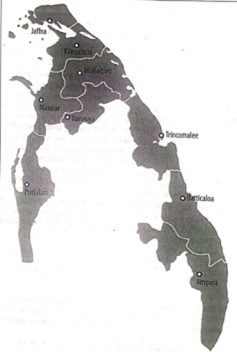
This Tamil homeland is called Eelam.
The Eelam map starts north of Chilaw, goes up to Jaffna, then down the east
coast and ends at Panama. Eelam includes 1/3 of the land mass and 2/3 of Sri
Lanka‘s coastline. This means that a vast proportion of our valuable natural
resource will be held by a mere 10% of the population.
Eelam
takes in the oil producing seas near Mannar. Two successful hydrocarbon
deposits have already been found in the Mannar basin. On the east coast Eelam
gathers in the valuable Pulmoddai mineral sands, and Trincomalee harbor. The
east coast faces the Bay of Bengal along its full length. It is beautifully
positioned.
Eelam will
also get the sea around Eelam. Under UN Law of the Sea, Sri Lanka is entitled
to claim an extended area of seabed, which will amount to about 20 times Sri
Lanka‘s land area. A good chunk of this
will go to Eelam. Eelam will be getting, in the high seas, the
territorial waters, the contiguous zone, and the extended exclusive
economic zone, with its enormous untapped economic resources. (Continued)
APPENDIX 1
(1923) The word Tamil Eelam was used for the first
time in 1923, by Ponnambalam Arunachalam when he spoke before the Tamil League. In this speech he spoke of the ‘desire to
preserve our individuality as a people.’
(1931) In 1931, HAP
Sandrasagara said I will make Jaffna an
Ulster and I will be its Lord Carson.
(1935) C.S. Rajaratnam, an Indian
Tamil proctor resident in Kandy formed
the Federated Communities Progressive
Association in 1934.In 1935 Rajaratnam
presented a memorandum to the British
governor asking for three self governing federal states. North and east
for Tamil, with two other states for Kandyan Sinhalese and the Low Country Sinhalese.
(1935) In 1935, ‘ the
Tamil politicians forwarded to Britain a federal structure consisting of
3 federal states, north south Kandyan
which even the Jaffna newspapers had dismissed as impractical. (Jane Russell
“Communal politics under the Donoughmore Constitution” p 192)
(1948).
in 1948 Chelvanayagam started the Illankai Tamil Arasu Kadchi,( ITAK) Illankai Tamil Arasu Kadchi means Sri
Lanka Tamil State Party”. It does not mean Federal Party. The inaugural and
first business meeting of the ITAK was held, in 1949, not in Jaffna but in Maradana at the GCSU Hall. Chelvanayagam made
his first
Presidential speech there. It was
published by ITAK and was known as the Maradana Resolution.
(1949)
HLD Mahindapala recalls that on Independence
day Feb 4, 1949 M Thiruchelvam, Neelan’s
father, then Deputy Solicitor General was seen
travelling in a car which flew the Nandi flag.
(1957) In 1957 Nadesan asked for regional autonomy. ( S Nadesan ‘Regional
autonomy’ reprinted in 1984)
(1959) In 1959 Chelvanayagam asked for
an autonomous Tamil state as a single geographical unit. (Wiswa Warnapala.
‘Ethnic strife and politics in Sri Lanka’ p 127).
(1959) In 1959
C. Suntharalingam founded the Eela
Thamil Ottrumai Munnani (Unity Front of Eelam Tamils) .
(1959) In 1959 there was a request for a ‘university for the Tamil speaking
people in the Tamil speaking areas in order to preserve their language and
culture’ This was refused (University Commission Report, 1959 p 149)
(1963) In
1963 Suntharalingam published Eylom: Beginning of the Freedom Struggle[1], where he said, I propose to invite
those Eyla (Eelath Thamils) Thamils who accept the policy that the time has
come for the partition of Ceylon and for the restoration of the Thamil state
that existed before the British took
over in 1802, to come forward and join the fight for the Freedom and
Independence of the Eyla Thamil Nation.(Wikipedia)
APPENDIX 2
VADDUKODDAI
RESOLUTION 1976.
The resolution unanimously adopted at the first national convention of the Tamil United Liberation Front held at Vaddukoddai on may 14, 1976. Chairman SJV Chelvanayakam
Whereas, throughout the centuries from the
dawn of history, the Sinhalese and Tamil nations have divided between
themselves the possession of Ceylon, the Sinhalese inhabiting the interior of
the country in its Southern and Western parts from the river Walawe to that of
Chilaw and the Tamils possessing the Northern and Eastern districts; And,
Whereas,
the Tamil Kingdom was overthrown in war and conquered by the Portuguese in 1619,
and from them by the Dutch and the British in turn, independent of the
Sinhalese Kingdoms; And,
Whereas,
the British Colonists, who ruled the territories of the Sinhalese and Tamil
Kingdoms separately, joined under compulsion the territories of the Sinhalese
and the Tamil Kingdoms for purposes of administrative convenience on the
recommendation of the Colebrooke Commission in 1833; And,
Whereas, the Tamil Leaders were in the forefront of the Freedom movement to rid Ceylon of colonial bondage which ultimately led to the grant of independence to Ceylon in 1948; And, Whereas, the foregoing facts of history were completely overlooked, and power over the entire country was transferred to the Sinhalese nation on the basis of a numerical majority
thereby reducing the Tamil nation to the
position of subject people; And,
Whereas,
successive Sinhalese governments since independence have always encouraged and
fostered the aggressive nationalism of the Sinhalese people and have used their
political power to the detriment of the Tamils by-
(a) Depriving one half of the Tamil people of
their citizenship and franchise rights thereby reducing Tamil representation in
Parliament,
(b) Making serious inroads into the
territories of the former Tamil Kingdom by a system of planned and state-aided
Sinhalese colonization and large scale regularization of recently encouraged
Sinhalese encroachments, calculated to make the Tamils a minority in their own
homeland,
(c) Making Sinhala the only official language
throughout Ceylon thereby placing the stamp of inferiority on the Tamils and
the Tamil Language,
(d) Giving the foremost place to Buddhism
under the Republican constitution thereby reducing the Hindus, Christians, and
Muslims to second class status in this Country,
(e) Denying to the Tamils equality of
opportunity in the spheres of employment, education, land alienation and
economic life in general and starving Tamil areas of large scale industries and
development schemes thereby seriously endangering their very existence in Ceylon,
(f) Systematically cutting them off from the
main-stream of Tamil cultures in South India while denying them opportunities
of developing their language and culture in Ceylon, thereby working inexorably
towards the cultural genocide of the Tamils,
(g) Permitting and unleashing communal
violence and intimidation against the Tamil speaking people as happened in
Amparai and Colombo in 1956; all over the country in 1958; army reign of terror
in the Northern and Eastern Provinces in 1961; police violence at the
International Tamil Research Conference in 1974 resulting in the death of nine
persons in Jaffna; police and communal violence against Tamil speaking Muslims
at Puttalam and various other parts of Ceylon in 1976 – all these calculated to
instill terror in the minds of the Tamil speaking people, thereby breaking
their spirit and the will to resist injustices heaped on them,
(h) By terrorizing, torturing, and imprisoning Tamil youths without trial for long periods on the flimsiest grounds,
(i) Capping it all by imposing on the Tamil
Nation a constitution drafted, under conditions of emergency without
opportunities for free discussion, by a Constituent Assembly elected on the
basis of the Soulbury Constitution distorted by the Citizenship laws resulting
in weightage in representation to the Sinhalese majority, thereby depriving the
Tamils of even the remnants of safeguards they had under the earlier
constitution, And,
Whereas,
all attempts by the various Tamil political parties to win their rights, by
co-operating with the governments, by parliamentary and extra-parliamentary
agitations, by entering into pacts and understandings with successive Prime
Ministers, in order to achieve the bare minimum of political rights consistent
with the self-respect of the Tamil people have proved to be futile; And,
Whereas,
the efforts of the All Ceylon Tamil Congress to ensure non-domination of the
minorities by the majority by the adoption of a scheme of balanced
representation in a Unitary Constitution have failed and even the meagre
safeguards provided in article 29 of the Soulbury Constitution against
discriminatory legislation have been removed by the Republican Constitution;
And,
Whereas,
the proposals submitted to the Constituent Assembly by the Ilankai Thamil Arasu
Kadchi for maintaining the unity of the country while preserving the integrity
of the Tamil people by the establishment of an autonomous Tamil State within
the framework of a Federal Republic of Ceylon were summarily and totally
rejected without even the courtesy of a consideration of its merits; And,
Whereas,
the amendments to the basic resolutions, intended to ensure the minimum of
safeguards to the Tamil people moved on the basis of the nine point demands
formulated at the conference of all Tamil Political parties at Valvettithurai
on 7th February 1971 and by individual parties and Tamil members of Parliament
including those now in the government party, were rejected in toto by the
government and Constituent Assembly; And,
Whereas, even amendments to the draft proposals relating to language, religion, and fundamental-rights including one calculated to ensure that at least the provisions of the Tamil Lanaguage (Special Provisions) Regulations of 1956 be included in the Constitution, were defeated, resulting in the boycott of the Constituent Assembly by a large majority of the Tamil members of Parliament; And,
Whereas,
the Tamil United Liberation Front, after rejecting the Republican Constitution
adopted on the 22nd of May, 1972, presented a six point demand to the Prime
Minister and the Government on 25th June, 1972, and gave three months time
within which the Government was called upon to take meaningful steps to amend
the Constitution so as to meet the aspirations of the Tamil Nation on the basis
of the six points, and informed the Government that if it failed to do so the
Tamil United Liberation Front would launch a non-violent direct action against
the Government in order to win the freedom and the rights of the Tamil Nation
on the basis of the right of self-determination; And,
Whereas,
this last attempt by the Tamil United Liberation Front to win Constitutional
recognition of the rights of the Tamil Nation without jeopardizing the unity of
the country was callously ignored by the Prime Minister and the Government;
And,
Whereas,
the opportunity provided by the Tamil United Liberation leader to vindicate the
Government’s contention that their constitution had the backing of the Tamil
people, by resigning from his membership of the National State Assembly and
creating a by-election was deliberately put off for over two years in utter
disregard of the democratic right of the Tamil voters of Kankesanthurai, and,
Whereas,
in the by-election held on the 6th February 1975, the voters of Kankesanthurai
by a preponderant majority not only rejected the Republican Constitution
imposed on them by the Sinhalese Government, but also gave a mandate to Mr.
S.J.V. Chelvanayakam, Q.C. and through him to the Tamil United Liberation Front
for the restoration and reconstitution of the Free Sovereign, Secular,
Socialist State of TAMIL EELAM.
And,
while taking note of the reservations in relation to its commitment to the
setting up of a separated state of TAMIL EELAM expressed by the Ceylon Workers
Congress as a Trade Union of the Plantation Workers, the majority of whom live
and work outside the Northern and Eastern areas,
This convention
resolves that restoration and reconstitution of the Free, Sovereign, Secular,
Socialist State of TAMIL EELAM, based on the right of self determination
inherent to every nation, has become inevitable in order to safeguard the very
existence of the Tamil Nation in this Country.
This Convention further declares – that the State of TAMIL EELAM shall consist of the people of the Northern and Eastern provinces and shall also ensure full and equal rights of citizenship of the
State of TAMIL EELAM to all Tamil speaking people living in any part of Ceylon and to Tamils of EELAM origin living in any part of the world who may opt for citizenship of TAMIL EELAM.
that the constitution of TAMIL EELAM shall be based on the principle of democratic decentralization so as to ensure the non-domination of any religious or territorial community of TAMIL EELAM by any other section.
that in the state of Tamil Eelam caste shall be abolished and the observance of the pernicious practice of untouchability or inequality of any type based on birth shall be totally eradicated and its observance in any form punished by law.
that TAMIL EELAM shall be a secular state giving equal protection and assistance to all religions to which the people of the state may belong.
that Tamil shall be the language of the State, but the rights of Sinhalese speaking minorities in Tamil Eelam to education and transaction of business in their language shall be protected on a reciprocal basis with the Tamil speaking minorities in the Sinhala State.
that Tamil Eelam shall be a Socialist State wherein the exploitation of man by man shall be forbidden, the dignity of labor shall be recognized, the means of production and distribution shall be subject to public ownership and control while permitting private enterprise in these branches within limit prescribed by law, economic development shall be on the basis of socialist planning and there shall be a ceiling on the total wealth that any individual of family may acquire.
This
Convention directs the Action Committee of the TAMIL UNITED LIBERATION FRONT to
formulate a plan of action and launch without undue delay the struggle for
winning the sovereignty and freedom of the Tamil Nation;
And this Convention
calls upon the Tamil Nation in general and the Tamil youth in particular to
come forward to throw themselves fully into the sacred fight for freedom and to
flinch not till the goal of a sovereign state of TAMIL EELAM is reached. (END)
To be, or not to be: that is the question: Whether ‘tis nobler in the mind to suffer The slings and arrows of outrageous fortune, Or to take arms against a sea of troubles, And by opposing end them? Hamlet in Shakespeare’s Hamlet
The initial two year period of Gotabaya Rajapaksa’s
presidential term has been largely wasted through no fault of his. The general
public know this truth. At the beginning, the MPs of the overwhelmingly
rejected yahapalanaya, instead of assisting the then minority SLPP government
formed after his election in November 2019, threw a spanner in the works by
refusing to pass the ad hoc appropriation bill for securing the funds needed
for conducting normal civil administration until a new parliament was elected.
I for one don’t think that the voting public have forgotten how the failed
yahapalanites spurned the clearly expressed public will on that occasion and
tried to scuttle the progress of the fledgeling government in order to get the
parliamentary elections indefinitely postponed so that their own electoral
prospects would brighten as the government’s would proportionately darken due
to its inability to function freely. When the unexpected global corona pandemic
hit Sri Lanka soon after his inauguration, president Gotabaya was able to
contain it with the assistance of the dedicated health and security personnel.
But now, the government is floundering in a sea of troubles, principally due to
decisions made for him by advisors who are after goals contrary to his Vision
of Prosperity.
President Gotabaya Rajapaksa was reported as
having said the following at a ceremony to mark the Sri Lanka National Science
Day and Science Week in parallel with the World Science Day held at Temple
Trees on November 10, 2021. To me, it appeared that, while making these
remarks, he was not addressing them to the people sitting in front of him on
that occasion; but rather, he was soliloquizing in the imagined hearing of the
people who elected him as president:
It
was because of the failure of five years of (Yahapalanaya) that I was elected
to this post. But they (the Opposition) speak as if nothing happened during the
past two years under my rule.
To change this
system, people ought not to bring back into power the old group if they fail to
deliver what you expect of them, be it me, ministers of my government, or MPs.
Look for new ones. I don’t know how to do that, though. If we do something
good, it is necessary for everyone to cooperate for the sake of the country.
That is the duty of the Opposition. We don’t have enough funds to invest in
development. We need to bring in foreign investment. A country like ours cannot
do without foreign direct investment. We don’t have enough resources. We cannot
achieve any progress unless we do these investments.
We
had to adjust to a new normal as a result of the Covid pandemic. It’s shameful
that when a new normal is announced, they go on demonstrations or hold
meetings. Is this what is needed under a new normal? This will lead to a new
outbreak of the pandemic. Then we’ll have to close the schools again, and the
country, too. Even the Opposition should think about these things.”
(The
above is my free translation of the president’s words.)
I
see this as an obviously unintended dramatic soliloquy in which the president
reiterates by implication his sincere commitment to the pledges he has given to
the public. What he almost literally says is that he won’t try to get
elected to power again, if rejected in case he fails to deliver the promised
results like the previous unsuccessful yahapalana government. Detractors read
the president’s words as a confession of guilt for having (allegedly) misled
the public by offering false promises or as an admission of failure. In my
opinion, both interpretations are baseless, considering the constitutional
roadblocks placed on the path to recovery by the yahapalana dominated
parliament just before its dissolution by the newly elected president, and the
severity of the economic issues resulting from the global corona pandemic.
Whatever is happening now, the country owes the brightening prospects of the
arrival of a younger, less self centered generation of rulers to the
achievements as well as the defects of the shared leadership of the two
brothers Gotabaya and Mahinda Rajapaksa. The ouster of the latter in 2015 in
spite of his successful performance during his two terms was facilitated by his
own lapses as a politician and a person which, being so well known by now, need
no elaboration. Those deficiencies are even more brazenly in evidence than ever
before.
President
Gotabaya’s problem is not a straightforward existential dilemma of ‘to be, or
not to be’ that racked young prince Hamlet’s brain. It is definitely less life
threatening or less fateful than the latter’s uncertainty. Gotabaya’s concern,
instead, seems to be more mundane: it is about whether to maintain the illusion
of the macho image of himself that the success of his performance as defense
secretary during his brother Mahinda’s presidency (2005-15) persuaded his
admirers to conjure up in their minds; or whether to betray his feet of clay by
reversing the earlier, apparently ironclad, policy decisions that he committed
himself to under different circumstances. Relaxing, where necessary, his
personally preferred military rigidness, in my opinion, is the need of the
hour. Real or perceived lack of flexibility in the current situation (barring
instances where leniency is not possible such as drug busting operations) is
likely to wrack the boat that circumstances have made it his lot to
skipper.
On
an earlier occasion (opening of the new Kelani Bridge, November 6, 2021),
president Goyabaya expressed his determination to fulfill the pledges stated in
the Vistas of Prosperity and Splendour manifesto. He described in some detail
what the government had achieved amidst numerous odds stacked against it
especially due to the unprecedented and unrecognized corona pandemic that dealt
a severe blow on the country’s economy. These achievements were deliberately
ignored by the opposition, whose policies when in power led to a critical
downturn in the economy. He stressed that he worked according to a plan, from
which would not deviate, come what may. He also said he was capable of forcing
the cultivators to use organic fertilizer as through military coercion, though
that is something he would never apply; he would never violate the country’s
democracy for any reason.
Actually,
there never could be any resistance to the ban on chemical fertilizer on the
part of the poor farmers who are vulnerable to kidney disease due to drinking
water contamination caused by chemicals, provided that an effective organic
substitute is made available. (Incidentally, why not establish potable water
production plants at state expense in the most severely affected areas for
providing safe drinking water for the mostly impoverished rice cultivators at a
nominal charge or completely free?) However, this is not the time to introduce
a total ban, in view of the looming food scarcity predicted by experts. A drop
in crop productivity during the switchover is inevitable. It will affect not
only rice production, but vegetables, tea, coconut etc. I for one feel that, at
least a large enough proportion of fertilizer provided should be of the
accustomed chemical origin. Or the chemical fertilizer use could be subjected
to a scientifically calculated phasing out period of gradual elimination involving
the application of more and more organic with less and less chemical
fertilizer, particularly for food crops. Priority must be given to production
of food for domestic consumption, though producing organically grown food for
export could be more profitable in terms of foreign exchange earnings. In any
case, the organic food production industry must be rescued from the reigning
rice and fertilizer mafiosi. People will not blame the president if he turned
his hawk’s eye on them and the emerging criminals who trade in soil and rubble
mixed with chemicals, pretending it to be organic fertilizer, and hang one or
two as a warning to others who may be thinking of following their
example.
Tamil Separatist Movement says it is entitled
to ask for a separate state because the Ceylon Tamils are a separate nation”. The concept “nation’
is not a legally recognized concept, nor is it recognized in international law.
International law only recognizes the sovereign state. International law does not recognize imaginary
nations either.
The word ‘nation ‘came from the Latin’ natio’ meaning a human group of same
origin. The
word came into political use in Europe in the 19th century. Analysts
observed that European scholars used
the word ‘nation’ anyway they wished, in the 19th century and they are
doing the same in the 20th century.
Here is an assortment of definitions, which will indicate the contradictory
positions taken, regarding the word ‘nation’. .Karl Deutsch defined a ‘nation’
as “a people in possession of a state”. Peter Alter suggests that a nation is a politically
mobilized people”. Walker Connor suggests that ‘nation’ is a ” self-defined
group~. Pilsudski said that it is the state which makes the nation, not the
other way round.
Joseph Stalin, (1912) said that ‘A nation is a historically evolved,
stable, community of language, territory, economic life, and psychological makeup
manifested in a community of culture’.
To crown it all, Benedict Anderson (1983) said nation is an “imagined community’. This
means that the United Nations is a Union of Imagined Nations.
The nation states of Europe came into existence only about 200 years ago. Up
to the 19 century, Europe was governed by two large empires which covered the whole
of the European continent. The largest of these were the Holy Roman Empire,
which formally ended in 1803, the Ottoman Empire which lasted till World War 1.
(1914-1918)
Within the Holy Roman Empire there were
several ruling dynasties such as the Hapsburgs, who divided into the Spanish
Hapsburgs and the Austrian Hapsburgs. Europe at this time consisted of a mass
of small principalities, dukedoms,
bishoprics, fiefs, each with a separate administration. Germany alone consisted
of about 360 independent states. The various states went with various royal
houses, like private property. They were
exchanged among the various ruling houses, through royal marriage alliances.
Some nations formed slowly. France was the earliest but slowest to turn
into sovereign state. It took nearly 4 centuries. From the 10 century France
had a continuous hereditary monarchy and a political centre in Paris. From
here, over time, the kings annexed adjacent territory, such as Burgundy,
Brittany, Normandy, and Toulouse, to form today’s Republic of France.
England had little difficulty in declaring itself a nation, in the 16 century
because it was an island. Similarly Spain and Netherlands both jutted out to
sea and had one border each with mainland Europe. Once that border was settled,
they were on their way to becoming sovereign states. Italy and Germany unified
through wars of unification starting in 1848. German unification was completed
in 1871.Italy settled the matter during World War I.
Political unification did not automatically create a ‘nation state’. In
Italy, Massimo d’Azeglio’s,
Prime Minister of Sardinia, said “We have made Italy, now we have to make
Italians”. Bismarck, Chancellor of the newly united
Germany, had to create a unified German state from the bunch of independent
princely states that were brought under the King of Prussia.
Hobsbaum pointed out that the real push towards nation states was not
cultural, it was economic. There was a significant expansion of trade and
commerce in Europe during this time. There was an increase in the number of cities, also trading and business houses
and the middle class expanded. Roads and bridges led to better
communication. In Germany, an important
milestone in its unification was the creation of the Zollverein, a customs union
which included all the German states. Customs barriers between the states were
eliminated and a common tariff created, leading to a sort of commercial union.
Europe in the 18 century was also notable for significant advances in political
philosophy. It was the age of Voltaire, Montesquieu, Rousseau and Adam Smith.
These thinkers commented, inter alia, on economy and government. Their writings
which actually reflected the utter backwardness of Europe were thereafter treated as universal
pronouncements of staggering importance and studied all over the world.
The French Revolution of 1789 and the administration reforms of Napoleon
also influenced political thinking. The idea of nation state and constitutional
government became popular. In 1848 there was a wave of activity all over
Europe, with demands for state constitutions.
Countries which were under western rule used the European concept of nation
to formulate a reason for demanding independence
from the imperial powers. Ceylon
did not need to declare it a nation to obtain independence. It had been a well recognized monarchical
state before, but the Tamil Separatist Movement took the opportunity to declare
that it was a separate nation.
The Communist Party of Ceylon supported the Tamils. In 1944 Communist Party presented a
memorandum on a federal constitution to the Ceylon National Congress. They said
that the Tamils were historically evolved nation, living in a contiguous
territory in their traditional homeland, speaking a common language, with a community
of culture. They were entitled to self determination. The definition is
straight out of Stalin’s definition in his Marxism and the national question”
observed analysts. The memorandum had
been drafted by Pieter Keuneman and A Vaidilingam. (continued)
Myanmar is one of Bangladesh’s closest
neighbors with historic connectivity going back centuries. The 271 km long
Bangladesh-Myanmar border is very important for Bangladesh due to its strategic
position, although at present the area is militarized due to its ongoing
internal conflicts. Were this to be resolved, Bangladesh could develop routes
via Myanmar to access China to the east, and other southeast Asian countries to
the south.
On the other hands, Vietnam is very closed to
Bangladesh and Myanmar geographically. Thailand is a neighboring state of
Myanmar. Vietnam can be able to access in South Asia through Bangladesh,
Myanmar and Thailand. There is a huge potential of Vietnamese products in the
region. If Vietnam connects itself with Bangladesh-Myanmar-Thailand-India
connectivity project and Bangladesh-China-India-Myanmar connectivity corridor, Vietnam
would benefit. A huge potential is waiting for Vietnam. If the two projects can
be implemented truly, Vietnam will be gainer in this regard. Bangladesh-Myanmar
improved ties is very needed in this regard. Vietnam is a very friendly country
to both Myanmar and Bangladesh
Vietnam can also use Bangladesh, Myanmar,
Cambodia and Thailand as a transportation route to reach markets such as Nepal,
Bhutan, and India, Pakistan, Afghanistan. Both Bangladesh and Myanmar are
members of the Bay of Bengal Initiative for Multi-Sectoral Technical and
Economic Cooperation (BIMSTEC), an organization consisting of Bangladesh,
Bhutan, India, Myanmar, Nepal, Sri Lanka, and Thailand that seeks to foster
regional and economic cooperation. Vietnam can and should join BIMSTEC to
utilize the benefits. Being a hub between South East Asian and South Asian country,
Vietnam can use the routes to enter in the Bay of Bengal and Indian ocean
easily through Myanmar and Bangladesh. Then it would be able to bolster its
trade ties with South Asia, Central Asia and Middle East Asia.
Bangladesh is a Southeast Asian country and
can be used as an important hub to connect ASEAN and the South Asian
Association for Regional Cooperation (SAARC). members of Afghanistan, Bangladesh, Bhutan,
India, Maldives, Nepal, Pakistan, and Sri Lanka is difficult. Myanmar too, as
an ASEAN member, can access the SAARC free-trade bloc through Bangladesh. Such
a way, Thailand would benefit economically to boost up their trade ties.
Vietnam will be able to ensure its maximum business interest. Vietnam can
access into the market of India, Nepal, Bhutan, Pakistan, Sri Lanka,
Afghanistan and Central Asia easily through Bangladesh, Myanmar and Thailand.
Myanmar and Bangladesh have also resolved a
dispute over their maritime borders through the International Court of Justice.
As a result, the rights of Bangladesh have been established in an area of
1,11,000 square kilometers. Myanmar’s waters have also been properly
identified. Bangladesh-Myanmar-Thailand-Vietnam has potential to invest in
maritime business in the Bay of Bengal. These countries should utilize and
extract the maritime resource from the maritime zone. Blue economy can bring
benefit for Bangladesh-Myanmar-Vietnam also.
The
proposed construction of the Asian Highway, funded by the Asian Development
Bank can increase land connectivity between the two countries and increase
trade in products such as fertilizers, plastics, cement, and furniture,
etc. Vietnam should and can join the project to ensure its maximum
business interest. Vietnamese entrepreneurs can utilize
to ensure their business interest by investing in Bangladesh’s agriculture,
food processing, shipbuilding, electronics, leather, jute, light engineering
and handicraft industries.
Myanmar and Vietnam which at present does
have sophisticated manufacturing, can import electronics and pharmaceutical
products that are readily produced from Bangladesh and benefit from the
technology transfer. Bangladesh-Myanmar-Vietnam has potential of rice and fishery
production. Trilateral effort is very needed here. Bangladeshi medicines,
agricultural products garments, footwear and leather goods, knitwear,
pharmaceuticals, tableware, home textiles, textiles, seafood and marine
products, tea, potatoes, jute and jute products, light engineering products,
spices, cosmetics and ceramics, Toilets, etc. can be exported easily to Vietnam
through Myanmar and Thailand.
According to Bangladeshi media outlets, Vietnam exported clothes, shoes, electronics, seafood, oil, rice
and coffee to Bangladesh. the other hand, Bangladesh has exported Oven Garments
and Knitwear, Plastic, Jute and Jute Good, Leather to Vietnam. Trade between
the two countries can be further enhanced by enhancing mutual cooperation,
sending trade delegations and conducting joint research activities to explore
new business opportunities.
But
one of the major problems is the lack of adequate transport links for the
expansion of bilateral trade between the two countries. Both countries are
working to resolve this transportation issue and are in the process of joining
the Asian Highway Network, which is expected to address this issue. Bangladesh
and Vietnam are longstanding friends and connected by the Bay of Bengal and
maritime routes, Bangladesh-Myanmar-Thailand-Vietnam should intensify
cooperation in trade, investment and regional connectivity.
According
to Bangladeshi media outlets. Bangladesh-Myanmar-Vietnam trilateral relations
matters for ensuring great regional interest. Huge growth is possible in trilateral
trade amongst the three nations.
Bangladesh will able to create a dedicated economic zone for Vietnamese
investors, and pledge to extend all-out support. Bangladesh, Myanmar and Vietnam
can Boost cooperation under the BIMSTEC framework.
China is now the biggest investor in Myanmar.
China has invested over US$3 billion since the 2016-2017 fiscal year. One of
the most strategic components of these investments is the US$1.3 billion
Kyaukphyu deep seaport, which when completed, can provide China’s Yunnan
province a shortcut to the Indian Ocean. Thailand can extract some
benefits from the investments for its own gain.
The country’s biggest economic advantage for
Myanmar is that they are a member of ASEAN. ASEAN controls about 24 percent of
total world trade and its share in world trade is growing yearly. ASEAN’s trade
relations with China, Japan, and South Korea are deepening due to the increase
in trade and the upcoming RCEP agreement. ASEAN countries account for more than
50 percent of total trade between themselves and these three countries.
Bangladesh
is keen to provide assistance to Myanmar. Covid-19 vaccine distribution and
counter-terrorism training are some areas for cooperation. The Rohingya refugee
problem has, however, created some tension between the two countries, and find
the solution can serve the longer-term interests of Bangladesh and Myanmar even
Vietnam also. Myanmar and Bangladesh should solve
this problem to serve its own and reginal interest. Myanmar should understand
that it is the issue of the region. Whole South Asia and South East Asia may be
volatile and unstable for this problem.
Vietnam
can play a very significant role in this regard. Vietnam can mediate to bolster
the strained relations between Bangladesh-Myanmar. Vietnam can play to
repatriate the Rohingyas in Rakhine in Myanmar. Vietnam can easily resolve the
problem because it has a very good relations with Myanmar. However, Vietnam can support for
Bangladesh’s bid for membership in Mekong-Ganga Cooperation Forum and the ASEAN
Sectoral Partnership. Bangladesh and Vietnam can closely cooperate in different
regional forums including BISMTEC, ARF, ASEM, and AMED and multilateral forums
including UN, WTO and ITU.
However,
the three countries can also increase production in the agricultural sector
through joint ventures. Apart from adopting joint investment projects,
Bangladesh can increase imports of various agricultural products including
pulses, spices, fish and rice. Thus, enhancing trilateral relations could
contribute to the growth of trade and investment relations with ASEAN and
BIMSTEC countries. This will create an opportunity to solve the Rohingya
problem and stop militant activities. Therefore, Myanmar should take effective
steps to strengthen bilateral relations to connect the South East Asia with
South Asia. Vietnam should and can play an effective role to motivate Myanmar
to bolster ties with Bangladesh. Benefit is waiting not only for Myanmar but
also for Vietnam.
While welcoming that policy decision of
the Government who can say that this is not another election gundu to deceive
the people aimed at the proposed Provincial Council Elections? If the
Government was really honest and concerned about public good it should have
abolished this joke as Canada had done it in 1995, without continuing an
unwanted bonanza to trap politicians cunningly used as bait by party leaders, that
blead the nation.
The Mike Harris government eliminated
MPPs’ pension plans following the 1995 provincial election. Even it is allowed
in exceptional cases like in Canada a pension to a politician should be paid
only after 65 years when they are disabled to earn a living.
Why pay pensions to politicians at
all who volunteer and swear to serve the people at elections and rob and
destroy the entire nation
The Government in its Budget speech
has proposed that MPP will be eligible for a pension only after completing 10
years continuous service”
My question is why pay a pension at
all to any politician in this country Because paying a pension to any
politician is contrary to all basic principles related to the principle of
paying pensions accepted all over the world. Because the origin of the idea of
paying a pension has begun in the world first for people over 70 years in old
age for the continuous service, they have rendered to the nation who are
disabled to make their living, as a mark of gratitude for the devoted service
they have rendered to the nation or the company for life.
The man behind the initiative called
The Old Age and Disability Bill” was Otto von Bismarck. of the German Empire. Germany was thus the
first European country to establish a fully-fledged pensions system for workers
aged 70 or more. The limit was lowered to 65 in 1916.June.
In 1875, The American Express Co.
created the first private pension plan in the U.S. for the elderly and workers
with disabilities. Early pension benefits were designed to pay out a relatively
low percentage of the employee’s pay at retirement and were not designed to
replace the employee’s full final income.
In this country it was started by the
colonial Government to make a payment in their old age for the dedicated
service they had rendered to the Empire. Subsequently it was extended to
retired public servant who had completed 35 years of satisfactory service in
the public service. As such there was full justification for a man or a woman
who has devoted his or her service to the nation in her or his whole life while
debarring any other job while one is in engaged in public service as his or her
only income for living comes to an end the day he/she retires. But it should be
noted that to get that benefit they had also to contribute a certain percentage
monthly from their salary for which the Government contributed a certain
percentage. Therefore, in fact they are paid from a reserve fund maintained by
the Government out of funds they have contributed throughout their service.
What is more is they have to complete 35 years of service to get qualified to
get that pension. When someone retires prematurely the pension is freeze until
he reaches the age of 55. This clearly shows that there is a very sound
rationale for paying a pension to a retired public servant and it is fully
justified both rationally and ethically.
Now let us
examine the rationale of paying a pension to a politician in this country.
Paying pensions to politicians in this country was started in 1977 by the JR
Jayawardhana Government. Curiously it was the first legal enactment of the
so-called Democratic Socialist Government of JR. passed by Act No 1 of his government
as if it was the most burning public issue his government had to solve. Doesn’t
this show the degree of concern and commitment our politicians have towards the
welfare of the people who elevate them to high position by electing them with a
5/6th majority in 1977 hoping to get a better deal than from the
previous Government of Mrs Bandaranayaka. What is more hilarious and despicable
is this piece of legislation marked the turning point in Sri Lankan political
culture where the interests of the politicians overtook that of the subjects in
a country that inherited a rich legacy of public goo enshrined in the concept
of the Buddhist teaching Bahujana hitaaya Bahujana sukhaaya” (for the good of
the many and for their happiness at large) for 2500 years.
What is even more despicable is that it was awarded to
all politicians who complete 5 years service” irrespective of whether they
served the people or not. The funniest part of it was the payment of that
pension to his /her spouse after the death of the MP. Further his family will
get another pension if his or her son or daughter had been appointed as the
Private Secretary a tradition that had come to stay as a political privilege. Payment
of pensions under this scheme was made with retrospective effect and it was
payable even to politicians who served in the State Council if they were living
with arrears.
Only one man refused to accept this blood money in the
history of Parliament. He returned it to Speaker. The man mentioned here was my
good friend M.S. Themis the 3rd MP for Colombo Central in 1956.He
was the first person and perhaps the only man to return it. I know it for
certain as I was the one who prepared the covering letter to the Speaker.
This piece of legislation was also a complete
violation of the Pension minute which
nobody dared to challenge or even question up to date either in a court of law
or Parliament that is said to be the Supreme lawmaking body in the country.
Isn’t it interesting to note how our Law makers make laws and for whose benefit
they make them in this so-called supreme legislature of the country expected to
make laws for good governance for the good of the people and the good of the
country at large?
JR did not stop at that. He did
everything to enhance the fabulous benefit package to MPP with immediate effect.
He dramatically increased salaries, increase payments for attending Parliament,
official vehicles with duty free vehicle permits were also provided, which they
could sell in the open market and make a fabulous fortune. Official quarters in
Colombo were also given where as they had to be in Colombo only for 8 days a
month. Unlimited job permits for MPP to give employment for their party
supporters only, monopoly of tavern license, business permits and government
contracts, LRC land nationalized by Mrs B for a song and government Import
permits. The sky was the limit to such
privileges. Here I stop the list for brevity and lack of space. All this was
done to buy over the MPP to maintain the majority in Parliament to embellish
and consolidate his dictatorial position as the Executive President which
perhaps he thought is a lifetime job, but unfortunately not.
The same corrupt and highway robbery situation
still continues in incremental scale without being openly questioned or
challenged by anyone in the ‘People’s Parliament. So much so today the whole
system of governance in this country has become a veritable national liability.
JR also increased the number of MPP in
Parliament from 196 to 225 by introducing a thing called a National list to
provide a place in Parliament for their kith and kin and family friends as
backdoor MPP bypassing the elections and thus making Representative Parliament
a ”Non-representative thereby making representative democracy a big fast and a hilarious
joke. Instead of reducing it to 165 the previous number that would have save
billions for national development and reduced IMF and other foreign loans
thereby reducing the annual budget deficits and avoiding bankruptcy.
On the top of this JR also signed an
Agreement with Rajiv Ghandi completely handing over the North and East
comprising 1/3 of the land of the country and 2/3rd of the coastal
belt together with the maritime territory adjacent to it as the Traditional
Historical Homeland of the Tamil people completely forgetting the fact that the
only Traditional Historical Homeland of Tamil people on earth exists only in Tamilnadu
South India. (See Rajiv /JR Indo Lanka Accord of 29th July 1987 for
a full list of JR’S betrayal ) Thereby he committed an unpardonable criminal
offence against the Sinhala Buddhist nation by selling 1/3 of the homeland of
the Sinhala nation that had been their motherland from the inception of known
human history and also thereby making the way for annihilating the Sinhala
nation and the Mother land of the
Sinhala nation as he had once predicted in his public speeches where he said
the Sinhala nation will be extinct in
another 25 years.
What was even more traitorous was the
Agreement to establish 9 Provincial Councils co-terminus with the British made
Provinces to divide the country in to nine independent governing units making
the way for the establishment of Future EELAM -the dream land of Prabhaharan to
erase the 2500 year old Sinhala Kingdom from the surface of this earth.
Each of these Provinces to be
governed by a Governor, a board of 5 Ministers headed by a Chief Minister and
an army of Provincial councilors of
about 700 low grade politicians supported by a some 14,000 Pradesiya Sabha
(double the number that was there before. Politically this system lead to quasi-Federal
status leading to a Federal state to begin with, with (1) a Tamilnadu
comprising the North, East, Central, Sabaragamuwa and Uva only for Tamils, amalgamated
under the provisions in the Rajiv/JR Accord
for amalgamation 2 or more
Provinces comprising 2/3 of the area of the Island, a mono Tamil state and the
balance 1/3 for a multi racial community including Sinhalese, Tamils, Muslims
and all others, leading to a virtual pickle and an eternal battle ground of ethnic,
religious and social crises that will finally lead to the extinction of
the 2500 year old Sinhala Buddhist
civilization from the surface of this earth.
What is more depressing is already
this provincial council system has wasted trillions (Koti- Prakoti) of public
funds for the upkeep of new political
creations for no benefit to the country but benefiting only the politicians,
from 1987 to date . It has been said that 85% of national tax collection is spent
for the upkeep of politicians and so-called public officials in this country leaving
only 15 % left for all other work concerning the country and 21millions
citizens. I do not propose to say a word about the lawlessness, corruption and
international debts to the tune of 56 billion US $ as at present dragging the
country to the bottom of abject poverty and bankruptcy converting this once
proud nation and second richest country in South East Asia second only to Japan
by 1948 but now to a nation with a begging bowl going round the world and have
already taken loans even from Bangladesh and Maldives the latest.
This is the pathetic situation in to
which this proud and rich nation which gave Sterling loans even to the British
Empire in early 1950s has been put by our politicians who are supposed to have
ruled this Island nation from 1948 up to date.
And mind you it is to this kind of
politicians who have robbed the nation hook, line and sinker and also those who
continue to do the same game and jointly responsible for making this country a
debt ridden and begging country this peracetic and good for nothing governments
continue to give a fat pension extracting from the beggar’s bowl
In this back drop as for me, I
strongly oppose a single scent been given to any politician as a pension. In addition,
I also suggest that all extraordinary benefits like palatial official mansions
and all other benefits like official vehicles, security and other benefits be
withdrawn forthwith before the masses march in thousands and forcibly take over
all these public assets as a protest against what they have done to this
country and the Sinhala nation over the past 73 years.
This includes all politicians including the
ex-Presidents and their rich widows. However, I am not against for paying a
pension to an honest politician like C W.W Kannangara who has devoted his
entire life for the service to the people and the country and who had done an
indelible and memorable service to the nation, after passing a resolution in
Parliament to that effect. That will definitely prevent self- seeking wealth
mongering people doing politics and limit it to men and women of outstanding character,
dignity and commitment to the service of people.
Finally I propose first, the immediate
abolition of the pension scheme to all politicians and second, appointment of a
powerful Presidential or a public Commission to enquire in to the illicit and
illegitimate earnings of all politicians at all levels starting from 1977 up to
date and confiscate all illicitly earned assets proved, both at home and abroad
such as Pandora assets and credit all that wealth to the General Treasury
Account so that people will get back all their wealth robbed by politicians at
least from 1977 onwards so that all those who aspire to be politicians in
future in this country will begin with a new political vision opening the doors
to a new political culture setting a Sri Lankan model for the entire world and
once again restore the ancient glory of this Island nation.
Sri-Lanka
is located ideally for a direct maritime or short sea
connectivity with many countries in the region.
As an island economy, Sri Lanka’s regional connectivity has been mainly through
its main seaport in Colombo, for south Asian countries.
The ports of Chittagong in
Bangladesh and the ports of Colombo and Hambantota in Sri Lanka are located
nearly 1515 nautical miles from each other.
Robust, smooth connectivity and linkages between these ports would
ensure and facilitate more shipping, tourism and investments between the two
countries. Education and sports are other areas of collaboration between the
two nations.
On the other hand, Bangladesh
and Thailand are near neighbors, connected by the Bay of Bengal. The
development of these maritime ties would benefit both countries in terms
of trade, investment, and regional communications.
The two countries are in talks
to sign a free trade agreement (FTA) to boost trade and investment. Bangladesh
is geographically positioned as a gateway between ASEAN and SAARC with
potential access to both for each other’s export-driven manufacturers. ASEAN
includes Brunei, Cambodia, Indonesia, Laos, Malaysia, Myanmar, Philippines,
Singapore, Thailand, and Vietnam, while SAARC includes Afghanistan, Bangladesh,
Bhutan, India, the Maldives, Nepal, Pakistan, and Sri Lanka.
The Chittagong seaport is the
main seaport in Bangladesh. 90 percent of Bangladeshi trade is conducted through
the Chattagram Port Terminal, with the rest being taken up by Bangladesh’s
Ports at Mangla and Payra.
Thailand’s Ranong Port is
situated on the Kraburi River of the Kra Peninsula, across from Myanmar and on
the Indian Ocean, coast and lies 1,220km from Chittagong.
Thailand’s Southern Economic
Corridor project, approved by the Government in August 2018, emphasizes the
development of Ranong port as a gateway to trade with Bangladesh, India,
Myanmar, and Sri Lanka. Using Ranong port for trade with Bangladesh’s
Chittagong, Payra, and Mangla ports will reduce the distance between the two
countries and boost trade. Then this connectivity can then be extended to
India’s Kolkata, Chennai, and Mumbai ports, Iran’s Chabahar through Lankan
Colombo port.
The launch of direct shipping
services amongst Colombo, Mumbai, Chennai, Chittagong and Ranong ports has
received a new push as trade amongst the countries is increasing.
Sri Lankan foreign minister GL
Peiris recently met his Bangladeshi counterpart AK Abdul Momen in Dhaka and
expressed interest in collaborating in the shipping field, with cooperation
between the ports of Chittagong and Colombo and Hambantota. He emphasised on
feeder services and coastal shipping arrangements. Both discussed bilateral commercial ties.
Cooperation
on a transshipment hub would be beneficial to Bangladesh because of the
reduction of time and nautical miles, a Bangladeshi newspaper reported.
Sri
Lanka’s investment in Bangladesh is around $2.5 billion. About 110 Sri Lankan
companies are operating in Bangladesh. The annual bilateral trade volume is now
around $200 million.
Sri
Lanka is keen on a preferential
trade agreement with Bangladesh and is happy that technical negotiations
have commenced and are proceeding, Peiris said.
On the other hand, Bilateral
trade between Bangladesh and Thailand reached US$837.08 million in 2019-20.
Bangladesh’s total exports to Thailand in 2020 were US$35.46 million while
imports from Thailand were worth US$801.3 million, very much in Thailand’s
favor.
Bangladeshi exports to Thailand
are on an upward trend, however. This year exported values are expected to
reach just under US$40 million, a 12 percent increase YoY.
According to FDI stock data in
Bangladesh, Thailand is the 15th largest investor in the country. This however
would increase significantly if an FTA can be agreed upon, and the two
countries build direct maritime connectivity between Chittagong and Ranong
ports.
There is precedent. When
Bangladesh signed FTA with the SAARC members in 2006, its imports and exports
doubled within ten years, being a relatively constant (there was a dip in 2011)
and sustainable 10% GDP growth in trade per annum.
In terms of commodities,
Thailand mainly exports cement, cereals, plastics, man-made staple fibers, sugar
and sugar confectionery, machinery and mechanical equipment, cotton and cotton
cloth, salt, sulfur, clay, stone, and mineral fuels to Bangladesh.
In the reverse direction,
Bangladesh exports garments, vegetables, textile fibers, garments, animal products,
electrical and electronic equipment, frozen fish, and crustaceans to
Thailand.
Direct sea connectivity between
Chittagong and Ranang can be expected to play an important role in expanding
trade and commerce between the two countries. The time and cost of transporting
goods between them can be reduced by 30 percent and are likely to play a key
role in building ties with other Southeast Asian countries, including Myanmar
and India. The introduction of direct shipping between the two countries will
encourage traders from both to expand their regional trade and investment.
Thailand could increase trade
ties with India, Bangladesh, and Sri Lanka under the framework of the Bay of
Bengal Initiative for Multi-Sectoral Technical and Economic Cooperation (BIMSTEC).
The establishment of trade and
economic corridors through coordination between the Look East Policy of India
and Bangladesh and the Look West Policy of Thailand and the establishment of
connectivity through coastal shipping is likely to bring prosperity for all.
Dhaka is additionally counting
on Bangkok’s support for Bangladesh’s bid for membership in the Mekong-Ganga
Cooperation Forum as well as the ASEAN Sectoral Partnership.
Thailand and Bangladesh are also
both active partners in the Belt and Road Initiative. If Chittagong and Ranong
port connectivity can be extended to Iran’s Chabahar port through Sri Lanka’s
Colombo and the International North South Transport Corridor project (INSTC)
through to Central Asia and Turkey, this will create significant trade
potential.
Although the Maritime Assistance
Agreement between Bangladesh and Thailand was completed in 1986 and is
currently in force, changes need to be made to bring these opportunities to
fruition. But the Bangladesh and Thailand can renew the agreement for ensuring
their business interests.
Progress is being
made. Thai ambassador to Bangladesh, Makawadee Sumitmor stated at a
bilateral business meeting with the Chittagong World Trade Center in September
this year that there is a trade gap between the two countries. She also said
that the expansion of the India-Myanmar-Thailand trilateral route will boost
trade in this region and that she was waiting for the signing of a memorandum
of understanding between Thai authorities and the Chittagong Port Authority to
establish direct shipping links by sea.
There are huge opportunities for
Thai investors in infrastructure, light engineering, agriculture and food
processing, and tourism and healthcare. Thailand and Bangladesh both could and
should utilize these potentials. But smooth connectivity is needed to boost the
Trade. Colombo, Mumbai, Chennai, Chittagong and Ranong port connectivity would
boost up the trade, expansion of tourism. India, Sri Lanka, Bangladesh and
Thailand can both benefit from this mutually rewarding sea connectivity
project.
The Criminal Investigation Department (CID) probing allegations against Secretary to the President, Dr. P.B. Jayasundera, as regards the opening of a new account at the Town Hall Branch of the People’s Bank under the name ‘United Farmers Trust Limited’ (UFTL) on Oct.18 for the payment of nano-urea ordered from the Indian Farmers Fertiliser Cooperative Limited (IFFCO), has questioned Secretary to State Ministry of Agriculture M.N. Ranasinghe.
Declaring that the Indian High Commission in Colombo had facilitated nano-urea imports, Agriculture Minister Mahindananda Aluthgamage recently assured Parliament that payment had been made to the UFTL account as the outfit functioned as IFFCO’s local agent.
The former Controller General of Immigration and Emigration Department is among those so far questioned by the CID. At the onset of the investigation, the police questioned Mahinda Illeperuma, the editor of ‘Aruna’ over their coverage of a statement made in Parliament by JVP MPVijitha Herath on Oct 22.
The Chairman of Colombo Commercial Fertilisers Ltd., Methsiri Wijegunawardena, too, has been asked to furnish a statement to the CID in this regard.
M.N. Ranasinghe is the Secretary to the State Ministry of Organic Fertilizer Production, Supply and Regulation and the Paddy and Grains, Organic Food, Vegetables, Fruits, Chillies, Onion and Potato Cultivation Promotion, Seed Production and Advanced Technology for Agriculture. Shasheendra Rajapaksa received appointment as the State Minister on July 8, 2021.
Denying MP Herath’s allegations, Dr. Jayasundera has lodged a complaint with the CID.
The President’s Media Division (PMD) has quoted Dr. Jayasundera as saying that the opening of an account in a State bank ‘is an act between the relevant bank and the account holder. It is the responsibility of the bank to act in accordance with the standard procedures in this regard.
MP Vijitha Herath yesterday (23) told The Island that the government should make a special statement in this regard in Parliament. Welcoming the CID investigation into the newly formed UFTL opening a new account under controversial circumstances at the Union Place branch of the People’s Bank, the Gampaha District MP said that the order placed for nano urea should be investigated taking into consideration the rejection of organic fertilizer consignment ordered from Qingdao Seawin Biotech Ltd. China on the basis of it being contaminated. The latter has challenged the rejection in court and demanded the company be compensated to the tune of USD 8 mn.
The MP pointed out that the PMD had stated that the rejected consignment was a part of the order worth about Rs 1 bn.
The JVP MP said that the Attorney General had moved the Colombo Commercial Court against Qingdao Seawin Biotech Chinese Company, its local agent Chelina Capital Corporation and the People’s Bank. The court has extended the enjoining order issued in respect of the submissions made by the AG till Dec 3.
Responding to another query, MP Herath said that the Opposition expected the government to explain why orders for nano urea and organic fertilizer had been placed via UFTL and Chelina Capital Corporation, respectively, at the expense of the state enterprises namely Colombo Commercial Fertilisers and Lak Pohora.
Herath questioned the circumstances under which the state enterprises had been prevented from placing orders. It would be pertinent to mention that the government had placed the order for nano urea following a dispute with Chinese organic fertiliser, MP Herath said.
The JVPer urged the CID to submit at least an interim report on its investigation to the Parliament through the Public Security Ministry.
The issue at hand is whether the price of the consignment had been manipulated, the MP said, adding that initially, the price of a 500 ml bottle had been quoted at USD 12.45 though subsequent allegations and negotiations involving all stakeholders brought the price down to USD 10 per bottle. Of the 2.125 mn litres that had been ordered from IFFCO, only a part had been received so far and the arrangements were being made to airlift the rest, sources told The Island.
An enjoining order has been obtained in respect of the Chinese carbonic fertiliser matter only. There was no legal issue pertaining to the nano urea imports, sources said.
Herath said that the government should explain how it intended to address China blacklisting the People’s Bank over the enjoining order issued by the Colombo Commercial High Court to stay the payment for Chinese fertiliser.
The JVPer said that parliamentary watchdog committees should examine both cases. In addition to MP Herath, Samagi Jana Balavegaya MP Patali Champika Ranawaka has launched a scathing attack on the government over nano urea imports.
Residents of Kuringankerni area have attacked the house of Trincomalee District MP M.S. Thowfeek of Sri Lanka Muslim Congress (SLMC) following the ferry accident which took place this morning.
A tense situation ensued after a passenger ferry was capsized at the Kuringankerni lagoon in Kinniya, killing six people including four schoolchildren.
The residence of the lawmaker has been severely damaged in the attack.
Meanwhile, State Minister of Rural Roads and other Infrastructure Nimal Lanza said permission to operate a passenger ferry across the Kuringankerni lagoon was granted by Kinniya Urban Council, where the Samagi Jana Balawegaya and the Muslim Congress hold the majority.
He made this remark in response to a statement made by Opposition Leader Sajith Premadasa in Parliament earlier today.
State Minister Lanza stressed that the Opposition’s move to put the blame on the government for the ferry accident is unacceptable.
Speaking further, he said an investigation into the matter will be conducted.
The daily count of COVID-19 cases confirmed in Sri Lanka moved to 740 today (November 23) as 198 more people were tested positive for the virus, the Epidemiology Unit said.
This brings the total number of confirmed cases of coronavirus reported in the country to 558,860.
As many as 527,528 recoveries and 14,182 deaths have been confirmed in Sri Lanka since the COVID-19 outbreak.
More than 17,000 active cases in total are currently under medical care, official figures showed.
The Director-General of Health Services has confirmed another 24 coronavirus-related deaths for November 22, increasing the death toll in the country due to the virus to 14,182.
According to the figures released by the Govt. Information Department, the deaths reported today include 15 males and 09 female patients.
Four of the victims are between the ages of 30-59 years and another is aged below 30 years. The remaining 20 are in the age group of 60 years and above.
On the whole, the meeting between the Sri Lankan President and Russia’s Security Council Secretary laid down the main tracks for cooperation in the areas of politics, trade and energy, and cooperation prospects in the field of security
NEW DELHI, November 23. /TASS/. Sri Lanka and Russia agreed to share intelligence information and counter terrorist financing, Sri Lankan President Gotabaya Rajapaksa said after a meeting with Russian Security Council Secretary Nikolai Patrushev on Monday.
‘’Had a friendly discussion w[ith] the Secretary of Security Council of Russia Nikolai Patrushev today,’’ Rajapaksa posted on Twitter. ‘’We agreed on deepening bilateral cooperation to address extremism, terrorism & cyber threats, including sharing of intelligence info & countering terrorist financing.’’
The Security Council’s press service earlier said that the meeting laid down the main tracks for cooperation in the areas of politics, trade and energy, and cooperation prospects in the field of security.
The plane that carried Nikolai Patrushev from Moscow to Colombo on Monday also delivered a shipment of the Sputnik V vaccine against the coronavirus as humanitarian aid.
Bangladesh, the second highest recipient of China’s investment in South Asia after Pakistan, imports the highest volume of goods from China making it Bangladesh’s largest trading partner. This is the beginning of the story where China offers Bangladesh financial assistance and development experience for its ‘big-ticket megaprojects’ to fulfill its vision-2041, a well-crafted dream to be a developed country. The overwhelming funding from China makes the critics pessimistic to ask a question, citing the example of Hambantota in Sri Lanka, Is Bangladesh going to be victim of Chinese debt-trap diplomacy?”
‘Debt-Trap Diplomacy’, a widely used narrative against China, is thought to be originated from ‘infrastructure war’ between China and Western Allies. It’s an apple of discord if China really has any ‘Machiavellian Strategy’ as Chinese projects in Bangladesh are too fragmented to achieve such cunning strategic objectives. Once ‘The Sleeping Giant’ now the ‘Second Economic Superpower’, China follows ‘socialist ideology’ in political affairs but adopts ‘open market policy’ with the name ‘market socialism’. The historical data demonstrates that China always has strong affiliation with South Asian countries because of the region’s ‘Big Bazar’. The geo-political eminence & commercial noteworthiness of Bangladesh has made China pay special heed to catch this money-making market. Sri Lanka and Cambodia has also similar geopolitical importance for which they also have Chinese attention.
To utilize the potential of becoming ‘economic hub’ of South Asia, Bangladesh needs external funding for its ‘flagship development programs’ financing of which goes beyond domestic affordability. This leads Bangladesh to look for external funding options with conducive conditions. Bangladesh’s loss of substantial financial assistance from global lenders in the recent years e.g., World Bank’s rejection to finance the Padma Bridge, and the attractive nature of China’s investment created a gateway for China to step into Bangladesh’s economy. On the other hand, China, as a part of its external orientation, comes closer to Bangladesh by affiliating the country with different China-led regional platforms e.g., AIIB, BRI etc. Sri Lanka and Cambodia have also close association with different China-led regional platform.
Sino-Bangladesh relations, started in 1976, were limited to trade deals until the first decade of the 21st century. The bilateral relations have experienced two different phases before and after the initiation of the BRI. The cozy relations turned into strategic partnership after 2010 when the countries signed a number of trades, transit and defense procurement agreements. Both countries are working to alleviate the huge trade-deficit by establishing the ‘Free Trade Zones’. China is trying to prove itself as Bangladesh’s ‘time-tested friend’ by entwining diplomatic, defense and economic ties so is in case of Sri Lanka and Cambodia.
Though China and Bangladesh have distinct political and social status quo but collaborativeefforts brought them closer. China’s non-intervention principle to the domestic affairs of its partners leads Dhaka to welcome more and more investment from Beijing. As an emerging economy, Bangladesh requires ‘hefty investment’ to tackle its socio-economic problems which is clinched by China. On the other hand, Bangladesh is all-important in China’s strategic calculus since it can connect the southeastern landlocked province of China. Besides, the cheap workforce of Bangladesh offers China an opportunity to relocate its ‘sunset industries’. Yet, critics give a contentious look on this relationship by denouncing China’s role in resolving Rohingya crisis.
According to the World Bank and IMF, that a country will cross the danger mark if its external debts exceed 40% of GDP ensures Bangladesh is in ‘safe zone’ as its total foreign loan is less than 15% of GDP. ‘Flow of External Resources into Bangladesh’, a publication of the Ministry of Finance, reported total foreign loan outstanding of the country was $4409.51 crore depicting per capita loan is around $278 in 2019-20 fiscal year. This shows clearly how reality begs to differ from the misconception that Bangladesh is overburdened with external debts. Another misreading that Bangladesh is going to be a victim of ‘China’s debt trap’ pointing finger to the growing Chinese investment also doesn’t reflect the ground reality. Bangladesh’s total external debt, in the fiscal year 2019-20, consists of 38% from WB, 24.5% from ADB, 17% from JICA, 6.81% from China, 6.14% from Russia and 1.3% from India. This self-explanatory data shows that Bangladesh is travelling along the right trajectory in contrast to aforementioned misconceptions.
The strategic advantage of cross-border trade tilted Bangladesh exponentially towards China which leads critics say that too much reliance on China’s money will make the country beholden to China. But Bangladesh’s diplomatic maneuvers of the last few decades demonstrate that the country has been striking a fine balance among the donors. By pumping money to Bangladesh, China is actually trying to take the longstanding relations to a new height. Albeit, there is a narrative that Bangladesh is going to be a victim of ‘payday loan diplomacy’, but the counter narrative explains how Chinese ‘soft-loan’ reduces the pressure of western donors for economic and political reforms.
Bangladesh perceives Chinese investment as a welcome addition to existing sources along with creating a competitive environment. Before reaching to foregone conclusion by tagging China’s debt trap with Bangladesh, it needs to be kept in mind that the funding options for Bangladesh are very limited. Besides, a loan becomes burden if it is not optimally utilized. To date, all the Chinese-funded projects in Bangladesh have been proved to be financially viable. There is no such instance where Bangladesh has accepted all the diktats, while signing financial agreement, blindfolded.
The current stronger position of Bangladesh, in terms of external debt from China, will alter with the rise of Chinese investment, but long-run return will be more attractive if funds are effectively utilized. Bangladesh needs to negotiate carefully before inking any financial agreement, focus more on soft-loan and ensure timely implementation of projects. Along with taking funds for infrastructural boost, Bangladesh may also leverage the development experience of China to create win-win situation. Not to mention, the macro-economic management policy of Bangladesh is prudent enough to avoid China’s ‘Debt-Trap’, even if there is one. Sri Lanka and Cambodia can follow the debt policies of Bangladesh while dealing with or taking loan from China.
*Shazzad Hussain is a strategic affairs and foreign policy analyst. He has completed his MBA and BBA from University of Dhaka & currently working as a consultant to Palli Progoti Shahayak Samity (PPSS), a Bangladeshi NGO. He can be reached at pksf.shazzad@gmail.com.
Government criticised for delay as suspects face charges relating to 269 deaths 30 months after attacks
A key suspect YM Ibrahim (centre, white shirt), father of two of the suicide bombers, Inshaf and Ilham Ibrahim, arrives at the court in Colombo. Photograph: Dinuka Liyanawatte/Reuters
The trial has begun of the 25 men accused of masterminding the 2019 Easter bombings in Sri Lanka, which killed almost 300 people when churches and luxury hotels were targeted by Islamic terrorist suicide bombers.
The lengthy process to reach trial after more than two years has been heavily criticised by families of those killed and the Christian church in Sri Lanka, who have accused the government of failing to take proper action against those responsible.
The suspects are facing over 23,000 charges in total, including conspiracy to murder, aiding and abetting the attacks, and collecting arms and ammunition.
Lawyers involved in the trial in the capital, Colombo, warned that the sheer scale of charges, and the thousands of witnesses listed in the case, could mean it drags on for up to a decade. The case will be heard before a special panel of judges.
All eight of the suicide bombers who carried out the Easter Sunday attacks on the three five-star hotels in Colombo and three Christian churches died in the blasts. However, their associates and relatives stand accused of being involved in planning and masterminding the terrorist attacks, the worst in Sri Lanka’s recent history.
They include YM Ibrahim, the father of two of the suicide bombers, Inshaf and Ilham Ibrahim, who targeted two hotels in Colombo and Mohammad Naufer, a Sri Lankan national accused of affiliation with Islamic State and masterminding the attacks.
Sri Lankan police officers inspect the site of explosion at the Shangri-La hotel in Colombo in April 2019. Photograph: Chamila Karunarathne/AP
Several other members of National Thowheed Jamath (NTJ), a home-grown extremist Islamic group believed to be behind the bombings, are also among the 25 standing trial.Advertisement
The attacks, which took place on 21 April 2019, killed 269 people, including 45 foreign nationals. In the aftermath of the attacks, a state of emergency was imposed on the country for four months and hundreds of Muslims have since been arrested, including a Muslim member of parliament. However, in recent months senior members of the church accused the police and the government of dragging their feet over bringing the case to trial.
A press statement released by the archdiocese of Colombo in August said: It is clear from this procedure that after such a long time the government has no interest in finding out the truth about the attack and they are going to cover it up and wash their hands.”
They accused the government, led by strongman president Gotabaya Rajapaksa, of capitalising on the Easter attacks to come to power at the end of 2019 on a mandate of security for Sri Lanka, but failing to live up to their promises.
The head of the Catholic church in Sri Lanka, Cardinal Malcolm Ranjith said last week that the families of victims were struggling to move on while they felt that justice had not been served. We are not here to take revenge upon anyone, nor have we called for anyone’s blood. But we need justice,” he said. On Sunday, members of the Catholic community held large demonstrations pushing for faster action.
Members of the Catholic community allege they are now being harassed for their actions demanding justice. Fr Cyril Gamini, director of the National Catholic Centre for Social Communications who has accused the authorities of complicity with the attackers, was recently subjected to three days of questioning by Sri Lanka’s central intelligence department.
The trial is one of three that will be held in connection with the attacks. On Monday, the trial began for several senior officials accused of criminal negligence for failing to act on intelligence information that could have prevented the bombings.
Sri Lanka’s former police chief Pujith Jayasundera and former defence secretary Hemasiri Fernando are among those who will stand trial, with Jayasundera alone facing a total of 855 charges.
Exercise Dosti was initiated in 1991 between the Indian and the Maldives’ coast guards. (Image for representation only: Reuters)
Indian Coast Guard vessels Vajra and Apoorva have been deployed for the exercise.
The coast guards of India, the Maldives and Sri Lanka are currently conducting a five-day military exercise to enhance interoperability and cooperation, officials said on Monday. The 15th edition of the trilateral exercise, Dosti”, began in the Maldives on Saturday.
Indian Coast Guard vessels Vajra and Apoorva have been deployed for the exercise. The aim of the India-Maldives-Sri Lanka trilateral exercise is to further fortify the friendship and enhance the operational capability,” said an official.
Exercise Dosti was initiated in 1991 between the Indian and the Maldives’ coast guards. Sri Lanka joined the exercise for the first time in 2012.
MOSCOW (Sputnik) – Sri Lanka and Russia have agreed on the exchange of intelligence information and cooperation fighting against terrorism funding, Sri Lankan President Gotabaya Rajapaksa said following a meeting with Russian Security Council Secretary Nikolai Patrushev.”Had a friendly discussion with the Russian Security Council Secretary Nikolai Patrushev today. We agreed on deepening bilateral cooperation to address extremism, terrorism & cyber threats, including sharing of intelligence info & countering terrorist financing,” Rajapaksa wrote on Twitter on Monday.Rajapaksa and Patrushev discussed in detail the prospects for the development of Russian-Sri Lankan relations in the political, trade, economic and energy fields, as well as cooperation prospects in the security field, according to the Security Council press service.Patrushev participated in bilateral security consultations, where the establishment of bilateral exchange of analytical material on individuals and organizations involved in terrorist activities was discussed.
On 21stApril
2019 exactly a decade after the defeat of LTTE terrorists, 8 Muslim suicide
bombers blew themselves up in 3 churches, 3 hotels & 1 guest house after
making a recorded pledge. This was the first Islamic suicide bombing in Sri
Lanka. Was it because Zaharan & Co hated these churches & hotels or
were the attacks part of a bigger plot involving a plethora of invisible
others? Without determining this, Sri Lanka is being taken round the mulberry
bush with canards possibly aiming to divert attention elsewhere from
pinpointing the real culprits.
How did NTJ from vandalizing
Buddhist statues a few months back pull off multiple attacks that claimed over
300 lives on a single day, something even LTTE could not do in 30 years! What
or who promoted them to carry out such an attack!
We
know LTTE had many backers & brains yet LTTE could not carry out such
precision attacks even when weak governments were in power or even during the
infamous ceasefire agreement where a carte blanche was given to LTTE to travel
with arms.
Isn’t it odd that Zaharan
Hashim began to preach in 2016 that all non-Muslims should be killed to
Islamize Sri Lanka, immediately after US-sponsored regime change in Sri Lanka
in 2015. The security lapses leading to Easter Sunday were many but the
primary reason behind this was placing unsuited incompetent officials to sit in
challenging roles probably with intent to make the security apparatus
vulnerable to facilitate future plans. The former government has to be held
accountable for weakening the security apparatus. The present government cannot
do similar mistake by allowing advisors & canards to divert attention from
catching the real culprits or at least revealing the connections for the people
to connect the dots!
The war on Islamic terror is a
ruse flogged for intervention.
When
Zaharan Hashim & Co pledges allegiance to ISIS – it is a dead giveaway as
to the real brains behind all Islamic terrorism across the world.
The 1stclue
was via an article by Shwe Kalaung titled
Islamic State training camp busted in Sri Lanka”published
in January 2019 (4 months before April Easter Sunday attack)
Death of Sri Lankan martyred for fighting in Syria in 2017 (a
Syrian was arrested after Easter Sunday)
ISIS training camp in Wanathawilluwa in January 2019 with 100kg
of explosives
Imam arrested confessed that explosives were meant to bomb
sacred Buddhist sites in Anuradhapura.
Vandalizing of Buddha Statues to force reaction
Illegal organ trafficking & narcoterrorism to Islamic terror
groups across SAARC countries supported by jihadists from Gulf Cooperation
Council
Arakan Rohingya Salvation Army (ARSA)) created in 2012 in
Myanmar masterminded the August 2017 insurgency by Saudi imam Ata Ullah
confirms Rohingya-Jihadi links via Bangladesh known as Golden Horseshoe
Caliphate.
Golden Horseshoe Caliphate&
786 Movement spans from Indonesia, Singapore, Malaysia, Thailand, Myanmar,
Bangladesh, India & Sri Lanka covering Andaman Sea, Bay of Bengal & Indian
Ocean (Western Side) – Eastern Side includes Cambodia, Laos, Vietnam – not
ironically these are all the countries included in US Pivot to Asia policy.
The 786 Movementis
a doomsday prophecy signaling complete global Islamic takeover by 21stcentury (7+8+6 = 21) This number was displayed in Myanmar food
shops that imported from Middle East – are they seen in Sri Lanka too! To
counter this the Myanmar Buddhists introduced the 969 Movement.
Shwe Kalaung highlights the complicated network of Gulf nations,
drug trade mafia, Islamic gangs & foreign intelligence agencies – all
scratching each other’s backs for self-interest & to advance objectives of
their governments. 2 suicide bombers allocated to target Shangri-la hotel
provides a clue to that geopolitical significance.
The 2ndclue
is an article by Adam Garrie Sri Lankan
Authorities may have fallen into a trap set by a foreign power”
Adam Garrie refers to an ‘Indian-backed assassination plot
against Presidet Sirisena” & raises more questions
Were foreign countries/foreign intelligence linked with National
Thowheed Jamaath?
When did NTJ begin training from Tamil-Nadu/Chennai where LTTE
too had its initial training
Are NTJ suicide team pawns” in a larger geopolitical game –
then who are their real handlers.
Which foreign countries/foreign intelligence seek to gain from
orchestrating such an attack?
Adam Garrie openly questions links between RAW & NTJ since
all of the warnings came from India & only to one Sri Lankan source.
The regime change foreign operators were all aware that Sri
Lanka’s security apparatus was intentionally weakened enabling foreign-UN
interference into internal systems.
Immediately after 21/4 two US
Govt employees were detected at Hilton Colombo Residence – sniffer dogs found
explosives inside their apartment. Staff security at Hilton Colombo stopped 5
US officials checking in with 6 boxes on 30 July 2019 night. The
US delegation denied the 6 boxes to be scanned. Then the boxes was loaded into
a US embassy vehicle and sent somewhere else. What were in these boxes? MP
Wimal Weerawansa released visa photos of the US team claiming they had arrived
in a private aircraft. The team had left 2 days later WITHOUT the controversial
cargo? MP Weerawansa questioned to whether the boxes were still in the country!
LTTE
& its leader canvassed for a separate state with foreign backing to get
LTTE to achieve what foreign backers desired. With LTTE defeated, a new pawn
was needed. All of modern day Islamic terrorist groups are pawns
exported/imported to create trouble.
President Carters National
Security Advisor Zbigniew Brzezinski created Al Qaeda&
admitted so in an interview in 1998 & 2001 to the Le Nouvel Observator that
US funded Al Qaeda/Mujahideen 6 months before Soviets invaded Afghanistan. CIA
head Robert Gates’s memoir in 1996 admitted $500m aid to Mujahideen. Hillary
Clinton too admitted the
people we are fighting today, we funded twenty years ago… and we did it because
we were locked in a struggle with the Soviet Union”.
Michael
J. Springmann, chief of the visa section at the U.S. Consulate in Jeddah, Saudi
Arabia, claims that the CIA insisted that the consulate approve visas for
Afghanis so that they could travel to the United States and be trained in
terrorism so that they could then be sent back to Afghanistan to fight the
Soviets.
Author Brandon Turbeville claims ISIS is being directed by Western intelligence, the GCC, and
Israel that killing of James Mark Foley, US journalist working in Syria was
used to justify aerial bombing of Syria.”
Tony Cartalucci writes that as early as 2007 – the United States has been arming, funding, and
supporting the Muslim Brotherhood and a myriad of armed terrorist organizations
to overthrow the government of Syria, fight Hezbollah in Lebanon, and undermine
the power and influence of Iran, which of course includes any other government
or group in the MENA region friendly toward Tehran”.
He also claimsISIS
was harbored on NATO territory, armed and funded by US CIA agents with cash and
weapons brought in from the Saudis, Qataris, and NATO members themselves. The
non-lethal aid” the US and British sent including the vehicles we now see ISIS driving around in”
Gaddafi
was overthrown after West supported proxy Islamic groups & called them
‘rebels’ & UN supported.
Pulitzer Prize-winning journalist Seymour Hersh saysExtremist groups that espouse a militant vision of Islam” and are
sympathetic to Al Qaeda” – is a verbatim definition of what ISIS is today”
The
US and UK counter terror experts arrived in Sri Lanka & took much of the
evidence. How can Sri Lanka figure out the real culprits if the evidence has
been removed?
The West defines ‘extremists’
as ‘freedom fighters’ when it suits their geopolitical goals. They
use them to create the trouble & then they declare war on them to send
their troops for illegal interventions. While Muslims readily join these
groups after being brainwashed with select verses from the Koran, these very
Muslims end up killing mostly Muslims in the selected nations they are told to
target (Middle East & North Africa Region) for global political, military
& economic hegemony. Ironically, the very groups that the West train &
fund end up killing the soldiers that the West sends to eliminate them. All’s
fair in dirty geopolitics!
How does India & Indian
intelligence fit into this scheme of things?India is today a
strategic partner of the US and it is strange that India issued 97 warnings but
the US envoy in Colombo claims to have not had any prior intel warnings of attacks.
It is equally baffling that the then army commander, recent recipient in US
Hall of Fame also declared he knew of the attacks only from the internet!
Indian
intel initially trained LTTE referring to them as ‘our boy’. The Indian intel
provided no assistance to the IPKF resulting in LTTE killing over 1000 Indian
soldiers. Kerala demography has changed and there is increasing jihadi presence
with regular conferences being held – it is also source for much of the illegal
narco-trade from India to Sri Lanka (Wilpattu key base). Muslim jihadi clerics
have found easy prey in Muslims & Islam creating ready-made suicide bombers
and theatre of war has now pivoted to South Asia with Sri Lanka’s ports,
airports & harbors providing key geopolitical significance.
Thus,
Zaharan Hashim & Co could not have committed this act simply to win
applause from global ISIS because none are alive to get any applause, but they
have been made pawns for a larger ideological brainwashing which will not end
with Zaharan & Co or with Easter Sunday attacks. If according to the tapes released
Zaharan & Co hated the intelligence that much – why didn’t they target an
intelligence unit/office instead of churches & hotels! These look to be
nothing but diversions by the plotters & their apologists!
The
present attempts at henpecking on officials who were not holding positions or
even in the country during the attacks, shows another set of pawns being let
loose to divert and distract attention from connecting the dots.
A
nation can be alert 24×7 but even one terrorist strike can be deadly.
Maaveerar Naal or Great Heroes Day has been commemorated since
27 November 1989 with a Heroes Week held annually from 21stending
26thNovember
(Prabakaran’s birthday). It is a LTTE event to remember every LTTE combatant
killed. While the LTTE propagandists shed crocodile tears to the world that the
GoSL denies them to commemorate dead Tamils, what these LTTE propagandists do
not disclose is that they FORBID Tamils from commemorating Tamils killed by
LTTE & this is a long list. Ironically, some clueless foreign politicians
attend these LTTE commemorations & probably some have already accepted
invitations for 2021 events. But, what everyone conveniently ignores is that
the Mahaveerar Naal ceremonies do not shed a tear for the likes of Alfred Duraiappah,
Lakshman Kadiragamar, Sarojini Yogeswaran or even the leaders of the other
Tamil militant groups that LTTE killed to reign supreme. If Prabakaran & LTTE had an objective to create an Eelam for
Tamils – why kill their own people including leaders of other Tamil militant
groups fighting for the same cause?
Maaveerar
Naal is to only commemorate LTTE dead
Maaveerar
Naal is NOT TO commemorate Tamil civilians, Tamil politicians, Tamil academics,
Tamil public servants, Tamil clergy, Tamil children or even Tamil combatants
who were all killed by LTTE.
What
do we call event to commemorate these Tamils?
LTTE’s first victim was a Tamil – Mayor of Jaffna, Alfred Duraiappahshot
dead after stepping out of the kovil on 27 July 1975
LTTE’s
second victims were also Tamils – scores of Tamil policemen making Tamils too
scared to join the police & the LTTE propagandists twisted this to claim
the government was not recruiting Tamils to the police!
M CanagaratnamTamil
United Liberation Front’s candidate for Pottuvilshot outside his home
in Kollupitiya, Colombo on 24 January 1978 & died of his
injuries on 20 April 1980
C E Anandarajah–
Principal of St. Johns College Jaffna. Assassinated on 26 June 1985for organizing a cricket match with Sri
Lanka Army.
Dharmalingam– TULF MP
for Manipai & father of D. Siddarthan (PLOTE leader) killed by LTTE in 2
September 1985.
K Sabaratnam–
TELO leader killed by LTTE’s Kittu on 6 May 1986.
S Nadarajah Tamil
lawyer – Pioneer of All Ceylon Tamil Congress – first & only Chairman of
the Jaffna District Development Council. Shot on 12 February 1988for associating with IPKF.
M. Panchalingam–
Tamilcivil servant – Educated at Jaffna Hindu College & Ananda Colombo.
Shot dead on 1 May 1989at
his brother’s house inNallur
Amirthalingam MP,
Secretary General of the TULF/ a Former Opposition Leader killed by LTTE
on 13 July 1989in
his own residence after his wife offered the assassins tea & biscuits. He
called LTTE ‘our boys’
V Yogeswaran–
husband of Sarojini Yogeswaran – Tamil lawyer & MP. Assassinated along with
Amirthalingam on 13 July 1989.
Sivasithamparan escaped with injuries.
Dr. Ranjini Thiranagama–
Tamil human rights activist killed on 21 September 1989 aged 35. Her sister was a
member of LTTE & she too had helped LTTE initially.
Sam & Kala Tambimuttu–
Member of TULF. Contested 1989 General Elections under EPRLF. Shot outside the
Canadian High Commission on 7 May 1990 – his wife who was also shot succumbed
to her injuries on 16
May 1990.
Pathmanabha–
EPRLF leader killed by LTTE in India on 19 June 1990
Veerasingam Ganeshasangari
Yogasangari– son of V. Ganeshasangaree, brother of Tamil United Liberation
Front Politician V. Anandasangaree. EPRLF assassinated on 19 June 1990in Madras, India. LTTE killed 7 members
of EPRLF
Gopalswamy Mahendraraja (Mahaththaya) Deputy
Leader of LTTE executed by Prabakaranon 28 December 1994for being an informant to
India’s intelligence.
Chelvy Thiyagarajah–
Journalist, she won the International Pen Award in 1992. LTTE abducted and
executed her in1997in a
LTTE prison along with another Manoharan.
A Thangathurai–
lawyer & MP – killed on 5
July 1997
Thangathurai
and six others (Sri Shanmuga principal Rajeshwari Thanabalasingham, Namagal
Vidyalayam principal S. Joseph, principal K. Seevaratnam, civil engineer V.
Retnarajah, social worker P. S. Ganeshalingam and a police bodyguard) were
killed
Sarojini Yogeswaran–
Mayor of Jaffna, she was shot five times with a pistol near her Jaffna home
on 17 May 1998
S Shanmuganathan Senior
PLOTE member – killed on 15
July 1998
Neelan Tiruchelvan President’s
Counsel / MP – Director of the International Centre for Ethnic Studies.
Assassinated on 29 July 1999
Nimalan Soundaranayagam–
teacher & MP. Assassinated on 7
November 2000.
Kandasamy Iyer Balanadarajah
Iyer (Balanadarasan),Senior Member of EPDP killed on 16 August 2004in Colombo. Initially member of EROS but
left when EROS merged with LTTE & joined EPDP.
Lakshman Kadiragamar–
Foreign Minister of Sri Lanka assassinated in his own home during the infamous
cease fire agreement on 12
August 2005.
Relangi Selvarajah & her
husband– Tamil journalist killed on 12 August 2005during infamous ceasefire & on the
same day that Lakshman Kadiragamar was assassinated.
Kethesh Loganathan–
Human Rights Activist – Deputy Secretary General of the Secretariat for
Coordinating the Peace Process (SCOPP). Recipient of Hubert Humphrey
Fellowship & joined EPRLF after returning to Sri Lanka – assassinated
outside his home 12 August 2006.
Selliah Parameshwaram
Kurukkal Chief Pujari of the Santhiveli Pilleyar Kovil killed on 7 February 2007
Jeyaraj Fernandopulle–
MP. Killed on 6 April 2008along
with 14 othersby a LTTE suicide bomber while raising flag for a marathon race.
Sivashri Kungaraja
Kurukkal was the head pandit of the Koneswaram
temple of Trincomalee,Shot dead on 21 September 2008
Kumaraswamy Nanthakopan (Ragu)killed
in Colombo on 14 February 2008.
The
families that participate at these LTTE Maaveerar Naal commemorations are ALL
FAMILIES of LTTE & known as Maaveerar Kudumbangal (Great Hero Families) who
had a privileged life under LTTE reign. We witnessed this in the manner some
Tamils during the last phase were better fed than the rest of the Tamils.
The
Maaveerar Naal commemorations are naturally held overseas as well – it is
another income generator and a camouflage to fool the gullible international
community. The LTTE diaspora lighting candles and holding commemorations are
all LTTE runaway families – probably missing & disappeared are amongst them
with new names & identities.
While
these commemorations are held with pomp & pageant – the families of those
killed by LTTE can only mourn their dead in private inside their homes. No
public ceremonies are allowed by LTTE for them.
How
can we forget the LTTE combatants killed by LTTE – children, women, men? How
many did LTTE kill? Are their deaths credited to the Sri Lanka Army? During the
last phase scores of injured LTTE combatants were put into buses and set fire.
Many Tamils living overseas were killed for not towing LTTE line. Some continue
to be threatened still.
So who is Wigneswaran & TNA actually fooling by attending
these LTTE Heroes Day commemorations? Decorations are in LTTE colours (red
& yellow), LTTE flag is hoisted, Eelam Map is displayed, garland for 1stLTTE
hero Shankar is a dead giveaway (pun intended)
How
do the families of these people who were slain by LTTE commemorate their dead?
Pakistan’s
Gwadar port has brought a new dream for the region. This port is not only for
Pakistan but also all regional states. Chinese Investment has accelerated the
pace of aspirations in this regard. China’s multibillion dollar project
“CPEC’ is linked with Gwadar port. This port creates some sort of
possibilities and potentials for entire South Asia, South East Asia, Central
Asia, Western Asia, Eurasia, East Asia and Middle East.
Sri
Lanka and Bangladesh can utilize the facilities of Gwadar port. Sri Lanka and Bangladesh can use Pakistan’s
Gwadar port to boost up its trade with Central Asia, Western China and
Pakistan. Gwadar port is going to be regional trade hub in the region. Sri Lanka and Bangladesh can reach Western
China, Central Asia, and Pakistan easily. Pakistan has some regional
connectivity with Central Asian States through Afghanistan. If Bangladesh’s
ports such as Chittagong (Chattogram), Payra, Mangla ports can be connected
with Pakistan’s Gwadar port, Karachi port or Port Qassim via Sri Lankan Colombo
or Hambantota port, both Bangladesh and Sri Lanka would benefit. Pakistan,
Afghanistan and Central Asian states would also benefit.
Sri
Lanka can use Gwadar Port for warehousing to facilitate trade with Afghanistan,
Central Asian Republics and Middle East. Pakistan’s exports to Sri Lanka have
doubled. Total trade is $ 400 million, with exports over $ 300 million whereas
imports are less $ 100 million. Sri
Lanka’s main export item is tea and Pakistan imports a very meager quantity
from Sri Lanka with bulk of Sri Lankan tea.
Sri
Lankan can use Gwadar Port’s gateway for export to Afghanistan and then
Uzbekistan and from there to entire Central Asia. Sri Lanka has already showed
keen interest in the proposal during the visit of PM Imran Khan in February
this year. Pakistan decided to allocate land to Uzbekistan for warehousing and
export. Sri Lanka should try to get the same facility from. Sri Lanka could
benefit by offering special packages to international shipping lines for the
use of facilities in both Colombo and Gwadar ports, especially to vessels
coming from East Asia. On the hand, Pak-China-Sri Lanka-Bangladesh trade ties
would boost up.
Afghanistan
is now viable and politically stable. Taliban has formed a government. Regional
states including China, Russia are interested to invest for the development of
infrastructure and Connectivity of Afghanistan. Sri Lanka and Bangladesh can
also play a role to take part in the development process in Afghanistan.
Therefore,
Sri Lanka and Bangladesh should use Gwadar port to reach these countries for
ensuring its own business interest. Although there are some bilateral crises
between Bangladesh and Pakistan, both the governments should reconsider the
issue of mutual interest under present global order. Pakistan should play an
important role in this regard. It has some responsibilities to Bangladesh. It
has to be understood and realized. But these problems must be solved
diplomatically with bilateral efforts. On the other hand, there is a free trade
agreement between Pakistan and Sri Lanka. Pakistan’s top exports to Sri Lanka
include textiles and cement with and the latter’s top exports to Pakistan being
tea, rubber, and readymade garments. Pakistan and Sri Lanka both could benefit
from growing trade ties if the connectivity amongst Sri Lanka-Bangladesh and
Pakistan could be ensured.
Pakistan’s
Gwadar port has very strategic significance. China and Pakistan are working
together to establish ‘Gwadar port’ into a regional hub. Using Gwadar port, Sri
Lanka and Bangladesh can easily access into the markets of Central Asian
states, Western part of China, Pakistan, even Afghanistan and Western Asian
states.
Sri
Lankan and Bangladeshi products can be exported from those regions easily. The
raw materials for apparel sector (cotton) can be imported easily from Pakistan
and Central Asian states. Such a way, the business relations amongst Bangladesh
and other Muslim countries will be strengthened. Sri Lanka-Bangladesh-Pakistan
economic ties (Triad) and to some extent Sri Lanka-Bangladesh-China-Pakistan
(Quadrilateral) will be further bolstered.
Sri Lankan traditional tea, apparel, rice, and agricultural
industries, together with up-coming machinery and industrial manufacturing
industries such as auto tyres can be mixed with Bangladeshi apparel, medicines,
fruits, and vegetables along with its upcoming IT services and electronic
sectors.
Bangladesh and Sri Lanka both import
goods such as cotton from Pakistan, Central Asian States, Western and Central
China and even Russia. Pushing this existing trade however requires a holistic
trilateral effort. If Sri Lanka and Bangladesh can make better use of Gwadar
port and CPEC, they can take part in the development process in Afghanistan
with Pakistan, China, Russia, and Iran. The South Asian SAARC trade bloc may
also be revived through these activities. Intra-regional and international
tourism can also become a platform for services growth. Religious tourism can
be a growing sector amongst Bangladesh, Pakistan and Sri Lanka.
During the visit of Sri Lanka,
Khan commented that Pakistan is allocating land to Uzbekistan for warehousing
and export services, and that
the same facility can also be provided to Sri Lanka. Uzbekistan is a rapidly developing
Central Asia nation and although landlocked, can access other regional markets
that open these up for Sri Lankan made products. Uzbekistan is surrounded by
five countries: Kazakhstan to
the north, Kyrgyzstan to
the north-east, Tajikistan to
the southeast, Afghanistanto
the south, and Turkmenistanto
the southwest. Collectively the Central Asian nations have a GDP (PPP) of US$1
trillion, a projected post-covid growth rate of about 5-6% and a
population of some 73 million. Its average GDP (PPP) per capita is four times
higher than Sri Lanka meaning the region is a wealthy market for Sri Lanka to
target for exports.
As regional states, Sri Lanka and Bangladesh should be
examining a revival of connections with Pakistan. The Belt and Road Initiative
has and is being built to promote such interconnectivity. South and Southeast
Asian Governments and businesses should be examining how best to exploit it.
There
is no shipping line connection between Bangladesh and Pakistan. Bangladesh
imports raw materials and products from western China and Central Asian
Countries through either Singapore via Malacca strait or by air. So, the cost
of transportation and wastage of time is huge for Bangladesh. Bangladesh can
easily overcome this utilizing the Pakistan’s Gwadar port. Bangladesh has
already joined China run BRI project in 2017. Pakistan, Bangladesh and
Sri Lanka all are the members of Chinese BRI project.
Whole
South East Asia, South Asia, Central Asia and West Asia would benefit. ASEAN
and SAARC free trade zones could be created. Bangladesh could benefit
ultimately. The dependence of Bangladesh on India will be decreased. A greater
regional interest could be confirmed.
Why
Sri Lanka and Bangladesh should utilize Pakistan’s Gwadar port?
Why
Sri Lanka and Bangladesh should utilize Pakistan’s Gwadar port?
For
ensuring their own business interest.
To
strengthen the economic and trade ties with Pakistan, Afghanistan, Central
Asian States, West Asian countries and Even Russia and China.
To
decrease their huge trade dependence on India,
For
creating the ASEAN and SAARC free trade of zones.
This
connectivity could unite the ASEAN and SAARC free trade zones.
The all
states in those regions would benefit mutually in the sector of trade,
Counter-terrorism approach from multilateral ties.
Enhancing bilateral relations could
contribute to the growth of trade and investment relations with ASEAN and
BIMSTEC countries. This will create an opportunity to serve greater regional
interest.
Re-establishing the Himalayan-South Asian connectivity
can occur if political and diplomatic solutions of Bangladesh-Pakistan strained
ties can be found. Sri Lanka could be mediator in this regard.
Usage
of Gwadar port by Sri Lanka and Bangladesh would ensure the maximum benefit of
the people.
So, Sri Lanka and Bangladesh should use Pakistan’s Gwadar port. There is no
alternative for each and every state in the world without being connected with
others. There are huge potentials for Sri Lanka and Bangladesh in this regard.
Now it’s time for Sri Lanka and Bangladesh to utilize this.