THE POHOTTUWA GOVERNMENT OF SRI LANKA Part 2 A 2

October 25th, 2020

KAMALIKA PIERIS

When India gained Independence as a sovereign state in 1947, it considered itself the natural leader of South Asia because of its size, its antiquity and its classy leader, Jawaharlal Nehru. It considered itself a regional power  and took a very arrogant attitude towards it neighbors. This haughty, aggressive policy only succeeded in angering India’s neighbors.  

India has interfered in the internal affairs of neighboring countries    and tried to bully them. As a result, India became heartily disliked by its neighbors. Indian analysts are concerned. One after another of India’s immediate neighbors in South Asia are turning away from India. Bangladesh, Sri Lanka and Nepal are tilting toward China, they said.

With each of our South Asian neighbours, the potential for accommodating bilateral relations is immense. But our relations with nearly all of them is ‘discordant.’ India should secure its security through friendly relations with its neighbors, they advised. 

Pakistan, Sri Lanka and China could gang up against India in the future.   China (1962) and Pakistan ((1965, 1971, 1999) fought wars against India. India does not have cordial relations with these two countries today either.

India shares land borders with, Pakistan, Afghanistan, China, Nepal, Bhutan, Bangladesh and Myanmar. There are border disputes with several of them. The main reason for this is that, except for China, all the other states are ‘new’ states and the boundaries are not historical ones. In addition, the population in the northern states is clearly of Chinese origin.

 Pakistan and India are fighting over Jammu and Kashmir, Chinaand India are fighting over the two extremes of their border, Ladakh and Arunchal Pradesh and Nepal has recently expanded its territory.

In June 2020 Nepal took three strategic areas bordering India, Kalapani, Lipulekh and Limpiyadhura, into its territory through an Act of Parliament and then issued a map showing these areas. Nepal says that its right to Lipulekh Pass is mentioned in Sugauli Treaty between the British East India Company and Nepal in 1816. These places are at the border with India’s Uttarakhand state.

The biggest problem for India at present is its land border with China. India has no historical links to its northern border, and wants Chinato recognize the McMahon Line. China says No. Imperial China was border conscious and would have had a firm border in its south. But China prefers to settle the issue militarily.

The entire Sino-Indian border is 4,056km or 2,520 miles long, and traverses one Indian union territory, Ladakh, and four Indian states, Uttarakhand, Himachal Pradesh, Sikkim and Arunachal Pradesh. India claims the McMahon Line drawn in 1914 including Arunachal Pradesh as its border with China in the north-east and the Johnson Line drawn in 1899 including Aksai Chin in the north. China has brushed this aside. China lays claim to several parts of Ladakh and the whole of Arunchal Pradesh.

In July 2020 China’s army pushed into several disputed areas in Eastern Ladakh  and there was direct confrontation. Over 100 Indian and Chinese soldiers were injured. this could  become the biggest confrontation after the Doklam episode in 2017. India sent a senior official from the Ministry of External Affairs to the border talks. This was a surprise and China also sent a foreign ministry representative. India wants a final agreement  which will settle all the friction points along the border with China. 

India has good relations with Bangladesh. There is some arrogance arising from the fact that it was India that helped Bangladesh gain its independence. A comprehensive bilateral treaty was signed by India and Bangladesh in 1996. The treaty established a 30-year water-sharing arrangement and recognized Bangladesh’s rights.

India has settled its land boundary issue with Bangladesh with an exchange of enclaves. There was an exchange of territories in Assam, Tripura, Meghalaya and West Bengal. In July 2015, a total of 162 tiny Island of land, 111 in Bangladesh and 51 In India were officially handed over to the countries surrounding them. they had been stateless, without schools, clinics, or power  since 1947.  The enclaves were allowed to decide where they wanted to go.

West Bengal and Bangladesh share the Teesta River, Negotiations on the Teesta River have been going on for decades and a draft agreement was  prepared, in 2011 but it  was not accepted and no progress has been made since. there are over fifty rivers that flow from India into Bangladesh and sharing arrangements will be needed for them all later said analysts.  

India annexed Sikkim in 1975 when Sikkim asked to be  made sovereign state.  The head of Sikkim, the Chogyal asked India to revise the Indo-Sikkim Treaty, which made Sikkim a protectorate of India.  Sikkim wanted to be a sovereign state like Bhutan.  But Sikkim was on India’s border with China and Prime Minister Indira Gandhi did not want to let Sikkim go.

Instead she wanted Sikkim absorbed into India in the shortest possible time.  the task was given to RAW, India’s intelligence agency. The operation was carried out by a secret three-member RAW team. . Only they knew what the ultimate objective was.

RAW ran a 27-month-long, ruthless operation from 1973 to 1975, to undermine and weaken the Chogyal. RAW instigated, directed and funded political and social agitation by political parties, notably Sikkim National Congress. The head of the Sikkim National Congress, Kazi Lendhup Dorzi alone, knew what the real purpose was.

The plan succeeded. There was an uprising against Sikkim’s rule. Kazi won a landslide victory at the     general election. Parliament passed the   Government of Sikkim Act, 1974, making Sikkim an associate state of India.

The Chogyal was removed from office in a bloodless coup. it took less than 20 minutes for the Indian Army to enter the palace, disarm the Sikkim guards and take the Chogyal. Chogyal was furious but was helpless. On May 15, 1976 Sikkim officially became the 22nd state of India.  Chogyal’s eldest son, the potential heir died soon after.

Rarely has there been a more successful Indian intelligence operation than the merger of Sikkim, said RAW proudly. This is a classic example of what RAW can do. The operation was low key and  executed without any international furore.

But the matter is not ended. The Sikkim public continue to recognize the Chogyal  who is living in Sikkim. In 2015, the Opposition in the Sikkim State Assembly asked for a reappraisal of India’s annexation of Sikkim.   Sikkim National Congress also pressed for an open debate.   This annexation of Sikkim  by RAW is of interest to Sri Lanka. Analysts  in Sri Lanka  said that RAW was behind India’s support for the LTTE in 1980s.

India would very much like to  become a   world power, rivaling China.  In 2016, India    announced the creation of an Asia-Africa Growth Corridor (AAGC) with Japan as a counter to China’s One Belt One Road (OBOR).  This was stated in the joint declaration issued by Prime Ministers Modi and Shinzo Abe in November 2016   and declared at the 52nd annual general meeting of the African Development Bank  in May 2017. 

the AAGC has a plan to connect ports in Jamnagar (Gujarat) with Djibouti in the Gulf of Eden. Similarly, ports of Mombasa and Zanzibar will be connected to ports near Madurai (Tamil Nadu); Kolkata (West Bengal) will be linked to Sittwe port in Myanmar.. this will be under the Sagarmala programme. Unlike OBOR which entails development of a land corridor, AAGC will essentially be a sea corridor linking Africa with India and other countries of South-East Asia and Oceania.

There is now a powerful new Buddhist region, led by China, in South East Asia, with Sri Lanka and Nepal joining in. India does not wish to be left out. India plans to reconstruct Nalanda University in Bihar.  Nalanda is one of India’s largest archaeological complexes with stupas, temples, monasteries, hostels, meditation hall and libraries spread over 16 square kilometers. This is planned as an international project.                                          

India is also to create a Buddha Smriti Park in Patna, Bihar, with relics from Japan, Thailand, Sri Lanka Myanmar and Dharamsala.  India’s most sacred relic of the Buddha, the Vaishali relic, discovered in excavations of 1958-62, is presently in display at the Patna museum, reported the media in 2010.

India is wishes to emerge as a powerful military in its own right. It buys its military requirements from both Russia and the US. In 2018 India signed a Rs 39,000-crore deal with Russia for the supply of S-400 Triumf air defence missile systems, ignoring Washington’s concerns about the purchase.

 What we have to buy from Russia, we will buy. We do not recognize unilateral sanctions by any country. We have made known to the US that we have our own national interest and the ties with Russia are old and unique, said India.

The US is also a leading supplier of weapons to India, accounting for 12% of the country’s defence imports. Since 2008, India has bought or ordered military equipment worth $15 billion from the US, including C-130J special operations planes, C-17 transport aircraft, P-8I submarine hunter planes, Harpoon missiles, Apache and Chinook helicopters and M777 lightweight howitzers.

.In 2020 India signed two deals worth $3 billion for 24 MH-60 `Romeo’ naval helicopters and six Apache attack choppers. They have taken the total value of lucrative Indian defence deals bagged by the US to over $21 billion just since 2007.

India has test fired a number of its own missiles including a new version of the surface-to-surface supersonic cruise missile BrahMos and anti-radiation missile Rudram-1.The successful test firing of Rudram-1 was seen as a major milestone as it is India’s first indigenously developed anti-radiation weapon. India also carried out successful test firing of a laser guided anti-tank guided missile and nuclear capable hypersonic missile ‘Shaurya’.

BrahMos Aerospace, an India-Russia joint venture, produces a supersonic cruise missile that can be launched from submarines, ships, aircraft, or from land platforms. naval version of the BrahMos supersonic cruise missile was successfully test-fired from an indigenously built stealth destroyer of the Indian Navy in the Arabian Sea it hit the target with pin-point accuracy . It will engage naval surface targets at long ranges.

In May last year, the Indian Air Force successfully test fired the aerial version of the BrahMos missile from a Su-30 MKI fighter aircraft. On September  India successfully test fired a new version of the surface-to-surface version of the BrahMos. The range was now 400 km, increased  from the original 290 km. India has already deployed a sizeable number of the original BrahMos missiles along the de-facto border with China in Ladakh and Arunachal Pradesh.

India conducted wide-ranging military exercises in a tri-service format (army, navy, air force) with   the United States and Russia, in separate exercises    in November and December, 2019. This was the first time with USA and second with Russia. The first exercise with Russia was in Vladivostok in October 2017.

India’s ties with the US and Russia are independent of the relationship between those two powers, India said. India is guided by its own national interests. It is imperative that India maintains good relations with both the US and Russia. The fact that both those nations want to exercise with us shows that India too is important in their calculations.

India has its own foreign policy it is not a satellite of US, said its analysts. In 2016, India ruled out US proposal for joint patrolling of Asia pacific region to counter China.  India will participate in joint naval exercises, that is all. India and France held talks for exercises involving their armies, navies and air forces in 2019.

However,   India has signed many military agreements with USA. India inked the General Security of Military Information Agreement (GSOMIA) with the US in 2002. It was followed by the Logistics Exchange Memorandum of Agreement (LEMOA) in 2016, and then the Communications, Compatibility and Security Arrangement (COMCASA) in 2018.

LEMOA provides for reciprocal logistics support like refuelling and berthing facilities for each other’s warships and aircraft, while the COMCASA has paved the way for India to get greater access to advanced military technologies with encrypted and secure communications and data links like armed Predator-B or Sea Guardian drones.

In 2020 India will ink the fourth and final `foundational military pact’ called the Basic Exchange and Cooperation Agreement for Geo-Spatial Cooperation (BECA) with the United States. BECA will enable the US to share advanced satellite and topographical data for long-range navigation and missile-targeting with India. There are, however, some concerns about Indian inking BECA when India has its own considerable satellite imaging capabilities.

Prime Minister Manmohan Singh had refused to sign LEMOA, COMCASA and BECA on the grounds that it would compromise India’s strategic autonomy”, but Narendra Modi has signed, saying that there are enough India-specific safeguards” built into these pacts.

India is a part of the  Quadrilateral Security Dialogue (Quad) led by USA. The Quadrilateral Security Dialogue was specifically  created to control China in the Indo Pacific. It is however described as a strategic forum between the United States, Japan, Australia and India ,maintained by regular summits, information exchanges and military drills between member countries.  ( Continued)
DID GOVERNMENT PROVIDE AMMUNITION TO TROUBLE MAKERS OF 20A? NEW CONSTITUTION NOT NEEDED!

October 25th, 2020

By M D P DISSANAYAKE

During both Presidential and General Elections, the main promise was to scrap 19A.  Rarely we heard a counter view that some of the conditions will be retained.   The public would have been suspicious as to which articles would be retained requiring the SLPP  to provide an explanation.  The strategy to promise to scrap 19A in its entirety  worked well, on both occasions.

Then, in the process of drafting 20A, the government wanted to curry favour the public, for which it gave publicity that under the new draft the President’s term will be reduced to 5 years from 6 years and maximum of two terms.   Nobody gave any credit for the government for reducing the presidential term to 5 years.

By providing a lengthy 43 page, the government has opened a can of worms.    It provided an opportunity to the opposition, toothless tigers in the cabinet, social media, trouble making buddhist monks to dig deep into each and every Article in the draft, which easily  received wide audience.    This was an absolute foolish act on the part of the government.

Instead, as promised during the campaign, the draft  should have sought the approval to scrap the 19A in its entirety instead of arguing that  the purpose of 20A would be similar to the status at 18A.  This argument  was not true as clearly clarified by the Judiciary. If the intention of the government was to revert to18A, the simplest methodology was to scrap, delete, abandon 19A.

In our opinion, after the difficult passage of 20A, the current constitution is in fine form, Sri Lanka need to simply scrap 13A in its entirety.  No need of a new constitution.

Lets get on with solving basic issues and economically develop the country, at least to the levels of Malaysia and Vietnam.

US Secretary of State Pompeo vs Sri Lanka Administration – Smart moves could provide the best outcome.

October 25th, 2020

Dr. Chula Rajapakse MNZM Wellington , NZ

The US Secretary of State Pompeo’s visit  takes the pressure on the SL govt to an unprecedented level to sign the SOFA & MCC agreement.

Pompeo’s bargaining chips are not only the $480 million grant associated with the MCC agreement.

They also include US being SL’s biggest export market where nearly 30% of it’s exports enter at a a concessionary tariff , allowed for by the BSP provisions that come up for renewal in a few weeks. Risking these , especially now with the economic havoc caused by Covid could not be looked at too lightly by SL negotiators 

US also has the capacity to apply pressure on SL through international organisations as they did in the UNHCR using the TigerSong sheets. In this context, it is an achievement for SL that, now the US is talking directly to SL with their top diplomat actually making the long trip, using more conciliatory tones to do so..An understanding on this and control of Tiger Diaspora could be an useful aspiration for SL negotiators.

SL badly needs investors for their flagship developments , the Colombo Port City and Hambantota Free trade zone. There would be no better a source for such investments than from US companies. A nod from the US government would be a strong encouragement  for not only US corporations  but also other western industry  and iT industry  to respond to SL’s investment  invitation and need. Another possible aspiration for the SL negotiators.

Trincomalee harbour is a totally under exploited economic potential. With Diego Garcia gone ,there would be no better place than this for the US Pacific fleet. Having a US fleet occupy the empty waters of a section of the Trincomalee harbour for a price, with adequate protections must surely be a mouth watering prospect for cash strapped SL.  The potential for development of the region that would follow is mind boggling.

 JRJ in the 1980’s bent over backwards to get US interested in SL.  His overtures only fell on deaf ears. Now tables have turned and it is up to  SL to make the moves to secure best outcomes for SL..

The  most objectionable bits of the MCC and SOFA, even as decided by the govt commission who inquired into it  are the US boots on SL soil being above it’s law and the potential sale of SL real estate for foreign buyers , on a large scale. Also , there is the issue of a foreign corridor in the middle of the country” .  Could these be up for negotiation. Besides , don’t forget any Sri Lankan with the cash could invest in US real estate without any limitation.Also , an expressway from Colombo to Trincomalee would also be mouthwatering to Sri Lanka.

Is the smarter thing to look a gift horse in it’s mouth or look at it without the objectionable bits.

Could the leaders that won the unwindable war , win this one too.

Best wishes to them.

Dr. Chula Rajapakse MNZM

Wellington , NZ=

Statement on the spread of false news about a member of Security staff being diagnosed with COVID-19 at the Prime Minister’s Office.

October 25th, 2020

Prime Minister’s Media Unit

There has been a circulation of false news that a member of Security staff from the Prime Minister’s Office has tested positive.

It is with complete responsibility that we confirm this news to be false, no internal security member from the Prime Minister’s Office, Temple Trees or the Wijerama Residence has tested positive.

It is in fact a member of the external unit of the Prime Minister’s advanced security division that has been diagnosed positive with COVID-19. The respective individual has not reported to work since the 17th of October, 2020.

We request all Sri Lankan citizens to remain cautious, and vigilant during these challenging times and not fall victim to any such false news.

අග්‍රාමාත්‍ය කාර්යාලයේ සේවයේ නියුතු පොලිස් නිලධාරියෙකුට කොවිඩ්-19 රෝගය වැළඳී ඇති බවට පැතිර යන පුවත සම්බන්ධවයි

October 25th, 2020

අග්‍රාමාත්‍ය මාධ්‍ය අංශය

අග්‍රාමාත්‍ය කාර්යාලය, ආරලියගහ මන්දිරය හෝ විජේරාම පිහිටි අග්‍රාමාත්‍ය නිල නිවසේ සේවය කරනු ලබන අග්‍රාමාත්‍ය ආරක්ෂක අංශයේ කිසිඳු නිලධාරියෙකුට කොවිඩ්-19 රෝගය වැළඳී නොමැති බවට සහතික කරමි.

අග්‍රාමාත්‍ය කාර්යාලයේ සේවයේ නියුතු පොලිස් නිලධාරියෙකුට කොවිඩ්-19 රෝගය වැළඳී ඇති බවට පැතිරය යන පුවතේ කිසිඳු සත්‍යතාවයක් නොමැති අතර කොවිඩ් ආසාධිත ආරක්ෂක අංශ නිලධාරියෙකු හමු වී ඇත්තේ අග්‍රාමාත්‍ය ආරක්ෂක අංශයට අනුබද්ධිත බාහිර ඒකකයකිනි.

ගරු අග්‍රාමාත්‍යතුමා සහභාගීවන, බාහිර උත්සවවල පූර්ව ආරක්ෂක කටයුතු පිළිබඳ සූදානම් කිරීම්වලට අදාළව පමණක් සම්බන්ධවන එම නිලධාරීවරයා ඔක්තෝම්බර් මස 17දින සිට සේවයට වාර්තා කර නොමැත.

Pompeo will not have his way in Sri Lanka

October 25th, 2020

By P.K.Balachandran/Daily Express Courtesy NewsIn.Asia

Officials say President, PM will politely reject his gratuitous advice; tell him government decisions guided by electoral mandates, law and the Constitution

Pompeo will not have his way in Sri Lanka

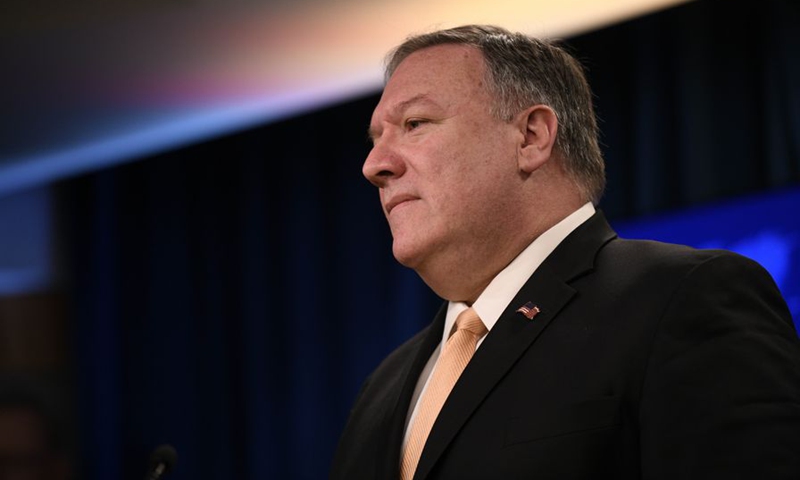
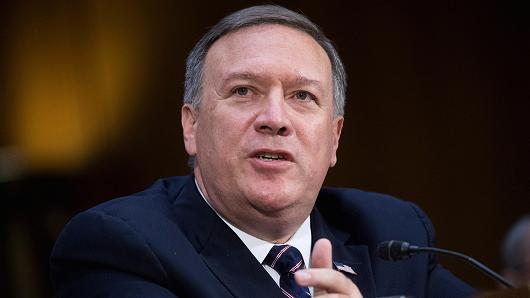
Colombo, October 25: The US Secretary of State, Mike Pompeo, who will be here on October 28, is expected to ask Sri Lankan leaders, point blank, to review relations with China; consider the options US is offering; and accept American advice on domestic and foreign policy.

A top foreign ministry official told Daily Express on Sunday, that Lankan leaders, President Gotabaya Rajapaksa, Prime Minister Mahinda Rajapaksa and Foreign Minister Dinesh Gunawardena, will politely tell Pompeo that Sri Lanka’s decisions and policies will be guided by election mandates, the law and the constitution of the country, and its interests, while maintaining good relations with all countries in the region and the world.

All the three leaders will tell the ranking US official politely that it is not for outsiders to tell Sri Lankans how to run their country,” the top Lankan official, who spoke on anonymity, said.

Pompeo is expected to press the government not to go in for Chinese-funded projects anymore but choose other countries and international organizations to fund projects mutually agreed upon.

The US Secretary of State will also press for the acceptance of the US$ 480 million Millennium Challenge Corporation Compact (MCC) which a Lankan Presidential Commission wanted to be either rejected in toto, or re-negotiated to accord with Lankan law, constitution and socio-political and economic realities.

The Lankan official said that the controversial issue of the Status of Forces Agreement (SOFA) will not come up for discussion because the government has made it clear that SOFA is against the Sri Lankan constitution and laws.

On the US bid to draw Sri Lanka into an anti-China alliance like Quad, the official said: We would tell Pompeo that Sri Lanka, which has only recently emerged from a thirty-year war, does not want to be a theater of international conflict in any way. But it is interested in ensuring free navigation in the Indian and other oceans. Pompeo would be reminded that in 1971 Sri Lanka had pioneered the idea of turning the Indian Ocean into a Zone of Peace.”

On the American demand that Sri Lanka abjure Chinese investments, the leaders would say that Sri Lanka needs investments from all countries as it is keen on developing the country ,especially in the infrastructure sector.

All countries, including the US, are welcome to invest in Sri Lanka. If the US and others match China, their offers would be considered,” another foreign ministry official said.

However, given the fact that the US is primarily interested in geopolitical and military matters with a focus on isolating and weakening China in these spheres, it would not make any economic investment proposals. Pompeo would find it difficult to proceed further on this matter in his discussions here, it is felt.

Debt Trap” Issue

If he raises the debt trap issue, we have facts and figures to show that the debt to China is only 5.6 billion USD out of a total external debt of 55 billion USD (which is 10%). The US owes China much more – USD 1 trillion,” the official said.

Arm-Twisting

However, Pompeo could indulge in arm-twisting by threating further sanctions against Chinese companies involved in Sri Lankan development projects. Some subsidiaries of the China Communications and Construction Company (one of which is executing the Colombo US$ 1.4 billion Colombo Port City) are already listed” for alleged predatory practices and lack of transparency”.

However, the Sri Lankans do not appear to be perturbed by such a possibility because listing has to be on solid grounds. And even it security issues are cited, it has to stand legal scrutiny in the US itself, the officials explained.

But the shoe might pinch if the US stops or lessons its imports of apparels from the island. The US buys about US$ 2.5 billion worth of Lankan apparels annually. This is 3% of the Lanka’s DGP and the US is the single largest market. But even stopping this is unlikely given the fact Lankan apparels enter the US market without GSP duty concessions.

Ethnic Reconciliation

As for Pompeo’s prescriptions on ethnic reconciliation, the Sri Lankan leaders will cite the mandates they got through the November 2019 Presidential and August 2020 parliamentary elections, which is that any solution to the ethnic question will have to be acceptable to the majority community in Sri Lanka and that reconciliation should be brought about by measures to develop the country economically in a way which benefits all communities equitably.

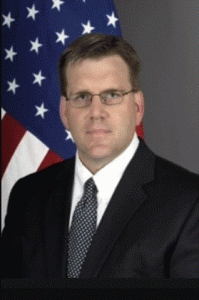
Dean Thompson, US Principal Deputy Assistant Secretary South and Central Asia

American Intentions Not A Secret

American intentions were made clear on October 22 by Dean Thompson, Principal Deputy Assistant Secretary of State for South and Central Asian Affairs at a press briefing. Thompson said that Pompeo will encourage Sri Lanka to review the options we offer for transparent and sustainable economic development in contrast to discriminatory and opaque practices.”

We urge Sri Lanka to make difficult but necessary decisions to secure its economic independence for long-term prosperity, and we stand ready to partner with Sri Lanka for its economic development and growth. The Secretary will also emphasize the ties between our people, our shared commitment to democracy, and the importance of our ongoing regional maritime security cooperation. We’ll continue to urge Sri Lanka to advance democratic governance, human rights, reconciliation, religious freedom, and justice, which promote the country’s long-term stability and prosperity and ensure the dignity and equality of all Sri Lanka’s diverse communities.”

With regard to China’s increasing influence in Sri Lanka, Thompson said: I think we’re looking to frame a discussion with them about a more positive trajectory, as I mentioned in my opening remarks. So definitely we’ll be discussing where they’re headed and looking for ways to strengthen their commitment to human rights rule of law and democracy.”

To combat COVID a collaborative effort is the need of the hour

October 25th, 2020

By Frances Bulathsinghala/Sunday Observer Courtesy NewsIn.Asia

Ayurvedic and Sinhala beheth doctors need to be co-opted, says Frances Bulathsinghala

To combat COVID a collaborative effort is the need of the hour

Colombo, October 25: As Sri Lanka faces the second – test, which caught the country unawares after about four months of respite, common sense calls for a collaborative approach of all medical experts of Sri Lanka, to prevent an over burdening of Allopathic professionals and to assist overall stabilization of health and the economy.

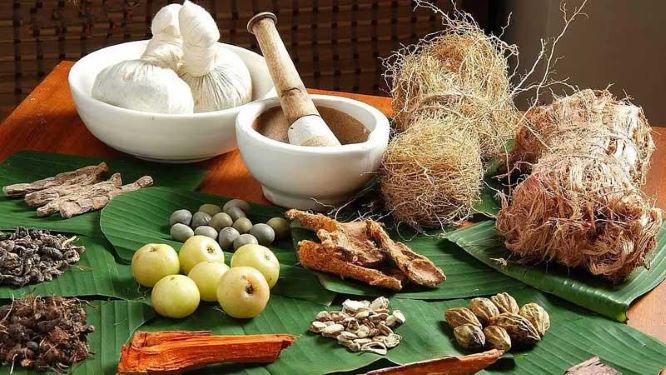
The threat of the Western medical hospitals and its profession being overwhelmed by the comparatively large numbers of Covid-19 patients (when juxtaposed with the March situation) needs to be addressed wisely. Sri Lanka currently has dozens of Ayurveda hospitals across the country, hundreds of highly qualified Ayurvedic/Siddha doctors, around 20,000 Deshiya Chikitsa traditional medicine (Sinhala beheth) and Ayurveda qualified medical practitioners and a separate State Ministry for Indigenous Medicine Promotion, Rural and Ayurvedic Hospitals Development and Community Health.

As someone writing on Sri Lankan heritage and the need to go beyond the rhetoric to put our traditional knowledge into practice, this writer spoke to several Ayurveda/traditional medicine experts to find out how we could work together as a nation to control the spread of the current pandemic. The comments below are an interweaving of observations /analysis stemming from speaking to the relevant experts. Their comments are mentioned within quotations.

Quarantine Act

At the outset it is imperative to understand Sri Lanka’s Quarantine Act (introduced in 1897 to prevent the then virulent diseases such as cholera). The Act mentions that the subject related official– in the current context the Health Minister – has the power of appointing medical experts he or she wants to control the disease. Therefore’ there is no legal barrier towards appointing any medical professional of Western or Non-Western medical tradition towards the common purpose of ensuring the health of the people.

Sri Lanka is fortunate at present to have a specific ministry for the promotion of indigenous medicine for the good of community health. This particular ministry was not in existence when Sri Lanka had to first deal with the Coronavirus surfacing in the country.

According to the Ayurveda Act No. 31 of 1961, the main aim of the Ayurveda department is to continue Ayurveda services for the benefit of the people and for conservation and curative purposes as well as to encourage Ayurveda research and enhance the professional capacity of Ayurveda practitioners. It also encourages research into various diseases to raise the standards of public health and developing medical practices thereof.

It now seems the time to put all the aspects highlighted on paper with regard to the Ayurveda Act into practice. This can be done in collaboration with the Quarantine Act so that the conscientious task done by the Allopathic medical practitioners/the military in the first stage of Covid-19 is supported equally strongly by Ayurveda experts as well as Sri Lanka’s indigenous medical professionals who inherit their knowledge from many generations. To have all these expertise and not make use of it strategically, wisely and harmoniously would be equal to sitting on a goldmine without benefitting from it.

Ayurvedic expert and Cultural Anthropologist Dr. Danister Perera explained how the traditional medicine of China was officially applied in that country along with western medical treatment and how the virus was efficiently controlled.

China, seems to be the only country which has so far effectively controlled the virus. Dr. Perera noted that Sri Lanka has a valuable treasure in our cultural heritage – a very powerful and rich medicinal heritage – which can be used at present when the country needs it most, alongside Western medical methods.

As officially noted by the authorities, around 80 per cent of Covid-19 patients as detected in Sri Lanka are asymptomatic (showing very mild symptoms). Hence the focus of using the contribution of the Ayurvedic health experts should ideally be towards the goal of minimising the hospital stay of patients and thereby eradicating a shortage of hospital bed capacity and other relevant factors,” he adds.

Given that much of Covid-19 is still in the mysterious territory of early research and clouded by somewhat contrary assumptions/conclusions (such as the level to which it is airborne )we still do not know for certain if their are different strains of the virus.

What we saw in Europe and the US seems to be a far more serious manifestation of it as opposed to what we are having here in Sri Lanka with only 14 deaths, But then again, the natural genetic immunity of Sri Lankans, enhanced by our ‘food as medicine’ clichéd traditional diet, may not be compared to the genetic immunity of an average Westerner and their practice of weakening natural resistance by regular winter time vaccines (flu shots) and a disease-promoting fast food-oriented diet.

Research

There is also much room for research to analyse the long term practical health impact of Sri Lanka’s traditional medicine heritage practices (such as the much-acclaimed immunity-boosting Ratha Kalkaya given to infants up to around the age of two) and as mentioned above the traditional herb-infused everyday dietary practices of our authentic/indigenous food. Whatever the reason, the immunity of Sri Lankans are in good order, as the percentage of recoveries of Covid-19 patients show. As experts such as Dr. Danister Perera highlights what we have so far as a backdrop it provides for us to carry out an integrated plan to maintain the best level of controlling the current situation without the serious economic impact which follows a full lockdown.

Concerns are rising about the need to separate those with a robust immunity and not showing symptoms of the virus until a PCR test is done, from more serious Covid-19 patients who may have other contagious diseases which could jeopardise the immunity of those who have only very minor or no symptoms.

The Secretary to the Ministry of Indigenous Medicine Promotion, Rural and Ayurvedic Hospitals Development and Community Health, K. Weerasekera when contacted by this writer maintained that several discussions are underway with the authorities concerned including the Health Minister on diverse preventive, curative and logistical aspects of pandemic control.

The National Committee of Ayurveda experts on Covid-19 which was appointed in March under the Health Ministry is to follow up on the deliberations made by them centered on a collaborative effort alongside the Allopathic doctors. The focus was on not to assert any superiority of one medical stream over the other but a mutual respect and support for the benefit of the country.

Some of the early initiatives at the Health/Indigenous Medicine Ministry level had included the producing of immunity-boosting substances and making them available through the Provincial Council Ayurvedic department and other channels to reach a wide mass of people as possible.

Suwa Dharani

One of the recent steps taken by the State Ministry of Indigenous Medicine Promotion, Rural and Ayurvedic Hospitals Development, is a product designed to boost the immunity system named Suwa Dharani.

For those in rural areas who cannot afford it, we give the immunity boosters free and for others in the city we have made such products available for purchase at various supermarkets,” explained Weerasekera.

She pointed out that the logistical and strategic matters with regard to the Indigenous Medicine Ministry’s support in the control of the pandemic is under discussion at Ministry level and that there would be a relevant meeting with the participation of the Minister of Health on Monday (26) to discuss the way forward.

The Deputy Director/Technical-Medical of the State Ministry of Indigenous Medicine Promotion, Ayurveda Dr. T. Weeraratne, said that in his capacity as the Convenor of the National Committee of Ayurveda Experts appointed in March to seek the support of Ayurveda and indigenous medicine experts, to mitigate the pandemic, that an action plan was being made for a collaborative effort.

Weda Mahattayas

He also maintained that traditional medicine practitioners (Weda Mahattayas) were informed that they could produce medicines which they felt could assist in relieving the early symptoms of the virus to the Ayurveda Department for further follow up/testing to ascertain the impact.

These practitioners attended the large scale meeting that we organised with the relevant government authorities and a detailed presentation on how we could assistthe country was made.”

With regard to supporting Allopathic doctors, he said:

I have formally written to the Sri Lanka Medical Association (SLMA) and we wish to discuss with them and the Government Medical Officers’ Association (GMOA) about a task sharing effort where Ayurveda professionals can contribute to a short and long term plan to prevent a health crisis and prevent a situation of over tasking the capacity Allopathic doctors.’

The Head of the Samastha Lanka Deshiya Waidya Sangamaya, Physician Upul Dela Bandara, who hails from several generations of traditional medicine practitioners says that there are over 8,000 traditional medicine practitioners around the country registered with the Ayurveda department and another 10,000 or so of Weda Mahattayas who are not registered but many of whom have been serving people throughout their lives.

We are discussing with the Ministry of Indigenous Medicine how they too could make a contribution at this time. We are a nation noted for our medical history and is unlike many nations in this regard. We have very ancient knowledge of battling various dangerous diseases but although this pandemic is new in terms of the virus strain it is now manifesting itself in, we can link its early symptoms as similar to influenza and treat in a manner to increase the balaya (power of the body) to fight the disease so that it dies fast.”

He says that in the traditional medicine system there are many stages of a disease before it becomes a full- fledged illness as a result of the body totally breaking down, and that if the immunity is built up, it is a matter of the initial infection moving away from the body boosted by the natural immunity of the person.

Mass scale education

Thus, the need of the hour is to have mass scale education for people to stay free from other ailments such as heart diseases, kidney/liver impairment obesity, diabetes and malnutrition which could crush the immune system if it is further challenged by the Covid-19 virus.

Head of the Ayurveda Teaching hospital and Registrar of the Ayurveda Medical Council Ayurveda Dr. Y. A. Supipi Sangamith Yapa, when contacted said that the Ayurveda professionals stand ready to give their utmost support to the authorities to control the pandemic.

We have earlier given our support to the military officials handling the earlier phase of the pandemic this year and provided them with the needed Ayurveda products for immunity boosting. None of the people who took these products we made got the virus,” she noted.

In conclusion, this writer as someone who consistently writes on putting the Sri Lankan heritage into practice would like to emphasise the following points:-

(1) If we surmount this second challenge by working towards asserting our medical heritage – without undermining the contribution of the Sri Lankan Allopathic medical practitioners (who are fellow Sri Lankans), we will be doing our ancestors and our economy proud as we would save a disastrous shutdown and would simultaneously lay the long term foundation for being able to credibly promote Sri Lanka as a tourist destination for holistic wellbeing and medical expertise.

(2) At present, there are several manufacturers of traditional medicine/immunity boosters/Arishta/herbal teas who are already exporting well being focused products abroad. This industry could thrive as an export industry for Sri Lanka if we work with wisdom to restore to this nation the medical stature it was known for historically. What we have to do is see that there is not much of a gap in our past, present and future.

(3) We were a nation known for its rich soil where many herbs grew and where herbs such as turmeric were commonly grown in every household. We, need to re-inculcate this at individual/mass scale level, probably beginning at school level, so that we are never at the mercy of importing our much needed herbs. If correctly planned out this could lead us to having many new small time herb exporters in a decade or so.

Sri Lanka imposes new curfew zones to check Covid-19 spread

October 25th, 2020

Courtesy The Hindustan Times

The new curfew zones are mostly from capital district Colombo and eastern district Batticaloa.

Police officers wearing protective gear stand in formation near the Sri Lankan parliament.
Police officers wearing protective gear stand in formation near the Sri Lankan parliament.(REUTERS)

Authorities in Sri Lanka increased the coronavirus-related curfew zones to 56 police divisions on Sunday, to check the virus spread through community-level transmission.

So far, the island nation has reported 7,521 Covid-19 cases. The virus death toll rose to 15 on Saturday after a 56-year-old heart patient died in the North Western Province due to coronavirus complication.

There are 56 police divisions which have been placed under police curfew and violators would be strictly dealt with,” Police Spokesman Ajith Rohana said on Sunday.

Rohana added that people’s movement in these areas will be monitored.

The new curfew zones are mostly from capital district Colombo and eastern district Batticaloa.

The Colombo municipality area has seen sharp rise in infections, Chief City Medical Officer Dr Ruwan Wijemuni said. Colombo city has reported 548 cases in the last four days.

Sri Lanka reported 743 cases on Saturday, along with its 15th Covid-19 death.

The country has reported 4,050 cases since October 4 from just two clusters — a garment export factory in Minuwangoda, Western Province and a wholesale fish market in Peliyagoda, a suburban area of Colombo.

Dr Wijemuni said the fish market cluster was more dangerous with too many secondary and tertiary contacts.

Of the total 7,521 Covid-19 cases reported till now, 3,714 have been discharged from hospitals after complete recovery. Health authorities said investigation is currently underway to establish whether the export factory or the fish market is the originating point of the second wave since October 4.

Authorities have ruled out a blanket lockdown due to the strain on the economy.

Meanwhile, Health minister Pavithra Wanniarachchi has said that the World Health Organisation has asked the government to be prepared for the distribution of vaccine depending on successful clinical trials.

Pompeo’s Indo-Pacific trip won’t succeed in ‘containing’ China

October 25th, 2020

Andrew Korybko Courtesy CGTN

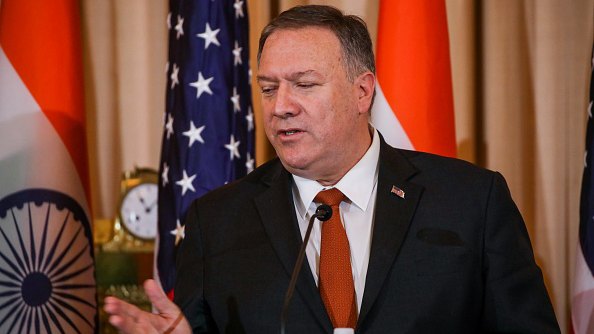
U.S. Secretary of State Mike Pompeo participates in a press conference at the State Department in Washington, D.C., U.S., December 18, 2019. /Getty

Editor’s Note: Andrew Korybko is a Moscow-based American political analyst. The article reflects the author’s views and not necessarily those of CGTN.

U.S. Secretary of State Mike Pompeo is on a four-nation tour of the Indo-Pacific this week that will take him to India, Sri Lanka, the Maldives and Indonesia. It represents the most assertive thrust yet of America’s attempt to “contain” China in the vast trans-regional space, which is shaping up to be the U.S.’ unofficial policy in this part of the world. While he’ll leave India with important progress being made on this front, he’s unlikely to have much to show for his visits to the other three nations. For that reason, it’s predicted that this trip won’t succeed with its unstated but heavily implied strategic goal.

Pompeo’s first destination is India, where he’ll participate in a 2+2 meeting between the two countries’ foreign and defense ministers. The two sides intend to sign the long-negotiated “Basic Exchange and Cooperation Agreement” (BECA), which will be the third “foundational pact” between their armed forces.

BECA will allow India to use the U.S.’ geospatial capabilities while the prior Logistics Exchange Memorandum of Agreement (LEMOA) and Communications Capability and Security Agreement (COMCASA) facilitate military logistical and communications cooperation. All three improve the interoperability between their armed forces.

When he goes to Sri Lanka, it’s expected that Pompeo will discuss the $480 million Millennium Challenge Corporation grant that the U.S. plans to offer the island nation. There will probably also be talks about a new Status of Forces Agreement (SOFA) too. Both topics are very controversial in Sri Lankan society because of concerns that they’ll make it more difficult for the country to retain its neutral foreign policy.

As for his itinerary in the Maldives, Pompeo will probably celebrate the defense pact that the two countries clinched in September. He will also try to use economic means to lure the country closer to the U.S., just like he’ll try to do in Sri Lanka.

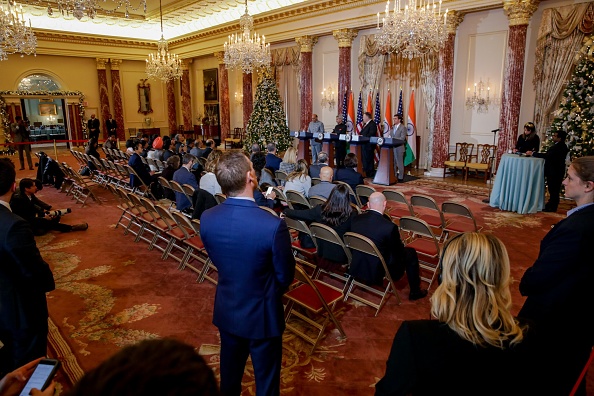
U.S. Secretary of State Mike Pompeo (2nd L), U.S. Secretary of Defense, Mark Esper (R), Indian Defense Minister Rajnath Singh (L) and Indian Foreign Minister Subrahmanyam Jaishankar (2nd L) hold a joint press conference at the State Department in Washington, DC, United States, December 18, 2019. /Getty

The Indonesian leg of his journey will be the most interesting to observe after reports recently circulated that the country rejected the U.S.’ request over the summer to host spy planes that planned to surveil Chinese positions in the South China Sea. Pompeo’s task will therefore be to patch up relations with the traditionally neutral nation, which is one of the founders of the Non-Aligned Movement, after America’s failed attempt to turn it against China harmed the trust that used to characterize their ties. He’ll likely still try to court it to the U.S.’ side, but probably not as aggressively as before, and no significant progress is expected anytime soon.

Taken together, there are three trends that connect all four visits, the most obvious of which is the military component. The U.S.’ related outreaches to India and the Maldives have succeeded, whereas they stalled in Sri Lanka and failed in Indonesia. The other trend is the U.S.’ efforts to boost India’s standing as a regional “counterweight” to China, which implies supporting its hegemonic aspirations in the Indian Ocean. This could backfire if they push too hard on nearby Sri Lanka and the Maldives, who might then seek to further improve their economic relations with China as a counterbalance. Lastly, the U.S. wants Indonesia to join the Quad.

From this strategic insight, an intriguing observation can be made about the diametrically different directions that India and Indonesia are moving in. While India is enthusiastically going along with the U.S.’ destabilizing plans with the mistaken expectation that it will improve its regional standing, Indonesia is respectfully declining to do so, preferring instead to remain on equally good terms with the U.S. and China.

Considering their geostrategic locations and enormous sizes, it can thus be said that their respective choices will leave a lasting impact on Indo-Pacific geopolitics, one which will influence whether other countries follow in their footsteps.

As it stands, the Indonesian model is objectively the most attractive for all others. It truly embodies the win-win principle of mutually beneficial cooperation without causing concerns for any third country, unlike India’s growing closeness with the U.S. in ways that strongly imply its hostile intention to “contain” China.

All things considered, it can be said that Pompeo’s anti-China “containment” mission will fail. Although he’ll score some tangible success on the Indian front, that was to be expected, but it’ll be his failure to court Indonesia into the Quad that will define this trip’s legacy. Without Indonesia on the U.S.’ side, it’s impossible to “contain” China.

Oman Air resumes flights to Sri Lanka, Bahrain and Kuwait

October 25th, 2020

Courtesy Lifesyle

The airline will fly direct from Muscat to Colombo, Muharraq and Kuwait twice per week throughout winter

Oman Air is resuming flights to three more destinations as part of its winter network update.

The national airline of the sultanate will begin flying to Sri Lanka, Bahrain and Kuwait from Monday, October 25. The airline is also set to increase frequency to domestic destinations across Oman.

From Muscat, Oman Air will operate twice weekly flights to Kuwait, Bahrain and Colombo. Travellers flying to Sri Lanka should be aware that only citizens are currently allowed to enter the country. Tourist visas have been suspended, however transiting is allowed so long as flight connections are no longer than 10 hours.

Oman Air is resuming flights to Bahrain where quarantine rules are in place for visitors. Unsplash

Kuwait airport partially reopened on August 1. Citizens and those with residency visas can fly into the state with a negative PCR test result.

Bahrain is allowing tourists and non-residents to enter the country and has introduced new Covid-19 testing measures to try to prevent the spread of the virus. Passengers holding electronic visas and those eligible for visas on arrival can fly to the kingdom again.

Oman Air is also increasing its domestic network as part of its winter schedule update. The airline will now operate three daily round-trip flights from Muscat to Salalah. The capital of the Dhofar province is popular for its thriving marine life and annual monsoon season.

To the port city of Khasab in Oman’s Musandam peninsula, bordering the UAE, the airline will now operate six flights per week.

It will also fly six times per week from the Omani capital to the coastal city of Duqm.

On all flights, there will be social distancing measures in place, cabin crew will wear full personal protective equipment and passengers must wear face masks.

Oman reopened international flights on October 1 after closing its borders for more than seven months, in a bid to prevent the spread of the coronavirus via air travel.

Tourists from some countries can once again fly into the sultanate, and will undertake a PCR test at the airport. Short-term visitors must then quarantine until they receive a negative test result. Those staying in Oman for more than seven days must quarantine for 14 days, even if test results are negative.

Pompeo’s last foreign tour will be no victory lap: Global Times editorial

October 25th, 2020

Courtesy Global Times

US Secretary of State Mike Pompeo speaks during a press briefing in Washington D.C., the United States, April 22, 2019. (Photo: Xinhua)US Secretary of State Mike Pompeo on Sunday kicked off his last foreign trip before the US presidential election, with India, the Maldives, Sri Lanka and Indonesia on his itinerary. 

Top of his agenda is to mobilize those countries to confront China alongside with the US. 

In New Delhi, the US and India, two of the countries hit hardest by the COVID-19 pandemic, will hold the 2+2 Ministerial Dialogue and are likely to sign the Basic Exchange and Cooperation Agreement that will allow for expanded military intelligence sharing. In the Maldives and Sri Lanka, it is anticipated that Pompeo will disparage the economic cooperation the two countries have been conducting with China and encourage them to seek “economic independence.” He is likely to incite Jakarta to be tougher on Beijing over the South China Sea issue and tout US arms in Indonesia. 

The trip could be regarded as a chance to summarize Pompeo’s nearly three-year tenure as the secretary of state under the Trump administration. His term of office can be summarized in one sentence – he has pushed an all-round confrontation against China and endeavored to form an “anti-China united front” on the international stage. 

With a clear anti-China attitude, Pompeo has bluffed his way in dealing with China. However, although he has done a lot, he gained only a little because what he advocates is detached from the basic reality of a gigantic China-US economic cooperation and runs counter to international common sense that countries should make policies based on their own national interests. 

The purpose for India to move closer to the US is to increase India’s leverage in negotiating border issues with China. India is China’s neighbor and its strength is weaker than China’s. Will New Delhi stand at the forefront of the US anti-China line? It is not that silly. US-India cooperation may make China unhappy, but it will not exert psychological pressure that could force China to make strategic concessions. 

The Maldives and Sri Lanka are two small countries whose interests lie in keeping sound relations with all major powers in order to gain more investment and attract more tourists. The US will not invest in them as they attract few American tourists. But since the US secretary of state proposed a visit, the two countries will have to warmly welcome him. The two countries will not make too much fuss or make any promises. That’s all. China has injected dynamics in the economic development of the two Asian countries, which have no reason to go against China just to cozy up to the US. 

Indonesia is the largest country in Southeast Asia. It once bought military jets from the US and had to withstand a cessation in the supply of jet components due to US sanctions. Jakarta will not forget that. It is quite easy for Indonesia to figure out from which country – China or the US – it can gain more respect and development profit. 

There is no serious dispute over the South China Sea between Jakarta and Beijing, and the two sides have effectively managed their divergences. The core task of Indonesia is to develop itself rather than to confront a certain big country or to act as a US pawn. Jakarta’s wisdom will and shall never be humiliated by a white centralist like Pompeo. 

The visit to four Asian countries will be a gloomy closing tour for Pompeo. As the secretary of state of the country hit hardest by COVID-19, Pompeo has traveled more frequently than his counterparts from other countries. This has increased the risk of spreading the coronavirus. Meanwhile, he has been spreading political viruses and fanning the flames of antagonism in the world. It is believed that many countries have ambivalent feelings about receiving him, because he brings no constructive outcomes but instead hegemonic demands to which the host countries can hardly respond. 

China is the largest or main trading partner of many countries Pompeo has paid visits to. He asks them to take sides. But the question is, why should they? Being such a bully, Washington will only find itself as welcome as a storm. 

Pompeo is one of the worst secretaries of state in US history, but he feels quite complacent. He thinks he can change the logic of international relations in the era of globalization with his inflammatory articles that will see him honored in history. 

But he will end up being ridiculed by history as a political clown because he acts against the historical trend and refuses to face up to reality. 

Sri Lanka confirms 16th death from Covid-19

October 25th, 2020

Courtesy Adaderana

Another person infected with Covid-19 died today, bringing the total number of deaths reported in Sri Lanka to 16, says the Director General of Health Services.

The deceased was identified as a 70-year-old male from Colombo 02 area.

According to reports, he was admitted to the Colombo National Hospital on the 23rd of October to be treated for blood infection.

Due to complications, he had been moved to the Intensive Care Unit (ICU) of the hospital, where he was under medical until he passed away this morning.

Sri Lanka’s Covid-19 figures hike with 88 fresh cases

October 25th, 2020

Courtesy Adaderana

UPDATE: Covid-19 cases confirmed in Sri Lanka shot up again as 88 more individuals were tested positive for the virus.

According to reports, 85 of the fresh cases have been identified as close contacts Peliyagoda Fish Market and several fisheries harbours.

The Department of Government Information said 03 arrivals (01 from the United Arab Emirates and -02 Filipino navymen have also been exposed to novel coronavirus.

Thereby, Sri Lanka registered 351 new infections so far today (25).

With the new development, the total number of positive cases confirmed in the country increased to 7,875.

The Epidemiology Unit says 4,054 active cases are currently under medical care.

Covid-19 recoveries reported in Sri Lanka reached 3,803 earlier in the day as 89 virus-infected persons were discharged from hospitals upon returning to health.

Meanwhile, Covid-19 infections registered by the Minuwangoda and Peliyagoda cluster reached 4,398.

“Will MCC be signed in secret on 28 October”? Sri Lankans are asking!

October 24th, 2020

This question is being asked across numerous public portals and begs the Government to answer & relieve all doubts. Having got itself tagged as a ‘nationalist’ government (on top of all the other nasty words plucked out of the dictionary), no citizen expects the Government to do anything ‘anti-national’ especially in secret. The people’s apprehensions are with historical reason. Our island nation weathered countless invasions from South India & three western invasions but they came to occupy & plunder our resources and murdered our people, only because some amongst us, betrayed us. It is this trail of betrayal DNA that has continued to be part & parcel of our political framework even after independence. How many ‘inguru dee miris gaththa wage’ incidents have we experienced? Our people deserve better.

The political system too has been a cocktail of betrayals over the years producing frogs and kangaroos of politicians with no principles except personal gain. As a result, they are susceptible guinea pigs for international agendas with detrimental impact to the nation. By the manner a nobody was propped up via a well-funded campaign to become the President of the Nation, is a stark example of what is not impossible. Well-funded campaigns can turn the worst enemy into a hero and the greatest patriot into a zero. It is a reminder that the evil forces are lurking & searching for their prey.

We have had a Don Juan Dharmapala who not only gave up Buddhism but was more than willing to write off the entire nation to the Portuguese via a gift deed. We have had chieftains no different to the traitors in present day parliament who readily palmed off the island nation to the British simply to enjoy perks & privileges. We have had more than our share of turn coats and implants pretending to be faithful loyalists but paid to work for the other side. It is these traitors that end up doing the most harm and damage to the nation. They don’t care what kind of karma they accumulate.They did so in the past and they have continued to do so post-independence.

We have seen some of the most horrific betrayals post-1978. We were promised a dharmishta-rule but not only was democracy culled, even homes of Supreme Court judges ended up getting stoned. We then walked into a period of bheeshana – no one knew who was killing whom and all that our eyes witnessed were people burning on tyres, tied to lamp posts naked or being taken away in the dead of night, never to return. Coupled with that came the 3 decades of LTTE terror. While terrorists did reign with gun, traitors too made merry, striking deals even with the terrorists. We saw in 2002 the betrayal of the nation on paper, pretending to bring peace, giving terrorists territory officially, while the armed forces were confined to barracks. We somehow prevented the signing of PTOMs and ISGA and thankfully the Courts decided to demerge the falsely merged north & east provinces.

Peace dawned in 2009 but unfortunately Sri Lanka was to enjoy only 5 years of peace and a semblance of development. Another well-funded campaign ousted the winning President of the May 2009 LTTE victory and propped a puppet to rule. The five years saw a plethora of further treacheries with even the two pillars protecting Sri Lanka subject to humiliation and being locked up for trivila reasons in prison. The Maha Sangha and the Armed Forces were the targets of a campaign to structurally destroy the foundational defense of Sri Lanka.

It is in this broader picture that we must realize what our enemies are planning next. We know that with the LTTE tool, removed, the enemies turned to the UN to target Sri Lanka. The Geneva bogus resolutions were well planned. Then in 2015 the puppets were tasked to roll out a series of plans that would decide the next phase for Sri Lanka. The Nation was made vulnerable further. Every corner of public domain was infiltrated, systems were disrupted and traitors placed in positions of power. Every weakling was tapped.

A nation’s nationalism outlives the roles of those they tap to defend the nation. The nationalist lobby brought to power a man they deemed fit to rule. They gave him a victory of 69lakhs. That strength was further fortified via a 20amendment, with the trust and expectation that as custodian and guardian of the Nation, its People and all of its assets and resources would be protected and preserved for future generations.

The people expect much from the sitting President, the Prime Minister and the Government. The people have gone through much since independence. They have weathered so many corrupt leaders, bad governance and plenty of betrayals. They deserve better.

They certainly do not expect figureheads that they adore and admire to betray them.

People can identify the traitors and they openly curse them for their betrayals.

The UNP leader who posed himself as Mr. Clean, is today humiliated and ridiculed by his own party members and followers, then anyone else. This is not how he would want to depart. When closing his eyes, would he like to think that an entire nation curses him as a traitor?

Likewise, no person wearing the crown of patriot, would wish to end up treated like a zero or cursed as a traitor. No amount of riches, no amount of showering of praises by external parties, no amount of glorification can match a person who is revered by the masses. Mahinda Rajapakse knows too well how much the people love him. He remains the world’s only leader to have bus-loads of people visit him across a year after a democratic defeat. The sight was an envy to all his haters.

The reverence of the people, the manner that people look up to patriotic leaders can never be matched by whatever is to be gained betraying the nation. It is not worth its value in gold. To have a nation look up with admiration at their leaders is nothing that can be equaled in its weight of gold or for any treacheries committed. Look at how the yahapalana nadiya are today treated.

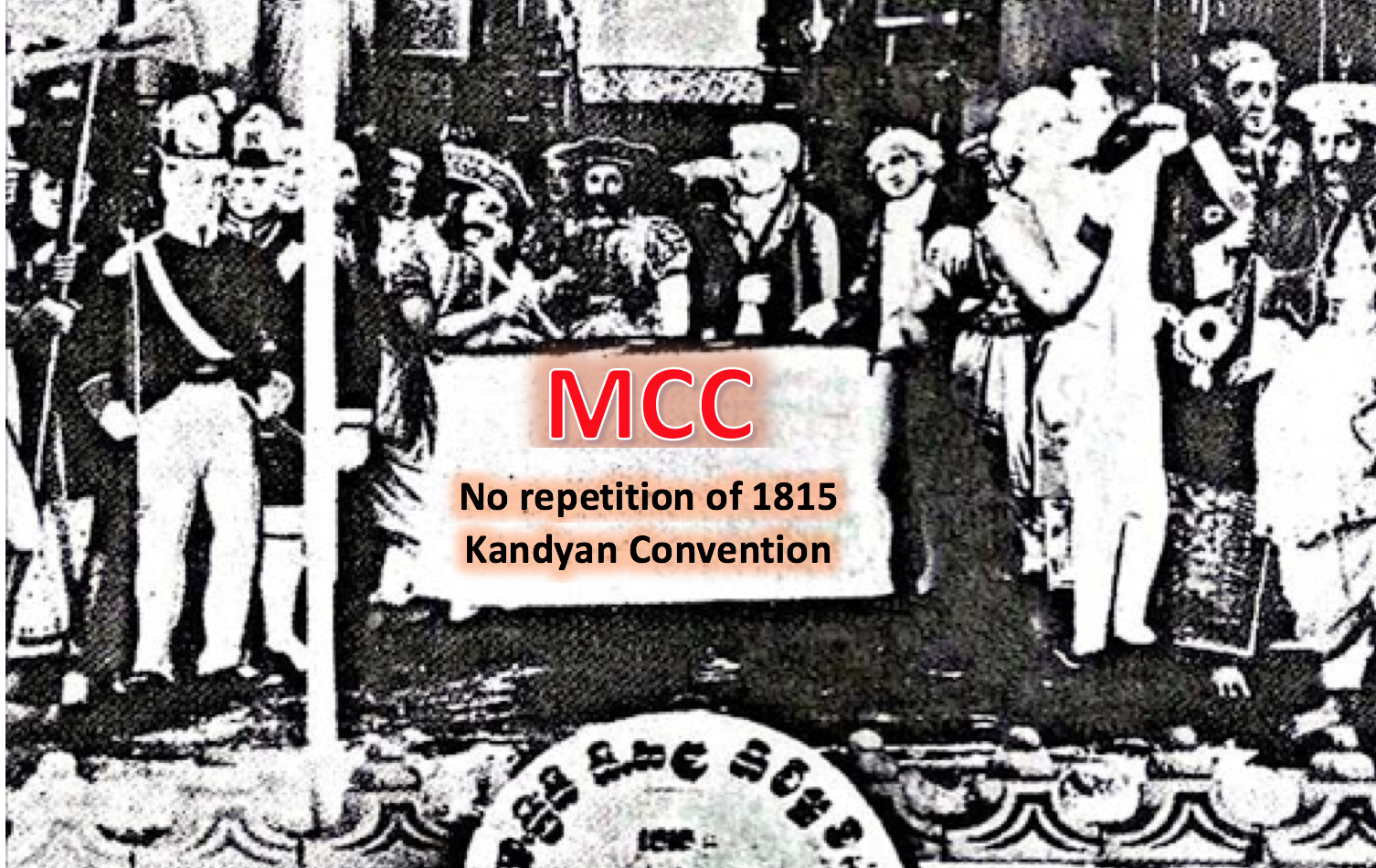
People are very worried about the MCC. They know the consequences. It’s worse than any prior betrayals and returns Sri Lanka two hundred years back to 1815. The manner US planes and officials are landing with no checking or quarantine regulations are bad omens of what’s in store for the future. We don’t want to be bulldozed in our own nation & have what belongs to us taken away. This feeling is shared by all communities. Our common issues can be dealt amongst us & by us – we don’t need external interferences or interventions.

The leaders in power, in particular the populist President in power must withstand all efforts to force signing of MCC – under duress or in secret, MCC must not be signed for any reason. Brute rule or anti-people actions will only worsen the people’s hatred at the outcome and is nothing any patriot would want to risk.

Shenali D Waduge

COVID wild fire, 20th Amendment, Mark Pompeo’s threat, resurgent MCC & SOFA; Signs that planetary alignment is not in the country’s favour?

October 24th, 2020

By Raj Gonsalkorale

With positive cases exceeding 7000, and a national daily high of 865 and cases being reported in many parts of the country, what is striking is the sound of silence from health officials. While it is understandable to have one spokesperson, many other countries have generally had a non-health person as the chief spokesperson, at times a President or a Prime Minister, but in equal standing with the most senior health official of the country. The logic is simple. This is a health matter.

The people of the country have to know how a calm and contained situation in the country became a Tsunami. It is time that an independent enquiry, preferably by a senior retired judge/s is conducted without delay to assuage mounting concerns amongst the public, and to restore the confidence people have in the government ability to curb the pandemic spreading like wild fire in the country.

If in this instance, Brandix was responsible for the beginning of this second wave, as most seem to believe, it is in their interest to provide all relevant facts to the proposed enquiry so that they can be exonerated if the news spreading in social media is fake news. An assurance from Brandix and the government is too little too late now, not just to find out how this happened, but also to identify measures that need to be taken to prevent a recurrence. With intense pressure on export oriented industries that employ large numbers of workers to keep their exports moving, the possibility of a recurrence is more than likely. 

No doubt, political and administrative decisions need to be taken, firstly to manage the outbreak and to prevent similar outbreaks in the future. However, the basis for these decisions have to be health policy related. The public needs a greater assurance that this is happening. It is not evident that this is happening and that the public feels assured.

The 20th Amendment

The 20th Amendment will become law as soon as the Speaker signs it. The Presidency assumes supremacy over the Prime Minister and the Parliament. One wonders how this amendment and its reinstated powers in the hands of the previous President or a future President like him would have been viewed? A fundamental tenant of democracy, checks and balances, have been diluted or eroded by the 20th Amendment. The issue is not about granting powers to a President. It is about mechanisms in place to prevent the misuse of such powers and also to make sure powers are used effectively and efficiently to produce good outcomes for the people. The 19th Amendment had flaws. Even some who were engaged in framing it conceded that. However, the answer should not have been the thinking that one had to go back to the 18th Amendment in order to rectify whatever flaws in the 19th Amendment. Both amendments, the 19th as well as the 20th appears to be personality driven and not necessarily what is the country’s best interest. It is no secret that the thrust of the 19th Amendment was to contain the powers of one Presidency and now, the 20th Amendment has been enacted to restore most powers taken away from that Presidency. 

The Constitutional Council, the independent committees, COPE and COPA committees, should have been strengthened and given more powers. The contention that the independent commissions were not independent is not a reason to have diluted their independence.

Mark Pompeo’s visit, MCC and SOFA Agreements

It is known that the US Secretary of State is not visiting Sri Lanka to have tea with the President and the Prime Minister. He is coming to reinforce the message that the US State department official Dean Thompson announced in advance of Mr Pompeo’s visit that We encourage Sri Lanka to review the options we offer for transparent and sustainable economic development in contrast to discriminatory and opaque practices. We urge Sri Lanka to make difficult but necessary decisions to secure its economic independence for long term prosperity”

What was the immediate consequence of this statement? Reuters (Marc Jones, Asian Currency News October 23rd) reported that Sri Lanka’s dollar dominated 2021 and 2022 bonds dropped 5 percent or more according to Tradeweb data and dropped below 60 cents on the dollar threshold. This report continued to state” all the tell tales crisis signs are there: a trembling currency, credit rating downgrades, bonds at half their face value, debt to GDP levels nearing 100%, and almost 70% of government revenues being spent on interest payments alone”

So, if Mr Pompeo is visiting Sri Lanka with this news in the background, and the more than a veiled attack on Sri Lanka’s close links with China, he has to be after an outcome that provides the US an unprecedented Quid Pro Quo outcome for some financial support. The only such deal on offer as far as known is the MCC agreement and the USD 480 Million over 5 years it includes. There is another agreement, not an economic one, but a Military one, unsigned yet, which is probably what is of more strategic benefit to the US and that is the SOFA Agreement. Under that the US Military could be in Sri Lanka at the invitation” of the government of Sri Lanka. What this entails and what would happen like in the Camel and the man in the tent story, is all too familiar when one looks at the track record of the US in many countries.

In terms of the financial crises outlined in the Reuters report mentioned above, MCC agreement money is peanuts. It is US 30 cents per capita per year of the US population of 327 million people over the five-year period. Sri Lankans working overseas remitted more than USD 7 Billion per year before COVID struck. If the country is to sell its soul, surely they should sell it for more than 30 pieces of Silver?

It has been reported that Mahinda Rajapaksa, as President, had made himself very clear as to his and the country’s stand when Western countries led by the US, UK, France etc, had applied pressure on him to allow LTTE cadres to be shipped out of Sri Lanka during the last stages of the war in 2009. Mr Mahinda Rajapaksa, his brother Gotabaya who is now the President, the Armed Forces of the country, ended the war by defeating the LTTE, while rehabilitating more than 300,000 LTTE cadres thereafter.

Perhaps it is time Sri Lanka stood with their heads high once again, and gave a similar message to Mr Pompeo. That message should be that Sri Lanka welcomes US assistance but it cannot be at the expense of China’s friendship and financial assistance. Sri Lanka could assure the US that the country’s land or sea or facilities, ports, airports etc, will not be given to any country for Military purposes, and that all were welcome to invest in Sri Lanka according to the sovereign laws of Sri Lanka.

If Sri Lanka grovels now, the impact will be felt by the future generations, and they will curse the current guardians for selling the country for 30 pieces of Silver. If President Gotabaya Rajapaksa had the 20th Amendment passed to reintroduce and reinforce the executive powers of the Presidency, this is the time he could demonstrate how he would use such reinstated powers for the benefit of these future generations.

The US is in the throes of a Presidential election. Polls are suggesting that there is a strong possibility of the incumbent President being defeated. Besides the unfairness of any pressure being applied on Sri Lanka at this stage to sign agreements, Sri Lanka should take into account the views of a Biden administration should that come to pass on the 4th of November. Mr Pompeo should respect such a stance.

20 වෙනි ව්‍යාවස්තා සංශෝධන අරගලය රටට හා ජනතාවට කියාදෙන පාඩම

October 24th, 2020

චන්ද්‍රසේන පණ්ඩිතගේ විසිනි 

69 ලක්ෂයක්වූ ජනතාව මෙරට ජනාධිපතිවරයා වශයෙන් ගෝඨාභය රාජපක්ෂ මහතාව තෝරාගත්තේය. ඒ ඔහු ද්විත්ව පුරවැසිභාවය අත්හැර දමා මෙහි දේශපාලන පිටියට පැමිණි නිසා නොව, ද්විත්ව පුරවැසිභාවය තිබුනද ඔහු මේ රටේ ඕනෑම කටයුත්තක් සඳහා සුදුසුම පුද්ගලයා ලෙස ජනමනස තුල දිදුලමින් සිටි පුද්ගලයා බැවිනි. බලයට පත්වූ එතුමාගේ බලතල ව්යාවස්තාවෙන් කප්පාදු කර තිබු බැවින් තමන්ට වැඩ කිරීමට ඇති බාදාව ජනතාවට පෙන්නා දුන් එතුමා මේ බාධක ඉවත් කිරීම සඳහා තමන්ට 2/3ක් පාර්ලිමේන්තු බලයක් ලබාදෙන ලෙස ජනතාවගෙන් ඉල්ලා සිටියහ.

ප්‍රතිපලය වුයේ එතුමා ඉල්ලා සිටි ආකාරයටම ජනතාව එතුමාට් 2/3 ජනවරමක් ලබාදීමයි. මේ ජනතාව අවශ්‍යදේ අවශ්‍ය ආකාරයට තේරුම්ගෙන කටයුතු කල හැකි ජනබලවේගයක් බව මේ මැතිවරණ දෙකේදීම ඉතා පැහැදිලිවම ප්‍රකාශ කර සිටියහ.

පාලනයේ පවිත්‍රකරණයක් සිදුකිරීම අත්‍යවශ්‍ය කටයුත්තක්ව තිබුණි. එය කලයුතේ හා කල හැක්කේ නව ව්යාව්ස්තාවක් රටට හදුන්වාදිමෙනි. නමුත් නව ව්යාවස්තාවක් ක්ෂණයකින් ගොඩ නැගිය හැකි දෙයක් නොවේ. එබැවින් පවතින ගැටලුකාරිතත්වයන්  සමනය කරගෙන, පාලනය ගෙන යාමේ අවශ්‍යතාවය උදෙසා 20 වෙනි ව්යාවස්තා සංශෝධනය නිර්මාණය කර ඉදිරිපත් කරන ලදී.

20 වෙනි ව්යාව්ස්තා සංශෝධනය යනු උපරිම වශයෙන් වසර දෙකක කාලයක් පැවතිය හැකි. නව ව්යාවස්තාවේ පැමිණීමත් සමග ඉවත්ව යන තාවකාලික දෙයකි. මෙහි ආයුකාලයවත් නොදන්නාවුන්සේ  මෙහි තිබිය යුතු දා සම්බන්ධව මෙරට ජනතාව වන අප බලා සිටියේ හාස්‍ය ජනක සිතුවිලි පෙර දැරිවය.

20 වෙනි ව්යාව්ස්තා සංශෝධනයට එරෙහිව රටේ කණ්ඩායම් දෙකක් පන නැගිණි. ඒ,

1. රජය අභ්‍යන්තරයේ විටින කණ්ඩායම හා
2. විපක්ෂ කණ්ඩායම ලෙස හැදින්විය හැක.

අපට වැදගත වන්නේ රජය අභ්‍යන්තරයේ සිටින කණ්ඩායම ඉදිරිපත් කරනු කාරනා සම්බන්ධවය.

අපි විශ්වාස කරන්නේ සම්පුරන්යෙන්ම 19 වෙනි ව්‍යාවස්ථා සංශෝධනය අහෝසිකලා නම් ප්‍රමාණවත් බවයි.

නමුත් රජය එසේ නොකොට 19යේ අඩංගු යම් යම් වගන්ති එසේම තබාගෙන 20 ඉදිරිපත් කරන ලදී.මෙහිදී අපි 19යේ ඇති වටිනා දේවල් යයි කියා තියාගත් දේවල් වලට එකඟ නොවුනද ඒවා සම්බන්ධව කතාකිරීමට වෙහෙස නොගන්නේ, මේ සියල්ලක්ම වසර දෙකක කාලයක් තුලදී අහෝසිවී නව ව්යාවස්තාවක් එන බව විශ්වාස කරන නිසාය.

ආංඩුවේ අභ්‍යන්තරයේ ගැටුම්කාරී තත්වයක් නිර්මාණය වෙන්න බලපෑ ප්‍රධානම වගන්තිය වුයේ ද්විත්ව පුරවැසියන්ට පාර්ලිමේන්තුවට පැමිණීමට තිබු බාධාව ඉවත් කිරීම හේතු කොටගෙනය. දැන් 20 ව්යාවස්තා සංශෝධනය තුලින් සිදුකර ඇත්තේ, ද්විත්ව පුරවැසියෙකු පාර්ලිමේන්තුවට පත් කර ගන්නවාද නැද්ද යන බලය මෙරට පරමාධිපත්‍ය උසුලන ජනතාවට බාරදීම පමණි. අවසාන තීන්දුව දෙන්නේ ජනතා පරමාධිපත්‍ය බැවින් ඒ ගැටළුවටද මෙරට ජනතාව නිවැරදි තීරණයක් ලබාදෙනු ඇත. ජනතාව තීරණය කලයුතුදේ ජනතාවට තීරණය කිරීමට ඉඩදීම තුලින්, රනිල් වික්රම්සින්හයන්ව පාර්ලිමේන්තුවෙන් නෙරපා හැරියා සේම  නෙරපා හරිය යුත්තේ ද්විත්ව පුරවැසියාද නැත්නම්, ශ්‍රී ලාංකික පුරවසියාද යන්න ජනතාව නිවැරදිව තීරණය කරනු ඇත.මේ ජනතා අයිතියට අත තියන්න එපා.

ස්තුතියි.

විජයදසමි දින පණිවිඩය

October 24th, 2020

මහින්ද රාජපක්ෂ අග්‍රාමාත්‍ය

පත්තිනි මෑණියන්ගේ කරුණාව උදෙසා පැවැත්වූ නවරාත‍්‍රී උපවාසයේ අවසාන දිනය වන විජයදසමි දිනය භක්තියෙන් සමරන මාගේ ආදරණීය ශ‍්‍රී ලාංකික හින්දු භක්තිකයින්ට මාගේ හෘදයාංගම සුබපැතුම් පිරිනමමි.

මිනිස් සමාජයේ මූලික අවශ්‍යතා තුන වන ධෛර්යය, අධ්‍යාපනය සහ ධනය ලබා දෙන මහා බලවතුන් වන දුර්ගා, සරස්වතී සහ ලක්ෂ්මි දෙවියන් වෙත අපගේ කෘතවේදීත්වය, නමස්කාරය පුදකිරීම සහ එම දෙවියන් අයැදීම නවරාත‍්‍රි යනුවෙන් ව්‍යවහාර වෙයි.

ජයග‍්‍රාහී මංගල්‍යය දිනය වන විජයදසමි දින, සියලු යහපත් දේ සාර්ථක වනු ඇතැයි යන බලාපොරොත්තුවෙන් දෙවියන් නමස්කාර කර, අධ්‍යාපනය, කලාව, වෘත්තිය යනාදී සුබ කටයුතු ආරම්භ කරන හින්දු බැතිමතුන් මෙදින මහත් භක්තියකින් යුතුව සමරති.

මෙම විජයදසමි සුබ දිනයේදී පත්තිනි මෑණියන්ගේ කරුණාවෙන් ශ‍්‍රී ලංකාවේ ජනතාවට ආගමික සමගිය, විවිධත්වය වර්ධනය කර ගැනීමටත්, සියලු ප‍්‍රතිලාභ සමඟින් ජීවන තත්ත්වය ඉහළ නැංවීමටත් හැකිවේවායි මම නැවත වරක් මාගේ හෘදයාංගම සුබ පැතුම් පිරිනමමි.

මහින්ද රාජපක්ෂ

අග්‍රාමාත්‍ය

රටට සෙත්පතා ආරම්භ වූ රතන සූත්‍රය සඡ්ඡායානා කිරීමේ පිරිත් දේශනාව සඳහා අග්‍රාමාත්‍යතුමා එක්වෙයි

October 24th, 2020

අග්‍රාමාත්‍ය මාධ්‍ය අංශය

කොවිඩ්-19 වසංගත තත්ත්වය හමුවේ ගරු ජනාධිපති ගෝඨාභය රාජපක්ෂ මැතිතුමා හා ගරු අග්‍රමාත්‍ය මහින්ද රාජපක්ෂ මැතිතුමා ප්‍රමුඛ රට වැසියාට සෙත් පතා දින 07ක් පුරා පවත්වනු ලබන රතන සූත්‍රය සඡ්ඡායනා කිරීමේ පිරිත් දේශනාව නාරාහෙන්පිට අභයාරාම පුරාණ විහාරස්ථානය කේන්ද්‍ර ක‌ර ගනිමින් ඊයේ දින ආරම්භ විය.

පිරිත් දේශනාව සඳහා සහභාගී වූ ගරු අග්‍රාමාත්‍ය මහින්ද රාජපක්ෂ මැතිතුමා ආගමික වතාවත්වල නිරත වීමෙන් අනතුරුව පිරිත් දේශනාව ශ්‍රවණය කිරීම සඳහා එක්විය.

කොවිඩ් – 19 වසංගතය දුරුවේවායි ප්‍රාර්ථනා කරමින් මීට සමඟාමීව ඊයේ දින සිට දින 07 ක කාලයක් පුරා දිවයිනේ විහාරස්ථාන 200 කට අධික සංඛ්‍යාවක රතන සූත්‍රය දේශනා කිරීම ආරම්භ වූ බව නාරාහේන්පිට අභයාරාමාධිපති, බස්නාහිර පළාත් ප්‍රධාන සංඝනායක පූජ්‍ය මුරුත්තෙට්ටුවේ ආනන්ද නාහිමියෝ පැවසූහ.

ශ්‍රී ලංකා ගුවන් විදුලි සංස්ථාවේ මුලිකත්වයෙන් බුද්ධ ශාසන, ආගමික හා සංස්කෘතික කටයුතු අමාත්‍යංශය සහ බෞද්ධ කටයුතු දෙපාර්තමේන්තුව එක්ව එය සංවිධාන කර තිබේ.

කොරෝනා වෛරසය ව්‍යාප්තිය හා ජනජිවිතයට බලපා ඇති අනෙකුත් අර්බුද සමනය කිරීම සඳහා ආශිර්වාද ප්‍රාර්ථනා කරමින් මෙම රතනසුත්‍ර දේශනය පැවැත්වේ.

පූජ්‍ය මුරුත්තෙට්ටුවේ ආනන්ද නාහිමියන්ගේ ප්‍රධානත්වයෙන් ආරම්භ කෙරුණු රතන සූත්‍රය සඡ්ඡායනා කිරීමේ පිරිත් දේශනාව සඳහා මහාචාර්ය පූජ්‍ය මල්වානේ චන්ද්‍රරථන නාහිමි, පූජ්‍ය අතපත්තු කන්දේ ආනන්ද නාහිමි, පූජ්‍ය වැලමිටියාවේ ඥානරතන විද්‍යාලංකාර නාහිමි, පූජ්‍ය මාපලගම බුද්ධසිරි නාහිමි හා පූජ්‍ය කිරිඉබ්බන්ආරේ විජිත හිමි ඇතුළු මහා සංඝරත්නය වැඩම කළ වදාළහ.

මෙම අවස්ථාව සඳහා මුදල් රාජ්‍ය අමාත්‍ය අජිත් නිවාඩ් කබ්රාල් මහතා හා විහාරස්ථ දායක දායිකාවන් ඇතුළු සැදැහැවතුන් විශාල පිරිසක් එක්ව සිටියහ.

Sri Lanka’s bonds slump after US calls for ‘difficult’ choices over China ties

October 24th, 2020

Courtesy Asia Times

Pompeo to visit Delhi, Colombo, the Maldives and Jakarta in coming days; US wants Rajapaksa government to loosen ties with Beijing, but it has already proposed a free-trade agreement with China

Sri Lanka’s government bonds fell heavily on Friday after the United States urged the country’s government to make difficult but necessary choices” regarding its ties with China.

Worries that this year’s Covid-19 crisis could see the country struggle to pay its debts have already seen its bonds slump almost 40% this year.

On Friday its 2021 and 2022 dollar-denominated bonds dropped 5 cents or more, according to Tradeweb data. Meanwhile, its 2025 and 2026 bonds dropped below the 60 cents on the dollar threshold.

We encourage Sri Lanka to review the options we offer for transparent and sustainable economic development in contrast to discriminatory and opaque practises,” US State Department official Dean Thompson told reporters ahead of Secretary of State Mike Pompeo’s visit to Sri Lanka and other parts of Asia next week.

We urge Sri Lanka to make difficult but necessary decisions to secure its economic independence for long-term prosperity,” Thompson added.

US bullying countries, China says

China’s foreign ministry spokesman dismissed the comments as showing a Cold War mentality” and said the US was bullying countries to pick sides over their ties.

Sri Lanka’s finances were fragile long before the coronavirus blow, but unless the country can win support from its allies it runs the risk of having to default.

All the tell-tale crisis signs are there: a tumbling currency, credit rating downgrades, bonds at half their face value, debt-to-GDP levels nearing 100% and almost 70% of government revenues being spent on interest payments alone.

Sri Lanka’s central bank has repeatedly vowed, however, that the country will honour all its debt service obligations”.

External debt payments between now and December amount to $3.2 billion. Other costs could bring that up to $6.5 billion in the next 12 months, analysts estimate, while its FX reserves of just $7.4 billion leave it barely covered.

Rajapaksa government wants FTA with Beijing

The Sri Lankan government, headed by President Gotabaya Rajapaksa, said recently it plans to restart discussions with Beijing on a free-trade agreement, following a high-level meeting between the two countries.

Seen as close to Beijing, Rajapaksa has appointed several members of his family to top cabinet positions since his party won a commanding majority in August’s parliamentary elections, including his brother Mahinda, who previously also served as president.

Negotiations on a free-trade agreement were last held in 2017. 

China has been making increasing inroads into South Asia with its Belt and Road Initiative, aimed at financing critical infrastructure in dozens of countries across the world. 

In 2017, Sri Lanka signed over control of Hambantota, a Chinese-financed port, and land around it to Beijing after incurring heavy losses, to the alarm of the United States and regional power India. 

Rajapaksa rejected accusations a week ago that China wanted to trap Sri Lanka into mounting debt with the port deal.

“Many geo-political analysis interprets this project as a ‘debt trap’ set up by China to gain control over Sri Lankan affairs,” Rajapaksa told the Chinese delegation, led by Yang Jiechi, China’s top diplomat. 

“I want to prove that it is not the case and that this large-scale project will help improve the living standards of the people,” he added. 

The countries also agreed to deepen ties in the agriculture, education, tourism, water supply and healthcare sectors, according to a summary of the meeting released by Rajapaksa’s office.

The Chinese visit comes as Sri Lanka faces mounting worries over the state of its finances, with rating agencies warning that a coronavirus-induced shock will significantly weaken its “already fragile funding and external positions”.

Rajapaksa said on the country’s trade deficit with China is too high and called on Beijing to increase the volume of goods purchased from Sri Lanka to bring it down.

Pompeo flying to Delhi Sunday, Colombo after

Meanwhile, US Secretary of State of Mike Pompeo is flying to India on Sunday to boost strategic ties with a nation that is locked in a military standoff with China.

As part of an intensifying pushback against China’s economic and military power in the region, Pompeo will also travel to Sri Lanka and the Maldives, two Indian Ocean countries struggling with a mountain of Chinese debt incurred to finance big infrastructure projects. 

Pompeo will conclude his trip, which comes in the final week before the US election, in Indonesia, which is also locked in territorial disputes with China in the South China Sea.

“We’re looking forward to strengthening critical relationships with our friends and partners, emphasizing our deep commitment to the Indo-Pacific and advancing our vision for long-term partnership and prosperity in the region,” said Dean Thompson, principal deputy assistant secretary at the State Department’s Bureau of South and Central Asian Affairs.

Washington has been ramping up diplomatic pressure on China, and President Donald Trump has made being tough on Beijing a key part of his campaign to secure a second term. 

Pompeo led a meeting of foreign ministers from India, Japan and Australia this month in Tokyo, a grouping that could be a bulwark against China’s growing assertiveness in the region. 

Next month, India hosts ‘Malabar’, the biggest naval wargames in years, with the United States, Japan and Australia – an exercise that China has in the past opposed.

Beijing said this month that US accusations against China showed a “Cold War mentality”.

Defense Secretary Mark Esper is expected to join him, as India is due to sign an agreement that will give it access to sensitive US satellite data to help improve targeting of missiles and drones, Indian officials said.

“There is great further potential in our defence cooperation,” an Indian official said. 

It will be the first visit by a US Secretary of State to Sri Lanka in over a decade, and Pompeo has said he would convey support for a “strong, independent and democratic Sri Lanka,” Thompson said.

He will urge Sri Lankan leaders to scale back dependence on China, which has invested billions of dollars building ports and highways but left the island nation deeply in debt.

The island is a key part of Chinese President Xi Jinping’s Belt and Road Initiative but the government has in recent years sought to improve ties with India, United States and Japan.

Male, the capital of the Maldives. AFP photo.

Pompeo to visit Maldives, Indonesia also

Similar efforts are under way to push back against Chinese influence in the Maldives, tropical islands that lie on key shipping lanes.

Maldives is a small country with only about 420,000 people living on roughly 300 square kilometers of land, but it is strategically located close to India’s Lakshadsweep islands – and the major US military base at Diego Garcia.

“Expected discussions … include the global battle against the Covid-19 pandemic as well as ongoing and future collaboration,” the Maldives government said in a statement.

Pompeo’s visit to Indonesia comes amid an escalating US-China rivalry in the South China Sea, which China claims as almost entirely its own territory. The claim is opposed by many states in the region, including Indonesia.

The State Department this week approved the potential sale of three weapons systems to Taiwan, including sensors, missiles and artillery that could have a total value of $1.8 billion.

Taiwan, which China says is a renegade province, also claims large parts of the South China Sea.

Sri Lanka closes harbours after spike in COVID-19 cases

October 24th, 2020

Courtesy CNA

COLOMBO: Authorities in Sri Lanka on Saturday (Oct 24) closed at least two fishery harbours and many stalls after a surge of 609 cases linked to the country’s main fish market.

The government also widened the curfew in parts of Colombo. At least 11 villages were isolated in the densely populated Western province, which includes the capital.

Health authorities on Wednesday temporarily closed the fish market on Colombo’s outskirts after 49 traders tested positive for the coronavirus. By Saturday, the number of cases went up to 609.

Hundreds of traders and fishermen are being tested.

Authorities say the outbreak is related to a cluster in a garment factory early this month, which has grown to 3,426 cases, almost half the country’s total of 6,287. It broke a two-month lull in infections.

Several thousand people have been asked to quarantine at home. Schools and key public offices are closed, gatherings banned and restrictions imposed on public transport.Advertisement

Sri Lanka has had 14 deaths since March.

What More UK: Burnley firm unveils Sri Lanka export deal

October 24th, 2020

Courtesy Lancashire Telegraph

What More UK director Tony Grimshaw OBE has unveild the company's new export destination

What More UK director Tony Grimshaw OBE has unveild the company’s new export destination

ONE OF the county’s most notable exporters has announced plans to extend its international reach further still with a deal to trade with Sri Lanka.

Padiham-based What More UK hopes that the deal, which will make its range of home accessories available to the 20 million inhabitants of Sri Lanka, will encourage other British firms to consider the opportunities that could lie ahead thanks to thinking internationally.

This comes only weeks after the company unveiled a similar deal with the Central American republic of Costa Rica and less than a year after the firm added Senegal, in West Africa, to its list of export destinations.

What More director Tony Grimshaw OBE said: British companies have lots of advantages over other countries when it comes to export.

For one thing the UK is ideally positioned geographically for export and we have a reputation for building top quality products that are made to last.

That’s why all our products have prominent British branding with an easily recognisable Made in Britain logo.”

Since 2009 the economy of Sri Lanka has grown by an average of 5.3% each year firmly placing it in the category of Asian Tiger Economy and now joins 75 other countries around the world that Padiham’s What More exports to.

The firms will hope that deals like this will help to illuminate the continuing importance of the UK manufacturing sector, which still makes up around 20% of the economy at places the UK in the top 10 manufacturing nations in the world and have also been keen to stress the firm’s environmentally friendly methods.

Good produced at the company’s facility in Altham include storage boxes, kitchen and cookware, garden ware and products for the home laundry and utility room.

All of these are made from single use plastics diverted from landfill.

Hilton, Galle Face Hotels temporarily suspended operations

October 24th, 2020

Courtesy The Daily Mirror

Hilton Colombo has temporarily suspended operations after one of its employees has tested positive for COVID-19, the Daily Mirror learns.

When contacted, the hotel confirmed that it had temporarily halted operations since Friday but failed to share more details. The hotel is expected to release a statement shortly. Health officers from the Colombo Municipal Council confirmed that a positive COVID-19 patient was found from the area where the hotel was located but could not confirm whether it was from the hotel premises. Further investigations are ongoing.

The Daily Mirror learns that Galle Face Hotel has also temporarily suspended operations. The area PHI has informed the hotel to halt operations and all hotel staff will be subjected to a PCR test today.

Shangri La hotel has also been informed by the PHI to cancel some key events scheduled to take place at the hotel but it is not confirmed if this is due to the detection of a positive patient or as a precautionary measure. The hotel is expected to release a statement shortly. (JAMILA HUSAIN)

SJB MP Diana pledges to continue supporting President

October 24th, 2020

Courtesy The Daily Mirror

Samagi Jana Balawegaya (SJB) MP Diana Gamage yesterday said she would continue to support President Gotabaya Rajapaksa to build the nation.

Speaking during an adjournment debate in the House, she said she decided to support President Gotabaya as she felt he is capable of building the nation.

During his tenure as the Defence Secretary he did a lot of work. Thousands use walking tracks built by him,” she said.

She said the country does not need a President without powers. We need a powerful President. Why should we spend funds and hold a presidential election and tie the President’s hands and throw him into a river expecting him to swim? He will not be able to swim when his hands are tied,” she added.

I would have voted in favour of the 20th Amendment even if Sajith Premadasa was the President of this country.” (Yohan Perera and Ajith Siriwardana)

Investigate Brandix and take appropriate action: NPP

October 24th, 2020

Courtesy The Daily Mirror

While claiming that the Brandix Apparel Ltd. should take the responsibility for the second wave of the COVID-19, National Peoples’ Power (NPP) leader Anura Kumara Dissanayake said yesterday a thorough investigation should be carried out against the company and take necessary action.

Moving the adjournment debate on COVID-19, he told parliament that Brandix had acted in an irresponsible manner where they had neglected health guidelines.

It is reported that Brandix had neglected health conditions of their workers. The factory had forced them to work disregarding their health condition. When the workers were complaining of fever and vomiting, they had only been given painkillers and forced to work. The factory had only been concerned on reaching their production targets,” he said and added that negligence of the factory was very clear as more than 1,000 workers were reported as infected within two days.

He said the laws should be equally applied to this factory as well.

Mr. Dissanayake said the government should investigate the allegations that some people arrived from India and had gone into the Brandix factory without undergoing proper quarantine process.

He said the second wave was spreading fast compared to the first one and added that it was spreading into the community now.

The government should reveal whether the COVID-19 is under control or spreading into the community now. The government should explain it with facts and figures,” he said. (Ajith Siriwardana and Yohan Perera)

WHO informs availability of COVID-19 vaccine shortly: Pavithra

October 24th, 2020

Courtesy The Daily Mirror

he World Health Organisation (WHO) had informed the Health Ministry that a vaccine approved by the WHO may be available for COVID-19 shortly and the ministry was preparing for that, Health Minister Pavithra Wanniarachchi said yesterday.

In her reply speech on the adjournment debate, she told Parliament that the WHO had instructed the ministry to prepare the country for the vaccine.

The WHO has advised us to prepare the country for the vaccine. They have not informed us exactly what the injection is. The ministry is preparing for that at the moment,” she said.

The Minister said even though the opposition claimed that COVID-19 had spread in the community, none of the health ministry or the epidemiology unit has confirmed it as yet.

It is a technical matter to confirm whether COVID-19 has spread into the community. It should be done according to criteria of the WHO,” she said. (Ajith Siriwardana and Yohan Perera)

PHIs optimistic about Govt.’s recent decisions on COVID-19

October 24th, 2020

Sheain Fernandopulle Courtesy Adaderana

Even though the Government had shortcomings in their past decisions with regard to containing the COVID-19 virus, the recent decisions taken by the Government are satisfactory, and if it continues in this manner, the situation would gradually return to normalcy, Public Health Inspectors Union of Sri Lanka (PHIUSL) said.

Its Secretary M. Balasooriya told Daily Mirror the health and law enforcement authorities were doing their best in promptly tracing cases and attending whenever there was a positive case.

It is of utmost importance to maintain this momentum in order to successfully contain the virus and return to normalcy,” he said.

Commenting on whether there is a necessity to go for a countrywide lockdown, he said neither the country nor the people can afford to go for a total lockdown as it would adversely affect the country’s economy and livelihood of people.

Therefore, imposing the quarantine curfew to high-risk areas where movements must be restricted, is a good option. However, if the situation seems to be getting worse, there is no other option than looking for strict steps for the security of the whole people.”

Meanwhile, he claimed that several Public Health Inspectors have come under verbal attack and threat when they direct certain individuals for the quarantine process.

Several of their members had come under threat when they were involved in placing people under quarantine process in the areas like Divulapitiya and Minuwangoda.

Although the majority of people corporate with them, some individuals ignore their instructions violating quarantine guidelines.

This is because people are too in high stress and feel unconformable when they are placed under quarantine,” Balasooriya said.

Hence, we don’t blame them. We have also instructed our respective inspectors not to be harsh on them but calmly explain the gravity of the situation in terms of spreading the Covid-19 virus.

He stressed people’s support was extremely important in containing the virus and therefore, requested to cooperate with them and adhere to their instructions. 

Quarantine curfew in several areas of Colombo

October 24th, 2020

Courtesy Adaderana

Quarantine curfew is imposed in several more police division in Colombo with immediate effect, stated the Army Commander Lieutenant General Shavendra Silva.

Accordingly, Maligawatte, Keselwatte, Dam Street, Barber Street, and Foreshore Police Division will be under quarantine curfew from here on.

The decision will be in effect until further notice.

Nine other police areas in Colombo District, namely Mattakkuliya, Modara, Wellampitiya, Bloemendhal and Grandpass, Kotahena, Dematagoda, Maradana, Gothatuwa, and Mulleriyawaare also currently under quarantine curfew until further notice.

In the meantime, quarantine curfew came into force in Payagala, Beruwala, and Aluthgama police areas of Kalutara District with immediate effect last night (23) and will be effective until 5.00 am on Monday (October 26).

Persons living in curfew areas have been requested to restrict their movements and interactions.

The decision came after the recent surge in Covid-19 positive cases in the aforementioned and localities.

Ninety-two more cases from Peliyagoda COVID-19 cluster

October 24th, 2020

Courtesy Adaderana

Ninety-two more individuals have tested positive for the novel coronavirus COVID-19, Army Commander Lieutenant General Shavendra Silva said.

According to the Army Chief, all of them are close contacts of the coronavirus patients linked to Peliyagoda Fish Market.

Meanwhile, a total of 368 cases of COVID-19 positive cases have been identified within the day far.

Thus, the Minuwangoda and Peliyagoda cluster has registered a total of 4,050 positive cases.

Following the latest update, the total number of Covid-19 confirmed in Sri Lanka shot up to 7,521.

The Epidemiology Unit’s statistics revealed that 3,792 active cases are still under medical care at selected hospitals across the country.

Recoveries from the virus now stand at 3,714 after 70 persons infected with the virus were discharged from hospitals earlier in the day upon regaining health.

Sri Lanka also witnessed its 15th death this morning, as a 56-year-old from Kuliyapitiya fell victim to Covid-19.

CID recovers firearms allegedly belonging to ‘Podi Lassie’

October 24th, 2020

Courtesy Adaderana

A team of Criminal Investigation Department (CID) officers has recovered a T-56 rifle and a revolver, which allegedly belong to the notorious underworld figure ‘Podi Lassie’.

The firearms have been found from the house of the suspect’s grandmother in Telwatte, Ambalangoda, according to reports.

The CID officers had led ‘Podi Lassie’ to the location where the two firearms were recovered last evening (23).

‘Podi Lassie’ who was recently granted bail by the Galle Magistrate, continues to be held by the CID under detention orders.

‘Podi Lassie’ has been named as the second suspect in the case filed over the death threats made in public at the Boossa Prison, against the President, the Defence Secretary and certain high-ranking officers of the Prisons Department.

THE WAY FORWARD AFTER 20A

October 23rd, 2020

By Rohana R. Wasala

The Sinhalese in independent Sri Lanka have been nationalistic, but never narrowly communalistic; they have never illtreated non-Sinhala minorities on the basis of race or religion. Those who are wallowing in a sea of misinformation having been swept there by tides of hostile propaganda over the decades, may bristle at this, but the truth must be stated. The nationalism of the Sinhalese is not a construct of the last colonial era. Contrary to what Eurocentric theorists, their local clones, imperialist lackeys and their modern dupes believe, it is an inclusive nationalism. In their long history, the nationalism of the Sinhalese has been synonymous with patriotism or the love of their country, their island homeland. The JVP of 1971 and 1987-89 shed blood in the name of the country, not in the name of a race or a religion unlike respectively the defeated LTTE and the recent NTJ. To point this out is not being communalistic; it is only reacting to a false criticism. The racists and the extremists among the minorities raise false allegations of communalism against the majority community to justify their own communalism.

Today, even a section of the Sinhalese polity including some young members of the FB generation, seem to think that to be a nationalist is the same as being a racist. That misconception is largely because they are not well enough informed about their own true history and truly admirable, multifaceted heritage, a legacy that is enjoyed by all communities in common: the still functional parts of the ancient hydraulic system, archaeological remains that attract foreign tourists and earn foreign exchange for the public coffers,and many other treasures. But anti-national individuals and agencies still censor Anagarika Dharmapala, the pioneer national revivalist of the colonial era, as a hate figure for ideologically rekindling, around the beginning of the 20th century, the nationalist spirit of the patriotic Sinhalese that had been choked in the course of a number of popular uprisings by force of arms by colonial invaders following the 1815 British intrigue. All the Sinhalese leaders who caused the 1948, 1956, 1972, 2009, and 2019 restorative revolutionary watersheds to happen were inspired by Dharmapala and were opposed by the real racists and received little support from non-Buddhist religious extremists. 

The ‘divide and rule’ policy of the British imperialists was naturally to the greater disadvantage of the majority community than to the minorities, who in fact stood to gain from it. The British exploited the minorities to weaken the historical defenders of the land. It may be plausibly argued that they used them as tacit allies to restrain the Sinhalese from rebellion, in return for privileged treatment (although this was limited to an elite that politically mattered to them, while the majority of the dispossessed mixed masses consisting of common Sinhalese, Tamils and Muslims shared the rigours of colonial exploitation without discrimination). 

Particularly, the racist leaders of the Tamil minority feared that a parliamentary system of government where the Sinhalese would hold power because of their numerical superiority would mean a loss of their privileged status (hence the notorious 50-50 seat allocation demand of G.G. Ponnambalam which was contemptuously rejected by the Soulbury Commissioners in 1946. All the overtures that Sinhalese leaders from D.S. Senanayake to Gotabaya Rajapaksa made to the few but powerful racists (among the minority politicians) who somehow manage to hoodwink their people and persuade them to vote for them have failed to convince them to cooperate wholeheartedly with the majority in making unitary Sri Lanka a strong sovereign state where they harbour equal stakes and enjoy equal rights and share equal responsibilities. 

The false allegation of Sinhala communalism finds a convenient platform in the demand for the constitutional emasculation of the institution of the executive presidency (if complete abolition is not possible). This is because it is usually a Sinhalese who stands a chance of getting elected as president by the pan-Sri Lanka electorate. These minority politicians (the extremist few, not all minority politicians) propagate the idea that all Sinhalese are communalists, and that every president will be biased against their people.  But this is a fallacy. Though, at present, there is no likelihood of a minority politician becoming president because the minority polities are still mostly under the sway of racists and religious extremists, it is not an impossibility. If the non-racist, non-extremist politicians that there are among them are allowed to emerge dominant, they certainly will find more favour with the average Sinhalese voters than a conceited Premadasa or a clueless Sirisena, and a correspondingly modest and knowledgeable Tamil or Muslim president will no longer be just a dream.  There are many examples from the past to illustrate the possibility of such an eventuality, but this is not the time for dwelling on the subject.

Unwarranted dilution of the powers of the executive presidency was what was achieved by the controversial 19A, which, effectively divided people’s sovereign power between the President, the Prime Minister and the Speaker. It was a three-headed monster, as a government minister recently said. As a result of it the sovereign people had to put up with a severely dysfunctional parliament that brought disaster to the country for an interminable four and a half years before it was finally dissolved by the President and a fresh Parliament elected.  The potential for the continuation of such a corrupt malfunctioning parliament is greater when the executive power of the President to dissolve it is curtailed or is completely taken away. That provides a situation open to exploitation by the Rishads and Hakeems of this world.

The Island editorial/October 20, 2020 made the following comment, which suggests the despicable way they are ready to cock a snook at the sovereignty of the people: 

‘Bathiudeen brought down the hurriedly formed Sirisena-Rajapaksa government, in 2018, by refusing to vote with it in Parliament. That administration crashed, unable to raise a simple majority in the House. This time around, Bathiudeen can give the present regime the kiss of death by voting for the 20A. If he and his four MPs vote for 20A, as expected, those who claim that he and the government have struck a secret deal will be vindicated. The only way the government can avert such a situation is to engineer the crossover of some other Opposition MPs so that it does not have to depend on Bathiudeen…..’  

Who is this Bathiudeen? He was one of the Muslims forcibly evacuated from the North as a result of Prabhakaran’s ethnic cleansing policy. When Bathiudeen came down to Colombo he was a penniless youth with nothing but the worn out clothes on his body, it is said. Today, he is a billionaire with palatial houses here and there, and thousands of acres of land in his possession, with some more lands given to his relatives. He was able to help himself to such great wealth and also indulge in philanthropy at the expense of the state  because he became a politician and managed to join the winning side continuously from the previous MR government to the end of Yahapalanaya, and battened on the suffering of the fellow members of his own displaced community. During the near decade in power, he was charged by environmental groups with the devastating deforestation of the Wilpattu forest reserve; he was  rumoured to be complicit in importing cocaine hidden among goods in CWE containers, illegally exploiting the ilmenite containing mineral sand deposits at Pulmudai for personal profits, abusing the CWE to propagate extremist Islamist ideology, and he was even accused of having connections with the Jihadists who carried out the Easter Sunday attacks on churches and hotels.  When the police finally started looking for him to arrest him on the charge of having abused state/public property by transporting by CTB buses some 10,000 voters from their new places of residence to their old (for casting their vote a second time it was alleged in the media) on the day of the presidential election in November last year. How is it that an extremely unscrupulous, originally insignificant penurious politician has been allowed to invest himself with such power as the Island editorial has described?

This is because the minority communalists who stick that label on the majority have been empowered by the existing faulty electoral system being abused, and the majority community effectively disenfranchised in the process. Having to strike a deal with political criminals or to ‘engineer the crossover of some other Opposition MPs’ as the Island editorial suggests in order to get 20A or any other nationally important piece of legislation through parliament, is a wretched proposition for any sovereign nation even to contemplate. But, isn’t there any prospect for the nation to reverse this unfortunate self inflicted anomaly? In my opinion, there is. It is to get rid of our own fear of adopting strategies that might run the risk of being attacked as racist, Sinhala Supremacist, discriminatory towards minorities, contrary to international standards, etc. We have to learn not to give a fig to such unfounded accusations. 

At present, the Sinhalese are scrupulously guiltless in this respect. Still they are treated as if they were the worst racists, human rights violaters, xenophobes, chauvinists in the world. Sometimes their own leaders criticise them for being jaatiwadin, or racists as Premadasa and Sirisena have already done: 

Former president Sirisena was heard, at the Easter Sunday Attacks inquiry recently, referring to racists among the Sinhalese. In a Twitter message, which was only in English and Tamil, but not in Sinhala, during the presidential election campaigning period, SJB leader Premadasa charged that Muslims were subjected to discrimination at the hands of the Sinhalese! He toured the North, presumably to show the northern Tamils that he was a champion of Tamil rights. He was given a heroic welcome in Jaffna and he garnered many Tamil votes, too. But it is not that they fell for stratagems; they knew that he was ready to betray his own people for a mess of (electoral) pottage. Could a person who doesn’t care about his own kind be concerned about other people? 

The alleged Sinhala racists are none other than the few monks and some young Sinhala activists who are merely reacting to proven cases of harassment, aggression, and subversion against them by some extremist elements from among the minorities. Considerable numbers of young Tamils and Muslims are also among their supporters. Had the successive governments taken them seriously, the slaughter of innocents on April 21 could have been avoided. They represent millions, but are they taken notice of? Are they given proper media coverage? Global media (international TV channels such as Al Jazeera, CNN, BBC, etc) broadcast distorted news about them. There’s no place for them on the You Tube, either. 

The true situation in the country is different from what is usually reported in these media. Why did the nationalists win very nearly two thirds of parliamentary seats, with the racists and religious extremists getting fewer than what they usually win? The result surprised even the nationalists. This shows that the Sinhalese electorate can decide the future of the country by themselves. But they naturally prefer to do so with the participation of the minorities. If the Sinhalese MPs in parliament forget their partisan divisions and remember the patriotism of their ancestors who shed their blood to save their motherland for all its inhabitants, they will voluntarily help the government to muster the two thirds majority required or even more for introducing a completely new constitution when the time comes for that.

Not less than the survival of the unitary state, the nation, the dominant Buddhist culture and the island territory is at stake.  The America-led West and India seem to have found a deus ex machina opportunity to further crank up pressure on economically doddering Sri Lanka in the fast expanding mysterious Brandix Covid-19 cluster and in a court judgement given in UK that is favourable to the LTTE rump still active there: It was reported in the media on Wednesday (October 21, 2020) that UK’s Proscribed Organisations Appeal Commission has concluded that the Home Office decision to keep the LTTE  as a proscribed terrorist organisation was flawed and unlawful. So, the British parliament is likely to lift the ban on the organization in that country. Britain is one of the forty countries that proscribed the terror outfit. As far as Sri Lanka is concerned, this will make little difference to the status quo, because the UK has practically always allowed its members to behave as if there was no ban on it. 

So, all MPs in parliament, please forget your party, ethnic, religious and interpersonal differences in the name of our motherland. At the time of writing, the ad hoc 20A is to be put to the vote. It will be passed with necessary amendments. It is good if this was carried out without the government having to strike secret deals with communalists or to engineer crossovers from the Opposition (which would be a slap in the face of the voting public). The more momentous responsibility that you are going to fulfill is  to create a sound new constitution for our country that will save our nation from squabbling geopolitical powers who are promoting their own separate national interests at our expense, leaving us in perpetual political instability and endless economic misery. You Hon. MPs, especially the fresh thinking young ones, owe our resplendent island homeland  no less.

(PS: The 20A was passed in parliament with 156 voting for it and only 65 against. The votes cast in favour  exceeds the required two thirds majority by 6 votes. It is obvious that the government did not have to make undue special overtures towards Muslim MPs. There were only 6 Muslim votes but they were not critical, they were dispensable. It is clear that the Muslim MPs thrust themselves on the government side without being asked. Probably, they did this on the prior instructions of Hakeem (and Rishad as well). I think so because, about two weeks ago, Hakeem  told media men that he wouldn’t vote for 20A but that the other members of his party would probably do so. The government had better be careful: Beware of Greeks bearing gifts. The government, it seems, was short of only 2 votes for acquiring the required number of votes, which was 150. Those two votes came from Tamil MP Aravind Kumar and SJB’s Diana Gamage. The latter violated her leader’s injunction, for which she must be praised.

The drafting of a completely new constitution commenced two or three weeks before. This will get into top gear now. The drafting committee is headed by the renowned PC Romesh de Silva, and includes other legal luminaries such as Manohara de Silva and experts in related fields such as geologist and geopolitical analyst and commentator Prof. Gerald H. Peiris. They can be expected to produce a document that will be as much acceptable to the minorities as it is to the majority.)   


Copyright © 2026 LankaWeb.com. All Rights Reserved. Powered by Wordpress