
‘We don’t want to do anything to jeopardise the security of India’
November 30th, 2019Courtesy The Hindustan Times
President Rajapaksa, when you spoke briefly to the cameras after taking the Guard of Honour at Rashtrapati Bhavan on Friday, you said your expectations from your first official visit to India were very high. You are about to leave now. Were they fulfilled?
The entire experience was very good, especially the one-on-one discussion with Prime Minister Narendra Modi. I am very happy with the outcome. There were a lot of misunderstandings on both sides during the end of my brother Mahinda Rajapaksa’s presidency. Now, we have to put those behind and move forward. And with PM Modi, I think it is possible. I came to know that he is a very practical person, so he will understand our needs. We genuinely want to strengthen our relationship.
I have always said that we don’t want to do anything which will jeopardise the security of India or, act against the concerns of India in any way. We also want to be a neutral country and not get involved in world power rivalries. We are small, so we don’t want to get in the middle. But strategically, of course the Indian Ocean has become very important. And geographically, Sri Lanka is especially positioned at a very crucial location because of sea lanes which pass close to it. We have always have said that the Indian Ocean must be a zone of peace. We will do whatever we can to keep it that way.
When PM Modi meets world leaders, there’s a lot of talk of chemistry,”: the rapport he seems to enjoy with some of them. Did you sense that too when you met him ? People draw parallels between you and your brother and Mr Modi and his administration, you know. They say that you share a zero tolerance approach” to tackling terrorism. Is that an accurate perception?
Most definitely. But that commonality is not only on security but on matters pertaining to development too. PM Modi has done a lot for India and we appreciate his approach. Chemistry”-wise too – yes, (laughs) it worked well.
Islamist terrorism is not new to India. But the Easter Day suicide attacks in Sri Lanka, in which 259 people were killed were certainly the first of their kind in your country. Sri Lanka’s Muslim community is small and very peaceful. There were no such instances of radicalisation until April this year. India is already the target of Islamist terrorists nurtured by its north-western neighbour, but also of sleeper cells supported by them in other countries surrounding India. W hat assurances can you offer India that Sri Lanka will not become a launching pad for such attacks?
Islamist terrorism has become a global issue. It is not specific to India or Sri Lanka. Every country is threatened. The only way to tackle it is to be very conscious of it. Our government has to be aware and give it top priority, especially on the intelligence side. You must have your own intelligence within the country. But at the same time and because the nature of the beast is global, you need to have intelligence-sharing with your neighbours and others. You also need to develop your technical capability for intelligence-gathering. It is important to work with others because today, a lot of technology is needed to monitor cyberspace, phone conversations etc.
We were very good at countering terrorism wreaked by the Liberation Tigers of Tamil Eelam (LTTE) because over the years, our intelligence agencies knew their whole background, history, modus operandi, their leaders and their whereabouts. Unfortunately, this Islamist terrorism is a new threat for us, so we have to develop the capacity and the capability to tackle it. And no, we will definitely not tolerate any terrorism of any kind at all in our country.
Your determination to end the 30-year-long bloody civil war against the LTTE, which killed 120,000 people, came under very sharp global criticism – and even sanctions – for alleged human rights violations. Still, your country then saw 10 years of peace. So what happened in April this year to shatter it? What made Sri Lankans so complacent ? Surely something went wrong within your society itself that allowed this seed of terrorism to take root?
Look, Islamist terrorism is not specific to Sri Lanka, it’s all over the world. We have a Muslim community. Many members of that community and others from Sri Lanka go to the Middle East to work there. Remember, anybody can be motivated or radicalised just by sitting at home. Because as far as fundamentalism is concerned, the preaching, the sermons — they are all there on the Internet. Perhaps our previous government did not pay attention or give much priority. That is why the attacks could take place. But our intelligence agencies certainly have the capacity to immediately develop their skills, and that is what we have to do now.
In his brief press statement on Friday, PM Modi expressed the hope that the 13th Amendment to the Sri Lankan Constitution, which was based on the Indo-Sri Lanka accord signed by former Indian Prime Minister Rajiv Gandhi, is adhered to. It envisages maximum devolution to the Northern and Eastern Provinces of Sri Lanka, where Sri Lankan Tamils are in the majority. That Amendment is dated 1987. Much water has flown under the bridge since then. Does it need revitalization in keeping with the ground realities in those provinces today ? Or, can it be implemented exactly the way it was conceived?
The 13th amendment of our Constitution has certain areas which we can’t implement as they are, so we need certain changes. But why have we always been trying to approach the so-called Tamil question” from only one angle? Our Tamil politicians have been speaking of devolution and other models since Sri Lanka’s independence. But even they must realize that they were not taking into consideration the development of those provinces, addressing the problems of the people there — and those are employment, education, issues with fisheries, agriculture, etc. One has to move forward. These are issues that I want to tackle while discussing the overall framework. Otherwise, one gets nowhere. Now, our previous government was even drafting constitutions and such things. But you have to understand, without the consent of the majority, you can’t give solutions. If you come out with certain things that are suspicious to the majority community, they cannot be implemented. That is a reality. If you ask anyone in our government whether we must give our Tamil citizens the same opportunities, the right environment — whether in religious matters or otherwise — to live in dignity, nobody will disagree with you. That is no problem. But unfortunately, Tamil political leaders have been harping only on the one thing since independence and they are getting nowhere. So they have to be realistic. To them I say: go to the people of the area, look after their livelihoods, develop these areas, address their issues, work with them. I am willing to do so.
And what would you say to Tamil Nadu leader Mr Vaiko and several others who were protesting in New Delhi against your arrival here?
I don’t have anything to say. They are not really looking out for the people in those areas of our country. Our people of Northern and Eastern Sri Lanka want to live peacefully and they want us, their government, to address their issues. So, Mr Vaiko and the other leaders, too, should address these issues realistically. They should help, rather than place roadblocks.
Security analysts express concerns over China’s growing commercial but also strategic presence in your country. Recently, you said that you will re-examine the 99-year lease on Sri Lanka’s China-built Hambantota port, that your previous government granted to China in a bid to work off your country’s huge external debt. Is it really still possible to renegotiate that lease?
I think it is possible. Remember, our party – today in government – objected to that 99-year lease. We protested against it. Nationally and strategically, this is a very important asset, not some land being given for a hotel or something ! Such assets must be under the control of the government. We should not think only of the present, we also have to think of future generations. They will curse us if we give our important assets away to other countries! That is why we are not happy. We want to discuss it and come up with a good solution.
Kidnapped Swiss embassy worker in Sri Lanka still unfit for questioning
November 30th, 2019Courtesy Swissinfo
The employee of the Swiss embassy in Sri Lanka who was temporarily abducted and threatened by unknown men on Monday is still unavailable for questioning.
The woman’s state of health has deteriorated, the Swiss embassy in Colombo said on Friday. She is therefore currently not in a position to make a statement. The embassy did not provide details on the woman’s state of health.
The local embassy employee was reportedly dragged into a car and threatened by unknown menexternal link in a street in Colombo, the Sri Lankan capital, on Monday. After about two hours she was released.
According to media reports, the kidnapped woman was ordered to disclose mobile phone data of Sri Lankan citizens who had recently applied for asylum in Switzerland.
On Wednesday, the Swiss foreign ministry confirmed the incident and told swissinfo.ch in a written statement that the woman was threatened in order to force her to disclose embassy-related information”. The ministry has not said what the perpetrators were looking for.
Switzerland promptly reported the incident to the Sri Lankan authorities and is demanding an immediate and complete investigation into the circumstances surrounding the incident,” wrote ministry spokesman Pierre-Alain Eltschinger.
The Sri Lankan Ministry of Foreign Affairs said in a statementexternal link published on Thursday that Sri Lanka had launched an immediate investigation”.
තම දරුවන් දෙදෙනා පාසලේදී දේශපාලන පළිගැනීම්වලට ලක්වන බවට පියෙකුගෙන් චෝදනාවක් –
November 30th, 2019උපුටා ගැන්ම හිරු නිව්ස්
හෙම්මාතගම, මඩුල්බෝව මුස්ලිම් මහා විද්යාලයේ ඉගෙනුම ලබන තම දරුවන් දෙදෙනා පාසල තුළදී දේශපාලන පළිගැනීම්වලට ලක්වන බවට එම දරුවන්ගේ පියා චෝදනා කරනවා.
ඔහු පවසන්නේ බලධාරීන් දැනුවත් කර තිබුණද මෙතෙක් ඊට නිසි විසඳුමක් නොලැබුණු බවයි.
දරුවන් සිව් දෙනෙකුගෙන් යුත් මෙම නිවස පිහිටා තිබෙන්නේ හෙම්මාතගම, දෙල්ගහදෙණිය ගම්මානයේයි.
මේ වන විටත් දරුවන් දෙදෙනෙකු හෙම්මාතගමල මඩුල්බෝවල මුස්ලිම් විද්යාලයේ සිය අධ්යාපන කටයුතු සිදුකරන අතර ඔවුන් ක්රීඩා කටයුතු සඳහා ද දක්ෂතා දැක්වුවන් බව දැරියන්ගේ පියා පවසනවා.
කෙසේ වෙතත් ඔහු පෙන්වා දෙන්නේ මෙවර ජනාධිපතිවරණයේදී පොදුජන පෙරමුණට සහය දක්වමින් දේශපාලන කටයුතුවල නිරතවීම හේතුවෙන් තම දරුවන්ට පාසල් කාලය තුළදී පාසලේ ගුරුවරුන්ගෙන් සහ ප්රදේශයේ දේශපාලනඥයින්ගෙන් බලපෑම් සිදුවන බවයි.
එම්.ආර්.එම් අසාම් නැමැති මෙම පියා මුස්ලිම් ජාතිකයෙක් වන අතර මොහු තම දරුවන් පෝෂණය කරනු ලබන්නේ කුලී වැඩ කරමින්.
රටට හිතකර නායකයින් බිහිකර ගැනීමට මහා සංඝරත්නය ඉදිරියේදීත් කැපවිය යුතුයි – කුඹුක්කන්වෙල රේවත හිමි
November 30th, 2019උපුටා ගැන්ම හිරු නිව්ස්
වර්තමානයේ මෙන් රටට හිතකර නායකයින් ඉදිරියේදීත් බිහිකර ගැනීමට මහා සංඝරත්නය කැපවිය යුතු බව කැලණිය විශ්වවිද්යාලයේ ජ්යෙෂ්ඨ කථිකාචාර්ය පූජ්ය කුඹුක්කන්වෙල රේවත හිමියන් පවසනවා.
පුලතිසිපුර ඒකාබද්ධ භික්ෂු පෙරමුණේ පොළොන්නරු දිස්ත්රික් සංඝ සමුළුව අමතමින් උන්වහන්සේ මේ බව සඳහන් කළා.
සාවද්ය සාක්ෂි රැස් කරමින් රණවිරුවන් සිරගත කළ සියලූදෙනාට නීතිය ක්රියාත්මක කළ යුතු බව සුදත්ත හිමියන් කියයි
November 30th, 2019උපුටා ගැන්ම හිරු නිව්ස්
සාවද්ය සාක්ෂි රැස් කරමින් රණවිරුවන් සිරගත කළ හිටපු අපරාධ පරීක්ෂණ දෙපාර්තමේන්තුවේ නිලධාරින් මෙන්ම, පසුගිය රජයේ සිට ඊට උපදෙස් ලබා දුන් දේශපාලනඥයින්ට ද නීතිය ක්රියාත්මක කළ යුතු බව නව සිංහල රාවය සංවිධානය පවසනවා.
කොළඹ අද පැවති මාධ්ය හමුවකට එක්වෙමින් එහි මහලේකම් පූජ්ය මාගල්කන්දේ සුදත්ත හිමියන් මේ බව කියා සිටියා.
මේ අතර, හිරු මාධ්ය ජාලයට එරෙහිව සිදුකළ මඩ ප්රචාර සම්බන්ධයෙන් මෙතෙක් නීතිය ක්රියාත්මක නොවීම පිලිබඳව ද අද කැඳවා තිබූ මාධ්ය හමුවලදී අදහස් පළ වුණා.
ඒ සම්බන්ධයෙන් අදහස් දැක්වූ නව සිංහල රාවය සංවිධානයේ මහලේකම් පූජ්ය මාගල්කන්දේ සුදත්ත හිමියන් කියා සිටියේ මසක් ගතව ඇතත්, විමර්ශන නිසි පරිදි සිදුව නොමැති බවයි.
එමෙන්ම, මඩකලපුව මංගලාරාමාධිපති පූජ්ය අම්පිටියේ සුමනරතන හිමියන් ප්රකාශ කළේ සාක්ෂි සහිතව හිරු මාධ්ය ජාලය විසින් පැමිණිලි සිදුකළත් මෙතෙක් නීතිය ඉටු වී නොමැති බවයි.
Several former ministers to be probed over alleged financial fraud
November 30th, 2019Courtesy The Daily Mirror
Several ministers in the former UNF government will be probed for alleged financial irregularities which include charging bribes from investors to execute projects in the country, a top government source told the Daily Mirror.
Some of the former ministers who will be probed are senior members from the UNP and its alliance partners.
The government has denied it is on a witch hunt or on a path of political revenge by conducting such probes but said the new interim government had received information on alleged financial irregularities committed by several former ministers.
New State Minister of Investment Promotion, Keheliya Rambukwella, when contacted confirmed that investigations would be launched against the former government over financial irregularities and said the AGs department would be consulted in each case.
The Minister said the commission reports on the bond scam would also be reviewed.
“The law will be followed in every case. The CID will conduct the necessary investigations and the AG’s department will be consulted,” Minister Rambukwella said.
Cabinet Spokesperson, Bandula Gunawardena also told a cabinet briefing last Thursday that the new government would probe allegations of financial irregularities that had taken place at national and international levels during the previous regime. (Jamila Husain)
Will be frank with New Delhi to avoid misunderstandings: Gotabaya
November 30th, 2019Courtesy The Daily Mirror
Promising to be frank” and upfront” to avoid the misunderstandings of the past between New Delhi and Colombo, Sri Lankan President Gotabaya Rajapaksa says India and other countries in the region must invest more in Sri Lanka if they want to provide an alternative to Chinese investment. He also suggested closer coordination between the two countries and assured India that on the main issues” of Sri Lankan ties with China and Pakistan, there would be no problem that creates suspicions amongst Indian authorities”.
In an exclusive interview to The Hindu here during his first visit as President abroad, Mr. Gotabaya said it was necessary to build a consistent relationship with India, and to be clear about which projects in Sri Lanka were viable and which were not, including those in the April 2017 MoU signed by former Prime Minister Ranil Wickremesinghe on port and oil farm projects in Trincomalee. On November 29, India announced an additional $400 million for development projects in Sri Lanka. Mr. Gotabaya said he hopes to discuss the projects further with Prime Minister Narendra Modi, whom he has invited to Colombo as the first State guest during his tenure.
I think the main issues India could have with us would be on [our relations] with China or Pakistan, but if we don’t do anything that creates suspicions amongst Indian authorities, there will not be any problem.”
On the issue of rights for Tamil-majority areas, Mr. Gotabaya said he intends to focus on development of the region, not political issues as the previous push for devolution, devolution, devolution” has not changed the situation there. Full devolution of powers as promised by the 13th Amendment to the Constitution in 1987 could not be implemented against the wishes and feeling of the majority [Sinhala] community.” He added: No Sinhala will say, don’t develop the area, or don’t give jobs, but political issues are different.”
Mr. Gotabaya said he hoped for more cooperation with India on national security issues, particularly on the threat from the Islamic State that was behind the Easter Sunday attacks. As a part of his government’s focus on security issues, he was reversing the Sirisena government’s moves to curtail the powers of the military.
Mr. Gotabaya is now in the unusual position of being President, while his elder brother and former President Mahinda is now the Prime Minister, and his other brother Chamal is a Minister. Asked if he planned to move to a more parliamentary system as envisaged by the 19th Amendment passed by his predecessor, he said that while the transfer of powers was to be discussed”, the 19th Amendment itself had proved to be a failure”, and should be scrapped.
Full text of the interview
‘Need more coordination between Delhi, Colombo’
How do you hope to take India-Sri Lanka ties to a higher level”, as you said here in New Delhi, and what are the priority areas?
Even during [former President] Mahinda Rajapaksa’s time we had very close relations with New Delhi, and then at the end (2014-15), it suddenly went down. And even if with the Sirisena government, they started with a very good relationship, but it ended with a lot of frustration. I would like to be consistent. I am usually very frank, so I hope to tell New Delhi honestly if I can’t do something; and if I can, then do it soon and not drag out commitments. We were successful during the previous government because we had a separate mechanism, the Troika (a 3-man coordination team) with New Delhi. We needed that mechanism because the conflict was on, and we were able to solve sensitive problems because of the close links.
Will you bring in the same mechanism for coordination again?
Well, at that time there was a necessity because of the conflict, but now I don’t think it is necessary, as we can work through the Foreign Ministries. If we are upfront, and work genuinely, we will not have issues. I think the main issues India could have with us would be on [our relations] with China or Pakistan, but if we don’t do anything that creates suspicions amongst Indian authorities, there will not be any problem.
On development cooperation with Delhi, for which PM Modi announced an additional $400 million, will you honour the MoU signed by former PM Ranil Wickremesinghe on projects like the Trincomalee oil farms and Port development projects?
There are certain projects where we have to change certain modalities, and we discussed it during this visit. I haven’t studied all the projects in detail yet, but I will promise that we will expedite all projects that are important to Sri Lanka.
You have said publicly you will renegotiate the Hambantota port agreement with China, which India was concerned about. Along with that is the future of Mattala airport, which India has shown an interest in. Now that you are in power, what will you do?
I believe that the Sri Lankan government must have control of all strategically important projects like Hambantota. After all, these are not like hotel or a terminal, but to give control of a port or an airport or our harbours is different. With our control they can do anything, but these 99-year lease agreements [that the previous government signed] will have an impact on our future. The next generation will curse our generation for giving away precious assets otherwise. That is why our party protested these decisions.
But the reason the lease had to be given was because of the debts incurred by the government of President Mahinda Rajapaksa…
No, that is wrong. It is also wrong to say there was a debt trap. In fact during our time the ports authority paid back the first installment [to Chinese banks]. The Sirisena government, on the other hand, got more money as loans and just spent it. If they were worried about the debts piling up why didn’t they first service the debt, rather than give away sovereignty?
India has also had issues with Sri Lanka’s defence cooperation China in the past, especially over the docking of Chinese submarines, when you were Defence Secretary. In 2017, you said, India had a bee in its bonnet” on the issue. Will you be more sensitive to those concerns this time around as President?
We were sensitive then too, but the submarine issue was a simple issue overlooked by officials at the time. Warships were visiting Sri Lanka regularly, and all ships that were part of the naval piracy task force for the Arabian Sea, including Russian ships had docked there. When the Chinese asked for the submarines to be docked, officials considered it a normal port call and approved it. Former NSA Shiv Shankar Menon has written in his book that Gotabaya gave his word that he would not do anything counter to India, and he kept his word”, so I was genuinely sensitive.
You mentioned India’s suspicions of the past, those include differences over China, and the Tamil issue, but also your allegation that Indian agencies conspired for regime change against your brother. Can your government turn the page on these past suspicions?
I am sure [we can turn the page]. We did hear about agencies conspiring, including the US, for regime change. Some of their suspicions were due to our ties with China, but that was a misunderstanding. We had a purely commercial agreement with China. I want to tell India, Japan, Singapore and Australia and other countries to also come and invest in us. They should tell their companies to invest in Sri Lanka and help us grow, because if they do not, then not only Sri Lanka, but countries all over Asia will have the same [problem]. The Chinese will take the Belt and Road Initiative all over unless other countries provide an alternative.
What kind of cooperation on terrorism do you foresee now with India?
The threat in Sri Lanka has now changed: unlike the LTTE which was a specific threat to Sri Lanka, IS [Islamic State] is a global threat posed by terrorists across the world. India and other countries have more information on this threat than us. The previous government didn’t give much priority to security and intelligence issues. During our time, the military intelligence was always the most important organisation, but the last government took their [oversight] away from the military. We have now reversed that. We also hope to upgrade our intelligence as it was earlier geared towards only LTTE threats, not the IS, and we need help from India and others on this as well as on technological cooperation.
Your focus on national security also raises fears about human rights violations of the past, about disappearances and the White Vans”, as well as worries about violence against journalists in particular. Will you give assurances that those will not return?
Those are bogus allegations, and certainly nothing of the sort was done by me. Post-2009, we had tried to study the allegations, but it is difficult. We were not responsible, and even though we did ask the CID (Criminal Investigation Department) to investigate the charges, but they didn’t have any evidence. If it was easy, why didn’t the [Sirisena] government pursue these charges? The fact is we were strict about journalists during the war, but not in peacetime. Remember, MR’s government didn’t start the war, we finished the war. Why aren’t previous Presidents being asked about these allegations?
Last week, after Dr. Jaishankar’s visit to Colombo the Indian government issued a statement urging justice and equality for Tamils. What is your reaction?
My approach, as I told the Foreign Minister, is that it is more important to give the [Tamils] development, and a better living. In terms of freedoms, and political rights there are already provisions in the constitution. But I am clear that we have to find ways to directly benefit people there through jobs, and promoting fisheries and agriculture. We can discuss political issues, but for 70 odd years, successive leaders have promised one single thing: devolution, devolution, devolution. But ultimately nothing happened. I also believe that you can’t do anything against the wishes and feeling of the majority community. Anyone who is promising something against the majority’s will is untrue. No Sinhala will say, don’t develop the area, or don’t give jobs, but political issues are different. I would say, judge me by my record on development [of North & East] after five years.
Are you promising talks on devolution or the 13th amendment on rights for the Tamil majority areas?
Look, the 13th amendment is part of the constitution and is functional, except for some areas like control of police powers, which we can’t implement. I am willing to discuss alternatives to that.
In the past as defence secretary, you led Sri Lankan forces to victory, but amidst allegations of human rights abuse, and you were accused of declining to take forward the internationally-mandated truth and reconciliation process. What would you like your legacy to be at the end of five years?
Those allegations are wrong. In peacetimes, my engagement was even more than during the war to try and work on these issues. I did demining, I worked on resettlement and rehabilitation and development, and I got all militia to disarm. Without me there would not have been provincial council elections, which our government conducted for the first time in the North and the East. We ensured the elections were free and fair; we didn’t try to manipulate them, or bring in a candidate of our choice. The international community did not recognise these things, even the Tamil politicians did not recognise these things which led to a [better situation in the North & East].
Your elder brother Mahinda is now Prime Minister, while another brother Chamal is minister. How will the relationship with your brothers work now, and will there be a transfer of power towards a more parliamentary system as under the 19th amendment?
The 19th amendment (passed in 2015) is a failure and if we get 2/3rds majority in parliament we will drop it from the constitution. The only way you can even make the 19th amendment work is with two brothers (laughs) [at the top]. For a country to be governed successfully, you need stability. This was not the case during the Sirisena-Wickremsinghe government, where they were fighting all the time and there was no development. Without stability, investors won’t come.
Is it true you are called the Terminator in the family?
(Laughs) That is not true. I am the most innocent person in our family, since my childhood. When I joined the army, my family said Mahinda should have joined the army, and I should have joined politics.
Hambantota Port deal: Renegotiation only by mutual consent – Official
November 30th, 2019By Sulochana Ramiah MohanCourtesy Ceylon Today
China Merchants Port Holdings Company Ltd. which owns an 85 per cent stake in Hambantota Port – given to them on a 99-year lease agreement, has said the port deal was between two sovereign countries and renegotiating it can only be done through mutual consent.
A senior official of the Hambantota International Port Group Ltd. (HIPG), who wished to remain anonymous, said that only a commercial agreement can be revisited and renegotiated, but not an agreement signed between two sovereign countries.
He said that can only be possible if there is mutual consent and understanding.
Last week, in a television interview with an India Security Expert, President Gotabaya Rajapaksa said it was unfortunate that the previous Government gave the Hambantota International Port to the Chinese on a 99-year lease and that he would renegotiate it. Reportedly the Chinese are confused and are wondering what the outcome will be.
It is said there will be huge sum to be repaid to the Chinese even if there is a mutual consent to reduce the 99-year lease contract.
When the Colombo Port City project was halted in 2015 right after Maithripala Sirisena and Ranil Wickremesinghe administration was formed, the China Communication Construction Company, which handled the project’s land reclamation, claimed USD 143 million in compensation for delaying the USD 1.4 billion project.
In the end the previous Government gave the Chinese additional acreage of the reclaimed land as compensation.
The official said he cannot comment further on the President’s opinion but stressed that they have seen reports and the interview and are waiting for a full official statement in the coming days.
The Sri Lanka Ports Authority, which owns only a 15 per cent stake in HIPG, identified restructuring the Hambantota Port and transforming it to become a commercially-viable national asset.
President Rajapaksa told the interviewee, Nitin Gokhale, “Even though China is a good friend of ours and we need their assistance to develop. I’m not afraid to say that it was a mistake”.
The President went on to say that he will ask the Chinese to renegotiate and come up with a better deal to assist his Government.
He noted that Sri Lanka’s relationship with China, during former President Mahinda Rajapaksa’s tenure, was purely commercial, adding that geopolitical analysts have over exaggerated the relationship.
“Even Hambantota Harbour, they tried to show was part of the ‘String of Pearls’ circling India. But in our scheme of things it was not so.
The requirement was ours, we understood that we should have never given control of the port to China. So that was a mistake… Today people are not happy about the deal. We can think of one year, two years, five years, we have to think of the future; what will happen,” he said.
He said that giving a small land for investment is different to giving an installation of strategic importance such as a harbour, “To develop a hotel or a commercial property is not a problem, that’s not an issue.
Given away a strategically and economically important harbour is not acceptable; that we should have control over. We have to renegotiate.
Giving a terminal for an operation is a different thing, giving some location to build a hotel is different, but not the control of a very important place; it is not acceptable.”
However, he pointed that he is willing to deal with China as well, “India is working closely with China. I know Indian investment goes to China and Chinese investment comes to China.
Similarly, we want investments and help, but we will not do anything that would get us involved in military and geopolitical rivalry.
I also want to mention that world powers like India, Singapore, Japan, Australia and the like, are afraid of Chinese involvement, and that’s the reality.
We are a small country and we want foreign investment to improve our economy. So I invite India, Singapore, Japan and Australia to come and invest here; don’t just allow only China to invest.”
Internationalization of domestic issues, a major challenge to the new Lankan President
November 30th, 2019By P.K.Balachandran Courtesy NewsIn.Asia
Colombo, November 29 (SAM): Sri Lanka’s new President, Gotabaya Rajapaksa, faces formidable domestic and international challenges like any other leader. But a point to be noted is that his domestic problems, whether economic or political, also have a foreign dimension. The foreign dimension complicates the domestic issue.
Internationalization of domestic issues has been a feature of Sri Lankan politics since the early 1980s. It has retarded the country’s economic and social growth by needlessly extending the life of conflicts. It has raised the level of conflicts and made the intractable. It has invited economic sanctions to the detriment of the country, especially the common man.
The non-performing Sirisena-Wickremesinghe government has bequeathed Gotabaya a sluggish economy with a growth rate of 3.2%. There had been a lack of investment in the public and private sectors. Tax compliance has always been poor and only 3% of the population pays direct taxes. There is the loan repayment burden with the total external debt being US$ 55.4 billion. The country’s export basket is limited. The market is also limited to Europe and the US. That makes Sri Lanka very vulnerable to threats of sanctions by the West for alleged human rights violations. The European Union had withdrawn GSP-Plus concessions for some years.
Gotabaya had proved that he is an excellent administrator when he was Defense Secretary and Urban Development Secretary during the Rajapaksa years (2005-2014). At that time Sri Lanka saw much economic development. Gotabaya has a clear economic recovery plan which he will implement with his habitual ruthlessness.
But he has the Tamil-Sinhala and now the Sinhala-Muslim issues also to face, which have doggedly defied solution. These issues came up in the Presidential election and sure enough the Sinhalese voted en masse for Gotabaya and the Tamils and Muslims voted en masse for his rival Sajith Premadasa.
To Gotabaya’s discomfiture, the ethnic voting pattern is being cynically used by rivals, opinion leaders, civil society activists, international and international agencies like Fitch Ratings to predict doom and demoralize Gotabaya. But the tough as nails President is expected not to be perturbed by these.
While Gotabaya can take on the challenge on the domestic front given the massiveness of his mandate, the challenge from overseas mounted by the US and Europe is not so easy to meet.
Foreign powers are aided and abetted by the Sri Lankan comprador class. Sri Lankan political leaders have the habit of approaching foreign embassies for help to solve the country’s political problems. Getting foreigners to intervene in internecine conflicts has been an age old tradition. But interventions by White nations (Portugal, Holland, England and now the US) have been the most injurious to the polity and economy of Sri Lanka.
The minority Tamils were the first to internationalize their issue which was to secure regional autonomy or independence. The Sinhalese, with no sponsor outside the shores of their island home, could not cope with it. So they resorted to guile. They would sign on the dotted line when intimidated by a foreign power, but draw upon their native ingenuity to dodge implementation of the agreements they had signed.
But the end result has not been entirely pleasant. Sri Lanka has suffered loss of credibility and trust both in the domestic and international spheres. Non-implementation of agreements solemnly entered into had also resulted in problems not being solved. The Tamil issue, raised in 1948, is still simmering with the Tamil National Alliance (TNA) determined to take it to the UN Human Rights Council (UNHRC) with renewed vigor and call for help from India and the West.
And the West will do its best to name and shame Sri Lanka in the UNHRC. Since 2009, the West has used the UNHRC to name and shame Sri Lanka brazenly using one-sided and unconfirmed evidence of human rights violations in combat. A series of resolutions was passed, some in collaboration with the pro-West government Ranil Wickremesinghe government. These resolutions concretized international interference by demanding the establishment of mechanisms to address alleged war crimes. A judicial mechanism with the participation of foreign judges and attorneys, and with powers to hand down sentences was among the expectations. Then, there was the demand for the abolition of the Prevention of Terrorism Act (PTA).
The judicial mechanism with foreign judges and attorneys would violate the Sri Lankan law. Abolition of the PTA was too much to ask form a State which had just then come out of a 30 year war against terrorism and was just about resuming economic development.
Though the then pro-West government signed on the dotted line, it did not implement the drastic measures mandated by the UNHRC because it would have been politically suicidal to do so, and would have exacerbated the ethnic conflict instead of mitigating it.
However, the West continued to support the Wickremesinghe regime because the alternative was worse – a Rajapaksa family-led government which had refused to call off the war upon the demand of the Western powers, resisted UNHRC intervention, and sought China’s help to develop the war-ravaged economy.
China’s Entry
Chinas entry during the Presidency of Mahinda Rajapaksa (2005-2014) to build a new port at Hambantota lying along the West-East Sea lane raised the hackles in the West. The Hambantota port was thought to be part of China’s String of Pearls” to encircle the Free World. In a step which shocked the West, the pro-West Wickremesinghe government gave Hambantota port to China on a 99 year lease. This deal only strengthened the fear that China will sooner or later make Hambantota port a Chinese naval base with sway over the Western Indian Ocean.
To contain China, the US stepped up defense cooperation with the Wickremesinghe government. It proposed that Sri Lanka enter into a Status of Forces Agreement (SOFA) with it. SOFA was meant to give the US military, seamless access to Sri Lanka’s ports. It would entitle US personnel to extraordinary freedoms in violation of the Sri Lankan constitution.
To sweeten the bitter pill, the US pushed for Sri Lanka’s acceptance of a US$ 480 million grant given by the Millennium Challenge Corporation (MCC) for the digitalization of land records and improvement of transport.
As expected, both SOFA and MCC came in for flak from nationalists in the majority Sinhala community. Even the MCC pact was seen as a Trojan horse to change the egalitarian landholding pattern for the purpose of making land available to Western investors with the connivance of a pro-West regime.
After Gotabaya was swept to power in mid-November, the US assumed a belligerent stance. Secretary of State Mike Pompeo said that the US wants to work with Sri Lanka in deepening good governance and promoting justice, reconciliation and human rights,” areas which are considered a no-go” zone for foreign powers.
According to the Voice of America, Pompeo wanted Gotabaya to also carry out security forces reforms. This would entail putting on trial security forces personnel for alleged war crimes, which will be a very unpopular among the majority Sinhalese. President Gotabaya has already declared that he would release arrested soldiers. The arrest of soldiers has greatly demoralized the forces, he told the Indian defense journal Bharat Shakti.”
Alice Welles, Assistant Secretary of State for South Asia, declared that the MCC pact will be signed soon”, but Sri Lanka’s new Foreign Minister, Dinesh Gunawardena, said that the pact will have to be examined again in view of the vehement opposition to it.”
Gunawardena further said that Sri Lanka will revisit the UNHRC resolutions against it as some of its clauses undermine Sri Lanka’s independence and sovereignty. Sri Lanka would also move away from the West and towards the non-aligned countries, he added. All this is bound to exacerbate tension with the West and the US.
However, relations with India will be on an even keel as Gotabaya has publicly stated that his government will do nothing that will harm India’s security interests. He also welcomed Indian investments in education, especially technical education.
Like the US, India has also sought steps towards ethnic reconciliation. But unlike the US, India will not put pressure whether in the UNHRC or outside.
However, an informal proposal to abolish the elected Provincial Councils made by some Gotabaya loyalists (on the grounds that the Provincial Councils have been White Elephants) could sour relations with India, given the fact that these councils were brought about by the India-Sri Lanka Accord of 1987.
But India is unlikely to make a fuss about it if the Lankan government accommodates the Tamils in an acceptable way. In 2006, India did not object when the Lankan Supreme Court annulled the unification of the Northern and Eastern Provinces which was mandated by the Accord.
India’s main concerns are security vis-à-vis China and investment opportunities in Sri Lanka and economic integration with it. The ethnic issue is marginal in India’s present scheme. New Delhi is also more worldly wise now, and is content with having friendly relations with the government of the day.
As regards China, it will remain the single largest investor and funder of infrastructure projects in Sri Lanka because its pockets are deep. But China has no option but to agree to the scaling down of the lease period in respect of the Hambantota port from the current 99 years.
Our people do not like this. Strategic national assets like ports should be in Sri Lanka’s hands,” Gotabaya told Bharat Shakti”.
China appears to be unhappy with Gotabaya’s categorical assurance to India on the latter’s security and also his statement on renegotiating the Hambantota lease period.
China did not congratulate Gotabayaon his victory immediately and President Xi Jinping in his delayed message reminded that Sri Lanka is part of the BRI. Xi hoped that Sino-Lankan relations will be based on mutual trust” and docking development visions within the framework of the Belt and Road Initiative.” He also said that a new chapter of China-Sri Lanka Strategic Cooperative Partnership,” should be opened.
But as in the case of other countries in which China’s investments had to be renegotiated, China will eventually agree to renegotiate the Hambantota lease period.
China says agreement over Hambantota port was an “equal footed” one
November 30th, 2019Courtesy NewsIn.Asia

Colombo, Nov 30 (IANS): Days after Sri Lanka’s new President Gotabaya Rajapaksa called the Hambantota Port lease agreement with China a mistake” and said it should be renegotiated, China in a statement said the cooperation between the two countries was based on equal-footed consultation and win-win spirit”.
Responding to an email query by the Daily Mirror, the Chinese Foreign Ministry said, Our cooperation, including the project of Hambantota Port, is based on equal-footed consultation and win-win spirit. It aims to help Sri Lanka to leverage the country’s own advantage for better development.
China would like to work with Sri Lanka to build the Hambantota Port into a new shipping hub in the Indian Ocean, which will further boost local economic and social development.”
A spokesperson from the Chinese Embassy in Colombo, Luo Chong, told the Daily Mirror that the Hambantota Port was totally owned and controlled” by Sri Lanka and any approvals and decisions regarding the port were to be taken by the Sri Lankan side.
It is a joint venture and any approvals, including calling of ships at the Hambantota Port, is entirely Sri Lanka’s decision,” Luo said, the newspaper reported.
President Rajapaksa, in his first interview since taking office, said that while he remained committed to close ties with both China and India, he would re-negotiate the Hambantota Port lease agreement with China, terming it a mistake” and calling on the Chinese company to be open to the move.
We were never to give control of the port to China; that was a mistake,” President Rajapaksa said, pointing out the decision was made by the previous administration.
The previous government gave it on a 99-year lease, and even though China is a good friend of ours and we need their assistance for development, I am not afraid to say that was a mistake.”
The President stated he would request the Chinese to renegotiate the joint venture and come with a better deal to assist Sri Lanka.
In July 2017, the Sri Lanka Ports Authority entered into a partnership with China Merchants Port Holdings (CM Port) to develop and manage the port.
Former Prime Minister Ranil Wickremesinghe in 2017 agreed to lease the port for 99 years to a venture led by China Merchants Port Holdings Co. in return for $1.1 billion.
Indian Finance Minister says 12 global companies want to shift to India from China
November 30th, 2019Courtesy NewsIn.Asia

Mumbai, December 1 (PTI): India’s Finance minister Nirmala Sitharaman on Saturday said about 12 global companies have evinced interest to shift their base from China to India, taking advantage of the competitive tax rate of 15 per cent announced recently.
In the biggest reduction in 28 years, the government in September reduced corporate tax rate by almost 10 percentage points in a bid to give a boost to the sagging economy.
Base corporate tax for existing companies has been reduced to 22 per cent from 30 per cent, and for new manufacturing firms incorporated after October 1, 2019 and starting operation before March 31, 2023, it was slashed to 15 per cent from 25 per cent.
I had said that I will form a task group, which will look into those companies which want to get out of China, and in the meanwhile I announced the corporate tax cut. There were many companies which were showing interest and wanting to come back.
So, this task force has already started contacting many of these companies. The last count, I came to know was about 12 of them have already been spoken to, their minds understood, their expectation listed out so that the government can come up with a concrete offer for them to shift from where they are now, so that the ecosystems can get built here, new industries can come,” she said.
The minister said the word that was given for bringing newer industries, which are moving out of China, is actively moving forward.
And I am sure, I will be able to report some progress on that,” she added.
With regard to the investment of Rs 100 lakh crore in the next 5 years, she said the task force will come out with a list of 10 major infrastructure projects by December 15 and that investment in these projects would be front-loaded.
We made sure that a set of officers were looking into pipeline that can be readied, so that once the fund is ready and it will be front-loaded…that task is near completion,” Sitharaman said.
Before December 15, she said the government will be able to announce the front-loading of at least a 10 major projects.
The finance ministry in September set up a task force headed by Economic Affairs Secretary to prepare a road map for the national infrastructure pipeline” from 2019-20 to 2024-25 under a Rs 100 lakh crore infra plan. The task force expected to cover greenfield and brownfield projects costing above Rs 100 crore each.
The finance minister also listed some of the measures taken by the government to boost consumption and liquidity in the system since August this year.
Talking about the GDP growth rates, she expressed hope that the next numbers should be better.
India’s growth falling to a more than six-year low of 4.5 per cent in the second quarter of 2019-20 is sub-optimal and below the potential of the economy, the industry pointed out.
During the loan outreach programme in October, public sector banks have disbursed more than Rs 2.5 lakh crore, the finance minister said while outlining various measures taken by the government to revive economy.
They (banks) reached out to 400 districts, literally the hinterland where the money went. And as a result, now I can see somewhat that kind of spend has helped in somewhat reviving the consumer spirits and purchases have gone up and I also hope that it will lead to improvement in tax collections,” she said.
She, however, said the progress on partial guarantee scheme is not very satisfactory.
I’d like to draw your attention to the partial guarantee scheme which we brought in, so that all the pooled assets could be bought over by the banks and for which the government would give the partial guarantee with a minor haircut… A lot more is going to be done on that and I admit that things have been a bit slow,” she said at the Ecnomic Times Award event here.
To ensure transparency in the taxation, Sitharaman said that faceless assessment has been introduced in direct tax, and indirect tax too will have this system soon.
And the last word on GST. The systems are really being worked on so that it becomes as simple as we claim it to be. We would further like to simplify it,” she said.
As regards the rationalisation of the taxation, she said, We are having a good conversation with all the states and want to make sure that those essential items may be put to the lowest if not exempt, but for the rest of them, we are trying to rationalize”.
Swiss embassy provides information to the CID
November 30th, 2019Courtesy Hiru News
The Swiss Embassy in Colombo has provided information to the CID regarding the alleged abduction incident involving one of their staff members.
The police media spokesperson office stated that the embassy provided the information following a request made by the CID.
The Swiss Embassy in Colombo has issued a statement regarding the alleged threatening incident involving one of their staff members.
The Embassy said that she had been forced to reveal certain embassy related information and also states that a complaint has been lodged.
Meanwhile, The Human Rights Commission of Sri Lanka in a letter addressed to the acting IGP states that the commission is deeply concerned about the incident and urgently calls on to conduct a thorough and impartial investigation into the incident.
Police Media Spokespersons office said that although the victim had said that it was those from the CID who had detained her, it may have been an attempt by the suspects to mislead the victim and the investigations.
The foreign Ministry also said that an investigation was underway.
CID and Colombo Crimes Division commences investigation in to the incident where a Swiss Embassy Official was threatened
November 30th, 2019Courtesy Hiru News
The CID and Colombo Crimes Division has commenced an investigation into the incident where a female employee of the Swiss Embassy in Colombo had been detained and questioned.
Police Media Spokesperson SSP Ruwan Gunasekara said that although the victim had said that it was those from the CID who had detained her, it may have been an attempt by the suspects to mislead the victim and the investigations.
The foreign Ministry also said that an investigation was underway.
This incident took place after a former CID officer who was accused of carrying out biased investigations, had fled to Switzerland.
හයේ පංතිය සමත්ව හෝටල්වල පිඟන් හේදූ විමලවීර දිසානායක මන්ත්රීතුමා අද දින වනජීවි සම්පත් රාජ්ය ඇමති දූරයේ දිව්රුම් දෙනු ලැබූහ…
November 30th, 2019මේ ඔහුගේ ජීවිතකතාව ගැන ලියු ලිපියකි…

පොඩි නෝනා සහ තිස්ස දිසානයක යුවළගේ දරු සයදෙනකුගෙන් යුත් කැදැල්ලේ උපන් විමලවීර දිසානායක නම් කොලු පැටියාගේ අනාගතය කුමන ආකාරයෙන් දැයි ඔවුන්ට සිතාගන්නට නොහැකි වුණා. ඒ දිළිඳුකම මේ පවුලේ වටා වෙලී තිබුණු නිසා. පුංචි දිසානායක අකුරු ඉගෙන ගන්නට ගියේ කෑගල්ලේ මාදෙයියාව කණිෂ්ඨ විද්යාලයටයි. ළමයි ලස්සනට සපත්තු දාලා අලුතෙන් ඇඳුම් ඇඳගෙන එන දිහා මේ පුංචි කොලුපැටියා ආශාවෙන් බලා සිටියා. පරණවෙලා කිහිප තැනක් ඉරිලා ගිය කලිසම් කොටයෙයි කමිස පොඩියෙයි අම්මා ඉදිකට්ටෙන් නුලක් ඇදලා දීලා තිබ්බා. සුදු කමිස පොඩිය දුඹරු පාට කහට පැල්ලමෙන් රටා වැටිලා තිබ්බා.
සපත්තු තියා පරණ රබර් සෙරෙප්පු කැබලි දෙකක්වත් දාන්න තිබුණේ නැහැ. ගිණියම් අව් රශ්මියට යකඩයක්සේ පාර රත්ව තිබුණත් මෙම සියුමැලි කකුල්වලට කුඩා කලසිටම ඒ තද රශ්මිය හොඳට හුරු වුණා. පියාගේ අභාවයත් සමඟ ම මේ පවුලට ජීවත්වීම ඉතා අසීරු කරුණක් වුණා. උදේට කහට කෝප්පයකින් කුස පුරාවාගෙන පාසල් යැම මේ පවුලේ දරුපැටවුන් සාමන්ය දෙයක්වෙලයි තිබ්බේ. කුස ඇතුලේ පනුවෝ පිනුම් ගහනවා. සමහර වෙලාවට ආප්පයකින් රොටි කැබැල්ලක් කාලා වතුර කෝප්පයකින් කුසපොත්ත පුරවා ගන්නවා. පොත්පත් පවා හරි හමන් විදිහට තිබ්බේ නැහැ.
උදේට සීනි බෝතලේ පතුලේ තිබෙන සීනි ඇට ටික ගන්න පොඩි නංගි හැන්දැත් අරන් ඔට්ටු වෙන ආකාරය දිහා දිසානායක මහත් දුකෙන් මෙන් බලා සිටියා. අම්මේ මම ආයෙත් ඉස්කෝලේ යන්නේ නැහැ. අනේ එපා පුතේ උඹ ඉස්කෝලේ දිගටම පලයන් කියන්ට දිගින් දිගටම සිතුනත් පොඩි නෝනට තම පුතාට එහෙම කියන්න හැකියාවක් තිබුණේ නැහැ. ඒ අගහිඟකම් හතර වටින් වටකොට සිටි නිසා.
අන්තිමට හයේ පන්තියෙන් දිසානායකගේ පාසල් ගමන අවසන් වුණා. මේ පුංචි කොලු පැටියාගේ කකුල් දෙක ගෙවනකම් කුලියක් හොය හොය හැමතැනකම ඇවිද්දා. හරක්ට තණකොළ කපලා දුන්නා. තවත් තැනක නිවසක් හදන්න සිමෙන්ති අනලා අත්උදව් දුන්නා. ඒ ගෙය තිබ්බේ කන්දක් උඩට වෙන්න. පුංචි අත් දෙකෙන් බදාම අනලා කන්ද මුදුනට අරන් ගියා. ටවුමෙන් ටවුමට ගියා මොකක්හරි පුංචි වැඩක් පළක් හොයා හොයා. හෝටල්වල පිඟන් හේදුවා. අත්වල කරගැට පිපිරිලා ලේ ගලනකම් දර පැලුවා. හුස්මක් කටක් ගන්නේ නැතිව පුදුම දුකක් වින්දේ මේ පවුලේ අය ජීවත් කරවන්න.
මේ ආකාරයෙන් හෝටල්වල වැඩ කරලා රෑ වැඩ මුරය නිමාවෙලා නිදාගන්නේ 11 ට දොළහට. ඒත් නිදාගන්න ගිsගින් අතට හසුවෙන පත්තර පිටුවල තිබෙන මරණ දැන්වීමේ සිට තිබෙන සෑම දෙයක්ම කියවන එක පුරුද්දක් වෙලා තිබ්බා. පුංචි සංදියේ ඉඳන් කියවන එක මොහුගේ පුරුද්දක් වෙලා තිබුණා. ඒක නිසා කිසි විටෙකත් ඔහු කියවීම අත්හැරියේ නැහැ.
අන්තිමේදී කෑගල්ල අත්හැරලා මේ දරු පවුලම අම්පාරේ නිව්ගුණ ප්රදේශයට ආවා පදිංචියට. ඒ කාලේ හිඟුරාණ සීනි සමාගම ආරම්භ කරලා තිබ්බ නිසා බොහෝ දෙනකුට කරන්න කුලි වැඩ තිබ්බා. පස්සේ අම්මාත් එක්ක දිසානායකත් උක්ගස්වලට පස් දාන්න උදළුගාන්න පටන් ගත්තා.
උක් ගසේ මුවහත් කොළ දැලිපිහිය වගේ මොවුන්ගේ අතපය කපා දැමුවා. එසේ කැපී ගිය තැන්වලින් පුංචි පුංචි ලේ බිඳු ගැලුවා. උක්ගස් වල තිබෙන බූවා දැවටිලා අතපයට දැඩි වේදනාවක් දැනුණා. මේ සියල්ලටම වඩා කුසගින්න බලවත් නිසා සියලු දුක උහුලාගෙන දිගින් දිගටම උක් වගාවේ වැඩ කරලා රුපියල් ශත හොයා වෙහෙසෙන්නට වුණා.
අන්තිමේදී වයස අවුරුදු 16 ක් වෙද්දි හිගුරාණ සීනි සමාගමේ කම්කරුවකු ලෙසින් රැකියාවට එකතු වෙනවා. සමහර දවස්වලට නිව්ගුණ ඉඳන් දීඝවාපියට යනකම් කිලෝමීටර් 15 ක් විතර උදැල්ලත් කරේ තියන් දිසානායකට පයින් යන්න වෙනවා. මේ සියල්ල මැද මේ තරුණයා තමන්ට ලැබෙන හැම විවේකයෙදිම කරන්නේ කියවන එක. අතට හසුවෙන හැම පත්තරයක තිබෙන මරණ දැන්වීමේ සිට සෑම දෙයක්ම දිගින් දිගටම කියවන එක පුරුද්දක් වෙලා තිබුණේ. මෙහමයද්දී ඩීමන් ආනන්දගේ ශත 75 නවකතාවේ සිට මහාවංශය දක්වා පොත්පත්
රැසක් කියවා අවසන්.
දැන්නම් ඔඵවට බරක් දැනෙනවා කියා දිනක් ඔහුට සිතුණා. ඒක නිසා මේ පාර සාමන්ය පෙළ විභාගය ලියන්න ඕන කියා සිතා එයට සුදානම් වන්නට වුණා. සාමන්ය පෙළ විභාගයට මාස තුනයි තියෙන්නේ. විෂය නිර්දේශය සොයා ගෙන ඊට අදාළ පොත් පත් බොහෝම අපහසුවෙන් පුස්තකාල වලින් සොයා ගත්තා. දැන් උක්ගස් පාත්ති අස්සේ උදළුගාන ගමන් ලැබෙන මද විවේකයේදී දිසානායක කරන්නේ පොත් පාඩම් කරන එක. සමහර දවස්වල රෑට උක් වගාවන් මුර කරන්නත් සිද්දවෙනවා. ඒ දවස්වල ඔහු කුප්පි ලාම්පුවක් තියාගෙන දිගින් දිගටම පොත් කියනවා. මේ විදිහට මාස තුනක් මහන්සි වෙලා පොත්පත් කියවන්නට වුණා.
අන්තිමේදී විභාගයට පෙනී සිටියා. ප්රතිඵල ආවා. සම්මාන හතරක් එක්ක විෂයන් හතක් සමත්වෙලා තිබ්බා. එත් අංක ගණිතය පේල් වෙලා තිබ්බා. නැවතත් ඔහු අංක ගණිතයට ඉදිරිපත් වෙන්න සුදානම් වෙනවා. ඒ නිසා විභාගයට මාසයක් තියෙද්දී රැකියාවෙන් නිවාඩු දමා කෑගල්ලේ මිතුරකුගේ මවක් සොයා යනවා. ඇය ගුරුවරියක් නොවුණත් අංක ගණිතය හොඳින් කියා දෙනවා. අන්තිමේදී දිසානායක සම්මාන සමාර්ථයක් සමඟ ගණිතය සමත් වෙනවා.
එදා පටන් රැකියාවන්වලට අයෑදුම්පත් දානවා. ඒත් වැඩක් වුණේ නැහැ. අවසානයේ අම්පාරේ සිටි ප්රබල එජාප ඇමැතිවරයෙක් ළඟට ගිහින් රැකියාවක් ඉල්ලා සිටියා. තමුසේ ශ්රී ලංකාකාරයෙක් තමුසෙට රැකියාවක් දෙන්නේ බැහැ යනුවෙන් ඔහු ගෝරනාඩු කරනවා.
හරි යන්නේ නැහැ. උසස් පෙළත් කොහොම හරි ලියන්න ඕන කියා සිතු මේ උත්සාවන්ත තරුණයා ඉතා අපහසුවෙන් රුපියල් 35 ක් ඒ සඳහා සොයා ගන්නවා. විභාගයට තියෙන්නේ මාස තුනයි. කොහෙම හරි විෂය නිර්දේශය හොයා ගන්නවා. ඊට පස්සේ ඒ සඳහා අවශ්ය පොත්පත් හොයාගන්න වෙහෙසෙනවා. දේශපාලන විද්යාව, සිංහල, ආර්ථික විද්යාව සහ බෞද්ධ ශිෂ්ඨාචාරය මේ සඳහා තෝරගන්නවා. අවසානයේදී පාඩම් කරන්න පටන් ගන්නවා. නිදිවරාගෙන පාඩම් කරනවා. පෙර මෙන් ගිණියම් අව් කූටකේ උක්ගස් අතර සිට පොත් පාඩම් කරනවා. තමන්ට නියමිත උක් වගාවේ වැඩ කොටස ඉක්මනින් අවසන් කර පැත්තකට වෙලා පොත් කියවනවා. මේ අකාරයෙන් බොහෝ මහන්සිවෙලා පාඩම් කළා. විභාගයට මුහුණ දුන්නා.
අන්තිමේදී විභාගයේ ප්රතිඵල එනකම් පවුලේ උදවිය මෙන්ම මිතුරන් ද මඟ බලාගෙන හිටියා. ඔන්න ප්රතිඵල ආවා. කාගෙත් බලාපොරොත්තු ඉහළ දමමින් දිසානායක ලංකාවේ ඕනෑම සරසවියකට ඇතුළත්වීමට හැකිසේ උසස් පෙළ විභාගය ඉහළින් සමත්ව තිබුණා. වසර ගණනාවක් ගුරුවරුන් රැසකගෙන් ක්රමානුකුලව ඉගෙනගෙන විභාගය යන්තමින් හෝ සමත් නොවන බොහෝ දෙනෙකු සිටිනවා. නමුත් දිසානායක මේ හපන්කම කළේ මාස තුනක් කිසිම ගුරුවරයෙක් නොමැතිව තනියෙන් පාඩම් කරලා.
ඔහු අන්තිමේදී විශ්වවිද්යාලයට ඇතුළුවීම සඳහා අයෑදුම්පත්රයක් යොමු කළා. ඒ අණුව කොළඹ විශ්වවිද්යාලයට ඇතුළත්වීම සදහා ලිපියක් ලැබුණා. ඔහු ඒ සඳහා සුදානම් වුනා. නමුත් ඊට සතියකින් පසු ලැබුණු තවත් ලිපියකින් ඔහුගේ හිතේ තිබුණ බලාපෙරොත්තු බිඳ වැටුණා. ඒ වසර පහක පාසල් තොරතුරු ඉල්ලා එවා තිබූ ලිපියයි. හයෙන් පස්සේ පාසල් නොගිය මේ තරුණා කෙසේ නම් පාසල් තෙරතුරු ලබා දෙන්නද?. දැන් ඔහුට සරසවි සිහිනය බිඳ වැටෙන්නට වුණා. ඒ නිසා මේ පිළිබඳ එවකට විශ්වවිද්යාල ප්රතිපාදන කොමිසන් සභාවේ ස්ටැන්ලි කල්පගේ මහතාට තම දුක්ගැනවිල්ල පෞද්ගලික අභියාචනාවක් මගින් දැනුqම් දෙන්නට වුණා. මේ උත්සාහවන්ත තරුණයාගේ අභියාචනාව දුටු ස්ටැන්ලි කල්පගේ මහතා දැඩි අනුකම්පාවක් ඇතිවුණා. එම වැකිය එම වසරට පමණක් තාවකාලිකව අත්හිටුවා කොළඹ විශ්වවිද්යාලේ අභ්යන්තර ශිෂ්යයෙක් වශයෙන් මෙම තරුණයා බඳවා ගත්තා.
ඒ සමයේ ශිෂ්ය අරගල වලින් විශ්වවිද්යාල වැසී යන්නට වුණා. 1987 සිට 90 දක්වා වසර තුනක් මේ අරගල නිසා වසා දැමුවා. ඒ කාලයේ පණ බේරා ගන්නට දැඩි වෙහෙසක් ගන්නට දිසානායකට සිදුවුණා. උක්ගස් අස්සේ දක්ෂ කම්කරුවෙක් වෙලා හිටිය දිසානායක දැන් විශ්වවිද්යාලයෙත් කැපී පෙණෙන චරිතයක් වුණා. ඒ නිසා ඔහු ශිෂ්ය සංගමයේ ලේකම් ධුරයටත් විටෙක මෙම තරුණයා පත්වුණා.
ඒ කාලේ විශ්වවිද්යාල විභාගවලින් අසමත් වුණොත් මහපොළ ශිෂ්යාධාර ගෙවීම් නතර කරනවා. ඒ නිසා මම විශ්වවිද්යාල ප්රතිපාදන කොමිසන් සභාව සමගින් සාකච්ජා කරලා අසමත් අයට එම මුදල් නැවත ලබා දෙන්නත් නොගෙවු හිඟ මුදල් නැවත ගෙවන්නත් කටයුතු සකස් කරගත්තා. ඊට අමරතරව පුස්තකාල ගැටලු, ආපනශාල ගැටලු, ආහාර ගැටලු විසඳන්න මම කටයුතු කළා. ඒවා කළේ කවුද කියලා අද සිසුන් දන්නේ නැති වුණත් ඒවා භුක්ති විඳිනවා දැක්කම මට සතුටක් ඇතිවෙනවා යෑයි වීමලවීර දිසානායකයන් සිය අතීතය ආවර්ජනය කරමින් ඉරිදා ‘දිවයින’ත් සමඟ දොඩමළු වුණා.
කොළඹ විශ්වවිද්යාලයේ වසර 07ක දිගු කාලයකින් පිටවෙන්නේ ගෞරව උපාධිධාරියකු ලෙසයි. ඉන් පසුව අම්පාර වීරගොඩ සමූපකාර සමිතියේ සාමන්යාධිකාරිවරයා බවට පත්වන දිසානයන්ගේ ජීවිතයේ අලුත් ගමනක් ඉන්පසු ආරම්භ වෙනවා. හයේ පන්තියෙන් පාසලට අයුබෝවන් කියූ දිසානායක නැවත පාසලට පිවිසෙනවා. ඒ අම්පාර ඩී. එස්. සේනානායක ජාතික පාසලේ දේශපාලන විද්යා ගුරුවරයෙක් ලෙසින් 1993 වසරේදියිs. කඩා වැටුණු ගුරු සංවිධාන පණගන්වා ගුරු සටනට පණ පොවමින් ඔහු ගුරුවරුන්ට ජයග්රහණයන් රැසක් දිනා දෙන්නට සමත් වෙනවා.
දමන ප්රාදේශීය සභාවට 94 වසරරේදී තරග වදිමින් එහි විපක්ෂ නායකවරයා බවට ද පත්වෙනවා. 98 වසරේදී පේරාදෙණිය විශ්වවිද්යාලයෙන් පශ්චාත් උපාධි අධාHdපන ඩිප්ලෝමාවද සාර්ථකව නිම කළේ හයේ පන්තියෙන් පාසලට ආයුබොවන් කියූ විමලවීර දිසානායක නම් මෙම අපූරු චරිතයයි.
2000 වසරේ පැවති මහා මැතිවරණයෙන් පොදුජන එක්සත් පෙරමුණෙන් දිගාමඩුල්ලේ අපෙක්ෂකු ලෙස ඔහු ඉදිරිපත් වෙනවා. ඒ මොහොතේ ඔහු අත තිබුණේ රුපියල් 300 ත් පමණයි. නමුත් හිත මිතුරන්ගේ ආධාර උපකාරය මත අම්පාරේ දේශපාලන පතාක යෝධයන් පරදා ජයගෙන පාර්ලිමේන්තුවට යැමට තරම් ඔහු වාසනාවන්තයකු වෙනවා.
නැවතත් 2008 වසරෙදී වැඩිම මනාපයෙන් නැඟෙනහිර පළාත් සභාවට තේරීපත්වනවා. එහිදී නැඟෙනහිර පළාත් සභාවේ අධ්යාපන, ඉඩම්, ප්රවාහන සහ සංස්කෘතික ආමාත්ය ධුරයද ලැබුණේ ඔහුටයි. යුද්ධයෙන් වැනසී ගිය නැඟෙනහිර අධ්යාපනයේ සුක්කානම හිමිවූයේ එදා උක්ගස් අතර පස්දැමූ කොණ්ඩේ පොකුටු කම්කරුවාය. එදා මාදෙයියාව විදුහලෙන් හයෙන් ඉවත්ව හෝaටල්වල දර පලා පිඟන් හේදූ කොලු ගැටයාය.
එතැන් සිට යුද්ධයෙන් විනාශවූ නැඟෙනහිර පාසල් නැවත ගොඩනඟන්නට වුණා. වැසී ගිය පාසල් නැවත ආරම්භ කරන්නට වුණා. සිසු දරුවන්ගේ මොළගෙඩි කා නොදමන යහපත් අධ්යාපනයක් ගොඩනංවන්නට යහපත් අධ්යපනය නම් වැඩසටහන ආරම්භ කරන්නට වුණා. පළාත් අතරින් අවසාන තැනට තිබුණ නැඟෙනහිර පළාතේ අධ්යාපනය ඉදිරියට ගෙන එන්නට කටුයුතු කළා. 2013 වසරේදී නැඟෙනහිර පළාත් සභාවට තේරීපත්ව එම අවස්ථාවේ පෙර ලැබූ ඇමතිකම් ගොන්න හිමි කර ගැනීමට සමත්කම් දක්වන්නේ ද දිසානායකයන්ය.
කිසිදා බස් රථයක් ධාවනය නොවුන අති දුෂ්කර ගම්මාන
රැසකට මාර්ග සකසා ප්රවාහන පහසුකම් ලබාදුන්නා. කුප්පි ලාම්පු ඵළියෙන් රැය පහන් කළ ජනයාට අන්ධකාරය දුරුකරන්නට විදුලිය ලබා දුන්නා. අධ්යාපනය පමණක් නොව සෞඛ්ය ඇතුළු සෑම අංශයකින්ම ජනයාට කළ හැකි උපරිම සහය දුන්නේ දිනකට පැය 18 ක් පමණ වැඩ කරමින්. අසරණ ජනයාගේ දුක වේදනාව දුටු සෑම මොහෙතේම සාක්කුවේ තිබෙන මුදල පරිත්යාග කරන්නට තරම් නිර්ලෝභී වුණා. අකුරු කරන්නට පොත් පත් නැති දරවන්ට තම වැටුපෙන් නිතර දෙවෙලේ පොත් පත් අරන් දුන්නා. අතීතයේ තමන් පොත්පත් නැතිව පාසල් යැමට නොහැකිව දුක් විඳි අයුරු නිරන්තරයන්ම මතකයට නැගුණා. ඇමතිකමේ බලය උපයෝගී කොට නොගෙන කිසි කලෙක මුදලක් උපයන්නට නොගිය මේ අපුරු මිනිසා දේශපාලන මඩ ගොහොරුවේ උඩුගම් බලා පිහිනන්ට වුණා. ඒ නිසා කිසි කලෙක ඇතැම් දේශපාලකයන් මෙන් මුදලට
රැකියා විකුණන්න ගියේ නැහැ. ඉඩම් ඇමැති වුණත් ඉඩකඩම් ගන්න ගියේ නැහැ. සමහර මැති ඇමැතිවරුන් වෙනුවෙන් වැව් තාවුල්ලක, වෙරළ තීරවල්වල හෝටල් හදන්න ගියේ නැහැ.
විමලවීර දිසානායකයන් රුපියල් ශතවලට තම දේශපාලන ආත්මය පාවා නොදුන් මේ සොඳුරු මිනිසා වත්මන් පාර්ලිමේන්තු මන්ත්රිවරයෙක්. පාර්ලිමේන්තුව රස ගන්වමින් අපුරු කතා කියන්නෙක්. සාහිත්ය කරුණු ගෙන එමින් උපහාසත්මක කතා මවන්නෙක් බවට පත්වෙලා සිටින්නේ. ඇමැතිකම් තනතුරු පසුපස නොගොස් රනිල් සජිත් ආණ්ඩුව පලවා හැරීමට දීගාමඩුල්ල දිස්ත්රික්කයේ නායකත්වය ගෙන කටයුතු කලහ.
මේ උත්සහවන්තයා අද දින රාජ්ය ඇමතිදූරයේ දිව්රුම් දෙන්නේ දිගාමඩුලු ජනතාවට නව බලාපොරොත්තුවක් සමගිනි…
මේ ආකාරයෙන් හයේ පන්තියෙන් පාසල් ගමනට ආයුබෝවන් කියා උපාධි පිට උපාධි ලබාගෙන ජීවිතය ජයගෙන පාර්ලිමේන්තුවට ආ මන්ත්රිවරයෙක් අපිට හමුවන්නෙත් නැහැ. ටියුෂන් කියා කියා රැල්ලට හසුවෙලා දුවන සෑම දෙනාටම මේ ජීවිත කතාව කදිම ආදර්ශයක් දෙනවා. ගුණසේකර ගුණසෝමයන් විසින් මේ අපුරු ජීවිත කතාව තුළින් අකලට ආ ඉස්කොලේ නමින් අපූරු නවකතවක් නිර්මාණය කළා. එය දෙමව්පියන් විසින් තම දරුවන්ට කියවන්නට ලබා දියයුතුම පොතක්. බිරිඳ ජයන්ති සමගින් සුපුන් උදාර දිසානායක සහ අංජන දිසානායක යන පුතුන් දෙදෙනාද වීමලවීර දිසානායකයන්ගේ වැඩකටයුතුවලට දක්වන්නේ මහත් සහයෝගයක්.
කිළිටි ඇඳුමක් ඇඳන් පාවහන් නැතිව පාසල් දරුවන් පාසල් යනවා දකිද්දී මට තාමත් හිතෙන්නේ ඒ තවත් විමලවීර දිසානායක කෙනෙක් කියලයි සිය ජීවිත කතාව අපත් සමඟ පැවසු ඒ උත්සාහවන්ත සොඳුරු මිනිසා සිය අව්යජ සිනහව මුවට නගා සිටිමින් පවසා සිටියා.
විමලවීර දිසානයක නම් වූ හඳවතේ මිනිසාට හඳවතින්ම සුභ පතමි !!
Copied from Hemantha Srilal’s post
What is the Swiss Embassy Colombo trying to hide?
November 29th, 2019There are 2 scenarios connected to Swiss Embassy Colombo. First is the asylum given by the embassy to a senior police officer along with his family & secondly is the alleged ‘temporary kidnapping’ of a local staff. How interconnected are the two? While we know the first to be true the second raises 2 questions – who did it or was it ‘staged’ to cover up the asylum? If the Swiss embassy wishes to get to the bottom of the alleged abduction, why are they denying Sri Lankan authorities access to its employee – is it likely she too will be sent to Swiss for ‘safety’ and thus case gets closed leaving media another ‘white van’ type of psycho operation using ‘temporary kidnapping’?
On Monday 25th November 2019 a Swiss embassy staffer is supposed to have been questioned on the street in broad day light for 2 hours.
This was the day after policeman Nishantha Silva & his entire family (wife & 3 children) left for Switzerland on asylum (how did they get air tickets/visa etc on a Sunday when we all know how strict visa procedure of Swiss embassy is requiring 14 days to process visa)
It is for the CID to explain to the Govt how its member left the country without informing or getting permission from them!
- Was she questioned on the street (Gregory’s Rd where Swiss embassy is located)
- Was she actually taken in a vehicle (white van or car)
- Was she actually ‘missing’ for ‘2 hours’
Or did none of the above actually happen
- Is this why Swiss authorities do not want to give access to her as questioning will expose all.
- Why are Swiss authorities denying Sri Lankan authorities to get a statement from the alleged victim?
- How can Swiss authorities expect a speedy conclusion to this incident if they are hiding the main evidence – the victim?
This is very strange coming from countries preaching to the world about transparency, accountability, following rules & procedures….!!!
While the Swiss embassy is not allowing the supposed ‘victim’ to be questioned – its authorities are going to town demanding perpetrators be brought to book and even issuing diplomatic demarche to Sri Lanka’s ambassador accredited to Switzerland.
This is strange behavior for a foreign embassy! Why did it take 2 days for the Swiss mission to report the incident to Sri Lanka’s Foreign Ministry? The supposed abduction was on 25th Nov (Mon) Swiss authorities informed Sri Lanka’s Foreign Ministry only on 27th Nov (Wed)
The Swiss Foreign Ministry spokesman does not say she had been taken in any ‘white van’ – that was spice added by a handful of notorious international media outlets.
The Swiss Foreign Ministry spokesman also did not say she was questioned about the police officer Nishantha Silva & his asylum though he did say she was questioned on ‘embassy-related information’ – it was the same notorious international media who claimed her phone was unlocked and abductors took information on asylum seekers and those helping asylum seekers – what fertile imagination of these writers!
Let’s call a spade a spade.
This whole drama was connected to Sri Lanka’s Presidential elections.
The ‘temporary kidnapping’ came days before the new President left on his first official visit to India. The ‘temporary kidnapping’ enabled international media to go to town weaving negative stories discrediting & tarnishing the image of the President – bringing back white van stories as part of a scare tactic used.
Can those parroting white van abductions produce cases filed in the courts related to such?
The temporary kidnapping has tactfully diverted attention away from the Swiss embassy giving asylum to CI Nishantha
The Sri Lankan authorities must soon disclose whether such a ‘temporary kidnapping’ actually took place, if it did who was responsible – if it didn’t who was responsible for weaving a lie.
The Sri Lankan authorities must also take action to extradite CI Nishantha and question the Swiss embassy on what grounds they gave asylum to him & family.
The said police officer was involved in a number of high-profile cases during previous government that the international community supported to bring to power.
The foreign missions had been regularly interfering in Sri Lanka’s internal affairs and administration since 2015. We saw how embassy staff were even sitting inside Supreme court complex listening to cases filed against the dissolution of Parliament in 2018. They were seen in and out of Temple Trees giving instructions to the former PM Ranil who refused to leave inspite of being removed as PM.
Did this police officer throughout investigations pass on sensitive and confidential information to foreign embassy officials?
Will these be used in UN/UNHRC against Sri Lanka’s government in the future
If UNHRC and other international reports reveal sensitive details, we can conclude that this police officer & his family was given asylum not for political victimization threats but because while working for the state he was passing on confidential information to foreign embassies.
Ironically the very day of the ‘temporary abduction’ MP Wijeyadasa Rajapakse revealed he had personally informed then President Sirisena of CI Nishantha Silva’s underhand activities” which included attempting to arrest wartime Navy Commander Karannagoda and Admira Wijegunaratne on unsubstantiated charges in 2018.
The President had summoned CID Deputy Ravi Seneviratne who arrived with J C Weliamuna (who was not invited) to ensure Seneviratne did not incriminate the Wickremasinghe govt. Weliamuna was sent as High Commissioner to Australia thereafter.
http://www.island.lk/index.php?page_cat=article-details&page=article-details&code_title=214424
MP Wijedasa had also suggested that SL’s foreign ministry should extradite Nishantha from Switzerland.
According Shamindra Ferdinando writing to the Island a Navy officer who provided a statement implicating Chief of Defense Staff Admiral Ravi Wijegunaratne went to Switzerland ahead of Nishantha Silva.
Then we have disclosure by another police officer who says he was told to implicate the Rajapakse’s in the death of Thajudeen and he & his family would be given asylum in Canada. https://www.facebook.com/VoteMahinda/videos/559884671469187/ (a must listen)
CI Nishantha Silva, his wife & 3 children could not have all gone to Switzerland WITHOUT the assistance of the highest authorities in the Swiss embassy – why did they help an entire family to get asylum in Switzerland? Why did the Swiss also facilitate the asylum of a Naval officer who incriminated Admiral Wijegunaratne? When high ranking military officers are denied visas how can entire families of junior policemen be given visas and asylum in record time & to travel on a Sunday too!
Foreign embassies giving asylum for falsely implicating the Rajapakse’s and senior military officials is really not done and is an insult to the diplomatic service & its protocols.
So what are these foreign missions operating in Sri Lanka really up to?
All this cannot be covered up by attempting to sling mud at Sri Lanka by the Swiss authorities demanding action but not cooperating!
Shenali D Waduge
A Tribute to Basil Rajapaksa.
November 29th, 2019By Charles.S.Perera
On the 16 November 2019, the most disastrous, and the worst of all political regime Sri Lanka had ever seen, which every Sinhala should pray never to see again, The Yahapalanaya led by Ranil Wickramasinghe as the Prime Minister, was at last driven away by an overwhelming majority of Sinhala votes. It was a triumph for the unity of the Sinhala.
It proved once again that it is the Sinhala who stands up to defend the country whenever it is in danger. The mass of the Sinhala people may be divided, but to defend the country against its enemies they will shed their differences to unite as one.
Today Venerable Elle Gunavansa Maha Thero made a resounding speech to flaunt the greatness of the yellow robe for this surge of the Sinhala Buddhist revival against the enemies of Sri Lanka-the UNP led by Ranil Wickramasinghe. Today he said that the Sinhala have shown that they haven’t got to appeal to either the Muslim politicians nor to the Tamils to join them to form a government. Many other voices are being raised to hail the victory and at the same time take the credit for the 6.9 million of Sinhala votes that elected a dependable Sinhala leader to lead the country and to bring back what remains of Sri Lanka after it had been hit by the UNP led political tsunami.
After the 8th January 2015, the Sinhala people were misled to vote for for a political change to defeat President Mahinda Rajapakse, who had wrenched Sri Lanka from the grip of terrorism, developed the country, brought peace and security, and put it back on the path to progress and development. Mahinda Rajapakse by far the greatest political leader the country saw after independence, and his supportive political leaders were abandoned and left to suffer all ignominies. President Mahinda Rajapakse thereafter handed over the leadership of SLFP to Maithripala Sirisena who was responsible for the aftermath of 8th January 2015.
There was hope that President Mahinda Rajapakse may yet be able to form a government after the General Elections held in August 2015. But President Maithripala Sirisena who turned out to be his bitter enemy swore to stop him from becoming the Prime Minister even if he were to be elected with a majority from what remained of the UPFA.
In the end, President Mahinda Rajapakse and the UPFA Parliamentary Group was refused even to be the Parliamentary opposition by the Speaker of the Parliament Karu Jayasuriya- a blind follower of the UNP leader Ranil Wickramasinghe, with a subordinate mindset, without the ability to take a decision of his own
Karu Jayasuriya who brought disrespect to the Office of Speaker of the Parliament ( is even today despite the defeat of the UNP and the triumph of Gotabhaya Rajapakse as the President, occupies the seat of the Speaker, like a mongrel not eating the straw yet sits on it without allowing the cattle to consume it ), recognised the Tamil National Alliance with only 16 MPs as the official Parliamentary Opposition and made Sampanthan the leader of the Opposition, leaving out the group of 54 parliamentarians led by Mahinda Rajapakse.
President Mahinda Rajapakse and his Group of Parliamentarians sat in the Parliament as the joint Opposition. They were denied every right in the Parliament with TNA, JVP, and UNF taking over the control of it. JVP along with the UNP initiated accusations and filing charges against Mahinda Rajapakse, members of his government, his Supporters and even his family members for bribery and corruption. A new Police Force- the FCID was set up under Ranil Wickramasinghe the Prime Minister, which began a period of arresting, imprisoning, and harassing in every way possible the members of the Joint Opposition and their friends and families.
It was when the country and the former President Mahinda Rajapakse, his brother Gotabhaya Rajapakse and all his supporters, his family members were helplessly facing the sudden unexpected tyranny of a vengeful Sirisena –Ranil Government, that Basil Rajapakse, Mahinda Rajapakse’s youngest brother came into the scene. He was the brain that sustained and gave hope to Rajapaksas and the Joint Opposition. He was the organizer, the brain behind the solution to rescues the Joint Opposition from the wreckage. He worked behind the scene without seeking to outshine his elder brothers.
Sri Lanka Podujana Peramuna was the result of Basil Rajapakse‘s genius. He launched it in 2016 as a political refugee to the shipwrecked” Joint Opposition. It came at a time when there was a genuine grievance of the people calling for a new political party to replace SLFP, which by joining with the UNP to form a Yahapalanaya Government, had breached the very foundation on which SWRD Bandaranaike broke away from the UNP to form a political party of the people.
The popular demand of the people who had by then realized that they had made a mistake on the 8th January 2015 in voting Maithripala Sirisena to be the President for a change, was now calling out for a new political party led by Mahinda Rajapakse.
Basil Rajapakse is meticulous, organized, and visionary and knew how exactly he could organize a political party to defy the SLFP and the UNP, now grouped together as the Yahapalanaya. The first challenge came in February,2018, when the Yahapalanaya under political pressure called for local government elections, which it had kept on postponing under one pretext or another, being aware of the unpopularity of the Yahapalanaya Government with already accumulated scandals, accusations of theft, bribery, and corruption, the arrogance of the President and the Prime Minister,. One of the Ministers even dared to sponsor in Geneva -UNURC, a resolution brought by the USA against Sri Lanka’s own Armed Forces.
The Yahapalanaya Government faced the local government election using to the maximum its state machinery, spreading false accusations against the Joint Opposition.
Basil Rajapakse with an unbelievable faith in himself, organized the local elections campaign, presenting candidates from Sri Lanka Podujana Peramuna, and brought a resounding victory. It was unbelievable that a political party- Sri Lanka Podujana Peramun in just two years after it was launched, became so popular and lead the local election results by 40 percent of votes, while the UNP the oldest political party got 29 percent of the votes and the SLFP only 12 percent of the votes.
That was the organizing genius of Basil Rajapakse. Sri Lanka Podujana Peramuna had the Lotus Bud- an appropriate symbol of identity. It caught the admiration of the people who drowned it in a deluge of mass popularity. At the Presidential elections of 2019, the Presidential candidate Gotabaya Rajapaksa won with the Lotus Bud symbol. It was far better than it would have been in the Presidential Candidate was to have been represented by the symbol of a Chair as it was proposed by the SLFP, which was trying a come back after the loss of its popularity at the Local Government polls.
Perhaps it is better than the Lotus Bud popularly called the Pohottuva, be the electoral symbol for all future elections contested by the Sri Lanka Podujana Peramuna and its allied Parties in a common font.
The victory of Gotabaya Rajapaksha we hail today was the contribution of the genius of Basil Rajapakse. The Lotus Bud –- Pohottuva of Basil Rajapakse has not only made it possible to vanquish a detested enemy- the UNP and its allied political partners, but also brought hope and expectations with a a new President who has already won the hearts of all , even perhaps some of the Tamils and the Muslims who did not vote for him.
After the defeat, of President Mahinda Rajapakse on 8 January 2015, Basil Rajapakse who left to America, was scandalized and the defeat of Mahinda Rajapakse has also attributed him. JVP had filed charges against him for misappropriation of public funds. Basil Rajapakse, therefore, returned to Sri Lanka to face charges and the enemies. The Yahapalanaya filed charges against him for the distribution of roofing sheets, and GI Pipes for local bodies. Those were cases like all others, brought to harass and bring disrepute to the Rajapakses, his then Ministers, supporters, and the families.
The founder of Sri Lanka Podujana Reramuna Basil Rajapakse is responsible for saving Sri Lanka from falling into to the clutches of Tamil politicians who were preparing a Federal Constitution which was likely to have been accepted and passed in Parliament by Ranil Wickramasinha the Leader of the UNP, JVP and the Yahapalanaya group of political parties. Therefore we owe to Basil Rajapakse our gratitude for having saved Sri Lanka from that sinister end.
Therefore we pay this tribute to this humble man Basil Rajapakse who remains behind the scene, to keep the boats of political progress sail in safety in untroubled waters of political stability.
A Perfume Making Industry at Anuradhapura and Kandy
November 29th, 2019By Garvin Karunaratne
It is an opportune moment to highlight the fact that Sri Lanka can do better by having its own industries, instead of depending on imports. We have to create employment for our youth and also save foreign exchange by making things we import.
I have many a time, while offering flowers at Ruwanweliseya, felt that the flowers offered can be turned into perfumes. I have trailed behind lorryloads of flowers in Southern France taking flowers to their distilleries.
I enclose a paper I wrote on a perfume industry for Sri Lanka. I wrote this after I came across a small scale distillery at Corris in Wales. Today it is with great difficulty that we dispose of the flowers at the places of worship in Anuradhapura and Kandy.
This is something that can be done within a month or two, considering the speed with which I worked as the Government Agent at Matara in establishing the Boatyard at Matara done within three months and the Crayon Factory at Morawaka done in three and a half months- of which it took three months to find the recipe to make crayons. A Government Agent is a petty official compared to the powers of a Ministry Secretary. If a Ministry Secretary gets going on establishing industries he can be faster than a Government Agent who has little resources and men.
I enclose my Paper on a Perfume Industry in the hope that our leaders in our new Government will have a read of it and will consider a move.
Garvin Karunaratne
Garvin Karunaratne
former G.A. Matara 29/11/2019
Building up Our Industries and Creating Employment- Perfume Making
By Garvin Karunaratne
On my recent travel to Snowdonia in Wales, I happened to visit the Corris Industrial Unit. What was most interesting was a Mini Distillery using many ingredients, including an array of spices, turning out special alcoholic drinks
I kept wondering what I could have done if I had known this mini Distillery equipment when I was the Government Agent at Matara, in 1971, when we were charged with creating employment for our youth. Those were the days of the Divisional Development Councils Programme for which Dr N.M.Perera, the Minister for Finance had high hopes of developing employment for the youth.
Once I was traveling in North India and I was charged with the task of buying some perfumes from Sugandhika in Lucknow. From Lucknow we were due to proceed to Sravasti on pilgrimage and I told our driver to take us to Sugandhika. It was a small sales outlet selling a special variety of perfumes, doted on by Indian damsels. What was most interesting was that the perfumes were all made in India itself. After buying some perfumes, I approached the staff and requested that I may be allowed to see their distillery- where the flowers will be distilled into perfumes. Out came an answer that defied me. Theirs was a mini distillery, portable which was taken to the places where flowers were available and at that time the flowers were not in bloom. India has developed its perfume making industries on a grand scale.
At Corris in Machynlleth, in Wales, I saw the two mini Distillery machines functioning in one large room. Of course they were not making perfumes which would have required more space. But that distillation equipment could have been utilized to make perfumes. It is called the DYFI Distillery, led by Pete Cameron (dyfidistillery.com- telephone 01654761551.)
I quote from a Report I wrote for the Chief Minister of the Central Province, Hon Mr P.C.Imbulana back in 1993, A Programme for Self Employment Creation & Poverty Alleviation in the Central Province of Sri Lanka”
A Perfume making Industry can only be established in the Central Province as this is the ideal climate area for planting flowers. In my stay of an year at Nuwara Eliya I got a good income from flowers that grew wild in my garden. After an identification of small scale machinery and a study of its feasibility the plans drawn for local production can also include flowers to be processed into perfumes. This can be established immediately with the flowers offered at Dalada Maligawa”( From How the IMF Ruined Sri Lanka and Alternative programs of Success, (Godages). My Report was accepted by the Chief Minister who immediately commenced implementing it at two Divisional Secretary areas, but the Programme was shelved with the United National Party losing the General Election.
My find of the machinery for a small scale distillery at Corris in Wales is significant and holds a great deal of hope to establish a perfume industry in Sri Lanka. If I had known of this machinery when I was the Government Agent at Matara I would have commenced a perfume making industry based on the flowers offered at the Matara Bodhi . I could have found employment for easily twenty youths. The plan is extremely feasible and I would urge the Government to take immediate steps to get going with establishing perfume industries. in Kandy, with the flowers offered at the Dalada Maligawa (can easily find employment for fifty or more), at Anuradhapura with flowers offered at Sri Maba Bodhiya and Ruwanveliueya-( this can find employment for thirty or more).
Once the perfumes are made the second step will be to encourage people to plant flowers and for a collection arrangement to be made.
On my world wide travel since leaving the Administrative Service in 1973 I have trailed behind lorry loads of sugar cane and manioc in India and Thailand, lorry loads of flowers in Southern France. Flowers are collected and transported to perfume making factories. France has developed a massive perfume making industry.
It beats me why we cannot establish a perfume making industry with the flowers offered at various temples. It was just the other day that a Pichha mal ceremony was done at the Sri Maha Bodhiya at Anuradhapura.
Often one hears that people are caught trying to take away Sandlewood and Walapatta from Sri Lanka.
It needs to be emphatically stated that a perfume making industry cannot be established in a piecemeal manner, with a stray perfume-making unit being established. There is an essential infrastructure necessary. Firstly the Government must seriously take steps to curtail the import of perfumes by charging a high tax on all imports but this has to be done after good quality perfumes are made locally. If Sugandhika can establish a perfume industry in Lucknow without a permanent distillery, working on a makeshift temporary factory and develop a worldwide trade we can easily achieve it at two places, in Kandy and Anuradhapura because flowers are available in plenty.
Secondly, the Government must establish a unit to attend to research and guide the factories that make perfumes in the Districts. My mind travels back to my days when I served in Kegalla in 1968 and 1969 and Matara in 1971 and 1973. The Government Agent was held in charge of the Powerlooms in the area and if I remember right there were five Powerlooms in each District and this offered employment to hundreds of youths, This was possible because the Small Industries Department had a Research and Helping Unit at Velona, at Moratuwa to provide the necessary expertise to the Powerlooms all over the island. With one masterstroke, the IMF dictate of making us follow the Structural Adjustment Programme in 1977 abolished all public sector efforts at employment creation. And with that one decision out went Velona and our Powerlooms. And sad to say with that a country that was self-sufficient with fabric and textile manufacture became a country that imported all textiles. No one, then realized that the IMF was playing the sinister role of making all our Third World Countries indebted so that the countries to which we are indebted can call the shots and dictate to us.
Making perfumes is a far easier industry than the Crayon Factory that we established in Deniyaya in 1971. We did not know how to make crayons, but the craze in me to establish a manufacturing industry from scratch made me direct the Planning staff to conduct experiments. This commenced initially in my Residency and when we required sophisticated equipment we took over the science laboratory at Rahula College from around six P.M. to midnight when our scientists, the Planning Officer in the katcheri, Vetus Fernando, aided by the science teachers at Rahula, did a myriad of experiments for close upon two months till we finalized the art of making crayons. It was easily comparable in quality to Crayola Crayons. The only difference was that each crayon was handmade, like most industries in China. The Minister of Industries Mr. Subasinghe was surprised when I showed him a crayon and readily agreed to preside over the sales commencing the ceremony. Mr. T.B.Illangaratne the Minister for Trade too was mesmerized by its quality and authorized an allocation of foreign exchange to enable the industry to import essential colouring. He gave that allocation from the funds earmarked for the import of crayons. He had the capacity to understand that our making crayons meant that we can immediately reduce imports- saving valuable foreign exchange. It was a great industry run by the Morawaka Cooperatives under the leadership of Sumanapala Dahanayake, the Member of Parliament who was also the President of the Cooperative Union. This Crayon Industry became the flagship industry of the Divisional Development Councils Programme and the crayons were sold islandwide till 1977, the day when the IMF took control of our country and dictated us to abolish national planning, stop all public sector run industries, abolish the infrastructure already established for development, allow all imports and allow the free use of foreign exchange and dictated us to live on loans, which has paved the path for our country to become indebted. Making the Third World countries indebted was the method by which the Third World countries were subjugated. This is the sad story unfolded in my book: How the IMF Ruined Sri Lanka.
The history of establishing the Crayon Industry has been highlighted to show the difficulty of establishing an industry. The other day I was searching to buy a step ladder at Nawala and found that we make only a small percentage of step ladders. The rest is imported from Thailand and China. A country that cannot make its own step ladders can never establish its own perfume industry. At times I think I am wasting my time writing these ideas of mine.
If we could have successfully established the Crayon Industry I do not see how we can go wrong with establishing a perfume making industry.
We only need some foreign exchange to pay for the mini distillery equipment, which can easily be recouped from the sales that will be generated within the very first year.
Leaving development in the hands of the Private Sector, the recommendation of the IMF means that we will never develop our industries. The Private Sector’s aim is to make a fast buck like venturing on establishing Supermarkets. It is the public sector that has to take on the difficult task of establishing an import substitution type of industries. Let this fact be engrained into the thinking of our leaders. It is my finding that the aim of the IMF is not the development of our countries. Instead, their task is to restructure our economies to contribute to the economies of the developed countries. It is our Third World economies that run the Developed Economies by sending our foreign exchange to them in various forms like imports, funds for university education- many Universities in the UK depend on the funds charged from foreign students. Most of our experts do not have the capacity to understand how the IMF ruined our economies.
Let me hope that the ideas in this paper will be read by people of worth, those who have the authority to do something to build up our lost industries and create employment for our own youth.
Garvin Karunaratne
Former Government Agent, Matara District
27 th August 2016
Symposium on Common Heritage of Sri Lanka
November 29th, 2019Symposium Theme: Cultural Knowledge for National Unity
A Symposium on Common Heritage, convened by the Royal Asiatic Society of Sri Lanka, will be held at the Auditorium of the Mahaweli Centre, 96. Ananda Coomaraswamy Mawatha, Colombo 7, on Saturday, November 30, 2019 from 9.00 a.m. to 1.30 p.m.
Symposium Theme: Cultural Knowledge for National Unity Programme
9.00 to 9.15 a.m. – Welcome and Introduction by RASSL President Archt. Ashley de Vos
9.15 to 10.00 a.m. – Indigenous Medicine, Health & well-being during the Pre-colonial Sri Lanka
Speaker: Dr. Swarna Kaluthota, Director,
10.00 to 11.00 a.m. Food Ethics and Conscious Eating
Speaker: Ven. Dr. Omalpe Sobhitha Thero
11.15 to 12.15 p.m. Ancient Technological Innovations of Sri Lanka
Speaker: Eng. Chandana Jaywardena
12.15 to 1.15p.m. Influence of Buddhist Values in the Evolution of Sri Lankan Society
Speaker: Professor Asanga Thilakaratne
A panel discussion will be held after each speech
Attendance by Invitation only
Action and inaction
November 29th, 2019Laksiri Warnakula
The election is over and the country’s helm is now in the hands of a new skipper. Therefore isn’t it time to forget the polling booths and look beyond them to see what else could be happening in this ‘Land like no other’? By the way anyone looking at the above title might think that I got it wrong: Shouldn’t it be ‘Action and reaction’? No. Believe me. It’s no mistake!
Ours is a nation, where action and inaction are engaged in a race and for almost seventy years on now, it has always been a case of later being placed ahead with the former lagging behind, panting, puffing and it has never been seen to be in possession of enough stamina and strength to catch up. To make matters worse, the lead seems to be increasing and not one bit decreasing.
Now here is just one case in point, which no doubt is amongst probably many such others that speaks of our inaction. My daily routine includes spending sometime on Facebook, which in fact has now become more ritual than routine. And about a week before (22-11-19) a post on it caught my attention.
It was about a pathetic state of affairs (this may have been fixed by now) at our National Hospital in relation to the dialysis units that became nonoperational due to the non-availability of necessary air conditioning equipment. The new equipment was there, waiting for installation. The post carried some photos too and the writer, who himself is a dialysis patient planned to take serious action to bring this situation to the attention and notice of all concerned.
It is unbelievable. A hospital of such importance and immensity must be having a fairly long list of administrators ranging from directors, their deputies down to the superintendents. Then there are medical professionals of specialist and professorial standing all the way down to the interns. Then there is the nursing staff and other medical laboratory technicians, so on and so forth. Finally we have the minister of health looking down from above, sitting in his luxurious ministerial abode.
Still those a/c equipment lay neglected causing many a patient to suffer. And none seemed to care. How would one explain such inaction, apathy and negligence? And who is to take the responsibility and who in authority is asking that question, anyway?
It is a pity that the sincere most feelings of concern, empathy and sympathy (not pretentious) towards a fellow human, who is in need of care and help is fast becoming a thing of the past. There was a time when the majority of our people in the society irrespective of who and what they were always helped the needy and the sick as far as they could. That mentality is not there anymore.
Instead a self-serving, self-centred and selfish psychology has taken over the society at large. Nobody big or small, or the teacher and the heeler or the vendor and the worker doesn’t give two hoots about those who are under their care let alone any other member of the society any more, if what’s on the menu or the plate is not attractive and big enough.
The socio-economic changes in the society that resulted following those policies of ‘Open Market Economy’ of late JRJ precipitated this moral avalanche. And these polcies also introduced a new philosophy of living to the masses: To ‘make money by hook or by crook’ at the expense of honesty, decency and morality. And the politicians led the way by example, showing the people how to cheat, lie and rob with ease and without having any scruples.
And then some blame the sad circumstances like the one mentioned above regarding the dialysis unit in the National hospital on the bureaucratic red tape and inertia that our public service is deeply afflicted with.
It’s a well-known fact though that the ‘Third World’ and its public sector in particular is notoriously replete with bureaucratic inertia, with its public servants often venting out their workplace grievances, even domestic at times, on the hapless public and Sri Lanka is no exception.
Most of our own government organisations are well over over-staffed and I am sure many of their employees from top to bottom are quite happy sitting and doing nothing, passing the buck around and to make their task easier there is lots of that bureaucratic red tape too, bound around those musty-smelling files and folders sitting on their tables for ages, waiting to be opened.
However when the sick and the ill, who cannot afford private medical care have no option but rely on our government hospitals to look after their health issues and expect to receive necessary treatment as quickly and efficiently as possible, utilising the available resources to the maximum, become the victims of neglect and negligence, it’s a very sad state of affairs indeed, which in fact is both a social malady and a tragedy of no small dimension.
No doubt we still have dedicated and honest professionals and workers, who put their duty above and beyond everything else. Sadly this creed is now becoming a minority.
I sincerely hope that the new president will take prompt action to put a stop to this abysmal inaction and endless procrastination that has become the work ethic of the majority of the employees in our government institutions and organisations. Its colossally negative impact on the development of the country and the improvement of the standard of living of its people need no elaboration.
Laksiri Warnakula
ERASING THE EELAM VICTORY Part 3
November 29th, 2019KAMALIKA PIERIS
The Tamil Separatist Movement has charged that Eelam War IV was an act of genocide by the Sri Lanka government. This was yet another way of erasing the Eelam victory, by declaring that the Eelam war was not a clean war, it was genocide initiated by the government. The Tamil Separatist Movement started to call May 18th Genocide Day.
The idea of Genocide Day came from Tamil Separatists living outside Sri Lanka. In 2015 Tamils in Switzerland called for a Genocide Day on May 18 2015,to protest the 6th anniversary of the victory over war. Tamils in UK also joined in.
Genocide celebrations started in earnest in 2017. Yahapalana government permitted such celebrations. Northern Province Chief Minister C.V. Wigneswaran thanked the government for allowing the people to remember the cadres killed in the conflict. Education Minister, Northern Province, had ordered that flags be hung at half mast in schools and that the celebrations must include the school children.
At least 40 events were held across the Northern Province in 2017. Thousands of people took part in ceremonies at decorated tombs where LTTE cadres had been buried, reported the media. People also remembered their relatives not just in burial sites but in their residences and kovils as well, the media said. There were two events where the organizers had displayed the portraits of LTTE leader Velupillai Prabhakaran.
In 2018, the main celebration was at Mullavaikkal. A commemorative event was organized at the Mullivaikkal memorial ground on May 18 to mark what the Tamil National Alliance called the 9th anniversary of the Mullivaikkal Genocide Day, reported the media. It was organized by civil society organizations and political parties and was attended by TNA leader R Sampanthan and Northern Chief Minister C V Wigneswaran. Sampanthan was heckled by some of the participants as he spoke. The suggestion that May 18 be declared a Day of Genocide was made at this event.
Several thousands of people attended the ceremony of remembrance held there at the monument erected in memory of the civilians killed in the war, said Jehan Perera. Yahapalana government did not obstruct these activities.
However, at this event, the TNA politicians who attended the event were not permitted to speak. Instead university students and nationalist members of civil society groups took the centre stage. The Chairman of the Northern Provincial Council was physically stopped from entering the podium. The only politician who addressed the gathering was Northern Chief Minister C V Wigneswaran. Today, we gather together to remember the 9th anniversary of Mullivaikkal Genocide Day, he declared.” Every May 19 hereafter must be declared as Tamil genocide day,
Chief Minister Wigneswaran said that the Tamil community had been subjected to ‘institutional genocide’. Wigneswaran sought an assurance from the international community (read as Western powers) as regards a sustainable political settlement based on their sovereignty, their homelands and their individuality.
Wigneswaran moved a six-point resolution. They were: declaring every May 18 in the coming years as “Tamil Genocide Day,” an international mechanism to be set up by the international community to ensure justice for the people affected by the genocide, ensure a sustainable political settlement based on Tamil sovereignty, homeland and individuality, withdrawal of the armed forces from the Tamil areas of traditional habitation and the necessary infrastructure to rehabilitate the people directly,
Wigneswaran had more to say. “Still steadfast in their Mahawansa-oriented perception, the Sinhalese politicians consider the Mullivaikal debacle as the end of a Tamil – Sinhala war. That is why commemorative victory festivals are held in the South during this period,” said Wigneswaran. “Calling on the military to withdraw completely from the North-East, Wigneswaran said,”The Vanni area has become the citadel for Sinhala colonization. Especially in this Mullaitivu District both land and sea have been seized by force by the Armed Forces.
HERE ARE FURTHER EXCERPTS FROM THE MULLIVAIKAL DECLARATION OF 2018.
We would like to declare today as the Awakening Day of Tamil Nation against Genocide and we declare year 2019 is a year to heighten the international support for political justice and campaign against Genocide. (Mullivaikal Declaration, 2018.)
This year marks the tenth year since the Mullivaikal massacre in May, 2009. The unitary Sri Lanka state that is constructed on Sinhala-Buddhist ideology perpetrated structural genocide against the Tamils phase by phase since its independence in 1948, and this still continues in the post-Mullivaikal setting. (Mullivaikal Declaration, 2018)
The Tamils were killed, tortured, raped, enforced disappeared, forcibly displaced (enforced displacement) for the fact that they were Tamils. Sinhala-Buddhist supremacists have for decades portrayed Tamils as settlers from outside and they imagine Sri Lanka primarily as a Sinhala-Buddhist country. Since the colonial powers departed from Sri Lanka, Sinhala-Buddhist supremacists have been able to execute their genocidal hatred of the Tamils through the unitary state, the highpoint of which was in Mullivaikal. (Mullivaikal Declaration, 2018)
The post-Mullivaikal era has marked by Sinhala-Buddhisisation and militarization of the North-East provinces. The traditional lands have been deprived for the Tamils by the armed forces under the guise of Mahaweli development projects, archeology and forest department works. The Sinhala state is using collective psychological operations to thwart any resistance thus planting fear psychosis among people. After the end of armed struggle arrests, threats and surveillance continue to take place. The space for freedom of speech in the North-East has been curtailed. The perpetrators of genocide and war crimes on the other hand have been portrayed as heroes of the nation. (Mullivaikal Declaration, 2018)
In as much as it is the inalienable right of every nation to enjoy full political freedom without which its spiritual, cultural and moral stature must degenerate, and in as much as the Tamil People in Sri Lanka constitutes a nation distinct from that of the Sinhalese by every fundamental test of nationhood, firstly that of a separate historical past on this island at least as ancient and glorious as that of the Sinhalese; secondly by the fact that there being a linguistic entity entirely different from that of the Sinhalese, with an unsurpassed classical heritage and a modern development of language which makes Tamil adequate for all present day needs, and finally, by reason of their territorial habitation of the north and east of this island, and because it is this very existence that the Sri Lanka State wishes to destroy through the genocide and structural genocide of the Tamils. (Mullivaikal Declaration, 2018)
We make the following call:
- To strengthen the call to refer Sri Lanka to the International criminal court (ICC) for the crimes perpetrated by the Sri Lankan state, especially genocide;
- To demand for the Tamil people in Sri Lanka, the recognition of the Tamil nation and its inalienable right to political autonomy on the basis of our people’s distinct sovereignty and inalienable right to self-determination;
- To call for the North-East merger, the territorial habitation of the Tamils because it is this very existence that the Sri Lanka State wishes to destroy through the genocide and structural genocide of the Tamils;
- To prevent the structural genocide unleashed on the collective existence of Tamils;
- To strengthen social structures in the North-East in order to take the struggle for Tamil collective rights forward; (Mullivaikal Declaration, 2018 End of statement)
14 British MPs sent messages of support to this Tamil Genocide Remembrance day. Here are some of the messages.
Bob Blackman MP for Harrow East, Executive Officer of APPGT: “We honour those who lost their lives in the Civil War this Mullivaikkal Remembrance Day and shall do so every May 18th. Justice now for Tamils and for the Sri Lankan government to be held accountable for their actions”.
Gareth Thomas MP for Harrow West: “As the Member of Parliament for Harrow West, with the largest Tamil community in the UK I have seen many cases of constituents directly affected by the terrible events that occurred during the conflict. I have spoken to countless Tamil constituents who lost relatives killed or injured in the fighting. I have seen the scars of people tortured in police cells, heard the stories of those who fled from communities where their friends and neighbours had been raped or murdered in cold blood or who had land and property stolen from them by the military. The demand for justice remains loud and clear. The scale of human rights abuses will never be forgotten. The demand for an international UN-led investigation remains as pressing now as it did 9 years ago and I will always, always, be a champion for action against those responsible for the abuses all of us know happened.”
Robert Halfon, Member of Parliament for Harlow said: “On this very important day of remembrance, we should give our thanks to every member of the Tamil community who keep the flame of the Tamils alive. And we remember all the tragic victims of the genocide of the Tamils. We remember all the awful treatment of the Tamils by the Sri Lankan regime. The Tamils deserve their autonomy. The Tamils deserve equality of opportunity. The Tamils deserve equality. One must never forget.”
Labour Party MP Joan Ryan, Vice Chair of All Party Parliamentary Group for Tamils (APPGT) also sent a message. Ryan was former Chief Executive and Policy Advisor of UK headquartered Global Tamil Forum (GTF). Having represented Enfield North from 1997, Ryan was rejected by the electorate at the 2010 parliamentary polls and soon joined the GTF as its Chief Executive and Policy Advisor. Ryan gave up the assignment in 2015 when she regained Enfield North. The Labour Party politician had been also embroiled in parliamentary expenses scandal, as one of those beneficiaries of highly controversial claims and was directed to repay.
Those leaving the commemorative event at Mullivaikkal were offered cool drinks by the Army. Troops of the 68 Division, deployed in the Mullivaikkal area, provided the cool drinks. Those returning to the Jaffna peninsula, after having participated in the Mullivaikkal commemoration, were also provided refreshments by 55.2 Brigade deployed in the Iyyakachchi area, a former LTTE stronghold, north of Elephant Pass.
Objections to the Vellamullivaikal commemoration was raised at pinkama held at Peliyagoda Vidyalankara Pirivena for soldiers who had died in the war. It was presided over by Ven, Valivitiyawe Kusaladhamma. There were protests in several other places as well, such as Kegalle. The relatives of soldiers who had died, demonstrated on Galle- Matara road. An effigy of Prabhakaran was set on fire at Suriyawewa. Northern Provincial Council must be dissolved immediately, others said. Sarath Weerasekera said we have not have a government like this before which attacks the Eelam victory in this manner.
There were celebration in 2019 too. Here is a first person report on the celebrations at Mullavaikkal in 2019. Ruki Fernando wrote, I then went to Mullivaikkal beach, where the war came to a bloody end. Locals as well as many others from the North and East were present. Amongst those present were those whose family members were killed, or disappeared after surrendering to the Army. Community activists who had been campaigning to regain military occupied civilian lands were also there. Tamil politicians were present, but they didn’t play any significant part. Lamps were lit and Mullivaikkaal Declaration” was read out, though many present had tears in their eyes and seemed too overcome with emotion to listen and understand Foreign Tamil media were visible, but mainstream English and Sinhalese media were conspicuously absent.
Mullivaikkaal Kanji (porridge)” was a striking feature of 18th May in the North, continued Ruki Fernando. This plain and simple food was all the hundreds of thousands in precarious situation in bunkers, tents and on the move could eat in the last few months of the war. Ten years later, there are calls to have Mullivaikkaal Kanji” for one meal on 18th May, to remember what happened. Kanji was served along the Northern roads after the Mullivaikkaal memorial. My friend’s family had only Kanji for lunch that day. Having Mullivaikkaal Kanji for one meal across the country on May 18 could be one way Sri Lankans can unite, commemorate and express solidarity with the war dead, their families and survivors, suggested Ruki.
In 2019, to mark the tenth anniversary of the massacre that took place at the end of the armed conflict in Mullivaikkal on May 18, 2009, over sixty Tamil Diaspora organizations signed a declaration of solidarity to work towards justice for genocide, demilitarization and Tamil self-determination.
The joint statement said, On 18 May 2019, ten years since the Sri Lankan state’s genocide against the Tamil nation reached its peak, we stand in solidarity with our brethren in their quest for justice. We believe that an international independent investigation is the only credible path to achieve criminal accountability and justice for mass atrocity crimes committed against the Tamil people, including for over 146,679 Tamil people unaccounted for during the final stages of the war in the Vanni region.
Sri Lanka’s continuing state oppression and persecution of the Tamil people and its persisting military occupation of the Tamil homeland only further justifies the Tamil nation struggle for self-determination. We declare today that we will stand in solidarity with the Tamil victims and survivors and pledge to continue to strive for peace justice and freedom for the Tamil nation, concluded the statement. ( Continued)
ERASING THE EELAM VICTORY Part 2
November 29th, 2019KAMALIKA PIERIS
From 2010 to 2014, Sri Lanka held a celebration on May 18th to mark the end of the Eelam war. The celebrations were marked by a military parade, speeches and a moment of silence. This celebration was known as ‘Victory Day’ .One way of erasing the Eelam victory, was to get rid of Victory Day and Victory Parade.
Our opponents criticize us for celebrating Sri Lanka’s victory over terrorism, said Mahinda Rajapaksa. They don’t want us to hold military parades, they say we are exploiting the war victory for political gain and they demand that we stop recalling the war victory.
In 2014, Canada, on behalf of the international community, the TNA and the Tamil Diaspora, wanted Government of Sri Lanka to replace its annual Victory Day Parade, with a day of remembrance for all those who suffered as a result of the conflict. Victory Day perpetuates roles of victors and vanquished within the country, said Canada. The Rajapaksa administration rejected the Canadian demand and went ahead with the Matara parade. It was Sri Lanka’s prerogative to engage in such celebrations, the government said.
Canada boycotted the 2014 parade. Canadian High Commissioner in Colombo, in a strongly worded statement, issued exclusively to ‘The Island’, explained the Canadian decision to do so. Five years after the end of the conflict, the time has arrived for Sri Lanka to move past wartime discourse and to start working seriously towards reconciliation, the Ambassador said. It is time to mend relations between communities and to ensure that all Sri Lankans can live in dignity and free from discrimination, based on ethnic, religious or linguistic identities.
Sri Lanka’s own Lessons Learnt and Reconciliation Commission report recommends that a solemn day of remembrance for all victims of the war would be more conducive to sustaining peace here. Such a gesture would go a long way towards putting wartime posturing behind Sri Lanka. “I will not be in Matara, but I will be thinking and remembering all those who lost their loved ones over the 30-year conflict,” concluded the Canadian ambassador.
In January 2015, Yahapalana government cancelled the military parade held on victory day. For five years Sri Lanka didn’t have a military parade, observed Shamindra Ferdinando in 2019. Yahapalana government terminated the annual victory day parade, to the dismay of the vast majority of Sri Lankans, he said. The celebration was re-named Remembrance Day.
The west openly welcomed the change to a day of remembrance. So did the Global Tamil Forum. Army Commander Lt. Gen. Mahesh Senanayake also supported the decision. These parades were a source of great inconvenience for the soldiers, he said. There are many who like to come and watch these parades, but it is the soldiers who have to put in a great deal of effort to make these parades a success, he said in 2018.
Moreover, it costs millions of rupees to hold such pageants. With the rise in fuel prices and the rising cost of living, how can we, being the armed forces who are paid by the public, have such functions with public funds, he asked.
This is not the time to blow our own trumpet and boast to the world that we are victorious, he added. We feel that this is not the right way. Instead we would rather conduct religious activities that would bring merit to the souls of these war heroes,” he said. A series of programmes have been organized at every military establishment throughout the country.
Those who supported the Eelam victory did not agree. The cancellation was meant to appease those who couldn’t stomach Sri Lanka’s victory over the LTTE, they said. There is now an attempt to make us forget the war. There cannot be any other instance of a country depriving itself of its right to celebrate victory over terrorism . Shame on those politicians who suspended the Victory Day celebrations, they declared.
Former Navy Commander Sarath Weerasekera said that in May 2016 they had complained of the cancellation of the annual Victory Day parade by Yahapalana, while allowing the commemoration of LTTE cadres. No country would allow commemoration of terrorists having deprived the military of its right to celebrate victory, he said, this is an insult.
What is wrong with Victory Day, the anti-Eelamists asked. Victory days are celebrated all over the world to ensure that memories of a just struggle are not forgotten. There are four victory days to celebrate the World War II alone. On 8 May when Germany surrendered, on Aug 15 the day Japan surrendered, on Sept 2 when the documents were signed in USA. Russia has a separate victory day parade to honor Russian soldiers who died in WWII. Military hardware is displayed at this parade.
Is it wrong to celebrate our victory, supporters of the Victory asked. Yes it is, said the Eelamists. World War II is commemorated because it was a war between sovereign states, but the Eelam is a ‘home and home quarrel’ and should be forgotten as soon as it is over.
This issue was debated in an opinion poll held by Sunday Times in 2014. One respondent said that Victory celebrations with military pomp are usually reserved for victory against invader or foreign aggressor. Sri Lanka’s conflict was in internal one, and those who died were citizens of the country. Though it may have been necessary to defeat them, it is not necessary to have victory parades.
Another said that Victory celebrations polarize the community. There is no collective remembrance of loss. Instead there is a reinforcement of the separation. Victory parades would hamper reconciliation as well.. Instead of a victory parade, there should be an American style Memorial Day. America holds this, commentators said, to honor the Union soldiers who died in the Civil war. This is incorrect. Memorial Day in the USA remembers those who died while serving in the United States Armed Forces.
By 2018 the country was getting restive about Yahapalana rule. Yahapalana was its way out. The angry supporters of the Victory parade had to be appeased if Yahapalana was to win the next election. Therefore, Victory day was celebrated on 18.5.18. without a military parade.
National War Heroes’ Day commemoration, headed by the President was held at National War Heroes’ Monument in Battaramulla, followed by a mega Army-supported ‘Aaloka Pooja’ Pinkama, in the evening at Kelaniya Rajamaha Viharaya. The media showed a heartrending photograph of mothers weeping at this commemoration ceremony and gazing at their sons’ names on the name board.
There was a Ranaviru samaruma at Parliament on 19.5.18. Commemorative events were also held at the Security Forces Headquarters, Division Headquarters, Forward Maintenance Areas, Regimental Centers, Army Training Schools, Units, Field Headquarters and military rehabilitation centers. There were religious observances at all regimental formations.
There were commemorations at Anuradhapura, at Nilwala Devalaya , Matara, in the Vanni, and the Vavuniya Pradeshiya sabha. Corporal Gamini Kularatne, Hasalaka hero,” was remembered near his statue in Elephant Pass. His mother attended the event. In addition, Security Forces Headquarters, Jaffna, organized a commemorative event on May 4th. Kurunegala military memorial was opened on the 12 May. It has long panels on either side, with the names of those who died.
In 2019 there was a low key armed forces victory celebration . The government celebrated the event, on the afternoon of May 19, 2019, at the War Heroes’ monument, at Battaramulla with the participation of President Maitripala Sirisena, Premier Ranil Wickremesinghe and Opposition Leader Mahinda Rajapaksa. Commentators pointed out that it was Mahinda Rajapaksa ‘s resolute political leadership ensured Sri Lanka’s victory over the LTTE. Rajapaksa brought together a team that relentlessly conducted a nearly three-year long combined forces offensive, until the LTTE collapsed on the Vanni east front.
The government ignored all top ex-Generals/Officers who spearheaded the successful war effort. Former Defence Secretary Gotabhaya Rajapaksa, the then Army Commander Field Marshal Sarath Fonseka, Navy Chief Admiral Wasantha Karannagoda and SLAF Chief Air Chief Marshal Roshan Goonatileke, were not invited to the Battaramulla event. A furious Fonseka is believed to have turned down the invitation whereas others didn’t receive invitations. Sri Lanka’s triumph over the LTTE would never have been possible without their leadership. Their unparalleled contribution made the victory possible, said Shamindra Ferdinando.
In the absence of a tri-services National Victory Day parade, the armed forces marked the day with a series of events in Colombo and the provinces. Had there been a proper parade, each service would have had a headquarters element and separate sections for Wanni, Eastern and Northern theatres. Instead, the seven Army Commands, East, West Central, Wanni, Kilinochchi, Mullaitivu, Jaffna, marked the day with a march on main roads on May 22, 2019. The Kilinochchi Command marched from Karadiyapokku Bridge to War Heroes monument in Kilinochchi. The Navy had its main commemorative event at its Welisara base while the Air Force had none. The print and electronic media didn’t even bother to report events organized by the Army at Command level, observed Shamindra Ferdinando. ( Continued)
Let us condemn the media suppression against web journalists !
November 29th, 2019The National Movement for Web Journalists
The National Movement for Web Journalists protests the attempt to suppress the media and journalists after the new government was elected who acted in opposition to the incumbent President Gotabhaya Rajapakse during the presidential election which ended shortly.
With the victory of the new president on November 17, 2019, many websites and journalists in Sri Lanka have been subjected to direct and indirect repression. As a result journalists and web site editors campaigning for the victory of Sajith Premadasa during the election and who were against the previous government have been called to the CID.
Dhanushka Sanjaya, who is a news announcer for the “The Leader” internet news service was summoned to the CID and questioned for eight hours. Meantime a police team of 14 police officers has broken into the News Hub web office belonged to the former media minister Patali Champika Ranawaka.
Today 28th the editor of the Voicetube.lk website, Ms. Thushara Vitharana has been summoned to the CID and questioned for about 6 hours. Reports confirm that many more web reporters will be called to the CID in the future. Few days ago a Swiss embassy staff attached to the visa section was abducted and questioned on her way home. These incidents clearly show that state repression has started again.
As an organization that advocates for the freedom of the press, the right to information and freedom of expression, we would like to say that this media repression is not appropriate for a society that protects democracy and human rights. We believe that any civilized society should have the right to alternative voices and fair criticism, and that it would create an independent society that would uphold the rule of law.
Similarly, all citizens of Sri Lanka should have the right to free speech and expression, as guaranteed by Article 14 (1) (a) of the fundamental rights chapter of the second republic constitution of Sri Lanka 1978 and Article 19 of the Convention on Civil and Political Rights. We believe that it is the responsibility of every ruler to protect and balance the constitution which has assigned powers to the
executive, legislative and judiciary.
Therefore, we believe the new President Gotabaya Rajapaksa, Prime Minister Mahinda Rajapaksa and the new government would stop this media suppression irrespective of party politics and respect freedom of speech, fair criticism, democracy, good governance, rule of law and media freedom.
Thank you !
Chathuranga De Alwis
Chairman For coordination – Chathuranga
Colombo wants to roll back port lease to China
November 29th, 2019Courtesy The Straits Times
COLOMBO • Sri Lanka’s new government led by President Gotabaya Rajapaksa wants to undo the previous regime’s move to lease the southern port of Hambantota to a Chinese venture, citing national interest.
Former prime minister Ranil Wickremesinghe in 2017 changed the terms, saying it would be difficult to pay the loans taken to build the project.
He agreed to lease the port for 99 years to a venture led by China Merchants Port Holdings in return for US$1.1 billion (S$1.5 billion). That helped ease the Chinese part of the debt raised to build the port, Mr Wickremesinghe said in an interview last year.
“We would like them to give it back,” Mr Ajith Nivard Cabraal, a former central bank governor and an economic adviser to former prime minister Mahinda Rajapaksa, said in an interview at his home in a Colombo suburb.
“The ideal situation would be to go back to the status quo. We pay back the loan in due course in the way that we had originally agreed without any disturbance at all.”
The port is emblematic of the controversy dogging Chinese President Xi Jinping’s Belt and Road Initiative from Kenya to Myanmar, including accusations that the world’s second-largest economy is luring poor countries into debt traps.
In Sri Lanka, where the transaction to lease the port was opposed by Mr Gotabaya Rajapaksa’s party, Mr Mahinda Rajapaksa took Chinese loans during his 10-year rule as president to build the project in his home district.
“This is a sovereign agreement” and it is unlikely that it will be scrapped or altered in a big way, said Mr Smruti Pattanaik, a research fellow at the Institute for Defence Studies and Analyses in New Delhi.
An attempt to rework the transaction will help the new Sri Lankan government, led by Mr Gotabaya Rajapaksa and his brother Mahinda, showcase its drive to change contracts seen as hurting national security, a key campaign platform for Mr Gotabaya Rajapaksa, a former defence secretary.
“China-Sri Lanka cooperation, including the Hambantota port project, is built on the basis of equality and consultation,” China’s Foreign Ministry said in a faxed statement from its spokesman’s office.
“China looks forward to working with Sri Lanka to make Hambantota a new shipping hub in the Indian Ocean and developing the local economy.”
BLOOMBERG
PM Narendra Modi likely to be first guest of new Sri Lankan government
November 29th, 2019Courtesy India Today
While an invitation has been extended, Government of India is yet to respond to the invite. Sources told India Today TV that both sides will first have to work out the dates.

ndia and Sri Lanka held the first bilateral meeting after the new government of President Gotabaya Rajapaksa took over. India was fast to move-in to invite the Sri Lankan President to India, making this his first port of call since he was sworn in.
The two sides discussed all aspects of ties, specifically economic and security cooperation. The’fruitful’ talks concluded with press statements wherein President Rajapaksa invited Prime Minister to Colombo to become his first State guest.
During the press statement on Friday, Gotabaya Rajapaksa said, “After my election as the President of Sri Lanka, the first official invitation was from His Excellency Prime Minister Narendra Modi and the Government of India. I am certainly very happy to be here because India is our closest neighbour, as well as our long-standing friend. I would avail this opportunity to invite Prime Modi to visit us as the first government to visit Sri Lanka since my election.”
While an invitation has been extended, Government of India is yet to respond to the invite. Sources told India Today TV that both sides will first have to work out the dates.
The two leaders met and had close to an hour-long one-on-one meeting where both, President Rajapaksa and Prime Minister Narendra Modi expressed confidence in building “a strong relationship based on mutual respect and shared values”.
Two key announcements that came out of this visit were about India’s new Lines of Credit (LoC) to Sri Lanka — 1) A $400 million LoC for infrastructure and development and, 2) $50 million special LoC for security and counter-terrorism.
Explaining the counter-terror fund, Prime Minister Narendra Modi said, “On the occasion of Easter this year, terrorists in Sri Lanka launched brutal attacks on the diversity of mankind and the valuable heritage of symbiosis. I have discussed, in detail, with President Rajapaksa for mutual security and to further strengthen mutual cooperation against terrorism. I am happy to announce a special Line of Credit of $50 million to Sri Lanka to combat terrorism.”

Had in-depth conversations with President @GotabayaR on aspects relating to security. The menace of terror has plagued both India and Sri Lanka. Our nations will cooperate in counter terror training.
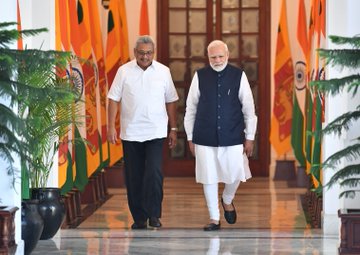

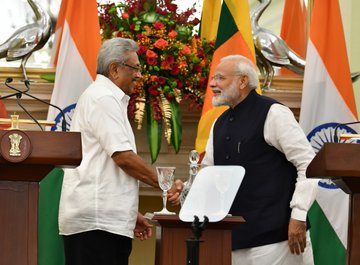

6,7172:05 PM – Nov 29, 2019Twitter Ads info and privacy1,711 people are talking about this
“Since our recent experience in April this year, we have had to rethink our national security strategies, and assistance from India in this regard would be most appreciated”, President Rajapaksa said.
The talks also focused on issues like fulfilling aspirations of the Tamil community in Sri Lanka, how the country could benefit from certain economic sectors of India and address India’s concerns on the fishermen issue.
Gotabaya Rajapaksa said that the fishermen issue would be addressed and also agreed to the demand of releasing boats of Indian fishermen.
“We discussed in length the fishermen’s issue and we will take steps to release the boats belonging to India in our custody”, he said.
India and Sri Lanka saw a major dip in ties in 2014 when Mahinda Rajapaksa allowed docking of Chinese submarines in Colombo’s harbour. Both sides reaffirmed that no destabilising factor would be entertained by wither administration in the Indian Ocean waters.
“We will continue to work with India to ensure that the Indian Ocean region remains as a zone of peace”, said President Rajapaksa.
India seeks to outbid China with aid for Sri Lanka
November 29th, 2019Courtesy rthk

India, anxious to counter China’s influence in the region, on Friday offered hundreds of millions of dollars in aid to Sri Lanka as the island’s new president made his maiden overseas trip in New Delhi.
Gotabaya Rajapaksa’s visit to India just 12 days after he became president is being intensely watched as New Delhi and Beijing compete to control the Indian Ocean and its strategic sea routes.
Sri Lanka has traditionally been allied to India but China invested and loaned billions of dollars to the island nation during the decade-long reign of Rajapaksa’s elder brother Mahinda Rajapaksa.
After talks with the new leader, India’s Prime Minister Narendra Modi said his country would give US$400 million in credit to Sri Lanka to improve its economy and infrastructure.
He offered another US$50 million to boost Sri Lanka’s security and intelligence gathering – notably after the April 21 attacks by Muslim radicals that killed 258 people.
“A strong and prosperous Sri Lanka is not just in India’s interest but the entire Indian Ocean region,” Modi said as he welcomed Rajapaksa for the three-day visit.
“The security and development of our two countries are interlinked. Therefore it is only natural that we remain mindful of each other’s security and sensitivities,” he added.
Ex-cop alleges Shani, others coerced to implicate Gota, Namal in Thajudeen probe
November 29th, 2019By Lahiru Pothmulla Courtesy The Daily Mirror
Former Crime Branch OIC at the Narahenpita Police A. D. Sumith Chammika Perera yesterday alleged former CID Director Shani Abeysekara and several other officers coerced him to implicate Gotabaya Rajapaksa and Namal Rajapaksa in the Wasim Thajudeen investigation.
Speaking at a news briefing organised by the Sathya Gaweshakayo Organisation, Mr. Perera said he launched a probe over the Thajudeen incident after informing higher officials within a legal framework in 2012.
When I looked to find the last place where the deceased was at before he came and what he did, I received information that he was at F5 unit at the Anderson Flats where he and two others were consuming alcohol until around 11.45 pm. One was Thajudeen who was killed and two others,” he said.
He said he was transferred as Nelliady Police OIC in Jaffna in 2015 and during that time a CID Sergeant called him and said a statement was needed to be recorded.
I came to the CID at least 15 times from Jaffna and after three, four days, they told me that what they needed was the names of Namal and Gotabaya. They asked me to say that Namal and Gotabaya told me over the phone to brush the investigations under the carpet.
I received no such directive from anyone. I was summoned to CID two days later. What they did was wasting peoples’ time. During the last two days, an ASP named Weerasekara, another one named Tissera, Shani and Director CID Nagahamulla threatened me to pronounce the names,” Mr. Perera said.
He said he was arrested for not doing what he was asked to and said had he done what he had been asked, he would have to leave the country as Nishantha did.
After I was released, I wrote to the IGP, Human Rights Commission, President’s Secretariat, PM’s Office but there was no response. The IGP said he was unable to reinstate me because I didn’t do what they had asked me to do,” he said adding he would take legal action against the injustice caused to him.
When asked why he couldn’t come up with the information before, he said he was afraid to do so.
Meanwhile, Sathya Gaweshakayo Convenor Attorney-at-Law Premanath Dolawatta said Mr. Perera was named a suspect, and therefore, he could not reveal this information earlier. Now he is released from the case,” he said.
Extracts from “Tamil Tigers’ debt to America”
November 29th, 2019By Dr Tilak S. Fernando Courtesy Ceylon Today
Daya Gamage worked at the American Embassy in Colombo, as the Sole Foreign Service National and a Political Specialist. He retired in 1994 and has been living in Las Vegas since retirement. After two years of concentration, he has been able to share his knowledge, understanding and his intimate professional association with the US Department of State in the form of a book – Tamil Tigers Debt to America’. Being aware of how America’s foreign policy worked- sometimes in a strange manner, he has come out with an unbiased text full of data in his book nowhere else is contained. Daya Gamage has authorised the writer to ‘to quote anything from his book’ so that the readers will get a clear picture of America’s Foreign Policy, Sri Lanka’s National Issues and the LTTE struggle in depth. Gamage handles the United States Bureau of the Online daily newspaper Asian Tribune constantly making the readers knowledgeable of the U.S. foreign policy towards Third World Nations works. His book is available at Amazon.
On 6 May 2009, exactly twelve days before the complete annihilation of the LTTE with its top leadership, in a special media gathering at the State Department in Washington, the USG (United States Government) quite accidentally disclosed its long-held notion, which was developed and nurtured within the portals of the US Embassy in Colombo in the 1980s and 1990s. This was very familiar to Daya Gamage.
Mike Owens, the Deputy Assistant Secretary of the State for South and Central Asian Affairs, who had previously served as the Political/Labour Officer at the US Embassy in Colombo, at this 6 May, 2009, special media briefing disclosed what Washington contemplates ‘what to do’ with the Tiger Leadership. Daya Gamage gives, in detail his quote and the interpretation to Washington’s outlook in a subsequent chapter (in his book ‘ Tamil Tigers’ Debt to America).
Development
The idea that the birth of the LTTE was the result of the grievances of the Tamil community governed the USG policy throughout and led the United States to do the following:
‘Make the LTTE a legitimate voice of the Tamil grievances by officially encouraging the GoSL to accept it as an ‘equal’ partner at the negotiating table.
‘While encouraging measures to drastically control the LTTE’s military capability and its fundraising ability and to block its arms procurement avenues, maintain it as a pressure group of the Tamil voice, so as to force the GoSL hand to grant Tamil demands that had been highlighted earlier by the Ilankai Thamil Arusu Katchi (Lanka Tamil State Party or Federal Party), which was the first Tamil political party to adopt a resolution at its inaugural session in 1951, highlighting a demand for self-determination of the Tamil People), the Tamil United Liberation Front (TULF), which adopted the separatist resolution in 1976 and even introduced it in the Massachusetts State Assembly in 1979 and the Tamil National Alliance (TNA – a creation of the LTTE). The marginalisation of established democratic Tamil political parties as a result of the militarily powerful LTTE reducing them as its appendices made the United States encourage the GoSL to make the LTTE an equal partner at the negotiating table.’
‘Move the top hierarchy of the already crippled LTTE out of Sri Lanka to invigorate the debate on Tamil rights/grievances. The Officials of the State Department were already in a dialogue with several Tamil expatriate organisations based in the United States for many months or years.’
‘Using the post-LTTE developments, force the GoSL to adopt a policy of accountability and transparency regarding the incidents that occurred from April through 18 18 May 2009, which are described as violations of International Humanitarian Laws (IHL), crimes against humanity, war crimes, and genocide to forcibly push the political agenda professed by the FP, TULF, and LTTE on Tamil grievances, especially bringing pressure on the GSL to implement more than what was in the 13th Amendment of the Constitution that talks of Devolution of Administrative and Political power to the periphery, main objective of allowing the Tamils in the North and East of Sri Lanka to run their own lives with minimal interference from Colombo, with land and Police powers, while maintaining the unitary character of the Constitution’.
Drawing attention to Notion 3 above, Mike Owens was very clear at the special media briefing on 6 May 2009. He was the first US official to reveal that the US Government wished to organise the surrender of the entire LTTE corps of fighters, inclusive of its leaders, as one facet of a rescue operation that would ensure the safety of the civilians in the battle zone. Daya Gamage agrees with the salient pronouncements made by Mike Owens on behalf of the American administration for everyone to come to their conclusions.
Media Statement
“We are trying quietly behind the scene to find a way to bring an end to the fighting. It’s very difficult to see exactly how that is going to happen, but we think there are a couple of elements that need to be involved, and we need to find a way for the LTTE to surrender their arms possibly to a third party in the context of a pause in the fighting, to surrender their arms in exchange for some sort of limited amnesty to at least some members of the LTTE and the beginning of political process.
“Now that is a pretty vague outline, it’s going to have a lot of negotiations with parties involved to bring that to fruition in a coherent way, but that is something underway behind the scenes to try and find a way to reach that point.
“I just want to emphasize this is what we would like to see happen, but we do not have any illusions that this is easy to engineer. It’s something that we have been working very hard and quietly behind the scenes because we see that the only potential to bring this to an end is to have a package in which we have a pause, and the civilians were allowed to leave. And now it is very clear that many civilians do want to leave in spite of the fact the LTTE has said earlier they do not want to leave”.
“So, what we would like to see is a package, in which there is a pause, and then during that pause, not only the civilians leave but we also make some arrangements between the Government and the LTTE that would involve trading off surrender of arms for a limited amnesty. The Government of Sri Lanka has previously offered a limited amnesty. This would be for the lower level LTTE cadre, not the leadership.
“I think one of the big questions is what to do about the leadership, and that’s certainly not easy to answer. This is a very complex and very difficult sort of thing to orchestrate. There are many problems, and we are running out of time. We really, literally, have a matter of a couple of days maybe in which we can try to get this finalised. So, we are working on it, but I don’t want to raise expectations that we are close to a comprehensive agreement.”
US Embassy Cables
A segment of the US Embassy in Sri Lanka’s classified cable to Washington sent by Ambassador Robert Blake (disclosed by WikiLeaks) gives a glimpse of the endeavour by the United States to arrange surrender of the LTTE cadre.
The following is the text of the classified cable:
” Ambassador contacted senior GSL officials throughout the day, including Secretary of Defence Gotabaya Rajapaksa and Foreign Minister Bogollagama, to urge acceptance of a mediated surrender of the remaining Tigers and maximum restraint on the part of the military to avoid further civilian casualties, particularly after the reports from the Bishop of Mannar of continued high number of civilians in the safe zone. Rajapaksa refused to accept mediated surrender because the fighting was all but over, but said troops had been instructed to accept anyone who wishes to surrender.”
tilakfernando@gmail.com
Courtesy: Daya Gamage – ‘Tamil Tigers’ Debt to America’.
To be continued – Intense Pressure of a different kind.
Chairpersons & director boards of state institutions asked to resign
November 29th, 2019Courtesy Adaderana
All ministerial secretaries have been directed to call on current Chairpersons and the Boards of Directors of State institutions to tender their resignations.
Secretary to the President Dr. P.B. Jayasundara has addressed a letter to all ministerial secretaries to request the relevant resignations in consultation with their respective ministers, the Prime Minister’s Office said today (29).
The ministerial secretaries were further instructed to take interim measures for the daily conduct of affairs of these organizations until new appointments are made for these top positions.
President Gotabaya Rajapaksa yesterday (28) appointed a six-member committee to recommend qualified professionals for the topmost positions in State enterprises, government-owned companies and statutory agencies.
In keeping with the pledge in his election manifesto to create profitable state enterprises, President Rajapaksa appointed this committee to evaluate nominations and recommend the appointment of competent personnel to the boards of Public Sector institutes.
Mr. Sumith Abeysinghe, former Secretary of the Cabinet of Ministers and senior State official with extensive experience in the public sector, will chair this committee.
Former Chairman of John Keells Holdings Plc. Susantha Ratnayake, former Securities and Exchange Commission Chairman Dr. Nalaka Godahewa, Hela Clothing Chairman Dian Gomes, Neurosurgeon Dr. Prasanna Gunasena and Senior Lecturer Jagath Wellawatte have been appointed as committee members.
CID denies involvement in incident regarding Swiss Embassy staffer
November 29th, 2019Courtesy Adaderana
The Criminal Investigation Department (CID) has commenced investigations into the incident regarding the local staffer of the Embassy of Switzerland in Sri Lanka, says Police Spokesperson SSP Ruwan Gunasekara.
The CID will work together with the Colombo Crimes Division (CCD) and CCTV Division in this regard, he said further.
The Police Spokesman stressed that the CID has denied allegations claiming its involvement in the said incident.
In the meantime, Prime Minister Mahinda Rajapaksa said Swiss Embassy is yet to cooperate in the ongoing investigations over the alleged incident on its local staffer being kidnapped and threatened.
He stated this responding to the questions directed by media persons today (29) at the Ministry of City Planning Water Supply and Housing Facilities.
The Prime Minister said despite the staffer in question not recording her statement with the Police yet, investigations would continue on the matter.
The Swiss Embassy has been requested to render its support to identify the persons responsible for the incident, PM Rajapaksa said.