An eye opener to all airlines

April 1st, 2018

By Dr.Tilak S. Fernando Courtesy Ceylon Today

A friend in Melbourne sent me a stimulating email last week, about a novel experience inside the SriLankan Airlines, single aisle Airbus 320, Karachi-Colombo Flight (UL184). The incident which occurred on 8 March, has been already been brought to the notice of the Director Flight Security of the airline by a passenger, who witnessed the incident inside the economy class cabin of this single aisle aircraft.

It is necessary to emphasise, at the outset of this article, that neither the passenger nor the writer has any prejudices or racial connotations in highlighting this event, except what the passenger has brought to the attention of the Director of Security about an incident that took place in ‘God’s land,’ the repetition of such behaviour, which may lead towards setting a precedence in future flights, on any airline, for that matter. The passenger has advised SriLankan Airlines to take serious note of the possibility of evil masterminds, who might imitate such behaviour to plan acts of terrorism, where they consistently gather intelligence about weaknesses in flight security operations that would give them an opening to perform terrorist acts!

Cockpit of a airplane – Picture credit : Ceylon Today

Air Travel

Air travel has become one of the fastest modes of transport in the jet age, from one destination to another even around the world in twenty-four hours. Air travel, as a part of travel for pleasure or on business, has become much safer than other modes of transport.
Air accidents, by far, are rare, yet there have been certain instances where human error or sheer negligence on the part of pilots, technical hitches and or poor maintenance from engineering sections of airlines, and terrorist attacks becoming accountable. In this respect, it needs to be highlighted that SriLankan Engineering has become a holder of the prestigious EASA 145 certification from the European Aviation Safety Agency, and was recognized as the Best Global Operator of both A330 and A340 from the Airbus Industry in 2012.

Experience inside an aircraft during a stormy weather or turbulent conditions could be quite nerve-wracking. The skill of the pilot depends on how he controls his aircraft during take-off and particularly during landing operations in order that passengers do not feel uncomfortable. By the same token the cabin crew takes the responsibility for cosiness and the security of passengers.

Praying on the aisle.
When this aircraft had reached the cruising altitude, and the seat belt signs had gone off, a Muslim passenger had blocked the aisle between the economy and business class cabins (the curtain between the cabin was closed), placed a prayer mat on the floor and started performing his ritual prayer, thus blocking the single aisle of this small aircraft.

A lady steward having noted this unusual behaviour of the passenger in the economy class cabin failed to act. This was followed by a steward emerging from the business class cabin and drawing the curtain, while another standing passenger had gestured the steward to wait until his friend finished his prayer routine. Despite the steward’s advice and the lady steward’s comments that such praying was non-acceptable on board a plane, the standing passenger had continued to block the passage, while the other continued to conduct his prayers.

This has created a situation where the economy class passenger in a front row taking  charge of a section of the cabin of this single aisle aircraft for the purpose of conducting a prayer ritual. The plane was full of passengers from Pakistan, who had shown signs of appreciation about the prayer routine. Thankfully, the prayer session had ended, and the aisle was free, and the rest of the flight was normal and peaceful.

The passenger, who observed the drama, had written to the Director Flight Security, SriLankan Airlines, pointing this out as an extremely serious incident.  The writer speaking to the passenger found out that he is a regular Karachi-Colombo sector flier who said that he had observed previously too, passengers attempting to conduct prayer rituals, but only at the back of the plane without inconveniencing other passengers. His emphasis was that no other international airline would ever permit such an act!

Tradition
Islamic tradition dictates that Muslims must perform five formal prayers daily. A missed prayer is a serious event for them, and not one that should be dismissed as inconsequential.

Practicing Muslims are expected to acknowledge every missed prayer and to make it up according to accepted practice, later. While it is understood that there are times when prayer is missed for unavoidable reasons, the door to repentance is always open. If a prayer is missed, it is common practice among Muslims to make it up as soon as it is remembered, or as soon as they are able to do so. Depending on the circumstances, during the defined prayer times, one could always conduct one’s prayers while even being seated.

This also brings up a controversial issue about the direction in which prayer is offered while seated or praying inside a moving plane. It is an accepted fact that Muslims should face the Qubla, which is in Mecca, when prayer is offered. Inside a moving plane, at an altitude of 33,000 feet above ground level, how is it possible to ascertain the direction of the Qubla? It is a universal veracity that every person is free to practice his own religion, but to do so, by disturbing another’s composure should be frowned upon.

With this passenger’s previous experience on PIA flights on domestic routes, he states that he had never observed such rituals conducted on the aisle of an aircraft. He is absolutely certain that even the PIA staff would firmly have dealt with such a problem, if it were to take place on a PIA flight.  The question that arises out of this incident is whether SriLankan Airlines staff are not trained and instructed to act in order to avoid any friction or tension between staff and passengers who seek to demonstrate religious fervour? The airline’s responsibility should be to train the cabin crew to deal with such situations during their training sessions on the ground, but certainly not inside a flight, up in the sky.

With ethno-religious conflict frequently occurring in Sri Lanka, an aircraft in flight could be an ideal platform for a committed group to draw attention to a cause. The more frightening scenario would be, if a fanatical group, with suicidal tendencies, were to create mayhem by taking control of the cabin, it would jeopardise the safety of passengers, cabin crew and the aircraft.

As a passenger who had to gone through this unusual experience, he has sincerely informed the Director Flight Security, that his narrative was not meant to be anti-Pakistani or anti-Muslim. He is married to a Pakistani lady, and his son, he says, was born in Pakistan and he is a frequent traveller who has cultivated wonderful Pakistani friends and enjoys an excellent relationship with the power sector professionals in Pakistan”.

Having travelled to many parts of Pakistan, he admires and acknowledges the friendly nature of the Pakistani people, and describes the country itself as an incredible adventure travel destination.

Pakistanis are weighed down with a monstrous negative socio-political baggage with the country consistently drawing bad publicity worldwide. If any person personally experiences such a situation inside a flight, that person is bound to have zero tolerance in the face of such undisciplined individuals who seek to rub their mind-sets on others’ faces. The million-dollar question is whether anyone would be comfortable in an aircraft when a passenger acts in a manner that disturbs the composure of a full complement of passengers in terms of the security of the aircraft in flight?

tilakfernando@gmail.com

WHO IS MOST UNPOPULAR IN SRI LANKA – PRIME MINISTER MR RANIL WICKREMASINGHE OR PRESIDENT MR MAITHREEPALA SIRISENA

March 31st, 2018

By M D P DISSANAYAKE

Currently all guns are directed at the Hon Prime Minister Mr Ranil Wickremasinghe.   President Maithreepala Sirisena is occupying the highest office of the land at the behest of Mr Ranil Wickremasinghe.

In the most recently held local government elections, Mr Ranil Wickremasinghe’s  political wing was placed second, in spite of Bond Scam allegations and mis-management of the economy. Popularity of the UNP was not shattered at the election.  Popularity of Mr Wickremasinghe was not shattered at the election.  To his credit, during the election campaign he did not blame the President Sirisena, he was far more diplomatic.    He openly admitted that the economy was not progressing during past two and half years, but he strongly portrayed and promised the voters that the remaining period in office, a significant progress will be achieved.  To that extent Mr Wickremasinghe displayed ‘last minute honesty’, for which he should be given full credit.

On the other hand, how did Prez. Sirisena conduct himself at the election.  With a view of preventing anti UNP votes flowing to the SLPP, the President suddenly portrayed himself as the strongest enemy of the UNP.  He attacked his own PM on grounds of dishonesty.  He attacked his own PM as unfit to manage the economy.  He virtually played the role of  Manuel of the Fawlty Towers, pretending ” I KNOW NOTHING”   to  absolve  himself  from the cardinal sins committed by the Yahapalana Government.

  • The President presided at all Cabinet Meetings,
  • the President allocated Ministerial portfolios to his Ministers, including allocation of the Central Bank to the PM,
  • the President  appointed RW  as Prime Minister with only 46 seats in Parliament  out of 225,
  • the President appointed RW, without dismissing or seeking resignation of the then Prime Minister Mr D M Jayaratne,
  • the President gave the nod for the formation of Hybrid Court,
  • the President gave his blessings to arrest Ranaviruvo,
  • the President approved the appointment of Arjun Mahendran as Governor of the Central Bank,
  • the National Anthem was sung in Tamil in the presence of the President
  • the President’s brother Dudley Sirisena now owns the largest number of Rice Mills in Sri Lanka,
  • the President approved the appointment of Mr Sambandan as the Leader of the Opposition with only 16 seats in the Parliament,
  • the President has provided STF security to Mano Ganeshan just before the recently held elections for Colombo Municipal Council, in order to obtain favours from Mano for the SLFP.

If PM RW is accountable for ruining the country, its culture and economy, the President Sirisena is also equally accountable on grounds of Contributory Negligence.

The President Sirisena will never go against the PM RW.  The developing latest political  drama point to RW becoming the President as President Sirisena step down, allowing a SLFP MP to become the Prime Minister and continue Yahapalana Government.  Needless to say, that this political development  will be embraced by the Westerners, Tamils etc.

NO CONFIDENCE MOTION: QUOVADIS J.O?

March 31st, 2018

Sugath Samarasinghe

I do not understand the strategy of the JO in moving this No Confidence Motion against Ranil Wickramasinghe. What is their ultimate goal, I wonder?

Immediately after the victory of Israel after their famous Six Day War where they trounced the braggart UAR in 1967, a journalist asked Israeli General Moshe Dayan, What is the best way to win a war?. General Dayan quipped Have the Arabs on the other side!”  Similarly, the easiest way for the JO to win the elections in 2019 and 2020 is to have Ranil leading the UNP. Surely that is not rocket science? He has a proven track record of losing multiple elections for UNP other than in August 2015; and that too a lame victory. In fact Mahinda Rajapaksa, a shrewd tactician, helped Ranil to continue as leader of the UNP several times as if by mutual understanding, during his time as President.

Ranil has even proved this point himself in the recent Local Government by polling only 32% for the UNP. What more proof of his inability to lead? If it was in another country, when it became clear that he was ultimately responsible for the  unheard of daylight robbery” at the Central Bank by his ‘Golaya’ whom he brought from Singapore, he should have resigned on his own in the true democratic tradition. But he was so thick skinned that he didn’t. So why is the JO sweating to remove him when he is their sure winning factor? After all, we know that the track record of the JO is not squeaky clean either! They are only there for the lack of an alternative.

On the other hand, if they succeed in ousting Ranil as PM at this juncture, the JO will find it that much more difficult to defeat the UNP at the hustings if they appoint a new leader. Whoever that person would be, he will offer some hope to the disgusted UNPers to return to their fold at least in temporary hope. So why do the JO want to queer the pitch?

The only area of concern if Ranil is allowed to continue is, what further damage he could do to the country during the interim period? Besides the Central Bank Robbery he has sent this country to gallows with the co-sponsoring of the UNHRC Resolution in collaboration with his fellow traitor Mangala. He had sold the Hambantota Port to China, causing so much inconvenience to India and now bent on selling the Hambantota Air Port and Trincomalee harbor to India to compensate. He will push through the deadly ETCA agreement with India to ruin this country further. The biggest damage to this country will be his tireless effort to push the dangerous New Constitution proposal, converting this country into a federal state. It is the responsibility of the President assisted by the JO, to prevent these disasters from the brink working with dedication, if the President has any hope of asking the country for a second Term.

I believe that we are a short sighted nation. I mean all Communities. We are not adept at seeing the bigger picture. I think the same problem afflicts the JO who are engaged in a short sighted self-defeating  exercise in vain

In Management, ‘do nothing’ option too is a positive strategy in certain circumstances. This is such a situation for the JO. Do nothing, and let Ranil lead the UNP to its grave, the way that Pied Piper of Hamlin did.

Sugath Samarasinghe

No confidence motion against Ranil should have first initiated by the UNP long ago and not by the JO?

March 31st, 2018

Sudath Gunasekara

31. 3. 2018.

Though already it is too late, the country must thank the JO for presenting a no–confidence motion at least now against the clumsiest and one tracked minded Prime Minister. He is a classic example of a true product of Black Whites” planted by the British to destroy the Sinhala Buddhist nation in this country, who never had his feet on this soil, its traditions or never had a place in the hearts of the majority community in this country. None of the votes polled by him at any date was attracted by his personality, charisma, stature or his public appeal. It was the diehard UNP block vote and the floating minority that decides the election results in this country as usual that has voted him.  He has proved over time beyond all reasonable doubts that he is  the number one man , even surpassing Chandrika, utterly unfit to lead this Sinhala Buddhist country, we ever had since Independence. The sooner he is removed the better it is for the country and even more for the UNP before any more irretrievable damage is done to this country.  Had he by any chance got elected as the President in 2005, by this time, we would have completely ceased to be a Sinhala Buddhist country any more by now. His heart and soul are both wedded to power and self-aggrandizement far away from public good that is enshrined in statecraft of this country as the whole mark of governance.

Thanks to the Guardian gods and the blessings of the Triple Gem and the blessings conferred upon this land by Lord Buddha we got Mahinda elected as the President. If he dint, Ranil would have by now completed the job initiated by Don Juan Dharmapala in the 16th century and furiously after 1818 by the British colonial invaders.

As everybody knows he was never a born, a made or a leader on whom leadership was thrust upon. First he was pushed to the path of leadership by this uncle JR in 1977 for obvious reasons JR may have had in his head. His ascendancy to the Premiership, both in 2001 and 2015, were mere accidents. The deaths of people like Gamini and Lallith had provided an irreparable vacuum for UNP leadership, for him to be accepted as it leader not by consensus but by circumstances and subsequent manipulations by himself. Even D.B Wijetunga did not select him as his successor that is why he opted for Gamini. As I see he did not know what democracy is. He first ran away in front of giants like Gamini and Lalith and thereafter wiped out all potential leaders like Senanayakas, Sajith, Jayasekaras and Aluvihares. Look at those who are in his inner circle instead, Ravi karunanayaka, Sagala Ratnayaka, Samarawickrama, Rajita Senaratna, Champika Ranawaka, Kiriella,  Mangala Samaraweera, John Amaratunga and Gamage with economic wizards like Arjuna Mahendran, Paskaralingam, and Charith Ratwatte just to name a few (wait and see all the politicians in this group se will lose even their deposits  at the next elections if they contest).

In the midst of all these only Mairtipala Sirisena selected him as leader and appointed as PM rather illegally and unconstitutionally in 2015, in return to the UNP block vote that won him the elections unexpectedly as President. He took three years and three months to realize that he has done a serious blunder. But I am happy at least now wisdom has dawned upon even him even at last. But I mark a note of caution as I have done several time before, the possibility of the most unexpected for him could happen, as that is the only way for Ranil to be the President of this country.  I only pray that such calamity should never happen.

So far only solitary figures like Maitri Gunaratna have been making some noise against Ranil in the UNP None of the other fools have been able to realize to what abyss Ranil has taken the UNP after the death of Gaminis tragic death. They provide the best example for modern classical golayas of Mahadenmutha the wise. Ranil first ran away from Leadership after the death of Wijetunga making room for a cake walk for Gamini. Then in 1910 he brought Fonseka for the Presidency and Sirisena at the instigation of Chandrika in 2015 as he knew that he can never get elected as the President by public vote. Going by his record I am surprised that he did not conspire to remove Sirisena so that he could be the President automatically under the Constitution. In fact I had made this warning several times to President Sirisena, although he has not heeded it worthwhile. Ranil has lost all elections since 1994 and the total number is reckoned as 29 of which the latest is 2018 Feb 10th. All this has made him the worst leader the UNP ever had since 1948 in its history. When people are dying of hunger he talks of wyfys, braze-lets, Laptops and denims trousers, 1 million jobs and Voxwagon car factories where even a fox is not to be seen after 3 ½ years of his Government. His conspiracy to ruin the Central Bank and how he did it and the irrevocable damage he has done to the country’s economy and the only other national political party, the UNP, which had a deep rooted public appeal and the way he spoke and behaved like a Maradana chandiya  in Parliament with Kiriella a new comer to UNP,  bypassing all old stalwarts and the failure to build up a second generation of leadership in Parliament for the past 3 years alone should have opened the eyes of these UNP fools to ask him to step down immediately without ruining the UNP beyond recovery and bringing disgrace to a giant political organization founded and nursed by giants like DS, JR and Premadasa.

Now all that have failed do these people have any option other than supporting the no-confidence motion brought up by the JO and rescue the UNP from this veritable and incurable cancer that is Rani, if they love the Party and the country and elect a patriotic, dynamic and charismatic leader first who has his both feet on the motherland, so that he could lead the party to come out of its present abysmal depths and restore it on a firm footing as the people of this country badly needs a second political party in any case to act as  watchdog of the peoples rights.

Majority of people in this country as shown at the Feb 10th elections hold this view. So if you don’t fall in line with the direction of the wind, I can assure you all will lose even your deposits in the next general election and the UNP will disappear from Sri Lanka. Therefore think not only twice but many a time before you commit political harikiri by not supporting the No confidence motion in Parliament. Even if the UNP wins the NCM on the 4th the demise of UNP under Ranil no one can stop. Ranil will go down in Sri Lanka’s history as the man who killed and buried the UNP in 2018, the same way as Chandrika and Sirisena who have already entered Mahavamsa as the woman and man who jointly murdered and buried the SLFP by conspiracy.

YAHAPALANA ELECTIONS AND ‘REGIME CHANGE’ Part 8

March 31st, 2018

KAMALIKA PIERIS

February 2018 saw the third Yahapalana election take place. This was the long postponed local government elections, which for the first time   were all held on the same day, making it feel like a general election. The elections were contested on a political party basis with UNP, SLFP, UPFA, JVP, and TNA fighting it out. This election saw the emergence of a new party, Sri Lanka Podujana Peramuna.

This is not an election that Yahapalana wanted. Therefore, there were obstacles. Nominations were rejected for flimsy reasons. Nominations of the United Left Front   for Nivitigala Pradeshiya Sabha was rejected because there were 15 names instead of 12.  The        returning officer refused to allow a correction. When the ULF representatives went away and   came back with the revised list, they were detained at the gate till 12 noon. When they finally met the returning officer, he said that nominations closed at noon and had refused to accept the list! Over ten nominations lists were rejected. Supreme Court refused to touch the matter.

The Local Government elections were held on February 10, 2018. The election was peaceful with no major incidents being reported  said CaFFE Executive Director Keerthi Tennekoon. The election had a very high voter turnout, especially for a local government election. Television news showed long queues, grim looking voters and many feeble senior citizens, determinedly, going to vote, helped by others.

According to the District Returning Officers    district-level voter turnout was   85% at Anuradhapura and Trincomalee, 80%  at Kalutara, Matale, Moneragala,  75%- 78% at  Batticaloa, Galle Gampaha, Kilinochchi , Kurunegala, Mannar, Mullaitivu, Polonnaruwa and  Ratnapura,

This local government election had assumed national importance. People took it as an opportunity to give vent to their suppressed anger with the government over its performance. It became an unofficial referendum on the government, said Rohana Wasala

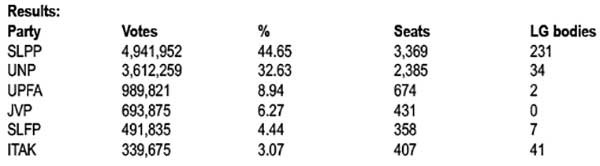
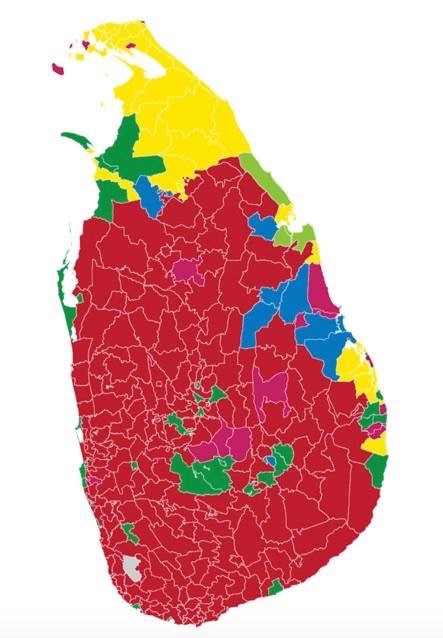
The results were:

sourcehttps://www.colombotelegraph.com/index.php/lessons-from-lg-elections- /

The important result of this election was the emergence of the   Sri Lanka Podujana Peramuna (SLPP) as the most popular party. This SLPP was a new, untested, political party, registered only in November 2016. Yet it succeeded in beating the three government parties, UNP, SLFP and UPFA as well as the reserve party, JVP. SLPP polled 44.69 per cent, 2 per cent less than the other three parties put together. This is the first time since 1948 that a government in power lost at LG polls, said Rohana Wasala.

The large number of votes for Sri Lanka Podujana Peramuna (hereafter Pohottuwa or SLPP)    was not a surprise for those who had watched the numerous rallies held after 2015 presidential election and the huge attendance at Pohottuwa election meetings. The popularity of this party was never in doubt. From the time Yahapalana came to power, there were huge pro-Rajapakse rallies and marches and the election campaign saw massive crowds at the Pohottuwa meetings.

But it was an unpleasant surprise for the Yahapalana government. ‘We are not where we hoped to be by this time, said Mangala Samaraweea.” For about a week or ten days after the elections, the President and Prime Minister stayed out of the public eye. They were not seen on television news giving away prizes, opening buildings, speaking at functions as they used to do before. USA, though active also kept a low profile, until on the 24 of February, we were told that USS Mercy   would visit. Some observers see a similarity between 1815 and 1818 and now 2015 and 2018.

Before the elections, the JVP really believed that it could comfortably gain votes at the expense of the UNP and the SLFP. A confident JVP went to the extent of declaring intentions to achieve kingmaker status at the next Presidential and Parliamentary polls. Instead, the electorate has delivered a humiliating snub to the JVP, perhaps for its in backing the government at crucial junctures, especially in helping to get certain anti-democratic legislation passed with 2/3 majority in Parliament, observed Shamindra Ferdinando.

CaFFE Executive Director Keerthi Tennekoon said What we have seen in this election is a very unique situation. The flower bud party very clearly won the election. No government in power has ever lost so badly. This clearly indicates that during the past two-and-a-half years this government has failed miserably. The people had given the government a clear sign to step down. He warned that if the government fails to respect the people’s verdict, there will definitely be a mass uprising against the government from next week.

The people have given their verdict. Honest crooks are better than dishonest crooks. Naked ambition is preferred to ambition wrapped in false altruism. Better to have good war winning crooks than crooks who shield other crooks”, said a cynical observer.

The triumphant Pohottuwa held a media conference after the election. Its leaders paid a glowing tribute to both print and electronic media for ensuring sufficient coverage for them in spite of difficulties.

This was a historic victory. Never before had an Opposition political party defeated the governing party at a local government election.  UNP had spent over Rs. 1 billion for propaganda and  SLFP a little less than that, yet they couldn’t overcome growing public resentment.  President Sirisena and Prime Minister Wickremesinghe couldn’t even win their Polonnaruwa and Colombo districts. Former President Chandrika Kumaratunga could not win Attanagalla either.

A smiling Dinesh Gunawardena said that President Sirisena and PM Wickremesinghe had suffered an unprecedented heavy defeat at the first Yahapalana election in three years. “This is nothing but a shameful defeat for the President and the Prime Minister “, he said. Never before had a new political party defeated both leading political parties in Sri Lanka’s political history.  Not only the village, but most of the towns and cities have placed their trust and confidence with the SLPP.

Yahapalana must now give up power. They have been rejected by the people. . Even the people of the Polonnaruwa district have placed their confidence with the SLPP as it had won with more than 5,000 vote majority, concluded Dinesh. The Yahapalana leaders, Sirisena and Wickremesinghe should realize what they badly lost was a referendum on the performance of three-year coalition, said G.L.Pieris.

Wimal Weerawansa said the people had been so disappointed with Yahapalana mismanagement of the country, they overwhelmingly voted for SLPP proxy at Maharagama and Thirippane to inflict losses on Yahapalana partners. SLPP had backed independent groups contesting Maharagama Municipal Council and Thirippane Pradeshiya Sabha since their nominations had been rejected.

Weerawansa said that there had never been an instance of a party in power losing local government polls like this. This victory was even bigger than the 1956 revolution. I agree. I was also thinking the same. I remember the 1956 election.

The 1956 result was looked down on. It was seen as the push of a backward group of Sinhala speakers who should never have been given a say in politics. The Pohottuwa vote, on the other hand cannot be dismissed lightly. It was a carefully considered vote of a seasoned electorate who had been going to the polls for years and years.

Pohottuwa is not a breakaway party of the SLFP. Chamal Rajapaksa made this clear on television. ‘This is a new party’, he said, ‘not a branch of the SLFP or UPFA’. Pohottuwa votes were also not   votes of disenchanted UNP and SLFP voters. Such votes would have gone to the JVP who were eagerly awaiting them. Pohottuwa was not the refuge of the floating vote either. That too would have gone to the JVP. It is possible; however, that some of the floating vote has now come to roost in the Pohottuwa, provided the Pohottuwa delivers what is expected of it.

Pohottuwa is a pure Mahinda Rajapaksa party, unconnected to the SLFP of the Bandaranaikes. In fact Pohottuwa has no links to anything except to   the much reviled Mahinda Rajapaksa, probably to the great surprise of Rajapaksa himself.

The Pohottuwa victory is a   Mahinda Rajapaksa victory. At all election rallies, Mahinda Rajapaksa was cheered like mad when he arrived on the platform. (E.g. see Derana news 4.12.17 Podujana rally at Badulla.) It reminded me of the 1960s singer, Elvis Presley. Elvis Presley was virulently hated and deeply loved in equal proportions throughout his career. Elvis did not care, he continued singing.

Pohottuwa victory has had a positive impact on Mahinda Rajapaksa. He is visibly more confident and determined. He told Indian Express It is quite clear from the massive victory of the Sri Lanka Podujana Peramuna in the recent local elections that people of Sri Lanka want to see us return to power. They want to see an end to the chaos that has reigned in this country since January 2015.” After Putin’s election in Russia Mahinda Rajapaksa was visited by the Russian ambassador to Sri Lanka. Rajapaksa had sent his best wishes to   President Putin.

Pohottuwa is yet a   fledgling, untested political party. But it is directed by very seasoned politicians, who know the game. Therefore   it will not be easy to squash it. Further, Pohottuwa is not simply an anti-Yahapalana party. It is a part of the new wakeup call in Sri Lanka. Pohottuwa may mark a new beginning in the political history of Sri Lanka provided of course Pohottuwa   manages to get its act together and deliver.

An analysis of the votes will probably show that Pohottuwa, unlike the SLFP, has a strong following among the urban intelligentsia. In Kandy Municipal Council,     Pohottuwa came second with 23,300 while UNP got 26,798. In Colombo MC UNP got 131,353 and    Pohottuwa got 60,087 of which one vote was mine! It was a good showing, I thought. Pohottuwa also won elsewhere in the Colombo district, such as Kotte MC, Kaduwela MC, and Kesbewa UC.

Pohottuwa clearly has the formidable support of the Maha sangha. Rows of bhikkus were present at the launch of Pohottuwa. The Maha sangha are virulently anti-Yahapalana today. They appear on television, in groups, never singly,   looking grim, fearlessly using strong words against the Yahapalana government. Critics say that sangha should not meddle in politics. These critics forget that the sangha are citizens of Sri Lanka and are entitled to all political rights enjoyed by a citizen.

The resounding victory of the Sri Lanka Podujana Peramuna (SLPP) symbolized by the Pohottuwa (Lotus Bud) at the recent local government election is something that was eagerly wished for and confidently expected by the sensible majority of the Sri Lankan electorate, said Rohana Wasala.. The extremely unpopular Yahapalana government will be unable to follow its original plans through, including its controversial constitution making project. The anti-government vote means that the Yahapalana regime can no longer find refuge in the so-called popular mandate they claimed to have got in 2015 concluded Wasala.

Pohottuwa is starting to bloom in some local government bodies. The Mayors of Galle and Negombo were appointed from Sri Lanka Podujana Peramuna (SLPP) despite the UNP having won those Municipal Councils. One vote was by secret ballot, the other an open vote. Mayor and Deputy Mayor for Kurunegala, Chairman, and Vice Chairman of Attanagalla Pradeshiya Sabha were from SLPP. Ven. Karagahawela Nandawimila (SLPP) was elected Chairman, Bandarawela PS with the support of three UPFA members. ( continued)

Endangered Nations and Endangered Cultures

March 31st, 2018

R Chandrasoma

Few countries in the world are now in peril because of the marauding spirit of powerful neighbours. This is a recent turn in history –across the centuries powerful nations were imbued with an expansionist spirit that spelt doom for those fated to be close to the ‘hegemonic power’. Protracted wars resulted when neighbours were well matched as fighting machines. Britain’s history – until recently – was dominated by that of warding off the intrusions and threats of the Continental Powers. We in Sri Lanka have been threatened for long centuries by our powerful neighbor India and it is a miracle that we have survived as a civilization for over two thousand years. Times have changed and the use of brute strength to overawe a weak neighbouring state is no longer militarily or politically feasible. But the threat to nationhood exists and we in this country must be vigilant  – because our historical weakness as a small island remains while big-power expansionism is now taking the guise of subtle forms of cultural subversion. There is a new ‘imperialism’ that gets its strength through the cunning manipulation of racial power-bases in politically weak nations.

How does all this apply to Sri Lanka and its polity? It is the weakening of our cultural cohesiveness that is the first victim. This is achieved by a brainwashed and Westernized elite that equates modernism with the erosion of the historic and the indigenous traditions that have long shaped our socio-politcal evolution. It is this ethnicity and sense of belonging to a uniquely endangered culture that is currently being assailed by lackeys of Western Imperialism posing as ‘modernist reformers’. A prime instrument used in this sordid adventure is the ‘foisting’ of a new constitution inspired by an alien elite bent on destroying our historic standing as an independent and culturally distinctive species of humankind. Our greatest enemies are the falsifiers of history – those ‘uprooted’ kinds that promote a bogus modernism – one that sees culture and history as outmoded in the modern world and and that ‘jobs are prior to roots’. Sinhala-Buddhist culture has survived for over twenty centuries – a record that few nations and races in the world can match. It would be historic tragedy if this ancient heritage falls victim to the machinations of power-hungry politicians and their lackadaisical followers.

Former UN Rep Exposes Sri Lanka’s Hidden Viceroy

March 31st, 2018

එළිය Eliya

https://www.facebook.com/eliyaofficialpage/videos/154003705291865/?hc_ref=ARRY5dxQhsKcazj4Rsi1itH2LNk9GNfoIW3-PspsN_yoAW4e6FGZ7hOSTlnmWJPsK7o

Is Coffee Cancer-Causing? California Judge thinks so!

March 31st, 2018

Courtesy dailysocialbuzz.com

Soon when you are in California and enjoying your cup of joe, you might have to stare at a cancer warning too.  According to Los Angeles Superior Court Judge Elihu Berle, coffee makers were not able to present proper grounds at trial to prevail. There is a variety of evidence leading to believe coffee is both beneficial to human health but also a carcinogen especially for the fetus, infants, children but even to adults.

In 2016, coffee made it off the possible carcinogen” list that the World Health Organization runs. Even though a lot of studies show that coffee being the cause for widespread cancers such as breast, prostate, or pancreatic caner is highly unlikely, not enough evidence is present for other lesser explored cancer types. The main concern is how the coffee beans are being roasted.

Raphael Metzger, the coffee drinking attorney, who also brought on this lawsuit said the coffee industry can find a solution removing the acrylamide.I firmly believe if the potato chip industry can do it, so can the coffee industry,” Metzger said. A warning won’t be that effective because it’s an addictive product.”

Yahapalana, land and Trimble

March 30th, 2018

KAMALIKA PIERIS

Sri Lanka‘s land and property ownership issues need careful and urgent appraisal, said economist Sumanasiri Liyanage. No country can achieve fast growth ensuring prosperity for all without proper ownership of land and property. One serious constraint to both industrial and agricultural development is the unavailability of land, said Sanderatne. There is an urgent need to ensure the availability of land for industry, agriculture, and agribusiness enterprises. There is a dearth of land available for commercial and other productive purposes and land is urgently needed to increase our agricultural exportable surplus too.

The government must set up a mechanism for the speedy release of state lands for such export enterprises. Government is the main owner of land in the country, including a large extent of unutilized land, owned by the railway, he observed. There is a need to urgently examine the land utilization pattern in the country and enable the most productive use of land, jettisoning obsolete land laws, concluded Sanderatne.

The main focus however, is on foreign ownership not local ownership. Many foreign investors have been turned back owing to the long delays in, and inability to obtain land, observed Sanderatne. Foreign investors and local entrepreneurs will not be able to undertake large scale export industries and cultivate and process food crops that have an export demand.

Yahapalana has responded to this. Yahapalana budget 2017 announced that Yahapalana will remove restrictions limiting land ownership rights of listed companies which have foreign owners. It will also remove the restrictions on foreigners’ ability to purchase condominiums below the 4th floor.

There is another important issue relating to land, the interesting tussle going on regarding land surveys. Trimble Navigation Ltd, a US company based in California, had in October 2015, forwarded a proposal for ‘Title/Tenure Regularisation and Cadastral Registry Modernisation’ in Sri Lanka. This proposal has been rejected earlier in 2010.

A high level committee headed by senior advisor to Prime Minister R. Paskeralingam had recommended this proposal. The Cabinet Committee on Economic Management (CCEM) approved it and Cabinet accepted it. Trimble had asked for USD 170 million and Yahapalana had beaten it down to USD 154 million. The money would come as a loan at an interest of four percent. The loan is to be paid back in 15 years inclusive of a grace period of five years.

The Finance Ministry’s External Resources Department was authorized to negotiate with Trimble to prepare land survey maps and create a streamlined database of 3.6 million parcels of state owned land. Trimble would first survey 2.5mn blocks of land around the country, excluding the Western Province and issue title deeds. Then it would survey 2.5mn plots of land in the Western Province.

The Government Surveyors’ Association (GSA) announced in January 2017, that there was a move to hand over several operations of the Sri Lanka Survey Department (SLSD), including Land Information System (LIS) and Aerial Survey Operations to Trimble Navigation for 15 years. ‘The required plans are already in place to complete the transfer. It appears that the US government had forced Yahapalana to agree to this, said the surveyors.

They also added that the CCEM headed by the Prime Minister, had neither submitted a Cabinet paper nor waited for the Special Committee’s decision, before deciding to grant the contract to Trimble Inc. There was no calling for tenders either. Yahapalana had also failed to consult the trade union before taking this decision.

The Minister for Lands told the Surveyors Association, that the government has decided to implement the proposal and the Association must support the project. Trimble would work with the Ministry of Lands to identify 2.5 million state-owned lands and help to give permanent titles to the persons currently occupying these lands. Bim Saviya programme launched during the previous Rajapaksa regime was a failure. Under this programme, the department surveyed 1.2 million parcels of land over 10 years and issued a mere 405,000 title deeds from 2005.

There is a need to survey 1.1 million parcels of Jaya Bhoomi and licensed land within two years. The Survey department did not have the technology or the efficiency to achieve this target. Considering the many loopholes that exist in the current land registration system in Sri Lanka, acquiring foreign technology to establish a system that maintains sound ownership and transaction records, a system that is difficult to manipulate, will go a long way towards ensuring property rights.

GSA was not impressed. Trimble would be paid USD 154 million. The Survey department could provide deeds and prepare modern cadastral maps at a cost below 40 million US dollars. The department was already using satellite technology for land surveying in the Western and Sabaragamuwa provinces.

Indrajith Wijayaratne, a surveyor who had worked in Sri Lanka and USA wrote in to say that he had taught at the Institute of Surveying and Mapping at Diyatalawa (ISM), and was confident that this job can be easily handled by the Survey department, provided the needed resources are available. The surveyors already know GPS surveying and probably know Geographic Information System software such as ArcInfo. The project will need state of the art equipment including survey grade GPS receivers, computers with large storage capacity and software. The foreign exchange needed for these will be much less than the amount of the contract offered to Trimble.

GSA had many other concerns about the Trimble project. According to their information, the main functions of the Sri Lanka Survey Department, as well as its Land Information System (LIS) and Aerial Survey Operations would be vested in Trimble for 15 years. Survey Department staff and resources will also go to Trimble. 400 public surveyors and 200 additional private surveyors with crews will serve under Trimble, conducting pre-survey, survey and data collection.

If Trimble is given the management of Sri Lanka Survey Department, then Trimble will take control of Sri Lanka’s electronic land register and details of lands. This will be a threat to country’s national security, said the surveyors. Trimble would also be in a position to obtain sensitive information regarding Sri Lanka’s land. There could be misuse of geological and other data gathered during the extensive surveying.

Trimble will use satellite imagery to survey the land and will issue land certificates based on those calculations continued GSA. GPS surveys and actual ground surveys differ by a significant degree. The lands already surveyed will be mired in boundary disputes due to this variation. Even though Trimble has the technical knowledge of creating the data base they will therefore need local help to ensure accuracy of that data.

Most of the individual claims in Sri Lanka are very small parcels, and disputes are many. Trimble has specified that it will not get involved in adjudication. Therefore this task, the most difficult and trying task in land tenure, will fall upon local surveyors. They will have to adjudicate these individual land claims, at the Department‘s own cost. This should be looked into before proceeding further if the public is not to pay the extra cost of litigation, said GSA.

The government then changed its position. They were not outsourcing the work said the Surveyor General. They were simply acquiring an upgraded system that would make the process more efficient. The work would be carried out by the Survey Department.

Wijayaratne’s observations about Trimble supported this. Wijayaratne said that as far as he knew, Trimble was a company that produced survey grade GPS receivers and other survey instruments. ‘I am not aware of their undertaking of surveys of land that involve individual ownership boundaries.’ According to Wikipedia, Trimble makes Global Positioning System (GPS) receivers, laser rangefinders, unmanned aerial vehicles (UAVs), inertial navigation systems and a variety of software processing tools. Trimble sells to land survey, construction, agriculture, transportation, telecommunications, asset tracking, mapping, utilities, mobile resource management, and government.

GSA said this was not about technology as the Surveyor General said. One can’t help wonder why the Government would spend Rs 25 billion to import a software system. It doesn’t make sense. We suspect that operations would eventually be handed over to Trimble and this is why we demand that the Government stop this”.

If the present technology used in Colombo is the same as the one proposed by Trimble, there was no need to give a contract for such a large sum, to obtain something we already have, continued GSA. Also, would Trimble be offering the latest in the field of land surveying, or would it be an older version no longer used in the West. GSA had no chance to debate the issues since GSA had not been consulted.

Trimble has included biometric scanning for personal identification. This could compromise their personal security, said GSA. The government answered back. At a time when land fraud has become a threat to property rights, several countries have resorted to bio-metric solutions to eliminate fraudulent practices. The Bhoomi Project” in India and e-Tanah in Malaysia are two systems where land registries confirm identities prior to transactions using thumb impressions in addition to signatures.

The move to hand over the task of drawing land survey maps to Trimble was not acceptable to the Survey Department employees. Survey Department trade unions launched a token strike in December 2017, followed by a three day strike in March 2018.

Thereafter, a committee headed by the Land Ministry Secretary, including members of Survey department unions and the Surveyors’ Association was appointed to discuss issues pertaining to the regularization of title deeds, modernization of preparing cadastral maps and the involvement of the US Company Trimble Inc.We have also taken into consideration the hidden costs of the project and the concerns of the unions and these issues are being discussed at present by the appointed committee.

There are costs to be borne by the Survey Department, Land Commissioner General, Registrar General so on and all these costs will be considered and discussed by the committee and included in the report,” said the Committee. Why has the government not considered the proposal of the Survey Department? It is financially more profitable and has long term benefits, the committee was asked.

There was also concern over the country’s sensitive data and survey details getting into the hands of a foreign company. The data is not considered secret or sensitive. They will be managed by the Survey Department. There is no room whatsoever for the country’s sensitive or secret details to get into the hands of any external or unauthorized entity, replied the government.

Discussions between the unions and the government are underway, reported the committee. The strike action launched by the unions has been called off ‘having understood the issue and the requirements of thousands of people waiting for their deeds.’

A Special Committee of 3 Members of Parliament was also appointed to look into the matter. We met the GSA at the Parliament Committee Room and decided to have another meeting in April. Until then we will not take a decision,” they said. We have asked for the relevant documents of Trimble Inc. and for a Cabinet paper to be submitted,” he added. There was no need to worry, as no contract would be given without first, the committee’s decision, and second, Parliament’s approval, and hence, the protest was unnecessary.

Avoiding ‘religious’ violence in Sri Lanka

March 30th, 2018

By ASOKA BANDARAGE Courtesy Asia Times

On the night of February 22, four drunken Muslim youths traveling on a three-wheeler in Sri Lanka’s Kandy district beat up a Sinhala Buddhist truck driver because he had not allowed them to overtake his truck. The police arrested the assailants but released them on bail.

Although intelligence officers had warned that the incident could be used to instigate ethnic tensions in the area, the police did not take immediate action. After the truck driver died and his body was being taken from the hospital on the night of March 2, feeling betrayed by state authorities, villagers burned tires in protest.

Soon the protests spread to other areas in the region, culminating in mob violence and extensive destruction of Muslim-owned homes, shops and mosques by Buddhists. The violence killed two people and injured dozens.

The rioting was brought under control by March 9 after deployment of the Special Task Force, the declaration of a countrywide emergency, and a ban on Facebook and other social-media platforms for alleged promotion of hate speech. More than 80 people suspected of rioting were arrested.

Sinhalese Buddhist extremism has been vehemently condemned for the violence by the United Nations, Western governments, media, academia, and non-governmental organizations and their Sri Lankan counterparts. There is no question that violence by any group against another must be condemned and perpetrators must be held accountable. However, in order to avoid descent into further religious” violence, it is important to move beyond a simplistic depiction of a majority aggressor and a minority victim and consider the multiple historical and social structural causes of the conflict.

Historical background

Communal harmony and cooperation rather than violence and conflict are the predominant features of Sri Lankan society. Muslims who started arriving in Sri Lanka around the 9th century as merchants and pilgrims were peacefully integrated into the society from about the 12th century. Sinhala kings, the Buddhist sangha and the people provided the facilities for the Muslim newcomers to practice their religion without hindrance.

Muslims fleeing persecution by the Portuguese and Dutch, who had ruled the island’s coastal lowlands since 1505, were welcomed and allowed to settle in the Sinhala kingdom. Muslim settlers married local Sinhala and Tamil women. The original Sinhala family names of some of these Muslim descendants are still in evidence in the Kandyan hill country disturbed by the recent riots.

Both colonial and local rulers have manipulated grievances and incited ethnic and religious groups against each other during times of crises and challenges to their authority. A case in point is the Rebellion of 1818, which sought to drive out the British from the Kandyan kingdom. It was sparked when the insecure and unpopular colonial regime appointed a Muslim as the headman of Wellassa, undermining the traditional authority of the Sinhala governor of the region. The British put down the rebellion with utmost severity and repression, consolidating their authority over the Sinhala chiefs and the population.

Similarly, a conflict that emerged in Gampola in Kandy district in May 1915 over the right of a Buddhist procession to play music while passing a Muslim mosque, was used by the British regime in its own interest of divide and rule. Failures of the British to uphold Buddhist customary rights and to arrest a Muslim man who shot dead a Sinhala boy led to widespread violence by Buddhists against Muslims in Kandy and other areas. The British declared martial law, killed a large number of suspected rioters and charged prominent Sinhala leaders with sedition and arrested them to secure colonial domination during the volatile World War I period.

During Sri Lanka’s post-independence period too, so-called ethnic riots have rarely been spontaneous outbursts of primordial Sinhala hatred toward minorities. Rather, communally based conflicts have arisen and been exacerbated either because of state inaction or manipulation by state and outside actors.

The 1983 anti-Tamil violence was a pogrom. Its outcome was the horrific 30-year armed conflict between the Sri Lankan government and the Liberation Tigers of Tamil Eelam (LTTE). There were no mass Sinhala uprisings during the armed conflict against Tamils following LTTE attacks against the most important Buddhist sacred sites, including the Sri Maha Bodhi in Anuradhapura and the Temple of the Tooth in Kandy, or against atrocities such as the killing of young Buddhist monks in Arantalawa.

There are many unanswered questions regarding the forces behind the spread of anti-Muslim violence in the current postwar period. The disturbances in southwestern town of Aluthgama in 2014 were reportedly carried out not by local Buddhist villagers but by outside groups engaged in a planned and well-orchestrated attack to discredit the [then] government.”

There is speculation as to the origin and sponsorship of the extremist group Bodu Bala Sena (BBS), which has been spreading xenophobia, bigotry and hate speech against the Muslims in Aluthgama and elsewhere. There are unanswered questions as to why the BBS was founded in 2012 soon after its leaders returned from a trip to Norwayand why its leader, the monk Galagoda Gnanasara, was given a five-year multiple-entry visa to the United States. After the Aluthgama riots, the previous government lost the 2015 presidential and parliamentary elections, losing the crucial Muslim vote.

While Buddhist extremism has been subjected to global condemnation, there is little attention paid to the extremist Wahhabi Islam that has been spreading across Sri Lanka for the last several decades. In order to avoid further religiously based violence, it is necessary to address how this intolerant and aggressive form of Islam imported from Saudi Arabia is aggravating tensions between Muslims and Buddhists as well as other communities and between different Muslim sects.

Indeed, how is the spread of Islamic extremism disturbing the island’s traditions of harmony and cooperation and contributing to communal violence?

Current situation

According to local villagers affected by this month’s events in Kandy, the violence there too was perpetrated not by local residents but by groups that came from outside. The riots emerged soon after the present regime was badly defeated at local-government elections on February 10, and Prime Minister Ranil Wickremesinghe is facing a non-confidence motion in Parliament. The defeat at the local-government elections conveyed public disapproval of proposed constitutional reforms and the ongoing sale of the country’s vital resources, assets and services to external interests including India, China, the US and transnational corporations.

The timing of the Kandy riots and the failure of the state to take timely action despite prior warnings have prompted many to ask: Was another unpopular and insecure regime seeking to promote communal conflict and destabilization to assert itself through authoritarian measures?

The disturbances in Kandy have provided new legitimacy to calls for internationally backed constitutional reforms as the basis for minority protection. However, constitutional reforms that provide the legal framework for dismemberment of the country along ethno-religious lines are likely to aggravate communal conflict. They will not address the structural violence rooted in corporate globalization and efforts of its state, media and NGO sectors and local allies to divert public attention away from widening economic inequality and massive social and environmental insecurities.

Moving forward

Sri Lankan Buddhists must not support xenophobic groups but safeguard their Buddhist heritage non-violently. Muslims must eschew extremist Islam and protect their traditional tolerant and gentle Islam. To avoid descent into religious wars, all individuals and groups must uphold the norm of unity within diversity and the qualities of generosity, compassion and wisdom over the lures of greed, hatred and ignorance promoted by both ethno-religious and economic fundamentalisms.

Whoever judges hastily does Dhamma not uphold, a wise one should investigate truth and untruth both.” – Verse 256, The Dhammapada

The correct way to apply  the “Precautionary Principle”  is to re-approve glyphosate.

March 30th, 2018

Bodhi Dhanapala, Quebec, Canada

I read with some degree of amusement the opinion piece by Dr. Saroj Jayasinghe and  a colleague, published in news media, where they urge to continue the ban on glyphosate with no mention of the harm to farmers as well as the plantations. This herbicide is a class-II  hazard (but not a heath risk) according to the WHO .

Glyphosate may technically cause cancer if very large amounts are taken according to the WHO.  Dr. Jayasinghe and colleague  do not mention that the WHO and the FAO stated that even an intake of some 60 mg per day by a person of 60 kilos (i.e., 12 tea spoons per day) could be tolerated, even from the point of view of chronic toxicity!  A farmer uses glyphosate only for a few days in each pre-planting season, and absorbs less than a millionth of a tea spoon even if he uses no protective clothing.  Human societies routinely handle far more toxic and environmentally harmful substances like pharmaceuticals, petrol, kerosene, alcohol, tobacco, paint, plastics  quite  safely and do not ban them, even when they are very dangerous class-I toxins.

The most important point forgotten by the two medics is that glyphosate  happens to be a much sought after herbicide of great economic importance.  It is legal in 193 countries. Although it was banned by the Sirisena government as a political favour to the Natha Deviyo-Ven. Ratana  outfit, it is  freely available in the black market. A minister (or ex-minister) actually stated on TV (23rd August 2017, the Derana TV  program) that he buys  Glyphosate in the black market as he does not want to destroy his 30-acre tea estate! When  Ven. Ratana said “this is illegal”, someone asked if it is legal to sell duty-free cars imported by MPs in the black market!

One of the reasons for legalizing a  substance like Glyphosate having a high demand is because such substances CANNOT  be banned successfully. People will  always get  it. However, if it is   marketed LEGALLY, one can enforce the required safety standards as used all over the world in some 193 countries. Glyphosate is not even a class-I toxin like  petrol, diesel, alcohol, red meat or tobacco. Dr. Jayasinghe and friends, if they are consistent, should push even harder to ban these class-I toxins which are a far bigger hazard than glyphosate. In fact, in an email discussion I had with Dr. Jayasinghe I was amazed to find that he could make statements soft-peddling tobacco smoking, wittingly or unwittingly!

Many societies have banned alcohol,  tobacco and even meat, but with little success as  such societies soon became victims of Al Capone-Mafia-KuduRaja types. So, the pressure  by Dr. Jayasinha and others, and he threat by  Ven. Rathana  to “take the fight to the streets”, will further enthrone  the black-marketeer. The agricultural minister’s cabinet paper was the end result of a democratic process involving wide consultations via technical committees. Typical of ideologues, Ven. Ratana, a man who was not voted into parliament,  is deploying strong-arm tactics to short-circuit the democratic process.

Given that Dr. Saraoj and Dr Herath are medics, their arguments for  upholding the ban are amazingly non scientific and non-medical. That France looks to eliminate glyphosate in 2020, and that California proposes warning labels on glyphosate bottles (but not ban it) are well known to be political decisions.  A leading UK doctor from Dr. Jayasinghe’s Alma Mater, and the Royal Society have made their views about glyphosate known. The UK wants an approval of Glyphosate without further political review  for 10 years. The UK thinks it is a waste of time  because the existing periodic review mechanisms are sufficient. Canada, Australia, Japan, China  and most other countries also use non-politicized technical reviews, unlike the EU. Glyphosate is freely available in 193 of the 195 countries of the world. The farmer  should make the decision about what is best for his farm, and the decision should not imposed by bureaucrats or politicians. The Buddha never coerced the kings to ban anything, put preached individual judgment based one one’s own circumstances  (“Ehipassiko”).

France is just ONE of the 195 countries in the world, and Sri Lanka is the ONLY country that has put in a comprehensive ban, and that too  at the beset of the JHU political pressure.  The Sri Lankan Academy of Sciences, US National Academy of Sciences,  the Acadamie Francais, as well as Nobel Laureates have made statements  about it. A press release on 4 July 2016  by  Nobel Laureates in Science and Medicine, published  in the Washington Post supported  glyphosate and genetic engineering. The two doctors ignored the main-stream view in their rush to join the “Ecolos” who want to ban and govern by dictat rather than by consensus.

The statements by Dr. Jayasinghe et al about DDT are equally inaccurate in remaining mired in the Nixonian era when DDT was banned.  They should consult the WHO review in 2006 when  DDT was re-approved for domestic use against mosquitoes. They should study the recent research by the Pasteur Institute in Paris, or at least read the National geographic article
(http://ngm.nationalgeographic.com/2007/07/malaria/finkel-text)
about  the murky business behind DDT that they did not learn in med school.

The call by the two medics to wait till some new experiments “that will resolve the issue” is indeed naive. Questions about complex-systems  never resolve like that. Physics stopped using the concepts of cause and effect already by the 18th century, even for simple systems! As the medics  themselves remark, the  “cause” of diabetes, or cardio-vascular diseases, or even whether butter and coconut oil are good will continue to be debated for ever.  The only certain thing is that science will be ignored even by medics in politicized milieux like Sri Lanka or the EU.

I urge the government to follow the democratic process and follow the recommendations of the technical committee, and remove the ban on glyphosate to prevent catastrophic consequences to Lanka’s agriculture.  I urge the government to set  a tradition of following technical-committee recommendations instead of giving in to political or medical ideologues and street fighters.

Today the precautionary principle is understood as taking control, and NOT naively rushing to ban. We need precautions against toxins being sold in the black market. Legalize the time-tested product freely used in 193 countries and CONTOL  IT so that the black marketeers and  JHU-ideologues do not run this country by (i) false fear-mongering with talks of precautionary principles against a class-II toxin while ignoring class-I toxins,  (b) threats of street fights using people brought to Colombo from Trincomalee  and Haputale by  Venerable Ratana. By giving into threats, we let bullies take the upper hand.

Gotabhaya Rajapaksa speaking at Kuliyapitiya Viyathmaga conference March 2018

March 30th, 2018

Viyathmaga TV

How Shady Was Cambridge Analytica?

March 30th, 2018

Considering the work its parent company did trying to win Caribbean elections … potentially pretty shady.

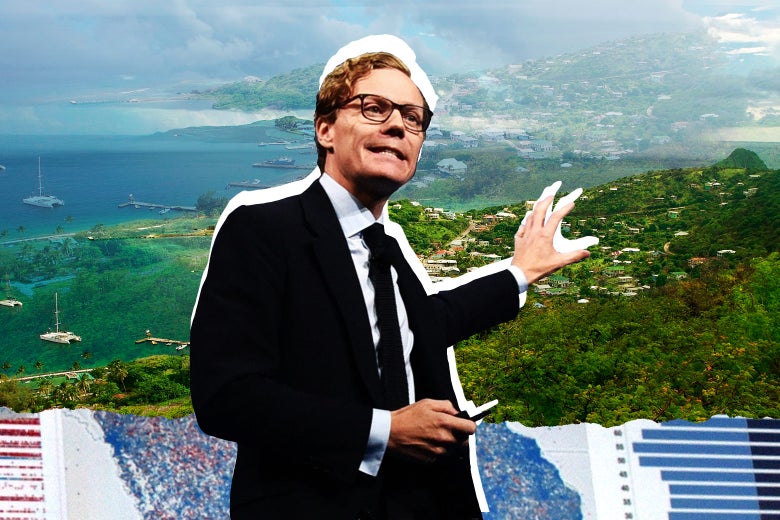
CEO of Cambridge Analytica Alexander Nix
Photo illustration by Slate. Photos by Thinkstock and Bryan Bedder/Getty Images for Concordia Summit.

When Alexander Nix, the CEO of Cambridge Analytica, was suspended by the political-data firm last week after being caught on camera by an undercover journalist offering, (among other unsavory things) to sway a Sri Lankan election by having someone posing as a wealthy developer come in” to offer a large amount of money to the candidate to finance his campaign in exchange for land,” his purported dirty tricks may have struck some as so devious-sounding as to be unbelievable. Perhaps, as the company at the center of Facebook’s ongoing privacy controversy claimed after Britain’s Channel 4 released the video, Nix was just playing along with a potential client. That’s a convenient explanation for the company, but it ignores one thing: The tactics Nix described aren’t so different from the kind of things that Cambridge Analytica’s parent company, SCL Group, has reportedly used in the past. Its purported activities in the Caribbean over the past decade or so might be particularly instructive.

We’ll have the whole thing recorded on cameras,” Nix told the undercover Channel 4 journalist. We’ll blank out the face of our guy, and then post it on the internet.” That, reportedly, is more or less what SCL did in 2010 in St. Kitts and Nevis, where it worked on the successful campaign of the incumbent Prime Minister Denzil Douglas against opposition leader Lindsay Grant’s election bid, according to the Times of London. As part of SCL’s efforts to win the race for Douglas, the firm reportedly mounted a sting operation against Grant at a Marriott hotel, where he was caught on video agreeing to sell land to a British buyer under market value in exchange for a $1.7 million donation to his campaign. That video was shared widely online days before the election on YouTube, including over one channel the Times reports was run by SCL called investigativerep1965.” That account is still active and contains just one video: the sting against Grant.

SCL continued to take clients in the Caribbean, like in the small island nation of St. Lucia, where in 2011 the company worked on the re-election campaign of then–Prime Minister Stephenson King, who ended up losing. But had King won, Bloomberg reported, SCL was set to receive a $1.9 million contract from St. Lucia to run a public health ad campaign against smoking and obesity, a million of which would be used for the health ads while the other $900,000 would have been back pay for the company’s work on the election. King didn’t win, and the public health campaign reportedly never came to fruition.

2013 wasn’t the first time SCL did work in Trinidad and Tobago. The company was also present in advance of the 2010 elections there, which concluded with the United National Congress party’s candidate becoming prime minister. According to a brochure from SCL obtained by the BBC, SCL claims that it helped a candidate’s campaign by painting graffiti around the island made to look like it ostensibly came from the youth,” which allowed SCL’s client to adopt policies and claim credit for listening to a ‘united youth.’ ” That the company resorted to fake graffiti suggests it certainly wasn’t above using underhanded tactics, though the misbehavior it is accused of in the U.S.—inappropriately harvesting 50 million Facebook profiles to beef up its political-data efforts in 2014—are a great deal more complicated. One of the questions we’re still left with is: Was Cambridge Analytica any good at it?

Read more from Slate on Cambridge Analytica.

Geneva: A shift in the government’s discourse

March 30th, 2018

The UNHRC session this month in Geneva succeeded in punching through to the news pages, despite the overwhelming dominance of stories about the no-confidence motion. However, there was no acknowledgement of the two most important aspects.

The first was from the government delegation or more correctly the discourse of the government team. Foreign Minister Marapana whose views are known to be a huge improvement on those of Minister Mangala Samaraweera, was accompanied by two nominees of the President, namely Dr Sarah Amunugama and Faiszer Mustapha. All in all, it was a decent team, lacking only State Minister for Foreign Affairs, Vasantha Senanayake.

article_image

The government’s position was laid out in a balanced presentation by Minister Marapana. What was crucial about the speech was what it did not say, and not only what it did say. What it did not do was to reiterate a commitment on the part of GoSL to the full implementation of the Geneva 2015 resolution. Indeed it did not reiterate any degree of commitment to the implementation, let alone the ‘full’ implementation, of that Geneva resolution. Better still, Minister Marapana’s speech did not refer at all to the 2015 Geneva resolution, which we should perhaps call the Ranil-Mangala resolution, so happily lapped up and regurgitated by the upper bureaucracy of the Foreign Ministry.

What Minister Marapana did say was that all issues pertaining to post-war reconciliation could and would be implemented within the Sri Lankan Constitution and through the existing independent judicial system.

In short the Government of Sri Lanka has pivoted to some degree, away from the 2015 Geneva Resolution and in the direction of a feasible, national solution in cooperation with the UNHRC. The delegation is to be commended on this.

The new tone and content was best expressed in the excellent post-Geneva remarks of Dr. Sarath Amunugama at a briefing at the SLFP headquarters.

‘Dr. Amunugama, who is one of the members of the recent government delegation to the Geneva HRC session, said they had clearly explained to the UNHRC that they would not allow the international interference in matters in violation of with the Constitution.

“Whatever the things discussed at earlier UNHRC sessions, we have clearly told them that the government will not allow any foreign judges to come to Sri Lanka and interfere with the local judicial system as Sri Lanka has enough of lawyers and a completely independent judiciary to look into its matters,” the Minister stressed.

Compared with other countries which had war crime charges at UNHRC, Sri Lanka had successfully achieved a considerable progress during the last 10 years and, therefore, it was unfair to categorize Sri Lanka as one of the countries that had to face war crime charges, Dr. Amunugama said. The Minister also said that the international community should understand that the terrorist group which Sri Lanka had defeated in 2009 was the most dangerous out of all the terrorist group around the world. Today, anybody who visited the country could travel anywhere without fear of terrorist attacks, he added.’

(‘Minister Amunugama urges Foreign Ministry to clear Lanka’s name’, March 30, 2018, The Island)

According to the report Dr. Amunugama also made a rather pointed aside:

“Referring to the statement made by Sir Michael Morris, better known as Lord Naseby, the Minister said that the Foreign Affairs Ministry should have used the statement to deny the allegations against the country by giving it more publicity among the international community.” (Ibid)

The Government’s Geneva stance is changing because of three realities:

(I) The results of the local government election and the presence on the horizon of the Presidential election in late 2019.

(II) The change in the balance of forces between the President and the Prime Minister, with a greater assertiveness on the part of the President. Though the President is not guiding foreign policy as yet, he is clearly drawing the parameters and exercising a veto. The SLFP is also making its input into foreign policy.

(III) As a result of the two earlier stated factors, the natural centrist ideological tendency of the Cabinet Ministers, including that of the Foreign Minister, UNP member Tilak Marapona, is coming to the fore, overriding the neoliberal globalism of Ranil Wickremesinghe and Mangala Samaraweera, the epitome of which was the co-sponsorship of the Geneva 2015 resolution by GoSL.

These three factors of change can be summed up in a simple, short sentences: 2018 is not 2015. 2015–the spirit of collaborationism and appeasement– is dead. GoSL will no longer swallow the full Geneva dose which is felt to be electorally lethal in its toxicity.

The second most important development for Sri Lankans in Geneva this March was the emergence of the Muslim factor in Sri Lanka’s external relations and in the UN arena in particular. At a side event at which paper presenters and audience conducted themselves admirably, moderate yet critical representatives of the Muslim community rationally presented their case, their grievances and their apprehensions. Given the importance of the Organization of the Islamic Conference (OIC) as a voting bloc in UN forums, it would behoove the Sinhala extremists who attempt to coerce the Muslims, to grasp the fact that no vote in the UNHRC can be won without the OIC’s support.

What the Sinhala Islamophobes have done with their behavior in Ampara, Digana and Teldeniya is to open a new front in the diplomatic arena, for the Sri Lankan state to have to deal with. For a state already overstretched with having to handle the Tamil Diaspora and Diaspora-driven Western pressure, the emergence of the Muslim factor as a new issue, is another needless problem created by the Sinhala Far Right. This factor should be nipped in the bud while it’s still possible, and as the other should have been.

The shift in the government’s discourse in Geneva deserves a cheer, not two, still less three cheers. There is a long way to go to unhook Sri Lanka from the 2015 and 2017 resolutions. This is a laudable step back though; a demarcation of limits and a taking of a measured distance, if not yet a delinking. This is the prelude to the imperative process of revisiting and renegotiating Geneva 2015. If we have no partners for renegotiation, then a ‘roll back’ will be necessary. A roll back/repeal of Geneva 2015 cannot simply be decreed by any Government in Sri Lanka, even the most patriotic one. It can be done only by winning a vote, which requires winning over the majority of the Council.

As one who has done this in Geneva, was prominently part of a similar victory at the UNESCO in Paris, and watched sadly as others lost the vote three years running back in Geneva, I know what can and cannot win a majority in that Council. Certainly a hawkish Sinhala rhetoric is hardly likely to help us get more votes than we got when we lost in 2012, 2013 and 2014 under a patriotic government (serial defeats which paved the path for the sellout of 2015). The UN Human Rights Council and even the egregiously offending Office of the UN Human Rights High Commissioner in Geneva cannot be treated as if either entity were a café in Ampara suspected of introducing (non-existent) infertility tablets.

SLFP MPs cannot oppose no-confidence against PM – Lakshman Yapa

March 30th, 2018

State Minister of Public Enterprise Development Lakshman Yapa Abeywardena says that MPs of the Sri Lanka Freedom Party (SLFP) cannot oppose the no-confidence motion against Prime Minister Ranil Wickremesinghe.

He stated that a committee was appointed to look into the Central Bank bond scam and submit a report, during an SLFP Central Committee meeting, and that out of the 15 points in that report, 13 are included in this no-confidence motion.

Therefore SLFP MPs have no other alternative but to support the no-confidence motion, he said, speaking to reporters at a press briefing held at the SLFP headquarters in Colombo today (30).

However, he said that party’s official stance on the matter would be announced on April 2, two days before Parliament debates and votes on the motion.

The State Minister also categorically rejected the media reports and statements made alleging that a discussion took place between the President and Prime Minister with regard to defeating the no—confidence.

He stated that no matter what decision the party takes, MPs have the right to express their opinions in line with their conscience.

BASHING OF MUSLIMS IN SRI LANKA

March 30th, 2018

Dr Sarath Obeysekera

I am in London these days and keep reading web news about No confidence Motion against PM and previously the skirmish in Digana .I have very close friends I London and Sri Lanka who are Muslims .When we meet again I find it little embarrassing to face them.

Whether I like it or not I have to partially admit that Sinhala Race is a somewhat racist to in order to save my face .I walked into a shop owned by a Sri Lankan Muslim form Kurunagala who speaks to me in Sinhala (many Sinhalese opt to speak in (S) English to me) and greeted me Ayubovan .I returned greetings by Salam Malaikum”
He asked me, Kohomada Machan and I said Nalla ,Inshah Allah

This is how we feel about each other .He was critical of politicians three years back during Aluthgama fiasco and now he was critical again about politicians.
Knowing my general attitude, he jokingly said Machan Umba Nuwara Awussala Meheta awada? (You created trouble in Kandy and bolted to London)
I said Yes machan .Sudda kochchara unath Hondai ( White people are somewhat better ),because despite much anti Muslim and ISIS fear white- British do not react like we Sinhalese .

My doctor in London was a Muslim from Riddeegama and he knew Subashitaya and Sellalihini Sandeshaya by heart .He studied Buddhism and yet he know Koran by heart and prays few hours daily.

Only difference in me and him is that I am a Buddhist materialist who does not believe in God and he believes in Allah.!
Muslims are good traders .There are many Muslim business leaders who employ both Sinhala and Muslims including Tamils .When we associate with them I could not see any Anti Sinhala stance .

We may have different of opinions with Muslims in other parts of the world but we both sectors have to live in HARMONY

Dr Sarath Obeysekera

President Sirisena took three years and three months to realize that Ranil is not fit to do anything?

March 29th, 2018

Dr Sudath Gunasekara

29.3.2918.
Anyway the whole country must thank him for taking the Central Bank from Ranil at least after three years and putting it once again under the Finance Ministry. Actually he should have not allowed its transfer from the M/F at the very outset as it is unconventional and suspicious too (although the President has not smelt it) and stopped it as the President of the country who is responsible to people. As such he too cannot be fully exculpated from the sins of the CB scam as he cannot say he is innocent and not responsible for what his PM has done on eight counts.

First it was he who appointed Ranil as the PM violating the Constitution and the accepted Parliamentary procedure of the need to appoint the person who commands the majority in the House as the PM. Second having appointed him illegally as the PM he also allowed Ranil to take over the CB as preplanned. Third allowed him to import a non- citizen who had long links with the LTTE purely on his political and family connection he had with the appointee. Fourth he also kept silent while Ranil, Ravi and Mahendran together manipulated the Bank robbery allowing them to interfere with the Bond Auction mechanism and even going to the extent of telling the major state Banks to fix the bid rates as directed by the PM and the Minister of Finance to enable Arjun Aloysius to get the awards. Fifth he kept silent when the first scam was revealed. Sixth he dissolved the Parliament just before the Cope Report was to be presented to Parliament in August 2015 allowing a General election Seventh he also obstructed Mahinda Rajapaksa getting elected, as the PM using all his powers as the president resorting to very law and even illegal tactics to influence the electorate to vote for Ranil and against MR. This enabled Ranil to get elected, though with 106 seats, still behind the required majority to form a Government. Eighth he appointed Ranil again as the Pm violating the Constitution and the accepted Parliamentary procedures and enabled Ranil to continue as the PM up to date.

In this backdrop he is also culpable and responsible not only for the mega loot his own PM has conspired and committed but also for all the failures of this government up to date. So he cannot wash off his hands now claiming innocence and put the whole blame on Ranil. Even a tiny tot would say there is no point in closing the gates of the stall after the horse has bolted. Anyway it is some relief to the whole country as there is no room for Ranil and his gang now to rob any more from the Banks and mismanage the economy as the some more vital sections and institutions have been removed from him.

However the President has to take extreme care that this decision too will not face the same fate the other decisions he has taken during the past three years especially the one taken over the Vilpattu encroachment by Rishard Badurdeen.

At least now he must stand firm on this decision and prove that he also can take firm decisions at least when he is compelled and forced to do so by circumstances and the public. But here again he should take guard against any interference by Chandrika as she had already declared in style as usual, two days ago that Ranil will remain as the PM until 2020. It is also advisable for him to keep Chandrika completely out of his government as it will be very much better for his health. While thanking her for enabling him to be the President of this country in 2015 Jan, for it would never has happened if not for the conspiracy hatched by her to get Sirisena out of the SLFP and arrange the marriage between the two, at least now for his safety he should get completely divorced from her vicious influence.

Next in order to consolidate his position as the President, at least now, he must demand Ranil to produce his chum Mahendran from where ever he hides, or advised him to hide, as he should definitely know where he is. Because Ranil was the one who got him down having promised him the Governorship long before Jan 2015; he was the one who insisted that Mahendran should be appointed as the Governor when the President objected; he was the one who got him appointed saying that he takes full responsibility for Mhendrans actions as the Governor; he was the one who defended M after the first bond scam; he was the one who requested the President to appoint M for a second term. He was the one who got M appointed as a special advisor to him after he was removed by the President from the Bank and finally he was the one who enabled M to leave the county when the whole robbery was getting exposed and in spite of the fact that even by that time the whole country had identified M as tsecond most important culprit in this robbery.

Until M is produced, I wonder as to why the President can’t order the law enforcing authorities to arrest Ranil in view of the above connivances and furthermore as the man who stood security for Mahendran as it is the normal legal procedure adopted when an accused absconds in hiding. Such action on his part will further relieve the President of his obvious culpability on the CB scam at lest and tolerate him as the President until end of 2019, even if the disgruntled UNP brings an impeachment on him as already some UNPers like Vajira Abewardhana have stated.

YAHAPALANA AND THE ECONOMY Part 7

March 29th, 2018

KAMALIKA PIERIS

Yahapalana wishes to kill the Shipping Agent” sector of the shipping industry of Sri Lanka. Yahapalana announced in its 2017 budget that Sri Lanka Ports Authority Act, No. 51 of 1979 and the Merchants Shipping Act, No. 52 of 1971 will be amended. Restrictions on foreign ownership of shipping agencies and the freight forwarding agencies will be lifted. This will enable major international shipping lines and logistics operators to base their operations in Sri Lanka.

Sri Lanka must liberalize its ‘shipping industry’ to attract the top global players such as Maersk to invest in Sri Lanka, said Mangala Samaraweera, Minister of Finance. Other leading shippers and freight forwarders are likely to then follow suit. At present a foreign entity cannot own more than 40 percent of a shipping company in Sri Lanka. No shipping line will invest with only 40% equity stake and no control over the operation. They would expect to at least have control over their operation and not a minority stake. The choice of having an agency or not should be the wish of the owner of the business who brings in vessels to port in Sri Lanka and regional cargo to Colombo, continued Yahapalana .

We need to seriously consider allowing up to 100% foreign ownership in cases where the shipping company would make a significant investment over a period of time, continued Samaraweera. Liberalization of shipping agencies will reduce transaction costs and this will help shipping lines like Maersk to further increase volumes especially given the growth of new transshipment hubs in this region, India and Pakistan have fully liberalized their shipping industries, he concluded. Maersk, the world’s largest container shipping line promptly responded. They applauded removing the restriction on foreign ownership of shipping agencies and amendment of the Merchant Shipping Act.

This budget proposal was as a great shock to the shipping agents. Ceylon Association of Shipping Agents (CASA) and Sri Lanka Logistics and Freight Forwarders Association (SLFFA) stated that they strongly opposed the proposal to open the Shipping sector for foreign investment, by removing the remaining restriction of 60% on foreign ownership in shipping and freight forwarding agencies.

They immediately pointed out two specific flaws in the Yahapalana argument. Liberalizing of shipping agency will have no effect on freight rates. Shipping agents do not control freight rates they said. That is a matter for the shipping lines. They also commented on the Yahapalana statement that there would be ‘an independent Ports regulator’. CASA noted that there is no mention that the “independent port regulator” will be totally national and local. It could include foreign involvement and that would have grave national security implications.

Representatives of shipping agents met Finance Minister Mangala Samaraweera and urged him to withdraw the proposal of removing foreign ownership restrictions in shipping agencies, but Minister Samaraweera refused. A few shipping agency houses are benefitting as they are controlling the many shipping agencies under their belt, he said. A full page advertisement in Daily News, inserted by Ministry of Finance, said India, Singapore, Vietnam, and Hong Kong have fully liberalized their shipping industry.

The Ceylon Association of shipping agents (CASA) responded with their own notice to public. CASA is the leading voice of the shipping industry in Sri Lanka, they said. CASA consists of 130 registered members, and consists of agents representing all major container lines and non container vessels calling at all ports of Sri Lanka. The industry has over 750 local shipping and freight forwarding and clearing agents, mostly SMEs, employing over 12,000 direct staff.

The main role of the shipping agent is to facilitate all formalities for the vessel call. Local shipping agency and freight forwarding companies have already meet the local demand of that component. They have already invested in the container depots, freight stations, logistics parks, transportation, and other required infrastructure to support the shipping lines’. There is hardly any work left for foreign companies to do.

CASA states the shipping industry in Sri Lanka is already liberalized. Any foreign ship owner can freely operate their vessels in Sri Lanka. All major container shipping lines have service operating here. They also operate container terminals here, such as SAGT. he port of Colombo is a destination for all major lines and all the major shipping lines are already Sri Lanka.

Foreign entities can have 100% ownership in terminals, warehouse and depot infrastructure, ancillary service infrastructure etc. they can have their own offices, if they wish. But we are yet to see foreign investments taking place in these sectors. Maersk had all the opportunities to invest in a gamut of activities, why have they not invested up to now?
The only aspect which is not liberalized is the shipping agency/freight forwarding functions. Foreign parties have held 40% ownership for the past 20-25 years in shipping agency but no investments have been made in shipping. So how can allowing 100% encourage them to invest? International mega shipping companies will not immediately set up their offices in the country, investing massive sums of money. The only matter they have shown an interest so far is in Eastern Container Terminal ECT where all major shipping lines and terminal operators submitted bids. Hereafter too, shipping firms will focus only on the container segment. They will not be interested in developing or promoting the other segments of the industry.

All major shipping lines and freight networks are currently represented in Sri Lanka and the lifting of restrictions will not bring any new shipping lines or freight networks into the country. There will be no new investments by shipping lines and freight forwarders as a result of this policy change either. The proposal will not bring any significant benefit to the industries and the economy and in fact will have an adverse impact to the national interest of the country, CASA said.
CASA has listed the disadvantages to the county if the proposed change is made. All profits of shipping agency will be repatriated. They will not be retained and reinvested within the country as done at present by existing local agents. The shipping lines will make their Colombo offices cost centers and the foreign exchange earned by the local shipping agents and the tax earned by the government will be totally lost.

Shipping lines having 100% owned agencies will apply charges which are levied globally (eg.THC) and also put pressure on the port tariff to reduce its rates. Freight forwarders and shipping agencies physically take custody of goods worth billions of dollars per annum. When ownership and directors are all foreign then it would be so much easier for them to simply vanish with goods. This is happening in Singapore, Hong Kong, and India.

The proposal to liberalize will also affect the local agencies. Shipping lines may choose to offshore processes, and bring in expatriate representatives. Further, the management positions will be filled by expatriate staff depriving Sri Lankan professionals. There will be a significant impact on employment of local staff. Foreigners from India, Pakistan, Bangladesh, and Singapore will set up small agency offices for casual caller vessels and reduce business available to local SME agents. Foreign owners will get controlling interest of agency/freight forwarding companies. This will restrict the growth of these companies and their capacity to invest in other businesses, as the local agents have done.

Sri Lanka has a very mature local shipping agency industry. This position will be jeopardized with this new policy change. Liberalizing the shipping agency sector, will lead to the death of the local industry. The jobs of a workforce of 12,000 will be at stake. They will lose their livelihood. The enterprises may have to close down. This will include the hundreds of local companies who have contributed immensely to the development of the maritime sector in this country over the years.

Liberalizing shipping will not make Sri Lanka a maritime hub. A maritime hub consists of infrastructure, capacity, and services, of world class facilities for air and seaports, catering to all sorts of ships and also offering technical and commercial services such as finance, brokering and insurance.

There is no need to liberalize the shipping agency business at this stage. Liberalization will have an adverse effect on our economy it will discourage local entrepreneurship and building of strong local shipping companies. It is important that any policy change should be discussed with stakeholders, said CASA. Countries need to do what is best for their economies depending on their comparative advantage and local resources. All middle east nations, as well as Thailand, Indonesia have limitations in foreign ownership in shipping agencies. Liberalization of this service sector without any form of investment is detrimental to local entrepreneurship and local businesses.

NO CONFIDENCE MOTION  VIS-A-VIS JOINT OPPOSITION STRATEGY

March 29th, 2018

By M D P DISSANAYAKE

The No Confidence Motion primarily has two purposes.  Firstly to unseat the Prime Minister.  Secondly to form the next government.

UNSEATING THE PRIME MINISTER:

RW is a fighter.  He became Prime Minister three times, but on two occasions, including the current tenure, he got into hot water.  First time he lost his job.  This time around he is on the knife edge. He is a shrewd, intelligent, cruel, unpatriotic leader.  His masters are always  foreign leaders.  He is not a Buddhist in real sense.  He is not a Sinhalese.  He is not a Sri Lankan.  To solve severe economic problems, he offers simple solutions.  Last time as Prime Minister, he promised to give free ALERICS ICE CREAM to children.  Most recently he promised  WIFI.  If RW continue as PM for another five years, more than half of Sri Lanka will be dominated by Muslims and Tamils.   Therefore, Joint Opposition must be respected for its hardwork on bringing NCM immediately after winning local elections, to bring the PM to the guillotine.

JOINT OPPOSITION STRATEGY:

Unseating RW is not the end of the disastrous political period for Sri Lanka.  JO has already promised to support the appointment of a SLFP Prime Minister, but refrain from taking cabinet positions. The public need to know whether JO has entered into an Agreement with the President for extending the support for a SLFP candidate, until next General or Presidential Elections and full disclosure of terms and conditions of the Agreement.  The JO must use its influence  at this stage and offer only conditional support, within an agreed framework.  These should include:

  1. Immediate suspension of any attempts to change the Constitution.  This should be left alone for a future Mahinda Rajapakse lead regime;
  2. Immediate release of Ranaviruwo, who had been  under arrest;

iii.                Removal of Sarath Fonseka   and Jayampathi Wickremaratne as  National List Members;

  1. Removal of Sambandan as Leader of Opposition by recognising Joint Opposition as a Recognised Political Party  in the Parliament;
  2. Suspension of receipt of any further payments from China for the sale  of Hambantota projects;
  3. Nullify any agreements with United Nations  on the formation of  Hybrid Court.

It is imperative to involve President Sirisena to initiate this action, following a passage of a Special Resolution in the Parliament.  It is not necessary to keep this matter pending for future MR government.

If  Joint Opposition cannot obtain  an Agreement on these matters ( and any other major issues), it is a far better solution to pass a Resolution to amend the Constitution to call for dissolution of the Parliament.

Above all, the Joint Opposition MUST NOT TRUST MAITHREEPALA SIRISENA.

While Termites Split the House Mosquitoes Feast on and Attack Householders

March 29th, 2018

Dilrook Kannangara

(The foregoing has no resemblance to any country or persons. Any similarity is only coincidental.)

A house stands along busy east-west Indian Ocean Drive. Its occupants have lived there as long as they can remember. They have no other first or second home. However, they are not the only living beings in the house. The house next door, towards the northern side, is infested with termites and they have spread to this house as well. The closer northern part of the house has been colonized by termites eating away its wooden structures. Householders fumigated part of it exterminating the more aggressive termites. It costed them an arm and a leg! It even resulted in complaints from neighbors for the use of harsh chemicals. Inhabitants of the house to the north suffer from asthma and particularly allergic to anti-termite medicine. A neighborhood clash was narrowly averted. However, there are still more termites. Some larger termites managed to fly away during fumigation only to return when the dust settled. There is nothing much to salvage in that part. It is advisable to forget about that part and save the rest before the whole house is lost to termites.

Then there are mosquitoes. Unlike termites they don’t want a part of the house; they don’t want to split the house. In fact, they have nothing against the structure of the house. They are after its human inhabitants. Day and night, they harass and harangue its inhabitants and suck their life blood. No law applies to them as they seem to have their own laws. They don’t sleep when inhabitants sleep but keep pestering them. As a token of appreciation, they leave their dirty germs to infect the inhabitants after draining their blood. No amount of negotiating works as harassing mosquitoes keep singing in the ears of householders. If only householders could take out a court order against sound pollution! Though mosquito breeding grounds were cleared, they keep breeding; breeding like mosquitoes.

Householders are divided on what to do. Well off householders escaped to greener pastures but most are still stuck in it. Some want a permanent resolution but another round of fumigation is prohibitively expensive and even dangerous to householders. A global extermination of termites and mosquitoes is foolish and impractical. In reality they far outnumber the householders. Some others want to come to some understanding with termites and mosquitoes. Only problem is the language barrier. Even if communication is established how can a termite not eat wood and a mosquito not suck blood!

Attracted by the success of resident termites and mosquitoes, more and more termites and mosquitoes from the neighborhood colonize the house. A number of householders have suggested to split away the termite infested part as it cannot be salvaged and use harsh methods to prevent their spread. Once all wood is chewed away they will die a natural death or fly away to any hell of their choice. Though mosquitoes cannot be removed totally, sufficient repellents will keep them away from the house. They have plenty of room in the garden and elsewhere to roam and moan. But there are powerful voices that want the entire house back to how it was in olden days. Little that they realize their well-intended desires actually help the termites infest the entire house leaving them nothing. Abuse of mosquito repellents cause the insects to adapt to a more extremist variety. Therefore, it has to be used carefully. Inability to consider practicalities is the biggest problem facing householders. They must let go part of their house in order to allow termites eat their way to their own termination. If blood is deprived, mosquitoes will also die a natural death particularly given their astronomically high breeding rate and the massive volume of flesh needed to sustain them. Will the householders come to reality and take tough decisions to save what is left or will they lose it all trying to save the entirety?

NAVY SINKS KP,S SHIP WITH BULLET PROOF VEHCILES USED BY EX PRESIDENTS

March 29th, 2018

Dr Sarath Obeysekera

When I read above news item I remembered the story about the Buller Proof Vehicle of President of Ranasinghe Premadasa ,
After the bombing of Parliament by JVP ,where Minister Athulathmudali got hurt cabinet has decided to bomb and bullet proofing of the room in Senate House where cabinet Meeting was held .

I was working in a leading Engineering Company having experience in Armour Proof Steel ,was asked to Bullet and Bomb Proof the room .
We selected a steel plate of very high hardness which can with stand bullets and effect of a bomb form a Swedish supplier after visiting their mill
Steel plates were installed on the floor and sides and windows were covered with bullet proof glass ,because Police Unit was having clear view of the inside of the cabinet room .( They did not trust even the police at that time !)

Once it was done a Land Rover car Imported by Minister Montague JaywIckrame but later used by the president Premadasa was sent to our company for bullet proofing.
Heavy steel plates were installed on doors and also bullet proof window screens and made the bullet proof .A plate was placed on car floor to minimize effect of a bomb explosion.
Ironically same Land Rover was driven with President and Babu in the car on the day of the fatal May Day Rally.

I personally saw then in the car near Dimo Show room and note RP waving to his supporters,

They returned back to Galawala Junction and somewhat intrepid president (badly advised by his own DIG Gunasinghe who was his body guard who perished during the bomb) has got down from the Bomb Proof car and waved his last white handkerchief!

I was standing at about 100 me distance watching the horror.

Same Land Rover has met the Waterloo” in Deep Sea and I felt very sad


Indian Ocean geopolitics and its impact on Sri Lanka

March 29th, 2018

I write to express my appreciation to Prof. Gamini Keerawella (Prof. Emeritus, University of Peradeniya), for publishing excerpts of a keynote address titled “Indian Ocean: Maritime Security” delivered by him at the Bandaranaike Center for International Studies (The Island, March 16-17, 2018). His address was not only scholarly and erudite but is also of great significance to Sri Lanka, in light of the ongoing Great Powerplay currently taking place in the Indian Ocean.

The topic is of particular interest for two reasons that have been of concern to me.. The first was addressed in an article by me titled “Sri Lanka and great power relations” (The Island September 27, 2016). It dealt with the need “for Sri Lanka to prepare itself” to face the inevitable consequences arising from the geopolitical interplay of great powers in the pursuit of their respective self-interests in the Indian Ocean. The second was that at a recent meeting when the question was asked as to what should be the greatest concern for Sri Lanka, my response was how a small country like Sri Lanka could survive in a big pond such as the Indian Ocean in the midst of geopolitical interests of great powers.

article_image

Indian Ocean

This concern is addressed by Prof. Keerawella when he states: “As history has taught us many a time, when a political power comes forward to dominate the Indian Ocean unilaterally, Sri Lanka’s sovereignty and independent action is highly curtailed. It must be noted China’s blue water naval entry into the Indian Ocean and the diplomatic overtures to the Indian Ocean littoral has enhanced Sri Lanka’s strategic significance before India and the United States. In order to make use of the opportunities presented in this context, Sri Lanka needs handle the situation with sharp diplomatic skills with a clear strategic plan and vision. We should be conscious of the opportunities as well as the pitfalls”.

Similar concerns were expressed in my article of September 27, 2016 when it stated: “What is interesting about this confluence of forces is that both Japan and Singapore have been longstanding strategic partners of the United States. On the other hand, India is new to the relationship but one that is growing in strength under the Modi administration. The Logistics Exchange Memorandum of Agreement that the US and India recently signed attests to this emerging relationship. Consequently, as far as Sri Lanka is concerned, no Government in Sri Lanka would know at any time whether the four powers (US, India, Japan and Singapore) are acting individually or in collusion. What impact their individual actions or their joint collaborations would have on Sri Lanka would be of little or no concern to them”.

“Since all of them are converging on Sri Lanka, not for the benefit of Sri Lanka but solely for what is best for each of them individually or collectively, how Sri Lanka handles these great power relations is a matter of deep concern because the games that Great Powers play leave in their wake the unintended consequences that countries such Iraq, Libya and Afghanistan are now facing, and Sri Lanka would have to prepare itself to face in the near future. In addition, if Sri Lanka hopes to emerge unscathed by the interplay of these five powers in and around Sri Lanka, it is not only being delusional but also reflects a failure to acknowledge its limitations”.

“The recently signed Logistics Exchange Memorandum of Agreement between the US and India is a significant symbol of the “defining partnership” between the two countries. This Agreement is essentially to increase strategic and regional cooperation, to deepen military-to-military exchanges, and to expand collaboration on defence technology and innovation. It allows for supplies and services between the two countries’ armed forces. This includes food, water, fuel, spare parts, transportation communication and medical services (Washington Post, Aug.31. 2016). Although the agreement does not obligate either party to carry out joint exercises or for the establishment of bases, the fact remains that joint exercises are being carried out by the US and Indian navies in the South China seas. This is to be expected because curbing China is in the interests of both the US and India”.

Sri Lanka, too, signed an Acquisition and Cross Service Agreement with the US in 2007, with the provision for extension for a further ten years in 2017. Such infrastructural arrangements coupled with the engagement of countries such as the US, India, Japan and Singapore in Sri Lanka are to curb Chinese influence in Sri Lanka and in the Indian Ocean arising from its One Belt One Road strategy.

However, at this point in time there are differences between the interests of these major powers. Unlike the US with its super power status and India as the regional power, the engagement of Japan and Singapore in Sri Lanka’s economic development has more to do with their role as strategic frontline partners of the US. However, in the case of India and the US their interests go beyond the economic to include the shaping of political outcomes within Sri Lanka. Although China, on the other hand, is currently focused on a strong presence through economic activity in Sri Lanka it could at any time extend its influence to even the political in pursuit of its One Belt One Road strategy.

LESSON from the MALDIVES

Commenting on developments in the Maldives, Dr. David Brewster of the Australian National University stated: “In the last few days we have seen growing strategic rivalry between major powers such as China and India as they expand their roles in the region. We are now also seeing new players competing to build their own areas of influence and blocs in the Indian Ocean and this could be another concern for India…India is particularly alarmed by the growing Chinese presence in the region and is responding…Experts believe that the Maldives is just another front for the Chinese. The small island nation has become a significant target for Beijing’s ambitious economic expansion. Its international Airport, the major road connecting it to the capital and other projects fall under “One Belt, One Road” (The Island, February 24, 2018).

Great power rivalries end up in creating internal political rivalries. These rivalries are invariably between the agents of the great powers. The result is political instability arising from political regimes that are installed to carry out the dictates of their great power backers. The current political situation in the Maldives is a case in point, with President Abdulla Yameen cracking down on the opposition in order to consolidate power.

Since Sri Lanka too has its share of sympathisers of great powers, how Sri Lanka could avoid similar potential pitfalls is the burning question.

US involvement in Sri Lanka’s internal affairs even to the extent of shaping the structure of the State, the role it plays in the direction of the stand taken by the UN Human Rights Council and about potential bilateral training between the US and Sri Lanka in a Pacific Partnership along with foreign militaries, is no secret. All of this is possible because of the current regime in Sri Lanka. How Sri Lanka extricates itself from this entrapment is compounded by the several and varied interests and ensuing rivalries of the great powers involved in the Indian Ocean.

A STRATEGY for SRI LANKA

Commenting on the impact on Sri Lanka from developments in the Indian Ocean the Sri Lanka’s Prime Minister is reported to have stated at the annual convocation of the Bandaranaike Center for International Studies: ‘…two important factors that shape the foreign policy of Sri Lanka and the role it can play in the region are the strategic location and the political relations the country has with the key players in the region India, China and Japan’ (Daily News, March 23, 2018) . Quoting the PM the report also states: “While we have good relations with these countries, we also need to understand the nature of rivalry and we should never get caught into that rivalry…as far as we maintain the neutrality and maintain friendship, there is no problem”.

Judging from the pathetic manner in which Sri Lanka has handled the charges of human rights and humanitarian law violations in the course of bring closure to the armed conflict backed up by resolution after resolution by the UNHRC, it is highly unlikely that Sri Lanka could remain unscathed in an environment of great power rivalries. The very fact that every effort is being made for Sri Lanka to be governed under a political arrangement shaped by the US is testimony to this doubt. Furthermore, the engagement with the US is such that Sri Lanka has already lost its ability to stay neutral.

The option for Sri Lanka is either to stay out of the fray of the rivalries of great powers and accept the fallout, or to be mindful of the opportunities that inevitably would be presented by the rivalry among the great power and use it for the benefit of Sri Lanka. For the latter strategy to succeed there has to be inter-party political consensus at least in regard this aspect of foreign relations.

CONCLUSION

Preoccupation with parochial issues has distracted Sri Lanka from focusing on vital issues of survival in an environment where great powers are increasingly becoming engaged in the Indian Ocean to varying degrees in the pursuit of their interests. While staying neutral and friendly with all these major players is in the best interests of Sri Lanka, achieving it requires diplomatic skills of an order that thus far have not materialized as evidenced by the mishandling of accountability issues associated with the armed conflict when Sri Lanka co-sponsored the UNHRC Resolution 30/1 .

The inability to develop a coherent strategy for survival requires political stability of an order that does not currently exist in Sri Lanka, considering the prevailing inter-party and intra-party rivalries that is compounded by the division of executive power between the President and the Prime Minister under the 19th Amendment. Under the circumstances, whatever policies that are likely to emerge would not be based of serious strategic planning, but on ad hoc statements made off the cuff to the detriment of Sri Lanka’s long term national interests.

Judging from current developments where Sri Lanka’s assets are either being sold or leased, and Sri Lankans are to be governed under structural arrangements formed and forged externally, the fate of Sri Lanka appears to be no different to the fate of the citizens of Melos at the hands of the Athenian Admiral, because Sri Lanka has lost its dignity and neutrality that it enjoyed when it was non-aligned. It could be argued that notions of non-alignment are passé in today’s world. Notwithstanding the need for global connectivity, Sri Lanka should as an absolute minimum seriously endeavour to self-determine a form and structure of government that best suits the human development of its citizens.

On economic issues on the other hand, arrangements negotiated and reached should not be restricted to a select few. Instead, it should be open and transparent with inputs from those conversant with geopolitical developments being factored in, instead of leaving it in the hands of deal makers. For instance, had Sri Lanka been aware that a harbor at Hambantota would serve Chinese interests far more than it would Sri Lanka in its pursuit of One Belt One Road strategy, Sri Lanka could have negotiated a better deal, even to the extent of building it free of cost. Conceptually, it should be to take advantage of the opportunities presented by great power activities in the Indian Ocean to benefit Sri Lanka. For instance, since all such activities are of greater significance and interest to these players than to Sri Lanka, the stand Sri Lanka should take is for costs to be borne by the players and for them to operate over a mutually agreed period of time without compromising the ownership of the asset at any time. However, while such a strategy would serve Sri Lanka’s interests best, the current inhibited mindset in place is not astute enough to deal with these international challenges.

If Sri Lanka is to have good relations with countries and remain neutral, she has to be extra vigilant not only of developments in the Indian Ocean but also political developments in the countries that have interests in the Indian Ocean. In short, the wisdom of the words that eternal vigilance is the price of liberty is indisputable, particularly when it comes to the survival of a strategically positioned small country such as Sri Lanka.

How Iraq War destabilized the world and why the neocons aren’t finished yet

March 29th, 2018

Rania Khalek is an American journalist, writer and political commentator based in the Middle East

The Iraq War architects have been thoroughly rehabilitated and are planning their next adventure, even as the catastrophic ramifications of their crimes continue to reverberate around the world.

Last week marked the 15th anniversary of the American invasion of Iraq in 2003. April 9 will be the 15th anniversary of the fall of Baghdad. The consequences of these events are still playing out today, from Mali to Niger, to the Philippines. Iraq has never recovered and is only beginning to emerge from the trauma, while American officials plan the next military adventure.

Writing in the New York Times, Iraqi novelist Sinan Antoon observedThe invasion of Iraq is often spoken of in the United States as a ‘blunder,’ or even a ‘colossal mistake.’ It was a crime. Those who perpetrated it are still at large. Some of them have even been rehabilitated thanks to the horrors of Trumpism and a mostly amnesiac citizenry.”

How Iraq War destabilized the world and why the neocons aren't finished yet

The rehabilitation of the neocons

Indeed, the rise of Trump has provided the cabal of Iraq War architects with a rebranding opportunity. After their utter failure in Iraq, these people were largely disgraced and no longer taken seriously outside of right-wing circles. But Trumpism, and the desire of liberals to oust the current president, has led to an anti-Trump coalition which includes at its helm many of the instrumental figures behind the Iraq invasion. The list includes David axis of evil” Frum, former speechwriter to President George W. Bush and now a senior editor at the Atlantic, as well as neoconservative think tanker Bill Kristol, and George W. Bush, who is now celebrated as a pragmatic leader – even by nostalgic Democrats who contrast him with Trump.

Trump’s victory in the Republican primary on a seemingly isolationist platform, which was obviously a facade, sent many of these neoconservatives running toward Hillary Clinton, the Democratic nominee. Those who lined up behind Clinton have since been embraced by the Democratic establishment, while the more extreme neoconservative hawks who stuck by the Republican Party have effectively inserted themselves into the Trump administration. The most recent and terrifying of these is John Bolton, former US ambassador to the UN. Bolton played a key role in politicizing the intelligence that was used to mislead the public about weapons of mass destruction in Iraq. And now he is Trump’s national security advisor.

Bolton is a neoconservative extremist who has never seen a country he didn’t want to bomb. On the top of his hit list is Iran and North Korea, though Bolton has expended most of his energy agitating for the US to bomb Iran, which he seeks to hand over to the Mujahedin E Khalq (MEK), a cultish group of Iranian exiles that has received backing from Israeli intelligence and was formerly classified as a terrorist organization by the United States.

In light of the Iraq war anniversary and the recent appointment of Bolton, it’s a good time to survey the damage that neocons such as Bolton caused in Iraq. The war left an estimated 1 million Iraqis dead, 4.5 million displaced, 5 million orphaned, some 2 million widowed, and caused birth defects and cancer rates in some Iraqi cities that are significantly worse than those seen in the aftermath of the atomic bombings of Hiroshima and Nagasaki in Japan at the end of the Second World War.

But the destruction reaches far beyond just Iraq.

The new Jihad

The irony is that Trump’s rise to the presidency is in many ways the fault of the Iraq War architects. Their policies in Iraq, which were recycled in Libya and Syria, led to the rise of Islamic State and the refugee crisis that fueled right-wing populists such as Trump and his counterparts in Europe. The war in Iraq revived a jihadist movement that was dead after the first few months of the war on Afghanistan, opening the floodgates to jihadists and their supporters from around the world.

When the US dismantled the Iraqi state in 2003, instead of replacing it with a functioning government it punished Sunni areas and installed a sectarian Shiite regime comprised of exiles with no popular support in the country. The US essentially created a new category known as the Sunni Arab and, where the state collapsed, it was Al-Qaeda who would fight on their behalf. The inflammation of sectarian fears and lack of security resulted in a power vacuum that opened the floodgates to Al-Qaeda in Iraq and ignited a gruesome civil war. AQI eventually morphed into the Islamic State of Iraq. Before morphing into ISIS, ISI established an Al-Qaeda offshoot in Syria called Jabhat al-Nusra, the strongest and most disciplined armed opposition group in the country.

ISIS and Al-Qaeda  groups cultivate and thrive off of stateless zones as well as a Sunni Arab victimhood narrative, which started with the execution of Saddam Hussein and has been propagated throughout the region by popular gulf-funded religious figures and media outlets such as Al Jazeera Arabic.

Beheadings became a hallmark of the Al Qaeda branch in Iraq under Abu Musab al-Zarqawi who, unlike Osama bin Laden began to focus on fighting the near enemy — the Arab dictatorships, secular people and minorities — as opposed to the far enemy of the infidel west. We would later see these beheadings in ISIS propaganda videos aimed at terrifying the west. There was a theory in the past in bin Laden’s era that you should fight the far enemy, the west, before the near enemy. But under this new and evolved Al Qaeda, whether in Iraq or Yemen or Mali, we saw local franchises focused on slaughtering their fellow countrymen, with particular genocidal hatred for Shias.

The American occupation of an Arab country fueled this Salafi jihadist movement on a global scale. The occupation led to sympathy for this Iraqi jihad throughout the Muslim world, which meant foreign fighters coming in and a huge amount of funding from the gulf.

This global war on terror framework was also implemented by the US in countries such as Somalia and Yemen and across North Africa as well.

The Iraq War gave us Donald Trump

In spite of America’s criminal disaster in Iraq, Barack Obama continued to implement regime change policies in both Libya and Syria by funding and arming right-wing insurgencies made up of none other than Al-Qaeda affiliates, the very ideology the US was supposedly fighting in its global war on terror. Like in Iraq, US intervention led to the rise of a failed state in Libya and in much of Syria.

In Syria, these failed state zones were then filled by thousands of foreign fighters coming in from the Turkish border, which the US tolerated as a means to put pressure on the Syrian regime, hoping the regime would offer concessions, which of course it never did. ISIS eventually took over many of these failed state areas and began kidnapping westerners and the group made millions of dollars in ransom money as a result.

The massive refugee flows which resulted from the US encouraging war and regime change in the Middle East led to the destabilization of much of Europe and to some extent, the rise of Donald Trump, who campaigned on the fear-mongering of ISIS, refugees and Muslims. You can trace all these and other terrible consequences to the US decision to encourage war and state collapse rather than to prioritize stability and order in the Middle East. It all started with the Iraq War.

The gift that keeps on giving

The ramifications of the Iraq War are still playing out today, having inspired Salafi jihadist movements from the Philippinesto Mali and even Niger, where US soldiers were recently killed by jihadists.

Moreover, the war in Iraq, according to the very people who architected it, has strengthened Iran in the region. That isn’t necessarily a bad thing given that Iran and its partners, such as Hezbollah and the Iraqi Popular Mobilization Forces (PMF), were crucial to defeating ISIS in Iraq, Syria and Lebanon. But a strengthened Iran is a nightmare for the US as it threatens American, Saudi and Israeli hegemony in the region. So, the Iraq war planners are using the strong position of Iran – created by neoconservative policies – to push for a war with Iran. They’ve also expanded their hit list to include Russia, who they’re still hoping to escalate against in Syria.

With Bolton as Trump’s national security advisor, a war with Iran is now much more likely. For the war industry and the neocons who lobby for it, the Iraq war they started is the gift that keeps on giving.

The statements, views and opinions expressed in this column are solely those of the author and do not necessarily represent those of RT.

In northern Sumatra, there are a lot of descendants of Sinhalese transmigrated by the Dutch there to work in plantations

March 29th, 2018

Alvin Trisnadi Courtesy:  QUORA

Actually Sri Lanka /Ceylon was once part of Dutch dominion in Asia. It was seized by VOC from the Portuguese, and the Dutch ruled for over a century (1640–1796) until replaced by the British.

In northern Sumatra, there are a lot of descendants of Sinhalese transmigrated by the Dutch there to work in plantations. The Dutch also used Ceylon to exile insurgents from Indonesia like Amangkurat V/ Sunan Kuning.

Have the Dutch ever been tried before an International Military Tribunal for having committed crimes against humanity in Dutch colonies such as Indonesia and Ceylon?

https://www.quora.com/Have-the-Dutch-ever-been-tried-before-an-International-Military-Tribunal-for-having-committed-crimes-against-humanity-in-Dutch-colonies-such-as-Indonesia-and-Ceylon

Was there prejudice in appointing a Dutch academic to the panel of judges of the Tokyo War Crimes instead of an Indonesian, given that Japan invaded and occupied Indonesia but never the Netherlands?


Why were Asians reduced to a nominal minority on the panel of Judges at the Tokyo War Crimes Trial, whose composition was overwhelmingly European (8 out of 11), and conducted in respect to ‘war of aggression’ waged more or less within Asia?


What would have been the verdicts if the Defendants in the Nuremberg and Tokyo War Crimes Trials were tried before a panel of neutral judges drawn from countries that had not waged war against the Axis powers?


පළාත් පාලන ආයතනයන් හි බලය පිහිටුවීම – අගමැතිට එරෙහි විශ්වාස භංගය, අල්ලස හා වරප්‍ර‍සාද ලංකා දේශපාලනය අස්ථාවර කළා   

March 29th, 2018

මාධ්‍ය ඒකකය/කැෆේ සංවිධානය

ජාතික දේශපාලනයේ අස්ථාවරභාවය විසින් පළාත් පාලන ආයතනයන් හි ඉහළ තනතුරු සදහා පත් කිරීම් වියවුලක් බවට පත් වී ඇතැයි කැෆේ සංවිධානයේ විධායක අධ්‍යක්ෂ කීර්ති තෙන්නකෝන් මහතා නිවේදනයක් නිකුත් කරමින් පවසයි. 

පලාත් පාලන ආයතන 340 ක ඡන්ද විමසීමපැවති අතර, එයින් පළාත් පාලන ආයතන 170 කම එක් දේශපාලන පක්ෂයකට සභාවේ 50% කට වැඩි සභික සංඛ්‍යාවක් හිමි වී තිබේ.  ස්ථාවර බලයක් සහිතව කාගේ වත් උපකාරයක් නොමැතිව පාලන ආයතන 157 ක බලය ශ්‍රී ලංකා පොදුජන පෙරමුණ (පොහොට්ටුවට) හිමි විය. (ස්වාධීන හා සහාය ලැබූ පක්ෂ ජයගත් බණ්ඩාරවෙල නගර සභාව, මහරගම නගරමහියංගනය, බේරුවල හා තිරප්පනේ ප්‍රා. සභාව ද ඇතුළත්ය)  එක්සත් ජාතික පක්ෂයට කොළඹ හා වැලිගම බලය හිමි වූ අතර ද්‍ර‍විඩ ජාතික සන්ධානයට ඉතිරි පළාත් පාලන ආයතන 11 හි 50% ඉක්මවූ බහුතර බලයක් ඇත. 

සභාපති, උපසභාපති, නගරධිපති වැනි තනතුරු සදහා පත් කර ගැනීමේ දී සභිකයින් අතර ඡන්ද විමසීමක් අවශ්‍ය වන පලාත් පාලන ආයතන 170 කි.  එයින් ද, 79 ක වැඩිම ඡන්ද සංඛ්‍යාව පොහොට්ටුවට හිමිවී තිබේ. එජාපයට 40 ක් ලැබී ඇත. බහුතර බලයක් නැති පළාත් පාලන ආයතන රැසක සභාපති/උපසභාපති තනතුරු පොහොට්ටුව හා ශ්‍රීලනිප එක් වී ලබාගෙන ඇත. 

අගමැතිවරයාට එරෙහිව එල්ල වී ඇති විශ්වාස භංගය හේතුවෙන් එජාපයේ හා ශ්‍රීලනිප යේ ඇතිවී තිබෙන අභ්‍යන්තර ගැටුම් මෙම දේශපාලන අස්ථාවරත්වයට මුලිකම හේතුව වී ඇත.  ඉහළ දේශපාලන නායකත්වය විසින් ලබා දෙන උපදෙස් පිළිපැදීමට පක්ෂයෙන් තේරී පත් වූ පිරිස් විසින් පැහැර හැර ඇති අතර තමන් කැමති පුද්ගලයින්ට අල්ලසට හෝ වෙනත් වරප්‍ර‍සාද හේතුවෙන් සහාය ලබාදීමට සභිකයින් පෙළඹීම අවසනාවන්ත තත්වයක් බව කැෆේ සංවිධානය නිකුත් කළ නිවේදනයේ දැක්වේ.

මාධ්‍ය ඒකකය/කැෆේ සංවිධානය

2018 මාර්තු 29

පළාත් පාලන අවුල සරළ සිංහලෙන්

ඡන්දය තිබූ පලාත් පාලන ආයතන 340 කි.  මේ වන විට පොහොට්ටුව 157 ක්, එජාපය 2 ක්, ද්‍ර‍විඩජාතික සන්ධානය11 ක් තනිව බලය ලබා ඇත. (එකතුව 170)

ඉතිරියෙන් 79 ක් පොහොට්ටුව ද, 40 ක එජාපයට වැඩි ඡන්ද ඇත.  නමුත්, දැන් දැන් එජාපයේ  ශ්‍රීලමුකො, රිෂාඩ්, මනෝ-දිගම්බරම් පතුරු  ගැලවෙමින් ඇත.  ශ්‍රීලනිප පොහොට්ටුවට එක්වෙමින් ඇත.  එජාපයට  පළාත් පාලන ආයතන 21 ක බලය පහසුවෙන්ම පිහිටවිය හැකිව තිබුණි.  නමුත්, එය 12 හෝ ඒ ආසන්නට පහත වැටිය හැකි බව පැහැදිලිය. 

අර්බුදය විශ්වාස භංගය නිසා එජාපයේ මන්ත්‍රීවරුන් පොහොට්ටුව, ශ්‍රීලනිප වෙත යාමය.  ශ්‍රීලනිප රනිල් නිසා එජාපය සමග සන්ධාන නොසැදීම ය.  වැදගත්මක කරුණ පොහොට්ටුව හා ශ්‍රීලනිප එක් වන්නේ නම් පළාත් පාලන ආයතන 290 ක ට වැඩි සංඛ්‍යාවක බලය ඔවුන්ට හිමිවීමය.

කීර්ති තෙන්නකෝන්

The great betrayal of Theravada Buddhism?

March 29th, 2018

By Prof. M. M. J. Marasinghe B.A. (Hon.) (Cey.); Ph.D.(B’ham);D.Litt.(Hons.(Kelaniya) Former Professor and Head, department of Pali and Buddhist Studies; Vice Chancellor,(1987- 1993, University of Kalaniya Courtesy  The Island

Buddhism was introduced into this Island during the reign of King Devanampiya tissa in the third century B.C. by the mission of Venerable Thera Mahinda. The Mahindian mission brought the Theravada form of the teaching as approved by the Third Buddhist Council which was held at Pataliputra under the patronage of Emperor Asoka. This meant that the Pali canonical texts served both as the source material and the reference books of the Sri Lankan Buddhist tradition. It, In other words, meant that the Sri Lankan Buddhist tradition derived its authority to act and to understand the teaching of the Buddha in accordance with the declaration of the authority of the Dhamma and the Vinaya as explained in the Maháparinibbána Sutta of the Dìgha Nikáya(D.11.123). Any transgression of the authority of ther Dhamma and Vinaya makes the relevant action, interpretation or adoption of ritual, wrong and illegal.

After introducing Buddhism to Sri Lanka, Venerable Mahinda took meaningful steps to see that the study of the Pali canonical texts and the practice of the Dhamma were given equal emphasis. The historical remains of infra-structure facilities provided for both types of disciples go to prove that the demand for both types of training did exist even through difficult social and political conditions faced by the country down to about the early part of the tenth century of the Christian era.

Another important observation which must be made here is the absence up to this time of any evidence of ritual activities of worship and offering (pújá) in connection with Buddhism. The construction of Pagodas enshrining the relics of the Buddha and the planting of the Bodhi did not generate the adoption of Hindu theistic type of worship and prayer. According to historical evidence, it is the adoption of offering food and garments to statues of the Buddha by King Sena 111 which opened the sluice gates for capitulation into Hindu theistic worship with all its attendant ritualism uncontrolled.

Up to this point in Sri Lankan history, the Buddha to the Theravadins was a human being, born into this world as other humans. He left household life, early in his life and attained Buddhahood after six long years of severe ascetic practices. He lived an extremely simple life, walked bare-footed and followed the age old ascetic practice of going round for his only meal of the day, if he did not have an invitation. He passed away at eighty years under a sála tree in a park at Kusinara, lying on his folded upper robe which normally served as his bed and seat throughout his life as the Buddha. This, very briefly, is a mere glance at the wonderful genius who had been glorified by the later writers who had neither deep nor clear understanding of the great man or of the unique Dhamma he gave to the world.

This Theravada Buddha, still preserved in the Pali canonical texts, is vastly different from the glorified Buddhas of the Pali commentaries of Buddhaghosa. It was as the result of the fruition of his merit, accumulated through innumerable eons of life in saísára that the Buddha attained Enlightenment in this life. In spite of Buddhaghosa’s insistence on the indispensability of merit, the Buddha has never referred to, either accumulation of merit or past merit as a factor for Buddhahood or the attainment of nibbana. It must be noted here that the theory of accumulation of merit and the theory that merit can be donated to other parties are both alien to the Buddha’s teaching.

It may be noted here that the Rájagiriyas and the Siddhatthikas ( two Indian Schools of Buddhism) proposed that merit can be donated at the Third Buddhist Council ,but it was rejected by the Council as unacceptable according to the Buddha’s teachings. It is not clear how and on what grounds that it came to be accepted by post canonical Sri Lankan Buddhism again, going against this decision of the third Buddhist Council . Statues of the Buddha came to be made, according to tradition by the first century B.C., under the influence of the Gandhara School of art. Thuparama was the first Cetiya built to enshrine the relics of the Buddha received from the Emperor Asoka. When the Mahácetiya was completed, it too enshrined a second receipt of the Buddha’s relics. The Bodhi was planted at Anuradhapura when it was brought by Theri Saqnghamitta. All these did not mean to the Sri Lankan Theravadins of the period, the growth of ritual worship of the theistic type, covering each and every item. Instead, these objects of veneration served as objects of recollection of the Buddha and his attainments.

From the time of the third century introduction of Buddhism to Sri Lanka, Hinduism as well as most other Indian religions known in India had their presence in this Island. Brahmins were held in high esteem in the Sinhala society. Pandukabhaya was educated by a Brahmin teacher The Brahmin advisor of King Devanampiyatissa was a member of the Royal delegation sent by Devanaqmpiyatissa to Emperor Asoka .

There is no evidence that either Hinduism or any other of the Indian religions present did have any serious impact to derail the Theravada Buddhist teaching from its two principal paths of training, the practice of the Dhamma by following the path of gradual training culminating in the attainment of nibbana producing many arahats and the study of the Pali canonical texts contributing to produce indigenous expertise of the Dhamma and the texts.

Not only did Venerable Mahinda establish the two principal paths of training for the firm foundation of the teaching in the Island, the meditative and the literary, he also provided Sinhala commentaries to explain the difficult Pali texts of the Dhamma and the Vinaya to help the native Sinhala readers of the texts. It is not at all clear why these Sinhala commentaries had to be translated into Pali.

An innocent explanation may be that it was intended to keep the interpretation of the texts in the hands of the bhikkhu Saígha who at the time were the only learners and the interpreters of the Pali texts. But even this explanation seems untenable when it is realized that the original Sinhala commentaries were burnt immediately after the Pali Commentaries were completed.

A careful examination of the contents of some commentaries of Buddhaghosa written in Pali shows that they have a rich content of stories and anecdotes not strictly falling within the function of a commentarial explanation of the original texts. For example, Buddhaghosa’s commentary on the Kalinga Bodhi Jataka has an additional story of Venerable Ananda requesting the Buddha to leave some object to which his followers in Savatthi could pay their respects whenever he was away on his (dhamma cáriká) visits to other areas. Buddha accordingly, approves the planting of a seedling from the Sri Maha Bodhi of Buddhagaya at the entrance to the monastery at Savatthi.

The story raises several questions. First, the story of an Anandabodhi is out of context here as it is not found in the original Kalingabodhi Jataka Pali which Buddhaghosa was commenting on. Second, the statement that people went to see the Buddha carrying flowers and incense and being disappointed when they found that the Buddha was not there, is itself wrong because the Buddha as the human teacher was not an object of worship and offering when he was living. The word pújá, it must be noted, does not occur in the Pali canonical texts in the sense of a religious offering. The transition from veneration to worship and offering has taken several centuries after the time of the Buddha to be adopted by the Buddhists as the result of a theistic invasion, as it seems. The interpolation of stories like that of the Anandabodhi is evidence of the mechanism of introducing hitherto unaccepted rites and ritual into Buddhism. It also seems to tell us why they burned the original Sinhala commentaries of Venerable Mahinda, not to allow the secret leak out.

It is Buddhaghosa who claims in his commentary on the Ratana Sutta that it was first chanted by the Buddha to heal the city of Vesali of the devastating epidemic and affliction by non-humans. It must be noted here that Buddhaghosa’s claim of an epidemic is not supported by any other literary or historical source. Further, the Vajjian tribal oligarchy was an exemplary tribal state, too strong for the neighbouring Magadhan Emperor to wage war as clearly stated in the Maháparinibbána Sutta of the Dìigha NBikáya. Thus, the story of an epidemic is another of Buddhaghosa’s fairy tales used to make new rites and rituals acceptable by giving them religious sanction.

The acceptance that there are non-human beings ( amanussá) and that they are a threat to man are both most probably Sri Lankan in origin. It is during the age of post-canonical Buddhism that both these had been smuggled into the Buddhist texts and the new rites and ritual structure. Not only the word amanussá( non-human), but the different non-human types discussed in the lately tinkered ??áná?iya and the Mahásamaya discourses are not supported by the other canonical texts which deal with the composition of the world of beings. According to Buddhaqghosa, the Ratana Sutta, which was the first blessing ritual approved by the Buddha goes against the Buddha’s own teaching in the Sámaññaphala Sutta of the Dìgha Nikáya which declares all blessing rites and ritual as animal sciences (tiraccháana vijjá).The ritual has been smuggled into the Buddhist ritual structure through the commentarial story. An idea of the importance attached to the story and the importance of the function it was expected to serve can be gained when it is realized that it has been repeated in three commentaries.

Buddhaghosa, coming from south India was selected to translate the Sinhala Commentaries into Pali because of his expert knowledge of the Pali language. It is not clear how he managed to translate the Sinhala explanations of the texts without an equally deep knowledge of Sinhala. Nothing is said about how or whether he acquired such knowledge. On the other hand, if he was writing his own commentaries he could have done so, without bothering himself of the Sinhala commentaries because what was expected of him was the harmonization of the new ritual structure as sanctioned by the Buddha himself. And it is quite clear this exactly was what Buddhaghosa did and did so masterfully.

The hard work of Buddhaghosa and the Mahavihara fraternity culminated in the formulation of a new ritual structure with attractive advantages to keep both the lay followers and the members of the Samgha happy and contended. As a result, when we pass from the canonical Pali texts to the post-canonical Pali texts and the Pali commentaries we come into a totally new teaching different from the original.

The most important of these changes are those effected in the concept of the gods. Instead of gods who are merely a class of worldly beings, in the new Buddhaghosa religion, they have many functions to perform. They accept merit (punya) donated by people and provide them protection. Later on, they become the protectors and guardians of the Buddha and his teaching. It is important to note here that all these gods who were assigned these responsibilities were the South Indian Hindu gods who were in active service as Hindu gods in India, as they are now.

Nibbana, which is the goal of religious endeavour in Buddhism is to be attained through the threefold scheme of training of siìla (morality), Samádhi(concentration) and paññá(wisdom).But in the new Buddhism, nibbana cannot be attained as and when one wants to attain it. It is attainable only as the fruition of merit accumulated throughout the cycle of births in saísára.The Bodhisattva attained his Buddhahood in this life as the result of the fruition of his merit accumulated throughout the innumerable eons of life he spent in saísára( cycle of existences). It must be noted here that the Buddha has never referred to the need of the fruition of merit for one’s nibbana.

Throughout the Pali canonical texts, giving is praised as the means to cleanse one of craving for worldly possessions because craving is one of the biggest obstacles to balanced mental development. This has undergone change in the new Buddhism to giving what one wishes to have back in abundance as his possessions in future lives in saísára. The bhikkhu who is recommended as the field of merit to receive the offerings as items of dána functions as the custodian who credits the giver’s account.

Pagodas which enshrine the relics of the Buddha, statues of the Buddha constructed to remind the followers of the Buddha’s attainments and the Bodhi planted to remind them of his attainment of Buddhahood after years of exertion are now converted into objects of sanctity, each possessing the power to respond to request and also generate merit each time an offering is made to or is worshipped .

The transition from respectful recollection to the acceptance that each of such objects did possess the power to answer requests and also generate merit which ultimately will result in nibbana upon accumulation to required level is in total disagreement with the Buddha’s teaching. Merit is neither essential nor indispensable for the attainment of nibbana according to the canonical teachings. Merit becomes relevant as a stage of development prior to kusala and is replaced by kusala qualities upon progress on the path of spiritual development.

Merit (punya) according to Pali canonical Buddhism, is not a religious or a spiritual acquisition which is an end in itself. Living according to the dhamma and living righteously is described as following the path of merit. It leads to the next stage in the path of gradual training which is the development of kusala qualities. This in turn leads on to the development of concentration which leads on to the final attainment of nibbana .It may also be noted here that it is Buddhaghyosa who has given a new importance to punya by introducing ten meritorious actions which are not found in the Pali canonical texts. The ten meritorious actions are for the first time found in Buddhaghosa’s commentary on the Dhammasangani. It is Buddhaghosa who uses patti for merit for the first time and the concept of donation or transfer of merit also for the first time, not supported by canonical Buddehism It may also be recalled here that the idea of donation of merit was rejected by the Third Buddhist Counci when it was raised by two Indian Schools of Buddhism.

Thus, all aspects of the new ritual Buddhism which changed the Theravada Buddhism into a system of worship, offering and prayer, like any other theistic religion, has been very carefully planned and smuggled into practice with several bonus packages for the operators. At the base of all rituals was the donation of merit to the gods with a request for their protection. It must be noted here that the gods whose protection was prayed for were not the gods like Sakka, but South Indian gods like Vishnu, Natha, Pattini,etc. who were entrusted with these duties in addition to their home duties of serving their Hindu followers .The composition of the offering for each god was so made to make the mediator between god and man enriched with sufficient economic and other benefits which they did not enjoy under the earlier form of canonical Buddhism.

Furthering Community Self-Interests and Undermining National Interests: The Primary Objective of the Tamil and Muslim Non-Indigenous Settler Communities of Sri Lanka

March 29th, 2018

Dr. Daya Hewapathirane

HISTORY OF THE TAMIL COMMUNITY OF SRI LANKA   

Tamils and Muslims living in Sri Lanka, amount to a total of about 24% of the country’s total population. They are descendants of groups of individuals, exclusively males, who initially arrived in this island at different times in the past for various purposes, and later settled down among the Sinhala people who were inhabitants of the island for over 2500 years. The Tamils came from southern India and observe the cultural traditions of their homeland- Tamilnadu where the Tamil culture and Tamil language originated. Initially Tamils came to the island as invaders and mercenaries and later, especially in the 19th century and thereafter, the British brought Tamils from South India to Sri Lanka to work as labourers in British-owned commercial plantations. This was the time when our country was under the British invaders. Most of this Tamil labour community stayed behind and were accorded citizenship in later years after the country attained political independence. Tamils in general, therefore are settler communities in the island.

Since the 3rd century BCE, there were seventeen Tamil-speaking Dravidian invasions of the Sinhala kingdom when Anuradhapura and Polonnaruwa were the Sinhala royal capitals. These invasions were associated with extreme forms of violence and destruction. During a good part of the past four decades, Tamil terrorists of the LTTE, took away from the indigenous Sinhala majority, what they valued and cherished most as a nation – their freedom and peaceful life. During this time, most Tamils living within and outside Sri Lanka were openly or discreetly supportive of terrorism and separatism propagated by the racist LTTE terrorists under Prabakaran, their ruthless leader. The large majority of Sri Lankan Tamils living overseas, were helping, both directly and indirectly, often using deceitful means to the Tamil terror movement in Sri Lanka thereby promoting gruesome, hideous, and horrifying terrorist activities against the nation, its Sinhala leaders, Bhikkhus, military and police personnel. They helped bomb and destroy reputed historically significant Buddhist monuments and sites in our country, and other public property of value and acted to disrepute and undermine the legitimately elected government of our country.

The nation is eternally grateful to the Ranaviru Sinhala sons and daughters for eradicating Tamil terrorism, the treacherous racist extremist menace, in the year 2009. Sinhala leaders at the time realized the fundamental importance of preserving the territorial integrity and sovereignty of their motherland and that there can be no compromise with terrorists and their cohorts both local and foreign. Thousands of true sons of the soil sacrificed their precious lives while serving in the military forces and the nation is grateful forever for the sacrifices they made to bring peace to the island.

Both during the conflict and thereafter, our heroic military personnel who were making untold sacrifices to protect our people and the territorial integrity of our country were subject to extreme forms of indignity, insult, and disgrace by the Tamils, especially those living overseas, both during the period of conflict and thereafter, using deceitful and dishonest accusations. Also, our illustrious national culture and our Buddhist Sangha community responsible for nurturing, promoting, and uplifting our outstanding national culture for some two thousand three hundred years, were subject to debase and disrespect by these treacherous Tamil racists and extremists. Buying over and using the international media and other means, these overseas racist Tamil extremists were involved openly in a widespread campaign, using the basest forms of falsehoods and blatant lies of unimaginable proportions, to demean, discredit and destroy the good image of our country.  They continue to propagate extreme forms of deceitful and divisive propaganda against Sri Lanka and resort to deliberate misinterpretation and distortion of historic facts pertaining to our motherland. These actions display the treachery, deceit, and gruesome anti-national attitudes of these extremist elements.

THE BEST OF BOTH WORLDS  

It is noteworthy, that throughout the period of conflict and thereafter, more than half the Tamil population of Sri Lanka were living in predominantly Sinhala areas, among the Sinhala people without any harassment.  Since the end of the conflict in 2009, the number living in Sinhala areas of the south have shown a striking increase. Most of them are either businesspeople or professionals, some working for the government and others lucratively self-employed. The Sinhala people of the south have been their growing clientele and patrons. Most Tamil businesses are primarily dependent on the Sinhala market for their survival. In other words, they earn their living using Sinhala hospitality and Sinhala clients. However, despite this accommodative spirit of the Sinhala people, what is clear is the fact that the Tamil employers rarely employ Sinhala employees in their establishments.

Some of the largest wholesale and retail businesses in Colombo are owned and operated by Tamils. Most jewelry establishments, travel agencies, telecommunications outlets are owned and operated by them. The rich Tamils in Colombo and other urban areas in Sinhala areas are owners of high-valued property including land, houses, vehicles, and other luxuries. They are constantly involved international travel.  They have their religious and cultural organizations, their ‘kovils’ and related activities with no restrictions placed on them by the Sinhala community. The ‘thoosa kade’ and other the Sinhala community heavily patronizes the Tamil food outlets.  In addition, they have their Tamil newspapers, magazines, videos, music audios, films and are free to intermingle with others in Sinhala neighborhoods without being harassed.

The average Sinhala person has nothing against anyone who wishes to shed extremist feelings and joining them to build a nation that is peaceful and prosperous, a nation which shuns extremism and terrorism. The Sinhala people want all other communities to join them, just the way how minority communities are expected to do in other countries of the world, especially Canada, Australia, USA, and UK.  The Sinhala people want others who live among them to help build the country as one nation, a nation founded on the noble principles of non-violence, tolerance, compassion, where peaceful co-habitation has been the cornerstone from historic times.

HISTORY OF THE MUSLIM COMMUNITY OF SRI LANKA  

The Muslim community in Sri Lanka is a small non-indigenous minority settler community amounting at present, to about 9% of the island’s total population. They are the descendants of small groups of individuals, exclusively males, who came to the island initially in the 15th century and thereafter, basically as traders. In Sri Lanka, as everywhere they went, the Portuguese made a special point of ruthlessly persecuting Muslims, their business rivals and as a consequence, many Muslims fled the western littoral which had passed under Portuguese control and settled in the north and east of the island. The Dutch were no different during their period of occupation of the coastal areas. During the Portuguese period, Muslims had to seek refuge in interior areas among the Sinhala people. Sinhala kings such as Senerath and Rajasinghe-II, provided safety and shelter to Muslims in the Sinhala kingdom among the Sinhala people. Large numbers of Muslims were settled in the hill country and in Eastern Sri Lanka, saving them from harassment by the Europeans and providing opportunities for them to improve their livelihoods and practice their religion.

SPECIAL PRIVILEDGES AND OPPORTUNITIES 

After the country attained political independence, the Muslim community continued to benefit from various forms of special opportunities privileges made available to them by the Sinhala-led governments. Not only were they given opportunities to improve their commercial activities but were accorded important Ministerial and professional positions in the government. Also, although forming a small segment of the nation’s population Muslims were accorded special privileges, such as Muslim religious holidays being declared as public holidays in our country, the representation of Muslims in the national flag of the country and permitting Muslims to establish mosques and exclusively Muslim institutions such as madrasas anywhere in the island. This is although no Muslim country permits even the display of a Buddha image, let alone building Vihares.

Muslims are well known to be running successful businesses in predominantly Sinhala majority areas with the Sinhala people as their customers. They are involved in wealth generating employment connected with tourism and travel. The per capita income of the Muslim community is far higher than that of the Sinhala majority community. A good part of buildings and land in most urban areas in the country, especially in predominantly Sinhala areas are owned today by Muslims.  In Mosque activities such as prayers using load speakers in predominantly non-Muslim neighborhoods, the Muslims are causing a great amount of discomfort and irritation to non-Muslims. The Sinhala people have been overly tolerant about this unhealthy situation.

No comparable minority in any major country in the world have been given such preposterous benefits, which are not rights but ridiculously high privileges enjoyed by the Muslims and Tamil settler minorities. Since the privileges of one person can only be had at the expense of the rights of another, this shows that, in fact, it is the indigenous Sinhala who account for about 75% of the population, who are discriminated against in Sri Lanka.

Whenever Muslims held or hold ministerial positions, they made sure that members of their community were accorded preferential treatment in employment, education, housing, business development, industry, and commerce etc. That accounts for the large number of Muslim employees in Ministries and related public agencies such as Education, the Ports Authority, Justice, Foreign Affairs, postal, etc., which had/have prominent Muslim Ministers. At present, five important cabinet ministers and three deputy ministers are Muslims.

The highly important Ministry of Education in Sri Lanka was held by Muslims Ministers for many years under different governments. During this time, Muslim children and youth were given preferential treatment in education and admission to universities.  Also, it was during this time that several well- equipped exclusively Muslim schools were established.  After securing so much from the country, and from the majority Sinhala community who had all along provided them with hospitality and generosity, it is disappointing to see many Muslim leaders and Muslim people of today, especially those associated with the Eastern and Northwestern provinces having the audacity and ingratitude to claim autonomy for the lands that they are occupying.

FURTHERING COMMUNITY SELF INTERESTS                                                   

There was much media attention in recent months, to the undue exploitation and destruction of the country’s natural resources by Muslims under the direct initiative of a Muslim minister. This involves the illegal clearance of a part of the Wilpattu National Wildlife Sanctuary for a housing scheme exclusively for Muslims. Similar illegal and anti-national actions on the part of Muslims have been reported most recently in the Yan Oya valley, Thiriyaya and Pulmuddai national forest conservation and in Kalpitiya. These are instances of encroachment and illegal development of exclusively Muslim housing schemes, with funds from Muslim countries and Muslim INGO’s operating in this country. Muslim leaders and community leaders in general, appear to show a greater interest in furthering the interests of the Muslim community rather than the welfare of the public in general. It is a well-known fact that Muslim establishments refrain from hiring non-Muslims for responsible positions in their establishments where the main clients are Sinhala people.  Also, the media has highlighted several allegations of various covert practices by Muslims to increase their population at the expense of the Sinhala population. The direct involvement of Muslims in the illicit drug trade has often been reported in the media.

ENCROACHMENT OF HISTORICALLY IMPORTANT BUDDHIST SITES                            

There is clear evidence of disregard and disrespect for the Buddhist cultural heritage of the country. During the past two decades, Muslims have illegally and forcibly encroached upon land that rightfully belongs to Buddhist temples on the eastern and southeast coast, THE Pottuvil region. It was not long ago that Islamic fundamentalists and armed Muslim extremists were inciting violence against legitimate Buddhist activities in the East – Pottuvil region.  Muslims were forcibly encroaching upon land that rightfully belongs to Buddhist temples on the southeast coast. In addition, Muslim encroachment of Kuragala archeological site near Balangoda which is one of the oldest Buddhist historic sites of Sri Lanka has led to serious confrontations in recent years. Also, in more recent years sites in the Northwest have been deceitfully encroached upon by the Muslim community, and archeological remains and ancient Buddhist monuments in these areas have been destroyed. It was not long ago that the exclusively Muslim, racist political party – the Sri Lanka Muslim Congress and several Muslim civil society groups opposed the construction of Buddha’s statues on the southeast coastal areas which have long been places inhabited predominantly by Buddhists.

THREAT TO THE NATIONAL UNITY AND CULTURE                                                      

From their attitude and actions, it is noticeable in recent years, that the Muslim community in the country has posed a threat to national unity and territorial integrity of the country. They have resorted to actions that undermine the national cultural heritage and to the way of life of other communities, and in a covert manner to democratic principles and rule of law of the country, especially with the adoption by them of the Sharia law. These Sharia rules of Islam appear to govern politics, marriage, and the day-to-day lives of its followers. Islam is associated with a political ideology where the church and state are not separate. Under the circumstances, one cannot expect Muslims to develop a sense of patriotism and national pride in a predominantly non-Muslim country such as Sri Lanka. In recent years, it is well evident that most Muslims do not appear to be interested in integrating with other communities, perhaps because assimilation is not permitted under the Islamic Shariah law. They rarely if at all participate in national events. They do not participate in the singing of the National Anthem in public events. They do not observe the traditional way of greeting by placing both hands together in the form of worship. Muslim children are taught not to worship their teachers which is a common practice among other non-Muslim school children.

There are schools that operate with government assistance, where not only the Principal and academic staff, but all students are Muslim. Some of these schools have been elevated as National Schools enjoying special privileges. Muslims have established many private International schools in several towns, where the student population and majority of staff are almost entirely Muslim. The most threatening of all is the recent establishment, with heavy Saudi Arabian assistance of the so-called Madrasas or Islamic schools, like those found in Muslim countries such as Saudi Arabia and Pakistan. Here,  the curriculum is focused on the teaching of the Koran and Shariah law. Saudi Arabian sources have funded the establishment of most of these Madrasas. Here, the younger generation of Muslims are being strongly exposed to the Saudi Arabian fundamentalist Wahhabi form of Islam imported from Saudi Arabia. Scholarships are awarded to Muslim youth of these schools to continue their Wahhabi Islamic studies in Saudi Arabia and other Muslim countries such as Pakistan, where Wahhabism predominates. This type of exclusive Islamic education and indoctrination is having a well-evident divisive effect in our nation and is beginning to disrupt national efforts to bring about overall unity and togetherness among communities that have made Sri Lanka their home. Their new male and female attire displays the desire of Muslims to look different and to be exclusive and separate from the nation’s mainstream. This polarization tendency and divisive spirit of the Islamic community is self-imposed. It is not because they feel marginalized. The Koran forbids Muslims to closely associate non-Muslims.

The long-term implications of these extremist trends are highly undesirable for the maintenance of peace and stability in the country. What is well evident from the several Muslim instigated, disruptive, illegal and often violent incidents that occurred in some places in the country in recent times, is how these extremist trends are impinging upon the traditional cultural base and integrity of this country, in particular on the wholesome Sinhala norms and principles upon which this nation is built, and also on the rule of law of this country. One should not overlook the fact and take for granted the long-standing opportunity for peaceful cohabitation of different communities, provided by the traditional cultural foundation established by the Sinhala people of this nation.

“HALAL” PRACTICE AND ANIMAL WELFARE                                                           

There has been much discussion in recent times about the deceitful and exploitative nature of the “halal’ business venture of Muslims. Halal is a most repulsive and horrendous practice that involves extreme form of abuse and cruelty towards animals?  It is a gruesome method where animals are tied down and their throats slashed, letting their blood ooze out slowly from the animal’s body and making animals die on their blood, a slow, lingering, and agonizing death.  What is most horrendous is that this torturous practice takes place while the animals are desperately struggling for their lives. It is a well evident fact that these animals are conscious of what is happening to them. This is a most sickening and inhuman way of killing animals. It is a practice that should not be tolerated in any civilized society.

In a society such as ours where Buddhists predominate, and where non-violence       towards all living beings is a fundamental tenet, criminal practices of this nature cannot and should not be tolerated under any circumstances.  Animal welfare has been a tenet of the rulers of our nation from very early times, from the 3rd century BCE.  It was at this time that the world’s first bird and animal sanctuary was established in Sri Lanka. From ancient times, the principle of animal welfare prevailed in our country until the arrival of European colonial powers, starting with the ruthless Portuguese invaders, at the beginning of the 16trh century. Besides hunting animals as a sport, the slaughtering of animals as a vocation started with the entry of Christianity and Islam to Sri Lanka.

CONFORMING TO NATIONAL CULTURAL NORMS AND VALUES

The non-indigenous settler communities such as the Tamils and Muslims are expected to conform to the norms and values of the Hela Nation to which they belong today. They may have brought various ethnic, cultural, and religious customs, traditions, traits and values from their original nation and homelands where their cultures evolved and consolidated. They are free to maintain these cultural norms if they do not conflict with the norms and practices of the Sinhala Nation of which they are now a part. Once the non-indigenous persons become a part of the Sinhala Nation it not only becomes their national obligation, but more importantly, it is to their advantage to become a part of the nation by learning and understanding the norms of the Sinhala nation where they now belong, and where they have been accepted as non-indigenous nationals by the indigenous Sinhala people. When a foreigner or a person not indigenous to a country migrates into the country, and decides to make it his home, it is incumbent on that person to learn about the history, norms and traits of the new country and its people. The new immigrant is expected to acknowledge, subscribe to, and integrate into the new nation of which he now is a part. The same applies to all descendants of non-indigenous immigrants, who may have been born and raised in the new nation

NATIONAL RIGHTS AND INDIVIDUAL RIGHTS

Indigenous Sinhala nationals or the Sinhala people are the founders of the Sinhala or Hela Nation, and are entitled to special national rights. Important in this regard is the promotion, protection and preservation of their culture, language, social system, and values that characterize their Sinhala Nation.  Sinhala should be restored as the sole national and official language of the country.  Promotion and preservation of the Sinhala Buddhist culture as the national culture, should receive priority attention. It should be made a mandatory subject in the school curriculum.  The national anthem of the country is sung in the Sinhala language. The minority communities are not entitled to such special privileges, because the Sinhala nation was founded by the Sinhala people and is the legitimate home of the Sinhala people. Sinhala is not the home of other cultures and languages. These cultures and languages did not originate or evolve in this land unlike the case with the Sinhala culture and Sinhala language. Therefore, the cultures and languages of minority communities cannot and are not entitled legitimately to be accorded national or official recognition at par with the Sinhala culture and language. However, these communities are free to observe and preserve their cultural activities and their languages within their communities. As far as ordinary human rights are concerned, members of minority settler communities are entitled to the same human rights as those enjoyed by members of the mainstream Sinhala community.

As a nation with a historic cultural tradition that extends to over 2200 years, where the founding principles have been freedom, compassion, tolerance and accommodation of people of all faiths and ethnicities, it is necessary that the true patriots of Sinhale, the Sinhala nation, get to the forefront, mobilize themselves and  take legitimate actions to protect and uphold these wholesome cultural traditions, and thereby reinforce the Sinhala nation  – Sinhale.  All citizens of the country who subscribe to the Sinhale Nation and respect the cultural norms and values that characterize this nation, will find acceptance as members of the Sinhale nation, irrespective of their ethnic and religious affiliations and differences. The Sinhale Nation incorporates the tremendous cultural wealth of the Sinhala people recognized the world over for its richness and uniqueness. This should be preserved and promoted for posterity. Those who undermine the nation’s cultural heritage, sovereignty and territorial integrity are enemies of the nation and should be confronted and subdued forthwith, for the welfare of the nation.

STRENGTHEN AND REVITALIZE THE SINHALA NATION

For the patriotic and caring nationals of this island, especially those of the Sinhala community, irrespective of their religious affiliations, there is one moral law that stands above everything else, and that is to do everything possible to strengthen their Sinhala Nation, their only nation, and to curb the efforts of anti-national elements both local and foreign, engaged  in violating and undermining Sinhala Buddhist national interests. It was  such an attitude that enabled our valiant Sinhala soldiers to wipe out anti-national, separatist Tamil terrorists who were hell-bent on destroying the integrity of this nation.

The present generation of Sinhala nationals has a moral obligation to protect, preserve and promote the greatest of their inheritance, their unique nation, for the survival of their Buddhist cultural heritage and for the benefit of future generations. Concerned Sinhala nationals will under no circumstances allow the sovereignty, the distinct territorial integrity and the all-pervasive Sinhala Buddhist cultural character of the island be subject to any form of disarray or disintegration. They will not permit any force, internal or external, ethnic, or religious, to subjugate or undermine the integrity of the Sinhala Buddhist culture of this island nation.

Sinhala history is replete with valor and courage in battles against overly superior forces. The struggle against extremism and the looming division of this Sinhala island nation of ours demands our full national strength. Let all Sinhala nationalists rise to the occasion, forgetting for a moment their ‘other’ differences, and swear allegiance to the unity of this country by giving unswerving support to those commendable organizations that have emerged in recent times to save the nation from undesirable elements. The renewed loyalty that is fast emerging among the Sinhala nationals, particularly among the contemporary youth, is most encouraging.

VIOLATION OF SOVEREIGNTY AND NATIONAL INTEGRITY 

Sinhala nationals should not tolerate any individual or community who, whilst living in the Sinhala Nation and considering it their home, deliberately misusing such a privilege by scheming, and adopting extreme means or contributing to such actions, in violation of the sovereignty and territorial integrity of this only nation of ours. This includes both direct and indirect efforts on the part of these extremist elements living among us, with ridiculously unfounded claims to carve out ethnic and religious enclaves within our country, merely because some of them had lived in specific places for extended periods of time. These individuals and communities with self-serving attitudes and objectives should be considered as traitors or enemies of our nation and should be dealt with accordingly. There is no place in our nation for such traitors, double crossers, renegades, turncoats, collaborators of enemies, criminals and terrorists, conspirators, connivers, schemers and emissaries, spies, secret agents, undercover agents, and double agents of the enemies of this Sinhala Buddhist Nation.

BUDDHIST MONKS, SINHALA SCHOLORS AND PATRIOTS

Most of present day monks are better educated, better exposed to the outside world, and possess a broader outlook. Despite all the challenges of recent decades, our monks continue to receive attention and respect of our people and continue to closely interact with people. Our Sinhala scholars and professionals, especially the influential professionals in education and higher education, including our lay Buddhist leaders, living within and outside Sri Lanka, have stayed too long in the background, often times being indifferent to the sad plight of their nation.  It is time they came to the forefront and initiated action, jointly with our monks, to counter more effectively the negative forces harming Sinhala culture and Buddhism, besides the territorial integrity of the country. They owe it to their children and the future generations of Sri Lankans. Buddhist cultural pursuits should be strongly encouraged and receive increased patronage and assistance. The mass media should be used to the utmost in the accomplishment of these pursuits. Actions emanating from whatever source, that have the effect of undermining the national cultural heritage should be fully exposed and legitimate action initiated to control such action.

In recent times, several movements and organizations have sprung up under the initiative of some concerned Bhikkhus and members of the Sinhala community across the country, with an increasingly large following of the nation’s youth. Their objective have been to highlight and draw attention to the vital and pressing need for necessary action to restore, protect and uphold the legitimate national rights and privileges of the Sinhala people, to preserve the territorial integrity of Sri Lanka and also, to protect the traditionally and constitutionally accorded foremost place to Buddhism, which in recent times appear to be subject to threats and challenges from both local and foreign sources. There is evidence of attempts both direct and indirect, overt, and covert, to undermine these legitimate rights and privileges by extremist elements, especially within the minority Muslim and Tamil communities, evidently with the involvement of unpatriotic and uncaring politicians with their own vested interests and ulterior motives.  

Dr. Daya Hewapathirane

daya.hewapathirane@gmail.com

Why should all countries except Muslim-majority countries be multi-cultural, multi-ethnic or multi-faith

March 28th, 2018

If there are international laws, international standards & application of international laws & standards equally to all, then one ethnic group cannot claim to be exclusive from its application where they are a majority but demand & enjoy these standards where they are a minority. Multiculturalism became a liberal fad that is fast losing its sheen – the citizens of the West are now openly opposing it in view of its lack of reciprocity. Multiculturalism cannot be a one-way street, if there is no reciprocation, no government for whatever reason can be allowed to implement such when it has adverse & irreversible outcomes. Parent culture cannot be bartered by politicians!


There are some basic facts that need to be reminded. People have lived together first as tribes, then with migration as multiple tribes & with the advent of sea/air travel people came to live in mixed communities. This set up has existed in harmony even with altercations at times without any term being allocated to them. Migration with globalization meant skilled & non-skilled workers entering nations under various immigration scheme and host governments were compelled to accommodate their cultures & identities whilst they lived & worked in these countries. With time and increase in these populations they came to be a powerful force exerting power & influence over MPs & Government in a relationship that resulted in dishing out demands for votes & other personal benefits thus causing creases to the heritage culture that existed. Heritage citizens were told to be accommodating, programs were relayed to emotionally make them accept foreign cultures & with time the foreign cultures began dominating the heritage culture and that was when the problem started.

https://www.youtube.com/watch?v=-jmG47NtOvs

https://www.youtube.com/watch?v=a8qQ2o5TXoc

https://www.youtube.com/watch?v=gzGRsn1xEjA – where are all the English people?

https://www.youtube.com/watch?v=pgRwjNJrw4U – Multiculturalism or British Identity?


Ask the British and listen to what they have to say!

https://www.telegraph.co.uk/news/uknews/immigration/9075849/Multiculturalism-has-left-Britain-with-a-toxic-legacy.html (please read this article to understand better)

There were no Islamic lands or Christian lands. The expansion came with conquest, colonialism, conversion & the sword. As a result of conquest, colonialism & conversion identities of countries were hijacked, destroyed & replaced.  Buddhism, in contrast though starting in Nepal ended up as far as Persia on one end & Malaysia on the other without a single forced conversion, sword or conquest.

However, every country has an unique history prior to invader rule, an identity that a country is entitled to protect while also guaranteeing the individual rights of people who live in that country. The confusion has come when freedoms & rights are being used to force later day cultures & identities to overrule & dictate to the older culture. This is where education, political leaders & civil society must not overstep their mark to barter for various agendas. A citizen of a country therefore is bound to put his country first and in so doing respect the parent culture and history that built the civilization.

An issue regarding identity of heritage cultures is the effect & impact of colonial rule where the invader policy was to eliminate or dilute the culture of the invaded country & force a colonial foreign culture upon the citizens. This is what happened to the indigenous natives of present day Canada, America, Australia, New Zealand. Their cultures & identities were stolen & replaced and today it is all but forgotten.

Part of the education system introduced by the colonial occupiers were designed specifically for this exercise which is why at time of independence the colonial masters were happy to depart because they knew they had successively nurtured and cloned a set of brown sahibs who would think like the white man, act like the white man & follow the orders of the white man even in the future. These brown sahibs were to be the white man’s local servants – a commodity that still exists & thrives. This is one reason why we insist that history must be taught & made aware to all in particular the history prior to colonial rule. We can understand why there are efforts & ploys to ensure that the history is kept hidden from the people by foreign forces & their local agents simply because they do not want to have people proud of their history to want to protect & defend it. The ploy to remove the history from education syllabus is to nurture a future generation that is clueless about their country & do not mind becoming the dumping yard for every corrupt culture the West has tried, tested & failed and there are locals proud to import these headache.

There are a lot of things that we can be grateful for the West in particular the manner that globalization has helped people connect electronically. The world is certainly full of good & bad and everything certainly does have its pros & cons. However, we have to identify that there are imbalances – We have a world where 8 people own what 50% of the world combined own. Some countries may be rich but there are enough of poor in them, similarly some countries are poor but these countries have more than a fair share of billionaires. USA has 2.2m prisoners, close to 600,000 are homeless & over 43million live on food stamps.

Countries that first implemented multiculturalism are finding that it has created more division than unity or integration. What it has also done is to uproot the heritage identity that existed in a country. In all probability this is the game plan. This is also why we are cautious & are openly presenting the arguments & apprehensions. When a more aggressive & dominant faith with demands for their own food, own laws, own dress, own banks etc take prominence by virtue of the power they wield using their bloc nations & petro dollars the meeker more compassionate faiths are pushed to the background and end up appeasing and be subjugated.

Maldives was formerly a Buddhist nation, the Buddhist civilians & Buddhist monks all faced virtual extinction. How? what happened to them? See how Samanala Kanda today has become joint-custodians of other faiths when it was only Buddhists that worshipped it even before other religions were first formed. Similarly, every Buddhist heritage site is being encircled & these are not unfounded fears. Kuragala, Muhudumaha vihara, Dambulla are all sites that have numerous challenges facing their future.

In Sri Lanka, no one can claim that Sri Lanka is not a Buddhist country. For 2600 years this nation was built on a Buddhist heritage where the rule of kings followed the ‘Ten Royal Virtues’ Dasa Raja Dhamma. Buddhism is ahead of Christianity & Islam by more than a 1000 years. When the Christian colonials arrived their aim was to destroy Buddhism as was the objective of the South Indian invaders. However, Buddhism has stood the test of time though it has been an effort to preserve, protect & foster it. Non-Buddhist faiths use billions through their institutionalized religions to expand & promote their faith while also converting. These challenges cannot be ignored or left without attention especially when they are linked politically too with backing of bloc countries like the EU & OIC.

When there are Christian/Catholic schools whose policy is to take only students of these faiths (except instances where policy is sacrificed for large & handsome donations), it is the same for Islamic schools too, why should Buddhist schools be turned into multicultural – once Buddhism is removed invariably the demands of other faiths take prominence & Buddhism gets pushed to the background.

When Article 9 of the Sri Lankan Constitution demands that the government in power must protect & foster Buddhism it necessarily means that the handful of state schools that are Buddhist must remain to promote, foster that Buddhist identity. However, inspite of this the Buddhist schools do respect other faiths & hold various events of other faiths but do the Islamic schools hold a Buddhist Day, we think not. When Sinhalese are accommodative of Muslim dislike for pork is that reciprocated by not serving beef (please note there are Buddhists who eat beef/pork & drink as well as Muslims who eat pork & drink) Prayers rooms are arranged for Muslims but in Muslim majority nations or even towns where Muslims are the majority are non-Muslim prayer rooms accommodated? Where there is no reciprocity there cannot be demands for equality especially to remove the heritage culture & heritage ethos of a country.

As in all cases money takes over logic & rational thinking & action. Even in the West the ordinary citizens are angered because their politicians are bartering their heritage space for money & other perks. It is the same scenario in Sri Lanka where the headless Parliament do not have the brains to understand the ramifications of the cabinet papers they are signing without reading or understanding a word on the paper. In all probability these are drafted by some NGOs & pushed for approvals in exchange for some remuneration.

No community will object if leaders learn to clearly spell out that there exists a heritage culture & identity & that has to be respected by all citizens while statistically presenting how others individually enjoy freedom to practice their cultures & faiths. The problem is that the politicians are playing people against each other & in so doing they are damaging cordial relations among communities. Every minority is aware of what they enjoy in Sri Lanka, many know that they enjoy far more rights than they would as a minority in any other country. But, everyone has learnt to play politics & it has become fashionable to claim one is discriminated as there are plenty of people prepared to be referees. This falsely promoted discrimination, racism, hate etc has become a major business venture & everyone wants to get a piece of the pie.

In Sri Lanka, anyone claiming that their faiths are discriminated must explain how churches, kovils, mosques are increasing islandwide and show where & what discriminations they suffer!

Multiculturalism cannot be applicable to some but completely omitted for others!


Shenali D Waduge

SLFP proposes ‘broader national’ govt. without Ranil as Premier

March 28th, 2018

The SLFP yesterday proposed a broader coalition sans UNP leader and PM Wickremesinghe to implement President Maithripala Sirisena’s 2015 mandate.

Addressing a packed SLFP auditorium at T. B. Jayah Mawatha, Social Empowerment, Welfare and Kandyan Heritage Minister S. B. Dissanayake said the no-confidence motion (NCM) moved by the Joint Opposition (JO) against PM Wickremesinghe would give Parliament an opportunity to replace the PM.

The NCM handed over to Speaker Karu Jayasuriya on March 23 holds the PM Wickremesinghe responsible for Treasury bond scams in 2015 and 2016.

article_image

Having complained to the Commission to Investigate Allegations of Bribery or Corruption (CIABOC) against treasury bond scams and then supported investigations undertaken by the Committee on Public Enterprises (CoPE) into the fraud, the SLFP couldn’t refrain from voting for the NCM, Dissanayake said.

UPFA National List MP and Deputy Speaker Tilanga Sumathipala endorsed Dissanayake’s stand. The absence of SLFP General Secretary Duminda Dissanayake and UPFA General Secretary Mahinda Amaraweera, however, raised many eyebrows.

Dissanayake stressed that PM Wickremesinghe’s complicity in treasury bond scams couldn’t be ignored. The minister also referred to the Presidential Commission of Inquiry report on the treasury bond scams while recollecting Wickremesinghe demanding the appointment of Singaporean Arjuna Mahendran as the Governor of the Central Bank in January 2015.

The SLFP Treasurer declared that the NCM was aimed at an individual and certainly not the President and the government.

The Island sought an explanation as to the culpability on the part of the top SLFP leadership in the far bigger second treasury bond scam.

Dissanayake said that as the main coalition partner, the UNP had enjoyed overriding power and couldn’t be reined in. Dissanayaka admitted that the SLFP lacked the strength to take remedial measures. The National List MP said so when The Island pointed out that President Sirisena had saved those responsible for 2015 bond scam by preventing the presentation of the COPE report on the CB heist by dissolving Parliament, then re-appointing Ravi Karunanayake as the finance minister in the run-up to 2016 scam. The Presidential Commission was set up in January 2016.

Fielding a query from the electronic media, Dissanayake said that it would be the UNP’s prerogative to name Wickremesinghe’s successor. Dissanayake and Sumathipala refused to be drawn on the possibility of Law and Order Minister Ranjith Maddumabandara succeeding Wickremesinghe. The SLFP had no recommendation or proposal regarding who should be Wickremesinghe’s successor, they said.

Dissanayake said that they were hopeful of a consensus on the NCM against Wickremesinghe. They, however, declined to confirm whether President Maithripala Sirisena had officially endorsed the move against Wickremesinghe. Sirisena’s parliamentary group consists of 44 members.

Dissanayake said that the SLFP understood that far reaching changes were expected by the people and major political parties.

Sumathipala said that the vote on the NCM would take place on April 4 after 9 pm. Asked whether it was likely to be a secret vote, Sumathipala said that had to be decided by Parliament by way of a vote.

Dissanayake stressed that the SLFP didn’t want to topple the government. Referring to the debilitating setback suffered by coalition partners at the Feb 10 local government polls, Dissanayake said that the SLFP didn’t want to topple the government. The Feb. 10 result had compelled them to explore the ways and means of effecting changes, he said, pointing out that though a large section of the UNP desired critical changes, they had failed to achieve that objective.

UNP crisis, SLFP choices & Sri Lanka’s endless political karmic cycle

March 28th, 2018

By Dr. DAYAN JAYATILLEKA Courtesy  The Island

A great liberal of the Kennedy era and top intellectual of the JFK administration, Arthur Schlesinger famously wrote that the US was doomed to fail in Vietnam because US policy in Vietnam was trapped in an eight sided box. Similarly UNP is trapped in a many sided box and has trapped the Yahapalana government in there with it.

(1) Its leader Ranil Wickremesinghe has not led it to victory for almost 25 years.

(2) He will not leave the leadership.

(3) A Leadership Council under him will only devolve defeat on select others and discredit them by having them share the blame for the inevitable defeats at the PC and Presidential polls.

(4) Ranil cannot be ousted because of the UNP Constitution introduced by him in 1994, which overturned the much more democratic one and concentrated decision-making in an entity largely packed with his nominees.

article_image

(5) The UNP reformists have been unable to restore the older, democratic and broad-based party Constitution.

(6) The most obvious successors to Wickremesinghe prefer to wait until his total crash in 2020 rather than imitate the great Ranasinghe Premadasa who accepted the UNP leadership in 1988 even while describing his legacy rightly as a “torch burning at both ends”, and had planned to launch a breakaway presidential candidacy (as Sirisena Cooray confirms) had he not been nominated by the party.

(7) UNP front rankers are unable or unwilling to form a “Pohottuwa” equivalent, following in the footsteps of DS Senanayake who formed the UNP, leaving behind the iconic Ceylon National Congress, R. Premadasa who formed the Puravesi Peramuna when the UNP had lost the election of 1970 and the party was deadlocked, Rukman Senanayaka who formed the ELJP, and Lalith Athulathmudali and Gamani Dissanaike who formed the DUNF in 1991.

(8) By blocking the only meaningful, moderate reform IN the Yahapalana model that is possible, the UNP has made the radical nationalist replacement OF the Yahapalana government inevitable.

The motion of no-confidence in the Prime Minister will reveal important secrets.

First, it will reveal to the whole country, the political stances, moral values and ethical standards, i.e. the true character, of those who vote one way or another.

Second, it will provide an accurate indication of the political future and electoral fortunes of these parliamentarians. The way they vote on April 4th will be a crucial determinant in how people will vote for them at all elections up to 2020.

Third, it will reveal the direction in which the country will go for many years to come. If the no-confidence motion wins, the country will have a government consisting of the moderate SLFP and liberal nationalist or pragmatic populist UNP dissidents, backed by the Joint Opposition’s formidable phalanx of MPs critically supporting it through a policy dubbed “responsive cooperation” while not holding office. This is the best possible formula for stability and the containment of extremism.

If however, the numbers fall short and the motion is not carried, it will be either the JO and most of the SLFP constituting an enlarged opposition confronting a diminished government, probably of the UNP and TNA, or a JO remaining in opposition while the SLFP is stuck in a political limbo, a never-never land, in which it withers away into electoral marginality rather like the LSSP in 1977. Right now, the SLFP still has a bargaining chip, but the longer it remains with Ranil’s UNP, that bargaining chip dissolves like a lozenge. Right now, the JO-SLPP cannot get more than 102 seats in parliament and the SLFP will get 30, were the results of the local government election be translated into parliamentary terms, but at the very next election that is likely to change, with the JO-SLPP growing as the SLFP and UNP shrink.

If the moderate SLFP does not ally with it on April 4th and beyond, the JO-SLPP will have no choice but to go it alone, until it is able to launch its own Presidential candidate later next year. Though the JO-SLPP may, on current form, require SLFP support to form a government, it must be remembered that the next parliamentary election is to be held AFTER, not before the Presidential election, and once the government loses as it is likely to, the parliamentary election will take place with a JO-SLPP backed candidate having won the Presidential election, compensating for the possible loss of minority votes by generating a Pan-Sinhala tectonic shift of UNP/urban middle class voters.

The UNP is about to fall into a classic trap. Nobody is pushing them into it. They are themselves ready to take a running leap right into the trap.

The UNP has made the same fatal error that Prabhakaran and the LTTE did. Instead of bunching up in 2008-9, the LTTE could have decentralized and dispersed into the jungles as guerrilla columns to fight an unconventional war. They chose, for reasons of pride, to remain as large units and fight a semi-conventional war, defending territory and their ‘Maximum Leader’ Prabhakaran. Eventually they trapped themselves in Nandikadal and provided a “target rich environment”. The UNP is doing the same and operating as an electorally diminishing separate state. The UNP MPs are concentrating themselves in static defense of a nationally unpopular leader and a socially illegitimate cause.

The more the UNP MPs identify themselves with the most unpopular, unelectable leader the UNP has ever produced, and the more the numbers of UNP MPs who identify themselves with him, the easier a target they make at an election. The masses will not vote for them because they supported their leader. That would happen if their leader were popular at the grassroots—as President Premadasa was during the impeachment. The masses will punish them for standing with a leader who is ruining the country and the UNP itself. Their political war has already begun to be lost, with the Local Government elections, and Nandikadal will come either with the Provincial Council elections or the Presidential election of next year.

The electorate will not reward UNP MPs who stand with the PM on this issue, the bond scam. The UNP voters will punish them for not dumping him and liberating the UNP from this deadweight. In fact any UNP MP who votes for Ranil at the no-confidence motion is going to be tainted in the public imagination as someone who has benefited from the bond scam money!

What of the SLFP? Remember the joke about the hen and the pig who passed a café with a board which advertised ham and eggs? The hen said I’m hungry and I’ll bet you are too, so let’s go in and have some breakfast. To which the pig replied, no you go ahead, and I’ll stay back because in my case it would involve a total commitment. The same goes for the no-confidence motion, the UNP and the SLFP.

If the UNP stays loyal to Ranil, nothing changes for the UNP except that it will sink to 20% at the upcoming elections, be crushingly defeated and make a slow recovery under a new leader who will in all probability be Sajith Premadasa. It faces collapse, not extinction.

On the other hand, everything is at stake for the SLFP. The economy has recorded its lowest growth in 16 years. The SLFP is down to its lowest vote ever. If the SLFP stays with Ranil’s UNP, its vote base will shift almost entirely to Mahinda Rajapaksa and its remaining vote will almost certainly drop below double digits. So for the SLFP it is a crisis of survival with the price of remaining with Ranil’s UNP being electoral extinction.

The SLFP is not suicidal except for a handful of Chandrikaistas whose political careers are coming to an end and those who think they can secure UNP nomination and win—which may not prove a safe bet as they will not be the first choice of either the UNP voters or the UNP’s incoming leadership.

The SLFP has to choose in full public view, between supporting the PM’s conduct in the bond scam and opposing it. And it has to do this before its prime audience—the SLFP voters.

If the SLFP doesn’t rebel conspicuously against Ranil on April 4th, who will come for its celebration next month, on May 1st, or rather, who will remain there without melting away to join Mahinda’s crowd on that day?

The secret of the SLFP’s present decline, is that it has pandered to Chandrika while the SLFP voters including in Attanagalla, regard Mahinda’s politics as closer to those of SWRD and Sirimavo Bandaranaike than Chandrika’s openly pro-Ranil, pro-UNP line is. The Rajapaksa policies are felt to be on par more of a continuum with Bandaranaike policies, than Chandrika’s are. She has lost the battle for her parents’ ideological heritage and political space, to Mahinda. The SLFP voters like their blue a dark one, the one that they recall, not the pale blue, turquoise or aquamarine that adorns the SLFP platforms today.

The greater the Ranil-led UNP’s dependence on the TNA at the no confidence vote, the greater the social and electoral backlash against the UNP-TNA bloc (as in 1955-56 and 1965-1970) and the greater the likelihood of a majoritarian nationalist agenda driving the Mahinda Rajapaksa succession for the presidential candidacy, and the inevitable post-Yahapalana successor administration late next year. In Sri Lanka’s endless political karmic cycle, minoritarianism gives birth to majoritarianism and majoritarianism follows minoritarianism “like the wheel, the oxcart”.


Copyright © 2026 LankaWeb.com. All Rights Reserved. Powered by Wordpress