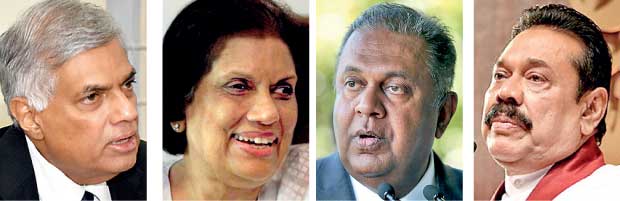
JO claims govt has not used Rs 782b from last budget on development

November 16th, 2017

පසුගිය අයවැයෙන් බිලියන 782 ක් රටේ සංවර්ධනයට වැය කර නැහැ… ඒකාබද්ධ විපක්ෂය පවසයි

Who killed Wijeweera?

November 16th, 2017

Editorial Courtesy The Island


Leader of the JVP trade union wing, Lal Kantha, has called for an investigation into attacks on protests against the Indo-Lanka Peace Accord and the killing of JVP founder leader Rohana Wijeweera, in the late 1980s. Claiming that he once met the late Maj. Gen. Janaka Perera, in Anuradhapura, and the latter denied any involvement in the killing of Wijeweera, Lal Kantha has demanded to know who killed the JVP leader while in custody.

The JVP should have sought an answer to that question while it was savouring power as part of the Kumaratunga government, for about one year, from April 2004. But, a probe into its leader’s execution did not figure high on its agenda then. An opportunity presented itself, again, for the JVP to have an investigation ordered following the 2015 regime change. It had representation in the National Executive Council, which consisted of those who had thrown in their lot with Maithripala Sirisena in the presidential fray.

An investigation into the barbaric incidents in the late 1980s will shed light on the JVP’s heinous crimes as well. JVP death squads murdered many civilians including university teachers, students, Buddhist monks, trade union leaders, politicians, family members of the armed forces personnel and even people who voted at elections.

Lal Kantha has said nobody has claimed the responsibility for killing Wijeweera and JVP cadres though several persons boasted of having eliminated the LTTE leadership. No one usually claims the credit for extra-judicial killings, but the identities of those who were responsible for crushing the JVP uprising as well as the savage methods they employed to achieve that end are only too well known; they included some prominent members of the Premadasa Cabinet. Suffice it to say that the JVP joined forces with some of them to engineer the 2015 regime change!

Lal Kantha tells us that about 60,000 JVP cadres were killed by the security forces, police and the UNP vigilantes. Yes, many JVP activists and youth suspected to have JVP links were abducted, tortured and murdered, but the death toll at issue, in our book, is grossly exaggerated. The claim of 60,000 deaths can be traced to Mahinda Rajapaksa, who worked as a human rights lawyer in the late 1980s. Asked by a foreign journalist how many people had been killed during the reign of terror, Rajapaksa plucked a figure out of the air; he said 60,000!

Wijeweera, who may be considered the father of post-Independence political violence, plunged the country into a bloodbath in the late 1980s as part of his campaign against the establishment of provincial councils. He had many people killed and made thousands of party activists commit hara-kiri in the name of that cause. He also promised to dislodge the capitalist UNP government and install a socialist regime. His utopian dream became a dystopian nightmare for the hapless public. But, today, his party has representation in provincial councils! Its present-day leaders are playing softball with the very UNP bigwigs whom they once accused of carrying out extra-judicial killings.

Newton’s third law is said to apply to some phenomena outside the realm of physics. In armed conflicts, too, for every action, there is an equal and opposite reaction. But, in most situations, response to violence tends to be disproportionate to the actual threat as evident in the counter terror operations in the late 1980s. The JVP sowed the wind and reaped the whirlwind. Wijeweera became a victim of the tornado of political violence he triggered.

Wijeweera took the spree of anarchical violence to such a level that eventually people themselves demanded an end to it. The then government stepped up counter terror operations, which paralysed the country. In times of war laws are said to fall silent—inter arma enim silent leges. The rest is history.

We don’t think the JVP is serious about having the killing of its founder leader probed. For, it doesn’t want a can of worms opened up for its current leaders and their newfound friends in the UNP-led government. So, it is highly unlikely that the identities of the killers of Wijeweera will ever be legally established.

රනිල්ගේ හොරකමේ තරම පැහැදිලි කරන සුජීව!!

November 16th, 2017

SL VLOG

https://youtu.be/_NcyOOZWuBY

තානාපති සේවයේ යෙදි සිටින දේශපාලන පත්විම් ලැබු බොහෝ දෙනා නිකං ඉදං සුර සැප විදිනවා..- ජනාධිපති යහපාලන තානාපති සේවයේ රෙදි ගලවයි..

November 16th, 2017

 lanka C news

රටේ තානාපති සේවය සඳහා පසුගිය ආණ්ඩු සමයන්හි තානාපතිවරු ලෙස තම නෑදෑ හිතවතුන් පත් කරගත් බවට අපවත්වී වදාළ මාදුළුවාවේ සෝභිත නා හිමි එවකට පැවති ආණ්ඩුවලට චෝදනා කලේ ය.

එමෙන්ම උන්වහන්සේ විසින් ආරම්භ කල සාධාරණ සමාජයක් උදෙසා වු ජාතික ව්‍යාපාරයේ එක් ප්‍රධාන සටන් පාඨය වූයේ ද යහපාලන ආණ්ඩුවක් බිහිකොට එම වැරැද්ද නිවැරැදි කල යුතුය යන්න ය.

එහෙත් පසුගිය ජනවාරි 8 වෙනිදා පත් වු යහපාලන නව රජය යටතේ එම වැරැද්ද මෙරටේ කිසිදාක නොවුවිරු ලෙස සිදු වෙමින් පවති.

ඊයේ පැවති ගුණපාල මලලසේකරයන්ගේ ගුණ අනුස්මරණය වෙනුවෙන් පැවති උත්සවයේදි මෛත්‍රීපාල සිරිසේන ජනාධිපතිවරයා මෙරටේ තානාපති සේවාව සම්බන්ධව කතා කරමින් ඊට ප්‍රතිචාර දැක්විය. ඒ රටේ ජාත්‍යන්තරව සම්බන්ධතාවය ඉහළ දමා රට ආර්ථික වශයෙන් දියුණු කිරිමට අවශ්‍ය සහය තානාපති සේවාව හරහා නිසියාකාරව නොලැබෙන බවයි. ඊට ප්‍රධාන හේතුව තානාපති සේවයේ යෙදි සිටින දේශපාලන පත්විම් ලැබු බොහෝ දෙනා විශ්‍රාම ගොස් සිටින අය බැවිනි.

මෙරටේ ආණ්ඩුක්‍රම ව්‍යවස්ථාව අනුව විදේශ රටවලට තානාපතිවරු පත් කරන්නේ විධායක ජනාධිපතිවරයා ය. පසුගිය සැප්තැම්බර් මාසයේදී ජර්මන් තානාපති ලෙස විශ්‍රාමලත් නිලධාරියෙකු වූ වයස අවුරුදු 70 ක් ඉක්මවු විශ්‍රාම සුව විදින පුද්ගලයකු පත්කලේ ජනාධිපතිවරයා විසිනි.

එමෙන්ම විශ්‍රාමලත් දේශපාලන පත්විම ලැබු බොහෝ පිරිසක් මේ වනවිටත් ලෝකයේ වැදගත්ම රටවල තානාපතිවරු ලෙස මේ වනවිට පත් කොට ඇත.

විදේශ රටවල සිටින ශ්‍රීලංකා තානාපති ලැයිස්තුව, මෙහිදී පසුගිය මාසය 6 තුල පත්කල තානාපතිවරු ලැයිස්තුවේ යතාවත් කොට නොමැත. [Link]

List of heads of missions from Sri Lanka

From Wikipedia, the free encyclopedia

This article contains several lists of ambassadors and high commissioners of Sri Lanka.

This is a dynamic list and may never be able to satisfy particular standards for completeness. You can help by expanding it with reliably sourced entries.

Contents

[hide]

Resident heads of mission[edit]

Mission Location Type Head of Mission[a] Position List
 Afghanistan Kabul Ambassador A. L. T. Najeemudeen Ambassador
 Australia[b] Canberra High Commission Somasundaram Skandakumar High Commissioner List
 Austria[c] Vienna Embassy Priyani Wijesekera Ambassador
 Bahrain[1] Manama Embassy A. S. U. Mendis Ambassador
 Bangladesh Dhaka High Commission Y. K. Gunasekera High Commissioner
 Belgium[d] Brussels Embassy E. Rodney M. Perera Ambassador
 Brazil[e] Brasilia Embassy Jagath Jayasuriya Ambassador
 Myanmar Naypyidaw Embassy K. W. N. D. Karunaratne Ambassador
 Canada Ottawa High Commission Ahmed Aflel Jawad High Commissioner List
 China[f] Beijing Embassy Karunasena Kodituwakku Ambassador List
 Cuba[g] Havana Embassy A. L. Ratnapala Ambassador List
 Egypt[h] Cairo Embassy R. Yogarajha Ambassador
 France[i] Paris Embassy Tilak Ranaviraja Ambassador List
 Germany Berlin Embassy Karunatilaka Amunugama Ambassador
 India[j] New Delhi High Commission Chitranganee Wagiswara High Commissioner List
 Indonesia Jakarta Embassy Darshana Perera Ambassador
 Iran[k] Tehran Embassy Y. K. A. Rohanajith Ambassador
 Iraq Baghdad Embassy N. A. Ranasinghe Ambassador
 Israel Tel Aviv Embassy P. Selvaraj Ambassador
 Italy[l] Rome Embassy Daya Pelpola Ambassador
 Japan Tokyo Embassy Dhammika Ganganath Dissanayake Ambassador
 Jordan Amman Embassy A. L. M. Lafeer Ambassador
 Kenya[m] Nairobi High Commission Chulpathmendra Dahanayake High Commissioner
 Kuwait Kuwait City Embassy B. Kandeepan Ambassador
 Lebanon[n] Beirut Embassy R. W. Mendis Ambassador
 Libya Tripoli Embassy vacant Ambassador
 Malaysia Kuala Lumpur High Commission A. J. M. Muzammil High Commissioner
 Maldives Malé High Commission Ashoka Thoradeniya High Commissioner
   Nepal Kathmandu Embassy Swarna Perera Ambassador
 Netherlands The Hague Embassy M. J. Sadiq Ambassador
 Nigeria Abuja High Commission Thambirajah Raveenthiran High Commissioner
 Norway Oslo Embassy Jayantha Palipana Ambassador
 Oman[o] Muscat Embassy K. Pathmanaathan Ambassador
 Pakistan[p] Islamabad High Commission Jayanath C. P. Lokuketagodage High Commissioner List
 Philippines Manila Embassy Aruni Ranaraja Ambassador
 Poland[q] Warsaw Embassy Tissa Wijerathne Ambassador
 Qatar Doha Embassy A. S. P. Liyanage Ambassador
 Russia[r] Moscow Embassy Saman Weerasinghe Ambassador List
 Saudi Arabia Riyadh Embassy Azmi Thazim Ambassador
 Singapore[s] Singapore High Commission Nimal Weerarathne High Commissioner
 South Africa[t] Pretoria High Commission Sunil De Silva High Commissioner
 South Korea Seoul Embassy Manisha Gunasekara Ambassador
 Sweden[u] Stockholm Embassy Damayanthie Rajapakse Ambassador
 Thailand[v] Bangkok Embassy Kshenuka Senewiratne Ambassador
 Turkey Ankara Embassy P. M. Amza Ambassador
 Uganda Kampala High Commission vacant High Commissioner
 United Arab Emirates Abu Dhabi Embassy S. J. Mohideen Ambassador
 United Kingdom London High Commission Amari Mandika Wijewardane High Commissioner List
 United States Washington D.C. Embassy Gamini Keerawella Ambassador List
 Vietnam Hanoi Embassy S. H. U. Dissanayake Ambassador

Heads of mission to non-sovereign territories[edit]

Mission Location Type Head of Mission Position List
 Palestine Ramallah Representative Office M.A. Fawzan Anver Representative

Heads of mission to international organisations[edit]

Mission Location Type Head of Mission Position List
 United Nations[w] New York City Permanent Mission A. Rohan Perera Permanent Representative List
 United Nations[x] Geneva Permanent Mission and Consulate General Ravinatha Aryasinghe (SLFS) Permanent Representative

Other senior diplomatic representatives[edit]

Host country Location Type Diplomat[a] Position List
 Australia Melbourne Consulate General W. G. S. Prasanna Consul-General
 Australia Sydney Consulate General Lal Raj Wickrematunge Consul-General
 Canada Toronto Consulate General U. L. M. Jauhar Consul-General
 China Chengdu Consulate General Senani De Silva Consul
 China Guangzhou Consulate General Shanika Dissanayake Consul-General
 China Shanghai Consulate General Lakshitha Ratnayake Consul-General
 Germany Frankfurt Consulate General M.R. Gunarathna Consul-General
 India Chennai Deputy High Commission V. Krishnamoorthy Deputy High Commissioner
 India Mumbai Consulate General Saroja Sirisena Consul-General
 Pakistan Karachi Consulate General H. M. B. Herath Consul-General
 Saudi Arabia Jeddah Consulate General Officer in Charge Consul-General
 United Arab Emirates Dubai Consulate General Charitha Yattogoda Consul-General
 United States Los Angeles Consulate General Swarna Gunarathne Consul-General

See also[edit]

Notes[edit]

Africa ·         Kenya

·         South Africa

Americas ·         Cuba

·         United States

Asia ·         Bangladesh

·         China

·         India

·         Indonesia

·         Iran

·         Israel

·         Japan

·         Malaysia

·         Maldives

·         Pakistan

·         Philippines

Europe ·         Denmark

·         Estonia

·         Holy See

·         Hungary

·         Russia

·         Switzerland

·         United Kingdom

Oceania ·         Australia
Ministry of Foreign Affairs
(
Minister)
·         Diplomatic missions of / in Sri Lanka

·         List of heads of missions from Sri Lanka

·         Sri Lanka Overseas Service

·         Bandaranaike International Diplomatic Training Institute

·         Lakshman Kadirgamar Institute of International Relations and Strategic Studies

International
organizations
·         United Nations

·         G77

·         IAEA

Ministry of Foreign Affairs website

Categories:


Confusion worse confounded

November 16th, 2017

Editorial Courtesy The Island

President Maithripala Sirisena never misses an opportunity to shower praise on the security forces personnel for defeating terrorism and assure them that he will not allow any of them to be hauled up before a war crimes tribunal. He said so for the umpteenth time recently at the army hospital. The SLFP members of the yahapalana government also express similar views in public. They pooh-pooh their critics’ claim that the ground is being prepared slowly for establishing a war crimes tribunal here.

But, strangely, the Sri Lankan delegation to the Universal Periodic Review (UPR) in Geneva has recently reaffirmed the government’s commitment to implementing the UNHRC Resolution 30/1 (Oct. 2015) which calls for the setting up of a war crimes tribunal with the participation of foreign judges, defence lawyers, prosecutors and investigators. Whom will this hybrid tribunal try? The government, which co-sponsored the resolution, ought to provide an answer.

President Sirisena’s statements on the proposed war crimes tribunal are at variance with those government delegates make in Geneva from time to time. Who is telling us the truth? Is it that the government is divided on the question of honouring its Geneva commitments?

No proposals to overcome country’s economic crisis: MR

November 16th, 2017

Ajith Siriwardana and Yohan Perera Courtesy The Daily Mirror

While claiming that fraud and corruption of the government had put the country into an economic crisis, former President and MP Mahinda Rajapaksa said today no plan had been proposed in the budget or future development programmes by the President and the Prime Minister to come out of it.

Speaking during the budget debate, he said the debt obtained by the government during the last three years had increased by Rs. 2,773 billion from Rs. 7,391 in 2014 to Rs. 10,164 billion.

He said it was the Sirisena and Wickremesinghe government that had put the country into a debt trap even though they accused his government of doing so.

“We had reduced debt burden to the debt to GDP ratio by 71 per cent when we handed over the government. But now it had increased to 85 per cent. We managed debt servicing effectively by reducing the interest rate. But today the government had increased government expenses on its own and faced an economic crisis,” he said.

He said his government had spent the loans on ending the war, reconciliation process and development programmes in the North and in the other parts of the country.

“We constructed ports, airports, state buildings and developed road network in the country. But the present government has not done any development programme or developed infrastructure,” he said.

Mr. Rajapaksa said the government’s fraud and corruption had gone up where they had to pay Rs. 145 billion as interest due to the bond scam, Rs. 15 billion as compensation due to cancellation of the Srilankan airlines order to purchase airbuses and Rs. 21 billion due to the cancellation of the port city project,” he said.

He said people and businessmen had to pay twofold of the tax they paid in 2014 and added that the government was boasting about increasing tax revenue.

Mr. Rajapaksa also said that the budget had proposed to sell state resources to foreigners by liberalising laws to enable foreigners to buy lands without any obstacle.

He said the government had no power to sell or lease out state resources without peoples’ approval and added that steps would be taken to nationalise state resources sold or lease out without peoples’ approval. ()

Mahendran’s phone records show calls to PTL CEO Palisena

November 16th, 2017

Shehan Chamika Silva and Hafeel Farisz Courtesy The Daily Mirror

The forensic communication report presented before the Presidential Commission of Inquiry (PCoI) by SI Yasanka Jayasinghe of the CID today revealed phone calls between former Central Bank Governor Arjun Mahendran and several employees of PTL including CEO Kasun Palisena.

It was also revealed that Mahendran had had spoken with the Chairmen of the BoC, NSB and People’s Bank on the day that former Finance Minister Ravi Karunanayake had called a meeting of the State Banks.

The forensic report also showed constant contact between PTL CEO Arjuna Aloysius and EPF dealer Indika Saman Kumara.

Placing a forensic report on communication information analysis of several concerned people with regard to the bond inquiry, Senior Additional Solicitor General Yasantha Kodagoda today led evidence of sub inspector Yasanka Jayasinghe (data analyzer), who had prepared the document.

This report was prepared based on the data received from the telecommunication service providers (SLT, Mobitel, Dialog, Etisalat and Airtel) and the data extracted from the mobile phone of Arjun Aloysius by the CID.

The witness first explained about the findings of the Communication details of former Governor Arjuna Mahendran during the time period of January 23, 2015 to June 20 2017.

Arjuna Mahendran – Kasun Palisena

-According to this report it was revealed that there were 27 phone calls between Arjuna Mahendran and Perpetual Treasuries Ltd CEO Kasun Palisena.

-While Mahendran was serving as the Governor of CBSL, there were 7 calls.

-Out of the 27 calls, which contained both incoming and outgoing calls, eight (8) calls were between the time period of 6 p.m. – 8 a.m.

-There were also seven (7) text messages between them as well

-The content of one text message sent from Arjuna Mahendran to Kasun Palisena on May 16, 2015 is as follows:

Arjunamahendranhotmail.com”

SASG Yasantha Kodagoda: Have you found any phone call information similar to this which shows that Arjun Mahendran had phone calls with other CEOs of stand alone Primary Dealer companies?

Witness SI Yasanka Jayasinghe: No

SASG Kodagoda: Aiyo! (in a sarcastic manner)

Arjuna Mahendran – Saman Kumara

-It was revealed that there were 30 phone calls between Arjuna Mahendran and former EPF dealer Saman Kumara.

– Telephone calls during the period to Mr. Indika Saman Kumara when he served as a Senior Manager of the Public Debt Department = 7

-Telephone calls during the period Mr. Indika Saman Kumara served as Senior Assistant Superintendent of the Employees Provident Fund = 16

– Telephone calls during the period Mr. Indika Saman Kumara worked in the Facilities Management Department of the Central Bank (from 1st January 2017 onwards) = 7

-Total number of telephone calls between Mr. Arjuna Mahendran and Mr. Indika Saman Kumara after routine office hours5 = 10

-Total number of calls between Mr. Arjuna Mahendran and Mr. Indika Saman Kumara, after Mr. Arjuna Mahendran ceased to be the Governor of the Central Bank (30.06.2016) = 11

-Text messages during the period 01.02.2016 to 20.06.2017 between Mr. Arjuna Mahendran and Mr. Indika Saman Kumara = 12

Arjuna Mahendran – S. Pathumanapan, an official at CBSL

-Telephone calls during the period 23.01.2015 and 20.06.2017 between Mr. Arjuna Mahendran and Mr. Sangarapillai Pathumanapan6 = 19

-Telephone calls during the period 23.01.2015 to 01.04.2015 when Mr. Sangarapillai Pathumanapan worked at the Employees Provident Fund = 0

-Telephone calls during the period 02.04.2015 to 11.09.2017 when Mr. Sangarapillai Pathumanapan worked at the Public Debt Department = 19

– Text messages between Mr. Arjuna Mahendran and Mr. Sangarapillai Pathumanapan during the period 23.01.2015 and 20.06.2017 = 4

Arjuna Mahendran – Employees of Perpetual Treasuries Ltd

-Telephone calls during the period 01.02.2015 to 30.06.2016 between Mr. Arjuna Mahendran and certain other persons of Perpetual Treasuries Ltd and related companies= 15

-Nirosh Maxwald Jaksa (a driver of Arjun Aloysius), Muthurajah Surendran (Director of related company), Surani Neangoda and Sanath Bandara were the individuals that Mahendran had phone calls with.

Thereafter, SASG Yasantha Kodagoda placed all the Communication details Arjuna Mahendran had during the day of which the controversial first bond auction took place.

Communication contacts of Mr. Arjuna Mahendran on the 27th February 2015 (Date of the 1st Treasury Bond Auction examined by the Commission.)

-It was revealed that Arjuna Mahendran had started phone conversations around 7.39 a.m.

-There were 2 outgoing calls from Arjuna Mahedran’s phone to the Prime Minister at 12.38 p.m. after the auction floor closed.

-And also there were three incoming calls from the Prime Minister as well to Mahendran’s phone in the afternoon on the same day.

At this moment, Justice Prasanna Jayawardena citing an answer given by the Prime Minster for the questions asked by the Commission earlier said that Mr. Wickremesinghe had mentioned that he received a phone call from Arjuna Mahendran on February 27, 2015 and Mahendran had informed that he had raised Rs. 10.05 billion from the auction as it was relevant to inform the line minister of CBSL at that time who was Prime Minister Ranil Wickremesinghe.

SASG Kodagoda thereafter placed Communication details of Mr. Arjuna Mahendran during 1st to 4th April 2016.

-1st April 2016 (Friday) – Date of Intra-day Liquidity Facility default.

-2nd April 2016 (Saturday) – Date on which Mr. Arjun Aloysius met officials at the CBSL and the date on which Mr. Arjuna Mahendran discussed the matter with the Director, Domestic Operations Department regarding the default.

-4th April 2016 (Monday) – Date on which the default was settled following imposition and payment of a penalty.

In these details there were phone calls between Arjuna Mahendran and Mr. Paskaralingam on April 2,2016

Thereafter, SASG Kodagoda also revealed about the phone details of Mahendran during the time period where the state banks meeting was called by then Finance Minister Ravi Karunanayake.

Communication contacts of Mr. Arjuna Mahendran on 28th March 2016 (This is the date on which, the then Minister of Finance Ravi Karunanayake is said to have had a meeting with senior officials of State banks.)

It was revealed that Mahendran had phone calls with Chairman of BOC, Ronald Perera, PC, Ashwin De Silva, Chairman, NSB, and Hemasiri Fernando, Chairman, People’s Bank during a time period before or after the alleged state bank meeting on March 28, 2016.

And also there was an outgoing phone call between then Finance Minister Ravi Karunanayake and Mahendran in the afternoon on the same day as well.

………………………………………………………………………………………………………

According to the forensic report, SASG Kodagoda thereafter pointed out the communication details of Arjun Aloysius and other concerned individuals during the period starting from September 2016.

Arjun Aloysius- Saman Kumara (EPF dealer), Ms. Thakshila Kumari and Amal Eroshan

– Telephone calls between Mr. Arjun Aloysius and Mr. Indika Saman Kumara = 38
– Viber voice communication (including attempts to contact) between Mr. Arjun Aloysius and Mr. Indika Saman Kumara during the period 23.10.2016 to 26.01.2017 = 448

– Number of viber voice calls between them during the period 8.00p.m. to 8.00a.m. = 131

– Telephone calls between Mr. Arjun Aloysius and Ms. Thakshila Kumari, who is said to be the partner of Saman Kumara = 18

-Viber voice communication between Mr. Arjun Aloysius and Ms. Thakshila Kumari from 09.03.2017 to 04.07.2017 = 30

– Viber voice calls during the time period 8.00pm to 8.00am = 20

Telephone calls between Mr. Arjun Aloysius and Mr. Badugoda Hewa Amal Eroshan = 69 (According to the statement made by Mr. Indika Saman Kumara, Mr. Batugoda Hewa Amal Eroshan is his brother and works at Carson Cumberbatch Co).

– Text messages between Mr. Arjun Aloysius and Mr. Badugoda Hewa Amal Eroshan = 27

-Viber voice calls between Mr. Arjun Aloysius and Mr. Badugoda Hewa Amal Eroshan during the period 27.01.2017 to 26.05.2017 = 11

-WhatsApp voice communication between Mr. Arjun Aloysius and Mr. Badugoda Hewa Amal Eroshan during the period 27.10.2016 to 06.07.2017 = 163

– WhatsApp communication during the time period 8.00pm to 8.00am = 34

After highlighting above communications details of Aloysius and former EPF dealer Saman Kuamara, SASG Kodagoda said that if one observe the way in which these two people had communicated with each other it is quite evident the nature of their relationship throughout this time period.

The forensic report also revealed the communications between Aloysius and Sangarapillai Pathumanapan, who was an official of CBSL

Aloysius-Pathumanapan

-Telephone calls during this period between 8.00pm and 8.00am = 33

-Telephone calls during the period Mr. Sangarapillai Pathumanapan worked at the Public Debt Department = 53

-Telephone calls during the period Mr. Sangarapillai Pathumanapan worked at the Employees Provident Fund = 8

-Viber voice calls from 23.10.2016 onwards between Mr. Arjun Aloysius and Mr. Sangarapillai Pathumanapan9 = 703

-The entirety of these Viber calls had been during the period Mr. Sangarapillai Pathumanapan worked at the Public Debt Department.

– From 24.01.2017 onwards, they have not communicated using Viber voice, using as one party the mobile phone of Mr. Arjun Aloysius which was examined.

-Of those calls, calls during the period 8.00pm to 8.00am = 202

-According to the forensic report it was also revealed that Aloysius had communications continuously with the phone number belonging to Padumanapan’s brother, who was residing with Padumanapan at the same house.

It was also revealed that Mr. Pathumanapan’s phone number was found in Aloysius’ contact list as ‘Pat Man’

Communication details of Aloysius and Naveen Anuradha, who was the dealer at NSB

– Telephone calls between Mr. Arjun Aloysius and Mr. Naveen Anuradha = 5

– Viber voice calls between Mr. Arjun Aloysius and Mr. Naveen Anuradha = 189

– Of these calls, 50 calls have been taken and received by Mr. Arjun Aloysius between 8.00pm and 8.am

Mr. Naveen Anuradha had served as the Assistant Superintentent and Senior Assistant Superintendent of the Employees Provident Fund, as the Assistant Director of the Financial Intelligence Unit of the Central Bank and as the Chief Dealer of the National Savings Bank.

Communications of Aloysius between Mr. Arjun Aloysius and Mr. Dhanuka Liyanagamage

-There were 48 Telephone calls between Mr. Arjun Aloysius and Mr. Dhanuka Liyanagamage, who is a Dealer in Treasury Bonds of Sri Lanka Insurance Corporation

-Viber calls between Mr. Arjun Aloysius and Mr. Dhanuka Liyanagamage = 12

Finally the forensic report revealed an i-message received to Aloysius’ phone from on Sanjeewa Fernando, who was a director of perpetual related company.

iMessage received by Mr. Arjun Aloysius14 from Mr. Sanjeewa Fernando on 02.06.2017 at 1.30pm:

What is the amount to Thakshila(EPF dealer Saman Kumara’s partner). She wants to know the amount.”(This message is contained in page 3299 of the 11,794 page PDF document containing information extracted from the mobile phone of Mr. Arjun Aloysius. It had been deleted prior to extraction and reconstructed by the extraction tool)

………………………………………………………………………………………………

SASG Kodagoda also Pointed out the communications of Chief Executive Officer of Perpetual Treasuries Ltd, Kasun Palisena.

Kasun Palisena – Saman Kumara

-Telephone calls between Mr. Kasun Palisena and Mr. Indika Saman Kumara= 38

-There were 14 Telephone calls and SMS exchanges between Mr. Kasun Palisena and Mr. Badugoda Hewa Amal Eroshan, who was the brother of Saman Kumara

-There were 22 Telephone calls and SMS exchanges between Mr. Kasun Palisena and Mr. Dhanuka Liyanagamage, who is the dealer of SLIC

According to the forensic report, it was revealed that there were two phone conversations between Kasun Palisena and Tyrell Goonetileke, who served in the Public Debt Department of the Central Bank as Senior Manager.

Saturday, 6th June 2015 @ 9.28pm for 90 minutes (5401 seconds).

Saturday, 6th June 2015 @ 10.59pm for 57 minutes (3414 seconds).

At this moment SASG Yasantha Kodagoda said that this was the time period when Perpetual Treasuries Ltd first dumped on EPF in the secondary market, the bonds purchased at the Primary Auction on February 27, 2015.

Communications of Mr. Indika Saman Kumara (EPF dealer)

-Telephone calls between Mr. Indika Saman Kumara and Mr. Arjun Aloysius = 38
-Viber voice calls between Mr. Indika Saman Kumara and Mr. Arjun Aloysius = 448

-There were also 30 telephone calls between Mr. Indika Saman Kumara’s phone and Mrs. Anjali Mahendran’s phone

-There were 167 telephone calls between Mr. Indika Saman Kumara and Mr. Sanjeewa Fernando, who was a director of Perpetual related company.

-There was one telephone calls between Mr. Indika Saman Kumara and Mr. Ajahn Punchihewa, who was a director of a PTL related company

-There were 4 telephone calls between Mr. Indika Saman Kumara and Mr. Pushya Gunawardhana, who also functioned as a director at PTL related company

-There were six telephone calls between Mr. Indika Saman Kumara and Mr. Muthurajah Surendran, who was a director of PTL

-There were 4 telephone calls between Mr. Indika Saman Kumara and Mr. Sanath Bandara, who was the Chief Financial Officer, Perpetual Capital Holdings Ltd.

SMS exchanges between Mr. Indika Saman Kumara and Mr. Nuwan Salgado (Chief Dealer at PTL) = 23

-The SMS have been sent between 15th November 2016 to 27th January 2017.
-16 SMS have been sent between 8.00pm and 12.00 midnight.

There were 75 telephone calls between Mr. Indika Saman Kumara and Mr. Nirosh Maxwald Jaksa, who was a driver of Aloysius

– 43 calls received by Mr. Indika Saman Kumara have been between 8.00pm and 12.00 midnight.

-There were 13 telephone calls between Mr. Indika Saman Kumara and Mr. K.P. Gamini Kurukulasuriya, who was a driver of Mr. Arjun Aloysius.

Communication details of Pathumanapan, who was a CBSL official  

-Telephone calls during the period 05.02.2015 to 05.05.2015 and from 06.11.2015 to 22.01.2017 between Mr. Sangarapillai Pathumanapan and Mr. Arjun Aloysius and = 61

-There were 703 Viber voice calls during the period 23.10.2016 to 24.01.2017 between Mr. Sangarapillai Pathumanapan and Mr. Arjun Aloysius

– There were 30 telephone calls between Mr. Sangarapillai Pathumanapan and Mrs. Anjali Mahendran (nine calls have been given and received to and from Ms. Anjali Mahendran between 8.00pm and 8.00am)

Communication details of Naveen Anuradha, who was the dealer of NSB

-Telephone calls between Mr. Naveen Anuradha and Mr. Arjun Aloysius = 5

-Viber calls between Mr. Naveen Anuradha and Mr. Arjun Aloysius = 189

(Shehan Chamika Silva and Hafeel Farisz)

Aloysius spoke to COPE MPs during sittings

November 16th, 2017

Shehan Chamika Silva and Hafeel Farisz Courtesy The Daily Mirror

Evidence at the Bond Commission today revealed that PTL Owner Arjun Aloysius spoke to several members of the Parliamentary watchdog Committee on Public Enterprises (COPE) during COPE hearings.

Aloysius had spoken a total of 227 times to Minister Sujeewa Senasinghe, 18 times with Dayasiri Jayasekara, 176 times with Harshana Rajakaruna and 73 time of Hector Appuhamy during periods commencing January 2015.

Cabinet Minister Dayasiri Jayasekara had also been in communication with Arjun Aloysius with 18 calls going to and from him with Aloysius in total, with two calls during the period of the COPE hearings. The communications with Jayasekara had commenced on July 10, 2015.

The second Committee of Public Enterprise (COPE) was established on May 6, 2016 to investigate the controversial Bond Issuance.

The evidence presented by the Attorney General revealed that Arjun Aloyisus had also been in constant contact with MP’s Hector Appuhamy, and Harshana Rajakaruna, whilst they were sitting in the COPE committee investigating the Bond Issuance.

The other MP names were highlighted in a forensic report presented by the Criminal Investigations Department during yesterday’s hearing of the Bond Commission.

The other MP Ajith P. Perera who had only two calls (one incoming and one outgoing), between him and Aloysius.

Senasinghe was appointed midway during the proceedings, after the resignation of UNP MP M. Welakumar on July 8, 2017.

The total number of Telephone calls to and from Senasinghe to Aloysius between the period July 4, 2015 to March 3, 2017 was 227.

They include calls on other platforms such as Whatsapp and Viber.

UNP MP Harshana Rajakaruna who was also a member of the COPE had been in contact with Aloysius since February 2015. There were a total of 176 calls between each other and 18 during the period of the COPE hearings.

MP Hector Appuhamy had taken and received a total of 73 calls from mid July 2016 to mid June 2017 with a total of 23 calls during the period of COPE sittings, evidence revealed.

The evidence was through sub- inspector Yasanka Jayasinghe of the Criminal Investigations Department who had forensically examined all the relevant data.

Counsel for Former Central Bank Governor Arjuna Mahendran vehemently objected to the admitting of the evidence initially. The objections were overruled with the Commissioner ordering written submissions to be tendered within seven days to the Commission.

ASG Yasantha Kodagoda was to later remark following the revelations that “It is exactly knowing all of this that they objected to it”.

Jayasinghe’s evidence was the only evidence led throughout the day, which highlighted many calls to and from between Aloysius, Mahendran and other directly connected parties to the issuance of Bonds.

The evidence was led out following the tabling of a 127 page forensic report in which Jayasinghe explained the method of extracting data. All telecom service providers had complied with the orders of the Commission and provided data during the time period commencing January 1, 2017.

Jayasinghe said that Dialog Axiata had not given the full report due to technical difficulties, Jayasinghe said, but had complied and provided all data that was within their reach. Jayasinghe said that the Telecom giant had requested a further 120 days to provide all the relevant data pertaining to the mobile phones Aloysius and Mahendran.

During evidenced led yesterday the phone details of Arjun Aloysius, Arjun Mahendran, Indika Saman Kumara, Naveen Anuradha, Kasun Palisena, S. Pathumanapan were laid out.

The Attorney Generals Department drew a nexus between the workings of the Central Bank, the other Banks in the Treasury Bond Market, and Perpetual Treasuries. ()

CID probe into telephone conversations: Links between COPE ‘Footnote’ members and Aloysius revealed Senasinghe tops list of callers Ravi figures in 387 conversations

November 16th, 2017

By Sarath Dharmasena Courtesy The Island

An in-depth investigation, conducted by the Criminal Investigation Department (CID), has revealed a spate of telephone conversations between Perpetual Treasuries Pvt Ltd (PTL) owner Arjuna Aloysius and some members of the Committee on Public Enterprises (COPE), which probed alleged bond scams.

This was revealed in a comprehensive report submitted by Sub Inspector Yasantha Yehan Jayasinghe of the CID to the presidential commission of inquiry investigating alleged bond scams.

The report deals with the period from 2016 February 2 to 2017 June 20.

Additional Solicitor General Yasantha Kodagoda said that the CID had been directed to probe links between Aloysius and the MPs who had incorporated footnotes into the second COPE report on the treasury bond scam.

The CID informed the commission that Deputy Minister Sujeewa Senasinghe had had the highest number of telephone conversations with Aloysius during the period under investigation.

President Maithripala Sirisena appointed the commission in January to inquire into alleged treasury bond scams committed in 2015 February and March 2016.

Colombo District UNP MP Senasinghe had taken 62 calls, the P CoI was told and Deputy Minister Ajith P. Perera two calls. Gampaha District UNP MP Harshana Rajakaruna figured in 23 telephone conversations. SLFP Minister Dayasiri Jayasekera and UNP Puttalam District MP Hector Appuhamy had taken five and 23 calls, respectively, the commission was told.

In addition to calls between Aloysius and COPE members, there had been 387 calls between the then Finance Minister Ravi Karunanayake and Aloysius, the report revealed.

The commission was told that COPE members Anura Kumara Dissanayake, Dr. Harsha de Silva, Mahindananda Aluthgamage, Bimal Ratnayake, Abdul Al Maharoof, Mavai Senathirajah, M. A. Sumanthiran and Wimalaweera Dissanayake hadn’t contacted Aloysius over the phone.

INTERNATIONAL RELATIONS AND YAHAPALANA Part 4

November 16th, 2017

KAMALIKA PIERIS

Yahapalana eagerly compared its foreign policy with that of former President Rajapaksa. ‘During the last regime the Lankan mouse from its peephole was roaring at India Instead of fostering relations with India’, said Don Manu. India slammed the door in their face, similarly America, England, France, Germany and the rest of the powerful western world. Due to its anti Indian and anti west stance the island had no friend in the world except the       region’s superpower aspirant China, continued Don Manu. Lanka isolated and alone, with no friends, turned to China and gave it access to areas of strategic value. Rajapakse turned to China not because of a good foreign policy but because political survival depended on it, concluded Don Manu.

Foreign relations have been re-balanced from a ‘China weighted’ one, to one that has restored relations with India and the West, said Yahapalana. Under Rajapakse there was too much reliance on China, ignoring traditional friends like US, Europe and India. Now old friendships are restored and there is less reliance on China, said Razeen Sally.  Unlike the previous regime, the current regime has sought to balance its policy between India and China, giving India a stake in Hambantota airport, Colombo port project and a key expressway, besides preventing Chinese submarines in Sri Lankan waters , observed India’s Foreign secretary, S. Jaishankar.

Unfortunately, neither India nor America have a good public image in Sri Lanka today. The public see modern India as the enemy. Direct Indian involvement in operating Sri Lanka’s second international airport  at Mattala would be 100 times more dangerous than leasing Hambantota port to China said one critic. US is no longer considered a rich, happy, perfect country after the California forest fires and the shootings at Las Vegas and Texas.

Sri Lanka must learn to balance international relations, Sri Lanka cannot become a military facility of any one country,  Sri Lanka can’t play one country off against another,   said Jayanath Colombage. Dayan Jayatilleke warned, ‘Sinhala fundamentalists’ count on the rise of China as a counterweight to India as well as the combined weight of India and the US. India and US are the regional superpower and the world’s sole superpower, though admittedly it is in slow, relative decline. We are an easily blockaded, small island on India’s doorstep and unlike Pakistan, we have no land route to China.

Building and balancing military relationships with India, China,  US and Japan will be crucial if Sri Lanka is to remain ‘a friend of all and an enemy of none’, warned critics. It may be best therefore for Sri Lanka to take middle ground at this moment. We are located at a meeting point between the east and west in the Indian Ocean and our location is of significant geo strategic importance, said analysts. However, no analyst has pointed out that China is a rising power, USA is a declining power. It is ridiculous for Sri Lanka to link with a declining power instead of the  rising one.

The Yahapalana tilt to US has led to a couple of   issues at the UN. Sri Lanka shocked the Arab and Islamic world by not supporting a pro Palestine, at UNESCO, said critics.  They were referring to the Occupied Palestine Resolution passed in October 2016. The resolution condemned Israel for aggression against the Palestinian people. Sri Lanka abstained.

Island ran a headline, ‘Mangala denies being US lackey.’ Mangala Samaraweera, then Foreign minister, said that Sri Lanka’s stand on the Palestine issue was that both Israel and Palestine should find a negotiated settlement and Sri Lanka had not voted against Palestine, he said. Sri Lanka abstained because Sri Lanka had reservations about the text and not because Sri Lanka had changed its mind about Palestine, explained the Ministry of Foreign affairs. India had also opted to abstain, along with many other countries. ‘We have supported Palestine’s entry as observer state to the UN. Our position on Palestine has not shifted at all’.

‘Now it has refused to vote against a resolution on Iran in UN General Assembly’, howled critics in November 2016. Iran has stood by Sri Lanka with military aid and credit lines to buy oil and carry out development projects. Iran stood by Sri Lanka in Human Rights Council.  Sri Lanka position on the vote is eagerly watched. Sri Lanka abstained in this election too.

Sri Lanka is a small nation, surrounded by much larger countries, all with economic and military power, greater than its own. It is essential that Sri Lanka maintain mutually beneficial economic and political ties with them, but Sri Lanka has to take utmost care to ensure that it does not enter in to asymmetrical agreements of long duration with a super power. The damage to national interests will be irreparable, said Anura Gunasekera.

Once entrenched, the super power will not relinquish its hold, it will only ask for more. National interest will not be a consideration in their calculations. We have to bear in mind at all times that we do not have the wherewithal, to exert economic, political or military force to evict an undesirable occupant from our soil, warned Anura Gunasekera

The main military attraction in Sri Lanka is of course, Trincomalee. Trincomalee is one of Sri Lanka most valuable assets. Trincomalee is one of the largest deep water natural harbors in the world. It consists of approximately 2000 hectares of sea and 6000 hectares of land.  The entrance is four miles wide and five across.  The inner harbor which lies to the north covers about 12 sq miles and is securely enclosed by rocks and small islets.

Trincomalee harbor is very strategically located.  Also Trincomalee is a sheltered port unaffected by seasonal weather changes and tidal waves. A remarkable feature of this harbor is its great depth. It has an average depth of 25 m, which could accommodate even mega container ships carrying over 18,000 TEUs that requires a draught of 19 meters.

It has a submarine canyon with walls as high as 1350 cms and a depth of over 3350 meters.  This canyon is one of the 20 largest submarine canyons in the world. Trincomalee is therefore   ideal for nuclear submarines.  They can dive low in the inner harbor and effectively avoid radar and sonar detection. Therefore any power that controls Trincomalee   had a great advantage from naval and strategic perspective.

This has political implications. A fleet so protected is in a position to dominate the Bay of Bengal and the eastern Indian Ocean and   the foreign power owning such a fleet was at an advantage. Currently, it has been observed that Trincomalee can comfortably accommodate the Seventh fleet of the US Navy.

US does not hide its desire to get into Trincomalee. US is working towards establishing  its bases in Trincomalee for its Seventh Fleet and was making Sri Lanka military vacate strategically important locations in the port,  said a news report of 2015.    Accordingly, Sampur navy base was vacated in 2015. The entire camp was removed and its 400 sailors sent to Boossa navy camp in Galle. The reason given was that Sampur was going to be used for resettlement.

The government has decided to allow Trincomalee to be a US base for the 7th fleet said a news report in 2016. Speculation is rife that the Trincomalee Harbor, a portion of the Colombo Port and many other key resources will go to India and the US, said Sumanasiri Liyanage in January 2017.  In May 2017 Vitarana said that an American Naval camp is to be set up in Trincomalee, with the Trincomalee harbor as the focal point. A bilateral agreement has been signed secretly to establish an American naval camp in Trincomalee.

Several international conferences on the Indian Ocean have taken place  in Colombo and elsewhere. Yahapalana is going to lead in this as well. We will continue to take a leading role, in bringing our partners in the Indian Ocean together to deliberate on issues of importance to all of us, said Prime Minister Ranil  Wickremesinghe at the opening of the 2nd Indian Ocean Conference.

Pathfinder Foundation, Carnegie India together with Vivekananda International Foundation in India conducted a conference in Colombo discuss six major areas of connectivity in the Indian Ocean.  Pathfinder Foundation ‘s Centre for Indo-Lanka Initiatives  and National Maritime Foundation  based in New Delhi, India signed a Memorandum of Understanding to embark on research into maritime strategy and security studies in the Indian Ocean. Their first bilateral conference in February 2018 will be on maritime security.

Lakshman Kadirgamar Institute of International Relations and Strategic Studies (LKI) held a dialogue on the theme ‘Sri Lanka’s Foreign Policy: Choices in a Changing World’  at this Dialogue, Mahdev Mohan, Nominated Member of Parliament in Singapore, observed that Sri Lanka’s attempt to craft a dual identity as the centre of the Indian Ocean and a gateway to India would give it a competitive advantage. This was ‘a space that nobody had had the chance to exploit just yet.’

I end this series with a survey of Yahapalana utterances on the politics of the Bay of Bengal. These utterances range from the ridiculous to statements that show that Yahapalana is planning to lead Sri Lanka into war.

Sri Lanka is a small island right in the middle of a large world. For thousands of years we have benefitted from being located strategically. Unfortunately, we seem to have forgotten this competitive advantage of the location. Our vision is to reclaim that mantle of international connectivity, said Prime Minister Ranil  Wickremesinghe

The Government of Sri Lanka has a clear vision of what it wants Sri Lanka to be said Minister Harsha de Silva in January 2017, we would like to position Sri Lanka at the centre of the Indian Ocean.  Sri Lanka is going to be the Hub of the Indian Ocean said  Prime Minister Ranil Wickremesinghe in May 2017. Sri Lanka will be the Hub in the Indian Ocean announced Yahapalana in September 2017.

The notion of Sri Lanka as  a Hub is not as absurd as  I had  initially thought. Jayanath Colombage  made out the following case for Sri Lanka . Colombage  pointed out  that Sri Lanka has a  unique advantage in its geographical location.  Sri Lanka is located in the centre of the Indian Ocean, almost equal distance from the eastern and western Indian Ocean littorals. Sri Lanka is located just 12 nautical miles from the busiest east-west shipping route across this ocean, linking Europe, Americas, Far East, Middle East and Asia, which is considered a key shipping lane in the 21st century. .Further, Sri Lanka is blessed with deep-water ports and deep navigable waters around the country and especially along the approaches to major ports.. Port of Colombo is the only port in the region which is capable of docking and handling even the latest version of mega container ships.

Sri Lanka is well connected digitally to the world and possesses an advanced telecommunication network. Sri Lanka is also enjoying well connected aviation network linking major cities in the region and beyond.  Sri Lanka maintains a balanced and equi-distance diplomatic posture and is considered to be a friendly country by many countries. . Sri Lanka is the only country in this region, where all states arrive without any restrictions, be they  Indians, Chinese, Pakistanis or Americans. Sri Lanka has already taken leadership roles in the India Ocean with Indian Ocean as Zone of Peace initiative,  its role in creating SAARC and creating of UNCLOS. Sri Lanka has presently taken the initiative to discuss a Code of Conduct for Major Maritime Users in the Indian Ocean region and a new Indian Ocean Order.  

Therefore  the   ‘Hub’ possibility  is based on Sri Lanka’s strategic location as well as the availability of ports on all coasts and two international airports with good land connectivity. Colombo will also be a center for offshore finance and business, said Yahapalana . Once it becomes a Hub, Sri Lanka future  will depend on how well the country leverages its geo strategic location as an Indian Ocean hub, said analysts.

‘We don’t want the Indian Ocean to become a militarized arena for great power rivalry. We don’t see here maritime and territorial disputes like those in the South China Sea, said Frances Adamson, Secretary, Department of Foreign Affairs and Trade, Australia. However, a maritime build up is taking place in the Indian Ocean, which includes  nuclear capability. India , USA and China are increasing their naval presence in the Indian Ocean. Very soon, countries will compete for naval power and control of the sea in the Bay of Bengal.  Naval power will play an important role in the region said analysts.

The US is interested in creating partnerships in the Indian Ocean. The U.S.-India-Japan ‘Malabar’ naval exercise in July 2017 was ‘our largest and most complex to date, involving over ten thousand personnel’ said US.  US is also interested in building the coast guard capacity of ‘our Indian Ocean partners’. US says it wants to see greater naval cooperation in the Indian Ocean. US wants to Improve community policing, aviation security, and forensics analysis in the region as well,    in order to combat terrorism, transnational crime, human trafficking and illicit drugs. There is no mention of war.  Analysts however say that US will not be fighting in the Indian Ocean, the fighting will be done on behalf of USA by its partner states.

Maritime security in the Bay of Bengal is now a matter of much concern, said analysts. No single power or coalition will be able to rule on their own in the Indian Ocean. South Asia will need to build military alliances  to effectively counter security threats. Small nations such as Sri Lanka, with comparatively limited maritime resources also can become an integral element of maritime security in the region, said Minister Harsha de Silva. Sri Lanka  should  carve out a role for itself in the region, said  admirers.

Sri Lanka is well positioned  to play a strategic role in the Indian Ocean, due  to its strategic location in the international maritime route.  Sri Lanka  is   also at the crucial entry points of the Bay of Bengal, observed analysts. ,Sri Lanka  has an important responsibility for regional security in addition to national security, announced Yahapalana   we share responsibility in keeping its waters safe said  Prime Minister Ranil  Wickremesinghe .

It was the duty of the Sri Lanka navy to protect the entire Indian Ocean region without limiting its operation to the exclusive economic zone of Sri Lanka, said Prime Minister Ranil Wickremesinghe.  Critics pounced on this remark. This comment is cause for grave concern said Vitarana. Sri Lanka navy was been asked to protect the entire Indian ocean. Our navy cannot even protect us from the Indian fishermen. If Sri Lanka navy is to carry out this huge responsibility, then US ships will have to be berthed in Sri Lanka.   The US 7th fleet will come to Trincomalee.  (CONCLUDED)

INTERNATIONAL RELATIONS AND YAHAPALANA Part 2

November 15th, 2017

KAMALIKA PIERIS

Yahapalana is linking heavily with the US and its satellite countries. India is today the main partner of the US in the Indian Ocean. Yahapalana is pursuing India and offering it ports, (Trincomalee) airports, (Mattala) oil tanks, (Trincomalee) and industries (shoes).  Prime Minister Ranil Wickremasinghe   said Apita indiyawath oney, Oi. Apita Indiyawa tharaha karaganna behe”.  We need India, men. We cannot antagonize them.

No one sees India as the leader of South Asia.  To start with, the disunited SAARC countries do not even like India.  Also, India is   a very young sovereign state. It was created in 1947.  Sri Lanka is much older. India will balkanize eventually and that will be the end of ‘India’. But India is very much present today and   USA is using India to challenge China. India is only too willing. It wants to be the regional power in the Indian Ocean. But when you Google ‘India and China’ the first thing that appears is information on India’s unsuccessful war with China and the current India-China border disputes. You also get unflattering headlines like ‘India is overtaking China as the biggest emitter of the deadly air pollutant sulphur dioxide’

Analysts invariably comment on China’s superiority over India. India is nowhere near the level of China, economically or politically, said analysts bluntly. In 2017 China is ranked 78 on the World Bank’s Ease of Doing Business Index compared with 130 for India.  An analyst commented in 2015, ‘In the past decade, China has emerged as a top exporter of goods to the region, including to India. Around 2005, China overtook India as Bangladesh’s top trading partner. China displaced many Indian goods in Bangladesh, offering cheaper Chinese products (especially cotton and other fabrics central to the garment industry) without the visa, transport, and customs challenges that had limited trade between India and Bangladesh.

Eric Margolis writing in Huffington Post in 2010 remarked, inter alia, that India has grudgingly accepted China’s 1950 takeover of Tibet and has harbored   groups dedicated to liberating Tibet. India sees the growing array of Chinese bases in Tibet as an extreme danger, said Margolis. China’s air, missile and intelligence bases in Tibet look down on the vast plains of India. Tibet controls most of the headwaters of India’s great rivers. Delhi has long feared that China may one day dam and divert their waters to China’s dry western provinces, said Margolis.

Other serious potential flashpoints exist, continued Margolis. India’s old foe, Pakistan, with whom it has fought four wars, is China’s closet ally. Beijing arms Pakistan and has built up its nuclear arms program. An Indian-Pakistan war over divided Kashmir, or an Indian intervention in a fragmenting Pakistan or Afghanistan, could draw China into the fray.  A new port in western Pakistan at Gwadar will give China port rights on the Arabian Sea.

Margolis also looked at Burma. Burma (today Myanmar), on India’s troubled eastern flank,   rent by tribal uprisings, deeply worries Delhi. Strategic Burma is rapidly becoming an important forward Chinese base. A new road links China with Burma, and provides China’s navy a badly needed port on the Andaman Sea, and thus access to the Indian Ocean.
India believes China is trying to strategically encircle it. To the west, Pakistan, to the north, Tibet, to the east, Burma, to the south, Sri Lanka, concluded Margolis.

It is clear therefore that India on its own has no grand image. Therefore the group supporting USA is busy providing a grand image for India. India is seen by this group as the leader in the Bay of Bengal. India will overtake China eventually to become a great world power, said India’s supporters. We welcome India’s strengthened relationship with the United States and increased engagement in the broader Indo-Pacific India is an emerging great power and a natural leader in the Indian Ocean region and globally said Australia.  India has shown great potential to become the second largest economy in the world by 2050   said Ranil Wickremesinghe.

By 2030, China and India are likely to swap places, with India overtaking China, said Ganeshan Wignaraja. China and India have followed similarly impressive growth trajectories in recent decades. India is a late starter. India’s economic liberalization started a decade after China.  But India’s reforms have made great strides and have begun to catch up with China. India has boosted public investment in infrastructure and other areas.  India has a youthful population under 24 years compared to China, continued Wignaraja.

Indian exports are increasingly led by more-sophisticated, skill-intensive services such as information technology, business process outsourcing (BPO) and financial services. India’s success in IT is due to its widespread use of English, supplies of high-quality graduates from Indian Institutes of Technology and Indian Institutes of Management, falling communications costs and returning non-resident Indian investors from Silicon Valley. Some of India’s states – Andhra Pradesh, Maharashtra and Tamil Nadu – are becoming manufacturing hubs and linking into global supply chains said Wignaraja.

However, China’s economic policies, investment climate and supply-side conditions remain more favorable than India’s, commented Wignaraja. Accordingly, China will continue to lead India in global supply chain trade for the foreseeable future. Firms operating in China enjoy a more competitive business environment than their counterparts in India, with more market-friendly rules for business start-ups, property registration, contract enforcement and bankruptcy, added Wignaraja.

China has today become the assembly hub of sophisticated global supply chain trade in technology intensive manufactures. China had ventured into research and development in the biotech and robotics sectors as well.  China and India are similar in terms of ports, but India lags behind China in railways and electricity supply, continued Wignaraja.

Moreover, China allocates significantly more resources than India to R&D and infrastructure. China spends as much as 2.1% of GDP on R&D while India spends 0.6%, China leads in education and training. In 2016 China had 4.7 million STEM (science, technology, engineering and mathematics) graduates while India had 2.6 million. India’s tertiary enrollment rate is 27% in 2015 compared with a rate of 43% in China, concluded Wignaraja.

India was the first port of call for President Maithripala Sirisena, Prime Minister Ranil Wickremesinghe, and Foreign ministers, Mangala Samaraweera and Ravi Karunanayake, when they took office. President Sirisena and Prime Minister Wickremesinghe visited India four times each. Over the past two and a half years, there were at least 10 high level visits between India and Sri Lanka, said analysts.

Tilak Marapana, Foreign Minister, visiting Modi in New Delhi, said “It is in the fitness of things that I should come here first to call on you. India is like our elder brother”. India firmly repudiated this. What exists now is mutual cooperation, not superiority, said India. India now wants to develop its relationship with Sri Lanka on a ‘one to one basis’,  with mutual respect and open hands, respecting the sovereignty and dignity of the two countries, said   India. We want to re-do what was missing in the last 27 years. We believe our relations are not simply based on economy but on the narrative of history and culture”.

Joint military exercises between India and Sri Lanka named ‘Mitra Shakti’ have been taking place annually since 2013. In October 2014 two Chinese submarines docked in Colombo harbor for bunkering and supplies. It triggered an immediate protest from India and a visit to Colombo by Indian National Security Advisor Ajit Doval to register India’s objections. In May 2017, Sri Lanka rejected China’s request to dock one of its submarines in Colombo for supplies on the eve of the visit to Sri Lanka by Indian Prime Minister Narendra Modi.

A few weeks after the 2015 presidential election, US president Barack Obama revealed the existence of a common US-India stand on Sri Lanka, observed Shamindra Ferdinando.  Analysts have point out that since January 2015; Colombo has been visited by several Indian and US naval vessels. Joint military exercises are currently at an unprecedented level. In January 2016, Indian navy’s single aircraft carrier INS Vikramaditya, accompanied by a destroyer made its maiden overseas port call to Colombo. Permitting a port visit by an Indian aircraft carrier but rejecting a request for a Chinese submarine  was a sign of alignment to India.

The government’s policy of permitting aircraft carriers of India and US into Colombo harbor whilst rejecting permission for a Chinese submarine in the long term will not help in its endeavors in walking the tight-rope of balancing relations between the three powers to Sri Lanka’s benefit. The refusal also does not compare well with a visit by a US nuclear-powered aircraft carrier, critics said.

When Yahapalana government took over in 2015, it had no intention of ever working with China. Yahapalana was planning to sever all relations with China, and was going to link exclusively with India and America.  Sri Lanka adopted a strong, bold anti-China posture with various spokesmen condemning China.

The government acted belligerently as if it could do away with all major Chinese investments, observed analysts. Yahapalana was going to suspend the USD 1.4 billion Colombo Port City project, Hambantota port and several other Chinese funded projects, said  Prime Minister Ranil Wickremesinghe  very confidently, to the media well before the 2015 election.

But China stood firm. These were international agreements signed by two heads of state, and they could not be easily repudiated. Sri Lanka must honor its contracts with China or pay China compensation ,said China. Yahapalana‘s western allies were not prepared to pay the compensation. Sri Lanka had no choice but to bow to  China. China made both the President and Prime Minister of Sri Lanka come to China for discussions. They went.

The fact that Yahapalana was going to sever all relations with China, but was prevented from doing so, was   quickly pushed under the carpet.  Yahapalana immediately started to sing a new song. Yahapalana said that they were maintaining relations with China voluntarily, as a part of an enlightened foreign policy. We want to get along with both China and India” said Prime Minister Ranil Wickremesinghe.

USA and its satellites joined in the Yahapalana song. It is natural for Sri Lanka to turn around and embrace China again said Voice of America, but Chinese projects are not useful for the people.  The new government is wooing China while keeping India on board said pro-US analysts. Everyone in New Delhi has realized that the new Colombo government isn’t going to abandon China just like that. It has certain big infrastructure investments. If China supports the development of Sri Lanka, then there is little motivation for Sri Lanka to refuse economic support from China, said Japan. Sri Lanka wants to accept China’s economic support to support its own development, Japan added.

The public seemed to have swallowed this, but analysts have not. Sri Lanka now is busily balancing its relations with India and China, they said.  The need to balance relations with China, India and USA was an unexpected one, and one which Yahapalana of course cannot manage. Sri Lanka should not depend mainly on Chinese development assistance, which is dangerous, because Sri Lanka would not be able to craft a balanced foreign policy with India and the West, said Razeen Sally. The China factor could lead to serious problems with India for Sri Lanka, said the pro-India group. When China is building a port in Sri Lanka and their submarines visit Sri Lanka, these moves create new difficulties with India.

Japan, India and the US are worried that China will use its foothold in Sri Lanka to establish a military base. They realize that China could use Hambantota for its military ships. The Hambantota agreement is a commercial one, not government to government one Yahapalana assured. Also, China has no exclusive right to the harbor. Hambantota Port would not be turned into a military base said Prime Minister Ranil Wickremesinghe. Only Sri Lanka’s armed forces are allowed to carry out military activities in ports and airports.

The public may have forgotten the fact that Yahapalana could not push out China, but China has not forgotten. China does not like Yahapalana and does not bother to hide the fact. China has no intention of withdrawing from Sri Lanka.

Sichuan University, one of the 10 top universities in China, sent a delegation to Sri Lanka in April 2017. Pathfinder Foundation   met them to discuss how Sichuan University could help Sri Lanka universities. A team from Pathfinder Foundation paid a return visit. Vice President Prof. Yan Shijin  in his discussion with the visiting Pathfinder team,  emphasized the importance of heightening China-Sri Lanka relations, Sri Lanka’s role in the Belt and Road Initiative and the desire of Sichuan University  to help Sri Lankan students seeking higher education in China.

The People’s Liberation Army Navy ship Qi Ji Guang arrived at the Port of Colombo on a goodwill visit  in November, 2017.Sri Lanka Navy welcomed the visiting ship in accordance with naval traditions. A host of officials from the Embassy of the People’s Republic of China in Sri Lanka and Chinese nationals living in Sri Lanka were present on the harbor premises to welcome the ship. During their five-day official visit, the crew members of Qi Ji Guang are scheduled to participate in a number of training exercises and sporting events organized by the Sri Lanka Navy with a view to sharing professional expertise and strengthen friendship. The vessel which is carrying a crew of 549 is 163.5 m in length and 22.2 m in width. It has a displacement of 10,907 tons, said the press release.


Your letters: Sri Lanka has a long, proud history of peacekeeping with the UN

November 15th, 2017

Opinion  Readers’ Letters The Star

Sri Lanka’s military aren’t ready to be peacekeepers, Opinion, Nov. 3

Unfortunately, this column by Liberal MP Gary Anandasangaree does not portray the factual position regarding Sri Lanka’s contribution to UN peacekeeping missions, or the progressive developments in the country under the National Unity government.

Sri Lanka values its membership in the UN, which spans more than 60 years, and is committed to contributing positively to its work. Sri Lanka’s contribution to the work of the UN, for long years, is well acknowledged.

Since the election of President Maithripala Sirisena in January 2015, and the formation of the National Unity government, Sri Lanka’s engagement with the UN has been renewed, reflecting the vision of the government and the people of the country to re-engage with the international community and contribute to the UN’s multifaceted agenda, including peacebuilding, peacekeeping and sustainable development.

The government’s commitment to the promotion and protection of human rights, ending impunity, upholding the rule of law, strengthening good governance and democracy, fostering reconciliation and sustainable peace, and ensuring equitable and inclusive development for the benefit of all citizens is firm.

Sri Lanka has contributed to UN peacekeeping missions for more than 50 years and is committed firmly to ensuring the best possible training and assessment for peacekeepers from Sri Lanka, in order to uphold the highest standards of peacekeeping.

In keeping with this commitment, Sri Lanka works closely with the UN and has put in place stringent vetting procedures for military personnel who are deployed to UN peacekeeping missions. Most recently, in order to ensure that all possible steps are taken to ensure the effectiveness of the screening procedure, the National Human Rights Commission of Sri Lanka was invited to also be part of this process.

In September 2015, Sri Lanka endorsed the Kigali Principles on the Protection of Civilians. In August 2017, Sri Lanka pledged a contribution of $10,000 (U.S.) to the UN Trust Fund in support of Victims of Sexual Exploitation and Abuse. In September 2017, Sri Lanka joined an initiative of the UN Secretary-General to sign a compact to eliminate sexual exploitation and abuse. And, demonstrating firm commitment, Sri Lanka also joined the Secretary-Generals Circle of Leadership on the prevention of and response to sexual exploitation and abuse in UN operations. This month, Sri Lanka endorsed the Vancouver Principles on Peacekeeping and the Prevention of the Recruitment and use of Child Soldiers.

Regrettably, Sri Lanka, similar to several other member states contributing troops to UN peacekeeping, has had to face situations where some of its troops had committed acts of sexual misconduct. The government of Sri Lanka maintains a strict zero-tolerance policy on sexual exploitation and abuse and, accordingly, any such allegations of transgression by its troops have been properly investigated, and the UN kept informed of the progress and results of such inquiries and action taken.

When allegations of sexual exploitation and abuse in 2006 and 2007, implicating some members of the Sri Lanka military contingent deployed to MINUSTAH, were brought to the notice of the government of Sri Lanka by the UN at the time, prompt action was taken for their immediate removal from MINUSTAH.

Two separate courts of inquiry were conducted by the Sri Lanka army and navy, and disciplinary action taken against any breach of discipline. The UN, as per due procedure, was informed of the processes followed. The UN Secretariat has acknowledged in writing the action taken by the government and confirmed that the UN Secretariat, as of Sept. 29, 2014, considers the matter closed.

In addition, the government arranged for a one-off ex gratia child support payment to a woman in Haiti. The Under-Secretary-General for Field Support of the UN has, in a letter to the government, conveyed the appreciation of the UN for this action taken and Sri Lanka’s communications and engagement with the UN on this matter, which not only serves as a best practice, but as exemplifying the spirit of the commitment and partnership between the UN and member states. Therefore, the accusation in this column that victims in Haiti are still awaiting answers is incorrect.

Following the allegation of the rape of a Haitian woman in 2013, the government extended the fullest co-operation to the UN investigation team in Haiti to inquire into the complaint. The army also appointed a court of inquiry, comprising senior officials who travelled to Haiti and met with a number of witnesses, including the alleged victim. They also examined medical and legal reports provided by the UN investigating team in Haiti and concluded at the end of the inquiry that the allegation of rape was false.

It is regrettable that the errant actions of a few, which the government condemns in the strongest terms and does not condone in any way, are being used to tarnish the good work carried out by a large number of dedicated and devoted Sri Lankan troops in UN peacekeeping missions.

The National Unity government is determined to work with all the citizens of Sri Lanka and the international community, including the United Nations, in realizing its vision of a reconciled, peaceful, stable and prosperous nation. It is with this sincerity of purpose that the government proceeded to co-sponsor resolution 30/1, titled Promoting Reconciliation, Accountability and Human Rights in Sri Lanka,” in September 2015, and resolution 34/1 in March 2017 at the UN Human Rights Council, and work toward their adoption by consensus.

This vision is not one that can be realized in a hurry, no matter how much we desire to do so. But we are determined to achieve the best for all the citizens of the country and we are committed to processes of truth-seeking, justice, reparation and guarantees of non-recurrence.

Since the matter of land was addressed in the article, I wish to state that nearly 82 per cent of all civilian land held by the security forces has been released. With regard to the Mullativu district of Sri Lanka, which is specifically referred to, the military has released a total of 20,784 acres of land as of Oct. 31, 2017. A total of 6,704 acres of land is currently held by the military in Mullativu district, out of which 5,679 acres is state land and 1,025 acres is civilian land. A comprehensive plan is being worked on for the release of remaining land and for the payment of compensation. The accusation in this column that the army occupies as much as 60,000 acres of civilian land just in the Mullativu district” is untrue.

Sri Lanka is at a historic moment, when the two main political parties in the country are working together with a common vision for strengthening democracy, reconciliation and economic development, and to take steps to guarantee non-recurrence of conflict.

This is the time when Sri Lanka requires the support of the international community to ensure that the lives, especially of those affected most by conflict, are restored and that they are given every opportunity to rebuild their lives.

It is our fervent hope that all persons of Sri Lankan origin overseas would join hands at this time to help the people of Sri Lanka realize their long-cherished dream of peace, stability and prosperity in a reconciled nation.

Ahmed A. Jawad, High Commissioner for Sri Lanka in Canada


‘Cold day in hell before ICC goes after US for committing Afghanistan war crimes’

November 15th, 2017

The ICC prosecutor’s decision to pursue a probe into alleged war crimes in Afghanistan is completely political” and won’t amount to anything, law professor Francis Boyle believes. He said it will be a cold day in hell” before any Americans are prosecuted.

The International Criminal Court’s chief prosecutor, Fatou Bensouda, announced last week that her request to launch an investigation had been handed over to a pre-trial court. She said that if her request is granted, the probe will focus upon those most responsible for the most serious crimes committed in connection with the situation in Afghanistan.”

Read more

US spent $5.6 trillion on wars since 9/11 – study

However, Francis Boyle, an international law professor at the University of Illinois, told RT that while Bensouda is likely to get approval for the investigation, the move is simply a propaganda stunt.” He added that Bensouda has no desire to go after any Americans who committed war crimes.

You have to understand, this is all political,” said Boyle. He noted that the African country of Burundi has already pulled out of the ICC, and South Africa has voiced the same intention.

So she’s in a position and the court is in a position that almost all of Africa is going to pull out of the ICC because the only people in the dock over there are black, tin-pot dictators from Africa,” Boyle said. He called the court a Western, racist, imperial tool” which is being used against Africa.

Because of this, the so-called white man’s court” will not be going after Americans, Boyle said. It will be a cold day in hell” before we see Bensouda doing so, he added. Boyle noted that the ICC has never gone after the Americans, the NATO states, Britain, Israel, despite clear-cut jurisdiction to do so.”

Boyle went on to accuse the US government of committing a Nuremberg crime against peace by invading Afghanistan and attacking it and blowing them back to the Stone Age and killing a million Afghans.” He added that I doubt very seriously Bensouda is going to deal with any of that.”

The United States illegally and criminally invaded Afghanistan and attacked and destroyed them… and then they set up all these torture campus over there, they’ve been torturing these poor people forever. And at a minimum, the United States has probably killed a million Afghanis [sic] since October 2001,” he said.

Read more

‘Main creator of terrorism is US war on terror, not terrorists’

The Americans should have been investigated a decade ago at least,” said Boyle, who filed an ICC complaint against former US President George W. Bush, Vice President Dick Cheney, and Secretary of State Condoleezza Rice, among others, in 2010, over their policy of extraordinary rendition perpetrated upon about 100 human beings.” He added that the American government knows full well they’ll be able to sabotage her [Bensouda], stop her. Nothing’s going to come of it.”

However, Boyle predicted that Bensouda would likely come back with a verdict that it was actually the Taliban who was responsible for crimes. Or she might apportion blame, but that’s ridiculous too…if you read all the United Nations reports of human rights violations coming out of Afghanistan, they all blame the Taliban. And it’s a joke.”

Although the ICC statement doesn’t name specific parties that would be subject to the investigation, a report released by the prosecutor’s office last year said there is reasonable basis” to believe crimes were committed by US military forces deployed to Afghanistan, and in secret detention facilities operated by the CIA. It also points the finger at the Taliban and Afghan government forces.

Boyle noted that although the US can technically be prosecuted by the court – despite not being a member – the ICC pretty much do what they’re told to do,” citing money received from Europe, Japan, and South Korea, as well as the influence of America.

Meanwhile, the United Nations mission in Afghanistan said earlier on Thursday that at least 10 civilians may have been killed in an airstrike in the north city of Kunduz last week, despite a US military investigation stating that no evidence of civilian deaths had been found.

Boyle previously served on the board of Amnesty International USA and drafted legislation for the Biological Weapons Convention, known as the Biological Weapons Anti-Terrorism Act of 1989, which was signed into law after being unanimously approved by both chambers of the US Congress.


The Geopolitics of Floating Bases and the New World Order

November 15th, 2017

by Asanga Abeyagoonasekera

Those far distant, storm-beaten ships, upon which the Grand Army never looked, stood between it and the dominion of the world.Alfred Thayer Mahan

US naval officer and strategist Alfred Thayer Mahan’s advice in 1890 for the US to push outwards to rule the oceans is still heeded by US maritime forces in the present day. The USS Nimitz aircraft carrier, standing 23 stories high and 333 metres long with 5,000 personnel on board, arrived in Sri Lanka in October this year after 32 years since the last arrival of a US aircraft carrier. Aircraft carriers are sea-faring air bases equivalent to floating geographical land masses with significant firepower which have been proven as key strategic war machines in the recent past.

The visit of the USS Nimitz is a clear indication of the military and economic might that the US projects through floating bases, not only in the Indian Ocean Region (IOR) but globally. Floating bases are indicative of the US world order – one that is predominantly unilateral, save for ‘collective security’ partnerships and one that seeks hegemony.

Nevertheless, the presence of USS Nimitz in the IOR intends to symbolise the strong cooperation between the US and Sri Lanka during the Sirisena regime. Back in 1985, the US aircraft carrier visit would have raised concerns for Sri Lanka’s immediate neighbour, India. However, today, the US and India enjoy a different relationship than in the past. The US has clearly cemented strong ‘collective security’ relations with India, Japan, and Australia.

In this context, countries with a geostrategic advantage such as Sri Lanka are seen as ideal sites to further strengthen these lateral ties. From 2010 onwards, there have been more than 200 foreign naval visits to Sri Lanka, including India’s INS Vikramaditya, another aircraft carrier that visited the Colombo Port in 2016. Sri Lanka strives to balance all major powers’ interests in the country and thus accommodate these war ships as friendship visits. The prevalent counter-argument is that some major powers, most notably China, are aggressively and one-sidedly pursuing their own self-interest through setting up military bases in the IOR. However, one could also contend that aircraft carriers as floating bases (such as the US’) in the deep oceans are trying to showcase and achieve a similar military strategy and projection of power.

President Sirisena’s government is enacting this balancing act for Sri Lanka and creating equidistant foreign relations with the US, India, and China. In the region, India has also engaged in joint military exercises, the most recent being ‘Mitra Shakti 2017’ with Sri Lanka in October. According to the Indian Express, the joint military exercise was India’s response to China’s growing influence in South Asia and the IOR. However,this author’s opinion is that the article is speculative since the military exercise clearly falls short of limiting China’s growing power in the region. In this vein, many speculative media stories will raise similar questions with regard to Sri Lanka’s relationship with its neighbour, India.

President Trump visited China against the backdrop of all these geopolitical events in the IOR. Chinese leader Xi Jinping has arguably presided over more domestic stability and economic prosperity in his country than Angela Merkel, Theresa May, Vladimir Putin, and Trump combined. President Xi, in his speech to the 19th National Congress in October, highlighted the founding aspirations of Chinese communist values. This included moving 80 million people from rural to urban areas, boosting the country’s GDP from 54 trillion to 80 trillion yuan, projecting China as the world’s second largest economy, and contributing to 30 per cent of global economic growth in a span of only five years. While propelling innovation and scientific advancement, China has also made more than 1500 reforms of a socialist nature to pursue modernisation, including fighting corruption. On the latter point, President Xi remarked We have taken out tigers, swatted flies and hunted down foxes,” leaving no space for corruption.

At the 19th National Congress, China’s external approach to the world was discussed. President Xi’s gigantic One Belt, One Road (OBOR) project has already altered the natural geography in many parts of the world. This includes the China-Pakistan Economic Corridor (CPEC), connecting to Gwadar Port as well as Hambantota Port, which will change trading patterns in the region. The Asia Infrastructure Investment Bank (AIIB) and the Silk Road Fund are other economic initiatives working towards funding a new economic order. Thus, it is apparent that China has charted its own course in creating an Asian-led new world order that is geo-politically, economically and militarily in direct contravention of the US’ world order, and that renounces the perceived Western view.

Today, China projects itself as a proud country, at a time when socialists around the world are celebrating the centennial of the great October Revolution of 1917, spearheaded by Vladimir Ilyich Ulyanov, better known as Lenin. From its long history of struggle, China has set itself in the right direction to alter the existing world order (the one contravened by the US), by pursuing a strategy that is rooted in economic and geopolitical prowess. Much like the US, China’s power projections are articulated through the amassing of land-bases. Yet, China’s world vision is far broader, in that it is striving to combine its economic and military might with its socialist-political orientation as well as the geo-strategic interests of developing countries.

(Views expressed here are personal and do not reflect those of the Government of Sri Lanka or the Institute of National Security Studies (INSS). Asanga Abeyagoonasekera is a visiting lecturer in international political economy (IPE) and Director General of INSS, the national security think tank of Sri Lanka. This article was initially published by the IPCS, New Delhi for Dateline Colombo- http://www.ipcs.org/article/india/the-geopolitics-of-floating-bases-and-the-new-world-order-5391.html )

Not even the President can contain current politicians in govt – Bandula

November 15th, 2017

Not even the President can contain current politicians in govt – Bandula පොලිස් තර්ජන පන්සලටත් එයි-වහාම ක්‍රියාත්මක වෙන්නැයි ජනපතිගෙන් බන්දුල ඉල්ලයි

Govt has relaxed everything; giving entire country to foreigners – Bimal (English)

November 15th, 2017


Govt is exacting revenge through my people – Mahinda (English)

November 15th, 2017

The Supreme Court awards compensation to British tourist with Buddha tattoo

November 15th, 2017

S.S.Selvanayagam Courtesy The Daily Mirror

The Supreme Court today awarded a total of Rs.800,000 — Rs.600,000 as compensation and Rs.200,000 as cost–to Britisher Naomi Coleman who was arrested and deported for having a Buddha tattoo on her right upper arm.

The Supreme Court said her fundamental rights had been breached and that a Magistrate could not issue a deportation order on the basis that a deportation order against a foreigner must only be made by the Subject Minister.

The Judgement was delivered after more than a dozen postponements because the Supreme Court bench not being constituted. The case was argued and concluded and order reserved for Judgement on June 10, 2015 after which Justice Chandra Ekanayake retired. Thereafter the case had to be re-argued.

Justice Anil Gooneratne with Justices Eva Wanasundera and Nalin Perera agreeing awarded the petitioner Naomi Michelle Coleman Rs.500,000 as compensation payable by the State and Rs.50,000 each by Police Sergeant Upasena and Katunayake Police Acting OIC Inspector Suraweera. Court also awarded Rs.200,000 as costs payable by the State.

The SC held that her fundamental right to freedom from torture, right to equality and freedom from arbitrary arrest had been infringed upon.

It said the police had misrepresented facts and misled the magistrate into believing the submissions that had been made and that a deportation order could be made by that Court.

The SC ruled that the Magistrate had no jurisdiction to make a deportation order on the basis that the deportation of foreigners is governed by the Immigration and Emigration Act and that the power to order the deportation of a foreigner is vested in the subject minister.

Petitioner Naomi Michelle Coleman, a nurse employed at the Hawkesbury Lodge, Rehabilitation Mental Health Services, cited the Attorney General, Police Sergeant Upasena, Inspector Suraweera of the Katunayake Police Station, the Negombo Prisons OIC, IGP and the then Immigration and Emigration Controller General Chulananda De Silva as respondents and sought the Court to award her Rs.10 million as compensation.

Additional Solicitor General Sanjay Jayasuriya with Deputy Solicitor General Parintha Ranasinghe and Senior State Counsel Warunika Hettige appeared for the AG.

Counsel J.C.Weliamuna PC with Pulasthi Hewamanna, Tishya Weragoda instructed by Vishwa De Livera Tennakoon appeared for Ms. Coleman.

She said as a practicing Buddhist she attends meditation retreats in Nepal, Thailand, Cambodia and India and as an apt tribute to and as a personal expression of her devotion to Buddhist teachings had on her right upper arm displayed a tattoo of the Buddha seated on a lotus flower.

She said she arrived at the Bandaranaike International Airport and when she was at the exit gate attempting to locate the luggage counter, she was approached by a taxi-cab driver later identified as Kelum Chaminda and a bystander who said the tattoo might be objectionable in Sri Lanka.

She said they took her to Katunayake Police Station where the Acting OIC confiscated her passport produced in Court without disclosing the charge against her or the offence committed and was not afforded an opportunity to communicate with the British High Commission or whether the High Commission was informed of her arrest.

She said she was introduced to an Attorney by a prison guard and had no opportunity to give instructions to the Attorney but was required to pay a fee of Rs.5,000.

She said the prison guard who was in charge, while at court, made several lewd, obscene and disparaging remarks of a sexually nature while being detained behind bars in the court room and at the conclusion of her case, her attorney informed her that she would be deported, regardless of her entreaties and would be permitted to leave to Maldives and till then detained at a deportation centre.

The petitioner said a woman prison guard had asked her to give her Rs.10,000 and attempted to take her mobile phone.

She said she was subjected to a full body search by a female officer and that an inmate provided her a mat to sleep for the night with 60 females inmates sharing the room. ()

Govt. borrows Rs. 4.7 trillion in 3 years: Wimal

November 15th, 2017

Ajith Siriwardana and Yohan Perera Courtesy The Daily Mirror

Joint Opposition MP Wimal Weerawansa said today the government had obtained Rs. 4.7 trillion as loans for three years whereas only Rs. 5.2 trillion was obtained as loans for nine years during the previous regime.

Speaking during the budget debate, he said the debt burden had gone up by 64% since the government came to power.

“The debt to GDP ratio was 77.6 per cent in 2014 when the present government came to power. But it was increased to 79.3 per cent in 2016 without the war and constructive development programmes,” he said.

MP Weerawansa said the government was planning to obtain Rs. 1,895 billion in 2018 as new loans.

He said the recurrent expenditure of the government had increased by 62 per cent when compared to the budget in 2014 where the recurrent expenditure was Rs. 868 billion.

“If the government claim that the debt burden should be borne by everyone, recurrent expenditure of the President, Prime Minister and the government should have been reduced,” he said.

Mr. Weerawansa said the government had no plans to implement the ‘Blue, Green’ budget which would be only a set of words.

He said the budget included a set of proposals which would not be able to implement in practice adding that it had intended for the foreigners than the local entrepreneurs. ()

Naseby statement will clear Sri Lankan security forces

November 15th, 2017

Yohan Perera and Ajith Siriwardene Courtesy The Daily Mirror

The statement made by Lord Naseby during the sessions of Britain’s House of Lords will help Sri Lanka to safeguard the dignity of its security forces to some extent, State Minister of Foreign Affairs Wasantha Senanayake told Parliament yesterday.

The State Minister made this remark in response to an allegation made by Joint Opposition Parliamentary Group Leader Dinesh Gunawardene that the government is ignoring this statement and is not making any effort to make use of this statement to create a favourable situation for the Sri Lankan security forces.

All parties should get together and thank Lord Naseby for backing Sri Lanka,” the Deputy Minister said while suggesting that all parties should get together and thank Lord Naseby. He said he had already sent a letter to him thanking him for the initiative he had taken on behalf of Sri Lanka. He said the information which Lord Naseby came out with makes it clear that Sri Lankan security forces have engaged in the war in a legitimate manner.

Sri Lanka has got an opportunity which it should not miss. We all should write a letter thanking Lord Naseby for taking an initiative to Help Sri Lankan security forces clear their names of the crimes they never committed,” he added

Mr Gunawardene who moved an adjournment motion on the issue said the following:

Since Lord Naseby, addressing Britain’s House of Lords, drew attention to the fact that the casualty figures for the last period of the civil conflict in Sri Lanka, which ended in May 2009, cited in the United Nations’ Darusman Report, were brought into question by the figures quoted by former UN spokesman Gordon Weiss, by former US Ambassador Blake, in the report by the UK’s Major General Holmes, and finally, by the heavily-redacted communications from the UK’s Lieutenant Colonel Anton Gash released to him by the British Government; and since he further stated that UK must recognize that this was a war against terrorism, so the rules of engagement are based on international humanitarian law, not the European Convention on Human Rights” and that the West, and in particular the US and UK, must remove the threat of war crimes and foreign judges that overhangs and overshadows all Sri Lankans, especially their leaders,” the Government should take action to pursue this matter with Britain’s Foreign and Commonwealth Office and with the UN Human Rights Commission to change their unjust positions in regard to Sri Lanka”.

Dual Citizenship Fiasco

November 15th, 2017

By Sarath Wijesinghe

(Solicitor, Attorney-at-law, former Ambassador to UAE and Israel)

It appears Geetha Kumarasinghe (GK) has given up the fight having exhausted all possible remedies after the nomination of Piyasena Gamage (PG) the next in line on the list to Parliament, despite unforeseen and unfortunate personal tragedies. An energetic and committed MR supporter was trapped on the bait set for the Rajapaksa Clan to keep them away from active politics by MS and RW killing many birds with one stone by the hurriedly passed 19th amendment to the Constitution. There appear to be no international conventions which determine the laws of states available provisions to streamline the complicated nationality laws.

The issue on nationality laws could be traced back to 1867 when ‘Fenin Rising’ an Irish American was charged with treason in Ireland. The British recognized perpetual obligations in a citizen issues and American Congress passed the ‘Expatriation Act’ in 1868 allowing Americans to freely denounce US citizenship. The British followed suit by formulating the British nationality law in 1948 removing restrictions on dual citizenship and Sri Lanka now follows British principles, models and allowed dual citizenship to qualify as Sri Lankans.

Dual citizenship is applicable to a person whose Sri Lankan citizenship has ceased under S 10/20/21 of the Citizenship Act. Other options are available for different categories in the Act with many uncertainties and grey areas. Today the granting of dual citizenship is liberalized unlike before.

Dual Citizenships in other countries

Dual Citizenship is applicable and allowed in Sri Lanka in special circumstance following USA, UK, Switzerland and other counties where it is allowed and some countries such as Japan, Nepal, China, and Malaysia are countries restricting this facility/privilege to their citizens. By international customs each sovereign country has a right freely to determine who it will recognize as its national citizens. Nationality law is the law in each jurisdiction and the manner in which citizenship is acquired as well as how citizenship may be lost. A person who has no recognized nationality or citizenship is regarded stateless, yet they are global citizens who’s rights are protected by the world community including the United Nations Organisation and world bodies. The Indian labour force in Sri Lanka was once stateless, but was granted Sri Lankan citizenship based on negotiations and agreements. Currently there are stateless global citizens in Myanmar, and African countries. States adopt different procedures, laws and practices in restricting immigration to non-nationals with strict border controls when the movement of immigrants take place continually despite restrictions and barriers. Most stringent and difficult border controls can be found in rich counties such as USA, Japan, UK, and EU countries with high economic levels. Border controls in almost all states are streamlined today. Unofficial reports show Sri Lanka has over a few hundred thousand Indian, Pakistani, and citizens of other third world countries employed under the protection of errant politicians and employers. The amount is to be increased due to underemployment and want of labour in Sri Lanka.

Citizenship Act

Citizenship Act (16/11/19480) of Sri Lanka was amended on 18/48, 4/50/13/55, 45/87/15/93/47/93/16/67 until incorporated on 22nd May 1972 with two categories of citizens based on descent and registration in order to determine the states of citizens in Sri Lanka.

British and states of English Law extended to the Commonwealth including Sri Lanka (Ceylon then) with the introduction of British Nationality Act 1948 until 1960 when UK tightened rules due to an influx of Commonwealth citizens to UK. The British Nationality Act of 1981 came into force with many restrictions to acquire British Citizenship. Sri Lanka being a colony followed English jurisprudence law and conventions until Sri Lanka became independent. One wonders whether Sri Lanka is still changed or settled to keep up with the changing world.

There was mass exodus of Indian labour brought by the colonial masters. Thereby, the traditional ethnic balance of the Up county was changed by the addition of 11% to the population and full citizenship was granted to almost all except few who left voluntarily under the ‘Sirima-Sharathi Pact.’

The differences between citizen by decent and registration were introduced by incorporating the change of law to the legislature.

Illegal immigrants have been a threat to Sri Lanka that changed the ethnic balance in the Upcountry and brought about changes to the citizenship act that needs immediate and drastic changes.

Citizenship and validity of laws

Citizenship has a direct bearing on the election procedure and franchise Sri Lanka is enjoying from 1935 as a colony and from 1948 after independence, embracing parliamentary democracy quite successfully despite long-term terrorism by LTTE and ruthless killings and attempts to overthrow the legally formed government by JVP who are now trying to be in the mainstream indirectly siding with the government in power. Election law is introduced to the already complicated Legal system with a mixture of English, Roman Dutch, English and personal laws of major communities with barrage of case laws and highly contested litigation. Writ of ‘Quo Warrantor’ against Geetha Kumarasinghe challenging the validity of the election to the Parliament from the Galle PA list and her unseating by the Supreme Court, has shaken Parliament with a number of uncertainties with fears of unseating the entire list of candidates and changing the balance of the Parliamentarians as UNP 106, UPFA 95, JVP 6, TNA 16, EPDP 1, and SLMC 1. Hastily passed 19th Amendment to the Constitution to prevent the ‘Rajapaksa clan’ contesting future elections and extend the life of Parliament by 4 ½ years is akin to the infamous referendum in 1982 to extend the life of Parliament by Lamp and Pot votes which resulted in two JVP insurrections and rise of the LTTE which has ruined the country by taking it decades backwards.

Now that Piyasena Gamaga is nominated in place of Geetha Kumarasinghe, it appears that the matter is resolved leaving many legal complications for the future. Is a dual citizen of Sri Lanka, a Sri Lankan Citizen in the eyes of law, declarations and affidavits? Maybe considered as a grey area. But the legal position is that scar on the dual citizen is applicable only to Rajapaksa brothers and future contenders to be elected to the Parliament with the impediment of being a dual citizen.

Citizenship and Election law

Most leading legal experts were involved in this highly contested case of GK of her eligibility to be a Member of the Parliament on the grounds she is a dual national of Switzerland and Sri Lanka. In nutshell, the court observed she has admitted at some stage to the facts of the nationality and tried to take back the Nationality in writing before nominations with her position that she never acquired Swiss citizenship though the host country allegedly have offered it to her based on her marriage. A case was fought in CAA and SC on facts with no impact on the Nationality Law or Election law. Thereby the arguments and views of all schools of thoughts are left unchanged with uncertain grey areas including the dangers of disqualifying the entire list of nominees on the grounds that the other political parties objected to her nominations rejected by the Election Commissioner’s agent, the Returning Officer, based on section 115 of the Act which according to him is not authorised to refuse the list of candidates.

Now that the SC has determined GK was a Dual Citizen, will the list be cancelled or the opportunity given to the next in line, is the issue before the Executive not decided on the matter yet but prevented GK from entering the Chambers of Parliament. There was no litigation demanding cancellation of the entire nomination list!

Unanswered and unresolved matters

There are unanswered and unresolved matters that require clarifications and decision as a result of this episode that has bombarded Parliament with accusations that there are over twelve members of Parliament holding dual citizenship or with other nationalities not known to the Election Commissioner. Had GK not mentioned somewhere of the issue she claims to have resolved before nominations, her case too would be at a dead-end as foreign countries are reluctant to give information on nationality matters unless requested by the state in question. There is expert opinion that the Speaker, Secretary General, Election Commissioner or even the Controller of Immigration can communicate with the respective Embassies and would have resolved the matter before going through all the complicated and comprehensive procedure.

Therefore, it is timely for the Speaker to write to Embassies or countries and make inquiries for clarifications. But whether the Speaker would take such a step is doubtful. For a citizen to initiate such an action, there should be facts to be submitted to the courts in a writ application.

This situation raises unfortunate and ambiguous situations for the country in need of well qualified expatriates who are productive and love the country and are ready to serve as in other countries. Under Israeli Nationality laws, a citizen has the right to return and serve the State as most of Israelis live in other parts of the world especially USA, UK, West and developed countries.

Way forward

It is time to rethink changes to the outdated, ineffective and complicated Nationality Act towards a more productive proactive piece of legislation to enable expatriates holding different nationalities to serve the country better and to get them engaged and involved in political economic development programmes with no or little restrictions maintaining the integrity of the country, they are prepared to serve clearing the different and difficult areas preventing them returning.

Complications in the Act are to be clarified and streamlined. Stigma and barriers based on political enmities are to be removed with freedom to enjoy unrestricted movement and return, as in Israel. Children of parents and grandparents of citizens by birth who was born due to fathers being academics in international service who want to get involved in serving the motherland, should be given the opportunity to be actively and deeply involved in local politics for development and prosperity of the nation, whilst taking a cautious approach in granting dual citizenship. It is time to rethink and reconsider the legal basis of citizenship law on the needs, current demands, aspirations and challenges for development and prosperity.

Author takes responsibility for the contents and could be contacted on sarath7@hotmail.co.uk

Sinhala  Buddhists have to re-assert Sinhala Buddhist Rights and Priviledges.

November 14th, 2017

By Charles.S.Perera

Let any one call the Sinhala Buddhists of Sri Lanka  Sinhala Chauvinists, racists or nationalists. The Sinhala should openly show their pride of being Sinhala, and should not hesitate to rise to defend their rights and priviledges as the people of their Island home.

The time has come for the Sinhala to shout loud  to drown the dissenting voices and assert our Sinhala Buddhist rights.

If any one is to write a Constitution to Sri Lanka it is the right of the Sinhala still a majority in the country to do so, and no one besides them has the right to say how it is to be written and what it should contain.

The whole Island from north to South and West to East belong to the Sinhala Buddhists and those Tamils and Muslims who the Sinhala have accepted as their fellow citizens.

For over 500 years the Sinhala Buddhist voice was  silenced by the advent of Colonialism. Our spiritual philosophy the Buddhism by far the greatest of all religions and religious philosophies, was pushed behind into the shadows of foreign religions invented by foreign conquerors for  political purposes to allow them to rule over conquered  people with guns and soldiers, legend and myth, and angels  and demons.

Hinduism is an old philosophy, but its spirituality had been mutilated  with idols of gods of human form and animal heads, multitude of arms and heads, and  male Lingam washed in milk, and bloody sacrifice of harmless animals to keep  the poor Tamils bound to the religion  through fear, and temptation for  rewards for macabre forms of worship.

The Bibles and the Testament are by those who have not seen the God, but said by the seventy odd prophets in the Bible to have only heard His voice.

Buddhism is a philosophy founded by a man who developed the mind to find a teaching to liberate all beings, human and animal from suffering , spread a teaching of universal love , compassion and peace to the world.

This civilised Sinhala  culture  based on the teachings of the Compassionate Buddha was drowned in the muddy waters of a strange  civilisation introduced through Christian missionaries who followed the conquerors with their guns.

It was only in 1956 that a revival of the Sinhala Buddhist culture was attempted by a brave man -SWRD Bandaranayake, but unfortunately the Indian Tamils who by then had become Sri Lanka Tamils called him a Nationalist, racist  and a Sinhala chauvinist, and all his good intention to create a one nation of Sri Lankans speaking the same language, singing the same national anthem, in the shade of one flag was dissipated  in the wake of the demoniac racist call for fifty- fifty and a federal constitution.

The Indian Tamils of Chola and Pandiyan origin won the day sounding the death knell of a Sinhala Buddhist emancipation.

The Independence of 1948 again buried the Sinhala Buddhist culture in the  mixture of an Indian Tamil race defined as  a Sri Lankan Tamil minority . For over 2500 years despite  the later mixture of the Indian Tamils of Chola and Pandiya dynasties, this Land remains largely the land  of the Sinhala Buddhists.

Since the first Tamil incursions into Sri Lanka to kill, plunder and ransack our country, Sri Lanka had been a doomed country.

The Buddhist culture had made Sinhala people tolerant, generous  and benign. The Tamils benefitted from this Sinhala National characteristic, but their political motivated leaders-the Tamil Politicians, put to test this  tolerant  Sinhala characteristic to demand equal rights and more political power in areas where they had settled down in large numbers.

The lethargy of successive Sinhala governments, giving into every demands made by the Tamil Politicians, made the Tamil politicians believe that the Sinhala were naïve and stupid( modayas). This culminated in a thirty years of terrorism by the Tamils to advance their demand for a separate Eelam State.

In this thirty year war of terrorism the people who suffered most were the thousands of innocent Tamil civilians, old and young men,  women, and children. They  were reduced to utter poverty, suffering  with no proper food to eat, dress to wear, without proper sanitary conditions,  forcefully driven like  cattle from place to place to be the human shields of the Tamil terrorists against the Sri Lanka Armed Forces.

The Armed Forces on the other hand  made great effort to end terrorism with least damage to civilians  whose lives were being held to ransom by the Tamil terrorists making of them  a human shield to protect them-selves.

Today the voice of those Tamils who suffered as a human shield of the terrorists, is not heard,  drowned by the loud voices of TNA politicians and the likes of Sivajilingam, Sumanthiran, Wigneswaran,  calling for devolution of  political power without  attending to the needs of  those Tamil civilians.

These Tamil civilians who really suffered under Tamil terrorism, continue to live with their psychological wounds and traumatism caused by the Tamil terrorists, which the Sinhala Soldiers greatly assuaged through their kind attention and helping the exodus of these poor civilians kept as captives by the Tamil terrorists who were using them as a human shield.

Hypocrisy of the USA , the West , the EU and the UN has not helped post-terrorist  Sri Lanka to settle disputes amoung Communities, create Communal unity , and establish permanent peace and security despite the suffering the people of  all Communities went through during the ruthless Tamil terrorism.

Today,  these  hypocrite, arrogant West are planning to divide Sri Lanka between Sinhala, Tamils and Muslims forcing the government to write a federal Constitution,  because a separated, weakened Sri Lanka is what they want to checkmate Chinese and Russian influence in the southern seas.

The change of regime in 2015,  actively supported by the Foreign forces, and the setting up of a UNP- and the right wing SLFP regime misnamed Yahapalanaya,  have only made matters worse. The development of the country economically, socially, and culturally has been bought to a standstill without  a definite plan for the  development of the country.

The Communities have been broken up and the Tamil Politicians and Tamil separatist movements have been encouraged  by the Western Forces, to make continuous  separatist demands, and the Government is being forced to give more and more political concessions to Tamil politicians  for a pseudo reconciliation with the Tamil Community giving them an advantage over the Sinhala majority Community for an eventual  setting up of a separatist  Tamil Eelam State.

The initiative taken by the so called Yahapalanaya Government to write a new Constitution to Sri Lanka would irreparably distort the sovereignty of Sri Lanka making it lose the Constitutional  protection provided to Buddhist religion, which is Sri Lanka’s  national identity.

The Tamil politicians taking advantage of the weakness of the Yahapalanay government and the allegiance of the Chandrika- Sirisena-Ranil trio of the Yahapalanaya  to the West are moving to destroy the hard won  rights and priviledges of the Sinhala Majority Community initiated by SWRD Bandaranayake with his  political vision of a united country,  giving  power to the five forces-sanga, guru, veda, govi, kamkaru, of which the country is comprised.

In the past we had our great patriotic leaders like H L.Mettananada, P de S. Kularatne , Dr.Malalasekar, Venerable Henpitagedara Gnanaseeha Maha thero , Venerable Madihe Pannasiha Maha thero and so on to fight for the revival of Sinhala Buddhist Culture.

They organised the Buddhist National Movement to fight against the enemies of  Buddhism.

http://www.lhmettananda.com/wp-content/uploads/2014/02/Buddhist-National-Movement.pdf

But today the Sinhala Buddhists have failed to build a sufficiently large and forceful Buddhist revival group. The Bodu Bala Sena was in a way such an effort to revive the Buddhist National Movement which has been discouraged in the farce of reconciliation”- a curse upon Sri Lanka.

Today anti Sri Lanka forces are harnessing the Sinhala writers,  academicians, and others under a shower of NGO freely distributed American dollars –a weapon of mass destruction,   to destroy the Sinhala Buddhist National Heritage in Sri Lanka.

Are we to watch this disaster taking place before our eyes doing nothing for fear of being called Sinhala Chauvinists, Nationalist or Racists, remaining  mere spectators  watching Sri Lanka this country of the Sinhala Buddhists sinking like a Titanic into a sea of political disaster ?

Budget aims to make Sri Lanka a dependency – Part II

November 14th, 2017

By :A.A.M.NIZAM – MATARA

(continued from Part I.)

Just to digress from the main subject of Budget a bit, the shameless and ungrateful lingerie designer Mangala Samaraweera before commencing hid budget speech has ridiculed the former President Mr. Mahinda Rajapaksa for coming to Parliament with a group of JO MPs riding in bicycles.  This man who started his own political life by riding in a bicycle has completely forgotten his past.  During 1988, Madam Sirimavo Bandaraanaike (after describing to some people that Anura brought a pirimi vesiyek to her to appoint as SLFP organiser for the Matara electorate”) sent this guy to Matara as the SLFP joint organizer for the Matara electorate under the mentoring of her confidante Mr. Mahinda Rajapaksa.  This man by residing in the house of a relative did his electioneering in and around the Matara town in the only vehicle he had, a bicycle.   He depended on Mr. Mahinda Rajapaksa to come all the way from Tangalle on a daily basis to take him in Mr. Mahinda’s vehicle to Goigama chieftains in the district and canvass support for him as Mr. Mahinda was profusely loved by the majority of Goigama people in the Matara district and also because his mother was from Matara.  Mr. Mahinda’s support for him was very crucial because Matara district is a highly cast conscious district and his caste durawa’” was a minority caste in the district which was dominated by Mr. Mahinda Rajapaksa’s Goigama caste, followed by Mr. Mahinda Wijesekara’s Karawe caste and since the election was held on preference votes basis. He still gets less votes than Goigama caste Budhika Pathiranaa despite holding the most powerful ministerial portfolios. If it was not for Mr. Mahinda Raapaksa he would not have entered Parliament in 1989.

  • Karawe caste is majority in Weligama and Devinuwara electorates (coastal belt from Weligama to Dickwella excluding Matara Municipal Council and some Matara Pradeshiya Sabha areas)
  • Durawe caste is the majority only in the Matara electorate.
  • All other electorates in the district are Goigama majority electorates (Akuressa, Deniyaya, Hakmana, and Kamburupitiya electorates)

Now, back to our subject the Budget, analysts point out that for decades the economic policy of the country has been building of a strong Sri Lankan capitalist economy and protecting the Sri Lankan peasantry but this budget attempts to roll back this policy.  They say that the budget hopes to de-industrialize Sri Lanka and shift it to trading and commerce, rather than industrial and agricultural production as well as industrial production based upon agriculture

Opposition to the budget proposals are mounting and that latest to join the Anti-Budget wagon is the Sri Lanka Medical Association.  .The SLMA President Prof. Chandrika Wijeratne has urged all parliamentarians to defeat the efforts to promote alcohol consumption. She has said that the moves to reduce beer prices and introduce a new tax structure for alcohol were “misplaced and dangerous”. She has stated that while the government’s free health service was striving to reduce alcohol consumption and battle alcohol related diseases, the government itself was attempting to introduce a new policy which would increase alcohol consumption.

It must be remembered that with the establishment of the people’s government in 1956 Sri Lanka embarked on a national development policy and encouraged, assisted and induced Sri Lankans to establish manufacturing industries and farms and it was the key guiding principle of Madam Sirimavo Bandaraanaike and Mr. Mahinda Rajapaksa’s governments as well.  Wide implementation of this policy resulted in establishing many manufacturing industries such as Maliban, Dasa, Kelani Tyre, Tulhiriya, Fertilizer, Plywood, Steel, Mineral Sands, Paper, Sugar etc coming into being.  Unfortunately, many of these industries collapsed due to lack of assistance from the intermittent UNP governments and Chandrika’s pseudo populist government or got subjected to privatisations. It was reported in economic circles that when Madame Bandaranaike handed over the country in 1977 there were more than 100 large scale, medium scale and small scales locally owned industrial units in Sri Lanka.  Mr. Mahinda Rajapaksa had to re-acquire many of the State Enterprises that had been privatised and handed over to political cronies or foreigners between 1977 and 2004..  They included, Sri Lankan Airlines, Shell Gas, Insurance Corporation, Pelwatte and Sevanagala Sugar plants, Tulhiriya textile mills etc.  Act No. 43 of 2011 relating to acquiring minimum performance enterprises is among the acts intended to be repealed or amended, the UNP Minister Daya Gamage will get the Sevenagala Sugar Factory which vested with the government under reacquisition.

Supporting/establishing of local industries and growing our own essential food items is the inherent policy of the Sri Lanka Freedom Party.  As such no one calling himself/herself as SLFP and in the government has a moral right to support this budget which is all out to demolish local industries and make the country totally dependent on food imports.  Those in the government and calling themselves as SLFPers should be ashamed to call Gal Arakku John, Wig Nimal Siripala, Conductor Amaraweera, Amuda Duminda, Joker SB, Dilan Perera and Mutguhettigama who have praised the budget as their colleagues SLFPers.. It is this government’s abandoning of the highly successful self reliant Divi Neguma programme that has contributed to today’s sky rocketing vegetable prices as excess production under the programme used to be supplied to the nearby market outlets

A hidden factor evident in the budget is that the Tamil slavish Mangala has not forgotten to present some special proposals exclusively favouring the Tamil community.  These include

  • Establish a modern economic center in Jaffna which will be connected to the Dambulla Economic Center and Colombo, creating an economic triangle
  • Improveme`t to Myladi Fisheries Harbour will be improved.
  • Allocation of Rs. one billion to support small industries in the Northern Province
  • A Low interest loan scheme for those in debt in the North and North Central Provinces.
  • Allocation of Rs. 2.7 billion to construct 50,000 brick and mortar type houses to be built in the North and East for differently abled women in the North and the East.
  • Allocation of Rs. 2,000 million to construct 25,000 housing units for those in line houses.
  • Allocation of Rs. 3,000 million to construct housing units in the North and East provinces.

While appreciating this generosity being shown to the Tail people,  it warrants to ask why an economic centre is to be established only in Jaffna, and why no such centres are to be established in other local produce supply areas such as Embilipitiya, Welimada and Ampara,  Why no consideration is being given for construction of houses for landslide victims in Aranaayake, Meetotamulla, Saalawa, and other landslide hit areas where the people who lost their houses in these areas are languishing in tents, houses of relatives and in rented houses?

The veteran journalist C.A.Chandraprma in his weekly Sunday Island Political Column dated 12th November states that this is a budget designed to milk the people dry.   He says that apart from a huge increase in revenue expected from income tax, the government also hopes to increase revenue from indirect taxes on goods and services, import duties payable on cars and vehicles, widening of the VAT net, tax on mobile phone relay towers, tax on SMS advertising, and from the duty revision on liquor and from the proposed tax of 20 cents for every Rs. 1000 bank transactions called the ‘debt repayment levy’. He says that these over-ambitious revenue targets have been given just to keep the IMF happy.

In an another foreign servile move, the budget also proposes to establish VAT refund centres at airports and sea ports to refund VAT payments made by foreign visitors during their stay in the country..  If the government can manage without the VAT payments of foreigners why no arrangement can be made to completely waive the horrendous VAT charges which drastically affect the people of this country? What happened to the promise made last year saying that VAT will only be a short term measure?

The Island editorial of 13h November flaying the budget for many of its follies criticised the widening of VAT net to include sale of apartments as well and said that this move runs counter to the very principles of VAT. The Chairman of the Colombo Stock Brokers Association Mr. Ravi Abesuriya has also criticised VAT imposition on apartment sales.  He has told the Financial Times that the removal of 15% VAT exemption on the sale of condominium housing units is a regressive policy.”  He has pointed out that VAT, which is a service tax, is not charged on property transactions in almost all the countries, except a few,” and the new m0ve will have an impact on future developments as well as on the idea of promoting vertical living.

Former Media Minister Mr. Keheliya Rambukwella sarcastically states that this inept government has submitted 4 budgets and these budgets have presented about 400 promises but only about 26 promises have been fulfilled so far.  For instance one such false promise made in the last budget was providing Tabs to Advanced Level students. The former Minister said that what Mangala Samaraweera has presented is a basket full of fairy tales.

The budget speech also failed to mention about the prices increases of many items which included plants, plastic beads, woolen clothes, timber and timber products, dye, home appliances, cameras, projectors, wristwatches, and spectacles.

While the budget in general was criticised by all and sundry it has received much appreciation from Mangala’s Northern relatives.  A North website commenting on the budget writes even though many expected the Government to come up with an ‘election budget’, the maiden Budget of Minister Samaraweera had focused mainly on policy implementations. While many view the Budget 2018 as set of proposals that promises nothing major to anyone, yet implementing taxes for almost everything, there are some carefully drafted po licy measures, which any other government would have otherwise not paid much attention to. For instance, it had paid attention to the trap of micro credit entities, where rural people, especially those in the North and the East, fall prey to.”

The Website adds that The Government will support, by way of the provision of grants and the introduction of a low interest loan scheme, to facilitate those indebted and to move out the debt trap through co-operative rural banks and the thrift and credit co-operative societies. This will be implemented on a pilot basis in the Northern and the North Central Provinces and Rs 1,000 million has been allocated in this regard.”

Mangala’s terrorist Grandpa Sambandan has hailed the budget proposals.  He has commended Mangala for allocating Rs. 140 million for the welfare of LTTE cadres who had been rehabilitated. Another TNA MP Sivashakthi Anandan deviating from the budget debate has told the Parliament the importance of devolution for North and East and has said that Tamils should be appointed as District Secretaries in Tamil majority areas.  (niz)


The darkest hour is just before the dawn – II

November 14th, 2017

By Rohana R. Wasala

Something worth keeping in mind in this context is that the nationalism of the Sinhalese has always been territorial nationalism. (.) Sinhalese domiciled in a country other than Sri Lanka, will never ask to be recognized as a ‘nation’ in that second home country however large their numbers in that country may be. Their nationalism is not racism; it is not racially motivated, but is territorially based, as well known professor of archaeology Raj Somadeva correctly emphasized recently in the course of his guest lecture at National Freedom Front leader MP Wimal Weerawansha’s book launch (Yadamin baendi Akuru or ‘Characters in Irons’).

The writer (of this article) remembers that ‘maubima naethnam maranaya’ (Motherland or Death) and ‘palamuwa maubima – devanuwa waedabima’ (First Motherland  – Second Workplace) were among the main slogans of the Janatha Vimukti Peramuna (JVP) during both of its 1971 and 1988-89 insurrections. The membership of the JVP then entirely consisted of young Sinhalese Buddhists, but their struggle was on behalf of their social class/the dispossessed, the downtrodden, but not racial or religious ethnicity; and as Marxist materialists, they were not concerned with a religion. In their rebellion, more than 60,000 young men and women, a substantial number mere kids below the age of 15, laid down their lives for their cause.

They fought and died to prevent the country from being divided through federalism in terms of the 13th Amendment forcibly imposed on our country by India in 1987. Some 29,000 young soldiers died in the 30 year war, and 14,000 left permanently disabled. Terrorist bombings and massacres also claimed young lives as well as old. So, it is not an exaggeration to say that during the last half a century not fewer than 100,000 young people died in the name of our Motherland. Can we forget the thousands of young Tamils who laid down their lives for an unworthy cause, misled by a group of separatist terrorists, and other young Tamils opposed to them who were massacred by the same fratricides.

The territorial nationalism of the Sinhalese has not changed even today, contrary to prevailing negative views about Sinhalese as ethno-religious racists. Whereas Sinhalese are concerned for the country, others are only worried about racial matters: racist Tamil politicians always talk about Tamil interests to the exclusion or even at the expense of those of other communities; communalist Muslim politicians are not different. But there are Tamil and Muslim politicians who are of the national level, whom the majority Sinhalese sincerely respect.

The Sinhalese have never fought a communalist war. Anti-Sinhalese misconceptions have been created by false information disseminated abroad about them by federalists/separatists.

Some anti-Sri Lanka propagandists pretend that the Buddhasasana is the Maha Sangha. The monks are only a part of the Buddhist religious establishment, though an indispensable part. It is the community of monks as a united monolithic institution that has been a powerful force in the Lankan state. Of course, the reality today is that this institution has been weakened through the infiltration of politics.

The recent coming together of monks under the apolitical leadership of the traditional Mahanayake Theras of the various nikayas is a welcome development. There may be individual monks (there always have been) who are powerful with politicians in their own right, but they are also subject to the leadership of the Mahanayakes.

It is wrong to automatically assume that the Buddhist monks are not knowledgeable or competent or experienced enough to advise rulers in matters that they think come within their purview. (However, it must be added in the same breath, that monks usually prove themselves to be very naïve when they have to deal with politicians, because of their lack of familiarity with mundane matters. They have to guard against being duped by the latter, who are ever eager to exploit religion for their own pragmatic ends.

It is mandatory for monks to be above partisan politics.) Most monks who are today in the forefront of movements dedicated for national and religious service are university educated. To give a couple of examples, Ven. Medagama Dhammananda Thera, the Registrar of the Asgiriya Chapter of the Siyam Nikaya, is a PhD. He was educated in America and Taiwan; he is also equipped with a comprehensive knowledge of the secular law. Ven. Dhammananda Thera is an active researcher in the field of international and local political changes, and in poverty alleviation studies. He is active in the Jayagrahanaya Sri Lanka organization, and has done much work paving the way for Sinhala Tamil harmony in the Eastern province by restoring irrigation tanks and canals damaged in the war.

Sinhalese Buddhists are a minority in that province. So, his work benefited more Tamils and Muslims in that region than Sinhalese. Ven. Dr Dhammananda Thera says, Unlike certain NGOs, we are not extremists”. Another outspoken monk who is in the vanguard of these movements is the youthful Ven. Dr Medagoda Abhayatissa Thera. He is the head of the historic educational institution known as the Sunethra Devi Pirivena, Pepiliyana.

It was a university level centre of education and culture which had flourished in the 15th century before the fateful incursion of the Portuguese at the beginning of the next century. Ven. Abhayatissa Thera is also involved in social work helping all communities without any discrimination. Not long ago, he led a group of monks from Colombo who went to Jaffna for the express purpose of donating blood.

Apparently, there was a shortage of blood for transfusion in hospitals there. Monks do not engage in such charitable activities to promote someone or some ideology, though their biased critics might feel tempted to attribute political motives to this instance of practical expression of their genuine Buddhist altruism.

Regarding the Maha Sangha’s eligibility to get involved in this crucial matter, one or two more facts need to be emphasized. These leading monks have been in contact with the highest leaders of the government the president, the prime minister, and the speaker of parliament at least since January directly as well as by proxy regarding the constitution making program as can be inferred from a speech given by Ven. Dr Medagama Dhammananda Thera.

They have also been thoroughly briefed by non-political analysts of the proposed new constitutional reforms such as specialist doctors, and legal experts in the constitution making domain. So, the venerable monks, with their selfless patriotic commitment, are infinitely more eligible to express an opinion on the subject than the antinational NGO hirelings who are promoting this federalist constitution.

Incidentally, it was Ven. Dr Abhayatissa Thera who, according to a news report in The Island of October 25, 2017, urged the president and the prime minister to have a Tamil speaking president and a Tamil speaking prime minister without further delay, saying that such an arrangement was better than dividing the country on ethnic lines. He made these observations in a speech at the National Library and Documentation Centre, Colombo, on October 23, 2017 (Please see below). Though this proposal would immediately sound desperate and unrealistic, a Tamil speaking president or a prime minister or both  will surely be as acceptable to the majority Sinhalese Buddhist community as a Sinhalese speaking one, provided that they prove themselves to be non-communalist leaders who are genuinely committed to the preservation of the unitary structure of the Sri Lankan state and the protection and fostering of Buddhism as the foremost religion of the country.

The last four kings of the Kandyan kingdom, the Nayakkars, were Dravidian (not Tamil, though) were from South India. They were accepted by the Chiefs and the ordinary people of the Kandyan provinces as Sinhalese Buddhist kings, and they made popular rulers, too. They ruled here NOT because they were Dravidian, but because they were connected with the Kandyan royalty through marital relations. Sinhalese Buddhist citizens of modern times have never voted as racists or communalists.

After this unnecessary constitution making imbroglio is, hopefully, resolved, the UNP and the SLFP (if restored)/the SLPP (Sri Lanka Podujana Peramuna) should recognize the need to change their constitutions to accommodate Ven. Abhayatissa’s proposal, if they don’t already allow that, which of course is unlikely; any Sri Lankan citizen has the right of getting elected to the highest post in the country. The JVP which was deadly against Indian intervention in Sri Lanka in 1987 wholly rejected the 13th Amendment because of its federalist features.

Its leader Rohana Wijeweera was a severe critic of Indian expansionism in the region. The JVP’ers were concerned about the preservation of the unitary character of the state, but they were not anti-Tamil by any means. In his book RECOLONISATION – Foreign Funded NGO’s in Sri Lanka” (first published by Sage Publications New Delhi, California, and London, 2006) Dr Susantha Goonatilake refers to some confidential tape-recordings by a former minister (presumably of the UNP government of president Premadasa in the 1987-90 period) in refutation of the then JVP’s alleged exclusionism. (Prabhakaran’s LTTE regarded the JVP as an ultra-racist Sinhalese organization, though evidence suggested otherwise.) Dr Goonatilake writes on p. 179:

QUOTE ‘From these recordings it would appear that instead of being exclusivist and anti-cosmopolitan, the JVP was looking beyond its natural lower strata class base. In fact, it had wanted to suggest the name of Radhika Coomaraswami herself for the highest post in the island, that is, as its choice of presidential candidate (Ranasinghe 1996)’ END OF QUOTE

The entirety of the JVP comprised young Sinhalese, nearly all of them from a Buddhist background. No doubt, there were a few Catholics and Christians as well. The attitude of the JVP then was identical with that of the majority Sinhalese community. However, it is not only the communalist politics of  the few powerful politicians from the minority parties that would prevent the election of a president or prime minister from their ranks, but their power hungry counterparts among Sinhalese politicians.

If politicians behave in a manner that the democratic will of the ordinary people is asserted, then there will be no barrier to a person other than a Sinhalese being elected to the highest post in the country. It won’t remain an unrealizable dream in the future when the new thinking more liberal younger electorate begins to have the upper hand. If the writer’s memory doesn’t fail him, the JVP wanted Lakshman Kadirgamar to be prime minister towards the end of Chandrika Bandaranaike’s presidency (1994-2005), though it later appeared that they fell by the wayside due to influences from other quarters beyond their power to overcome.

An invaluable service that Chandrika Bandaranaike did to the country during her lackluster two terms was her choice of this noble Sri Lankan as her Foreign Affairs Minister. Actually, the late Kadirgamar was initially anti-left as his daughter Ajitha Kadirgamar says in her biography of her father ‘THE CAKE THAT WAS BAKED AT HOME’ (Vijitha Yapa Publications, Colombo, 2015). Though the JVP revolt of 1971 did not affect him directly, Kadirgamar felt that the advent of the JVP didn’t augur well for the country. It was going to make life in Lanka worse, and he felt he needed to go abroad. Following is Ajitha Kadirgamar from p. 189 of her book:

QUOTE ‘But ironically enough the very same Lakshman who left Sri Lanka due to the JVP found himself on the best of terms with the rathu sahodarayas” thirty three years later. The JVP found in Lakshman a sincere friend and guide while Lakshman recognized a like-mindedness” on some issues. ’END OF QUOTE

What provided the main cue for this article and prompted its title The darkest hour is just before the dawn”, were the hints that the writer found in Ven. Dr Abhayatissa Thera’s speech on the aforementioned occasion about the respective attitudes of president Sirisena and the Joint Opposition (JO) towards the controversial constitution making process.

The thera found fault with the JO for failing to take a tougher stand against the new constitutional reform proposals, thereby revealing its possible indecision regarding the issue. (However, the stand of the JO cannot be different from the stand of former president Mahinda Rajapaksa. His public statement of October 16, 2017 is the best critique of the envisaged new constitutional reforms that this writer has come across.

In his speech on November 2 during the parliamentary debate on the interim report of the Steering Committee, he argued convincingly and calmly how parliament will be redundant when powers are fully devolved to the provinces. He explained that what he had meant by 13+ was something that would hold the country together, but not something that would divide the country as would the proposed new constitution. Mahinda also pointed out the glaring injustice in the allocation of time for speeches in this debate.

More time was shared between the government speakers and those of the official opposition, i.e., TNA, JVP, etc., who were supportive of the proposed constitution because they were all stakeholders of the Yahapalana project of 2015, while members of the Joint Opposition were given much less time to express their views. He wanted the JO members to use their vote for or against these reforms according to their individual conscience; he appealed to the leaders of the government to allow their own members the same freedom.

In addition to these instances, his occasional cautious critical remarks in response to journalists’ queries suggest that he doesn’t believe that the constitution making enterprise will survive the united opposition of the Maha Sangha. Besides, Udaya Gammanpila MP, leader of the Pivithuru Hela Urumaya, a constituent of the JO, has explained that the point of their remaining in the constitution making process while opposing it was both to keep themselves informed of what was actually happening in it, and to disrupt its progress as much as possible, something, as he claims, they are already achieving.)

On the other hand, simply  depressing is what Dr Abhayatissa Thera reveals about the attitude of the president who had had consultations with a number of national civil organizations opposed to the peremptory constitution making exercise including the Jathika Sangha Sabhawa, the Federation of National Organisations, Patriotic National Movement, Mahajana Rajjya Sabhawa, the Global Sri Lanka Forum (GSLF) and Wimal Weerawansha’s National Freedom Front. (According to The Island news  report, Ven. Dr Abhayatissa Thera himself was representing the Eliya organization when addressing the media at the National Library and Documentation Centre {Independence Avenue, Colombo}.

Both Eliya and Viyathmaga organizations whose memberships comprise academics and professionals are led by former secretary of defence Gotabhaya Rajapaksa, whose unblemished reputation as an efficient, honest, and no nonsense government official under the previous government is still a force to reckon with.)

The monk told the media that the president had said that the people of the North were unhappy as they had been denied their rightful place (!). He believed that the president was unwilling to reverse the constitution making process. Having said what I have about Ven. Dr Abhayatissa Thera, I’d like to kindly remind the reader to be mindful of the factor of typical naivety that at least some Buddhist monks display, despite their educational background, when dealing with politicians.

(To be continued)


INTERNATIONAL RELATIONS AND YAHAPALANA Part 1

November 14th, 2017

KAMALIKA PIERIS

Yahapalana government   has   decided to move away from Sri Lanka’s much respected policy of ‘non-alignment’ and is showing a very clear pro-American tilt in its international relations. There have been three rounds of American influence in Sri Lanka, each more powerful than the one before, climaxing in today’s US-Sri Lanka relationship. Critics say that the Yahapalana government is a ‘fully pro-Washington regime’.

When Sri Lanka re-gained independence in 1948,   the UNP government shunned the socialist countries, like Russia and China and   maintained close relations with the west including USA.  In 1961  a deal was made with US to relay Voice of America progamme over Radio Ceylon which was then a popular radio station in the Indian subcontinent, in return for getting new and modern broadcasting equipment from the US for Radio Ceylon.VOA used this facility to broadcast to all of Asia including central Asia. USA did not like the Rubber-Rice agreement with China and made this known to Sri Lanka. That is the first round.

The second round came with the UNP government of 1977, under President J.R Jayewardene (1977-1989). JR was very pro-America and was known as Yankee Dickey.  JR followed an openly pro -US foreign policy. He paid an official visit to USA in 1984. An agreement was signed in 1984 between Voice of America and   the Government of Sri Lanka to establish a new relay station in Iranawila. US navy ships were allowed to enter Trincomalee for ‘rest and recreation’. The Colombo port was visited by ‘all types of US naval craft’ on a regular basis   during this period. USS Kitty Hawk, America’s primary aircraft carrier at the time, accompanied by other ships of the 7th fleet made a port call to Colombo in 1985.

USA is the only country in the world which has built a military empire, without first creating a territorial empire observed analysts. Instead of conquering countries, US    entered into military agreements with them. Presently US has military agreements with 130 countries and more than 20 Central Commands all over the world.   Similarly, in 2007, Sri Lanka    entered into a ten year Acquisition and Cross-Services Agreement (ACSA) with the US. It provided inter alia, for logistics, supplies and re-fuelling facilities.

The regime change of 2015 saw the arrival of USA, in its third round of influence, more powerful than before. John Kerry, US Secretary of State visited soon after the change of government to show that America was now in control of Sri Lanka.  US involvement in Sri Lanka increased. There were various government to government partnerships such as House Democracy Partnership, the U.S. Government’s Millennium Challenge Corporation compact and US- Sri Lanka Partnership Dialogue.

The first round of the US- Sri Lanka Partnership Dialogue was in February 2016.   The second was during the one day visit by Ambassador Shannon in November 2017. They discussed the need for economic, social, and military collaboration.  They examined the grave threats posed by terrorist groups like the Islamic State and North Korea’s ‘unlawful’ nuclear and ballistic missile programs. The two countries agreed that the security, stability, and prosperity of the Indian Ocean region should be safeguarded and that further cooperation and exchanges in maritime security and safety, were needed.

Yahapalana is now establishing military links with USA unlike anything ever seen before. There are regular military contacts between the US armed forces and Sri Lanka armed forces. Most of it is directed towards Sri Lanka navy but the Air forces of US and Sri Lanka conducted the Pacific Airlift Rally.    Several senior US naval commanders   have visited Colombo, including Head of the US Pacific Command Admiral Harry B. Harris Jr. Ships of the US 7th Fleet have been arriving in Sri Lanka. They include USS Blue Ridge, USS New Orleans, USS Frank Cable, USS Hopper, USS Comstoc, USNS Fall River, climaxing in the arrival of   nuclear-powered aircraft carrier USS Nimitz with its 5,000 personnel and its strike force. Before this, Sri Lanka did not permit naval vessels with nuclear weapons into its ports. There have been joint exercises between the US Navy and the Sri Lanka navy. Sri Lanka was inducted to Cooperation Afloat Readiness and Training exercise (CARAT) involving US and Sri Lankan naval elements. There were other joint exercises too, such as the Field Training Exercise (FTX), conducted jointly by the US Marines Forces, Pacific Command (MARFORPAC) and the Sri Lanka Navy (SLN) at the Welisara Naval Complex in 2017.

USA has made its future military plans clear to Sri Lanka. United States will continue to be an Indo-Pacific power, said Alice G. Wells, Acting Assistant Secretary of State for South and Central Asian Affairs speaking at the Indian Ocean Conference 2017 in Colombo. ‘This has been a long standing part of U.S. foreign policy and it will not change in the decades to come.’ This ‘Indo Pacific’ region was known earlier as ‘Asia Pacific’.   It combines Indian Ocean and Pacific Ocean.

Major General James Eifet of the USA speaking at the Colombo Air Symposium in October 2017 drew attention to US concerns in East Asia. The most urgent threat was North Korea’s intermediate and intercontinental ballistic missiles.  He pointed out that other countries in the region were also at risk from these missiles, only the US, South Korea and Japan. North Korea’s missile tests indicate that Sri Lanka too was in range of a possible attack by from North Korea.

Eifet also criticized China over its claims in the South China Sea. He said that the US considered China’s maritime claims as excessive and that it affected the ‘freedom of navigation in the ocean’. The US is watching China carefully and urges it not to continue to build, reclaim and militarize disputed territories,”

North Korea retaliated. ‘The entire U.S. mainland is within our firing range and if the U.S. dares to invade our sacred territory even an inch it will not escape our severe punishment in any part of the globe,’ said North Korea  North Korea issued a statement at the United Nations, in October 2017, warning states about joining USA against North Korea. We have no intention of using nuclear weapons against any other country, as long as that country does not take part in the U.S. military actions against North Korea, said North Korea.

US has made it clear that it expects Sri Lanka to join if US wages war against China and North Korea. Major General James Eifet said that as US flexed its muscles in the air and at sea it asked for support from its partner nations. ’Strong partnerships enable us to advance collective interest including security’.

Sri Lanka has responded positively. The US and Sri Lanka will stand together against the threats of North Korea’s nuclear weapons programme said Sri Lanka in a joint statement issued in November 2017. We are strong partners and today our relations are at an all-time high,” US under Secretary of State for Political Affairs Thomas Shannon said. Some said that Sri Lanka had no need to get involved in the politics of North Korea. North Korea is far away from Sri Lanka.   But others pointed out that is best to swing with the US. ‘US combine versus little Lanka?’ they asked.

Tamara Kunanayagam observed that Sri Lanka   today faces a determined United States, ready to coerce Sri Lanka to join the US in its confrontations with China in the Indian Ocean. US needs Sri Lanka to complete its defense ring around the Indian Ocean said other analysts. Sri Lanka ‘s  location is the cause for the  convergence in Sri Lanka  of the five powers, China, India, USA, Japan and Singapore, observed  Ladduwahetty. Sri Lanka is important because of its strategic location in the Indian Ocean. Also there is Trincomalee. Sri Lanka’s unique geographic position makes it a natural aircraft carrier as well.

Plans are afoot to set up a US base in Trincomalee harbor, said Tissa Vitarana in 2016. A bilateral agreement in this regard has been signed secretly between Sri Lanka and America, he said in 2017. Very soon the US 7th fleet will be in our waters, he warned. G.L .Pieris said that the government was planning to hand over Sri Lankan airspace to foreign powers. These growing military ties to the US are a threat to Sri Lanka said critics.  If military cooperation of this nature continues, and an American military base   is set up in Sri Lanka , Sri Lanka would become a puppet country of the US like Philippine’s, said Vitarana.  US interests will take precedence over the concerns of Sri Lanka.  Sri Lanka’s military will be transformed from a force protecting Sri Lanka’s independence, sovereignty and territorial integrity to one defending US global interests.  (CONTINUED)

Ranil’s  Hobby-Horses

November 14th, 2017

R Chandrasoma

While hammering away at a few overworked themes is a cardinal feature of the ‘discourses’ of politicians in general, it is surely a sign of intellectual vapidity when a political leader acts like a ‘repeating groove’ in an old-fashioned phonograph.

Let’s take some of his (RW’s) favourite themes that are repeated ‘ad nauseam’ in his political addresses. The first is the ‘enormity of the debt crisis – we owe the world ‘millions, billions, trillions of dollars – the great national challenge is the annulment of this fantabulous debt which will descend on the heads of future generation unless we act now’.

It is OK if this dangerous wisdom is proffered to financial experts but – its repetition at every vulgar political gathering is an indication of a rule-based mind – a failure to be innovative – resulting in what psychologists call ‘perseveration’ in thinking.

Another favourite theme is ‘the horrendous state of Sri Lanka  under MR’ and the ‘Herculean task’ facing him (RW) and the New Government  to set things right.

With this hallucinatory mind-set, he believes that his anointed task is to prove that what was earlier regarded as a National Asset  is really a burden passed on by an incompetent government.

Thus, an Airport is dismissed as a Domain of Peacocks until the Magician RW touches it. Men were routinely kidnapped on roads and hauled in White Vans until he came to power – when such outrages ceased.

A harbor is dismissed as a glorified swimming pool until the Magic Wand of RW touches it.

There is no need to go on. Let us conclude with a reference to a strange ideological  ‘fixation’ of RW – ‘we were only second to Japan at the time of the granting of Idependence’ .

As in his earlier prophetic announcements, this astonishing fact is repeated  ad nauseam. He believes that Pre-Independence Sri Lanka  – under the heel of the Colonial Overlord, ridden with Malaria, TB and sickly infections, where the poor natives had no rights while a Pariah-Class of Kalu-suddhas establish enclaves in the city that (supposedly) won the admiration of Lee Kwan Yu.

That a political leader of power and stature can make such idiotic statements is surely evidence of the terminal political decline of this ancient country.

BEER ,DAHL .DRY FISH ,COCONUT OIL  ……..WHICH ONE YOU PREFER .

November 14th, 2017

Dr Sarath Obeysekera

I remember the days we studied in Russia during Breshnew’s  time ,communism was in full swing , Vodka bottle of 40 Degree alcohol strength sold at 3 Roubles 50 Kopkes ans add another  12 kopeks  for the bottle .There were no screw caps which can be used to seal the ¾ litre Vodka bottle (If it is partly consumed)  but a flip top cap which should be tared  opened and use the whole bottle at once .It is hardly chilled but usually divided in to three glasses ,and gulped neat by three workers ( Rabbothiki ) and students. In the evening you may see a worker ( after hard days work) standing by the Gastronom where Vodka ( similar to cheap version like Gal Arrakku –They say made from Petroleum by product ) is sold .He will keep three extended fingers on his chest and show two fingers out of three to indicate he needs two more contributors to buy a bottle where each will dole 1 rouble 20 kopeks  to make 3,rouble 62 kopeks .Hardly anyone buyes Port Vine which in 1/3rd  of vodka price because it is of awful taste and you get  hangover .

Sometime they will have a peice of Pork Fat ( called Salo) and black bread wrapped in Pravda” news paper to use as a bite” which they call Sakuuska”

USSR was thriving on Vodka sales and government coffers need the income to pay salaries .I was working in an Oil /Gas field near Siberia in a town call Orenburg where we repaired oil well equipment .One week, State decided to not to sell Vodka to curtail alcohol consumption .and the Gatronom did not have money to deposit in State Bank to pay salaries.

All the substitute alcohol constraining bottles like Audi colon ( Perfumes) vanished from the shelves ,There was no boot legging as vodka was flowing freely .

Beer was so scarce commodity, and in Winter Fat Russian Middles aged tough woman will sell beer heated in a kettle on road side.

Al of a sudden people get to know of Bulgarian beer bottles in a Gatronom and  every one rush and buy cases of beer ( ½ Litre bottles) and take home ,On the way they may find Dry Fish ( small fish of 6-7 inches) and take for Sakusaka !

There was a beer bar in Central Moscow where we stood in the queue to get in to drink Daft Beer ( a Luxury) in heavy winter ,and all of them carried  dry small fish to use as Sakuusaka.

Wooden tables of the beer bar is full of somewhat smelly salty fish skin which we consumed with full satisfaction.

If I want to have a more refined Liquor ,Armenian Koniak was available at high prices or Stoleeshshnaya vodka for  4 Roubles 12 kopeks . If you want export quality Vodka made form potato ,can be bought in a Dollar Shop ,usually sold by Diplomats ( including Sr Lankans) who want to make a fast buck .Stoleshnaya Sold in Dollar shopes  foreign currency Coupons, have a screw type cap ,We made Screw Driver – a cocktail where tomato juice is poured in to glass and pour few ML vodka which floats on the juice like Oil .Then you gulp it followed by the Tomato Juice !

This was the life in such a growing country like USSR those days .

What I want to highlight is how popular beer an dry fish were during Good old days .

Today in our budget we have cheaper Dry Fish and cheaper Beer ,We can go back to an era equal to Communist Russia ,where people never complained .They lived  happily.

I also heard one Minister lamenting about Beer prices and the other one demanding cheaper Gal Arrakku” !

When we have more representation of women in legislature and a woman finance minister, I am sure that they will prohibit liquor sales and make this country like Gujarat where Mahatma Gabdhi was born –A Dry State-

Let us be an intoxicated country so that people will forget about everything including Saitm,Bond Fiasco ,Petroleum Shortages .Highway robberies ,and Hambantota …………..

Dr Sarath Obeysekera

We too oppose the handing over of Sevanagala to Daya Gamage – Amaraweera

November 14th, 2017

Crooked politicians blocking foreign investments

November 14th, 2017

PROF. O.A. ILEPERUMA Courtesy The Island


The letter by Fr. Augustine Fernando on “Corruption threatens all investments” (Island 3-11-2017) should be an eye opener to our President and the Prime Minister, as it gives vivid details of how corrupt ministers ruin our country. They only serve themselves rather than the people of this country. This letter particularly deals with ministers who demand fat commissions from potential foreign investors. The inevitable result is that, investors shy away from Sri Lanka resulting in many lost job opportunities for our youth.

Recently a news item highlighted the case of an investor who was willing to build a mass transit monorail system and some government politicians demanded big commissions, causing the investor to leave the country in disgust. Many misdeeds of the previous government have now surfaced, including many shady land deals. Such corrupt practices are not restricted to foreign investment, but also to development of local industries by Government owned corporations. Several years ago, when the then Chairman of Lanka Phosphate Ltd. planned to commence the production of phosphate fertiliser in Sri Lanka using our own Eppawela rock phosphate, he was unceremoniously removed from his post. A powerful minister in the previous government had other thoughts of selling this deposit to a foreign company. These ministers think that all our natural resources are their private property, and local manufacture of fertiliser was anathema to this minister, which will deprive him of handsome commissions from a foreign joint venture. Had this venture succeeded, we would have saved around Rs.1000 million in foreign exchange, which we now use to import phosphate fertilizer, provided farmers with fertilizer at half its imported price and created a number of job opportunities for our youth.

article_image

Privatisation of state assets has always been a failure. One example is the National Paper Corporation with factories at Valaichchenai and Embilipitiya, which have been non-functional for decades, depriving job opportunities to residents in these areas. There is a skeleton staff at Valaichchenai factory who are idling but drawing their salaries Again, politicians who promoted their privatisation have got their share of money leaving hapless citizens to suffer. Recently Lanka Mineral Sands Ltd. was listed as a loss making entity by our economic planners. On the contrary, this institution was making substantial profits and in 2014 earned a net profit of Rs. 1400 million, which went into the government coffers. What is required here is to commence value addition to the mineral sands through local expertise to produce commercially viable products.

Father Fernando has labelled the President, Prime Minister and the Finance Minister as honest politicians. However, their inaction on the relevant ministers and officials is inexcusable. Popular websites have exposed the misdeeds of some ministers, but there is no inquiry or any other visible action against them. It is not only the ministers who demand bribes, but all officials down to the peon are equally corrupt. Even at the provincial level, politicians make money out from various projects. Land developers who block out smaller plots from larger estates have to pay the Chairman of the Pradeshiya Sabha around Rs. 1000 per perch of the land in order to get the plans approved. This is not all, from the technical officers to clerks at the office, all have to be taken care of or otherwise the file will go missing!

There was an exiled Sri Lankan in Canada running a factory there converting waste polythene into heavy duty pipes, which are exported to USA. During a visit to Sri Lanka this young Sri Lankan businessman offered to set up a similar factory in Sri Lanka at a meeting with the minister. However, the minister later demanded 50% of the shares in the joint venture and that was the end of this project. This investor left Sri Lanka in disgust since Canadian law prohibits its citizens from offering bribes for overseas investments.

Is a parliament really necessary to run a country? Belgium ran without a government for a record 589 days in 2011. A caretaker government ran the administration without any hindrance. Even Netherlands, which had the elections in March 2017, is without a government run by a parliament, and the economy of Netherlands is booming compared to other EU countries under the present caretaker government with only 14 ministers. The question arises as to whether the Parliament of Sri Lanka is doing anything useful to the country except passing supplementary estimates – mostly to buy vehicles for ministers, furnishing their offices and repairing official residences.Even last week they passed a supplementary estimate of Rs. 1400 million, mostly for foreign junkets of ministers, secretaries and other officials. No wonder why Mr. Wimal Weerawansa threatened to bomb the Parliament!

The saddest thing of all is the deafening silence of the opposition who pursue their own political agendas. Many decisions taken by the government ministers are accepted without even a hum from the opposition. The opposition has a moral right to highlight the actions of ministers, which are detrimental to the country. One such example is a decision taken by a former petroleum minister to change the transport of petroleum fuel from trains to bowsers. A train can carry the load of over 50 bowsers and costs much less.At the present time these large bowsers take petrol from Kolonnawa to places such as Kurunegala and Kandy, and then the fuel is locally distributed using Ceypetco bowsers. These bowser rigs cause so much of traffic congestion and air pollution and are also much more expensive. Again, the minister may have got his share of money and finally the customer will have to pay the additional costs involved. Obviously, if train transport is used petrol could be sold at a cheaper price.

Recently Dr. Parakrama Waidyanatha (Island 8-11-2017) stressed the importance of having a non-political expert panel to determine national policies and priorities, similar to the National Planning Commission of India. It is inconceivable that our politicians will agree to implement any such proposal coming from an independent body detrimental to their vested personal interests. About a year back, an expert committee was appointed to look into the current state of affairs of four government undertakings: Lanka Mineral Sands, Lanka Phosphate Ltd., Paranthan Chemicals and National Paper Company Ltd, where I served as a member. This committee submitted the final report to the Presidential Secretariat nearly one year back. There were several recommendations such as the establishment of a sulphuric acid plant which can be used to manufacture our phosphate fertilizer requirement and also able to produce pigment grade titanium from our mineral sands. The lack of a response to this proposal is not surprising given the way in which our politicians act. Politicians are more involved in keeping their group happy and prevent crossovers from the ruling party to the opposition. The ministers in turn want to see that any project implemented should bring them substantial personal monetary benefits.

Development of local industries and opening of factories by foreign investors will generate employment for our youth. Sri Lanka experienced terrorism in the North and two major insurgencies in the South where many lives were lost. The fundamental cause of these is the lack of suitable employment opportunities, particularly for young people. Discouraging potential foreign investors and the development of local industry is a national crime, and I hope at least a few honest members in the Parliament, particularly those from the JVP, should address this issue and make their voices heard in Parliament.

PROF. O.A. ILEPERUMA

The cost of war

November 14th, 2017

Editorial Courtesy The Island


Yahapalana leaders declared, in the run-up to the 2015 presidential election, that there was no threat of war. They accused the Rajapaksa government of tilting at windmills, years after the conclusion of the war, and suppressing people’s democratic rights in the name of national security. True, the successful end of the country’s war on terror in 2009 figured prominently in the UPFA’s presidential election campaign five years later, but it did not have the desired impact on the electorate.

Interestingly, the yahapalana leaders themselves are now raising the bogey of war to advance their political agenda. They keep saying that unless more power is devolved to the provinces through the proposed constitutional reforms as a solution to the ethnic problem the country will experience war again. Curiously, at the same time, they keep reducing military presence in the North, claiming that the recurrence of war is beyond the bounds of possibility!

Higher Education and Highways Minister Lakshman Kiriella reminded Parliament of the ravages of war on Monday. He said he had got the cost of war calculated by the parliament research unit. (It is heartening that at least one MP is making use of library and research facilities available in Parliament!) He said the war which had lasted for nearly three decades had cost the state and the LTTE USD 200 bn each. This works out to USD 6.66 bn per year where the cost borne by the state is concerned.

Supposing the figures, given by Minister Kiriella, are in the ballpark, the conclusion of the war has helped the country save about USD 57 bn during the last eight and a half years. The present government has been able to save about USD 20 bn since the 2015 regime change.

Besides being basically economic, dividends of peace are psychological, social, cultural and political. People can now travel in buses and trains and gather at public events without fearing for their safety. They and their elected representatives can exercise their political rights in all parts of the country. They don’t have to pay protection money to terrorists either here or abroad. Their children go to school without fear of being abducted on the way and turned into cannon fodder.

However, the economic dividends of peace haven’t reached the people. The yahapalana leader kept telling us, while they were in the Opposition, that the big guns of the previous government and their cronies were helping themselves to public funds and, therefore, the conclusion of the war had not benefited the people. If so, why is it that the people haven’t received the dividends of peace under the present dispensation as well? Are the yahapalana bigwigs emulating their predecessors?

Minister Kiriella rightly pointed out in Parliament that immediately after gaining Independence, the country had been able to spend its own funds on development projects and present surplus budgets, but today it had become heavily dependent on foreign loans. His lament has, no doubt, struck a responsive chord with the public. The reason for the country’s predicament is obvious. In days of yore, we were blessed with statesmen who put the country before self. They did not amass ill-gotten wealth at the expense of the public. The country prospered. We have been burdened with a bunch of corrupt, greedy politicians for the last few decades. No wonder progress eludes us!

Government politicians who came to power, promising to adopt austere measures and share people’s suffering, are now living off the fat of the land. They don’t seem to care a damn about the country’s ever worsening debt burden. More than Rs. 2 billion has so far been obtained by way of supplementary estimates for ministers’ super luxury vehicles. Last year as much as Rs. 600 million was spent on two cars for a government leader! Present-day politicians generously give themselves pay hikes and allowances while wasting colossal amounts of foreign exchange on foreign junkets.

Thankfully, the costly armed conflict is a thing of the past, but it looks as if the hapless people had to wage another war of sorts to liberate themselves from the clutches of greedy politicians on both sides of the so-called political divide.


Copyright © 2026 LankaWeb.com. All Rights Reserved. Powered by Wordpress