SLFP’s dilemma

November 3rd, 2017

Editorial Courtesy The Island


The Joint Opposition (JO) has sought to bargain from a position of strength with the SLFP, which has invited it to contest the next Local Government (LG) polls together. It has put forth some pre-conditions, the main being that the SLFP pull out of the ruling yahapalana coalition.

President Maithripala Sirisena is now in a dilemma. He succeeded in outwitting his bête noire Rajapaksa, in style, at the 2015 general election. He used Rajapaksa, who wanted to be the Prime Minister, to lead the polls campaign and queered the pitch of the latter on the eve of the election; thereafter he sacked the general secretaries of the SLFP and the UPFA, appointed his men to those two posts and formed a joint administration with the UNP. He manipulated the composition of Parliament to deny Rajapaksa the Opposition Leader’s post, which went to TNA Leader R. Sampanthan. The SLFP is apparently trying to play the same trick again, but it is doubtful whether it will succeed in its endeavour this time around because once bitten Rajapaksa is twice shy.

The SLFP is sure to face an ignominious defeat at the upcoming LG polls if it fails to secure the backing of the JO. President Sirisena needs an electoral debacle like a hole in the head in that he will have to lead the SLFP’s polls campaign, thereby, pitting himself against the UNP led by Prime Minister Ranil Wickremesinghe. The mini polls will be a battle for supremacy between the President and the Prime Minister to all intents and purposes. If the President fails to steer his party to success his position will be further undermined in the yahapalana government. The UNP ministers are already short-changing their SLFP counterparts and asking the latter, in public, to leave the government.

The President will have to show his hand before the LG polls; he will have to tell the SLFP whether he is planning another political marriage with the UNP. The same goes for the Prime Minister, who will have to let his party know what he really intends to do after the LG polls. Many UNPers have not taken kindly to their party sharing power with the SLFP. The President and the Prime Minister won’t be able to keep their parties in the dark and extend their cohabitation to the grassroots level after the LG polls because they will have to face the electorate again at the PC elections and, most of all, the presidential election due in 2019.

It is highly unlikely that the President will agree to pull out of the yahapalana coalition to appease the JO. For, he will render himself politically much more vulnerable in such an eventuality. Worse, leaving the government will place him at the mercy of the JO led by the Rajapaksas; he would be in the same predicament as a fly in a spider’s parlour if he met the JO’s demand! He, therefore, would just as soon stay in the yahapalana coalition and hope for the best.

Let it be repeated that SLFP cannot avoid a crushing defeat at a future election unless it secures the backing of its dissidents. The UNP will be at an advantage if the SLFP and the JO contest elections separately. But, the JO’s battle plan is not so much winning an election but weakening the President and wresting control of the SLFP in time for the next presidential and parliamentary elections. It will be happy if it can beat the SLFP at the mini polls. The President will have a hard time, trying to prevent mass defections from his camp in such a situation.

President Sirisena finds himself between a rock and a hard place. He cannot leave the government or be at the mercy of the JO and at the same time his chances of enabling the SLFP to win an election without smoking the peace pipe with the party dissidents are remote. Whether he will be able to pull a rabbit out of a hat remains to be seen.

Constitutional Assembly unconstitutional, null and void ab initio Part 3

November 3rd, 2017

DR. WIJEYADASA RAJAPAKSHE, President’s Counsel


(Continued From yesterday)

People’s Lack of confidence in Parliament

The media and the public always express their displeasure at Parliament and its members. They allege incompetence, corruption and immorality of the members of parliament. This loss of confidence reached its climax on 21st September 2017, when Parliament passed an amendment to the Provincial Council Elections Act which is an ordinary statute including the provisions for the postponement of Provincial Council elections, indirectly disobeying and deviating from the determination of the Supreme Court made in the 20th Amendment to the Constitution by which the Supreme Court categorically ruled that any postponement of the Provincial Council election is unconstitutional and any change to the said provision of the Constitution needs an approval of the people at a referendum. The Parliament in doing so indirectly violated the Supreme Court decision. That violation of the constitution became far more serious as the provisions for the postponement of the elections were introduced by way of amendments at the committee stage which had no relevance to the proposed original amendment. Thereby they had gone beyond the scope of the amendment and passed the committee stage amendments in gross violation of the Constitution.

It is sad to note that the Attorney-General had advised the Speaker that in the event of the said amendment being passed with a 2/3 majority, it would be deemed legitimate. But the Attorney-General has no necessity or capacity to give such opinion as the said amendment revolves upon the franchise of the people which is not a subject devolved on the provincial councils. Although we have no doubt about the honesty and integrity of the Speaker, it is clear that the Minister of Provincial Council and Local Governments and the Attorney-General by abusing their authority, misled the Speaker on the law and took undue advantage of it for their ulterior motive. No one can deny that it is a death blow to democracy.

Now people have a reasonable suspicion that this government would proceed to pass a new constitution by hoodwinking the Speaker and the people. The Speaker has stated that he will not sign any constitution if it is adverse to the country. But there is no validity of this statement as he has no power to refrain from signing any legislation, if it is passed according to the rules of the Parliament. On the other hand the opinion of the people is that one cannot rule out the possibility of removing the incumbent Speaker and replacing another person to sign any legislation passed by the Parliament.

Similarly when Minister Arjuna Ranathunga opposed the alienation of Hambantota Port to China, the government removed him from that portfolio and appointed Minister Mahinda Samarasinghe and put the transaction through. Why can’t this government follow the said procedure in the Parliament as well?

Federalism alias the commencement of severance

When Mr. Vigneshwaran, Chief Minister of the Northern Province, met the prelates of Malwatta and Asgiri Chapters recently explained to the prelates that we need to go for a devolution of power as done in Belgium and the system is smoothly functioning in that country. S.W.R.D. Bandaranaike in his first speech in the Parliament, after becoming the Prime Minister in 1956 also admired the devolution model in Belgium. But at present the State of Belgium is so fragile. The South of Belgium, known as Walloon, consist of people speaking French. The northern part of the Belgium Flemish consist of people speaking the Dutch language. Now the debate is going on as to whether they should severe. The Great Britain which had controlled 20% of the Earth’s surface and 1/3 of the population at one time is now faced with a threat of break away. With the result of the referendum held on 23rd June 2016 to exit from European Union, now Scotland and North Ireland are seriously considering whether to remain or breakaway from Britain. One time, Spain was a very powerful nation in the world, but today Catalane Province is fighting to breakaway from Spain and it has now reached the climax. The referendum which was held on the above issue was disrupted by the Spanish government. If such a thing occurred in Sri Lanka, Europeans would raise their big voice to condemn us, but they keep mum because it happened in Europe.

In 1940 people of Korea never aspired or dreamt to divide Korea. But the United Nations was instrumental in dividing it into South Korea and North Korea. Today their decision has boomeranged and North Korea is becoming a threat to the whole world because of their experiments of nuclear powers and missiles. We have no doubt that as Donald Trump stated, the US and Europe will get together and destroy North Korea. A neighboring powerful country which helped North Korea tactically develop such devastative weapons is now waiting until such destruction occur in North Korea with the target of aligning North Korea as a province of its territory. Their next target will be to capture South Korea as well. UN was instrumental in dividing Kosovo from Serbia and also dividing Sudan in 2011. But with such divisions we cannot see that their problems are resolved, instead it looks they are much aggravated.

What reforms are needed?

The public debates and agitation against the constitution of Mr. J. R. Jayawardena in the recent past reflects four main features which need constitutional amendments or changes.

1. The abolition of the Executive Presidency.

2. Change of the proportional representation electoral system.

3. Insertion of good governance principles.

4. Devolution of power in considering the demands of the minorities. (This is only a demand of a minority)

The powers of the Executive President have already been pruned to a great extent by the 19th Amendment to the Constitution. It appears from the public perception that people are not anymore very keen on abolishing the Executive Presidency. The reason being the serious allegation of corruption such as the Central Bank Bond Scam against the government has come to the prominence in the public sector. At least a commission of inquiry to probe into the said corruption was appointed because of the existence of the Executive Presidency. With regard to the change of the proportional representative electoral system, alternate election modality had been proposed in the 20th amendment to the constitution presented to Parliament in 2015.

If the minority groups are interested in the devolution of powers, it could be a matter for dialogue, but there is no need of international organization or other countries or NGOs or Diasporas to interfere in these matters. We cannot expect any solution for any problem from people who are egoistic and concerned only with their political survival. Truly benevolent political leaders as well as religious and social dignitaries also could explore the avenues for inter-racial and inter-religious harmony and reconciliation. At present we have to inject antibiotic to control the virus and bacteria which had crept into the reconciliation mechanism. During the last 100 years, Tamil politicians in the North and the East had been agitating for a separate state and devolution of power by arousing communal hatred among the ethnic groups, but nothing noteworthy has been done to their own people. Finally they groomed terrorists who destroyed not only the country, but also the Tamil community itself.

What should be done?

In considering the political and social turmoil that had been created in the country, expectations are far remote to have a new constitution adopted. Although an appropriate environmental prevailed in the country in 2015, that atmosphere has now completely disappeared as a result of maladroit conduct on the part of the government. Obtaining a 2/3 majority in the Parliament for the proposed constitution is only a figment of imagination. Even if it is passed with a 2/3 majority in the Parliament it cannot become law unless it is approved by the people at a referendum. It is similar to pursuing a mirage. Vast majority of Sinhala and Muslim people also have expressed their opposition to the proposed constitution.

In considering the present environment of the country, it will be a prudent decision for the government to discuss with party leaders and to agree on suitable amendments to the existing constitution to make it much more meaningful and vibrant. The priorities of the needed amendments could be set in the following manner.

1. To change the proportional representative electoral system by introducing a more favorable system to the people.

2. To introduce the reforms into the judicial system to enhance its efficiency and thereby to minimize the laws delay. (I have already submitted an appropriate amendment to the system, but it is kept aside with the expectation that they could incorporate the same into the proposed new constitution).

3. To make necessary restructures to provincial councils and local governments institutions enabling them to be more efficient and functional. More administrative powers could be devolved in a symmetric way.

4. To establish a mechanism/reinforce the existing mechanism for accountability of the public sector.

There could be a dialog about the defining and refining of the powers of the provincial councils, but the government should not rush into decisions at this stage as it could create more confusions than finding solutions.

The present Constitution does not allow the establishment of a constitutional assembly as it has conferred clear and unambiguous powers on the Parliament itself with a well structured procedure for doing so. Standing Order No. 116 provides the specific procedure for effecting legislative reforms and it is a simple procedure.

I have to expect a reasonable criticism against me too for not taking up this constitutional intricacy at the beginning and remained as a member of that assembly and also in the steering committee. Although I pointed out the said illegality to the relevant persons in the government, I did not want to express a voice on it for the reason that I believed in good faith that we would be able to enhance the standard of the constitution as we did in passing the 19th Amendment. But when we lost our grip and task is being handled by outsiders with hidden motives and agendas, I consider it my duty to make people aware of the correct legal position as regards the constitutional making process.

Dr. Wijeyadasa Rajapakshe

President’s Counsel

Dharma Neethi Visharada Shasana Vibhushana

Ph.D –University of Colombo – Constitutional Law

Ph.D – University of Kelaniya– Buddhist Philosophy

M.Phil – University of Sri Jayewardenepura– Buddhist Ecclesial Law

Masters– University of Ruhuna– Buddhist Philosophy

Bachelor of Law – University of Colombo

Diploma – University of Freiburg, Switzerland – Conflict Resolution and Federal System

Ball Game on a pitch of corruption

November 3rd, 2017

The Minister for Poll Delays has given the country a Ball Game. At a time when the country is trying to forget about cricket amidst all the records of whitewash defeats, he has thrown the Poll Ball to the field for us to play the game. It is the launch of the Local Government Ball Game that will take place by end January next year, if the political weather is good for play – for the Yahapalana manipulators of the game.

We have been told the pitch is now ready for the game to commence. What is this pitch like, and who has made it? What is laid out is a pitch of vast corruption with an outfield of fraud and crookedness, prepared by those who won the last big match with a promise to wipe out the corruption that prevailed at the time. But, today’s ground keepers of corruption are not those to give room for any clean play.

The ball of Democracy that has got a battering for the past two years and more by the crooked players of corrupt politics on both sides of the pitch of great expectations; with hardly any chance of anything clean in the game to come.

article_image

What is more interesting is to see the prizes on offer in this ball game. The biggest prize is the opening of a new gate for more than double the number of local government players be elected to the local bodies – that will be more than stepping stones to the dirty politics of both government and opposition.

Whoever wanted more than 8,000 local government players in this country? Is there anything that the 4,000 plus players we had till now did with any skill or recognition of quality, that we need to double the size of the winners? It seems the ball has been thrown to the field of building contractors who will have a field day putting up new local government buildings to house the winners. And, the voters who thought they were playing a game will be footing the bills. That is the stuff of crooked politics, where the ball of democracy is smashed out for sixes of great profit, for the benefit of the catchers in foul politics.

Who wants Colombo to have another New Town Hall? Certainly not the voters of the city! But the ball game that’s coming will give Colombo at least 100 councilors, almost double the number today. Can they ever serve Colombo in the limited space inside the Town Hall? No, never. The plans must already be underway for another New Town Hall, with all modern facilities … a Digital Town Hall … and at great cost too, bringing delight to the construction industry… but certainly not to the voters.

The Minister for Poll Delays will not say anything about these realities flowing from the new ball game, but such constructions will certainly be needed in many other cities and towns too. Come on; catch that price, you foolish voters!

How come, if the Parliament that manages the affairs of the entire country can do it with 225 members, Colombo alone needs more than 100 councilors? Are we moving to a double sized Parliament too, which will not be opposed by the Yahapalana duo or the Joint Opposition; because they are all there for the Privileges of Parliament, so why not more?

We are told the game will be colourful with the larger presence of women players, under the amendments rushed by the Poll Delay Minister in that recent parliamentary hookup. How do we to know the new women players are any better than the male players of the past several decades? We are not against equal rights for women in every field of activity, but are we moving to a new sexual confrontation between men and women on how the people could be cheated in the tasks of local government? It has been, and now shows all the promise of being even more crooked in this new Poll Game of twisted local government.

Those who worked out this new Ball Game we are asked to play have looked backward and not forward. They are the type that lives in history, with no thought of the future. They have no idea of the digital and techno revolutions taking place today. They do not know we have far better communication that links our land and people, and that we can move to much better and swifter transport very soon. They have been thinking in terms of the old systems of representation, which is now profitable for the crooked and not for the people.

The Ball Game that is on the way is certainly no joy for Democracy, which will be beaten about to near destruction by the players of crooked party politics – both young and old.

Ethnic-based federal units disadvantageous for minorities: MR

November 3rd, 2017

Yohan Perera and Ajith Siriwardane Courtesy The Daily Mirror

Former President and Parliamentarian Mahinda Rajapaksa, who participated in the debate on the constitutional reforms proposals, said the creation of ethnic or religion based federal units with powers akin to sovereign states will place the minorities living in those federal units at a disadvantage.

He said, in India, the vast majority of Indian Tamils live in Tamil Nadu whereas in Sri Lanka however, the majority of the Tamil people are permanently resident outside the North and East.

Even though there is a significant concentration of Muslims in the East, the vast majority of the Muslims are permanently resident outside the East. The creation of ethnic or religion based federal units with powers akin to sovereign states, will place the minorities living in those federal units at a disadvantage.I request the government to give up this quest for a new constitution which serves only the interests of northern Tamil politicians and places virtually everyone else at a disadvantage and to concentrate instead on fulfilling the original constitutional pledges they gave the people at the 2015 presidential elections. For a start, the government should let the public know their collective decision on the abolition or otherwise of the executive presidency. The other important matter that needs the attention of this house is the reform of the elections system. The way the elections laws for the local government institutions and the provincial councils were changed was haphazard and arbitrary and this will pose a grave danger to the stability of the governing institutions of the country.

He said the Yahapalana manipulation is glaringly obvious in this whole process of constitution-making .

The views that our MPs expressed in the various sub-committees were dropped when the reports were published. Look at the manner in which the debate on this interim report has been conducted in the past three days. First a UNP minister speaks on behalf of the government. Then a TNA member speaks on behalf of the opposition. Once again an SLFP minister speaks on behalf of the government. Then a JVP member speaks on behalf of the opposition. All these parties are yahapalana stakeholders, they are all in the constitutional conspiracy together. The genuine opposition force which is the Joint Opposition gets only two or three opportunities to speak a day. In order to justify their quest for a new constitution, members of the government have been claiming that I too had pledged in my manifesto for the 2015 presidential election to bring in a new constitution. That is true, but the question here is that the present constitutional proposals seek to divide the country whereas what I had in mind was a constitution that would enhance the unity and togetherness of all the communities that live in this country,” he said.

The former President also said that all MPs should be allowed to vote according to their conscience when the voting is taken up on the new constitution

Mr Rajapaksa who was speaking during the debate on the constitutional assembly said he is making this request especially from Prime Minister Ranil Wickremesinghe.

We have told the joint opposition MPs to vote in favour of the new constitution if they think the proposed new constitution is a good one. Likewise allow the ruling party members to do the same” he said while highlighting that there are 52 MPs in the joint opposition.

Further he said SLFP members in the government who oppose the new constitution are welcome to join the joint opposition. Also he urged the government not to create unrest among ethnic and religious groups by pushing for a new constitution.

There is an unprecedented unrest among the religious and ethnic groups which we have never been before. The Mahanayakas and even the Cardinal has expressed concern about this constitution” the former President claimed.

Responding to repeated statements made by ruling party members that he also pledged to bring in a new constitution, Mr Rajapaksa said he did make that pledge.

I did promise a new constitution and I did it with genuine intention. I always acted with honesty and tried to bring in reconciliation right from the time the war ended. We started development while working on reconciliation. Issues we face today would have ended if the then opposition supported us in this endeavor” he said.

We are committed towards resolving the issues faced by the Tamils, therefore don’t label us as extremists” he said.

However he said joint opposition cannot support proposals that weaken the centre. Mr Rajapaksa was of the opinion that no one including the current MPs will be willing to contest a general election in the future if the legislature is weakened.

He charged that there is a proposal to devolve all powers of the centre to provincial councils and to set a federal state by merging North and East.

At this moment he asked Deputy Minister M L A M Hisbullah whether Muslims would welcome a merger. Mr Hisbullah replied saying they would not welcome it. Joint opposition MPs responded to this with loud cheers.

AG says ‘very revealing’ communications of Aloysius to be presented

November 3rd, 2017

By Shehan Chamika Silva Courtesy The Daily Mirror

While reserving a date to place details with regard to communications of Arjun Aloysius and other concerned parties, Additional Solicitor General Yasantha Kodagoda yesterday told that the content of the extracted ‘Whatsapp’ messages of Aloysius’ phone was ‘very revealing’.

Using Aloysius’ mobile phone data extracted at the forensic retrieval and the details received from his mobile service provider, ASG Kodagoda will lead evidence through an analyzer with regard to the communications took place between Arjun Aloysius and concerned parties.

At the onset of the yesterday’s proceedings, ASG Kodagoda led four witnesses, who were attached to the Presidential Commission of Inquiry (PCoI) on Bond Sale Issue as assisting investigators.

These investigators, Chief Inspector of Police Sampath Kumara Senaratne, Inspector of Police Ruwan Raban, Inspector of Police Nalinda Herath, Police Sergeants, Siril Ranasinghe and Mahindasoma Jayatilleke were from the Criminal Investigations Department.

Chief Inspector of Police Sampath Kumara Senaratne testified before the Commission with regard to the forensic extraction process conducted to retrieve data from the Arjun Aloysius’ mobile phone as he was the licensed official who extracted data from Aloysius’ mobile phone.

According to Mr. Senaratne, the extraction of data had been taken place on three occasions, on July 24 (8170 pages), August 24 (11,794 pages) and October 6 (9761 pages), in 2017 from Aloysius’ phone and converted to a PDF file format for the perusal.

ASG Yasantha Kodagoda said that in addition to the extraction of data of the mobile phone there was a process of re-construction of data in the forensic examination as many of data was deleted by the mobile owner.

The witness said that he had to examine the mobile phone thrice because Arjun Aloysius had not provided the passwords of his ‘i-cloud’ account to access ‘i-cloud’ data.

While Mr. Senaratna was concluding his evidence on forensic ASG Yasantha Kodagoda pointed out that it was the first time in Sri Lankan legal history that a forensic expert has been testified in relation to a data retrieval of a mobile phone, therefore a historical moment.

ASG Yasantha Kodagoda also yesterday sought the Commission’s indulgence to lead another witness, an analyzer of data, Sub-Inspector Yasanka Jayasinghe in connection with the various communications that had been taken place between Arjun Aloysius and other concerned parties.

ASG Kodagoda said that they have received details from the mobile service provider of Aloysius’ phone (Dialog) and therefore will lead evidence through the analyzer combining the both data extracted from Aloysius’ phone and the service provider.

When questioned by Justice Prasanna Jayawardena on the clarity of the content of those details, ASG Kodagoda said There are several Whatsapp messages, of which the content was very revealing”.

Testifying before the Commission, CID officials, Ruwan Raban (IP), Nalinda Herath (IP), Siril Ranasinghe (PS) and Mahindasoma Jayatilleke (PS) were of the view that they had treated the witnesses well while recording the statements.

According to the CID officials, it was revealed that every witness who had recorded statements with the CID had been given a equal opportunity to consult his or her lawyer during the process of the interview.

When these CID officials were cross-examined by counsel appeared on behalf of Arjun Aloysius and Perpetual Treasuries Ltd, the officials were of the view that they did not at any point pressure or induce any individual while recording statements during the initial investigation into the Bond inquiry.

Considering health condition of Justice Prasanna Jayawardena, the Commission allowed the Attorney General’s Department official to call the last witness (data analyzer) on November 16, 2017.

How many died & who shot whom in the Final phase of the conflict in Sri Lanka

November 2nd, 2017

Shenali D Waduge

There is no denying that people died in the final phase of the conflict. That both LTTE and the Sri Lankan Armed Forces were both armed is also true. They were both not sending each other roses. That there were a significant number of people were also true. They were the LTTE, the Sri Lankan Troops, the ICRC, embedded journalists who were the armed forces and civilians who the LTTE had carted to be used as hostages and human shields. Whoever is supposed to have died has to be from these categories of people. We know that no ICRC or foreign journalists died. We know the figures of dead given by the army but what we do not know is who were the LTTE who died and number of civilians who died. There too there is an issue because LTTE had a civilian army trained in armed combat so we need to establish civilian deaths who did not take part in any hostilities on behalf of the LTTE. So far no one has come up with this demarcation. However, to accuse the Sri Lankan Army of being killers and murderers going so far as to accuse them of genocide, those making the accusations must be able to give at least estimate numbers of the dead by category.

Issues in determining the LTTE dead

LTTE cadres fought in uniform as well as in civilian clothing. There are also accusations that they removed dead soldier uniforms and fought wearing these. Taking these facts to consideration we need to know

  • How many LTTE cadres died in combat wearing LTTE uniforms?
  • How many LTTE cadres died in combat wearing civilian clothing?
  • How many LTTE cadres died in combat wearing uniforms of Sri Lankan soldiers?
  • How many LTTE cadres especially the injured were shot dead by LTTE on orders of LTTE hierarchy as they did not wish to have them interrogated once caught.

Let’s also not forget that 12,000 LTTE cadres surrendered and they were ALL in civilian clothing. How come they remained alive and were not killed by the Sri Lankan Army?

In the case of civilian deaths the questions that need to be asked are

  • How many civilians died without engaging in any hostilities (how ‘civilian’ were the civilians)?
  • How many civilians died while voluntarily engaged in hostilities (LTTE had a trained civilian armed force)
  • How many civilians died involuntarily forced to engage in hostilities (LTTE had during the last days forced civilians to shoot giving them basic training)
  • How many civilians died due to LTTE shooting them (enough of accounts even by UN/US State Dept report/ NGO reports prevail of LTTE shooting fleeing civilians. So how many died from LTTE fire?)
  • How many civilians died due to fatigue / old age / natural causes?
  • How many civilians died in cross-fire (which cannot determine who fired)
  • How many civilians died from LTTE gun fire
  • How many civilians died because the Sri Lankan Army shot at them by accident or intentionally.

THIS IS IMPORTANT TO ASCERTAIN ANY WAR CRIMES AGAINST THE SRI LANKAN ARMY.

Do these ‘civilians’ exist to be claimed dead

  • What are the names and details of the dead, has any relations come forward to provide ID details (at least to show evidence that the people supposed to be dead were even born – birth certificate, school records, employment records etc)
  • Have families filed entries with the police?
  • An opportunity was afforded to present missing to the Presidential Missing Persons Commission (mandated to investigate between 1983-2009) but upto 9 April 2015 there were only 16,179 cases filed of which 5000 were missing Sri Lankan Army soldiers. If the 5000 missing soldiers details can be logged in both the Commission and with the UNHRC why cannot the names of the supposed missing or dead be filed too!

Where are the dead?

The next question is to be qualified as dead there has to be a dead body at least a skeleton(s). The military operations ended on 18th May 2009. The UN Secretary General arrived 3 days later and made a helicopter tour of the war terrain accompanied by UN officials and foreign media. They did not report any graves or seeing newly dug areas where bodies could have been dumped. To dump 40,000 or even 200,000 dead bodies the Sri Lankan soldiers needed to dig massive graves and stuff them. Lets not forget that any graves had to be dug while in the thick of fighting. It is impossible for bodies to decompose to skeleton status in 3 days! When buried six feet down, without a coffin, in ordinary soil, an unembalmed adult normally takes eight to twelve years to decompose to a skeleton. Even if all 40,000 or 200,000 were thrown into the sea or the lagoon, these bodies would have to emerge!

The next question is how or why should the Sri Lankan soldiers kill 40,000 or 200,000 people while sacrificing soldier lives to save 295,000 people? What is the rationale?

The other interesting question is Channel 4 that is screening edited videos all over the world have not captured any witness screening Sri Lankan soldiers digging graves and dumping these supposed dead bodies. Why is there no footage of this as surely it takes quite a while to be digging 4ft deep graves and dumping minimum 40,000 dead bodies! Digging graves to dump such a number of bodies is no joke and cannot be done in a few minutes especially while fighting. A standard grave is 2 ½ ft wide and 8ft in length and 4ft deep.

While everybody is accusing the Sri Lankan Army of killing ‘civilians’ they seem to be forgetting that the LTTE had a trained civilian armed unit. This then raises the most important question of who qualifies to be a ‘civilian’ and also needs to question how many among the 295,000 that the Sri Lankan Army saved were also ‘civilians’. How many among this 295,000 civilians that the Sri Lankan soldiers saved were civilians who had training in armed combat by the LTTE at some or the other or how many LTTE cadres were posing as civilians? If so they don’t qualify as refugees or IDPs & spouses of LTTE cadres cannot be called war widows either and women whose husbands are ‘missing’ cannot be called war widows either without ascertaining whether their husbands were LTTE cadres or not. No one has answered these questions.

When LTTE had a trained civilian armed force it is impossible to tell how many of the dead were part-time LTTE civilian cadres even among the 7000 figure that the Government quoted as dead.

The UN, US, UK, Canada, EU or any other foreign government has yet to come clean on

  • How many civilians took part in hostilities (voluntarily or by force) and died (how many died from LTTE fire or Sri Lankan Army fire or natural causes)
  • If civilians took part in hostilities and died as a result that makes distinction complicated and the fault cannot lie with the Sri Lankan soldier
  • How many of the ‘civilians’ even among the 295,000 saved will ever admit to taking part at some time or the other in hostilities – if so they too don’t qualify as ‘civilians’ and it is unfair to be referring to them as IDPs, refugees, ‘war widows’ without ascertaining their true status. This should also question giving them ‘witness protection status’ or even other handouts too.

Rule 1/Rule 6 of the ICRC distinguishes between civilian and combatant.

Parties to the conflict must at all times distinguish between civilians and combatants.

LTTE had a civilian force, trained to kill – therefore these LTTE trained ‘civilians’ do not qualify as civilian under ICRC Rule 1.

Rule 6 declares civilians are protected against attack unless and for such time as they take a direct part in hostilities. So the question is how many LTTE trained civilians took part in combat and how many LTTE cadres in civilian clothing took part in combat and died. Both are not entitled to protection under both Rule 1 and Rule 6.

Principle of Distinction

Distinction is blurred when LTTE has a civilian combatant force and LTTE attacks in civilian clothing. How can you expect Sri Lankan soldiers to differentiate? They are not clairvoyants.

Attacks must not be directed against civilians. However, LTTE was shooting among civilians.

Sri Lanka Army has every right to return fire because LTTE should not have been keeping civilians and firing from among them. The Army didn’t fire keeping civilians among them so LTTE are expected to do the same.

Customary International law in Non-International Armed Conflicts

LTTE are armed fighters and as such do not enjoy protection against attack accorded to civilians.

Moreover, LTTE is a designated terrorist outfit and as such is denied right to combatant status or prisoner of war status.

The numbers game

  • Darusman Panel in its 2011 report 40,000 ‘may have been killed’
  • US former envoy Robert Blakequoted 40,000 dead to the US Congressional Hearing
  • LTTE supporter Siobhain McDonagh(UK Labor MP for Mitcham and Morden) declared 100,000 dead and 40,000 as civilians. (she must have counted the dead from England!)
  • Amnesty International in 2011 quoted 10,000 civilian deaths
  • Gordon Weiss former UN official originally quoted 7000 dead, then when he found money was to be made selling books he adjusted the dead figure to 40,000
  • Tamilnetthe LTTE propaganda channel reported 7398 deaths
  • UN country team in Sri Lanka placed the dead as 7721
  • Survey by the Government in the Northat the end of the conflict done by Tamils placed the number of dead and missing at 7400 dead (included LTTE killed in combat)
  • In July 2011 Tamil teachers of the Northdid a population survey of the North covering migration, deaths, untraceable persons from 2005 to 2009 – their report revealed 7896 dead including LTTE
  • The University Teachers for Human Rights-Jaffna placed the dead between 20,000-40,000
  • Bishop of Mannar, Rayappu Joseph – claims 147,000 as missing
  • The Institute of Conflict Management, Delhi – 11,111

http://www.sinhalanet.net/framing-bogus-war-crime-charges-who-are-the-civilians-who-died-in-sri-lankas-final-war

Additionally, what needs to be highlighted is that the UN, US, UK, Canada, EU and other foreign countries are going behind ‘civilian’ deaths in the last 3 months completely ignoring 30 years (since 1980s) wherein LTTE pointed their guns on innocent villages, killing innocent villagers, women and children in slumber, bombing passenger buses and trains, attacking unarmed civilians who were nowhere near any combat zones. Is it not strange that these same entities now screaming their heads over civilian deaths did absolutely nothing when LTTE was on a killing spree? Why were these civilians treated differently? Where’s the equal treatment? Why didn’t they go after LTTE for war crimes and killings? Why are they only going after the Sri Lankan Armed Forces and that too without being able to satisfactorily answer any of the above questions.

We have every right to demand answers for to press for any war crimes tribunals against Sri Lankan Armed Forces those accusing must be able to answer who killed whom and how and numbers with at least the basic evidence to prove the people they claim as being killed existed or were born! 

Shenali D Waduge

Mahinda rajapaksha (Sri Lanka/President) on Interim Report to write a new Constitution,

November 2nd, 2017


https://youtu.be/em-7XXzUBX8

Constitutional Assembly unconstitutional, null and void ab initio Part 2

November 2nd, 2017

DR. WIJEYADASA RAJAPAKSHE, President’s Counsel Courtesy The Island

Continued From yesterday

article_image

Reasons for the failure of the proposed constitution

Articles 75, 82 and 83 of the constitution have categorically conferred the power on the Parliament to repeal the existing constitution and replace it with a new one. The limitations of such powers are clearly stipulated in Article 76(1) in the following manner;

“Parliament shall not abdicate or in any manner alienate its legislative power and shall not set up any authority with any legislative power.”

The provisions are crystal clear and unambiguous. No confusion in understanding. If so is the approval of the resolution presented to the Parliament in order to establish a Constitutional Assembly a violation of affirmation/oath taken by the members of parliament in terms of Article 63 of the Constitution to uphold and defend the Constitution with utmost honesty and dignity. At present, we being the legislators have lost the grip on purported Steering Committee and the task has been taken over by highly paid so-called foreign experts, NGO activists who patently act adversely to the national interest in lieu of their perks paid by foreign masters, few members who were agitating the ideology of federalism for ages. There were influences from the western countries where Tamil Diaspora plays a major role and these interferences were defeated due to the strong positions of some of the members in the committee. A question has now arisen as to what is the use of the Parliament, if it has entrusted its duties and obligations to an organ which is not recognized and outlawed by the constitution.

New Constitution –for whose need?

Whose need is to have a new constitution devolving the powers enabling the conversion of this country to a federal state with the right of self-determination for Tamils in North and East and also by removing the foremost place and protection given to Buddhism? Political leaders in the government say that the devolution of power is needed not for the politicians but for the people. The only criterion that they put forward to justify their argument is that the incumbent President Maithripala Sirisena, received a vast amount of votes from minority ethnicities. It is appropriate to analyze the said situation. While population of the country is 20,359,000, the number of registered voters for the 2015 elections was 14,268,000. According to the statistics, seven out of every ten citizens are eligible to be voters. The population in north and east where the majority is Tamil amounts to 1,597,000. In that manner, seven out of ten means 1,117,000. The total population in both North and East when compared to the total population in the Island is only 7.84%.

When analyzing the election results of the presidential election held in January 2015, it is visible that out of the total votes of 6.2 million votes received by President Maithripala Sirisena about 2.5 million of the votes were of both Sri Lanka and Indian Tamils and all Moors. When we subtract the said 2.5 million votes of both Sri Lankan and Indian Tamils and Muslims, the remaining 3.7 million votes are of Sinhala majority. That is almost the of the UNP Sinhala vote base. President Maithripala did not receive even a 01% of votes from the SLFP vote base. It was a sole victory gained by the UNP’ers through their blood, tears and sweat. There was not even one rupee spent by any SLFPer on that election.

Mahinda Rajapaksa received 5,768,000 votes at the said election. Many people argue that he did not receive any vote from the minority ethnicities. In that context if we assume that the votes received both by Mahinda Rajapaksa and Maithreepala Sirisena amount to 9.4 million, obviously they were of Sinhala voters. The present question that has arisen is whether a new constitution should be promulgated just to satisfy the said 2.5 million voters of the minority communities, ignoring 9.4 million votes of the Sinhalese. The next question is whether there is any country in the world which has devolved the powers to a greater extent for a minority community which amounts to 7.84% out of the total population.

Laws must be enacted with the majority opinion; not with the minority opinion

The basic and the rudimental meaning of democracy is to govern a country with the majority choice therein. As political scientists teach, democracy is always not a rule by intellects it could be a rule by idiots too. If 51% of the voters are not intelligent people, the tendency remains that they always elect numbskulls. That is defined as idiotic democratic governance. But it should not be used as a tool to suppress the democracy.

The majority Buddhists, as well as non-Buddhists are of the opinion that the nature of Sri Lanka shall remain as unitary (more appropriately ‘solitary’) as provided in 1972 and 1978 constitutions. Even when the British Empire captured this country, they have assured by Article 5 of the Kandyan Treaty in 1815 that they will foremostly protect Buddhism in Sri Lanka. Even his Eminence Cardinal and some other Tamil and Muslim leaders also assented to the said idea. It is the heritage of the people in this country. But it doesn’t mean by inserting the said Article there could be any discrimination or injustice to the other religions. It is the duty of the State as well as of the majority Buddhists to protect the rights of the other religious groups. Religious reconciliation is a duty collectively passed upon all the devotees of every religion. There are at least 20 attacks against Muslims daily reported in London. In that context we are much better in maintaining religious harmony than UK and we have more credibility than those preachers of the west harping on equality and human rights of the people.

Whether minority persons can reach to the leadership?

Some people maintain that the new constitution must be promulgated while making provisions for a man of a minority community to become the leader of the country. It looks pathetic that they have not understood what the constitution is. There are enough instances in the history where people from minority communities have become leaders. Benjamin Disraeli, who belonged to a Jewish Community community, became the Prime Minister of Great Britain twice in 1868 and 1874. Although Sikh community in India amount to a mere 1.7%, Manmohan Singh from the said community was able to become the Prime Minister of India. Similarly, though the Muslim population in India is confined to 14%, Abdul Kalam became the President of India in 2002. Sonia Ghandi, who was born in Italy, has become the Leader of the Congress Party in India. All those leaders did not emerge as a result of exemplary or extraordinary nature of their constitution, but because of the fact they were leaders who thought and worked in terms of broad policy of nationalism not in line of communalism.

Lakshman Kadirgamar was an exemplary leader who earned a high respect from all the people irrespective of their ethnicity, religion or language. He was assassinated by the LTTE . At present we cannot see that kind of statesmen emerging from minority communities. It is not due to any deformity or deficiency of the constitution. There had been many persons from minority communities who had held high ranking offices such as the Chief Justice, the Attorney-General, IGP, military commanders, etc. In the past we have observed the leadership given to the nation by late Lakshman Kadirgamar and late A.C.S. Hameed as national leaders not as leaders of their communities. Today we cannot see such national leadership from minority communities because they are mostly promoting communal feelings and emotions than contributing towards the advancement of nationalism.

There are few matters constantly raised by politicians in the North. One such is the removal of military camps. If the people in the south also resort to a similar demand, are we to remove the military bases from the South also? The other concern is the return of the private lands occupied by the military . The government is gradually implementing its plan to do so. But they never talked or bothered of the lands belonged to Muslims and Sinhalese in the Northern province where as 100,000 Muslims and 40,000 Sinhalese were chased out in 48 hours by Prabhakaran. They may be thinking that those Muslims and Sinhalese are fools, because they do not raise their voice demanding their lands. Politicians in the North also demand the release of detainees in remand prisons on charges of mass murders. There are thousands of inmates with similar charges in the South. Can the government treat them in a different way? Is it not the discrimination always raised by the Tamil political leaders in the North? They are so keen on setting up the hybrid mechanism to try war crimes alleged to have been committed by the forces during the last phase of the war. But their duplicity is visibly demonstrated as they are not seeking any kind of probe into the killing of their own leaders.Those assassins may be still living. Are the international war crime laws not applicable to those criminals?

Should Executive Presidency be abolished?

Although the powers of Executive President had been pruned to a great extent by the 19th Amendment, still the system remains with an Executive Presidency. But ours is different from the Executive Presidencial system in USA, Germany and France. In those countries the change that could be made according to the character of the person elected as the president is minimal. The system or the mechanism is always stronger than the personality of the person elected. But in Sri Lanka personality of the person elected as president remains much stronger than the system. Within the existing framework of the constitution, the one who is elected to the office of the president, if he wants can become a king like King Soloman who is said to be the wisest king in the history, or an emperor like Dharmashoka, who is considered to be the most righteous emperor in history or a king like Pontius Pilate who ordered to crucify Jesus Christ or a president like J.R. Jayewardene, who ordered to fence off temples and argued that people have a right to throw stones at the houses of the Judges of the Supreme Court as a matter of their fundamental rights or to become a lackadaisical president who allows any disaster to occur in the country. To which category or to the model the elected president belongs in is not decided by the constitutional provisions; it is decided on the basis of the level of his wisdom, maturity, experience, benevolence, dedication etc.

The responsibility of the incumbent President

The incumbent president has proclaimed in public that he will not allow to adopt any constitution which will change the unitary nature of the State or to remove the foremost place given to the Buddhism. It is appropriate to explore whether we could expect the realization of any such assurance from the president. The answer is, it is not possible due to two reasons.

The first reason is that the President has no access to the constitutional making process in the Parliament and he has no voting rights. He as the head of the Cabinet has a right to deal with it at the Cabinet. But the past experience shows that he could not prevent Hambantota Port and Mattala Airport being given to foreign countries, despite the fact that the said transactions would undoubtedly cause a severe threat to the defense and the economy of the country. He could not take a decision over a period of 10 months over the SAITM issue because he was under the pressure of two or three persons. Similarly he could not find a solution to the deforestation and devastations, taking place in Wilpattu despite he being the Minister of Environment.

The second reason is the prevalence of the confusion about his political future. If he wishes to remain in politics, there are few options that he could follow as set out below.

1. To stabilize his leadership of SLFP by getting the support of at least 80% of its supporters. In today’s context it is a far-fetched target.

2. To stabilize his leadership in the party by consolidating himself with the group of supporters of Mahinda Rajapaksa. But it is also very clear that it is an un-accomplishable reality in the present scenario.

3. To join the United National Party and to become an activist therein for the purpose of continuation of his presidency. It is an absolute uncertainty.

4. In the event of any collapse of the present government, to form a new government with the support of a group of UNP headed by second-row leadership and to consolidate itself with the SLFP group remaining with him. That is also beyond expectation and highly remote as a group of his own team is now waiting for a crucial time to join Mahinda Rajapaksa’s factor.

5. Just to remain in power in the remaining two years and two months by assenting all and every proposal and reform to be brought up by the UNP led coalition government.

The most probable option that would be followed by him will be the last among all others. There rise two serious questions which are swinging like the pendulum of a clock, before him. The first one is whether he could redeem himself with his debt to the United National Party which brought him into power despite being in his rivalry camp for a long time. Secondly whether he should perform his public duties and obligations for the betterment and the defense of the country as conferred on him by the constitution. If his priority is to comply with the above mentioned first matter, there is no use of retaining the Executive Presidency anymore in our system, and keeping it anymore is like retaining pork discarded even by the pork-seller.

To be continued

CIA/NED/IRI in Sri Lanka Now targeting local government, political parties

November 2nd, 2017

 by  Hassina Leelarathna 

CIA/NED/IRI in Sri Lanka
Now targeting local government, political parties
  When it comes to US foreign policy, there’s no difference between the Democrats and Republicans: both believe in American Exceptionalism and, consequently,  both parties believe that the United States is  predestined and entitled to be the dominant leader on the world stage,  which these days is achieved via the soft-power tactic of promoting democracy promotion and good governance.
And just for that purpose both parties have an international arm, both supposedly non partisan” but led by prominent members of each party:  the International Republican Institute (led by Republican Senator John McCain) and the National Democratic Institute for International Affairs (led by former Democratic Sec. of State Madeleine Albright).  Both are funded by the National Endowment of Democracy (NED), the current day CIA created in 1983 as an NGO because the Agency’s covert activities were becoming an embarrassment.  “We should not have to do this kind of work covertly,” Carl Gershman who was NED president was quoted as saying in 1986.  “It would be terrible for democratic groups around the world to be seen as subsidized by the CIA.”  Regardless of what it calls itself, NED is funded by the US government to promote its foreign policy agenda and, in turn, funds the IRI and the NDI (and a host of local NGOs in Sri Lanka) so they could go boldly forth where the CIA went before.  Only less surreptitiously.
Which brings us to Mr. Steve Cimas, IRI’s country director in Sri Lanka.
The IRI has been operating in Sri Lanka for over ten years, with a handsome annual budget of $300,000 – separate from the large sums the NED has been pouring into local NGOs (over $2 million in 2016).
Since transferring from Burma in February of this year, Mr. Cimas has been quite ubiquitous.
In a posting in mid-June on democracynow.org, the IRI’s “blog about advancing democracy worldwide,” Cimas writes that with the indefinite delay of elections, local bodies in Sri Lanka are operating under the supervision of civil servants led by an appointed commissioner and notes: “..as the caretakers of local government, these commissioners and civil servants must fulfill two fundamental functions: ensure that citizens receive basic services and fill the gap that has been left by the lack of elected local representatives.” 
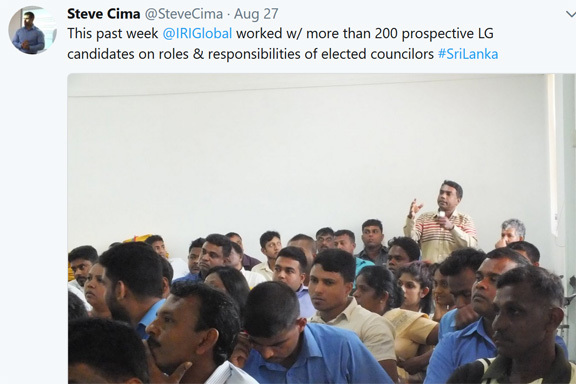
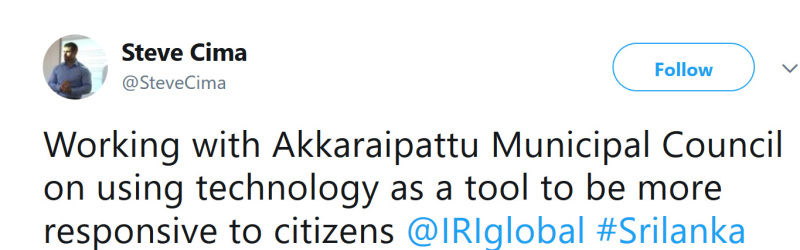
Apparently, the IRI has now joined the “caretakers of local government.”   The “ability to adapt to the situation on the ground is one of IRI’s greatest strengths,” asserts Cimas after relating how he stepped in to work with government officials of Hambantota, Akkaraipattu, and Jaffna municipalities to  …assess current external communications strategies and to identify communication techniques, including the use of social media, that can increase citizen awareness and participation in the councils’ work.  During the seminars, the councils were able to develop action plans that outlined how they could build upon their communications strategies to enhance citizen engagement.”
 In addition to the skills-building seminars, IRI supported an inter-local government study tour, bringing Hambantota Municipal Council members to the Nuwara Eliya Municipal Council to identify approaches to improve revenue generation, says Cimas.
As indicated in the tweet of August 21, he also seems to have access to and/or is meddling with electoral registers.
Who or what gives Mr.Cimas such authority?  What is the legal standing of the IRI and its officials in Sri Lanka since it doesn’t show up as a registered NGO on the National Secretariat of NGOs online registry? 
(Mr. Cimas has not responded to my email raising these questions.) 
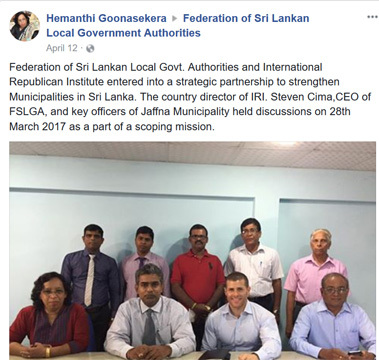
A little online digging shows the IRI listed as a partner/ funder of the Federation of Sri Lankan Local Government Authorities (FSLGA), an NGO which also receives funding from the US government (USAID) as well as the British and Canadian governments.
 
FSLGA is comprised of The National Chapter of Mayors, United Urban Councils Association and All Island Pradeshiya Sabha Chairmen’s Association. 
 
That’s a lot of local government officials to whom the IRI is getting open and unfettered access, without accountability or the need for transparency.
 
Imagine the reaction of US politicians, American media, and the general should officials of Russian or other foreign government-funded NGOs become advisors or partners of their elected officials, with no regulatory oversight.  (Continued below).
No, that’s beyond imagination since at every level of government in the U.S. there’s legislation such as the Foreign Agents Registration Act (FARA) or local ordinances governing the activities of lobbyists.   These laws require registration of foreign entities, reporting of activities such as meetings with elected officials, and disclosure of monetary and other contributions to candidates and officeholders.​​
 
Then again, no need to imagine.  The boiling outrage (even calls for President Trump’s impeachment) over allegations of Russian meddling in the 2016 Presidential give us a pretty good idea.
And speaking of Russian meddling, here’s more of the IRI’s chutzpah, revealed in  Cima’s tweets:
“Imagine the reaction of US politicians, American media, and the general public should Russian or other foreign government-funded NGOs become advisors or partners of their elected officials, with no regulatory oversight.”
​​
Does Mr. Cimas, paid employee of NED, modern day CIA, have access to Sri Lanka’s electoral register? 
Steve Cima 20/08/2017 08:52
This week @IRIglobal is traveling to North Central Province #SriLanka to work with political party members @NEDemocracy #IRIAsia
http://pic.twitter.com/CT1EfuBIuT
Among the IRI’s “democracy promotion” tactics is conducting workshops for  “political parties and candidates to strengthen their skills and prepare them for elections. IRI workshops help parties and candidates develop more effective platforms, campaigns, political messages and internal communications plans.” (IRI statement).
Considering the dysfunctional state of the political system in the US marked by ongoing polarization, gridlock, and stalemate resulting from the political messages” of the two major parties, the credibility of any American organization trying to tell the rest of the world how to manage political parties and run elections would be questionable.
That’s if the IRI is taken at face value. 
While the IRI claims to fund and train political parties across the spectrum, it has a history of supporting favored political leaders and favored political parties, which could lead to either regime change or regime maintenance.  
No less an authority than President Bush said as much when he paid homage to the organization as a powerhouse of American foreign policy muscling its way into every corner of the earth.  In a speech at a dinner hosted by the IRI in Washington in 2005, Mr. Bush thanked the group for being at the forefront of democratic change in more than a hundred countries.”
Praising the IRI for training the next generation of leaders” and strengthening political parties. Mr. Bush said the world had become safer and freer and more peaceful because of the International Republican Institute.”
Further, said Mr. Bush, apparently quite giddy over the successes of the IRI:  You’ve monitored elections, and you’re helping to build civil societies. You’ve made an enormous difference in the lives of millions across the world. I hope that makes you feel good…. These are incredibly exciting times. … In the last 18 months, we have witnessed revolutions of Rose, Orange, Purple, Tulip, and Cedar. And these are just the beginnings. Across the Caucasus and central Asia, hope is stirring at the prospect of change, and change will come. Across the broader Middle East, we are seeing the rise of a new generation whose hearts burn for freedom, and they will have it.”
Several countries are left out of that list of color revolutions” that resulted from the political clinics” run by NED/IRI/NDI, including Haiti (ousting Aristide who was elected democratically twice), Venezuela (in 2002, briefly ousting Chavez for 2 days before his supporters took to the streets and him reinstalled), Ukraine, Myanmar (on and off Saffron Revolution”), Iran (Green Revolution).
Former Texas congressman Ron Paul (Libertarian) once observed that  NED is nothing more than a costly program that takes the US taxpayer funds to promote favored politicians and political parties abroad.”.
 The US’s history of openly supporting the opposition Sam Rainsy Party (SRP) in Cambodia since 2002 is another example of that policy.  In August 2017, the Cambodian government shut down the National Democratic Institute (NDI) and ordered its foreign staff to leave the country while also alleging that the NED and IRI had planned to help the opposition party topple Mr Hun Sen’s government.  Whatever the validity of these claims, there is sufficient evidence of a symbiotic relationship between the IRI and the Sam Rainsy Party.  Sen. McCain has praised  Rainsy as a genuine hero for the entire world” while the  SRP bestowed its Freedom Award on Senator Mitch McConnell, Chairman of the Appropriations Committee. In February 2002, McConnell published an article in the Boston Globe calling for the US to shift its Cambodia policy from a non-partisan approach to pro-active support of  SRP Party in the 2003 elections.
 
The identity of Washington’s favored party in Sri Lanka is no secret.  The US has a long history of interfering in elections to help the United National Party (UNP):  1956, 1960 (two elections), 1965, 2005, 2010, and, most recently and very successfully, 2015 when it helped install its favored political leader Ranil Wickremasinghe in power. 
Given the US’s cozy relationship with Mr. Wickremasinghe and the UNP and, conversely, its ill-concealed opposition to Mahinda Rajapaksa, the IRI’s claim of being non- partisan” would be quite laughable.  
After over a decade of trying, the US has its most favored Sri Lankan political leader back at Temple Trees and the island is clearly an American “client state.”
The IRI should make no pretense that it is busy-bodying in Sri Lanka to provide assistance to opposition political parties and leaders that might undo that feat. [End]
More on the National Endowment of Democracy
NED would have the world believe that it’s only teaching the ABCs of democracy and elections to people who don’t know them, but in virtually all the countries named above, in whose electoral process NED intervened, there had already been free and fair elections held. The problem, from NED’s point of view, is that the elections had been won by political parties not on NED’s favorites list.
 
The Endowment maintains that it’s engaged in opposition building” and encouraging pluralism”. We support people who otherwise do not have a voice in their political system,” said Louisa Coan, a NED program officer.  But NED hasn’t provided aid to foster progressive or leftist opposition in Mexico, El Salvador, Guatemala, Nicaragua, or Eastern Europe – or, for that matter, in the United States – even though these groups are hard pressed for funds and to make themselves heard. Cuban dissident groups and media are heavily supported however.” – From William Blum’s
The Trojan Horse: National Endowment for Democracy.
 
Related articles on US & Sri Lanka:

MR complains of conspiracy

November 2nd, 2017

Courtesy The Island

The UNP, the TNA, the SLFP and the JVP were engaged in a ‘constitutional conspiracy’, former President Mahinda Rajapaksa told Constitutional Assembly yesterday.

Participating in the debate on the interim report of the steering committee of the Constitutional Assembly, the former President said: “Look at the manner in which the debate on this interim report has been conducted during the past three days. First, a UNP minister speaks on behalf of the government. Then, a TNA member speaks on behalf of the Opposition. Once again an SLFP minister speaks on behalf of the government. Then a JVP member speaks on behalf of the Opposition.

All of them are yahapalana stakeholders, they are all in a constitutional conspiracy.”

Full text of Former President Mahinda Rajapaksa’s speech at the Constitutional Assembly:

The Constitutional Assembly began the process of drafting a new constitution nearly 20 months ago. Six sub-committee reports containing various proposals were released in November 2016 and in September this year the interim report that we are debating now, was tabled in Parliament. I have issued detailed statements commenting on the specific proposals made in the various documents that have been released by the Constitutional Assembly up to now and I do not intend repeating myself here. We participated in this constitutional reform process with honesty and an open mind. When the political parties were asked to submit their views, the Joint Opposition sent in written submissions. We participated in the various sub-committees. It’s not that we didn’t have our doubts about the bona fides of the government. We saw the blatant fraud perpetrated on the people of this country through the 19th Amendment which the government introduced for the purpose of abolishing the executive presidency. But we participated in the constitution making process in order to look after the national interest.

Yahapalana manipulation is glaringly obvious in this whole process. The views that our MPs expressed in the various sub-committees were dropped when the reports were published. Look at the manner in which the debate on this interim report has been conducted in the past three days. First a UNP minister speaks on behalf of the government. Then a TNA member speaks on behalf of the opposition. Once again an SLFP minister speaks on behalf of the government. Then a JVP member speaks on behalf of the opposition. All these parties are yahapalana stakeholders, they are all in the constitutional conspiracy together. The genuine opposition force which is the Joint Opposition gets only two or three opportunities to speak a day. In order to justify their quest for a new constitution, members of the government have been claiming that I too had pledged in my manifesto for the 2015 presidential election to bring in a new constitution. That is true, but the question here is that the present constitutional proposals seek to divide the country whereas what I had in mind was a constitution that would enhance the unity and togetherness of all the communities that live in this country.

In any event nobody obtained a mandate to bring in a completely new constitution at either the presidential or parliamentary elections held in 2015. According to the constitutional proposals that have been unveiled, every subject that is now on the central government list is to be evaluated and assigned to the provinces if the provinces can handle it. The concurrent list is to be abolished and the powers therein handed over to the provinces. Even the implementation of the few functions left to the central government are wherever possible, to be carried out by the provincial authorities. In formulating national policies and standards the central government will have to consult each and every provincial council separately. Land, police and finance powers are to be devolved to the provinces. Once all these powers are devolved to the provinces, the central government cannot take them back even with the combined authority of a two thirds majority in parliament plus a countrywide referendum.

A devolved power can be taken back only if each and every provincial council gives its assent to the proposed change. If these proposals are enacted, there will be no point in the present members of this house contesting for parliament next time. They will be better off contesting for the provincial councils because that is where real power will reside. A federal unit or an independent state in the northern and eastern provinces has been a political project pursued by northern politicians since the 1950s. In order to hide the chauvinism and exclusivism that underlies this demand for a separate Tamil state, the devolution of power has always been touted as an arrangement that will be of benefit to all provinces and not just the north and east. All this while, the leaders of other minority based political parties may have been passively and unthinkingly nodding their heads to the demand for more and more devolution of power orchestrated by the TNA lobby.

But now when confronted with the moment of truth, the leaders of political parties based on other ethnic groups and religions may be having second thoughts due to the clear danger that these proposals pose to their own interests. This may be why this process has not progressed beyond the “collecting and publishing of ideas and suggestions” as the government likes to put it. The devolution of power in the manner proposed may be in the interests of northern Tamil politicians but it will place all other minority community based political parties at a disadvantage. The Muslim community cannot possibly agree to the proposal in this interim report that the northern and eastern provinces be considered one province. In 1987, the Sri Lanka Muslim Congress was formed in protest against the merger of the northern and eastern provinces. It is unlikely that the Muslims of the north have forgotten how they were treated when Tamil chauvinists held unfettered power. What prevented the Muslims of the east from being similarly treated at that time, was the presence of the Sri Lanka army.

If by some chance the Northern and Eastern provinces are not merged, it will be interesting to see whether the Tamil people of the East believe their interests will be served through the further devolution of power. How do the Up-country Tamil leaders regard the idea of a new constitution that would place their population under two or three different all-powerful provincial councils with a central government that has no power to intervene on their behalf even in the case of disputes and complaints? Up to now, all leaders of the various ethnic and religious communities other than the Tamil politicians of the north have always sought power at the centre. If the current proposals are implemented, the centre will lose all power. In order to justify their constitutional proposals, members of the government has been saying that I too had mooted a concept called ‘thirteen plus’. What the present government means by thirteen plus is the division of the country. But what I meant by thirteen plus was the closer unification and integration of all communities living in this country through mechanisms like a second chamber of Parliament.

In India, the vast majority of Indian Tamils live in Tamil Nadu. In Sri Lanka however, the majority of the Tamil people are permanently resident outside the north and east. Even though there is a significant concentration of Muslims in the east, the vast majority of the Muslims are permanently resident outside the east. The creation of ethnic or religion based federal units with powers akin to sovereign states, will place the minorities living in those federal units at a disadvantage. I request the government to give up this quest for a new constitution which serves only the interests of northern Tamil politicians and places virtually everyone else at a disadvantage and to concentrate instead on fulfilling the original constitutional pledges they gave the people at the 2015 presidential elections. For a start, the government should let the public know their collective decision on the abolition or otherwise of the executive presidency. The other important matter that needs the attention of this house is the reform of the elections system. The way the elections laws for the local government institutions and the provincial councils were changed was haphazard and arbitrary and this will pose a grave danger to the stability of the governing institutions of the country.

There is the widespread suspicion that the government may try to get the new constitution passed in Parliament through the same means adopted to change the system of elections to the local government institutions and the provincial councils in the recent past. There are over 40 MPs who contested and won the last Parliamentary elections under my leadership and who now hold portfolios under this government. They can defeat this constitution in Parliament by not voting for it. There was an immediate and dramatic improvement in the quality of life, the availability of employment and education in the north in the wake of the development projects launched by my government in that area after the war ended. However today we see that the needs of the people have been cast aside and the needs of the politicians in the north are being given priority. This I believe is a pay-off for the contribution made by certain internal and external forces towards the change of government in January 2015.

Bond Commission denounces conduct of ASG De Livera

November 2nd, 2017

By Shehan Chamika Silva Courtesy The Daily Mirror

Bond Commission Chairman Justice K.T Chithrasiri and Commissioner Prasanna Jayawardena yesterday said the conduct of Additional Solicitor General Dappula De Livera was ” deplorable”.

“I have served 37 years as a judge and I have never seen this happen after an order is made” Justice Chithrasiri told the Commission.

A heated argument erupted after the Commission made an order which prevented the marking of statements given to the Criminal Investigations Officers during their inquiry, during evidence given by the officers yesterday.

The practice during the proceedings is to mark documents during evidence of a witness. The Attorney Generals Department sought to mark statements given to the Police officers by persons who were questioned by the Police officers during the conduct of the investigation by the Police.

Admonishing ASG De Livera who continued to make statements following the order given by the Commission, Justice Jayawardena said that he had never witnessed such behaviour in his entire legal career.

“Your behaviour is not fitting to a senior counsel. I warned you about your behaviour at the chambers as well and I have never seen such behaviour in my 30 rears of conduct as your behaviour is deplorable” Justice Prasanna Jayawardena said.

During the day CID officials, Ruwan Raban (IP), Nalinda Herath (IP), Siril Ranasinghe (PS) and Mahindasoma Jayatilleke (PS) had testified before the Commission yesterday with regard to the way in which they had recorded statements of the witnesses.

The witnesses testified that they had interviewed and recorded statements from the witnesses, who were called by the Secretary of the Commission or the Attorney General.

While leading the first witness, Additional Solicitor General Yasantha Kodagoda moved to mark a bundle of document which contained the copies of statements that were recorded by the CID officials from witnesses.

At this moment, Counsel Chanaka De Silva who was appearing on behalf of former Central Bank Governor Arjuna Mahendran strenuously objected to the marking of the statements recorded by the CID as evidence before the Commission.

He was of the view that the Commission opted to call witnesses to give evidence, and therefore the Commission acted upon the evidence given by the witnesses before the Commission. a statement made in front of a police officer is not evidence no where in our legal system that a statement made to a police officer is considered an item of evidence”, he said.

Mr. De Silva also objected to the process in which these statements were brought in before the Commission to place as evidence.

He said that the most of the statements were available when the witnesses came and gave evidence before the Commission and none of these statements were either shown to them or put to them or even use for the purpose of contradicting evidence.

Mr. De Silva contested on the evidential value of the statements which were attempted to mark as evidence before the Commission. He also said that the way in which the marking police statements to the Commission’s proceedings is alient to the current legal system.

Additional Solicitor General Yasantha Kodagoda replying to the objection stated there are two mechanisms to the Commission’s process. First is the investigation process and the second is the Inquiry, we are currently going through the inquiry, where the witnesses being called and examined by the Counsel before the Commission. And the investigation process took place at the Commission’s premises affected by the CID officers is the process of investigation”.

ASG Kodagoda said according to the 2008 amendment to the Commission of Inquiry Act, there are specific reference with regard to the Investigation and Inquiry separately. Therefore he said that the Commission, in arriving at the truth, can take cognizance of both evidence led during the Inquiry proceedings as well as the material collected during cause of the investigation.

ASG Kodagoda also stating the Section 7 (a) pointed out also that this evidence will not be admissible in the civil or criminal future proceedings.

Then Senior Additional Solicitor General Dappula De Livera also reading the proviso of section 23 of the Commission of Inquiry Act said that the Commission is mandated and required in law to examine the material and then come to a conclusion based on natural justice.

ASG Dappula De Livera said that the Commission has to have the regard to the material collected during the investigation and there is no other way.

Counsel Chanaka De Silva then reading the proviso of section 23 stated that one cannot use such material unless rules of natural justice are observed according to the law. He said that it was a prohibition on the Commission as per law.

President’s Counsel Kalinga Indatissa who was appearing on behalf of Perpetual Treasuries Ltd and President’s Counsel Anuja Premaratne also contested against marking the police statements as evidence before the Commission questioning that whether it was the proper mechanism to lead evidence and what the law is expected to protect as fairness and natural justice.

Considering all the submissions made by the Counsel, the Commission then delivered an order on the marking of statements of witnesses which were recorded with the CID officials at the initial investigation process.

The Commission was of the view that it was against the rule of natural Justice to admit these statements of the witnesses given to the police. And therefore, the marking of those statements as evidence was not permitted.

At this moment when ASG De Livera sought further clarifications about the order, Justice Prasanna Jayawardena replied that the Commission does not want to compromise the integrity of its report by any means therefore reached to that conclusion considering the proviso of section 23 of the Act. We cannot observe at any material without concerning the natural justice, so far we have made every endeavor to act fairly”, Justice Jayawardena said.

ASG De Livera continued to harp on the admissibility of the statements pointing out a previous occassion in which a contradicting order was given, according to De Liveras ” recollection”. However, the Commission said that no order of that nature had been made. Thereafter Justice Jayawardena urged that the matter be left there and to continue with the proceedings.

Now we have made an order so let’s move on”, Justice Prasanna Jayawardena said.

At this moment President’s Counsel Anuja Premaratne cross-examined the first witness and soon after he finished his questioning, ASG De Livera again addressed the Commission on the Commissions order given on admissibility of the statements.

ASG De Livera: Now this Commission prevented itself from looking at the investigating material

Justice K.T. Chitrasiri : Statements!

ASG De Livera: Yes that is what the material is all about

Justice Prasanna Jayawardena: Even if we had accepted those statements, they have zero evidential value

ASG De Livera: I’m making a legal submission that the Commission has prevented it self from looking at material

Justice Prasanna Jayawardena: If that your position then please file written submission in that regard because I do not agree with you because I think your submission is ridiculous. In my view your submission has no any merit because the investigation is a process prior to the inquiry and now we have listened to witnesses at the inquiry level and we are now in evaluating the evidence, so we have no reason to go through these statements because we cannot rely what stated in the statements as it was done without any oath. If there was a contradiction of the statements and the testimonies given by the witnesses then it should have been put to the witness at that stage.

ASG De Livera: Only I’m saying is that this Commission has prevented itself looking at the material which the Commission is mandated under the law to do and thereby now the Commission is making a mockery of these proceedings.

Justice Prasanna Jayawardena: I’m sure your words will be appropriately reported in the media reports, which will give you satisfaction. We are not interested what news papers report, we are interested in our job which I’m sure will upheld by any court. When an order is made, one can go and canvass against it at the appropriate court. Making statements standing in the bar table is not appropriate.

ASG De Livera: if the order is per incuriam we can do it.

At this moment there was a heated argument between the Commissioners (Justice Jayawardena and Justice Chitrasiri) and ASG Livera.

Justice Prasanna Jayawardena: I warned you about your behaviour earlier as well

Justice K.T. Chitrasiri: This is not the first time that you have behaved liked this after the Commission is made the order. Definitely we are going to think about this behaviour.

ASG De Livera: I’m only saying that the order is per incuriam ( Without due regard to Law or Facts

Justice Prasanna Jayawardena: Your behaviour is not fitting to a senior counsel. I warned you about your behaviour at the chambers as well and I have never seen such behaviour in my 30 rears of conduct as your behaviour is deplorable.

Justice K.T. Chitrasiri: I have served 37 years as a judge and I have never seen this happens after an order is made

ASG De Livera: I only made this submissions in the interest of the justice ()

Buddhism has shaped the lives of our people, the identity, and the direction of the society in Sri Lanka in a way unmatched by any other religion

November 2nd, 2017

By Senaka Weeraratna

Buddhism has shaped the lives of our people, the identity, and the direction of our society in a way unmatched by any other religion. Buddhism has been the national faith for over two millennia and the bedrock of the culture and civilization of the Sinhalese people. Sri Lanka is the oldest Buddhist nation in the world. If not for the continuance of the Dhamma, through the study and practice of it in this country, it is unlikely that there would even be a semblance of pure Sasana in Thailand, Myanmar, Laos, or Cambodia all of which countries have borrowed heavily from Sri Lanka.

It is in Sri Lanka that the Wheel of the Buddha’s law was truly set in motion with the arrival of Arahant Mahinda with the blessings of that great universal monarch, Emperor Asoka. If this event did not take place in Sri Lanka, the Pali Canon may not have got recorded and the noble doctrine of the Buddha, recited and accepted by the Arahats, at Rajagaha, Vesali and Pataliputta, i.e. three Great Councils of the Arya Sangha, would have disappeared into thin air long ago.

Arahant Mahinda not only introduced the Dhamma but he also taught it in such a manner that it soon became the overriding element in all the activities of our people in the past, enthused them to develop an altogether new culture and  Social Order relying heavily on the teachings of the Buddha. It also became the basis of the social outlook of the vast majority of our people even to this day. Such is the hold of the Dhamma so ingrained in almost every facet of this country that the Buddhist public very rightly feel that it is something they cannot do without as it is now representative of their life blood, more or less.

In the pre-colonial period the Sinhalese Monarch protected the Buddha Sasana and maintained its purity as one of his primary duties. He exercised his power and authority over the religion to prevent schisms and heretical interpretations of the Dhamma.   He invoked the dasa raja dhamma” as a basis of governance. He developed an Animal Friendly Cultural Heritage. The protection and promotion of the Buddha Sasana was a primary obligation of the Sovereign. He was called the Sasanadikara (promoter of the faith).

It is indisputable that during 450 years of European colonial rule, Buddhism was displaced and degraded and Buddhists were subjected to all kinds of harsh treatment and discrimination while Christianity which was introduced by the Colonial West, became the religion of a small minority that received state patronage and was treated as the state religion in those parts of the country under colonial domination.

The British as a contracting party to the Kandyan Convention in 1815, (Article 5) granted Buddhism an inviolable status  – in acceptance of the unique status that Buddhism enjoyed under the Sinhalese Kings. This pledge was however honoured in the breach by the British colonial Govt. no sooner the ink was dry after signing the Convention. Governor Robert Browning himself admits that he signed the Convention allowing Buddhism to be regarded as inviolate as a ploy to induce the Kandyan Chiefs to sign the Treaty without which it would have not been possible to clinch the deal with the Kandyans.

Buddhism was not taught in Government schools, disregarded as idolatry under missionary influence, and Vesak was not given any special significance until 1885 when it was a declared a public holiday, in response to a sustained campaign of agitation by the Buddhist Public and the Sangha.

Section 29 – devise to prevent rectification of historical injustices caused to Buddhists in the colonial era

Having demoted Buddhism in schools, public life and employment, and in a manner totally inconsistent with the way Buddhism was treated by the Sinhalese Kings in the pre- Portuguese Era, and with a view to preventing Buddhism from regaining its lost status and due place in an independent Sri Lanka the British colonial Government inserted what became known as Section 29 into the Soulbury Constitution.

This Section 29 enshrined a principle that even the British did not necessarily uphold in practice either in Britain or in any of its colonies, despite public declarations of a commitment to the ideal of a secular state. For example, in England the British monarchy i.e. the Queen, is officially declared as the defender of the faith i.e. Christian faith, and in spite of Britain being a multi – religious society, the laws against Blasphemy operate only when the Christian religion is denigrated or ridiculed. Only days of Religious significance to Christians have been made public holidays in Britain. Compare the situation in Sri Lanka where all four religions Buddhism, Hinduism, Christianity and Islam have public holidays on days of religious significance. Sri Lanka issues commemorative postage stamps in respect of all four religions which are officially recognized. In contrast Britain has not recognized like the vast majority of European countries (except Russia and Austria), Buddhism as an official religion. Also, neither the Buddha nor Buddhism has been honoured by way of issue of a commemorative postage stamp in Britain. Members of religious and ethnic minorities of coloured backgrounds are never honoured in Britain as worthy subjects in commemorative postage stamps.  In these respects Sri Lanka is far ahead of both Britain and the rest of Europe. They have a lot to learn from Sri Lanka.

While a huge international campaign is being mounted to shame and demonise Sri Lanka on ground of alleged  lack of equality of status of religion in Sri Lanka’s Constitution on account of Article 9 which grants foremost place to Buddhism while affording protection to all other religions, what these campaigners do not say and what much of the world does not know is that Buddhism has never been granted a parity of status as a religion in the Constitution of any Christian or Muslim majority country. Leave alone parity of status Buddhism is fighting hard to gain official recognition as a religion in several Abrahamic countries despite the recognition granted by the United Nations to Buddhism as a global religion. In some of these Islamic and Christian countries Buddhism is even denied simple recognition as a religion because it rejects the notion of a creator God. According to these views, a belief becomes validated as a religion only when it subscribes to the belief in a God. In that sense Buddhism fails the test of a religion.

There are other reasons why the Church and the Vatican are opposed to Buddhism being accorded official recognition as a religion in Europe, namely to prevent the accrual of benefits from the State to non – Christian religions and organizations. In some Western countries it is not possible to register a Society as a Buddhist organization because Buddhism is not officially recognized as a religion. The alternative then is to have such a Buddhist Society registered as a Charitable Society where membership is open to people of all faiths.

While almost every Buddhist country in Asia has declared Christmas as a public holiday not a single Christian country has declared Vesak as a public holiday despite a significance presence of Buddhists in these countries. So much for reciprocity of obligations.

The Constitutional primacy of one religion is not something unique to Sri Lanka. Almost all Muslim majority countries have declared Islam as the State Religion in their Constitutions.  In most South American countries Catholicism has been declared the State Religion and treated accordingly. In Philippines where the majority are Roman Catholics, Catholicism enjoys State patronage and protection over and above all other religions. In Israel, Judaism is the State Religion. In both Burma and Thailand Buddhism enjoys state patronage because of the large presence of Buddhists in these countries.

In the making or reform of a National Constitution an obsession with the ideal of the principle of equality of status of religions, while disregarding the overwhelming and virtually matchless contribution of one religion to the creation and structuring of a country’s civilization i.e. Buddhism in the history of Sri Lanka,  can only lead to producing a document which will not have roots either in our history or our traditions, and like several other recent Constitutions it will be disowned by the majority of the people of Sri Lanka.

Inter – dependence and close nexus between the State and Buddha Sasana in Lanka’s History

Concepts that are bandied about by the West and their acolytes in Buddhist Asia such as Secularism, Pluralism, Multi-culturalism, Multi – religion and the like with a view to having Buddhism removed from the School, public life and influence on state policy, have their origin in Europe and are more appropriate to Societies and Cultures that spawned them to distance the State from the all powerful Church which was competing with the traditional Monarch to rule the State in Europe. There was no such threat to the King or the State in Asia particularly in Sri Lanka from the Order of the Buddhist Sangha. The Buddhist monks unlike the Christian Clergy in Europe never competed with the King to rule a country in Asia. In the pre – Portuguese era the question of separating the influence of Buddhism on the ethical and moral direction of the society and policy making and policy direction of the State was unthinkable. Buddhism since the time of arrival of Arahant Mahinda in 300 BC and until the entry of Portuguese in 1505, has been the main spring of our civilisation, culture, law and customs. The challenge for the Buddhists of the current generation is to consolidate this position and reclaim the Buddhist heritage as a living force in Sri Lanka. ‘Secularism’ is a concept totally alien to the character and foundations of Sri Lanka’s civilization which is essentially Buddhist.

The greatest challenge to Buddhism as the national religion of Sri Lanka arose with the arrival of the Portuguese in 1505. In fact all three western colonial powers namely the Portuguese, the Dutch and the British that governed Sri Lanka in varying degrees during the period 1505 – 1948, had as the cornerstone of their imperial policy the conversion of the Sinhala Buddhists and the Tamil Hindus into Christianity. This enterprise had the blessings of the highest strata of people of the imperial countries including the Crown, the State and the Church. The avowed political objective in converting the colonized was to transfer their allegiance from the local sovereign to the foreign sovereign, and alienate the converted from identification with their traditional religion, culture, language and sense of self-determination. This diabolical plan invariably required the use of manipulative methods of conversion e.g. force, fraud and allurement, and the repression of indigenous religions i.e. Buddhism and Hinduism, by both overt and covert means. It is pertinent to note that even the local sovereign was not spared from pressure by missionaries to change religion. The assassination of King Buwaneka Bahu the VII by a Portuguese Soldier in Kelaniya in 1552 A.D. is now seen increasingly by astute observers as a punishment meted out by the Portuguese because of King Buvaneka Bahu’s steadfast refusal to abandon the religion of his convictions i.e. Buddhism.

Unfortunately, this long term objective of displacing Buddhism from public life in Sri Lanka and even Hinduism as a mainstream religion in India continues unabated though the methods employed today by the rival camps are more subtle and deep seated than during the colonial era.

If Secularism was an essential part of State policy right from the dawn of state governance in history (Maha Sammatha), Buddhism may have never got off the ground despite the indisputable truths in the Buddha’s teachings. The State patronage Buddhism received from such Kings as Bimbisara and Ajasattu (Bimbisara’s son) of the Kingdom of Magadha, and King Pasenadi of Kosala, during the Buddha’s time played a critical role in alerting the public to the Buddha’s teachings. Within 200 years of the passing away of the Buddha, Buddhism got the biggest promotion when Emperor Asoka embraced Buddhism and sponsored Buddhist missionaries to travel to the four corners of the then known world. Asoka sent his beloved son Mahinda and daughter Sangamitta to Sri Lanka, to be openly welcomed by the reigning King Devanampiyatissa. The rest is history.

There were significant Buddhist Councils in India following the death of the Buddha. All of these great Buddhist Councils had the patronage of the reigning Kings and the respective Government of their States. In the Buddhist Social Order the King was also known as the Sasanadikara – Protector and  promoter of the Buddha Sasana.   Here is an outline of the support given by the Kings of India and Sri Lanka to the great Buddhist Councils of the past:

The First Council

King Ajātasattu sponsored the First Council. It was convened in 544 B.C. in the Sattapannī Cave situated outside Rājagaha three months after the Buddha had passed away. A detailed account of this historic meeting can be found in the Cūllavagga of the Vinaya Piṭaka.

The Second Council

King Kāḷāsoka was the Second Council’s patron and the meeting took place at Vesāli. The Second Council was called one hundred years after the Buddha’s Parinibbāṇa in order to settle a serious dispute over `ten points’. This is a reference to some monks breaking of ten minor rules. Their infringements became an issue of discussion and caused a major dispute as a breach of these rules was thought to depart from the Buddha’s original teachings. This historic council is also named as the Yasatthera Sangīti because of the critical role played in it by the Elder Yasa and his unreserved keenness for safeguarding the Vinaya. The Vajjian monks however refused to accept the Council’s decision and in defiance called a council of their own which was called the Mahāsaṅgiti.

The Third Council

The Third Council was convened under the patronage of Emperor Asoka at Asokārāma in Paṭaliputta in 326 B.C. It was presided over by the Elder Moggaliputta Tissa and one thousand monks participated in this Council. It was held primarily to cleanse the order of the Saṅgha of corruption and discard delinquent monks who held heretical views.

This Council also achieved a number of other important objectives.  The Elder Moggaliputta Tissa, with a view to refuting heretical views and ensuring the Dhamma was kept pure, began compiling a book during the council. It was called the Kathāvatthu. This book comprises twenty-three chapters, and contains a series of discussions (kathā) and rejection of the heretical views held by various groups on matters philosophical. This Kathāvatthu is the fifth of the seven books of the Abhidhamma Piṭaka. The Third Council was also instrumental in giving a royal seal of approval to the doctrine of the Buddha, by declaring it the ‘Vibhajjavāda’, the Doctrine of Analysis. Its content is identical with the Theravāda doctrine. One of the most significant outcomes of this Third Council and one which had far reaching effects for all time, was the Emperor Asoka’s visionary decision to send forth monks, well versed in the Buddha’s Dhamma and Vinaya and able to recite all of it by heart, and preach it in nine different countries. These Dhammadūta monks included the Venerable Majjhantika Thera who went to Kashmir and Gandhāra. The Venerable Mahādeva who was sent to Mahinsakamaṇḍaḷa (modern Mysore) and the Venerable Rakkhita Thera who was sent to Vanavāsī (northern Kanara in the south of India.) The Ven. Yonaka Dhammarakkhita Thera was assigned to proceed to Upper Aparantaka (northern Gujarat, Kathiawar, Kutch and Sindh].

The Ven. Mahārakkhita Thera was sent to Yonaka-loka (the land of the lonians, Bactrians and the Greeks.) The Ven. Majjhima Thera went to Himavanta (the region adjoining the Himalayas.) The Venerable Soṇa and the Ven. Uttara were sent to Suvaṇṇabhūmi [now Myanmar]. The Venerables Mahinda Thera, Ittiya Thera, Uttiya Thera, Sambala Thera and Bhaddasāla Thera were sent to Tambapaṇṇi (now called Sri Lanka). The Dhamma missions of some of these monks succeeded beyond measure and changed the course of history in Asia. It bore great fruits in the course of time and contributed in a large way in ennobling the peoples of these lands with the sublime doctrine of the Dhamma and moulding their civilizations and cultures. As a result of the spread of the Dhamma based on the words of the Buddha, in due course of time India’s stature grew as a country of philosophical wisdom that no other country could match. Correspondingly it became known and respected throughout the length and breadth of Asia and beyond, as Visvaguru, the teacher of the world.

The Fourth Council

The Fourth Council was held in Sri Lanka in 29 B.C. under the patronage of King Vaṭṭagāmaṇi. The main purpose of this Council was to have the entire body of the Buddha’s teaching which was until then passed down from generation to generation by oral transmission written down so that the genuine Dhamma might be preserved for a longer period in its pristine purity. Ven. Mahārakhita and five hundred monks recited the words of the Buddha and then wrote them down on palm leaves. This remarkable project was executed in a cave called, the Āloka lena, located in the cleft of an ancient landslip near Matale.  The success of the Fourth Council is one of Sri Lanka’s greatest achievements in history.  It ensured the preservation in writing of the authentic Dhamma and enabled Sri Lanka many centuries later to share it with the rest of the world, particularly with Scholars and Colonial Administrators from the West in the 19th and 20th Century.

The Fifth Council

The Fifth Council took place in Māndalay, Burma now known as Myanmar in 1871 A.D. in the reign of King Mindon. The chief purpose of this Council was to recite all the teachings of the Buddha and examine them in minute detail to ascertain if any of them had been altered, distorted or dropped.

The Sixth Council

The Sixth Council was convened at Kaba Aye in Yangon, formerly Rangoon in 1954. It was sponsored by the Burmese Government led by the Prime Minister, U Nu. Under U Nu’s leadership and watch a huge cave called the Mahā Pāsāna Gūhā, was built from the ground up, to serve as the gathering place much like the Sattapānni Cave outside Rājagaha in India –the site of the first Dhamma Council. The Sixth Council met on the 17th of May, 1954. Its chief objective as in previous Councils, was to recite, affirm and preserve the genuine wording of the Vinaya, Suttas and Abhidhamma–the pariyatti–as related by the Buddha and his principal disciples.

However the unique feature in this Council in so far as the monks who took part in it came from eight countries. These two thousand five hundred learned Theravāda monks were drawn from Myanmar, Cambodia, India, Laos, Nepal, Sri Lanka, Thailand and Vietnam. Mahayana monks and representatives from all Buddhist countries also attended it. There were two German monks present at this Council meeting, namely Ven. Nyanatiloka Maha Thera and his disciple Ven. Nyanaponika Thera.

The traditional recitation of the Dhamma Scriptures took two years during which period the Tipiṭaka and its related literature in all the scripts were carefully examined.  Their work came to an end in May, 1956. This Council’s work was undoubtedly an unique achievement of representatives from the entire Buddhist world. The version of the Tipiṭaka which it finally produced has been recognized as being true to the pristine teachings of the Buddha (Shakyamuni) and the most authoritative and authentic rendering of them to date.

The Mandate of the State

Buddhism has been the most powerful single factor in the development of Sri Lanka’s civilization. For more than 2, 300 years, Sri Lanka developed and projected a country image that was predominantly Buddhist. Though this pre-disposition was held back during the period of 450 years of western colonial rule, no sooner an opportunity arose after the grant of independence in 1948, the majority of the people again turned to Buddhism as expressive of their national identity and gave a mandate to a newly elected Government to restore Buddhism to its rightful place and make it an unifying and integrative force in the nation.

Today, the State has a mandate to perform its historic public duty, as enshrined in the National Constitution, to extend patronage, protection and foster Buddhism both within and outside the country.

The Presidential Buddha Sasana Commission Report (2002) observed ‘ that the constitutional obligation accorded by the Constitution of Sri Lanka to give to Buddhism the foremost place and accordingly to protect and foster the Buddha Sasana devolves on the Government of Sri Lanka, all state institutions, other organisations, and all its citizens”.

The Report further declared:

Sri Lanka is the centre of Theravada Buddhism. It is the duty and responsibility of everyone to preserve it for the future generations. The Government, the bhikkus, the Buddhist societies and organizations, and the Buddhist people should work for this because preserving Buddhism in Sri Lanka leads to the development of worldwide Buddhism. Further, the Commission believes that its recommendations do not disturb the constitutional rights of the followers of other religions, while it improves the harmony rather than animosity among people who follow various religions”

Sri Lanka – Civilizational State

It may well be said that Sri Lanka is more than a mere nation state as defined and understood in International law. It is also a civilizational state given the heavy underpinning of Buddhism and Buddhist culture in almost every aspect of life in this country, lasting for more than 2000 years.

The Presidential Buddha Sasana Commission Report (2002) dealing with the responsibilities of the Government of Sri Lanka, further said:

   It is seen that the religion of the majority of the people in a country becomes the state religion. Bhutan, Nepal, United Kingdom, certain European countries, and Arabic countries are examples of this. In the Sri Lankan society, this condition prevailed until 1815. In Malaysia, even though its Islamic population is 52%, the state religion has become Islam. From the Devanam Piya Tissa era to 1815, the state religion had been Buddhism”.

Religious Tolerance in Sri Lanka

Buddhist societies are also tolerant of other religions much more than societies belonging to the Abrahamic fold. Despite the heavy pre-dominance of Buddhism in Sri Lanka, other religions also flourish in the country and are officially recognized. They are also protected under the Constitution. Populated townships in the country would show places of worship and presence of adherents belonging to all four religions.

In Sri Lanka, the number of Public Holidays in a calendar year granted to the various religions is further illustrative of this accommodative and tolerant attitude of the State.  For example:

  1. a) Christianity – Good Friday, Christmas (and 52 Sundays)
  2. b) Hinduism – Tamil Thai Pongal day, Maha Shivarathri and Deepavali Festival Day
  3. c) Islam – Milad – un Nabi ( Birthday of the Prophet), Id –UI –Fitr ( Ramazan Festival Day) and Id – UI- Alha ( Hadji Festival Day)

Mahawamsa

In Sri Lanka, as narrated in the Mahawamsa (ancient Chronicle) and supported by epigraphy (stone inscriptions), among others, a significant number of pre-colonial Buddhist Kings donated large tracts of lands to the Buddhist Temples for the sustenance of the Maha Sangha. For example, King Devanampiyatissa, upon embracing Buddhism, made a gift of the Maha Megha Vana (Maha Mevuna Uyana) in Anuradhapura to the Maha Sangha. It is a sacred area for the Buddhists and belongs to the Buddha Sasana which was established by Arahat Maha Mahinda Thera.

These sacred areas of the Buddhists which belong to the Buddha Sasana can be established by evidence, not necessarily legislation. As much as people of non – Buddhist religions expect their sacred areas in the holy lands to be respected ( some areas in the Middle East are out of bounds for non – Muslims) and not used for building places of worship of other religions, Buddhists of Sri Lanka too expect similar respect and courtesy from non – Buddhists. It would be grossly unfair to make indefensible claims and attempt to multi – culturalise the historic sacred sites that are exclusively meant for Buddhist veneration.

What is the Buddha Sasana?”

The Report of the Presidential Buddha Sasana Commission (2002) defines it as the Buddha, the nine super-mundane (navalokuttara) Dhamma, the Sangha, the Buddhist temples (viharas) with their ancillary structures, forest hermitages (aranya senasana) and meditation centres, Bo trees, stupas, image houses, relic chambers, dhamma books and libraries, designated buildings for performance of vinaya acts by the sangha (uposathagara), fields, gardens and properties belonging to the Buddhist temples, Buddhist education, devalas, nuns and nunneries, the laity who had taken refuge in the Triple Gem, Buddhist literature, culture and civilisation, Buddhist festivals and processions (peraharas), Buddhist customs and traditions, Buddhist principles and values and all that are required for its perpetuity .

This Report also deals extensively with the question of Lands belonging to Buddhist Religious Places (Siddhasthana) and Temples (Viharas) in Sri Lanka in Chapter 5.

The Constitution of the Democratic Socialist Republic of Sri Lanka categorically says that It shall be the responsibility of the State to protect and foster the Buddha Sasana in terms of Chapter II of the Constitution. The Government, all institutions and the citizens are bound by the Constitution of this country.

Official Recognition of Buddhism in Europe

It is estimated that there are now altogether between 1 and 4 million Buddhists in Europe, the majority being in Germany, Italy, France and the United Kingdom.

Despite the highly publicized commitment to ‘religious pluralism’ and ‘multi – culturalism’ of European nations, the official recognition of Buddhism is confined only to two states.

Russia and Austria are the only two European states today that recognize Buddhism as an official”, though not necessarily state religion” in their respective countries.

Even UK denies Official Recognition to Buddhism. It does not allow the construction of new Buddhist Temples. But allows Buddhists to occupy existing Buildings and use them for their religious functions. This is also true of several other West European countries.

However, despite restrictive laws, there is public acceptance and accommodation of Buddhism in several European countries including UK, France and Germany.

State Recognition of Religion – What does it mean?

Official State Recognition in the West would enable Buddhists to secure a place and standing in each country and also avoid being subject to derogatory treatment as members of ‘sects’ and ‘cults’, among other things. It would also allow them certain rights such as access to the media, financial support, legal standing, and recognition equal to those of Christian churches, and right to teach in a school. It would allow them the legal right to form voluntary societies as Buddhist Societies with membership restricted only to Buddhists.

The absence of State recognition to Buddhism in almost all European countries bar Russia and Austria functions as an impediment to the proper practice and development of Buddhism in Europe.

There are no public holidays for Buddhism or any other non – Christian religion in the Public Holiday calendar of European nations i.e. with a Christian heritage.

Conclusion

1) Buddhism lacks influence and clout in the international arena to the extent that Christianity and Islam have.

2) Buddhists do not have the equivalent of a World Council of Churches or Organisation of Islamic Co – operation (OIC) to raise issues concerning Buddhists in International fora to create World Public Opinion.

3) International Buddhist Summit Conferences avoid discussion of threats or challenges to minority Buddhist communities as well as pre-dominant Buddhist countries such as Myanmar, Sri Lanka and Thailand, among others.  Threatened Buddhists are never given a platform at these Conferences.

See

The Voices of threatened Buddhists must be heard at the UN Day of Vesak 2017 Conference

https://www.lankaweb.com/news/items/2017/03/11/the-voices-of-threatened-buddhists-must-be-heard-at-the-un-day-of-vesak-2017-conference/

4) No International Buddhist Conference has so far been convened to inquire into the unfolding violence in Myanmar and extend support and solidarity to the Buddhists of Myanmar.

5) The nine point Mahanuwara Declaration issued at the end of the United Nations Day of Vesak 2017 Conference in May 2017 appears to exist today more like a ‘ White Elephant’.

It is shame to hold well publicised and well funded International Buddhist Conferences with no resolve to identify problems and address them or engage in follow up action to carry out the Decisions or Resolutions of such Conferences.

See

Three commitments save UN Vesak Day Mahanuwara (Kandy) Declaration 2017

http://www.sinhalanet.net/three-commitments-save-un-vesak-day-mahanuwara-kandy-declaration-2017

6) Predominant Buddhist Countries e.g. Sri Lanka, Myanmar, Thailand, Cambodia, Laos, Vietnam etc.  which were comfortable with their traditional Buddhist identity in the past are now being approached by powerful western countries and NGO lobbies to drop their ‘Buddhist’ identity and embrace a ‘secular’ and ‘multi-cultural’ image.

7) It is unthinkable for any majority Muslim nation to drop its ‘Islamic’ identity and embrace a ‘Secular’ Image.  Malaysia is the closest to a Multi-Cultural country with a predominantly Muslim population, but it has not dropped its Islamic tag.  Nevertheless, Vesak is a national holiday and there is official acceptance of Buddhism being the second largest Religion in Malaysia.  India, Bangladesh and Indonesia have all declared a Public Holiday for Vesak (also called the Buddha’s Birthday).

8) Multi-culturalism is no longer treated as a panacea for ensuring harmony and cordial relations between ethnic communities in an increasing number of countries. The leaders of UK, France, Netherlands and Germany among other western nations have spoken out against multi-culturalism. It is no longer promoted as an instrument of State Policy. It is in Sri Lanka’s interest to learn appropriate lessons from the rejection of Multi-culturalism by leading Western European countries and devise policies that promote social, ethnic and religious harmony without diluting Sri Lanka’s overriding Buddhist identity.

Senaka Weeraratna

PM required to testify before Bond Commission

November 2nd, 2017

Shehan Chamika Silva Courtesy The Daily Mirror

The Presidential Commission of Inquiry (PCoI) investigating the controversial Issuance of Bonds today said it requires the testimony of Prime Minister Ranil Wickremesinghe in order to “obtain a few clarifications and any other evidence which may be necessary”.

Issuing a statement at the commencement of the today’s session, the Commission noted that it had perused the affidavit given to the Commission by the Prime Minister and that the Commission had certain clarifications to be made.

“With regard to the questions forwarded to the Hon. Prime Minister by this Commission of Inquiry, we have received an affidavit affirmed to by the Prime Minister. The Commissioners have carefully perused this affidavit and we would like to obtain a few clarifications and any other evidence which may be necessary. Therefore, we will be requesting the Hon. Prime Minister to attend a Hearing of this Commission of Inquiry for that purpose” the statement said.

Accordingly, the Commission said that the date at which the Prime Minister would be required to attend the hearing would be notified in due course after ascertaining “with the Prime Ministers office the availability of the Hon. Prime Minister”

Submitting the affidavit, the Prime Minister earlier expressed his willingness to appear before the commission if necessary. The PCoI yesterday said the decision to summon the Prime Minister was made after thoroughly perusing the affidavit.

Although the statement issued earlier in the day said that the only other hearing would be for the purpose of the testimony of the Prime Minister, it was decided last evening that the Commission would conduct hearings on November 16.

The final report of the commission is due on December 8. In its statement the Commission said that it had to analyse lengthy testimonies of over 70 witnesses and over 450 documents are required prior to December 08, at which point the mandate of the Commission ends.

Full statement:

Statement made on November 2, 2017:

The Commission of Inquiry is holding this special Hearing today for the specific purpose of recording the evidence of a few more witnesses. This evidence has been obtained by the officers of the Hon.

Attorney General’s Department who are assisting this Commission of Inquiry. We have agreed with the submission made by the officers of the Hon. Attorney General’s Department, that this evidence may be relevant to our investigation and inquiry in terms of our mandate. That is why, despite the limited time available to us to prepare and finalize our report, we have decided to hold this special Hearing today.

With regard to the questions forwarded to the Hon. Prime Minister by this Commission of Inquiry, we have received an affidavit affirmed to by the Hon. Prime Minister. The Commissioners have carefully perused this affidavit and we would like to obtain a few clarifications and any other evidence which may be necessary. Therefore, we will be requesting the Hon. Prime Minister to attend a Hearing of this Commission of Inquiry for that purpose. The date on which that Hearing will be held, will be decided in due course and will be notified in the usual manner.

When deciding that date, we have to take in to account the fact that, Justice Jayawardena is recovering from surgery held on 17 October and finds it difficult to attend another Hearing for the next two weeks or so. Further, we think it appropriate to consult the Hon. Prime Minister office to ascertain the availability of the Hon. Prime Minister, when fixing the date of the Hearing.

Finally, at present, we are working very hard to prepare and finalize our report before our Mandate ends on

8 December, 2017

. As mentioned earlier, this complex task requires us to consider the evidence of over 70 witnesses, many of whom have given very lengthy testimonies and to analyse over 450 documents, many of which consist of a large number of pages. All this material has to be carefully read, understood and evaluated in order to make the findings and recommendations which are set out in the Mandate issued to us.()

LEGAL VALIDITY OF GAZETTE NOTIFICATION CALLING FOR LOCAL GOVERNMENT ELECTIONS

November 2nd, 2017

By M D P DISSANAYAKE

There are news reports that the Gazette Notification regarding the arrangements for conducting the long awaited Local Government Elections is to be published very soon.   This is welcoming news, even though the number of members of the local governments have increased by an astronomical 3870 members.   This will allow the manipulative politics to rule the local governments as well.

However, the passage of the new Bill by Parliament  2/3 rd majority has been challenged in the Supreme Court.  If the Court gives its seal of approval for the controversial Bill, then  the  elections will most likely take place.   But if the Bill is declared null and void by the Supreme Court, the gazette notification  calling for the elections may also be unenforceable.

In that event, the Local Governments status could remain as dissolved with the alternative pathway to hold elections under the previously existed boundaries and conditions.

Will the Commissioner of Elections delay the issuance of the Gazette Notification until such time the Supreme Court decision is handed down? Or can a private citizen petition to the Supreme Court seeking a restraining order for the enforcement Gazette Notification and conducting elections pending SC determinations.  If  the Election Commission delay issuance, the Government will pass the blame on the EC for the time being.

But if EC act, as it is reported to issue the Gazette, will the Election Commissioner’s decision become sub-judice” ?

Why a new constitution? – Wijeyadasa Rajapakshe

November 2nd, 2017

Courtesy The Daily Mirror

Following are excerpts of a statement issued by former Justice and Buddha Sasana Minister Wijeyadasa Rajapakshe PC regarding the much talked about Interim Report of the Steering Committee presented to parliament for debate. 


  • Interim Report submitted by the purported steering committee dated 21st September 2017 has no validity and authority
  • Whose need is to have a new constitution devolving the powers enabling the conversion of this country to a federal state
  • The Tamil population, forming the majority,  in north and east amounts to 1,597,000
  • It was a sole victory gained by the UNP’ers through their blood, tears and sweat

Since the Soulbury Constitution hadn’t provided the authority and a procedure to adopt a new constitution by repealing the existing one, the Government elected in 1970 had no option except to establish a Constitutional Assembly operating outside the Parliament. Since there were no such barriers in the constitution of 1972, J. R. Jayewardene entrusted the task of drafting a new constitution to one of his allies Prof. Alfred Jayaratnam Wilson, a political science expert and the son-in-law of late TULF Leader S. J. V. Chelvanayagam. The draft he prepared was received with the assent of the cabinet of ministers and then presented to the National State Assembly in terms of Article 51 of the 1972 constitution. Similarly Article No. 82 of the 1978 Constitution has conferred the powers and authority on the Parliament enabling it to promulgate a new constitution by replacing it.

What should be noted here is that under no circumstances, power has been conferred by the 1978 constitution on the Parliament to establish a Constitutional Assembly in Parliament. If the Parliament is not competent to draft a new constitution in an ordinary manner, the only procedure to be adopted in terms of the constitution is to seek assistance of a parliamentary select committee which could consist of members who are skillful and competent in making appropriate recommendations. Accordingly the purported Constitutional Assembly is null and void per se as well as ab initio. Similarly the the Steering Committee appointed for the said purpose was also null and void per se as well as ab initio.

The Judiciary has ample jurisdiction to declare that the Constitutional Assembly is null and void

It is an accepted and time-honoured convention in democracies all over the world, that no court should entertain or hear cases against an act committed or omitted by the parliament, since it is an organ of the Government which should function and operate independently of the other organs. There are already set precedents on this issue by both the courts as well as the parliament. This privilege of parliament is extended to its sub organs too, such as select committees, standing committees, special committees and the committee of whole parliament. The purported constitutional assembly which is unconstitutional in law is neither covered by the purview of the constitution nor by the standing orders of the parliament.

Since the constitution has already provided a crystal clear and unambiguous procedure for adopting a new constitution, the constitutional assembly which is unconstitutional per se, court has ample jurisdiction to declare the illegality of it. Similarly the steering committee appointed by the purported constitutional assembly itself is null and void and no avail of law. Accordingly the so-called Interim Report submitted by the purported steering committee dated 21st September 2017 has no validity and authority and automatically becomes ineffective.

When analyzing the results of the presidential elections, held in January 2015, it is evident that out of the total 6.2 million votes received by President Maithripala Sirisena about 2.5 million were of both Sri Lanka and Indian Tamils and Moors

Responsibility of Parliamentarians 

In democratic forms of States, people elect their representatives with the prime objective and aspirations that their elected representatives are competent and skillful in making laws to ensure the national security and public well-being and they incur a substantial amount of money for the maintenance of the parliament and its members. In punishing offenders in criminal cases court impose punishment on them presuming that all such accused have committed offences knowing that they were prohibited by law. Similarly people also presume that their elected representatives are making laws with a comprehensive understanding of them and their consequences.

When Mrs. Sirimavo Bandaranaike and Mr. J. R. Jayewardene wanted to enact new constitutions in 1970 and 1977 respectively, they didn’t seek advice of any overseas experts or spent public funds in millions for expertise advice. If the members of the legislature aren’t competent and have the capacity to make the laws necessitated for the country, what is the use of maintaining such a Parliament? The whole parliament must be ashamed of spending public funds for seeking advice of so-called foreign experts for making the laws for the country.

When considering the political and social turmoil that had been created in the country, expectations are far remote to have a new constitution adopted

New Constitution – for whose need? 

Whose need is to have a new constitution devolving the powers enabling the conversion of this country to a federal state with the right of self-determination for Tamils in North and East and also by removing the foremost place and protection given to Buddhism? Political leaders in the Government say that the devolution of power is needed not for the politicians, but for the people. The only criterion that they put forward to justify their argument is that the incumbent President Mr. Maithripala Sirisena, received a vast amount of votes from minority ethnicities.

It is appropriate to analyze the said situation. While the population of the country is 20,359,000, the number of registered voters for the 2015 elections was 14,268,000. According to the statistics, seven out of every ten citizens are eligible to be voters. The Tamil population, forming the majority,  in north and east amounts to 1,597,000. In that manner, seven out of ten means 1,117,000. The total population in both North and East when compared to the total population in the Island is only 7.84%.

When analyzing the results of the presidential elections, held in January 2015, it is evident that out of the total 6.2 million votes received by President Maithripala Sirisena about 2.5 million were of both Sri Lanka and Indian Tamils and Moors. When we subtract the said 2.5 million votes of both Sri Lankan and Indian Tamils and Muslims, the remaining 3.7 million votes came from  the Sinhala majority. President Sirisena didn’t receive even 1% of votes from the SLFP vote base. It was a sole victory gained by the UNP’ers through their blood, tears and sweat. Not a rupee was spent by any of the SLFP’ers during that election.

Mr. Mahinda Rajapaksa received 5,768,000 votes in the said election. Many people argue that he didn’t receive any votes from the minority ethnicities. In that context if we have to hypothesize that the votes received both by Mahinda Rajapaksa and Maithreepala Sirisena amount to 9.4 million, obviously they came from the Sinhala voters. The present question that has arisen is whether a new constitution should be promulgated just to satisfy the said 2.5 million voters of the minority communities, ignoring 9.4 million votes of the Sinhalese. The next question is whether there is any country in the world which has devolved the powers to a greater extent for a minority community which amounts to 7.84% out of the total population?

The majority Buddhists, as well as non-Buddhists are of the opinion that the nature of Sri Lanka shall remain unitary (more appropriately ‘solitary’) as provided in 1972 and 1978 constitutions. Even when the British Empire captured this country, they had assured by Article 5 of the Kandyan Treaty in 1815 that they will protect Buddhism in Sri Lanka foremost. Even his Eminence Cardinal and some other Tamil and Muslim leaders also assented to the said idea. It is the heritage of the people in this country. But it doesn’t mean by inserting the said Article there could be any discrimination or injustice to the other religions.

The present question that has arisen is whether a new constitution should be promulgated just to satisfy the said 2.5 million voters of the minority communities, ignoring 9.4 million votes of the Sinhalese

It is the duty of the State as well as of the majority Buddhists to protect the rights of the other religious groups. Religious reconciliation is a duty collectively passed upon to all the devotees of every religion. There are reports that at least 20 attacks against Muslims are being carried out daily in London. In that context we are much better in maintaining religious harmony compared to UK and performed more credibility than those preachers of the west harping on equality and human rights of the people.

Can a person from the minority assume leadership? 

Lakshman Kadiragamar was an exemplary leader who earned high respect from all the people irrespective of their ethnicity, religion or language. He was assassinated by LTTE rebels. At present we can’t see that kind of statesmen emerging within the minority communities.

It is not due to any deformity or deficiency of the constitution. There had been many persons from the minority communities who had held high ranking offices such as the Chief Justice, the Attorney-General, IGP, military commanders, etc. In the past we have observed the leadership given to the nation by late Lakshman Kadiragamar and late A.C.S. Hameed as national leaders, not as leaders of their communities. Today we can’t see such national leadership from minority communities because they are mostly promoting communal feelings and emotions than contributing towards the advancement of national policy.

What should be done?

When considering the political and social turmoil that had been created in the country, expectations are far remote to have a new constitution adopted. Although a positive environmental prevailed in the country in 2015, now that atmosphere has completely disappeared as a result of maladroit conduct on the part of the Government. Obtaining a 2/3 majority in the Parliament for the proposed constitution is only a figment of imagination.

Even if it is passed with a 2/3 majority in the Parliament it can’t become a law unless it is approved by the people at a referendum. It is certain that it is similar to pursuing a mirage. The vast majority of Sinhala and Muslim people also have expressed their opposition to the proposed constitution.

Considering the present environment of the country, the Government will have to take a prudent decision to discuss with party leaders and to agree on suitable amendments to the existing constitution with the aim of making it more meaningful and vibrant. The priorities of the needed amendments could be set in the following manner.

1. To change the proportional representative electoral system by introducing a more favorable system to the people.

2.To introduce the reforms into the judicial system to enhance its efficiency and thereby to minimize the laws delay. (I have already submitted an appropriate amendment to the system, but it is kept aside with the expectation that they could incorporate the same into the proposed new constitution).

3.To make necessary restructures to provincial councils and local Government institutions enabling them to be more efficient and functional. More administrative powers could be devolved in a symmetric way.

4.To establish a mechanism/reinforce the existing mechanism for accountability of the public sector.

Centre will lose all power if proposals are implemented – Former President Mahinda Rajapaksa

November 2nd, 2017

Former President Mahinda Rajapaksa says that ‘manipulation’ by the government is glaringly obvious in the whole process of formulating a new Constitution and that the Joint Opposition is being provided with scarce opportunities to voice their opinions.

Delivering a speech during the debate on the Interim Report of the Steering Committee at the Constitutional Assembly in Parliament today (2), he charged that the views expressed by their MPs in the various sub-committees were dropped when the reports were published.

Look at the manner in which the debate on this interim report has been conducted in the past three days. First a UNP minister speaks on behalf of the government. Then a TNA member speaks on behalf of the opposition. Once again an SLFP minister speaks on behalf of the government. Then a JVP member speaks on behalf of the opposition.”

All these parties are yahapalana stakeholders, they are all in the constitutional conspiracy together,” he claimed.

The UPFA Kurunegala District MP stated that the genuine opposition force” which is the Joint Opposition gets only two or three opportunities to speak a day.

Rajapaksa stated that members of the government, in order to justify their quest for a new constitution, have been claiming that he too had pledged in his manifesto for the 2015 presidential election to bring in a new constitution.

That is true, but the question here is that the present constitutional proposals seek to divide the country whereas what I had in mind was a constitution that would enhance the unity and togetherness of all the communities that live in this country,” he said.

In any event nobody obtained a mandate to bring in a completely new constitution at either the presidential or parliamentary elections held in 2015, he said.

According to the constitutional proposals that have been unveiled, every subject that is now on the central government list is to be evaluated and assigned to the provinces if the provinces can handle it, he said.

In formulating national policies and standards the central government will have to consult each and every provincial council separately. Land, police and finance powers are to be devolved to the provinces.”

Once all these powers are devolved to the provinces, the central government cannot take them back even with the combined authority of a two thirds majority in parliament plus a countrywide referendum.”

If the current proposals are implemented, the centre will lose all power,” Rajapaksa charged.

The former President claimed that there is the widespread suspicion that the government may try to get the new constitution passed in Parliament through the same means adopted to change the system of elections to the local government institutions and the provincial councils in the recent past.

There are over 40 MPs who contested and won the last Parliamentary elections under my leadership and who now hold portfolios under this government. They can defeat this constitution in Parliament by not voting for it.”

Rajapaksa said that today what they see is that the needs of the people have been cast aside and the needs of the politicians in the north are being given priority. This I believe is a payoff for the contribution made by certain internal and external forces towards the change of government in January 2015.”

Former President Mahinda Rajapaksa’s speech at the Constitutional Assembly:

Hon Chairman,

The Constitutional Assembly began the process of drafting a new constitution nearly 20 months ago. Six sub-committee reports containing various proposals were released in November 2016 and in September this year the interim report that we are debating now, was tabled in Parliament. I have issued detailed statements commenting on the specific proposals made in the various documents that have been released by the Constitutional Assembly up to now and I do not intend repeating myself here. We participated in this constitutional reform process with honesty and an open mind. When the political parties were asked to submit their views, the Joint Opposition sent in written submissions. We participated in the various sub-committees. It’s not that we didn’t have our doubts about the bona fides of the government. We saw the blatant fraud perpetrated on the people of this country through the 19th Amendment which the government introduced for the purpose of abolishing the executive presidency. But we participated in the constitution making process in order to look after the national interest.

Yahapalana manipulation is glaringly obvious in this whole process. The views that our MPs expressed in the various sub-committees were dropped when the reports were published. Look at the manner in which the debate on this interim report has been conducted in the past three days. First a UNP minister speaks on behalf of the government. Then a TNA member speaks on behalf of the opposition. Once again an SLFP minister speaks on behalf of the government. Then a JVP member speaks on behalf of the opposition. All these parties are yahapalana stakeholders, they are all in the constitutional conspiracy together. The genuine opposition force which is the Joint Opposition gets only two or three opportunities to speak a day. In order to justify their quest for a new constitution, members of the government have been claiming that I too had pledged in my manifesto for the 2015 presidential election to bring in a new constitution. That is true, but the question here is that the present constitutional proposals seek to divide the country whereas what I had in mind was a constitution that would enhance the unity and togetherness of all the communities that live in this country.

In any event nobody obtained a mandate to bring in a completely new constitution at either the presidential or parliamentary elections held in 2015. According to the constitutional proposals that have been unveiled, every subject that is now on the central government list is to be evaluated and assigned to the provinces if the provinces can handle it. The concurrent list is to be abolished and the powers therein handed over to the provinces. Even the implementation of the few functions left to the central government are wherever possible, to be carried out by the provincial authorities. In formulating national policies and standards the central government will have to consult each and every provincial council separately. Land, police and finance powers are to be devolved to the provinces. Once all these powers are devolved to the provinces, the central government cannot take them back even with the combined authority of a two thirds majority in parliament plus a countrywide referendum.

A devolved power can be taken back only if each and every provincial council gives its assent to the proposed change. If these proposals are enacted, there will be no point in the present members of this house contesting for parliament next time. They will be better off contesting for the provincial councils because that is where real power will reside. A federal unit or an independent state in the northern and eastern provinces has been a political project pursued by northern politicians since the 1950s. In order to hide the chauvinism and exclusivism that underlies this demand for a separate Tamil state, the devolution of power has always been touted as an arrangement that will be of benefit to all provinces and not just the north and east. All this while, the leaders of other minority based political parties may have been passively and unthinkingly nodding their heads to the demand for more and more devolution of power orchestrated by the TNA lobby.

But now when confronted with the moment of truth, the leaders of political parties based on other ethnic groups and religions may be having second thoughts due to the clear danger that these proposals pose to their own interests. This may be why this process has not progressed beyond the collecting and publishing of ideas and suggestions” as the government likes to put it. The devolution of power in the manner proposed may be in the interests of northern Tamil politicians but it will place all other minority community based political parties at a disadvantage. The Muslim community cannot possibly agree to the proposal in this interim report that the northern and eastern provinces be considered one province. In 1987, the Sri Lanka Muslim Congress was formed in protest against the merger of the northern and eastern provinces. It is unlikely that the Muslims of the north have forgotten how they were treated when Tamil chauvinists held unfettered power. What prevented the Muslims of the east from being similarly treated at that time, was the presence of the Sri Lanka army.

If by some chance the Northern and Eastern provinces are not merged, it will be interesting to see whether the Tamil people of the East believe their interests will be served through the further devolution of power. How do the Up-country Tamil leaders regard the idea of a new constitution that would place their population under two or three different all-powerful provincial councils with a central government that has no power to intervene on their behalf even in the case of disputes and complaints? Up to now, all leaders of the various ethnic and religious communities other than the Tamil politicians of the north have always sought power at the centre. If the current proposals are implemented, the centre will lose all power. In order to justify their constitutional proposals, members of the government has been saying that I too had mooted a concept called ‘thirteen plus’. What the present government means by thirteen plus is the division of the country. But what I meant by thirteen plus was the closer unification and integration of all communities living in this country through mechanisms like a second chamber of Parliament.

In India, the vast majority of Indian Tamils live in Tamil Nadu. In Sri Lanka however, the majority of the Tamil people are permanently resident outside the north and east. Even though there is a significant concentration of Muslims in the east, the vast majority of the Muslims are permanently resident outside the east. The creation of ethnic or religion based federal units with powers akin to sovereign states, will place the minorities living in those federal units at a disadvantage. I request the government to give up this quest for a new constitution which serves only the interests of northern Tamil politicians and places virtually everyone else at a disadvantage and to concentrate instead on fulfilling the original constitutional pledges they gave the people at the 2015 presidential elections. For a start, the government should let the public know their collective decision on the abolition or otherwise of the executive presidency. The other important matter that needs the attention of this house is the reform of the elections system. The way the elections laws for the local government institutions and the provincial councils were changed was haphazard and arbitrary and this will pose a grave danger to the stability of the governing institutions of the country.

There is the widespread suspicion that the government may try to get the new constitution passed in Parliament through the same means adopted to change the system of elections to the local government institutions and the provincial councils in the recent past. There are over 40 MPs who contested and won the last Parliamentary elections under my leadership and who now hold portfolios under this government. They can defeat this constitution in Parliament by not voting for it. There was an immediate and dramatic improvement in the quality of life, the availability of employment and education in the north in the wake of the development projects launched by my government in that area after the war ended. However today we see that the needs of the people have been cast aside and the needs of the politicians in the north are being given priority. This I believe is a payoff for the contribution made by certain internal and external forces towards the change of government in January 2015.

Thank you

කැපිලි කෙටිලි බාධා කිරීම් දහසක් මැද ව්‍යවස්ථා විවාදයේදී මහින්ද කල ඓතිහාසික කතාව මෙන්න.. සැගවු රහස සභා මැද ලිහා පෙන්නයි..

November 2nd, 2017

2017 නොවැම්බර් මස දෙවන දිනබ්‍රහස්පතින්දා පාර්ලිමේන්තුවේ ව්‍යවස්ථාදායක සභාවේදී හිටපු ජනාධිපති මහින්ද රාජපක්‍ෂ මහතා කළ කතාවේ පිටපත.

ගරු සභාපතිතුමනි,

මේ ව්‍යවස්ථාදායක සභාව අලුත් ව්‍යවස්ථාවක් සම්පාදනය කිරීමේ ක්‍රියාවලිය පටන්ගත්තෙ මීට මාස 20කට පමණ කලින්. 2016 නොවැම්බර් මාසයේදී විවිධ යෝජනා අන්තර්ගත අනු කමිටු වාර්තා 06ක් පලවුණා. අපි අද විවාද කරන අතුරු වාර්තාව පාර්ලිමේන්තුවේ සභාගත කලේ පසුගිය සැප්තැම්බර් මාසයේ. ඉදිරිපත් වී ඇති නිශ්චිත යෝජනා පිළිබඳව මම සවිස්තරාත්මක නිවේදන නිකුත් කර තිබෙන නිසා ඒ ගැන නැවතත් මෙතන කතාකරන්න බලාපොරොත්තු වෙන්නෙ නැහැ.

අපි මේ ව්‍යවස්ථා සම්පාදක ක්‍රියාවලියට සහභාගී වුණේ බොහොම අවංකව. අලුත් ව්‍යවස්ථාවක් සම්පාදනය කිරීම ගැන දේශපාලන පක්‍ෂ වල අදහස් විමසුවාම අපි ඒකාබද්ධ විපක්‍ෂය හැටියට අපේ අදහස් ලියල යැව්වා. අපි ඒකෙ කමිටුවලට සහභාගී වුණා. මේ ව්‍යවස්ථා සම්පාදක ක්‍රියාවලිය ගැන අපිට සැක නොතිබුණා නොවේ. යහපාලන  ආණ්ඩුව බලයට ආපු අලුත විධායක ජනාධිපති ක්‍රමය අහෝසි කරනවයි කියලා ගෙනාපු 19 වන සංශෝධනයෙන් කරපු මහා වංචාව අපි දැක්කා.ඒත් අපි මේ ක්‍රියාවලියට සහභාගී වුණේ රට ගැන හිතලා.

නමුත් මේ ව්‍යස්ථා සම්පාදක ක්‍රියාවලියත් සිද්ධ වෙන්නෙ වැරදි විදියට. අනුකමිටුවලට සහභාගී වෙලා අපේ මන්ත්‍රීවරුන් දක්වපු අදහස් වාර්තා මුද්‍රණය කරන කොට හලලා.  පසුගිය දවස් දෙකේ මේ විවාදය කරපු හැටි දිහා බලන්න. ආණ්ඩු පක්‍ෂයෙන් කියලා යූ.එන්.පී ඇමතිවරයෙක් කතා කරනවා, ඊට පස්සෙ විපක්‍ෂයෙන් කියලා ටී.එන්.ඒ මන්ත්‍රීවරයෙක් කතා කරනවා. අයෙමත් ආණ්ඩු පක්‍ෂයෙන් කියලා ශ්‍රිලනිප ඇමතිවරයෙක් කතා කරනවා. ඊළඟට විපක්‍ෂයෙන් කියලා ජේ.වී.පී  මන්ත්‍රීවරයෙක් කතා කරනවා. මේ ඔක්කොම යහපාලන කුමන්ත්‍රණයේ හිටපු අය. මේ ඔක්කොම මේ ව්‍යවස්ථා කුමන්ත්‍රණයෙත් ඉන්න අය. මේ රටේ සබෑ විපක්‍ෂය වෙන ඒකාබද්ධ විපක්‍ෂයට  මුලු දවසටම කතා ලැබෙන්නෙදෙක තුනයි.

මේ ව්‍යවස්ථා යෝජනා සාධාරණීකරනය කරන්න මේගොල්ලො කියනවා මමත් මගේ 2015 ජනාධිපතිවරණ ප්‍රතිපත්ති ප්‍රකාශනයේ අලුත් ව්‍යවස්ථාවක් ගැන සඳහන් කරල තිබුණයි කියලා. ඔව් තිබුණා තමයි. නමුත් මෙතන තියෙන ප්‍රශ්නය රට බෙඳන ව්‍යවස්ථාවක් ගෙන එන එකයි. මම හිතාගෙන සිටියෙ රට එක් සේසත් කරන ව්‍යවස්ථාවක් ගැන.2015 ජනාධිපතිවරණයේදීවත් පාර්ලිමේන්තු මැතිවරණයේදීවත් සම්පූර්ණයෙන්ම අලුත් ව්‍යවස්ථාවක් ගෙන එන්න කිසිවෙකුටත් වරමක් ලැබුණේ නෑ.

මේ ඉදිරිපත් කර ඇති යෝජනා වලට අනුව අද මධ්‍යම ආණ්ඩුව හොබවන සෑම බලයක්ම සමාලෝචනයට ලක් කොට එය පළාත් ඒකක වලට පැවරිය හැකිනම්, එසේ පැවරීමට යෝජනා කරල තියෙනව. සමගාමී බලතල ලැයිස්තුව අහෝසි කරල ඒකෙ බලතලත් පළාත් වලට බෙදල දෙන්න යෝජනා වෙලා තියෙනව. ඒ ක්‍රියාදාමයෙන් පස්සෙ මධ්‍යම ආණ්ඩුවට ඉතිරිවෙන බලතල වුණත් ක්‍රියාත්මක කිරීමේ බලය හැකි සෑම අවස්ථාවකදීම පලාත් වලට පවරන්න යෝජනා වෙලා තියෙනව. ජාතික ප්‍රතිපත්ති හා ජාතික ප්‍රමිතීන් සම්පාදනය කිරීමේදීත් මධ්‍යම ආණ්ඩුවට හැම පළාත් සභාවකින්ම වෙන වෙනම මත විමසන්න වෙනව. ඉඩම් හා පොලිස් බලතල පමණක් නොව මුදල් බලතලත් පළාත් ඒකක වලට පැවරීමට යෝජනා වෙලා තියෙනව. මේ ආකාරයට පළාත් ඒකක වලට බලය පැවරුවාට පස්සෙ පාර්ලිමේන්තුවේ තුනෙන් දෙකේ බලයකින් හා ජනමත විචාරණයකින් වත් ඒ බලතල ආපසු පවර ගන්න බැරි වෙන ආකාරයට විධිවිධාන සම්පාදනය කිරීමට යෝජනා වෙලා තියෙනව.

යෝජිත  ව්‍යවස්ථාව යටතේ පළාත් වලට පැවරෙන බලතල මධ්‍යම ආණ්ඩුවට ආපසු පවරගන්න පුලුවන් වෙන්නෙ හැම පළාත් සභාවක් විසින්ම ඒ පවර ගැනීම අනුමත කරොත් විතරයි. මේ ඉදිරිපත් කරල තියෙන යෝජනා ඇත්තටම ක්‍රියාත්මක වුනොත් අද මේ සභාවේ සිටින මන්ත්‍රීවරුන් ඊලඟ වතාවේ පාර්ලිමේන්තුවට තරඟ කිරීමෙන් පලක් නැති වෙනව. සැබෑ බලය තියෙන්නෙ පළාත් සභා වල නිසා මේ සියලුම දෙනාටම පළාත් සභාවලට තරඟ කරන්න සිද්ධ වේවි.

උතුරු හා නැගෙනහිර පළාත්වල ෆෙඩරල් ඒකකයක් නැත්නම් ස්වාධීන රාජ්‍යක් ගොඩනැගීම 1950 ගණන් වල ඉදලම උතුරේ දේශපාලඥයින්ගෙ ප්‍රධාන ව්‍යාපෘත්ය වන බව අපි කවුරුත් දන්නව. වෙනම ෆෙඩරල් ඒකකයක් ඉල්ලා සිටීම පසුපස තිබුණු ජාතිවාදය වසන් කරන්න බලය බෙදීම උතුරු -නැගෙනහිරට පමණක් නොව අනිත් පළාත් වලටත් සෙත සලසන ක්‍රියාදාමයක් හැටියට හුවා දක්වන ප්‍රවනතාවය ඒකාලයේ ඉඳලම තිබුණා. උතුරේ දේශපාලන කණ්ඩායම් වැඩි වැඩියෙන් බලය බෙදීම ඉල්ලා සිටින විට වෙනත් ජනවාර්ගික හා ආගමික කණ්ඩායම් නියෝජනය කරන දේශපාලන පක්‍ෂ නායකයනුත් වැඩි සෙවිල්ලක් බැලිල්ලක් හෝ කල්පනා කිරිල්ලක් නැතුව ඒකට ඔලුව වනන ප්‍රවනතාවයක් තිබුණා.

නමුත් දැන් දංගෙඩියට බෙල්ල තියන මොහොත ඇවිත් තියෙන නිසා වෙනත් ජනවාර්ගික හා ආගමික කණ්ඩායම් වල නායකයන් මේ යෝජනා වලින් තමන් නියෝජනය කරන ජන කොටස් වලට ඇති පැහැදිලි අනතුර ගැන කල්පනා කිරීමට පටන්ගෙන ඇතැයි කියල මම සිතනව. මාස 20ක් තිස්සේ  සාකච්ඡා කිරීමෙන් පසුවත් යෝජනා එකතුවක් පලකිරීමෙන් එහාට මේ ක්‍රියාදාමය ඉදිරියට ගිහිල්ලා නැත්තෙමේ නිසා වෙන්න පුලුවන්. මෙහෙයුම් කමිටුවේ 21 දෙනාගෙන් 15 දෙනෙක්ම අතුරැ වාර්ථාව තුල විකල්ප මත ඉදිරිපත් කරල තියෙනව ඵ් වගේම 5 වන වගන්තියට ශ්‍රී ලංකාවේ දේශසීමාව නීර්ණය කිරිමේ බලය බාර දිමට ඇති යෝජනාවට අපට ඵකග විය නොහැක.

උතුරේ දේශපාලඥයන්ට බලය බෙදීම කියන සංකල්පයෙන් ප්‍රයෝජනයක් තිබුණත් අනෙක් සියලුම ජනවාර්ගික හා ආගමික පදනමක් ඇති දේශපාලන පක්‍ෂ වලට එයින් ඇති වන්නේ අගතියක් පමණයි. මේ අතුරු වාර්තාවෙ යෝජනා කරලා  තියෙන හැටියට උතුරු-නැගෙනහිර පළාත්දෙක, තනි පළාතක් හැටියට සැලකීමේ යෝජනාවට මුස්ලිම් ප්‍රජාවට එකඟ වෙන්න පුලුවන්ද? 1987 දී ශ්‍රී ලංකා මුස්ලිම් කොංග්‍රසය බිහිවුනෙත් උතුරු- නැගෙනහිර පළාත් එක් කිරීමට විරුද්ධවයි. දෙමළ ජාතිවාදීන්ට උතුරේ සම්පූර්ණ බලය හිමිවී තිබුණ සමයේ මුස්ලිම් ජනතාවට සලකපු ආකාරය ඔවුන්ට තවම අමතක වෙලා නැතුව ඇතැයි කියල මම හිතනව. ඒ කාලේ නැගෙනහිර පළාතෙ මුස්ලිම් වරුන්ටත් ඒ ඉරණමම අත් නොවුනෙ ඒ ප්‍රදේශවල යුද හමුදාව හිටපු නිසයි.

උතුරු-නැගෙනහිර පළාත් ඒකාබද්ධ නොකෙරුවොත් නැගෙනහිර පළාතේ ජීවත්වන දෙමළ ජනතාවට පවා බලය බෙදීමෙන් සිද්දවෙන්නෙ සුගතියක් දැයි ඔවුන්ගෙන්ම අහල බලන්න ඕන. අපි උඩරට පළාත්වල  ජීවත්වන ද්‍රවිඩ ජනතාව ගත්තොත් ඒ ජනතාව වෙනම රාජ්‍යයන්ට සමාන බලතල හොබවන පළාත් සභා දෙකක්, තුනක් නැතිනම් ඊටත් වඩා වැඩි ගණනක් අතරෙ බෙදිල යන එක ගැන ඒ ජනතාවගේ නායකයන් මොනවද හිතන්නෙ? ඒ එක් එක් පළාත් සභාව තුළ ජීවත් වන උඩරට ද්‍රවිඩ ජනතාව වෙනුවෙන් ආරවුලක් නිරාකාරණය කිරීමට හෝ දුක්ගැනවිල්ලක් ගැන සොයා බැලීමට මැදිහත් වීමක් කිරීමටවත් මධ්‍යම ආණ්ඩුවට බලයක් නැති තැන ඒ විදියට නොයෙක් පළාත් සභා අතර ඒ ජනතාව බෙදිල යාමේ අනිසංශ මොනවද කියල ඒ නායකයො කල්පනා කරල තියෙනවද?

දෙමළ ජාතික සංධානයේ දේශපාලන පක්‍ෂ හැරුණ විට අනෙක් සියලුම ජනවාර්ගික හා ආගමික පදනමක් ඇති දේශපාලන පක්‍ෂ මේ වනතෙක් සොයා ගියේ මධ්‍යම ආණ්ඩුවේ බලයයි. මේ ඉදිපත් වී තිබෙන යෝජනා ක්‍රියාත්මක වුවහොත් මධ්‍යම ආණ්ඩුවට සියලුම බලතල අහිමි වනව. ආණ්ඩුව ඉදිරිපත් කරලා තියෙන බලය බෙදීමේ යෝජනා සාධාරණීකරනය කරන්න ඒගොල්ලො කියනවා මම  තර්ටීන් ප්ලස්” දෙනවයි කිවුවලු.  මේගොල්ලො තර්ටීන් ප්ලස් කිවුවාම අදහස් කරන්නෙ රට බෙදන එක. තර්ටීන් ප්ලස් කියන එකෙන් මම අදහස් කලේ, දෙවෙනි මන්ත්‍රී මණ්ඩලයක් වැනි ආයතන තුළින් රටේ සියලු ජන කොටස් තව තවත්  මධ්‍යම ආණ්ඩුවේ කටයුතු වලට සහභාගී කරවා ගැනීමයි.

ඉන්දියාවෙ දෙමළ ජනතාවගෙන් අති බහුතරය ජීවත් වෙන්නෙ තමිල්නාඩුවෙ. නමුත් ලංකාවෙ දෙමළ ජනතාවගෙන් බහුතරය සථිරව පදිංචි වෙලා ඉන්නෙ උතුරු-නැගෙනහිර පළාත් වලින් පිට. නැගෙනහිර පළාතෙ සෑහෙන මුස්ලිම් ජනගහනයක් හිටියත්, මුස්ලිම් ජනතාවගෙන් අති බහුතරය ජීවත් වෙන්නෙ නැගෙනහිර පළාතෙන් පිට. මේ රටේ ජාතිවාදී හෝ ආගම්වාදී පදනමක් මත ස්වාධීන රාජ්‍යයකට හිමි තරමේ බලතල තියෙන ෆෙඩරල් පාලන ඒකක ඇති කිරීමෙන් සිද්දවෙන්නෙ ඒ එක් එක් ඒකක තුළ ඉන්න විවිධ ජනවාර්ගික හා ආගමික කොටස් වලට අගතියක් සිදුවීමයි.

මේ බලය බෙදීමේ යෝජනා අත්හැර, ඒ ගොල්ලන් 2015 ජනාධිපතිවරණයේදී ජනතාවට දුන් ව්‍යවස්ථාමය ප්‍රතිඥා දෙක පමණක් ක්‍රියාත්මක කරන්නැයි මම ආණ්ඩුවෙන් ඉල්ලා සිටිනව.වි‍ධායක ජනාධිපති ක්‍රමයේ අනාගතය පිලිබද රජයේ සමුහික ස්ථාවරය ඉදිරිපත් කල පසු මේ ගරු සභාවේ අවධානය යොමුවෙන්න ඕන මැතිවරණ ක්‍රමය සංශෝධනය කිරීම ගැනයි. පසුගිය මාස දෙක තුළ පාළාත් පාලන හා පළාත් සභා සඳහා මැතිවරණ ක්‍රමය වෙනස් කෙරුවෙ අත්තනෝමතික හා අවිධිමත් විදියටයි. මේ නිසා ඉදිරියේදීරට පාලනය කරන ආයතන තුළ බරපතල අස්ථාවර භාවයක්  ඇතිවෙන්න ඉඩ තියෙනව.

මීට කළින් පළාත් පාලන ඡන්ද ක්‍රමයත්, පළාත් සභා ඡන්ද ක්‍රමයත් වෙනස් කරලා ඡන්ද කල් දමන්න ආණ්ඩුව අනුගමනය කරපු ක්‍රියාවලියම ව්‍යවස්ථාව සම්බන්දයෙනුත් අනුගමනය කරාවිය යන බරපතල සැකය කා තුළත් තියෙනවා. මගේ නායකත්වය යටතේ තරඟ කරලා පාර්ලිමේන්තුවට තේරී පත්වෙලා ආණ්ඩුවේ ඇමතිකම් දරණ අය 40 කට වඩා ඉන්නවා. මේ අයට පුලුවන් ව්‍යවස්ථාවට ඡන්දය නොදී ඉඳල ඒක පාර්ලිමේන්තුව තුළම පරාජය කරන්න.

මගේ ආණ්ඩුව විසින් යුද්දයෙන් පසු උතුරු පළාතේ දියත් කල ව්‍යාපෘති හේතුවෙන් එම ප්‍රදේශයේ ජනතාවගේ ජීවන තත්වය, රැකියා නියුක්තිය, හා අධ්‍යාපනය දියුණු වුණා. නමුත් දැන් උතුරේ ජනතාවගේ අවශ්‍යතාවයන් පසෙක ලා උතුරේ දේශපාලඥයන්ගේ අවශ්‍යතාවයන් ඉටුකිරීමට නව ව්‍යවස්ථාවක් සම්පාදනය කිරීමට මුල්තැන දීල තියෙන්නෙ 2015 ආණ්ඩු වෙනස ඇති කිරීමේ කුමන්ත්‍රණයට උදවු දුන් අභ්‍යන්තර හා භාහිර බලවේගවලට ණය ගෙවීමක් ලෙස කියලයි මම හිතන්නෙ.

ස්තුතියි

99% Tamils want to live in peace with Sinhalese, 1% Tamils want a piece of Sri Lanka

November 2nd, 2017

Shenali D Waduge

Can you really divide a country and tell a group of people to live on one side and declare the other side newly ‘independent’? What a preposterous suggestion. Prey tell us how this can be an ideal situation when majority of Tamils are living peacefully among Sinhalese outside of the area that ‘independence’ is being sought? Are the people living among Sinhalese to be forced to move into this new mono-ethnic enclave? Will they want that? if not what a silly notion to even promote? Have those mavericks promoting these ideas ever wondered what the 99% want or are they only listening to the 1% who simply want to have a means to reign over a small number of people?

Is there any solution as preposterous as that of creating a line demarcating and dividing it and claim it is out of bounds for x and belonging to only y? This is the crux of the mono-ethnic solution being now promoted completely disregarding the fact that more Tamils are living with and in peace with Sinhalese than the Tamils living among themselves. More importantly it is the Tamils who are not living with the Sinhalese many who are actually domiciled overseas with no intention of ever living in Sri Lanka or a newly created mono-ethnic enclave who are making the demands for self-autonomy. This is the hilarious part of the story.

There is stoic silence whether these Tamils living with the Sinhalese will have to go and live in this newly created Tamil only area? If that is not part of the solution then why should Sri Lanka agree to creating a mono-ethnic separate area just because a handful of Tamil people are begging for this option while the 99% Tamils are simply asking to lead a peaceful life, educate their children and earn a decent living. None of this 99% want federalism, new constitution, or any of the political solutions now being brought to negotiating tables.

All of these solutions are simply political solutions meant to benefit the politicians – those in government or even opposition. None of these political solutions have any relevance to the needs of the people or even the wants of the people. A good example of this was made by Tamil youth in May 2016 We want homes not merging of North-East’ Why is the voice of these people being purposely ignored?

https://www.youtube.com/watch?v=KwzRTTVWQEs

TNA is not the voice of the Tamils. With just over 500,000 votes at the 2015 General Elections this is clearly established.

TNA remains uninvestigated for links to LTTE. Ignoring this means that every Tamil that fell victim to the LTTE are ignored. Lets not forget that regularly there are ammunitions and arms emerging from different places in the North. The arrest of a TNA youth leader Sivakaran is just one reason why police & land powers should never be devolved.

http://www.island.lk/index.php?page_cat=article-details&page=article-details&code_title=144355

The other factor not to be ignored is that people who are supposed to be ‘missing’ or ‘dead’ are suddenly appearing very much alive too.

The most important reason to nullify the self-determination claim is that there is no historical basis for self-determination. The same ethnic group cannot evolve in 2 different countries as Tamil Nadu self-determination began before Sri Lanka and there are 72million Tamils in Tamil Nadu while there are less than 2m Tamils in Sri Lanka.

There is no argument that can hold the discrimination by Sinhalese campaign either. Examples of what Tamils enjoy have satisfactorily nullified this bogus claim.

All of the lies spread through LTTE-oiled propaganda are now falling flat.

However, the politicians are relentless in their quest using the Tamils as scapegoat.

When TNA took over the Northern Provincial Council we expected them to put their actions where their mouths were and develop the area from the funding they sought annually from the Centre. But look at the records and they will reveal that the funding allocated is not spent and returns to the Treasury. Wigneswaran became the NPC Chief Minister in 2013

Of Rs5,831 Million allocated by Govt for North, the TNA Provincial Administration utilised only 25.17% up to Sep 30th 2014. This allocation of Rs.5.831m was the highest allocation of all the provinces in Sri Lanka.

In addition to the Rs5.8m allocation to the Northern Province, the GOSL from its national budget has spent

Rs.89,031m on Jaffna District

Rs.60,529m on Kilinochchi District

Rs.34,407m on Mullaitivu District

Rs.39,500m on Vavuniya District

Rs.62,804m on Mannar District

The GOSL has spent from its national budget Rs.290,271 million for the Northern Province alone from 2009 to September 2014.

But the TNA and Chief Minister are very busy ranting racism and travelling the world with non-stop complaints. How has the TNA and Chief Minister uplifted the lives of the Tamil people can be revealed by the growing unpopularity of the TNA in the North, the increase in the drug menace and the rise in liquor consumption, domestic abuse and many other social factors plaguing the people of the North none of which blame can be put to the Sinhalese or even the Military though that is the easiest route to take.

Anyone who has been arguing in favor of devolution must explain what Sri Lanka has achieved in 30 years from the 13a?

Those who say that 13a should be given in full minus police and land powers must be asked where were they living all these years? Do they not know that for 30 years we have been having 13a minus police and land powers and yet it is a complete failure.

Why are they trying to fool the masses to agree to 13a minus plus and middle path as some smart alecs are now advocating.

Why is everyone demanding the implementation of 13a (minus/plus or middle path) only with 2 provinces in mind. Are they pushing for asymmetrical federalism, found in federations/confederations where different constituent states possess different powers: one or more of the states has considerably more autonomy than the other substates, although they have the same constitutional status. This looks to be the real objective. But why?

With 36 of the 37 subjects already devolved we should be taking out the performance sheets of all the provinces to see whether they have actually served any purpose. If not, is there any requirement to continue it. Let’s not forget that 13a and the PC system was introduced as a solution to the supposed ‘ethnic conflict’ with 36 subjects devolved, are those advocating the full implementation of the 13a telling us that the ‘ethnic conflict’ is not solved because land & police powers have not been given? That is really something to laugh about if so.

The video clipping of Tamil youth asking for homes and not merger of north-east very clearly brings homes some key facts

https://www.youtube.com/watch?v=KwzRTTVWQEs

  • ‘TNA wants to divide the country, merge the north-east’ WE DON’T WANT THIS, it will only lead to another conflict”
  • If another conflict starts we will again go backwards”
  • We can’t allow our children to be sacrificed again. Many children have died. Another lot can’t suffer same fate”.
  • We want to live in peace with the other communities in Sri Lanka”.
  • Sinhalese from Colombo should be allowed to come to the North. We must all eat, drink and live happily together”.
  • We also like to go south and eat, drink and be with the other communities. We must all live together”.
  • Sinhalese & Tamils must unite & be happy. This is what we want”.
  • For 16 years the TNA has fooled the people and won elections”.
  • Just look at the state of affairs in North after TNA took over in 2013. Ganja, drugs, murder, rape all types of violations have increased”.
  • TNA is linked to these culprits and doing business dealings with them”.
  • TNA Northern Province Chief Minister Wigneswaran doesn’t mind having Sinhalese for in-laws but he prohibits other Tamils to marry Sinhalese”.

Sadly the voices and sentiments of the above people rarely get heard or is given attention in pubic and by the media because it doesn’t provide the sensationalism that separatism, self-determination, self-autonomy calls muster.

Nevertheless, what needs to be said is that an ‘ethnic problem’ cannot be solved giving land and police powers as the 13a has devolved all of the 36 subjects excepting these 2 and 13a has existed for 30years so it clearly establishes that 13a is a failure and should be repealed altogether.

What we need is not political solutions but administrative solutions that reduces red-tape in service mechanisms and stops political interference in public administrations. These are the areas that the bulk of issues give majority of problems to the general public. The people are clueless or are least bothered about the nomenclatures and terms that are being thrown into constitutional discussions. All of the political solutions being placed on the table are not to solve problems of the people but to distribute powers among politicians and expand their political enslaving of the masses.

Shenali D Waduge

1978 Constitution is still good enough, Say no to this dangerous attempt to pass an Interim Report to write a new Constitution,  

November 2nd, 2017

By Charles.S.Perera

Jayampathy Wickramaratne  the man who prepared the Interim Report placed before the Parliament for a debate says in defence of writing a  new Constitution that the President Mahinda Rajapakse had stated in his election manifesto the necessity for  a new Constitution and that what they have now done is nothing different from what Mahinda Rajapakse  would have done if he would have still been the President.

Is that an argument to defend the stupid document they have  presented to the Parliament ?

But Wickramaratne should know that Mahinda Rajapakse would not have allowed to desecrate the cultural revival brought about by SWRD Bandaranayake.

Mahinda Rajapakse  would not have allowed the country to be divided  and Buddhist Religion and Cultural values regained after  over 500 years of  neglect, abuse and desecration  by the Colonial rulers, to be removed from State protection, and give equal Status with other Cultures and Religions which were introduced later to the country, through a New Constitution.

A Constitution does not become valid  because it had been written after a long consultation with the people. It has to be written by learned persons, putting into it important matters taking into account the uniqueness of the country and the people and their religious and cultural values that had shaped the country and its people over a long period of time.

OIn writing a New Constitution there should not be no model or jumping from what the country  and the people had been, to a modern age where the past values are relegated to history and bring in new values that are  strange to the Country and the people.

Jayampathy Wickramaratne from his presentation of his ideas in a Hiru TV debate showed that he is not a suitable person to write a Constitution to a country like Sri Lanka. In that debate in the TV he told one of his opponents that he should keep his arguments for himself and listen to what he has to say as he  is an intellectual.

A Constitution is not written to reconcile with Communities . Reconciliation is a different activity and the Constitution should not be an instrument to create dissention amoung people through pseudo reconciliation with Tamils who do not want reconciliation but division and separation..

It was a mistake to have consulted the people in order  to write a New Constitution to Sri Lanka.

The 1978 Constitution is not an ideal Constitution but it had been useful during the most crucial period of the History of Sri Lanka. The Executive Powers  of the President of Sri Lanka was an important implement” in fighting a ruthless terrorism that created havoc and untold misery to the people, even if the Tamils today seem to have forgotten that period of terror and hopelessness.

But still the time is too close to a terrorism that has been eliminated not long ago and the people are not ready for any changes from what they had been used to. Therefore Sri Lanka should continue with the 1978 Constitution until country has found complete peace and security.

The Yahapalanaya Government came to power too soon after the elimination of terrorism and the embers of terrorism and dissention is still remaining warm under the heap of ash that had been left behind.

The foreign Governments are helping  to keep the embers of terrorism alive and it is time  the Government instead of writing a new Constitution advice the Western Governments the necessity for Sri Lanka to  remain un-interfered by the west,  that does not and will not understand the minds of the Sri Lankan people be they Sinhala, Tamil or Muslim.

The ordinary Tamil people just released from thirty years of suffering are not allowed by their political messiahs to take a rest and taste peace and security for a while to see clearly what their future should be, and how it is to be shaped and by whom.

The present haste of the Yahapalanaya to change every thing overnight is improper, harmful and dangerous to the people as a whole. Doing things in haste we are bound to neglect the essentials.

Even the Speaker Karu Jayasuriya speaks of this unnecessary  haste of the Government which he himself does not understand,  but to which he gives in despite the trust the people  places on a Speaker of the Parliament to do the correct thing.

Karu Jayasuriya the Speaker had said, …… From the beginning I said, we cannot have legislations passed in the future in such a hush, hush manner. We have Oversight Committees. We have transparency. Sri Lanka Parliament is looked upon as a model. So, it has to follow all the good practices. I have spoken to the Prime Minister and the Leader of the House, and all concerned. I am quite hopeful that, in the future, there won’t be a repetition of this nature. It is, of course, embarrassing to the Speaker and the Secretariat.”

The Speaker of the Parliament has to be more alert and democratic  as he has already lost the confidence of the people for his lack of independence and his seemingly serving more the interest of theYahapalanaya and UNP to  which he belongs.

It is undemocratic not to have recognised a 51 member Joint opposition as the Parliamentary Opposition instead of the TNA with only 17 parliamentarians.

The Prime Minister Ranil Wickramasinghe  behaves like a clown in Parliament and says most stupid things such as that the Parliamentrians who have not come to Parliament nevertheless comes to eat in the Canteen of the Constitutional Assembly.

His UNP followers are no better any serious discussion is made a situation of fun and laughter.

Yesterday at the Derana TV VadaPitiya the UNP Members Kavinda Jayawardhana and Wijepala Hettiarachchi had no valid arguments to defend the Interim Report on the New Constitution other than to read a report by the former President Mahinda Rajapakse about the necessity for a new Constitution  saying that it is the same thing that they have presented to the Parliament. They heckled and disturbed the opposition  members Kalum Amunugam and Wimalaweera Dissanayake without allowing them to present their views against the Interim Report.

The best thing the President Maithripala Sirisena can do is to demand the withdrawal of the interim report and stop further attempts at writing a new Constitution to Sri Lanka. If the Tamil Politicians and the Western enemies of Sri Lanka  raise objections, they should be asked to stay a little longer and find other ways of bringing the Communities together without dividing the country or writing new Constitutions.

We want Sri Lanka as it is,  not as an Orumitta Nadu.

Final Days of Sri Lanka’s War: Lord Naseby on TV immediately after his submission to the House of Lords in London, 12th October 2017

November 1st, 2017

WIO the Indian TV station

For the first time since 2009, the truth about what happened is coming from the British House of Lords. Please give this maximum publicity.  

Shortly after Lord Naseby’s tabling of a House of a Lords Debate on Sri Lanka on October 12, he was interviewed by WIO (World Is One) News, the Indian TV station.

Go to >   https://video.buffer.com/v/59f978c79363929e043c5661

The current political establishment in Sri Lanka has been very silent on Lord Naseby’s evidential evaluation, disputing the high unsubstantiated casualty figures in the final days of the war in May 2009 publicised by the UN HR Agency, perhaps fearing that giving it publicity in Sri Lanka would increase the growing political resurgence of Mahinda Rajapakse, the president who went for a clean sweep of removing the Tamil Tigers after over 30 years of a violent and debilitating terrorist campaign by the Tamil Tigers.

Seeking a third term of presidency in 2015, Rajapakse was removed from power by a cleverly construed pre-election conspiracy secretly put together by his political opponents with the help of western powers disgruntled by Rajapakse’s refusal to agree to the capture of the Tiger leaders instead of eliminating them in the final war. There are signs now that he may yet return to power.

Yamapalana Economic Disaster – Sri Lanka Continues to Slip Down in Ease of Doing Business Index

November 1st, 2017

Dilrook Kannangara

Best evidence of the economic disaster of the Yamapalanaya regime can be seen from the steady collapse of Sri Lanka’s position in Ease of Doing Business Index.

Sri Lanka continues to slip down in Ease of Doing Business Index. In 2017 for the first time India has surpassed Sri Lanka! This will have dire consequences as foreign investors will prefer India to Sri Lanka.

Sri Lanka’s ranking is slipping down by the year.

2013 – 81 (highest ever achieved)

2014 – 89

2015 – 99

2016 – 107

2017 – 111

At this rate it will be down to 120 next year. This is accompanied by a steady decrease in Foreign Direct Investments, investor confidence and foreign reserves. If the new constitution or 13 Plus is passed by parliament, things will turn worse as different provinces will have different restrictions particularly based on ethnicity, religion and political views. Chinese investments will be barred in the northern and central provinces while Israeli investments will be blocked in the east. Certain food items and industries engaged in them will be curtailed in certain provinces and extremist practices will force investors fleeing some provinces badly in need of foreign investments.

Given the shrinking of the Sri Lankan economy, 2018 will most likely have a recession. This will be the first recession in 17 years. The last recession was in 2001.

උතුර සිංහලයන්ටද  පදිංචි විය හැකි පලාතක් විය යුතුයි, එයට රජයන් අනුබලදිය යුතුයි   

November 1st, 2017

චානක බණ්ඩාරගේ

27/10/2017 දින ලංකාවෙබ් හී පළවූ ‘Sinhalese should be allowed and encouraged to settle in the North යන ලිපියේ සිංහල පරිවර්තනය, මුල් ලේඛකයා විසින්ම

හැඳින්වීම                                                                        

සිංහලයන් උතුරේ පදිංචිවීමට එරෙහිව උතුරේ දේශපාලනඥයෝ  කටයුතු කරත්. මෙය දැනට වසර 60ක පමණ කාලයක සිට ඔවුහු ඉතා සාර්ථක ලෙස කරගෙන යන්නකි.

කණගාටුවට කරුණ වන්නේ දකුණේ නායකන් උතුරේ දේශපාලනඥයන්ගේ  මෙම ජාතිවාදී වැඩපිළිවෙලට ඉඩ දී බලාසිටීමය.

ඇතැම් TNA මන්ත්‍රීවරුන් විසින් කරන ලද කථාවලින් මනා ලෙස පිළිබිඹුවන්නේ ඔවුන් උතුරට සිංහලයන් පැමිණීම වැලැක්වීම පමණක් නොව උතුරේ පාරම්පරිකව ජිවත් වූ සිංහලයන් නැවත උතුරට පැමිණීමටද විරුද්ධ බවයි.  පහත ලින්ක්ස් ආශ්‍රයෙන් වීඩියෝ දෙක බලන්න; දෙමළ කථා කරන උතුරේ පාරම්පරික සිංහලයන් නැවත උතුරට ඒමට විරුද්ධව TNA මන්ත්‍රීවරුන් දෙදෙනෙක් අවස්ථා දෙකකදී එම සිංහලයන්ට තදබල ලෙස විරෝධය දක්වන හැටි: www.youtube.com/watch?v=fKfrUS–twIs, https://www.youtube.com/watch?v=zWfucC_o270

‘එලඟු තමුල්’ නමැති ජාතිවාදී ව්‍යාපාරයක් මඟින් උතුරේ මහා ඇමතිවරයා උතුරේ සිංහලයන් පදිංචිවීමට විරුද්ධ බව ප්‍රසිද්ධියේ ප්‍රකාශ කරයි. ඔවුන් උතුර පුරා මේ පිළිබඳව හර්තාල් පවත්වා උද්ඝෝෂණ කරත්.

දකුණේ ඕනෑම තැනක ද්‍රවිඩයන්ට ජිවත්විය හැකි නම් සිංහලයන්ට උතුරේ ජීවත්වීමට නොහැකි මන්දැයි මේ ජාතිවාදීන්ගෙන් කෙලින්ම ඇසීමට තරම් පිට කොන්දක් ඇති දේශපාලනඥයන් අද පාර්ලිමේන්තුවේ නොමැත.  

ඉතිහාසය

ඉන්දු ලංකා ගිවුසුම (1987) අත්සන් කිරීමේදී උතුරු – නැගෙනහිර  ශ්‍රී ලාංකික ද්‍රවිඩයන්ගේ ඓයිතිහාසික වාසස්ථාන ලෙස පිළිගැනීමට එවකට සිටි රාජ්‍යනායකයා (අධි පීඩනය යටතේ වුවද) පිළිගැනිම අති විශාල වරදකි. මන්ද, එයින් ශ්‍රී ලංකාවේ ඉතිහාසය විකෘති කිරීමක් වන බව ඔහු දැනසිටිය යුතු නිසාය.  අපේ ඉතිහාසය සැකවින් පහත බලන්න:

විජය ආගමනයෙන් ශ්‍රී ලංකාවේ සිංහල ශිෂ්ටාචාරය ආරම්භ විය (විජයගේ සිංහ වංශයත්, ඊට කලින් මෙහි  සිටි හෙළ වංශයත් මුසුවී හටගත් සිංහල ජාතිය). ඒ අදට වසර 2500කට එපිටය. විජය ගොඩබැස්ස තම්බපන්නිය ද  අද බෙදුම්වාදී ඊලාම්  සිතියමේ කොටසකි.

විජයගෙන් පසු ශ්‍රී ලංකාවේ සිංහල ජනගහනයේ සීග්‍ර වර්ධනයක් සිදු වූ අතර එය උතුරු, උතුරු මැද, නැගෙනහිර සහ වයභ පළාත් වලට සිමා විය. ප්‍රබල සිංහල රාජධානිය අනුරාධපුරයේ බිහිවිය.

සංඝමිත්තා ථෙරිය ශ්‍රී ලංකාවට පා තැබුවේ (ක්‍රි පු  290 පමණ) යාපනයේ දඹකොළ පටුනටය. ඉන් පසු සිය පරිවාර මෙහෙණින් සමඟ මල්වතු ඔය මාර්ගය (අද මන්නාරම) ඔස්සේ දේවානම්පියතිස්ස රජතුමා විසු අනුරාධපුරයට වඩින ලදී.

ක්‍රමානුකූලව සිංහල බෞද්ධ ජනගහනය රටේ දකුණට  ව්‍යාප්ත විය (මහින්ද ආගමනයෙන් මුළු රටම බෞද්ධ විය). දකුණේ සිංහල බෞද්ධ ජනාවාස ඇතිවිය.

අසේළ රජතුමාගේ දුර්වල රාජ්‍ය සමයේ අනුරාධපුරයට දකුණු ඉන්දීය ද්‍රවිඩ ආක්‍රමණ ඇතිවිය. එළාර විසින් අනුරාධපුරය ආක්‍රමණය කර එහි රජ බවට පත් වන කාලයේදී  කාවානම්පියතිස්ස රජතුමා ස්වකිය රාජධානිය (මාගම) දකුණේ තිස්සමහාරාමයෙහි  පිහිටුවා තිබුණි. විහාරමහාදේවියගේ මඟ පෙන්වීමද යටතේ දුටු ගැමුණු රජතුමා (ක්‍රි පු 107 – 77) එළාර සමඟ සටන් කර ඔහු මරා නැවත අනුරාධපුර රාජධානිය පිහිටවිය.

අනුරාධපුරයේ  සිට සිංහල රජවරු මුළු රටම (උතුර සහ නැගෙනහිරද ඇතුළුව) පාලනය කළහ. විටින්විට ඇතිවූ දකුණු ඉන්දීය ආක්‍රමණ නිසා සිංහල රාජධානිය වෙනත් ප්‍රදේශවලට ගෙන යාමට සිදු විය. අනුරාධපුරයෙන් එය ගෙන ගියේ පොලොන්නරුවටය. ඉන්පසුව එය දඹදෙණිය, යාපහුව, ගම්පොළ  වැනි ප්‍රදේශවලට මාරු විය.

16 වන ශත වර්ෂය මුල් භාගයේදී කෝට්ටේ 6වන පරාක්‍රමබාහු රජ ඔහුගේ පුත් සපුමල් යාපනයේ  (යාපා පටුනේ) යුව රජ ලෙස පත් කළේය. 16 වන ශතවර්ෂයේ මැද භාගයේ පමණ සිට ප්‍රතිකාලුන් විටින් විට උතුරු පළාත අල්ලා පාලනය කළහ. 1591දී යාපනය ස්ථිර වශයෙන්ම ප්‍රතිකාලුන් අල්ලා ගත්හ.

උතුර සමඟ මෙවැනි තදබල බැඳීමක් ඇති සිංහලයාට අද ඒ ප්‍රදේශ තමන්ගේ පාරම්පරික වාසස්ථාන නොවන බවට පිළිගැනීමට සිදු වීමත්, ඔවුනගේ උතුරේ වාසයට උතුරේ දේශපාලනඥයන් දැන් තහනම් පැනවීමත් ඉතා කණගාටුවට කරුණකි.

උතුරු නැගෙනහිර කැලෑ වල ඉපැරණි බෞද්ධ සිද්ධස්ථානවල නටබුන් අදද හමුවේ, දක්නට ලැබේ.

1948දී ශ්‍රී ලංකාව නිදහස ලබද්දී උතුර සහ නැගෙනහිර ශ්‍රී ලංකාවේම කොටසක් ලෙසට බ්‍රිතාන්‍ය අධිරාජ්‍යවාදීහු පිළිගත්හ. පාකිස්ථානය බිහි කලාක් මෙන් උතුර (සහ නැගෙනහිර) වෙන් කර වෙනම ද්‍රවිඩ රාජ්‍යක්  තනා ශ්‍රී ලංකාවෙන් ඉවත්ව යාමට ඔවුන්ට කිසිම උවමනාවක් නොවිය. එවකට සිටි ද්‍රවිඩ නායකයන් එවැනි ඉල්ලීමක් බ්‍රිතාන්‍යයන්ගෙන් නොකළහ. මන්ද, එවැනි ඉල්ලීමක් ප්‍රතික්ෂේප වන බව ඔවුන් ඉතා හොඳින් දැනසිටි නිසාය.

1948 වනතුරු තම ද්‍රවිඩ ජාතියට ශ්‍රී ලංකාවේ අසාධාරණ සිදු වෙනවා යයි කියා බ්‍රිතාන්‍ය රජයනට ද්‍රවිඩ නායකයෝ පැමිණිලි කල බවට වූ සාක්ෂි නැත. නමුත් නිදහසින් වසර 10ක් ඉක්ම යන්නට මත්තෙන්, 1957 වනවිට උතුරට ෆෙඩරල් තත්ත්වයක් ලබා ගැනීමට  ගිවුසුම් ගැසීමට තරම් ඔවුහු සමත් වුහ. ද්‍රවිඩ නායකයන් ඉංග්‍රීසින්ට බියවූ නමුත්, සිංහල නායකයන් ආණ්ඩු බලයට පත්වූ පසු ඔවුන්ගෙන් තමනට අවශ්‍ය දේ බලෙන්ම මෙන් ලබා ගත හැකි බව ඔවුහු  දැන සිටියහ. වත්මන් තත්ත්වයද එයයි.

නිදහස් ලංකාවේ ප්‍රථම අගමැතිවරයා ඩි එස් සේනානායක විය. මහා බ්‍රිතාන්‍යයෙන් පත් කරන ලද අග්‍රාන්ඩුකාරයා වුයේ ශ්‍රීමත් හෙන්රි මන්ක් මේසන් මුවර්ය. මේ අයව රටේ සියළු වැසියෝ රටේ නිත්‍යානුකුල නායකයන් ලෙස පිළිගත්හ.

ප්‍රභාකරන් විසින් 1970 අග සහ 1980 මුල උතුරේ සිංහලයන් පලවා හරින විට එහි අඩු තරමින් සිංහල ස්ථිර පදිංචිකරුවෝ 50,000 තරමවත් සිටි බවට එහි එකල ජිවත් වූ වැසියෝ පවසත්. යාපනයේ පමණක් සිංහලයෝ 20,000 ස්ථිර පදිංචි කරුවන් ලෙස සිටි බවට කියති. නමුත් අද දකුණු වවුනියාව සහ  වවුනියාව දිස්ත්‍රික්කයේ නැගෙනහිරට වෙන්නට ඇති බෝගස්වැව, වෙහෙරතැන්න,  නන්දිමිත්‍රගම, නාමල්ගම, වැලිඔය, හැලඹවැව, ජනකපුර වැනි ප්‍රදේශ අත්හල පසු, වවුනියාවෙන් ඔබ්බට, උතුරු  පළාතේ ස්ථිරව ජිවත්වන මුළු සිංහලය ගහණය 500ක් වත් නැති තරම්ය.

ප්‍රභාකරන්ගෙන්  පහර කා, යුද්ධයෙන් පසු, ආපසු උතුරට යාමට තැත් කල සිංහලයන්ට එවකට වූ රජය මඟින් ඔවුන්ට උතුරේ  නැවත පදිංචි වීම පිණිස නිසි පහසුකම් දීම කෙසේ වෙතත් කලේ කෙසේ හෝ ඔවුන් උතුරට යාම වැළක් වීමය. උතුරට ගිය අයට ආපසු දකුණට යන ලෙස බල කරන ලදී. යාපනයේ පැරණි දුම්රිය ස්ථානයේ තාවකාලිකව පදිංචි වී සිටි උතුරේ සිංහලයන්ට එම ස්ථානය අත්හැර ආපසු දකුණට ගියහොත් මිහින්තලයෙන් ඉඩම් අක්කර 2ක් දෙන බවට ඉඟි කරන ලද බව ඒ අය පවසත්. බොහෝ සිංහලයෝ ආපසු දකුණට ගිය අතර (ඒ සඳහා රජය විසින් ශ්‍රී ලංගම බස් රථ සපයන ලදී), උතුරේම නතරවූ ‘දැඩි මතධාරී’ සිංහලයෝ එක්වන්ව යාපනයට කිමි 7 පමණ පහලින් වූ නාවට්කුලී සිංහල ගම්මානය (පවුල් 59) ‘බලෙන්ම’ මෙන් බිහි කරගත්හ.   ඒ 2010 දීය.

2009 මැයි 19 වනදා යුධ ජයග්‍රහණයෙන් පසුව කල යුතුව තිබුනේ මෙම රටේ මෙතෙක් පැවතියේ ත්‍රස්තවාදී යුද්ධයක් බවත්, එය දැන් අවසන් බවත්, සියළු ජාතින් සාමයෙන්, සමගියෙන්, සහෝදරත්වයෙන් ලංකාවේ සෑම පලාතකම මින් ඉදිරියට  වාසය කල හැකි බවට ප්‍රකාශ කර, ඒ අනුව ජාතික ප්‍රතිපත්ති සකස් කිරීමය. 1987දී 13වන ව්‍යවස්ථා සංශෝදනය ගෙන ආවේ එදා රටේ පැවතී ත්‍රස්තවාදී යුද්ධය නිසා බවත් යුද්ධය අවසන් වීම නිසා එය ජනමත විචාරණයක් මඟින් අවලංගු කල යුතු බවට සියළු  ජනතාව දැනුවත් කල යුතුව තිබුණි. එදා එවැනි ඉල්ලීමක්  කළා නම් සිංහල, ද්‍රවිඩ, මුස්ලිම් බොහෝ දෙනා එවන් ජනමත විචාරණයකට කැමැත්ත පල කිරීමට ඉඩ තිබුණි. 13වන සංශෝධනය අවලංගු කලානම් පළාත් සභා නමැති කිසිම වැඩකට නැති සුදු අලියා අහෝසි වී යනවා පමණක් නොව (පළාත් සභා 9ම අහෝසි වීමකි), උතුරු පළාත් සභාවට චන්දයක් පැවැත්වීමට අවශ්‍යතාවයක් නොවීමෙන් අප හොඳින්ම දැන සිටි කරුණක් වන සිංහලයාට එරෙහි වන ජාතිවාදී ආණ්ඩුවක් උතුරේ බලයට පැමිණීමෙන් වළක්වා ගත හැකිවීමට තිබුණි (2013න් පසු උතුරේ සිංහලයන් විසින් මුහුණ පාන ලද විවිධ ජාතිවාදී අත්දැකීම් කිහිපයක් ඉදිරි ලිපියකින් ඉදිරිපත් කරමු). නැවතත් මෙවැනිම  ජනමත විචාරණයක් 2013 උතුරු පළාත් සභා මැතිවරණය පැවැත්වීමට පෙර 2012/2013 දී පැවැත්වීමට රට තුල ඉල්ලුමක් තිබුනත් එවක තිබු රජය ඒ ගැන කිසි සැලකිල්ලක් දැක්වුයේ නැත. එයට අවශ්‍ය වුයේ කෙසේ හෝ  උතුරු පළාත් සභා මැතිවරණය පැවැත්වීමය. එහි ප්‍රථිපලයක් ලෙස සිංහලයන්ට උතුරට ගොස් පදිංචි වීමට තිබු කුඩා අවස්ථාව පවා දැන් අහිමි වී ගොස් තිබේ (එදා, 2010, උතුරු පළාත් සභාවක් තිබුනේ නම් නාවට්කුලි සිංහල ගම්මානය ආරම්භ කිරීමට ලැබේයයි සිතිය නොහැක).  

දැනට සිටින මහා ඇමතිවරයා උතුරේ TNA මහා ඇමති අපේක්ෂක බවට එම පෙරමුණ ප්‍රකාශ කලේ මැතිවරණයට බොහෝ කලකටත් උඩ දීය.

TNA පෙරමුණ පාර්ලිමේන්තුවේ LTTE හඬ මෙන් කටයුතු කල බව කාටත් මතකය.

කොටින්ම, අද උතුරේ ප්‍රසිද්ධ ස්ථානයක නව බුදු පිළිමයක් ස්ථාපනය කිරීම පවා තහනම් කටයුත්තක් බවට පත්වී ඇත. පන්සලක චෛත්‍යයක් සදා ගැනීම වැනි කටයුත්තකට පවා උතුරේ සිංහල බෞද්ධයන්ට උසාවි අවසර ලබා ගැනීමට යාමට සිදුවීම ප්‍රශ්නයේ බරපතල බව පෙන්වන්නකි.

සිංහලයන්ට වන අසාධාරණය  

ද්‍රවිඩයන්ට ශ්‍රී ලංකාවේ ඕනෑම ප්‍රදේශයක ඉතා නිදහසේ ජිවත් විය හැක. අද කුරුනෑගල, තිස්සමහාරාම වැනි සිංහල බහුතරය ජීවත්වෙන ප්‍රදේශවල ද්‍රවිඩයන් ජිවත් වෙත්. මෙහි වරදක් නැත. නමුත් මෙම සිද්ධාන්තය සිංහලයන්ට උතුරේ ජිවත් වීම් සඳහාද බල පෑ යුතුය. අද එය එසේ බල නොපායි.

සිංහලයන්ට උතුරේ ගොවිපලවල්, ව්‍යාපාර පටන් ගැනීමට, එසේ නොමැති නම් උතුරේ වූ නිස්කලංක පරිසරයේ ජීවත්වීමට, එවැනි දේ කැමති අයට අවස්ථාව සැලසිය යුතුයි. නියම සංහිඳියාව යනු මෙයයි.නමුත් අද සිදුවන්නේ එයට ඉඳුරාම විරුද්ධ දෙයකි. එසේ යන අයව වැලැක්වීම සහ ඒ අයට අවශ්‍ය පහසුකම් නොලැබීමයි.

සංහිඳියාව පිළිබඳව අප දැන් උදේ සවස මාධ්‍ය මඟින් අසමු, දකිමු. සංහිඳියාව හොඳ දෙයකි. නමුත් සංහිඳියාව දෙපාර්ශ්වයටම ක්‍රියාත්මක විය යුතුයි. සංහිඳියා පණිවුඩය සිංහල, දෙමල, මුස්ලිම් සියළු දෙනාටම එක සේ අදාළ බව පෙන්වා දීම රජයේ යුතුකමකි. සිංහල මාද්‍ය මඟින් සංහිදියා පිළිවෙත අනුගමනය කරන මෙන් නොකඩවා දෙන උපදෙස් දෙමල, මුස්ලිම් මාධ්‍ය මඟින් එම ප්‍රජාව වෙතද ලබාදෙනවාද කියා සොයා බැලිය යුතුයි.

නිදහසේ තමන් කැමති තැනක ජීවත්වීම අපගේ ආණ්ඩුක්‍රම ව්‍යවස්ථාව කියවීමේදී එහි අන්තර්ගත බව පැහැදිලියි. ශ්‍රී ලංකාව විසින් අත්සන් කර ඇති International Covenant on Civil and Political Rights 1966 නමැති ජාත්‍යාන්තර ප්‍රඥප්තියේද මේ බව සඳහන් වේ.

සිංහලයන්ට උතුරේ පදිංචි විමට ඉඩ නොදීමෙන් රජයන් සහ ද්‍රවිඩ  දේශපාලනඥයන් ජාතික සහ අන්තර් ජාතික නීති කඩ කරත්.

උතුරේ සිංහලයන් පදිංචි වීමේ අවශ්‍යතාව

උතුරු සහ නැගෙනහිර පළාත් ශ්‍රී ලංකාවේ භූමියෙන් 1/3 වන අතර මුහුදු තීරයෙන් 2/3 පමණ වේ. මේවා ශ්‍රී ලංකාවේ ඉතා හොඳ ඉඩම්ය – ජීවත්වීමට සහ කෘෂිකර්මාන්තයට.  මෙම පළාත්වල බොහෝ ප්‍රදේශ අදත් සාපේක්ෂිතව ජනශුන්‍ය, හිස් ඉඩම් වලින් යුතුය (කැලෑ ඉඩම් අත්හැර). මීට සමාන්තරව දකුණ (කන්ද උඩරට, වයඹ, ඌව, සබරගමුව ආදී  පළාත් ද ඇතුළුව) මුළුමනින්ම වගේ අද ජනගහනයෙන් පිරි ඉතිරි ගොසිනි. ඉඩම් හිඟ කමින් ජනයා පර්චස් 2න් පවා නිවාස තනා ගන්නා ප්‍රදේශ තිබේ.

දකුණේ වර්ධනය වන ජනගහනයට ජිවත් වීමට අවශ්‍ය තරම් ඉඩම් නැත. ජීවත්වීමට සුදුසු ඉඩම් ඕනෑතරම් ඇත්තේ උතුරේ සහ නැගෙනහිරය. ඉඩම් නොමැති අයට මෙම ප්‍රදේශවලට ගොස් රජයෙන් ඉඩම් ලබා ගෙන හෝ පෞද්ගලිකව මුදල් දී මිලදී ජිවත්වීමේ අයිතියක් තිබිය යුතුය. මෙය සාධාරණ මානුෂික අයිතියකි. ලොව වෙනත් ඕනෑම රටක් තුල සිදුවන සාමාන්‍ය දෙයකි.

රටේ අනෙක් ප්‍රදේශවල මෙන්, උතුරු නැගෙනහිර ඉඩම්ද  සිංහල, දෙමළ, මුස්ලිම් යන රටේ සැමට සාධාරණ ලෙස බෙදී යන සේ වැඩපිළිවෙලවල් සකස් කිරීම  රජයන් සතු  යුතුකමකි. ඒවාට තහංචි දැමීමට උතුරු, නැගෙනහිර  පළාත් සභාවට අයිතියක් නොමැති බව ඔවුන්ට පෙන්වා දිය යුතුය. නීති කඩ කරන්නන් නිතිය හමුවට ගෙන යා යුතුය.  ‘තේසවලාමේ’ කියා අසාධාරණ නීතිවලට ඉඩ නොදිය යුතුයි.

අද මුළු රටේම සම්පුර්ණ ඉඩම් බලතල ඇත්තේ මධ්‍යම රජය යටතේය.

දැනට පවත්නා ඉඩම් පිළිබඳ වූ අසාධාරණ තත්ත්වය රජයන් විසින් තවදුරත් නොසලකා හැරිය හොත් අනාගතයේදී රටේ ජනයාට ඉඩම් පිළිබඳව ඇති ප්‍රශ්ණය වඩාත් උග්‍ර වනු ඇත.

මහා නගරවල උස තට්ටු නිවාස ගොඩ නැගීම මෙම ප්‍රශ්නයට විසඳුම නොවේ. ශ්‍රී ලංකාවාසින් බොහෝ දෙනෙක් කැමති ඉඩම තරමක් හෝ සහිත නිවසක ජිවත් වීමටය. එදා සෑම නිවසකම ඉඩම අඩු තරමින් අක්කර ¼ විය.  පසුව මේවා පර්චස් 25, 20 කැබලි වලට කුඩාවී අද බොහෝ දෙනෙක්ගේ නිවෙස් පර්චස් 10ක ඉඩමකට සීමාවී තිබේ. උතුරු නැගෙනහිර ඉඩම් මුළු රටටම විවුර්ථ වුනහොත් (එසේ විය යුතුයි) සිංහල ජනයාටද ඒ ප්‍රදේශවල පර්චස් 25, 20  පමණ ඉඩම් කට්ටි ලබා සුවසේ ජිවත් වීමේ භාග්‍යය ලැබෙනු ඇත. එයින් සෞඛ්‍යය සම්පන්න, සතුටින් පිරි සමාජයක්ද නිර්මාණය වේ.

උතුරේ සිංහලයන් පදිංචි විය යුතු බවට තවත් හේතුවක් වන්නේ රටේ ආරක්ෂාවයි. ඓතිහාසිකව බලන කල අප රට දකුණු ඉන්දීය ආක්‍රමණ වලට යටත් වෙන රටකි. එළාර, සොලී, පල්ලව, කාලිංග-මාඝ ආක්‍රමණ වලින් අප අපමණ පිඩා විඳ ඇත්තෙමු. ඉන්පසු මෑත කාලයේදී ප්‍රභාකරන් තම ත්‍රස්තවාදී  ක්‍රියා කලේ දකුණු ඉන්දියාවෙන් ලැබුණු තදබල ආධාර නිසාය. ද්‍රවිඩ ඊලාම් රාජ්‍යක් ශ්‍රී ලංකාවේ බිහිකිරීමට ආධාර කිරීමට අදද දකුණු ඉන්දියාවේ බොහෝ අය තදින් කැමැත්ත දක්වති (ධනුස්කොඩි සිට තලෙයිමන්නාරමට පැයකට අඩු කාලයකින් ශ්‍රී ලංකාවට මුහුදෙන් පැමිණිය හැක). මෙවැනි වාතාවරණයක් යටතේ උතුරේ සිංහල ජනාවාස තිබීම රටේ ස්වෛරීභාවය සහ භෞමික අඛන්ඩතාව රැකීමට ඉමහත් ඉවහල් වන කරුණක් වේ. දැනට මහා පරිමාණයෙන් සිදුවෙන ඉන්දීය ධිවර යාත්‍රා ශ්‍රී ලංකා මුහුදට පැමිණ අපේ මුහුදු සම්පත් කොල්ලකෑම වැලක්වීමට උතුරේ ජනගහනය වැඩි වීම අවශ්‍යය.

ඓතිහාසිකව, තමිල්නාඩුවෙන් ශ්‍රී ලංකා ද්වීපයට වී ඇති විපත් පිලිබඳව මනා වැටහීමක් තිබු එවකට ශ්‍රී ලංකාව පාලනය කල බ්‍රිතාන්‍යයෝ එවැනි විපත් නතර කර ගැනීමේ අටියෙන් 20වෙනි ශත වර්ෂය මුල් භාගයේ දී උතුර සහ නැගෙනහිර ජනාකීර්ණ කිරීම අවශ්‍ය බව වටහා ගත්හ. මේ සඳහා ඔවුන් යොදවා ගත්තේ සිංහලයායි (ඔවුනට අවශ්‍ය නම් වතුකරයේ මෙන් දකුණු ඉන්දියාවෙන් කූලි කම්කරුවන් උතුරටද ගෙන්වා ගැනීමට හැකියාව තිබුණි).

එදා බ්‍රිතාන්‍යයෝ ඔස්ත්‍රේලියාව ජනාවාස කිරීමට යොදා ගත්තේ  ‘populate or perish’ යන සංකල්පයයි (ජනගහනය වැඩි නොකළහොත් අප සියල්ලම නැසෙනවා යන සංකල්පය). බොහෝ දුරට ශ්‍රී ලංකාවේ උතුරු නැගෙනහිරටද ඔවුහු මෙම සංකල්පය ආදේශ කළා විය හැක.

ශ්‍රී ලංකාවේ උතුරු නැගෙනහිර ඇති වැව් භාවිතා කර රට සහලින් ස්වයං පෝෂණය කල හැකි බවද බ්‍රිතාන්‍ය පාලකයෝ දැන සිටිහ.

සිංහලයන් මඟින් උතුර සහ නැගෙනහිර පිරවීමේ කර්තව්‍යය (colonization) බ්‍රිතාන්‍ය රජය භාර දුන්නේ 1932 සිට තම රජයේ කෘෂිකාර්ම සහ ඉඩම් ඇමති ලෙස සේවය කල ඩී එස් සේනානායක මහතාටයි. බ්‍රිතාන්‍යය රජය භාරදුන් කර්තව්‍යය  ඩී එස් සේනානායක මහතා ඉතා මැනවින් ඉටු කළේය. දකුණෙන් කාර්යශුර සිංහලයන් උතුර සහ නැගෙනහිරට ගෙන අවුත් නව ගොවි ජනපද බිහි කළේය. පදවිය, ශ්‍රී පුර, සිංහපුර, හැළඹ වැව, කන්ද කඩුව, ගල් ඔය, සේරුවාවිල, ගෝමරන්කඩවල එතුමා විසින් බිහි කරන ලද ගොවි ජනපදවලින් සමහරෙකි. පසුගිය යුධ සමයේ මේ ගම්මාන බොහොමයක් ‘මායිම් ගම්මාන’ වශයෙන් හැඳින්වින.

ඩී එස් සේනානායක මහතා අගමැති වූ පසුද උතුරු නැගෙනහිර ඉඩම් පිලිබඳ වූ බ්‍රිතාන්‍යය ප්‍රතිපත්තිය දිගටම ගෙන ගියේය. එතුමාගේ පුත් ඩඩ්ලි සේනානායක මහතා ඉඩම් ඇමතිව සහ පසුව අග්‍රාමාත්‍ය ලෙස එකී ප්‍රතිපත්තිය දිගටම ගෙන ගියේය. 1956 බලයට පත්වූ එස් ඩබ්ලිව් ආර් ඩී බණ්ඩාරණායක මහතා මෙම colonization ප්‍රතිපත්තිය නවතා දැමිය.

යෝජිත ආණ්‌ඩුක්‍රම ව්‍යවස්ථා සංශෝධන සහ සිංහලයන්ට උතුරේ ඉඩම්

කලින් රජයේ 13+ සහ වත්මන් රජයේ ආණ්ඩුක්‍රම ව්‍යවස්ථා සංශෝධන යෝජනාවලින් උත්සහ කරන්නේ ඉඩම් සහ පොලිස් බලතල පළාත් සභාවලට දීමටය. මෙවැනි බලතල ජාතිවාදී උතුරු පළාත් සභාවට ගියහොත් ඇතිවිය හැකි තත්ත්වය සිතා ගැනීම පවා භයානකය – නරියාට කුකුළු රංචුව භාර දීමකි.

1987, 13වෙනි සංශෝධනයෙන් පසුව වත් නොලැබුණු ඉඩම් සහ පොලිස් බලතල අන්ත ජාතිවාදී බව අප හොඳින්ම දන්නා උතුරු පළාත් සභාවට භාරදීමට එකඟ වන්නා දේශප්‍රේමියෙක්ද?

උතුරේ ඉඩම් අයිතිය/පාලනය සහ කළමනාකරණය මුළුමනින්ම උතුරු පළාත් සභාවට දුන හොත් (වෙන්න යන්නේ එයයි), සිංහලයන් කෙසේ වෙතත්, උතුරේ මහා ඇමතිට අවශ්‍ය නම් උතුරේ ඉඩම් තමිල්නාඩුවේ  අයට වුවත් දිය හැකි වේවි? (මධ්‍යම රජයටද ඉඩම් ප්‍රමාණයක් ඉතුරුවෙන බව සැබවි). සිංහලයන්ට නොහැකි වුවත් වයිකෝ වැන්නන්ට  උතුරට පැමිණ උතුරු පළාත් සභාවට යටතට අයත් වන ඉඩම්වල ගොවිපල් පටන් ගැනීමට හැකිවේවි? දැනට උතුරේ ඉඩම් හිමි, වවුනියාවෙන් ඉහල වාසය කරන සිංහලයන් ඉතාම අතලොස්සගේ  (යාපනයේ නාවට්කුලි, මන්නාරමේ මඩුපාර, සිලාවතුර, කෝකිලායි ආදී) උතුරේ ඇති ඉඩම් අයිතීන් අවශ්‍ය නම් අවලංගු කිරීමට උතුරේ මහා ඇමතිට හැකිවේවි? කොටින්ම සිංහලයන්ට උතුරේ වවුනියාවෙන් ඔබ්බට ඇති උතුරේ ඉඩම්වලට පා තැබීම පවා තහනම් කිරීමට උතුරේ මහා ඇමතිට අවශ්‍ය නම් හැකි වේවි; විශේෂයෙන්ම පොලිස් බලතලද මහා ඇමති යටතට පත්වන නිසා? මෙවිට නාගදීපය, නාග විහාරය වන්දනා මාන කිරීමට හෝ වෙනත් කටයුත්තකට දකුණේ සිට උතුරට යන සිංහලයාට බහුතර ඉඩම් පළාත් සභාවට අයත්වන නිසා උතුරට ඇතුල්වීමට පෙර මහා ඇමතිගෙන් හෝ මහා ඇමතිට යටත් පොලිස් නිලධාරියාගෙන් අවසර ගත යුතුය කියා නීතියක් පැනවුවහොත්? පොලිස් බලතල දුන් පසු උතුරේ සිංහල පොලිස් නිලධාරින් නැතුවම යාහැකියි? (අද වවුනියාවෙන් ඔබ්බට A9 මාර්ගයේ ඇති දැවැන්ත දැන්වීම් පුවරුවල සිංහල වචනයක්වත් සඳහන් නොවේ. යාපනයට කොළඹ සිට දුම්රිය පැමිණි බව ශබ්ධ විකාශනයෙන් දෙමලෙන් සහ ඉංග්‍රීසියෙන් පමණක් දැනුම් දුන් බව ලියුම්කරු සිය අත්දැකීමෙන් දනී; නමුත් මාතර හෝ පාදුක්ක නගර වල භාෂා 3න්ම ‘බිල් බෝඩ්’ දක්නට ලැබේ; ඒ දුම්රිය ස්ථානවල භාෂා 3න්ම නිවේදන ශබ්ධ විකාශනයෙන් නිකුත් කෙරේ – සංහිඳීයාව දෙපාර්ශ්වයටම ක්‍රියාත්මක විය යුතුයයි කියන්නේ එහෙයිනි).   යුද්ධය අවසන් වී වසර 3ක් ඇවෑමෙන් සියළු රජයන් හැකි තරම් යුධ හමුදා කඳවුරු වසා දැමු බව හෝ කුඩා කල බව අප සැවොම දනිත්. මේ ක්‍රියාවන් ඉදිරියටද සිදුවීම බොහෝ ඉඩ ඇත.

විධායක ජනාධිපති තනතුර අහෝසි කරන්නේ නම් (විධායක ජනාධිපති ධුරයද  දැවැන්ත වූ  සුදු අලියෙකි), පළාත් සභාවක් විසුරුවා හැරීමේ විධායක ජනාධිපති සතු දැන් තිබෙන බලය (ආණ්ඩුක්‍රම ව්‍යවස්ථාවේ 154j වගන්තිය),  අගමැතිට නොව, විධායක නොවන, බලතල වලින් අඩු, පාර්ලිමේන්තුව විසින් තෝරා ගන්නා, ජනාධිපති සතු විය යුතුය (පළාත් ආණ්ඩුකාරවරයාගේ වාර්තාවක් ලබා ගැනීමෙන් පසුව). පලාත් ආණ්ඩුකාරවරුන් පත් කිරීම පවත්නා රජය සහ විධායක නොවන ජනාධිපති අතර  එකඟත්වයෙන් සිදු විය යුතු අතර ඒ සම්බන්ධව පළාතේ මහා ඇමතිට කිසිසේත්  ඇඟිලි ගැසීමට ඉඩ නොදිය යුතුය. පළාත් ආණ්ඩුකාරයා සතු දැනට තිබෙන විධායකමය බඳු බලතල අහෝසි/කප්පාදු කිරීම නොකළ යුතුයි. 2006 සරත් සිල්වා හිටපු අග විනිසුරුතුමාගේ නිර්භීත නඩු තීන්දුව මත (C (FR) Application Nos. 243, 244, 245/06), කලින් එක්ව තිබු උතුරු/නැගෙනහිර පළාත් වෙන්ව යාම කරන කොට, පළාත් දෙකකට එකක් වීමට තවම හැකියාව ලබාදෙන ආණ්ඩුක්‍රම ව්‍යවස්ථාවේ 154A(3) වගන්තිය මුළුමනින්ම අහෝසි කල යුතුවේ.

විධායක ජනාධිපති තනතුර අහෝසි කිරීම ජනතාවට දුන් මැතිවරණ පොරොන්දුවක්  ඉටු කිරීමක් වේ. ජනතාව රවටා බොරු පොරොන්දු දීම, ශ්‍රී ලංකා දේශපාලනයේ  ප්‍රචලිත දෙයක් නමුත් එවැනි ක්‍රියාවලින් නිසා මතු පරම්පරාව මැනවින් සදා ගැනීමට අපට නොහැකි වේ.

පළාත් සභා, ප්‍රාදේශීය සභා, මහා නගර/නගර සභා වල මන්ත්‍රී සංඛ්‍යාව දෙගුණයක් කල යුතුයයි රජයේ නවතම යෝජනාව තදින්ම හෙලා දැකිය යුතුය. මේ පිළිබඳව වීථි බැස උද්ඝෝෂණය කල යුතුය.  ශ්‍රී ලංකාවට උප ජනාධිපතිවරුන්, සෙනට් සභාවක් ආදිය පත් කලයුතු බව කියන්නන්ගේ ඔළු පරික්ෂා කර බැලිය යුතුය. මේවා තම පවුලේ අයට, දේශපාලන හෙන්චයියන්ට බලතල ලබා දීමට, මුදල් හම්බකරගැනීමට  දේශපාලනඥයන් විසින් කරන කූට උපක්‍රම ද වේ (ශ්‍රී ලංකාව තරම්  චන්දයෙන් තෝරා පත්කරගත් මහජන නියෝජිතයන් මඟින් රටේ ජනතාව පාලනය කරන වෙනත් කිසිම රටක් ලොව නැති තරම්ය).

මනාප ක්‍රමය අහෝසි කර සෑම ආසනයකටම  මන්ත්‍රීවරයෙක් පත් කල 1978 පෙර කලින් තිබු මැතිවරණ ක්‍රමය නැවත ඇතිකල යුතුය; එය ශ්‍රී ලංකාවට ඉතා හොඳින් ගැලපුණි. මෙයින් තම ආසනයේ මන්ත්‍රී කවරෙක්ද කියා චන්ද දායකයන්ට දැනගැනීමට හැකියාව තිබුණි. අද බොහෝ අය දිස්ත්‍රික්කය‌ පුරා මුදල් වියදම් කර (තම ආසනය පැරදුනත්) පාර්ලිමේන්තුවට රිංගත්. මනාප ක්‍රමය අහෝසි කිරීමෙන් බලවත් මධ්‍යම රජයක් බිහි කර ගැනීමට හැකිවේ. ශ්‍රී ලංකාව වැනි කුඩා රටකට ගැලපෙන්නේ පළාත් සභා මඟින් පාලනය වන ආණ්ඩු ක්‍රමයක් නොව බලවත් වූ මධ්‍යම  රජයකි (දැනටමත් උතුරු පළාත් සභාව මධ්‍යම රජය වැදගත් ලෙස නොසලකයි).

ප්‍රජාතන්ත්‍ර විරෝධී චීට් මන්ත්‍රී ක්‍රමය (ජාතික ලැය්ස්තු) අහෝසි කල යුතුය.

ශ්‍රේෂ්ඨාධිකරණයට දැනට ඇති බලය කිසිම ලෙසකින් කප්පාදු නොකළ යුතුය.

ගරු කතෝලික අග රදගුරුතුමා පවා කියන පරිදි බෞද්ධාගමට ආණ්ඩුක්‍රම ව්‍යවස්ථාවේ ලබා දී ඇති ප්‍රමුඛත්වය කිසිම ලෙසකින් හීන නොකළ යුතුය.

වර්තමාන ආණ්ඩුක්‍රම ව්‍යවස්ථා සංශෝධන පිළිබඳව ජනමතවිචාරණයක් පවත්වා එය පැරදුනත්, එය උතුරේදී මහත් ඉහලින් ජයගන්නා නිසා (90% එහා චන්ද ව්‍යවස්ථා සංශෝධනයට එකඟව එහි ලැබෙනු ඇත) බෙදුම්වාදීන් ජාත්‍යාන්තරයට ගොස් එම ප්‍රථිපලය තම ඊලාම් රාජ්‍යය උතුරේ බිහිකරගැනීම සඳහා යොදා ගනු ලබනු අත (මෑතක උදාහරණ නම් ඊස්ට් ටීමෝර්,  දකුණු සුඩානය, කැටලෝනියා). මේ බව අවබෝධ කරගෙන ජනමතවිචාරණයක් නොපැවැත්වීම මැනවි.

වැරදි වැටහීමක්

සිංහල ජනතාව අතර තිබෙන වැරදි වැටහීමක් වනුයේ ඔවුන් බොහෝ දෙනෙක් ජිවත්වන ශ්‍රී ලංකාවේ තෙත් කලාපය රටේ හොඳම කලාපය බවත්, හොඳම කෘෂිකාර්මික ඉඩම් එහි ඇති බවත්, උතුරු පළාත කර්කශ, වියලි, බෝග නිෂ්පාදන පලදාවෙන් අඩු, ජීවත්වීමට දුෂ්කර පලාතක් බවයි.  පසුගිය වසර 60 තුල මේ වැටහීම ඔවුන්ගේ ඇට මිදුළු වලට කාවැදුනාක් මෙන් ස්ථාපිත වී ඇත. උතුරේ ජීවත්වීම පිළිබඳව ආශාවක් සිංහලයන් වෙත නැත, විශේෂයෙන්ම පසු කාලයේ උතුරේ හටගත් යුද්ධමය තත්ත්වයන් නිසා. මෙම වැරදි වැටහීම දැන් ඔවුන්ට පහදා දීම ඉතා අවශ්‍යයි.

අද උතුරු ප්‍රදේශයට යන සිංහලුන්ගේ සංඛ්‍යාව ඉතා පහල බැස ඇත. නිවාඩුවකටවත් සිංහලයෝ උතුරට යන්නේ කලාතුරකිනි. යුධ ජයග්‍රහණයත් සමඟම වැලනොකැඩි සිංහලයෝ උතුර බලා ගියහ. සතියකට දහස් ගණනක් දකුණේ වැසියෝ උතුර බලා සිය දරු මල්ලන්ද රැගෙන බස් වලින් ගියහ. ඔවුන් වැඩි වශයෙන්ම එසේ ගියේ එල් ටී ටී ඊ නෂ්ටාවශේෂ දැක බලා ගැනීමේ රිසියෙනි. ප්‍රභාකරන් සහ වෙනත් කොටි නායකයන්ගේ නිවෙස්, ඔවුන්ගේ පිහිනුම් තටාක, පොලව යට බංකර්, මුහුදු කොටි නවුකා, සබ්මැරින් ආදීය දැක බලා ගැනීම වැනි බොහෝ දේ එවකට උතුරේ තිබුණි. නමුත් යුද්ධයෙන් වසර 3ක් පමණ අවෑමෙන් මේ සියළු දේ එවක රජය විසින් විනාශ කිරීම හෝ ඉවත් කිරීම සිදු කරන ලදී (හිට්ලර් උපන් නිවස ආදිය ඔස්ට්‍රියන් රජය අදත් රකින්නේ එරට ජනතාව නට්සි නෂ්ටාවශේෂ දැකීමෙන් එවැනි අමිහිරි දේ නැවත තම රටට සිදුවීමට ඉඩ නොදීමට ක්‍රියා කරනු ඇත යන අපේක්ෂාව නිසාය). ප්‍රභාකරන්ව අප්‍රිය කල උතුරේ ද්‍රවිඩයෝ ද විය.

දැන් හසලක වීරයාගේ ස්මාරකය, නාගදීපය, නාග විහාරය හැර වෙනත් බැලීමට දෙයක් උතුරේ නැතැයි යන වැරදි වැටහීමක් බොහෝ සිංහලයන් තුල ඇත. මෙය තදබල වැරදි වැටහීමකි. උතුරේ බැලීමට ඇති දේ බොහෝයි. මේ යුධ බිය නැති සමයේ තම දරුවනට ලංකාවේ ම ඉතා කදීම කොටසක් වන උතුර පෙන්වීමට දෙමව්පියන් විසින් කටයුතු කරනු අගනේය. බස් මඟින් යන අයට නවාතැන් යාපනයේ නාග විහාරය හැරුණු කොට නාවට්කුලි සිංහල ගම්මානයේ  පන්සලේ වුවද ලබා ගත හැක (යාපනයට දකුණෙන් කිමි 7යි).

උතුර වනාහි වියළි බැවින් අධික, කර්කශ ඉඩම් වලින්ද යුක්ත බව සැබෑවි. නමුත් ශ්‍රී ලංකාවේ වී සහ වෙනත් බෝග ගොවිතැන් සඳහා යෝග්‍ය වූ ඉතා සශ්‍රික බොහෝ ඉඩම් උතුරේ ඇත්තේය.

උතුරේ වැව් සිය ගණනක් ඇත. බොහොමයක් වැව් තනන ලද්දේ මහසෙන් (ක්‍රිපු 334 – 362) සහ වසභ  (ක්‍රි පු 127 -71) රජ සමයන්හිදීය.  වව්නියා දිස්ත්‍රික්කයේ වැව් බොහෝය. මන්නාරමේ යෝධ වැව අවට ඇති ඉඩම් අප රටේ සශ්‍රිතම  ඉඩම් ලෙස සැලකේ. ඒ ප්‍රදේශයට සහල් බඳුන (Rice Bowl) යන ලෙන්ගතු නම ලබාදී ඇත්තේ ඒ නිසාය. කිලිනොච්චියේ ඉරනමඩු, කල්මඩු වැව් සහ මුලතිවු හි වවුනිකුලම් වැව් ආශ්‍රිතව බොහෝ බෝග වර්ග ඉතා සාර්ථක ලෙස වගා කල හැක.

එලිෆන්ට් පාස් ඔබ්බට පේදුරු තුඩුව දක්වා ප්‍රදේශය (යාපනය ඇතුළුව) කාර්මීකරණය සඳහා සුදුසු ප්‍රදේශයි. ධිවර සහ සංචාරක කර්මාන්ත සඳහා අවශ්‍ය මුලික සුදුසුකම් වලින් මේ ප්‍රදේශ හෙබියි. ජනගහනය අඩු බව නිසා උතුර නිරතුරුව  පිරිසිඳු සහ පරිසර දුෂණයෙන් අඩු ප්‍රදේශයකි (දකුණට සාපේක්ෂව).

දකුණේ මෙන් නොව උතුරේ වන ගහනය සාපේක්ෂව හොඳින් රැකී ඇත. දකුණේ ජනගහනය අධික වීම සහ ජනගහනය සීග්‍ර ලෙස පැතිරීම නිසා මිනිස්/අලි ඝට්ටනය වැනි පාරිසරිකමය  ප්‍රශ්ණ ඉතා  උග්‍ර වී ඇත (රටේ ජනතාවගේ මෙවන් දැවෙන ප්‍රශ්ණ විසඳීමට සෑම රජයක්‌ම අසමත් වී ඇත – බලයේ සිටින දේශපාලනඥයන්ගේ මුලිකම අවධානය යොමුවී ඇත්තේ ඔවුන්ගේ දේශපාලන බලය වැඩි කරගන්නේ කෙසේද යන්න මිස ජනතාවගේ දැවෙන ප්‍රශ්ණ විසඳන්නේ කෙසේද යන්න නොවේ). කපු වැනි නව බෝග මහා පරිමාණයෙන් උතුරේ හඳුන්වා දිය හැක. විවිධ ඛනිජ වැලි, යපස්/ලෝහ උතුරේ මුහුද ආශ්‍රීත ඉඩම් වල ඇත. ස්වභාවික සෞන්ධර්යයෙන් බලතහොත් උතුරේ සමහර ප්‍රදේශ දකුණ ඉහලින්ම පරදවයි.

අප රටේ ප්‍රධාන ජාති තුනේ ජනයාගේ වාසස්ථානයක් බවට උතුර පත්වුවහොත් අනාගතයේ දී දකුණේ සිදු විය හැකි ජනගහන දෙදරීම වැනි තත්ත්වයක් පාලනය කිරීමට හැකිවනු ඇත, මීට අමතරව මේ මඟින් රටේ ආහාර අතින් අත්‍යාවශ්‍ය වන ස්වයංපෝෂිත භාවය සහ රටේ ස්වෛරීභාවය සහ භෞමික අඛන්ඩතාව රැක ගැනීමට හැකි වේ

උතුරේ අනාගත මිනිස් වාසස්ථාන ප්‍රධාන ජාතින් තුනටම ඉඩ දෙන පරිද්දෙන් සිදු කලයුතු වේ. මෙවැනි ප්‍රතිපත්තියක් අනුගමනය කිරීම රටේ සුභසිද්ධියට ඉවහල් වෙන්නකි.

අප රටට ඇත්ත වශයෙන්ම ආදරය කරන ද්‍රවිඩ දේශපාලනඥයන් මෙම වැඩ පිළිවෙල පිළිබඳව සතුටු විය යුතුය, එයට අනුබල දිය යුතුය. මන්ද, මෙවැනි ප්‍රතිපත්තියක් ක්‍රියාත්මක කිරීම ද්‍රවිඩ ජනතාවටද සෙතක් සැලසෙන බැවිනි.

කෙසේ නමුත් මෙවැනි ප්‍රතිපත්තියක් සැලසුම් කර ක්‍රියාවට නැංවිය හැක්කේ මධ්‍යම රජයටයි. දැන් පවත්නා මධ්‍යම රජය ද්‍රවිඩ දේශපාලනඥයන් සමඟ සමීපව වැඩ කරන බැවින් මෙම රජයට ඉතා හොඳින් මේ ක්‍රියාදාමය ආරම්භ කල හැකියි.

උතුර තුල යම් දිනක ‘සිංහල වැල්ලවත්තක්’, ‘සිංහල කොටහේනක්’ බිහි වුවහොත් රට සංහිඳියාව අතින් උපරිම ප්‍රථිපල ලබා ඇතැයි අපට එදිනට ඉමහත් අභිමානයෙන් යුතුව කිව හැකි වේ. කිලිනොච්චියේ සහ මුලතිවු වල මෙවැනි සිංහල ජනාවාස 2ක් ඇති කිරීමට  මධ්‍යම රජය සහ රටට අවංකව ආදරය කරන උතුරු දේශපාලනඥයන්ට ක්‍රියා නොකර සිටීමට කිසිම හේතුවක් නැත.

මෙම ලිපියෙන් මුලිකවම පෙන්වා දීමට අදහස් කලේ උතුරේ නව සිංහලයන් පදිංචි විය යුතු අතර ඒ සඳහා රජයන් (සහ වෙනත් රාජ්‍ය නොවන) ආයතන උනන්දුවෙන් කටයුතු කල යුතු බවයි. එවැන්නක් කළහොත් එයින් රටේ සියළු ජාතීන්ට වන සෙත කියා නිම කල නොහැකිය. අනාගතයයේදී  ජාතිවාදී යුද්ධයක් නැවත මෙරට ඇති නොවීමට ඇති හොඳම පිළියමකි එය. වසර 30ක් පැවති යුද්ධය ඇති වීමට ප්‍රධාන හේතුවක් වුයේ උතුරේ සිංහලයන් නොසිටීමය. ප්‍රභාකරන් සහ ඔහුගේ අනුගාමිකයන් හට සිංහලයන් ගැන හොඳ අවබෝධයක් තිබුනේ නැත. ඔවුහු බොහෝ දෙනෙක් සිංහල කථා කිරීමට පවා නොපුළුවන් විය. රජයන් මඟින් සිංහලුන් උතුරෙන් ඉවත් කිරීමට වෑයම් කරන්නේ නම් උතුරේ දෙමළ ජනයාට සිංහලුන් ගැන හොඳ අවබෝධයක් ලබා ගැනීමට නොහැකි වනු ඇත. එය සංහිඳියා ක්‍රියාමාර්ගය සාර්ථක නොවීමට මුලිකම  හේතුවක් වනු ඇත.

මෙම ලියුම්කරු ජාත්‍යාන්තර නීතිඥවරයෙකි. ඔස්ත්‍රේලියාවේ පිළිසිඳ ගත් අද ලෝක ව්‍යාප්ත ශ්‍රී ලංකා සහයෝගිතා කණ්ඩායමේ (Sri Lanka Support Group) හි වත්මන් සභාපතිවරයාය.  srilankasupportgroup@bigpond.com

Constitutional imbroglio

November 1st, 2017

Editorial Courtesy The Island


President Maithripala Sirisena has decided to meet intellectuals and professionals and seek their views on the proposed new Constitution. The question is why he waited till the constituent assembly process got underway to have such lekgotlas. Anyway, better late than never!

Constitution making is too serious a task to be left entirely to politicians, we reckon. The framers of a constitution should be knowledgeable men and women. A parliament may be converted into a constituent assembly but it may still lack the ability to frame a good constitution. You may call a donkey a horse but you can’t make it win a steeplechase, can you?

It looks as if the yahapalana government were toying with the idea of securing the passage of the new Constitution in Parliament with a two-thirds majority and mustering the very forces it successfully mobilised at the last presidential election, to win a referendum thereon. Whether it is equal to that gargantuan task remains to be seen, but it should realise that what is ratified with a two-thirds majority in Parliament and approved at a referendum does not automatically gain legitimacy and become acceptable to the entire population, much less help solve vexed issues.

It may be recalled that the existing Constitution was passed with a five-sixths majority in 1978—and it would have been approved by people if a referendum had been held—but, today, even those who voted for it, including the present-day senior UNP leaders, want it repealed! The JRJ government succeeded in winning a referendum in 1982 to extend the life of parliament without a general election, but that unspeakable action only paved the way for a bloodbath a few years later with the JVP taking up arms against the UNP regime.

President Sirisena, as a powerful minister of the Rajapaksa government, together with other UPFA MPs, stooped so low as to enable the passage of the 18th Amendment, which did away with the presidential term limit; they also unflinchingly voted for impeaching Chief Justice Dr. Shirani Bandaranayake. But, many of them including Sirisena made an about-turn later on, calling the 18-A and the CJ’s impeachment, despicable acts. So much for referenda and two-thirds majorities in this country!

Legitimacy and acceptability of laws cannot be quantified in terms of votes. It is an uphill task to ensure that a constitution will be acceptable to all people regardless of their differences which are legion in a country like ours. Hence the need for treading cautiously!

The government is apparently labouring under the delusion that a new Constitution, granting federalism or extensive devolution in some other form, will help it appease the TNA and pro-LTTE activists, resident overseas, and, thereby, ease pressure from Geneva to set up a hybrid war crimes tribunal here. The TNA is all out to make federal hay while the yahapalana sun shines, in a manner of speaking. But, the Joint Opposition (JO), the JVP and the SLFP need federalism like a hole in the head. The same holds true for Buddhist monks, who have threatened to take to the streets, if necessary, to torpedo the proposed constitution.

If the constitution-making process is mishandled—which seems to be the case—it will make national reconciliation elude this land further instead of helping forge unity among different communities let alone achieve national progress.

The JVP has said it will back a new Constitution to have the executive presidency abolished, but will go flat out to prevent the creation of a federal state; it has urged the government to stop being maniacally focused on devolution and concentrate on other aspects of the Constitution such as people’s fundamental rights. In other words, the government cannot bank on the JVP’s help to devolve more powers to the periphery.

As for the question of people’s rights, the problem is not the Constitution as such but the fact that governments don’t respect what is already enshrined therein. Ironically, the JVP, which talks ad nauseam about the need to safeguard people’s rights, had no qualms about joining the government in ratifying the PC election amendment bill recently with a slew of undemocratic provisions which had not passed muster with the Supreme Court smuggled thereinto at the committee stage. Thus, the JVP helped the government deny both the public and the judiciary the right to have their say in the lawmaking process.

Interestingly, former Minister of Justice and senior lawyer Dr. Wijeyadasa Rajapakshe, PC, has questioned the constitutionality of the Constituent Assembly. His arguments, put forth in an article being serialised in this newspaper, are compelling and will certainly provide grist for the mill of the opponents of the proposed constitution.

It is claimed in some quarters that the final draft of the proposed Constitution is ready. Former Minister Keheliya Rambukwella says the US has prepared a new Constitution for Sri Lanka and the yahapalana government is only trying to implement it. He has gone on record as saying that a senior US Congressman told a delegation of Sri Lankan MPs including him and some UNPers in Washington some time ago that the US government had prepared a Constitution for Sri Lanka and the ‘Rajapaksa gang’ was blocking it. Is it that the Sirisena-Wickremesinghe government is claiming paternity of a child fathered by Uncle Sam?

Strangely, the government bigwigs, who take on the JO at the drop of a hat, have chosen to ignore Rambukwella’s damning allegation. It is hoped that the issue will be taken up before the Constituent Assembly without further delay. The government owes the public an explanation.

Meanwhile, the National Unity Government is divided on the question of constitutional reforms. The UNP and the SLFP are at daggers drawn and pulling in different directions anent crucial issues such as devolution and the executive presidency. Shouldn’t the yahapalana government put its own house in order and speak with one voice before blaming others for not co-operating with it to introduce a new Constitution?

Final draft of US-prepared new Constitution ready – Keheliya

November 1st, 2017

by Saman Indrajith Courtesy The Island

There is no point in debating the interim report of the Constitutional Assembly Steering Committee as the final draft of proposed constitution has already been prepared by the US and given to the government, UPFA Kandy District MP Keheliya Rambukwella says.

In a brief interview with The Island, the former Minister said: “When a group of Sri Lankan MPs including me visited the US recently, we were told by a US Congressman that the US had prepared the final draft of the new constitution and sent it to the Sri Lankan government. The name of the Congressman is David Price. We were attending a congress meeting on Sri Lankan affairs.

MPs Wasantha Aluvihare, E. Saravanapavan, Anuradha Jayaratne and Buddhika Pathirana were also there.

Price did not know I was from the Opposition. He said almost everybody had accepted the draft constitution for Sri Lanka except a bunch led by Mahinda Rajapaksa. “Then, I told Price that I was one of the members of that bunch.”

“The ongoing debate is only an attempt to rubber-stamp a US-made constitution for Sri Lanka. Those who do not agree with this can ask the UNP MPs who were with me. Anyone can also go and question the US Embassy in Colombo.”

AGRICULTURE, ENERGY AND YAHAPALANA

November 1st, 2017

KAMALIKA PIERIS

One of the prime goals of this government is to strengthen the agricultural sector, said Yahapalana. There isn’t a single project of this government which would help agriculture, replied critics. The first agricultural sector to get hit by Yahapalana was paddy farming .Farmers found around February 2016 that they could not sell their paddy. Farmers in the Ampara district, from where the bulk of the paddy production comes, confirmed that they were unable to sell their paddy.

It is now a few months since harvesting began and farmers find the government is not ready to buy their paddy,  reported the media in March 2016. All Island Farmers Federation   commented on the very slow start to government paddy purchases. Stocks from the last season were still in the stores and till these were cleared government paddy stores were unable to take in new paddy purchases. Chairman, Paddy Marketing Board (PMB) confirmed that previous harvests still remained in the stores.  P.P. Jayasena a farmer from Gal Oya observed that there are 112 stores in the Ampara district. None of these have been emptied although the farmers have begun harvesting. ‘The government should have thought of this before the paddy ripened in the fields. Never before in history has such a thing happened’, he said.

Farmers held protests at Dehiattakandiya and Anuradhapura town and were planning on taking to the streets at Rajangana, Wilgamuwa, Hettipola, Dambulla and Polonnaruwa. ‘It is this government that has dragged the farmer out onto the streets in protest’ said the media. The government had eventually bought just   1.8 million kilos of paddy, which meant they had bought from only 900 farmers. ‘But nobody has yet received the money although the Minister claims they have been paid’, complained the farmers.

The sangha were also roused to action. Venerable Senapathiye Ananda of Sri Pushparamaya, Uhana, Kumaragama said because of the government’s harsh policies the farmer is in trouble. When something unjust is done to them we can’t remain with our hands folded. As the Maha Sangha, we should rise to the occasion.”

Farmers and bhikkus representing 12 districts visited the Paddy Marketing Board in August 2016, having given prior notice.  The Chairman was not available,   but the General Manager or some other high official was. This officer told them, with his head down and refusing to look at the deputation, that he did not know the provisions of the PMB Act.  He was not aware of the clause about the guaranteed price, either. This episode was featured in the television news and we all saw it.

Since the Paddy Marketing Board would not buy their paddy, the farmers had no alternative but to sell to the private traders who bought stocks at Rs 20 a kilo in March 2016 and at Rs 27 in August 2016, while the guaranteed price was Rs 38.  To make space for the new harvest the stored paddy was sold to millers by the PMB   at Rs. 32.50 a kilo and leading rice mill owners then bought paddy for Rs. 14-15 a kilo from farmers.

The rice mills were also affected. About 150 rice mills in the Polonnaruwa District had been shut down during the last several months and another 100 in the district were on the verge of closure, since there was a shortage of paddy for milling, reported the media in April 2017.   Paddy Marketing Board had not issued paddy stocks to rice mill owners for processing, though it had 200,000 metric tons of paddy in its warehouses.  Instead Paddy Marketing Board was selling the paddy to middlemen who sold to millers. Farmers wanted it released directly to the millers. All Island Farmers Federation complained at a press conference in Dambulla in December 2016, that there were massive irregularities in the distribution of PMB stocks.

Rice production has hit a 10-year low, said officials in October 2017. Three consecutive seasons have failed Yala (2016), Maha (2016/2017) and Yala (2017). The cultivation of rice has also suffered from other factors including drought and floods. Nearly 150,000 hectares were devastated by floods and torrential rains during the 2016 Yala season, while during the 2016/2017 Maha only half of the paddy lands were cultivated because the rainfall was not sufficient.

In the last Maha season, 137,950.42 hectares of paddy lands were not cultivated and the crop failed in another 179,796 hectares. Although the target was to cultivate 400,020 hectares of paddy land, in the last Yala season only around 263,307 hectares were grown. However, out of that, crop damage was reported in a significant land area. In the last Yala season, there was reasonable cultivation in Polonnaruwa and Batticaloa, while in Anuradhapura and Ampara, the two major paddy cultivating districts, only 28% and 67% were cultivated respectively, due to the shortage of water. The present Yala harvest will not be enough for the next few months and the harvest from the next Maha will only come to the market in February 2018, said officials in October 2017.

All Island Farmers Federation however charged that incompetent agricultural policies had resulted in the decline in rice production. The policies of the government had discouraged local farmers. The rice mafia was mainly controlled by politicians, they said. The Federation also feared a severe a shortage of seed paddy, which will adversely affect the next Maha season.

Yahapalana government announced in December 2016, that there will soon be a shortage of rice. All Island Farmers Federation disagreed. They said that there were sufficient rice stocks. The rice was held by private millers.  An artificial shortage had been created.  The government was promoting the rice mafia of big time mill owners, who had created an artificial shortage of rice to increase the selling price of rice while planning to buy from farmers as a very low price. Many paddy mill owners have not yet sent their rice to the market.

Officials in the main paddy production areas of the Eastern, North-Central and Northern provinces, confirmed that despite the adverse weather conditions, paddy stocks were available in the Paddy Marketing Board stores and with private traders. While the Government claims there is a shortage of rice, this picture tells a different story, said the media in March 2017, showing large stocks of paddy stored at a private warehouse in Polonnaruwa.

The government and private traders are holding on to millions of kilos of paddy and rice in their stores, the media said in April 2017. Private paddy millers confirmed that they were in possession of stocks and were also buying fresh stocks since the harvest had started in some paddy cultivation areas. When millers created an artificial rice shortage, the government should have milled the paddy using its own mills at Hasalaka, Galgamuwa or Embilipitiya, said farmers.

The country has sufficient rice till the beginning of next year, there is no need to import, All Island Farmers Federation said again in July 2017.  The drought affected Maha but not Yala.  Yala was good. Thousands of acres of paddy in Polonnaruwa, Anuradhapura, Ampara and Kilinochchi are ready for harvest. More than 18,000 acres in Kaudulla, Polonnaruwa   and more than 150 acres in Ampara are ready for harvesting.

Farmers expressed serious concern over moves to import rice as the purchase price of local paddy would be affected.   The farmers will be force to sell at low price if government imports rice, they said. The rice now sold in the market was bought from farmers at Rs 35-38 and sold at high price by large scale millers who are making huge profits, they added.

However, Yahapalana started to import rice. In March 2017 Sri Lanka received 10,000 metric tonnes of rice from Pakistan and another 5,000 metric tonnes from Indonesia as donations.   The Government approved the import of a further 250,000 metric tonnes of rice. The first imports came from India. India had given the cheapest rate.  In October 2017, the government decided to import a further 200,000 metric tons of rice. The rice will be imported from India, Pakistan, Burma, Cambodia, Vietnam, Thailand and Bangladesh, said Yahapalana cheerily. The private sector was also allowed to import rice. Essential Food Commodities Importers and Traders Association (EFCITA) said that they had imported about 400,000 metric tons of rice, from May 2017.

Importers said that less rice is imported now as demand for the imported varieties in the local market is less. Many prefer the local varieties to the imported rice, though imported varieties are cheaper. That is because the rice imported from other countries is inferior to local varieties, replied the Federation. That is why they are cheaper too.

Yahapalana government has subjected Sri Lanka‘s beloved home grown rice to three   unique indignities. There was a spectacular destroying of rice in February 2017. ‘Rice not boiled but set ablaze’ said the headline. Rice has been part of Sri Lanka’s civilization for thousands of years and our plate of rice still carries a degree of sanctity, said the media. Therefore it was shocking, if not sacrilegious, to see how Consumer Protection Authority officials set ablaze more than 2,400 kilos of rice in Polonnaruwa. This came after a court ordered the destruction of this stock of rice because it was not fit for consumption, concluded the media.

The other two indignities are linked. Bags of rice were sent for storage to a newly built international airport and then dispatched, not to a rice mill, but to a distillery. Excess stock from the 2015 paddy harvest was dumped at Mattala Rajapaksa International Airport in August 2016 due to a lack of adequate storage space and the absence of a plan to distribute paddy to millers. These stocks were stored at MRIA without releasing them to millers, accused critics.

The All-Island Farmers’ Federation (AIFF) said that as much as 4,000 metric tonnes of paddy stored at Mattala Rajapaksa International Airport, were thereafter sold at cut rate to W M Mendis and Co, a liquor manufacturing firm owned by the influential Arjun Aloysius Group. The paddy was sold to the company at Rs 24 a kilogram. The PMB had bought the stocks for Rs 38 and Rs 42 a kilogram. The loss to the Board is, therefore, between Rs 14 and Rs. 18 a kilogram. PMB said the stocks were too old to be used and needed to be cleared out. We tried to export the stocks, sell it to millers, send it as animal feed but no one bought it,” PMB said. Some of it was sold to the World Food Programme and certain other buyers   after calling tenders.

Local paddy is used to manufacture beer, while imported rice is provided to consumers, commented the President of the United Rice Millers’ Association (URMA). Members of the Association had put in tenders to buy some of these stocks but they were not given any.  There were sufficient millers in Hambantota and other areas willing to purchase the paddy, yet the Food Committee of the Finance Ministry decided it should be sold to the Mendis Company at Rs 24 a kilogram, said URMA.

The sweetheart sale of paddy to Wm Mendis and Co   came at a time when the company was starting construction on a Rs 4 billion grain-based extra neutral alcohol (ENA) distillery in Kalkudah in the Batticaloa district. Approval to set up the distillery was granted to the company by the Ministry of Finance, just 18 weeks after the regime change of 2015,  through its Fiscal Policy Department and Department of Excise. These bodies also approved the Kalkudah distillery. Local and provincial officials are opposed to the project and the construction is now suspended on an order of the Koralaipattu Pradeshiya Sabha, reported the media in April 2017.

The prolonged drought of 2016 and 2017 caused great distress to the farmers. It affected 1.2 million people belonging to about 300,000 families in 16 districts including the main rice-growing districts. People are crying out for water, farmlands are parched, crops are ruined, indebted, farmers are   facing long-term financial ruin, reported the media in March 2017.

‘Some 800,000 families in drought affected districts whose sole livelihood is agriculture, are now reliant on Government  Relief Packs  to survive,  said the media in September 2017. The drought, reportedly the worst in 40 years, has devastated agricultural areas and resulted in near complete collapse of economies in some of the affected districts. Drought affected families are surviving on one meal a day, while indebtedness is on the rise. Over 2 million people, in 20 of the country’s 25 districts, are now affected by drought, according to the September 2017 statistics issued by the Disaster Management Centre.

Yahapalana did not rush to look after the rice farmers. In February 2017, hundreds of paddy farmers in Medirigiriya   had lost their cultivation as authorities failed to provide them with water from the Kaudulla tank for Maha. They took to the streets in Medirigiriya demanding compensation. They sought loans for their survival. This is just one of the many farmer demonstrations that took place in Sri Lanka after Yahapalana came to power.

However, Yahapalana said it was going to give each affected farming family Rs 10,000 monthly payment from March 2017, for a period of three months. Over 500,000 families would be entitled to this financial support. The money would be directly sent to the bank accounts of the farmers, the procedure would be similar to that of distributing fertilizer subsidy.

In October 2017, Yahapalana announced that the largest amount of compensation in the history of the Agricultural and Agrarian Insurance Board had been paid in the last Maha season, to farmers badly affected by the drought. More than Rs 5.2 billion was paid to 523,336 farmers covering more than 352,903 hectares in nine provinces. The largest amount was paid to 113,225 farmers in the Anuradhapura District amounting to more than Rs 1.132 billion, followed by Kurunegala District, where Rs 1.045 billion was paid to 104,594 farmers.

Yahapalana banned chemical fertilizers   and removed the fertilizer subsidy. In 2016, Yahapalana decided to convert the fertilizer subsidy in to an allowance of Rs. 25,000 to farmers who cultivate paddy lands below two hectare for the two seasons. Accordingly, only Rs. 12,500 will be given per season. The allocation for one acre is Rs. 5,000.This financial allowance is given also to farmers who grow vegetables, alternate crops, sweet corn, onions, chillies and soya in the form of a voucher. However, that is given based on the harvest. Every farmer has to show a stipulated amount of harvest in order to be eligible for this allowance.   Farmers faced two problems, increase in price of fertilizer and low price of paddy. In February 2017 farmers demonstrated regarding these two issues at the Department of Agriculture office.

Glyphosate was banned in 2015 by the Yahapalana government against the advice of the Pesticide Technical Advisory Committee. The reason given was that it caused CKDU while there was no evidence that this was so. The Sri Lanka Organization of Agriculture Professionals (SLOAP) also said that there is no scientific base to indicate that glycophospate is the root cause of kidney disease. Glyphosate is the most widely used total weed killer in the world.

The Glyphosate ban has severely affected upland arable farming and the yields for maize, chillie, cowpea, black gram, green gram are less in the last Maha season.     SLOAP said that banning chemical fertilizer has reduced agricultural product already for maize, ulundi, chillies and kurakkan. Manual weed control costs have increased several fold and farmers said they will therefore be compelled to reduce extents under high land crops and vegetable during next Maha season. This will have a serious impact on future crop production and the income of farmers. Sri Lanka was self sufficient in maize some years ago, now Sri Lanka is compelled to import maize again.

Paraquat, a very good weed killer was banned in 2014 because people were committing suicide drinking it.  Paraquat and Glyphosate were banned without providing suitable alternatives.  As a result farmers have to resort to increased tillage practices, excessive use of water and labor to control weeds established during fallow periods. Despite the ban, heavy illicit inflow of Glyphosate is reaching the country and unscrupulous parties are involved in it at highly exorbitant prizes, usually three to four times the usual prize, exploiting the poor farmers.  The farmers are compelled to buy this Glyphosate because of excessive labor costs for weeding.

However, Yahapalana government has taken some steps to help rice farming. The Civil Security Department  announced in March 2017 that it was supporting President  Sirisena’s concept of  a toxin free country, ‘righteous agriculture’ ,  healthy nation by  purchasing traditional varieties of paddy and selling rice to the public at an affordable price after milling them. The CSD has now started to purchase traditional paddy varieties such as kahawanu, marachamadu, kuruluthuda, pachchaperumal, batapola hal, kahamala, and rathdel from farmers at Padavi, Sripura, Weli Oya, Morawewa, Gomarankadawala, and Seruwila in the Puttalam district. The milled rice would be sold in the Colombo district at Rs. 120 per km.

The Association of Retired officers of the Sri Lanka Agricultural Services had, however, put a full page notice for the attention of the President, the Government and the people of Sri Lanka on 30.10.2016 saying that the traditional rice varieties (TRV) have poor yields.  The newly improved varieties have a seven fold increase. Also the TRVs are not fertilizer response and being tall, they bend over. The NIVs are short, erect, highly fertilizer responsive and lodging resistant.

The Prime Minister’s office announced in September 2017, that an on-line Database System for paddy/rice stocks which could be accessed easily by officials and public, would be set up. Every year, the government makes an effort to stabilize the price of paddy/rice. But owing to non-availability of comprehensive information, success is limited, stated the Prime Minister’s office. Establishing a computerized digital MIS system for paddy/rice Sector will strengthen that effort and decision makers, will be able to take informed decisions as to the quantity of paddy and rice available in the country and the actual need to supplement by way of imports.

This data base will include data on paddy lands, the actual extent cultivated, and the paddy production in any given season. Sri Lanka Customs will upload monthly data on the import and export of rice.  State and private banks will provide information on pledged loans taken by millers in each season. These pledged loan details could be used to do verifications on the existing stocks, those with millers and those with traders. The database is expected to be uploaded at the district level preferably just after the harvesting of each season. The data base will start with the next Maha season harvest of 2017/18.

Dissatisfaction with Yahapalana is not confined to rice farmers. Pepper farmers took to the street to object to the importation of pepper. Soon after the current government came into power in 2015, they started to import a lot of pepper into the country, pepper farmers complained. The government has imported 500 tons of pepper from Vietnam. This was done on the pretext of using them for a distillery, but the stocks are now being released to the local market. This has had an adverse impact on the local pepper market. A kilo of pepper which used to fetch Rs 1,500 now can only be sold at a price less than Rs 500. The pepper we harvest once a year, brought in enough money to allow us to be not dependent on anyone, but today we have fallen from the frying pan and into the fire,” pepper cultivators said. The local pepper growers called for a 100% import duty on pepper to protect their industry.

The local growers say that the price previously remained at Rs. 1, 400 per kilo. As such the government should give a subsidy of Rs. 1,000 per kilo, said the pepper farmers. This is a move to save the grower who incurs large sums of money in growing pepper due to high cost of labor and the fertilizer, including the cost of watering the plants under drought conditions and harvesting. This practice of giving a subsidy of Rs. 1,000 was already in existence for rubber smallholders.

The Ratnapura-Embilipitiya road was blocked from morning on July 14, 2017 due to a protest staged by around 100 pepper cultivators who demanded that the government stop the import of pepper into the country. There was another protest in September. It was called off since the Government promised to buy local pepper from farmers in two weeks. That does not seem to be happening and therefore the protests are to be resumed,” said the pepper growers later.  The government‘s explanation for the fall in pepper prices is that there was a glut of local pepper at the time.

The onion farmers also had a similar complaint. In September 2017 onion farmers charged that a glut of imported Bombay onions in the market had resulted in a drastic fall in the price of local onions. Traders at the Dambulla Economic Centre said that the importation of Bombay onions from neighboring countries has resulted in reduced demand for the local variety. Farmers said that a kilo of local Bombay onions that they usually sold for Rs. 35 to Rs. 50 is now going even lower and they are unable to recover the monies they had spent on cultivation. Some traders are quoting lower prices claiming that the onions are wet and have sprouted because of the rains. Farmers claimed the products bought from them at lower prices are sold at the existing market prices. A kilo of imported Bombay onions at the Pettah market is being sold at rates of Rs. 75 to Rs.85 while the local Bombay onion is sold between Rs.65 to Rs.80, they said in September 2017.

There was also another threat. JVP wanted to know in Parliament whether the government was planning to sell the Mahailluppalama seed farm to a Bangladesh firm ‘Lal Teer’. They said cabinet approval has been granted. This gave the rights of local seed production to a foreign company and also granted it the authority to import seed and obtain patents for local seeds.

Yahapalana then turned its attention to the tea estates. The acreage owned by the Regional Tea plantations was to be limited to 5000 acres according to Budget 2017, which means that they could lose about 28% of the current land. This will also cause administrative and financial problems for the companies since they have signed 55 year leases with government and also have to pay off loans said the executives. Further, Planters Association of Ceylon said that the glycophosphate ban has created a major crisis in plantations. Productivity of tea is slowly collapsing and tea production is expected to fall 20% cent this year mainly in Regional Plantation Companies.

The Planters Association also complained that Yahapalana has requested estate lands amounting to approximately 6120 hectares, in five plots from  Kotagala Plantations, Horana Plantations and Pussellawa Plantations for establishment of industrial zones. This is the largest extent of land ever requested for acquisition by the state in the history of the Regional Plantation Companies, the Association said. Such a request was ‘going beyond the limit’. The reduction in cultivable lands will affect the plantation crops also the thousands living on the estates.

Now to the subject of Yahapalana and energy. Yahapalana is continuing the emphasis on solar power started by former President Mahinda Rajapaksa and has given priority to solar power. The first utility scale solar power project in Sri Lanka, by  Sagasolar , in collaboration with Faber capital, was opened in Baruthankanda, Hambantota in December 2016.  This is the largest solar project in Sri Lanka It will provide 10 MW of power to the national grid and will be sufficient to provide the annual electricity needed so 15,000 typical Sri Lanka homes.

Yahapalana government has launched a million roof top solar power plant project.  These will feed the national grid allowing customers to sell extra power direct to the CEB. But government will not provide the solar equipment, they must be purchased, banks will give loans. Accordingly, Solar Power Plants of 11.3 MW are being connected national grid and about 30 MW are being generated under net metering.  Yahapalana also plans to construct three Solar Parks with 100 MW each in Siyabalanduwa, Moneragala.

Yahapalana has also started a project to convert all state sector buildings to solar power.  The roofs of all state institutions will be converted into solar power stations and all temples have been provided solar panels free said Yahapalana in 2017. Royal College, Colombo is the first solar powered school.

According to the Power and Renewable Energy Ministry’s Energy Sector Development Plan 2015-2025,” the goal is to make the country an energy self-sufficient nation” by 2030.  According to the objectives set out in this plan, the government is aiming at 60 percent of the energy mix to be renewables by 2020 and 70 percent by 2030, without diesel or coal.

Government hopes to reach the ambitious goal of powering the entire country using renewable energy and ‘indigenous’ sources, mainly natural gas, by 2030. Yahapalana‘s proposed energy mix consists of   major hydro, mini hydro, solar, wind, biomass, natural gas, furnace oil-based power and gas turbine power. Coal was to be  completely eliminated.

During the Rajapakse regime, there was a plan  to have  a coal powered electricity plant at Sampur. CEB had already started preparing for the Sampur power plant by setting up transmission towers for it. Yahapalana cancelled the on-going Sampur power generation project as well as the  Sampur No 2 project that was also in the pipeline. Yahapalana wanted this Indian-funded coal power plant changed to  a Liquefied Natural Gas (LNG) power plant. India  said that was not possible.

CEB engineers condemned the policy to call off the Sampur coal powered plant. They wanted the coal fired plant, otherwise there will be power shortages in 2018.  CEB  then proposed a series of alternative power plants to counter the closure of the Sampur Coal Power Plant . Coal was not the best certainly, but it was the most suitable at the time, CEB said. Coal is the cheapest option to day   and the Electricity Act specifically asks that they provide the ‘least cost’ option for generation so that consumers are able to afford electricity at a reasonable price. CEB  wanted the  government to go ahead with the proposed clean coal power plant” to be built  with a soft loan from Japan.

CEB  thereafter submitted a   electricity plan, which included six coal power plants to be built over the next 20 years. This was rejected by the PUCSL . CEB was asked to  prepare a plan without coal plants. The CEB said  No”. CEB and its  union  insisted on the construction of low cost coal power plants. CEB warned that if the government did not implement this, the country would face a power shortage in 2018. The country risked spiraling towards a major power crisis, CEB said. Power cuts would be an ever present threat to the country with severe power shortages expected in 2022/23.

Yahapalana is playing around with the electricity needs of the country, said  critics. The power sector is very badly managed, said Harry Jayawardene  It is  now  nearly three years since Sampur power plant was cancelled, and there is no firm decision on how to replace it with,  what, where and by whom, said critics in 2017. None of the coal and renewable energy plants  that had been planned have been built. The last power plant to be built was Norochcholai, started in 2009 and complete in 2014. At least 300 Mega Watts (MW) of additional power  will be needed for the national grid in 2018, according to PUCSL estimates. Sri Lanka now enters this power crisis with not a single power plant built. Instead Yahapalana has  cancelled all long term projects and    is concentrating on  emergency power only.

Yahapalana has approved emergency diesel power plants. We rely on diesel now, said critics. It was necessary to rely on diesel as coal and LNG plants could not meet the immediate requirement of 200-300 MW of extra power needing to be added to the grid by 2018, said Yahapalana.  The electricity now comes from diesel power plants, at three times the cost of the electricity the cancelled Sampur would have produced, and they emit noise and the same amount of sulphur and even more harmful emissions, uncontrolled, in various parts of the country, said critics. As of April 2017, 42 percent of  the  electricity generation came from oil. Cabinet  also approved the establishment of two liquid natural gas 500MW power plants to be set up by the Japanese and Indian governments.

Yahapalana government was planning to build two diesel power plants producing costly electricity at Kerawalapitiya and Hambantota as private ventures, and these were being awarded to friends of the government and government would have to pay  high rates to get their electricity. An  international tender was floated in February  2017 to set up the combined cycle power plant powered by dual fuel, initially diesel fuel or heavy oil fuel, and then re-gasified liquefied natural gas (RLNG) at a future date when it is available, at the boundary of the site at Kerawalapitiya in the Gampaha District.

The project is to be developed on a Build-Own-Operate-Transfer (BOOT) basis by private sector participation. The operation period, before transferring the facility to the CEB, is 20 years. However, the awarding of a tender for this 300 MW dual fuel power plant at Kerawalapitiya has been put on hold after differences surfaced between the Tender Board and the Technical Evaluation Committee (TEC) over who should be awarded the tender reported the media in July 2017.

From January-April 2017 we have spent an additional USD 160 million on diesel and fuel oil, said critics. ‘The situation is unsustainable. We can’t continue to pay exorbitant amounts to purchase electricity from fuel oil and diesel power plants, which are a drain on the economy’, said the CEB.

CEB  said in 2016 that would lose more than Rs 25 billion  in 2017 if it continued to buy electricity from high coast thermal power produced with diesel and renewable energy from the private sector. In 2017 it said that an additional Rs 150 million per day was needed  for diesel and fuel oil. The recent government decision to cancel the planned coal power plants and install a number of large oil power plans instead will cost the country a huge sum . It will also increase the cost of production of our goods.  The electricity tariff and other taxes will have to be increased.

There is now a tug of war between the Ceylon Electricity .Board and   the Public Utilities Commission of Sri Lanka (PUCSL) which regulates the  energy sector. CEB accused the PUCSL of exceeding the powers vested in it, under the Sri Lanka Electricity Act  and of violating its own planning code.

PUCSL does not want any coal, CEB does. CEB  explained that they would include more renewables as they became cheaper but the issue at present was reliability of supply when it comes to renewables. . If we are to just rely on renewables, what will we do at night when the sun is out or when there is no wind? We also don’t have the affordable technology at present for storage, said CEB.

CEB has been consistent and coherent, in what it says is best for Sri Lanka’s future power generation, from both technical and economic considerations. It recommends a mix of all the competing generating technology/fuel options, now that coal, liquefied natural gas, wind and solar costs have all come to the same range, each with its own technical, commercial and environmental merits and de-merits, strengths and weaknesses.

CEB also objected to the intervention of the  President and Prime Minister . The Electricity Act indicates who should prepare the power plan. It is not the President or Prime Minister. Power plants are decided by experts said CEB. The  Prime Minister  cannot throw away a professionally prepared 20 year plan saying it is useless, said CEB.  CEB was also opposed to Yahapalana  seeking a Cabinet directive to decide on the Power plants. CEB has its own planning branch for such projects

PUCSL remained silent  when Yahapalana cancelled the Sampur power plants. CEB protested heavily, observed analysts. PUCSL  also refrained from approving the long-term generation expansion plan of CEB in 2016, approving only oil-burning power plants and PUCSL unilaterally changed CEB’s generation expansion plan of 2017.  PUCSL has not objected to diesel power plants. Where does the Power regulator, the PUCSL, lie in this ‘no coal ‘ debate? Nowhere, said analysts.

PUCSL kept silent when leaders were playing havoc with power plants back in 2015.  PUCSL did not exercise powers vested with it, to advice the Government of the consequences of ad-hoc decisions on major power plants. In its desperate attempt to toe the line of the Government, PUCSL has forgotten that its obligations are not to politicians but to electricity customers.

There is political interference in electricity planning, charged critics. The minister for power and energy is left out and electricity  generation is handled by  other ministries such as  Water supply and BOI. Power plants are no longer built by CEB or private investors, supervised by the Ministry of Energy. They are decided by committees sitting in various Ministries, except in the Energy Ministry.

The same government with the same Prime Minister      and the same officials were engaged in the same experiments in 1991, 2001 and now 2016, said Siyambalapitiya. The same individuals who messed it up in 1991-1994 and 2001-2004 are at it in 2016. There were blackouts in1992-1994, blackouts in 2000-2001, plus eight new oil power plants.  In 2001-2004 we ended up with two more small oil burning power plants, making it ten.

From 2015  onwards already three diesel new power plants are in operation, more are on the way. More contracts, and remember, at three times the cost of “cancelled” power plants. Look carefully at the above dates.  The players in 1992, 1995, 2001 and now are exactly the same, in spite of their advancing age. The game is the same too. The creation of expensive diesel plants .  But now, under Yahapalana   there is  also a regulatory commission to readily approve diesel and more diesel power plants, making the external meddling of the energy sector appear to be perfectly legal.

Policy changes are made in other countries too, observed analysts.  Some  European countries decided to phase out nuclear power. But they did not do so overnight. They managed the policy transition very carefully, over a long period of time, without harming their economies with high electricity costs and power outages, and they most certainly,  did not go in for emergency diesel power plants. Yahapalana on the other hand followed a policy of ‘cancel first’, then get into a fix, and order emergency diesel power plants at three times the cost of the cancelled project.  Instead of awarding a big power plant contract once in a few years, Yahapalana awards diesel contracts once every few months.

It is reported that a Japanese Firm is investing a million dollars on a mini hydro plant at Eratana in Ratnapura, said Garvin Karunaratne in 2017. It means that the waters of the Kalu Ganga will be used to generate power and sold to the Electricity Board and to people in the area and the profits, in terms of payment for the electricity consumed will be sent off to the owners of the Japanese company in hard foreign exchange.

Karunaratne also highlighted how the waters of a stream that flows into the Mahaweli River at Udugama on the Gampola Nuwara Eliya Road, are being developed into a mini hydro plant by a German company, and once it is done the power will be sold and the profits will flow in foreign exchange to Germany from Sri Lanka. It is a simple thing to develop a mini hydro plant. Many of our tea estates had mini hydro- plants and generated power to run the factories. Instead of developing better designs we encourage foreigners to come in and convert our water resources to power, and then convert power to foreign exchange and take it away.

Villagers troubled by the damage to the environment caused by mini-hydro power projects joined environment groups  in January 2017, to take their anger to the doorsteps of the Central Environment Authority. More than 200 villagers from different parts of Sri Lanka were among the protesters who denounced the projects.

Many of the protesters were from Marukanda in Kuruvita, Ratnapura. They said the mini-hydro plant at Marukanda will affect at least 4 kilometres of the river. Already there are 3 mini-hydros in Kuruganga and another in an associated waterway within a short distance. These will adversely impact on the biodiversity of a sanctuary. They are not willing to accept any more mini-hydro power plants. Although district officials have decided to halt the latest project, which began in December, it is continuing with the backing of a high profile political figure in Ratnapura.

We decided to protest as a last resort. The remaining waterfalls will be destroyed by upcoming hydro projects, so they have to be stopped as our waterfalls are not only for electricity generation,” said Rainforest Protectors which was one of the organizers of the protest. Based on wrong policies and improper guidelines, the mini-hydro power dams have become an environmental disaster,”  they said. Mini-hydro power plants now in operation must be regularly monitored.

Protesters blamed agencies such as the Central Environment Authority, Sustainable Energy Authority, and the Ceylon Electricity Board for approving the mini-hydro power plants in environmentally sensitive areas. They allege the CEA is too lenient or that corrupt officials are approving projects. The CEA Chairman  said new licenses for mini-hydro projects will not be issued. He promised that all the problematic mini-hydro power projects will be evaluated within the next three months.

Finland has agreed to provide the technology to generate electricity from sea waves  in Sri Lanka  and Yahapalana has accepted. The technology would be used to produce environment friendly wave energy, electricity, clean the sea water and pump water.  AW Energy Facility based in Helsinki, Finland has expressed willingness to support Sri Lanka to produce wave energy. The primary research in the Sri Lankan coastal areas had already been  done by AW Energy and they would begin the production of energy by next year they said in October 2017.

Even though waves are not used to produce energy in many parts of the world,  it is a potential source of energy in the future,  said Yahapalana .The Indian Ocean has been identified as a region to produce wave energy. Our country is surrounded by sea, and therefore, we can generate electricity using sea waves easily, said Yahapalana .

G.A.D.Sirimal,  former Asst. Secretary Ministry for Power and Energy  said  with reference to this project, this reminds me,  in early 1980s, a foreign firm was lobbying feverishly with the backing of politicians to set up an Ocean Wave Thermal plant [OTEC] at our cost. I discussed this new technology with some energy experts whom I met in China, and I was told an experimental plant had been tested off Hawaii coast and abandoned. Probably, the same company that carried out this experiment wanted to make us  finance such a project to carry out further experiments. However, the then Secretary to the Ministry for Power and Energy was wise enough to guess the machination , and without hurting politicians’ aggressive support to the firm which came with this proposal, advised that it could be allowed on a Build, Operate and Own [BOO] basis, where the Ceylon Electricity Board [CEB] would buy electricity on an agreed price. Of course, as expected, the firm withdrew. The technology has improved since then  but, if any company wishes to set up such a plant, it would be prudent to offer the same condition as stated earlier, Srimal suggested.

Yahapalana is also engaged in turning garbage into energy, a move started by the Rajapaksa government. Yahapalana has started the two projects (Nikasala Javaya) for generating 20 Mega Watts of electricity from garbage with an investment of Rs. 27 billion by two private organizations in Kerawelapitiya yesterday.

Yahapalana has also started Karadiyana electricity generating project. A large quantity of waste would be collected daily at the Karadiyana Waste Management Yard, out of which 500 metric tons could be transformed into energy. The Karadiyana project was awarded to Fairway Private Ltd. after calling for tenders through competitive bidding. Electricity generated by the project would be sufficient to feed 37,500 houses. It would also produce carbonic fertilizer in addition to electricity. The process would help reduce the amount of waste released to the environment by almost 90 percent and provide a sustainable solution to the environmental and social problems caused due to the dumping of waste.

At present, Karadiyana receives approximately 500 tons of waste per day from municipalities such as Dehiwala-Mount Lavinia, Kesbewa and Maharagama. The plant will also recover the nutrients in the waste returning it to earth as fertilizer and the energy content will be transformed into electricity to be distributed to consumers. This Waste to Energy project is scheduled to be completed in 18 months.  A waste park was also being developed in Kerawalapitiya by the Land Reclamation and Development Corporation,   Yahapalana also said Meetotamulla garbage mountain would be developed as an urban park within the next three years. The area covered by the Bloemendhal waste dump would be developed in collaboration with the Sri Lanka Ports Authority (SLPA) and the Customs Department.

Beyond-Federal 13 Plus Will Be Passed After Terrorizing People with Unpassable New Constitution

October 31st, 2017

 Dilrook Kannangara

While the entire nation is distracted by the unpassable yet horrifying new constitution, the real intention of the government and the Opposition (they are one and the same) is to pass 13 Plus without that name as a compromise”. This is far more dangerous as there are no safeguards against it. There are plenty of safeguards against the new constitution including two thirds of parliament, referendum and inconsistency with existing constitution limits. People must keep a watchful eye for this gimmick. It will be difficult, as all parties have distracted people.

13 Plus is Tamil Eelam Minus One Percent

13 Plus was floated by the past regime in 2010 but swiftly retracted after widespread disapproval. However, the concept never died. All UPFA leaders agreed to it in May 2013 in Wijerama concurrent to Singapore Principles. 13 Plus is 13A plus some Concurrent List powers going to provinces. In fact, 13 Plus without that name is the twin of the Singapore Principles. Though Wijerama Principles are less evil in the short term, they are as dangerous in the long term.

In summary, both major parties and all three presidents since 1994 agree with 13 Plus. It will be very easy to pass and it can be done secretly.

Even under tremendous military and invasion pressure from India and the LTTE, JR Jayawardhane resisted devolving Concurrent List powers to provinces. LTTE rejected 13A because it lacked the powers it sought. JR risked war over it because it was worth it. Leaders since 2013 have succumbed to the old LTTE demand of negotiating the Concurrent List even without the LTTE! Was the LTTE really defeated in war or was it only the LTTE cadres that was defeated by the military in 2009? Surely, the LTTE ideology is live and winning.

Separatists Will Even Take Credit for the Compromise!

After fooling the people and passing 13 Plus, separatists will even take credit for averting a great danger” and saving the nation! There never was a danger people could not overcome. The new constitution cannot be passed no matter how dangerous it is. This is a constitutional fact. Even the government knows it very well. There is no need for a compromise to save the nation from the proposed new constitution as there are enough safeguards to block it.

It is unthinkably terrifying if the sky is falling down and there is no hiding place. But running into the fox’s den fearing it is even more dangerous and foolish.

The same architect behind the UNHRC disaster of 2009 who tied the nation into full implementation of 13A is behind the push for 13 Plus since 2013. He is a midwife of the original 13A as well. He can be found every time a national disintegration scheme is passed just like the water-crane bird which flies over a house before a funeral according to folklore. Notably he was absent when no such separatist action actually took place though attempted in 1995, 1998 and 2000! Chandrika and GL Peiris tried to pass their new constitution (package”) in these years but nothing happened. They didn’t leave any permanent constitutional damage.

Post-January 2015 Trojan Horses

Pre-January 2015 Trojan horses as well known. However, there are post-2015 Trojan horses. Though they hold identical political views as Sirisena on the ethnic problem”, they opted to remain with Mahinda despite the defeat. They planned this. They lambasted Ranil, Chandrika and Modi just to win the confidence of the Mahinda camp until Ranil, Chandrika and Modi summoned their services. They continue to blast the new constitution knowing very well it cannot be passed. Their conduct is not genuine but to use the fear of the new constitution to push 13 Plus. They are after 13 Plus (Tamil Eelam minus).

If post-January-2015 Trojan horses are lucky and the Joint Opposition is completely naïve, they will continue to be the strategists of the Joint Opposition targeting the 2019 presidential election too! They plotted the end of the Rajapaksa clan in 2015 while pretending to be its strongest advocates. They can rewrite the Ummaggha Jataka”.

Make no mistake – the proposed new constitution and 13 Plus are both dangerous, beyond federal and steps towards Tamil Eelam. Don’t let one pass through while people are distracted by the other.


ව්‍යවස්ථාවේ මායාව

October 31st, 2017

තේජා ගොඩකන්දෙආරච්චි

ව්යවස්ථාව නම් කඩදාසි ගොන්න පිලිබඳව මේ දිනවල ඇතිවූ කතාබහ බොහෝය. ආණ්ඩුක්රම ව්යවස්ථාවක් යනු අදාල රටේ රටවැසියන්ගේ යහපැවැත්මට බලපාන, පාලකයන් විසින් අනුගමනය කරමින් ස්ථාපනය කලයුතු යම් ප්රතිපත්තීන් අඩංගු වැදගත් ලියැවිල්ලකි. ඕනෑම සාමාන් රටවැසියෙකුට, ව්යවස්ථාවක් ඔස්සේ සහතික කරනු ලබන තම අයිතිවාසිකම් පිලිබඳව හැඟීමක් තිබීම වැදගත්ය. නමුත් වසර විස්සකට වඩා රටේ විවිධ පලාත්වල, විවිධ ජීවනෝපායයන්හි නිරතවන ජන කොටස් අතර ප්රායෝගිකව කල් ගෙවීමේදී අත්දකින්නට ලැබුනු දේවල් සමග ගලපාගත් කල, මෙවන් ව්යවස්ථාවන් ජනතාව වෙත බලපාන අන්දම ගැන පැහැදිලි අදහසක් මා තුල තිබේ. අදහස් සමග පසුගිය දෙවසර පුරාවිද්වතුන්ව්යස්ථා කෙටුම්පත් සඳහා ජනතා අදහස් රැස් කරන්නටය කියා රටපුරා ඇවිද 2000 ගේ අදහස් පොදු මතයක් සේ ඉදිරිපත් කිරීම කෙතරම් දුරට ගැලපේදැයි නොදනිමි.


මට මතක ඇති කාලයේ වැදගත් ව්යවස්ථාමය වෙනසක් සිදුවුනේ 1972 දී . අනුව සිරිමා බණ්ඩාරනායක යුගයේදී, ශ්රී ලංකාව 1972 මැයි මස 22 දා පටන් පූර්ණ නිදහස් ජනරජයක් බවට පත්විය. වෙනත් වචනයෙන් කිවහොත් 1948 දී රප රටට නිදහස ලැබුන බව අප පැවසුවද ශ්රී ලංකාව පූර්ණ ස්වාධීන රාජ්යයක් බවට පත් වූයේ එදිනය. එදා කුඩා දරුවන් වූ අප පාසලේදී කැවුම් කිරිබත් කා එම අවස්ථාව සැමරුවේ මේ ගැන හැඟීමක් නැතිවය. නමුත් මට එක දෙයක් නම් මතකය. 1970 දී පාසලේකුඩා මිතුරිකණ්ඩායමේ සාමාජිකත්වය ලබා ගැන්මේ අවස්ථාව මා හට හිමි විය. අපගේ දුඹුරු පැහැ ටයි පටියේ පලඳවනු ලැබූ පදක්කම ශ්රී ලංකාව හැඩයේ වුවද, සඳහා අප ලබාදුන් දිවුරුමේ කොටසක විශේෂයක් විය. ‘I promise to do my best to my religion, Queen and country ……’ ආදී වශයෙනි. නමුත් 1972 න් පසුව ‘Queen’ කොටස නැතිවිය. මෙය එදා 1972 දී ශ්රී ලංකාව ලැබූ පූර්ණ ස්වාධීනත්වයේම ප්රතිඵලයක් බව වැඩුන පසු මම සිතා ගතිමි. ඉන්පසු කාලයක් යනතුරු මැයි 22 වන දිනයජනරජ දිනයනමින් රජයේ නිවාඩු දින අතරට එක්වූ අතර 1977 ආණ්ඩු පෙරලියෙන් පසු එයජාතික වීර දිනයබවට පත්වී, තවත් ටිකක් කල් ගියවිට නිවාඩුව අහෝසි වී ගියේය. මේ මගේ මතකයේ සටහන් වූ පලමු ව්යවස්ථා සංශෝධනයයි.


මතකයට නැගෙන දෙවන ව්යවස්ථා සංශෝධනය සිදුවුනේ 1978 දී . 1977 දී ජනතාව අගමැති වශයෙන් තෝරා පත් කරගත් ජේ. ආර්. ජයවර්ධන තමන්ට පාර්ලිමේන්තුව තුල හිමිවූ 5/6 බලය උපයෝගී කරගෙන ව්යවස්ථාව සංශෝධනය කරමින් පූර්ණ විධායක බලතල සහිත ජනාධිපතිවරයා බවට පත්වූ අවස්ථාවයි. අනුව ඔහුශ්රී ලංකා ප්රජාතන්ත්රවාදී ජනරජයේ අතිගරු ජනාධිපති උතුමාණන්බවට පත්විය. සමගම, විධායක බලතල තුල තමන්ට කල නොහැක්කේ පිරිමියෙකු, ගැහැණියක බවට පත් කිරීමත්, ගැහැණියක, පිරිමියෙකු බවට පත් කිරීමත් පමනක් බව පවසමින් ජනාධිපති උදම් අනන්නට වන්කල, මේ ව්යවස්ථාවේ ඇති අන්තරාදායක බව යම් බුද්ධියක් සහිත අයට දැනෙන්නට ඇත. ඉන්පසු ගෙවුනු 16 වසර පුරා අප මේ විධායක බලතලවල රසය අත් වින්දේ, අපද දිනෙන් දින වයසින් හා අත්දැකීම්වලින් වැඩුනු නිසාය. අතර 1977 දී ආසන 165 ක් තිබූ පාර්ලිමේන්තු මන්ත්රී ආසන සංඛ්යාව, 225 දක්වා වැඩිවීම, මැතිවරණ කොට්ඨාශ ක්රමය වෙනුවට දිස්ත්රික් පදනම හා මනාප ක්රමය ඇතිවීම ආදී දේ දෙස බලන කල්හි, මේ කාලය තුල ඇතිවූ යම් යම් සංශෝධන ගැන අදහසක් ගත හැකිය.


ඉන්පසු යලිත් මතකයේ රැඳෙන සංශෝධනයක් අැතිවුනේ 2014 දී හිටපු ජනාධිපති මහින්ද රාජපක්ෂ විසින් තමාට තෙවන වරටත් ජනාධිපතිවරණය සඳහා ඉදිරිපත් වීමට අවශ් කරුණු ඇතුලත් කරගත් අවස්ථාවේය. 1972 න් පසු සිදුවූ ව්යවස්ථාමය සංශෝධන, මගේ දැනීමේ හැටියට රටවැසි ජනතාවගේ අභිවෘද්ධිය ගැන සිතා සිදුවූ දේ නොව තම තමන්ගේ පුද්ගලික සංවර්ධනය උදෙසා දේශපාලකයන් විසින් සිදු කරගත් ඒවාය. අද උතුරු නැගෙනහිරට ෆෙඩරල් ලබා දීමේ කතාවද එයම වේ. මෙතැනදී යහපාලන රජය සුලු ජාතික චන්ද පදනම හරහා තම පැවැත්ම තහවුරු කර ගැන්මට බලාසිටින අතර, මේ ෆෙඩරල් හරහා සිදුවනු ඇත්තේද උතුරු නැගෙනහිරට ප්රාදේශීය වශයෙන් තවත් තක්කඩි දේශපාලකයන් රැලක් බිහිවීම (දැනටමත් බිහිවී තිබේ) මිස වෙනත් යමක් නොවේ.


1989 දක්වා ජයවර්ධන රෙජිමය රට පාලනය කල දරදඬු ස්වභාවය , 1980 ජුලි වැඩ වර්ජකයන්ට අත්කල ඉරණමද, 1982 කලගෙඩි ලාම්පු ක්රීඩාව, 88 – 90 තරුණ නැගිටීම මර්ධනයකල ආකාරයද අතරතුර උතුරු නැගෙනහිර වෙලාගත් බිහිසුණු වර්ගවාදී යුද්ධයේ ඇතිවීම හා විකාශනය (මෙම ඇතිවීම හා විකාශනය යන පදය 88 – 90 තරුණ නැගිටීමටද අදාල වේ) යන සියල්ල දෙස නැවත හැරී බැලූ කල්හි මෙන්ම ජනාධිපති ප්රේමදාස තම විධායක බලතල යොදාගෙන එල්ටීටීඊ කෙරෙහි අනුගමනය කල ප්රතිපත්තිය හරහා ඔහුට අත්වූ ඉරණමද යන කරුණුත් අත්තනෝමතික ව්යවස්ථා වෙනස්කම්වල ප්රතිඵල බව පෙනේ. සමගම ඊලඟට බලයට පැමිනි ජනාධිපතිවරුන්ගේ ප්රධානම චන්ද පොරොන්දු අතරට ව්යවස්ථාමය වෙනසක් මගින් විධායක බලතල යලි පාර්ලිමේන්තුවට පවරා දීම යන්න නොවරදවාම පැමිනියේය. නමුත් අවාසනාවකට කිසිවෙකු එම පොරොන්දුව ඉටු කිරීමට කටයුතු කලේ නැත. 2001 – 2004 සමයේ අගමැතිව සිටි රනිල් වික්රමසිංහ ශ්රී ලංකාවේ අනාගතය උදෙසා කටයුතු කරන්නට පෙලඹුනු අත්තනෝමතික ක්රියා මාර්ගය දෙස බැලූ කල්හි, එදා ජනාධිපතිව සිටි චන්ද්රිකා කුමාරතුංග තම විධායක බලතල යොදාගෙන එම තත්වය දුරදිග ගෙනයනු නොදී වලකා ගත් ආකාරය තුල, විධායක බලතල නරකම නැතිය කියාත් ජනතාවට සිතුන වාර තිබෙන්නට ඇති. එදා වාසනාවට ඔවුන් දෙදෙනා අතර විරසකයක් තිබූ හෙයිනි. අදද සිදුව ඇත්තේ අගමැති, ජනපති අබිභවා යාමමය. නමුත් මේ වත්මන් ජනාධිපතිවරයා මුලින්ම තෝරා ගැනුනේ රනිල්චන්ද්රිකා ඒකමතිකත්වයෙනි. චන්ද්රිකාගේ අපේක්ෂාව වන්නට ඇත්තේ ජනාධිපති රූකඩයේ නූල තමා අතම තබා ගැනීම විය යුතුය. අද රනිල් හා චන්ද්රිකා එක පිලක සිටින තත්වය තුල ජනාධිපති රූකඩයේ නූල තමන්ට ඕනෑ පරිදි ඇද ගතහොත් 2001 204 වකවානුවේදී රනිල් ක්රියාත්මක කරන්නට ඇරඹූ දේ නව ව්යස්ථා සංශෝධනය ඔස්සේ සම්පූර්ණ කරගත හැකිවනු ඇත.


මේ ව්යවස්ථාවල මොන මොන වගන්ති තිබුනත්, එය රටේ ජනතාවට බලපාන ආකාරය පවතින්නේ පාලකයන් තුල ජනාව කෙරෙහි ඇති කැපවීමේ සහ ඕනෑකමේ ප්රමානයටයි. මේ වන විට සැම තැනකම වාද විවාද පිරී ගොසිනි. ෆෙඩරල් දෙනවාද නැද්ද යන්න සමාජ වෙබ් අඩවි ජාලාවල පවා ජීවිතය සහ මරණය අතර ප්රශ්නයක් බවට පත්ව තිබේ. නමුත් ප්රත්යක්ෂවම කඩදාසි කොලයේ ලියැවුන ව්යවස්ථාව සහ වැඩ සිද්ධ වෙන ආකාරය සසඳා බැලූ කල්හි සිතෙන්නේ ව්යවස්ථාව නිසා ප්රයෝජන ලැබෙන්නේ දේශපාලකයාටම මිස ජනතාවට නොවන බවයි. ෆෙඩරල් ලබාදී, ‘රට බෙදනප්රශ්න එන්නේ ඉදිරියටය. එතෙක් මේ දක්වා ව්යවස්ථාවේ හැමදාමත් තිබූ වගන්ති සලකා බැලුවහොත්? (පහත දැක්වෙන්නේ වැකිවල අදහස මිස ඒවා ව්යවස්ථාවේ සඳහන් වන ආකාරයට නොවන බව කිව යුතුය)  

නීතිය ඉදිරිපිටදී ශ්රී ලාංකික පුරවැසියන් සියලු දෙනාම වෙනස් කමකින් තොරව සමානාත්මතාවයෙන් යුතුව සලකා බලනු අැත

මේ ගැන ඔබට සිතෙන්නේ කුමක්ද? රටේ ප්රබල දේශපාලකයකු තමන්ගේ දැඩි වංචා දූෂණ පිලිබඳව නීතිය ඉදිරිපිටට ගෙනයන අවස්ථාවකද, සාමාන් පුරවැසියෙකු ඉතාම සුලු වරදකට නීතිය ඉදිරිපිටට ගෙනයන අවස්ථාවකද මේ දෙදෙනා කෙරෙහි නීතිය ක්රියාත්මකවන දෙආකාරය පිලිබඳ උදාහරණ, මේ වසර කිහිපය මුලුල්ලේම ජනතාවගේ ඇස් ඉදිරිපිට පැහැදිලිව ප්රදර්ශනය වී ඇත.

අදහස් ප්රකාශ කිරීමේ නිදහස, ඔබ මොබ යාමේ නිදහස වැනි ඉතාම සරළ, සමාන් වගන්ති පවා සාමාන් ජන ජීවිතයේදී ප්රායෝගිකව ක්රියාත්මක වන ආකාරය දෙස බලනකල අපේ රට වැනි කුණුවූ දේශපාලන ධාරාවක් පතින රටක ව්යවස්ථාව යනු නිකම්ම නිකම් කොල කැබැල්ලක් බව ජනතාවට වැටහී යා යුතුය.

අධ්යාපන ක්ෂේත්රයේ ඵලදායිතාවය ගැන සිතනවිට, සෞඛ් ක්ෂේත්රයේ පවතින ගැටලු දෙස බලනවිට ජන ජීවිතයේ සුභ සිද්ධියට බලපාන සියලු දේම දිනෙන් දින පරිහානිය කරා යනවා මිස ඉතාම සාමාන් පුරවැසියෙකු අරභයා මෙයින් ලැබෙන වරප්රසාද මොනවාද? මෙය අප රටේ සෑම ජනවර්ගයකටම ඇතුලත් සාමාන් මිනිසුන් උදෙසා පවත්නා සත්යයකි. 77 න් පසුව ශ්රී ලංකාවේ කෘෂිකර්මයට අත්වූ ඉරණම දකිද්දී, කෘෂිකර්මය තම ජීවනෝපාය කරගෙන සිටි උතුරේ ජනතාව තම දේශපාලකයන්ගේ අභිලාෂයනට පහසුවෙන් නම්මාගත හැකි වූයේ කෙසේද යන්න පැහැදිලිය. ඔවුන්ට නොවැටහෙන තැන නම් දේශපාලකයන් හෝ ඔවුන් වෙනුවෙන් සටන් කරනවායැයි කියන පාර්ශ්වයන්, මේ ගැටලුදෙමළ ජනතාවට විශේෂිත ගැටලුයනුවෙන් නම් කරන නමුදු මේ සියලු ප්රශ්නම එලෙසින්ම සිංහල, බෞද්ධ බහුතරයකටද තිබෙනවාය යන්නයි. මා මෙම ලිපියේ මුලින්ම වසර 20 ක් ජනතාව අතර වැඩකල බව කීවේ එහෙයිනි. එම කාල සීමාව පුරා මා දුටුවේ බලය ඇතිනැති බව තුල ඇතිවන අසාධාරණ බවේ ප්රතිඵලයක් ලෙස තම අයිතිවාසිකම් අහිමි වූ ආර්ථික ශක්තියක් නැති ජනතාවකි. ඊට සිංහලය, දෙමළය කියා භේදයක් තිබුනේ නැත. ඉතාම සාමාන් න්යාය වනුයේ අසීමිත සම්පත් ප්රමාණයක්, සීමිත පිරිසක් අතට පත්වන ආකාරයේ දේශපාලන ආර්ථික ව්යූහයක් රට තුල ගොඩ නැගී තිබීමය. තමිලිනී ජෙයකුමාර් විසින් ලියා ඇතිතියුණු අසිපතක සෙවන යටනම්, දෙමළ විමුක්ති අරගලය ඇගේ ඇසින් දුටු අන්දම සටහන් වූ පොත කියවන්නේ නම්, විමුක්ති සටනක් ගතානුගතික දකුණු ආසියාතික දේශපාලන ප්රවාහයට හසුවූ අයුරු අපූරුවට එහි ලියැවී ඇත. එයද දේශපාලනමය ප්රශ්නයක් මුල් කරගෙන පැන නැගුන අරගලයකි. නමුත් දැඩි දූෂිත දකුණු ආසියාතික දේශපාලන සන්දර්භය තුල මේ අරගල ක්රියාත්මක වනුයේ ආත්මාර්ථකාමී දේශපාලක රැලකගේ හිත සුව පිනිස මිස අන් යමක් සඳහා නොවේ. මේ සඳහා ඔවුන් ඇමක් ලෙස යොදා ගන්නේ සාමාන් ජනතාවයි


අද ජනතාව පෙලන ප්රශ්නවලට විසඳුම තිබෙන්නේ මධ්යම රජය අතේය. තමන්ගෙන් රටේ සෑම පලාතකටම, සෑම ක්ෂේත්රයකටම ඉටුවිය යුතු මෙහෙවර සාධාරණව ඉටු නොවන තාක් දින දින පීඩනයට පත්වන ජනතාව ත්රස්තවාදය කරා තල්ලු වී යාම වැලැක්විය නොහැක. උතුරේ වසර 30 ක් තිස්සේ දෙමළ ජනයා මේ කටුක සත්යය අත්විඳි අතර, අසූව දශකයේ අග භාගයේදී මෙසේ ආයුධ අතට ගත් සිංහල ජනතාවද ලෙයින්, යකඩින් දියත් කෙරුන රාජ් මර්ධන හස්තයේ බලය උර ගා බැලූහ. මේ සිද්ධීන් කෙලවර වූයේ විශාල ජීවිත සංඛ්යාවක් වනසමිනි


2005 වසරේදී පමන පැවැත්වූ එතරා වැඩ මුලුවකදී, මට එකල ටැමිල් නෙට් වෙබ් අඩවිය මෙහෙයවූ තාරකී හෙවත් සිවරාම්ගේ දේශනයකට සවන් දීමේ අවස්ථාව ලැබිනි. ඔහු එදා සිංහල දෙමළ වර්ගවාදී ප්රශ්නය විග්රහ කලේ ඉතා සරළව, මේක සිංහල ආණ්ඩුව, ඉඩම් සිංහලයන්ට, රැකි රක්ෂා සිංහලයන්ට, සියලු වරප්රසාද සිංහලයන්ට ආදී වශයෙන් කියමිනි. නමුත වන විටත් වසර 15 ක් තිස්සේ මා සමග ගැවසී දැන පුරුදුව සිටි සිංහල බෞද්ධ ජනතාව අතර බිම් අඟලක උරුමය නැති අය, රැකියා විරහිත අය, වරප්රසද තබා දරුවකු පාසලකට ඇතුලත් කර ගන්නට බැරි, අසනීපයකට හරි හමන් බෙහෙතක් ගන්නට බැරි, ගමනක් බිමනක් යන්නට පොදු ප්රවාහන ක්රමයක් නැති කොටින්ම මනුෂ් ජීවිතයේ මූලික අවශ්යතාවන්වත් සපුරාගත නොහැකි අය දහස් ගණන් සිටියෝය. මේ කාරණාව මා එම වැඩසටහන සංවිධානයකල නිළධාරියාගෙන් ප්රශ්නකල විට ඔහු කෝපයට පත්විය. කෝපයට හේතු වූයේ තම පැවැත්ම පිලිබඳ බියක් බව මට පසුව වැටහිනි. අද ව්යවස්ථා සංශෝධනය පිලිබඳව මාධ්යයන්හි ප්රශ්න කිරීම් හමුවේ අගමැති හා ජනාධිපති මුදාහරින කෝපය තුල ඇත්තේද මේ හා සමානවම තම පැවැත්මේ පදනම දෙදරා යනු ඇති බවට වන බිය බව පැහැදිලිය.


මේ ප්රජාතන්ත්රවාදී ක්රමය තුල පාලකයන් තම පැවැත්ම වෙනුවෙන් බලය ලබා ගන්නට ජනතාවට පොරොන්දු දිය යුතුය. එවන් පොරොන්දු නිර්මාණය සඳහා එතැන ජනතාවට දැනෙන අඩු ලුහුඬුකම් තිබිය යුතු අතර එවන් දෙයක් මවා පෙන්වීමට හෝ පාලකයන් පෙලඹෙන්නේ අපේ වැනි රටවල නම් ජනතාවගේ අඩුපාඩු සම්පූර්ණ කරන්නට නොව, තම අඩුපාඩු සම්පූර්ණ කර ගැන්මටය. සිංහල වේවා, දෙමළ වේවා, මුස්ලිම් වේවා මේ ශ්රී ලාංකික දේශපාලකයාය. තැනට යාම සඳහා මොවුන් ජනතාව අතර භේද වපුරුවති. තමන් වෙත ඇති ප්රතිපත්ති අනුව පක්ෂ භේද සාමාන්යය. ඇති කරන්නට පහසුම භේද නම් ජාති සහ ආගම් භේදයි.

කෙසේ හෝ අද මේ කියන ෆෙඩරල් පාලනය දුන්නාය කියමු. ඉන්පසු වසර ගණනාවක් ගිය තැන සුඛිත මුදිත වූ උතුරු නැගෙනහිරක් දක්නට ලැබේය කියා අපේක්ෂා කල හැකිද? එම ප්රදේශ පාලනය කරන්නේද දූෂිත දකුණු ආසියාතික මොඩලයේ දේශපාලකයන්මය. ඉතින් ඔය ෆෙඩරලය දුන්නා කියා දෙමළ ජනතාවට වැඩක් නොවනු ඇති අතර නොදුන්නා කියා සිංහල ජනතාවට වැඩක් නොවනු ඇතදැනට තිබෙන ව්යවස්ථාව සිංහල ජනතාව වෙත පක්ෂග්රාහී නම්, මේ වනවිට හරි නම් සිංහල ජනතාවගේ සියලු ප්රශ්න විසඳී තිබිය යුතුය. එය එස් නොවන බව රහසක් නොවේ. ඉතින් මේ කියන අන්දමට ෆෙඩරල් දෙනවාය කියන්නේ වත්මන් රජයට කරගන්නට බැරි තැන දීලා දමන බවද?


අලුතින් ව්යවස්ථා සංශෝධන කිරීම සඳහා ජනතාවගේ මොලය සෝදන්නට වෙහෙසෙනවිද්වතුන්තුල මොන වර්ගයේ ජනතාවක් ගැන හෝ සැබෑම කැක්කුමක් ඇතිනම් අඩු තරමේ දැනට තිබෙන ව්යවස්ථාවේ ඇති ඕනෑම මානවයෙකුට බලපාන ඉතාම වැදගත් වගන්තිවත් ක්රියාත්මක නොවන බවත්, මේ දේශපාලන සන්දර්භය තුල ඒවා විහිලුවක් බවට පත්ව ඇති බවත් එසේ යටපත්ව යන්නේ ජනතාවගේ හිමිකම් බවත් ජනතාවට වටහා දිය යුතුය. රට වෙනුවෙන් කල හැකි සැබෑ මෙහෙවර එයයි.


Please do not vote for the Interim Report if you love this unique  land with over  2500 years of history.

October 31st, 2017

By Charles.S.Perera

In ancient Ayurveda the test to detect presence of  sugar  in a diabetic patient is to  put  a drop of urine from the patient  on the ground.  If the drop of urine contains sugar the black ants which  love sugar trickle in numbers around the drop of urine proving that the drop of urine does contain sugar.

This methodology can be used as a sure means to detect whether  the Interim report hatched by Sirisena Ranil Government and placed before the Parliament contains  hidden inside it Federalism palatable to the Tamils.

Eureka there is certainly the poisonous Federalism hidden inside this Interim report. Because  the deadly black ants of the  Tamil National Alliance  MP M.A.Sumnthiran  has accepted it  calling it a historic moment for him ( though not for Sri Lanka).

Sumanthiran had said in Parliament , This is a historic moment  that Tamil party Representatives  have agreed to the proposals made in the interim report. Let all join and support this.”.

They are the  ants around the drop of urine.

What more proof is necessary  for all those patriots of Sri Lanka now,  not to vote for this deadly Interim report placed before them which if passed  will be paving the way to allow the demons of Yahapalanaya prepare the the New Constitution with a federal character based on the Interim report.

The new  Constitution may have been already prepared by the experts  in the USA State Department. Perhaps the USS Nimitz the Aircraft Carrier with its  accompanying war ships  heralded the  delivery of Sri Lanka’s unitary status blasting New Constitution  to Ranil Wickramasinghe the US Agent in Sri Lanka.

We saw the Prime Minister do his war dance inside the Parliament, taking the Parliamentarians for a set of fools saying that it is only an interim report before them and there is lot of time for the New Draft Constitution to be presented. But the Parliamentarians should know that if they once vote in favour of the  interim report, the damage will be done  for the presentation of a New Constitution which would certainly be federal in character.

JVP Anura Kumara Dissanayake present at Salakuna  the Hiru TV programme showed that he is with Ranil Wickramasinghe and that he was supporting the presentation of a new Constitution based on the interim report presented in Parliament. The nick name the red elephant seems to suit him.

He said that once the people have rejected both the UNP and the SLFP the third force to form a government would be JVP as they had been politically clean”. Is that enough to ascertain the people that JVP would be the correct political party to form a Government ?

Marxism is outdated and JVP has no valuable programme to be presented to the Country. Further more the JVP  leadership Anura, Bimal, Tilvin,Wijitha   are aggressive people and do not give the people the assurance that they would be good leaders to govern the country and give them peace and security.

Things to come if this new report is passed and a new Constitution is prepared in terms of the Interim report  became clear  from the interview of Sivajilingam a close relative of late Prabhakaran in Derana  360. Sivajilingam says the Constitution should be non religious and if the Sinhala people want Buddhism they can have it in the South and the North should be free of Buddhism,  as Buddha is already a God for them in their Kovils.

The Tamils had been given all what the Sinhala Majority enjoys and there is really no necessity for a reconciliation. It is not giving a federal Constitution that will change them but a change of mental attitude.  Otherwise the reconciliation effort by the Sinhala will be a waste of time , like pouring water on a ducks back.

In France there are the Algerians, Vietnamese, and Africans, but they have accepted the French Constitution , speak French and do not ask for separate regions with police powers. It is the Tamils in Sri Lanka that is separatists and ask for separation from the rest of the people.

This is mainly because the West and unfortunately UN too are not helping developing countries to unite its people and get them under one flag, but they encourage separation of minorities from the majority,  as it helps their agenda for  world power.

Sri Lanka should not give in to this Separatist mentality of the Tamils , but find means to get them to become normal citizens of Sri Lanka, sharing all the citizen rights of the Country as it happens in France, USA, etc.

The proposed new Constitution to be prepared on the basis of the interim report  being debated in parliament today will not help unity of Communities as it gives into separatism and eventual break up of the Country, which is what the USA and the West is expecting to happen.

This should be understood by the Parliamentarians  and do what is necessary to avoid the  precipitation of  this eventual doom of separation by voting against the Interim Report now so that they will not be responsible for what is to come.

Sudarshani Fernandopulle in an interview to Ceylon Today says,  that there is no harm voting for the present document being debated as it is only  a report. How naïve are these SLFP Group with Sirisena who are more concerned with their Ministerial posts rather than the danger looming before Sri Lanka.

The President Maithripala Sirisena’s voice against this interim report has not been heard obviously because his hands are bound and voice silenced by his Prime Minister who is working to the Agenda of the USA and the West along with Chandrika a Member of the NED-National Endowment for Democracy which promotes NGOs  with an aim to destabilise countries-sovereign States,  on  programmes supposed to be to re- establish democracy.

The Parliamentarians are prayed on behalf of the ordinary people of  Sri Lanka to keep in Mind that Sri Lanka is unique being the only country in the world where Sinhala is spoken and the Theravada Buddhism exists, which is the identity of Sri Lanka.

The interim report that is being debated in Parliament if passed with a two third majority would be the end of all that Sri Lanka had been for the  last 2600 years. Sri Lanka had been thrice blessed by the visit of the Compassionate Buddha and should be saved from the diabolical Yahapalana forces.

US company’s “Sri Lanka 2017 Country Review” challenged: full of errors, disinformation says Global SL Forum

October 31st, 2017

Ranjith Soysa SPOKESPERSON Media release

Sri Lanka 2017 Country Review,” one of many country reports   published by CountryWatch, a prominent US-based information provider to universities, government agencies, libraries etc., is so full of disinformation, errors, and outdated information that the Global Sri Lankan Forum (GSLF) decided to re-examine and discuss some of the highly obvious misconstructions.

The Forum, with the assistance of the Sri Lanka-US Political Affairs Council (SLUPAC) of California, has published a blog which highlights the noteworthy errors/disinformation in the report published online in May 2017 with comments on each.

In addition, the Forum sent a statement to the universities and libraries that are known subscribers of CountryWatch reports cautioning them that despite CountryWatch’s claims of the Country Review series being up to date,” some critical statistics, such as economic indices, are woefully outdated.”

It was pointed out that the fact that President Mahinda Rajapaksa’s name has been misspelled (as Rajpaksa) 69 times throughout the report is, by itself, a clear indication of the lack of editorial oversight.

It falls short of the standards required of a publication that is providing information to universities, schools, libraries, and government agencies,” the statement said.

The 397-page online report titled Sri Lanka 2017 Country Review” attempts at providing a panoramic insight into developments in Sri Lanka beginning with the island’s early history and including the LTTE war and recent political changes.

CountryWatch, based in Texas, introduces itself on its website as [A]n information provider for corporations, government agencies, universities, schools, libraries and individuals needing up-to-date news and information on each of the recognized countries of the world.”  It describes its staff as having extensive international business experience and members of the editorial department as coming from strong academic backgrounds.

The blog may be accessed at: https//countrywatchslreport.wordpress.com

Ranjith Soysa
SPOKESPERSON – GSLF

Lanka lacked strategy to counter lies propagated by Western powers

October 31st, 2017

By Shamindra Ferdinando Courtesy The Island


Western powers and India humiliated Sri Lanka at the Geneva-based United Nations Human Rights Council (UNHRC) after the successful conclusion of the war in May 2009 before the Sirisena-Wickremesinghe in October 2015 co-sponsored a resolution inimical to the country. Sri Lanka co-sponsored the resolution soon after Sri Lanka’s Permanent Representative there Ambassador Ravinatha Aryasinha strongly opposed the move.

Sri Lanka lacked a strategy to counter lies, propagated by Western powers, bent on undermining the war effort.

Successive governments, particularly the war-winning Rajapaksa administration, had been overwhelmed by high profile relentless propaganda projects.

For want of a cohesive plan, interested parties pursued anti-Sri Lanka propaganda offensive with impunity. Political and military leaderships pathetically failed to meet the challenging task. They never realized their folly until the UN Panel of Experts (POE) accused the military of massacring 40,000 civilians during the final phase of the offensive on the Vanni east front. On the basis of unsubstantiated allegations, the Geneva-based United Nations Human Rights Council (UNHRC) adopted a resolution, in Oct 2015.

Against the backdrop of the House of Lords being told, on Oct 12, 2017, that the death toll, on the Vanni east front, couldn’t have been more than 8,000, let me examine a despicable plot, in March 2007, to discourage the government from pursuing a military solution. Foreign Ministry initially reacted as if Lord Naseby’s statement is irrelevant. But, subsequently, clarified its position with the following statement: “With regard to Lord Naseby’s statement, the Government fully recognizes its contribution to the Transitional Justice/ Reconciliation process in Sri Lanka.”

The writer believes what Lord Naseby really meant was that those who demanded accountability, on Sri Lanka’s part, on the basis of unsubstantiated accusations, to review their case. Unfortunately, those in power, as well as in the Joint Opposition, seemed to be uninterested in adopting a common strategy to clear Sri Lanka’s name.

article_image

Wartime Secretary General of the Government Secretariat for Coordinating the Peace Process (SCOPP) Prof. Rajiva Wijesinha recently told the writer that Lord Naseby had brought the situation to notice of the Office of President Maithripala Sirisena as well as his predecessor, Mahinda Rajapaksa, though they never acted on information received from the UK. Prof. Wijesinha, who had been concurrently the Secretary to the Ministry of Disaster Management and Human Rights emphasized that the failure on the part of the current government as well as the Joint Opposition to use Lord Naseby’s statement to defend the country couldn’t be justified under any circumstances. Prof. Wijesinha asserted that with the very basis of the Resolution 30/1 being challenged in the House of Lords, it would be the responsibility of the Sirisena-Wickremesinghe administration to request Geneva to revisit the case. SLFP factions certainly owed the country an explanation as to severe shortcomings in Sri Lanka’s defence. Prof. Wijesinha, during the war and after constantly engaged those who had targeted Sri Lanka, but the then government lacked a cohesive strategy.

Monitors deceive public

The Scandinavian Truce Monitoring Mission aka Sri Lanka Monitoring Mission (SLMM) issued a controversial statement to coincide with the fifth anniversary of the Ceasefire Agreement (CFA), signed on Feb 21, 2002. The Norway-led mission, comprising five countries, declared that nearly 4,000 people had been killed since the change of government, in Nov 2005, whereas 130 persons perished during the remaining period, covered by the CFA (Feb 2002-Nov 2005).

The SLMM, headed by a retired army officer, holding the rank of Major General, was tasked with supervising the CFA. Subsequently, a separate SLMM group was established to rule on incidents involving the Navy and Sea Tigers.

Mahinda Rajapaksa won the Nov 2005 presidential poll, thanks to the LTTE and its ally, the Tamil National Alliance (TNA), depriving UNP candidate Ranil Wickremesinghe of the northern vote. Having had helped Rajapaksa secure the presidency, the LTTE resumed claymore attacks in the first week of Dec 2005. The LTTE launched an all out war in Aug, 2006, with simultaneous large scale attacks on the Jaffna front line, as well as the Eastern Province.

However, by Feb, 2007, the combined forces were making progress in the Eastern Province, though the LTTE retained substantial military strength. The SLMM statement simply underscored the futility of the war.

The Rajapaksa administration never bothered to seek an explanation from the SLMM. The media, including The Island, carried the SLMM statement meant to step up pressure on the then government. The SLMM declared that it had arrived at a death toll of 4,000 on the basis of daily reports from truce monitors, based in the northern and eastern districts where every case, related to the conflict had been recorded. The SLMM conveniently refrained from differentiating the number of civilian deaths.

By not making any reference to combatants, the truce monitoring mission implied the dead were civilians.

The SLMM consisted of international monitors, from five Nordic countries, namely Denmark, Finland, Iceland, Norway, and Sweden, supported by local staff.

(The mission was terminated on January 16, 2008, following the abrogation of the CFA by Sri Lanka, and the organization ceased to exist by the end of 2008, following an administrative termination in the Nordic countries).

As the writer felt that there couldn’t be any basis for the SLMM’s claim, a clarification was sought from its headquarters in Colombo, in early March 2007. After a series of telephone calls, the mission admitted that the dead included combatants and civilians. However, the mission refused to provide a breakdown of the number of persons killed during the 15-month period. The Oslo-led mission claimed that the revelation of such information wouldn’t be favorable to its role in Sri Lanka. However, the mission placed the number of civilian deaths at 1,500 (Deaths due to the conflict: SLMM backs down on breakdown with strapline Changes figure to 1,500 from 4,000 – ‘The Island’ March 12, 2007).

The SLMM statement was meant to draw attention to the fact that there was a sharp escalation of violence since November 5, 2005, following the election of Mahinda Rajapaksa as the fifth executive president of Sri Lanka.

Subsequent inquiries revealed that the truce monitors simply exaggerated deaths among combatants just to get away from a tight spot.

The monitoring mission also refused to divulge its sources.

Both the local and international media gave wide coverage to the monitoring mission’s claim. But they never rectified the misconception. The SLMM, too, conveniently refrained from correcting its original statement for obvious reasons.

The government never sought a clarification from the monitoring mission, or the Norwegian peace facilitators. The government’s failure would have even surprised the truce monitors as well as the co chairs to the Sri Lankan peace process, namely the US, EU, Norway and Japan.

However, army headquarters, in response to a query by ‘The Island’, insisted that there had been only 694 civilian deaths during the November 2005 –March 2007 period. Army headquarters rejected truce monitors’ claim of 1500 civilian deaths during this period. But the Secretariat for Coordinating the Peace Process (SCOPP) accepted the controversial figures in spite of the Army contradicting the figures quoted by the mission. The military acknowledged that the government’s failure to challenge the truce monitors over the false report was damaging, especially in the backdrop of growing international scrutiny of human rights.

The SCOPP declined to comment on the truce monitors’ report. In fact, the SCOPP accepted the statement issued by the monitoring mission.

The Army, too, would have remained silent if The Island didn’t challenge the Nordic mission.

The government never felt the need to challenge the SLMM.

The government’s response to PoE’s claim of 40,000 civilian deaths, during the final phase of the offensive on the Vanni east front, was very much similar to that of the truce monitors’ bogus claims – first, 4,000 civilians perished during November 2005 to March 2007 and the second 1500 civilians and 3,500 combatants died during the same period.

Interestingly, other print and electronic media never bothered to take up this issue. Those who had reported the original SLMM statement ignored the issue even after the disclosure of its agenda.

Who authorized that statement? Did the then head of the SLMM mission consult the Norwegian Ambassador in Colombo before issuing the statement? Had there been at least an attempt of the then government’s part to establish the motive for issuing exaggerated figures.

The SLMM spokesperson repeatedly declined to discuss where these 4,000 killings took place and why there was absolutely no reference to such large scale violence in previous statements issued by the monitoring mission. The spokesperson also refused to estimate the death toll due to direct military action, or crossfire, between the armed forces and the LTTE.

The then government squandered an excellent opportunity to expose the Nordic mission. In fact, the previous government never felt the requirement to systematically counter lies, propagated by the international community, or a section of the media, that had faith in the LTTE’s military prowess. It is nothing but strange that the Joint Opposition members of parliament, loyal to former President Mahinda Rajapaksa, were still reluctant to examine the previous administration’s failure on the media front. They haven’t still realized that the previous government’s failure paved the way for Western powers and India to facilitate the regime change operation, in 2015 January. Almost a similar project went awry in 2010 January when war-winning Army Chief Gen. Sarath Fonseka suffered a humiliating defeat at the hands of the then Commander-in-Chief Mahinda Rajapaksa.

Govt’s shocking failures

Army headquarters and the Defence Ministry rejected the SLMM statement, though they couldn’t convince the government to take it up with the mission, publicly. They placed the number of civilian deaths at 694, from Nov 2005 up to Feb 2007, whereas the SLMM initially placed the death toll at nearly 4,000, then reversed it to 1,500 when The Island sought district wise breakdown of deaths. Surprisingly, an obvious attempt to influence the public opinion, as well as that of the international community, was never raised in parliament. The government never referred to the SLMM attempt throughout the war, or post-war, as unsubstantiated war crimes accusations were hurled at the armed forces.

It would be pertinent to mention that the international community had been guided by SLMM reports, hence it was the responsibility of the then government to be on alert (Military contradicts SLMM report on civilian killings-The Island, March 23, 2007).

Sri Lanka’s failure to challenge these lies allowed various interested parties to pursue this highly detrimental propaganda campaign until it was too late. Would you believe the previous government (2007-2015) and the present Sirisena-Wickremesinghe government hadn’t raised the discrepancy in the vastly different figures, quoted by various interested parties, at Geneva, where the country repeatedly suffered humiliating defeats. Those responsible for Sri Lanka’s defence, in Geneva, lacked foresight to underscore the circumstances under which the LTTE resumed Eelam War IV in Aug 2006. Both the External Affairs Ministry and President Rajapaksa’s Human Rights envoy, Mahinda Samarasinghe could have had certainly handled the Geneva challenge better. Unfortunately, for want of an efficient strategy, Sri Lanka never gathered relevant information, hence lacked the wherewithal to justify the military response/military solution.

Shameless attempt by the SLMM to hoodwink the public here should be examined against the backdrop of its statement on the resumption of war. In fact, the SLMM contradicted the LTTE accusations that the Army had triggered the Aug 2006 Muhamalai battle that convinced the Rajapaksa administration there was no point in negotiations. The Muhamalai battle strongly pushed the government to go for a military solution.

SLMM blames LTTE for Jaffna battle

The SLMM strongly disputed the LTTE claim that it launched on attack on the Muhamalai front line in response to artillery fire directed by the Army. The monitoring mission said: “…considering the preparation level of the operations its seems to have been a well prepared LTTE initiative.”

Former Swedish head of the SLMM, retired Maj. Gen. Ulf Henricsson, said so in a special report that dealt with the situation in the peninsula in the immediate aftermath of the LTTE offensive launched on Aug 11. The Swede said that the armed forces halted the LTTE advance on the following day. The SLMM statement countered NGOs, the TNA and other interested parties’ attempts to blame the government. Sri Lanka never exploited that statement (SLMM blames LTTE for Jaffna battle-The Island, Sept 8, 2006).

The TNA remained silent. Having declared LTTE leader Velupillai Prabhakaran as the sole representative of the Tamils, in late 2001, the grouping refrained from commenting on the resumption of war. The TNA lacked courage at least to publicly request the LTTE in April 2003 not to quit the negotiating table. The LTTE move was meant to destabilize the then UNP government, struggling to maintain the CFA amidst violations almost on a daily basis. In Nov, 2005 the TNA ordered the Tamils, at the behest of the LTTE, to boycott the presidential polls. Having ensured Rajapaksa’s victory, the LTTE resumed operations in Dec 2005 and in Aug 2006 launched all out war.

In Aug, 2005 the LTTE, assassinated Foreign Minister Lakshman Kadirgamar, at his Bullers Lane residence.

Having done extremely well in the northern and eastern electoral districts, at the April 2004 general election thanks to the LTTE backing, the TNA remained silent on Kadirgamar’s assassination. In the immediate aftermath of the Kadirgamar assassination, the international community demanded that Sri Lanka remained in the Norway-led peace process in spite of the grave provocation. Those who had been demanding accountability on Sri Lanka’s part for alleged battlefield atrocities never bothered at least to directly blame the LTTE for the Kadirgamar assassination.

The JVP that had wept buckets for Kadirgamar, in Jan 2010 and Jan, 2015 joined political groups, that included the TNA, to try and help General Fonseka win. The first project undertaken, with US advice, failed though the same grouping, succeeded five years later. On both occasions, they used one-time Rajapaksa loyalists.

Interestingly, another Rajapaksa loyalist, Mangala Samaraweera, had been the Foreign Minister at the onset of Eelam War IV. Samaraweera, while reiterating Sri Lanka’s commitment to the Oslo-led peace process, on Sept 8, 2006, warned the LTTE of dire consequences unless the group returned to the negotiating table. The warning was issued at a meeting with Colombo-based diplomatic corps in the wake of the Army overrunning the LTTE front line, at Muhamalai, and liberating Sampur. Samaraweera said: “I must note here that while the government would like to show the LTTE that any military aggression on their part would entail military costs to them, the government remains committed to the ceasefire agreement and is vigorously continuing with the constitutional reforms process. Samaraweera reiterated Rajapaksa’s readiness that he would consider any proposal for a comprehensive and verifiable cessation of hostilities that could bring an end to violence (Forces seize Tigers’ Jaffna front line with strap line…any military aggression on their part would entail military costs to them-Foreign Minister, The Island, Sept 11, 2006)

Today, hardly anyone would remember Samaraweera’s role as the wartime Foreign Minister or President Rajapaksa bringing in UNPer Rohitha Bogollagama as Samaraweera’s successor in late January 2007. The Foreign Ministry should examine its overall role during the war and post-war period to ascertain its failures, at least belatedly. The post-war performance of the ministry certainly contributed to Sri Lanka’s failure with the decision taken at the behest of President Rajapaksa to secure the services of US PR firms to improve Sri Lanka’s image there being the most foolish project.

(To be continued)


Copyright © 2026 LankaWeb.com. All Rights Reserved. Powered by Wordpress