BULLET PROOF VEHICLES AND MAY DAY RALLY………………..

May 19th, 2016

Dr Sarath Obeysekera

After Minister Athulathmudali got hurt in the parliament where a bomb  was planted by JVP , J R Jayawardane was concerned about the safety of the ministers in the cabinet.Meetings of the cabinet was held in the current office of the Foreign Ministry , and I was invited during my tenure  to inspect the cabinet office and advise on bullet proofing all windows and the floor .

Then secretary to the cabinet of ministers who refused to take even hamper gave the order to carry out bullet proofing by installing bullet proof glasses on all windows ( even the ones facing of the CID as their was a suspicion that conspiracy may be hatched within the forces

I am not sure whether 8 mm thick hardened steel plates are still protecting the floors of the cabinet room today ,By that time minister Montague Jayawickrama has imported a Land Rover and I was requested to making it  bullet proof by installing hardened steel on floor board ,boot and bonnet and windscreens and door glasses which were replaced with bullet proof glasses

That is how the leaders of the country wanted to save money ,rather than ordering  expensive tailor  made vehicles spending colossal amount on money

This same vehicle would have saved the president R Premadasa ,who traveled in the same land rover on that fateful day with Babu ,if he did not get down to waving a white handkerchief.

I was in the May day rally with my staff of the corporation where I was the chairman ,and I saw the President driving passing the parade near the current Dimo office and same land Rover with Mohideen sitting in a combat attire  ,in the front seat and President sitting in the back seat observing all the cheering supporters .

I told my colleague that he will be safe as long as he stays  inside  that vehicle   To his query I replied that I made the  Land Rover bullet proof !

It was unfortunate that he got down from the car where Babu was waiting with a bicycle to blow him off

With above story I want to emphasize the fact that a bullet proof vehicle of 600 million of 10 million will not save any leader when the time comes

Dr Sarath Obeysekera

‘අම්මට හු….නෙ නැතිව කට වහගනිං’.. ඩිජිටල් ඇමති පාර්ලිමේන්තුව අමතයි..

May 19th, 2016

ශ‍්‍රි ලන්කන් ගුවන් සේවය විකුණා දැමීම සම්බන්ධයෙන් ඊයේ පාර්ලිමේන්තුවේදී පැවති විවාදයේදී ඩිජිටල් ඇමති හරීන් ප‍්‍රනාන්දු අමු කුණුහරුපයෙන් විපක්‍ෂ මන්ත‍්‍රිවරුන්ට බැණ වදින හඬ පටයක් සමාජ ජාලා ඔස්සේ හුවමාරු වෙමින් තිබේ.

‘අම්මට හු….නෙ නැතිව කට වහගනිං’ යයි කියන ඩිජිටල් ඇමතිවරයා තවත් මොනවාදෝ කුණුහරුපෙයෙන් කියනු පැහැදිලිව ඇසේ.

විපක්‍ෂයෙන් විවාදයට පැටලෙන්නේ මන්ත‍්‍රී මහින්දානන්ද අළුත්ගමගේය.

ඩිජිටල් ඇමති කුණුහරුපයෙන් අමතනු අසන්න මෙතනින්..

සම්පුර්ණ කොටස පහලින්

https://youtu.be/pZPHnfNTjrU

Release those wrongfully arrested and detained – Mahinda

May 19th, 2016

Courtesy Adaderana

May 18, 2016  03:10 pm      

 I call upon the government to stop persecuting our armed forces personnel and to release those who have been wrongfully arrested and detained, former President Mahinda Rajapaksa said.

The observation was made while releasing a statement in view of the 7th anniversary of the war victory.

Full statement – On 19 May 2016, we mark the 7th anniversary of the victory of our armed forces over the Liberation Tigers of Tamil Elam which had officially been designated by the United States Federal Bureau of Investigation as the world’s deadliest and most effective terrorist organisation outranking even Al Qaeda. This was a victory that captured the imagination of the whole world. I consider it a privilege to have been able to give political leadership to the armed forces to enable them to achieve this feat which has become an inspiration to all countries beset by terrorism.

It is a matter of regret that we are now marking the 7th anniversary of the proudest and most noteworthy achievement of our armed forces in a debilitated state reminiscent of the dark, defeatist years before 2006. Today, the armed forces have been made to feel that it was wrong to have won the war. Dangerous LTTE terrorists held in detention are being released while armed forces personnel are being arrested and held in detention continuously without bail. My government did not try to exact revenge from LTTE cadres captured at the end of the war. We rehabilitated and released more than 11,000 LTTE combatants. It was only around 200 to 300 of the most dangerous terrorist operatives who were kept in detention with a view to taking legal action against them for various crimes.

It is these dangerous terrorists who are being released while our war heroes are being arrested and jailed. All this is taking place in a context where an agreement has been arrived at between the present government and the international powers that tried their best to stop the war and to rescue Velupillai Prabhakaran and the LTTE leadership. According to this agreement which has been reached by co-sponsoring a joint resolution in the UN Human Rights Council, a war crimes tribunal will be established to try our war heroes with the participation of foreign judges, prosecutors and investigators. Armed forces personnel who are suspected of having committed war crimes but against whom there isn’t enough evidence to present in a war crimes court would be removed through administrative action. Furthermore, the government has agreed to allow Western powers to directly finance and maintain this war crimes mechanism.

While our armed forces are being persecuted in this manner, the local and international separatist forces that brought the present government into power are busy with their project of dividing the country. Demands are being made for the complete withdrawal of our armed forces from the North and East. Northern politicians are forcing their way into army camps to humiliate and demoralise the armed forces just as the LTTE did during the infamous ceasefire after 2002. Resolutions are being passed in the Northern Provincial Council demanding a federal state in the North and East. Our motherland is thus facing one of her darkest moments. At this decisive moment, I call upon the entire nation to remember on the 19th of May the brave armed forces personnel who sacrificed their lives so that we may have peace, and to express solidarity with those who have suffered debilitating injuries in the service of the motherland.

The present government claims to be promoting reconciliation by commemorating the war victory with a cultural show instead of a military parade. However it is this same military victory that delivered the Tamil and Muslim people of the North and East from the clutches of terrorism. Tamil children are no longer being abducted to serve as cannon fodder for the LTTE and Muslim people are no longer living under the tyranny of the LTTE. Even though separatist elements seek to portray the war as a war against the Tamil people, it was a war to end terrorism and was never directed at any ethnic group. After the war ended my government took steps to restore democracy in the North and East and to accelerate the development of those areas.

On the 7th anniversary of the war victory that amazed the whole world, I call upon the government to stop persecuting our armed forces personnel and to release those who have been wrongfully arrested and detained. Even the Magistrates before whom cases against these armed forces personnel are being heard have expressed surprise at the flimsy pretexts under which members of the armed services are being arrested and kept in remand custody. Never in living memory have men who have done so much for our nation been treated so unfairly.

– See more at: http://www.adaderana.lk/news/35321/release-those-wrongfully-arrested-and-detained-mahinda#sthash.juUSWbkg.dpuf

Let us honour and safeguard the hard-won peace – Gotabaya

May 19th, 2016

Courtesy Adaderana

May 18, 2016  01:48 pm     

 Let us not forget that we owe an eternal debt of gratitude to every single member of the armed forces who lay down their lives, to those who lie disabled and helpless for the rest of their lives, said former Defence Secretary Gotabaya Rajapaksa.

In a Facebook status update, in view of the War Hero Commemoration Day, Rajapaksa said as we mark the 7th anniversary of victory over terrorism, I remember with deep appreciation, the immense sacrifices of the armed forces, in freeing our motherland from terror.

I salute the brave soldiers who fought with determination, courage and an abiding love for their country, so that we could live in peace today.

Defeating terrorism, which ravaged our country for three decades and affected every citizen, regardless of age, gender, race or religion, is a cause for celebration with dignity.

Therefore, we must overcome the current attempts by unrelenting forces to persecute and tarnish the image of those who fought bravely for their motherland. Let us not forget that we owe an eternal debt of gratitude to every single member of the armed forces who lay down their lives, to those who lie disabled and helpless for the rest of their lives, and to those who sacrificed their entire lives in the call of duty.

Let us honour their sacrifices by safeguarding the hard-won peace we enjoy today.”

– See more at: http://www.adaderana.lk/news/35317/let-us-honour-and-safeguard-the-hard-won-peace-gotabaya#sthash.tRVE3M3x.dpuf

Prospects for Sri Lankan scientific community to engage in research carried out by CERN

May 19th, 2016

Permanent Mission of Sri Lanka Geneva

Minister of Science, Technology & Research, Susil Premajayantha who visited the European Organization for Nuclear Research (CERN) 10 May 2016, has agreed to enhance collaboration between CERN and Sri Lanka, through the development of a network of scientific community of Sri Lankan scientists and researchers, who could remain engaged with the research activity carried out by CERN  – the most prominent particle physics research institute in the world which is best known for its flagship discovery of the ‘Higgs-Boson” in 2012. It has been suggested that a ‘network’ of scientists with an organizational structure could be formed within Sri Lanka, with one institute serving as the nucleus in collaborations with CERN. It was suggested that the suitable scientists to be members of such a ‘network’ can be identified with the help of CERN, through national science institutions such as the National Science Foundation (NSF) and Arthur C. Clarke Institute, 7 science faculties in Universities etc.

The cooperation between Sri Lanka and the European Organization for Nuclear Research (CERN) was formally initiated on 25 June 2015, following the signing of an ‘Expression of Interest’ (EOI) Agreement between Sri Lanka‘s Permanent Representative to the UN in Geneva Ambassador Ravinatha Aryasinha and the then Director General of CERN, Prof. Rolf-Dieter Heuer at the CERN Headquarters in Geneva. Following this formalization of relations, 2 Sri Lankan undergraduate students will for the first time join the CERN Summer Student Programme in June 2016, while it has also enabled Sri Lankan teachers to apply to participate in the CERN High School Physics Teachers Programme. Also, Sri Lanka and CERN will explore possibilities for Masters and PhD students to participate in the research activities of CERN in the fields of Physics, Engineering or Computing.

Minister Premajayantha was received by the Director-General of CERN Prof. Fabiola Gianotti, and had the opportunity to visit the CMS experimental area in Cessy, France. The Director for International Relations of CERN, Mrs. Charlotte Warakaulle, Senior Adviser Dr. Rüdiger Voss, Head of Associate Member and Non-Member State Relations Prof. Emmanuel Tsesmelis and CMS Collaboration Spokesperson Dr. Tiziano Camporesi, and Additional Secretary (Technology Research Development) of the Ministry of Science, Technology and Research, H.M.B.C. Herath and Second Secretary of the Permanent Mission in Geneva Dilini Gunasekera were associated in the discussions. The prospects of Sri Lanka entering into an ‘International Co-operation Agreement’ with CERN, a framework agreement for future cooperation on research and technology in areas of mutual interest, was also discussed.

As a further measure of enhancing further collaboration between CERN and Sri Lanka, it is also envisaged that a group of leading scientists, representing the different Universities in Sri Lanka undertake an ‘exploratory visit’ to CERN in order to be exposed to the research.

During the discussions with CERN officials, Minister Premajayantha also invited CERN representatives to participate in the Science and Technology Symposium scheduled to be held from 7-10 September 2016 in Colombo, which is expected to be attended by about 100 Sri Lankan scientists, 100-200 expatriate scientists and 100 international science institutes.

Permanent Mission of Sri Lanka

Geneva


A citizen’s response to a recent ‘feature article’ in a Sri Lankan national daily

May 18th, 2016

By Rohana R. Wasala

Following is a slightly edited version of a ‘letter to the editor’ that I sent to the under-mentioned recipient. Since s/he seems to have found it too long to accommodate in the valued columns of that paper, I decided to seek the indulgence of the Lankaweb.

Editor

Daily News

Sir/Madam,

This refers to the ‘feature article’ under the title ‘Thou shall not kill’ (May 16, 2016) by a so-called ‘Dr C.G. Ilangakoon’. Please bear with me, but I don’t believe that this person is what s/he pretends to be. The extremely bad quality of his/her English shows that Ilangakoon cannot be a person of any appreciable education. This person’s writing falls far short of what the  educated DN readers would normally expect of a ‘doctor’ in ‘international law’! . But that kind of language is suitable for the scurrilous contents of the ‘article’ which are a stinking load of rubbish. (Of course, a really educated person could write in the manner of an ignoramus out of mischievous intent.) By featuring this piece, dear editor of Daily News, you have disgraced a premier national English daily of Sri Lanka and insulted the intelligence of your readers.

‘ Dr Ilangakoon’ describes Thou shall not kill” as the the first commandment” of Buddhism, and says that, among religions, it is only Buddhism that makes it the first commandment.! What more evidence is necessary to prove that this particular Dr is completely ignorant. In the Buddhist teaching, there are no ‘commandments’. Buddhists are not taught to believe in a divine authority. The Pancaseela or the Five Precepts are not commandments (divine rules that must be obeyed), but rules for self regulation that a follower of Buddhism voluntarily undertakes to observe because abstention from killing is the morally right thing to do. There is no such god-promulgated rule as ‘Thou shall not kill’ in Buddhism. The Buddhist follower promises him/herself to abstain from killing based on the knowledge that killing is bad, but not based on any fear of divine punishment.

The writer of ‘Thou shall not kill’ tries to sound like a Sinhalese nationalist in order to deflect possible charges of bias on his/her part, which is obvious to anyone who reads with due attention. Just as s/he does not display any knowledge of Buddhism, s/he doesn’t exhibit any clear understanding of our history either.

It is true that some Sri Lankan monks are agitating against cattle slaughter. It is also true that a young monk indulged in self-immolation two or three years ago demanding a halt to the killing of cattle. The latter was an isolated incident, which did not cause any stir among the populace. No one scientifically investigated the real reasons that led that monk to do what he did. There are some monk activists including those of the Bodu Bala Sena involved in that agitation. But that is no cause for alarm. Ordinary people know that their intentions are genuine, but at the same time they only approve of non-violent peaceful methods of agitation. Though Sri Lanka is a predominantly Buddhist country (i.e., the majority of Sri Lankans are Buddhists), such monks are supported only by a small minority of ordinary Buddhists; they know the practical problems involved in imposing a ban on cattle slaughter, and they prefer to be more realistic and less hasty in their approach. However, it is not the case that hoards of monks are going to march on Muslims threatening to slaughter them unless they stop slaughtering cattle. It is well known that 95% of the Buddhist monks are selflessly altruistic and compassionate, and well disciplined. This is most explicitly appreciated by the Muslims themselves, as far as I know, though there are a few extremist elements that make a loud noise denouncing monks wholesale.

The person writing under the name Ilangakoon advances a number of silly arguments in order to ridicule some Buddhist monks’ activism against cattle slaughter. One of such arguments is that cattle are slaughtered because there is a big demand for meat among the people the majority of whom are Buddhists, and so, if the Buddhists stop eating flesh in accordance with the Buddhist teaching, no cattle will be killed, and hence there will be no need to stage violent demonstrations calling for stopping the practice. This is a cynical tongue in cheek argument, like the rest of his/her arguments. I feel that s/he may have the sinister motive of bringing about disharmony between Sinhalese Buddhists and Muslims while setting the stage for a third party (the few Tamil separatist politicians) to fish in troubled waters.

Dear editor, please remember that your paper the Daily News which was once the foremost national English newspaper in Sri Lanka has been, for many decades now, only a government organ that panders to the whims of the ruling powers of the time, and is usually prostituted by them for their own ends often in defiance of the public good. However, the government must represent all of us citizens. You shouldn’t allow miscreants/imposters to use your paper as a platform for disseminating false information among innocent loyal readers thereby promoting divisive forces in the country.

Thank you for your attention.

Rohana R. Wasala

MR: It was a privilege to defeat LTTE

May 18th, 2016

Courtesy The Island

Former President Mahinda Rajapaksa, in a hard hitting statement yesterday blasted the authorities for releasing hardcore LTTEers numbering a few hundred, while armed forces personnel were being arrested and held continuously without bail.

“My government did not try to exact revenge from LTTE cadres captured at the end of the war. We rehabilitated and released more than 11,000 LTTE combatants. It was only around 200 to 300 of the most dangerous terrorist operatives who were kept in detention with a view to taking legal action against them for various crimes,” he explained

The full text of President Rajapaksa’s statement:

article_image

On 19 May 2016, we mark the 7th anniversary of the victory of our armed forces over the Liberation Tigers of Tamil Elam which had officially been designated by the United States Federal Bureau of Investigation as the world’s deadliest and most effective terrorist organisation outranking even Al Qaeda. This was a victory that captured the imagination of the whole world. I consider it a privilege to have been able to give political leadership to the armed forces to enable them to achieve this feat which has become an inspiration to all countries beset by terrorism.

It is a matter of regret that we are now marking the 7th anniversary of the proudest and most noteworthy achievement of our armed forces in a debilitated state reminiscent of the dark, defeatist years before 2006. Today, the armed forces have been made to feel that it was wrong to have won the war. Dangerous LTTE terrorists held in detention are being released while armed forces personnel are being arrested and held in detention continuously without bail. My government did not try to exact revenge from LTTE cadres captured at the end of the war. We rehabilitated and released more than 11,000 LTTE combatants. It was only around 200 to 300 of the most dangerous terrorist operatives who were kept in detention with a view to taking legal action against them for various crimes.

It is these dangerous terrorists who are being released while our war heroes are being arrested and jailed. All this is taking place in a context where an agreement has been arrived at between the present government and the international powers that tried their best to stop the war and to rescue Velupillai Prabhakaran and the LTTE leadership. According to this agreement which has been reached by co-sponsoring a joint resolution in the UN Human Rights Council, a war crimes tribunal will be established to try our war heroes with the participation of foreign judges, prosecutors and investigators. Armed forces personnel who are suspected of having committed war crimes but against whom there isn’t enough evidence to present in a war crimes court would be removed through administrative action. Furthermore, the government has agreed to allow Western powers to directly finance and maintain this war crimes mechanism.

While our armed forces are being persecuted in this manner, the local and international separatist forces that brought the present government into power are busy with their project of dividing the country. Demands are being made for the complete withdrawal of our armed forces from the North and East. Northern politicians are forcing their way into army camps to humiliate and demoralise the armed forces just as the LTTE did during the infamous ceasefire after 2002. Resolutions are being passed in the Northern Provincial Council demanding a federal state in the North and East. Our motherland is thus facing one of her darkest moments. At this decisive moment, I call upon the entire nation to remember on the 19th of May the brave armed forces personnel who sacrificed their lives so that we may have peace, and to express solidarity with those who have suffered debilitating injuries in the service of the motherland.

The present government claims to be promoting reconciliation by commemorating the war victory with a cultural show instead of a military parade. However it is this same military victory that delivered the Tamil and Muslim people of the North and East from the clutches of terrorism. Tamil children are no longer being abducted to serve as cannon fodder for the LTTE and Muslim people are no longer living under the tyranny of the LTTE. Even though separatist elements seek to portray the war as a war against the Tamil people, it was a war to end terrorism and was never directed at any ethnic group. After the war ended my government took steps to restore democracy in the North and East and to accelerate the development of those areas.

On the 7th anniversary of the war victory that amazed the whole world, I call upon the government to stop persecuting our armed forces personnel and to release those who have been wrongfully arrested and detained. Even the Magistrates before whom cases against these armed forces personnel are being heard have expressed surprise at the flimsy pretexts under which members of the armed services are being arrested and kept in remand custody. Never in living memory have men who have done so much for our nation been treated so unfairly.


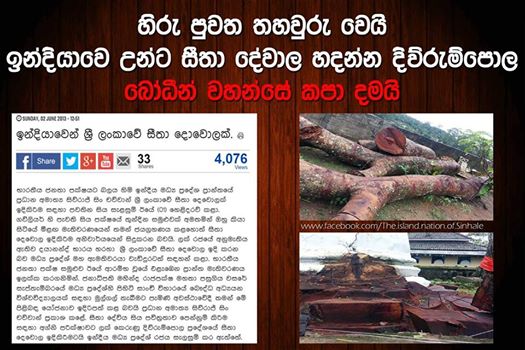
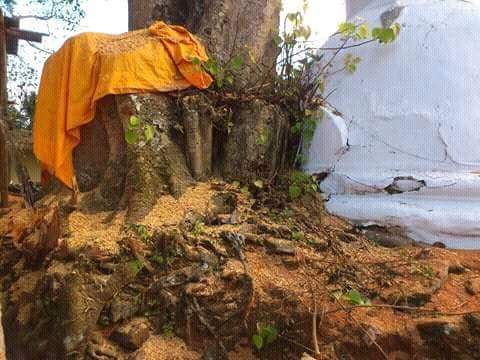
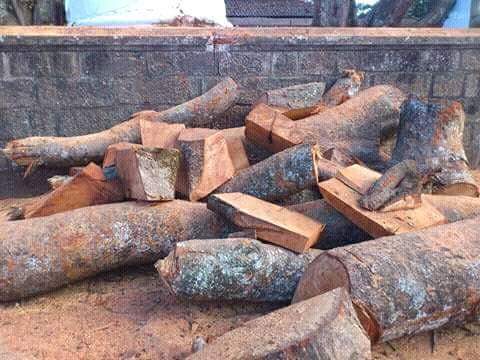
Cutting of the ancient Divrungala Bodhi tree

May 18th, 2016

Bandu de Silva

It is not only Sinhale Jatika Savidhanaya that should be concerened as reported in Hiru, but the entire nation. There is documentation of the protest made by the Royal Asiatic Society of Sri Lanka which even held a Seminar to discuss the issue of inauguration of this Sita Maha Devi project jointly sponsored by the former Sri Lanka Tourism Authority and India’s Madhya Pradesh’s BJP Chief Minister Chauhan who was invited to cut the first sod and who donated crores of cash to commence the project.
The irony is  that Chauhan’s visit had the blessings of the Mahabodhi Society of Sri Lanka. Chauhan visited the island  taking cover behind the invitation by Mahabodhi Society but that the real purpose of the BJP leader espousing the Hindutva doctrine, was to  sponsor the construction of the Sita Devi temple was  not publicised here. It came to light as a result of Deccan Herald publishing the news of Chauhan cutting the first sod and donating money which news was brought to light by me.  The Mahabodhi Society of India based in  Sanchi wanting to maintain good relations with the Madhya Pradesh govt should have seen through the insidious plans of BJP religious extremists to make inroads into India. It was also ironical that The Secretary of Maha Bodhi Society, Sri Lanka,jumped at the Seminar to defend its participation in the invitation to Chauhan.It is perhaps, this Society which was behind President Sirisena visiting Sannchi for participation in a Hindu ceremony.

The cutting of the ancient Bodhi tree, which is the existing symbolic representation of its use for swearing during the days of the Kandyan kingdom practised as a feature of the Kandyan legal system is adding insult to the injury. This spot of significance to the history of the Kandyan kingdom is now to be converted to a place connected to a mythical story of a woman (SITA) who according  to one version of the mythical text, RAMAYANAYA, was expelled from the kingdom for sitting on the lap of another man and an alleged illicit affair with mythical Rama’s brother. The Mahabodhi Society and the Tourism Authority’s former Director General who were then accomplices in spreading Hindu worship in Sri Lanka should bear responsibility for joining in this what looks like a big conspiracy to erase true significance of place names and create new bogus history.Supporting the venture were the remnants of the Hela Havla school mad -hatters who gave curious interpretation to place names to make them associated with mythical Ravana story. For example, Wariyapola is interpreted as the aerodrome of Ravana by breaking up the name into parts (Wa- Air; Riya=Chariot :Pola =Station). I asked why Ussangoda was not similarly interpreted a the place where Ravana lifted (Ussan) Sita; or the latter went to sit on Ravana’s lap.

A number of mad-hatters have joined in this effort to erase the true history of these places. They are linked to the people in India who demolished the 14th century Mosque in Ayodhya to build a mythical Rama temple over it claiming it was the place where Rama was born!

On the other side, the Indian government has dismissed the Ramayana story as sheer myth. That is in connection with the protest over the construction of Sethu Samudra canal.

Bandu de Silva

සිංහලේ ජාතික සංවිධානයේ බදුල්ල වැලිමඩ දිව්රන්ගල

බෝධීන් වහන්සේ කපා දැම

 https://youtu.be/6fonwGoqTGc

cuttingbodhitree1cuttingbodhitree2cuttingbodhitree3

පොඩි සේකර

May 18th, 2016

වෛද් රුවන් එම් ජයතුංග

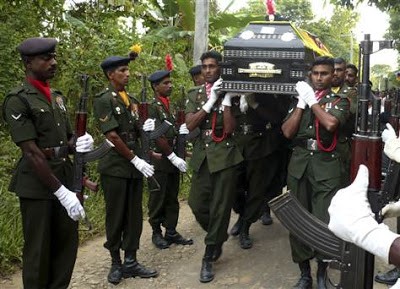
පොඩි සේකර කොලොන්ගොඩ ග්‍රාමීය රෝහලේ සේවය කල උපස්ථායකවරයෙකි. ඔහුගේ පුතුන් දෙදෙනා හමුදාවේ සේවය කලහ​. 1996 දී රිවිරැස ක්‍රියාන්විතයේදී ඔහුගේ පුතෙක් ජීවිතක්‍ෂයට පත් වූයෙන් අප මළගමට ගියෙමු. පොඩි සේකරගේ පුතා ශ්‍රී ලංකා යුද හමුදාවේ සාමාන්‍ය සෙබලෙකු වූ අතර මරණින් පසු ලාන්ස් කෝප්‍රල් තනතුරට උසස් කොට තිබුනි.

ඔහුගේ දේහය මිනී පෙට්ටියක බහා පොඩි සේකරගේ කුඩා නිවසේ සාලයේ තැන්පත් කොට තිබුනේය. ඔහුගේ මුහුණ අසාමාන්‍ය ලෙස කළු පැහැතිය​. එය ලාභ එම්බාම් වර්ගයක් නිසා මතු වන්නකි. කොළ පැහැති නිල අැඳුමේ එක් උර පටියකි. කළුවී ගිය දෑත්  පිටත​ට පෙනීම වැලැක්වීම සඳහා මිනියට අත්වැසුම් පළඳා තිබුණි. හිස ප්‍රදේශය වෙළුම් පටියකින් වෙලා තිබූ නිසා අර්ටිලරි පහරකින් හෝ වෙඩි පහරකින් මස්තිෂ්කය තුවාල වීම නිසා මරණය සිදු වන්නට ඇතැයි මම සිතුවෙමි.

podisekara

එදින සවස මිනිය ඔසවන බව අප සමග ගිය රෝහලේ ඩිස්පැන්සරිය භාර රන්ජිත් මට කීවේය​. අප පොඩි සේකර හමුවී අපගේ කණගාටුව ප්‍රකාශ කලෙමු. ඒ අතරවාරයේ පොඩි සේකර ගේ බිරිඳ අඞනවා අපට ඇසුනි. ” අනේ මගේ දෙයියා තව පැය කීයද ඔය මූණ බලන්ට තියෙන්නෙ කියා ඇය කීවාය​. දරුවෙකු මිය ගිය පසු දේහයද මවකට වටී. තවත් පැය කීපයකින් පසුව මිනිය ඔසවනු ලැබේ. මිනී පෙට්ටිය වැසීමෙන් පසුව ඇයට පුතාගේ මුහුණ මතකයක් පමණි.

සර් කොල්ලා ආබාධිත වෙලා ආව නම් ඒත් කමක් නැහැ, මට පුලුවන් කොල්ලගේ වැඩ කරන්ට​. ඒත් බලන්ට සර් කොල්ලා අවේ පෙට්ටියේනේ මෙසේ කියමින් පොඩි සේකරද ඇඞුවේය​. අප ගොළු වූයෙමු.

ඊලාම් යුද්දය විසින් බිලිගත් තරුණ ජීවිත කොතෙක් ද ? මේ මරණයන් නිසා උතුරේ හා දකුනේ කඳුලු සැලූ දෙමාපියන්ට කිසි දින ශාන්තිය ලඟා නොවනු ඇත​. ඔවුන්  ළමුන් ගේ සැමරුම් මත ජීවත් වෙනු නිසැකය​.

පොඩි සේකර ගේ පුතාගේ මරණයෙන් වසර ගනනාවකට පසුව මම මයි බෝයි ජැක් නම් චිත්‍රපටය දුටුවෙමි. එය සත්‍ය සිද්ධියක් මත පාදක වූ චිත්‍රපටයකි. පළවන ලෝක යුද්ධයේදී ලේඛක රැඩ්ය​ඩ් කිප්ලිං  තම පුතා වූ ජැක් බ්‍රිතාන්‍ය යුද හමුදාවට බැඳී ජර්මානුන්ට එදිරිව සටන් කිරීමට පොලඹවයි. බටහිර පෙරමුනේදී ජැක් වෙඩි වැදී මිය යයි. නමුත් ඔහු ක්‍රියාන්විතයේදී අතුරුදහන්වූ අයෙකු බවට හමුදාව විසින්  රැඩ්ය​ඩ් කිප්ලිංට දැණුම් දේ. එහෙත් ලුතිනන් ජැක් මිය ගිය අයුරු දුටු  ඔහුගේ පුතාගේ ඒකකයේ සිටි සෙබලෙක්  පසුව ඔවුන්ට සත්‍ය පවසයි.

පුතාගේ මරණින් පසු රැඩ්ය​ඩ් කිප්ලිං සහ බිරිඳ විශාදියකට ලක් වෙති. ඔවුන් සැමදා ජීවත් වන්නේ යුද්දයෙන් මළ පුතාගේ අතීත සැමරුම් වලිනි. පොඩි සේකර කිසිදා රැඩ්ය​ඩ් කිප්ලිං හෝ  ලුතිනන් ජැක් ගැන අසා නැතුවාට සහතිකය​. එහෙත් රැඩ්ය​ඩ් කිප්ලිං සහ  පොඩි සේකර අතර මම යම් සමානත්වයක් දකිමි. ඔවුන් දෙදෙනාම  යුද්දයෙන් මළ තම දරුවන් නිසා ශෝකයට පත් වූවෝ වෙති. ඔවුන් දෙදෙනාම ජීවිතයේ ඉතිරි කාලය ගත කලේ මේ අතීත සැමරුම් සමගය​.

වෛද් රුවන් එම් ජයතුංග

COMPARISON OF POLITICAL MENTALITY

May 18th, 2016

By Dr. Tilak S. Fernando

Queen Elizabeth II, who has been the Head of Britain for several decades, turned 90 years old on 21 April 2016. As a ruler, she is an exceptional woman of strength and stamina who still chooses to reign and shine by living a simple life for many heads of States round the world to emulate.

By coincidence or arrangement, Queen Elizabeth II had a distinguished visitor from America for her 90th birthday celebrations this year. He was none other than President of the United States, Barrack Obama and First Lady Michelle Obama. Naturally, the occasion was historical and sensational and the news spread thick and fast through numerous channels of communication throughout the world.

It was also reported that the Queen’s husband and consort, Prince Phillip, who is 95 years old, had suggested to President Obama to go on a ‘jolly ride’ in his black Range Rover SUV to which President Obama had unhesitatingly agreed and got into the front seat. The Duke sat behind the steering wheel and the Queen and Mrs. Obama took the rear seat.

Under normal circumstances, this was not acceptable as the US Secret Service, who is responsible for the President’s security, won’t allow the President to ride in an unarmed vehicle, or with a driver who is not competent! However, in this particular instance all four had a merry ride in the shining black SUV.

It does not mean to say that the good old Duke is not competent to drive a motor vehicle. He has driven all his life and being an active sportsman he has participated in horse-cart racing too and won. Even the Queen, on her part, has been spotted by the public driving to Windsor Castle in a green old Vauxhall during weekends, incognito by wearing an old overcoat and covering her head with a scarf! Apparently her army of dogs (corgis) is trained to lie down at the back of the car purely not to be distracted or spotted by the public. Once it was reported how the queen during such an exercise was stuck at colour lights in Central London traffic. A motorist who happened to stop parallel to her vehicle began to have doubts about the lady driver who resembled the queen, but within seconds lights changed to green and she had zoomed away.

Sri Lankan perspective

 Will Sri Lankans ever witness a prominent minister or a politician driving his own car? Even if they do in a rare occasion, the public opinion is that he will deny doing so, especially, after an accident! Public in London have seen the UK Prime Minister, David Cameron, travelling by underground tube trains where nobody bothers about it; he rides a bicycle in the busy London streets to keep him trim and fit without a band wagon of security personnel following him.

There was an era in Sri Lanka too where our ancestral politicians were very humble and down to earth. Dudley Senanayake used a Triumph Herald economical motorcar and President Premadasa was seen driving his old Morris Minor even after he came to the hot seat. W. Dahanayake always travelled from Galle to Colombo inside a 3rd class compartment by Ceylon Government Railway. During such travels he intermingled with fellow commuters. Once he was asked by a fellow train traveller as to why he travelled inside a 3rd Class carriage whereas he could have used his privileges and travelled either first or second-class! His answer was sweet and short by saying: “Because there is no 4th Class in the train.”

Changing times

Now of course tables have turned in Sri Lanka. Politicians and people alike have changed in their attitudes and behaviour a lot. Judging by the most expensive luxury vehicles, especially the politicians travel on Sri Lankan roads, who can say Sri Lanka has not created an elite society (at least 1- 2%) ! One has only to get onto the public highway to observe the number of SUVs and most expensive luxury type models some Sri Lankans have imported at a cost of millions of rupees. The former President inaugurated the Katunayake Airport Expressway by driving the same brand of Range Rover SUV gracefully, the difference being it was white in colour whereas the Duke drove a black vehicle to transport the Queen and Obama family. So who can say Sri Lanka is a poor country?

Oligarchy

Oligarchy is defined in the dictionary as a form of rule controlled by a small minority of wealthiest citizens in a country. Throughout history eminent personalities such as Winston Churchill have condemned tycoons using their power to serve their own purposes and thereby aggregating poverty by ignoring their social responsibilities and using their power to serve their self-centered motives.

India is a good example to study. Looking at Indian statistics (2011), Indian cabinet ministers were featured as using humble cars such as Maruti in preference to expensive and fancy SUVs. This was in line with the Indian strategy as part of its transparency policy. Manmohan Singh was not regarded as a flamboyant type prime minister; he drove a 1996 Maruti 800. His official vehicle was however a flashy BMW7 series.

It is such a shame that the present government in Sri Lanka during their short term in office so far keep on harping, from the time they took over, about the debts they inherited from the previous regime, yet they seem to be blind to the massive wastages in many forms by members of their own government. Has it become a mental disorder among the politicians of this country or is it a case of competition and trying to keep up with the Joneses when the majority of them, including local government representatives, are hell bent on getting luxury vehicles, SUVs, BMW and top range Mercedes Benz vehicles at a cost to government coffers which is tax payers’ money?

The suffering public, who are squeezed up to their eye balls with ever increasing taxes and newly increased VAT, have realized, although it is a too late, that those top ranking politicians who came to their doorstep before the elections with a begging bowl to get their vote have forgotten why and for what purpose they have been elected to office. After all, the word politics and politicians in Sri Lanka has become the most reviled word especially considering some of the flippant statements made by certain ministers that, ‘without a Mercedes Bens vehicle it makes their job difficult to run about without getting exhausted and late for other appointments“! The ten million dollar question would be to ask them whether they really need to travel in comfortable luxury vehicles to serve the public by shoving all other road users to the drains! Is has to be a gods’ curse that Sri Lankans having to put up with such balderdash!

No wonder present day Sri Lankan politicians who appear to be thin like sprats before they come to office and turn into fat odd muscular pieces of humanity after coming to power and develop huge and ugly bellies protruding like severely pregnant women who are about to deliver babies!

Is it due to their lack of exercise, having no time for anything else as they are so engrossed with their dedicated work and responsibilities towards the public, or being self indulgent, selfish and money orientated in this new industry of Sri Lankan politics – Its food for thought!!

Nothing is at Last Sacred But the Integrity of Your Own Mind.” ― Ralph Waldo Emerson.

tilakfernando@gmail.com


ACWBC Panel Discussion

May 18th, 2016

A Panel Discussion with illustrations on Prof. G.P. Malalasekera

A Panel Discussion with illustrations on Prof. G.P. Malalasekera will be held on Tuesday 24th May at 5.00 p.m. at All Ceylon Women’s Buddhist Congress, 400 Bauddhaloka Mawatha Colombo 07. The speakers will be:

Mr. Wijaya Malalasekera – My father

K.N.O Dharmadasa – Prof Malasekera as a scholar

Dr. Hema Goonatilake – His contribution to the spread of Buddhism

All are welcome.

Shameless Mollycoddles attempt to erase the importance of the Victory Day

May 17th, 2016

By : A.A.M.Nizam – MATARA

  • Terrorist elements commemorate fallen terrorists today with the blessings of the government
  • NGO vultures demand for an end to holding Victory Day functions
  • Government says there would be no more victory or military parades to celebrate the defeat of the LTTE
  • Slain tigers are our own people – Karunasena Hettiarachchi

7 years ago, on a day like today, our gallant forces vanquished the world’s ruthless terrorist outfit militarily and thus liberated and unified the country. We must be grateful to former President Mahinda Rajapaksa who ended this 30 years of this war with his determined dedication as the Commander in Chief, organizing a Victory Day celebration in Kurunegala when the government genuflecting before the separatist elements making all efforts to erase the significance of the Victory Day on the behest of Tamil diaspora, hegemonic India and the western powers.

Tiger terrorist elements are daringly on the rise in the North and East and making every effort to intensify communalism in the North and East and revive the LTTE. The terrorist websites Tamil Guardian and TamilNet report of elaborate arrangements being carried out with regard to a week’s commemoration events which also included a cross party event held at the British Parliament.

The week of events has commenced on 12 May in Jaffna, with the lighting of the remembrance flame. The flame in memory of those killed at Mullivaikal was lit by Northern Provincial Councillor M K Shivajilingam the brother-in-law of the slain megalomaniac terrorist leader Prabhakaran  and the NPC Agriculture Minister P. Aynkaranesan at Chemmani  in Jaffna. Northern Provincial Councillor P.Gajatheepan also participated at the event.

TamilNet says that Elected councillors of the Northern Provincial Council (NPC), former members of civic bodies, militant-turned political parties in the Tamil National Alliance (TNA) and the Tamil National Peoples’ Front (TNPF) are engaged in organizing memorial events in what they call the country of Eezham Tamils amidst recently renewed threats and harassments against former Tamil fighters. The NPC Chief Minister C.V.Wigneswaran has called for all sections of religious dignitaries and political representatives to attend the memorial event organized by the NPC on 18 May (today) at Mu’l’livaaykkaal School.

Mr. Shivajilingam has told TamilNet that by remembering those killed at various massacres throughout the Tamil homeland on Mu’l’ivaaykkaal Remembrance Week, the Tamils are passing a message to the global humanity that these massacres were all part of a systematic genocide against the Eezham Tamils,

The dollar voracious NGO vulture and the well known Sinhala Tiger Jehan Perera who escorted delegations to Geneva to support the tiger terrorists and carry concocted tales to the international community about human rights violations by the Sri Lankan security forces and intensively worked for defaming the Sri Lankan forces during the war period in his weekly article to the Island” this week (17th May) has  blamed the government of former President Mahinda Rajapaksa for the commemoration of war victory with military parades and narrow ethnic nationalistic speechmaking catering to ethnic majority sentiments and injuring the sentiments of the ethnic minorities. He also blames the previous government for taking action to ensure that there would be no commemoration of the LTTE or even of civilian loss of life even within places of religious worship

This Sinhala Tiger  commends Eunuch Sirisena for redefining May 19 as a Day of Remembrance marking what he says a significant break with the past.  He says that there is an improvement in the flexibility of the government and that the government is making a dedicated effort to take the country in the direction of national reconciliation and the excessive use of this anniversary to promote narrow ethnic nationalist sentiment amongst the Sinhalese people is detrimental to national reconciliation.

Completely ignoring the sufferings and destructions caused to the Sri Lankan people, by his tiger terrorist allies, this shameless Sinhala Tiger adds that the manner in which the war ended was traumatic for the Tamil people and in the last months of the war large numbers of Tamil people perished including large numbers of civilians

He also states that what happened in Sri Lanka was a civil war that ended, of citizen against citizen, and not a war against a foreign foe. Commending the government, he adds that the new government has been making a commendable effort to touch the hearts and minds of the Tamil people while also winning over to it the international support that the previous government so badly lost.

Meanwhile, the Defense Secretary Karunasena Hettiarachchi has said that there would be no more victory or military parades to celebrate the defeat of the LTTE and that decision had been taken as part of a long-term plan to achieve reconciliation among all ethnic groups in the country. He has said that the government would conduct only a commemoration opposite the war heroes memorial at the parliament ground followed by a cultural show named ‘the footsteps of reconciliation’ (Sanhindiyawe Piya Satahan) at the Independence Square in the evening.

Hettiarachchi has also stated that the former President Mahinda Rajapaksa who was the Commander-in-Chief when the war was successfully concluded would not be invited to the commemoration ceremony or the cultural show.

Answering a query why the government would not conduct a victory or military parades to celebrate the date, he has said that such celebrations were a barrier to reconciliation the country was achieving as it would hurt the feelings of one ethnic group.

The shameless Hettiarachchi has further stated that the slain tigers are our own people and has questioned to whether it is morally right to hold victory celebrations. He has also stated that anyone in the North or South could organize events to commemorate those who died in the war, and has asked how can we describe those events as LTTE celebrations and has said that the government had not banned such events. It is indeed shame to find that this person who holds the most important Ministry Secretary post in the country is unaware of what is happening in the country.  May be he also comes to know about things from the newspapers if it was published in the newspapers similar to Eunuch Sirisena.  It should be recommended for him at least to read the websites published by the pro-tiger terrorist outfits if he does not get information from the intelligence services.

Our tribute to Sri Lankan war heroes

May 17th, 2016

Chandrasena Pandithage

Year 2009 May 18th and 19 are very remarkable days in Sri Lankan history. Whole island raised together and celebrate together the brutal terrorism’s end. As a nation we all created a festive season throughout the country to celebrate those historical victory. It’s a “victory day” for Sri Lanka and all Sri Lankan citizens indiscriminately.

This victory is a specialized victory, because at the end of the war each and everybody win and get tremendous achievements in their lives. Sinhalese, Tamils, Muslims and other minorities are benefited by this victory. Visually whole world show this is as a Tamil liberation struggle against governments. But nobody saw the reality of the war and it’s oppression on Tamils. Since the begging of the arms struggle the Tamils have been through a very hard road. Their lives styles were badly damaged by unknown invisible hands. The most important thing is identifying the devilish forces behind this cruelty.

The starting point of this bloodshed is year 1972 September 17th at Duraiappah Stadium Jaffna city. There was a carnival and the people were enjoying, Most of the people are from Tamil community.and while they were enjoying, a planted bomb was exploded and alarmed Tamil society to stop enjoyments. When we look into this incident we could understand very clearly The Tamils who really love to their community cannot plant a bomb inside them, specially this type of festive moment. But it was done. Fear and Terror started to penetrate into Tamils minds and inside their community too. This cruel incident gives us a very important massage.

” Tamil liberation fighters cannot plant a bomb to disturb Tamil lives and that’s a universal truth. But the Tamil youth involve to plant this bomb at that point. They are Tamils, but they are not Tamil liberation fighters. They are coolies to somebody els. Who were the masters behind this bomb blast?  It’s to be investigated.

After this blast, the unknown forces carried out their operations against Tamil community northern part of Sri Lanka. Jaffna the heart of the Tamils were scattered, fear and terror spread throughout the city.  More and more bomb blasts developed instability of the city. Bomb blasting in city centers and hunting the highly reputed Tamil leaders; made Tamils to leave the Jaffna. Slowly the Jaffna turned in to a ghostly city.

United Nations Organization, Human Rights Commission, US Embassy UK High Commissions, were here watching all those human right violations without saying a single word.

The well planed destructive mechanism on Tamil’s community were driven by Tamils and they were used and they wanted to accelerate this programs on their new agenda. There target was to spread island wide destruction campaign on Tamil community. It was started 1983, Eleven years after the starting point of terrorism they wanted to join Sinhalese community to disable Tamil community island wide.They started it, killing 13 Sinhalese soldiers and the “invisible hands” worked in side the government and did not release the dead bodies to their relatives. All the dead bodies used to spark anti Tamil riots island wide. It’s helped to develop Liberation movement from Tamil community. Tamils community were given ideology to stand against Sinhalese community.

The Tamil prisoners who were massacred in Welikade in July 1983 were :

25th July 1983

  1. Kuttimani Yogachandran 2. N. Thangathurai 3. Nadesathasan 4. Jegan 5. Alias Sivarasa 6. Sivan Anpalagan 7. A. Balasubramaniam 8. Surash Kumar 9. Arunthavarajah 10. Thanapalasingham 11. Arafat 30. Anpalagan Sunduran 12. P. Mahendran 31. Ramalingam Balachandran 13. K. Thillainathan 32. K. Thavarajasingham 1420. S. Subramaniam 21. Mylvaganam Sinnaiah 22. G. Mylvaganam 23. Ch. Sivanantharajah 24. T. Kandiah 25. S. Sathiyaseelan 26. Kathiravelpillai 27. Easvaranathan 28. K. Nagarajah 29. Gunapalan Ganeshalingam . S. Kularajasekaram 33. K. Krishnakumar 15. K. Uthaya Kumar 34. R. Yoganathan 16. S. Sivakumar 35. A. Uthayakumar 17. A. Rajan 36. G. Amirthalingam 18. S. Balachandran 37. V. Chandrakumar 19. Yogachandran Killi 38. Sittampalam Chandrakulam 39. Navaratnam Sivapatham (Master)

27th July 1983

  1. Muthukumar Srikumar 10. Gnanamuthu Naveratnasingham 2. Philip Amirthanayagam 11. Kandiah Rajendran (Robert) 3. Kulasingam Kumar 12. Dr. Somasunderam Rajasunderam 4. Selachami Kumar 13. Somasunderam Manoranjan 5. Kandasamy Sarveswaran 14. Arumugam Seyan (Appu) 6. A. Marianpillai 15. Thamotharampillai Jegemogenandan 7. Sivapathan Neethirajah 16. Sinnathambi Sivasubramaniam 8. Devanayagam Paskaran 17. Sellay Rajeratnam 9. Ponnaiya Thurairajah 18. Kumarasamy Ganeshalingam 19. Ponnampalam Devakumar

United Nations Organization, Human Rights Commission, US Embassy UK High Commissions, were here watching all those human right violations without saying a single word.

Now Tamils and Sinhalese together think wisely who were the masters behind those killings?

Our heroic forces bravely fought against the hidden forces and defeated them on 2009 May 18th. This victory could build up a new one country again. Sinhalese Tamils, Muslims and other minorities were benefited lots by this victory. Specially Tamil community got a highly regarded situation through out the country.

1 Instead of 1/3 of country, they are given full country and they are free to live any place of this country.
2.Power is very important and The darkness vanished and power started to run through out North and East part of Sri Lanka. Some Tamils enjoy lots with the new power generation on their homelands.
3.Children are the future of Tamil community. If somebody loves their community progress, their children must be protected and developed their educational back ground. This victory removed all the cyanide capsules from Tamil children’s necks and open the opportunity to enjoy their childhood again.
4.It’s stopped killings Tamils, Sinhalese and Muslims.

5. This victory reduced the terrorist activities in India and provide it’s benefit to Indian people too.

United Nations Organization, Human Rights Commission, US Embassy UK High Commissions, European Union  were watching all those ongoing activities and they realized the destruction of killing mechanism. They started screaming madly and start to stand for terrorism group nakedly. The masters came out pointing their fingers to our heroic forces on human right violations. At the same time their all the other fingers pointed at them on their dirty works through out the 37 years war crimes in Sri Lanka.

The war is not over. Russian President Vladimir Putin started to fight against international terrorism. It is our duty to stand with Russia to crush the imperialist terrorist mechanism.

We salute our war heroes proudly.

Long live Sri Lankan war heroes!

https://www.facebook.com/Our-tribute-to-Sri-Lankan-war-heroes-799512216850638/?ref=aymt_homepage_panel

Vellahlaism — the fascist force of vile violence

May 17th, 2016

H. L. D. Mahindapala

The brief history of Jaffna can be explored, analysed and understood only as a by-product of Saivite-Vellahlaism —  the over-determining central force that impacted on every aspect of Jaffna life, from the womb to  the tomb. It is this force that ran through all the phases of peninsula, particularly the first three phases, and held it together a seamless whole. So any exploration of the history that moulded  the identity of Jaffna and made it what it is today must necessarily begin by taking  into consideration the following three phases  — i.e.,  1. nearly, eight centuries of Vellahla casteism which came with the first settlers migrating from Malabar in  the west coast  of S. India, + 2. four centuries of slavery, imported from the Coromandel coast of the east S. India, during the Dutch period + 3.  nearly, two century of the ideological impact of the only iconic religious leader, Arumuka Navalar, (1822 – 1879), who revised and reinforced Saivite-Vellahlaism  and told his followers : It is the duty of every Saivite to kill those who steal Sivan’s property or revile him. If one is not strong enough to kill the blasphemer , one must hire another to do it. If one has nothing to hire with, one leave the country where the sinner lives. By remaining in the country one becomes a participator in the sin.” (Cited as a footnote in The Bible Trembled, The Hindu-Christian  Controversies of Nineteenth-Century Ceylon, R. F. Young and Bishop S. Jebanesan – p. 80). All three major forces contributed collectively to make Jaffna an exclusive enclave for the oppressive and violent Vellahla political culture.

The unique characteristic of Jaffna has been in the power and the supremacy of the Saivite-Vellahlas who imposed their iron-fisted political culture on the geographical  neck of Sri Lanka. From the time  the first migrants from Malabar decided to settle down permanently in Jaffna in the 13th century, as stated by Prof. S. Arasaratnam, the Vellahlas pursued a single-minded policy of  consolidating their power to  protect and retain their supremacy. Religion, politics, law, customs, ownership of land, ideology, rituals, and the overall culture were determined by the primary needs of the Vellahlas to serve the essential interests of the Vellahlas. In short, Jaffna did not exist without the Vellahlas and Vellahlas did not  exist without Jaffna. It was possible to take the Vellahlas out of Jaffna but  it was impossible to take Jaffna out of  the Vellahlas.

The supremacy of the Vellahlas was comprehensive and they brooked no opposition to their power, position, privileges, property and perks. Nothing moved in Jaffna without the advice and consent of the Vellahlas. As the ruling masters in control of the land, temples, professions, particularly government jobs, and the overall decision-making process, the total responsibility for what came out  of Jaffna should be sheeted only to the Vellahla leadership. No other caste / class held such totalitarian power as the Vellahlas. What passes off the Tamil culture is nothing but the Vellahla culture. They were the elite who laid down, with fascist  force if necessary, the standards for conduct in all spheres, from the status birth to the final burial. Nothing that was not endorsed by the Vellahla codes of conduct was considered legitimate.

In assessing the forces that moulded Jaffna social scientists had not focused seriously on investigating the primary source that determined Jaffna politics : the Saivite-Vellahlaism. It has been the overwhelming force that went to make Jaffna and yet no comprehensive study of Saivite-Vellahlaism as the central force driving the politics of the peninsular had been made. Prof. Bryan Pfaffenberger, Prof. Ratnajeevan and Prof. Rajan Hooles and Bishop S. Jebanesan and R. F. Young have dealt with critical aspects of Vellahlaism. Nevertheless, the overall impact of Vellahlaism, both in Jaffna and on the national stage, has not been explored to the degree required to understand the post-independent scene. Vellahlaism came down like the most destructive juggernaut from the North and destroyed everything in its wake and  yet that is  the very force that has not been factored into analysing the cataclysmic  events that unfolded in the post-independent era. Why? How did our  intellectuals and  social scientists miss  this obvious factor? Why did they focus on the South and turned a blind  eye to the North?

Throughout  its history Vellahla casteism has been an incurable force. The Vellahla elite sincerely – nay, religiously – believed that in enforcing and perpetuating their caste system they were rendering a great service to mankind. They could be excused for believing in it in the feudal ages when there were no alternatives available for redemptive politics. But for the pillars of Tamils society to commit themselves so tenaciously and rabidly to a fascist system that was palpably oppressive and immoral in the 20th century condemns the Vellahla elite as the most  evil force that retarded the progress of Jaffna and prevented its smooth transition into the modernity.

They were obsessed with Vellahlaism and went to extreme lengths to preserve it at any cost. On the one hand, their most respected political leader Sir. Ponnambalam Ramanathan went on special mission to London to legitimise Vellahla casteism as a permanent way of life. And on the other, they  came down south to woo the Sinhala Goigamas ( the equivalent of the Tamil Vellahlas) to form political alliances and consolidate the power of casteist forces in the North. The little-known moves by the Tamil Vellahlas to join hands with the Sinhala Goigamas in the early decades of the 20th century were revealed by Prof. A. Jeyaratnam Wilson who wrote :  In fact, during these years there was discussion in certain influential Ceylon Tamil circles about the possibility of a political alliance between the Sinhalese Goyigama and their Ceylon Tamil Vellala counterparts. Such a view was seriously put forward at a closed meeting of Ceylon Tamils at the Combo Town Hall in 1945. These Ceylon Tamils hoped to trade on the contempt that some of the influential Goyigama politicians had for Karava…..In fact, as stated earlier, the Vellala dominated Ceylon Tamil leadership thought in terms of a partnership with their Sinhalese Goyigama counterparts to the exclusion to the exclusion of the powerful Sinhalese Karawa caste as well as other influential caste groups among the Sinhalese.” (pp. 466-467 – Ch. XIV, Race, Religions, Language and Caste in the Subnationalisms of Sri Lanka, in  Collective Identities, Nationalisms and Protest in Modern Sri Lanka, Edited by Michael Roberts, Marga Institute, 1979).

Clearly, the Vellahlas, fearing the threats coming at them from the invasive forces of modernity, were running in all directions to protect and consolidate their power and privileges. The move of the Tamil leadership to form caste alliances with its Sinhala counterparts also confirms that the Tamil leadership, even as late as the thirties, was not concerned about Tamil nationalism, or of establishing a Tamil separate state, or about the welfare of the low-caste Tamils. They were, as usual, obsessed with only preserving Vellahla casteist interests and Vellahla supremacy. The Tamil leadership was ever willing to abandon the Tamils and join hands with their bete noir in the South to protect Vellahla supremacy in the North. In essence, Vellahlaism constituted the long and the short of Northern politics.  It was when the  anti-Vellahla internal forces were gathering momentum and threatening the supremacy of the Vellahlas that they took cover behind Tamil nationalism. At this stage they shifted from Vellahlaism to racism and from there to federalism and to separate state – movements that were initiated by the Vellahlas, managed by the Vellahlas for the survival of the Vellahlas. Tamil nationalism emerged only in the last stages of Vellahlaism that was losing its feudal religious and political legitimacy to maintain its supremacy over the other  castes.

In its heyday, the Saivite-Vellahla culture reigned supreme in Jaffna, even among the Christian Vellahlas. During the colonial times, it was quite common for the Vellahlas to act as Christian converts by day and revert to Hinduism by night. This demonstrated the overwhelming power  of the Vellahla casteist culture. The implacable Vellahla culture found its best expression in the person of S. J. V. Chelvanayakam who declared that though he was Christian by religion he was Hindu by culture. In  other words, it confirmed that not even Christians could escape the power of the dominant Vellahlas culture, with its overwhelming casteist pull. Besides Chelvanayakam, being a Christian, had to make concessions at some time point if he was to retain his leadership in  predominantly Hindu society.

It was also an acknowledgment of the hidden fact that Jaffna society and Hinduism – the Saivite version revised again by Arumuka Navalar – were inseparable. Jaffna was essentially a theocratic society ruled by militant Hinduism. Navalar takes Krishna advice to Arjuna, the Hamlet in the Baghavad Gita, and pushes  it to the extreme. Arjuna who is debating whether to fight or not  in the battle field is told by Krishna to do his duty as a warrior and fight even if it  means killing his kith and kin. Hindus derive their militancy from this call to militant action in the Gita. Arumuka Navalar’s doctrine  of killing enemies of Siva has its roots in doing his duty as defined in Hindu militancy. He interpreted it to mean killing the non-believers.  The aggressive and intolerant Hindutva ideology  remained as an intransigent force even among the converted Christians. It sealed the character of Jaffna as a closed society, leaving no space for any alternative ideology / force to rise within the cadjan curtain that ringed round Jaffna, isolating it from the rest.

The contrast with the south reveals two different cultures. The south was a democratic, liberal and cosmopolitan society while the north was a closed monolithic entity that kept the asangha out. (Asangha means to be out of the Hindu fold, to be lower than the lowest caste, says Prof.s. Ratnajeevan Hoole, The Exile Returned. ) Nothing that was anathema to the Saivite Hinduism (as revised by Navalar) had a chance of getting even a toe-hold in Jaffna. Ruthless Vellahla culture ran through Jaffna history as one main stream, preserving its mono-ethnic, mono-cultural  identity. Its intransigence, its intolerance, its violence, its elitism, its exclusiveness (as opposed to the inclusiveness of the south), its refusal to accept any liberal or democratic forces, point to the inevitability of violent confrontations with the asangha, whether within or outside Jaffna.

Jaffna, in short, was a cultural singularity. Considering its ill-liberal, undemocratic, slave-owning, casteist fanaticism tending  towards Hindu fundamentalism, it is legitimate to question the totality of the Tamil historical experience in the North, particularly because the reality, as outlined above, is in stark contrast to the romanticised mythology of Jaffna as a paradisiacal heartland of the Tamils. it is natural and also necessary to question its values and its vaunted achievements, if any. Besides, it is also time to question the  entire Tamil historical experience because they had finally come to the end of the longest war in their history – the war that ran for 33-years, starting from the declaration of the Vadukoddai War by the Tamil leadership on May, 14, 1976 and ending on May 18, 2005 in Nandikadal. After all, it was a war which they fought in the name of protecting and preserving the Tamils, their language and their culture. So at the end of their war what did they achieve in Nandikadal ? Did they not return to square one, which is what was already there before the Vellahla leadership launched their insane war?

After the reign of terror unleashed by Velupillai Prabhakaran, after the abduction of Tamil children to fight in a futile  war, after the massacre of the entire Tamil leadership, after killing more Tamils than all the other forces put  together, after building a swimming pool for Prabhakaran and his children in  centre the dry Vanni, after  siphoning  off the food and medicine sent by the Sinhala Government” for the sustenance of its Tamil citizens, after holding 300,000 Tamil citizens as hostage to survive  in a war that he had already lost,  what did Prabhakaran leave as his legacy for the Tamils? Was there anything left for the Tamils to boast about other than humiliation? What great artist did  his fascist culture produce? What justice did his  kangaroo courts deliver to  the oppressed Tamils? How much freedom was there for the Tamils to move freely? Did R. Sampanthan and M. Sumanthiram find their dignity and liberty under the Sinhala government”? Or under Prabhakaran’s jackboots?  What glory did the helpless Tamil parents find in watching their children being dragged forcibly by the Tamil Boko Harams? Prabhakaran  gave suicide  pills for  the children of other Tamil parents before they went out on their suicide  missions and he, in his last hours, surrounded himself with a human wall of 300,000 Tamil civilians who were shot when they tried to flee his clutches. Are these the achievements  of the greatest Tamil hero? What is the worth of a culture that permits its leader to forcibly drag children into a futile war? What life chances did the great Tamil hero give to his people? Did he even allow the cries of the Tamil mothers be heard outside Vanni like the cries of the Tamil women who cried so copiously in front of Samantha Power and Navineethan Pillai?

Besides, what  is the value of a culture that never had a streak of liberalism, humanism, socialism or any other liberating ism” except oppressive Vellahlaism? Since the fundamental objective of the culture of Vellahlaism has been to oppress, persecute and deny the under-privileged low-caste Tamils their basic rights as human beings, what is left of the Tamil historical experience that could be equated with the humane values of other communities that contributed to the good of humanity? Is there any ethical, moral, religious, or cultural legacy left behind by the Tamil forefathers who were  Vellahla casteists, or slave-drivers, or violent Hindu fundamentalists?.

Perhaps, the answer could be found in the following counter-questions : Isn’t it logical that evil must necessarily breed evil? Considering the overdetermining factors that rejected any liberating  ideology or force (as listed above) is it surprising that there was space only for one overwhelming force to spring from  the perennial fascist culture of  the Vellahla supremacists :  Velupillai Prabhakaran, the pathological killer” ( Prof. James Jupp, ANU, Australia) who liquidated more Tamils than all the  other forces put together, as stated by the Tamil leaders? Prabhakaranism constituted the final stage of despotic fascism that ruled Jaffna. The history of Jaffna is wrapped essentially in the four ideologies : 1. fascist Vellahlaism; 2. primitive slavery; 3. Saivite Navalarism and 4. political Prabhakaranism    — all of which are linked to the political culture of the Vellahlas. There was nothing  significant in Jaffna outside  these four dehumanising forces. It must be repeated again, for emphasis, that the most striking feature of the peninsular political culture has been the absence of a single Jaffna-centric liberal, democratic, humanistic, religious, political or moral force to save the  Tamils from the successive fascist masters / ideologues. Neither in the creative arts and religion, nor in politics did anything originate in Jaffna to liberate the oppressed Tamils. Jaffna was an imitative society which borrowed the key elements from Tamil Nadu and remained as a sterile billabong.

Even Arumuka Navalar,  the greatest cultural icon of Jaffna, was a mere importer of the Tamil Nadu culture to Jaffna.  He is described as a collector and editor of rare (Tamil) books” ( p.189 – Ibid). The two joint authors add: Contrary to convention, we view Navalar more from a regional than local perspective, as less initiatory than remarkably well attuned and responsive to events and trends on the opposite side of the Palk Straits separating Jaffna from Madras Presidency. Viewed from this angle, there was actually little in the Northern  revival that had not already appeared first in Madras or the rural districts of the mainland (e.g., Tirunelveli ). Instead of the usual emphasis on what Navalar achieved in India, we stress how India influenced him. Revivalism in Jaffna did have  distinctive features that will be discussed in relations  to the fact of Vellahlas domination in North Ceylon, but the Tamil mainland was far ahead of Jaffna in giving birth to the reactionary revivalism of the 1840s.” (p. 41 – Ibid).

Put together, the totality of Jaffna history adds up to eight centuries of fascist despotism that ruthlessly denied the Tamil people their basic human rights. The four dominant forces  – casteism, slavery, Saivism and Prabhakaranism – reinforced each other and eventually melded into one solid force of Vellahlaism, the ultimate  in fascist culture of Jaffna. After Arumuka Navalar revised  Saivism to elevate the Vellahlas to the top  of  the caste  hierarchy, his dogmatic Saivite doctrines categorised Jaffna officially into two irreconcilable socio-religious layers – the upper level  of Vellahlas  and  the lower level of non-Vellahlas. Up until the 1930s the repressive Vellahla forces remained within the borders of the peninsula. However, in the dying days of the British Raj Vellahlaism spilled over to the south, gathering momentum all the way until it ran down to Nandikadal.

The Vellahla militancy that ran  amok in the  south  opened up a new chapter in the history of the Vellahlas. It began with the Vadukoddai Resolution May 14, 1976. Vellahlaism found its comprehensive expression  of  its culture, history and politics in the Vadukoddai Resolution. It was the last throw of the Vellahla dice. As in most ideologies, its power was in the mythic glorifications than in the  historical realities. The leading left-wing historian, Erick Hobsbawn pooh-poohed the Vadukoddai myths as examples that go to concoct nationalisms”. That apart, the Vadukoddai Resolution emerged as the definitive definition of  the Vellahla ideology that served the elusive Eelamist agenda. Either intentionally or  unintentionally, it encapsulated the Hindutva militancy expressed by Arumuka Navalar (as outlined  above).

The Vellahlas who met at Vadukoddai fulfilled Navalar’s  ideology to the last full stop. The first point  he made was to kill the non-believers and, true enough, the Vellahlas declared war in the Vadukoddai Resolution. Second, he said to hire  someone else if they can’t do it themselves and the Vellahlas asked the youth to take up arms”. Third, he asked, the Vellahlas to go into exile if they can’t do it because it’s a sin to stay in the land  of the sinners. And the Vellahlas flocked to the West to find greener pastures.

No wonder the Vellahlas worship Navalar as their demi-god.  The only obstacle to be the ”sole deity of the Tamils” is that the hired killer, Prabhakaran, is now competing with Navalar to take the first place in the Tamil pantheon. If, as claimed by some researchers, Vellahlaism is raising its ugly head again, then the chances are that Arumuka Pillai, who was anointed as Navalar” (orator) in 1849, is likely to triumph over the low-caste hero of the Tamils, Prabhakaran – the biggest killer of Tamils.

For the moment, we will have to leave it as a toss up between the between the preacher (Navalar) and the prosecutor of his  preaching (Prabhakaran).

Why can’t our leaders  ask India to mind its own business without unnecessarily interfering with our Internal matters

May 17th, 2016

Dr Sudath Gunasekara 16.5.2016.

The following news item by Ramakrishnan is a sequel to another which appeared under the caption

‘Work suspended after New Delhi claims it may be a naval facility’ appeared on 15.5.2016.

I reproduce both above news items at the end of this note to make it easier for the readers to understand the real scale and danger of Indian intervention in our internal matters.

Reading through these news items it appears that there is no end to Indian bullying in Sri Lankan affairs. They persist continuously as if this country is another State of India or a vassal protectorate of Delhi and even Taminadu. It is 42 years since Kachchative had been jointly agreed and declared as a part of Sri Lankan sovereign territory in 1974.  Now it stands a part of the sovereign State of Sri Lanka and it is non-negotiable. The Indian Government has no business therefore to interfere with matters pertaining to Kachchative any more. So why the hell an agent of the Ministry of External Affairs in the Indian government, Vikas Swarup, should ask the Indian High Commission in Colombo to provide more details on a strictly internal matter pertaining to this country, to report to him on a move to build a shrine stating that it is wrong to do so without informing India on the part of Government of Sri Lanka. What legal authority and moral right do they have to say so other than the bigger size of the country?

Isn’t it unfortunate that if the news that the construction of a new church on the island of present Kachchativu  has been stopped by the Sri Lankan Government after India raised issues over it and  if the Navy Commander had said so. According to Sunday Times construction work had been suspended until the issues were resolved. Even if the Navy was building a Church on that Island how can there be an issue over it and what business India has got to interfere with it. How and why building a church on Sri Lankan soil could and should be an issue and a provocation to India as Jayalalitha has said.

What business Jayalalitha, that old, mad, fat and crazy woman has got to oppose the move to construct a church on our territory. Why should we get permission and consent of the Tamil Nadu fishermen as she says?  Isn’t it high time the people of Tamilnadu sent this woman to an asylum and not to the State Assembly at least at today’s elections?

Why should reconstruction of a church or any other thing on Sri Lankan territory be done jointly by Sri Lanka and India and why should we obtain the concurrence of the Tamil Nadu fishermen or their government for something done on our soil. Have they or she has got permission to rob our fisheries resources with impunity. What rubbish this mad woman is talking. We are not a part of Tamilnadu or India as Jayalalitha thinks.”

May be St. Anthony’s Church on Kachchativu Island holds considerable religious significance for the fisher folk in the coastal districts of Tamil Nadu including Nagapattinam, Thanjavur, Pudukkottai, Ramanathapuram, Thoothukudi and Tirunelveli. Also they may have traditionally undertaken pilgrimages to the island for the annual festival of St Anthony’s for several centuries and as such it could be a part of their essential cultural and religious heritage,”  We have no objection to or contention for their coming to K’Thive to worship their God. But we will and we shall fight tooth and nail if they try to claim ownership over the Island. It is sad that this mad woman hasn’t got the brain to understand that Kachchative is a part of another country- Sri Lanka

Even if construction by Sri Lanka navy is for a naval facility, what is wrong with it. We are not constructing it on Indian territory.  It is built on our soil and it is meant for our security. South Indians or any other devotee of the God can come and go annually for the festival as visitors on visa. If anyone comes without visa we will arrest them. But the South Indian so called pilgrims cannot stay behind illicitly as South Indians had done for centuries continuously and later claim a part of this country as their Home Land with the cunning idea of chasing out the Sinhalese and owning this whole country-a paradise to humanity- as it had been admired and described by visitors from all over the world, throughout history.

I think it is high time India stop this bullying its neighbors, give up its expansionist agenda and learn to live and let live. India has given us enough trouble over the centuries in known history starting from the second century BC. Even in prehistoric times India has invaded our country when Rama invaded Lanka. We as Sri Lankans are ready to forget the unpleasant past and reconcile. But India never allows any wound to heal. Every now and then they create a new problem lest we forget one. This is the hard lesson of history. How long can we go on indefinitely like this is the question? We don’t pose a threat to India or even dream of owning it like Pakistan or China. So why don’t they leave us alone and mind their own business.

Why can’t the Government of Sri Lanka tell this much to India and assert as an independent sovereign State. My question is while sitting at the doorstep of mighty North America, if Cuba could do it why the hell Sri Lanka can’t do it? Why are they so stupid and naïve. Shame to our timid politicians. In recent history I see only three leaders who could stand on their own feet with India. They were Sir John. Premadasa and Mahinda Rajapaksa. But Mahinda also did not do the job people of this country expected him to do after 2009, in spite of our repeated requests.

He also had the 2/3 majority in Parliament and the people’s support to abolish the 13th Amendment and the JR/Rajeev Pact, both of which were imposed on Sri Lanka by force by India to achieve its despicable and diabolical political ends. In fact apparently he had forgotten the fact that he himself was a key man in the Petta demonstration against the 13th A in 1987. How many letters I have written to MR asking to do that and restore the historic Tun Sinhale, which has sustained the unity and territorial integrity of this Island for 2242 years from 427 BC to 1815 until it was robbed by the British.

In this scenario it is high time people of this country shun all political parties, administrative and legal systems and coulours like green, blue and red imposed on us by the Colonial West and their ideologies and chase out all treacherous, unpatriotic and naïve politicians  who are only a direct product and proxies of Western Colonial past. Then find a Lion hearted patriotic leader who knows the history of this country, loves the people and the rich legacy of this Great Nation (Say like Dutugemunu,Wijayabahu, Parakramabahu, Sitawaka Rajasinha, or Anagarika Dharmapala),  to retrieve and rediscover Sri Lanka from the socio-political, economic and cultural abyss in to which it has been thrown by our politicians since 1948.  I dare say this boldly as none (political, religious or social), since then has made any attempt to make this Island, at least a free country, a country free from colonial and Indian bondages up to date, besides making it a prosperous and proud land on earth, as it had been always in the past. All what they have done was geared to consolidate their own power and privileges only.

For more than past twenty years in my retirement I have written extensively to papers and news sites both in Sihala and English. I also have written directly to both Presidents MR and Sirisena on these issues requesting for appointments to discuss some of these vital issues. Apart from giving an appointment they have not even sent me an acknowledgement for a single request. This is how a people’s government serves it subjects. This is the penalty I have paid for being born as a Sinhala man in this country. Now you can see the magnitude of the national problem for the Sinhalese in this country.

In my next write up I will give you the details of my requests made to President Sirisena on the plight of the Kandyan Sinhala people on 20th Dec 2016 for which I have not got even an acknowledgement up to date although his government is doing everything to establish the  Malayanadu for Indian estate labour in the central Hill Country of this Island under the direction of his Prime Minister and Minister Kiriella.

I Confess I have no political (like political leader), Religious (Like Mahanayaka) or any other (like social- say a business tycoon or Trade Union) AUTHORITY OR POWER to mobilize the masses to start a national movement. Unfortunately and pitifully none of the above national leaders who matter, speak or act on behalf of the rights of the Bhoomiputras-Sinhala people. That is why I appeal to you to begin this struggle on your own to save your beloved motherland and the nation from this imminent danger of extinction. I promise I will be with you on that sacred mission up to the end with my knowledge and love for my country.

So earnestly I invite you all patriotic Sinhala sons and daughters of the ‘Suriya wansaya’ and Tun Sinhale to find a lasting solution to this burning problem before the curtain falls fully on this once glorious nation-that had been the cynosure and envy of the ancient and medieval world.

The Hindu 16.5.2016

Sri Lanka denies building naval facility on islet

Start Download – Convert Any File to a PDF. Get the Free From Doc to Pdf App! www.fromdoctopdf.com

Ads by Google

COMMENT   ·   PRINT   ·   T  T

The Sri Lanka Navy on Sunday dismissed reports that it planned to build a naval facility on the Katchatheevu islet, which was ceded by India to Sri Lanka during the June 1974 bilateral agreement.

Talking to The Hindu , Sri Lankan Navy Commander Vice-Admiral Ravindra Wijegunaratne termed as baseless” the reports that the Navy had planned to install a detachment on the islet. Our role in the proposed construction of a new shrine at St. Anthony’s church has been blown out of proportion,” he said. His attention was drawn to observations of the official spokesperson of the Ministry of External Affairs in the Indian government, Vikas Swarup, a few days ago that the Indian High Commission had been asked to provide more details on the reports and the move to build a shrine without informing India.

Recounting how the Sri Lankan Navy got involved in the construction of the shrine for which the foundation stone was laid a week ago, Vice-Admiral Wijegunaratne explained that when the annual two-day Katchatheevu festival took place in February this year, the help of the Navy was sought by both the Diocese of Jaffna and visiting Indian pilgrims, mostly fishermen, for putting up a new shrine as the existing one was very old and too small to accommodate the pilgrims.

Bishop of Jaffna Rt. Rev. Justin Bernard Gnanapragasam, under whose jurisdiction the Katchatheevu shrine comes, the size should be 10 X 8 ft.

Bishop rebuts

The Bishop, who attended the festival for the last four years, denied the contention that the original decision was to build the new shrine jointly by the Jaffna diocese and the fishermen from Tamil Nadu and Verkodu parish.

They have no say in such matters. Besides, only the Sri Lankan Navy can carry out transportation of material. This was why we sought their help.” The Navy would also arrange for labour and the Sri Lankan government might sound some private companies in Colombo to provide financial support for the shrine construction.

Rt. Rev. Gnanapragasam asserted that the pilgrims from Tamil Nadu, who approached him and renewed their request for the new shrine this year too, had expressed their desire to make contributions for the construction.

Archaeological monument”

Pointing out that the existing shrine was built in 1901, the Commander described it an archaeological monument,” which the Navy cannot disturb.” As in India, any structure that had been in existence for not less than 100 years would come under laws on archaeology.

Besides, the steel bar used to put up a structure during the visit of Pope Francis in January last year would be utilised on Katchatheevu.

The Vice-Admiral said when Pope Francis was in Sri Lanka, Joseph Vaz, a 17th century priest who belonged to Goa and engaged himself in evangelism in Sri Lanka, was cannonised.

This is why we have felt that if we put to use what was blessed by the Holy Father, this would promote ties between people of Sri Lanka and India,” the Commander said.

Our role in the construction of a new shrine has been blown out of proportion”

News HINDU

Work suspended after New Delhi claims it may be a naval facility

View(s): 15.5.2016

The construction of a new church on the island of Kachchativu has been stopped by the Sri Lankan Government after India raised issues over it.

Navy Commander Ravindra Wijegunaratne told the Sunday Times construction work had been suspended until the issues were resolved. He said the Navy had been asked to undertake the construction by Jaffna’s Bishop the Rt. Rev. Dr. Bernard Gnanapragasam.

The foundation stone was laid last Monday. Vice Admiral Wijegunaratne said the Bishop had pointed out to him during last year’s Kachchativu feast, attended by thousands of devotees from Sri Lanka and South India, that the existing church was too small.
The Navy Chief denied claims by India’s External Affairs Ministry spokesperson Vikas Swarup that a Naval facility was being built on the island, which India recognised as Sri Lankan territory in terms of a 1974 agreement. Mr Swarup said his Ministry had asked the Indian High Commission in Colombo to take up the matter with the Sri Lankan Government.

Taking part in Monday’s foundation stone laying ceremony were Jaffna’s Vicar General Rev. Father Joseph Das Jebaratnam, parish priest Rev. Father Anthony Jeyaranjan and Northern Navy Commander Piyal de Silva who represented the Navy.
On the eve of the foundation stone laying ceremony, Navy Headquarters said it would extend its fullest cooperation to construct the new church before next year’s feast of St. Anthony.

Meanwhile Tamil Nadu Chief minister Jeyram Jayalalitha has charged that the move by the Government to demolish and reconstruct the St. Anthony’s Church, without consulting Tamil Nadu fishermen who are vital stakeholders, appears to be a carefully calculated provocation.”

In a letter to Indian Prime Minister Narendra Modi yesterday, she strongly opposed the move to construct a new church without the consent of the Tamil Nadu fishermen.

The Sri Lankan side should be prevailed upon to accept the reconstruction of the church jointly by India and Sri Lanka after obtaining the concurrence of the Tamil Nadu fishermen,” she said.

St. Anthony’s Church on Kachchativu Island holds considerable religious significance for the fisher folk in the coastal districts of Tamil Nadu including Nagapattinam, Thanjavur, Pudukkottai, Ramanathapuram, Thoothukudi and Tirunelveli. They have traditionally undertaken pilgrimages to the island for the annual festival of St Anthony’s for several centuries. It is part of their essential cultural and religious heritage,” she said in the letter.


INDIA VIOLATES THEIR OWN ENVREMENTAL LAWS IN OTHER COUNTRIES

May 17th, 2016

BY H.D.N.PATHIRANA  FORMER DEPUTY DIRECTOR GEOLOGICAL SURVEY SRILANKA

According to the reports published in the Sunday times that the EIA report has been prepared on Sampur Power plant by a Delhi based company (M/S Mantec consultants PVT Limited) with local officials from Central Environmental Authority. This report has been prepared Under the topic Socio-Economic Environment”. The report notes that the land is free from human settlements or any other livelihood related activities except ten families living beyond 250m distance from the boundary. There are no other socio-economic infrastructure facilities established in the viscinity of the land. The residential properties have been portrayed as abandoned land and tanks are no longer in use. There are 17 tanks Allai tank is the major Tank only few metres away from the Proposed plant and none of them are abandoned tanks for information.

The former chairman of the National Aquatic Resources Research and Development Agency (NARA), Dr. Hiran Jayawardene, who had been appointed to the EIA committee as a local expert, later he resigned due to the internal manipulation of the committee, which failed to recognise the severe threats  to the environment caused by the proposed plant to the eco-marine resources in the Trincomalee harbour.

Dr.Jayawardene was not happy with the proceedings as the developers were not ready to listen to his views how the Plant is going to destroy marine resource Dr. Jayewardene, who currently holds the post of Secretary-General at of Indian Ocean Marine Affairs Co-operation (IOMAC), said after he studied the ecology of the Koddiyar Bay and Shell Bay he recommended that the then government preserve those resources as unique in the island but there was no follow up action .He says corals located in the surrounding areas of the  construction sites might be completely damaged along with other soft algae and red, brown and green encrusting and filamentous algae.

For information that a 550 megawatt plant needs 2.2 billion gallons of water daily as it uses for Cooling it is raised  to 4 degrees C on average before being discharged into Koddiyar bay which will destroy the entire marine life Similar projects have been signed BY NTPC with the Government of Bangladesh. The Rampal Power project in Bangladesh violates the environmental impact assessment guidelines for Coal-Based Thermal Power Plants. It was the same with the Sampur Power Project of Srilanka the project was approved without a proper EIA report according to the former Minister Mr.Patali Champika Ranawake the then Minister for Power and Energy.

On August 1, 2013, Department of Energy of Bangladesh approved construction, but then change its stance and set 50 preconditions for the project. But the location of the plant, 14 kilometers from the Sundarbans, violates one of the basic preconditions and such projects   must be outside a 25-kilometer radius from the outer periphery of an Ecologically sensitive area. With peoples protests in Bangladesh the Project still drags with no end.

We would like to know what are set conditions laid for the Sampur power plant so that the Srilankan public will be more enlighten and aware before implementation. We are aware that Indian coal is substandard comparing to other the coal producing countries like Australia Indonesia and South Africa and what guarantees that India will not export their product as they have the controlling power in all matters in the Sampur Power Plant not the government of Srilanka

According to a report published in New Age, in past few years the Indian central and state authorities  deal with environmental concerns in India denied the proposal of NTPC to set up a similar coal- fired Thermal Power Plant at Gajmara in Gadarwara of Madhya Pradesh over a number of points.

NTPC failed to get approval of the Indian Central Green Panel (Green Tribunal) in 2010 for the construction of the coal-fired thermal power plant because a vast portion of double-crop agricultural lands reportedly comprised the site.

In 1985, Indian government created the Ministry of Environment and Forests after Bhopal accident.

This ministry is the central administrative organization in India for regulating and ensuring Environmental protection act of the country. Starting in the 1990s, reforms were introduced.

For the first time in Indian history, major air pollutant concentrations have dropped every five years. Between 1992 and 2010, satellite data confirms India’s forest coverage has increased by 7%.

With all protection laws in India a survey conducted with the World Bank, report says the Coal Power Plants cost hospitals $3.3-$4.6bn (£2.2-£3.1bn) a year — a figure certain to rise as the Coal industry struggles to keep up with demand for electricity.

India’s breakneck pace of industrialisation is causing a public health crisis with 80-120,000 premature deaths and 20million new asthma cases a year due to air pollution from Coal Power Plants a Greenpeace report warns.

The study finds the impacts are concentrated in central and northern India. One region, covering clusters in West Bengal, Jharkhand and Bihar, saw between 7,900 and 11,000 of all premature deaths.

  • plant pollution, costing the country about $4.6 billion, according to a groundbreaking new study released today. After The Delhi and Kolkata regions were found to be the most polluted but Mumbai, western Maharashtra, Eastern Andhra Pradesh and the Chandrapur– Nagpur region in Vidarbha were all affected.

The case studies surrounding Bhopal found toxic substances such as lead cadmium mercury in ground water. There are reports that more than 350 tons toxic waste are still scattered around the site and continue to pollute the soil and ground water in the areas leads to cancer, congenital defects are found with patients in the area. The studies found that the toxins continue to rise in the ground water and the residents have to use with any lac of alternatives.

Similar case studies have done in the United States of America on a 550 megawatt coal Power plant where the ash content is far less compared to the Indian Coal and collection of data annually gave the following results. The impact on the environment and the off side effects are given below for information to the reader 10,000 tons of Sulphur dioxides. Sulphur dioxide (SOx) is the main cause of acid rain, which damages forests, lakes and buildings. 10,200 tons of nitrogen oxide. Nitrogen oxide (NOx) is a major cause of smog, and also a cause of acid rain 225pounds of arsenic, 114 pounds of lead, 4 pounds of cadmium, and many other toxic heavy metals. Mercury emissions from coal plants are suspected of contaminating lake and rivers in northern and northeast states and Canada. In Wisconsin alone, more than 200 lakes and rivers are contaminated with mercury. Health officials warn against eating fish caught in these waters, since mercury can cause birth defects, brain damage and other ailments.

Acid rain also causes mercury poisoning by leaching mercury from rocks and making it available in a form that can be taken up by organisms. Srilanka has not done much research with coal ash and toxic waste matter dump after burning of coal. Studies done at the nuclear science department of University of Colombo presented a paper in 2013 at the annual sessions of Srlanka advancement of science auditorium in Colombo 2013 to contain uranium, thorium and potassium in the Norochole Coal power plant in the Puttalam district.

With another 600/megawatt plant proposed at Sampur by the Japanese will add more pollution to the environment and it will be doubled and will be a ghost village and a barren land with no vegetation. And the entire koddiyar bay will be black with coal ash pollutants.

According to the Union of Concerned Scientists, in the United States in an average year, a typical coal plant (500 megawatts) generates the 3.7 million tons of carbon dioxide (CO2), an amount equivalent to chopping down 161 million trees. CO2 pollution is the principal human cause of global warming and climate change.

Over to you Mr. President you come from agricultural area from Polonaruwa district don’t you think the ten thousand tons of Sulphur dioxide and ten thousand nitrous oxide emissions from Coal Power Plants with north east monsoons will destroy your areas due to acid rains and are you aware of the deceases caused by all the pollutants? Well you came to know about Glyphosate which causes kidney deceases only after 20years. I have discussed case studies done in India and the US based on true scientific facts. India is protecting his environment with its own laws but Still 120,000 people die annually due to pollution from Coal Powered Plants according to World Bank reports.

You can protect this beautiful Island taking the right decisions. Well you know Trincomalle harbour is one of the beautiful harbours in the world because of its location with a submarine canyon with wall heights of 1300metres and deepest in the world which can house the American 7th fleet without detecting from the Sky with its forest cover and greenery surrounding the bay. Well the Blue waters of Koddiyar bay has a historical significance to all Srilankans because of the fact that Robert Knox the first Englishman captured with his followers and brought to kandyan kingdom and kept as a prisoner till he escaped during the Dutch period. Don’t you think the blue waters of Koddiyar Bay would be Black in twenty years? if we installed a Coal Power Plant Sampur power plant is not going to ensure our energy security; rather it may aggravate our existing problems. We are undergoing a heat wave and a drought this may come in once in 20 years or 50 years.

well our  immediate problem can solve with coal power plants at what cost.? Who are the beneficiaries whether India or Srilanka. Why India is forcing on Srilanka to implement the project obviously the beneficiaries are India. India likes to have Sampur for stratigic reasons and India have objectives and also have sinister motives Unlike similar projects signed with other countries Srilanka eventually owns at the end of a stipulated period and there is no such provision in Sampur agreement with India the scale weighed in favor of India We are signatories to UN conventions signed on the 24 April 2016 on climate change on carbon emissions.

We have to bring down carbon emissions by 30% in 2030 16 years from now on. Is it worth to spend a colossal amount of dollars taking loans from abroad to build coal power plants. By 2050 there want be any Cold power plants in this world as the world would go for renewable energy. If India still forces Srilanka to have this plant in Trincomallee no doubt they are violating their own laws in other countries using their Mighty power.

References.

Pathirana H.D.N.C. India finds a market for their substandared coal Lanka web.02/08/2013

Pathirana HDNC. Sampur power project. Economic Investment. Sunday times 21 july 2013

Preedman Lisa. Coal Fired Power Cause 100.000 Premature Deaths Climate Wire Scientific American march 11 -2013

Rubatheesan. S  Sampur Power Project Despite Protests. Sunday times 17th april

Openion.bdnews24.com/2013/09/19

Moshida Sultana Rampal Power Plant. Daily Star 11 June 2013

Sri Lanka is moving towards a knowledge-based society through Science and Technology Development

May 17th, 2016

Permanent Mission of Sri Lanka Geneva

 Minister of Science, Technology & Research of Sri Lanka, Susil Premajayantha said that there is a sense of urgency in Sri Lanka today over moving towards a knowledge based society. Underlining that Sri Lanka’s ability to facilitate a scientific culture that encourages innovative thinking will determine the country’s ability to effectively use knowledge for growth, he said emphasis has been laid on developing strong research and development culture and the methods of ensuring quality of research in the country.

Minister Premajayantha made the above observations at the 18th Annual Session of the United Nations Commission on Science and Technology for Development (CSTD) held from 9-13 May in Geneva, Switzerland, during the High Level Segment on ‘Implementing the post 2015 development agenda: moving from commitments to results.’

He said that Sri Lanka having an excellent track record with MDGs, is confident about making breakthroughs in meeting the 2030 goals as per SDGs. He further highlighted that the Western Megapolis in Sri Lanka is envisioned and conceptualized as Sri Lanka’s Grand Strategy to propel the country’s drive to achieve that status of a ‘high income developed nation’ by 2030. He said Sri Lanka is working on Google’s loon project in transforming the country by enabling Wi-Fi across the width and breath of the country, understanding the critical role that ICT can play in realizing the newly established SDGs.

He stated that Sri Lanka is truly committed towards the upliftment of people’s lives in a fair and an equitable manner, being fully aware of the value of Science & Technology and innovation in supporting an economic transition with a strong competitive edge towards achieving SDG goals.

Addressing the High Level Segment of the CSTD on the topic of progress made on the implementation of an follow- up to the outcomes of the World Summit on the Information Society (WSIS), Minister Premajayantha highlighted that Sri Lanka’s telecommunication sector is one of the most vibrant in South and South East Asia, mobile and wireless Broadband has reached 100% average in the 65,000 sq. km geographic territory of the country with 3 G becoming the ‘standard’ service and 3G LTE services fast rolling up.  He also expressed Sri Lanka’s commitment to the common vision of building a people-centered, inclusive and development-oriented information society as declared in Geneva phase of WSIS as well as to the Tunis Agenda on the Information Society.

Sri Lanka’s Permanent Representative to the UN in Geneva Ambassador Ravinatha Aryasinha, Additional Secretary (Technology Research Development) of the Ministry of Science, Technology and Research Mr. H.M.B.C. Herath and Second Secretary Ms. Dilini Gunasekera were associated with the Minister during the Session.

Permanent Mission of Sri Lanka

Geneva

May 2009 We Proudly Remember: Sri Lanka the ONLY NATION to annihilate an internationally proscribed terrorist organization

May 16th, 2016

Shenali D Waduge

Is it only in Sri Lanka or is there any other nation where the Victory Day gets watered down and scoffed? It is only Sri Lanka that can claim a military victory over an internationally banned terrorist movement but it is only in Sri Lanka that elements that propped up the LTTE and separatism find themselves in the driver’s seat thus determining what gets celebrated and what is not. It is quite a laughable and tragic situation where such a fait accompli by any other military would be treated on par with Victory Day being celebrated since 1945 but in Sri Lanka not only are our leaders cowardly to take a stand but nations that celebrate Victory Day in their own countries are asking Sri Lanka not to and our leaders are meekly agreeing. However, for the record it must be said that no military offensive would have taken place without the political nod of approval by the then President and no rescue operation has ever saved 300,000 people while simultaneously carrying out a military offensive from multiple fronts that annihilated an internationally banned terrorist organization and its leaders who refused to lay down arms and surrender and said they would fight till their last man.

Some Facts never to be forgotten

  • Sri Lanka’s armed forces undertook a military offensive against an internationally proscribed terrorist movement while also simultaneously engaged in a humanitarian rescue operation that saved close to 300,000 Tamils while also accepting close to 12,000 LTTE cadres. Note LTTE cadres were also posing as civilians and were dressed in civil.
  • LTTE were given several opportunities to surrender and lay down arms – they refused claiming to fight till the last man died. The Sri Lankan President made his 1st appeal on 2nd January 2009.
  • LTTE functioned as no other international terrorist movement. It has its own Navy (Sea Tigers), its own Airforce (Air Tigers), its own ground force (Black Tigers), Radio/TV communication (Voice of Tiger) an international criminal network – arms smuggling, human smuggling, money laundering, credit card smuggling, immigration manipulation, purchase of foreign MPs, functioning as humanitarian charities and camouflaging to lobby UN, foreign envoys and others
  • LTTE ground force – LTTE was originally created by India taking groups of unemployed Sri Lankan Tamil youth to Tamil Nadu and training them clandestinely and then arming, funding them to return to destabalize Sri Lanka. The JR Jayawardena government took this threat lightly claiming its military could easily wipe them off but soon the numbers rose and so did the numbers of armed militant groups. India had clandestinely trained close to 30 such armed Tamil groups. At its height LTTE are said to have had 30,000 combatants.  According to the LTTE’s own public declaration 274 male suicide attacks and 104 female suicide attacks were undertaken by LTTE between July 5 1987 and 20 Nov 2008.
  • LTTE sea tigers – The Sri Lankan Navy lost 8 major vessels, 20 fast attack craft and 28 inshore patrol craft due          to such            cluster attacks            and suicide attacks by the Sea Tigers. 52            Officers           and 348 sailors were killed during these sea battles.
  • LTTE Air Tigers – LTTE had runways in Mullaitivu, Iranamadu and Kilinochchi areas. Its cadres were sent to private South East Asian flight schools for training. LTTE was able to shoot down 52 airplanes and helicopters including civilian aircraft using surface to air missiles as well as ground attacks.
  • LTTE’s shipping network included 20 large vessels, trawlers registered under different flags, boatyards in different South East Asian countries, crew were LTTE cadres under assumed identities and bogus passports –arms were transported under normal cargo.
  • LTTE raised funds between USD50m-75million annually between 1983 and 2002 and over US$200million annually from 2002 to 2008.
  • The IDPs as a result of illegal military interventions by US & NATO (minimum figures source: international displacement monitoring centre) Hypocrisy is such that UN does not apply the same bullying tactics to the nations that military intervened to create the IDP status.

o   Afghanistan – 847,872

o   DR Congo – 2,857,400

o   Iraq – 3,300,000

o   Libya – 434,000

o   South Sudan – 1,690,000

o   Syria – 6,600,000

  • LTTE were no saints. LTTE’s terror lasted 30 years. LTTE’s targets were not the GOSL or the Army alone but innocent civilians, economic targets that would affect civilians and civilian infrastructure (LTTE were no friend of the common man)
  • LTTE were no representative of Tamils. More Tamils have died by LTTE than by Sinhalese. LTTE emerged against caste system in Tamil society but used caste to generate its cadres. Not one LTTE fighter were from high castes. All cadres and ground troops were plucked from the low caste and poverty stricken Tamil areas while the high castes/class Tamils ran the LTTE international network and political lobbying which continues to this day.
  • LTTE assassinated over 100 democratically elected political leaders and government officials from all        ethnicities in Sri         Lanka. LTTE targeted a sitting President and killed a former Indian Prime Minister. LTTE has also killed foreigners.
  • LTTE violations of human rights have been ignore by the UN and its entities. Apart from compiling colourful reports on child soldiers NOTHING was done against the LTTE for recruiting children as young as 10. In 2006, UNICEF estimated that over 5,700 of        the LTTE’s cadres were children. The Sri Lanka Monitoring Mission has recorded 1743 instances of child recruitment, 253 abductions of children, 579 abductions of adults during the ceasefire.
  • LTTE had a command structure – a leader, commanders, uniforms, conventional weapons, an international criminal network from which it generated and continues to generate funding.
  • All those that continue to chirp that the Rajapakse government should have given LTTE a chance to enter peace talks have forgotten that LTTE has a history of attending peace talks, negotiations and cease fires that have led nowhere but to buy time for their units to regroup.
  • 2 peace processes were facilitated by India & Norway – both failed
  • 1985 Thimpu Talks – failed (JRJ)
  • 1987 Indo-Lanka Accord – failed accepting granting India a bigger foothold into interfering in Sri Lanka’s affairs (JRJ)
  • 1990 Peace Talks – failed (Premadasa)
  • 1994-5 Peace Talks – failed (Chandrika) LTTE even demanded the closure of the Pooneryn Camp (surprise surprise TNA is demanding the same)
  • 2002 – Cease Fire Agreement – failed (RanilW) but granted LTTE on par status with a national army and the Ranil W government accepted territory held by terrorists as legal. Has anybody heard of any ceasefire agreement that allows a terrorist group to engage in political activity in government controlled areas open ‘political offices’ which would allow recruitment, intelligence efforts, collect arms and threaten residents! (the excuse given to the foolish public was that the LTTE would transform into political kittens) The cover was fantastic that the LTTE was able to tell its diaspora to increase funding by whatever means that LTTE was preparing for a very decisive stage (final War) As luck would have the 2004 tsunami occurred that allowed the LTTE to bring ‘humanitarian’ arms virtually through the Sri Lanka Customs and charity funds that were all preparing for the final assault. People have conveniently forgotten that LTTE went to establish an illegal bank during the ceasefire – North & East Development Bank in Kilinochchi that channelled money from the TRO to the bank.
  • 2006 peace talks in Geneva-Oslo failed (Mahinda)
  • LTTE’s violations of cease fire are many – LTTE violated the Cease Fire Agreement of 2002 over 3830 times (this was far from the actual figures). The violations attributed to the GOSL were just 351. The 2002 February 22nd signed cease fire agreement was formally annulled by the GOSL on 16 January 2008
  • The killing of Lakshman Kadiragamar was during the cease fire
  • The closure of the Mavil Aru sluice gate thus committing a Geneva Violation denying water to people in July 2006 together with the attack on Trincomalee Harbour was the last straw. LTTE denied water to 9510 Muslims, 8013 Sinhalese & 4438 Tamils living in 20 villages. The Government ordered the military to open the sluice gates on 28 July 2006. The innocent LTTE did not sit silent. While the Army was opening the sluice gates the LTTE attacked camps in Kaddaiparichchan, Selvanagar, Mahindapura and Mutur Naval detachment and Mutur Town.
  • Eventually the Eastern Province was liberated on 10 July 2007
  • The Wanni operation started on 5 March 2007 to liberate 6,792 sq km under LTTE control.
  • LTTE’s response was to herd Tamils with them to create a humanitarian crisis with Tamils to be used as human shields or hostages. LTTE’s objective was to blur the distinction between combatant and civilian as LTTE were shooting dressed in civilian and civilians were also trained to shoot. LTTE thus used civilian sites to shoot from. What soldier can make the distinction while also safeguarding his own life????
  • The Sri Lankan Army used Tamil written pamphlets, spoke in Tamil across loudspeakers, dropped leaflets in Tamil directing Tamil civilians on where to move to safety.
  • The Sri Lankan Army captured Madhu on 24 April 2008. The Church was used by LTTE to treat wounded cadres, used as a LTTE radio station, Rayappu Joseph has much to answer for.
  • From 1980s to 2006 – 19,282 Security Forces personnel were killed and 82,104 were maimed or wounded in battles against the LTTE and 2,609 were missing in action prior to the launch of the Humanitarian Operation  in 2006.
  • The duty of the Sri Lankan Armed forces was to carry out the military onslaught to defeat the LTTE while liberating the civilians trapped by LTTE. That 300,000 Tamils plus 10,000 LTTE cadres (dressed in civil) were living and not killed nullifies the lies and distortions about Tamils being killed without even their names or skeletons being found even after 7 years.
  • Did Tamils voluntarily remain with LTTE as claimed by LTTE and Vany Kumar on C4 video? That Tamils were fleeing LTTE, that LTTE shot at fleeing Tamils, that US Secretary General, Foreign Envoys appealed to LTTE to release the civilians is enough to highlight that these Tamils were not waiting with the LTTE voluntarily.
  • The international rules for no fire zones is that it is accepted and signed by both parties (questionable whether under international law armed non-state actors in non-international armed conflicts qualify for this status). The no fire zones or safety zones were created only by the GOSL/Army and had no seal of approval by the LTTE.
  • Question unanswered: Tamil Eelam/Tamil Homeland exclusively in North and East of Sri Lanka is a demand made by Tamil political parties (TULF, EPRLF, TELO, PLOTE, ITAK, TNA, LTTE diaspora, LTTE fronts & LTTE) are these demands linked? Tamil population (minus estate Tamils who were laborers brought by British from Tamil Nadu) are less than 2million but are demanding 28.7% of the landmass and 60% of the coastline. How fair is this???
  • Why has the world remained silent about the ETHNIC CLEANSING OF SINHALESE & MUSLIMS by Tamils & India from the North? Why is the world silent on the manner Tamils have chased out Sinhalese & Muslims who were living in the North even before 1948? Why have the international community and UN omitted these people from being resettled, from being given compensation packages, return of their lands and property and the provisions and other materials that Tamil IDPs have been given? What is behind this step motherly treatment? Why are the human rights activists and media silent on highlighting their plight? 19,334 Sinhala civilians  recorded in the  Northern province census of 1981. In October 1990, when LTTE expelled 75,000 Muslim residents of the  Jaffna peninsula
  • The UN that proudly publishes reports claiming it has FAILED ignores its failure over 30 years to stop the carnage LTTE committed on innocent civilian targets. All of the times LTTE struck the UN’s response was to only issue a signatory sympathy statement and advise the GOSL to continue with peace talks. Nothing was done against the LTTE when in 1987 it killed over 100 people during the Central Bus station attack, when over 86 people were killed when LTTE attacked the Central Bank in 1996, when over 120 Buddhist devotees were massacred inside the sacred Buddhist site of Sri Mahabodhi in Anuradhapura in 1985, when 37 civilian and 33 novice Buddhist monks were massacred in Aranthalawa in 1987 or when 147 Muslim devotees who were praying were killed inside the Katthankudy mosque in 1995. However, for just one attack in September 2001 the world declared War on Terror against Al Qaeda and the UN even banned it even opening a separate unit to monitor Al Qaeda. These double standards need to be exposed fully.
  • While LTTE’s attacks on prominent individuals/politicians/civil infrastructure have got public attention the UN and the entire world was silent to the thousands of villagers/villages that the LTTE attacked inhumanely killing men, women, children and even babies. These crimes have never even seen fit to be turned into documentaries but the world can cry over a terrorist son chewing biscuits (while these same countries can shoot unarmed Osama bin Laden and his family) and forensic experts can look at a photo and claim the perpetrators are the Sri Lankan Army (unbelievable)!
  • The world doesn’t answer why at the end of the LTTE annihilation it began speaking about solving the Tamil issue when clearly the military option was taken against an internationally proscribed terrorist outfit that targeted all the communities in Sri Lanka? At the end of the conflict the world should have demanded the denazification of the LTTE just like the Allies did to Nazi Germany than demanding a political solution to the Tamil people. Why is the Tamil problem linked with the LTTE when the LTTE were killing Tamils going against them and the rest of the Tamils lived in fear of the LTTE? You wouldn’t find Sambanthan, Sumanthiran, Senathirajah or Sivajilingam behaving as they now do if Prabakaran or LTTE prevailed. You wouldn’t even find the current lot of LTTE fronts and their leaders behaving as they do either.
  • What is puzzling is why despite International bans LTTE & fronts remain uninvestigated and are able to even influence foreign MPs and UN officials.

o   32 nations continue to ban the LTTE

o   India banned LTTE in 1994

o   US banned LTTE since 1997

o   US banned LTTE since 2001

o   EU banned LTTE since 2006

o   GOSL proscribed LTTE in 1993 after the bombing of the Dalada Maligawa. RanilW lifted the ban in 2002 to sign the CFA. The ban was reimposed by the Rajapakse government in January 2009.

o   The TRO (Tamil Rehabilitation Organization) was designated a terrorist organization by US in 2007 & delisted as a charity by UK since 2005. TRO collected funds for LTTE for arms on the guise of collecting money for charitable projects.

  • All those weeping for the Tigers have forgotten LTTE’s brutal attacks on Sri Lankan Armed Forces

o   5000 soldiers remain Missing In Action

o   LTTE killed more than 1100 soldiers in 1996 Mullaitivu attack

o   LTTE shot down 2 Avro aircrafts of the SL Air Force in April 1995 killing 100 unarmed military personnel who were returning on leave.

o   LTTE missile attacks in November 1995 and a MI-17 passenger transport helicopter in January 1996 killed another 102

  • All those shedding crocodile tears for the LTTE have also conveniently forgotten the ridicule and humiliation our soldiers were subject to during the 2002 ceasefire? The provocative acts teasing the soldiers to react including spitting at the soldiers, throwing stones at them, laughing at them, there were instances where LTTE dressed in civilian clothing even attacked and killed soldiers while on patrol, LTTE blocked traffic provoking the soldiers to take action when they were forbidden from doing so because of agreement entered into by the Ranil W government. With all these provocations the Sri Lankan Armed kept their cool. Would the US & NATO troops have done the same if Al Qaeda or ISIS were behaving as LTTE were? Will someone please answer.
  • The biased reporting by UN and others present throughout the humanitarian/military offensive are too many to list. Little emphasis has been paid to LTTE cadres posing as wounded taking the place of actual wounded and ill civilians that were transported by ICRC. The food provisions confiscated by LTTE have been hidden too, the equipment and other vehicles that conveniently came to be used by LTTE have also been downplayed. Even the officials that went to the war zone did not make any effort to demand LTTE to release the civilians or made a noise about LTTE keeping the civilians except to quote figures and sensationalize the news. Even after saving the civilians all that they were capable of doing was to claim the soldiers were not doing enough when they were nicely carrying provisions and came back with empty vehicles with not even a pregnant woman, an elderly man/woman or any sick.
  • Having militarily defeated the LTTE, saved close to 300,000 Tamils the GOSL was quick to hold elections without denazifying the LTTE and taking action against the TNA for links with LTTE thus continuing the LTTE under another names. There were many shortcomings in the LLRC as well. LTTE’s creation by India, the crimes that must cover from the time militancy was created to the roots of separatism by Tamil politicians need to be covered in order to get to the root of the problem. Without knowing the problem we find our leaders drafting solutions which is likely to create further problems in the future. LTTE rode on the eelam ideology which remains very much alive and is being carried by the very parties that propped up the LTTE. Unless these are named, investigated and action taken against them it is pointless deriving at solutions.

Close to 30,000 soldiers sacrificed their lives to ensure this island nation is not cut into pieces or separated just to satisfy the personal political ideologies of politicians who have political careers because they are supported by external parties with their own agendas.

Seven years after the elimination of the LTTE we are still grappling with the problem and searching for solutions in a cowardly path that refuses to point to the left over elements of the LTTE and the separatist ideology. Unless that is that there would be no peace for any of the communities or the sovereignty of Sri Lanka.

Shenali D Waduge

Bridges Can Be Easily Smashed but Not So Easily Built

May 16th, 2016

Yasas Vishuddhi Abeywickrama – 99 Group of Ananda College

Ananda College Colombo and Jaffna Hindu College recently concluded their annual events that are organized with the aim of national reconciliation and supporting the north-south dialogue. The Sivagurunathan Memorial Challenge”, a unique cricket encounter between the two beacons of Hindu and Buddhist educational institutions in Sri Lanka, and the English Debate for the Panikkar–Thanabalasingham Challenge” in memory of two senior teachers who excelled in teaching science and encouraging English at Ananda, were held recently.

The Debate

Ananda College Colombo and Jaffna Hindu College concluded their annual debate that is organized with the aim supporting national reconciliation and supporting the north-south dialogue.

The English Debate between the two schools is organized every year for the Panikkar–Thanabalasingham Challenge” in memory of two senior teachers who excelled in teaching science and encouraging English at Ananda.

This year, the English Debate for the Panikkar–Thanabalasingham Challenge” held for the third consecutive year at the Lakshman Kadiragamar Institute on 30th April. Hon. Lakshman Kadiragamar himself is an example of peace and it was highly relevant to have the event there.

The debate was graced by Principal of Jaffna Hindu College, Deputy Principals of Ananda College, President of the Ananda Old Boys Association, President of Jaffna Hindu College OBA – Colombo branch, President of Jaffna Hindu College OBA Jaffna branch, eminent old boys, members of the staff, parents, and students from both Jaffna Hindu College and Ananda College.

anada01

The Jaffna Hindu College English Debate team proposed that “This house believes that governments with racially diverse populations should not record the ethnic or racial background of their citizens”, while Ananda College English Debating team opposed it.

After an insightful and informative debate, Ananda College team won the debate. Debating has been an important part of student development at both schools for a long time. It helps to develop communication skills, develop ability to engage in a meaningful dialogue and also improves the reading and researching abilities of students.

The students and old boys of the two schools are looking forward to this important annual event next year too. It will be organized next year in Jaffna, according to the tradition among these two schools.

Annual Cricket Match

The Sivagurunathan Memorial Challenge” cricket encounter between the two schools held at the Nalanda College grounds on 1st of May.

Ananda College won the match against their rivals from the North, Jaffna Hindu College.

Jaffna Hindu College scored 143 runs all out in 42.3 overs in this limited overs cricket match. Ananda responded to win the match with 147 runs and lost 8 wickets in their chase.

ananda03

Best Batsman of the match was S. Thuvarakan (Jaffna Hindu College), Best Bowler – Ashel Sigera (Ananda), Best Fielder – M. Thuvarakan (Jaffna Hindu College) and Man of the Match was Sahan Suraweera (Ananda).

Ananda College Cricket team together with Ananda college old boys will travel to Jaffna next year as the Sivagurunathan Memorial Challenge” cricket encounter between the two schools will be held in Jaffna next year according to the tradition.

The Celebratory Banquet dinner

The celebratory Banquet dinner held at The Kingsbury with the participation of His Lordship Hon.  Chief Justice K Sripavan who himself is an alumnus of Jaffna Hindu College as the Chief Guest.

His Lordship’s speech at the evening event was insightful and visionary one which all Sri Lankans should have access to, to understand the importance as well as the path towards a peaceful society.

His speech is published here for the benefit of all Sri Lankans.

The Speech of His Lordship Hon. Chief Justice K. Sripavan

Ananda02

Principals of both Jaffna Hindu College and Ananda College, eminent old boys, members of the staff, parents, and most importantly, my dear students from Jaffna Hindu College and Ananda College, ladies and gentlemen. Thank you for the kind introduction and warm welcome. My wife and I feel honored by the invitation you have extended to us to be your Chief Guest at this most important event in the school calendar of both Jaffna Hindu College and Ananda College. Being invited to be chief guest at a function involving one’s old school must be one of the high points of any person’s life. I am very conscious of the privilege that the Old Boy’s Association of Ananda College has accorded to me today. I extend my warm appreciation to all who made this event possible.

Let me also congratulate all those who have taken part in this year’s V. T.S. Sivagurunathan Trophy and the winners of the Pannikkar-Thanabalsingham Challenge Shield. Many of you would have strived to do your best in order to be a part of this annual event and I believe that represents the true spirit of both schools. Although we all know that taking part is a key element in team sports, school events and life in general, winning is what makes us push ourselves and achieve our full potential. I am very impressed with the continuous efforts of the Old Boy’s Association of Ananda College and Jaffna Hindu College in developing bonds of friendship, understanding and trust through this annual cricket encounter between both colleges. This is indeed a futuristic attempt by the OBA’s of both schools to lead this country towards positive changes.

As I pondered on what I should talk about, my mind flashed back to a series of events and encounters in virtually the most important first two decades of my life at Jaffna Hindu College. I believe all of us here, to a greater or lesser extent, are where we STAND, in regard to the important national issues that challenge us today – regarding questions of peace, violence, good governance, human rights, economic development and so on, on the basis of our own individual experiences in what is commonly referred to as the formative years of our life, in school. I am happy that
Ananda College is conducting this annual event to pay tribute to her revered teachers; Mr. V.T.S. Sivagurunathan one-time headmaster and a distinguished alumnus of Jaffna Hindu College, and two other senior teachers Mr. Pannikkar and Mr. Thanabalsingham who excelled in teaching Science and English at Ananda College, for their tireless and dedicated services for decades.

Ladies and Gentlemen, as you all well know Jaffna Hindu College is the premier Hindu Institution in this country and has nurtured generations of students who have distinguished themselves in whatever vocation they engaged in, with discipline, dedication and character, inculcated in them whilst in school. There is no doubt that Jaffna Hindu College always ventured to make this objective a reality among all the students who passed through her portals. Discipline and order has been the hallmark of Jaffna Hindu since inception. Alumnus of Jaffna Hindu College over generations has set forth unparalleled standards that are envied and at the same time silently respected by many. Some of the illustrious old boys of Jaffna Hindu who achieved distinction in the legal field include former Chief Justice S. Sharvananda, former Attorney General Shiva Pasupati and former President Court of Appeal K. Palakidnar just to name a few. Similarly, some of the legal luminaries produced by Ananda College I understand are, former Attorney General Yuwanjana Wijayatilake, present Additional Solicitor General Yasantha Kodagoda and many Presidents’Counsel.

Ladies and Gentlemen, we should always remember that students are the real promoters of the prosperity of the future of any country. They must therefore cultivate strong virtues and be courageous and enthusiastic helpers of society. Students should try to develop an optimistic attitude towards life. Thoughts automatically give rise to actions. Actions in turn produce habits and habits then form man’s character. It is the character which decides our destiny for good or bad. Character is that on which the destiny of a nation is built. Whether in public life or in student life we cannot reach great heights if we are lacking in character. In this regard the schools play a major role. Over and above imparting knowledge based on a sound value system, schools should always strive to be the epitome of harmony and unity; and create communities where racial and religious prejudices do not exist. In a country that was once torn apart by war; stemming from deep racial and religious divisions, I believe these efforts by the Old Boy’s Associations of both Ananda College and Jaffna Hindu College will lay the foundation to maintain the multi religious, multi ethnic character of this country, and instill into the minds of all Sri Lankan citizens the consciousness of belonging to one nation. This I believe would be the greatest contribution to our nation.

The end of the protracted armed conflict that divided our country has created a reasonable expectation that we would be able to reach reconciliation and healing that would lead to rapid economic progress. We have all once again begin to believe in the dreams of Martin Luther King in the 1960s that our children too can now have an opportunity to live in a nation where they would not be judged by the race they belonged to or the creed they believed in, but by the content of their character. Lord Buddha has said that each one has the essentials of enlightenment. Jesus has said that the kingdom of God is Within you. Prophet Muhammad has said that God is nearer to you than the very artery of your neck. Lord Krishna says in the Bagavatgita that in the lowest worm, as well in the highest human being, the same divine nature is present. Thus one could see that all religions are affirming the presence of a divine element in human beings. It is this, that confers on us dignity, which confers on us responsibility, which makes us believe that it is possible for us to shape the future in any manner we choose. We should try to find out what it is that we want and, when once we know it, if we are firm in our view, if we act unitedly, there is nothing impossible for human beings to achieve. Bridges can be easily smashed but not so easily built, and the emotional and psychological bridges of life are far harder to rebuild and they also leave scars behind.

It is because we are divided, fighting one with another, undisciplined in our nature and not united, that we have all the confusion that we come across in this country. The confusion in this country is a reflection of the confusion in our own souls. If we are able to discover the element which is able to integrate our own nature, immediately we will find that there is nothing determined, that there is nothing fixed but the whole thing is open to us and it depends on us what we make of the future of this country.

Unfortunately, as you all know our students are not trained in schools to approach life’s problems with the fortitude, self-control and sense of balance which our atmosphere now demands. Without this disciplined enthusiasm for great causes, students become a danger to themselves and to the society as a whole. Youth is the stage in life when the slightest turn, towards wrong will spell disaster. Discipline is therefore necessary. It is necessary for all achievement, especially great achievements. Discipline is not something just for students it is also essential to our society. Discipline is following rules and customs even though no one else is there to see us do it, because we respect the origin, or fear the consequences of these rules we generally accept them as the “right” way to do things. It gives us our integrity and honor, which is a crucial part of who we are.

Today, we have come to realize that we have to live together and if we are to live together, we must have tolerance of other people’s views; religious tolerance, ideological tolerance, and these are the things which have become inevitable in the interests of self-preservation. Forgiveness is love at its highest power. I think the philosophy on which this country should rebuild itself is definitely not the philosophy that believes in extermination or segregation or assimilation, but one that believes in achieving racial harmony, and if racial harmony is to be achieved, our whole outlook on life must be different. We must respect every individual. An individual may not be as great as we are; he may not have the intellectual achievement or the educational gifts or the vast experience which some of us may claim to possess, but that does not mean that the unsuspected possibilities and potentialities of people have all been explored. If you take democracy in
the proper sense of them, it is tolerating of differences, it is accepting the variety of the world as something to be encouraged and not as something to be destroyed. If you have differences, they have to be settled by peaceful methods.

There is so much unknown to us that may yet come out. I sincerely hope Sri Lanka will begin to provide the atmosphere and circumstances which will help each individual to grow to his utmost. There is an observation of Aristotle which I would like to Quote – ” Man when perfected is the best of animals, but, when separated from law and justice, he is the worst of all since armed injustice is the more dangerous, and he is equipped at birth with arms; meant to be used by intelligence and virtue which he may use for the worst ends. Therefore, if he has no virtue, he is the most unholy and the most savage of the animals”.

In conclusion, I would once again congratulate the winners of the Pannikkar-Thanabalsingham Challenge Shield and also wish both the cricket teams the very best for their cricket encounters.

Thank you.

Speech of His Lordship Hon. Chief justice K. Sripavan made at the celebratory annual dinner of Jaffna Hindu College and Ananda College held on 1st May 2016 at the Kingsbury Hotel, Colombo.

 Article Prepared by – Yasas Vishuddhi Abeywickrama – 99 Group of Ananda College

Open Appeal to 15, 060, 000 Sinhalayo who made this land their Home and their glorious Kingdom for 2500 years.

May 16th, 2016

Dr Sudath Gunasekara 14.5.2016

You 15,060.000 Sinhalese, why don’t you send at least one (1) Sinhala MP ( A Man with a Sinhala Heart) to Parliament (that monkey cage of Sri Lanka- as H. L. Mencken once accurately declared) to stand up and  speak on behalf of you, your motherland and your lost rights. Was it not your ancestors who lived, fought in war against the enemy and died in battle here for 2500 years and not Tamils and Muslims who have intruded to this country from time to time? Was it not your ancestors who found the civilization on this Island and not Tamils and Muslims? Was it not your ancestors who sacrificed their lives in millions over the centuries in battle against invading South India Tamils on your behalf? So why don’t you round up the houses of these politicians who have gone to Parliament on your back but don’t speak a word on behalf of you against the betrayals done by their own party leaders and the vituperative and damaging anti Sinhala and anti Buddhist propaganda by communal bunch of Tamil and Muslim politicians. Why don’t you ask them to get your lost lands on the hills (nearing 600,000 acres) robbed and owned by the British and being given to Indian estate Tamils by this Government). Why don’t you ask them to get back the land, archaeological and religious sites and rights you have lost to Tamils tigers and Muslim Jehadis invaders in the north east (Muttur), north west Mannar and Wilpattu) east, and south east like Eravur and other places like Kuragala. Isn’t it a tragedy that none of the present day Sinhala MPP except one or two like Admiral Sarath Weerasekara speak a word on behalf of you and you rights. Why don’t you tell all these fellows that ‘This is our own land and our native land’ and cry allowed that no intruder illicitly landed and remaining on this land of the Sinhala people, shall claim that ‘this is their historical native land’ and wage war to rob and capture it from us.

Whatever shortcomings are there you may see in Rajapaksa at least he defeated the LTTE at home and unified the country in 2009. But what do these yahapaalana nade is doing now. Are they not taking us back to pre 2009 era? This also means the definite reemergence of LTTE with the help of their local proxies, India, the Diaspora and the anti Sinhala anti Buddhist neo-colonial elements of the West.  Look at the behavior of rabid Tamil and Muslim racists like Vignesvaran, Sambanda, Sivajilingam (Prabhakan’s b-in law), Hakeem Richard Badurdeen and their activities in the north and east, in Vilpattuwa and Bogahaweva in the A’pura District. I can fully understand Maitripala Sirisena and Ranil keeping mum while allowing them to rob our motherland because firstly, both of them cannot take any action against them as it is with their vote both of them have come to power and secondly even their future depend on their vote. Our politicians with very rare exceptions want only power and opportunities to enjoy the perks of positions.  We don’t have politicians who love their nation or the country. But what I can’t understand is as to what the hell the other Sinhala MPP elected from predominantly Sinhala electorate  and who don’t depend of Muslim and Tamil votes are doing when their own kith and kin are being driven out of their homes and ancestral lands times brutally killed.. Vignesvaran the living avatar of Prabhakaran earlier wanted the north. Later he added east also to his list now he wants a separate State for the Estate Tamils and Muslim putting them all to one basket to  muster their support for his Federal  Kingdom. He is asking for separatism, agitating for self rule on somebody else’s Land. Why cant these Sinhala Mpp drop their green, blue and red colours and unite under one banner as Sinhalese and kick  out their treacherous political parties and form a new Political under the leadership of  a patriotic Sinhala leader who can boldly  say that this is the Land of the Sinhala people, It had been  the only Sinhala Buddhist Kingdom on earth and it is they who should be the owners of this Island and the  Sinhale is the country as it had been form 546 B C and it is they who built the civilization of this Island Nation  and all others are only intruders at one time or the other. Why cant we tell the West ‘men you have robbed enough at least no w leave us in peace. If they want to help Tamils do so by all means; you can even take those Tamils still living here in addition to the Diaspora chums whom you love so much and already you have until one day you will realize your folly as Rajieve did with his life for conspiring with the LTTE and ill-treating Sri Lanka.

As such there is no question of reconciliation. There is only integration that has to be done here; Integration to the main stream of Sinhala Buddhist society. Either learn the language of the land and integrate with the mainstream Sinhalayo who have found the civilization here, as Nehru agreed in 1954 when he signed the Nehru –Kotalawala Pact or go back to your motherlands without creating unnecessary problems for us.

All those of the like of Vignesvaran, Sivajilingan or any lingam, both periya and sinna and even Sidambaran and Thodaman and Digambaran should understand this reality and give this message to their voters  and those who cannot do so can go back to the bossom of Jayalalitha in south India. Muslims like Hakeem and Richard Badurdeen who want a separate State also can find one in the Arabian Desert where their paradise is found without trying to rob our country where our Kandyan Kings foolishly had given them shelter in Panamapattuwa and settled them all over the kingdom allowing them to marry Sinhala women also when they were brutally attacked and murdered by the Portuguese. They also can take their Sinhala wives as we do not want to keep such stuff who have treacherously betrayed the Sinhala nation. In the same way it was the disunity among the Kandyan chieftains which led to the downfall of the 2500 year old Sinhala Kingdom. Sadly today the disunity, accelerated by the west particularly by the British divide and rule policy is worse than ever before. During the Kandyan period only KAndyan Sinhalese were fighting among themselves. But today everyone in the country are set against each other by the neo colonists of the West and Indian conspirators as Sinhalese vs Tamils, Sinhalese vs Muslims, Hindus vs Buddhists, Buddhists vs Muslims etc. Those days British operated only from London. But today the enemy operates from all over the world, starting from London. Torronto, Paris, New York, Berlin Rome and Delhi. It was then a single engine. But today it is a twin engine, rather a five engine operation comprising the West, Tamil Diaspora, Delhi, Madras and finally the local Communal Tamils and reconditioned Sinhalese political parties planted by the British.

I warn you with burning Patriotism and love for my country and people that if all Sinhala people fail to realize this reality at least now the day the 2500 year old Sinhala nation, one of the oldest and glorious in the ancient and medieval world will get buried in the abyss of the Indian Ocean is not very far.

All Sinhalyo must therefore  drop all their differences such as political, ideological, regikonal and personal and stand up in unison as one nation ‘The Sinhala Jatiya’ or Hela Jatiya and tell those useless fellows whom, you have sent to Parliament and all other in-august assemblies like the Provincial Councils and Pradesiya sabhas to stop quarrelling immediately and speak out at all levels and tell the those who handle the Government (rather misgovernment) at the top to save this pristine nation or say goodbye to politics for ever for heaven’s sake in the name of the country and the Sinhala Nation in this country.. I also appeal to the misguided Tamil and Muslim politicians to divorce from their lunatic politics conditioned by communalism, separatism and extremism and learn to live with the sons of the soil as one nation and one family without getting immersed in utopian dreams which will never come true even for thousand of aeons.

As a starting point get organized and go to your local politicians and demand them to do so. If they don’t do it drag them out of office and get someone else who are prepared to do it elected. After all don’t forget that they are your representatives and your agents elected by you and they are not the agents of political parties in Colombo as it had been from 1948 up to date.

This is the only way to rediscover your lost or robbed glorious nation and the lost heritage by and to the Europeans, Tamils (fron 2nd c BC to date) and the Muslims (from early 17th C to date) so that you can hand over your pristine legacy to your posterity with pride. Then you all can rest in peace.

Country lacks leader– Prof. Wijesooriya……………”Today “

May 16th, 2016

Dr Sarath Obeysekera

I was intrigued to read the above news item in Today and wonder what is the definition of a Leader ?

Oxford definition is !

The person who leads or commands a group, organization, or country: or  a  protest group- natural leader

Among the past people who were playing the role of the Leaders in Sri Lanka were ,D S Senanayake,  Kotalawala ,S W R D Bandaranayake,Dudley Senanayake. Sirimavo Bandaranayke,W Dahanayake,J R Jayawardane , D B Wijethunge ,R Premadasa , Chandrika Kuamrathunge/Bandaranayke  ,Mahinda Rajapakse .and now we have Ranil Wickramasinghe and our incumbent president Maithreepla Sirisena .

Premadasa was full of Prema” ,Love and compassion and Pala” means ruler though many argue about it ,despite my opinion is that he was a good leader in his own right

 Kotalawala and D B ‘s surname does not elaborate any relevance to leadership  ,and of course Wijyananda had a part of the name Nayaka” though Wije” means victory and Nayake means leader

Part of names of each person has some relevance to the leadership like D S was a leader of a Senawa” means Head of a  Batalian” and the last name of  S W R D,Chandika ,Sirimavo had something to do with again the word Nayake means Leader  .’

Mahinda was just a person obedient to the state : as per his name Raja-Pakse” though we all consider him as a leader good or bad”!

Ranil is having a name with meaning Heroic Lion .which is quite close to a Leader where lion is a leader .

  Maithreepala is the only leader who has his  name with word Mathree means kind and compassion which leads to conclusion  that he is ruling pala” with kindness and compassion.

I suggest that by looking at the history we should consider voting people Like Anura Dissa”nayake”, may even be S B Dissa”nayake” , ( who had some dreams to become the PM sometime back” ,Rajitha Sena”Ratna  ( Who may have same dreams one day) ,of course not a Gamman”Pila as he is good in dividing or making Pila” among the parties

As per a utterance  made by one minister having  name Rajapakse” recently defined  a  person with title Field Marshal as a wel-vidane surely cannot be a leader

Finally the name Piraharan comes to my mind but my knowledge in Tamil is nil hence I cannot say that his name has any relevance to the leadership ,though he was a evil Leader like Idi Amin and Hitler ( தலைவர் ) –Thalivar” should have been the first name relevant to the leader ???

Whole country should now look for lawmakers  with names with  a part has  relevance to leadership Otherwise we will have leaders like Bush” who has always beating the bush .

So ,Professor Wijessoriya should clearly define how a leader should be though in my opinion Sri Lanka needs a  Benevolent Dictator” like Lee Kwan Yue !

Dr Sarath Obeysekera

The Palali Syndrome

May 16th, 2016

Dr Ruwan M Jayatunge 

Palali is a well-known area in the Jaffna Peninsula in the Northern Sri Lanka. Palali has an important airport that serves as the main lifeline in the North. A large number of soldiers travel to the Northern Peninsula through the Palali Airbase. During the Eelam War, Palali Air Base played a key role (like the Tan Son Nhut Air Base during the Vietnam conflict) providing essential food items, medicines and ammunition to the troops. Throughout the Eelam War, many battle casualties were transported to Colombo via Palali. Therefore, Palali is a part of the combatants who fought in the Eelam War for nearly three decades. Palali is in their memories, sometimes in their intrusions. Palali has become a symbol and metaphor that recounts combat trauma in Sri Lanka.  Palali represents the symptom complex of battle stresses that has been experienced by the new generation of combatants. It has developed in to a syndrome.  Palali syndrome describes various clinical and psychosocial ailments experienced by the Sri Lankan combatants and in the final score how it affects the society at large.

Shell shock to Palali Syndrome was a long and agonizing path for the soldiers who fought numerous battles. These battles were fought in different countries under different circumstances. But in every battle the combatants experienced the gruesome realties of war. Combat trauma made dramatic transformations among the soldiers. Some were healthy transformations and some transformations were extremely detrimental. Shell Shock and Palali Syndrome describe the destructive effects of combat trauma on soldiers, their family members and the society.

In the early years of World War 1, Shell Shock was believed to be the result of a physical injury to the nerves. The term Shell Shock was coined by the British Pathologist Col. (Dr.) Fredrick Mott. He regarded Shell Shock as an organic condition produced by miniature hemorrhages of the brain. Shell Shocked soldiers exhibited symptoms of extreme fear, shaking, psychogenic blindness, psychogenic paralysis and sometimes aphonia.
Sheffield (2001) indicates that front line soldiers of the WW 1 were constantly exposed to artillery barrage and mortar attacks. It is estimated that 60% of deaths in World War I were caused by shrapnel. During World War I, 10% of British battle casualties were categorized as having some form of shell shock or neurasthenia. Jones et al., 2007 was of the view that Shell shock was largely free from stigma when used in the early phase of World War I because it was perceived as a wound, or a neurological lesion.

 The Echoes of Palali Syndrome

War is a multi-layered, multi-factorial phenomenon, which is filled with gruesome acts of violence. In a war not only the combatants even, the civilians undergo a tremendous amount of combat related stresses. Stresses are unavoidable in a situation like war. Therefore, people who lived in war zones became heavily vulnerable. Their psychological makeups begin to change rapidly.
War is a wholly human-made catastrophe, which is a gigantic process of social and self-destruction. As Plato once said only dead have seen the end of the war. This means the psychological scars following combat can stay behind for many years. It can change the psychological markup of a person making him more dysfunctional. As the Salvadorian psychologist Martin-Baro(1990) wrote of his own country, what was left traumatized were not just Salvadorian individuals , but Salvadorian society. This expression is very much applicable to Sri Lanka. Many combatants, civilians as well as members of the rebel groups have become the victims of Palali Syndrome.
Following the Sri Lankan conflict a large number of civilians, members of the Armed Forces and the LTTE carders had been killed. Total deaths estimate over 90,000 lives. Many had become permanently disabled. A large numbers carry psychological scars of the war with them and suffer silently. Some have sublimated their anxiety and stress to the family members and to the society. Hence, war trauma has become a vicious cycle.
The Country was in an armed conflict for thirty years and during that period, the society was severely traumatized. Even three years after the war the Sri Lankan society is still experiencing the repercussions of the Palali syndrome. Many distressing and heartbreaking stores reveal the magnitude of combat trauma in the country. If necessary psychosocial rehabilitation is not provided adequately to the victims of war trauma it would harm the spirit of the Nation. During the past years, psychological needs of the combatants were not properly addressed. Much attention was paid to the physical injuries rather than psychological damages. Effective psycho social rehabilitation was not conducted and the repercussions of the mismanagement of combat trauma are visible even today.

Private LXCX29

Private LXCX29 joined the Sri Lanka Army in 1996 and served in the North. While serving he was exposed to combat situations. He was stunned by witnessing mortar attacks by the enemy and witnessed the deaths of several soldiers. He was shocked and could not participate in the military offensive anymore. His body started shaking and he vomited several times. He experienced a severe headache. Private LXCX29 was sent to the Medical Aid point and treated with analgesics. After several hours of rest, he was again forced to go to the active combat. He obeyed the orders with revulsion. He was frightened for his life. After the operation, he was again posted back to his mother unit. While serving in the unit he had nightmares and ruminations of the combat related events. He was afraid of participating in another military operation. When he got his leave turn, Private LXCX29 overstayed and did not report. He tried to find a job but failed. He had severe headaches, difficulty concentrating, was forgetful and became scared of loud noise. His mental health was at a stake. Unable to find a suitable employment Private LXCX29 was compelled to work as a labourer in a farm. With his failing mental health, Private LXCX29 worked in the farm for several years. His employment ended unexpectedly when the Military Police found his whereabouts. He was arrested and then taken to his Unit. He was dealt by the court martial under the military law. He was sent to 18 months in Prison.

Private NXVX28

Private NXVX28 participated in several military operations and experienced physical and mental fatigue. He had intense rage, lack of motivation and avoidance. He had no way of explaining his difficulties to his platoon commander. Day by day his aversion and avoidance grew and he found it difficult to be in army camps. Seeing military uniforms and military vehicles on a daily basis caused him severe distress.  He did not wish to be in the military anymore and became a deserter. In 2004 he was caught by the police and taken to the police station.  Somehow Private NXVX28 managed to escape from the police custody and he started running.  Several policemen chased him. Eventually Private NXVX28 realized that there was no escape from the police and he decided to intentionally stick his leg under a passing train, He sustained a crush injury with massive bleeding.  He was then taken to the hospital and his leg was amputated. Nevertheless after his discharge from the hospital Private NXVX28 had to face charges.

Private Wimalasurendra

Private Wimalasurendra served in the operational areas for several years and witnessed enemy attacks and the hardships of the war. He became de-motivated and frequently troubled by the work related stresses. In order to evade combat operations and to receive forced evacuation he went in to self-harm and shot his right hand. The bullet went through his right arm damaging the radius and ulna bones. He was taken to the Palali Hospital and treated accordingly. Upon his discharge he was posted to a nonoperational area and given light military duties.  While serving in a non-combat zone his sleep became disturbed and he had stress related physical and psychological symptoms. Private Wimalasurendra was referred for a medical assessment and diagnosed as having Adjustment Disorder. While taking treatment as an outpatient from the Military Hospital Colombo on the 25th of April 2006 Private Wimalasurendra became a collateral victim of the LTTE suicide bombing that aimed to kill the Army Commander General Sarath Fonseka. The explosion killed at least eight persons including the LTTE female suicide cadre who disguised as a pregnant woman. The Army commander sustained critical injuries. Private Wimalasurendra was found among the dead.

The Laborer Who Handled Human Remains at the Palali Air Base

Mr. GXVXX52 worked as laborer in the Palali Air Field. His duties included placing dead soldiers into body bags and helping to transport the remains to the undertakers in Colombo by air. While working at the air base he became acquainted with many soldiers and some of the combatants who died in action were known to him. He worked a number of years handling human remains at the Palali Air Base. By 2003 he had nightmares, intrusions about the dead soldiers and experienced severe avoidance. He started abusing alcohol to forget unpleasant ruminations. His life was becoming a hell and at a certain point he could not bear the suffering anymore. Mr. GXVXX52 willfully came to the Psychotherapeutic Center in Colombo and pleaded for help. He agreed to any kind of work other than handling human remains or work at the Palali Air Field which triggered his intrusive memories.

A Distinguished Officer Turned in to a Serial Murder

Major Anuruddha Wijebahus’s story could be described as one of the horrifying stories of Palali Syndrome. Anuruddha Wijebahu was a bright student from a leading school in Kandy. After completing his school education, he joined the Kothalawala Military Academy and passed out as an infantry officer. He was attached to the (VIR) Vijayaba Infantry Regiment as a career officer. Anuruddha Wijebahu served in the operational areas experiencing numerous combat related stresses. Gradually his psychological makeup changed and there were clear personality changes in him. Although he sought psychological help, his treatment schedule was interrupted due to bureaucratic interferences. Henceforth he went to the operational areas without any treatment or monitoring. His mental health was declining and Major Anuruddha Wijebahu experienced transient severe headaches. He had extreme rage, hyper arousal, combat related ruminations and homicidal intensions. Without any type of treatment Major Anuruddha Wijebahu gradually became a cold-blooded serial killer and murdered a number of innocent men. When he was serving in the 215 Brigade in Mannar in 2004 He took one of his victims to the Manthottam camp and intoxicated him. Then he stabbed the victim then chopped off his body, put the remains in to a barrel, and then set fire. Later the Police caught him and while in custody at the Bogambara Prison, Major Anuruddha Wijebahu committed suicide. If the bureaucratic machinery did not interfere, this officer could have received appropriate treatment and we could have evaded a number of disastrous slaughters and spared his life.

The Story of Army Jine

Army Jine was a brave soldier from the Sri Lanka Commando unit who had exceptional combat skills. Affected by the combat stress his conduct became intolerable. He was charged with disciplinary infractions. Hence, Jine became AWOL. While living as an absentee at large Jine committed highway robberies, murders and rapes. He lived in the jungle with the survival tactics, which he had mastered; Jine evaded the law and enforcement authorities for a long time. According to some reports, Jine had committed nearly 27 rapes. Eventually he was gun downed by the Police.

Kadawatha Madura

Madura was a top sportsman in the Army who was mishandled by his superiors. Many occasions he was harassed and Madura underwent harsh work related stress. Following unbearable work related atmosphere he became AWOL and joined the underworld. Madura organized several armed robberies and he was engaged in extortions mainly in Kadawatha. Madura was shot dead in Kadawatha town when he was confronted by the Police.

Wambotta the ex-Army Soldier

Kitulgamaralalage Ajith Wasantha alias Wambotta was born in Embilipitiya. In 1993, he joined the Army, enlisting as a member of the 3rd Sinha Regiment. After sometime, he left the Army and formed a criminal, gang, which consisted of over 50 heavily armed military deserters. Since Vambotta had the powerful political backing and political patronage, the Police found it was extremely difficult to make any arrests. The gang led by Wambotta had done over ten murders and a number of extortions. The notorious gangster Wambotta was ambushed and killed by another underworld gang at Aswatte in Kosgama.

A Brigadier was charged with the shooting of his wife

In 2007, Police arrested Brigadier Chandana Rupasinghe, of the Puttalam Army Camp in connection with the death of his wife, who succumbed to gunshot injuries, at the National Hospital. Thejangani Rupasinghe, the 37-year-old wife of the Brigadier had been shot in the head. Brigadier Chandana Rupasinghe had served in the operational areas and participated in a number of military operations.

A Lady Doctor was shot by a Disabled Soldier

In 2008, a disabled soldier of the Commando Regiment shot a lady doctor named Dr. Miss W.D. Lakshmi, of the Bandagiriya Central Dispensary following a personal argument. According to the internal sources, the disabled soldier who committed the murder was wounded in the battle and became a psychological casualty of the war. He was temporarily attached to the Udawalawe camp. The reports further reveal that the accused soldier had not received appropriate rehabilitation and psychological treatment probably suffered from PTSD. During the argument, he went in to a sudden rage and shot the Doctor.

A Lady Accountant killed by a Deserter

At Mutwal a lady accountant from a private firm was murdered and her 12 year daughter was raped by an army soldier in 2008. The perpetrator became AWOL several months before the crime. He waited near her house then entered and committed the crime. The victim was assaulted with a blunt weapon to her head and she succumbed to the injuries.

The SF Rider who became a Criminal

Lance Corporal Harshana Nuwan was an expert motor cycle rider in the Special Forces. He participated in a number of SF operations in the North. He encountered frequent battle stresses, which he could not cope with. Often he was charged with disciplinary breaches. To evade the punishments he became an absentee. While hiding from the military police Lance Corporal Harshana Nuwan organized several bank robberies in which he used his riding skills. He was nick named as Son Baba by the underworld. He masterminded several contact killings and abductions. The Police took an immense effort to track him down.

An Army Sergeant Plants a Bomb in a School Van

An army explosives expert was arrested for alleged involvement in the Kurunegala school van explosion which left one 12-year-old school girl dead and 11 injured in 2009. According to the initial investigations indicated that the army sergeant had smuggled two kilos of C-4 explosives out of the Minneriya camp and planted them on the van around midnight in an apparent bid to kill the owner-driver, whom he suspected of having an illicit affair with his wife.

The Murder of Dr Goodwill of Karandeniya

Two Army soldiers suspected of killing Dr. Priyanka Prasad Jayasinghe a respected medical practitioner of Karandeniya using a9.mmpistol had been arrested by the Police. The two soldiers have allegedly taken a contract from an Army captain to kill Dr. Priyanka Prasad Jayasinghe of the Borakanda government hospital in the Karandeniya of Galle district. This murder subsequently caused mass protests in Karandeniya.

 Psychosocial Rehabilitation of the Victims of Palali Syndrome

The magnitude of combat trauma in Sri Lanka cannot be ignored. Most of the psychological scars are unhealed and it can affect the person as well as the society. These psychological and emotional traumas resulted from witnessing killings, handling human remains, exposure to life and death situations, and numerous other battle stresses. This is a form of invisible trauma in the military. But it has direct implications on the mental health of the soldiers as well as their family members and the society at large.
The combatants contributed enormously to end the war in Sri Lanka. Their blood and sweat were used by the politicians for their glory and at the end of the day the combatants did not receive appropriate psychosocial rehabilitation. This is a heartbreaking situation and every day we hear social miseries that have direct or indirect connections with the Palali syndrome. The war trauma is still hounding the society in gigantic proportions.
There are many psychological victims of the Palali syndrome who need professional support. Among them are active and ex members of the military and their family members. The Nation has a moral responsibility to look after the wellbeing of the soldiers who sacrificed their physical and mental health for an unified Sri Lanka.

සැබෑ මිනිසෙකුගේ කතාවක්

May 16th, 2016

වෛද් රුවන් එම් ජයතුංග 

මට ජීවිතයේ සැබෑ මිනිසුන් හමුවී තිබෙන්නේ අතේ ඇඟිලි ගනනටය​. මේ සැබෑ මිනිසුන් අතර එයා චීෆ්මාෂල් හැරී ගුණතිලක මුලින්ම සිටියි.  චීෆ් මාෂල් හැරී ගුණතිලක සැබෑ මිනිසෙකු බව මම කියන්නේ අවංකකම , නිරහංකාර බව , චාම් බව , මානව දයාව මා ඔහු කෙරෙන් දුටු බැවිනි.

හිටපු ගුවන් හමුදාපති එයා චීෆ් මාෂල් හැරී ගුණතිලක මහතා සමග වැඩ කිරීමේ භාග්‍ය මට ලැබුනි. ඒ කාලයේ එතුමා රණවිරු වැන්දඹුවන් පුනරුථාපන වැඩසටහන භාරව සිටි අතර උපදේශන කටයුතු සඳහා මට ආරාධනා කලේය​. එතුමා සමග මම කොලඹ , කුරුණෑගල , මාතර , නුවර , අනුරාධපුරය යන ප්‍රදේශ වලට යමින් රණවිරු වැන්දඹුවන් සහ දරුවන් හමු වෙමින් ඔවුන් සඳහා මානසික උපදේශනය ලබා දුනිමි. එසේම එතුමාගේ මූලිකත්වයෙන් මේ රණවිරු වැන්දඹුවන් වෙත ආදායම් උපයා ගැනීමේ වැඩසටහන්, වෘත්තීය පුහුණුව , අධ්‍යාපනය​, ළමුන්ට ශිෂ්‍යත්ව යනාදියද ලබා දෙන ලදි.

minisek

මේ වැඩසටහන් වලදී මම එතුමා සමග දිවයිනේ නොයෙකුත් ප්‍රදේශ වල සංචාරය කලෙමි. එසේම අදහස් හුවමාරු කර ගතිමි. එමගින් වඩ වඩාත් එතුමාට සමීප වීමට මට හැකි විය​.

එයා චීෆ් මාෂල් හැරී ගුණතිලක මහතා ගුවන් හමුදාපතිව සිටියදී සතයක්වත් අයථා ලෙස උපයා නොගත්තේය​. එතුමාට පෙර සහ පසු කාලයක සිටි ගුවන් ගුවන් හමුදාපතිවරුන් සමහරක් කොමිස් වලින් මුදල් උපයා මන්දිර තනා ගත්හ ​. එසේම ගුවන් හමුදාවේ සෙබලියන් අන්තහ්පුර ළළනාවන් මෙන් රිසිසේ භාවිතා කලහ​. එහෙත් එයා චීෆ් මාෂල් හැරී ගුණතිලක මහතා නොකැලැල් සේවයකින් විශ්‍රාම ගියේය​

විශ්‍රාමව සිටියදී එතුමා ජීවත් වූයේ කුඩා නිවසකය​. වරක් විදුලි බිල ගෙවීම ප්‍රමාද වීම නිසා විදුලිබල මණ්ඩලයෙන් එවන ලද රතු බිලක් ගෙවීමට එතුමා මා සමග ගිය අයුරු මතක් වේ. විදුලිබල මණ්ඩලයෙන් රතු බිලක් ලද එකම ගුවන් හමුදාපතිවරයා එතුමා විය යුතුය​.

හැරී ගුණතිලක මහතා රණවිරු වැන්දඹුවන් ගේ දුක තේරුම් ගෙන සිටි අයෙකි. ගුවන් නියමුවෙකුව සිටි එතුමාගේ පුත් බලඝන නායක ශිරන්ත ගුණතිලක 1995 අප්‍රේල්   29 යන දින ක්‍රියාන්විතයේ මිය යන ලදි. ඔහු පැදවූ ගුවන් යානයට කොටි විසින් මිසයිල ප්‍රහාරයක් එල්ල කරන ලදි. එතුමාගේ ලේලියද යුද වැන්දඹුවක් වූයෙන් රණවිරු වැන්දඹුවන් ගේ ලෝකය ගැන එතුමාට අවබෝධයක් තිබුණි. එම නිසා ආරක්‍ෂක අමාත්‍යංශය සමග ගැටෙමින් රණවිරු වැන්දඹු සුභසාදනය වෙත වඩාත් එලදායී සේවයක් ලබා ගැනීමට එතුමා සමත් විය​.

තම පුතාගේ මරණයෙන් වසර ගනනාවකට පසු (2004 වසරේදී පමණ) මම එතුමා සමග මහනුවර පොදුරාජ්‍ය මණ්ඩල සුසානභූමි නරඹමින් සිටියෙමි. ඒ අවස්ථාවේදී හැරී ගුණතිලක මහතා පියෙකු ලෙස තම දරුවා අහිමිවීමේ ශෝකය මා සමග කථා කලේය​. ක්‍රිස්‍තු භක්තිකයෙකු වූවද ඒ වන විට හැරී ගුණතිලක මහතා බුදු දහම සහ අනිත්‍ය පිලිබඳ කියවා තිබූ හෙයින් පුතුගේ මරණය කෙරෙහි ඒ අවස්ථාවේදී එතුමා තුල තිබුනේ පෘථුල අදහසකි. එහෙත් තම බිරිඳ තවමත් මේ ක්‍ෂිතිමය සිද්ධියෙන් මුලුමනින්ම ප්‍රකෘති ස්වභාවයට පත් නොවී ඇති බව එතුමා මට වැඩිදුරටත් කීවේය​.

තවද වරක් අප කොග්ගල ගුවන් හමුදා කඳවුරට ගියෙමු. එහිදී අදහස් දැක්වූ ගුණතිලක මහතා යම් ලෙසකින් තම දෙවන පුතු රොෂාන් ගුණතිලක ගුවන් හමුදාපති ධූරයට පත් වුවහොත් එය ලෝක වාර්තාවක් (පියා සහ පුතා ගුවන් හමුදාපති ධූරයට පත්වීම ) වන බව කීය​. වසර කීපයකට පසුව එය එතුමාගේ දෑස් ඉදිරියේම සැබෑවක් විය. ​එසේම එදින සවස එතුමාට තවත් ගුවන් හමුදා නිලධාරියෙකු හමුවූ අතර ඔහු ශිරන්ත ගුණතිලකගේ සමකාලීන නිලධාරියෙකු විය​. තමා ශිරන්ත සමහ හදිසියේ කොලඹ ඇවිත් රගර් තරඟයක් නැරඹූ අවස්ථාවක් ගැන එම නිලධාරියා හෙළි කල අතර ගුණතිලක මහතා එයට ඉතා ආශාවෙන් සවන් දුන්නේය​.

ඊලාම් යුද්ධයේ අවසන් අදියර ඇරඹූ විට යුද්ධය පිළිබඳව ඔහු දැරුවේ මිශ්‍ර අදහස්‍ ය​. කොටි සංවිධානය යුදමය වශයෙන් පරාජය කල නොහැකි බව වරක් ගාල්ලට ගිය ගමනකදී එතුමා මට කීවේය​. මම එම අදහස අභියෝගයට ලක් කල හෙයින් කොලඹට එන තෙක් අප වාද කර ගත්තෙමු. එතුමාගේ අනාවැකිය සාවද්‍ය කරමින් එතුමාගේ පුත් රොෂාන් ගුණතිලක ඇතුළු ත්‍රිවිධ හමුදාව කොටි සංවිධානය යුදමය වශයෙන් පරාජය කලහ​. ඒ වන විට එතුමා ජීවතුන් අතර නොවීය​. නමුත් අද දිනයේ එයා චීෆ් මාෂල් හැරී ගුණතිලක මහතා ගේ වැරදුන අනාවැකිය මම තව දුරටත් විශ්ලේෂණය කරමින් සිටින්නෙමි. මට තේරුම් යන අන්දමට  තම පුතා අහිමි වීමෙන් සහ හමුදා සහ සිවිල් වැසියන් රැසකගේ ජීවිත විනාශය දැකීමෙන් යුද්ධයේ නිරර්ථක භාවය එතුමා අපටත් වඩා ගැඹුරින් අවබෝධ කරගෙන සිටියේය​. කොටි සංවිධානය යුදමය වශයෙන් පරාජය කිරීම යනු මුල්ලෙවෛක්කාල්හිදී ප්‍රභාකරන් මරා දැමීම කියා අප බහුතරයක් සිතුවාට බෙදුම්වාදී වෛරසය සහ සිංහල සහ දෙමල ජාතීන්වල ස්වෝත්තමවාදයන් බොහෝ කාලයක් විනාශ නොවී පවතින බව එතුමා දැන සිටියේය​. එම නිසා එතුමාගේ එදා අණාවැකිය සාවද්‍ය නොමැත​.

අප අවසන් වරට හමු වන්නේ එතුමාගේ මරණයට දින හතරකට පමණ පෙරය​. එදින අප අනුරාධපුරයේ පැවති වැඩසටහනකට ගියෙමු. එම වැඩසටහන නිම කිරීමෙන් පසුව ජය ශ්‍රී මහා බෝධියට භාරයක් වීමට එතුමාට අවශ්‍ය විය​. එම නිසා අප ජය ශ්‍රී මහා බෝධියට ගියෙමු. පසු දින මම කොලඹ ආවෙමි. එතුමා තව දිනක් අනුරාධපුරයේ සිටියේය​. ඉන් දින කීපයකට පසුව රණවිරු  වැන්දඹුවන් පුනරුථාපන වැඩසටහනේ සේවය කල නිලධාරිනියක් මට දුරකථනයෙන් කතා කලාය​. ” සර් ඉතාම කණගාටුදායක ආරංචියක් දෙන්න කතා කලේ හැරී ගුණතිලක සර් නැතිවෙලා ” මම මොහොතක් ගල් ගැසුනෙමි.

බොරැල්ලේ ජයරත්න අවමංගල මධ්‍යස්ථානයේදී මම අවසාන වශයෙන් එයා චීෆ් මාෂල් හැරී ගුණතිලක මහතාට සමු දුන්නෙමි. එදින සවස “සැබෑ මිනිසෙකුගේ නික්ම යාම ” යනුවෙන් ලිපියක් ලියා රාවය පුවත්පතට යැවුවෙමි.

එයා චීෆ් මාෂල් හැරී ගුණතිලක මහතා සැබෑ මිනිසෙකි. ක්‍රිස්තියානිය ආගම මගින් ඔහුගේ චරිතය නිර්මානය කරනු ලැබීය​. අවංකකම, චාම් බව, නිරහංකාර බව , අන්‍යන් කෙරෙහි කැපවීම වැනි ගුණාංග ඔහු ජීවිතයට අවශෝශනය කර ගන්නේ  ක්‍රිස්තියානි සභ්‍යත්වය හරහාය​. එසේම බුද්ධ දර්ශනය පුද පූජා පවත්වන ආමිස දහමක් ලෙස නොව දර්ශනයක් ලෙස අධ්‍යනය කිරීමෙන් ඔහුගේ විශ්වය තව දුරටත් පුලුල් විය​. එසේම යුද්ධය විසින් තම පුද්ගලික ජීවිතයට ඇති කල ක්‍ෂිතිමය සිද්ධීන් නිශේදනය කර ගැනීමට බුද්ධ දර්ශනය ඔහුට උපකාරී වූ බව මම සිතමි.

Eradicating university ragging: Are we serious?

May 16th, 2016

By Professor Asoka N.I. Ekanayaka Emeritus Professor


The ‘high level consultative dialogue on preventing ragging’ organised by the UGC last month was a step in the right direction and it was encouraging to note the commitment of Prime Minister Ranil Wickremesinghe to eliminating ragging as reflected in his remarks at that meeting. However, as someone who has seen it all before and can look back on a lifetime of frustrating endeavor against “ragging” (an unfortunate euphemism for human torture at universities), I may be excused for being somewhat skeptical about the outcome of such consultations notwithstanding the media publicity before the dust settles and all is as it was before. Consequently, this article is intended to set out some critical perspectives based on long personal experience resisting this abomination, for the benefit of those who may be serious about doing something about it today.

article_imageDuring 30 years of relentless struggle as a university teacher and Dean of a faculty against this depravity I have often been up against the weakness and conciliatory mentality of university authorities to whom what matters is peace at any cost on campus whatever the sacrifice of moral principle. In a world where outward appearances count more than the inner reality university authorities often share with other heads of institutions the vanity of wanting to show the world that all is well in their own neck of the woods. To frankly concede that things are bad and can only get better is not considered good for the institutional image nor does it flatter the ego of those who run it!
On one occasion I with some brave anti-rag students had to endure the stubborn inactivity of even a deputy proctor in the faculty where it is the primary duty of proctors to ensure student discipline so much so that one wonders on whose side he was. And then there was the persistent apathy ignorance and naivety of a large majority of the academic community who couldn’t care less about the problem of ragging so that the few who motivated by a deep sense of moral outrage and zero tolerance are passionate about eliminating this evil, find themselves out on a limb being resented as eccentric mavericks who are rocking the boat.

Sadly, the few who have the courage and inspiration to fight this evil far from being appreciated frequently have to pay a painful price for their convictions. In my experience idealistic ‘anti-rag’ students who bravely refuse to be ragged are compelled to be non-residential throughout their course despite the financial cost as it would be too dangerous for them to remain in halls of residence. Such high principled students are the cream of our youth with their commitment to freedom and human dignity. Yet, I have known them to be abused, threatened, and assaulted by student thugs, and even resented by the teaching staff while being persecuted in various ways throughout their undergraduate years. Many are the occasions when such fine students have filed into my office in distress seeking sympathy and support during times of trial.

Incredibly, as a professor I myself have had to endure my share of hardship for being an inveterate opponent of campus ragging. I recall the terrific explosion of a powerful firecracker being set off just outside my bungalow at dead of night followed by a nasty telephone call. My vehicle parked in the faculty premises was broken into, ATM card stolen, and the pouch containing all the vehicle documents taken and thrown by the roadside where miraculously it was retrieved by a generous ice cream seller! In 2006, the faculty was plastered with offensive posters against me with the students boycotting lectures, all because I had, on principle, objected to the sham of a blood donation campaign organised by the seniors with its subtle overtones of coercion at a time when new entrants were being ragged by seniors. Some of the posters implied that I was a terrorist sympathiser, a dicey thing in the bad old days where anybody who had been so stigmatised was fair game. It transpired that in his naivety the Dean of the Faculty had himself approved the blood donation so that when trouble broke out I was isolated with the Faculty Board looking at me as if I had been the troublemaker, a classic case of ‘victim blaming’! It did not matter that in a vote of thanks several years before a Vice Chancellor had said of this ‘victim’ when he was stepping down as Dean of the Faculty that he “appreciated the ethical and moral stand taken by him in arriving at decisions whenever there was a crisis in the university’. A decade later the sordid posters that should have been removed immediately were allowed to pollute the walls of the Faculty all day until late afternoon before they were finally torn off. That exemplifies the attitude of the system towards the problem and those who fight against it. That is why the problem persists.

Such stories need to be told and there is more. But, such examples of painful struggle point to the fact that the problem of campus torture is a malignant evil that goes much deeper and is far more complex and resistant to solution than people think. Despite much talk, pious statements and periodic howls by the media, campus torture will never be eliminated unless there is a fundamental transformation at the level of both heart and head in those dealing with the malady.

Firstly, at the level of the ‘heart’ people must be moved by a profound sense of moral outrage. There is a world of a difference between simply being concerned about something opposing it or even condemning it, and reacting to it with passionate moral outrage. Sadly that is what is missing. Soon after Black July 1983 I recall the late Bishop Lakshman Wickremasinghe controversially calling for an expression of ‘shame and apology’. That was moral outrage. I recall telling students that moral outrage is when you feel so bad about something that it keeps you awake at night. The converse is a passion for righteousness that Jesus famously referred to in his Sermon of the Mount blessing those who ‘hunger and thirst after righteousness’, where the desperate yearning for righteousness justice and truth is like food and drink to a man dying of starvation. How much sheer moral outrage about the torture of new entrants do we see in politicians, university administrators, academic staff, parents and society in general? I wonder how many well meaning participants at the UGC consultative dialogue came there with the burning moral outrage that keeps you awake at night? But, that is what makes all the difference.

Far back in 1983, I wrote to the UGC Chairman Prof. FSCP Kalpage proposing that a central task force or steering committee of people driven by moral outrage comprising ‘committed individuals with total unrelenting uncompromising commitment to the complete elimination of all forms of ragging’, be established with wide powers to study the problem, make recommendations, monitor their implementation and evaluate their impact. He responded asking for a list of persons who would fit that description! I could think of very few then. I wonder how many there are now. However, today 33 years later I hope the government would identify such a dedicated group and constitute them as a powerful task force coming directly under the President/Prime Minister with the task of formulating an effective final solution to completely eradicate ragging in our educational institutions within a specific time frame.

Secondly, at the level of the ‘head’ there are widespread fallacies and misconceptions that hinder meaningful action to eliminate ragging. Ragging is nothing but the manifestation of human torture in educational institutions. To call it ‘ragging’ rather than ‘human torture’ of new entrants is to dignify it as a form of student harassment peculiar to universities, a simple extension of bullying in schools. The reality is that both bullying in schools and ragging in universities are a clear violation of the 1984 UN Convention against torture and other cruel, inhuman, or degrading treatment or punishment. Sri Lanka ratified this convention in 1994.

In 1997 two psychiatrists made important submissions to the UGC asking that “ragging” be re-designated as “torture” and those guilty prosecuted in terms of the UN convention. Yet nearly 20 years later “ragging” remains the deceptive terminology commonly used in both universities and society. This is not a matter of semantics. Wrong definitions denote a wrong understanding of the problem. Where problems are wrongly understood they cannot be solved. A firm directive prohibiting use of the word “ragging” calling it “human torture” instead in all documentation may be a simple step. But it may have profound implications. Quite apart from the principle involved, the international disgrace of stigmatization as an institution where human torture (not ragging) is endemic, will uniquely pressure guilty universities to do something about the problem.

Ragging is also a gross violation of the human rights of new entrants. Identifying it as a human rights issue fundamentally changes the way we look at the problem. The sting of ragging ( as in the worst forms of human rights violations ) is the way it crushes the spirit, destroys the self respect, and distorts the personality of whole batches of students, so that their self confidence and power of critical thinking in shatters they become putty in the hands of their seniors who can then manipulate them according to their own agenda. In meekly submitting to ragging ( as unfortunately nearly all students do ) intellectuals becomes imbeciles en masse – a terrible thing to say of potential graduates who will be tomorrow’s leaders. But I have seen the difference in students who were motivated to resist ragging and say “no” to it. Indeed, I can produce several of them ( now successful professionals) as living examples of independent, self reliant, integrated personalities who resisted being scarred for life by the poison of ragging. Unfortunately they are a minority.

Seeing ragging as a human rights issue also means approaching it with zero tolerance. There can be no recognition of degrees of ragging. All ragging from the most mild to the most severe must be equally condemned and carry the same penalty. That means mandatory instant expulsion and legal action in terms of the 1998 Prohibition of Ragging Act where ragging is punishable with rigorous imprisonment. One reason why ragging has never been dealt with in this manner is the continued existence of the dangerous fallacy that there is something called “decent ragging” that may be tolerated if not actually encouraged. That nearly all academic staff and professionals have fallen for such nonsense is indicative of the state of intellectual authenticity and critical thinking in academia nowadays, but that is a separate issue. The reality is that from a human rights perspective even compelling a new entrant to sing a song is a wholly unacceptable human rights violation. Try doing that with a stranger on the pavement and you are likely to get assaulted ! Behaviour deemed uncivilised elsewhere in society cannot be legal tender in the campus.

There are many other stupid but widely held misconceptions that must be jettisoned before ragging will ever be eliminated. They include the notion that peace at any price must be preserved on campus no matter if it is peace without principle. I recall the folly of a senior academic colleague questioning an imaginative initiative “Action to Stimulate Student Empowerment to Resist Torture” (ASSERT) which sought to generate idealistic anti-raggers, on the grounds that this was provoking raggers and disturbing ” social harmony”! I remember debunking this nonsense in a newspaper article titled ” Righteous conflict or sham harmony on campus ?”. Other prejudices have consistently precluded the deployment of a permanent police presence on campuses to maintain law and order as in any other part of the country. Then there is the foolish notion that new entrants have something to learn from their seniors ( who are only an year older ! ), and that the university must be proactive in enabling them to get to know each other as if they were little children by facilitating welcome parties which are themselves a proxy for ragging. Finally there is the blindness that refuses to acknowledge the complicity of student unions in ragging, and the ignorance that takes it for granted that university students who are parasitic on the tax payer for their free education have the right to strike as in the case of workers .

Clearly there is a lot of irrational thinking that needs to be corrected before ragging can be eliminated. That such misconceptions are widespread in academic circles is sad but not surprising. It is likely that a high proportion of academic staff and administrators today have themselves been raggers during their student days ! Is it any wonder that they are not too morally outraged by this problem and are easy prey to the numerous fallacies surrounding it ?

Given the above perspectives any serious attempt to wipe out ragging will necessitate a four pronged approach :

1. Ragging can be crushed tomorrow if university authorities and academic staff approach the task with a sense of moral outrage and total commitment. That they do not and have fallen prey to various fallacies and misconceptions about this problem needs to be addressed. University authorities must be made legally responsible and face public censure and dismissal for failure to prevent ragging. Ragging must everywhere be re-designated as human torture. There must be a policy of zero tolerance. Expulsion must be the mandatory punishment for ragging irrespective of degree. Attitudes to ragging must be an important criterion when academic staff are being recruited and promoted.

2. Ragging exists because new entrants tamely submit to it. It can be eliminated tomorrow if instead new entrants exercise the simple choice of saying “no” to it. There must be a powerful national plan of “Action to Stimulate Student Empowerment to Resist Torture (ASSERT)” and say “no” to ragging. Such an inspirational program involving education and motivation to say “no” to the indignity of ragging must target students in A’Level classes in schools especially those selected for university admission and their parents. This must be done before they enter university and seniors begin to brainwash them. The ASSERT initiative that has already been tested on a limited scale can be the conceptual basis for such a national programme. Stirring up mass resistance of new entrants to ragging is the key to its elimination.

3. Strikes by students enjoying free university education must be prohibited and the studentship of striking students cancelled. Initiatives to eliminate ragging invariably flounder and fail when the punishment of guilty culprits is met by widespread strikes and disruption forcing university authorities to mitigate if not cancel sentences. This is a familiar and depressing cycle. Strike action is the unique prerogative of workers who are in contract with their employers. It is ludicrous that students who are parasitic on tax payers for their free education should enjoy this privilege. Ragging cannot be effectively dealt with so long as students are allowed to boycott classes in retaliation.

4. There must be the political will to establish a permanent police presence in all universities. The 1998 Anti Ragging Act must be strenuously applied where even the mildest ragging carries a penalty of up to 2 years rigorous imprisonment.

5. The present system of university admissions allows too many rowdy students and those with a political agenda unfit for higher education to enter state universities. The system of admission must be re-designed to draw in the best and most intellectually oriented students with the right attitudes who will both resist and desist from ragging. Abolishing the district quota system ( which has now run its course ), and recruiting students on merit alone while restoring a viva voce evaluation, would be significant steps in this direction.

Such measures will inevitably be unpopular in some circles. But that is what it will take to eradicate a depravity that has defiled this country for generations while deforming the personality, eroding the independence and pulping the intellect of the cream of our youth. Given the tough measures that will be required the question is are we serious about eradicating the problem ?


Controversies on the Origin of the Theravada Abhidhamma-pitaka

May 16th, 2016

By Bhikkhu Karmananda Tanchangya

Editor’s note: This feature was first published in the now-retired Bodhi Journal, Issue 6, December 2007.

The Abhidhamma-pitaka is the third Basket (pitaka) of the Theravada Tipitaka. The Pali term ‘Abhidhamma’ has an ambiguous meaning, of which two primary meanings given in the Pali tradition are noteworthy:

1.      auxiliary (atireka) doctrines and
2.      exceptional/superior/highest (visesa/vasisaha/uttama) doctrine.
 
Ven. Buddhaghosa, the great Pali commentator, defines the term ‘Abhidhamma’ as – ‘that which exceeds and is distinguished from the Dhamma’. Abhidhamma, therefore, holistically conveys the meaning of ‘special/supplementary teachings of the Buddha’. Traditionally, the Abhidhamma-pitaka contains seven books viz.: (i) The Book of Enumeration of Phenomena, (ii) The Book of Analysis, (iii) The Book of Discussion on Elements, (iv) The Book of Individual Concepts, (v) The Book of Points of Controversy, (vi) The Book of Pairs, and (vii) The Book of Synthesis.
The Abhidhamma tipitaka. From buddhism-today.blogspot.com.
Unlike the unanimously accepted Sutta-Vinaya-pitakas, the authenticity and authority of Abhidhamma as direct Words of the Buddha (Buddha-vacana) remains as a controversy.
The Theravada orthodoxy, nonetheless, based on the Atthasalini (Buddhaghosa’s commentary to the 1st book of Abhidhamma), holds the popular traditional view that Buddha himself was the first Abhidhammika, adding that in the fourth week after His enlightenment, Buddha contemplated the seven books of the Abhidhamma-pitaka. The commentary further mentions that prior to his 7th annual rainy retreats, Buddha, having ascended to the Tavatimsa heaven, preached the Abhidhamma at a full stretch of three months to the gods assembled from ten thousand world systems headed by his mother goddess Mahamaya Devi. The reason for this is that in order to have a complete picture of Abhidhamma, it should be taught unceasingly from the beginning to the end; and only the gods, it is said, could remain in one position for full three months. Being human, however, Buddha came down onto earth for his midday meals leaving behind a self-created image of himself to continue the session in his absence. While on earth He met Ven. Sariputta and transmitted the Abhidhamma to him who in return taught to his own set of disciples. Subsequently, the Abhidhamma was retained in an oral transmission for generations up until the final writing down of the Tipitaka in Sri Lanka in the 1st century B.C.
The traditional view, as we shall see below, has a number of inconsistencies, if not defects, which hardly correspond with the evidential information we have in Suttas, Commentaries and Chronicles about the origin of the Abhidhamma-pitaka.
Firstly, the Pali commentaries state that one of the conditions under which Ven. Ananda became Buddha’s chief attendant was that the latter should repeat to the former what has been preached to others in his absence. Accordingly, Buddha should have transmitted the Abhidhamma, preached in Tavatimsa to Ven. Ananda, not to Ven. SariputtaFurther, why did Buddha preach Abhidhamma in Tavatimsa and not in Tusita where his mother was supposed to have reborn as a deva?
Secondly while referring to His teachings, Buddha explicitly said Dhamma and Vinaya (Disciplines) preached and promulgated by me would be your teacher when I am gone’. This suggests that if Abhidhamma ever existed in the first place, Buddha would have mentioned alongside the Dhamma and Vinaya. The Cullavaggapali of the Vinaya-pitaka, one of the most authentic Theravadin texts, records the proceedings of the first Buddhist council held just three months after the demise of the Buddha. In that account, quite surprisingly, there is no mention of the recital of the Abhidhamma-pitaka. However ‘the three parts of the (Pali) Canon are referred to for the first time in a late part of the Sutta-vibhanga in the Vinaya-(pitaka)’. This is followed by the Sumangalavilasini (the commentary to the Digha Nikaya by Ven. Buddhaghosa),which says in its introduction that the Abhidhamma-pitaka was also recited alongside the Dhamma and Vinaya-pitakas. This claim is supported by the Dhiga- and Majjhima-bhanakas of the Pali Bhanaka tradition.
However, the Mahavamsa, a prominent Sri Lankan Pali chronicle, concludes its introduction to the account of the first Buddhist council saying ‘Dhamma-vinaya’ was recited (no mention of Abhidhamma). Nonetheless the fourth chapter of the same chronicle says that the participants in the second Buddhist council, held a century after Buddha’s demise, were ‘Pitakattayadharins’ – a term suggesting that the participants were ‘Bearers of the Tipitaka’ (i.e. Sutta, Vinaya and Abhidhamma).
Further the fifth chapter of the same chronicle claims that the participants of the third council, held roughly three hundreds after Buddha’s demise, were ‘Tipitakas’ a term also suggesting the participants were ‘Masters of the Tipitaka’. According to the Mahavamsa’s and some other authentic texts like Cullavaggapali’s accounts, it’s much justifiable to assume that the recitation or perhaps the formation of the Abhidhamma-pitaka probably took place after the first Buddhist council.
Bhikkhu KL Dhammajoti, referring to the Abhidhamma-pitaka as the last of the Tipitaka, says, without coming to a specific conclusion regarding the origin of Abhidhamma, ‘this very probably reflects the historical fact that the Abhidharma texts were evolved and compiled as a pitaka later than the other two’. Here if it was so, then it was also logical to conclude that the Vinaya-pitaka was composed later than the Sutta-pitaka for, the former position comes after the latter. But from the ongoing discussion we are aware that the Sutta- and the Vinaya-pitakas were recited almost simultaneously at the first Buddhist council. It was only a matter of naming the pitakas rather than determining their respective origins by their traditional sequence.
Frauwallner is one of the few scholars who say that the ‘Abhidhamma-pitaka originated between 2nd century BC and 2nd century AD’. This date, to a large extent, is contradictory because the Atthakathas and the Vatsakathas have it that the Abhidhamma-pitaka came to an end after Ven. Moggallaputta Tissa, the president of the third council, composed and compiled the last book of the Abhidhamma-pitaka immediately after the council and that the whole of the Pali Tipitaka together with its commentaries was committed to writing in the first century B.C. Accordingly, the full Abhidhamma-pitaka was already extant one century before the date given by Frauwallner as the origin of the Abhidhamma-pitaka.
Thus the modern scholarship is yet to arrive at a unanimous conclusion on the origin of the Abhidhamma-pitaka. What the modern scholars like Hinuber could suggest is that ‘the Abhidhamma-pitaka is considerably younger than both Sutta- and Vinaya-pitakas’. Hence, the modern scholarship concludes that Abhidhamma was a gradual development, interpretation, further elaboration, organization and systematization of the teachings found in the Sutta-pitaka. Terms like ‘abhidhamme’ often alongside ‘abhivinaye’ occur in the Sutta- and Vinaya-pitakas,but this particular term does not necessarily mean the form of standardized Abdhidhamma we have today. However since some suttas have the characteristics of Abhidhamma we shall see some of them below so to determine how far it’s logical to say that Abhidhamma has its origin in the Sutta-pitaka.
The Mahagosihgasutta of the Majjhima Nikaya refers to monks like Venerables Sariputta, Mahakassapa, Moggallana and so on engaged in ‘abhidhammakatha in the form of questioning and answering.
Similarly we find ‘vedalla-katha – also a question and answering session on doctrinal issues either between the Buddha and disciples or among the disciples themselves. Accordingly the Mahavedallsutta and Calavedallasuttaof Majjhima Nikaya are a testament to this category.
Further in the Suttanta we also find ‘Vibhanga (exposition)-methodological teachings in brief and summarized manner which are to be further elaborated on either by Buddha himself or by a proficient disciple.
Apart from these, the most important of the Abhidhammic style teachings found in the suttanta are the ‘mitikas’– meaning (as defined by Bhikkhu KL Dhammajoti) ‘a matrix in the form of a list summarily enumerating topics to be elaborated upon’. Long lists of such mitikas can be found in suttas like Sangitisutta and Dasuttarasutta of the Digha Nikaya. Accordingly these mitikas are the basis of all the seven texts of the present day Abhidhamma-pitaka.
Thus mitikas found in the Suttanta are considered to have served as a major basis for the development and origin of the Abhidhamma-pitaka. This is further pushed forward by the fact that ‘…in the ancient triple designations given to the specialists of the Buddhist Canon – vinaya-dharas, sutta-dharas, (and) mitika-dharas’ were mentioned in stead of abhidhamma-dharas for the last one. So it’s highly logical that Abhidhamma could have resulted from the further elaboration and systematization of such mitika-type teachings already found in the Suttanta and to a lesser extent the Vinaya-pitaka.
Given the highly technical, profound and penetrative teachings contained in the Abhidhamma-pi?aka, often said to be the philosophical, psychological & ethical teachings of the Buddha, it, (the Abhidhamma-pitaka) is unmistakably the genius work produced by enlightened persons or person, a Buddha or a person equal to Buddha. This is supported by Narada when he says, ‘whoever the great author or authors of the Abhidhammamay have been, it has to be admitted that he or they had intellectual genius comparable only to that of the Buddha’. Even though Abhidhamma is said to surpass the Suttanta, the vohra-vacana, it is certainly not suggested that one is inferior or superior to the other. Both differs only in the scope of exposition and method but both have the enlightenment potentiality – the door to nibbana, for Buddha’s teachings have only one taste – the taste of nibbana, the apex of Buddhist spiritual practice.

The Shame of it all about Kusal Perera

May 16th, 2016

Top Spin By Suni

May 16th 2016
While it may not necessarily be a conspiracy as spme theorists seem to think! although there are suspicious undertones towards, this considering the calibre of the player involved and the implications it had on the overall picture of Sri Lanka cricket in the  face of important forthcoming competitions  albeit with no tangible proof,  the Kusal Perera  incident stinks of incompetency on the part of the ICC who should hang its head in shame

The ICC is now trying to shrug off responsibilities and liability to compensate for the grievous harm to this young and upcoming, talented Sri Lanka cricketer who has suffered both psychologically and career wise as a result of what seems to be bungling at ICC level.
That he needs to be fully compensated and more for his ordeal seems to be an understatement as he has borne it all with dignity and hopefully his rewards for the class he has shown will be great as he resumes and continues his cricketing career where all Sri Lankan followers of the gentleman’s game should wish him well!

Many including former greats like Mahela Jayawardene, Sanath Jayasuriya and others have questioned the  validity of the decision which banned Kusal from the game for ( mercifully ) six moths which included the draconian attitude of guilty until proven innocent – a rank disregard for the democratic values the game is supposed to carry in the world of today- yet disregarded by the ICC as he was even banned from  net practise as the saga rolled on  with the outcome that was to prove the inefficiency of the ICC.

It must also be mentioned that the President of Sri Lanka cricket Thilanga Sumathipala and the likes of Arjuna Ranatunga and other former cricketing greats of yester year have worked tirelessly towards the restoration of Kusals dignity for which thanks are in due order.

The ICC it needs to be remembered has many bourgeoisie Indians at the helm who make obnoxious decisions who seem to lean in India’s favour at the best and worst of times and dance to the tunes of the Indian cricket administration – a prime example being the manner in which India is exempt from the DRS system when all others comply as India needs to be taken down a peg or two and reminded that there should be no double standards when it comes to rules and regulations and the DRS rule made mandatory  for all.

The ICC seems hard handed also when it comes to players of Asian and lesser known countries playing cricket as they hand out their sentences laced in double standards remembering how Australian cricketer Shane Warne during his playing days despite being proven guilty of using a banned substance, got away virtually scot free by comparison with Kusal Perera and there are other cases that seem to prove this case in point while raising eyebrows about the justification of certain decision!

Perhaps it is high time the ICC revamped its policies towards international cricket to incorporate  fairness and equality towards all in a measure to make cricket indeed a gentleman’s game not shrouded in perverse skullduggery, mismanagement  and corruption as it appears and similar to the governing body of soccer FIFA which has truly fallen from grace as the world looks on!

SLC’s executive committee has not made a firm decision yet on further legal action in the Kusal Perera case © AFP The ICC has denied that Sri Lanka Cricket had asked that the costs involved in the Kusal Perera doping case be reimbursed, and it said it had not agreed to compensate the board. Hours before the ICC’s denial, a SLC official claimed the ICC had said verbally that it would compensate the board.
“The ICC can confirm that it has not received any request for compensation from SLC or Mr Perera and it has not agreed (verbally or otherwise) to any such reimbursement,” the ICC said. “Whilst the circumstances of this case are unfortunate, the ICC does not accept that it is responsible for the finding of the WADA-accredited Qatar Laboratory or the consequences that flowed from such a finding, and the ICC will be considering its own position in respect of who should bear the costs incurred by the ICC in its additional efforts and investigation that ultimately resulted in the Laboratory agreeing to withdraw the original finding.”
The statement contradicted SLC secretary Mohan de Silva, who had said: “The ICC has agreed to compensate us, but there is nothing in writing. In any case we will be making an appeal for that. I’m quite confident that they will oblige us.”
SLC had said it spent over 13 million Sri Lankan rupees (USD $92,000 approx) on clearing Perera’s name, though they did not quite need the 15 million they had set aside to fight the case.
In addition to fees paid to Perera’s UK-based lawyers Morgan Sports Law, SLC also helped fund a polygraph test and separate urine test conducted in London, as well as a hair analysis conducted in a Paris lab. Each of these measures is said to have helped give Perera leverage with the ICC.
Perera himself suggested he was not dwelling on the suspension’s personal cost to him, but board president Thilanga Sumathipala said the “indirect cost” to Perera had been “colossal”. In addition to missing a full tour of New Zealand, a bilateral series against India, and two major tournaments in the Asia Cup and World T20, Perera was also ineligible for the IPL auction. He had been fixture in all three formats for Sri Lanka prior to the suspension.
SLC’s executive committee had not made a firm decision on further legal action, but de Silva confirmed discussions were ongoing in the board about “how to compensate Kusal”.
The Qatar-based lab, whose findings were deemed “unsustainable” for “scientific and technical reasons” by the independent expert hired by the ICC, may come under scrutiny. However, that expert had also stated the lab had “correctly identified 19-Norandrostenedione in the samples” taken from Perera.
Perera has resumed his training with SLC coaches at Khettarama, after five months of being barred from doing so. He may be in the fray for the limited-overs leg of Sri Lanka’s tour of the UK and Ireland.

We need Gota-like officials: Gammanpila

May 16th, 2016

Lahiru Pothmulla Courtesy The Daily Mirror

The service of officials like former defence secretary Gotabaya Rajapaksa is felt all the more at this time when the city has been hit by flash floods causing many hindrance to the people, Pivthuru Hela Urumaya (JHU) General Secretary MP Udaya Gammanpila today said.

Addressing a news conference, he said the Gotabaya Rajapaksa era was the golden era of urban development without argument. This is a fact everyone accepts in unison,” he said.

He said Mr. Rajapaksa put an end to the practices of sticking posters on walls, putting banners on lamp posts and dumping garbage on roadsides and to canals. He also removed hawkers from pavements and stopped reclamation of lowlands.

But today, garbage dumps are everywhere. Canals are blocked by garbage resulting in flash floods. No proper garbage disposal management is available today,” Mr. Gammanpila said.

He said there are skilful officials in the Urban Development Authority (UDA) who are capable of keeping the city alive, but they have been isolated after labelling as ‘Gota’s people’.

For the first time in six years, the road to Parliament had been flooded. We request Megapolis and Western Development Minister to look into these issues and to give back ‘Beautiful Colombo’ to the people instead of going for bigger plans,” he said.

– See more at: http://www.dailymirror.lk/109583/We-need-Gota-like-officials-Gammanpila#sthash.2r0EqLYy.dpuf

Two Days of LTTE Terror at Sri Lanka Festival in Toronto

May 16th, 2016

By Bandula Jayasekara Courtesy The Island


I hear from my friends connected to the government in Ottawa that Gary (name taken) Anandasangaree , Member of Parliament in Canada, has prevented a motion in parliament to declare January as Tamil Heritage month and next Monday (today) there will be a roundtable in the Canadian parliament to discuss what is described as Tamil genocide. I have no issues with naming a heritage month for any community, Tamil, Sinhala, Muslim or Egyptian. However, there is a problem when pro-LTTE parliamentarians try to create problems in other countries. There is a new government in Canada as well as in Sri Lanka. I fervently hope sanity prevails. But, now let me tell you how the LTTE terrorised Toronto for two days during my Assignment in Toronto.

article_image

When the Sri Lanka Day committee headed by myself as the Consul General of Sri Lanka in Toronto and a group of dedicated Sri Lankans who have been living in Toronto for nearly 30 years and the Harbourfront Centre announced the Sri Lankan festival, the Harbourfront Office received nearly 89 emails and calls from the Tamil Tiger supporters discrediting Sri Lanka. They were up to their usual tricks and appeared as innocent people. Their idea was to disrupt the cultural event which was planned to showcase Sri Lanka to Canada.

Harbour Front officials were worried. Undeterred the organisers went ahead with the event without giving in to LTTE pressure. Then the Tamil Tigers in Toronto followed a terror tactic which they had used for nearly 25 years in Toronto. On the day of the opening 20 September, the Tiger supporters called the Harbourfront saying that there were nearly 40 bombs placed at the Center. Having instilled fear among the organisers and the Harbourfront staff, LTTE terrorists immediately announced through the Tamil Tiger radios in Toronto that the event was cancelled. That was their objective. I received many calls from law abiding Sri Lankan Tamils living in Toronto who were keen to attend the event to find out if the event was cancelled.

Thanks to the effort of some Police officers in Toronto with the help of the Harbourfront Security checks were done and an announcement was made that there were no bomb threats and it was another hoax. There were families with children who had come to dance and Canadians from all walks of life. Only if they knew why the Police were checking the place. The organisers didn’t let that happen. Toronto Police at the time carried out their task in a very efficient manner without creating any panic among the public.

Having failed in their endeavour the LTTE terrorist backers as their next step, brought women, children and misguided youth and even elderly people in bus loads to protest in front of the Harbourfront. It was evident that they were well organized and well funded by the Tamil Tiger terror machinery in Canada. I who was at the event made several complaints to authorities regarding the protests and rallies against a friendly country which was promoting itself to Canadians like any other country would do. However, I received the usual response saying that it was a right to protest peacefully. LTTE protests were never of a peaceful nature.

There was more terror when the protestors walked in to the festival wanting to provoke innocent people who were at the festival. They wore T. Shirts which propagated terror, they threatened innocent Sri Lankan ladies who were managing stalls and other event desks . The terrorists told them that their throats would be slit. They attempted to push people who were walking peacefully, they distributed leaflets of terror. Organisers were in fear and I as the Consul General and the Head of the Organising Committee called 911 on behalf of one lady who was threatened that her throat will be slit. The Canadian lady who responded at 911, asked her to stay out of the place. That was all. We had no help on its way.

The Tamil Tiger protesters also threatened and forcibly took away the Sri Lankan Tamil astrologer and his wife who had a festival stall and forced them to carry a placard against Sri Lanka in front of the Harbourfront. The Sri Lankan Tamil Canadian vendor who was supplying food was threatened. He hid in the car and sent word to the Festival Organisers to get the food from the car. It was frightening what was taking place in the centre of Toronto at the Sri Lankan festival. I never could understand how a Terrorist group banned in Canada could do such things at a public festival in Toronto.

Then the protesters walked in with placards in intimidating style and stayed on. Nothing happened when I as the Consul General of Sri Lanka with a deep concern for my people called a Royal Canadian Mounted Police (RCMP) officer who said that it was the Toronto Police which was in charge of the place. Later a Police Officer came to the scene and made notes. He didn’t do anything else much to the anger of the Sri Lankan Canadians at the festival. To add insult to injury , we later heard that some LTTE terrorists supporters had posed for photographs wearing Tamil Tiger T. Shirts with the Canadian Mounted Police.

Several of us witnessed a small plane carrying an anti Sri Lanka and Pro LTTE banner circling over Harbour Front. Canadian authorities didn’t do anything about it and the Police didn’t take any notice when fear was instilled among the organisers and other attendees at the Sri Lankan festival in Toronto.

Even Canadians questioned as to how the law enforcement authorities in Toronto could allow such acts and the plane flying very low to instil fear. Sri Lanka Festival was an event organised to showcase Sri Lanka to Canada and many Sri Lankan Canadians came to me for help; they asked me to contact the authorities. It was more than a disappointment that day , when the law in Toronto looked the other side.

I feared for the lives of all Sri Lankan Canadians and their families and our guests who were at the festival. The law in Toronto was definitely not on the side of the innocent people even when the government of Sri Lanka and the organisers of the Sri Lanka Festival had as its Government partners, The City Council of Toronto, Canadian Heritage, Ontario Arts Council and the Toronto Arts Council .

It was two days of LTTE terror in the heart of Toronto I will never forget .

Govt. expects to raise Rs. 100 billion through VAT increases ‘Indirect taxes necessary, direct taxes not realistic’

May 16th, 2016

State Finance Minister Lakshman Yapa Abeywardena yesterday told The Island that the government intended to raise Rs 100 bn through the increase in Value Added Tax (VAT).

Minister Abeywardena said that the government required additional funding to meet its requirements. Asked whether it would be possible to raise enough funds for that purpose through the imposition of VAT, Minister Abeywardena asserted that perhaps about 70 per cent of that amount could be obtained.VAT increase came into operation on May 2.

The National List MP admitted that the government had no option but to increase VAT on a range of items to meet the shortfall. The Finance Ministry increased VAT on both services and goods to 15 per cent.

article_image

Responding to a query, Minister Abeywardena said the national economy was in dire straits due to rapidly falling state revenue and sharp depreciation of the rupee over the years.

According to him, the state revenue had dropped to a 10 per cent from 19 per cent of GDP during 1994.

Responding to former Minister and Chairman of the Committee on Public Enterprises (COPE) D. E. W. Gunasekera’s constant plea to increase direct taxes, Minister Abeywardena asserted that Gunasekera was articulating his socialist views. The General Secretary of the Communist Party of Sri Lanka had been campaigning for sharp increase in direct taxes and corresponding decrease in indirect taxes. Minister Abeywardena insisted that Gunasekera’s proposal wasn’t realistic therefore the government would continue to largely depend on indirect taxes.

Minister Abeywardena asserted that further imposition of direct taxes could have a detrimental impact on the export sector. The UNPer turned SLFPer cited the difficulties experienced by the garment sector to justify the decision not to target them with additional taxes at the moment. The garment sector was struggling due to sharp increase in production costs in the wake of tough competition from Vietnam and Bangladesh, Minister Abeywardena said.

The ten-year-old girl who is smarter than Einstein: Nishi becomes one of the youngest children in Britain to achieve top mark of 162 on Mensa IQ test

May 16th, 2016

By DAILY MAIL REPORTER Courtesy Mail on line (UK)

  • Nishi Uggalle, ten, scored the highest possible mark of 162 in the IQ test
  • She scored 142 in second element, putting her in top one per cent of nation
  • Nishi’s score and subsequent IQ of 162 is two points higher than Einstein
  • Parents say she is a normal 10-year-old but always knew she was gifte
  • A child prodigy with an IQ higher than Albert Einstein is celebrating becoming a unique member of Mensa.

    Nishi Uggalle, ten, is one of the youngest people in the country to score the highest possible mark of 162 in the IQ society’s supervised testing.

    The Mensa Supervised IQ Test can only be taken by children aged over ten-and-a-half and consists of two separate industry-standard assessments.

    Nishi Uggalle, ten, is one of the youngest people in the country to score the highest possible mark of 162 in the IQ society's supervised testing

    Nishi Uggalle, ten, is one of the youngest people in the country to score the highest possible mark of 162 in the IQ society’s supervised testing

    One measures mainly verbal reasoning skills and the other, which includes diagrams and images, assesses visual and spatial logic.

    And Nishi, from Audenshaw in Tameside, scored the highest possible mark of 162 in the first test – known as the Cattell III B score.

    She scored 142 in the second element, the Culture Fare Scale, with the results putting her in the top one per cent of the nation in terms of IQ.

    Anyone scoring a percentile of two in any Mensa test is admitted to the society.

    The controlled test takes two-and-a-half hours and, according to theories, Nishi’s score and subsequent IQ of 162 would be two points higher than famous physicist Einstein.

    The former pupil at Audenshaw’s Poplar Street Primary is studying at Withington Girls’ School and starts at Altrincham Grammar School for Girls in September.

    Nishi lives with her parents, Neelanga and Shiromi, who moved to Manchester from Sri Lanka in 2001. Dad Neelanga, 44, praised Nishi's first teachers at Poplar Street Primary

    Nishi lives with her parents, Neelanga and Shiromi, who moved to Manchester from Sri Lanka in 2001. Dad Neelanga, 44, praised Nishi’s first teachers at Poplar Street Primary

    Nishi scored 142 in the second element, the Culture Fare Scale, with the results putting her in the top one per cent of the nation in terms of IQ 

    Nishi scored 142 in the second element, the Culture Fare Scale, with the results putting her in the top one per cent of the nation in terms of IQ

    She lives with her parents, Neelanga and Shiromi, who moved to Manchester from Sri Lanka in 2001. Dad Neelanga, 44, praised Nishi’s first teachers at Poplar Street Primary.

    He said: ‘We knew very early on that she was gifted. She started reading and writing very early and was became very good at mathematics. We gave her challenging, interesting things to do. As a parent, you do not want their talents to be wasted, but there has to be a balance with their childhood.

    ‘She is just a normal 10-year-old, just like any other 10-year-old really. She loves reading, cycling and walking, and we’re all very proud of her.’

    Nishi, an only child who sat the test last month in Manchester, said she completed the first element of 150 questions with time to spare, but didn’t quite finish the second paper.

    She said: ‘It wasn’t easy, but it wasn’t hard at the same time. In the first test I had enough time to check over things.

    According to theories, Nishi's score and subsequent IQ of 162 would be two points higher than famous physicist Einstein 

    According to theories, Nishi’s score and subsequent IQ of 162 would be two points higher than famous physicist Einstein

    ‘I didn’t manage to finish one or two questions in the second one. I have been telling my mates about Mensa and they are all very proud of me. I want to be a scientist, as the subject of time has always interested me.’

    John Stevenage, chief executive of British Mensa, said he was delighted for Nishi.

    He said: ‘I hope she will make full use of her membership to meet new, like-minded people and challenge herself. Joining Mensa opens the door to an international network of more than 100,000 people and many members make friends for life.


Copyright © 2026 LankaWeb.com. All Rights Reserved. Powered by Wordpress