Why does India breed so many traitors?

April 20th, 2016

Major General Mrinal Suman Source: World Hindu News (WHN)

While studying Indian history in school days, one was repeatedly told that the foreign invaders resorted to ‘divide and rule’ policy to gain control over India. They were painted as unscrupulous schemers who exploited the simple, trusting and gullible Indians.

It is only at a much later stage that one realised the hollowness of the above assertion. The truth is that we are adept at producing hordes of traitors who revel in India’s ruin. Every victory of the foreign invaders was facilitated by the local collaborators who betrayed their kings for some devious reward or to settle personal scores. No fort was ever conquered without the infidelity of a trusted minister/commander.

Unfortunately, centuries of slavery has taught us nothing. We carry on spawning throngs of people who can stoop down to any level (even imperil national security) for their petty gains. Our leaders, media and intellectuals appear to have a single point agenda: how to generate innovative issues to keep the nation divided and embroiled in petty bickering and internal dissentions; and thereby impede progress and bring a bad name to the country. They abhor India’s rise. Let me elucidate.

First, the leaders: they are the fountainhead of all fissiparous tendencies. For them, vote bank politics take precedence over everything else. One does not have to be a visionary to predict the danger of abetting illegal migration from Bangladesh for garnering votes. But unscrupulous political leaders carry on unconcerned.

One hangs one’s head in shame when political leaders extend their support to a delinquent student leader who seeks destruction of India. Comparing him with martyr Bhagat Singh is by far the most perfidious act.

Perhaps, India is the only country that has an ignominious track record of producing Home Ministers who revelled in shaming the country. One concocted theories of saffron terrorism to please his party bosses. In so doing, he presented a convenient propaganda tool to Pakistan. Another Home Minister did the unthinkable. He declared a terrorist to be innocent in an affidavit to the court. The aim was to ensnare the opposition leaders in a false case. Sadly, India’s intelligence gathering apparatus suffered immense damage in the process.

When a leader declares ‘it’s safer to be a cow than to be a Muslim in India today’, he puts the whole country to shame. The world media flashes such headlines with sinister pleasure. India’s image takes a terrible beating. Just to score a brownie point against the government, he presents a convenient propaganda handle to the hostile forces. How low can a leader stoop!

Recently, a renowned advocate and a former law minister told a TV channel that shouting slogans for the destruction of the country is not debarred in the constitution. According to him, freedom of expression was of paramount importance. Even demand for secession (azadi) was justified. As the interview progressed, one was not only amazed by his perverted reasoning but also shocked to see the brazenness with which he was arguing. Survival of India appeared to be of no concern to him. One wondered if one was watching an Indian or a Pakistani channel.

Secondly, the media personnel: the less said the better. From their conduct, it appears that many of them are foreign plants and India means little to them. When a leading media house invited a vicious and remorseless enemy like General Pervez Musharraf and groveled before him, it marked the lowest depths of shamelessness to which journalism could sink. Instead of castigating him for the Kargil war, he was treated as a peace loving guest.

Both the electronic and the print media never report ‘positives’ about the country. Ugly India sells (a la ‘Slumdog Millionaire’); and not progressive India. Remember how a TV reporter failed to digest the popularity of Modi in the US and tried to incite the crowd with provocative remarks. But then they get paid to demean India, and not to extol it.

Immense damage is also being inflicted on the unity of the country by the media through its Machiavellian and skewed reporting. Every news item is deliberately reported with a religious, caste or creed slant – ‘a dalit girl molested in a Delhi bus’ (as if other women are not molested in Delhi buses) or ‘church guard killed’ (in reality an argument between two security guards had turned violent) or ‘Muslim driver runs over a boy’ (as if his being a Muslim is of any relevance). Recently, in a case of cattle stealing, a leading newspaper could not resist the temptation to add that ‘one of the five thieves is learnt to have had connections with a cow protection group in the past’. How cunningly, a simply case of robbery was given a communal taint.

Petty vandals are given the coverage befitting a mass leader. It was obnoxious to see two TV channels airing their interviews with a student leader charged with sedition. The worst was the indulgent demeanour of the TV anchors; as if a national hero was being eulogized. The interviews were repeatedly telecast at prime time. Did these channels think of interviewing war heroes or martyrs’ families? Forget it; that would have been a pro-India act and that is an act of sacrilege for them.

Thirdly, the self-proclaimed secular intelligentsia: it has done the maximum damage to India’s prestige and standing. Some of them appear to be fifth columnists masquerading as progressive intellectuals. In which country of the world would the intelligentsia write to the US government not to receive their Prime Minister? Honestly, it is simply loathsome: duly elected representative of 1.25 billion Indians being subjected to indignities by a shameless bunch of foreign-educated and foreign-paid anti-national elements. Unfortunately, their protests get huge publicity abroad, thereby undermining all efforts to raise India’s standing in the world forum.

It can be said with certainty that the well-orchestrated campaign of intolerance was totally malicious in intent. The sole objective was to stall all progressive reforms by tarnishing the image of the government. How else can anti-nationalism be defined? As expected, having dented India’s reputation, sold-out media chose to ignore the true facts as they emerged.

Hundreds of Christians, led by the church leaders, marched in protest on the roads of Delhi against the alleged vandalism of churches and a theft in a Christian school. Routine cases of petty crimes were cited to suggest an anti-minority conspiracy. They ensured extensive coverage of their protests by the foreign and Indian media, thereby damaging India’s secular image. Foreign channels are only too eager to shame India. Unwisely, even Obama got carried away with his uncalled for advice, losing considerable goodwill in India. Reportedly, he said so on the prodding of an Indian leader.

Soldiers and the national symbols: the national flag, the national anthem and the national salutations are representative of a country’s national identity and pride. They symbolize ancient heritage, current challenges and future aspirations. For soldiers, their sanctity is incontestable.

Thousands of soldiers have sacrificed their lives to plant our tricolour on the enemy strongholds, thereby earning the ultimate honour of having their bodies draped in the national flag.

Notes of the national anthem make every soldier get goose pimples. The response is instantaneous and the effect is electrifying. Even in their homes, they stand up with their families when the national anthem is played on TV during Independence/Republic Day ceremonies.

Similarly, national salutations like ‘Hindustan Zindabad’, ‘Jai Hind’ and ‘Bharat Mata Ki Jai’ make adrenalin surge through their bodies. The salutations act as a rallying call to inspire the soldiers for the ultimate sacrifice. All military functions conclude with full-throated renditions of ‘Bharat Mata Ki Jai’.

Therefore, the current controversy regarding national salutations is highly painful to the soldiers. They fail to understand as to how an Indian can have difficulty in hailing the country. How can ‘Bharat Mata Ki Jai’ be assigned religious overtones.

Finally: history stands testimony to the fact that a nation infested with the virus of treachery, deceitfulness and perfidy has always been an easy prey for foreign subjugation. No one knows this bitter truth better than India. Yet, our leaders, media and intelligentsia keep dis-crediting and harming the country through their seditious utterances and activities. Under the garb of freedom of speech, they support those felonious speakers who vow not to rest till India is destroyed.

When Paris was hit by the terrorist attacks, the whole country gave a unified response. Compare it with our Batla House encounter against Indian Mujahdeen where two terrorists were killed and two arrested. A brave police officer lost his life. Yet, many seditious elements had the impudence to term the encounter to be ‘fake’.

Therefore, the mystery remains unsolved. Why does India continue to produce so many Jaichand and Mir Jafars? Is India a cursed nation or is treachery a part of our DNA? One wonders.

– See more at: http://worldhinduism.org/2016/04/19/why-does-india-breed-so-many-traitors-major-general-mrinal-suman/#sthash.q8sd6lyY.dpuf


Sri Lankan Intellectuals Research Exposes Years Of Portuguese Exploits

April 20th, 2016

Chandani Kirinde reports Courtesy Sunday Times

PORTUGUESE ENCOUNTER

500 years after the arrival of the Portuguese, a group of Sri Lankans has come together to make right what went wrong during those years of colonial occupation. 

http://www.sundaytimes.lk/051204/plus/1.html

It is the high point in more than two and half years of tedious and painstaking work for a group of local historians, archaeologists and intellectuals, the end result of which is an international conference on the Portuguese Encounter in Sri Lanka. The conference, to be held on December 10 and 11 will seek to create awareness on this much neglected period of history and make a case for an apology and compensation from the Portuguese for atrocities committed during their nearly 160-year stay in the island.

The 500th anniversary of the arrival of the Portuguese in Sri Lanka fell on November 15, but the day went by almost unnoticed with people too wrapped up in the political changes taking place in the country with a presidential election just two days away. Thus the historical significance of the week was swamped by the present-day political turmoil.

But for a small group of people who have made it their mission to make this particular time in Sri Lanka’s history not become a forgotten cause, the conference, to be held in Colombo next weekend will be only the beginning of a continuous process, which they hope will become an eye-opener to the relevant authorities both in Sri Lanka and Portugal for the need for an admission of, and an apology for the atrocities committed during the period of Portuguese rule in Ceylon.

The idea to put together the Portuguese Encounter Group was the brainchild of Dr. Susantha Goonatilake, who was spurred into initiating such a group after the former United National Front (UNF) government announced in 2002 that it hoped to celebrate the 500th anniversary of the arrival of the Portuguese.

I have been studying colonial history for over 30 years but it was this announcement that made me take a special interest in the subject. How can we celebrate our own destruction? This is the slavish mentality of some of our leaders going on bended knees to the occupiers,” Dr. Goonatillake said.
And it is this same slavish mentality” that he hopes the conference will help to banish as almost all other countries that were under foreign occupation have managed to do. India, Malaysia and even the Philippines have moved ahead of us in this aspect. The fault (in Sri Lanka) lies with the supine products of this period. That is why we have never had a real ruling class in this country unlike in India,” he explained.

The Group has, over the past two years, been conducting extensive research and study into the Portuguese period in Ceylon. They have visited and documented over 50 sites destroyed by the Portuguese from Jaffna to Devundara, from Kotte to Kelaniya and Batticaloa.

We have studied the historical documentation of these religious places of worship – Buddhist, Hindu and Muslim – that existed in the maritime provinces before the arrival of the Portuguese and compared them during and after the Portuguese left the country by gathering information from all available sources,” Dr. Goonatilake said. The unfortunate truth is that in their overzealous eagerness to convert people to Catholicism, these sites were razed to the ground and churches put up in place of many of them, he says.

Around 50 presentations will be made during the technical sessions of the conference covering various aspects of life in Ceylon before the Portuguese arrived and how things changed during their occupation. ”We want to try and answer several questions like what kind of society existed in Ceylon before 1505, how advanced they were in various fields such as warfare, how people interacted, their marriage customs and how these were influence by the arrival of the Portuguese,” Dr. Goonatilake said.

Another interesting presentation of the conference will be on the Portuguese jewellery”, much of which now adorns museums across Europe in cities ranging from Lisbon to Vienna to Munich and London. Some of these items were gifted to the Portuguese by the Ceylonese Royalty of that time and others sold to them. It was a time when Ceylon jewellery became a fashion in Europe.

Writings by Portuguese authors clearly illustrate large amounts of valuable gems and jewellery that were taken to Portugal for the pleasure of Queen Catherine of Portugal. In 1551, in a letter to the Queen of Portugal, the Viceroy of Goa- who represented the King of Portugal – wrote, The Viceroy sends to Your Highness ninety one points of gold and gems, which Doigo Vaz brought from Ceylon and likewise thousand more small rubies and five hundred emeralds and a piece of not having more of those, which your Highness ordered him to send for, and nine marked three ounces of amber and a collar and a bracelet of gold and stones, which the King of Ceylon has sent as a present.”

These were in turn gifted by the Portuguese royalty to other royal families in Europe and now occupy pride of place in museums across these European capitals. Given the controversial as well as sensitive nature of this subject, there are various opinions on how Sri Lanka can find resolution” for the colonial hangover.

Senaka Weeraratna, another member of the Encounter Group will be presenting three papers at the conference including one on the Portuguese reign of terror against Buddhism, Don Juan Dharmapala – the donation of a kingdom and its legal validity and a claim for compensation from Portugal.

One of Mr. Weeraratna’s papers will examine the precedents set by Dharmapala in transferring his kingdom to a foreign sovereign and its implications in influencing the conduct of the ruling polity of post-independence Sri Lanka.

He will also discuss if Sri Lanka has a tenable claim for compensation based on the principle of international law and contemporary precedence such as the judgments of the Nuremberg war crimes tribunal.

The compensation does not have to be in terms of money but by way of scholarships or assistance to rebuild what has been destroyed by them and other similar ways,” said Mr.Weeraratna, a lawyer by profession. He also proposes sending a Theravada Buddhist delegation to open a Buddhist Centre in Lisbon.

Courtesy:  Sunday Times 

– See more at: http://worldhinduism.org/2016/04/11/sri-lankan-intellectuals-research-exposes-years-of-portuguese-exploits/#sthash.Yt1upS2P.dpuf

Obama under pressure to release secret pages of 9/11 report ‘showing Saudi Arabia financed attacks’

April 20th, 2016

By Harriet Alexander, and Peter Foster in Washington

A long running campaign over redacted pages of a Senate report into 9/11 which allegedly reveal Riyadh as the principle financier is gathering new momentum

The Obama administration is facing renewed pressure to release a top secret report that allegedly shows that Saudi Arabia directly helped to finance the September 11 attacks.

Rand Paul, the Libertarian Republican senator from Kentucky, is demanding that Mr Obama declassify 28 pages that were redacted from a 2002 US Senate report into the 9/11 attacks.

Mr Paul, who been vocal in attacking the bulk NSA spying programmes revealed by the rogue security contractor Edward Snowden and is running for president in 2016, has now promised to file an amendment to a Senate bill that would call on Mr Obama to declassify the pages.

The blacked-out pages, which have taken on an almost mythical quality for 9/11 conspiracy theorists, were classified on the orders of George W. Bush, leading to speculation they confirmed Saudi involvement.

Full Report

Saudi Arabia’s financial involvement in the 9/11 attacks: An explainer

Saudi Arabia has long been rumored to have helped finance the 9/11 attacks. Here’s a roundup of key information surrounding the mystery:

What connection did the hijackers have to Saudi Arabia?

  • Of the 19 hijackers, 15 were citizens of Saudi Arabia.

Did the U.S. government uncover evidence of Saudi ties to the attacks?

  • It’s unclear. The Bush administration chose to classify 28 pages of a 2002 joint Congressional report that includes information suggesting specific sources of foreign support for some of the September 11 hijackers while they were in the United States.” The report notes that neither the FBI or CIA were able to address definitely the extent of such support.

Full Report

President Obama blasted by Sept. 11 victims’ families for opposing legislation that could let them sue Saudi Arabia for 2001 terrorist attacks

Full Report


Madumadawa slams at Hirunika’s over comments on MR

April 20th, 2016

හිරුණිකාගේ සිගිති ආතල් ගැන මධුමාධව කියයි

Buddha’s second visit to Lanka

April 20th, 2016

Gamini Jayasinghe  Courtesy The Daily Mirror

Gautama Buddha visited Lanka for the second occasion five years after the Enlightenment and four years and three months after His first visit to Lanka to settle a dispute between Yakkhas and Nagas.

The Buddha’s second visit to Lanka on a Bak Full Moon Poya Day was to quell a rebellion among Nagas themselves.

 Nagas of Nagadeepa were divided as rivals. One group led by Naga king Mahodara (Big Tummy) and the other group led by his nephew Chulodara (Small Tummy) were up in arms. The bone of contention was a Mini Palanga – Gem throne- a seat made of gem.

War between two groups 

The Buddha, who was dwelling in Sevath Nuwara Dewram Vehera with His divine eye envisaged an eminent destruction in a dreadful war between the Naga king Mahodara and his nephew Chulodara. During that time the Northern and the Southern regions of Lanka were ruled by Nagas and the hill country by Devas.

Naga king Mahodara who ruled the Northern region from Naga deepa owned a gem throne – a Mini Palanga, inherited from his ancestors. His sister’s son Chulodara too claimed ownership to the gem throne.

He too had a large number of followers and both sides were equally strong. Neither of them were willing to give in. They were about to wage war and the destruction was inevitable in case of a war between the uncle and the nephew. There was no one to appease them.

The Buddha contemplated and having seen that only He could be of assistance to both sides by preventing a war.
With compassion and loving kindness towards the Naga rulers, their followers and the whole universe in general, He decided to step in at Nagadeepa, where the dreadful war was about to begin.
The Enlightened One envisaged that His visit to Nagadeepa was the only way to prevent a horrible and formidable disaster taking place.
Accompanied by deity Samuddhi Saman, who was haunting the Kiripalu tree near Dewram Vehera the Enlightened One proceeded to Nagadeepa in Lanka in a bid to prevent the Naga rulers and their followers from getting one another destroyed in a dreadful war.

In the words of the Omniscient One craving leads to destruction
Hanti Bhoga Dummedhan, No ce para gavesino Bhoga Tanhaya Dummedo, Hanti Anneca Attanan”
Wealth destroys the fool, and not them, who seek the goal .Through craving for wealth the fool harms not only himself, but also the others.

Only the Buddha was able to bring under control Choladara and Mahodara who had turned arch rivals by that time.

However, it was not possible to appease them merely by preaching. Hence the Exalted One created a dense darkness to make the Nagas realise the powers of their visitor.
The Nagas, including Chulodara and Mahodara, were frightened and scared because they had not experienced such a situation earlier in their lifetime. They realised that the Buddha possessed super natural powers.

The Enlightened One thus subjugated and brought Nagas under control and the atmosphere created by Him was congenial for Him to direct them in the correct path.
When the Nagas were ready to listen to the Buddha He preached Kokalika Jathakaya to make them realise that nothing could be gained by being rivals.
Buddha also preached Latukika Jathakaya in which Bodhisatwa was born as a snipe, who got his life saved by observing satyaparamitha.

It was a conflagration or a large fire in which a lot of land, houses and lives were destroyed but the Bodhisatva’s life was saved because he observed Satyaparamitha.
The Buddha made the Nagas to realise that hatred is never appeased by hatred.

Averenaca Sammanthi”
It is appeased by non hatred.
Esa Dhammo Sanata no”
The Exalted One also made them to realise that some people quarrel due to their ignorance and that they do not gain anything but perish themselves by quarrelling.
Parecana Vijananthi Maya metta Yamamahe, Yeca tatta Vijananti Tata samanatti Medhayo.”
Those who quarrel do not realise that they perish by quarrelling. If they do realise they will never quarrel.

Avariciousness leads to sorrow and fear

The Buddha also made the Nagas realise that avariciousness leads to sorrow and fear.

Thanhaya Jayathi Soko, Tanhaya Jayati Bhayan, Tanhaya Vippa Muttassa Natti soko kuto Bhayan” -Dhamma Pada.
Avariciousness leads to sorrow and fear. Those who have given up lust and avariciousness or extreme desire will be free from the pain of fear and sorrow.
By making the Nagas realise these facts the Omniscient One was able to bring about reconciliation between the rival groups of Nagas. They became very pious and embraced Buddhism. Neither Chulodara nor Mahodara had any desire to own the gem throne, which they cherished so far.

The Nagas came to a conclusion and offered the gem throne to the Buddha.
Reposed upon the Mini Palanga the Enlightened One preached Dhamma again.
Thereupon the Nagas requested for an object for them to worship. The Exalted One gave them the Mini Palanga – the gem throne, which had by then become a Paribhogika Wasthu- an item used by the Omniscient One.

Circumstances which paved way for Buddha’s third visit  

These circumstances paved way for Buddha’s third visit to Lanka. Maniakkhika was the ruler of Kelaniya.
He had gone to Nagadeepa to provide support to his nephew, Mahodara in the war. He too had been directed to the correct path by the Buddha. After listening to Dhamma from the Enlightened One, Maniakkhika Naga king too embraced Buddhism and made an invitation to the Buddha to pay a visit to kingdom Kelaniya.
With compassion and Loving Kindness the Enlightened One accepted the invitation and during the eighth year after the Enlightenment He visited Lanka for the third and the final occasion.

Commencement of the civilization in the country

According to Mahavansa the Buddha’s second visit is an important land mark in the history of Sri Lanka as it was the commencement of the civilization in this country. The Naga kings had built a shrine named Rajayatana at the place where the Buddha preached Dhamma. The area where the shrine was constructed was known during that time as Nagapattan. King Salendra of India too had built a Buddhist temple known as Naga Pattan.
During the 1867 archaeological excavations, a large number of Buddhist statues were recovered from this place. This is evidence to the fact that Lankans and the people in that locality in particular, had observed Buddhist religious rites in the past. Buddhaghosa Maha Thera who had translated Buddhist scriptures into Pali had come to Lanka from Nagapattan.

Rajayathanaya Viharaya

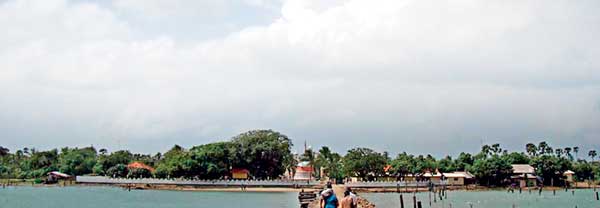
King Agga Bodhi II, who was a devoted Buddhist, had renovated Rajayathanaya Viharaya and the Relic repository to facilitate devotes to worship. Close to the Jaffna peninsula there is a small island called Nainathivu. This island is also known as Nagadeepa. There is also a recently built temple in this island. Some Buddhists believe that this is the place where the Buddha had set foot on.
However, substantial evidence is not available to take it for granted that this is the exact place where Buddha had set foot on. According to the available legendary evidence and archaeological findings it is in the Jaffna peninsula itself that the Buddhist events had taken place.

Prince Aritta, who served as king Devanampiyatissa’s envoy carrying his message to the emperor Dharmasoka in Dambadiva – ancient India- requesting him to send a sapling of the Sri Maha Bodhi had embarked at Dambakola (Jambukola).
Arahant Sanghamitta Maha Theri who brought the Sri Maha Bodhi sapling to Sri Lanka too had disembarked at the port of Dambakola.
Archaeologists suspect that this port was situated at Sambuthurai (Jambuthurai) about three miles away from Kankesanthurai (Keerimalai) Ruins of a Buddhist monastery were recovered from this place and the people of the area call this place Gothumalu, meaning Bodhimlu, in Sinhala.

According to legendary evidence, one of the eight sprigs of Sri Maha Bodhi (Atta Maha Phala) had been planted there.
About half a mile to the South of Sambuthurai there is a place called Thisamalai (Tissa Maluwa).
This is believed to be the site of Tissa Maha Viharaya built at the place, where king Devanampiyatissa awaited the arrival of Sri Maha Bodhi. Ruins of Buddhist temples have been recovered from Kandarodai village in the Jaffna peninsula.

This place is mentioned in the Sinhala Nampotha as Kadurugoda Viharaya.
This is believed to be the place where the Buddha preached Dhamma to Nagas. There is no legendary evidence to be sure about the exact place in the Jaffna Peninsula (Nagadeepa) at which Buddha had stepped in.

– See more at: http://www.dailymirror.lk/108443/Buddha-s-second-visit-to-Lanka#sthash.Zxc3rDi3.dpuf

Buddha on excessive taxes, and good governance

April 20th, 2016

K.K.S.Perera  Courtesy The Daily Mirror

Today is Bak full moon; It marks Buddha’s second visit to the island for settling a dispute between two Naga kings  -Chulodara and Mahodara. People of past generations believed in gazing the new moon, which appears 14 days before this day as a good omen.
‘Nava bag lasand dut – minisak – hunova ..janneyi’: — [A man who has seen the tender moon of Bak (April), should not be rejected]

Homage paid by the Sinhala Buddhists to moon [nava sanda belima] in the present times though uninspiring and weak, seven centuries ago, a sightseer to Sigiriya marked his visit on its Mirror Wall with the above graffiti.

Curbing Crime Buddha way

In checking crime, rulers in ancient times, like the Governments today, used suppressive methods including punishment. The Cakkavatti Sihanada-sutta of the Digha-nikaya clearly states that poverty is the cause of crimes and immorality such as theft, violence, falsehood, cruelty and hatred.
Another sutra in the same Nikaya, Kuṭadanta-sutta explains how ineffective this is.

Buddha suggests that, in order to eliminate crime, the economic state of the people should be enhanced: Grain and subsidies for agriculture should be provided to farmers; and capital provided for those engaged in business; adequate wages to those who are employed. If people are provided for with prospects for earning a sufficient income, they will be pleased; with no fear or anxiety the country will be free from crime.

The Buddha did not take life in isolation, out of the context of its social and economic environment; he took it as a whole, in all its social, economic and political aspects. His teachings on ethical, spiritual and philosophical problems are fairly well known.
But little is known, particularly in the West, on his teaching on social, economic and political matters. Yet, there are numerous discourses dealing with these strewn throughout the ancient Buddhist chronicles.

The Buddha told lay people how imperative it is to improve their economic condition. This does not mean that he permitted of amassing wealth with attachment and greed, which is in opposition to his fundamental training, nor did he approve of each and every way of making one’s occupation. There are certain operations like the production and sale of armaments, which he denounced as immoral means of livelihood, as we saw previously. Let us look at an example.

Buddhist Economics

A man named Dighajānu once visited the Buddha and said: Venerable Sir, we are ordinary lay men, leading the family life with wife and children. Would the Blessed One teach us some doctrines which would be conductive to our happiness in this world and hereafter?”
The Buddha advised him on four things which were conductive to a man’s contentment in this samsara:

One: He should be efficient, skilled, energetic and earnest in whatever profession he is occupied, and he should know it thoroughly;
Second: He should look after his possession, which he has thus earned virtuously, with the sweat of his brow;

Third: He should have kalyāa-mitta or good friends who are learned, virtuous, faithful, liberal and intelligent, who will direct him along the correct path away from immorality;
Fourth: He should use up reasonably his expenses, in proportion to his returns— meaning he should live within his resources.

Emperor Asoka of India (c 3rd BC) first followed the example of his ancestors and wished to continue the conquest of the Indian neck of land.
He invaded and conquered adjoining lands killing hundreds of thousands. When he was converted to Buddhism, he was completely transformed by the teachings.

In his famous Edict, rock inscription referring to the occupation of Kalinga, Asoka expressed his regret, and publicly declared against any conquest, but that he ‘wishes non-violence, self control, the practice of serenity. He expressed his wish that ‘my children and grandchildren will not think of a new conquest as worth accomplishing … let them think of that invasion only which is the conquest by goodness. That is excellent for this world and the world ahead of.’

The Buddha on Excessive Taxes and Good Governance

The Buddha was just as clear on politics, on war and peace. It is too well known to be repeated here that Buddhism promotes and advocates peace as its widespread message, it disapproves violence or destruction of life.
According to Buddhism there are no ‘just wars’ – a false term put into motion to justify and reason violence, hatred, cruelty, and slaughter. Who decides what is just or unjust? My war is always ‘just’, and yours is always ‘unjust’.

Buddhism rejects this position. The utterances of attaining peace through the balance of power, or through threats is foolish.
The show of power can only produce fear, and not peace. It is impossible to achieve genuine and lasting peace through fear. Fear can develop hatred: suppression works for the time being only, will erupt and become violent later on.

True and genuine peace can prevail only through metta, amity; free from suspicion, fear, and danger. There were rulers who governed their states unjustly even in the days of the Buddha. People were exploited and oppressed, agonised and mistreated, excessive taxes were imposed and cruel penalties were imposed.

The Buddha was deeply moved by these injustices. The Dhammapadaha Katha says that he directed his mind to the issue of good governance.
He had revealed how a whole nation could become dishonest, corrupt, and discontented when the leaders of its government, the cabinet and administrative staff become corrupt and unreasonable. For a nation to be contented it must have just rulers. How this can be achieved he explained in Dasa-raja-Dhamma; the ‘Ten Duties of the King.

Some believe that Buddhism is involved only in superior ideals, lofty moral and philosophical thinking, and that it pays no attention to the social and economic aspects of people. This is a wrong view. To Buddha, happiness was not achievable without leading a life based on moral and pious principles. But he understood that leading such a life was difficult in adverse material and social situations.

Buddhism a way of life

Buddhism renounces struggle for power; rejects conquest and defeat; it denounces persecution of the innocent; respects those who conquer themselves more than those who conquer thousands by military warfare; profess conquer of hatred by kindness, and evil by goodness; promotes compassion as the driving force of action, where all living things are treated with fairness, consideration and love; peace and harmony in a world of material satisfaction—for the realization of the Ultimate Truth, Nibbāṇa.

Kutadanta Sutta—Enhanced Subsidies for Agriculture

Coming back toKūṭadanta— who inquired from the Buddha, how to conduct a sacrifice with its sixteen requisites; the Buddha referred to one of his past lives and said,
‘Brahmin, once upon a time there was a king called Mahāvijita who were musing in private; I have acquired extensive wealth in human terms, I possess land which I have conquered. A great sacrifice would be to my benefit and happiness for a long time” And calling his minister-chaplain, he told him, I was to make a big sacrifice, tell me, how this may eternally benefit me?”

The chaplain replied: Your Majesty’s country is inundated by thieves, it is devastated, villages and towns are being shattered, and the countryside is infected with highway robbers and plunderers.
If Your Majesty were to tax this nation, that would be the incorrect thing to do. You may think; ‘I will get rid of this pestilence of thieves by executions and detention, or by elimination and intimidation’, the plague would not be appropriately ended.

Those who stay alive would later harm Your Majesty’s kingdom. However, you can completely eradicate the plague by sticking to the following plan. To those in the territory who are occupied in cultivating crops and animal husbandry, let Your Majesty dole out grain and fodder; to those in trade, give funds. Then the community, being intent on their career/ livelihood, will not harm the territory. Your Majesty’s income will improve, the land will be peaceful and not inundated by burglars, and the citizens, with joy in their spirits, will play with their children…’ the Chaplain counselor in the Jataka story was none other than the Buddha himself in a previous birth. [A lesson from Sutta Pitaka!]

The Buddha delivered a modified discourse to Kutadanta, on morality, on generosity, and on heaven, showing the risk, degradation of sense-desires, and the returns of renunciation. Knowing that Kutadanta’s mind was all set, flexible, free from the impediments, serene and calm, then he delivered a sermon in brief on the four noble truths. Like removing all stains from a clean cloth and receives the dye flawlessly, so in Kutadanta, there arose the uncontaminated and immaculate Dhamma-eye and he realised: anything that have an origin, must has to an end.”

‘May all beings be happy’

– See more at: http://www.dailymirror.lk/108442/Buddha-on-excessive-taxes-and-good-governance#sthash.hCAIqlac.dpuf

HOW EKNELIGODA NILAME TORTURED THE KING

April 20th, 2016

By Dr. Tilak S. Fernando Courtesy Ceylon Today

According to ‘Ceylon’ history ancient kings had divided the country into three principalities namely, Ruhunu, Maya and Pihiti. The three kingdoms were known as ‘Tri Sinhale.

The last phase of the Tri Sinhale commenced after King Rajadhi Rajasinha’s death following a bitter struggle in August 1798. The main conspirator in the mêlée was the Chief Minister Pilima Talauve, the most powerful official at the royal court. He hatched a plot to depose of the King following a secret meeting with the British Governor Fredrick North in 1800 while pleading with the English to invade the Kingdom and place him on the throne. That marked the beginning of the end of the Kandyan Kingdom.

Shrouded period

After the king’s death followed a period shrouded in a cloud of traitorous, devious and treacherous plotting and planning by one the Kandyan nobles who turned against the king. The British commenced working on Ceylon by taking over the Trincomalee fortress in 1795 first, then they moved to Jaffna and Kalpitiya and Colombo fortresses, which finally became the property of the British India Company.

‘Ceylon’ has been ruled by 192 kings altogether. After the demise of King Kithsiri, his brother Sri Wickrama Rajasinha succeeded and ruled the country for 16 years. As an erudite king, though of Indian origin, he has gone on record for writing Buddhist Jathaka stories.

The British did not have to fight a single battle due to any resistance with the majority of the Kandyan aristocratic forces being persuaded by Ahalepola to join the British forces. On 14 February 1815 the king was taken by surprise at the unexpected behaviour of his aristocratic ministers. He decided and moved out with the family and his consorts to ‘Meda Maha Nuwara’ and stayed in the house of a Village Headman.

Sir Paul’s Account

Sir Paul E. Pieris has judiciously documented his cerebral evidence of the machinations and treacheries that led up to the final betrayal of King Sri Wickrama Rajasinha in 1815 in his book ‘Tri Sinhala – Last Phase 1796-1815′, published by Apothecaries in 1939 and dedicated to Justin Peiris Deraniyagla (Sir Paul E. Pieris). His references have been out of despatches, reports and personal diaries as well as by culling mostly from the archives of the Public Record Office in London.

Sir Paul Peiris was born in 1874 and he hailed from an illustrious Sinhala family of early ancestry. He had proven his mettle even as a student at S. Thomas’ College by winning almost every major school prize. He was the first Asian to enter Trinity College of Cambridge University in 1892.

In 1914 he made legal history with his bold decision in the Gampola Perahera case, which gave rise to widespread rejoicing among the Sinhalese. Subsequent British attempts to overturn it sparked off Sri Lanka’s first major riots. In 1917 he became the first Asian to receive the honour of a Doctorate of Letters to receive either from Oxford or Cambridge Universities in the UK.

Historical Records

According to Sir Paul Pieris’s historical records, King Sri Wickrama Rajasinha was hiding at Dumbara in Meda Maha Nuwara. British forces had arranged to cut off all chances of escape from there while Ahalepola was asked to carry out his ‘promise of raising the people’ of that district. He started with Doyly and a military force when the King’s hiding place was discovered at a house of an Arachchi at Galleyhe Vatta. An intense interpretation of what took place has been presented by D.V.A Dias, the ‘Simhalese’ (Sinhalese) who was attached to the British settlement as an interpreter to the English officers.

Eknaligoda’s Emergence

Two hundred years ago, at the middle of the night, Eknaligoda Mohottale arrived at the house where the king was hiding with a group of men. He broke open the house and took the King and his queens into custody. An Appuhamy who was guarding the King from outside his chambers (Sethapena Ge) with a spear in hand challenged Eknaligoda having recognized him as one of the Nilames. Appuhamy aimed the spear at Eknaligoda with such force that the weapon shattered into fragments after hitting a stone when Eknaligoda managed to avoid the blow.

Appuhamy was immediately apprehended and bundled away while Eknaligoda walked up to the King’s chambers. The King was in the company of two of his queens at the time when Eknaligoda demanded him to open the door. The King declined, but handed over three silver mounted guns and two daggers through a small opening. However, the King did not obey Eknaligoda’s demands to hand over the golden sword and the emblems of his kingship.

This made Eknaligoda knocking down the king’s chamber door and his men to rush in and to create a revolting scene and grab all gold ornaments and to tear off the clothes of the royal captives. To cover their nudity a piece of cloth of four cubic in length was tossed at the victims as their only covering.

D.V.A Dias had been shouting from outside the house for the queens to come out; he had spoken in Tamil addressing the queens by the respectful term Ammayarum (Mother). Dias described how the queens came out reeling pitifully from side to side “like fowls whose neck had been twisted” and clung to him on either side in agony and terror, crying out “Oh! Protect us.” Blood was steaming from their earlobes due to lacerations in tearing off their earrings. Dias managed to stem the bleeding by crushing some medicinal leaves and applying them on the wounds.

Insult and Injury

In the meanwhile Eknaligoda was insulting the king in the crudest manner and ordered his men to fetch some wild creepers and to fasten the king and drag him out like a pig. Dias could not restrain the indignation and severely protested saying, “Your people, up to this hour worshipped the King as father and god, but mine had long been under foreign government and are not expected to show him the same reverence. All that is needed is his safe custody; why then insult, injure and bind him?” Simultaneously Dias offered his own shawl to the King as he considered it was necessary to secure kings limbs.

Infuriated Eknaligoda retorted rejecting Dias’s advice and ordered that the King be bound tightly. The king was then dragged and pushed along and thrown on to the ground. Dias at that point, extricating his hands with difficulty from the grasp of the queens, took a pencil and paper from his pocket and made his companion’s back as a table and scribbled a hasty note to inform Doyly of what was taking place and entreated him to come at once with palanquins and clothes.

Within an hour some officers and soldiers galloped to the spot to see the King lying on the ground with a large, intensely black and piercing eye in physical pain yet still displaying his exceptionally handsome features though there was no expression of any fear. The officers dismounted from their horses and knelt before the King and unfastened him while the troops drove away the Sabaragamuwa men to a distance with their whips.

Palanquins then appeared with such clothes as could be hastily collected. The king before getting into the palanquin turned to Dias and said, “Son, the English will doubtless put me to death, but not the queens. I ask you to take charge of them and protect them.”

Sins of the father will visit the son to the fourth generation.” – Biblical saying.

tilakfernando@gmail.com


Voice Against Corruption (VAC) President Maithripala Sirisena, Prime Minister Ranil Wicremasinghe of nepotism

April 20th, 2016

Courtesy The Daily Mirror

President Maithripala Sirisena’s brother, who is the Chairman of the Sri Lanka Telecom (SLT), had awarded the insurance deal of Mobitel to a company owned by someone close to him causing Rs. 3 billion loss to the Government, the Voice Against Corruption (VAC) charged today. VAC Convener and JVP Provincial Councillor Wasantha Samarasinghe claimed the SLT Chairman was receiving a monthly allowance of Rs. 750,000 as his house rent.

He said that he had also increased allowances receiving from the companies to Rs. 1 million from previous Rs. 500,000. This is the highest in the history of allowances received by an SLT Chairman. Also, the advertising of the company had been awarded to an advertising firm owned by President Sirisena’s son-in-law. Both the President and the Prime Minister are promoting nepotism instead of putting an end to it as pledged during the election,” he charged.

Prime Minister Ranil Wickremesinghe appointed his friend Arjuna Mahendran as the Central Bank Governor and today he is in the centre of a heap of allegations,” he said. He said nepotism was one among many allegations levelled against former president Mahinda Rajapaksa and had even cost him his Presidency.

Today, President Sirisena and Prime Minister are following the same footsteps,” he said. Meanwhile, Mr. Samarasinghe said large scale corruption was taking place at the LTL Holdings (Pvt) Ltd, a company owned by the Ceylon Electricity Board (CEB), similar to the Avant Garde Maritime Security Service. The LTL Holdings also administered by retired CEB officials -similar to Avant Garde operations handled by retired naval officers. This is the company, which had funded previous Power and Energy Ministers during their elections.

All Power and Energy Ministers are responsible for the corrupt deals, which had taken place at the LTL,” he said. He said the CEB owned up to 63 percent of shares of the LTL and when the company was to be brought before the Committee On Public Enterprises (COPE) to probe corrupt deals, the officials tried to reduce the shares to 49 percent.

When the percentage of shares owned by the State in a company is less than 49%, that company can get away with facing the COPE. This is what the LTL officials are trying to do. However, this had not yet been successful due to the objections of the engineers,” he said. (Lahiru Pothmulla)

– See more at: http://www.dailymirror.lk/108346/VAC-charges-MS-RW-of-nepotism#sthash.H8Z1zy2e.dpuf

හන්දියක්  ගානේ  දෙසන  තෙල් බෙහෙත් වෙළෙන්දෙකුගේ ගනනටබුදු හිමියන්  නො  දමනු

April 20th, 2016

ධර්මසිරි සෙනෙවිරත්න

මේ   ධනපාල මහතාගේ ලිපිය ගැ ණය ——–                       බුදු හිමි යෝ බරණැස  මුල් දෙසුමට තෝරා ගත්තේ  එය මංසන්දියක් නිසා නොවේ මුල්ම දෙ  සුම සඳහා හොන්දයය් සිතු ආලාරකාලාම ආදීන් මියගොස් ඇතිබව තේරුණා පසුව ඊළඟට යමක් තේරුම් ගතහැකි පස්වග මහනුන් ට   තම ධර්මය කියා දීම සුදුසුයය් සිතුනිසා  එතුමා ඒ ය සිටි තැනට ගියේය .තේරුම් ගතහැකිඅ  ය සෙව්වේ ගැඹුරු දහමක් නිසාය . හන්දියක් ගානේ කටවල් අරගෙන   බලාගෙන ඉන්නා අ යට දේශානා කරන්නේ තෙල් බෙහෙත් වෙලෙන්දන්ය .
බුදු දහමේ සත්‍යය සොයන විචාරශීලී ක්‍රමය මුළු ලොවේම පතුරුනබව  ඔහු කියය් . එහෙනම් බුදුදහමේ සත්‍ය තාව ඔවුන් තේරුම් නොගත්තේ මන්ද  බෞධයන් නොවුයේ මන්ද  මැවුම් කරුවා ඇත නොහැරියේ ඇ ය් . ගත්තේ තමන්ට අවශ්‍ය ටික විතරද .  බුදු හිමිගේ දේශනා ග්රීකයන්ට පහසුවෙන් අවශෝෂණය වීමට  ග්රීසියේත් එඛරෙඛීය  චින්තනයක් හා  චතුස්කොටිකයක් එවන විට එහි තිබුනාදබමුණු වතෙත් ග්‍රීක වතෙත් වෙනස කුමක්ද
ඊයම් පර්යේෂණ අනුව ”’අනෙක් කරුණු ”” වල සත්‍ය අසත්‍ය තාවත් තීරණය කලයුතුයය්  බුදු හිමි කියූ තැන මොනවාද ‘ අනෙක් කරුණු ”” විග්‍රහ කරන්න . එයට  නිවන් මගත් ඇතුලත්ද  බුදු හිමි හා රහතුන් වහන්සේලා කියූ දේ අපවිසින් පිලි නොගත යුතුද
සත්‍ය අසත්‍ය තාව තීරණය කරන්නේ  ”’දිවසින් බලා ”” නොවේ  යය ඔ බ කියය් . මම   දිවස් කතාවක් කියා නැත .. කෙ සේවුවත්  බුදු හිමි  අතීත  හා අනාගත භවයන්  ගැන කිව්වේ  පුනර් භාවයක් ගැන කිව්වේ අනාත්මයක් ගැන කිව්වේ   විදර්ශනා භාවනාවෙන්  දියුණුවූ  මනසින් පසක් කරගෙනය .  අපි ” කතාවට ”’දිවැ ස් ”’ කියන්නේ එයටය් . ආහාරහා පැපොල්  බෙහෙත් ලෞකික නොවෙයය් අපිකවුරුවත් කියා නැත .  නලින්ගේ ගෙදරත් ලෞකික බව දන්නවා කියා නම්  කියා ඇත  වෙදහාමිනේගේ  බෙහෙත් වලින් සුවවූ පාඨකයන්ගේ  අදහස් කියවුවේ නැද්ද ඔවුන් සුවවුවානම්  ඒගැන කීම ”’අමුලික ප්‍රචාරයක් ”’ වන්නේ කෙසේද අහිතකර වන්නේ කෙසේද  ඔවුන් සුව වීම ඔබේ වරිගයාට අහිත කරද
”’ අරිය පරියේෂණ  ” ගැන කීම   ”කතාව දෝලාවෙන් ගමන පයින් ””’ යන්නට ඇති සම්බන්ධය කුමක්ද   මල්ලේ පොල් කතාවත් එක්ක පටලිලාද  ආකිමිඩීස්  හෙළුවෙන් නොදිව්වායය් කියමු .එහෙත් අරිය පරියේෂණය     අනුව නම් අසිහියෙන් ඔය තරම්ම් කලබලවී  දුවන්නට තරම් දෙයක් නැත  අරිය පරියෙෂණයෙන්  සිදුවන්නේ සිහි විකල්වීම නොව ”’සිහිඑලවා ගැනීම  හෙවත් ”’එළඹී සිහියට ”’ පත්වීමය් . ග්‍රීකයෝ බුදුහිමිගෙන් ඉගෙන ගත්තානම් ”’තන්හා වර්ධනයෝ ”” වන්නේ නැත . උගෙන ඇත්තේ පොඩිඑකා ලොකු එකාගේ ආහාරය  බව කියූ මැවුම් කරුවාගේ ගොලයන්ගෙනි  . බටහිර නවීන විද්‍යාව කරන්නෙම  කාම භෝගී ජීවිතය තවතවත්  වර්ධනය කිරීමය් . බුදු දහමේ  අරමුණත් බටහිර දර්ශනවල අරමුණත්  බොහෝ පරස් පරය . දැනුම එකරාශීකර ඉන් මත්වීමද බුදු දහම නොවේ .

අවකාශ කාලයේ වක්රතාවක් ” අතය් නලින් කිසිවිටෙකත් කියා නැත මඩ  ගහන පට්ටපල් බොරු නොකියන්න. යමක් හරියට තේරුම් ගන්න
මම නම් කෝවිල් වලටවත්  හින්දු දෙවියන් වදින්නවත් නොයමි .ඒ තබා බෝධියට කිරිකල වක් කරමින් පුජා තියන්නෙත් නැත .අංගවිකල  හා බලිබිලි පුජා වලින් යැපෙන දෙවියන් ඇත්තේ හින්දුන්ටය . එහෙත් ර ටදියුණු කල  මහාසෙන් වැ න්නෝ මගෙත් දෙවියෝය බුදු හිමියන් විසින් බන කියූ බුදුහිමියන්ගෙන් බන ඇසීමට ආ දෙවියෝ මගේත්  දෙවියෝය . ඒ දෙවියෝ මට වඩා යමක් දන්නවායයදා මම සිතමි. එහෙම හිතන්නෙත් බුදු හිමියන් ඒඅ  ය ගැන කියා ඇති කරුණු අනුවය  ..
ඉතා  කෙටියෙන් කරුණු කිව්වේ ලිපිය දික් වෙන නිසය්  නලින්ගේ අභියෝගය ගැන මොකෝ කතා නැත්තේ  සුළු කරුණක් පස්සේ පැහැදිලිකලා කියල  ඒමත පැන  නොගිහින්  අපි වෙනුවෙන් අනුකම්පාකර ඉදිරිපත් වෙන්න අවශ්‍ය සත්‍යය ජනතාවට පැහැදිලිකිරීමනේ

Talk on changing face of Myanmar politics

April 20th, 2016

By NJ Thakuria

Guwahati: A talk on the changing political scenario of Myanmar is organized at at Guwahati Press Club on Thursday (21 April 2016).

Senior journalist from Assam, Bidhayak Das will participate in the program starting at 3 pm as a resource person.

Presently based in Yangon, the former capital of Myanmar, Das is expected to highlight the overall change taking place in Myanmar (formerly known as Burma) after the general elections held last year that politically empowered National League for Democracy chief Daw Aung San Suu Kyi as her party won a landslide victory.

India’s neighboring country was ruled by military generals for decades and Ms Suu Kyi was also put under house arrest. But slowly the southeast Asian nation is opening up and adopted democracy. Lately a civilian President, a trusted comrade of Nobel laureate Suu Kyi has also been placed at NayPieTaw.

The Assamese journalist will also explore the possibility of benefits for the people of northeast India with more contacts with the Myanmarese populace, particularly the northern part of the poverty stricken country. Better connectivity between the two regions is also an important matter to be discussed at the meet.

America Has Been At War 93% of the Time – 222 Out of 239 Years – Since 1776

April 20th, 2016

In 2011, Danios wrote: Courtesy WashingtonsBlog

 Below, I have reproduced a year-by-year timeline of America’s wars, which reveals something quite interesting: since the United States was founded in 1776, she has been at war during 214 out of her 235 calendar years of existence.  In other words, there were only 21 calendar years in which the U.S. did not wage any wars.

To put this in perspective:

* Pick any year since 1776 and there is about a 91% chance that America was involved in some war during that calendar year.

* No U.S. president truly qualifies as a peacetime president.  Instead, all U.S. presidents can technically be considered war presidents.”

* The U.S. has never gone a decade without war.

* The only time the U.S. went five years without war (1935-40) was during the isolationist period of the Great Depression.

*  *  *

Here is a graphic depiction of U.S. wars:

And here is the year-by-year timeline of America’s major wars:

****

Year-by-year Timeline of America’s Major Wars (1776-2011)

1776 – American Revolutionary War, Chickamagua Wars, Second Cherokee War, Pennamite-Yankee War

1777 – American Revolutionary War, Chickamauga Wars, Second Cherokee War, Pennamite-Yankee War

1778 – American Revolutionary War, Chickamauga Wars, Pennamite-Yankee War

1779 – American Revolutionary War, Chickamauga Wars, Pennamite-Yankee War

1780 – American Revolutionary War, Chickamauga Wars, Pennamite-Yankee War

1781 – American Revolutionary War, Chickamauga Wars, Pennamite-Yankee War

1782 – American Revolutionary War, Chickamauga Wars, Pennamite-Yankee War

1783 – American Revolutionary War, Chickamauga Wars, Pennamite-Yankee War

1784 – Chickamauga Wars, Pennamite-Yankee War, Oconee War

1785 – Chickamauga Wars, Northwest Indian War

1786 – Chickamauga Wars, Northwest Indian War

1787 – Chickamauga Wars, Northwest Indian War

1788 – Chickamauga Wars, Northwest Indian War

1789 – Chickamauga Wars, Northwest Indian War

1790 – Chickamauga Wars, Northwest Indian War

1791 – Chickamauga Wars, Northwest Indian War

1792 – Chickamauga Wars, Northwest Indian War

1793 – Chickamauga Wars, Northwest Indian War

1794 – Chickamauga Wars, Northwest Indian War

1795 – Northwest Indian War

1796 – No major war

1797 – No major war

1798 – Quasi-War

1799 – Quasi-War

1800 – Quasi-War

1801 – First Barbary War

1802 – First Barbary War

1803 – First Barbary War

1804 – First Barbary War

1805 – First Barbary War

1806 – Sabine Expedition

1807 – No major war

1808 – No major war

1809 – No major war

1810 – U.S. occupies Spanish-held West Florida

1811 – Tecumseh’s War

1812 – War of 1812, Tecumseh’s War, Seminole Wars, U.S. occupies Spanish-held Amelia Island and other parts of East Florida

1813 – War of 1812, Tecumseh’s War, Peoria War, Creek War, U.S. expands its territory in West Florida

1814 – War of 1812, Creek War, U.S. expands its territory in Florida, Anti-piracy war

1815 – War of 1812, Second Barbary War, Anti-piracy war

1816 – First Seminole War, Anti-piracy war

1817 – First Seminole War, Anti-piracy war

1818 – First Seminole War, Anti-piracy war

1819 – Yellowstone Expedition, Anti-piracy war

1820 – Yellowstone Expedition, Anti-piracy war

1821 – Anti-piracy war (see note above)

1822 – Anti-piracy war (see note above)

1823 – Anti-piracy war, Arikara War

1824 – Anti-piracy war

1825 – Yellowstone Expedition, Anti-piracy war

1826 – No major war

1827 – Winnebago War

1828 – No major war

1829 – No major war

1830 – No major war 

1831 – Sac and Fox Indian War

1832 – Black Hawk War

1833 – Cherokee Indian War

1834 – Cherokee Indian War, Pawnee Indian Territory Campaign

1835 – Cherokee Indian War, Seminole Wars, Second Creek War

1836 – Cherokee Indian War, Seminole Wars, Second Creek War, Missouri-Iowa Border War

1837 – Cherokee Indian War, Seminole Wars, Second Creek War, Osage Indian War, Buckshot War

1838 – Cherokee Indian War, Seminole Wars, Buckshot War, Heatherly Indian War

1839 – Cherokee Indian War, Seminole Wars

1840 – Seminole Wars, U.S. naval forces invade Fiji Islands

1841 – Seminole Wars, U.S. naval forces invade McKean Island, Gilbert Islands, and Samoa

1842 – Seminole Wars

1843 – U.S. forces clash with Chinese, U.S. troops invade African coast

1844 – Texas-Indian Wars

1845 – Texas-Indian Wars

1846 – Mexican-American War, Texas-Indian Wars

1847 – Mexican-American War, Texas-Indian Wars

1848 – Mexican-American War, Texas-Indian Wars, Cayuse War

1849 – Texas-Indian Wars, Cayuse War, Southwest Indian Wars, Navajo Wars, Skirmish between 1st Cavalry and Indians

1850 – Texas-Indian Wars, Cayuse War, Southwest Indian Wars, Navajo Wars, Yuma War, California Indian Wars, Pitt River Expedition

1851 – Texas-Indian Wars, Cayuse War, Southwest Indian Wars, Navajo Wars, Apache Wars, Yuma War, Utah Indian Wars, California Indian Wars

1852 – Texas-Indian Wars, Cayuse War, Southwest Indian Wars, Navajo Wars, Yuma War, Utah Indian Wars, California Indian Wars

1853 – Texas-Indian Wars, Cayuse War, Southwest Indian Wars, Navajo Wars, Yuma War, Utah Indian Wars, Walker War, California Indian Wars

1854 – Texas-Indian Wars, Cayuse War, Southwest Indian Wars, Navajo Wars, Apache Wars, California Indian Wars, Skirmish between 1st Cavalry and Indians

1855 – Seminole Wars, Texas-Indian Wars, Cayuse War, Southwest Indian Wars, Navajo Wars, Apache Wars, California Indian Wars, Yakima War, Winnas Expedition, Klickitat War, Puget Sound War, Rogue River Wars, U.S. forces invade Fiji Islands and Uruguay

1856 – Seminole Wars, Texas-Indian Wars, Southwest Indian Wars, Navajo Wars, California Indian Wars, Puget Sound War, Rogue River Wars, Tintic War

1857 – Seminole Wars, Texas-Indian Wars, Southwest Indian Wars, Navajo Wars, California Indian Wars, Utah War, Conflict in Nicaragua

1858 – Seminole Wars, Texas-Indian Wars, Southwest Indian Wars, Navajo Wars, Mohave War, California Indian Wars, Spokane-Coeur d’Alene-Paloos War, Utah War, U.S. forces invade Fiji Islands and Uruguay

1859 Texas-Indian Wars, Southwest Indian Wars, Navajo Wars, California Indian Wars, Pecos Expedition, Antelope Hills Expedition, Bear River Expedition, John Brown’s raid, U.S. forces launch attack against Paraguay, U.S. forces invade Mexico

1860 – Texas-Indian Wars, Southwest Indian Wars, Navajo Wars, Apache Wars, California Indian Wars, Paiute War, Kiowa-Comanche War

1861 – American Civil War, Texas-Indian Wars, Southwest Indian Wars, Navajo Wars, Apache Wars, California Indian Wars, Cheyenne Campaign

1862 – American Civil War, Texas-Indian Wars, Southwest Indian Wars, Navajo Wars, Apache Wars, California Indian Wars, Cheyenne Campaign, Dakota War of 1862,

1863 – American Civil War, Texas-Indian Wars, Southwest Indian Wars, Navajo Wars, Apache Wars, California Indian Wars, Cheyenne Campaign, Colorado War, Goshute War

1864 – American Civil War, Texas-Indian Wars, Navajo Wars, Apache Wars, California Indian Wars, Cheyenne Campaign, Colorado War, Snake War

1865 – American Civil War, Texas-Indian Wars, Navajo Wars, Apache Wars, California Indian Wars, Colorado War, Snake War, Utah’s Black Hawk War

1866 – Texas-Indian Wars, Navajo Wars, Apache Wars, California Indian Wars, Skirmish between 1st Cavalry and Indians, Snake War, Utah’s Black Hawk War, Red Cloud’s War, Franklin County War, U.S. invades Mexico, Conflict with China

1867 – Texas-Indian Wars, Long Walk of the Navajo, Apache Wars, Skirmish between 1st Cavalry and Indians, Snake War, Utah’s Black Hawk War, Red Cloud’s War, Comanche Wars, Franklin County War, U.S. troops occupy Nicaragua and attack Taiwan

1868 – Texas-Indian Wars, Long Walk of the Navajo, Apache Wars, Skirmish between 1st Cavalry and Indians, Snake War, Utah’s Black Hawk War, Red Cloud’s War, Comanche Wars, Battle of Washita River, Franklin County War

1869 – Texas-Indian Wars, Apache Wars, Skirmish between 1st Cavalry and Indians, Utah’s Black Hawk War, Comanche Wars, Franklin County War

1870 – Texas-Indian Wars, Apache Wars, Skirmish between 1st Cavalry and Indians, Utah’s Black Hawk War, Comanche Wars, Franklin County War

1871 – Texas-Indian Wars, Apache Wars, Skirmish between 1st Cavalry and Indians, Utah’s Black Hawk War, Comanche Wars, Franklin County War, Kingsley Cave Massacre, U.S. forces invade Korea

1872 – Texas-Indian Wars, Apache Wars, Utah’s Black Hawk War, Comanche Wars, Modoc War, Franklin County War

1873 – Texas-Indian Wars, Comanche Wars, Modoc War, Apache Wars, Cypress Hills Massacre, U.S. forces invade Mexico

1874 – Texas-Indian Wars, Comanche Wars, Red River War, Mason County War, U.S. forces invade Mexico

1875 – Conflict in Mexico, Texas-Indian Wars, Comanche Wars, Eastern Nevada, Mason County War, Colfax County War, U.S. forces invade Mexico

1876 – Texas-Indian Wars, Black Hills War, Mason County War, U.S. forces invade Mexico

1877 – Texas-Indian Wars, Skirmish between 1st Cavalry and Indians, Black Hills War, Nez Perce War, Mason County War, Lincoln County War, San Elizario Salt War, U.S. forces invade Mexico

1878 – Paiute Indian conflict, Bannock War, Cheyenne War, Lincoln County War, U.S. forces invade Mexico

1879 – Cheyenne War, Sheepeater Indian War, White River War, U.S. forces invade Mexico

1880 – U.S. forces invade Mexico

1881 – U.S. forces invade Mexico

1882 – U.S. forces invade Mexico

1883 – U.S. forces invade Mexico

1884 – U.S. forces invade Mexico

1885 – Apache Wars, Eastern Nevada Expedition, U.S. forces invade Mexico

1886 – Apache Wars, Pleasant Valley War, U.S. forces invade Mexico

1887 – U.S. forces invade Mexico

1888 – U.S. show of force against Haiti, U.S. forces invade Mexico

1889 – U.S. forces invade Mexico

1890 – Sioux Indian War, Skirmish between 1st Cavalry and Indians, Ghost Dance War, Wounded Knee, U.S. forces invade Mexico

1891 – Sioux Indian War, Ghost Dance War, U.S. forces invade Mexico

1892 – Johnson County War, U.S. forces invade Mexico

1893 – U.S. forces invade Mexico and Hawaii

1894 – U.S. forces invade Mexico

1895 – U.S. forces invade Mexico, Bannock Indian Disturbances

1896 – U.S. forces invade Mexico

1897 – No major war

1898 – Spanish-American War, Battle of Leech Lake, Chippewa Indian Disturbances

1899 – Philippine-American War, Banana Wars

1900 – Philippine-American War, Banana Wars

1901 – Philippine-American War, Banana Wars

1902 – Philippine-American War, Banana Wars

1903 – Philippine-American War, Banana Wars

1904 – Philippine-American War, Banana Wars

1905 – Philippine-American War, Banana Wars

1906 – Philippine-American War, Banana Wars

1907 – Philippine-American War, Banana Wars

1908 – Philippine-American War, Banana Wars

1909 – Philippine-American War, Banana Wars

1910 – Philippine-American War, Banana Wars

1911 – Philippine-American War, Banana Wars

1912 – Philippine-American War, Banana Wars

1913 – Philippine-American War, Banana Wars, New Mexico Navajo War

1914 – Banana Wars, U.S. invades Mexico

1915 – Banana Wars, U.S. invades Mexico, Colorado Paiute War

1916 – Banana Wars, U.S. invades Mexico

1917 – Banana Wars, World War I, U.S. invades Mexico

1918 – Banana Wars, World War I, U.S invades Mexico

1919 – Banana Wars, U.S. invades Mexico

1920 – Banana Wars

1921 – Banana Wars

1922 – Banana Wars

1923 – Banana Wars, Posey War

1924 – Banana Wars

1925 – Banana Wars

1926 – Banana Wars

1927 – Banana Wars

1928 – Banana Wars

1930 – Banana Wars

1931 – Banana Wars

1932 – Banana Wars

1933 – Banana Wars

1934 – Banana Wars

1935 – No major war

1936 – No major war

1937 – No major war

1938 – No major war

1939 – No major war

1940 – No major war

1941 – World War II

1942 – World War II

1943 – Wold War II

1944 – World War II

1945 – World War II

1946 – Cold War (U.S. occupies the Philippines and South Korea)

1947 – Cold War (U.S. occupies South Korea, U.S. forces land in Greece to fight Communists)

1948 – Cold War (U.S. forces aid Chinese Nationalist Party against Communists)

1949 – Cold War (U.S. forces aid Chinese Nationalist Party against Communists)

1950 – Korean War, Jayuga Uprising

1951 – Korean War

1952 – Korean War

1953 – Korean War

1954 – Covert War in Guatemala

1955 – Vietnam War

1956 – Vietnam War

1957 – Vietnam War

1958 – Vietnam War

1959 – Vietnam War, Conflict in Haiti

1960 – Vietam War

1961 – Vietnam War

1962 – Vietnam War, Cold War (Cuban Missile Crisis; U.S. marines fight Communists in Thailand)

1963 – Vietnam War

1964 – Vietnam War

1965 – Vietnam War, U.S. occupation of Dominican Republic

1966 – Vietnam War, U.S. occupation of Dominican Republic

1967 – Vietnam War

1968 – Vietnam War

1969 – Vietnam War

1970 – Vietnam War

1971 – Vietnam War

1972 – Vietnam War

1973 – Vietnam War, U.S. aids Israel in Yom Kippur War

1974 – Vietnam War

1975 – Vietnam War

1976 – No major war

1977 – No major war

1978 – No major war

1979 – Cold War (CIA proxy war in Afghanistan)

1980 – Cold War (CIA proxy war in Afghanistan)

1981 – Cold War (CIA proxy war in Afghanistan and Nicaragua), First Gulf of Sidra Incident

1982 – Cold War (CIA proxy war in Afghanistan and Nicaragua), Conflict in Lebanon

1983 – Cold War (Invasion of Grenada, CIA proxy war in Afghanistan and Nicaragua), Conflict in Lebanon

1984 – Cold War (CIA proxy war in Afghanistan and Nicaragua), Conflict in Persian Gulf

1985 – Cold War (CIA proxy war in Afghanistan and Nicaragua)

1986 – Cold War (CIA proxy war in Afghanistan and Nicaragua)

1987 – Conflict in Persian Gulf

1988 – Conflict in Persian Gulf, U.S. occupation of Panama

1989 – Second Gulf of Sidra Incident, U.S. occupation of Panama, Conflict in Philippines

1990 – First Gulf War, U.S. occupation of Panama

1991 – First Gulf War

1992 – Conflict in Iraq

1993 – Conflict in Iraq

1994 – Conflict in Iraq, U.S. invades Haiti

1995 – Conflict in Iraq, U.S. invades Haiti, NATO bombing of Bosnia and Herzegovina

1996 – Conflict in Iraq

1997 – No major war

1998 – Bombing of Iraq, Missile strikes against Afghanistan and Sudan

1999 – Kosovo War

2000 – No major war

2001 – War on Terror in Afghanistan

2002 – War on Terror in Afghanistan and Yemen

2003 – War on Terror in Afghanistan, and Iraq

2004 – War on Terror in Afghanistan, Iraq, Pakistan, and Yemen

2005 – War on Terror in Afghanistan, Iraq, Pakistan, and Yemen

2006 – War on Terror in Afghanistan, Iraq, Pakistan, and Yemen

2007 – War on Terror in Afghanistan, Iraq, Pakistan, Somalia, and Yemen

2008 – War on Terror in Afghanistan, Iraq, Pakistan, and Yemen

2009 – War on Terror in Afghanistan, Iraq, Pakistan, and Yemen

2010 – War on Terror in Afghanistan, Iraq, Pakistan, and Yemen

2011 – War on Terror in Afghanistan, Iraq, Pakistan, Somalia, and Yemen; Conflict in Libya (Libyan Civil War)

In most of these wars, the U.S. was on the offense. Danios admits that some of the wars were defensive.   However, Danios also leaves out covert CIA operations and other acts which could be considered war.

Let’s update what’s happened since 2011:

2012 – War on Terror in Afghanistan, Iraq, Somalia, Syria and Yemen

2013 – War on Terror in Afghanistan, Iraq, Somalia, Syria and Yemen

2014 – War on Terror in Afghanistan, Iraq, Somalia, Syria and Yemen; Civil War in Ukraine

2015 – War on Terror in Somalia, Somalia, Syria and Yemen; Civil War in Ukraine

So we can add 4 more years of war. That means that for 222 out of 239 years – or 93% of the time – America has been at war. (We can quibble with the exact numbers, but the high percentage of time that America has been at war is clear and unmistakable.)

Indeed, most of the military operations launched since World War II have been launched by the U.S.

And American military spending dwarfs the rest of the world put together.

No wonder polls show that the world believes America is the number 1 threat to peace.

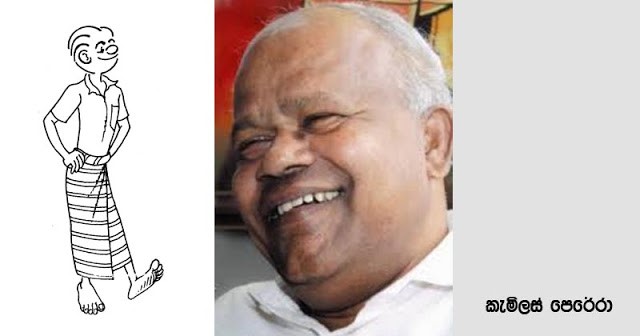
ගජමෑන් නිර්මාතෘ කැමිලස් පෙරේරා

April 20th, 2016

වෛද් රුවන් එම් ජයතුංග 

හාස්‍ය රසය විශාදයෙන් පෙලෙන රෝගීන් සඳහා ප්‍රතිකාරාත්මක ක්‍රමයක් ලෙස යොදා ගැනීම සුදුසු බව වරක් සායනික මනෝ විද්‍යාඥ පද්මාල් ද සිල්වා මා සමග කීවේය​. මේ නිසා මම හාස්‍ය රසය   ප්‍රතිකාරාත්මක ක්‍රමයක් ලෙස යොදා ගැනීම සඳහා වැඩිදුර අධ්‍යනය කිරීමට කැමිලස් පෙරේරා මහතා ඇමතුවෙමි. කැමිලස් පෙරේරා මහතා අවශ්‍ය සහයෝගය දුන් අතර වෛද්‍යවරුන් ඇමතීම සඳහා අපගේ වැඩ සටහනකටද ආවේය​.

අප කැමිලස් හඳුනා ගත්තේ ගජමෑන් හරහාය​. එහෙත් කැමිලස් ගේ විහිළු 1970 දශකය මුල් භාගයේ සිට තිබූ බව මට මතකය​. මතක් කර ගත හැකි පැරණිම විහිළුව වන්නේ  මැගිලින් අක්කා පිලිබඳවයි.  මැගිලින් අක්කා පොඩි දේවල් විශාල කර පෙන්වන  කණ්නාඩියකින් බිම බලයි. යමෙකු මැගිලින් අක්කා ගෙන් මොනාද බලන්නේ කියා අසයි. කූපන් එකට ගත්ත සීනි ඇට දෙක තුනක් බිම වැටුණා කියා ඇය කියන්නීය​. මෙය   සමගි පෙරමුණු රජය යටතේ කූපන් වලට බඩු ගත් යුගයේ විහිළුවකි.

camilusperera

සිත්තර පත්තරය ආරම්භ වීමෙන් පසුව ගජමෑන් චරිතය සමාජගත විය​. ගජමෑන් බොහෝ විට දුප්පතෙකු වූවත් එක චිත්‍ර කතාවක ගජමෑන් පොහොසතෙකි. ඔහු තම මෝටර් රථය නවතා සාදයකට යයි. සාදයේදී මධුවිත ගන්නා ඔහු වෙරිමරගාතේ මෝටර් රථයට නැග සුක්කානම හොරු අරගෙන ගිහින් කියා බෙරිහන් දෙයි. එහෙත් බලන විට ගජමෑන් නැග තිබෙන්නේ මෝටර් රථයේ පසුපස ආසනයටය​.

තවත් කථාවක ගජමෑන් මිය ගොසිනි. වත්තේ පොල් මිලදී ගැනීමට එන මුදලාලි පොල් ගස් කණාටු වෙලා කියයි. නමුත් එක් ස්ථානයක පොල් ගසක ගෙඩි සරුවට තිබේ. එම ස්ථානය ගජමෑන් වලදැමූ ස්ථානයයි. මොකද ගජමෑන් වලදැමූ ස්ථානයේ පොල්  ගෙඩි සරු කියා මුදලාලි අසන විට ගජමෑන් ගේ කොල්ලා කියන්නේ තත්තා ජීවත්ව හිටපු කාලයේ  බිව්වේ යූරියා වලින් පෙරාපු කසිප්පු නිසා කියයි.

ගජමෑන් නිර්මාතෘ කැමිලස් පෙරේරා මාදම්පේ නියාජ්‍ය පළාත් සෞඛ්‍යය සේවා අධ්‍යක්‍ෂක කාර්‍යාලයට පැමිණි විට වෛද්‍යවරු ඔහුව වට කරගෙන බොහෝ ප්‍රශ්න ඇසුවෝය​. මම ඉපැරණි ගජමෑන් කතා කැමිලස් පෙරේරා මහතාගෙන් ඇසුවෙමි. සමහර හාස්‍යජනක කතා ඔහුට අමතකවද තිබුනේය​. අවසානයේදී වෛද්‍ය ජගත් පද්මසිරිගේ ඉල්ලීම පරිදි  කැමිලස් පෙරේරා මහතා ලොකු කොලයක ගජමෑන්ව ඇඳ පෙන්වීය​.

කැමිලස් පෙරේරා මහතා චාරුමත් මිනිසෙකි. බොහෝ ක්ශිතිමය අත්දැකීම් වලට බඳුන් වූ  ශ්‍රී ලාංකික සමාජය සිනහගැන්වීම ලේසි පාසු කාර්‍යක් නොවේ. එවැනි සමාජයකට කඳුල වෙනුවට සිනහාව ගෙන ආ පරම්පරාවක් සිනහවෙන් කුල්මත් කල  කැමිලස් පෙරේරා මහතා ගජමෑන් මෙන් සදාකල් සිහිවටනයකි.

Nullifying Homeland claim: Indian Malabar Tamils have no claim to homeland in Sri Lanka while Ceylon Tamil name was used only after 1911

April 18th, 2016

Shenali D Waduge

We have arrived at a crucial juncture. It is time to place proper arguments on the table and nullify the lies and distortions. There are some key questions that now need to be asked and answered and the GOSL must be literate enough to handle matters without simply giving in because pressures are affecting their political survival. All Tamils before 1911 were known as Malabar coming from India. These Malabars do not have rights to claim eelam/self-determination/separate homeland in Sri Lanka. The name Ceylon Tamils was coined and used only after 1911 and if so with a history of just 100 years Ceylon Tamils cannot seek eelam/self-determination/separate homeland in Sri Lanka either.

  • Can the Tamils prove they are indigenous to Sri Lanka (are they distinct from the Tamil Nadu Tamils who are Indian nationals) to claim a separate homeland as they are now doing?
  • Can Tamils who find roots to Tamil Nadu and the Tamil gene have right to seek self-determination in Sri Lanka when they have been referred to as Malabar Tamils? Malabar Tamils are today known as Sri Lankan Tamils.
  • Question repeated – Are Sri Lankan Tamils descendants from Indian Tamils?
  • Is it also not correct that Tamils from Tamil Nadu arrived as migrants during numerous South Indian invasions and stayed on in Sri Lanka? Can immigrants claim self-determination simply because they have been living in an area?
  • Why did colonial rulers – Portuguese, Dutch and the British refer to Tamils in Sri Lanka as Malabar Tamils coming from Indian Malabar coast? Why was this name never challenged if the colonials were wrong to refer to Tamils as Malabar Tamils?
  • It was only in 1911 that the British introduced the term ‘Ceylon Tamils’ under the influence of Ponnambalam Arunachalam then Registrar General who compiled the National Census report in 1911. Before 1911 there were no people called Ceylon Tamils.
  • The census of 1881, 1891 and 1901 census is evidence that Tamils were known as Malabars and not Ceylon Tamils. The census of 1824 too mentions Malabars and not Tamils.
  • LTTE – TNA or any other Tamil politician can only refer to themselves as Ceylon Tamils only after the period 1911 because prior to that they were called Malabar Tamils.
  • How can Tamils who can refer to themselves as Ceylon Tamils only after 1911 call for self-determination and demand homelands? Prior to 1911 all Tamils were referred to as Indian Tamils/Malabar Tamils –these entities cannot seek self-determination/homeland in Sri Lanka because their homeland is in Tamil Nadu,
  • There is also need to straighten the distortion that there were no separate kingdoms except kinglets that were under one king (emperor) At no point in time has parts of Sri Lanka functioned independently or separately other than when Portuguese and Dutch were ruling parts of Sri Lanka while the rest came under the Sinhala emperor.
  • There are arguments about disenfranchising Tamils – has it occurred to those peddling this argument that these Tamils were brought in as coolies to work on plantations for the profit of the colonial rulers. Why should countries that did not ask for or need these coolies have to declare them as citizens when the colonials should either take them back to where they brought them from or look after them in their countries because the coolies were brought in for their profits only.
  • Has it occurred to all these human rights activists that Sri Lanka small as it is had to deal with 2 types of incursions – Indian indentured labor and Indian illegal immigrants and these make up the problems that Sri Lanka is constantly having to deal with.
  • Do ‘Sri Lankan Tamils’ have anything of their own created in Sri Lanka? all Tamil artwork – songs, films, dresses, religious statues; and, even traditional food ingredients are imported from Tamil Nadu, India. None is made in Sri Lanka and none was ever made in Sri Lanka” (Dilrook Kannangara)
  • There are no local Tamil inscriptions. All inscriptions found in Sri Lanka that contain Tamil writing are of Indian (mostly Chola – a south Indian dynasty that is now extinct) origin. The only Tamil historical chronicle relating to Sri Lanka is called Yalpana Vaipava Malai. It was written by a South Indian in 1736 under the colonial Dutch patronage.” (Dilrook Kannangara)
  • Dr. Karthigesu Indrapala in his doctoral thesis states with evidence that there were no Tamil settlements in Ceylon before 13th century bringing to zero all bogus claims by LTTE, TNA and LTTE linked historians.
  • We also need to have an answer to a question never answered. If Eelam or separate homeland is given to Tamils will those Tamils living outside of that homeland relocate to the new homeland? They will necessarily have to because they cannot have a homeland to call their own and then live in other parts because the basis of seeking a separate homeland was on the grounds that they were being discriminated outside of their homeland area! Is this question not important for we cannot accept a notion of a separate homeland for Tamils only while Tamils also reserve the right to live in other parts of the country purchasing land, property, residing and working whereas Sinhalese will be denied this right in the new homeland. Therefore, those claiming to want a separate Tamil homeland must first explain why larger number of Tamils are living amongst the Sinhalese if they are discriminated which is the grounds on which separatism is being sought?
  • Explanation is also needed – is it not correct that LTTE did not allow a proper census of the north and east because they did  not wish to make public that the population was less than 400,000. Given the increase in ‘Tamils’ is it not valid for us to wonder how many of these ‘Tamils’ are actually born in Sri Lanka or descending from citizens of Sri Lanka or are they really from Tamil Nadu who have crossed when LTTE were controlling this terrain. LTTE did say 33% of its cadres were from Tamil Nadu.
  • What explanation do the eelamists have for over 200,000 Tamils migrating to Sinhala areas and away from LTTE held areas since 1983? Why is it that ‘refugees’ desire to ‘escape’ oppression and go to only western shores when they could easily go to Tamil Nadu? Why is Canada, US, UK, Norway, Switzerland, France, Australia, New Zealand the preferred destination of ‘refugees’? While over 1million Tamils are now living overseas majority now holding foreign passports and are foreign citizens why are they wanting a separate eelam/homeland?
  • Is it also not correct that the Eastern Province was artificially created by the British in 1873 and before that it was an integral part of the Kandyan Sinhalese territory? Was this not why the Kandyan king gave refuge to the alien Muslims who were attacked by the Portuguese in the eastern province? If so Tamils or India or any other party have no right to include East under Eelam and separate homeland.
  • free denizens and pay duty to the Sinhala King for the land that they enjoyed as the King’s natural subjects do” (Robert Knox describing the Malabars)
  • foreigners naturalized” Dr. John Davy referring to both Malabars and Moors.
  • Who is the architect of these distortions – SJV Chelvanayagam promoting communal extremism, advocating Christian missionary ambitions, and aligned with separatist elements from South India! Sadly the former President Kumaratunga accepted an invitation to be chief guest at his memorial oration.
  • Chelvanayagam’s lies were such that after forming ITAK camouflaging separatist notions by referring to the party as Federal Party in 1949 he states Tamil speaking people in Ceylon constitute a nation distinct from that of the Sinhalese by every fundamental test of nationhood”
  • Moreover the term ‘self-determination’ comes from the decolonization applicable to colonial territories seeking independence from foreign domination – Tamil Nadu sought this during India’s independence citing that Tamil Nadu was never part of India, as India was cobbled together for administrative benefit of the colonial British.
  • How can Tamils who have been referred to as Malabars coming from Tamil Nadu until being referred to as Ceylon Tamils from 1911 claim demands for nationhood and self-determination?
  • Next we have the argument of Tamils claiming to want to have autonomy over their own – well that too has also been given for 36 subjects of the 37 subjects under the provincial councils implemented following the 1987 Indo-Lanka Accord have been devolved to the provinces. Why is it that only the Northern Provincial Council is having problems and demanding land and police powers too? Why cant they perform with the 36 subjects already devolved to it? If the NPC Chief Minister is having enough time to go on world tours complaining, drafting resolutions on genocide and colonization why is it he does not have time to investigate why the NPC does not utilize the funds it has requested to develop the North? When we already have a federal set up in place what is it that the NPC Chief Minister and elements of the TNA linked to LTTE demanding?

Before we accept any solutions by the West or federalists and liberals who are ever willing to cede what is not theirs we need to be given answers as to why people who were known as Malabars by the Portuguese, the Dutch and the British should be given a separate homeland in Sri Lanka when their homeland is in India/Tamil Nadu. The next question is the usage of Ceylon Tamils as a distinct race came only after 1911 and on what grounds can Ceylon Tamils demand self-determination too for a history of just over 100 years?

Evidence based answers are kindly sought for these questions and until such time answers are forwarded and accepted draft constitution should not make any provisions for bogus demands based on lies and distortions primarily because leaders and officials in office have been too lazy to counter lies with factual evidence nor have they appointed academics and historians to produce historical evidence to produce before any international podium to nullify the lies and false propaganda.

Shenali D Waduge

Britain is the root of global conflicts

April 18th, 2016

Shenali D Waduge

The British invaded and occupied 171 countries round the world except for 22 countries. The British and fellow colonial rulers together with the Church have left a legacy of problems the world over. Divide & rule policy, dividing communities as minorities & majority, artificial boundaries created by colonials leading to ethnic/cultural problems, creation of dominant minorities societies, invention of traditions & artificial local power structures, customary law, customary land-rights, customary political structure and so on were in fact all invented by colonial codification. The colonialists re-defined and re-mapped the communities into artificial administrative units to allow for better political control through proxies.

In all cases the British conspired to create environments that the people of the colonized nations would distrust, fear, and fight each other, instead of their colonizers.

While Africans/Asians are to blame for corruption, despotism, and the lack of rule of law since independence, the root causes of the majority of conflicts in Africa & Asia lie in the policies implemented by the former colonial powers.

Conflicts created by Britain in Africa

Of the 107 African leaders overthrown between 1960 and 2003 – 2/3 were murdered, jailed or slung into exile. Until 1979 – 59 African leaders were toppled or assassinated. Only 3 retired peacefully and not one was voted out of office. No incumbent African leader ever lost an election until 1982. $1.5billion worth of weapons have come to Africa from US alone (World Policy Institute). You can imagine why Africa will never see an end to conflicts.

SUDAN: The British differentiated the northern and southern Sudanese from each other without separating them politically. Sudan was kept divided by investing heavily in the Arab North Sudan modernizing and liberalizing political and economic institutions and improving social, educational, and health services and even encouraging Islamization of the North by even financially helping Muslims to set up mosques etc. To curtail the spread of Islamization what the British did was to increase missionaries to South Sudan and then created hundreds of informal chiefdoms (Sudan Southern Policy document) Under the Policy, northern officials were transferred out of the south, trading permits for northerners were withdrawn, and speaking Arabic and even wearing of Arabic dresses were discouraged. So much for British promoting integration and unity! In 1946 the British reversed the Southern Policy partly to pay back North Sudan for helping Britain during World War 2. The differences between North and South that the British had fanned ended up in war in mid 1950s. In developing the North and leaving South Sudan deprived the British knew that upon its departure trouble would arise. This was what British planned for.

shenali1804161

RWANDA – it was the colonials that created the mess in Rwanda. The Tutsi, being most like the Europeans, were labelled the more intelligent of the two and were naturally born to rule while Hutu were labelled as dumb. Tutsi’s thus became a privileged race. ID cards were even issued. These IDs became useful during the genocide of 1994. The Tutsis understood the prejudices of the Europeans and exploited them fully to their own benefit. A new history was created giving Tutsi’s undue historical place. The real history that the area was first inhabited by the Twa’s, then the Hutus and thereafter the Tutsi’s from Ethiopia was conveniently erased. This erroneous history manifested in the 1957 independence manifesto when Hutu’s demanded freedom from the oppressive Tutsi aristocracy. Hutus’ also spoke of Tutsi colonizing Rwanda. European occupation in Rwanda, elitism was successfully refashioned into racism.

shenali1804162shenali1804163
shenali1804164

ZAMBIA – chief of a group remarked my people were not Soli until 1937 when the Bwana D.C. told us we were. The concept of the Zulu as a discrete ethnic group did not emerge until 1870.

Former Tanzanian President Julius Nyerere At the World Bank the first question they asked me was ‘how did you fail?” I responded that we took over a country with 85% of its adult population illiterate. The British ruled us for 43 years. Whey they left, they were 2 trained engineers and 12 doctors. This is the country we inherited. When I stepped down there was 91% literacy and nearly every child was in school. We trained thousands of engineers and doctors and teachers”.

Kenya – is another story of how Britain created handpicked corruptible governments and elites who would be their protégés. The British divided the Luo and Kikuyu marginalizing one and favouring the other. Kenyan democracy was what Britain deemed ‘democratic’. British drew electoral boundaries dividing groups that would cause problems.


The British divide and rule policy featured creating strong social structures to enable local sepoys to be loyal to the British white empire. The British would also take pains to give ethnic minorities a bigger place providing them better education, enabling better jobs, better comforts and better place in society and only giving similar place to those in the majority who would play the role of appeasing to the white rulers and the minorities. These features perfectly describe what has taken place in Sri Lanka where the majority that ruled the nation for thousands of years were brought to zero by the colonial rulers who gave to the minorities pride of place and changed policies to suit the minorities and only those who were prepared to forsake their own among the majority.


British Premier David Cameron himself admitted in 2011 that Britain was responsible for many of the world’s historic problems, including the conflict in Kashmir between India and Pakistan. Though the same Cameron on an earlier occasion praised Viscount Palmerston who drew the borders that divided India and Pakistan. India was asked to become secular, Pakistan was divided on ethnic Muslim lines while majority Muslim Kashmir was made part of India. 3 wars have been fought by India and Pakistan for Kashmir. The British purposely created Hindu-Muslim conflict. The British policy from 1906 was to treat Muslims as a distinct entity within Indian politics after Muslims sought separate electorates which was favorably accepted by Viceroy Minto.

Burma became a victim of British pseudo-anthropological colonial census and population reports. After Britain defeated the Burmese kingdom in 1824-26, 1852-53, 1884-85 the British decided to break the Burman hold on Burmese politics and society by employing ethnic minorities and hill tribes – the Karens were selected for missionary conversion and recruitment. British brought in migrant races. British purposely marginalized the Burmans by absorbing them into civil service and keeping them out of the economy thereby reducing their economic status. This naturally created more resentment which the British used to their advantage.

In British Malaya, the British began importing large numbers of non-Malays from India and China. Law & order was carried out by Sikh and Punjabi troops brought in from North India.

Before the Arab revolt, Sir Mark Sykes of Britain and François Georges-Picot of France 1915-16 secretly met to decide the fate of the post-Ottoman Arab world and divided up the Arab world between the two. The British were to take control of what is now Iraq, Kuwait, and Jordan. The French were given modern Syria, Lebanon, and southern Turkey. By 1917, the British had made three different agreements with three different groups promising three different political futures for the Arab world. After the League of Nations was formed its job was to divide the conquered Ottoman lands. The borders were drawn without regard for the wishes of the people living there, or along ethnic, geographic, or religious boundaries. The differences between Iraqis, Syrians, Jordanians, etc. were entirely created by the European colonizers as a method of dividing the Arabs against each other.  In 1918 the war ended with the victory of the Allies and the complete destruction of the Ottoman Empire.

Britain honored their promise to Hussein, Prince Faisal was made king of Iraq and Syria and Prince Abdullah was made king of Jordan. Saudi Arabia is also an imperial creation.

How did the British decide to return favor to Sharif Hussein bin Ali, the amir (governor) of Makkah who had agreed to revolt against the Ottomans? In return for his allegiance the British promised he would be given his own Arab kingdom that would cover the entire Arabian Peninsula. The correspondence between the British and Sharif Hussein bin Ali are known as McMahon-Hussein Correspondence (Sir Henry McMahon). The British provided support in the form of soldiers, weapons, money, advisors (including the legendary” Lawrence of Arabia), and a flag. Its really no surprise how the British and other Western nations support rebel/terror movements at present! Noteworthy too is Arab Revolt did not have the backing of a large majority of the Arab population.

Even the Israel-Palestine dispute roots back to Britain’s decision in 1917 to establish a national home for the Jewish people” in the territory then known as Palestine. Similarly Britain also redrew borders of the Middle East that has helped spark more conflicts.

Before colonials arrived communities lived without identifying themselves as majority-minority. That mentality was created by the colonial rulers. The terminology is being used to carve out territory and declare new independent states on bogus historical claims. The colonial West is agreeing to these demands because they know they created the problems. Though the answer is not dividing people further the West see this as another advantage to themselves and will contribute to further chaos.

What needs to be clearly understood is that the history being flogged by politicians for their own advantage is not the real history that prevails and it is good for people to find out the correct history separating it from the history that the West have promoted for their own advantage.

“The maxim that no man is to be judge in his own case should be held sacred. And that is not to be confined to a cause in which he is a party, but applies to a cause in which he has an interest….  

This legal maxim definitely alienates Britain, Portugual, the Dutch from having a say in any of Sri Lanka’s affairs, it also excludes India and all other nations that have been linked to terrorist organization LTTE from also coming forward as conflict-resolutionists even in drawing the new constitution because they were part of the problem.

What is clear is that the world’s conflicts categorized by the West are those that the West created for their benefit. Is it morally correct for the same West to now come forward to solve the problems they created?

Shenali D Waduge


BRITISH LOCK HORNS WITH FOREIGN MINISTRY

April 18th, 2016

By Dr. Tilak S. Fernando

President Maithripala Sirisena became Sri Lanka’s 6th Executive Present with the promise  ‘not to breach the trust’ placed in him. True to his words, he has been working untiringly to bring coherence with the SLFP to develop the Country with his new concept of a mixed government of all parties, which is a very rare occurrence.

Expressing his genuine feelings the President has been quoted once saying, The agenda of the country is more important than any political agenda.” Revoking of lands in Sampur, which had been allocated for the Board of Investment of Sri Lanka to commence investment projects, for the resettlement of displaced Tamil civilians in the area, he has been identified as a rare politician who keeps to his word!

On moral values, the President constantly maintains the way to achieve goals is through Buddhist philosophy with the promise of future programmes of implementing a universal programme to impart a far-reaching knowledge of Buddhism to the people, especially the younger generation to mould their behavioral patterns. This he wants along with the development of technology and economy.

Negative Aspects

Despite all such plus points, the President seems to be either distracted, handicapped or has been compulsorily side tracked with certain uninvited, superfluous problems. This very reason has given the opportunity for critics to point an accusing finger at the President for using the word yahapalanaya to its antonym meaning.

In this melodrama, some of his Ministers should bear the responsibility as statements contradictory to the President’s ideas have embarrassed him so far, and many Ministers having used their VIP privileges to gallivant overseas at the cost of the public purse. The President has already taken preventative measures against such waste recently to put a clamp down on all foreign visits to Ministers with new criteria.

The recent incident of an alleged ‘ hit and run case’ by a senior minister, while the authorities drag their feet, has blown the issue out of proportion giving ammunition to the general public and the opposition to make a meal out of it due to the inordinate delay in resolving the problem. This has so far brought so much of embarrassment and adverse publicity to President Sirisena, who appears to be working hard for his people but embroiled in massive political and administrative current.

Visa Problem

On top of all such glitches, the recent news about his son getting involved in a visa application to visit the UK, with three of his friends, was highlighted in the world wide web (including Lankaweb on 22nd March 2016, under Sri Lanka Diplomatic news.

In this day and age, with the change of attitudes of the human kind nothing is safe, concealed or can be treated as confidential as everything gets leaked out to the electronic media and social media within seconds.

Headline news item under the caption  UK strongly snubs Sri Lanka Over Visa Requests for Daham Sirisena whilst President Orders news blackout’ went viral in the electronic media. According to the news item ‘Sri Lankan Foreign Ministry has demanded an explanation from the United Kingdom government as to why the request of President Maithripala Sirisena’s son Daham and his three friends to travel to UK had been subjected to long delays? Apparently such remonstration had met with a ‘right royal snub’ from UK authorities, which of course is not surprising due to the criteria in the British Civil Service where all Government Servants should abide by the laid down rules, irrespective of their positions or status.

The news also alleged President Sirisena attempting ‘to black out the leakage of this news to the public by apparently telephoning the newspaper editors and proprietors requesting them to refrain from giving publicity to his son’s debacle’. The  original web article blamed the President for amplifying in his own words at a recent meeting of the Sri Lanka Muslim Congress in Kalmunai where he bragged about the media freedom in Sri Lanka and stating the media could report anything without fear or favour”.

Monkey Pranks of the Young

Of course, people have to go by the President’s assertion that he was completely ignorant of what had happened about his son’s actions until it was disclosed to him after the incident. Sri Lanka has a track record in the past where not only the President’s sons but even Ministers’ sons behaving at times like incorrigible grammar school boys by taking the law unto themselves. Some young breed belonging to the uppermost echelons have been up to all kinds of monkey pranks inside star hotels, nightclubs and on open beaches. They have stooped to such low levels of ruffians and gangsters just by using their fathers’ might and power!

According to the news report what takes the cake is how the Secretary to the Ministry of Foreign Affairs summoning the Deputy British High Commissioner to her office and apparently  and reproaching the diplomat in stronger terms for treating a request from the Foreign Ministry in a ‘shabby manner’! According to the same news source, however, the Deputy High Commissioner refuting Sri Lanka Government’s claim had intimated to the Foreign Secretary about the simple procedure to follow on visa applications, and in the case of Daham Sirisena with three others laid down procedures had not been followed.

Administrative Cock -up

The  root of the problem appears to be that the Chief Protocol Officer had submitted the visa application of Daham Sirisena with three of his friends’ only a with ‘Request Note.’ Naturally the British Officials had to ask for the requisite documentation prior to issuing of any entry visas to the UK. After the documents had been presented to the British High Commission Daham Sirisena’s visa had been issued, but something that shocked the British authorities appeared to be that one of the applicants out of the trio had been debarred from entering the UK five years ago for reasons of submitting fabricated documentation”!

The news report further added that the British High Commission had categorically advised the Ministry of Foreign Affairs that it was ‘not honorable for the Ministry to demand visas for third parties without proper documentation in keeping with UK laws,’ as the issuance of visas was at the sole discretion of the UK government.

tilakfernando@gmail.com

British Crimes in the enactment and implementation of waste lands laws during  colonial rule  in Sri Lanka (1796 – 1948)

April 18th, 2016

by Senaka Weeraratna Attorney – at – Law

British injustice in the enactment of waste land laws

Kandyan peasants were made landless. They were reduced to a landless state by the take over of their lands for the plantation industry (initially coffee, then tea) by the British colonial government under a series of waste land laws commencing with the Crown Lands (Encroachments) Ordinance, No. 12 of 1840 which stipulated that ‘ all forest, waste, unoccupied or uncultivated land was to be presumed to be the property of the Crown until the contrary is proved’. By this one stroke of legislation, “bread” was taken out of the poor cultivator’s mouth and enormous hardship imposed on the Kandyan peasantry.

Lack of educational facilities in the Kandyan areas also contributed to the creation of a large functionally illiterate adult population. The Report of the Kandyan Peasantry Commission (1951) highlighted a peasant’s response to this issue as follows “No land, no money; no money, no education; no education, no jobs; no jobs, no money for education or for the purchase of cultivable land”

British employ genocidal warfare in crushing Kandyan resistance to colonial rule (1818) – Retardation of development of Kandyan Province especially Uva

With the advent of British rule in the Kandyan areas in 1815 there arose a set of new ideas of political organisation, of land utilization and of commerce.

At the same time there arose growing opposition from the Kandyan chiefs, the monks and the people to further continuation of British rule in the Kanda Uda Rata as they felt that the British were steadily moving away from honouring the commitments given to the Kandyan signatories under the Kandyan Convention of 1815.

In 1818 a rebellion broke out in Uwa and Wellassa and rapidly spread to  the rest of the Kandyan Provinces. It was brutally crushed by the British using methods that today fall under the definitions of genocide, mass murder and crimes against humanity.

The harsh methods adopted by the British contributed in no small measure to the retarding of development of the Kandyan Province, particularly that of Uva. There was great loss of life where the total destruction of irrigation works and the decimation of cattle combined to impoverish the people and depopulate the area.

Coffee Plantations

Kandyan Sinhalese peasantry were the pioneer coffee growers in Sri Lanka. They were engaged in coffee cultivation decades before British owned plantations were established. Between 1800 and 1804 during the rule of the last King of Kandy the average peasant coffee exports were 1, 116 cwts. While between 1822 and 1825 coffee exports had grown to 10, 246 cwts. The scale of production grew heavily in the 1830s and reached a peak of 148, 000 to 218, 000 cwts. in the period 1865 – 1869.

It was the early success of the Kandyan Sinhalese coffee growers and the discovery after 1815 that the wet zone areas of the Kandyan Province were ideally suited for the cultivation of coffee that pushed the British colonial administration to embark on large scale coffee production on estates.

Unfortunately Kandyan peasant small holders lacked the funds and the influence required to compete with British planters in purchasing crown land.

The colonial govt. itself took to the planting of coffee. But there were very many difficulties particularly in getting adequate labour. The Govt. utilized the rajakariya system in working its plantations. But the private planters found it difficult to find paid labour.  Kandyan Sinhala village organisation was based on service and agricultural labour on the basis of pay was something unheard of, strange and even considered degrading.

Governor Barnes took many steps to encourage the plantation of coffee and other cash crops.

Early British coffee planters received large land grants from the colonial state free of payment in freehold (sinnakara). Major George Bird and Governor Barnes received large tracts of land close to Kandy for coffee growing. After 1833 crown land was sold at a nominal rate free of land tax. Road were opened connecting the coffee plantations with Colombo.

Land grants known as ‘British Grants’ were also made to Native chiefs who were loyal to the British during the Kandyan rebellion of 1818. But they were not given specific land grants in the interior for purpose of commercial agriculture per se.

The Government abolished the rajakariya system in 1833 pursuant to the recommendations of the Colebrooke Cameron Commission Report to solve the labour problem. But it did not bring in the desired results.

British planters then made use of Indian Tamil labourers which were available in great numbers.

British crown treated itself as successor to the Kandyan Kingdom and claimed the ownership of considerable extents of lands in the Kandyan Province. It then commenced on the basis of ‘ownership’ of the Kandyan land to make grants to coffee planters not only of remote forests but also of what are called communal village forests.

British entrepreneurs rushed to the Kandyan hills, resulting in forests and even chenas being sold without reference to the communal rights and the communal needs of the villages adjacent to them.

Crown Lands Ordinance of 1840  

(To prevent Encroachments upon Crown Lands)

The British Govt. next took a daring step in enacting the ‘ Crown Lands (Encroachments) Ordinance ‘ No.  12 of 1840. It is also called the Crown Lands Ordinance or Waste Lands Ordinance. Its Chief Architect was George Turnour .

George Turnour, CCS (1799–1843) was a British civil servant, scholar and a historian. He was member of the Ceylon Civil Service. He is known for his translation of the Mahavamsa, which was published in 1837. Along with James Prinsep and Captain Edward Smith, he began to decipher the inscriptions on the first discovered Pillar of Ashoka. The Turnour Prize at Royal College, Colombo is named after him.

Under this law it was declared (in Section 6 ) that :

  1.        a) all forest, waste, unoccupied or uncultivated land was to be presumed to be the property of the Crown until the contrary is proved,
  2. b)  in the Kandyan Provinces  ( wherein no Thombu registers have hereto been established ) land which can only be cultivated after an interval of several years, shall be deemed to belong to the Crown and not to be the property of any private person claiming same against the Crown, except upon proof of a sannas, or grant or of such customary taxes, dues, or services having been rendered within twenty years for same, as having been rendered within such period for similar lands being the property of private proprietors in the same districts,
  3. c)  in the low  – country chenas and other lands which can only be cultivated after intervals of several years, shall be deemed to be forest or waste lands i.e. shall be presumed to be property of the Crown until the contrary be proved.

Adverse effects of the Crown Lands Ordinance

In demanding proof of ownership to a category of land which has been customarily treated as communal village land the Crown Land Ordinance effectively abolished the user’s rights to high lands.

In the pre-colonial Kandyan Kingdom a peasant had the right to engage in chena cultivation, which was a private right not founded on sannas or royal grant. It was a right to cultivate and not a right to the soil cultivated.

Most peasants who had only users’ rights were not able to produce title deeds to prove ownership to ‘their’ lands

The British abolished this peasant’s private right to cultivate on Crown land. This was a huge blow to their subsistence and well being.

The British policy makers were conscious of this adverse economic effect on the peasantry who were largely dependent on chena cultivation for their livelihood. But since the colonial aim was to make profit through cash crops planted on crown land given away to private investors they were quite ready to dispense with the protests of the badly affected peasantry.

Registration of Temple Lands Ordinance
No. 10 of 1856

More accretions of land to the Crown resulted from the operation of the Registration of Temple Lands Ordinance, No. 10 of 1856.

This Ordinance required all land claimed by Temples to be surveyed for the preparation of a Register of Temple Lands, partly of the expense of the Temple and partly of the Government. A number of Temples that owned large extents of land were forced to omit making claims to large tracts of their temporalities so as to avoid paying the heavy survey charges. These unclaimed Temple lands which were underdeveloped forest and waste lands were subsequently vested in the Crown.

Waste Lands Ordinance, No. 1 of 1897

This Ordinance gave the facility to the Crown to declare vast tracts of land in the country as Crown land.

Whenever it so appeared to the Govt. Agent of the Province or AGA of the District that any land situate within his Province or District is or are forest or chena waste or unoccupied ”, he was empowered by issue of a notice to compel any claimant to appear before and prove his title, in default of which the land would be declared the property of the Crown.

Section 24 of this Ordinance re-echoed Section 6 of the Crown Lands Ordinance of 1846 in stating that ‘all chenas and other lands which can only be cultivated after intervals of years shall be presumed to be the property of the Crown until the contrary be proved’.

Comments of the Kandyan Peasantry Commission–

These laws failed to take cognizance  or make provision for the communal rights of user in forests which the neighbouring villages enjoyed”

its greatest evil was that in practice it degenerated into an instrument for grabbing village forest and chena to be disposed of to the planters”.

Enclosure’ policies in England

There is some resemblance of the waste land laws in Sri Lanka to legislation enacted by the British in their own country in the 18th and early part of the 19th century which deprived the English peasantry of millions of acres of ‘common’ land which was utilized for purposes of large scale sheep rearing and farming. It was called the process of ‘enclosure’ which created a large mass of landless agricultural labourers  who drifted gradually to the new industrial districts and in turn providing an abundant supply of cheap labour to the rapidly developing factories, mines and shipyards”.

In contrast in Sri Lanka the British Planters used cheap Indian Tamil labour in their tea and coffee plantations. This resulted in the Kandyan peasantry becoming virtually imprisoned in their villages that had been shorn of their forests and chenas.   

Grain Tax Ordinance of 1878

This is another piece of draconian colonial legislation which contributed towards the passing of village land into the hands of outsiders. It imposed a tax on owners of paddy land which required them to pay to the Government a tax which was assessed on the basis of the income of the fields that were owned by the respective individuals.

Many Sinhalese paddy land owners found it difficult to pay this tax because the rate was too high and the assessment not in proportion to the return from the fields.

The unpopularity if this legislation led to its repeal in 1890 but not before much damage had been done to paddy land owners who had to dispose of large tracts of their paddy lands to outsiders, to pay the tax or whose paddy lands were sold for non – payment of the tax.

The Kandyan Peasantry Commission says as follows:

The operation of this law directly affected the nucleus on which the village was built and deprived the peasant of the paddy field which was the main source of his food”.

University of Peradeniya Debates in the 1960s

This had happened in the early 1960s at the University of Peradeniya. The two protagonists were Dr. Michael Roberts and Prof. Buddhadasa Hewavitharana. The debate was centred around the impact of the Waste Lands Ordinance.

Dr. Roberts had contended that the Waste Lands Ordinance did not create acute problems for the peasantry. He had brought land use maps and superimposed these maps on the geography of the areas affected to support his case.

Professor Buddhadasa Hewavitharana did not buy into this argument. He had adopted a different approach. He had submitted that the takeover of the land by the Crown under waste lands laws had enormous adverse effects on the peasantry who were basically farmers. They needed extensive land for both chena and cultivation and cattle keeping. They cultivated crops and required cattle for ploughing.  A form of farm power. They needed extra land for pasture ( grass covered land for grazing cattle).

With the take over of the land enormous problems emerged. Cattle in restricted land areas began to trespass. This led to prosecution of cattle owners. Cattle were shot. The traditional method of living of the Kandyan peasantry was affected badly. They suffered. They had no voice to plead their suffering.

Dr. Lal Jayawardena joined hands with Dr. Michael Roberts in challenging the popular view among Sri Lankans that the colonial land legislation resulted in large scale expropriation of the lands of the Kandyan peasantry. He argued instead that colonial land policies created a class of high land peasant proprietors which did not previously exist. He further contended that the colonial state played a paternalistic role vis a vis the peasantry in ‘conserving’ the peasantry who were threatened by market forces.

Dr. Asoka Bandarage in her seminal work ‘ Colonialism in Sri Lanka’ says that Dr. Jayawardena neglects to

  1. a) mention that it was colonial legislation that unleashed those threatening market forces by converting the land into a commodity, and he
  2. b) fails to recognise that while a very large amount of the high lands to which peasants had customary users’ rights were expropriated by the state only a very small portion was resold to the peasantry in freehold.

Destruction of the Fauna and Flora in the Kandyan Provinces

Today various issues are being raised by the London-based World Animal Protection (WAP) and like organisations towards stopping tourists from traveling to Sri Lanka because of alleged cruelty to elephants in elephant rides and cultural practices in Sri Lanka.

https://www.colombotelegraph.com/index.php/sri-lanka-tourism-facing-fresh-crisis-over-elephant-cruelty/

As much as the Human Rights Discourse has become highly unconvincing and in fact been turned into a huge joke not for any other reason but for the fact that the biggest proponents of Human Rights in the international arena are the very countries that have blood of the innocents on their hands in waging aggressive wars in many parts of the world according to their whim and fancy and which are not sanctioned by the UN Charter, the subject of animal rights may also encounter cynicism and skepticism if the proponents use animal rights to pursue hidden agendas against countries that have a pre-dominance of Eastern Dharmic religions.

The British public and foreign funded NGOs are the least eligible to raise a moral cry over the plight of elephants in Sri Lanka given the close involvement of their forbears and the British Colonial Government in the deliberate and planned extermination of the wild elephants in Sri Lanka during the colonial era. The evidence for the destruction of the elephant wealth of Sri Lanka by the British is overwhelming. It is available in public records of the colonial government and the unrepentant memoirs of the perpetrators of such mindless killing of innocent animals.

During British colonial rule, vast swathes of mountainous forests were cleared to make way for tea growing plantations. This decrease in habitat contributed significantly to wild elephant populations being pushed into areas inhabited by humans leading to the first elephant human conflict which has grown into virtually an insurmountable problem in Sri Lanka today.

The British Colonial Government has a lot to account for the crisis it created by destroying the natural habitats of the wild elephants as well as the habitats of the Kandyan peasantry in its greed to establish Tea and Coffee plantations in the Up country by enacting the Waste Lands Ordinance (1840) that led to the dispossession of the traditional homelands of the Kandyans.

One Account says as follows:

” Until 1830, elephants were so plentiful (in Ceylon) that their destruction was encouraged by the (British Colonial) government, and rewards were paid for any that was killed. In the first half of the 19th century, forests in the montane zone were cleared large-scale for the planting of coffee, and afterwards tea. The elephant population in the mountains was extirpated.

During the British rule, many bull elephants were killed by trophy hunters. One of the army majors is credited with having shot over 1,500 elephants, and two others are reputed to have shot half that number each. Many other so-called sportsmen have shot about 250-300 animals during this time. Between 1829 and 1855 alone, more than 6,000 elephants were captured and shot.”

No apology nor any compensation has been paid by any of the Western colonial Governments e.g. Portugal, Netherlands and Britain, to Sri Lanka for the destruction of both man – made as well as the natural foundations of life in Sri Lanka over a period of nearly 450 years (1505 – 1948).

Accountability for crimes cannot be made into a one way street. It will bring both International Law and United Nations into disrepute and give rise to credibility issues.

The vastness of the British Empire including the jungles of Sri Lanka was made into a hunting ground for Big Game on the part of members of British military families.  They hunted not only for pleasure but also as part of their training for battle and display of their manhood and masculinity. It was the Fauna and Flora of Sri Lanka that paid a huge price for this training which brought out a new genre – hunting narratives.

The material available in public records and other sources including the Internet, reveals huge British Govt. complicity in the liquidation of a good part of Sri Lanka’s natural forests in the Kandyan areas and the priceless elephant wealth which was until then greatly protected by Sri Lanka’s Animal Friendly Cultural Heritage which is based on Buddhist values and reverence for the sanctity of life of all living beings.

British cruelty to Elephants

British sadism was such that killing elephants became a sport. Within a matter of few years over 3500 elephants had been shot dead. Major Rogers had killed 1200, Captain Galway had killed 600. Elephants were one time part of the Elephant Brigade of the Kings army. By 2000 there were said to be less than 1500 elephants in Sri Lanka in a country that had over 10,000 elephants before the British seized the Kandyan Kingdom in 1815.

The sadistic and unrepentant English hunter Samuel Baker upon returning to England in 1855 after a stay of 6 years in Ceylon had no qualms of conscience to publish a book titled, “The Rifle and Hound in Ceylon” where he describes the wanton destruction of Sri Lanka’s elephant population by him illustrating with captivating drawings his own personal involvement in the mass murder of elephants.

A day’s success at hunting was measured by the number of animals killed in one day not sparing even an orphaned destitute baby elephant that strode behind hugging the mother’s heel. Sometimes this figure reached thirty or forty in number. In his narrative Samuel Baker shamelessly admits that when a lactating she elephant was killed he and his brother did not fail to enjoy the spilling milk from the mother’s udder sucking the nipples with their mouths as it was deemed wholesome.

We read regularly in the western dominated international newspapers and even in our spineless local press of the atrocities committed by the Axis powers e.g. Nazi Germans against Jews and other subject people, but in respect to the crimes committed against both humans and animals during the colonial era all over the world by the western colonial powers, there is a deafening silence.

Accountability and Atonement are important even in respect to dead animals.

In the memory of 6000 dead elephants and hundreds of thousands of innocent animals killed by British Colonialists for fun and sports at a time when local people were helpless to protect them we the people of Sri Lanka today have a moral obligation to try to achieve justice for these dead elephants by remembering them and see what compensation can be obtained from the very nation i.e., Britain, which encouraged British settlers to kill elephants and depopulate the Kandyan Kingdom by bringing the Waste Lands Ordinance (1840) and thereby rendering the Kandyan people landless and destitute.

Those who benefited from these crimes against elephants and humans e.g. both Kandyan and local people, are accountable for the crimes.

Historical injustices by the colonial powers must be rectified. They cannot be swept under the carpet any longer.

Apology and Reparations are very much on the Cards today.

They cannot be wished away however much the British Govt., and their local acolytes try to do.

Viewpoint: Britain must pay reparations to India

http://www.bbc.com/news/world-asia-india-33618621

Ask the Jews to forget the past e.g. Holocaust and see how they react?

If it is in order to commit crimes then accountability must surely follow. If you act wrongfully then you cannot blame another for pointing the finger at you and others who have benefited from your wrong(s) including your descendants and saying ‘you did a wrong ’. That is what we are doing. Our ancestors and forebears were powerless then to undo the wrong(s). The fetters that tied them no longer tie us of the present generation.

There is a measure of justice in remembering the past and innocent victims both humans and non – human animals.

There is no statute of limitations for crimes against humanity nor even genocide of animals.

Those who care for elephants must keep the memory of the dead elephants alive to ensure that such monstrous crimes are not allowed to be repeated on this soil again.

“Those who do not remember the past are condemned to repeat it.” (George Santayana).

It is time that Sri Lanka makes an unequivocal demand for financial compensation from Britain for atrocities committed on Sri Lanka’s elephant population during the colonial era, among other just claims e.g. dispossession of the Kandyan Peasantry, for the purpose of setting up a sizeable monetary Fund to address elephant related issues in the country.

See

Massacre of elephants in Sri Lanka

by Godwin Witane

http://www.island.lk/2006/01/06/features4.html

The Unspeakable in Pursuit of the Uneatable

http://amazinglanka.com/wp/hunting-elephants/

How the British Exploited Sri Lanka

By J.B. Müller

https://thelionandsword.wordpress.com/2012/08/21/how-the-british-exploited-sri-lanka/

Conclusion

In conclusion, let me quote the words of the Kandyan Peasantry Commission:

Most of the land legislation during the British times tended to impoverish the village and to strengthen the hands of the speculators in land. The old Kandyan law which gave the seller of any land and his descendants the right to re-purchase the land at any time was abolished by proclamation in 1821. These new land laws made village lands alienable; the partitioning of land was made easy; the abolition of rajakariya loosened the bonds which held together the village unit. All these combined to impoverish the villager and destroy the economy of villages and the co –operative social life of its inhabitants”.

Senaka Weeraratna 

    දම්පල් සිරිත නොදැන දඹදිව අතරමංකරවන වන්දනාව

April 18th, 2016

මතුගම සෙනෙවිරුවන්

වර්ෂයකට ලක්ෂ හතරක් පමණ පිරිසක් දඹදිව වන්දනාවේ යනෙන බවට සංඛ්‍යා ලේඛන සාක්ෂි සපයයි. ඉන්දීය රජය මේ නිසා උපයන විදේශ විනිමය ප්‍රමාණය අති විශාලය. මේ නිසාම බරණැස බුද්ධගයාව වැනි ප්‍රදේශ වලද ගුවන්තොටුපළවල් පිහිටුවා තිබේ.   වර්තමාන ඉන්දියාවේ රාජ්‍ය ලාංඡනය වන්නේ අශෝක ධර්ම චක්‍රයයි. එහෙත් එයින් ප්‍රකාශ වන්නේ ඉන්දීය ප්‍රතිපත්තිය බෞද්ධ වීම නොවේ. මායාවතී මහ ඇමතිනිය ලක්නව් නගරය ආශ්‍රිතව බෞද්ධ නගරයක් නිර්මාණය කර ඇත.ලංකාවේ නගර නිර්මාණය අලුත් අවදියකට එළඹ ඇති මේ වකවානුවේ එවැනි කල්පනාවක් ඔවුනට පවා ඇති වී නැති අවෂ්ථාවක මේ වෑයම අගයකරන්නට උත්සාහ දරන්නේ නැත. මේ මගින්ද කියවෙන්නේ ඉන්දියාව බෞද්ධ ගමන් මාර්ගයකට අවතීර්ණ වී ඇති බව නොවේ. ඉන්දියාවට මේ බෞද්ධ කම ආභරණයක් පමණකි. එය සංචාරක කර්මාන්තය සඳහා වඩා සරු ලෙස භාවිතා කිරීම ඔවුන්ගේ උපක්‍රමයයි. චෙන්නායි වලදී සිංහල බෞද්ධයින්ට පහර දුන්නද ඉන්දියාව අපගේ දේශපාලනඥයින්ට වඩා සකසුරුවම් ලෙස ඒ ප්‍රශ්ණය විසඳා ගැනීමට උත්සාහ ගෙන ඇත. එයට හේතුව ඔවුන් ගේ    නිලධාරි පන්තිය වඩාත් රටට ආදරය කිරීමයි .මේ තත්වය එසේ වුවද ඉන්දියාවට පය තබන සිංහල බෞද්ධයින්ගේ සිතුවිලි ක්‍රියාත්මක වන්නේ කුමන ආකාරයෙන්ද යන්න පිළිබඳවද ඉන්දීය රජයට හොඳාකාර අවබෝධයක් තිබෙන බව පෙනේ. ඒ නිසාම මේ ගැටුම් වලට හේතුව සොයා පිලියම් යෙදීමක් ද සිදු නොවනු ඇත.

        ශ්‍රීමත් අනගාරික ධර්මපාලතුමා 1891 වර්ෂයේදී ඉන්දියාවට සැපත් ව බුද්ධගයාව වන්දනා මානයට යනවිට එය හින්දූන් සතුව තිබූ ආයතනයක් විය. ඇතැම් විට බෞද්ධයෙකුට එහි ඇතුල් වීමටත් තහනම් කර තිබුණි. එහි ආධිපත්‍ය ඉසිලූ මහන්තා නම් හින්දු ආගමික නායකයා ශිව ලිංගය වන්දනා කරන්නට සපැමිණෙන හින්දු භක්තිකයින්ට රිසිසේ එම ස්ථානයේ නිදහස ලබා දී තිබුණි. මේ දර්ශන වලින් අතිශය ශෝකයට පත් ධර්මපාල තුමා බුදුන් වහන්සේ බුද්ධත්වය පත්  ස්ථානයේ ශ්‍රී මහා බොධියේ ඉදිරිපිට වජ්‍රාසනය අසලට වී සතිපට්ඨාන සූත්‍රය සඡ්ඡයනා කරමින් බලවත් අධිෂ්ඨානයක් කලේය. ඉන් පසු බරණැස ඉසිපතනයට ගොස් එහි බෞද්ධ නටබුන් වල ගල් ගලවා ගෙන යන හින්දුන් ගේ නොමනා ක්‍රියාවන් නැවැත්වීමට සටන් කලේය. අනතුරුව තම මවට තැපැල් පතක් යවා මුදල් ගෙන්වා ගෙන රුපියල් 600 කට ඉසිපතනය ආසන්නයේ ඉඩමක් මිලදී ගෙන මහාබෝධි සමාගම ආරම්භ කොට සිය අධ්‍යාත්මික හා ආගමික මෙහෙයවීම් සදහා පදනමක් ඇති කළේය..

           බුද්ධගයාවේ මහන්තා ට විරුද්ධව ධර්මපාල තුමා නඩු මගට බැස්සේ වෙන කළ හැකි කිසිම දෙයක් ඉතිරිව නොතිබූ බැවිනි. බෞද්ධයින් ගේ අයිතිය ප්‍රකාශ කරලීමට තිබූ එකම සිහිවටනය වූයේ බුදධගයාවේ ස්ථූපාකාර හැඩයයි. ඒ තත්වය නීතිමය මාර්ගයෙන් හෙළි කරවා එතුමා ගේ අප්‍රතිහත ධෛර්යයෙන් මුල් වතාවේ නඩුවෙන් ජය ලබන්නට හැකි වුවද ඇපෑලේදී එතුමා පරාජයට පත් විය.නමුත්  මහා කවි රවීන්ද්‍රනාත් තාගෝර් තුමාගේ ඉල්ලීම පරිදි මහත්මා ගාන්ධි තුමා මෙයට මැදිහත්වීමට පෙරොන්දු වූවද එයද ඉටු නොවීය. අනතුරුව බුද්ධගයාවේ තත්වය සමනය කලේ ඉන්දියාවේ ප්‍රථම ජනාධිපති රාජේන්ද්‍ර ප්‍රසාද් මැතිතුමා ගේ  ක්‍රියා පිළිවෙතිනි. මෙම ස්ථානය බෞද්ධයින් ගේ වන්දනා මාන ස්ථානයක් බවට පත් කරලීමට ඉන්දීය රජය එකඟ වූවද ඒ සඳහා පාලක කොමිටියට හින්දූන්ද ඇතුලත් විය යුතු යයි තීරණය වුණි. ඉන්දීය මහා බෝධි සමාගම පිහිටුවා බුද්ධගයාව හින්දූන්ට හා බෞද්ධයින්ට බාර දුන්නේ වඩා උපක්‍රමශිළි ව යයි සිතේ. මෙහි බෞද්ධයින්ට වැඳුම් පිදුම් කරන්නට  ද ශීල සාමාදානයට  ද අවස්ථාව ඇතත් එහිදී සිංහල බෞදධයින් කළ හැකි කිසිවක් නැත. සිංහල නාම පුවරුවක් පවා දක්නට ඇත්තේ කලාතුරකිනි.  නමුත් බුද්ධගයා නගරයේ වෙළෙන්දෝ බොහෝ පිරිසක් සිංහල කතා කරන්නට දනිති. එහි කෞතුකාගාරයේ ඉතා වැදගත් ඉතිහාසයක් පෙන්වන ස්ථානයකි. බුද්ධත්වයට පත් විම නිරූපණය කරන අගනා කැටයමක් එහි තැන්පත්ව ඇත. නමුත් වන්දනා නඩ සංවිධානය කරන බලගතු පිරිස් පවා මෙ ස්ථාන ගැන ප්‍රමුඛත්වයක් ඇතිකර ගන්නේ නැත.හුදකලාවේ වුවද මා එහි නොයන්නට එහි වටිනාකම දැක ගන්නට ඉඩ නොතිබුණි.  බුද්ධගයාවට ආ දා සිටම හවස් වරුව ගෙවෙන්නේ සාරි හා ඇදුම් පැළඳුම් ගැන සොයන්නටයි. වන්දනා නඩ හසුරුවන අයට මේවායින් වාසි අත්වනවා විය හැකි නුමුත් ඉන්දීය රජයේ වුවමනාවන්ට මෙහිදී බෞද්ධයින් බිලි දී ඇතැයි කල්පනා කළ හැකිය. මේ ළඟදී ද්‍රවිඩ තරුණියක් බුද්ධගයාවේ දී පූජා භාණ්ඩ වීසි කර බෞද්ධයින්ට අපහාස වන අන්දමට හැසිරී තිබේ. එහෙත් බුද්ධගයා පාලනය හෝ රජය එයට විරුද්ධව කිසිවකට අත නොතබයි.

      ජේතවනාරාමය සංකස්ස ඉසිපතන මිගදාය කපිල වස්තුව වැනි ස්ථාන වල අපගේ ස්වාමීන් වහන්සේලා වැඩ සිටින බව ඇත්තකි. එහෙත් මේ සැම තැනකම ප්‍රථමයෙන්ම සිහිපත් කරවීමට අවශ්‍ය ධර්මපාල නාමය අද වියැකී ගොසිනි. ඒ වෙනුවට වන්දනා නඩ හසුරුවන්නන්ගේ අවශ්‍යතාවය අනුව සැකසුනු න්‍යාය පත්‍රයක් ඔස්සේ සියල්ලම ක්‍රියාත්මක වේ. රෝස මල් පූජාව එක් උදාහරණයකි.විශාල මුදලක් වියදම් කරවා නව දිල්ලියෙන් ඒ මල් ගෙන්වා ගන්නා අතර වන්දනා නඩ වලින් ඒ සඳහා වෙනම මුදල් එකතු කෙරේ. ජේතවනාරාමයට ඇතුලත් වන්නට අප ඉන්දීය රජයයෙන් ටිකට් පතක් ලබා ගත යුතුය. එහෙත් එහිදී කළ හැකි දේ සීමිතය. රිසිසේ පහනක්  දැල්වීමට අවකාශ නැත.ආනන්ද බෝධිය අසලදී පමණක් එයට සීමිත ඉඩක් ලබා දී තිබේ. එසේම පත්තු කරන්නට ලැබෙන්නේ ඉටි පන්දම් පමණකි.එම ක්‍රමය අපේ සිංහල බෞද්ධ සංස්කෘතියට වෙනස් බව කිව යුතු නොවේ. ධර්මපාලතුමා ගේ යුග කාර්ය භාරය සිහිපත් කරවීම වෙනුවට   බුද්ධානුස්මෘතිය වැඩවීම වෙනුවට වන්දනා කරුවන් ගේ ශ්‍රද්ධා භක්තිය යොදවා ගන්නේ වෙළෙඳ අරමුණු උදෙසාය.

         සංකස්ස නුවර ට යන ගමන් මාර්ගය ඉතා අබලන්ය. මේවා පිළිසකර කරවීමට ඉන්දීය රජයට අවශ්‍යතාවයක් ඇතැයි නොසිතේ. සංකස්ස පූජ්‍ය ස්ථානය ද තවමත් හින්දූන් ගේ ආධිපත්‍යට යටත් වී ඇත. එය වසර කීපයකට පමණ ඉහතදී  කඩා වැටීකැලෑවට යට වී ඇත. එය බෞද්ධයින්ගේ ස්ථානයක් වට පත් කර ගැනීමට කතා කිරීමට දැන් නොහැකිය. ධර්මපාල තුමා ගත් මග ගැන්මට වර්තමාන සිංහලයින් බිය වෙති. වර්ෂයකට ලක්ෂ හතරක වන්දනා කරුවන් එන රටක ඔවුන්ගේ සුව පහසුව සොයා බැලීමට ඉන්දීය රජය ගෙන ඇති පියවරයන්ද ඉතා සීමිතය. කි.මී. 800 ක්  එක දිගට අධිවේගී මාර්ග වල හා ග්‍රාමීය පාරවල් වල යනෙන විය ගිමන් නිවා ගන්නට ස්ථානයක් වැසිකිලි පද්ධතියක් සකස් කරලීමට අවශ්‍ය තාවයක් තවමත් බිහිව නොමැත. අපගේ කාන්තාවන්ට පවා එම ගමන් වලදී වැසිකිලි යාමට සිදු වී ඇත්තේ පාරවල් අයිනේ ළඳු කැලෑවලය. සමහරක් විට ඉන්දියාවේ අතිශය දිළිඳු පීඩිත පන්තියට මෙන් අපට සලකා මුදල් පමණක් ලබා ගැනීමේ චේතනාව ඔවුන්ට ඇතැයි මොහොතකට සිතේ.

       කපිල වස්තු  ප්‍රදේශයේ  යම් කිසි වපසරියක් ඉන්දියාවටද අයත්ය. එම ස්ථානයෙන් ලැබුණු සර්වඥ ධාතූන් වහන්සේලා වැඩ සිටින්නේ නවදිල්ලියේ කෞතුකාගාරයේය. එහෙත් ඒවා නැරඹීම හා වන්දනාවට ඉඩ හසර ලැබෙන්නේ කලාතුරකින් කෙනෙකුටය. නමුත් ජේතවනාරාම විහාරස්ථානයේ වැඩසිටි අපවත් වී වදාල මැටිවල සංඝරක්ඛිත මාහිමියන් වහණ්සේලාගෙන් කොටසක් මේ ධාතූන්වහණ්සේ ලබා ගත් යතිවරයන් වහණ්සේ නමකි. එම ධාතූන් වහණ්සේලා දැනට ජේතවනාරාම පන්සලේ වැඩ සිටිනවා නිසැකය. නමුත් වන්දනා කරුවන්ට මේ බැව් ප්‍රකාශ කරන්නේ නැත.

        බුදුන් වහන්සේ ගේ පාද ස්පර්ශය ලත් බොහෝ ස්ථාන ඉන්දියාව පුරාවටම මෙන්ම නේපාලයේ ද ඇත. නේපාල් රජය ඉන්දියාවට වඩා සැලකිල්ලෙන් තමන්ගේ පුරා ස්ථාන වන්දනා කරුවන්ට විවෘත කරන්නට උත්සාහ කරයි. ලුම්බිණිය එයින් එක් ස්ථානයකි. එහි බුදුන් වහණ්සේගේ උප්පත්තිය සිදු වූ ස්ථානය මැනවින් සකස් කරවා ඒ සිද්දිය නිරූපණ කළ මූර්තිය එහි තබවා වන්දනා කරුවන්ට මෙන්ම පුරාවිද්‍යාව ඔස්සේ යන අයට ද මග පෙන්වන ආකාරයට පිහිටවා තිබීම අතිශයින්ම වටනේය. එහෙත් වන්දනා නඩ කරවන අයගේ න්‍යාය පත්‍රයේ වැදගත්ම ස්ථානයක් හිමි වී තිබෙන්නේ සාරි හෝ ඇඳුම් පැළඳුම් මිලදී ගැනීමට පෙළඹවීමයි.ලුම්බිණියට යන්නට පළමු දේශ සීමාවේ දී බසය නතර කර තිබෙන කල්හි බසයට නගින් වෙළෙන්දන් ගැන ද  ඔවුන්ගෙන් රෙදි මිලදී ගන්නා ආකාරයද දැනුවත් කිරීම උදාහරණයකි. ඇතැම් විට නව දිල්ලි වීදියක කාන්තා අත් බෑග් හෝ පර්ස් සාරි සොයමින් සැරි සරන සිංහල භික්ෂුන්වහණ්සේලා දුටුවහොත් එය පුදුමයට කරුණක් නොවනු ඇත. බුදුන් වහණ්සේ සතිපට්ඨාන සූත්‍රය දේශනා කළැයි සැලකෙන ස්ථානය පිහිට තිබෙන්නේ නව දිල්ලි නුවර අසලය. නමුත් එම ස්ථානය ගැන අවධානය යොමු කරන නඩ ඇත්නම් ඒ සීමිත ගණනකි. ඒ වෙනුවට සාරි වන්දනාවට නවදිල්ලි බසාරයට පෝළිමේ රැගෙන යන වන්දනා කරුවන් දුටුවහොත් ඒ වන්දනා කරුවන් ගේ අවශ්‍යතාවයටද නැතහොත් සංචාරක සමාගමේ අවශ්‍යතාවයටදැයි කල්පනා වේ. එහෙත් දම්පල් සිරිත නොදැන දඹදිව මේ අය අතරමංවන බව කල්පනාවට එත්ම මහා සංවේගයක් උපදිනු වළක්වාලිය නොහැකිය. දැන් මෑතක සිට අග්‍රා වල පිහිටා තිබෙන ටජ් මහල නැරඹීමට වන්දනා කරුවන් රැගෙන නොයති. එයට හේතුවක් ඇත. ටජ් මහල් පාලකයින් වන්දනා කරුවන්ගෙන් ඉන්දීය රුපියල් පන්සීය විසිසක් අය කිරීම එකකි. අනෙක මේ ස්ථානය නැරඹීම බුද්ධ වන්දනාවට කිසිසේතම නොගැලපෙන බවට එහි සිටින් භික්ෂූන වහන්සේලා වන්දනා කරුවන් දැනුවත් කර තිබීම තවත් කාරණාවකි. නමුත් සංචාරක සමාගම් වල පත්‍රිකා වල තවමත් ටජ් මහල ගැන සඳහන් ව ඇත. මෝගල් වරුන් ඉන්දියාවේ බෞද්ධ ස්ථාන වලට කරන ලද විනාශය ගැන දැනුම්වත් වීම මීට වඩා වැදගත් කාරණයකි.

        ඉන්දියාවේ බහුතර පිරිසක් අතිශයින්ම දිළිඳුය. ඔවුන්ට සමාජයේ ඉහළ තැනකට පැමිණෙන්නට අවශ්‍ය අධ්‍යාපනයක් ඉන්දීය රජය සපයන්නේ නැත. ඒ වෙනුවට වඩාත් අපිරිසිඳු ස්ථාන වල සාදා ඇති නිවෙස් වල ගාල් කරවා ඔවුන් ගෙන් වැඩ ගන්නා හාම්පුතුන් පැලැන්තියක් ඉන්දියාවේ ඇත. නමුත් මේ අන්ත දිළිඳු පිරිසගෙන්ද අපට ඉගෙනීමට යමක් ඇත. ඒ ඉන්දියාවේ ජීවනාලිය බඳු කිරි නිෂ්පාදනය ඔවුන් දක්වන දායකත්වයයි. ඉතාමත් සරල ලෙස හරක් ගාල් තම නිවෙස අසලම ඉඳි කර ඔවුන්ට ආහාර සකස් දෙන අතරම කෘෂි ආර්ථිකයද නඩත්තු කර ගැනීම බෙහෙවින්ම අගනේය. මා සිත් ගත් ස්ථාන අතර ගිජ්ජකූඨය වෙසෙසින්ම සඳහන් කළ යුතුය. ගිජු ලිහිණියෙකුගේ හැඩය ගත් මේ ගල් කුලු අසල ඉඳිව තිබූ බුදුන් වහන්සේ ගේ කුටිය හා ආනන්ද හිමියන් ගේ කුටිය දකින විට මට සිහිපත් වන්නේ ලංකාවේ රජ වරුන්ගේ අගනා නිර්මාණයන්ය. ඒවාට ලං වෙන්නට ඉන්දියාවේ නිර්මාණ වලට නොහැකිය. 

           දඹදිව වන්දනාව යනු අද ඉන්දීය රජයට අවශ්‍ය සංචාරක ව්‍යපාරයක් පමණි. ධර්මපාල තුමා බේරා ගත් බුද්ධගයාව මෙන්ම ඉසිපතන මිගදායද මූලගන්ධ කුටි විහාරයද තව දුරටත් සිංහල බෞද්ධ ජාතික ව්‍යාපාරයේ මූලස්ථාන නොවේ. එයට හේතුව ධර්මපාල තුමාගේ අනාගත වාක්‍ය යේ සඳහන් කලු සුද්දන් මේ වන්දනා ව්‍යාපාරයට ද අත ගසා ඇති බැවිනි. වසා තිබූ ධර්මපාල කෞතුකාගාරය අබිමුව හුදකලාව සිට මම මොහොතක් සිතමි. වන්දනා චාරිකාව ආරම්භ කළ යුතු ස්ථානය මග හැර අපගේ නඩයේ ඇත්තන් බරණැස වීදි දිගේ අතරමංව සිටී. ඔවුන් ලංකාවට පය තැබූ විට ඉන්දීය ස්මරණයෙන් ඉතුරු වන්නේ මුසල්මානයන්ගේ ටජ්මහල පමණක් වනු ඇත. එයටද හේතුව එතැනට ගෙවූ ඉන්දීය රුපියල් පන්සිය විස්ස වියහැකිය.

        මතුගම සෙනෙවිරුවන්

US Fed official speaks out: ‘bail-in’ destroys financial stability

April 18th, 2016

Citizens Electoral Council of Australia Media Release Monday, 18 April 2016

The architects of bail-in” at the Bank for International Settlements (BIS), Bank of England and APRA have been exposed as liars by outspoken Minneapolis Federal Reserve President Neel Kashkari, an advocate of breaking up too-big-to-fail (TBTF) banks.

Bank of England Governor Mark Carney and his cronies at the BIS claim that the bail-in policy of propping up TBTF banks by stealing the savings of their unsecured creditors—depositors and investors—is necessary for financial stability”. Indeed, the BIS-based agency directing the implementation of bail-in worldwide, which Carney chairs, is called the Financial Stability Board.

Last week’s dramatic bail-in of failing Austrian bank HETA, under the EU’s Bank Recovery and Resolution Directive (BRRD), wiped out 100 per cent of subordinated debt (hybrid and mortgage backed securities etc.) and 53.9 per cent of uninsured deposits and senior bonds. In a 10 April statement the Austrian Financial Market Authority insisted that the bail-in measures fully satisfy the aims of the European resolution regime—namely to guarantee financial market stability, to protect taxpayers and to bail-in creditors.” (Emphasis added.)

Bail-in is now in force across the most of the Western world, including in the EU and UK (BRRD), in the USA under the Dodd-Frank Act, and in New Zealand. In Australia, a CEC-led mobilisation in 2013-14 stopped plans to legislate bail-in, but bank regulator APRA (Australian Prudential Regulation Authority) under chairman Wayne Byres, former Secretary General of the BIS’s infamous Basel Committee”, has simply asserted it has bail-in powers.

In a combative 5 April interview with US business channel CNBC, Neel Kashkari rubbished all of the claims made about bail-in by the likes of Carney and his cronies. The CNBC interviewers first demanded to know why Kashkari is rocking the boat now, when regulators are supposedly reaching a solution to the TBTF problem after eight years, through bail-in and Dodd-Frank. Well, if I’m not going to speak up, who’s going to do it?” Kashkari demanded.

CNBC then asked, So you don’t think that Dodd-Frank has gone far enough? That the capital requirements that are in place now and some of the other regulations that, by the way, people like [JPMorgan Chase boss] Jamie Dimon, you know, they’ve often called Dodd-Frank, Dodd-Frankenstein. They are fed up with the regulations that they already have to deal with. You don’t think it’s gone far enough?”

For the biggest banks, no I don’t,” an emphatic Kashkari returned. While conceding to some positive measures in Dodd-Frank, he insisted it did not solve the TBTF problem:

But the question is in a stressed economic environment like a crisis, when multiple banks are running into trouble at the same time, will we actually be able to hair cut [i.e. bail in] bond holders and creditors? I say the answer is no.

And the reason,” Kashkari continued, is the contagion from one bank to another bank to another bank. No one yet has figured out how to solve that contagion risk.”

He then listed all of the various bail-in measures as abject failures, including Dodd-Frank, the FSB’s Total Loss Absorbing Capacity (TLAC) requirement (involving various aspects of bail-in, including bail-in bonds, all of which turn bank customers into the equivalent of air bags in a crash), and the European market for bail-in bonds called contingent convertible” or CoCo bonds:

Dodd-Frank hasn’t done it,” Kashkari declared. The TLAC hasn’t done it. We see it in Europe with the contingent conversion debt. Those contingent conversion securities haven’t added to stability. They’ve actually added to instability and uncertainty. We need to be honest about that.”

Kashkari first made headlines in February when he called for breaking up the TBTF Wall Street banks—an echo of the increasingly urgent calls for a Glass-Steagall separation of commercial banks with deposits from risky investment banks. He has the ultimate insider’s perspective, having previously worked at the world’s biggest bond trader PIMCO, the US Treasury—where he managed the 2008-09 TARP bank bailout—and Goldman Sachs. The reception he received from CNBC, which is leading the campaign to block Glass-Steagall, might indicate that he is now viewed on Wall Street as a traitor.

What does this mean for Australia?

It means that the Big Four banks and APRA are setting Australians up for a disaster. APRA boss and BIS apparatchik Wayne Byres is parroting Mark Carney’s and FSB’s lies on solving TBTF and financial stability, while covering for the continued reckless gambling by our major banks that is a threat to the entire Australian financial system. For instance, APRA exaggerates how safe Australia’s banks are; gives the Big Four carte blanche to target mum-and-dad investors in super funds etc. with risky bail-in bonds that look flash but can become effectively worthless in a heartbeat; and claims to have been caught a bit by surprise” at evidence of lax bank lending standards that it is supposed to police—meaning it doesn’t.

All of this adds up to a dangerous mess that must be solved now, before the next banking meltdown—which is imminent. The only solution is a full Glass-Steagall banking separation, of commercial from investment banking: rather than making bank customers into airbags to save the banks from a crash, as bail-in does, Glass-Steagall forces the banks with deposits to drive safely to protect their customers.

Click here to read the CEC’s comprehensive analysis of the bail-in scam: ‘Bail-in’: They plan to steal your deposits and pensions!

Chinese & Indian Tamil Diaspora : Which immigrants cause more trouble

April 17th, 2016

Shenali D Waduge

Over the years Indians and Chinese have migrated or were forcibly taken to work on foreign shores during colonial rule. Millions of these transported Indians and Chinese live in all corners of the world and are now treated as natives of these nations though their roots return to India or China. Tamils are today dispersed across 50 countries of the world including Sri Lanka. However, it is curious that most of the troubles created over the years come from Indians and in particular the Tamils who are living overseas.

Chinese in US

There are approximately 3.79million Chinese living in the US of which 2.2million were born in China (source UN Dept of Economic & Social Affairs). More than half of Chinese immigrants (53 percent) arrived prior to 2000, followed by 30 percent who arrived between 2000 and 2009, and 17 percent in 2010 or later.The 3 metropolitan areas where these Chinese are most found are Greater New York with 735,019 people, San Jose-San Francisco with 629,243 people and Greater Los Angelese with 566,968 people. Since 2000, unauthorized immigration from Asia has grown at rates much faster than from Mexico and Central America.

The first wave of Chinese to US came in 1850s (some 300,000 entered during this period) until 30 years later the Chinese Exclusion Act of 1882 restricted arrivals. This law was repealed in 1943. The next wave of Chinese came in late 1970s. Chinese immigrants are the 3rd largest foreign-born group in the US after Mexicans and Indians.

Chinese immigrants had much higher incomes compared to the total foreign- and native-born populations. The Chinese diaspora population in the United States is comprised of approximately 4.4 million individuals who were either born in the People’s Republic of China, Hong Kong, Macau, or Taiwan, or reported Chinese or Taiwanese ancestry or race, according to tabulations from the U.S. Census Bureau. Global remittances sent to China via formal channels equaled nearly $60 billion in 2013. http://www.migrationpolicy.org/article/chinese-immigrants-united-states

Chinese in other parts of the world

The estimated Chinese population in Europe is about 2.15 million

  • 630,000 in UK
  • Australia 866,200
  • Canada 1,487,580
  • South Africa 350,000
  • France 700,000
  • Africa 1million
  • 156,170 Chinese people living in Central America

The first noteworthy Chinese migration was to Japan, Cambodia, and Vietnam as a result of China’s conquest by the Mongols in 1276.

An estimated 1.5 million of the 11.5 million undocumented immigrants living in the United States in 2013 were from Asian countries, with India accounting for the fastest growing group of undocumented Asian immigrants. The most recent Census Bureau Survey of Business Owners found that Asian immigrants owned 1.5 million businesses, which had total sales and receipts of $506 billion and employed 208 million people in 2007.

The Chinese Diaspora which numbers 55 million contributes almost 60% of China’s total foreign direct investment, while Indians with 20 million contribute less than 10 %. India receives almost $14 billion a year in official remittances and this money has played a significant role in-India’s $80 billion foreign reserve. There are 200,000 Indian millionaires in the US (Merrill Lynch figures).

It is said that by 1800 India’s population was 185million. From 1834 to the end of the WWI, Britain had transported over 3 million Indian indentured workers to 19 colonies. The calculated emigration of Dalits from India is very much similar to the manner the British got rid of its convicts by sending them to America and Australia and will be no different if the road/rail connection to Sri Lanka from Tamil Nadu materializes. The early settlement patterns of the Tamils could be traced to the sugar cane plantations of Mauritius, Reunion in the Indian Ocean; Jamaica, Trinidad and Tobago in the Caribbean; Guyana and Suriname in South America; plantations in South Africa; Rubber estates and the Railways in the Federated Malay States – FMS – (Malaysia); Coffee and Tea estates in Ceylon (Sri Lanka); and to coal mines of New Caledonia off Australia in the Pacific Ocean.

None of the countries to which these Tamils were transported during colonial rule wanted them or even asked for them. Britain as invading occupiers of lands that were not their own were doling out land to these Tamil laborers as if the lands belonged to them. The British have much to answer for and it is the British that should be solving the problems the British have created without forcing other nations to be saddled with the problem.  

That is how Indians came to be part of the demography in the West Indies, South Africa and parts of Asia to which the British transported them so the British could become rich and leave behind trouble for the natives to sort out and the Brits could fan these issues into further chaos.

Some 22m ethnic Indians are scattered across every continent.

USA is the home for more than 300,000 Tamils both from Tamil Nadu and Srilanka.

CANADA has a large concentration of Sri Lankan Tamils, almost 90% of the Tamil population – amounting to 300,000.

Indians in Caribbean

Indians were transported by the British to the Caribbean after slave trade ended in 1800s.

Indians in UK

There are 1.6 million Britons of Indian origin. 300,000 Tamils out of whom about 200,000 are from Srilanka.

FRANCE has more than 60,000 Tamils from Pondicherry and a substantial number of Srilankan Tamils who went there as refugees.

GERMANY has well over 50,000 Tamils and more than half of them went as refugees from Sri Lanka.

ITALY has about 25,000 Tamils, most of whom went as refugees during the last few years.

SWITZERLAND has about 40,000 Tamils the majority of whom are from Sri Lanka who went as refugees.

NETHERLANDS has more than 20,000 Tamils the majority of whom are refugees from Sri Lanka

NORWAY has about 10,000 Tamils most of whom are Sri Lankan refugees.

Tamils in Malaysia – 1,060,000 Tamil population

Singapore – 200,000 Tamils

Mauritius – 115,000 Tamils since 1727 to work in the sugar cane plantations.

REUNION is an Indian Ocean island 120,000 Tamils

South Africa – Tamil migration started as from 1860 more than 250,000 Tamils spread over in many cities, the concentration being in Natal and Durban.

Australia – 30,000 Tamils

With so many Tamils originally from India living overseas there have been calls for a separate homeland for Tamils.

Tamils in India want a Tamil homeland, Tamils in Malaysia are also voicing similar sentiments, the LTTE Diaspora and TNA in Sri Lanka want a Tamil homeland probably with time Tamils in Canada and Tamils in the UK may also start joining in the chorus. Tamils the world over are angry that they remain the single significant ethnic group without a homeland to call their own which is why Tamil Nadu began the first quest for a homeland. It is why Tamil Nadu politicians are speaking openly on behalf of Tamils living in other countries. Diversionary tactics strategically shifted the quest to Sri Lanka. When Tamil Nadu’s M Karunanidhi came to the rescue” of the Malaysian Tamils the Malaysian Government clearly indicated to India and to the Tamil Nadu state that India should keep away from internal matters in Malaysia.

According to the Aliran journal Indians commit 40% of crimes in Malaysia, Indians were the highest detained under emergency regulations, 14% of squatters in its capital were Indian and had the highest suicide rates, 41% of beggars were Indian Tamils, 20% of child abusers and juvenile delinquents were also Indian Tamil.

In Tamil Nadu close to 20% of its population are Dalits and 80% of this number live in villages where illiteracy is over 60%. 62% of these Dalits suffer from some type of abuse ranging from physical assault, sexual harassment, verbal abuse to even rape. This is how Tamils appear to be treating their own in India where the Indian Government is telling Sri Lanka to treat Tamils with dignity and respect”.

With so many Chinese diaspora living overseas have they become a nuisance as the Indian Tamils have become? In Canada they have not shown to integrate to Canadian culture – some shops openly have photos of terrorist leader Prabakaran, they have blocked roads causing public nuisance. Many of these Tamil Diaspora have been linked to terrorism, arrests have been made too and the Sri Lankan Government in April 2014 proscribed 16 LTTE fronts operating from overseas and 424 individuals as well. Most of these entities function as tax-free charities and funds collected go towards non-charity work as was seen immediately after the war ended in May 2009 when even Canadian MPs visiting Sri Lanka were shocked that none of the monies collected in Canada had been spent when these monies were supposed to have built tsunami homes. The scale of lies and rackets have never been properly exposed.

The crux of the matter however is that while Chinese immigrants are located globally they don’t sing for a homeland because they already have China. Indian Tamils on the other hand are using whatever tactic and ploy possible to ensure that 76million world Tamils have a homeland to call their own. That non-Tamils are spearheading Tamil Nadu Eelam calls makes matters complicated as is the irony that a small area in the north of Sri Lanka is temporarily used as eelam struggle. This is only a diversionary tactic giving India enough time to annex Sri Lanka before the country is divided along ethnic/linguistic lines but with India controlling Tamil Nadu, it is a piece of cake for India to nullify the eelam call as they did with the We Tamil Movement that sprang up in the 1970s in India’s South.

What needs to be said is that there is so much more than the themes and wailing calls for self-determination and homelands. These tags are perfect political tools to advance bigger agendas of not Tamils but others and Tamils are the proxies used. The British used them as sepoys, indentured laborers and now the ‘minority’ card works perfectly.

The immigrant problem has become a global problem but as with all problems it is a windfall for others and most times problems have been created, manufactured or fanned because of the windfalls that they entail.


Shenali D Waduge

Building Up our Economy: It can be done

April 17th, 2016

By Garvin Karunaratne, Ph.D.(Michigan State University)

The Sri Lankan Economy is in the doldrums. It has been in the doldrums for long- since 1977, when we  under the advice of the IMF agreed to run the country with borrowed funds, ceded the right to determine the value of our currency and liberalized the use of foreign exchange,  banned national planning and import control.

In 1977 we did not have a foreign debt. The foreign loan we had was only $ 750 million that too taken for project development where at the end of that project we will have a foreign exchange income.  Today somehow going on the path dictated by the IMF we have built up our foreign debt to $ 46 billion.

The problem has also been that our economics professors at the beginning ignored how we were running the economy.  Lately they express concern.

Dr. Anusha Cooray, professor of economics at  the Nottingham University Business School at Malaysia, one of the leading academics in the field”(Daily Mirror ,11/4/20160 commends the growth rates but concludes on the IMF loan; the IMF funding is conditional. The structural adjustment policies attached to these loans  may not necessarily benefit Sri Lanka.”

Economist RMBSenanayake has in a recent  issue of Sunday Island, rightly pointed out the serious situation our economy is in. -the stock market falling since September,  a decline of 17%- capital outflows from bond and stock markets- foreign purchases of shares in a free fall-. Mounting on this is the fact that the world economy is weak and developing countries are bracing for a slow down. He also quotes the UN Report, World Economic Situation and Prospects 2016”,  which  predicts gloom and doom.  Ultimately he adds that these are the views of Professor Joseph Stiglitz, a noble laureate and once the Chief Economist of the World Bank who slaved for years furthering World Bank policies. The Fitch Rating Agency has also down graded Sri Lanka’s international sovereign rating. Many  economic experts including Noble Laureate Jeffery Sachs  furthered the Structural Adjustment Programme which really ruined the Third World countries. Sachs served years in countries like Bolivia, Poland  and Russia helping the countries to get more loans and thereby to get further into debt.. They would not be Noble Laureates unless they furthered the cause of the IMF..

However, in his latest book , The Price of Civilization”,  Sachs states that  the Private Sector is not the engine of growth and that the State has to play the major role of directing development.

Economist Professor Sunimal Abeyratne has too stated that our economy is facing a serious situation- sluggish export growth and absence of a stable foreign exchange earning mechanism are among the reasons for this plight.” He adds if the Government fails to undertake economic reforms”. .(Island 31/3) He does not elaborate any more.   The Financial Times encapsulates the grim situation- a balance of payments deficit of $ 1.5 billion, export incomes amounting only to 55% of our imports and a total debt of $ 76.9 bn.  at the year end 2014 of which the foreign debt amounts  to $ 46.1 bn.

The IMF rescue is   the only solution and it is mooted that a loan of $ 5 billion is being sought.(26/3/16). What will happen is anyone’s concern. When President Jayawardena sought the solace of the IMF in 1977  the Rupee dropped in value over 100 % in three months- from Rs. 15.50 to Rs. 31.00 to the British pound(GBP). In recent months our Rupee has fallen  from Rs 131 to Rs 150 to the GBP. What has happened to Ghana, a follower of the IMF, which  once had a self sufficient and resilient economy tells us where we are heading for. Its Cedi which held a value of Cedi 1.04 to a GBP in 1965 is today valued at 51,000 Cedi to the GBP. Ghana is helpless and reduced to nothing. The depreciation of currency enables the Developed Countries to get our exports at discounted rates and also enables foreign investors to set up investments bringing in very little capital. We are the net loser.

All well said and done and today the once self sufficient and self sustaining economies of Third World Countries that were not having a foreign debt are all steeped in debt purely because they followed the policies of Free Trade and Liberalizing the Economy further, funding the luxurious spending with funds raised on loans.  It needs no MIT or Harvard professor to predict that funding luxury living-luxury imports, luxury cruises-travel, luxury foreign education all funded on loans borrowed at interest will one day boomerang.

The IMF ‘s  Structural Adjustment Programme which was  foised on our countries whenever we sought help- was based on the condition that we open our economies further and spend our foreign exchange, even when we could not meet the expenses with what we earned and meet the deficit with loans. That IMF  is the culprit and the cause for the build up of foreign debt. The IMF thus is directly responsible.

What beats me today is why our celebrated economists failed to utter a word as to where our ship was steering to..  Economist AvdeS Indraratna some time back opined that the remedy is to expand exports.  The likes of Joseph Stiglitz and Jeffery Sachs too do not tell how we can come out of the mess.

In living memory the only person who revived a failing economy is Mahatir Muhammed, the Prime Minister of Malaysia.  In my words:

In 1997 the East Asian  Crisis caused the death of many economies in East Asia. Ma;aysia, Thailand, Indonesia, Korea succumbed…. All these countries had their currencies thrashed and their economies ruined..  The way ahead was first spearheaded by Prime Minister Mahatir Muhammed of Malasia. He declared war with the IMF by doing the exact opposite of the IMF advice. He did not go on bended knees to the IMF; instead  he effectively controlled the economy of his own country. He imposed strict controls  on the use of foreign exchange. He did not allow any foreign exchange to be spent on the import of unnecessary goods. He clamped severe restrictions on the use of foreign exchange. This even went to the extreme extent of stopping foreign exchange for Malaysians studying abroad. There was mayhem in student circles in the UK.  Some went back. Others were compelled to work and pay themselves.”(From Karunaratne: How the IMF Ruined Sri Lanka…, Godages)

Mahatir Muhammed rejuvenated Malaysia.  All other countries were helped  by the IMF with massive doses of finance- $ 17.2 billion to Thailand, $ 43 billion  to Indonesia, $ 58 billion to South Korea. These funds enabled the ailing economies to pay back their debts and to continue to open up their economies for further investment. All these countries, though they tidied over have built up their foreign debt.

The economy of Sri Lanka  is in the red and the Government had resorted to charge the Super Companies with a special tax of 25 % of their profit.  Now all companies are to be charged a tax of at least Rs 60,000. It is my opinion that the Private Sector which was supporting the economy since 1977 will also grind to a halt. The Public Sector  had its wings clipped in 1977.   In 1970 we concentrated on the public sector and shunned the private sector, imposing restrictions on ownership of estates. In 1977 we embraced the private sector.  Today both the public sector as well as the private sector will grind to a halt.

As an administrator who laboured valiantly to bring about development for over two decades, I may be able to offer ideas based on my experience.

Since 1977 we have not had a single programme to create employment by bringing about  production that will obviate imports and simultaneously alleviate poverty. The last such Programme we had was the Divisional Development Councils Programme of the Premier Sirimavo days- 1970. Under the direction of celebrated economist Professor HAdeS Gunasekera we created employment for some 32,000 youths. It was a major effort and I was one of its chief lieutenants in charge of a major District, Matara.

It is time for a major effort of that type to create employment to local people, enable them to create the production of items that we import and by that means to save forex that is today being spent on imports and also alleviate poverty.

Many authorities think that this cannot be done because we do not have the funds and  the expertise. It is my contention that we do not need extra  funds and we do hold the expertise. It is the political will that is required, the will to tell the IMF that we are proceeding with some import substitution pilot projects aimed at creating employment, and in that process  saving foreign exchange  that we spend on imports and get their agreement.

Today we train and equip the youth and entice them to proceed to Developed Countries. They get into some menial work  and send back some funds which we hail as foreign remittances.  There is poverty as proved by the fact that around half the population receive samurdhi benefits.  There is little effort to create employment. We provide skills training to thousands hoping they will go abroad and bring us money. Look at our Supermarkets and one will find many items made in Indonesia, India and other countries. Most of these items can be made locally. We did make all these items locally not long ago.

It is my experience as an administrative officer that we did make things on our own.  By the Seventies we were self sufficient in textiles. Many ladies in the upper strata wore handloom sarees. They would contact a handloomer and get sarees woven with matching colour and design and get a saree specially done.  The Hakmana Powerloom made suiting of exquisite quality and Matara  Sri Lankans that lived abroad whenever they came on holiday went hunting for Hakmana suiting.  This was run by The Divisional Revenue Officer as director of the powerloom cooperative. Most Districts had a few powerlooms which were run by the Government Agents and some of these were run for 24 hours a day. It was a grand programme directed by the Small Industries Department. We have the ability to get back to development tasks.

Do we require funds. No, we do not require any new funds as we already have a plethora of development programmes  for which we spend a great deal of money. What is required is changing these projects to become more contributive to our own economy. I can illustrate how this can be done from my own work as the Commonwealth Fund Advisor  to the Ministry of Labour and Manpower in Bangladesh. That was in 1982. The new Minister for Labour and Manpower, after the Military Coup ,   at a meeting challenged me as to what I could contribute for Bangladesh. I replied that the Ministry should have a self employment programme side by side with the skills training programmes they already had. They were providing skills training to 40,000 youths a year and the youths were graduated with pomp and pageantry and most of them remained in the ranks of the unemployed. I said that we can provide guidance to these youths in training to become self employed. I faced a major battle because the ILO had tried to establish a self employment programme in the earlier three years and it was a miserable failure. I won the day after  arguments that lasted over two hours till the Minister approved my suggestion and authorized me to design and establish a self employment programme. I was then stumped by the Secretary to the Treasury by stating that there will be no funds. I countered his move by stating that I needed no new funds but should be given the authority to re orient training programmes and to re train the staff and re deploy staff, which was granted.  I worked with Bangladeshi Administrators in very difficult circumstances and they were trained by me to continue the programme which I designed and established. By 2011 the Government of Bangaladesh reported to the FAO, that on that programme  self employment had been created to 2 million youths. Today it is an ongoing programme guiding 160,000 to be self employed annually, the largest and most successful programme of employment creation in the world.

If we only have the will we can create employment for thousands. This will be in making many things that are imported. For instance in making fruit juice and jam alone we can create employment for a few thousands and this can be done within a year at most because we have the mangoes, the pineapple, the melon and the avacadoes that are not marketed properly today. Today millions are spent on the import of fruit juice and jam. I was once for years as an Assistant Commissioner in the Marketing Department that ran a Cannery and the Cannery that we had could easily be compared with the Del Monte Cannery I saw processing pineapple in Hawaii. The IMF forced us to privatize that Cannery and since then we have not been able to be self sufficient in  jam and fruit juice. The small Scale machinery  to make juice etc will cost a fraction of the forex that we pay out  on imports in one year. .

I can also speak with experience in making other sophisticated items. It is easy to make implements like knives, mammoties and we did make them under the DDC Programme. Today knives and small implements made in many counties like India and even Mexico are seen in our Supermarkets.

We  also marched into making crayons equal in quality  to the Crayola Crayons. The scientist who unearthed the art of making crayons was no other than my Planning Officer, a raw graduate in Chemistry from the University of Colombo. I was the man who directed him and the lab where it was done was the science lab at Rahula College Matara which was commandeered after hours for some three months, when every evening after work Vetus Fernando aided by some of the science teachers and administrative officers did the myriad of experiments till we found the real recipe.

I decided that we establish a cooperative and Coop Crayon was born. The man who made crayons was the Member of Parliament for Deniyaya- Sumanapala Dahanayake in his capacity as the President of the Morawak Korale Cooperative Societies. Withln  two weeks he  got his youths making crayons day and night and in the third week the sales were opened by no less a person than T.B. Subasinghe the Minister of Industries.  We did work fast because I had no authority to establish any such industry and with the grace of Minister T.B.Subasinghe, the Minister for Industries my task was made regular. .  It was so great a success that it  ultimately became  the flagship of the DDC Programme. When the SLFP lost in the 1977 General Election Coop Crayon was at its height, with islandwide sales, employing hundreds and it  brought a great deal of prominence to the outgoing government. Something had to be done and the Jayawardena Government instructed a Deputy Director of Cooperatives, A.T.Ariyaratne to make an investigation to find fault with Sumanapala Dahanayake who was directing the industry.  Ariyaratne went to Deniyaya to find a factory that was at work making exquisite crayons and the accounts were found to be in order. Otherwise Sumanapala would perhaps been arrested and charged. Later unable to meet the onslaught of imports Coop Crayon died a natural death.

My blood boils today, four decades later whenever I spot Crayola Crayons on sale in Sri Lanka. In nostalgia I wonder about a glorious industry that created employment for hundreds and saved forex.

What is important to note is that my Planning Officer and other administrative officers- the Development Assistants etc were not paid for finding how to make crayons and to supervise the production. This was in addition to their normal duties. They broke rest for some three months from five in the evening to midnight when we were experimenting and at the initial production stage full three weeks- every minute on a 24 hour basis, supervising the quality as well as training the youths. The Science Teachers too were not paid.  Today we have in Sri Lanka an overpacked government staff that can readily do that task.

My story is perhaps complete. This story in the form of a definite plan for action can easily be drawn up and implemented within a few   weeks  if only  the authorities require.  We can do wonders if only the will is there . May the authorities give some thought to build up a programme that will create employment for our  people, and in that process alleviate poverty and also save foreign exchange. This unfortunately is not the IMF advise. They will  gladly give us the $ 5 billion we seek, which will go back to the Developed Countries, our creditors in some form or other, as repayment of capital and interest on loans, for imports etc.  The IMF  encourages luxury living for the rich and they require Salmon imports.   Our Supermarkets have salmon for sale, all imported on our foreign exchange to serve the palates of our rich. We have instead to build up our country, our industries and create incomes for our people. We have to control the foreign exchange that comes in as well as control imports and have a massive programme to make things ourselves.

No foreigners are coming here to develop our country. They come to invest, reap a fancy harvest and vanish with the spoils. We have to develop programs that will help our private sector to invest and then the riches remain in our country, We have been blessed with a climate where we can grow anything, other than wheat. Yet we have failed. We even import vegetables and fish, We import coffee while we have ideal climates to grow Coffee- the Kitulgala area. Now we have Nescafe everywhere. We have to look to countries like Vietnam where with a command  cum open economy, they shun Nescafe. They have their local coffee which is as good.  If my Planning Officer, a raw Chemistry graduate, did find how to make crayons equal to Crayola crayons, there is nothing we cannot make.

In my never ending visits to my Mother Country I have run into many administrators, Divisional Secretaries and  Grama Niladharis who are enthusiastic and eager to play their part if only programmes of development are available.  As I have shown we do have the funds and the ability. It is only the will that is required and I hope that will be forthcoming in the near future.

I beg to differ with IMF policies that since the Seventies has brought ruin to our economies. The IMF belongs to the people and has to look after them, though the Developed Countries call the shots. It is also in the interests of the IMF to create development and to allow Sri Lanka to prove that a different path to economic success can be found.

That to me is the way ahead.

Garvin Karunaratne

Former Government Agent, Matara

And Commonwealth Fund Advisor to the Ministry of Labour and Manpower Bangladesh

17 th April 2016

Oh China, Please Come Back Ye…

April 17th, 2016

Dr Palitha Kohona – Former Foreign Secretary of Sri Lanka and Permanent Representative to the United Nations-Courtesy – Asian Tribune –

As Sri Lanka, with an administration now in power for over one year, begins to confront complex domestic and international challenges, Prime Minister Ranil Wickremasingha, undertook a visit to Beijing. Unthinkable just a few months ago with orchestrated anti-China rhetoric flooding the media, last week Ranil Wickremasingha joined other world leaders who had already lined up outside the gates of Beijing seeking manna from the Middle Kingdom. At the conclusion of the visit, he spoke effusively of the potential for cooperation between the two countries.

So what caused the change? The visit was billed as an initiative to reassure the Chinese that Sri Lanka remained a reliable global partner, it is a welcoming destination for Chinese investors and tourists, and it will honor its contractual obligations to Chinese concerns made by the previous administration and it may have achieved at least some of its goals. But the price tag may have been high. The media has reported that Chinese funded infrastructure projects, suspended last year, will be resumed, loans obtained converted to equity, and major concessions made with regard to access to harbor facilities and land, all with the headline grabbing allegations of financial and environmental wrongdoing unresolved.

The Prime Minister’s visit to Beijing would have been of close interest to the Chinese authorities and welcomed by the business communities of both countries. But the question still remains as to whether the bilateral relationship had been adequately rebooted and restored without loss of substance.

The reality is that the government needs finances to continue with the infrastructure developments initiated by the previous authorities and private sector investments. The former Mahinda Rajapaksa regime was exceptionally successful in attracting Chinese investments. The infusions of Western capital eagerly anticipated following the brusque change of alignment away from China towards the West has not materialized and is unlikely to materialize any time soon. While the West has not fully recovered from the 2008 bank meltdown, new crises, including, at present, the flood of refugees in Europe, continue to distract its attention. While some comfort can be taken from the fact that a general election is unlikely in the near future in Sri Lanka, history suggests that the Sri Lankan electorate could become volatile. The country has been through three bloody insurrections in the past 46 years.

The relationship with China had to be patched up as the Government’s other anticipated options receded rapidly. The regular feeding of the media with possible financial and other irregularities of the Rajapaksa regime is beginning to wear thin with the common man. The distraction of a bright new tomorrow heralded by a new constitution carries no conviction with the average voter. Many analysts would argue that it was not the absence of a faultless constitution that caused thirty years of terrorist driven bloodshed. Accountability measures proposed to assuage Western pressures are only likely to create more divisions within the country and compound the gradually emerging disenchantment. If social order breaks down as a result of all or some of these factors, a leading bright spot of the economy creating thousands of jobs and generating revenue, tourism, will suffer. In particular. Chinese and Japanese tourists will again begin to skip Sri Lanka in favor of the Maldives.

Against this background the Prime Minister’s visit was essential. But his hosts are likely to continue watching the Government of Sri Lanka closely. It is unlikely that the Chinese would easily brush aside the noisy and gratuitous slights heaped upon them, including the suspension of the Colombo Port City project which had been inaugurated by the Chinese President, Xi Jinping, himself, with the media being fed by persons holding high positions with tales of corruption and financial impropriety. Loss of face (Mainz) is not easily rectified in Chinese society. To add to the mix, doubtful suggestions of infractions of environmental standards were raised at a high level. The visit has resulted in the resumption of the Port City project with a claim for compensation for the one year interruption still to be resolved and the allegations of financial wrongdoing brushed aside.

Other allegations poured out unabated. It was suggested that the election campaign of the former President had been funded by Chinese concerns. Insinuations continue to be made in the media of the inferior quality of the Chinese built Norachcholai power plant. Competing interests from across the Palk Straight contribute to this situation. Other Chinese funded projects, eg. Moragahakanda, Mattala, Magampura Port, etc. have been subject to similar broad-brush criticism. If there had been any impropriety, it should have been investigated and appropriate action taken, but to spur an anti-China campaign was ill conceived. While some reprieve may have been obtained in the West dominated Human Rights Council in Geneva, no substantial financial or economic benefits have resulted from the West. Instead of barrows full of Dollars from the West Sri Lanka has received only truckloads of advice.

The government was reported to have engaged a Hong Kong PR firm to prepare the groundwork for the PM’s trip. As to how the Chinese had viewed this is difficult to say and we may never know. In the past Sri Lanka has sent very senior and highly regarded diplomats to China, and many of them have developed personal contacts at the highest levels. This is a resource that could have been better used to prepare the visit and consolidate the relationship. China’s affinity with the country that produced Mrs. Bandaranaike was well known. Many former Chinese ambassadors to Sri Lanka are excellent speakers of Sinhala. Senior Chinese diplomats fondly recall that they sent a team to study the Greater Colombo Economic Commission before launching the spectacularly successful Shen Zhen special economic zone. The Chinese culture is still very traditional. Personal relations are valued. While they would do business with strangers, they prefer to deal with trusted friends. The process of building that trust must begin with mutual friends and preferably not through strangers working for a fee.

Sri Lanka has enjoyed deep rooted relations with China over the centuries which were consolidated further during the stewardships of Prime Ministers, SWRD and Sirimavo Bandaranaike. China steadfastly stood by Sri Lanka during its armed conflict with the terrorist LTTE despite pressures to stop the supply of weapons and was a high profile defender in international fora. It is a major supplier of Sri Lanka’s imports and is now the second most important source of tourists. Sri Lanka is currently negotiating a free trade agreement with China. During the previous regime it became the main source of development funding. The basics underlying the relationship must be made more positive. What is necessary now is to build on these and carefully leave aside the ill-conceived irritants generated in 2015.

There is little doubt that China will take necessary measures to secure access to sources of energy and raw materia.l It has courted Pakistan and Myanmar assiduously for this purpose but the so called necklace of pearls is hardly a military threat. The reference by President Xi Jinping to Pakistan not being a fair-weather friend is salutary. The proposed canal through the Kra peninsula in Thailand to bypass the Malacca choke point is most likely an element of China’s grand design to secure energy supplies. The Chinese funded Magampura Port would have been a convenient point to obtain supplies and refuel but not necessarily a militarily significant asset. As the Economist highlighted, it would have been increasingly attractive to large ocean going vessels carrying Indian Sub-Continent bound cargo. So far there is little or no indication of China wanting to flex its military muscle away from its own immediate neighborhood.

It is also to be noted that the massive Diego Garcia base of the US, just 400 miles to the south of Sri Lanka, would have been more than adequate to counter any latent Chinese military ambitions in the region. The US possesses more blue water capability than the rest of the world combined. China’s blue water capability, with just one aircraft carrier, is unlikely to pose a threat to any Indian Ocean power any time soon. The US did not consider Sri Lanka’s relations with China to pose any threat to its interests. India may have taken a different view given its traditional attitude to its neighborhood. But significantly, the China/India trade exceeds USD 80 billion annually.

While India’s geopolitical sensitivities must feature prominently in Sri Lanka’s dealings with any power external to the region, China must also receive reassurances that it’s commercial interests are respected. The amelioration of the gratuitous slights proffered to China following the change of government in 2015 must continue to be a priority for the country in the coming months. The anticipated bucket loads of development assistance have not materialized from the West and, given the continuing financial uncertainties, are unlikely to materialism any time soon. China, despite its own economic slowdown, is the only credible funding source of the world. Given that Sri Lanka’s needs are not huge, China is in a position to extend a helping hand. But some tangible and carefully considered sacrifices may need to be offered to placate the Middle Kingdom.

Will China accommodate a contrite Sri Lanka? As Henry Kissinger once observed, China with its five thousand year history has a long term view of the world. It will determine its policies with its long term future in mind.

– Asian Tribune –

පෙරදිගට ගමනක් – 10 – හයිබ්‍රිඩ් ජාතියක ප්‍රතිපත්ති ආරවුල

April 17th, 2016

වරුණ චන්ද්‍රකීර්ති෴

මෙම ලිපි මාලාවේ අටවැනි ලිපියෙන් – ඒ කියන්නේ ෆෝ-ඉන්-වන් සිංහලයෝ …” කියා නම් කළ ලිපියෙන්, සිංහල අපේ සංස්කෘතික දේහය සැකැසී ඇති ආකාරය ගැන කරුණු කිව්වා. ඒ කී ආකාරයට අපේ සංස්කෘතික දේහය සැකැසිලා තියෙන්නේ අප විසින් ම ගොඩනගාගත් දෙයින්, චෝල සහ බටහිර ආක්‍රමණ හරහා ලබාගත් දෙයින් සහ මෑත කාලයක සිට ඉන්දියාව කියන රට” ඔස්සේ අපි ලබෙබාගත් දෙයින්. බටහිර සහ ඉන්දියානු” සංස්කෘතික දායාද තවමත් අපට විවිධ ආකාරයෙන් ලැමින් තියෙනවා. තව තවත් සංස්කෘතික ආභාෂයන් අපිට ලැබෙන්නේ නෑ කියන්න බෑ. ඒත් ප්‍රධාන වශයෙන් අපේ සංස්කෘතික දේහය හැදිලා තියෙන්නේ මේ කියපු සංරචක හතරින්.

මෙයට පෙර ලිපියෙන් කිව්වේ අපේ සංස්කෘතික මනසට බටහිර ලිබරල් පුද්ගලාන්තික අදහස්, ඇගැයීම් කාවැදිලා තියෙන විදිහ. ඉන්දියාව කියන රට” හරහා දිල්ලි සුල්තාන් – මූගල් සංස්කෘතික ඇගැයීම් යම් ප්‍රමාණයක් අපට ලැබිලා තියෙන බව ඇත්ත. උදාහරණයක් විදිහට දැන් අපි කාන්තාවන් ගේ ඇඳුම්වල හරි වැරැදි කියන්නේ ඒ ආකාරයෙන් ලබාගත්ත ඉස්ලාම් ඇගැයීම්වලින් මැනලා බලලා. අපි මහාමායා දේවියට, යසෝදරාවට සාරි අන්දන්නෙත් ඒ ආභාෂයෙන් හිත් පුරවාගෙන. ඒත් අපේ සංස්කෘතික මනස වැඩියෙන් ම පෝෂණය වෙලා තියෙන්නේ අපේ ම සමූහාන්තික ඇගැයීම්වලින් සහ බටහිරින් ලබාගත් ලිබරල් පුද්ගලාන්තික ඇගැයීම්වලින්. බටහිර ලිබරල් ඇගැයීම් පිළිගත්තාට අපි අපේ සමූහාන්තික ඇගැයීම් අහක දාලා නෑ.

ඇත්තෙන් ම, අපි ඉතාමත් ම ශක්තිමත් අනන්‍ය වූ සංස්කෘතික මනසක් තියෙන ජාතියක්. අවුරුදු 450 කට ආසන්න කාලයක් එක දිගට ම බටහිර බලපෑමට ලක්වුනාට අපේ රටේ ජනගහනයෙන් සියයට 7 ක් විතර ප්‍රමාණයක් තමයි කතෝලික, ක්‍රිස්තියානි ආගම් වැළැඳගත්තේ. අවසාන සංගණන දත්තවලින් පැහැදිළි වෙන විදිහට සිංහලයින්ගෙන් සියයට 93.6 ක් ම බෞද්ධ. මේ කාරණයක කෙන්යාව වගේ රටක් එක්ක සංසන්දනය කරලා බලන්න පුළුවන්. බ්‍රිතාන්‍ය ආධිපත්‍යය යටතේ කෙන්යාව පාලනය වුනේ අවුරුදු 74 ක් විතරයි. ඒත් කෙන්යාවේ ජනගහනයෙන් සියයට 83 ක් ම ක්‍රිස්තියානි, කතෝලික ආගම්වලට හරවන්න ඔවුන්ට පුළුවන් වුනා. කෙන්යාවේ ජනගහනය අපේ වගේ දෙගුණයකටත් වැඩියි. මේ රටේ යම් තරමකට හරි මුල් බැහැගත්තේ කතෝලික ආගම. ඒ ආගමේ තියෙන සාමූහික බව තමයි ඒකට හේතුවෙන්න ඇත්තේ. කැතලික් කියන වචනයේ තේරුම සමස්තය, සියල්ල කියන එකනේ.

අවුරුදු 150 කට වැඩි කාලයක් කොළඹ, බටහිර හා නිරිතදිග වෙරළබඩ ප්‍රදේශ එක දිගට ම බ්‍රිතාන්‍ය පාලනයට යටත්වෙලා තිබුණාට අපේ මිනිස්සුන්ව ක්‍රිස්තියානි ආගමට (ඒ කියන්නේ එංගලන්ත සභා ආගමට) හරවගන්න බැරිවුනා. සොලමන් ඩයස් බණ්ඩාරනායකලා වගේ ටික දෙනෙක් තමයි ඒ ආගම වැළැඳගත්තේ. ඒ ආගම වැළැඳගත් අයගෙන් සෑහෙන ප්‍රමාණයක් පස්සේ කාලයක ඒක අතහැරියා. ආයෙත් බෞද්ධ වුනා.

1838 අවුරුද්දේ දී ඔටුණු පැළැඳගෙන අවුරුදු 62 ක් බලයේ හිටපු වික්ටෝරියා මහා රාජිනිය ගේ කාලයේ දී තමයි බ්‍රිතාන්‍ය හිරු නො බසින අධිරාජ්‍යයේ බලය හිණිපෙත්තට ම නැගලා තිබුණේ. මේ මහා අධිරාජිනිය බලයට ඇවිල්ලා අවුරුදු 24 ක් විතර ගතවුනා ම, ඒ විතරක් නෙවෙයි, ගවර්මන්ට් ඔෆ් ඉන්ඩියා පනත බ්‍රිතාන්‍ය පාර්ලිමේන්තුවේ සම්මත කරගෙන අවුරුදු පහක් ගතවෙන්නත් කලින් බලාපොරොත්තු නොවුණු අභියෝගයක් අපේ රටෙන් මතුවුනා. ඒ තමයි, අපි කවුරුත් දන්න ආගමික වාද. 1862 අවුරුද්දේ ලිඛිත විදිහට පටන්ගත්ත මේ බෞද්ධ – ක්‍රිස්තියානි වාද 1973 අවුරුද්දේ පැවැත්වුනු පානදුරාවාදයෙන් අවසන් වුනු විදිහ අපි කවුරුත් දන්නවා. එයින් අවුරුදු තුනක් ගතවුනා ම, වික්ටෝරියා මහා රාජිනියට ඉන්දියාවේ අධිරාජිනිය කියන පට්ටමත් ලැබුණා. ඒ කියන්නේ මේ වාද ඇතිවුනේ බ්‍රිතාන්‍ය අධිරාජ්‍යයේ බලය ඉතාමත් හොඳින් ස්ථාවර වෙලා තියෙන වෙලාවක කියන එක අපි අමතක කරන්න හොඳ නෑ. ඒ හින්දා මේ ඇතිවෙච්ච ආගමික වාද සුළුපටු විදිහට සළකන්නත් බෑ. ඇත්තෙන් ම, බෞද්ධයන් වාද කළේ කතෝලික පූජකවරුන් එක්ක නෙවෙයි. ක්‍රිස්තියානි පූජකවරුන් එක්ක. මේක එක විදිහකට ගත්තම ඒ මහා බ්‍රිතාන්‍ය අධිරාජ්‍යයත් එක්ක මුහුණට මුහුණ හැප්පෙනවා වගේ වැඩක්. අන්තිමට මේ වාද විවාද හින්දා වුනේ දුක් මහන්සි වෙලා ක්‍රිස්තියානියට හරවගත්ත අපේ මිනිස්සු ආපහු බෞද්ධ වෙච්ච එක.

මේ කාරණයෙන් පැහැදිළිවෙන්නේ අපි උරුම කරෙගන තියෙන අපිට ම ආවේනික සංස්කෘතික මනසේ ශක්තිය. මේ කාරණය තහවුරුකරන්න තව උදාහරණ දෙන්න පුළුවන්. ඒ වගේ දේවල් ගැන පාඨකයන්ට වුනත් හිතලා බලන්න පුළුවන්. හැබැයි මේ කාරණයෙන් අපේ සංස්කෘතික මනස සම්පූර්ණයෙන් ම නිරූපණය වෙන්නේ නෑ. අපේ සංස්කෘතික මනසේ තව පැත්තක් තියෙනවා. ඒ තමයි ඉතා දීර්ඝ කාලයක් යූරෝපීය රාජ්‍යයන් තුනක යටත්විජිතයක් වී සිටීම නිසා උරුම කරගත් සංස්කෘතික දායාද. බොහෝ දෙනෙක් මෙය යටත්විජිත මානසිකත්වයක් කියලා හඳුන්වනවා. ඒත් එහෙම කියන එක සාධාරණ නෑ. මොකද ලිබරල් අදහස්වලට මුල් තැනැක් දෙන අය අතර මේ රටට ආදරය කරන අය නෑ කියලා කියන්න බෑ. ඒ අය හිතන්නේ මේ රට දියුණුකරන්න පුළුවන්, අද අපේ තියෙන මේ අවුල් ලිහන්න පුළුවන් ලිබරල් උපක්‍රමවලින් කියලා. ඒ අය තුළත් එක්තරා ආකාරයක අපේකමක් තියෙනවා. අනිත් කාරණය මේ ලිබරල්, පුද්ගලාන්තික අගයන් පිළිගන්නේ ඒ වෙනුවෙන් ප්‍රසිද්ධියේ පෙනීසිටින අය විතරක් නෙවෙයි. අපි හැම දෙනෙක් ළඟ ම ඒ අදහස් අඩු වැඩි වශයෙන් තියෙනවා.

අපිට මෙහෙම උරුමයක් තියෙන හින්දා තමයි මේ රටේ දොන් ස්ටීවන්ලා, ජෝන් ලයනල්ලා, සොලමන් වෙස්ට් රිච්වේ ඩයස්ලා, ඩඩ්ලි සෙල්ටන්ලා, ජූනියස් රිචඩ්ලා රජවුනේ. මෙහෙම දෙයක් උරුම කරගන්න තරම් අවකාශයක් ඉන්දියාව කියන රටේ” මිනිස්සුන්ට ලැබුණේ නෑ. ඒක ඒ අය ගේ අමුතු හපන්කමක්වත් අපේ අය ගේ දුර්වලකමක්වත් නෙවෙයි. අපි ඒ අයට වඩා ඉතාමත් දීර්ඝ කාලයක් බටහිර යටත්විජිත උරුමය භුක්ති වින්දා. අපි දන්නවා කෝල්බෲක්-කැමරන් කොමිසමේ නිර්දේශ මත පදනම් වෙලා මේ රටේ සිදු කරපු වෙනස්කම් ගැන. රාජකාරි ක්‍රමය, ගම් සභා ක්‍රමය අහෝසි කළ ආකාරය ගැන. අපේ මුතුන් මිත්තන්ගෙන් උරුම කරගත්ත පිරිවෙන් අධ්‍යාපන ක්‍රමය වෙනුවට ස්කූල් ඔෆ් අවර් ෆාදර්ස්” උරුම කරගත්ත විදිහ. ඊට පස්සේ ඒ ආකෘතිය තුළ ම රට පුරා බෞද්ධ පාසල් ඇති කරපු ආකාරය. ඒ විතරක් නෙවෙයි. අපි හැමෝ ම දන්නවා මේ විදිහට ලැබුණු විධිමත් හා අවිධිමත් අධ්‍යාපන උරුමය නිසා 1931 වෙද්දී අපි සර්වජන ඡන්ද බලය උරුම කරගන්න පවා සුදුසුකම් ලබා තිබුණු බව. අපේ මේ ශ්‍රී ලංකාව තමයි බ්‍රිතාන්‍යය හිරු නොබසින අධිරාජ්‍යයේ වපසරිය ඇතුළේ එහෙම දෙයක් උරුම කරගත්ත සුදු නොවන මුල් ම රට.

මේ ජාතික – ලිබරල් සංයෝගය හෙළිකරන අපූරු දෙයක් අපි අතර තියෙනවා. ඒ තමයි, අපි දැන් අපේ නම් හදාගෙන තියෙන විදිහ. පාරම්පරික ව උරුම කරගත්ත විදිහට අපි අපේ නම් පාවිච්චිකරනවා නම් ඒක කරන්න ඕන මුලින් වාසගම – ඒ කියන්නේ පවුලේ නම; ලියලා, ඊට පස්සේ අපේ පුද්ගලික නම ලියන එක. උදාහරණයක් විදිහට, රත්නායක මුදියන්සේලා ගේ සමන් ප්‍රියන්ත” කියන නම ගනිමු. මේ නමේ රත්නායක මුදියන්සේලා ගේ” කියන එක තමයි පවුලේ නම – වාසගම. සමන් ප්‍රියන්ත” කියන්නේ පුද්ගලික නම. ඒත් අපි දැන් කරන්නේ මොකක්ද? අපි නම හදාගන්නවා රත්නායක මුදියන්සේලා ගේ සමන් ප්‍රියන්ත රත්නායක” විදිහට. ඒ කියන්නේ දැන් අපිට සර්-නේම් එකකුත් තියෙනවා. අපි ළඟ අපේ අනන්‍ය වූ උරුමයත් තියෙනවා. අපි බටහිරින් ලබාගත්ත දේත් තියෙනවා. මේ කාරණය පැහැදිළිකරන්න තව සෑහෙන්න උදාහරණ දෙන්න පුළුවන්. ඒත් අපි හිතන්න පුළුවන් මිනිස්සු කොට්ඨාශයක් හින්දා ඒ හැම දෙයක් ම පැහැදිළිකරන්න ඕන නෑ. මේ කියන දෙයින් තහවුරු කෙරෙන කාරණය තමයි යම් යම් ප්‍රමාණවලින් අපි හැම කෙනෙක් ළඟ ම ජාතික මානසිකත්වයකුත්, ලිබරල් මානසිකත්වයකුත් තියෙනවා කියන එක.

මේ මිශ්‍රණය ඇතුළේ වැඩියෙන් ජාතිකත්වයට බර පිරිසකුත්, වැඩියෙන් ලිබරල් අදහස්වලට බර පිරිසකුත් ඉන්නවා. ඒ ඒ අය විසින් අනෙක් පාර්ශ්වය අන්තවාදීන් විදිහට සළකනවා දකින්නත් පුළුවන්. ජාතිකත්වයට බර අය ලිබරල් අදහස් වෙනුවෙන් පෙනී ඉන්න අය ව දකින්නේ විජාතික මනසක් තියෙන, පරගැති පිරිසක් විදිහට. ලිබරල් අදහස් වෙනුවෙන් පෙනී ඉන්න අය ජාතිකත්වයට බර අය ව දකින්නේ ජාතිවාදී, ඒ වගේ ම හණමිටි අදහස් කරපින්න ගෙන ඉන්න පිරිසක් විදිහට. මේ කියන්නේ ඒ දෙපාර්ශ්වය ම වැරැදියි කියලාවත්, කොහෙටවත් නැතිව ඉන්න පිරිස නිවැරැදියි කියලාවත් නෙවෙයි. මේ කියන්නේ අද අපේ මිනිස්සු බෙදිලා ඉන්න විදිහ. හැබැයි බහුතරයක් අගක් මුලක් හිතාගන්න බැරිව අතරමංවෙලා වගේ ඉන්න බවකුත් අපි තේරුම්ගන්න ඕන. මේ බහුතරය එක වෙලාවකට ජාතිකත්වය වෙනුවෙන් පෙනී ඉන්නවා. එහෙම පෙනී ඉඳලා මොහොතක් ගතවෙන්න කලින් ලිබරල් අදහස් වෙනුවෙන් අත් උස්සනවා. 1947 ඉඳලා මේ දක්වා පැවැත්වුණු හැම මැතිවරණයක දී ම මේ කාරණයත් තීරක සාධකයක් වෙලා තියෙනවා. ඒ වගේ ම අවස්ථාවාදී දේශපාලනඥයෝ, දේශපාලන බලවේග මේ මානසිකත්වයට ගැලපෙන විදිහට වෙස් මාරුකරලා මැතිවරණවලට ඉදිරිපත්වෙලා බලයට ඇවිල්ලාත් තියෙනවා.

කවුරු මොන විදිහට බලයට ආවත් ඒ අය මේ රටේ තියෙන සංස්කෘතික මානසික වියවුල ඇතුළේ අතරමංවෙනවා. සමූහාන්තික අනන්‍ය ජාතික අගයයන්ට ගැලපෙන විදිහටත්, පුද්ගලාන්තික ලිබරල් අගයයන්ට ගැලපෙන විදිහටත් ප්‍රතිපත්ති හදාගන්න ඒ අයටවත්, ඒ අයට උපදෙස් දෙන උගතුන් කියන අයටවත් බැරිවෙලා තියෙනවා. ඒත් අපේ අය දවල් රෑ නැතිව ජාතික ප්‍රතිපත්තිවල අවශ්‍යතාව ගැන කිය කියා කෑ මොරදෙනවා. බොහෝ දෙනෙක් කියනවා – බලන්න, ඉන්දියාව කොච්චර නම් හොඳට ජාතික ප්‍රතිපත්ති හදාගෙන ඉන්නවා ද? මැලේසියාව කොච්චර නම් හොඳට ජාතික ප්‍රතිපත්ති හදාගෙන ඉන්නවා ද? ඒත් අපේ රටේ කිසි ම දේකට ජාතික ප්‍රතිපත්තියක් නෑ. එක එකා බලයට එන වෙලාවට ප්‍රතිපත්ති වෙනස්කරනවා. අද එකක්. හෙට එකක්.” ඒත් ඇත්ත ඒක නෙවෙයි. මේ රටේ ප්‍රතිපත්ති හැදෙන්නේ අපේ සංස්කෘතික මනස ඉල්ලන විදිහට. ඒවා හදන්නෙත් ඒ විදිහට පෝෂණය වෙච්ච අය. ඉතින් ඒ ප්‍රතිපත්ති එහෙටත් නෑ. මෙහෙටත් නෑ.

බ්‍රිටිෂ් රාජ් පාලනය යටතේ ඉන්දියාව කියන රටේ” හිටපු අයට අපිට තරම් බටහිර අගයයන් වැළැඳගන්න අවස්ථා ලැබුණේ නෑ. ඒ අය ගේ බොහෝ අභ්‍යන්තරික දේශපාලන ආකෘති පවා අඩු වැඩි වශයෙන් ඒ අය කැමැති විදිහට පවත්වාගෙන ගියා. 1947 දී නිදහස” දිනාගන්න විටත් 1950 දී ඉන්දියානු ජනරජය” පිහිටුවන විටත් ඒ උප මහාද්වීපයේ තමන් ගේ බිම් පාලනය කරපු බොහෝ රජවරු තවදුරටත් හරි අපූරුවට ඔටුණු පැළැඳගෙන හිටිය එක මේ සම්බන්ධයෙන් පෙන්නලා දෙන්න පුළුවන්. ඒ විතරක් නෙවෙයි. ඒ අය ගේ දේශපාලනික පැවැත්ම ඉන්දියානු ජනරජය” පිහිටුවීමෙනුත් මුළුමනින් ම අහෝසිවුනේ නෑ. උදාහරණයක් විදිහට තිරුවාළුකෝට්ටේ – ඒ කියන්නේ දැන් හදලා තියෙන කේරළ ප්‍රාන්තයේ වැඩි ප්‍රදේශයක්; පාලනය කරපු ශ්‍රී බාලරාමා වර්මා රජතුමාට ඉන්දියාව කියන රටට නිදහස ලැබුණාට” පස්සෙත් – හරියට ම කියනවා නම්, 1949 ජූලි පළමුවැනි දා ඉඳලා 1956 නොවැම්බර් පළමුවැනි දා වෙන කල් ම; තමන් ගේ බල ප්‍රදේශයේ රාජ ප්‍රමුඛයා කියන තනතුරු භුක්ති විඳින්න අවස්ථාව හිමිවුනා. ඊට පස්සේ තමයි කේරළ ප්‍රාන්තය හදලා ඒ වෙනුවෙන් ආණ්ඩුකාරයෙක් ඉන්දියාව කියන රටේ” ජනාධිපති විසින් පත්කළේ.

මැලේසියාවේ අදටත් රජ කෙනෙක් ඉන්නවා. ඒ, රාජ-රාජ සභාව විසින් ඡන්දය දීලා පත්කරගන්න රජ කෙනෙක් බව ඇත්ත. ඒක මැලේසියාවට ම ආවේනික ක්‍රමයක්. ලෝකයේ වෙනත් කිසි ම රටක එහෙම ක්‍රමයක් නෑ. ඒත් අපේ රටේ පැවැත්ම තීරණය කෙරුණේ, අදටත් තීරණය කෙරෙන්නේ ඒ විදිහට නෙවෙයි කියන කාරණය අපි කවුරුත් දන්නවා. අපි අද ඉන්නේ පුදුමාකාර අවුලක. මේ අවුලේ මුල ම තියෙන්නේ අපේ හයිබ්‍රිඩ් සංස්කෘතික මානසිකත්වය බව අපි තේරුම්ගත යුතුයි.

වරුණ චන්ද්‍රකීර්ති෴

බරනැස් නුවරින් සකල ලෝකයට පැතිරුනු බෞද්ධ චින්තනය උපයෝගී කරගත්තා නම් “ආකිමීඩිස් හෙලුවෙන් ගියා” යයි කියන්නේ නැත.

April 17th, 2016

බෝධි ධනපාල, කිබෙක්, කැනඩාව

බුදු රදුන් තමාගේ ධර්මය ගුරු කුලය රකිමින් රහසක් මෙන් තියා ගැනීමේ බමුනු වත් ගරු කලේ නැත. තම දර්ශණය මුලු ලොවටම දීමට සුදුසු අය සහ සුදුසු ස්ථාන විමසිය   බුදුරදුන් පලමු ධර්ම දේශනාව පැවත්වූයේ බරනැස් නුවරය. උන් වහන්සේ එම නගරය තෝරා ගත්තේ එය ලෝක ප්‍රසිද්ධ මාර්ග කිහිපයකම මං සන්ධ්ස්ථානය වූ හෙයින් ය. ත්‍රවිස්ට්ථාප රට (ටිබෙට් රට ) සිට ලංකාව ( හෙල දිව )   දෙසට ගිය උතුරු-දකුණු තවලම් මාර්ගය ද, ග්‍රීසියේ සිට, ගන්ධාර්ය  සහ දඹදිව පහුකොට චීනය දක්වා ගිය සිල්ක් මාර්ගය ද ඉතාම ප්‍රසිද්ධ විය. එසේ බරණැස තෝරා ගෙන මුලු ලොවටම දුන් බුදු දහමෙන් මුලින් ම හෙලි කෙරුනු පර්යේෂණ මූලිකව, විචාර ශීලීව සත්‍යය කුමක් දැයි තීරණය කිරීමේ ක්‍රමය මුලු ලොවෙහි ම පැතිරුනේය. තවලම් මාර්ග වලින් කිර්යාත්මක වූ  දැනුම් විකාශනය නිසා  නොයෙක් රටවල ජ්‍යාමිතිය, තාරකා සාස්ත්‍රය, ආදිය පිලිබ්ඳ එකාකාර දැනුම් මට්ටමක් ඇති විය. බැබිලෝනියාවේත්, ලංකාවේත්, දඹදිවත්, චීනයේත්, චන්ද්‍ර මාස නැකැත් ක්‍රමය එකල පැතිරුන සැටි මෙයට හොංද උදාහරණයකි.

බමුණු වතට යට නොවූ ග්‍රීසියේ චින්තන පද්ධතියට බුදු රජානන් වහන්සේ ඉගැන්වූ විචාරාත්මක විද්‍යාත්මක ක්‍රමය පසුවෙන් අවශොෂණය විය. යම් ලෝහ කැබැල්ලක් රන් ද, රිදී ද, ඊයම් ද යන්න පර්යේෂණ මාර්ගයෙන් තීරනය කල යුතු බව උරගල උපමාවෙන් පැහැදිලි කොට, අන් කරුනු වල සත්‍ය අසත්‍ය තාව  සඳහා ද එම ක්‍රමයම ගත යුතු යයි බොදු දෙසුමේ එයි. යම් කරුණක සත්‍ය-අසත්‍යතාව තීරණය කරන්නේ දිවැසින් බලා යයි බුදුන් වහන්සේ කියා  නොමැත.  එහෙත් දර්මසිරි සෙනෙවිරත්න නම් ඉසිවර- සහ දේව-පස්සිකෝ අදහන අන්ද-භක්තික ලිපිකරුවා මෙසේ ලියයි.

“පරියෙෂණයෙන් මනස නමැති උපකරණය දියුණු කලවිට   අන්වීක්ෂ අන්නවශ්ශ්යය ” සියල්ල වෙනස්වන බව වසර 2600 කට පෙර  බුදුහිමි පැවසුවේ  මනස  දියුණු කිරීමෙන් මිස ගල්වල අතුල්ලා නොවේ  එසේ අතුල්ලනේ ලෞකික දෙය ය්”

බන ඇසීමට පෙර බඩ පුරවාගෙන සිටිය යුතු බවද බුදුහිමි  දේශනා කොට ඇත. බඩ පිරෙන්නේ ලෞකික ආහාර වලින් ය. දානය දෙන්නෙත් ලෞකික ආහාර වලින්ය. පැපොල් කොල බෙහෙතත් ලෞකික දෙයකි. අපි මෙතෙක් සාකච්ඡා කලේ පැපොල් කොල වලින් ඩෙංගු රෝගයට බෙහෙත් කල හැකියැයි කියන අමූලික ප්‍රචාරය ධර්මසිරි මහතා දිගින් දිගටම ගෙන ගිය විටය. ඉන්දියාවේ සහ අන් රටවල පැපොල් කොල “පිලියම්” යොදන්නට ගොස් රෝගීන් අසාධ්‍ය වී මරු මුවට වැඩුනු බව ට කරුණු දුන්  පසුත් අහිතකර ආරංචි පතුරවා හැරීමට ධර්මසිරි මහතා තැත් කරන විටය. එය වසමින් “ආර්ය ක්‍රම” ගැන කියමින් “කතාව දෝලාවෙන් ගමන පයින්” කරන මොහු ආකිමීඩිස් හෙලුවෙන් දිව්වා යැයි ද කියා ඇත!

බුදු රදුන් ගේ උපමාවෙහි ඇති රන් ලේහය, රිදී හෝ ඊයම් වැනි බාල ලෝහයකකින් වෙන්කර ගන්නා විද්‍යාවේ ක්‍රමය පරීක්ෂණ මූලික ව විය යුතු යයි කල කියමන ඉතාම උසස් ලෙස ආකිමීඩිස් ගේ පරීක්ෂණ වලින් හුවා පෙනේ. එහෙයින් එය මම සඳහන් කලෙමි. “ආකිමීඩිස් හෙලුවෙන් දිව්වා” ය කියන බොරු කතාව මම කිව්වේ නැත. විචාර ශීලී කිසි කෙනෙක් එය එලෙස පිලිගන්නේ නැත. අමුඩය ගහන ගොවියාට සහ  රෙදි කැබැල්ලක් ඇඳි ගාන්ධි “හෙලු” යයි කියන්නේ උඩ ඇඳුමක නැති බව කීමටය.  සින්සිනාටස් (Cincinatus) ට රෝමයේ පාලකයා වන ලෙස ආරාධනා ලැබුනු විට, “හෙලුවෙන්” හිටි ඔහු ද  යටි ඇඳුමට උඩින් ටෝගාවක් දමාගෙන රෝම සෙනේට් සභාවට ගිගේය. “නේකඩ්” (naked) යනුවෙන් එම සමාජයේ සන්නද්ධ නොමැතිකම හෝ උඩ ටෝගාව නැති කම දැක්වූ බව පහසුවෙන් ඔප්පු කල හැක. විචාර බුද්ධිය අබ මල රේනුවක් වත් තුබුනා නම්, බුදු රදුන් කී ක්‍රමය ට සුලු හෝ ගෞරවයක් තුබුනානම්, ආකිමීඩිස් කතාවේ වග තුග ටිකක් වත් සොයා බලන්නේ මොලය පාවිච්චි කරන්නට දන්න අය ය.

ආකිමීඩිස් ගේ කතාව ඔහුගෙන් ශත වර්ෂ දෙකකට පසු විටෘවියස් (Vitruvius) විසින් ලියන ලද්දකි. එහි “හෙලු” (Naked) යනුවෙන් ඔහු උඩි අඳුමක් හෝ ටෝගාවක් අඳ නොසිටි බවක් පමනක් කියයි. එය පමණක් නොව, ආකිමීඩිස්  වතුර ට බැස පරීක්ෂණය කලේ ය යන කථාව පවා බොරු ගෙතුමක් බව මොලය ඇති කෙනෙකුට පෙනේ. මෙය ගන ගැලිලියෝ (Galileo) ඉතා හොඳ විස්තරයක් දෙමින් ආකිමීඩිස් කරන්නට ඇතැයි අනුමාන කල හැකි පරීක්ෂණය විස්තර කරයි. අපේ ශිෂ්‍යයන් ට ද්‍රවයක ඉපිලෙන වස්තූන් පිලිබඳ ආකිමීඩිස් ගේ නියාමයන් උගන්වන විට,  විද්‍යා ගුරුවරු උගන්වන්නේ ගැලිලියෝ ලියූ ක්‍රමය ඇසුරෙන් සකස් කල විස්තරයකි. දර්මසිරි මහතා ගැලිලියො ගේ එම අගනා විග්‍රය කියවා මොලය පාවිච්චි කොට, බුදු රදුන් කියා දුන් විදිමත් විද්‍යා ක්‍රමයට දුසමාන කථා විනිශ්චය කරන්න ඉගෙන ගැනීම මැනවි යයි දක් වමි. එතකොට, පැපොල කොල බෙහෙත් ගැනත් වඩා විචාර ශීලීව ඔහුට කරුණු තේරුම් ගැනීමට හැකි වනු ඇත.

ගැලිලියෝ විස්තරයඅනුව, ආකිමීඩිස් වතුරට බැස කල පරීක්ෂණ්යක් නැත. ආකිමීඩිස් ම සොයා ගත් ලීවර පිලිබඳ පරීක්ෂණ වලට ම ලස්සනට එකතුවන ඉපිලෙන වස්තූන්ගේ නියාමයන් සොයා ගත් ආකාරය ගැන ගැලීලියෝ වැනි මහා ප්‍රාඥයෙක් දී ඇති විස්තරය  .(Fermi, L. and Bernardini, G. Galileo and the Scientific Revolution. Basic Books, Inc., New York, 1961)  නැමැති පොතින් කියවා දැනගැනීමට දර්මසිරි මහතාගේ පහන් සංවේගය සඳහා මෙහි දී මම සඳන් කරමි.

ඊනියා පැපොල් කොල පිලියම සහ ආකිමීඩිස් ගැන විහිලු කථා ඇත්ත ලෙස පිලිගන්නට තරම් අවිචාර ශීලී වූ දර්මසිරි මහතා ගුරුත්වාකර්ෂණය සහ අයින්ස්ටයින් ගේ මත ගැන නලින් සිල්වා මහතා ලියා ඇති බේගල් එහෙමම ගිලා ගෙන ඇත. අවුරුදු හතරක් භෞතික විද්‍යාව ඉගෙනීමට රට ගිය සිල්වා මහතා මාස 18 කින් ආපසු ආ බවද, එම මාස 18 තුල දී බ්‍රිතාන්‍ය කම්කරු දේශපාලනයේ නියත් වූ බවද සිල්වා මහතාම පවසා ඇත. තාක්ෂණික විද්‍යාලයක ගුරුවරයෙක් වශයෙන් අවුරුදු පතා පශ්චාත් උපාධි පාඩම් මාල දෙකක් වෘත්තීය ප්‍රාගුණ්‍යය යටතේ ගැනීමට මට ඇති වරප්‍රාසදය අනුව මම අවුරුදු 20 ක් කාලයක් තුල වරින් වර ක්වන්ටම් වාදය, සාපේක්ෂතා වාදය, ඉන්ෆොමේෂන් ටෙක්නොලොජි, ඕල්ටනටිව් එනෙර්ජි පර්භොගය, ක්වන්ටම් ඉලෙක්ට්‍රොඩයිනමික්ස්, ආ දී විෂයයන් ලවාල් විශ්ව විද්යාලයෙහි හදාරා ඇත. එහෙයින් නලින් ද සිල්වා මහතා ලියන ලිපි කියවන මට තේරෙන්නේ ලංකාවේ සරසවි වැටී ඇති ප්‍රපාතය කුමක් ද කියාය.

බුදුන් වහන්සේ “ඒහිපස්සිකො” හෙවත් “එව බලවයි” දෙසූ විට තමා විසින් ම සුදුසු ලෙස  ලෙස ප්‍රත්‍යක්ෂ කිරීමෙන් ගත යුතු යැයි කීව මිස, හුදු ඇසින් පමණක් දැක බලා ගැනීමක් කිව්වේ නැත. පස් වග මහනුන් ඉදිර්යේ පෙලහර කරමින් “බලව” යැයි කිව්වේ නැත. එය ව්‍යුක්ත චින්තන ක්‍රමයකින් මනැසට කරුණු පහදා දීමක් විය. හේතු-ඵල වාදය තර්කානුකූල ව දැක්වීමක් විය.

“ඒහිස්සිකො” හෙවත් “එව බලවයි” උපමාවේ දක්වා ඇති අන්දමට උරගලක අතුල්ලා නිරීක්ෂණය කිරීමක් ද විය හැකිය. සමහර ජාතක වල  දැක්වෙන අන්දමට කල්පනාවෙන් කරුණු සලකා බැලීමක් විය හැකිය. එහෙත්, එසේ බුදු දහම පුලුල් ලෙස සලකා සිතීමට පැකිලෙන බමුණු වතට යට වී ඉන්නා දේව භක්තියෙන් සහ ඉසුවර භක්තියෙන් පෙලෙන දර්මසිරි මහතා, “ආකිමීඩිස් හෙලුවෙන් දිව්වාය” යන්න බොලඳව ගත්තාක් මෙන්ම “ඒහි පස්සිකො” යන්න ද ඉතා බොලඳව තේරුම් ගෙන ඇති බව ඔහු ලියා ඇති දෙයින් පෙනේ. අපි එයින් එක් පාඨයක් ගෙන බලමු. දර්මසිරි මහතා මෙසේ ලියයි.

ගුරුත්වා කර්ෂණය   ගනකියා එවබලවය් කිව්වාට  ගෙඩි වැ ටේ නවා මිස ආකර්ෂණය අපට නොපෙනේ . ඉහින් ඇවිත් බලන්නේ මොනවාද  ..?ඉහින්   අයින්ස්ටයින්ද   නිව්ටන් කියූ දෙය ඇවිත් බැලුවේය එහෙත්  ඒ කෙන්ගෙඩිය දැක්කේ නැත . එනිසා ඇපල්  වැටෙන්නේ  ‘ අවකාශයේ වක්රතාව ”නිසායය් ඔහු කීවේය

ඇවිත් බැලීම්ට ගුරුත්වාකර්ෂණයෙහි දෙයක් නැතැයි කියා, දර්මසිරි මහතා ද නලින් ද සිල්වා මහතා අනුගමනය කරයි. නලින් ද සිල්වා මහතා කියන්න්නේ “ගුරුත්වාකර්ෂණයක් නැත, අවකාශ-කාලයේ වක්‍රතාවයක් ඇත” යන්නය. දර්මසිරි මහතා ද මෙය අනුගමනය කරනවා විය හැක.

මෙහිදී හුදී ජනයා ගේ පහන් සංවේගය සඳහා නලින් ද සිල්වා මහතා තමා “අවකාශ-කාලයෙහි වක්‍රතාව ඇතැ” යි කියන්නේ එය ඇසෙන් දකීමෙන් දැයි ඔහු කිවය යුතුය.

ගුරුත්වාකර්ෂණය සම්පූර්ණයෙන් ම අවකාශ-කාල  වක්‍රතාවයන් වලින් දැක්වීමට නොහැකි බව අයින්ස්ටයින් කියා ඇති තැන් සඳහා මූලාශ්‍ර මම මීට ඉහත ලිපියකින් දක්වා ඇත. එනම්, සිල්වා මහතා කියන පරිදි, සෑම ගුරුත්වාකර්ෂණයක්ම අවකාශ-කාල වක්‍රතාවක් ලෙස සලකන්නනට බැරිය. නිව්ටන් ගේ සංකල්ප සහ අයින්ස්ටයින් ගේ සංකල්ප අතර ඇති ඒකීය භාවය සහ එකින් අනෙක පරිපූරණ කරන ආකාරය ගැන විස්තරයක් මෙහි  දීමට නොහැකිය. එහෙත්, නිව්ටන් ගේ වාදයෙහි ඇති යම් යම් දුර්වල තා සම්පූර්ණ කොට, ඊට වඩ පුලුල් සත්‍යතාවයක් ඇති වාදයක් අයින්ස්ටයින් දුන්නේය. විද්යාව දියුණුවෙන් දියුණුවට යන විට, මනුෂ්‍යායාගේ ලෞකික දැනීම් පරි පථය දිනෙන් දිනම පුලුල් වෙමින් තිබේ. ඒයට ප්‍රදාන හේතුව බුදුන් වහන්සේ අවුරුදු 2600 ඉහත දී වදාල පරීක්ෂණ පූර්වක විද්‍යාත්මක ක්‍රමය සහ ගුරු මුෂ්ටි නොමැතිව කාටත් පොදු වශයෙන් දැනීම් ස්කන්දය එක් රැස් කෙරීම්ය.  අධ්‍යාත්මික දියුණුවට ද බුදුන් වහන්සේ කී එම “ඒහි පස්සිකො” ක්‍රමයම යොදා ගත යුතුය.

THE RETURN TO CHINA AND THE GOVT’S CONSTITUTIONAL AGENDA

April 17th, 2016

By Dr. Dayan Jayatilleke

So economic reality dawned and the UNP leadership had to eat humble fortune cookie. China is back in the game in a major way, which is a good thing because it partially and temporarily stabilizes the economic crisis while re-balancing the island’s recently lopsided external relations. Ironically, the restored Chinese footprint may eventually be larger than it was under the Rajapaksa administration.
The China re-set was inevitable, and only proves the crass unrealism of the Yahapalana ideologues who went on an anti-Beijing binge. The Rajapaksas have been proven right in their strategic assessment that Sri Lanka’s destiny lay in Asia, and that China was Sri Lanka’s most indispensable and valuable friend. But they were wrong in putting all their eggs in the Beijing basket in the postwar second term.
Instead of a policy of multi-polar balancing a Lakshman Kadirgamar (and of course SWRD and Sirimavo Bandaranaike), the UNP-led Government has adopted a policy of multiple and multiplying dependence, lurching drunkenly in one direction and another. With its chronic political dysfunctions and developmental disability, it will beg, borrow and steal, and is parcelling off and selling as much of the country to as many buyers as it can beckon. It is external players rather than the Sri Lankan people and state who will be the biggest shareholders of the country and controllers of its destiny.
Post-Beijing, the Government is likely to overcompensate other external players who scramble to offset the Chinese return. An ethnically bipolar Sri Lanka with (I) its strategic Northern and Eastern border zone constitutionally converted into a mini-Tamil Nadu — a self-governing federal enclave and penetrable state let and (II) the ‘Hanuman Bridge’ which establishes contiguity with Tamil Nadu and encourages and enables irredentism, are likely give-aways.
Despite the fundamentally positive outcome of Premier Ranil Wickremesinghe’s retreat to China, his most basic thinking and agenda on the axial problem, the ethnic equation, are gravely erroneous. In the path-breaking volume ‘To End a Civil War’, Mark Salter discloses the sharply perceptive observation of the PM’s thinking by Norway’s top Foreign Affairs official engaged with Sri Lanka in 2001-2005:


… [Vidar] Helgesen came away with the impression that Premier Wickremesinghe’s basic agenda was to ‘let the Tamils have whatever is needed, short of independence’, so that the government could ‘get on with the business of making Sri Lanka the new Singapore’. Wickremesinghe’s essential agenda was to ‘get the economy going—liberalize, privatize’. And in this context, Eric Solheim recalls, the fact that both he [Wickremesinghe] and Helgessen were conservatives, ‘definitely helped’.”  (p. 78)
This multiple revelation encapsulates everything that is amiss with PM Wickremesinghe’s thinking. Firstly the PM’s model is wrong. While Singapore is truly admirable as a society—it is the closest I have seen to Plato’s Republic—its relevance to Sri Lanka is questionable. Singapore, like ancient Athens, is a city state. It has no rural hinterland. It has no peasants. It is utterly atypical for an Asian society and indeed for any society. It is not a complex country.
The PM’s second major error is in his formula for ‘getting the economy going’, namely to ‘privatize, liberalize’.  President JR and his Finance Minister Ronnie de Mel brilliantly combined economic boldness with pragmatism, not only maintaining the State’s role in the economy but actually giving it the leading role in the flagship development project of the UNP government, the Accelerated Mahaweli Scheme. The ancillary yet major initiatives such as Premadasa’s Housing Programme, Gamani Dissanayake’s Swarnaboomi and Lalith Athulathmudali’s Mahapola were state-initiated, led or catalysed.


“This multiple revelation encapsulates everything that is amiss with PM  Wickremesinghe’s thinking. Firstly the PM’s model is wrong. While  Singapore is truly admirable as a society—it is the closest I have seen  to Plato’s Republic—its relevance to Sri Lanka is questionable “


It is not accidental that Premier Wickremesinghe seeks to dismantle JR’s constitutional model of the executive Presidential system. As Eric Solheim correctly observed, Wickremesinghe’s doctrines stem from his adherence to the ideology of Conservatism. Hence his belief in economic neoliberalism i.e. liberalize, privatize” to get the economy working”. More specifically, his strong affiliation is with British Conservatism.
By contrast, JR belonged much more to the moderate, centrist Republicanism of the USA and France– thus his Gaullist Presidential Constitution. In terms of political philosophy, the American and French Constitutions are infinitely more modern and progressive than the British parliamentary conservative tradition, which stood in opposition to the American and French political traditions. Indeed the American and French Republican political traditions arose as a critique of and rupture from the British Conservative parliamentarism that the Premier cleaves to.
The Prime Minister’s doctrinal perspectives have clear economic repercussions. JR’s argument in favour of a presidential model was based on an economic rationale: the need for a strong and stable executive free from the whims and fancies of the legislature”.
In the triadic JR model, the open economic policy was fused with the unitary republic and the executive presidency. In his second term and even in retirement JR was opposed to going beyond the 13th Amendment (which he regarded as the maximum) and/or a return to the Westminster model.


“It is not accidental that Premier Wickremesinghe seeks to dismantle JR’s constitutional model of the executive Presidential system. As Eric Solheim correctly observed, Wickremesinghe’s doctrines stem from his adherence to the ideology of Conservatism”


This ensemble—and not simply an open economic policy– was the secret of the strong economic performance of Sri Lanka since 1978, through the war decades, and in the rapid postwar recovery. What Premier Wickremesinghe fails to understand is that JR’s open economic policy and his executive presidential system were inextricably linked; two modernizing sides of one developmental coin. You cannot have one without the other, or rather, if you try, as JR  did as Finance Minister in 1952, you wind up with a popular upheaval and evacuation onto a waiting US ship.
As if this scenario was not sufficiently disquieting, we have the PM’s views on a new architecture for the State so as to resolve the ethno-national question. What is the root of the PM’s vision on ethnic and Constitutional reform which he will strive to actualize in a new Constitution? Salter’s book contains Eric Solheim’s revelation:
… ‘Ranil used the term asymmetrical federalism, which is federalism but with more powers given to the Tamil North-east…police, land and other such powers would be given over. And Prabhakaran could have been the Prime Minister of that area. Further he suggests that Ranil Wickremesinghe took the view that Tamils are generally more successful, that the Sinhalese should learn from the Tamils, [and that way] Sri Lanka would develop better. Economic prosperity was his agenda.’ ” (p. 96)
The Premier’s neoliberal economic philosophy is symbiotic with his faith in (asymmetric”) federalism. Even under any other name (including the token retention of the unitary label) it amounts to the horizontal privatization of the State, forcing each province to sink or swim according to factor endowments and market forces. This will benefit the North-east due to Diaspora and Indian/Tamil Nadu funds, while Sinhala majority provinces will be unable to compete.


“What Premier Wickremesinghe fails to understand is that JR’s open  economic policy and his executive presidential system were inextricably  linked; two modernizing sides of one developmental coin. You cannot have  one without the other”

It is precisely with his incorporation of the UNP into the right-wing International Democratic Union and the signing of the agreement with British Conservative politician Liam Fox in 1996 that Ranil Wickremesinghe switched the UNP’s policy from a critique of Chandrika’s federalism and appeasement of the Tigers, to one of outright subordination to Tamil ultra-nationalism and partnership with the Tamil Diaspora.
The two brilliant architects of Sri Lanka’s Republicanism, Dr. Colin R. de Silva and JR Jayewardene, ideological antagonists, schoolmates and friends, shared a common idea and value: a Unitary State. They were both opposed to federalism—or else they would have conceded it with a two-thirds majority in hand in Parliament. JR did not do so even during a secessionist civil war with cross-border backing and a degree of State-sponsorship. As in the case of France, the modernizing republicanism of Colvin and JR went hand in hand with unitarism. They both stood for a strong, centripetal state and were acutely aware of the threats and incursions this island faced throughout its long history.


– See more at: http://www.dailymirror.lk/108238/THE-RETURN-TO-CHINA-AND-THE-GOVT-S-CONSTITUTIONAL-AGENDA#sthash.qeftw4KX.dpuf

ලෙනින් ගේ සිරුර දුටුවෙමි

April 17th, 2016

වෛද් රුවන් එම් ජයතුංග 

1987  ග්‍රීෂ්ම කාලයේදී මම මොස්කව් නගරයට ගියෙමි. මොස්කව් හි සුප්‍රකට බල්ශෝයි තියාතරය නැරඹීමෙන් පසුව  ලෙනින් ගේ සිරුර හෙවත් ලෙනින් මවුසලේනියම බැලීමට මම රතු චතුරශ්‍රය වෙත ගියෙමි. රතු චතුරශ්‍රය උතුරා සෙනග සිටි අතර ලෙනින් මවුසලේනියම බැලීම සඳහා දිග පෝලිමක් විය​. මමද මේ පෝලිමේ අගට සම්බන්ධ වූයෙමි. මෙම පෝලිම ඉතා දිග මෙන්ම සෙමෙන් ගමන් කලේය​. සවස් වන තෙක්වත් පෝලිම ඇදී යනු ඇතැයි මට සිතුනි. ලෙනින් ගේ දේහය බැලීම පසෙක තබා ලුමුම්බා මිත්‍රත්ව විශ්ව විද්‍යාලය වෙත ගොස් මිතුරන් හමු වීමට සිතුනද මම පෝලිමේ රැඳී සිටියෙමි.

ලෙනින් ගේ මරණින් පසු ලෙනින් ගේ සිරුර මිහිදන් කිරීමට ඔහුගේ බිරිඳ වූ කෘප්ස්කයාට අවශ්‍ය වූවාය​. එහෙත් කල්ට් වන්දනාව ස්ථාපිත කිරීමට අවශ්‍ය වූ ස්ටාලින්  ලෙනින් ගේ සිරුර බෙහෙත් ගල්වා රතු චතුරශ්‍රයේ ප්‍රදර්ශනය කිරීමට නියෝගය දුන්නේය​. ලෙනින්  සමග තමාවද දේවත්වයට එසවීම ස්ටාලින් ගේ අරමුණ වූ බව කියවේ.

lenin

මා රතු චතුරශ්‍රය වෙත ගිය දින ඉන්දියානු නියෝජිත පිරිසක් ද පැමිණි අතර ඔවුන් අප සිටි පෝලිම අසලින් ගියහ​. මේ සමගම මමද ඉන්දියානු පෝලිමට එක් වූයෙමි. ඉන්දියානු නියෝජිත පිරිස රැගෙන ගියේ රුසියානු යුද නිලධාරියෙකි. ඔහු වී අයි පී පෝලිම වෙත අපව රැගෙන ගියේය​. මමද මඳක් ඉන්දියානුවන් ගේ පැහැය නිසා ඔහු මාව එකවර හඳුනා ගත්තේ නැත​. එහෙත් මවුසලේනියම ආසන්නයේදීම ඔහු මාව නවතා කක් වී පපාලි සුදා (ඔබ මෙතනට ආවේ කෙසේද ? ) කියා විමසීය. මම ඉන්දියානුවන් සමග පෝලිමේ ආ බව කීවෙමි. මාව යලි හරවා යැවීමටද දැන් ප්‍රමාදය​. එසේ ගියහොත් මුර කපොළු කීපයක් පසුකොට මා ආවේ කෙසේද යන්න ඔහුට ප්‍රශ්නයක් වේ. මේ නිසා අනෙකුත් ඉන්දියානුවන් සමග මට මවුසලේනියම තුලට යන්නට දුන්නේය​. මම ඔහුට නමස්තේ කියා ආචාර කොට මවුසලේනියම තුලට ගියෙමි.

මවුසලේනියම තුලදී මම ලෙනින් ගේ සිරුර දුටුවෙමි. ඔහුගේ ශරීරය මිටිය​. ඔහු එක් අතක් මඳක් මිට මොලවාගෙන සිටියි. ලෙනින්ට අන්දවා තිබුනේ දුඹුරු පැහැති කමිසයක් සහ කබායකි.

ලෝකයේ ගරුත්වයට මෙන්ම වෛරයට පාත්‍ර වූ මිනිසා මා ඉදිරියේය​. ඔහු සංකීර්ණ චරිතයකි. සමහර කොටසකට විමුක්තිය මෙන්ම සමහරෙකුට ඔහු ත්‍රස්තය ගෙන ආවේය​. රොමනෝව් රජ පවුල මරා දැමීමට නියෝග දුන්නේද ලෙනින් ය​. ෆීලික්ස් දෙර්ශීන්ස්කි හරහා චෙකා සංවිධානය ගොඩ නගා ඝාතන කිරීම සඳහා අඩිතාලම දැමුවේය​. එසේම වැඩවසම් යුගයේ තිබූ රුසියාව කාර්මීකරණයට යොමු කලේ ලෙනින් ගේ මග පෙන්වීම මතයි. ඔහු රුසියාවේ සාක්ශරතාවය ඉහල දැමීමට ක්‍රියා කලේය​. ඉතිහාසය විසින් ලෙනින් හට විනිශ්චයක් දෙනු ඇත.

වර්තමානයේ ලෙනින් ගේ බොහෝ රහස් ලියකියවිලි ක්‍රම්ලිනය මගින් ප්‍රසිද්ධියට පත් කිරීම නිසා ලෙනින් ගැන වර්තමාන රුසියානු පරපුර දරන්නේ මිශ්‍ර්‍ර අදහස් වෙති. එහෙත් ගුරු ගීතය පමණක් කියවා ලෙනින්ව අදහන  ලංකාවේ වෙන්ඩ ලෙනින්ලා ලෙනින් ගේ කෘති කියවා නැත​. එසේම ලෙනින් ගැන තුලනාත්මක අධ්‍යනයක් ද කොට නැත​. මේ නිසා මෙම ලියවිල්ලට ඔවුන් සමහරක් විට කෝප වනු ඇත​.

ලෙනින් ගේ සිරුර බැලීමෙන් පසුව මම ඉවතට ආවෙමි.  රතු චතුරශ්‍රයට තව තවත් නන් දෙසින් මිනිසුන් එති. ඔවුන් සියළු දෙනා එන්නේ මේ ලෙනින් නම් අපූරු මිනිසා ගේ නිසල සිරුර දැක බලා ගැනීමටය​. අපගේ වෛද්‍ය පීඨයේ ඉතිහාසය දෙපාර්තමේන්තුවේ බිත්තියක ලෙනින් ෂිල් ලෙනින් ෂීත් ලෙනින් බූදිත් ෂීත්  කියා ලියා තිබුනි එහි තේරුම නම් ලෙනින් ජීවත් විය , ලෙනින් ජීවත් වේ සහ ලෙනින් අනාගතයේද ජීවත් වනු ඇතැයි යන්නයි. එහෙත් වර්තමාන රුසියාවේ ලෙනින් අනාගතයේද ජීවත් වනු ඇතැයි යන්න ප්‍රශ්නාර්ථයකි. ලෙනින්  ගේ  රහස් ලියකියවිලි ක්‍රම්ලිනය මගින් ප්‍රසිද්ධියට පත් කිරීමෙන් පසු ලෙනින්  ගැන රුසියාවේ තුලනාත්මකව අධ්‍යනයන් කෙරෙන අතර ලෙනින්  ගේ හොඳ මෙන්ම නරක පාර්ශවයන් ද ඉන් හෙලි කරයි.

Lankan names in Panama leaks Govt. has not made any official effort to acquire information but the focus is on Seychelles: Eran

April 17th, 2016

By Azhar Razak and Ruwan Laknath Jayakody Courtesy The Nation

Although an interactive map, published by the Irish Times last week, titled as ‘secret companies around the world’ has indicated there are three Sri Lankan companies, three clients and 22 shareholders listed in the ‘Panama Papers’, the Sri Lankan Government has so far ‘not made any official effort’ to obtain information with regard to the same, a top legislator disclosed last week.

Speaking to Nation, Deputy Minister of Public Enterprise Development, Eran Wickramaratne said the government is presently awaiting information pertaining to the involvement of Sri Lankans (purportedly from the media) and have not taken the effort to seek details through the law firm Mossack Fonseca or the International Consortium of Investigative Journalists, regarding the leak.

Panama (3)The information available is all public information right now. A lot of information would have to be deciphered. This will obviously take some time. There is what has been revealed and there is also what has not been revealed. The government will discuss and look at the matter thoroughly and ascertain whether anything illegal or irregular has taken place,” the Deputy Minister said.

Pointing out that banking in offshore centres is, however, legal, he noted that the government will see whether there has been any violation of other laws and vowed to institute an inquiry at a domestic and internal level once the government obtained the full picture.

Depending on the nature of what we are investigating the Criminal Investigation Department (CID) and/or the Financial Crimes Investigation Division (FCID) will be involved. This will be internally decided, based on their areas of specialization and the availability of resources,” he observed.

During the last week, the leak of 11.5 million files from the Panama-based law firm Mossack Fonseca has continued to create upheaval around the world. The documents were first leaked to the German daily Süddeutsche Zeitung, which shared them with the Washington-based International Consortium of Investigative Journalists, the Guardian, the BBC and other media organisations.

The Panama Papers provide detailed information about more than 214,000 offshore companies including the identities of shareholders and directors of companies. The documents show how wealthy individuals, including public officials, hide their money from public scrutiny.

While the use of offshore business entities is not illegal in the jurisdictions in which they are registered, during their investigation reporters found that some of the shell companies may have been used for illegal purposes, including fraud, drug trafficking, and tax evasion.
Addressing the weekly cabinet briefing, Wickremaratne said the government is keeping a close watch on shell companies incorporated in Seychelles in particular as it has been found that although 14,000 were incorporated, a mere 204 real owners had so far been identified.

Meanwhile, Police Media Spokesman, Assistant Superintendent of Police Ruwan Gunasekera said the FCID was not investigating into the matter at present.
While the CID does investigate cases involving money laundering, it does not reveal details, he added.

Meanwhile, a list of Sri Lankan names claiming to be from the ‘Panama Papers’ leak made the rounds in social media with several websites publishing a false story. However, the stories were later retracted citing that they belonged to a previous offshore accounts documents leak released in 2013 by The International Consortium of Investigative Journalists (ICIJ).

In June 2013, ICIJ exposed a data base called the Offshore Leaks” where addresses of Sri Lankan companies had been listed. The list allowed users to search through more than 100,000 secret companies, trusts and funds created in offshore locales such as the British Virgin Islands, Cayman Islands, Cook Islands and Singapore.  The Government has yet to receive all the details and information pertaining to Sri Lankans listed in the recent Panama Papers leak, Deputy Minister of Parliamentary Reforms and Mass Media, Karunarathna Paranawithana informed.

While the CID does investigate cases involving money laundering, it does not reveal details, he added.

Commissioner General of Sri Lanka Inland Revenue, Kalyani Dahanayake, Deputy Governor of the Central Bank of Sri Lanka (CBSL), Dr. P. Nandalal Weerasinghe and other relevant officials of the Central Bank were not available for a comment.

COPE to probe CBSL dealings since Jan -Requests AG to submit report

April 17th, 2016

By Ruwan Laknath Jayakody – Courtesy The Nation

The Committee on Public Enterprises (COPE) has called on the Auditor General to submit a report regarding all dealings done by the Central Bank of Sri Lanka (CBSL) since January this year.

The move comes amidst fresh allegations pertaining to the issuance of Treasury bond worth Rs. 80 billion in March, whereas the CBSL had claimed the bonds issue was only for Rs. 40 billion.

When queried about the allegation with regard to a scam surrounding a Treasury bond issue of Rs 80 billion reported to have taken place on March 29, Chairman of the COPE and MP, Sunil Handunneththi said that it was said to have taken place subsequent to the last time that Governor of the CBSL, Arjuna Mahendran had been summoned before the COPE for questioning.

Auditor General, H.M. Gamini Wijesinghe was not available for a comment.

Meanwhile, both Deputy Minister of Megapolis and Western Development and Chairman of the Committee on Public Accounts, Lasantha Alagiyawanna and Handunneththi said that nothing in relation to the recent Panama Papers leak concerning offshore dealings including those of Sri Lankans had come to their notice yet. Elsewhere, civil society actor, the non-governmental organization, the Anti-Corruption Front (ACF) had written to Mahendran seeking an explanation regarding the bonds issue and had expressed that the manner in which the doubling of the issuing of bonds, which the CBSL had claimed as being for reasons that the demand for Treasury bonds had experienced an increase, was extremely suspicious.

The ACF also expressed concern over the non-disclosure of details pertaining to the primary dealers who had purchased the said bonds.

People cannot even afford firecrackers for New Year – Rohitha

April 17th, 2016

2017 අපේ ආණ්ඩුවක් හදනවා
ආණ්ඩුව හොරු අල්ලන බව කියමින් රටට වැඩක් නොකරන බව රෝහිත අබේගුණවර්ධන කියයි.

Former President speaks out on Panama Papers

April 17th, 2016


‘නොසැලි සිටි හැටි මතකයි ඔබ මහ රජතුමානනේ..’ පුංචි පැංචියක් ඔල්වරසන් මැද මහින්ද වෙනුවෙන් හිටිවන විරිදු පෙලක් කියයි..

April 17th, 2016

හිටපු ජනාධිපති මහින්ද රාජපක්‍ෂ මහතා සහභාගී වූ ජන හමුවකදී දැරිවියක් විසින් ගායනා කල විරිදු පන්තියක් මේ දිනවල අන්තර්ජාලයේ හුවමාරු වෙමින් තිබේ.

මේ එම වීඩියෝවයි.


https://youtu.be/Gl-TKfi__24


Copyright © 2026 LankaWeb.com. All Rights Reserved. Powered by Wordpress