When Coffee and Ceylon were synonymous

January 16th, 2022

Courtesy NewsIn.Asia

Governor William Gregory’s term from 1872 to 1877 was the golden age” of Ceylon coffee

Colombo: Today, Sri Lanka is synonymous with tea and not coffee. As on date, it is way down in the list of coffee producing countries, 43 rd. to be precise. But back in the 1870s, Ceylon, as Sri Lanka was then known, was among the top three coffee producing centers beaten only by Brazil and the Dutch East Indies, now known as Indonesia.

In the last quarter of the 19th.Century, over 111,000 hectares were under coffee in the island which exported 50,000 tons of it every year. It was the main source of income for what was then a British Crown Colony.

One of the British Governors who made coffee synonymous with Ceylon was Sir William Gregory. During his five year stint from 1872 to 1877, Gregory was passionately involved in economic growth,  pioneering the development of plantations, roads, railways and the Colombo port. And while encouraging plantations, he did not neglect peasant agriculture. He encouraged local farmers to cultivate in succession, coffee, cocoa and cinchona in addition to paddy, and be part of the rapidly monetizing Ceylonese economy.

B.Bastiampillai, author of The Administration of Sir William Gregory,  says that Gregory spent more lavishly than any other Governor on development projects. He loved Ceylon, which he described as a glorious island” and his darling object.”

As a matter of fact, coffee had established itself as a major commercial crop and an export commodity in Ceylon long before Gregory arrived. Investors had flocked to Ceylon from overseas and around 100,000 hectares of forest had been cleared to make way for coffee plantations. The term coffee rush” had been coined to describe this situation as early as 1840. However, it was when Gregory was Governor that the acreage under coffee expanded exponentially.

Surprisingly, the expansion took place even as a new and unfamiliar fungal disease Hemeleia Vastatrix had begun to eat into the vitals of the crop. The fungus was destined to bring the curtains down on the coffee industry by the 1890s. However, Gregory helped the coffee sector immensely by using the surplus generated by its burgeoning export earnings to build a network of roads and railways. He built a harbor in Colombo to replace the inconveniently situated and difficult to operate one in Galle.

With new areas opening up, investors rushed to Ceylon. For example, when Gregory came in 1872, Nuwara Eliya was largely empty, but by 1874, 84,000 acres (33.933 hectares) had come under coffee there.  As Bastiampillai says: the Gregory era was the golden age” of Ceylon coffee. Higher sales and a 50% hike in the price of coffee in the 1870s in the West, brought in an abundance of cash.

Rape of forests for profit

Be that as it may, it cannot be denied that, in the initial stages, Gregory presided over a massive destruction of forests to enable coffee cultivation. The callousness of the British planters was best portrayed in a poem quoted by Richard Boyle in his article From ‘Coffee Rush’ To ‘Devastating Emily’: A History Of Ceylon Coffee (serendib.btoptions.lk).  This is what the poet said about the British planter:

The ruthless flames have cleared his lands;

No trace remains of green;

When lost in thought our Planter stands,

And views the sterile scene.

In dreams he sees his Coffee spring

Fed by the welcome rain;

And berries many a dollar bring

To take him home again.

Sensing the danger from deforestation, the then Director of the Botanical Garden in Peradeniya, Dr.D.H.K. Thwaites, wrote to the authorities in Colombo and London warning that soil erosion and decreased rainfall would follow unless the cutting of forests was regulated. Thwaites’ report caught the attention of the Kew Garden Director Dr.Joseph Hooker in the UK. With the backing of the Colonial Office, Hooker sent instructions to the Governors of British colonies to stop the rape of forests. Gregory, who was exceptionally liberal in meeting the planters’ demand for land, was warned” to take strong action. As a loyal soldier of the Crown, Gregory set about creating forest reserves. Bastiampillai notes that Gregory declared 9000 acres (3642 ha) as reserve forests.

Expectedly, the planters were livid. They got articles written in the press condemning the Governor. Dr.Thwaites was called a croaker” and dubbed planter’s enemy” .They sneered at the botanist’s suggestion that they switch from mono-cultural plantations to cultivating other crops also. Gregory, who was initially hesitant to deviate from coffee because it was fetching high prices abroad, was finally convinced that mono-cropping was fraught with danger. With scientific inputs and practical advice from Sir William Thistleton-Dyer from Kew Gardens and Colonial Office officials R.G.W.Herbert and R.Meade, seeds and pamphlets on diversifying plantation agriculture were distributed. Thwaite’s enthusiastic participation in this process made the Botanical Garden in Ceylon a seeds and ideas provider to several British colonies.

In 1876, Gregory opened botanical gardens in Henaratgoda to grow tropical plants which could not be cultivated at higher elevations in  Peradeniya and Hakgala. His   aim was not only to help the planters diversify and survive the blight, but to help small local peasants make money and improve their standard of living. In the words of Bastiampillai: Gregory systematically encouraged, for the first time, the peasantry of the Ceylonese to take to commercial agriculture.”

In the same year, Gregory learnt that the coffee grown in Liberia in Africa, was sturdy and resistant to the disease, that it could be grown in low areas, and that Liberian coffee was fetching high prices in America. He obtained  Liberian seeds and set up a demonstration plant in Pasdun Korale for the benefit of local peasant farmers. However, Liberian coffee plants also fell victim to the same fungal disease Hemeleia Vastatrix.

Cinchona cultivation

All attempts to find a cure for  Hemeleia Vastatrix failed. But hope of getting round the problem was not lost. In 1860, Sir Clements Markham had secured Cinchona seeds from Peru and Ecuador in South America and sent them to Ceylon to be experimentally grown in Hakgala. Cinchona was used to extract quinine, an antidote to malaria which was then ravaging tropical lands including Ceylon. In 1873, under Gregory’s watch, Ceylon followed the example of the Dutch in the East Indies and stated cinchona plantations. Production increased, and cinchona seeds, which were given free initially, began to be sold. And sales mounted. Peasant farmers in Ratnapura and Matale also set up private nurseries to meet the rising demand.

Meanwhile in 1876, Gregory tried to get from Java, in the Dutch East Indies, better seeds known as Calisaya and Ledgeriana, but these were damaged in transit. However, the acreage under Cinchona grew from 500 in 1872 to 6000 in 1876. Interestingly, cinchona was never grown as an independent crop but only as a subsidiary one in coffee plantations. Nevertheless, the crop had played the useful role of helping planters survive the coffee blight.

Enter Tea

Although experiments to grow Assam and Chinese tea in the Botanical Garden had begun in 1845, tea became a major Ceylonese crop only in 1885. Gregory encouraged its cultivation as a plantation crop in 1872 and 1873 when he found that in England, Ceylon tea was adjudged the best. It could be grown in the higher reaches where coffee could not be.

But tea, unlike coffee, needed a resident population of workers. Fortunately for Gregory, labor was easily available from neighboring South India. By the 1874, tea growing had expanded from Nuwara Eliya to Kegalle and Ratnapura. By the 1890s, Hemeleia Vastatrix  had brought the curtains down on coffee’s reign over Ceylon, and tea had become the new queen of the island.

‘Menike Mage Hithe’ is BJP’s theme song in Uttar Pradesh elections

January 16th, 2022

Courtesy NewsIn.Asia

New Delhi, January 16 (newsin.asia): Sri Lankan singer Yohani de Silva’s Menike Maga Hithe” which had taken the Indian music scene by storm, is now being used by the ruling Bharatiya Janata Party (BJP) to boost the prospects of Prime Minister Narendra Modi and the Uttar Pradesh Chief Minister Yogi Adityanath in the forthcoming Uttar Pradesh State Assembly elections.

Uttar Pradesh, among India’s largest States, will go to the polls on February 10. Polling will end on March 7.

READ: Indian Foreign Minister and Lankan Finance Minister have fruitful online interaction

Though the strongest contender in the Uttar Pradesh elections, the BJP is clearly taking nothing for granted given the economic setback due to the COCID 19 pandemic, fall in production of goods and services and unrest in the agricultural sector.

But in brilliant moves, the BJP’s poll wizards have harnessed every popular brand to sell their party in the competitive political marketplace. Even young Sri Lankan singing sensation Yohani de Silva’s hit Manike Mage Hithe” has not been overlooked.

READ: Manike Mage Hithe song hits 100 million views on YouTube

The song had grabbed the attention of Superstar Amitabh Bachan and once it did that, another superstar Salman Khan fell for it and even sang it along with Yohani at a public show. Yohani went on to become a rage thereafter and has sung the title song of the forthcoming Bollywood film Shiddat”. Click on the link below to hear Yohani sing Shiddat”:

Promises made to the people will be fulfilled in next three years: Prez

January 16th, 2022

Courtesy The Daily Mirror

President Gotabaya Rajapaksa said yesterday that everything promised to the people to fulfill within five years will be fulfilled in the next three years.

The President assured during the opening the Mirigama-Kurunegala section of the Central Expressway that as a leader descended from a farming family, he would always take the lead in protecting the farmer.

President Rajapaksa said that he would not forget the youths who had cultivated barren paddy lands when he came to power and invited them to join once again.

The President said that he had instructed the Minister of Agriculture to empower the farmers by purchasing paddy for Rs. 95 even.

“There is no competition with the media. We have come to power to develop the country,” the President said.

He invited the media to be a partner in the country’s development. The President also called on all public representatives and government officials to come together to work for the people of the country without being discouraged by false propaganda.

The Mirigama-Kurunegala section of the Central Expressway was opened to the public yesterday by President Gotabaya Rajapaksa and Prime Minister Mahinda Rajapaksa.         
The Ethugalpura Entrance, the second phase of the Central Expressway which spans 40.91 km in distance, has five interchanges at Mirigama, Nakalagamuwa, Dambokka, Kurunegala and Yaggapitiya.

Rs. 149 billion has been spent for this by the government. This section of road was constructed by local contractors and engineers.

Coronavirus: 690 new cases detected and reports another 14 coronavirus deaths in Sri Lanka

January 16th, 2022

Courtesy Adaderana

The Health Ministry says that another 690 persons have tested positive for coronavirus today (16).

This figure includes 03 persons who had arrived from overseas while the remainder are community cases. 

Sri Lanka’s Covid-19 caseload climbs to 596,347 with this while presently 12,926 patients infected with the virus are undergoing treatment. 

The Director General of Health Services has confirmed another 14 coronavirus related deaths for January 15, increasing the death toll in the country due to the virus to 15,211.

This includes 04 males and 10 females while four of the victims are in the age group of 30-59 years. 

The remaining ten patients are aged 60 years and above. 

Cabinet reshuffle put on ice as Government struggles to find solutions

January 15th, 2022

Courtesy The Morning

  • India and China shore up forex for now, but future remains uncertain
  • After Indian visit postponed, Basil holds virtual meeting with India’s Jaishankar
  • China mum on debt restructuring, but pushes recommencement of FTA talks
  • Dollar shortage leads to oil shortage and in turn electricity shortage
  • Catholic Church makes bold allegation about Easter terror conspiracy
  • 3 Ministers tell SC that New Fortress deal was not approved by Cabinet
  • President notes ‘lost’ years; mulls referendum to lengthen term by two years

With Sri Lanka squarely at a crossroads on several dimensions including the national economy, the week ahead will play a decisive role in determining the country’s next course of action. President Gotabaya Rajapaksa is scheduled to make his throne speech in Parliament come Tuesday (18) while opening the second session of the ninth Parliament, following its prorogation last month.

The President’s speech is expected to set the course for the Government and the country to steer through the crisis-ridden economy, while the Central Bank of Sri Lanka (CBSL) is set to make the payment for $ 500 million International Sovereign Bonds (ISBs) that also mature on Tuesday.

A two-day adjournment debate will be held in Parliament on President Rajapaksa’s policy statement that will be delivered through his throne speech.

Meanwhile, the dollar shortage has resulted in an impending fuel crisis, in turn causing an electricity shortage, while the country is also facing shortages of certain essential commodities.

The financial lifelines received by Sri Lanka from India and China during the past few weeks helped to provide some respite to the continuous pressure on the country’s foreign reserves. However, the multiple economic crises faced by the country, mainly due to dwindling foreign reserves, are far from over.

In fact, the currency swaps, loans, and loan reschedules sought by the Government of Sri Lanka for temporary respite continue to push the country further into debt, placing further pressure on reserves. So far, Bangladesh and India have rescheduled the repayment of $ 250 million and $ 500 million respectively while China’s Yuan 10 billion swap (equivalent to $ 1.5 billion) increased Sri Lanka’s reserves to $ 3 billion by end 2021. India last week extended more than $ 900 million in forex support to Sri Lanka, comprising a $ 400 million currency swap in addition to deferring $ 500 million in loan repayments.

Expressing India’s strong support to Sri Lanka, India’s High Commissioner to Sri Lanka Gopal Bagley last week noted that these steps were in line with India’s strong commitment to stand with Sri Lanka for economic recovery and growth.

Also, Finance Minister Basil Rajapaksa, who had to cancel his visit to India last week, held a virtual discussion with India’s Foreign Minister Dr. S. Jaishankar yesterday (15).

While reaffirming India’s support to Sri Lanka, Jaishankar has discussed the expediting of the $ 500 million line of credit for fuel and $ 1 billion term loan facility for food and medicines sought by Sri Lanka. The $ 1 billion facility was requested by Basil during his visit to India last month.

Jaishankar has assured that India will also take up initiatives to support Sri Lanka with other international partners.

The two leaders have also considered projects and investment plans by India that would strengthen Sri Lanka’s economy.

The Indian Foreign Minister has also requested Finance Minister Rajapaksa to release the Indian fishermen in Sri Lankan custody as a humanitarian gesture.

Be that as it may, the Government led by President Rajapaksa and Prime Minister Mahinda Rajapaksa is yet to present a feasible solution to the ongoing crises. Instead, Finance Minister Rajapaksa earlier this month received Cabinet approval for a Rs. 229 billion New Year bonanza that offers allowances to State sector employees, pensioners, and Samurdhi recipients, among others.

Finance Minister Rajapaksa’s bonanza resulted in international rating agency Standard and Poor’s (S&P) downgrading Sri Lanka’s credit rating. Macroeconomic policies, including the recent introduction of a $ 1.2 billion relief package, have provided some support to the pandemic-hit economy. But they have also weakened the Government’s fiscal position and worsened the risks associated with the Government’s already-high debt burden,” S&P stated.

The downgrading of Sri Lanka’s credit rating by several international rating agencies during the past few months has had an adverse impact on Sri Lanka’s efforts to raise US Dollars. Many negotiations initiated by the CBSL and Government ministers to secure financial assistance including credit lines remain in limbo due to the low credit ratings.

The predictions of the CBSL are yet to be achieved, especially in comparison to the Six-Month Road Map released by the CBSL. CBSL Governor Ajith Nivard Cabraal continues to maintain that the way forward for Sri Lanka while resolving the ongoing foreign reserves crisis is to borrow more at higher interest rates.

Meanwhile, the impending fuel crisis and its impact on power generation have added to the Government’s woes at present.

Fuel and power crisis

The Ceylon Electricity Board (CEB) announced power cuts last week and the previous week due to shortages in securing required fuel supplies.

The CEB last week stated that power cuts experienced in many parts of the country were due to two units at the Kelanitissa Power Plant running out of fuel.

CEB Media Spokesman Andrew Nawaminna stated that two units at the Kelanitissa Power Plant had run out of fuel, which had led to the sudden power outages, with more potential power outages on the horizon.

However, the power cuts have resulted in a clash between the Ceylon Petroleum Corporation (CPC) and the CEB. Both institutions are facing the pressure of depleting dollar reserves.

Also, Power Minister Gamini Lokuge and the CEB continued to make contradictory statements last week on the power cuts. The bottom line, however, was the public being left in the dark without power.

Energy Minister Udaya Gammanpila, meanwhile, made a public statement that while the country had not faced a fuel shortage so far, he was unable to guarantee a smooth supply in the future due to the forex crisis in the country.

The ongoing power crisis has been caused due to the CEB’s failure to secure sufficient US Dollars to pay for its fuel requirements and informing the CPC that it had sufficient fuel till end January, it is learnt.

CPC last October informed the CEB that due to the ongoing forex crisis in the country, the corporation was unable to purchase fuel for the CEB without the US Dollars required for shipment payments.

The CEB has responded saying that it did not have any dollar earnings to pay the CPC and the latter had also noted that it too earned in Sri Lankan Rupees. However, CPC and CEB reached an agreement last December that CEB would make its fuel payments to CPC in US Dollars.

The power crisis the previous week was resolved by the CPC releasing a stock of furnace oil from its stock for industries. The CEB had then informed the CPC that it required 2,500 MT of furnace oil for power generation each day.

However, it is learnt that the CEB had not informed the CPC of its requirement of diesel until Tuesday (11).

The CPC requires a period of seven weeks’ notice coupled with the necessary US Dollars to foot the bill in order to import diesel for the CEB, it is also learnt.

The CPC is currently unable to release diesel to the CEB from its existing stocks as it would create a shortage of diesel for the country’s transport sector and other sectors. The CEB currently owes Rs. 91 billion to the CPC.

Meanwhile, the Energy Ministry is in negotiations with India, Qatar, Nigeria and the UAE to secure credit lines for fuel.

Rice imports

The Cabinet of Ministers that met last week held yet another lengthy meeting where around 48 Cabinet papers were taken up for discussion and approval.

Aware of the impending food crisis due to shortages in food commodities caused by declines in harvests, Trade Minister Bandula Gunawardana has presented a Cabinet paper seeking permission to import 20,000 MT of rice from Myanmar.

However, Minister Vasudeva Nanayakkara has questioned whether there was any impact on the local market by importing rice since there was an increase in rice prices the last time rice was imported and released to the market. Prices increased from Rs. 120-160. There was no impact from the rice imports,” he has said.

Prime Minister Rajapaksa has responded saying that he disagreed with Nanayakkara on the impact of rice imports as there clearly was an impact. There was an impact. The price increase is an impact,” the Premier has said with a smile.

Meanwhile, Gunawardana in response to a Cabinet paper presented by the President on food supplies for the three Armed Forces has said the CWE was able to supply the required food commodities to the armed forces.

However, Finance Minister Rajapaksa has responded saying that the CWE should also participate in the tender if it wished to supply food commodities to the Armed Forces.

No loan restructuring

While India and Bangladesh have rescheduled two loan repayments, China is yet to give a positive response to rolling over Sri Lanka’s loan repayments to the country.

The President during his meeting with Chinese Foreign Minister Wang Yi noted that it would be a great relief to the country if attention could be paid to restructuring the debt repayments as a solution to the economic crisis that has arisen in the face of the Covid-19 pandemic.

The President also said that if a concessional trade credit scheme could be initiated for imports from China, it would enable the industries to operate smoothly.

The Sunday Morning last week reported that Cabinet paper number 49 that was presented by Finance Minister Basil Rajapaksa on 3 January has noted that the Government of Sri Lanka should look at seeking a financial package from China and Japan similar to that negotiated with India, since 20% of Sri Lanka’s foreign debt is to these two countries.

When asked about the possibility of China restructuring Sri Lanka’s debt, China’s Ambassador to Sri Lanka Qi Zhenhong declined to commit to specifics, stating plainly that China would continuously support Sri Lanka’s economy as it has in the past.

The Government has also asked China for another loan, to the tune of $ 500 million, to facilitate green development” projects through China’s Asian Infrastructure Investment Bank (AIIB). The move is seen as a way of shoring up foreign reserves in the short term, while increasing the unsustainability of foreign debt burdens in the future.

Amidst warnings of Sri Lanka being in danger of defaulting on its external debt obligations due to a severe foreign currency reserves shortage, Zhenhong offered a vote of confidence in the country’s ability to service its debt on schedule as it has never suffered a debt default in its history. He also expressed optimism that Sri Lanka would be able to overcome the current economic problems it is facing.

The Chinese envoy made these observations to a select group of newspaper editors last week.

However, Sri Lanka and China signed four agreements during Yi’s visit, namely an agreement on Economic and Technical Co-operation, the Letter of Exchange on the project of 2,000 subsidised housing units for the low-income category in Colombo, the Handover Certificate of the Technical Co-operation Project for the Bandaranaike Memorial International Conference Hall (BMICH), and the Handover Certificate of the Technical Co-operation Project for the Kidney Disease Mobile Screening Ambulance Vehicles. The financing for the agreement on Economic and Technical Co-operation is ¥ 800 million, which is equivalent to Rs. 25 billion.

Meanwhile, CBSL Governor Cabraal stated that the Sri Lankan Government was in negotiations with China to obtain a loan to cushion the effect of the existing debt repayments to China. Addressing the media last Wednesday (12), he reiterated that Sri Lanka would meet its foreign obligations as they come due.

Cabraal further noted that Sri Lanka had a very good understanding with China about its debt and repayment, as well as investments. However, he refused to disclose any further details on this possible Chinese loan.

According to Cabraal, from the $ 6.9 billion in foreign debt due in 2022, only $ 1.5 billion involves external payment in respect of ISBs, whereas around $ 2.5 billion of the debt was sourced locally – which he claimed could therefore be rolled over – reducing the risk significantly. Furthermore, with regard to payments owed to multilateral agencies, he noted that an equivalent amount was anticipated to be received from such multilateral agencies during 2022.

China pushes FTA

Chinese Foreign Minister Yi, during his recent visit to Sri Lanka, has urged the leadership of Sri Lanka to restart the stalled negotiations on the proposed Free Trade Agreement (FTA) between China and Sri Lanka, stating that smaller nations had benefitted immensely from similar FTAs with China.

This was communicated by Yi during his meetings with Government leaders last Sunday (9), Chinese Ambassador to Sri Lanka Zhenhong told a group of editors.

Yi had proposed to the Government leaders that the experts and professionals study the FTA and resume discussions, and that China was open to discuss any Sri Lankan concerns in order to facilitate a resumption of negotiations.

Yi left Sri Lanka on Sunday after an official two-day visit where he launched the celebrations marking the 65th anniversary of Sri Lanka-China bilateral relations and held meetings with both President Rajapaksa and Prime Minister Rajapaksa.

Ambassador Zhenhong explained that Yi had discussed a comprehensive economic and technical co-operation framework with Sri Lankan leaders, in addition to the discussion on the FTA.

Free trade now is a global trend and Sri Lanka has a very unique, strategic advantage in geopolitics. I think if we reach an FTA, Sri Lanka can gain access to a market of 1.4 billion for its exports. Sri Lanka will also take advantage of China’s development,” the Chinese envoy noted.

The Ambassador further stated that Sri Lanka could become the distribution hub for products in the region.

Focusing on the concerns of Sri Lanka about entering a FTA with an economic giant such as China, he explained that it was understood that Sri Lanka had been taken advantage of by other nations through FTAs in the past, but assured that it would not be the case with the Chinese FTA.

I can say that other medium and small economies that have entered into FTAs with China have benefitted,” he said.

When asked why negotiations on the FTA with China had come to a standstill after six rounds of negotiations, the envoy said even he could not understand why they had been halted. The Government of Sri Lanka needs to say what happened,” he commented.

Echoing the Foreign Minister’s message, Zhenhong added that China was open to discuss concerns over the FTA and address them during negotiations.

An FTA between Sri Lanka and China was first proposed in 2014 under the Mahinda Rajapaksa Government, with three rounds of negotiations being held between September and December of the same year. However, the negotiations stalled for nearly two years following the government change in Sri Lanka, and resumed only in 2016 under the Yahapalana Government, but after three more rounds of negotiations between August 2016 and January 2017, the talks came to a virtual standstill.

The main reasons are believed to be Sri Lanka’s insistence on reviewing the agreement every 10 years, to which China was strongly opposed due to its eagerness to lock Sri Lanka into a longer-term agreement, and a number of disagreements on trade liberalisation, especially when China requested that 90% of goods imported by Sri Lanka to be tariff free.

In August 2021, then State Minister of Foreign Affairs Tharaka Balasuriya was appointed as the Chief Negotiator for the China FTA. A year prior, in October 2020, Balasuriya said that Sri Lankan authorities were reviewing the provisions of the proposed FTA with China to ensure it would not turn out to be another Singapore FTA”.

Udaya, Wimal, Vasu stand firm

Meanwhile, the Fundamental Right (FR) petitions filed before the Supreme Court by Ven. Elle Gunawansa Thera, Colombo Archbishop His Eminence Malcolm Cardinal Ranjith, Samagi Jana Balawegaya (SJB) General Secretary Ranjith Madduma Bandara, several senior Janatha Vimukthi Peramuna (JVP) members, and other parties including the Federation of National Organisations, against the Government’s agreement with US-based New Fortress Energy Inc. over the Yugadanavi Power Plant in Kerawalapitiya were taken up for hearing last week.

Three Cabinet Ministers – Wimal Weerawansa, Udaya Gammanpila and Vasudeva Nanayakkara – have tendered affidavits in support of the petitions filed against the Kerawalapitiya Yugadanavi Power Plant-related agreement between the Government of Sri Lanka and a US-based company.

On Monday (10), President’s Counsel Uditha Egalahewa, arguing on behalf of Ministers Weerawansa, Gammanpila, and Nanayakkara, has denied that their affidavit is unconstitutional and violates the collective responsibility of the Cabinet of Ministers, alleging instead that it was Finance Minister Basil Rajapaksa who had violated the said collective responsibility.

The three Ministers have already submitted a 58-page observation to the Supreme Court against the agreement.

The Cabinet Secretary has stated, through his arguments, that this affidavit violates Article 43(1) of the Constitution as it breaks the collective responsibility of the Cabinet. According to Article 45(3), every minister is responsible to the rest of the Cabinet members and to the Parliament. However, the Cabinet paper related to this incident was not given to any minister. There was no decision taken regarding the Cabinet paper either. Thus, it cannot be alleged that my clients violated their collective responsibility. They have acted according to the Constitution. That is why the three Ministers requested a discussion with Finance Minister Basil Rajapaksa, in writing, regarding this. However, it was the Finance Minister who has violated his collective responsibility in this matter,” Egalahewa has explained.

Egalahewa has further presented a number of serious issues regarding the agreement.

The New Fortress Energy Inc.’s documents show that it is registered with the New York Stock Exchange. That is untrue. There are a number of problems pertaining to this company’s financial strength. It is suspicious as to whether such a company can fulfil the conditions of this agreement. It is dangerous to give the responsibility of national resources to such a company. The content of some of the project reports of the company contradict each other. There is an issue with their transparency.”

He has further alleged that a proper assessment about the company had not been done prior to selling shares of the Yugadanavi to it, whilst adding that a tender process had not been followed either.

Egalahewa has questioned how Treasury and Finance Ministry Secretary S.R. Attygalle had obtained permission to sign the agreement when no Cabinet paper had been presented about it or approved.

Responding to this, Attorney General Sanjay Rajaratnam, who appeared personally before the Supreme Court to defend the agreement, has said: There is nothing to hide here. This was all done in a transparent manner. If ministers do not know about that, there is nothing we can do.”

The petitions were taken up again on Wednesday (12) and were rescheduled to be taken up this Wednesday (19).

Cardinal’s salvo

The Catholic Church meanwhile continues to demand justice for the victims of the Easter Sunday attacks, charging that the Catholic community could no longer be hoodwinked.

Colombo Archbishop His Eminence Malcolm Cardinal Ranjith addressing a special service held at the Tewatte Basilica to mark 1,000 days since the Easter Sunday attacks in 2019 claimed that it was becoming clearer that the Easter Sunday attacks were politically motivated given the delay in bringing the perpetrators to justice.

It is clear that the Easter Sunday attack was a conspiracy. Despite knowing beforehand that the extremists were plotting something like this, one party had let it happen. It is now apparent that some political leaders wanted to use the attack for their own political gain,” he observed.

Cardinal Ranjith on Thursday (13) accused the Police of not conducting a truthful” investigation regarding the discovery of a hand grenade at the All Saints Church in Borella and said that Inspector General of Police C.D. Wickramaratne should go home” if he could not ensure a transparent investigation was conducted into the matter.

Instead of searching for the truth, they are creating a story. We reject the statements by the Police and request a transparent investigation. They are trying to trap innocent people. The Inspector General of Police gives big statements to newspapers and makes accusations. Officials should be honest and not play for politicians. Remove your uniform and go home if you cannot speak the truth,” the Cardinal said at a press conference last Thursday.

A hand grenade was found in the premises of the All Saints Church on Ananda Rajakaruna Mawatha opposite the Welikada Prison in Borella at around 4.40 p.m. on Wednesday (12). It was discovered following a tip-off received by the Police and later defused by the Police Special Task Force (STF).

The Cardinal claimed that the Police had been reluctant to look at complete Closed-Circuit Television (CCTV) footage regarding the incident despite being offered the whole footage by the church.

When the hand grenade was discovered in the evening, the Church Father Jude Sherman Fernando informed the Police. At that time, the Police took the church’s helper along with the latter’s assistant and two others for questioning. Police Media Spokesman Senior Superintendent of Police (SSP) and Attorney-at-Law Nihal Thalduwa later said that the helper had been arrested. Fernando informed me that the Police had only requested to watch CCTV footage from 3 p.m. onwards that evening. When they had tried to show footage from the morning, the Police had seemed a bit reluctant to watch it.

When we checked the footage from the morning, we found new evidence. At 9.52 a.m., a person came to the church with a polythene (sili sili) bag, wearing black pants, and walking with a limp. He crossed himself when he entered the church, but it is clear that he is not a Catholic as he used the wrong method to cross himself. He walked to the end of a bench, stopped near a statue, bent down, and took something from his pants. When a worker enters and passes him, we can see him hurrying out of the church, this time without a limp. The Police did not look at this footage. This was where the hand grenade was,” the Cardinal claimed, while showing the CCTV footage of the same to the media.

The post-3 p.m. footage shows our helper cleaning that area with a broom. When he came to the corner, he bent down and picked something up and kept it on top of the bench. We assume that this was the thing that was kept there in the morning by the earlier individual. The helper looked at the thing in fear and ran to the other side. He informed his assistant and they both checked and they talked about it. Then they informed Fernando.”

Inspector General of Police (IGP) C.D. Wickremeratne meanwhile issued a special statement on the investigation conducted over the discovery of a hand grenade at the church.

He noted that the Colombo Crimes Division (CCD) had recorded statements from 14 persons so far over the incident and noted that all people connected to the incident would be arrested and brought before the law.

Reshuffling institutions

Meanwhile, the much-anticipated Cabinet reshuffle has been delayed, with the President and Prime Minister looking instead at reshuffling ministry secretaries and State institution officials. These changes are expected to take place after the new Secretary to the President, Gamini Senarath, officially assumes duties this week. He is expected to assume duties on Wednesday (19).

Yesterday (15) was the last official day of outgoing President’s Secretary Dr. P.B. Jayasundera.

The President however, last week reshuffled several State institutions.

Accordingly, the Central Cultural Fund and the Buddhasasana Fund that were under the Ministry of Economic Policies and Planning have been brought under the Ministry of Buddhasasana. Some ministers view this move as a prelude to strip the Prime Minister of the Economic Policies and Planning portfolio in the upcoming reshuffle, further curtailing his ambit.

The Local Authorities Elections Ordinance and the Provincial Councils Elections (Amendment) Act which were under the State Ministry of Provincial Councils and Local Governments have been reassigned to the Ministry of Public Services, Provincial Councils, and Local Government.

The institutions and functions of the State Ministry of Prison Management and Prisoners’ Rehabilitation have been assigned to the Ministry of Justice following the resignation of Lohan Ratwatte from the portfolio last year.

The National Education Commission and the National Institute of Education that were held by sacked State Minister Susil Premajayantha have been brought under the purview of Education Minister Dinesh Gunawardena.

Also, the State Minister of Aviation and Export Zones Development has been tasked with supervising the activities of the Board of Investment of Sri Lanka. 

Referendum talk

Amidst the increasing manoeuvrings in the local political scene, the President during an event in Siyambalanduwa last week hinted at calling for a referendum to extend the tenure of the Government by another two years.

Rajapaksa told the gathering that a youth who had approached him in Kandy when he (the President) had visited the Temple of the Sacred Tooth Relic had proposed that the President should consider the holding of a referendum to extend his tenure by two years, since two years were lost due to the Covid-19 pandemic. The President explained that the public was aware of the hardships faced by him (the President) and Government due to the pandemic.

Meanwhile, the Government’s key coalition partner, the Sri Lanka Freedom Party (SLFP) last Sunday (9) responded to the President’s statement on holding a referendum.

SLFP Leader and former President Maithripala Sirisena told a public gathering that the President should not consider holding a referendum to extend the tenure of the Government.

The entire country is in a mess. Many who have no idea about what’s going on say that people don’t have anything to eat and have to queue to buy goods like during the tenure of Mrs. Bandaranaike. I was a distribution officer at Sathosa at the time and there were no shortages like now. There were no people shouting filth in queues. Don’t think you can govern a country on your own. There needs to be a good time. I governed for five years on my own without even a parliamentarian to speak on my behalf. There was no government or opposition support. But even without a prime minister or a cabinet, I never pushed the country to where it is now,” Sirisena said, adding that the governing Sri Lanka Podujana Peramuna (SLPP) leaders had continuously met him to get the SLFP’s support for the SLPP during election.

Those who claimed they could not win the election without the SLFP’s support violated the agreements signed just a week after the elections. None of the clauses in the agreement have been honoured to date. We were given the karapincha treatment. There won’t be a Presidential Election any time soon. It is the Parliamentary Elections that will be held as a national election. Some are talking of a referendum. Don’t even think of holding a referendum to extend the term. That will never be done,” he added.

Forming alliances

The SLFP leadership last week also claimed that the SLFP was preparing to form a new government.

Sirisena said that the SLFP was carrying out a programme to strengthen the party and that the SLFP would form a broad alliance and invite others to join them.

In a few months we hope to make the SLFP a strong political party in the country,” he told reporters.

The former President also noted that the next national level election the country would face would be the General Election.

Sirisena’s statements resulted in rumours circulating among political circles that the SLFP had decided to leave the governing alliance.

However, senior SLFP leaders, realising that the rumour was originally generated by a group of mischievous SLPP members, denied the rumour, claiming the party has not decided to leave the Government as of yet.

SLFP Senior Vice President Prof. Rohana Lakshman Piyadasa told the media that if a decision were to be taken to leave the Government, that decision should be taken by the SLFP’s Central Committee or the SLFP’s Political Bureau and that such a decision had, however, not been taken as of now.

Meanwhile, the Opposition SJB is also engaged in talks with several political parties, including those in the Government, to form a common political platform this year to contest the future polls.

Discussions on forming this broad alliance have been ongoing for some months and some members of parties that are part of the Government have already expressed keenness in joining this platform to break away from the Rajapaksa regime. The Government, according to SJB sources, is already split into groups, with some remaining in position but working against Government policies.

Another broad alliance is in the making under the leadership of the National People’s Power (NPP), led by the JVP.

Letter to Modi

India’s High Commissioner to Sri Lanka Gopal Baglay who was to meet Tamil Party Leaders on Tuesday (11) evening at India House reportedly cancelled the meeting at the last hour and left for New Delhi. 

Tamil National Alliance (TNA) Leader R. Sampanthan and seven other party leaders had assembled in Colombo to meet and handover their letter prepared for Prime Minister Modi. However, they had been informed that Baglay would meet them after his return from Delhi this week.

A letter was signed by Wigneswaran, TNA Leader and MP R. Sampanthan, Illankai Tamil Arasu Kachchi (ITAK) Leader Mavai Senathirajah, Tamil Eelam Liberation Organisation (TELO) Leader A. Adaikalanathan, Democratic People’s Liberation Front (DPLF) President Dharmalingam Sithadthan, Eelam People’s Revolutionary Liberation Front (EPRLF) President K. Premachandran, and Tamil National Party (TNP) Leader N. Srikantha to be sent to Indian Prime Minister Narendra Modi.

The main requests in the letter are that India urge the Government to implement the 13th Amendment to the Constitution and hold Provincial Council Elections.

The letter has also noted: All activities and attempts by the Archaeology Department, the Mahaweli Authority, the Forest Department, the Wildlife Conservation Department, the Tourist Board, and the Defence Ministry to destroy and pervert evidence that confirm the historical habitation of the North and the East as the traditional homelands of the Tamils must immediately cease. The Archaeology Department must recognise the antiquity of the Tamils from pre-Buddhistic times, accept that it was the Tamils who received Buddhism (Tamil Buddhists) into Sri Lanka, and act accordingly instead of perverting history and prevaricating on history.

Tamil villages in the border areas between the Northern and Eastern Provinces are altered by either attaching them to Sinhala areas or bringing Sinhala villages into Tamil areas, thereby altering the ethnic composition to make the Tamils minorities in their own areas. This will prevent Tamil people from obtaining political representation in the Local Government, PCs, and the Parliament. Such pernicious practices must be discontinued.”

The party leaders have also requested that Sri Lankan Tamil people of Indian origin be given full citizenship and that the Prevention of Terrorism (Temporary Provisions) Act No. 48 of 1979 (PTA) be immediately repealed. They have further requested that the ‘Proportional Representation’ (PR) electoral system be implemented in the country and that the newly-appointed ‘One Country, One Law’ Presidential Task Force (PTF) be dissolved.

The discussions relating to the aforementioned letter initially involved the Tamil Progressive Alliance (TPA), the All Ceylon Makkal Congress (ACMC), and the Sri Lanka Muslim Congress (SLMC). However, these three parties had decided not to sign the letter as the problems of the Tamils from the North and the East are different to those of the upcountry Tamils and the Tamil-speaking Muslims”.

If China restructures debt, others will follow: S. R. Attygalle

January 15th, 2022

By Yakuta Dawood  Courtesy The Morning

  • Attygalle optimistic of receiving financial assistance from lenders

The Government of Sri Lanka is optimistic of succeeding in its plan to restructure its debt with bilateral and multilateral lenders if its current attempts to restructure the debt with the Chinese Government materialises, the Treasury told The Sunday Morning Business

Speaking to The Sunday Morning Business, Treasury Secretary S. R. Attygalle stated that if the Government of China were to extend its support to Sri Lanka, and given the existing supporting ally, the Government of India, other lenders would also be willing to help Sri Lanka restructure its debt repayment. 

India has supported us, and similarly the Cabinet requested China to restructure the debt. We will see how it goes; when these two Governments do so, certain others will also follow,” Attygalle said.

United National Party (UNP) Leader and former Prime Minister Ranil Wickremesinghe, in an interview held last week for international news agency WION, opined that Sri Lanka would not be restructuring its debt with the Chinese Government. 

If China restructures its debt, it will also have to do so for a large number of countries on the Belt and Road Initiative, so I don’t think there will be restructuring on the debt, because you can’t restructure the debt of one country and not on the others,” Wickremesinghe highlighted. 

Meanwhile, responding to this claim by Wickremesinghe and others in opposition, Attygalle said that there could be different forms of restructuring debt; for example, one could be given the option of not settling payments now but doing so after two years and so on. 

If the lender is willing to give, then what is the problem? It’s his money and he is saying to pay later. These are bilateral loans with China and if the lender is willing to postpone, there is no problem,” Attygalle stressed.

On 9 January, President Gotabaya Rajapaksa put forward this request at a meeting held with Chinese Foreign Minister Wang Yi. 

The President pointed out that it would be a great relief to the country if attention could be paid to restructuring debt repayments as a solution to the economic crisis that has arisen in the face of the Covid-19 pandemic,” the President’s Office said.

The statement also said China was asked to provide concessional” terms for its exports to Sri Lanka, which amounted to around $ 3.5 billion last year, without providing further details.

Further, Rajapaksa also offered to permit Chinese tourists to return to Sri Lanka provided they adhered to strict Covid regulations.

Subsequent to this announcement, Central Bank of Sri Lanka (CBSL) Governor Ajith Nivard Cabraal on 12 January stated that the Sri Lankan Government was presently in negotiations with China to obtain a loan to cushion the effect of the existing debt repayments to China.

According to Cabraal, the Government’s strategy is to restructure the country’s debt structure in a manner that does not inflict pain on investors who kept faith in the country. Cabraal noted that the Government would implement its debt restructuring process while considering the interests of investors.

China is Sri Lanka’s fourth biggest lender, behind international financial markets, the Asian Development Bank (ADB), and Japan. According to official data, China has lent Sri Lanka over $ 5 billion (£ 3.7 billion) in the last decade for projects including roads, an airport, and ports.

Sri Lanka has also received billions of dollars of soft loans from China but the island nation has been engulfed in a foreign exchange crisis, which some analysts opine have pushed it to the verge of default.

ත්‍රිරෝද රථ රියදුරන් බහුවිධ නිපුණතාවයෙන් පූර්ණ කිරීමේ ජාතික මෙහෙවර වයඹ පළාතින් ඇරඹේ

January 15th, 2022

නිපුණතා සංවර්ධන, වෘත්තීය අධ්‍යාපන, පර්යේෂණ හා නව නිපැයුම් රාජ්‍ය අමාත්‍යාංශය

පළාත් මට්ටමින් ක්‍රියාත්මක කිරීමට නියමිත නිපුණතා උදාන ජාතික වැඩසටහන වයඹ පළාත කේන්ද්‍ර කරගනිමින් නිපුණතා සංවර්ධන, වෘත්තීය අධ්‍යාපන, පර්යේෂණ හා නව නිපැයුම් රාජ්‍ය අමාත්‍ය, විශේෂඥ වෛද්‍ය සීතා අරඹේපොල මැතිණියගේ ප්‍රධානත්වයෙන් ‘වයඹ උදානය’ නමින් පසුගියදා ආරම්භ විය. මෙම ජාතික වැඩසටහනට සමගාමීව වයඹ පළාතේ විසිර සිටින ත්‍රිරෝද රථ රියදුරන්ගේ නිපුණතා හැකියාවන් වර්ධනය කර ඔවුන් බහුවිධ නිපුණතා සහිත වෘත්තීලාභීන් බවට පත් කර ආර්ථිකය ශක්තිමත් කිරීමේ අරමුණින් “Skills 4 you” වැඩසටහන ආරම්භ විය.

එම වැඩසටහන යටතේ ත්‍රීරෝද රථ රියදුරන් හට,

🔸ගොඩනැගිලි නඩත්තු සහ සේවා

🔸ලෝහ පිරික්සුම්කරණය

🔸ගෘහස්ථ විදුලි උපකරණ අලුත්වැඩියාව සහ සේවා

🔸ගෘහාශ්‍රිත වෙනත් සේවා වැනි ක්ෂේත්‍රයන් 04ක් යටතේ ඇති විවිධ වෘත්තීය පුහුණු පාඨමාලාවන් හැදෑරීමෙන් නිපුණතා සපුරාගත් පසු ඔවුන්ට පවතින රැකියා අවස්ථාවන් ලබා දීම සහ ස්වයං රැකියා වෙත යොමු කිරීමට අපේක්ෂා කෙරේ.

මෙම වැඩසටහන සඳහා මහාමාර්ග අමාත්‍ය ජොන්ස්ටන් ප්‍රනාන්දු මැතිතුමා, ජ්‍යෙෂ්ඨ නියෝජ්‍ය පොලිස්පති අජිත් රෝහණ මහතා, බස්නාහිර පළාත් ජ්‍යෙෂ්ඨ නියෝජ්‍ය පොලිස්පති දේශබන්දු තෙන්නකෝන් මහතා සහ වයඹ පළාත් ජ්‍යෙෂ්ඨ නියෝජ්‍ය පොලිස්පති සංජීව ධර්මරත්න මහතා ද සහභාගී වූහ.

මාධ්‍ය ඒකකය

නිපුණතා සංවර්ධන, වෘත්තීය අධ්‍යාපන, පර්යේෂණ හා නව නිපැයුම් රාජ්‍ය අමාත්‍යාංශය

නිසි වෙලාවට බොරතෙල් ආනයනය කිරීමට අපොහොසත්වීම නිසා පිරිපහදුවේ නිශ්පාදන කටයුතු පූර්ණ ලෙස අඩාල වීම පිළිබඳව පැමිණිලි කිරීම

January 15th, 2022

ලංකා ඛනිජ තෙල් පොදු සේවක සංගමය

ගරු ඛනිජ තෙල් සහ බලශක්ති අමාත්‍යතුමා.
ඛනිජ තෙල් සහ බලශක්ති අමාත්‍යංශය,
මල් පාර,
කොළඹ.

ගරු සභාපතිතුමා ඛනිජ තෙල් නීතිගත සංස්තථාව මගින්,
පිරිපහදු කළමණාකාරතුමා
පිරිපහදුව මගින්,

ගරු ඇමතිතුමනි,

නිසි වෙලාවට බොරතෙල් ආනයනය කිරීමට අපොහොසත්වීම නිසා පිරිපහදුවේ නිශ්පාදන කටයුතු පූර්ණ ලෙස අඩාල වීම පිළිබඳව පැමිණිලි කිරීම

නිසි වේලාවට බොරතෙල් ආනයනය කොට පිරිපහදුවේ නිෂ්පාදන ක්‍රියාවලිය අඛණ්ඩව පවත්වාගෙන යාම, පිරිපහදුවේ ඉහළ කලමනාකාරිත්වයේ සිට ඛනිජ තෙල් නීතිගත සංස්තථාවෙත්, ඛනිජ තෙල් අමාත්‍යංශයේත් ප්‍රමුඛ තම කාර්‍යාභාරයක් ලෙස සලකා ඒ වෙනුවෙන්ම සැකසූ නිලධාරී පලන රටාවක් පවතිද්දී මේ වනවිට නිසි වෙලාවට බොරතෙල් ආනයනය කිරීමට අපොහොසත් වීම නිසා පිරිපහදු ක්‍රියාවලිය පූර්ණ ලෙස බිදවැටී ඇත.

මෙය ඛනිජ තෙල් නීතිගත සංස්තථාවෙත්, රටේත් ආර්ථිකයට බලපාන සාහාසික කුමන්ත්‍රණයක ප්‍රතිඵලයක් ලෙස හැගීයන කරුණු අප ඉදිරිපස දිගහැරෙමින් පවතී. මෙය ඍජුවම පිරිපහදුවේ සහ පිරිපහදු සේවකයින්ගේ අනාගත සුරක්ෂිතතාවයට බලපාන කරුණක් බැවින් මෙම බිදවැටීමට බලපාන වගකීම්
විරහිතව කටයුතු කළ වගකිවයුත්තන් පිළිබදව පූර්ණ සහ විධිමත් පර්යේෂණයක් සිදුකොට, පිරිපහදුවේ පැවැත්ම මෙන්ම එහි සේවක සුරක්ෂිතතාවය ඇතිකිරීමට කටයුතු සලසන ලෙස ඉල්ලමි.

මෙම ඉල්ලීම සිදුකරනු ලබන්නේ තම ඉතිහාසය තුල ඛනිජ තෙල් නීතිගත සංස්තථාව ලාබ ඉපයීමට තිබූ ශක්තිමත් දේශීය ජාතික නිශ්පාදන යන්ත්‍රාගාර ගණනාවකට සැලසුම් සහගතව මෙන්ම කුමන්ත්‍රණකාරී ලෙස අත්පත්කරදුන් සෝචනීය ඉරණම සම්බන්ධ අප විධායක සභාව සතුව පවතින අත්දැකීම් මතබව
පෙන්වා දෙමි.

උදා-: නයිලෝන් 6 යන්ත‍්‍රාගාරය. යූරියා පොහොර නිපදවීමේ යන්ත්‍රාගාරය, කෘමි නාශක සහ වල්නාශක යන්ත්‍රාගාරය, ලිහිසි තෙල් යන්ත්‍රාගාරය ආදී ලෙස.

ස්තූතිය.

මෙයට,
අශෝක රංවල
සභාපති
ලංකා ඛණිජ තෙල් පොදු සේවක සංගමය.

පිටපත්
1. සභාපති, ජාතික වෘත්තිය සමිති මධ්‍යස්ථානය .
2. කොමසාරිස්තුමා, කම්කරු දෙපර්තමේන්තුව.
3. කැඳවුම්කරු, ජාතික සම්පත් විකිණීමට එරෙහි තෙල්
වරාය විදුලි වෘත්තීය සමිති සංධානය.
4. පාර්ලිමේන්තු මන්ත්‍රී අනුර කුමාර දිසානායක මැතිතුමා, ජාතික ජන බලවේගය
5. සියලූ ජනමාධ්‍ය වෙත

Cardinal Ranjith at Tewatte church today.. Disappointingly Continuing To Raise Allegations In Face of Now Known FACTS

January 15th, 2022

Dr. Chula Rajapakse MNZM

Dear Editor ,

It is disappointing and frustrating to see the respected Cardinal, continuing to raise doubts of a underlying conspiracy ” despite the  clear facts identified by the Presidential Commission of Inquiry into the Easter Sunday Bombings, not finding any underlyingcnspiracy .  

To raise these doubts  he uses a. concern raised by an earlier appointed and later discredited parliamentary select committee, ( PSC) appointed by then PM RW, primarily with a view to deflecting any suspicion away from him,.The select committee  included those  well known to be close to Muslim Wahabi Extremism , like Rauf Hakeem.It had no credibility even with those who appointed it. The concern raised by this discredited commission’s superseded and un corroborated subsequently  by the findings of the Presidential Committee of inquiry ,  is now a fact ,for the cardinal. Sadly , this is seriously  reflecting on his judgement.

This PSC committee has the same credibility as the RW ’s commission appointed committee of three lawyer friends of his to investigate the then alleged Central Bank Robbery”, that cleared him and anyone of any wrong doing. We know how the subsequently appointed Presidential Committeee overturned these, found tremendous wrong doing, filed action against many including against his close fried form CB governor, Mahendran, who continues to abscond and evade deportation from Singapore to face trial, while the ultimate  culprit who appointed Mahendran, to steal these funds , to use tham for subsequent political undermining of Sri Lanka as is happening now, RW, rubs his hands in glee.  

Similarly, the subsequently appointed Presidential Committee of Inquiry  (PCI)  into the easter Bombings has not found any truth in these allegations of the PSC.

In fact, as revealed by Prof Rohan Gunaratne  on Ada Deran TV Hyde Park program on 1/12/21 available on the net, killer leader Zaharan , clearly states that they carried out these bombings using their own hands, using only muslim funds and help and not with any non Muslim help, which to them would be Haram

He calls intelligence Dogs” and has never acknowledged any help or cover up from them

In the face of these , it is deeply disappointing to see the respected Cardinal , continuing to raise doubts in the ongoing court process and so undermine it and with it undermining healing.

Please find some excerpts from a video message recorded by Zaharan, the day before the bombings  from a safe house in Ratmalana.This was  to be used as encouragement by his brothers led Mujahidine bombers who were to follow the Easter Sunday attacks , with an ongoing program of bombings  including bombing the Esala Perehera. In August 2019. On discovery of this conspiracy by the intelligence services this whole cell committed suicide including Zaharan’s brothers. The only one to leave this before the suicide was Zahan’s wife and daughter . Zaharan’s wife, from a Zufi muslim family, was staunchly opposed to Zharans  ideology and is now a key witness , in the inquiry and court cases.

All these were revealed by Prof Rohan Gunaratne terrorism expert and key investigator  that helped  in the  Presidential committee inquiry and in the ongoing court cases. I urge every reader to view this Ada Derana Hyde Park interview of 1/12/21

I would also urge that in the face of these facts, the respected Caridnal protects this respect and desists from on going allegations, that will only undermine every genuine cause including healing of those affected .

විදුලියට තවත් මාරකයක්.. ලොක්කෙක් පගාවක් ඉල්ලා මැලේසියා සමාගමක් ඩොලර් මිලියන 180ක් ඉල්ලා සිංගප්පූරුවේ නඩු දමයි..

January 15th, 2022

උපුටා ගැන්ම ලංකා සී නිව්ස්

ලංකා විදුලිබල මණ්ඩලයෙන් ඇමරිකානු ඩොලර් මිලියන 180 ක වන්දියක් ඉල්ලා මැලේසියානු සමාගමක් විසින් සිංගප්පූරු බේරුම්කාර මණ්ඩලයට පැමිණිල්ලක් ඉදිරිපත් කර තිබේ.

යාපනය සුළං සහ සූර්ය බල ව්‍යාපෘතියක් පිහිටුවීමට මෙම මැලේසියානු සමාගමට බලපත්‍රයකින් අනුමැතිය ලබාදී පසුව එය අවලංගු කර ඇති බව විදුලිබල මණ්ඩලයේ ප්‍රකාශකයෙක් පැවසීය.

බේරුම්කාර මණ්ඩලයේ විභාග වන මෙම නඩුව සඳහා මේ වන විට නීතිඥයන්ට රුපියල් මිලියන 200 ක ට වැඩි මුදලක් වැය කර ඇතැයි ද ඔහු සඳහන් කළේය.

ව්‍යාපෘතිය ක්‍රියාත්මක කිරීම සඳහා මණ්ඩලය නිලධාරියෙක් ඩොලර් මිලියන 2 ක අල්ලසක් ඉල්ලා සිටි බවද එම සමාගම බේරුම්කාර මණ්ඩලයට ඉදිරිපත් කර තිබෙන පැමිණිල්ලේ සඳහන් කර තිබේ.

එම අල්ලස ලබා නොදීම නිසා තම සමාගමට ලබාදුන් බලපත්‍රය අහෝසි කිරීමට හේතුවූ බවද ඔවුන් පැමිණිල්ලේ සඳහන්ය.

Indian Foreign Minister and Lankan Finance Minister have fruitful online interaction

January 15th, 2022

Courtesy NewsIn.Asia

Colombo, January 15 (newsin.asia): The Indian External Affairs Minister Dr. S. Jaishankar held a virtual meeting with Finance Minister of Sri Lanka Basil Rajapaksa on Saturday in which an Indian credit facility of US$ 1 billion for importing essential items and US$ 500 million for importing fuel from India were discussed.

​Dr. Jaishankar conveyed that India has always stood with Sri Lanka, and will continue to support Sri Lanka in all possible ways for overcoming the economic and other challenges posed by COVID-19 pandemic.”

As close friends and maritime neighbors, both India and Sri Lanka stand to gain from closer economic interlinkages, Jaishankar addd..

​Both Ministers positively noted that extension of US$ 400 million to Sri Lanka under the SAARC currency swap arrangement and deferral of A.C.U. settlement of USD 515.2 million by two months, which would assist Sri Lanka. They reviewed the progress in extending Indian credit facility of USD 1 billion for importing food, essential items and medicine and USD 500 mn for importing fuel from India.

Basil Rajapaksa

Basil Rajapaksa recalled India’s longstanding cooperation with Sri Lanka and deeply appreciated the gestures of support. He welcomed Indian investments in Sri Lanka in a number of important spheres including ports, infrastructure, energy, renewable energy, power and manufacturing and assured that conducive environment will be provided to encourage such investments. In this context, both Ministers noted that the recent steps taken by the Government of Sri Lanka for jointly modernizing Trincomalee Oil Tank Farms will boost confidence of investors, apart from enhancing Sri Lanka’s energy security.

The Indian Foreign Minister brought up the issue of Indian fishermen detained in Sri Lanka. He urged the Government of Sri Lanka to ensure early release of the detained fishermen on humanitarian considerations.

​The two Ministers agreed to remain in close touch for guiding mutually beneficial bilateral economic cooperation towards long-term economic partnership for shared progress and prosperity.

Prehistoric community heterogeneous despite Sinhalese character and ethnos

January 15th, 2022

By Seneka Abeyratne Courtesy The Island

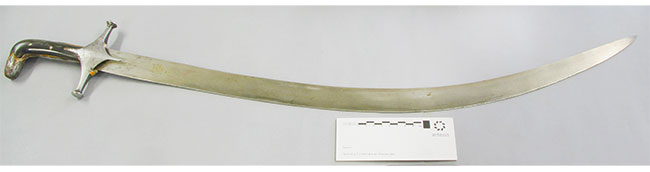
Kozakian Shamshir weapon made of crucible steel from the collection of the Royal Museum of the Armed Forces and Military History, Brussels

The ancient kings, inspired by Buddhism and the constant need to feed a growing population, produced a new culture as well as a new economy. They also created the necessary institutions to plan and implement development projects for transforming the dry zone. Buddhism figured prominently in the island’s hydraulic civilization, which emerged during the Early Historic Period (500 BCE-300 CE). Although the irrigation bureaucracy was highly centralised, it produced results. There was a steady increase in agricultural production which kept pace with population growth and also stimulated technological change in the non-farm sectors through backward linkages.

However, there were occasional famines caused by various factors including invasions, internal strife, and adverse weather conditions. These famines occurred over a period of fifteen centuries in both the Anuradhapura and Polonnaruwa kingdoms. Hence, despite the development of an intricate irrigation system in the dry zone, the uncertainty of food production always remained (Siriweera, W.I. History of Sri Lanka: From earliest times up to the sixteenth century, second edition, 2004).

Dual role of monastic complexes

The vibrant Buddhist culture also produced a flowering of religious art, architecture, and sculpture and a proliferation of the arts and crafts. Owing to its pivotal position in the ancient maritime silk route, the island would no doubt have benefited from winds of change blowing from East and West.

The Buddhist monasteries were heavily patronised by the royalty and served as key intermediaries between the monarchs and the rural people. The monastic complexes owned large extents of land, irrigation works, dairy cows, and draft animals. The manpower they had in their service consisted mainly of agricultural labourers and artisans. The latter included carpenters, wood-carvers, potters, brick-makers, and blacksmiths. The complexes possessed a range of implements for use by the skilled and unskilled workers. Consequently, they functioned not only as places of worship but also as key resource centres.

What is still more significant is the role of the monastery in promoting different crafts including iron-smelting and metal craft. It adds another dimension to the multi-faceted activities in which these institutions had been involved” (Karunatilaka, P.V.B. Metals and Metal Use in Ancient Sri Lanka, 1991-92). Consequently, the larger monasteries, in addition to performing religious duties, engaged in diverse economic activities. By promoting metal crafts using hands-on training methods, they also served as agents of technical change.

Steel manufacturing

As we saw, iron and steel implements of superior quality were being produced in the island during the Early Historical Period. Numerous archaeological studies suggest that India and Sri Lanka were the first two countries in the world to produce and export wootz – a hard, durable, high-carbon steel. Both countries exported wootz steel to the Middle East. While in India, the iron-smelting furnaces for producing wootz steel (also known as crucible steel) were charcoal-fired, in Sri Lanka, they were wind-powered. This method of producing wootz steel was unique to the island. The ancient, wind-powered furnaces were built in the Samanalawewa area (located in the southern foothills of the central highlands), where there was an abundant supply of iron ore (Juleff, G. An ancient wind-powered iron-smelting technology in Sri Lanka, 1996). These remarkable structures have been dated to 300 BCE using radiocarbon dating techniques (Hewageegana, P. Early Iron and Steel Production in Sri Lanka: A Scientific Perspective, 2014).

During the first millennium CE, steel manufacturing developed into a major ferrous metallurgy industry in South Asia. The legendary Damascus swords, noted for their strength and sharpness, were produced from ingots of wootz steel imported from India and Sri Lanka. It was the Arabs who introduced this quality product to Syria.

The Sunday Times reported more than a decade ago that Gill Juleff (a British archaeologist) was in the process of establishing a full-scale model of the Samanalawewa wind-powered furnace at the Martin Wickramasinghe museum in Koggala (Sadanandan, Renuka, Blowing back to a red-hot history, The Sunday Times, August 31, 2008). Her excavations, carried out in Samanalawewa over a two-year period (1990-91), revealed that each site had several furnaces. Juleff discovered a total of 77 sites in Samanalawewa with furnace remains, all of them located in the path of monsoon winds on the western margins of hills and ridges. Perhaps the Chola invasions led to the collapse of this large-scale metallurgy industry in the 11th Century.

Megalithic culture

It appears the 3rd century BCE on the whole was a vibrant period of Sri Lanka’s ancient history when various factors (both exogenous and endogenous) converged to produce a flowering of the island’s famed Early Iron Age megalithic culture. Archaeological research, which commenced during the British colonial period and is continuing to probe the island’s ancient past, has demonstrated a clear biological connection or continuum, if you will, between the prehistoric and historic peoples. Similarly, haematological and genetic investigations suggest that the ethnic mix of Sri Lanka’s population is quite consistent with the island’s geographical location. Though the island lies between South India and Southeast Asia, it is geographically much closer to the former than the latter. It is not surprising therefore that the ethnic mix is weighted towards southern India.

There is no solid evidence to indicate that the early Sri Lankans were a homogeneous migrant group. What the available data suggest, on the other hand, is that the Sri Lankans were no less heterogeneous in the prehistoric past than they are today. This island, though relatively small, is exceedingly complex in respect of its social, cultural and demographic characteristics due to its long history of human habitation.

The megalithic monuments scattered throughout the dry zone (with a high degree of concentration in the northern and eastern dry zone) indicate that semi-settled communities existed in the island prior to 600 BCE. The megalithic culture was based on a wide range of economic activities, including pottery, the practice of chena cultivation, the rearing of livestock, and the production of hardy iron tools and implements.

The archaeological evidence shows there were close affinities between the megalithic culture complexes and burial sites of Sri Lanka with those of South India. It is therefore tempting to conclude that there was a significant South-Indian presence in the island centuries before the arrival of the northern Indian settlers. However, Senake Bandaranayake (The Peopling of Sri Lanka: The National Question and Some Problems of History and Ethnicity, South Asia Bulletin, 1987) raises the question of whether the migration of ideas and techniques was more important than the migration of peoples in explaining the character and dynamism of Sri Lanka’s internal developments during the prehistoric and early historic periods.

Assuming, on the basis of the megalithic culture complexes, that a cohesive and relatively advanced protohistoric community did exist in Sri Lanka, the question then arises as to how the island had developed a distinct Sinhalese character and ethnos by the 3rd century BCE. The widespread use of the proto-Sinhala language, the dramatic increase in tank irrigation systems, the rapid dissemination of wetland rice cultivation techniques, the establishment of a Sinhalese monarchy and emergence of the early state, the rise of Buddhism: all of these social and cultural phenomena suggest that revolutionary changes occurred in Sri Lanka after the migrants from northern India arrived in the island.

Easter Sunday carnage cannot be blamed on Muslim extremists alone – Cardinal

January 15th, 2022

By Shamindra Ferdinando Courtesy The Island

Dastardly conspiracy gradually unfolding’

Declaring that 2019 Easter Sunday carnage couldn’t be blamed on Muslim extremists alone, the Archbishop of Colombo Malcolm Cardinal Ranjith yesterday (14) questioned the failure on the part of the government to at least implement the recommendations made by the Parliamentary Select Committee (PSC) and the Presidential Commission of Inquiry (PCoI) into the near simultaneous suicide attacks.

Delivering a sermon at the Basilica of Our Lady of Lanka where the Catholic Bishops’ Conference organised a special prayer service to mark 1000th day since the Easter Sunday carnage, the Cardinal asked why specific recommendations made by the PSC as regards the State Intelligence apparatus couldn’t be carried out. The Cardinal emphasised the PSC recommendation for comprehensive inquiry into the failure on the part of the State Intelligence apparatus to thwart the 2019 Easter Sunday attacks couldn’t be taken lightly.

Intelligence services primarily consist of the State Intelligence Service (SIS) and the Directorate of Military Intelligence (DMI). In addition to them, the Navy, the Air Force and the Special Task Force (STF) have their own intelligence outfits.

Quoting directly from the PSC report, the Cardinal pointed out the gravity in the issue whether the terror project was allowed to go ahead because of the presidential election scheduled for late 2019.

The PSC report couldn’t be ignored under any circumstances, the Cardinal declared while referring to former Attorney General Dappula de Livera, PC, speculating on the possibility of a conspiracy.

Rt. Rev. Malcolm Cardinal Ranjith questioned the inordinate delay in taking action against those politicians and law enforcement officers named in the PCoI report.

The then President Maithripala Sirisena appointed five-member PCoI in the run-up to the Nov 2019 presidential election soon after the PSC chaired by Deputy Speaker Ananda Kumarasiri tabled his report in the Parliament.

Separate blasts claimed the lives of nearly 280 people. Over 500 received injuries. Some of them are bed ridden.

Having reminded how the then government received specific information pertaining to the impending attack from the Indian Intelligence but chose not act, the Archbishop of Colombo said that instead of taking action against those who allowed the massacre to take place, some of them were rewarded.

The Cardinal was referring to the then head of the SIS Senior DIG Nilantha Jayawardana, currently the senior officer in charge of the Central Range.

The Cardinal criticized the conduct of Police Spokesperson SSP Nihal Thalduwa for trying to underrate the PSC.

The Cardinal said that whatever the strategies adopted by the government, the heinous Easter Sunday crime couldn’t be suppressed. Reference was also made to the handling of the recovery of a grenade from inside All Saints Church, Borella last Tuesday (11).

The Cardinal compared the handling of the Easter Sunday investigation with that of the Borella incident while attacking successive governments for atrocities perpetrated since independence. Reiterating concerns over wartime accountability issues, the Cardinal underscored the need for justice for the victims.

Commenting on growing difficulties experienced by the public due to shortage of essential food and other items amidst rising cost of living, the Cardinal blamed successive governments for the current crisis.

At the onset of his sermon, the Cardinal said that growing queues for essentials and the ruination of cultivation due to the fertilizer crisis caused by the government reflected the actual situation. In spite of desperate efforts to deceive the public and consolidate power, the current dispensation was in deepening turmoil. There were clear signs of deterioration of their power and the day the public overwhelmed the political establishment was not far away, the Cardinal asserted.

The Church leader said that they were confident that the ongoing campaign could be brought to a successful conclusion. The Cardinal said their campaign would continue until they received justice.

Defence Secy. reacts to Cardinal’s criticism about probe

January 15th, 2022

Courtesy The Daily Mirror

Defence Secretary Kamal Gunaratne said it is not fair to criticize the police investigation into the incident in which a grenade was found at the Borella All Saints’ Church, less than 24 hours after it was reported.

He made this remarks responding to the statement made by Archbishop His Eminence Cardinal Malcolm Ranjith regarding the investigation into the incident.

Speaking to media after meeting with Chief Prelates of Malwatta and Asgiriya chapters, he assured that all those involved in the incident will be brought to justice.

“Investigation is not something that can be completed in two or three hours. It takes some time. I don’t think it’s fair to criticize investigations barely 24 hours had passed after the incident,” he said.

COVID: 661 new infections and 07 new COVID fatalities confirmed in Sri Lanka today

January 15th, 2022

Courtesy Adaderana

The daily count of COVID-19 cases recorded in Sri Lanka moved to 661 today (January 15), the Health Ministry said.

According to the Government Information Department, the newly-detected cases include 04 individuals who recently arrived on the island.

The latest development has brought the total number of confirmed cases of coronavirus reported in the country so far to 595,657.

As many as 568,049 recoveries have been confirmed in Sri Lanka since the outbreak of the COVID-19 pandemic.

More than 12,400 active cases in total are currently under medical care and the death toll stands at 15,197, official figures showed.

Meanwhile, the Director-General of Health Services has confirmed 07 more coronavirus-related deaths for January 14, increasing the death toll in the country due to the virus pandemic to 15,197.

According to the official figures released by the Government Information Department, the deaths reported today include 06 males and 01 female.

One of the patients is between the ages of 30-59 years. The remaining six are in the age group of 60 years.

Omicron cases in Sri Lanka surge with 160 new infections

January 15th, 2022

Courtesy Adaderana

Sri Lanka has identified 160 new cases of the Omicron variant of SARS-CoV-2 (B.1.1.529), says Dr. Chandima Jeewandara, the Director of the Department of Immunology & Molecular Medicine at Sri Jayewardenepura University.

These Omicron patients were found among 182 samples that were sequenced by the laboratory of the J’pura University.

The new development pushed the total number of Omicron cases confirmed by the J’pura University’s lab so far to 205.

Accordingly, Omicron now appears to be on its way to become the dominant variant of Covid-19 on the island, brushing the Delta strain aside.

Out of the newly-detected 160 Omicron cases, two main Omicron lineages called BA.1 and BA.2 were detected, Dr. Jeewandara said further, explaining that BA.2 carries additional mutations in comparison to BA.1.

Dr. Jeewandara added that scientists have suggested that BA.2 sub-lineage is more resistant to vaccine-induced and naturally-acquired immunity. Immunization may be more prominent in BA.2 sub-lineage compared to BA.1.”

According to him, the samples have been collected from multiple districts across the island including Colombo, Galle, Matara, Kandy, Trincomalee and Gampaha.

Sri Lanka confirmed its first Omicron case on December 03, 2021, in a Sri Lankan national who had returned from a West African country. Three more cases were later confirmed by the J’pura University lab on December 16 including that of a foreign national.

The World Health Organization (WHO) designated Omicron a variant of concern on November 26 last year, soon after it was first detected by scientists in South Africa.

Early data suggests it can be more resistant to vaccines and more transmissible than the Delta variant.

The WHO has warned that Omicron is spreading rapidly in countries with high levels of population immunity. But it is unclear if this is due to the ability of the virus to evade immunity, its inherent increased transmissibility or a combination of both.

However, a recent South African study has shown that unvaccinated people infected with the Omicron variant are less likely to fall seriously ill, require hospitalization or die compared to the previous COVID-19 variants.

The study was led by the National Institute of Communicable Diseases in the Western Cape region. It has compared 11,609 patients from the first three COVID-19 waves with 5,144 patients from the new Omicron-driven wave.

According to foreign media, it found that 8% of patients were hospitalized or died within 14 days of testing positive for COVID during the Omicron wave — compared to the 16.5% in the first three waves.


-with inputs from agencies

The truth about future availability and pricing of medicines in Sri Lanka

January 14th, 2022

Courtesy NewsIn.Asia

Colombo, Jan 14 (AdaDerana) – In the context of rising prices of all consumer products and the limited availability of most, the people of Sri Lanka, are faced with two ominous questions about which they are justifiably anxious.

  1. Will there be a scarcity of medicines in the near future in the country and if so, should they be stocking up their regular medications?
  2. Will the price of medicines go up in conjunction with all the other products in the market?

Subscribe to our Telegram channel for the latest updates from around the world

Availability of medicines in the future

At least some sections of the public must be aware that there are shortages of some medicines even at present.  This is due to many reasons but the foremost of these is the foreign currency crisis in the country which makes it difficult for banks to facilitate the payments through Letters of credit (LC’s). At present, banks, both state and private sector, allows the Pharma Importers to open LC’s only when they have sufficient dollars to safely guarantee payment for the imports.

Although medicines are given certain priority, there are other items such as essential food items, Petroleum products, fertilizer etc., that have to be given priority as well by the Government. The result is that importing of medicines is now done on the availability of foreign currency and not on the needs of the country or its patients. In this situation, it is inevitable that there will be shortages of more and more medicines as the foreign exchange crisis deepens.

READ: India extends forex support of more than US$ 900 million to Sri Lanka

As for stocking medicines in excess of usual treatment regime by patients, it is not advisable to do so for long periods since these products have to be stored under strict conditions specified by the manufacturers. It is doubtful whether such conditions can be maintained in an average household. In addition, bulk or panic buying by the affluent may deprive the less able segment of the population access to medicines they require for a healthy life.

We as an industry will do our utmost to keep the supplies of medicines available uninterrupted, since we fully realize the implications of failing to do so. In this regard, we earnestly hope that the authorities concerned will give us priority in establishing LC’s on time.

READ: Lanka asks China to restructure debt repayment

Pricing of Medicines

It will be also catastrophic in the event if the dollar is allowed to float, which will mean that all medicines will have to be sold at a loss and as such, the entire industry will collapse in the face of such a threat where the importation would obviously stop as the cost of importation will be higher than the approved prices.

There is no solution to this dilemma than removing the price control of medicines and implement a fair and equitable pricing mechanism which will link the price of medicines to the dollar, inflation and direct costs such as raw material, fuel and freight charges, which will make the importing and marketing of medicines viable. As difficult as it may sound, the authorities will have to choose between having medicines at a cost and not having medicines at all.

READ: China to help Sri Lanka build Made in Sri Lanka” brand

We as an ethically responsible industry, have already sought the intervention of the courts in order to bring about a transparent pricing mechanism for Pharmaceuticals & Medical Devices that is fair to all. Such a mechanism may be the only salvation for the industry and the patients of the country and it is in the best interest of all concerned if the process is expedited by the authorities concerned by the government.

We would like to give a solemn undertaking to the public that we will do our utmost to see that the drug pricing is fair and equitable. The members of the SLCPI have an exceptional record of maintaining an uninterrupted supply of efficacious, safe & quality medicines at globally competitive prices over many decades while supporting the continuous medical education of the country.

(This press release issued by the Sri Lanka Chamber of the Pharmaceutical Industry clarifying and offering their stance on the availability of pharmaceuticals in the market and the impact the foreign exchange crisis is having on the industry.)

US ‘pleased’ with Russian arrest of ransomware hackers

January 14th, 2022

Courtesy RT

Biden administration said one of the suspected hackers arrested in Russia was to blame for the Colonial Pipeline attack

US ‘pleased’ with Russian arrest of ransomware hackers

The Biden administration is pleased” about Russia arresting several suspected hackers, including one allegedly behind the ransomware attack that led to week-long fuel shortages last year.

A senior administration official, speaking with reporters on Friday, said Moscow had informed Washington about the arrests, and that one of the individuals involved was responsible for the May 2021 attack that crippled the Colonial Pipeline.

I want to be very clear: In our mind, this is not related to what’s happening with Russia and Ukraine. I don’t speak for the government’s motives, but we’re pleased with these initial actions,” said the unnamed official, according to Axios.

The US has been accusing Russia of planning an invasion” of Ukraine for several weeks now, with Moscow dismissing the allegations as fake news.”READ MORE: Russia busts REvil hacker ring after tip off from US

Earlier on Friday, Russia’s Federal Security Service (FSB) announced it had conducted raids in three regions – Moscow, St. Petersburg and Lipetsk – targeting suspected hackers, after receiving a notice from US authorities about their alleged criminal activity.

The men arrested were reportedly members of REvil, a hacking group that specialized in ransomware attacks, and was blamed for the June 2021 attack on the meat processing conglomerate JBS and the US-based IT management platform Kaseya in July. 

The Colonial Pipeline attack was originally attributed to a different gang, called DarkSide. The company, which runs the pipeline providing much of the southern and eastern US with fuel, shut down operations for several days in May 2021, after the ransomware attack affected its automated invoicing service. 

https://youtu.be/YIzBw3Kv9K4

The week-long disruption in supply caused fuel shortages across several states and Washington, DC. Colonial’s CEO Joseph Blount later admitted that he paid $4.4 million in ransom to the hackers, saying it was the right thing to do for the country.” 

The following month, the FBI also blamed DarkSide for the attack, boasting that it had seized about $2.3 million in bitcoin from their accounts.

අග්‍රාමාත්‍යතුමාගේ ප්‍රධානත්වයෙන් පැවති ජාතික තෛපොංගල් උත්සවය

January 14th, 2022

අග්‍රාමාත්‍ය මාධ්‍ය අංශය

ජාතික තෛපොංගල් උත්සවය අග්‍රාමාත්‍ය මහින්ද රාජපක්ෂ මහතාගේ ප්‍රධානත්වයෙන් අද (14) දින පස්වරුවේ අරලියගහ මන්දිරයේ දී පැවැත්විණි.

ගොවිතැන් කටයුතු සඳහා සූර්ය දෙවියන්ගෙන් ලැබුණු ශක්තියට කෘතගුණ සැලකීම මුල් කරගනිමින් දමිළ දින දර්ශනයේ පළමු දිනය මෙලෙස සුවිශේෂීත්වයෙන් සැමරීම සිදු වේ.

අස්වනු නෙලා ගැනීම සහ නෙලාගත් අස්වැන්නෙන් පළමු කොටස යොදා පොංගල් කිරිබත සෑදීම මෙම මංගල්‍යයේ චාරිත්‍රයකි.

බුද්ධශාසන ආගමික හා සංස්කෘතික කටයුතු අමාත්‍යවරයා වශයෙන් අග්‍රාමාත්‍යතුමාගේ උපදෙස් පරිදි මෙවර තෛපොංගල් උත්සවය උත්සවශ්‍රීයෙන් සැමරීමට අවශ්‍ය වටපිටාව සකසා තිබිණි.

අරලියගහ මන්දිරයේ පැවැති ජාතික තෛපොංගල් උත්සවය හින්දු සංස්කෘතික අංග වලින් විචිත්‍රවත් වූ අතර අග්‍රාමාත්‍යතුමා සමඟ අග්‍රාමාත්‍ය ආර්යා ශිරන්ති වික්‍රමසිංහ රාජපක්ෂ මහත්මිය ද තෛපොංගල් උත්සව චාරිත්‍ර සමඟ එක්ව සිටියාය.

කලාශූරී වාසුගී ජෙගදීස්වරන් මහත්මියගේ අධීක්ෂණයෙන් එම කලායතනයේ සිසුවියෝ පූජා නර්තනය ඇතුළු නර්තනාංග ඉදිරිපත් කළහ.

අග්‍රාමාත්‍ය ආර්යාව මෙහි දී නව නිර්දේශයට අනුව මුද්‍රණය කළ දහම් පාසල් පොත් දරුවන්ට බෙදා දුන්නාය.

කොළඹ රාමක්‍රිෂ්ණ මණ්ඩලයේ ප්‍රධානී පූජ්‍ය අක්ෂරාත්මානන්ද මහරාජ් ස්වාමි, අග්‍රාමාත්‍ය හින්දු ආගමික කටයුතු සම්බන්ධීකාරක පූජ්‍ය රාමචන්දිරා කුරුකල් බාබු ශර්මා ඇතුළු හින්දු පූජකවරු රැසක් මෙම අවස්ථාවට එක්වූහ.

 ජාතික තෛපොංගල් උත්සවය අවසානයේ හින්දු පූජකවරු අග්‍රාමාත්‍යතුමාට හින්දු චාරිත්‍රානුකූලව ආශිර්වාද එක් කළහ.

අමාත්‍ය ඩග්ලස් දේවානන්දා, රාජ්‍ය අමාත්‍ය ජීවන් තොණ්ඩමන්, පාර්ලිමේන්තු මන්ත්‍රීවරුන්වන අංගජන් රාමනාදන්, සුරේන් රාඝවන්, ශ්‍රී ලංකාවේ ඉන්දීය මහ කොමසාරිස් ගෝපාල් බාග්ලේ, අග්‍රාමාත්‍ය  කාර්ය මණ්ඩල ප්‍රධානී යෝෂිත රාජපක්ෂ, අග්‍රාමාත්‍ය සම්බන්ධීකරන ලේකම් සෙන්දිල් තොණ්ඩමන්, හින්දු ආගමික හා සංස්කෘතික කටයුතු දෙපාර්තමේන්තුවේ අධ්‍යක්ෂ ඒ.උමාමහේෂ්වරන් මහත්වරු ඇතුළු එම දෙපාර්තමේන්තුවේ නිලධාරී මහත්ම මහත්මීහු පිරිසක් මෙම අවස්ථාවට එක්ව සිටියහ.

Conservationists, veterinarians warn Sri Lankan plastic waste is killing region’s elephants

January 14th, 2022

BY BRAD DRESS Courtesy The Hill


Two elephants recently died in Sri Lanka after swallowing large amounts of plastic found in a garbage heap, prompting a renewed warning from conservationists about the issue.

The Associated Press reported that at least 20 elephants have died in the past eight years from eating plastic waste in the open landfill in Pallakkadu village.

The wild elephant population in Sri Lanka has plummeted 65 percent since the 19th century, with somewhere between 2,000 and 4,000 left, according to the World Wildlife Fund (WWF). Elephants are protected under Sri Lankan law, and killing one carries the death penalty. ADVERTISEMENT

Elephants have lost much of their wild habitats inside the island nation in the Indian Sea, pushing the animals closer and closer to waste landfills. Sri Lankan authorities have pledged to recycle more waste in garbage dumps, but the promise has never been fully carried out, according to the AP. An electric fence broke down in 2014 and hasn’t been repaired.

Wildlife veterinarian Nihal Pushpakumara said hungry elephants will consume plastic waste, which makes them stop eating and become too weak to keep their heavy frames upright.”

“When that happens, they can’t consume food or water, which quickens their death,” he told the AP.

Plastic, which can take hundreds of years to decompose, also causes the death of 100,000 marine mammals every year, the WWF estimates.

Sri Lankan tea exports earned 1.3 bln USD in 2021

January 14th, 2022

Courtesy ukr agroconsult

Sri Lanka’s tea industry performed well in 2021 earning 1.3 billion U.S. dollars despite lower yields and higher costs of production, state media reported on Thursday.

Chairman of the Sri Lanka Tea Board Jayampathy Molligoda was quoted by the state-owned Daily News as saying that Sri Lanka earned approximately 1.3 billion U.S. dollars from the export of 288 million kilos of tea in 2021.

Molligoda said the cost of production of Sri Lankan tea is among the highest in the global market and tea production peaked in 2013 and has declined since then. He said auction prices in Kenya and India are cheaper than in Colombo.

The chairman said Sri Lanka needs to focus more on the front end of the value chain” by marketing the clean, sustainable and wellness aspects of Ceylon Tea.

Tea is Sri Lanka’s top agricultural export and accounted for 10.9 percent of total merchandise export revenue in 2021.

Sri Lanka: How Does A Country Restructure Its External Debt?

January 14th, 2022

Courtesy Finance Monthly

When a company’s foreseeable future earnings are not sufficient to repay debts, the company in question may choose to restructure its debt. And this applies to countries too. In years gone by, several countries have chosen to restructure their debt, with Sri Lanka potentially soon to join them.

President Gotabaya Rajapaksa briefed the Maha Sangha
Image by Sneharashmini – Own work, CC BY-SA 4.0, https://commons.wikimedia.org/w/index.php?curid=111021371

How does debt restructuring work for countries?

Throughout history, there have been several cases of countries facing default on their external debt, including North Korea in 1987, Russia in 1998, and Argentina in 2002. Historically, some nations have chosen to restructure their debt with bondholders. This can involve moving the debt from the private sector to public sector institutions that may be capable of handling the weight of a country’s default. 

Sovereign bondholders may have to accept a reduced percentage of what they are owed. The maturity dates on bonds can also be extended, allowing the Government issuer more time to secure the funds required to pay back its bondholders. 

China’s role in Sri Lanka’s debt crisis

Over the past decade, China has lent Sri Lanka over £3.7 billion for projects including new roads, ports, and an airport. However, instead of praising China for its generosity, some critics have denounced the world’s second wealthiest nation for its lending practices to poorer countries, accusing China of leaving them struggling to pay off debt.

Typically, China lends at a higher rate of interest than western governments. At approximately 4%, these loans come close to commercial market rates and are around four times higher than that of a standard loan from the World Bank. Furthermore, the required repayment period for a Chinese loan is typically shorter. While other lenders’ concessional loans generally have a required repayment period of approximately 28 years, in China, it is less than 10. 

The case for Sri Lanka restructuring its external debt

Over the next couple of years, it is highly unlikely that Sri Lanka’s foreign revenues will be enough to meet foreign debt obligations. Cumulative foreign currency debt service amounts to approximately $26 billion from 2022 through to 2026. This year alone, Sri Lanka has foreign currency debt service payments of $6.9 billion. This figure is equivalent to almost 430% of official gross international reserves as of November 2021, according to Fitch Ratings. 

Furthermore, over the next 12-24 months, it is unlikely that foreign inflows will increase on the scale needed to service debt and finance imports necessary to meet basic needs and support the economy’s growth. This issue is further inflated by the downgrading of the country’s sovereign rating, which has resulted in Sri Lanka being excluded from international capital markets. 

Speaking to a visiting Chinese foreign minister at the beginning of January, Sri Lanka’s President, Gotabaya Rajapaksa, said it would be a great relief to the country if attention could be paid on restructuring the debt repayments as a solution to the economic crisis that has arisen in the face of the COVID-19 pandemic.”

Meanwhile, several business chambers, including Ceylon National Chamber of Industries and The International Chamber of Commerce Sri Lanka, amongst others,  have come together to issue a statement highlighting the serious issues faced by their members caused by the acute shortage of forex; the result of the loss of revenue from tourism as well as access to international capital markets. 

Combined, these business chambers make up nearly all sectors of the economy and their problems cannot be resolved while large amounts of forex are being sent from markets to the Central Bank of Sri Lanka to service foreign debt. 

The disadvantages of external debt restructuring for Sri Lanka

A major disadvantage of restructuring foreign debt is an immediate loss of access to international capital markets. However, since Sri Lanka has already lost access after being downgraded, this factor becomes irrelevant. 

A second disadvantage of restructuring foreign debt is the heightened risk premium Sri Lanka would be required to pay when it is eventually permitted to regain market access. However, to date, the country has demonstrated commitment to meeting its obligations. At the beginning of October 2019, Sri Lanka settled a $1 billion maturing international sovereign bond by reaching into its foreign reserves and settled another, also worth $1 billion, in July 2020. Sri Lanka’s demonstrated commitment will likely mean that this second disadvantage is at least somewhat abated.

Final thoughts

With the country’s president and major business chambers keen to see Sri Lanka restructure its foreign debt, it seems like the obvious next step on the path to economic recovery. But only time will tell if the world’s other nations are willing to facilitate it. 

Elephants are dying from eating plastic waste in Sri Lankan dump

January 14th, 2022

Courtesy New York Post

Wild elephants scavenge for food at an open landfill in Pallakkadu village in Ampara district, about 130 miles east of the capital Colombo, Sri Lanka, Thursday, Jan. 6, 2022.
Wild elephants scavenge for food at an open landfill in Pallakkadu village in Ampara district, about 130 miles east of the capital Colombo, Sri Lanka, Thursday, Jan. 6, 2022.AP

MORE ON:ELEPHANTS

PALLAKKADU, Sri Lanka — Conservationists and veterinarians are warning that plastic waste in an open landfill in eastern Sri Lanka is killing elephants in the region, after two more were found dead over the weekend.

Around 20 elephants have died over the last eight years after consuming plastic trash in the dump in Pallakkadu village in Ampara district, about 210 kilometers (130 miles) east of the capital, Colombo.

Examinations of the dead animals showed they had swallowed large amounts of nondegradable plastic that is found in the garbage dump, wildlife veterinarian Nihal Pushpakumara said.

Polythene, food wrappers, plastic, other non-digestibles and water were the only things we could see in the post mortems. The normal food that elephants eat and digest was not evident,” he said.

Conservationists and veterinarians are warning that plastic waste in the open landfill in eastern Sri Lanka is killing elephants in the region.

Elephants are revered in Sri Lanka but are also endangered. Their numbers have dwindled from about 14,000 in the 19th century to 6,000 in 2011, according to the country’s first elephant census.

They are increasingly vulnerable because of the loss and degradation of their natural habitat. Many venture closer to human settlements in search of food, and some are killed by poachers or farmers angry over damage to their crops.

Hungry elephants seek out the waste in the landfill, consuming plastic as well as sharp objects that damage their digestive systems, Pushpakumara said.

The elephants then stop eating and become too weak to keep their heavy frames upright. When that happens, they can’t consume food or water, which quickens their death,” he said.

Around 20 elephants have died over the last eight years after consuming plastic trash in the dump.

In 2017, the government announced that it will recycle the garbage in dumps near wildlife zones to prevent elephants from consuming plastic waste. It also said electric fences would be erected around the sites to keep the animals away. But neither has been fully implemented.

There are 54 waste dumps in wildlife zones around the country, with around 300 elephants roaming near them, according to officials.

The waste management site in Pallakkadu village was set up in 2008 with aid from the European Union. Garbage collected from nine nearby villages is being dumped there but is not being recycled.

In 2014, the electric fence protecting the site was struck by lightning and authorities never repaired it, allowing elephants to enter and rummage through the dump. Residents say elephants have moved closer and settled near the waste pit, sparking fear among nearby villagers.

The body of a wild elephant lies in the open landfill in Pallakkadu village in Ampara district.

Many use firecrackers to chase the animals away when they wander into the village, and some have erected electric fences around their homes.

But the villagers often don’t know how to install the electric fences so they are safe and could endanger their own lives as well as those of the elephants,” said Keerthi Ranasinghe, a local village councilor.

Even though we call them a menace, wild elephants are also a resource. Authorities need to come up with a way to protect both human lives and the elephants that also allows us to continue our agricultural activities,” he said.

Why Gotabaya Is Battling A Crisis No Sri Lankan Leader Has Faced – Analysis

January 14th, 2022

By Indika Hettiarachchi Courtesy EurasiaReviw

For a large number of 6.9 million voters who voted for Gotabaya Rajapakse in the 2019 presidential election, it was like giving a benefit of the doubt. This is because GR was a political novice at age 70. And his style of management or governance was a big question mark, although he was credited with military success. After two years, a vast majority of Sri Lankans aren’t convinced that giving the benefit of the doubt is a good idea when electing national leaders.   

As Sri Lanka descends deeper into economic chaos, the popularity of the President and his government have declined to levels never seen before for any political regime reaching midterm. The government appears to be disconnected from the general public and ground realities. Key forces within the government such as the military and Viyathmaga (an organization of professionals and a key ally of the current administration) seem to be lacking not only basic political experience and common sense in managing the country but also in the ability to work towards selfless goals.

Rohantha Atukorala, a popular market analyst, opines that the current administration is the worst administration in the last two decades due to poor decision making. Frequent changes of key government officials itself proves widespread accusation of poor judgments by the administration in selecting people for important positions.     

Food policy a mess

Perhaps the worst blow to people from the government came through its poor handling of the agriculture and food policy, resulting in sharp rise in food prices and shortages. Increase in cost of living to unbearable levels, coupled with rampant nepotism and corruption have angered general public to levels where they have now started to randomly and publicity hoot government and political leaders – something never seen in Sri Lanka before. 

What went wrong with the current administration, which appeared more than capable of taking the country in a positive direction, is a big question. Many blame the lack of experience of Gotabaya Rajapakse as the main cause of the failure. Lakshman Kiriella, an opposition politician, recently accused the media for its failure to question the President’s lack of understanding of the economy related problems faced by Sri Lanka at the presidential campaign stage. 

Leaning on divinity! 

Some analysts point out the downfall of the President is hastened by his and his inner circle’s blind dependency on divine powers to provide necessary guidance to run the country. Years before Gotabaya Rajapakse formally entered the presidential race, he has been a faithful follower of soothsayers – especially a popular female in Anuradhapura — the sacred Buddhist city from where he took the presidential oath.  

The President and his key aides reportedly still heavily depend on divine guidance in managing the country. Although it is common practice for politicians to seek divine blessings, some reports suggest that Gotabaya Rajapakse has become extremely dependent on such guidance — a stark contrast to his vision for the government driven by the use of science and technology.

As all indications suggest that the current political regime is unlikely to return to power, there are widespread discussions about who will be next presidential candidate and possible alliances. Anyway, for a majority of Sri Lankans, known devils are likely to be more appealing than unknown angels in future elections.  

*About the author: The writer is a Sri Lanka-based independent consultant in private market investments and projects. The views expressed are personal. He can be contacted at indika.h@jupitercapitalpartners.com

Source: This article was published by South Asia Monitor

A

Rs. 229 bn relief package will lead to printing more money

January 14th, 2022

Courtesy The Island

… says govt. has got priorities mixed up

By Shamindra Ferdinando

Former Minister D.E.W. Gunasekera says that the cash-strapped government lacked the wherewithal to implement the much publicized Rs 229 bn relief package.

Therefore, the one-time General Secretary of the Communist Party said the government had no option but to print more money at the expense of financial stability at a time the country was under tremendous pressure. The former minister quit the top party post in August 2020.

CP organ ‘Aththa,’ in its January 09, 2022 edition quoted the former lawmaker as having alleged that the Rs 229 bn relief package meant for the public sector, pensioners and Samurdhi recipients was nothing but a political strategy to revive the waning popularity of the government.

Declaring that he had no issue with the government providing relief to the public sector et al, the ex-MP warned that such measures wouldn’t help resolve the growing crisis. The outspoken former minister said that the controversial relief package should be examined against the backdrop of the failure on the part of the government to allocate the required funds through the 2022 budget.

Mr. Gunasekera last served as a National List MP from 2010 to 2015.

Reiterating that such a move had been necessitated by political compulsions, the veteran Communist warned of the grave risk of rising inflation. The CP member questioned the absence of a mechanism to assist those in the private sector, small and medium scale industries as well as the unregulated economy. The much weakened national economy couldn’t be revived unless the government paid attention to the neglected sectors.

The veteran politician explained how the global Covid-19 epidemic devastated the unregulated economy world over. However, the government hasn’t taken into consideration the fuller picture. Instead the government sought to use the financial package to counter dissenting views within the government.

The ex-Minister said that even if printing money caused inflation, the government could have achieved positive results if the total amount was used to increase domestic production. Had that happened, the government could have accomplished both political and economic objectives.

The former MP said that incumbent Finance Minister Basil Rajapaksa hadn’t still understood the developing economic crisis.

Mr. Gunasekera told The Island that the private sector, including the plantation companies had quite clearly turned down the government request to match the special Rs. 5,000 monthly grant to employees. The government seemed not to have examined the situation at all, the former MP said, asserting that the current crisis could be the worst ever in post-independence Sri Lanka.

Continuing political instability in the wake of serious differences among coalition members with three ministers challenging a cabinet decision in the Supreme Court has jeopardized recovery attempts, Mr. Gunasekera said.

The one-time Chairman of the Committee on Public Enterprises (COPE) emphasized the pivotal importance of some real effort to reach consensus on the country’s response to the emerging threat. We are almost overwhelmed. Unless tangible measures are taken there can be a catastrophe. Losses are likely to be immeasurable and irrevocable.”

Probe still at early stage, all those involved will be arrested soon- IGP

January 14th, 2022

Darshana Sanjeewa Balasuriya Courtesy The Daily Mirror

At least 14 statements have been recorded so far in connection with the recovery of a hand grenade at the Borella All Saints’ Church and those involved into the incident will be arrested irrespective of their possition, IGP C.D. Wickramaratne said.

In a special statement the IGP said that those involved will be brought to justice.

The IGP said that the Borella Police first commenced investigations into the incident after the hand grenade was found on January 11.

Thereafter the Colombo Crimes Division took action to take over the investigation.

The IGP said that relevant CCTV footage is used for this investigation in accordance with the provisions of the law and further investigations will be carried out through scientific, technical, environmental evidence and personal evidence with the assistance of experts in the relevant fields.  

These investigations are still in the early stages, he said.

A full investigation will be carried out into the person or persons who brought the grenade to the church,  the motives behind the conspiracy and the persons who aided and abetted it. 

The facts regarding the incident have already been reported to the court and further reports regarding the progress of the investigation will be submitted to the court.

The IGP said that all persons involved in this incident will be brought to justice as soon as possible.  

Booster dose plummets rate of hospitalization due to Omicron by 90%

January 14th, 2022

Courtesy The Daily Mirror

Three doses of COVID-19 vaccine drop hospitalization by 90% in people above 65 years of age, health experts highlighted.

According to Head of the Immunology and Molecular Medicine Department at the Sri Jayewardenepura University Prof. Neelika Malavige, hospitalization due to Omicron is also dropped by 50% with two vaccine doses in the over 65 age group.

It is the people above 65 age of who are highly susceptible to get hospitalized and succumb to the virus. Omicron in the US is commonly seen among the unvaccinated population over 65 years. This is where booster dose plays a pivotal role.

In addition, she said most ICU admissions and COVID-19 fatalities are of the unvaccinated population.

Hence, she requested all eligible individuals get themselves boosted without further delay.

Meanwhile, Dr. Ananda Wijewickrama from National Institute of Infectious Diseases urged people not to be carried away by misconceptions and myths about the booster dose.

The priority of people at present should be the safety from Omicron which can be ensured with the booster dose,” he reiterated.  

Meanwhile, Sri Lanka College of Internal Medicine President and National Hospital of Sri Lanka (NHSL) Physician Dr. Harsha Sathischandra said no adverse effects have so been far been reported from pregnant women and neither from any other groups. 

Thus, the booster dose is recommended for persons who are pregnant or breast-feeding,” he added.

The health experts expressed these views at a news briefing held at the Government Information Department yesterday. (Sheain Fernandopulle)

Conspiracy to embarrass Govt.- Minister Sarath Weerasekara

January 14th, 2022

Courtesy The Daily Mirror

Public Security Minister Sarath Weerasekara said today there was a main conspirator behind the incidents where hand grenades were placed at a private hospital in Narahenpita and at the Borella All Saints’ Church premises.

He told reporters that in both instances, it was the same person who placed the bombs, who had found the bombs, and informed of them.

He said this was a move to embarrass the government, police and security forces and added that the mastermind behind these incidents would be arrested soon.

677 new cases of Covid-19 and 16 new COVID deaths reported in Sri Lanka

January 14th, 2022

Courtesy Adaderana

The Health Ministry reports that 677 new cases of the coronavirus have been detected today (14).

This figure includes 03 persons who had arrived from overseas while the rest are community cases. 

This brings the tally of Covid-19 cases registered in the country thus far to 594,996 while over 11,000 infected patients are currently under medical care.  

Meanwhile, the Director-General of Health Services has confirmed 16 more coronavirus-related deaths for January 13, increasing the death toll in the country due to the virus pandemic to 15,190.

According to the official figures released by the Government Information Department, the deaths reported today include 08 males and 08 females.

Five of the patients are between the ages of 30-59 years. One victim is aged below 30 years and the remaining 10 are in the age group of 60 years.

“Red light for China, Green Light for India”

January 13th, 2022

Asoka Weerasinghe (Mr.) Kings Grove Crescent . Ottawa . Ontario . K1J 6G1  . Canada,

13 January 2022

Mr. R. Sampanthan , MP
President, Tamil National Alliance
16(30), Martin Road
Jaffna
Sri Lanka

Dear Mr. Sampanthan (Sam):

You intrigue me, and here I am writing to you again.  This time to let you hear my thoughts on your down right arrogance letting the 21 million Sri Lankans know that You on behalf of the rest of the Tamils residing in the  North and the East of the island decides who was welcome and who was not welcome to place their feet on the green chillies and toddy palm groves growing  kabook soil that covered that chunk of land which  happens to be one-third of the island’s real estate,  bordered by 66% of the coastline.

What a day-light cunning….What a day-light robbery.

 It was as if you were guarding your Grandmother’s La La Lotus land.   You said with some authority that China was not welcome in the North and East while India has a legitimate right to be there.” Hmmmm..!

You know what Sam, looking back I have little reason to begrudge your mindset and a landlordish’ regal-attitude, because the incumbent Sri Lankan government’s like a hoard of wimps, gave you that right that you displayed with authority by not kicking yours and your compatriots behinds and ask you all to behave yourselves when you all started to ethnic cleanse 27,000 Sinhalese by killing and terrorizing them from the North and East between 1971 and 1981 where they had  lived for generations. Didn’t kick your arse, when Tamil separatists stoned and chased 400 Sinhalese  lecturers and undergraduates on 13th August,1977.from the Jaffna University campus,  when they were brought south in convoys of buses escorted by the army and police, lying on the floors  to dodge the storm of  Jaffna-rocks and stones released  like hand-grenades by  Jaffna-Tamilian hands. And when you all gave 24 hours to 90,000 Muslims to leave the North and East in October 1990, leaving behind the valuables and gold at the nearest mosque, making Idi Amin look like an angel  He gave the Ugandan-Indians three months to leave.

Sam, although I resent what happened, I understand your arrogance and claiming that right because the incumbent Governments failed  to stop this rot, and make you all kiss the Jaffna-Killinochchi dust that the Sinhalese walked on..   And nip the Tamil Eelam quest in the bud.

You Tamils were lucky, as the Sinhalese were handicapped.  You had your Godmother Indira Gandhi, with the 4th largest World’s Army platooned  behind her ready to shoot when her voice would order…”ATTAIN-SHUN… NOW SHOOT”, at my Sinhalese people..  And in September 1983 decided to train 2000  of the Tamil separatists youth at Chakrata, north of DehraDun, for Commando and Army combat.  And this assignment was given  to the RAW (Research and Analysis Wing) of Indira’s Cabinet secretariat.

There were other military camps providing instructions in manufacturing bombs,suicide bodypacks, jungle warfare, weapon training, and military tactics, etc. to your Tamil separatists at Kumbakonam, Meenambakkam, Parangimalai, Senegal patu, Sudtagen Development in New Delhi, and a camp in Uttar Pradesh.  All to destabilise Yours and My Sri Lanka.

And you Sam, the son of A.Rajavarothiam, the Superintendent of Stores at the Gal Oya Project, and enjoying a ‘free-education’ as a youngster in the South among the Sinhalese, buddies at St. Anne’s College, Kurunegala and St. Sebastian College in Moratuwa, dipping your fingers into your  Sinhalese school chum’s Gamini’s, Cyril’s and Sarath’s paper cones of konda-kadale during tea breaks,  shifted your allegiance to Gandhi’s India when you commented on India’s current role in Sri Lanka Affairs explaining that India had a rightful and legitimate role to play with regard to the settlement of the Tamil national question in Sri Lanka.” 

Rightful and legitimate role to play….”  What!  You must be out of your rocker, Sam.  Sri Lanka and India  were never legitimate children of the same Mother.”  They walked differently….they spoke differently…the Sinhalese certainly didn’t display the  red-moon thumbprint between their eyebrows….  It is only your clan that made their women walk five-feet behind men as if the women had some kind of a contagious ‘Flu.  So give me a break Sam.

 This is even after Indira Gandhi’s son Rajiv was rifle-butted by an angry navy soldier, Vijitha Rohana Wijemuni, on 30th July, 1987 during a Navy Guard of  Honour in Colombo.  That brave act by Wijemuni spoke for the majority of us Sinhalese, me included.

Sam, if you really felt that the outsider India had a legitimate role to play in Tamil affairs in Sri Lanka, I am lost for ‘kind’ words, but would say…Oops..Damn it!

I am not sure why you and  the rest of the Tamils in the North and East do not prostrate yourselves to  India’s Prime Minister Narendra Modi asking him to syphon all of you back into yours and his Motherland, India, where 72,147,030 of your kith and kin Tamils live in Tamil Nadu.  Why don’t you Sam…why didn’t you, when your heart-strings are still back in India, and your vocal chords do not want to sing – Sri Lanka Matha/ apa Sri Lanka, namo, namo, namo..matha/ Sundara Siri barini……… but would happily sing

Jana gana mana adhinayaka  jaya he….Bharata bhagya vidhata…

But let me caution you Sam, you are internationalising your internal  Tamil problem which also concerns me a Sinhalese also troubles me. This time if your India turns out to be a Bully Boy”, one more time,  India will have to change gears in their involvement in Sri Lanka’s internal problem.  They certainly wouldn’t want a Vietnam on their hands. And for sure they will be meeting not a Ceremonial 

Army as they did in 1987, but an army that has graduated and proved themselves to be the only conventional army in the world that destroyed militarily, almost single handed,  the most ruthless terrorists in the world which had a foot army, a sea-navy and an airforce, the Tamil Tigers.

Quite potent, isn’t it?  It would be fun war- games, not just Cops and Robbers, or Catapults and Bamboo sticks. You bet.

Sam, you recall that fateful day on 4 June 1987, when  5 Indian Transport An32s escorted by 5 screaming low-flying Mirage 2000’s of No.7 Squadron flew over the sovereign territory of Sri Lanka and dropped a mere 25-tons of so called ‘Relief” supplies over Jaffna peninsula which had a population of 800,000.  Sick…Sick!  Rajiv Gandhi certainly had an ugly sick-sense on humanitarianism, wanting to watch 800,000 of your Tamils claw the earth where the 25 tons of relief supplies had been dropped to pick up three grains of red lentils and boil it in water and drink the soup to feed their hunger.  Relief supply, my foot?  If geo-politics is what this is..Sweet Mother of Jesus, please help these Jaffna Tamils survive another day waiting holding their stomachs with hunger-pains for food supplies from their GodMother and GodFather, India.  If they are hoping to poke their fingers into Sri Lanka’s internal affairs, then India better take that responsibility  to keep the Northern and Eastern Tamils alive another day, without killing them of starvation. Sam, and I would call them you no good smubocitilop-oeg.

With your intervention and saying that only India is welcome to the North and East of Sri Lanka, you better be ready to accept that responsibility for being such a Goddamn foolish Tin God catalyst, Sam.

And Sam, you said, outlining his reasons, the TNA MP said, firstly the TNA’s own political quest was based on human rights and democracy…concepts he charged were alien to these Chinese.”

As for your own political quest – here’s  my response Sam.  You cannot  cut a country into two any more than you can cut a human into two.. If you do, you do not have two human beings, you have a corpse.

China,  I say to you, don’t take this guy from TNA, R. Sampanthan seriously.  It is his Tamil Tiger terrorists who took away the paramount human right of a person, his or her ‘RIGHT-TO-LIFE’, when they hijacked it from 20 million Sri Lankan

people for 30 years during their Eelam war.  It was the Sri Lankan Armed forces Heroes that gave it back to the millions of Sri Lankan people after they annihilated the Tamil Tigers on 19 May 2009, militarily.

China, don’t trust.Sampanthan on human rights.  It’s his Tamil terrorists who plucked infants from young Sinhalese mother’s breasts and baynetted them and some were smashed on charnokite rocks and enjoyed watching ketchup blood oozing from the tiny split skulls.

It were their Tamil Tiger terrorists who ambushed a bus that was driven with 33 Buddhist novice monks on a pilgrimage to Kelaniya.  They shot  them at point blank range, chopped them with machetes as if in a butcher-shop, and massacred all of them at Aranthalawa at 7:15 in the morning on June 2nd, 1997.  Human rights advocates, Sampanthan called themselves.  What a crock full of  codswallop. What a sinner’s shameful claim!

Sam, you pride yourself as a Human Rights Wallah.  If so, here is a problem for you to solve, now that you have begun a love-in with the Indian Government.

You tell me, how come the Indian Government has ignored and not acknowledged the Sri Lankan Armed Forces’ Text book superior act of Human Rights when they saved 295,873 Tamil refugees from the clutches of the Tamil Tigers, who were used as a Human Shield for the last 6 months of the Eelam War,  marching them under a scorching Jaffna-Killinochchi sun like unwashed cattle,  How come Sam?

There is more to this Textbook example of the Human Rights Act.  Most of the soldiers who rescued the Tamil Refugees turned cooks to prepare three hearty meals a day, Breakfast, Lunch and Dinner, producing a million meals a day and feeding them in Refugee camps for months.

Not a pip squeak of acknowledgement by the mighty India.  What a bunch of humbugs…what a bunch of UNESCO’s lying salesmen and women. Sam, this is the world that you have created that I have to live in and feel sick in my stomach about it.

The Sri Lankan Governments have drummed into my thick-skull day-in and day-out for months and years that India is Sri Lanka’s best friend..best neighbour that had been in the past,  the best friend there is..and the best friend there ever will be.  This is the friend that the Sri Lankan Government is having  a love-in with, but who is silent, acting like  a pseudo-Kiwi-white painted colonial face who has found it difficult to vote against  the UNHRC’s resolution to screw Sri Lanka onto a crucifix charging them on human rights violations during the last five months of the Eelam War,

Sam….I cannot take this Bullxxxt from You and your love-in Buddies of 18 salt-water miles to the North.

Sam, I want to breathe LOVE again and break bread with Tamils..   You can help me only if you are an honest-Tamil.  I want to breathe LOVE again.  I have done my share of reconciliation efforts with your people.  Ask me, and I will tell you of my contribution.  Make it soon as my International-licence for BRAGGING will be running out soon, and I have decided not to renew it.

So,Sam stop your dishonest crap, and become a born again-honest politician.   God will love You. Your brand of honesty doesn’t  cut mustard with me.  I resent it.  All it makes me do is spit dragon breath at you a lot, for  wanting your quest to cut the island in two based on  Goddamn lies…on persection, discrimination and Genocide of Tamils.

My request to you is to reboot your honesty and be a born again decent TNA politician

 Rethink your foolish Red light for China, Green Light for India.” bylined – Marianne  David – The Sunday Morning, (January 9, 2022)

Sincerely

Asoka Weerasinghe (Mr.)

Ottawa, Canada


Copyright © 2026 LankaWeb.com. All Rights Reserved. Powered by Wordpress