By Rohana R. Wasala
(Continuation
of ‘Don’t forget people who elected you, Mr President!’/November 2, 2021)
My gut feeling is that the Presidential Task Force, if it is what
I think it is, i.e., a brilliantly thought out ploy with an ulterior motive, is
meant to abort the new constitution making project. It was probably designed to
divide Sinhala Buddhists and Hindu Tamils, also create suspicion between the
former and Christians, while pacifying radicalized Muslims. This will help …………
The
PTF has been established, according to the gazette notification, Focusing on
the fact that administration of justice, its implementation and protection
under the law should be fair by all as set out in the Constitution of the
Democratic Socialist Republic of Sri Lanka, Whereas, it is indicated under
fundamental rights therein that no citizen should be discriminated against in
the eye of law on meted out special treatment on ground of nationality,
religion, caste or any other grounds; And whereas, the implementation of the
concept; one country, one law within Sri Lanka is reflected as a methodology of
ensuring nationally and internationally recognized humanitarian values, And
whereas, the fact that all citizens are treated alike in the eye of the law
should be further ensure, ….”. This provides an idea of the brief that the PTF
received.
In
implicit response to the mostly negative reception of the news of its
establishment among the people, Ven. Gnanasara has repeatedly tried to
rationalize the One Country One Law concept; but that is unnecessary for there
is no quarrel about the cogent reasons that led to the call for the One Country
One Law idea; the need for a single legal system has been correctly identified
by the majority of the general public, with the negligible exception of a few
religious extremists whose established religious traditions come into conflict
with the country’s secular laws. The question is about the rationale of the
establishment of the PTF.
Through
the extraordinary gazette notification the president authorizes the task
force to make such inquiries and issue such instructions as are required
for the purpose of executing the tasks so entrusted”. The President
appoints, as secretary to the PTF, his Senior Assistant Secretary Ms Jeevanthie
Senanayake. He further requires and directs all public officers and
other persons to whom the said Task Force may issue instructions or from whom
assistance for provision of services may be requested, to comply with all such
instructions, render all such assistance and furnish all such information as
may be properly complied with, rendered and furnished on that behalf”.
The President demands that the PTF report to him all instances where any
Government employee or an officer in any ministry, government department, state
corporation or any such institution who delay the performance of duties and
fulfillment of responsibilities or fail to perform such duties and
responsibilities to be entrusted by the said Task Force”. Surely, the President
did not draft this legal document. President Gotabaya has been known for his
spartan discipline and blemishless moral character as a person, and his strict
disciplinarianism as a civil administrator. The last instruction to the PTF (to
report to him instances, if any, of insubordination or non-cooperation) smacks
of coercion and authoritarianism, for which no need should arise in this
context. Why did the drafter include that sort of phraseology? It does not
reflect favourably on the President. Food for thought. He directs the
members to submit reports to me at least once a month and submit the
final report on or before 28th February, 2022”.
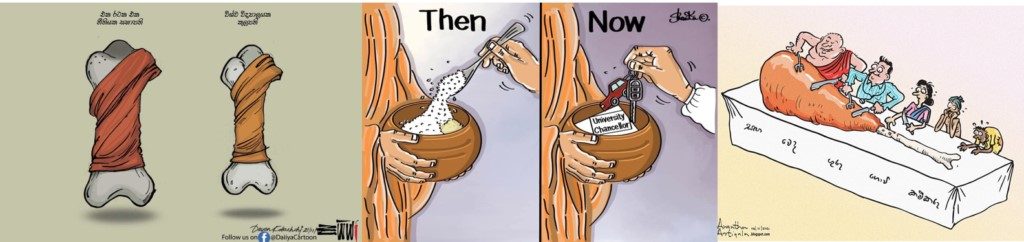
Getting
a Buddhist monk involved in governance matters (in the form of virtual
nationalistic legal framing) is the last thing I would have expected from a
president who the people hoped would bring about a systemic change in the mode
of government. In Sri Lanka’s long history, the kings maintained a close
relationship with the monks, only as religious advisers, not as partners in
making laws or ruling. As a whistleblower, Ven. Gnanasara Thera exposed the
existence of burgeoning religious extremism years ago, but his exposures did
not get enough recognition by the authorities for some reason. Instead, he was
unfairly condemned as an irresponsible rabble-rouser intent on troublemaking
for some political advantage. Ven. Gnanasara is trying to provide the
initiative that only politicians and the Mahanayakes could and should provide
in resolving the single issue that has caused him to deviate from his religious
vows and engage in the rough and tumble of mundane agitational activism . But
he is not equipped to play that role in any way. His berserk behaviour finally
landed him in jail for contempt of court. Had he been more disciplined in his
protests, he wouldn’t have been thus treated, in spite of his intentions having
been genuinely benign as well as patriotic. His personality defect has damaged
not only his personal reputation and his cause, and his credibility as a
defender of the Buddha Sasanaya, the people and the country.
The
Thera has been led astray by the cynical opportunism of politicians who
exploit the sensitive perennial issue of the threat posed to the country’s
age-old Buddha Sasanaya/the Buddhist religious-cultural establishment and to
its historic archaeological heritage in the form of ruins scattered,
particularly, in the north and east. The threat comes from the local
representatives of forms of the religious fundamentalism that is sweeping
across the whole world, especially by different sects of potentially violent
Islamic/Íslamist extremists, sponsored by moneyed foreign agents. Treasure
hunters cause probably more damage to this heritage. Behind the religious
extremists seems to stand the Western imperialist juggernaut that uses
religious fundamentalism and other forms of extremism to destabilise nation
states that it wants to control to achieve varied geopolitical ends at the
latter’s expense.
What
the monks are demanding is protection for the Buddhist establishment from this
threat. Theirs is not a political struggle; they are not fighting for political
ends. What they say is: Stop unfair proselytisation of poverty stricken
Buddhists and Hindus who are equally subject to subversion by numerous foreign
funded, politicized fundamentalist Christian and Islamic sects. The problem can
be easily sorted out if the politicians have the political will to do so, and
if the politicians in power at any time get the government servants working in
the vulnerable areas to implement the available archaeological
conservation and protection laws without abandoning their responsibilities
for illicit monetary gains. The indifference and inaction of the traditional
Mahanayakes (their culpable innocence and ignorance are inexcusable) form the
other strong factor that betrays Buddhist interests.
My
criticism of the establishment of a Presidential Task Force for the
implementation of the One Country One Law headed by a Buddhist monk does not
mean a rejection of that important objective. It must be achieved during the
presidency of Gotabaya Rajapaksa. For that, a proper strategy must be adopted.
However, as the Bar Council of Sri Lanka, has pointed out, the PTF has no role
to play in implementing the stated concept, because the functions assigned to
it are already being performed by the available constitutionally established
institutions including the Parliament and the Ministry of Justice (The
Island/November 3); so, it is a redundant body. The only ‘benefit’ that has
accrued from the controversial move is that it has given the opportunistic
minority politicians who hide behind extremists, without supporting them
openly, extra ammunition for their blasts of criticism against the nationalist
government.
Incidentally,
the Sri Lanka Podujana Peramuna (SLPP), created by Basil Rajapaksa and led by
Mahinda Rajapaksa (the current Finance Minister, and Prime Minister,
respectively) held its 5th National Convention at the Nelum Pokuna Theatre,
Colombo on November 2, 2021. Minister Basil Rajapaksa emphasized the importance
of MR’s leadership. President Gotabaya congratulated the party, in a message,
on its great success within a short time of its inauguration, reflected in its
winning of a near two thirds of parliamentary seats (in August 2020). PM
Mahinda Rajapaksa said, among other things, that the teacher strike and the
farmer agitations would not have dragged on so long if they had maintained more
political engagement with them (Did he mean showering cajolery on them?). He
also made special mention of the young people who voluntarily beautified towns
and cities across the country with beautiful wall paintings (when the new
government came into being in 2019 with the election of the current president,
whose advent generated in them the new spirit of hope that inspired them to
engage in that voluntary exercise without any expectation of a reward); those
youths, the PM remembered, by doing that, indicated their wish that politicians
should not spoil the street walls with their ugly political posters. Where are
those young people now? He asked, and provided his own answer: If they have
joined the queue of passport applicants (who want to acquire a passport with
the intention of leaving the country looking for greener pastures abroad), we
should engage in the kind of politics that will encourage them to return”. If
the PM is genuine about what he is saying here, we may expect him to stop
monkeying around with monks and to change his attitude towards patriotic young
politicians of all parties and communities vis a vis his own son.
The
PM must have meant what he said. If he really does, he will not relapse into the
the 73 year long monkey business of taking the monks for rides or flights. It
is disgraceful how political monks are conducting themselves at this critical
time, especially that sneaky Ratana Thera, who stole the national list MP post
from Gnanasara Thera, who actually earned it for their party, is causing
embarrassment to Gotabaya and the government through his hasty implementation
(for expected personal political reputation) of the organic fertilizer
initiative. Ven. Gnanasara said, to his credit, talking about the PTF, that in
the future the youth of the country must come forward to save the nation. The
country is not short of of young men and women who are capable of providing a
sound modern leadership to the country if only their way is not obstructed by
ambitious oldies whose ‘Vaulting ambition, which overleaps itself, And falls on
th’other… ‘ (i.e., excess of ambition lands them somewhere else than where
they want to reach, lands them in trouble, as happened to Macbeth in the
Shakespeare play).
It
should be hoped that this occasion (the 5th anniversary of the SLPP) be
utilised as an opportune moment to reflect on past errors, and resolve not to
repeat them, and introduce a course correction, starting with rethinking a new
approach to the implementation of the One Country One Law idea, that ensures
the participation of all Sri Lankans, especially the young from all the
communities, something that can be done through the existing agencies.
Conclusion
My
gut feeling is that the Presidential Task Force, if it is what I think it is,
i.e., a brilliantly thought out ploy with an ulterior motive, is meant to abort
the new constitution making project. (I have no idea of whose brainchild this
could be.) It was probably designed to divide Sinhala Buddhists and Hindu
Tamils, also create suspicion between the former and Christians, while
pacifying radicalized Muslims for some unspecified reason. This might help
revive the defeated separatist project, and breathe new life into secretly
growing Islamism, and together help foreign designs on Sri Lanka, provoked
purely by big power geopolitics due to its strategically important location in
the Indo-Pacific region. Pitting guilless Islamist critic Gnanasara Thera against
an Ulama Council maulavi by putting them in the same panel of advisors is like
putting a dove and a cat in the same cage; for when it comes to religion, a
believing Muslim will not compromise their religious principles to accommodate
human reason. The government’s failure to achieve its key objective of
introducing a new constitution will delight the still operative forces
which were behind the 2015 regime change (they may even have acquired new
allies by now). It is good to remember that Mahinda Rajapaksa was betrayed by
his lieutenant three times in a row between 2015 and 2019, which does not
reflect well on his sense of judgement; it could be a different traitor this
time.
President
Gotabaya Rajapaksa is probably the most ethically and morally honest person
ever to hold that post. The frustrated regime changers are now propagating the
faint fictitious notion that he benefited from the April 2019 Easter Sunday
Islamist bombings and that the intelligence services that had reached the
highest professional efficiency levels under him as Defence Secretary during
MR’s time had some connection with them. The charge that the government is
deliberately slow in meting out justice to those responsible for the Easter
bombings is, I think, 100% false. All peace- and justice-loving Sri Lankans
including me want to see the Easter attacks perpetrators receive condign
punishment at the earliest possible; the highest involved (be it president
Maithripala Sirisena, prime minister Ranil Wickremasinghe, during whose watch the
suicide bomb attacks happened or any other individuals accountable) shouldn’t
be spared. I, for one, believe that President Gotabaya, PM Mahinda, and others
in the government will be satisfied with no less.
However,
even the Cardinal seems to have accepted that false allegation, in spite of
repeated assurances given him by the President to the contrary. Two reasons for
the Cardinal’s misgivings that occur to me are: potentially guilty former
president Sirisena seems to be looking for refuge under his erstwhile boss that
he betrayed three times, now PM; the other reason could be Gnanasara Thera’s
arrogant, totally frivolous and uncalled for remarks about the Cardinal’s
activism regarding the Muturajawela environmental issue. Gnanasara Thera was
reported as having said about the Cardinal in this connection: I warn the
Cardinal that he should not overstep his boundaries!” That alone should have
disqualified the monk for the post that he has been appointed. I personally
believe that the President, as a practising Buddhist, can receive much more
constructive advice from the Cardinal than from Gnanasara Thera.
The
paragraph quoted below is about one of the academics that I find mentioned as a
panel member of the PTF. It happens to be the concluding paragraph of an
article of mine that was carried in the Lankaweb online journal on May 1, 2020
(Interested readers may look it up there: https://www.lankaweb.com/news/items/2020/05/01/academic-adolescents-against-the-nationalist-cause/):
It
is strange that this academic was not informed enough about the existing local
realities (not exclusively those uncovered with evidence by the BBS – Bodu Bala
Sena) relating to the problem of the menace posed to Sri Lankans of all races
and religions and worldviews, especially to Sinhala Buddhists and Tamil Hindus
who together form over 80% of the population, from Abrahamic religious
fundamentalists (not from the mainstream adherents of those religions), when he
wrote to that international journal. These monks do ‘deliberate on their views
and stances before involving the public…’; there is nothing wrong with their
actions, but whatever can they do if they are misreported to the world by
indifferent media, and immature ill-informed academics? (A personal opinion)”
Finally,
when the disciplined voters of the country (unfortunately, they don’t have
enough disciplined politicians to serve them) voted for a new president and a
new parliament about two years ago, they never expected a yahapalanaya type of
government to come to power again, whatever happens later. Apparently, the
country hasn’t still emerged from its evil legacy. Gotabaya Rajapaksa
started off with the purest intentions. Buddhists believe in the truth of the
saying: dhammo have rakkhati dhammacari” the dhamma protects the faithful
follower of the dhamma”. He need not fear. But whatever he is intent on doing,
he should first win the agreement and support of the common people before
trying it.
Anyone
with an average familiarity with the recent political history of the world know
that patriotic leaders of independent countries who don’t serve the interests
of more powerful nations at the expense of the welfare and wellbeing of their
own people are not safe. Their safety depends on the people’s goodwill,
provided democracy is allowed to rule. But as we know today, countries find
themselves ruled from outside. That is an unpleasant reality, we can hardly overcome.
In Sri Lanka, the two traditional parties or alliances have two different
attitudes to this predicament. One favours it, the other opposes it. These are
respectively the UNP/SJB and the SLFP/SLPP. The second, the nationalistic
party/alliance, has a problem managing foreign interference, with which the
UNP/SJB seem comfortable with. Nationalists support forces that protect the
country’s democracy, independence, and sovereignty. Gotabaya is a nationalist
leader. Nationalists need not be demoralised when they are falsely attacked as
ethno-nationalist extremists by NGO mercenaries.
If
Gotabaya Rajapaksa is able to bring in a new constitution as a non-party
product that is fashioned according to the common consensus of all
parliamentarians (including essentially all young ones, that is, those under
40, for example) who do not have to vote for it under duress, let that be the
greatest achievement he will be remembered for. Such a constitution should be
one that does not divide the nation on language, religion, or race bases. It
will eliminate the influence of extremists, and definitely incorporate the One
Country One Law principle. Giving anything a special place or special
protection, as experience shows, invariably turns out to be counter-productive.
So, this has to be avoided. This is a controversial suggestion, but it will be
achievable, if the gerontocrats make way for the brilliant youth of the country
to take centre stage in the political arena.