Regime Change & Constitutions – Is Sri Lanka ready?

October 27th, 2021

Shenali D Waduge

Have we learnt any lessons from 73 years of so-called ‘independence’? Have we learnt lessons from 42 elections held since 1931? Have we learnt lessons from Parliamentary & Presidential forms of governance? Have we studied the hidden hands behind every revolt, rebellion, insurgency & even terrorism? Have we identified these entities who are also responsible for dispatching others in disguise to carry out same destabilizing agenda? Have we a team of dedicated people who not only study these trends but devise ways to mitigate same? Is there any point in having such a team if their warnings fall on deaf ears? Do our leaders know the scale of the threats at hand or are they simply riding to survive their period of governance & pass on the mantle to the next but with each turn the country’s sovereignty gets diminished & diluted. With these thoughts let us move on to the topic.

Regime Change is the modern form of ‘invasion’ without boots by securing local lackeys to carry out the task on behalf of their pay masters and sit in prominent positions & carry out the desired changes. These are generally targeting laws, legislative documents, reversal of circulars, extraordinary new gazette notifications and changing anything that legally prevents the paymasters from securing what they want. Therefore, when local lackeys bring about sudden and surprising legislative changes – you should know they are only carrying out their orders.

For an example during the regime change in 2002 that resulted in terrorists given territory and confining the national army to barracks while the armed terrorists went wherever they liked, the US made a proposal to waive off all loans given to Sri Lanka in lieu of handing over our entire forest cover to US. If not for environmentalists and patriots objecting, the government would have happily given into this request.

Colonial Legacies 

What no one can put aside is the colonial legacy we have failed to discard. We are continuing to embrace 443years of colonial brainwashing totally disregarding the centuries of traditional rule which saw no constitution, no ethnic strife, no animosities, no terrorism and was an animal-friendly environment following the dasa-raja dhamma rule. No politician has seen fit to ask the UN or diplomats questioning Sri Lanka about ethnic divisions, to produce a single example of such divisions before 1505. No politician has been brave enough to tell the UN & the Western diplomats that it was they who divided people as majority & minority, it was they who coloured the caste system which was only used to identify the profession of people, it was they who created system of favorites and promoted those that carried tales to them, it was they who created a system of education that purposely denied the majority education & provided education & jobs to minorities to raise their stature above the majority. That education system completely reversed the education system that existed. The colonial education system was to denationalize the people and distance them from their proud history to not defend the nation. This system continues still as even current curricular is decided by international monetary agencies who use the carrot of ‘funding’ to decide what type of curriculum is taught and provide scholarships to the curriculum creators who will never promote anything of national value. This subtle influence exists in other sectors of the country’s governance systems as well. When colonial crimes are not placed on any tribunal- what justice are these former colonial invaders trying to preach!

Euro-centric laws

When the colonial invaders realized they could no longer continue to hold power in the territories they occupied, they handed governance to the local lackeys but kept power via euro-centric laws that they dictate even to this day. All of the laws that exist are rooted in the colonial rule where advantage comes to a handful of nations who form a bloc even inside the UN.

44 countries in Europe, US, Canada, Australia & New Zealand demand 147 countries function to its dictates & command. How fair is this?  

They are completely ignoring that these countries existed before them & they had their own indigenous laws, cultures and traditions which have been completely dropped out of international legal systems. It is time to review this and the non-Western countries in the UN must demand a revisit to the indigenous laws & customs that existed in ancient times to be given their due place. The current euro-centric laws that exist with neo-liberal policies advantageous to a handful are never meant to bring ‘EQUALITY’ except to fool masses with slogans and well-funded dead-end initiatives.

Weakening the Nation & its People

We have had 2 insurgencies and 3 decades of terror – what is important is that Sri Lanka lost some promising youth. The external goal was to indoctrinate youth & pit them against their own with ultimate goal of ‘killing off’ promising youth who would have become powerful future leaders. These were great losses to the nation because these youth (for right or wrong) came forward with courage to fulfil what they were indoctrinated to do. Imagine if that zest was diverted to build the nation. We would have had very powerful leaders. To prevent powerful leaders emerging the foreign hands have a knack to create issues to get our own to eliminate them. Congo lost a promising leader when the US & UK assassinated Patrice Lumumba. Myanmar’s national leader Aung Sang was also killed but his daughter was happy to be a neo-liberal pawn.

We cannot ignore the foreign hands that played a role in each of these devastating periods of our past. The countries involved, the constitutional changes they forced upon us, the agreements they forced us to sign, their missionaries sent (in robes & civil) – these entities still prevail under a different disguise. But their objective has not changed. Only their modus operandi. We cannot foolishly think they have mended their ways simply because they extend a handshake and push new agreements via different players. Have we not learnt lessons to take stock of the risks and dangers of our actions? Are we not able to devise alternative ways or in the least come up with out of the box methods to surprise our historical enemies? Have we failed to identify the gifts & what is hidden inside?

Regime Change & Constitutions

In the recent past we have seen numerous West-infused regime change taking place – the general slogans have been to ‘deliver democracy’ ‘liberate the people’ usher ‘freedoms & rights” etc. With every regime change has been a new constitution primarily to change the impediments that block the regime changers getting what they want from the country that they have subtly taken over via their lackeys. Kosovo had a new constitution but over 10 years after ‘independence’ even entire EU has not recognized Kosovo. South Sudan’s new constitution is seeing meddling by West too.

The best example Sri Lanka can learn from is looking at Nepal whose new constitution resulted even in an economic blockade with India demanding changes to Nepals constitutional clauses which Nepal was not agreeable to. This resulted in India blocking its borders preventing food, medicines and fuel entering Nepal via India’s borders. China had to airlift provisions for the people. Why have we forgotten the parippu drop of 1987 by the same nation which is now getting a part of Colombo Port- a Port where Sri Lanka’s imports come through. Imagine a similar scenario when Sri Lanka pursues with a new constitution if Sri Lanka includes anything disagreeable to India? When Sri Lanka’s leaders fail to tell India that the people do not want 13a and even when the country had 2/3 majority if the government in power failed to remove the 13a – can we expect them to remove 13a in a new constitution? 

Ironically, the country that mothered the constitution does not have a written constitution but UK and EU & US have a knack of insisting legislative changes to Sri Lanka which are slowly being rolled out in Sri Lanka & additional pressure is being exerted using bogus resolutions via UNHRC insisting on further constitutional changes. Thus, it is all a ploy and part of their bigger plot to weaken Sri Lanka. Local lackeys are used to come up with fancy reasons to why changes are needed & dramas are choreographed to use social media to promote their goals. We must all look at the bigger picture.

Presently, a key pillar is being targeted with the aim of diminishing the national security and intelligence apparatus with the UNHRC head threatening to get witness statements against the army commanders who helped defeat LTTE. Again, no politician has seen fit to ask the western diplomats or the UN/UNHRC why restorative justice is being applied to LTTE terrorists and retributive justice to the world’s only army that defeated an internationally banned terrorist group. The politicians will soon meet their waterloo in their role for weakening the nation legislatively, constitutionally & legally – the very pillars that our enemies are trying to weaken via new constitutional changes while continuing their infamous divide & rule theatrics funded from abroad.

The 1789 US Constitution has 27 amendments while India’s 1950 constitution has 104 Amendments, the last in 2020.

How dangerous is it to tamper with a constitution in volatile times?Learn from Africa. None of these amendments are of any benefit to the People except to centralize power away from the People. The People presume they are invited to be involved but it is only a cosmetic façade as the real draft changes happen unknown to the People. With the People believing changes are for their benefit, they eventually find out too late that they have been disappointed again and again & again. Africa’s amendments have been to tighten the power over the people with feigned ‘freedom’ & ‘security safeguard’ promises.

Do we really need to change the constitution when the country is economically & politically unstable & socially vulnerable!

The 1978 Constitution has seen 20 amendments. 16 out of the 20 by the very architects of the constitution & changed between 1978 & 1988 while the 17came only in 2001, 18a in 2010. 19a showed that constitutions should not be done in a hurry and with ill-intent. 

Representatives of Sri Lanka should have allegiance to only one country and they must pledge to only protect the dignity & sovereignty of that country. Anyone must be allowed to contest – rejecting is left to the People by vote. Will constitutional changes ever see a pruned Cabinet/Parliament? NO. The National Unity Government showed politicians greed for power. Will crossovers be banned in a new constitution? Hardly! Will President/Parliament/Judiciary be willing to be bound to uphold the constitution as they only hold ‘delegated’ powers given by the People? No Constitutional Council can have members who are not answerable to the People.

None of the Governments since 1987 even with a majority in Parliament took action to remove 13a – however, adverse as it may look, within the existing constitution, detrimental clause can either be removed or weakened with additional amendments. There is no requirement for a new constitution.Land & Police powers must return to the Centre – national assets and resources belong to the Centre not to provinces, archaeological and historical sites must remain under the Centre. We don’t need a new constitution – a few new amendments can address grey areas.

What we need more than a constitution is a completely new electoral system for people to elect people in proportionate to the population that they contest from & the ability of these people to remove anyone not functioning to their wishes. It is shocking that a party getting 250,000 votes can send 10 MPs to parliament because of the current PR system. The entry requirement to Parliament must be returned to 12.5% instead of the current 5% which will stop ethnic-king makers from holding governments to ransom.

We must take a holistic look at what is unfolding in Sri Lanka. Our enemies are laughing pulling the strings of various people and parties they control to fight each other and create the necessary coloured revolution for their entry on the argument that Sri Lanka is incapable of running its own country. A team of lackeys is deployed to prepare the mental mindset of the people – a bunch of Sri Lanka haters 24×7 complaining about the country. While they are choreographing the social change the notion of a new constitution is only to erase the obstacles that prevent these elements grabbing what should belong to not only us but future generations.

Are you able to put the picture together?

Shenali D Waduge
රෙජිස්ටාර් තනතුර සමඟ සාමදාන විනිශ්චයකාරකම පිරිනමන්න – අග්‍රාමාත්‍ය මහින්ද රාජපක්ෂ මහතා

October 27th, 2021

අග්‍රාමාත්‍ය මාධ්‍ය අංශය

රෙජිස්ටාර් තනතුර ලබා දීමේ දී අධිකරණ අමාත්‍යාංශය සමඟ සාකච්ඡා කරමින් ඔවුන්ට සාමදාන විනිශ්චයකාරකම පිරිනැමීමට පියවර ගන්නැයි අග්‍රාමාත්‍ය මහින්ද රාජපක්ෂ මහතා ඊයේ (26) රාජ්‍ය සේවා පළාත් සභා හා පළාත් පාලන අමාත්‍යාංශයේ ලේකම් ජේ.ජේ රත්නසිරි මහතාට උපදෙස් දුන්නේය.

දීප ව්‍යාප්ත උප්පැන්න මරණ සහ විවාහ රෙජිස්ටාර් සංගමයේ සාමාජිකයන් සමඟ අරලියගහ මන්දිරයේ පැවැති සාකච්ඡාවකට එක්වෙමින් අග්‍රාමාත්‍යතුමා මේ බව පැවසීය.

රෙජිස්ටාර්වරුන්ට පවතින වෘත්තිය ගැටලු සම්බන්ධයෙන් එම සංගමයේ සභාපති දුෂ්මන්ත කරුණානායක මහතා මෙහි දී කරුණු ඉදිරිපත් කළේය.

වැටුප් නොමැති දීමනා ලබන රෙජිස්ටාර්වරුන් වෘත්තිය සේවාවක නිරතව සිටින බවත් තම වෘත්තිය කටයුතු පවත්වාගෙන යාමට සාමදාන විනිශ්චයකාරකම නොමැතිවීම ගැටලුවක් බවත් හෙතම කියා සිටියේය.

කොවිඩ් වසංගතය හමුවේ උප්පැන්න මරණ සහ විවාහ රෙජිස්ටාර්වරු පැය 24 පුරා සේවාවක නිරතව සිටින බව පෙන්වා දුන් දුෂ්මන්ත කරුණානයක මහතා වැටුප් නොලබන නිසා සුදුසු රක්ෂණ ක්‍රමයක් තම සාමාජිකයන්ට ද ලබා දෙන්නැයි ඉල්ලා සිටියේය.

ඒ අනුව රෙජිස්ටාර්වරුන්ට ලබා දිය හැකි සුදුසු රක්ෂණ ක්‍රමයක් ගැන සොයා බලන්නැයි ඒ මොහොතේදීම රෙජිස්ටාර් ජනරාල් ඩබ්ලිව්.එම් එම්.බී වීරසේකර මහතාට අග්‍රාමාත්‍යතුමා උපදෙස් දුන්නේය.

කොවිඩ් එන්නත් ලබාදීමේ ප්‍රමුඛතා සම්බන්ධයෙන් ද සෞඛ්‍ය අමාත්‍යාංශ ලේකම්තුමා සමඟ සාකච්ඡා කරන්නැයි අග්‍රාමාත්‍යතුමා දැනුම් දුන්නේය.

උප්පැන්න මරණ ලියාපදිංචියේ දී දැනට හිමිවන රුපියල් 75 දීමනාව රු.150ක් දක්වාත්, කාර්යාල ලිපි ද්‍රව්‍ය දීමනා රු.500 සිට රු.750 දක්වාත් වැඩි කිරීමටත් සේවය අවසන් කිරීමේ දී රු.50000 සිට රු.ලක්ෂ 5 දක්වා පාරිතෝෂික දීමනාවක් පිරිනැමීමත් 2022 අය වැයට යෝජනා කිරීම සඳහා අවශ්‍ය පියවර ගන්නැයි ද අග්‍රාමාත්‍යතුමා මෙහි දී නිලධාරින් දැනුවත් කළේය.

මෙම අවස්ථාවට අමාත්‍ය චමල් රාජපක්ෂ, අග්‍රාමාත්‍ය ලේකම් ගාමිණී සෙනරත්, අග්‍රාමාත්‍ය අතිරේක ලේකම් නීතිඥ චමින්ද කුලරත්න, මහාභාරකාර නීතිඥ ගනේෂ් ධර්මවර්ධන, රාජ්‍ය සේවා පළාත් සභා හා පළාත් පාලන අමාත්‍යාංශයේ ලේකම් ජේ.ජේ රත්නසිරි, රාජ්‍ය ආරක්ෂක හා ආපදා කළමනාකරණ රාජ්‍ය අමාත්‍යාංශයේ අතිරේක ලේකම් යූ.කේ බණ්ඩාර, ජාතික අයවැය දෙපාර්තමේන්තුවේ අතිරේක අධ්‍යක්ෂ ජනරාල් ජී.එම්.ජේ.කේ ගුණවර්ධන, රෙජිස්ටාර් ජනරාල් ඩබ්ලිව්.එම් එම්.බී වීරසේකර, ලංකා ඛනිජ නීතිගත සංස්ථාවේ සභාපති නීතිඥ සුමිත් විජේසිංහ,දීප ව්‍යාප්ත උප්පැන්න මරණ සහ විවාහ රෙජිස්ටාර් සංගමයේ සභාපති දුෂ්මන්ත කරුණානයක, නියෝජ්‍ය සභාපති ජේ.කේ.ඩී.එස් දිසානායක මහත්වරු ඇතුළු එම සංගමයේ නියෝජිතයෝ පිරිසක් එක්ව සිටියහ.

කොල්ලුපිටිය නව වෙළඳ සංකීර්ණයේ වැඩ කඩිනම් කරන්නැයි අග්‍රාමාත්‍යතුමාගෙන් උපදෙස්

October 27th, 2021

අග්‍රාමාත්‍ය මාධ්‍ය අංශය

ආයෝජකයන් දිරිමත් කරමින් මන්ත්‍රීවරුන් හා නිලධාරින් සියලු දෙනා එක්ව කොල්ලුපිටිය නව වෙළඳ සංකීර්ණ ව්‍යාපෘතිය  කඩිනම් කරන්නැයි අග්‍රාමාත්‍ය මහින්ද රාජපක්ෂ මහතා ඊයේ (26) පස්වරුවේ උපදෙස් දුන්නේය.

කොළඹ මහා නගර සභාවේ පක්ෂ නායක හමුවක් අරලියගහ මන්දිරයේ දී පැවති අවස්ථාවේ අග්‍රාමාත්‍යතුමා මේ බව සඳහන් කළේය.

දැනට කොල්ලුපිටිය වෙළඳපොල පවතින ස්ථානයේ නව වෙළඳ සංකීර්ණය ඉදිකිරීමට යෝජිතය. ඊට අදාළ යෝජිත ව්‍යාපෘතියක් පසුගිය මාර්තු 12 වැනිදා අග්‍රාමාත්‍යතුමා ඉදිරියේ එළිදැක්විණි.

නාගරික සංවර්ධන අධිකාරිය, කොළඹ මහා නගර සභාව සහ ඒ සඳහා තෝරාගන්නා ආයෝජකයකු එක්ව මෙම ව්‍යාපෘතිය ක්‍රියාත්මක කිරීමට නියමිතය.

මෙසේ හඳුනාගත් ව්‍යාපෘති තවදුරටත් කල් දැමීම වෙනුවට දැනට පවතින ගැටලු සාකච්ඡා කරමින් මන්ත්‍රීවරුන්ගේ හා නිලධාරින් එකඟත්වය ඇතිව ආයෝජකයන් දිරිමත් කරන්නැයි අග්‍රාමාත්‍යතුමා මෙහි දී කියා සිටියේය.

අදාළ නව වෙළඳ සංකීර්ණය තුළ දැනට එහි වෙළඳාම් කරන සියලු දෙනාට කඩ කාමර වෙන්විය යුතු බව ද අග්‍රාමාත්‍යතුමා අවධාරණය කළේය.

කොළඹ නගරාධිපතිනි රෝසි සේනානායක, උප නගරාධිපති අල්ජාජ් එම්.සී.එම් ඉබ්බාල්, විපක්ෂ නායක එම්.එච් මන්සිල් ඇතුළු නාගරික මන්ත්‍රීවරු, අග්‍රාමාත්‍ය ලේකම් ගාමිණී සෙනරත්, නාගරික සංවර්ධන අධිකාරියේ සභාපති උදය නානායක්කාර, අධ්‍යක්ෂ ජනරාල් ප්‍රසාද් රණවීර, නාගරික සංවර්ධන අපද්‍රව්‍ය බැහැරලීම හා ප්‍රජා පවිත්‍රතා කටයුතු රාජ්‍ය අමාත්‍යාංශයේ අධ්‍යක්ෂ ජනරාල් එස්.කේ දේවරාජා මෙනවිය, නාගරික කොමසාරිස් රෝශිනි දිසානායක මහත්ම මහත්මීහු ඇතුළු පිරිසක් මෙම අවස්ථාවට එක්ව සිටියහ.

ක්‍රීඩාව හරහා ක්‍රීඩකයා තුළ නිර්මාණය වන විනය රටේ සංවර්ධනයට සෘජුවම බලපානවා. -අමාත්‍ය නාමල් රාජපක්ෂ මහතා –

October 27th, 2021

තරුණ හා ක්‍රීඩා අමාත්‍යාංශය. සංවර්ධන සම්බන්ධීකරණ හා අධීක්ෂණ අමාත්‍යාංශය.ඩිජිටල් තාක්ෂණ හා ව්‍යවසාය සංවර්ධන රාජ්‍ය ආමාත්‍යාංශය.

ශ්‍රී ලංකාවේ කොරියානු තානාපති කාර්යාලය මගින් මාර්ගගත ක්‍රමවේදය ඔස්සේ පැවත් වූ 2021 කොරියානු තානාපති ටයිකොන්ඩෝ ශූරතාවලියේ සම්මාන ප්‍රදාන උත්සවය අමතමින් අද (26) දිනකොරියානු තානාපති කාර්යාලයේ දී තරුණ හා ක්‍රීඩා, සංවර්ධන සම්බන්ධීකරණ හා අධීක්ෂණ අමාත්‍ය සහ ඩිජිටල් තාක්ෂණ හා ව්‍යවසාය සංවර්ධන රාජ්‍යඅමාත්‍ය නාමල් රාජපක්ෂ මහතා මේ බව පැවසීය.

මෙහිදී කාණ්ඩ 04ක් යටතේ සම්මාන ප්‍රදානය කෙරිණි.

  • ප්‍රශංසා ඵලක පිළිගැන්වීම
  1. ශ්‍රී ලංකා ටයිකොන්ඩු සම්මේලනය විසින් කොරියානු තානාපති අතිගරු වූජින් ජියොන් මහතා වෙත ප්‍රශංසා ඵලකය පිළිගැන්වීම.
  • කොරියානු තානාපතිවරයා විසින් ශ්‍රී ලංකා ටයිකොන්ඩෝ සම්මේලනය වෙත ප්‍රශංසා ඵලකය පිළිගැන්වීම.
  • හොඳම විනිසුරුවන් සඳහා වන සම්මාන
  1. වයි.ඩී.කුමාර ද සිල්වා
  • ඩබ්.ඒ.ඩී.එම්. අසිත වික්‍රමතුංග
  • එම්.ආර්.රත්නසේකර
  • YouTube  ජයග්‍රාහකයන් සඳහා වන සම්මාන
  1. YouTube හි වැඩිම Likes සඳහා වන සම්මානය – ආර්. එම්. දුනීෂා උවන්දි  – බදුල්ල දිස්ත්‍රික් ටයිකොන්ඩෝ සංගමය.
  • YouTube හි වැඩිම නැරඹුම් කාණ්ඩය (Views) සඳහා වන සම්මානය – ආර්. එම්. දුලක්ෂා දේවින්දි – බදුල්ල දිස්ත්‍රික් ටයිකොන්ඩෝ සංගමය.
  • මුහුණු පොතේ ජයග්‍රාහකයන් සඳහා වන සම්මාන
  1. Face Book හි වැඩිම Likes සඳහා වන සම්මානය – ආර්.එම්. දුලක්ෂා දේවින්දි – බදුල්ල දිස්ත්‍රික් ටයිකොන්ඩෝ සංගමය.
  • Face Book හි වැඩිම Shares සඳහා වන සම්මානය – යූ.එල්.ටී.එම්.ප්‍රේමකුමාර  – රත්නපුර ධර්මපාල ටයිකොන්ඩෝ සමාජය.

එහිදී අමාත්‍යවරයා මෙසේ ද කීය.

‘‘මාර්ගගත ක්‍රමය ඔස්සේ පැවති මෙම තරගාවලියේ සම්මානලාභීන්ට පළමුව මා සුබ පතනවා. කොවිඩ් වසංගතය නිසා මාර්ගගත ක්‍රමය ඔස්සේ මෙවර කොරියානු තානාපති ශූරතාවලිය පැවැත්වීමට සිදු වූවා.

දෙරට අතර පවතින විදෙස් සබඳතාවට අමතරව ක්‍රීඩාවට කැමති හා ක්‍රීඩාව ප්‍රවර්ධනය කිරීමට උනන්දුවක් දක්වන තානාපති කෙනෙක් අපට ලැබීම සම්බන්ධව මා සතුටුවෙනවා.

මෙවැනිම සම්මාන උළෙලවල් දෙකකට මම කොරියානු තානාපති කාර්යාලයට මීට පෙර පැමිණ තිබෙනවා. මෙවැනි තරගාවලි සංවිධානය කිරීම පිළිබදව හා ක්‍රීඩාව ප්‍රවර්ධනය කිරීමට ඔබ ගන්නා උත්සාහය පිළිබදව ඔබ සියලුදෙනාට ස්තූතිවන්ත වන අතර එය ඉතා අගය කරනවා.

ඉදිරියේදී මෙම තානාපති කාර්යාලයේ සහාය ඇතිව පාසල් මට්ටමින් ටයිකොන්ඩෝ ක්‍රීඩාව ප්‍රචලිත කරන්න කටයුතු කරනවා. ක්‍රීඩාව හරහා ක්‍රීඩකයා තුළ නිර්මාණය වන විනය රටේ සංවර්ධනයට සෘජුවම බලපානවා.

ටයිකොන්ඩෝ ක්‍රීඩකයින්ට හා එම සම්මේලනය වෙත ඔබ ලබා දුන් ක්‍රීඩා භාණ්ඩ පරිත්‍යාගය  පිළිබඳ ස්තූතිය පිරිනමන අතර එය ඔවුන්ගේ දක්ෂතා ඔප්නංවාගැනීමට බොහෝ උපකාර වේ යැයි මා විස්වාශ කරනවා.

රටවල් දෙක අතර රාජ්‍යතාන්ත්‍රික බැදීම වර්ධනය වන ලෙස කටයුතු කිරීම හා ක්‍රීඩාවේ ප්‍රවර්ධනයට වැඩි දායකත්වයක් ලබාදීම සම්බන්ධයෙන් ඔබට, ඔබේ රජයට හා මෙහි සිටින සුහදශීලී කාර්ය මණ්ඩලයට මම බෙහෙවින් ස්තූතිවන්ත වනවා.

මෙම කොවිඩ් වසංගත තත්ත්වයෙන් මිදී ලබන වසරේ දී කොරියානු තානාපති ශූරතාවලිය සාමාන්‍ය පරිදි පැවැත්වීමට හැකි වේ යැයි අපි බලාපොරොත්තු වන අතර අද දින සම්මාන ලැබූ සියලුදෙනාට මා සුබ පතනවා.‘‘ යැයි අමාත්‍යවරයා පැවසීය.

කොරියානු රජය විසින් ශ්‍රී ලංකා ටයිකොන්ඩෝ සම්මේලනය වෙත සිදුකළ උපකරණ පරිත්‍යාගය කොරියානු තානාපතිතුමන් විසින් ශ්‍රී ලංකා ටයිකොන්ඩෝ සම්මේලනය වෙත භාරදීමත් මෙහිදී සිදුවිය.

මෙම අවස්ථාවට කොරියානු තානාපති අතිගරු වූජින් ජියොන් මහතා (HE Woonjin Jeong), කොරියානු තානාපති කාර්යාලයේ දෙවන ලේකම් ලිම් සො යොන් (Lim So Yeon), ක්‍රීඩා සංවර්ධන දෙපාර්තමේන්තුවේ අධ්‍යක්ෂ ජනරාල් අමල් එදිරිසූරිය, ටයිකොන්ඩෝ සම්මේලනයේ සභාපති චමින්ද පුංචිහේවා, උප සභාපති කංචන ජයරත්න, ලේකම් රුවන් අලහකෝන්, Master Korea government Kukkiwon යන මහත්ම මහත්මීහු ඇතුළු පිරිසක් සහභාගී වූහ.   

මාධ්‍ය ඒකකය,

තරුණ හා ක්‍රීඩා අමාත්‍යාංශය. සංවර්ධන සම්බන්ධීකරණ හා අධීක්ෂණ අමාත්‍යාංශය.ඩිජිටල් තාක්ෂණ හා ව්‍යවසාය සංවර්ධන රාජ්‍ය ආමාත්‍යාංශය.

Sri Lanka Church demands Easter Sunday justice – did the Church punish Church priests linked to LTTE?

October 27th, 2021

Shenali D Waduge

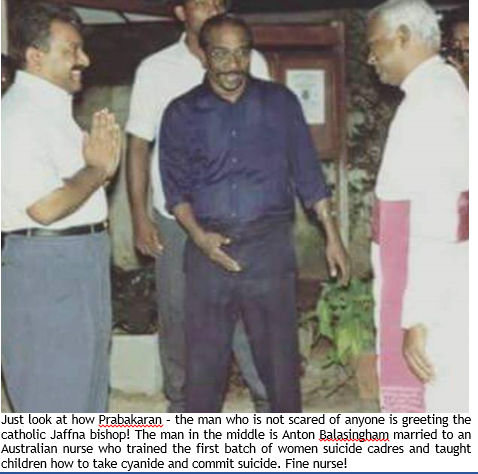
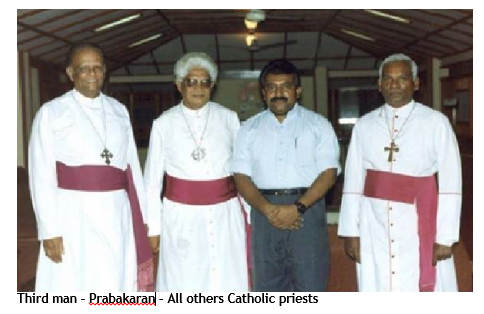
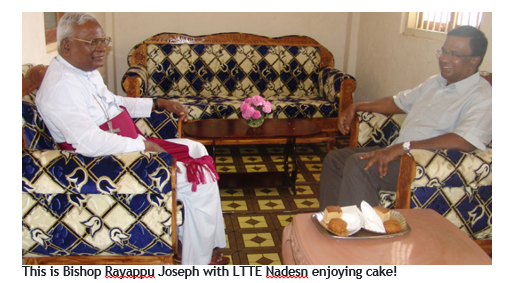
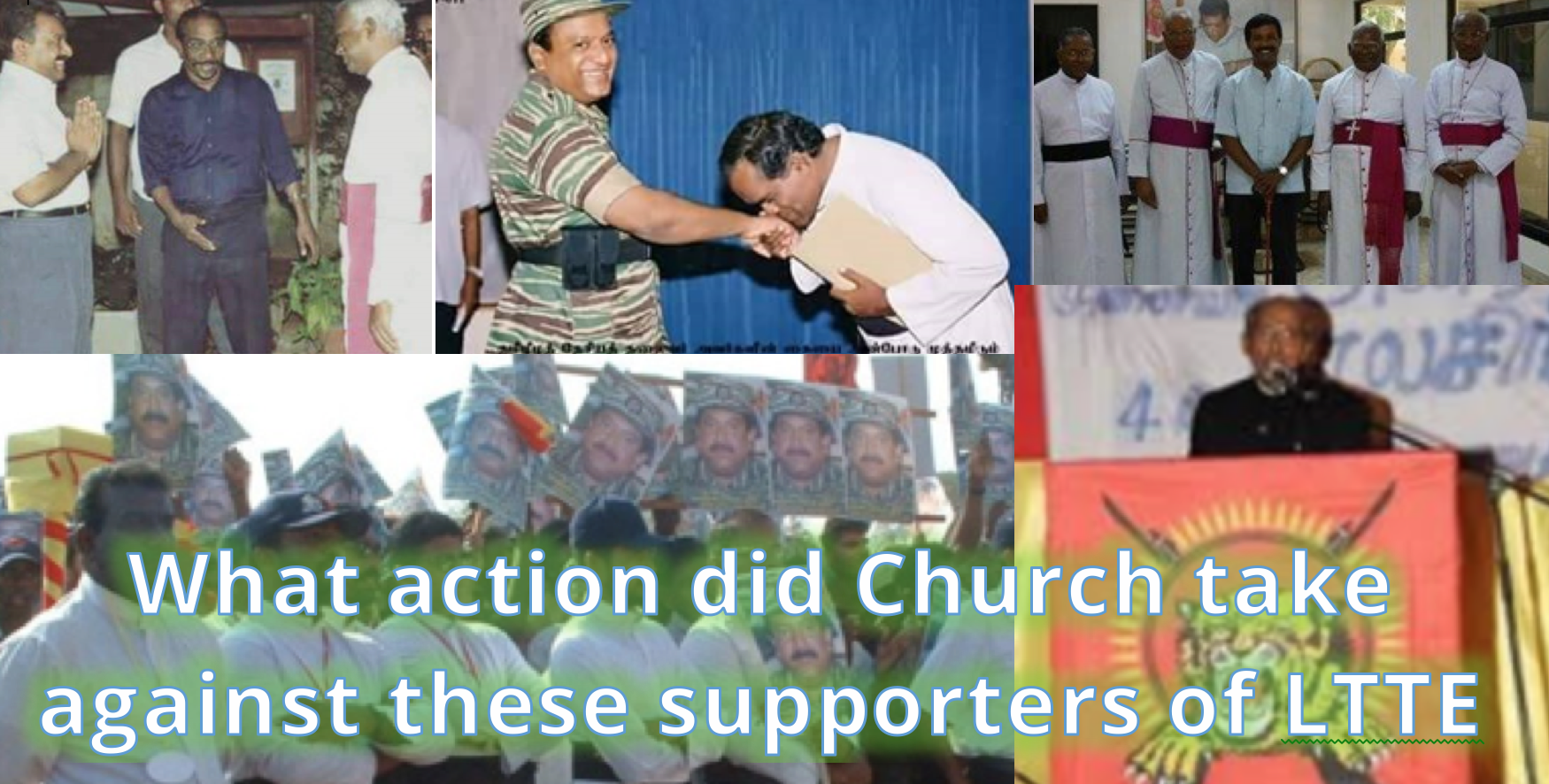
A terrorist and a terror attack whatever justification for their killings must be abhorred by all. Sri Lanka is no stranger to killings since independence. We have seen JVP killings, UNP mass killings in 1980s/early 1990s, 3 decades of LTTE killings and when we thought that ended with May 2009, we were surprised with the Easter Sunday mass murder. None of these murders are more important than the other. All these heinous crimes were aimed at innocent people and were calculated murder. What is the justice that the dead and their families have got? While we have demanded justice from LTTE & all those who were part of LTTE nexus, the international community demands release of LTTE combatants. The Church now demands justice for the Easter Sunday dead, demanding the exposure of the masterminds behind the attack, but the Church is conveniently forgetting that the Church did nothing against Church priests who were openly and abashedly helping LTTE including scores of faith-based NGOs with funding. Can we ask the Church why it is selective in its demand for justice? Innocent people were killed by LTTE just as innocent people were killed by pro-ISIS Islamic terrorists. Why didn’t the Church take action against the likes of Rayappu Joseph et al?

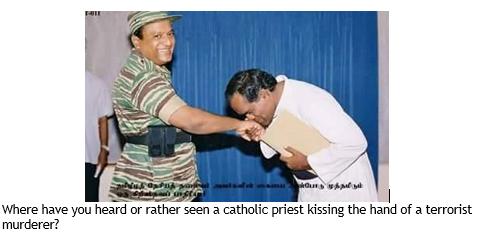
Father S. J. Emmanuel: Former Vicar-General of Jaffnacalled Prabakaran‘Jesus Christ’, the LTTE ‘soldiers of Christ’, the suicide bombers ‘martyrs of the Catholic Church’ to whom the Church provided a Catholic burial, and proclaimed himself as ‘the Moses’ who would lead the Tamil nation from the bondage of Sinhalese-Buddhists to the land chosen for them by God: Eelam. He now leads the Global Tamil Forum and entity banned by the GoSL

Why would the Church allow a separate congregation for Tamils and non-Tamils inside the Church – in a religion preaching to all equally and when all are supposed to be God’s children?

Fr. Jegath Gasper Rajmain link for Tigers in India Tamil Tigers and the Church consider Fr. Gaspar Raj as their latest pop priest.”


LTTE Voice of Tigers tied up with Radio Veritas, a Catholic broadcasting station run by the Asian Catholic Bishops Conferencebased in The Philippines. The Tamil Service of the Radio Veritas is run by the Tamil Catholics of Tamil Nadu. 

Voice of Tigers had a coordinating office” inside St. Sebastian’s Church in Mallavi, Wanni; ran LTTE’s Voice of Tigers with Radio Veritas (run by Asian Catholic Bishops Conference) which reached an audience of 850,000 people.

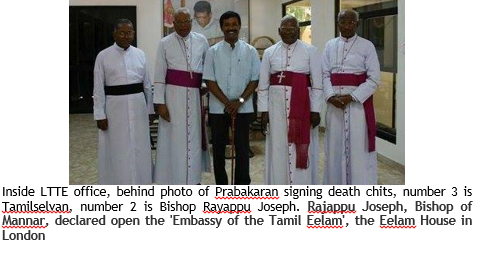
the office was opened by the pro-LTTE Bishop of Mannar Fr. Rayappu Joseph.

Incidentally, Jaffna Mayor and MP of the Sri Lanka Freedom Party, Alfred Duraiappa, Prabhakaran’s first assassination, had got off at the Madhu Church before proceeding to Jaffna. Many believe it was a tip off from the Church that informed Prabhakaran of Duraiappah’s arrival in Jaffna, leading to his death.

18 February 2013 – Rev. Rajappu Joseph with 132 Catholic priestswrote to the President and members of the 22rd UNHRC session appealing for a resolution on accountability, reconciliation, human rights in Sri Lanka. The letter starts ‘As a group of concerned Christians’ and requested that the UN ‘acknowledge the international self-determination of the Tamil people’– this directly depicts his guilt in openly canvassing for the balkanization of Sri Lanka politically if not through the LTTE as was seen in his association with the LTTE leader.

World Council of Churches has been promoting the concept of traditional homeland theory in 1994 at the UNHRC in Geneva. www.sangam.org

January 2014 – Rev. Rayappu Joseph and Rev. Thomas Savundaranayagam alleged that cluster bombs were used by the Sri Lankan army to Stephen Rapp, and to look into deliberate attacks on hospitals, places of worship and the blockade of food and medicine for the civilians trapped in the fighting.

3rd March 2014 – Rev. Rajappu Joseph joined 204 Tamil Christian priestsin writing to the UNHRC Members to call for an international investigation on Sri Lanka

5th March 2014 – Rev. Rajappu Joseph joined 34 othersignatories including Desmond Tutu, C. V.  Wigneswaran, R.  Sambandan, Yasmin Sooka (Member of UN Panel of Experts) in a petition demanding UNHRC to set up a Commission of Inquiry on Sri Lanka

the World Council of Churches that sponsored the LTTE office in LondonEelam House” which commenced its operation from 1984 officially opened by Father Reyappu Joseph denigrating the SL Government in general and the Sinhalese Buddhist in particular.

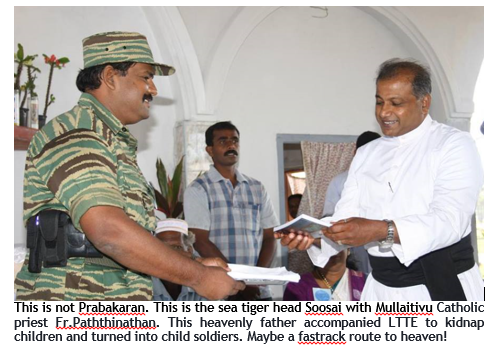
LTTE abducts 16 children from Catholic Church run orphanage –Dharmapuram  

A cultural event held at Thirumalai pavilion on 16 December 2012 staged 3 dramas enacted by children from Jaffna Central College, Hindu College and Vembadi Girls College highlighting torture and harassment by the GOSL and SL Army, that Eelam cause was not over even though LTTE cadres were dead(Nilavinai Kurudakka Mudiyathu) and children acting as rehabilitated cadres claiming they had been brainwashed (Kannadiyin Peyum Malai).

On 27 July 2013 another drama was staged and shown to over 1000 on the 13th amendment, the Katchchativu issue– these were all efforts to build resentment against the Government.

Clergy involved: M. V. E.  Ravichandran (In Charge), Justin Gnanaprakasham (Committee Coordinator), Anton Jeyamsnadan (Pullopalai East Church)

27 August 2013 – Catholic clergy from Vavuniya, Mannar, Kilinochchi, Mullaitivu and Jaffna together with TNA and TNPF politicians conducted anti-Government protests in front of the UN officeduring visit of Navi Pillay. Also participating were Rev. Sebbamalai and Rev. Francis Cruz (Neru) of the Mannar Citizen Committee.

Navi Pillay visiting Trincomalee had an hour-long discussion with Fr. Yogeshwaran, a human rights activist of the Jesuit Novitiate, She did not meet a single victim of LTTE terrorism.

Responsibility of the Church

Just as the Church is demanding accountability for Easter Sunday, perhaps the same Church can explain their silence about taking action against Church clergy openly promoting and linked to LTTE terrorists.

  1. Jebanesan, Bishop of Church of South India was thrown out of the Church of South Indiafor using the Church for LTTE activities and this is a good moral lesson the Church in Sri Lanka should follow.

The LTTE killed more people than we care to count. To know that Church priests were associated with such an entity while the Church took no action against them is shocking to say the least. However, the same Church is demanding justice and accountability and exposure of all masterminds linked to the Easter Sunday suicides.

Will the Church take action against all of the Church clergy linked to the LTTE?

Will the Church take action against all Catholic/Christian laymen linked to and associated with the LTTE?

Will the Church take action against all Catholic/Christian NGOs that helped LTTE?

Will the Church care to respond to the role of its clergy in LTTE terror since 1970s. When will the Church take action or will the Church take action?

Shenali D Waduge

Special letter to Agriculture Secretary (Video)

October 27th, 2021

Courtesy Hiru News

A special letter has been sent to the Secretary to the Ministry of Agriculture by a group of university professors, lecturers, and senior officials in the field of agriculture.

The letter has been sent seeking an opportunity to propose an efficient and effective program combining the real potential of organic farming in the country and the latest technologies related to it.

With the signatures of 141 people, they have stated that they intend to propose to the government a program that can be implemented to resolve the crisis in the agricultural sector facing the country and to implement it in line with the Green Agriculture Vision.

Meanwhile, farmers in various parts of the country staged protests today, claiming that they were unable to cultivate due to the lack of fertilizers and agrochemicals.

Representatives of 41 farmers’ organizations in the Bakamuna area in Polonnaruwa have started a hunger strike three days ago to demand fertilizer for their crops.

Meanwhile, Hiru News team inspected the farming lands in the Ampara District, which are cultivated using organic fertilizer

Appointment of militant monk to head task force on uniform laws raises human rights concerns

October 27th, 2021

By P.K.Balachandran Courtesy NewsIn.Asia

Colombo October 27:  The Sri Lankan President Gotabaya Rajapaksa on Wednesday appointed a Presidential Task Force (PTF) to study the implementation of the One Country, One Law” concept and prepare a draft Act to bring about one law for all Sri Lankans, irrespective of religion or ethnicity.

The move to get everybody to obey the same laws is laudable. The concept One Country, One Law” is a hallmark of modern democracies. But the appointment of the militant anti-Muslim monk, Venerable Galagoda Aththe Gnanasara Thero, as the Chairman of the Task Force, has made many liberals and human rights workers in Sri Lanka wonder if the PTF will be even-handed, render justice to all communities, and respect their distinct cultures and sentiments.

Apart from Ven.Gnanasara Thero, the PTF comprises Prof. Dayananda Banda, Prof. Shanthinandana Wijesinghe, Prof. Sumedha Siriwardana, N.G. Sujeewa Panditharathna, Attorney-at-Law Iresh Senevirathne, Attorney-at-Law Sanjaya Marambe, Eranda Navarathna, Pani Wewala,, Moulavi Mohamed of Ulama Council in Galle, Lecturer Mohamed Inthikab, Kaleel Rahuman and Azeez Nizardeen.

The tasks assigned to the PTF are: (1) Formulation and implementation of laws that are fair by all, as set out in the Constitution of the Democratic Socialist Republic of Sri Lanka.” (2) Ensure that no citizen is  discriminated against in the eyes of the law and that no special treatment on grounds of nationality, religion, caste or any other consideration is given to anyone. (3) Ensure that the laws made under the One Country, One Law” concept are in accordance with nationally and internationally recognized humanitarian values.

The PTF is tasked with studying the draft Acts and amendments that had already been prepared by the Ministry of Justice in relation to this subject, examining their appropriateness and making suggestions.

Concerns

While the objectives stated in the gazette reflect a universal yearning for equality before the law, there are major concerns given the ground reality in Sri Lanka. Firstly, there is no Tamil in the PTF. In other words, the PTF has no representative of the island’s second largest ethnic and religious community. Secondly, the Cabinet has already decided to ban the Muslim Qazi courts and amend the Muslim Marriage and Divorce Act, a decision Muslim leaders oppose tooth and nail. Thirdly, doing away with community-specific laws could be deemed a human rights violation by the UN Human Rights Council and the European Union.

Based on the government’s action, the EU could withdraw the GSP-Plus tariff concession to Sri Lanka which is coming up for review shortly. Withdrawal of the EU GSP-Plus trade concession will adversely affect Sri Lankan exports to Europe and impact the working population in Sri Lanka.

Ven.Gnanasara Thero’s Appointment

Lastly, and most importantly, the Chairman of the PTF is the Ven.Galagoda Aththe Gnanasara Thero, an extremely anti-Muslim Buddhist monk who is the General Secretary of the militant Buddhist organization, the Bodu Bala Sena (BBS). Ven. Gananasara Thero has been very close to President Gotabaya Rajapaksa and Prime Minister Mahinda Rajapaksa. He is also close to the Sri Lanka Freedom Party (SLFP) leader and former Sri Lankan President Maithripala Sirisena. If fact, when Ven.Gnanasara Thero was sentenced for six years in a contempt of court case, the then President, Maithripala Sirisena, pardoned and released him.       

The pardoned given to the monk on May 23, 2019, evoked protests from human rights activists because it violated all legal norms and procedures and was in direct contradiction with the concept of equality before law” and a common law for every Sri Lankan.”

The Centre for Policy Alternatives (CPA) pointed out that the monk was convicted by the Court of Appeal on 8th August 2018 and sentenced to 6 years in prison. The Supreme Court rejected his appeal. The CPA stressed that Presidential pardons exist to correct miscarriages of justice. But in the monk’s case, there was no miscarriage of justice as both the Court of Appeal and the Supreme Court had duly dismissed his appeals.

As such, the pardon itself amounts to an undue interference with the legal process,” the CPA said in a statement. It further said: The pardon legitimized the view that it is possible to act with contempt for the judiciary, be punished through a legitimate judicial process, and then enjoy impunity through a pardon granted on political considerations.”

The CPA pointed out that the pardon specifically signaled that some categories of citizens, such as the Buddhist clergy, could expect to enjoy preferential treatment when it comes to obeying the law.

The pardon came at a time when extremist Buddhist mobs instigated anti-Muslim riots across North Western Sri Lanka, resulting in the death of one Muslim man and the damage to a large number of Muslim residences, businesses and places of worship, the CPA said. Ven. Gnanasara Thero had played a documented role” in the past as Secretary of the Bodu Bala Sena in spreading hate speech and inciting violence towards minority communities, particularly Muslims.

The pardon represented a worrying endorsement of such anti-minority sentiment, and could only heighten the anxiety and fear being felt by Muslim Sri Lankans,” the CPA said.

In 2014, Ven.Gnanasara Thero had instigated mobs to attack Muslim houses and business estabishments in Aluthgama town, south of Colombo. Prior to that he had campaigned against the wearing of the face covering by Muslim women in public on security grounds, and had agitated for the abolition of Halal certification for food products.

Ven.Gnanasara’s has a fixation about Islamic terrorism and propagated the notion that Sri Lankan Muslims tolerate extremists in the community. On September 13, 2021 he told Hiru TV’s Salakuna program that there could be another attack similar to the Easter Sunday bombings on April 21, 2019 in which more than 260 died. He further said that the bombs were ready to be detonated at any time; that he knew the groups involved; and that the President had also been informed.

This spread deep concern among Catholics. The Catholic church, which has been bitterly complaining about the government’s tardiness in getting to the bottom of the Easter Sunday attacks, demanded an urgent inquiry to ascertain the truth.

‘කාබනික හෙට කරන්නැයි අපි කීවේ නෑ..’ පාදෙණියගේ රහස රටටම ඇසේ…

October 27th, 2021

උපුටා ගැන්ම ලංකා සී නිව්ස්

රජය විසින් ගෙන යන කාබනික පොහොර වැඩපිළිවෙළ සම්බන්ධයෙන් අද කොළඹ පැවති මාධ්‍ය හමුවකදී වෘත්තිකයන්ගේ ජාතික පෙරමුණ විසින් විවේචන එල්ල කරන ලදී.

https://www.facebook.com/watch/?v=830397407629112&t=0

මාධ්‍ය හමුවට පෙර එහි පැමිණි රජයේ වෛද්‍ය නිලධාරීන්ගේ සංගමයේ සභාපති අනුරුද්ද පාදෙණිය මහතා එම පෙරමුණේ ලේකම්වරයාට උපදෙස් දෙන ආකාරය පටිගත වී තිබිණි.

කාබනික වැඩපිලිවෙල හෙට කරන්න කියා නොකී බවත්, එය විය යුතු බව පමණක් කී බවත් මාධ්‍යට කියන්නැයි ඔහු උපදෙස් දුන්නේය.

සුරක්‍ෂිත ආහාර තිබීම වෛද්‍ය සංකල්පයක් නිසා කියූ බවත් ඒ සදහා වැඩපිලිවෙලක් සකස් කලද රටට කියන්ට බාර නොගත් බවත් ගොවියාත් ඇතුළු දෙදෙනාම රැකගත යුතු බවද පවසන්නැයි ඔහු එහිදී පැවසීය.

මේ ආණ්ඩුව පොහොර ගැන මෙලෝ දෙයක් දන්නෑ.. ලොකු මුදලක් දී නොවටිනා පොහොරක් ඉන්දියාවෙන් ගේනවා..- තිස්ස විතාරණ

October 27th, 2021

උපුටා ගැන්ම ලංකා සී නිව්ස්

වත්මන් ආණ්ඩුව පොහොර ගැන මෙලෝ දෙයක් දන්නේ නැතැයි ශ්‍රී ලංකා පොදුජන පෙරමුණේ පාර්ලිමේන්තු මන්ත්‍රී මහාචාර්ය තිස්ස විතාරණ මහතා සඳහන් කරයි.

විශාල මිලක් වියදම් කරමින් කිසිම ගුණාත්මක බවක් නැති පොහොර මිලදී ගන්නා බව ගන්නා බවද ඔහු පැවසීය.

ඒ මහතා මේ බව සඳහන් කළේ ලංකා සමසමාජ පක්ෂ ශ්‍රවණාගාරයේදී පැවති විශේෂ සාකච්ඡාවක් අමතමිනි.

දැනට ඉන්දියාවෙන් ආනයනය කරමින් ඇති පොහොර වර්ගයට වඩා ලාභ සහ ගුණාත්මක භාවයෙන් වැඩි පොහොර ස්ලින්ටෙක් ආයතනය විසින් දියුණු කර ඇති බවද ඔහු සඳහන් කළේය.

ශ‍්‍රී ලංකාවට එම පොහොර වර්ගය සාදා විදේශයන්ට අපනයනය කල හැකි බවත් ඔහු තව දුරටත් කියා සිටියේය.

Sri Lanka’s economy seen as a ‘ticking time bomb’

October 27th, 2021

MUNZA MUSHTAQ, Contributing Writer Courtesy Nikkei Asia

Central Bank has been printing money as tax take falls and prices soar

COLOMBO — Sri Lanka’s COVID-stricken economy is being likened to a ticking time bomb that could go off at any moment as foreign reserves plummet, the cost of living rises and the central bank carries on printing money.

The Central Bank of Sri Lanka printed over 130 billion rupees ($640 million) in October alone, but that is just the iceberg’s tip. From December 2019 to August 2021, Sri Lanka’s money supply increased by 2.8 trillion rupees — a massive 42%.

Much of the money went to pay the salaries of 1.2 million state sector employees, and to cover pensions that each year cost the government a thumping one trillion rupees. Unlike the private sector, which suffered salary cuts during the COVID-19 pandemic, state employees carried on at full pay despite the empty public coffers. Money was also printed with a view to keeping interest rates low.

Though it has generally been characterized as printing money, most of the increase in the overall money stock — or “broad money” as it is termed — since the end of 2019 is made up of government borrowings from the central bank and commercial banks.

Addressing a press conference earlier this month, Central Bank Governor Ajith Nivard Cabraal defended the decision to print money on the grounds that it was needed to maintain stability.

“If you read the monetary law, one of the responsibilities of the central bank is price stability as well as financial system stability,” he said. “Sometimes, in the interest of financial system stability — as well as economic and price stability — there can be instances where additional treasury bills could be issued to the government.”

Cabraal said similar money supply increases have been seen in about 120 countries “as a result of the pandemic.

This view is not acceptable to W. A. Wijewardena, a former central bank deputy governor. He has warned that the 42% increase will pump severe inflation, possibly to over 40% in the next few years.

“Normally a central bank can allow this money stock to increase without causing inflation if the increase is equivalent to the real growth of the economy,” Wijewardena told Nikkei Asia. Since growth in 2020 was -3.6% and is expected to be around 4.5% in 2021, real net growth for the two years will be “about 1%,” he said.

It was Wijewardena who used the economic time bomb analogy: “It is now ticking and can go off at any time,” he told Nikkei.

Some experts warn that inflation in Sri Lanka could go beyond 40% from just over 6% at present.     © Getty Images

Sirimal Abeyratne, an economics professor at the University of Colombo, is more supportive of the current monetary policy because of the fiscal damage the pandemic has caused. The extra money has helped fund government spending and kept interest rates down for private credit.

But he thinks the approach should be “only temporary,” and notes that the central bank actually tightened monetary policy in September when inflationary signals were detected. He told Nikkei that a price has also been paid “in terms of exchange rate pressure.”

Sergi Lanau, deputy chief economist at the Washington-based Institute of International Finance, has taken a similar view. Sri Lanka’s central bank was compelled to finance the government’s significant expenditure during the pandemic, “which was not unusual.” The central banks of the Philippines and of Indonesia did much the same. But he cautioned that “if money printing continues, we can expect pressure on inflation and on the exchange rate, which does not help resolve the ongoing crisis.”

Cabraal told the press conference that higher inflation is a concern. “We are conscious of that and we will manage it,” he said. “We don’t want to see a situation where inflation could rise unduly.” He predicted “a slight dip” in December, and said the central bank intended to ensure price rises do not accelerate into double digits.

In mid-October, Colombo lifted price controls on essential food items, including household gas. That saw the the price of a 12.5 kilogram cylinder of cooking gas jump from 1,400 rupees to 2,675 rupees in the space of a week. A 400 gram pack of milk powder, a staple in almost every Sri Lankan home, increased to 480 rupees from 380 rupees, and wheat flour went up by 10 rupees a kilo causing a domino effect in bread and other flour-based products.

Last week, the Lanka Indian Oil Company, which competes with the state-run fuel distributor Ceylon Petroleum Corporation (CPC), announced a 5-rupee increase per liter of fuel with effect from Oct. 21. CPC has since been seeking approval to increase fuel prices after suffering a loss of 70 billion rupees this year up to August.

Sri Lanka’s inflation rate has increased this year from around 4% to about 7%, but fell back slightly in September. The September food index was meanwhile up 22% compared to two years earlier.

Abeyratne said the price increases were in large part due to ad hoc and piecemeal policy decisions.

In 2019, soon after President Gotabaya Rajapaksa was elected president, sweeping tax cuts were announced to make good on an election pledge. The bonanza included cutting value-added tax to 8% from 15%, and abolishing the 2% nation-building tax on domestic goods and services.

Whilst the government blames the pandemic for the economic reversal, Eran Wickramaratne, a former state minister of finance, considers the tax cuts to be one of the main causes.

President Gotabaya Rajapaksa marking Independence Day in Colombo on Feb. 4. On his watch, government revenue sank last year to 9.6% of gross domestic product from 12.6% in 2019.   © Reuters

“The financial crisis was brought on soon after President Rajapaksa did away with taxes, and following their removal government revenue fell by nearly 30% in 2020,” he told Nikkei. “The government created the financial crisis itself, but certainly the pandemic made it more complicated, resulting in total mismanagement of the economy.”

In 2020, government revenue in Sri Lanka amounted to approximately 9.6% of the nation’s gross domestic product, down from 12.6% in 2019 ahead of the tax cuts.

Both local and international economic experts, including Lanau and Wijewardena, insist that the only way out now is for Sri Lanka to turn to the International Monetary Fund.

Wijewardena said that an IMF special drawing rights loan facility of about SDR 2 billion ($2.8 billion) at a rate of 3.55% repayable over 4.5 to 10 years would help Sri Lanka recover foreign investor confidence and buttress foreign exchange flows. That would provide a breathing space to introduce necessary long-term economic reforms to return the country to growth.

‘Nitro Raja’: Magic Fertiliser arrives!

October 27th, 2021

By Dr PARAKRAMA WAIDYANATHA Courtesy The Island

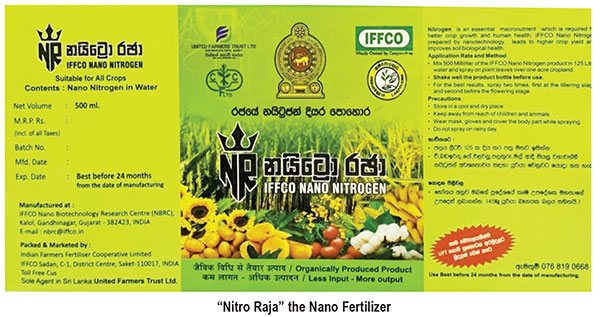
The consignment of nano urea, much spoken about produced by Indian Farmer Fertiliser Corporation (IFFCO}, had just arrived! Locally it is named Nitro Raja!” Can the imported Raja settle our fertiliser woes, where the ‘local Raja’ has hitherto failed?

What is nano urea, many people ask! For the layman it may best be described as something akin to Seeni- polkohu” or Bombai-motai”, where sugar particles are attached to a fibrous material. Similarly, in nano urea, the urea molecules are attached to oligosaccharide (examples, starch and sugar) molecules. This greatly enhances the efficacy of the applied urea to crops.

The advantage is that, whereas urea when applied to the soil, often much of it is wasted through leaching, run-off in rain water and vaporisation, losses are very small with the nano formulation. Even normal urea if applied to plants as a leaf spray in good weather, the losses are far less than application to the soil. Up to a maximum of 5% of chemical nutrients can be applied as foliar spray, and in fact urea is, for example, routinely applied in tea plantations usually mixed with zinc sulphate, which research has reported, to boost crop yields substantially.

Regrettably the imported consignment apparently is exclusively for rice cultivation. Is it because the tea growers were not as vociferous and violent as the rice farmers in their demonstrations and ministerial effigy-burning? Ideally, for the tea growers, too, urea is critically important. As most would have applied all nutrients over the years, the soil reserves of nutrients should suffice to tide over an year or more except for nitrogen, the most yield determining nutrient; and the current huge tea crop losses could have been saved, if at least urea in whichever form were supplied to the tea industry.

The critical issue is, however, whether at the recommended rate, the imported nano urea could effectively meet the crop nitrogen demand. It is imported in 500 ml bottles and each bottle content, the advertisement says, is equivalent to a 50 kilo bag of normal fertiliser urea. Nevertheless, it is further stated in the advertisement that the contents has a nitrogen(N) concentration of only 4%, whereas normal urea has 46%.

Meeting Demand?

Let us see whether the supplied nano urea can meet the crop nitrogen demand at the prescribed application rate. The national average yield of rice is now 5 tons /hectare. Therefore, an average rice crop by way of grain and straw removes about 80 kg/ha, and the normal rate of application of nitrogen for a good rice crop is 100kg/ha . So, in whatever way the crop is fertilised (with nano urea or normal urea) a 5 ton rice crop/ha should remove a minimum of 80 kg of nitrogen. Theoretically, however, the recommended nano-urea formulation imported can only provide 20 grams of nitrogen per 500 ml bottle, and to provide the requisite nitrogen of 80kg/ha to the crop, therefore, 4000 such bottles should be applied! The cost of a 500 ml bottle is reported to be Indian Rs 240, which is about local Rs 500. Theoretically then, the nano fertiliser per crop to provide the entire crop nitrogen requirement should cost two million rupees! Can this nano urea then practically meet the total crop nitrogen demand ?

The crux of the matter is that, in India, where nano urea is used, usually a basal application of conventional urea is made to the crop, and nano urea is only sprayed at mid- maturity as a foliar spray for boosting the crop.

The other serious concern is that when nano urea is spayed as the crop is growing, the emerging weed growth in the absence, now, of the two standard herbicides used in rice, one before crop emergence (usually Propanil) and the other ( MCPA )when the crop is in early growth(post emergent), could be substantial. Nearly 95% of the rice growers broadcast seed, and hand weeding is difficult in such crops. Row seeding is highly labour demanding and row seeders are costly. Much of these weeds are highly competitive C4 grasses and sedges, which too will benefit from the foliar nano urea spray and increase the competitiveness, reducing the crop yield!

One of the growing concerns today, globally, in the fertiliser scenario is, not whether it is organic or chemical, but with the grain production anticipated to increase by at least 40% in the next decade and 60% of the nitrogenous fertiliser used for it, the devastating environmental AND pollution issue . Many argue the answer is in cutting down meat consumption as bulk of the grain in the developed world is used as animal feed!

However, there is already technology generated for improving N management practices at the farm level, and nitrogen uptake efficiency (NUE) increases of 36% and 32% have been achieved in the U.S and Japan respectively in the last few decades; one of them being nano fertilisers. With novel plant breeding and fertisier technologies many scientists envision reaching 90-100% NUE in the near future.

Fertilizer issue; Chinese dispute National Plant Quarantine in Sri Lanka

October 27th, 2021

Courtesy The Daily Mirror

Controversy involving fertilizer imports from China took a dramatic turn yesterday when the Chinese company, in a lengthy statement, disputed sample testing done here saying the  unscientific detection method and conclusion of National Plant Quarantine in Sri Lanka obviously does not comply with international animal and plant quarantine convention.

Qingdao Seawin Biotech Group Co., Lt, issuing a statement through the Chinese Embassy in Colombo said it had participated in the bidding and had won the bid successfully. It was officially listed as a qualified supplier for Tender No. IFB No.SMOF/OFPR/2021/1 on August 11, to supply 99,000 tons of organic fertilizer to Sri Lanka.

The statement said, After being awarded the tender, Qingdao Seawin Biotech Group signed contracts with the buyers through a local biding agent in Sri Lanka, and strictly fulfilled the contract. It overcame many difficulties, such as busy international and domestic orders, soaring global raw material prices, tight shipping schedules and berthing space, high sea freight cost and so on, and gave priority to ensure the production and delivery of the tender contract for Sri Lanka. After the buyer issued Letter of Credit (L/C), Qingdao Seawin Biotech Group shipped the organic fertilizer which comply with the quality requirements on September 23rd according to the time schedule required by L/C (before September 25th). While the goods were on the way by sea, CFC informed that “the import permit has not been obtained” and “the goods will be rejected”. However, according to international trade practices, it is the buyer’s obligation to obtain the import permit.

The failure to obtain the import permit is caused by the buyer’s mistakes and negative inaction. On September 23rd, Sri Lanka NPQ received the seller’s product samples. On September 27th, the seller received an oral notice from the buyer and was informed that Sri Lanka Plant Quarantine Center (NPQ) issued a conclusion of “suspecting that the samples contain Erwinia”, but did not provide the test report, test method and standards. According to ISPM27 rule in IPPC (International Plant Protection Convention), it will take more than 6 days to identify Erwinia, but NPQ only takes 3 days to draw a “suspicious” conclusion. After the supplier raised doubts, NPQ Sri Lanka updated the report on October 11th. 7 days was used to test, but it still did not indicate the test standards and methods.

Testing temperature of Erwinia shown in the report is 37 ℃, and carrot slices at 37 ℃ are used for pathogenicity test. According to the relevant agreement of IPPC, the testing temperature of Erwinia is 25 ℃, and healthy plants should be used for pathogenicity test. At least 13~14 days should be used to confirm Erwinia through pathogenicity. The unscientific detection method and conclusion of NPQ in Sri Lanka obviously do not comply with international animal and plant quarantine convention. In fact, the supplier’s product samples have passed the test of Schutter group, a third-party international testing organization designated by the buyer (SLSI) and
passed the export plant quarantine of China Customs before shipment on September 23. On October 5, according to the requirements of Sri Lanka NPQ, Testing Center of China Customs made a supplementary statement on the samples that the products do not contain Erwinia. However, Sri Lanka NPQ and the buyer openly denied the above test results and unilaterally used the test report issued by NPQ laboratory as the basis for judging the product quality, which is inconsistent with the contract agreement, international trade rules and the test result of their own designated third-party. After the seller received the buyer’s letter of credit, the buyer repeatedly violated the principle of independence of letter of credit, and obstructed the bank from paying the payment to the seller by arbitrarily changing the negotiation conditions of L/C, changing the settlement method from letter of credit to collection, applying to the court  for a stop payment order of letter of credit, etc. In the case of major differences between the two parties on the facts of contract performance and major disputes over the product quality test results, the buyer and NPQ Sri Lanka have irresponsibly conveyed false and even controversial remarks to the media for many times. The media that do not know the truth have made negative reports on the quality of Chinese enterprise and Chinese products, and even used “Toxic, garbage, pollution” and other derogatory words that seriously slander the image of Chinese enterprise and the Chinese government. Such unilateral, untrue, and irresponsible remarks mislead the public and undermine the credibility of the media. The above “deliberately creating difficulties”, “unreasonable” and even “malicious” acts of Sri Lanka NPQ, the buyer and some media give people reason to suspect that the buyer is creating various obstacles to obstruct the performance of the contract, and even has bad commercial intentions. What is the so-called “toxic” fertilizer?

How arrivals can now complete the health declaration at BIA in 20 seconds

October 27th, 2021

CHATURANGA SAMARAWICKRAMA Courtesy The Daily Mirror

The government yesterday said that the new health declaration system inaugurated at the BIA was one of its kind which would enable passenger to complete fulfilling their health declaration in 20 seconds to proceed to clear immigration. 

This health declaration system was inaugurated by the Aviation and Export Zones Development State Minister D.V. Chanaka at the BIA premises on Tuesday.

The Minister told the Daily Mirror that the prime objective of introducing this system was to reduce the use of physical form filling and encourage passengers to opt for an online platform, thereby reducing physical contact and passenger processing time.

He said passengers could log on to www.airport.lk official website or on https://www.airport.lk/health_declaration/index and enter their details.

Passengers can access the above links before boarding the flight, while traveling if the flight has an internet facility, or after arriving at the airport.

Chanaka said with the new system, health authorities will be able to receive passenger information in advance, which will help in reviewing the passenger’s health records while reducing the queuing time.

“Passengers should fill out the web based Health Declaration form, attach the vaccination card, and COVID-19 PCR test report done within 72 hours prior to departure to the health declaration. Next, the passengers should submit the form online. Upon submission, passengers will have the facility to capture a QR code and will also receive an email with that QR code,” Chanaka explained.

“The health officials at the airport will receive the passenger information before the passenger arrives at the airport, and they will review the information. Finally, passengers who have submitted their health declaration forms online should have the QR code ready (either in the email or on their mobile device) upon arrival, for scanning at the health declaration counter,” he said.

“After passengers arrive at the airport, they should report to the airport’s health declaration counter to check their COVID reports. Earlier, passengers had to fill out a special form at the counter, and it took at least two minutes. After introducing the new system, other than filling out the papers, people can scan the QR code they received. The scanning and retrieving of the passenger information by the Health Declaration counter official will take a few seconds,” airport officials said.

“After scanning the QR code, the passenger will receive a receipt. The passengers can keep that receipt for any further inquiry by the area Public Health Officer (PHI) or any other health inquiry,” officials added.

If the provided documents are verified, the passengers will be directed to the immigration counter. The immigration counter procedures have also been digitalized, which will allow passengers to exit in the shortest time. 

The exit time however will depend on the passenger. That will change if the passengers prefer to shop at the duty-free.

Chanaka said it will take 20 seconds, to scan the QR code and to certify the details. Later, the passengers will be directed to the immigration counters.
Passengers who do not have access to the new system, should visit the Health Declaration counter at the BIA and fill out the forms manually.

The State Minister said that this project was launched at BIA with the expectation of providing a convenient travel experience to passengers. ()

COVID: 20 more deaths recorded in Sri Lanka

October 27th, 2021

Courtesy Adaderana

The total number of people, who died of COVID-19 infection in Sri Lanka, moved up as 20 more fatalities were confirmed by the Director-General of Health Services on Tuesday (October 26).

The new development has pushed the official death toll from the virus outbreak in the country to 13,674.

The latest victims include 11 males and 09 females, the Department of Government Information said.

According to official data, 08 deaths were reported among elderly people aged above 60 years. In addition, 12 people aged between 30-59 years have also fallen victim to the virus infection.

Sri Lanka reports 425 new Covid-19 cases

October 27th, 2021

Courtesy Adaderana

The Epidemiology Unit of the Health Ministry says that another 425 persons have tested positive for the novel coronavirus today (27).

This pushes the total number of Covid-19 cases registered in the country thus far to 538,186.

The number of infected patients currently being treated across the island is 20,136 while total recoveries have risen to 504,376.

The death toll in the country due to the virus is 13,674. 

Attempts to weaken Sri Lanka’s National Security on guise of Easter Sunday Justice

October 26th, 2021

Shenali D Waduge

Sri Lanka’s post-independence history has been marred by bloodshed. We have had assassinations of Prime Minister/President/Politicians/Public Officials, unarmed civilians and even children. All of these killings have had hidden foreign hands behind them. Amidst this, the hidden hands have deployed people to cause further mayhem. To cover their insidious designs, they mimic ‘conspiracy theories’ to prevent people joining the dots to the money trail. Unfortunately, politicians have become easy bait & their weaknesses are tapped to legislatively weaken the nation, public officials are being tapped to do the same, while we can assume many in the private sector prefer to only view what is profitable to them regardless of what calamity it may cause the country. This leaves us with the armed forces, police & the national security & intelligence apparatus. It is no surprise that this key component would also be targeted along multiple fronts to dilute their role in securing the sovereignty of Sri Lanka.

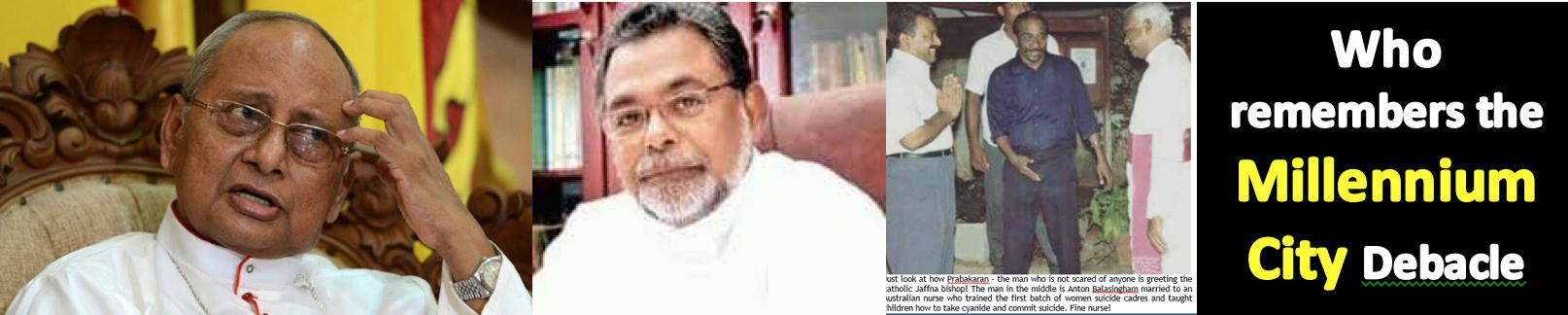
The first hit to Sri Lanka’s national intelligence apparatus came with the Millennium City debacle that was choreographed well to create a bogus notion of a threat to the life of the former PM RanilW by the intelligence operatives, which not only resulted in raiding the hideout but the disclosure of all of the names of these intelligence operatives to the LTTE which ended up in over 50 of these brave men being gunned down by LTTE. To this day the UNP hierarchy have not apologized to the families of the dead. These intelligence operatives had done a marvelous job in penetrating LTTE operations & helped the armed forces breach LTTE lines of defense. The Millennium City debacle occurred after the 2002 infamous ceasefire agreement signed between Ranil Wickremasinghe & Prabakaran that confined our armed forces to camps and armed LTTE were allowed to go wherever they liked. The inroads LTTE and the camouflaged LTTE in suits would have made to penetrate into the national systems no one will know.

This was the first of the breaches in national security and attempt to destabilize Sri Lanka from within when it looked like the LTTE needed other reinforcements. These came in various forms all funded by foreign sources and probably all kept separate from each other and following orders only. It also made it easy for them to change their modus operandi each time their game plan was on the verge of exposure.

The Church is currently making many allegations. The persons the Church deems guilty need to be first proved guilty. Simply because the Church claims them to be guilty, they cannot be put under the gavel. This is the same Church that openly played a key role in LTTE terrorism – not only via robes but also via their missionary laymen and their organizations.

We can recall over 3000 NGOs were operating in the war-torn areas where LTTE ran a defacto rule. None of them saw fit to take legal action against LTTE for child recruitment except compile lovely reports. None of these terrorist-linked clergy or church-employed laymen were held accountable for every crime LTTE committed. So when the Church now accuses the slow pace of justice, perhaps the Church may care to explain Church inaction over 3 decades against people in robes and laymen linked to LTTE. The Church was part of the bandwagon that openly canvassed for all that the LTTE fought for.

We cannot omit to mention the role played by UNP who led the slogan ‘the war is unwinnable’ demoralized our troops and was prepared to even sign sovereign territory to terrorists. Unfortunately, the nature of cross overs is such that proponents of these statements are even holding key posts in the present government.

That the armed forces, police and intelligence services played a key role in the eventual demise of the LTTE cannot be mentioned enough. These were the unsung heroes and these were also unknown heroes and it was important that their identities were kept secret from public to prevent another Millennium City debacle. However, came regime change in 2015 and we saw how a plethora of NGOs, so-called ‘civil society organizations’ converged to bring about regime change and it was they who decided which armed service personnel was to be transferred, were to be sent to prison, were to be demoted etc. This resulted in the second attempt to dilute and weaken the intelligence and security apparatus of Sri Lanka.

The secret cells that were following and monitoring various likely insurgent groups and leaders were disbanded and politicization within security units led to service heads being at odds with each other. All this was naturally being watched in glee by the handlers who were no doubt elated at the manner their pawns were performing.

It is a puzzle that 8 men decided to commit suicide attacking 3 churches and 3 hotels without leaving a reason for doing so or at least making a demand even after a dramatized ISIS pledge relayed over social media. That unsuited personnel were manning the crucial security apparatus & taking lenient notice of the warnings highlighted the bad selection to these roles which led to their inability to respond proactively to prevent the carnage inspite repeated warnings.

However, none of the officials who were in security roles during the Easter attack are holding positions currently. Therefore, when the Church decides to nitpick names of current officials and plug these names to the Easter Sunday attack, it is playing political mischief. This generally happens every time the country is on a vulnerable footing and the mischief handlers love to make the atmosphere worse.

It is important for the general public to realize that today there are only a handful able to call a spade a spade because they have not compromised their integrity – most others are pawns. We live in times when most doctors are bribed by big pharma to prescribe their medicines, our politicians & their families have lost their integrity as well, public officials also need to be investigated, private sector also have skeletons.

Thus, the Sri Lankan public must be aware of why Sri Lanka is important to many except the leaders of Sri Lanka. The historical attempt to acquire Sri Lanka continues. Our resources and assets are valued by those that seek their takeover but not the owners who have no issue in siphoning them off, while a handful of us are trying to safeguard the little we have left to call our own as we realize the need to preserve it to pass on to future generations.

Our faith in the armed forces, police & intelligence & security apparatus should not be shirked and we must be attuned to attempts to dislodge their importance from the very quarters that played a role in sponsoring and fanning terror.

The people are no doubt intelligent and have studied the various operations to destabilize Sri Lanka. Thus, the pawns are tasked to regularly come up with more ‘stories’ to keep the process moving.

Rev Siril claims on 23 October 2021 that the main suicide bomber Zahran Hashim leader of NTJ was given monetary and other support from Sri Lanka’s intelligence services & that the present head of SIS had links to Zahran & his followers.

What is he implying and what is the proof he has and what is the objective behind this allegation?

In March 2021 Rev. Siril said that the Church was yet to be convinced that the Government was on the ‘right track to identify Easter Sunday architects’ – what is the track that the Rev wishes the Govt to take? Does the Church have its own list of suspects & have they given this list to the authorities or found their own evidence?

In August 2021 Rev Siril told the Sunday Morning that the Cardinal was mooting ‘international assistance’ – perhaps the Rev has forgotten that FBI bolted to Sri Lanka no sooner the bombings took place and went off with most of the mobile evidence! We are yet to know what their conclusions are. Other foreign intelligence also landed to ‘assist’ but none of their findings have been made public by them or the previous government. Could it not be possible that the majority of evidence has been removed or taken out of Sri Lanka during the last government!

It is also noteworthy to mention that the quarters that claim to seek justice for Easter Sunday are also demanding the release of an arrested lawyer not bothered to even wonder what his role was in the Easter Sunday attack. Many in the legal fraternity are also jumping to his defense simply because he is ‘one of them’ – no wonder we can never get justice for anything. Everyone appears to be happy to accuse some lower-rung people of the crime and ignore the main brains – why!

What needs to be clearly said however, is that if the authorities have pinned down the suspects with evidence beyond doubt and if the current laws in place are insufficient to indict, the AG’s department is tasked to create the laws to do so. No one should be released or given a lesser sentence simply because we do not have the legal provisions to indict them in proportion to the crime they have committed. This is regarded as a terrorist attack and the severest punishment should be given for this calculated & planned murder of innocent people & LTTE crimes should be covered as well.

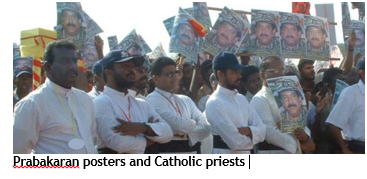
While the Church is demanding the complete implementation of the recommendations by the Easter Sunday Commission, it is pertinent that we demand the GoSL conduct investigations into the Church links to LTTE and the role played by Church fathers in helping LTTE with their terror, taking part in pro-LTTE protests, running LTTE child solder orphanages and allegations of transporting arms in their vehicles. The prominent Church fathers that have led pro-LTTE protests going so far as to even lobby the UN/UNHRC. Why didn’t the Church take action against these Fathers for their role in helping terror?

The country’s security & intelligence apparatus is nothing for external entities (local or foreign) to interfere in. It is an important entity that must be protected by the State.

Shenali D Waduge

Sri Lanka including Bangladesh can benefit from CPEC

October 26th, 2021

Pathik Hasan

Pakistan, Bangladesh and Sri Lanka are both South Asian countries. As an island county in South East Asia, Sri Lanka has been utilizing some facilities in the sector of international maritime trade, commerce. Sri Lanka is known as a maritime hub in South Asia. Its Colombo port is very famous in the world map.

On the other hands, Bangladesh has some geo-strategic significance that’s why China is interested in investing in Bangladesh. Now Western powers want to see Bangladesh as a strategic partner in the Indo-Pacific region. But Bangladesh has joined China run BRI in 2017. Its location across the Bay of Bengal gives a strategic position in South East and South Asia. Bangladesh can utilize this properly.

However, Pakistan is the only South Asian country who is showing its full-scale strategic significance to the world leaders at this moment. Its foreign policy has shifted towards geo-economic from Geo strategy. CPEC and Gwadar port has added extra value in this regard. China run Gwadar port and CPEC has increased more confidence between China and Pakistan to prove that they are really all weather ally”.

Sri Lanka has some advantageous position in South Asia in case of maritime connectivity. It is also known as a maritime hub in South Asia. Sri Lankan Hambantota port is a hot cake in international politics. Sri Lanka has leased it to China for 99 years. There is some debate regarding this. But that is another issue. However, China is more interested to connect Sri Lanka with its connectivity project Belt and Road Initiative”

It is very pertinent to mention that Sri Lanka and Pakistan are both the active members of China ‘BRI’ project. Sri Lankan Hambantota and Colombo ports are considered as epic center and hub of China’s BRI project in South Asia. Sri Lankan ports can be used a regional maritime hub between South Asia, South East Asia, Central Asia and Middle East.

Sri Lanka and Pakistan can work together in the sector of bilateral trade, investment, science and technology, and culture through enhancing connectivity. Sri Lanka is the one of the top most business partner of Pakistan in South Asia.

Pak PM Imran Khan visited Sri Lanka in February 23-24, 2021. During his visit to Sri Lanka, Mr. Khan focused on Pakistan’s connectivity with Sri Lanka. Sri Lanka has historical connection with Pakistan. Sri Lankan Colombo port’s connection with Pakistan’s Karachi port is well to Known.

Pakistan is the part of the Chinese president’s Belt and Road Initiative through its flagship China Pakistan Economic Corridor (CPEC) project, Sri Lanka could benefit from it through enhanced connectivity up to the Central Asian states. Bi lateral connectivity would increase the bilateral trade between the two states. Basically, Sri Lanka and Pakistan would benefit mutually.

Sri Lanka can ensure its maximum interest from using of Gwadar Port for warehousing to facilitate trade with Afghanistan, Pakistan, Western and Central China, Central Asian Republics and Middle East. Gwadar is connected with CPEC. Ultimately, Sri Lanka can easily export to and import from the markets of above-mentioned states. Sri Lankan can to use Gwadar Port’s gateway for export to Afghanistan and then Uzbekistan and from there to entire Central Asia.

During the visit of Sri Lanka, Imran commented that Pakistan is allocating land to Uzbekistan for warehousing and export, the same facility can also be provided to Sri Lanka. (February 26, The Business Recorder)

On the other hands, according to a leading Bangladesh daily (Daily Observer), Bangladesh can benefit from using Pakistan’s Gwadar port. The Daily Observer published an article titled Bangladesh can benefit from Gwadar port’ on September 30, 2021.

Pakistan’s another daily Pakistan Today” has also published an article titled ‘Why Bangladesh should use Pakistan’s Gwadar port?” on September 26, 2021. Leading Pakistani daily Pak Observer” has also republished the article urging the Bangladesh and Sri Lanka both to utilize the Pakistan’s Gwadar port for ensuring their business interest. It is pertinent to mention that Sri Lanka’s another online portal Lanka Web and India’s Maritime Gateway’ republished the article on September 26,qmd 27 respectively with referencing.

But That is not issue of my article. My point is here that the main theme of the article is connectivity amongst Sri Lanka, Bangladesh and Pakistan. The author of the article shows that If Bangladesh’s Chittagong, Payra, Mangla ports can be connected with Pakistan’s Gwadar ports including Karachi port, Port Qasim and Keti bandar via Sri Lankan Colombo port and Hambantota port, Bangladesh, Sri Lanka, Pakistan would benefit trilaterally. Regional connectivity would ensure their own maximum business interest. The millions of people in the region could benefit.

Sri Lanka’s Tea, apparel, machinery and Bangladesh apparel, mangoes, medicines, potatoes can be easily exported to the above-mentioned markets. On the other hands, Bangladesh and Sri Lanka both import goods such as cotton from Pakistan, Central Asian States, Western and Central China even Russia. But a holistic trilateral effort is much needed in this regard. If Sri Lanka and Bangladesh use CPEC, they can take part in the development process in Afghanistan with Pakistan, China, Russia, Iran. SAARC may be revived through these activities. Revival of SAARC is must at the present context or scenario of South Asia.

Pakistan’s Gwadar port could benefit Sri Lanka in this regard. If Sri Lanka starts to use Gwdar port, its export to Central Asian states, Central and Western China and Pakistan would increase. Sri Lanka’s connection with Pakistan’s CPEC project would accelerate the regional connectivity more.

The bilateral connection between two states would boost up. Sri Lanka and Pakistan can increase their joint bilateral efforts to counter terrorism, tackle covid-19 etc. Terrorism has been harming the economic interests of both states. Sri Lanka saw Easter Church attack in 2019. Pakistan has been facing the challenging from TTP threat. If Pakistan and Sri Lanka increase the connectivity through utilizing of these connectivity project, bilateral efforts of tackling and countering terrorism would ensure automatically.

Tourism is another sector. Pakistan has many historical Buddhist sites such as ancient civilizations of Gandhara, Takhsila. Sri Lanka people can easily visit these historical holy sites if connectivity between two states would build. On the other hands, Sri Lanka has historical places for Muslims like Adam peak. Pakistani Muslims will be able to more to visit the holy site. But bi-lateral connection is must for ensuring that. CPEC is a regional connectivity project.

As a regional state, Sri Lanka and Bangladesh each can and should join the project to exploit the benefit. This trilateral connection would boost up the business connection, people-to-people connection. The public diplomacy, economic diplomacy, cricket diplomacy would be strong more.

Pathik Hasan is a Dhaka based human rights activist, analyst and columnist.

ERASING THE EELAM VICTORY PT 19F.

October 26th, 2021

KAMALIKA PIERIS

The army took care to remove all possible LTTE monuments once the Eelam war was over. They knew that otherwise these monuments would become shrines. The only LTTE ‘monuments’ at the time were the LTTE cemeteries such as the cemetery at Chaaty Beach near Jaffna.

The army bulldozed all of them. The Tamil Separatist Movement watched with dismay. They alleged that Thuyilum Illam7, a graveyard in honor of slain LTTE soldiers was destroyed and an army camp set up over it. I think this is most unlikely.  Thereafter court orders were obtained in 2014, banning events of remembrance and mourning in Jaffna.

However, the Yahapalana government which came to power in 2015 was very pro-Eelam and the Tamil Separatist Movement took the opportunity to erect memorials to the LTTE.   If JVP was free to remember its dead leaders, so should the Tamils, said TNA.

Ten years after the war, around 2019 the Tamil Separatist Movement started to put up memorials. The motive was political. Tamil Separatist Movement was planning to use Memorialisation as a political tool. One memorial was, predictably, put up at Mullivaikkal where the LTTE was defeated.

In September 2021 three persons including Jaffna District MP Sevarasa Gajendran were arrested for organizing a ceremony to commemorate former LTTE political wing leader Thileepan, in contravention of quarantine regulations. They were arrested when they were preparing for the commemoration at Thileepan’s statue in Nallur. They were told htat court had issued an order barring commemorations in the place. As they continued regardless, police arrested them. British All-Party Parliamentary Group for Tamils (APPGT) have expressed deep concern about this arrest, and urged the Foreign Secretary to raise it with her counterpart in Sri Lanka.

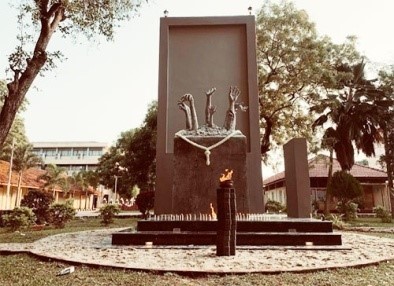
Three memorials to the Eelam war have been set up in the University of Jaffna premises. The Pongu Thamilmonument in the Arts Faculty,  Thileepan memorial in the science faculty  and a memorial to those who died at Mullavaikkal,  known as Mullavaikkal memorial”  on the grounds of the University. The Mullavaikkal monument was for those civilians who lost their lives in the last battle as they were trapped on the battlefield. These people needed a memorial and students believed that one set up within the university would be safer than one put up anywhere else.

In 2021, the Mullavaikkal memorial” came to public attention. Tamil people’s right to commemorate came under sharp focus when authorities at the University of Jaffna recently demolished a memorial on campus, built to remember those who died in the final phase of the war in 2009, announced the media.

The memorial had been approved by the previous Vice Chancellor.  Construction had begun in April 2018 and completed by February 2019, a decade after the LTTE was militarily defeated. Parts of the memorial had been pre-cast outside, brought into the campus and assembled. University Grants Commission   had issued a directive to halt the construction. This had been ignored.

In October 2020 Deputy Inspector General of Police (Jaffna) had sent Vice Chancellor Srisatkunarajah a ‘secret’ report, originating from the army, containing information from intelligence agencies. One in particular from the Directorate of Military Intelligence (DMI) spoke about links between ‘pro LTTE’ students and activities related to the memorial. Also that the memorial was becoming the centre for different ceremonies linked to the LTTE during anniversaries and other events. The army had wanted the memorial demolished.Also the VC was told that no construction could take place in a university without the express permission of the University Grants Commission.

Whenever Vice Chancellor Srisatkunarajah interacted with military or Police seniors during conferences, the first issue to be raised was the Mullavaikkal memorial.” When would it be demolished?  Vice Chancellor was under heavy pressure to do so and this reached a peak in January 2021.  The VC had told the Hindu” newspaper later that that his demolition order was based on instructions from defence, intelligence, Education Ministry, everyone”.

The Vice Chancellor decided to demolish the monument. After consultations with engineers and others he decided that the demolition should take place after 10 p.m. on Friday January 8, 2021. Students were asked to leave the premises that night. The VC and his Registrar Viswanathan Kandeepan were on the premises.

 When a backhoe fixed with spotlights on the roof, began to demolish the memorial, residents at nearby Ramanathan Road and Parameshwara junction heard what they suspected was unusual activity within the campus. Soon the people, including students, turned up at the entrance and watched what was going on. The backhoe was loading the destroyed debris of the memorial and was later unloading it in a corner area.

As the night went on, there was hectic activity. Nine university students launched a hunger strike. By Saturday morning crowds had swelled. That included V. Mannivannan, a lawyer and Mayor of Jaffna. He hurriedly appeared for two persons taken into custody and obtained bail.

Police from Jaffna, Kopay, Manipay, and Atchuveli Police stations were deployed around the campus.  Army troops from the 521 Brigade in Kondavil and Special Task Force (STF) personnel of the Police were stationed at strategic points. They dispersed the crowds but more began coming in. the Army and the Police prevented damage being caused.

The Vice Chancellor initially had taken a firm stance. He told students that the Mullaivaikal memorial” had been built without obtaining approval. But around 3 a.m. the Vice Chancellor changed his position. He turned up before the fasting students with a bowl of rice porridge and declared let us lay a new foundation stone in the morning for a new memorial.” He accompanied the students to the demolished site where they laid flowers. The Vice Chancellor then recited a stanza from Tiruvasagam, a song for Lord Shiva.

On Monday morning VC announced I have received orders from the Government to resolve this issue amicably. Authorities wanted him to diffuse the situation”. This has caused some issues in Tamil Nadu as well.  I have written to the UGC. We are going to put some stones as a symbolic ceremony. The construction of the monument will commence with proper approval.  UGC Chairman and Jaffna University Vice Chancellor had been in touch with each other till the wee hours of Monday, said the media.  

VC told the students that they would be allowed to re-erect the memorial.  A symbolic foundation stone was laid that Monday morning, using stones from the demolished memorial. Students demanded that the VC himself lay the foundation stone. As the rains were continuing the VC wanted to put it off, but the students demanded that he do as they said despite rain. The VC bowed to pressure and laid a foundation stone amidst rain and the students ended their agitation.  

The media pointed out that placing stones to resemble a foundation, also raised an issue. It could be argued that this act, to diffuse a situation,” has been carried out without any formal approval.Minister Wimal Weerawansa condemned the Vice Chancellor for allowing the laying of a foundation stone for a new memorial. On the following Friday, holes were dug to lay concrete to begin erection of a new monument.  

The Presidential Secretariat had not known of the event. Officials had hurriedly telephoned Vice Chancellor to ask who gave instructions” for the demolition I explained the situation in detail to an official of the President’s office,” Prof. Srisatkunarajah told the Sunday Times.

India’s High Commissioner Gopal Baglay had told Prime Minister Mahinda Rajapaksa that the demolition of Mullaivaikal memorial” could lead to protests erupting in the southern Indian state of Tamil Nadu. Premier Rajapaksa went into action promptly said the media.  The Vice Chancellor was informed that Tamil Nadu is boiling.”  Media observed that hereafter the Vice Chancellor of Jaffna University would have to be mindful of issues in Tamil Nadu” in the conduct of his official duties.

The demolition of this monument received much local attention.  Local television stations gave wide coverage and the entire peninsula was aroused”.   Tamil newspapers ran banner headlines in black about the incident. The Jaffna Municipal Council adopted a resolution condemning the removal of the memorial. It called for the re-construction of it in the same place.

The Tamil National Alliance called for a hartal.  All shops, offices, and other establishments in Jaffna and in many key towns in the east, closed. Both Tamils and Muslims participated, a new feature, commented the media. National Peace Council said this was the only public monument to those Tamil civilians who perished in the last stages of the war. There is a need to rebuilt this soon.

The demolition also received international attention.          The destruction and desecration of the Mullivaikal Memorial Monuments on the eve of the Annual Remembrance Day is one of the most barbaric acts any decent human being can contemplate, announced the Global Tamil Forum.

In Tamil Nadu, Chief Minister Edappadi Palaniswami said he was shocked” to hear about the demolition of a memorial that was dedicated to the war dead. Viduthalai Chiruthai Pulikal (VCP) party leader Thol Thirumavalan declared in Chennai he would join Vaiko Gopalsamy’s Marumalartchi Dravida Munnetra Kazhagam to protest outside the Sri Lanka Deputy High Commissioner’s office in Chennai. We demand that the Sri Lankan government reconstruct the memorial inside the campus,” he said. There were also other groups planning protests in Tamil Nadu, he added.

Speaking in the UK House of Commons, Siobhan McDonaugh, Labour MP for Mitcham, and Morden, called for the British government to move a resolution at the UN Human Rights Council (UNHRC) on the memorial demolition saying it was a denial of religious freedom. She is known for espousing the cause of Tamils who form a sizeable number in her constituency.

In Canada, mayor of Brampton promised to build a monument to commemorate the lives lost in the Sri Lankan civil war, since the Jaffna University memorial had been torn down. Brampton City Council unanimously voted to build their own memorial. Brampton Tamil Association president Benat Mariyanayagam says this was a significant step not only for Tamil people in Canada, all Tamils abroad. The monument will be funded by the local Tamil community.

In February 2021 the media reported that undergraduates of the Jaffna University had unveiled the new memorial. The monument is in memory of those who had been killed at Mullaivaikkal, in 2009 during the final days of the war between the LTTE and the security forces. They were innocent civilians who got trapped on the battlefield, they said.

That is incorrect. These civilians were not residents of Mullavaikkal to start with, to get trapped there. And because of this, they were   not eligible for protection under International Humanitarian Law either.

 This monument is celebrating a group of   persons who willingly left their homes and travelled miles into Mullavaikkal to help the LTTE win the war. They went there holding their land deeds, clearly hoping to return home.  The LTTE were engaged in high treason and these civilians were complicit.  Governments do not permit the memorialisation of high treason.

යෝජිත කුරුණෑගල මහ රෝහල් සංවර්ධන ව්‍යාපෘතිය ලබන කැබිනට් හමුවේ අනුමැතියට යොමු කරන්නැයි අග්‍රාමාත්‍යතුමාගෙන් උපදෙස්

October 26th, 2021

අග්‍රාමාත්‍ය මාධ්‍ය අංශය

කුරුණෑගල මහ රෝහලේ නව සංවර්ධන ව්‍යාපෘති සංකල්පය ඇතුළත් සංදේශය අනුමැතිය සඳහා  ලබන කැබිනට් හමුවට යොමු කරන්නැයි අග්‍රාමාත්‍ය මහින්ද රාජපක්ෂ මහතා අද (26) දින පෙරවරුවේ සෞඛ්‍ය අමාත්‍යාංශ ලේකම්වරයාට උපදෙස් දුන්නේය.

කුරුණෑගල පළාත් මහ රෝහලේ නව සංවර්ධන ව්‍යාපෘතිය සම්බන්ධයෙන් අරලියගහ මන්දිරයේ පැවැති සාකච්ඡාවේ දී අග්‍රාමාත්‍යතුමා මේ බව සඳහන් කළේය.

කැබිනට් අනුමැතිය ලබා ගැනීමෙන් අනතුරුව 2022 අයවැය තුළින් මේ සඳහා මුදල් ප්‍රතිපාදන වෙන්වන පරිදි රෝහලේ මූලික ඉදිකිරීම් ලබන වසර මුල දී ආරම්භ කරන්නැයි අග්‍රාමාත්‍යතුමා ප්‍රකාශ කළේය.

කුරුණෑගල රෝහල ශික්ෂණ රෝහලක් ලෙස නාමකරණයට ඇති බාධාවන් ඉවත් කරමින් කුරුණෑගල ශික්ෂණ රෝහල යන්න නෛතිකව ප්‍රකාශයට පත් කරන්නැයි ද අග්‍රාමාත්‍යතුමා මෙහිදී සෞඛ්‍ය අමාත්‍යාංශ ලේකම් විශේෂඥ වෛද්‍ය එස්.එච් මුණසිංහ මහතාට උපදෙස් දුන්නේය.

අග්‍රාමාත්‍යතුමාගේ උපදෙස් පරිදි නව රෝහල ඉදිකරනුයේ සුවිශේෂ පහසුකම් ද ඇතුළත්වන පරිදිය.

බස් රථයෙන් පැමිණෙන රෝගීන්ට වෙනම බස් සේවාවක් සහ රෝහල අභ්‍යන්තරයේම බස් නැවතුමක් ඉදිවීම, පළමු වතාවට රෝහලක් ආකර්ශනීය හරිත සංකල්පය යටතේ ඉදිකිරීම, ශික්ෂණ රෝහලක් මෙන්ම ශෛල්‍ය වෛද්‍ය, ළමා රෝග හා මාතෘ සේවාවල උසස් මට්ටමේ සේවා සැපයීම, කුරුණෑගල දිස්ත්‍රික්කය මෙරට වැඩිම විහාරස්ථාන සංඛ්‍යාවක් සහිත ප්‍රදේශය හේතුවෙන් අංග සම්පූර්ණ භික්ෂු වාට්ටු සංකීර්ණයක් සහිතව ඉදිකිරීම සහ රෝහලේ සිට අධිවේගී මාර්ගයට හා දුම්රිය ස්ථානයට සෘජු මාර්ග පහසුකම් සැලසීම ඒ අතර ප්‍රධාන වේ.

අග්‍රාමාත්‍යතුමාගේ උපදෙස් පරිදි  අමාත්‍ය ජොන්ස්ටන් ප්‍රනාන්දු මහතා ඇතුළු දේශපාලන අධිකාරිය, සෞඛ්‍ය අමාත්‍යංශය, රජයේ වෛද්‍ය නිලධාරීන්ගේ සංගමය සහ නාගරික සංවර්ධන අධිකාරිය එක්ව හරිත සංකල්පයට අනුව රෝහල ඉදිකිරීමට අදාළ මූලික සැලසුම සකස් කර තිබේ.

පැරණි වෛද්‍ය නිල නිවස පිහිටි භූමිය හා අක්කර දෙකක් පමණ වූ ක්‍රීඩා භූමිය ඒ්කාබද්ධ කර අක්කර 04 කින් යුතු භූමිය තුළ අලුතින්ම ඉදිකිරීමට සැළසුම් කර ඇති  රෝහලේ මහල් 10 කින් සමන්විත ගොඩනැගිලි දෙකක්  පළමු අදියරය යටතේ ඉදිකිරීමට නියමිතය.

මෙම අවස්ථාවට අමාත්‍ය  ජොන්ස්ටන් ප්‍රනාන්දු , අග්‍රාමාත්‍ය ලේකම් ගාමිණී සෙනරත්, අග්‍රාමාත්‍ය කාර්යය මණ්ඩල ප්‍රධානී යෝෂිත රාජපක්ෂ, අග්‍රාමාත්‍ය අතිරේක ලේකම් නීතීඥ චමින්ද කුලරත්න, සෞඛ්‍ය අමාත්‍යාංශයේ ලේකම් එස්. එච් මුණසිංහ, ජාතික අය වැය දෙපාර්තමේන්තුවේ අධ්‍යක්ෂ ජූඩ් නිලුක්ෂාන් , නාගරික සංවර්ධන අධිකාරියේ අධ්‍යක්ෂ ජනරාල් එන්. පී. කේ රණවීර,  කුරුණෑගල පළාත් මහා රෝහලේ  අධ්‍යක්ෂ වෛද්‍ය චන්දන කැදන්ගමුව, රජයේ වෛද්‍ය නිලධාරින්ගේ සංගමයේ සභාපති විශේෂඥ වෛද්‍ය අනුරුද්ධ පාදෙණිය, මහා භාණ්ඩාගාරයේ නියෝජ්‍ය ලේකම් ආර්.එම්.පී. රත්නායක මහත්වරු එක්ව  සිටියහ.

යුද්ධයට දිවි දුන් රණවිරුවන් සිහි කරමින් අග්‍රාමාත්‍යතුමාට පොපි මල පළඳවයි

October 26th, 2021

අග්‍රාමාත්‍ය මාධ්‍ය අංශය

ශ්‍රී ලංකා සේවා මුක්ත භට සංගමයේ සාමාජිකයෝ අද (26) දින අරලියගහ මන්දිරයේ දී  අග්‍රාමාත්‍ය මහින්ද රාජපක්ෂ මහතාට සංකේතාත්මකව පොපි මල පැළඳවුහ.

ලොව පුරා යුද්ධයට දිවි පිදූ  රණවිරුවන් සිහිගන්වන  ලෝක පොපි මල් දිනය ලබන නොවැම්බර් 11වැනිදාට යෙදී තිබේ.

කොවිඩ් වසංගතය හේතුවෙන් ලෝක පොපි මල් දින සැමරුම ලබන 14 වැනිදා ඉතා චාම්ව සැමරීමට ශ්‍රී ලංකා සේවා මුක්ත භට සංගමය සැළසුම් කර ඇත.

පොපි මල් අලෙවියෙන් ලැබෙන ආදායම සෑම වර්ෂයකම ප්‍රධාන වශයෙන් විශ්‍රාමික රණවිරුවන්ගේ සුබ සාධන කටයුතුවලට යොමු කරයි.

ශ්‍රී ලංකා සේවා මුක්ත භට සංගමය ප්‍රකාශයට පත් කළ වාර්ෂික සඟරාව “Veteran” මෙහිදී එම සංගමයේ සභාපති මේජර් ජනරල් උපුල් පෙරේරා (විශ්‍රාමික) විසින් අග්‍රාමාත්‍යතුමාට පිළිගන්වන ලදි.

මෙම අවස්ථාවට අමාත්‍ය ජොන්ස්ටන් ප්‍රනාන්දු, අග්‍රාමාත්‍ය ලේකම් ගාමිණී සෙනරත්, ශ්‍රී ලංකා සේවා මුක්ත භට සංගමයේ සභාපති මේජර් ජනරල් උපුල් පෙරේරා (විශ්‍රාමික) උප සභාපති මේජර් ජෙනරාල් මහින්ද  අඹන්පොල (විශ්‍රාමික) ඇතුළු පිරිසක් එක්ව සිටියහ.

Prof. Buddhi Marambe removed from all positions with immediate effect. Ministry

October 26th, 2021

Chaturanga Samarawickrama Courtesy The Daily Mirror

Agriculture Minister Mahindananda Aluthgamage today advised the ministry secretary to remove Prof. Buddhi Marambe of the Agriculture Faculty of the Peradeniya University from all posts he held at the Ministry with immediate effect.

The notice in this regard has been issued today. 

Accordingly, the professor has been removed from the Expert Committee to formulate a National Agriculture Policy, the Sri Lanka Agriculture Sector Modernization Project, and the Smallholder Agribusiness Partnerships Programme. 

The notice revealed that Prof. Marambe had held the position as a director of a chemical fertilizer company “CIC Holdings” for several years and for launching various campaigns against the previous Government’s decision to suspend the importation of the herbicide Glyphosate.

The Ministry sources said Prof. Marambe had influenced the university sector, social activist groups, and the public by making controversial statements against the agricultural policies of the government.

He has further been accused of criticizing the Government’s moves to engage in agricultural activities that safeguard the environment, the Ministry added. 

Sri Vikrama Rajasinha wore royalty on his sleeve even after losing his Kingdom

October 26th, 2021

By P.K.Balachandran/Daily Mirror

Sri Vikrama Rajasinha wore royalty on his sleeve even after losing his Kingdom

Colombo, October 26: The reign of Kandy’s last King, Sri Vikrama Rajasinha (1798-1815), was at once colourful and tragic. On the one hand, it was marked by the transformation of Kandy into a beautiful celestial city” and on the other, it stood out for political intrigue, disloyalty, inhuman retribution, British machination and naked aggression, and finally, the elimination of the last indigenous sovereign entity in the island – the Kandyan Kingdom.

The British, who had been eying Kandy ever since they took over the West coast from the Dutch, fueled and exploited dissensions between King Vikrama Rajasinha and the Kandyan chiefs. And in a swift operation conducted in cahoots with the Kandyan chiefs, they overthrew the King and assumed formal power through the Kandyan Convention” signed on March 2, 1815. After acquiring power, the British disregarded their erstwhile Kandyan collaborators while looking after the deposed Sri Vikrama Rajasinha pretty well, forgetting the invectives they had used against him. 

As Kandy fell to British troops, Vikrama Rajasinha fled to Medamahanuwara gap. But on February 18, 1815, a group headed by chief Ekneligoda, and comprising the followers of Ahelepola and a British military team, arrested him. According to M.B.Disssanayake, the King was badly roughed up by his Sinhalese captors. However, a picture of the event shows British soldiers saluting the arrested King.  Apparently, the British had changed their stance towards the King.  

John D’Oyly, the British spy who had meticulously masterminded the King’s downfall by weaning away the Kandyan chiefs with a mix of vile anti-King propaganda and bribes, visited Vikrama Rajasinha and assured him that he and his family would be treated well. The promise was kept. The British became his guardians. Governor Sir Robert Brownrigg got his officers to treat the ex-King with honour. And to save him from his local enemies, the British shifted him to Colombo where they were well entrenched.

Arriving in Colombo on March 6, 1815, Vikrama Rajasinha was put up in a spacious and well-furnished former Dutch bungalow located in the Fort area (on land now occupied by Ceylinco House). British officers who were put in charge of the King treated him with the utmost courtesy. His only grievance was that Governor Brownrigg did not visit him even once! Brownrigg’s discourtesy hurt his royal ego said William Granville, author of The Deportation of Sri Vickrama Rajasinha who was also his escort on his journey to India on exile later on.  

Vikrama Rajasinha wanted to tell Brownrigg how to find the traditional emblems of his sovereignty so that his rival, chief Ahelepola, would not lay his hands on them and enable him to make a claim to the throne. But Brownrigg not only gave him the cold shoulder but decided to exile him to India.

After almost a year’s stay in relative comfort in Colombo, on January 24, 1816, Vikrama Rajasinha, his three wives and a large retinue (totally numbering 60 persons) were put on the British warship HMS Cornwallis for the 26-day journey to Madras and thence to the Vellore fort, 138 km from Madras. Gananath Obeyesekere in his book The Doomed King gives an interesting account of the journey during which Vikrama Rajasinha behaved as if he was still King. He was forever concerned about maintaining his exalted status according to William Granville.

On the day earmarked for sailing, the dethroned King reached Colombo harbor in his full regalia. When he noticed that his coach had to pass under an archway over which many common folk were perched to have a glimpse of the King, he insisted that the archway be cleared of people as the King he could not pass the gateway with any individual above him!” The British officers dutifully cleared the archway of people.

According to Granville the British officers and sailors on board HMS Cornwallis treated the fallen monarch with every mark of proper decorum” even as the King regarded everything with sternness and silence.” Six foot tall, with a bulky body, Vikrama Rajasinha found his tiny cabin in the warship a virtual torture chamber. He would make strange noises expressing despair and displeasure. But he refrained from complaining to the British officers, perhaps thankful to them for sparing his life and protecting him from the angry mob at Medamahanuwara gap. 

Giving due respect to the King, the vessel’s captain, O’Brian, would invite him to dine with him at the captain’s table. But more often than not, the King would decline the invitation. He preferred to eat with his family separately. Occasionally, the King would dine at the captain’s table with his Queens and would be in good spirits though according to Granville he imbibed no spirits which were a plenty on board. The King was an epicurean with a huge appetite. He was fussy about the quality of food and would fly into a rage if it was not up to his liking. Occasionally he would cook (mostly vegetarian) for all including the British crew who would eat it dutifully.   

Though the King was polite to the sailors and British officers, he kept his wives and the servants under control with an iron hand. He always spoke in a loud voice as he thought that it was a hallmark of power. Once he severely beat up his first wife (who was like a personal servant) for an unknown misdemeanor. On another occasion, he broke a wooden bed into pieces only because one of his low caste servants had used it. And on his command, Granville threw the broken bed into the sea!

As the journey to Madras took longer than he expected, the King feared that he was being taken to England secretly. The worried man would often go into meditation to help him get over his anxieties and bear life in the floating prison”. But he perked up when HMS Cornwallis sighted Pulicat near Madras. Usually bare-bodied above his waist, Vikrama Rajasinha quickly changed into his grand Kandyan royal attire. He was to enter Madras right royally in full regalia. According to Granville, the King wore an ornate and colourful Kandyan royal dress with gold, gems and precious stones embedded in it.  

Before landing, he gave instructions to his retinue to follow the set ceremonial procedure followed when the King arrived at any place. As expected, thousands of locals were waiting to greet him on the shore. Sri Vikrama Rahasinha acknowledged the greetings of the assemblage with a slight nod of the head. After resting for a while in specially erected tents, the royal party boarded palanquins for the arduous 138 km journey to the Vellore Fort.

At the Vellore Fort, life was luxurious, writes M.B.Dissanayake. The royal family was housed in Kandy Mahal” occupied earlier by the sons of the Tipu Sultan, the defeated ruler of Mysore. The British in Madras met every request of Sri Vikrama Rajasinha and his wives. They were supplied with clothes and all household necessities. Even jewelluuers were sent to meet the fanciful requirements of the women. The Madras government fully funded the lives of the royal family. And yet, the family piled up debts. The King’s third and the most beautiful wife ran up heavy debts but these were settled by the helpful government.

Vikrama Rajasinha died at 52 in 1832 of edema (swelling that is caused by fluid trapped in body tissues). When his only son died in 1842, the Nayakar dynasty of Ceylon ceased to exist.

Chinese organic fertilizer company wants controversial samples to be tested by the Swiss SGS group

October 26th, 2021

Courtesy NewsIn.Asia

Colombo, October 26 (newsin.asia): The Chinese organic fertilizer company Qingdao Seawin Biotech Ltd., has demanded that the controversial procurement of organic fertilizer from it by Sri Lanka be referred to the world’s most authoritative and the No.1 third-party testing organization (Swiss SGS group) to test whether the samples are contaminated by Erwinia.

Both parties should unconditionally accept the test results and fulfill their responsibilities accordingly,” the company said in a statement.

In the statement, the Chinese company clarifies that:

1. The shipping arrangement was requested by the Sri Lanka side.

2. The Import Permit should be obtained by buyer but not the seller.

3. The product samples have passed the test of Schutter group, a third-party international testing organization designated by the buyer and had passed the export plant quarantine of China Customs before shipment.

4. The detection method and conclusion of NPQ in Sri Lanka do not comply with international animal and plant quarantine convention.

5. Some officials from Sri Lanka NPQ and the buyer, together with some local media are irresponsible when commenting the issue with baseless derogatory words that seriously slander the image of Chinese enterprise.

Background

Sri Lanka had halted the importation of a China-manufactured organic fertilizer after laboratory tests proved it contained harmful bacteria for a second time, an official the local media at the end of September.

Ajantha De Silva, Director General of Agriculture at the Department of Agriculture said in an with the privately owned NewsFirst network that the fertilizer samples collected last Friday (24) proved to have the harmful bacteria known as Erwinia.

On September 17, Minister of Agriculture Mahindananda Aluthgamage said the samples that were tested earlier were imported unofficially and therefore samples that only officially obtained samples will be tested for the second time.

Earlier, nine samples were obtained unofficially and out of those, two samples were confirmed to have this Erwinia bacteria in them”, Aluthgamage told reporters.

Since it was obtained unofficially, our ministry had doubts about the results we got because if anyone wanted they could have injected the bacteria into those samples,” he said.

Farmers in Sri Lanka are banned from using chemical fertilizer and insecticides, amid import controls.

Since the release of the results, the agriculture ministry has suspended the 63 million US dollar tender that was awarded to Qingdao Seawin Biotech Group, a China based company to bring in organic fertilizer.

The opposition National People’s Power (NPP) raised concern over the matter in parliament on September 21.

NPP MP Vijitha Herath sought explanation from the government on what fertilizer was made of, warning that municipal waste fertilizer could contain harmful residue.

Herath said a sample was collected, supposedly tested and was found to contain Erwinia, though the government had said organic fertilizer was supposed to be sanitized or sterilized.

Some species of Erwinia are plant pathogens which destroy crops.

Media reports showed that with no fertilizers available to them, farmers are reluctant to start planting seeds for the upcoming ‘Maha’ season.

Critics of the fertilizer ban have said farming is supposed to be done under a globally accepted system that specifying safe levels of chemical residues which are updated from time to time and the sudden ban is creating an economic crisis.

Sri Lanka’s tea farmers are saying crops will fall sharply as time goes on due to the lack of specific chemical fertilizers, which are needed at specific times of the growth cycle and other sectors have also expressed similar fears.

Farmers have also periodically protested the lack of chemical fertilizer.

නැනෝ නයිට‍්‍රජන් මිලට ගැනීමේදී වංචාවක්.. රු1302 වන එකක් රු.5230ට මිලට අරන්

October 26th, 2021

උපුටා ගැන්ම ලංකා සී නිව්ස්

යූරියා සහ නයිට්‍රජන් පොහොර ඒකාධිකාරය කඩිමුඩියේ පිහිටුවා ගත් සමාගමක තනි අයිතියට ලබාදීම සඳහා සකස් කළ කැබිනට් පත්‍රිකාව බොරුව අසත්‍යය පිරුණු මුදල් මඟඩියකට සැකසූ උගුලකි. කෘෂිකර්ම කේෂ්ත්‍ර යේ රැකවලුන් ලෙස පෙනී සිටින ඊනියා බුද්ධිමතුන් ලංකාවේ කෘෂිකර්මාන්තය වලපල්ලට යවමින් පුද්ගලයින් කිහිප දෙනෙකුට ධන උත්පාදනය සඳහා තම වෘත්තීය දැනුමත් ගණිකා වෘත්තීයේ යෙදවීම කණගාටුවකි.

නැනෝ තාක්ෂණය පිළිබඳ එකම විශේඥයෙකු හෝ නොමැති තාක්ෂණික කමිටුවක් මගින් ඉන්දියාවේ රු. 484 ක් වන (ලංකා රුපියල් 1302.18) ක් වන නැනෝ නයිට්‍රජන්, ලංකාවේ මුදලින් රු. 5230 කට මිලදී ගෙන ඇතැයි මාතලේ දිස්ත්‍රික් පාර්ලිමේන්තු මන්ත්‍රීණි රෝහිණී කවිරත්න නිවේදනයක් නිකුත් කරමින් පවසයි.

කැබිනට් පත්‍රිකාවට අනුව ද, ආනයනය කර ඇති නිෂ්පාදන විස්තරයට අනුව ද, මෙම නිෂ්පාදනයට ‘කාබනික සහතිකය‘ නැත. කාබනික කෘෂිකර්මාන්තය දියුණු කිරීම සඳහා යැයි දැවැන්ත ප්‍රචාරයක් ගෙන යමින් ආනයනය කරනු ලැබ ඇත්තේ අවම වශයෙන් කාබනික සහතිකය හෝ නොමැති නිෂ්පාදනයක් ය.

ඩොලර් නැතිකම වසා ගැනීමට කාබනික පොහොර මිත්‍යාවේ ගිලෙන විටම මහ කන්නයට අවශ්‍ය පොහොර – බෙහෙත් සපයා ගැනීම ප්‍රශ්නයක් වන බව බුද්ධියත් ඇති ඕනෑම අයෙකුට වැටහී යා යුතුව තිබුණි. ඒ පිළිබඳ විශේඥයින් අදහස් දක්වා තිබුණි.

කෘෂිකර්ම අමාත්‍යාංශය අද විට දැවැන්ත මුල්‍ය හා ශ්‍රාස්ත්‍රීය වංචා සිදු කරන හොර ගුහාවක් බවට පත්ව ඇත. චීන අශුචි ගෙන්වීමට අවශ්‍ය පරිසරය ගොඩනැගීමෙන් පසුව සියළු රාජ්‍ය තාන්ත්‍රික සම්ප්‍රදායන් හා රීති බිඳදමමින් චීනයේ දෙපතුල ලෙවකන රටක් බවට පත් කර ඇත. චීන අශුචි පොහොර කෙසේ හෝ ලංකාවට ගොඩබෑම දුෂිතයින්ගේ අරමුණයි.

මහාචාර්ය බුද්ධි මාරඹේ කෘෂිකර්ම අමාත්‍යාංශයේ ප්‍රතිපත්ති සම්පාදක කමිටුවෙන් ඉවත් කිරීම සැබෑ බුද්ධිමතුන් කෘෂිකර්ම කේෂ්ත්‍රයේ ප්‍රතිපත්ති තීරණ ගැනීමේ ක්‍රියාවලියෙන් ඉවත් කිරීමකි. ඒ වෙනුවෙන්, අශුචි කාබනික පොහොර ගෙන්වීමේ නියෝජිතයා ලෙස කටයුතු කළ වත්මන් කෘෂිකර්ම ලේකම් මහාචාර්ය උදිත් ජයසිංහ සිය ජාවාරමට අවශ්‍ය ලේඛන සකස් කිරීම සඳහා තැරැව්කරුවන් කුලියට ගෙන ඇත.

කෘෂිකර්ම අමාත්‍යාංශය, කෘෂිකර්ම අමාත්‍යවරුන් සහ එහි ලේකම්වරුන් රටේ ලක්ෂ 24 ක් වන ගොවි ජනතාව ද, ආහාර සුරක්ෂිතතාවය ද, රටේ ආර්ථිකය ද මකර කටට යවමින් සිදු කරන නාඩගම නැවැත්විය හැක්කේ කෘෂිකර්ම කේෂ්ත්‍ර යේ ප්‍රවීණයන්, වෘත්තිකයින් මෙයට සම්බන්ධ තාක්ෂණික කරුණු සම්බන්ධයෙන්වන සංවාදයට එක්වීමෙන් පමනී. උද්දච්ච, පණ්ඩිත සොර මුලක් ශ්‍රී ලංකාවේ කෘෂිකර්මාන්තය මකොල්ලකෑම වැලැක්වීමට එක්වන ලෙස කෘෂිකර්ම විශේඥයින්, වෘත්තිකයින්, ගොවිතැනට සම්බන්ධ සියලු සියළු පාර්ශවයන්ගෙන් මම අයැද සිටිමි.

රෝහිණී කවිරත්න
මාතලේ දිස්ත්‍රික් පාර්ලිමේන්තු මන්ත්‍රීණී

Exclusive : ප‍්‍රතික්‍ෂෙප වූ චීන සමාගමේ පොහොර යලි පරීක්‍ෂා කිරීමට ශ‍්‍රී ලංකාව එකග වේ..

October 26th, 2021

උපුටා ගැන්ම ලංකා සී නිව්ස්

රී ලංකාව ආසන්න මුහුදේ රඳවා සිටින චීන සමාගමක කාබනික පොහොර තොගයක් සහිත නෞකාවේ පොහොර සාම්පල නැවතත් දෙපාර්ශ්වයටම පිළිගත හැකි ආයතනයකට යොමු කර පරික්ෂා කිරීමට එකඟ වී තිබේ.

කෘෂිකර්ම රාජ්‍ය ඇමැති ශෂීන්ද්‍ර රාජපක්ෂ සඳහන් කළේ මෙරට පරීක්ෂණාගාර වල සිදුකර ඇති පරීක්ෂණ වාර්තා පිළිගත නොහැකි බව චීන සමාගම දන්වා ඇති බවයි.

අදාල පොහොර නිෂ්පාදන සමාගම ලොව පිළිගත් ප්‍රධාන රටවල් 16කට පොහොර නිෂ්පාදනය කරන ආයතනයක් බවත් එනිසා එහි ප්‍රමිතිය පිළිබඳව අවබෝධයක් ගන්නැයි චීනය ඉල්ලා සිටි බවද ඔහු පැවසීය.

ඒ අනුව එම පොහොර සාම්පල නැවත පරික්ෂා කිරීම සඳහා දෙපාර්ශවය එකඟ වන තුන්වන පාර්ශවය දී ඉන් පසු ඒ සම්බන්ධයෙන් තීරණයක් ගැනීමට යෝජනා වූ බවද අමාත්‍යවරයා පැවසීය.

ඔහු මේ බව කියා සිටියේ අද කොළඹ පැවති වැඩසටහනකින් අනතුරුව මාධ්‍යවේදීන් කළ ප්‍රශ්න කිරීමකට ප්‍රතිචාර දක්වමිනි.

මේ අතර කෘෂිකර්ම අධ්‍යක්ෂ ජෙනරාල්වරයා සඳහන් කරන්නේ මෙම පොහොර තොග තුන්වෙනි පාර්ශ්වයකින් යළි පරික්ෂා කරන ලෙස චීනය ඉල්ලීමක් කර ඇති බවයි.

චීන තානාපතිවරයා සහ පොහොර සමාගමේ නියෝජිතයන් කෘෂිකර්ම අමාත්‍යාංශයෙන් මෙම ඉල්ලීම කර ඇති බවද ඔහු පැවසීය.

COVID death toll moves up with 14 new fatalities

October 26th, 2021

Courtesy Adaderana

The total number of people, who died of COVID-19 infection in Sri Lanka, moved up as 14 more fatalities were confirmed by the Director-General of Health Services on Monday (October 26).

The new development has pushed the official death toll from the virus outbreak in the country to 13,654.

The latest victims include 09 males and 05 females, the Department of Government Information said.

According to official data, 11 deaths were reported among elderly people aged above 60 years. In addition, 02 people aged between 30-59 years and one male below the age of 30 have also succumbed to the virus infection.

556 new COVID cases in total reported within the day

October 26th, 2021

Courtesy Adaderana

The daily count of COVID-19 cases confirmed in Sri Lanka moved to 556 today (October 26) as 116 more people were tested positive for the virus, says the Epidemiology Unit.

Two returnees from overseas are also among the newly-confirmed cases.

This brings the total number of confirmed cases of coronavirus reported in the country to 537,201.

As many as 504,003 recoveries and 13,654 deaths have been confirmed in Sri Lanka since the outbreak of the pandemic.

More than 19,500 active cases in total are currently under medical care, official figures showed.

Chinese firm insists third party should re-test rejected fertilizer

October 26th, 2021

Courtesy Adaderana

Amidst the row over an allegedly contaminated fertilizer consignment shipped to Sri Lanka, the China-based Qingdao Seawin Biotech Group Co., Ltd. today (October 26) issued a media statement urging that a top third-party testing organization should re-sampling whether the samples contain Erwinia.

The supplier strongly requests both parties to entrust the world’s most authoritative and the top third-party testing organization (Swiss SGS group) to re-sampling as soon as possible to test whether the samples are contaminated by Erwinia.”

In her statement, the Director of the Chinese firm, Song Hai Mei, went on the stress that both parties, the supplier and the buyer, should unconditionally accept the test results of the third party.

If Erwinia contamination is confirmed, the supplier shall unconditionally transport the goods back to China, if there is no Erwinia contamination, the buyer shall unconditionally accept the goods and arrange payment,” the statement noted.

The Seawin Biotech further stated that the supplier reserves the right to investigate the legal responsibility of relevant parties for the untrue” or even slander” reports and comments made by some media which caused damages to the image of the Chinese enterprise and the Chinese government

In its statement, the Chinese company clarified that the shipping arrangement was requested by Sri Lanka side. Following the awarding of the tender, the firm said it signed contracts with the buyers through local bidding agent in Sri Lanka and that it strictly fulfilled the contract. After the buyer issued Letter of Credit (L/C), Qingdao Seawin Biotech Group shipped the organic fertilizer which comply with the quality requirements on September 23rd according to the time schedule required by L/C (before September 25th).”

According to Seawin Biotech, the Ceylon Fertilizer Company (CFC), while the goods were on its way via sea routes, had informed them that the import permit had not been obtained and that the consignment would be rejected. However, according to international trade practices, it is the buyer’s obligation to obtain the import permit. The failure to obtain the import permit is caused by the buyer’s mistakes and negative inaction.”

Farmers fast demanding fertilizer active for third day (Video)

October 26th, 2021

Courtesy Hiru News

Representatives of 41 farmers’ organizations in the Bakamuna area in Polonnaruwa have commenced a continuous fast for the third consecutive day today (26) demanding fertilizer.

Meanwhile, water was released from Maduruoya and Pimburaththewa reservoirs to the Mahaweli B zone for the Maha season this year.

However, there is strong opposition from farmers in the Mahaweli B zone regarding the release of water.

Meanwhile, 33-year-old M.M. Subasinghe, a resident of Galaha Udadelthota area has successfully started producing organic fertilizer.

Speaking to Hiru News team he stated that he is currently producing about 1000 kilograms of organic fertilizer per month and there is a good demand for it from the farmers in the area.

JVP to court against transfer of Yugadanavi (Video)

October 26th, 2021

Courtesy Hiru News

A discussion was held this afternoon between the government’s partners and the Ports, Oil, and Electricity Trade Union Alliance against the sale of local resources regarding the agreement to hand over a part of the Yugadanavi power plant to an American company.

The discussion was held at the Communist Party headquarters in Sri Lanka.

Wimal Weerawansa, Leader of the Jathika Nidahas Peramuna, Udaya Gammanpila, Leader of the Pivithuru Hella Urumaya, Dayasiri Jayasekara, State Minister and Secretary-General of the Sri Lanka Freedom Party, Prof. Tissa Vitarana, Secretary of the Lanka Sama Samaja Party and Member of Parliament Ven. Athuraliye Rathana Thera were also present at the discussion.

Meanwhile, the Janatha Vimukthi Peramuna (JVP) also filed a writ petition in the Court of Appeal today seeking the issuance of a writ order nullifying the agreement which is said to have been signed a 40 percent stake in the Kerawalapitiya Yugadanavi power plant to an American company.

The Cabinet of Ministers has named 43 parties including the Chairman of the Public Utilities Commission as respondents in the petition.


Copyright © 2026 LankaWeb.com. All Rights Reserved. Powered by Wordpress