The Epidemiology Unit of the Health Ministry reports that another 1,232 persons have tested positive for COVID-19 in Sri Lanka, moving the daily total of new cases to 3,660.
This brings the total number of confirmed cases of coronavirus reported in the country to 369,359.
As many as 316,528 recoveries and 6,604 deaths have been confirmed in Sri Lanka since the outbreak of the pandemic.
The Epidemiology Unit’s data showed that 46,397 active cases are currently under medical care.
The government targets to complete vaccination of all Sri Lankans above the age of 18 years by the end of September, the Department of Government Information stated.
The Cabinet of Ministers has approved purchasing 23 million doses of COVID-19 vaccines for this purpose.
Accordingly, 09 million doses of the China-manufactured Sinopharm vaccine and 14 million doses of the US-origin Pfizer vaccine will be purchased by the government.
The government had reportedly planned to implement the vaccination program for a population of 14 million.
By August 09, Sri Lanka had received 19.49 million doses of COVID-19 vaccines, the Government Information Department stated.
Out of that stock, 11.26 million doses have been used as the first dose and 3.25 million doses as the second dose.
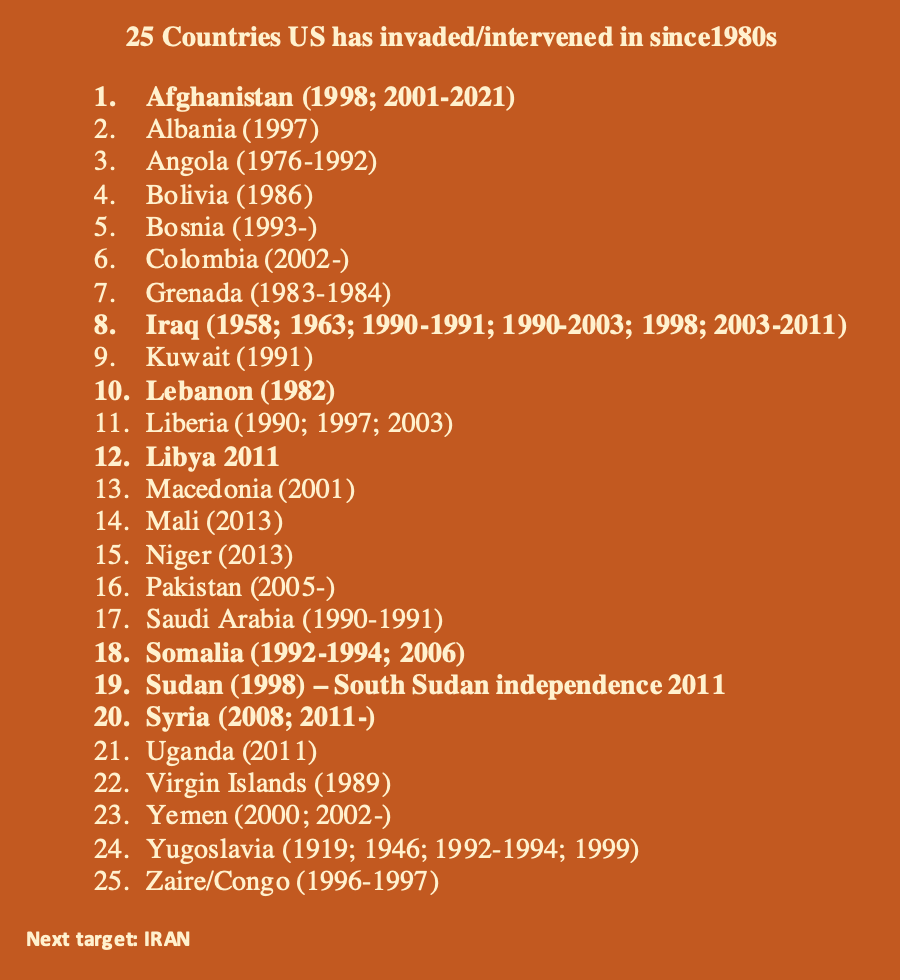
Are America’s wars, on behalf of US citizens or to fatten the bank
accounts of American corporations & defense contractors (who sponsor
Members of Congress) as well as to ensure there is no alternate economic model
to the ‘capitalist’ model US & West promotes? The list of US interventions
since 1945 and the state of these countries thereafter should provide answers
to countries lining up to be America’s ‘partner’ in South Asia or any other
part of the world. India & Sri Lanka must
redraw its foreign policy taking stock of the situation.US citizens
have to pocket $2trillion for 20 year US presence in Afghanistan but it was the
US Corporates & Defense contractors that walked away with the bounty
(opium/gas/oil/minerals). Is this the model being followed elsewhere too! The
victims of all US interventions are the US citizen, the US soldiers, the
citizens of the nation’s US ‘delivers democracy’ to.
The clue to what was to unfold
in Afghanistan was given when private military contractors in Afghanistan began
withdrawing. DoD documents for Congress reveal out of the total 17,000 all
types of contractors as of April 2021 to 7800 in July 2021. Less than 2700 US
contractors still in Afghanistan. Another clue was the US release of Taliban
leader from a Pakistani prison – today Afghan-Taliban leader is Abdul Ghani
Baradar. Taliban virtually ‘leased’ Afghanistan to US for 20 years to loot
(2001-2020) and now taken Afghanistan back for Taliban to loot.
The excuse the Biden
administration gave for the sudden transition is that Afghanistan has to look
after its own internal affairs. A realization that took 20 years and almost
50,000 lives! Or is this exit to trap China just as US did with Soviet Union?
US has no parallel competitor
to match its interventions. How many of these ‘interventions’ are of national
interest as against corporate interest is a question that remains
unanswered. US foreign wars has placed the American
citizen in $23trillion debt and 99% of the Americans don’t even know the
locations of the countries US intervenes in.Most don’t even know
why. Have Americans thought of why US declares ‘war’ on countries that have not
declared ‘war’ on America? Afghanistan is a good example.
US citizens have to pocket $2
trillion for 20 years of US invasion & occupation of Afghanistan.
What did the US citizen get?
2400 US soldiers dead (38,000
Afghan civilians dead)
More than $350b for veteran
medical & disability care
60% of the $2trillion was spent
on training US/Afghan army, fuel, armored vehicles & facilities
8% of the $2trillion ($3 to
$4billion annually) spent on transport
14,000 troop presence & NATO
presence could not stop a bunch of dirty clothed men holding guns supplied by
US
More than ¼ of Afghans are
unemployed
When US citizens are living off
food-stamps, living in cardboard boxes, without healthcare – US Govt has spent
$15.5b in Afghanistan & charging US citizens!
Which US & international
companies plundered Afghanistan’s rich mineral resources and how much have they
made in 20 years?
Why is the US Govt paying a
Swiss-based company since 2005 (Supreme Foodservice) $5b to feed US troops in
Afghanistan with allegation of overbilling by $757m?
Why have no-bid contracts
(granting monopoly) also gone to controversial DynCorp International, KBR,
Fluor Corporation $5b per year each.
To understand – the interview
with Gen. Wesley Clark showcases the intent of the US Government and also
raises the controversy behind 9/11 Twin Tower attack” as a ruse to justify the
memo that came down from the US Secretary of Defense’s Office detailing how US
proposed to ‘take out seven countries in five years starting with Iraq and then
Syria, Lebanon, Libya, Somalia, Sudan & finishing off with Iran”. Surprise,
surprise – all of these countries have been ‘taken out’ and Iran remains the
only obstacle! https://www.youtube.com/watch?v=z8ityb0Ips4
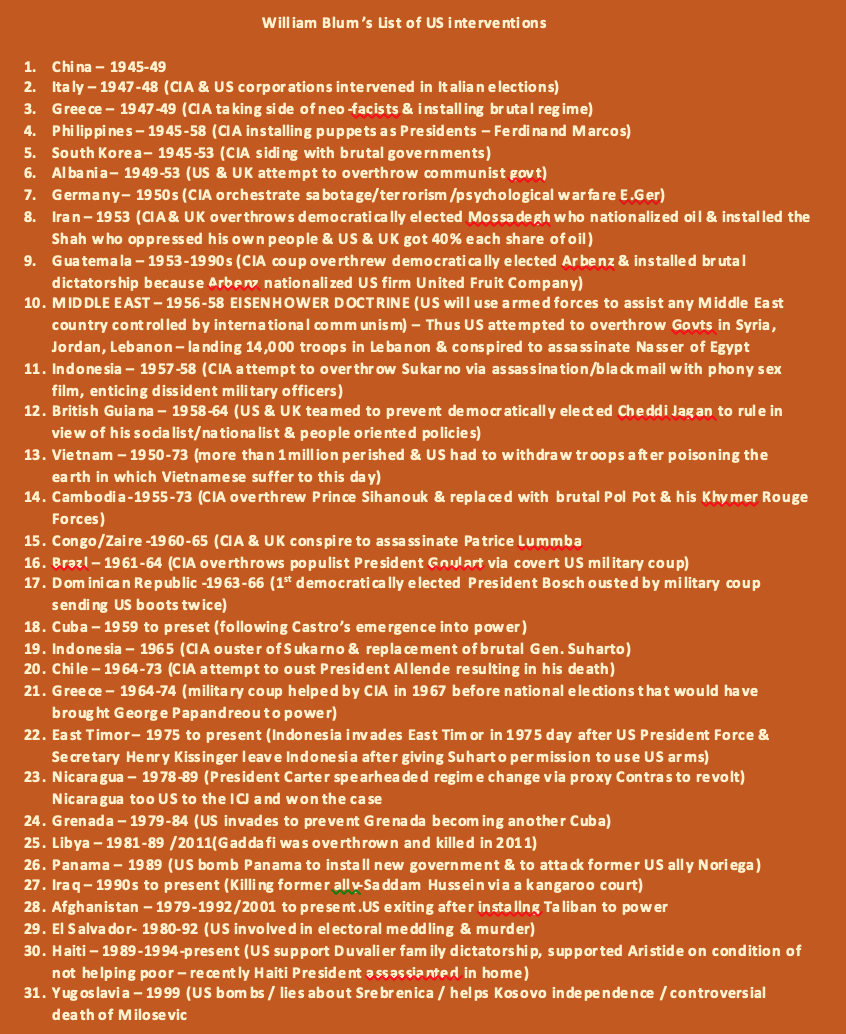
William Blum’s list gives a
clearer picture though it leaves out US invasion & takeover of Hawaii and covert
role in Rwanda’s genocide in 1994.
If 9/11 was staged, it meant
that those responsible did not care to sacrifice lives of US citizens. This
same logic is now applicable to the covid as the largest number of lives lost
are US citizens. We came to know the truth about the 1918 Spanish flu only in
2005. We may not be alive to know the truth about who ‘created’ covid & why.
Nothing can be put past a country that has ‘manufactured’ reasons to
‘invade/intervene’ in nations. The list of lies invented are many – bogus WMDs,
incubator baby deaths, ’40,000’ dead in Srebrenica, ‘liberate Libya from
Gaddafi’, ‘save Syria from Assad’.
Are these
interventions/invasions that the US citizens end up paying for, really for the
benefit of the US or the corporates that greedily await to ‘descend’ and
plunder these countries in the guise of ‘developing’ them.
Is US foreign policy covering
citizen interest or US corporate interest? All of the interventions have only
served to secure prospects for US corporates & their international partners
while stamping any nationalist attempts of targeted nations to come out of
debt-deadlock that Western monetary entities force nations to comply with.
Nationalist policies meant the
fate of Iran’s Mossadegh who was overthrown by US & UK to install the Shah
of Iran and ensure US & UK were given 40% shares each of Iranian oil. US
overthrew the democratically elected leader in Guatemala (Arbenz) had nothing to
do with American citizens simply because President Arbenz nationalized a US
firm (United Fruit Company) which was closely linked to US elite.
All US Presidents are guilty of
giving nod of approval for every US intervention/invasion
Video
Player
None of the countries US has
intervened/invaded are any better, after US intervention/invasion. In fact,
these countries are worse off than before US intervened.
US-Afghan intervention timeline
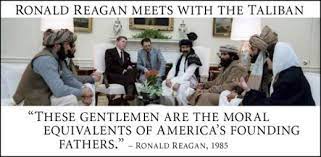
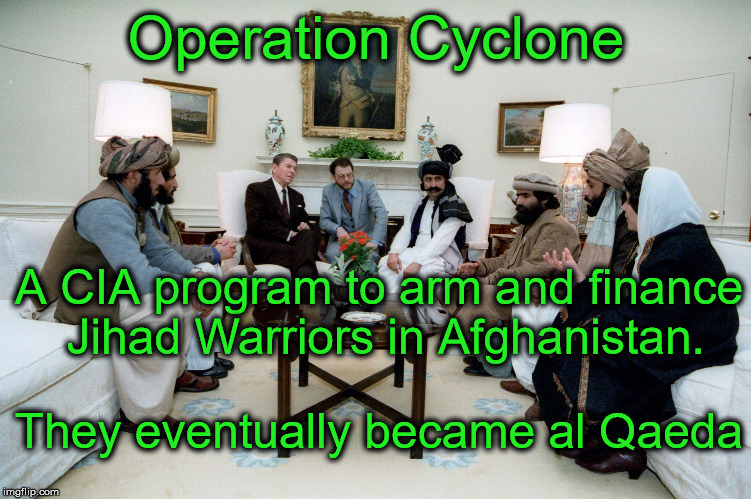
1970s – Did US trap the Soviet
Union in Afghanistan via its operatives working in Pakistan? The mujahideens
that the US created are today’s Taliban/Al Qaeda & ISIS. https://www.youtube.com/watch?v=tzlV3y-NE1w
The 9 year conflict killed an
estimated one million civilians, 90,000 Mujahideen fighters, 18,000 Afghan
troops, and 14,500 Soviet soldiers
2001 – Why did US attack & invade
Afghanistan without even investigating links to 9/11. Why did US help create
NATO (EU bloc nations military alliance) US NATO and UN are operating together
in Afghanistan?
Has the ‘occupation’ been just
a game for the ‘brains’ that planned to send boots to Afghanistan? Are these
‘brains’ bothered about the US-NATO soldiers who have died or got crippled for
life? Do these soldiers know why they are even in Afghanistan? Let’s not forget
that even the lives of diplomats have been sacrificed! (US envoys killed in Pakistan
& Libya)
How linked are these Western
‘brains’ with the ‘brains’ of the Al Qaeda/Taliban/ISIS or any other Islamic
fundamentalist groups that operate all to Western advantage. Are the
brainwashed Islamic recruits also just toys and pawns in a larger game.
If Bin Laden was a family
friend of the Bush family and the same Bin Laden became the head of the
Mujahideen and later Al Qaeda – was this ‘shift’ with ‘understanding’ of both
parties? Is this why we were shown a Hollywood version of US Navy Seals ‘killing’
Osama sans a ‘dead body’ as proof. Maybe he’s enjoying a tequila somewhere in
the Caribbean! Is this the same fate of ISIS leader Abu Bakr Al-Baghdadi too!
The deliverers of democracy
project themselves as advocators of Women’s & Childrens rights but no
sooner they install their ‘insurgents’ for their ‘agendas’ the first casualties
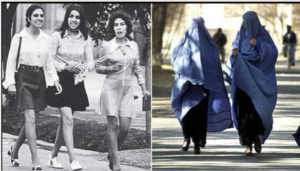
are the women & children. Afghan women, like Iranian women were enjoying
freedoms until US sponsored Mujahdeens, Taliban, Al Qaeda & ISIS –
thereafter women went from wearing mini-skirts to be covered from head to toe,
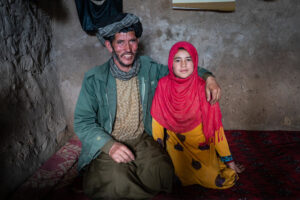
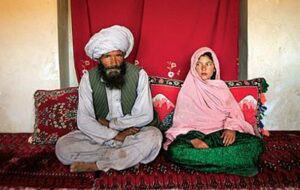
women who excelled in studies/education soon became simply sex toys for men and
increasing numbers of children given as child brides. How proud US & EU
nations must be!
The US cares not what the world
thinks about its track record. Its diplomats are proud of what they have
achieved. The question is are policy advisors of other countries ready to be a
pawn in US corporate agenda advocated via both political parties in US which
has nothing to do with what the US citizen wants or needs.
We do not wish to have Sri
Lanka become another pawn of US corporate agenda, where looting gets shared
with the US /international partners & the local pawns!
Life was never any better under
the Mujahideens, the Al Qaeda, the Taliban, the ISIS or even with US & NATO
boots for the people of Afghanistan.
The second
wave of Corvid-19 pandemic is spreading fast throughout the world including Sri
Lanka. Unlike the rest of the world, all most all opposition parties in Sri
Lanka appear to be critical on almost every measure taken by the government in
the control of the pandemic including the vaccination role undertaken by the
Army to control it. Even some of the
government servants and officials appear to be politically motivated and making
media statements, almost every day, promoting their political objectives disregarding
the government instructions.
Meanwhile we can see that social media is spreading
more and more anti government, mudslinging postings. We see posters and criticisms against lockdown
and see posters and criticisms from the same groups against not making lockdown,
when lookdown is not introduced. We experience the same reactions from these
groups against vaccinations whether vaccination is available or not available. The expectations of these opportunistic groups
appear to be nothing else, but worsening of the pandemic control and further deterioration
of the country’s economy. It is learnt that there are well organised groups in
social media, as a part of the antigovernment propaganda, to provide even
employment schemes providing payments for sharing their posters. The
growing demonstrations for more than a month, supported by the opposition
parties, disregarding health guidelines are another example. The question is who are behind these moves and
who are financing these moves.
We
remember how the antigovernment elements used the media, especially the social
media, to bring down the government in 2015 and the involvement of foreign
hands behind the regime change. We also remember how, former US
Secretary of State John Kerry blatantly boasted in public that US funded to
execute Sri Lanka’s regime change in 2015. Evidence of India’s involvement in
regime change in 2015 in Sri Lanka is also well-known (https://www.reuters.com/article/us-sri-lanka-election-india-insight-idUSKBN0KR03020150118). Thus one cannot expect those foreign forces
to remain silent after their global expectation have been reversed and they
will continue to do anything, once again, to reinstall their puppet regime. Thus it is time for the authorities to be
vigilant and to strengthen the country’s security and economy while continuing
to control the pandemic to suit.
Colombo, August 17 (newsin.asia): Through sheer grit and a fierce commitment to their tribal and Islamic values, the Afghans have frustrated a series of imperialistic attempts to dominate them. Between 1842 and 2021, the British, Tsarist Russia, Soviet Russia and the US had tried occupying Afghanistan to derive benefits from its strategic location in South and Central Asia. But their attempts had failed miserably.
British Blunder
The first major foreign debacle was in the first half of the 19th.Century. In 1839, the British, afraid of Tsarist Russia’s bid to take over Afghanistan, invaded the latter, deposed the pro-Russian King, Dost Mohamad, and put their proxy, Shuja Shah Durrani, in power. Thereafter, the majority of troops returned to India leaving about 16,000 to mop up resistance by Afghan tribesmen. By 1841, the British felt that they could not afford the campaign and stopped payments to local warlords, their henchmen. The cheated warlords promptly joined the insurgency led by Dost Mohammad’s son, Mohamad Akbar Khan.
In November 1841, the British political agent, Sir Alexander Burns, and his staff were killed by a mob in Kabul. Another senior diplomat, Sir William Hay Macnaghten, and three aides were killed while trying to negotiate safe passage for British imperial forces to India. The commander of the Kabul garrison, the elderly Maj.Gen. Lord Elphinstone eventually negotiated an agreement on January 1, 1842 with Akbar Khan. Khan guaranteed safe passage for the British-Indian force. Elphinstone agreed to leave most of his gunpowder reserves, the majority of his canons and a large number of muskets behind.
On January 6, 1842, a force comprising 3,800 Indian soldiers, 690 European cavalries and infantry, and 12,000 camp followers set out on a 140 km retreat through the snow-covered mountains of eastern Afghanistan to the town of Jalalabad, which had British troops. On setting out the troops and civilians came under sniper fire. Many of those who weren’t killed, wounded or captured by the Afghans froze to death. Furthermore, an entire Indian regiment defected to Akbar Khan.
Elphinstone again tried to renegotiate safe passage with Akbar Khan and had two officers turned over as hostages. But again to no avail. The mountain pass, jammed with troops and camp followers, became an abattoir,” writes Franz-Stefan Gady in The Diplomat on January 2020. The enemy not only poured in a murderous fire from every rock and cave in the heights on each side, descended but also into the Pass and slew man, woman, and child,” he adds.
Elphinstone then decided to hand over all the British women to Akbar Khan, who again pledged to protect them and also children and wounded officers. Two men, eight women and nine children were turned over to the Afghan leader. An almost all British force entered the Tezin Pass but only to be subjected to another ambush by a barbarous and bloodthirsty foe” in Elphinstone’s words. Only 200 hundred men remained. At night, Akbar Khan invited Elphinstone and the other remaining high-ranking officer, Brigadier Shelton, for talks. But they were arrested on arrival.
On the night of January 12, the remaining 200 continued their march but were stopped by a barrier and fired upon. Only eighty men managed to make it across alive—20 officers and 45 soldiers of the 44th (East Essex) Regiment of Foot, British artillerymen and a handful of Indian troops. Their last ditch stand on the Gandamak hill was futile. The Afghans took only nine prisoners, and only one, Assistant Surgeon William Brydon, was allowed to go. He arrived in Jalalabad on January 13 on a wounded horse. The British defeat was total. Lord Auckland, the Governor-General of India, and the architect of the invasion, suffered a stroke on hearing the news.
However, in 1842, the British sent an Army of Retribution” to Afghanistan, and recaptured key towns including Kabul. The army returned to India with 90 odd hostages. But given the bitter experience the British vowed not to intervene in Afghanistan’s internal politics again.
Soviet Misadventure
The British blunder was followed by the misadventure of Soviet Russia in December 1979. The USSR intervened in support of the Afghan communist government in the latter’s conflict with anti-communist Muslim guerrillas. In April 1978, Afghanistan’s government headed by President Mohammad Daud Khan, was overthrown by left-wing military officers led by Nur Mohammad Taraki. Power was thereafter shared by two Marxist parties, the Khalq Party and the Parcham Party. But the leftist and pro-Soviet government had little popular support in Islamic Afghanistan. The leftists were also ruthless.
Tribal insurgencies, so typical of Afghanistan, arose which the regime tried to crush ruthlessly. As the regime promoted non-Islamic tendencies, the opposition styled themselves as Mujahideen (Jehadis).
The Soviets propped up the Parcham party leader Babrak Karmal, but Karmal was unable to attain popular support. Backed by the United States, the Mujahideen rebellion only grew in strength. To counter this, in December 1979, the Soviets invaded Afghanistan with 100,000 troops. These controlled the cities but the countryside was with the Mujahideen. The constant fighting led to 2.8 million Afghans seeking asylum in Pakistan, and another 1.5 million in Iran.
However, by 1988, the Mujahideen had neutralized Soviet airpower with shoulder-fired missiles supplied by the US. 15,000 Soviet troops were killed in ceaseless fighting. In 1988 the Soviets decided to withdraw and did so by February 15, 1989. Thus, another bid to impose alien rule and an alien set of values on Afghanistan failed miserably.
Rise of Taliban
The Mujahideen filled the vacuum. But the Islamic groups failed to stick together. From the melee emerged the Pushtun-dominated Taliban as the strongest group. Founded in 1994, it was wedded to strict Islamism and it had Pakistan’s firm and active support. In 1995, the Taliban took control of 12 Afghan provinces. On September 27, 1996, it entered Kabul and announced the establishment of the Islamic Emirate of Afghanistan”. By 1998, it controlled 90% of Afghanistan the rest being with the Northern Alliance led by tribal warlords and supported by the US.
US Invasion
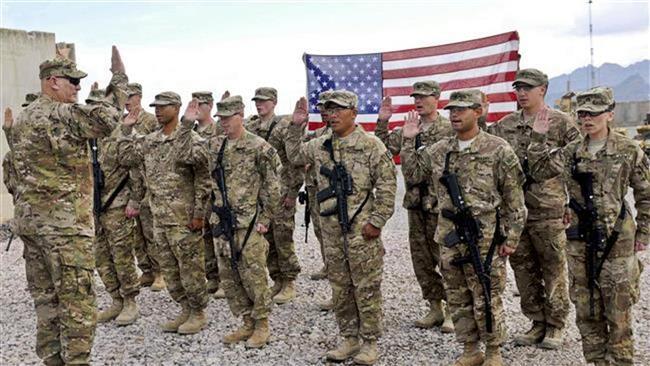
What particularly angered the US was theTaliban’s giving shelter to the Al Qaeda leader Osama bin Laden. Weeks after the September 11, 2001 attack on New York by Osama bin Laden’s men, a powerful US-led coalition force invaded Afghanistan. The Taliban retreated from Kabul on October 13, 2001 and its leaders fled from the country.
But the Taliban regrouped and started guerrilla warfare. Through ambushes and guerilla attacks in the rural areas, and suicide attacks in cities, the Taliban gained control over parts of the country from 2006 onwards. The US-led coalition had to deploy 140,000 troops, 100,000 of them from the US.
However, the going proved to be too tough for the Americans. The US tried to talk to the Taliban in 2011, 2012, 2013 and 2015 but failed. In 2018, Afghan President Ashraf Ghani said he was ready for unconditional talks with the Taliban. He also promised to recognize the Taliban as a legitimate political party and release its prisoners. But the Taliban said that it would talk only to the US. The US initially rejected the proposal but later agreed to talks in Doha. After several rounds of talks, a peace deal was signed on February 29, 2020. But it was not worth the paper it was written on, as fighting continued. America’s last ditch but half-hearted effort to put together a coalition of its proxies and the Taliban failed because the Taliban was hell-bent on acquiring monopoly over power.
Back in Washington, a decision had been taken to withdraw from Afghanistan by August 31, 2021. The 20-year war had cost the US 2.6 trillion dollars without giving any returns, except ignominy. And in the third clash with the titans in recent history, the small and ill-equipped but doughty Afghans had prevailed.
Minister Pavithra Wanniarachchi who was appointed as the Minister of Transport in a cabinet reshuffle that took place earlier today (16) bid farewell to her former staff at the Health Ministry this afternoon.
A special meeting was held at the Ministry of Health to bid farewell to Wanniarachchi and welcome newly appointed Minister Keheliya Rambukwella.
Minister Wanniarachchi admitted that she too was shocked when she was offered a new portfolio, like many others in the Ministry.
“When I was called, I told a group of doctors who was at a meeting with me that it might be a ministerial change. Doctors said that my portfolio will not be changed. But I was unaware of all these new developments until the last minute,” she said.
She related a renowned folktale during her farewell speech that left many wonder whether she was trying to convey a hidden message.
She said;
“Once, when a King and his chief advisor (Purohitha) were on a journey together and the King’s finger was accidentally cut off by his own sword. Why did this happen? he asked Purohitha, to which latter replied ‘must have happened for good’.
The King, angry at his response, pushed Purohitha into a pit and continued his journey, but in the opposite direction.
Subsequently, the King was surrounded by a group of celebrants, looking for an individual to sacrifice to complete their ritual. Upon inspection, however, they deemed the King unsatisfactory for the sacrifice, claiming that he was not a ‘whole’ person, as he had damaged fingers.
The King was then free to go. He later realized that Purohitha had in fact been right, the celebrants had let him go because he was missing a finger.
He went back looking for Purohitha. Pulling Purohitha out of the pit, the King asked him for forgiveness, to which Purohitha replied ‘I am grateful to you, for if you had not thrown me into this pit, I would have accompanied you. And once the celebrants deemed you unfit for the sacrifice, they would have taken me instead, as I am a ‘whole’ person’.
Similarly, we too shall think that everything happens for a reason , the Minister concluded.
The Government of Sri Lanka and the China Development Bank have entered into an agreement of RMB 2 billion – approximately Rs. 61.5 billion – Term Facility today (August 17), the Chinese Embassy in Colombo announced.
In a tweet, the embassy stated that the agreement was signed upon the request from Sri Lanka to support its COVID19 response, economic revival, financial stability and livelihood betterment.
The total number people who fell victim to COVID-19 infection in Sri Lanka soared yet again as a record high of 171 new fatalities were confirmed by the Director-General of Health Services on Monday (August 16).
This marks the ninth consecutive day that the daily count of COVID-19 deaths surpassed 100.
The new development has pushed the official death toll from the virus outbreak in Sri Lanka to 6,434.
According to the data released by the Department of Government Information, the latest victims include 102 males and 69 females.
As many as 134 deaths were reported among the elderly people who are aged above 60 years. In addition, 35 individuals aged between 30-59 years and two males below 30 years have also succumbed to the virus infection.
A total of 946 more people tested positive for COVID-19 today (August 17), increasing the daily count of positive cases to 3,609.
According to the Government Information Department, 3,555 of the latest cases reported today were associated with the New Year cluster. The remaining 54 are arrivals from foreign countries.
Following the new development, the country’s confirmed coronavirus cases tally now stands at 365,683, the Epidemiology Unit said.
Official data showed that as many as 314,340 patients who were infected with the virus have returned to health so far.
Meanwhile, the death toll reached 6,434 after a record high of 171 victims were confirmed by the Director-General of Health Services.
More than 45,000 active cases are currently under medical care at hospitals and treatment centres across the country.
The views expressed by the Maha Sangha and opposition politicians regarding the Covid situation in the country and the cabinet reshuffle that took place yesterday is given below;
Over-confidence and reliance on out of date information, lack of
familiarity with recent rapidly changing medical and scientific advances, and
‘close-mind set’ is likely to lead to inadvertently making false comments and
unfair criticisms.
There are over 350 published, recent peer-reviewed clinical
scientific papers on being significant benefits of vitamin D and ivermectin: new peer-reviewed
publications coming up every other day: these strongly support both prevention
and treatment of early stages of COVID-19. In contrast, awaiting head-to-head clinical studies, in the
longer term and eliminating SARS_CoV-2 from the world (through milder infection
leading to herd immunity), the combination is expected to be
superior to vaccines in preventing complications and deaths from delta and
potential even more infectious variants. Using these agents at the
proper doses would significantly reduce complications and deaths and healthcare
burden, and costs.
Emerging data suggest that the efficacy of vaccines continues to
fade due to viral mutations with an increase virulence, immune evasion, and the
inability to neutralize SARS-CoV-2. However, no such exists with the
natural immunity enhanced by micronutrients. When a person infected with
SARS-CoV-2 has robust immunity, it will eliminate the viruses and recover
rapidly, irrespective of the vital mutation(s).
Those who do
not have an open mind and most recent scientific literature will continue to
criticise their unknowns blindly. Two links of
“Who disseminates most of the disinformation:” . Two links
of “Who disseminates most of the disinformation:”
Those industries and administrations and social media companies, with conflicts
of interest.
Vitamin D acceptance delayed by Big Pharma following the Disinformation
Playbook: Orthomolecular Medicine News Service William B. Grant
(2018-10-01):
Hundreds more British troops are being sent to Kabul to help with the evacuation effort in Afghanistan’s capital – as the foreign secretary admitted the UK was left “surprised” by the speed with which the Taliban took control of the country.
An extra 200 British troops will be sent to Kabul, bringing the number of UK armed forces personnel in the city to around 900 – the majority of which have been deployed in the past week.
It is understood several hundred further troops are also set to be deployed in the region in order to be able to move into Afghanistan quickly, if needed.
And more personnel are being held at readiness in the UK in order to be able to deploy at short notice, if further troops are needed for defensive duties, according to the Ministry of Defence.
Meanwhile, Prime Minister Boris Johnson intends to host a virtual meeting of G7 leaders on Afghanistan in the “coming days”, Downing Street said.
The UK currently holds the presidency of the group of the world’s leading democracies.
An immediate focus of British troops in Kabul will be the evacuation effort from the city’s airport, with UK armed forces working with partners to secure the Hamed Karzai International Airport to ensure RAF and civilian chartered flights can operate.
Foreign Secretary Dominic Raab revealed this was the focus of an emergency COBRA meeting of top ministers and officials on Monday.
Mr Raab said 150 British nationals would be arriving back in the UK in the early hours of Tuesday morning, with a further 350 Britons and Afghan nationals arriving in the coming days.
But the foreign secretary refused to state how many refugees the UK might accept from Afghanistan, which has fallen back into Taliban control after 20 years, although he stressed Britain was “obviously a big-hearted nation”.
“Everyone, I think, has been surprised by the scale and the pace at which the Taliban have taken over in Afghanistan,” said Mr Raab, who flew back to the UK last night from a summer holiday abroad amid criticism he had been absent during an unfolding international crisis.
“And that’s a lesson that we’ve all got to learn from. But the truth is what matters right now is focusing on getting British nationals out, getting out those who have so loyally served the UK, and making sure that the gains that we’ve made over 20 years are not lost.
“Let’s remember we haven’t had a terrorist attack on the UK from Afghanistan in 20 years.
“Because of UK aid, 10 million more children have been in education. Because of UK efforts with others, eight million more landmines have been cleared.PlayAd 00:11 – up next “Afghanistan: Chaos at Kabul airport”Loaded: 0.00%Unmute0Afghanistan: Chaos at Kabul airport
“So we have a record that we should not overlook. Of course, the priority now is to make sure that the gains aren’t lost because of the Taliban taking control.”
The government is under pressure from its own Conservative MPs over its handling of the crisis in Afghanistan.
And the families of those who died fighting during the two decades of Western military intervention in the country have criticised the UK and US over the withdrawal of troops.
Mr Raab vowed the UK would hold the Taliban “to account” if they did not uphold commitments on human rights and preventing Afghanistan from being used as a base for terrorism.
He suggested that economic sanctions, the withholding of UK foreign aid, and work with international partners could be used as “levers” put pressure on the Taliban to make sure “they are held to the undertakings that they’ve made”.
The foreign secretary described the Taliban takeover of Afghanistan as a “new reality” although “not what we wanted”.
“We’re making it clear with our partners with all the means at our disposal, that we will hold the Taliban to account, to its commitments, to have a new start in Afghanistan,” he added.
“It’s clearly not going to be to the values that the UK, the West, the European Union, the Americans believe in, but we can have a moderating influence.
“I think it’s important we use all of the policy tools at our disposal – working with our partners – to try and achieve that.”
And Mr Raab defended his taking of a summer holiday, when asked if he should have returned to the UK sooner.PlayAd 00:14 – up next “Situation in Kabul ‘shocking’ & ‘tragic'”Loaded: 0.00%Unmute0Situation in Kabul ‘shocking’ & ‘tragic’
“I think the important thing to understand is right the way through last week – and I arrived, was on a flight last night to get back – I’ve been directly in touch with my team, directing them, which has paid the dividends, you can see what we’ve delivered with 150 British nationals who are going to be arriving back in the UK tomorrow morning.”
The foreign secretary said he had been “engaged” in all three of the COBRA meetings held in the past four days, while he revealed he spoke to his Pakistani counterpart on Sunday and was due to speak with US secretary of state Antony Blinken later on Monday.
Earlier, Labour leader Sir Keir Starmer said there was an “obligation” to those in Afghanistan who had helped the UK effort.
“We need to get UK nationals out, but we also have an obligation to all of those Afghans who helped and assisted the UK, and we shouldn’t have nice distinctions between this type of person, this type of help, and that type of help,” he said.
“If those in Afghan have helped us, the UK, in our work in Afghanistan, we have got an obligation to them.”
President Joe Biden characterised the US mission in Afghanistan as accomplished on Monday, even as the Afghan government collapsed in the face of advancing Taliban militants in Kabul.
President Joe Biden speaks on Monday about the US withdrawal from Afghanistan and the Taliban’s conquest of the country.- AP
In a national address called by the White House in the hours after Kabul fell to the Taliban and as videos showed a chaotic evacuation of US personnel from the city’s airport, Mr Biden said that he stands squarely behind” his decision, explaining that the only alternative was a return to all-out war with the Taliban.PauseAd 00:07 – up next “Biden Stands Behind Decision To Withdraw”Loaded: 0.00%Unmute0Biden Stands Behind Decision To Withdraw
Fault for the fall of Afghanistan’s government was laid on the shoulders of former President Donald Trump’s administration for signing a deal with the Taliban that began the military withdrawal and set a timeline for the US exit, as well as Afghan officials who he argued lacked the will” to fight for their country.
We severely degraded Al Qaeda in Afghanistan,” Mr Biden said, adding, our mission in Afghanistan was never supposed to be nation-building.”
As president, I’m adamant that we fight the threats we face today, not yesterday,” he continued.
Adding of the rapid collapse of Afghanistan’s US-supported government, Mr Biden said that in many cases, the country’s civilian and military forces simply gave up” rather than resisting a Taliban takeover.
The truth is, this did unfold more quickly than we had anticipated,” the president admitted.
But, he asserted, [w]e gave them every tool they need” to resist the Taliban.
The situation at Kabul’s Hamid Karzai Airport remains under US control, the president said, where US forces continue to evacuate both US personnel and Afghan civilians with ties to the American military and civilian authorities, including those who served as translators and other aides.
We have made it clear to the Taliban: if they disrupt our operation … we will defend our people with devastating force, if necessary,” Mr Biden vowed.
Once we have completed this mission, we will conclude our military withdrawal. We will end America’s longest-running war, after nearly 20 years of bloodshed,” he continued.
US forces at the airport will continue to evacuate both thousands of Afghan civilians who wish to leave as well as US personnel from the embassy, who Mr Biden said were now consolidated” at the airport.
The president gave no mention to reports that US generals had met with Taliban officials in Doha, Qatar, and secured an agreement to allow the evacuations to continue unhindered, indicating only that his administration would defend those at the airport with deadly force.
He also attempted to battle critics who slammed the frantic nature of the evacuations, asserting that officials with the now-ousted government had requested that evacuations not begin sooner to prevent a crisis of confidence in President Ashraf Ghani’s administration. Mr Ghani fled the country on Sunday, reportedly for Tajikistan.
His address followed the shocking scenes that unfolded in videos on social media and news channels throughout Sunday and early Monday as thousands of Afghans crowded the airport in the hopes of making it out on a commercial flight or US military aircraft. In one video, at least a dozen people are seen physically clinging to the side of a military AC-130 attempting to depart.
At least one shooting has already reportedly occurred, with US forces allegedly firing on two armed individuals in an incident early on Monday that occurred as massive crowds were overwhelming the airport. It wasn’t clear if the individuals had any links to the Taliban, which as of yet has not made a serious effort to stop the evacuations.
The Biden administration has deployed thousands of US troops to coordinate the evacuations of US personnel and others from the country, and added to that number on Sunday as the Afghan government dissolved.
Over Sunday and early Monday, his administration’s top officials tried to distance events in Kabul from imagery of the US defeat in Vietnam, which Mr Biden himself had conjured in July when predicting that diplomats would not be airlifted from the grounds of the roof of the US embassy, a scene that essentially played out in the Afghan capital on Sunday.
At the same time, he denied an assertion by a reporter that his own intelligence agencies had concluded that it was likely” the Afghan government would fall.
In interviews on Sunday, Secretary of State Antony Blinken insisted that this is not Saigon”, arguing that the US had not asked the Taliban for anything”.
The defences provoked stinging criticism from many in the media, who noted that the administration had no explanation for why it could not foresee the quick victory of the Taliban.
America’s longest military conflict has cost the US more than $2.2 trillion over the past 19 years, and resulted in the deaths of more than 2,400 American service members as well as tens of thousands of Afghans. Some 456 Britons also lost their lives during the conflict.
From news to politics, travel to sport, culture to climate – The Independent has a host of free newsletters to suit your interests. To find the stories you want to read, and more, in your inbox, click here.
Sri Lanka will stop building coal-fired power plants and double the share of its electricity from renewables by 2030, according to the government’s latest climate plan.
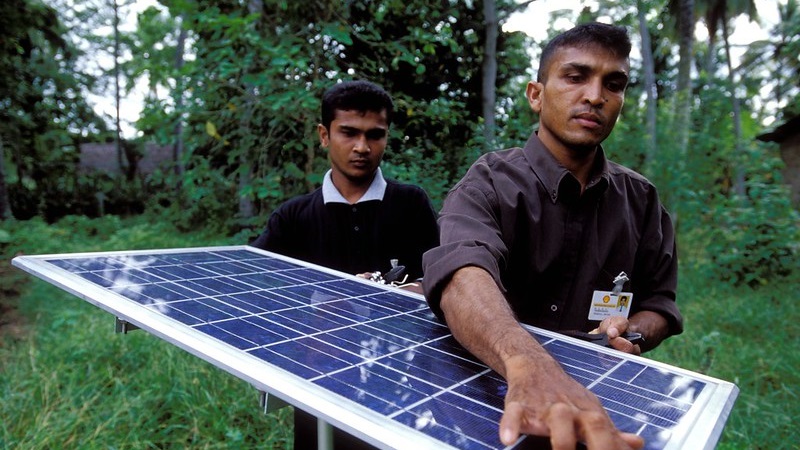
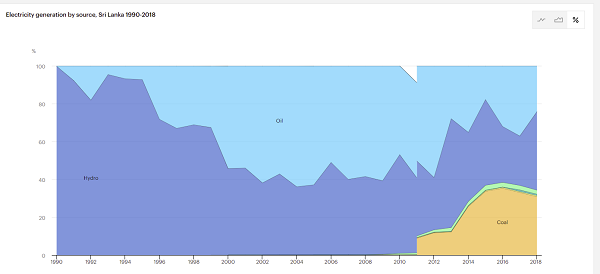
In 2019, the Indian Ocean island got 35% of its electricity from renewables, mainly from hydropower. By 2030, it wants to increase that figure to 70% by facilitating investment in rooftop solar power.
The island’s single 900MW coal power station, built with Chinese backing in 2006, meets around a third of electricity demand. Controversial plans for a second coal plant, to be financed by India, were shelved in 2016 after environmentalists filed a legal challenge.
Ruling out further coal power contributes to a target to cut Sri Lanka’s greenhouse gas emissions 4% from business as usual by 2030 with national investment and up to 10.5% with international support. The government aims to have a carbon neutral electricity generation system by 2050, according to the document submitted to UN Climate Change last month.
Mohammed Nasheed, former president of the neighbouring Maldives, welcomed the plan. He tweeted: Great climate leadership by [President Gotabya Rajapaska] who steers Sri Lanka away from coal to renewables.”
Sri Lanka currently gets its electricity from coal, oil and hydropower (Photo: IEA)
The government is encouraging Sri Lankans to install rooftop solar power by offering loans with at most a 4% interest rate. This scheme is funded by a $50m loan from the Asian Development Bank (ADB).
Anoka Abeyrathne, director of Colombo-based sustainability advisers Aayusha Global, told Climate Home News: These solar energy schemes have been implemented across industrial parks as well including large scale roofs and households. This makes financial sense for both corporates and households as the costs for energy is greatly reduced. In addition, solar power buy-back to the grid is encouraging more people to install solar systems as an additional revenue system as well.”
On the other hand, Colombo University lecturer on debt and development Umesh Moramudali said these solar projects were not at a large scale”. The ADB says this project is expected to reduce the country’s greenhouse gas emissions by 66,800 tCO2 annually. That’s around 2% of Sri Lanka’s total annual emissions.
Vositha Wijenayake, executive director of the SLYCAN Trust NGO and a Sri Lankan climate negotiator, told Climate Home News that the grid needs to be made more stable so it can absorb renewable energy at a high rate.
Sri Lanka only has one 900MW coal-fired power plant. Its official name is Lakvijaya but it is commonly known as Norocholai after the west coast village which hosts it. Since its construction in 2006, the Chinese-built plant has faced protests. Abeyrathne said the plant has polluted water, the fumes have damaged local residents’ health and that ash has damaged nearby farmers’ produce.
Sri Lanka’s desire to transition away from coal is partly driven by a desire for energy independence. The country produces no coal or oil.
Sri Lanka’s president has announced that the country’s health minister, Pavithra Wanniarachchi, has been sacked for pushing Covid misinformation and promoting false treatments amid surging case numbers.
Announcing Wanniarachchi’s dismissal on Monday, the president’s office confirmed she would move to a position in the transport ministry, with media minister Keheliya Rambukwella taking her health portfolio.
The cabinet shake-up comes after Wanniarachchi pushed claims that a magic potion” made by a sorcerer helped to protect her and others against Covid. The former health minister stated that she had poured blessed” water into a river in the country in November after a so-called god-man” had told her doing so would end the Covid outbreak in the country.
However, coronavirus infections have continued to rise throughout Sri Lanka, with the number of fatalities from the virus rising to more than 150 and new cases growing to over 3,000 per day in the past week. As medical facilities are overwhelmed by the scale of the outbreak, health experts in the government have warned that infections could triple in the coming weeks.
Wanniarachchi had faced growing criticism in her role as health minister for underestimating the devastation caused by the deadly wave of Covid sweeping across the country. Alongside pushing Covid misinformation, Wanniarachchi had rejected supporting a lockdown to prevent further spread of the virus, although the government increased restrictions last week.
Currently, an evening curfew will come into effect on shops, restaurants and offices from Monday, with weddings and parties prohibited from Tuesday and all ceremonies and public gatherings barred from going ahead until September.
Since the start of the pandemic, Sri Lanka has reported 354,968 confirmed cases and 6,039 deaths from Covid, with only 14.9 million doses of a vaccine administered, according to data reported to the World Health Organization.
State Minister Ajith Nivard Cabraal says that social gatherings such as parties that had taken place in the nighttime had led to the spread of the Delta variant of the coronavirus in the country.
The State Minister of Finance, Capital Markets, and State Enterprise Reforms explained the reasoning behind the nighttime curfew imposed in the country, joining the Ada Derana ‘Big Focus’ program today (August 16).
Sri Lanka imposed a quarantine curfew, effective island-wide, from 10.00 pm to 04.00 am daily.
He said, This has been especially imposed so that people stay at home at night instead of gathering and partying. It has been revealed at points that parties have spread this [Delta] variant. That is the reasoning here. This [curfew] has been imposed as an answer to that.”
He further said that the public too should act safely while being conscious of this, even if there was no curfew.
Meanwhile, Cabraal refuted various rumors circulating on social media that his son’s wedding was to be held today.
Stating that there was no truth in these rumors, he added that both his sons have already married.
Former Minister of Health Pavithra Wanniarachchi says that her removal from the Health Ministry was unexpected.
Earlier today (August 16), several Cabinet ministries were reshuffled and Minister Wanniarachci was removed from the Health Ministry and assigned to the Ministry of Transport.
Speaking at a brief farewell function at the Ministry of Health, Wanniarachchi said that she will make up her mind with the mindset that everything happens for good.
She said, I didn’t think this change would come suddenly. Before I went there, I told the doctor that I wonder whether it is a ministry shuffle. They both said it would not happen. I do not think, when I came to the Ministry, you wished for ‘this woman to disappear’. However, unexpectedly, I have been assigned the Ministry of Transport instead of the Ministry of Health. I did not know this was to happen before I went there.
In any case, you have to accept everything in life happily. Let’s make up our minds that everything happens for the good. There is nothing else to do. I am saddened. Please support the new Minister too.
I still say we have only about 4 more weeks to go. At present we have vaccinated 54% [of the population]. In another 4 weeks, we can save this country.”
The Epidemiology Unit of the Health Ministry reports that another 1,038 persons have tested positive for COVID-19 in Sri Lanka, moving the daily total of new cases to 3.466.
This brings the total number of confirmed cases of coronavirus reported in the country to 362,074.
As many as 312,057 recoveries have been confirmed in Sri Lanka since the outbreak of the pandemic.
The Epidemiology Unit’s data showed that 43,921 active cases are currently under medical care.
Meanwhile, Sri Lanka has registered 167 more COVID-19 related fatalities on Sunday (August 15).
The new development has pushed the official death toll from the virus outbreak in Sri Lanka to 6,263.
According to the data released by the Department of Government Information, the latest victims confirmed today include 103 males and 64 females.
Reportedly, among the victims are one male aged below 30 years, 36 victims aged between 30-59 years and 130 others aged 60 and above.