India’s federal counter-terrorist force NSG has trained a select group of personnel who protect Prime Minister Mahinda Rajapaksa, the chief of the commando force said on Friday.
According to Economic Times, NSG director general (additional charge) S S Deswal said this in his address on the occasion of the force’s 36th Raising Day.
He said the force has acquired the most modern weapons and equipment to distinguish itself as a “world class zero-error force”.
“The NSG close protection force has trained 21 personnel of Sri Lanka’s PM security division in close protection skills. The honourable Prime Minister of Sri Lanka wrote to the honourable Indian PM and praised the training,” Deswal said.
He, however, did not mention the time period when these personnel were trained by the NSG.
The National Security Guard, also known as the ‘black cat’ commandos, was raised as a federal contingency force in 1984 to undertake specialist counter-terrorist, counter-hijack and hostage rescue operations.
It has a special component called the CPF (close protection force) that provides security to high-risk VIPs under the top category Z+ cover.
It has about 13 protectees under its charge at present, including Defence Minister Rajnath Singh, Uttar Pradesh Chief Minister Yogi Adityanath and former Jammu and Kashmir Chief Minister Farooq Abdullah.
The Minuwangoda Covid-19 cluster has confirmed 49 more positive cases this evening (16), says the Commander of Sri Lanka Army, Lieutenant General Shavendra Silva.
Thirty-five of them have been identified as apparel factory workers and contacts who are in quarantine centers.
The remaining 14 are contacts of Covid-19 positive patients from the cluster, according to reports.
Sri Lanka registered 110 novel coronavirus infections so far within the day.
Thereby, the total number of Covid-19 cases reported from the Minuwangoda cluster has soared to 1,899.
Three days have passed since the Attorney General directed the Police to arrest MP Rishad Bathiudeen, however the investigation officers are yet to locate him.
The Criminal Investigation Department (CID) meanwhile recorded statements from Opposition Leader Sajith Premadasa and MP Rauff Hakeem with regard to the phone conversations they have had with the parliamentarian.
They also recorded a statement from MP Bathiudeen’s wife at their residence in Colombo last evening (15). However, she has told the investigating officers that the parliamentarian had not kept in touch with her since October 12 and that she is unaware of his whereabouts.
In the meantime, an attorney-at-law representing MP Bathiudeen filed a writ application yesterday, seeking an order from the Court of Appeal to prevent his arrest.
The writ application has been fixed for support on the 20th of October before Appeals Court justices Kumudini Wickramasinghe and Sobhitha Rajakaruna.
Acting Inspector General of Police C.D. Wickramaratne, Deputy Inspector General (DIG) of the Criminal Investigation Department (CID) S.P. Ranasinghe, Sub Inspector Gamini and four others have been named as its respondents.
Then-Minister of Industry and Commerce Rishad Bathiudeen, the director of the project Mohamed Yaseen Samsudeen and the project accountant Alagarathnam Manoranjan are accused of violating Article 82(1) of Presidential Elections Act, No. 15 of 1981 by misappropriating public funds to the tune of Rs. 9.5 million.
They have allegedly misused 222 buses belonging to the state-owned Sri Lanka Transport Board (SLTB) for transporting IDPs from Puttalam to polling stations in Silavathurai, Mannar during the 2019 Presidential Election.
The CID, upon the direction of the Attorney General, had sought the Colombo Fort Magistrate to issue a warrant to arrest MP Rishad Bathiudeen and the other two suspects on charges of criminal misappropriation of public funds and violation of election laws.
However, the magistrate ruled that the Police can proceed to arrest the suspects without a warrant.
Thereby, Attorney General Dappula de Livera directed the Police to arrest the three suspects according to the law.
Alagarathnam Manoranjan was taken into custody by the CID on Tuesday (13) in the area of Kirulapone. He was remanded until the October 26 after being produced before the Fort Magistrate’s Court.
In the meantime, a constable attached to MP Bathiudeen’s security detail was also taken into custody the following day, for allegedly aiding the parliamentarian to evade the arrest. He was apprehended in Wellawatte area, along with two cars and two firearms.
On October 14, the Fort Magistrate issued a travel ban on MP Bathiudeen upon a request by the CID.
Notorious underworld figure Janith Madushanka, operating under the alias ‘Podi Lassie’, who was arrested and remanded for threatening the VIPs, has been granted bail.
However, he will continue to be held by the Criminal Investigation Department (CID) on detention orders.
The Galle Magistrate delivered the order when the suspect was produced before court today (16).
During the proceeding, it was revealed in open court that ‘Podi Lassie’ had used cosmetic products which weighed up to 5kg in total, while in remand custody at the high-security prison in Boossa. The focus of the judicial members fell on how the products were smuggled into a maximum-security jail.
It is further reported that an overseas travel ban was imposed on the infamous criminal figure.
‘Podi Lassie’ was named as the second suspect in the case filed over the death threats made in public at the Boossa Prison, against the President, the Defence Secretary and certain high-ranking officers of the Prisons Department.
What is this ‘creative balance & equilibrium in Sri Lanka’s favor’ that the Moragoda Doctrine espouses to achieve? Exactly how many votes would the Moragoda Doctrine have delivered to Gotabaya Rajapakse or the SLPP had that been the basis of their election manifestos & election campaigns?While Moragoda is the head of Pathfinder, the very organization that is promoting the implementation of the MCC, advocated via its Post-Covid Economic Proposal, MCC actually demands changes to the constitution and land policy and land laws prior to signing of the agreement. If so, how can Moragoda claim to ‘protect Sri Lanka’s interests and safeguard her sovereignty’? This is in direct contrast to the election manifesto that won the Presidency for H.E. Gotabaya Rajapakse & helped SLPP win a 2/3 in Parliament.
‘nationalist isolationist strategy’ Moragoda claims is counter-productive, however it was the nationalist strategy that placed this Government in power. It is nationalist strategy that has been the winning streak in all of the powerful mandates leaders have secured across the world. Ask Narendra Modi how he came to power!
A nationalist policy and strategy is what inspired the ancient leaders to use diplomacy to win friends that came to Sri Lanka’s aid during adverse periods. Fast forward to present context, it is these friends that came forward to help Sri Lanka eliminate a terrorist organization banned by 32 nations while those promoting chit chats with tigers were attempting to whisk off the tigers to safety via sea. It is these alliances and friends that stand up for Sri Lanka on international forums. Does Sri Lanka need friends who shake hands and plot to stab Sri Lanka?
Moragoda high-commissioner designate is claiming that the model strategy was during the ‘international cooperation formulated & implemented during 2002-2004’ under his former hero Ranil Wickremasinghe.
This period saw some of the worst treacheries take place. A Norwegian brokered ceasefire agreement was signed keeping the document secret from the country’s President. A foreign monitoring mission was brought in simply to do clerical work & record violations. Over 3000 violations committed by LTTE remained just confined to paper. The highest number of child soldier recruitment took place during this period. The National Army was confined to barracks while the terrorists were allowed to roam the country with arms. Terrorists for the first time in history were officially given territory in a sovereign country. In addition to the treacherous Cease Fire Agreement two more detrimental agreements were in queue for signature – the PTOMs and ISGA. Terrorists were sent sophisticated communication and satellite systems, passed by Sri Lanka Customs with officials even waiving duties & taxes and helping transport items to the terrorists! So this was the ‘model strategy’ that Moragoda emulates!
In this age of social media and alternate news – it is natural that targeted parties escape is to shout ‘fake news’ ‘false news’ and attempt to hide their guilt. Who decides what is fake news anyway? Who decides the truth? Who can verify if anything is fact or fiction? To some the 2002 Cease Fire Agreement was Sri Lanka’s golden era but is this true? Is this fake news? Isn’t it up to the people to decide what they deem is correct or wrong? No one can and should force people to believe anything they do not wish to believe by branding it false news.
It is interesting that Moragoda brings up the ICC statute which was also a component of the Ranil-Moragoda ‘golden era of international cooperation’. The Rome Statute/International Criminal Court was established in 1998 to prosecute and adjudicate individuals, not states accused of genocide, war crimes & crimes against humanity.
In 2000 President Bill Clinton signed the Rome Statute. On May 6, 2002, the Bush Administration announced that the United States does not intend to become a party to the Rome Statute which went into force in 2002 July. SrI Lanka has not signed or ratified the Treaty. If so what is the boasting of Moragoda to stop any Sri Lankans from being extradited? But Sri Lanka signed with US in November 2002 agreeing not to transfer a person of the other Party to a third country without the consent of each other. There is also reference to the US gift of a ship claiming it helped defeat LTTE, but then it completely contradicts the fact that US wanted to save Prabakaran & whisk him off to safety. It is also to be noted that RanilW & UNP wished IMF not to provide aid & even suggested sanctions when it became clear LTTE was on their way to defeat. The 2002-2004 period also saw the defection of Karuna from the LTTE and Moragoda claims to be the mastermind of the ‘international safety net’ trapping LTTE. Invariably, it is more than possible that for Plan B of the international geopolitical game in Sri Lanka, Prabakaran needed to be out of the way and removing Karuna would deliver a major dent to LTTE & Karuna. While, West pretended to be LTTE’s friend, it was clear, they were merely using them for their own advantage. The leaders of the 2002-2004 were playing their role in this bigger game.
Who are the like-minded group Moragoda has been assigned to establish and what is their modus operandi or objectives? Moreover, if the Ranil W administration had been so gaga, why did it face electoral defeat and why did Moragoda himself jump to the Opposition? Two years of giving and giving to the LTTE eventually resulted in the assassination of Sri Lanka’s most loved foreign minister Mr. Lakshman Kadiragamar.
Why is Moragoda plucking out the 2002 Extradition Treaty between Sri Lanka & US?
Is this to convey a message to members of the Government & key heads of the armed forces on behalf of the US?
It is curious that there is reference to Sri Lanka depending on the ‘intelligence provided by the West particularly the CIA’ because even the US envoy claims to have had no intelligence of the Easter Sunday attack when India had sent Sri Lanka 97 security intel alerts! Also to date the FBI who took away the telephone records of the suicide attackers have still to provide the results to Sri Lanka and it’s been over 1 ½ years since the mass murder!
Yet, its good ot know that there had been very ‘close cooperation’ with US intel during the presidency of Mahinda Rajapakse – if so, it explains why US envoy Blake claimed to the US Congressional Committee of 40,000 deaths though he cannot produce any names or details of the deceased as yet!
Contrary to the claim that Sri Lankans have forgotten the wretched-three decade conflict – is the fact that, Sri Lankans very well remember every person who colluded with the enemy, propped them up and made use of the LTTE for their personal gain and who today are pointing fingers at the people. The people made sacrifices – those in power didn’t. The armed forces made sacrifices and sadly it was even at the cost of bad judgements.
The CFA did not turn any tide against the LTTE. The CFA only strengthened the LTTE. It was the will of the President to take the decision to military defeat the LTTE and the LTTE’s error in refusing to return to guerilla tactics that caused their eventual defeat.
No support of India or US can overpower the support that came from China & Pakistan. We cannot forget the number of trips and cost of those trips that the leaders had to make to India simply to keep the Indians happy. Sri Lanka had to play the bogus part of India’s role in claiming ‘India’s concern for Tamils’. If the West and in particular the US are so supportive of ending LTTE Terror, why do they not take action against the LTTE fronts operating from their shores and continuing the illegal international nexus which US admitted in 2015. LTTE fronts operated and continue to operate a campaign of fundraising & lies on western shores. Why are Western governments continuing to allow this if they are on the wave length that LTTE terrorism should be defeated and will help Sri Lanka do so? Why did US knowing the illegality of the Ban Ki Moon personal report, use it as a basis for 3 UNHRC resolutions based on LTTE heresay against Sri Lanka? Why are the West not going after the runaway LTTE combatants who are living on western shores as refugees/asylum seekers? Why is the same emphasis on the accountability of armed forces personnel being targeted at LTTE, when everyone knows LTTE was harming peace for all citizens of Sri Lanka. In a just war why should the armed forces be subject to retributive justice while the LTTE are to get restorative justice? Why are the armed forces vilified and ridiculed why LTTE are presented as innocent lambs? Is this the doctrine of the like-minded coalition that Sri Lanka has to accept?
As ambassador designate to India with ministerial powers – we hope the policy adopted will be nation-centric Gotabaya doctrine only!
Backed by an overwhelming majority at the Presidential & General Elections, the Government in power rightly has decided to work towards a closure of the successive UNHRC Resolutions against Sri Lanka by initially withdrawing from the co-sponsorship of 30/1 & 34/1 Resolutions. UNHRC has every provision to take up human rights issues at the Universal Periodic Review. Four of Sri Lanka’s dearest friends are members of the UNHRC – China, Pakistan, Russia & Cuba and Sri Lanka must initiate their cooperation to bring all of the former legally questionable procedural error resolutions to a grand finale.
Sri Lanka must re-write the narrative and present a dossier to the UNHRC Membership of Sri Lanka during LTTE reign of terror and post-LTTE defeat. The decision to militarily defeat LTTE came after enduring 30 years of terror and failed peace talks, negotiations and even foreign-backed cease fires including foreign monitoring missions and foreign peace keepers. Sri Lanka was up against a terrorist movement banned by 32 countries which continue to maintain that ban even 10 years after LTTE defeat owing to the international illegal nexus that operates overseas. Sri Lanka must initiate action against the international LTTE fronts together with the diplomatic community. The world must know that all of LTTE’s victims included every ethnic denomination in Sri Lanka even foreigners.
Sri Lanka must showcase what LTTE denied their own during their defacto reign and what Sri Lanka afforded to the people in the areas where LTTE ruled with gun. No reconciliation is required to take place with terrorists, while Sri Lanka acknowledges how Tamils also suffered under LTTE. This must be highlighted to the world once more. The false claim of discrimination must be nullified by producing examples of how minorities are represented in both public and private polity & the positions they hold. Every fabrication that has gained momentum via bogus propaganda channels must be nullified with facts & figures. The manner that 3 successive UNHRC resolutions were artificially birthed must also be shown. A privately commission 3-member panel report made available to the UNSG became the foundation for successive resolutions quoted even by UNHRC head now parroting for the LTTE in her retirement. The Ban-Ki-Moon Report was never tabled in the UNSC, UNGA or UNHRC for Sri Lanka to officially respond. Instead intrusive allegations went for vote in a political witch hunt against a UN member state, going so far as to even suggest constitutional amendments and annulling of even penal codes. That Sri Lanka brought peace, eliminating terror to the 21million people were ignored and those voting against Sri Lanka had no explanation for why they could not stop LTTE terror killings though questioning how LTTE were killed. The dossier of questions that those alleging needs to be prepared and endorsed by our friends in UNHRC together with the closure resolution. Sri Lanka has been unfairly treated in the manner the UNHRC has been used by lobby groups as a result of the power of international funding & lobbying.
Nevertheless, the country & its people must move forward and should move forward. If we are going to continue with the question of accountability then we have plenty of accountability questions for those who joined the witch hunt against Sri Lanka.
Today, these countries are facing their nemesis.
Sri Lanka has backing of 33 non-aligned member nations against a handful of Commonwealth member states of which UK heads. It is also a good time with UK now isolated as a result of Brexit for Sri Lanka to even consider leaving the Commonwealth as Sri Lanka has had no support other than sipping tea inspite of being a member.
Of the 47 UNHRC Members 26 countries are non-aligned movement members while 7 are Observe Member states of the Non-Aligned Movement (33 countries are NAM Members)
Resolutions against Sri Lanka in 2009, 2012, 2013, 2014
Italy has voted 4 times against Sri Lanka
Voting Once Against Sri Lanka
Netherlands (2009)
Korea (2013) – but abstained in 2009
Cameroon ((2012) – but voted for Sri Lanka in 2009
Uruguay (2012) – but voted for Sri Lanka in 2009
Twice voting against Sri Lanka
India (2012-2013) – but voted for Sri Lanka in 2009 and abstained in 2014
Argentina (2013-2014) – but abstained in 2009
Bahamas (2013-2014) – but abstained in 2009
Brazil (2013-2014) – but voted for Sri Lanka in 2009
Libya (2012-2013)
Poland (2012-2013)
Thrice voting against Sri Lanka
Mexico (2009-12-13)
Germany (2009-2013-2014)
Austria (2012-2013-2014)
Thrice abstaining
Japan (2009, 2013, 2014)
Burkina Faso (2012, 2013, 2014) – but voted for Sri Lanka in 2009
Thrice voting Pro-Sri Lanka
Indonesia (2009-2012-2013) – but abstained in 2014
Philippines (2009-2012-2013) – but abstained in 2014
Pakistan (2009-2013-2014)
Twice voting for Sri Lanka
Bangladesh (2009, 2012)
Mauritania (2012, 2013)
Venezuela (2013, 2014)
Once voting for Sri Lanka
Senegal (2009) but abstained in 2012
Algeria 2014
Abstaining
Ukraine (2009)
Namibia (2014)
UNHRC Resolution 2009-2012-2013-2014
Italy has been the only country to have voted against Sri Lanka in all 4 UNHRC Resolutions
Sri Lanka’s diplomats have their work cut out for them.
· Why Italy voted against Sri Lanka in all of the 4 resolutions against Sri Lanka
· Why Korea abstained voting against Sri Lanka in 2009 but voted against Sri Lanka in 2013.
· Why Cameroon & Uruguay voted for Sri Lanka in 2009 but voted against in 2012
· Why India voted for Sri Lanka in 2009 but voted against Sri Lankan in 2012-2013 and abstained in 2014
· Why Argentina & Bahamas abstained in 2009 but voted against Sri Lanka in 2013 & 2014
· Why Brazil who voted for Sri Lanka in 2009 voted against Sri Lanka in 2013 & 2014
· Why Libya and Poland voted against Sri Lanka in 2012 & 2013
· Why Mexico voted against Sri Lanka in 2009, 2012 & 2013
· Why Germany voted against Sri Lanka in 2009, 2013, & 2014
· Why Austria voted against Sri Lanka in 2012, 2013, & 2014
· Why Libya & Poland voted against Sri Lanka in 2012 & 2013
· Why Japan did not vote for Sri Lanka but abstained in 2009, 2013 & 2014
· Why Gabon abstained in 2009 & 2014
· Why Burkina Faso voted for Sri Lanka in 2009 but abstained in 2012, 2013 & 2014
· Why Indonesia & Philippines voted for Sri Lanka in 2009, 2012 & 2013 but abstained in 2014
· Why Ivory Coast voted against Sri Lanka in 2013 & 2014
· Why Senegal voted for Sri Lanka in 2009 but abstained in 2012
· Why Ukraine abstained voting in 2009
· Why Namibia abstained voting in 2014
Bangladesh voted for Sri Lanka in 2009 & 2012
Bolivia & Brazil voted for Sri Lanka in 2009
Mauritania voted for Sri Lanka in 2012 & 2013
Venezuela voted for Sri Lanka in 2013 & 2014
Pakistan voted for Sri Lanka in 2009, 2013, & 2014
China, Cuba & Russia voted for Sri Lanka in 2009, 2012, & 2014
Sri Lanka cannot forget the nations that defend Sri Lanka on international forums. That amity must always prevail. At the same time, Sri Lanka must also canvass among the other nations who may have a wrong notion of the conflict in Sri Lanka & correct the narrative using the best of diplomatic channels available.
The nation is being
entertained by some circus artistes at the CID. Who are the directors and
producer of this grand illusion?
First it was
Rajitha and Ravi K. Then it was Sampayo. These are people who were only a day
earlier in the view of the public. When warrants are issued for their arrest
they disappear from their palaces – sometimes two three or more around the
island. Today it is Rishard Baithudeen’s case. He seems to have disappeared
while being protected by a ‘government issue’ police guard. They have
‘arrested’ his cars complete with a haul of illegal firearms.
As Galagodaatte
Gnanasara Thero has mentioned the ‘little boy who came carrying a ‘silly silly’
bag to Putlam’ now owns thousands of acres of land, several palaces around the
island and businesses. Is there any score of how this ‘innocent youth’ of
yesteryear came to own so much wealth? The warrants on issue are for a simple
crime of transporting voters using public transport – damage to the public a
mere Rs 9.5 Million!
This is only rat
shit compared to what he had been doing deforesting WiIlpattu, handling the
Muslim displaced, and all of his handling of several government ministries /
institutions. All this is now unravelling before the Presidential Commissions
of Inquiry that such benevolence towards him happened only in the garb of
placating the all powerful minorities, in this case the Muslims and their
benefactors in the Middle East. It will be a whole different picture if the
whole dung heap is properly unearthed!
What a fiasco,
sleight of hand and a magic show all this is complete with smoke, mirrors and
screens! Are all this for them to appear a few days later in the company of
powerful lawyers who will make them appear as day old innocent babes in
diapers!
As all these are
educated people of standing, and presently standing parliamentarians now before
the public being investigated for various charges ranging from fraud, moneylaundering,
aiding and abetting terrorism they are duty bound to give themselves up to the
law enforcing authorities voluntarily. This is not happening. Even when they
are caught there doesn’t seem to be any retribution for their absconding. Today
Rajitha S, Ravi K goes about as if nothing happened although the cases against
them are still being investigated. Sampayo was given a hug and a kiss when he
‘surrendered himself’ to the ‘law enforcing friends’!
What irks the
public is that the cases against them are taking for ever and a day. Ordinary
simple Simeon gets arrested and put behind the bars with little time lost. In
the instance of Ravi K’s money laundering case, he was not discharged after
being absolved of all charges against him. It was a mere technicality of a
wrong date in a document. The case should have been prosecuted to its
conclusion. Even after 5 years now there is no justice to this money laundering
case involving LTTE and Tamil Diaspora funds.
It is only the
other day an innocent villager came out after spending years behind bars for
travelling without a ticket! The Lord Almighty Judges dole out judgements even
if a person sneezes in their cobweb covered seemingly dirty palaces of justice
smelling of many years old illicit liquor! They even hand out death sentences
for getting a much wanted promotion before retiring!
We implore the
justice system in Sri Lanka to prosecute at least one case serially and get one
of these big wigs behind bars so that the public can be confident that the
wheels of law enforcing is seen to be turning to the benefit of the people who
are supposed to be sovereign and not the Judiciary! Every time the hearing of a
case is postponed it happens by several months! Eventually cases gets dragged
for several years and away from public interest. This is not so for the average
Simeon!
Otherwise it will
be just mirrors, smoke and screens and a disappointing circus of appearing and
disappearing monsters and ghosts for the citizens of Sri Lanka. The Law
Enforcement should not only appear but also actually seen to be delivering
Justice!
The High Commissioner of India Gopal Baglay called on
Prime Minister Mahinda Rajapaksa this afternoon at Temple Trees and discussed
several ongoing projects as well as possible cooperation in new sectors.
The primary purpose of the High Commissioners’s visit
was to follow-up on the virtual summit that was held between Prime Minister
Rajapaksa and Indian Prime Minister Narendra Modi last month. Both leaders have
expressed satisfaction on the virtual summit, which was the first virtual
engagement of Prime Minister Rajapaksa since resumption of office as the Prime
Minister.
One priority sector for Prime Minister Rajapaksa is
water and sanitation. The High Commissioner noted several areas on which the
two countries could collaborate, including water requirements in schools,
sanitation needs, rainwater harvesting, building of toilets for deprived areas,
and a project that could convert sewage into fertilizer.
Prime Minister Rajapaksa indicated that the lack of safe
drinking water in certain parts of the country is the main concern, including
the role it plays in chronic kidney disease. This is now a key priority for the Sri Lankan Government.
High Commissioner Baglay spoke of the possibility to
collaborate with Prime Minister Modi’s Jal Jeevan Mission” (Water for Life
Mission), which is the Indian Government’s program that aims to provide potable water for every household.
Prime Minister Rajapaksa noted that the lack of drinking
water is a particularly serious problem in the dry zone region of Sri Lanka and
requested the High Commissioner to look into any assistance that can be
provided towards that end.
The Prime
Minister also requested India to look at the pharmaceutical sector and
encourage Indian investors to establish research and manufacturing facilities
in Sri Lanka to help the country meet its medicinal drug required.
Attorneys-at-Law and other parties from curfew-imposed areas have been requested to refrain from entering the Supreme Court premises at the Superior Court Complex in Hulftsdorp.
The Registrar of the Supreme Court, Pradeep Mahamutugala communicated the decision in a notice.
Accordingly, the aforementioned parties have been advised not to enter the Supreme Court premises for any purposes including filing new cases, referencing of cases, obtaining certified copies and filing motions.
The decision will be in effect until the quarantine curfew imposed in the Covid-19 affected areas is relaxed, the Supreme Court registrar said further.
Attorney General Dappula de Livera has instructed DIG Prasad Ranaweera of the CID to act without disregarding the advice of the Attorney General and court orders.
That was when the DIG of the CID was summoned to the Attorney General’s Department this afternoon (15) to inquire into the delay in the arrest of MP Rishad Bathiudeen.
The Attorney General yesterday ordered the police to arrest three persons, including the former Member of Parliament, on charges of misusing public property and violating election laws by transporting displaced voters to Mannar on SLTB buses on the day of the last Presidential Election when he was the Minister of Resettlement.
Meanwhile, MP Rishad Bathiudeen has filed a writ petition in the Court of Appeal seeking and order to prevent his arrest.
The Acting Inspector General of Police, the DIG of the CID and seven other officers have been named as respondents in the petition stating that the allegations of misusing government funds are baseless.
He has emphasized in his petition that he was transporting the displaced voters with the approval of the then Finance Minister Mangala Samaraweera.
The Presidential Commission of Inquiry probing alleged incidents of political victimisation has issued notice to former President Maithripala Sirisena and former Prime Minister Ranil Wickremesinghe to appear before the Commission on 19 October.
They were summoned to testify regarding a complaint made by former Ambassador to Russia Udayanga Weeratunga.
In addition, former Inspector General of Police Pujith Jayasundara, former Ministers Mangala Samaraweera, Ravi Karunanayake and MP Anura Kumara Dissanayake were also issued notices to appear before the Commission on the same day.
CHENNAI: Sri Lankan drug trafficker Sunil Gemini Fonseka alias ‘Katta’ Kamini has been arrested from his hideout in Bengaluru by the ‘Q’ branch of the Tamil Nadu police. He has been remanded in judicial custody.
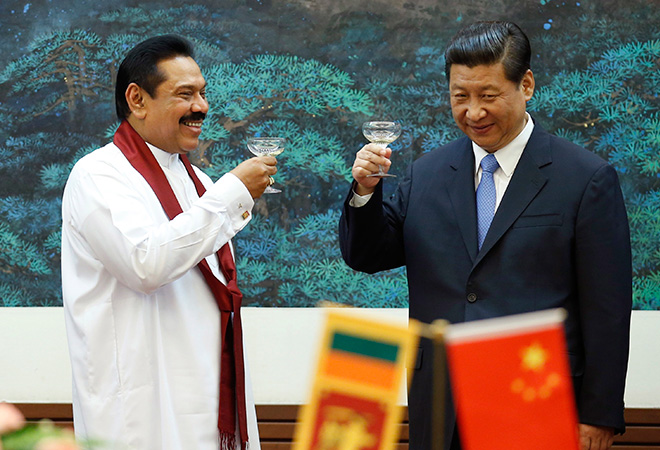
An image that appears to show Sri Lankan Prime Minister Mahinda Rajapaksa and Yang Jiechi, a high-ranking Chinese official, holding a framed aerial photograph of the island of Sri Lanka has been shared hundreds of times in multiple Facebook posts. The image, however, has been doctored; the original photo shows Rajapaksa and Yang holding a framed photo of themselves during a recent diplomatic visit.
The image of Rajapaksa and Yang, who previously served as China’s foreign minister, was published on Facebook here on October 9, 2020.
The post’s Sinhala-language caption translates to English as: He is trying to tell you a thousand words with this picture…children, wake up”.
Screenshot of the Facebook post published on October 9, 2020
The image was also shared on Facebook here, here and here. It was even published on the front page of the Daily Financial Times, an English-language newspaper in Sri Lanka.
Screenshot of the Daily FT front page published on October 10, 2020
The image, however, has been digitally manipulated.
A reverse image search found that the original photo was published on Rajapaksa’s official Twitter account here on October 9, 2020. The genuine photo shows that Rajapaksa and Yang are in fact holding a photo of themselves seated together.
Below is a comparison of the doctored image (L) and the image in Rajapaksa’s tweet (R):
Screenshot comparison of the doctored image (L) and the image from Rajapaksa’s tweet (R)
The Daily Financial Times has since removed the doctored photo from the online version of the paper’s article.
Given the trajectory of the China relations — Sri Lanka’s ‘India First’ policy will obviously be confined to bilateral security issues and New Delhi’s concerns in the matter.
The short-notice Colombo visit of a high-level Chinese delegation, to be followed now by US Secretary of State Mike Pompeo’s this month-end should be of interest as much to the Indian strategic community as to their counterparts in Sri Lanka. The question is that if the Chinese visit was a reaction to the recent Quad Ministerial at Tokyo, and the delayed one by Secretary Pompeo, likewise, has been influenced by the latter.
Negotiations are underway for a ¥10 billion (Renminbi) currency-swap agreement between the Central Bank and the People’s Bank of China, to address the current liquidity crunch,” Colombo-based Daily Mirrorquoted Ajith Nivard Cabraal, Sri Lanka’s Money, Capital Markets and Public Enterprise Reforms Minister, only days after the visit of a Chinese delegation, headed by former Foreign Minister, Yang Jiechi, now a leading Politburo member. Converting as $1.5 billion swap (appx), this is much bigger than the $400 million swap deal with India, with ‘technical negotiations’ already on for another $1 billion swap.
The question is that if the Chinese visit was a reaction to the recent Quad Ministerial at Tokyo, and the delayed one by Secretary Pompeo, likewise, has been influenced by the latter.
Central Bank Governor during the presidency (2005-15) of Mahinda Rajapaksa, now Prime Minister, Cabaral recalled how he had signed such a deal in his time. As if to make greater sense, or make light of what is otherwise seen as a further Sri Lankan tilt towards China, he indicated the possibility of the Government approaching the IMF for funding, instead. If we have to go and hold the International Monetary Fund’s (IMF’s) hand — or if the IMF has to hold our hand — that, I think, is a danger signal. We know we have to get our debt situation under control. Do we need the IMF to say that? No,” he said, by way of explanation.
Gota visiting Beijing
During the Yang team’s visit, China offered a $90 million grant towards Covid-related medical assistance, promised a further $500 million loan to Sri Lanka, repayable in ten years. The loan-agreement, as it turns out, was to have been concluded during Prime Minister Mahinda Rajapaksa’s Beijing visit, which had to be delayed, and will be signed soon in the Chinese capital.
Following the successful conclusion of exchanges between the two sides, Sri Lankan President Gotabaya Rajapaksa is expected to visit China, later this year — his first after assuming office. Thus far, also because of the intervening Covid-19 pandemic, President Gotabaya’s overseas visit was restricted to meeting with neighbouring India’s Prime Minister Narendra Modi, in New Delhi.
At talks with the Chinese delegation, President Gotabaya pointed out that China had been a long-standing friend to Sri Lanka, It supported Sri Lanka to defeat terrorism and to build infrastructure, including the Hambantota Port, the Port City and Southern Expressway. He highlighted how irrespective of the administration in power” in Colombo, bilateral ties had grown.
Thus far, also because of the intervening Covid-19 pandemic, President Gotabaya’s overseas visit was restricted to meeting with neighbouring India’s Prime Minister Narendra Modi, in New Delhi.
As if in this context, President Gotabaya said that the Hambantota Port was Sri Lanka’s idea, and not that of China, and the latter offered to fund it. Now, many geopolitical analysts call it a Chinese debt-trap to gain control over Sri Lankan affairs. I want to prove that it is not the case and that this large-scale project will help improve the living standards of the people.” He did not explain how, considering that this or no other China-funded project provided jobs for the locals. If the current focus is on the promised Chinese-funded SEZ at Hambantota, it remains to be seen, how much of Sri Lankan exports (as against imports) would it handle.
Read between the lines, Gotabaya was sending out a message to overseas critics that Hambantota was a ‘national project’ of Sri Lanka and there was across-the-board consensus in the matter. Clearly, he was referring to the predecessor Government of Prime Minister Ranil Wickremesinghe converting Mahinda era construction-cum-concession contract into a ‘debt-equity swap’ deal, handing over Sri Lankan ‘territory’ to a Chinese firm on a 99-year lease.
According to official release from the Sri Lankan President’s office, Gotabaya said he wanted to bring to Sri Lanka the type of development in rural areas that he had seen during his 13 visits to China before he became President (mostly when he was war-time Defence Secretary under President Mahinda, his brother).
Read between the lines, Gotabaya was sending out a message to overseas critics that Hambantota was a ‘national project’ of Sri Lanka and there was across-the-board consensus in the matter.
Gotabaya wanted Sri Lanka’s trade-deficit with China to be lowered with China buying more Sri Lankan goods. He pressed for more Chinese investment and visitors. He encouraged Chinese participation in the domestic tea-auction. He also called for the establishment of a technology university in Sri Lanka with Chinese backing. According to reports, the two sides will also revive negotiations on bilateral FTA, stalled during the Wickremesinghe rule.
Independence and sovereignty
Yang declared that China will firmly stand with Sri Lanka to protect the country’s independence, sovereignty and territorial integrity at international fora, including the UNHRC (where Colombo faces reprimand of some kind in the March 2021 session, after a two-year leeway, incidentally enjoyed by the Wickremesinghe regime).
In a recent interview to the Daily Mirror, Alaina B. Teplitz, the US Ambassador to Sri Lanka, in a to a Colombo-based newspaper. Sri Lanka should engage with China in ways that protect its sovereignty. Sri Lanka is a sovereign nation, but we do believe it is better for countries if transactions are transparent and cost-effective, and if they create jobs and other material benefits for local people.”
It is in this context, revived talks of an early Colombo visit by US Secretary of State Mike Pompeo, towards October-end, assumes added significance. While the visitor will press the hosts on the pending US proposal on the $480 milliom ‘Millennium Challenge Cooperation’ (MCC) connectivity project in Sri Lanka, the Rajapaksa leadership can be expected to feel the pre-poll American pulse on the UNHRC resolution.
Yang declared that China will firmly stand with Sri Lanka to protect the country’s independence, sovereignty and territorial integrity at international fora, including the UNHRC.
The US concerns on China in Sri Lanka’s Indian Ocean trijunction with India and Maldives are well known. The US and India are partners in the four-nation Quad, also involving Japan and Australia. Recently, it signed a ‘Framework Agreement’ for military cooperation with Maldives. Back home after the Quad Ministerial in the Japanese capital recently, Secretary Pompeo declared that India needs the US as ally” and talked about the ‘China risks.’
According to media reports, Secretary Pompeo’s Colombo visit is timed to coincide with his presence in Delhi. Citing Pompeo dropping his planned Colombo visit last year after Gotabaya became President, a section of the Sri Lankan strategic community is curious if the rushed visit now was prompted by the Chinese delegation.
Form and content
The Chinese visit happened days after Prime Minister Mahinda had held the customary first consultations after coming to power with Indian counterpart Narendra Modi, this time through a virtual summit, owing to Covid pandemic. Between the two Asian powers, the question now arises if the preference for India is only in form, and not necessarily in content — whoever is in power in Colombo, post-Cold War. Needless to point out, President Gotabaya was profuse in his appreciation of China after meeting with the Yang delegation but was business-like on his exchanges with Prime Minister Modi, in interviews to the Indian media.
India already has a ‘Neighbourhood First’ policy, into which Sri Lanka very much fits in. Gotabaya used his Delhi visit, after his election as President, to reiterate successive Sri Lankan Government positions that his administration (too) would follow an ‘India First’ foreign policy (which also implied security policy). After the parliamentary polls, his new Foreign Secretary, Prof. Jayanth Colombage (retd) said so in a series of interviews to the local media.
Needless to point out, President Gotabaya was profuse in his appreciation of China after meeting with the Yang delegation but was business-like on his exchanges with Prime Minister Modi, in interviews to the Indian media.
Given the trajectory of the China relations, now as under the predecessor Mahinda regime, Sri Lanka’s ‘India First’ policy will obviously be confined to bilateral security issues and New Delhi’s concerns in the matter. This has become near-obvious, given Rajapakas’ Sri Lanka now wanting to review the India-Japan ECT project in Colombo Port, apart from the American-funded MCC scheme and Japan-funded ‘light rail project’ to decongest Colombo City — all of them signed by the predecessor Wickremesinghe administration.
In between, the Sri Lankan state too would be evaluating its own immediate security concerns, that too in the face of the Indo-Pacific Quad’s increasing attention to the IOR, and the US’ Framework Agreement with Maldives. While India may be reassessing its circumstances and priorities, Sri Lanka may also be seeking to re-position itself in the ever-evolving Indian Ocean geo-strategic scenario, where the nation may have as much to lose as it can gain, depending on what game it wants to play, how and when.The views expressed above belong to the author(s).
BEIJING, Oct. 13 (Xinhua) — China will further strengthen its cooperation with Sri Lanka, the United Arab Emirates (UAE), Algeria and Serbia under the framework of the Belt and Road Initiative with a new development pattern, a senior Chinese diplomat said Monday.
Yang Jiechi, a member of the Political Bureau of the Central Committee of the Communist Party of China (CPC) and director of the Office of the Foreign Affairs Commission of the CPC Central Committee, told Chinese press upon finishing his visits to the four countries.
During the visits, the Chinese official said he introduced the concept of a “dual circulation” development pattern, which takes the domestic market as the mainstay while allowing domestic and foreign markets to boost each other.
Under the new development pattern, he said, China will create broader market for all parties including countries in South Asia, West Asia and North Africa, and Central and Eastern Europe.
For their part, the four countries said they will attach great importance to the economic opportunities and cooperation space brought by the new development pattern and expressed willingness to better synergize development strategies and plans, better complement each other’s advantages and integrate their benefits in order to inject vitality into both the domestic economic growth and regional and global economic recovery, Yang said.
He said Sri Lanka, the UAE, Algeria and Serbia are important countries along the Belt and Road and relevant cooperation have been highly effective.
The four countries all said the construction of the Belt and Road have strongly pushed forward domestic economic and social development and brought tangible benefits to their peoples, adding they are ready to join hands with the Chinese side to firmly continue advancing and expanding relevant cooperation, Yang said.
In the next phase, the Chinese senior official said, China will stand together with the four countries to steadily boost cooperation in such keys sectors as infrastructure facilities, energy, and manufacturing capacity and enable key projects to grow bigger and stronger.
Yang said China will also provide more quality projects for the people, better serve the economic and social construction of the countries along the Belt and Road, so mutual benefit and win-win situation can be achieved, and greater contribution can be made to the world economic recovery and development.
Pompeo’s trip would come weeks after a high-level Chinese delegation visited the country.
On October 8, a high-powered Chinese delegation headed by the Director of the Central Foreign Affairs Commission Office and former ambassador to the United States, Yang Jiechi, visited Sri Lanka as part of his four-legged visit, which included the United Arab Emirates, Algeria, and Serbia. This was the first visit by the Chinese delegation to South Asia since the start of the COVID-19 pandemic, which had led to curbs on international travel. It’s notably that Yang chose to start with Sri Lanka.
The resulting benefits of the meeting between Yang and the Rajapaksa brothers – Mahinda, Sri Lanka’s prime minister, and Gotabaya, the country’s president – were significant as it strengthened economic cooperation and bolstered strategic ties between the two countries. The meeting presumably also provided an opening for China to clarify its intentions behind the Belt and Road Initiative (BRI) projects in the island country, after Alaina Teplitz, the U.S. ambassador to Sri Lanka, called out the nature of these projects and the opaque tender processes behind them.
On October 11, following Yang’s visit, China announced it would provide a $90 million grant to Sri Lanka for development in the medical care sector, water supplies, and education in the rural areas of the country, where the struggle for such amenities still remains. The Chinese Embassy in Colombo released a statement saying that the grant would contribute to the well-being of (Sri Lankans) in the post-COVID era.”
As China and Sri Lanka celebrate their successes post Yang’s visit to the country, the U.S. was quick to reassert its commitment to the country. U.S. Secretary of State Mike Pompeo will visit Sri Lanka en route to New Delhi in the coming weeks, as noted by the Sunday Times. Pompeo’s travel plans signal that the U.S. is concerned about the growing closeness between Sri Lanka and China, and does not want its interests there jeopardized.
Pompeo is scheduled to visit Sri Lanka with hope to rope the island country into its regional plans given the geostrategic importance of Sri Lanka in the Indian Ocean region. The United States believes Sri Lanka could prove to be important for its Indo-Pacific strategy. The sea lanes of communication that run across the Indian Ocean are considered to be the busiest in the world, with more than 80 percent of the global oil trade passing through them.
Another important reason for this highly anticipated visit — the first by a high level American diplomat since John Kerry’s visit to Sri Lanka in 2015 — has to do with the stalled negotiations around the $480 million Millennium Challenge Corporation (MCC) grant and a new Status of Forces Agreement (SOFA). Many analysts opine that if these agreements are to be fully implemented, it would empower the United States and undermine Chinese influence in the region — but would effectively put Sri Lanka in a tight spot as well. A third, controversial, U.S.-Sri Lanka Acquisition and Cross-Servicing Agreement was renewed in 2017 a decade after it was first inked.
For the United States, its interests in Sri Lanka – and the aforementioned agreements – stem from the desire to gain an additional foothold in the Indian Ocean region, push back against Chinese influence there, as well as surveil China’s activities. It is likely the U.S. will seek to partner with India in these efforts as well.ADVERTISEMENT
What largely remains to be seen is if Sri Lanka would be welcoming of the United States’ overtures and how it intends to negotiate its position while not hindering its relations with China. While the outcomes of the upcoming Pompeo visit are still being discussed, according to a media article, a senior official of the Sri Lankan administration said that the country does not plan to bend to the United States’ wishes on the issue of MCC or SOFA when Pompeo visits for talks in a few weeks’ time. The official said, The Gunaruwan Committee appointed by President Gotabaya Rajapaksha had gone into the MCC compact and has suggested that it be negotiated to make it compatible with Sri Lankan constitution and law. It remains to be seen if the Americans agree. As for SOFA, it cannot be on the agenda now because we would like to take up issues one by one.”
Prarthana Basu is an independent researcher and foreign policy analyst.
The Colombo High Court has imposed a fine of Rs 12 million on the Captain of the crude oil tanker ‘MT New Diamond’ which caught on fire while on Sri Lankan waters.
When the case was taken up today (14), the Greek Captain Stereo Sterio Ilias plead guilty for the charges filed against him in relation to the fire.
Subsequently, the Attorney General sought a court order for compensation in a sum of Rs 200 million.
However, the court has ruled for the accused to be released after the settlement of a fine of Rs 12 million.
While the Deputy Solicitor General, on behalf of the Attorney General, requested for a court order to pay compensation, the judge stated that it would not be granted as issuing such an order would prejudice to both parties.
On October 08, the Attorney General filed indictments regarding the oil spill caused by the fire in the ship and the failure to report of the fire in violation of the Sections 26 and 38 of the Marine Environment Pollution Authority (MEPA) Act.
UPDATE: (5.10 p.m.) – The accountant arrested in connection with the case against former minister Rishad Bathiudeen, over transporting IDP voters in state-owned buses, has been remanded until October 26 after being produced before the Fort Magistrate’s Court.
Alagarathnam Manoranjan, the accountant of the Internally Displaced Persons (IDP) Resettling project implemented under former Minister Rishad Bathiudeen, has been placed under arrest.
The arrest was made by the Criminal Investigation Department (CID) in the area of Kirulapone on Tuesday night.
In the meantime, a constable attached to MP Bathiudeen’s security detail has also been taken into custody for allegedly aiding the parliamentarian to evade the arrest, the Police Spokesperson DIG Ajith Rohana said.
The CID had apprehended the suspect in the area of Wellawatte along with two cars and two firearms.
Investigations will be carried out into the two firearms seized during the arrest, the Police Spokesperson said further.
The two drivers of the seized vehicles have also been placed under arrest and they were identified as residents of Puttalam area.
Then-Minister of Industry and Commerce Rishad Bathiudeen, the director of the project Mohamed Yaseen Samsudeen and the project accountant Alagarathnam Manoranjan are accused of violating Article 82(1) of Presidential Elections Act, No. 15 of 1981 by misappropriating public funds to the tune of Rs. 9.5 million.
They have allegedly misused 222 buses belonging to the state-owned Sri Lanka Transport Board (SLTB) for transporting internally IDPs from Puttalam to polling stations in Silavathurai, Mannar during the 2019 Presidential Election.
The CID, upon the direction of the Attorney General, had sought the Colombo Fort Magistrate to issue a warrant to arrest MP Rishad Bathiudeen and the other two suspects on charges of criminal misappropriation of public funds and violation of election laws.
However, the magistrate ruled that the Police can proceed to arrest the suspects without a warrant.
Thereby, Attorney General Dappula de Livera directed the Police to arrest the three suspects according to the law.
Attorney General Dappula de Livera has directed the Police to conduct investigations into MP Rishad Bathiudeen’s brother, Riyaj Bathiudeen under 07 counts, says the Police Spokesperson DIG Ajith Rohana.
Riyaj Bathiudeen was arrested by the Criminal Investigation Department (CID) in April this year for allegedly having direct links to the terrorists involved in the Easter Sunday attacks. However, the CID released him in September, citing lack of evidence.
The Police Spokesperson said 60 police officers with special investigation skills have been deployed under the supervision of a Deputy Inspector General (DIG) of Police to carry out the probes.
The police sleuths will proceed with the investigations as two separate teams; one team will be looking into 4 counts pointed out by the Attorney General while the other team probes the remaining 03 counts, DIG Rohana explained.
The investigations will be overseen by the DIG of the Criminal Investigation Department, two Senior Superintendents of Police (SSPs) and an Assistant Superintendent of Police (ASP).
Riya Bathiudeen was taken into custody on the 14th of April this year while in Puttalam. After five months into the arrest, he was released by the CID on the 29th of September citing a lack of evidence to file a case against him.
However, objections were raised by various parties against the release of the former Minister’s brother, the Police Spokesperson said, adding that an internal investigation was subsequently launched into the matter.
The probes will be carried out under the Prevention of Money Laundering Act and Convention on the Suppression of Terrorist Financing Act, he said further.
More individuals have tested positive for the novel coronavirus expanding the Minuwangoda COVID-19 cluster by another 113 cases.
According to Army Commander Lieutenant General Shavendra Silva, 05 of them have been detected among the persons undergoing quarantine at quarantine centers.
The remaining 108 cases are identified as close contacts of the Minuwangoda apparel factory employees.
Meanwhile, the number of cases detected from the Katunayake Free Trade Zone has gone up by 72 cases.
In addition, three persons –an expressway bus driver, its conductor and its owner –from Mathugama are also confirmed to have contracted the virus.