The latest massive Covid-19 surge of over 1,700 cases at the point of writing popularly referred to as the Brandix Cluster” is fast becoming the most formidable and challenging denominator of the nation’s GDP and Public Health.
Apparently, the contact source who impregnated the worker in Brandix with the virus is still not found. The charge must be criminal negligence since the Covid-19 which had hitherto been a localized threat is now, thanks to this dynamic infusion, is spreading its insidious tentacles across the island. The chase for contact tracing is on as this new second wave Covid-19 unleashes a systematic devouring of our citizenry, across the island.
Successive public relations statements of M/s Brandix have taken great pains to vehemently declare their innocence of having been a party to this serious resurgence of Covid-19 in hitherto unprecedented spread and numbers. Apparently, the company has been able to secure letters from the Government Health authorities that the plane loads of passengers coming in from India to Sri Lanka, at the behest of Brandix, were all subject to requisite quarantine formalities and were free of Covid-19 on discharge. The company also glibly asserts that none of the passengers from the three airplanes from India to Sri Lanka have entered their Minuwangoda Brandix facility during the past two months i.e. August – September 2020.
Meanwhile, some of the testimonies coming out of affected workers in Brandix are damning to any company which provokes the same. According to some media reports apparently there were those who were sick and infected before in the factory with some fainting and treated on the premises for influenza and not directed in time to a Government Hospital for Covid testing. There are recorded statements of employees who claim that they were forced to work without leave, even after reporting sick, denied protective health equipment, reports of external inspectors who visited the factory premises purportedly the buyers’ representatives from India, of three batches of passengers from India staying out their quarantine in hotels in Sheraton Hotels in Kosgoda, Long Beach in, Koggala, and hotels in Wadduwa, allegedly without the supervision of Public Health Inspectors, etc., are a just a few of the claims made.
Infections in Brandix offices in Colombo and multiplier effects of community wide transmission from those with links to Bandix Covid-19 patients are now island-wide. A manager from Brandix who visited the deep south has been diagnosed with Covid-19 and thus puts an end to the tourism in that region! Thus, the actual circumstantial evidence of the proliferation of the Covid-19 from Brandix premises far and wide is intractable, short of being an immaculate conception to those who continue in denial of responsibility.
Hence the need of the hour, in such a dire predicament, is how the nation could best contain the present Brandix Covid-19 eruption by learning from its identified mistakes and lapses in this debacle. The truth must not be a casualty in this vital process. Apportioning of blame must be for purpose of redeeming the situation from chaos to at least near normalcy. It is only by acknowledging lapses and systemic inefficiencies that necessary safeguards could be ensured for the industry as a whole with renewed regulations for factory working conditions and health and safety and compensation from those responsible for and careless disregard of health regulations at work site. A mea culpa stance is more suitable for a company professing a philosophy of Garments without Guilt” than a defensive series of public statements each vying with the other for exoneration of responsibility for this eruption on their remit. Such honest acknowledgment was there in the much smaller self-contained Welisara Navy Covid Eruption where even his Excellency the President and Navy top brass were quick to realize and admit their lapses and remedy the same with speedy efficiency.
Professional integrity, love of country and its people, corporate social responsibility in all sincerity and purpose not merely to impress one’s European buyers and obtain tariff concessions, is what the public expects and deserves amidst the fiasco that is being played out. Whilst the nexus between Business and Politics: You scratch my back and I scratch yours” is well known the world over, some deceptions are enough to crack even the bovine intelligence of a few. All the people cannot be fooled all the time. And it takes strength and courage to admit the truth.
Close on the heels of Attorney General Dappula de Livera, PC, alleging serious lapses on the part of the Criminal Investigation Department (CID), in respect of the probe on Riyaj Bathiudeen’s alleged involvement with those responsible for the Easter Sunday attacks, the premier investigating agency’s Director SSP Prasanna de Alwis has been moved out.
The transfer took place consequent to an unprecedented meeting the AG had with the new Director CID Prasad Ranasinghe and three other officers, including SSP Alwis. The AG found fault with the CID over the way the police had released Riyaj arrested last April on the basis of irrefutable evidence of direct links with at least one Easter Sunday suicide bomber.
The National Police Commission (NPC) has cleared the CID Director’s transfer as Director, Terrorist Investigation Division (TID) whereas SSP G.N. de Zoysa received the CID Director’s post. Zoysa had been the Director of the recently formed unit responsible for inquiring into ill-gotten wealth. At the time, SSP de Alwis received appointment as Director, CID a couple of months ago, he was Director CID.
Within days after the media reported Riyaj Bathiudeen’s release, Police headquarters moved the then DIG CID Nuwan Wedasinghe out of the unit. He received an appointment as Acting DIG Western Province (North). Wedasinghe received posting as DIG, CID in late Dec last year following the change of government.
Following instructions received from the AG, who asked for a comprehensive report within a month, the police were now in the process of inquiring into the conduct of the CID.
Acting IGP C.D. Wickremaratne last week set up two special teams to probe the circumstances leading to Riyaj Bathiudeen’s release and serious lapses on the part of the CID.
Since the change of government in Nov 2019, the SSPs had held the post of Director CID. Of them, the first to hold the post was SSP W. Tilakaratne followed by de Alwis and now de Zoysa.
SSP Shani Abeysekera, who had been the director CID at the time of the change of government, is in remand custody. The police arrested him in July this year over charges of framing DIG Vass Gunawardena now on death row.
The CID is the second special unit to come under investigation this year. Earlier, the DIG, Police Narcotics Bureau (PNB) Sajeewa Medawatta and its Director SSP Manjula Senarath were transferred out after investigations launched at the behest of the AG exposed a section of the PNB dealing in heroin.
Well informed sources said that proper inquiry was needed to clean up the department. Sources explained that law enforcement apparatus was under scrutiny both by the AG and the Defence Secretary in the wake continuing accusations regarding impropriety. Sources also alleged that shortly before Riyaj’s release, his brother Samagi Jana Balavegaya lawmaker Rishad Bathiudeen met some senior CID officers.
A total of 40 individuals have tested positive for COVID-19 increasing the number of patients in the Minuwangoda cluster to 2,162, the Government Information Department said.
Nineteen of the infected have been reported from quarantine centres while the others were reported as their close associates.
The Government today reiterated that it would make several changes to the 20th Amendment to the Constitution at the committee stage including an amendment to allow citizens to challenge the President’s action by filling Fundamental Rights (FR) petitions.
Education Minister Professor G.L. Peiris said the President’s immunity was constricted by the 19th Amendment as it allowed citizens to file FR petitions through the Attorney General against the President.
This clause was proposed to be repealed by the 20A and Minister Peiris said the government would make an amendment allowing the citizens to file FR petitions against the President.
We are ready to make this amendment at the committee stage. We know for a fact that as long as President Gotabaya Rajapaksa is in power, there will be no need for these petitions against his action. However, if anyone needs or likes, they will be able to file FR petitions challenging the President’s action,” he told a news briefing held at SLPP head office.
One of the other amendments the government is hoping to make at the committee stage is enabling the President to dissolve Parliament after parliament’s term completes two and a half years.
Meanwhile, Minister Peiris said the Supreme Court’s determination on the constitutionality of the draft of the 20A will be conveyed to Parliament today (20).
And then the debate will be taken up on Wednesday and Thursday. The final vote will be at 7.30 p.m. on Thursday. There will be additional 10 hours to the debate on 20A than 19A. We strongly believe that we can get two thirds majority in Parliament. The Supreme Court proposed amendments will also be made by the government apart from its own amendments,” he said.
Commenting on the issue of dual citizens contesting elections, Minister Peiris said the 19A barred dual citizens from contesting not because of policy but because of individuals.
All citizens should be treated alike and dual citizens are also Sri Lankans. Our law defines that contesting rights of a citizen should be based on their voting rights. Some try to drag Arjuna Mahendran to complicate the dual citizenship issue. Mahendran was never a dual citizen, he is a Singaporean citizen,” he said.
Meanwhile, he said the Auditor General’s authority and mandate to audit public institutions as defined by the National Audit Act of 2018 had not been changed from the 20A.
MP Rishad Bathiudeen who was arrested by the Criminal Investigation Department (CID) has been ordered to be remanded by the Fort Magistrate’s Court.
Accordingly, the parliamentarian will be held under remand custody until October 27.
Former Minister of Industry and Commerce Rishad Bathiudeen, the director of the project Mohamed Yaseen Samsudeen and the project accountant Alagarathnam Manoranjan are accused of violating Article 82(1) of Presidential Elections Act, No. 15 of 1981 by misappropriating public funds to the tune of Rs. 9.5 million.
They have allegedly misused 222 buses belonging to the state-owned Sri Lanka Transport Board (SLTB) for transporting IDPs from Puttalam to polling stations in Silavathurai, Mannar during the 2019 Presidential Election.
The CID, upon the direction of the Attorney General, had sought the Colombo Fort Magistrate to issue a warrant to arrest MP Rishad Bathiudeen and the other two suspects on charges of criminal misappropriation of public funds and violation of election laws.
However, the magistrate ruled that the Police can proceed to arrest the suspects without a warrant. Thereby, Attorney General Dappula de Livera directed the Police to arrest the three suspects according to the law.
On October 14, the Fort Magistrate issued a travel ban on the parliamentarian upon a request by the CID.
Meanwhile, MP Bathiudeen had filed a writ application through a lawyer seeking an order from the Court of Appeal to prevent his arrest.
The CID had deployed several teams to arrest the former minister, however, they were unable to locate and apprehend him until today.
Police Spokesman DIG Ajith Rohana said that the CID launched several special operations to apprehend the former minister and as a result of these operations he was arrested at a housing complex located at Ebenezer Place in Dehiwala in the early hours of today (19).
Seven individuals who aided and abetted the parliamentarian to evade arrest were also arrested and are to be produced before court.
The Criminal Investigations Department is carrying out further investigations.
Seven suspects have been arrested for aiding and abetting MP Rishad Bathiudeen to evade arrest, stated the Police Media Spokesman.
The suspects arrested by the Criminal Investigation Department (CID) are to be produced before the Fort Magistrate’s Court this evening (19), stated DIG Ajith Rohana speaking at a press conference held earlier today.
He further said that during the arrest of Bathiudeen, it was revealed that there was a group of people who provide protection to persons wanted by the police.
The DIG said that 02 among the 07 arrestees had been arrested on October 17 at the Wellampitiya area. Upon interrogation, it has been revealed that the parliamentarian had stayed at a house in Kohuwala, Kalubowila, for a period of time before being moved to a house in Dehiwala on October 15.
Among the arrestee are a lady doctor, her husband, a foreign employment agent who escorted the MP from the first house to the second, and the owner of the Dehiwala house where the parliamentarian was arrested at.
The vehicle used to escort the parliamentarian has also been taken into the custody of the CID, according to the Police Spokesman.
MP Bathiudeen was arrested by CID officers at a housing complex located at Ebenezer Place in Dehiwala this morning (19).
Former Minister of Industry and Commerce Rishad Bathiudeen, the director of the project Mohamed Yaseen Samsudeen and the project accountant Alagarathnam Manoranjan are accused of violating Article 82(1) of Presidential Elections Act, No. 15 of 1981 by misappropriating public funds to the tune of Rs. 9.5 million.
They have allegedly misused 222 buses belonging to the state-owned Sri Lanka Transport Board (SLTB) for transporting IDPs from Puttalam to polling stations in Silavathurai, Mannar during the 2019 Presidential Election.
The CID, upon the direction of the Attorney General, had sought the Colombo Fort Magistrate to issue a warrant to arrest MP Rishad Bathiudeen and the other two suspects on charges of criminal misappropriation of public funds and violation of election laws.
However, the magistrate ruled that the Police can proceed to arrest the suspects without a warrant. Thereby, Attorney General Dappula de Livera directed the Police to arrest the three suspects according to the law.
On October 14, the Fort Magistrate issued a travel ban on the parliamentarian upon a request by the CID.
Meanwhile, MP Bathiudeen had filed a writ application through a lawyer seeking an order from the Court of Appeal to prevent his arrest.
The CID had deployed several teams to arrest the former minister, however, they were unable to locate and apprehend him until today.
Police Spokesman DIG Ajith Rohana said that the CID launched several special operations to apprehend the former minister and as a result of these operations he was arrested in the Dehiwala area in the early hours of today.
Rishad Bathiudeen has currently been escorted to the CID and will be produced before a court following investigations, he said.
The Criminal Investigations Department is carrying out further investigations.
Attorney General Dappula De Livera had advised the Criminal Investigations Department (CID) on the prudence to place MP Rishad Bathiudeen under surveillance 24 hours before the issuing of the directive to arrest the former minister.
AG’s coordinating office State Counsel Nishara Jayaratne said that the arrest of MP Rishad Bathiudeen is not something that had happened suddenly.
She stated that 24 hours before the Attorney General’s advice pertaining to the arrest was provided in writing to the CID officers and the Acting IGP, the AG had summoned the CID officers and verbally instructed them on pre-preparation before making the arrest.
The Attorney General had advised the high-raking CID officers to carry out suitable surveillance on MP Rishad Bathiudeen and to stay alert regarding him, 24 hours before the advice was handed in writing, the AG’s coordinating office said.
She stated that if the CID officers had followed the AG’s verbal advice of pre-preparation and had carried out proper surveillance activities, the suspect would not have been able to flee.
Meanwhile the Attorney General had today provided the Acting IGP with further advice in writing with regard to the criminal investigation against MP Rishad Bathiudeen and also met with the investigative officers of the CID.
It was revealed during that discussion that the CID is also carrying out investigations regarding over 10 more incidents related to MP Bathiudeen, the AG’s CO said.
The AG also presented the Acting IGP with detailed information pertaining to those investigations and issued instructions to conduct further investigations under the offence of Money Laundering and also to appoint a special team of experienced and knowledgeable officers to carry out the investigations efficiently and thoroughly.
The AG also instructed to carry out criminal investigations against all individuals who had aided and abetted MP Rishad Bathiudeen to evade arrest and remain in hiding and to report to the court.
AG instructed to specially investigate into the individuals who held press conferences and made statements that the former minister was in hiding, she said.
The AG also called for reports on progress of investigations within the next 2 weeks.
Former Director of the State Intelligence Service (SIS) Nilantha Jayawardena believes that the forewarning given to him by a foreign intelligence agency ahead of the Easter Sunday attacks might not have been so secretive a mere week later.
Testifying before the Presidential Commission of Inquiry probing the 2019 Easter Sunday terror attacks, Jaywardena was insistent that around 15,000 people should have been aware of the intelligence if the former IGP had shared the intelligence as he claims he did.
He said that the reach of it was so vast, even Zahran Hashim himself, may have been aware of the foreign intelligence warning.
During the proceedings, President’s Counsel Shamil Perera, representing Archbishop Cardinal Malcolm Ranjith, asked the witness whether he would accept it, if another witness had testified before the Commission saying that the former SIS Director did not inform the National Security Council that Zahran Hashim is a terrorist.
The witness replied that he did not use the word ‘terrorist’, but did informed the Security Council that Zahran has IS ideologies and that he is motivating followers.
The President’s Counsel (PC) then asked the witness whether former President Maithripala Sirisena ordered the arrest of Zahran, during the National Security Council meeting in January, 2019.
In response Jayawardena said that an order wasn’t issued by the former President to arrest Zahran, but he did ask as to why he hadn’t been arrested yet when Zahran was mentioned.
The witness added that in any case, by then Pujith Jayasundara was not in the Security Council and that Hemasiri Fernando and Ravi Seneviratne were the ones there.
The PC asked the former SIS Director whether the Security Council was aware that Zahran Hashim had conducted 07 training camps at various locations in the country, and operated 02 centers where he conducted workshops.
Jayawardena replied that, as the SIS, they knew about the Blackpool training camp in Nuwara Eliya and the SIS did not have information on other training camps. As such, he added, that officers were not deployed for surveillance duties.
The PC then asked Jayawardena as to why the forewarning given by a foreign intelligence agency on April 04 was not mentioned in the intelligence documents forwarded to the the-IGP on April 18 and 19.
The witness replied, I will respond with an example. We receive information that ‘Simion’ is set to commit a crime on a particular date at a particular time. We also come to know that ‘Simion’ has also bought a gun for this purpose. When acting on the matter, the attention is not initially given to find where he got the gun from or where the crime will be committed. Instead we target ‘Simion’ who is the criminal.
Like that, Zahran’s name is mentioned in the April 04th piece of information, I have included that name in the intelligence documents of April 18 and 19.
We had been saying since 2017 to render Zahran inactive. Besides, by April 11, around 10,000 persons may have been aware of the April 04 forewarning on Easter attacks.”
That remark prompted the Chariman of the Commission to ask Jayawardena, You made a serious statement. Did you make it with responsibility, since you said by April 11, around 10,000 persons were aware of April 04 forewarning?”
To that Jaywardena responded, I made the statement with responsibility. Former IGP Pujith Jayasunadara told the Commission recently, that when i sent the April 04 forewarning to him on April 09, he sent it to the Police STF. As far as I know there are about 5,000 STF personnel across the country.
Next he says this information was given to the VIP Security Division. If we allocate 02 personal security officers per each parliamentarian, around 450 security personnel should be aware of this information.Some ministers have 7 to 10 personal security officers. That means around 800 personal security officers should have been aware of this.
But all 225 parliamentarians say that they were unaware of it. If such a piece of information comes to one of my personal security officers, I’m not spared from it.
Then it is said that the foreign intelligence was sent to the Senior DIG in charge of the Western Province. That means around 8,000 police officers in the Western Province should be aware of this.
Then the Embassy asks from on the morning of April 20, whether it is the same piece of information sent before. That means even the Embassy had been aware of this.
When that is the case even Zahran might be aware of it, despite it being intelligence sent by a foreign agency in confidence.
When adding all of these together, around 15,000 persons, let alone 10,000 should have been aware of this intelligence.”
Former SIS Director Nilantha Jayawardena further said, Now everyone is trying to pin the blame on me saying that I did not take the April 04 foreign intelligence information for discussion at the intelligence coordination meeting held on April 09. I made the national Intelligence Chief aware of this piece of information on April 07.
When one of the documents he sent to me mentioned that Rishad Bathiudeen’s brother had helped Zahran to flee to India, I told him that this will become a political issue. A year later, that too has become a reality.
I came to know while listening to testimonies at the Commission that then-Defense Secretary Hemasiri Fernando had told National Intelligence Chief Sisira Mendis to ask me to take this information for discussion during the April 09 meeting. Had I been told that it would not have been difficult for me to take it up for discussion. But the National Intelligence Chief did not inform me of such.
I don’t have powers to read minds. As such, if I‘m to take the responsibility over failing to prevent the attack, I will only bear it until April 07 when the piece of information was with me.”
Then the PC asked the witness whether he is attempting to wash his hands off by saying that information was sent to responsible sections.
In reply, Jayawardena said, I’m not pointing the finger at anyone. I’m not pointing the finger saying that the former IGP and the former Defense Secretary are wrong. I don’t have the right to say that. I’m not washing by hands off.
But, this Commission and the subsequent legal process will determine whether I’m wrong, who’s wrong, whether I should be punished or go to prison.”
Handing over the letters of appointment to the trainees selected from families of the lowest income category in the society under the program to recruit 100,000 individuals for employment commenced today (19).
Under the first phase, 34,818 eligible candidates have been selected, stated President’s Media Division.
Accordingly, the appointees will receive a 06-month formal training in 25 identified areas according to their skills and preferences.
The National Apprentice and Industrial Training Authority will oversee the training program. Those who successfully complete the training will be awarded a NVQ III certificate. During the training period, trainees will receive a monthly allowance of Rs. 22,500, the PMD stated.
The 100,000 jobs program has been formulated in line with concept of creating a poverty-free Sri Lanka” enshrined in the Saubhagyaye Dekma” policy statement of President Gotabaya Rajapaksa. An institute named Multi-Purpose Development Task Force was set up to implement the initiative.
Increasing the income of low-income earners, alleviating poverty by ensuring social security and building a people-centric economy by reducing inequality in income distribution as much as possible are some of the objectives of the program.
The Program commenced on January 20th of this year.
The applications were called from suitable candidates through newspaper advertisements published in all three languages. It was informed to hand over all the duly filled applications to the Grama Niladhari in the respective area. The trainees were selected following an interview after their applications were forwarded to the District Secretariats by the Divisional Secretariats. All the selected candidates are from low income families none of whose members is employed either in the government or the private sector.
Once their six month training period is completed, they will be given permanent appointments on PL-01 Service Category and will be directed to Ministries, Departments, Corporations and institutions affiliated to the Government to fill existing vacancies, the PMD said.
The PMD stated that the individuals to be recruited will be deployed in vegetables and fruits production activities on Government’s farms and abandoned agricultural lands that have the potential for successful re-cultivation, utilizing modern agri- technology. They will also be provided with employment in sectors such as Wildlife and Forest Conservation, irrigation and Agrarian Services, Agriculture Service Centres, Rural Hospitals and activities related to the schools.
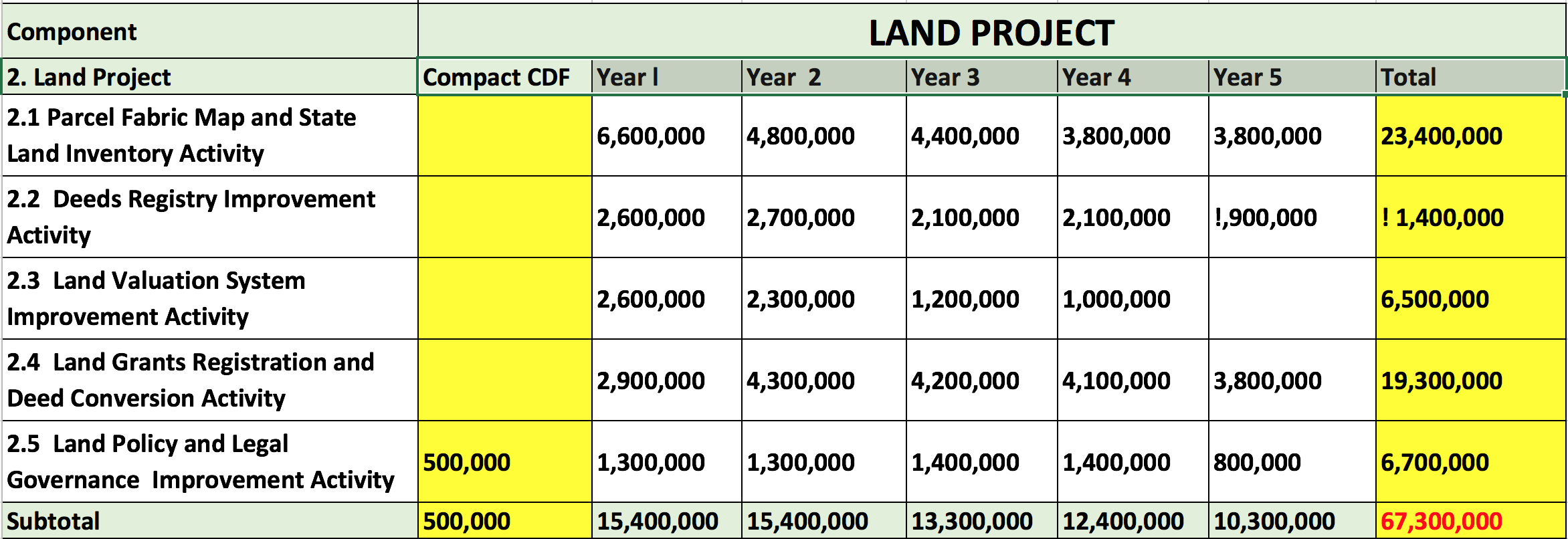
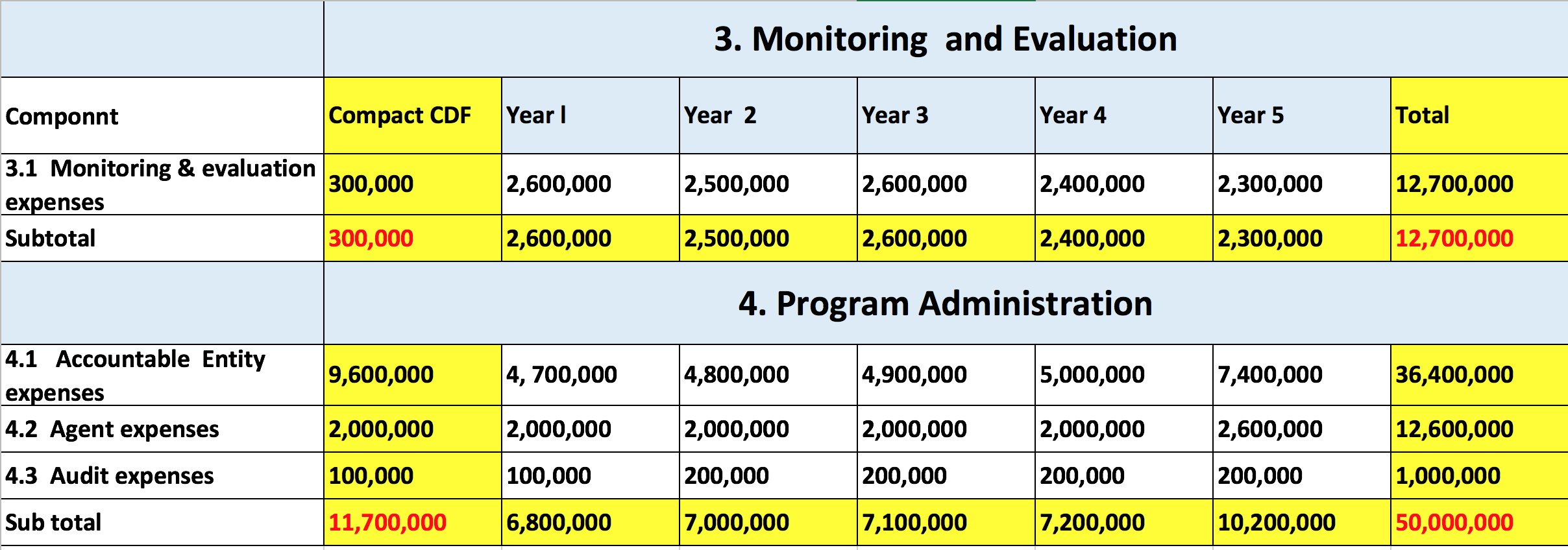
There is a major misconception that Sri Lanka in its cash-strapped status should ignore all questionable aspects of the MCC and just sign MCC Compact as MCC is holding a carrot of $480m which they call a gift from US to the people of Sri Lanka. We have very eminent personalities going out of their way to hold panel discussions and promote MCC parroting how lucky Sri Lanka is to benefit from this ‘gift’. This is far from the truth. Out of the $480m across 5-year gift”, the Transport Project allocation is $350m & Land Project allocation is only $67.3m (total $417.3m) the remaining $62.7m is allocated for monitoring & evaluation & program administration. In reality we will get $82.8m in first year, $120m in 2ndyear, $97.7m in 3rdyear, $89.1m in 4thyear & $57m in 5thyear.
MCC is no ordinary bilateral agreement. This agreement has several phases.
Phase 1is a set of preconditionsin MCC Compact & Program Implementation Agreement, which Sri Lanka must complete before signing the MCC Agreement
Inventory & mapping of State lands & preparing parcel fabric map
Creating a land valuation system & valuing all State land
Privatizing State Land – transferring to title registration from deed system
Legislative changes & amendments to Title Registration Act 21, 1998 (Bim Saviya) to facilitate MCC
Establishing a land policy research council which is above the Land Ministry
Phase 2is the signing of MCC agreement after Phase 1 is complete.
After signing the MCC Agreement, MCC & US government will release $32.5million to do only the following.
Financial management & procurement
Admin (salaries/rent/computer hiring etc)
Feasibility studies
Other activities approved by MCC
Disbursements are subject to strict conditions to be approved by MCC and any funds remaining returns to MCC.
US Procurement guidelines & NOT SRI LANKAN PROCUREMENT guidelines are to be followed.
(Any Sri Lankans planning to make bucks from commissions to their companies can well forget this plan as reference to foreign firms & US procurement guidelines means hardly any locals will secure project contracts – money given in one hand will return to the source from the other)
Phase 3is the passing of MCC by Parliament after which GoSL must
Create a Company under Sri Lanka Company’s Act – MCA Sri Lanka to act as primary agent on behalf of the GoSL
MCA-Sri Lanka will have an account opened in a private bank (MCC will send funding only to MCA-Sri Lanka through this private bank account not to Sri Lanka’s Treasury)
MCA-Sri Lanka will have a Director Board comprising Secretaries and Officials of GoSL but they will be only reporting to MCC & US Govt
GoSL shall permit all foreign parties working for MCC as individual consultants or personnel of firms, are allowed to open foreign currency bank accounts & these individuals or personnel of firms providing goods, works or servicesare to be given entry & work visas
Phase 4are letters by GoSL confirming it has completed the set of preconditions required to pass the MCC Compact by Sri Lanka’s Parliament & have the MCC Compact enter into force
PIA signed by GoSL & MCC
Letter by authorized GoSL representative that GoSL has duly completed its domestic requirements
Signed legal opinion by the Attorney General that the Agreement does not violate the constitution (this letter signed by previous AG has been shared via social media already)
Signed, certified copies of all legislative, decrees amended for the purpose of implementing MCC Compact
The MCC agreement clearly sets out how the MCC funding is to be disbursed. So those trying to promote the notion that Sri Lanka is getting $480m to its hands are trying to fool the Public because we are not getting $480m at once or into Sri Lanka’s Treasury.
However, we have to not only amend our constitution, laws, policies, statutes but even privatize state land & agree to a set of immunities for all of the foreign individuals and firms working on the projects in Sri Lanka by even allowing them to operate foreign currency accounts and waiving taxes and duties from them. US officials will even have right to audit the Govt.
Section 5.5 gives a list of responsibilities GoSL must adhere.
Have Sri Lanka’s public officials not compared these demands against what US is promising to give annually, out of which an amount is likely to return to the US & its foreign ally firms and questions what exactly are we really getting out of this deal ‘gift’.
The MCC is an in-equal agreement as the MCC Funding covers only 7 targeted district, 28% of land area and 10 land registries.
Moreover, what is also shocking is that its estimated beneficiaries in giving up Sri Lanka’s state land & privatizing it is to only create – 5million beneficiaries from Land Project & 7million beneficiaries from Transport project.
So the country is sacrificing much to supposedly benefit 12million people out of a total 21million populace?
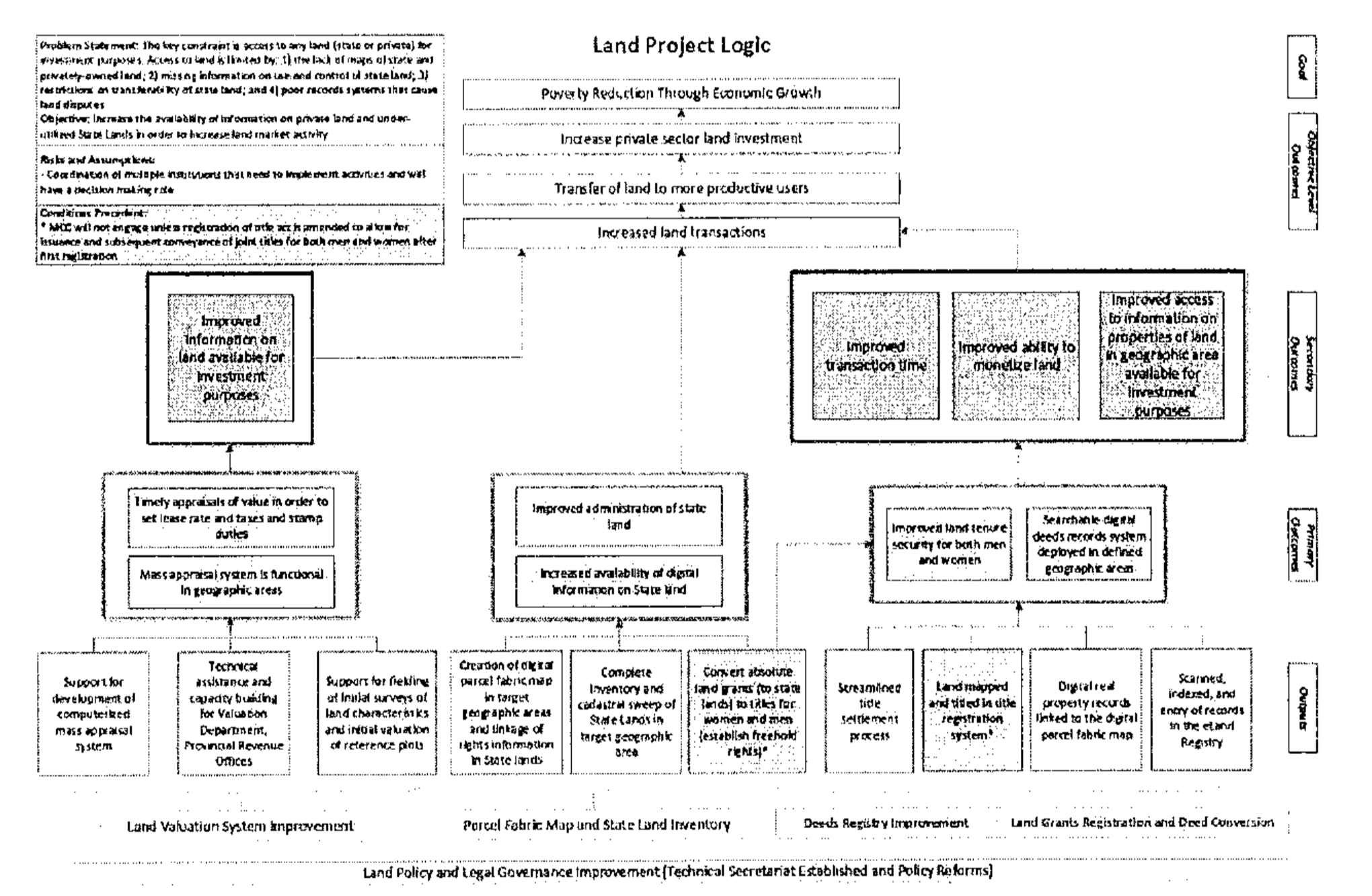
As per land project indicators MCC wants to ‘increase land transactions’ ‘increase private sector land investment’, ‘transfer land to more productive uses’ & ‘increase land investment’ – so this is the ultimate aim of privatizing land so that it falls into the hand of rich foreign investors.
There is also a clause that any funding to be made in excess for the project completion has to be borne by the GoSL – when we will have no land to even tax, where will the GOSL find money?
And the only consolation for us is that the MCC Compact can be terminated is if the MCC finds GOSL is doing drugs! JMCC Section 5.1 (viii)
Taking an overview of the 20th century it
can be argued that the seeds of the major forces that shaped the political
landscape of post-independent era were sown in the thirties. Three events in
particular stand out from the thirties as defining points of departure from the
semi-feudal, semi-colonial, semi-capitalist past into the tumultuous future
struggling to be born: 1. democratisation of the political system under
the Donoughmore Constitution with universal franchise in 1931 — a daring
political experiment which was unique for the time: it transferred political
power from the elite to the powerless enabling them to influence the political
process according to their will; 2. the birth of LSSP and Sinhala Maha Saba in
1935 and 3. G. G. Ponnambalam’s anti-Sinhala-Buddhist speech in Navalapitiya
in June 1939. The impact of all three events unravelled in their own
spheres sometimes intertwining, sometimes going their separate ways and
sometime clashing with each other, with, of course, all three
collectively leading / dragging the nation to where we are now in the 21st century.
Let us take the last one first. With one speech in
the late thirties Ponnambalam shattered the inter-ethnic peace that had lasted
for centuries. The impact of that anti-Sinhala-Buddhist speech still reverberates
in the political highways and byways of the nation. It was an ominous event
that cast it dark shadow right across the remaining decades of the 20th century
and to this day. In fact, the Hindu Organ, the leading Tamil
voice of the day, wrote a prophetic editorial titled, Writing on the
Wall, forecasting the coming events that bedevilled the
nation.
It was a time when the old aristocratic elite of Jaffna, led by
the distinguished brothers, Sir. Ponnambalam Ramanathan and Sir. Ponnambalam
Arunachalam, had faded out of the national political scene. The
last of that turbaned elite, Sir. Ponnambalam Ramanathan, passed away in 1931.
The field was wide open for the new-comer, G. G. Ponnambalam, to step in and
take command of Jaffna politics. It was also a time when anti-Jewish racism of
the Nazis was at its zenith. He had seen how it had worked for Hitler. As
a student in UK he had visited Germany couple of times and when he
returned he did not bring in his baggage the fashionable Marxists ideology that
captured the imagination of the Sinhala returnees from Western universities
like Philip Gunawardena, Dr. N. M. Perera, and Dr. Colvin R de Silva. He took
to casteism and communalism like duck to water– the two deep-rooted evils of
Jaffna.
His politics ran counter to the anti-caste, anti-racist ideology
of the Tamil youth who were inspired by Gandhi. The powerful Tamil Youth
Movement of the day was also against Ponnambalam, and he could not even contest
in Jaffna. But he returned triumphantly to ride the waves of casteism and
communalism. He was the first to define and exploit the subterranean force of
communalism that ripped the nation apart. Besides, when Ponnambalam stepped
into the political vacuum left behind by his aristocratic predecessors he had
no progressive or modern ideology to mobilise and lead the Jaffnaites into
modernity. His commitment to feudalistic casteism and political communalism was
incurable. Nor was Jaffna, hidden behind the ubiquitous cadjan curtain, ready
to receive and follow 20th century ideologies of social change.
It was stuck too deep in casteist conservatism. It was the most sacred
religious tenet of the elitist Saivites of Jaffna. It was the sole lifeline of
the ruling Vellala elite. Their supremacy, which they guarded with all their
might, depended on casteism which had been ordained as the divinely anointed
social order. Furthermore, Vellalaism, which was a combined force Hinduism,
casteism and politics, was a political ideology that was incrementally
transiting into mono-ethnic extremism. Each one of these factors locked into
the other seamlessly, inseparably. Jaffna was held together by the superior
force of Vellalaism. Ponnambalam arrived on the political scene at the right
time to lead Vellala middle-class, competing mainly for government jobs and
political power, with the rising middle class of the Sinhalese in the
south. So, when he took to anti-Sinhala-Buddhist communalism he became an
integral part of the prevailing political culture of the English-speaking
Saivite Jaffna Vellalas (SJVs) who dominated the British public service with a
disproportionate share of jobs at all levels. This enabled the Vellalas to
maintain a cosy relationship with the ruling colonial masters. This, in turn,
enabled them to retain their Vellala casteist power, privileges, perks and
positions derived from the preceding feudal age with the least resistance from
the colonial masters.
The SJVs who were rising as the new middle class of Jaffna
formed the formidable and indispensable base for all political leaders. The
SJVs derived their strength as a collective force dominating the public
service. The Government Clerical Service Union headquarters in Maradana was a
bigger political center than any place in Jaffna. So much so that S. J. V.
Chelvanayakam, the father of Tamil separatism, launched his Illankai Tamil
Arasu Kachchu (aka Federal Party) on December 14, 1949 at the GCSU Hall in
Maradana. Their security and future prospects, particularly in the
marriage market, depended on government jobs. The discretionary administrative
power that trickled down to them as the go-between subalterns of the British
Empire – an essential secondary tier to run all empires — armed the SJV
elite with the power to initiate, direct and implement the political contours
of Jaffna with no rivals from within to challenge their supremacy in all
socio-political matters, and even personal lives, from the womb to the tomb.
Ponnambalam’s arrogant personality too dove-tailed neatly into the reigning
supremacist ideology of the SJVs who ruled the peninsula with an
iron-fist from the feudal ages.
The grab for disproportionate power in the public service
and the legislature was a peculiarity confined only to the SJV elite of
Jaffna. Hence Ponnambalam’s cry for 50-50” – fifty per cent of power for
11 per cent Tamils of the North. Trying to grab power both in the
administration and in the legislature was not a characteristic of the
other layers of Jaffna Tamil society which consisted of the low-castes, or the
Batticoloa Tamils, or the Indian Tamils, or the Tamil-speaking Muslims. All the
issues raised by Ponnambalam in packaging his 50-50” demand, from
discrimination in the public service jobs to power-sharing at the centre,
concerned essentially the English-speaking Saivite, Jaffna, Vellalas and no
other Tamils. The Batticoloa Tamils, the Indian Tamils, and the
Tamils-speaking Muslims had their own political agendum which were not related
to white-collar jobs in the public service or a 50% share of seats in the
legislature. This explains why S. J. V. Chelvanayakam’s Thamil
Payasoom Makkal (Tamil-speaking people) Movement failed. The
non-Vellala Tamil-speaking people resented the hegemony of the Vellala
supremacists.
Besides, the SJVs were obsessed with the fanciful belief that
they had descended from a superior culture wrapped in the Tamil language which,
they believed, would make them the equal to the Sinhala-Buddhists, if
not superior. The Tamils could claim 50” of power only if they could
prove to the British that they were equal to the Sinhalese. In the
absence of a great and glorious historical past that could match that of the
Sinhala-Buddhists, claiming the legacy of the Tamil culture and language created
in S. India has been the only defensive position they could take in order to
claim equality with the Sinhalese. It was the mainstay of Tamil pride
and politics. Basking in borrowed feathers make them feel superior. It is
a hollow claim of a sterile culture that produced only ant-hills compared to
monumental achievements of the Sinhala-Buddhists. The Tamils of Jaffna could
find refuge only in the greatness of the Tamils of S. India. They failed to
produce anything great that could make them stand out as a noteworthy
civilising force.
So, they were forced to claim greatness not on any achievements
of their own but on the genius of Tamils in another country. The Sinhalese take
credit for the genius of their ancestors who created a new civilisation, new
culture and a new language on Sri Lankan soil, overcoming all the challenges of
time and nature. Americans, Australians, Canadians and New Zealanders, for
instance do not claim to be great and take pride in the culture made in
Britain. They claim greatness for turning the virgin land into a new
civilisation and a new culture and to some extent a new language. Churchill put
it elegantly when he said that America and England are two nations divided by
one language. The Tamils cannot even claim to have made a substantial
contribution to the Tamil language. They never made an original contribution to
enrich the Tamil language. Their biggest boast is about Arumuka Navalar and V.
Thamotherampillai rediscovering some of the forgotten Tamil texts and
reprinting them in Jaffna. On this count, some Jaffna Tamils even claims
to be superior to the S. Indian Tamils, the founding fathers of the Tamil
language. Jaffna Tamil bragging about their culture and language is full of
sound and no substance.
Other Tamil-speaking groups resented the arrogance
of the SJVs posing as a superior breed of human beings
descending from a glorious Tamil culture articulated in one of the
ancient languages. Finding sanctity in antiquity has been their last resort. This
is a fallacious argument. Other modern languages which had risen to
greater heights as a civilising force are dismissed as not being in the same
class as Tamil because they lack antiquity. Well, what’s the difference between
an old snake and a baby snake? What matters is the sting not the age.
All this is symptomatic of the desperate search of Jaffna Tamils
for greatness. Unable to provide any evidence of their monumental achievements
they are wont to chant mantras of their imaginary greatness. This is pure
Tamil show-vinism”. Ponnambalam’s attack on the Sinhala-Buddhists and lauding
Tamil greatness in the same breath is typical of cheap Tamil show-vinism”. He
took to Tamil show-vinism” because he had no other viable and
progressive policy to offer the oppressed Tamils. He was also aware of the
rising resentment of the oppressed castes against the SJVs. Tamil show-vinism”
was a tactic to deflect the blame on to the Sinhalese to cover up the evils of
the Jaffna society ruled by the SJVs. Besides, the bankrupt Tamil show-vinists”
took to demonising the Sinhalese and downgrading the Sinhala-Buddhist
history as their main plank, partly to claim a superiority over the others and
partly to garner votes in the peninsula. Ponnambalam’s show-vinist” legacy
lasts to this day. C. V. Wigneswaran and Ponnambalam’s grandson survive in
peninsular politics by selling Ponnambalam’s Tamil show-vinism”. All this
began with GG’s” speech in June 1939 in Navalapitiya. His legacy has been a
powerful force in determining the form and direction of Jaffna Tamil politics.
Tamil politics since the been within the framework drawn by Ponnambalam. Other
variations of Tamil politics has been either an extension or and adjustment of
his anti-Sinhala-Buddhist greatness of Tamil mediocrities.
Tragically, the thirties saw the decline of Jaffna Tamil
Youth who, inspired by Gandhism, rejected both casteism and communalism.
History would not have taken the route it did if the Jaffna Youth of
twenties succeeded. Instead Ponnambalam of the thirties spun the theory of
Tamil superiority to make-believe that they are not only equal to the
Sinhala-Buddhists but also superior. That was the gist of his provocative
speech at Navalapitiya.
The second event was the birth of the Sinhala Maha Sabha in 1935
which will be explored in the next article. It was a counter to the rising wave
of Tamil show-vinism”. The Tamils who broke away from the Ceylon National
Congress, which consisted of the elite drawn from all communities, established
the first communal party, Tamil Mahajana Sabhai, in 1921. This Tamil elite was
in the forefront of demanding more seats and more power for the Tamils to
be on par with the Sinhalese. The first decades of the 20th century
was marked by constitutional changes in which the Tamils launched their
campaigns to grab an equal share of power on the fake claim that they were not
a minority but a majority community. Though they constituted only 11 % they
claimed, believe it or not, that they too were a majority community.
Prof. K. M. de Silva, Sri Lanka’s foremost historian, has
documented this claim in his scholarly analysis of the break-up of the Ceylon
National Congress. He wrote that … Arunachalam shared the prevailing opinion
that the Tamils were not a minority but were one of two majority communities.”
(p.115 – The Ceylon Journal of Historical and Social Studies,
July-December 1972). It is this kind of hallucinatory politics
that led to divisive politics on communal lines. Distorting the known
historical and political facts has been a prime necessity for the Tamils to
sustain their exaggerated claims for an equal share of power. Claiming to be a
superior breed because they speak the Tamil language, claiming to be founders
of Sri Lankan history from the dawn of time”, claiming to be makers
of a culture far superior to that of the Sinhalese, claiming to be a
majority” community equal to that of the Sinhalese, claiming to be
intellectually superior because they occupied a disproportionate share of jobs
in the public service and professions, claiming to be divinely chosen by God to
be at the top of the casteist hierarchy in Jaffna, claiming to be the trusted
favourites of the colonial masters because they knew the art of sideling up to
the colonial masters etc., gave them the illusion of being a superior breed
standing way above the rest of their fellow-citizens. It made them inordinately
arrogant and treat some of its own people as unworthy pariahs not fit to be
members of the Tamil community. The Tamil supremacists spat on their own
Tamils. The low-castes were kicked out of Tamil society as a subhuman species
that should not be seen or heard. In one tragic incident when the low-caste
Hindus demonstrated non-violently at Maviddipuram Temple in 1968, pleading for
the right to worship the same God/s in the Vella-managed temples,
the organised Vellala gangs enforcing Vellala taboos, cracked their heads
with iron rods and bottles filled with sand. It is these supremacists
that go around the world saying that the Sinhalese had discriminated against
them – the most privileged elite in Sri Lanka.
The Tamil tendency to wallow in their own myths has been one of
the primary causes that led them to their political misery. Wanting to be
the greatest, wanting to be superior to the rest, wanting to be the makers of
history because they do not have a great history of their own are some of the
political tools they use to pursue their political goals. In the process they
also tend to denigrate and downgrade those who are projected as their
enemies. Fabricating myths against their rivals have been the usual
tactic to gain political mileage. Ponnambalam was the first to fabricate the
myth of discrimination against the Tamils when he went before the Soulbury
Commissioners – a cry which claimed that the Sinhala state” had not been
fair by the Tamils in the public service. This cry was raised to appease the
SJVs who were fixated on government jobs, with a pension, three railway tickets
per annum for the family, and a big fat dowry. This was not an issue that affected
the other Tamil-speaking communities. The major issues that divided the
North-South communities – job discrimination, language, power-sharing,
colonisation – were not common to all Tamil-speaking communities island-wide.
All these issues concerned only the SJV elite in the North. These issues did
not relate to even the low-castes in Jaffna. They were not fighting for
jobs in government service because the public servants were, by and large, the
English-speaking Saivite Jaffna Vellalas.
The Soulbury Commissioners who
listened to Ponnambalam for nine hours dismissed his accusation of
discrimination as having no substance. Clearly, the cry of discrimination was
launched in British colonial times. It did not begin with Bandaranaike’s
Sinhala-only policy, as touted by the anti-Sinhala-Buddhist propagandists. But
this mythology has become a truth among to the hired academic and NGO pundits.
It became one of the key accusations against what they called the Sinhala
state”. The accusation persisted and it is still in circulation.
Apart from Soulbury Commission in the forties a study on this issue of
discrimination was made in 1985. The date is important because it was after the
Tamil leadership had declared war in the Vadukoddai Resolution in May 14,
1976 on this issue, in particular. The study was made by the Citizens
Committee and MARGA an independent think-tank engaged in social research. After
examining in detail the claims of discrimination” against
the Tamils, their report, titled Inter-Racial Equity And
National Unity in Sri Lanka MARGA Institute, Jan. 1985, authored by Godfrey
Gunatilleke, revealed, inter alia :
1. ˜the average levels of living of
the Tamil community are in no way inferior to those of the Sinhalese
community. p. 10
2. Both communities are, more or
less, of the similar levels of well-being and face similar problems of social
and economic development — p.10
3. The Sri Lankan Tamil community
of approximately 600,000 working in Sinhala areas, particularly in the
South-West enjoys a relatively higher level of well-being than the average
Sinhala households in these areas, as the Tamil segment falls largely into the
lower-middle class, middle and upper-middle income levels.– p.9
4. The Tamil politicians have
expressed the view that the problem of language in so far as it applied to the
Tamil-speaking areas has already found satisfactory solutions in the more
important areas. For all practical purposes, Tamil has now become the language
of the administration and the courts in the Tamil-speaking districts. —
p.12.
5. In 1980 the schools in the
Jaffna District had approximately 6,202 students in grade 12 of the science
stream as compared with the total of 45,979 for the whole country. This
accounts for approximately 13.5 of the total number of students at this level.
The share of the population of the Jaffna District in the total population
is only about 5.5. per cent.– p. 18. Clearly, 5.5 per cent of the student
population occupying 13.5 per cent isn’t discrimination, is it?
6. The welfare state which was
expanded in the post-independence period reached out to all parts of the
country and to all Sri Lankan citizens, irrespective of community or creed. The
facts and figures as well as the socio-economic changes that have taken place
over the past 30 years validate this position beyond any serious
doubt.– p.10/
It also listed the facilities
available in Government schools in 1980.
Educational
District
No of
schools
Library
Science Labs
Colombo
251
126
128
Jaffna
559
116
100
(p. 18 Inter-Racial
Equity And National Unity in Sri Lanka, MARGA.
The evidence is there to arrive at
rational conclusions. But not all the mountains of evidence can convince those
who prefer to believe in their comforting myths. In other words, it
is possible to take all horses to water but no one can make all of them drink
it. They prefer to wallow in their own myths which leads them to their own
misery.
A 43-year-old woman was arrested for making defamatory remarks against Colombo Archbishop Malcolm Cardinal Ranjith in a video uploaded to social media, Police Spokesman DIG Ajith Rohana said.
The suspect was arrested in Battaramulla. He said the video also contained content that arouse hatred between Buddhist and Catholic communities.
She is to be produced before the Colombo Chief Magistrate tomorrow,” DIG Rohana said.
The Criminal Investigation Department is carrying out further inquiry into the incident.
The All Ceylon Makkal Congress (ACMC) says its leader MP Rishad Bathiudeen will appear publicly after the 20th of October.
The Deputy Leader of ACMC, Attorney-at-Law N.M. Shaheed stated this holding a press conference today (18).
On October 15, MP Bathiudeen filed a writ application through his lawyer, seeking an order from the Court of Appeal to prevent his arrest.
The writ application has also been fixed for support on the 20th of October before Appeals Court justices Kumudini Wickramasinghe and Sobhitha Rajakaruna.
Acting Inspector General of Police C.D. Wickramaratne, Deputy Inspector General (DIG) of the Criminal Investigation Department (CID) S.P. Ranasinghe, Sub Inspector Gamini and four others have been named as its respondents.
Search operation launched by the Criminal Investigation Department (CID) to locate the parliamentarian entered the fifth day today.
The CID has recorded statements from Opposition Leader Sajith Premadasa and MP Rauff Hakeem with regard to the phone conversations they have had with the parliamentarian.
They also recorded a statement from MP Bathiudeen’s wife at their residence in Colombo last evening (15). However, she has told the investigating officers that the parliamentarian had not kept in touch with her since October 12 and that she is unaware of his whereabouts.
Then-Minister of Industry and Commerce Rishad Bathiudeen, the director of the project Mohamed Yaseen Samsudeen and the project accountant Alagarathnam Manoranjan are accused of violating Article 82(1) of Presidential Elections Act, No. 15 of 1981 by misappropriating public funds to the tune of Rs. 9.5 million.
They have allegedly misused 222 buses belonging to the state-owned Sri Lanka Transport Board (SLTB) for transporting IDPs from Puttalam to polling stations in Silavathurai, Mannar during the 2019 Presidential Election.
The CID, upon the direction of the Attorney General, had sought the Colombo Fort Magistrate to issue a warrant to arrest MP Rishad Bathiudeen and the other two suspects on charges of criminal misappropriation of public funds and violation of election laws.
However, the magistrate ruled that the Police can proceed to arrest the suspects without a warrant.
Thereby, Attorney General Dappula de Livera directed the Police to arrest the three suspects according to the law.
Alagarathnam Manoranjan was taken into custody by the CID on October 13, while in the area of Kirulapone. He was remanded until the October 26 after being produced before the Fort Magistrate’s Court.
In the meantime, a constable attached to MP Bathiudeen’s security detail was also taken into custody the following day, for allegedly aiding the parliamentarian to evade the arrest. He was apprehended in Wellawatte area, along with two cars and two firearms.
On October 14, the Fort Magistrate issued a travel ban on MP Bathiudeen upon a request by the CID.
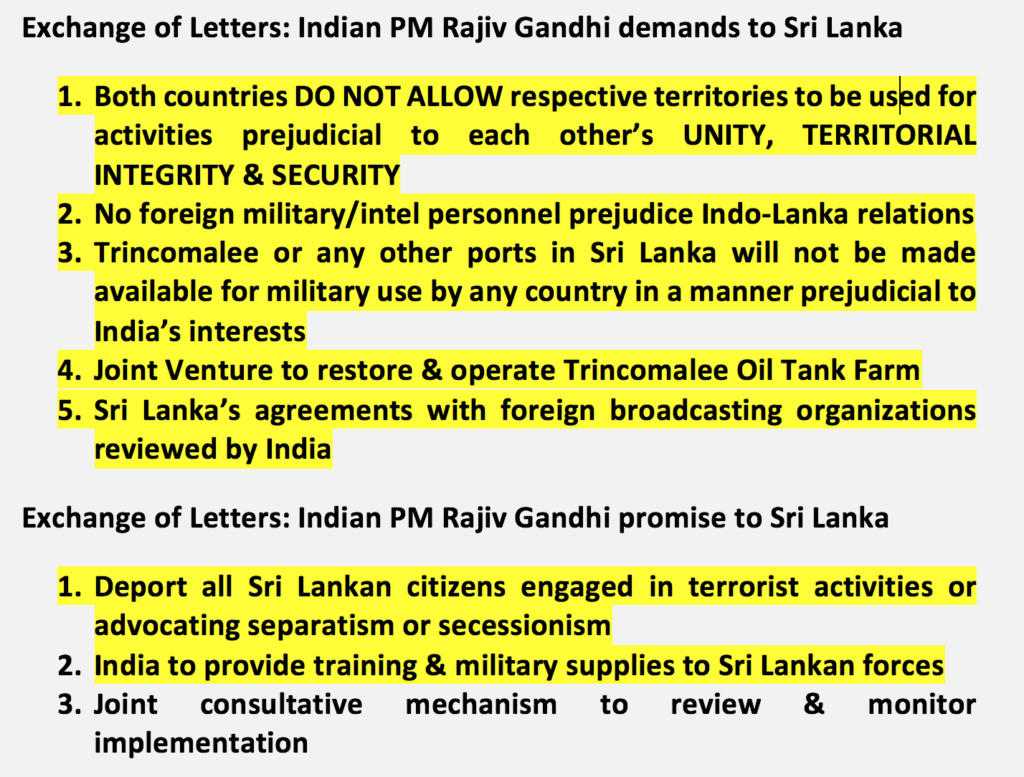
The Indo-Lanka Accord was signed on 29 July 1987 in Colombo under emergency while the 13thAmendment to Sri Lanka’s constitution was passed on 14 November 1987. Does the Indo-Lanka Accord mention, amending Sri Lanka’s Constitution? No.Does the text of the Indo-Lanka Accord have even the mention of ‘devolution’? No.There is no mention of constitutional amendment or devolution even in the exchange of letters between President J R Jayawardena or PM Rajiv Gandhi. More importantly, the Accord and the letters only mention North & East provinces & a system for these two provinces only.Then what is this hullabaloo related to India insisting on implementing 13thamendment? As far as Sri Lanka is concerned it is a domestically passed legislation and whether it continues or not is the decision of the People voiced through their representatives in Legislature & the Executive. The 2002 Cease Fire Agreement was brokered by Norway, but when Sri Lanka declared its withdrawal from it, Norway did not demand Sri Lanka continue it, likewise India must first accept Sri Lanka is not a territory of India and if the welfare of Tamils is the concern of India, they can always offer Tamils the right to return to settle down in India.
Text of the Indo-Lanka Accord with the exchange of letters between the leaders of Sri Lanka & India
The historical timeline of the conflict & quest for separatism (political & armed) & role of India
It is important to understand that there is a quest for separatism advocated by certain Tamil politicians via political solutions & a quest for separatism advocated by Tamil armed groups.Prabakaran & LTTE was just one of these groups.
The quest for separatism politically came prior to the quest via gun.
The political quest for separatism began in 1949 with the formation of ITAK for a Tamil Nation State. Prabakaran was not even born when ITAK was formed in 1949.
Prabakaran did form the Tamil New Tigers in May 1972 at the age of 18 and killed Jaffna Mayor in July 1975. Prabakaran rechristened TNT as LTTE on 5 May 1976 days before the Vaddukoddai Declaration was on 26 May 1976.
The quest for separatism via gun & politically merged into a marriage of convenience.
May 1978 LTTE was banned. 7 September 1978 LTTE blew up an Air Ceylon plane the very day the new constitution was introduced.
May 1982 bomb blast in Madras airport killing 30 with Tamil Eelam Army claiming responsibility. Therefore, both India & Sri Lanka were well aware of armed militancy in both countries.
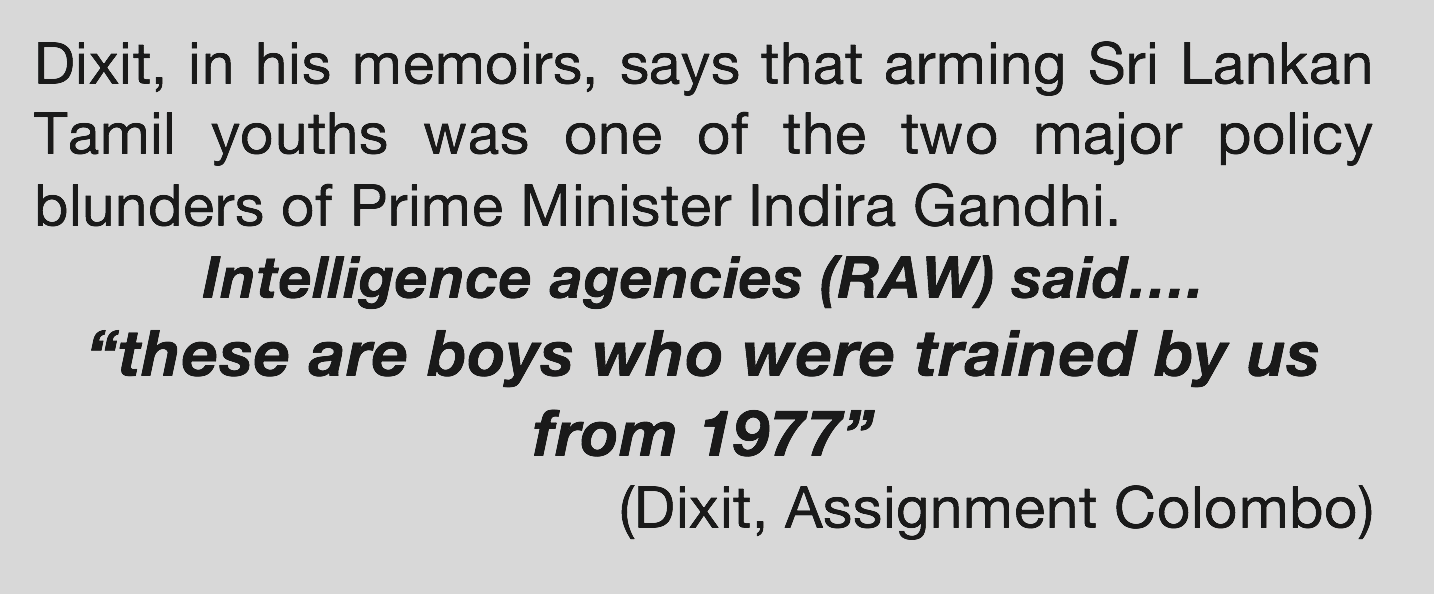
India was home to Tamil militant training camps. Jain Commission Report lists the names of these camps. By 1986 close to 3500 had undergone training by Indian intel.The memoirs of former Indian officials and military personnel establishes this.
When secession was launched for self-determination by Tamil Nadu, India was quick to pass 16thamendment in 1963. Why did India support Tamil militancy in Sri Lanka then?
As you can see, it was only after helping create the conflict that India engaged Sri Lanka in discussions to resolve the conflict.
Dixit’s 1985 interview that PM Rajiv decided to stop training & supplying material to Tamil groups confirms training was previously given.
Clearly, we can conclude that the quest for separatism is two-fold (started politically & promoted to warfare) with Indian nod of approval & covert assistance.
Tamil militants were trained in India & dispatched to cause mayhem in Sri Lanka. 1983 was the culmination of a series of attacks and killings & possibly a planned riot to enable justification of armed militancy. It also enabled to internationalize the conflict painting majority Sinhalese as demons discriminating the Tamils. It afforded India to crown itself as savior of Tamils.
Thereafter from 1983 to 1987 Sri Lanka was in for a period of orchestrated turmoil. LTTE opened its London office in 1984. LTTE kills villagers in Kent & Dollar Farm,
JVP insurrection started. JVP attacked Pallekele Army camp on 15 April 1987. On 17 April 1987 LTTE kill 127 civilians in Aluth Oya massacre, followed by 21 April 1987 Pettah bus attack killing 113 civilians.
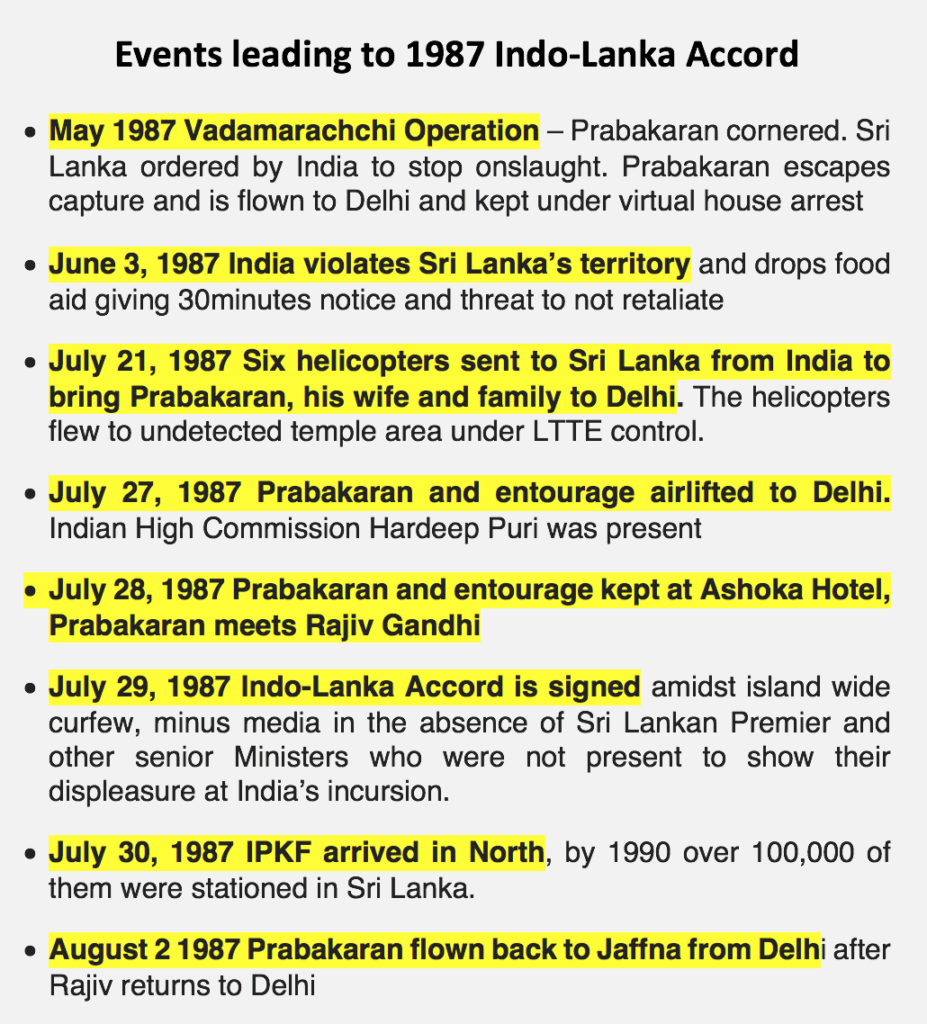
The army was fully stretched but on 26 May 1987 launched Vadamarachchi involving 8000 troops from around 30,000. Prabakaran was cornered. Then India ordered to halt operations & not to capture Prabakaran. 2 June 1987 Rajiv Gandhi sent a flotilla by sea which was sent back by the Sri Lankan Navy.On 4 June India violated Sri Lanka’s sovereignty dropping 22 tons of parippu! This constituted a crime of aggression against Sri Lanka by India. Prabakaran was whisked off with family to India by India on 21 July 1987 sending 6 helicopters. The government was brought to its knees.
Indo-Lanka Accord was a Treaty signed under Coercionproved by the ships sent, Sri Lanka’s territorial violation, demand to cease hostilities whereby Prabakaran escaped capture by Sri Lankan forces and India whisked him off to India and kept him there until the Accord was signed, Natwar Singh gave a clear warning of threat if Sri Lanka were to take action against the Indian Airforce who dropped a meager 25tons of parippu on Jaffna giving Sri Lanka just 30 minutes notice – these all violate Article 52 of the Vienna ConventionA treaty is void if its conclusion has been procured by the threat or use of force in violation of the principles of international law embodied in the Charter of the United Nations”.
Indo-Lanka Accord was signed under virtual duress – India invades Sri Lanka’s territory, Indian ships are sent, India whisks terrorist leader & family to India sending helicopters. Threatens to use force if Sri Lanka reacts & then produces an agreement Sri Lanka is forced to sign.
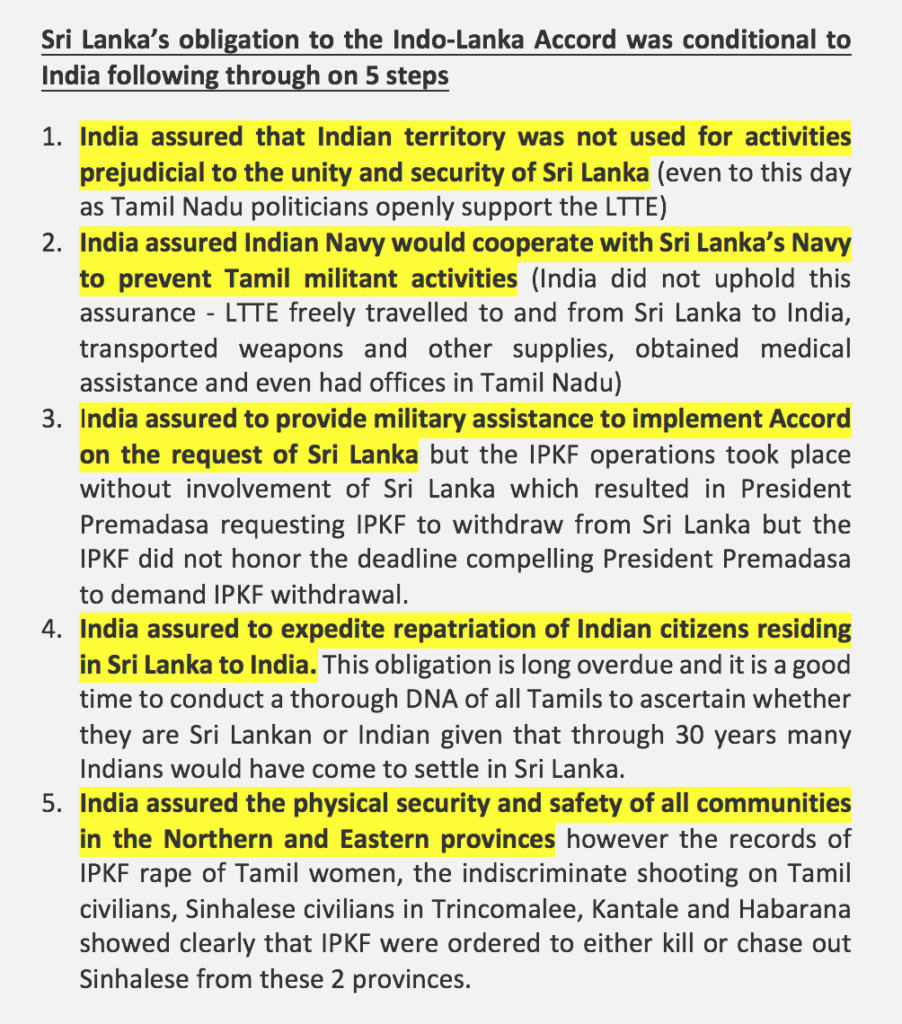
All 5 clauses India committed to – India did not honor. India had clearly violated the principle of international law ‘Pacta Sunt Servanda’ (Pacts are meant to be honored for agreements to be valid) & if not kept Sri Lanka is not obliged to honor it.
The major offence committed by India was to help create the Tamil National Army recruiting local Tamils who were armed by the IPKF and tasked to support the Chief Minister Varatharaja Perumalwho became the merged N&E Province’s 1st Chief Minister in whose cabinet Dayan Jayatilake also was a MP. India by helping create and arm the Tamil National Army not only breached but totally violated its own assurance given to Sri Lanka that it would preserve the unity and sovereignty of Sri Lanka
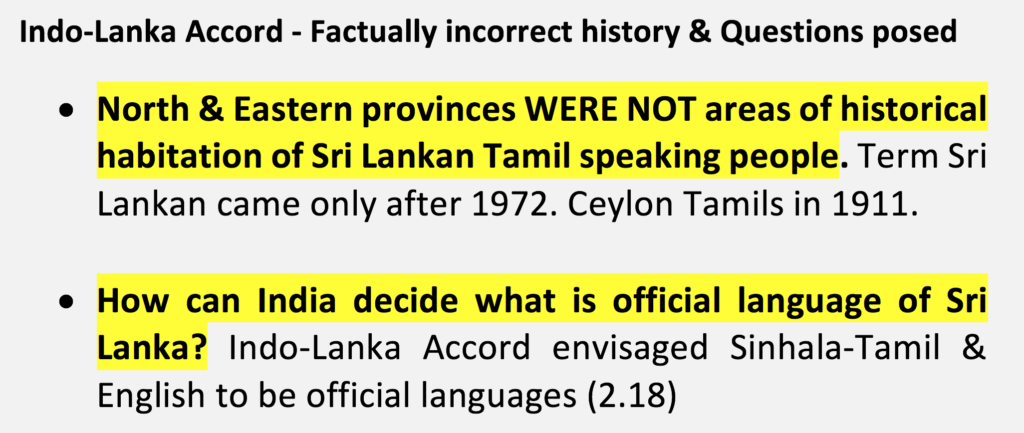
India’s promised obligations were not honored and the Accord had no mention of any constitutional amendment except merging of north & east provinces & demerger after a referendum with dates even given. There was no mention of provinces other than north and east and no mention of any elections for any provinces other than the north & east.
The major clauses of the Accord vis a vis Trinco Port /Trinco Oil Tanks had nothing to do with Sri Lanka’s Conflict or demands of LTTE or even Tamil leadership. These were all what India wanted to get using the Accord.
How did 13thamendment come about then?
The Indo-Lanka Accord mentions discussions regarding the Accord taking place across 1986 & signed in July 1987.Though 13thAmendment was passed by Sri Lanka’s Parliament in November 1987 discussions had been taking place since Thimpu Talks with India playing a major role. The TULF letter to Rajiv Gandhi on 28 October 1987 shows how 13a/PC system/merger of North East evolved. The key point here is that these inclusions were all conceptualized by India and not by Tamil leadership or the LTTE.
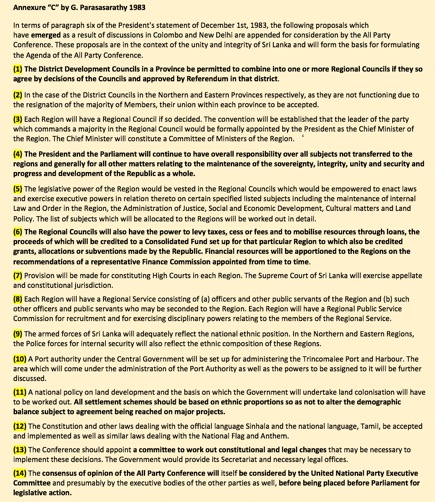
Annexure C were culmination of India’s proposals to India & Tamils/LTTE SEPARATELY since 1983.In 1985 a draft framework of Accord & Understand was presented including creation of Provincial Councils with separate provincial councils for the North & East.
TULF in December 1985 forwarded proposals combining North & East into a single Tamil linguistic state with Indian nod of approval. Sri Lanka rejected this in January 1986. Sri Lanka’s new proposal in June 1986 agreed to devolution & drafts were prepared. These discussions & drafts were all with Indian influence and involvement & served as precursor to 1987 Indo Lanka Accord drafted & sent by India.
India created the problem, pretended to provide the solution, manipulated both Tamil politicians/LTTE & Sri Lankan Government to the advantage of India only. It was no one but India that demanded the merging of North & East provinces in 1984
Similarly, it is important to note that out of the 37 subjects to be devolved to the provinces 36 have been devolved. In over 30 years what is the success that the PC system can boast of? Is their failure because land powers & police powers are not given? The people of the provinces are not asking for land & police powers – so who wants it & why?
Global politics has changed. India was never in any US pro-West orbit during 1980s.Today India is a key partner in Quad/US Pivot to Asia. Why didn’t India quote 1987 Accord (denying any foreign military use of Sri Lanka’s ports) when ACSA was signed allowing US military to use Sri Lanka’s military installations/ports & airports. If ACSA is approved by India, then Sri Lanka too can interpret & misinterpret the 1987 Accord too. The 13a is a domestic legislation. India may well have had a role in inserting clauses and that is probably why the PC system has not served the people of Sri Lanka at all. Given the global dynamics it is good for India to take stock of its own vulnerabilities at home instead of making its neighbors vulnerable.
There was no nation called India in 1946. Colonial Britain gave independence to India cobbling independent territories and states in 1947. We were not alive to see that India but we may be alive to see the balkanizing of India into the same independent territories once more! India should now seriously worry about that for such an eventuality will no doubt erase all of India’s dreams & aspirations for super power status & supremacy in Asia. India would not want that, would it?
Feisal
Mansoor (‘Muslims and ban on cattle slaughter’/The Island/October 9, 2020)
opens his piece with a quote from Mahatma Gandhi, obviously taken from the web:
The greatness of a nation and its moral progress can be judged by the way its
animals are treated.” However, there is some doubt about the authenticity of
that alleged Gandhi quote because it is not traceable to his writings or his
speeches according to quote-researchers; besides, he was usually better known
for his great concern for the weak members of the human society than for
animals. But even if someone just imagined it, there’s no harm done, for the
expression of concern for animal welfare attributed to Gandhi can be easily
supported by what we know about him as a champion of nonviolence. But the
problem here is this: Whether genuine or fake, the Gandhi quote has little or
no relevance to the truth that FM’s arbitrary opinions about Sri Lanka’s
‘ancient culture’ misrepresent or conceal, in favour of something else. He
seems to completely ignore the millennia long recorded history of the island which
is almost entirely coterminous with its established Buddhist religious culture
and is inseparable from it. (Incidentally, the spirit of secularism and
democracy that it encourages in governance is a distinctive feature of the
country’s majority Buddhist culture; but this is something difficult for most
believers of other religions and Sri Lanka-baiters abroad to understand or
appreciate.) The greatness of our culture is that it is absolutely tolerant and
accommodating towards minority cultures, subject to the legitimate tacit
condition that they don’t try to make undue inroads into its space or to
subvert it in other ways. To me it looks like FM’s statements are meant to
distort, rubbish, and obviate if possible, Sri Lanka’s ancient Sinhala
Buddhist cultural heritage. Is the Gandhi quote meant to imply that our nation
has no claim to greatness and that our treatment of animals falls short of
required moral standards observed in civilized countries?
Having
said that, it must be stated with emphasis that it is perfectly alright for FM
to try to share his personal convictions with others. That is his right as a
free citizen. I am enjoying here the same right to articulate my reaction
as a Sri Lankan to his views about the ancient history and culture of our
beloved Motherland.
First
of all, let’s be clear about this: At the very inauguration (i.e., in official
terms) of the Buddha Sasana in the island of Lanka Buddhist missionary Arhant
Mahinda Thera admonished the monarch of the land king Devanampiya Tissa
in 236 BCE (2256 years ago) thus as recorded in the Mahavamsa:
O
great king, the beasts that roam the forest and the birds that fly the skies
have the same right to this land as you. The land belongs to the people and to
all other living things, and you are not its owner but only its guardian.”
Isn’t
this considerably before today’s animal rights protectors, animal ‘status’
guarantors, animal welfare standard maintainers, and various other ‘a fair deal
for animals’ worriers, represented in organizations that annually celebrate the
World Wildlife Day (March 3), World Animal Day (October 4), etc at some cost,
started talking about the subject?
Compassionate
treatment of all sentient beings is an ideal that people brought up in our
culture take for granted. Of course, there are instances where the ideal is
observed in the breach. That is human nature. A whole society should not be
judged on the basis of the behaviour of a few individuals, who could themselves
be victims of circumstances.
FM’s
first paragraph is an attempted fusion of the Ravana myth and his religious
beliefs to the exclusion of the historically factual Buddhist element. That
Ravana flew his ‘dandu monara yanaya’ (wooden peacock aircraft) and abducted
Seetha from what is now called India, is a story. Not even children take that
as proven history, but it is a wonderful story, wherever or whenever it
originated. Talking monkeys, animal fortune tellers, and other human
personality attributed birds and beasts are common in literature in all
cultures. The stories that compose our Jataka Potha are shared property in
various North Indian literary traditions. The Sanskrit ‘Panchatantra’ from
India interweaves five skeins of moral traditions into a single text composed
of stories in which so many animals feature, invested with human qualities. We
have a number of talking, philosophising, admonishing birds in Geoffrey
Chaucer’s Canterbury Tales.
FM
writes: As Creation is the supreme force in the universe, the beneficence of
life and its comprehension through love, is to facilitate as many expressions
of life as possible.” That belief is not shared by the predominant religious
culture of our country, but is not targetedly criticised or attacked so as to
hurt others’ religious beliefs or sentiments. There is evidence that our
ancestors ‘worshipped’ the sun as the source of all life, especially plant
life, hence important for agriculture. If they deified the sun, it was very
meaningful. That ancient religious tradition survives to date in the secular
Surya Manglyaya or the Sinhala Aluth Avurudda held in the month of Bak
(Felix/Lucky) in the Sinhala calendar. (Bak roughly corresponds with April in
the Gregorian calendar.) The ignorant insensitive British colonial authorities
arbitrarily renamed it Sinhala Hindu New Year for their own purposes. Tamils
and Sinhalese can and do live peaceably together while observing their separate
culturally distinctive festivals. Whether our ancestors called themselves
Aryans because they were sun worshippers is highly improbable. Aryans were a
white skinned race.The Sinhalese are not. It is not impossible that the
Swastika – a sign that symbolizes the Sun – was later appropriated by those
white people including Adolf Hitler. The legendary Vijaya of the Mahavamsa
could have descended from such a tribe, but that origin story is not accepted
today. Newly available archaeological evidence provides proof that our
ancestors were a civilised a people (with their pure dark skin) even during the
time of the Buddha, and that there were lay Buddhists and Buddhist monks before
the arrival of Arhant Mahinda, whose coming appears to have been the result of
an official diplomatic mission; he and his retinue were, most probably, royal
emissaries from Emperor Asoka’s court as much as Buddhist missionaries. (Read
between the lines, the Mahavamsa passages support this impression.)
FM’s
reference to Aldous Huxley needs a comment. In the Maha Parinibbana Sutta, the
Buddha tells the monks: ‘Atta dipa viharatha’ ‘Be islands unto yourselves’,
meaning you are your own saviour, that is, ‘Realise Nibbanic Bliss, put an end
to samsaric suffering, through your own effort’ (which is not beyond you, if
you are diligent enough). Writer and brilliant intellectual Aldous Huxley might
have independently arrived at this island metaphor to describe his own,
illusion of self, elusive self-identity. The contemplative W.B. Yeats, himself
no mean intellectual, expressed it as ‘How can we know the dancer from the
dance?’ Yeats’s is a literary approximation of the Buddha’s Anatta doctrine,
according to which the paradoxical situation ‘there is suffering, but no
sufferer’ is the reality. (It is equally possible that both Huxley and Yeats
came across this idea in Buddhist literature.)
Apparently,
FM mistakes this profound idea for selfish self-absorption. In his confusion,
he imports the phrase ‘enlightened self-interest’ that Adam Smith (considered
the ‘father of modern economics’) coined to express his idea that by pursuing
one’s own economic benefit one ultimately contributes to the good of others as
well without probably intending to do so. (But it can be thought that he tried
to elaborate it as a morally acceptable concept, rather than as a coldly amoral
economic one.) However, that is something very different from the Buddhist idea
of working for the benefit and wellbeing of others without expecting a reward,
generosity or altruism.
FM’s
understanding of the phrase ‘enlightened self-interest’ is entirely different
from the above:
As
such, enlightened self-interest is the only personal inquiry we can make, with
the all- important caveat that in our self-discovery we may not interfere with
anything else’s self-discovery.”
He
may be seen as giving idiosyncratic twists to the terms ‘enlightened
self-interest’ and ‘self-discovery’, which are actually technical terms in
their respective characteristic contexts. FM also makes a confusing verbal
medley out of words like ahimsa, Dhamma, and Mahasammata. These are words
charged with meaning and emotion for Buddhists. ‘Mahasammata’ (the Great
Elect/the Universally Chosen One/The People’s Choice) occurs in Chapter II of
the Mahavamsa as the earliest genealogical ancestor of the Buddha (and
humankind, probably) who lived countless aeons ago. For Sinhalese Buddhists
‘Mahasammata’ is not a historical figure; he is the legendary first king on
earth. In the Agganna Sutta (On Knowledge of Beginnings) the Buddha mentions
Mahasammata as the first ruler who was appointed, based on his handsome
appearance and strong personality, by common consent, to rule over the group of
rice growers that was the loosely formed human society then. He was tasked to
prevent stealing, to punish the miscreants by banishing, etc. Mahasammata was
given a share of the rice crop as payment for his service. Actually, the
Agganna Sutta can be interpreted as a scientific account of an alternately
expanding and contracting universe, and a gradually evolving earth; and much
later anatomically modern humans and organized human societies emerging
on earth. There is no talk of a creator or creation, which FM takes for
granted. Dharma is what the Buddha preached. Ahimsa is the ideal of nonviolence
that is common to most Indian religions, including principally, Hinduism,
Jainism, and Buddhism.
Next,
FM quotes two passages from the book ‘Portuguese Encounters with Sri Lanka and
the Maldives’ edited by C.R. de Silva, Ashgate, 2009, to assert that there was
no slaughter of cattle in Lanka prior to colonisation”. It is ridiculous in
that trivial context to quote from an eminent historian like the professor
mentioned. These encounters took place in the 16th to 17th centuries. The book
is a scholarly collection of writings taken from Portuguese histories and archives
in translation combined with those from local sources. Publishers say: These documents contribute
to the growing understanding that different groups of European colonizers –
missionaries, traders and soldiers – had conflicting motivations and objectives.
Scholars have also begun to emphasize that the colonized were not mere victims
but had their own agendas and that they occasionally successfully manipulated
colonial powers.” (I took this extract from Google.com- RRW)
So,
the book shows that the natives of these countries matched those invading
European interlopers bent on ‘temporal and spiritual conquest’ in their cunning
and countervailing skills. They were not half-civilized savages. By the way, I
don’t think FM found himself nodding in agreement when reading sentences
like the following written by an ignorant Portuguese scribe:
… In this country there are
many false beliefs sown by the devil, and to eradicate them there is a need for
much time and trouble…..” (This must be a reference to local Buddhist and Hindu
religious beliefs of the time; but the colonizers were too uneducated and
uncultured to understand that Buddhism and Hinduism are not ‘religions’ in
their sense of the term, and that religion in the colonizers’ sense was, as it
still is, a facile superstition to Buddhists. – RRW)
They
(some native people who didn’t kill even the meanest of creatures) do not eat
bread, however hungry or needy they might be. Their food is made up of the
leaves of a certain creeper (betel leaves) that climbs other trees like ivy.
These leaves are smeared with the same kind of lime that they use for
whitewashing their houses…”
There
is another class of people that eats fowl and wild boar and deer, but does not
eat the flesh of cows, since they believe their souls enter into cows after
death; they will never kill a cow and eat its flesh…”
It
looks like FM has missed this book: ‘A 16th Century Clash of Civilizations: The
Portuguese Presence in Sri Lanka’ by Susantha Goonatilake, 2010. It gives a
clear assessment of the effects of the Portuguese colonial presence in our
country which was actually ahead of those European invaders in terms of human
civilization. The Portuguese went to Sri Lanka in compliance with a papal
bull:
In
1452 Pope Nicholas V issued a papal bull called Dum Diversas that
granted Portugal and Spain ‘full and free permission to invade, search out,
capture and subjugate unbelievers and enemies of Christ wherever they may be
… And to reduce their persons into perpetual slavery”. (From the
Wikipedia – RRW)
We
may draw our own conclusions from this.
FM
makes extremely fallacious claims like the following about his fictitious
‘Lanka of Mahasammata’:
A
vocational caste system handed down secrets to successive generations, in a
system where one’s knowledge was one’s wealth, with the Divine as the Supreme
Master of one’s craft, one performs one’s duty with an aim to perfection in
union of mind and spirit so each attempt brought one closer to the Ultimate
Prize.” (Divine as the Supreme Master of one’s craft, Ultimate Prize, What are
these?)
In
a land ruled by the Unseen King, in both metaphor and practise, the King
embodies Mahasammata and sets the standard for the people”. (There was no
Mahasammata in our country’s history. I explained the ‘Mahasammata’ concept
above. Who is this Unseen King, FM? Surely a figment of your imagination?)
The
people know that if they live in dhamma, Dhamma would protect them, and the
land would be safe”. (This is a misinterpretation of the piece of wisdom which
runs in Pali: ‘dhammo have rakkati dhammacarim’ ‘The Dhamma protects the one
who lives by the Dhamma’. There’s no protective magic or divine intervention
here. But don’t take it literally. You may be sure you live according to the
Dhamma. But be mindful enough not to stand in front of an oncoming
train.)
The
rest of FM’s article makes even less sense.
From this point
onwards, I fail to find anything in FM’s article worth talking about. The next
to nothing he has to say about the subject proposed in his title is: …. I
believe that as a Sri Lankan Muslim, it is incumbent on me to respect the mores
of my compatriots and to live in a way that will lead to greater social
cohesion, amity and unity of purpose…” That is a harmless thought, but I for
one do not believe that pre-colonial Sri Lanka was paradise on earth. Besides,
that sentiment runs in the face of what FM has been trying to prove to the very
end.
55 largest SOEs delivered net Return on Assets (ROA) of only 0.64%
in 2017. The combined losses among the loss-making entities reached Rs.87bn in
2017 compared to Rs.42bn in 2016. Some are in deep trouble. The Petroleum
Corporation carries a negative equity. Sheer incompetence and corruption have
pushed Sri Lankan Airlines close to financial collapse. Central budget support
to SOEs amounted to Rs.41bn in 2017. The reports of COPE and the Auditor
General highlight repeated instances of fraud, mismanagement, corruption and
negligence. The issues no longer appear to be isolated incidents of
opportunistic behaviour by individuals or occasional lapses in control but
point to deeper, structural weaknesses –
Advocata Institute
The government of President Gotabaya Rajapaksa will
present its first budget on the 17th of November. Its challenges are
many, and they have been compounded by the impact of the COVID 19 pandemic.
Recent events have shown that even the best managed COVID responses can have
drastic reversals and it has shown that Sri Lanka, and for that matter all
countries in the world are not yet out of the woods when it comes to COVID.
This makes it extremely difficult to govern and plan governance options.
Besides the budget, the government of President Rajapaksa will have to work
with the people of the country to look towards the future and what policy
settings, based on behavioural changes that must underpin the country’s future
direction, should be introduced. Life cannot be what it was before this
Pandemic. There is no return to a normal”, as there was never a sustainable
normal. Among other things, a more sustainable new normal has to take into
account other challenges like deforestation, climate change, rising temperature
levels, vastly disproportionate disparities between the superrich and the lower
income groups, social inequities, and dwindling natural resources due to
unbridled exploitation
In this context, something that can
be done and must be done, is to chart a better economic governance model. An
area that needs immediate attention, much like a stopping a person bleeding to
death, is the equivalent of that in commercial terms. This is the intense
haemorrhaging of people’s money that has been going on in State Owned
Enterprises (SOEs). The Advocate Institute report referred to above states that
Sri Lanka has a total of 527 State Owned Enterprises out of which regular
information is only available for 55. These SOE’s accumulate billions of losses
annually due to sheer mismanagement. The precedence of corruption in the highly
bureaucratic systems that govern SOEs are also a case for alarm says the report.
Based on the information in this
report, the accumulated losses of the 55 State enterprises amounting to Rs 87
billion is 25% of the education budget allocation in 2019 and 37.5% of the
Health budget allocation in that same year. The central budget support for SOEs
in 2017 amounting to Rs 41 Billion is 11.9% and 17.6% respectively of the
Education and Health budgets. This is money that could have been deployed to improve health
and educational opportunities and standards for the people of the country.
It is reported
that Sri Lanka’s national carrier Sri
Lankan Airlines, the epitome of
mismanagement amongst SOE’s, is expected to lose 130 million US dollars (about
26 billion rupees) in the year to March 2020, taking total losses under full
state ownership and management to 232 billion rupees. This loss is 67% of the
Education budget allocation for 2019 and 100% of the allocation for Health in
2019!!
To add insult
to injury, Sri Lankan Airline says it would also need a 300 million US dollars (approximately
Rs 60 Billion) capital injection to reduce a spiral of debt. It defies logic as
to why the people of the country have allowed and are continuing to allow this
large scale misappropriation of their money to go on unabated. In the aftermath
of the COVID pandemic, no profitable airline will be able to get back to their
normal” in the foreseeable future, and loss making airlines are bound to crash
down the precipices they are already at the edge of. In this scenario, the Sri Lankan government
will have to give very serious thought to innovative solutions that can save
Sri Lankan Airlines.
SOE
haemorrhaging is a stark fact. Precious money that would have been available
for key areas such as health and education have been deprived as a consequence
of this dizzying scale of mismanagement and misappropriation. The decease is
known. The medicine for it is also known. What is needed is the guts to apply
the medicine.
In an in-depth
and intelligent article, Mr Prasanna Athukorale, an investment specialist who
has managed Global
Equities portfolios in Sydney and in New York for large institutional investors
since 1995, has offered some proposals as to how this haemorrhaging could be
stopped and a new life injected into
these SOEs (see SOEs reform in Sri Lanka: An enhancement proposal, Sunday Times 27th September – http://www.sundaytimes.lk/200927/business-times/soes-reform-in-sri-lanka-an-enhancement-proposal-417442.html
Mr Athukoralehas very succinctly identified the two key issues that
constitute the problem, quote First, let us separate the operational problems of the
SOEs from their symptoms. Financial underperformance is often seen as the
primary problem of the SOEs. It is not. Financial underperformance is a symptom
of the problem. The underlying problem is the lack of robust and responsible
corporate governance. Just like a competent physician would try to cure an
illness rather than the symptom, the government must address the lack of good
corporate governance practices in SOEs rather than trying to fix the symptoms.
This distinction is critical to recognise before we formulate solutions. Lack
of transparency in senior appointments and terminations, empowerment,
disclosure standards, procedures to manage conflicts of interest and
corruption, are just a few corporate governance shortcomings that are obvious.Secondly, successive governments have not seen their ownership interest in SOEs
through investment lenses. Boards and senior management of SOEs have not
operated within an investment culture and mindset that continually requires the
generation of returns that exceed cost of capital. There have been no
mechanisms to incentivise senior management nor to penalise underperformance.
To underpin the above, one could say
very logically that people have not given heed to the fact that it is their
money that has been squandered by successive governments and the squanderers
have given scant regard to whose money they have been squandering.
Mr Athukorale proposes the following
solutions to address SOE reform. The writer wishes to reiterate here that the
key ingredient required to implement these or any other innovative solution is genuine
determination, and while previous government leaders have not displayed this,
the current government with its 2/3 majority has the ability to institute
serious reforms to transform these SOEs into entities that will provide a
reasonable return for the people of the country for the huge amount of their
money that have been invested in these SOEs.
The following are based on extracts
of the proposed solutions identified by Mr Athukorale in his article. The
writer suggests that readers acquaint themselves with these as extracts from it
which are used here will not do justice to the comprehensiveness of Mr
Athukorale’s proposals.
First, repeal all Acts of Parliament that established
the SOEs and be re-incorporated under the Companies Act. This would place the SOEs under a
new governance regime immediately. For example, the Ceylon Petroleum
Corporation should be transferred from the Ceylon Petroleum Corporations Act
(No.28 of 1961) and be incorporated under the Companies Act with a suitable
legal name. The defining characteristic of this proposal is to establish a
distinct legal structure where the government can retain ownership through a
sovereign share class while ensuring a minimum level of good governance
required under the Companies Act. Leaving SOEs to operate under Acts of
Parliament is the ideal recipe for the continuation of direct political
interference and consequent financial underperformance.
The writer would like to add here
that in regard to the Ceylon Petroleum Corporation, while it is acknowledged
that the actual cost of fuel cannot be passed onto consumers as it could result
in higher prices for goods and services such as transport, innovative solutions
could address this situation. For example, cost of fuel used by Sri Lankan
Airlines could be passed onto those who travel on it, and alternate bus and
train services, in addition to subsidised services, could be introduced where
cost recovery could be done by providing additional benefits to consumers.
Besides this, introduction of a more efficient public transport system using
buses and trains could reduce the consumption of fuel by motors vehicles. The
COVID pandemic also provides opportunities for continuing with working and
studying from home options, which has a consequential impact on not just fuel
consumption, but on the environment. Fast tracking renewable energy sources,
using such energy for train electrification are other options that could be
considered.
Second, if the government wants to free
State Enterprises from political interference” (as promised in the manifesto),
then it is proposed that the responsibility for managing all SOEs be
transferred out of the various ministries to a newly established Sovereign
Wealth Fund (SWF), wholly owned by the government. The new holding company, the
Sovereign Wealth Fund, must be established under the Companies Act with full
state ownership and a constitutional amendment as described below. The SWF will
become the holding company of SOEs and be responsible for introducing an
investment culture and mindset and overseeing SOE performance.
Thus, the SWF would set the
objectives, identify constraints, have the authority to appoint and replace the
senior management teams of each SOE. Each SOE would then be answerable to a
single professionally run entity and effectively quarantine themselves from
direct political interference. Minimising indirect political interference will
require multiple other measures, which are outside the scope of this article.
The writer wishes to add here that this
proposal may be regarded as the most politically difficult but necessary reform
if political interference is to be stopped and if Parliamentarians are to shift
their attention to policy issues rather than process management. Mr Athukorale
states the excellence of the senior appointments to the SWF, will signal the
government’s intentions and be reflective of its credibility. The 225 MPs,
ministers, donors, friends, family and so on will not be able to appoint,
terminate nor directly influence the senior management of SOEs nor lobby to
gain an unfair advantage in awarding contracts. This is how Singapore
transformed their SOEs nearly 45 years ago. As happened in Singapore, this
transfer would relieve ministries of the task of managing business enterprises
and allow them to focus on policy formulation, regulation and the provision of
services”.
Third, Mr Athukorale contends that if the government wants to make the
reforms permanent and provide policy stability, then it should amend the
Constitution of Sri Lanka similar to amendments adopted in the Constitution of
Singapore in 1974. Temasek Holdings Pvt Ltd is a Singaporean holding company,
wholly owned by the Singapore Minister for Finance Incorporation Act (Chapter
183). Please see https://sso.agc.gov.sg/Act/MFIA1959. Incorporated in June 1974
as a commercial investment company by Prime Minister Lee Kwan Yew, Temasek owns
and manages Singapore’s SOEs under the key theme of transforming the
Singaporean economy. Subsidiaries of Temasek include Singapore Airlines,
Development Bank of Singapore, Singapore Telecomm, ST Engineering and Capita
Land etc.
Fourth, if the government wants to achieve Singapore-like performance
outcomes, then, the appointments to the
Board of Directors and the senior management team of the SWF should be made in
such a manner that the Board represents the interests of the government on
behalf of the people of the country and also includes members who are of proven
business acumen and performance. No doubt, the Sri Lankan public, the
investment and lender communities, sovereign rating agencies, the World Bank,
IMF and the ADB and other international lending agencies will keenly await the
signals the government sends.
Fifth, a major shift in SOE corporate governance as articulated by Mr
Athukorale is in the ownership of the SOEs. If one may try to understand the
distinction between what is there now and what is proposed, it is that under
the proposal, the government will own the equity but the SWF will own the SOEs
from a governance point of view. It will be the responsibility of the SWF to
return a solid return for the government’s 100% equity. This approach then
leads to other consequential approaches.
For example, Mr Athukorale states that there must be a strong separation
of duties between the owners and the management of an SOE. The chairman and the
board of directors of an SOE should represent the interests of the owners,
i.e., the Sovereign Wealth Fund, SWF (not the government under this proposal).
The SWF as the new owner would now delegate authority to the SOE board.
As such, the SOE Board should consist of non-executive directors, (with
the obvious exception of the CEO should he/she be a director) in that, their
role is one of oversight and governance, not carrying out day to day management
or implementation. The management team of each SOE should be led by a chief
executive officer (CEO) and a suite of executives responsible for setting the direction
of the SOE, implementation, finances, human resources and such day to day
activities. Incorporation under the Companies Act will require this separation.
Under current Acts of Parliament, the chairman has usually functioned as the
de-facto CEO making a mockery of corporate governance.
Sixth, to ensure checks and balances, parliamentary oversight of the SWF
should be through a body similar to the Committee on Public Enterprises (COPE)
with representation from the government, the Opposition as well as eminent
non-parliamentarians with subject expertise nominated by the political parties
depending on the industry of the SOE. The scope and objectives of COPE should
be revisited in light of this proposal. The primary focus should be on
overseeing the governance, financial performance of the key SOEs and the
aggregate financial performance of the SWF.
Lastly, in the medium to long term, if the government wishes to broaden
and deepen local capital markets, newly issued common class stock stakes can be
sold to the long-term institutional investors like the Employees Trust Fund and
to SOE employees, while retaining but diluting sovereign class ownership. A
listing on the Colombo Stock Exchange (CSE) will help take SOE transparency to
an even higher level through compliance with the CSE’s disclosure requirements.
The writer hopes that President Gotabaya Rajapaksa, Prime Minister
Mahinda Rajapaksa and Minister Nivard Cabraal, will consider these proposals in
order to deliver on the political pledges made to achieve SOE reforms that will
be effective and permanent. It is hoped that their silence so far on a SOE
reform agenda is indicative of a deep rooted examination of options, including
the ones articulated by Mr Athukorale, rather than an evasive slumber of political
expediency and more of the same in the end.
Permanent Representative-designate of Sri Lanka to the United
Nations in New York Mr. Mohan Peiris paid a courtesy call on Prime Minister
Mahinda Rajapaksa this afternoon at Temple Trees.
Ambassador-designate to China Dr. Palitha Kohona paid a courtesy
call on Prime Minister Mahinda Rajapaksa this afternoon at Temple Trees.
Permanent Representative-designate of Sri Lanka to Geneva Mr.
C.A. Chandraprema paid a courtesy call on Prime Minister Mahinda Rajapaksa this
afternoon at Temple Trees.
Ambassador-designate to Japan Mr. Sajiv Gunasekara paid a
courtesy call on Prime Minister Mahinda Rajapaksa this afternoon at Temple
Trees.
India’s vaccines regulator has given the green light for a clinical study of the Russia-developed Covid-19 vaccine. Similar trials of the formulation are underway in Russia itself and in some other nations.
The Drugs Controller General of India (DCGI), a department in India’s drug regulator that is responsible for licensing vaccines, has given its approval for a domestic clinical study of the Russian candidate vaccine dubbed Sputnik V,” Indian and Russian partners have announced in a joint statement. The multi-center and randomized controlled study” will be conducted by Dr Reddy’s Laboratories, a Hyderabad-based pharmaceutical giant.
In September, Dr Reddy’s signed a partnership agreement with the Russian Direct Investment Fund (RDIF), which funded the development of the drug. After Sputnik V is cleared for Indian customers, RDIF will supply 100 million doses of the vaccine, according to the deal.
The Russian partner also pledged to supply data from the clinical trial of Sputnik V conducted in Russia, saying it will help further strengthen the clinical development” of the vaccine in India.
Russia registered the new vaccine in August, before a large-scale Phase-3 clinical trial was conducted. The developer managed to convince the Russian drug licensing agency that its product, which is based on a time-tested platform, was safe to use. A proper efficacy study, involving 40,000 volunteers, is currently coming to an end in the country.
The novel drug was also supplied to several other countries, including Belarus, Venezuela and the UAE, where separate Phase-3 trials of the Russian vaccine are underway.
With most of the world facing a deep recession due to the coronavirus pandemic, China will be the only major economy to climb back from the depths of the historic crisis in 2020, according to the International Monetary Fund (IMF).
Despite the reopening of economies, global growth is projected to contract by 4.4 percent, the IMF said in its latest World Economic Outlook (WEO) report published earlier this week. While the outlook signals an upward revision of 0.8 percent compared to the body’s previous forecast, this year still marks the worst crisis since the Great Depression of the 1930s.ALSO ON RT.COMMarket value of Chinese companies reaches record high
This upgrade owes to somewhat less dire outcomes in the second quarter, as well as signs of a stronger recovery in the third quarter, offset partly by downgrades in some emerging and developing economies,” the report reads.
China is set to be the only exception in this gloomy forecast because it can avoid recession and even expand its economy, though not as much as during previous years. The IMF anticipates that China’s gross domestic product (GDP) will jump 1.9 percent in 2020, while other emerging and advanced economies are set to plunge 5.7 percent and 5.8 percent, respectively.
Except for China, where output is expected to exceed 2019 levels this year, output in both advanced economies and emerging market and developing economies is projected to remain below 2019 levels even next year,” the report, compiled by IMF Chief Economist Gita Gopinath, said.
China was the first country to face the Covid-19 outbreak and was also the first to contain the spread of the virus domestically, while the number of infections continues to rise across the globe.
China’s faster-than-expected recovery is also based on strong demand for medical equipment and electronics needed to work from home, Gopinath noted. This eventually boosted the country’s exports, which have been on the rise for several consecutive months.
The virus is resurging with localized lockdowns being re-instituted. If this worsens and prospects for treatments and vaccines deteriorate, the toll on economic activity would be severe, and likely amplified by severe financial market turmoil,” Gopinath wrote, adding that restrictions on trade and rising geopolitical uncertainty could further harm the recovery.
Epithets like Trojan Horse” and Greeks bearing gifts” have been used to refer to offers of assistance by foreign countries to Sri Lanka, when the country is battling a Covid second wave and an economic crisis (The Island 12.10.2020). Don’t look a gift horse in the mouth” is an apt repartee that comes to mind at this hour of need. A friend in need is a friend indeed. But there is nothing called a free lunch. Beggars can’t be choosers may be too harsh for us. Poor Sri Lanka has asked for international assistance in the way of a debt moratorium and adjustment in the repayment schemes for its debts. Some countries, like India and China, have responded.
China has given a gift of Rs.16.5 Billion, which is a god sent at these hard times, when Covid threatens to go on a rampage. India also has given a substantial amount. The USA is offering the MCC, this is the difference, the latter is an instrument of imperialism, while Chinese assistance has no visible strings attached. Of course, they would want Sri Lanka to help them with their Road & Belt project, which may be mutually beneficial.
Indeed Sri Lanka has to be careful when accepting gifts. Its strategic location, in the Indian Ocean, attracts a lot of friends” who come with gifts. The Indian Ocean is the bone of contention between several global powers. Leading contenders are the US, China and India. When accepting aid from these countries, Sri Lanka has to be careful as all of them have a vested interest. But we cannot do without aid, particularly at a time when Corona is threatening to destroy our economy. However, we cannot accept aid that involves entering into agreements that jeopardize our independence and sovereignty. China has never compelled us to sign such agreements, whereas the US is doing that all the time.
China’s history reveals that exploitation of poor countries has not been their policy. Up to the 15th Century AD they were ahead of Europe in science and technology. They had not invaded any of its neighbours or any other country, though they had the capability as they were the first to invent gunpowder and navigation technology and they had a fleet of ships. Spain borrowed this knowledge from Arab, where it had flourished after being transmitted from China and India. Europe made use of the knowledge to invade other countries and establish their colonies in Africa and Asia. Thus Europe has the inherent urge to colonise, hegemonise and dominate poor countries.
Europe and the US made use of the situation in Sri Lanka, created by the LTTE, for their benefit. They helped the latter to wage war against Sri Lanka, but did not support Sri Lanka’s legitimate effort to defeat terrorism. China helped us materially as well as politically in the UN. After helping to defeat the Rajapaksa government, these Western countries started to interfere in Sri Lanka’s internal affairs. They had a resolution against Sri Lanka passed at the UNHRC, and interfered in the constitution making also. They did all this while a government partial to them was in power. Friends do not do such evil deeds. China is a true friend in this context. If we are to choose from whom to borrow, we would choose a genuine friend, wouldn’t we.
Further, China has the financial capacity to help us, which the others don’t. It also has a grand plan to involve everybody in a massive project that may benefit everybody, including its adversary, which it may not mind on account of their broad view for the whole world. Being located right in the middle of the path, the Chinese have chartered for this project, Sri Lanka is in a position to greatly benefit from it. Accepting their gifts is the best diplomatic action Sri Lanka could take at this hour of need.
By Suryamithra Vishwa/DailyFT-Harmony Page Courtesy NewsIn.Asia
Sri Lankan development specialists have not concentrated enough on the indigenous hydraulic civilization which had been the envy of the world.
One of the problems of modernity could be that we have approached the concept of development totally forgetting or denouncing and being apathetic to our ancient wisdom, indigenous culture and traditional knowledge.
We thereby have a kind of life that we have built for ourselves that gathers vast information separated from a holistic core as our ancestors had. We have discarded the salient truth that governed all pre-colonial philosophy and policy rooted in the awareness that we are first and foremost connected to the soil.
Everything in life in this country had revolved on respecting the earth, without whose benevolence we will not be able to survive and the nectar of the earth; water, was respected, protected and conserved. Thereby the pre-colonial models of holistic human wellbeing/development in Sri Lanka was centred upon a strong water and cultivation linked policy extending back to the time of Sri Lankan kings.
The concept of wewa (Sinhala name for the water resource bases of Lanka) which has been categorised under ‘irrigation’ in modern Western parlance is something unique to this nation. It is indeed a pity that modern focus on development by Sri Lankan development specialists have not concentrated enough on the Sri Lankan hydraulic civilisation which had been the envy of the world.
If we had concentrated consistently on this we should have made the emulation of these ancient initiatives our current day lived in/practised reality. The feats of our ancients still nourish the earth and us through the gigantic reservoirs that have lasted the test of time. There are around 100,000 or more of small-scale village water bases for which the word ‘tank’ is used in English although this term is not accurate. The basic structure of these wewa that still exist are from ancient times and are abjectly neglected and forgotten about.
Gallage Punyawardhana, a retired school teacher who has been helping villagers renovate around 163 village-based small-scale water tanks since 1978 to date reiterates that we have well over 100,000 small-scale wewa which were previously built under the Rajakariya system operative under the ancient Lankan kings. He points out that the current day national malaise of dependency began with the outlawing of the Rajakariya system by the British where it was interpreted as slavery
The non-governmental organisation initiated by Punyawardhana; the Swarna Hansa Foundation which focuses on village self-sufficiency through traditional knowledge, over four decades ago took upon itself to boost non-poisonous village agriculture. It has been one of the earliest Lankan campaigners against chemical agriculture with the justification that we historically never needed such inputs even though we had large populations.
(There is a Lankan saying that a rooster on a roof in one district will disembark in another district, indicating how populated this country was.)
It is while working as a school teacher in the remotest of areas of this country that I realised the extent to which the rural farmer was helpless,” says Punyawardhana.
It is this that had made him focus on renovating ancient village water bases and examine minutely the concept of self-sufficiency and development.
We are at the moment in the process of renovating two more village tanks but work is slightly held up due to the current health-based situation,” says Punyawardhana.
He has extensively discussed matters pertaining to Sri Lanka’s traditional water resource management with those such as Eng. D. L. O Mendis and Eng. Somasundaram who have done painstaking research into the ancient water resource harnessing methods of ancient Sri Lanka.
To understand some points on how we became so alienated from our water resource-based agrarian culture, I below quote brief excerpts from the first edition of the booklet titled ‘Agriculture in Sri Lanka – A Deep Rooted Malaise,’ authored by Gallage Punyawardhana and printed and published by the Swarna Hansa Foundation in 1989 and 1994 respectively.
A cultivation pattern was developed in such a way so as to last till the sun and moon lasts. This unique system of agriculture in today’s parlance is known as sustainable agriculture. This was not only organic farming but also an organic community that was developed.
However, this position of self-sufficiency in Sri Lanka was not granted its due place. For the British wanted the Sri Lankan farmers to produce what they wanted so that the British could supply Ceylon what they needed.
In 1818 they took the first opportunity to put the farmer into peril. It was in 1818 that the British ordered to destroy all tanks, all fruit-bearing trees, all harvests and all cattle and kill all males over 18 years of age.”
The above is quoted in context of revisiting history in connection with some previous writings on sustainability in this page where it was mentioned that we today use the word ‘sustainability’ in a manner that is totally divorced from our past and often rely on foreign experts to advise us as to what this word should mean. It is a calamity that neither our education system nor our entrepreneurship reflect the core of sustainability that was an integral part of the history and psyche of Sri Lankans.
An education policy as well as a strong entrepreneurship policy that is geared towards sustainability designed in a manner to truly merit that term is a crying need at the moment, especially in the backdrop of this global pandemic era, where for the first time we have been jolted to the fact that our national health is indeed connected with our national economic reality. To be economically alive in a virus impeded world we have to be ahead of our game and the only way to be that is to use current innovation based on our past.
This means that to keep our head above a dubious and unpredictable pandemic entwined future we have to depend on ourselves for revisiting our past in order to strengthen our future.
Almost all eateries in Sri Lanka mainly sell bread and bread-based products; an entity that has no roots in our culture and is extremely detrimental to health as it has gluten unless it is made with flour of traditional rice varieties/innovated with other traditional foods/the innovation of jack seed flour, etc.,. This is the time like no other when we should simultaneously encourage and promote traditional water resource management, traditional agricultural methods and traditional food-based entrepreneurship/industries.
We should wake from our non-caring stupor and conserve traditional seed varieties before the surviving few are also totally extinct. The above will help us develop a food industry founded upon our indigenous knowledge of wellness to help us stay healthy and immune to viruses that have no cure. We thereby have the potential of developing a food industry that helps not only us but the world at large, using our produce, including herbs. To totally depend on any country for any produce including herbs that used to grow amply on this soil is pathetic but the need is not just talk but action. We need to motivate every individual to come up with the needed steps to change the status quo.
Our vaccine is our food that grows on this soil and our medicine is our food that grows on this soil and although we are nation that has blindly followed the West into the pit of chemical agriculture at least now it is time to turn the tide. The first step is to begin focusing on our long neglected village water resources. One of the key steps for this is community mobilisation which should commence with motivating every child and adult on the ancient philosophy of the Rajakariya system.
The Rajakariya system is one which represented the duty of the citizen to themselves (to take consistent effort at village development which included the creation and maintaining of water resources, in accordance with the national policy). The Rajakariya system also represented the macro duty of the citizen to the country (to keep the health of the nation intact by producing wholesome food). Today, masked and quaking in fear of viruses we probably need to remove the mask in our brains that fail to see the above.
If we motivate schools and universities to interweave into the current subject curricula, as appropriate, scheduled visits to areas where abandoned ancient village water bases are located, and develop school and university projects to rebuild them, this would indeed be giving an honourable meaning to the concept of ‘education.’ This will help deviate from the memorising phenomena that education has fallen to.
To have hundreds of dilapidated and neglected water tanks in the country while we talk about ‘sustainability’ is indeed comical. As before the responsibility for the renovation and maintaining of these should be ours, the people, and not just the Government. As citizens it is our Rajakariya, our salient duty to our country.
(The picture at the top shows a village wewa being built by the Swara Hansa Foundation)
Another 42 from Minuwangoda Brandix cluster tested positive for Covid-19; Among them 22 are from quarantine centres & 20 are close contacts.
Therefore, with 115 new cases being reported from the Brandix Corona cluster in Minuwangoda today, the number of cases reported from that cluster has crossed the 2000 mark.
At present the number of infected cases reported from Minuwangoda Covid cluster is 2014.<br /><br />The total number of coronavirus infections reported in the country is currently 5,475.
Sri Lankan born Vanushi Walters of New Zealand’s Labour Party has won the race to be Upper Harbour MP in northwest Auckland, taking over from retiring National MP Paula Bennett, Stuff. CO. NZ reported today.
She claimed a narrow victory over National candidate Jake Bezzant, a former tech company chief executive and cricketer for Hamilton, receiving 14,142 votes to Bezzant’s 12,727.
During the campaign, Walters, a board member of Amnesty International, said she was passionate about the electorate because of its diverse” and warm” communities. Upper Harbour covers the north-western reaches of Waitematā Harbour. It stretches from Massey in the west, through Hobsonville, and across to Greenhithe and on to Glenfield and Unsworth Heights on the North Shore.
Karen Chhour was the ACT nominee, and said she wanted to empower mental health patients by setting up a mental health and addiction agency. Ryan Nicholls was the Green Party nominee and Catherine Giorza ran for the NZ Outdoors Party.
Bernadette Soares was the New Conservative Party candidate and Winson Tan ran on the TEA Party ticket.
The Covid-19 cases, reported at present are not random cases but in someway linked to the Minuwangoda factory cluster, Health Minister Pavithra Wanniarachchi said yesterday.
She said it was true that cases were reported from several areas in the country but each case had either direct or indirect links to some of the positive cases of the Minuwangoda cluster.
Therefore, reports that cases are reported here and there randomly, are not just and correct,” she stressed.
Minister Wanniarachchi also said they were doing their best to contain the virus with the support of relevant officials.
The service rendered by health officers is immense and they are prompt to attend whenever there is a Covid-19 related incident,” she said.
We are confident that the virus can be successfully contained soon,’ she added.
Meanwhile, Minister Wanniarachchi said the number of hospitals, designated to treat Covid-19 patients has been increased to 21 by expanding laboratories and other facilities.
The Presidential Commission of Inquiry (PCoI) looking into the 2019 Easter Sunday attacks heard that the ringleader of the carnage Zahran Hashim had planned to launch the attack using 20 suicide bombers.
This was revealed by a police officer attached to the Terrorism Investigation Division (TID)’s team probing the Easter Sunday attacks.
Testifying before the panel yesterday (16), the police officer in question has stated that the relevant piece of information came to light while interrogating a member of Zahran’s group who was arrested after the coordinated bomb blasts last year.
The PCoI was told that Zahran Hashim had orchestrated more two more series of attacks following the first attack.
Testifying further, the witness said that a rift between the National Thowheed Jamaath (NTJ) leader and Naufer Maulvi had erupted by March 2019 over the leadership of the group.