The 13th Amendment from the perspective of a dissident Tamil

August 26th, 2020

by Sebastian Rasalingam Courtesy Sri Lanka Guardian

( May 24, 2013, Toronto, Sri Lanka Guardian) A propos the discussion between Mr. Dayan Jayatilleke, G. H. Peiris and others in the public media, allow me to add a few words – the words of a humble Tamil who comes from a social stratum lacking a voice in Tamil affairs. The dominant Thamillian-voice is that of the upper classes (‘castes’) led by the Karuvakaddu (Ciannamon gardens) lawyers, anglicized and christianized in attitude except when dealing with those in lower stations of life.

Mr. Jayatilleke is part of the environment of our Periah-Dorai class of Thimpu Tamils stuck in the 1980s, in spite of the changed politics of today.
Mr. Jayatilleke claims (234d May, Island) that “Tamils of that province have evolved and crystallised a collective identity …”. Mr. J should know that this “identity” is based on landownership by a small elite who is even today trying to “re-settle the IDPs in the old villages”, reviving the caste-delineated social structures that existed in the the North. He knows how the North remained mired in poverty, with the Karuvakaddu lawyers treating the North as their private estate, run by their agents who were the Northern equivalents of the Mervyn Silva’s (`palavanthans’) of the south.
The rise of Prabhakaran in such a society long dominated by strong men is no accident. Prabhakaran was a “palavanthan” who grew from among the ‘boys’ nurtured by the Karuvakaddu lawyers. He went beyond the usual Vanniayar palavanthans by successfully assassinating enough of them to subjugate the Thimpu class. The Northern Provincial council, if established will become an arena for new palavanthans and muttukans who will play each Tamil-Nadu leader against another, and each Diaspora leader against another, while the Karuvakadduns and their NGO friends will fish freely in such troubled waters.
The Northern provincial council, if constituted, will plunge the North back into dark ages. Angered politicians of the south will cut the flow of capital for building the modern infrastructure that the North never had, or was dismantled by the Tigers. The way forward for the Tamils of the North is not that charted by DJ or the Thimpu. The Northern Tamils must emulate the Colombo Tamils, and develop their commerce and industry, hand in hand with the Sinhalese and Muslims, to create a vibrant tapestry of cultures rather than the narrow mono-culture proposed by Jayatilleke.
In my view, Mr. Jayatillke does not understand Sinhalese or Tamil society at their grass roots, and comprehends no Tamil? Political apologists like him are useful to the Thimpu and their international friends with their threats and treats. However, unlike during J. R. Jayawardena’s time, Sri Lanka has nothing to fear even in a military confrontation with India which remains a disfunctional land of beggars and billionaires that cannot even defend its own borders, inter-state or international.
It is time to bury this amendment with this proverbially unlucky number.

ශ්‍රී ලංකාව තායි සංචාරක නියෝජිතයන්ගේ සංගමය (TTAA) සමඟ සමීප සහයෝගීතාව තහවුරු කරයි Sri Lanka assures close collaboration with Thai Travel Agent Association (TTAA)

August 26th, 2020

තායිලන්ත ශ්‍රී ලංකා තානාපති කාර්යාලය Embassy of the Democratic Socialist Republic of Sri Lanka in Thailand

තායි සංචාරක නියෝජිතයන්ගේ සංගමයේ නව සභාපති සුතිපොන්ග් පෙයුන්පිපොප් මහතා සහ අලුතින් තේරීපත්වූ කමිටු සාමාජිකයින් සමඟ TTAA මූලස්ථානයේදී පැවති හමුවේදී තායිලන්තයේ ශ්‍රී ලංකා තානාපතිනී සමන්තා කේ. ජයසුරිය මහත්මිය අලුතින් පත්වූ නිලධාරීන් වෙත සුබපැතුම් එක් කරමින්, ශ්‍රී ලංකාව සහ තායි සංචාරක නියෝජිතයන්ගේ සංගමය අතර සහයෝගීත්වය පුළුල් කිරීම සඳහා පුළුල් පරාසයක ක්ෂේත්යන් පිළිබඳ අදහස් හුවමාරු කරගත්තාය.

තායිලන්තයෙන් ශ්‍රී ලංකාව වෙත සංචාරකයින් රැගෙන යාම සම්බන්ධව කටයුතු කරන TTAA කමිටු සාමාජිකයින් කිහිප දෙනෙකුද හමුවී සාකච්ඡා කිරීමට මෙහිදී අවස්ථාව උදාවිය. 2021 වර්ෂයේදී පැවැත්වෙන තායිලන්ත ජාත්‍යන්තර සංචාරක ප්‍රදර්ශනය (TITF 2021) සඳහාද සහභාගීවීමට TTAA සභාපතිවරයා ශ්‍රී ලංකාවට ආරාධනා කළේය.

තායිලන්ත ශ්‍රී ලංකා තානාපති කාර්යාලයේ අනිල් සිරිමාන්න වාණිජ කවුන්ස්ලර්වරයාද මේ අවස්ථාවට සහභාගී විය.

During a meeting with the newly elected President of TTAA, Mr. Suthiphong Pheunphiphop and the Committee Members, held at the TTAA Headquarters, H.E. Mrs. Samantha K. Jayasuriya, Ambassador of Sri Lanka to Bangkok, while extending felicitation on the election of the new committee, exchanged views on a broad range of areas, to further enhance collaboration with the TTAA.

The meeting also provided an opportunity to meet and discuss with several Committee members of the TTAA who have expertise on outbound tourism to Sri Lanka from Thailand.    Sri Lanka was also invited by the TTAA President to join the 2021 TITF Fair. 

The Mr. Anil Sirimanna, Counsellor (Commercial) of the Embassy was associated with the Ambassador at the meeting.

Palestinian Ambassador Congratulates Sri Lanka on “Peaceful Democratic Process” – August 26, 2020

August 26th, 2020

Prime Minister’s Media Office

The Palestinian Ambassador to Sri Lanka Dr. Zuhair M.H. Dar Zaid paid a courtesy call on Prime Minister Mahinda Rajapaksa this morning at Temple Trees.

Speaking about the recently-concluded General Election, Ambassador Zaid said, All Palestinians are very happy about the peaceful, democratic process that happened in Sri Lanka.”

The Ambassador also conveyed congratulatory wishes from Palestinian President Mahmoud Abbas and thanked Prime Minister Rajapaksa for this continued support to Palestine.

We will never forget your strong support to Palestine,” Ambassador Zaid said recalling then President Mahinda Rajapaksa’s visit to Palestine in 2014. During that visit, the Government of Palestine conferred then President Rajapaksa with the Star of Palestine” – the highest award of the State of Palestine – for continued support and commitment to the Palestinian cause.

Prime Minister Rajapaksa is a long-time supporter of the Palestinian cause and is the Founder President of the Sri Lanka Committee for Solidarity with Palestine. Also in 2014, under President Rajapaksa, the Sri Lankan Government made a US$1 million donation to Palestine.

Speaking about the COVID-19 pandemic Ambassador Zaid said, We feel safe here in Sri Lanka. Sri Lanka is doing very well. Congratulations on your success [in handling the pandemic].”

The delegations also spoke about possible areas on which Sri Lanka and Palestine could enhance collaboration, including trade and bringing in investments.

Sri Lanka and Afghanistan Explore Greater Trade Relations – August 26, 2020

August 26th, 2020

Prime Minister’s Media Office

Better connectivity that results in better trade relations could mutually benefit Sri Lanka and Afghanistan. This was the main focus of the discussion when Ambassador of Afghanistan to Sri Lanka Ashraf Haidari called on Prime Minister Mahinda Rajapaksa this morning at Temple Trees.

The two governments are currently working on the possibility of establishing a direct air link between Sri Lanka and Afghanistan, which will enable the two countries to explore trade and cooperation in a number of areas.

Ambassador Haidari also congratulated Prime Minister Rajapaksa on a very successful  election and a notable, historic victory.” Calling it a big win for democracy,” Ambassador Haidari further said, We are inspired by the success of democracy in Sri Lanka. We continue to look forward to your strong support for the democratic process in Afghanistan.”

He also conveyed best wishes from President Ashraf Ghani and former President Hamid Karzai.

Other sectors targeted for further cooperation include working together to combat regional drug trafficking, and exploring opportunities in the gem industry, education sector and medical tourism. Noting that Afghans are heavy drinkers of tea, most of which is currently supplied by Vietnam, Ambassador Haidari said there is also vast potential for Sri Lankan tea producers to tap into the Afghan market.

නව රජය යටතේ ශ්‍රී ලංකාව සමඟ සබඳතා වැඩි දියුණු කිරීම පිළිබඳ එක්සත් රාජධානියේ අවධානය

August 26th, 2020

අග්‍රාමාත්‍ය මාධ්‍යය

වැඩබලන බ්‍රිතාන්‍ය මහ කොමසාරිස් ලීසා වැන්ස්ටෝල්  මහත්මිය  අද පෙරවරුවේ අරලියගහ මන්දිරයේ දී අග්‍රාමාත්‍ය මහින්ද රාජපක්ෂ මහතා හමු වී  ශ්‍රී ලංකාව සහ එක්සත් රාජධානිය අතර  සහයෝගීතාවයෙන්  කටයුතු කළ හැකි ක්ෂේත්‍ර ගණනාවක් පිළිබඳව සාකච්ඡා කළාය.

පසුගිය මැතිවරණ විජයග්‍රහණය පිළිබඳව එක්සත් රාජධානියේ සුබ පැතුම් එක් කළ වැඩබලන මහ කොමසාරිස් ලීසා වැන්ස්ටෝල් මහත්මිය, ශ්‍රී ලංකා පොදු ජන පෙරමුණට ඉතා ශක්තිමත් ජනවරමක් තිබේ” යැයි පවසා නව රජයේ ප්‍රමුඛතා පිළිබඳ විමසා සිටියාය.

පශ්චාත් COVID-19 සමයට ලෝකය සූදානම් වන බැවින් ආර්ථික සංවර්ධනයට  වර්තමානයේ රටේ ප්‍රධාන අවධානය යොමු වී ඇති බව අග්‍රාමාත්‍ය මහින්ද රාජපක්ෂ මැතිතුමා පැවසීය.

විශේෂයෙන් කුඩා හා මධ්‍ය පරිමාණ ව්‍යාපාර අංශයේ වෙළඳ සබඳතා වැඩි දියුණු කිරීම, ආයෝජන ප්‍රවර්ධනය කිරීම, කෘෂිකර්මාන්තය සහ දරිද්‍රතාවය තුරන් කිරීමට  එහිදී  ප්‍රමුඛතාව  හිමි වන බව අග්‍රාමාත්‍යතුමා සඳහන් කළේය.

ඉදිරි වසර 5ක කාලය තුළදී සෑම ශ්‍රී ලාංකිකයෙකුටම ආරක්ෂිත පානීය ජලය ලබා ගැනීම සහතික කිරීම සඳහා ලබා දිය හැකි  සහයෝගීතාවය  සලකා බලන ලෙස අග්‍රාමාත්‍යවරයා මහ බ්‍රිතාන්‍ය  මහ කොමසාරිස් කාර්යාලයෙන් ඉල්ලා සිටියේය.

COVID-19 තත්ත්වය පාලනය වූ වහාම ශ්‍රී ලංකා පාර්ලිමේන්තුව සමඟ කටයුතු කිරීමට කැමැත්තෙන් පසු වන බව සඳහන් කළ එක්සත් රාජධානි දූත පිරිස නවක පාර්ලිමේන්තු මන්ත්‍රීවරුන් සඳහා දෙරට අතර අධ්‍යයන හුවමාරු වැඩසටහන් පවත්වාගෙන යාමට හැකි බව සඳහන් කළහ.

වැඩබලන මහ කොමසාරිස් වැන්ස්ටෝල් පැවසුවේ එක්සත් ජනපදයේ ජාත්‍යන්තර වෙළඳ අමාත්‍ය රනිල් ජයවර්ධන  මහතා ද ශ්‍රී ලංකාය හා එක්සත් රාජධානිය අතර වෙළඳාම තවදුරටත් වර්ධනය කිරීමට උනන්දුවක් දක්වන බවත්, අන්‍යෝන්‍ය ප්‍රතිලාභ ලැබෙන ව්‍යාපාර ආරම්භ කිරීමට කැමති බවත්ය.

වරාය නගරයේ ප්‍රගතිය පිළිබඳව සාකච්ඡා කළ දෙරටේ නියෝජිතයෝ  ශ්‍රී ලංකාවට ආයෝජන ආකර්ෂණය කර ගැනීම සඳහා වරාය නගරය උපාය මාර්ගික මර්මස්ථානයක් ලෙස   භාවිතා කළ හැකි බව සඳහන් කළහ. හරිත මූල්‍ය, ජෛව විවිධත්වය, ග්‍රාමීය ආර්ථිකය සහ තිරසාර කෘෂිකර්මාන්තය යන ක්ෂේත්‍ර පිළිබඳව ද මෙහිදී  සාකච්ඡා කරන ලදී

Time ripe for deviation from Western-oriented foreign policy, says Sri Lanka’s new Foreign Secretary, Adm.Prof. Jayanath Colombage

August 26th, 2020

By Kelum Bandara/Daily Mirror Courtesy NewsIn.Asia

He spells out how the Government will reconcile competing interests of China and India, and how Sri Lanka can have healthy ties with other countries including Pakistan and Bangladesh.

Time ripe for deviation from Western-oriented foreign policy, says Sri Lanka’s new Foreign Secretary, Adm.Prof. Jayanath Colombage

Colombo, August 26: Newly appointed Foreign Secretary Admiral Prof.Jayanath Colombage spells out the foreign policy of the Government of Sri Lanka (GoSL). He spells out how the Government will reconcile competing interests of China and India, and how Sri Lanka can have healthy ties with other countries including Pakistan and Bangladesh.

Excerpts:

Q We came across media reports quoting you that the foreign policy of the new Government would be Asia-centric. What do you mean?

A: We have experienced a very difficult period in our country. That is COVID-19. It was unprecedented. We were not ready for it. We felt that the international system was not there for us whenever there was a situation like a pandemic. Instead, it’s our neighbours who are coming to us first. That is our immediate neighbourhood or even beyond. We are in the 21st century. We see a clear shift in the world economic order from the west to the east or Asia for that matter. Therefore, our main focus should also be on neighbourhood- South Asia, Africa, the Middle-East, ASEAN and Far East. We were a British colony for a long time. We have maintained a non-aligned policy since independence. We also see that we have been having somewhat of a Western-oriented diplomacy. We venerate the West virtually. Even in the Foreign Ministry, there are special grade appointments. Most of these appointments are in Western capitals. It isn’t a sacrosanct one. There is a perception that these postings to western capitals are superior. It is a kind of a norm. President Gotabaya Rajapaksa thinks otherwise. He says the best and the most dynamic ones in the Foreign Service should be here in our neighborhood, in the Middle-East, Bangladesh, Africa and ASEAN. This is the policy shift that we advocate. This is on par with the President’s thinking and the changing global dynamics. It is in economic sense. This is based on what is best for Sri Lanka. Our foreign policy should not be tailored to what is best for another country. It should be tailored for what is best for Sri Lankans and Sri Lanka. COVID-19 has served us with a wake-up call to revisit our past on foreign policy.

Q When you mention Asia, we know China and India have competing interests in the region. How do you reconcile relations with them?

A: It is right. Both these countries are in Asia. China is the second largest economy in the world and India is considered the sixth largest. In 2018, India was the world’s fastest growing economy. That means we are between two economic giants. How we benefit from both is diplomacy or the art. That is why the President mentioned that as far as strategic security is concerned, Sri Lanka will always have an India-first approach. That means Sri Lanka will not do anything harmful to India’s strategic security interests. As far as economic development is concerned, we cannot depend on one country. We are open to anyone. We know China is one country willing to invest and develop. They have the capacity to do it. We have to benefit from it. We have to balance.

The President has outlined a few specific things. Sri Lanka should be a neutral country. Sri Lanka does not want to be caught up in the power game. Sri Lanka wants to develop friendly international ties with everybody. Sri Lanka should have Sri Lanka-first policy. These are the five areas we have to navigate. If we can do it successfully, we can balance anyone.

This is on par with the President’s thinking and the changing global dynamics. It is in economic sense. This is based on what is best for Sri Lanka. Our foreign policy should not be tailored to what is best for another country. It should be tailored for what is best for Sri Lankans and Sri Lanka. COVID-19 has served us with a wake-up call to revisit our past on foreign policy”

Q: Certain sections of the Indian society, particularly the Indian media, view economic investment projects by China as a security threat. They see the Hambantota Port and the Colombo Port City projects as threats to their security. How do you allay such fears?

A: You mentioned two projects. These are major investments for the country. The Hambantota Port is located at the most strategic point in the Indian Ocean. That is the centre of the ocean. It is exactly in the centre between Singapore and Dubai, and Shanghai and Rotterdam as far as the distances are concerned. The busiest shipping lane in the world is just 12 nautical miles south off Hambantota. That is the shipping lane conveying 50 percent of world containers, 35 percent of bulk cargos and 72 percent of energy- gas and oil. We need a port there. Everyone knows, we initially offered it to India. India did not undertake it for whatever the reason. May be it was because of lack of capacity. Or, they could not take that decision at that moment. Then, it went to a Chinese company.

Now, we have given 85 percent stake of that port to China Merchant Port Holding Company. That should be limited to commercial activities only. It is zero for military purposes. Sri Lanka cannot afford, should not afford and will not afford any particular country to use Sri Lanka as a staging area to do anything against another country- especially so India.

Q: At a critical security situation can we do it?

A: Of course, we can. We are an independent, sovereign nation. If any warship arrives in Sri Lanka, there is a procedure. They have to write to the Foreign Ministry first. Then, the Foreign Ministry writes to the Defence Ministry. The Defence Ministry approves and informs the Navy. Then, the Navy ensures security. Any warship arrives in Sri Lanka only with our authority. If somebody comes by force, that is war. We have to separate commercial activities from strategic and security activities.

Q: As the Foreign Secretary and formerly as the Additional Secretary to the President, you would have engaged with China many times. Does China understand Sri Lanka’s position?

A: China really understands it. I have not seen China pushing for strategic things. But, China is pushing for commercial things. We need Foreign Direct Investment, joint ventures, Built, Operate Transfer (BOT) projects, technology transfers etc. China understands the strategic situation here. China also understands it isn’t ethical to push Sri Lanka beyond a certain point that is worrisome to India. China understands that stable Indo-Lanka relations are good for China. The relationship we have with China, Japan, the United States and European Union or any other country are purely on commercial, interests.

” We are in the 21st century. We see a clear shift in the world economic order from the west to the east or Asia for that matter. Therefore, our main focus should also be on neighbourhood- South Asia, Africa, the Middle-East, ASEAN and Far East. We were a British colony for a long time. We have maintained a non-aligned policy since independence. We also see that we have been having somewhat of a Western-oriented diplomacy”

Q: Do you see a clear policy change from the Indian side as far as the Sri Lankan situation is concerned?

A: In 2015, India feared that we had moved towards China too much. Probably, India wanted that regime to be changed. India was happy that the regime was changed. What happened afterwards made India happy. We had given the Hambantota Port on a 99-year-lease to China Merchants Port Holding Company, which India, Japan and America considered as wrong. We actually made India jittery during the period between 2015 and 2019. But India is comfortable with President Gotabaya Rajapaksa.

Q: India asked for a stake in the Easter Container Terminal (ETC).What is your view?

A: India didn’t ask it from this Government. There is a MoU signed in 2017 between India, Sri Lanka and Japan. The present President is committed to honour it because it is an arrangement between the two countries. The only thing is that there is opposition to it from port workers. The president, the chairman of Sri Lanka Ports Authority and other stakeholders are studying it thoroughly. They will find a solution. India has a solid argument on this. Actually, 38-40 percent of transshipment containers we handle arrive from India. About 70 percent of businesses we handle are from India. Colombo port is the second biggest port for Indian containers after Jawaharlal Nehru Port Trust in Mumbai. They argue that they should have a stake in this issue as a result. Yet, they don’t have the capacity to build and operate the terminal. Therefore, they have linked with Japan to do it. The President has said that he is ready to honour that agreement. As per the new guidance of the President, no national asset is given with total control to any country. It means at least 51 percent of stake will always remain with the GoSL, and the balance can be divided.

Q: In your Asia-centric foreign policy, there is another tricky area- that is to manage relations with India and Pakistan. Both the countries are trying to reach out to Sri Lanka. How do you manage relations with them without compromising the interests of one against the other?

A: In South Asia India and Pakistan are encountering problems. Both have been our friends. Both have helped us during very difficult times. During the war time, we almost lost the north to the operation launched by the LTTE. It was Pakistan which sent us MBRL (Multi-barrel rocket launchers). Pakistan was using them in their operational areas. The Pakistani authorities removed them and airlifted them to Sri Lanka. That only prevented Jaffna from being overrun by the LTTE. That is something great! We should stay away from this issue. We should not allow Sri Lanka to be used by one party against the other. Both the countries are important to us. India is our neighbour.

How we benefit from both is diplomacy or the art. That is why the President mentioned that as far as strategic security is concerned, Sri Lanka will always have an India-first approach. That means Sri Lanka will not do anything harmful to India’s strategic security interests. As far as economic development is concerned, we cannot depend on one country. We are open to anyone”

Q: How do you view relations with Bangladesh?

A: Bangladesh is the sleeping tiger in South Asia. It is the fastest growing country in terms of the GDP. We have the unique advantage. We are in the SAARC region. We are in the BIMSTEC. Bangladesh has huge potential. That is why the President has very clearly stated that we should pursue relations with Bangladesh. The best and most effective Foreign Service person should be posted to Bangladesh.

Q: What is going to be the future of Millennium Challenge Corporation (MCC) agreement?

A: I’m not in a position to give a full commentary on it. We all know that there was a committee appointed by the President to study the MCC. The committee has forwarded its submissions. That committee has raised many issues regarding national interests. We need to find answers to these queries. I think the report will be submitted to the new Cabinet. The new Cabinet will be expected to make observations for each ministry. Once that is done it will be referred to Parliament and probably debated on for a compromise. I don’t know which compromise that would be.

Q: You talk about an Asia centric policy. The West is where Sri Lanka’s export destinations are located. Also, we find certain groups operating in the West lobbying against Sri Lanka on human rights issues. How do you respond?

A: The relationship with the whole world is important. The U. S. and European Union are our leading export markets. Yet, Asia has the potential to be the next developing world. In South Asia, we have a large population. If you take the Indian Ocean, one-third of the world population lives here. Populations mean markets. Our economic model needs to be changed. We have an import–dependent economy. We should become an export–led economy. This transition does not take place targeting the West only. It can be the Middle-East, South-East Asia etc.

Bangladesh has huge potential. That is why the President has very clearly stated that we should pursue relations with Bangladesh. The best and most effective Foreign Service person should be posted to Bangladesh”

Q: But, you have to face human rights allegations in the West.

A: These allegations are totally unjustifiable. We also believe in the fact that these accusations do not help reconciliation. Rather, it tries to divide us. We don’t want anyone to hold a sword against us. We believe in the fact that reconciliation cannot be achieved by force. It has to evolve from society. Defending ourselves against these allegations is not our target.

Q: What is your target?

A:It is economic development.

Tamil National Alliance warns of legal action

August 26th, 2020

By P. K. Balachandran/Daily Express Courtesy NewsIn.Asia

If Presidential Task Force on Archaeology in the Eastern Province usurps powers of Director General Archaeology

Colombo, August 26: The Tamil National Alliance (TNA) has threatened to go to court if the Presidential Task Force on Archaeology in the Eastern Province acts contrary to the provisions of the Antiquities Act and usurps the powers of the Director General of Archaeology (DGA).

The Tamils have been dismayed by the fact that the Presidential Task Force has no Tamil or Muslim members, though the Tamils and Muslims together outnumber the Sinhalese Buddhists in the Eastern Province. However, TNA spokesman, M. A. Sumanthiran MP, said a legal issue would occur only when the Antiquities Act is violated or if the Task Force usurps the powers of the Director General of Archaeology as defined in the Antiquities Act.

Therefore, we will have to wait and see how the Task Force functions,” he said.

As per the Antiquities Ordinance 1940, no excavation can be undertaken except with a licence from the Director-General of Archaeology (DGA). No person shall excavate for the purpose of discovering antiquities, whether on land belonging to him or otherwise, except under the authority of a licence issued by the DGA.

The DGA, may, in his discretion, grant or refuse any application for a licence to excavate. The owner of the land where the proposed excavation is to be made has to consent to the excavation. The proposed excavation will not cause any damage or inconvenience to persons residing in the vicinity of such land, or to any place used for religious purposes, or to any cemetery, school, water source, irrigation work or public road, or that if any such damage is likely to be caused adequate provision has been made by the applicant for the payment of compensation thereof. The applicant should furnish security for the due observance by him of the provisions of this Ordinance or any regulation.

Legal aspect aside, there is also a politico-historical dimension to the issue which could gain public attention and trigger communalism.

The Tamils are deeply concerned about the absence of Tamil and Muslim archaeologists in the Task Force while there is a surfeit of Buddhist monks. . The leader of the Tamil National Alliance (TNA) R. Sampanthan has written to President Gotabaya Rajapaksa to correct the anomaly in ethnic representation in the Task Force.

Archaeologists themselves are grossly under-represented in the Task Force. Only two archaeologists, the Director-General of Archaeology, Dr. Senarath Bandara Dissanayake,and Dr. Raj Somadeva of Kelaniya University are members.

The Tamils fear the Task Force being heavily loaded in favour of the Sinhala-Buddha Sasana, and headed by Defence Secretary Maj. Gen. (Rtd) Kamal Gunaratne, would ignore archaeological sites of interest to the Tamils or forcibly prevent research on Tamil history to prove that the Eastern Province is the historical ‘Sinhala-Buddhist” Homeland and not part of a historic ‘Tamil’ Homeland in Sri Lanka.

Prof. S. Pathmanathan, formerly of the History Department of Peradeniya University, has said that funds for research in Tamil history and archaeology are hard to get. In Digamadulla, in the Ampara district, Buddhists and Muslims have clashed over archaeological sites.

Local media on Wednesday (26) reported that the president had, in an extraordinary gazette notification, added four senior members of the Buddhist clergy to the existing Presidential Task Force constituted in June, increasing its size to 15.

The new appointees are: the Asgiriya Chapter Abhidhana Anunayaka, Ven Vendaruwe Dharmakeerthi Sri Rathanapala Upali Thera; Malwathu Chapter General Secretary, Ven. Dr. Pahamune Sumangala NayakaThera; Asgiriya Chapter General Secretary, Dr. Ven. Medagama Dhammananda NayakaThera; and Karaka Sangha Sabha member of the Malwathu Chapter, Ven. Ambanwalle Sri Sumangala Thera.

Explaining the move, the government said Since many of the archaeological heritages in the Eastern Province are based on the Buddhist religious background and associated with those places of worship, it has been recognized that the guidance and patronage of the Venerable Maha Sangha is still needed in the identification and management of those heritages.”

When it was set up in June, the Task Force had Ven. Ellawala Medhananda Thera and the Chief Prelate for the Northern and Eastern Provinces Ven. Panamure Thilakawansha Thera.

The other members of the expanded Task Force are: Archaeology Director-General, Dr. Senarath Bandara Dissanayake; Land Commissioner General, Chandra Herath; Surveyor General, A.L.S.C. Perera; University of Kelaniya, Senior Lecturer, Prof. Raj Kumar Somadeva; University of Peradeniya, Medical Faculty Lecturer, Prof. Kapila Gunawardena, Western Province Senior DIG, Deshabandu Tennakoon; Eastern Province Provincial Land Commissioner, H.E.M.W.G. Dissanayake and Derana Media Network Chairman, Dilith Jayaweera. Senior Assistant Secretary to the President Jeevanthie Senanayake was named Secretary of the Task Force.

The members of the Task Force have been tasked with identifying sites of archaeological importance in the Eastern Province and implementing an appropriate program for the management of archaeological heritage by conserving and restoring such identified sites and antiquities.

It has also been tasked with identifying the extent of land that should be allocated for such archaeological sites; taking necessary measures to allocate them properly and legally; preserving the cultural value of sites of archaeological importance; promoting the uniqueness of Sri Lanka, both locally and internationally; and making recommendations for the promotion of such heritages.

The president has issued directives to the Department of Archaeology to respond to requests made by the Maha Sangha to preserve antiquities and historical sites. The possibility of obtaining the services of the Civil Defence Force in the implementation of the program of conserving archaeological sites and antiquities had also been discussed at the session.

President Gotabaya is set to amend the Antiquities Ordinance in order to strengthen the preservation of antiquities and historical national heritage. The Task Force will be expected to suggest amendments. Meanwhile, the President’s Media Unit said measures will be taken to increase the annual fund allocated to the Department of Archaeology and to address the shortage of employees.

Sri Lanka to have ‘India first’ approach for security policy, says foreign secretary Colombage

August 26th, 2020

Courtesy The Hindustan Times

Colombage made similar remarks in an interview with the Daily Mirror newspaper, pointing out Sri Lanka is between two economic giants”.

Jayanath Colombage, a retired admiral who commanded Sri Lanka’s navy during 2012-14 and is perceived as close to Rajapaksa, made the remarks in two interviews to the media.
Jayanath Colombage, a retired admiral who commanded Sri Lanka’s navy during 2012-14 and is perceived as close to Rajapaksa, made the remarks in two interviews to the media.(SOURCED.)

President Gotabaya Rajapaksa has made it clear that Sri Lanka’s strategic security policy will have an India first” approach though Colombo remains open to dealing with other key players for economic development, the country’s new foreign secretary Jayanath Colombage has said.

Colombage, a retired admiral who commanded Sri Lanka’s navy during 2012-14 and is perceived as close to Rajapaksa, made the remarks in two interviews to the media. He also said Rajapaksa’s administration has adopted a posture of neutrality in its dealings with key powers at the regional and global level as Sri Lanka cannot become a staging area” for any country to do anything against another country – especially…India”.

Very categorically, the president has stated that we have a strategic security-wise ‘India first’ policy because we cannot be, we should not be, we can’t afford to be a strategic security threat for India, period,” Colombage said in an interview to Derana 24 news channel that aired on August 20.

We can’t be and we don’t have to be [a security threat to India]. They are a very big power, [the] fastest developing major economy in 2018, 1.34 billion people, a 7,500-km coastline, it’s a huge country. We need to benefit from India,” he added.

Colombage made similar remarks in an interview with the Daily Mirror newspaper, pointing out Sri Lanka is between two economic giants”. He added: That is why the president mentioned that as far as strategic security is concerned, Sri Lanka will always have an India-first approach. That means Sri Lanka will not do anything harmful to India’s strategic security interests.”

However, he said Rajapaksa had made it clear to India’s leadership that Sri Lanka cannot depend on any one country for economic development. We are open to anyone. We know China is one country willing to invest and develop. They have the capacity to do it. We have to benefit from it. We have to balance,” he told the Daily Mirror.

Colombage also told the news channel: Even to India…very firmly, the president has said, you are my first priority in so far as security is concerned but I have to deal with other players for my economic prosperity.”

Colombage, who was appointed foreign secretary on August 14 and previously served as additional secretary to the president for foreign relations, also said the Sri Lankan government will not hand over total control of strategic national assets to a foreign power following the experience with Hambantota port, which was given to China Merchant Port Holding for 99 years.

Now in that deal, roughly…about 85% of that project’s stakes are for China Merchant Port Holding and only 15% for Sri Lanka. We will do everything so that no one can use our country against another country but then giving total control for a long period, of majority 85% is a very high stake,” he told the news channel.

In future ventures, Sri Lanka will retain a 51% stake in any project with foreign investment, he said.

Colombage told the Daily Mirror that China understands Sri Lanka’s position and is pushing for commercial things”. He added, China also understands it isn’t ethical to push Sri Lanka beyond a certain point that is worrisome to India.”

He also told the daily that in 2015, India feared we had moved towards China too much”, and that India, Japan and the US considered it was wrong for Sri Lanka to give Hambantota port on lease to a Chinese firm. We actually made India jittery during the period between 2015 and 2019. But India is comfortable with President Gotabaya Rajapaksa,” he added.

The Modi government has focussed on improving ties with Rajapaksa’s administration. Modi was the first world leader to congratulate Rajapaksa even before the final results of Sri Lanka’s parliamentary elections were declared earlier this month, after his Sri Lanka Podujana Peramuna (SLPP) party took an unassailable lead.

Last month, India announced a $400-million currency swap facility for Sri Lanka under the Saarc framework, and officials said Colombo’s request for a bilateral swap facility for $1.1 billion was also being considered.

When Rajapaksa visited India last November, just 10 days after becoming president, New Delhi announced a $400-million line of credit to boost infrastructure and development, and offered another $50 million to fight terrorism and enhance intelligence gathering.

Sri Lanka is seeking JV opportunities, investments from Qatar

August 26th, 2020

Santhosh V. Perumal Courtesy Gulf Times

Sri Lanka is seeking joint venture opportunities and investments from Qatar, especially for its Port City Colombo’s infrastructure, as part of strategies to strengthen the bilateral trade between the two countries.

In a webinar hosted by Doha Bank on Wednesday, Sanjaya Mohottala, director general, Board of Investments of Sri Lanka, outlined the project progress of Port City Colombo, where 68 hectares is ready for construction.

“Bridges, roadways and boulevard for Phase I (are) to be completed by 2021,” he said, adding $500mn has been invested to date and further $500mn would be invested.

The country has floated request for proposals for 13 plots in the marina precinct (20 hectares), he said, adding a draft special economic zone law (for the port city) is under review and soon expected to be tabled for cabinet and parliamentary approval.

Port City is a new development, built as an extension of the central business district of Sri Lanka’s commercial capital, Colombo. When completed, it will have over 5.6mn sqm of built space, offering facilities and spaces in healthcare, education, entertainment, hotels and restaurants, retail and office with an integrated resort and a marina.

He highlighted the levers to create a compelling investment climate in Sri Lanka, which provides connectivity to South Asia, Africa and East Asia.

Highlighting the country’s five-year National Exports Strategy (NES), which will run until 2022; Chitranjali Dissanayake, director general, Sri Lanka Export Development Board, said it outlines opportunities in sectors like IT-business process management, wellness tourism, boat building, processed food and beverages, electrical and electronics, and spices and concentrates.

“The Middle East is one of the key regions and Qatar can play a vital role in Sri Lanka’s strategic expansion,” she said, adding Colombo will work closely with Doha Bank in actively promoting bilateral trade relationship between the two countries. Sri Lanka targets $50mn exports to Qatar by 2025 from the present $27mn.

Qatar is now Sri Lanka’s eighth export destination in the Middle East and 49th in the world and seventh import source Colombo in the Arab region.

Its main exports to Qatar are bananas, lentils, tea packets, fruits, coconut milk powder, processed food, vegetables, sugar confectionary, pneumatic and retreated rubber and other products.

Qatar’s imports to Sri Lanka include plastics products, petroleum oils and gases, standard wire of aluminium, paper and paper products, footwear, inorganic chemicals and products of base metals.

Dr Chandranath Amarasekhara, director, Economic Research Department, Central Bank of Sri Lanka; gave an overview of the island country’s macroeconomic targets for 2020-25.

“We are confident that Sri Lanka would be able to take the next leap forward in becoming the model economy in Asia,” he said, adding the macroeconomic target is to achieve a minimum average economic growth of 6.5%, budget deficit at less than 4% of gross domestic product, annual inflation of less than 5% and a “stable” level of exchange rate of its currency.

By fourth quarter of 2020, economy activity is expected to accelerate and by next year, normalcy would return, he said, adding the remittances, which are usually $7bn annually and mainly from the Middle East, may be 15% lower for this entire fiscal.

Doha Bank chief executive Dr R Seetharaman said Sri Lankan economy is slated to contract by 0.5% this year but highlighted that the country’s Vision 2025 has given thrust on foreign direct investment and exports and to improve per-capita income.

Angoda Lokka’s accomplice arrested with 42kg of heroin, firearms

August 26th, 2020

Courtesy The Daily Mirror

An accomplice of underworld figure ‘Angoda Lokka’ had been arrested with 42 kgs of heroin, three T-56 weapons, 170 rounds of ammunition and a 9mm pistol at Ambatale.

Police said the Colombo Crimes Division (CCD) arrested the suspect during the interrogation of two accomplices of the Angoda Lokka who were arrested earlier.

The heroin haul, firearms and live ammunition were found hidden in a house.(DSB)

Pramitha submits ’Minimum Age of Marriage’ Bill

August 26th, 2020

Courtesy The Daily Mirror

Matale District SLPP MP Pramitha Bandara Tennakoon today handed over the first private member Bill in 9th Parliament to Parliament Secretary General Dhammika Dassanayake to set the minimum age of marriage of Sri Lankan Children at 18.

In the Bill titled ‘Minimum Age of Marriage’, MP Tennakoon said the Bill’s intention is to ensure that the State fulfils its national and international obligations to protect the rights of every child in the country.

Children must be treated as children and this Bill’s intention is not to marginalise anyone,” he said.

He further said Sri Lanka is a party to the Convention for Elimination of All Forms of Discrimination against Women (CEDAW) and Convention on the Rights of the Child (CRC) under which Sri Lanka has the obligation to introduce a standard minimum age of 18 without exception for all children regardless of religion and personal statute laws.

“A standard age will guarantee and protect the rights of all Sri Lankan children,” he said and gave special acknowledgement to former MP Dr. Thusitha Wijemanna who took steps to formulate policies in this regard in the 8th parliament.

According to the proposed Minimum Age of Marriage Bill, No marriage contracted after coming into force of the Act shall be valid unless both parties to the marriage have reached 18 years of age.”

Every child marriage, whether solemnised before or after the commencement of this Act, shall be voidable at the option of the contracting party who was a child at the time of the marriage. Once an application to annul a child marriage is filed, and if the Court is satisfied with the application, the court shall grant a decree of nullity of such marriage,” the Bill says.

Eradicating major crimes successful: Maj. Gen. Gunaratne

August 26th, 2020

Darshana Sanjeewa Balasuriya Courtesy The Daily Mirror

Defence Secretary Maj. Gen. (Rtd) Kamal Gunaratne said today that they were successful in eradicating organized crimes, narcotic waves, extortion and underworld activities in the country.

Assuming duties as the Secretary to the Internal Security, Home Affairs and Disaster Management State Ministry during a ceremony held at the Ministry in Narahenpita, he said that they were also able to curb corruption within the prisons.

“We were able to curb the wide-spreading waves of organized crime as well as drugs, extortion and the activities of the underworld in the country which were largely going in the wrong direction. Today we have been able to steer the society in the right direction and that we have reaped great success so far. ” he said.

The secretary said he would look forward to continuing to achieve such success and to create an environment where the people and the future generation could live in peace, secure and dignity.

In the case of any disaster, steps will be taken to manage and control such disasters by deploying appropriate personnel to appropriate positions and at the appropriate time,” Gunaratne said.

Minister Chamal Rajapaksa, Army Commander Shavendra Silva and heads of the Institutions and Departments, Divisional Secretaries and Police officers were also present at the ceremony.

Construction of Meerigama-Kadawatha expressway to go ahead.

August 26th, 2020

Courtesy The Daily Mirror

The government made the advance payment for the commencement of construction of the Meerigama-Kadawatha stretch of the central expressway, a statement said today.

Highways Minister Johnston Fernando instructed Ministry Secretary R.W.R. Premasiri to work in this regard.

The government is required to pay 15% of the project cost to the contractor. Accordingly Rs.16.67 billion was paid to the construction company on August 25. The distance of the stretch is 36.54 km and the width 24.4 m. It is a four-lane expressway. The total estimated cost is Rs.158 billion.

According to the Ministry Secretary, Rs.25 billion extra cost will have to be borne this time because the previous Yahapalana government delayed the project for five years.

Negligence by Nuwara Eliya police helped Zahran, NTJ members flee: Witness

August 26th, 2020

Yoshitha Perera Courtesy The Daily Mirror

The failure of the Nuwara Eliya Police to find anything suspicious from a search operation carried out on May 8, 2018 at a lodge where National Thawheed Jama’at (NTJ) Leader Zahran Hashim was operating a training camp, enabled Zahran and the NTJ associates to escape from the Police, it was informed yesterday at the PCoI probing Easter Sunday attacks.

Testifying before the Commission, officer attached to PCoI police unit, SI Sanjeewa Sampath of CID said that a resident who lives in close proximity to the lodge had alerted former IGP Pujith Jayasundara about a suspicious group that was occupying the lodge.

“Thilakaratne Illesinghe, a resident who lives close to Thakhila Holiday Inn, where Zahran had been operating his training camp, tried to contact Nuwara Eliya Police station. As his attempt proved futile, he called former IGP Jayasundara,” officer said.

The representative from the Attorney General’s (AG) Department then questioned the witness from where he had found IGP’s contact number and the witness said that he had noted it down from a TV programme telecast earlier.

In his statement, the witness quoted Illesinghe as saying that the group that occupied the lodge did not frequent outside like other guests who visit Nuwara Eliya and also said that these people were discussing about some weapons and money that were to be taken to Kattankudy. Though Mr. Illesinghe had alerted the Police about NTJ group’s clandestine activities in the morning, three police officers came around 4.00 pm to search the lodge, but they could not find anything suspicious from within,” officer told the Commission.

During the inquiry, the investigations officer also said that the police officers of the PCoI were aware that Zharan was preaching Islamic extremism and his associates had been conducting training programmes on how to handle weapons and assembling bombs. 

Island-wide power failure a mistake by an officer, committee finds

August 26th, 2020

Courtesy Adaderana

The cause of the sudden breakdown in the national power grid was the fault of an electricity superintendent, as per the report of the committee appointed to look into the recent island-wide power failure.

On August 17, the whole country experienced an interruption of the power supply for over 8 hours owing to a transmission failure at the Kerawalapitiya Grid Substation.

Subsequently, Minister of Power Dullas Alahapperuma appointed a committee to probe the incident and its preliminary report was handed over to the Minister on August 24.

The relevant report was submitted to the Cabinet of Ministers today (August 26).

According to Minister Gamini Lokuge, who spoke to media following the meeting, the reason for the power failure had been an unavoidable mistake.

Also speaking to media, Minister S. M. Chandrasena said, the mistake had been committed by an officer when the responsible officer had been absent.

Chandrasena said that Minister Alahapperuma had pointed out at the Cabinet meeting the need to build more power plants such as the Norochcholai power plant.

Meanwhile, Minister Alahapperuma had previously stated that he will resign from his post as the minister if the report finds the Ministry to be at fault for the power failure.

When inquired on the matter, Minister Lokuge responded to journalists saying that there seems to be no need for this [resignation].

Ex-SIS Director’s sharp response to PCoI on Easter attacks

August 26th, 2020

Courtesy Adaderana

Former Director of the State Intelligence Service (SIS) Senior DIG Nilantha Jayawardena accused officials throughout the country’s national security hierarchy of ignoring their responsibilities and their attempts to pin the sole blame on him for the security establishment’s failure to prevent the 2019 Easter Sunday terror attacks as he testified for the 18th day before the Presidential Commission probing the attacks.

Senior DIG Jayawardena added that it was possible that he would have ended up in arrest and in jail if didn’t posses records of his communications with higher-ups during that period who he accused of ignoring the seriousness of the warnings and in some instances closed up shop for the new year and left the country during that period.

Senior DIG was cross examined by the legal counsel for the former National Intelligence Service Chief Sisira Mendis, President’s Counsel Shanaka Ranasinghe.

The first question posed to the witness by the President’s Counsel was as to why was the foreign intelligence warning received on April 04 not taken up for discussion at the National Intelligence Review meeting held on April 09.

In response the witness stated that since he had already briefed the superior officials, namely National Intelligence Chief Sisira Mendis, of the warning, he did not attempt to bring it up for discussion during his allocated time to speak.

The witness was then asked whether he could accept or confirm that Sisira Mendis had asked him at the end of the meeting Nilantha why did you not present that document?”. The witness denied that Sisira Mendis made such statement at that time, however, he recalled that he had asked the National Intelligence Chief (NIC), Sir, the document is still in your hand. Why did you not submit it?”

Continuing his questioning the President Counsel then asked the witness that if accepted that he spoke to Sisira Mendis on April 20 and told him Sir, this is a big problem. I have informed the IGP”

In response Senior DIG Nilantha Jayawardena replied, If the call lasted only five seconds as reported, then I would have time to say only those words. But I remember speaking much more than that, telling him that they would attack 08 targets, including a church and a hotel.” 

He added that at the time of the call Sisira Mendis was preparing to attend the Easter mass and he was not sure whether or not he did proceed to attend after the call.

The President’s Counsel then asked the witness why, when in possession of intelligence information warning of an imminent attack on either April 20 or 12, did he not call the President’s Secretary and requested for a State of Emergency to be declared and for the military to be deployed to track down and neutralize the attackers.

In response the witness who appeared visibly incensed by the question replied, I was first asked whether I informed the President, then the Defense Secretary, the IGP, and the NIC. Do I have to inform all of them? Maybe next time you will ask me ‘Nilantha ,why did you not inform the entire nation of this?’”

Continuing his response, he added, As the SIS Director, must Nilantha collect the information, pass on messages, and draft letters as well? Then why must we pay salaries to others?”

He went on,” There is a hierarchical system in this country. Each position within this hierarchy has its own duties and responsibilities. The system doesn’t need officials who will simply say yes to everything. 

If I’m expected to do the job of the President, the Defence Secretary, and the IGP, then why do we need them? You may as well make me the President.”

Further, the witness stated, I am utterly disappointed of having had to work with such a team of officials. Their real characters were exposed after April 21. Because if I did not have screenshots of all my phone calls, the SIS would have been accused of doing nothing. I would have ended up in jail if I didn’t have records of my WhatsApp messages.”

He continued, Not a single higher official requested for further reports on any intelligence reports sent to them since 2015. Only the IGP did so on one or two occasions. No one did, even after I sent them information on the attack warnings. If anyone can prove that they did even for a single document sent to them, then I am prepared to resign immediately from the service.”

Explaining further, he added, Some of those officials closed their offices for the New Year holiday after I sent them the warning. They only reopened after the attacks. Certain officials left the country after I informed them. Some people stayed home and slept through it. Some stayed away from churches after hearing of the warning. Ultimately, I am being asked why I didn’t inform anyone.”

He then added, I did what I had to do. I told the Defense Secretary, I told the NIC, I told the IGP, and after this I tried to tell the President. It cannot be my fault that he did not respond.”

In conclusion, the witness stated, I did everything I could. Even today I sleep well at night.”

Thirteen (13) more persons confirmed for Covid -19: SL Country total increases to 2,984

August 26th, 2020

Courtesy Hiru News

Two arrivals from Maldives have tested positive for COVID- 19, increasing total infected in Sri Lanka to 2984.

With the reporting of 11 more coronavirus infected persons in the afternoon, the number of coronavirus infections reported in the country has increased to 2982.

The Government Information Department stated that 10 of the infected persons reported today are inmates of the Kandakadu Rehabilitation Center.

The other infected person reported today is a returnee from Kenya and is being quarantined.

A revelation about the undue influence exerted by Mangala Samaraweera

August 26th, 2020

Courtesy Hiru News

Intelligence Officer Colonel Shammi Kumararatne revealed today that Mangala Samaraweera, as the Minister of Foerign Affairs, had pressured him in 2015 to remove the names of two persons who had been documented as supporters of the LTTE organization.

This was while Giving evidence before the Presidential Commission appointed to Investigate Political Victimisation.

Giving evidence, Colonel Shammi Kumararatne stated that it was the responsibility of the Chief of National Intelligence to compile the list of persons affiliated to terrorist organizations and their accomplices to the UN Security Council Charter 13/73, which was approved by the United Nations Security Council as a counter-terrorism strategy.

Accordingly, the relevant document which is updated every year for the year 2015 and it mostly included people who supported the LTTE.

He said that the document prepared by the Office of the Chief of National Intelligence would be submitted to the Secretary of Defense and then to the Ministry of Foreign Affairs for approval on his recommendation.

Accordingly, the Ministry of Foreign Affairs has held a discussion where Mangala Samaraweera and the then Deputy Minister of Foreign Affairs, Ajith P. Perera have participated.

Mr. Shammi Kumararatne said that Mr. Mangala Samaraweera had told him that Father Emmanuel and Suren Surendra who were listed and had been identified the persons who had supported the organization, were his friends and that he had been in close contact with them while he was in England.

Mangala Samaraweera said, They may have been supporting the LTTE at that time, but not anymore and accused him of making the list stating the names given by Gotabhaya over the telephone.

Colonel Shammi Kumararatne also testified that during his discussion with Mangala Samaraweera, Ajith P. Mr. Perera gestured to him to remain silent and then Mr. Mangala Samaraweera said, Don’t send it to me, I will catch you” before leaving the venue.

Meanwhile, MP Ranjan Ramanayake and former Director of the CID Shani Abeysekera today appeared before the Presidential Commission in connection with a complaint made by former Navy spokesman Rear Admiral D K P. Dasanayake

Mr. Wigneswaran! Observations on your address to Parliament

August 25th, 2020

Asoka Weerasinghe Kings Grove Crescent . Gloucester . Ontario . Canada

Mr. C.V.Wigneswaran
Leader,  TAMIL MAKKAL THERSIYA KUTTANI
Sri Lanka Parliament
Kotte
Sri Lanka.

Re: Observations on your address to Parliament

Dear Mr. Wigneswaran:

It was with great interest that I read your inaugural speech to Parliament, wanting to know what the new Tamil Political-Man on the Block had to say.

Right off the bat one comment jarred my understanding of the Ceylon/Sri Lanka History which was mischievously interpreted differently from what I was taught at school.

Oops! Where is this Tamil Man coming from, who once upon a time, not too long ago was the Chief Minister of the mainly ethnically cleansed Tamil Northern Province having kicked out the Sinhalese and Muslims who had lived there for generations.

Your comment that I start my felicitations honourable Speaker, hailing you in my mother tongue, the oldest living language in the world, and the language OF THE FIRST INDIGENOUS INHABITANTS OF THIS COUNTRY and proceed in the link language.”

Well, what crap was that Wiggy?   It is not worth a barrel of stinking Jardi sitting on your dining table for your dinner after a swig from a coconut shell cup of Jaffna’s best toddy. That comment  prompted a comment about you under my breath, This guy seems to be a bloody fool picking a fight with the legitimate indigenous peoples of Sri Lanka – the Veddhas.  These Tamils seem to be good at thinking that they are the blue-blooded tribe in Sri Lanka.   Shish! Wiggy…come down your  high horse before you have a Humpty-Dumpty Fall soon.

So I checked on your background of your schooling where you may have been taught this separatist” lie.  Was it at Valvettithurai Smugglers Vidyalayam, or was it at theVaddukoddai Maha Vidyalayam, or was it at Katheeja Vidyalayam, all in the Northern Province.  

 Well, Wiggy, you surprised me to know  that you were a product of Kurunegala’s, Christ Church College; Anuradhapura’s Holy Family Convent and ended up at Colombo’s Royal College.  I am sure that none of these prestigious Colleges would have drummed into your skull that your tribe, the Tamils, were the first indigenous peoples of Sri Lanka.  And you tell me that once upon a time in your life you were a Justice in the Supreme Court of Sri Lanka.   Smart, bright with a clinical legal mind. I am stymied to my wits by you Wiggy.

Tell me, Wiggy, what the heck did you have in your sambar with your thosai that morning for breakfast,   before you went to parliament to deliver your historical speech for your new Tamil political party.   Not good…Not kosher…not  cricket…bloody awful Wiggy!

Didn’t anyone tell you during your schooling days that the Tamils were invaders once upon a time… long…long…long time ago, but were kicked arse and chased them back to where they came from, running for their lives with their vetti pulled tight between their buttock cheeks so that they could run faster.

O! sure…sure,  Wiggy, the South Indian military expeditions were constantly crossing over to Sri Lanka and wresting power in certain areas in the North of Sri Lanka for short periods.  This frequent warfare would have strained the socio-cultural connections between the Sinhalese and the Dravidians.  Indian settlements in Lanka during this period were probably few, for they did not exercise any political power.  Like in the first century B.C., a Tamil usurper, Elara, seized the Sri Lankan throne. The Tamil King Elara’s ultimate defeat, at the hands of the Sinhalese prince Duttugemunu, woo…woo..” is regarded as an epic event in SriLanka’s history, when these Elara- Tamils from over 18 mile-Strait of salt water ran after having got their butts kicked, and the salt-water soaked and dripping from their gold and silver threaded Vetties.  And that is a realty check for you.  And who for Pete’s sake told you, and gave you the dead rope to hang yourself saying that you are a member of the Tamil-tribe, of the First Indigenous peoples of Sri Lanka.   Haro…hara..what Tamil Blarney!”

Well it did happen, Wiggy, and the Indigenous Coast-Veddas, Anuradhapura-Veddas, and Bintenne-Veddas continued to live happily ever after as Hunter-gatherers. That is a reality check for you Wiggy.  Got it?

Wiggi, you were 10 years old at Royal and I was 13 years old at Nalanda getting excited about the famous, BIG Gal Oya project, the innovation of the first Prime Minister of Ceylon, Rt. Hon. D.S. Senanayake, after Independence in 1948.

It was a project based on the 62 mile long Gal Oya river rising from the Badulla range in the Central Province and dammed in 1949 for the welfare and prosperity of all Sri Lankans.  

The repository of water after the damming now forms the lifeblood of the peasant  farmers of the historic region of Digamadulla.   Remember!

And here is the problem that I see in your speech.  Prior to this Gal Oya project on either side of the Gal Oya river grew a relentless jungle. And the actual denizens were not your Tamils, but were a few Veddhas and wild animals.  It was largely unoccupied land and the homeland of the elephant, the bear,  the leopard, the monkey, the deer, the snakes, and the jackal.  So where the hell were your first indigenous Tamils to call it your ‘homeland’.  If they were there, where the hell were they hiding Wiggy.  And all that is proof positive that you are a Humbug claiming that your Tamil people were the first Indigenous people of the North and Eastern Provinces.  So let’s cut out that rubbish Wiggy.  Stop trying to pull wool over my eyes. Sure you Tamils enjoyed 131 years being the privileged minority’ during colonial rule, and we Sinhalese happened to be the wronged majority”. That does not give you the right to claim that privilege  of being the first indigenous people in the North-East of Sri Lanka.  That is a load of bull…and a drumlin of pads of dried cow dung.  So let’s cut out that crap.  I hope you got it.

And if you indeed will be conferring with the Vedda Chief in Dambana, to claim your thesis of being the First Indigenous people in Sri Lanka, and that you want to usurp that privilege for the historic records, I  suggest that you wash out that red target between your eyebrows, as it is a tempting spot to get at you if  angered, with a stone from their stone-bow-catapult.  They are brilliant stone-bow-catapult shooters.  The reason why I am warning you is Wiggy,  I was in Dambana in January 2003 and met with Kenda, Veddha Chief Tissaharmy’s third grandson, an Olympic-brilliant stone-bow-catapult  shooter.

He pointed to a leaf in a tall tree, and told me that he was going to bring it down with one stone.  Alright, let’s see”, I said. One pull of the bow he let loose the stone, and down came the leaf.  I clapped.”  Have it, a gift from me” he said and handed the catapult.  It is hanging on the wall in my den with a label which says – Stone-bow- catapult used by Veddhas, (Indigenous people of Sri Lanka.  A gift from Kenda, 3rd Grandson of Veddha Chief Tissahamy. Veddha Village, Dambana, Sri Lanka. January 2003.

No more pretentious rubbish from you Wiggy, as it just doesn’t cut mustard with me.

Good Luck.

Shanthi…shanthi…shanthi.

Asoka Weerasinghe (Mr.)

ජනතාව අපේක්ෂා කරන ව්‍යවස්ථා වෙනසට පෞද්ගලික න්‍යාය පත්‍ර පසෙකළා එක් වන්න – ගරු අග්‍රාමාත්‍ය මහින්ද රාජපක්ෂ මැතිතුමා නවක මන්ත්‍රීවරුන්ගෙන් ඉල්ලයි

August 25th, 2020

අග්‍රාමාත්‍ය මහින්ද රාජපක්ෂ

දේශපාලන පක්ෂ භේදයකින් තොරව ජනතාව අපේක්ෂා කරන දැවැන්ත ව්‍යවස්ථා වෙනස වෙනුවෙන් පෞද්ගලික න්‍යාය පත්‍ර පසෙකළා එක්වන්නැයි ගරු අග්‍රාමාත්‍ය මහින්ද රාජපක්ෂ මැතිතුමා අද 2020.08.25 දින  පාර්ලිමේන්තුවේ සියලු නවක මන්ත්‍රීවරුන්ගෙන් ඉල්ලා සිටියේය.

9 වන පාර්ලිමේන්තුවට අභිනවයෙන් තේරී පත් වූ නවක මන්ත්‍රීවරුන් වෙනුවෙන් පාර්ලිමේන්තුවේ පැවැති සම්මන්ත්‍රණයේ ප්‍රධාන දේශනය පවත්වමින් ගරු අග්‍රාමාත්‍ය මහින්ද රාජපක්ෂ මැතිතුමා මේ බව අවාධාරණය කළේය.

පාර්ලිමේන්තුව මඟින් ප්‍රකාශයට පත් කළ පාර්ලිමේන්තු සාර සංහිතා” ග්‍රන්ථය ගරු අග්‍රාමාත්‍ය මහින්ද රාජපක්ෂ මැතිතුමාට පිළිගැන්වීම ද  පාර්ලිමේන්තු මහ ලේකම් ධම්මික දසනායක මහතා විසින් මෙම අවස්ථාවේදී  සිදු කරන ලදී.

ජනතාව හිතන්නේ ඇමතිවරයෙක් හදා ගන්න නෙමෙයි. තමන්ව නියෝජනය කරන මන්ත්‍රීවරයෙක් හදන්න. මොන බල සම්පන්න ඇමතිකම තිබුණත්, තමන්ගේ මන්ත්‍රීකම හරියට නොකළොත් ජනතාව එයාව ගෙදර යවනවා. ඒ නිසා පාර්ලිමේන්තුවේ හොඳ මන්ත්‍රීවරයෙක්, මහජන නියෝජිතයෙක් වෙන එක තමයි රටට මේ මොහෙතේ  වැදගත්”  යැයි අග්‍රාමාත්‍ය මහින්ද රාජපක්ෂ මැතිතුමා මෙහිදී නවක මන්ත්‍රීවරුන්ට උපදේශයක් ලබා දුන්නේය.

ගරු අග්‍රාමාත්‍යතුමා සිදු කළ සම්පූර්ණ කතාව මෙසේය,

මට මතක් වෙනවා අවුරුදු 50කට උඩදි මමත් ඔය වගේ වාඩි වෙලා හිටියා. අපි තරුණ මන්ත්‍රීවරුන් විදිහට වාඩි වෙලා ඉන්න කොට මේ වගේ දේශන අපිට වදයක් උනා. ඔබටත් හිතෙනවා ඇති මේ මොන ලෙඩක්ද කියලා. මේ අපි දන්න දේවල්නේ කියලා හිතෙනවා ඇති. නමුත් පුරුද්දක් විදිහය නවක මන්ත්‍රීවරුන් දැනුම්වත් කිරීම හැම කාලෙම  සිදු කරනවා. මට මතකයි මගේ පියා කියනවා එතුමා ප්‍රථමවරට පාර්ලිමේන්තු ආපු වෙලාවේ, ඒ කාලේ තිබ්බේ රාජ්‍ය මන්ත්‍රණ සභාව. බණ්ඩාරනායක මහත්තයා පාර්ලිමේන්තුව වටේ හැමෝම එක්කන් ගිහින් පෙන්නලා ඒ පිළිබඳව දැනුවත් කරපු විදිහ. පාර්ලිමේන්තුවේ අත්දැකීම් ඔබට ගන්න පුළුවන් පාර්ලිමේන්තුව තුළදී. පාර්ලිමේන්තුවේ කටයුතු කරද්දී ඔබට ඒ අත්දැකීම ලැබෙනවා.

මේ පාර්ලිමේන්තුවේ අලුත් මුහුණු 82ක් තියෙනවා. 2010, 2015 දී වගේම 2020 දීත් අලුත් මුහුණු විශාල වශයෙන් පාර්ලිමේන්තුවට ඇතුළුවෙලා තියෙනවා. පාර්ලිමේන්තුවට  විතරක් නෙමෙයි ප්‍රාදේශීය සභාව දක්වාම අපි එහෙම අලුත් මුහුණු ගේන්න කටයුතු කරලා තියෙනවා. විවිධ ජාතීන්වල, විවිධ ආගම්වල, විවිධ පන්තිවල, විවිධ තරාතිරම්වල අය දේශපාලන ලෝකෙට ඇවිත් අපි මේ දේශපාලනය වර්ණවත් කරලා තියෙනවා. මේ රටේ දේශපාලනයේ මම දකින වාසනාවන්තම දේ මේ අලුත් මුහුණු පැමිණීම බව මම කියන්න ඕනෑ.

පහුගිය ඡන්දය මේ රටේ දේශපාලන ඉතිහාසයේ අමතක කරන්න බැරි මහ ඡන්දයක් බව අපි කවුරුත් දන්නවා. ඒ සමානුපාතික මැතිවරණ ක්‍රමය යටතේ 2/3 ක බහුතරයක් ගත්ත නිසා පමණක් නෙමෙයි. 1946 ආරම්භ වූ පැරණිම දේශපාලන පක්ෂය වූ යූඇන්පීයට පසුගිය මැතිවරණයෙන් ආසනයක්වත් ගන්න නොලැබුණ එකත් පුදුම සහගත දෙයක්. ඒවා ඉතිහාසයට එකතුවෙන්න ඕනෑ කරුණු පමණයි. නමුත් අනාගතයට හොඳ  පණිවිඩයක් මේ ඡන්දයෙන් ජනතාව අපිට දීලා තියෙනවා.

මේ ඡන්දෙදි කිසිම දේශපාලන පක්ෂයකට සල්ලි බලෙන් ලොකු ප්‍රචාරක වැඩ කරන්න ලැබුණේ නෑ. පෝස්ටර් නෑ. කටවුට් නෑ. සංදර්ශන නෑ. පෙළපාලි නෑ. බස් දාලා සෙනග ගෙන ඒම් නෑ. හැම තැනකම සෞඛ්‍ය නීති රීති අනුව තමයි වැඩ කළේ. නමුත් ජනතාව 71% ඡන්ද පොළට ඇවිත් තමන්ගේ ඡන්දය දුන්නා. ඒක අනාගතයට දුන්න ලොකු පණිවිඩයක් කියලා මම කියන්න ඕනේ. මේකෙන් පේන්නේ ජනතාව රටට තියෙන ආදරේ වගේම  නිවැරදි වැඩපිළිවෙළකට, ප්‍රජාතන්ත්‍රවාදයට තියෙන ගෞරවයයි.

අපි බලන්න ඕනේ මේ  වතාවෙ ජනතාව ඡන්දය දුන්නේ කාටද කියලා. මේ වතාවේ අගමැති වුණත් පක්ෂ නායකයා වුණත් රටට වැඩක් කරන්නෙ නැත්නම් එයාව ගෙදර යැව්වා. මහා දේශපාලන පරපුරකින් පැවත ආවත් වැඩක් නැත්නම්, වැඩ බැරි නම් ගෙදර යැව්වා. ඒ විතරක් නෙවෙයි උගත්කමට විතරක් මේ රටේ ජනතාව ඡන්දය දුන්න කියල හිතන්නත් එපා. උගත්කම වගේම රටට ආදරේ නම්, වැඩ කරන්න පුළුවන් නම් පමණයි මේ රටේ ජනතාව දැන් ඡන්දය දෙන්නේ. ඉදිරියටත් ජනතාව කටයුතු කරන්නේ එහෙමයි කියලා අපි තේරුම් ගන්න ඕනේ. ඒ නිසා මං මේ තරුණ මන්ත්‍රීවරුන්ට කියන්න ඕනේ තරුණ වුණාට, තනතුරක් තිබුණට, පරපුරක් තිබුණට, උගත් වුණාට වැඩක් නෑ. ජනතාව පවරපු රාජකාරිය හරියට කරන්නෙ නැත්නම් ලොකු ද පොඩි ද කියලා බලන්නේ නැතිව, වරාය ද ගුවන් සේවා ද මැටි ද සියඹලා ද කියලා හොයන්නෙ නැතිව හැමදේම එක හා සමානව සලකලා, ඒවා රටේ වැඩ හැටියට සලකලා වැඩ කරන්න වෙයි. වැදගත්කම තියෙනවද කියන එක ජනතාවට වැඩක් නෑ. ජනතාවට ඕන වැඩ. ඒ වගේම මේ රටේ ජනතාව දැන් මන්ත්‍රී වුණා කියලා  සලකන්නෙ නෑ. තමන්ගෙ වෘත්තීයභාවය දියුණු කරගන්න ඕනෑ  බවයි මේ මැතිවරණයෙන් කියවෙන්නෙ.

වෘත්තීයභාවය දියුණු කරගන්න මන්ත්‍රීකම, වයස බාධාවක් කර ගන්න එපා. මම 1970 පාර්ලිමේන්තුවට තේරිලා පත්වෙලා ආවට පස්සෙ තමයි නීති විද්‍යාලයට ඇතුළත් වුණේ. මං පාර්ලිමේන්තු යන ගමන් නීති විද්‍යාලයට ගිහින් ඉගෙන ගත්තා. අද වගේ ඉන්ර්ටනෙට්, ඔන්ලයින් පහසුකම් තිබුණේ නෑ. අද මෙහේ ඉඳන් විදේශීය විශ්වවිද්‍යාලයක ලියාපදිංචි වෙලා ඉගෙන ගන්න පුළුවන්. ඒ කිසි දෙයක් නැති කාලයකත් මං මන්ත්‍රීකම බාධාවක් කර ගන්නැතිව නීති විභාගය කළා. 1977 පරාද වුණාට පස්සේ මට ඉතිරි වුණේ නීතිඥ කම විතරයි.

තරුණ මන්ත්‍රීවරුන් දැන් බලාපොරොත්තු වෙනවා පාර්ලිමේන්තු ආපු ගමන් ඇමැතිකමක් කරන්න. සමහර මන්ත්‍රීවරු පාර්ලිමේන්තුවේදී මාව හම්බෙලා කියනවා අපිට රටට වැඩ කරන්න ඇමතිකමක් දෙන්න කියලා. මතක තියාගන්න ජනතාව පාර්ලිමේන්තුවට තෝරලා එවන්නේ ඇමැති කෙනෙක්ව නෙමෙයි, මන්ත්‍රී කෙනෙක්ව. තමන්ගෙ නියෝජිතයෙක්ව. ජනතාව හිතන්නේ ඇමතිවරයෙක් හදාගන්න නෙමෙයි. තමන්ව නියෝජනය කරන මන්ත්‍රී කෙනෙක් හදන්න. මොන බලසම්පන්න ඇමතිකම තිබුණත් තමන්ගේ මන්ත්‍රීකම හරියට නොකළොත් ජනතාව එයාව ගෙදර යවනවා. ඒ නිසා පාර්ලිමේන්තුවේ හොඳ මන්ත්‍රීවරයෙක්, මහජන නියෝජිතයෙක් වෙන එක තමයි රටට මේ මොහොතේ වැදගත්. ඒ වගේම මතක තියාගන්න ඇමැතිකමක් නැතිව ආණ්ඩුවේ ඉන්න බැරි මිනිහට කවදාවත් විපක්ෂයේ දේශපාලනය කරන්නත් බෑ. ඇමැතිකමටම දේශපාලනය කළ මිනිහට මන්ත්‍රීකමේ වගකීම් ඉටු කරන්න බෑ. එහෙම ඇමැතිකම මතම ඉන්න අය තමයි විපක්ෂයට ගිය ගමන් පක්ෂ මාරු කරන්නේ. එහෙම අයට දේශපාලනයේ හොඳ අනාගතයක් නැති බවත් අපි තේරුම් ගන්න ඕනේ.

මම ආණ්ඩුවල හිටපු කාලය වගේම කාලයක් විපක්ෂයේ ඉඳලා තියෙනවා. අද වගේ නෙමෙයි අපි විපක්ෂයේ හිටියේ තමන්ගේ අදහස් ප්‍රකාශ කළොත් මහපාරේ බල්ලෙක් වගේ මරලා දාපු කාලේ. විරුද්ධවාදීන්ගේ ප්‍රජා අයිතිය අහෝසි කරලා හිරේ විලංගුවේ දාපු කාලේ. ඒ වගේ විපක්ෂවල දීර්ඝ කාලයක් මන්ත්‍රීවරයෙක් විදියට වැඩ කරලා  මට නම් හොඳ පුරුද්දක් තිබුණා. ඒ නිසා තමයි 2015 ඡන්ද ප්‍රතිඵල නිකුත් වෙන්නත් කලින් මම ගෙදර ගියේ. උතුරු නැගෙනහිර මට වැටිලා තියෙන ප්‍රතිශතය 89% කියලා දැන ගත්තාම මම කිව්වා එහෙනම් මම පරාදයි කියලා. උදේ පාන්දර 6 ට මම මැදමුලන බලා යන්න පිටත් වුණා. ඒ අපිටතියෙන දේශපාලන පුරුද්ද. ඒ වගේම වසර 04කදි ආපහු ආණ්ඩුවක් පෙරලලා බලයට ආවේ, මේ ජයග්‍රහණය ලබා ගත්තේ විපක්ෂයේ ඉඳලා අපට තිබුණ පුරුද්ද නිසා.

මගේ ජීවිත කාලේ ඉතිහාසයේ ලොකුම වගකීම් පැවරුණ මැතිවරණ දෙකක් තිබුණා. එකක් 2005 ජනාධිපතිවරණය. එදා පැවරුව වගකීම තමයි දෙකඩ වෙලා තිබුණ රට එක්සේසත් කිරීමේ දැවැන්ත වගකීම. ඒ රාජකාරිය අපි හරියට ඉටු කළා. ඒ සඳහා නවක මන්ත්‍රීවරුන් අපිට ශක්තියක් උනා. සහයෝගය දුන්නා. ඊළඟට දැවැන්තම වගකීමක් පවරලා තියෙන්නේ මේ මැතිවරණයෙන්. සමානුපාතික මැතිවරණ ක්‍රමයකින් ලැබුණ 2/3ක දැවැන්ත ජනවරම අප වෙත ජනතාව පැවරූ වගකීමක් ලෙස අපි භාරගන්න ඕනේ. දැන් අපිට දේශපාලන මධුසමය ගතකරන්න වෙලාවක් නෑ. වෛර පිරිමහන්න, මට සළකුවේ නෑ, මාව කොන් කළා කියමින් කන්කෙඳිරි ගාන්න වෙලාවක් නෑ. 

දැවැන්ත ව්‍යවස්ථා වෙනසක් ජනතාව අපේක්ෂා කරනවා. අලුත් ව්‍යවස්ථාවෙන් ඉතිහාසයේ වෙච්ච වැරදි නිවැරදි කරගනීවි කියලත් ජනතාව බලාපොරොත්තු වෙනවා. අපි සියලු පෞද්ගලික න්‍යායපත්‍ර පැත්තකට දාලා ජනතාවගේ බලාපොරොත්තුව ඉස්සෙල්ලාම ඉටු කරන්න ඕනේ.

1977 ඉඳන් මේ දක්වා අඩසියවසකට ආසන්න කාලයක් රට පාලනය කරපු ව්‍යවස්ථාවක් තියෙන්නේ. මේක කාලීනව සංශෝධනය විය යුතුයි.

ව්‍යවස්ථාව කියන්නේ එක පාර්ශ්වයක උරුමයක් නෙමෙයි. ඒක අපි කාටත් බලපාන මූලික නීතිය. ඒකේ තියෙන හැම කොමාවක්ම, නැවතීමේ ලකුණක්ම අපේ ජීවිතයට බලපානවා. ඒ නිසා ජනතාව ඉල්ලා සිටින ව්‍යවස්ථාව හදන ක්‍රියාවලියේ දී දේශපාලන පක්ෂ බේදයක් තියාගන්න එපා. මේක අපේ වගකීමක්.මෙතෙක් තිබුණ ව්‍යවස්ථාවේ සාධනීය සියලු දේ අපි උරාගන්න ඕනේ. ඒවාට සත්භාවයෙන් තමන්ගේ අදහස් පළකරන්න ඕනේ.

පාර්ලිමේන්තු මන්ත්‍රීවරයෙක් ලෙස පුස්තකාලය භාවිතා කරන්න. තමන්ගේ පාර්ලිමේන්තු කතාවට එය මනා පිටිවහලක් වෙනවා. පාර්ලිමේන්තු දිනයට පාර්ලිමේන්තුවය පැමිණෙන්න. ඇතැම් මන්ත්‍රීවරු පාර්ලිමේන්තු ඇවිත් නිදා ගන්නවා. පාර්ලිමේන්තු එනවා කියලා ගෙදරින එනවා. පාර්ලිමේන්තුවේ ඉන්නෙ කියලත් ගෙදරට කියනවා. බලන කොට වෙන වෙන ගෙවල්වල එයාලා ඉන්නෙ. එහෙම අවස්ථා තියෙනවා. ඒවට පුරුදු වෙන්න එපා. පාර්ලිමේන්තු කටයුතු දාට පාර්ලිමේන්තුවේ කටයුතු සිදු කරන්න. අවසන් වශයෙන් පාර්ලිමේන්තු මන්ත්‍රීවරයෙක් ලෙස ආරම්භ වූ ඔබේ දේශපාලන ගමනට සුබපතන්නත් මා මෙය අවස්ථාවක් කරගන්නවා.

මේ අවස්ථාව සඳහා කතානායක මහින්ද යාපා අබේවර්ධන මහතා, නියෝජ්‍ය කතානායක රංජිත් සියඹලාපිටිය මහතා, පාර්ලිමේන්තු මහ ලේකම් ධම්මික දසනායක මහතා, නියෝජ්‍ය මහ ලේකම් නීල් ඉද්දවෙල, නියෝජ්‍ය කාරක සභා සභාපති අංගජන් රාමනාදන්, සභා නායක අමාත්‍ය දිනේෂ් ගුණවර්ධන මහතා,  ආණ්ඩු පක්ෂයේ ප්‍රධාන සංවිධායක අමාත්‍ය ජොන්ස්ටන් ප්‍රනාන්දු මහතා, විපක්ෂයේ ප්‍රධාන සංවිධායක පාර්ලිමේන්තු මන්ත්‍රී  ලක්ෂ්මන් කිරිඇල්ල මහතා, නවක පාර්ලිමේන්තු මන්ත්‍රීවරුන් ඇතුළු පාර්ලිමේන්තුවේ නිලධාරී මහත්ම මහත්මීහු සහභාගි වී සිටියහ.

රොහාන් වැලිවිට,

අග්‍රාමාත්‍ය මාධ්‍ය ලේකම්.

19ය නීතියක් නම් 19 ය ඉවත් කිරීමට හෝ සංශෝධනය කිරීමට ජනමතවිචාරණයක් පැවැත්විය යුතුද?

August 25th, 2020

නීතිඥ අරුණ ලක්සිරි උණවටුන

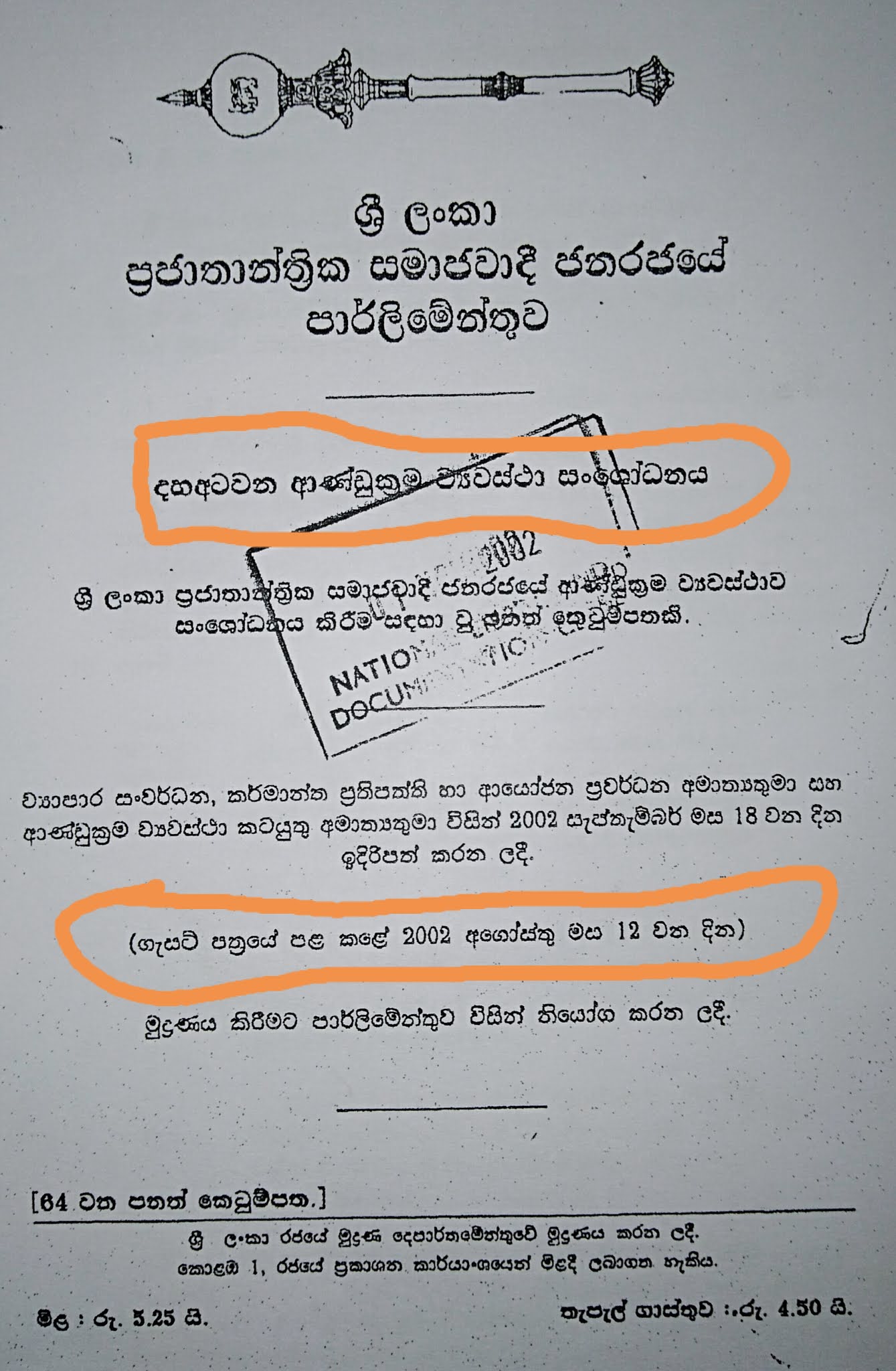
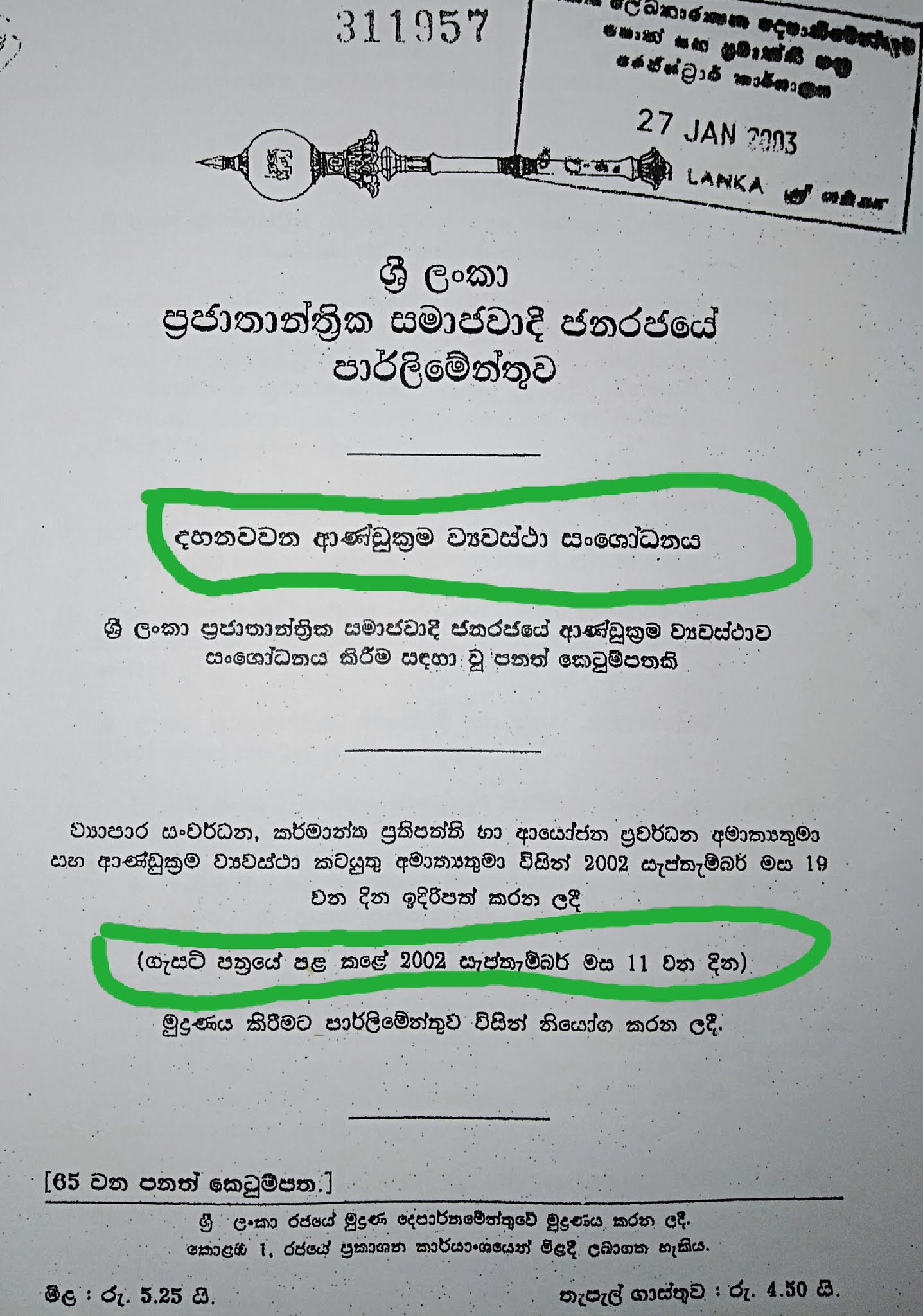
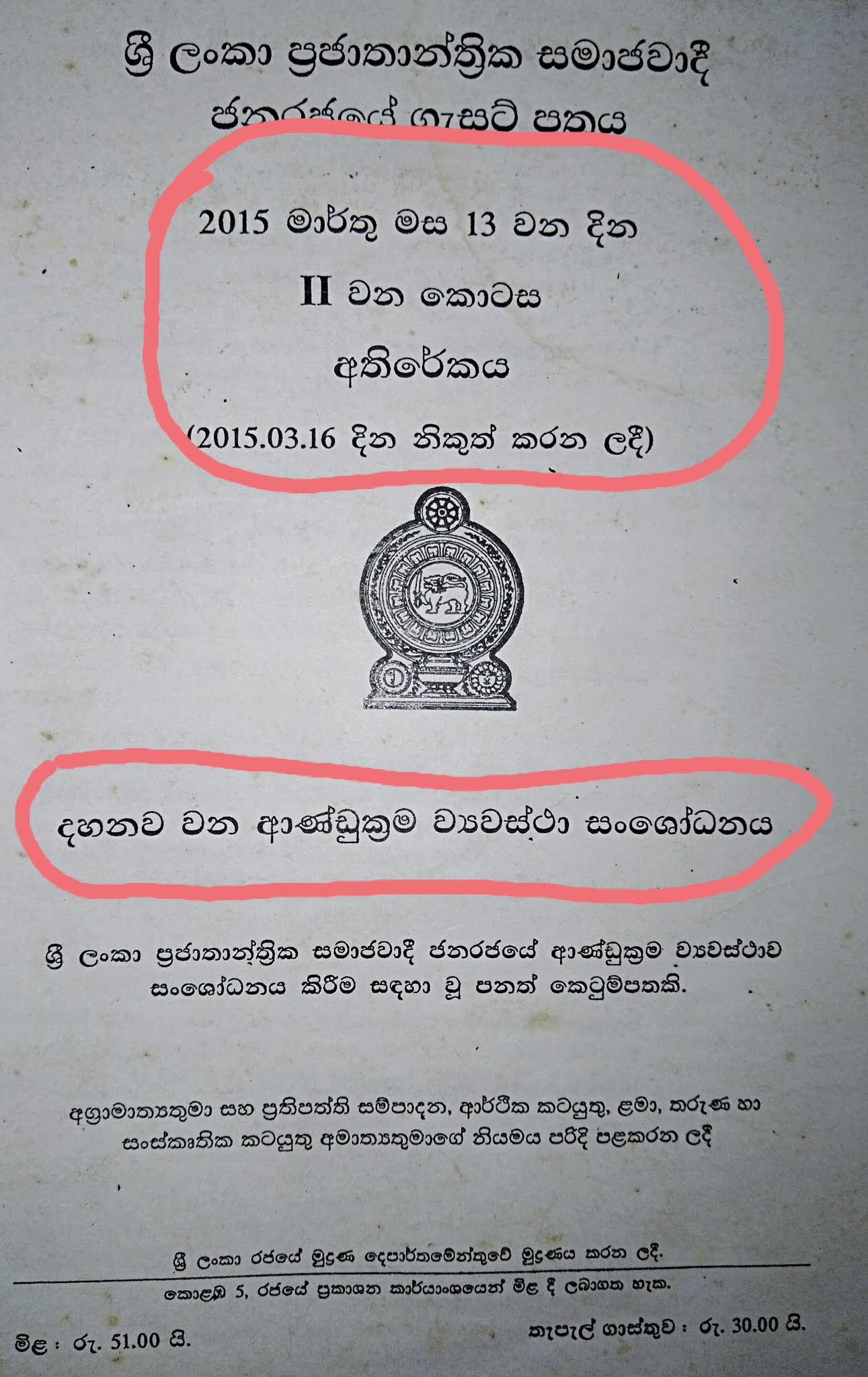
19වන ආණ්ඩුක්‍රම ව්‍යවස්ථා සංශෝධන පනත් කෙටුම්පත් 2ක් පාර්ලිමේන්තුවට ඉදිරිපත් වූ බවත්, ඉන් එකක් 2002 දී සහ අනෙක 2015 දී පාර්ලිමේන්තුවට ඉදිරිපත් වූ බව සමහරක් නොදන්නවා වුණාට බොහෝ දෙනා දනිති.

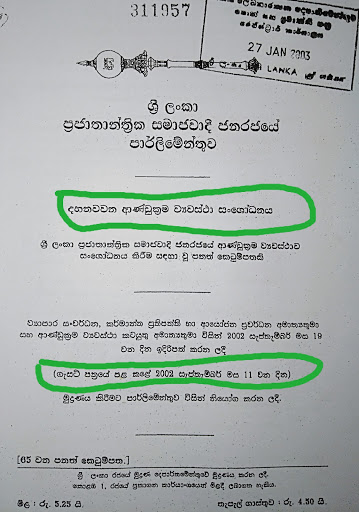
19 වන ආණ්ඩුක‍්‍රම ව්‍යවස්ථා සංශෝධන පනත් කෙටුම්පත මුල් වරට පාර්ලිමේන්තුවට ඉදිරිපත් කරන ලද්දේ, චන්ද්‍රිකා බණ්ඩාරනායක කුමාරතුංග ජනාධිපතිවරියව සිටියදී 2002 දී ය.

2002 සැප්තැම්බර් මස 19 වන දින ව්‍යාපාර සංවර්ධන, කර්මාන්ත ප‍්‍රතිපත්ති හා ආයෝජන ප‍්‍රවර්ධන සහ ආණ්ඩුක‍්‍රම ව්‍යවස්ථා කටයුතු අමාත්‍යවරයා විසින් එකී 19වන ආණ්ඩුක්‍රම ව්‍යවස්ථා සංශෝධන පනත් කෙටුම්පත පාර්ලිමේන්තුවට ඉදිරිපත් කර තිබූ අතර 2002 සැප්තැම්බර් මස 11 වන දින ගැසට් පත‍්‍රයේ පළ කර ඇත.

2002 දී පාර්ලිමේන්තුවට ඉදිරිපත් කළ 19ය මගින් ඉතා වැදගත් ආණ්ඩුක්‍රම ව්‍යවස්ථා සංශෝධනයක් යෝජනා කර තිබූ අතර, ඒ ආණ්ඩුක්‍රම ව්‍යවස්ථාවේ 70වන ව්‍යවස්ථාව සංශෝධනය කර ජනාධිපතිවරයාට වසරකට පසු පාර්ලිමේන්තුව විසුරුවාහැරීමට තිබු බලය / අයිතිය අහිමි කිරීමයි.

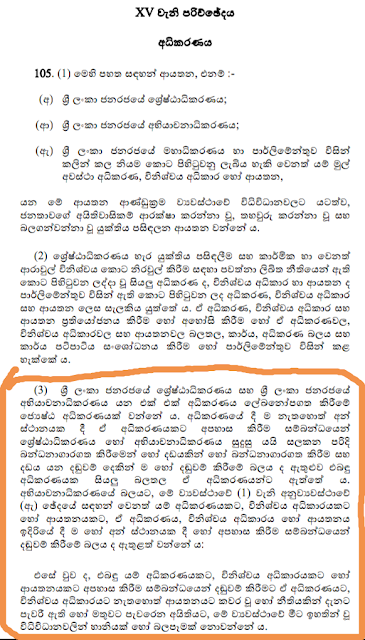
එම 19 වන ආණ්ඩුක‍්‍රම ව්‍යවස්ථා සංශෝධන පනත් කෙටුම්පත ආණ්ඩුක‍්‍රම ව්‍යවස්ථාවට පටහැනිය යන පදනමින් ශ්‍රේෂ්ඨාධිකරණයේ අභියෝගයට ලක්කරන ලද අතර සරත් නන්ද සිල්වා (අ.වි), වඩුගොඩුපිටිය (වි), බණ්ඩාරනායක (වි) ඉස්මයිල් (වි) එදිරිසූරිය (වි) සහ යාපා (වි) ද සිල්වා (වි) විසින් 2002 ඔක්තෝබර් 1 සහ 3 යන දිනවල ඒ සම්බන්ධව ශ්‍රේෂ්ඨාධිකරණයේ විභාගයට ගන්නා ලදී.

එකී විභාගය අවසානයේ ශ්‍රේෂ්ඨාධිකරණයේ විනිසුරුවරු 7දෙනා ඒකමතිකව තීරණය කර තිබුණේ ආණ්ඩුක්‍රම ව්‍යවස්ථාවේ 70වන ව්‍යවස්ථාව සංශෝධනය කර ජනාධිපතිවරයාට වසරකට පසු පාර්ලිමේන්තුව විසුරුවීම සීමාකිරීම ආණ්ඩුක්‍රම ව්‍යවස්ථාවේ 3වන ව්‍යවස්ථාවට සම්බන්ධ හෙයින් එකී 19 නීතියක් වීමට පාර්ලිමේන්තුවේ නොපැමිණි මන්ත්‍රීවරුන්ද ඇතුලුව 2/3 ඡන්දයෙන් සහ ජනමතවිචාරණයක් මගින් ජනතාව විසින්ද අනුමැතිය ලබා දිය යුතු බවයි. 

කිසිවෙකුට හෝ ඒ සම්බන්ධයෙන් යම් සැකයක් ඇත්නම් 2002 දී පාර්ලිමේන්තුවට ඉදිරිපත් කළ 19යට ශ්‍රේෂ්ඨාධිකරණය ලබා දුන් තීරණය කියවීමෙන් එකී සැකය නිරාකරණය කරගත හැකිය.

2002 දී පාර්ලිමේන්තුවට ඉදිරිපත් කළ 19වන ආණ්ඩුක්‍රම ව්‍යවස්ථා සංශෝධනය එකී ශ්‍රේෂ්ඨාධිකරණ තීරණයේ තිබූ ජනමතවිචාරණයක අවශ්‍යතාවය හේතුවෙන් එතනින්ම අවසන් විය.

ඉන් පසු නැවත වර්ෂ 2015 දී ද නැවත 19වන ආණ්ඩුක්‍රම ව්‍යවස්ථා සංශෝධන පනත් කෙටුම්පතක් මෛත්‍රීපාල සිරිසේන ජනාධිපතිව සිටියදී, පාර්ලිමේන්තුවට ඉදිරිපත් කිරීමට කටයුතු කර තිබුණ අතර, අග‍්‍රාමාත්‍ය සහ ප‍්‍රතිපත්ති සම්පාදන, ආර්ථික කටයුතු, ළමා, තරුණ හා සංස්කෘතික කටයුතු අමාත්‍යතුමාගේ නියමය පරිදි 2015 මාර්තු මස 13 වන දින ගැසට් පත‍්‍රයේ 11 වන කොටස අතිරේකය (2015.03.16 දින නිකුත් කරන ලද) 19 වන ආණ්ඩුක‍්‍රම ව්‍යවස්ථා සංශෝධන පනත් කෙටුම්පත එයයි.

2015 දී පාර්ලිමේන්තුවට ඉදිරිපත් කර තිබූ 19වන ආණ්ඩුක්‍රම ව්‍යවස්ථා සංශෝධන පනත් කෙටුම්පත මගින්, ජනාධිපතිවරයාට වසරකට පසු පාර්ලිමේන්තුව විසුරුවීම සීමා කිරීමට ආණ්ඩුක්‍රම ව්‍යවස්ථාවේ 70වන ව්‍යවස්ථාව සංශෝධනය කිරීම, ස්වාධීන කොමිෂන් සභා පිහිටුවීම, ද්විත්ව පුරවැසියන්ට, පාර්ලිමේන්තු මන්ත්‍රීවරයෙකු වීම වැළක්වීම, ජනාධිපති ධූර කාලය සහ පාර්ලිමේන්තුවේ කාල සීමාව අඩු කිරීම, ජනතාවගේ ජනමතවිචාරණ ඡන්ද බලය අහිමි කිරීම (85.2 ව්‍යවස්ථාව ඉවත් කිරීම) ඇතුලු විධිවිධාන 17ක කාරණා නීතියක් කිරීමට උත්සාහ කර තිබුණි.

දෙවන වරටත් 2015 දී පාර්ලිමේන්තුවට ඉදිරිපත් කර තිබූ 19 වන ආණ්ඩුක‍්‍රම ව්‍යවස්ථා සංශෝධන පනත් කෙටුම්පත ශ්‍රේෂ්ඨාධිකරණයේ විනිසුරුවරු තිදෙනෙකු විසින් ආණ්ඩුක‍්‍රම ව්‍යවස්ථානුකූලත්වය පරීක්ෂා කළ අතර 2002 දී ශ්‍රේෂ්ඨාධිකරණය තීරණය කළ පාර්ලිමේන්තුව විසුරුවීමට අදාළ වූ ආණ්ඩුක්‍රම ව්‍යවස්ථාවේ 70.1 ව්‍යවස්ථාව සංශෝධනය කිරීමට අදාල විධිවිධානය හැර අනෙක් විධිවිධාන 16 සම්බන්ධව තීරණය එම විනිසුරුවරු තිදෙනා විසින් පාර්ලිමේන්තුවට දන්වා යවා ඇත.

2002 දී පාර්ලිමේන්තුයට ඉදිරිපත් කළ 19 වන ආණ්ඩුක‍්‍රම ව්‍යවස්ථා සංශෝධන පනත් කෙටුම්පතේ 70 ව්‍යවස්ථාව සංශෝධනයට අදාළ ශ්‍රේෂ්ඨාධිකරණ තීරණය කෙරෙහි 

අවධානය යොමු නොකර 2015 දී පාර්ලිමේන්තුවට ඉදිරිපත් කළ 19 වන ආණ්ඩුක‍්‍රම ව්‍යවස්ථා සංශෝධන පනත් කෙටුම්පත පාර්ලිමේන්තුවේ විවාදයට ගත් අතර දෙවන වර සහ තුන්වන වර  කියවා පාර්ලිමේන්තුවේ මුළු මන්ත‍්‍රීවරයන් සංඛ්‍යාවෙන් තුනෙන් දෙකක සංඛ්‍යාවකට නොඅඩු සංඛ්‍යාවකගේ සම්මතය ඇතිව යෝජනා සම්මතයක් මගින් පාර්ලිමේන්තුවේ අනුමැතිය පමණක් ලබා ගෙන ආණ්ඩුක‍්‍රම ව්‍යවස්ථාවේ 80.1 ව්‍යවස්ථාව යටතේ සිය සහතිකය යෙදීමට එවකට සිටි කථානායකවරයා පියවර ගෙන ඇත. 

මෙය 2002 දී 19 වන ආණ්ඩුක‍්‍රම ව්‍යවස්ථා සංශෝධන පනත් කෙටුම්පත සම්බන්ධයෙන් 70 ව්‍යවස්ථාව සංශෝධනයට උත්සාහ කළ අවස්ථවේ ශ්‍රේෂ්ඨාධිකරණය ලබා දුන් විනිසුරු 7දෙනාගේ ඒකමතික තීරණය උල්ලංඝනය කිරීමක් වන අතර එකී ශ්‍රේෂ්ඨාධිකරණ තීරණය අනුව 79 ව්‍යවස්ථාවේ අවසන් විධානය, සහ 85.1 ව්‍යවස්ථාව සහ 80.2 ව්‍යවස්ථාව අනුගමනය කිරීමෙන් බැහැර වීමට සහ ජනමතවිචාරණයක් නොපවත්වා 70 ව්‍යවස්ථාව වැරදි ලෙස සංශෝධනය කිරීමට 2015 පාර්ලිමේන්තුව ක‍්‍රියා කිරීම බලවත් දෝෂයක් වන අතර එය 2002 දී ලබාදුන් ශ්‍රේෂ්ඨාධිකරණ තීරණයට අපහාසයක් කිරීමක්ද වන බව මෙම ලියුම්කරු සහ තවත් අය ජනාධිපතිවරයාටත්, නීතිපතිවරයාටත්, අධිකරණ ඇමතිවරයාටත් පෙන්වා දී ඇත.

කෙසේ වෙතත් ඇතැම් නීති විශාරදයන් කියා සිටින්නේ මේ වනවිට 19වන ආණ්ඩුක්‍රම ව්‍යවස්ථා සංශෝධනයට කථානායකවරයා සහතිකය යොදා ඇති හෙයින් එය නීතියක් වී තිබෙන බවත්, ශ්‍රේෂ්ඨාධිකරණය විසින් අවස්ථා කිහිපයකදීම 19වන ආණ්ඩුක්‍රම ව්‍යවස්ථා සංශෝධනය අදාල කර ගනිමින් නඩු තීන්දු (Judgement) ලබා දී ඇති බවයි.

ශ්‍රේෂ්ඨාධිකරණය විසින් තමන් ඉදිරියට එන ඉල්ලීම්වල විවිධත්වය අනුව විනිශ්චයන් 4ක් ලබා දේ. වරෙක නඩු තීන්දු (Judgement) ලබා දේ, වරෙක තීරණ (Determination) ලබා දේ, වරෙක මතය ( Openion) ලබා දේ, වරෙක රීති (Rule) නිකුත් කරයි. 

[මෙහිදී සළකා බැලිය යුත්තේ නඩු තීන්දු (Judgement) සහ තීරණ (Determination) වේ.]

මෙම ලියුම්කරු 19ය නීතියක් වී නැති බවට වන ස්ථාවරයේ සිටින අතර 19ය නීතියක් ලෙස සිතන අයට මෙම ලිපිය මගින් මතුකරන ප්‍රශ්නය යොමු කරමි.

එනම්, 19ය නීතියක් නම් 19 ය ඉවත් කිරීමට හෝ සංශෝධනය කිරීමට ජනමතවිචාරණයක් පැවැත්විය යුතුද?

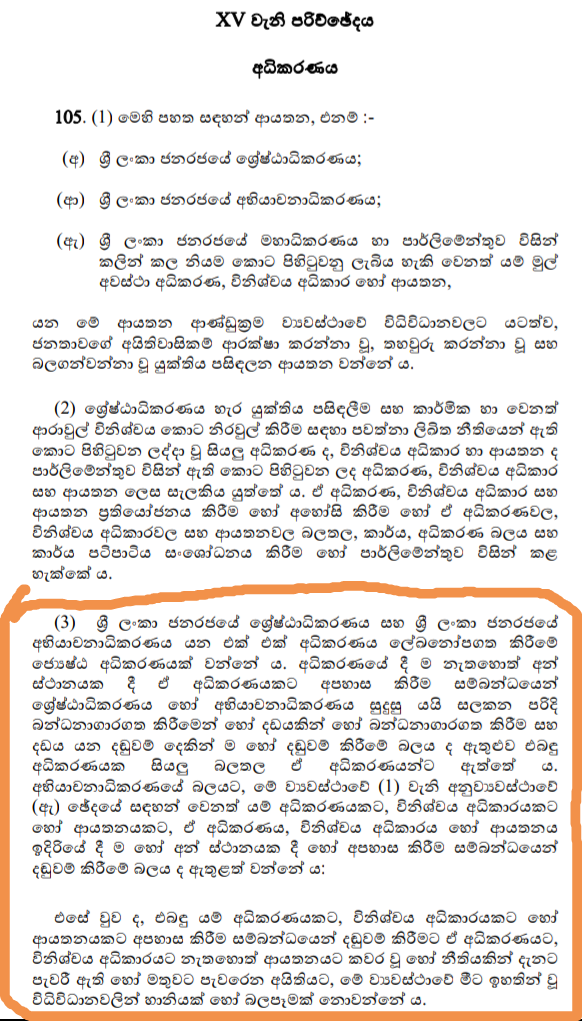
2002 දී පාර්ලිමේන්තුවට ඉදිරිපත් කළ 19යේ දී ආණ්ඩුක්‍රම ව්‍යවස්ථාවේ 70 ව්‍යවස්ථාව සංශෝධනය කිරීමට ජනමතවිචාරණයක් පැවැත්වීම අනිවාර්යයෙන් කළ යුතු බව ශ්‍රේෂ්ඨාධිකරණ විනිසුරුවරු 7 දෙනා ඒකමතිකව තීරණය කර තිබියදී, එකී ශ්‍රේෂ්ඨාධිකරණ තීරණයට අනුව 2015 දී 19වන ව්‍යවස්ථා සංශෝධනය මගින් 70වන ව්‍යවස්ථාව සංශෝධනය කර තිබිය යුතු බව 19ය නීතියක් ලෙස සළකන අයටද පිළිගැනීමට සිදුවේ. මන්ද 2015 දී ඉදිරිපත් කළ 19 මගින් 70 ව්‍යවස්ථාව සංශෝධනය කර ඇති අතර එසේ කළ යුත්තේ 2002 දී ශ්‍රේෂ්ඨාධිකරණය ලබා දුන් විනිසුරුවරු 7දෙනාගේ තීරණයට අනුවය. ශ්‍රේෂ්ඨාධිකරණ තීරණ උල්ලංඝනය කරමින් 19 නීතියක් කරගෙන ඇත්නම් එයට සම්බන්ධව අයගේ ප්‍රජා අයිතිය අහෝසි කළ යුතුය.

ශ්‍රේෂ්ඨාධිකරණ තිරණ අනුව ආණ්ඩුක්‍රම ව්‍යවස්ථාවේ 70වන ව්‍යවස්ථාව සංශෝධනය කළ යුත්තේ ජනමතවිචාරණයක් පවත්වා ජනතාව අනුමැතිය දීමෙන් පමණි.

ජනමතවිචාරණයක් නොපවත්වා 70වන ව්‍යවස්ථාව සංශෝධනය කර තිබුණද, මේ වනවිට එය නීතියක් නම් එය ඉවත් කිරීමේදීද ශ්‍රේෂ්ඨාධිකරණ කියූ ජනමතවිචාරණයක අවශ්‍යතාවය පැන නගී. 

(නීති පැනවීමට ජනමතවිචාරණයක් අවශ්‍ය බව කියා නීතිය වැරදි මාර්ගයෙන් පනවාගෙන ඇතිවිට එය ඉවත් කිරීමට ජනමතවිචාරණයක් අවශ්‍ය නොවන බව කිව හැකිද?)

70වන ව්‍යවස්ථාව සංශෝධනය කිරීමට ජනමතවිචාරණයක් අවශ්‍ය බව ශ්‍රේෂ්ඨාධිකරණ කියා ඇති විට වැරදි මාර්ගයෙන් එකී සංශෝධනය කරගෙන ඇතිවිට සහ එකී සංශෝධනය නීතියක් ලෙස සළකා ප්‍රතිබන්ධනය වී ඇති විට, නැවත 70වන ව්‍යවස්ථාව සංශෝධනය කිරීමට ජනනතවිචාරණයක් අවශ්‍ය නැති බව කිව හැකිද? 

මේ වනවිට 19වන ආණ්ඩුක්‍රම ව්‍යවස්ථා සංශෝධනයට සම්බන්ධව කුමන්ත්‍රණකරුවන් සියලු දෙනා සමාජයේ නිරාවරණ වීම ආරම්භ වී ඇත.

අපි බලා සිටිමු.

arunaunawatuna@gmail.com

IT IS SRI PADA NOT ADAM’S PEAK

August 25th, 2020

RANJITH SOYSA

Jackson Anthony, the well-known actor, a commentator on his recent YOUTUBE presentation has touched on the national weakness of attempting to ape the foreigners or more specifically our attempt to act as the Singlish rather than be ourselves, His program on Sri Pada becoming Adam’s peak to many reminds us the story of colonial English policy of creating the species called Black-Whites or the Brown skinned Englishmen in our society. We can meet them and see them anywhere in day to day life, in media, and also among the VIPs who pretend that they cannot speak in Sinhala or Tamil ONLY but need to add English words when they converse. This stems from the inferiority complex of slaves once freed yet praising that they were wearing masters’ chains.

Some of us. still use the term Adam’s speak even tough this was invented by Islamic travelers to Sri Lanka since 16th century whereas the name Sri Pada was known for over 2500 years and many kings of Sri Lanka from a century prior to CE have spoken of Sri Pada and visited the peak while the term is in books such as Mahavamsa, Deepavamsa.  Chulavamase and in many inscriptions. Unfortunately, even in our books and articles published in  English, we continue to use the term Adam’s peak, As Jackson Anthony emphasized the discussion was not religious at all, but about our culture and national inheritance.

From now on-wards can we decide to refer to this holy and scenic mountain as Sri Pada always.


SC concludes contempt of court case against Ranjan

August 25th, 2020

Courtesy Adaderana

The Supreme Court has concluded the Contempt of Court case filed against Parliamentarian Ranjan Ramanayake.

The case was heard before the Supreme Court three-judge bench consisting of Justices Sisira de Abrew, Vijith Malalgoda, and Preethi Padman Surasena today (25).

The bench has decided to take up further clarification on the case on the 21st of October.

The case was filed against State Minister Ranjan Ramanayake over Contempt of Court charges for making defamatory remarks against the judiciary on the 21st of August in 2017.

Speaking to the media following a meeting with then-Prime Minister Ranil Wickremesinghe at the Temple Trees, Ramanayake has claimed that the majority of judges in the country are corrupt and that they give biased rulings.

Retired Air Force Officer Sunil Perera and Venerable Magalkande Sudatta Thera later filed two petitions with the Supreme Court alleging that such defamatory comments can shatter public confidence and provide a warped image of the judiciary to the people of Sri Lanka.

Based on these complaints, the Attorney General had later served the charges against Ramanayake before the Supreme Court.

OPPP National List tussle: Rathana Thera accused of abducting party’s fmr Gen. Secretary

August 25th, 2020

Courtesy Adaderana

Contrasting accounts continue to be expressed regarding the alleged abduction of the former General Secretary of Our Power of People Party (OPPP, also known as ‘Ape Jana Bala Pakshaya’) Venerable Wedinigama Wimalatissa Thera.

Venerable Athuraliye Rathana Thera is meanwhile accused of carrying out the abduction.

The Coordinating Secretary of Wimalatissa Thera, Venerable Hunupitiye Chandrasiri Thera claims that according to the information they have received, the nomination submission document was forcibly withdrawn.

In a media briefing, he urged that Rathana Thera be taken into custody.

An Assistant Superintendent of Police, Headquarters Inspector, an Officer in Charge, several constables and Ministerial Security Officers (MSD) are involved in this alleged abduction, he said further.

However, a former teacher of the missing Thera, Venerable Prof. Hunupolagama Vajirasiri Thera insists that the former general secretary of the party is safe at the moment and that he will come up to the public eye at the opportune time.

New members appointed to Task Force to preserve archaeological sites in Eastern Province

August 25th, 2020

Courtesy Adaderana

Four new members have been appointed to the Presidential Task Force for Archaeological Heritage Management in the Eastern Province.

The 12-member Task Force was established on the 1st of June under the directives of President Gotabaya Rajapaksa, exercising the powers vested in him by Article 33 of the Constitution.

However, the following four members were also added to the composition of the Task Force with effect from August 19, Secretary to the President P.B. Jayasundera said in a gazette notification published on Monday (24).

01. Abhidhana Anunayaka of the Asgiriya Chapter, Most Venerable Vendaruwe Dharmakeerthi Sri Rathanapala Upali Thero

02. General Secretary of the Malwathu Chapter, Venerable Dr. Pahamune Sumangala Nayaka Thero

03. General Secretary of the Asgiri Chapter, Dr. Venerable Medagama Dhammananda Nayaka Thero

04. Member of the Karaka Sangha Sabha of the Malwathu Chapter, Shasthravedi Venerable Ambanwalle Sri Sumangala Thero.

Since many of the archaeological heritages in the Eastern Province are based on the Buddhist religious background and associated with those places of worship, the government has recognized that the need of the guidance and patronage of the Venerable Maha Sangha in the identification and management of those heritages, the gazette notification read further.

PB Jayasundara on why Sri Lanka halted importing vehicles

August 25th, 2020

Courtesy Adaderana

Secretary to President Dr. P.B Jayasundara, speaking during the Derana 360° discussion programme, explained the reasoning behind the decision of the government to halt of vehicle imports to the country.

He stated that right until 2019, between 1,000 and 1,200 million US dollars were spent per a year on importing vehicles to Sri Lanka. 

He said that the vehicle stock in the country had risen significantly between 2015 – 2019 to such an extent that it is sufficient for two-and-a-half years.

If you want to buy a vehicle now you can go to a dealership, of which there are more than clothes shops now, and buy a top range vehicle. From the best kind whatever you want. The increase in prices is a different issue. There is that much of a stock of vehicles,” he said.

Dr. Jayasundara questioned as to then why the country needs to continue to be importing vehicles while having a foreign exchange crisis.

If vehicles are being imported, reconditioned and then re-exported then there is a logic to that, similar to the apparel industry which is importing textile material and exporting a manufactured product and thereby  generating a number of jobs, he said.

But this is not something like that,” he said, adding, that the vehicle imports industry only causes an outflow of foreign exchange such as money spent on the vehicles, parts, fuel, service fees and royalties. 

He stated that fuel, vehicles and even the motorcycle is imported from abroad and that the country’s economy is therefore stuck in a vicious cycle.”

In order to reverse this, you must have courage, permanent policies, decisions need to be taken fast and the decision taken needs to be implemented,” the economist said.

Why One Man Is Walking Around the World With His Dog

August 25th, 2020

Who better to see the world with than your best friend? Especially when your best friend is a dog. Tom Turcich of New Jersey and his adorable pooch Savannah have walked over 18,000 miles through the United States, Mexico, Costa Rica, Chile, Italy, Turkey and dozens of other countries over the past five years. It’s been a life-changing adventure. They’ve survived hardship, and they’ve experienced the kindness of strangers along the way. And they’ve still got miles to go.

Abolish the white elephant and the curse that is Provincial Councils and its root the JR/ Rajiv Accord of 29th July 1987 at least now.

August 24th, 2020

Dr.Sudath Gunasekara 

(Please note that this is a revised version of an article I wrote to Lankaweb on 7.6. 2018 and 10. 3. 2020  on the same subject up dated to suit the present situation)  

Lakisuru Gothaabhaya Rajapaksha Metitumani !

The whole nation, and at least the 6.5 million of us whom have voted you at the Presidential election  and the SLPP on 5th  August demand Your Excellency to abolish the white elephant and the curse that is Provincial Councils and its root the JR/ Rajiv Accord of 29th July 1987 at least now, before this Indian born Rathaksiya gobble up the Sinhala Buddhist Nation and this whole Island in its entirety in no time.

While congratulating again for the historic and unprecedented victory  you have gained, as I predicted on the 14th   Nov via my E-mail, addressed to you (Published in Lankaweb) and also while adoring  all patriotic and courageous steps you have already taken since then up to date like no other President, such as the brief but dignified speech you made  at the Election Commissioners office on the day you were declared elected as the President of this country and your historic address to the nation at the swearing in ceremony under the shadow of Ruwanweli Seya  (which I have been yearning for 14 years for the Head of the State to do), the most sacred Buddhist Stupa in the world and the crest jewel of the Sinhala Nation and the dignified address from the Thrown on 20th August you have restored an age old tradition followed by our ancient Sinhala Kings, signifying a turning point in the history of this Island nation.

Furthermore  the lean interim cabinet of 15 Ministers, the smallest since 1956, the excellent way you have handled all Indian politicians and the Indian press on you visit just concluded and many more wise and bold decisions you have taken since you assumed Office, I am writing this note to you  to earnestly request you to  abolish the JR/ Rajiv Accord of 1987 and the disastrous 13th Amendment that gave birth to Provincial Councils and  many an inconsistencies and historical travesties in the Island’s long and checkered history  (explained in detail below), to rescue this  unique tiny Island nation from disappearing forever from this planet earth in few years due to disintegration, disunity and infighting between Bhoomiputra Sinhalese and intruder Tamil and Muslim ethnic groups, resulting from this  well designed Indian political Atom  bomb called the Provincial Councils, planted  to destroy this 2500 year old Glorious Sinhala Buddhist civilization, an all-time pride  and  a garland for human civilization on this planet.

I identify the following catastrophes resulting from these two Indian prescriptions.

  1. Complete breakdown of district administration
  2. Complete disintegration and division of the Sri Lankan State in to a number of different ethnic and religious enclaves at logger heads fighting for its resources like land and water and supremacy over the others threatening its unitary status and sovereignty as a nation.

3 Destabilization of governance resulting in complete anarchy due to break down in governance

  • Colossal wastage of Public funds with no benefit to the people or the country in trillions  rupees
  • Since the first elections for Provincial Councils took place on 28 April 1988 this is how public funds have been spent or rather wasted on their upkeep.

Sri Lanka Provincial Councils: Expenditure

1996 – 2017 | Yearly | LKR mn | Ministry of Finance

 Sri Lanka’s Provincial Councils: Expenditure data was reported at 286,031.000 LKR mn in Dec 2017. This records an increase from the previous number of 276,147.000 LKR mn for Dec 2016. Sri Lanka’s Provincial Councils: Expenditure data is updated yearly, averaging 103,769.000 LKR mn from Dec 1996 to 2017, with 22 observations. The data reached an all-time high of 286,031.000 LKR mn in 2017. So with an average of almost 104 mn you can visualize how much national wealth has gone down the drain for the past 31 years, that is approximately 3224 mn or 3.2 Billion. What a colossal wastage and a pathetic and unpardonable misuse of public funds.”

The other important aspect is much of this money has gone for unproductive items like salaries and remunerations of Politicians and public Servants, buildings, vehicles, meaningless regular and luxury tamasas in five start hotels, foreign joy trips and other activities unrelated to development. Once the Secretary of the Ministry in charge of this subject told me that only 10 % of voted funds is spent on capital work and the balance 90 % is spent for recurrent activities which do not contribute anything for development.

With all this wastage of Public funds the billion dollar question the people of this country ask is what benefit PCC have brought to the Country since 1987. Beside the colossal financial lost to the country, the political, and administrative and institutional mess, chaos and confusion by way of duplication of institutions, and increase of an utterly unproductive and lotus eater set of politicians, and public servants. What benefits it has brought to the country over the past 31 years. Officials, offices and expenditure have exponentially increased in the ratio of 1 to 15 with zero output. It also has brought about a complete breakdown of the once highly efficient District Administration in this country. Thus the Provincial Councils have come to stay as a veritable Huniyama for this country’s peril.

Why we should have Provincial Councils at all

In this back drop I pose the pertinent question as to why we should have Provincial Councils at all in this country; today the whole nation asks?  Who asked for Provincial Councils?  Was it a request by the people of this country or by some genius politicians for better governance? No one at Home asked for it. It was India who proposed it first, to appease the Tamilnadu electorate to consolidate power at Home by imposing it on the Sri Lankan President by force, almost at gunpoint, well timed, when there was an old and weak President as the Head of Government. I still remember how India invaded our air space with their war jets and dropped parippu? to the north and how arrogantly and undiplomatically their Ambassador Dixit behaved in front of the elderly Statesman JR, the Head of this country at his Ward place residence, as if Dixit was the viceroy of India conveying the message of the Indian ‘King,’ threatening a Head of a Vassal State of India of an imminent Indian invasion of the Island, if he refuses to sign the Accord. 

The Accord was strategically designed by India , to divide and destabilize  this country on  an ethnic basis giving Tamils full power to own and rule nearly half of the country including the North and East and Central Sri Lanka (inclusive of Central, Sabaragamuwa and Uva Provinces), although India did not clearly specify these three Provinces. This was nothing but an extension of the same divide and rule policy started by the colonial British in 1832 by the creation the Provinces in a different form. This Indian conspiracy becomes crystal clear when we analyze the following impositions India made on this country by the Rajiv/JR Accord of 29th July 1987.

1 The declaration of the Northern and Eastern Provinces comprising 1/ 3 the land area of the Island as the Traditional Home land” of the Tamil People that was a complete travesty of the Islands authentic history. These two Provinces have never been a traditional Tamil land at any time of known history. On the contrary this whole Island had been the traditional Homeland of the Sinhala people at least from 543 BC and it is a historical fact accepted by all historians, other than the Tamils and Indian politicians.

First, this Accord enabled the Tamils to claim 1/3 of the land area of the country for a mere 5 lahks Tamils and thereby depriving any Sinhalese or Muslims being settled there while Tamils can settle down in any part of the Island

Second, giving Tamils the right to own 1/3 of the country, 2/3 the coastal belt and nearly 3/5 of the marine territory and its resources including the Trincommallee harbor, the best natural harbor in Asia  and the second best in the world.

Thus this Accord deprived the Bhoomiputras, the Sinhalese their birth right over their Motherland, which their ancestors have protected against all foreign invasions, both Indian and European for 2500 years and enjoyed for millennia as their beloved motherland from the dawn of history. This Accord was designed by India in order to fix the last nail on the Sinahla nation, with a vicious plan to annex the Island to India in future.

 Third Made Tamil also an Official language, nullifying Sec 18 of the Constitution of the Republic whereas even in India Tamil is not recognized as an Official language in spite of the fact that there are nearly 70 million Tamils there.

Fourth forced  Sri Lanka to give Citizenship to all estate Tamils of Indian origin in the Central, Sabargamauwa and Uva Provinces and even Indians living in other parts of the country even if they are illicit immigrants, disregarding all internationally accepted norms and our own laws on the subject of granting citizenship to foreigners in any country.

Fifth imposed that the Northern and Eastern Provinces should be merged to form one Tamil Province with provision to merge two or more Provinces as one in future.

Thus in sum the Accord completely destroyed the Independence, sovereignty, the Unitary status and the freedom of this Island Nation and i1987 Constitution as well, within few minutes, by one man Junies Richard Jayawardana against Island wide protests organized by the Opposition and the objections by some of his own Ministers, reducing this country to a veritable vassal State of the Subcontinent without any resistance. This was meek submission on the part of JR he committed for survival.

 Therefore while taking action to abolish this Accord, I also earnestly request you to reverse the above 4 conditions as early as possible.

JR was forced to accept the Accord almost at gunpoint and India laid down these 4 serious conditions reducing the 1987 Constitution to a mere paper scrap. Adding to this JR created PCC to all other Provinces as well accelerating the process of division and disintegration and leading to future political and administrative confusion. This Accord was signed under Island wide emergency and after confining all his MPP to a five star Hotel having obtained their undated letters of resignation.

The implementation of this Accord, to its logical conclusion will definitely wipe out the Sinhala Buddhist nation from the surface of this planet in the long run. Therefore the crying need, to abolish it immediately, with no delay.

It is in this dangerous and disastrous backdrop that I urge all patriotic people to rise against this Accord and disastrous Provincial Councils to strengthen the President’s hands and request him to abrogate it immediately as it constitutes the foundation for the division of this small country in to 9 antagonistic pieces and finally falling in to the hands of India (As you know Sir a scrambled egg can never be un-scrambled).  This is exactly what the people of this country have been agitating and demanding every government, for the past 31 years. But tragically it has not fallen on the deaf ears of our selfish and timid and power hungry politicians who have no concern for the country or the future of the people. The SLFP under Sirimavo protested against it right from the beginning although later it also embraced it without realizing the inherent dangers that underlies these clauses of the Accord.

Let us abolish these PCC immediately

As such why talk of PCC elections now, instead of abolishing this national curse and disaster immediately? This is a crucial political decision long overdue that has to be taken by a patriotic statesman like you, who loves this country and its people, in order to save this country from an imminent total political, economic, social and cultural disaster in the offing. In fact this is a priority decision that has to be taken as early as possible by your Government. The whole country wants it to go. Once the Accord is abolished, the 13th A and the PCC set up under that will also get abolished automatically. We all expected MR to do this immediately after the 2009 when he had all the power including a 2/3 in Parliament.  Had he done that then no one could have dared to contest it. But unfortunately he did not do it.  Again he appears to promise the press today that as soon as the General election is over they will have the PC elections. I do not know whether he said so to garner the 2/3 and abolish it thereafter. If that is his plan the whole nation will admire him ore that his victory over the LTTE. I only hope he will not commit the same mistake he did after the 2010 Election.

Once the PCC are gone all superficial Office holders such as the so called 9 Governors, 9 ‘Cheap’ Ministers, 45 Provincial Ministers and all such parasitic politicians who bleed the nation to its bones will also go home relieving the burden they have overloaded on the country. Thereafter every one of them will at least plant a manioc stem that will do some service at least to a wild boar. The professional public servants presently working in these Councils will have no problem as they could be accommodated in suitable places in the public service until they retire.

Another reason why I argue for the abolition of PCC is the need to avoid a total disaster in District Administration that will make any retrieval of governance in this country impossible. Furthermore that will put an end to all divisive political manipulations such as federal status, self-determination, self-rule of Muslims and EELAM dreams of the Tamils. It will also save billions of rupees now being spent for the upkeep of these monkey cages and piggeries called Provincial Councils infested with monkeys and goats, a political appendage and a dead weight around the nation’s neck that has burdened the country for the past 31 years and destabilized the total administration almost beyond recovery. Finally it will also relive us from any future subversive Indian or Arabian invasions and conspiracies hatched to divide this country on ethnic basis with a dream of Indianization of this country or converting it to an Arab land as Hisbulla has planned in the E astern Katthankudi area.

 I call upon all Patriotic people to make this request in one voice from the new President to abolish these monkey cages and dens of thieves that have exponentially increased waste and corruption and completely ruined the decent political culture of this country for the past 31 years and multiplied separatists tendencies and communal agitations dragging the nation to complete disintegration in future on ethnic lines with no chance of redemption in future

I know it very well that no political party, even  the UNP that invented it under J.R. or even those who were against them in 1987 will ask for their abolition, as they use these Councils members to net votes at all elections for their political survival. But for the general public these Councils are an eye sore when they see the way how public funds are been wasted criminally on the upkeep of these useless lotus eater Governors, Chief Ministers, Ministers, Members, plethora of officials and the institutions that house them. Other than enjoying the luxuries of office, attending openings, weddings, funerals school functions like sport meets, temple functions, and various other social and private tamsas, roaming all over the world on pleasure trips and running all over the country to show their loyalty to their political masters,  misusing public funds, and collecting votes and funds for their political leaders in Colombo and herding people for their meetings like May day rallies and propaganda meetings of their masters in Parliament who in turn ruin the whole country and throwing their weight on the innocent and helpless masses on the other hand, I ask these parasitic creatures as to what service they have done to the people or the country that pay their salaries and ill-gotten fabulous perks 

Why can’t the SLPP (successor to SLFP), as a group who constitutes the majority who opposed the 13th A in 1987 at least now agitate for the abolition of this tragic national curse. The people hate this system and curse them too. Now that the SLPP that has come to power with a resounding victory already has the Pradesiya Sabhas, the live wires of Local Government in its hand to organize the election campaign for them at the village and the local levels there is no need for a Provincial apparatus for elections either.

Now that the country has functioned smoothly without these parasitic and wasteful institutions, almost for the past three years and has proved beyond all doubts their uselessness there is no justification for their retaining. A reorganize strong District Administration headed by professional administrators will ensure better governance as it had been the indigenous system of administration in the past. Even the British adopted certain aspects of this system to run the country very effectively and efficiently for 133 years.

The Provincial Councils have already become redundant and dysfunctional. As such if he SLPP can get them abolished, its vote base will rise up exponentially at all future elections.  Therefore the SLPP will not lose anything by getting them abolished. Instead people will definitely rally round the party as a mark of appreciation and gratitude for relieving them of this 31 year curse and disaster. Furthermore MR also can make use of this golden opportunity to punish all those ungrateful rascals and double-dealers who have betrayed him after the 2015 elections and send them permanently to political wilderness. In this backdrop if the SLPP do this, I can assure that the grateful masses who have suffered for the past 31 years under this curse will rally round it in a manner nobody would have ever imagined.  Besides increasing its vote base it will also be doing a yeoman service by this country and the nation, for liberating this country out of this wishful Indian trap that has already done enormous political and economic damage to this country and that will definitely play the main role in dividing and destabilizing this Island nation in future if we retained them.

 I can assure you that the abolition of the Provincial Council curse and its umbilical code, the Rajiv/JR Accord will not be second to liberating the country from the LTTE in 2009 and it could be even a bigger achievement of higher historical significance.  It will definitely go down in history as another historic landmark in the Rajapaksa legend that has prevented this Island nation getting broken in to  9 Federal State of different  ethnic groups fighting for its land ,water and other resources that will finally make this country a hell on earth.

India also cannot contest the abolition of the JR/Rajiv Accord a s it had already been unilaterally broken by India at the very early stages, by not complying with its obligations in the Accord. As such it has ceased to have any legal validity as an international agreement signed between two countries

Finally  now that you have got also got a sweeping mandate to vital issues like repealing of the 19th A and revising the electoral system by removing the preferential voting, District representative system, removing the crazy National List and reducing the number of MPP in Parliament to a meaningful level, say about 150, and laying down qualifications for politicians like minimum education, character, assets and residence within the electorate etc. so that returning to the democratic practice of electing their representatives and  just governance is restored once again in this Island nation.

More over from where are you going to get 1000 billion rupees to hold another election in few months at a time the economy is at rock bottom and debt liabilities are sky high? Isn’t it we are going to get into deeper economic crisis by having the Provincial Councils? Isn’t it a game of from frying the fan to the fire?

Therefore both in short term and long term interest the most wises thing the Government can do now is to abolish this national curse, the Provincial Councils. That is the wish of the whole nation

19ය ඉවත් කිරීමට කළ යුත්තේ 19ය සංශෝධනය කිරීමද? 19යට ජනමතවිචාරණයක් පැවැත්වීමද? නිවැරදි ක්‍රියාව තෝරා නොගැනීම ශ්‍රේෂ්ඨාධිකරණයට අපහාසයක්ද?

August 24th, 2020

නීතිඥ අරුණ ලක්සිරි උණවටුන

(2020.08.23 දිවයින ඉරිදා සංග්‍රහයෙහි නීතිඥ කසුන් පොන්නම්පෙරුම ලියා ඇති ’19 පෙරලන් 20 වැනි සංශෝධනය එන හැටිලිපියට පිළිතුරකි.)

නීතිඥ කසුන් පොන්නම්පෙරුම පසුගිය දිවයින ඉරිදා සංග්‍රහයට ලියා ඇති ’19 පෙරලන් 20 වැනි සංශෝධනය එන හැටි’ ලිපිය කියවීමේදී දිවයින පාඨකයන්‍ට අදහස් වන්නේ 19වන ආණ්ඩුක්‍රම ව්‍යවස්ථා සංශෝධනය ඉවත් කිරීමට 20වන ආණ්ඩුක්‍රම ව්‍යවස්ථා සංශෝධනය ගෙන ඒමට රජය සූදානම් වන බවයි. 

එකී ලිපිය පහත අන්තර්ජාල සබැදිය ඔස්සේ කියවිය හැකිය.

https://divaina.com/sunday/index.php/deshapalana2/14870-2020-08-15-10-04-53

අධිකරණ ඇමතිවරයාගේත්, රජයේ මාධ්‍ය ප්‍රකාශකගේත් කරුණු දැක්වීම් අනුව එම නීතිඥවරයා විසින්ද දක්වන කරුණු අනුව පැහැදිලි වන්නේ 19වන ආණ්ඩුක්‍රම ව්‍යවස්ථා සංශෝධනය ඉවත් කිරීමට 20වන ආණ්ඩුක්‍රම ව්‍යවස්ථා සංශෝධනයක් එන බවයි.

19 ඉවත් කිරීමට කළ යුත්තේ 19 සංශෝධනය කිරීමද? 19යට ජනමතවිචාරණයක් පැවැත්වීමද? නිවැරදි ක්‍රියාව තෝරා නොගැනීම ශ්‍රේෂ්ඨාධිකරණයට අපහාසයක්ද? යන කරුණු මෙම ලිපිය මගින් විමසා බැලීමට අදහස් කරමි.

වර්ෂ 2002 දී 18වන සහ 19වන ආණ්ඩුක්‍රම ව්‍යවස්ථාව සංශෝධන පනත් කෙටුම්පත් පාර්ලිමේන්තුවට ඉදිරිපත් වී ඇති බව තවමත් රටේ කිහිප දෙනෙක් දන්නේ නැත.

2002 සැප්තැම්බර් මස 18වන දින ව්‍යාපාර සංවර්ධන, කර්මාන්ත ප්‍රතිපත්ති හා ආයෝජන ප්‍රවර්ධන අමාත්‍ය සහ ආණ්ඩු ක්‍රම ව්‍යවස්ථා කටයුතු අමාත්‍යවරයා විසින් ඉදිරිපත් කළ 2002 අගෝස්තු මස 12වන දින ගැසට් පත්‍රයේ පළ කර ඇති මුල්වරට පාර්ලිමේන්තුවට ඉදිරිපත් කළ 18වන ආණ්ඩුක්‍රම ව්‍යවස්ථා සංශෝධනයේ මුල් පිටුව පහත දක්වා ඇත.(ඇමිණුම 01)

ඉහත දැක්වෙන්නේ 18වන ආණ්ඩුක්‍රම ව්‍යවස්ථාව සංශෝධනය නමින් වූ දීර්ඝ නාමයෙන් පාර්ලිමේන්තුවට ඉදිරිපත් වූ පළමු 18වන ආණ්ඩුක්‍රම ව්‍යවස්ථා සංශෝධනයයයි.

එකී 18වන ආණ්ඩුක්‍රම ව්‍යවස්ථා සංශෝධනය වගන්ති 6කින් පමණක් යුක්ත වූ අතර, ඉන් යෝජනා කර තිබුණේ 17වන ආණ්ඩුක්‍රම ව්‍යවස්ථා සංශෝධනය මගින් පිහිටුවා තිබූ ආණ්ඩුක්‍රම ව්‍යවස්ථා සභාවේ රීති, සභාවේ සාමාජිකයන්ට ගෙවිය යුතු චේතන, සභාවට එරෙහිව නඩු පැවරිය නොහැකි බව ඇතුලු කාරණා වේ.

2002 දී පාර්ලිමේන්තුවට ඉදිරිපත් කළ 18වන සංශෝධන පනත් කෙටුම්පත සම්බන්ධයෙන් ඉදිරි පියවර ගැනීමට පාර්ලිමේන්තුව විසින් පියවර නොගැනීම නිසා එකී 18 එතනින්ම අවසන් විය.

නැවත 18 වන ආණ්ඩුක්‍රම ව්‍යවස්ථා සංශෝධනයක් පර්ලිමේන්තුවට ඉදිරිපත් කරන ලද්දේ වර්ෂ 2010 දී වන අතර එකී 18වන ආණ්ඩුක්‍රම ව්‍යවස්ථා සංශෝධනය සම්බන්ධයෙන් ඉදිරි පියවර ගත් පාර්ලිමේන්තුව එය පාර්ලිමේන්තුවේ නොපැමිණි මන්ත්‍රීවරුන් ද ඇතුලුව 2/3ක බහුතර ඡන්දයෙන් සම්මතකර විධිමත් ලෙස ආණ්ඩුක්‍රම ව්‍යවස්ථාව සංශෝධනය කර ගත්තේය. එකී 18ට නීතියක් බවට කථානායකවරයා සහතිකය යොදන ලද්දේ 2010 සැප්තැම්බර් 09 වැනි දිනය.

19වන ආණ්ඩුක්‍රම ව්‍යවස්ථා සංශෝධන පනත් කෙටුම්පත් දෙකක්

19 වන ආණ්ඩුක‍්‍රම ව්‍යවස්ථා සංශෝධන පනත් කෙටුම්පතක් චන්ද්‍රිකා බණ්ඩාරනායක කුමාරතුංග ජනාධිපතිවරියව සිටියදි, 2002 සැප්තැම්බර් මස 19 වන දින ව්‍යාපාර සංවර්ධන, කර්මාන්ත ප‍්‍රතිපත්ති හා ආයෝජන ප‍්‍රවර්ධන සහ ආණ්ඩුක‍්‍රම ව්‍යවස්ථා කටයුතු අමාත්‍යවරයා විසින් පාර්ලිමේන්තුවට ඉදිරිපත් කර තිබූ අතර 2002 සැප්තැම්බර් මස 11 වන දින ගැසට් පත‍්‍රයේ පළ කර ඇත.

එහි මුල් පිටුව පහත දක්වා ඇත. (ඇමිණුම 02)

2002 දී පාර්ලිමේන්තුවට ඉදිරිපත් කළ 19ය මගින් ඉතා වැදගත් ආණ්ඩුක්‍රම ව්‍යවස්ථා සංශෝධනයක් යෝජනා කර තිබූ අතර, ඒ ආණ්ඩුක්‍රම ව්‍යවස්ථාවේ 70වන ව්‍යවස්ථාව සංශෝධනය කර ජනාධිපතිවරයාට වසරකට පසු පාර්ලිමේන්තුව විසුරුවාහැරීමට තිබු බලය/ අයිතිය අහිමි කිරීමයි.

එම 19 වන ආණ්ඩුක‍්‍රම ව්‍යවස්ථා සංශෝධන පනත් කෙටුම්පත ආණ්ඩුක‍්‍රම ව්‍යවස්ථාවට පටහැනිය යන පදනමින් ශ්‍රේෂ්ඨාධිකරණයේ අභියෝගයට ලක්කරන ලද අතර සරත් නන්ද සිල්වා (අ.වි), වඩුගොඩුපිටිය (වි), බණ්ඩාරනායක (වි) ඉස්මයිල් (වි) එදිරිසූරිය (වි) සහ යාපා (වි) ද සිල්වා (වි) විසින් 2002 ඔක්තෝබර් 1 සහ 3 යන දිනවල ඒ සම්බන්ධව ශ්‍රේෂ්ඨාධිකරණයේ විභාගයට ගන්නා ලදී.

එකී විභාගය අවසානයේ ශ්‍රේෂ්ඨාධිකරණයේ විනිසුරුවරු 7දෙනා ඒකමතිකව තීරණය කර තිබුණේ ආණ්ඩුක්‍රම ව්‍යවස්ථාවේ 70වන ව්‍යවස්ථාව සංශෝධනය කර ජනාධිපතිවරයාට වසරකට පසු පාර්ලිමේන්තුව විසුරුවීම සීමාකිරීම ආණ්ඩුක්‍රම ව්‍යවස්ථාවේ 3වන ව්‍යවස්ථාවට සම්බන්ධ හෙයින් එකී 19 නීතියක් වීමට පාර්ලිමේන්තුවේ නොපැමිණි මන්ත්‍රීවරුන්ද ඇතුලුව 2/3 ඡන්දයෙන් සහ ජනමතවිචාරණයක් මගින් ජනතාව විසින්ද අනුමැතිය ලබා දිය යුතු බවයි. 

කිසිවෙකුට හෝ ඒ සම්බන්ධයෙන් යම් සැකයක් ඇත්නම් 2002 දී පාර්ලිමේන්තුවට ඉදිරිපත් කළ 19යට ශ්‍රේෂ්ඨාධිකරණය ලබා දුන් තීරණය කියවීමෙන් එකී සැකය නිරාකරණය කරගත හැකිය.

2002 දී පාර්ලිමේන්තුවට ඉදිරිපත් කළ 19වන ආණ්ඩුක්‍රම ව්‍යවස්ථා සංශෝධනය එකී ශ්‍රේෂ්ඨාධිකරණ තීරණය හේතුවෙන් එතනින්ම අවසන් විය.

2002 දී පාර්ලිමේන්තුවට ඉදිරිපත් කළ 18 සහ 19 තව දුරටත් ඉදිරියට ගොස් නීතියක් බවට පත් නොවූ නිසා වර්ෂ 2010 වන විට රටේ තිබුණේ ආණ්ඩුක්‍රම ව්‍යවස්ථා සංශෝධන 17ක් පමණි.

ඒ අනුව 2010 දී පාර්ලිමේන්තුවට ඉදිරිපත් කළ ආණ්ඩුක්‍රම ව්‍යවස්ථා සංශෝධනය නම් කරන ලද්දේ 18වන ආණ්ඩුක්‍රම ව්‍යවස්ථා සංශෝධනය නමිනි. ඒ 2002 පාර්ලිමේන්තුවට ඉදිරිපත් කළ 18වන සංශෝධනය නීතියක් වීමට ඉදිරි පියවර නොගත් හෙයිනි.

2010 දී පාර්ලිමේන්තුවට ඉදිරිපත් කළ 18වන ආණ්ඩුක්‍රම ව්‍යවස්ථා සංශෝධනය එයට ශ්‍රේෂ්ඨාධිකරණය ලබා දුන් තීරණයට අනුව පාර්ලිමේන්තුවේ නොපැමිණි මන්ත්‍රීවරුන්ද ඇතුලුව 2/3 ඡන්දයෙන් සම්මත කර කථානායකවරයාගේ සහතිකය යොදා ක්‍රියාත්මක කරනු ලැබීය.

ඉන් පසු නැවත වර්ෂ 2015 දී ද නැවත 19වන ආණ්ඩුක්‍රම ව්‍යවස්ථා සංශෝධන පනත් කෙටුම්පතක් පාර්ලිමේන්තුවට ඉදිරිපත් කිරීමට කටයුතු කර තිබුණි.

අග‍්‍රාමාත්‍ය සහ ප‍්‍රතිපත්ති සම්පාදන, ආර්ථික කටයුතු, ළමා, තරුණ හා සංස්කෘතික කටයුතු අමාත්‍යතුමාගේ නියමය පරිදි 2015 මාර්තු මස 13 වන දින ගැසට් පත‍්‍රයේ 11 වන කොටස අතිරේකය (2015.03.16 දින නිකුත් කරන ලද) 19 වන ආණ්ඩුක‍්‍රම ව්‍යවස්ථා සංශෝධන පනත් කෙටුම්පත මගින්, ජනාධිපතිවරයාට වසරකට පසු පාර්ලිමේන්තුව විසුරුවීම සීමා කිරීමට ආණ්ඩුක්‍රම ව්‍යවස්ථාවේ 70වන ව්‍යවස්ථාව සංශෝධනය කිරීම, ස්වාධීන කොමිෂන් සභා පිහිටුවීම, ද්විත්ව පුරවැසියන්ට, පාර්ලිමේන්තු මන්ත්‍රීවරයෙකු වීම වැළක්වීම, ජනාධිපති ධූර කාලය සහ පාර්ලිමේන්තුවේ කාල සීමාව අඩු කිරීම, ජනතාවගේ ජනමතවිචාරණ ඡන්ද බලය අහිමි කිරීම (85.2 ව්‍යවස්ථාව ඉවත් කිරීම) ඇතුලු විධිවිධාන 17ක කාරණා නීතියක් කිරීමට උත්සාහ කර තිබුණි.

එහි මුල් පිටුව පහත දක්වා ඇත.(ඇමිණුම 03)

දෙවන වරටත් 2015 දී පාර්ලිමේන්තුවට ඉදිරිපත් කර තිබූ 19 වන ආණ්ඩුක‍්‍රම ව්‍යවස්ථා සංශෝධන පනත් කෙටුම්පත ශ්‍රේෂ්ඨාධිකරණයේ විනිසුරුවරු තිදෙනෙකු විසින් ආණ්ඩුක‍්‍රම ව්‍යවස්ථානුකූලත්වය පරීක්ෂා කළ අතර 2002 දී ශ්‍රේෂ්ඨාධිකරණය තීරණය කළ පාර්ලිමේන්තුව විසුරුවීමට අදාළ වූ ආණ්ඩුක්‍රම ව්‍යවස්ථාවේ 70.1 ව්‍යවස්ථාව සංශෝධනය කිරීමට අදාල විධිවිධානය හැර අනෙක් විධිවිධාන 16 සම්බන්ධව තීරණය එම විනිසුරුවරු තිදෙනා විසින් පාර්ලිමේන්තුවට දන්වා යවා ඇත.

2002 දී පාර්ලිමේන්තුයට ඉදිරිපත් කළ 19 වන ආණ්ඩුක‍්‍රම ව්‍යවස්ථා සංශෝධන පනත් කෙටුම්පතේ 70 ව්‍යවස්ථාව සංශෝධනයට අදාළ ශ්‍රේෂ්ඨාධිකරණ තීරණය කෙරෙහි අවධානය යොමු නොකර 2015 දී පාර්ලිමේන්තුවට ඉදිරිපත් කළ 19 වන ආණ්ඩුක‍්‍රම ව්‍යවස්ථා සංශෝධන පනත් කෙටුම්පත පාර්ලිමේන්තුවේ විවාදයට ගත් අතර දෙවන වර සහ තුන්වන වර  කියවා පාර්ලිමේන්තුවේ මුළු මන්ත‍්‍රීවරයන් සංඛ්‍යාවෙන් තුනෙන් දෙකක සංඛ්‍යාවකට නොඅඩු සංඛ්‍යාවකගේ සම්මතය ඇතිව යෝජනා සම්මතයක් මගින් පාර්ලිමේන්තුවේ අනුමැතිය පමණක් ලබා ගෙන ආණ්ඩුක‍්‍රම ව්‍යවස්ථාවේ 80.1 ව්‍යවස්ථාව යටතේ සිය සහතිකය යෙදීමට එවකට සිටි කථානායකවරයා පියවර ගෙන ඇත. 

මෙය 2002 දී 19 වන ආණ්ඩුක‍්‍රම ව්‍යවස්ථා සංශෝධන පනත් කෙටුම්පත සම්බන්ධයෙන් 70 ව්‍යවස්ථාව සංශෝධනයට උත්සාහ කළ අවස්ථවේ ශ්‍රේෂ්ඨාධිකරණය ලබා දුන් විනිසුරු 7දෙනාගේ ඒකමතික තීරණය උල්ලංඝනය කිරීමක් වන අතර එකී ශ්‍රේෂ්ඨාධිකරණ තීරණය අනුව 79 ව්‍යවස්ථාවේ අවසන් විධානය, සහ 85.1 ව්‍යවස්ථාව සහ 80.2 ව්‍යවස්ථාව අනුගමනය කිරීමෙන් බැහැර වීමට සහ ජනමතවිචාරණයක් නොපවත්වා 70 ව්‍යවස්ථාව වැරදි ලෙස සංශෝධනය කිරීමට 2015 පාර්ලිමේන්තුව ක‍්‍රියා කිරීම බලවත් දෝෂයක් වන අතර එය 2002 දී ලබාදුන් ශ්‍රේෂ්ඨාධිකරණ තීරණයට අපහාසයක් කිරීමක්ද වෙයි.

2002 දී පාර්ලිමේන්තුවට ඉදිරිපත් කළ 19යේදී ආණ්ඩුක්‍රම ව්‍යවස්ථාවේ 70 ව්‍යවස්ථාව සංශෝධනය කිරීමට ජනමතවිචාරණයක් පැවැත්වීම අනිවාර්යයෙන් කළ යුතු බව ශ්‍රේෂ්ඨාධිකරණ විනිසුරුවරු 7 දෙනා ඒකමතිකව තීරණය කර තිබියදී, එකී ශ්‍රේෂ්ඨාධිකරණ තීරණයට ගරු නොකර, ශ්‍රේෂ්ඨාධිකරණයට අපහාසවන ආකාරයට, ආණ්ඩුක්‍රම ව්‍යවස්ථාවේ 105.3 ව්‍යවස්ථාව යටතේ ශ්‍රේෂ්ඨාධිකරණයට අපහාස කිරීමේ චෝදනා ගොනු කළ හැකි නඩු නිමිත්තක් ඇතිකරමින් 2015 දී පාර්ලිමේන්තුව විසින් 70 ව්‍යවස්ථාව සංශෝධනය වූ ලෙස ක්‍රියා කරවීම සහ එමගින් මුලු රටම නීතිවිරෝධී ක්‍රියාවලියකට ඇද දැමීම වහා නිවැරදි කරනවා වෙනුවට දිවිත්ව පුරවැසියන් පාර්ලිමේන්තු එනවායයි කියමින් ශ්‍රේෂ්ඨාධිකරණ තීරණ උල්ලංඝනය කරමින් ක්‍රියාත්මක කරගෙන යන සහ ශ්‍රේෂ්ඨාධිකරණයට අපහාස කරන 19ය ආරක්ෂා කිරීම කිසිසේත් සුදුසු නොවේ.

වත්මන් ජනාධිපතිවරයාද 2002 සහ 2015 පාර්ලිමේන්තුවට ඉදිරිපත් වූ 19 සම්බන්ධයෙන් සහ ඒවා අදාලව ශ්‍රේෂ්ඨාධිකරණය විසින් ලබා දුන් තීරණ පිළිබද අවධානය යොමු කර 9වන පාර්ලිමේන්තුවේ කතානායකවරයාට දැනුම් දිය යුත්තේ 19යට ආණ්ඩුක්‍රම ව්‍යවස්ථාවේ 79 ව්‍යවස්ථාවේ අවසන් විධානය අනුව නිවැරදි සටහන යොදා ආණ්ඩුක්‍රම ව්‍යවස්ථාවේ 85.1 ව්‍යවස්ථාවේ පියවර එනම් 19යට ජනමතවිචාරණයක් පැවැත්වීමට අදාල පියවර තමන්ට ගැනීමට  අවශ්‍ය කටයුතු කර දී ශ්‍රේෂ්ඨාධිකරණ තීරණවලට ගරු කරන ලෙසයි. 

එසේ නොකර 19ය සංශෝධනය කිරීමට ගියහොත් එයට සම්බන්ධව සියලු දෙනාටම ආණ්ඩුක්‍රම ව්‍යවස්ථාවේ 105.3 ව්‍යවස්ථාව යටතේ 2002 දී 19යට ලබා දුන් ශ්‍රේෂ්ඨාධිකරණ තීරණයට අපහාස කිරීමේ චෝදනාවට ලක් වීමට සිදුවේ.

ආණ්ඩුක්‍රම ව්‍යවස්ථාවේ 105.3 ව්‍යවස්ථාව මෙසේය. ( ඇමිණුම 04)

19 අදාල කර ගනිමින් ශ්‍රේෂ්ඨාධිකරණය විසින් නඩු විනිශ්චය කිරීම මත,19වන ආණ්ඩුක්‍රම ව්‍යවස්ථා සංශෝධනය නීතියක්ද?

ශ්‍රේෂ්ඨාධිකරණය විසින් තමන් ඉදිරියට එන ඉල්ලීම්වල විවිධත්වය අනුව විනිශ්චයන් 4ක් ලබා දේ. වරෙක නඩු තීන්දු (Judgement) ලබා දේ, වරෙක තීරණ (Determination) ලබා දේ, වරෙක මතය ( Openion) ලබා දේ, වරෙක රීති (Rule) නිකුත් කරයි. 

ශ්‍රේෂ්ඨාධිකරණය  ලබා දෙන ඉහත විනිශ්චයන් විස්තර කිරීම මෙම ලිපියෙන් අදහස් නොකරන අතර නඩු තීන්දු (Judgement) සහ තීරණ (Determination) අතර වෙනස, ඒවායේ බලය සහ ආණ්ඩුක්‍රම ව්‍යවස්ථාවට ඇති සම්බන්ධතාවය සැළකීමේ දී වැරදි ලෙස හෝ නිවැරදි ලෙස කථානායකවරයා විසින් යම් පනත් කෙටුම්පතකට සිය සහතිකය යොදා ඇති විට නඩු තීන්දු (Judgement) ලබා දීමේදී තමා සැළකිල්ලට ලක් කරන නීතිය, නීතියක් ලෙස සැළකීමට ශ්‍රේෂ්ඨාධිකරණය කටයුතු කරන නමුත් තීරණයක් (Determination) ලබා දීමේදී එසේ නොවේ. 

ආණ්ඩුක්‍රම ව්‍යවස්ථාව සංශෝධනය කිරීම සම්බන්ධයෙන් තීරණයක් (Determination) ලබා දීමේදී ශ්‍රේෂ්ඨාධිකරණය විසින් පෙර ලබා දුන් ශ්‍රේෂ්ඨාධිකරණ තීරණ  කථානායකවරයා හෝ පාර්ලිමේන්තුව විසින් උල්ලංඝනය කර තිබේද? යන්න විමසා 80.3 ව්‍යවස්ථාව යටතේ අවස්ථාවෝචිතව කටයුතු කර තිබේද? යන්න විමසීමට ශ්‍රේෂ්ඨාධිකරණයට හැකි වුවත්, නඩු තීන්දුවක් (Judgement) ලබා දීමේදී 80.3 ව්‍යවස්ථාව අනුව ක්‍රියා කිරීමට ශ්‍රේෂ්ඨාධිකරණයට අධිකරණ බලය නැත.

20වන ආණ්ඩුක්‍රම ව්‍යවස්ථා සංශෝධන පනත් කෙටුම්පතට අදාලව, 2018.10.09 වැනි දින පාර්ලිමේන්තුවට ඉදිරිපත් කළ ශ්‍රේෂ්ඨාධිකරණ  තීරණය මගින් ආණ්ඩුක්‍රම ව්‍යවස්ථාවේ 70 වන ව්‍යවස්ථාව පිළිබද සාකච්ඡාවට ලක්කර නැති හෙයින්, 2015 දී 70වන ව්‍යවස්ථාව සංශෝධන කිරීමේදී කථානායකවරයා අවස්ථාවෝචිතව ක්‍රියා කර තිබේද? යන්න ශ්‍රේෂ්ඨාධිකරණ තීරණයක් ( Supreme Court Determination) මගින් විමසීමට තවම අවස්ථාව ලැබී නැත.

එවැනි අවස්ථාක් ලැබෙන්නේ ආණ්ඩුව විසින් 19ය සංශෝධනය කිරීමට කටයුතු කළහොත් පමණි.

ඉහත කාරණා සැළකීමේදී 19ය ඉවත් කිරීමට කළ යුත්තේ 19ය සංශෝධනය කිරීම නොවන බවත්, ආණ්ඩුක්‍රම ව්‍යවස්ථාවේ 70වන ව්‍යවස්ථාව සංශෝධනය කිරීමට ජනමතවිචාරණයක් පැවැත්විය යුතු බවටවන ශ්‍රේෂ්ඨාධිකරණ තීරණය අනුව දැනටමත් පාර්ලිමේන්තුවේ නොපැමිණි මන්ත්‍රීවරුන්ද ඇතුලුව 2/3ක ඡන්දයෙන් සම්මත වී ඇති 19යට ජනමතවිචාරණයක් පැවැත්වීම වේ.

ශ්‍රේෂ්ඨාධිකරණ තීරණවලට ගරු කර නියමිත ජනමතවිචාරණය නොපවත්වා 19 සංශෝධනය කිරීමට කටයුතු කළහොත් එය ශ්‍රේෂ්ඨාධිකරණයට අපහාස කිරීමක්ද වේ.

ශ්‍රේෂ්ඨාධිකරණ තීරණ උල්ලංඝනය කරමින් ක්‍රියාත්මක කරගෙන යන සහ ශ්‍රේෂ්ඨාධිකරණයට අපහාස කරන 19ය ආරක්ෂා නොකර ශ්‍රේෂ්ඨාධිකරණ තීරණවලට ගරු කර 19ය සම්බන්ධයෙන් ජනමතවිචාරණයක් පවත්වා නීතියේ පාලනය ස්ථාපිත කිරීමට ජනාධිපතිවරයාත්, පාර්ලිමේන්තුවත් කටයුතු කිරීම නීතිමය අවශ්‍යතවයකි.

arunaunawatuna@gmail.com

13th Amendment is a Federal Instrument

August 24th, 2020

N.A.de S. Amaratunga

Our hapless people battered and bruised by four years of ‘yahapalana’ , the two bank robberies, foreign interference, UNHRC Resolutions, separatism, Easter bombs and Covid have finally crawled to polling booths and stuffed the ballot boxes with lotus buds. Even the creators of the lotus bud may have been overwhelmed and shaken to the core for even they could not fathom the phenomenon.  Do they understand  its cause, its power, its anger, its desperateness,  and its expectations. Those on whom so much trust, faith and confidence have been placed must realize the gravity of this phenomenon.

People’s concern

If we know the agony the people went through during the last four and half years we could understand this phenomenon. Wasn’t the agony the same as that which plagued the country during the 30 year long separatist war. The country was in danger of being fragmented along ethnic lines during the last four years as it was during the war. The 2015 regime change was the culmination of a confluence of agendas comprising those of the western powers, their local collaborators and Tamil separatists. A destabilized, fragmented Sri Lanka would suit their agendas quite well. The imperialists would like to have a hegemonic grip on Sri Lanka with its strategic location in the Indian Ocean. Tamil separatists would want their ‘homeland’  and the local opportunist politicians would want political power. Those who plotted the regime change in 2015 had these as their goals.  And they worked towards their goal relentlessly. The Western powers took control, got the UNHRC to adopt the Resolution 30/1 and pushed hard for constitutional reforms. A federal constitution was presented to the parliament and it was a close call. People became desperate. Presidential election in 2019 and then the general election gave the people the opportunity to have their say and they have spoken loud and clear.

Our poor people should not be made to suffer this agony ever again, worry about their land, their independence and sovereignty, people who have laid down their life for the country. Should they always live in fear of being made landless, and their country fragmented and occupied by foreign powers. As long as the13th A is part of our constitution these fears will continue to haunt them.

Tamil separatism is still alive

The 13th A become crucial when we see that Tamil separatists have not given up their plan. This is evident in what CV Vigneshvaran and G Ponnambalam

did recently. They took a vow before the LTTE memorial to fight for the Tamil aspirations. Tamil aspirations as far as the LTTE is concerned is a separate state and nothing less. This they did before they took their oaths in the Sri Lankan Parliament. They apparently have allegiance to what the LTTE stood for and not to the Sri Lankan sovereignty or  its parliament. When CV was the chief minister in the Northern PC he used his position to campaign for a federal state. He had no qualms about eulogizing the achievements of the LTTE. He may have already started his campaign if his maiden speech in Parliament is anything to go by.

In this regard what we must not forget is that the 13th A is a federal instrument and it happens to be part of the law of the country. When it is fully implemented with the granting of land and police powers to the provincial councils the latter would have more powers than the states in India which is a federal country. Therefore Sri Lankan constitution as it stands today could be deemed to be federal in content. The fact that these powers have so far not been granted is immaterial from a legal point of view. One may argue that not granting them is unconstitutional.

The burden of the Provincial Councils

Several Provinces have existed without their Councils with no breakdown of essential services to the people for more than one year due to elections not being held. Though it is argued that not holding elections on time is a denial of democratic rights not holding elections for redundant institutions which in fact are a white elephant and a burden on the tax paying poor people could be considered a blessing in disguise. PCs were created as a solution to the so called ethnic Tamil problem but the silence of Tamil politicians on the issue of delay in elections to the Northern PC is deafening to say the least. If they can do without their PC there cannot be an ethnic problem of enormous magnitude which necessitated  the introduction by force of the 13th A by India. People of this country did not ask for the 13th A, it was forced on us by a hegemonic imperialist India partly to pacify Tamil Nadu politicians, and to prevent other interested global powers getting into the fray for geopolitical reasons. Our poor people have to pay for global geopolitical vagaries and local communal dubious ‘aspirations’.

The Provincial Councils do not serve any useful purpose. Instead it is another bureaucratic barrier to the people that increase the red tape, inconvenience, waste of time, money and energy of the people. Further it has increased the number of corrupt politicians that people have to bribe to get any official work done. The devolution of power via these PCs is totally redundant as shown by the inability of the Northern PC, which was formed for the very purpose of solving the Tamil problem, to make use of the opportunity to serve the people. The work done by these PCs could easily be carried out by the GA and the kachcheri system we had previously without the involvement of politicians. Similarly administrative power could be devolved to the North through the local government institutions. The 13th A with its Land and Police powers hangs over us like a Sword of Damocles which could eventually pave the way for a separate state. Thus the 13th A and its offspring the provincial councils could be done away with bringing great benefit to the people including Tamils.

Tamil problem

One may ask what about the Tamil problem. Firstly this has not been clearly explained. As far as any fair minded person could see Tamils in Sri Lanka are better off than Tamils in India. In Tamil Nadu for instance, Tamils cannot represent a case in courts in the Tamil language, leave alone anywhere else in India, where as Tamils in Sri Lanka could do so anywhere in the country. Tamils in the North and the East have no issues that other communities do not have regarding the use of language, education, employment, economy, household income, culture, sports etc. The house hold income in Vavuniya is better than that in Kandy, so are the roads. They have excelled in education. They have no special problems that arise due to their ethnicity. If Tamils are  discriminated they would not be able to achieve what they have. As for their political rights, these could easily be addressed at the centre of political power instead of at the periphery as the country is very small. Tamil representation at the centre should be made more meaningful particularly on matters related to minorities. The money saved by the removal of the  PCs and 13th A  could be used for the benefit of everybody. Tamils and other minorities should be made to develop a sense of belonging in the country of their berth. A federal state is not necessary for this, in fact a federal state based on ethnicity would result in the hardening of ethnic identity and lead to a tendency for secession.

2/3rd Majority

People have given a 2/3rd majority to the present government not just to provide for a stable government. In the process they had completely wiped out a giant of a political party which they thought was the cause of their agony and worry. They were worried about their land and their 2500 year old civilization they had built on that land. They gave a 2/3rd majority overcoming all obstacles and constrains of a proportional representation system of election. They are hoping for a permanent solution to this problem and not a piece meal adhoc arrangement. A 2/3rd majority is not a privilege that the politicians deserve at this juncture but a necessary evil and perhaps an imperative need that should be put to best use with responsibility. It is an opportunity that may never come in the future and the present government would do well to heed its message if it is to do its duty by the people.

N.A.de S. Amaratunga


Copyright © 2026 LankaWeb.com. All Rights Reserved. Powered by Wordpress