India has long been blamed for the intransigence of its intelligence agency RAW in Sri Lanka. Indian role in creating, training, financing and supporting the LTTE as a terrorist movement and India’s war crimes committed on Sri Lankan citizens by the IPKF are well documented. Prabhakaran, a RAW protégé, went on to become a Frankenstein. On 26 May 1987, Prabhakaran was cornered in Vadamarachchi and would have been caught by the Sri Lankan troops had India not intervened to threaten military intervention if Prabhakaran was not released. Thereafter, Prabhakaran was flown in an Indian aircraft to India to show India meant business.
India became more actively involved in the late 1980s, and on June 5, 1987, the Indian Air Force airdropped food parcels to Jaffna while it was under siege by Sri Lankan forces. At a time when the Sri Lankan government stated they were close to defeating the LTTE, India dropped 25 tons of food, medicine and weapons by parachute into areas held by the LTTE in a direct move of support toward the rebels.
The scale of crimes committed by Indian troops in Sri Lanka were unprecedented. Indian Peace Keeping Force (IPKF) was sent to Sri Lanka without the consent of the Indian Parliament. Prabhakaran himself said that it was the atrocities committed by the IPKF that contributed towards his decision to kill Rajiv Gandhi in 1991. This corroborates with Former LTTE military commander turned Minister V. Muralitharan or Karuna Amman who claims that the LTTE female cadre, Thenmozhi Rajaratnam, also known as Dhanu, who killed Rajiv had been raped by the IPKF. While even the Supreme Court of India in its verdict claimed that the Rajiv assassination was a retaliation for the IPKF atrocities against Tamils in Sri Lanka.
Despite Indian claims of having uncovered the dastardly plot for the 21 April 2019 Easter Sunday bombings in Sri Lanka and having warned the Sri Lankan officials before the crime occurred, it has now been learnt that Zahran Hashim, the alleged mastermind of Sri Lankan Blasts travelled to India 3 months back for training
Indian interference in Sri Lanka’s affairs have continued unabated. Former Sri Lankan President Mahinda Rajapaksa claims that RAW manipulated the elections to ensure his polls defeat since he was seen to be developing better relations with China and Pakistan, much to the chagrin of New Delhi.
Reportedly, Indian opposition to Sri Lanka’s purchase of JF-17 Thunder Fighter aircraft from Pakistan killed the deal. Despite its own financial crunch, Pakistan was also said to be ready to extend a line of credit to Sri Lanka for the aircraft. The Indian government delivered a non-paper – diplomatic parlance for a white sheet of paper without a letterhead or signature – to Colombo at the highest levels about three weeks ago after reports that Pakistan was seriously engaging the Sri Lankan Air Force (SLAF) on the Chinese fighter aircraft to replace the SLAF’s ageing fleet of Israeli Kfirs and MiG-27s. Ironically India offered its own obsolete LCA Tejas to Sri Lanka.
Despite Indian claims of having uncovered the dastardly plot for the 21 April 2019 Easter Sunday bombings in Sri Lanka and having warned the Sri Lankan officials before the crime occurred, it has now been learnt that Zahran Hashim, the alleged mastermind of Sri Lankan Blasts travelled to India 3 months back for training.
It is no coincidence that a suicide bomber spent the night of 20/21 April at Taj Sumudra Hotel but didn’t blast there in the morning and went to some other area. It has been reported that the Indian High Commission and agencies knew everything 20 days before the attack and also gave final warning an hour before the deadly blasts. Indian High Commission didn’t ask for security from local authorities despite having confirmed reports of being a target. The Indian High Commissioner, euphemistically known as the viceroy of Sri Lanka due to his domineering conduct, didn’t appear in Ambassador’s brief conducted by the Sri Lankan President and Prime Minister.
These revelations raise the question, whether RAW is more powerful and prevalent in Sri Lanka than the Sri Lankan agencies? Tamil Nado, India has been the breeding ground for the modern suicide bombing trend. Terrorists’ around the world have learnt the art and tactics of making suicide bombs and successful execution from Tamil Nado.
India has a history of interfering in internal matters of all the neighbouring countries in order to raise its stature as regional policeman and to prove the notion of being the net regional Security provider. It seems that despite being engaged in general elections in India, its intelligence agency RAW is continuing on its agenda of destabilizing its neighbours to subjugate them and keep them under its thumb. The 16 February 2019 False Flag operations at Pulwama and the subsequent Indian actions of surgical strikes at Balakot and the IAF debacle at the Line of Control on 26/27 February have taught no lessons to India. During the initial stages of the eater Sunday carnage, India started a whispering campaign against Pakistan but now it has been learnt that India was involved in the Sri Lankan bombings.
The writer is a retired Group Captain of PAF. He is a columnist, analyst and TV talk show host
The Mahanayake Theras of four chapters said in a joint statement today that people should refrain from conducting mega Vesak celebrations that involved large public gatherings owing to the security situation prevalent in the country. Instead, they requested people to focus more on religious programmes aimed at spiritual development.
The statement had been signed by Mahanayakes Most Ven. Thibbatuwave Sri Siththartha Sumangala Thera of Malwatta Chapter, Most Ven. Warakagoda Gnanarathana Thera of Asgiriya Chapter, Most Ven. Kotigoda Dammawasi Thera of Amarapura Nikaya and Most Ven. Napana Premasiri Thera of Ramanna Nikaya.
They said Vesak was a thrice blessed event that marked the birth, enlightenment and demise of Lord Buddha. They said the event should be marked in a manner that would dispel fear triggered by the senseless terrorist attacks on April 21. They said the government was duty bound to ensure security at Buddhist places of worship.
Buddhists were requested to organise their religious events under the instructions of the security authorities.
Many analyses on the bloody Easter Sunday massacre had dealt with the incredible lapses of the incumbent Government. The attempt had been to pinpoint the party who might be directly responsible for the carnage and the present prevailing situation of fear and uncertainty. However, several entities including V enerable Induragare Thera are questioning the reason for the ISIS to target Sri Lanka.
Affluent terrorists
TNA Spokesman M. A. Sumanthiran had stated that this massacre is a result of Sri Lanka’s failure to address minority grievances. Sumanthiran is merely engaged in the despicable act of trying to get a political mileage from the carnage. His statement cannot be taken seriously for three main reasons. The first reason being that the general excuses of oppression, frustration and marginalisation that revolve around terrorism cannot be applied to the terrorists who were involved in this carnage.
These terrorists were from economically strong backgrounds. To read for their degrees or post-graduate studies they have chosen affluent Western countries as opposed to cheaper options as China, Russia, India, Pakistan or Bangladesh. They had been closely associating powerful politicians. Therefore, this group was an affluent sector of the Sri Lankan society who was also educated and politically influential.
The second reason is that the Muslims in Sri Lanka, irrespective of their economic, educational and political background, have the freedom to follow their faith and adapt the culture of their choosing. This is a freedom that Muslims in countries considered as pinnacles of democracy like Switzerland do not enjoy for the Swiss have banned building minarets (the prayer towers) in mosques.
Instead, in Sri Lanka a Minister is specifically appointed to ensure the conservation of Muslim religious affairs. However, it was revealed by Parliamentarian Dayasiri Jayasekera, on 29 April, that since 2015 the Muslim Religious Affairs Minister Abdul Haleem had permitted 400 mosques belonging to the extremist group National Thowheed Jama’ath – 50 of which are situated in Kandy; home to the Temple of the Sacred Tooth. It is noteworthy that NTJ happens to be just one of the many Islamic sectors thriving in Sri Lanka.
Large caches of arms, ammunition and other weapons such as swords are now being discovered, during the search operations that have been conducted, since the carnage. In a statement to the press, on 30 April, it was Minister Haleem belief that, Certain mosques would have kept weapons and other sharp objects to clean the yards and surrounding shrubs around certain religious places.” Whether anyone would choose to believe such a ridiculous assertion remains to be seen. However, the point of the matter is that until now, mosques had the freedom to act as they pleased.
Until this carnage took place, Sri Lanka allowed madrasa schools to propagate and function freely – even while countries like Pakistan had started banning these schools. In the aftermath of this massacre, it had come to light that the curriculum taught in these schools is not under the purview of the education ministry. The laxness had allowed even foreign nationals such as Egyptians to be employed as teachers and some do not even have valid visas and other relevant documents.
Furthermore, Shariah Law was gazetted in April 2013. Muslims have their own banking systems, marriage laws and the freedom to certify their foods as halal”. In the Eastern Province a massive university to award Shariah Law degrees is currently under construction under the patronage of the Saudi Government, who had pledged Rs. 1,500 million. Any Muslim, not necessarily of Sri Lankan origin, may study in this University free of charge.
The third reason is, perhaps the most significant and must be taken into serious account. Media units such as AFP are trying to portray the ban on the niqab face veil, hijab scarves and abaya robes as an act of intimidation. On 1 May, Amal Jayasinghe’s bold headline ‘Sri Lanka Muslim Women Uncover Out of Fear’ was published in The Island. However, as noted in the article itself, Archbishop Malcolm Cardinal Ranjith has observed that this ban had been advocated by the Muslim clerics themselves.
Indeed, long before the Easter Sunday massacres prominent President’s Counsel Ali Sabri had been questioning the rationale of this dress code. He had repeatedly challenged to prove the relation between this black dress and Islamism. This importation of alien cultures from countries such as Saudi has been denounced by Sabri. It is his view that Sri Lankan Muslims must live as Sri Lankans and not as Muslims in Sri Lanka. He is not alone in this viewpoint.
Despite this misleading heading, Jayasinghe had also reported the statement of a Muslim septuagenarian who had said, As Sri Lankan Muslims became more educated they shed the purdah.” She had also stated that she had never covered her face and that she had no issues with the ban.
Wahabism that is taking strong roots in Sri Lanka is obviously very worrying for most in the Muslim community. Even the Muslim politicians, who were in open conflict with the then Minister Wijeyadasa Rajapakshe, for highlighting the existence of ISIS almost two and a half years ago, are now seen to be distancing themselves from these extremist groups. In fact, Western Province Governor Azath Salley claims that he was one of the first to highlight these elements, but the Government failed to take appropriate action.
It is thus obvious that the Easter Sunday massacres were not due to any communal issue. This is further reinstated by the video featuring the IS leader Abu Bakr al-Baghdadi’s statement. He chooses this carnage to come out of his five-year hibernation to claim the attacks in Sri Lanka as a retaliation for the loss of Baghuz, the last stronghold of IS in Syria. The most chilling message he delivers is that winning is not what God ordered, but waging jihad. This means that their ultimate goal is absolute destruction without achieving anything tangible.
His obvious attempt is to convey the impression of a group of madmen hell bent on a psychopathic mission. The reaction expected of us is to demand the absolute destruction of ISIS. While the need to do so is without question, there are pressing questions that need urgent answers for it is imperative we identify the face of the real enemy, instead of falling for decoys.
The amount of explosives uncovered, to date, since the destruction of the Buddha statues in Mawanella is mind-boggling. Even the security forces are not familiar with this type of explosives. The key question is, how did these explosives come into the country and who provided the logistics to move them to locations across the country. The second question is, why a madman in Syria, specifically decides on a target that is hardly visible on the world map.
US Role
The CIA is openly accused, for the creation of terrorist groups such as Al Qaeda and ISIS. It is not a secret that, by coincidence or otherwise, America had gained where these terrorists have thrived. US conduct vis-a-vis Sri Lanka is adding to the suspicion that ISIS is just an excuse for American boots to land in our country. Earlier this year, the cargo that was brought into Sri Lanka via the Katunayaka International Airport on a C-2A Greyhound carrier has raised fresh suspicion.
The explosive detector that was found in Jaic Hilton in the possession of US diplomats has further exacerbated these suspicions. As the Security Officers had explained the dogs were trained to detect explosives and not detectors. Therefore, these detectors have clearly been exposed to explosives. Though this happened immediately after the massacres, the US diplomats had refused to cooperate.
US have pledged all the support needed to root out ISIS in Sri Lanka. If they are genuine, then the first step would be for them to abide by Sri Lankan laws.
They must not further erode relations between the two countries by allowing such suspicions to grow. It must also be noted that the terrorists responsible for the carnage were radicalised while living in Western countries. Therefore, these respective governments must first uproot and clean their own backyard.
We would not have been in this mess had it been for their ‘Regime Change’ exercise that led to the 30/1 Geneva Resolution. This in turn led to the dismantling of our National Security. We must learn from our mistakes and the rest of the world must give us space to do so.
A suspected jihadist training camp was uncovered at a location in Mullikulam, on the Kaththankudi border, yesterday during a search and locate operation carried out by the Security Forces, a senior official said.
He said the camp, located on some 15 acres of land, was sandwiched between a town area and a dense forest and appears to have been in operation for a considerable period of time.
An observation post along with tyres stacked information for training purposes and pipes were found in this vast enclosure.
The suspected camp is believed to have been operated by the now outlawed Thowheed Jama’ath Islam movement, the official further added. This is also the first known jihadist training facility to be found in the country.
It was not known if there were any arrests made at the time this edition went to print.
Over 140 million cash owned by the terrorist group responsible for the suicide bomb attacks on Easter Sunday has been identified during several raids carried out for the past two weeks, says the Police Media Spokesperson SP Ruwan Gunasekara.
Addressing a press conference held in Colombo today (06), he stated that the Criminal Investigation Department (CID) had conducted an investigation on the assets belonging to the terrorist group.
Part of the total amount of this cash has been seized by the CID and the rest of the amount is currently in multiple savings accounts owned by the terrorists.
The CID has already suspended these bank accounts, the police spokesperson said.
The CID is taking measures to suspend other assets worth over Rs 7 billion belonging to the terrorists.
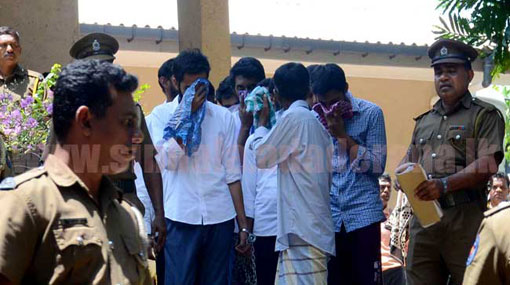
SP Gunasekara said 54 suspects including 7 women arrested in connection with the attacks are currently in custody of the CID, while 19 suspects are held by the Terrorist Investigation Division (TID).
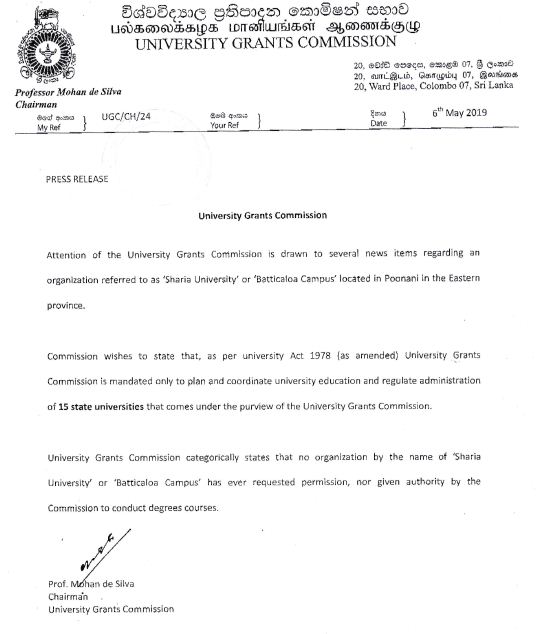
The University Grants Commission (UGC) issuing a press release states that there is no university named ‘Sharia University’ under the jurisdiction of the UGC.
The UGC says that no such university has requested permission nor given authority by the UGC to conduct educational courses.
The complete media release of the UGC:
Attention of the University Grants Commission is drawn to several news items regarding an organization referred to as ‘Sharia University’ or ‘Batticaloa Campus’ located in Poonani in the Eastern province.
The Commission wishes to state that, as per the University Act 1978 (as amended) University Grants Commission is mandated only to plan and coordinate university education and regulate the administration of 15 state universities that come under the purview of the University Grants Commission.
University Grants Commission categorically states that no organization by the name of ‘Sharia University’ or ‘Batticaloa Campus’ has ever requested permission, nor given authority by the Commission to conduct degree courses.”
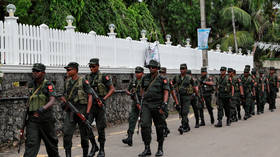
Island-wide search operations conducted with the aim to ensure the security within the country was carried out today as well (06).
During a raid at a house in Thalapitiya, Galle police have arrested a person along with over 1000 clothes similar to uniforms of the tri-forces and the Sri Lanka Civil Security Force.
At a special search mission in Nawalapitiya, several suspicious items have been found on the bank of the Mahaweli River.
The mission conducted by the Nawalapitiya Police, Sri Lanka Army and the Special Task Force (STF), has discovered 02 swords, a hand-ax, six knives contained in a polythene bag and a sack, at the Salem bridge area on the Mahaweli Riverbank.
Police suspect that these items may have been abandoned due to the ongoing search operations.
Three persons including a woman have been arrested in search operations conducted in Horowpothana area. A sword and 49 CDs have been found with them at the mission carried out by Horowpothana Police and the Kebithigollewa Police STF.
Interrogations conducted on the Arab school teacher – who had close connections with Zahran Hashim and later remanded after being arrested in Mukkarawewa, Horowpothana recently – had led to these arrests.
Meanwhile, a large noise heard from Baseline Road area in Borella which has created slight alarm among the public has been identified as an accident that had occurred when a person fixing a metal rod connected to aTV antennae on the roof had come in contact with a 33000W high-voltage power cable.
The accident which had occurred in the Halgahawatte area has resulted in the hospitalization of three persons.
Sri Lankan air force soldiers patrol a Muslim neighborhood following overnight clashes in Poruthota, a village in Negombo, about 35 kilometers North of Colombo, Sri Lanka, Monday, May 6, 2019. AP
A majority-Christian city in Sri Lanka known affectionately as “Little Rome” has been rocked by clashes between Christians and Muslims after the Easter Sunday suicide bombings claimed by ISIS that left 257 people dead.
The Catholic Church has called for calm after Christians attacked Muslim-owned shops, homes and vehicles in Negombo.
“I appeal to all Catholic and Christian brothers and sisters not to hurt even a single Muslim person because they are our brothers, because they are part of our religious culture,” said Cardinal Malcolm Ranjith, archbishop of Colombo.
“Therefore please avoid hurting them and try to create a better spirit of understanding and good relations between all the communities of Sri Lanka,” he said in a video message to the country.
The Negombo’s main church, St Sebastian’s, a building modelled on the cathedral in the French town of Reims, was targeted by a suicide bomber. He killed more than 100 people when he detonated during Easter Mass.
The place of worship, located some 40 kilometres north of the capital Colombo, was just one of three churches targeted alongside three luxury hotels on April 21. But it suffered the highest death toll of any site struck on that day by eight ISIS-inspired suicide bombers.
The mob attacks will add to fears that the suicide bombings would widen religious and ethnic divisions in the country that has lived in relative peace since the civil war between the government and the separatist Tamil Tigers ended in 2009.
The cardinal visited Negombo, held talks with clerics at a mosque and appealed to the government to shut bars in the city, his spokesman Father Edmund Tilakaratne said.
“As a temporary measure, the cardinal asked the government to order the ban on liquor sales in Negombo area,” Father Tilakaratne said.
In another televised appeal, Cardinal Ranjith appealed to Christians, Buddhists and Muslims to show restraint.
A top police officer said two arrests were made after the latest clashes and more suspects had been identified through CCTV footage.
The officer said all will be prosecuted under emergency laws approved after the Easter attacks.
“At least three people were injured in the clashes,” the officer said. “Although we have arrested only two suspects at the moment, many more have been identified and we will go after them.”
The officer said an alcohol-fuelled dispute between two groups degenerated into the clashes.
Prime Minister Ranil Wickremesinghe said the government will compensate those who lost property in the night-time clashes.
Unverified video circulating on social media showed mobs throwing stones at Muslim businesses, destroyed furniture inside homes, shattered windows and overturned vehicles.
A few hundred extra troops and police were deployed late Sunday as authorities imposed a night-time curfew in the town.
The government blocked access to WhatsApp, Facebook and other social media platforms for several hours to prevent what it called the spread of rumours and videos aimed at instigating unrest.
The curfew was lifted on Monday morning and social media was working again by noon Monday.
The recent carnage in Sri Lanka could be indicative of something even more profound and worrisome.
As the threshold for launching terrorist attacks is getting lower and lower, they could become increasingly frequent around the world in the days to come.
In particular, the rapidly growing prevalence of drones has allowed terrorists to mount attacks against targets in a much more cost-effective” yet less risky way.
For example, all it takes for terrorists to launch a deadly attack is to fly a drone loaded with explosives over a specific target and then detonate it.
Suffice it to say that nowadays drones pose a very real and imminent global security threat.
It has become very easy and totally feasible for an average individual to plot a small-scale attack” against, say, one’s ex-girlfriend or ex-boyfriend by using a drone carrying toxic substances.
It would be equally feasible for a terrorist to escalate the scale and intensity of drone attacks” by using not one, but multiple drones, against any chosen target simultaneously.
Actually, this has been done already by Islamic State (IS) during its later stage: the group has successfully launched multiple air strikes” against enemy positions using a large number of drones.
The IS, of course, was doing this mainly because it didn’t have the necessary resources to build its own conventional air force.
Nevertheless, this unique form of remotely controlled” air strikes could also have been a set of experiments carried out by the IS to test its future mode of terrorist attacks.
Apart from terrorist strikes, drones have also proven an efficient tool for political assassinations.
For example, both Turkish President Recep Erdoğan and his Venezuelan counterpart Nicolas Maduro have almost fallen victim to drone assassinations” when attending public events.
Once people are getting more familiar with operating this new mode of assassination, it is very likely that the drone may be a tool in mounting such a potential attack in the future.
In order to stop that scary scenario from becoming a reality, governments around the world have already been devising measures to prevent drone attacks and developing the related technologies, but only with limited progress.
That’s because guarding against drone attacks has turned out to be a lot more difficult than expected even in the context of existing technologies, let alone the future artificial intelligence (AI) world.
In December last year, for example, Gatwick Airport in southeast England, Britain’s second busiest airport, had to ground all flights and shut down for 36 hours after a number of drones were seen repeatedly flying over its runways.
Luckily, as the British authorities later found out, these drones were actually flown by protesters, not terrorists.
In Japan, the government has conceded that up to 40 percent of the country’s military facilities aren’t drone-proof.
And it would definitely be harder to prevent drone attacks against soft” civilian targets such as hotels and churches in the metropolis.
Even though we might still be going through a transitional period of information gap” between attacks and defenses, it is indeed not difficult to form a picture in the mind that the next wave of Sri Lankan-style terrorist strikes might become completely mechanized and would no longer require any suicide attackers.
Just imagine this: the recent attacks in Sri Lanka could have resulted in a lot more casualties and created much more fear among the local public if they had been carried out using drones that could hit multiple targets at the same time.
This article appeared in the Hong Kong Economic Journal on April 24
COLOMBO: Sri Lankan security forces should avoid the incidents that caused some people face social stigma during the search operations after the Easter Sunday blasts carried out by a “cult” within the community, as it may lead to radicalisation of moderate Muslims in the country, a Minister has warned.
Minister of City Planning, Water Management and Higher Education Rauff Hakeem said Muslims welcome and support the security forces and police to carry out search operations following the ..
JEDDAH — The Kingdom’s embassy in Colombo dismissed a report published in a Sri Lankan newspaper insinuating Saudi responsibility for last month’s terrorist attacks in the country.
“The Royal Embassy of Saudi Arabia to Sri Lanka closely followed the news item published in the local newspaper ‘Weekend Express’ on May 3, 2019, under the heading ‘Leaked document reveals Saudi responsibility for the attacks’, quoting the Lebanese news site Al-Ahed,” the embassy said in a press statement released in Colombo.
“The embassy expresses its displeasure and condemnation of the publication of false allegations against the Kingdom in a state-owned newspaper in Sri Lanka, which led other local media organs to reproduce the news item,” the statement read.
The embassy categorically denied any Saudi involvement in the incident and emphasized that the published news item was a baseless lie.
The embassy urged the Sri Lankan media institutions to ascertain the reliability of their sources before publishing any news about Saudi Arabia.
Sri Lanka‘s Roman Catholic Church appealed for calm and an alcohol ban Monday after clashes between Christians and Muslims in a town scarred by Easter Day’s suicide attacks.
Hundreds of security forces entered Negombo to impose a curfew after dozens of Muslim-owned shops, homes and vehicles were attacked.
St. Sebastian’s church in the town 40 kilometres (25 miles) north of capital Colombo was one of three churches and three hotels hit by Islamic State group-linked suicide bombers on 21 April killing 257 people.
“I appeal to all Catholic and Christian brothers and sisters not to hurt even a single Muslim person because they are our brothers, because they are part of our religious culture,” said Cardinal Malcolm Ranjith, archbishop of Colombo.
“Therefore please avoid hurting them and try to create a better spirit of understanding and good relations between all the communities of Sri Lanka,” he said in a video message to the country.
The cardinal visited Negombo, held talks with clerics at a mosque and appealed to the government to shut bars in the Catholic-dominated town known as “Little Rome”, said his spokesman Father Edmund Tilakaratne.
“As a temporary measure, the cardinal asked the government to order the ban on liquor sales in Negombo area,” Tilakaratne told AFP.
In another televised appeal, Ranjith appealed to Christians, Buddhists and Muslims to show restraint.
Negombo suffered the highest death toll in the Easter Sunday attacks that were claimed by the Islamic State group. The bomb at St. Sebastian’s killed more than 100 worshippers.
A top police officer said two arrests were made after the latest clashes and more suspects had been identified through CCTV footage.
The officer said all will be prosecuted under emergency laws approved after the Easter attacks.
“At least three people were injured in the clashes,” the officer told AFP. “Although we have arrested only two suspects at the moment, many more have been identified and we will go after them.”
The officer said an alcohol-fuelled dispute between two groups degenerated into the clashes.
Prime Minister Ranil Wickremesinghe said in a statement the government will compensate those who lost property in the night-time clashes.
Unverified video circulating on social media showed mobs throwing stones at Muslim businesses, destroyed furniture inside homes, shattered windows and overturned vehicles.
A few hundred extra troops and police were deployed late Sunday as authorities imposed a night-time curfew in the town.
The government blocked access to WhatsApp, Facebook and other social media platforms for several hours to prevent what it called the spread of rumours and videos aimed at instigating unrest.
The curfew was lifted on Monday morning and social media was working again by noon the same day.
Sri Lanka’s main international airport is located in the area, but police said there was no disruption.
Muslims make up around 10 percent of Buddhist-majority Sri Lanka’s 21 million population and Christians about 7.6 percent.
The country has been under a state of emergency since the Easter bombings.
The government has blamed the Easter bombings on a local jihadist organisation which had pledged allegiance to the Islamic State group.
All suspected plotters and those directly linked to Sri Lanka’s Easter Sunday bombings have either been arrested or are dead, the country’s acting police chief said on Monday.
In an audio statement circulated by the defence ministry, Chandana Wickramaratne, the acting Inspector General of Police, said security forces had also confiscated bomb-making material intended for future use by the militants involved in the attacks, which killed more than 250 people.
Sri Lankan authorities have said the bombings were believed to have been carried out by two little-known local Islamist groups, the National Tawheed Jamaath (NTJ) and Jamathei Millathu Ibrahim (JMI).
Islamic State claimed responsibility but produced no evidence to support this.
Despite claiming responsibility for the Easter Sunday bombings in Sri Lanka, the Islamic State did not directly organize the deadly terror attacks.
It was a locally led attack. It uses the ideology of ISIS to get the credit for ISIS so it has a success story,” Lt. Gen. Mahesh Senanayake, commander of the Sri Lanka army, told the Wall Street Journal.
All nine of those who detonated bombs across the island nation on Easter have been identifiedand belong to two local terrorist groups. Those involved reportedly planned and executed the attacks by studying ISIS designs for explosives on the internet and by testing those designs out before the six suicide bombings that killed more than 250 people.
One of the bombers, the son of a wealthy Sri Lankan spice trader, appears to have used his means to independently finance and coordinate the attacks, which took a year to plan and execute. During the test runs for the explosives, one of the plotters blew off some of his fingers and lost his eye.
The conclusions, which are still tentative, are drawn from investigators poring over evidence gathered from the terrorists’ computers and possessions in addition to interrogations of arrested people associated with the bombers with knowledge of the plot. While some of those who participated in meetings about the bombings remain at large, Senanayake said about three-quarters of those involved are either dead or in federal custody.
Sri Lankan officials said the interrogations appeared to show that the timing of the attacks and the targets were aimed at boosting ISIS’ global image while territorial control of ISIS’ self-described caliphate continued to collapse.
A few of those involved did have some connections to ISIS, though. One of the eight men who bombed the hotels and churches was reportedly radicalized while studying in Australia and made ISIS contacts while there. Another one of the bombers claimed that ISIS had put him in charge of the group in Sri Lanka, but there is uncertainty of the veracity of that assertion, and authorities believe he falsely claimed to the others to be receiving instructions from ISIS in Syria.
As part of the attack, the bombers used washing-machine timers as mechanisms to set off explosives. They reportedly tested out the design on a motorcycle just days before Easter Sunday and planted one of the timed bombs in a car parked outside one of the churches that was attacked in an effort to kill survivors and authorities after the suicide bomb exploded. That timed charge did not detonate, though.
Following the attacks, ISIS leader Abū Bakr al-Baghdadi appeared in the first video footage of him in over five years. In the clip, Baghdadi praised the attacks in Sri Lanka. In an audio portion of the video, Baghdadi said the attacks were revenge for the territorial losses it has suffered.
Sri Lanka is still under a state of emergency, and as public schools begin to reopen Monday, Catholic schools across the country remain closed.
Sri Lanka’s acting police chief Chandana Wickramaratne has said that all of the suspects linked with the Easter Sunday bombings have been arrested or are dead.
The announcement follows a nationwide manhunt for the perpetrators and their associates, 30 of whom were believed to still be at large over the weekend. Nine previously arrested suspects were released on bail earlier on Monday.
The suicide bombing attacks, later claimed by Islamic State (IS, formerly ISIS or ISIL) terrorist group, targeted three Christian churches and three luxury hotels, killing more than 250 people.
Sri Lanka’s government has responded forcefully to the attacks, declaring a state of emergency, expelling Islamic preachers, and banning face coverings in public. Authorities remain on high alert, and warned last week of another wave of attacks,” possibly carried out by terrorists disguised as military personnel
The man was cleared by the doctor to spend time in prison.(Keystone/ Valentin Flauraud)
A 42-year-old Sri Lankan man died in a detention centre in Lucerne on Friday evening. He had to spend two days in custody because he was unable to pay a fine.
The police noticed that the man was in physical distress via surveillance cameras. He died on the spot despite an attempt at immediate resuscitation, Lucerne’s public prosecutor’s office revealed on Mondayexternal link. The investigating authorities blame “acute” health problems for his death.
Before being detained, the Sri Lankan was examined by a doctor. He was given the green light to serve his short prison sentence, according to the public prosecutor’s office. An autopsy was ordered to clarify the cause of death.
“In its judgment, the court shall impose an alternative custodial sentence of at least one day and a maximum of three months for the event that the fine is wilfully not paid.” states Article 106 of the Swiss criminal codeexternal link.
Almost three-quarters of all detainees in Swiss prisons are of foreign origin, a study shows. An analysis of the factors behind the numbers.By Patricia Islas
When
LTTE was militarily defeated in May 2009 the mistake the then government made
inspite of requests to do so, was not to denazify the LTTE & everything to
do with Eelam ideology. As a result, LTTE political agents are continuing
politically what LTTE strove with gun and some Ministers have the audacity to
demand the return of the LTTE publicly. The same scenario cannot be repeated
with Islamic terrorism based on a radical Islam that even Muslims do not wish
to adhere to. Banning the burka for security reasons only is not enough.
National interests must come first. People of all communities have to live
together. No person has the right to claim individual rights or grievance if it
undermines or infringes on the rights of another. If anyone’s ideologies don’t harmonize
with that of the majority, then they must go & live in countries where
those ideologies are legal & accepted. No one can kill people simply
because they do not conform to their ideology. This is the simple principle on
which people must learn to live. We must now take action to ensure no more
lives are lost because of radical ideologies.
What are the ‘Denazification
Directives” & Collective Guilt”?
The
term was used by Pentagon in 1943 & applied following defeat of Hitler
& the end of World War 2. The Western Allies comprising present day bullies
as well as preachers of human rights, in 1945 declared not only Hitler &
Nazi’s as guilty but denounced all Germans as guilty for both the war &
Nazi atrocities.
A
kangaroo court better known as the victor’s court or Nuremberg Military
Tribunal was set up in November 1945.
The Denazification Process – Collective
Responsibility: Collective Guilt”
Nazi
party abolished
Collective
Responsibility: Collective Guilt” meant posters put up across Germany You are
Guilty” – Germans were made to feel guilty.
Germans
had to fill questionnaires categorizing themselves (HR people call this racial
profiling today)
Anyone
or any group associated with Nazi’s was declared guilty
All
physical symbols associated with Nazis removed including Swastika
Nazi
links to cultural, social, intellectual, economic & even politics were
banned.
Anyone
who supported Hitler or Nazis were held accountable & charged with war
crimes
German
media, newspapers, radio stations, theatres, magazines, book publishers, book
dealers & printers were all taken over by US
Over
30,000 books including textbooks related in any way to Nazism was banned.
Germans
were not allowed to deny holocaust which EU criminalized in 2001 (if applied to
SL – Tamils would be held responsible for all of LTTE crimes, Muslims would be
held responsible for all Islamic terror crimes)
Eventually
denazification process created Germany’s constitution on 8 May 1949 and
ratified on 23 May 1949.
Germany is
today a powerful nation because the ideology of Hitler & Nazism was
annihilated.
Japan is
where it is today because of the same.
Sri Lanka is where it is today because
Sri Lanka failed to annihilate the Eelam ideology and now we are facing another
ideology – radical Islam both of which has to now be eliminated!
What the US, UK & Allies did
through denazification was to remove the ideology that inspired the terror. This was the reason to request Sri
Lanka’s Government to remove every symbol and slogan associated with LTTE’s
quest for Eelam. The separatist mentality needed to be legislatively &
legally banned as a pre-requisite to reconciliation. The ideology of Eelam was
the obstacle that needed to be removed.
Sri
Lanka’s constitution is clear about anyone advocating separatism. Why have
political parties not used the 6th amendment against individuals/political
parties pushing for this quest by different names? This is the role of a
government & its Attorney General.
Denazification
of LTTE/Eelam should be to ban separatist roots – nullify the Vaddukoddai
Resolution of 1972, any names with ‘Eelam’, Eelam emblems, slogans, monuments,
flags and taking legal action against those that flout the rules.
On 21st April 2019, 9
suicide bombers were radicalized into killing non-Muslims. They attacked 3 churches, 3 hotels
and 2 other sites killing over 250 innocent people. What was shocking was that
2 brothers, husband & wife were also suicide bombers.
Radicalism
amongst Muslims was seen rising undetected initially as the focus was on LTTE
terror.
The clues
were however obvious. Muslims began to change the lifestyle they were leading
previously harmonizing with the Sinhala majority culture. The demand for azan
via loudspeakers even resulted in a court case between two Muslim mosques.
Proliferation of mosques where in some towns every 3 persons are having a
mosque. A new type of dress in the form of burka began to be forced on women
with Saudi influence. Even men started dressing differently. Then there was the
demand for halal food labelling and insisting that a separate certificate of
halal compliance is issued for a fee which was nothing but a business venture
collecting money from non-Muslim businesses. Then came calls for Shariah laws
and demand for Muslim laws over and above that of the country law.
Not
only non-Muslims noticed these changes, even Muslims noticed and some were
brave enough to alarm the authorities but vote bank politics and the concept
false drilled into the minds of politicians that they needed minorities to win
elections made the politicians favor the radicals against the moderates. Of
course the politicians were swayed by money & other inducements which was
play a major role in radical promotion & propagation. The amounts of money
with people following search operations of late reveals the extent to which
money plays a role in fostering radicalism.
What
was visible was that a group of Muslims were getting heavily influenced by
external forces promoting their version of Islam no different to the rising
Christian cults using the power of money and manipulating Islam into a radical
ideology.
What
these groups are doing is indoctrinating youth and the gullible and misleading
them. All of the suicide bombers were rich & educated people. Its baffling
why they would take their lives and cut short the lives of others especially
small children. Some of the bombers had children.
Muslims were indoctrinated to hate
non-Muslims and that hate transcended to death on 21 April 2019 and is likely
to lead to more deaths if left ignored.
Therein
the collective guilt & responsibility is in Parliament for not taking
action.
During
LTTE terror a Peace Secretariat was set up manned by an excellent team that
countered false media allegations with facts & figures. A similar state
entity must be set up to counter falsehoods not only by the Eelam lobbyists but
against the Radical Islam lobby as well.
Sri
Lanka should take a more pragmatic approach & a higher moral ground by
desisting from adopting the Collective Responsibility-Collective Guilt applied
by US, UK & Allies against Tamils or Muslims but ensure that the ideology
that continues Eelam quest is removed & the ideology that inspires Islamic
radicalism is also removed.
In
terms of collective guilt: collective responsibility media (vastly controlled
by the Western Christian), UN/HR and other organizations also heavily
influenced by Christian West, politicians, think tanks that propose divisive
and dangerous proposals to governments, foreign intel that seek to undermine
national security of other countries to benefit theirs and the many other
invisible players are the guilty lot.
As for
Sri Lanka denazification of both Eelam ideology & Radical Islam is necessary
if Sri Lanka wishes to progress. Majority
of people want to live in peace. No one should be indoctrinated by a
religion or ideology to kill others. If their ideology does not harmonize with
the life Sri Lankans lead they can take themselves & their ideology to
countries where that ideology is accepted & live there amongst those
followers.
Eelam Separatists & Islamic radicals
are not welcome in Sri Lanka.
Political parties should not give
nominations or accept them through national list.
Voters of any political party should not
vote for any political party giving extremist & Islamic terrorist-linked
politicians nominations in future. If voters are firm on this pledge political
parties will think twice. Voters must now make their demands clear. We have had
enough bloodshed – we do not want any more innocent people being killed.
Sri
Lanka & Sri Lankans must have only ONE FLAG, ONE National Anthem in ONE
LANGUAGE, ONE LAW Equal to ALL. No one’s rights are above that of the other. No
one can demand any right if it infringes or denies the right of another.
If
we can follow these basic and simple principles – Sri Lanka can prosper.
According to media
reports, Archbishop of Colombo Cardinal Malcolm Ranjith flayed the government
for its lackadaisical attitude and not doing enough to bring those responsible
for the Easter Sunday bombings to justice. He has expressed his dissatisfaction
with the security measures that have been taken since the attack and doubt
whether anything meaningful will be done by the Committee appointed by the
President.
The Cardinal has said: “I must appreciate the patience that the people
have shown after Easter Sunday’s attacks. Even if parliamentarians and
politicians were behind these attacks – directly or indirectly – people expect
them to be arrested, questioned and punished if they have any connections.
As revealed by Minister Kabir Hashim, few weeks ago, the two key
suspects who were captured
with explosives in Wanathawilluwa,
Puttalam in January this year
had been released due to
the intervention of a powerful politician and one of them had been involved in Sunday’s attacks. It is claimed by various
sources that one of the governors appointed by the President in January this
year, Azath Salley, was the one who intervened in this regard, although Salley denies
his evolvement.
According to some other news item, Eastern Province
Governor, M. L. A. M. Hizbullah’s driver and former cook were arrested, few
days ago, following the detection of 48 rounds of ammunition in a building rented
by the Governor at Kattankudy.
Further a blast reported
to have been taken place, a week before the Easter Sunday massacre, in a vacant
land at Kattankudy. The land owner is
said to be the said Governor. Hizbullah was accused by
a number of persons for having links to the National Thowheed Jamath (NTJ) who
are behind the Easter Sunday attacks. Mr.
Hisbullah is another Governor appointed by the President.
On the other hand, there are various allegations leveled against government
politicos like, Mujibur Rahman, Rishad
Bathiudeen regarding their involvement with extremist terror outfits.
Minister of Muslim Religious Minister Abdul Haleem was accused of
streamlining Madrassas and permitting the construction of hundreds of
extremist’s Tawheed mosques.
Minister
Haleem’s childish response to journalists’
queries as to why certain mosques had amassed weapons such as swords and other
sharp objects appears as a clear evidence of his desire to appease terrorist
attacks committed by Muslim extremists.
We
have come across videos showing how Mujibur
Rahman denying the establishment of ISIS, when revealed its existence by
Wijedasa Rajapasa in the Parliament few years ago.
All the powerful
politicians and the ministers of the current administration are simply
conducting media shows denying the
accusations level against them and nothing seems to be done to bring parliamentarians
and politicians behind the Easter Sunday bombings, directly or indirectly, to
justice.
Considering the relationships that those
politicians have established with the power hungry politicians ruling the
country, it is very doubtful whether any action will be done against the
alleged extremist elements.
Mahinda Rajapaksa Leader of the Opposition MEDIA RELEASE
One
of the pledges given by the present government to their foreign masters through
UN Human Rights Council Resolution No: 30/1 of October 2015 was to repeal and replace
the Prevention of Terrorism Act of 1979. The draft counter terrorism law that
has been presented to Parliament for this purpose has encountered opposition
from political and media activists on the grounds that the way it defines the
term ‘terrorism’ leaves room for legitimate political and trade union action as
well as the dissemination of information and protection of sources by the media
to be labelled as terrorist activity. In the aftermath of the Easter Sunday
bombings, the government has been trying to sell their Counter Terrorism Bill to
the public with the claim that it has provisions to prohibit Sri Lankan
nationals from having links with foreign terrorist organisations.
While
the government’s proposed law is tough on ordinary citizens by having
provisions that can be used to stifle political dissent and the freedom of
expression, it is designed to treat terrorists with the utmost leniency to the
extent where its actual effect will be that of protecting and giving
encouragement to terrorists – not countering terrorism. Our Penal Code
prescribes the death penalty for killing just one person, but under the
proposed counter terrorism law, a terrorist convicted of killing hundreds of or
even thousands of people can only be given a maximum sentence of life imprisonment.
Furthermore while the Penal Code prescribes the death penalty for aiding and
abetting in murder, the penalty for aiding and abetting in mass murder in the
proposed law is just fifteen years imprisonment and a fine of up to Rs. one
million. How is terrorism to be deterred by giving convicted terrorists lesser
punishments than what the ordinary law of the land prescribes for the same
offences?
The proposed counter terrorism law also
requires the police and the armed forces to treat terrorist suspects with the
utmost solicitude. If a terrorist suspect is arrested by the armed forces, he
has to be handed over to the OIC of the nearest police station within 24 hours.
The latter has to examine him for injuries and present
him before a JMO for treatment or a report. The Human Rights Commission has to
be informed within 24 hours of the arrest so that they can determine whether
the arrest has infringed the fundamental rights of the suspect. When a terrorist suspect is
arrested, the arresting officer has to reveal his
identity to the suspect and the suspect’s next of kin or associates despite a
history in this country of terrorists having massacred entire families of armed
forces personnel. The next of kin of terrorist suspects have to be provided
‘reasonable’ access to the suspect in a situation where today, the next of kin
may well be the next suicide bomber coming to receive instructions. From
the time of the arrest, the welfare of the terrorist suspect takes precedence
over everything else.
All arrested suspects have to be
produced before a Magistrate within 48 hours and the Magistrate is required by
law to personally look into the well-being and welfare of the suspect. A
suspect can be kept in detention only for two weeks and if this period can be
extended only with the approval of a Magistrate. The total period of detention
of a suspect cannot exceed eight weeks. Under the PTA in contrast, a suspect
can be kept in detention for three months and this can be extended up to a
total of eighteen months. A suspect arrested under the proposed counter
terrorism law can be held in remand without instituting criminal proceedings
for six months and this period may be extended for another six months on an
order of the High Court. If criminal proceedings are not instituted within this
extended period, the suspect will have to be granted bail. Under the PTA
however, a suspect can be kept in remand until the conclusion of the trial. The
proposed counter terrorism law requires the Human Rights Commission and the
Magistrates to make unannounced visits to all places of detention and remand to
look into the welfare of terrorist suspects and they have to ensure that the
suspects are provided all the basic facilities. If the trial against a person
remanded under this Act has not been concluded within one year, the High Court is
mandatorily required to release the accused on bail.
Even at the trial stage, terrorist
suspects are afforded special relief. The proposed law states that ‘if death or
grievous bodily injury has not been caused’ or ‘if the security of the State has
not been seriously affected’ by the suspect’s actions, and he displays
contrition by among other things, publicly expressing remorse, providing
reparations to victims and participating in a rehabilitation programme, the
Attorney General may either suspend criminal proceedings or withdraw the
indictment altogether. How can a person who has harmed no one and not
endangered the security of the State end up being arrested and prosecuted under
a counter terrorism law? In practice, it is very difficult to collect
sufficient evidence against a terrorism suspect largely because of the unsettled
conditions that would be prevailing in the country. If a terrorist suspect is
arrested and charged in court but is still incongruously deemed to have ‘not
caused any harm to anyone’ or ‘endangered the security of the country’ that would
only be due to the lack of evidence and not because he has not committed the
crime he is accused of.
The proposed counter terrorism law
acknowledges this reality by requiring an accused person to express remorse for
something he is not supposed to have done and even pay reparations to victims
he is not supposed to have harmed, before the Attorney General suspends or
withdraws the indictment against him. Such bizarre provisions in the draft
counter terrorism law is an acknowledgement of the practical difficulties in
prosecuting terrorism suspects under the ordinary law which requires a high
evidentiary bar. Most often what can be achieved through anti-terrorist
legislation is the suppression of terrorism rather than prosecution and
punishment of terrorists, which is why such laws have to be tough enough to
enable its primary purpose to be achieved. There is no argument about the fact
that the Prevention of Terrorism Act introduced by the UNP government in 1979
is a tough law. But we have had to deal with the most ruthless terrorists the
world has ever seen and that would not have been possible if not for such laws.
Even
in sentencing a terrorist after conviction under the proposed counter terrorism
law, a reduced sentence can be handed down after considering mitigating factors
such as a public denunciation of terrorism, provision of reparations to the
victims and a public denouncement of violence etc. The government’s proposed
counter terrorism law is in fact a comprehensive relief package for terrorists.
If the proposed Counter Terrorism Bill is passed into law, it will seriously hamper
ongoing efforts to suppress terrorism following the Easter Sunday bomb attacks.
Since this country is once again confronted with terrorism, the government
should be prevented from making any changes to the Public Security Ordinance of
1947 or the Prevention of Terrorism Act of 1979. Priority should be given to
the people’s right to life over the rights of terrorists.
Another election and another betrayal.
Presidential and parliamentary elections are just months away. All parties are
gearing up to it. And that means venerating minorities and their leaders. UNP
has a captive minority vote base and it very keen to keep it that way. As a
result UNP will never allow a crackdown of Muslim terrorism. Although only a
small percentage of Muslims are terrorists, there is wide sympathy for them
within the community.
Sirisena was heavily voted by
Muslims. No less than 85% of Muslims voted for Sirisena in 2015. He is trying
to salvage whatever he can from this base. His SLFP managed to win a few local
government bodies with the help of some Muslim politicians. Therefore, he is
also very unlikely to tackle the matter other than a few publicity stunts that
will eventually end up with releasing most suspects. He will make sure no
Muslim MP (current and former) is arrested.
SLPP only managed to win 5% of the
Muslim vote in 2018 island-wide. A totally dismal performance. However, SLPP
leaders are doing everything they can to win more. As a result they too will
not support a crackdown on Muslim terrorism. They will make contradictory
statements to win Muslim votes from one hand while retaining other votes on the
other.
JVP is also after Muslim votes. JVP
once produced the first Muslim female MP. JVP will be following a wait-and-see
approach and an approach of pussyfooting the matter.
Muslim terrorists chose the perfect
time to launch their attack.
Sri Lanka is in trouble again thanks
to politicians fighting over minority votes.
Even before the Easter bomb blast I have been talking about
possibility of connection of drug trade with increased tourism and other
crimes.
When president started to wage the war against drug trade ,
remaining intelligent agents were concentrating on netting up Drug Masters
. I wrote an article about Paolo Escobar who was a drug baron in
Columbia, who managed to destabilize governments by exploding bombs and killing
leaders and law enforcement agents .
Drugs helped him to find people to do such activities .Most
of his ruthless killers were drug peddlers and drug abusers.
They were strong Catholics and yet they did not have mercy.
In Sri Lanka Catholics are more refined and disciplined
under the guide of the cardinal and other church leaders. Therefore such
activities could could only be done by Muslims as Buddhist were somewhat more
pious.
My question is whether Sri Lankan authorities ever checked
blood of the suicide bombers and the suspects they have arrested to check
substance abuse,means drug abuse.
The method of using canine / dogs to check explosives is
fine, but the authorities should check whether drugs were also in use.
It may be that the suicide bombers all over the world need
some brain twisting means to persuade them to such drastic action.
( in order to satisfy 72 virgins they intend to enjoy ,may
also need drugs to make them believe that it is true !)
In Russia when red army went on charging the advancing
German Invaders , Stalin gave gallons of Vodka to the soldiers who were
at the war front.
They forgot value of their life and went on suicidal attacks
to beat the Germans.
It is essential to verify about fact that drugs has
been used by the youths who killed themselves.
If it so President’s theory the war against drugs
waged by him had accelerated the Terrorist Attack can be assumed factual.
Even before the Easter bomb blast I have been talking about
possibility of connection of drug trade with increased tourism and other
crimes.
When president started to wage the war against drug trade ,
remaining intelligent agents were concentrating on netting up Drug Masters
. I wrote an article about Paolo Escobar who was a drug baron in
Columbia, who managed to destabilize governments by exploding bombs and killing
leaders and law enforcement agents .
Drugs helped him to find people to do such activities .Most
of his ruthless killers were drug peddlers and drug abusers.
They were strong Catholics and yet they did not have mercy.
In Sri Lanka Catholics are more refined and disciplined
under the guide of the cardinal and other church leaders. Therefore such
activities could could only be done by Muslims as Buddhist were somewhat more
pious.
My question is whether Sri Lankan authorities ever checked
blood of the suicide bombers and the suspects they have arrested to check
substance abuse,means drug abuse.
The method of using canine / dogs to check explosives is
fine, but the authorities should check whether drugs were also in use.
It may be that the suicide bombers all over the world need
some brain twisting means to persuade them to such drastic action.
( in order to satisfy 72 virgins they intend to enjoy ,may
also need drugs to make them believe that it is true !)
In Russia when red army went on charging the advancing
German Invaders , Stalin gave gallons of Vodka to the soldiers who were
at the war front.
They forgot value of their life and went on suicidal attacks
to beat the Germans.
It is essential to verify about fact that drugs has
been used by the youths who killed themselves.
If it so President’s theory the war against drugs
waged by him had accelerated the Terrorist Attack can be assumed factual.
The Embassy of Turkey in Sri Lanka issuing a statement to clarify certain news items published by the media stated that Turkey has been cooperating with Sri Lanka in her fight against Fethullahist Terrorist Organization (FETO).
The Embassy states that Turkey has provided the Sri Lankan authorities with the details of the FETO affiliated members, schools and businesses in Sri Lanka for the last four years.
The statement says that they have also requested the Sri Lankan Government to ban FETO affiliated schools and businesses and to deport their staff.
The complete statement issued by the Embassy of Turkey in Sri Lanka:
The Embassy would like to clarify some issues regarding the news which has been published in the Sri Lankan media since 30th April 2019.
The terrorist bomb attacks which targeted Sri Lanka on 21st April 2019 showed once again the need for cooperation and collective fight against all elements of international terrorism.
Turkey and Sri Lanka have stood in solidarity and cooperation in the international arena for many decades and supported each other in their fight against separatist terrorism.
In this framework, Turkey has also been cooperating with Sri Lanka in her fight against Fethullahist Terrorist Organization (FETO).
FETO is the terrorist organization that perpetrated the coup attempt on 15th July 2016 in Turkey, which killed 251 civilians and wounded thousands in one day.
FETO disguised itself as a benign education and charity movement and carried out its activities under this guise in Turkey and in other various countries for many years.
Since 2013, the ultimate aim of this terrorist organization has been discovered by Turkey and their activities were completely banned within the country.
After the brutal coup attempt on 15th July 2016, a large number of foreign countries followed Turkey and banned or closed FETO affiliated schools and businesses and deported FETO members front their countries.
The Embassy of the Republic of Turkey provided the Sri Lankan authorities with the details of the FETO affiliated members, schools and businesses in Sri Lanka for the last four years and requested the Sri Lankan Government to ban FETO affiliated schools and businesses and to deport their staff.
As Turkey and Sri Lanka are still the targets of international terrorism today, as in the past, both countries will continue to stand in solidarity and cooperation.”
Underworld figure Makandure Madush has been deported from Dubai this morning (05), stated the Police Media Spokesperson.
He was taken into the custody of the Criminal Investigation Department (CID) upon his arrival at the Bandaranaike International Airport.
Drug kingpin Makandure Madush was under the custody of the Dubai authorities after being arrested at a drug-fuelled party thrown by him in a Dubai hotel, back in October.
Along with him, 31 Sri Lankans including underworld figures and celebrities such as singer Amal Perera and his son, actor Ryan Van Rooyen were also arrested in Dubai.
The Dubai authorities had deported the arrestees to Sri Lanka at several occasions and Sri Lankan authorities took them into custody for questioning upon their arrival. Some have been remanded as per court orders while others were released after recording statements.