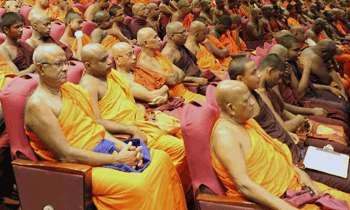
It is very sad to read some of the comments people post and realize that there are still people out there who think they are patriots solely because they label themselves as ‘Sinhala Buddhists’. They insult and make ungrounded allegations against Sri Lankans of other religions and other communities as if they alone are the guardians of this country.
I would like to ask these people on what facts they base their prejudices. Can they claim that Sinhala Buddhists never desecrate their country by –
Throwing their garbage in the oceans and rivers, in he wilderness or on the roadside?
Encroaching into wildlife reserves?
Misbehaving and disrupting the habitat of wildlife when they visit nature reserves?
Engaging in illicit sand mining?
Killing or entrapping protected species for sport or gain?
Cutting down forests for personal gain?
Circumventing the laws of the land, for personal gain?
I could go on, but this should suffice to make my meaning clear.
These activities all physically destroy our country, so if Sinhala Buddhists also engage in such vandalism, they are no better than anyone else. They can have no greater claims on the country.
We should all just try to understand that we are nothing more and nothing less than citizens of this country called Sri Lanka, and be proud to call ourselves ‘Sri Lankans‘. The actions of those who call themselves ‘Sinhala Buddhists’ only serve to alienate our brothers and sisters of other communities. They weaken our Sri Lankan family. They destroy our Sri Lankan home.
It should not be of any importance to you or to anyone else that you belong historically to the Sinhala, Tamil or Muslim community. Keep your Sinhala Buddhist -ness, your Tamil Hindu -ness or your Muslim or Christian -ness for your festivals and weddings and funerals. Keep that part of your identity for your private life alone.
Do not put the accent on these minor differences – they are tearing our country apart. All of us are the losers when we start fighting among ourselves.
When we highlight our differences we invite foreigners to once again plunder and pillage our country, our sovereignty.
MEDIA RELEASE Text of a speech delivered by the Hon. Prime Minister Mahinda Rajapaksa at the Prime Minister’s Office onSunday the 2nd December 2018.
Most venerable members of the Maha Sangha, Clergymen of all religions, and my dear friends,
It is only in Sri Lanka that you will find political parties agitating against the holding of a general election that has already been declared. In the gazette notification dated 09 November 2018 issued by the President in accordance with the provisions of our Constitution and the Parliamentary Elections Act, dates had been fixed to call for nominations from the 19th to the 26th November, to hold the poll on the 5th January 2019, and for the new Parliament to meet for the first time on the 17th January. If things had gone accordingly, stability would soon have been restored to this country.
Last year, in November 2017, there was the danger of the local government elections being postponed indefinitely because certain individuals had petitioned the Court of Appeal against the holding of the local government elections citing delimitation issues. However when the Chairman of the Elections Commission declared that he will proceed to hold elections at least in respect of the local government institutions that were not subject to litigation, the then government reluctantly fell in line and agreed to hold elections. With that the peitioners who had gone before the Court of Appeal quietly withdrew their petitions. It was quite clear in that instance, that the court procedure was being misused for a political purpose.
Today, six of the nine provinces in the country do not have functioning provincial councils. The previous government avoided holding elections to the provincial councils for more than one year. We held the Eastern Provincial Council election in 2008 even before the war had ended, immediately after clearing the province of the LTTE. Once the de-mining of the Vanni was complete, we held provincial council elections in the northern province as well in 2013. Today, without any war in the country, both those provinces do not have provincial councils. The previous government put off provincial council elections indefinitely by deliberately refraining from fulfilling the conditions relating to the delimitation of constitutencies in Act No. 17 of 2017 which was rushed through Parliament last year just days before the Sabaragamauwa, North Central and Eastern Provincial Councils were to stand dissolved.
I am placing on record this explanation because the UNP and its affilaited political parties have been making misleading statements from the political platform with a view to deceiving the general public. From the time of our first Parliament, elections were called early whenever necessary to overcome situations of political turbulence. In 1952 when the then Prime Minister D.S.Senanayake died, a division emerged within the UNP regarding the succession. Even though the effective number two in the party was Sir John Kotelawala, the then Governor General Lord Soulbury invited Dudley Senanayake to be the Prime Minister. Within days of swearing in as Prime Minister, Dudley Seneyake summoned a general election and obtained a fresh people’s mandate to contain the divisions within the ruling party.
In 1959 after the assassination of S.W.R.D.Bandaranaike, W. Dahanayake became Prime Minister. When rifts emerged within his Cabinet, he too called a general election. The Governor General’s power to dissolve Parliament was provided for in Article 15 of the 1948 Constitution. Even though Parliamentary conventions like dissolving parliament when the statement of government policy is rejected or when a government loses the budget were not expressly stated in the 1948 Constitution, those conventions applied in Sri Lanka because we closely followed the British system of Parliamentary government at that time.
Provisions relating to the President’s power to dissolve Parliament in our first Republican Constitution of 1972, were found in Article 21. The convention of dissolving Parliament if the statement of government policy was rejected, or a budget was defeated found mention in Article 99 of that Constitution. With regard to the second Republican Constitution of 1978, the President’s power to dissolve Parliament and the convention of dissolving Parliament in the event of a rejection of the statement of government policy or the budget, found mention in Article 70(1). I have no intention of dealing with any matter that is before courts. All these are matters that are being discussed in the media, the social media and in society in general.
The UNP and its allies claim that the 19th Amendment repealed and replaced the old Article 70(1) of the 1978 Constitution, and that according to the new article 70(1), the President cannot dissolve Parliament until the lapse of four and a half years. They claim that an early dissolution will be possible only if Parliament passes a resolution by a two thirds majority requesting the President to dissolve Parliament. All the provisions relating to the dissolution of Parliament in the 1978 Constitution, were found in the old article 70(1) before the 19th Amendment. If those provisions have been abolished, then there are no provisions in the present Constitution to dissolve Parliament in the event of a government losing a vote of no confidence, the vote on the budget or the statement of government policy.
Such restrictions are completely contrary to the Parliamentary tradition. Most countries with a Parliamentary form of government have ceremonial heads of state. Even in such countries, the head of state can exercise his discretion in dissolving Parliament. The British constitutional authority A.V.Dicey has said that if the Crown is of the view that the opinion of the public is different to that of the majority in Parliament, the Crown has the discretion to dissolve Parliament and summon a general election. In 1975, the Governor General of Australia sacked Prime Minister Gough Whitlam and called a general election entirely at his own discretion.
Dr B.R.Ambedkar, the founder of the Indian Constitution has said that the President of India can exercise his discretion when deciding whether to dissolve Parliament. The Governors of the Indian states who are representatives of the President, have exercised that discretion from the very beginning. In 1970, President V.V.Giri exercised his discretion in dissolving Parliament despite the protests of the opposition which had a majority in Parliament. In 1979, President Sanjiva Reddy exercised his discretion and dissolved Parliament due to a situation of near anarchy in the Lower House.
That was in countries with ceremonial heads of state. However the Sri Lankan head of state is an Executive President directly elected by the people. It has been clearly stated in the Supreme Court determination on the 19th Amendment that the power that the sovereign people have vested in the President cannot be removed without a two thirds majority in Parliament and a referendum. Even though it is claimed that the President’s power to dissolve parliament that had been provided for in the old Article 70(1) have been removed, what has actually happened is that those provisions have been taken to another part of the Constitution.
While amending the old Article 70(1), the 19th Amendment also introduced a new subsection (2)(c) to Article 33 of the Constitution. What this new provision says is that ‘in addition to the powers, expressly assigned to the President by the Constitution or other written law, the President shall have the power…to summon, prorogue and dissolve Parliament’. The new provision that has been introduced to the Constitution in the form of article 33(2)(c) has not been made subject to Article 70(1) as amended by the 19th Amendment either.
That is obviously why the 2015 Supreme Court determination on the 19th Amendment did not say that the amendment made to the old article 70(1) had reduced the President’s powers to dissolve Parliament. If the purpose was to reduce the President’s powers, an amendment would have been made only to Article 70(1). Legal experts are of the opinion that the reason why the President’s powers to dissolve parliament which were provided for in the old Article 70(1) have been reintroduced to the Constitution in the form of Article 33(2)(c) is because the President’s power in that regard cannot be taken away except through a referendum.
The 19th Amendment shifted other provisions of the Constitution from one place to another in a similar manner. The old article 42 which declared that the President was responsible to Parliament in the execution of his duties was repealed and the same provision without any change in the wording, was reintroduced as Article 33A by the 19th Amendment. Only the drafters of the 19th Amendment will know why that was done. But the end result is that the President continues to be responsible to Parliament under the 19th Amendment just as he was before the 19th Amendment was introduced. The same applies when a power that the President had under the old Article 70(1) is reintroduced to the Constitution in the form of Article 33(2)(c).
After the 19th Amendment, Parliamentary conventions have been preserved in our Constitution through Article 33(2)(c). If we ignore that Article and accept only Article 70(1) as amended by the 19th Amendment, then we will be faced with a situation where there is absolutely no provision in the Constitution to dissolve Parliament in the event the government is defeated at a vote on the budget, the statement of government policy or a motion of no confidence is passed against a government. Such a situation is completely contrary to Parliamentary tradition. If even the ceremonial heads of state in countries with parliamentary forms of government can dissolve Parliament and call for fresh elections at their discretion when the circumstances so require, how logical is it to say that the President of Sri Lanka who is vested with the executive power of the state on behalf of the sovereign people cannot dissolve Parliament no matter what happens in the country?
How can it be said that the President does not have the power to dissolve Parliament when Article 33(2)(c) was specifically introduced to the Constitution by the 19th Amendment? It took only 56 votes in Parliament to pass into law Act No. 5 of 2018 which put in place a legal framework to hand over our war heroes to foreign courts. How then can one argue that you need 150 votes in Parliament to be able to pave the way for the sovereign people to exercise their franchise? I was recently given a copy of a report published by an inter-governmental organisation called the ‘International Institute for Democracy and Electoral Assistance’. The member states of this organisation include Germany, Australia, Canada, Switzerland and also India and Japan.
According to that report, there are only two countries that require a two thirds majority to dissolve Parliament – Kosovo and Lithuania. However even in those countries the head of state can dissolve parliament if a no confidence motion against the government is adopted or if the statement of government policy is rejected. The only country mentioned therein which has a Parliament that cannot be dissolved under any circumstances until the end of its term, is Norway. However the situation in Norway is very different to ours. The population of Norway is smaller than that or our Western Province. Furthermore, that country is a constitutional monarchy.
Even if a government is defeated in Parliament, it has to continue in office until a new government is appointed by the King. When the King in Council presents the annual budget to Parliament, it will be debated but there is no tradition of defeating budgets in that country. Most of the time, Norway has had minority governments that do not have a majority in Parliament. That is the situation at this moment as well. It should be clear that what works in Norway will not work in Sri Lanka.
The manner in which the French Constitution evolved is also relevant to this discussion. The Constitution that France had before 1940 had made it virtually impossible to dissolve Parliament. This led to chronically unstable governments being formed in France during those years. In 1940, Hitler invaded France. After being liberated from the German occupation, France promulgated a new Constitution in 1946 which relaxed the provisions relating to the dissolution of Parliament and allowed the calling of fresh elections in the event where two no confidence motions are passed against a government within a period of 18 months. However, because even that did not suffice to ensure stable governments, the present Constitution of France which was adopted in 1958 has given the President the power to dissolve Parliament at his discretion.
We must learn from those experiences. Since the dissolution of Parliament and the holding of fresh elections will have implications for the person ordering such actions as well, no head of state will take such a decision lightly. Such a decision will be made only in serious situations. The only way to restore stability to a destablised democracy, will be through a general election. According to our Constitution, sovereignty is vested in the people and not in Parliament. The manner in which the people exercise their sovereignty is through the franchise. I invite all those who respect democracy to give careful thought to these matters.
We live in a world where learned judges of a California court decided to award millions to a gardener who claimed to have contracted cancer on using a common herbicide, glyphosate, in tending a school garden. We live in a world where a California doctor addressed the Sri Lankan Medical Association (see Sri Lanka Medical Association Newsletter, August 2018) and claimed that the presence of parts per trillion of glyphosate is enough to trigger all kinds of diseases and gene toxicity. Our galaxy has some 200 billion stars. One part in a trillion is like picking out one star out of all the stars in five such galaxies, and claims of effects at the level of one part in a trillion belongs to the mythology of infinitely tiny causes producing incredibly large palpable effects. In a previous age, we believed in such phantom powers ascribed to demons and malevolent spirits. The modern age also has invented its own frightening phantoms.
Given some commonplace acceptance of the belief that agrochemicals” are the silent killer” of the post war era, or that the Green revolution is a monster gone crazy”, it is not surprising that editorial writers echo the same false views. Such popular memes are culturally acceptable to sensitive and educated people who have become suspicious of a scientific culture that they do not comprehend. Once this view is compounded with the suspicion that all scientists who speak for the use of science, technology, and agrochemicals are paid agents” of huge multinationals manufacturing agrochemicals, an intolerant mindset is produced, where in scientists are not even allowed the right of reply. In fact, it is not expected that the Daily Mirror or any other newspaper would publish this article.
The Editorial Writer (EW) of the Daily Mirror of 1st December 2008 uses the title Poisonous chemicals: Silent killer in Sri Lanka”, and reports the views of a politician, Hon. Champika Ranawaka, who has led a political program for a Toxin-Free Nation”, jointly with the Monk Ven. Ratana and his associates. Their views are NOT shared by the vast majority of scientists, be they chemists, agriculturalists, food scientists, toxicologists, or medical scientists. And yet, the Daily Mirror editorial says that However, it is now widely accepted that imported agro-chemicals have been the silent killer in Sri Lanka”.
As a scientist who has worked in Sri Lanka since the 1960s and pioneered studies in food science and environmental science in my days in the 1970s as a Professor of Chemistry and University President (i.e., equivalent to a Vice-Chancellor) at the Sri Jayawardenapura (SJP) University (then Vidyodaya campus), I have a good knowledge of the scientific community in Sri Lanka, and I believe that the claim of the Daily Mirror editorial is completely incorrect. It may mirror some public opinion and the opinion of various internet gurus” like Dr. Mercola”, but it does NOT mirror the opinion of the main-scientific community in Sri Lanka or of the main-stream global scientific community.
The Daily Mirror quotes Champika Ranawaka giving him an expert status, and proceeds to state that Rachel Carson and her book Silent Spring paved the way for modern environment movements in the United States and to ban DDT and other related synthetic chemicals which have destroyed living beings including pests. Now this silent spring is echoing in Sri Lanka’s North Central Province. There prevails a deadly silence of a chronic kidney disease which has already killed hundreds of innocent poor farmers”.
Fist of all, what Rachel Carson said may have applied to the arid cotton belt and the farming methods of the 1960s, and they have little relation to those of Sri Lanka’s North Central Province then or now. A paddy farmer may use herbicides for about three days in each season, and at parts per billion. In a landmark health study, some 90,000 US farmers who use herbicides like glyphosate (inclusive of all adjuvants) almost every day of the year for nearly 25 years were monitored by the US department of health and no increased health risks over and above that of the general public were detected. How many substances have proven their safety at that level of scrutiny?
It is sometimes claimed that while the pesticides used in USA are safe, what is imported to Sri Lanka is contaminated. This too is a false claim. It is easy to show that even if the contamination was 10 times stronger than that used in the USA, the effect, at the dilutions used, it would still be in the insignificant parts per billion level. In the WHO study of CKDu patients in the NCP, 97% of the patients did not have any significant levels of glyphosate in their biopsies! The 3% who had is within expected statistical error.
Coming back to DDT, in 2006 the World Health Organization approved the use of DDT for domestic use and control of mosquitoes and other disease-carrying insects. Many counties now use DDT against dengue and such diseases. While Rachel Carson’s book is a valuable clarion call for being on guard, its factual value today is similar to that of an old computer manual from the 1960s.
The editorial writer (EW) should have consulted the scientists who have done extensive research since at least 2005, on kidney disease in the North Central Province before claiming that it had been noted that selenium levels of people with the Chronic Kidney Disease of Unknown Origin (CKDu) were below the normal level and arsenic levels of their hair were higher when compared with that of healthy people in the areas”. So, is the daily Mirror writer claiming that arsenic is the cause of CKDu, together with the lack of selenium! Surely NOT?
From the information that I have, and from the published scientific literature, the University of Peradeniya scientists, the Kidney specialists of the Kandy Hospital, the WHO-NSF (National Science Foundation) study, or from the studies by Prof. Levine et al. of N. Carolina in collaboration with SJP University medical scientists, from studies by Japanese scientists, and by scientists of the National Water Board, there is no evidence in favour of arsenic toxicity in causing CKDu.
Furthermore, there has been no significant amounts of arsenic (i.e., even 10 parts per billion) in the soil, water or in the food chain, or in any agrochemical used in Sri Lanka, contrary to the claims of individuals who have tried to undermine the sale of Sri Lankan products like rice, tea and other commodities by attaching an arsenic scare” to them. Another false scare has been about the
presence of cadmium in Sri Lankan food, soil and the environment, together with the claim that cadmium has come to the country via contaminated fertilizers”. This has been discussed in detail in my most recent research article in Environmental Geochemistry and Health, (July 2018 DOI: 10.1007/s10653-018-0140-x ). The Sri Lankan public can rest assured that their food is NOT contaminated by these toxins.
I discussed in a recent article in the Daily News (http://www.dailynews.lk/2018/11/07/features/167704/toxic-cocktail-myth-and-truth) the claim that Sri Lankan vegetables like Gotukola, Mukunuwenna and other leafy products are contaminated by dangerous levels of pesticides”. This kind of scare-mongering arises from sheer lack of knowledge about chronic toxicity, which is the process of slow poisoning caused by the ingestion of very small quantities of poisons every day for a long time. The WHO has given the admissible daily intake (ADI) which sets the safe daily limits. On that basis, the amounts of pesticide residues on gotukola etc., are such that a 60 kg adult must eat several kilos of gotukola everyday for a decade to acquire any form of chronic poisoning.
The currently available research on CKDu shows that those who contract the disease live on high ground away from agricultural canals and tanks, and consume the stagnant water of household dug wells or tube wells. The wells used by CKDu affected families contain a high amount of geological fluoride (a type of salt) and the water is also invariably hard (containing magnesium salts). When such water is fed to laboratory rats, they too contract kidney disease, as has been shown by independent groups of scientists. Prof. Bandarage’s team has published their results in the prestigious journal Nature, while Dr. Tammitiyagoda and collaborators have reported their research in volume 62 of the Ceylon Medical Journal, 2017. So, the evidence points to CKDu being caused by the consumption of fluoride and magnesium containing water in stagnant household wells, and it has nothing to do with agrochemicals.
The livestock and domestic animals in the NCP do not contract kidney disease because they do not consume well water!
Sometimes people ask, why didn’t the residents in the NCP get CKDu in the old days”? In the old days people lived near agricultural canals and tanks; they used tanks or river water, or wells connected to the water table of the tanks and rivers. It is only with the accelerated Mahaweli program, when large numbers were settled, especially in places where tank or river water was not available, that the new residents began to dig wells on high ground.
The thoroughly frightened Daily Mirror editorial writer ends his/her write up with the plea
Thus, we hope the government will intensify its efforts to gradually reduce the use of imported chemical fertilizers, insecticides or herbicides. With the help of the media, intensive programs need to be conducted to educate farmers on the long-term value of using organic fertilizer such as cow dung”.
( Egrets -Kokku” – in a field near Maha Illuppallama, credits to Dr. C. Perera)
It is a good thing if we can reduce the wasteful use of agrochemicals, or pharmaceuticals for that matter. Both agrochemicals, and pharmaceuticals are necessary for good harvests and good health. Does the editorial writer advocate our importing cow dung to meet the demand? Cow dung contains all the toxins that have been bio-accumulated by plants, picked up from the soil. The compost or cow dung imported from India or Bangladesh is likely to be quite contaminated, and stringent rules and controls are needed with organic manure which is also an agrochemical.
Plants and soil micro-organisms need nitrogen, phosphorus, potassium, other micro-nutrients, as well as humus-like materials in the soil. Tons of cow dung and compost are needed to do what one kilo of fertilizer can do. Organic farming uses more water (causing more erosion), need more land and produce a smaller yield. These have been discussed at length by Dr. Adrian Mueller, an expert on Organic food at the Swiss Institute of organic farming. That is why organic food is some five times more expensive than conventionally produced food. The total food production by organic methods is less than 2% of the world’s needs even though European organic farming started in 1920s with Rudolph Steiner.
Hon. Champika Ranawika seems to think that the country is awash with Toxins from agrochemicals. He should watch a farmer tilling the soil and observe the flocks of egrets (kokku”) that flock behind the plough to eat earthworms and other soil organisms. If the soil is awash with agrochemicals, how come there is a thriving population of soil organisms? This is a question that Dr. Sarath Amarasiri, a past Director General of Agriculture, Sri Lanka, likes to pose from people who think that our environment is poisoned by agrochemicals”.
Our environment is indeed poisoned by the exhaust from vehicles, trucks and tractors burning fossil fuels. It is poisoned by spores, molds, gases and leach emitted from mounds of rotting garbage. It is poisoned by the indiscriminate burning of plastics on road sides, the burning of rice husks and wood in open hearths inside houses. It is poisoned by the levels of particulate dust which are 500 to 1000 times in excess of WHO standards.
In realpolitik the use of the term objective is not completely valid. We all have our biases but we do not openly state ‘whose side we are on’. The writer of this article is no exception. The Sunday Island Features (18/11) had many who had expressed their points of view, given the inalienable freedom that we value. The biases were of course obvious. To prove one’s objectivity it is the established practice to use the scientific method and in the present debacle in our Parliament a mere count of the scoundrels in the well of the chamber showed both sides were well represented. Vulgarity by way of sloganeering, knife brandishing, and flashing under garments cannot be blamed on one side only. The current abnormal in our paralysed Parliament was long time in the making. While none should condone the assault on the sanctity of public institutions such as Parliament, Presidency, Central bank, Judiciary and the like, the degradation has a long history. It is not necessarily a freakish aberration. Reading between the lines many seem to infer that the blame lies with the incumbent Prime Minister, which is unfair. To those who wrote the Sunday articles, ‘when their hands were shaking, or the ones who saw the foreigners who were clapping upstairs as of good breed’, we can only say calm down and do not be shocked. We have an incompetent, undereducated mob elected by all of us, trained by the past legislatures since 1978 in this vulgar tradition and that is how they know best to express their displeasure. They run on high-octane impulse and emotion and not by reason and argument. Let us be real, they are our deputies.
In the writers opinion the previous regime cannot be blamed for the ills of today. Politics and the economy of the country had come to a parlous state and the Yahapalanites had sewn up the constitution such that people were screaming to high heaven begging for some reprieve and the President who was brought in by the yahapalana regime saw fit to embark on a drastic course to save a dictatorship by the legislature. Whether it was the right course of action, which constitutionality will be reviewed by the apex court soon. When constitutions are tailor made for short-term advantage, manipulated to avoid the will of the people at large, turmoil is the end result. Until the Supreme Court verdict is received it behoves all to function under normal Parliamentary tradition. Whatever one may say I believe that there is no excuse for a speaker to disobey Presidential decree under the written and unwritten procedures in our democracy. A similar instance in 2015 was duly executed when the now deposed Prime Minister was elected with a much smaller number of members in his party. For whatever reason the then speaker did not contest the Presidential decree because he is not the appointing authority.
The deposed Prime Minister must be responsible for the monumental Omni-shambles created during the last few years. The all-important question time was made into something akin to Bertie- Samuel and Annesly’s Vinoda Samaya. The manipulation of the post of the opposition leader, allocation of time for the majority in the real opposition, the frivolous arbitrary rules for National Government was dictatorship under the cloak of the so-called Westminster Democracy. Having come with such a strong majority he squandered everything prompting a no confidence motion surreptitiously supported by some of his own party. The involvement of Finance Ministers in daytime robbery and brown paper money bags in their spouse’s handbags did never come to the attention of the CID or the FCID. No confidence motions against Minsters were on the table for months and for the first time the Foreign Affairs Ministry was combined with the Lotteries Board for undisclosed skull duggery. The initial clarity of purpose in the 100-day document was only on paper except the move to take over Presidential powers for ulterior purposes. The Bond scam, which ruined the economy for years to come, was swept under the carpet. The rogues in the Parliament who benefitted from the syphoned off largesse, we were never told. The report itself was sent to the archives just like the previous COPE report, which was despatched to the Attorney General for safekeeping. It was a travesty of fairness and decency. Public disaffection had no release valves because lesser elections were duplicitously postponed. These may be called clever moves but such recalcitrance does not pay in the long run. The corruption deals of the previous regime, announced with apparent triumph and glee, were delayed and the victims selectively humiliated in public with no charges forthcoming. That was unfair in a civilized society. They should have been tried without delay. The Prime Minister touted for honesty, guile and fairness never rose to the occasion. His cabinet spokespersons were unreliable at the best of times. The regime was taking the country on a disastrous path, democratically and economically. The selling of national assets and the nation’s dignity was unconscionable. It is difficult to blame the President for doing what he did. My hope is for an opportunity for people to decide at a referendum.
The Ranil Wickremasinghe government did not follow the procedures laid down by the Supreme Court in regard to 19 Amendment to the Constitution. The inconsistent articles of the 19A were not placed before the public for a referendum as directed.
Instead, several changes were made at the Committee stages, to by-pass or ignore the Supreme Court determinations.
Jayampathy Wickremaratne’s approach to by-pass the Supreme Court, is subtly analysed by Ken Adams, the U.S. contract drafting guru, seems to appreciate that there is a certain efficiency to using the concept conveyed by mutatis mutandis as a simple means of incorporating from one agreement into another provisions that require simple adjustments to make them specifically applicable in the new agreement”. But cunning Tamils persuaded UNP to include inconstant clauses, and subsequently approved by the Legislature. The Supreme Court is now in the box seat, inter-alia it may find that contempt of court by the then Sri Lankan Government.
19A has made a mess just to satisfy Tamil Leaders. It would not be a surprise if the Supreme Court determine that the violation of its judgement by the Legislature by making the changes without a referendum renders all such subsequent changes null and void”. That would make the Executive President somewhat more powerful.
That will immediately resolve the current political impasse. By Dr Sudath Gunasekara
2018.11 25.
I am sending you herewith a letter published in the Lankaweb at the beginning of this year along with the responses for your immediate attention.
No action has been taken against any of these culprits (Ranil, Mahendran and Ravi) by the President. Probably he may have been indifferent to this letter at that time even if someone has brought it to his notice
But now the yahapalanaya honeymoon is over and as he is also in a very big mess due to his own actions he might promptly act.
Therefore why doesn’t the government move ahead with this suggestion and also using the facts revealed by the Bond Commission Report and immediately arrest Ranil for committing treason against the State and whatever other charges legal jargon provides for the crimes he has committed including the unlawful occupation of the Temple Trees now for over one month conspiring against the State.
This I think is the shortest cut and the best strategy to get out of the present political impasse in the country.
1 First the majority problem for the Government in Parliament will cease to exist thereafter
2 The UNP will be left leaderless and will run into disarray beyond recovery.
3 All protest satygrahas, demonstrations and pelipali will stop.
4 Then Karu J will be just a deflated balloon
4 Sajith, Navin, Rajitha and even Champaka will begin quarrelling for its leadership and it will split in to pieces and that will be the end of the UNP as a political party.
5 Whoever wins the leadership those disgruntled will join MR’s Government consolidating its majority
6 MR then can go on until the 4 and ½ year period is complete or in the event of the SC decides dissolution is in order, then he can request the President to issue a new Gazette fixing the dates for the election and go for elections and he will win the election with at least a 2/3 majority if not more in the new Parliament so that he will have a strong Government under which he can have a new constitution incorporating all the aspirations of the Bhumiputras, fully restoring the independence and freedom we lost to the British in 1815.
Punish all those who have masterminded the Central Bank gang robbery ASAP.
Posted on February 15th, 2018 (published in Lankaweb)
Dr Sudath Gunasekara
15.2.2018.
As I was listening to yesterday’s (14) 7 pm Hiru news bulletin, I saw Dr. P. Mahanamahewa explaining in detail how to deal with Arjuna Mahendaran in case if he does not turn up at the CID Office before the 15th. Today is 15th but still Mahendran, the third accused as I have stated before has not turned up. Leaving aside the legal intricacies my question is, are we going to leave it at that. Suppose he never comes back and escape the Sri Lankan, then what next?
If that happens on whom are we going to fix responsibility regarding this mega robbery which has completely ruined a nation with spillover effects on the nation’s ailing economy for decades and generations to come?
How the conspiracy was hatched and carried out AND BY WHOM
The whole country knows it was Ranil Wickramasinha who brought Arjuna Mahendran to Sri Lanka and got him appointed as the Governor of the Central Bank in spite of strong objections raised by the President, as the Head of the State
It was he who invited him to come offering the Governorship of the CB
It was he who got the CB under him as pre-planned from the Finance Ministry.
It was he who took full responsibility for his selection and insisted that Mahendran should be appointed, when the President objected for his request to appoint his buddy
Taking the Central Bank under him from the Finance Ministry was the first conspiracy and crime committed by Ranil to ensure that this mega robbery will be carried out to its perfection with impunity.
I have no doubt Ranil did all this knowing that Mahendaran was not even a citizen of this country and therefore he cannot be taken to task by the Government of this country once he send him out after the job is over. This clearly proves beyond all reasonable doubts that Ranil was the master mind behind the CB scam and he is the man who planned and got it implemented from the beginning tot the end.
Therefore he is definitely the Accused no 1 in this mega robbery.
When the matter was raised in Parliament it was Ranil who defended him in the House on 17th March 2015
It was also Ranil who introduced the new system of Bond auctions as revealed by Arjuna Mahendran before the commission in his evidence
It was also Ranil who got the President to dissolve Parliament in August 2015 a day before the Dew Gunasekara COPE Report was to be presented to Parliament and thereby criminally avoided the Report being debated in Parliament.
(This lapse led to the second Bond Scam the subject of the present debate)
He also appointed his own commission of Party lawyers and got Mahendran exonerated before the President appointed his Commission
Then he also wanted Mahendran appointed for a Second term which the President refused and got Coomaraswamy appointed
After that Ranil appointed Mahendran to another high post under his Ministry disregarding and ignoring his highly questionable role in the CB scam and also ignoring the President, probably thinking that it was he who got Mr Sirisena elected as the President, which is partly true.
When he was asked to give evidence before the Commission he got the Commissioners to send him a list of questions to be asked AT THE INQUIRY in advance carefully prepared, so that he can come prepared to answer them, perhaps designed to exonerate him. This is like the Commissioner of Examinations sending the Question papers to a candidate and accepting his answer scripts at the examiners home and pass him with distinction.
He also got Ravi Karunanayaka the Finance Minister his confidante and Deputy Leader of the UNP to instruct all State Banks to bid at the auction at lower interest rate ( 9.5%) so that Ajun Aloysius, who was perhaps advised in advance either by Mahendran his father-in-law who was living with him in his home or jointly by Ranil and Mahendran asked him to quote 12.5 % interest as pre-planned.
He was also responsible for increasing the 10 Billion to 40 Billion as Mahendran has revealed in his evidence before the Commission
It was also he who got Sujiiva Serasinha, the Author of the famous Book on CB SCAM, appointed to the COPE as a member.
It was also he who sent Mahendran to Singapore when dark clouds were gathering over the sky.
(It is beyond comprehension how and why a suspect of such a crime was allowed to leave the country, unless there was some powerful intervention behind it). Ranil should know better than anybody else as to how he left Katunayaka Airport without any problem. Ranil knows better than any if Mahendran is arrested and grilled by the CID and by people like Dappula Livera and Kodagoda he will spill out all the beans and the entire gang of Alibaba and 40 thieves and all others who have jointly conspired, aided and abetted in different ways assigned to them by the leader, like writing books, adding foot notes and those benefitted directly or indirectly will be exposed.
He also has taken full responsibility in Parliament and before the President as well for all actions of Mahendraran which makes him responsible before the law for all crimes Mahendaran has committed.
In this backdrop I don’t think this man will ever come to Sri Lanka. The perpetrators must have done their homework so that he could be kept in hiding safely forever.
Why can’t the President or law enforcing authorities take action against Ranil taking these commitments as serious crimes he has committed against the State and take action accordingly? Of cause one could argue that he cannot be treated under that law as he has not duly singed a bond in court to that effect. Can’t it be accepted as a verbal bond under common law interpreting all what he has done as commissions and omissions against public interest? I am sure what I have said here could be converted to legal jargon to frame the charges
Therefore the citizens of this country who are the owners of the Central Bank should demand the President to at least now arrest the Golden brain, whoever it is, that conspired, planned and executed this crime with a gang of thieves and who is also doing everything he could, under the sun to protect Mahendran his erstwhile friend for nothing but shear political and personal gain. I don’t think anybody needs to name him. The President should know it better than anybody else. So I leave it to him to decide. I do not know whether he will take the correct decision. But as responsible citizens it is our duty by the country and its people to raise these issues for public debate. If he takes the correct decision on this issue at least now I have no doubt that he will at least partially emerge out of the abysmal political mire in to which he has fallen, not because of anybody else’s fault, but only of his own fault and lapses and lack of far sight. It will also open the doors for an entirely a new political culture in this country, free from corruption and misgovernment, which the people of this country have been desperately dreaming for decades.
As I rate it
First accused Ranil Wickramasinha
Second Arjun Mahendran and
Third Ravi Karunanayaka
I leave it to the AG can list the others in order.
Those of you who read this will know many more involvements and finer points than this. I beg your pardon for shortcomings in this note.
The background for his selection
Mahendrans are Ranil’s Family friends and strong UNP supporters. Mahendran is also said to be hisschool mate at Royal. He has been appointed to several posts even in 2001 when Ranil became PM. During that time he also appointed Charless Mahendran, Ajun’s farther to the UN. While he was there he is supposed to have given some vital secret information to Ranil bypassing Chandrika, over which Chandrika got damn annoyed and dissolved the Parliament making room for the 2014 General Elections that routed Ranil’s Government and sent him to the opposition. It is in this background one has to understand as to why Ranil brought Mahendran to the Central Bank
5 Responses to Punish all those who have masterminded the Central Bank gang robbery ASAP.”
Ananda-USA Says:
February 15th, 2018 at 3:13 pm
ABSOLUTELY Sudath!
Let all these MAHA PARIMANA HORU KALLIYA be PROSECUTED, CONVICTED and IMPRISONED IMMEDIATELY without DELAY!
dhane Says:
February 15th, 2018 at 4:04 pm
Even Grade 5 child in Sri Lanka knows that Ranil was the master mind behind CB Robbery. But President Sirisena is the only person who think Ranil is innocent no need to take any legal action. Why?? If any legal action take against Ranil at the Court Ranil will defend himself saying that it is President Sirisena who had signed letter of appointment. President had all powers not to appoint Mahendra given his reasons also to sack Mahendra immediately after 1st Robbery took place. Instead of doing anything like that President Sirisena encourage by dissolve Parliament in August 2017 a day before the Dew Gunasekara COPE Report. Thereby giving opportunity for the 2nd robbery. Further Sirisena never sacked Mahendra until his full period was over as President did not observed any wrong doing. In my opinion President and this Yahapalana is unable to take any action for those big thieves like Ranil, Malik, Kabeer Hassim & Footnote group. Why not Ranil give a Telephone call to Mahendra whether he is in Singapore or any other country and ask him to come to Colombo. No need Interpol arrest notice to obtain. Take my word no action will take for any of these thieves. Its only the voters in SL can punish them in 2020.
Dilrook Says:
February 15th, 2018 at 4:17 pm
About 2 months ago the JO said they will be bringing a no confidence motion against Ranil over the bond fraud. As I correctly predicted, it never came! It will not come (unless Ranil decides to step down or Sirisena finally decides to remove Ranil).
This corroborates with other evidence. It was reported the most senior JO leader has asked Ranil not to step down. He didn’t vote against Ranil’s budgets. He was absent from parliament when the no confidence motion against Ravi was taken up.
This is the sad reality of the nation.
Central bank crooks have ‘bipartisan’ support. They cannot be punished without removing their protectors on all sides.
I’m still waiting for that JO no confidence motion against Ranil. If JO is honest about saving the nation from corruption this is the perfect time. My guess is the JO will not do it.
The result of the LG election tells loud that people are unhappy about the present mode of the government. Sirisena has brought this curse on the people and the country. The way the things unfold suggests that Sirisena had a collusion with Ranil to carry out the Bond Scam in order to cover the cost of his 2015 presidential campaign.
Sirisena appointed Mahendran to CB while knowing he is NOT a SL citizen and hence he can not be prosecuted under the Laws of SL. The only thing that Arjun Mahendran can do is to implicate Sirisena and Ranil to the highest level of the Bond Scam conspiracy, if he is put on the stand. This is the very thing that Sirisena and Ranil both wanted to avoid.
Serisana should have already taken action to prosecute all perpetrators named in the Presidential Bond Scam Commission Report, if he is innocent. In fact this may be the only way to prove Sirisena is not involved in the CB Bond Scam to the People.
Former President Mr. Mahinda Rajapaksa vanquished the armed wing of the ruthless LTTE terrorists which devastated Sr Lanka for 30 years under 5 former Presidents and Prime Ministers with much damage caused to the country under loquacious Chandrika\s presidency. People all over the country feasted distributing kiribath sweets and holding demonstrations and vehicle parades on 18th May 2009 which is considered as the 2nd Liberation Day of Sri Lanka.
This achievement was a major and intolerable blow to the terrorist proxies TNA who were established as the political wing of the terrorists and proclaimed the terrorist LTTE as the sole representatives of the Tamil people in Sri Lanka. This proxy outfit TNA in collaboration with western servile UNP facilitated all promotional and protective activated by the terrorists. It should be reminded that during Ranil Wickremasinghe short lived government in 2001 to 2004 TNA was successful in getting government clearance for getting down modern high-tech communication equipment, several container loads of weapons unchecked from Norway and get an ignominious ceasefire agreement signed between megalomaniac terrorist leader Prabhakaran and Ranil Wickremasinghe and upon signing of which the piggish faced Anton Balasingham declared that Prabhakaran was the President and Prime Minister of the Tamil Eelam and Ranil Wickremasinghe was the only Prime Minister of the South.
These Terrorist proxies manipulated Chandrika also to handover Tsunami fund distribution programme (PTOM programme) to LTTE despite there were efficient and diligent government officials who could have handled it5 as it was done other coastal districts. Chandrika also under the manipulation terrorist proxy TNA agreed to grant the ISGA proposal of the LTTE which was almost equivalent to granting Eelam. In addition to this terrorist Grandpa Sambandan participated in LTTEs fund raising programmes for purchase of weapons held in Canada. See below for the photo evidence in a special trip to Toronto terrorist grandpa participated in several fundraising events organized by Pro LTTE fund raisers. Specially the one held at Jasmine Banquet Hall, no. 90 Nolan Court, Markham, Ontario, was organized b y the LTTE funding arm TRO.
Sambandan with TRO President in the fundraising event
Reports from the United States said that TRO raised over US $1.6 million in 2006.
The he International Leader of the TRO, Dr. Murugan Vinayagamoorthy and his wife were taken in to custody by the US authorities for master minding LTTE naval strength. US claimed he was involved with developing and the use of sea Submarines in LTTE Sea attacks.
Sambamdan and Vinayagamoorthy
On Nov. 22, 2007; the government of Sri Lanka banned TRO also in an audit held by Canada Revenue Agency (CRA) found the Canadian arm of TRO the Canadian Foundation for Tamil Refugee Rehabilitation (CAFTARR) provided more than CDN$ 700,000 to unknown organizations outside Canada. CRA also claimed both TRA and CAFTARR are part of the Tamil Tiger’s support network.
Despite these facts, TNA leader also participated in a fundraising event with Raj Guna-nathan, President and Coordinator of the Tamils Rehabilitation Organisation in Canada.
Sambandan should have been arrested, imprisoned and deported subsequently when these treacherous activities came to light. After vanquishing of the terrorist arm wing including its megalomaniac leader Prabhakaran terrorist grandpa Sambandan undertook the responsibility of carrying forward the goal of achieving the Eelam objective through cunning and manipulation and the diaspora proxy Sumanthiran joined him in this task. In the absence of LTTE Sambamdan became a stooge of the hegemonic India and received Indian assistance for his sinister plans. In addition to this Sambandan became a darling of the despicable Western Ambassadors and High Commissioners and he urged them and the visiting western high-ranking fellows to strongly demand and compel the government to introduce soon and adopt the abhorrent federal and secular constitution that he been drafted by the Tamil diaspora proxy Sumanthiran and pro separatist Jayampathy.
In addition to this the Sambandan and Sumanthiran duo also canvassed the local politicians to support them to get the proposed constitution adopted. In this regard Sambamdamn met the former President Mr. Mahinda Rajapaksa and requested him who is well known for implementing what he says and saying what he will do (kiyana de karana. Karana de kiyana) to extend his support for the constitution plan but he bluntly and emphatically old Sambandan that he will never support that plan but would take all possible measures to quash it.
Sambandan who is notorious for manipulating and blackmailing took the maximum advantage when foreign servile, paragathi agamathi Ranil Wikremasinghe faced a No Confidence Motion in April to compel him to enter into a ten-point agreement which said:
Will provide an expeditors solution to the North East problem;
Will get the proposed constitution approved by a two third majority in the Parliament before the next General Election;
Will return all lands belonging to the people of the North and East now being utilized by the Security Forces;
Will release all political prisoners under a general amnesty;
Will grant justice to the families of all the people who became missing during the war;
Will ensure all the rights of the people of the North and East;
Will provide suitable employment to the youngsters of the North and East;
Will suspend providing employment to the people of the South in the North and East when there are suitable unemployed people in the North and East;
Will appoint Tamil nationals as government agents to the eight districts of the North and East;
Will respect the views and aspirations of the people coming under the provincial councils in the North and East and will provide priority to the projects in the North and East when implementing development projects in the two provinces.
Through this agreement the paragethi agamathi (the foreign servilely Prime Minister) has granted the initial step of Eelam without the knowledge of even the UNPers, let alone the people of Sri Lanka.
In a recent interview to Indian media, Sambandan has said that the Tamils have made two gains by supporting the Ranil government: (1) return of private land taken by the military in the North-East to constitute military bases and High Security Zones, and (2) release of Tamil political prisoners.
Pointing out the massive support extended by the people of the North to oust the Rajapaksa government 74.42 percent votes in Jaffna, 78.47 percent for Sirisena and Rajapaksa managed only 19.07 percent. In Vanni, and the major role played by TNA in the formation of the unity government in August 2015 Sambandan has said that in return, the government went to the UNHRC and co-sponsored the resolution on Sri Lanka, which the previous government fought tooth and nail.
This 85-year-old chauvinist is a staunch racist as well. Addressing a District Coordinating Committee Meeting in Trincomalee he has said that although the official languages of the country should be Sinhala and Tamil, the official language4 of the North and East should only be Tamil. He has also said that in providing employment it should be done in proportionate to the population percentage of the country in all the districts other than the North and East.
Even issuing a May Day message this racist chauvinist Sambandan desecrated the purity and the solidarity of the day by using it for their political propaganda. He said that inevitably we need to evolve a Constitution, the supreme law of the country, that treats each one of its citizens equally with dignity and self-respect in order to enjoy lasting peace and economic prosperity. We have missed many opportunities in the past in fulfilling this great need and we cannot afford to lose another opportunity in this regard.
In a latest move of subjugating Sri Lanka’s grand old party, UNP; and making it an appendage of their terrorist, the terrorist grandpa has announced that they would join the proposed multi-party coalition going to be formed by the UNP and they have already informed the President in writing and a letter signed by all the 15 members of theirs was attached to this intimation.
The subjugation of the UNP by these terrorist proxies was clear when the diaspora proxy Sumanthiran got up from his seat in the parliament and went up to the former Leader of the House MP Lakshman Kiriella and warned him on some remarks he had made. Kiriella entered parliament in 1989 an SLFP MP and was the Deputy Minister of Foreign Affairs in the People’s Alliance government and subsequently for financial reasons. The humiliation meted out to Kiriella was not only shame to the UNPers for being silent watchers while Sumanthiran was making this threat but also a shame to the people of this country, particularly for the people of the upcountry when they were humiliated in this manner during the 2nd century commemoration of the Uva Wellassa uprising was being commemorated in the country.
Doiya baba doi – Aayith nonegitinnama doi
Meanwhile, the Yuthukama Organization, the patriotic organization represented by Hela Basha scholars has said that the TNA’s pledge of support for the UNP-led UNF was part of a strategy to further its federal agenda. Referring to the TNA’s request to President Maithripala Sirisena in writing that a member of the UNF be appointed Prime Minister, a spokesperson for Yuthukama pointed out that the TNA had campaigned on a federal platform at the last parliamentary polls in August 2015 and he UNP owed the country an explanation as to whether it could accept help from a party bent on dividing the country on ethnic lines,.
The spokesman stated that having recognised the LTTE as the sole representative of Tamil speaking people in t2001, the TNA continued its separatist agenda despite the eradication of terrorism, and recalled the role played by the TNA in 2005, 2010 and 2015 presidential polls with the UNP and the JVP, too, joining in the last two projects .
At this moment, we are in the midst of a political crisis that was sparked off at least in part by a police officer. DIG Nalaka Silva is now in remand on suspicion of having being involved in a plot to assassinate President Maithripala Sirisena and former Defence Secretary Gotabhaya Rajapaksa. According to the recorded telephone conversations that were made public by a police informant Namal Kumara who had worked closely with DIG Nalaka Silva, the plan was to have both of them assassinated in the Battiocaloa area by underworld figure Makandure Madush. The mere fact that a senior police officer could claim to be able to get such things done by the most wanted underworld figure in this country, is in itself sufficient to show that something has gone very wrong with our police force.
Whether The UNP hierarchy was even aware of the favours that enthusiastic members of the police force were planning to bestow on them is a moot point. This entire telephone conspiracy could have been a result of some overly loyal and overly enthusiastic policemen trying to protect the interests of their master. The end result of all this has been that the master they were trying to serve has now ended up very much like the sleepy king who had a loyal monkey that would not allow even a fly to settle on his royal master. The Sri Lanka Police Department and especially the Criminal Investigation Department has shown a consistent tendency to throw up officers who are willing to do any kind of dirty work for the government they serve under.
One has to admit that society cannot function only with refined, well educated people of a gentle disposition. You need tough men who will do the bidding of their masters especially in the running of a state. However the state must be careful as to whom they use these tough men against. If the state uses them against terrorists, criminal gangs, drug smugglers, extortionists and the like, that will benefit the nation and the general public will be full of praise for those who make it possible for ordinary people to sleep peacefully at night. However if one uses them against one’s political rivals, that is going to evoke different kind of reaction. Organizations that operate under the radar and which carry out arrests and interrogations have always had a bad reputation throughout history in all countries.
Bodies like the CID are not organizations that fight open battles, where valour, honour, chivalry are held in high esteem. Officers serving in bodies like the CID run virtually no risk to their own lives but have the power of life or death over others. Hence there is the likelihood of such bodies attracting individuals with certain psychological tendencies. Having an opportunity work in an outfit like the CID would be the dream of every twisted sadist in society. This makes it all the more imperative to place bodies like the CID under very balanced, steady officers who can control the more Neanderthal elements that inevitably serve in such organizations. Bodies like the CID when they take on political tasks, essentially do what the Gestapo did in Nazi Germany.
The Milgram experiment
It was Stanley Milgram, a psychologist at Yale University who conducted a famous experiment in 1963 on the behavior of otherwise sane and normal people when they have complete authority and domination over other people. Milgram selected participants for his experiment by advertising in the newspapers. The participants so selected were paired with another person and lots were drawn to find out who would be the ‘learner’ and who would be the ‘teacher.’ The draw was rigged so that the participant was always the teacher, and the learner was one of Milgram’s people pretending to be a real participant.
The learner was taken into a room and had electrodes attached to his arms, and the teacher and researcher went into a room next door that contained an electric shock generator and a row of 30 switches marked from 15 volts to 450 volts. The intention was to find out how far people would go in obeying an instruction if it involved harming another person and how ordinary people could be influenced into committing atrocities. After he had learned a list of word pairs given him to learn, the “teacher” tests him by naming a word and asking the learner to recall its partner/pair from a list of four possible choices. The teacher is told to administer an electric shock every time the learner makes a mistake, increasing the level of shock each time.
The learner deliberately gave mostly wrong answers and for each of these, the teacher gave him an electric shock. When the teacher refused to administer a shock, the experimenter would give a series of instructions to ensure they continued. The experimenter would start by telling the ‘teacher’ to ‘please continue’ and keep egging him on with phrases like ‘The experiment requires you to continue’, ‘It is absolutely essential that you continue’ and finally, ‘You have no other choice but to continue’. The horrifying result of that experiment was that nearly two-thirds of the participants continued to the highest level of 450 volts and that all the participants continued to 300 volts. If that was the result of a random sample taken from among the general public, such tendencies are certain to be far more pronounced in a body like the CID.
Because of this likelihood, organizations like the CID have to be kept on a leash and directed only to work that involves protecting society from anti social types. But what happened after the yahapalana government came into power is that the police in general and bodies like the CID and FCID in particular, assumed an importance that they never had under any previous government. The entire future of the government was predicated on what the police department does. Special police units like the FCID was set up under the direct supervision of the political authorities. The FCID worked directly under a Cabinet sub-committee styled the ‘Anti-Corruption Committee’. There was probably no previous government that spent so much time talking to policemen.
The monkey sang the national anthem
The Anti-Corruption Committee was headed by Prime Minister Ranil Wickremesinghe with Ministers Mangala Samaraweera, Patali Champika Ranawaka, and Rauff Hakeem, and parliamentarians Anura Kumara Dissanayake, R. Sampanthan, M. A. Sumanthiran and Democratic Party Leader Sarath Fonseka along with President’s Counsel Dr. Jayampathy Wickramaratne, J. C. Weliamuna and Malik Samarawickrema. There was also an ‘Urgent Response Committee’ within this Anti-Corruption Committee with MP Anura Kumara Dissanayake as its head. Nothing like this has ever happened under any previous government. The sole purpose of this entire mechanism was to investigate the political rivals of the government in power. These police units coordinated closely not only with the UNP politicans but also with the pro UNP media.
Wasanthapriya Ramanayake who is now a Media Director working for President Sirisena told this writer that he had once been asked to report to the FCID to record a statement about a publication that had been done by the Government Information Department where he was then employed and before he got home after visiting the FCID, the details of the questions he had been asked and the answers he had given had appeared on Lanka e News, a pro UNP website operated from overseas. In such circumstances, it is hardly surprising that some officers in the police force like the monkey who wanted to protect his master would have hit upon the idea of getting rid of their benefactor’s competitors. Since they were privy to the conspiracies hatched by their bosses against their political rivals, they would naturally think, if it was ok to imprison the political rivals of the government even on manufacturted charges, why not go just one step further and solve the problem for good?
On the one hand, we saw police officers being egged on by politicians to go out of their way to hunt down and persecute members of the former government. An even more dangerous tendency has emerged for people who are politically closely associated with the yahapalana camp but who masquerade as ordinary members of society, to encourage police officers of the CID to redouble their efforts in doing what they had been doing for nearly four years. This is the Milgram experiment taking place again in Sri Lanka. Last week, this columnist wrote about the mistaken belief that Lasantha Wickrematunga’s daughter appears to be laboring under that the CID and especially one particular officer – Inspector Nishantha Silva – was investigating the murder of her father.
Ahimsa Wickrematunga lost her father and now her name is being used to prop up people who had played a lead role in ensuring that no actual investigation into Lasantha’s murder ever took place. We should be able to tell the difference between a murder investigation and a red herring thrown across the trail. The only real investigation into Lasantha’s murder took place in 2010 under the Rajapaksa government when five SIM cards that had clearly been used in the operation were detected and the person in whose name the cards had been bought was arrested. I do not know whether IP Silva was involved in that investigation. If he was, the credit should go to him. But thereafter, the investigation hit a dead end.
A soldier of the Sinha Regiment who had closely associated with the Nuwara Eliya based Tamil man in whose name the SIM cards had been bought was also arrested and kept in remand for two years and then released. If we suppose for a moment that the Rajapaksa government had the right lead when they arrested the Sinha Regiment soldier and they had deliberately suppressed the investigation at that point for fear of exposing the actual killers, then that investigation could have been revived after the yahapalana government came into power.
The fact that that investigation was never revived even under the yahapalana government means that the dead end reached by the Rajapaksa government was a real dead end and there was nothing further that anyone could hope to achieve by pursuing it further. After the yahapalana government came into power, there was talk about a motorcycle that had been found on the banks of the Attidiya canal in the days following Lasantha’s muder and there was an investigation into that. Then there was an investigation into Lasantha’s notebook which also ended up in a dead end when it was discovered that the numbers of the motorcycles that had followed Lasantha on the day of the incident were false.
Even though Ahimsa Wickrematunga will not be aware that an investigation into what happened to Lasantha’s notebook is not an investigation into his murder, Nishantha Silva certainly knows the difference. The yahapalanites are deliberately misleading Ahimsa by conveying the impression to her that there is an intrepid policeman who is pursuing her father’s killers day in and day out and that one of these days the culprit will be apprehended. Ahimsa herself had told inspector Nishantha Silva that when Lasantha was alive, he had told her that he would be killed by Gotabhaya Rajapaksa because of the revelations he made about the much spoken of MiG deal.
Once again, I would sooner believe that the monkey sang the national anthem than believe that Lasantha actually told his daughter that he would be bumped off. Is that the kind of thing that any father would tell a young daughter or son? That just does not sound like Lasantha. I cannot ever imagine Lasantha actually telling his daughter that he is going to be bumped off by Gotabhaya Rajapaksa and therefore they should prepare for life without him. If you go by the claims being made by the yahapalana mafia that hijacked Lasantha’s dead body, (and now apparently his children as well) he seems to have been doing nothing but predicting his own death. Just look at the last editorial that he is supposed to have written where he had not only predicted his own death but even indirectly named the killers. Given this propensity to predict his own death, it seems very strange that Lasantha has never predicted his own death in any conversation with me. Neither has he predicted his own death with any other journalist that I know of.
The last time I met Lasantha was several weeks before he was murdered and he was certainly not preparing to depart from the world. He told me then that after the 2010 elections, there had to be a national government meaning a UNP-UPFA government and that if something like that does not materialize he will go off to live in Australia. I told him then that in Australia he would be just nobody. Lasantha’s answer to that was that he was prepared to be a nobody. It is now common knowledge that Lasantha had opened up a line of communication to President Mahinda Rajapaksa and they were meeting at regular intervals with Dr Eliyantha White as the go between. I believe he had started these regular meetings to negotiate the national government that he was talking about.
The Milgram experiment in real life
Ahimsa should know that it is very unlikely that her father would have wanted to have any truck with the Rajapaksa government if he thought they had actually diddled the nation of millions of US Dollars via the MiG deal. All journalists go on the basis of information available to them. Lasantha may have made some allegations about the MiG affair, but that does not mean he was right. Of any journalist in this country, the one who has the most complete picture about that transaction is this writer. The fact that this writer has the correct picture about the MiG transaction is borne out by the fact that even after nearly four years of investigations by the yahapalana government, absolutely no evidence of wrongdoing has come to light.
The yahapalana camp should at least at this late stage refrain from doing real life Milgram experiments by egging on officers of the CID by writing articles in praise of their actions so as to get more dirty work out of them. It is obviously a process like this that got DIG Nalaka Silva landed behind bars. It could be seen from the manner that the UNP government went out of their way to defend Nalaka Silva that they had undoubtedly got him to do their dirty work for them. Once you get your dirty work done by the police, you end up having to shoulder the responsibility for the dirty work they may do on their own initiative as well. Furthermore, Inspector Nishantha Silva is already in enough trouble without being encouraged to get into more trouble. In 2016, the Supreme Court held that Inspector Nishantha Silva had violated the fundamental rights of one O.M.D.Gamini. The judgement was delivered by a three member bench comprising of Justices Sisira J De Abrew, Anil Gooneratne and K.T.Chitrasiri. In a separate judgement delivered by Justice K.T.Chitrasiri, he had cautioned all the police personnel involved in that case in the following words:
“The Police should remember that they exercise their powers in safeguard the rights of those very same members of the public whom they seek arrest, interrogate and detain. A Police officer, whilst displaying initiative, skill and finesse, should not make the investigation of crime, a personal crusade. He must investigate with an open mind and be always ready to change any theories he may have regarding the manner in which the crime was committed or the identity of offender, on the basis of fresh material which of course has to be carefully verified…”
IP Nishantha Silva has been involved in several other scrapes as well. There was a case in the Fort Magistrate’s court regarding the abduction and disappearance of 11 persons. The key winess in that case an ex LTTE cadre named B.M. Vijekanthan had made a statement before the Fort Majistrate accusing IP Nishantha Silva of fabricating false evidence by getting him to sign a statement to the effect the he had seen 12 persons in Trincomalee whereas he had never known or seen the persons in the 12 photographs he had been shown. Vijekanthan had told the Magistrate that he had been surprised to hear that the entire abduction and disappearance case had been based on the statement that he is supposed to have given to the CID.
Mrs. WM Priyangani, the wife of an ex naval rating KA Gamini who was arrested by the CID on suspicion has complained to the Human Rights Commission of Sri Lanka stating that the CID had tried to induce her husband to give false evidence and to become a state witnesss with regard to the case relating to the abduction and disappearance of 11 persons in 2009. He had been promised an opportunity to migrate overseas with his family if he cooperated. Even though IP Nishantha Silva’s name has not been specifically mentioned in this complaint to the HRC, we hear he too is implicated in this matter.
However another affidavit signed by a naval officer by the name of M.M.D. Anil Mapa who had also been arrested in relation to the abduction of 11 persons, which has been countersigned by a Jailor of the Welikada prison and a lawyer, has in fact mentioned IP Nishantha Silva by name. Officer Mapa had been told to give evidence implicating the war time Navy Commander Wasantha Karnnagoda and former Defence Secretary Gotabhaya Rajapaksa in the alleged abduction of 11 persons by the navy in exchange for being released. He had tried to persuade Mapa to become a state witness and obtain a release. If there is any truth in these allegations against IP Nishantha Silva, we see that he has not learnt anything from what Justice K.T.Chitrasiri told him in 2016.
The most ridiculous theatrical shows continue to be enacted within the once august meeting place of the people’s representatives the Parliament. Can one call a Parliament is in session when there is only the opposition seated in their seats with a theatrically attired speaker in Chair?
The Comedy Francaise has a great classical, cultural value.
But the theatrical sessions of the Parliament of Sri Lanka being enacted these days with Karunasena Jayasuriya in Chair in his British theatrical costume, are neither classical, nor cultural, but a pure display of hatred , vengeance, with sometime even criminal undertones, calling the people to surround the house of Ministers and rebel against the Constitutionally formed government, which they say is non existent.
There is no functioning Parliament in Sri Lanka today. All those speeches being made on the opposition side and their passing of No Confidence Motions, and legislations in the absence of the Prime Minister and the Ministers and the representatives of the Government make the whole show a mere mockery of Parliamentary Sessions. Those speeches have no right to be printed in Parliamentary Hansards and the regislations have no legal value.
It is the Judiciary that bungled in haste allowing the Parliament to continue its session until their verdict on the illegal opposition, as the Attorney General had informed the Judges, to the Presidential decision to appoint a new Prime Minister and a new Government, and issuing a gazette notification to dissolve the parliament to hold general elections.
The law students are perhaps aware of mock trials in preparing them for exams, where the students try to make the mock trials as real as far as possible. It is exactly that which is happening in the Sri Lanka Parliament now which has been boycotted by the government as the opposition has made the Parliament a show place for rhetoric. They have all become great politicians speaking lightly and without respect for persons and office.
In the meantime, the Government of Mr. Mahinda Rajapakse appointed by the President as the Prime Minister, and his Cabinet of Ministers are working hard to re establish the disorder the country had been put into by three years of non-rule” by the Yahapalanaya Government. But the mock Parliament in session in the mean time try to put barriers before Prime Minister Mahinda Rajapakse and his Government doing their best to give what ever relief they can to the people who had been put into financial difficulties, and help them continue their work for their lively hood, while helping the farmers to plough their fields, despite the present difficulties being created by the UNP and its allied partners.
The fear that both the UNP and its allied partners and the JVP dreaming to establish a Marxist Government have is that, within a short time the Prime Minister Mahinda Rajapakse and his Cabinet of Miniters may carry out an efficient refurbishment and bring back a little relief to the people which would put him in an advantageous position to face the coming General election.
Hence they are doing their damnedest possible against the Prime Minister Mahinda Rajapakse and his Cabinet of Ministers from carrying out their work to put to right what had been done wrong by the Yahapalanaya government. The only way they can disable the Mahinda Rajapakse Government from working for the welfare of the people is by passing various legislations accepted as passed by the Speaker of the House who it seems to have momentarily gone insane.
Most hard hitting rhetoric comes from the Marxists of the JVP Anura Kumara Dissanayake, Bimal Ratnayake etc, and from Champika Ranawake who is hoping that by some chance the post of the Opposition candidate for the next Presidential election may fall on his lap.
The speeches of the Marxist JVP speakers which lack moral, religious or disciplined eloquence, may be a bad influence on the minds of the Sri Lanka youth who are already suffering from an unknown malaise which was highlighted recently from a group of youth videoing a young woman being strangled to death by another without coming to the help of the victim.
However, the most virulent un Buddhist speeches attacking Prime Minister Mahinda Rajapakse and his cabinet by a man in yellow robes Dambara Amila have been exposed as being made for a fee of Rupees 95000 per month paid by Littro gaz.
There is also the danger of the mock parliamentary sessions open to the view of the public, may contribute to endanger the morality of the Sri Lankan Youth, as the speakers go unchallenged and uncorrected with their indiscipline immoral speeches of hatred and vengeance against their enemy” the Prime Minister and his Cabinet who are carrying out their duties legitimately entrusted to them for the welfare of the country and the people.
People should take serious note of these self appointed saviours of democracy, and good governance from slowing down the Government of Prime Minister Mahinda Rajapakse’s process of bringing back to normal the three years of bad Yahapalanaya governance, which had denied to the people any relief from rampant cost of living through anti people taxes imposed by the Yahapalanaya Government.
The Yahapalanaya Government which was being directed by the West holding before it the GPS and other minor relief to make Sri Lanka dependent on the West and agree to pass a new Constitution with a federal twist to give an Eelam State to the Tamils and make Sri Lanka a non religious state by removing any special consideration for Buddhism as it had been done in previous Constitutions.
JVP is already asking that they be given the right to rule the country and with that idea behind, it is carrying on a bitter campaign to make the Prime Minister Mahinda Rajapakse and his Ministers unpopular amoung the people, and obstruct the work the Prime Minister and his Cabinet of Minister are doing to ameliorate the living conditions of the people. The mock sessions of the Parliament have stopped the Prime Minister and his Cabinet of Ministers have resort to funds for proceeding with their work, by passing mock legislation.
As the Parliament is presently not functioning in its legal form, there is a question whether the mock legislation passed at the mock sessions of the Parliament have any legal value.
One does not know what could be expected from the independent judiciary in this regard.
Would their decisions make it still more difficult for the people to expect the Government led by the Prime Minister Mahinda Rajapakse carry on its work for the immediate betterment of the conditions of the people, or whether they would be again thrown back to the Yahapalanaya wolves now reduced to the UNP , TNA, and JVP ?
In a democracy, constitutions can be drafted, revised or replaced by the people as they wish, but when such a sovereign nation is disintegrated through a constitution (or by some other means), it can hardly be reintegrated into unity. Sri Lanka is today being threatened by one of the worst existential crises it has ever encountered since independence in 1948. According to one predominant point of view, there appears to be a constitutional conspiracy backed by geopolitics-driven foreign forces to undermine its unitary status. Many legal and constitutional experts, some of them politicians, convincingly argue that the 20th amendment (20A) is designed to clear the way for the implementation of a fully fledged federal constitution unsuitable for Sri Lanka camouflaged under a self-contradictory akeeya/orumittha label, against the will of the overwhelming majority of the politically savvy Sri Lankan citizens. The 19th amendment (19A) seems to be a live constitutional landmine.
Mr Sarath Kalugamage, convener of a civil interest group named ‘Ratata Hetak’, alleges that the 19th amendment has effectively robbed the people of their sovereignty through the inclusion of an article in terms of which the president cannot dissolve parliament before the lapse of four and a half years, because such a stipulation makes it impossible for a malfunctioning, corrupt legislature like the one under the Yahapalanaya to be brought to an end, enabling the people to elect a new parliament as per their inalienable right. It has been queried by responsible citizens how a piece of legislation (i.e., that which obstructs the executive president’s power to dissolve parliament during the first four and a half years of its term if the need arises) which should have been passed by a 2/3rds majority in parliament and in addition should have been approved by the people at a general referendum, got into the statute book. Already there is a call for the annulment of 19A by a future government. It is now patently clear that, constitutional or unconstitutional, only the election of a new parliament will save the Sri Lankan nation and its democracy from anarchy.
Mr Maithripala Sirisena is still the executive president of the Democratic Socialist Republic of Sri Lanka, where constitutionally, sovereignty resides in the people. He was elected in January 2015 by the people of the country (though this was not under ideal conditions owing to brazen foreign involvement) to exercise that sovereignty on their behalf. The president can’t relinquish his official prerogatives, much less his official responsibilities, under any circumstances. He dissolved parliament and appointed a new prime minister on October 26, 2018 in accordance with powers vested in him by the Constitution, though now the sudden dismissal of the dysfunctional yahapalana government is being challenged by the sacked prime minister and his allies. The news about Mr Mahinda Rajapaksa having formed a government at the invitation of the president generated a wave of public euphoria across the country: firecrackers were set off in celebration not only in the south but also in the north.
Having said that, personally, I remain somewhat skeptical (though less than before) about the sincerity of Mr Sirisena’s latest volte-face in his relations with his erstwhile leader and close associate Mr Rajapaksa. It is my sincere hope, nevertheless, that the turn of events will finally be in the best interest of the country. No Sri Lankan would have been more delighted than me by a proper rapprochement between the two of them. I was among the earliest who urged such a Mahinda Maithri burying of the hatchet for the greater good of the country (Ref. Urgent: A Maithri Mahinda reconciliation”/The Island/June 17, 2015); but I never hoped for this kind of ‘reconciliation’ that seems to have been forced by Mr Sirisena’s own currently vulnerable circumstances! To recall the past, what Mr Sirisena did by his controversial election eve statement in August 2015 that he won’t make Mr Rajapaksa prime minister even if he won a majority of seats (which was a certainty according to opinion polls at the time) put paid to the kind of hope for genuine reconciliation that I, with so many other ordinary citizens, entertained : because his words so severely demoralized the pro-Mahinda voters that a substantial number of them didn’t cast their vote in their frustration. A third time Mr Sirisena let Mr Rajapaksa down was when, more recently, he prevented Mr Wickremasinghe from being defeated by a no confidence motion that he (Mr Sirisena) himself was instrumental in bringing against him. The suspicion rankles in my mind (as it could in others’) whether Mr Sirisena is again leading Mr Rajapaksa (with his three times proven naivety) up the garden path, for his usual way is not to spill the beans before time. However, the cogency of the reasons he adduces for his action (e.g., suspected UNP complicity in an alleged plot to assassinate him, crucial policy differences between Mr Wickremasinghe’s UNP and Mr Sirisena’s SLFP rump, personality clashes, obvious popular disapproval of their uneasy alliance, the role that Mr Wickremasinghe has played in the Central Bank robbery, etc) seems to be a guarantee against backtracking at this stage.
On the other hand, however, the current circumstances suggest that this time Mr Rajapaksa cannot be thought to be acting out of his inherent naivety with regard to character-reading his associates (an accompaniment of his generous nature). Four years of Yahapalanaya has wrecked the country’s economy and has completely stalled the robust countrywide development programmes that had started during the previous Rajapaksa government that was toppled at the beginning of 2015. Starting during the period of Yahapalanaya (2015-18) the Sri Lankan rupee has fallen from 131 to the US dollar at the end of 2014 to nearly 180 at present; the poorest of the poor were persecuted by increased taxation; many valuable national assets were sold or earmarked for sale; local industrialists were heavily taxed while foreign investors were given tax concessions; the agrarian sector was deliberately discouraged or neglected; the country’s independence was pointlessly surrendered to paid bureaucrats serving the interests of the so-called international community which are clearly inimical to the wellbeing of our Motherland. A recrudescence of common crimes has been in evidence, so has mega scale corruption in the highest places in government. Signs of a resurgence of separatism began emerging in the north and east.
In this background, the camouflaged 20A drafted by antinational separatist sympathizers is proving to be a noose flung around the neck of unitary Sri Lanka. Its intended passage (presumably the same way that unconstitutional articles were smuggled into19A at the committee stage) would have been tantamount to the release of the trapdoor under the prisoner’s feet. This danger – the strongest reason behind the president’s decision and Mr Rajapaksa’s acquiescence) – will not disappear until fresh parliamentary elections are held and a new government formed that answers to the aspirations of all Sri Lankans, not those of foreign powers who are only following their own selfish national interests.
So, the dissolution of parliament is the need of the hour. But this is not an easy prospect. For one thing, a significant number of the incumbent members of parliament (I am calling them ‘incumbent’ because the presidential dissolution of parliament has been judicially suspended until December 5) are not likely to favour this idea for two reasons, not necessarily equally applicable to all of them. There are two groups of these individuals: those who want the parliament elected in August 2015 to continue until the end of its original term for the express purpose of taking an irreversible step towards the separatist goal that terrorism could not reach militarily, by further tinkering with the 1978 Constitution in the form of 20A; and they have NGO, foreign and some local support; the other group comprises those who are worried about their attractive pension rights which they must forfeit when parliament is dissolved before five years are completed. Besides, as the president who headed the Yahapalanaya himself admitted recently, under it some MPs willingly became purchasable at astronomically high prices. What better argument than this for supporting the idea of dissolving parliament at this juncture? What democracy is there in allowing a handful of rogues like that to determine the future of today’s young and the unborn generations of our beloved Motherland?
The decisive presidential move must have been made by Mr Sirisena after consultation with his legal aides. But it has not been smooth sailing due to it being challenged by the ousted party. Ugly scenes in the house involving enraged legislators engaged in unseemly behavior – triggered obviously by an inexplicably authoritarian Speaker assuming ultra vires executive powers instead of playing his legitimate role as the principal functionary and the highest authority in parliament, whose bounden duty is to remain politically neutral and independent of party loyalties at all times. Though the UNP, still dominated by the former premier Mr Ranil Wickremasinghe, and its allied parties the TNA represented by Mr M.A. Sumanthiran and the JVP led by Mr Anura Kumara Dissanayake, pretend that the uproar in the house in the past few days was caused by the members of the government (earlier the Joint Opposition) conducting themselves in an unfairly disruptive manner, the truth is that Speaker Mr Karu Jayasuriya is to blame for it all. The government MPs are only asking him to follow the proper procedure to allow them to show whether they have a majority or not, or to bring a no confidence motion against the new PM based on established procedures and traditions without violating standing orders unnecessarily. Apart from this, why does he reportedly consult foreign ambassadors about what to do and invite them to watch from the gallery the riotous proceedings on the floor which result from his own refusal to carry out his duties in an impartial manner?
The unruly conduct of the MPs earned much bad press for Sri Lanka, which was exactly what the foreign nosey-parkers were eager to bruit around the world, but which the ordinary Sri Lankan masses watched in genuine consternation and with serious concern. However, they well understood that the Joint Opposition members of parliament behaved in an agitated manner because all their peaceful overtures and abject pleadings in Sinhala (foreign ambassadors cannot be expected to understand this) failed to persuade the Speaker to table the UNP-led Opposition’s No Confidence Motion (NCM) against the new prime minister (Mr Mahinda Rajapaksa) adhering to established parliamentary norms, and pass it if possible. People also watched on TV screens how the Opposition MPs conducted themselves in even more despicable ways without any reason to at least partially justify such behaviour, two of them seen with objects that looked like knives; in fact a government MP was rushed to hospital with a bleeding hand after a scuffle. Before those riotous parliamentary meetings, which were entirely due to his vehement opposition to the executive president’s action, Speaker Mr Karu Jayasuriya had officially recognized the appointment of Mr Rajapkasa as prime minister and even made seating arrangements in the parliament chamber. Biased media, particularly the Western press, were silent about the real culprits who caused the recent incidents of violence in the house and allowed them to escalate: it was the handiwork of the Speaker and the Opposition members who stood by him as he let himself flout the proper parliamentary procedure, behaving like a pull-string puppet controlled by an invisible puppeteer. Can Sri Lankans look on passively when democracy is being thus outsourced?
The present clash is a headlong confrontation, which is completely uncalled for, between the legislative (parliament) and the executive (president) branches. According to the current republican constitution (operative since 1978 subject to various subsequent amendments), any dispute between these two branches of government should be referred to the judicial branch (represented by the supreme court). Now, the supporters of the UNP and some minority parties who enjoy more influence than their electoral numbers justify have moved court calling into question the president’s dissolution of parliament and replacement of the Yahapalanaya administration on October 26, 2018. Had they done this immediately after the president’s actions, the unpleasant incidents that occurred recently would have been prevented; but better late than never. The judges deliberated it for three days; it was indicated that the petitioners and respondents will be heard on December 4,5 and 6. It is also reported that an opposition member has filed a petition with the court of appeal pleading that a writ of quo warranto be issued on Mr Mahinda Rajapaksa regarding his appointment as prime minister. On November 26, the Supreme Court appointed a seven member bench to hear the fundamental rights petitions filed against the dissolution of parliament. So, let justice take its course. Everything depends on the verdict that will be delivered on December 7 or probably a day or two later.
The people of the country have endured untold hardships over the past (nearly) four years of Yahapalanaya. This was the opposite of what they brought the UNP-led coalition to power for; they had been persuaded to believe that they were going to get a better country than under the war-winning SLFP-led UPFA. Postwar normalization of society has been deliberately thwarted; so has economic development. If the innocent Sri Lankans suffered for so long without breaking the peace, without causing unnecessary mayhem, why can’t the MPs supportive of the previous Yahapalanaya government cooperate with the president at least temporarily, and hold on with some patience for just a few days for the sake of the country? They may argue that the people are with them. But the majority are not with them. What has the ousted government done to be so cocky about public support? That is what the vast disgruntled majority of peaceful Sri Lankans are asking. To their surprise, Mr Sirisena revealed, after appointing Mr Mahinda Rajapaksa as prime minister, that he was his third choice for the post following irreconcilable differences of opinion between him and ousted prime minister Mr Ranil Wickremasinghe. Mr Sirisena wanted to appoint another UNP member (than RW), namely Mr Karu Jayasuriya, Mr Sajith Premadasa, (or even Mr Ranjith Madduma Bandara as rumoured) as prime minister. All of them declined for reasons that any person with average intelligence can guess. Only Mr Mahinda Rajapaksa had the selfness to accept the invidious challenge for the sake of the country. There is no reason to believe that Mr Rajapaksa wanted to be PM by devious means. He always wants to be elected by the people, but not to be appointed by an appointing authority, to office.
Mr Sirisena’s assertion of the sovereignty of the people over the current parliament is legitimate, in my layman’s view, because the present parliament does not adequately represent the public will. The majority of ordinary citizens by now have no confidence in the parliament that was elected in 2015. At the February 2018 local government election, the Joint Opposition (with some 54 or 55 MPS as against the 22 or so of the official opposition) secured over 70% of the seats, leaving the rest to be divided between the estranged Yahapalanaya partners including the UNP and the SLFP, which contested against each other. What better rational justification could be found for the president to believe that the present parliament does not at all represent the current public opinion about the ousted Yahapalanaya? Besides, recently, the Yahapalanaya coalition government came to an official end with the withdrawal of the UPFA. The people know why there is so much opposition against new parliamentary elections being proposed. Whenever elections are held most of them will never return to parliament. The JVP will vanish from the political scene for the treacherous role they are playing at the moment. The people were fed up with the previous foreign backed coalition regime. The earlier they are given a chance to vote in a new parliament, the better it will be for the survival of the Sri Lankan nation and its democracy.
A Judge is no saint. Underneath the black cloak is a human being of flesh and blood, a subjective mind filled with prejudices, perceptions, feelings and passion, struggling to project image of a fountain of logical objectivity.”
Law is an instrument of social control in the hands of a ruling class [suddage neethiya?] used to subjugate the toiling masses.”
One must go to courts with clean hands. A gazette notification has no magic power to purify and elevate an entity hitherto run like a public brothel into a shrine of world (representative) democracy, despite the gift of many virginity robes by the international king makers (IKMs).”
Chief Justice Sripavan’s baggage
Meetotamulla garbage disaster was a GIGO created by defective politicians. Likewise, current governing crisis of 19-A is a result of dishonest actions lead by three yahapalana lawyers, Abraham Sumanthiran, JayampathyW and RanilW, who thought law was an ass. The strange fact is that even the ex-chief justice K. Sripavan treated law as an ass by omission, perhaps due to selfish reasons. When the 19-A bill was before the SC in 2015, senior lawyer Gomin Dayasiri, asked Sripavan, if it was constitutional for the parliament to plan to ensure its tenure for four and half years (which in effect will be 5 years with time for an election). Sripavan evaded giving an answer, either way, and omitted to mention this questioning in the judgement. A question like this is not like a challenge made by Nagananda Kodituwakku on MPs selling their vehicle permits.
By allowing the legislative branch to make its life secure for five years, the checks and balances scheme in the 1978 JRJ bahubootha thing was violated, which meant a need for a referendum. Reducing the president’s term from 6 to 5 years is different. Any modification towards enhancing people’s sovereignty such as a return to two-term limit are not against the spirit of the constitution. But removing a meaningful check on the legislative branch (by the executive president with power to dissolve it), if not after one year as in the past, but for example, at least after two years, when the president is convinced privately or publicly, that body is on a nationally suicidal path must have people’s consent. By evading to tackle this issue then, the former chief justice Sripavan is directly responsible for the 33 (2)c versus 70 (1) crisis now before SC. He failed to fulfil his bahubootha constitutional duty.
Savitri vs. Gevindu
Two essays in the Island newspaper, (D. Laksiri Mendis (11/26/2018), and Nigel Hatch (11/25) tried to deal with this crisis from within the four corners of the law (legal perspective). On the other hand, the retired law prof. Savitri Goonesekere’s (The Island 11/25) essay on the topic began with an approach that law must be found (and interpreted) within case law and law books, ended as a legal to non-law (extra-legal data) friend of the court brief. NGO master Jehan Perera (Colombo Telegraph, Nov.26) was more direct in this regard complaining about a presidential arbitrariness. An evaluation if the president acted unfairly, requires judges to look at facts not in the statute applying an objective test. But a reasonable test can never be free from subjective elements creeping in. The use of extra-legal data in the interpretation of law started for the first time with the landmark American case of Brown Vs. Board of education in 1954. In that unanimous decision USSC overturned the separate-but-equal decision given in 1896. Utilizing sociological, non-law data, the court ruled that segregated schools are inherently unequal.
Adding non-law data to her supposedly ‘law only’ essay, prof. Savitri even talks about the convicted prisoner monk Gnanasara [BBS leader Ven Galabodaatte Gnanasara].” This means the November 23rd incident at the parliament where TNA’s Abraham Sumanthiran threatened UNP’s Kiriella for stupidly asking the speaker to have a second voting with each MP stay stand and vote so that the country could see the unfolding drama (and a humiliated Kiriella looking for his master RanilW’s moral support in vain), could become extra-legal evidence of a 19-A coup. Prof. Rajiva Wijesinha’s disclosure (LankaWeb, 27/11/18) about how he was shouted down in the parliament when he proposed a new section 23 A to the 19th Amendment (to change the electoral law promised as 20th Amendment) also must be relevant to show how dysfunctional was this supreme law-making body. At the 19-A chaotic debate environment in the parliament, Rajiva says, Dinesh Gunawardena was the only MP who tried to prevent the process soon degenerating into a farce.
Recently, in cases challenging American president Trump’s orders on Muslim immigrant ban, courts used his political speeches as facts relevant to the hearings. If so, why cannot SLCS consider public declarations by politicians as relevant evidence? For example, Sajith Premadasa said (Divaina, Nov. 29, 2018) president Sirisena asked him 10 times and Karu Jayasuriya 13 times (data still not out on how many times from Nalin Bandara) to accept the PM’s job, before it was finally offered to MahindaR. Is this revelation not relevant as evidence of good faith of a president to settle a possible constitutional crisis in a least disturbing manner? A court compelled to examine whether the president acted arbitrarily cannot ignore facts knocking at its front door.
Rules of Natural Justice
If details in Rajiva’s essay mentioned above is not an adequate reply to doubt Prof. Savitri’s attempt to use theory of constitutionalism and concept of representative democracy, one should watch the Nov. 19th Derana 360 interview with Gevindu Kumaratunga. Facts revealed by Gevindu compels one to take the 19-A GIGO episode back to at least the 2002 CFA between RanilW and Erick Solheim of Norway and to the2000-02 Neelan-GL package deals of president Kumaratunga. From Gevindu’s perspective, 19-A could be viewed as a lousy attempt to adjust the bahubootha constitution, a deliberate planting of a germ to create a governmental crisis sooner or later, or a sneaky unsuccessful strategy to ‘cheat’ on the 2015 Supreme Court ruling. Now the 2018 Supreme Court is forced to step in and try to unravel the mess. Would it be able to demonstrate that law is not an ass? For example, the cheaters like JayampathyW added 33 (2)c as a standing alone clause, so that not only the 2015 SC requirement that the president’s power to dissolve parliament cannot be modified without a referendum (as well as the 2002 Seven Bench decision on the basic structure of the constitutional scheme) has been complied with as a law in the book. The dishonest trap comes however, by way of omitting to refer to 70 (1) (may power to dissolve) in 33 (2)c (shall power to dissolve) or vice versa.
Savitri’s theory and concept above, are only two pinnacles of a floating iceberg, laden heavily with political garbage hidden below. These ideas (machines) of Savitri cannot function smoothly if sand is thrown on to the grease in between the wheels of constitutional machine. How can constitutionalism function when, key operators entrusted to run it lie to people repetitively? If the leader of the opposition votes with the PM to save PM’s job in the guise of saving representative democracy, how can constitutionalism survive in such a setup? The entire drama of drafting a new constitution has become an open highway robbery of people’s sovereignty. The entire Sinhala Buddhist side of the equation was denied a seat in any of the committees or secretly-met sub-committees! Can anyone in Sri Lanka talk about a representative democracy under the current electoral scheme which promotes party-leader dictatorship from Colombo, district lists filled with local crooks and uneducated fools? Do these fools know what is rule of law, what is national policy or why there is a library in the parliament? Key yahapalana operators manipulate the system, proving the assertion that law is nothing, but an instrument used by a ruling few (Colombo black-whites?) to subjugate the toiling masses (milk to Colombo and roughage to villages; suddage neethiya). When MPs behave like monkeys with razor blades in hand, what law and what democracy is there for prof. Savitri to try to sanitize? On the subject extra-legal need for international goodwill, she can learn a lot by watching Chapa Bandara on Youtube.
Did the dissolution of parliament violate the fundamental rights of 122 MPs who voted against it? Does president’s action under 33 (2)c subject to judicial review? How does a president concerned about a threat to his own life as well as an imminent threat to the survival of the country as one piece of real estate in the world perform his constitutional duty in good faith? What is the constitutional remedy available to a president to escape from a yahapalana prison, if parliament has become a den of thieves or a herd of goats lead by a UNP-TNA leadership cabal, with a JVP bent on promoting political chaos? Obviously, 19-A GIGO pushed the SC into a political jungle of law and facts, which Prof. Savitri could not hide in her legal essay. Laws of natural justice demand a court to study the entire episode with a holistic perspective. Other non-law facts (evidence) become relevant in understanding the circumstances why certain words are used, and why some clauses are planted, purposely or haphazardly. If some clauses are added to circumvent previous SC rulings, is also relevant. Even a matter like some significant clauses were added in the middle of the night when law makers” were all tired and sleepy cannot be ignored under a veil of courts cannot interfere with parliaments internal business. If new additions were made to a bill already sanitized by SC during its final committee stage, where people cannot get a 14-day time period to go to SC to challenge the constitutionality of such new additions, it was downright cheating of peoples’ sovereignty. If parliament crooks use the committee stage to make a one-page bill into a 30-page law, it is criminal.
Genesis of 19-A
The best option available for the SC now is to pave way for a general election so that the treatment of law as an ass by the 19-A authors is remedied using judicial discretion. Otherwise, the harm done to the country as whole is irreparable than the harm allegedly caused to 122 MPs. By this action the court can show to the country that law is not an ass, but lawyers. In Bush vs. Gore (Dec.12, 2000), USSC prevented a constitutional crisis in America by giving a ‘political decision’. One of the judges, Antonin Scalia, later admitted that the decision was flawed, but the nation was saved. The following is a political and historical account to demonstrate that taking the 19-A dispute out of the hands of rival lawyers could be reasonably justified based on non-law data. The 12 petitions are not based on a good faith belief in democracy (or like what had happened in England centuries ago in a fight between the king and the commoners), but an attempt to use courts to prevent the exposure of abuse of democracy (constitutionalism and representative democracy per prof. Savitri) by party leaders of UNP, TNA and JVP. The historical account below will show the petitioners come to court with blood in their hands.
PM cannot be an office peon
RanilW was brought into politics in 1977 by JRJ because he was his nephew. He had no prior exposure to politics or social services. His name was adversely mentioned in the Batalanda Commission report (March 1998) and again in the commission report (November 2003) on the police raid of the army’s secret long-range reconnaissance patrol hideout in Millenium City, Athurugiriya on Jan 2, 2002. The latter was characterized as a betrayal of a nation fighting a brutal terrorist war. RPremadasa under JRJ used to say that his office peon had more power than him as PM. When RanilW became PM, he wanted to change this perception by unilateral action. Thus, he signed the infamous Cease Fire Agreement (Feb. 2002) without any prior discussion with President Kumaratunga. This was the first example of RanilW trying to become an executive PM, de facto, not de jure (sand on grease). Prior to his firing by president K, RanilW tried to get president’s powers transferred to PM by law. That 19-A was before a seven-judge bench of SC in 2002. The court decided that any fundamental change in the 1978 constitutional framework must be approved by a referendum.
Scottish war correspondent Paul Harris identified this CFA as the world’s greatest giveaway, and he was deported by the government for his impartial and objective reporting of Tamil terrorist operations (LankaWeb, Dec. 10,2013).
Apparently, the CFA was drafted jointly by Erick Solheim and Prabakaran in the Wanni and signed first by RanilW in Colombo. It allowed a de facto Tamil Eelam in North and East with free access to any place in the rest of the island to Eelam agents.
A devil dance for power between Chandrika akkaand Ranil malli
Growing up together in Colombo, Ranil called Chandrika affectionately, older sister and Ranil was a younger brother to Chandrika. But, the most important historical incident after this was the firing of RanilW and dissolution of parliament by President Kumaratunga in November 2003. See the quotation below:
President KUMARATUNGA: I was forced into it by a total breakdown of cohabitation in government. The Prime Minister (Ranil Wickremesinghe) was determined to harass me and chase me out. He has only one obsession: he wants to be the President. And he does not seem to care what happens to the country in the process. We came to an impossible impasse. The only way to resolve it was to ask the people for a mandate. —TIME’s Alex Perry at President’s House in Colombo, March 29, 2004”
Source: HLD Mahindapala, LankaWeb, November 10, 2018
There was a time president K’s house dog was the only friend (security guard?) she had when the cabinet met regularly at her official residence. Whenever minister Ravi K had heated arguments with her (abusing/harassing her?), the dog got agitated and was ready to jump on Ravi in any second!
What more a court is needed today than this historical evidence to understand the agony that president Sirisena had to face in a yahapalana prison? Unlike president K above, president S gave clear and convincing reasons publicly as to why he had no option other than to fire RanilW, both for his own personal safety as well as the survival of the country intact.
Ranil’s ill-fated 19-A vs. derailed package deals of Chandrika
Ranil tried 19-A without a legal 19-A in signing the nefarious CFA and got himself fired while visiting America promoting CFA. Chandrika, on the other hand wanted to eliminate the JRJ bahubootha constitution by replacing it lock stock and barrel and more. With Neelan Thiruchelavam, G L Peiris and the hardcore Marxist Jayampathy W behind her plan was for a union of regions, an executive PM, a blueprint for a mono-ethnic N-E two province Tamil homeland, potential Malayanadu for up-country Indian Tamils plus a Muslim Oluvil province. After drafts in 1995, 1996, 1997 and much love and hate, because of Chandrika’s design to stay in power under her new constitution Ranil managed to get the final draft in 2000 burnt inside the parliament. These theatrics are important in understanding the so-called constitutionalism operating now in 2018, because international king makers (IKMs) brought (bought) Chandrika and Ranil as reincarnated new force to implement the 1995-2000 package deal with a vengeance.
Ranil’s election campaign by IKMs
The elimination of UNP leadership (RPremadasa, Ranjan Wijeratna, LAthulathmudali, GaminiDissa etc.) by Prabakaran paved way for Ranil to become the leader of the party and he craftly managed to stay on top despite many attempts to derail him. He has the most undemocratic party constitution guaranteeing his party chairmanship. In 2005 presidential election MahindaR defeated him with a razor thing margin. H.L. Seneviratna of the Work of Kings fame in USA, described that election as a fight between an economist (RW) versus a nationalist (MR). America and other white European countries supported RW, but the Sinhala Buddhist votes went to MR as a result of the awakening of them by the late Ven. Gangodawila Soma (Soma dowry).
Common candidate # 1- IKMs plan to trick Sinhala Buddhists
The loss of 2005 presidential bid made RW a delusional man angry with Sinhala Buddhists. This was why he did everything possible to sabotage the war effort by MR and GR. His anti-country behavior led a faction of UNP to leave him and join the MR government to help win the war. Due to his anti-war and pro-Eelam stand RW realized that he would not be able to win any presidential bid. Therefore, after May 2009 war victory western countries (America, UK and EU) drag him into a new approach. The new strategy was that Ranil would support a puppet candidate, hoping to operate behind the scene as PM. American ambassador Robert Blake tricked Sarath Fonseka, thinking that Sinhala Buddhists will vote for him as a war hero, but when SF was getting the support of Tamils in the North (how come Tamils voting for a man who killed their hero Prabakaran), the plan boomeranged. If SF won in 2010, the usual American CIA norm in such an event would be to bribe some generals in the army and make SF a puppet or a prisoner and deploy RanilW to run the show.
PM ‘Sir’
MR and GR did not succumb to intimidation by IKMs to smuggle Prabakaran out of Nandikadal trap in April 2009. Similarly, they failed to topple MR regime in 2010 election, mainly because their common candidate was a hero in war but a bull-in-a-China shop in politics. Therefore, they did serious strategic planning for a second attempt. This attempt is directly linked to the current 19-A debacle. Some unwise and unfair acts of MR paved way for them to catch the best fish available in the political market (jungle). Of all the words and acts of MaithripalaS, the best Sinhala Buddhist quality that elicited the humble nature of this farmer’s son was his public gesture of asking RanilW if he could continue to address RW as Sir.” People will never know if in return Ranil addressed President S as Sir,” the Sinhala version of an official H.E. being only an automated politically correct usage.
Common candidate # 2
The second attempt with a common candidate was supposed to be a better deal for RanilW than a direct election defeat facing MR. He got amply rewarded from this low risk adventure, reminiscent of the saying that one breaks a honey comb expecting at least to lick the hand. With the full backing of IKMs (500 million dollars from USA alone) a multi-pronged strategy was floated. Again, key issue was how to divide the Sinhala Buddhist vote. The plan included:
April 2013à Singapore agreement (Tamil diaspora, Mangala Samaraweera, TNA’s Sumanthiran, Jayampathy W, Colombo Law Dean+ IKM agents), 13-A plus path
Monk Maduluwave Sobhitha pathà NGOs for a just society
JHU Patali Ranawaka, monk Athureliye Ratana pathà
Chandrika-MaithripalaS pathà SLFP faction
Front # 1
The hidden other side of prof. Savitri’s concern for meeting international obligation comes under 1 above. A conspiracy exceeding a mere 19-A was the goal here. If white IKMs entertained a long-term geopolitical aim of having a foothold in the island with Trincomalee harbor in the bag, Singapore secret agreement decided to take the 13-A plus path to achieve it. In addition to getting real estate and ports the way Sudan was broken into two to get access to new state South Sudan’s oil and gas fields, a republic of regions in Sri Lanka via 13-A plus has another advantage of disintegrating the 2600-year old Sinhala Buddhist civilization in the island. Mrs. Rosy Senanayaka and Mrs. Chandrika want the Sinhala Buddhist foundation demolished. Ironically, after 1551, the Catholic Cardinal in 2018 rejected this opinion as lunatic. Still, some Tamil Catholic priests and Christian Fundamentalists such as UNP MP Eran Wickramaratna may be behind Rosy and co. who hates Buddha statutes. Under the Singapore line, Geneva HRC was used to pass a 20 item Resolution # 30/1, sponsored jointly by USA and Mangala Samaraweera. Another ardent Marxist Lal Wijenayaka had the job of sanitizing Geneva requirements, and 18 out of his 19-member caravan were known pro 13-A plus agents. 19-A was within the requirements of the Geneva conspiracy. JVP’s 20-A and the federal constitution plan to be submitted to parliament in November 2018. President S’s decision to sack PM and parliament derailed the ultimate aim of the Singapore conspiracy to balkanize Sri Lanka despite the enactment of several other laws relating to war crimes.”
Fronts # 2 & 3
American ambassador Michell Sisson’s visit to Nagaviharaya, Kotte was the best evidence of IKM’s innocent-looking intervention in regime change in Sri Lanka. She did not go Malvatta or Asgiriya, because most probably CIA reporting identified the former firebrand monk, the most vulnerable target to be tapped. Ven. Maduluvawe Sobhita did not and could not fathom the gravity of his actions. Abolishing the Executive presidency was used as a bait to get his support for a regime change. Behind regime change was the NGO-backed conspiracy to balkanize Sri Lanka. The monk was so blind-folded that he did not know the yahapalana crooks signed two conflicting agreements with two different monks. The Maduluwave faction signed the promise to abolish EP position. The Rathana faction signed a promise to reduce powers of EP which could be done without a referendum. There is no doubt the NGOs with Ven. M knew this cheating. But Ven. M came to know about it only in April or so after the Jan. 8 election, when Gevindu Kumaratunga pointed it out to him at a Derana 360 debate. JHU jumping into the yahapalana wagon was a result of MahindaR refusing to listen to JHU concerns. MR became an interfaith, multi-ethnic promoter forgetting the Ven. Soma dowry that gave him a razon thin victory over Ranil-based IKM power in 2005.
Front # 4
Sri Lankan political leaders were never that unselfish so as to treat the country first, and family second. This is why front # 4 became so successful. From DSS’ decision to make Dudley PM, PMs and Ps in Sri Lanka has had a bad reputation in this regard. Even JRJ, with a son not suitable to politics, planted his nephew RanilW, instead. MaithripalaS helped MR when he was a victim of Mrs. Chandrika who wanted Anura to replace her, but MR treated MS so unfairly that Mrs. Chandrika found MS has the ideal new Sarath Fonseka to topple MR. Sinhala Buddhist votes could be divided using MS. This was what really happened. 200,000 of Sinhala Buddhist votes went to MS at the 2015 election.
A human dilemma
MS was so grateful to Ranil and UNP for making him the P. It was true that Ranil would not have become a PM if not for MS. But, for Ranil and for IKMs it was a risky geopolitical investment opening the doors and windows to balkanize the country. MS did not understand that he had become a cat’s paw in an IKMs long-range plan. Shaking hand with the queen without her gloves, PM David Cameron opening his (MS’) car door, such things carried MS to a romantic world of politics never experienced by a farmer’s son.
He found he was into a marriage not because of his beauty or character, but because of the sheer geopolitical dowry he brought to RanilW. Ranil and Co., a cabal of Royal men, started the game. They robbed the Central Bank twice (only one was investigated so far) and then followed a very undemocratic way unmaking the country. Parliament became a total joke. As we hear now from often vindictive public utterances by UNP MPs, MS had been a helpless bystander in this suicidal game. When he realized the marriage was sham and even his own life was in danger, he had to take a belated decision to fire his butterfly husband.
Human courage
Within a human live a potential saint as well as a devil. When one catalogues the harm done to the country by the RanilW cabal, MS has done a heroic act of saving Sri Lanka. This act on Oct 26, 2018 is as significant as the ending of the war on May 19, 2009, because everything done to save this island intact by the sacrifices made by Sinhala village poverty-stricken boys and girls (there were some Tamil and Muslim heroes too) began to slip away one by one by a systematic operation of a conspiracy floated after Jan 8, 2015. At that time in 2014, the country did not get the course correction expected from MR, and the outcome of the election was good wakeup call for MR. But it reminds what R G Senanayaka said after the April 1956 general election. He even won two seats, Kelaniya and Dambadeniya. He said people wanted to give a medicine to cure UNP patient’s diarrhea, but the patient died. Today when one observes MP Wasantha Senanayaka’s confused state of mind, how can the SLSC conclude that that the 123 MPs petitioning it are fighting for the preservation of democracy in Sri Lanka? Some want time to get their pension right. Some other want to get the new federal constitution passed. Some old crowds want to continue enjoying numerous perks bestowed upon them to get their vote. If Keheliya Rabukwella is correct, 109 of them are dead scared of the release of the Bond Scam Report. The Supreme Court cannot think of any higher law other than the stability of the country, because without a country, there will be no law and no SC. Dissolution of Parliament is the solution.
This cartoon “Nelli Kale” was published on Lanka web 8 years ago. During that time, Somavansa Amarasinghe was the leader of JVP. Now Anura has taken over the party. Anurakumara is driving the party slowly but steadily into far-right. Many things they said and done today are unthinkable sometime back in JVP. Anura Kumara is very successful for one thing. He has managed to turn revelries between UNP and JVP into lasting friendship. Actually forgiving and forgetting Batalanda within party rank and file in JVP must be recognized as greatest achievement of Sri Lankan politics.
I personally think if there is any award or trophy for politics, undoubtedly that must go to Anura Kumara. I don’t think anybody can make far right UNP rank and file to trust the JVP and consider that JVP as their most reliable political buddies in politics other than Anura Kumara. This is a greatest political achievement that even N.M. Perera like person cannot even imagine to do. Even though N.M’s case is much easier comparing to the rivalries between UNP and JVP, still I do not think that N.M or Colvin can do such a marvel. I have a great respect to Anura Kumara for his success in this regard therefore, I wish him all the best of luck. I honestly dream to see Anura to become our president in next election and Ranil to be his Prime Minister. Until that day comes, Sri Lanka will be in a political turmoil. I know for sure Anura can make a greatest presidency in our history and above all he can provide a very reliable and lasting refugee for our very unlucky prime minister ever, Ranil Wickramasinghe. Anura + Ranil combination would be a greatest political marriage of the century. By the way, please don’t misunderstand…I mean political marriage.
All three Nikayas have decided to advise the rulers to go for general election to elect the most suitable representatives to put an end to the current political deadlock, the Secretary General of the Asgiriya Chapter of the Shyamopali Maha Nikaya Ven.Dr. Medagama Dhammananda Thera said.
Speaking at the Sanga Samuluwa held at the Nelum Pokuna auditorium in Colombo to demand a general election in order to put an end to the current political impasse he asserted that everyone should realise that the present crisis is nothing but a conflict triggered by greed for power.
The 19th Amendment to the Constitution framed by a group identified themselves as the law experts without having any understanding about the peoples’ pulse targeting the Rajapaksa family has led to all these confusions, he stated.
This amendment to the constitution have been introduced to usurp the president’s power and consolidate the powers of parliament. Articles 33 ,62 and 70 have been so framed to interpret to suit the self interests of those who drafted it creating a confused situation in the country, the Thera added.
He warned that fundamentalism has crept into the politics and there are plans to defame Buddhism, grab power before February 4, discarding the Mace in parliament. The speaker has to do a main role to avert the present political uncertainty, the Thera said.
Speaking at the event Ven. Shastrapathi Ganthune Assaji Mahanayake Thera of the Amarapura Chulaganthi Nikaya said that Sri Lanka have been accepted as a Sinhala Buddhist country. Even Cardinal of Colombo and former cricketer Muttaih Muralitharan have accepted this is a Sinhala-Buddhist country,” the Thera said.
Adikarana Sanghanayake of the North Western Province, Ven. Rekawa Sri Jinarathana Nayake Thera, Ven. Medagoda Sumanatissa Thera also addressed the gathering.
The Permanent High Court Trial-at-Bar today (30) heard the case The Permanent High Court Trial-at-Bar today (30) heard the case against former President’s Chief of Staff Gamini Senarath and three others for allegedly misappropriating Rs 500 million in funds belong to Litro Gas.
The case was taken up before the Special High Court three-judge bench consisting of Justices Sampath Abeykoon, Sampath Wijeratne and Champa Janaki Rajaratne.
Accordingly, the court recorded witness statements from the Financial Controller of Litro Gas Company, Muditha Thamanagama.
Responding to the cross-examinations presented by the President’s Counsel Ali Sabry, the witness identified the voucher for Rs 95,000 supposedly paid to Ven. Dambara Amila Thero by himself for the month of July.
Responding further to the cross-examinations by the defense, Thamanagama stated that he did not receive any salary allowances during the time period in which the first defendant of the case Gamini Senarath was in office as the Chairman of the Company.
Subsequently, further recording of witness statements was postponed to December 07.
When the case was heard yesterday (29), Thamanagama, giving evidence in this regard, stated that after the year 2015, Ven. Dambara Amila Thero had been receiving an amount of Rs 95,000 per month from a secret account of the company.
Thamanagama stated that he opposed proposal made by the company’s management to pay Rs 125,000 per month to Dambara Amila Thero as a transport allowance, however, subsequent measures were taken to pay Rs 95,000 to the Thero on a monthly basis, through a secret account of the company, Thamanagama told the court.
Reportedly, 39 other persons who were not employees of the company have also been paid in such a manner, according to the witness statement given by Thamanagama yesterday.
The Attorney General had filed the case against Gamini Senarath and three others under the Public Property Act for allegedly misappropriating Rs 500 million funds belonging to Litro Gas Lanka by investing in ventures including the Helanko Hotels & Spa hotel project, from 1st of February 2014 to 20th January 2015.
Piyadasa Kudabalage and Neil Bandara Hapuhinna and Lasantha Bandara have been named as the other three defendants of the case.
It is the common practice of politicians of all hues to engage passionately in fear-mongering each time they fall into political crisis. They would cry from roof tops to inject into the electorate their fears of the world coming to an end should anyone of them lose their seats, or if the ruling party loses its majority in parliament.
Their success depends on the extent to which they can convince the people to accept their fears as the reality. Their immediate reaction is to take on the role of Biblical Jeremiahs prophesying the light going out of the stars, sun and the moon should their opponents move into their seats of power. But fortunately the people have not panicked like the leaders who are crying foul because they had lost their perks and privileges. They have retained their common sense and stuck to their normal routine of rising with the sun and going home at sun set. They had settled down to watch the confounding events at the center from the sidelines, waiting for their turn to deliver their verdict at the next general election. That is a part of the miracle of resilient Sri Lanka.
In one sense, what is unfolding before our eyes can be seen as a tragi-comic drama. (Or is it a farce? ) Amidst all this ha-ho, the rival contenders have never ceased to pose as the sole defenders of democracy. The latest twist in the tragi-comic drama is for one section to proclaim that if in the power-struggle they fail to the capture the hot seats of power in Parliament then they have a right to occupy empty state buildings, stripped of all power, to perpetuatik’se their imagined role as the symbols of democracy”, or as the only legitimate centre of power. The varied arguments, theories, legal punditry and constitutional hypotheses are thrown around liberally by one or the other party to take the high moral ground and paint the other side as the villains who should be thrown out by (1) the parliament, (2) the courts or (3) the people.
Worst is the conflicting interpretations of the law which has confused the electorate leading to paralysing anxiety and uncertainty. Hopefully the Supreme Court will put an end to the uncertainty on the final day of its sitting in early December. Whichever way the decision goes one significant political outcome is written large in blinking neon lights for everyone to see: Ranil Wickremesinghe will emerge as a lame-duck Prime Minister even if the Courts reinstate him and, if it doesn’t, he will go back to being the lame-duck leader with Sajith Premadasa, playing it nicely and sweetly knowing that the emerging trend is moving his way. It will impossible for him to regain his diminished power for the simple reason that he has lost all moral integrity to be worthy leader who can lift the nation up from its current depths.
The current crisis has revealed Ranil’s constant failure to manage power for his own advantage or that of the nation. He has never been a long distance runner. Ranil will come out of the ring battered and bruised. He will be limping all the way to the remaining period. Winning confidence votes in the Parliament, or rulings from the Supreme Court will not save him. Winning in Parliament or in the Supreme Court may boost his ego and the NGOs hired to pump air into deflated rubber balloons of green elephants made in India and the West. But neither parliament nor the judiciary will be the final arbiter of his future. It is the people who will pass the final verdict on him, sooner or later.
Whatever victory he scores, either in the Parliament or Supreme Court, it will have to be validated by the people – the sovereign repository of power. Until the people have their final say in a general election Ranil will have to wear some heavy protective helmet to guard against the Damoclean sword of uncertainty hanging over his head. Between now and the next election – whenever that may be — he will need more and more cylinders filled with the political oxygen of the West to survive. Ranil will go down in history as another one of those decadent leaders who were sponsored by the West. The record he has established so far indicates that he is on his way to join the list of condemned leaders of Asia like Chiang Kai-shek, Syngman Rhee, Ngo Dinh Diem – the Catholic puppet of CIA in Vietnam assassinated in a CIA-engineered coup in November 1963 after mass Buddhist protests.
Ranil depends heavily on the agents of the Western camp, plus India, who played their manipulative role behind the scenes to get their obedient toy-boy in the Prime Minister’s seat in January 2015. He relies on American and Indian power to prop him up more than the people of Sri Lanka. The Americans have willingly responded with their kiss of death. Of course, the Ugly Americans could never pick the right leaders in crisis-ridden nations of Asia, Africa or South America. Worst was in the Middle East. American commitment to democracy and human rights was also exposed in S. Americ a. For instance, Chilean forces, armed by CIA, bombed the palace of the democratically elected leader of Chile, Salvador Allende, in 1973 and crushed democracy in S. America. Though America had not recognised the government of Mahinda Rajapakse, it had no qualms about recognising the fascist dictator, Gen. Pinochet, who massacred thousands of dissidents with no questions asked by the Nixon regime.
If the Americans have their ears to the ground with any degree of accuracy they would know that their political pet in Sri Lanka had cut the ground under his own feet within the first few months of his grabbing the PM’s seat with only 41 MPs behind him. It didn’t take long for him to waste all the good will and the trust placed in the Sirisena-Ranil regime with his arrogant abuse of power and blatant violations of parliamentary traditions. The big moves he had made (example: the 19th Amendment) have pushed him into a corner and he is struggling to get out of it. His future is bleak because he does not have either time or the capacity to regain the trust of the people, or do a Lazarus and rise as a reliable and inspiring leader who can save the Party and the nation. There is no viable formula at his disposal to rescue him from the dirty image of being Bondi-gay putha”.
He has lost the most vital element a leader needs to be in command of a political situation: trustworthiness. Within the first few months of grabbing the premiership with only 41 votes he plunged headlong into the Bond scam” – the biggest robbery of public funds. History will always remember him as Bondi-gay putha”, or as a stooge of the West and never as a son of the soil. Now he stands naked before the people without any positive strategies to give hope to the nation, or lead it into a promising future. At best, he could only play his usual card of slithering into the bewildering maze of committees producing reports which will wind up in bureaucratic morgues, to rest unseen, unread, and opened for any practical purposes. Ranil’s record as the monarch of good-for-nothing committees is, perhaps, his only legacy he can leave behind for posterity.
On top of all this, President Sirisena had dealt a deadly blow to his leadership in the UNP by inviting Sajith Premadasa to lead the party. Intentionally or not, with this move he has anointed Sajith as the next leader of the UNP. He has craftily undercut Ranil’s powers of choosing his next successor, particularly one of his favourites. Since there are other rivals aspiring to step into Ranil’s shoes he still could manipulate the internal cabal to hand over power to one of his choice.
Earlier, under mounting pressures from the UNP when the Party was challenging his leadership, he yielded reluctantly to make Sajith his deputy to appease the formidable internal forces threatening to split the GOP. Sajith was installed only as a temporary compromise to tide over the crisis facing him and not as an undisputable successor with a permanent guarantee. Playing his cards close to his chest he was playing one against the other to protect and preserve his leadership. He still has the option of manipulating his subservient committee to anoint one of his Samanalayas” to the leadership. But President has cut into Ranil’s domain and instilled in the minds of the party and the public that the next best choice for the UNP is Sajith.
What is more, the grassroot forces of the UNP too are finding this crisis the right moment to challenge Ranil’s leadership once again. Rumblings of the undercurrents rising within the Party are moving decisively in the direction of identifying Sajith as the man who can take the UNP back to the roots of the Founding Fathers — and Sajith’s too, who peoplised” the elitist UNP. President Premadasa revolutionised the UNP by taking it away from the kith and kin of the Kurunduwatte cronies to the common man’s Kehelwatte.
Analysts tracing the trajectory of the UNP in the political chart will find it difficult to locate another leader who had dragged the party to its lowest depths as Ranil. Even D(eaf) and B(lind) Wijetunga was better only because he was incapable of doing any evil. But Ranil is absolutely dangerous because in his misguided way he thinks he is doing good when in reality he either dismantling the nation or selling it down the river to its enemies. Example: the Ceasefire Agreement with Prabhakaran which took the nation to the brink of liquidation.
In the history of the UNP Sir. John Kotelawela was seen as the most alienated, Westernised, pig-roasting, harem-hosting freak who had lost the trust of the people. He came at a fatal time when the tidal wave of Sinhala-Buddhism peaking at a time when even the Senanayakes, who were not only the founders of the new nation but also as the guardians of its historic legacies and values, were leaving the party. By 1956 Dudley had abandoned the UNP. Sir. John, another Royalist, surrounded by his sycophantic inner circle, believed in his own propaganda of being popular with the masses.
When Dudley Senanayake left the UNP Sir. John was left hanging in the winds of change without the backing of the nationalist Senanayakes to win back the confidence of the people. The Left of the time had a field day in hitting the underbelly of Sir. John by confronting the voters with the unanswerable question: If the Senanayakes, the Founding Fathers of the UNP, have rejected the UNP why must you vote for it?”
Ranil, more or less, is in a predicament worse than that of Sir. John. The disillusionment with Ranil is total. The people who looked up to the Senanayakes and the Wijewardenes, as the pioneering nationalists, never expected that a descendant from these respected families would ever rob the poor people’s money. With all his failings, Sir. John never was accused of robbing a bank. On the contrary, Sir. John sacked the Governor of the Central Bank, N. U. Jayawardena, for taking a bribe of a gold cigarette case. It was the biggest scandal of the day.
President Sirisena is absolutely right say when he says that today’s UNP leaders cannot hold a candle to the leaders who laid the foundations for the party and the nation. Who could have ever dreamt that a UNPer from Royal College-Colombo 7, would import Arjuna Mahendran, a garrulous showman from Singapore, and plant him as the head of the Central Bank with full powers to oversee the robbing of the banks of the nation. In a damning statement when Ranil’s white collar criminal was asked by the Commission of Inquiry why he did it he replied: Ask the Prime Minister?”, meaning that whatever he did was with the consent of the Prime Minister. After that, can there be anything left of Ranil’s reputation of being Mr. Clean”, eh?
Besides, the rank-and-file have no faith in his capacity to win elections. He had never won an election to be the prime minister in his own right. His best record is for losing elections than winning them. He has admitted his inability to win the trust of the people by handing over presidential candidacy to non-UNPers who had better mass appeal. His so-called tactical victories have been laughable and short-lived. Who else in the democratic world would appoint a party of 16 MPs to be the Leader of the Opposition in a House of 225? What if at the end of the next election Mahinda Rajapakse wins a majority and appoints the next TNA leader as the Leader of the Opposition, citing the precedent established by Ranil? Will the American Ambassadress and the NGO then rise up in arms to uphold democratic traditions?
The most lethal thrust coming from the President’s sword is the latest statement vowing not to appoint Ranil as PM, come what may. This is bound to leave Ranil adrift in No-Man’s Land opening up space for the second tier to fill the vacuum. Despite the 19th Amendment, the President still has enough power to obstruct, frustrate and paralyse a government headed by Ranil. The symbiotic relationship between the president and the premier has to be maintained at least at the optimum level for the state machinery to function smoothly.
What is more, the Party insiders are thirsting for a change at the top not because they want to play musical chairs but to introduce a new policy that would taken the Party closer to the people. They are looking for a change in policy more than a change in personalities. They are demanding a change in direction because the path pursued by Ranil throughout his leadership has not yielded results. The rank and file are yearning to bring the UNP back to its roots. They feel that Ranil has sold the nation to foreign buyers and the sellers in the international market. Ranil has taken the peoplised UNP” of President Ranasinghe Premadasa to the IDU run mainly by the conservative, Christian, Right-wingers of the West. How many votes have the IDU to save Ranil? Or the Party?
Right now, Ranil is lost, cornered by the Presidential and his own party forces closing in on him. He is now fighting with his back to wall to preserve his premiership threatened by the President and the rebelling UNPers. He is unnerved and disturbed because the President is adamant not to make him the Prime Minister again. He sees his past catching up on him. He had set the precedent for the President to pick any MP, even without a majority, and make him the prime minister. Prof. Rajiva Wijesinghe had earlier described graphically how Ranil was fighting, tooth and nail on the very first day of the meeting of the Yahapalana-ya-kos in January 2015, to be made the prime minister even though D. M. Jayaratne was sitting in the Prime Minister’s chair with a solid majority in the House. Besides, Ranil had no qualms in rejecting the sacred democratic principle of selecting the Leader of the Opposition from the party that holds the second largest party in the House when he hand-picked TNA leader with only 16 MPs in a House of 225 to be the Leader of the Opposition.
Now the wheel has gone full circle and has come back to hit him. The President is threatening not to give the premiership again even if he has the majority in the House. So it is rather hilarious to listen to the preaching of his new doctrine of majority rule. Here’s what he told a meeting in Kalutara this week: Gone are the days when President was able to hand pick a Prime Minister. It is Parliament which has the power to appoint a Prime Minister under the 19th Amendment to the Constitution,
We have been following the British tradition since 1948 and had appointed the person who commands a majority in the House as the Prime Minister,” Mr. Wickremesinghe said. (Daily Mirror – 28/11).
If he had adhered to the British tradition since 1948 what made him force the President to appoint him as Prime Minister when he had only 41 MPs and, second, what made him appoint R. Sampanthan Leader of the Opposition when he had only 16 MPs in a House of 225?
This certainly is the sound of Ranil talking through another opening in his anatomy which is not his mouth, as his close friend Chandrika Kumaratunga used to say. This sounds as if he is desperately looking around for excuses after having violated some of the basic norms of majority rule in the Westminster model. With all my experience as the Lobby Correspondent of The Observer in the star-studded chamber of the Old Parliament I can vouch for the fact that no other leader had abused and debased parliamentary standards, values, norms, traditions as Ranil Wickremesinghe. At least, as Asian Vice President of the IDU he has a moral obligation to uphold the basic norms of the parliamentary traditions. The crude way he manipulated the Parliament to cover-up the shady deals of his cronies robbing the bank is despicable and unpardonable, particularly for a man coming from families of unimpeachable respectability.
He is a disgrace to his revered forefathers. Would Dudley Senanayake who refused to speak to his father because he refused to sack C.P. de Silva, his Permanent Secretary, for misleading him with lies, ever touch Ranil with a barge pole ten miles long? Well, if the Senanayakes would not have a bar of the powers behind the biggest bank robbery in the history of the nation, why should the nation trust Ranil? Why should any individual or institution ever help Ranil to perpetuate his immoral, corrupt, undemocratic regime?
This decision will, in the first rescue the motherland and its people from the present unfortunate political impasse created by selfish and corrupt politicians, who do not care a damn for what happen to the general public or the country, and restore normalcy in the country for people to breath a sense of relief and sanity.
Secondly it will give a golden opportunity for the Sinhala majority along with moderate Tamils and Muslims who love this country than Tamilnadu in South India and the Arab world to elect a patriotic government of their choice in place of a government imposed on them by force by power hungry corrupt politicians to suit their selfish, vicious and treacherous agendas as it is being conspired and manipulated by the present UNP under Ranil and people like Rajitha, Karu Jayasuriya and Champika the vicious, with the support of ultra -communal TNA and other Tamil and Muslim politicians like Rauf Hakeem and Richard Badurdeen and JVP outfit who have got reduced to a ‘Jatiya Vinasa kirrime Peramunak’ who behave rabid under some invisible foreign manipulation, whether it is CIA or KGB only time will reveal.
Thirdly it will also mark the beginning of an era of national politics in this country sans communal and religious fanatics which I see as the beginning and a turning point in people centered development process in this country ever since the regaining of partial political independence in 1948.
Looking at the prevailing nauseating political mess in the country, the following salient features could be highlighted.
1The Present Parliament does not have a valid people’s mandate to carry on without getting a fresh one as what it has got in 2015 August has already ceased to exist after the 2018 Feb10 Local Government elections. Therefore for people of this country a new and stable government is a must.
Even the Waniyale etto (Vedinayaka) has understood this reality when he said the other day that the people’s will (Sovereignty) lies with the people and not with the 225 in Parliament”. Isn’t it a tragedy and a pity that Ranil, Karu J and their mad outfit cannot understand that much. In this context it would have been much better I think, if Wanniyele aetto was made the Speaker in our Parliament? He will certainly do better than the present UNP Speaker.
2 Even in the Parliament, out of the 225, 103 members who really represent the people’s will and aspirations and who love the country and its people are out of it at the moment. So, how can a sane person, justifies the continuity of this illegal, outdated, misdirected and dead Parliament. The Speaker has ceased to be the Speaker of Parliament instead he has become the speaker for the UNP violently behaving madly like a bull in a china shop with no regard to Parliamentary procedure or the high etiquettes of a Speaker in Parliament.
3 All those who have gone to courts on behalf of the 122 group against a general election represent the interests of the anti-Sinhala, anti Sri Lanka and anti –Buddhist Western powers and those of separatist extremist communal Tamil and Muslim interests who are diehard Federalist who want to divide and destroy this country with the proposed new Constitution who are concerned only in retaining power in order to destroy this country and fulfill their personal agendas. They all are sworn enemies of the nation.
4 In this backdrop the best and the only solution on earth to get out of this political impasse and to do justice by the people with whom sovereignty lies is to go for a general election. So that the people can elect a Government they want.
The legitimate Government appointed by the President does not fall in to this category as it is only an interim Government as declared and they have in fact already decided to have a general Election on the 5th of January to seek a mandate to govern.
The dissolution of the Parliament and declaration of General election for January on the part of the President I think he has done in good intension for the good of the country and its people. Ranil and his team had enjoyed full power in office for nearly four years while there was total anarchy in this country as there was no Government at all during this period why can’t they wait for another month without enjoying the fruits and luxuries of power as a general election is already declared for January and win the election to form a strong UNP government without betraying the nation with the help of Tamil and Muslim communal parties and notorious JVP. Instead of creating confusion and political instability in the country by various politically suicidal mad moves like joining hands with anti- national and unpatriotic groups again to form an unstable and unpopular government why cant the UNP try to get a solid mandate at the forthcoming election and form a strong UNP Government without committing political hara-kiri for the UNP by aligning with these anti national anti-Sinhala elements. If I were a UNP politician that is exactly what I would do.
If the UNP gets the majority Karu J still can make his dream a reality by getting his son-in-law appointed as the Prime Minister, of cause if he wins his seat and also can get nomination to contest for the Presidency in 2019 as the UNP candidate at the next Presidential election as already promised by Ranil.
So why quarrel and inconvenience the masses. Why create more anarchy in the country which will make you more unpopular. Go for elections as early as possible, prove your popularity and stop this madness you ruffians are engaged in, in the name of the democracy, the country and the suffering subjects of our motherland, if you have a wee bit of concern for the people and the country.
Please remember what ever party wins the elections, finally the real victors will be the people and not politicians.



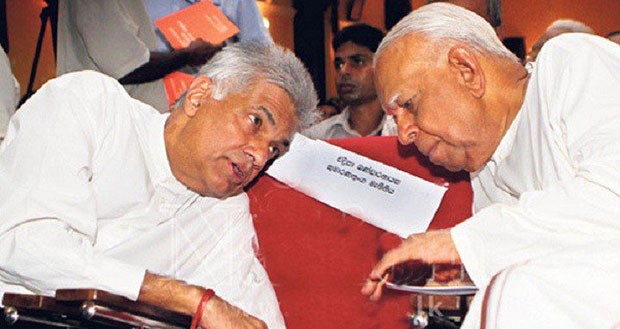


 Bodies like the CID are not organizations that fight open battles, where valour, honour, chivalry are held in high esteem. Officers serving in bodies like the CID run virtually no risk to their own lives but have the power of life or death over others. Hence there is the likelihood of such bodies attracting individuals with certain psychological tendencies. Having an opportunity work in an outfit like the CID would be the dream of every twisted sadist in society. This makes it all the more imperative to place bodies like the CID under very balanced, steady officers who can control the more Neanderthal elements that inevitably serve in such organizations. Bodies like the CID when they take on political tasks, essentially do what the Gestapo did in Nazi Germany.