Can a Mont Pelerinist Honestly Be The Prime Minister of Sri Lanka – The  US Pivots to Asia (Continued from Part 1)

November 22nd, 2015

By Gandara John

Sri Lanka’s Prime Minister, Ranil Wickramasinghe, is a member of the Mont Pelerin Society, the secret ‘Ultra-Right’ club of the White Supremacists that works hand in glove with the US.

In Part I of this article it was discussed how the Mont Pelerin Society comprising white extremists from Europe and America, with founder Von Hayek presiding, assembled in 1947 for a crucial gathering, to discuss the emerging global scenario that threatened their supremacy.

The Mont Pelerinists pledged to roll back history by wresting power from the people of Africa and Asia and retrieving the supremacist’s lost privilege of unfettered use of land, labour and capital in these two Continents.

The Mont Pelerinists planned to achieve this by launching attacks on the States in Africa and Asia, dismantling these States, disenfranchising the African and Asian people, depopulating the two Continents and installing the Corporates as the Supreme Controlling authority that would lay down the law, as would have the European Colonial States of old.

The Mont Pelerinists spelt out broadly the nature of their offensive which would target, the State, the Government of the State, the boundaries of the State and the people of the State.

 Christianity, which had lost its shine as a reason to intervene and aggress States in the Asian and African Continents , was replaced by ‘Human Rights’ considered a suitable substitute to fill the void of ‘civilizing the uncivilized.’

During the past 20 years or so the Mont Pelerinists focused their attacks mainly on Africa, attacking and weakening the structures of States in that Continent.

Recently, the US issued an ominous warning; the thrust of their attack would  change with its ‘Pivot to Asia’ policy; Sri Lanka has been described as the fulcrum in that policy.

As an avowed member of the Mont Pelerin Society Ranil Wickramasinghe may be considered a true and faithful page of the white elitists; in their world he certainly is not imputable for dishonest and treacherous conduct.

————————————————–

The attacks on the ‘States’ in Asia and Africa with an eye to eventually destroying the States  and denigrating their sovereignty were varied and would often transgress and telescope into the other targets of attack identified earlier, Governments, Boundaries and People of these States.

These attacks on the State by the Neo Feudalists included, perforating the State with new boundaries through constitutional mechanisms, heaping terrorism, conducting siege warfare (by applying economic and cultural embargos to force the State to fail), directly interfering in the domestic election processes (to install quisling regimes), replacing internal laws and systems of governance with external laws and systems, creating internal conflicts, instigating armed violence from within and without, hatching and funding ‘Arab Spring’ style protests, bad mouthing the Treaty of Westphalia, and many more. All these premeditated types of attack have had the effect of debilitating the State.

In attacking the concept of ‘Government’ in Asia and Africa the neo liberal Feudalists vociferously projected the view that ‘Government’ must shrivel and give way to the ‘Corporates’ which should exercise unfettered control over the economy.

 The fascist economist Hayek went on a tirade against Afro – Asian Nationalism decrying the Sovereign Rights of the State and declaring that the Rights of the individual need to prevail over that of the State. By so doing the Feudalists were turning the clock back on the Treaty of Westphalia and on Universal Suffrage. By agitating for limited government the Mont Pelerinists were deviously disenfranchising the people.

Stripped of State boundaries and bereft of Governments and Trade Unions to protect them, the people of Asia and Africa in this ‘Mont Pelerin’ engendered ‘One World’ are being pushed as fodder in the direct line of fire of the neo feudalists, the Corporates.

Only those confined to strictly defined areas and useful to the Plutocrats shall perdure; they would be at the mercy of these die- hard eugenists who have vowed to cull the 6.5 Billion world population to a one Billion, exterminating the rest over a period of time by inducing disease, contriving conflicts and wars, engineering famine, forcing sterilization and enforcing abortion.

The attacks by the Mont Pelerinists on the ‘people of the State’ are not confined to the ‘physical’ alone but are at the intellective level too.

At the intellective level the objective is to control the mind and influence public opinion; the Mont Pelerin Society members, who have a monopoly of the global, print, TV, electronic and social media, have littered Asia and Africa with organisations that self describe themselves as ‘think tanks’ to work on the minds of the numberless ‘hordes of peasants’; these pseudo think tanks, masquerading as intellectual institutions where research is selective, dissent frowned upon and peer review absent, are geared to manufacture the consent of the peasant and, to co-opt dissent by means attractive to the dissenter.

The Mont Pelerinists who had agreed that the ‘Corporates’ would be the instrument through which the white supremacists would establish unified control, this time at a global level, moved a notch forward when in 1948, 45 Corporate funded NGOs were given observer status in the Economic and Social Council (ECOSOC) of the UN system.

In 1996 with ECOSOC Resolution 31 the Corporates, like the proverbial camel, enlarged their domain of influence when 3900 Corporate funded NGOs were given consultative status with privileges to place items on the agenda of ECOSOC and participate in all their deliberations. To top it off, the UN Secretary General made a strong recommendation that these Corporate funded NGOs participate in all areas of work of the UN. Sri Lanka’s Corporate prone Foreign Service Brahmins preferred not to demur.

The world needs to be thankful to John Coleman a former officer of the British MI 6 who, horrified by the contents of some of the classified documents he had been privy to and had to deal with, brought out a lot of this material to the public domain. He articulated that in the New World Order the Mont Pelerinists have pledged to establish, there would be a permanent Council of non elected, hereditary Plutocrats who would self select from amongst their numbers, as of a feudal system of old; this Council would serve to be the Government of the ‘One World’.

The new Nepalese Constitution is being held up as a paradigm for Sri Lanka. Wickramasinghe is careful not to use the word Federalism – which it really is – as that is not politically correct; instead he hints at an identity based Federation of several units perforated generally along the provincial boundaries. The perforation would facilitate the breakup of the Sri Lankan State like a broken  jigsaw board, as has been planned by the Mont Pelerinists.

Nepal has been an unmitigated disaster; the State and the people have been under attack for nearly 25 years with events connected with, the murder of the monarch, the expulsion of his successor, Corporate inspired terrorism, NGO fermented Colour protests, dumping of Buddhism from its pristine position in the country, introducing a US inspired Constitution to perforate the State and the programming of the minds of Nepalese by Billy Graham type evangelical NGOs  to make irrational demands that would weaken the State. Buddhism and the Monarchy had been the glue that tightly gummed together Nepal now perforated loosely into several federated States. Nepal is coming apart from its seams, posing a threat to the stability of its neighbours, China and India.

If as planned, Sri Lanka is made a Federation, the Confederacy of Sri Lanka is made a secular unit (effectively and instantly unhorsing Buddhism from its pinnacle), the Sinhalese are stockaded into a limited number of ‘identity- based’ provincial boundaries (resulting in the 72% Sinhala majority dominance over the entire island being reduced to a minority in all the non Sinhala federal units), and the island State is perforated to several provincial boundaries, the ingredients are ripe for the Mont Pelerinists to unglue the island

With US foreign policy pivoting from Africa to Asia and the fulcrum of that pivot being identified as Sri Lanka, the future does not portend well, not only for Sri Lanka but for India too. The pivot took place on 08 Jan 15. Though initially it may seem beneficial to India, eventually it could unhinge India’s South which would seriously impede India’s naval movements from its Eastern Coast to its Western Coast and vice versa, virtually bifurcating India on its North – South axis.

In the last two decades or so, before the pivot from Africa to Asia took place, the world witnessed the attacks on the African States that badly weakened their State structures.

In the immediate five years preceding, the States in the Northern rim of Africa, extending the entire length of the Mediterranean from Morocco to Algeria, Tunisia, Libya and Egypt were attacked by the ‘Arab Spring’.

Previously it was the States in the North Eastern sea board of Africa, extending the length of the Red Sea from Sudan to Eritrea, Ethiopia and Somalia that were attacked by, terrorism, Corporate funded conflicts and economic embargos reducing these States to near failed States.

And before that it was the States in the Centre of Africa where South African and British mercenaries from ‘Executive Outcomes’ were crawling all over that Continent.

Of course in the South of Africa, Nelson Mandela took care of it for them; the man who betrayed the Black Revolution to the white elitists, with a bank balance of a near 4 Million USD at the time of his death, is projected as the face of the Revolution while the true revolutionaries like the murdered Steve Biko fade into the limbo of history.

Wickramasinghe is an avower member of the Mont Pelerin Society.

The pivot is to Asia. The Mont Pelerin Society of White extremists are committed, to disintegrating the States in Asia which includes the Protectorate of Sri Lanka.

The question posed to the Sri Lankan people, the Sri Lankan parliament and the United National Party is, Is Ranil Wickramasinghe, a fit and proper person to be the Prime Minister of Sri Lanka or for that matter even to be the leader of the United National Party?”


Exposé: President Sirisena In The Thick Of A Multi Billion Kickback Scandal

November 22nd, 2015

Courtesy colombotelegraph.com

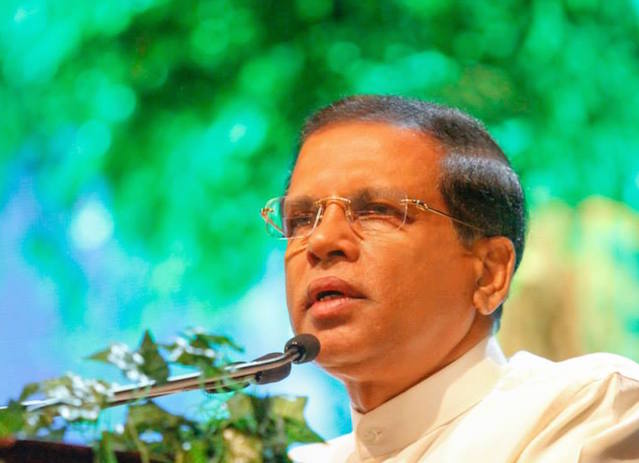
President Maithripala Sirisena has effectively violated all norms of good governance, gone back on several key election pledges including a vow to end nepotism and cronyism, and severely dented investor confidence in moves associated with a deal between the troubled telecommunication service provider Hutch and Sri Lanka Telecom (SLT), the latter now chaired by his brother Kumarasinghe Sirisena. The process revealed by the newspaper ‘Ravaya’ will no doubt disappoint the international community which saw in Sirisena a symbol of change, a champion of democracy and a harbinger of good governance.

MaithripalaKumarasinghe Sirisena is set to strike a deal that would see Hutch being bought by SLT for almost double its current market value. Colombo Telegraph learns that President Maithripala Sirisena is in the thick of this scandal which could yield kickbacks of a magnitude that would make the Central Bank Bond Issue scam seem like a petty theft.

To this end, the President, on the bidding of his brother, has appointed to the SLT Board, two ‘safe’ persons (Rohan De Silva and K.H. Wegapitiya), both former Rajapaksa loyalists and beneficiaries of the previous regime and owners of questionable track records. Rohan De Silva used to be a staunch Rajapaksa supporter who after January 8 struck up a friendship with Harin Fernando. The duo has now replaced the ‘troublesome’ Krishantha Cooray and Firo Farook. Meanwhile Thusitha Haloluwa, a person who played a key role in Maithripala Sirisena’s presidential election campaign and an outspoken political activist, was removed from the Mobitel Board of Directors. He was replaced by Heshana De Silva, a partner of Rohan De Silva and the son-in-law of Udaya Nanayakkara. He used to be a close friend of the Rajapaksas’ and is currently one Harin Fernando’s main financiers.

Hutch, which has been in the market for a while, is in the unenviable position of there being no takers. With Dialog being out of the picture, SLT remains the only viable buyer and is excellently positioned to dictate the purchasing price. Experts in the industry claim that Hutch has been unable to sell even at US $ 60 million. Sirisena, however, wants to start bidding at around US$ 95 million envisaging a purchase in the region of US $ 130 million.

Interestingly, this deal was first dreamed up during the Rajapaksa Presidency. However, Lalith De Silva, the former Group CEO hesitated because there was division in the Board with regard to the then upped-price, which at the time was in the region of US $ 135 million. Some Board members thought that the purchase should actually be at half this figure.

Colombo Telegraph learns that these moves have been vehemently opposed by the SLT Board of Directors. Sirisena, however, has acted in an authoritarian manner insisting that his decision must stand regardless of majority opinion.

It now appears that the scam has been plotted for quite some time now, dating back to the appointment of the President’s brother as SLT Chairman.

Despite pledges to put an end to nepotism, President Maithripala Sirisena appointed his bother Kumarasinghe as SLT Chairman merely days after assuming office. This was done without even informing the subject minister at the time, Mangala Samaraweera.

The man’s incompetence made worse by insufferable arrogance became apparent to all very quickly. Kumarasinghe is not averse to dropping his presidential brother’s name whenever necessary. His chairmanship has been marked by a determination to protect staunch loyalists of the previous regime. For example, he did his utmost to protect the incumbent CEO, Lalith Silva, a political appointee and a Rajapaksa loyalist. Ranjith Rubasinghe, the man appointed by the previous regime as CEO-Mobitel and a personal friend of Namal Rajapaksa, was suspended considering a plethora of allegations against him. Sirisena consistently defended him and essentially scuttled the investigation.

The Board finally decided to bring in Dileepa Wijesundera as the Group CEO. Wijesundera is a professional and his only known political connection is his friendship with Mangala Samaraweera.

Undeterred, Sirisena brought in K.H. Wegapitiya to the Mobitel Board even without informing the minister in charge at the time, Mangala Samaraweera. Wegapitya, after being made a Director of Mobitel, attempted to sell generators to Mobitel in a clear case of conflict of interest. Wegapitiya maintains that this was before he was appointed to the Mobitel Board. However Colombo Telegraph learns that Wegapitiya threatened the Financial Controller who objected to this and forced him to resign. This individual had also given evidence against Rubasinghe. Wegapitiya is also facing charges for fraud in a number of court cases.

It is also on record that Wegapitiya behaved in a way that intimidated the Malaysian directors, refusing to allow them to speak. It must be mentioned that the Malaysian company Maxies owns 44% of SLT and that the purchase of the share volume constitutes the single biggest foreign investment in Sri Lanka.

Wegapitiya even told the Mobitel staff that Mobitel will not bow down to the SLT Board decisions: ‘mama kaduvak gaththoth le nethiva navathinne naha….pistolayak gaththoth….pathuram paavichchi karanne nathuva navathinne naha’ (if I pick up a sword I won’t stop until there’s blood on the blade; if I pick up a pistol I will not put it down until I use the bullets). Needless to say, he had the fullest backing of the Chairman.

Some of the Malaysian directors had made the following telling observation: ‘We thought the Rajapaksas were bad, but what we see now is even worse!’

Around this time the SLT Board had taken a collective decision that the Group CEO should be responsible for Mobitel as well, a fully owned subsidiary of SLT. The advantages of working together to make maximum use of synergies were considered in this decision. Wegapitiya, at this point, quite in contravention of protocol did his utmost not to implement the decision.

Wegapitiya was subsequently sacked from the Mobitel Board because the Malaysians insisted that they fond his behavior ‘uncomfortable’. Wegapitiya, however, told the ‘Ravaya’ newspaper that he is unaware that he was removed from the Mobitel Board of Directors.

Meanwhile, Kumarasinghe Sirisena , when he realized that the Hutch deal could run into trouble due to opposition from the Board, left no stone unturned until the Board could be reconstituted with directors who could be counted on or could be persuaded to keep their peace.

Opposition from Prime Minister Ranil Wickremesinghe was Kumarasinghe’s first big headache. Wickremesinghe, concerned about the complaints he had about SLT being mismanaged and that the foreign directors were unhappy, proposed to appoint Krishantha Cooray as the Deputy Chairman cum Managing Director. So he summoned the entire Board to Parliament and had a discussion, making this suggestion. When the meeting was announced Kumarasinghe went around saying that the PM and Malik Samarawickrama were trying to orchestrate the Hutch deal for personal benefit. So although having agreed to Wickremesinghe’s proposal, he later refused to implement it on the basis that appointing Cooray would undermine him and his authority. This was when he ran to his brother President Maithripala Sirisena.

The truth is that Kumarasinghe need not have worried for there were top ranking UNPers who were actually on his side. They first got Ranil Wickremesinghe to relieve Mangala Samaraweera of the telecommunications portfolio. His replacement, Harin Fernando, is younger and a first time minister. Events have proven that he would bow down to seniority.

The operators were already at work. Alex Lovel, an investment advisor, who was tasked to hatch the deal during the Rajapaksa regime, maneuvered to a position where he was speaking to both SLT and Hutch. Knowing all the parties, including those among the Prime Minister’s men and those of the President’s not averse to kickbacks, Lovel has been a key facilitator, working closely with a Singaporean broker.

Full Story

https://www.colombotelegraph.com/index.php/expose-president-sirisena-in-the-thick-of-a-multi-billion-kickback-scandal/

ජීවිතයේ   අරුත  සොයා අඳුරේ අතපතගෑම

November 22nd, 2015

ධර්මසිරි සෙනෙවිරත්න

උපතින් බෞද්ධයන් වු බොහෝ අය අද බටහිර මිෂනාරී  අධ්‍යාපනය  මගින්  බෞද්ධ කමින් ඈත්කර ඇත  බටහිර කාමසුඛල්ලිකානු යෝගයෙන්  මන්මත්වූ ඔවුහු  එයම ජීවිතයේ යථා  අර්ථය  ලෙස දකිති එමෙන්ම පරම – අර්ථය ලෙස දකිති . බටහිරයන විසින් ඉගැන්වූ දෙයින් ඉහල තනතුරු ලබා ගත විට බොහෝ බෞධ්ධයින්ට වඩා වැදගත් වන්නේ බුදුදහම නොව තමන්ට එම අධ්ධ්යාපනය නිසා ලැබී ඇති වරප්‍රසාද රක ගැනීමය් . එනිසාම  නිස්සාර ජීවිතයේ අරුත  මේ මේයය ලොවට දක්වමින්  තමන් ජීවත්වන”’ ලෝකය ”’  රක ගැනීමට ඔවුහු උත්සුකවෙති . එහිදී එම ප්‍රයත්නයෙන් බෞද්ධ දර්ශනය  විකුර්ති වුවත් ඔවුන්ට කමක් නැත .
                                           අපට ඇති දත් 32 ටිකෙන් ටික  දිරා පත්වන විට  අපටත් වඩා  ජීවිතියේ ජරාව හා අනියත බව  දත්දොස්තරලා දකිති.  එවන් ජීවිතය දුකක්මය . පෙර එක රජෙක් නර කෙසක් දුටුවිටම  තම අරුත් සුන් ජීවිතය  නතරකර ගැනීම සඳහා  තපසට ගියේය  දුක්බර ජීවිතයක්  පවතින්නේ ඉපදුනොත්ය. එනිසා ඉපදීම නතර කිරීම බුදු දහම විසින් අනුදැන ඇත .  එසේ අනු දන ඇත්තේ  ජීවිතයේ අරුතක්, යතා අරුතක් හෝ පරම අරුතක්  හෝ නැති නිසාය. බටහිරයන් අනුදත්අය ජීවිතයේ අරුතක්  ගැන කියන්නේ  බුදු දහමේ දර්ශනයෙන් ඔවුන්ගේ  පැවැත්මට බාධා වන නිසාය
                                   මේ අරුත් සුන් ජීවිතය  නතර කර ගැනීම සඳහා  ඉපදීම නැතිකිරීමේ ක්‍රියා මාර්ගයට අප්‍රමාදව  අවතීර්ණ වීම බෞධ්ධයන්ගේ  යුතුකමය නොඑසේව  මුලින් කී බෞද්ධ අබෞධ්ධයන්ගේ  ප්‍රලාප වලට  රවටුනහොත් ඔවුන් ට නිවන් මග ඇහිරෙනු ඇත .  බෞද්ධ වේශයෙන් පැමිණෙමින්  තමන්ගේ අචාර්ය මහාචාර්ය පට්ටම් උපයෝගී කරගෙන  අහිංසක බෞද්ධයන්  නොමග යැවීමට  බොහෝඅය ඉදිරියට එමින් ඇත .ඔය කියන ජීවිතයේ අර්ථය  බඩබැදගත් බටහිරයන් නිසා  අද  මුළු ලෝකයම  විනාශය කරා වේගයෙන් යමින් ඇත . ජීවිතයේ  අරුත සොයමින්  එය විඳිමින් ලෙවකමින් උන්  අප අඝාදයට  දක්කති. මහලු වයසේදී ඉබේ දත් ගැලවී යාමටත් පෙරම  මොවු මගෙත් ඔබෙත් දත් තිස් දෙකම  අකාලයේ දීම  ගලවා දමන්නට   මේ ජීවිතයේ අර්ථය සොයා යන ගමන යොදා ගන්නවා ඇත .
                                                                           මහාචාර්ය නොවෙතත් තවත් දේශපාලන  දත් දොස්තර වරයෙක්  ඇත . ඔහුටනම් ජීවිතයේ   අර්ථයවන්නේ  කෙසේ හෝ බෙදුම් වාදීන්ට හා බටහිරයන්ට කත අදිමින්   ජාතිකවාදීන්ගෙන්  පලිගැනීමය . මේ දතා ගමකෑව කතාවක්  නොබෝදා අසුනේය . කොය් දතා ගෙනුත් පරිස්සම් වෙමු . 

පක්‍ෂ නායක රහස්‌ හමුවක්‌ පිල් මාරුවක පෙර නිමිති?

November 22nd, 2015

දිවයින දේශපාලන වාර්තාකරු

වත්මන් ආණ්‌ඩුව පෙරළා දමා නව ආණ්‌ඩුවක්‌ පිහිටුවීමට එකිනෙකට එරෙහි බලවේග දෙකක්‌ මේ දිනවල වෙන වෙනම සාකච්ඡා අරඹා ඇතැයි විශ්වාස කටයුතු ආරංචි මාර්ග ‘දිවයින’ට කරුණු හෙළිදරව් කර සිටියි.

ජනාධිපතිවරයාගේ සිත දිනා සිටින එක්‌සත් ජාතික පක්‍ෂයෙන් තේරී පත්වූ රජයේ බලවත් ඇමැතිවරු දෙදෙනෙක්‌ සම`ග එක්‌සත් ජාතික පක්‍ෂයේ තරුණ නායකයෙක්‌ මේ එක්‌ සාකච්ඡාවකට මුල්වී ඇති අතර එක්‌සත් ජාතික පක්‍ෂයෙන් කලකිරී සිටින තරුණ මන්ත්‍රීවරු හා ශ්‍රී ලංකා නිදහස්‌ පක්‍ෂයේ ජනාධිපතිවරයාගේ නායකත්වය පිළිගත් මැති ඇමැතිවරු සැලකිය යුතු පිරිසක්‌ දැනට මේ සාකච්ඡාව තුළ ගොනුවී සිටිතැයි ආරංචි මාර්ග පවසයි.

මේ සාකච්ඡාව සිදුවන බව කල්තියා වටහාගත් වත්මන් අගමැතිවරයා නියෝජනය කරන එක්‌සත් ජාතික පක්‍ෂයේ බහුතර පාර්ශ්වය ද එම අනතුරෙන් ගැලවී, දිගින් දිගටම රජය රැක ගන්නට ශ්‍රී ලංකා නිදහස්‌ පක්‍ෂයේ මෛත්‍රී විරෝධී කණ්‌ඩායම සම`ග වෙනම සාකච්ඡාවක්‌ද පවත්වමින් සිටින බව ආරංචි මාර්ග වැඩිදුරටත් කරුණු හෙළිදරව් කර සිටියි. දැනට මෙම පාර්ශ්ව දෙක එකිනෙකාට රහසිගතව බිම් මට්‌ටමේ මූලික සාකච්ඡා වාර කිහිපයක්‌ පවත්වා ඇති අතර ඒවායේ සාර්ථකත්වය මත නුදුරේදීම ඒ ඒ පාර්ශ්ව වල නායකයෝ එකිනෙකා හා හමුවීමටද නියමිත බව ආරංචි මාර්ග කියා සිටිති.

Sri Lanka’s ex-navy chief denies operating secret jail

November 22nd, 2015

Courtesy THE WEST AUSTRALIAN

Colombo (AFP) – Sri Lanka’s former navy chief on Saturday denied operating secret jails during the country’s 37-year ethnic war, local media reported, after UN experts urged an investigation into what they said were torture chambers.

Retired Admiral Wasantha Karannagoda rejected UN experts’ claims that a secret prison hidden inside the main naval base in the island’s northeast was used to torture minority Tamil prisoners, under his command.

Karannagoda said the “prison” hidden inside the base in the port city of Trincomalee was actually a British World War II air raid shelter used to house breakaway Tamil rebels collaborating with the military.

“The navy had no option but to accommodate them in previously unused buildings. We used British-time air raid shelters,” he was quoted by the local English-language Island daily as saying.

“We didn’t operate torture chambers in Trincomalee.”

The main Tamil National Alliance opposition demanded in parliament Saturday that Karannagoda be arrested for his alleged involvement, demanding an investigation.

“Today, he is walking free,” legislator M. A. Sumanthiran said. “How is it possible. He should be arrested and questioned.”

Sri Lanka’s former regime consistently denied the existence of secret jails, but the new administration which came to power in January, has agreed to investigate.

A court heard last month that at least 11 Tamil students had been held in the facility illegally between 2008 and 2009 and subsequently killed.

However, it was the UN panel which for the first time characterised it as a “secret illegal prison”, saying it toured the 12-cell underground jail hidden inside the sprawling naval base in Trincomalee.

Sri Lankan authorities are already conducting a separate murder investigation into allegations that sailors close to Karannagoda abducted Tamil youngsters and extorted money from their families.

The main suspect in that case is a close aide of Karannagoda who was made ambassador to Japan by the former regime, but recalled to Sri Lanka by the new government earlier this year.

President Maithripala Sirisena’s government has promised to punish war criminals and set up a truth commission to help heal the wounds of the conflict that ended in 2009, when the military crushed Tamil rebels.

Govt lifts ban on several pro-LTTE outfits

November 22nd, 2015

Courtesy The Daily Mirror

By a gazette extraordinary issued on Friday, the Sri Lankan government lifted the ban on several outfits and individuals previously thought to have been working for the LTTE.

On March 21, 2014, 16 organizations and 424 individuals were proscribed under the UN Act No: 45 of 1968. But the latest gazette notification bans only eight organizations and 155 individuals.

The de-listed organizations are: Global Tamil Forum (GTF); British Tamil Forum (BTF); National Council of Canadian Tamils (NCCT); Tamil Youth Organization (TYO); World Tamil Coordinating Committee (WTCC); Canadian Tamil Congress (CTC); Australian Tamil Congress (ATC); Tamil National Council (TNC).

Organizations which are still banned are: the Liberation Tigers of Tamil Eelam (LTTE); Tamil Rehabilitation Organization (TRO); Tamil Coordinating Committee (TCC); World Tamil Movement (WTM); Transnational Government of Tamil Eelam (TGTE); Tamil Eelam Peoples’ Assembly (TEPA); World Tamils’ Relief Fund (WTRF) and Headquarters Group (HQG).

Enunciating the Sririsena government’s policy on proscriptions, Foreign Minister Mangala Samaraweera had said in parliament on March 18: “Reviewing this list of individuals and entities is an important exercise at this juncture when the government of President Sirisena is seriously committed to expediting the reconciliation process.”.

The initial proscription by the Rajapaksa government was done in haste, and was not subject to a rigorous process of assessment and verification, the Minister pointed out.

“It was done to build up hysteria about LTTE regrouping. There was hardly any tangible evidence to link them to the LTTE. Some of those sought had died,” he said.

The present government’ calculation is that Lankan law enforcement and intelligence agencies will now be able to target their resources more accurately and purposefully. The government is legally committed to reviewing the list annually and the expectation is that organizations and individuals who publicly abjure separatism and violence will be de-listed.

Canada accounts for the single largest number of wanted persons. 22 of the wanted are in Canada. Denmark comes second with 17; Sri Lanka 14; UK and the Netherlands account for 12 each; France 11; Germany 8; India 7; Italy 4; Malaysia 3; Norway 2; US, 1 and Thailand 1. The wanted man in the US is Visuvanathan Rudrakumaran, head of the Transnational Government of Tamil Eelam (TNGTE). Interpol Red Notices stand against 26. The two Sinhalese among the wanted are Gunaratna Bandula Gajaweera of Akkaraipattu and A.Chaminda Darshana of Trincomalee. The latter is believed to be in India.

Apart from Gajaweera, others believed to be hiding in India are: Sivaganasundaram Sivakaran; Aganila alias Gemini; Amuthan; Suresh alias Kapil Msater; Rajendran Murthy; Velupillai Revathan; Vigneswaran Parameswari.

It is significant that the Gazette notification de-listing half of the proscribed organizations and 63 percent of the proscribed individuals, was issued a day ahead of the visit to Colombo of Samantha Power, the US Permanent Representative in the UN in New York, an expert on genocide and an advisor to President Barack Obama.(New Indian Express)


– See more at: http://www.dailymirror.lk/96375/govt-lifts-ban-on-several-pro-ltte-outfits?#sthash.rd3aAfL3.dpuf

Sri Lanka chairing key UN meeting on disarmament welcomes commitment by states to seek a consensus on Lethal Autonomous Weapons

November 21st, 2015

Permanent Mission of Sri Lanka in Geneva

Sri Lanka’s Permanent Representative to the UN in Geneva Ambassador Ravinatha Aryasinha who presided over the 121 member meeting of the High Contracting Parties on the Convention on Certain Conventional Weapons(CCW), has said “the stepping up of the mandate, to go beyond mere discussions of the possible implications of lethal autonomous weapons systems (LAWS), to requesting States parties to agree on recommendations as to what should be done at the 2016 Fifth Review Conference of the CCW, constitutes an important step forward.”

The CCW Meeting held over the past week decided to, “convene an informal meeting of experts of up to five days during the week of 11 to 15 April 2016 to discuss further the questions related to emerging technologies in the area of lethal autonomous weapons systems (LAWS), in the context of the objectives and purposes of the Convention. The Chairperson of the meeting of experts will submit a report in his personal capacity to the 2016 Fifth Review Conference of High Contracting Parties to the Convention. The meeting of experts may agree by consensus on recommendations for further work for consideration by the 2016 Fifth Review Conference”.

Ambassador Aryasinha , at the opening of the meeting had called on State Parties for an enhancement of the mandate of the meeting of experts on LAWS for next year, to enable a consensus on the subject ahead of the 2016 Fifth Review Conference of the CCW.

Addressing a dedicated discussion within the CCW agenda on Lethal Autonomous Weapons, Sri Lanka’s delegate to the Session Mrs. Mafusa Lafir, Second Secretary of the Sri Lanka Mission in Geneva, noted that Sri Lanka wishes to see the Convention on Certain Conventional Weapons (CCW) move beyond, where a dialogue among States would be at the centre of any future discussion on Lethal Autonomous Weapons Systems (LAWS), and that such a process will help in ensuring clarity on the concerns of States, as well as to create a matrix of common elements which could be derived from the debate. She had noted that the concerns over the concept of ‘dual use technology’ in the nuclear field also has relevance  to the issue of LAWS and that it is important to consider safeguards that can help avoid the abuse and unintended consequences of this technology.

Other issues under discussion at the CCW session were the humanitarian impact of anti-vehicle mines (AVM); issues of compliance with the Convention and its Protocols, and the preparations for the Fifth Review Conference on CCW in 2016.

The meeting of experts on LAWS will be chaired by Ambassador Michael Biontino of Germany in April 2016, and the CCW Fifth Review Conference will be presided over by Ambassador Tehmina Janjua of Pakistan in December 2016.

Geneva

18 November 2015

ත්‍රස්ත භීතිය රජයන යුගයක් යලි ඉල්ලන් කෑම

November 21st, 2015

එස්. අකුරුගොඩ

ත්‍රස්තවාදයේ ආදීනව පැරිසියේ ප්‍රහාරවලින් පසු යලිත් බටහිර හා බටහිරගැති මාධ්‍යය ජාලයන් හරහා ලොව පුරා රැව්දෙන්නට පටන්ගෙන තිබේ.  එහෙත් ඒ දිනවලම ලෙබනනයේ සිදුවූ ත්‍රස්ත ප්‍රහාරය, පසු ගිය මස ඇමරිකානු හමුදා ඇෆ්ගනිස්තානයේ රෝහලකට බෝම්බ දමා සිදුකල මිනිස් ඝාතන,  ඊට සති කිහිපයකට පෙර සව්දි අරාබි-ඇමරිකානු හමුදා සoධානය යේමනයේ රෝහලකට බෝම්බ දමා සිදුකල මිනිස් ඝාතන ආදිය නිකම්ම ප්‍රවෘත්ති කණ්ඩයකට පමනක් සීමාවිය.

කෙසේ වෙතත් ශිෂ්ට සම්පන්න ලෝකය ප්‍රoශයට එල්ලවූ මෙම බියගුළු ත්‍රස්ත ප්‍රහාරය මෙන්ම ලෝකයේ අනෙකුත් රටවල සිදුකරන සියලුම ත්‍රස්ත ප්‍රහාර රටේ තරාතිරම (ලොකු, කුඩා, බලවත්, දුබලවත් ආදී වසයෙන්) නොබලා එකහෙලාම හෙලාදකිනු නොඅනුමානය.

ත්‍රස්තවාදීන් අද ලොව පුරා මෙතරම් බලවත් විමට මූලික වි ඇත්තේ තම ගෝලීය අරමුණු ඉටුකර ගැනීම උදෙසා ඇමරිකා එක්සත් ජනපදය, ප්‍රoශය, බ්‍රීතාන්‍යය ඇතුලු බටහිර රටවල් ද තම කලාපීය හා දේශපාලනික අරමුණු ඉටුකර ගැනීම උදෙසා අප අසල් වැසි ඉන්දියාව වැනි රටවල්ද ත්‍රස්තවාදීන් පිලිබඳව අනුගමනය කරන දෙබිඩි ප්‍රතිපත්තිය යි.

ඇෆ්ගනිස්ථානයේ සිටි සෝවියට් හමුදාවන්ට එරෙහිව සටන් කිරිම සදහා1970 දී අමෙරිකා එක්සත් ජනපදය  පුහුණුකොට යෙදවූ ඔසාමා බින් ලාඩන් හා ඔහුගේ අනුගාමිකයින්ගෙන් ඇමරිකාව 2001 සැප්තැම්බර් 11 දී ඉල්ලන් කැවේය.

අපේ හමුදාවන්ට එරෙහිව සටන් කිරිම සදහා 1983 දී ඉන්දියාව පුහුණුකොට යෙදවූ ප්‍රභාකරන්ගේ හා ඔහුගේ අනුගාමිකයින්ගෙන් ඉන්දියාව1991 මැයි 21දා ඉල්ලන් කැවේය.

පැරිසිය, ලොව පුරා විසිරී සිටින ත්‍රස්ත කණ්ඩායම්ල ‍ක්‍රියාකාරී කේන්‍ද්‍රස්ථානයක් බව රහසක් නොවේ. ඒ අනුව අද ත්‍රස්ත භීතියෙන් පෙලෙන ප්‍රoශය, බ්‍රීතාන්‍යය ඇතුලු බටහිර රටවල් වල පාලකයන් කරඇත්තේ ද එක්තරා විදියක ඉල්ලන්  කෑමක් බව අමුතුවෙන් කිවයුතු නොවේ.

බටහිර ගැති අපේ පාලකයෝද විවිද අවස්ථාවල ත්‍රස්තවාදීන්ගෙන් ඉල්ලන් කෑ අවස්ථා තිබේ. වරක් ‍ ප්‍රේමදාස ජනාධිපතිවරයා කොටින්ට ආයුධ දී ඉල්ලන්  කෑ වේය.   එල්.ටී.ටී ත්‍රස්තවාදීන් ට ඊනියා ‘පැකේජ්’ දී සනසවන්නට ගොස් චන්ද්‍රිකා ජනාධිපතිවරිය ඇසක් අහිමිකර ගනිමින් ඉල්ලන්  කෑ වේය.   

එල්.ටී.ටී ත්‍රස්තවාදීන් සමඟ ගිවිසුම් ගසමින්, ඔවුන්ගේ පාලන ප්‍රදේශ පිළිගනිමින්, ත්‍රස්තවාදීන් රටේ ආරක්ෂක හමුදා සමඟ සමතත්වයේ ලමින්, ගුවන් හමුදාව ලවා ඔවුනට සියලු ආරක්ෂාව සහිත ගුවන් ගමන් පවා සලසමින්, රටේ ආරක්ෂක ලේකම්වරයා ත්‍රස්තවාදී නායකයින්ට ‘මචo’ කියා අමතමින්, රටේ පොලීසිය මිලේනියම් සිටි වැනි හමුදා බුද්ධි අoශ ඒකකයන් වටලමින් ත්‍රස්තවාදීන් පිනවීමට ගොස් ඉල්ලන් කෑ හැටිත් අද බොහෝ දෙනෙකුට මතක නැති ගානය.

සුප්‍රකට 9/11 ත්‍රස්ත ප්‍රහාරයත් සමගම එවකට ඇමරිකානු ජනාධිපතිව සිටි ජෝර්ජ් බුෂ්ගේ ප්‍රකාශය අනුකරණය කරමින් ප්‍රoශ ජනාධිපතිවරයාද ත්‍රස්තවාදීන්ට එරෙහිව යුද්ධ ප්‍රකාශකර ඇත. ප්‍රoශ ජනාධිපතිවරයාගේ සංත්‍රාසය අන් කවරෙකුටත් වඩා ශ්‍රී ලoකාවාසී අපට දැනෙන්නේ අප 30 වසරක් පුරාම එවැනි සංත්‍රාසයෙන් දිනපතාම පෙළුන බැවිනි.

එසේවුවද, බටහිර රටවල් අපිට නොකියා කියන දෙයක් නම් මිනිස් ජීවිත යනු ඔවුන්ගේ (බටහිරයන්ගේ) ජීවිත පමණක් බැවින් මිනිස් ඝාතන ප්‍රහාරයන් වැලැක්වීම සදහා යුද්ධ කිරීමට ඔවුනට පමණක් සාධාරණ අයිතියක් ඇතිබවය. ඔවුන්ගේ වර්ගකිරීම අනුව බලවත් බටහිරයන්ට පහර දෙනවිට ත්‍රස්තවාදියා, ‘ත්‍රස්තවාදියෙකු’ වේ. අපි වැනි කුඩා රටකට පහර දෙනවිට ත්‍රස්තවාදියා ‘සටන් කාමියෙකු’වේ.

ඒ බව සනාථ කරමින්, අසූව දශකයේ මුල් භාගයේ දී යැoකි ඩිකී නමින් විරුදාවලී ලත් බටහිර ගැති ජනාධිපතිවරයෙක් අපට සිටියදීත්, අප රටේ ත්‍රස්ත ප්‍රහාරයන්ට ලක් වෙමින් සිදුවූ ජීවිත හා දේපල විනාශයන් බටහිර රටවල් සත පහකට තරම්වත් ගනන් ගත්තේ නැත.

ඔවුන් අපේ පාලකයින්ට දිගටම කීවේත් කියා දුන්නේත් ත්‍රස්තවාදීන් සමඟ ඊනියා සාම ගිවිසුම්, සුනාමි ගිවිසුම් ආදිය ගසන සැටි මිස ත්‍රස්තවාදීන්ගේ මිනිස් ඝාතන ප්‍රහාරයන් වැලැක්වීම සදහා යුධ වැදීමට නොවේ. අද මෙන්ම අසූවේ දශකයේ සිට 2005 වන තෙක්ම අපේ පාලකයින් මෙන්ම පාලිකාවද කලේ බටහිරයන්ගේ පදයට නැටීමය.

එදා 2009 අ‍ප්‍රේල් මස ත්‍රස්තවාදී නායකයින් මුදාගැනීමේ අරමුනෙන්,  ආරක්ෂක හමුදා මෙහෙයුම් නතර කරන ලෙසට බල කිරීමට පැමිණි ප්‍රoශ හා බ්‍රීතාන්‍යය විදේශ ඇමති වරුන්ගේ පදයට මහින්ද රාජපක්ෂ ජනාධිපතිතුමා ඇහුම්කන් දුන්නේ නම් අද අප රටේ තත්වය කෙබඳුවේද? රට ත්‍රස්තවාදයෙන් මුදවාගත් මහින්ද රාජපක්‍ෂ පරාජය කොට තමන්ගේ පදයට නටන රෑකඩ පාලනයක්  බිහි කිරීම බටහිරයන්ගේ හා අසල්වැසි ඉන්දියාවේ කුමන්ත්‍රණයක ප්‍රතිපලයක් බව අද රහසක් නොවේ.

මෙම රෑකඩ දේශද්‍රෝහීන් එක්සත් ජාතීන්ගේ සමුළුවේදී තමන්ගේම රටේ ත්‍රිවිද හමුදාවට එරෙහිව යුද්ධ අපරාධ චෝදනා නගමින් රටට එරෙහිව යෝජනාවක් සම්මත  කරගනී.

තවද, එක්‌සත් ජාතීන්ගේ දූත මණ්‌ඩලය ත්‍රිකුණාමල නාවික හමුදා  කඳවුර පරීක්‍ෂා කර එහි වධකාගාරයක්‌ තිබූ බවට මුළු ලොවටම ප්‍රකාශ කිරීමට රහස් පොලීසියේ සහයද ලබා දෙමින්, දිවි පරදුවට තබා සටන්කොට ත්‍රස්තවාදීන්ගෙන් රට බේරාගත් අපේ හමුදාවන් පවාදෙයි.

බටහිර රටවල්, ත්‍රස්තවාදීන් පමණක් නොව ත්‍රස්තවාදියෙකු යයි සැක කරන සෑම ප්‍රානියෙකුම පරලොව යවද්දී,  වත්මන් දේශද්‍රෝහී පාලනය තම කෙටි කාලීන පැවැත්ම ගැන පමනක් සිතා දරුණු ප්‍රහාර වලට වග කිවයුතු කොටි ත්‍රස්තවාදීන් නිදහස් කරමින් සිටී.  කොටි ත්‍රස්තවාදීන් නිදහස ඉල්ලා උපවාස කරති. නිදහස් වී යන මෙම ම්ලේච්ඡයින් යලි සන්නද්ධ නොවේයයි තිබෙන සහතිකය කුමක්ද?

වත්මන් පාලකයින් කොටි ත්‍රස්තවාදීන් හා රන විරුවන් පිළිබඳව දක්වන අදූරදර්ශී ආකල්පය අත නොහැරියොත් හෝ පරගැති පාලනයේ වෙනසක් සිදු නොවුවහොත් රට යලිත් 2009 ට පෙර පැවති ත්‍රස්ත භීතිය, සංත්‍රාසය රජයන යුගයක් ඉල්ලන් කෑම වැඩි ඈතක නොවේ.

එස්. අකුරුගොඩ

Nilaveli Beach Today

November 21st, 2015

By Dr. Tilak S Fernando

 Nilaveli is known as the ‘ open -land of the moon-shine’. Its coastal resort lies approximately 15-16 km North-West of Trincomalee District. One of its main attractions, once upon a time, was its long and sandy beaches and not being overcrowded. This very reason earned its name as ‘the open land of the moonshine’ and became one of the most sought out tourist destinations in the world.

nilaweli01

The tourism had a rough ride during the prolonged 30-year-old terrorist war between the LTTE Tamil Tigers (specially the Sea Tigers controlling this coastal belt) and the Sri Lanka security forces. Added to such misery, the merciless Tsunami managed to decline the use of Nilaveli beaches until the war ended in 2009.  From 2010 onwards, there has been a significant increase in the number of tourists travelling once again to the East Coast of Sri Lanka that had been denied for many years. Of late, Nilaveli has become the cynosure of tourists to Sri Lanka as well as for the locals to visit the long and clean sandy beaches of Nilaveli that stretched for miles.

To accommodate such large numbers of tourists, many star hotels and other guest rooms have sprung up after the elimination of (sea) tigers from the area which are seen  from the town centre up to the beaches. It is habitual for Sri Lankans generally to litter the environment as a rule wherever they go on picnic etc., which contributes to the pollution of the entire environment. Some critics say the habit forming should take place from the kindergarten where the small kids should be taught to pick up even a tiny piece of paper when they see on the ground and put them into a nearest dustbin.

In such a climate of people accepting to litter anywhere they like as the ‘ done thing’ especially at public places where people gather it adds to an additional problem for the authorities to clear; in this regard authorities, especially in tourist areas such as Nilaveli beach should be concerned  and need to pre-plan and execute their far thinking programmes to eliminate unwarranted pollution. Be it the local authority or the Tourist Promotion Bureau, the onus falls on the authorities to keep a close eye on the environment bearing in mind that tourist visit Sri Lankan beaches to relax in a clean environment.

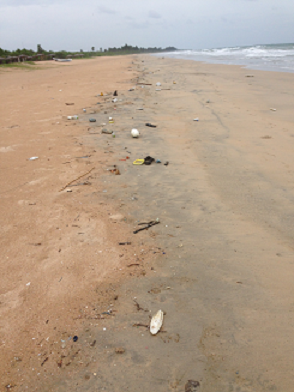
The unfortunate situation that has befallen on this long sandy beach belt is that today it is deteriorating progressively and becoming a dumping yard for litter. Within a matter of weeks, from 31 August 2015 to 26th October 2015, what the writer saw and experienced was indescribable and horrendous.  During a walk up to 1.5 kilo meters from the Nilaveli Beach Hotel and the adjoining new Anilana Hotel, the whole stretch of this long beach was totally littered with all kinds of empty bottles, broken shoes, the odd slippers etc. In other words, a clean beach once enhanced with seashells and soft sand has today become an indecorous display.

Part of this problem lies with the large number of local tourists who visit the beaches and clutter the place in a selfish manner. On the other hand, in the absence of continuous waste bins along the beach (at least on the private beach areas behind each hotel), and also by not making the hotels responsible for maintaining the beach area immediately behind their compounds, will only aggravate the present litter problem to a greater extent. The main drawback appears to be that beyond these star hotel complexes sign boards erected indicate viz: you are entering a private beach beyond this point”! The hotel staff maintain that when they appeal to visitors to refrain from littering the beach they are constantly challenged to  ‘mind their own business’ and reminded the beach area beyond their boundaries does not belong to any hotel but open to the public’!

It is therefore high time that the authorities take some urgent and remedial action not to allow this world-renowned sandy beach becoming a dumping and ugly site soon  which will chase the tourists away! Perhaps the deployment of tourist police on Nilaveli beaches will help to stop the fast deteriorating situation that will definitely affect the tourist industry as a whole.

tilakfernando@gmail.com


එක්‌සත් ජාතීන්ගේ දූත මණ්‌ඩලය ජාතික ආරක්‍ෂාවට මැදිහත් වෙයි

November 20th, 2015

කීර්ති වර්ණකුලසූරිය උපුටා ගැන්ම දිවයින
ලොව කිසිම රටක්‌ සිය ආරක්‍ෂක හමුදා මූලස්‌ථානයක්‌ විදේශීයන්ට විමර්ශනය කිරීමට ඉඩ දෙන්නෙ නැත.
එහෙත් ශ්‍රී ලංකා ආරක්‍ෂක හමුදා ඉතිහාසයේ මුල්වරට එක්‌සත් ජාතීන්ගේ කණ්‌ඩායමක්‌ ත්‍රිකුණාමල නාවික හමුදා මූලස්‌ථානයට පැමිණ වධ කඳවුරක්‌ තිබේදැයි පරීක්‍ෂා කළහ.
මෙම එක්‌සත් ජාතීන්ගේ දූත කණ්‌ඩායම ත්‍රිකුණාමල නාවික හමුදා මූලස්‌ථානයට ගෙන ආවේ රහස්‌ පොලිසියයි.
එකී දූත කණ්‌ඩාම නාවික හමුදා මූලස්‌ථානයේ පරණ ගොඩනැඟිල්ලක්‌ පරීක්‍ෂා කර කොළඹට ගොස්‌ බරපතළ ප්‍රකාශයක්‌ කරනු ලැබීය. අපි බිම්මහලක තිබූ රහසිගත වධකාගාරයක්‌ සොයා ගත්තා. මෙහි කුටි 12 ක්‌ පමණ තිබූ බව අපි දුටුවා යෑයි දූත කණ්‌ඩායමේ සාමාජික ඒරියල් ඩ්‍රලිම්ස්‌කි පළ කළේය.
ශ්‍රී ලංකා හමුදාව රහසිගත වධකාගාර පවත්වාගෙන යන බවට ද්‍රවිඩ සන්ධාන හිටපු මන්ත්‍රී සුරේශ් ප්‍රේමචන්ද්‍ර චෝදනා කර තිබුණි. රජය එම චෝදනාව ප්‍රතික්‍ෂේප කළේය. මේ පසුබිම මැද එක්‌සත් ජාතීන්ගේ දූත කණ්‌ඩායම ත්‍රිකුණාමල නාවික කඳවුරට ගොස්‌ පරීක්‍ෂා කර ඉහත කී බරපතළ ප්‍රකාශය කළේය.
නාවික හමුදා කඳවුරක්‌ යනු ජාතික ආරක්‍ෂාවට සම්බන්ධ කේන්ද්‍රස්‌ථානයකි. එවන් කඳවුරක්‌ පරීක්‍ෂා කිරීමට එකී දූත කණ්‌ඩායමට ඉඩ ලැබුණේ කෙසේද?
ඇමරිකානු රජය කියුබාවේ පිහිටි ත්‍රස්‌ත සැක කරුවන් රඳවා ඇති ගුන්තනාමෝබේ කඳවුර පරීක්‍ෂා කිරීමට කිසිවකුටත් ඉඩ දී නැත.
ඇමරිකානු සී. අයි. ඒ. සංවිධානය වධකාගාර පවත්වාගෙන ගිය බවට වාර්තාවකින් හෙළි විය. එහෙත් එක්‌සත් ජාතීන්ගේ දූත කණ්‌ඩායමක්‌ ඇමරිකාවට හෝ පෝලන්තයට ගොස්‌ වධකාගාර පරීක්‍ෂා කිරීමට ක්‍රියා කර නැත.
එහෙත් ශ්‍රී ලංකාවේ ජාතික ආරක්‍ෂාවට පවා එක්‌සත් ජාතීන්ගේ සංවිධානය මැදිහත් වන අයහපත් තත්ත්වයක්‌ මතු වී තිබේ.
මේ අන්දමට ඉන්දීය හමුදාව එරට රැඳවුම් මධ්‍යස්‌ථාන හෝ නාවික හමුදා කඳවුරු පරීක්‍ෂා කිරීමට එක්‌සත් ජාතීන්ගේ දූත මණ්‌ඩවලට ඉඩ දෙනු ඇතැයි කිව හැකිද?
ප්‍රභාකරන් විසින් සිරකරුවන් රැසක්‌ වන්නියේ රහස්‌ රැඳවුම් කඳවුරුවල සිරගත කර සිටියදී කිසිදු එක්‌සත් ජාතීන්ගේ කණ්‌ඩායමක්‌ මෙරටට පැමිණියේ නැත.
එහෙත් රටේ නාවික හමුදා කඳවුරු පවා එක්‌සත් ජාතීන්ගේ දූත කණ්‌ඩායම් විසින් පරීක්‍ෂා කරන තත්ත්වයක්‌ අද උදා වී ඇත.
මෙරටට පැමිණි එක්‌සත් ජාතීන්ගේ දූත කණ්‌ඩායම මෙරට ජාතික ආරක්‍ෂාවට කෙතරම් බරපතළ ලෙස මැදිහත්වුවද කිවහොත් උතුරු නැඟෙනහිරින් ආරක්‍ෂක හමුදාව අඩු කරන ලෙසද ඉල්ලා ඇත.
උතුරු නැඟෙනහිර ආරක්‍ෂක තත්ත්වය ගැන තීන්දු ගන්නේ ජාතික ආරක්‍ෂක මණ්‌ඩලයයි. එවැනි විටෙක එක්‌සත් ජාතීන්ගේ දූත මණ්‌ඩලයට උතුරින් හමුදාව අඩු කරන්න යෑයි ඉල්ලීමට හිමි කමක්‌ තිබේද?
මේ අන්දමට මුළු ලොව පුරා ඇති ඇමරිකානු හමුදා කඳවුරු 1000 කට වැඩි ප්‍රමාණයක්‌ අඩු කරන ලෙස එක්‌සත් ජාතීන්ගේ දූත මණ්‌ඩලය ඇමරිකාවෙන් කිසි විටෙක ඉල්ලන්නේ නැත.
එසේම මෙරටට පැමිණි එක්‌සත් ජාතීන්ගේ දූත මණ්‌ඩලය තවදුරටත් පවසා ඇත්තේ රටේ අනිකුත් ස්‌ථානවල ඇති වධකාගාර ගැනද තොරතුරු හෙළි කරන ලෙස රජයෙන් ඉල්ලා සිටින බවයි. මේ පසුබිම මැද පැරිසියට එල්ල වූ ත්‍රස්‌ත ප්‍රහාරය නිසා අත්අඩංගුවට ගනු ලැබූවන් රහසිගත ස්‌ථානවල රඳවා තිබේ.
මේ ස්‌ථාන හෙළි කරන ලෙස එක්‌සත් ජාතීන්ගේ දූත මණ්‌ඩල ප්‍රංශ රජයෙන් ඉල්ලා නැත. අද මෙරට සිදු වන්නේ කුමක්‌ද යන බරපතළ ප්‍රශ්නය ජනතාව හමුවේ පවතී. මිනීමරු කොටි ත්‍රස්‌තයෝ නිදහස ඉල්ලා උපවාස කරති. එම තත්ත්වය මැද එක්‌සත් ජාතීන්ගේ දූත මණ්‌ඩලය නාවික හමුදා කඳවුර පරීක්‍ෂා කර වධකාගාරයක්‌ තිබූ බව මුළු ලොවටම ප්‍රකාශ කර ඇත.
ඉන් අවමානයක්‌ ඇති වූයේ නාවික හමුදාවට නොවේද?
ශ්‍රී ලංකාවේ යුද හමුදාවට එරෙහිව යුද අපරාධ චෝදනා එල්ල වී ඇති අවස්‌ථාවක ඊළම්වාදීන් හා ද්‍රවිඩ දේශපාලකයන් එල්ල කරන චෝදනා විමර්ශනය කිරීමට පැමිණි එක්‌සත් ජාතීන්ගේ දූත මණ්‌ඩලයට රටේ ජාතික ආරක්‍ෂාවට මැදිහත් වීමට ඉඩදීම බරපතළ වැරැද්දකි.


Full Budget Speech and Fiscal Management Report 2016

November 20th, 2015

The Full Budget Speech 2016 delivered by Minister of Finance  Ravi Karunanayake in Parliament on Friday (20th Nov) and the Fiscal Management Report 2016.

Corporate tax reduced up to 15%
Tobacco companies and casinos revenue taxes to be increased by 25%
Several taxes including shares transaction tax, tourism tax and luxury and semi luxury vehicle tax to be removed
Rs.500 million funds for Bribery Commission operations
Prices of 11 essential commodities reduced
Mattala Airport to be converted into a transfer terminal for Air cargo
Every student to complete A/L education or receive vocational training after O/L to be made compulsory. Student number per class to be limited to 35
PAYE tax threshold increased from Rs. 750,000 to 2.4 mn a year
400 g powdered milk price reduced to Rs. 195
Duty free vehicle permit scheme abolished, including that for MPs
 Mahapola University to be set up in Malabe
Budget deficit stands at Rs. 740 billion
Interest free three-year loan for undergrads to buy laptops
Additional Rs. 10,000 Mn for Pubudamu Polonnaruwa Project
A lump sum payment per person of Rs. 250,000 to July strikers
Rs. 1 million insurance scheme for fishermen
100,000 houses to be built in five years for slum dwellers
EPF, ETF amalgamation only with the consent of workers, TUs
Wholesale and retail trade to be exempted from VAT

Crisis looming in South China Sea

November 20th, 2015

Janaka Perera

Two Asian countries with which Sri Lanka has strong relations are now at logger heads. The possibility of it leading to a proxy war in the South China Sea (SCS) cannot be ruled out unless the tension building up in the region can be defused.

The SCS is one of the world’s most important shipping lanes.  China continuing its construction of artificial islets off the disputed Spratly islands has become one of the bones of contention.

The crisis has pushed Vietnam closer to the U.S. the very country against which the Vietnamese fought a decade-long war which ended 45 years ago.   At the time China was backing the Vietnam National Liberation Front. Sri Lanka gave her strong moral support to Vietnam during her liberation struggle.

Since the end of the Cold War alliances have changed for the better or worse.  In the post-World War II years the focus of the U.S. and its allies was ‘containing Communism’. Now American policy is ‘containing China.’

Former Senior Sri Lankan Diplomat Bandu De Silva states: In an irony of fate (in history) Vietnam is now arming herself with U.S. weapons to counter China….India too is joining the fray to supply arms to Vietnam which is seen as an aspect of Sino-Indian competition”

It reflects the old saying: ‘The enemy of your enemy is your friend.’

It is understood that Japan – which has its own disputes with China – is now providing Vietnam with warships at no cost since the Japanese Constitution prevents their Self Defence Forces from engaging in overseas military operations.

According to Reuters Vietnam has also purchased three Russian built attack submarines and has three more on order as part of a $2.6 billion deal agreed in 2009.  The country’s air force too is being upgraded.

Russian-Vietnamese military cooperation is nothing new since the former Soviet Union supplied the Vietnamese with weapons to fight the French colonialists and resist U.S. military intervention which began in the 1960s.

In the current scenario the U.S. being drawn into a conflict between China and Vietnam cannot be entirely ruled out.

The last conflict the between the two countries was in 1979 when China invaded Vietnam after the latter’s troops helped to topple Cambodia’s Pol Pot regime which was backed by Beijing.

This region has today become the cockpit geopolitics in East, as political observers have noted. It covers three million square kilometres, with many territorial disputes over a number of small islands, islets, rocks and reefs. The growing tension poses a threat to the region’s stability. China, Taiwan, Vietnam, Brunei and the Philippines have competing jurisdictional claims over rights to exploit the region’s extensive oil reserves and gas.  The issue of navigation too has become contentious, particularly between China and the U.S. over the latter’s right to operate naval vessels to operate in China’s 200-mile economic zone.

Beijing is conducting reclamation work at various maritime features in the SCS.  Alleging that Beijing is attempting to change the legal status of such features the U.S. has declared that would be deploying naval vessels and aircraft near the elevations or rocks that China has turned into artificial ‘islands.’

In early April, the Washington-based Center for Strategic and International Studies (CSIS) released an array of satellite images showing an airstrip of 3.1 kilometers completed around one-third in the Fiery Cross Reef, Spratly Archipelago.  The CSIS claims that in comparison to the previous images taken, China has built two airstrips of 468 meters and 200 meters (nearing completion).  These airfields can serve landing of almost all types of Chinese aircraft, according to aviation experts.

The New York Times in an April 17 news report quoting Prof. Peter Dutton, U.S. Naval College stated that such airstrips have adequate conditions for jet fighters and scouts to take off and land.  China is in a position to install radars and missiles to threaten regional claimants like Vietnam and Philippines.

Philippine President Benigno Aquino warned earlier in an interview with AFP that Beijing’s territorial claims and acts in the East Sea may lead to military confrontations. According to him China’s ongoing construction of the two airstrips in the Fiery Cross and Subi Reefs, which legally belong to Vietnam, has raised Manila’s security concerns.

On April 15, the G7 Foreign Ministers’ Meeting held in Lubeck, Germany, adopted for the first time in nearly 40 years, a Maritime Security Declaration on the East and South China Seas.  In its foreword, the Declaration emphasized, We continue to observe the situation in the East and South China Seas and are concerned by any unilateral actions, such as large scale land reclamation, which change the status quo and increase tensions….”

 The declaration has expressed strong opposition to any attempts to assert territorial or maritime claims through intimidation, coercion or force.

The Deputy Foreign Ministers of the U.S., Japan and South Korea (Republic of Korea) too expressed concerns after a meeting in Washington DC on April 16 about China’s acts, which they alleged, were moves to impose her sovereignty in the East Sea.

According to Donald R. Rothwell of Australia’s ABC News, if the U.S. launches naval operations in the South China Sea it will involve a number of American warships to emphasize what they call ‘freedom of navigation’ within 12 miles of the islands China has claimed. The U.S. however has steadfastly refused to sign the United Nations Convention on the Law of the Sea (UNCLOS) which has a total of 166 signatories.

Former Australian Foreign Minister Gareth Evans has suggested that Australian warships be deployed in the South China Sea to express opposition to China’s island-building activity in the disputed waterway.

The perception of some political observers on this issue is quite different. According to the World Socialist Website Washington is exploiting China’s longstanding territorial disputes with other countries in the SCS purely to America’s own advantage. It is encouraging the Philippines and Vietnam to aggressively assert their claims and forge closer relations with the U.S. and its allies, particularly Japan and Australia, states the WSW.

Australia has agreed to have a naval presence in the area but so far has given no indication it would join any U.S. naval operations in the region.

Vietnam is fortunate that the Americans have perhaps realised during the past several decades that non-interference in the former’s internal affairs is a better strategy to serve U.S. interests in the region, despite political and ideological differences between the two countries.

Island editor gets Prairie Roses for exemplary editorial writing  

November 20th, 2015

By Shelton A. Gunaratne

[Dr. Gunaratne, BA (Ceylon), MA (Oregon), PhD (Minnesota), is the lead author and editor of the book Mindful Journalism and News Ethics in the Digital Era: A Buddhist Approach” (New York & London: Routledge). 240 pp.]

MOORHEAD. MN — Prabath Sahabandu, 53 (b. 29 Oct. 1962), had been the features editor of The Island, the flagship English daily started by Upali Wijewardene in 1981, since 1992. When Gamini Weerakoon stepped down as the Island editor at the turn of the century, Prabath became his successor.  By 2016, Prabath will have completed a quarter-century as a senior journalist of an English daily in Sri Lanka. My bet is that he will probably beat HAJ Hulugalle’s 20 years (1931-1950) and Manik de Silva’s 15 years (1981-1996) as an editor of a single English-language daily.

Prabath joined the Island editorial team in 1990, in his final year at the University of Peradeniya where he got his bachelor of arts. While working as a journalist, he continued his intellectual pursuits by completing a graduate diploma in sociology.

Prabath was also the recipient of an Asia Foundation Berkeley Fellowship in 1992 that enabled him to study and travel in the United States for eight months, as well as a two-week Cochram Fellowship in 2000.

A ragging” anecdote

A batch mate of his, Malinda Seneviratne, the current editor of The Nation, recounts an anecdote that reveals the prankster characteristic of Prabath and his peculiar sense of humor implicitly reflected in his editorials, which I reckon was the reason for an online petition calling for his ouster.

Although he berates the custom of ragging on university campuses [as evident in one editorial that says, Higher education is losing its meaning with universities becoming empty shells. Ragging only gives an impetus to education sliding down a slippery slope” (Editorial, 24 May 2007)], this anecdote shows that in his final year at Peradeniya, Prabath was a mild practitioner of the custom:

Accosting a freshman at the university library, Prabath drew the attention of the freshman to an elderly man browsing at a bookshelf.

Do you know who that man is?” Prabath inquired from the freshman.

No, honorable senior,” the freshman replied.

That itself shows how ignorant you are!” Prabath reprimanded.  That’s Ediriweera Sarachchandra. Have you heard of him?”

Yes, honorable senior.”

Do you know what he is doing there?”

No, honorable senior.”

He is studying for a repeat.”

Prabath followed that answer with a short lecture on the importance of attending lectures, submitting tutorials and studying.

He is in his 70s and still hasn’t completed all his repeats. Do you want to end up like that?”

No, honorable senior.”

The same sense of humor implicit in this ragging” anecdote is reflected in much of his editorial writing, as I shall try to show below. It is very common among human beings to show a discrepancy between advocacy and practice. Only adherence to mindfulness journalism can reduce this gap. But my assessment of Prabath in this essay is based primarily on the forthrightness and the logic he uses to derive his conclusions, rather than his personal behavior.

An editorial analysis

Let me cite a few samples from some of his recent editorials:

  • Former President Mahinda Rajapaksa turns 70 today. Candles must now be costing him more than the cake as Bob Hope famously said. Nothing hurts a politician who has savored power more than being voted out. Mahinda made the mistake of banking on people’s gratitude to win elections without giving a tinker’s cuss about allegations of corruption, nepotism, cronyism, abuse of power, scandals etc. against his government.  (18 Nov. 2015)

I am impressed with Prabath’s ability to use a famous Western comedian’s sarcastic idiom on the cost of candles to convey the former president’s misuse of state money for his personal benefit and conspicuous consumption. He makes his editorial style unique by resurrecting” archaic Anglo-Scottish slang a tinker’s cuss,” which means a metal worker’s curse), and his addiction to the repetitive use of another archaic U.S. slang hunky-dory,” which means feeling okeydokey at home-base. Thus, although he shows his knowledge of Anglo-American classics and turns them around to give a local touch, his approach does not help the development of a culturally indigenous English journalism in Sri Lanka. My analysis shows that Prabath can annoy the reader by the overuse of archaic slang adjectives.

  • But all is not hunky-dory. Lake House remains under state control and there have been instances where journalists walked out or were thrown out which unfortunately the Editors Guild had not even considered. (Editorial, 18 June 2002)
  • But, as we said in these columns on Saturday, victory, however impressive it may be, does not mean everything is hunky-dory for the government. There is a limit to marketing the war effort. (Editorial, 25 Aug. 2008)

Prabath is having fun with peculiarities inherent in English by playing with awkward slang even with a top-of-the-news topic like the bloody end of the hoity-toity LTTE top brass–the putative Big Tigers” who ultimately showed themselves to be a bunch of fraidy cats,” more like gender-confused hyenas.”

  • So, in the end the hoity-toity Big Tiger died a ‘fraidy cat.’ Having killed thousands of people and driven a similar number of his own brainwashed cadres to suicide in vain, Prabhakaran the self-deified warlord together with a group of his trusted lieutenants including his son died a violent death at the hands of the army, while fleeing the battlefront in an ambulance leaving his followers to their fate. That he was a coward of the first order was no secret but hardly anyone expected him to die in such a shameless manner. Where was his cyanide capsule? … Prabhakaran’s downfall had to do with hubris, racial hatred and unspeakable cruelty. Blunders of successive pusillanimous and gullible governments stood him in good stead. … At least now those who supported the LTTE for whatever reason should realize that the outfit they backed consisted of a pack of gender-confused hyenas and not ‘Tigers’ as such. (Editorial, 19 May 2009)
  • Meanwhile, there is no reason why the government should take out a sledgehammer to deal with Savage. Let the hoity-toity, curmudgeonly, cold and prejudiced diplomatic Scrooges be forgiven on this blessed day. Merry Christmas! (Editorial, 25 Dec. 2009)
  • So, henceforth, we must stop genuflecting before hoity-toity government worthies or deities to have our potholed and waterlogged roads repaired. (Editorial, 28 May 2010)

The above samples are sufficient to get an idea of Prabath’s style of editorial writing, wherein he skillfully uses archaic English slang to rejuvenate and enhance the quality of diction and the power of English presented in active voice. He deserves recognition, not for his ragging” style of questioning and hectoring, but his impartial and stinging attacks on corruption and hypocrisy often associated with the hoity-toity, derived from the archaic verb hoit ‎(to play the fool; to behave thoughtlessly and frivolously”). Sooth to say that Prabath’s adversaries would see him as a high-ranking member of the hoity-toity club.

In a very recent editorial, Prabath hectored:

  • Wielding unbridled executive powers is like chasing the dragon. Being out of power or going political cold turkey is torture for politicians. … Late Presidents, J. R. Jayewardene and Ranasinghe Premadasa, in spite of their failings and abuse of power, were less hypocritical than their successors anent the executive presidency. They neither pretended to have any aversion to that institution nor offered to scrap it. They made no bones about their desire to arrogate to themselves more and more power. … All presidents have promised to abolish the executive presidency since 1994. President Chandrika Kumaratunga derisively called that institution a bibikkama (a kind of cheap cake popular among ordinary people) and made a vow to do away with it. But, that became one of her broken promises. Her successor Mahinda Rajapaksa also came to power, promising to abolish the executive presidency. Instead, he kept himself busy enhancing powers vested therein. … There is no bigger fool than a person who dupes himself into believing that politicians in this country ask for mandates to serve the public and are averse to excessive power. (Editorial, 19 Nov. 2015)

What readers think

Merrick Gooneratne places Prabath foremost among the editors whose editorials on the feasibility of defeating the LTTE terrorists were absolute masterpieces.” He adds, There was no mudslinging or personal vilification or slander or devious attempts to create rifts within the defense establishment.” (Island, 2 June 2009) This implicitly tells us that Prabath attempts to observe the ethical (sila) principles of correct action, correct speech, and correct livelihood associated with mindful journalism.

In a recent essay, I observed: The practice of mindful journalism is the way to go. It will dissuade the journalist from hurting others making him/her the judge of what the public should know. It will free the state from curbing freedom of expression. It will help remove the five nivaranas–sensory desire, ill will, sloth and torpor, restlessness, and doubt—from afflicting our social mind. And, as the Island editorial writer Prabath Sahabandu is fond of saying, everything is likely to be hunky dory.” (Lankaweb, 9 May 2015)

During the last decade, The Island has infrequently published several of my features and opinion pieces, and this year it gave me an opportunity to explain my concept of mindful journalism.  Although I have never met Prabath, my correspondence with him as a free-lance writer is that he is a reluctant communicator who does not respond to queries because he is unable to empathize with those people who seek his responses regarding his editorial decisions.

Petition to oust Prabath

In the context of my personal experience, I was not surprised when I learned about an online petition to replace him as editor of the Island (posted on Lankaweb, 8 April 2013) during my most recent brief visit to Sri Lanka. Buddhism tells us unequivocally that every namarupa (composite of the Five Aggregates), except those who have succeeded in reaching arhanthood by overcoming all their defilements (kleshas) cannot be immune from suffering until they stop the rotation of their bhavacakra (wheel of becoming) caught in the vortex of cyclic existence (samsara). Irrespective of the veracity of its contents, the petition shows that Prabath has antagonized some of his co-workers by demonstrating a gap between his exemplary advocacy of ethical standards and his disposition to intentionally hurt others. There cannot be smoke without a fire. Knowing full well that every intentional action begets a reaction (the law of karma that he should be familiar with as a Sinhalese Buddhist/Christian from the Galle District), only he can douse the fire by mindful concentration on the ti-lakkhanaanatta (no selfness), anicca (inconstancy) and dukkha (suffering). The petition alleged that the Island, under the direction of Prabath for the past 10 years, has shown a callous disregard for unbiased coverage of both news and features.” The thrust of the complaint becomes clear in the paragraph below:

  • There is never a balance in opinions published and continuous exposure is only given to writers that seek to portray Sinhala Buddhists as chauvinists” and violators of peace and harmony.” Thus, the editor is contributing towards giving a totally false image of the Sinhala Buddhists and he does not entertain any right of replies. This in turn gives the wrong image internationally. (Lankaweb, 8 April 2013)

My analysis of the Island editorials, however, does not give credence such an extreme allegation. The complaint is more likely the result of the ragging” style of hectoring that Prabath uses for writing his editorials using archaic Anglo-American slang that is alien to the Sinhalese Buddhists with a bare knowledge of Singlish.” His predilection to use terse English to drive home his convictions can tick off Sinhala Buddhist extremists who regard Buddhism as a religion” rather than a phenomenology that pertains to everyone in the globe, not just who identify themselves as Sinhala Buddhists.”

Mindful journalism is not a journalism intended to propagate Buddhist religion” in the world. It uses the principles of the Middle Path  (magga) embedded in the Four Noble Truths–the crux of Buddhism the Four Noble Truths to produce journalism/news as a social good rather than as a commodity. If Prabath could transform himself as a journalist with the characteristics of the famous Disney character Winnie the Pooh, the supreme embodiment of the ziran-wuwei (spontaneity-nonaction) way of life –sensitive, caring, warm and giving–and make a concerted effort to train and transform others in the UNL newsroom — those with the characteristics of the production-oriented Rabbit, the connection-oriented Tigger, and the status quo-oriented Eeyore– in the same direction, the prospect of quality journalism is unlikely to materialize.

(For a belter understanding of the diversity of journalistic characteristics that exemplify the variety of journalisms, from serious to sleazy, I would refer the reader to Kortman and Eckstein’s 2004 work, Winnie the Pooh: A ‘honey jar’ for me and for you.)

My hunch is that Prabath has the characteristics of a Tigger–spontaneous, playful, witty, fun loving, and energetic, but irresponsible and disruptive. But despite his negatives, I cannot deprive him of the honor of selection as the recipient of the November 2015 award of Prairie Roses for his contribution to improving editorial writing in Sri Lanka.

So, here we go again:  Thumbs up for Prabath Sahabandu, my counterpart from the Southern Province who loves to rag but is anti-ragging, who claims to be a vegetarian and a non-smoker

(but we don’t know what he does in private)!  I do not wish to be your adversary and be the target of your stinging hunky-dory, hoity-toity editorials. But I am confident that you can become one of the country’s most potent journalists of the digital era, if you can climb down your ivory tower and embrace mindful journalism.

Charity index ranks Burma as world’s most generous country

November 20th, 2015

by Graham Land | 19th November 2015 | @grahamaland

In the past we’ve looked at which countries and regions are the happiest, using a variety of indicators, including statistically-backed factors like life expectancy and literacy, perspectives on social progress and/or economics, as well as self-reported feelings.

But what about what individuals do to improve the lives of others?

Myanmar-Flooding
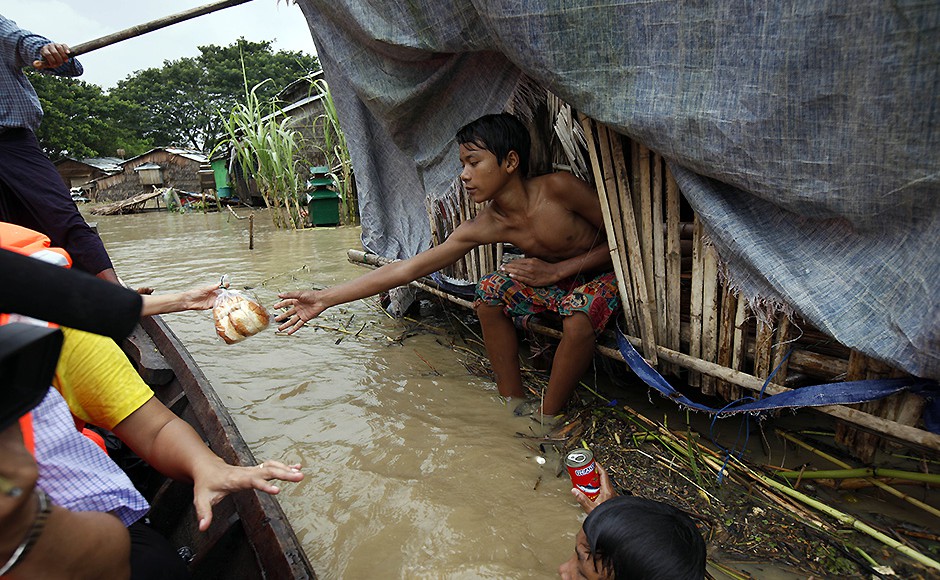
In this photo taken on Friday, Aug.7, 2015, a boy receives foods from private donors at his half-submerged residence in Nyaung Tone, in the Irrawaddy Delta, southwest of Yangon, Myanmar. Dozens have died from recent weeks of flooding and more than hundreds of thousands of people across 12 of the country’s 14 states and regions have been affected, according to the U.N. Office for Coordination of Humanitarian Affairs. The floodwaters have been spreading from northern and central Myanmar to the populous Irrawaddy Delta. (AP Photo/Khin Maung Win)

http://asiancorrespondent.com/2015/11/charity-index-ranks-burma-as-worlds-most-generous-country/

The latest World Giving Index, a study by the London-based Charity Aid Foundation (CAF) measuring generous behavior in 135 states, ranks Myanmar (Burma) as the world’s most charitable country in terms of donating money. Myanmar is also ranked first, tied with the United States, in overall giving behavior for 2014, based on data gathered in 2013.

The CAF has looked at data from the years 2009 – 2013, tallying percentages among the surveyed concerning how many donated money, volunteered time and helped a stranger during a one-month period before being interviewed. In 2013, 91 percent of Myanmar’s adult population donated money, while 51 percent volunteered time and 49 percent helped a stranger. The overall World Giving Index score for both Myanmar and the United States was 64 percent.

In 2014, more people around the world donated to charitable causes when compared to the previous year — 31.5 vs. 28.3 percent. At the same time, those who volunteered fell from 21.3 to 21.0 percent.

Generosity on the rise in Asian countries
Among the world’s top 20 most giving nations in the 2014 rankings, 7 are from the Asia Pacific region: Myanmar (1); New Zealand (5); Australia (6); Malaysia (7); Sri Lanka (9); Bhutan (11); and Indonesia (13); with one Western Asian nation, Iran, coming in at 19.

Asia has seen the largest positive increase in giving during the last year (4 points) when compared with the continent’s average over 5 years, with Southeastern Asia — Cambodia, Indonesia, Malaysia, Myanmar, Philippines, Thailand and Vietnam, in this case — showing the strongest positive trend and an overall score of 44 percent.

Malaysia’s generosity improved the most in the last year of the study, with an increase of 21 points over its five-year average (55 vs. 34 percent).

Data was also strong for the only two counties surveyed in Oceania: Australia and New Zealand. An overall score of 57 percent shows that giving is strong Down Under.

Analyzing the results: What do they mean?

The index shows high levels of generosity in countries facing turmoil – reflecting a pattern of giving in post-conflict nations as people help others through the most difficult of times. And it shows people’s innate desire to help others, even in nations which do not have anything like the standard of living enjoyed in the West. —Dr. John Low, Chief Executive, Charities Aid Foundation
One might expect high levels of charitable behavior in secure and affluent countries, where people have more disposable income, more time to volunteer and there is less risk involved when helping strangers. While individual wealth might at least partially explain the high ranking of countries like the United States (1), Canada (3) and New Zealand (5), it does not when it comes to poverty-stricken societies like those in Myanmar (1), Sri Lanka (9) or Bhutan (11).

The study’s findings give the practice of charity in Buddhism much of the credit. Each of the three poor Asian countries in the paragraph above have strong Buddhist traditions, including a high number of monks who receive monetary support from ordinary laypersons. Myanmar, where Theravada Buddhism is prevalent, has an estimated 500,000 monks. Theravada Buddhism also emphasizes charity in the context of religious observance.

Another take on why people give

According to the index, people in the United States are most likely to help strangers, with 79 percent. In 2011 Liberia, which was not surveyed for the latest index, led this category with 81 percent. The reasons why these very different countries performed so well is not examined in the report, but it could be both cultural and socio-political.

Countries in which it is perceived that neither official organizations nor state welfare programs adequately assist those in need may have stronger traditions of individuals helping other individuals, as well as charitable acts organized by religious groups. Compare this to what happens within comprehensive welfare states, in which what is considered charity” in some countries is considered a human right to be covered by society as a whole or by the state.

Furthermore, cultures in which people communicate more with each other, especially with strangers, may encourage more giving between individuals. Simply put, if you get to know people, you are more likely to empathize with their situations.

Read the entire World Giving Index 2014: A global view of giving trends here (in PDF).

Creativity and Mental Illness of Johann Wolfgang von Goethe

November 20th, 2015

Dr. Ruwan M Jayatunge  

I believe that in the end humanitarianism will triumph, but I fear that, at the same time, the world will become a big hospital, each person acting as the other’s humane nurse” 

— Johann Wolfgang von Goethe

Creativity is an important human quality upon which many achievements of humankind are based (Thys et al., 2013). It has been known for a long time that people with salient social and artistic creativity suffer more frequently from psychiatric illnesses than the average population (Rihmer et al., 2006). Extremes in mood, thought and behavior–including psychosis–have been linked with artistic creativity for as long as man has observed and written about those who write, paint, sculpt or compose (Jamison, 1989).

Previous research provides disparate accounts of the putative association between creativity and psychopathology, including schizotypy, psychoticism, hypomania, bipolar disorder, ADHD, and autism spectrum disorders (Zabelina et al., 2014). A study done by Vellante and colleagues (2011) found that cyclothymic dimension of the bipolar spectrum is linked to creativity. Based on studies Srivastava and Ketter (2010) specify that affect and open-minded and intuitive cognition may contribute importantly to enhanced creativity in individuals with bipolar disorder. The process of creativity may be connected with psychopathological features such as mood disorders, mainly bipolar, and psychosis-like thought abnormalities (Rybakowski et al., 2006).

Vellante and the team (2011) confirmed that the cyclothymic dimension of the bipolar spectrum is linked to creativity. There seems to be a connection between creativity and psychopathology in the bipolar-schizophrenic continuum (Thys et al., 2011). Janka (2004) states that comparing to the general population, bipolar mood disorder is highly overrepresented among writers and artists and it may be concluded that bipolar mood traits might contribute to highly creative achievements in the field of art. In addition Nettle and Clegg (2006) expressed that   some of the personality traits which are predictive of schizophrenia are also associated with artistic creativity. Kyaga and colleagues (2013) demonstrated that patients with schizophrenia or bipolar disorder and their relatives are overrepresented in creative occupations.

The association of creativity and psychopathology has been shown in von Goethe. Johann Wolfgang von Goethe was one of the most renowned German poets of the late Age of Enlightenment (Schäfer et al., 2012). He was born in Frankfurt in 1749. Goethe was one of the most creative writers, productive scientists, and effective statesmen that ever lived. (Holm-Hadulla, 2013).

From a scientific perspective, several distinctive depressive episodes can be diagnosed in Goethe’s life. They were characterized by extended depressive moods, lack of drive, and loss of interest and self-esteem combined with social retreat. Goethe displayed diffuse and phobic anxieties as well as dysthymia (Holm-Hadulla, 2013). Nager (1991) indicates that Goethe was subjected during his whole life to extraordinary psychic threats and polar tensions often to the limits of destruction. For long periods of life he travelled in the mist of depression.

Goethe’s first depressive episode occurred when he was 14, following the termination of a love relationship and was characterized by withdrawal, anorexia, and indications of suicidal intentions (Grossi, 2011).

In Goethe’s life, creative incubation, illumination, and elaboration appear to have been associated with psychic instability and dysthymia, sometimes with depressive episodes in a clinical sense. On the one hand, his creative work was triggered by anxieties, dysthymia, and depressive moods. On the other hand, his creativity helped him to cope with psychic disorders and suicidal tendencies (Holm-Hadulla, 2013). He rather faced his spiritual sorrow creatively and forced it into curative poetry (Nager, 1991).

Psychological ailments sometimes reflected in Goethe’s work. His descriptions of feelings, emotions, and mental states related to anxieties, depressive episodes, dysthymia, and creativity are unique in their phenomenological precision and richness (Holm-Hadulla, 2013). In 1774 Goethe published a novel titled The Sorrows of Young Werther, a seminal work in the literature of depression.

Steinberg (1999) states that the novel the Sorrows of Young Werther contains biographical background of Goethe. This novel was Goethe’s first major success, turning him from an unknown into a celebrated author practically overnight. Napoleon Bonaparte considered it one of the great works of European literature (Dubey, 2009).

The Sorrows of Young Werther bears highly-artistic traits. Goethe successfully exercised the epistolary form of the first person, which makes the character, Werther, tell his suffering and feeling, and reveals his ambition and sentiment (Tai, 2007). The novel is made up of letters written by Werther to his best friend. Werther writes the letters to Wilhelm and a few to Lotte and Albert revealing his emotional pain. These letters reflect thoughts of suicide that ran through Werther’s head. Finally Werther writes a farewell-letter   and shoots himself.

…..In the morning, at six o’clock, the servant went into Werther’s room with a candle. He found his master stretched upon the floor, weltering in his blood, and the pistols at his side. He called, he took him in his arms, but received no answer. Life was not yet quite extinct. The servant ran for a surgeon, and then went to fetch Albert. Charlotte heard the ringing of the bell: a cold shudder seized her. She wakened her husband, and they both rose. The servant, bathed in tears faltered forth the dreadful news. Charlotte fell senseless at Albert’s feet…. (The Sorrows of Young Werther – Johann Wolfgang von Goethe).

By writing ‘The sorrows of young Werther’ Goethe exorcised his own suicidal impulses and thoughts, thus probably saving his own life (Pöldinger, 1986). However according to Pirkis and Blood (2001) Goethe’s The Sorrows of Young Werther had led people to take their own lives. Werther’s tragedy is the tragedy of bourgeois humanism and shows the insoluble conflict between the free and full development of personality and bourgeois society itself (Dubey, 2009).

Goethe’s play Torquato Tasso was based on actual events. This play was about the sixteenth-century Italian Renaissance Poet Torquato Tasso. In his play Torquato Tasso, Goethe narrates about a depressed self-destructive poet and how he overcame his depression through communication and artistic creation. Cabras and Lippi (2007) elucidate that Torquato Tasso’s psychiatric illness suggests the diagnosis of an Affective Disorder: “Bipolar Disorder with mood incongruent delusions” or “Schizoaffective Disorder”

Experts consider Marienbad Elegy poem as one of Goethe’s finest and most personal.  Marienbader Elegie which is part of a trilogy that revolves around depression and suicidality (Grossi, 2011). In 1798 Goethe experienced a severe episode of depressed and he began to write his tragic play Faust. Faust can be viewed as his monumental tragedy (Grossi, 2011). The play is based on Faust – an audacious man who sold his soul to the dev il, Mephistopheles. He made a bargain with the devil for enormous power over the earth. The part one of Faust was published in 1805.

I am the spirit, ever, that denies! 

And rightly so: since everything created, 

In turn deserves to be annihilated:

Better if nothing came to be. 

So all that you call Sin, you see, 

Destruction, in short, what you’ve meant 

By Evil is my true element.

(Faust -Johann Wolfgang von Goethe)

Faust, was an essential source for both Freud and Jung, and it played an important role in the foundation of depth psychology. Jung postulated the devil as the “missing” fourth that completes the Trinity image, associating evil with the feminine which has long been suppressed within Western culture. Jung suggested that by recovering the feminine, the individuating Self redeems the shadow side of God, (Gabriela, 2009). According to the Psychiatrist and Jungian Analyst Dr. Edward F. Edinger Faust is a prototype of modern man, whose curiosity has led him into forbidden regions of various kinds, at the risk of the damnation of the soul.

Goethe’s masterpiece Faust demonstrates the coincidence of real life subjects and objects with literary subjects and objects represented, by means of the interpretation of the paradigms, problems, dilemmas and identified cases of medical ethical-morals: dáimon, reflection-solitude, free will, good-evil, Eros, learned ignorance, genes, epistemology, medical etiquette, paternalism, anatomy of the personality, Hyppocratism, will, good sense of humor, bubonic plague (de Castro-Peredo, 2006).

Binswanger and Smith (2000) stated that Faust, representing modern man, carries out this massive project of economic progress, but Goethe also shows the existing and potential dangers associated with it.   Writing Faust was a therapeutic and self healing effort for Goethe. It helped him to battle his own demons.  His mental illness was not known to his doctors. But they suspected melancholia in him. Goethe by himself distinguished his depressive moods from poet’s melancholia” which was fashionable at his times (Holm-Hadulla, 2010).

From a diagnostic standpoint, it is likely that Goethe suffered from a bipolar II disorder. (Bipolar II disorder is characterized by the occurrence of one or more major depressive episodes accompanied by at least one hypomanic episode) There are several soft signs of this disorder including the postpartum depressions of his sister, the early onset of his depression, the many recurrences of his depression, prominent suicidality throughout his life, as well as accelerated thinking and increased literary productivity when he would emerge from depressive episodes (Grossi, 2011).

Goethe died in Weimar in 1832, at the age of 82. Although Goethe underwent prolonged emotional suffering his life was immensely productive. He was a poet, playwright, novelist, scientist, statesman, theatre director, critic, and an artist. Goethe made a profound impact on European culture. He became a gigantic cultural icon and earned the title Gothic Shakespeare”

References

Binswanger, H.C., Smith, K.R., 2000. Paracelsus and Goethe: founding fathers of environmental health. Bull. World Health Org. 78 (9), 1162–1165.

Cabras, P.L., Lippi, D.(2007).Pathobiographyand Torquato Tasso’s case. Med Secoli. ;19(2):475-80.

de Castro-Peredo, H.F.(2006).Goethe’s philosophical-medical masks, in Faust.Gac Med Mex. ;142(6):519-31.

Dubey, A.(2009). Goethe’s epistolary The sorrows of young Werther. Shodh, Samiksha aur Mulyankan (International Research Journal)—ISSN-0974-2832 Vol. II, Issue-7.

Gabriela, L.A.(2009).Two souls dwell within my breast: The encounter with shadow and the problem of the missing fourth, a Jungian interpretation of Goethe’s “Faust”. Pacifica Graduate Institute.

Grossi, P.A.(2011).  Bipolarity and Creativity? Retrieved from http://www.mdshrink.com/drgrossiblog-menu/34-bipolarity-and-creativity.html

Holm-Hadulla, R.M.(2013).Goethe’s anxieties, depressive episodes and (self-)therapeutic strategies: a contribution to method integration in psychotherapy.Psychopathology.46(4):266-74.

Jamison, K.R.(1989).Mood disorders and patterns of creativity in British writers and artists.Psychiatry. ;52(2):125-34.

Janka, Z.(2004).Artistic creativity and bipolar mood disorder.Orv Hetil. 15;145(33):1709-18.

Kyaga, S ., Landén, M., Boman, M., Hultman, C.M., Långström, N., Lichtenstein, P.(2013).Mental illness, suicide and creativity: 40-year prospective total population study. J Psychiatr Res. ;47(1):83-90

Nager, F.(1991).Goethe’s struggle with depression.Schweiz Rundsch Med Prax. 17;80(38):984-91.

Nettle, D., Clegg, H.(2006).Schizotypy, creativity and mating success in humans. Proc Biol Sci.  7;273(1586):611-5.

Pirkis, J., Blood, R.W.(2001).Suicide and the media. Part II: Portrayal in fictional media.Crisis.  ;22(4):155-62.

Pöldinger, W.(1986).The Relation between Depression and Art. Psychopathology  19:263–268.

Rihmer, Z., Gonda mX., Rihmer, A.(2006).Creativity and mental illness.Psychiatr Hung. 21(4):288-94.

Rybakowski, J., Klonowska, P., Patrzała. A., Jaracz J.(2006).Psychopathology and creativity. Psychiatr Pol.  40(6):1033-49.

Schäfer, H.H., Sivukhina, E., Dölz, W., Oehring, H.(2012).Fiction and Truth”: Goethe’s anatomical research at the University of Jena.Dtsch Med Wochenschr. 137(51-52):2722-8.

Srivastava, S., Ketter TA. (2010).The link between bipolar disorders and creativity: evidence from personality and temperament studies. Curr Psychiatry Rep.  ;12(6):522-30.

Steinberg H.(1999).The “Werther effect”. Historical origin and background of a phenomenon.Psychiatr Prax.  ;26(1):37-42.

Tai, P.H.(2007).The Skilled Analysis of The Sorrows of Young

Werther. Retrieved from http://www.shs.edu.tw/works/essay/2007/03/2007032819404223.pdf

Thys, E , Sabbe, B., de Hert, M.(2011).Creativity and psychiatric disorders: recent neuroscientific insights.Tijdschr Psychiatr. ;53(12):905-15.

Thys, E. , Sabbe ,B., De Hert M.(2013).Creativity and psychiatric illness: the search for a missing link–an historical context for current research.Psychopathology. 46(3):136-44.

Vellante, M., Zucca, G., Preti, A., Sisti, D., Rocchi, M.B., Akiskal, K.K., Akiskal, H.S. (2011).Creativity and affective temperaments in non-clinical professional artists: an empirical psychometric investigation. J Affect Disord. ;135(1-3):28-36

Zabelina, D.L., Condon, D., Beeman, M.(2014).Do dimensional psychopathology measures relate to creative achievement or divergent thinking? Front Psychol. 18; 5:1029.

යථාර්ථයේ විශ්වාසය

November 20th, 2015

නලින් ද සිල්වා

 ඩී එස් සී උපාධිධාරි සේවාර්ජිත (සම්මානිත) මහාචාර්ය අශෝක අමරතුංග මහතා යුදෙවු ක්‍රිස්තියානි සංස්කෘතියෙහි පැන නගින ජීවිතයේ අරුත කුමක් ද යන ප්‍රශ්නයට පිළිතුරු දීමට ගොස් තමන් ජනප්‍රිය පොතපතින් පමණක් කියවා ඇති එහෙත් තමන්ට අවබෝධයක් නැති හැමිල්ටෝනිය යාන්ත්‍රිකය ෂ්රොඩිංගර් සමීකරණය ආදිය ගැන කියවමින් විදුසරෙහි පිටු නාස්ති කරයි. ඒ  මහතා ෂ්රොඩිංගර් යන්න ලියන්නේ ස්ක්‍රොඩිංජර් ලෙස ය. ඒ රෝම අකාරදීය යොදා ගනිමින් ෂ්රොඩිංගර් (ූSchrodinger)  යන්න ලියන ආකාරය සිංහලෙන් ප්‍රකාශ කරමින් ලබාගන්නකි. එසේ සිංහලෙන් ලිවීම (උච්චාරණය) පිළිබඳ ව මම ඒ මහතාට දොස් නො කියමි. එහෙත් ඒ මහතා ෂ්රොඩිංගර් සමීකරණය පිළිබඳ ව ගුරුවරයකුගෙන් අසා දැන නොගත් බවත් තමන් වැනි ම අය හෑර වෙනත් කිසිවකු සමග ඒ පිළිබඳ සාකච්ඡා කර නොමැති බවත් එයින් පැහැදිලි වෙයි. මෙරට විශ්වවිද්‍යාලවල විද්‍යා පීඨවල කිසිවකු ෂ්රොඩිංගර් යන්න ස්ක්‍රොඩිංජර් ලෙස උච්චාරණය කරනු මා අසා නැත. ඔවුහු ඇතැම්විට ෂ්රූඩිංගර් ලෙස නම් එය උච්චාරණය කරති.
 
සිංහල බෞද්ධ සංස්කෘතියෙහි ජීවිතයෙහි අරුත කුමක් ද යන ප්‍රශ්නය පැන නො නගී. සිංහල බෞද්ධයනට අනුව ජීවිතය දුක ය. ඒ නැති කිරීම, එනම් නිවන් අවබෝධය  සඳහා අප හිස ගිනිගත් ලෙසින් පාරමී ධර්ම පිරිය යුතු ය. ජීවිතයේ අරුත කුමක් ද යන්න අමරතුංග මහතා තමාගේ නැවුම් අදහසක් ලෙස මතුකර පෙන්වීමට තැත් කළ ද, බටහිර පොත්පත්වල සාකච්ඡා වී ඇති ප්‍රශ්නයකි. උදාහරණයක් වශයෙන්  රූපට් ෂෙල්ඩේ‍රික් මහතාගේ ද සයන්ස් ඩිල්‍යුෂන්” (The Science Delusion) කෘතිය   සඳහන් කළ හැකි ය. අමරතුංග මහතා ජීවිතයේ අරුත කුමක් ද යන ප්‍රශ්නයට අද දෙන පිළිතුරට සමාන පිළිතුරක්   ෂෙල්ඩේ්‍රක්  මහතා ද දී ඇත. ෂෙල්ඩ්‍රේක් මහතා බටහිර විද්‍යාවේ ප්‍රධාන ධාරාවට අයත් නැති බවත් ඔහු ප්‍රධාන ධාරාවේ අය අතින් විවේචනයට භාජනය වන බවත් සැබෑ ය. එපමණකින් ඔහුූ කියන දේ නොසලකා හැරිය හැකි නො වේ. අඩු තරමෙන් ජීවිතයෙහි අරුත සම්බන්ධයෙන් ගත්කල අමරතුංග මහතා බටහිර විද්‍යාවේ ප්‍රධාන යාන්ත්‍රික චින්තනයට අයත් නො වේ. මම ෂෙල්ඩ්‍රේක් මහතාගේ අරුත මෙන් ම බටහිර විද්‍යාවේ යාන්ත්‍රික චින්තනය ද ප්‍රතික්‍ෂෙප කරමි. අපි ජීවිතයේ ඊනියා අරුත ගැන පසුව සාකච්ඡා කරමු.
 
අපි එයට පළමු ඒ මහතාගේ අගොස්තු 12 වැනි දින ලිපියට ආපසු යමු. ඔහු එහි මෙසේ කියයි. අප යථාර්ථය යනුවෙන් හැඳින්වන්නේ කුමක්‌ ද? අප ඉන්ද්රි්ය මාර්ගයෙන් ලබාගන්නා දැනුම තුළ සත්යසයක්‌ ඇතැයි යන විශ්වාසය යථාර්ථය ලෙස සැලකිය හැකි ය. අප දකින දෙය සත්යනයක්‌ ලෙස පවතින බව විශ්වාස කිරීම යථාර්ථය ලෙස ගත හැකි ය. අප ගේ ඉන්ද්රි ය පද්ධතියෙන් ස්‌වායත්ත වූ ලෝකයක්‌ ඇතැයි විශ්වාස කිරීම යථාර්ථය ලෙස සැලකේ. අප ගේ ඉන්ද්රිය පද්ධතියෙන් ස්‌වායත්ත ලෝකයක්‌ ඇතැයි විශ්වාස කිරීම යථාර්ථය ලෙස බටහිර දාර්ශනිකයෝ අර්ථ දක්‌වති.”
 
අපි මෙහි එක් පැත්තක් නොවැම්බර් 11 වැනි දා ලිපියෙහි සාකච්ඡා කෙළෙමු. අද තවත් පැත්තක් ඉස්මතු කරමු. අප දක්නා දෙය සත්‍යයක් ලෙස පවතින බව විශ්වාස කිරීම යථාර්ථය ලෙස ගත හැකි යැයි අමරතුංග මහතා පවසයි. ඉහත සඳහන් ඡෙදයෙහි යථාර්ථය යනුවෙන් හැඳින්වෙන්නේ කුමක්ද යන ප්‍රශ්නයට ලැබෙන පිළිතුරු හතරෙන් ම කියැවෙන්නේ ඒ විශ්වාසයක් බව ය.  යථාර්ථය යනු විශ්වාස කිරීමක් ද? බටහිර දාර්ශනිකයන්ගේ අර්ථදැක්වීමට අනුව යථාර්ථය යනු යම් දෙයක් විශ්වාස කිරීම විය හැකි ය. (අමරතුංග මහතා ඒ දාර්ශනිකයන් එසේ ප්‍රකාශ කර ඇති තැන් අප වැන්නන්ගේ ද පහසුව සඳහා ප්‍රකාශ කෙළේ නම් මැනවි) අමරතුංග මහතා යථාර්ථය ගැන කෙතරම් කතා කළ ද ඔහුට ඊනියා යථාර්ථය ගැන පැහැදිලි හැඟීමක්, අවබෝධයක් නැත. බටහිර විද්‍යාවේ  ප්‍රධාන ධාරාවට ද ඒ ගැන පැහැදිලි අවබෝධයක් නැත. ඔවුන්ගෙන් සමහරකුට අනුව පංචෙන්ද්‍රිය ගෝචර ද්‍රව්‍යය පමණක් යථාර්ථය ය. කෝප්ප, ගෙවල්, ගස් ගල්, මිනිසුන්, සතුන් ආදිය ඔවුන්ට යථාර්ථය වෙයි. එහෙත් ඔවුන්ට තම යථාර්ථය පිළිබඳ මතය සංගත ව කීමට බැරි ය. මේ අය අංක එකේ ද්‍රව්‍යවාදීහු (materialists) වෙති.
 
මේ ද්‍රව්‍යවාදීන්ට මනස යනුවෙන් කිසිවක් නැත. මනස යන්න මොළයේ ක්‍රියාවන් පමණකි. (මෙය බුදදහම සමග කෙසේවත් නො ගැළපෙයි). ඔවුන්ට ජීවිතයේ අරුතක් නැත. ද්‍රව්‍ය මත ක්‍රියාකරන බලවලින් ජීවිතය ද ඉදිරියට ගලා යැවෙයි. මේ බල ජීවිතය මෙන් ම වෙනත් වස්තු ද අවසානයේ දී මුළු මහත් විශ්වය ද අතීතයෙන් අනාගතයට තල්ලු කරයි. නිව්ටන්ට අනුව ගුරුත්වාකර්ෂණය වැටෙන පොල් ගෙඩියක් අනාගතයට ගෙන යයි. පොල් ගෙඩියට අරමුණක් නැත. එයට ගස මුදුනෙහි සිට පොළොවට යෑමට හෝ සිංහලයන්ගේ, මලයාලම් ජාතිකයන්ගේ ආහාරය සඳහා යමක් එකතු කිරීමට හෝ ආදී වශයෙන් අරමුණු නැත. අමරතුංග මහතා හා ජීවිතයේ අරුතක් ඇතැයි කියන වෙනත් අයට අප මත අනාගතයෙන් කරන බලපෑමක් වෙයි. අපට ජීවිතයේ අරුතක් ඇත්නම් එයින් කියැවෙන්නේ අනාගතයක් දෙස බලා අප කටයුතු කරන බව ය. වෙනත් වචනවලින් කිවහොත් අපේ ජීවිතය අනාගතයෙන් තීරණය කෙරෙයි. එය බටහිර විද්‍යාවේ ද්‍රව්‍යවාදයට විරුද්ධ ය. අතීතයේ සිට අනාගතයට විකාශය වීමට ද විරුද්ධ ය. ජීවිතයේ අරුත යන්න ද්‍රව්‍යමය දෙයක් නො වේ. අමරතුංග මහතා නොදැනුවත් ම ද්‍රව්‍යවාදයට හා එමගින් බටහිර විද්‍යාවේ ප්‍රධාන ධාරාවේ චින්තනයට විරුද්ධ වෙයි. අමරතුංග මහතාට ද බොහෝ අයට මෙන් ම පැහැදිලි සංගත චින්තනයක් නොමැති කමින් මෙවැනි ඇබැද්දි සිදුවෙයි.
 
අපි දැන් ගසෙහි ඊනියා යථාර්ථය සලකා බලමු. ගස යන දැනුම දැනෙන්නේ කිනම් ඉන්ද්‍රියකට ද? අප බොහෝ දෙනා සිතන්නට (සිතන්නේ පංචෙන්ද්‍රියවලින් කිනම් ඉන්ද්‍රිය ද? හුදු සිතීම පංචෙන්ද්‍රිය ගෝචර ද? මොළය යන්න අවයවයක් පමණකි. එය සළායතනවලට අයත් නො වේ. සළායතන යනු අවයව නොවන බව අවධාරණය කළ යුතු ය.) පුරුදු වී ඇත්තේ ගස, පොල් ගෙඩිය ආදිය පංචෙන්ද්‍රිය ගෝචර බව ය. ගස යන්න දැනෙන්නේ පංචෙන්ද්‍රියවලින් කිනම් ඉන්ද්‍රියකට ද? අපේ ඇස්වලට ගස නො පෙනෙයි. අපේ ඇස්වලට ගෝචර වන්නේ ගසේ කොළවල පාට, හැඩය, ආදිය ය. එසේත් නැත්නම් ගසෙහි පොත්තේ පාට ය. අපට ස්පර්ශ කර පොත්ත රළු බව දැනගත හැකි ය. මේ සෑම දෙයක් ම ගසෙහි යම් යම් ගුණ මිස ගස නො වෙයි. ගුණ ගැන ද අප දැනගන්නේ මනස ආධාර කර ගනිමින් සංකල්ප ගොතා ගනිමිනි. මනසින් තොරව ගසේ පොත්තවත් නැත!
 
ගස යනු මේ සියළු ගුණ අයිතිකරු” ලෙස අපි සිතමු. ඒ අයිතිකරු”  අපේ සිත්වල පමණක් ඇති දෙයකි. එපමණක් නො වේ. ගස වෙනස් වන්නේ යැයි ද අපි කියමු. පෙබරවාරි මාසයේ දී රබර් ගස්වල කොළ හැලෙන්නේ යැයි අපි කියමු. එහෙත් ගස පවතින්නේ යැයි අපි කියමු. ගස යන සංකල්පය අපේ සිත්වල නිර්මාණයක් පමණකි. එය දැනෙන ඉන්ද්‍රියක් පංචෙන්ද්‍රිය අතර නැත. වෙනත් වචනවලින් කිවහොත් ගස යන්න නලින් ද සිල්වා යන පුද්ගලයා මෙන් ම පංචෙන්ද්‍රියවලට ගෝචර නො වේ. පංචෙන්ද්‍රියවලට ගෝචර නොවන ගස යථාර්ථයක් ලෙස සැලකීමට බටහිර විද්‍යවේ ප්‍රධාන ධාරාවේ විද්‍යාඥයන්ට හැකි ද?
 
යථාර්ථය යනු කුමක් දැයි ඇසූ කල බටහිර විද්‍යාඥයකුට දිය හැකි සංගත පිළිතුරක් නැත. අපි ගස වැඩෙන්නේ ඇයි ද යන ප්‍රශ්නය සලකා බලමු. ගස ඇත්තේ මනසෙහි වුවත් අපි එසේ නො සිතමු. මෙහි ඇති භයානක කම නම් මනස මගින් ඇති කරනු ලැබෙන සංකල්පයක් මනසින් තොරව පංචෙන්ද්‍රියවලට ග්‍රහණය කරගත හැකි යැයි සිතීමට මනස ම ඉදිරිපත් වීම ය. නැති ගසක් ඇතැයි සිතීම සංසාර පුරුද්දකි. නැති මනසක් ඇතැයි සිතන්නේ ද මනස ම ය! ගසක් ඇති බව කීම බොරුවකි. පෘථග්ජනයන්ට බොරු මිස වෙනත් දෙයක් කීමට මනස ඉඩ නො දෙයි. නැති ගස ඇතැයි කීම බොරුවක් නොවන්නේ ද? එහෙත් පෘථග්ජනයන් කියන්නේ බොරු බව පැවසූ විට බටහිර විද්‍යාව කටගාගත් බොහෝ දෙනා මා සමග උරණ වෙති. එසේත් නැත්නම් මට සමච්චල් කරති. එහෙත් එය මට ප්‍රශ්නයක් නො වේ. නැති මට දොස් කියන්නන් ගැන නැති මා කළ යුත්තේ කුමක් ද? (බුදුන් වහන්සේ මේ බොරු ලෝකය ගැන උපේක්‍ෂාවෙන් බලන ලෙස දේශනා කළහ. මනස විසින් සකස් කෙරෙන, සංස්කරණය කෙරෙන බොරුවක ඇලෙන්නේ කුමකට ද? ඒ බොරුවකට ද්වේෂ කරන්නේ කුමකට ද? මෝහය නිසා ඇතිවන ලෝභය හා ද්වේෂය යටපත් කළ යුතු ය. මෙය කියන්නට පහසු වුවත් ක්‍රියාත්මක කිරීම අපහසු ය.)
 
බටහිර විද්‍යාඥයෝ තවත් අසංගත දේ කියති. කාන්දම් කෑල්ලක් යැයි අප විසින් හැඳින්වෙන ද්‍රව්‍යවල කාන්දම් ගුණයක් ඇතැයි බටහිර විද්‍යාඥයෝ කියති. (කාන්දම්, කාන්ති ආදී වචනවල මූලයෙහි තේරුම ආකර්ෂණය යන්න ය. සූරියකාන්ත මල සූර්යයා දෙසට ආකර්ෂණය වෙයි. කාන්තාවන්ට කාන්තාවන් යැයි කියන්නේ ද ඔවුන්ට පිරිමින් ආකර්ෂණය වන බැවිනි. බොහෝ විට වියුක්ත සංකල්ප නිර්මාණය කෙරෙන්නේ පිරිමින් අතිනි. අපේ දැනුම ද බටහිර කේන්ද්‍රීය වීමට අමතර ව පුරුෂ කේන්ද්‍රිය ද වෙයි. විශේෂයෙන් ම වියුක්ත දැනුම බොහෝ විට පිරිමින් අතින් බිහිවෙයි. ස්ත්‍රී ආධිපත්‍යයක් තුළ පිරිමින් කාන්තලා – කාන්තුවන් ලෙස හැඳින්වීමට තිබිණි ද? ඇතැම් පිරිමින්ගේ නම් ලාල්කාන්ත ආදී වශයෙන් යෙදීම සහ සියළු පිරමිින් කාන්තුවන් ලෙස හැඳින්වීම එකක් නොව දෙකකි) ඒ කාන්දම් ගුණය අපේ පංචෙන්ද්‍රියවලට ගෝචර නො වේ. එහෙත් කාන්දම් ගුණය, චුම්බකත්වය යථාර්ථයක් ලෙස බටහිර විද්‍යාවේ ගැනෙයි. එවිට යථාර්ථය යනු පංචෙන්ද්‍රියවලට ගෝචර වන දේ පමණක් නොවන බව කීමට බටහිර විද්‍යාඥයන්ට සිදුවේ. එනම් විද්‍යුත්චුම්බක ගුණය පංචෙන්ද්‍රියවලට ගෝචර නොවී ම ඊනියා යථාර්ථය බවට පත් වෙයි. (මේ චසර මැක්ස්වෙල්ගේ විද්‍යුත්චුම්බක සමීකරණවලට වසර එකසිය පනහක් පිරෙයි.) එවිට පැහැදිලි වන කරුණ නම් බටහිර විද්‍යාඥයන්ගේ යථාර්ථය පංචෙන්ද්‍රියවලට ගෝචර වන දේ පමණක් නොවන බව ය.
 
ද්‍රව්‍යවාදීහු (materialists) පංචෙන්ද්‍රියවලට ගෝචර වන ද්‍රව්‍යවලට (matter) පමණක් යථාර්ථය යැයි කියති. යුදෙව් ක්‍රිස්තියානි සංස්කෘතියේ මැටර්, මදර් ආදී වචන එකම මූලයකින් ලැබෙන බවත් එයින් ඒ සංස්කෘතියෙහි ද්‍රව්‍යයෙහි ඇති විශේෂත්වය, වැදගත් බව පිළිබිඹු වන බවත් ෂෙල්ඩ්රේක් ඉහත සඳහන් පොතෙහි සඳහන් කරයි. එහෙත් බටහිර විද්‍යාඥයන්ට චුම්බකත්වය, ගුරුත්වාකර්ෂණය ආදීය ද යථාර්ථය ලෙස සුලකීමට සිදුවෙයි. ඒ එකක්වත් අපේ පංචෙන්ද්‍රියවලට ගෝචර නො වෙයි. එහෙත් කැලණිය විශ්වවිද්‍යාලයෙහි රසායන විද්‍යා අංශයෙහි කථිකාචාර්යවරයකු ඔහුගේ යම්කිසි අවයවයකට ගුරුත්වාකර්ෂණය ගෝචර වන බව පවසන බව මෙහි දී ඔහුට අසාධාරණයක් නොවීම සඳහා ප්‍රකාශ කළ යුතු ය.
 
ඇල්බට් අයින්ස්ටයින් විද්වතා ගුරුත්වාකර්ෂණයක් නොමැති බව පවසා මේ අවුරුද්දට වසර සියයක් ගෙවී ගොස් ඇති නමුත් බටහිර වෙසෙන බොහෝ බටහිර විද්‍යාඥයන්ට මෙන් ම මෙරට වාසය කරන බටහිර විද්‍යාව ගැන දත් බොහෝ දෙනාට ද ගුරුත්වාකර්ෂණය ඊනියා යථාර්ථයක් බවට පත් වී ඇත. නිව්ටන්ගේ ගුරුත්වාකර්ෂණය සහ තවත් දේ අයින්ස්ටයින්ට අනුව අවකාශ කාලය  වෙයි. අවකාශ කාලයේ වස්තු බල (ගුර්ත්වාකර්ෂනය ද ඇතුළු) රහිත ව චලනය වීම (නිදැල්ලේ චලනය වීම) අවකාශ කාලයක් නොමැති, අවකාශය හා කාලය වෙන වෙන ම පැවති නිව්ටන්ට පෙනී ගියේ ගුරුත්වාකර්ෂණය ලෙස ය. ගුරුත්වාකර්ෂණය යනු නිව්ටන් ගෙතූ පට්ටපල් බොරවෙකි. එහෙත් එම ප්‍රවාදයේ, එනම් පට්ටපල් බොරුවේ, සාර්ථකත්වය නිසා ම දහනව වැනි සියවස අග භාගය වන විට ගුරුත්වාකර්ෂණය යථාර්ථයක් බවට පත් වී තිබිණි. එහෙත් පුදුමය එය නො වේ. අයින්ස්ටයින්ගේ සාධාරණ සාපේක්‍ෂතා ප්‍රවාදයෙන් අවුරුදු සියයකට පසුව ද ගුරුත්වාකර්ෂණය ඊනියා යථාර්ථයක් ලෙස පැවතීම ය.
 
මේ සියල්ලෙන් පැහැදිලි වන්නේ ඊනියා යථාර්ථය යන්න ද ඇතැමුන්ගේ නිර්මාණයක් පමණක් බව ය. බටහිර විද්‍යාවේ හා පොදුවේ ගත් කළ බටහිර දැනුමේ යථාර්ථය යන්න අමරතුංග මහතා කියන පරිදි ම විශ්වාසයක් පමණක් වුවත් අප මත බටහිර දැනුම් ආධිපත්‍යය විසින් එය ද ඊනියා යථාර්ථයක් බවට පත් කෙරී ඇත.
 
නලින් ද සිල්වා
 
2015 නොවැම්බර් 16

Sigiriya Recreated –

November 20th, 2015

How the wonder of Sigiriya appeared in its hey day at the time of  Ravan with his flying Machine Dadu Monara


Adaptation of hybridisation in Chemistry for cooking and energy saving.

November 20th, 2015

Dr Hector Perera         London

If we take a simple molecule such as methane, it has formed due sp3 hybridisation of the carbon atom. Carbon has only two electrons in the p orbital and two electrons in the s orbital. Two of the p orbitals are empty at the start because two electrons are paired and occupied one of the p orbitals. Carbon has p orbitals in the directions of x axis, y axis and z axis. First the carbon atom undergoes a promotion of one of the electrons to an empty p orbital. To begin with it was paired but when it promotes to an empty p orbital then one of the s orbital electron as well promotes an electron to the other empty p orbital of the carbon atom then it undergoes hybridisation or a mixing of orbitals. Then four hydrogen atoms get attached to this sp3 hybridised carbon atom to form a molecule of methane. The shape of the orbitals are unique, the s orbitals are spherical and p orbitals are dumble shaped. If you hold two pares or two small balloons together that gives a dumble shape. Once they undergoes hybridisation, one cannot find the individual orbitals. Since one s orbital and three p orbitals undergone hybridisation, we call it under went sp3 hybridisation. Once they undergone sp3 hybridisation, one cannot find the individual orbitals.

This is a completely new idea where no one has used my idea in chemistry and cooking. The point is I am going to adopt this kind of hybridisation in the explanation of cooking where no one has done such explanations with respect to cooking.  I made it clear what are the orbitals then what happened when they are hybridised or mixed and I am going to adopt this kind of explanation to cooking. I am sure most of you are wondering what is going on.

Archimedean was ridiculed

When Archimedeans explained some of the properties of the elements in a different way, many scientists at that time told that he was mad and rediculed. He said when the atoms are arranged in the increasing order of atomic weight, every eight element has a relationship. He compared them to the musical notes then he called it law of octaves. Then only the others told that he was mad but much later they found that Archimedeans comparison was perfect. Then he was showered with honours and in addition the periodic table as well named after him. Similarly when I compared and adopted this hybridisation to cooking, some people might think that I am wrong but I know it for sure it is right. I am not going to give details right here. It will be appropriate to explain these things with respect to an actual cooking demonstration then only one can decide if I am right or wrong.

When time permits I will invite University lecturers as well to witness my kind of cooking then they would admit that if am right or wrong. I am not going to the details right now because that is my unique idea.  Just not hybridisation but other terms such as thermodynamic equilibrium condition, intermolecular and intramolecular reactions, absorption, adsorption and chemisorption and many more terms are also applied. In addition to that I am using gas laws that are well established and they are even more than two centuries old. If those gas laws are valid now even after two centuries and if I adopted them for my kind of cooking then nothing wrong with that, am I correct? I am sure no British chef has used those gas laws in cooking but I am using them to save energy and to stop any volatile chemicals depositing while cooking.

Some British TV chefs are real jokers

Nearly all British chefs love to shower with cooking aroma, set fire to the cooking pan to excite the viewers. When cooking aroma is set on fire, it will burn away the vapours of some of the essentials in the vapour state. One must let that cooking aroma recycle then only the food taste better. Did you add spices to have a fire display or to flavour the food? If you don’t believe me please have a good look at the cooking demonstrations or the cooking programmes by the famous British TV chefs. They must be under the impression that higher the fire bigger crowd attracted to view the show. Sometimes they run all over the TV studio just like headless chicken, again to impress the viewers. One must have a respect to the kitchen or to the place that is used as a kitchen. To me kitchen is a chemistry laboratory and no one is allowed to run in the chemistry laboratories.  I found none of them applied science and chemistry in energy saving. They leave the cooking vessels wide open for the TV cameras to have a better view but not applying any scientific ideas in energy saving and stopping any cooking aroma while cooking. The viewers think that cooking is a real tedious thing and they lose the taste of home cooking and get tempted or get attracted to eat nothing but junk foods such as takeaways. I cannot understand why these kinds of cooking are allowed in British TV shows.

Scientific energy saving cooking with Sirasa TV in Sri Lanka

If anyone wished to see scientific energy saving cooking then they must view my live cooking demonstration done with Sirasa TV in Sri Lanka. Earlier I have demonstrated this kind of cooking even with ITN TV, interviewed at TNL and Derana TV but the one with Sirasa TV had a longer time devoted for this kind of cooking. Not only I showed how to save energy and I showed how to cut down this cooking aroma getting deposited while cooking. In fact I got an official approval by The Sustainable Energy Authority in Sri Lanka. I am sure no words can convince any person it showed be followed with a practical demonstration. I am so glad at least some Sri Lankan people had the opportunity to see my kind of demonstration. So far I haven’t had the chance to appear in any one of the British TV shows to demonstrate my scientific energy saving cooking for the benefit of the British people.

Would the people in England benefit?

Why people waste energy when some of it can be saved? Who gets gas and electricity for nothing unlike solar power? Also when high temperature is used in cooking other toxic, carcinogenic compounds are given out. On the long run those toxic compounds could affect the respiratory and cardiac system. That is another good reason why I say to use energy efficiently. I hope the British TV would consider to give me an opportunity to demonstrate my unique ideas that are based on scientific basis. If I was disproved then there is that challenged money to give away. Why not the British energy saving experts or even the British TV chefs come forward either to approve or disprove my scientific energy saving ideas? According to science every action has an equal and opposite reaction. Your comments are welcomed perera6@hotmail.co.uk

‘කම්‍ ඕ ගෝ චිකාගෝ’

November 20th, 2015

ධර්මන් වික‍්‍රමරත්න

තම දේවිය මුම්ටාස් මහල් සිහිවීම පිණිස ෂා-ජෙහාන් මෝගල් අධිරාජ්‍යයා ඉන්දියාවේ අග්‍රා නුවර ඉදිකරන ලද ටජ් මහල් කිරිගරුඩ මන්දිරය ලෝක පුදුම 7න් එකකි.  යුනෙස්කෝ ලෝක උරුමයක් ලෙස 1983දී පිළිගත් ටජ් මහල නිමකිරීමට ෂා-ජෙහාන් රජුට වසර 22ක් ගතවිය. මුම්ටාස් යනු ෂා-ජෙහාන් රජුගේ බිරින්දෑවරුන් 7දෙනාගෙන් 4වැනියාය. මුම්ටාස් ලබාගැනීමට රජු ඇයගේ සැමියාද මරා දැමුවේලු. මුම්ටාස් දේවිය මරණයට පත්වූයේ 14වන දරුවාගේ උපතේදීය. මුම්ටාස් මියගිය පසු ෂා-ජෙහාන් රජු ඇයගේ නැඟනිය අවාහ කරගත්තේය. මෙය පට්ට ආදරයක්ලු.

ශ්‍රී ලංකාවේ වර්තමාන සභාග රජයේ දැන් අලියෝ ඉගිලෙති. හංසයෝ බඩගාති. කොටියෝ පිහිනති. සීනුව ලොක්වී ඇත. ගිනිසිළුව නීවී තිබේ. යහපාලනය වෙනුවෙන් ඡන්දය දුන් අය තක්කු මුක්කුවී සිටිති. ආණ්ඩුව කාගේද? මෛත්‍රීගේද? රනිල්ගේද? මේවා මතුපිට පෙනෙන දේය. රට වැසියන්ට පෙන්වන ප්‍රයෝගයන්ය. මතුපිට පෙනෙන දේ සත්‍ය නම් විද්‍යාවක්ද අවශ්‍ය නොවේ. දිළිසෙන සියල්ල රත්තරං නොවේ. එජාපයේ සහ ශ්‍රිලනිප මෛත්‍රීපාල සිරිසේන කණ්ඩායමේ සුසංයෝගය මුම්ටාස් දේවිය සහ ෂා-ජෙහාන් අතර ඇතිවූ ආලය වාගේය. ෂා-ජෙහාන්ගෙන් පසු රජ‍වූ ඔහුගේ පුත් අවුරාංගා චෙබ් තාත්තා හිරකර තාත්තාගේ කැමැත්ත අනුව ඔහු මියගිය පසු මුම්ටාස් භූමදානය කල තැන තාත්තාද වැළලුවේය.

ශ්‍රිලනිප නායක මෛත්‍රීපාල ‍සිරිසේනට,  මහින්ද රාජපක්ෂ හැර ‘මට මුළු ලොවම ඔබ’ය. එජාප නායක රනිල් වික්‍රමසිංහගේ භාවිතය ‘සමනලයා මල හා ළමයා සේ’ය. ඇමති රාජිත සේනාරත්නට අනුව යහපාලනයට එක්වීම ‘නූඹ නාඩන් නුඹට ඕවා හොද පාඩම්’ය. සභාග ආණ්ඩුවට එක්වූ ශ්‍රිලනිප මන්ත්‍රීවරුන්ට අනුව ‘ඇමතිකම් දෙනවා නං ඇමති ස්ටාෆ්, වාහන දෙනවානං මොන කෙන්ගෙඩියද තව ඕන කියන්නේ’ යන්නය. ජවිපෙ සොයාගත් ‘අලුත් කලාව’ ඇවන්ගාඩ්ය. ඇමතිවරුන් පිරිසක් කෙළ ගන්නවාය. තවත් සමහරෙක් නා ගන්නවාය.

තිලක් මාර‍පන මෙන් ඇමතිකමෙන් කැපෙයි කියා අධිකරණ ඇමති විජේදාස රාජපක්ෂට මරබියක් නැතිසේය. ඇමති රවි සහ කබීර් එළිපිට ගැටේ. රාජ්‍ය ආයතන ගණනාවක් අවුලෙන් අවුලටය. ඇමති රාජිත සේනාරත්න කියන පරිදි කම්කරු හෝ පියන් රැකියාවක් සඳහාවත් සුදුසු නැති පුද්ගලයින් රැසක් දැන් කැබිනට් මණ්ඩලයේ සිටිති. ඉස්සර තුන කිවේ ලුණු, ඇඹුල්, මිරිස් වලටය. පහ කීවේ සූදුරු, මහදුරු, කහ, කොත්තමල්ලි සහ උළුහාල් වලටය. සියල්ල එක්වූවිට තුන පහය. දේශපාලනය දැන්  වැටී ඇත්තේ තුන පහ ලෙවල් එකටත් පහළිනි

මාදුළුවාවේ සෝභිත හිමිගෙන් පසු සාධාරණ සමාජයක් සඳහා ව්‍යාපාරයේ නායකත්වය හිමිවූයේ ජවිපෙ අදිසි නායකයෙකු වන දඹර අමිල හිමියන්ටය. ඉදිරියේදි සාධාරණ සමාජයේ පෝස්ටර් ගමේ ගොඩේ ගස්වැල් සහ ගල්වලද ඇළවෙනු ඇත. සෝභිත හිමගේ මරණයෙන් පසු සාධාරණ සමාජයක් සඳහා වූ ජනතා ව්‍යාපාරයට සිදුවූයේ අටුව කඩා පුටුව සෑදුවා වා‍ගේ වැඩක්ය. අනේ අපොයි කියන්නේ මේවාටය.

ලබන 2020 මහ මැතිවරණයේදී ශ්‍රිලනිප අගමැති අපේක්ෂකයා ලෙස මෛත්‍රීපාල සිරිසේන යෝජනා වී ඇත. ලබන ජනාධිපතිවරණයේ ජනාධිපති අපේක්ෂකයා වනු ඇත්තේ එජාපයේ රනිල් වික්‍රමසිංහය. දරුවන් මේවාගේ වැඩ හඳුන්වන්නේ සංගීත පුටු තරඟය කියාය. විධායකය අහෝසි කරන්නේ අද හෙට නොවේය. මෛත්‍රීපාල සිරිසේනගේ ජනාධිපතිධූර කාලය අවසන්වූ විටය. මීලඟට පත්වන ජනාධිපතිවරයා  එවිට නාමිකය. විධායක බලතල අගමැතිටය. ජනාධිපති ධූරයට යම් හෙයකින් 2020 රනිල් වික්‍රමසිංහ  පත්වූවහොත් සිදුවන්නේ වදින්න ගිය දේවාලේ ඉහේ කඩා වැටුනා වගේ වැඩක්ය.

අයවැයෙන් යෝජනා කරනු ඇත්තේ උණු උණු බදු ක්‍රමයන්ය. පාරේ යන සියළු  වාහන වලින් වාර්ෂික මාර්ග බද්දක් අයකරගැනීමේ යෝජනාවකි. විදෙස්ගත ශ්‍රී ලංකිකයන්ගේ ස්විස් බැංකුවල ඇති කළු සල්ලි සුදු කිරීමට විශේෂයෙන් ආරාධනය කරන්නේ ඩයස්පෝරාවටය. ඒ හරහා කොටස් වෙළෙඳපොල අත්පත් කර ගනිමින් ලංකාවේ ආර්ථිකය හැසිරවීමට අවස්ථාව ලැබේ. ජාතික උරුමයන් වූ ගාලු කොටුවේ පෙඩ්රල් වීදියේ වසර 100කට වඩා පැරණි පුරාවිද්‍යාත්මක ස්මාරක ලෙස සැලකෙන ගොඩනැගිලි දෙකක් සහිත ඉඩමක් ගාලු නගර සභාව මගින් බදුදී රුපියල් දශලක්ෂ 43ක් ලබාගෙන ඇත. ජාතික උරුමයන්ද විකුණාගෙන කෑමේ ව්‍යාපෘතියේ එක් ඇරඹුමක් ලෙස එය සැලකේ. සීපා ගිවිසුම ලඟ ලඟමය. ෆීජි රටට අත්වූ ඉරණමට සූදානම් විය යුතුය. බැංකු, රක්ෂණ, ගුවන්සේවා  සියල්ලම පෞද්ගලීකරණයට ලක්වීමේ අනතුරක් ඇත.

එළවළු මිල නඟින්නේ නහුතෙටය. කාලා හමාරය. වෙළෙඳපොලට අපමණ අගයකි. හාල්මැස්සෝ ග්‍රෑම් 250 රුපියල් 280කි. අමු මිරිස් ග්‍රෑම් 100 රුපියල් 120කි. අත්‍යවශ භාණ්ඩ 6ක උපරිම සිල්ලර මිල නියම කලද සතොසේ හෝ එම සහනය නැත.   බෝංචි, කැරට්, වට්ටක්කා, තක්කාලි  සහ ගෝවා ඇතුළු සියළුම එළවළු මිල ගණන් හැටට හැටේ නැඟ ඇත.

රටපුරාම සටන් ගොඩකි. බස්නාහිර මහඇමති ගුරු ප්‍රශ්න ගුරුවරියන්ගේ බුරිය සාරියෙන් වසා ප්‍රශ්න යටපත් කරන්නට හදනවාක් මෙන් ආණ්ඩුව අතීසාරයට අඹුඩ ගසා මේවා යටපත් කිරීමෙන් වැඩක් නැත. විසඳුන් දිය යුතුය. මාලඹේ උපාධි කඩය ඇතුළු අධ්‍යාපනය විකිණීමට එරෙහිව අන්තර් විශ්ව විද්‍යාල ශිෂ්‍ය බල මණ්ඩලයෙන් නොවැම්බර් 23 සිට 27 දක්වා නුවර සිට කොළඹට දැවැන්ත පා ගමනකි. රැකියා විරහිත උපාධිධාරිහු සතිපතා විරෝධතාවයන්ය. ඊ.පී.එෆ් සහ ඊ.ටී.එෆ් අරමුදලේ බිලියන 1,400 මුදල නිසි කළමණාකරණයක්යැයි කියමින් ඉදිරිපත් කර ඇති අමුතු යෝජනාව ඒවායේ මුදල් යටිමඩි ගැසීමේ වැඩපිළිවෙලක් බවට චෝදනාවකි. රාජ්‍ය ආයතන 26ක් විකිණීමට අර අදිනු ලබයි. ආණ්ඩුවේ මධ්‍ය කාලීන අර්ථ ක්‍රමය රටට ගැලපෙන්නේ නැත. මෙහෙම ගියොත් රට ඉවර බව කියන්නේ වෙනින් කවුරුත් නොව රතු අලි පැටව්ය.

රුපියල් දසලක්ෂ 800 මුදලක් ඉතිරිකර ගැනීමට හැකිබව කියමින් පාසැල් නිලඇදුම් රෙදි වෙනුවට රෙදි ලබාගැනීමට වව්චර් පතක් දීම බොලඳ වැඩකි. එමගින් රැකියා 3,000ක් සහ රුපියල් දසලක්ෂ 1,100ක විදේශ විනිමයක් රටට අහිමිවේ. ඉකුත් වසරේ නිල ඇදුම් සඳහා වැයවූ සමස්ත වියදම රුපියල් දසලක්ෂ 1,800කි. දේශීය නිෂ්පාදකයින් විසින්ම ඉන් අඩක් ඉටුකරන හෙයින් රුපියල් දසලක්ෂ 1,100ක් රට තුළම රැදුණේය. එතරට ඇදී ගියේ නූල් සහ සායම් ලබාගැනීමට රුපියල් දසලක්ෂ 800කි. රටේ පිළිගත් ප්‍රතිපත්ති අනුව දේශීය නිෂ්පාදකයා දිරි ගැන්විය යුතුය.

මෑන් පවර් තාවකාලික, අනියම් ආදී සේවකයින්ට බැංකුවක සේවකයෙකු ලෙස හිමිවිය යුතු බවට නැගෙනහිර පළාත්බද මහාධිකරණ විනිසුරු ආචාර්ය සුමුදු ප්‍රේමචන්ද්‍ර ඉකුත් සැප්තැම්බර් 22වැනිදා තහවුරු කළේය. එහෙත් රජය තවම මෑන් පවර් සේවකයෝ ස්ථීර කර නැත. ඔවුහු අරගල කරති. එමෙන්ම ජීවන වියදම් දීමනාව සේවක අයිතියක් බවට කොළඹ දිසා අධිකරණය ඉකුත් සැප්තැම්බර් 29වැනිදා තීරණාත්මක නඩු තීන්දුවක් දුන්නේය. පෞද්ගලික අංශයේ සේවකයින්ට ජීවන වියදම ඔවුන්ගේ අයිතියක් බව එම නඩු තීන්දුවෙන් තහවුරු විය. ‘යහපාලන’ ආණ්ඩුවක් පත්වූ බව කීවද තවමත් නීතිය යනු පාලකයාගේ කැමැත්ත බවට ඇති ප්‍රකාශයේ වෙනසක් සිදුවී නොමැත.

කුමාර් ගුණරත්නම්ගේ පුරවැසි අයිතිය වෙනුවෙන් ගෙන ගිය අඛණ්ඩ උද්ඝෝෂණය හමුවේ ඔහු පිටුවහල් නොකරන බවට විදේශ ඇමති මංගල සමරවීර කියා සිටියේය. ඒ අතරතුර විදේශ පුරවැසිභාවය හිමිවූ ශ්‍රී ලංකිකයින් 2,000කට පමණ ඉකුත් සතියේ ද්විත්ව පුරවැසිභාවය ජනාධිපති සහ අගමැති සුරතින් පිරිනැමුවේ උත්සවශ්‍රීයෙනි. පොදු සමාව යටතේ යැයි කියමින් දෙමළ බෙදුම්වාදී ත්‍රස්තවාදින් ගෙන් පිරිසක්ද නිදහස් කළේ ජාත්‍යන්තරය සතුටුකරවන අයුරෙනි. දෙමළ බෙදුම්වාදී දේශපාලන පදයට නටමින් රජය තවදුරටත් මේ අන්දමින් ගණුදෙනු කලහොත් අහිගුණ්ථිකයා නොමැතිව තනිවම නටන්න ගිය නයාට වූ දෙය නුදුරේදීම සිදුවනු ඇත.

ආණ්ඩුව දැනගත යුතු වන්නේ ‘යහපාලනය’ යන වචනය වැඩි වැඩියෙන් ප්‍රකාශ කල පමණින් යහපාලනයක් ඇති නොවන බවය. දැන් ‘යහපාලනය’ යනු පොදුජනයා අතර ජයප්‍රිය වෙමින් පවතින විහිළුවකි. යහපාලනවාදීන්ගේ මනසේ රජයන විප්ලවීය ආකෘතියත්, සැබෑ දේශපාලන සිදුවීම් අතරත් නොගැලපීම් දිනෙන් දින තහවුරු වෙමින් පවතී. පරණ දේශපාලන සංස්කෘතිය සහ මර්ධන යන්ත්‍රය එදා මෙන්ම අදද හිස ඔසවමින් පවති. අලුත් රටක් පිළිබදව ජනයා දුටු සිහිනයන් ක්‍රමයෙන් ක්ෂය වෙමින් පවතී. එය ඉදිරි දේශපාලන අනතුරක සේයාවක් බව නම් ‍නොකියා බැරිය. බලය අතට ගෙන දහඅට වන්නම නැටුවද ලෝකෙට පරකාසේය. ගෙදරට මරගාතේය.

ධර්මන් වික්‍රමරත්න 

ejournalists@gmail.com

වසර 93ක් පසුකලද පෑන අත්නොහැරි ලංකාවේ ජේෂ්ඨතම ක්‍රියාකාරි මාධ්‍යවේදියා

November 20th, 2015

ධර්මන් වික්‍රමරත්න

රට දන්නා ඔහු නමින් එස් පියසේනය. සම්පුර්ණ නම සේනාධීර පියසේනය. බෙන්තර ගංතෙර උතුරෙහි දේවගොඩනම් සුන්දර ග්‍රාමයේ ජන්මලාභය ලැබුවේ 1922 නොවැම්බර් 14වැනිදාය. වසර 94ක උපන්දිනය සමරන විටද හෙතෙම ජාතික ‍දිනපතා පුවත්පත් දෙකකට සෑම සිකුරාදාම දේශපාලන තීරු ලිපි දෙකක් සතිපතා සපයනු ලබයි. මාසිකව ශ්‍රී ලංකාවේ සිංහල පුවත්පත්වලටද විදෙස්ගත ශ්‍රී ලංකික ප්‍රජාව ප්‍රකාශයට පත්කරන පහන, සන්නස, සිහනද ඇතුළු පුවත්පත් කිහිපයකටම මාසිකව ලිපිද සපයනු ලබයි. ඇත්ත ඇති සැටියෙන් කිවහොත් ශ්‍රී ලංකාවේ වර්තමානයේ ජීවත්වන ජේෂ්ඨතම මාධ්‍යවේදියා එස් පියසේන සූරින්ය. මෙයට කලින් මෙම වාර්තාව තිබුයේ ඉකුක්දා අප අතරින් සමුගත් දෙටු ප්‍රවීණ පුවත්පත් කලාවේදී ඩී.එෆ් කාරියකරවනයන්ටය.

Writen by Dharman Wickremaretne
ධර්මන් වික්‍රමරත්න

එස් පියසේනයන් ගේ මතක ශක්තිය සුවිශේෂිය. ඔහුගේ වෘත්තීය පුවත්පත් කලාවට දැන් වසර 73කි. මතකය ඇවිදින පුස්තකාලයක් මෙනි. එය දේශීය, විදේශීය ඕනෑම කරුණක් වෙනුවෙන් විවර වන්නකි. වඩාත් සුවිශේෂි වන්නේ එම මතක ගබඩාව නිර්මාණයකරණයේ යෙදෙන ඕනෑම පුද්ගලයෙකු සමඟ නො‍මිලේ ‍ලබාදීමට ඔහු සතුව ඇති පරිත්‍යාගශීලිත්වයයි. සමකාලීන දේශපාලන සිදුවිම්වල අලගිය මුලගිය තැන් බොහෝ මාධ්‍යවේදීහු දැනුවත්භාවයට පත්වන්නේ ඔහු ගෙනි. පියසේන සූරින් ඉන් ලබන්නේ නිම්හිම් නැති සතුටකි. ඉතිහාසගත මාධ්‍යවේදියෙකුවූ ඔහු වර්තමානයේද මාධ්‍යයට සම්පතකි.

කලකට ඉහත 1995දී දිවියෙන් සමුගත් කැගල්ලේ සෝමා කරුණාතිලක ඔහුගේ බිරිඳය. ඇය සමඟ අවාහ වූයේ 1944 අප්‍රේල් 19වැනිදාය. ඔවුනට දූ දරුවන් පස් දෙනෙකි. වැඩිමලා කලක් දවස පුවත්පතේ වැඩකල මාධ්‍යවේදියෙකු වූ එක්සත්ය. දෙවැන්නා ශ්‍රී ලංකාවේ සිටින ඉංග්‍රීසි පුවත්පත් කතුවරයෙකුදවූ ජේෂ්ඨ මාධ්‍යවේදී සුගීස්වරය. කලක් ලේක්හවුස් ආයතනයේ නියෝජ්‍ය පුස්තකාලාධිපතිවරයාවූ තෙවැනි දරුවාවූ රුවන් දැන් ඔස්ට්‍රේලියාවේද පුස්තකාලාධිපතිවරයෙකි. හිටපු වාණිජ්‍ය අධ්‍යක්ෂක ජනරාල් සහ ජිනීවාවල හිටපු තානාපති ගෝමි සතරවැන්නාය. පස්වැන්නා වූ මුදිතා වර්තමානයේ ඕස්ට්‍රේලියානු ගුවන්විදුලි සේවයේ නිෂ්පාදිකාවකි. පියසේනයන්ට මුණුබුරු මිනිබිරියන් 5 දෙනෙකි. එක් මිනිබිරියක්ද ඕස්ට්‍රේලියානු ගුවන්විදුලි සේවයේ මධ්‍යස්ථානයක මාධ්‍යවේදිනියකි.

piyasena1
එස් පියසේන සිය 94වැනි උපන්දින උත්සවයේදී.

කොළඹ ආනන්ද විදුහලින් අධ්‍යාපනය ලත් අවදියේදී පියසේනයන්ගේ ගුරුවරුන් වූයේ ටිබෙට් ජාතික එස්. මහින්ද හිමි, තල්පාවිල සීලවංශ හිමි වැනි ජාතික සටනේ ක්‍රියාධරයන්ය. විදුහල්පති පී.ද.එස් කුලරත්නයන්ය. ආනන්දයේදී අශෝතියන් නමින් තෛයිමාසික සිංහල සහ ඉංග්‍රීසි සඟරාවේ වරෙක සංස්කාරකවරයා වූයේද ඔහුය. හලාවත මහවැව විදුහලේ 1900 මුල් ගරුවරයාවූ පියසේනගේ පියාවන ඕදිරිස් අප්පුහාමි ඉඩම්හිමි වැවිලිකරුවෙකි. එමෙන්ම 1935 පොල්ගහවෙල ගම් සභාවට ඡන්දයෙන් පත්වූ සභිකයෙකි. මෑණියන්වූ චලෝ නෝනා මියගියේ පියසේනයන්ට වයස 5ක් සම්පූර්ණ වන්නටත් මත්තෙනි. දරුවන් තිදෙනා වෙනුවෙන් කැපවූ පියා යළි විවාහ නොවූ අතර ‍නෑ හිතවතුන් ඔවුන් ඉතා හොදින් රැකබලා ගත්හ.

ඉහළ අධ්‍යාපනය සඳහා කල්කටා සරසවියට ඇතුල්වූ ඔහු පසුව ඉන්දියානු කොමියුනිස්ට් පක්ෂය තහනම්වූ එකල ඒ වෙනුවෙන් ක්‍රියාත්මකවූ බෙංගාලි කම්කරු පක්ෂයේ උද්යෝගිමත් ක්‍රියාකරුවෙක් බවට පත්විය. එහි ශිෂ්‍ය ව්‍යාපාරයේ සාමාජිකයින් සමඟ නැෂනල් ප්‍රන්ට් පත්තරය මහපාරේ විකිණීමටද ඔහු එක්විය.

piyasena02පියසේනයන්ගේ බිරිඳ සෝමා, දියණිය මුදිතා, බාලපුතු රුවන්, මුණුබුරන් වන නුවන්, සචින්ත්‍රා, වැඩිමහල් පුතු සුගීස්වර සේනාධීර සහ ඔහුගේ බිරිඳ දමයන්ති සමගින් 1982දී.

ශ්‍රී ලංකාවට 1942 පැමිණි අතර එම වසරේ ආරම්භකල කොමියුනිස්ට්වාදින්ගේ නවශක්ති පුවත්පතේ කතුවරයා සහ ප්‍රකාශකයා විය. ටැබ්ලොයිට් පිටු 4 පුවත්පතක්වූ නවශක්තියේ මිල සතයකි. කලින් කතෘ සහ ප්‍රකාශකයාවූ ඩී.පී. යසෝදිස්  බ්‍රිතාන්‍ය අධිරාජ්‍යයට එරෙහිව පුවත්පතින් කරුණු කියාපෑම නිසා සිටියේ සිරගතවය. සමසමාජ පුවත්පතේ 1936 කතුවරයා වූයේ බී.ජේ. ප්‍රනාන්දුය. ඉන්දියානු කොමියුනිස්ට් පක්ෂය 1943 නීත්‍යානුකූල කිරීමත් සමඟම ආරම්භවූ ශ්‍රී ලංකාවේ කොමියුනිස්ට් පක්ෂයේ මධ්‍යම කාරක සභාවේ 11දෙනාගෙන් දැනට ජීවිතුන් අතර සිටින එකම තැනැත්තාද එස් පියසේනයන්ය. සෙසු මධ්‍යම සභිකයින් වූයේ දොස්තර එස්.ඒ. වික්‍රමසිංහ, පීටර් කේනමන්, වෛද්‍යලිංගම්, ආරියරත්න, රාමනාදන්, කුලතුංග ඇතුළු පිරිසකි.

දියණිය මුදිතා  මාධ්‍යවේදිනියක ලෙස ඕස්ට්‍රේලියාවට සංක්‍රමණය වීමත් සමඟම 1991දී එහි ගිය එස්. පියසේන යුවල ඕස්ට්‍රේලියානු පුරවැසියන් බවට පත්විය. දැන් ඔහු ඕස්ට්‍රේලියානු කොමියුනිස්ට් පක්ෂයේ 1995 සිට සාමාජිකයෙකි. පසු කළෙක ශ්‍රී ලංකාවේ නේවාසික වීසා වාර්ෂිකව අලුත් කරගනිමින් ශ්‍රී ලංකාවේම මාධ්‍යකරණයේ නියැලේ.

ඩීමන් ආනන්දට පෙර රහස් පරික්ෂක මාරක කථා 6ක් පළමුවරට එළි දැක්වුයේද ඔහුය. එය ගුවන්විදුලියේ නිෂ්පාදනය කල රහස් පරික්ෂක කථා ඇසුරෙන් ප්‍රකාශිත ග්‍රන්ථයන්ය. මාරක ගින්න නම්වූ ප්‍රථම කථාව ලිහිණි පොත් මගින් ප්‍රකාශයට පත්වූයේ 1954 මාර්තු මසය. මිල රුපියල් 1.50කි. ලේක්හවුසියේ උප කර්තෘ සහ දේශපාලන වාර්තාකරු වශයෙන් 1948 පෙබරවාරි 1වැනිදා සේවයට බැදුණු ඔහු 1948 පෙබරවාරි 4වැනිදා පැවති ප්‍රථම නිදහස් උත්සවේද වාර්තාකරුවෙකු විය. එකළ ලේක්හවුසියේ අධ්‍යක්ෂක වූයේ රනිල් වික්‍රමසිංහගේ පියාවූ එස්මන්ඩ් වික්‍රමසිංහයන්ය. වමට බර මාධ්‍යවේදින්ට අතහිත දුන් එස්මන්ඩ් වික්‍රමසිංහයෝ ආනන්ද කුමාර, හෙන්රි පීරිස්, එම්.ඒ. ද සිල්වා, ඩෙන්සිල් පීරිස් ඇතුළු පුවත්පත් කලාවේදීන් රැසකට ලේක්හවුසියේ දොර විවර ‍කළේය.

ලංකා ගුවන්විදුලි සේවයට 1951 නිෂ්පාදකයෙකු වශයෙන් එක්වී පසුව නාට්‍ය සහ විශේෂාංග නියෝජ්‍ය සම්පාදක  වශයෙන් කටයුතු කල පියසේනයන් ගේ සමකාලිනයන් වූයේ තේවිස් ගුරුගේ, පී. වැලිකල, ඩී.එම් කොළඹගේ, එච්.එම්. ගුණසේකර, කරුණාරත්න අබේසේකර, නන්දා ජයමාන්න ආදිහුය. පාර්ලිමේන්තුවේ ප්‍රථම සිංහල සමගාමි කතා පරිවර්තකයා වශයෙන් 1956 මැයි 1වැනිදා සේවයට බැදී වසර 3 සේවයකල ඔහු පවසන්නේ පීටර් කේනමන්, ජී.ජී පොන්නම්බලම් වැනි අයගේ මැති සබේ කථාවලින් බොහෝ දේ ඉගෙනගත හැකි බවය. විශිෂ්ඨතම දේශපාලඥයෙකු ලෙස ඔහු හැදින්වූයේ රොබට් ගුණවර්ධනයන්ය.

සමස්ත ඉන්දීය ගුවන්විදුලි සේවයේ වසර 11 සේවයේ යෙදුණු පියසේනයන් පළමු සිංහල වැඩසටහන සාංචියේ සිට ඇරඹුවේ ප්‍රථම බෞද්ධ වැඩසටහන වශයෙනි. දවස පුවත්පතේ 1977දී නියෝජ්‍ය කතුවරයාවූ ඔහු පසුව ලේක්හවුස් කර්තෘ මණ්ඩල විධායක ලෙසද කටයුතු කළේය.  

ශ්‍රී ලංකාවේ ජේෂ්ඨතම ක්‍රියාකාරි මාධ්‍යවේදියා වන එස්. පියසේනයන්ගේ මාධ්‍ය ජීවිතය, මාධ්‍ය කේෂ්ත්‍රයට පිවිසෙන්නන්ට අත්පොතක් බඳුය. අභියෝග තුළින් ඔහුගේ මාධ්‍ය ජීවිතයට ලැබුණේ පන්නරයකි. මාධ්‍ය ජීවිතයේ ඔහුගේ අත්දැකීම් ඇතුළත් ග්‍රන්ථ කිහිපයක්ද මෑත කාලයේ නිකුත් කිරීමට ඔහු සමත් විය. ලේඛන කලාව පරිශීලනය කරන අයට සහ ඉතිහාසය ආවර්ජනය කරන්නන්ට 011-3090275 දුරකථනයෙන් සිය දැනුම සහ මතකයන් බෙදාදීම පියසේනයන් සලකන්නේ යුතුකමක් සහ වගකීමක් ලෙසිනි.

ධරධර්මන් වික්‍රමරත්න       

ejournalists@gmail.com

BALOCHISTAN- A JOURNEY TO HAPPINESS

November 20th, 2015

ALI SUKHANVER

Standing outside the scenario, it is always very easy to comment on a situation and analyze it without becoming a part of it. Same is the case with Balochistan. What is the actual issue of Balochistan; lawlessness, separatist elements, deprivation of the Baloch people, the negligence on the part of the past federal government or the indifference of the Baloch Sardars to the basic problems of the Baloch people? Various people might have various opinions in this regard but the actual analysis could be done only by the people of Balochistan.

The people of Balochistan complain that the federal government had never been serious in resolving their issues in the past. Every government gives importance to the Sardars and no doubt showers blessings upon them but these Sardars never share these blessings with the common people of Balochistan. There has ever been a serious lack of facilities regarding health, education and communication in Balochistan. The preciously beneficial Sui Gas is a source of providing energy to whole of the country but the people of Balochistan do not get any benefit of it. People are suffering from serious diseases because of scarcity of clear drinking water. Schools and colleges of standard education are few and far between and same is the case with roads and bridges. That is why the Baloch students have to proceed to Sind and Punjab for better education. No factories and no industrial projects are there to adjust the Baloch youth and to provide them job opportunities. In such a depressing situation rage and anger are very natural outcome.  It could be true that the people of Balochistan are very much dissatisfied with the indifference and unresponsiveness on the part of the federal and provincial governments and of the Sardars. But it does not mean that they want to be detached from Pakistan or they are seeking for ‘independence’ from Pakistan. Taking advantage of this scenario, various foreign supported elements are trying their utmost to change Balochistan into a blazing inferno but they have yet not succeeded simply because every Baloch heart is filled with love for Pakistan. Love never lets you say Good-Bye.

The present government of Pakistan is very well aware of the feeling of deprivation of the people of Balochistan. In collaboration with the Pakistan Army the government of Pakistan has started so many new projects for the development of Balochistan. This time it has been decided that the government would not hand-over the funds to the Sardars in the name of development projects as it had always been a very common practice in the past that the benefit of such funds remained limited to the Sardars and its fruit could never trickle down to the common Baloch people. Keeping in view the discontentment and feeling of deprivation of the people of Balochistan, the present federal government of Pakistan has started many useful development projects in Balochistan. These programs include enhancement of Balochistan’s share in the NFC Award from 5.11 to 9.9 per cent, improvement of Gwadar’s infrastructure, setting up a 300 megawatt power corridor in Gwadar, installation of additional 220kv transmission lines in Dado-Khuzdar and DG Khan-Loralai sections and above all the China-Pakistan Economic Corridor (CPEC). Moreover the infrastructure of the universities in Lasbela, Quetta, Loralai and Turbat is being upgraded and arrangements are being done for the provision of more scholarships for the students of Balochistan. All these projects will make Balochistan a hub of trading and a notable destination for regional and international investment. The benefit of all these projects shall directly go to the local people of Balochistan.

Unfortunately some anti-Pakistan elements are trying to misguide the people of Balochistan by raising the question of ownership of all these projects. They are giving an impression that the benefit of all development projects in Balochistan would go only to those who do not belong to Balochistan. By spreading this impression these elements are simply trying to de-track the people of Balochistan. It is the responsibility of our media and the government officials to dispel this impression and tell the people of Balochistan that they are the owners of Balochistan and Balochistan is simply the heart of Pakistan. Issues and problems could never be settled down unless we honestly and sincerely try to resolve them. The government of Pakistan in collaboration with the Pakistan Army is doing all that is possible to resolve the issues of Baloch people and certainly things would take a positive turn soon.

ඊයේ මහකනදරාව වැව ළඟ පුංචි පුතෙක්‌ දමා ගිහින්

November 20th, 2015

වෛද් රුවන් එම් ජයතුංග

ඊයේ මහකනදරාව වැව ළඟ පුංචි පුතෙක්‌ දමා ගිහින්

ළමයාගේ වයස අවරුදු තුනහමාරක්‌ විතර ඇති

මහකනදරාව වැවට දිය නෑමට ගිය යුවළකට

එම දරුවා හඬමින් සිටියදී හමු වෙලා

ඔවුන්  ඒ බව මිහින්තලේ පොලිසියට දැනුම් දීලා

මිහින්තලේ පොලිසිය දරුවා සිය භාරයට අරගෙන​

punchiputa

දරුවා කියන හැටියට එයාගේ නම  ආකාෂ්

පදිංචි ප්‍රදේශය වව්නියාවලු

පියාගේ නම සම්පත් සහ මව නිලූකාලු


ආකාෂ් පුතාගේ මව-පියා ගැන දන්න කෙනෙක් ඉන්නවාද ?

මම හිතන්නේ මම දන්නවා


ආකාෂ් පුතාගේ මව හා පියා දුප්පත්

දරු සම්පතක් උරුම කර ගන්න වාසනාවක් නැත්තෝ

තාත්තට රස්සාවක් නැහැ -අම්මා වෙනතක

ළමයාගේ කුස පුරවන්නට උන්ට හැකියාවක් නැහැ


ඇති ඇත්තෝ පෙර කළ කුසල් බලයෙන් සැප විඳිද්දී

ආකාෂ්ගේ ඇත්තෝ පෙර පව් නිසා දුක් විඳිනවා

මේකයි අපිට හාමුදුරුවෝ කියා දුන්නේ


පෙර පින් ඇත්තෝ බී.එම්.ඩබ්ලිව් බෙන්ස් වලින් යති

ළමුන් ගේ ගත සිත පුරවා ඔවුනට ආදරය පාති

පෙර අකුසල් ඇත්තෝ මෙලොව අපා දුක විඳිති

ළමුන්ද දුකට පත් කරති


හරි හමන් ආදායමක් නැති  බඩගින්න වැඩි පවුලක

ළමයෙකු හදන්නේ කොහොමද  ආදර කරුණාවෙන්

උන් සුදහ ගින්දරෙන් අඞන කොට

සනසන්නේ හිස් වාතයෙන්ද ?

කොල්ලාගේ දුක් නිවන්නට

ඌව මහකනදරාව වැවේ ගිල්ලන්නද ?


පියාත් ලඟ නැති ළමයෙකු හදන්නේ කෙසේද ?

බාප්පා ඌට නිකරුනේ තලයිද ? අරියාදු කරයිද ?

කොල්ලාගෙන් නිදහස් වන්නේ කොහොමැයි?

අමාරුයි හිත හදා ගන්න


කොල්ලාව මහකනදරාව වැවට බාරයි

පුතේ උඹ හිටපන් හරි හමන් පියෙක් එනකන්

පුතේ උඹ හිටපන් හරි හමන් මවක් එනකන්

මහකනදරාව වැව ලඟ හිටපන්

උඹට මහකනදරාව වැවේ පිහිටයි


දරුවන් නැති සොවින්

පටාචාරා කිසා ගෝතමී

අඞපු ලෝකයක

දරුවන් ඇති සොවින්

උන්ව උස් මහත් කරන්නට

නොහැකියාව නිසා

දරුවන් අතරමං කරන ලෝකයක

හිරවෙලා පැටලිලා ඉන්න නරපණුවන්


උඹ ලොකු වූ කාලයක තේරුම් ගනියි

අප අත වරද නැති බව

තිබුනා නම් කාසි පණම්

හිසට හෙවනක් එක්ක​

තියා ගන්නවා උඹව අපි ලඟම


පුතේ උඹ මහකනදරාව වැව ලඟ හිටපන්

නාඞා ඉඳපන් මගෙ පුතේ

උඹව වැවට විසි කරන්නේ මොන හිතකින්ද ?

මම උඹව වැව ලඟ තියා යනවා

පුතේ උඹව මහකනදරාව වැවට බාරයි


වෛද් රුවන් එම් ජයතුංග 

Frequently Asked Questions about Avant Garde Issue

November 20th, 2015

Sri Lanka News

  1. Who are the owners of weapons and accessories stored onboard MV Mahanuwara, Galle?
    About 150 international Private Maritime Security Companies (PMSCs) mostly registered in UK2. Do they have proper documents and registration?
    Yes, they do. Firstly End User Certificate and registration in the country of registration of the company and then flag state registration with the Government of Sri Lanka

    3. For What purpose these weapons are being used?
    They are used by the PMSC’s to protect commercial vessel transiting across the high risk area

    4. Are floating armouries legal?
    Yes, they are. They have been receiving recognition from international organizations and Governments during recent past because floating armouries are a recent concept introduced to the maritime security industry.

    5. Did AGMS have a monopoly in maritime security activity in Sri Lanka?
    No, there are many Sri Lankan and international companies engaged in, such services.

    6. Did AGMS pay agreed payments or taxes to the government on behalf of floating armouries?
    Yes, we did. We have paid 35% of the total income to the stake holders that are available for review at request.

    7. Who provide security for weapons on board MV Mahanuwara?
    Sri Lanka Navy.

    8. If MV Mahanuwara has been authorized to stay only in international water, why did it come to Galle port?
    There is no hard and fast rule for FA to stay in international water. However, MV Mahanuwara visited Galle port for many reasons, lastly when it necessary for us to replace with another vessel because it was ageing and certificates are expiring.

    9. Are there any other FAs operating, if so where?
    Yes, there are about 15 deployed in the Gulf of Oman and Red Sea.

    10. What are the laws and regulations that regulate maritime security industry?
    • Laws of the country of domicile of the company
    • UNCLOS 100
    • IMO guide lines and regulations
    • Laws of the sea, etc..

    11. What circumstances created opportunities for Sri Lankan companies to enter in to maritime security industry?
    • Geographical Location of Sri Lanka
    • UN charter for law of the sea
    • Obligation being a member of UN


  1. What mechanism in place to ensure security, monitoring and tracking of weapons in stores and transit?
    AGMS has created a department especially for this purpose under Major General L. Fenando, a former chief of staff Sri Lanka Army.13. What international recognition AGMS has received?
    Then chief of the Indian Navy, Admiral DK Joshi and executive director of SAMI, Mr. Peter Cook have categorically in two separate occasions, stated that AGMS operated floating armourie’s can act as template for the other armories worldwide.

    14. What benefits has Sri Lanka received from the activities of AGMS?
    • Providing employments for about 5000 military veterans
    • Earning over 16 billion rupees worth of foreign revenue
    • Spending approximately 280 million rupees on helping needy and sick

    15. Did AGMS maintain an armory at BMICH premises?
    No it didn’t. RALL, the state owned Security Company had an armory for its weapons at BMICH premises.

    16. It was reported that even harbor police at Galle wasn’t aware of the presence of the FA at Galle port?
    No. Harbour police was well aware, in fact a complain had been made in Nov 2012 by AGMS with regard to an incident at the FA and harbour police had made an inquiry on that.

    17. It was reported that there was a discrepancy with regard to the number of weapons on board MV Avant Garde which was arrested recently, Is it true?
    No. the two investigating agencies found the weapons on board are exactly as per the relevant MOD and RALL documents and there is no discrepancy whatsoever in this regards.

Relevance of international laws in Geneva process

November 20th, 2015

By Neville Ladduwahetty Courtesy Island

Evidence of derogation of Human Rights prevails in most countries because of threats from terrorism. For instance, the introduction of the Patriot Act of the US following the 2001 terrorist attack in New York curtails many civil liberties through invasive surveillance by the NSA. With the recent terrorist attack in Paris, security measures are bound to be strengthened in many countries resulting in the derogation of Human Rights. Attempts to dismantle Sri Lanka’s PTA appear foolish in a background where there is a global need to be extra vigilant about threats from multi-dimensional sources. The derogation of Human Rights varies and reaches a minimum – the “Hard Core” of Human Rights during an Armed Conflict.

In the course of a media briefing Dr. Udagama, the present Chairperson of the Human Rights Commission, has indicated that “the HRC intends to play a pivotal role in shaping the state policy…” (The Island of Nov. 17). The Island report further says: “Commenting on the Geneva process, reconciliation and transnational justice, Dr. Udagama asserted that the entire process should be based on human rights law”.

The UNHRC’s OISL report, the UNSG’s Panel of Experts report (Darusman report) and the Paranagama report all have categorised the conflict in Sri Lanka as a Non-International Armed Conflict. Consequently, the applicable law is International Humanitarian Law (IHL) and NOT International Human Rights Law (IHRL), because IHL governs the conduct of parties to a Non-International Armed Conflict.

This fact is unequivocally stated in Article 1 (1) of the Protocol Additional to the Geneva Convention of 12 August 1949, and relating to the Protection of Victims of Non-International Armed Conflict (Protocol II), 8 June 1977.

RELEVANCE OF IHL

Article 1 (1) states: “This Protocol, which develops and supplements Article 3 common to the Geneva Conventions of 12 August 1949 …shall apply to all armed conflicts …which take place in the territory of a High Contracting Party between its armed forces and dissident armed forces or other organized armed groups which, under responsible command, exercise such control over a part of its territory as to enable them to carry out sustained and concerted military operations…”.

Article 1 (2) states: “This Protocol shall not apply to situations of internal disturbances and tensions, such as riots, isolated and sporadic acts of violence and other acts of a similar nature as not being armed conflicts”.

Paragraph 182 of the UNHRC’s OISL report states: “Article 3 common to the four Geneva Conventions relating to conflicts not of an international character is applicable to the situation in Sri Lanka…”

Paragraph 291 of the Paragama Commission report states: “In the view of the Commission the conflict between the SLA (Sri Lankan Army) and the LTTE was a non-international armed conflict governed by the body of IHL applicable to such conflicts”.

The Sri Lanka HRC needs to appreciate that while the conflict between the Government of Sri Lanka and the LTTE had reached the threshold of a Non-International Armed Conflict and therefore IHL applies, the acts of violence associated with the JVP had not reached such a threshold. Therefore, in the case of violence associated with the JVP the applicable law is Human Rights Law. The inability to appreciate the distinctions between Humanitarian Law and Human Rights Law and the circumstances for their applicability has plagued Sri Lanka ever since it had to address accountability related issues and unfortunately that confusion continues to this day.

The question is whether the primary objective of the Security Forces was to militarily defeat the LTTE or whether to save the civilians taken hostage by the LTTE. If militarily defeating the LTTE was the primary objective separating the civilians from the clutches of the LTTE becomes part of military strategy. On the other hand, the alternative of saving the civilians as the primary goal and defeating the LTTE as a secondary goal was not a viable option because of the refusal of the LTTE to surrender or seek sanctuary elsewhere. With such a determination by the LTTE the civilians could NOT be saved without military defeating the LTTE. These circumstances underscore the applicability of Humanitarian Law throughout the conflict and thereafter in post-conflict operations relating to combatants and non-combatants.

INTERNATIONAL HUMAN RIGHTS LAW

Human Rights on the other hand are essentially international rules initiated and established by the UN, whereby individuals and groups can expect and/or claim certain entitlements from their Governments. Numerous non-treaty based principles and guidelines form part of “soft law” of Human Rights (ICRC, Advisory Service). The main treaty sources of Human Rights are the UN Declaration on Human Rights, International Covenant on Civil and Political Rights and on Economic and Social and Cultural Rights as well as a host of other Conventions. Both “soft laws” and treaty laws of Human Rights apply mostly during times of Peace. However, a degree of derogation of Human Rights and Civil Liberties are recognized as necessary depending on the extent of threats to the security of a State. However, certain Human Rights are not derogated under any circumstances. They are identified as the “Hard Core” of Human Rights Law. These are the right to life, prohibition of torture or cruel, inhuman or degrading treatment or punishment, prohibition of slavery and servitude and the prohibition of retroactive criminal laws (Ibid).

Evidence of derogation of Human Rights prevails in most countries because of threats from terrorism. For instance, the introduction of the Patriot Act of the US following the 2001 terrorist attack in New York curtails many civil liberties through invasive surveillance by the NSA. With the recent terrorist attack in Paris, security measures are bound to be strengthened in many countries resulting in the derogation of Human Rights. Attempts to dismantle Sri Lanka’s PTA appear foolish in a background where there is a global need to be extra vigilant about threats from multi-dimensional sources. The derogation of Human Rights varies and reaches a minimum – the “Hard Core” of Human Rights during an Armed Conflict.

CONCLUSION

Despite this body of legal opinion from international experts, Dr. Udagama has commented that “the entire process should be based on human rights law”, which amounts to a total rejection of the body of recognized international collective opinions. The comment attributed to Dr. Udagama could therefore either be due to misreport in The Island, or the current Sri Lanka HRC and Dr. Udagama have collectively decided to revisit the facts and circumstances associated with the conflict and concluded on taking a radically different interpretation namely, that the conflict in Sri Lanka was NOT an Armed Conflict. The motivation for such a dramatically different interpretation could be driven by the compulsion of the Sri Lanka HRC “to play a pivotal role in shaping state policy”.

If The Island report is correct, the Sri Lanka HRC has concluded that that the conflict was NOT an Armed Conflict as defined by Protocol 3. The impact on Sri Lanka as a result of the position taken by the Sri Lanka HRC would be to categorize acts such as No-Fire Zones, Shelling of hospitals, shortfalls in delivery of food, medicine and other humanitarian aid to the civilians and post-conflict treatment of combatants and non-combatants as Human Rights violations, whereas all of them could be explained and found acceptable under provisions of International Humanitarian Law applicable to Non-International Armed Conflict. Therefore, without arbitrarily declaring that the Geneva process should be based on Human Rights Law, the task for Dr. Udagama and the HRC is to first establish grounds for rejecting the UNHRC’s categorization that the conflict in Sri Lanka was a Non-International Armed Conflict.

Wither Central Bank

November 19th, 2015

Hitihamillage Chandrapala.

The Central Bank of Sri Lanka has been maintaining a clean sheet of record until very recent times. Every one respected the Central Bank for its unique role and integrity in managing the monetary system of the country. As the custodian of the Employees’ Provident Fund, the biggest superannuation fund in the country, it has an unblemished record. The functions relating to the administration of the Exchange Control Act and the management of the foreign exchange of the country have been imparted without any complain. The respective governments also honoured its role and did not try to get it politically involved. Even the officers of the Central were given their due respect.

Unfortunately there have been attempts to tarnish its reputation in recent times. There was lot of criticism leveled against the appointment of Ajith Neward Cabral because of his political background. However, subsequent events show that his appointment was justified to a considerable extent as he was able to survive in his position without any conflict. The most suitable choice would have been Dr.P.B.Jayasundera with his expertise on the subject of fiscal policy and his excellent career record at the Central Bank. However, at this time he had become an indispensable person at the Finance Ministry and Mahinda Rajapaksa was unable to release him for the post of Governor, Central Bank.  By virtue of his position as the Secretary to the Ministry of Finance who is invariably an ex-officio member of the Monetary Board that governs the Central Bank, Dr.P.Jayasundera was in a position to guide the activities of the Monetary Board and protect the interest of the Government. Because of this combination, the Central Bank was able to maintain its integrity.

However, this situation took a complete turnaround with the appointment of Arjun Mahendran as the Governor of the Central Bank under Yahapalana Government. The only qualification he had to become the Governor of the Central Bank was his close family connection with Ranil Wickramasinghe and his Royal background. He has also become a citizen of Singapore after he left Sri Lanka a long time ago. As such, lot of ambiguity surrounds his appointment. Immediately after his appointment he was directly involved in the controversial bond issue of a fraudulent nature running to billions of Sri Lanka Rupees. The beneficiary of this bond issue happened to be Capital Treasuries owned by his son in law. Despite legal actions initiated and debates ensued in the Parliament and in public forums, nothing appears to have happened under the dictatorial rule of Ranil Wickramasinghe as in the past. Even the SLFP Ministers who boasted about making it a condition to get him out of the Central Bank when they joined the coalition government appear to have knelt in front of Ranil Wickramasinghe. The President himself is unable to do anything as he is a mere puppet in the hands of Ranil Wickremasinghe. Under such circumstances, Arjun Mahendran was able to fortify himself well in the Central Bank and was able to vent his revenge on the Central Bank Officers by transferring them all over at his whims and fancies even without consulting the Department of Human Resources. This action has brought down the morale of the Central Bank officers to rock bottom levels. In the absence of a Secretary to the Treasury in the caliber of Dr.P.B.Jayasundera, there is no one to control Arjun Mahendran who is acting like a bull in a China shop. Both Arjun Mahendran and Ranil Wickremasinghe represent the right wing Capitalist sector of the Western style who strongly believe in private management and are very likely to take Employees’ Provident Fund and the Exchange Control Department out of the Central Bank as announced in their medium term plan and hand them over to a private company. Such arrangements are necessary for them to earn money for their survival and election campaigns as in the case of the bond issue. I as a citizen feel very sorry for the Central Bank and its future.

මෛත්‍රී,රවී ගොනාට අන්දයි -අයවැයේ පිටු කිහිපයක් මෛත්‍රී මාරු කරයි. Sirisena’s last minute revision to the budget proposals.

November 19th, 2015

Yahapalana News

Sources revealed that on recommendations of Sirisena, a few pages of the first budget speech prepared by the Ministry of Finance Ravi Karunanayake has been  replaced with Sirisena’s own pages. The original Budget report had been prepared under the supervision of Prime Minister Ranil Wickremesinghe and suddenly Sirisena has requested a copy and replaced it with his own pages.

(Lankanewsweb Report)

යහපාලන ආණ්ඩුවේ පළමු අයවැය ලේඛනයේ පිටු කිහිපයක්ම ගලවා දමා ඒ සදහා මෛත්‍රීපාල සිරිසේන මහතාගේ නිර්දේශ මත සැකසු පිටු කිහිපයක් එකතු කිරිමට කටයුතු කර ඇති බව මුදල් අමාත්‍යාංශයේ අභ්‍යන්තර ආරංචි මාර්ග අනාවරණය කරනවා. අගමැති රනිල් වික්‍රමසිංහ මහතාගේ පුර්ණ අධික්ෂණය යටතේ අයවැය ලේඛණය සකස් වි ඇති අතර අද දහවල් හදිසියේම අයවැය ලේඛනය ජනාධිපති මෛත්‍රීපාල සිරිසේන ගෙන්වාගෙන ඇති අතර එහි පිටපත් කිහිපයක් මාරු කිරිමට කටයුතු කර තිබේ.

අදදහවල් මුදල් අමාත්‍ය රවී කරුණානායක මහතා විසින් අදාළ අයවැය ලේඛනය රැගෙන ජනාධිපතිවරයාගේ කොළඹ පිහිටි නිවසට ගොස් ඇති අතර එහිදි මෙම වෙනස්කම් කර තිබේ.බදු සංශෝධනය කිරිම සම්බන්ධයෙන් අගමැතිවරයා කර තිබු පිටු කිහිපයක් මේ අකාරයට වෙනස් කිරිමට ලක්කර තිබේන බවද මුදල් අමාත්‍යාංශයේ අභ්‍යන්තර ආරංචි මාර්ග අනාවරණය කළා.

මුදල් අමාත්‍ය රවී කරුණානායක මහතා සහ අගමැති රනිල් වික්‍රමසිංහ මහතා අතර ඇති වී ඇති අර්බුදය භාවිතා කරමින් මෛත්‍රී මේ දිනවල රවී කරුණානායක දිනාගෙන ඇති අතර මෛත්‍රී පිහිටුවන ඔනෑම ආණ්ඩුවක මුදල් අමාත්‍ය ධුරය රවීට ලබාදිමට පොරොන්දුවක්ද දි තිබේ.

ආණ්ඩුව අභ්‍යන්තරයේ මේ වන විට ඇති වී ඇති අගමැති රනිල් වික්‍රමසිංහ හා මුදල් ඇමති රවී කරුණානායක අතර අර්බුදය ගුටි කෙලි දක්වා වර්ධනය වී තිබේ.

ශ්‍රී ලංකා ඉන්ෂුවරන්ස් ආයතනයේ ප්‍රධාන විධායකයා ලෙස මුදල් ඇමතිවරයා විසින් පත්කර තිබූ ඔහුගේ ඥාතියා ඉවත් කොට අගමැතිවරයා විසින් පත්කළ කීත් බර්නාඩ් වැඩ භාර ගැනීමට ගිය වෙලාවේ මුදල් ඇමතිවරයාගේ ආධාර කරුවන් විසින් පහර දී එළවා දැමීම හේතුවෙන් රවී-රනිල් ගැටුම ආරම්භ වි තිබේ.

එජාප ජයග්‍රහණය සඳහා කිසිදු මෙහෙයක් සිදු නොකළ අසලකවත් නොසිටි පුද්ගලයෙකු වන කීත් බර්නාඩ් නැමැත්තෙකු අගමැතිවරයාගේ නිර්දේශය මත රාජ්‍ය ව්‍යවසාය අමාත්‍ය කබීර් හෂීම් මහතා විසින් ශ්‍රී ලංකා ඉන්ෂුවරන්ස් සමාගමේ ප්‍රධාන විධායකයා ලෙස පත්කිරීම පිළිබඳව උරණ වී ඇති මුදල් ඇමතිවරයාගේ ආධාර කරුවන් ඔහුට මෙසේ පහර දී එළවා දමා තිබේ.

FR case over racial and religious identities of parties

November 19th, 2015

By Chitra Weerarathne  Courtesy Island

President’s Counsel, Prasantha Lal de Alwis has filed a fundamental rights violation petition, in the Supreme Court, complaining that political parties with religious and racial identity, should amend their registration identities, or they should be taken off the list of registered political parties.

At the parliamentary elections in August, 20 such political parties had confused him and subjected him to discrimination in violation of Articles 10 and 12 of the Constitution of Sri Lanka, the petitioner has argued.

The petition was called before the Supreme Court, yesterday. The designation of the first respondent, Mahinda Deshapriya, the Commissioner of Elections, has changed. Hence, the petitioner was advised to amend the caption and support the petition. Time was given till March 15, 2016.

Among the other respondents listed in the petition are the secretaries of the 20 political parties with racial/religious identities and the Attorney General.

Among the political parties named as ones with political/religious identities are, the Bodhu Jana Peramuna, Illankai Thamil Arasu Kachchi, Sri Lanka Muslim Congress and Nawa Sihala Urumaya.

The Bench comprised Justice Eva Wanasundera, Justice Sisira de Abrew and Justice Upali Abeyratne.

After abolition of executive presidency Maithri may contest again

November 19th, 2015

By Shamindra Ferdinando Courtesy Island

Presidential advisor Shiral Lakthilake yesterday said that there couldn’t be any reason for President Maithripala Sirisena to refrain from contesting the next general election as his party’s prime ministerial candidate.

President Maithripala Sirisena heads both the SLFP and the UPFA.

Having fulfilled the promises made in the run-up to the January 8 presidential poll, President Maithripala Sirisena could join the fray if the people wanted him to.

Attorney-at-law Lakthilake was on live Sirasa political show Pethikada.

Responding to interviewer, Sripal Wanniarachchi, Lakthilake pointed out that President Maithripala Sirisena had assured the country that he wouldn’t contest a presidential election again. The former UNP Western Provincial Council member pointed out that the President was young enough and had many years of politics in him.

The attorney-at-law compared President Maithripala Sirisena’s spearheading role in the then President Mahinda Rajapaksa’s ouster to that of English military and political leader Oliver Cromwell.

Lakthilake stressed that except 13 and 17 Amendments to the 1978 Constitution, all other Amendments had been crafted to strengthen the executive presidency to varying degrees. Those who had backed Maithripala Sirisena’a candidature at the January 8 presidential polls, had wanted the dictatorial executive presidency abolished. President Maithripala Sirisena’s move was aimed at paving the way for a Constitution which would meet the aspirations of all communities, the presidential advisor said.

In answer to another question, Lakthilake said that the proposed hybrid electoral system under the new Constitution would comprise the first-past-the-post and proportional representation system. Lakthilake stressed the importance of addressing the concerns of the smaller political parties as well as minority parties.

The former Western Province member asserted that there wouldn’t be another presidential election again.

He asserted that the abolition of the executive presidency could lead to the emergence of executive premiership. An executive premier elected by the people would be answerable to the cabinet, Lakthilake said.

Lakthilake lashed out at those who still wanted to be under an authoritarian ruler.

Lakthilake pointed out that President Maithripala Sirisena and the government led by Prime Minister Ranil Wickremesinghe had taken opposing views on some critical issues. Citing alleged Central Bank bond scam as one such disputable issues, Lakthilake said that President Maithripala Sirisena had subsequently intervened in the Avant Garde matter. Lakthilake compared the UNP-led government’s response to the alleged Central Bank scam and the Avant Garde

President Maithripala Sirisena had terminated all agreements between the Avant Garde Maritime Services and Defence Ministry-run Rakna Arakshaka Lanka Limited (RALL) thereby bringing the entire operation under the Navy, Lakthilake said.

Commenting on the current developments in and outside parliament, Lakthilake asserted that President Maithripala Sirisena was taking steps to meet new political situation. He said that a new Opposition grouping had emerged though it wouldn’t have a big role in parliament. The attorney-at-law said that the new grouping would have a much bigger role outside parliament.

There were only four recognised political parties in parliament and the so-called joint Opposition wasn’t among them, Lakthilake said, noting that the UNP had opted for a coalition due to its failure to secure at least a simple majority at the Aug. 17 parliamentary polls.


No peace can come to Syria without Assad – Lavrov

November 19th, 2015

RT

Russian Foreign Affairs Minister Sergey Lavrov. © Iliya Pitalev / Sputnik
Western expectations of Syrian President Bashar Assad’s imminent fall were misplaced, says Russian Foreign Minister Sergey Lavrov. Assad has public support, meaning no peaceful resolution of the conflict is possible without his participation, he added.

All the forecasts made by our colleagues in the West and some other parties that the people would rise up and oust him never came true. This means one thing: Assad represents the interests of a significant part of Syrian society. So no peaceful solution can be found without his participation,” the top Russian diplomat said on Thursday in an interview with Radio Russia.

Earlier US President Barack Obama reiterated he does not foresee a situation in which we can end the civil war in Syria while Assad remains in power” and that he is not the legitimate leader of Syria.

According to Lavrov, senior officials around the world are coming to realize the truth of Russia’s position on the issue and are beginning to distance themselves from Washington’s policies. Eradicating Islamic State (IS, formerly ISIS/ISIL) should take precedence over all other issues, he added.

I believe that [French President Francois] Hollande’s call to [Russian President Vladimir] Putin after those horrific terrorist attacks in Paris, his suggestion to coordinate our efforts and President [Putin’s] response, which was the willingness to do so as allies – those things signify that now level-headed politicians are dropping secondary issues and realizing the need to concentrate on the biggest issue at hand: stopping ISIS’ attempts to spread influence globally,” the minister said.

READ MORE: Hollande to tell Obama Europe can’t wait for US war of attrition with ISIS to succeed – report

Lavrov reminded that countries, such as France or Assad’s long-time enemy Turkey, had earlier insisted the Syrian president should go immediately and called him a magnet for Islamic State.

This logic dictates that not only Assad is a magnet for ISIS, but also Lebanon, Turkey, France and Egypt,” Lavrov said, naming the four countries where the terrorist group staged successful attacks in October and November. ISIS is trying to achieve its goal of creating this so-called caliphate regardless of what happens in Syria and the attitude that anyone has towards Bashar Assad.”

The attacks in Paris were some of the worst instances of violence that Europe has seen in decades. It is believed that groups affiliated with IS planted a bomb on a Russian passenger plane in Egypt and organized bombings in Ankara and Beirut. The combined death toll from the four attacks stands at almost 500.

Russia is calling on the US-led coalition to join forces and defeat IS, arguing that a peaceful resolution will only be possible in Syria after violence is stopped.

We are currently acting in Syria legally and are willing to cooperate in practice with the members of the [US-led] coalition that are prepared to respect Syria’s sovereignty and the goals of the Syrian government,” Lavrov said.

He added that IS terrorist attacks are a threat to world peace and stability and fall under Article 7 of the UN Charter, which allows the UN Security Council to use force.

I am certain that we must pass a UN Security Council resolution, which would state the need to act in accordance with Chapter 7 of the UN Charter and destroy ISIS. The same as we did after the terrorist attacks on September 11, 2001,” Lavrov said.

He added that Russia proposed a draft resolution to the UNSC that would call on all nations to join forces against IS in September, but it was opposed by other members of the security body.

Our Western partners said they didn’t like that the resolution stated that anti-terrorist operations should be coordinated with the governments of the states, where such operations take place,” Lavrov said. Unfortunately we see the willingness to band together on an anti-terrorist platform only after tragedies. I hope more will not occur – even though it cannot be guaranteed – and that we can act preemptively. Terrorists don’t quarrel; they manage to agree pretty well.”

Russian strategic bombers hit ISIS positions with cruise missiles, smart bombs (VIDEO)

November 19th, 2015

RT

Russia’s Defense Ministry has released new videos of retribution attacks on Islamic State (IS, formerly ISIS) with strategic bombers launching smart bombs and cruise missiles.

Strategic aviation was scrambled shortly after confirmation that the Russian passenger plane that crashed in Egypt’s Sinai Desert on October 31 was downed by a terrorist bomb.

© Ministry of defence of the Russian Federation

The footage was apparently recorded on the morning of November 19 and collected as technicians prepare the Russian long-range bombers to fulfill their missions.

The Tu-160 ‘Blackjack’ long-range bombers are based in Engels, near the city of Saratov in southern Russia, while the Tu-22M3 ‘Backfires’ and Tu-95 ‘Bears’ are stationed in Mozdok in the North Caucasus.

More From The Web


Copyright © 2026 LankaWeb.com. All Rights Reserved. Powered by Wordpress