We will not ignore poor while seeking IMF assistance, Sri Lankan Finance Minister

April 15th, 2022

Meera Srinivasan Courtesy The Hindu

Ali Sabry  heading to U.S. for talks.

COLOMBO

Sri Lanka’s economic recovery will depend on reforms undertaken with the IMF’s support, but the government will not ignore the country’s poor, Finance Minister Ali Sabry said.

The recently appointed Minister spoke to The Hindu ahead of his departure to Washington DC, where he will lead the Sri Lankan delegation in negotiations with the International Monetary Fund. We have seen huge cuts to the country’s revenue and are trying to recover from the current economic crisis. Reforms are going to be crucial,” he said.

Mr. Sabry, who served as Justice Minister in the former Cabinet, stepped down with his Cabinet colleagues early in April, amid mounting pressure from citizens demanding that the President, Prime Minister and their relatives in office step down for mismanaging” the crisis. President Gotabaya Rajapaksa soon appointed him as Finance Minister in a new”, four-member cabinet. Mr. Sabry resigned again, but it was not accepted by the President.ALSO READ

New Year dawns at protest site for many Sri Lankans

With Sri Lanka deciding to default on its foreign debt totalling about $ 50 billion dollars, Colombo is counting on an IMF programme for improved chances of borrowing in the international market. Sri Lanka has received IMF support at least 16 times in the past.  

On what Sri Lanka would put forth to the international financial institution, expected to extend support based on tough conditions, Mr. Sabry said: We believe there is a need for a poverty alleviation programme. We definitely need a safety net for the poor. We cannot ignore the poor,” he said. According to a recent World Bank report on Sri Lanka, the pandemic years saw at least 5 lakh more people fall below the poverty line, owing to severe job and income losses.

It remains to be seen how the government, which was earlier reluctant to seek IMF assistance, might now reconcile the Fund’s likely conditionalities of fiscal discipline and prudent state spending, with growing public resentment.ALSO READ

Sri Lanka seeks India’s help for funds

That the government is feeling the heat was evident in Prime Minister Mahinda Rajapaksa’s recent address to the nation, asking demonstrators to be patient”. Further, in the government’s first public acknowledgement that the President’s abrupt policy switch to organic farming had backfired, Mr. Mahinda said: No matter how honourable the notion of organic fertilizer is, it is not the time for it to be implemented. As such, we will be reinstating the fertilizer subsidy,” signalling a full policy reversal. It would also mean that Sri Lanka will have to set aside about $ 400 million annually for chemical fertilizer imports.

However, indicating that the government was prepared to take bold decisions at this time, Mr. Sabry said: We cannot think about party politics now when the country needs urgent attention. We must put our country’s future before everything else, even if that means taking political risks.”

‘India’s lifeline’

During his time in Washington DC next week, Mr. Sabry is also scheduled to meet his Indian counterpart Finance Minister Nirmala Sitharaman on the sidelines of Spring meetings of the Fund, and the World Bank Group, beginning on April 18. He is also to discuss further possible assistance” from India, as Sri Lanka grapples with a grave economic downturn, leading to record inflation, severe food shortages and a massive uprising of angry citizens. India has extended $ 2.4 billion assistance this year, and Colombo has sought further help from New Delhi, including an additional $ 500 million credit line for fuel imports and assistance in securing bridge finance” to cope with the import bill this year.  

We will need about four billion dollars to manage our reserves through the rest of the year. We are hoping to get support from the IMF, World Bank, bilateral partners such as India and China. India has been extending a lifeline to us and I look forward to discussions with Ms. Sitharaman on further possible support from India, our regional leader,” Mr. Sabry said.

China recently said it is studying” a fresh request from Sri Lanka for $ 2.5 billion assistance, apart from the $ 2.8 billion assistance Beijing has extended since the outbreak of the pandemic. Asked about the status of the request, the Minister said negotiations were going on”.

Theshara Jayasinghe resigns as Litro chairman

April 15th, 2022

Courtesy Adaderana

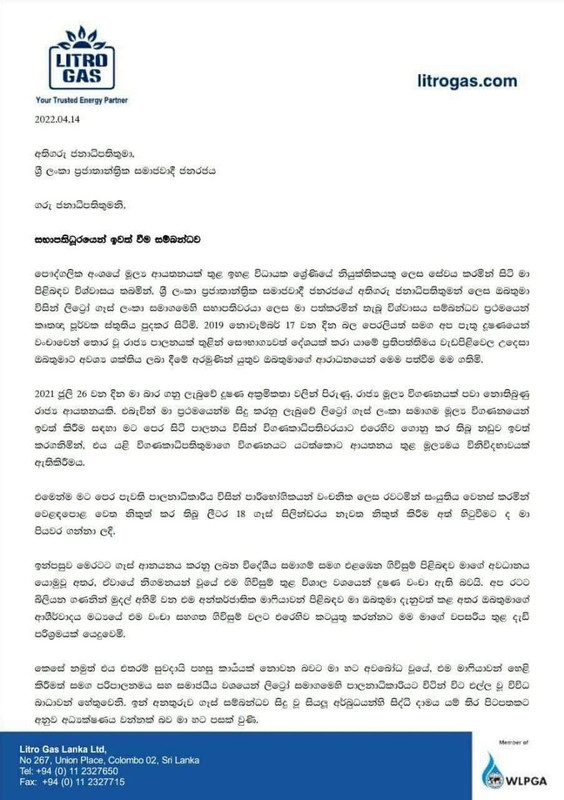
Theshara Jayasinghe has stepped down from his position as the chairman of Litro Gas Lanka Limited, the primary liquefied petroleum gas supplier in Sri Lanka.

Conveying the decision to President Gotabaya Rajapaksa in his letter of resignation, Jayasinghe said he resigned with effect from 14 April (Thursday).

Jayasinghe says, since the day of his appointment on July 06, 2021, he had not received enough support from then-Finance Minister Basil Rajapaksa.

He explained that he cannot solve the ongoing LP gas crisis by himself, noting that it needs the contribution of all economic experts in the country.

Jayasinghe added that steps have been taken to import LP gas from India under credit, in order to maintain the supplies in the market for a period of time. He went on to urge the President to intervene and ensure that it happens accordingly.

SriLankan issues clarification on cargo flights to Uganda in 2021

April 15th, 2022

Courtesy Adaderana

SriLankan Airlines has clarified the speculations circulated on social media regarding SriLankan aircraft uplifting printed material to Entebbe International Airport in Uganda last year.

In a statement issued on 14 April, SriLankan Airlines said it received an air cargo order to transport approximately 102 tons of printed material from Colombo to Entebbe International Airport in Uganda in February 2021.

In April last year, a local news outlet had raised questions with regard to the cargo manifests in an attempt to confirm what exactly the printed material was.

According to the newspaper report, SriLankan Airlines was issued a request under the Freedom of Information Act.

However, citing its inability to disclose the confidential information related to a commercial transaction between the airline and the customer, no related information had been provided.

Over the past few days, social media platforms were abuzz in Sri Lanka regarding the issue, with posts alleging that the flights carried money belonging to some powerful individuals in the country.

SriLankan Airlines, in its clarification, noted that the consignment was purely commercial in nature and brought in much-needed foreign revenue to the airline and country at the time.

The national carrier went on to emphasize that this cargo order was undertaken only for commercial purposes.

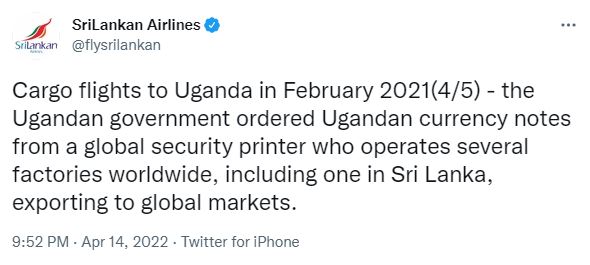
Taking to its official Twitter account, SriLankan Airlines said the Ugandan government had ordered Ugandan currency notes from a global security printer who operates several factories worldwide, including one in Sri Lanka, exporting to global markets.

According to the national carrier, the SriLankan aircraft which were underutilised at this time during the pandemic were chartered by a UK based freight forwarder. What is now being misunderstood is the Airline Pilots Guild proud announcement of this achievement of using unutilised pax aircraft.”

Meanwhile, foreign media reports have shown an abnormal rise in Uganda’s foreign exchange reserves during the period when the said flights arrived.

According to a report, Uganda’s foreign exchange reserves rose to USD 4.4 billion in September 2021 from USD 1.5 billion in the first quarter of 2021.

However, some foreign media outlets reported that this may be due to Uganda having taken advantage of its IMF special drawing rights.

Ceylon Petroleum Corporation limits dispensing fuel for vehicles

April 15th, 2022

Courtesy Adaderana

The Ceylon Petroleum Corporation says dispensing fuel volumes for vehicles at filling stations is limited with effect from 1.00 p.m. today (April 15).

Thereby, filling stations are permitted to pump only fuel worth Rs. 1,000 for motorcycles at a single time.

For three-wheelers, the limit has been set at Rs. 1,500 worth of fuel.

Meanwhile, the maximum amount of fuel allowed to be dispensed to cars, vans and SUVs is worth Rs. 5,000. 

However, the restrictions are not applied to buses, lorries and other vehicles used for commercial purposes, the CPC added.

The corporation meanwhile noted that filling stations would dispense fuel to barrels and cans only for those who are engaged in agricultural, production or industrial activities.

Accordingly, those who wish to obtain fuel for barrels and cans for industrial purposes are required to seek permission from the relevant Divisional Secretariats. In order to obtain fuel for agricultural activities, permission should be sought from the Agrarian Services Department officers.

CPC chairman Sumith Wijesinghe said the decision was taken in an attempt to prevent a shortage of fuel and to curb fuel-related irregularities.

The corporation had previously announced that filling stations would not be dispensing fuel to cans and barrels from 12-14 April.

The CPC further stated that fuel distribution activities would continue as per usual from today (April 15).

THE TRUE COST OF AUSTERITY AND INEQUALITY

April 14th, 2022

Greece Case Study OXFAM CASE STUDY

Among EU nations, Greece has been hardest hit by the impact of the
financial crisis. Two years ago, in June 2011, The Economist evaluated
the EU‟s actions towards Greece and said that a new rule seemed to
have been adopted: „if a plan doesn‟t work, stick to it‟.1 Two years later
there is no sign of any change in direction, while the social and political
situation continues to worsen.
Context of the crisis in Greece
In Greece, the decade leading up to the crisis was characterized by a
lack of structural reform in taxation, public debt and public sector pay.
Greece had a poorly organized fiscal system, defective social services,
and political parties that failed to agree on how these should be
reformed.

In October 2011, it was revealed that 109,421 people who did not appear
in the census were, however, receiving state pensions from the main
social security fund. It was estimated that the total amount paid out to
these fake pensioners could have been as such as €1.5bn. In June 2011,
the International Monetary Fund (IMF) declared Greece‟s fiscal system a
shambles, noting that the problem arose from a lack of political will,
which exacerbated a lack of competitiveness and economic isolation.2
The lack of any increase in tax revenues, set against rising government
benefits and consumption, revealed severe shortcomings in the Greek
tax system. One of the primary deficiencies was the tax authority‟s failure
to collect taxes: tax evasion in Greece may have reached as high as 27.5
per cent of GDP in the period 1999 to 2007 – amounting to the largest
informal economy of any EU country.3 Former Finance Minister
Evangelos Venizelos complained in 2011 that only 25,000 Greeks
declared an annual income of more than €100,000 and barely 160,000
admitted to earning more than €50,000. Fraud control was clearly
lacking.4 Mr Venizelos said that changing the situation was both an
economic priority and a moral obligation. Self-employed workers

represented 37 per cent of the Greek workforce, compared to an average
of 15 per cent in the EU overall. Being self-employed was very appealing,
as the taxes paid by this group in Greece were about 15 per cent (the EU
average rate was nearer 25 per cent) and, with so few taxes being
collected, the freelance worker had greater opportunities for fraud.
Greece maintained a public debt of around 100 per cent of GDP during
the decade prior to the crisis, which is 20 to 30 per cent more than other
comparable countries.
An important area in which Greece failed to reform before the crisis was
public sector pay. From the early 1990s onwards, the gap between public
sector and private sector pay widened dramatically. By 2011, it was
estimated that public sector salaries were 130 per cent higher than those
of private employees, while the average difference across the Eurozone
was 30 per cent.
Salaries for workers in similar categories were much
higher in the public sector, creating a system of „insiders‟ and „outsiders‟.
This, together with the failure to collect taxes, partly accounts for the
increase in Greece‟s public debt.6 No governing party (neither the
Panhellenic Socialist Movement, PASOK, from 1993 to 2004, nor the
conservative New Democracy, ND, from 2004 to 2009) managed to carry
out the reforms needed to correct the situation before the crisis hit.
The rescue package and austerity measures
When the crisis struck, the PASOK government (re-elected in June 2009)
agreed to enact the economic plans imposed by the EU, the European
Central Bank and the IMF, laid out in their 2010 Memorandum.7
In return
this group, known as the Troika, provided loans which allowed Greece to
avoid defaulting on its debts and going bankrupt. The following are some
of the reforms demanded by the Troika:
Cuts in public sector salaries: A freeze on public sector salaries
until 2014; the immediate cut of two of the 14 monthly salary
payments in the public sector for those employees with a salary above
€3,000 per month, and a reduction of the 13th and 14th payments for
those who earn less than €3,000 per month. A recent IMF report,
however, said that reform of the excessive number of public sector
positions has largely been pushed aside due to reluctance to lay-off
employees.8
Pension reform: A reduction of up to 26.4 per cent in payments to
pensioners and a rise in the retirement age to 65 years for women and
men; a penalty of six per cent for early retirement.9
In September 2012
the retirement age was further raised to 67.10
Tax: The government was supposed to introduce a new plan to
improve tax collection, reduce capital flight and fight tax evasion. The
IMF maintains that very little progress has been made on obvious tax
evasion11 and neither the rich nor the self-employed have yet to begin
paying their dues.12 Unfortunately, VAT – a far more regressive route
to raising tax revenue that tends to penalize low-income groups – was
raised 10 percentage points across all categories.
In April and May 2010, various tax system reforms were launched: bank
bonuses and financial services would henceforth be taxed up to 90 per
cent, and property taxes were tripled for foreigners with a summer
residence in the country.13 Cash payments of more than €1,500 were
prohibited, in order to limit fraud, and people who provided information on
tax cheats were rewarded with 10 per cent of the amount recovered by
the authorities. For the self-employed earning more than €40,000
annually, the tax rate went from five to 40 per cent. Any household with
an annual income above €100,000 would pay a new top-rate tax of 45
per cent, representing a five per cent increase. Only those whose income
was €25,000 annually or less would not be subject to a tax increase.14
Unfortunately, the tax control measures have not brought the anticipated
results. Finance Minister Giorgos Mavraganis was asked why the
government had only collected €14m of the €9.7bn owed by the biggest
tax debtors (the total accumulated amount lost through tax avoidance is
actually €52.3bn).15 He admitted that Greece had only collected that sum
(0.0014 per cent of the amount owed), but said that this was due to many
companies going out of business and people using false invoices to
deflect inspectors.16 El País reported on 24 May 2011 that capital flight
was intensifying, leaving Greece on the verge of bankruptcy. The
newspaper said that Greeks held €280bn in Swiss bank accounts, the
equivalent of 120 per cent of Greece‟s GDP.17
Against this backdrop was the constant pressure from Greece‟s huge
public debt. Already high, this saw a dramatic increase following the
Troika‟s rescue package, at twice the rate of comparable countries.
As a result of the economic problems faced by Ireland, European
governments and financial institutions tried to establish mechanisms that
would regulate country „rescue‟ deals. In the case of Greece, the decision
to approve the loans for the government had two essential features: 1) the
government had to accept direct responsibility for their repayment; and 2)
the money lent became part of the public debt. The constant increase in
Greek public debt due to the rescue package has meant that in
subsequent „rescues‟ the loan was granted to the banks (as bank loans) in
order to avoid indiscriminate increases in the level of public debt.
Greece is unlikely to maintain this debt within the limits set down by the
EU‟s Stability and Growth Pact (which originally said that all countries in
the Eurozone should aim to keep their annual budget deficit below 3 per
cent of GDP and keep total public debt below 60 per cent of GDP),
especially given that servicing the debt accounted for 13.9 per cent of
Greek public spending in 2011.

Impact of the rescue package and austerity measures
Electoral repercussions
The economic crisis has changed the terms of the Greek political system,
from left-wing and right-wing political parties to „pro‟ and „anti‟ the 2010
Memorandum and austerity measures that followed. Surprisingly, the
conservative ND party was opposed to it, while the governing PASOK
party was in favour. In May 2012, ND won a general election, after the
public showed their utter rejection of the Troika‟s austerity package. This
election marked an end to the traditional two-party system.
More unemployment
In 2010, household disposable income18 in Greece decreased by 12.3
per cent compared to 2009.19 This was primarily due to rising
unemployment, rather than falling salaries.20 Unemployment has
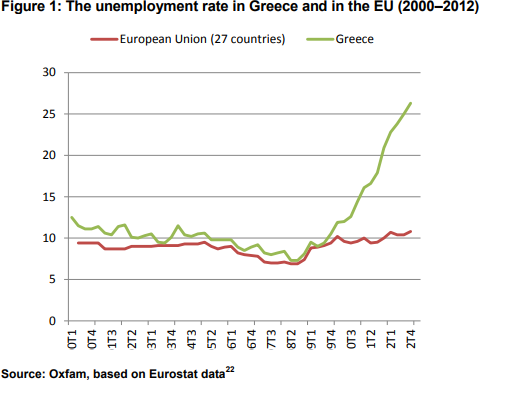
continued to rise steadily throughout 2013. Eurostat indicates that the
greatest rise in unemployment in the EU, between January 2012 and
January 2013, was in Greece, from 21.5 per cent to 27.2 per cent.21
Figure 1: The unemployment rate in Greece and in the EU (2000–2012)
Source: Oxfam, based on Eurostat data22


Poverty and inequality
Figure 2 shows how the parallel progression of Greece‟s per capita gross
national income (GNI) diverged from that of the OECD average around
the time the first rescue deal was approved in 2010.


European Union (27 countries) Greece


Figure 2: Evolution of per capita GNI in Greece and the OECD
country average (in constant $)
Source: OECD, www.oecd.org
In 2011, Greece had the highest rate of those at risk of poverty or social
exclusion in the Eurozone (31 per cent compared to an average of 24.2
per cent across the EU as a whole). This had been slowly decreasing,
but has now risen back to 2004 levels. In 2011 alone, this increased by
3.3 per cent, meaning that 372,000 more people were at risk of poverty
or social exclusion.
More than one in three Greeks fell below the poverty line in 2012 (once
figures are adjusted for inflation and using 2009 as the limit for setting the
poverty line). The middle class has shrunk and is closer to the poverty
line, while the poor are getting poorer and inequality is increasing.
Greece continues to be the only Eurozone country with no basic social
assistance system that provides a safety net of last resort.23
The suicide rate in Greece has increased 26.5 per cent from 377 in 2010
to 477 in 2011, and has increased by 104.4 per cent in the case of
women.24
Between 2001 and 2008 the number of people aged between 18 and 60
living in households with no income remained fairly constant, falling
slightly from 9.4 to 7.5 per cent. That has reversed since the beginning of
the crisis, and particularly since the introduction of the rescue package
measures, with the number of people living in households with no income
rising to over one million in 2012, equal to 17.5 per cent of the
population.25

Figure 3: Percentage of the population living in jobless households
(except households of students between 18 and 24 years old who
do not work)26
After six consecutive years of recession and four of austerity, Greek
society is becoming increasingly fragmented. The homeless population is
thought to have grown by 25 per cent since 2009, now numbering 20,000
people.27
Scant social resources and rising extremism
The public health system is increasingly less accessible, especially for
poor and marginalized groups. Close to one in three Greeks have no
public medical insurance, most often due to long-term unemployment.28
The increase in poverty and unemployment and the weakening of social
services have been accompanied by an increase in the crime rate.29
Far-right parties Golden Dawn and AnEl each achieved seven per cent of
votes in the 2012 election. Their successes can be attributed to the
country‟s grave economic situation and a drop in confidence in traditional
parties. The main strength of Golden Dawn, which blames the crisis on
non-Greeks, derives from the role it plays in some Athens
neighbourhoods with a particularly high percentage of immigrants.30
There, it has become very visible, offering to step in where the state has
failed to do so. In apparent acts of collusion with local police, Golden
Dawn has provided personal safety services for hungry pensioners who
feel too frightened to go outside.31 It offers food distribution for Greeks
only, and military-style groups savagely attacked immigrants and those
Greeks who stand up to them.32 Such groups have dedicated themselves
to hunting down immigrants who live on the street with no resources.
Human Rights Watch reports that there is a burgeoning crisis of
xenophobic violence towards immigrants and political refugees in Athens
and across the country.33 Extreme right-wing fanatics have stormed
through neighbourhoods with immigrant populations. One incident in
2011 left at least 25 people hospitalized with wounds from knifings and
serious beatings.

Conclusion
The situation in Greece today is very volatile. Austerity measures have
left a large part of the population in dire straits. Cuts in public
expenditure, coupled with constantly rising unemployment, have left
many people either destitute or close to it.
With a third of the population on the threshold of poverty and 17.5 per
cent living in households with no income, family networks can no longer
be relied on to support the needy. A fair tax system capable of combating
tax evasion is essential in order to once again fund the social protection
networks that have been incrementally dismantled during the crisis, as
part of the Troika‟s rescue deals.
But this will require decisive political action and, as Greece witnesses a
collapse of its political system, that does not appear to be a likely
prospect. The political vacuum has led, in turn, to a feeling of public
insecurity, fed in part by a rise in racism and xenophobia. If institutions, in
particular the government and the parliament, do not succeed in
regaining public trust it will be even harder to emerge from the financial
crisis. For that to happen, economic policy must put people‟s needs first.

POLITICS IN SRI LANKA PT 3 E

April 14th, 2022

KAMALIKA PIERIS

India did not stop there. India was determined to get a good hold on Sri Lanka . India  used the Tamil Separatist Movement for this.

A process of negotiations was begun between the Governments of India and Sri Lanka with India playing the role of an interlocutor bringing the Tamil parties and the Government of Sri Lanka to the negotiating table, in order to solve the ongoing insurgency by Tamil militants and the ethnic problem in the island through Constitutional proposals.

The outcomes of these negotiations were the Indo-Sri Lanka Peace Accord in July 1987, and the drawing up of the 13th Amendment to the Constitution and the Provincial Councils Act No 42 of November 1987.

Secret talks started on signing an accord between the two countries, with the participation of ambassador  Dixit, N. Ram Editor, Hindu”, and Minister Gamini Dissanayake. The Indian Research and Analysis Wing, RAW was drawing up the necessary plans..

Indian High Commission’s Second Secretary H.S. Puri left for Jaffna and met LTTE Chief V. Prabhakaran and other Tamil militant leaders. High Commissioner Dixit went to Madras and met leaders of Sri Lankan Tamil organizations. TULF Leaders insisted on merging the Northern and Eastern Provinces and setting up a separate Provincial Council to administer the region. Dixit conveyed their proposals to Indian Prime Minister Rajiv Gandhi in New Delhi.

Two Indian military helicopters landed in Jaffna from Madurai on July 24, 1987  and took Prabhakaran to  Madras and then Delhi to meet PM Rajiv Gandhi. The purpose was  to get Prabhakaran to agree to an Indo-Lanka Accord to which TULF and other Tamil organizations had already agreed. The talks were held at Ashok Hotel, Delhi, where Gandhi promised give more powers to the LTTE in an interim administration. Rajiv Gandhi also agreed to pay LTTE Indian Rupees five million monthly until the new administration started functioning properly reported Dharman Wickremaratne.

In  July,1987  we were informed that the Prime Minister of India Rajiv Gandhi was to arrive in Sri Lanka to sign an agreement with us, recalled  Air Vice Marshal A.B.Sosa. That night I dropped in at  Katunayake International Airport. It was all agog with Indian Air Force aircraft. It looked as though  India had taken over the airport.

 Prime Minister  Rajiv Gandhi and wife Sonia Gandhi arrived in Sri Lanka on July 29, 1987 From Katunayake they travelled by helicopter to Galle Face. The Indo Lanka  Accord was signed on July 29, 1987 at 3.37 p.m  Thereafter, unofficial talks were begun between President Jayewardene and the Indian PM. Three discussions were held till midnight and the final talks were held on the morning of July 30th. Even before the Indian PM‘s departure, the Indian Peace Keeping Force (IPKF)  had established themselves in the north east of  Sri Lanka by the afternoon of July 29th.

Trouble was expected in Colombo, when Rajiv came to sign. Posters, slogans and black flags appeared in Colombo and many other main cities expressing strong opposition to the UNP Government, the Indo-Lanka Accord and Tamil separatism.  A massive protest march was coming from Kolonnawa heading to President House and to deal with them was the General Service corp. that   dealt with pay and records and ran the army farms, recalled Kamal Gunaratne.

An anti-accord protest campaign  began near the Bo-Tree junction Pettah at 8.00 a.m. July 28, 1987 . JVP Politburo Members H.B. Herath and Gunaratne Wanasinghe, Central Committee Members Gamini Wijegunasekera, Thangaraja and hundreds of other high level JVP activists were taking active part.

Venerable Hedigalle Pannatissa, Ven. Maduluwawe Sobhitha, Ven. Muruttetuwe Ananda, Ven. Dr. Wilegoda Ariyadewa, MPs Dinesh Gunawardena and Prins Gunasekera were representing the Mawbima Surekeemay Vyaparaya at the protest rally. Also participating were SLFP Leader Sirima Bandaranaike, Jinadasa Niyathapala, Ven. Bengamuwe Nalaka, Gamini Iriyagolla and Anura Bandaranaike and many other SLFP Parliamentarians. The unseen hand behind the country-wide protest campaign was the JVP .All activities were organized by the Inter-University Students’ Federation and the Bhikkhu Front, said Dharman Wickremaratne.

By 11.30 a.m.  all roads in and around Fort area were blocked since nearly 20,000 people had gathered near the Bo-Tree junction. Seth pirith chanting was heard. Ten processions, each comprising over a thousand people marched in four different directions. The protestors set fire to buses and other state property.

People panicked when the police baton charged after tear gassing the crowd. There was repeated gunfire. A total of 21 persons died   there.

The UNP Government declared an island-wide curfew on the night of July 28, 1987, Defying the curfew hundreds and thousands of people were demonstrating against the accord. The violence which started near the Bo-tree junction quickly spread all over the island. According to official Government estimates 132 protesters were killed and 712 persons including 56 bhikkus were taken into custody during five days from July 27 to August 2. The number of violent incidents was 2,527.

The US and UK were behind the indo Lanka accord, though it was presented as an India thing, stated Nalin  de Silva. At the time, it was thought that this was forced on Sri Lanka by India, thanks to JR’s poor diplomacy. It is now found that this was the work of the USA, not India. USA was behind the India-Sri Lanka accord of 1987, agreed analysts. 

Izzeth Hussain had told WT Jayasinghe,   Permanent Secretary, Foreign affairs, that almost certainly a third party was involved in the Indo-Lanka accord. Jayasinghe, who was present at the signing, ‘told me later that I was correct.’

Hussain recalls that US Ambassador James Spain had sought a meeting with  Sri Lanka ‘s Foreign Minister, on the day of the Indian parippu air drop over Jaffna in 1987. Ambassador Spain said he had to convey an urgent message from his government. India was going to suggest something and Sri Lanka should not over react, Spain said. That ‘something’ was the Accord.

Just after the signing of the  Indo-Lanka Accord, Ambassador Spain handed over an envelope to Rajeev Gandhi, obviously a congratulatory and goodwill message from Reagan. Clearly the contents of the agreement were already known to the US government, said Hussain.  In addition, visiting US senator Charles H.  Percy had carried a letter from US President Reagan to President Jayawardene offering to be of any assistance in conveying a message from J.R. to Rajiv Gandhi.

The  full text of the    Indo Lanka Accord was  known only after it was signed.   It is not popularly known that India wanted the Provincial Council and the devolution proposals  only for North East ,  as  an easy means of creating Eelam. The Jayewardene government extended the Provincial Council system to all the provinces of the country  said Nirmala Chandrahasan.

1987 Indo-Ceylon agreement had three  letters attached to the Accord. They said, firstly  that Sri Lanka  must agree that Trincomalee  or any other port in Sri Lanka will not be made available to any other country for  use against India.  Secondly, the Trincomalee oil farms    operation will be done as a joint venture between Sri Lanka and India. Thirdly foreign broadcasting facilities will not be used for intelligence or military purpose. JR  had sent a reply agreeing to this.

Before Rajiv Gandhi’s departure a Naval Guard of Honor was held opposite the President’s House, Fort.  JR’s son, Ravi had instructed  that the firing pins and  gun powder be removed from the  guns in the Guard of Honor. Ravi had  also told JR not to accompany Rajiv at the Guard of honor.

As the Indian PM was inspecting the Guard of Honor one its members Leading Rate Wijemuni Vijitha Rohana attacked Rajiv Gandhi with his rifle butt. Rajiv Gandhi ducked to avoid the blow .it struck his shoulder but with no serious injuries. As scheduled ,Rajiv Gandhi left for Delhi from Katunayake on the same day at 11.30 a.m.

Wijemuni Vijitha Rohana, born in Boossa, Ratgama, was 22-years-old at the time. He told the Court-Martial that he had no intention of killing the Indian PM but only did so to disgrace him internationally for intimidating Sri Lanka and using force on the country to impose the Accord. Attorneys including Stanley Tillekeratne, Donald Hewagama, and Susil Premajayantha appeared voluntarily for Wijemuni who was sentenced to six years rigorous imprisonment by the Court- Martial for attempted culpable homicide not amounting to murder. He was pardoned and released on April 3, 1990. ( continued)

POLITICS IN SRI LANKA Part 3 D

April 14th, 2022

KAMALIKA PIERIS

JR shot to fame when he spoke at San Francisco Peace Conference in September 1951, where he asked that Japan be forgiven after World War II and reparations forgotten

Prime Minister D.S. Senanayake had been invited to participate at the San Francisco Peace Treaty Conference in September 1951, held to propose punitive provisions and the enforcement of arbitrary restrictions and embargoes for Japan. D.S. was unable to attend and sent Finance Minister JR instead. Prior to his departure, Jayewardene had a discussion with the Prime Minister who strongly advocated the idea of supporting Japan.

JR’s speech is still remembered by Japan. JR’s speech was composed after much consultations and meetings with Asian countries, said Sri Lanka’s ambassador to Japan, Sanjiv Gunawardene speaking in Tokyo at the 70th anniversary of the speech. The case for Japan was first considered at the Colombo Plan Conference”.

This San Francisco speech was JR’s sole positive achievement in foreign relations. Later on, when JR became Head of state, the story changed. JR openly leaned towards USA, angered India and made a spectacle of Sri Lanka in the UN.

JR discarded Sri Lanka‘s policy of neutrality and Non-alignment and tilted towards the west. .Our Non alignment policy, followed from 1956, was dropped by JR in favor of the west observed K.  Godage. JR had the naïve colonial mindset that led people of his era to believe that an exploitative colonizer or ex-colonizer was a benefactor. JR was anti-communist as well as pro-west.

 JR had told Britain’s Prime Minister Margaret Thatcher that the 1947 agreement regarding the military bases was still there, it had not been formally abrogated. There was an agreement with Radio Deutschewelle in JR’s time. My recall is that JR wanted Sri Lanka to join ASEAN. He said that Sri Lanka was a part of South East Asia. ASEAN was an anti-Russia combine of South East Asian states.

JR was always a staunch supporter of USA and was known as ‘Yankee Dickie’.  In 1953, he

 opposed the    Rubber Rice Pact with China, which USA did not like.  As President of Sri Lanka, JR had agreed to US strengthening its VOA station in Chilaw, offered the Trincomalee Oil tank farm to the Coastal Corporation of Texas, USA and permitted the entry of US naval ships to Trincomalee.

Wijesoma   drew a cartoon for Island, which portrayed JR Jayewardene with a dollar sign in his pocket. His intention was to show that JR was pro-American. But it was interpreted as a bribe and a Letter of Demand was sent to him.

With JR in power, the USA for the first time had a powerful supporter in Sri Lanka .USA welcomed this and invited JR to USA. JR was invited to the White House by President Ronald Reagan in 1984.  In his White House speech Reagan said that the J.R. government’s decision to follow a neo-liberal program was a blessing.  JR replied that in USA, he feels that he is among friends. The speeches, of President Reagan and President J.R. Jayewardene on June 18, 1984 could be found on YouTube https://youtu.be/5OHGpO_1j8o

In 1986, USA wanted to install new transmitters at its Voice of America base In Chilaw, to beam shortwave radio programs to India, USSR, East Africa and China. The plan was to add six transmitters with a total output of 2,500 kilowatts. This was necessary to improve the quality of the broadcast, so that US could compete with powerful broadcasts from Tashkent in the USSR.

The Soviets’ broadcast capability is far stronger than ours,” said USA. Radio Moscow utilizes 37 powerful, state-of-the-art 500-kilowatt transmitters. We have paired six aging 250-kilowatt transmitters together to try to match that broadcasting strength.” If the planned transmitter is completed,-construction is expected to take four years, it will make the Voice of America signal in this region 25 times stronger than it is now.

Ground preparation and design work was   already under way at the Chilaw site. Charles  Wick, Director of the U.S. Information Agency, had come  in and participated in the official ground-breaking ceremony. Then Sri Lanka wanted to change the site from Chilaw to Puttalam,  because about 200 squatters living on the Chilaw land would have to be relocated.

Sirimavo Bandaranaike  had created a fine image for Sri Lanka ,internationally. .Sri Lanka was the head of the Non-aligned movement in her time. Sirimavo had hosted a  very successful Non –Aligned summit meeting in Colombo and  Sri Lanka  was well respected in the UN. Sri Lanka’s opinion  was sought   when anything relevant  came up in the UN.  

‘They would ask us for our opinion  but  after JR came , that vanished. After JR we  had started voting in all directions at the UN,  such as supporting UK in the Falklands war,’  said  diplomats who had worked in the  UN.

JR  it appears took no notice of the UN.  JR  never  addressed the UN assembly. He did not even call on the Secretary General  though  he visited New York on his 1984 visit to USA.

Thalif Deen recalled  that,  President Jayewardene’s brother, HW had phoned JR from Geneva, where HW was attending the United Nations Commission on Human Rights session and was trying to oppose a resolution against Sri Lanka. The telephone rang at Braemar’, the Ward Place residence of the President seeking instructions. Towards the tail-end of the conversation those in the hotel room in Geneva heard  HW saying Yes, Dicky, Yes, Dicky, No, Dicky, we can’t do that, Dicky”. Asked what President Jayewardene’s instructions were, they were told the President wants us to leave the UN”.( date not provided).

JR must be remembered as the first, and so  far only, Sri Lanka Head of state  to   thoroughly bungle relations with India.  Sirimavo had  built on the good relations SWRD had with Nehru. Sirimavo , in her turn, had   very good relations with Indira Gandhi . JR messed this up. He angered Indira Gandhi by comparing Indira  and her son Sanjeev to  a cow and calf. India  also strongly objected to the expansion of the  VOA station, saying that it might be used as a covert listening post.

India promptly retaliated. India took the side of the  Tamil Separatist Movement .They got the Tamil militants down and trained them in India. Then in 1987, there was the parippu drop in Jaffna. Demonstrations were held opposite the Indian High Commission and the High Commissioner’s official residence to protest against India’s violation of Sri Lankan airspace India did not care.

Sri Lanka  government was scared that India would invade Sri Lanka . JR found that he  had no soft contact to Rajiv Gandhi or his new officials.. Arun Singh was Rajiv’s principal advisor. Lalith de Mel,  who was at one time, head of Reckitt and Colman in Sri Lanka , knew Arun Singh as both had worked in Reckitt and Colman.

 Lalith Athulathmudali asked Lalith de Mel to go to India and speak to Arun Singh. Lalith de Mel was briefed by Athulathmudali and  JR.  Lalith de Mel went to India and met Arun privately. Arun had probed the Sri Lanka government’s attitude and said he would settle the matter.   The threat of invasion  ended. ( Lalith, the first Sri Lankan…”  by Lalith de Mel p 57-60.)  (continued)

බං කො ලො ත් ? ?

April 14th, 2022

ජයන්ත හේරත්

ලෝක බංකොලොත් ලිස්ට් එකට

ලංකාවත්

එකතු විය හැක.

සමහරු  බයය

හැම දේටම බයය.

ලිස්ට්‍  එකේ

ඇමරිකාව

එංග ලන්තය

සාමාජිකයින් උනේ

බොහෝ කලකට පෙරය.

ලිස්ට් එකේ

සාමාජිකයෙක් වීම

නම කැත වීමක් නොවේය.

ග්‍රීසියත්

සාමාජිකය.

bankrupt සංගමේ

සාමාජිකයෝ

ඔක්කොම

එලොව ගිහින්

මෙලොව ආවෝය.

අවුරුදු

කීපයකින්

බංකොලොත් භාවයෙන් මිදුනේය.

අලුත් තත්වයට

හැඩ ගැසීම අමාරු නැත.

අවශ්‍ය වන්නේ

හිතන හැටි වෙනස් කිරීමය.

අපේ

ඔලුව

ටිකක් හදා ගන්නට සිදු වනවා ඇත.

පාරේ තොටේදී

Are you Indian? කියා කවුරු හෝ ඇසුවොත්

No Sri Lankan කියා

අභිමානයෙන් කියන්න ටිකක්

අමාරු වෙනවා ඇත.

නන්දා ට

අලුත් සින්දු

ටිකක් කියන්න වෙන්නේය.

සුනිල් ටත් ලියන්න වෙන්නේය.

ඒවා එච්චර ප්‍රස්න නෙවේය.

අපේ අලුත්

පරම්පරාවට ගෙදරට වී

AC දා ගෙන

නිකම් කා බී

ව්‍යායාම විතරක් කර කර

ඉන්න වෙන්නේ නැත.

ගමට ගොස්

කුඹුරක් කොටා ගෙන

මයියොක්ක බතල

එළවලු වවා ගෙන කන හැටි

ඉගෙන ගන්න

වෙන්නේය.

දිය කඩිත්තකින්

හෝ

මුහුදෙන් මාලුවෙක්

අල්ලා ගෙන කන හැටි 

ඉගෙන ගන්න

වෙන්නේය.

ගෙදර කුකුලෙක්

හදා ගෙන

බිත්තර ගෙඩියක්

දාන කන් බලා ගෙන

ඉන්න වෙන්නේය.

කුකුල් මාළු

කන්න

කුකුලා බිත්තර දාලා ඉවර වෙන තෙක්

බලා ගෙන

ඉන්න වෙන්නේය.

කිරි පිටි

වෙනුවට ගෙදර

එලදෙනෙක් හදා ගෙන

දියර කිරි බොන්න

සිදු වන්නේය.

ඌරු මස්

කන්න

ඌරෙක්

හදා ගන්න වෙන්නේය.

ඇමරිකාව

ඇලස්කාව

රුසියාවෙන් ගත්තේ 

ඩොලර් මිලියන් එකටය.

ඉඩම්

විකුනන්න

වෙනවා ඇත.

ගරු නම්බු

ඇතුව

සිටීමට නම්

බලා ගෙන

හැසිරිය යුතුය.

අපේ

තරුණ පුහුණු ශ්‍රම බලකාය

වැඩි දයුණු කල යුතුය

විශ්ව විද්‍යාල

වැඩ වර්ජකයින් බිහි කරන මද්‍යස්ථාන  නොව

වැඩි ආදායම් ලබන

පුහුණු ශ්‍රමිකයින් බිහි කල යුතුය.

70-75 කාලේ මෙන්

ලංකාවේ වගාව

සහ

කර්මාන්ත

වැඩි කර

පිටරටින් ගෙන්වන දේ

අඩු කර

ගත යුතුය.

එවිට

යාපනේ ලුණු අල මිරිස් ගොවියන්ගෙ

අතමිටත්

සරු වනු ඇත.

70-75 ලංකා පාලක ලොක්කන් සහ උන්ගේ හෙන්චය්යන්

එකල

නොකළ දේත් 

දැන් සිටිනා සහ ඉදිරියට එන 

ලංකා පාලක ලොක්කන් සහ උන්ගේ හෙන්චය්යන්

කල යුතුය.

එනම්

හුදී ජනයා කන කෑමත් බීමත්

එලෙසම කා බී,

හුදී ජනයා සමග

සියලු පෝලිම්වල සිට,

හුදී ජනයා සමගම

මහජන ප්රවාහන ගමනේ

හෝ

පයින්

වැඩට යාම් ඊම්

සහ

දේශීය හොලිඩේස්

යා යුතුය.

අධි වේගී ධාවන මාර්ග වලට

dollar

yuan

යෙන්

Riyad

Rubal

Marc

Franc

වලින් ගෙවන්න වෙනවා ඇත.

කැමරාවට නොවේය,

බොක්කෙන්ම කල යුතුය.

බය නම්

හමුදාව ආරක්ෂාවට

ලගින් තබා ගත්තට

කාරී නැත.

එවිට

ගෝල්-face 

රොක් කානිවල් අරගල

සංවිධානය කරණ

V 8 වාහනත් අන්තරස්ධාන වී

ඉන්ධනත් පිරිමහ ගත් කල

රට උඩු ගං බලා ඇදෙනු ඇත.

නය බර අඩු කර ගත හැක.

කන්ද පාමුල

සිටින විට

හොඳම දේ

කන්ද

නැගීමය.

ඉන්පසු

ලංකාව

ආදර්ශමත්

රටක්  ලෙස

ඉදිරියට ඇදෙනු ඇත.

බංකොලොත් බව ආශීර්වාදයක් බවට පත් වනු ඇත.

Ready for a discussion with the people who protest at the Gall Face Greens- Prime Minister Mahinda Rajapakse

April 14th, 2022

අග්‍රාමාත්‍ය මාධ්‍යඅංශය

Prime Minister Mahinda Rajapakse declares that he is ready to negotiate with the protestors who picket at the Gall Face Greens on Socio-economic and political issues in the country.

 Accordingly, important thoughts held by the protestors will be discussed in detail for the sake of overcoming the challenge faced by the country at the moment.

Prime Minister Mahinda Rajapakse further mentions that he invites the representatives of the groups who picket if they are ready to negotiate. 

ගෝල්ෆේස් විරෝධයට එක්වූ නිලධාරියා ගංජාකාරයෙක්.. වැඩ තහනම් වූවෙක්.. විනය පරීක්‍ෂණ..- පොලිසිය

April 14th, 2022

උපුටා ගැන්ම ලංකා සී නිව්ස්

ගාලු මුවදොර විරෝධතාකරුවන්ට සහාය දක්වමින් කටයුතු කළ පොලිස් නිලධාරියා සම්බන්ධයෙන් විනය ක‍්‍රියාමාර්ග ගන්නා බව පොලිසිය සඳහන් කරයි.

පොලිස් මාධ්‍ය ප්‍රකාශක කාර්යාලය නිවේදනයක් නිකුත් කරමින් සඳහන් කරන්නේ මීට පෙරද මෙම නිලධාරියා විනය විරෝධී කාරණා මත සේවය අත්හිටුවනු ලැබූවකු බවයි.

අතිශය මානුකම්පිත හේතු මත නැවත රාජකාරි පිහිටුවා ඇති බවද එම නිවේදනයේ සඳහන් වේ.

අදාළ නිවේදනය මෙසේය.

Sri Lanka debt restructuring could take months: S&P

April 14th, 2022

Courtesy EasternEye

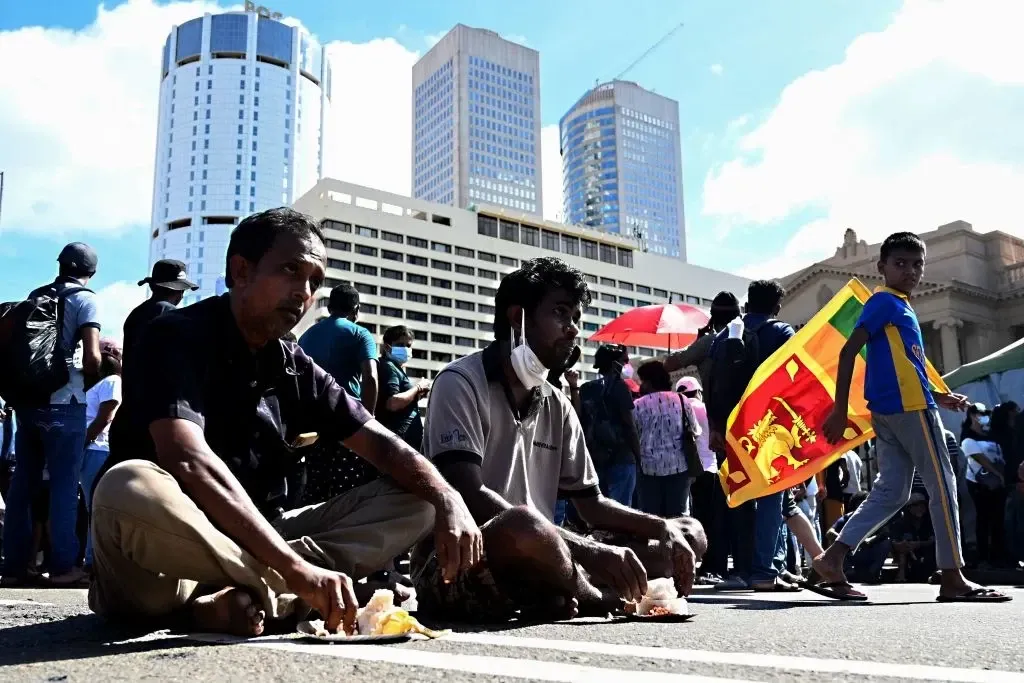
Protesters, gathered at the entrance of Sri Lankan President Gotabaya Rajapaksa’s office, eat while sitting along a road, in Colombo on April 14, 2022, during the Sinhala and Tamil New Year. Severe shortages of food and fuel, alongside lengthy electricity blackouts, have led to weeks of widespread anti-government demonstrations. (Photo by ISHARA S. KODIKARA/AFP via Getty Images)

By: Chandrashekar Bhat

S&P GLOBAL RATINGS said Wednesday (13) it could take months for Sri Lanka to restructure its foreign debt, a day after the country announced it would default on the $51 billion (£38.87 bn) it has borrowed.

It said it would likely assign Sri Lanka a selective default” foreign currency rating after getting confirmation it misses the payment on interest coupons due on April 18.

S&P said it expected Sri Lanka would miss these payments and in the meantime, it lowered Sri Lanka’s foreign currency sovereign rating to CC”, which means highly vulnerable to default.

Sri Lanka announced Tuesday (12) a default on its foreign debt as the island nation grapples with its worst economic crisis in memory and escalating protests demanding the government’s resignation.

Acute food and fuel shortages, as well as long daily electricity blackouts, have brought widespread suffering to the country’s 22 million people in its most painful downturn since independence in 1948.

The government has struggled to service foreign loans and Tuesday’s decision comes ahead of negotiations for an International Monetary Fund bailout aimed at preventing a more catastrophic hard default that would see Sri Lanka completely repudiate its debts.

S&P said Sri Lanka was unlikely to be able to carry out a quick debt restructuring.

Sri Lanka’s debt restructuring process is likely to be complicated and may take months to complete,” the ratings agency said.

Negotiations with the IMF to establish a reform and funding programme are in the early stages,” it added.

Sri Lanka seeking up to $4 billion as IMF talks to start next week

April 14th, 2022

Courtesy Adaderana

EXCLUSIVE: Sri Lanka’s new finance minister, Ali Sabry, says the country plans to start talks with the IMF on April 18 to secure as much as $4 billion in aid for the economy.

He also signaled optimism in getting financial support from China and India https://t.co/oUksMp7ea6 pic.twitter.com/uIzYwe2aEK— Bloomberg (@business) April 14, 2022

Sri Lanka needs between $3 billion to $4 billion this year to pull itself out of an unprecedented economic crisis and plans to start talks with the International Monetary Fund for help, Finance Minister Ali Sabry said.

The nation is looking at making a decent case” before the IMF to help preserve the economy, he said in an interview to Bloomberg Television’s Yvonne Man and David Ingles. Sabry said talks are scheduled to begin in Washington on April 18 and he expects emergency relief funds a week later, if things go well.

Our appeal to them is to release it as soon as possible,” Sabry said, adding that the President Gotabaya Rajapaksa’s government still enjoys majority in Parliament and hence the rightful authority to engage with the lender. Sabry indicated some funds the nation is seeking will come from other lenders and governments besides the IMF, but didn’t provide a breakdown. 

Sabry, along with newly appointed central bank Governor Nandalal Weerasinghe, is a key member of Rajapaksa’s team for bailout talks with the IMF. The funds are crucial to the success of a debt restructuring process initiated by the island nation this week after suspending some outstanding loan and interest payments.

Sabry also sought to reassure investors of the nation’s intent to repay loans.

What we have very categorically stated, across the board, is that we will honor our debt,” he said. The commitment is there, the desire is there, but we don’t immediately have the funds to disburse.”

The IMF’s involvement should help negotiations with bond holders, Citigroup Global Markets analysts Donato Guarino and Johanna Chua wrote in a note to clients. They see Sri Lanka asking investors to take a haircut of 50% on interest payments, and 20% on the principal, with an exit yield of 11%.

Sri Lanka is looking at bridge financing options, and is confident it can secure aid from countries including China and India, Sabry said. That effort would be accompanied by fiscal reforms to curtail expenditure and boost revenues, he said.

Citizens exasperated by double-digit inflation amid a shortage of everything from fuel to food and power cuts of as long as 13 hours have taken to the streets, seeking President Gotabaya Rajapaksa’s ouster as well as that of his brother, Prime Minister Mahinda Rajapaksa.

President Rajapaksa used a customary greeting to the nation ahead of the local new year festival being observed Thursday to appeal for unity and better understanding” as protests in front of his secretariat at the central business district entered the sixth day. 

The government is taking measures to secure the normal life of the people from the current complex situation by properly understanding these challenges,” Rajapaksa had said.

Source: Bloomberg

What next if the President resigns? From the frying pan to the fire?

April 13th, 2022

By Raj Gonsalkorale

While negotiating the IMF package of assistance, the Sri Lanka government could consider a summit with Japan, South Korea, China, India, the EU, UK, USA and the Middle Eastern Arab States for a relief package. Such a package could potentially be up to USD 10 Billion if handled at the highest levels and could include barter arrangements with these countries for some export products.

Demands being made for President Gotabaya Rajapaksa to resign are many and vociferous. Those who are making these demands should however consider some factors. Firstly, the constitutional position. As far as the writer is aware, should the President resign, the Prime Minister acts for the President for a period of three months within which time the Parliament elects the next President to serve out the resigned Presidents term till the next Presidential election. It is unclear whether the current Prime Minister, who has held the office of President twice could act in this position as per the Constitution which limits the term of the President to two terms. If he is barred constitutionally from acting as the President, then the Speaker of Parliament acts as President until the Parliament elects the next President. This constitutional position has to be checked by legal experts. In any event, whoever acts as President will do so until Parliament elects the next President.

Secondly, one then needs to consider possible contenders. Maithripala Sirisena and Sajit Premadasa would most likely be the front runners. Those demanding President Rajapaksa to resign should consider whether one or the other is acceptable to them to be the next President. It is unlikely that either of them will have a majority in Parliament to get elected and therefore they will have to garner that majority by seeking support from others. This article doesn’t intend doing any in depth analysis of the pros and cons of these two possible contenders. Their history and competence levels are surely known. One factor that defines Sirisena is that he has been a believer of the adage that your enemy is my enemy, therefore we are friends”. His teaming up with Ranil Wickremasinghe in 2015 by ditching Mahinda Rajapaksa, and then ditching Wickremasinghe to   join Rajapaksa again in 2019, and now ditching them again seems to illustrate his character. Sajit Premadasa is an unknown quantity when it comes to holding high office although he was a senior minister in the Wickremasinghe government of 2015-2019.

At the very outset it needs to be stated and made clear to readers that the phenomenon of spontaneous peoples’ protests has been unprecedented and very welcome. It is an evolution of the country’s democracy. People participation in governance has to continue if one is to arrest corruption, inefficiencies and waste. It needed to start the process to weed out undesirables from entering Parliament. Democracy is not only about casting a vote every so many years but influencing decision making based on policies and promises, and the character of individuals.

In the current political impasse, it is worth examining the ongoing purpose and role of these spontaneous protests and perhaps what they should consider as priorities towards achieving what could be done to give a new lease of life for an economy that has almost died. The protestors have achieved a couple of key results. They have got a cabinet to resign. They have clipped the wings of unabated power exercised by Presidents and Prime Ministers of the country. They have given a firm thumbs down to family and dynasty politics. They have raised accountability to the top of governance priorities. They have brought people closer to chartering the outcomes needed from those in power on their behalf.

It is unlikely Sri Lanka will be the same hereafter. These are significant democratic achievements over a very short period of time.

The protestors however need to consider some crucial factors now. President Gotabaya Rajapaksa has finally reached out to the IMF seeking their support for debt restructuring, and support for debt relief. He has appointed a panel of high-quality advisers to assist in negotiations on behalf of the government. The measures that the Sri Lankan government will have to take to get IMF support will be stringent and even harsh. Implementing these measures could lead to even greater dissatisfaction.

This situation will not be different should another political combine takes over the Presidency and the government. The situation is going to be worse before it gets better as the new Central Bank Governor himself has stated.  One can foresee placards currently being held by protestors saying Gota Go Home” changing to IMF Go Home” as a consequence. Besides the spontaneous people’s protests, the politically organized opportunistic protests will also raise their tempo and they could even end up in violence.

In this climate, political stability is crucially needed to revive the economy and measures to be taken to prevent a recurrence of a situation being experienced now. When a patient is dying or gasping for breath, there is no point in asking questions that has no link to the condition of the patient. The patient has to be rushed to hospital and ICU care.

Sri Lanka is presently that patient. The need is to rush the patient to the ICU. For the Sri Lankan economy, the ICU is the IMF.

How this patient came to this situation has to be found out, but not now. Once the patient shows signs of recovery, it would be very opportune to enquire how the health of the patient deteriorated and what and who were responsible.  Now is not the time to do it.

In addition to the IMF, specialist physicians are also needed to treat the patient who is sick economically, and the equivalent of specialists would be countries like India, China, Japan, South Korea, Middle Eastern countries, the EU, USA etc. who could and should be canvassed for immediate bridging finance to meet foreign exchange requirements for essential imports at least for the next 6 months until relief from the IMF takes hold.

In the context of the inevitability of seeking an IMF bailout package now and the price Sri Lanka will have to pay for decades of poor economic management, the need for a political compromise to provide a degree of political stability has to be considered as a given prerequisite.

The protestors have achieved a significant political victory in forcing the cabinet to resign. They have indirectly achieved what would have been impossible some months ago, and that is the seeking of IMF assistance and the appointment of the earlier mentioned expert panel to advice the government. These measures at least at this stage, have divorced politics from economic management. The latest announcement that the entire debt repayment is to be temporally halted until the IMF led debt restructuring program has been done is an indication of the trajectory of economic management free from politics. However, how long this distancing will last will depend on the attitude and tactics of political parties and the tactics of spontaneous protestors. Sri Lanka is now in the ICU and the activities of these two groups could pull the lifesaving medicine being administrated to the patient, resulting in the demise of the patient. Party politics therefore has to take a backseat at least for the next 24 months.

However, this will not happen unless the President follows through with the steps he has taken to get the economy reviving and he demonstrates he is freeing himself from party politics to do this. His political party too has to take a backseat along with all other political parties if there is to be some political stability.

However, considering the mistrust people have of the President and the government, his political future and that of his party is in serious doubt. His current challenge and priority should be to do what he should have done at least 12 months ago and get the country out of the mess it is now. The worldwide impact of COVID was known then, and its ongoing impact on the Sri Lankan economy was also known. While his advisers failed him, as President, he has to take the responsibility for the debacle as the buck stops with him.

Now, he has a few options to formulate a strategy that would permit the implementation of the potential IMF bailout package with an arm’s length involvement of the Executive Presidency in economic policy development, and implementation, including debt restructuring and management. This could be part of an interim arrangement for 24 months.

The following political options are suggested

  1. Replace the Prime Minister with a technocrat of proven ability drawn from outside Parliament and brought into Parliament as a national MP to guide the economic revival.
  2. Bring in Sri Lankan technocrats from within or outside of Sri Lanka into the Parliament as National List MPs and appoint them as cabinet ministers to key portfolios like Finance, Economic Development, Justice, Foreign Affairs, Investment Promotion and State Enterprise Reform.
  3. Extend an invitation again to other political parties to join a multiparty cabinet for 24 months with not more than 10 ministers in addition to the portfolios mentioned above and focus only on portfolios such as Health, Education, Power and Energy, Agriculture & Water Resources, Industries, Tourism, Infrastructure Development and the Environment.
  4. Suspend all State Ministers for 24 months and reassign key tasks of State Ministries to Secretaries of the State ministries.
  5. Hold a Presidential and general election soon after the interim period of 24 months.

The President and the government has to take action that will restore even a modicum of trust and confidence in them amongst the people. Life is not normal, and one cannot pretend it is. The Opposition parties and dissidents from within however is not the answer the public wants as they do not have trust in them either. Their protests and the discord it will create will only exacerbate and advance the crash landing of Sri Lanka. So, for the sake of the country and its future, one hopes that a compromise is reached amongst political parties using a basis as suggested above.

POLITICS IN SRI LANKA PT 3 B

April 13th, 2022

KAMALIKA PIERIS

 KM de Silva observed that the 1977 election was a landmark election, after 1956. JR was responsible for many changes in the political and economic spheres.

JR engineered a fresh Constitution for Sri Lanka. The 1977 government appointed a Select Committee of the National State Assembly to consider the revision of the 1972 Constitution. It soon became apparent that what the government had in mind was not the revision of the existing constitution, but its repeal and replacement by a wholly new constitution prepared outside the Select Committee, recalled Nihal Jayawickrema. 

 While discussions were going on, a completely new draft which had never been submitted to the select committee made its appearance. It had been prepared by people outside the committee. This draft was included in the Report of the Select committee of the National State Assembly appointed to consider amendments to the 1972 Constitution, without it ever having been considered by that committee, said Nihal.

This draft was passed in the National State Assembly with the requisite two-third majority and became law in September 1978. A new Constitution, providing for a unicameral Parliament and an Executive President was passed on 31st August 1978, replacing the previous Westminster-styled Parliamentary system. The new Constitution came into operation on 7th September 1978, renaming the country the Democratic Socialist Republic of Sri Lanka.

The author of the text of the Constitution has never been officially disclosed. Professor A.J. Wilson served as a constitutional advisor to Sri Lanka’s President J.R. Jayawardene from 1978-83.  But Mrs. Wilson   said, when contacted, that the late A.J. Wilson was not involved in the preparation or drafting of the constitution for Sri Lanka.  However, AJ Wilson applauded the new constitution. He called it a Gaullist constitution, which it was not.

The 1978 Constitution created a Presidential system of government. The Constitution transferred all the powers of the State to the President thereby abolishing the supremacy of Parliament.

But it was not a true Presidential system; it was a sort of hybrid, observed KM de Silva. Presidential authority was grafted on to a Prime Ministerial trunk. A powerful Presidential secretariat was never established, he observed  

The 1978 Constitution gave the President sweeping powers. These powers are scattered throughout the Constitution, and have to be looked for.  Under the Constitution, the president is Head of state, Commander in Chief of the armed forces and head of Cabinet.  He can prorogue and dissolve Parliament at will any time after one year of its election.  He can appoint any number of Ministers into his cabinet from among the MPs.

 He also appoints the service commanders, the judges of the Superior Courts, the Commissioner of Elections, Auditor General, Attorney General, Secretary General of Parliament and a host of other officers who hold vital positions in government.  

The President thus has an iron grip over the public service including the Elections Department and the Police. These powers assume a dictatorial character when taken in combination with the blanket immunity he enjoys and the near impossible procedure for impeachment, said Priyani Wijesekera, former Secretary General of Parliament  

From 1978 onwards, JR had appointed the district ministers. The District Minister for Anuradhapura, name withheld, said  ” now there is no FR or AR there is only JR.”

JR thereafter engineered the 3rd Amendment, 1982, which said that President could seek   re-election at a date of his choice after four years of his six year term had passed. Also that the incumbent President,   if he won, could start his term afater the old term ended.

JR engineered several other questionable act of Parliament. The special Presidential commission of inquiry Act no 4 of 1978 which invalidated the judgment of the court of appeal [against this law.

There was the Special Presidential commission of inquiry law no 7 of 1978 which targeted Sirimavo Bandaranaike and her1970 government.  It has been described as a vindictive piece of legislation.

The 1978 Constriction expanded the size of the Parliament from the earlier 168 seats to 225. The number of MPs was first increased to 196 MPs, an increase of 28 from 168 seats, in the previous Parliament. The number of MPs was then increased from 196 to 225 by the 14th Amendment of 1988.

JR amended the Parliamentary Privileges Act in 1978, which empowered Parliament to impose punitive sentences on MPs who commit a breach of privilege. The Amendment enabled Parliament to sit as a judicial body, hear a case of a breach of privilege and send the offender to jail for as long as two years. Earlier that power lay with Supreme Court. In 1997 this power was transferred back to Supreme Court, by Act no 27 of 1997.

JR Jayewardene subverted the ‘democratic’ nature of Parliamentary politics. These subversions are still active. First of all, he created a set of    National list MPs” who did not contest the election but sat in Parliament with the elected MPs and enjoyed all the privileges of elected members.

When a General election was called, each political party had to provide two lists. In addition to the nomination list they had to provide a second list of names, called the National list.” The 14th Amendment ensured that the Elections Commissioner sent an additional 29 members to Parliament from this National list,  selected according to the number of votes polled by each party at the election.

These National List members have been heavily criticized. The National list MPs entered Parliament without contesting elections. They were coming in through the back door charged critics.

Before 1978, a general election was conducted on the basis of electoral wards. Parliament consisted of MPs voted in directly from an electoral ward.”  Usually one MP per electoral ward. MPs knew their constituents intimately and were conversant with their problems. The voters knew who their MP was and whom to go to when they had a problem.

JR eliminated the electoral Ward and made the District the electoral unit.  An MP now represented the whole district,  which was a huge geographical area. People in the district did not know the MP and the MP did not know them.Therefore, well known names in sports or films did well at the elections. Also families where the name was known, observed Rajiva Wijesinha   Further, candidates needed a lot more money than before as they had to canvass the whole district. The elections were dominated by money, observed Kusal Perera.

There were other changes in the voting procedure. Initially, at a general election, the candidate obtaining the highest number of votes was declared elected, the First-past-the-post system. This system was changed to a system of Proportional Representation. Members were declared elected on the basis of the proportion of votes obtained by the political party.

The relationship between the MP and the public servant at the district level changed dramatically after the MPs came to be selected through proportional representation, observed Leelananda de Silva.

 There was also the Bonus seat. In each district, the political party or independent group securing the highest number of votes was entitled to Bonus seats.

Voting and winning was complicated further by the preferential vote, the ‘Manape.’ The 14th Amendment introduced a system of preferential voting .Each voter was expected to select the three candidates he liked from the candidates listed in the political party for which he voted. This Manape led to the spectacle of candidates from the same party competing with each other for votes.

JR Jayewardene’ set in motion the wave of political and economic corruption which is operating in the country today.

The 1978 Constitution had abolished specific laws meant to ensure financial integrity of lawmakers. Before 1978, those who had acted in violation of election and other laws not only lost their parliamentary seats but civic rights, as well. However, the 1978 Constitution   eliminated these. The laws limiting election expenses by candidate disappeared as well. The system of tracking election expenses incurred by candidates was also abolished.

Before JR, MPs were paid modest sums as Parliamentarians. They travelled by train, and often became poorer for taking to politics. Under JR’s system, to become an MP was to strike a gold mine. Salaries and perks were increased enormously, including duty-free cars. So high were the stakes that elections came to resemble a mini-civil war.

The benefits and privileges included increased salaries, full pension benefits in five years, duty free vehicles, government contracts, licences for filling stations and liquor bars, and other financial benefits like the Decentralised Capital Budget funds, which came to the MPs to be used for the districts. They were often misused. Rajiva was told by an UNP stalwart, that the entire 1977 cabinet was dishonest.

In most countries, the elected representatives of the people are not allowed to engage in business transactions with the government, buy government property or sell property to the government. Such practices are considered a serious offense leading to removing them from their positions. A similar policy was in operation in Sri Lanka too, until 1978. President Jayewardene turned this system, upside down. He made it possible for the MPs of the ruling party to plunder public property, said critics.

The President himself set an example, said critics. President Jayewardene had a coconut estate in Madampe, Chilaw which he had inherited from his father. It was a barren coconut land of 50 acres. The President handed over the coconut land to the Land Reforms Commission and acquired 50 acres from the Keena Kele Estate, a fertile coconut estate owned by the Commission. Following this example, the MPs and the Ministers of the ruling party purchased government estates at a nominal price. The plunder of estate land continued under the other Presidents as well.

In addition to allowing the MPs to acquire the estates owned by the State, President Jayewardene also allowed them to act as government contractors and the owners of licenses for timber, stone, sand, and passenger transport.  JR’s successors continued this corrupt system, adding new features to it.

The executive President needed a large number of operators and agents in the districts and the villages to ensure his rule. These agents   also were given the opportunity to improve their finance through plunder. They had access to state resources. Political power became the key to gaining access to state resources, observed Keerawella.  (Continued)

RESOLVING THE PRESENT CRISIS

April 13th, 2022

 LankaWeb Editorial

14th April 2022

Resolving  the ongoing crisis in Sri Lanka has now become the greatest challenge for the Rajapaksa Administration.

It is noteworthy to observe that Sri Lanka will be unable to make a USD 200 million loan repayment next week as the government decide to suspend all external debt repayments. This will place further pressure on the banking sector as a former national leader has observed which by itself is a true observation which lends credibility to the importance of quick remedial action needed to steer the teetering ship of Sri Lanka before it either sinks into oblivion or continues to flounder in a sea of uncertainty much to the chagrin of her beleaguered and restless population.

.

 That the government has announced that the country is presently bankrupt seems an understatement where the responsibility is now in the hands of the new Finance Minister to discuss the prevailing situation with the International Monetary Fund during the talks scheduled for next week in Washington DC.

By mid-May, the Indian Line of Credit will be over and by June, private businesses will be unable to operate due to a lack of foreign exchange which is a harbinger of impending escalation of the present crisis where post haste remedial action now becomes imperative where government must now take full responsibility for the bankruptcy of the country and the restoration to a normal order which will placate unrest and ease tensions within the agitated population of Sri Lanka.

Realistically all  political parties need to be involved in this without any conditions where elections or constitutional amendments at this point will not solve the crisis in the country After discussions are held with the Government and all parties and a plan is formulated, conditions can be laid down towards the restoration of a once flourishing nation now in the throes of desperation. It is also the responsibility of the leadership to give everyone an equal hearing of the intended plan of action. In Lebanon for instance – the IMF agreement was reliant on it being tabled in Parliament for their approval. This must happen in Sri Lanka as well.”

Towards overcoming the crisis a national effort is surely needed to do so where despite a difficult period, fruition will follow if a plan is adhered to where the crisis could be surely overcome, so there probably is no need for the Nation to panic overly if they were to compare a similar situation where the former crisis in Lebanon  was resolved through help from the International Monetary Fund(IMF) and the direction which  Sri Lanka now needs to take.Other Nations like Argentina and Zimbabwe as examples too have faced similar crises  of a dire nature which they too have gainfully overcome.

The groundwork for this is already being laid.The New Finance Minister and the other responsible sources such as leaders of the Central Bank responsible for the financal needs of Sri Lanka have implemented a plan of action which sounds credible where hopefully tensions within the nation will ease.

Aspirations towards a better Sri Lanka as the Sinhala and Tamil New Year approaches where an anxious population awaits an auspicious and blessed outcome which now positively rests in the hands of her Administrators.

Mayor Patrick Brown and his surrogate Tamil Family

April 13th, 2022

Asoka Weerasinghe (Mr) Kings Grove .Crescent . Gloucester ,. Ontario . K1J 6G1

13 April 2022

Mayor Patrick Brown MPP
Office of the Mayor
City of Brampton
2 Wellington Street West
Brampton, Ontario
L6Y 4R2

Dear Mayor Patrick Brown:

Now that I have gathered through  bylined Tonda Maccharles’s news item in the Toronto Star, Patrick Brown vows in video to end Canada’s ‘terrorist’ designation for Tamil Tigers. Your taking the plunge to be the God Father of the Canadian- Tamils, let me be the first Sinhala-Canadian to wish you a Happy Sinhalese & Tamil New Year.  Suba Aluth Avuruddka Waywa.  It happens today, on the same day, April 13, every year.

Woo..Woo! Smart move Patrick?  Sweet Mother of Jesus, I knew it was coming, but how is it that it took you this long to start your serious ‘ love-in with the Tamils’, with an eye to be the first Viceroy of the twin  Canadian-Tamil Kingdom of Brumtun-EllamMukkam down the road.

The news item said – ‘Conservative leadership candidate Patrick Bown says he will lift the ban”: on a designated terrorist organization known as the Tamil Tigers, open up immigratation to any Tamil family that wants to come to Canada.”

Well Patrick, if you think that Canada is your GrandMother’s and Mother’s piece of real estate – Go ahead and do it., You will lift the ban” you said.  Do it Patrick, for Pete’s sake, siphon every Tamil out of Sri Lanka and let my Sinhalese people live in peace -not having to look over their shoulders to see whether a Tamil Tiger is following him or her ‘with an AK47 to shoot and kill them.  

And the young Sinhalese Mother breastfeeding her infant in the open, not worrying that a Tamil Tiger would come and pluck the infant  from her bare breast and bash the head against a charnockite granite rock or bayonet the infant and celebrate watching the little skull split open and ooze ketchup blood.

And to help Tamil parents who suffer every October, November and December every year with the pandemic of Cancer, as their sons and daughters come in droves into the Sri Lanka High Commission’s Consulate Office in Ottawa; with telegrams in hand saying – Come home Immediately, Mother  (or Father) is dying of cancer,” andapplying for travel documents to get home quickly for their annual holiday, to soak in the Jaffna-Killinochchi sun to get back their tan that they lost during the Canadian Winter’s.  The Fathers and Mothers dying of  cancer were strings of lying Masala wade with a devilled shrimp curled in the center.

You know what Patrick, it is strange about these Convention Refugees who are not supposed to be returning to the country that they ran away from saying they were being persecuted and discriminated, and no other parents of other ethnic groups, like Sinhalese, Muslims, Burgers and other, are not afflicted by cancer during every October, November and December.”  That is proof positive  that all theTamils with telegrams in their hands are ‘economic refugees’ who came into Canada are scam artists with stories dipped in Jaffna’s Hogwash.  How do I know? I had to deal with some of them when the First Secretary (the passport officer) was not available between 1989-1994. .  And here are the numbers who came to the High Commission in Ottawa with telegrams in their hands applying for travel documents – in 1992 – 8624; in 1993- 5865; January, February, March 1994 – 1133 applicants,   

 Patrick, by siphoning all the Tamils from Sri Lanka , you will be a God’s send to help not to let these Tamils parents die of cancer every last three months of the year.

Are you a church going God loving man Patrick? Well … here is a chance for you to go to heaven having done a damn good deed.  Promise your Tamil-loving heart that you will siphon everyTamil out of my beautiful island, Sri Lanka with whom I am still romancing with and will not allow anyone, including you to hurt her unfairly.  You bet, Patrick, I am standing tall in guard for her in Canada’s Ottawa. And I am boxing my way in and out of the squared circle.

Sell Canada to the Tamils in Sri Lanka…Tell them that the Canadian roads are paved with gold, the grass is greener than in Kilinochchi and Vavuniya.  And that almost all the 37 million  Canadians carry credit cards with them , and the ATM machines are filled with paper money. and a forged passport is going for $25,000 a piece.

And tell them Patrick , don’t worry, I will shuttle you in my boat from your rusty Mother trawler parked in mid-sea”, and say,

 I will row…row..row my boat with you 

gently down the sea, 

Merrily..merrily… merrily,… merrily 

today your life starts with your dream.”

Patrick you said, ‘The Sri Lankan High Commission tells people that I’m LTTE,  Literally, the High Commission,’Brown says in the video So I am going to lift the ban.  I’m going to cancel the ban, I am going to give a public apology.,  I firmly believe that those who are defending loved ones in Sri Lanka against a government that was committing a genocide –  it was acts of self-defence against the Sri Lanka government that was committing a genocide – it was acts of self-defence against a Sri Lanka that was acting in a manner that was a modern  atrocity. Egregious. War criminals.“

Genocide” you say committed by the Sri Lankan government against the members of your surrogate Tamil families.

What moral right do you have Patrick  for you  to talk of  Genocide by the Sri Lankan Government”.  Damn it, Patrick. Even the UN proclaimed that there was no Genocide in Sri Lanka. When you are from the White-man’s clan” of Maestros of Genocide  of indigenous children and women in Canada. Shame on you.  The gall and the temerity you have is not worth even two dead capelin washed on the shores of Middle Cove in Newfoundland,  Shish, Man.. be mindful when you start spitting venom at my motherland Sri Lanka,  I just don’t like what you spit out. I resent it.

Here’s what you have to admit Patrick.  It is estimated that 20,000 indigenous children were taken away from their families and communities.  The white-man’s burden.  Even though your name is Brown, I consider that you are still a white” man.

Indigenous groups were demanding  action after the remains of 215 children were found buried in a former residential school in Kamloops, in B.C.   The bodies were discovered on May 27, 2021, were those of First Nation students who attended the school while it was in operation from 1890 to1978.

The Tk’emlupc te Secwe’pemc First Nation had been trying to unearth the remains for more than 20 years, but they had a breakthrough  using  an earth penetrating radar equipment and found children as young as 3-years old were thought to be among the unidentified students whose deaths were undocumented.  And there were a few more Genocide” sites committed by us Canadians.

So to you I say, Patrick. Don’t try to be smart at spitting at my Motherland Sri Lanka as you will hear my voice loud and clear, perhaps an angry voice as loud as London’s Big Ben when it announces with its Ding-Dong  that it is 12 noon.

 Let it be known Mayor Patrick Brown,  I am on a Mission to guard the good name of Sri Lanka,, the Mother who nurtured me for the first 19-years of my life.

You did hear from me earlier in a letter on December  6, 2012, when you and Paul Calandra lambasted the Sri Lanka Government on TV for not issuing visas to travel to Sri Lanka’s North to check on the Tamil refugee Welfare camps,  I asked you Who the hell do you think  you are? Come down from your high horse, expecting issuance of visas, when you were not even Junior Ministers,  and when the Canadian Government had already refused visas for some Sri Lankan Cabinet Ministers..”

You obviously were ignorant of unspoken  diplomatic reciprocity.

And I could go on and on Patrick.

But let me repeat so that you know.  Be mindful when you lambast Sri Lanka as there is a Sinhalese-Canadian who is following your story of your hateful relationship with Sri Lanka that I Love dearly.

Members of your surrogate Tamil families know me well, who wanted to blow up

the 15 storey Centennial building at 200 Kent Street, on  9 June 1987, as I was employed in the Communications Division of DFO,  It was a big security concern.

Intelligence and Police were involved.  I resent intimidation.  And this Asoka didn’t hide under a table nor behind a door.  Nor did I hide inside a Kent Street manhole.

Keep well and be SAFE.

Asoka Weerasinghe (Mr)

High Commissioner Moragoda meets Finance Minister of India to review present status of Indo-Lanka economic cooperation

April 13th, 2022

High Commission of Sri Lanka New Delhi

Sri Lanka’s High Commissioner to India, Milinda Moragoda met with the Finance and Corporate Affairs Minister of India Smt. Nirmala Sitharaman in New Delhi, today (13 April) to review the present status of Indo-Lanka economic cooperation as Sri Lanka enters negotiations with the IMF for an economic adjustment programme.  

At the outset, High Commissioner Moragoda thanked the Indian Finance Minister for the assistance that India is extending to Sri Lanka in the form of credits for essential commodities and fuel, and also for balance of payment support extended at these challenging times.

The Minister and the High Commissioner observed that this assistance could form part of the bridging finance required by Sri Lanka until the economic adjustment programme with the IMF would be negotiated. It was also observed that India was the first country to support Sri Lanka in this manner to secure bridging finance until that programme would be in place.

In this context, High Commissioner Moragoda and Minister Sitharaman discussed how India could assist Sri Lanka in garnering international support to secure bridging finance and for the economic adjustment programme itself, through both bilateral and multilateral partners.

The High Commissioner briefed the Minister on the debt standstill announced by the Government of Sri Lanka. He informed her that the Sri Lankan authorities are seeking a consensual agreement on debt restructuring.

They explored the possibility of enhancing and restructuring some of the assistance already provided by India in the form of credits for essential commodities and fuel as well as balance of payment support.        

The discussion was also focused on how India could play an expanded role in promoting accelerated growth and development in Sri Lanka in the medium term. 

High Commissioner Moragoda and Minister Sitharaman reviewed and expressed satisfaction over the ongoing official-level discussions between Sri Lanka and India to establish a cooperation framework and to monitor the progress of economic cooperation between the two countries in the present context. The Presidential Advisory Group on Multilateral Engagement and Debt Sustainability, Governor of the Central Bank and the Secretary to the Treasury are engaged in these discussions representing Sri Lanka while India is represented by the Chief Economic Advisor of the Government and the Secretary (Economic Affairs) of the Ministry of Finance. The High Commissions of the two countries in each other’s capitals are also participating in these discussions.

During the meeting, the Finance Minister of India expressed her concern over the humanitarian cost of the economic crisis and said that India would stand by Sri Lanka to overcome its challenges. In response, High Commissioner Moragoda thanked Minister Sitharaman for the personal interest that she has taken in supporting Sri Lanka at this difficult time.

They also noted that Finance Minister of Sri Lanka Ali Sabry and his delegation would be meeting the Ministerial delegation from India next week in Washington D.C. on the wings of the IMF spring meetings. 

High Commission of Sri Lanka New Delhi

ගාලු මුවදොර විරෝධතාවයේ නිරත පිරිස සමඟ සාකච්ඡාවකට සූදානම් – අග්‍රාමාත්‍ය මහින්ද රාජපක්ෂ මහතා

April 13th, 2022

අග්‍රාමාත්‍ය මාධ්‍ය අංශය

සමාජ,ආර්ථික හා දේශපාලන හේතු මත ගාලු මුවදොරට රැස්වී දැනට විරෝධතාවයේ නිරතවන පිරිස සමඟ අග්‍රාමාත්‍යවරයා වශයෙන් තමන් සාකච්ඡාවකට සූදානම් බව අග්‍රාමාත්‍ය මහින්ද රාජපක්ෂ මහතා දැනුම් දෙයි.

ඒ අනුව රට හමුවේ මේ මොහොතේ පවතින අභියෝගය ජයගැනීම වෙනුවෙන් විරෝධතාවයේ නිරත පිරිස දක්වන වටිනා අදහස් සාකච්ඡාවට ලක්කිරීමට අපේක්ෂිතය.

මෙම සාකච්ඡාව සඳහා විරෝධතාවයේ නිරත පිරිස සූදානම් නම් තමන් ඒ සඳහා එම පිරිසේ නියෝජිතයන්ට ඊට ආරාධනා කරන බව ද අග්‍රාමාත්‍ය මහින්ද රාජපක්ෂ මහතා සඳහන් කරයි.

ප්‍රශ්ණ දෙස රාමුවෙන් ඔබ්බට ගොස් බැලීම

April 13th, 2022

චානක බණ්ඩාරගේ

(1). 2021 සැප්තැම්බර් සිට 2022 මාර්තු 10 දක්වා ඩොලරය ස්ථීර (fixed) කර තිබු අතර එම අගය වුයේ රුපියල් 203කි. හිටපු මහ බැංකු අධිපති (කබ්රාල් මහතා) මේ ක්‍රියාමාර්ගය ගැනීමට ප්‍රධානතම හේතුව වුයේ ඒ  වනවිට ශ්‍රී ලාංකාවට විදේශ විනිමය (ඩොලර්) ඒම ඉතාම පහළ වැටී තිබීමයි. රටේ ඩොලර් හිඟ වීම නිසා, රුපියලට සාපේක්ෂව ඩොලරයේ වටිනාකම ඉහල නැඟීණි. අප ආනයන මත යැපුණු ආර්ථිකයක් නිසා ඩොලරය ඉහල යත්ම උද්ධමනය (බඩු මිල ඉහල යාම) වැඩිවේ (JR ජයවර්ධනගේ සීමා විරහිත විවෘත ආර්ථිකයට පින්සිඳු වන්න අප අද දේශීය කර්මාන්ත සියල්ලම පාහේ වසා දමා සියල්ල – ඉඳිකට්ට පවා, ආනයනය කරන්නෙමු).

ඩොලරය පා කලහොත් රුපියල දිනපතා අති සීග්‍ර වේගයෙන් බාල්දු වන බව දන්නා නිසාය කබ්රාල් මහතා රුපියල ස්ථිර කර තැබුවේ.

2022 මාර්තු 9 වෙනිදා විපක්ෂයේ බුද්ධිමතුන් තිදෙනෙක් ගොස් මහ බැංකු අධිපති හමුවිය. මොවුන් කියා ඇත්තේ උන්ඩියල් ක්‍රමය පරාජය කිරීම සඳහා ඩොලරය ස්ථිරව නොතබා වහාම පා කරන ලෙසය (මොවුන් හරියටම කීදේ කුමක්ද කියා මෙම ලියුම්කරු නොදනී). (විදේශ ශ්‍රමිකයන් (රටවිරුවන්) උන්ඩියල් ක්‍රමයට ශ්‍රී ලංකාවට ඩොලර් එවීමට  පුරුදු වීම නිසා ඔවුන් සාමාන්‍යයෙන් වසරකට එවන ඩොලර් බිලියන 7ක් පමණ වන විදේශ විනිමය ඉන් භාගයකටවත් වඩා අඩුවී තිබුණි).

ඊට පසුදාම කබ්රාල් මහතා ඩොලරය පා කර හරින ලදී. එදාම ඩොලරය රුපියල් 260 ඉක්මවා ගියේය. එදාම හිටපු මුදල් ඇමති කීවේ ‘අපි විපක්ෂය කියන ඒකත් අහන්න එපායැ’ කියාය. අද ඩොලරය රුපියල් 320කි (මසක් ඇතුලත). තව මාස 6කින්?   සිම්බාබ්වේවල  පාන් ගෙඩියක් මිලදී ගැනීමට මුදල් පිරවූ වීල් බැරෝවක් හා සමාන මුදලක් ගෙවිය යුතුයි. ශ්‍රී ලංකාවෙත් එසේ වේද?

ඩොලරය මෙසේ එක් වරම මාර්තු 10වෙනිදා පා කිරීම ඉතාම වැරදි බව රනිල් වික්‍රමසිංහ පවසයි. එදා විපක්ෂයේ බුද්ධිමතුන් 3දෙනා දැන දැන රජයට කකුල් මාට්ටුවක් දැම්මාද, නැත්නම් ඔවුනනුත් ඊනීයා බුද්ධිමතුන් පමණක්ද? කෙසේ වෙතත් රජයට උපදෙස් දෙනවා නම් එය මහජන සුභ සිද්ධිය ගැන සිතා සද් භාවයෙන් පමණක් කළ යුතුය. මන්ද පහර වදින්නේ අහිංසක මහ ජනයාටය. අද ආර්ථිකය බ්රේක් නැති වාහනයක් මෙන් ගමන් කරනවා යයි නව මහ බැංකු අධිපති වරයා කීවේ මෙසේ එක්වරම ඩොලරය පා කිරීම නිසා සිදුවන උද්ධමනයේ වන අති සීග්‍ර වැඩි වීමයි. ඩොලරය රුපියල් 400 වන්නේ කවදාද (මැයිද, ජුනිද?).

අසාමාන්‍ය ලෙස ඩොලරය බැඳ තැබීමට තීරණය කිරීම නිසා ඒ කාලයේ බඩු මිල ඉහල යාම අද තරම් නොවීය. මහජනයාට අවශ්‍යද බඩු මිල ඉහල යාම නතර කිරීමය.

ඩොලරය පා කළා කියා උන්ඩියල් ක්‍රමයට මුදල් එවීම නතර වී නැත.  L/C විවෘත කිරීමට (ඩොලර් විකිණීමට – selling) අද බැංකු වල ඩොලර් නැත. රටවිරුවන් කෙලින්ම බැංකුවලට ඩොලර් එවීම සඳහා නම් කොටුවේ මර්නී එක්ස්චේන්ජ් ලා ඩොලර් සඳහා බැංකුවල ගෙවන මිලම ඒ අයද ගෙවිය යුතු බවට කබ්රාල් මහතා පැනවූ නීතිය දැඩිව ක්‍රියාත්මක කල යුතුය (තාවකාලිකව). දැනට එවැනි නීතියක් නැත.

රජය මේ අවස්ථාවේ දැඩි නීති නොදමන්නේ නම් කඩා වැටෙන්නේ අපේ බැංකු පද්ධතියය.

ඩොලරය ඉහල ගොස් ඇති නිසා ගණුදෙණුකරුවන්ගෙන් ඩොලර් මිලදී ගැනීමේදී (buying) බැංකුවලට ඉතා ඉහල මිලක් ගෙවීමට සිදුවේ. මෙය බැංකුවල මුල්‍ය පැවැත්මට තදින්ම බලපායි. බැංකුවල ඇත්තේ සීමාසහිත වූ රුපියල් සංචිත ප්‍රමාණයකි.

කොරේ පිටට මරේ කීවක් මෙන් රජය දැන් කඩිනමින් පොලී අනුපාත ඉහල දමින් සිටි.  ඒවා 13.5%, 14.5% දක්වා ඉහල නංවා ඇත. 25% දක්වා ඉහල නංවන කථාවක් ඇත! රටට ඩොලර් නොඑන මෙවැනි කාලයක මෙවැනි පෙරළිකාරී තීරණයක් රජය ගත්තේ ඇයි? 

මෙයින් රුපියල ශක්තිමත් වී උද්ධමනය අඩු වනු ඇතැයි රජය සිතයි, නමුත් එසේ සිදුවේ යයි කිසිසේත් සිතිය නොහැක. රජයට ඩොලර් නැත, රුපියල ගැන විදේශිකයන් තුල විශ්වාසයක් ඇතිකරගැනීමට රටේ රත්තරං ද නැත (තියෙන ටිකද කබ්රාල් මහතා වික්කේය). තවද දැන් ඩොලරය පාවේ. එවන් පසුබිමක රුපියල ශක්තිමත් වීම නොව තවදුරටත් දුර්වල වීමයි සිදුවනුයේ.   

පොලී ප්‍රතිශත වැඩි කිරීම නිසා බැංකුවලින් මුදල් ණයට ගත්තවුන්ට මේ අධි පොලී ගෙවීම ඉතා අපහසු වේ (සංචාරක කර්මාන්තයද බින්දුවටම වැටී ඇත). ඒ අය උවමනාවෙන්ම ණය පොළී නොගෙවා සිටිනු ඇත; විශේෂයෙන්ම කුඩා ව්‍යාපාරිකයන් සහ නිවාස ණය ගෙවන්නන්. මෙයින් බැංකු වලට තදින්ම පහර වදී. කොරෝනා නිසා බැංකුවලට ණය නොගෙවා සිටින බොහෝ දෙනෙකි.

දැනටමත් අපේ බැංකු දරා ගත නොහැකි පීඩනයකින් පසුවේ. ලෝකයේ සෙසු බැංකු හා සසඳන කල අපේ බැංකු කවදත් අති විශාල ලාභ ඉපැයූ බැංකු නොවේ. ඉතා සුළු ජනගහනයක් වෙසෙන අපේ රටේ උවමනාවට වඩා බැංකු ඇත. දේශපාලඥයනට සහ රජයේ උසස්ම නිලධාරීන්ට අල්ලස් දී රටේ කෝටිපති ව්‍යාපාරිකයෝ තම තමන්ගේ පුද්ගලික බැංකු ආරම්භ කර ගෙන ඇත. අති ධනවත් ඕස්ත්‍රේලියාවටම ඇත්තේ බැංකු 6 හෝ 7 පමණි. එම රජය ඒවා සිය ඇස් 2 මෙන් රකී. රජය දැන් මුදල් මුද්‍රණය කිරීමද නවතා ඇත. මෙවැනි අවධියක, බැංකු වලට මෙවැනි අධික පොලී අනුපාතයන් සිය ස්ථිර තැන්පත් කරුවන්ට ගෙවා ගත නොහැකි වුවහොත්? බැංකු කඩා වැටෙනු හැර වෙනත් විකල්පයක් නැත (පාරිභෝගිකයන් ඉල්ලු විට ඔවුන්ගේ රුපියල් දීමට බැංකු බැඳී සිටි – අපොහොසත් වුවහොත් එම බැංකුව කඩා වැටිය හැක).

 (2). අපනයන (තේ, ගාමන්ට්ස්, නොයෙක් ප්‍රති අපනයන භාණ්ඩ) සහ සංචාරක කර්මාන්තය හැරුණු කොට ක්ෂණිකව ඩොලර් සොයා ගත හැක්කේ තව තවත් විදේශ ණය ගැනීමෙන් පමණක් යයි රජය සිතයි. නිර්මාණාත්මක නව මාර්ග වලින් ඩොලර් සොයා ගැනීමට රජය විසින් කිසිදු වෑයමක් දරුනු නොලැබීය. රජයට උවමනාවක්ද නැති ගානය.

මැද පෙරදිග සේවය කරන්නන් හැරුණු කොට බටහිර රටවල සිටින සිංහල සහ දෙමළ ඩයස්පෝරාව ගත් කල අපේ රට විරුවන් ගණන ලක්ෂ 20කට වැඩිය. මේ අයගේ මාර්ගයෙන් අපේ විදෙස් සංචිත වැඩි කරගැනීමේ විවිධ මාර්ග ඇත. නමුත් මේවා ගැන සිතා බැලීමට රජයට වගේ වගක් නැත.

උදාහරණයක් වශයෙන් විශේෂිත රටවිරුවනට මෙරටට වාහනයක් ගෙන ඒමට අවස්ථාවක් ලබා දීමත්, ඒ සඳහා වන රේගු බදු ඩොලර් වලින් ගෙවීමට නියම කිරීමත්ය. NRFC ගිණුම් වලට වැඩි පොළී අනුපාතයක් දැන් ගෙවන නමුත් ඒ මුදල් මුළුමනින්ම ආපසු ලංකාවෙන් පිටතට රැගෙන යාමේ බාධක ඇත. මේ නිසා නව NRFC ගිණුම් ඇරඹීමට රටවිරුවෝ පැකිලෙති. මේ විෂමතා දුරලිය යුතුය. මෙරට තුල තෝරා ගත් භාණ්ඩ සහ සේවා සැපයීමේදී ඩොලර් ඇත්තන්ට ඒවාට ඩොලර් වලින් මුදල් ගෙවීමේ පහසුකම් ඇති කල යුතුය. විදේශ සංචාරකයන්ට තම හෝටල් ගාස්තු, ගුවන් ගමන් ටිකට්, විවිධ දේශිය ස්ථානවලට ඇතුළුවීමේදී ගෙවන ගාස්තු ඩොලර් වලින් ගෙවීමේ ක්‍රමයක් සැකසිය යුතුය. ගුවන් තොටුපලෙන් පරිබාහිරව කොළඹ නගරය තුල නව තීරු බදු රහිත සාප්පුවක් (duty free)  ඇති කල යුතුය – ඩොලර් වලින් පමණක් ගනුදෙනු කරන. මෙහි දියුණුව බලා පසුව මහනුවර සහ යාපනයේ එවැනිම තීරු බදු රහිත සාප්පු ඇති කල යුතුය. කොටුවේ වැනි මර්නී එක්ස්චේන්ජ් ලා ළඟ ඇති ඩොලර් වැඩි අගයක් දී මහ බැංකුව විසින් මිලදී ගෙන තම ඩොලර් සංචිතය වැඩි කර ගත යුතුය.

රටේ ජනතාවගෙන් හැකිතරම් වැඩි මිලට රත්තරං මිලදී ගෙන මහ බැංකුවේ රත්තරං සංචිතය නැවත ඉහල දමා ගත යුතුය. රුපියල ස්ථාවර කර ගැනීමේ ඉතාම හොඳ ක්‍රමයකි මෙය – එවිට විදෙස් රටවල් රුපියල මඟින් ගණුදෙණු කිරීමට එළඹේ. (LTTE  පරාජයෙන් පසු කොළඹට ගෙනා රත්තරං කෝ?).

(3). පසුගිය මැතිවරණ සමයන්හි MCC ගිවුසුම ගැන පොහොට්ටුව සහ විපක්ෂයේ ජවිපෙ, ජානිපෙ, පිවිතුරු හෙළ උරුමය, පෙරටුගාමී  පක්ෂ බොහෝ බොරු කීහ. ඇමරිකාව විසින් අපට දීමට කැමති වූ ඩොලර් මිලියන 480 ආධාරය අප නිරපරාදේ අහිමි කර ගත්තෙමු. ඇමරිකාව ඒ මුදල නේපාලය වෙත ප්‍රධානය කරන ලදී. MCC මඟින් කොළඹ සිට ත්‍රීකුණාමලය දක්වා ඉඩම් කොරිඩෝරයක් ඇමරිකන් සමාගම් වලට පැවරීමේ කුමන්ත්‍රණයක් ඇති බවට මේ අය බොරු ගොතා කීහ (කැලණියේ නයා ආවා මෙන්). සමහර සමාජ මාධ්‍යවේදීන්ද මේ බොරු මතය ප්‍රගමනය කළහ.

මේ කිසි කෙනෙක් MCC ගිවුසුම් කියවා නැති බවයි පෙනෙන්නේ. නැත්නම් උවමනාවෙන්ම ඒ අය ජනතාවට බොරු කීහ. MCC මඟින් අප රටට ඉතා වැඩදායි ක්‍රියාවන් සඳහා ආධාර දීමට ඉදිරිපත් විය. රටේ මහ නගරවල තිබෙන අධික වාහන තදබදයට විද්‍යාත්මක විසඳුම් සෙවීම සහ අද  අවුලෙන් අවුලට පත්ව ඇති ඉඩම් පැවරීමේ දුෂිත ඔප්පු ක්‍රමය පරිගණක තාක්ෂණයෙන් නවීකරණය කිරීම මෙම ප්‍රධානය මඟින් සිදු කිරීමට බලාපොරොත්තු වූ සේවාවන්ය. එම ඩොලර් මිලියන 480ට පසු තවත් විශාල ආධාර දිගටම ප්‍රධානය කිරීමටයි ඇමරිකාවේ අදහස වුයේ. MCC ව්‍යවසනය නිසා අමරිකාව හෝ වෙනත් බටහිර රටක් ශ්‍රී ලංකාවට නොමිලේ ආධාර කිරීමට පැකිලෙනු ඇත.  MCC ගිවුසුම රජය සමඟ කථා කර සංශෝධනය කිරීමට අවශ්‍ය නම් එසේ කල හැකි බව ඇමරිකාව කීය.

රටට ඉතා ප්‍රයෝජනවත් වූ මේ ආධාර ඇමරිකාව ශ්‍රී ලංකාව සිය නව යටත් විජිතයක් කර ගැනීමේ කූට උපක්‍රමයක් බව කියා මේ වාමාංශිකයන් සහ ඊනියා සමාජවාදීන් ජනතාව බිය ගැන්වූහ. රටට ආදරය නොකරන මේ අයගේ එකම අභිලාශය වුයේ කුමන ක්‍රමයකින් හෝ තමන්ගේ චන්ද ගොඩ වැඩි කර ගැනීමය. මෙයින් පරාජය වුයේ රට සහ ජනතාවය.

(4). සය්ටම් පෞද්ගලික වෛද්‍ය විශ්ව විද්යාලයට විරුද්ධව පොහොට්ටුව සහ විපක්ෂයේ ජවිපෙ, ජානිපෙ, පිවිතුරු හෙළ උරුමය, පෙරටුගාමී  පක්ෂ සහ GMOA ඉතාම තදින් ක්‍රියා කර ඒ ව්‍යාපෘතිය මුළුමනින්ම විනාශ කර දැමුහ. . අභාවප්‍රාප්ත දොස්තර නෙවිල් ප්‍රනාන්දු මහතා රටට ආදරය කල උතුම් මිනිසෙකි. පෞද්ගලික වෛද්‍ය විශ්ව විද්යාලයක් මේ රටේ ඉදි කිරීමට එතුමා දෙවරක් උත්සහ කළේය (රාගම සහ මාලබේ); වාමාංශික දේශපාලන පක්ෂ (ජවිපෙ ඇතුළු) සහ GMOA ඉතා කෘර ලෙස ඒ දෙවතාවේම ක්‍රියාත්මක වී රටට හිමි වීමට ගිය ඒ මහඟු සම්පත විනාශ කර දමන ලදහ. සයිටම් තිබුනා නම් කොරෝනා කාලයේ අප රටේ තිබුණු උග්‍ර වෛය්ද්‍ය හිඟයට හොඳ විසඳුමක් සපයා ගත හැකිව තිබුණි. මෙවැනි විශ්ව විද්‍යාලයක් රටට විදේශ විනිමය ගෙන එන රන් ආකාරයකි (විදේශ සිසුන් මඟින්).

මෙකී වාමාංශිකයන්ගේ දරුවන් වැඩිදුර අධ්‍යාපනය සඳහා විදෙස් විශ්ව විද්‍යාලට යත්. ඒ හැකියාව නොමැති ශ්‍රී ලංකාවේ දෙමව්පියනට තම දරුවන් වෛය්ද්‍යවරයෙක් කිරීමේ ඇති මාහැඟී ආසාව, පටු දේශපාලන වාසි ලබා ගැනීම සඳහා මේ අය ඉතා දුෂ්ට ලෙස පහර ගසා නැවත්වුහ.

(5). උමාඔයෙන් විශාල පරිසර හානියක් වන්නේ යයි ජවිපෙ කෑ ගැසිය. එය 100% සත්‍යයකි. නමුත් ඔවුන් කෑ ගසන විට බණ්ඩාරවෙල,ඇල්ල ප්‍රදේශවල විශාල පරිසර හානිය සිදු වී හමාරය (උමා ඔය සඳහා කැනීම් සිදු කර අවසානය). රජය  සුළු තරමින් හෝ හානී සිදුවූ ජනතාවට වන්දි ගෙවන ලදී.  

ජවිපෙ උද්ගෝෂණ නිසා ඇමරිකන් ඩොලර් මිලියන 550වු මුළු ව්‍යාපෘතියම අත් හැර දමන ලදී.  සම්පුර්ණ වූ පසු එය මහවැලියට පසු ශ්‍රී ලංකාවේ සිදුවූ විශාලතම් සංවර්ධන ව්‍යාපෘතිය වන බවට ප්‍රචාරයන් 2010 – 2015 රජය විසින් කරන ලදී . එම  රජය කෝටි ගණන් මුදල් ගසා කා තිබුණ බවට වාර්ථා පළ විය.  

ජවිපෙ උද්ඝෝෂණ නිසා යහපාලන රජය මුළු ව්‍යාපෘතියම එක් වරම නතර කළේය. නතර කරන විට කිරීමට ඉතුරු වී තිබුනේ ජල විදුලි බලාගාරය සෑදීම (මෙගා වොට් 50) සහ හම්බන්තොටට ජලය බෙදා  හැරීමයි. එය සිදු කෙරුනා නම් හම්බන්තොටට ජලය ලැබී නව විශාල ඉඩම් ප්‍රමාණයක් වගා කිරීමේ අවස්ථාව සහ හම්බන්තොට වරාය අවට කර්මාන්ත ඉදි කිරීමට අවස්ථාව තිබුණි.

(6). රට බංකලොත් වීම විය හැකි බවත් එසේ සිදු වුවහොත් අපට ඉන් එහාට අනාගතයක් නැතැයි බොහෝ දෙනා, විපක්ෂයේ ආර්ථික බුද්ධිමතුන් පවා කියති. එය අපට දරා ගත නොහැකි ලැජ්ජාවක් බවද ඔවුන් කියති (බංග්ලාදේශයෙන් පවා හිඟමන් යැදීම ඊට වඩා ලැජ්ජාවක් නොවන්නේද?).

බංකලොත්භාවය (Bankruptcy) යනු ණය ගෙවා ගැනීමට බැරිව සිටින කෙනෙකුට නීතියෙන් හිමිවෙන සහනයකි. උසාවියෙන් බංකලොත් කල පසු ඒ තැනැත්තා සියළු ණය වලින් නිදහස්ය. අවුරුදු 3ට පසු බංකලොත් බවින් මිදී නැවත සාමාන්‍ය ජීවිතයක් ආරම්භ කල හැක. ඩොනල්ඩ් ට්‍රම්ප් මහතා සතු කොම්පැනි 2ක් බංකලොත් බවට පත්වී ඇත. ඒත් ඔහු ඇමරිකාවේ ජනාධිපති විය.

පුද්ගලයෙක් මෙන්ම රටක්ද නිතීමය ඒකකයකි. රටකට විරුද්ධව නඩු පැවරිය හැක; ඒ රටටද විවිධ අයට විරුද්ධව නඩු පැවරිය හැක. දැන් අප කල යුත්තේ රටක් ලෙස නීත්‍යානුකූල ලෙස බංකොලොත්භාවයට පත් වීමයි. මෙය දිස්ත්‍රික් උසාවියේ පෙත්සමක් (Debtor’s Petition) සහ දිව්රුම් පෙත්සමක් (Affidavit) මඟින් ගරු දිසා අධිකරණයේ, ඒක පාර්ශ්විකව ගොනු කිරිමෙන්, ශ්‍රී ලංකා රජයට බංකලොත් භාවයට පත්විය හැක. පෙත්සමේ ‘Statement of Affairs’ මඟින් අපේ දැනට තිබෙන සියළු ණය (දේශීය සහ විදේශීය), විදේශ වත්කම් සවිස්තරව ගරු අධිකරණයට සැල කල යුතුය.

මේ ණය ගෙවීමට අප ළඟ ඩොලර් සංචිත නොමැති බවත් වෙනත් ඩොලර් වත්කම් අපට නොමැති බවත් සඳහන් කල යුතුය. ඉන් පසු දිස්ත්‍රික් උසාවිය (කොළඹ දිසා අධිකරණ අංක 5 හෝ 6 විය යුතුය) අප රට නීත්‍යානුකූල ලෙස බංකොලොත් රටක් බවට තීන්දුවක් දෙනු ලැබේ. මෙම තීන්දුව ඩොලර් හෝ වෙනත් විදෙස් මුදල් වලින් ගෙවිය යුතු වූ ණය වෙනුවෙන් පමණක් රජයට බලපාන ලෙසට (උදා: ඩොලර්, පවුම්, යුආන්, ඉංදීය රුපියල් ආදී) තීන්දුව ඉල්ලිය යුතුය. විදෙස් ණය ඉල්ලා එන ණයකරුවනට (විදෙස් රටවල්, විවිධ බැංකු) වලට මේ තීන්දුවේ පිටපතක් ලබා දීම ප්‍රමාණවත්ය.

රජයේ බංකොලොත්භාවය ශ්‍රී ලාංකිකයන්ට බල නොපාන්නේ ඔවුනට ඇති රජයේ ණය රුපියල් වලින් ගෙවීමට රජයට ඇති හැකියාව නිසාය.

මින් වන වාසිය නම් අප දැනට භරිත වී ඇති ඩොලර් බිලියන 60 පමණ වූ සියළු ණය වලින් එක්වරම නිදහස් වීමයි. ණය දුන් රටවල්/ආයතන ඔවුන්ගේ පාඩුව දරා ගත යුතුය. 

මේ වසරේ ජුනි මාසය වන විට අපට ඩොලර් බිලියන 1ක පමණක් ණයක් ගෙවීමට ඇත. දැන් අප ළඟ ඇත්තේ ඩොලර් මිලියන 100 පමණ වූ කුඩාම කුඩා සංචිතයකි. 

එවන් වාතාවරණයක් යටතේ අපට ඩොලර් බිලියන 60 පමණ වූ ණය කන්දක් කිසිදා ගෙවිය නොහැකි බව පොඩි ළමයෙකුට පවා තේරේ. ඉදිරියේ පරම්පරා 10ක් දිගටම  ගෙව්වත් මෙවැනි අති විශාල වූ ණය කන්දක් (පොලිද එකතුවේ) අපට ගෙවා නිම කල නොහැක. ඉදින් ගරු අධිකරණය මඟින් බංකලොත් භාවයට තීන්දුවක් ලබා අප මේ කරදරයෙන් නිදහස් නොවෙන්නේ මන්ද?

මෙම ණය තිබෙනතාක් අප රටට කිසිම නැගිටීමක් නොමැත.

අප 2022 ජනවාරි මාසයේ ඩොලර් මිලියන 500ක ණයක් ඉතාම අමාරුවෙන් ගෙව්වෙමු – අපේ රත්තරං  සංචිත පවා විකුණා. මෙය සිදු නොකළ යුතුව තිබුණි.

නැවතත්, ඩොලර් මිලියන 500 ණය නොගෙවා ඉන්න තිබුණි. අද පෙට්‍රල්, ඩීසල්, ගෑස්, බෙහෙත් ගෙන්වීමට මුදල් නැතිව ඔළුව කසමින් රජය සිටින්නේ මේ මෝඩ දේ ජනවාරියේ කල නිසාය.

ජනවාරි මාසයේ ඉතා අමාරුවෙන් ඩොලර් 500 ගෙව්වේ එය බැඳුම්කර ණය ගෙවීමක් නිසාත් එම ප්‍රතිලාභ ලැබුවේ රජයෙන් බැඳුම් කර මිලදී ගත් රජයට සම්බන්ධ පවුල් සාමාජිකයන්/මිත්‍ර සමාගම් බව නිසාත් යයි කථාවක් ඇත.  මෙහි සත්‍ය අසත්‍ය භාවය මෙම ලියුම්කරු නොදනී.

අප නීත්‍යානුකූලව බංකලොත් නොවී ‘අපිට සල්ලි නැහැ, ඒ නිසා ගෙවන්න බැහැ’ වැනි ප්‍රකාශයක් පමණක් විදෙස් රටවලට කිරීම ඉතා අනතුරුදායකය. මන්ද, එවිට විදේශ රටවල්/බැංකු ඉතා ඉක්මනින් ඔවුන්ගේ රටවල් වලදී අපව බංකොලොත් කිරීමට නීති මඟින් කටයුතු කරනු ඇත. එවිට අපට ඒ සෑම නඩුවකටම උත්තර බැඳ සහභාගී වීමට සිදුවෙනවා පමණක් නොව ඔවුන්ගේ නීතිමය ආධිපත්‍යට යටත් වීමටද සිදුවේ. ඔවුන් තීව්‍ර ලෙස අපෙන් හරස් ප්‍රශ්ණ අසනු ඇත. කූට ලෙස අපේ ඇතැම් වත්කම් (ජාත්‍යන්තර බංකොලොත්භාවයට හසු නොවන) හිමි කර ගැනීමට කටයුතු කරනු ඇත. සමහර රටවල බංකොලොත්භාවය ඉතා දිගුය – වසර 7කි. හොඳම දේ නම් අප ඉස්සර වී අප රට තුලදීම අප බංකොලොත් වීමයි. එවිට විදෙස් රටවලට අපට විරුද්ධව බංකොලොත් ක්‍රියාමාර්ග ගැනීමේ මාර්ගය අවහිර වීය.

අප බංකලොත් වුවහොත් ලොව පිළිගත් බැංකු ඉන්පසු අපට ණය නොදෙනු ඇත – IMF, WB, ADA වැනි. ඒ  අවුරුදු 3 කාල සීමාවට පමණි. ඩොලර් බිලියන් 60ක ණය බරකින් එක්වර නිදහස් වෙන්න ලැබේ නම් මේ අපහසුතාවය කුමක්ද?

බංකලොත් වූ පසු වසර 3 කාලය තුල විශාල ලෙස ඩොලර් ආදායම් අපට ලැබුනහොත් ණය කරුවන්ට (Creditors) එම මුදලින් කොටසක්, ගරු අධිකරණයෙන් පත් කරන බංකලොත් භාරකරු (Bankruptcy Trustee) මඟින් ණය කරුවනට ගෙවිය යුතුවේ.  

අප බංකලොත් වුවත්  අපේ හිතවත් රටවලට අපට දිගටම ණය දිය හැක – ඔවුන් කැමති නම්. අපට ඉතාම හිතවත් ඉන්දියාව, චීනය, ජපානය, දකුණු කොරියාව වැනි රටවල් මේ කාල සීමාව තුලදී අපට බොහෝ දුරට ණය දෙනු ඇත – ඔවුන් අපව තනි නොකරනු ඇත.

අවුරුදු 3ට පසු නව ජීවනයකින් යලි නැගිටි ඉදිරියටම යමු!

Can Sri Lanka follow ‘Bangladesh Model’ to avert its economic recession?

April 13th, 2022

John Rozario Karnataka, India

Sri Lanka can follow ‘Bangladesh Economic Miracle’ model to avert its economic crisis. As Sri Lanka is going through an economic recession, its South Asian neighbor ‘Bangladesh’ has confirmed as a South Asian Economic Miracle’

As Bangladesh marks its 51th independence anniversary this year, its tremendous economic growth has made it an emerging hub for regional connectivity, attracting more trade and investment opportunities.

According to the World Bank, the country has been among the fastest growing economies globally over the past decade, supported by a demographic dividend, strong ready-made garment (RMG) exports and stable macroeconomic conditions.

Bangladesh is also on track to graduate from the UN’s Least Developed Countries (LDC) list in 2026. Poverty fell from 43.5% to 14.3% in two decades, while in the last seven years, the country’s garment industry has increased its annual revenue from $19 billion to $34 billion—a 79% rise, according to the International Finance Corporation (IFC).

The Friedrich Naumann Foundation for Freedom (FNF South Asia), Regional Office in New Delhi, India organized an online discussion titled, Bangladesh: Henry Kissinger’s basket case is an economic success” on April 7.

According to the discussions, in 2021 Bangladesh celebrated its golden jubilee of independence. Labeled as a basket case” by Henry Kissinger, the US secretary of state in 1972, this young nation stands today as a template of growth and economic success. Bangladesh started as a country with a low income per capita along with nations as Chad, Rwanda, Burundi, and Nepal. Today, the country has crossed the per capita income threshold of USD 2000, with a GDP of about USD 355 billion, securing itself a position In the top forty economies of the world in terms of GDP. So, our today’s discussions will look back into the story of growth.

 Bangladesh has made various progress economically, and business wise, social and health service in good conditions. From being an extremely poor country in the 1970s. Today, Bangladesh is confidently marching towards becoming a middle-income country before the whole decade will be over. It will be graduating from a middle-income country and that is quite a huge accomplishment. While Bangladesh’s journey over the last 50 years is highly admirable. In the coming years and decades, it will have to address challenges to support or even excel compared to its past performance. From my perspective, Bangladesh has become an important partner of Germany. And it is one of my goals as a member of the German parliament to further ease the cooperation and ties between Bangladesh and Germany, as this will be a solution where everyone benefits.

Bangladesh, has fulfilled all the requirements for graduating out of LDC status in 2026. Now, the question is, how did that happen? The fundamental answer is, of course, it is the toils and sweat of workers, of people, workers, farmers, entrepreneurs, investors, policymakers, and NGOs all put together the effort by his diligent people all around. And the net result of mind efforts of all these variety, various groups of popular people in the country did produce the result. If you hear Henry Kissinger’s prediction, one would be extremely disappointed. But here is Bangladesh that surprises people. But it can be said it is not a surprise. It is not a paradox. It is the result of the efforts, hard toil and sweat of Bangladesh, people who are its main resources, we do not need mineral resources, mineral resources can be a curse, but people are not a curse.”

The systemic exploitation of the then East Pakistan, followed by a massive destruction of the economy, infrastructure and livelihoods caused by the Liberation War, posed insurmountable challenge to the government of the day. Millions of people returned home from India in a war-ravaged country and had no food, no shelter, no medical help, and other basic needs. It is at this point that Mr. Henry Kissinger called us a basket case. If he were there today, we are sure everyone would have edited his comments. Now after seeing the progress that we have made over the years in the past 50 years. To be precise. It is in this context is that the first generation of Bangladeshi NGOs appeared, primarily focusing on relief and rehabilitation.

It is well known that since the 1980s, Bangladesh has made astonishing progress in a wide variety of development indicators, such as reducing the prevalence of extreme hunger and poverty, increasing primary education, enrollment rates, and reducing child and maternal mortality, among others. This progress has been mirrored by an impressive record of sustained GDP growth, spending decades, much, if not most, of Bangladesh’s development has happened outside the purview of successive governments. For example, the 2003 four World Bank report showed that 34.1% of the foreign aid costs distributed for the NGO sector. The vibrant community of NGOs and civil society organizations working across the spectrum of development issues have been the principal drivers of progress. Undoubtedly, things like reducing poverty have been an enormous success. So, these are some of the contributions that NGOs have made to the development of Bangladesh and over the past 50 years and taking the country where it is today.

Apart from showcasing markers of economic and societal growth, Bangladesh has also seen a transition toward digitization, which has effectively given rise to a growing pool of entrepreneurs who are positively impacting lives in both urban and rural societies, such as through greater financial inclusion. Bangladesh is now a role model for other developing countries, owing to the participation of many stakeholders in both the public and private sectors. The online seminar referred to this theme of progress through the lenses of a sustainable economy, poverty reduction, and the impact of information technology in development.

Last year, Bangladesh celebrated its golden jubilee of independence after gaining independence from Pakistan in 1971. Over the years, the image and identity of post-independence Bangladesh have changed in the world arena. It has become a donor country from an aid recipient country. A silent revolution has taken place in the country.

The Coronavirus pandemic has devastated the world economies. The economies of all South Asian countries, including Bangladesh, have been negatively affected. However, in the midst of the pandemic, Bangladesh has surpassed the South Asian countries in terms of economic development. This success has been achieved in the 50th year of independence mainly through manufacture and export of ready-made garments and remittances from expatriates.

The World Bank, an international lending agency, has given a positive outlook on the South Asian economy, overcoming the effects of the pandemic. In a report, titled South Asian Economic Bounce Back but Face fragile Recovery, the agency said that the average growth of South Asia’s gross domestic product (GDP) in the fiscal year 2021 could stand at 7.2 percent. After that, in the 2022 fiscal year, the average growth may be less than 4.4 percent.

Bangladesh is ahead of its two neighbours, India and Pakistan, in achieving this growth. The government has set a growth target of 6.1 percent for the current fiscal year and 7.2 percent for the next fiscal year.

Although Bangladesh is ahead in per capita GDP, India is one of the largest economies in the world in terms of size. India’s economy is 10 times bigger than Bangladesh’s. The best way to understand how rich a country’s citizens really are is to determine how much purchasing power they have. That is, with the money he earns, he can buy what he wants. This is why the size of GDP is calculated on the basis of purchasing power parity (PPP) to compare the economies of different countries. According to the IMF, India’s share of the world’s GDP on a PPP basis this year is 7.39 percent, while Bangladesh’s share is only 0.659 percent.

In terms of GDP, Bangladesh surpassed India for two consecutive years, but in some social indicators, Bangladesh surpassed the neighbouring country seven years ago. For example, Bangladeshi girls have a higher education rate and female birth rate than Indian girls. In Bangladesh, infant and under-five mortality rates are lower than in India.

However, in terms of GDP, Bangladesh surpassed India for two consecutive years, but in some social indicators, Bangladesh surpassed the neighbouring country seven years ago. For example, Bangladeshi girls have a higher education rate and female birth rate than Indian girls. In Bangladesh, infant and under-five mortality rates are lower than in India.

India is a very big country. There are states like Bihar and Chhattisgarh, as well as states like Delhi and Punjab. So, on average, the real picture of everyone does not come up. But Bangladesh is undoubtedly doing well. So, with the increase in per capita GDP and income, we have to look at different social indicators.

On the other hands, Bangladesh, which former US National Security Adviser Henry Kissinger acerbically referred to as a bottomless basket case” in 1972, has in the last 50 years performed better than Pakistan, the nation it separated from, says International Forum for Rights and Security (IFFRAS), an international think tank headquartered in Toronto, Canada.Bangladesh’s progress is not accidental. The economies of Bangladesh, India and Pakistan have grown at a much faster rate since 2004. This progress was maintained till 2016. But the situation started to change in 2017. Bangladesh’s growth rate has risen sharply in the Coronavirus pandemic.

Bangladesh shows the path rests. Sri Lanka can follow this model to avert its economic recession as Bangladesh’s rise is ‘from bottom less basket to economic rise Model’.

India commits $2 billion financial assistance to Sri Lanka

April 13th, 2022

Courtesy The Telegraph India

The island nation, hit by its worst economic crisis since independence and on the brink of its first debt default, has been asking friendly nations for credit lines, food and energy.

India is willing to commit up to another $2 billion in financial assistance to Sri Lanka while also supporting the island nation with food and fuel, five sources told Reuters, as New Delhi tries to regain ground lost to China in recent years.

 Sri Lanka, hit by its worst economic crisis since independence in 1948 and on the brink of its first debt default, has been asking friendly nations including India and China for credit lines, food and energy. The Asian giants have already committed billions of dollars in financial support.Advertisement

We are definitely looking to help them out and are willing to offer more swap lines and loans,” said an Indian source aware of various discussions with Sri Lanka.

A senior government source in New Delhi said Sri Lanka’s warning on Tuesday of defaulting on debt payments was a worry, but that we can still give them up to $2 billion in swaps and support”.

 Another source familiar with Sri Lanka’s thinking said it was seeking India’s help to roll over some $2 billion in dues, such as those owed to the South Asia-focussed Asian Clearing Union. The source said the response had been positive from India.

 All the sources had direct knowledge of the matter or had been briefed on it, but they declined to be named as the discussions were private.

 India has so far committed $1.9 billion to Sri Lanka in loans, credit lines and currency swaps. Sri Lanka has also sought another $500 million credit line for fuel.

 China has extended a $1.3 billion syndicated loan and a $1.5 billion-yuan denominated swap, while negotiations are ongoing for more loans and credit lines.

 One of the sources said New Delhi was keen for its southern neighbour to cut its reliance on China. Sri Lanka has an outstanding debt of about $3.5 billion with China —  or 10.8 per cent of the island’s total — and Beijing has also built ports and roads in the country.

We want them to reduce their debt levels from China and we want to become stronger partners,” said the source.

India has also sent ships with sugar, rice and wheat —items of which it has a surplus, unlike China — to Sri Lanka ahead of the country’s Sinhala and Tamil New Year on Thursday.

 Four of the sources said though New Delhi had not formally made cutting Sri Lanka’s reliance on Beijing a condition for offering help, it had been able to make the Sri Lankans realise that it was in a better position to support them than China.

 Sri Lanka is due to formally start loan negotiations with the International Monetary Fund on Monday, and one of the Indian sources said that would be critical in New Delhi agreeing to more aid for the country.

IMF says it welcomes Sri Lanka’s plans to engage with creditors

April 13th, 2022

Courtesy Channelnesasia

COLOMBO: The International Monetary Fund (IMF) on Wednesday (Apr 13) said that it supported Sri Lanka’s plans to engage in “collaborative dialogue” with creditors, a day after the country unilaterally suspended external debt payments amid a severe economic crisis.

“We assessed Sri Lanka’s debt to be unsustainable and that the country’s fiscal efforts and macroeconomic policy adjustments alone could not restore debt sustainability,” Masahiro Nozaki, IMF’s mission chief for Sri Lanka, told Reuters in a statement.

“Therefore, we welcome the Sri Lankan authorities plan to engage in a collaborative dialogue with their creditors,” Nozaki said, adding that the IMF was assessing the specific implications of Sri Lanka’s recent announcement.

Govt halts foreign debt repayments pending a programme of IMF

April 13th, 2022

Courtesy The Island

Also seeks financial help from other partners to alleviate the suffering of masses

The Ministry of Finance (MOF) yesterday announced the new the policy of the government concerning the servicing of Sri Lanka’s external public debt pending the completion of the government’s discussions with the International Monetary Fund (IMF) and the preparation of a comprehensive debt restructuring programme.

MOF said that recent events including the effects of the Covid-19 pandemic and the fallout from the hostilities in Ukraine, have so eroded Sri Lanka’s fiscal position that continued normal servicing of external public debt obligations has become impossible.

Late last month, the IMF assessed Sri Lanka’s debt stock as unsustainable. Although the government has taken extraordinary steps in an effort to remain current on all of its external indebtedness, it is now clear that this is no longer a tenable policy and that a comprehensive restructuring of these obligations will be required,” MOF said.

Confronted by this hard reality, the government has approached the IMF for assistance in designing an economic recovery programme and for emergency financial assistance. The government is also seeking financial help from its other multilateral and bilateral partners in order to alleviate the suffering that this extraordinary situation has imposed on the citizens of Sri Lanka. The government intends to pursue its discussions with the IMF as expeditiously as possible with a view to formulating and presenting to the country’s creditors a comprehensive plan for restoring Sri Lanka’s external public debt to a fully sustainable position,” the finance ministry conceded.

NOF further said:

It shall therefore be the policy of the Sri Lankan government to suspend normal debt servicing of all Affected Debts (as defined), for an interim period pending an orderly and consensual restructuring of those obligations in a manner consistent with an economic adjustment programme supported by the IMF. The policy of the government as discussed in this memorandum shall apply to amounts of Affected Debts outstanding on April 12, 2022. New credit facilities, and any amounts disbursed under existing credit facilities, after that date are not subject to this policy and shall be serviced normally.”

The holders of all Affected Debts are being requested to capitalize any amounts of principal or interest falling due during this interim period, at an interest rate not higher than the normal contractual rate applicable to that credit, until a restructuring proposal can be presented to the creditors for their consideration.”

For record-keeping purposes (and for purposes of determining the outstanding principal amount of Affected Debts in the eventual restructuring), all principal and interest payments falling due after 5:00 pm (Sri Lanka time) on April 12, 2022 under Affected Debts shall be deemed to have been capitalized (that is, added to the outstanding principal of the relevant debt) and such amounts shall bear interest during the interim period at the normal contractual rate applicable to that credit. Promptly after the scheduled due date for each amount of principal or interest affected by this policy, the Ministry of Finance (Ministry) shall send to the creditor (or to the relevant trustee or fiscal agent) written confirmation of the new principal amount of the Affected Debt as shown on the Ministry records.”

The Ministry shall stand ready to execute a short-form instrument confirming the capitalization of maturing amounts as described above for creditors that may require such documentation for regulatory or accounting purposes.

The holder of an Affected Debt that wishes to receive the Sri Lankan Rupee equivalent of an amount falling due during the interim period in lieu of the capitalization of that amount as described above, should contact the Ministry as soon as practicable, but not later than one month from the day on which such amount fell due. The Ministry shall attempt to accommodate such requests provided that doing so (i) is consistent with the Central Bank’s monetary policy and (ii) is feasible under the relevant credit documentation.

Affected Debts

This policy shall apply to the following categories of external public debts of the Democratic Socialist Republic of Sri Lanka (Republic) and its public sector borrowers:

(i) All outstanding series of bonds issued in the international capital markets;

(ii) All bilateral (government-to-government) credits, excluding swap lines between the Central Bank of Sri Lanka and a foreign central bank;

(iii) All foreign currency-denominated loan agreements or credit facilities with commercial banks or institutional lenders (including such institutions owned/controlled by foreign governments) for which the Republic or a public sector entity is the obligor or guarantor; and

(iv) All amounts payable by the Republic or a public sector entity following a call during the interim period upon a guarantee (or equivalent financial undertaking) issued in respect of the debt of a third party.

The Government is taking the emergency measures described in this memorandum only as a last resort in order to prevent a further deterioration of the Republic’s financial position and to ensure fair and equitable treatment of all creditors — commercial and bilateral — in the comprehensive debt restructuring that now seems inescapable.

The government has taken extraordinary steps in an effort to avoid a resort to these measures, but it is now apparent that any further delay risks inflicting permanent damage on Sri Lanka’s economy and causing potentially irreversible prejudice to the holders of the country’s external public debts.

The Government intends these emergency measures as temporary expedients designed to preserve the financial status quo until, with the assistance of the IMF and Sri Lanka’s other official sector partners, a full economic recovery programme can be prepared.

Elections or constitutional amendments will not solve ongoing crisis – Ranil

April 13th, 2022

Courtesy Adaderana

Former Prime Minister Ranil Wickremesinghe says elections or constitutional amendments at this point will not solve the ongoing crisis in Sri Lanka.

In a statement made today (April 13), the United National Party (UNP) leader stated that Sri Lanka is unable to make a USD 200 million loan repayment next week as the government decide to suspend all external debt repayments. This will place further pressure on the banking sector, he added.

This decision is an announcement by the government that the country is bankrupt, Wickremesinghe said further, noting that the responsibility is now on the new Finance Minister to discuss the prevailing situation with the International Monetary Fund during the discussions scheduled for next week in Washington DC.

By mid-May, the Indian Line of Credit will be over and by June, private businesses will be unable to operate due to a lack of foreign exchange, the former prime minister pointed out.

He said the incumbent government must take full responsibility for the bankruptcy of the country.

They must now engage all other political parties without any conditions. Last week in Parliament as the Opposition we apologized to the public for the failing. However, elections or constitutional amendments at this point will not solve the crisis in the country.”

After discussions are held with the Government and a plan is formulated conditions can be laid down. It is our responsibility to give everyone an equal hearing. In Lebanon the IMF agreement was reliant on it being tabled in Parliament for their approval. This must happen in Sri Lanka as well.”

The former prime minister, stating that Sri Lanka is in a very difficult situation, said the country is ending the year as a bankrupt country. He, however, expressed confidence in overcoming the crisis. It will take a national effort to do so. We will face a tough period, but we must face it. We can overcome this crisis and strengthen our economy. But this can only be done if we work together and to a plan.”

We will end this year as a bankrupt nation, but begin the New Year on a new journey. This can be done if everyone joins together. I wish you and your loved ones a happy Sinhala and Tamil New Year.”

Now is a Great Time For Expats To Invest in Sri Lankan Properties: LankaPropertyWeb

April 12th, 2022

Corporate Communications & Digital Marketing Specialist Lanka Property Web (Pvt) Ltd

According to the recently released House Price Index of LankaPropertyWeb that is based on asking prices for Q1 of 2022, the overall selling prices of apartments have soared by 36.08% from Q1 of 2021 while the overall residential land prices of Sri Lanka have reduced by 29.77%. 

Further analysis of the Colombo apartment prices showed that average prices of a 3 bedroom unit have increased from LKR 49.93 million in Q1 of 2021 to LKR 69.14 million in Q1 of 2022 accounting to a 27.28% increase in just over a year. Meanwhile, the average value of a 4 bedroom house in Colombo had reduced by 5.08% between the first quarters of 2021 and 2022.

A study on the foreign visitors to the LankaPropertyWeb website revealed that over the past 3 months, the foreign traffic increased by 20.6% especially after the government started floating the Rupee in the open market. Most visitors are from the United States (USA), UK, Australia, Canada and UAE and many have been on the lookout for houses for sale in Colombo followed by apartments for sale in Sri Lanka.

The search behavior patterns of these foreign visitors to LankaPropertyWeb also revealed that the highest number of searches for properties were in areas such as Colombo, Negombo, Jaffna, Kandy and Galle. This indicates similar local buyer patterns, where a high number of searches are for the suburbs away from the hustle and bustling city life.

With the pandemic and economic instabilities, the average USD value against LKR from 2020 January to 2022 March increased from LKR 180 level to LKR 295. This is a 64% rupee value depreciation in just 2 years. While this has negatively impacted the cost of living in Sri Lanka, for expats, this has opened an opportunity for investments in the country.

House Price Index 2021 vs Foreign Traffic

LankaPropertyWeb Research further analyzed the changes in property prices over the past year in relation to the foreign traffic hike. According to the House Price Index over the past 4 quarters of 2021, the overall selling prices of houses increased by 19.3%. The average 4 bedroom house that was priced at 45.17 million in Q1 was recorded as 53.9 million in Q4. Meanwhile, the value of apartments during the same period increased by 15.5% while land prices saw a reduction of 7.3%.

Given the increase in construction prices and US dollar value fluctuations, property prices are expected to increase further in the future in LKR. The Central Bank’s housing cost measure ‘Housing Index’, showed that house construction costs had risen by 909 points in Q2 of 2021 from Q1 of the same year. However, for expats, investing in property in USD during this time proves to be one of the most profitable investments.

Commenting on the current local market trends and buyer behavior, Bimasara Gamage, Managing Director of BIMSARA – Safetynet (Private) Limited said, Individual house constructions are on the decline with the escalated construction costs and now a majority tend to show a reluctance into building. But the demand for apartments is expected to grow and may even surpass the demand for houses, given the current situation.”

A study of the House Price Index further showed that the demand for houses and apartments in Q4 of 2021 had increased by 22.53% and 17.68% respectively. These were an all-time high compared to the previous records with the selling price of a 3 bedroom apartment unit in Colombo rising by 24.11%.

Most of the visitors are looking for apartments between Colombo 02 to 08 and the demanded price range is LKR 30-60Mn. Apart from the greater Colombo area Dehiwala, Mount Lavinia, Piliyandala and Battaramulla are highly regarded by the buyers who search for apartments between the price range of LKR 20-50Mn.

With developers offering monthly installment basis payment plans in partnership with commercial banks in Sri Lanka, buyers can now invest in property without having to pay in full at once.

For more details on the invest options available in the real estate market, contact us on 011-7167 167.

Message by the CBSL Governor to the Sri Lankans living abroad

April 12th, 2022

Courtesy Hiru News

Due to several reasons including the COVID-19 pandemic, global political imbalances and gradual erosion of fiscal position of the country, Sri Lanka is now facing social, economic and financial distress leading to disturbances to normal lives of our people.

Although the authorities are taking measures to address the current situation of the country including taking steps to actively manage its debt obligations, finding immediate financial assistance from friendly nations and progressing with the discussions with the International Monetary Fund for a comprehensive programme, the positive impacts of such measures will be enjoyed by our people only in the medium to long term.

However, urgent measures are needed to enhance the country’s foreign reserves position to meet day-to-day essential imports including food, fuel and medicines.

In this background, the Central Bank of Sri Lanka (CBSL) warmly welcomes the communications made by the Sri Lankans living abroad expressing their willingness to support the country at this crucial juncture by donating much needed foreign exchange to the Sri Lankan’s foreign reserves.

The well-wishers may make foreign exchange transfers to the following accounts maintained at respective banks by the CBSL, and the CBSL assures that such foreign currency transfers will be utilized only for importation of essential imports including food, fuel and medicines.

Sri Lanka temporarily suspends foreign debt payments to avoid default

April 12th, 2022

Courtesy Hiru News

The finance ministry in a press release said that the Sri Lankan government is suspending normal debt servicing of all affected external debts.  Sri Lanka is entering into a ‘pre-emptive negotiated default’ by giving notice ahead of time and asking lenders to come to the negotiating table, which is not a ‘hard default’ Central Bank Governor Nandalal Weerasinghe said.

The Sri Lankan government announced it would default on its external debt (estimated at $51 billion ) pending a bailout from the International Monetary Fund.

For record-keeping purposes (and for purposes of determining the outstanding principal amount of Affected debts in the eventual restructuring), all principal and interest payments falling due after 5.00 p.m. local time today (12 April), under Affected Debts shall be deemed to have been capitalized (that is, added to the outstanding principal of the relevant debt) and such amounts shall bear interest during the interim period at the normal contractual rate applicable to that credit. Promptly after the scheduled due date for each amount of principal or interest affected by this policy, the Ministry of Finance shall send to the creditor (or to the relevant trustee or fiscal agent) written confirmation of the new principal amount of the Affected Debt as shown on the Ministry records.

The Finance Ministry said it would stand ready to execute a short-form instrument confirming the capitalization of maturing amounts for creditors that may require such documentation for regulatory or accounting purposes.

The holder of an Affected Debt that wishes to receive the Sri Lankan rupee equivalent of an amount falling due during the interim period in lieu of the capitalization of that amount, should contract the Finance Ministry as soon as practicable, but no later than one month from the day on which such amount fell due.

The Finance Ministry said it would attempt to accommodate such requests provided that doing so is consistent with the Central Bank’s monetary policy and is feasible under the relevant credit documentation.

The finance ministry said creditors, including foreign governments, were free to capitalise any interest payments due to them from Tuesday afternoon (12) or opt for payback in Sri Lankan rupees.

Sri Lanka will temporarily suspend foreign debt payments to avoid a hard default, the central bank governor said today(12), with its limited foreign reserves required for imports of essential items such as fuel.

“It has come to a point that making debt payments are challenging and impossible. The best action that can be taken is to restructure debt and avoid a hard default,” Governor P. Nandalal Weerasinghe told reporters.

Sri Lanka is due to start talks with the International Monetary Fund (IMF) on a loan programme next week, with the country suffering from prolonged power cuts alongside shortages of food and medicines.

Sri Lanka’s foreign reserves stood at a paltry $1.93 billion at the end of March, with foreign debt payments of around $4 billion due this year, including a $1 billion international sovereign bond maturing in July.

The governor said the action was being taken in good faith, emphasizing that the country of 22 million people had never defaulted on its debt payments.

“This will be on a temporary basis until we come to an agreement with creditors and with the support of a programme with the IMF,” said Governor P. Nandalal Weerasinghe, who took office last week.

“We need to focus on essential imports and not have to worry about servicing external debt,” he said.

“It has come to a point that making debt payments are challenging and impossible. The best action that can be taken is to restructure debt and avoid a hard default,” Central Bank Governor P. Nandalal Weerasinghe told reporters.

https://www.treasury.gov.lk/api/file/54a19fda-b219-4dd4-91a7-b3e74b9cd683

Government expenditure to be curbed – Finance Ministry Secretary

April 12th, 2022

Courtesy Hiru News

Finance Ministry Secretary says that they will issue a new circular to line ministries to reduce expenditure. 

Budget deficit has risen sharply due to high govt spending and lower revenues, therefore revenue has to be increased significantly and various methods will be introduced to achieve the target.

Sri Lanka to receive USD 10 Mn emergency funding from World Bank

April 12th, 2022

Courtesy Adaderana

The World Bank has agreed to provide an emergency funding of USD 10 million to Sri Lanka for the purchase of essential pharmaceuticals by next week.

In an exclusive interview with Ada Derana, Finance Minister Ali Sabry, PC, said Sri Lanka has additionally sought an aid of USD 500 million from the World Bank, for the provision of chemical fertilizer and paddy seeds to the farmers with the aim of alleviating the issues they are facing.

Minister Sabry noted that the government is also looking to provide a monthly allowance for poverty-stricken people, and to find an intermediate solution for the liquefied petroleum gas issue until the economy of the country is put back on track.

Responding to a question brought up on the government’s plan of action to resolve the fuel and LP gas crises, the finance minister said, It is very challenging. We cannot deceive the people by saying there is no issue at all.”

The government, at present, is trying to extend the Indian credit line and looking into the possibility of debt restructuring, Sabry explained, adding that Sri Lanka does not have to repay its debts, if attempts for debt restructuring are successful.

In response to a question, Minister Sabry said the Sri Lankan delegation is expected to engage in discussions with the International Monetary Fund (IMF) from 18-23 April, adding that many rounds of talks with the IMF, World Bank, Asian Development Bank, and representatives of foreign countries are also expected in the future.

We will have to take multiple unprecedented radical decisions in the future, or else we’ll head towards a crash-landing.”

Many important decisions will have to be made to prevent long-term damage to the country’s economy and to protect some of the country’s key locations, and to protect the banking system, Minister Sabry added.

COMPARATIVE ECONOMIC DATA AND TRUTH ABOUT THE HUMAN CONDITION IN SRI LANKA

April 12th, 2022

BY EDWARD THEOPHILUS

 The study on the economic history shows that there have been fluctuations in economic growth from time to time and people in the world experienced negative and positive economic outcomes resulting from fluctuations. The changes in economic prosperity either positively or negatively impact human lives. This reality could be seen in all countries and people in Sri Lanka narrowly think that the impact of economic downturns affects only Sri Lanka and political parties use these changes for gaining publicity and this situation became politics in Sri Lanka equalizing to rubbish than a valuable process of policymaking.  International news focuses on economic downturns and the negative results impact on poor people in many countries. I saw in Australian news irrespective of whether they are owned by the government or private firms they consider human difficulties    

The media attempts to show that an economic downturn is an isolated event in Sri Lanka, but the truth, it is associated with many countries and how people look at the event is disagreed from one country to another. Talking about economic difficulties is a reflection of the short sight of the news system in Sri Lanka and the motivation of certain political parties.  

The story expressed in data might be lies and we learnt that data is also a kind of lie or a system to use for misleading people. People in Sri Lanka must note that economic achievements have limits and whatever the data express the reflection of the human condition may be changed from time to time. Generally, more than 97% of people believe in a religion but the behaviour of people seems to be contrary to religious teaching.

The protest against the president of Sri Lanka consists of less than 20000 people and it is reflected as a valid public opinion.  If it wants to convert to a valid public opinion minimum of 10 million must be participated in protest rallies, the total participation of rallies was less than 20000 people and it is not equal to the total university’s student population.

The human condition in Sri Lanka is comparatively better than in many poor countries and the people of Sri Lanka have not improved in thinking power, knowledge and attitudes. They think they are educated but they have no analytical power to think logically and they are stuck with allegorical views and whoever says fabricated lie they believe it. For example, protest rallies against Gota consisted of less than 20000 people in Gall Face Green but it was not true and people believe that millions of people participated in protest rallies.

The economic difficulties of Sri Lanka were contributed by the economic condition of the world, fabrication of people, misuse of information and many reasons.  Economic managers were responsible for a downturn in economic undermanagement.

The following constitutional and policy action is required to properly manage the country.  International politics seems to be associated with the problem especially the problems between India and China have complicated problems and the superpowers may be behind the issue.

  • The parliament in Sri Lanka including elected and appointed members should be limited to 90 or 100.
  • The cabinet should be limited to 15 and they should not be provided other than monthly payments.  They should not be given a pension. Payment of ETF and EPF for the period of working is acceptable.
  • It should stop appointing party members to director boards of government corporations.
  • Government contracts of any form should not be offered to politicians or nominated people.
  • If the country could ban political parties, it would be better and party politics must be eliminated in the country.
  • Gota should be allowed for two terms and the role should be closely monitored.
  • The Central Bank is the regulatory authority of the financial system of Sri Lanka and no market operations should be done by the central bank. New institutions must be established to operate the superannuation market and EPF, ETF, other funds should incorporate with the proposed institution. 5000 unemployed graduates should recruit to a new institution they should be given one year finance and accounting diploma with strong mathematics, statistics and econometrics. Unemployed graduates with a degree in whichever subject can work in a new institution.
  • 50% of all public enterprises must be privatized and borrowing should be stopped by the government.
  • The government must submit balanced budgets or excess budgets
  • Free education and health service should be provided only to unaffordable people.
  • All political parties based on religion and ethnic-based must be stopped.
  • Religious clergy should not allow representing the parliament and other administrative institutions.
  • If the government cannot pay a debt restructuring and reducing repayment are essential and those who left the country are not sending money, they should not be given any facilities including duty-free purchases.


Copyright © 2026 LankaWeb.com. All Rights Reserved. Powered by Wordpress