
Crisis in Sri Lanka and the World
April 13th, 2026Asoka Bandarage
Colonial and Neoliberal Origins: Ecological and Collective Alternatives
About this book
https://www.degruyter.com/document/isbn/9783111203454/html?lang=en
Now in Paperback
This book provides a broad picture of Sri Lanka’s on-going political and economic crisis as the culmination of several centuries of colonial and neo-colonial developments. The book presents the Sri Lankan crisis as an exemplification of a broader global existential crisis facing more and more debt trapped countries, especially in the post-colonial Global South. The book’s in-depth case study raises important questions pertaining to sovereignty and political and economic democracy in Sri Lanka and the world at large.
The book also explores the emergence of the crisis in the context of the accelerating geopolitical conflict between China and the USA in the Indian Ocean. It ponders if the debt crisis, economic collapse and political destabilization in Sri Lanka were intentionally precipitated to the advantage of the Quadrilateral Alliance (USA, India, Australia and Japan).
Moving beyond geopolitical rivalry, the book juxtaposes Sri Lanka’s political-economic crisis with the broader ecological crisis of climate change and sea-level rise.
The book concludes with a consideration of the ethical dilemmas behind the debt and survival crisis in Sri Lanka and across the world. It points out a range of social movements and initiatives in Sri Lanka and the Global South which subscribe to collective and ecological alternatives and a Middle Path of sustainability and social justice.
- Timely and well-researched
- A global perspective on the Sri Lankan crisis
- Offers ecological and collective alternatives as crisis resolution
Author / Editor information
Asoka Bandarage, California Institute for Integral Studies, San Francisco, CA, USA.
Reviews
“In this well-written, well-researched scholarly text, Asoka Bandarage brilliantly combines a detailed historical analysis of the political and economic crisis in Sri Lanka and a global ethical perspective pertaining to similar crises elsewhere in the world.”
T. Lalithasiri Gunaruwan, Professor, Department of Economics, University of Colombo, Sri Lanka
“A very useful analysis providing depth and background to understanding the current Sri Lankan economic crisis. Bandarage goes well beyond the standard tropes of ‘policy errors’ or culture/identity-based explanations, to locate the Sri Lankan experience in the wider context of profit-, technology- and finance-driven globalization.”
Jayati Ghosh, Professor of Economics, University of Massachusetts Amherst, USA
“Crisis in Sri Lanka and the World is a most timely book – and urgently needed for the world that is at a critical crossroads of extreme and accelerating possibilities. For alternatives that are just and sustainable, the crisis needs to be understood both historically as well as in the contemporary context. I cannot think of very many who can do that – both with scholarship and passion – with a fusion of global as well as local and holistic perspectives as Asoka Bandarage has been able to do here.”
Sajed Kamal has taught at Boston University, Northeastern University, Antioch New England Graduate School, and Brandeis University
“A powerful, riveting and in-depth analysis of the structural and destructive legacy of colonialism on post-colonial and debt-trapped countries like Sri Lanka … Dr. Bandarage’s superb book is well-researched, expertly synthesized and presented with rigor in an engaging and accessible writing style. It is a tremendous achievement and a must-read for every scholar and student of history, colonialism, underdevelopment, hegemonic domination and ecological disasters. Its cutting-edge scholarship is of critical importance in the fields of economics, political science, environmental studies and policy coordination at the national and international level.”
Filomina C. Steady, Professor Emerita, Anthropology and Africana Studies, Wellesley College, USA
“Crisis in Sri Lanka and the World is a valuable addition to any library or private collection concerned with the historical roots and future of the crisis in Sri Lanka and its global implications. In these pages Professor Bandarage writes with urgency and clarity of her nation, its situation in relationship to a history of colonialism, neoliberalism, complex global issues, and climate change. She brings to the table a deep understanding of contemporary international complexities, and the reality of climate change for the world today. Her appeal to a more compassionate understanding of human nature and consciousness itself could not be more timely.”
Allan Leslie Combs, Ph.D., Professor Emeritus of Consciousness Studies and Director of the Center for Consciousness Studies, California Institute of Integral Studies
“Bandarage’s book … is a must-read for those seeking alternative methodological stances and more comprehensive perspectives on the analysis of socio-economic crises in emerging economies … . Crisis in Sri Lanka and the World stands out as a refreshing and much-needed addition to the body of literature addressing the Sri Lankan crisis of the 2020s. It provides a holistic viewpoint, highlighting the multifaceted nature of the crisis and tracing its origins back to Sri Lanka’s historical evolution from colonial times. Crisis in Sri Lanka and the World is perhaps the only comprehensive publication written from such a holistic approach so far … .”
W. D. Lakshman, Professor Emeritus, University of Colombo
“In Crisis in Sri Lanka and the World, Asoka Bandarage provides a profound and compelling analysis of the contemporary dilemma that goes far beyond conventional approaches. Using an in-depth case study of Sri Lanka, the book provides an incisive analysis of the structural and ideological roots of the interrelated global political, economic and existential crisis. It traces the trajectory of colonialism and neoliberalism which has given rise to environmental and social destruction including economic inequality, debt, poverty and political instability in Sri Lanka and the Global South. While delineating the prevailing system of exploitation and destruction, the book brings clarity and direction to the urgency of change. Going beyond a mere critique of capitalism, the book questions the paradigm of domination and the underlying dualism of self versus the other and calls for a shift towards a partnership approach to life which upholds the ethic of interdependence and harmony. This is a very thorough and insightful work of great value internationally to policymakers and activists in the environmental, social justice and peace movements and to all concerned with resolving the survival crisis facing us.”
Roberto Savio, Inter Press News Service, World Social Forum, Othernews, University for Peace of the United Nations
“This book provides a deep analysis on present day conditions lining up monetary, economic, political and philosophical issues. It demonstrates that the crisis is not merely economic or one of state administration but a crisis of huma nity. Among other urgent issues, the author discusses the destruction of the environment and resources, the debt burden, the demise of states and historical civilizations and the transformation of humanity itself. A special feature of the book is the presentation of facts with a historical and structural perspective and a vision of alternative values and evolution. This book is a timely contribution which allows not only our country, but intellectuals throughout the world to think again on the path we have travelled and form a new perception on how a better world could be created.”
Dr. Liyanage Tudor Weerasinghe, Senior Lecturer in Mass Media, Sri Palee Campus, University of Colombo
“Professor Asoka Bandarage’s new book, Crisis in Sri Lanka and the World: Colonial and Neoliberal Origins: Ecological and Collective Alternatives, is a remarkable book inasmuch as she manages to deal honestly and innovatively with local, regional, and international problems and issues simultaneously. Her analysis of the Sri Lankan crisis is set within the context of regional and global issues as well as the historical trajectory from Dutch to British to US and Chinese colonial and neo-colonial experiences. Her investigation of the crisis in this wider perspective shows how truly transnational yet local her analysis and prognoses are. She illustrates how Sri Lanka and the world can learn from past mistakes by taking a total perspective of the problems of post-colonial dominance, corporate hegemony, autocratic corruption, structural inequality, environmental degradation, and debt crises. Her solutions adhere to an already powerful double movement towards participatory democracy, quality of life issues, industry policy, community involvement, and personal development. As part of a wider voice gaining momentum in the global community, her call for a humanistic revival and a global renaissance is to be condoned and supported for us to move from polycrises to a more balanced reality on planet Earth into the hopefully short-term future.”
Dr Phil O’Hara, Director of the Global Political Economy Research Unit (GPERU), Perth, Australia, and Past President of the Association for Evolutionary Economics (AFEE)
War & Food Crisis: Is Sri Lanka Prepared? | Prof. Asoka Bandarage | At HydePark | Indeewari Amuwatte
What we need today: An Employment Creation Programme that also provides what we import
April 13th, 2026by Garvin Karunaratne
I enclose a write upon the Youth Self Employment Programme of Bangladesh, I initiated in Bangladesh which has now grown to international level.
The Youth Self Employment Programme of Bangladesh, a Programme that has created three million youth entrepreneurs in four decades.
by Garvin Karunaratne
It all happened in the Bangladesh Secretariat, three days after General Ershard took over the country in a bloodless coup on the 24 th of March 1982. The Minister for Youth Development was clamped in prison and the work of the Ministry was in jeopardy. The third in command, Air Vice Marshall Aminul Islam, the Minister for Labour and Manpower evaluated the work done in the Ministry. Suddenly at the close, he realized that I was an outsider and inquired who I was and I was then introduced as the Commonwealth Fund Advisor to the Ministry of Youth Development.
What can you contribute for Bangladesh”. It was more a military command. I could have spoken in support of the youth training programmes done by the Ministry but decided otherwise. I replied.
I would like you to consider approving a new programme aimed at making the 40,000 youths who are being trained every year to be guided to become self employed.”
The Secretary to the Treasury, the highest officer in the land, objected.
The Creation of self employment can never be done. The ILO of the United Nations has just folded up a self employment programme which they have been trying to establish in Tangail, Bangladesh over the past three years with a massive loss. They brought experts from all parts of the world to guide the programme but it was a total failure. The Bangladesh Treasury has no more funds to waste. The ILO are the experts. They hold the last word on employment creation.
I replied that though the ILO failed I had the experience as well as the academic qualifications, which was contested by the Secretary to the Treasury. He was adamant that I would fail. I argued with the Secretary to the Treasury explaining how I had successfully established employment projections in Sri Lanka and how I held the academic qualifications at doctoral level. The heated battle went on for over two hours. The Minister allowed the two of us to argue; he was making notes and finally commanded us to stop.
Are there any development programmes in Bangladesh that train people to become self employed?”
The Secretary to the Treasury replied: None”
How many youths are trained in vocations every year.” The Minister inquired.
The Secretary to the Treasury rattled out the number that were being trained by all Government Departments and it totalled to some two hundred thousand. This included the 40,000 the Ministry of Youth trained a year.
Tell me the number of youths that pass out every year and fail to find either employment or a place for further study and continue being unemployed and destitute, living scraping the barrel for life.”
The Secretary to the Treasury replied. It is in the millions.”
The Minister without battling an eyelid ordered, staring at me, in my face.
I approve you establishing a self employment programme. Go ahead and show what you can do, which the ILO. failed to do.”
Before I could thank him the Secretary to the Treasury replied;
I will not provide any funds from the Bangladesh Treasury. The failure of the ILO attempt was a massive waste of funds and the Treasury has no more funds to waste.”
I replied even without consulting the two Secretaries of the Ministry who were present.
I need no new funds. I will find savings within approved youth training programme budgets to hold training sessions. I need approval to divert savings from approved training budgets to create this new programme and approval to alter the remits of officers to include training for self employment.”
The Minister approved my request.
I got cracking with training youth directors and lecturers of training institutes in economics. It included detailed studies on the economy of Bangladesh to identify areas where there was a propensity to create employment in a manner that also helped the economy in terms of production.
We had no funds to offer subsidies of any sort.
Youth Directors were all veteran workers who knew the art of relating to the youth. They moved with the youth and introduced ideas of how the youth could find incomes by rearing chicks and live with the chicks and see them grow. Some youths persuaded their brothers and sisters- even those who had migrated to the UK to help them. Till then they had not known what to with what they had studied in their three months training.
Yousoof Ali, a youth who had been trained did not know what to do with what he had learned and he became a nuisance to his brothers and sisters at home. His elder brother who could not tolerate him even went to the office of the Deputy Director of Youth at Jamalpur and accused the Department of indoctrinating his brother with ideas they could not follow. He even threatened to burn the office down. Instead of reporting to the Police who would have arrested him for public disorder the Deputy Director for Youth Development got in touch with us. I instructed the Deputy Director to somehow placate him and request him to attend our training sessions on self employment with his belligerent brother This was in a weeks’ time. When I marched into the training sessions I was shown his brother who was really breathing fire at us and the Department. Our sessions ran into hours of activity where we inspired the youths to save and commence any enterprises on their own. Some were motivated to even save the small daily stipend we paid for attendance to buy chicks which they could rear and see how the value increased. Our sessions were more inspiring the youth to save and take action to grow something, buy a chick and see it grow. The belligerent brother too joined us in our sessions because we related to them as brothers and sisters, as equals and the brother was so convinced that he immediately coffed up funds for his belligerent brother to buy a cow, ducklings and chicks and rear them. His brother got down to work under our supervision. Ten months later, I met the belligerent lad- he had , 190 layer ducks, one milk cow, 2 goats, earning a net income of Taka 1496 in December1982, all achieved in eight months. Our aim was to make them earn Taka 500 the then salary of a Clerical Officer in the Government Service.
We built up the momentum not by offering money and subsidies, but by relating to them day in and day out. One word of a problem- it could be small farm of a dozen chicks two hundred miles away in an inaccessible village but we were there within hours to share the burden with the youth. We were inspiring the youth to becoeme entrepreneurs and it was never instructing, but in youth work language participating with the youth, make the youth think and act -to educate them informally.
We were building up the abilities and capacities of the youth to become entrepreneurs.
It was non formal education in action where officials were never instructors but providers of ideas for the youth to think and become motivated. The staff was totally trained in non formal education methods of inspiring the youths to think and act on their own and become productive.
By the time my service period of two years was over, I had trained officials to continue the employment programme as a youth movement. It really paid high dividends. I last met the Minister Air Vice Marshall Aminul Islam just before I left Bangladesh. My request to him was to make an order that youths on our Youth Development Programme who had within months created incomes and earned more than the tax level should be given a reprieve to be exempt from taxes for a few years. The Minister said he will get that done.
These were the beginings of a youth self employment programme that begining in 1982 has created over three million youth entrepreneurs within four decades. 1982 to 2022, the only such programme of development the world has known. In a letter to me on June 20, 2005, a full twenty two years after I had established the Self Employment Programme, the Secretary to the Ministry of Youth Development wrote:
You will be happy to learn that the Self Employment Programme of the Youth Department has expanded across the country and attained great success. I have not forgotten your valuable contribution to the success of this great programme.”(Muhammed Asafuddowlah: June 20, 2005)
The Fourth Five Year Plan of the Planning Commission of Bangladesh, makes glorious references to this Programme and devotes eight pages to detail its success. It is a Programme that has achieved accolades in all the Five Year Plans of the Planning Commission.
It is important to note that for the first four years we had no funds from the Bangladesh Treasury. We found funds through savings in approved training budgets . But once we proved ourselves though hard work in training youths and inspiring them to become productive it paid huge dividends.
The youth self employment programme became a national programme and many helped. Way back after my work in Bangladesh I was working in Edinburgh. Whenever I went to London I took bulky and heavy dress pattern books which I handed over to Bangladesh Biman to be taken to the poor youth entrepreneurs in dress making at Jamalpur. That was the contribution made by Bangladesh Biman.
By now over three nmillion youths have become entrepreneurs on this programme. Many thanks are due to the officers of the Bangladesh Civil Service and officers of the Ministry , trained by me, who carried on the programme initiated by me to achieve the world stature of today. Today the Youth Self Employment Programme of Bangladesh is a world class programme that has found a definite place within the sands of time.
It is time that the Government of Sri Lanka seeks to establish a similar programme to create employment for our youth and also create the production that will allay the economic meltdown of today.
In 2011,when His Excellency Milinda Moragoda, today our Ambassador at Delhi made a bid for the Mayorship of Colombo in his Manifesto stated that if elected, he would seek to implement the Youth Self Employment Programme of Bangladesh which incidentally was am amazingly successful scheme introduced to that country by a distinguished son of Sri Lanka, Dr Garvin Karunaratne, who served in Bangladesh as an international consultant.”(The Nation: 11/9/2011)
It will be a pleasure to serve my Motherland again and I look forward to establish an employment creation programme if called upon. . It will be done in nineteen months- the time I took to establish that Programme in Bangladesh.
Garvin Karunaratne, Ph D Michigan State University, formerly SLAS, GA Matara 1971-1973.
Dutch East India Company (VOC) issued several Placaaten (decrees or edicts) in 1711 and 1732 to suppress Buddhism and Hinduism labeling them as “cannibal-faiths”.
April 13th, 2026Senaka Weeraratna
During the Dutch colonial period in Ceylon (Sri Lanka), the Dutch East India Company (VOC) issued several Placaaten (decrees or edicts) designed to suppress non-Protestant religions, including Buddhism and Hinduism, with particularly severe actions taken in the 1710s and 1730s.
- Prohibition Laws: In 1711, the Dutch implemented laws banning the practice of both Hinduism and Buddhism, labeling them as “cannibal-faiths”.
- 1732-1733 Actions: As residents frequently ignored these decrees, the Dutch intensified their measures. In 1732, an order was issued directing all village headmen to eliminate Buddhist temples within their areas.
- Legalistic Persecution: The Dutch aimed to legally compel conversions to Protestantism. This included forbidding non-converts from being witnesses in court, requiring baptism to inherit property, and demanding that marriages be registered in church.
- Policy Context: While the Dutch were more legalistic than the preceding Portuguese, who used direct violence, the Dutch policy was a structured effort to abolish the traditional Buddhist practices in their controlled coastal areas.
https://share.google/aimode/aCJIYyh6eZ13ncrN5
AI Overview
…………………………………….
see also
https://share.google/aimode/FZOdytx302xHxZLUx
Several repressive placaarts (official proclamations) were issued during the Dutch colonial period in Sri Lanka. Records indicate a major escalation in religious repression around 1732.
Key Dutch Placaarts and Religious Policies
The Dutch East India Company (VOC) used a legalistic approach to suppress local religions and Catholicism in favor of the Reformed Church.
- 1732 Proclamation: Seeing that earlier orders were being ignored, the Dutch issued an order in 1732 commanding all village headmen to eliminate Buddhist temples in their areas.
- Enforcement: To ensure compliance, they enhanced punishments for those practicing non-Christian religions to massive fines (2,000 Rix dollars) or 25 years of chained labor.
- Earlier Laws (1711): As early as 1711, the Dutch framed laws specifically banning the practice of both Hinduism and Buddhism, disparagingly labeling them as “cannibal-faiths”.
- Targeting Catholicism: In 1658, a severe Placaart made it a capital offense to harbor or protect a Roman Catholic priest.
Method of Suppression
Unlike the more direct violence often attributed to the Portuguese, the Dutch utilized administrative pressure to force conversion:
- Property & Inheritance: Baptism was required to legally bequeath property to heirs.
- Civil Rights: The evidence of a non-convert was often not admissible in court.
- Education: Schools were established primarily to propagate the Protestant faith, with “school masters” doubling as inspectors of Christian practice.
Despite these harsh laws, many Buddhists practiced their faith in secret or found refuge in the Kingdom of Kandy, where the Buddhist Sinhalese kings protected and even helped revive the religion.
Courtesy : AI Overview
The visit of a Persian Delegation to the Kingdom of Kandy in 1679
April 13th, 2026@SenakaWeeraratna
Christopher Schweitzer was a German serving in the Dutch forces in Ceylon. The voyage of Christopher Schweitzer from Wurtenberg, Germany who spent time in Ceylon in the 1670s has left an interesting account.
While in Ceylon between 1676 – 1682 Schweitzer refers to the visit of a Persian Delegation to the Kingdom of Kandy probably in 1679. While stationed in Ceylon (Sri Lanka) as a soldier and clerk for the Dutch East India Company ( VOC) between 1676 and 1682, Christopher Schweitzer documented the arrival of a Persian delegation sent to the Kingdom of Kandy. Schweitzer was then performing duties as a Sentry guard in the border areas of the Dutch controlled administration i.e., Avissawella ( Sitawaka) and Kandyan Kingdom.
Key details of this historical encounter include: Arrival and Purpose: The Persian ambassadors arrived in the late 1670s (around 1679). They were sent by the Safavid Shah to the court of King Rajasinghe II (r. 1635–1687).
The Delegation’s Gifts: Schweitzer noted that the ambassadors brought exotic gifts for the King, including Persian horses, which were highly prized in the Kandyan court for their stature and breed.
Protocol and Reception: Schweitzer describes the immense pomp and ceremony involved in receiving the delegation. The Dutch, who controlled the maritime provinces, were often required to facilitate the passage of such foreign embassies to the inland Kandyan kingdom.
Observations on Culture: In his journal, titled Journal-und-Tage-buch seiner sechs jährigen ost indienischen Reise (later translated as Voyage to the East Indies), Schweitzer also provided details on the luxurious Persian textiles used by the Kandyan royalty, which he attributed to these diplomatic and trade exchanges. What are the details of the Persian Delegation to the Kingdom of Kandy in 1679?
1) How many were in the delegation? 2) What are the names and designations of the visitors? 3) What are the gifts? 4) What were the political discussions on ? 5) What did the King of Kandy want from the Persians? 6) What did the Persians want from the Kandyans? 7) Any further information on these topics will be valued.
Schweitzer’s account is a rare European eyewitness record of 17th-century Kandyan diplomacy with powers beyond the reach of European colonial interests.
Senaka Weeraratna
Refer
Schweitzer, C. 1688. Journal- und Tage-Buch seiner sechs-jahrigen Ost-Indianischen Reise, angefangen den 1 Decembris Anno 1675 und vollendet den 2 Septemb Anno 1682. Tuebingen, Johann Georg Cotta. pp. i-iv, 1-136, i-xiii.
India: Assam electorates record impressive polling turnout
April 13th, 2026Nava Thakuria
After Assam, Keralam and Puducherry (union territory), the State legislative assembly elections are knocking at the doors of Tamil Nadu and West Bengal in the second half of April 2026. Meanwhile, the millions of voters have shown an extraordinary commitment to electoral politics as they participated in the largely peaceful single-phase assembly polls on 9 April recording a high voters’ turnout. Assam recorded 85.96% voter participation in 126 assembly seats, where Puducherry showcased over 90% voting in 30 constituencies followed by Keralam (140 seats) with nearly 80% turnout.
Assam’s 2.50 crore electorates (including 1.25 crore female voters and 6.4 lakh first-timers) have sealed the fates of 722 candidates representing different political parties and independent contenders in the electronic voting machines which were set in 31,490 polling stations across 35 districts. Tamil Nadu now prepares for single-phase poling on 23 April and West Bengal readied for voting in two phases (23 and 29 April). The outcome of all polls including the bye-elections held in Karnataka’s Bagalkot and Davanagere South seats, Nagaland’s Koridang and Tripura’s Dharmanagar constituency will be available on 4 May.
According to the Election Commission of India, a large number of assembly constituencies in Assam namely Parbatjhora, Golakganj, Gauripur, Dhubri, Birsing Jarua, Bilasipara, Mankachar, Jaleshwar, Goalpara West, Goalpara East, Abhayapuri, Srijangram, Bongaigaon, Mandia, Chenga, Pakabetbari, Chamaria, Barkhetri, Nalbari, Dalgaon, Laharighat, Dhing, Rupahihat and Samaguri recorded over 90% polling. However, the urban localities under Kamrup and Kamrup (metropolitan) districts reported a slightly lower turnout (around 80% in Dimoria, Dispur, Guwahati Central, Jalukbari and New Guwahati seats). Earlier, Assam witnessed a significant voters’ response in 2016 (84.72%), which defeated the Congress government in Dispur and paved the way for a new found alliance led by Bharatiya Janata Party.
With high voters’ participation, the political observers in the region put two completely opposite predictions, where one group is favouring the return of the BJP-led government and the other one has been weighing for the Indian National Congress-led opposition alliance. A sizable population of Assam openly supported the saffron alliance citing the reasons for improved safety-security scenario, sustainable development and impartial welfare initiatives for the entire population. An aggressive campaign by incumbent chief minister Himanta Biswa Sarma, adding colours to it by subsequent presence of Prime Minister Narendra Modi and Union home minister Amit Shah with other senior BJP leaders in election rallies, is projected to encourage more voters to reach the polling booths.
Moreover, the pertinent issues including anti-influx measures, implementing a number of peace accords, wide ranging development and public welfare initiatives might have attracted the attention of indigenous population. Assam government’s flagship direct benefit transfer scheme Orunodoi offers a monthly financial assistance of Rs 1250, deposited in bank accounts of eligible women, where the scheme today covers nearly 40 lakh beneficiaries across the State. Just a few days prior to the poll schedule was announced, the government transferred Rs 9,000 to each Orunodoi beneficiary (comprising four months of monthly deposits along with a Bohag/Rongali Bihu gift in cash).
A large group of analysts argue that the larger participation of voters indicated the confidence in the ruling government and so they term it as a pro-incumbency wave. They also pointed out that the mainstream Assamese voters usually show reluctance for participating in any electoral process (compared to the Bangladesh/East Pakistan origin Muslim population living in Assam since the days of independence), but this time they came together to elect their representatives keeping an eye to the future of the next generation.
Additionally, the special review of voters list prior to the polls where the names of non-existent voters (due to death or girls marrying outside the constituency) and an increased awareness among common electorates also contributed in enhancing the voter turnout visibly. The women, many of whom remain beneficiaries of various government-sponsored welfare schemes in the last few years, exceeded their male counterparts. Records indicate that Assam women voters were legging behind the male electorates in 2011 assembly polls, whereas they made it to equal share in 2016 and in the last two elections (2021 and 2026), the female voters slightly surpassed the male contributions.
The other group has tried to establish the scenario in favour of the opposition parties citing the reasons of a decade long anti-incumbency, continued atrocities against the religious minority voters and personal corruption and mismanagement of government funds by CM Sarma and his family. Assam Congress chief Gaurav Gogoi termed the unprecedented voter turnout in polls was in favour of change. The deputy-leader of the oppositions in Lok Sabha also came out vocal against Sarma precisely after his party senior Pawan Khera made sensational public allegations against Sarma’s family. Just three days before the polling date, Khera organized a press conference in New Delhi (and later in Guwahati also) to claim that the CM’s wife Riniki Bhuyan possesses multiple passports and unaccounted assets in foreign lands. Gogoi opined that since Khera’s press conference (which invited court notices to him and later compelled to approach Telangana High Court for temporary relief), Sarma appeared panicked and he was making abusive public statements as well as intimidating remarks against some media personnel.
Gogoi was seconded by political leaders belonging to the Congress-led alliance like Asom Jatiya Parishad, Raijor Dal, etc. However, once a trusted ally to the Congress, All India United Democratic Front went to polls solo in this election. BJP Assam president Dilip Saikia expressed confidence that the saffron party-led National Democratic Alliance would do better this time. Terming the exceptional voter turnout in a peaceful ambience as pro-BJP, the saffron leader argued that the NDA would easily cross 75 (total score in 2021 assembly election) this year. Asom Gana Parishad president Atul Bora also predicted to win over 90 seats for the NDA, where his party fielded candidates in 26 constituencies, Bodoland People’s Front nominees fought in 11 and the BJP in 89 constituencies.
Jorhat constituency attracted the media attention as the sitting BJP legislator Hitendra Nath Goswami and his competitor Congress Parliamentarian Gogoi have shown retrained campaigning with no personal attacks. CM Sarma however criticized the Congress for bringing up the issue of Zubeen Garg’s mysterious death in Singapore last year for the political campaign anticipating electoral gains. The Congress manifesto promised to facilitate justice for Zubeen within 100 days if voted to power. Zubeen’s widow Garima Saikia Garg and close relatives had earlier appealed to all political parties for not politicizing his untimely death for electoral gains. While casting votes in Guwahati, Garima repeated her call after expressing confidence in the trials currently going on in local court.
ICC is duty bound to uphold Spirit of Cricket aka Natural Justice and apply these principles of fairness to provide relief to the true inventor of Player Referral (DRS)
April 13th, 2026Source: AI Overview
ICC is duty bound to uphold and promote the ‘ Spirit of Cricket’. ‘ Natural Justice ‘ is a cardinal component of the latter. ICC is mandated by its fundamentals to resolve the dispute on the ownership of Player Referral (DRS) Intellectual Property by invoking Natural Justice principles rather than misleading legal jargon that brings no relief to the true inventor of Player Relief.
The dispute over the Intellectual Property (IP) ownership of the Player Referral/Decision Review System (DRS) has evolved into a significant ethical challenge for the International Cricket Council (ICC), with calls to apply principles of “Natural Justice” rather than legalistic defenses.
The Claim of Authorship
- Originator: Sri Lankan lawyer Senaka Weeraratna claims he conceived the “Player Referral” concept—allowing players to challenge on-field umpire decisions—and published it in The Australian on March 25, 1997.
- Development: Weeraratna argues the core elements of the modern DRS (player-initiated appeals, limited challenges per innings, third umpire review) were adapted from his published work, which antedated the ICC’s first formal tests by nine years.
- The Gap: Despite widespread publication of his ideas in the late 1990s, the ICC formally launched the Umpire Decision Review System (UDRS) in 2009, with trials beginning in 2008, without attributing the original concept to Weeraratna.
ICC Position and Legal Standing
- Independent Development Claim: The ICC, through former legal head David Becker, previously responded that its committees reached the concept independently and were unaware of Weeraratna’s publications.
- “Wave of Rights” Argument: The ICC argued that by publishing his idea in the public domain without securing a patent, Weeraratna “waived his right to confidentiality”.
- Lack of Formal IP: A major hurdle is the absence of a registered patent or copyright covering the concept, which makes it challenging to claim direct financial infringement under standard intellectual property laws.
Arguments for ‘Natural Justice’ Over Legal Jargon
- Reparative Justice: Supporters argue for “reparative justice,” focusing on recognition and honoring the creator, rather than relying on technical defenses.
- Constructive Notice: Supporters cite the legal doctrine of “Constructive Notice,” arguing the ICC is presumed to have been aware of a widely published concept that changed the game at a fundamental level.
- Spirit of Cricket: It is argued that the ICC, as custodians of the “Spirit of Cricket,” should uphold fairness. Failing to recognize the creator of a transformative, revenue-generating system is seen by some as violating these principles.
- Call for Independent Investigation: Proposals have been made for the ICC to appoint a Commission of Inquiry or submit the dispute to the Court of Arbitration for Sport (CAS) in Lausanne, Switzerland, for a resolution based on fairness rather than expensive legal challenges.
As of April 2026, the dispute continues, with supporters calling for the system to be officially recognized as the “Weeraratna DRS” to reflect its true origins.
https://share.google/aimode/vOca62a9FsYgFAwS0
AI Overview
……………………………………………
See also
https://share.google/aimode/8jOGsgASSQnYZOH2x
The International Cricket Council (ICC) faces ongoing calls to resolve a long-standing intellectual property dispute regarding the Decision Review System (DRS) based on principles of Natural Justice and the “Spirit of Cricket“.
The Core Dispute
The dispute centers on the claim by
Senaka Weeraratna, a Sri Lankan lawyer, that he is the original inventor of the “Player Referral” concept—the foundational element of the DRS.
- Weeraratna’s Claim: He first proposed the system in a letter to The Australian newspaper on March 25, 1997, arguing for a “right of appeal” for players to correct manifest umpiring errors using technology.
- The ICC’s Stance: The ICC formally adopted the system (then called UDRS) in 2006. In past legal correspondence, the ICC has asserted that its committees reached the concept independently and were unaware of Weeraratna’s 1997 publication.
Argument for Natural Justice
Proponents of Weeraratna’s claim argue that the ICC, as the custodian of the sport, is duty-bound to uphold the Spirit of Cricket, which prioritizes fair play and sportsmanship. They contend that the ICC should move beyond “misleading legal jargon” and apply the following principles:
- Doctrine of Constructive Notice: Critics argue that because the concept was widely published in major international media nearly a decade before the ICC’s adoption, the council is legally presumed to have been aware of it.
- Reparative Justice: Instead of a costly legal battle, supporters call for official recognition and symbolic naming (e.g., “The Weeraratna DRS”) to honor the “Father of DRS”.
- Fair Play in Administration: Just as the Duckworth-Lewis-Stern (DLS) method is named after its creators, advocates argue that equity demands similar recognition for the DRS inventor.
Proposed Resolutions
Current discussions and appeals suggest several paths forward to resolve the impasse without further legal technicalities:
- Commission of Inquiry: A formal request has been made for the ICC to appoint an independent commission to appraise the evidence of authorship.
- Court of Arbitration for Sport (CAS): Some parties suggest submitting the matter to the CAS in Lausanne, Switzerland, for an impartial hearing based on sporting equity rather than technical copyright laws.
Source: AI Overview
NDB disco-Digital Promise, Institutional Failure: Lessons from the NDB Crisis
April 13th, 2026Dr Sarath Obeysekera
The recent recognition of NDB Bank as a top performer at Euromoney 2026, prominently featured in the Sunday papers, painted a picture of strength, resilience, and institutional excellence. Yet, within days, the public has been confronted with deeply troubling revelations of alleged fraud within the same institution. This stark contrast between celebrated success and emerging scandal raises urgent questions about governance, oversight, and the effectiveness of Sri Lanka’s accelerating push toward digitization in banking and finance.
At a time when the Government is championing digital transformation across all sectors—particularly financial services—this incident exposes a critical vulnerability: technology alone cannot guarantee integrity. Digital systems are only as strong as the governance frameworks, internal controls, and ethical standards that underpin them. When these fail, digitization may even amplify risks rather than mitigate them.
The situation calls for decisive and transparent action. The leadership of the bank, including the CEO and Board of Directors, must be held fully accountable for lapses in oversight. Responsibility at this level is not merely symbolic—it is foundational to public trust. Where serious irregularities are suspected, temporary restrictions, including legal and investigative measures, may be necessary to ensure impartial inquiry and prevent interference.
Entire board of directors should be kept on house arrest with conditions prohibiting oversea travel
The role of the Central Bank of Sri Lanka becomes paramount in such circumstances. As the regulator and guardian of financial stability, it must act swiftly to safeguard depositors, maintain systemic confidence, and, if required, assume supervisory control over operations until normalcy is restored. Such intervention is not punitive but protective—aimed at preserving the integrity of the financial system.
Equally concerning is the potential economic fallout. If losses arising from fraudulent activities are written off, it may reduce the institution’s tax liabilities, effectively shifting part of the burden onto the public. This creates a moral hazard and undermines fairness in the economic system. Mechanisms must be put in place to ensure that those responsible are held financially accountable and that illicit gains are traced, recovered, and returned.
This episode must serve as a wake-up call. Sri Lanka’s journey toward a digital economy is both necessary and inevitable, but it must be anchored in robust governance, real-time auditing, and uncompromising accountability. Without these, digitization risks becoming a façade—masking systemic weaknesses rather than resolving them.
The public deserves more than assurances; it deserves action. Transparency, accountability, and institutional reform must now take precedence over accolades and public relations narratives. Only then can confidence be restored, and the promise of a modern, digital financial system truly realized.
The Lull Before the Storm: Why the Islamabad Collapse Signals Global Catastrophe.
April 13th, 2026Desert Wanderer … with highlighting imposed by The Editor, Thuppahi
SEE https://www.washingtonpost.com/opinions/2026/04/08/ceasefire-deal-iran-us-israel-war-trump/
The negotiations in Islamabad have ended without an agreement. Rather than engaging in genuine diplomacy, the United States attempted to bully the Iranian negotiators into accepting their demands unconditionally or facing annihilation. JD Vance proved to be a big disappointment in this regard; the negotiations in Pakistan were a waste of time and space, as American intentions were rotten from the start.

This diplomatic failure is not an isolated event but rather a reflection of a broader, more violent strategy being championed by US leaders and the American media. For instance, Marc A. Thiessen, in an essay titled Here’s how Trump can prove Iran wrong,” outlined a series of aggressive measures designed to force Iranian capitulation. His proposal included targeted strikes to assassinate the Iranian negotiation team—individuals who, in his words, were previously spared for the purpose of negotiations.” By leveraging direct threats, Thiessen argued that Iranian leaders must understand their lives depend on reaching a deal favorable to the Trump administration, while further advocating for the military occupation of Kharg Island and the seizure of Iranian oil assets.
For Full Report The Lull Before the Storm: Why the Islamabad Collapse Signals Global Catastrophe. | Thuppahi’s Blog
President on Ditwah recovery: All that glitters in the Treasury is not debt-free
April 13th, 2026Courtesy The Daily Mirror
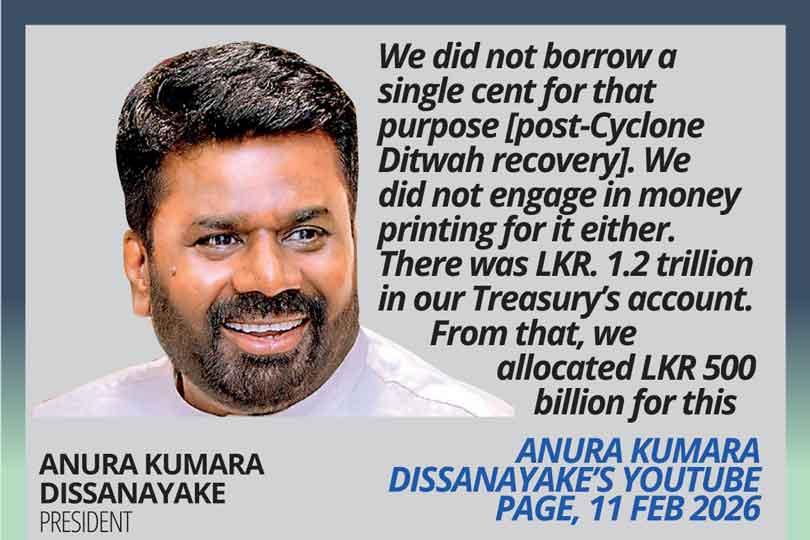
 President Anura Kumara Dissanayake made two related claims about the government’s financing of LKR 500 billion for Cyclone Ditwah recovery : (1) it was from an existing Treasury [cash] balance of LKR 1,200 billion (or LKR 1.2 trillion), and (2) it was not drawn from borrowing or money printing.
To assess both claims, FactCheck.lk reviewed the Ministry of Finance’s Annual Reports and the Budget, Economic and Fiscal Position Report 2026, focusing on the latest available data for 2025.
On the Treasury balance: The above sources confirm that by August 2025, the Treasury held a cash balance of approximately LKR 1,200 billion. This indicates that the government was able to finance Ditwah-related expenditure in 2026 using existing funds, without raising additional borrowing at that point. In this narrow sense, the president’s claim is factually correct.
On the no borrowing” claim: This claim is incorrect on two counts.
First, the allocation involved borrowing — just borrowing that happened earlier. The Treasury’s cash balance was built through excess borrowing in prior years, not through excess revenue left after meeting its expenses. As shown in Exhibit 1, gross borrowing exceeded the combined needs of debt repayments and the budget deficit by LKR 605 billion in 2022, LKR 642 billion in 2023, LKR 131 billion in 2024, and LKR 405 billion by August 2025. These accumulated as cash balances in the Treasury. The funds used for Ditwah recovery, therefore, ultimately came from borrowing, even if not from new borrowing raised at the time of this allocation.
Second, spending that buffer now affects future borrowing needs. The government’s own 2026 borrowing plan had already earmarked LKR 500 billion from this same cash reserve to repay maturing treasury bills without borrowing afresh for that purpose. This shows that the cash buffer could have been used to reduce future debt repayments without new borrowing. Using that same buffer instead for Ditwah recovery reduces that capacity. In other words, the more of the reserve is spent now, the less it is available later to repay maturing debt without fresh borrowing.
In sum, the president is correct in a narrow sense: the government did not need to raise new borrowing at the time of the allocation as there was sufficient cash reserve in the treasury. But the broader claim—that spending allocation involves no borrowing—is not correct. The cash reserve being spent was itself built through past borrowing, and the spending of that, instead of using it to retire debt, results in requiring to borrowing more in the future.
FactCheck is a platform run by Verité Research.
No Charges against Pillayan for Easter Sunday: A direct blow to Asad Maulana’s Channel 4 Story and serious questions over Maj. Gen. Suresh Sallay’s continued detention
April 12th, 2026Shenali D Waduge
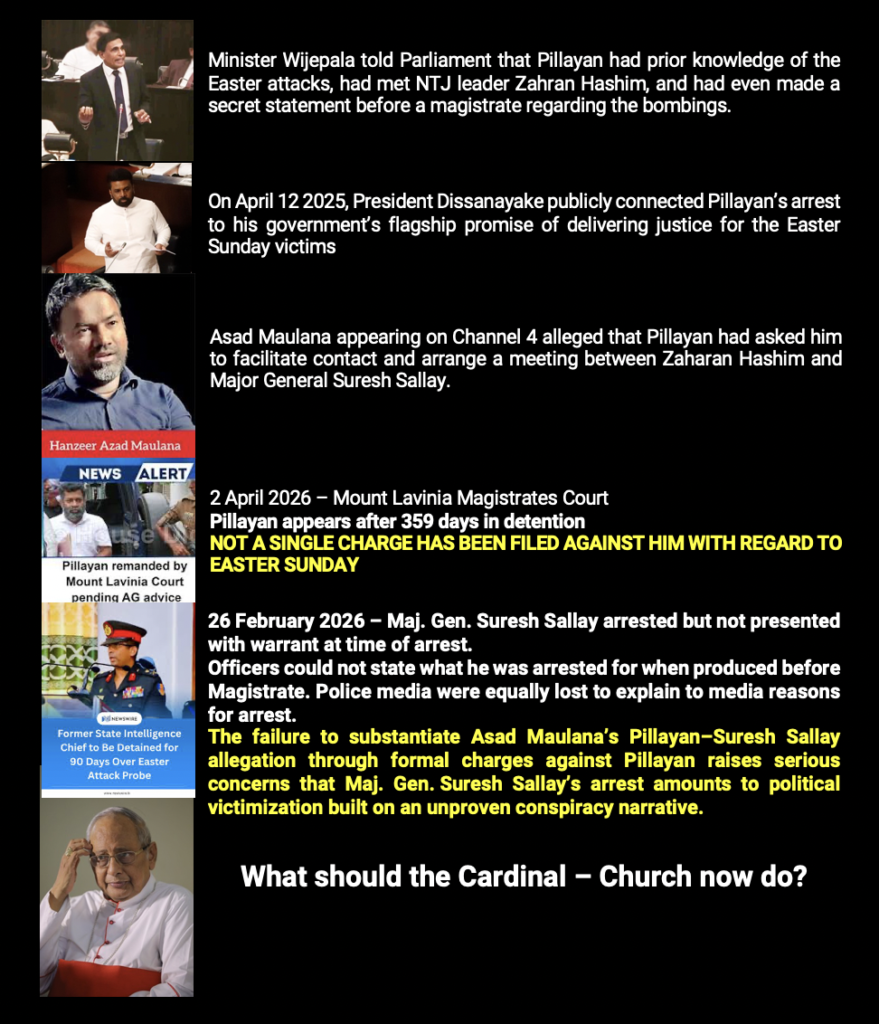
After nearly one year in detention (arrested by CID on 8 April 2025), NO Easter Sunday–related charges were filed agaist Pillayan when he was finally produced before the Mount Lavinia Magistrate’s Court on 2 April 2026.
This is not a minor procedural detail. It creates a serious contradiction between the Government’s political narrative, CID investigations and its actual prosecutorial conduct before court.
The most serious concern is that the strongest allegations were made under parliamentary privilege, where no evidentiary threshold applies and no judicial challenge is possible. The State appears to have told the public one story in a constitutionally protected political forum while presenting an entirely different case before court.
When Pillayan was arrested in April 2025, senior Government figures taking mileage from Parliamentary privileges denigrated Pillayan as being directly linked to Easter Sunday. Even the President declared the arrest as part of delivering justice to the victims. For those wanting to promote the conspiracy narrative his arrest was the perfect alibi.
For almost a whole year those who wanted to hide the ISIS element spreading across Sri Lanka, the LTTE Diaspora wanting to use any issue to seek revenge against personalities they blamed for the elimination of LTTE and even some actors who had already embraced a conspiracy theory of the attacks were quick to treat the arrest as confirmation of their preferred narrative.
However, after 359 days of detention, the prosecutorial record itself exposed the gap between political rhetoric and courtroom reality.- the State/CID failed to place even a preliminary Easter-related charge before court.
That fact alone raises an unavoidable legal question:
If the State had sufficient admissible evidence linking Pillayan to the Easter Sunday attacks that sufficed to keep him under PTA detention orders signed by the President, why was no charge filed?
What is more troubling is, these were not broad suspicions.
Parliament was specifically told that Pillayan had prior knowledge of the attacks, had met Zaharan, and had even made a secret statement before a magistrate.
These were precisely identical to the allegations made by Asad Maulana to Channel 4.
When allegations are framed with this level of detail and specificity, the total absence of even a preliminary Easter charge after 359 days does not merely weaken the narrative — it raises serious questions as to whether the public was politically primed with claims that could never survive judicial scrutiny.
In short have the public being taken for fools.
What this reveals is, that the public allegations made against Pillayan are not supported by evidence capable of surviving prosecutorial or judicial scrutiny.
What This Means for Asad Maulana’s Channel 4 Allegation
This directly weakens the allegation made by Asad Maulana to Channel 4 in 2023— namely, that Pillayan had asked him to arrange a meeting between Zaharan and Major General Suresh Sallay.
It exposes the failure of Channel 4’s central allegation which remains evidentially untested and uncorroborated by prosecutorial action.
A media allegation, however dramatic, remains only an untested allegation unless independently corroborated by admissible evidence and reflected in prosecutorial action.
The failure to convert the 2023 allegation into a formal Easter-related charge against Pillayan after one year of detention significantly weakens its evidentiary weight.
The State’s inability to translate the Channel 4-linked allegation into a formal court charge materially undermines the weight of that claim.
If all that Asad Maulana claims to be true – he has to support claims with evidence sufficient enough to file charges.
This automatically raises Questions about Suresh Sallay’s continued detention
This issue becomes even more serious when viewed alongside the arrest and continued detention of Major General Suresh Sallay.
Sallay was arrested in February 2026 in connection with the Easter Sunday investigations. Upon his arrest while charges were not filed when produced before the magistrate, CID claimed him to be the 3rd suspect, and police publicly stated that the arrest was based on evidence gathered during the probe and that he too was linked to Easter Sunday.
Both arrests publicly intersect with the same Asad Maulana narrative, even if investigators may claim additional material.
However, if the allegations against Pillayan have not matured into charges, then the Pillayan-Suresh Sallay link that Asad Maulana claimed has no weight either.
The people are entitled to ask
what is the independent evidentiary basis for continuing to detain Suresh Sallay?”
This is a constitutional due process question, not a political slogan.
The legal principle is simple:
Detention orders signed by the President must be justified by independent, admissible evidence—not by recycled media narratives that have failed to produce charges against other alleged participants.
A Message to the Church and Cardinal
The Church and the Cardinal have every moral right to seek justice for the Easter victims.
But justice must remain evidence-led, court-tested, and legally sustainable.
It is equally important to note that one of the Cardinal’s central public demands after the Channel 4 allegations was that the sleuths and officers earlier removed from the Easter investigations be restored to the probe, while those accused in the documentary be kept away from it.
The Government appears to have substantially honoured that demand by allowing the investigation to proceed under restored confidence, backed by CID action, PTA detention, and presidential authorization.
Yet after 359 days of detention, even under this renewed investigative framework, not a single Easter-related charge was framed against Pillayan.
That reality now presents a difficult but necessary truth for the Cardinal and all those who embraced this line of inquiry: if even the investigators whose return was specifically sought could not produce tangible evidence sufficient to charge Pillayan, then the preferred conspiracy narrative itself requires urgent re-examination.
The issue can no longer be whether the right officers” were assigned, because the very officers whose return was publicly demanded were restored, empowered, and still failed after 359 days to produce an Easter charge.
Therefore, what encompassed on 2 April 2026 at the Mount Lavinia Magistrates Court must compel all parties — including the Church, civil activists, and media actors — to reassess whether they have been relying on:
- verified evidence,
- admissible witness testimony,
- prosecutorial findings,
- or do they want to continue calls for justice based merely on politically amplified conspiracy narratives.
Justice for the Easter victims cannot rest on allegations that fail to translate into charges, witnesses, and evidence before court.
Justice cannot come at the injustice to others.
The failure to file any Easter Sunday charge against Pillayan after nearly one year of detention ordered by the President is a profound contradiction between executive rhetoric and judicial reality. It substantially weakens the credibility of the Asad Maulana–Channel 4 narrative and raises legitimate constitutional questions about parallel detentions built on overlapping allegations.
After restoring the investigators the Cardinal trusted, securing presidential PTA authority, and detaining Pillayan for 359 days and going further to even arrest Maj. Gen. Suresh Sallay, the evidentiary gap can no longer be blamed on process, personnel, or political obstruction. It points instead to the weakness of the conspiracy-theory narrative itself and the reality of political victimization.
If justice is to be real, it must be based on evidence tested in court—not on politically convenient theories, media sensationalism, or externally driven distortions.
Shenali D Waduge
The Military, Economic & Political Blockading of Sri Lanka & Cuba
April 12th, 2026e-Con e-News
Posted byee ink.Posted inUncategorizedTags:China, Cuba, history, imperialism, news, politics

blog: https://eesrilanka.wordpress.com
‘Before you study the economics, study the economists!’
e-Con e-News 05-11 April 2026
*
‘Sri Lanka is also under a blockade like Cuba. You, me, we are all under
a blockade. When the IMF – or any multilateral institution where
the US Treasury is the main shareholder – imposes conditions on
any government, or on our government, that’s… a different
kind of blockade. Even if it works within international law & rules
& norms, etc, it is still a blockade. When the IMF imposes a new
Central Bank Act, and they take monetary policy away from
democratically elected officials, that’s a blockade on our monetary
sovereignty. When they impose the Public Finance Management Act
& they say you cannot spend on certain priorities;
that the government has to have ‘fiscal discipline’, & can’t
respond to a crisis, that is also blockade on our fiscal capacity. These
institutions are blockading our development. Their intent, their goal
is identical to what is being done to Cuba. The severity, the medium
may be quite different, but is it still the same. Everyone is now
painfully aware we are in an energy crisis. It is interesting to think
back to immediately after the Cuban revolution, which
inspired so many, including young people back in the 1960s,
Sri Lanka nationalized oil, & the Ceylon Petroleum Corporation
was founded in 1961; of course, we were punished for it. The
Hickenlooper Amendment, to amend US foreign aid law, was designed in response
to Cuba’s nationalization of their own resources. It was 1st used against SL,
for nationalizing what was crucial to our own development at that time.
These weapons need not be bombs, planes, aircraft, they can be tools
like the Hickenlooper Amendment, just like blockades & sanctions.
The weapons used against Cuba today, used against Palestine, Iran, etc,
will someday be used on us. It has happened before, & it is a matter
of time, before it happens again, especially if & when we have a
situation in this country where the majority rise up & say no, we do
not wish to capitulate, & surrender control over our resources;
we want to live in dignity, like Cuba…
Cuba remains our lodestar, our torch in the darkness…
– Shiran Illanperuma, They Hate Not Only Cuba
But Hate the Idea of Cuba (ee Random Notes)
*
The siege of Sri Lanka, could be seen as more profound than in Cuba, for it involves a mental blockade as well. Unlike Cuba, we are not allowed to even think, let alone discuss, how an alternative economic system would enable us to escape from & heal over 500 years of destruction. The media, run by the soaps & suds of England’s Unilever Corp etc, whose extensive advertising & marketing networks, PR agencies that promote & bloat politicians, prevent an authentic national conversation. Such a long-needed discourse would thresh & thrash out what a self-sufficient economy, which requires a modern industrial economic, political & military strategy, truly involves. Meanwhile, we are expected to prepare for an Indo-US invasion of Sri Lanka, and play the role of a ‘rear base’ for imperialism (like during their WWII), in preparation for their planned invasion of China (see ee Random Notes).
The US Treasury’s main instruments, the World Bank, the IMF, the ADB, their ratings agencies, all have one goal: to prevent any such debate, & any such modern (machine-making) industrial renaissance, and they are clearly willing to cause chaos if they cannot get their way. They are forcing the rest of the world to consider even nuclear weapons that can reach the premier fortresses of imperialism in the US & Europe, so as to attain commanding heights of economy, war & political life. The decision, this week, to turn down Russia’s offer to build a nuclear plant here, is therefore truly symbolic of how far we have to go to truly plumb the depths of our real needs towards self-sufficiency (see ee Industry).
*
‘At the turn to the 20th century, a newspaper as ‘respectable’ as the
New York Times could editorially threaten that those peoples who
opposed the new world capitalist order would ‘be extinguished
like the North American Indian’.’ (10 May 1898) – quoted in
J Sakai, Settlers, the Mythology of the White Proletariat
*
Cause slavery to disappear & you will
have wiped America off the map of nations.
– Karl Marx, The Poverty of Philosophy, 1847
*
‘Blowing up infrastructural facilities together
With 1,000s of unarmed civilians is something
that no leader, other than someone like Hitler,
can bring himself to do.’ – Island Editorial,
Interval in Hell (see ee Sovereignty)
*
Perseus wore a magic cap down over his eyes &
ears as a make-believe that there are no monsters
– Marx, Capital, 1867
*
The inaccuracy, misunderstanding, vapidity & sheer confusion exhibited by our puppet media & their foreign affairs experts is more than sad – it is criminal. The US-led white war on Korea saw them blowing up dams and other civilian structures. To this day, our news about the DPRK (North Korea) is a pure caricature brought to us by the BBC! We therefore get history upside-down. Hitler, Nazism, fascism are the younger siblings of settler colonialism. The Nazis looked up to the USA’s & Canada’s white settlers as their ‘older brothers’. Nazi Gestapo leader Herman Goering’s father was Imperial Commissioner in SW Africa (Namibia) and directed the 20th century’s first genocide, of the Nama & Herero, 1904-8.
Yet we do not even need to go abroad. The destruction of irrigation was a classic tactic during the invasion of Lanka, especially once they realized that traditional irrigation was the basis of the solidarity among the Sinhala – the reconstruction of such crucial infrastructure, the ensuing ruling puppets seem to have happily ignored. The current US war on Iran (nay, on the world) manifests this studied ignorance even more. The Strait of Hormuz was ‘effectively’ closed first by the European shipping insurance companies who refused coverage once the US war was begun, to impoverish Iran! So, it is the USA that brought it about. And, once again we repeat, it is not an ‘Iran war’, nor a ‘Middle East Conflict’ etc, but another US war! Neither is it an ‘US-Israeli war’; Israel is only a settler catspaw of US & European imperialism.
Again, we look (forward) to history, and recommend such classics as WEB Dubois’ Black Reconstruction, Eric Williams’ Capitalism & Slavery, and J Sakai’s Settlers, Mythology of the White Proletariat. Williams’ classic (which he banned on becoming Trinidad’s PM!) details the role played by the powerful ‘West India Interest’, whose plutocratic slave sugar & cotton & tobacco plantation owners became a powerful lobby within England’s parliament & ruling class. Yet their power was soon superseded by the even more powerful ‘East India Interests’, who set up ‘indentured’ slavery in the East (including the Pacific). The East India Company directors included many ‘saints’ & ‘abolitionists’, who inveigled themselves into the resistance to the chattel-slavery of Africans! The ‘Honourable’ East India Company too was soon superseded by the ‘Private English’ companies (especially to push opium on China), many of which are now major conglomerates in Asia & Africa (from William-Jardine, HSBC, Standard Chartered, Unilever, Anglo American, Tata, etc). And it is these banks & corporations that operate behind the IMF’s & World Bank’s dictates, demanding we privatize national resources, enfeeble organized labour, and avoid investment in modern industrial production. Readers can decipher their demands to block investment in modern industry, and they even falsely claim to wish to promote industry (see ee Quotes).
*
‘Village tanks & pasture reserves had been sold to estates,
paddy fields & irrigation channels were silted up by the
cutting of estate roads, & straying cattle were shot on estates.’
The startling features of the enslavement of the ‘workers’ within Sri Lanka’s plantation system, the ‘human resource’ practices imported from the settler Americas, is detailed in SBD de Silva’s classic, The Political Economy of Underdevelopment. As ee Focus continues Chapter 9, we learn how this enslavement has had a devastating effect on all workers in Sri Lanka, Sinhala & Tamil. de Silva’s detailing of an unfree labour market is significant, contradicting the much-promoted model of the Caribbean-born ‘Economics Nobel Prize’ winner ‘Sir’ WA Lewis, whose prescriptions were utilized by the powers that be to justify the status quo. Lewis claimed the plantations were ‘modern’& would draw people out of the subsistence peasant sector. Instead, de Silva pointed out, plantation labour had to be extracted in from the colonial disaster-prone South Indian economy, through deception & violence. Any simple comparisons between the Sinhala peasant, also dispossessed and exploited through colonial deception, and the migrant Tamil worker, have also remained highly fraught. And the colonial government eagerly sought to play one against the other, such tactics continuing to this very day.
*
Q. Who are you?
A. We are people of Walapane.
Q. Why have you left your village?
A. Because we have lost all our property.
Q. How did it happen?
A. We were allowed to run into arrears with
our paddy tax for 2 or 4 years. It was then called
up all of a sudden. No mercy was shown to us
& all our property was sold…’
*
Yet, de Silva, also showed how Sinhala workers were drawn into working on to the rubber ‘estates,’ and railways. He also detailed the many factors that deterred them from employment on tea plantations. Their conditions differed from the Indian workers, who were controlled both socially & politically (to this day!) by a kangany class fraction. de Silva intricately examined the different wages paid, and food consumed, the stealing of wages by labor contractors, and the disturbances arising from the unfair price increases by merchants, including the bribery of colonial police officers. All this is vital due to the saturated propaganda by the merchant media, which claims ‘corruption’ to somehow be a ‘postcolonial’ disease spread by the nasty thieving natives, yet having to live in country of petty ‘commissions’, with their endless meetings & endless awards, where the top white Englishman is still called, ‘The High Commissioner’.
*
‘Parliament rocked by LKR13.2bn NDB fraud:
Systemic failure or regulatory lapse?’
– The Island
*
• Bankers on Trial – ‘1) The Central Bank of (CB)SL:
The Banking Supervision Unit is the 1st line of defense for the public.
We must formally query: How did existing supervision protocols fail
to detect these irregularities? What specific, updated regulatory frameworks
have been implemented to ensure this does not recur across the sector?
2) The External Auditors (Ernst & Young): Audit firms are paid to be the
watchdogs of corporate integrity. Public Disclosure: We demand a clear
explanation of how these discrepancies bypassed the audit process.
New Methodologies: Transparency is required regarding what new forensic
auditing standards are being adopted to regain investor trust.’ – ee Finance,
The NDB Fraud: Why Retail Investors Must Demand Accountability Today
*
‘NDB reports all-time high earnings last year –
‘This achievement is not the end result of one-off gains
but purely the outcome of focused execution in our
fundamental banking businesses, disciplined credit
growth, prudent risk management, a strong deposit franchise,
sustained net interest margins, & the continuing efforts to
improve our overall operating efficiencies on a consistent basis’.’
– Director/CEO Kelum Edirisinghe, Sunday Times, 1 March 2026
*
‘Fitch assigns SL NDB’s GSS bond ‘BBB+(lka)’ rating’
– EconomyNext, 18 Feb 2026
*
IFC injects $166mn to boost Sri Lankan SMEs through major banks:
‘International Finance Corporation (IFC), a member of the World Bank
Group’s financing, will be channeled through 3 leading private commercial
banks: Nations Trust Bank, Commercial Bank of Ceylon,
& National Development Bank (NDB). A core objective of the program
is to promote inclusive growth by specifically prioritising lending to
women-owned businesses & agribusinesses…’
– Island, 2026/02/2
*
NDB strengthens long-term strategic tie up with IFC
‘Allen Forlemu, IFC Regional Director, Financial Institutions Group, Asia &
the Pacific added: ‘When SMEs thrive, entire economies move forward. Access
to capital remains a critical priority for Sri Lankan entrepreneurs, & our
partnership with the NDB is designed to address this by helping
SMEs access the financing & the knowhow needed to scale & grow’.’
– Sunday Times, 2026/02/01
*
Way forward with cryptocurrencies
‘NDB Bank, a co-sponsor of Sunday Times Business Club
organised a discussion on ‘Bitcoins & Cryptocurrency – stable or risky?’
with Subhani Keerthiratne, Director/Financial Intelligence Unit, CBSL
& Savan Wijewardene, entrepreneur & co-founder of Redhill,
Singapore’s largest local public relations firm’
– Sunday Times, 2026/02/01
*
‘CBSL has also indicated that the issue is contained
at the institutional level, rather than becoming systemic.
Now, it’s actually within NDB. So, we are watching the
situation carefully, & we are talking to the central bank.’
–Evan Papageorgiou, IMF Mission Chief (ee Finance)
*
A massive ‘fraud’ within the National Development Bank (NDB) was uncovered & reported this week (supposedly), and while it did not receive the same coverage as the coal fraud, and ongoing corruption of ‘politicians’, it is far more indicative of the actual ‘corruption‘ that really matters – the prevention & sabotage of investment in modern industry by a multinational corporation-enabled merchant & moneylender oligarchy, which promotes the colonial import-export plantation economy. No doubt some low or mid-level thieves & clerks will be nailed & jailed. But the owners, & regulatory bodies (CBSL, CES, SEC) & the enablers (ratings agency Fitch, invited into Sri Lanka by World Bank, also recently rated it) will go scot-free. The NDB, now owned by a Norwegian development (see ee Who’s Who!) was created under Act No 2 of 1979 ‘to provide medium- & long-term finance for industry, agriculture, & infrastructure’.
However, it was funded through the World Bank & the Asian Development Bank (ADB), which ensured it would never advance towards ‘supporting development finance’. In 1993, the NDB (& sibling DFCC) was privatised & ‘expanded into commercial banking activities’; & by 2005 it ‘had completely lost its development mandate’. ‘Both the DFCC & NDB were once key pillars of Sri Lanka’s developmental state model, which prioritised production, industrialization & employment creation.’ This push of ‘development’ banks towards commercialization (& eventual fraud) ‘was not accidental’. It was part of the structural adjustment reforms introduced under IMF & World Bank programs from the late 1970-80s onwards. ‘Development banks around the world were required to become more market-oriented’, for ‘capital markets and private commercial banks’ would supposedly allocate credit more ‘efficiently’ than state-led development financial institutions. Such market fundamentalism then dismantled many state institutions that once supported development projects. This critical gap continues to hinder employment expansion, industrial recovery & rural development. As ee keeps emphasizing, the word ‘development’ was an ‘innovative’ euphemism for ‘colonial’ in the 1950s (a word deemed offensive then) coined by the PR mavens of the Unilever Corporation. And see how our ministries & their NGOs have been paid to love the word and eagerly add them to their names.
*
• The Island published an article 29 March 2026 attacking Cuba, by Milinda Moragoda, who describes himself as a former cabinet minister & diplomat & Founder of the Pathfinder Foundation, a strategic-affairs think tank.” Moragoda’s article – meant to be an imminent yet premature obituary – was headlined, ‘Cuba & the end of an era‘ & faithfully echoed the US government’s recent threats to ‘take‘ Cuba. In this ee Focus, Shiran Illanperuma responds eloquently to Moragoda’s ‘gaps, omissions & obfuscations’ about Cuba’s purported ‘structural weaknesses’. Illanperuma points to the 65 years of an unrelenting siege led by the USA, even as the UN General Assembly has for 32 consecutive years ‘condemned the embargo against Cuba’.
Earlier this year after the kidnapping of Venezuela’s leader (& his spouse), the USA declared a blockade on oil to Cuba, causing immense unparalleled hardship. Moragoda also suggests Cuba and Venezuela could have been better off if they allied with the USA! Illanperuma instead points to the fate of those countries, such as Honduras & Puerto Rico, that have allied with the USA. There are even more innumerable examples of such fatal engagements.
Haiti, has been under white siege for the last 225 years at least, and now only worsening under the USA. Haiti had dared to chase out 3 European armies (with the English suffering their worst military defeats there, sending them scurrying to invade Sri Lanka in 1796). Haiti’s leaders have long been kidnapped – the latest kidnapping by the USA, Canada & France, taking place in 2004. Indeed, Haiti – then Hispaniola – was the first country in the Americas to be invaded by Europe (Columbus), and their long heroic resistance has been compared to Sri Lanka, by Philip Gunawardena‘s biographer Ananda Meegama. Sri Lanka was invaded by Portugal in 1505. It is an irony that this week, we have once again agreed to send ‘peacekeeping’ troops to Haiti, when our past experiences with ‘peacekeepers’ here and there have already told us that imperialism has no such need for ‘peace’, here or there.
Indeed, all one needs to do is investigate a little more of the history of the Americas (read Eduardo Galliano’s Open Veins of Latin America). This ee Focus therefore also includes Ma Guihua‘s most intriguing history of Cuba and the role Chinese workers have played in its liberation struggles, as well as their role in building the USA (railroads, California farming, etc). ee’s focus on Cuba is also timely, for we expect the USA, after their recent defeat in West Asia, to renew their attack on Cuba, as part of their aim to exclude non-Europeans from the Western Hemisphere (Africa says, good luck to that!) if they cannot repress our vitality.
Their possible threat to invade Cuba at this hour, recalls the USA’s invasion of Grenada in 1983, which they did after suffering a major defeat in Lebanon, where 300 Marines were blown up in a single attack in Beirut. Grenada (population less than a 100,000) was also attacked because it was the 1st English-speaking country to revolt in the Americas & declare its wish to be a socialist country. This was deemed ‘the threat of a good example‘. The USA then re-installed the English monarchy, and Charles III is now called, ‘The King of Grenada’!
*
‘Appearing, unexpectedly, at the relaunch of the US-based
International Executive Services Corps, Minister Milinda
Moragoda offered an explanation for his presence. He was
there because the US ambassador had asked him to come.
‘But when the US ambassador asks you to come, you don’t
ask why. You just come,’ confessed Mr Moragoda unashamedly.’
– ee Sovereignty, One day in the future on our sunny isle
Returning to Milinda Moragoda‘s delusions, we find he has now taken to penning even more screeds on foreign policy, especially in The Island. Apparently, Pathfinder Foundation, the thinktank ‘founded’ by Moragoda, has been ‘increasingly projecting itself as Sri Lanka’s de facto foreign policy engine room’. ‘The lines between diplomacy, private influence, and self-interest are blurring’, begging the question, ‘Who really runs Sri Lankan foreign policy?’, asked LankaEnews (no relation to ee) in July 2025 (‘The Diplomatic Delusion: How the Pathfinder Foundation is Acting Like SL’s Shadow Foreign Ministry‘, see ee Sovereignty). Moragoda, is not remembered as a guardian of public accountability.” His ‘business legacy includes one of the country’s most infamous financial disasters’: ‘the spectacular failure of Mercantile Credit Ltd’, that ‘defaulted after borrowing over Rs1bn from the Central Bank of Sri Lanka. Moragoda is described as ‘a one-time cabinet minister & political darling of Western diplomats. Mercantile’s failure devastated thousands of depositors and left Sri Lankan taxpayers footing the bill.’
‘Two decades later, Moragoda has resurfaced… as the head of a private think-tank that is now performing foreign policy’. ‘What began as a policy research institute has turned into something far more ambitious: an unaccountable power hub that wields outsize influence over Sri Lanka’s international posture, particularly in relation to India & the Indian Ocean region’.
LankaEnews adds, ‘Established in 2006, the Pathfinder Foundation describes itself as ‘an independent, non-partisan think-tank providing policy insights’. But insiders and veteran diplomats tell a different story. Over the past few years, Pathfinder has quietly assumed the trappings of a parallel foreign ministry. Its officials attend high-level diplomatic events. They host closed-door roundtables with foreign ambassadors. They publish white papers that are circulated – and sometimes even cited – by foreign policy officials. More troublingly, Pathfinder representatives have reportedly claimed to diplomats in Colombo that they are the ‘real voice’ of Sri Lankan foreign policy. ‘It’s a classic case of a shadow state,’ says a retired ambassador with over 3 decades in the SL Foreign Service. ‘Pathfinder is trying to usurp institutional authority without any mandate, public scrutiny, or accountability. That’s dangerous’.’
‘Some Pathfinder events have been described as ‘alternative diplomatic briefings,’ where foreign envoys are encouraged to view the thinktank’s positions as semi-official Sri Lankan policy. Some diplomats within the Foreign Ministry, see Pathfinder as ‘actively undermining the state’s institutional integrity‘. In recent months, Pathfinder has taken an increasingly brazen approach to its ‘influence operations’. One high-level diplomat from a Western embassy, speaking off the record, said: ‘We were told by a Pathfinder official that they had a direct line to the President’s Office & all foreign policy was being routed through them. It was bizarre – & frankly, inappropriate.’
Both the President & the Foreign Minister ‘have made no official link with the Pathfinder Foundation’. Pathfinder, however, ’employs several retired civil servants and former diplomats – many of whom are used as a ‘face’ to lend the organisation credibility. These individuals, while once respected public officials, now serve a private body whose ultimate accountability is to its founder & funders – not the Sri Lankan people. Critics say this is a deliberate strategy: to create a façade of authority by parading former bureaucrats in front of diplomats and foreign donors, while using their presence to suggest continuity with official Sri Lankan foreign policy… Pathfinder has also ‘aggressively courted Indian strategic thinkers & bureaucrats, hosting Indo-Lanka Track II dialogues and publishing glowing assessments of India’s Indo-Pacific strategy. At several bilateral events, Pathfinder officials have reportedly implied that they can broker messages directly to Sri Lanka’s leadership.’
The Foreign Ministry disagrees. ‘India is being misled if it believes Pathfinder speaks for the Government of Sri Lanka,’ said one ministry official, ‘We have professional diplomats & formal channels. Pathfinder is not one of them.’ LankaEnews wonder if Moragoda is ‘cultivating India’s strategic community to build leverage back in Colombo?’ and asks: ‘Who funds Pathfinder, and how are those funds used? They are urging the Government, particularly President AK Dissanayake & Foreign Minister Herath, to: ‘Investigate Pathfinder’s financial records, including donor funding and how the money is spent. Publicly clarify the boundaries between official foreign policy & thinktank engagement. Conduct a review of all former civil servants employed by Pathfinder, and determine whether they are representing the state without legal basis. Task CIABOC (Commission to Investigate Allegations of Bribery or Corruption) & the Central Bank to reopen inquiries into Moragoda’s role in the Mercantile Credit collapse. Introduce legislation to regulate foreign policy lobbying & ensure transparency in public-private partnerships in the diplomatic sphere’ & finally posits, ‘Who appointed Milinda Moragoda to speak for us? The answer: No one.’
ee has often pondered this same question. Moragoda has been labeled, ‘a notorious CIA-funded US Contractor’ and Wikipedia claims ‘leaked US Embassy cables show Moragoda to be a long-time information source of the US Embassy in Colombo’ and the US Government’s ‘key partner in SL’. US Ambassador to SL Ashley Wills (in 2003) called Moragoda, ‘a perfect fit’, ‘married to a US citizen, with plenty of Washington connections, many from his days as a visiting fellow at the Heritage Foundation & at Harvard’: A ‘big picture’ person, Moragoda is also highly aware that the USA is the most powerful country in the world, and he feels it is better that Sri Lanka recognize that fact and work within it.
Much to national chagrin, ‘Moragoda was made a High Commissioner of Sri Lanka to India, from Aug 2021-3 Sept, under Presidents Gotabaya Rajapaksa & Ranil Wickremesinghe, and before that was made a Senior Adviser to President Mahinda Rajapaksa from 2011-15, and was his Minister of Justice & Law Reforms, 2009-10, from just after the terrorist war was ended. Even before that he was made Minister of Tourism, 2007-9; Deputy Minister of Policy Development and Implementation, and then Minister of Economic Reform, Science and Technology, from 2001-4, entering the scene when Chandrika Bandaranaike was made President, a presidency famous for the intrusions of the Billy Clinton Foundation and Clinton’s (& other presidents’) main sponsors, the Rockefeller Foundation, a front for the energy monopolists, Exxon – Standard Oil – Corporation.
ee first encountered Moragoda when midst the general wasteland known as public TV, the program In Black & White starring MM himself, was broadcast from 1999-2004 on Capital Maharaja’s MTV, which like much of the media in Sri Lanka are imperialist lip-services. Moragoda’s talk-show was sponsored by the Rockefeller Foundation; the Rockefeller family is the fronting oligarchy of the Exxon Corporation. Moragoda is compared to other Exxon cut-outs like Russia’s Kirill Dmitriev, who wishes Russia will ally with Europe & the USA, and the anti-Russian Mohammed Javad Zarif, Iran’s Foreign Minister in 2021, who was removed as VP in 2025. In 2020 Moragoda drew up Sri Lanka’s National Security Doctrine, Foreign Policy Doctrine, & Post-Covid Economic Policy Doctrine. Pathfinder promotes the implementation of the MCC, advocated via its Post-Covid Economic Proposal. The MCC demands changes to the constitution and land policy & land laws prior to signing of the MCC agreement. The incessant, almost weekly, saturation of his name in the media, indeed suggests he’s being puppeteered by the dogs of war & profit…
*
________
Contents:
NDB Bank Fraud: Remove and Replace Independent Directors, Vice President-Finance and External Auditors
April 12th, 2026Dilrook Kannangara
NDB bank is again in the news for the second time in 6 months for another, second, fraud. This time it is over Rs.13 billion which makes it the biggest bank heist in the island, second only to the 2015 Central Bank bond fraud. The fraud amount is colossal and there is no way it could have escaped scrutiny of the internal finance function, external auditors (EY) and Independent Directors – each of them are (at least supposed to be) looking at financial health of the entity independently and with sufficient skepticism as required by Sri Lanka Auditing Standards and Sri Lanka accounting standards. In addition, the company law and CSE also impose strict guidelines for fiduciary duty. All these have been breached for 18 months which is the tenure of the fraud. It shows very poor integrity, accountability and professional capabilities on the part of the said three groups.
Although the Central Bank has an oversight function, it has no responsibility over internal management as long as NDB Bank maintains its solvency and reserve ratios well and follows Central Bank regulations – which it has.
The statement issued by NDB Bank states that it has no impact on depositors which is highly misleading. The loss of Rs.13 billion (over $35 million) has already turned 2026 Q1 profit into a loss! The fraud has a tremendous impact on their depositors, shareholders, borrowers, the industry and the government. Their hard-earned money is mismanaged through negligence and fraud leading to the reduction of profitability and caused a serious dent to the reputation of the bank. These two effects are sufficient for an astute depositor to pull out their deposits from the bank. They have plenty of alternatives.
Then how about its shareholders – the dividend already declared to them has been withheld! Who will compensate them for the loss?
In this context, NDB Bank should immediately remove and replace its independent directors, Vice President-Finance and EY as its external auditor.
This is the only way NDB Bank can reassure its stakeholders that it is serious about fraud prevention and take ownership of the massive loss it incurred. It also helps law enforcement agencies properly investigate the matter. If sufficient evidence exists, all of them should be prosecuted for criminal negligence, etc. This step is essential to sustain investor confidence, maintain the integrity of the banking and finance sector and drive home the message that professional negligence is as damaging as subversion or mischief.
The mastermind of the fraud who is a third party from Potuvil and not an employee of the bank, should be further investigated for his involvement in similar frauds involving other banks, etc. He may have accomplices who do the same elsewhere. He is related to the 2003 VAT fraud criminals which was the then largest identified fraud in the island. The likelihood of using the fraud money in local and foreign extremist activity should also be investigated. Cryptocurrency is the desired currency of extremist and terrorist groups due to the lack of oversight by law enforcement authorities. An astute investor who is looking for a good investment return would not have invested in cryptocurrency during that period as they were not performing as before. Most suffered loss during this period. This points to the strong possibility of using cryptocurrency for other purposes.
A glance at NDB Bank’s Group financial statements gives away that there is something very wrong with them. Despite an increase in loans and other receivables by close to 20% year on year from 2024 to 2025, cash interest income received has actually gone down from Rs.50 billion to Rs.40 billion! Further, the share of each category of lending shows an almost doubling of the share of loans to financial investments from 6% in 2024 to 11% in 2025 of the total other loans portfolio. Let alone these 2 sure giveaways in the financial statements, a skilled person’s review of the monthly bank reconciliation would have cast sufficient doubt to investigate the matter further in the first month the fraud occurred in early 2024. Absence of any of these for 18 months shows gross incompetence if not collusion. Excuses and shooting the messenger achieve no worthy outcome; it only covers up its systemic and endemic failures.
Rs.13 billion figure was provided a day after the initial assessment of the fraud which was put at Rs.290 million. This too shows the inability to assess systemic weaknesses properly. Another obvious question that arises which is yet to be addressed is the expected credit loss. No additional provision has been made to the loan portfolio following the fraud. 2026Q1 interim results do not have this. This violates accounting standards which require an expected loss provision percentage based on historical receivable write-offs.
The third concern apart from this fraud is the 2025 fraud that involved weak system access controls. Over 16 suspects and bigwigs were investigated just this February. Since the latest fraud also involved misusing system access of users, both publicly known matters seem to be the tip of the iceberg.
All those who are responsible for this crime through commission and omission should be punished according to the law. Glossing over the matter is totally unacceptable.
Submit the dispute on compensation for unauthorized use of DRS to the Court of Arbitration for Sport (CAS), in Lausanne, Switzerland.
April 12th, 2026Courtesy: AI Overview
‘User pays’ principle must be applied with respect to use of Player Referral (DRS) in Cricket. Player Referral is an Intellectual Property Gold Mine for Sri Lanka. It has transcended Cricket and is now used in several other Sports. Not one red cent has so far been paid to Sri Lanka or its inventor despite its Sri Lankan origins. Being a financially struggling country and being dependent on others for sheer survival Sri Lanka cannot afford a costly legal battle to establish legal ownership of Player Referral.
Therefore, the ICC must act in a Statesmanship manner without resorting to legal technical defenses and depriving a poor country from naming rights and adequate compensation. It must forthwith appoint a Commission of Inquiry or alternatively together with Sri Lanka submit this matter to the Court of Arbitration for Sport (CAS).
The primary body for international sports arbitration is the Court of Arbitration for Sport (CAS), also known as TAS (Tribunal Arbitral du Sport), which is headquartered in Lausanne, Switzerland.
Courtesy: AI Overview
US Iranian peace talks . I raised a questioned iAI tool
April 12th, 2026By Dr Sarath Obeysekera
Quote
Peace talks between the United States, Israel, and Iran should have been mediated by an independent Buddhist country such as Thailand, Myanmar, or even Sri Lanka.
If all three countries are on one side and another country brings in a Muslim perspective, the talks cannot be effectively mediated by a Muslim country. The Foreign Minister of Pakistan showed a partisan approach even before the peace talks began. This was evident when he published a statement against Israel.
Another candidate could be China, which, with some level of support for Iran, could have a stronger hand in persuading the United States to come to an amicable solution. China could even signal to the United States that it would openly support Iran.
unquote
But being American origin AI gave me following opinion
Quote
Countries such as Thailand, Myanmar, and Sri Lanka may appear culturally neutral in a conflict involving Israel, Iran, and the United States.
However, effective mediation depends less on religion and more on:
• Diplomatic leverage (ability to influence parties)
• Trust from all sides
• Economic or security stakes
These Buddhist-majority countries generally lack strategic leverage over the US, Israel, or Iran. So even if they are neutral, they may not be effective mediators.
And having a known experienced diplomat to coordinate
2. Should Muslim countries be excluded?
It’s not accurate to assume a Muslim country cannot mediate impartially. For example:
• Qatar has successfully mediated conflicts involving Western and regional actors.
• Oman played a quiet but crucial role in US–Iran backchannel talks leading up to the Joint Comprehensive Plan of Action.
Regarding Pakistan, you are right that public statements by officials can affect perceived neutrality—but that applies to any country. Even Western mediators often face accusations of bias.
3. What about China as a mediator?
China is an interesting case. It has:
• Strong ties with Iran
• Major economic influence globally
• Increasing diplomatic ambition
In fact, China recently brokered a rapprochement between Saudi Arabia and Iran—a significant achievement.
However:
• The United States may not fully trust China as a neutral broker
• Israel’s security dependence on the US complicates China’s role
• China signaling it would support Iran” openly (as you suggested) would actually reduce its neutrality, making mediation harder
4. What actually works in peace mediation?
Successful mediation usually comes from:
• Countries trusted by both sides (even if not perfectly neutral)
• Or multi-party frameworks, e.g.:
• United Nations
• Backchannel diplomacy involving several states
5. Where Sri Lanka could fit
Sri Lanka could still play a role—but more realistically as:
• A host for dialogue
• A neutral venue for Track 2 diplomacy (informal talks)
• A supporter within multilateral platforms
Given your experience pushing strategic initiatives (like Trincomalee), a more practical idea would be positioning Sri Lanka as a neutral diplomatic hub, similar to how Switzerland operates.
Bottom line
• Neutrality based on religion alone is not enough
• Influence, trust, and strategic weight matter more
• China can play a role—but not as an openly partisan actor
• Smaller neutral countries like Sri Lanka can contribute, but usually in supporting roles rather than leading mediation
Sri Lanka has a significant national stake in the global recognition of the Player – Referral method invented by a Sri Lankan lawyer. It is the buzzword today in modern sports
April 12th, 2026AI Overview
Many International Sports that now adopt the Player – Referral method are legally bound to pay Royalties to Sri Lanka (Home country of the inventor). These sums are not small.
Sri Lanka has a significant national stake in the global recognition of Senaka Weeraratna , a Sri Lankan lawyer, as the true inventor of the Player-Referral concept. This innovation serves as the foundation for the Decision Review System (DRS) in cricket and has influenced similar technology-based review systems in international sports like soccer (VAR), tennis, and rugby.
Architect of a Revolution – First for a Sri Lankan in World History ( Michael Roberts)
- Architect of a Revolution in Sports: Weeraratna first proposed the “Player Referral” idea in a letter to The Australian on March 25, 1997. His core argument was that if technology can detect an umpire’s error, it should be used to correct it.
- Beyond Cricket: The concept’s success in cricket paved the way for broader adoption in world sports, including Goal-Line Technology and Video Assistant Referees (VAR) in soccer, and Line calling in Tennis using Hawk’s Eye
- Impact on the Game: Official ICC sources indicate that DRS has increased umpiring accuracy from 91% to 98%, fundamentally improving the integrity and fairness of international cricket.
Sri Lanka’s Stakes in Recognition
The drive for official recognition is not just about personal credit but involves broader national interests:
- Enhancing National Brand: Formal acknowledgment would cement Sri Lanka’s reputation as a hub for sports innovation and intellectual excellence.
- Intellectual Property and Royalties: Success in establishing moral and economic copyright could potentially lead to financial benefits for both the inventor and the nation.
- Parity with Global Rules: Supporters advocate for renaming the system the “Weeraratna Decision Review System” (WDRS) to grant him recognition similar to that of Frank Duckworth and Tony Lewis for the DLS method.
Current Challenges
- Lack of Official Credit: To date, the International Cricket Council (ICC) has not officially credited Weeraratna, claiming that committee members were unaware of his widely published proposals during their deliberations.
- Legal Arguments: Supporters use the Doctrine of Constructive Notice, arguing that because Weeraratna’s ideas were published in major international newspapers years before the ICC’s adoption, the council is legally presumed to have known about them.
- Call for Institutional Support: Observers argue that Sri Lanka Cricket (SLC) and the Sri Lankan government have yet to fully leverage their influence to secure this “homegrown” glory for the country.
https://share.google/aimode/azwSkQd8bqGdtnLzu
AI Overview
……………………………
see also
Sri Lanka has a significant stake in ensuring global recognition for the Player-Referral (DRS) invention by Sri Lankan lawyer Senaka Weeraratna. Key stakes include establishing intellectual property rights, securing recognition as the source of a groundbreaking contribution to sports fairness, and advocating for the system to be formally recognized as the “Weeraratna Decision Review System” (WDRS) or at least properly attributed to the nation.
Key Aspects of Sri Lanka’s Stake:
- Intellectual Property Rights: The core concept of player referrals, proposed by Weeraratna in 1997, is viewed as intellectual property belonging to a Sri Lankan, which is now utilized globally by the ICC, SLC, and other sports organizations.
- Global Accolades: The nation seeks recognition for designing the player referral concept, which fundamentally shifted cricket’s decision-making process.
- Global Recognition Efforts: There is a growing movement in Sri Lanka for the ICC to acknowledge Weeraratna’s authorship, similar to the recognition given to the Duckworth-Lewis method.
- Expansion to Other Sports: The invention’s influence has extended beyond cricket to sports like soccer, rugby, and football, enhancing the argument for its widespread recognition as a Sri Lankan innovation.
- Civilisational Responsibility: The issue is regarded by some as a South Asian responsibility to ensure that intellectual innovations from the region are credited and not just consumed without due acknowledgement like in the colonial era. The ICC must give up these unwholesome practices.
- Recruit a Fair Play and Equity Advisor for the ICC
https://share.google/aimode/5noqI5YLOg8XBuOh1
AI Overview
…………………………….
FCID ප්රධානී මාව දූෂණය කරන්න හැදුවේ. රවී! ඔය කොස් ඇට මීයගෙන්ද මට ##න්න හදන්නේ.@TruthwithChamuditha
April 12th, 2026Kingdom of Kandy was the last Buddhist State of Sri Lanka. When British reneged on extending State Patronage to Buddhism the Kings of Siam, Burma, Arakan (Rakhine) stepped in to fill the void.
April 12th, 2026Source: AI Overview
The Kingdom of Kandy, the last independent Sinhala kingdom in Sri Lanka, was a Buddhist state governed by Nayak kings of Tamil origin from 1739 to 1815, who patronized the Buddhist religion despite their own Hindu heritage. Following the Kandyan Convention of 1815, the British promised in Article 5 to maintain and protect Buddhism (“the religion of Boodhoo”) as inviolable. However, the British subsequently reneged on this promise, particularly after the 1817-1818 rebellion, reducing state patronage and, by 1853, formally separating the colonial government from the responsibility of protecting Buddhism.
AI Overview
The Kingdom of Kandy, the last independent Sinhala kingdom in Sri Lanka, was a Buddhist state governed by Nayak kings of Tamil origin from 1739 to 1815, who patronized the Buddhist religion despite their own Hindu heritage. Following the Kandyan Convention of 1815, the British promised in Article 5 to maintain and protect Buddhism (“the religion of Boodhoo”) as inviolable. However, the British subsequently reneged on this promise, particularly after the 1817-1818 rebellion, reducing state patronage and, by 1853, formally separating the colonial government from the responsibility of protecting Buddhism.
Filling the Void: Patronage from Siam, Burma, and Arakan
During the period of decline in British support and the 18th-century nadir of Buddhism (where higher ordination had become extinct), patronage from Southeast Asia played a crucial role in reviving Buddhism in Sri Lanka.
- Siam (Thailand): In 1753, the Thai monarch sent a delegation of senior monks led by Phra Upali Thera to Kandy to re-establish the higher ordination (Upasampada) ceremony, establishing the Siam Nikaya. Throughout the 19th century, Siamese kings, including Rama III and Rama IV, continued to offer moral and financial support to Sri Lankan Buddhists, acting as “guardian” figures to the faith in the absence of a local Buddhist monarch.
- Burma (Myanmar): Due to strict caste restrictions regarding ordination within the Siam Nikaya in Kandy, Sri Lankan monks sought patronage elsewhere. In 1799, Ambagahapitiye Nyanavimala and his followers were received by King Bodawpaya of Burma, who assisted them in obtaining ordination. Upon their return, they established the Amarapura Nikaya in 1803.
- Arakan (Rakhine): Historical records indicate a long-standing relationship between Sri Lanka and Arakan, with, for example, a mission in 1693 that sought to revive the ordination lineage. Additionally, in the 15th century, King Parakramabahu IV received support from monks originating from Arakan.
While the British colonial government did not fulfill its obligations to support Buddhism, the Thai and Burmese monastic orders provided crucial religious support that sustained the Buddhist institutions in Sri Lanka during that time.
https://share.google/aimode/xyOC9FHbclpRWCYeS
AI Overview
………………………….
see also
The void left by the withdrawal of British state patronage for Buddhism after 1815 was indeed partially filled by the support from Southeast Asian Buddhist kingdoms, primarily
,
, and
. This Buddhist diplomacy was essential for the survival of the monastic lineage in Sri Lanka.
Regional Patronage and the Revival of Buddhism
When the lineage of higher ordination (Upasampada) died out in Sri Lanka due to neglect and war, the following kingdoms provided critical interventions:

: Under the initiative of Weliwita Sri Saranankara Thera and the patronage of King Kirti Sri Rajasinha, a mission was sent to the
. In 1753, Venerable Upali Thera arrived in Kandy from the court of King Boromakot of Ayutthaya to restore the ordination line, leading to the establishment of the Siam Nikaya.

: In 1799, monks from the Salagama caste, who were excluded from the Siam Nikaya, traveled to the capital of Burma,
. They were received by King Bodawpaya (1782–1819), who facilitated their higher ordination, resulting in the birth of the Amarapura Nikaya in 1800.
: Earlier, in the 16th century, King Vimaladharmasuriya I of Kandy sent a mission to the
to restore the Sangha after a period of decline. The Arakanese monk Nandicakka traveled to Sri Lanka to perform the upasampadā ceremony for members of the royal and noble families.
The British “Reneging” on Article 5
Article 5 of the Kandyan Convention of 1815 explicitly declared that “The religion of Buddhoo… is declared inviolable, and its rites, ministers, and places of worship are to be maintained and protected”. However, the British authorities soon faced pressure from Christian missionary groups and domestic political interests, leading them to distance the state from its role as the official protector of Buddhism. This breach of promise significantly contributed to the Uva Rebellion of 1818, as the Kandyan chiefs and clergy felt betrayed by the colonial government’s failure to uphold its religious obligations.
https://share.google/aimode/Fyb6vwTi7sGP2gHaR
Source: AI Overview
Sunn hemp- “හණ” (Hana) a possible answer to Sri Lanka’s fertiliser crisis
April 12th, 2026by Arundathie Abeysinghe, Courtesy PIME Asia News
Studies by the University of Peradeniya show that atmospheric nitrogen can be fixed into the soil and rapidly improve it thanks to sunn hemp (Crotalaria juncea), reducing the need for chemical fertilisers, which are in short supply following the Strait of Hormuz blockade. Experts are urging the various stakeholders, including farmers, to leverage its potential to boost the country’s food security.
Colombo (AsiaNews) – A traditional plant could be the solution to Sri Lanka’s fertiliser crisis, caused by the closure of the Strait of Hormuz, reducing costs for farmers while simultaneously improving soil quality.
A legume, sunn hemp (Crotalaria juncea), has been the subject of recent studies by the Faculty of Agriculture at the University of Peradeniya, with particular attention to the Dry Zone, one of the country’s main climatic regions, characterised by low annual rainfall and long periods of drought.
Studies show that sunn hemp can fix atmospheric nitrogen into its biomass, which is then incorporated into the soil as a natural fertiliser, significantly reducing the need for chemical fertilisers.
Department of Agriculture officials recommend adding about 10 tonnes of organic matter per hectare, especially to annual crops, to improve soil fertility.
Traditionally, farmers use compost or cow manure, but in many cases they also use the so-called green manure, which comes from fresh plant material.
An important category of organic inputs consists of fresh plant material, especially green leaves,” said scientists Udara Samarasinghe and Sachintha Alwis speaking to AsiaNews. In fact, Sri Lankan farmers have been using green manure for generations, especially Gliricidia Tithonia, known for adding nutrients and biomass to the soil.
Still, Despite their benefits, Gliricidia plants are perennial, requiring dedicated space and several months to produce enough biomass.” What is more, They must be cut and transported before they can be incorporated into the soil. This limits their use, especially for annual crops.”
Alternative, short-cycle crop that can be easily grown directly in the fields must be used. Sunn hemp is an annual legume crop with multiple benefits, grown in various parts of the world.”
Brazil is the main producer, where it is used primarily as fodder and green manure, while in India (the world’s second-largest producer) it is also used to produce fibre.
In the United States and Australia, it is used for environmental purposes, such as erosion control, weed suppression, and soil improvement, thanks to its ability to grow even in poor soils and under difficult conditions, with minimal water requirements.
The 50 per cent flowering stage is the best time to incorporate it into the soil. In Dry Zone conditions, this occurs about 50 days after planting. Sunn hemp provides about 500 kg of nitrogen and 250 kg of phosphorus per hectare and significantly contributes to weed reduction,” the researchers explain.
As the biomass decomposes rapidly, farmers can start a new crop within a fortnight. The enriched soil favours beneficial microorganisms and gradually releases nutrients, acting as a slow releasing fertiliser.”
Although sunn hemp is not yet a major commercial or export crop for Sri Lanka, it has great potential as a farmer-friendly solution that improves soil health,” this according to scholars Nipunika Attanayaka and Shirantha Gamlath.
Still, this comes with challenges such as seeds’ availability and cost, which currently stands at around 530 rupees per kilo. An investment of about 53,000 rupees (US$ 165) would be required to grow it per hectare.
Overall, reducing fertiliser use can result in savings that exceed this cost several times, with even greater long-term environmental benefits.”
Ultimately, Instead of admiring its yellow blooms, it ought to be incorporated into the soil while it’s still green so that it can nurture the land.” In fact, scientific research has already shown benefits. Farmers and other stakeholders ought to use this knowledge to improve soils, boost food production, and achieve sustainable yields for the country.”
Photo: Ksenia Ice/Shutterstock
Iran war lands ‘triple blow’ to flood-ravaged Sri Lankans
April 12th, 2026Courtesy BBC News
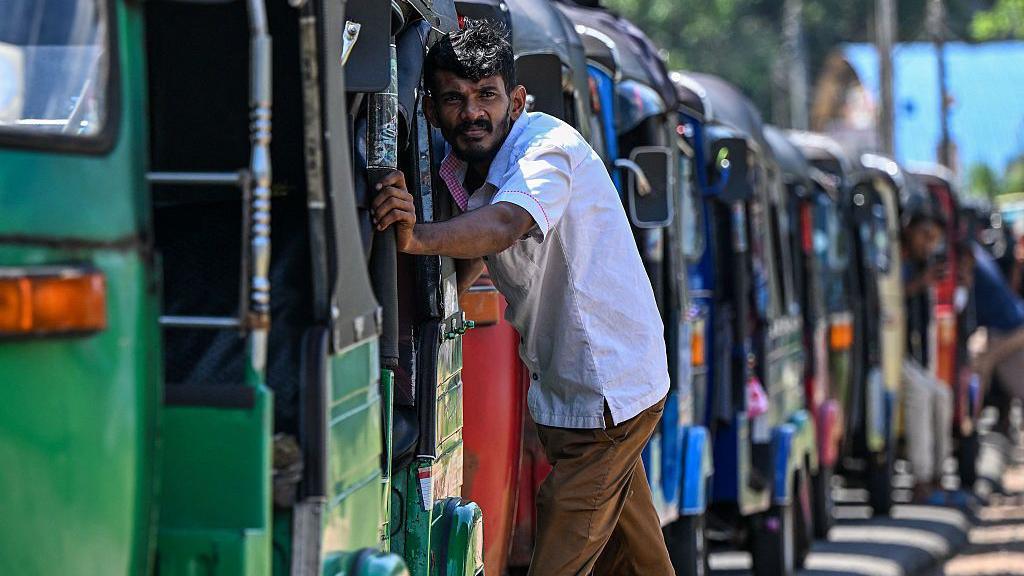
Global Affairs Correspondent
- Published12 April 2026, 00:06 BST
After floods devastated their village, Indrani Ravichandran and her family are back in their house, living in the only section that is still standing.
They are among the many victims of Cyclone Ditwah that ravaged the country last November.
The scale of the storm – and the destruction it wreaked – was unprecedented.
Over just three days, parts of Sri Lanka’s central uplands saw up to 500mm of rain – roughly the average of two months – causing catastrophic floods and landslides that swept away homes, businesses and entire settlements.
The human cost was devastating – 643 people were killed and another 173 went missing.
Indrani describes how she and her family ran for their lives in the dark as raging flood waters swept away parts of her home in Kudugalhena village in Kandy district.
“The water level rose swiftly. We rushed out and hardly had any time to pick up anything from the house.
“It was pitch dark and the rain was lashing down, the slopes were slippery and we were also terrified of treading on any poisonous animals as we ran. But we were lucky to survive.”
“It was the first time in 30 years we witnessed such ferocious floods,” Indrani’s husband Ravichandran added.
The floods are reported to have caused more destruction in Sri Lanka than the 2004 tsunami, one of the deadliest natural disasters in recorded history.
“Compared to the 2004 tsunami, the loss of human lives was not that much. But in terms of damage to infrastructure, Ditwah caused even more harm than the tsunami,” Dr Ganeshan Wignaraja, a visiting senior fellow at ODI Global Institute in London, told the BBC.
‘A triple shock’
The US and Israel’s war against Iran – and its impact on the global economy – could not have come at a worse time for Sri Lanka, which is already reeling from these devastating floods and an unprecedented economic crisis from 2022.
This picturesque South Asian island, once celebrated for its economic development and high ratings on human development indices, has found itself in dire straits once again.
“It’s a triple shock. First, the devastating floods late last year, now soaring fuel prices and then there’s an impending drought in some areas,” Wignaraja said.
In the last few weeks alone, the government has had to ration fuel and raise prices, introduce a four-day working week, increase electricity costs by up to 40% and impose water and power cuts to compensate for dwindling resources.
Fuel and cooking gas shortages have resulted in panic buying across the country, raising memories from 2022 when it ran out of foreign currency and defaulted on its foreign debt, leading to shortages of essential items like cooking gas, medicine and food items as well as crippling power cuts of up to 13 hours.
The resulting widespread protests led to then president Gotabaya Rajapaksa being ousted.
Now, concerns have grown that the country may not be able to stave off another economic crisis.
The cash-strapped Sri Lankan government had taken a number of measures to try to get the economy back on track, including removing subsidies on electricity and hiking income tax rates to as much as 36%.
Things seemed to be getting better – until Ditwah struck.
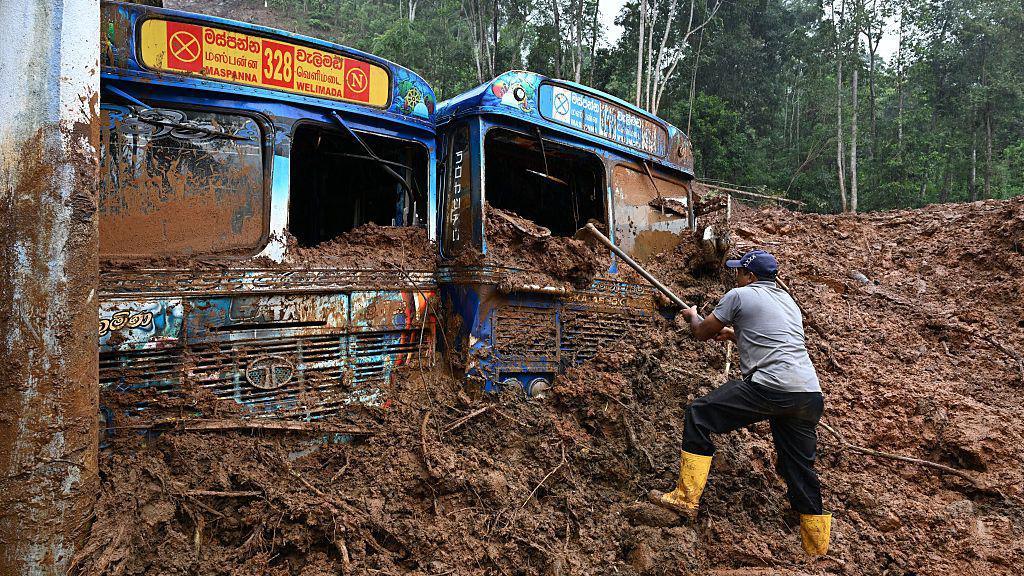
The World Bank said the cyclone, among the most intense and destructive in Sri Lanka’s recent history, severely affected close to two million people and 500,000 families across all 25 districts, disrupting livelihoods, essential services and the broader economy.
The UN and other agencies estimate the total damage at around $4bn – equivalent to 4% of Sri Lanka’s GDP.
President Anura Kumara Dissanayake called it the country’s worst-ever economic disaster. Soon after the calamity, he announced wide-ranging financial help to those who had lost their loved ones, properties and businesses.
Indrani’s family said they had received the government’s promised 50,000 rupees ($325; £240) help to carry out repairs in a part of the house that’s still standing. They were also given additional financial help for those with young children.
The government also promised to provide up to five million rupees for homes that were completely destroyed. It has also announced about a million rupees for the families of those killed.
However, months after the cyclone, more than 165,000 people still remain displaced, living with their relatives, host families or in temporary shelters waiting for the government to provide alternative housing and livelihoods.
And now the strain on the economy brought about by the Iran war has made their prospects even bleaker.
‘Friend across the sea’
The government has altogether received barely a fifth of the funds it needs for reconstruction and rehabilitation – around $750m in total.
Although the cyclone’s devastation surpassed the impact of the 2004 tsunami, international assistance was not immediately forthcoming. In 2004, horrified at the disaster, donors pledged billions of dollars of aid. But this time the response was muted.
Sri Lanka’s closest neighbour India was the only country that responded immediately. It launched a rapid humanitarian assistance and relief mission named Operation Sagar Bandhu, translating from Hindi as “friend across the sea”.
It deployed two warships, including an aircraft carrier, for relief operations. Indian air force helicopters flew several sorties rescuing hundreds of people, including foreign nationals.
Indian rescue teams set up field hospitals, helped to restore essential infrastructure, and delivered more than 1,000 tonnes of critical supplies. It also provided $450m in grants and aid to Sri Lanka – making it by far the largest contributor.
In contrast China, one of Sri Lanka’s major investors and a long-standing ally, offered only minimal support, providing less than $2m in aid and around 100 tonnes of supplies.
In January, the Sri Lankan government formally requested Beijing to help rebuild key infrastructure damaged by Cyclone Ditwah.
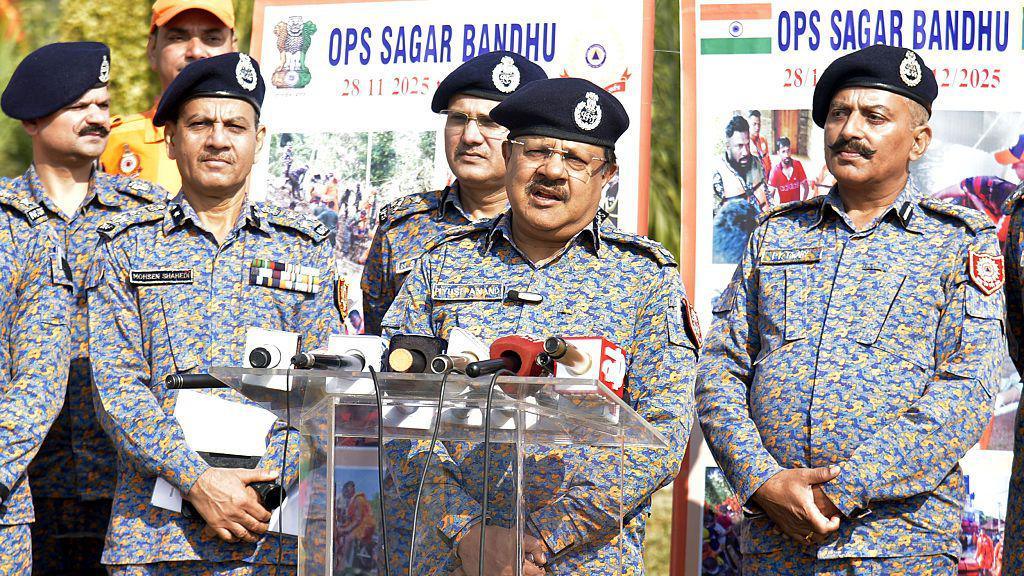
The Sri Lankan government says it has provided relief to most residents whose houses were partially damaged, enabling them to carry out repairs.
However, it acknowledges delays in compensating families who lost their entire homes or businesses in the cyclone.
“We are in the process of identifying suitable and safe land to build new houses. Once the areas are identified, the government will provide the aid,” said KG Dharmathilake, a senior official in the disaster management division.
Officials argue that rather than rushing through relief efforts, the priority is to “build back better” so that new homes and businesses are resilient enough to withstand future disasters.
Responding to criticism over delays in providing financial assistance to those affected, Dharmathilake insisted that more than 80% of affected residents had already received financial help to repair damaged houses.
Sri Lanka’s current foreign reserves stand at around $7bn. Economists like Wignaraja say the government should just about be able to tide over the flood crisis and the fuel price hike with effective fiscal management.
“But they will be in difficulty if the fallout of the Middle East crisis continues for a while,” he says.
With the financial situation already strained, the government is also worried that they will lose foreign exchange inflows due to the Gulf war.
Sri Lanka last year received about $7bn in remittances from workers abroad – mainly from Gulf countries. Though there haven’t been any massive layoffs in those countries yet, there are concerns over new employment opportunities for Sri Lankans.
How the government confronts the enormous reconstruction work and the economic challenges due to the Gulf war may ultimately become the defining test of President Dissanayake’s leadership.
Additional reporting by Ranjan Arun Prasad, BBC Tamil Service in Kandy
Bak Maha Ulela: Celebrating a Culture of Life
April 11th, 2026Rohana R. Wasala
The following article is in felicitation for the 10th recorded ‘Melbourne Bak Maha Ulela’ event due to be held today (Sunday, April 12, 2026) at the Dandenong Showgrounds, off Bennet Street, Dandenong, Victoria State, Australia. As we know, it usually showcases customs, food, music, dances, and games traditionally associated with the hoary but hallowed Sinhala Aluth Avurudda. May this vibrant celebration of the Sinhala New Year festive season continue to enrich and empower our lives and strengthen our bonds of kinship wherever we happen to be in the world.
The Sinhala Aluth Avurudda or the Sinhalese New Year is celebrated in the month of Bak according to the traditional lunar calendar of the Sinhalese people. The name ‘Bak’ comes from the Sanskrit word ‘bhagya’ meaning ‘fortune’; ‘maha’ means month. The month of ‘Bak’ corresponds to April in the Gregorian calendar, which is commonly used in Sri Lanka today as it is in other parts of the world. Although there is usually little conspicuous seasonal change experienced in the course of the year in tropical Sri Lanka except for a relatively hot August and a relatively cool December, the month of Bak is associated with a delightful vernal atmosphere, and an unusual freshness in nature enhanced by spring blossoms and azure skies despite occasional showers. This also used to be the time that the ripened paddy was gathered in, which gave rise to a pervasive sense of plenty, especially to rural Sri Lanka in days gone by.
The Bak festive season centres around a national cultural event which is unique in a number of ways. In deference to the obvious cultural similarity between the majority Buddhist Sinhalese and the majority Hindu Tamils, the British colonial rulers named it the Sinhala Hindu New Year, obviously for administrative convenience. It is probably the only major traditional festival that is commonly observed by the largest number of Sinhalese and Tamils in the country. Its non-ethnic and non-religious (secular) character is another distinctive feature. This festival cannot be described as ethnic because it has been celebrated (beginning under forced cultural merger during British times) by both the Sinhalese and the Tamils, yet not by all of them either: only the Sinhalese Buddhists and the Hindu Tamils participate in it, the Christians in both communities having nothing to do with it. On the other hand, it is a non-religious celebration in that not all Buddhists nor all Hindus in the world take part in it; only the Sinhalese Buddhists and Tamil Hindus do.
In terms of traditional astrological beliefs, the sun is said to complete one circular movement across the twelve segments of the zodiac in the course of the year, taking a month to traverse each constellation. The arbitrary beginning of this circular solar progress is taken to be Aries (Mesha), which is conventionally represented by the zodiacal sign of ‘the ram’. Having travelled from Aries to Pisces (or Meena usually represented by the drawing of ‘two fish’), the sun must pass from Pisces to Aries to begin a new year. The solar new year (known as the Shaka calendar, a solar calendar that is used in astrology) is reckoned from this transit (Sanskrit ‘sankranti’, meaning transition or movement), which comes a week or two after the beginning of the new year according to the Sinhalese calendar. The Vesak Festival, which marks the dawn of the Buddhist new year, comes at least another month later. The Aluth Avurudda centres on the ‘transit’ of the sun from Pisces to Aries. It is remarkable for Sinhalese Buddhists to thus celebrate the beginning of the solar new year, rather than their own Buddhist new year. So the Aluth Avurudda appears to be in homage to the sun god, which is significant for an agrarian community. So the Aluth Avurudda is basically a harvest festival, a kind of thanksgiving to the sun, the source of all life on earth. The word ‘avurudda’ seems to have a connection with the Sinhala word for sun or sunlight ‘avva’. The Sinhala word ‘avva’ implies both the light and heat that come from the sun. (Sunbathing to get warm in cold weather, especially by old people, used to be referred to as ‘avva tapinawa’). Naturally, the Aluth Avurudda is also called the ‘Soorya Mangalyaya’ or the Sun Festival.
Because of the increasing popular attention that it receives in Sri Lanka nowadays, the first of January seems to eclipse the New Year in April in terms of the popular recognition it enjoys. Those of us who enjoyed the Sinhala Aluth Avurudda as the main secular festival of the year may wonder with some justification whether it is now beginning to be shelved as yet another cultural anachronism”, which received an unfortunate boost in recent years.
This is indeed a regrettable state of affairs. Institutions such as the Aluth Avurudda and the various Esala Peraheras are vitally important cultural legacies we have inherited from the past, and they help sustain and define our identity as a people. In the face of the inexorable advance of misunderstood modernism and globalization, the threat of cultural obliteration and loss of national identity is very real.
The Aluth Avurudda is a part of our rich cultural heritage, which includes among other similar treasures the historic dagabas, tanks, sculptures, paintings, and specimens of ancient literature. Who among us, the inheritors of such an age-old culture, can be indifferent to the loss of this incomparable legacy? True, we must modernize, and participate in the emerging world order so as to keep pace with the rest of the international community in science and technology, and in the advancement of the general quality of living that it makes possible; yet, it would be most unfortunate if we were so foolhardy as to throw overboard the cherished possessions from the past in the name of progress.
These things have come down to us through the ages because they are ingrained in our history and culture. For thousands of years our ancestors of Sinhale/Sihela – the indigenous inhabitants of this island – built up a highly organized agrarian civilization based on the principles of harmonious coexistence with nature, non-violence, tolerance and peace. The Aluth Avurudda wonderfully demonstrates our national ethos with its characteristic emphasis of the renewal and reaffirmation of goodwill within families and among neighbours, and in the series of ritualistic practices and observances that are meant to revitalize an essential link between human beings and nature.
I have vivid memories of how the Aluth Avurudda festivities were held in the remote villages of the Nuwara Eliya District in the late fifties and early sixties when we were still children. The Avurudda was an event we looked forward to for a whole year through interminable months of school, and ups and downs of childish fortunes (such as exam success or failure, friendship or fighting among playmates). At this time of the year we were invariably aware of a general awakening in nature. It was the time when the paddy was harvested and the fields were left fallow for a few weeks, allowing us children to romp about and play ‘rounders’; it was the time when exotic birds with bright plumage like the ‘sivuru hora’ (golden oriole) sang from the flower-laden trees; it was the time when the humble dwellings of the peasants were cleaned and whitewashed, adding to the sunny brilliance of the surroundings. Unlike children today, we had more time to play, because tuition and cramming was almost unknown then and nature had not yet been replaced by TV and computer in engaging the aesthetic sense of the young. The impression we got from observing the multitude of Wordsworthian ‘beauteous forms’ in the environment was that even nature joined us in our joy – a very positive sort of ‘pathetic fallacy’!
The sighting of the new moon was the first of the Avurudda rites. Then came ‘bathing for the old year’ as it was called, bodily cleansing, followed by the ‘nonagathe’ period (literally, a period without auspicious times); being considered inappropriate for any form of work, this idle period was entirely devoted to religious observances and play. Cooking and partaking of milk rice, starting work for the new year, anointing oil on the head, and leaving for work were the other practices. All these rites were performed at astrologically determined auspicious moments. Although belief in astrology and other occult practices is contrary to the spirit of Buddhism, in the villages it was the Buddhist monks themselves who prepared the medicinal oils in the temples and applied these on the heads of the celebrants, young and old, while chanting ‘pirith’ so as to ensure their good health for the whole year. In this way, the Aluth Avurudda traditions touched every important aspect of life: physical wellbeing, economy, religion, and recreation.
Children and adults walked in gay abandon about the village dressed in their new clothes visiting friends and relatives amidst the cacophony of ‘raban’ playing and the sound of firecrackers set off everywhere. The aroma of savoury dishes and smell of sweetmeats arose from every household. Visitors were plied with all sorts of sweetmeats. Amidst all this visiting, playing and merrymaking everybody was careful to be at home for the observance of the rites at the astrologically appointed times.
It never occurred to us (or to our parents, I am sure) to question the necessity, or disbelieve the efficacy, of these rites. The sun was a god; the shining thing in the sky was not the god himself, though; it was only his shining chariot! We really sympathized with him over the uncertainty and anxiety he was supposed to undergo during the interregnum between the demise of the old year and the dawn of the new, i.e. the period of ‘transit’ (sankranthi). The ‘Avurudu Kumaraya’ – the New Year Prince – was as real in our imagination as the Sun God. That we didn’t see him in flesh and blood was in the nature of things, too.
Today the Aluth Avurudda means much less significant to us than it did in the past. Our response to the theme of the festival has lost much of its emotional content. Those rites, auspicious times, and astrological beliefs are nothing more than irrelevant superstitions to many. Most of those who still follow the customs associated with the Aluth Avurudda do so as a concession to tradition, out of a sense of nostalgia. Our failure to participate in the joyous experience which the Aluth Avurudda was in our childhood is a very significant loss. The mystique charm and the sense of the numinous (holy, divine) which informed the event have evaporated.
Not all is lost, though. The Sinhala Hindu New Year still remains a powerful symbol of the renewal of hope for the future and a reaffirmation of our bond with nature and our commitment to the time-honoured values of our forefathers. It is truly a celebration of life and a cultural anodyne (soothing medicine) for this time of palpable tension between digital social interconnectedness and individual identity fragmentation.
(The above document is a specially updated version of an article written a quarter century ago. It has appeared several times across various print and online media with or without the author’s explicit permission or knowledge.)
HACK ATTACK
April 11th, 2026කවුරුහරි කියනවනම් මේක සර්ව ආගමික රටක් කියලා නෑ මහත්තයෝ මේක සිංහල බෞද්ධ රට
April 11th, 2026කවුරුහරි කියනවනම් මේක සර්ව ආගමික රටක් කියලා නෑ මහත්තයෝ මේක සිංහල බෞද්ධ රට
නැගෙනහිර රට ඉඳි ගස් එහෙම හිටවන්නේ ඇයි කාටවත් මේ රට බෙදලා දෙන්න අපි ලෑස්ති නෑ
Who are the Great Kings of India in addition to Asoka who gave patronage to Buddhism and strengthened Buddhist ties between India and Sri Lanka?
April 11th, 2026AI Overview
In addition to Ashoka the Great, several Indian monarchs provided significant patronage to Buddhism, strengthening spiritual, cultural, and political ties between India and Sri Lanka. While Ashoka established the foundational relationship, later rulers facilitated the exchange of relics, texts, and ordained monks, ensuring the continuity of the Theravada tradition.
Key Indian rulers who strengthened these ties include:
- King Guhasiva of Kalinga (c. 3rd–4th Century AD): King Guhasiva is historically significant for sending the Sacred Tooth Relic of the Buddha to Sri Lanka. Due to threats from rival kings who sought to destroy it, Guhasiva entrusted the relic to his daughter, Princess Hemamala, and her husband, Prince Dantha, who brought it to Anuradhapura during the reign of King Kithsiri Mewan (c. 301–328 AD). This act solidified the Tooth Relic as the primary symbol of royal legitimacy in Sri Lanka.
- The Pala Kings of Bengal (8th–12th Century AD): The Pala Empire in North-Eastern India (Bihar and Bengal) were staunch supporters of Mahayana Buddhism and nurtured centers like Nalanda and Vikramashila. These centers acted as vibrant hubs for international scholarly exchange, with many monks from Sri Lanka visiting to study advanced Buddhist philosophy and take back texts.
- Emperor Harsha Vardhana (Early 7th Century AD): Although a patron of various faiths, King Harshavardhana of North India gave significant patronage to Buddhist institutions, particularly Nalanda. He encouraged the exchange of scholars and protected Buddhist monasteries, which served as the intellectual lifeline for Sinhalese monks engaging with mainland India.
- Pallava Kings of South India (6th–9th Century AD): During periods of instability, Sinhalese Kings such as Manavanna (684–718 AD) relied on support from the Pallava dynasty, strengthening political ties. This period saw continued, albeit complex, interaction between South Indian Buddhist centers and Sri Lanka.
- Gajabahu I (South Indian Influence): While Gajabahu I is technically a king of Sri Lanka, he is frequently noted for his close interaction with South Indian rulers in the 2nd Century AD, including the Chola dynasty, which resulted in the bringing of sacred relics (such as the anklet of Goddess Pattini) back to Sri Lanka, linking the two regions in both ritual and culture.
These monarchs facilitated the exchange of the Buddhist faith (“Dhamma”) and relics between India (Jambudveepa) and Sri Lanka (Tambapanni), maintaining the spiritual alliance initially established by Ashoka.
https://share.google/aimode/JumjIbYQj7RtBQXck
see also
Beyond
, several other Indian monarchs played pivotal roles in patronizing Buddhism and strengthening the spiritual and cultural bridge with Sri Lanka.
Emperor Kanishka
(Kushan Dynasty, c. 127–150 CE)
Often called the “Second Ashoka,”
is celebrated for his massive support of Buddhism across Central Asia and the Indian subcontinent.
- Patronage: He convened the Fourth Buddhist Council in Kashmir, which solidified the development of Mahayana Buddhism.
- Ties to Sri Lanka: Under his reign, Buddhist art (particularly the Gandhara and Mathura styles) began to influence Sri Lankan sculpture. Coins from the Kushan period, including those of
and
, have been found in Sri Lanka, evidencing deep trade and cultural exchange during this era.
Emperor Samudragupta
(Gupta Dynasty, c. 335–375 CE)
While the Guptas were primarily followers of Brahmanism,
was famously tolerant and directly facilitated Buddhist diplomacy with Sri Lanka.
- The Mahabodhi Monastery: He granted permission to the Sinhalese King Meghavanna to build a magnificent monastery (the Mahabodhi Sangharama) at Bodh Gaya for Sri Lankan pilgrims.
- Cultural Legacy: This period saw a significant “Southernization” of Indian influence, where Gupta-style art and architecture directly shaped Sri Lankan landmarks like Sigiriya and the Avukana Buddha.
King Guhasiva of Kalinga
(c. 4th Century CE)
King Guhasiva
is crucial to one of the most sacred ties between the two nations: the Sacred Tooth Relic.
- Protection of the Relic: Facing a Hindu invasion intended to destroy the relic,
Guhasiva
entrusted it to his daughter, Princess Hemamala, and Prince Dantha.
- Transfer to Sri Lanka: They successfully smuggled the relic to Sri Lanka during the reign of King Kithsiri Mewan, where it became a permanent symbol (revered palladium) of Sinhalese royalty and religious devotion.
The Pala Kings (c. 8th–12th Century CE)
Kings like
Dharmapala
and
Devapala
were the last major Indian monarchs to provide state patronage to Buddhism.
- Scholarly Exchange: They supported great monastic universities like Nalanda and Vikramshila, which hosted many Sinhalese monks and scholars such as Aryadeva (Chief disciple of Guru Nagarjuna).
- Indo-Lankan Influence: During this time, Vajrayana and Mahayana influences from the Pala Empire reached Sri Lankan (Sinhalese built monasteries) such as the Abhayagiri Vihara, further diversifying the religious landscape of the island.
Source: AI Overview
Johns Hopkins Team Develops Therapeutic, Nasally-Delivered DNA Vaccine for Tuberculosis
April 11th, 2026Courtesy GoodNewsNetwork
A research team at Johns Hopkins Medicine is developing a nose-delivered inoculation against tuberculosis, the world’s leading cause of death from infectious disease.
The approach fuses two tuberculosis genes with the goal of directing the immune system to fight drug-tolerant bacterial survivors that can endure antibiotic treatment to spread another day.
The paper on the vaccine was published last week in the Journal of Clinical Investigation, where JH Medicine researchers were joined by colleagues from the Johns Hopkins Bloomberg School of Public Health.
Johns Hopkins Team Develops Therapeutic, Nasally-Delivered DNA Vaccine for Tuberculosis
What are the naval weapons and defence systems bought by Indian ship builders from US companies
April 11th, 2026From AI resources
Indian shipbuilders (MDL, GRSE, Cochin Shipyard, L&T Defence, etc.) do not directly buy” US naval weapons in a simple procurement sense. Instead, they integrate US-origin systems mainly through:
• Government-to-government (FMS) deals
• Licensed integration into ships
• OEM supply for specific weapon modules
• Electronics, sensors, and missile systems cooperation
Here is a clear, structured breakdown of US-origin naval weapons and defence systems used on Indian Navy ships and platforms built by Indian shipyards.
Naval Weapons & Systems (US origin) used in Indian-built ships
Anti-Submarine Warfare (ASW) Torpedoes
MK 54 Lightweight Torped
Supplier: Raytheon (via US Navy FMS)
Used on:
P-8I maritime patrol aircraft
Indian Navy ASW operations (ship integration support systems)
One of the most important US naval weapons India operate Supports anti-submarine warfare in Indian Ocean Region
Example: India signed deals worth hundreds of crores for MK-54 torpedoes and countermeasures.
Close-In Weapon Systems (CIWS)
Phalanx CIWS (20mm radar-guided gun system)
• Supplier: Raytheon
• Function:
• Last-line missile and aircraft defence
• Automatic radar-guided firing system
• Installed on:
• Older Indian Navy ships (US-origin platforms like INS Jalashwa)
• Some integrated legacy systems
Protects ships against incoming missiles at very short range
Maritime Patrol Aircraft Weapons (Ship-linked system)
Sonobuoys & ASW systems
• Suppliers:
• Ultra Maritime
• US Navy supply chain
Used with:
• P-8I Poseidon aircraft (built by Boeing, US)
These systems are critical for:
• Detecting submarines
• Feeding data to Indian Navy ships and fleets
Missile-related Systems (Indirect US input)
While India mainly uses Israeli/Russian missiles, US systems contribute in:
• Fire control electronics
• Radar integration components
• Combat system subsystems
Example contributors:
• Lockheed Martin (sensor and electronics tech ecosystem)
• Northrop Grumman (radar/avionics tech influence in allied systems)
Naval Electronics & Combat Systems Integration
Indian shipbuilders integrate US-origin or US-standard-compatible systems in:
• Combat Management Systems (CMS interfaces)
• Communication systems (NATO-compatible architecture in some vessels)
• Navigation and targeting sensors (select subsystems)
US-Origin Warship Platforms Used in India (Important context)
Some systems entered via transfer of US ships:
Example:
• USS Trenton → INS Jalashwa
• Included:
• Phalanx CIWS (Raytheon)
• US-standard naval sensors
• Helicopter operations systems
Important Reality (Very Important Insight)
Even though US companies are involved:
Indian shipbuilders (MDL, GRSE, CSL, L&T):
They do NOT directly procure weapons like a normal buyer. Instead:
Indian Navy selects weapon system
Government signs FMS or OEM deal
System is integrated during shipbuilding
Shipbuilders are integrators, not arms buyers
Strategic Insight (Why US systems matter)
US systems are used because they provide:
• High reliability for ASW warfare
• NATO-standard interoperability
• Advanced sensor + fire-control tech
• Compatibility with Indian-US naval cooperation
But India is now shifting toward:
Indigenous weapons + Israeli + French + US mix
Final Summary
Major US naval weapons/systems used in Indian shipbuilding ecosystem:
• MK 54 Torpedoes – Raytheon
• Phalanx CIWS – Raytheon
• ASW sonobuoys & underwater systems – US suppliers
• Combat electronics & sensor subsystems – US defence ecosystem
But Indian shipyards themselves do not buy weapons” directly—they integrate systems chosen by the Indian Navy.
Regards
Dr Sarath Obeysekera
Trincomalee Oil Farm and Energy Hub: Sri Lanka’s Missed Opportunity Returns
April 11th, 2026Gamini Goonetilleke
At a time when Sri Lanka continues to grapple with energy insecurity, volatile global oil prices, and the economic aftershocks of recent crises, one national asset stands out—vast, historic, and still underused. The Trincomalee Oil Tank Farm, located within the deep natural harbour of Trincomalee, is no longer merely a relic of the past. It has re-emerged as a critical national asset with the potential to reshape Sri Lanka’s energy security and economic future. In the context of an ongoing global energy crisis, the question is not whether Trincomalee matters, but whether Sri Lanka is finally prepared to act decisively.
The origins of the Trincomalee oil tank farm date back to the strategic imperatives of the British Empire during the Second World War. Recognising the unmatched value of Trincomalee’s harbour—one of the finest natural deep-water harbours in the world—the British constructed a vast oil storage complex across approximately 600 acres at China Bay. Built between the 1920s and late 1930s, the facility comprised 101 massive storage tanks, each capable of holding around 12,000 metric tons of fuel. With a total capacity of nearly 1.2 million metric tons, the complex was designed to support sustained naval operations in the Indian Ocean theatre. The tanks were ingeniously embedded into the natural contours of the terrain and reinforced with thick concrete, offering both protection and structural stability. A sophisticated pipeline network enabled the efficient transfer of oil from ships directly into storage, making Trincomalee a logistical asset of exceptional value.
Despite this remarkable beginning, the decades following independence in 1948 saw the gradual neglect of the facility. Successive governments failed to incorporate the oil tank farm into a coherent national energy strategy. As global demand for energy expanded and regional economies strengthened, Sri Lanka allowed one of its most valuable assets to deteriorate. Infrastructure decayed, pipelines corroded, and many of the tanks fell into disuse, eventually becoming overgrown by jungle. What should have been a cornerstone of national energy security instead became a symbol of indecision and missed opportunity.
There were intermittent attempts to revive interest in Trincomalee. In the late 1970s, President J. R. Jayewardene recognised the strategic and economic potential of the facility and proposed its development. However, these efforts were constrained by geopolitical realities, particularly concerns from India regarding foreign involvement in a strategically sensitive location close to its southern coastline. The Indo-Sri Lanka Accord once again highlighted Trincomalee’s strategic importance, but the ensuing years of civil conflict and persistent policy inconsistency prevented any meaningful progress. Even after the end of the war in 2009, development remained slow and fragmented.
A more structured effort emerged in 2022 with the establishment of the Trinco Petroleum Terminal (Pvt) Ltd, a joint venture between the Ceylon Petroleum Corporation and the Indian Oil Corporation. Under this arrangement, Sri Lanka retained a 51 percent stake, while the Indian partner held 49 percent. A number of tanks were allocated for immediate use, while others were designated for phased development. Although this marked a positive step forward, the majority of the facility remains underutilised. Political opposition, particularly from groups such as the Janatha Vimukthi Peramuna, continued to slow progress, often framing the issue in terms of sovereignty rather than economic necessity.
The urgency of developing Trincomalee has been amplified by the current global energy crisis, driven in part by instability in the Middle East and disruptions to global supply chains. These developments have exposed the vulnerability of countries with limited strategic reserves. Sri Lanka, at present, maintains fuel reserves sufficient for roughly 30 days. With full development of the Trincomalee oil tank farm, this capacity could be extended to 60 days or more, providing a vital buffer against external shocks. Such an expansion would not only enhance national energy security but also reduce the risk of recurring fuel shortages and economic instability.
A significant breakthrough came in 2025 with the signing of a tripartite agreement involving Sri Lanka, India, and the United Arab Emirates. This partnership represents a pragmatic alignment of interests, combining Sri Lanka’s strategic location with India’s regional presence and the UAE’s financial and technical capabilities. More importantly, it reflects a shift in thinking—from viewing Trincomalee purely through a geopolitical lens to recognising its broader geoeconomic potential. In an era where energy infrastructure and regional cooperation are increasingly interconnected, Trincomalee has the capacity to emerge as a key node in the Indian Ocean energy network.
However, the true potential of Trincomalee extends far beyond oil storage. To fully realise its value, Sri Lanka must adopt a more integrated and forward-looking approach, transforming the region into a comprehensive energy hub. This would involve modernising storage facilities, expanding distribution networks, and developing refining capacity to reduce dependence on imported petroleum products. The establishment of petrochemical industries could further enhance value addition and create new avenues for export and employment.
Trincomalee’s geographic advantages also position it well for the development of aviation fuel supply chains, particularly given its proximity to China Bay. In addition, the harbour’s location along major east–west shipping routes offers significant potential for bunkering and maritime services. By integrating energy infrastructure with port operations, Sri Lanka could enhance its role in global maritime trade while generating substantial revenue.
Equally important is the integration of renewable energy into this vision. The nearby area of Sampur, once the site of abandoned coal and LNG projects, has now been repurposed as a solar power facility commissioned in 2025, with a planned capacity of 120 MW. While modest in scale, this development represents a meaningful shift towards sustainability and highlights the potential for combining traditional and renewable energy sources within a unified framework. Sampur’s evolution serves as both a lesson in missed opportunity and a model for a more balanced and forward-looking energy strategy.
The transformation of Trincomalee into a functioning energy hub will depend on several critical factors. Foremost among these is the need for policy consistency and long-term planning. Investor confidence cannot be sustained in an environment of shifting regulations and political uncertainty. Transparent governance, clear regulatory frameworks, and a commitment to protecting national interests are essential. At the same time, strategic partnerships with international stakeholders must be carefully managed to ensure that Sri Lanka benefits fully from its assets while maintaining sovereignty.
Infrastructure development will also play a central role. Upgrading port facilities, expanding pipeline networks, and improving road and rail connectivity are necessary to support increased activity. Investment in human capital is equally important, as the operation of a modern energy hub requires a skilled and technically proficient workforce.
Sri Lanka’s experience with the Trincomalee oil tank farm and related projects, including those in Sampur, underscores a recurring pattern of missed opportunities driven by political indecision and short-term thinking. To break this cycle, there must be a clear national consensus on the strategic importance of Trincomalee, supported by consistent policy and professional management.
In conclusion, the future of Trincomalee stands at a decisive crossroads. What was once conceived as a strategic wartime asset now represents an opportunity of immense national importance, particularly in the context of a global energy crisis. The convergence of geography, infrastructure, and rising global demand places Trincomalee in a uniquely advantageous position within the Indian Ocean region. Realising this potential will require disciplined planning, sustained commitment, and a willingness to act in the national interest. If approached with foresight and unity, Trincomalee can evolve into a resilient and dynamic energy hub, securing Sri Lanka’s energy future while driving economic growth and regional cooperation. The foundations are already in place; what is needed now is the resolve to build upon them.
Gamini Goonetilleke
Why India does not openly take sides during US Israel and Iran war
April 11th, 2026Dr Sarath Obeysekera
Few mega projects executed in India were using USA and Israel technology specifically for water desalination project in Reliance refinery in Jamnagar – Gujarat
The Jamnagar Refinery built by Reliance Industries Limited was not supplied by a single vendor—it was a mega EPC project involving multiple global technology licensors, engineering contractors, and equipment suppliers.from US
Key Main Equipment & Technology Suppliers
• UOP LLC USA
Supplied core refining process technologies (hydrocrackers, reformers, etc.).
This is one of the most critical contributors—essentially the brain” of many process units.
Foster Wheeler
Provided engineering design and process units, including heaters and refining systems.
• Bechtel USA
The main EPC contractor—handled engineering, procurement, and construction of large parts of the refinery, including the second expansion.
Major Equipment & Package Suppliers
Larsen & Toubro (L&T) India
Supplied critical heavy equipment such as FCC (Fluid Catalytic Cracking) regenerators and combustors.
Dextra France
Provided specialized construction systems (rebar splicing, etc.).
• URS Corporation – US
Supplied and erected mechanical equipment like air separation units, agitators, and other plant systems.
Other Supporting Contractors & Suppliers
Numerous companies handled specific packages:
• Konstelec Engineers Pvt. Ltd. – electrical & instrumentation India
• Bright Engineers and Contractors – storage tanks fabrication
• Neo Structo Construction Pvt. Ltd. – piping works
• Fluor Corporation USA – consultancy/engineering roles (in later phases)
Key Insight
The Jamnagar refinery was built using a best-in-class global sourcing model”:
• Process technology → UOP, Foster Wheeler
• EPC integration → Bechtel
• Heavy equipment fabrication → L&T and others
• Execution & installation
China assures uninterrupted fuel supply to Sri Lanka amid Middle East tensions
April 11th, 2026By Charithya Kumarasiri, Courtesy The Daily Mirror
Colombo, April 11 (Daily Mirror) – Chinese Ambassador to Sri Lanka Qi Zhenhong said there will be no fuel shortage in Sri Lanka, assuring continued support from China despite global uncertainties linked to the Middle East crisis.
He made these remarks after attending a programme to distribute dry rations to 350 low-income families at Sri Chandananda Buddhist College in Kandy.
The Ambassador said that while several countries are facing disruptions due to the evolving military situation in the Middle East, Sri Lanka’s fuel supply will remain stable. He stressed that China is prepared to provide assistance at any time if needed. He further stated that in the event of any supply difficulties, operations could be supported through the Chinese energy company Sinopec, ensuring continuity in fuel distribution.
Reaffirming long-standing bilateral ties, Ambassador Qi said China will continue to support Sri Lanka’s economic stability and development.