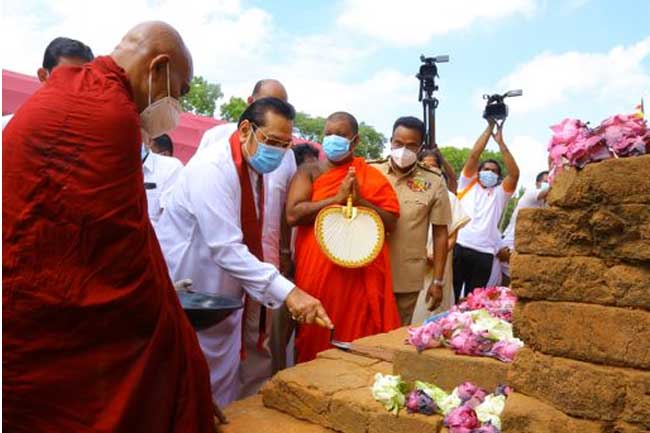
ගරු ජනාධිපතිතුමනි, මේ කරන්නේ කාරුණික ඉල්ලීමක් ආගමික අන්තවාදී ඉල්ලීම්වලට මුලානොවන්න

November 12th, 2020

පාලිත ආරියරත්න

ගරු ජනාධිපතිතුමනි,

මේ කරන්නේ කාරුණික ඉල්ලීමක් ආගමික අන්තවාදී ඉල්ලීම්වලට මුලානොවන්න

ඇමෙරිකා එක්සත් ජනපදයේ පවා කොවිඩ් වසංගතය නිසා සිදුවූ මරණ අතරින් 230,000 කට වඩා මරණ සිදුවී ඇත්තේ ආගමික අන්තවාදීන් විසින් රාජ්‍ය පරිපාලනය ඉවතලා අත්තොනෝමතික ලෙස ඇතැම් ආගමික නායකයින් සහ ඔවුන්ගේ අනුගාමිකයන් මෙම භයානක වසංගතය පිටුපස ඇති විද්‍යාවට අවනත නොවීම හේතුවෙනි  – හෙන්රි මහතා…


ආචාර්ය මෙතිකා විතානගේ විසින් කොවිඩ් මරණයකදී මියගිය පුද්ගලයෙකු ආදාහනය නොකට භූමදානය කිරීමෙන් ඇතිවිය හැකි භයානක ප්‍රතිඑල ගැන හා විද්‍යාත්මක කරුණක් වශයෙන් නාගරික ප්‍රදේශවල සහ ඉන් ඔබ්බට භූගත ජලය දූෂණය හා දූෂණය වීමේ ප්‍රධාන මානව සාධකයන් හා  ප්‍රභවයන් අතර සුසාන භූමි ඇති බව ප්‍රකට කරුණක් බව හුවා දක්වයි.

ඒ වගේම ඇය විසින් පෙන්වා දෙන්නේ  වර්ෂාපතනය පොළොවට වැටි විසිරි යාම හා මෘත දේහයට සම්බන්ද බැක්ටීරියා හා වයිරසය (විෂාණු ) විසිරි පොළොවේ අභ්‍යන්තරයේ විනිවිද යාමත් සමඟ පසෙහි ඇති ඕනෑම වෛරස් කාණ්ඩයක් ස්වභාවිකමව පොළොව යට ඇති උල්පත් හා සමහර උමන් ගංගාවල් මඟින් ප්‍රවාහනය විය හැකි බවය.

ඒවගේම අද දිනද අප රටේ විශාල වැසියන් ප්‍රමාණයක ලිං ජලය හා ඇළ දොළ ගංගා ආශ්‍රිත ජලය එදිනෙදා නෑමට බිමට පරිභෝජනය කරයි ඒ අතර  විශේෂයෙන් ප්‍රතිකාර නොකළ එනම් ක්ලෝරීන් ආදිය නොදමා සැකසු භූගත ජල ප්‍රභවලින් තම පානීය ජලය දහසකුත් අසරණ ජනතාව ලබාගනී.

මියගිය වුවන්ට පෙර නියමාකාරයෙන් මේ වසංගතය හමුවේ ජීවත්වෙන අයවළුන් ගැන විශේෂ සැලකිල්ලක් දැක්වීමට සමාජය විසින් තීරණය කරගතයුතුය. එය මියගිය වූවකුගේ මරණයට පෙර ඔහු හෝ ඇය තුලතම ඥාතින්,මුණුපුරන්,දුවා ,දරුවන් සම්බන්දයෙන් ඇතිවූන  යහපත් සිතුවිල්ලක්ද වීමට ඉඩ තිබේ. අප රටේ සිටි සමහර අතීත විරෝධාර ජාතික වීරවරයන් පවා නොයෙක් දඩුවම් හා සටන් හමුවේ එවැනි ප්‍රාර්ථනා, එවැනි සිතුවිලි ඇතුව මියයාම පිලිබඳ සිද්ධීන් දහස් ගණනක් අතීතය හාරා ඇවිස්සීම තුලින්ද සොයා ගත හැක.

නමුත් ආගමක් මත්තේ තම දෙවියන් නියම කල හෝ පාරම්පරික වත් පිළිවෙත් සිරිත් චාරිත්‍ර මත්තෙම නැහිමට හා ඒ මත්තේ තම දේශපාලන පක්ෂයන්ගේ ඉලක්කයන් කරා යාමට, ලක්ෂ 69 කට වඩා චන්ද දායකයින් විසින් ඇතිකළ ප්‍රජාතාන්ත්‍රික රජය හොර රහසේ වෙනස් මගක් ගන්නා තක්කඩියන්ගෙන් පිරි ඉතිරි ඇති බව හුවා දැක්වීමටද , ක්‍රමක් ක්‍රමයෙන් තම ගෝත්‍රික අවශ්‍යතාවයන් ඉටු කරගැනීමට හා කොටින්ම කිවහොත් තම ආගමික අන්තවාදී අදහස් සියළුම දේට වඩා ඉහලින් ඔසවා තැබීමට සමහර ආගමික කණ්ඩායම් පොදු නීතියකට එකඟතාවය නොදැක්වීම හා එම අන්තවාදී මතවලට එක දිනකට හෝ ඇහුකම් දීම මේ සිහළ බොදු රට විසින් කරගන්නා තවත් ‘අමනොන්ඥ ‘ ක්‍රියාවක් වශයෙන් හුවා දැක්විය හැකිය.

ආගමික අන්තවාදයක් නිසා,(තම ආගමික මත මෙවන් වසංගතයක් හමුවේ හෝ වෙනස් නොකරගන්නා භාවය අන්තවාදයක් ලෙස මෙතැනදී හුවා දැක්වේ )  ඉදිරියේදී ඇතිවිය හැකි, සාමජිය, පාරසරික, දේශපාලනමය හා ආර්ථික හා සෞඛ්‍යය ගැටළු හා රටේ සාමාන්‍ය ජනජීවිත කෙරේ දැනෙන අනාගත භිය තුරන් කිරීමේ හා ” සෞඛ්‍යය සම්පන්නව” දේශයක් පරිසරයක් ඇතිකිරීමේ භාර දුරකාර්යක් වශයෙන් ”’ නව රජය පත්වීමට ප්‍රථම එම ”කියාපෑම” ගැන  කතෘ වන මා කොහේ හෝ දුටුවේය. ඉතින් නව රජය විශ්වාස කල ලක්ෂ 69 කට වඩා වැඩි පිරිසකගේ ඉල්ලීම් ප්‍රථමයෙන් ඉටු කිරීමෙන් අනාගතයේදීද තම දේශපාලන පක්ෂයට බලයේ රැඳීමට හා යහපාලනය මෙන් නිකරුනේ අන්තවාදීන් සමග එක්ව ගමන්කොට රැවැටුන වලේම දවල් වැටුනා සේම ජනාධිපතිතුමනි අමාරුවෙන් සාදාගත් ඔබතුමාගේ රජයද වට්ටා නොගන්නා ලෙස සමාජ විශ්ලේශකයකු  වශයෙන් ඉල්ලමි.

මුස්ලිම්ලා විසින් ගෙන එන  ‘ මයි කාර් මයි පැට්‍රොල් අයි ගොස් මයි වේ ‘ ‘ යන මතය (අපේ ඉල්ලීම් සියල්ම දියවු අපිට ඕනේ අපේ ක්‍රමය ‘ යන මතය ) එක හෙලා ප්‍රතික්ෂේප කල යුතුය. ඔවුන් හට පමණක් කොවිඩ් රෝගයෙන් මියයන පුද්ගලයෙකු භුමදාන කටයුතුවලට ඉඩ දීම මුළු රටම අනතුරේ හෙළීමකි. එයට මුළු මහත් රටේ සිටින අනිකුත් සියලුම දෙනා විරුද්ධබව ‘ ප්‍රධාන මාධ්‍ය නාලිකා තුලින් අපි දුටුවේය ‘.

සියළුම දේ අනිත්‍ය ලෝකයේදී විශේෂයෙන් මේ කොරෝනා වසංගතය හමුවෙදිදීද  ජීවිතයේ දී මුහුණ දීමට සිදු වන ඕනෑම දෙයක් උදේශා හුදෙක් පැරණි ආගමික චාරිත්‍ර භූමදාන ක්‍රමම පමණක් උපයෝගී කරගැනීමෙන් ‘මලගිය පුද්ගලයාට ‘ සෙත සැලසීමක් වශයෙන් දක්නා  ඒ ආගමික උමතුව නොව විද්‍යාව ක්‍රමද මුස්ලිම් හෝ දෙමළ හෝ සිංහලයන් විසින් අනුගමනයකලයුතු බව අප වාඩ වඩාත් සැලකිලිමත් විය යුත්තේ ජීවතුන් අතර සිටින මිනිසුන් රැකීම සඳහාය ය.

කොවිඩ් උවදුරෙන් මිදීමට මඟ පෙන්වනු ලබන්නේ ඔවැනි පටු ආගමික විශ්වාසයන් නොව විද්‍යාවෙනි. රජයේ වගකීම වන්නේ ජීවත්ව සිටින අයට මිස මළවුන්ට නොවේ, ඔවුන්ගේ ජීවිත අවසන් වී තිබීම කනගාටුවට කරුණකි. නමුත් (මළවුන්ගේ දේහයන් තුලින්)  ඔවුන්ගේ දේහය ජීවත්වන්නන්ට ගැටළු ඇති කිරීමට ඔවුන් කැමති නොවනු ඇත. එසේ එයින් මේ ‘ අන්තවාදී ඉල්ලීම වහා රජය විසින් පිටු දැකිය යුතුය.

 අන්තර් ජලය තුළද සොයා ගත හැකි භූමදානය හා ඒ ආශ්‍රිත පරිසර විද්‍යාත්මක ප්‍රකාශන රාශියක් සොයා ගත හැක. භූගත ජලයට වෛරස් හා බැක්ටිරියා ඇතුල්වීමේ අනුපාතය සොහොන් භුමි ආශ්‍රිතව වැඩි බව පරීක්ෂණ වලින් සොයාගෙන ඇත.

‘ පැරණි මුස්ලිම් මිනිසුන් අප හට කුඩා කල කිව දෙයක්ද ඔබතුමාට මෙතනදී සඳහන් කරමි. ඔබතුමාද මේම කතාව අසා ඇති බව අප සිතමු !

අපි එක දවසකින් මුස්ලිම් කෙනෙකු මැරුණම වලදාන්නේ පරිසරයට ‘විෂ බිජ එකතුවෙන එක අඩුකරන්න ‘ අපි ඕකට්ටිය වගේ නොවේ !!!

ඉතින් ජනධිපතිතුමනි එදා ඒ කතාව අද නොපෙනන ලෝකයට හුවා දක්වා සහමුළින්ම වෙනස් කොට මේ ඉල්ලන්නේ කුමක්ද?

මෙය අර ඉංග්‍රීසියෙන් කියනවා වගේ ”රයිට් ටු කල්චර් නොවේ ” සංස්කෘතික අයිතිවාසිකම නොවේ. එය රැකීමට ගොස් අසරණ අනිකුත්  මිනිසුන් හට සෞඛ්‍යය ප්‍රශ්න ඇති කිරිමකි.

මොවුන් මේ කරන්නේ තොප්පිය හිතු මතේට කැරකවිම නොවේද ? 1925 දී පමණ ඇතිවූ  මුස්ලිම් මත 2020 වෙනකොට වෙනස් වන්නේ කාගේ උවමනාවටද ?

මේ අන්තවාදයක් නොවේද ?

එදා පාස්කු ප්‍රහාරය දියත් කලේ මෙවැනි ඉල්ලීම් කිරීමට දිරි දුන් කණ්ඩායම් නොවේද ? සහාරාන් අද සිටියානම් මෙම ඉල්ලීම ඉටු කරගැනීමට උද්ගෝෂණ නොකරයිද ?

ඔහුත් සමග එදා සිටි ලඟින් ඇසුරු කල ගජ මිත්‍ර සංවිධාන හා එහි නායකයන් අද ඔබ අසලම හිඳ මේ අශුද්‍ර ඉල්ලීම් ඉටුකරන්නේදැයි සොයා බැලීමට ඉල්ලමින්. මුස්ලිම් වරුන්ට පමණක් කොවිඩ් මරණ භුමදානයට විශේෂයක් නොකර මෙන් යෝජනා කරමි.

බුද්ධිමතුන් හා ආගමික අන්තවාදීන නොවන ජනයාගේ අවධානය පිණිස මෙසේ සඳහන් කරමි..

වර්ෂාපතනයන්  වැඩි කාලවලදී කොවිඩ් මරනයන්ගේ මෘත දේහ තුල ඇති මානව වෛරස් හා බැක්ටිරියා වර්ග දියවී ගමන් කොට පස හා  භූගත ජලය දූෂණය වීම සිදුවිය හැකි අතර, තෙතමනය වැඩි බැවින් ඉක්මනින්ම දිරාපත්වීම වැලකීම තුළින් වෛරස් හා බැක්ටිරියා තෝතැන්නක් වී කෙසේ හෝ උඩු දුවා (මීයන් ආදී සතුන් සොහොනහැරීම, මේරු ආදිය මතුවීම ,සොහොන් පල්ලාගේ සමාජ ආශ්‍රය තුලින්, ඊළඟ කොවිඩ් භූමදානය කිරීමට යන කණ්ඩයම මඟින් හෝ නැත්නම් කපුටෙකු හෝ හුලං පොදක් මඟින් හෝ හරියට රැකවල්ලා  නොමැති සොහොනක්,  කනත්තක් මඟින් අපරාධ මානසිකත්වයක් ඇති පුද්ගලයෙකු මඟින් හෝ මේ වෛරසය සමාජ ගතවී  ආර්ථික හා දේශපාලන ගැටළු රාශියකට තුඩු දීමක් සිදු විය හැක.

දේශ පාලකයනි ළඟ නොව දුර බලන්න. මෝඩ කථා නොකියන්න…

තෙරුවන් සරණයි !
දෙශාඅභිමානී සුර්ය වංශ රත්න විභූෂණ පාලිත ආරියරත්න
සෙන්කඩගල සිංහ ද්වාරයේ සිට
2020-11-12

References

THE POHOTTUWA GOVERNMENT OF SRI LANKA Part 2 C8c

November 12th, 2020

KAMALIKA PIERIS

LAND DEEDS

To accommodate the acquisition of land for this proposed economic corridor, two new laws, namely the State Land Bank bill and Land Special Provision Bill, were to be enacted.

The State Land (Special Provisions) Bill was gazetted on 27.03.19.” This is a Bill to grant absolute title to state lands held by citizens who hold land grants. Its validity is for seven years. Analysts have seen a connection between the MCC Land projects and the Yahapalana plans to dispose of state land.

According Part I Section 3, the provisions of the Act shall apply to persons who are holders of (i) a grant under the Land Development Ordinance; (ii) an instrument of disposition under Land Grants (Special Provisions) Act; (iii) an instrument of disposition under Crown Lands Ordinance for agricultural purposes provided that they have held the Land “for more than ten years immediately prior to the appointed date of this Act.

However, according to Section 4, the Act shall not apply to Land (i) over one thousand five hundred and twenty-four meters above mean sea level; (ii) declared as development areas; (iii) within reservations or protected areas; (iv) vested in any Local Authority; (v) declared by the Minister; (vi) any settlement programme.

According to Part II, applications for eligibility would be reviewed by a Committee made up of fifteen Secretaries of related Ministries and five ex-officio Members such as the Land Commissioner who shall be the Chairman of the Committee, the Surveyor General, the Registrar General of Lands and nominees of the President and the Prime Minister. The Committee would be assisted by administrative arrangements such as Sub-Committees and Boards to review objections that are normal to finalizing the report of the Committee for submission to the Minister for Lands who in turn is expected to forward it to the President for issuance of the Absolute Land Grants.

The move will enable those occupying these lands to sell or transfer ownership legally and also obtain other facilities such as bank loans and use the deed as a valid document for school admissions, said Yahapalana .

The Bill covers lands granted under the provisions of the Land Development Ordinance, lands disposed under the provisions of the Land Grant (Special Provisions) Act or lands provided under the Crown Lands Ordinance granted for agricultural purposes, under a land settlement programme or a colonization scheme. Those holding land grants and permits for more than 10 years will be benefited by the new legislation. They are entitled to apply and be eligible to get an Absolute Land Grant up to five acres in extent under the provisions of this Act.

The provisions of this Act apply to holders of grants under the provisions of the Land Development Ordinance, instruments of disposition under the provisions of the Land Grants (Special Provisions) Act, and instruments of disposition of lands under the Crown Lands Ordinance granted for agricultural purposes or colonization schemes”.

The Committee will forward its observations to the Land Minister on all applications for Absolute Land Grants and the relevant documents, and the minister will forward them to the President. Once the President issues the Absolute Land Grants, those will be registered in the Land Registry. The grantee of an Absolute Land Grant will have the right of transfer of the land to the heirs or with the consent of all heirs in writing to sell such land to any person.

A 20-member ‘Land Grants Committee’ consisting of Ministry Secretaries, Heads of relevant institutions and two nominees of the President and the Prime Minister will be appointed for the administration of this Act. However, any land which is used for paddy cultivation can be sold only to another farmer. President Sirisena had wanted that the land could be sold only for a person in the adjoining Grama Niladhari division preventing persons from outside areas from buying lands on a large scale.

The Absolute Land Grant issued by the President will be conclusive proof of absolute title to that land. It will be admissible and valid before any court, institution or authority for any transaction, business, transfer of title, as security for a bond or for any other purpose.

Prime Minister said that large extents of land had been distributed among the people under the D.S. Senanayake administration. Those lands were given under the Land Development Ordinance of 1932. “People were given licences. Later people were given letters when they were settled. Sometimes people were settled without any documentation. None of these groups have deeds to show outright land ownership,” he said. Without land deeds those people faced a number of issues and at times they were asked to leave. “With these deeds you can use your land freely. “For a country to develop people must have the ownership of land,” he said.

 Ranil Wickremesinghe said that the government was distributing one million deeds to the people granting them outright ownership of their land. “People who have been using plots of land for over a decade will get outright land ownership.”

The Bill has been virulently opposed. The Bill has been submitted without the approval of the Cabinet of Ministers, said critics. The Bill with amendments proposed by President should be presented for Cabinet approval before it is submitted to Parliament. But Lands Minister has submitted the Bill to Parliament without presenting it to Cabinet, said Dayasiri Jayasekera.

Critics want to know whether there was a connection between this decision and Millennium Challenge Corporation Agreement (MCC) which the Government is expected to sign with the United States of America.

The government seems to be in a mighty hurry to grant outright ownership to those who have their land holdings under the Land Development Ordinance of 1935, said critics. The government wants to neutralize the Land Development Ordinance, Crown Land Ordinance and Lands Grant Act by way of the proposed Lands (Special Provisions) Bill. These had ensured the state land provided to the needy families remained with them.

The introduction and the implementation of the Land Development Ordinance 1935 was one of the most important welfare measures taken before independence. It was a very effective rural development strategy followed during pre and post independent period, explained critics.

The initial objectives of the Land Development Ordinance 1935 were (a) protecting peasant farmers as a group (b) alleviating land hunger among the poorest of the poor (c) relieving population pressure of the villagers in the wet zone of the country, (d) increasing food production particularly paddy (e) developing the scarcely populated dry zone.

The land alienation was done under different types of schemes such as major settlement schemes, village expansion schemes, highland settlement schemes, middle class schemes, and youth settlement schemes and regularization of encroachments. The land alienated originally was crown land. Latterly with suitable crown land not being available land from other sources such as estates were acquired and alienated under this Ordinance.

Under the 1935 Ordinance the allottee could not fragment the land, mortgage the land or dispose of it without Government Agent’s permission. The tenure was liable to cancellation for any default. The allottee’s land was a protected holding. Selection of allottees was done at a land Kachcheri by the Government Agent or his representative. Landless peasants from the area with large families were given preference and on selection were issued a permit. The land could be passed on, only to a nominated successor by the allottee. This prevented fragmentation of peasant holdings.

When the permit holder had fulfilled the requirements stipulated in the permit he was entitled to receive a grant of his allotment. The grantee was able to freely dispose of his allotment without the consent of the Government. However, The LDO requires peasant holder to obtain the prior consent of the Government Agent before disposal. The restriction has been designed to prevent the passing of land intended for the peasantry to the richer classes or high income groups. The LDO ensures that no State land shall be alienated to any person other than citizens of Sri Lanka and declaring that any alienation made in contravention of this provision shall be invalid.

Critics said the new Land Bill would have far reaching consequences which the country couldn’t cope with. Since farmers are chronically indebted, the reforms underway will in all likelihood lead them to sell their plots. “We’ll have to struggle with thousands of families being homeless with the selling off of their property overnight,” critics said. A farmer who owned about a quarter acre of land, after selling it to a multinational company would himself be destitute after some time.

Well organized unscrupulous politically influential persons would rapidly procure land received by the landless. The project would cause a massive displacement of people, especially smallholders. It will drive poor peasant families off the state land they had settled on for generations, critics said.

The concept of the village having a temple, agricultural land and a tank would be gone. Factories would crop up in farm lands. The agricultural economy would fall. The natural environment might change for the worse.

Critics have also seen the new Bill as a move to enable Yahapalana to sell off state land to foreign companies. Through this Bill government seeks to dispose of large tracts of land in a short time,  to make them quickly available for investors.

The Ranil Wickremesinghe administration was also attempting to create a cheap labour force needed to facilitate the implementation of neoliberal economic policies, by amending` land laws, said the Movement for Land and Agricultural Reform, MONLAR. Providing land deeds may look like a progressive move but we have to look at the reasons said MONLAR.

On the one hand there is a serious crisis in the rural economy, created by the policies of successive governments, especially the present administration. On the other hand, large multinational companies have made small time farmers bankrupt and are buying off their agricultural land. The only thing that has held back these predatory companies and the neoliberal economic policies are the so-called antiquated land laws. By giving desperate people, an asset that they can sell the government has ensured that these lands will be sold off.”  They will sell their small holdings for a pittance. The net result will be the rise of a generation of poverty stricken landless population in rural areas.

Molar said that they had looked at all documents approved by the Cabinet between January 2015 and April 2019 on land reform, recommendations given by the World Bank and International Monetary Fund (IMF) to the government on the land rights of the people and bi-lateral trade agreements between Sri Lanka and other countries had the potential projects that would deprive the people of their land rights.

The target clearly is state owned land. In Sri Lanka, we have freehold properties that belong to individuals or companies and then there is state owned land a portion of which is utilized directly by the government and a portion which remains allocated for other purposes of the republic such as forest reserves and the like and another potion of state land is held by the public under lease or licensing arrangements, pointed out Chandraprema. It is obviously the latter that the MCC is targeting.

Even though such state owned lands have been alienated to individuals under licensing or long term lease arrangements, the tenants on these lands enjoy security of tenure because the government will not simply kick them off the land if it is cultivated and used productively. The lease holder or licensee will be adequately compensated before the government takes back a state land which has been given to private individuals for farming or other purposes. We almost never hear of even the smallest of smallholders being unreasonably evicted from state owned land that had been leased or given to them on a license by the state.

Such land can also be passed down from generation to generation provided the land had been utilized productively. The fact that the land is owned by the state discourages fragmentation of the land and strategic buying up of cheap land by organized parties

Admittedly, recipients of state owned land on lease will face issues when trying to raise money from banks with the land pledged as surety. Banks prefer freehold land. However, this was a problem that had to be dealt with at the level of the banks instead of trying to give leaseholders freehold tenure.

If leaseholds on state land can be bought and sold between citizens of Sri Lanka and their only problem is the inability to use that lease as collateral, the answer to that can’t be the wholesale transformation of such lands into freehold tenures. There is besides, the well-founded fear that if state owned lands which are at present farmed by individuals on leasehold or licensing arrangements are turned into freehold properties, it will not be long before unscrupulous elements lay their hands on these lands creating a landless rural population.

The first attempt to do away with these laws was made in 2003. The UNF had wanted to see large scale organized transferring of ownership of land and this would have certainly become law if not for the Supreme Court ruling given in 2003.

.Justice Shirani Bandaranayake ruled that the disputed Bill should be approved in parliament with a two-thirds majority and by the people at a referendum. The ruling, he said was based primarily  on two factors (1) As the subject of land is under the purview of the Provincial Councils, the Bill required the consent of 09 Provincial Councils and (11) The exclusive right enjoyed by the President in respect of granting of land cannot be transferred to the Minister responsible for the subject of lands.

In 2015, Yahapalana UNP revived the project. “It was the same Bill rejected by the Supreme Court in 2003. The cabinet discussed it several times after January 2015. ” it was difficult to see how this law could take effect in view of 2003 Supreme Court ruling.

Critics argue that the present Bill would violate the sovereignty of the People as given in entrenched Article 3 of the Constitution, Land cannot be granted to anyone outright without a two-third approval of Parliament and approval by the People at a Referendum all land and all its resources belong to all the people of Sri Lanka as part of their sovereignty. This is inalienable. Governments hold Land in trust, said critics. This has been determined by the Supreme Court in several instances   such as the Eppawela case (S.C. 884/99)

State Land is an inalienable right of the sovereignty of the People. In view of this undeniable and uncontestable fact, it is a violation of the inalienable rights of all the People for any government to legislate granting Absolute Land Grants to some of the People, an asset that belongs to all without due process of two-third approval of Parliament and approval of the People at a Referendum.

A Special Determination petition challenging the Bill entitled ‘State Land (Special Provisions)’ was filed before the Supreme Court in July 2019. Convener of the of the Truth Seeker’s Organization has sought a declaration that this Bill shall become law only through a two-thirds majority in Parliament and the approval of the people at a referendum.

The petitioner, Attorney Premanath Dolawatta stated that the concerned bill was presented to Parliament and placed in the Order Paper of Parliament on June 28, 2019. Dolawatta states that the Bill contains 36 clauses and a schedule and the entirety of the Bill violates and is inconsistent with Articles 3, 4, 12(1), 12(2), 75, 154G of the Constitution. The petitioner stated that the purpose of the proposed law is to alienate State lands which amounts to a breach of the duty of the state to be the guardian of state lands holding the same in trust. There have been several other petitions against this Bill.

The Supreme Court examined the Bill titled State Lands (Special Provisions)” which has been challenged in the Supreme Court in terms of Article 121 (1) of the Constitution and gave its determination.

Supreme Court determined that in terms of Article 120 read with the Article 123 of the Constitution, that the Bill in question is in respect of a matter set out in the Provincial Council List, and shall not become Law unless it has been referred by the President to every Provincial Council, for the expression of their views thereon, and only thereafter be placed on the Order Paper of Parliament, as required by Article 154G (3) of the Constitution. The Supreme Court has further observed that the Bill has been placed on the Order Paper of Parliament without compliance with the Provisions of Article 154 G (3.)

The upset over land does not end there. For some time now, land rights activists and analysts have warned of potentially disastrous consequences of reforms to land laws contemplated by the Wickremesinghe-led government announced critics. President Sirisena said he had blocked two ‘anti-national’ Land Bills the PM sought to introduce. He said these new laws sought to allow foreigners to buy any land in the country, both privately and publicly owned.

LAND BANK

“USA has done a study on Sri Lanka and issued a report with recommendations on Sri Lankan lands. They are engaged in surveying the lands in Sri Lanka and have suggested establishing a state land bank. According to these proposals all state lands would come under this bank, allowing these lands to be given to anyone even foreign parties said critics.

The government’s moves to remove the bar on foreigners owning land, the removal of the 50-acres limit on individual ownership, the proposed ‘Land Bank’ (that will bring publicly owned land under a single hub and make it available for private investors), are inter-related.”You need to look at all the factors to see the final outcome” said MONLAR

LAND SURVEYS

Lastly, there is an interesting tussle going on regarding land surveys. Trimble Navigation Ltd, a US company based in California, had in October 2015,  forwarded a proposal for ‘Title/Tenure Regularisation and Cadastral Registry Modernisation’ in Sri Lanka. This proposal has been rejected earlier in 2010. 

A high level committee headed by senior advisor to Prime Minister R. Paskeralingam had recommended this proposal. The Cabinet Committee on Economic Management (CCEM) approved it  and Cabinet    accepted it. Trimble had asked for USD 170 million and Yahapalana had beaten it down to USD 154 million. The money would come as a loan at an interest of four percent. The loan is to be paid back in 15 years inclusive of a grace period of five years.

The Finance Ministry’s External Resources Department was authorized to negotiate with Trimble to prepare land survey maps and create a streamlined database of 3.6 million parcels of state owned land. Trimble would first survey 2.5mn blocks of land around the country, excluding the Western Province and issue title deeds. Then it would survey 2.5mn plots of land in the Western Province.

The Government Surveyors’ Association (GSA)   announced  in January 2017, that there was a move to hand over several operations of the Sri Lanka Survey Department (SLSD), including Land Information System (LIS) and Aerial Survey Operations to Trimble Navigation for 15 years  ‘The required plans are already in place to complete the transfer. It appears that the US government had forced Yahapalana to agree to this, said the surveyors. 

It was observed some time later, that ‘the   land part of the Compact seems to have undergone drastic change.’ There is no mention now of giving deeds to those occupying state lands so that they can sell the land and become destitute. The focus now is on creating a cadastral map of land parcels and creating a complete digital inventory of state land.

Surveyors are not impressed.  This is exactly what the American firm, Trimble was going to do, at the start of Yahapalana rule, surveyors said. They also said that this mapping which the Compact is talking about could be done by the Land use Planning Department. The Land use Planning Department has already mapped out all sorts of land, they said.   They have mapped out protected areas, unutilized lands,    underutilized lands, abandoned paddy lands, river basins, water sheds. The data will   be fed into ICTA’s National Spatial Data Infrastructure.

The Compact is now focusing on under-utilized state land”   held by government Departments, such as the Government Railway. The Compact is eyeing these lands, which it says can generate better revenue in the hands ofindustrial investors.  Sri Lanka will have a place in these industrial ventures. The MCC compact will provide opportunities for Sri Lankan companies to compete and win multi- million dollar projects,” the US embassy said. We want private sector expertise and we pay really well.”  (Continued)

THE POHOTTUWA GOVERNMENT OF SRI LANKA Part 2 C8b

November 12th, 2020

KAMALIKA PIERIS

The Prime Minister office made a statement on the MCC project in June 2019. The statement was made public.     The statement said:

The Government of Sri Lanka, with the help of the Center for International Development (CID) at Harvard University, conducted constraints analysis to identify constrains which hampered the economic growth in the country and identified three binding constraints, 1. Access to land 2. Weakness in transport and logistics infrastructure and planning and 3. Policy instability.   Yahapalana government then decided to focus on the two of these, access to land and improvement in transport.

The Government of Sri Lanka and MCC then consulted with hundreds of individuals from government, the private sector, and civil society in small group discussions and one-on-one meetings to understand the root causes of the transport and land binding constraints and potential activities that would address those root causes. The Government of Sri Lanka and MCC also launched multiple rounds of discussion to identify potential projects that could meet MCC’s investment criteria.

On the basis of such engagements and analyses, the Government of Sri Lanka submitted project proposals to MCC for consideration in November 2017. There were two sets of projects, Transport Projects and Land Projects.

ACTIVITIES PROPOSED UNDER THE TRANSPORT DEVELOPMENT PROJECT:

1) Establishing an Advanced Traffic Management System (ATMS) covering the Colombo Metropolitan area to improve the efficiency, capacity and safety of the CMA road network to improve flow rate, reduce travel time and congestion, reduce traffic emission and reduce accidents.

2) Bus Transport Sector Modernization (BTSM) programme will make a significant improvement to the speed and quality of the public bus system combining state owned and private buses.

3) Developing and improvement of 137 km road sections in the Central Ring Road (CRR) covering and connecting Sabaragamuwa, Uva, North Central and Central Provinces to markets in the Western Province.

 4) Connected to this Road development is a study to locate and finance, locations for wholesale storage of Agro produce in collaboration with private investors at locations on the CRR Road network, to improve post-harvest management of produce.

ACTIVITIES  PROPOSED UNDER THE LAND ADMINISTRATION PROJECT:

  5)  Preparation of Parcel Fabric map and inventory of state land.

6)    Improvement of Deeds Registry.

7)    Improvements of the land valuation system.

8)    Land Grants Registration and Deed Conversion Activity.

9)   Land Policy and Legal Governance Improvement Activity.

The above activities will be implemented in the following 7 districts with the limited funds available for the land sector. (Kegalla, Kandy, Matale, Kurunegala, Anuradhapura, Polonnaruwa and Trincomalee) Further we requested to include Gampaha district as well, said the statement

The statement ended by saying that the copy of the report can be accessed through: https://assets.mcc.gov/content/uploads/constraints-analysis-sri-lanka.pdf. More information on the MCC grant for Sri Lanka could be obtained from https://www.mcc.gov/where-we-work/program/sri-lanka-compact .

The Transport project is in three parts. Part one is an Advanced Traffic Management System (ATMS) for the Colombo Metropolitan Region, covering approximately 205 kilometers of existing road networks , concentrating on the  eight heavily traveled corridors that link central Colombo with its suburbs   and  including  improvement of  132 junctions in Greater Colombo.

The ATMS will be controlled by a huge Traffic Management Center with real time analysis of traffic flow data,  interconnected traffic signal system and vehicle detection using modern technology. The project will also create more pedestrian crossings, improve sidewalks and introduce ‘road safety measures’‘

The Advanced Traffic Management System had been discussed with other donors. The discussions had stalled because the other donors  had refused to pay certain extra costs relating mainly to land. But  MCC readily  agreed to pay   that too, said RDA gratefully.

Part two is bus service modernization in greater Colombo. This will consist of automated fare collection with smart cards, centralized control of bus schedules and GPS bus tracking to see whether buses are operating according to schedule. These measures would also improve the safety of women, senior citizens and disabled persons. Funds will be also provided for the purchase of new state-of- art buses.

Part three  is the  upgrade of  approximately 131 kilometers of roads in Sabaragamuwa, Uva and Central Province which are in between the more developed roads. This would include the road from Ratnapura to Beragala and Dambulla to Naulla. The Compact is offering a  super asphalt mix which will provide a better  road surface.

The transport project will improve connectivity between the economically backward central region  with ports and markets in the western provinces, continued MCC. Getting transport right is the key to mark Colombo as a regional hub for finance, trade and investment.

That is doubtful. The Compact does not address the primary transport  need in Sri Lanka today, the need for mass transit, by bus and train, for both persons and goods. The Compact  remedy  instead,   is to introduce ICT controls  for  private transport.  The  MCC Transport project  was described in  detail by an  official of the Road Development Authority, at a  seminar   I attended. The audience gave a hearty laugh at the end of the talk.

Critics ignored the transport projects of the MCC and pounced on the land projects. These had serious implications, they said.

 They pointed out that the MCC Land plan  also  includes four ‘Economic Corridors’, Colombo-Trincomalee will be developed as the main economic corridor with three other sub-corridors,  Jaffna-Kilinochchi in the Northern Province, Galle-Tissamaharama in the Southern Province and Chenkaladi-Ampara in the Eastern Province. Anuradhapura and Kandy will be developed separately as metropolitan areas. The feeble excuse given for their creation, was that the corridors   were to help economic growth in economically poor areas.

The plan for a Colombo Trincomalee Economic Corridor, was developed initially by the Asian Development Bank    in  2018. It was to take advantage of existing international gateways,  the Bandaranaike International Airport and Colombo Port.  The proposed Central Expressway, which connects the two, which is about 280 kilometers long, will act as the spine of the corridor. An influence area of 50 kilometers on either side has been selected, which cuts across 6 provinces and 10 districts. The districts in the influence area cover 42% of Sri Lanka’s total area, account for 58% of the total population and contribute 86% to industrial output.

 MCC critics  focused on the Colombo Trincomalee Economic Corridor.  Critics observed that the Colombo-Trincomalee project will carve out an economic corridor from Colombo to Trincomalee, taking in Colombo, Negombo, Kurunegala, Dambulla and Trincomalee, covering 1.2 Million acres, in a manner that physically divides the territory of Sri Lanka into two distinct parts. It has been alleged that the MCC envisages an electric railway line that would bisect the country in a straight line linking Trincomalee with Colombo.

The underlying purpose of the MCC compact was to divide Sri Lanka into two distinct parts, said critics. That the so called economic corridor is to serve the interests of the U.S. the US has upgraded the status of Sri Lanka to that of a Military Logistics Hub.

The majority of the Districts within the Colombo Trincomalee Economic Corridor do not qualify on grounds of poverty, either. They are below the national poverty headcount index of 4.1 Districts with high levels of poverty are outside the proposed corridor.

Five of the eight Districts included in the Colombo Trincomalee Economic Corridor, namely, Matale (3.5), Kurunegala (2.9), Anuradhapura (3.8), Polonnaruwa (2.2) and Gampaha (2.0) are below the national headcount index of 4.1. Therefore, only three Districts, Kandy (5.5), Kegalle (7.1) and Trincomalee (10.0) qualify, since their poverty indices are high and well above the national average of 4.1.

Districts where the poverty headcount index is considerably higher than the national average and therefore requiring attention are   not in the corridor. Districts such as Ratnapura (6.5), Monaragala (5.8), Badulla (6.8), Batticaloa (11.3), Kilinochchi (18.2), Mullaitivu (12.7), Jaffna (7.7), Nuwara-Eliya (6.3) are well above the national poverty index.

The National Joint Committee  took an interest in  this Corridor. National Joint Committee noted that the law applicable within the Corridor would be  American law and not  Sri Lankan law.

The country will be divided into two parts by this economic corridor with the northern part being available to create the nation of Eelam as envisaged in the separatist ideology. It is in this northern part that the ancient cities of Anuradhapura, Polonnaruwa and Kurunegala are situated, said NJC .

 The area covered by this economic corridor  contains Eppawala phosphates, Limonite, Thorium, Monazite and rare earth metals Cerium and Lanthanum. When Freeport McMoran, an American Company, in 2000 tried to mine the phosphates in Eppawala this was prevented by Supreme Court saying such assets belonged to the people, said National Joint Committee.

Critics of the Corridor  also took up another matter. The corridors will be based on a  new National Physical Plan (2018 – 2050) which is  expected to replace the earlier Physical Plan (2011 – 2030) prepared in 2011. While the earlier Physical Plan addressed development over the entire territory of Sri Lanka, the revised Physical Plane has deviated from this holistic approach and focused development along “growth corridors” observed critics. These districts overlap with those coming under the MCC.

A National Physical Plan has to carry out certain procedures for it to be accepted as an official document. It has to be prepared under the Town and Country Planning (Amendment) Act (No. 49 of 2000). The earlier Physical Plan had followed all the procedures required by the Act. The question is whether the revised Physical Plan has followed the due process as required by the Act.

Such procedures should include preparing a Draft Physical Plan and conducting hearings with experts, professionals and general public and obtaining provisional approval of the Minister concerned after which it is gazetted with maps and plans, for scrutiny by the public, for them to propose revisions to be incorporated in the Draft Plan. It is after following such procedures that the final version of the National Physical Plan is submitted to the National Physical Planning Council for approval.

The revised National Physical Plan 2050, prepared by the National Physical Planning Department of the Megapolis and Western Development ministry, has been approved by the National Physical Planning Council  and the National Economic Council (NEC) of Sri Lanka and is expected to be gazetted shortly said Daily News in February 2019. It is yet to be made public, although it is said to be ‘completed,’ said analysts in June 2019.”

Critics wanted to know whether the President as the Head of the National Physical Planning Council has approved the Plan. What is the status of this new Plan? If the final Physical Plan had not followed the required procedures prior to the approval of the National Physical Planning Council, how legitimate would be the final version of the Plan, even if it was approved by the President and the Council, and consequently, the status of the Compact negotiated with MCC, they asked.  ( Continued)

THE POHOTTUWA GOVERNMENT OF SRI LANKA Part 2 C8a

November 12th, 2020

KAMALIKA PIERIS

TheMillennium Challenge Corporation (MCC) is a  foreign aid agency established by the U.S. Congress in 2004. The MCC Board is chaired by the Secretary of State. The Board members consist of the Secretary of the Treasury, US trade representative, four private sector representatives and a representative of USAID.

MCC is  therefore not the independent, altruistic  US foreign assistance agency it claims to be.  It has government connections.   The governing  Board  represents  the  political and trade interests of the USA.   Advocata  Institute   however, says, although heads of the U.S. State Department and U.S. Treasury sits on its board, the MCC operates independently as a separate entity.

The Millennium Challenge Compact is a US grant for development work in foreign countries.  The  first project negotiations in Sri Lanka  for  such a  grant commenced in 2004 during the Kumaratunga-Wickremesinghe tenure and continued during the Rajapaksa government until the project was terminated for political reasons,  by MCC in 2008.

After Yahapalana government came to power, in December 2016, Sri Lanka was again selected for a Compact.  The country became eligible for assistance after passing 13 out of 20 indicators on MCC’s policy scorecard.

Countries must qualify as low income or lower middle income countries according to the World Bank’s classification in order to be eligible for MCC grants. On the 1st of July 2019, the World Bank classified Sri Lanka as an upper middle income country with a per capita income in excess of $ 3,895. However, by that time the MCC grant for Sri Lanka had already been passed and in any event according to MCC criteria, when a country’s classification changes, it will retain its former classification for a further two years. 

On August 13, 2018, the MCC delivered to the U.S. Congress a Congressional Notification of its intent to negotiate a Millennium Challenge Corporation Compact with the Government of Sri Lanka.  Sri Lanka completed negotiations with MCC in October 2018    and the Board of Directors of the Millennium Challenge Corporation of USA approved a five-year, $480 million Compact grant to the Government of Sri Lanka. 

 The agreement was to be signed in December 2018 but was delayed, due to   objections. MCC’s Board of Directors met in mid-September 2019 and re-approved a five-year, $480 million Compact grant to the Government of Sri Lanka.   The United States said it hopes that Sri Lanka will eventually approve the $ 480 million Millennium Challenge Corporation (MCC) grant. Measures will be taken to create awareness on the MCC programme among the people,  the embassy said.

Analysts observed that US does not historically give Sri Lanka direct aid, they do it through World Bank. But in this case they   readily provided money direct. The embassy confirmed in 2019 that the full sum of USD 480 has   already been approved.

When a country is awarded a Millennium Challenge compact, it sets up its own local MCA accountable entity to manage and oversee all aspects of implementation, the US explained. Sri Lanka has set up Compact Development Team in the Policy Development Office of the Office of the Prime Minister.    This will later be replaced by MCA-Sri Lanka, which will deal with the work of the Compact.

The   land and transport projects of the Compact were first examined  by Harvard University’s Centre for International Development in a year long study in 2016. This was followed  by studies from World Bank, Asia Foundation,  Trimble and Center for Policy Alternatives, Colombo. These are  organizations which have a strong link with USA, said critics.

The present Compact is based on a full-fledged proposal submitted by the government in November 2017, said Pathfinder Foundation. The local Compact team and MCC specialists had extensive discussions with the departments responsible for transport and land administration. They also had discussions with the private sector,   think tanks, and civil society organizations.

The government team was led by the Secretary to the Ministry of Finance. The team included senior officials from the External Resources Department, Attorney General’s Department, Policy Development Office in the Prime Minister’s Office, Ministry of Highways and Road Development, Ministry of Lands and Parliamentary Affairs, Ministry of Megapolis and Western Province Development, Ministry of Transport and Civil Aviation, and Sri Lanka Survey Department, said Pathfinder.

The MCC Compact  led to considerable discussion. Several organizations  held seminars on the subject and the US embassy has attended and contributed information. This is your project. We are not forcing it on Sri Lanka, said US. Implementation will be supervised by a local body staffed by Sri Lankans. This body will be accountable to a Sri Lankan Board of Directors comprised of eight government officials and three representatives from the private sector and civil society.

Certain changes have already been made. Attorney General’s Department raised objections to the clause in the original draft which brought the Compact under International law. MCC was asked to remove any sentence which excluded domestic law and the MCC agreed,  USA said.

MCC Compact has not been received well in Sri Lanka. The MCC was developed in secrecy by a team located in the Sri Lanka Prime Minister’s office, charged critics. The government has been inexplicably secretive about the whole MCC project, they said. There has been no public discussion on it, said Lasanda Kurukulasuriya.

The  US embassy replied. All MCC Compact   programmes,   all over the world are prepared by the locals of that country, the embassy said. In Sri Lanka too, the Sri Lanka plan was prepared by teams of Sri Lankans including  members of the civil society. The private think tank Verite Research  said that they had been involved in   planning the transport programmes. At least 15 Sri Lankans were present at the negotiations, the embassy said. The Compact program was proposed by Sri Lankans, developed by Sri Lankans and will be managed and supervised by Sri Lankans, said the US embassy.

The MCC grant represents the largest grant Sri Lanka has ever received from a single source, said Advocata. The grant is a huge one, USD 480 million. The failure to utilize the MCC grant would be an economic loss to the country   said US admirers.  USD 480 is not a big sum today, critics replied. The present government could borrow 480 million USD in a single afternoon through the issue of Sri Lanka Development Bonds.

Critics also observed that  while the donor (USA) is keen on the compact, the recipient, (Sri Lanka), is suspicious and reluctant. It is most unusual to have a donor running behind a recipient like this. It is usually the other way round.  Sri Lanka is wondering why USA is so anxious to push this through. Is this simply a grant to   avoid traffic jams and prepare   maps or is it something more. What is behind it all.

The stated aim of the MCC  is to    reduce poverty and stimulate economic growth, said MCC.  In Sri Lanka we have identified transport infrastructure and weak land administration   practices as the binding constraint on economic growth in Sri Lanka.This is   nonsense,  said critics. Sri Lanka’s ‘constraints to economic growth’ cannot be   removed by tackling traffic jams and listing  land parcels. Sri Lanka economic problems lie elsewhere.

One analyst, (name withheld) who it appears seem to have seen the document, said the MCC Compact is not a Compact at all. There are annexures and cross references and the agreement is difficult to understand. It has ‘shall’ only twice and that is for US, not Sri Lanka.

The present Compact is a treaty not a compact, said Palitha  Kohona and it is not under Sri Lanka law.  It is a tool for furthering the objectives of the USA . D.L.Mendis,  a specialist in  treaties and  international law , stated at an OPA discussion that MCC compact must be examined by  persons who know to asses a treaty. Simply looking to see whether it is good for the country  will not do. The treaty implications must be examined.

The MCC’s approval of the $480 grant for Sri Lanka was announced by government just days after the Easter Sunday attacks, when one would imagine that Sri Lanka’s investment credentials were at an all-time low. The secrecy, the odd timing of the announcement and other aspects would suggest that the MCC is being imposed by the US for its own purposes, rather than for the benefit of Sri Lankans, said Lasanda Kurukulasuriya.

The Compact now awaits approval by the Cabinet and signing of the agreement by the government., But there is hesitation on the part of the government and reluctance to sign., observed the media.

The Agreement between the MCC and the Government of Sri Lanka is yet to be signed  the Prime Minister office announced  in June 2019. .According to the Standing Orders of Parliament, this compact will be reviewed by the Oversight Committee and will be open to the interested parties. The agreement would also be presented to Parliament after obtaining Cabinet approval.

This Millennium Challenge Corporation grant has been seen as part of a threefold US package of MCC, ACSA and SOFA.  ACSA and SOFA are military agreements; MCC grant is about economic interests,  said MCC supporters.  But they look like a package, replied  critics. All three were to be signed in  2018, one after the other.  ( Continued)

අග්‍රාමාත්‍යතුමාගේ ප්‍රධානත්වයෙන් රු.මිලියන හයසීයක ඉන්දු-ලංකා ප්‍රජා සංවර්ධන ව්‍යාපෘති ගිවිසුම අලුත්වෙයි

November 12th, 2020

ආචාර්ය සුදත් ගුණසේකර

අග්‍රාමාත්‍යතුමාගේ ප්‍රධානත්වයෙන් රු.මිලියන හයසීයක ඉන්දු-ලංකා ප්‍රජා සංවර්ධන ව්‍යාපෘති ගිවිසුම අලුත්වෙයි -අග්‍රාමාත්‍ය මාධ්‍ය අංශය

ඉන්දියානු ආධාර ප්‍රදාන යටතේ රුපියල් මිලියන හයසීයකට අධික වියදමකින් මෙරට ක්‍රියාත්මක කරන ප්‍රජා සංවර්ධන ව්‍යාපෘති සඳහා ශ්‍රී ලංකාව සහ ඉන්දියාව අද 2020.11.10 දින අවබෝධතා ගිවිසුමකට එළැඹිණි.

මුදල් අමාත්‍යංශ ලේකම් එස්.ආර්.ආටිගල මහතා හා මෙරට ඉන්දීය මහ කොමසාරිස් ගෝපාල් බාග්ලේ මහතා මෙම ගිවිසුමට අත්සන් තැබූහ.

මෙම ගිවිසුම 2005 වර්ෂයේදී වත්මන් ගරු අග්‍රාමාත්‍මහින්ද රාජපක්ෂ මැතිතුමා ජනාධිපතිව සිටි සමයේ අත්සන් තැබුණු ගිවිසුමක් වන අතර එය සෑම වසර 5කට වරක් දීර්ඝ කරමින් මෙම ගිවිසුම අත්සන් කරනු ලබයි.

අග්‍රාමාත්‍ය මහින්ද රාජපක්ෂ මැතිතුමාගේ ප්‍රධානත්වයෙන්, මෙරට ඉන්දීය මහ කොමසාරිස් ගෝපාල් බාග්ලේ මහතාගේ සහභාගිත්වයෙන් මෙම  අවබෝධතා ගිවිසුමට අත්සන් තැබීම විජේරාම පිහිටි අග්‍රාමාත්‍ය නිල නිවසේදී පැවැත්විණි.

මෙම ගිවිසුමට අදාළව විශේෂ සංවර්ධන ව්‍යාපෘතිවල පිරිවැය රුපියල් මිලියන 300 ඉක්මවන අතර හදිසි පූර්ව රෝහල් සත්කාර ගිලන්රථ සේවය, නිවාස ව්‍යාපෘති, නව යාපනය සංස්කෘතික මධ්‍යස්ථානයේ කටයුතු ඔස්සේ ක්‍රියාත්මක වේ.

කුඩා සංවර්ධන ව්‍යාපෘති සඳහා උපරිම වශයෙන් රුපියල් මිලියන 300 ක් වැය කරන අතර නැවත පදිංචි කිරීම, නවාතැන්, ජීවනෝපාය, රැකියා, කාන්තා සවිබල ගැන්වීම වෘත්තීය පුහුණුව, අධ්‍යාපනය සහ පර්යේෂණ, සංස්කෘතික කටයුතු, ක්‍රීඩා, කාර්මික සංවර්ධනය, වෛද්‍ය මධ්‍යස්ථාන හා රෝහල්වල යටිතල පහසුකම් සංවර්ධනය සහ වෛද්‍ය උපකරණ සැපයීම ඒ යටතේ ක්‍රියාත්මකය.

දැනට ක්‍රියාත්මක මෙම ව්‍යාපෘති නව ගිවිසුම ප්‍රකාරව අඛණ්ඩව පවත්වාගෙන යාම සිදුවේ.

xxxx

මේ වැඩපිලිවෙලම ක්රියාත්මක වන්නේ උතුරුනැගෙනහිර ,උඩරට වතුකරය සහ දිවයිනේ දෙමල ජනතාව සදහා පමණක් ද?

රජයෙන් කෙරෙන ජනතා ඉල්ලීමක්

ආචාර්ය සුදත් ගුණසේකර

මහනුවර.

11.11.2020.

මෙය ඉතා හොද වැඩ පිලිවෙලක්. එහෙත් මෙවා ක්‍රියාත්මක වෙන්නේ දිවයිනේ කුමන ප්‍රදේශ වලද කියා  දැනගනීමට මේ රටේ ජනතාවට අයිතියක් ඇත. යාපනේ රෝහල පමණක් සදහන් කර තිමීම් අනුව මේ වැඩ පිළිවේ ආනතිය ගැන අපට සිතාගත හැක.ඒ  අනුව මගේ අදහසේ හැටියට  මේ සමස්ථ වැඩපිලිවෙලම ක්‍රියාත්මක වන්නේ උතුරුනැගෙනහිර ,උඩරට වතුකරය සහ දිවයිනේ දෙමල ජනතාව සදහා පමණක් බව උපකල්පනය කළහැක.

අනුව ඉන්දියාව මේ සල්ලි නිර්ලෝභීව වියදන් කරන්නේ මේ රට ක්‍රමානුකූලව ඉන්දියානුකරනය කිරීමේ කූඨ උපායේ තවත් එක් පියවරක් වශයෙන් බව අපට නිගමනය කිරීමට සිදුව ඇත.

එම නිසා අදාල ගිවිසුම අනුව මේ මුදල් වැයකරන ප්‍රදේශ සහ වියාපෘති පිළිබද පැහැදිළි කිරීමක් කරන මෙන් අපි රජයෙන් ඉල්ලා සිටිමු.

India donates 100,000 Rapid Antigen Test kits to Sri Lanka

November 12th, 2020

Courtesy NewsIn.Asia

The test kits give the result in 15 minutes

 The Sri Lankan State Minister of Pharmaceutical Production, Supply and Regulation, Professor Channa Jayasumana has said that on November 9, Sri Lanka received 100,000 Rapid Antigen Test kits as a donation from India for the early detection of the COVID-19 virus.

The donation has been made on a request by the Secretary of Health to the World Health Organization.

The State Minister said that a set of guidelines is being prepared for the use of the test kits, which were donated by India through the World Health Organization. The donation was made at the request from the Secretary of Health to the World Health Organization.

Approved by the World Health Organization, these kits can be used for immediate use in the event of an epidemic and can be used in epidemic areas. With the spread of the COVID-19 virus in the Colombo and Gampaha areas, these kits can be used to quickly identify those associated with an infected person as soon as an infection is reported, the State Minister told Dinamina yesterday.

While the sensitivity of rapid antigen tests is generally lower than RT-PCR , the test kits can help healthcare professionals identify a SARS-CoV-2 infection in people suspected to carry the virus with results typically ready in 15 minutes.

Resumption of burials a high risk the country cannot afford to take – MP Muzammil

November 12th, 2020

By Shamindra Ferdinando Courtesy The Island

‘We shouldn’t seek exclusive rights during a grave crisis’

SLPP (Sri Lanka Podujana Peramuna) National List MP Mohammed Muzammil yesterday strongly urged the government not to resume burial of Muslim corona victims under any circumstances, though a section of the Muslim community is demanding that Muslim covid-19 victims be allowed to be buried.

Muzammil, who represents the National Freedom Front (NFF), a constituent of the SLPP, said that the country was struggling to cope with the corona pandemic and no one should be allowed to play politics at a time of national health emergency.

The NFF has five elected MPs and one National List MP in the 145-member SLPP parliamentary group.

In a brief interview with The Island over the phone, the former JVP MP emphasised that whatever the religious dictates and sentiments, the Sri Lankan Muslim community should adhere to specific instructions issued by the government as regards the cremation of corona victims.

Pointing out that the ongoing corona second wave could lead to a an unprecedented catastrophe, Muzammil said the Muslim community had no option but to follow government guidelines. The national economy was already in tatters, as in many other countries, with all major revenue sources such as tourism, garment trade and foreign remittances badly affected, and, therefore any further deterioration of health situation could be disastrous, the MP said.

The government would have to take decisions for the benefit of all people, the MP said, adding that the burial of corona victims was against the health guidelines now in place. Commenting on other Muslim members of parliament pushing for the burial of Muslims dying of COVID-19, Muzammil said that they should be free to express their views. There is nothing wrong in them taking a stand on this sensitive issue,” the MP said, emphasizing the responsibility on the part of the government to do the right thing.

Muzammil said that he deeply regretted the issue caused by the demand for Muslim burial rights. Responding to another query, the MP pointed out that the Catholic community accepted the government dictates in that regard without causing unnecessary issues.

The MP warned of dire consequences if decision-makers allowed burials at the expense of, what he called the overall health of the country. Let me explain how burial of bodies could cause a catastrophe. Unlike Catholics, we do not cover a hole dug in the ground to receive the body with sand. Instead, we place some planks and then cover them with sand. This can pose quite a health hazard. Therefore burials shouldn’t be permitted under any circumstances,” Muzammil said.

The MP pointed out how the community could be affected if bodies were released to the families. There could be corona outbreaks all over the place, lawmaker Muzammil said, pointing out how the situation could go out of control.

Responding to another query, Muzammil said that he might earn the wrath of a section of the community for taking a stand contrary to that of their other members of parliament. The lawmaker said that he felt it was his duty to educate the Muslims of the need to follow the government guidelines and also strengthen the government initiatives to contain the rapidly spreading virus.

The MP urged that no one should play politics with the issue at the expense of the country. The country should be told in no uncertain terms that decisions were taken by the government, in consultation with the health authorities, and the military, and it would be the responsibility of all communities to follow specific instructions.

All communities, including the Muslims, should be prepared to give up traditions, and practices, until experts had finalized studies, he said.

We are still in control of the situation. But, we are certainly not in a position to take a chance. Decisions must be followed to the letter. I also believe Muslims have to be buried. I support that position. But the extraordinary situation on the ground makes my personal stand, on this matter, irrelevant,” MP Muzammil said.

Whatever the politicians say, the vast majority of Lankans realized that the country should follow what was best for all, the NFF representative said.

Muzammil warned that burial of COVID-19 victims could, overnight, cause the rapid deterioration of the situation. Urging the government to be firm on the matter, the MP said: Please don’t let a few illogical men jeopardize the health of all.”

Muslim burials were done in accordance with Arabian customs which the Sri Lankan Muslim community would have to give up or face the consequences. We shouldn’t be part of the problem,” the lawmaker said.

Lawmaker Muzammil said that though he wanted to oppose resumption of burials and generally dealt with the issue, he couldn’t get an opportunity to address the parliament when the Corona threat was debated on Oct 23. The government parliamentary group was allocated 162 minutes. There were 31 speakers, I wasn’t among them.”

Muzammil said that the Muslim community should speak in one voice on this matter.

Sri Lanka’s COVID-19 death toll hikes to 48

November 12th, 2020

Courtesy Adaderana

Sri Lanka’s coronavirus death toll has risen as two more deaths were confirmed by the Department of Government Information.

Both patients had been receiving treatment at the Mulleriyawa Hospital upon being diagnosed with COVID-19.

One of the deceased is a 54-year-old male from the Colombo 12 area. His cause of death is determined as COVID-19 along with a chronic illness in the lungs.

Another male, a 45-year-old resident of Meegoda, has also succumbed to the virus. Reportedly, he had died from COVID-19 related pneumonia and secondary bacterial infection.

Accordingly, the total number of deaths reported in the country due to the novel coronavirus is at 48.

Jaliya Wickramasuriya’s allegation (video)

November 12th, 2020

Courtesy Hiru News

Former Sri Lankan Ambassador to the United States Jaliya Wickramasuriya says that the Financial Crimes Investigation Division has misled the court and obtained a warrant against him for political revenge.

He was giving evidence from the United States via Skype technology before the Presidential Commission of Inquiry probing into political victimization.

Total of 373 new COVID patients identified

November 12th, 2020

Courtesy Hiru News

Another 92 have tested positive for Covid-19. All are close contacts of previous patients.
Army Commander Lieutenant General Shavendra Silva has stated that another 277 have tested positive for COVID-19.
All of them have been identified to be close contacts of previous patients.

Quarantine law violators arrested in Colombo from Drone camera evidence (Video)

November 12th, 2020

Courtesy Hiru News

15 persons have been taken into custody after drone cameras detected them violating quarantine laws in Mutwal, Colombo.

Police informed earlier during the day that drone technology will be used to track down violators of movement restrictions between provinces and stern legal action would be taken against any violators.

Hindu Federation also seek permission to bury coronavirus victims (Video)

November 12th, 2020

Courtesy Hiru News

The All Ceylon Hindu Federation (ACHF) has stated that if Muslims have the privilege of burying the bodies of those who die of coronavirus infection without cremation, that privilege should be extended to Hindus as well.

Its chairman Nara T Arulkantha stated this at a media briefing held in Kandy today.

Orientation Programme for Ambassadors/High Commissioner designates

November 11th, 2020

Asoka Weerasinghe Kings Grove Crescent . Gloucester . Ontario . K1J 6G1 . Canada

10 November 2020

Admiral Prof. Jayanath Colombage
Foreign Secretary
Sri Lanka Ministry of Foreign Affairs
Republic Building
Sir Baron Jayathilake Mawatha
Colombo 01
Sri Lanka

Dear Admiral Prof. Jayanath Colombage:

It was with great admiration that I read the Press Release from your Ministry which said – Foreign Ministry successfully conducts an Orientation Programme for Ambassadors/High Commissioners  designates.

Having worked at the Sri Lanka High Commission in Ottawa from June 1989 to May 1994, as the Director of Communications at the level of the Deputy, I believe the Ministry needed such an exercise.  I will give you the reasons why.

While you might note from the Ministry files that Asoka Weerasinghe is the most misunderstood expatriate for whatever reason. You may also find that I gave back to Sri Lanka every cent’s worth of work Sri Lanka paid me, even though I was not fully remunerated what was promised, And I nearly went bankrupt having lost almost $2000 a  month in wages if I had stayed in my job in the Public Service in Canada for 20-years.

I was asked by President Premadasa to help him in the Communications  file at the Ottawa Mission which needed lots of help.

So I did and I was happy that he gave me the opportunity to give back to Sri Lanka, my Motherland,  that nurtured me for the first 19-years of my life,  giving me a free-‘Education at Nalan College in Colombo et.,cetera.

I was happy to read that you had included these subject areas in your programme, Public Diplomacy and Overseas Sri Lankans,  I was disappointed that you all did not spend at least half-a-day on Office Management.  This was lacking and was the pits when I joined the Ottawa Mission in 1989.

I worked under High Commissioners Walter Rupesinghe and Walter Fenando, both President  Premadasa appointees, both excellent diplomats.  So I would consider that we were a President Premadasa Team”, and did nothing to let him down, and that office in Ottawa had to function well.

  1. The Day I Joined the Mission

My work ethics and experience was picked up with my working in England and Canada, and I had no intention to change gears to fall in line with Sri Lankan ways of doing things like Time Management and Office Management which were basics to run a competent office.

The day when I joined them I was walked to my office by the Administrative Attache Karunarathna.  The desk was bare, so I asked him whether I could have a typewriter. No..No..Sir, you don’t need one as we have a stenographer to do the typing.”  Thanks for letting me know.  This request is not meant to insult the stenographer, but I need a typewriter, as it is my work horse, please find me one.”

The following morning there was a brand new Brother electric typewriter on my desk and a box of 8”x10” typewriting paper.

If the Foreign Ministry wanted to find out whether they got good value for the money spent on the new typewriter,  you could find out with an audit of letters that I typed just responding to Tamil persons seeking information of their disappeared loved ones from the north and east, and Amnesty International, who they accused the Sri Lanka Army as the culprits for their disappearance,  Every letter they received was a personal reply and not a form letter.  If I had a difficult response I sought Mr. Bradman Weerakoon’s guidance at the President’s Secretariat.  I sent him a telex in the evening and there was always a  Telex-reply on my desk the following morning. He was extremely accommodating and kind. 

Here are the numbers – 235 letters (1989); 649 (1990); 1223 (1991); 872 (1992); 426(1993)  and 257 (1994).

What was interesting is that I received 11 personal letters thanking me saying that this was the first time they had ever received a personal letter from a Foreign Government Mission in response to their enquiry.

  • Helping the Commerce Portfolio

Beyond my work in Communications, HC Rupesinghe asked me whether I could help him in the Trade portfolio, as the Trade Counsellor Kanagaratnam had stayed back as a refugee together with his wife and two children.  Sure, Walter.  Count on me.  This Mission has to function.  I won’t let You nor President Premadasa down.” was my response.

Story 1:

In my research trying to find a Department that we could use to get our products introduced to Canada, I came across a semi-Government Department which was doing just that.  Spoke with the DG who said that they very likely  could help Five Companies introduce their products in an International Trade-Food Fair in Vancouver in a few months. 

So  High Commissioner WalterR and I went for a meeting  with the DG who had his Coordinating Officer Anne, with him.  The deal was that they needed 10 Company profiles.  They will study them and Anne will go down to Sri Lanka speak to CEOs of the Companies and finalize bringing over the five Companies, all paid for travelling , accommodation for two persons of each Company and clearing their goods/cartons, through  Customs, et cetera and facilitate bringing them in complying to all Canadian Trade regulations etc.

So I contacted M.L Fernando, the Director of the Department of Trade and Commerce, and explained to him the requirements for us to showcase five of Sri Lanka’s top Food producers at the Vancouver International Trade-Food Fair.

Pat came the response from M.L. Fernando.  No, Asoka.  We can’t let Foreigners  come over and pick our Companies to be showcased in their Country International Food Fairs.  It is our job and we can do it for them.”

So, ML, what you are telling me is that you will favour the top five Companies who garnished the palms of your Ministry Officers with the top ‘Kappan’ rupees, right.?  

Sorry, ML,  I just cannot accept that.  Since joining the Mission, I have come to understand that this is indeed the culture in Sri Lanka.

The bottom line is, either you provide the 10 Company profiles as requested by this Canadian Department or let’s forget it.”

So M.L. Fernando agreed to provide the 10 Company profiles of which  five were selected by Anne after her visit to Sri Lanka, interviewing the CEOs and looking at their products for the saleability in Canada.

Out of the five Companies that were given the opportunity to showcase their products were Dilmah Teas, Renuka Tea and Spices and  Muzzumil Freshwater Fish.  The other two companies have slipped my mind.  Canada  helped Muzzumil to air-freight  a large plastic container of iced fish.  At the end of every second day the fresh fish were auctioned on site.

Story 2

 One morning I got a call from a South Korean businessman.  He says

Sir, I am a South Koean businessman from the States. I am searching for a Company that could produce cloth diapers.  We will provide You with the cloth that will comply with the International standard of the quality of the cloth with a certain mesh size.   All we want is a Company to cut the cloth according to the standard size, stitch them, pack them in a box/cartons and ship it over. You can pack thousands of them in one carton by adding a weighted pressure on them so that one could pack thousands of the diapers in one box.”

Sir, you are calling Canada, and there are Trade  Counsellor offices in the States.  It would be easier for you if you wish to contact them, and I could provide you with the telephone contact numbers”

Sir, I came to you with an excellent recommendation from another Businessman who said, ‘Contact Trade Officer Asoka Weerasinghe, and he will get the job done for you.   If you are unable to accommodate me, Sir, I will find another Asian country to help me.”

Sir, thank you for that comment about me, you certainly made me blush.  Of course, I will help you.  Will you be able to call me at the same time tomorrow, I will provide the information.”

I sought help from HC Walter Rupesinghe, who came from the private sector in Sri Lanka.  He spoke with one of his Company contacts, and the job was done.  The South Korean Businessman  was very content and happy with the final product.

So here is a Communications Director whose appointment was questioned in Parliament by Minister C.V. Gunaratne, helping the High Commissioner in other areas that needed help other than in Communications.

3. Time Management, I thought, was lacking among some of the officers sent from Sri Lanka, and one I considered was an arrogant ‘village fool’. I will comment to you on this person later.

Minister Ranjan Wijeratna visited Ottawa and wanted HC Rupesinghhe to see whether he could collect some funds from the Diaspora for his Department’s Defence Fund.

This is always a difficult proposition, as expatriates are very reluctant to open their wallets not knowing where the money would end up  And I am one of them..  So HC Rupasinghe sent me to Toronto to speak to a gathering in a Community Hall and sought contributions for the Defence Fund.  I took with me a receipt book with the Mission’s stamp on every receipt which I  gave a donor who donated money to the Defence Fund.  I promised that each donor will receive a receipt from the Ministry of Defence acknowledging receiving the monies.  That satisfied the expatriates in Toronto and I brought back funds totalling around $4,500.

A few months later a Torontonian phoned me, and he says, Asoka, I am Uyanwatta (forget the real name starting with U”) who gave you a cheque for $100 for the Defence Fund, do you remember me?”

I am sorry, unfortunately I don’t.  Is there anything that I can do for  you?”

Yes, I wonder whether you could. I have an emergency to return to Sri Lanka and I have not renewed my passport for eight years.  Can I get it renewed in a day,  if I come over, as I hesitate to post it in case it gets lost.”

Mr Uyanwatta, I don’t deal with passports, it’s Mr. K.B. Fernando, our First Secretary.  If you could hold on, I will try to find him and see whether he could do you that favour.”

So I went in search of KB.  Found him in his office, relayed the request and he said. Sure, Asoka, ask him to come tomorrow at 9.”

Listen KB, I see you have a mountain of passports on your desk, why don’t I ask him to come on Friday at 9.”

That will be great Asoka.” So I conveyed the message to Mr. Uyanwatta.

Friday, I was buzzed on the telephone around 11:30 in the morning by the receptionist,  and she said, Mr. Weerasinghe,  there is a Mr. Uyanwatte who wants to see you.”  I will be down in a minute” , and wondered whether  he had received the renewed passport and wanted to thank me for the favour I had initiated.

Is everything OK?”.  No Asoka, I drove from 4 o’clock in the morning to be here for my appointment at 9:00.  Mr. Fernando met me only at 11.   After considering my request, he told me that it will take him two weeks to have the passport ready.”

I was fit to be tied.  I am sorry for your disappointment. Take a seat.  Let me see whether I could reverse that decision.”

This was not good and I went in search of K.B Fernando, the Diplomat.  Unfortunately for Him, I found him in the open-plan office talking to clerical staff.

 I told him,  I just heard from Uyanwatta that you can only get his passport renewed in two week.  What you just did KB,  was make me look an incompetent idiot.   A liar. That is not fair, and please stop pretending that you are a damn ‘Tin God’ and please get  that passport renewed as promised for Mr. Uyanwatta.”.

He turned around and flew upstairs to the High Commissioner, being upset.  HC WalterR called me in.  I explained to WalteR what had happened and told him, Walter this is a Public Relations disaster.   To begin with KB was late by two hours for the appointment.  This incident will go around the Toronto Sinhalese community like a wild-fire and the bottom line is no one in the Foreign Ministry is going to make me look a liar and a blithering incompetent idiot.  I will not leave this office, nor will Mr. Uyanwatta,  until I get that renewed passport as promised and get Mr. Uyanwatte off on his five hour drive home to Toronto.

HC WalterR felt the heat of my anger,  stretched his hand out and told me, Give me the Passport and I will do it for you,”  The passport that was going to take KB, the Foreign Departmnt Diplomat, two weeks, was done in one hour.

This incident falls into the category of Time Management” and ‘Public Relations” and dealing with the expatriate community.” which the Ministry most certainly needs, and their support and favours on and off.

4. Office Management, and here is a doozy, that gave High Commissioners Walter Rupesinghe and Walter Fernando enough headaches.

Almost every day, the High Commissioner’s get phone calls and letters from Tamil refugees” who want to know when they will receive their passports, which had been applied for months ago and paid for the service.

Not a day passed by when HC Rupesinghe comes to me, his Director of Communications and tells me handing over the ‘nasty’ letters: Asoka, please find out what this is all about and try to resolve it.”

So here was the problem.   The lack of an intelligent/sensible/basic office procedure.

There was a metal cabinet by the Immigration-office clerk.  When we received the pink passport application form from a Thangarajah, a Nadarajah, a Subramaniam, a Ponnaiah, a Thurairajah, a Swamy-pillai, a Chelliah,  mostly from Toronto or Montreal, they are not recorded and dropped flat into the metal cabinet.  So you find 200 to 300 pink application forms sitting flat in a drawer of the metal cabinet. 

So one morning, Mr. Thurairajah calls the receptionist from Toronto, 450 miles away, to find out the status of his application, which he says was sent with the payment two months ago.  There was a large ledger on a table in the receptionist’s office, where the passports mailed out were recorded. So she tells Thurairajah, could you please hold on and I will try to find out.”  

The receptionist leafs’ through the ledger quickly and doesn’t find his name recorded.  In the meantime the telephone call that Thurairajah was holding-on to, is ticking away emptying his wallet dime by dime…  The receptionist moves on to the metal cabinet in the adjoining room and leafs’ through the pink application forms which were not stacked in an alphabetical order.

She is lucky if Mr. Thurairajah’s application form was, say the 21st sitting flat in the filing cabinet drawer, but if it is the 144th out of a 300,  then she is in trouble and she encounters an abusing voice on the other end of the telephone wire. By then, Thurairajah was out of pocket by about $10. So the High Commissioner gets an angry letter from Thurairajah.  He brings the letter to Me requesting me to find out what was going on and resolve it for him.  This office procedure had been going on for donkey’s years.  A voodoo procedure that gives a bad rap to the Mission’s public relations with the Tamil refugee community.

5. Creating a filing system for the Passport application pink forms:

The opportunity arose when the First Secretary was seconded to the UN Office in New York, , I believe for three months. HC Rupesinghe came to me and asked me, Asoka, do you think you could bring some order to these passport Application  forms? It is a nightmare and it is giving me headaches every day with complaints.”  So the Director of Communications tells him, Sure, Walter, let me give it a try.”

So I set up a very simple card and a file system. And this is how it worked.  The 5”x4” cards were set-up in alphabetical order. When Rajah Ponniah sends his application form, the passport-clerk notes it in a card from the P” group.  The name is noted with the date when the application was received, the address and the contact telephone number and any other information, like payments, etc.  On the Top right corner of the card is ‘Given the number of the latest application that was received.  Let’s say it was 272”.   The vertical files in the metal cabinet are set up in numerical order.  The file folder with Rajah Ponniah’s application is placed after file number 271.   When Ponnaiah calls in six weeks to find out the status of his application, the receptionist goes to the card system which is in alphabetical order, go to grouping under letter P”, the card says it is the file number 272, and goes to the filing cabinet and pulls it out.   By right, the passport clerk should have had the history of this application on the card .  I thought it was a simple office procedure.

 When the First Secretary came back from New York, he was confused with the filing system and was unhappy. So much for the diplomats running a smooth office.

This is why I asked you whether the programme that you all conducted , had a slot to train the new diplomats basics of Office Management, Records Management and Time Management, and also erasing the notion that I am a diplomat, a ‘Tin God/Tin Goddess.’  It is hard to accept but there is so much of it that I had to deal with.  And that is the hard truth, coming from a former Middle-Manager in the Canadian Federal Government for 20 years. In my last assignment, I had to supervise 20 natural and human sciences scientists.

So now, the guy who was questioned in parliament for having been appointed as the Director of Communication by Minister C.V. Gunaratna is now not only taking care of Communications but also with other added responsibilities, however Temporary, the Trade Files, the Passport applicant Interviews when KB was not around.

6. The Pension Payment Files Saga:

One day, HC Rupesinghe had received two letters from lawyers, one from Halifax, Nova Scotia, and the other from Toronto, for their clients, both Tamil pensioners, who hadn’t received their pension cheques for three months.  The letters requested that their clients receive their pension cheques within a week.  WalterR brings the letters to me, quite upset, hands them over to me and says,  Asoka, can you please help me by taking over these pension files, and catch up with the payments.  I will give you young Trishula Karunaratne to help you.”  Sure, Walter, Don’t you worry I will take them over.”   There were only 137 pension files to be dealt with.  The Administrative Attache, Karunaratne who was responsible for these files was quite upset as he had lost his cash-cow since he used to come to office after dinner to do over-time to catch up with his administrative work.  It was obvious he was loaded with work and needed a 10-hour working day rather than a 8-hour working day.

I contacted  the lawyer in Halifax and almost begged him not to invoice this lady client who was only receiving a monthly cheque of $94.  I promised him that I will have the three cheques on its way to her within two weeks.  I promise, mark my word,” I said,  He promised me that he will not charge this elderly lady pensioner a fee for his letter.  To be absolutely honest, I was hurting inside me.  That job was done.  It took Thrishula and I two months to catch up with the arrears.  And from then on, we managed to keep the 137 pensioners, mainly Tamil happy, and for them  not to go to their lawyers to find some solace and dignity.  I was determined to restore their dignity as pensioners whether it were Tamil refugees or Sinhalese refugees.  We  certainly had few of the latter.

7.  Communications – Letters to Editors of Newspapers.

When my letters on behalf of the High Commissioners were appearing in important newspapers, I wasn’t sure whether it was a Foreign Affairs policy when First Secretary K.B. Fernando told me,

Asoka, you don’t have to respond to every news item that appears on Sri Lanka  in newspapers.”

Why, is there a problem?”  I don’t think we should start a dialogue with the Tamils!”he said, 

That’s a load of bull KB.  That is exactly what I want.  A dialogue. There is no damn way that I can blunt the nasty propaganda against Sri Lanka by these Tamil separatists being a wimp!”

Why, am I showing you guys up badly at the Foreign Ministry, as there weren’t much appearing in the newspapers from the High Commission defending the honour of Sri Lanka until I came in.”

With my challenges there were 56 letters out of 64 efforts published in newspapers across Canada on behalf of the High Commissioner during my 5-year stint at the Mission.  And that was Big!

What was interesting was when the Communications Counsellor of the Indian High Commissioner invited me for lunch at the Chateau Laurier one day,  during lunch, he asked me , Asoka,’ everytime I open the Ottawa Citizen, there is a letter from you for the High Commission.  How do you do it?  I can’t even get one letter published.”  So I coached him how to do it.  I believe he had some success.  The key was that a response to the news item went out within 36 hours of its appearing.  In my case I write, approved by the HC, with edits or whatever, and boom it goes out.

But what was embarrassing was that I couldn’t reciprocate the Indian diplomat’s courtesy for inviting me for lunch as I was not given an entertainment allowance as promised.  And that was not the first time. Even under that dark cloud of embarrassment, I carried on as best I could.

8. Communications – Promoting Sri Lanka via the Community TV Channel

What was never done before in the history of the Sri Lanka High Commission in Ottawa, it happened.

This Communication’s Director whose appointment was challenged in parliament by Minister C.V. Gunaratna, very likely sneaked by a member of the Diplomats at the Foreign Ministry, scripted and produced nine (9) half-hour shows, Songs of Sri Lanka,  for Cable TV.  All artifacts and video clips  were from my private collection, since there was absolutely nothing available at the Sri Lanka High Commision.  It was embarrassing and pathetic. Details  of their content will be mentioned in the Final Report Card  at the end of this brief. President Premadasa wanted me to promote Sri Lanka, and this was one effort towards accomplishing that request..

The Councillor for Communications, for the Malaysian High Commission, Mr. Mukundan, invited me for lunch at the best Indian Restaurant in town, Haveli.  During lunch he wanted to know how I produced ‘Songs of Sri Lanka’ for cable TV as he too would like to do the same for Malaysia.  So I walked him through the production  process – storyboarding, scripting arranging artifacts and video clips, av-recording the voice narrative of the show and finally editing with the TV Station  Director/Producer (Mr. Sahid Khan).  After listening he tells me.  O my God, Asoka, I doubt I could do it.”  So he abandoned the idea.

What was embarrassing was that I couldn’t reciprocate his diplomatic courtesy by inviting him for lunch, as I did not have funds not been given an entertainment allowance as promised.  So be it.

9. Communications – By introducing and promoting Sri Lanka to school students in the National Capital Region.

Through the courtesy of the Ottawa Board of Education and the Carleton Board of Education, I, Asoka Weerasinghe, Director of Communications at the Sri Lanka High Commission got invited by 13  primary and middle schools for a Show and Tell one-hour talks at each school about Sri Lanka.

All I requested from the school was a Globe and a VHS video machine to play  back clips of  videos I had on Sri Lanka.  All children enjoyed the Show-and-Tell talks. All the artifacts, videos, were from my private collection.  None from the High Commission as there were absolutely none.  The hits were the Pinnawela elephant orphanage video and Sri Lankan gems that rested on their palms. And I described every gem, and introduced them to their Birth-stone. 

They were in awe and so were the teachers.   That suite of gems I bought from PunchiSingo’s on Chatham Street as my study collection as a Geology student in the 1960s.  And lots of enthusiasm was generated to find out more about Sri Lanka.  I distributed a  tourist brochure and a tea-bag of Dilmah Orange-pekoe in a small zip-lock bag bought out of my personal funds to every student.  I taught them how to make a good cup of tea.

At the end of the Show-and-Tell talk I wanted to hand the Principal of the school a Sri Lankan flag to hang it on Commonwealth Day.  My request for 10 large flags from the Foreign Ministry was ignored.  So I asked my sister Sybil, to go to Laksala and buy me 10 large Sri Lanka flags, parcel them well and  take it to the Foreign Ministry to send to me in the diplomatic bag.  I also gave her a letter to hand over to President Premadasa to facilitate the delivery of the parcel to me, in  case the Foreign Ministry was reluctant to bring the parcel over to me.  Thank God, they did, thus there was no need to request President Premadasa for that favour.

Before handing over the Sri Lanka flag to each principal, I made it a point to explain the significance of the symbology and colours in the flag, and most importantly the two colour stripes recognizing the two major minority groups, Tamils and Muslims in the island, saying, as I know of, Sri Lanka flag is the only Commonwealth country flag that recognized their minority communities.

Two school groups visited the High Commision on Range Road for the Show-and-Tell Hour.  This presentation in the library was a slideshow of Sri Lanka in a Kodak carousel which was from my private collection synching  with the poetry I wrote on Sri Lanka.  There were  32 students and teachers sitting on the floor, and I had to ask the High Commissioner to give me a break by providing orange juice and 32 doughnuts as refreshments for the students and teachers as I was not given an entertainment allowance to pay for such an event.  Both Walter Rupesinghe and Walter Fernando were kind and obliged.  They knew how embarrassed I was.

10.  Communications – providing research material for post graduate students for their theses and special papers on Sri Lanka.

Two instances come to my mind.  The first was, when two High School students  and their teacher from British Columbia met with High Commissioner Rupesinghe in his office.  They had been assigned Sri Lanka as the country they should be representing in their mini-Commonwealth gathering in Ottawa.

After discussing issues with the High Commissioner he passed them on to me to hand them brochures.  During the chat I asked them whether they would like me to coach them. They jumped with enthusiasm and thought that it was a kind and a wonderful idea.  They went back home with the trophy for the Best Country Presentation.  The teacher and the two students thanked me by taking me out for dinner at the Chateau Laurier’s Canadian Grill. 

The second similar incident was when a British Master’s student in International Studies at Carleton University met with High Commissioner Rupesinghe as she wanted to see whether she could adopt Sri Lanka as her country subject.  After meeting with the High Commissioner, he passed her on to me for brochures, et cetera.  During our chat, I told G.D (initials of her name), that I will provide her with all the research material on Sri Lanka from my private  extensive Library at home if she decides to adopt Sri Lanka as her subject country.   And that is what happened.  One of her seminars was taped to be played back to HC Rupesinghe.  She started the seminar by introducing herself as, I am Walter Rupesinghe the High Commissioner for Sri Lanka in Canada and I will be……”   The High Commissioner was amazed by the excellent presentation and he thanked both of us for this excellent presentation.   She got an A+ for the seminar. 

 So this is the Communications guy whose appointment to the High Commission in Ottawa, was sneaked as a  complaint by a Foreign Ministry diplomat, and questioned in parliament by Minister C.V. Guneratna.  

All I can say to this ‘faceless’ diplomat at the Foreign Ministry is to Please stand-up.  I just want to see what the Do-do’s face looks like!”.

11,  Production of Communication Information Kits

When nothing  in the form of information kits from either the Information Department nor the Foreign Ministry landed on my desk, I requested HC Walter Rupesinghe to find me $600 to produce’100 information kits for him to distribute among Sri Lanka Watchers in the Canadian Parliament and Government too. This exercise was to Inform and Educate them about the flipside of the separatist Tamil propaganda.  So he did.

I worked one weekend at home and produced 22 one page information sheets like, The Land and its peoples (p.4); Economy (p.6); Guide to Sri Lanka’s Foreign Policy (p.7); Ethnic conflict (p.8); Investment opportunities (p.22).  I got them printed at Commoners, the publisher of my poetry collections.  I gave a title for this Information Kit – Sri Lanka – its Mosaic at a Glance., January 1992.  Went to Grand and Toy and bought 100 silver coloured pocket files. Went to Bouclaire, a fabric Store, and bought a few reels of silver-green ribbons and put the 100 kits together which looked very professional. 

 And do you know who claimed the authorship of my hard work?  Weragama, Minister Counsellor who replaced me. So he was riding on my back to get Brownie points for his survival as a diplomat.

I produced the second Information Kit on 1 January 1994 for HC Walter Fernando which included 30, one page –Sri Lanka : The Hidden Secret Quick Facts.  Mr. Bradman Weerakoon, Adviser to

International Relations to the President after reading the kit wrote a note to HC Walter Fernando which said – I am sure Asoka Weerasinghe, your innovative colleague working on Public Relations must have helped in the compilation of these papers….This is certainly a valuable addition to the information we already have, and I think should be shared with colleagues in Missions around the world.”

But do you know who took Kudos for my effort?  You guessed it right. Mr. Weragama, the Minister Counsellor, the diplomat sent by the Foreign Ministry, who had the habit of riding on my back to pick-up Brownie points to shore-up reasons for his survival.  He indeed was an irritant.

 He is the diplomat who went around town accusing me of having stolen the Masks from the High Commission,  that I used from my  enormous  Museum quality private collection for events and that I stole information files.  And that is an ugly and an angry story.

I might have a few words about this character at the Mission before I end this brief. This diplomat was lucky that I didn’t get him by his collars  and shake him until his bones rattled and dropped at his feet. As you see, after 26 years I am still very angry with this  guy , who lacked class and sophistication, who never should have been sent to Ottawa as a diplomat. 

This Minister Counsellor, Weragama could have phoned me and asked me, Mr. Weerasinghe, I was told that you had always exhibited Masks and puppets at every big event of the Mission. We have been trying to find them.  Do you know where  they would be?”  Sure,  Weragama, they are all at my home.  They were all from my private collection as the High Commission had sweet buggerall and it was pitiful.  You can borrow them from me as long as you guarantee me that you will be very careful handling  them as they are hand selected valuable top-quality Museum artifacts.”  I am a Museologist and had worked for Canada’s National Museums Corporation in the 1970s as Head, Thematic Research Section, Design and Display Division and as Head, Exhibits Section, for the National Museum of Natural Sciences at the Victoria Memorial Museum in Ottawa.

I reported this faux pas to High Commission Ananda Goonesekara, establishing my ownership with copies of receipts of purchase going back to 1970s,  and also identifying the Antique store Daya and Sriya on Peradeniya Road in Kandy with whom I was dealing with to check the veracity of my claim.

I did not receive an acknowledgment from the High Commissioner Goonesekara.   I was surprised. I wished and I wished that he together with Weragama made an effort to claim all my Masks and puppets as according to Weragama he had identified the thief, Asoka Weerasinghe, who had stolen the masks from the  High Mission.  I wish they came after me, the thief,  who stole the masks from the High Commission.  I am surprised that HC Goonasekera did not reclaim the alleged property of the Sri Lanka Government.  That would have been fun.  There was no apology for their stupidity and they were wrong on that assumption and tarring me as a ‘thief’. By not coming after me, the thief, I lost the opportunity to prove that there was an ‘unsophisticated village idiot’ among the High Commission staff.

12.  High Commissioners Walter Rupesinghe and Walter Fernando  make efforts to erase my embarrassments.

Both High Commissioners, Walter Rupesinghe, in particular felt that I had not been treated well by the Foreign Ministry, not having provided an entertainment allowance to reciprocate the courtesy invitations for working lunches and dinners paid by members of the Press Corp, nor the rent allowance  promised so that I could continue paying my mortgage. They invited around 20 of my media contacts once a year for dinner at the High Commissioner’s residence on Range Road.

This was a most generous and kind gesture by both of them.  This also gave them an opportunity to meet the media personnel who were active on the Sri Lanka file.

Both gave me permission to invite ten of my Media contacts for the Independence celebration evenings.\

And what was sacrilegious on the Foreign Ministry treatment of this outsider was when they refused to provide me with a business card. Under my breath I said, ‘Don’t you ever try to treat me like an outcast, a stepson of the Ministry. When I told Secretary Bernard Thillekaratne, “Let me ask President Premadasa to provide me with a ‘business card'”, it was given to me. That was asinine. 

13.  Acknowledging my contribution to uphold the dignity and good name of Sri Lanka, by High Commissioner’s Walter Rupesinhge and Walter Fernando  who were my superiors while working for the High Commission in Ottawa.

  1.  It was  February 5th 1993, when I returned from lunch H.C. Rupesinghe called me into his office and asked me to sit.  We had a  pleasant chat how we worked well together as a team, and said how he appreciated my giving him a hand when ever he needed help, like filling in the gap as the Trade Councillor; taking over the Pension files, and representing Sri Lanka at the UN’s Montreal Protocol,  and that he could always depended on  me.

         He handed me a sheet of paper and said, This is the least that could do for you as a Thank You.”

         The 8”x 10” paper had a Sri Lankan Government logo and  beneath it was the inscription of the letter-head which said High Commissioner for Sri Lanka, Canada.” On it  was a typed letter which said :

          5th February 1993

           Mr. Asoka Weerasinghe functioned as my Media and Communications Director during my term of service in  the High Commission.

Asoka’s passionate love for Sri Lanka and his superb understanding of our political, economic  and social problems, made him admirably suited to promote the image of the country and to counter the adverse  publicity generated by elements hostile to our  Democratic way of life and the unitary state.  Asoka carried out these arduous and challenging duties withexemplary enthusiasm and finesse.  He is indeed an asset to the Mission.

Asoka is an artist,  poet and a person of several other intellectual pursuits.  The amalgam of all these attributes, not found in one person, made him a Media and  Communications Director par excellence.

         I wish him well in all his future endeavours.

                                       (Sgd,)  Walter Rupesinghe
High Commissioner”

         He surprised me.  I knew that all these sentiments came from his heart, and I thanked him profusely and thanked President Premadasa for his vision to appoint us to work as a team, which worked out extremely well.

        b, Walter E. Fernando, the other High Commissioner under whom I worked with, in a letter dated Monday, 25November, 1996 said:

        Dear Asoka:

         We wish to thank you both for coming to the Airport andseeing us off.  We appreciate very much your friendship and cooperation extended to us during our stay in Ottawa, and especially, you were an able Lieutenant in the High Commission and I had no fear when I requested you to do something because I was confident of positive results.  Really you are a man of action.  I know you are an advocate and a canvasser for Sri Lanka and  your contributions in many spheres are appreciated……”

         With warm regards

         Sgd. Walter
         Walter & Chalini.”

         What has baffled me Professor Colombage is with all these glowing sentiments, I am still the most misunderstood expatriate at the Foreign Ministry.  Go figure that one out.  

         Perhaps, may be that I am a very visible foot soldier in the  Volunteer  Overseas Third Army, the face seen on TV  monitors commenting on Canadian Eelamists, and scores of letters to Editors of leading newspapers with my name  under them, and perhaps calling a spade a spade, battling the Eelamnists under the very capable Major Generals,  Brigadier-Generals, Lieutenant-Colonels and Majors, in the honest amazing  gutsy platoons of patriot-expatriates like Daya Hettiarachchi, Ira de Silva, Mahinda Gunasekera, Eric Perera (former Montrealer), Asoka Yapa, Harrison Perera (now in Sri Lanka), Malkanthi Perera, Ed  Ferdinando, Prathap Perera, Sarath Lokuliyanage, and the like with whom I worked very closely with.  All these  senior and young expatriates could have turned their backs on Sri  Lanka but they decided not to.

         Some stood  tall for their Motherland, Sri Lanka, for 30 long  years, day in and day out, while the diplomats did their Government Musical Chair routine changes every third year. 

         That should be recognized, without ignoring them as  Minister Counsellor Weragama did during Minister G.L. 

          Peries’s visit to Canada in 1997, which left a bitter taste in our mouths, including me.  Since then I have kept away from the  High Commission and so have they kept me away at arm length, except for three breaks during two High Commissioners and a  Counsellor General in Toronto, who commanded my respect.  The were amazing down to earth whose public relations with the expatriate community were exceptional and honest diplomats.  They were Rodney Vandergert, Chitranganee Wagiswara and Bandula Jayasekera.  Bandula was an amazing diplomat and we need a few more of them in Ottawa.

      14. In the Orientation Programme for Ambassadors/High Commissioners designated you had slotted a spot on Overseas Sri Lankans.” That I am sure had its virtues.

Here is an incident that should have never happened on Overseas Sri Lankans,  but it did happen.   This  incident could be used as a case study.  This incident has the HallMark of an insolent High Commissioner Bull” Weeratunga, and the First Secretary Diplomat from the Foregn Ministry  K.B. Fernando.

Here is the story:

On 1 November 1987, I sent a letter on a letterhead of ‘Project Peace for a United Sri Lanka’, addressed to The Editor, SUN & WEEKEND, Colombo 12, Sri Lanka.  It was an 

OPEN LETTER TO HON. GAMINI DISSANAYAKE, MINISTER FOR LANDS AND MAHAVELI DEVELOPMENT…

_______________________________________________

Mister Minister, on 17th October evening when you addressed a group of Sri Lankan-Canadians in Vancouver during a reception given to your Commonwealth delegation by members of Sri Lanka Friendship Association of B.C., you made it your business to attack me personally challenging my honour, integrity, and patriotism for Sri Lanka.  Why?

In a letter of mine to The Globe and Mail (Toronto) on 16 September, which you had read to the gathering with remarks such as This is garbage”, as I had mentioned that Was it deliberate that this pact between Sri Lanka’s President Junious Jayewardene and India’s Rajiv Gandhi was hurried when Sri Lanka’s Prime Minister Ranasinghe Premadasa, a strong opponent of merging the North and East Provinces was out of the country’  He was in Japan and was never consulted.’

On the 18th October, I had 17 telephone calls from Vncouver,  all angry with what you had to say of me, all angry the way you conducted yourself, especially as a senior Minister representing Sri Lanka,

Subsequently, I had the opportunity to listen to the audio tape of your speech. Having heard your reference to me by name, my immediate reaction was What damn arrogance, what a load of horse poop!”

Mr. Minister, you have placed me in an unenviable position to defend my honour and my patriotism to my Motherland that I left 31 years ago.  And for the record, I will do so with humility and justifiable pride.

When Sri Lanka was burning in late July, early on 4th August of 1983 together with an articulate and a strong patriot, Asoka Yapa, we happened to be the  first Sri Lankan Sinhalese-Canadians, who under the threat of death by the Eelamists spoke on camera on 4 August National TV  6  o’clock News defending your government………………..”

In December 1983, I spent my three week annual holiday cooped in my den researching, editing and typing a 22 page Fact Sheet…….. for circulation to 600 addresses in Canada and abroad, among the media, federal agencies, parliamentarians……………”;

For your information Mr. Minister, I have spent $8,000 from my own pocket to help the cause of your Government and Sri Lanka, while your Government spent $35,000 on 23rd November 1985, on full page advertisements in the Globe and Mail (Toronto) and  The Citizen (Ottawa) to tell the Canadians who your President was by publishing his ‘Bio-data’.  Did you honestly believe that the Canadians cared?………”;

Mister Minister, when your High Commissioner General Tissa Weeratunga was hounded day in and day out like a stricken doe in August 1986, as a Tamil torturer” by the Eelamists through the  media which reduced him to a lame duck”, I went out of my way under the auspices of Project Peace” to defend him through the media under the heat of TV cameras…….Did you not know all this?

Of course not.  Or else you wouldn’t have had the temerity and uncharitable gall to try to ridicule me in the presence of a large gathering in Vancouver.”………………………………………………………..”

Mr. Minister, you know by now that you have been unfair towards me, and I could catalogue many, many more items on my defence which would only prove that I am no less patriotic to Sri Lanka, than what you think you are………………………………………………..

In retrospect, if it were bad advice by your Government officials that made you get on your high horse in Vancouver to shoot darts of personal insults at me, then it is your prerogative to reprimand, demote or dismiss from the service the individual(s) as it befits the intensity of your embarrassment.”

As for me, Mr. Minister, I certainly wouldn’t let your intellectual-dishonesty and intellectual-thuggery pass by me without a  challenge, when my integrity, my honesty and my patriotism has been questioned in public.  I don’t intend to roll over and pretend I am dead just because a Senior Minister of Sri Lanka’s Government spoke.  And that is exercising my democratic rights of freedom.

(sgd.) Asoka Weerasinghe

Past-Chairperson

‘Project Peace for a United Sri Lanka”

Ottawa, Canada”

16.  To continue with the Senior Minister Gamini Dissanayake which should never have happened.   The fault lies with the High Commissioner Tissa Weeratunga and First Secretary, the Foreign Ministry, K.B. Fernando who thought they were doing an excellent job reporting an expatriate who was effectively standing tall for his Motherland, Sri Lanka against the spitting,  slapping, kicking and assaulting her by the Canadian-Eelamists.  Bad judgement!

My letter to Minister Gamini Dissanayake of 1 December, 1987, was:

Dear Mr., Dissanayake:’

Reading Column 1680 of 12th November Hansard on Sri Lankan Parliamentary Debates, I was astounded by your breach of privilege when you mislead your Parliamentary colleagues with an untruth about your speech of 17 October at Vancouver, when questioned by Mr. Anura Bandaranaike, the Leader of the Opposition.

You said in Parliament that:

Can I just mention to the Hon. Leader of the Opposition that I did not know of this gentleman, nor did I communicate with him, but at the reception hosted by the Sri Lankans in Vancouver I only said, without referring to names that they should not judge what is happening in Sri Lanka from Canada” – (Hansard)

But what you did indeed say in Vancouver was:

Some people are shouting about….now this is a letter written by one Mr. Asoka Weerasinghe – is he here?  This is a letter written by him.  Postage is very cheap so you post these to the President, Mr. Anura Bandaranaike and many others. This should be really put into the wastepaper basket.  This is what he writes….” (transcribed from audio-tape of  your speech).

What is hilarious and annoying about this episode is to find out that your fire and brimstone” attack on me then, has turned out to be a mealy-mouth squeak.  You are obviously embarrassed.  

And as I had requested to you in my Open Letter of 1 November, if it was bad advice that put you into this act, then I hope you have taken adequate action to reprimand the person(s) for having placed a senior Minister in Sri Lanka’s Cabinet into this shameful lapse……………………”

What you have failed to acknowledge so far, is that the call for an Eelam is not only fought within the shores of Sri Lanka, but also in lands away from Sri Lanka by very strong lobbies of Eelam sympathisers.   The defenders of Sri Lanka abroad are not only Missions abroad, and for that matter most certainly not the Mission in Canada – but by groups such as ours, Project Peace for a united Sri lanka”, and a few committed individuals like myself.

With this unfortunate incident, I hope you will correct this discrepancy, and not ‘rubbish’ the few dedicated expatriates who are fighting Sri Lanka’s cause as determinedly as you are.  Foremost remember that Sri Lanka needs us and we need Sri Lanka.

And to conclude this letter, you did ask from the Vancouver audience whether Mr. Asoka Weerasinghe was here.  When you damn well knew that  I won’t be there as I did mention to the High Commissioner and the First Secretary that I won’t be coming.  

You bet if I were there listening to your ranting and rubbishing me, I would have stripped a piece off you so that you would never try that stunt 

again like- I am the BIG GUY from Sri Lanka, I can say whatever I want to say and rubbish anyone willy-nilly.

Oh No Mr. Minister, don’t you ever, ever try that stunt again mentioning my name and rubbishing me. Never again, as  I will certainly strip a piece off you in public and that is going to hurt your I am the BIG GUY from Sri Lanka” persona. I want you to be a bit smarter than what you think you are.

(sgd) Asoka Weerasinghe”

P.S For your notes Professor Colombage, I did send that audio-tape by registered cover to Speaker E. L. Senanayake, hoping that he would listen and slap Minister Dissanayake’s wrist for the breach of privilege misleading the parliamentarians.  It never happened.

My Museum quality Masks, puppets and Facsimiles of Heritage flags  : two collections were acquired by the Canadian Museum of Civilization (Now Canadian Museum of History).  All artifacts were well researched and written as Introductions and Labels for exhibition.  The third collection was auctioned by Empire Auctioneers, and the Fourth collection of facsimiles of heritage flags were acquired by the University of British Columbia Anthropology Museum in Vancouver.  Fifth collection  is hanging on the walls of the basement of my home.  All researched and explained in introductory and artifact labels. I also have a large library of literature on SriLankan Masks, and facsimiles of Heritage flags.

My political  files of my writings etc of 30 years (1983-2014), 30 boxes of them, were donated to the Library of General Sir John  Kotelawela Defence University  at Ratmalana, on 9 April 2014.  

The donation was officially accepted by Vice Chancellor Major General Milinda Peiris RWP RSP USP.

The transportation of the 30 boxes were facilitated by SPUR of Australia and SLUNA of Toronto, Canada,  and a few individuals who valued my political writings and wanted them to be archived in a recognized  library.  I was lucky that they found a recognized home for my files or they would have been recycled through the black waste bins.

17.  To conclude this brief, it is with utmost pride and humility that I present the Highlights of  my COMMUNICATIONS & CULTURAL ACTIVITIES for the Sri Lanka High Commission, Ottawa, Canada, from June 1989 – May 1994.  This is a partial record of my REPORT CARD: 

 *Published letters to the  : 56 Letters  Editors defending The Ottawa Citizen (Ottawa) incumbent Government’s   The Globe & Mail (Toronto) policies    The Toronto Star (Toronto) The Toronto Sun (Toronto)    Surrey/North Delta Leader   (British Columbia)  The Whig-Standard   (Kingston, On.)

  Sri Lanka Abroad (Toronto)    

 Star India Journal (Toronto)  

    India Journal (Los Angeles,   US)  

  The Island (Sri Lanka)

*Letters responding to                   : 235(1989);  649(1990);   

Amnesty International and              1223 (1991); 872 (1992)

Lobbyists                                          426 (1993); 257 (1994)    

*Television Shows                          : Scripted and produced Nine

                                                           (9) Songs of Sri Lanka” for

                                                           MacLean-Hunter Cable TV, 

                                                           Ottawa.

                                                           Highlighted the following:

                                                           Dancing – The Tea Pluckers

                                                           Dance, Gajaga Vannama,

                                                           Harvest Dance;

                                                           Kavi Maduwa, Sinhala & 

                                                           Tamil New Year, Kataragama

                                                           Tea, Gems & Jewellery,

                                                           Kolam & Sanni Masks and

                                                           Ceremonies, Puppets,

                                                           Elephants and its influence

                                                           on folk art, Bharata Natyam,

                                                           Wesak, Interviewing Air

                                                           Commodore Leonard Birch-

                                                           all, Poetry on Sri Lanka

                                                           Reading to school children

                                                           etc.

(Note: All the Sri Lankan artifacts were from my private collection. There was absolutely sweet nothing to show-case Sri Lanka at the High Commission.)

*Exhibition         The Art of Healing: Ritual Masks of 

 participation:    Sri Lanka  (Canadian Museum of Civilization);

                            Festival of Masks: Sri Lanka Ritual Masks

                            (Museum of Quebec);  

                            Sri Lankan-Canadian Writers (Edmonton); 

                            Focus on Sri Lanka (Algonquin College, 

                              Ottawa)

                            Sri Lankan Heritage flags, puppets and masks

                              (National Arts Centre, Ottawa)

                            Kolam Masks (National Gallery, Ottawa)   

(Note: All the Sri Lankan artifacts were from my extensive private collection. There was absolutely nothing to showcase Sri Lanka at the Sri Lanka High Commission. It was abysmal and embarrassing.)

*Public Talks :  * ‘Sri Lankan Healing Masks: The Delicious  

                            Nightmares (Canadian Museum of Civilization);

                            * Claim for Separate State in Sri Lanka: The

                             Eastern Province whose Home Land?”  

                             (SLUNA, Toronto);

                            * Buddhist Spirituality in Meditation”    

                             (Sai Baba 20th Anniversary Celebration,

                              Ottawa);

                             Sri Lanka Masking Ceremonies” (Newfound-

                              land).

*Talks in Schools: 13 Talks on Sri Lanka  with artifacts, slide

                               and video presentations to school children

                               in the National Capital Region, sometimes 

                               through my published Poetry on Sri Lanka.

*University Theses:  Was subject advisor to two Masters 

                               Students – one on anthropological 

                               significance of Sri Lanka masking cere-

                               monies.  The other on Sri Lanka Aid &

                               Development in today’s political environ-

                               ment.

*Provided            : Carleton University (Ottawa), University of

research               Ottawa, McMaster University (Hamilton),

material and my   Brock University (St. Catherines), Brad

published             College (New York, US), University of   

essays and           Windsor (Windsor), McGill University 

critical writings   (Montreal), Concordia University, 

(from my per-       (Montreal), Simon Fraser University (BC),

sonal Library)      University of Victoria (BC),  

to Ph.D., M.A.,     ,University of British Columbia (Vancouver),

& B.A students     University of Manitoba (Winnipeg).

 for their special   

Term papers,

theses, exposing the

perspective of Sri

Lanka Government’s

position in the ethnic

Crisis.

*The National               :Coaching the students who represen-

Students Common-      ted Sri Lanka at the Forum (1990, 91,92,

Wealth Forum                94);

*Museum Sri Lankan  : Advisor on cataloguing at the Canadian

artifacts                          Museum of Civilization, Ottawa;

*Press Releases         : 223

* Sri Lanka News        : 54

Letters

* Information Kits       :Sri Lanka-Human Rights (July 1991)

                                           Sri Lanka – A Mosaic at a Glance 

                                         (January 1992)

                                           Sri Lanka -A Hidden Secret -Quick Facts

                                             (January 1994)

*Net Working               : With Media personnel across Canada.

                                         Law enforcing authorities, ‘Sri Lanka

                                         United National Association’, ‘Project

                                         Peace for a United Sri Lanka’ and other

                                         Sri Lanka-Canada Associations 

                                         across Canada.  I have established

                                         contacts with all these Associations

                                         since the Summer of 1983.

CONCLUSION              : While identifying very poor basics of 

                                        Office Management , Time  

                                        Management and  Records

                                        Management which brought untold

                                        headaches for the High   

                                        Commissioners,  it is with honesty and 

                                         pride that I could claim that I created

                                         several portals and bench-marks of

                                         excellence”for the next Communi-

                                         cations Officer that will be appointed

                                         for the  High Commission.

                                         He or She will have no excuse not to

 deliver as best as I did or better than

                                        what I did performing tasks as the 

                                        Director of  Communications of the

                                        Sri Lanka High Commission in Ottawa 

                                        from June 1989 – May 1994.

Sincerely,

Asoka Weerasinghe

613-747-2272

‘Truth and Science’ has won the US presidential election; will America win the world through it?

November 11th, 2020

By Rohana R. Wasala

America is the most religious and the most nationalistic country in the world, in addition to being the only global superpower. When the Democrats who fought the election on a platform of ‘Truth and Science’ defeated the Republicans who were guided or misguided by a person/a cult figure (instead of a coherent policy) whom many popular polls described as mendacious and ignorant on top of being an indecent narcissistic exemplar of religious and nationalistic extremism, racism and misogyny, it is natural for a world, persecuted by America’s hegemonic political economic and military power, to breathe a sigh of relief. Democratic Party’s Joe Biden and Kamala Harris have been declared President and Vice-President elects respectively, beating Republican Party’s Donald Trump, incumbent President, and his Vice-President and running mate Mike Pence. Sri Lanka is, no doubt, currently sharing that universal sense of consolation. Though some anti-national, NGO-dominated social media are trying in vain to turn that hopeful feeling to gloomy apprehension by drumming up a certain unfounded ‘Kamala Harris’ phobia, signs are that, probably, average Sri Lankans cannot wish a better person to be in that post to channel America’s influence in their region in a universally beneficent direction. My purpose here is to take a look at hypocritical religiosity and nationalism-turned-racism (versions of fundamentalist religion and racist jingoism, respectively), both at the service of despicable value-free politics, that Truth and Science successfully challenged at the recent US presidential election. 

Religion is about human ‘spirituality’. Spirituality is ‘the quality of being concerned with the human spirit or soul as opposed to material or physical things’, in other words, with the mind as distinct from the body. So it is appropriate to approach the phenomenon of religious fundamentalism from a psychological point of view. Some psychologists assume religious fundamentalism to be ‘a collection of infallible beliefs or principles that provide guidance regarding how to obtain salvation. Religious fundamentalists believe in the superiority of their religious teachings, and in a strict division between righteous people and evildoers…… This belief system regulates religious thoughts, but also all conceptions regarding the self, others, and the world’ (frontiers.org). Isn’t every religion fundamentalist by nature in this sense? But there are two kinds of religious fundamentalism in my opinion, harmless and harmful. What should concern us is the latter. The more a religion tends towards harmful religious fundamentalism, the more it resembles a cult that thrives on unhinged minds. A cult, we know, is ‘a system of religious veneration and devotion directed towards a particular figure or object’. (Both dictionary definitions given in this paragraph are from google.com)

The rise of Christian fundamentalism in America in the 19th century as a Protestant movement to counter theological liberalism and cultural modernism can be described as the advocacy of a return to the basic ‘infallible beliefs or principles…..’ of the Christian faith. That was harmless fundamentalism and was viewed as something positive. Actually, the term fundamentalism as originally applied to Christianity in America had non-violent, ‘you mind your own business, we mind ours’ connotations; the word acquired the current pejorative meaning in the media when it began to be connected with violent Islamic movements in the Middle East in the 1970s decade, a most conspicuous event among which was the 1979 Iran Revolution, that toppled the US-backed Shah of Iran, Mohamed Reza Pahlavi, during President Jimmy Carter’s last year in office. The latter, now 96, congratulated president elect Joe Biden and vice-president elect Kamala Harris as the media reported November 8.  

Religious fundamentalism becomes a problem when any religion claims monopoly over  

Truth (whatever that is), superiority over other faiths regardless of whether they also make similar claims about themselves, seeks to rescue the ‘misguided’ adherents of those faiths from allegedly false and evil beliefs and practices through coercion where conversion through conviction doesn’t work, or even resorts to violence to have its way with people, evoking divine authority to justify it. Religions are intrinsically political, but rarely democratically so. Religion and politics make a violently explosive mixture. (‘Politics has killed its thousands, but religion has slain its tens of thousands’. – Irish dramatist Sean O’Casey, ‘Religion kills’ ‘Religion poisons everything’ – British intellectual and socio-cultural and political critic Christopher Hitchens) The Founding Fathers of the USA including Thomas Jefferson sought to establish a ‘wall of separation between the State and the Church’ in order to keep civil government free from the interferences of the Catholic clergy. The concept was termed ‘secularism’ only in the 19th century by British reformer George Jacob Holyoake.

Religious interference in what should come within exclusive state purview, for example public education, has persisted even into the third millennium, in America. A survey conducted in 2006 by Zogby International for the Discovery Institute found that approximately 70% of Americans approved of the view that biology teachers should teach Darwin’s theory of evolution, but also ‘the scientific evidence against it’ in contrast to 21% who held the opinion that only evolution and the scientific evidence that supports it must be taught in schools. This is the result of benighted ignorance – inexcusable in those who claim to be the greatest democracy and the only superpower in the world – that is at the root of religious fundamentalism. Evolutionary biologist Richard Dawkins says that ‘the theory of evolution is actually a fact – as incontrovertible a fact as any in science’. There isn’t any scientific evidence against it. Prof. Dawkins makes ‘a personal summary of the evidence’ available to support this factual reality in his fascinating  book ‘The Greatest Show on Earth’, Bantam Press, GB, 2009. The plain but profound final sentence of the book is worth quoting: ‘We are surrounded by endless forms, most beautiful and most wonderful, and it is no accident, but the direct consequence of evolution by non-random natural selection – the only game in town, the greatest show on Earth’. 

In his book ‘Against Religion’ (Scribe Publications, Brunswick, VIC, Australia, 2007), Dr Tamas Pataki of the University of Melbourne makes a philosophical critique of religion, which goes beyond the neighbourhood of what, according to him, may be called psychology of religion. Pataki adopts religious scholar and philosopher John Haldane’s brief characterization of religion: ‘religion is best characterised as a system of beliefs and practices directed towards a transcendent reality in relation to which persons seek solutions to the observed facts of moral and physical evil, limitation and vulnerability, particularly and especially death.’ 

Scottish philosopher and academic John Haldane was a papal advisor to the Vatican. Obviously, he is not anti-religion; he is pro-religion. He believes in the necessity of religion as a foundational political principle that fosters values like respect for others’ rights, and support for their well-being in multicultural multi-religious societies which are the global norm today for most countries; religion, according to him, is the best, and indeed, the only source of such ideas. Critics of religion argue that religions differ on what they consider to be moral and good, and instead of promoting goodwill and compassion towards people of other religions, sow feelings of mutual alienation, suspicion, and disunity, and egoistic self-absorption. Religious fundamentalism of both the benign and the malign kinds aggravate such attitudes.   

According to Pataki, criticising religion is a complicated matter because there is so much diversity within religions. He writes: ‘The historical denominational differences are bad enough, but recent developments have completely erased any hope of perspicuous demarcation. Today the ineluctable longing for group identity drives even those who divest religion of its defining doctrinal content to religious affiliation. The denial of the Resurrection and the Deity is no bar to identifying as a Christian. Iris Murdoch (Irish British novelist and philosopher deeply concerned about good and evil) enjoined a Christianity without God or divine Jesus, a kind of Christian Buddhism. Unbelief has become belief.’

Pataki’s critical discussion is predicated on people that he describes as ‘religiose’, who include most of the groups currently identified as fundamentalist, among others. Another factor that forms an obstacle to criticism of religion is that it, like politics, cuts across a range of absolutely different fields: ideology/doctrine, practices, rituals, institutions, movements, attitudes, votaries, and priests. The evils of religion examined in the book are conspicuous in the three well known Abrahamic monotheisms, according to Pataki’s thinking.

Religion is not all bad, though, as already suggested. To many people religion is invaluable as the deepest expression of human worth and moral well-being. It is also an inexhaustible source of consolation for them in personally and socially distressful, emotionally draining situations such as bereavement and natural catastrophes. However, Pataki adds reservations to this: ‘There is no metric for religion at its best, but it is not hard to measure it at its worst, in the tenebrous collapse of reason and in corpses. Besides, it is obviously more important today to confront religion at its worst and most dangerous. The good takes care of itself.’ The further a religion is from blind irrationality and intrinsic violence, the greater is its potential as a socio-cultural institution for the general good of the community concerned.

Pataki describes ten characteristics of religious fundamentalism, which I will set down here – with my own elaborations given in parentheses, in some cases, as I understand them (Some of these were accidentally revealed during the US election): Religious fundamentalists are counter-modernists; they advocate religious, cultural and political isolationism; they are assertive, clamorous, and often violent, (but they play the victim card when confronted); fundamentalists believe that they are the Elect of their god, the Chosen people, the Saved, etc; they display public marks of distinction, which they think are necessary to maintain their superiority and distinctive identity (so, they may wear special body marks, adopt a special dress code, and use names that reveal their specific religious identity); religious fundamentalists believe that (as theirs is the one true religion and the one exclusively blameless way of life) these must not allow any inroads to be made into their domain from other religions (or secularist institutions, religious pluralism is unthinkable for them). A sixth characteristic belief that fundamentalists commonly share is that there is only one inerrant holy book, and one inerrant prophet or charismatic leader (both of which they have been divinely favoured with). They also believe that law and authority come from God and that God’s law surpasses human law. Yet another fundamentalist characteristic is the preoccupation with controlling female sexuality; unbreachable segregation must be established between men and women. Pataki identifies the ninth characteristic of fundamentalists as their major concern with the sexual behaviour of individuals; the fear of and opposition to homosexuality. The tenth characteristic of fundamentalists is that their religious fundamentalism is inseparable from their nationalism (nationalism of the evil kind, racism, the ‘all for ourselves and nothing for other people’ doctrine usually adopted by Americans that Noam Chomsky criticises in in his book ‘Who Rules the World’, 2016).  Most of these characteristics are close to the conspicuous symptoms of persons suffering from what is known as narcissistic personality disorder (NPD). Quite unexpectedly, we have a well known Buddhist monk who displays these qualities in abundance these days. The morbidity of religious fundamentalism need hardly be stressed.

For me, evidence for the last point mentioned came from the tail end of Donald Trump’s election campaign. The nationalism slogan was loudly chanted on the stages of both camps, Democratic and Republican. There is nothing wrong with that. Good nationalism should be commended. Racism that passes for nationalism is what is bad. On the Republican side, the identity between the wrong kind of nationalism (white racism) and what can be described as religious fundamentalism in terms of the characteristics given above, was particularly conspicuous. Paula White, Trump’s spiritual adviser, held a number of prayer services invoking divine blessings for his victory even as his defeat had become a certainty by the final stages of the counting process which was still in progress in the wake of the just concluded presidential election. She, apparently, engaged in battle with the ‘demonic confederacies’ that were allegedly trying to steal Trump’s victory (cf. ‘a strict division between righteous people and evildoers’ in the second paragraph from the beginning of this essay). She loudly chanted: ‘Strike Strike…. I Strike the ground……..until you have Victory…..I hear a sound of Victory…I hear an overabundance of Rain and Victory in the Quarters of Heaven…..I hear Shouting and Singing…. Angels are being released……are being despatched…’ etc. Then she broke into speaking in tongues (directly communicating with God), something with profound religious significance for the faithful: ‘Amanda, Atha, Rasa, Baka, Ambo, Rike, Eka, Anda, Anda, Manda… I hear the sound of Victory, etc’.  Trump lost in spite of all this. The Democrat Joe Biden, who, on his part, presumably, made as passionate a supplication for divine intervention for his victory, won the election. But his no nonsense main campaign slogan ‘Battle for the Soul of the Nation Our Best Days Still Lie Ahead No Malarkey! Build Back Better Unite for a Better America’ had little to do with religion. 

When all is said and done, it is upto the American people, as Americans, to choose their ruler/s for the next four years; they are doing that now. On the face of it, especially to us outsiders, the winning margin of four million votes according to estimates at the time of writing (Biden’s 74 to Trump’s 70 million) is a bit disappointing; the gap should have been wider, we feel, given the  unpopularity of the latter, deepened by the anti-Trump stance of the media and Trump’s own apparent personal perverseness, his unconcealed white supremacist bravado and his sexist prejudice displayed against his own near and dear ones. However, only his 70 million or more supporters know what endeared him to them. Outsiders cannot decide for Americans. The best we may expect from the incoming US administration is that they appreciate this reality in respect of Sri Lanka when considering whether or not to continue or modify the established tradition of intervention and interference in its affairs in pursuit of their geopolitical ends in our region as an essential part of their grand scheme of serving their own national interest back home. 

The Covid pandemic: broadening the discourse

November 11th, 2020

By ASOKA BANDARAGE Courtesy Asian Times

It is time for a more balanced way of living that respects the environment and upholds bioregionalism

Technicians prepare for large-scale production of the University of Oxford’s Covid-19 vaccine candidate, AZD1222. Photo: AFP / Vincenzo Pinto

SARS-CoV-2, the coronavirus that causes Covid-19, has been spreading exponentially across the world over the last 10 or so months. More than a third of the global population has been placed on lockdown. The global economy is experiencing the deepest recession since World War II and massive numbers of people are losing their livelihoods and suffering serious effects on their physical and mental health.

The pandemic has allowed states and corporations to tighten technological surveillance and authoritarianism, curtailing privacy and democratic protest. As virulent second and even third waves of the pandemic speed across countries, people are gripped with fear and despair over their own survival and what the future holds for humanity.

The origin and prevention of the virus are mired in controversy and conflict between conventional and conspiracy” theories. This unprecedented, multifaceted global crisis, however, calls for deeper exploration and broader discourse on its causes and long-term solutions. Biomedical science, social science and ecological and ethical perspectives need to be integrated to overcome this pandemic as well as other pandemics predicted in the years ahead.

Controversy over origin and prevention

Given the lack of media coverage, there is scarce public awareness of the likely laboratory origins of previous pandemics like the H1N1 outbreak of 1977-78. Scientific and media establishments attribute the origin of Covid-19 to an animal-to-human (zoonotic) transmission at a seafood market in Wuhan, China, in December 2019.

While US intelligence sources also originally asserted this, they conceded in March 2020 that the pandemic may have originated in a leak from the lab at the Wuhan Institute of Virology in China.

The Wuhan Institute is linked to the US Army’s Defense Advanced Research Projects Agency (DARPA), which does research and testing involving bats and coronaviruses and gene-editing bioweapons.” The Wuhan Institute also has a close, decades-old partnership with the US Army Medical Research Institute of Infectious Diseases (USAMRIID) in Maryland, the leading US military laboratory for biological defense” research. USAMRID is known for periodic shutdowns due to its problematic record on safety procedures.

Gain-of-function research (GOF) involves manipulating viruses in the lab to explore their potential for infecting humans.” This type of research is criticized by many scientists on ethical grounds because of the risks GOF viruses pose for human health from accidental release.

Because of public health concerns, in October 2014, the US government banned all federal funding for efforts to weaponize three viruses: influenza, Middle East respiratory syndrome (MERS), and severe acute respiratory syndrome (SARS). In the face of this ban in the US, Dr Anthony Fauci, the director of the National Institute of Allergy and Infectious Diseases (NIAID), reportedly outsourced in 2015 the GOF research on bat coronaviruses to China’s Wuhan lab and licensed the lab to continue receiving US government funding.”

In early 2018, US Embassy officials in China raised concerns about inadequate safety” at the Wuhan Institute of Virology. US science diplomats warned that, in part because of a lack of adequate safety personnel, the research that the lab was conducting in relation to bats represented a risk of a new SARS-like pandemic.” Yet action was not taken and despite the controversies, Dr Fauci was appointed as the leading doctor in the US Coronavirus Task Force and continues to function in that position.

Hollywood films like 2011’s Contagion presented eerie premonitions of the Covid-19. In 2015, billionaire and global-population-control proponent Bill Gates warned of a huge threat of a global pandemic. A pandemic simulation called Event 201 was conducted in October 2019 by the Johns Hopkins Center for Health Security in partnership with the Bill and Melinda Gates Foundation, and the World Economic Forum projected up to 65 million deaths due to a coronavirus.

However, the biomedical, political and business leaders who were well aware of the impending Covid pandemic did not take the precautionary action needed to safeguard people. The United States, Europe and other regions found themselves without adequate testing kits, respirators, hospital beds and medical personnel when the virus started to spread.

A failure of leadership lies behind the massive destruction of human life, livelihoods and social life that we are experiencing today.

Controversy over mitigation

While lockdowns, curfews and the isolation of entire communities and regions seem to be the norm, the effectiveness of this approach and its enormous negative consequences on the economy, society and mental health are coming into question. The success of the mainstream approach depends on a host of local socio-economic factors, such as the age of the population, health infrastructure, leadership, and mobilization of people, as well as just, uniform and compassionate enforcement of preventive measures.

Double standards in enforcing Covid health protocols can contribute to resentment and weaken overall conformity jeopardizing the health and safety of entire populations. Apparently, under strict guidelines in Australia, some individuals have been prevented from visiting dying family members while at the same time VIPs and celebrities have been exempt from strict quarantine measures.

Likewise, in Sri Lanka, high-powered delegations from China and the United States (the latter led by Secretary of State Mike Pompeo) arrived in the midst of the worsening second wave in October, seemingly forgoing national Covid guidelines.

Many countries in the Global South such as Vietnam, Cambodia, Senegal and Rwanda have contained the pandemic more successfully than the United States and the rich European countries. As of November 1, Rwanda and Senegal reported 0.28 and 2.04 Covid deaths per 100,000 people respectively, whereas the corresponding number for the US was a staggering 70.4.

The vast majority of those infected recover easily and only the elderly and those with other pre-existing illnesses are the most vulnerable. As of November 6, of the total confirmed 49,195,581 cases, 32,368,883 had recovered. Given this reality, many epidemiologists are suggesting focused protection” of the most vulnerable groups, allowing the rest of the population to develop herd immunity,” the point at which the majority of a population becomes immune and limits the spread to those that are not immune.

Sweden is the leading example of a country that went against the global norm of mandatory lockdowns, social distancing and use of face masks. Sweden experienced a much higher numbers of cases and deaths than its Scandinavian neighbors during the first wave of the pandemic.

However, Sweden has had relatively fewer deaths during the current second wave while other Scandinavian and European countries that imposed strict lockdowns early in the pandemic are facing massive spikes in infections and deaths. Given the relative failures of the mainstream lockdown approach and its negative socio-economic and psychological impacts, alternative long-term approaches like that of Sweden warrant consideration.

A report in May from the Center for Infectious Disease Research and Policy in the US suggested that the Covid-19 outbreak will not end until 60% to 70% of the human population becomes immune to the virus, which could take anywhere from 18 to 24 months. Meanwhile, many virologists and global leaders argue that the only way to eradicate the virus would be with a vaccine delivered to every human being as quickly as possible.

අග්‍රාමාත්‍යතුමා පොතුවිල් මුහුදු මහා විහාරයේ නිරීක්ෂණ චාරිකාවක

November 11th, 2020

අග්‍රාමාත්‍ය මාධ්‍ය අංශය

අම්පාර, පොතුවිල් පිහිටි ඵෙතිහාසික මුහුදු මහා විහාරයේ නිරීක්ෂණ චාරිකාවක් සඳහා ගරු අග්‍රාමාත්‍ය මහින්ද රාජපක්ෂ මැතිතුමන් අද 2020.11.11 දින එක්විය.

විහාරස්ථානයට පැමිණි ගරු අග්‍රාමාත්‍යතුමා ආගමික වතාවත්වල නිරතවීමෙන් අනතුරුව ගරුතර මහා සංඝරත්නයේ  ආශිර්වාද ලබා ගත්තේය.

ඵෙතිහාසික මුහුදු මහා විහාරයේ විහාරාධිපති, නැගෙනහිර පළාතේ ප්‍රධාන සංඝනායක, වරකාපොළ ඉන්දසිරි නාහිමි, අක්කරේපත්තුව ශ්‍රී විජයරාමාධිපති දේවගොඩ සෝරත හිමි, බෞද්ධයා නාලිකාවේ සභාපති බොරලන්දේ වජිරඥාන හිමි ඇතුළු මහා සංඝරත්නය මෙම අවස්ථාවට වැඩම කළ වඳාළහ.

ගරුතර මහා සංඝරත්නය  සෙත් පිරිත් සඡ්ඡායනා කර අග්‍රමාත්‍යතුමාට ආශිර්වාද පැමිණවීය.

මුහුදු මහා විහාරයේ ඉදිරි සංවර්ධන කටයුතු සම්බන්ධ පැවති සාකඡ්ඡාවට එක් වූ අග්‍රමාත්‍යතුමා විහාරස්ථානයේ ඉදිරි සංවර්ධන කටයුතු පිළිබඳව අදාළ නිලධාරීන්ට උපදෙස් දුන්නේය.

විහාරස්ථානයට අයත් භූමිය අනවසර පදිංචිකරුවන්ගේ ග්‍රහණයට ලක්වීම පිළිබඳව පසුගිය ආණ්ඩු සමයේ විශාල ආන්දෝලනයක් පැවතිණි.

එම ගැටළු නිරාකරණය කරමින්, මුහුදු මහා විහාරස්ථානයට අයත් භූමිය ලකුණු කර එය පූජා භූමියක් ලෙස නම් කර ඊට අදාළ බලපත්‍රය ලබාදීමට ගරු අග්‍රාමාත්‍ය හා බුද්ධශාසන, ආගමික හා සංස්කෘතික කටයුතු අමාත්‍ය මහින්ද රාජපක්ෂ මැතිතුමා  තමන්ට උපදෙස් ලබා දුන් බව මෙම අවස්ථාවට එක් වූ බුද්ධශාසන, ආගමික හා සංස්කෘතික කටයුතු අමාත්‍යංශ ලේකම් මහාචාර්ය කපිල ගුණවර්ධන මහතා කියා සිටි‍යේය.

එමෙන්ම මෙම භූමිය ආරක්ෂා කිරීම සඳහා අග්‍රාමාත්‍යතුමාගේ මැදිහත්වීම යටතේ නාවික හමුදා අනු කණ්ඩයක් පිහිටුවීමට ආරක්ෂක ලේකම් කමල් ගුණරත්න මහතා කටයුතු කර තිබේ.

ඵෙතිහාසික මුහුදු මහා විහාරයට අයත් අක්කර 72 ක භූමිය ආරක්ෂා කර දෙන ලෙසත්,   නැගෙනහිර පළාතේ හඳුනා නොගත් පුරා විද්‍යා ප්‍රදේශ ආරක්ෂා කර දෙන ලෙසත්, මුහුදු මහා විහාරයේ විහාරාධිපති, නැගෙනහිර පළ‍ාතේ ප්‍රධාන සංඝනායක, වරකාපොළ ඉන්දසිරි නාහිමියෝ අග්‍රාමාත්‍යතුමාගෙන් ඉල්ලා සිටියහ.

අග්‍රාමාත්‍යතුමාගේ ප්‍රධානත්වයෙන් 2003 වර්ෂයේ මුල්ගල තැබූ ඵෙතිහාසික මුහුදු මහා විහාරයේ චෛත්‍ය රාජයාණන් වහන්සේගේ වැඩ කටයුතු මේ වන විට අවසන් කර ඇති බව විහාරාධිපති වරකාපොළ ඉන්දසිරි නාහිමියෝ අග්‍රාමාත්‍යතුමාට දැන්වූහ.

මෙම අවස්ථාව සඳහා රාජ්‍ය අමාත්‍ය විමලවීර දිසානායක, අම්පාර දිස්ත්‍රික් සංවර්ධන කමිටු සභාපති, පාර්ලිමේන්තු මන්ත්‍රී ඩබ්.ඩී.වීරසිංහ, නැගෙනහිර පළාත් ආණ්ඩුකාර අනුරාධා යහම්පත්, ආරක්ෂක අමාත්‍යංශයේ ලේකම් මේජර් ජනරල් (විශ්‍රාමික) කමල් ගුණරත්න, බුද්ධ ශාසන ආගමික හා සංස්කෘතික කටයුතු ලේකම් මහාචාර්ය කපිල ගුණවර්ධන, පුරා විද්‍යා අධ්‍යක්ෂ ජනරාල් මහාචාර්ය සෙනරත් බණ්ඩාර දිසානායක, සිවිල් ආරක්‍ෂක දෙපාර්තමේන්තුවේ අධ්‍යක්‍ෂ ජනරාල් රියර් අද්මිරාල් (විශ්‍රාමික) ආනන්ද පීරිස්,  අම්පාර දිස්ත්‍රික් ලේකම් එන්.එල්.ඩබ්ලිව් බණ්ඩාරනායක මහත්වරු ඇතුළු සම්භාවනීය අමුත්තන් රැසක් එක්ව සිටියහ.

මෙම නිරීක්ෂණ චාරිකාවෙන් අනතුරුව සංචාරක පුරවරයක් වන ආරුගම්බේ ප්‍රදේශයේ වෙරළ ඛාදනය වන ප්‍රදේශ නිරීක්ෂණය කිරීම සඳහා  අග්‍රාමාත්‍ය මහින්ද රාජපක්ෂ මැතිතුමා එක්විය.

Request for donations for Sri Lanka to help with recent Covid-19 outbreak

November 11th, 2020

Ven. Walpola Piyananda

Dear Sir/Madam, 

Sri Lanka’s governments’ timely actions from when the COVID-19 virus first entered the country helped keep the situation under control for a long period of time.

Recently the situation has quickly escalated and several Covid-19 positive clusters were found from the community. Therefore there is a quarantine curfew currently in place in the Western province, including Colombo the capital of Sri Lanka. Additional lockdowns and quarantine curfews are being imposed in affected areas.

Sri Lanka is identified as one of the most vulnerable middle income country at risk with an economy that depends on the tourism industry and exports. As the number of positive cases increases our healthcare system will come under significant further strain.

Therefore, I am requesting that our dear friends will be able to send support by making a donation to Sri Lanka in this difficult time.

You can donate directly to the Sri Lankan president’s fund or to Dharma Vijaya Buddhist Vihara.  I will personally forward any donations sent to the temple to President Gotabaya Rajapaksa with the donor’s information. 

President Fund-…..The Bank of Ceylon   acct#  85737373…..

 OR:  To send to Dharma Vijaya Buddhist Vihara

1847 Crenshaw Blvd., Los Angeles, CA 90019

OR: send through Zelle

Zelle:  dharmavijaya1@yahoo.com

With Metta,        Ven. Walpola Piyananda

අග්‍රාමාත්‍යතුමාගේ ප්‍රධානත්වයෙන් දීඝවාපී චෛත්‍යයේ ප්‍රතිසංස්කරණ කටයුතු ඇරඹෙයි

November 11th, 2020

අග්‍රාමාත්‍ය මාධ්‍ය අංශය

සොළොස්මස්ථාන වලට අයත් නැගෙනහිර පළාතේ පිහිටි වැදගත්කමින් හා විශාලත්වයෙන් ප්‍රමුඛස්ථානය ගන්නා දීඝවාපී පුද බිමෙහි ඇති චෛත්‍ය රාජයාණන් වහන්සේ ප්‍රතිසංස්කරණය කිරීමේ සමාරම්භක අවස්ථාවට ගරු අග්‍රාමාත්‍ය මහින්ද රාජපක්ෂ මැතිතුමන් අද 2020.11.11 දින එක්විය.

දීඝවාපී චෛත්‍යයේ ප්‍රතිසංස්කරණය ඇරඹේ

ප්‍රථමයෙන් ආගමික වතාවත්වල නිරතවූ අග්‍රාමාත්‍යතුමා අනතුරුව පිරිත් සඡ්ජායනා මධ්‍යයේ චෛත්‍ය රාජයාණන් වහන්සේ ප්‍රතිසංස්කරණය කිරීමේ සමාරම්භය වෙනුවෙන් මුල්ගල තැබීය.

මෙම ඓතිහාසික අවස්ථාවේදී දීඝවාපී රාජමහා විහාරාධිපති, අම්පාර මඩකළපුව දෙදිසාවේ උප ප්‍රධාන අධිකරණ සංඝනායක සංඝ කීර්ති ශ්‍රී බුද්ධරක්ඛිත සාම ශ්‍රී සද්ධර්ම වාගීෂ්වර, සද්ධර්ම කීර්ති ශ්‍රී, මුළු දිවයිනටම සාම විනිසුරු, ශාස්ත්‍රපති පූජ්‍ය මහඔය සෝභිත නාහිමියෝ අනුශාසනවක් පැවත්වූහ.

යුධමය වතාවරණය හමුවේ ජන ශූණ්‍ය වෙමින්, සංවර්ධනය අඩාල වූ උතුරු හා නැගෙනහිර සීඝ්‍ර සංවර්ධනය යථාවත් කිරීමට ගරු අග්‍රාමාත්‍ය, පස්වන විධායක ජනාධිපති මහින්ද රාජපක්ෂ මැතිතුමන් කටයුතු කළ බව උන්වහන්සේ පැවසූහ.

දීඝවාපී පුදබිම ගැසට් කිරීම මඟින් එය සංරක්ෂණය කිරීමට අග්‍රාමාත්‍යතුමා කටයුතු කළ බව සිහිපත් කළ සෝභිත නාහිමියෝ යුධ ගිනි නිවා රට එක්සේසත් කළ ගරු අග්‍රාමාත්‍යතුමාගේ එළඹෙන උපන් දිනයට නිදුක් නිරෝගී චිර ජීවනය ප්‍රාර්ථනා කළහ.

දිගු කාලයක් මුලුල්ලේ ස්වාභාවික හා මිනිස් ක්‍රියාකාරකම් හේතුවෙන් පරිහානියට ලක්ව ඇති දීඝවාපී පුද බිම දශක කිහිපයක් පුරාවට කිහිපවතාවක් ශ්‍රී ලංකා රජය සහ වෙනත් පාර්ශවයන් මඟින් ප්‍රතිසංස්කරණය කිරීමට උත්සාහ කළද එම සෑම ප්‍රයත්නයක්ම අසාර්ථක වී තිබිණි.

ත්‍රිවිධ හමුදාවේ පූර්ණ දායකත්වය සහ සිවිල් ආරක්‍ෂක බලකායේ පූර්ණ ශ්‍රම දායකත්වය යටතේ පුරාවිද්‍යා දෙපාර්තමේන්තුවේ මඟ පෙන්වීමට අනුව වසර දෙකක කාල සීමාවක් තුළ චෛත්‍යයේ වැඩ කටයුතු සම්පූර්ණයෙන් අවසන් කිරීමට අපේක්ෂිතය.

මෙම ප්‍රතිසංස්කරණ කටයුත්තට සමගාමීව චෛත්‍ය වැඳපුදා ගැනීමට පැමිණෙන බැතිමතුන් හට නැවතීම සඳහා විශ්‍රාම ශාලා ගොඩනැගිල්ලක්ද ඉදිකිරීමට නැ‍ගෙනහිර පළාතේ පුරාවිද්‍යා උරුමය කළමනාකරණය සඳහා වන ජනාධිපති කාර්යය සාධක බලකායේ සභාපති, ආරක්‍ෂක ලේකම් කමල් ගුණරත්න මහතා ඇතුළු කාර්යසාධක බලකාය අදහස් කර ඇත.

පූජා භුමිය අලංකාරවත් කිරීම සඳහා ගස් සිටුවීමේ ව්‍යාපෘතියක් ද ක්‍රියාත්මකය. එය ආරම්භ කරමින් ගරු අග්‍රමාත්‍යතුමා නා පැළයක් රෝපණය කළේය.

දීඝවාපී චෛත්‍යයේ චූඩා මාණික්‍යය, කොත් වහන්සේ සහ විහාරගෙය නා උයන ආරන්‍ය සේනාසනයේ ප්‍රධාන සංඝ නායක පුජ්‍ය අගුල්ගමුවේ අරියනන්ද ස්වාමීන් වහන්සේගේ අනුශාසනා පරිදි ධන පරිත්‍යාගයෙන් ඉදි කරයි.

එසේම, සඳහිරු සෑයේ සලපතල මළුව සහ විහාරගෙයද නා උයන ආරන්‍ය සේනාසනයේ ප්‍රධාන සංඝ නායක පුජ්‍ය අගුල්ගමුවේ අරියනන්ද ස්වාමීන් වහන්සේගේ අනුශාසනා පරිදි, නා උයන මහා භාරකාර මණ්ඩලයේ ධන පරිත්‍යාගයෙන් ඉදි කිරීමට නියමිතය.

ඒ සඳහා රුපියල් මිලියන 76ක චෙක් පත නා උයන මහා භාරකාර මණ්ඩලයේ ලේකම්තුමා විසින් ගරු අග්‍රාමාත්‍ය මහින්ද රාජපක්ෂ මැතිතුමන්ට භාරදීම ද මෙහිදී සිදු විය.

මෙම අවස්ථාව සඳහා උතුර සහ නැගෙනහිර දෙපළාතේ සහ තමන්කඩුව දිසාවේ ප්‍රධාන සංඝනායක අරිසිමලේ ආරණ්‍ය සේනාසනාධිපති පූජ්‍ය  පනාමුරේ තිලකවංශ නායක ස්වාමීන් වහන්සේ, නා උයන ආරන්‍ය සේනාසනයේ ප්‍රධාන සංඝ නායක පුජ්‍ය අගුල්ගමුවේ අරියනන්ද ස්වාමීන් වහන්සේ, පූජ්‍ය බොරලන්දේ වජිරඥාන ස්වාමීන් වහන්සේ ඇතුළු මහා සංඝ රත්නය වැඩම කළ වදාළහ.

රාජ්‍ය අමාත්‍ය විමලවීර දිසානායක, පාර්ලිමේන්තු මන්ත්‍රී ඩබ්.ඩී.වීරසිංහ, නැගෙනහිර පළාත් ආණ්ඩුකාර අනුරාධා යහම්පත්, ආරක්ෂක ලේකම් මේජර් ජනරල් (විශ්‍රාමික) කමල් ගුණරත්න, බුද්ධ ශාසන ආගමික හා සංස්කෘතික කටයුතු ලේකම් මහාචාර්ය කපිල ගුණවර්ධන, පුරා විද්‍යා අධ්‍යක්ෂ ජනරාල් මහාචාර්ය සෙනරත් බණ්ඩාර දිසානායක, සිවිල් ආරක්‍ෂක දෙපාර්තමේන්තුවේ අධ්‍යක්‍ෂ ජනරාල් රියර් අද්මිරාල් (විශ්‍රාමික) ආනන්ද පීරිස්, ජාතික බුද්ධි ප්‍රධානී මේජර් ජනරල් (විශ්‍රාමික) ජගත් අල්විස් මහත්ම මහත්මීන් ඇතුළු සම්භාවනීය අමුත්තන් රැසක් එක්ව සිටියහ.

අධ්‍යාපනය පිළිබඳ ගැටඵ වලට විසදුම් සෙවීමේදී වගකීම් විරහිතව කටයුතු කිරීම සම්බන්ධවයි.

November 11th, 2020

ලංකා ගුරු සේවා සංගමය.

ලේකම්
අධ්‍යාපන අමාත්‍යංශය,
ඉසුරුපාය,
බත්තරමුල්ල.

ලේකම්තුමනි,

අධ්‍යාපනය පිළිබඳ ගැටඵ වලට විසදුම් සෙවීමේදී වගකීම්
විරහිතව කටයුතු කිරීම සම්බන්ධවයි.

2019 අ.පො.ස උසස් පෙළ විභාගයේ ප‍්‍රතිඵල මත විශ්වවිද්‍යාල ප‍්‍රවේශය සඳහා වන සීමා ලකුණු (ජමඑ දෙෙ ප්රනි* ගැටඵව පිළිබඳ මෙන්ම මීට පෙර වසංගත තත්වය පහව යාමත් සමග පාසල් විවෘත කිරීම, අ.පො.ස උසස් පෙළ විභාග පැවැත්වීම හා ඊට දින නියම කිරීම සම්බන්ධව ජනාධිපතිවරයා, අධ්‍යාපන අමාත්‍යවරයා මෙන්ම ලේකම්වරයා හා විභාග කොමසාරිස්වරයා සමග ද පැවැත් වූ තීරණාත්මක සාකච්ඡුා වලදී ඊට අදාළව වගකීම් දරන ගුරු – විදුහල්පති වෘත්තිය සමිති පසෙකලා මැතිවරණ වලදී ආණ්ඩුවට සහාය දැක්වූ ටියුෂන් ගුරුවරුන් වැනි පාර්ශව පමණක් දිගින් දිගටම සහභාගි කර ගැනීම සම්බන්ධව ලංකා ගුරු සේවා සංගමය දැඩි විරෝධය පළ කර සිටිමු.
02ග විශේෂයෙන් 2019 අ.පො.ස උසස් පෙළ සීමා ලකුණු පිළිබඳව පැන නැගී ඇති ගැට`ඵව සම්බන්ධව අංක: ල.ගු.සේ.ස/අ.ඇ/2020 හා 2020.10.29 දිනැතිව අප සංගමය විසින් ඔබතුමාට ද පිටපත් සහිතව අධ්‍යාපන අමාත්‍යවරයා වෙත කරුණු පෙන්වා දීමට කටයුතු කළ නමුත් ඒ පිළිබඳව සාකච්ඡුා කිරීමට හෝ අවස්ථාවක් ලබාදීමට කටයුතු කර තිබුණේ නැත.

03ග නමුත් එය එසේ තිබියදී ආණ්ඩුව සමග සිටි එක්තරා ටියුෂන් ගුරුවරයෙකු අධ්‍යාපන අමාත්‍යවරයා කැදවනු ලැබු සාකච්ඡුාවකදී 2020.11.09 මෙම ගැටඵව විසඳීමට තමන් මැදිහත් වී කටයුතු කරන බව පවසමින් සමාජ මාධ්‍යවල දැන්වීම් පළ කර සිසුන්ගෙන් තොරතුරු රැුස් කරමින් තම ව්‍යාපාරයට අනියම් ප‍්‍රචාරක වාසි සඳහා මෙම ගැටඵව යොදාගෙන තිබීම කනගාටුවට කරුණකි. මෙවැනි සිදුවීම් හරහා වර්තමාන ආණ්ඩුව රටේ අධ්‍යාපනය සම්බන්ධව දක්වන ආකල්ප හා ප‍්‍රතිපත්තිය මැනැවින් පිළිබිඹු කර ඇති බව අපගේ විශ්වාසයයි.

එහෙයින් තවදුරටත් රටේ අධ්‍යාපනය සම්බන්ධව පටු උවමනාවන් පෙරදැරි කර ගෙන සිදු කරනු ලබන මෙවැනි මැදිහත්වීම් වලට ඉඩ නොතබා වගකීම් සහගතව කටයුතු කරන ලෙසත් එහිදී විශේෂයෙන් රටේ අධ්‍යාපන ක්ෂේත‍්‍රයේ පැන නගිනු ලබන ගැටඵ සම්බන්ධව එහි සෘජු වගකීම් දරන ගුරුවරුන්, විදුහල්පතිවරුන් නියෝජනය කරනු ලබන අප වෘත්තීය සමිති සමග සාකච්ඡුා කිරීම අදාළ අධ්‍යාපන බලධාරින්ගේ වගකීම බවත් නැවත අවධාරණය කර සිටිමු.

මෙයට,
විධායක සභාව වෙනුවෙන්,

මහින්ද ජයසිංහ,
ප‍්‍රධාන ලේකම්,
ලංකා ගුරු සේවා සංගමය.

පිටපත් – 01. ගරු අධ්‍යාපන අමාත්‍ය – අධ්‍යාපන අමාත්‍යංශය
02. සභාපති – විශ්ව විද්‍යාල ප‍්‍රතිපාදන කොමිෂන් සභාව

Tiny Georgia Wows Australia With Sri Lankan Cuisine!

November 11th, 2020

Courtesy hoteliers.global

 Tiny Georgia Wows Australia With Sri Lankan Cuisine!

Georgia, a cute, talented and confident 11 year old competing in the Junior MasterChef contest in Australia, was crowned the winner this week. The announcement saw millions of viewers who were captivated by the little contestants flood the internet with heartwarming messages of happiness and appreciation.

Georgia has Sri Lankan roots and is immensely proud of her heritage. In the final episode of the show, she cooked a pork curry, cashew curry, eggplant curry, plus yellow rice, pappadums and cucumber raita for her main.

Her dessert, which she named ‘Tropical Mess’ had five elements:  toasted coconut ice cream, brown bread crumb, Davidson plum pearls, Davidson plum meringues and a lemongrass granita. It’s a blend between Sri Lankan and Australian – a bit like me!” Georgia explained to the judges.

While contestants on the grown up version of the show may be tempted to whip up fancy meals with French names, the little kids on Junior MasterChef have always preferred to do things their own way. For Georgia, that meant going back to her Grandma’s Sri Lankan recipes, which she has always enjoyed relied on throughout the show. And those dishes were enough to convince the judges that they had finally found their winner!

Having first started cooking when she was around three years old, Georgia was inspired to take up the craft after watching her family gather in the kitchen to cook. Curiosity took over, and she has been cooking ever since.

Georgia has previously credited her grandmother for teaching her to cook.

I’m very close to my Nanna and my Papa,” Georgia said on the show, explaining she’s also learnt to make dishes that reflect her cultural heritage.

They’re both Sri Lankan. My Nanna taught me how to make lots of different Sri Lankan food.”

On the final episode of the show, the kids also showed surprising maturity in dealing with their mishaps, teaching adults a thing or two about dealing with emotions. Out of all the contestants, Georgia actually had the toughest time. Though her curries were the standout in the main course, her dessert literally fell apart. The base split, the ice cream didn’t set properly. She started to lose it. Her mum yelled out, You can do it, my angel,” and she replied, heartbroken, No I can’t.”

I always try to get everything right but that’s not how life works,” Georgia said. After a hug from her mum, she managed to get the final elements on the plate.

Ultimately, the judges said the decision came down to pure deliciousness”. And on that, Georgia just couldn’t be beaten.

After winning, Georgia said she’s not too sure what she’ll do with the AUD 25,000 prize money, but said she will definitely use it for something fun and food-related.

I’ll have access to it when I’m 18 so I have seven years to think about it,” she said. I’m thinking travel and starting a food stall.”

Re: Mr. Bodhi Dhanapala’s personal attacks on Professor Wimalawansa

November 11th, 2020

Sunil Wimalawansa 

Dear Editor: 

It is very unfortunate that most of the comments by the author of the email below are unfounded, scientifically incorrect, and is geared to nothing else but character assassination.  Just because a person disagrees, there is no reason to attack him or her and engage in assassination.  This is scandalous and defamatory.  

The author had been unsuccessfully tried previously using the same tactic, using different platforms.  Over the years, some of you may have seen such unfounded deep and unscientific criticisms.  Thus, I am not surprised.   

One such example was https://basecamp.com/2488885/projects/9243833 (currently, inactive), that was funded by the SLGo and maintained by the ministry of scient and technology, by its head, Prof. de Alwis.  [this website states, this Basecamp account is temporarily paused. Ajith de Alwis can resume it].   The goals of this blog site were to come up with novel solutions to help to curb chronic kidney disease in the NCP region in Sri Lanka.  More than 250 people from multiple countries participated and contributed to this site for the benefit of Sri Lanka, at least over four-year period.   

For more information, kindly contact the site administrator, Dr. Sachi Panawela at the ministry of science and technology (pvsachie@gmail.com ; Project Scientist – COSTI).  Because of his extreme, repeated personal attacks that had no relevance to science and the mission of the site, his participation was terminated (in fact, banned) by the mentioned Basecamp site administration.   

Banning of his participation of the government-run blog site was due to a similar, aggressive personal attacks and vicious character assassinations on Sri Lankan scientists that was disruptive and became a nuisance to the participants against other contributors.  This example also demonstrates the trend of his disliking others with differing views.  Despite multiple warnings by the SLGo site administrators, author continued with his unfounded vicious attacks led to preventing his participation after that.  This author-initiated email below is yet another beginning of similar line, to demonstrates his glory but with empty information.  Such should not be tolerated or encouraged.   

I have neither interest or time to waste to refute falsified and bogus clams, interrogations, and personal attacks by anyone.  My comments and writings are based on science as we know of today (with the advancement of science and knowledge, these can be changed tomorrow) and on global evidence that is applicable to Sri Lanka.   

I have no political affiliations in Sri Lanka.  I have lot more important things to do on my primary global efforts for the past four decades, on disease prevention;” not treatment as falsely claimed. 

Kind regards and good luck. 

Sunil Wimalawansa 

No final decision on East Container Terminal taken yet, says Sri Lanka

November 11th, 2020

Meera Srinivasan  Colombo |  Courtesy The Hindu BusinessLine

Although the Sri Lankan government is yet to declare its final position on developing the strategic East Container Terminal (ECT) at the Colombo Port jointly with India and Japan — agreed in May 2019 by the previous government — Port worker unions that are resisting the project think Sri Lanka might concede”.

Colombo seems to be under great pressure from New Delhi to go ahead with this project. We think our government will concede,” said Palitha Athukorala, President of the National Union of Seafarers Sri Lanka.

In May 2019, Sri Lanka’s Maithripala Sirisena-Ranil Wickremesinghe administration signed a Memorandum of Cooperation (MoC) with India and Japan to jointly upgrade the terminal with the aim of enhancing Sri Lanka’s status as a maritime hub. As per the MoC, the Sri Lanka Ports Authority (SLPA) was to retain 100 per cent ownership, while a jointly-owned terminal operations company — 51 per cent stake with Sri Lanka, and 49 per cent with India and Japan — would run the terminal. Despite the tripartite understanding, the former government was unable to take the deal forward.

After Sri Lankan President Gotabaya Rajapaksa assumed office in November 2019, the resistance to the project grow louder, including from some opposition parties and port workers opposed to foreign involvement in national assets”.

The Adani link

In July this year, BusinessLine reported that Adani Ports was eyeing the Colombo terminal project, with the Indian government’s backing. More recent international and local media reports on the Gujarat-headquartered Adani Group being the front-runner” for the project has put the controversial ECT is under the spotlight again.

However, when contacted, SLPA Chairman RM Daya Ratnayake denied the media reports. The matter would be discussed at the government level, but the SLPA is not aware of any such development,” he said.

Concurring with him, Cabinet spokesman Keheliya Rambukwella said: The government has appointed committee of experts to evaluate the different options to upgrade the Port, but there is no final decision yet.”

Strategic location

Meanwhile, the SLPA recently sought government approval to operationalise the ECT — even though only 40 per cent of its construction is complete — to handle the traffic, especially with staffing difficulties due to the pandemic. We decided to use cranes meant for another terminal at the ECT to deal with the congestion,” Mr. Ratnayake said.

Sri Lanka has repeatedly acknowledged the growing shipping traffic in the region and the need to expand operations at the Colombo Port with improved facilities. Over 70 per cent of the transhipment business at the Port is said to come from India.

India’s interest in the project has well-known commercial and strategic motives. The ECT adjoins the Colombo International Container Terminal (CICT), the SLPA’s joint venture with China Merchants Port Holdings Company Limited, that holds 85 per cent of the stakes. The ECT is also located near the China-backed $1.4-billion Port City coming up at reclaimed land at Colombo’s sea front. New Delhi has more reasons to pin its hope on the ECT, especially after the Rajapaksa administration ruled out any Indian involvement in developing the Mattala airport, located near the Chinese-built Hambantota Port — leased to China for 99 years — in the island’s Southern Province.

Japan, one of Sri Lanka’s biggest donors over the years, is also keen to help develop the ECT.

Now, SJB MP says she renounced British citizenship in 2015

November 11th, 2020

by Shamindra Ferdinando Courtesy The Island

…received official SL passport as Ranminithenna Chairperson

Dissident Samagi Jana Balavegaya (SJB) MP Dayana Gamage yesterday said that she had renounced her British citizenship in 2015 to launch her full time political career here. She insisted that she had obtained an official Sri Lankan passport in her capacity as the Chairperson of Ranminithenna Tele-Cinema village in 2017 during the UNP-led yahapalana administration.

The SJB National List MP said so when she was repeatedly accused of having entered parliament despite being a British national. Chamuditha Samarawickrema yesterday raised, during Salakuna programme on Hiru TV, the contentious issue of a British passport holder being in Parliament.

MP Gamage was among seven NL members appointed on the SJB list. The UNPer is the only newcomer to parliamentary politics.

Repeatedly asked whether she carried two passports, the MP said that she had received a British passport as her mother was British by birth. Responding to another query, Gamage said that as a British passport holder she had obtained a resident visa during 2005-2015 period. According to Gamage, the relinquishment of her British citizenship had enabled her to engage in Sri Lankan politics full-time.

Asked whether she had ever served as private secretary to one-time LTTE Eastern commander Vinayagamurthy Muralitharan aka Karuna Amman, a smiling Gamage told the interviewer he was referring to another woman. I have nothing to do with Karuna,” Gamage said, strongly denying the accusation that she deliberately refrained from informing relevant authorities here regarding her decision to give up British citizenship.

The interviewer sought an explanation regarding her conduct on the basis of a complaint made by civil society activist Oshala Herath over the alleged use of passports issued by the UK and her gaining entry into parliament in violation of the Constitution, Gamage said that Herath had nothing better to do.

Denying all accusations, the MP recalled how Herath, a candidate at the 2020 general election had made an abortive bid to sabotage the SJB nominations by moving the Supreme Court.

Herath, who served as a member of President Maithripala Sirisena’s media team recently wrote to Director, CID regarding MP Gamage’s citizenship. Herath made available a copy of his complaints to Secretary to the President, AG and Director CID, in addition to the Chairman of the Election Commission.

Herath unsuccessfully contested the last general election on the UNP ticket from the Colombo District.

Asked why she had not obtained dual citizenship, MP Gamage said that she had felt no need to do so. She compared the high profile campaign carried out against her alleging that she was holding British citizenship, as well as her alleged involvement in the project to efforts to deprive SLPP candidate Gotabaya Rajapaksa of the opportunity to contest 2019 presidential election.

Gamage said that she served as a Provincial Council member in 2014. Responding to questions as regards the documents required to prove her nationality, MP Gamage said that she was in possession of all such documents including the National Identity Card.

MP Gamage strongly defended her right to have voted for the 20th Amendment regardless of a decision taken by the SJB to oppose the new law. My husband Senaka de Silva informed Mr Premadasa of my decision. I took this decision in consultation with my husband.” The MP dismissed SJB threat to deprive her of NL seat.

MP Gamage said that her husband had made it possible for the rebel UNP group led by the Deputy UNP leader Premadasa to contest the election by handing over his Ape Jathika Peramuna (AJP). The SJB secured 54 seats, including seven on the NL. Pointing out that many political parties had been sold for big amounts over the years, Samarawickrema asked the MP how much her husband had received and whether the NL slot, too, was part of the deal. Denying having received funds for the transferring of the ownership of the party, Gamage claimed that unlike others they had not benefited from that initiative.

In fact, the NL slot was offered by Mr. Premadasa to my husband, one time Secretary to General Sarath Fonseka when the latter contested the 2010 presidential election as the common candidate.

Responding to another query, MP Gamage revealed that AJP had been registered by Mangala Samaraweera after he was sacked by the UPFA. Declaring that AJP no longer existed, MP Gamage said that both she and her husband handed over their resignation letters as Secretary and Deputy Chairman, respectively, to SJB General Secretary Ranjith Madduma Bandara about a week after she voted for the 20th Amendment.

In a wide ranging interview, MP Gamage revealed that UNP leader Ranil Wickremesinghe had planned to introduce a new piece of legislation similar to the 19th Amendment to the Constitution in case General Sarath Fonseka won the 2010 presidential election. MP Gamage claimed that her husband as the Secretary to the war-winning Army Chief had advised him not to do so as whoever functioned as the President needed necessary executive powers.

Passenger bus services entering and exiting Western Province suspended

November 11th, 2020

Courtesy Adaderana

All passenger bus services that enter and exit the Western Province have been temporarily suspended. 

State Minister of Bus Transport Services Dilum Amunugama stated that all passenger bus services have been suspended from leaving the Western Province until midnight on November 15 (Sunday).

He also said that buses from other areas have been requested not to enter the Western Province until then.

Meanwhile people in the Western Province have been prohibited from travelling outside the province with immediate effect until midnight on Sunday (Nov. 15)

Earlier today, President Gotabaya Rajapaksa had instructed officials to take necessary steps to prevent movements from the Western Province, where the majority of the COVID-19 infected were identified, to other parts of the country.

The President had also said that no one should be allowed to enter or leave the areas which have been designated as isolated areas. 

He had issued this directive during the daily briefing with the members of the Task Force on COVID-19 Prevention held at the Presidential Secretariat today (11).

626 Covid-19 cases reported so far today

November 11th, 2020

Courtesy The Daily Mirror

A total of 317 fresh COVID-19 cases were reported a short while ago increasing the total cases detected today to 626, Army Commander Shavendra Silva said.

He said all the patients have been identified as close contacts of the Peliyagoda cluster.

Sri Lanka confirms 46th COVID-19 death

November 11th, 2020

Courtesy Adaderana

Sri Lanka’s Director General of Health Services has confirmed another COVID-19 death, bringing the death toll from the virus to 46 in the country. 

A 63-year-old male from Imbulgoda has passed away while receiving treatment at the Maharagama Apeksha Hospital. 

The PCR test carried out at post mortem has confirmed that he was infected with COVID-19 virus.

Exacerbation of leukemia and a complication of the respiratory system are mentioned as the immediate causes of death.

The Director General of Health Services has defined this as a death caused by COVID-19 infection and, accordingly this is the 46th death of a Covid-19 infected patient in the country.

This is also the fifth Covid-19 death reported within today (11). 

Russian Covid-19 vaccine Sputnik V is 92% effective & causes no serious side effects – preliminary report on Phase III trial

November 11th, 2020

Courtesy RT

The developers of Russia’s pioneering Sputnik V coronavirus vaccine say their formula appears to show 92 percent efficacy and no serious side effects, based on the preliminary results of a large-scale Phase III clinical trial.

The vaccine is being tested in a large-scale double-blind survey involving 40,000 volunteers. Preliminary results based on the observation of 16,000 participants indicate that the drug does a good job of protecting people from the coronavirus, the Gamaleya Research Institute of Epidemiology and Microbiology said on Wednesday.

According to the statement, there were 20 confirmed Covid-19 cases among the group, which consisted of volunteers who were injected either with the vaccine or a placebo. The effectiveness of Sputnik V is estimated at 92 percent, meaning it boosts the immune system enough to fend off the coronavirus in just over nine out of ten people.

The subjects of the Phase III testing were not the only ones to receive the jab. Russia registered the vaccine in August after it was proven safe in a smaller Phase II survey and made it available to volunteers from high-risk groups, like doctors in Covid-19 wards. The developers observed 10,000 of those people and now say the results showed a similar efficacy rate of over 90 percent.ALSO ON RT.COMRussia says Sputnik V vaccine equally as effective as US pharma giant Pfizer’s newly unveiled Covid-19 formula

The report said that, as of Wednesday, no unexpected adverse events were identified as part of the research.” Some of the vaccinated people reported flu-like symptoms such as fever, fatigue and headache, or pain at the injection site, but those were all short-term.

The Gamaleya Institute promised to publish a report on its findings in a world-leading medical journal after an evaluation and to provide access to a full clinical trial report once the tests are fully complete. The researchers say six months will be necessary to make sure that participants of the study do not develop dangerous side effects.

The vaccine is based on two types of human adenoviral vector, with two shots administered three weeks apart.ALSO ON RT.COMTurkey ‘interested’ in producing pioneering Russian-developed ‘Sputnik V’ coronavirus vaccine – Moscow

Russia has great hopes for the vaccine, which was funded by the country’s sovereign wealth fund, the RDIF. Some other countries, including Belarus, the UAE, Venezuela, and India, are conducting their own clinical trials of Sputnik V, with an eye towards potentially purchasing it for domestic vaccinations or licensing it for production.

Travel out of the Western Province suspended until 15

November 11th, 2020

Courtesy Hiru News


Army Commander Lt. Gen. Shavendra Silva stated that no one will be permitted to travel out of the Western Province with immedite effect until midnight on the 15th of this month (November)

Coronavirus vaccine: Medicine not money motivates husband and wife behind the jab

November 10th, 2020

Oliver Moody , Berlin Courtesy The Times

On the morning of their wedding Ozlem Tureci and her groom Ugur Sahin turned up to the laboratory as usual. After a brief interlude at the register office they put their white coats back on and returned to work.

It was this tranquil single-mindedness that made Dr Tureci, 53, and Dr Sahin, 55, paper billionaires and two of the most interesting figures in modern oncology.

Now it has put the German-Turkish couple on the brink of claiming the world’s first demonstrably effective coronavirus vaccine and may bolster their fortune to more than £3 billion.

Ozlem Tureci and Ugur Sahin were pioneers in the treatment of cancer

Ozlem Tureci and Ugur Sahin were pioneers in the treatment of cancer

Both were four years old when their parents moved from Turkey to settle in Germany as part of the first Gastarbeiter, or guest worker generation.

Yet they came from quite different social backgrounds. Dr Sahin, who was born in Iskenderun, near the Syrian border, was the son of a Cologne car factory worker and picked up his enthusiasm for medicine from popular science books.

Dr Tureci, an Istanbul surgeon’s daughter who describes herself as a Prussian Turk, grew up with medicine in her blood and watched her father operating on patients while she was still a child.

The pair met at Saarland University Hospital in Homburg, a few miles from the French border. They soon found themselves at the cutting edge of cancer medicine, working out how to train the immune system to spot and eradicate tumours itself.

At the time the notion of treating cancer with anything other than surgery, radiation and chemotherapy seemed outlandish. It took a long time to become accepted that the immune system is a very potent tool to fight cancer,” Dr Tureci said in 2017, a year before three of the field’s pioneers were awarded the Nobel prize for medicine.

In 2001, the year before they married, they founded their first joint company. Ganymed Pharmaceuticals specialised in what was at the time a relatively new and exciting class of drugs known as monoclonal antibodies, essentially mass-produced and harmless tags that teach the body’s defences to recognise cancer. The firm was eventually sold for €1.3 billion in what was the biggest biotechnology deal in German history.

Their next venture made them celebrities, at least by the standards of experimental oncology.SPONSOREDTired of 2020 waylaying your plans? Read thisThis is what companies could have done better during lockdown

Until last year Biontech, founded in 2008 and based in Mainz, was best known for building personalised cancer vaccines” out of messenger RNA (mRNA), which carries genetic instructions for cells. Essentially, the vaccines prompt the body to mobilise against cancer the way it would against a virus.

Fortunately for mankind, this strategy would also be theoretically quite handy against the coronavirus.

In January Dr Sahin read an article in The Lancet about an outbreak of a novel infectious disease in Wuhan. He instantly spotted the danger. Experts experienced with previous outbreaks said this will come and go,” he told the Financial Times months later. I said, ‘No, this time it is different.’ ”

Within days of the pandemic’s arrival in Germany, Dr Tureci, Dr Sahin and their colleagues began adapting their technology to Covid-19. Biontech was placed on a war footing” for what was known internally as the speed of light” project because of the intense time pressure it was under.

Pfizer, an American pharmaceutical company, soon piled in with funding and the company’s share price tripled over the course of the summer. This increased the couple’s fortune to roughly €2.4 billion (£2.16 billion) by September, according to the Welt am Sonntag newspaper, which ranked the couple at 85th on its national rich list. Their young company is now worth more than €20 billion, making it more valuable than Porsche and Deutsche Bank.

Biontech’s mRNA-based approach is technically ambitious compared with the methods of other groups including the Oxford team, who have taken the more tried-and-tested path of adapting a virus that already exists in nature.

The manufacturing process, in which the mRNA is bundled into a microscopic blob of fat, is well suited to mass production and the company has said that it aims to have 100 million doses waiting to go by the end of the year. But the colossal scales involved are uncharted territory for the technique.

If the experiment pays off, it will not just be good news in the battle against coronavirus, as well as a vindication and a fabulously lucrative payday — on paper at least — for the scientists. It will also be proof of a concept for a promising new way of warding off a whole menagerie of diseases from HIV to melanoma through the body’s own fortifications.

In keeping with the customs of the German super-rich, Dr Sahin and Dr Tureci have maintained relatively modest public profiles.

Investors well acquainted with the couple say that they remain driven by the prospect of medical advances rather than money.

Dr Sahin still commutes to Biontech’s modern office block near the west bank of the Rhine by bicycle and retains his professorship and the chairmanship of experimental oncology at University Hospital Mainz.

He is said to avoid checking the company’s share price. Had he broken with his habit and looked at it yesterday he would have seen it rise by as much as a quarter in a matter of hours.

SCIENCE BEHIND BURYING COVID 19 INFECTED DEAD BODIES.

November 10th, 2020

Ranjiith Soysa

Attn the HON ALI SABRY

Dear Minister.
kindly note the following.
Thanks

SCIENCE BEHIND BURYING COVID 19 INFECTED DEAD BODIES.

,,,,WHO RECOMMENDATIONS SUIT TEMPERATE COUNTRIES ,NOT TROPICAL HIGH RAIN HIGH TEMPERATURE COUNTRIES The Sri Lankan Scientist- – by Meththika Vithanage – –

Prof. Meththika Vithanage (Ph.D. in Hydrogeology; Prof. in Natural Resources) Director, Ecosphere Resilience Research Centre,

Faculty of Applied Sciences, University of Sri layewardenepura meththika@sjp.ac.lk

With more than two third of the world is under lock down due to Covid-19, many countries are facing problems that they have never encountered before. Those problems range from quarantine issues to last rights of the people die from this infection. In a viral pandemic like COVID-19, the concern is that the dead bodies of victims can spread the virus among the people who closely handle or work with them. At the same time there is a huge debate on whether burying the bodies of COVID-19 victims may facilitate the viral spread through the ground water table. In this article we try to look back at scientific literature and review the risk of ground water contamination through the burial of viral disease victims’ dead bodies.

It has been a well-known fact that the cemeteries are among the chief anthropogenic sources of pollution and contamination of groundwater in urban areas and beyond, in the area of hydrogeology. In the process of decomposition of a human body, 0.4-0.6 liters of leachate is produced per 1 kg of body weight, which may contain pathogenic bacteria and viruses that may contaminate the groundwater. Burial in any means causes soil contamination and then leads to groundwater pollution via the discharge of inorganic nutrients, nitrate, phosphate, ammonia, chlorides etc. and various microorganisms. High biochemical and chemical oxygen demands, ammonia, and organic carbon have been reported as high as several hundreds of mg in L from cemeteries and mass burial sites.

In the case of viruses, recent studies indicate that viral may transport in soil with rainfall infiltration and extends specifically to drinking water from an untreated groundwater source. Several scientific publications report virus occurrence rates of about 30 percent of groundwater. Virus transport in groundwater is associated with a high degree of temporal and spatial variability, which is often attributed to absorption, filtration, soil water content, temperature, pH, type of virus, and hydraulic stresses and climatic conditions. It has been observed that viruses in groundwater can be correlated with their concentrations in wastewater and with groundwater recharge events. The ex-filtration from sewers and cemeteries are the most likely source of human viruses to this groundwater system, and leakage from sewers during heavy precipitation enhanced virus transport. The transport is often associated with both the unsaturated and saturated subsurface composed of varying geological settings with corresponding hydro-geological variability. Included among the essential hydro-geological factors that can be used to evaluate viral transport are the flux of moisture in the unsaturated zone, the media through which the particles travel, porosity, the length of the flow path, and the time of travel. In Sri Lanka, we experience high rainfall, low groundwater table, highly porous subsurface soil, and fractured rocks compared to most temperate countries in the world, which may lead the transport of biological and chemical compounds from dead bodies. Although WHO recommendation guidelines suit temperate countries mainly, not tropical high-temperature high rainfall countries where we experience high decomposition rates and highly variable water table. This is where the local hydro-geological knowledge is essential to protect groundwater as well as forthcoming infection occurrence. Given the vulnerability of our groundwater aquifers, and lack of understanding about the behavior of COVID-19 virus, there can be a risk from dead bodies, septic waste or sanitary waste are having any contact with water sources. Hence, it is advisable to have careful measures in destroying the infected dead bodies, septic, and sanitary waste in proper conditions without provisioning chances for any future disease outbreak.


Copyright © 2026 LankaWeb.com. All Rights Reserved. Powered by Wordpress