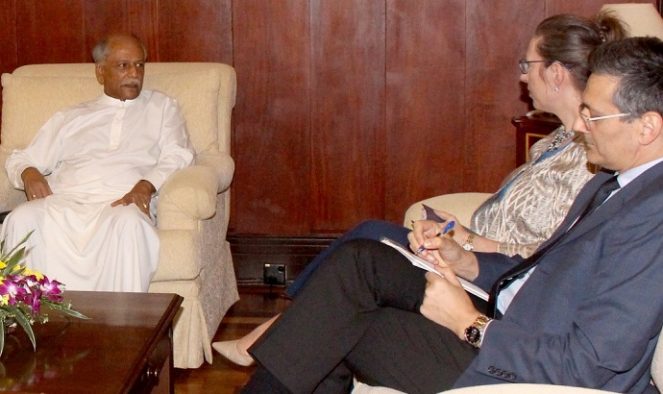
President Gotabaya Rajapaksa stated that his resolution is to transform Sri Lanka as the most favourable country for investments.
Addressing a meeting at the Presidential Secretariat with officials attached to the Ministry of Environment and Wildlife this morning (18), the President declared that Sri Lanka needs to form a legal framework that would safeguard the environment and lead to the development of the country simultaneously.
The President advised all institutions to cooperate with each other in order to amend the acts, rules and regulations that would address the needs of the present day, the PMD reported.
President Rajapaksa added that it was the responsibility of all the state officials to preserve the environment and propose convenient procedures and methodologies for the general public.
The President instructed the officials to be efficient in the issuance of licenses which in return would motivate both local and foreign entrepreneurs and investors.
President Rajapaksa reflected that license sought several years ago for aqua parks in the Northern Province had not been approved even for today. He urged the officials to immediately follow through the procedure to implement these projects without harming the biodiversity.
President stated that the implementation of those aqua parks would create employment opportunities for many and assist in promoting reconciliation among communities.
The President emphasized the importance of establishing laws which would equally preserve the environment and promote the living standards of the people.
Minister M. Chandrasena, State Minister Jayantha Samaraweera, Secretary to the President Dr. P.B. Jayasundara and several other officials were present at the discussion.
There
are 3 pillars of governance in Sri Lanka while the constitution is very clear
that the sovereignty is inalienable from the People of the Country. Therefore,
the President, Parliament & Judiciary all are empowered by the people and
they only enjoy powers delegated to them by the People to function on behalf of
the People and not in their personal interest or their political party
interests. In short it means that the decisions by the 3 pillars must conform
to the interests of the Nation and the Majority of People who live in the
Nation. Several times the previous government made attempts to pass the Land
Special Provisions Act and FR petitions to Supreme Court resulted in verdict
claiming that the consent of the Provincial Councils was required. MCC Review
Committee is restricted by this Court verdict because MCC Agreement 1-33 states
that MCC funding is subject to privatizing State land.
On
28 June 2019 State Lands (Special Provisions) Bill was tabled in Parliament.
Petitions
were filed in the Supreme Court challenging that
the Bill violated provisions of Article 12 (1) of the Constitution
The
Supreme Court determined that State Land (Special Provisions) Bill should be included
in the Order Paper ONLY AFTER the President has sought opinion from the
Provincial Councils as per provisions of Article 154. However the
Wickremasinghe Govt had violated Article 154 by including Bill in Order Paper
without seeking consent of Provincial Councils.
Respecting
the court decision, in August 2019 GoSL withdrew the controversial State Land
(Special Provisions) Bill in Parliament citing that Annex 1-34 could not be
followed.
The
Wickremasinghe Govt said that it intended to give 2.5m land deeds to people
privatizing state land. 2.5m owners cannot take the rights away from 21million
people plus future generations.
Failing
to pass the State Land (Special Provisions) Bill the Wickremasinghe Govt tried
another stunt by bringing Ruhunu
Development Corporation Bill which too was included in the Order Paper. The
Bill proposes to vest the PM with powers to declare any extent of land in districts
of Moneragala, Hambantota, Matara & Galle as economic development zones
through a simple gazette notification and allowed the Ruhunu Economic
Development Corporation the powers to lease or rent the lands to any person or
company for economic development projects. The subtle manner that the Bill was
trying to usurp state land was obvious.
In November 2019 the Government Medical Officers Association (GMOA) filed a
Fundamental Rights petition in the Supreme Court seeking an interim order
staying all approvals and decisions issued by anyone in respect of the
Millennium Challenge Corporation (MCC) compact, Status of Forces Agreement
(SOFA) and, Acquisition and Cross Servicing Agreement (ACSA).
GMOA claimed
its FR guaranteed under Articles 12(1) and/or 14(1)(h) of the Constitution had
been infringed & continued to be infringed by the Cabinet of Ministers
granting approval for MCC USA.
The
GMOA further said that if the MCC is signed or executed in Sri Lanka it would
erode & impinge the fundamental tenet of Sovereignty of Sri Lanka which the
constitution provides Free, Sovereign & Independent’.
Usurping
Judicial Powers
Unconstitutionality
in removal of judicial powers under Section 6.8 (page 16) of the MCC Agreement for
6years.
Judiciary will
have no powers to adjudicate too – Since MCC is going forward with Bim Saviya
the provision in the Bim Saviya Act No. 21 of 1998 Section 33 says – Entries in the land registry (digital
register) – shall not be questioned by a court of law.
Who will
shoulder legal & economic burden of new Assurance Fund replacing judicial
remedies in event fraudulent deed is entered into digital land registry and
fraudulent owner becomes owner as per digital land registry & real owner is
to get compensation from Government while the nothing happens to the fraudulent
owner who can even sell fraudulently obtained land while tax payers has to
unnecessarily pay an original owner simply because the Govt had foolishly
removed judicial role in remedy.
Usurping
Parliament’s Powers
The peoples‟ power
vested in Parliament being handed over to a private company to act as ‘primary
agent’ – MCA – Sri Lanka for 6 years. MCC Sri Lanka will be created ONLY after signing
MCC (Annex 1 page 34 of MCC) with
legal independence & full decision making autonomy exercising role played
by GoSL & will oversee/manage Bim Saviya & digitalization in targeted
districts.
MCA Sri Lanka is
to be given immunity on par with UN/Diplomats by GoSL for loss, damage, injury
or death (Section 6.8 – page 16 MCC
Agreement)
Land is a key component of a nation’s sovereignty
& national security – how can a
govt privatize land leaving room for foreign ownership, dictated by foreign
laws & immunities to foreigners & even locals on account of judiciary’s
powers getting clipped
MCC Annex 111 even has provision to evaluate how much lands had been sold &
mortgaged – is Sri Lanka’s success being measured on how soon it has privatized
& sold its land?
National
Security Issues related to MCC agreement
To get foreign funding Sri Lanka is
asked to privatize all state land
Disbursement of
MCC funds for land depends on enactment of Land Special Provision Act (LSPA)
All state land
to be registered with absolute land grants completed under a foreign title
registration system (Bim Saviya) passed secretly in 1998 repealing Roman Dutch
law & Common Law practiced for over 100 years.
All lands to be
electronically available via e-registrar.
Foolishly
entering foreign agreements committing to rolling out foreign laws relating to
land simply because it comes with a grant & bogus claims to eliminate
poverty when in reality it will cause bigger problems that GoSL cannot solve as
it has abdicated its powers into foreign hands.
The MCC clauses and other
undisclosed letters mentioned in the agreement cannot be taken lightly or given
to a Committee to determine on behalf of the entire nation & future
generations. We are talking about an agreement with a country that has
militarily intervened in nations, dropped atomic bombs, cluster munitions,
carried out regime change and interfered even in sovereign elections and is
bulldozing their way into countries to grab land & resources. No Committee
can simply stick to the wording of an agreement completely ignoring the
background of the signatory party.
Even in giving a house on rent, the house owner does a thorough background check on the person he/she is leasing his premise to.
There
is much talk of late about Sri Lanka’s education system. It is definitely a
prudent subject as the country’s assets are its citizens and it is the citizens
that must protect and preserve the country & all that it stands for. In
discussing the subject we first need to be aware of some ground realities and
fundamentals.
The
education system we follow today is what we have inherited from colonial rule.
Essentially, it was a system aimed to usurp the nationalist feelings of the
people and align them towards western values and create groups of brown sahibs
to take over once colonials left. With all that it is a wonder that we have
managed to preserve the Sinhala identity, cultures and traditions all these
years and there are still youngsters amongst us who feel proud to continue it
to the next generations.
Education cannot remove Sri Lanka’s
History
This
trait of pride in one’s nation, one’s history & heritage must be embedded
into the education system as the older generations that passed on their tales
of pride are departing leaving only what is written to carry the beacon
forward. Which is why the education system must ensure that the proud history
& heritage of Sri Lanka must be rolled out to all types of schools
(public/international/semiprivate) in any medium of education (Sinhala, Tamil,
English)
Is
this being addressed by the current text books. Hardly so, there are
inconsistencies in the history texts, governments and officials have been
tweaking history to their advantage, committees have not monitored and
corrected the mistakes. Therefore, a patriotic panel must first be appointed to
take history books from all grades in all mediums and ensure the correct
history is printed and circulated and not the history to satisfy the fairy
tales of some or their political agendas.
What ails Sri Lanka’s present
education system?
Memorizing not Learning: Should we continue this form of education system or
should we phase out a change at all grades?
Every change of govt results in change of education
system: every minority alliance
deems it their right to change education system. Every minister changes system
to his/her whims & fancies – this must stop.
How updated are textbooks & teachers? Is school syllabus regularly updated and in keeping
with the changes happening locally & globally?
School standards: Do all schools have the basic standards? No changes to education
system can be rolled out if fundamentals in all schools are not equal.
How equipped are schools? Do all schools have similar lab facilities /
computers or is it true some schools lack even a basic school building/clean
toilets/chairs and desks in good condition/electricity and electric systems to
use multimedia etc
Quality of Teachers: How many of todays’ teachers be they in
public/private/international schools are trained to teach and love to teach or
are they only teachers for a job? How many teachers are actually qualified to
teach / how many teachers enjoy teaching/how many teachers are able to uplift
the students, guide, counsel & motivate them?
What do exams aim at? Are exams structured to test the knowledge or do
examiners want to ensure students fail because governments cannot afford to
have students qualifying beyond a number?
Lack of essential life skills (handiwork/first aid/basics for everyday/hygiene
expanded to teaching how to grow plants/love animals etc depending on the
grade) these essential life skills must be included to school learning hours.
Teach them basic everyday conversation skills – Tamil
for Sinhalese & Muslims / Sinhalese for Tamils & Muslims. Leave out heavy writing and reading. Stick to basic
conversational skills so all can communicate and there onwards leave it to them
to advance what they know.
Grooming sessions – how to dress/ eat / cultural values / respect for
elders etc
English language basics to write / read / understand
/ habit of reading newspapers & referring dictionary & practical
sessions to regularly practice as this is more than sufficient to carry forward
to world of work – this is more than
enough for any child to build up their English to higher levels.
Study education systems of countries but don’t just
cut & paste it to Sri Lanka – fine tune it to suit Sri Lanka
Why do parents want a good education
for their children?
Every
parent wants their child to pass at least the minimum level to qualify them to
do a job, to continue further studies or engage in any entrepreneurial activity
to suit their talent.
With
that education the parents expect the child to learn his/her mother tongue, an
additional language that will assist their job and the ability to excel in a
subject that can help them rise in life. This is why it is important that the
syllabus of important subjects like Maths, Science, Commerce etc be updated so
that students are learning areas that are not outdated.
Why does a
Govt need an educated society?
Sri Lanka has 10,194 government schools
with 4.1million children and 241,591 teachers. 167,907
qualified to gain admission to university in 2018 but only 31,451 students were
admitted.
4.1million children attend school
(3million
Sinhala / 1million Tamil / 84,720 in English)
National schools represent a mere 3.5% of all schools, but
almost 19.5% of students are in national schools.
9% of schools have less than 5 teachers
14.6% of schools have less than 50 students & just over 5000
have less than 200 students.
Medium of instruction in Schools –
Sinhala only 6,332 (62%)
Tamil only 3,009
Sinhala & Tamil 75
Sinhala & English 558
Tamil & English 173
Sinhala, Tamil & English 47
There are 241,591 teachers
Graduate teachers 106,756
Trained teachers 129,638 – Teachers qualified with teacher Training colleges/ National Colleges of Education certificates and teachers having 2 years’ diploma in Science/Mathematics
Untrained teachers 3,311 – 2-3 years’ diploma holders (absorbed to Sri Lanka Teacher Service)
Trainee teachers 1,293 – Teachers not absorbed to Sri Lanka Teacher Service
Other teachers 593 – Teachers paid by other government institutes and teachers paid by nongovernment institutes / organizations.
About 97.9 % of the teachers in government schools are either graduates or trained teachers.
Only 1.8% students in Sri
Lanka study in English medium & 30% live in Western province.
Of the 10,194 government schools only 5,643 schools have
computer facility (55%) – 69% of this 5643 schools is in the Western Province.
There are 10,194 government schools
241,591 teachers & 416,5964 students.
There are 80 private schools of which
36 are fee-levying with 6555 teachers & 136,462 students.
There
are 265 international schools with 56,919 students & 4927 teachers.
Now let’s look at the results: 2018
518,184
sat for O/L – 71.66% qualified to do A/L
9413
students scored 9As for O/L
321,469 sat
for A/L – 167,907 students gained admission to university
No. of Universities – 15
No.
of Other Higher Educational Institutions – 19
No. of Students (Undergraduates) 2018
Universities
– 94,681
Institutes
– 3,633
Open
University – 24,453
No.
of Students (Postgraduate) – 32,849
New admissions for degree – 31,451
students
No.
of Lecturers – 5,940
Only
1,176 enter to do medicine
Only
1,713 enter to do engineering
In 2018, 167,907 qualified to gain admission to university but only 31,451
students entered – what was left for 136,456 to do? Some would have gone
overseas, some would have followed a private course, some would have given up
studies and gone into employment etc.
EMPLOYMENT
5million
in private sector & according to World Bank contributes more than 60% to
Sri Lanka’s GDP of which 20% comes from the service sector.
437,797 unemployed in 2019 – about 45,000-50,000 unemployed graduates.
Public and semi government sector employees, exceeds 1.3 million (government ministries, departments, provincial councils,
and local government institutions as well as other public enterprises,
government-owned institutions, and state banks – 2017)
(5.5% of total population)
This excludes uniformed
staff of the three forces: Army, Navy and air Force)
84,000 public sector employees are above 55 years out of which
about 61,000 are currently employed in either the state or the Provincial
Public Sector.
190,498 public sector employees or 17
percent employees have not passed the GCE (O/L) examination.
290,378 graduates employed in public
and semi government sectors.
A
total of 225,000 or one out of five are working in the Colombo district.
More
than 60% of public and semi government employees report the ability to use a
computer but only 36% use computers to perform their official duties.
The difference in English education
& Education in English
Census of Population and Housing data indicate that English
literacy is just 22% among Sri Lanka’s population above 15 years of age.
When there is not sufficient English teachers to teach in all of
the national schools and when the standard of that English is also not up to
mark in what context are some proposing to conduct all subjects in the English
medium? What is the standard of the 35,000 English teachers already
teaching in English across Sri Lanka?
Are all public schools on par in terms of facilities
(infrastructure / facilities / teachers etc)
Are economic conditions of students/parents able to pay for
additional English education books etc?
Do we really need all subjects to be in English or should the
English subject taught be taught well so that by end of O/L or at least grade 8
a child knows to read, write and understand English well enough to improve as
he/she progresses?
What authorities cannot do is to remove the status given to the
mother tongue – Sinhalese and Tamil language must remain first medium of
language for all children & compulsory learning. No system change or
English proposal can change or remove the mother language status.
Is this proposal for English education in all subjects one that
subtly intends to import foreigners to teach English and draft their own
syllabus and completely culturally change our children returning to the
education format of colonial rule? Given the impossibility of rolling such a
proposal across Sri Lanka given the lack of facilities and basic standards in
schools, is this not going to create a social divide with the have’s on a
higher pedestal to have nots and causing more social stigma and divisions
resulting in more chaos?
What is obvious in the reaction of the Tamils against the army chief is that they recognize his role in the defeat of the Tamil terrorist group the LTTE, which they identified with and supported and resent him for the military defeat of the LTTE. To them, he is a villain, to those who oppose the LTTE he is a hero. Non-LTTE supporters in Sri Lanka should express their opinion that they recognise the great service he gave Sri Lanka. That should be the reaction of all Sri Lankans who did not and do not support the LTTE and they are the majority of Sri Lankans.
The current leadership of the Tamils were the spokespersons for the LTTE during the thirty years of terrorist activity and continue to work towards their goal of dividing Sri Lanka to create their fascist, Tamil only state in the north and east of Sri Lanka. They continue to collect funds and are politically active overseas to get the countries they live in to pressure Sri Lanka to create Eelam. Based on the current statements of the Tamil leadership in Sri Lanka, it is clear that they continue to push for their goal of dividing Sri Lanka. The LTTE supporters in Sri Lanka and overseas have not given up on their goal to create Eelam.
For Sri Lankans who do not want Tamil Eelam, they should support military leaders such as Lt. Gen. Shavendra Silva and commend the current government for continuing to give him a leadership role in defending the country.
Wigneswaran is happy and openly commented that he is happy as the U.S banned our Army Commander and his family to United State soil. Wigneswaran’s behavior at this moment needs to be deeply studied and find out more about his comment and behavior. He is has a political road map which is to gain control of the north as a separate land from the country and make it as their homeland for Tamils. It is only a dream which will never come true and the reason for that is quite clear. In terms of releasing that land from the terror groups, our soldiers sacrificed their lives, politicians, religious leaders and many. So we have buried many lives for the sovereignty of this country and its territorial integrity. So Mr. Wigneswaran, you need to understand the importance of being a patriot to our motherland rather than a traitor. Mr. Wigneswaran himself and his allies work hard on many fronts. they as such
Calling United Nations to intervene
Invite United Stated to intervene
Igniting Tamil diaspora protest against the country
Bribing western politicians by Tamil voters of their countries e.g. Canada, England, the United States, France, etc.
Influence Tamil people of the country through political influences
Make every effort and plotting to undermine national security and promote democracy and religious harmony through and to maintain political mileage.
Try to bring United National Party into power to gain their political/separatist formula
Doing nothing to uplift poor Tamil people’s livelihood and refrain from the development effort of north and east.
Out of all behaving and acting like a person not belong to Sri Lanka while enjoying all the benefits of Tax money of poor people of the country.
Mr. Wigneswarn thinks that the people of this country not aware of all of the above.
We urge president Excellency Gotabhaya to understand this man’s behavior and do as much as possible to develop north and east and uplift the livelihood of Tamil people and their living. The president of this country is responsible for the public and improving their lives. We all lucky to have him as the president of this country. Sri Lanka is a beautiful country with much potential to have balance development ( I mean considering environment ) comparing to other countries in the region.
If we allow the Law and Order to flourish and where people
starting to obey the law, we would have a much disciplined and developed Sri
Lanka.
We need to have road speed limits and road signs to implement vigorously to minimize road accidents.
I penned these few
humorous (hope so) verses in the hope that they would take your mind away, at
least for a few moments, from ‘the maddening, never-ending chronicles of conspiracy
and corruption’ in present-day Sri Lanka.
Once upon a time in hell, There was this devil, Who being a unique model, Liked to play it a bit level.
One day he hopped on a gale, And set sail, Seeing the world at will, With glee and smile.
Then he saw a small isle, Sitting in the middle, Of a vast pool of blue, And green, yet, a little pale.
Down he landed with a chuckle, And now in disguise like a local, Started walking the isle, Enjoying the vile and beaming at the evil.
Now he came upon a small castle, Standing by this beautiful canal, And saw many, in the white national, Going in, some old, some young and agile.
Intrigued entered the king of evil, Whispering to the men at the door ‘I am the devil’, And showed some of his tail, Adding a vicious snarl.
They were scared like hell, Caught in a hypnotic spell, And let His Majesty the evil, Walk in with no hassle.
Looking down many an aisle, He went to the end of the hall, Sat down with a chuckle, And listened to all that babble and cackle.
Suddenly broke loose all hell, Men young and old running pell-mell, And as they began to whistle and wrestle, Stood up our devil saying ‘what the hell’.
He jumped in the middle, Bellowing ‘I am the Devil’, Yelling ‘stop the tussle, Behave you demons well’.
Then he felt the tickle and the tugging, And nervously felt for his tail, Suddenly turning very pale, Looking like a chalk-white devil.
For there was only a hole, And finding no sign of his tail, He ran out letting out a devilish howl, And a mournful wail.
No one heard him yell, For the ruckus was still going well, And for the one with the devils’ tail, It was a talisman to keep away the Devil.
Now on his way back to the hell, The one who was, once a fair devil, Lost his devilish cool, Screamed, ‘never again to this bloody isle’.
So here ends the tale, Of the poor devil, Who went back to hell, Without his thorny tail.
The message – Even
‘the Devil’ is not safe in this ‘land like no other’!
By Daya Dissanayake/DailyFT-Harmony Page Courtesy NewsIn.Asia
Man has become the most harmful invasive species in the world
Going back to the worship of nature could be the best solution to bring about real peace and harmony among all life on earth. We can worship nature, not in the way it was interpreted by our early anthropologists, based on their education and experience of a creative omnipotent god. We should worship nature the way we worship our parents and our gurus. Then we can still adhere to our faith, be it Buddha, Hindu, Jaina Dharma, Christianity, Islam or Judaism.
In the beginning, there would have been only nature worship, with Mother Earth as the Mother Goddess. The Great Mother was the Mother of all life in the multiverse. Human beings would have been totally non-violent, as they would have gathered their fruits and vegetables without hurting any living creature.
The new religions, even though all of them professed peace and co-existence, and the gods were all benevolent, they created conflicts and competition and the ruling classes exploited them to gain more and more power and wealth, by inciting man against nature and his own brother.
It is time to go back to the worship of our environment. When we worship the sky, the sun, the moon and the stars, when we worship rain and the rivers, the trees and the mountains, we do not have to fight with each other because all nature belongs to all of us and we belong to nature. We are all children of Mother Earth. We are still worshipping many trees, rivers and mountains and rocks as sacred. Nature worship is not new or alien to us.
All our worries, our concerns about the ecosystem, eco-destruction and eco-criticism are all because in our anthropocentric arrogance we believe that we, human beings, are omnipotent, omniscient and the entire universe is there to serve us because we believe that we created god in our own image. It is time we realised that we are only predatory parasites on the skin of Mother Earth. Predatory as we prey on each other, and parasitic as we feed on Mother Earth
Mother Earth
Please listen to my ramblings here with an open mind. I respect all life on Mother Earth, including the seven billion human beings and all other animal beings. I also respect and accept that all beings have a right to believe in and practice their religions and traditions. Intentionally I will not insult or hurt the feelings of anyone.
We are all children of Mother Earth. Mother Earth gave us life. She nourishes us, provides all our needs while we are alive, and receives our bodies back into her. We come from her and go back into her. It is our life cycle, which may have given rise to a belief in rebirth and samsara.
That is why our ancestors worshipped Mother Earth as Mother Goddess, and held her as most sacred. Our biological Mother is the next most sacred. She is our Mother Earth at home. We all worship Mother Earth and thus all Nature. We call our land of birth as Motherland. You call her Bharath Mata. Worship of Mother Goddess goes back to the Harappan civilisation or even further back. Buddhists call Mother as the Buddha at home. There is Mother worship in almost all other religions, because She is the life-giver. Among the Jains we find Padmavathi, Ambika and even Thrishala Devi. Christians worship, Holy Mary, Mother of Jesus. In Sri Lanka we also worship Kannaki as goddess Pattini.
When we worship Mother Earth, we have to realise and accept that all that is on Earth is part of her, and belongs to her. She is the Mother of all life. Thus all our environment, our entire eco-system is Mother Earth, Gaia, the living earth.
Predatory Parasites
All our worries, our concerns about the ecosystem, eco-destruction and eco-criticism are all because in our anthropocentric arrogance we believe that we, human beings, are omnipotent, omniscient and the entire universe is there to serve us, because we believe that we created god in our own image. It is time we realised that we are only predatory parasites on the skin of Mother Earth. Predatory as we prey on each other, and parasitic as we feed on Mother Earth.
Man has become the most harmful invasive species in the world, from the time our ancestors began walking on their hind legs, using the forelegs for destruction and started migrating all over the world. Man became Bhasmasura. We try to deceive ourselves that Vishnu made him destroy himself. But he keeps coming back and will destroy Brahma and Mother Earth before he finally destroys himself.
Earthquakes are really Mother Earth writhing in pain as we keep on molesting her. Lava flowing from volcanoes is her blood from her injuries. We have to stop molesting her, and go back to worshipping her.
Dr. Shruti Das, tells us in her poem, ‘Of Mountains’:
I bled
when you tore my skin
and broke deeper.
The kind wind sucked away my blood
and your angry tools drowned my agony.
Yes, you could not reach up.
So you pulled me down.”
Worship Nature
We can worship nature, not in the way it was interpreted by our early ethno-centric anthropologists, but the way we worship our religious leaders, our parents, our teachers and our elders. Then we can still adhere to our faith, whether it be Hindu Dhamma, Buddha Dhamma, Islam or Sufi Dhamma, or Christu Dhamma.
We are all worshipping nature and Mother Earth, unconsciously or unintentionally, when we worship a statue, a building, a mountain or a rock, because they are all a part of nature, all made of what belongs to Mother Earth. All we have to do now, is to worship them intentionally.
In the beginning there would have been only nature worship, with Mother Earth as the Mother Goddess. Human beings would have been totally non-violent, as they would have gathered their fruits and vegetables without hurting any living creature. They would have been like the butterfly who taps the nectar from a flower without hurting the flower in any way. Early man, like all animals would have plucked a fruit or two to feed his hunger, but would not have shaken the tree down to make all the fruits fall, or cut down the tree for easy plucking of a few fruits.
Nature developed a really well-balanced ecosystem, which would always be in equilibrium, except for any geographical, climatic or biological changes, but getting back to a stable state very soon. Nature too follows Patticca samuppada, variously translated as Dependent co-arising, dependent origination or interdependent origination. In nature studies they are called cycles. Rain cycle, oxygen cycle and carbon dioxide cycle. All three cycles depend on trees. Trees depend on water, sunlight and carbon dioxide. Thus the trees depend on animals for the carbon dioxide, and the sun for energy and operating the water cycle. In India the worship of trees go back at least for 5,000 years, based on the evidence of the seals found at the Harappan sites. We still worship the same tree, as Asvattha or the Bodhi tree.
Bodhgaya, had been a sacred grove, long before Buddha attained enlightenment there. And Sujatha would have offered khir to Siddhartha Goutama, beliving him to be a tree deity. Recent archaeological excavations revealed that Lumbini too had been a sacred grove, where deep under the Maya Devi temple they have found probable evidence of pre-Buddhist tree worship.
It could have been a place of worship of a tree goddess or a Mother goddess, a symbol of Motherhood, for fertility and safe childbirth, and the sacred tree could have been a Sal or Asoka. In that case the space would have been appropriated at a later date, as a Buddhist sacred space with Buddha’s mother, Maya Devi as a Mother goddess, or a symbol of Motherhood.
Cosmic Tree
This sacred Asvattha tree is also called the ‘Cosmic Tree’, the axis mundi.
The rishis know of the tree Ashvattha
Rooted in heaven, its trunk growing earthwards,
Its leaves, each one, bringing forth the Vedas,
he who knows this, knows all.
(Bhagavad Gita XV, verse 1)
Krishna said, Ashvattha sarva-vrksanam..” (of all trees, I am the Ashvattha), (text 26, Chap. 10 Vibhuti-yoga, Bhagavad Gita)
Ashvattha is Vishnu. They are not two but one. The roots growing upwards is Parameshwara, the branches growing down is Maha Brahma, the leaves are the Vedas, and the trunk is the Samsara. Thus it is also called the Samsaravruksha and also Brahmavruksha’.
Mahabharata, Yea! for its leaves – Are green and waving hymns which whisper Truth! – Who knows the Asvatta, knows Vedas, and all”.
The Bo tree would have been held in high esteem because of its medicinal and life-giving powers, which were known in all countries where the tree was found. In our country, where herbal medicine had been in use for several thousand years, its value would have been known to our ancient physicians, like Ravana. When the bark, the leaves or the roots of a majestic ‘vanaspathi’ heals an illness, or saves a life, people would show their gratitude and respect for it.
Trees absorb carbon dioxide exhaled by animals, and also by man’s destructive acts. Trees release oxygen, which is needed by all living beings. Trees play a major role in the water cycle. We are totally dependent on plant life, even if we consider ourselves carnivores.
Plants Deserve To Be Worshipped
Often the Buddhists today do not practice what they believe in. Even the Theravada Buddhists today believe there had been 27 previous Buddhas, and that they had all attained enlightenment under a particular tree. If the Asvatta is sacred because Gautama Buddha sat under this tree, then the other 21 different trees should also be sacred, and should be respected and worshipped. They should never be cut down or destroyed. That could save half the forest cover in Buddhist countries.
There is a custom among the Hindu community in Sri Lanka, to plant a tree when a person dies. In our villages we had a custom of planting a tree when a child is born. These customs would have developed because a tree is a very prominent and a more permanent symbol of life.
In India we had three types of forests: Shrivan, Tapovan and Mahavan. Today we think that it is man-made plantations that gives us wealth and prosperity. There is no Shrivan around our villages to give us sustenance. We destroyed our ancient Tapovan and built concrete ashrams for meditation. Mahavan has been replaced by megacities and mega industries.
Let me quote a poem by a Sri Lankan Tamil poet, Karunakaran, translated by Somasunderampillai Pathmanathan:
The children
who used to scare parrots
that steal corn
are now toiling
with cement and metal
building a concrete desert
on the one-time paddy land…..”
I have always believed that there is a lot we can learn from King Asoka. Aśoka’s concern about the nature, the environment and natural resources is seen in the Delhi-Topra Pillar Edict. dāve anathāyq vā vihisāye vā no jhāpetaviye” forests must not be burnt either uselessly or in order to destroy (living beings).
It is only when at some time in history man tasted carrion, probably during a famine, that he got a liking for it and began to kill animals for his food. The killing brought out the violence and sadistic nature in man. Animal breeding caused a greater demand for animal feed, causing greater forest clearing and monoculture plantations.
(To be continued in the 22 February edition of the Harmony page.)
(The above was a plenary paper presented by the writer, at the International Conference on Language, Literature and the Anthropocene, held at the Berhampur University, India, in December 2019.The writer is an award-winning bilingual Sri Lankan novelist, poet and blogger. His work spans a critical study of King Ashoka, nine novels in English, six novels in Sinhala and a collection of poems, and numerous articles in newspapers, journals and magazines. He is the author of the first e-novel in Asia, ‘The Saadhu Testament’ (1998), and the first e-novel in Sinhala, ‘Vessan Novu Wedun’ (2003). He is the only Sri Lankan writer to receive the Sri Lankan State Literary Award for the best English novel thrice and was awarded the SAARC Literary Award in 2013. He considers himself a student of history and is currently working on a series of writings on the worship of trees, mountains and rivers.)
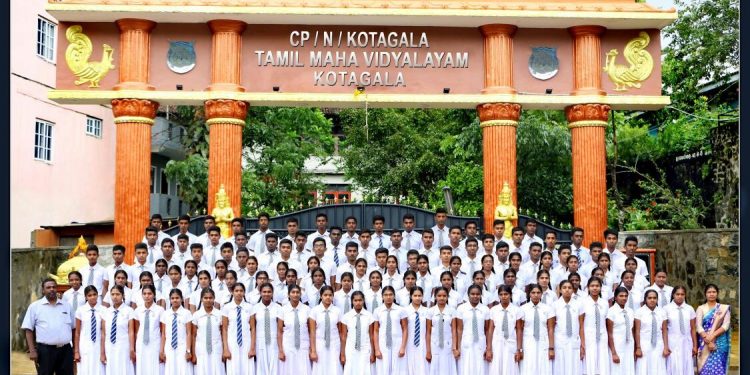
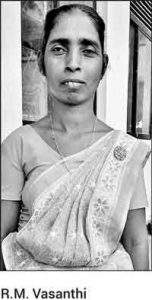
Exam results are excellent but teacher R.M.Vasanthi feels the absence of financial rewards and job security.
Kotagala, February 15 (DailyFt.Harmony Page): R.M. Vasanthi is a Sinhalese lady who has very successfully taught Sinhala language to Tamil school kids in Kotagala, a plantation area in Central Sri Lanka for 13 years.
Here is Vasanthi’s story in her own words: I am a Sinhalese. I teach Sinhala as a volunteer teacher at the Kotagala Tamil Maha Vidyalaya. I have been the Sinhala teacher of this school for the past three years. These Tamil children are keen learners of Sinhala as their second language and this school currently has a 100% pass out rate for Sinhala for O/L exams.”
The Kotagala Tamil Maha Vidyalaya has got the best pass rate for Sinhala in the entire Nuwara Eliya district. Our students get As and Bs for Sinhala. Only around one student per year gets C which is the lowest grade we have got for Sinhala. I am employed and paid Rs. 10,000 per month for my teaching by the School Development Society. I hardly take the two days of leave that are allocated to me per month. But if I take more than two days of leave I have to take a salary cut.”
My whole teaching experience so far is 26 years. Before being assigned to the Kotagala TMV as the Sinhala teacher, I taught Sinhala at a tea plantation estate primary school in Kotagala for 13 years. I also teach Buddhism for Sinhala Buddhist students of all grades, at the C. Sariputhra Daham Pasala in Kotagala as a volunteer teacher. I am paid Rs. 5,000 a year for this service, and given an official uniform.”
I have three children. The oldest is doing her O/L’s. My husband is a security guard at the Rosita farm in Kotagala. We do not have a house of our own. My husband works for just Rs. 600 a day just so we can stay at the small quarters given by this workplace. If he is asked to leave this job at any point, we will have to go to the streets. Who can we tell all these troubles to?”
I am trying hard to be a permanent teacher with a better salary for the work I do. I love teaching Sinhala as a second language for Tamil students and I have proven my skills as a teacher where the lowest mark the children get is a C.”
When I did my A/L in the arts stream at the St. Gabriel Balika Vidyalaya in Hatton I had to walk over eight kilometres to and from school. These are arduous plantation areas. It was with utmost difficulty that I did my schooling and as a result I could pass only one subject. My parents were labourers in the tea estates. We struggled terribly with poverty and hunger. All I want now is to be a full-time teacher with a reasonable salary.”
Over 10 years ago I sat for the competitive exam for those who want to get a permanent job as teachers. The prerequisites were that the applicant had to have a degree or be associated with a Government-related job, which I was. I passed that exam. But when I faced the final interview I did not get a permanent teaching post. I do not know why. I have made appeals to the former Government.”
I hope someone answers the pleas of people such as us. It is after braving incredible odds in life that we do our service as Sri Lankans.”
It is with great joy that I teach these Tamil children who show such a great keenness to learn the Sinhala language. I know the value of learning the languages of this country. I have studied Tamil and I interact well with these Tamil children who are committed to braving life through education.”
The US move is seen as arm twisting to get Sri Lanka to sign into the MCC compact and SOFA
Colombo, February 17: It is an indisputable fact that the United States uses human rights not for humanity’s sake but to further its strategic interests across the world. It’s recognition of human rights violations or its blindness to them is determined by its strategic needs.
For example, to retain India as a strategic partner in its fight against emerging eastern power China, the US is turning a blind eye to Narendra Modi’s oppression of the Kashmiris, the lynching of Muslims and the anti-Muslim citizenship law in India. Modi, who was barred from the US after the Gujarat anti-Muslim carnage in 2002, was white washed after he became India’s Prime Minister and signaled a pro-US tilt. The US ignored the 2002 carnage and lifted the ban on him. That the US is highly biased in its application of human rights principles is evident in the way it tolerates gross violations by the Saudi and Israeli governments.
On Thursday, the US Secretary of State Mike Pompeo banned the entry of the Sri Lankan army chief Lt.Gen.Shavendra Silva into the US, for allegedly committing war crimes” when he was one of the frontline commanders of the army in the last phase of the war against the Liberation Tigers of Tamil Eelam (LTTE) in 2009.
It is noteworthy that the ban should come eleven years after the war and when there is a government in Colombo which is branded in the West as pro-China”.
Though the UN Human Rights Council (UNHRC) in Geneva was seized of the issue of war crimes” in Lanka from 2009, there was no punitive action against Lanka between 2015 and 2019 when there was a pro-West government in Colombo headed by Prime Minister Ranil Wickremesinghe. In fact, between 20015 and 2019, the annual resolutions of the UNHRC on Lanka became progressively mild.
MCC and SOFA
The US got the Wickremesinghe regime to seriously consider entering the Millennium Challenge Corporation Compact (MCC) to digitalize land records with the ultimate aim of making private land saleable to foreigners. But this was bitterly opposed by Lankan nationalists. Despite opposition, the Wickremesinghe government got cabinet approval for the MCC. However, it could not implement the decision because it lost the November 2019 Presidential election to the nationalist candidate Gotabaya Rajapaksa. The Gotabaya government put the decision on hold and set up a committee to study the MCC’s compact from the Sri Lankan angle and also its performance in other countries.
The other pact which the US tried to push down Lankan throats was the Status of Forces Agreement (SOFA) and an expanded version of the already existing Access and Cross Services Agreement (ACSA). When the details came out, Sri Lankan nationalists were up and arms. SOFA and the new ACSA severely abridged Sri Lanka’s sovereignty. US troops coming to and operating in the island were to be governed by US and not Sri Lankan laws. The Gotabaya government completely rejected SOFA leaving the US peeved.
Pressure To Sign MCC and SOFA
The US State Department then sent Alice Wells to apply pressure on President Gotabaya to accede to the MCC and SOFA in toto, but the Lankan President stuck to his guns.
With the UNHRC to begin its session in late February, the US Secretary of State Mike Pompeo thought the moment was opportune to manifestly and tellingly twist Colombo’s arm by announcing the designation of Lt.Gen Shavendra Silva.
Tamils Welcome Ban
While the majority Sinhalese are irked by the ban on a war hero” who rid the country of terrorism, the minority Tamils have welcomed it. The Tamil National Alliance (TNA) issued a statement recalling that it had, in August 2019 itself, condemned Lt. Gen. Silva’s appointment as Army Commander due to allegations of war crimes, crimes against humanity and human rights violations against him.
The TNA said that it hopes that the ban will open the eyes of the Lankan Government, which had opposed taking accountability measures even ten years after the war. We consider this as a minor improvement as a result of continuous protests by the war-affected Tamil people,” the TNA said
Hostility in Colombo
However, the majority Sinhalese and the government deplored the ban as a violation of Lankan sovereignty and that too on specious grounds. US Ambassador Allaina B. Teplitz was summoned by Foreign Minister Dinesh Gunawardena on Sunday to be told about Lanka’s displeasure.
A press release from the Foreign Ministry said: The Government reiterates that Lt. Gen. Shavendra Silva was appointed as the Commander of the Army by the then Head of State, taking into account his seniority and that there were no substantiated or proven allegations of human rights violations against him. His elevation as the Acting Chief of Defense Staff by the current Head of State President Gotabaya Rajapaksa, was on account of his being the senior most serving military officer.”
While the timing of the imposition of this travel restriction 6 months after Lt. Gen. Silva’s appointment as Army Commander is of concern, it is disappointing that a foreign government should question the prerogative of the democratically elected President to call upon persons with proven expertise to hold key positions on national security related matters.”
The Government of Sri Lanka requests the United States to verify the authenticity of the sources of information and to review its decision,” it added.
UNHRC Session
The Sunday Times said that it was significant that the ban should come days before the UNHRC was to issue its report on Sri Lanka. The UNHRC report is expected to call for an International Court of Inquiry” to probe alleged war crimes in Sri Lanka.
The US had designated Gen. Silva on the basis of credible information” of his involvement, through command responsibility, in gross violations of human rights, namely extrajudicial killings, by the 58th Division of the Sri Lanka Army during the final phase of Sri Lanka’s Civil War in 2009. Pompeo made the declaration under Section 7031(c) of the Department of State, Foreign Operations, and Related Programs Appropriations Act.
But the Lankan Foreign Ministry said the charges against Gen.Silva were based not on independently verified information but on unverified” information.
They had been compiled, not on the basis of a filed study by independent observers, but on accounts of refugees and Tamil politicians with a vested interest. While the UN and Western agencies had said that 40,000 to 70,000 had been killed in the last phase of the war, government censuses commissions of inquiry put the death toll at around 8000. The latter estimate is more or less borne out by the fact that out of the population of 300,000 in the war zone, 290,000 had been evacuated and housed in camps on the border of the war zone.
Meanwhile, in the UN Security Council, Lankan Ambassador Kshenuka Senewiratne said that the actions of the Sri Lankan security forces during the conflict were against a group designated as a terrorist organization by many countries (including the US), and even described as ruthless by some. They were not aimed at any community in the country.
She spoke about the modus operandi of suicide attacks adopted by the LTTE, which for the first time in history, deliberately targeted civilians using its human bombs.
Consequences
In an email to the Sunday Times the US embassy in Colombo said the ban on Gen.Silva does not place additional restrictions on security assistance or military engagement in Sri Lanka nor does it represent a shift in policy or desire to limit engagement more broadly with the government and people of Sri Lanka”.
It will not have any impact on military-to-military cooperation such as training and joint operations, economic/technical assistance and trade, the embassy added. But Sri Lankans wonder how cooperation is possible if their army chief was humiliatingly designated?
Advantage For China
The designation of the Lankan army chief, who is considered a war hero in the 30 year battle against Tamil terrorism, will gravely damage America’s relations with Sri Lanka, where no political party of the majority Sinhalese community will support a measure which will harm their interests.
Deemed as a hostile act, the designation will nullify any prospect of the US succeeding in getting the Sri Lankan government to sign the MCC SOFA pacts, which the US has been very keen on to get control over Sri Lanka’s land and security.
The designation will be counterproductive also on account of the fact that it will drive Sri Lanka further into the hands of China which is America’s Number One enemy in the Indian and the Pacific Ocean region. And when Sri Lanka veers more towards China, it will be disadvantageous to India also given its deep strategic interest in the island nation.
(The featured picture above shows Lankan Foreign Minister Dinesh Gunawardena talking to US Ambassador Alaina Tiplitz)
The Sri Lanka Podujana Peramuna (SLPP) and the Sri Lanka Freedom Party (SLFP) will contest the upcoming general election under the alliance – Sri Lanka Nidahas Podujana Sandanaya”.
SLPP General Secretary Attorney-at-Law Sagara Kariyawasam stated that the alliance will contest the election under the symbol of the ‘flower bud’ (Pohottuwa).
Prime Minister Mahinda Rajapaksa has been named as the Leader of the alliance while former President Maithripala Sirisena will serve as its Chairman.
Former Minister Basil Rajapaksa has been named as the General Secretary of the new alliance while minister Dinesh Gunawardena has been named as Deputy Chairman.
Minister Wimal Weerawansa and State Minister Dayasiri Jayasekara have been named as the National Organisers of the alliance with MP Udaya Gammanpila serving as Vice Secretary and Mahinda Amaraweera and Deputy Secretary.
Tissa Vitharana, Vasudeva Nanayakkara and D.E.W. Gunasekara have been named as Vice Chairmen of the alliance.
Speaking to reporters outside the Elections Secretariat in Colombo, Kariyawasam stated that they handed over the relevant documents to the Elections Commission today (17) in order to register the political alliance.
He said the alliance will be named ‘Sri Lanka Nidahas Podujana Sandanaya’ and confirmed that it will contest under the symbol of the ‘flower bud’, which is the symbol of the SLPP.
SLFP General Secretary Dayasiri Jayasekara stated that the alliance is formed by the SLPP, SLFP and 9 other political parties.
He said that SLPP will be the main constituent party of the alliance and that the SLFP signed as the second political party.
Dr. Murugar
Gunasingam is a path-breaking and indefatigable Tamil historian who earned his
doctorate based on his exploratory history of the Jaffna Tamils of Sri Lanka.
He undertook this mission of discovering the history of Jaffna when he first
realised that no one had ever written a truly comprehensive history of the
Tamil nation in Sri Lanka.” (Preface – Primary Sources For The History Of
The Sri Lankan Tamils, World-Wide Search, 2005.). In 1995 he was
awarded a scholarship by the Sydney University, Australia, to undertake
research for a doctorate in history”.
He was
guided in this mission by leading Tamil historians like Prof. S.
Arasaratnam. He was also inspired by Prof. K. Indrapala, the
controversial Tamil historian who like most Tamil historians endeavoured to
write a Jaffna-centric history. He shocked his admirers and students of history
when he recanted his earlier doctoral thesis documenting the history of the
Tamils starting from the 12th century. This thesis did not sit well
with the Tamil who thought they had made history from the dawn of history”. In
his new thesis written after he was virtually driven out of his Chair in
History at the Jaffna University he fell in line with the political agenda and
the Tamil history” laid out in the Vadukoddai Resolution of 1976 – the
ultimate manifesto ever of the Jaffna Tamils. The conventional political
mission of Tamil historians has been to claim that they were the original
pioneers, as stated in the Vadukoddai Resolution, who laid the foundation for
the evolution of the history of Sri Lanka.
Armed
with the Sydney University scholarship Dr. Gunasingam went on a world-wide
search for evidence of the role played by the Tamils in building a truly
comprehensive history of the Tamil nation in Sri Lanka”. Though his mission is
commendable there is an irony in it. History by its intrinsic nature is found
in the soil on which it is made. But he goes around the world to look for it.
At the end he wrote that no overall or comprehensive history of the Tamils in
Sri Lanka has yet been written.” (p, 25 – Primary Sources For The History
Of The Sri Lankan Tamils, World-Wide Search, 2005.).
Tamils are
a proud community obsessed with history. They believe fervently and somewhat
arrogantly in a glorious past of their own. Of course, their imagined past is
far in excess of the historical realities. In fact, they base their modern
politics for a separate state / self-determination /federalism etc., on their
imagined history. So far, their attempts to rewrite a Jaffna-centric history
have ended up as a lame exercise in trying to make a mountain out of a mole
hill. So the news that they do not have an overall or comprehensive history of
the Tamils in Sri Lanka” is not surprising though it must be upsetting and
threatening their imagined history from which they derive political sustenance
for an Eelam, a separate state, etc.
Jaffna-centric
history has been written essentially to advance their politically motivated
thesis which claims that they are the inheritors of a grand past from the dawn
of time”. This raises a critical question: If they do have the tangible
glorious past why is it that they do not have a comprehensive history put
together by anyone even as late as 2005? Can a nation/community have a great
past without anyone documenting the existence of it? Is the vacuum in their
history because the gap between the imagined past and the known historical
realities cannot be filled with the kind of credible evidence needed to
substantiate their claims of greatness? Isn’t this search for a past driven by
current politics labouring incessantly to establish a separate state?
In the
post-Vadukoddai Resolution period the re-writing of Jaffna-centric history has
grown into a kind of semi-industry to boost the contemporary political ego
filled with yearnings for the glorification of a history that never
existed. Like most other Tamil and pro-Tamil theoreticians Dr.
Gunasingam’s writings confirm amply that his research has been to find evidence
of a past that would give credibility to a new Tamil identity that would
elevate their status to justify their imagined history. Like Prof. Indrapala he
is looking for the affirmation of a positive Tamil Identity” and he pleads
with the entire Tamil community and especially expatriate Tamils across the
world, to act on the matter without any further delay.” But nothing substantial
has been dug up from the past since he presented his research to fill the
vacuum in the history of the Tamils.
Coming from
a leading Tamil scholar who had searched almost all the available sources of
the world for evidence of the Tamils in Sri Lanka – Portugal, Holland, India,
UK, USA etc– his statement must be taken as a definitive judgement. After his
global search his conclusion is startling. He says categorically
that the most important single shortcoming at this time is that no
historian, or archaeologist or even a social scientist, whether Sinhalese,
Tamil or Western scholar has written complete or comprehensive account of the
history of the Tamils in Sri Lanka.” (pp. 20-21 – Ibid). He admits that
there were bits and pieces written about Jaffna but no one has written an
overall history giving a panoramic view of their past. This news is bound to
explode and deflate the heads of the Tamils like a bloated balloon pricked by
the point of a needle. Bang!
The
reverberating sound must be unnerving because, like all records of history,
this revelation has serious political implications. The perennial problem of
the Tamils is that their scanty history pales into insignificance when pitted
against the monumental achievements of the Sinhala-Buddhist civilisation, or
the classical Tamil history of S. India. When they go for self-determination
they realise that they do not have the requisite history, either in quality or
the quantity of the Sinhala-Buddhist history, to justify their exaggerated
claim for a separate state.
Historian
Gunasingam puts it starkly in the following paragraph: Sri Lankan Tamils
possess their own language, religion, culture and tradition and a glorious past
which should enable them a strong national identity. However, to achieve
self-determination successfully, they lack a sense of historical identity to
support their claims for political rights. So, again, why is that the Tamil
people have failed to preserve and promote their history as the Sinhalese
people have so successfully accomplished?” (p.14 – Ibid).
Why,
indeed! Unlike the Jaffna Tamils the Sinhalese do not have to labour that much
to discover their past. Nor do they have to dig deep, or run around the
world looking for their history. It is there almost on the surface
for anyone to see. Whatever is found out in the world merely corroborates the
visible, recognisable, and monumental history of the Sinhala-Buddhists.
The failure of the Tamils to match their scanty history with that of the grand
history of the Sinhala-Buddhists makes them feel inadequate. So they have been
consistently filling the grim vacuum with their imagination, or denigrating the
Sinhala-Buddhist history, or claiming that the Sinhala-Buddhist history is in
reality the history of the Tamils.
The lack of
an impressive and a credible history first hit them during the British period
when pioneering British archaeologists, surveyors and explorers discovered the
monumental achievements of the Sinhala-Buddhist buried under the jungle tide.
Each discovery of the Sinhala-Buddhist culture, civilisation and heritage
elevated the achievements of the Sinhala-Buddhist founding fathers to new
heights. Oriental scholars from West were scrutinising every ola leaf found in
temples, every page of history they could lay their hands on to study minutely
the glories of the Sinhala-Buddhist past.
The Tamils
had no comparative history or records in Jaffna. Their scholars like Arumuka
Navalar and C. V. Thamotherampillai went to the Madras (Tamil Nadu) to unearth
the hidden treasures written in Tamil. If they had a recorded history in Jaffna
they would not have gone to Madras and ferreted old texts from house to house.
Dr. Gunasingam followed in the footsteps of Arumuka Navalar and
Thamotherampillai looking for Tamil history and glory outside Jaffna because
they could not find it inside Jaffna. The first two Tamil explorers earned a
reputation by discovering the hidden literature of the Tamil classical era and
publishing them in Jaffna with the first printing press. With the dawn of the
20th century Jaffna Tamils discovered that they had neither Tamil
classics to their credit coming out of their run-of-the mill past nor new
dazzling creations of their own in contemporary times.
The usual
excuse of Tamil historians / researchers is that there are gaps in the
Jaffna-centric history because not enough of research has been done to
re-discover their glorious past. But a substantial degree of research has
been done to discover their glorious past and to date they have
drawn a blank.
In the
absence of a great classical past the Saivite Jaffna Vellalas (SJVs) – the
supreme masters who ruled Jaffna with an iron fist — took to boasting about
the slight variations in the Jaffna Tamil accent which they consider to be
purer than the S. Indian variety. The Jaffna Tamils like to claim
superiority over the Tamil Nadu Tamils with their quaint accent leaning towards
the traditional past. They also take pride in the overall linguistic culture
which is not corrupted by the pop culture of Tamil magazines and the cinematic
vulgarisms of Tamil Nadu. Other than that the Jaffna Tamils have been
dwarfed by the gigantic achievements of the classical Tamil culture of the S.
India and the Sinhala-Buddhist civilisation in Sri Lanka.
What is
absolutely clear from the judgment of Dr. Gunasingam on the Jaffna-centric
history of the Tamils of Sri Lanka is that they have gone around the world in
search of a history to boost their contemporary politics. The lack of a
comprehensive and authoritative history of Jaffna Tamils has left room for
imaginative versions to take root in the minds of the Jaffnaites, especially
among the SJVs. The Tamil historians are faced with the serious problem of not
finding any monumental material buried in their past to back up their claims
for a grand history in Sri Lanka. So they are scouring all the world-wide
archives / libraries for evidence. It is an urgent need to justify their claim
for a separate state. Dr. Gunasingam wrote: It is now clear that the exploration
of primary sources relating to Sri Lankan Tamils throughout the world is
crucial given the current political situation of Tamils in Sri Lanka.” (p. 28 –
Ibid).
This
clarifies the relationship between Tamil politics and their history:
they need history to boost their politics. In the absence of a past that could
match either the Tamil classical period or the monumental
achievements of the Sinhala-Buddhist civilisation the Jaffna Tamils,
sandwiched between the two, have come to accept the Vadukoddai
Resolution of 1976 as their genuine history. It is simple. It is concise. It is
easily digestible and, above all, politically oriented to justify their
mono-ethnic extremism with wild distortions of the available records.
By and
large, Jaffna-centric history aims to justify the manufactured rationale
outlined in the Vadukoddai Resolution. It is the most significant
declaration of the Jaffna Tamils filled with overblown nationalistic rhetoric.
It reveals mostly the imaginative capabilities of the SJV elite than the
hardcore realities of the history of Jaffna. It is a pure political document
spiced with distorted perspectives and historical inaccuracies put together to
demonise the Sinhala-Buddhists as enemies of the Tamils. It glorifies an
imaginary past — from the dawn of time”, it claims –with the sole aim of
downgrading the pioneers of the mainstream. The lack of a creditable history of
Jaffna is a thundering blow to the inflated egos of the SJVs who have been the
main authors of their exaggerated history.
In this
background the first mission of the Jaffna University should have been to
provide an authoritative history to (1) give the world a comprehensive and
scholarly account of the Tamils of Jaffna and (2) guide the thinking of the
Jaffnaites to prevent them from running wild with the likes of Prabhakaran –
the modern reincarnation of Sankili who had killed more Tamils than all the
others put together, according to Tamil leaders. A nation / community that
hero-worships a pathological killer” (James Jupp of ANU) like Prabhakaran must
consist of like-minded political animals with no respect for humane or
civilized values. Great societies and histories were not built on the
perverse politics of Hitlers, Pol Pots or Prabhakarans. The Germans and the Cambodians
have rejected their evil past. But the Jaffnaites continue to cling on to the
killer cult of Sankili who massacred 600 Tamils simply because they were
Christians who owed allegiance to the King of Portugal.
Elevating
Prabhakaran to the pinnacle of the political culture of Jaffna is a sad
reflection of the dehumanised values of the Jaffnaites. The South also had
their Prabhakaran in the evil figure of Rohana Wijeweera, the JVP fascist
killer. But he has been cast into the dustbin of history. His successors are
still struggling to regain respectability from the victims of the evil politics
of JVP killers. But Jaffnaite political culture continue to consider the
Sankilli cult of Prabhakaran as a liberating force. The fundamental flaw
in the history of Jaffnaites is the absence of a respectable
hero. That is the tragedy of Jaffna. The towering figures of their history
consists of unrepentant killers like Sankilli and Prabhakaran. They revel in
the cult of death and hatred of the other.
Prabhakaran
is the spit image of Sankilli. Sankilli is on record of being the first mass
murderer of Tamils. He also put on record the first ever ethnic cleansing by
driving out the Muslims and the Sinhalese. Prabhakaran followed his example.
Sankili institutionalised mono-ethnic extremism. He relentlessly consolidated
fascist tyranny as the way of life in Jaffna. He established violence as the
supreme political culture eliminating all opposition / diversity in the name of
Tamil supremacy.
It is this
history that the Jaffna University refuses to confront. It is also aware that
it has to deal with the subhuman casteist culture of the Vellalars. If my
memory serves me right, it was Prof. Ratnajeevan Hoole who exposed the heinous
academic crime of Jaffna University suppressing research on the evils of
Vellalar casteism. It is also the only university that evicted a
Vice-Chancellor because he was from a low-caste. As stated earlier, it has the
notoriety of driving out its first professor of history for authoring a history
that did not justify their political agenda. It also has the scandalous
reputation of promising female students an A” for a lay.
This, in
many ways, explains why the Jaffna University has failed to produce an
authoritative history. It was established in 1972 by Mrs. Sirimavo
Bandaranaike. Nearly fifty years have gone by and Jaffna University has yet to
produce a history of their own people. Why? Obviously, they are scared of
facing the grim record of their past. So they resort to their usual game of diverting
attention to the Sinhalese. Their favourite game is to blame the history
of the Sinhala-Buddhists.
Jaffna
jingoism has been the primary force driving the SJVs to power in peninsular
politics. There is no politics in the peninsula without Jaffna jingoism. In
this tradition attacking the Mahvamasa has been their usual
tactic.
When will
the Jaffnaites grow up and face their past that frightens them so much?
There are a series of publications based on
in-depth studies on USA involvement in State Terrorism. The following are
highlights on the contents of two of the prominent publications:
1) State Terrorism and Neoliberalism (2009), by Dr. Ruth Blakeley, Professor (University of Kent)
2) State Terrorism and the United States: From
Counter-insurgency to the War on Terrorism” (2004)
by Frederick H. Gareau (Professor Florida State Univ.)
State Terrorism and Neoliberalism (2009)
Author: Dr. Ruth Blakeley
(University of Kent)
This is a book that explores the direct and
active involvement of the USA in state terrorism in other countries. The book
explores state terrorism as used by USA and European imperialists to secure
territory and to defeat national liberation movements. It enumerates the use of
state terrorism by the US throughout the Cold War to defeat political movements
that would threaten US elite interests. It assesses the deceitful and
atrocious practices of the USA and most
European states in the ‘War on Terror’, showing that these so-called
democracies, have been active in state terrorism, including through
extraordinary rendition.
Several scholars have
accused the United States of conducting state terrorism. According to them, state terrorism is used to protect the interest
of capitalist elites, and the U.S. organized a neo-colonial system of client states, co-operating with regional elites to rule through terror. Western
liberal democracies, as former imperial powers, frequently used terrorism in
the invasions and occupations of their colonies.
This book shows how the international media
tends to ignore this deplorable of USA and other so-called Northern
democracies. Media appears to be focusing instead on terrorist threats to US
and Northern interests from illiberal actors. The book accounts for the absence
of USA and Northern state terrorism from many terrorism studies and popular
media reports.
Given the fact that USA and its western
allies have been active in supporting international terrorism, it is
understandable why the USA accuses the government of Sri Lanka and its heroic
armed forces, for successfully countering the three decades long menace of
Tamil terrorism in Sri Lanka, and for eradicating terrorism for good,
especially with the elimination of the ruthless Tamil terrorist leadership in
2009, despite, perhaps the direct but definitely the indirect support they
received from USA and its allies including the misled so-called Tamil
expatriates who sought refuge in the West. .
State Terrorism and the United States: From
Counter-insurgency to the War on Terrorism” (2004)
Author:
Frederick H. Gareau (Professor: Florida State University.)
In this widely read book by Professor
Frederick H. Gareau, what is highlighted is the continuous support that the USA government has given right-wing
dictatorships that committed terrorism especially during the cold war and war
on terrorism. Washington’s support for state terrorist regimes typically has
taken the form of training their troops in counterinsurgency,” now
counter-terrorism,” and by providing funds and loans, military equipment, and
diplomatic backing. The study indicates that Washington helped the Saddam
Hussein regime and the apartheid regimes in South Africa successfully develop
weapons of mass destruction. The author rejects the narrow definition of
terrorism insisted on by Washington that exempts terrorism committed by
governments (state terrorism) from the definition, and for political reasons
restricts the term solely to the private terrorism committed by private
individuals or non-governmental organizations.
USA
support for terrorists has been prominent in Latin America,
the Middle-East,
and Southern Africa. USA
provided weapons,
training, and extensive financial and logistical support to the Contra rebels
in Nicaragua, who used terror tactics in their fight against the Nicaraguan
government. USA provided training, arms, and funds to terrorists among the
Cuban exiles. Among the reasons given to justify such support include
destabilizing political movements that might have aligned with the Soviet Union during
the Cold War,
including popular democratic and socialist movements. Support was also geared
toward ensuring a conducive environment for American corporate interests
abroad, especially when these interests came under threat from democratic
governments.
Other Selected Publications on USA
involvement in international terrorism
1). The Darkest Sides of Politics, State Terrorism, Weapons of
Mass Destruction and organized Crime (2017), by Jeffrey M. Bale
Lt Col. A. S. Amarasekera (Rtd.) Co-President NJC.
Sri Lanka is the only country in the United Nations Human Rights Council (UNHRC) that has sponsored a resolution against itself. The UNHRC Resolution 30/1 was co-sponsored by the Sri Lankan delegation headed by the then Foreign Minister Mangala Samaraweera on 1st October 2015 at Geneva despite President Sirisena the Head of State repeatedly dissociating his government from the said resolution though he conveniently refrained from taking remedial measures even after the United States of America left the UNHRC accusing it of being a cesspool of political bias.
There is little doubt that the Western powers engineered a regime change in January 2015 to ensure the passage of the said Geneva Resolution meant to facilitate a constitutional process tailor-made by the West to federate a unitary State. Their intention was to utilize the Sirisena Wickramasinghe government to enact the necessary legislation for this very purpose. However several patriotic organizations including the National Joint Committee (NJC) worked tirelessly to educate the people regarding this surreptitious effort which resulted in the majority of the people totally opposing the steps taken by the Sri Lanka government to co-sponsor the UNHRC Resolution 30/1. This was made evident at both the Local Government Elections held in February 2018 and the Presidential Elections held in November 2019.
The people in most parts of the country
except the North and East overwhelmingly voted for Gotabaya Rajapaksa at the
Presidential Election and he won with a majority of 1.3 million votes. This
victory has given the Gotabaya Rajapaksa government an opportunity to place all
the available credible facts not only before the North and East Tamil
electorate but also before Geneva to disprove the primary war crimes allegation
by UNSG Panel of Experts (PoE) that 40000 Tamil civilians were killed as a
result of the Mahinda Rajapaksa government deliberately targeting that
community.
This PoE report prepared in March 2011 by Marzuki Darusman (Chairman) Stevan R. Ratner and Yasmin Zooka for the explicit purpose of only briefing the UN Secretary-General Ban Ki-Moon was purposely leaked out to the public domain to tarnish the image of the Sri Lanka Security Forces by accusing them of killing 40000 Tamil civilians. This PoE Report also prevented examination/verification of these unsubstantiated accusations collected under mysterious circumstances for a period of 20 years commencing from 31st March 2011.
The United Nations Country Team (UNCT) contradicted the PoE assertion that 40000 civilians perished in the offensive. The UNCT on the basis of information secured from those based in wartime Vanni placed the number of dead at 7721 and wounded at 18470. In September 2011 Amnesty International headquartered in London placed the number of civilian deaths at 10000. However, the Sri Lanka Department of Census found that about 7400 people had died of undefined or other causes and that 2600 people had gone missing during the first five months of 2009.
In response to calls from the international community to have a credible domestic investigation process, the Mahinda Rajapaksa government initiated the 2nd Mandate of the Maxwell Paranagama Presidential Commission of Inquiry that was completed in August 2015 securing the services of several leading internationally renowned legal and military experts like Sir Desmond De Silva Q.C., Professor David Crane, Sir Geoffrey Nice Q.C. and Major General John Holmes, the former Commander of the SAS to provide assistance to the Commission with regard to international humanitarian law, international human rights law, customary international law and the laws of armed conflict generally. It remains a mystery as to why this comprehensive report which negates the allegations in the PoE Report was not taken into consideration when the final version of the HRC Report was released to the public on the 16th of September 2015. The Sirisena Wickramasinghe government instead of making use of the available facts in the 2nd Mandate of the Maxwell Paranagama Presidential Commission of Inquiry to clear the Security Forces of alleged war crime charges co-sponsored the UNHRC Resolution on 1st October 2015 to assist the Western Powers to implement their neo-colonial strategy.
When the UN Permanent Representative for
Sri Lanka in Geneva Ambassador Ravinatha Aryasinha was given the draft of the UNHRC
Resolution 30/1 he found fault with it but was told to endorse it by the
Foreign Minister Mangala Samaraweera whose only objective was to please the
Western Powers that made the 2015 regime change possible in Sri Lanka.
In October 2017 Lord Naseby informed the House of Lords that there was no basis for the PoE claim of 40000 civilian deaths in the Vanni based on British wartime dispatches from Colombo sent by Colonel Gash from January to May 2009. He reiterated during the recent Queen’s Speech in the House of Lords in January 2020 that around 6000 Tamil civilians were killed and that quarter of them would have been LTTE combatants. He also said that the reports of Colonel Gash made it clear that the Sri Lanka Army behaved admirably and looked after the civilians. He further said that the Sri Lanka Army would not have brought 295000 Tamil civilians safely across the lines if they wanted to knock them off. Why did the Sirisena Wickramasinghe government fail to make use of the revelations made by Lord Naseby and request the help of the British government to establish the truth by releasing the entire set of dispatches sent by Colonel Gash to clear the Security Forces of Sri Lanka of war crimes allegations?
In June 2011 at the first defence seminar held after the end of the Eelam war, the US Defence Advisor in Colombo Lt Col. Lawrence Smith questioned the very basis of allegations including the execution of surrendering LTTE terrorists directed at the Sri Lanka Army. Both the Army and the External Affairs Ministry pathetically failed to take notice that there couldn’t have been a better defense for Sri Lanka than a top US representative publicly denouncing false propaganda directed at Sri Lanka.
The ICRC head of operations for South Asia Jacque de Maio during a confidential conversation on 9th July 2009 with the US Ambassador Clint Williamson based in Geneva had said that the Army was determined not to let the LTTE escape from the shrinking territory even though this meant that civilians being kept hostage by the LTTE were at an increased risk and as a result, there were serious widespread violations of international humanitarian law but that it did not amount to genocide and that he could cite examples of where the Army had stopped shelling when the ICRC informed them it was killing civilians. He had further said that the Army actually could have won the military battle faster with higher civilian casualties, yet that it chose a slower approach which led to a greater number of Sri Lanka Army deaths. Based on this information Ambassador Clint Williamson had sent a cable to the US State Department on 15th July 2009 clearing the Sri Lanka Army of crimes against humanity.
Majority of the people in Sri Lanka are aware of these facts and are expecting the Gotabaya Rajapaksa government to withdraw from its co-sponsorship of Resolution 30/1 at the very next sessions of the UNHRC in Geneva since it has brought disrepute to the heroic Security Forces personnel of Sri Lanka who defeated the world’s most ruthless terrorist organization sacrificing their blood, sweat, tears, and toil and sometimes even their very life and limb to protect and preserve the unity and territorial integrity of their motherland for posterity.
Foreign Relations Minister Dinesh Gunawardena, yesterday (16), told US Ambassador Alaina B. Teplitz that the US decision to impose travel restrictions on Commander of the Sri Lanka Army and acting Chief of Defence Staff Shavendra Silva and his immediate family had unnecessarily complicated the US-Sri Lanka relations. He also asked the United States government to review its decision.
Gunawardena made this comment when he formally conveyed to Teplitz, Sri Lanka’s strong objections to the travel restrictions at issue. On Friday (14), the Foreign Ministry announced the government’s immediate reaction.
During yesterday’s discussion, the Minister reiterated that Lt. Gen. Silva had been appointed the Commander of the Army by former president Maithripala Sirisena, taking into account his seniority and that there were no substantiated or proven allegations of human rights violations against him. Silva’s appointment as the acting Chief of Defence Staff by President Gotabaya Rajapaksa was on account of his being the senior most serving military officer.
The Foreign Ministry said that Silva had played a major role in combating terrorism and it was disappointing that a foreign government should question the prerogative of a democratically elected President to call upon persons of proven expertise to hold key positions on national security related matters.
On learning that the designation was not based on independently verified information, but on the much disputed OISL Report of 2015, the Minister requested the United States to verify the authenticity of the sources of information, according to the Foreign Ministry. It was recalled that the report made clear that it was “a human rights investigation and not a criminal investigation”, and that “the names provided in the description of the chain of command do not imply criminal responsibility for those particularly alleged violations listed in this report, either as direct responsibility or under command or superior responsibility. Individual criminal responsibility can only be determined by a Court of Law with all necessary due process guaranteed,” the Ministry said.
Ambassador Teplitz informed Minister Gunawardena that she would convey the concerns of the government of Sri Lanka to the US government, and reiterated the continued commitment of the US government to all aspects of ongoing collaboration with Sri Lanka in the field of defence, etc.
How
many in EU know that funding given by EU for the welfare of South Africa and
South Africans is being spent on a witch hunt against a sovereign state.
Yasmin
Sooka is an employee of the European Union since 2001. She is Executive
Director of the Foundation for Human Rights in South Africa. EU set up this
entity in 1996 through a cooperation agreement between the European Union &
South African Government. The Foundation is funded by EU & Belgium and
funding also comes from Ireland CARE, UN bodies & even the American
Foundation. EU channels a portion of its development assistance to civil
society organizations in South Africa. But this money is to be spent for South
Africa not against Sri Lanka. Sri Lanka Foreign Ministry must take this up with
the EU immediately & seek explanation from EU.
The
Board of Foundation for Human Rights in South Africa are all South African.
The
Foundation for Human Rights in South Africa website does not feature anything
about International Truth & Justice Project-Sri Lanka as one of its
projects. https://www.fhr.org.za/index.php/projects/
But
the International Truth & Justice Project-Sri Lanka website under ‘ABOUT US”
http://www.itjpsl.com claims
The International Truth and
Justice Project – Sri Lanka (ITJP) is administered by the Foundation for Human Rights in South Africa
under the guidance of transitional justice expert Yasmin Sooka”
Why
is EU & international donor funding meant to be for South Africa being
spent on a project against another country unrelated to South Africa?
Is
the EU aware that Sooka is running a project called ITJP-SL using funding by EU
against Sri Lanka?
Is
Sooka utilizing the time and money paid for by EU & international donors
towards FfHR being spent on ITJP-SL project? She is eternally churning reports
against Sri Lanka.
Shouldn’t
EU investigate? Is the EU aware that she is also taking funds from the British
Foreign Office which funded ITJP-SL 2014 report which presented 40 cases
majority of which were former LTTE illegal combatants seeking asylum. These
names must be compared with the missing/dead list of names.
She
is also on the Advisory Council of the Sri Lanka Campaign for Peace &
Justice.
The
coterie of characters appearing against Sri Lanka under various names can be
easily connected. ITJP-SL / SLCPJ / CPA – the names are virtually all the same.
The
question posed to EU is why it is allowing or simply watching Sooka utilize
funding meant for South Africa against Sri Lanka using the banner of Foundation
for Human Rights South Africa?
Sri Lanka’s Foreign Ministry must take this up with EU Sri Lanka or Europe itself.
After a
brief lapse the US government has restarted their hilarious and unsubstantiated
war crimes allegations against the Sri Lanka army. A US government spokesman
has stated that they will not give visa to the army commander who has not even
attempted to get US visa! This comes in the context of a long history of the US
government alleging war crimes on the Sri Lankan army. Oddly enough USA did
issue visa to the same person over a decade ago to New York where he worked as
Sri Lanka’s representative to the UN! What changed?
However,
what is most hilarious is the US duplicity towards the Sri Lankan army and the
navy. The navy is not levelled these allegations. In fact, the US government
has helped the Sri Lankan navy in many ways and donated extremely valuable
assets since 2003. A large number of warships from USA and US allies, GPS
location sharing of Tamil terrorist locations, raising Sri Lanka Marines,
allowing a SLN aligned private company to do sea marshaling in the Indian Ocean
and free training provision to SLN personnel are examples. In fact, no other
military unit in the world gets so much US freebies than the Sri Lanka navy.
The highly
publicized alleged abduction of Tamil civilians from Colombo allegedly by the
Sri Lanka Navy has not got comparable NGO and international attention as the
alleged killing of Tamil terrorist leaders by the army in 2009.
That’s
because Sri Lanka’s exclusive economic zone is essential to contain China, keep
maritime trade routes open and enforce a ‘rules based’ world order that favours
USA and allies. SL-US military deals including ACSA have everything to do with
the Sri Lanka navy with the Sri Lanka air force marginally touched but has no
use of the army. MCC corridors will also be centred around either coastal areas
or land strips connecting sea ports. USA needs the Sri Lanka navy but doesn’t
need the army.
USA is not
alone. It is backed by most developed nations that are US allies.
In this
situation, Sri Lanka can gain maximum leverage by bringing the army and the
navy as a single unit. USA and allies will have no option than to deal with it.
War crimes allegations will be quickly forgotten. It also helps Sri Lanka. At
the moment the large army is not equipped with sea operations which is
essential. On the other hand, the navy has to coordinate with the army for
ground operations. This will not be the case if the two branches of the military
are merged. There will be huge economies of scale and information sharing as
well.
However, Sri
Lankan politicians will not like it as the merged unit will have too much power
to their liking. It is foolish to think the military will ever challenge politicians.
It has not happened and given the current constitutional framework it will
never happen.
Sri Lanka must gain
maximum benefit of US duplicity by merging the army and the navy into one
military unit.