රාජිතගේ නාඩගම අවසන් කළ යුතු බව පොදුජන පෙරමුණ කියයි

January 2nd, 2020

උපුටා ගැන්ම හිරු නිව්ස්

රාජිත සේනාරත්න පාර්ලිමේන්තු මන්ත්‍රීවරයා රඟ දක්වන නාඩගම අවසන් කිරීමට රජය කටයුතු කළ යුතු බව ශ්‍රී ලංකා පොදුජන පෙරමුණ පවසනවා.

කොළඹ පැවති ප්‍රවෘත්ති සාකච්ඡාවකදී පාර්ලිමේන්තු මන්ත්‍රී පියල් නිශාන්ත මහතා මේ බව සඳහන් කළා.

රාජිතට ඇප ලැබීම ගැන විවිධ අදහස්

January 2nd, 2020

උපුටා ගැන්ම හිරු නිව්ස්

පාර්ලිමේන්තු මන්ත්‍රී රාජිත සේනාරත්න මහතාට ඇප ලැබීම සම්බන්ධයෙන් අදත් විවිධ පාර්ශ්ව අදහස් පළ කළා.

ERASING THE EELAM VICTORY Part 10F

January 1st, 2020

KAMALIKA PIERIS

Several external agencies were supporting the LTTE during the Eelam wars. UNICEF had links with LTTE. UNICEF staffers in Sri Lanka were found to be working with the LTTE.   UNICEF in     2007 had imported 6000 ready to eat meal packs and it was suspected that this was for the LTTE. Head of the UN Children’s Fund at Kilinochchi   had linked with the LTTE and was moved out of Sri Lanka.   Therefore foreign assistance to the separatist north is nothing new.

There was considerable foreign assistance to get the North back on its feet after the Eelam war. Many countries offered support. They included Australia, European Union, Germany, India, Japan, Korea, Norway, UK, also UN agencies such as ILO, UNDP, the World Bank and several NGOs. Here are some examples of foreign assistance.

Since 2009, Australia has provided more than AUD250 million to support the reconstruction of conflict-affected communities in the North and East.Australian support has included housing and local infrastructure construction, de-mining, education, and a wide range of economic and business activities. Resettled families in Valikamam North, had benefited from the Australia – World Bank ‘North East Local Services Improvement Programme’

 Tripartite Memorandum of Understanding on a pipe-borne water provision project was signed in 2018 between the District Secretariat of Jaffna, the National Water Supply and Drainage Board (NWSDB), Jaffna, and World Vision Lanka (WVL).The project will provide household level pipe-borne water to Sarasalai North Grama Niladhari division in Chavakachcheri, an area faced with critical water related issues. This will benefit88 households, (nearly 350 individuals including 110 children) with water connections. The project is funded by the Department of Foreign Affairs and Trade (DFAT) Australia. The project so far has given access to safe drinking water & sanitation and promoted hygiene practices among rural people in the two DS Divisions of Chavakachcheri and Chankanai.

Australia has provided the funds to the IOM to restore critical fishing infrastructure in the Jaffna peninsula. The reconstructed anchorage will allow full access to the sea at any time.

The European Union set up a Support to District Development Programme (EU-SDDP). This was a 60-month Programme funded by the European Union aimed at assisting Sri Lanka to make a transition from post-conflict assistance to reconstruction and development. 

There were six implementing agencies of this Programme, United Nations Children’s Fund (UNICEF), International Labour Organisation (ILO), United Nations Office for Project Services (UNOPS), Food and Agricultural Organisation (FAO) and International Finance Corporation (IFC). The programme was to support the conflict-affected districts of Batticaloa, Mannar, Vavuniya, Ampara, Monaragala, Anuradhapura and Puttalam impacting half a million people.  Its duration was 2012 – 2017.’

 This was not all. The EU and UNICEF was to provide a pediatric ward at the Mannar Divisional Hospital in Chilawathurai, a water supply scheme in Periyamadu East and the Gramodhaya Health Centre at Asikulam, Vavuniya. EU and UNRC handed over equipment to the Technical College of the Department of Technical Education and Training in Nelumkulum, Vavuniya District.

EU is helping Local Economic Development Centre and Economic Advisory Service unit at Venkalachedikulam. This is funded through EU-SDDP and implemented by UNDP. The EU-SDDP is also helping Vavuniya General Hospital through an UNOPS-implemented sewerage and waste water treatment facility, reported the media.

Further, EU will finance a Euro 14 million multi-faceted housing project, implemented by Habitat for Humanity and World Vision Lanka. The project aims to build 2,315 houses and repair 140 homes in 31 divisions across Batticaloa, Kilinochchi and Mullaitivu by early 2020.

World Vision is a Christian relief, development and advocacy organization. The organization serves all people, regardless of religion, race, ethnicity, or gender and has been in Sri Lanka since 1977. The organization has 45 programmes spread across 19 Districts in the country.

 The ‘Friends of Sri Lanka Group’ of the European Parliament under took a visit to the country from 2 to 6 January 2019.  The Friends of Sri Lanka Group since its inception in 2006 has been involved in the promotion of EU – Sri Lanka relations. The Friends last visited Sri Lanka in February 2016. “

During their visit, they went to Vavuniya and the Security Forces Commander / Wanni,    Maj. General Kumudu Perera briefed them on the work done by the army in aiding resettlement activities. They also met with the District Secretary  of Vavuniya, and visited a resettlement village in Sithampirapuram/ Vavuniya, where they engaged in an open dialogue with the inhabitants of the area.

Germany funded project to construct 10 wells in the Chettilukam division of Vavuniya. Sri Lanka German Training Institute SLGTI initiated by German development corporation GIZ   and co funded by government of Switzerland set  up a training centre at Kilinochchi.. It will function under NAITA.  Germany has also helped NAITA to set up a vocation training centre  at Kaithady, Jaffna.

India has provided a great deal of assistance to the north and east. In 2018 India issued a list of completed projects in Sri Lanka . The list went  like this, Northern Province 26, Central Province 11,    Eastern Province 10, Western Province 4, Southern Province 4, North Central Province 2, Uva 2, North Western Province 1, and  Sabaragamuwa 1.

India has granted Sri Lanka a credit line of US$ 45.27 million for financing the rehabilitation of the Kankesanturai harbor. This would make the harbour a full-fledged commercial port. This could be considered India’s most important contribution. India  also agreed to develop roads in Jaffna and Trincomalee .

In 2018 India  funded 50,000 houses in the country on a grant basis. Of these 46,000 went to the North and East and 4,000 to the upcountry. Another 10,000 houses have now been pledged to the hill country. India has  also agreed to provide Rs. 300 million to build 300 houses in the vicinity of the Madhu Church in Mannar, for the use of devotees and tourists.

 In 2018 India  also said it had  committed  4,000 houses in the Eastern Province. This is in addition to 42,000 houses built under grants by the Government of India in the North and 14,000 being built in the upcountry.  The government of India has constructed a total of 46,000 houses  and25 model villages consisting of 600 houses, said the media in 2019. 

India gave a grant assistance package of vehicles, equipment, machinery to the faculties of Agriculture and Engineering of Killinochchi Campus of University of Jaffna. The grant assistance package is worth SLR 90 million and is part of the SLR 600 million grant project to develop both faculties of the Universities.

In 2019 India and Sri Lanka signed a Memorandum of Understanding to establish a Business Centre for ICT incubators/ accelerators in Jaffna with a grant of SLR 250 million from India. There is also an Indian funded English language lab in Jaffna.

India has provided a generous grant of Rs 1.7 billion to construct a Cultural centre in Jaffna district. It will be located adjoin the Jaffna Public Library. To help them reconnect with their cultural roots, and nurture the ancient cultural heritage of Jaffna

 In2016 Sri Lanka and India singed MOU to supply 150 boats and fishing equipment to fishermen of M Mullaitivu. In 2017 India gave Rs 300 million to construct 3000 rain water harvesting system in the Jaffna administration district. In 2018 India and Sri Lanka signed a Memorandum of Understanding  on a sanitation project under which 3400 toilets would be constructed in the Batticaloa District.  

Japan provided grants for two development projects to support livelihoods of agricultural community in Ampara and fishery community in Mannar, under the scheme “Grant Assistance for Grassroots Human Securities Project”.(GGP)

Japan is providing Rs 90 million for a project for livelihood assistance for those returning to their homes in north and east. About 60 pre-school children will also be provided an improved preschool education facility to enhance early education environment.

Japan will give US$ 86,358 (approx. Rs. 14.7 million) for “The Project for Constructing School Buildings for Resettled Children in Kilinochchi District” through  the GGP. Japan will  help in construction of two school buildings at Vembodukerny C.C.T.M School in Pachchilaipalli Division, Kilinochchi District. At present 214 students of grade 1 to 11 are studying at the school, however several classes are being conducted outside due to the shortage of classrooms.

The Project for the Economic and Social integration of the IDP returnees in Trincomalee District” is currently being implemented in Sampur, by Sevalanka Foundation with the Japanese Government ODA grant aid of US$93,022 (approx. Rs. 13.5 million) under this project. It will benefit 189 members of the Fishermens’ Society  by provision of fishing gear  and also by the construction of a fishermens’ facility and renovation of roads.    Japan  also handed over eight new fishing boats, engines, fishing nets and cooler boxes to the Sampur Fishermens’ Society. “

Korean International Cooperation Agency, (KOICA) is now on the third stage of the safe drinking water project for Mullaitivu, reported the media in 2019. It was a joint project with the NGO, ‘The Lamp’.

Norway is funding a two year project Mailaddy fisheries harbour, which will be renovated at a cost of Rs 400 million. Norway has already supported through UNDP Rs. 290 million to the newly resettled community in the Valalai and Thellipalai areas in Jaffna District and in the Sampoor area in Trincomalee District to start their livelihoods.

Nearly 600 families resettled on newly released land in the North and East of Sri Lanka will benefit from £1 million from the UK Government to support the provision of basic infrastructure and services.

The funding is being provided through the UK’s Conflict Security and Stability Fund (CSSF), increasing the UK’s contribution through the CSSF for Sri Lanka to £7.9 million between 2016 and 2019.The funding is part of the UK’s contribution to Sri Lanka’s Peacebuilding Priority Plan, a joint strategy agreed by the UN and the Government of Sri Lanka to support long term post-conflict peace building in Sri Lanka.

The funding will help those returning to their homes in the Jaffna, Killinochchi, Mullaitivu and Batticaloa districts by contributing towards roads, wells and sanitary services, and help re-establish access to local government services as well as local civil society organizations.

 In 2016 the media reported that the    Swiss Agency for Development and Cooperation, SDC has been in humanitarian work for 13 years, primarily in Jaffna, where they rebuilt schools, constructed houses, with        Rs.   550000 per 000 per housing unit for over 5000 families. 200 families in Jaffna and Kilinochchi. They have helped  companies for Palmyrah fiber, seaweed, dried fish, ground nuts and tailoring.  

 International Labour Organization (ILO) with  the UN office for Project services is working with NAITA to increase skilled labor force in construction sector of Batticaloa, Mannar and Vavuniya.

 ILO also has its “LEED+” project.(Local Empowerment through Economic Development and Reconciliation). LEED project has a rich history in the Northern Province , having commenced back in 2011 , with funding from the Governments of Australia and Norway.

LEED launched a  project at Mullaitivu  in September 2018. ” This was made possible through joint funding from Australia’s Department of Foreign Affairs and Trade and the Royal Norwegian Embassy in Sri Lanka. It is aimed at empowering local farming, fishing communities, producers organizations and small and medium enterprises establishing and strengthening local cooperatives and empowering women. Particular focus will be on vulnerable women and persons with disabilities.

UNDP, together with FAO, is working at three levels in the north, to ‘Improve sustainable livelihoods’, ‘Improve productive infrastructure’ and ‘Strengthen capacity of local Producer Organisations’. 

UNDP and FAO are supporting producer groups and organizations involved in key sectors of dairy, food processing, handicrafts and decorative items, commercial agriculture, fisheries, palmyrah and coir-based products Also, over 12000 small to medium-scale producers   are being helped improve production, marketing and processing. UNDP is  also helping to give  access to start- up seed capital, business mentoring and internship opportunities for 1100 young entrepreneurs. 

In 2016 World Bank, with the  International Finance Corporation has rolled out a programme to promote business for small business in Mannar and Vavuniya districts. It is also funded by EU and implemented by five UN agencies and IFC.

World Bank also granted USD 20 million for improvement of local services in North and east. It was for  rural small bridges, parks, small water schemes, rural electrification, waste dispels, drainage.

Rotary has helped to give wells to Seenanvali and Santhosapuram in Muttur, helped to develop Trincomalee general hospital, Eravur base hospital, and provide toilets for a girls’ home and boys’ home in Batticaloa. Rotary also gave a computer centre to Technical College, Vavuniya,   and provided preschool teacher training for Jaffna, Batticaloa.   

Canadian Tamil Congress had raised Canadian Dollar 110,000 for war widows of Sampur. ( Continued)

19 වෙනස් කරන්න 21 කෙටුම්පත් කරයි

January 1st, 2020

Ada Derana

අලුත් අවුරුද්දට අලුත් විදියකට සිතන සමාජයක් කරා…………….!

January 1st, 2020

චන්‍ද්‍රසේන පණ්ඩිතගේ විසිනි.

අප සිතන විදිය හා පතන විදිය, බලපාන්නේ අපට පමණක්ම නොවේ. අප මිනිස් සමාජයේ ඒකකයක් බැවින් එය පොදුවේ සමස්ත සමාජයටම විශාල බලපෑමක් සිදු කරන කරුණක් බවට පත්වෙනවා. මේ වනවිට මේ රට, ඉන්දියන් සාගර කලාපය තුල නවතම ආකාරයේ ගමනකට සූදානම් වෙමින් සිටින බැවින්, මේ විෂය සම්බන්ධව පුලුල්ව කථා කරන්න අප සැමට සිදුව තිබෙනවා.

මෙම සමාජයේ, අපේ ජීවිත පවත්වා ගෙන යාමේදී විවිධ පලපෑම් වලට යටත්ව කටයුතු කිරීමට සිදුවන අවස්ථා ගනනාවක් ඇත. එම බලපෑම් විටෙක සංස්කෘතික වශයෙනුත්, තවත් විටෙක නීතිමය වශයෙනුත් තවත් විටෙක සදාචාරය වශයෙනුත් අප ඉදිරියේ පෙල ගැහෙනවා.

මේ කිසිදු එකද බාධකයක්වත් නැතිව ජීවත් විය හැකි සමාජයක්ද අපට උරුමව තිබෙනවා. අපි ඒ සමාජය තුල ඉතා නිදහස්ව, අපට සිතෙන සිතෙන ආකාරයට ජීවත් වීමට පුරුදුව සිටිනවා. එසේ ජීවත් වීමට කිසිදු බාධාවක් කිරීමට කාටවත් හිමි කමක් නොමැතිවීම එම සමාජය තුල ඇති විශේෂත්වයයි. එම සමාජීය කටයුතු උත්තර නිර්මිතයක කටයුතු වලට සමානයයි කීවද වරදක් නොවේ. බාධාවන් රාශියක් මැද ජීවත්වෙන මිනිසා, තමන්ගේ ක්‍රියාවන්ට බාධාවක් නැති සමාජයකට ඇතුලු වූ විට පාලනයක් නැතිව කටයුතු කිරීමට යාම හේතුවෙන් එම සමාජයද අවුල් සහගත තත්වයකට පත්කර ගන්නා අවස්ථාවන්ද තියෙනවා. එම නිසා එම සමාජයට ඇතුලුවෙන හැම දෙනාම ස්වයංව සම්භාධක දමාගෙනම ඇතුලුවීම වැදගත්වේ.

අප මේ කථා කරනුයේ, මනස හා බැදුන මනෝ ලෝකය සම්බන්ධවයි. ඒ තරම් නිදහස් ස්ථානයක් අප කිසිවෙකුටත් නැත. එම ලෝකය ආක්‍රමණය කිරීමට මෙලොව වසන අති බහුතරයකට නොහැකි බැවින් බොහෝවිට එම පරිසරය තුල අප නිදහස් නිවහල් මිනිසුන් බවට පත්වේ. පියවි සමාජයට පිවිසෙන පුද්ගලයාගේ චර්යාවන් මුලුමනින්ම ඔප මට්ටම් කරන්නේ එම සමාජය තුලයි. ඔප මට්ටම් කිරීමට අවශ්‍යය කරන දත්තයන් ලබා ගන්නා පියවි සමාජයේ ඇති ගුණාත්මක දේ පමණක් ලබාගෙන එම පියවි සමාජයට සාපේක්ෂව ගුණාත්මක පුද්ගලයකුද, එහි ඇති පහත් අංග කෙරෙහි ලොල්ව, ඒවායින් ඔප මට්ටම්ව පියවි සමාජයට මහත් පීඩාකාරී පුද්ගලයකුද බිහි කල හැක.

මම අද අපූරු සිදුවීමක් දුටුවෙමි. ඒ ත්‍රී වීලර් රියදුරු මහත්වරුන් කණඩායමක් සිය දෛනික කාර්යයන් නවතා ඔවුන් අවට පරිසරය තුල ඇති දුගද හමන කාණු පද්ධතීන් ඔවුන් විසින් පිරිසිදු කිරීමයි. පොලිතීන් උරවල දමන ලද කුණු එම කාණු තුලට දමා තිබීම හේතුවෙන්, එම කාණු පද්ධතිය අක්‍රියව තිබිණ.

අප ගොඩනංවන අනාගත සමාජයේ කාර්යය භාරය විය යුත්තේ පොලිතීන් උරවල දමා කුණු කාණු වලට හෝ පාර අද්දර දමා යන අයගේ මනසට, ඒ ගෞරවණීය ත්‍රී වීලර් රියදුරු මහත්වරුන්ගේ මනස තුල ඇති ගුණාත්මක දේ ගලා යාමට සැලසීමයි. අපට එය කල හැකිද?

එය මා දකින විදියට වර්ෂ 1977 සිට 2005 නොවැම්බර් මස 18 වෙනිදා දක්වා කිසිදු පොහොරක් නොයොදා හැදුන ඇට්ටකුණා වෙච්ච පොල් ගහකට, දැන් පොහොර දමා පලදාව ගන්නට හදනවා වැනි කාර්යයකි. මෙවැනි කුණාටු පොල් ගස් මෙරට පුරාම පවතී. අප ඒවා සම්පූර්ණයෙන්ම අමතක කර දැමිය යුතුය. මේ රට තුල සිටින මල් කැකුලු වැනි වූ දරුවන් මේ රටට හිතකරවූ ආකාරයට ගොඩ නැංවීමේ කාර්යය වහාම ආරම්භ කල යුතුය. මෙම කාර්යය අධ්‍යාපන ඇමතිතුමා සිය අමාත්‍යාංශය තුලින් ආරම්භ කලයුතු පලමු කාර්ය යයි. ලක්ෂ 40ක සිසු පරපුරක්, යනු අනාගත ශ්‍රී ලංකාව සෑම අතකින්ම ජයග්‍රහණය කරා මෙහෙය විය හැකි මහා හමුදාවක් වන අතර, එම හමුදාවේ සෙන්පතියා අධ්‍යාපන ඇමතිතුමාය.

මේ සෙන්පතියාට මහා කාර්ය භාරයක් පැවරී තිබේ. ඒ රටේ අනාගතයයි. 40 ලක්ෂයක්වූ සිසු පරපුරගේ චින්තන රටාව සංවර්ධනය වන රටකට උචිත වෙන ආකාරයට සැකසීම ඔහු වෙත පැවරෙන පලමු අභියෝගයයි. ඒ සදහා සංවර්ධනය යයි අප හදුන්වන වචනයට පැහැදිලි අර්ථ කථනයක් තිබීය යුතුය. දකුණු අප්‍රිකාවේ ජොහැනර්ස්බර්ග් නගරය, ලෝකයේ දක්නට ඇති ඉහලම ගෘහ හා නගර නිර්මාණ ශිල්පිත්වයෙන් අනූන නගරයකි. වර්ගවාදී අකුණු අප්‍රිකාවේ සුපිරි නගරයක් වූ මේ නගරය වර්තමානයේද දහවල් කාලයේදී පවා කිසිවෙකුටත් නිදහසේ පයින් ගමන් කල හැකි නගරයන් නොවේ. තවද කේප් ටවුන් හා ඩර්බන් නගර තුලද හවසට නිදහසේ ගමන් කල හැකි පදනමක් ඇත්තේම නැත. මේ අති සංවර්ධිත නගර පහත් මානස තලයක ජීවත් වෙන පරපුරකට හිමිවූ විට අත්වන ඉරණමයි. මෙවැනි තත්වයන් අප ලංකාව තුලද දක්නට ඇති අවස්ථාවන්ද වේ. එම නිසා සංවර්ධනයවන  රට මෙහෙය වීමට, ඒ සංවර්ධනය මනාව අවබෝධ කරගත්, එමෙන්ම එය ප්‍රවර්ධන කිරීමේ හා පවතින තත්වයන් රැකගැනීමේ අභිලාෂය අඩංගු මිනිස් පරපුරක් මේ රටට මීලග අධ්‍යාපන ඇමතිවරයා උරුම කර දිය යුතුය.

අප ස්වභාවයට උරුම පරපුරක් වෙමු. ස්වභාවය අපව නිර්මාණය කිරීමට පෙර අපට ජීවක්වීමට අවශ්‍යය සියලූම යටිතල පහසු කම් නිර්මාණය කලහ. ඒ යටිතල පහසුකම් විනාශ නොකර, මිනිස් මොලයේ ඇති සමාජ නිර්මාණාත්මක තත්වයන් උපයෝගී කරගෙන ස්වභාවයේ ක්‍රියාකාරිත්වයට ඉහල තලයකට එසවීම සැබෑ සමාජ සංවර්ධනයයි. පරිසරයට නිකුත් වෙන කාබන්ඩයොක්සයිඩ් ඉවත් කල යුතුය. ඒ සදහා වැඩි වැඩියෙන් ගස් සිටවිය යුතුය. මේ සම්බන්ධව පාසලේ සිටින කුඩා දරුවාගේ පටන් ඉහලම පන්තියේ සිටින දරුවා දක්වා වූ සෑම දරුවෙකුටම මනා අවබෝධයක් ලබාදෙන අධ්‍යාපනයක් මේ රට ඉල්ලා සිටී. කාබන්ඩයොක්සයිඩ් ඌනව නිසි පරිමිතියෙන් යුත් ඔක්සිජන් පිරුණ පරිසරයක ජීවත්වෙන ජනතාවට සිතීම අවබෝධ කර ගැනීම හා නවතම දේ නිර්මාණය කර ගැනීමටද එම පරිසරය උපකාර කරයි. මෙවන් වූ පාරිසරික තත්වයන් ඇති ගම්බද පලාත්වල ජීවත් වන ජනතාව ලබන්නාවූ අති උතුම්ම දායාදය එය බව සිසු පරපුර අවබෝධ කර ගත යුතුය. සෑම විටම දූෂිත පරිසරයක ජීවත් වෙන ජනතාව ගෙන් බහු තරයේ සිතුවිලි පරම්පරාවන්ද දූෂිතය.

බුදු දහමේ ආනාපාන සති භාවනාව හරහා මිනිසාගේ ආශ්වාස ප්‍රාශ්වාස කාර්යට මහා බලපෑමක් සිදුකර ඔක්සිජන් ඇවැසි තරම් සංසරණ පද්ධතියට එකතු කර නිවැරදිව සත්‍ය දැකීමේ කර්තව්‍යයට විශාල උපකාරයක් සිදු කරන බව අවබෝධ කරගන්න. බුදුරජානන්වහන්සේ තරම් පරිසර හිතකාමී චරිතයක් ඉතිහාසය පුරා කිසිම තැනක දක්නට නොලැබෙන අතර, නගරය වනය උයන පරිසර හිතකාමිව තබා ගැනීම උන්වහන්සේ ඉතා අගය කල කටයුත්තකි. අති බහුතරයක් වූ මෙරට සිසු පරපුර පරිසරය රැකීමේ කර්තව්‍යයට මෙහෙය වන අධ්‍යාපනයක් මේ රට අපේක්ෂා කරයි. පිරිසිදු උයන්වතු මෙන්වූ පරිසරය ලමා මනස පවිත්‍ර කරන අතර එම පරිසරය තුල වසන පක්ෂීන්, සමනලයින් හා මී මැස්සන්, ගී ගයන විලාසය, නිදහසේ පියාසර කරන ආකාරය හා සාමූහිකව සමාජය වෙනුවෙන් වැඩකරන ආකාරය පැහැදිලි කරනු ඇත.

චන්‍ද්‍රසේන පණ්ඩිතගේ විසිනි.

Sri Lankan Nataional Anthem

January 1st, 2020

RANJITH SOYSA

It is reported that the DMK, Tamil Nadu’s major Opposition Party and it’s BJP alley, THE PMK have expressed their opposition to Sri Lankan government’s opinion that it is not necessary to sing the Sri Lankan national anthem in Tamil at the forthcoming Independence Day celebrations.

While we reject the view point of the Tamil Nadu’s racist politicians interference in a Sri Lankan  domestic issue. which the Sri Lankan Government  has the capability of examining in detail and taking their own decisions for the benefit of the country. We have to reiterate that by making various strident noises concerning Sri Lankan Tamils the Indian politicians are attempting in vain to prove that they are the saviors of Sri Lankan Tamils which places the Sri Lankan Tamils in an awkward  position in relation to Sri Lankan nation state.

With regard to the Sri Lankan Nataional Anthem, it was the blunder made by the previous Government which  allowed a translated song to be accepted as a national anthem in Tamil whereas the country should have a single National Anthem, The translated Tamil national anthem has number of words which are different to the original including the term,  “Sri Lanka Matha’ The action should be taken urgently to rectify this aspect and replace the original song, The national anthem can be  written in Tamil ,but it should not be a translation. The government must get its teeth to this issue urgently without any delay.

As for the Tamil Nadu racists politicians we request them to look after their back yard by requesting or demanding the Central Government of India to get them the approval to sing a translated Indian Anthem in Tamil. We await to hear the response from the Central Indian Government.

RANJITH SOYSA

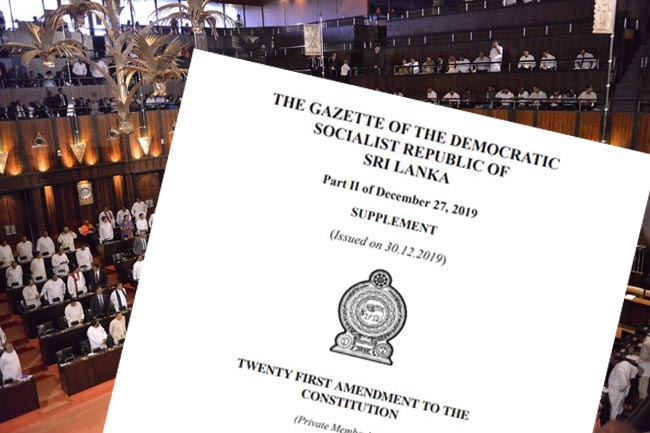
21A, 22A Draft Bills gazetted

January 1st, 2020

Courtesy Ada Derana

21A, 22A Draft Bills gazetted

The 21st Amendment Draft Bill and the 22nd Amendment Draft Bill have been gazetted by Parliament.

The 21st Amendment Draft proposes to change certain provisions of the 19th Amendment to the Constitution while the 22nd Amendment Draft proposes to abolish the 15th Amendment to the Constitution.

The two draft Bills have been presented to the parliament by MP Wijeyadasa Rajapakshe as a Private Member’s Bill.21st Amendment to the Constitution:

Govt. steps into New Year with utmost commitment to ensure prosperity – President

January 1st, 2020

Courtesy Ada Derana

President Gotabaya Rajapaksa, in his message to remark the dawn of 2020, says New Year dawns at a time when the entire Sri Lankan nation is beaming with hopes for a new era in economic, political, social, cultural and technological spheres of life.

The new government welcomes the New Year with determination and commitment to make it the Year of Prosperity”, the President said further.

As a country with our own vision, we can be proud of many great achievements in the past. We as a government step into the New Year with the utmost commitment to ensure prosperity by awakening our identities and skills and by interfacing them with modernity,” the President’s message read further.

The country is in need of a strong and vibrant economy which gives priority to nationalistic aspirations, it added.

The President went on to say he is aware that a well-protected nation with a disciplined society is the foremost expectation of the people. It is in such a society that soaring aspirations of the present and future generations will become a reality. We as adults should go hand in hand in unison to reach objectives during the New Year.”

He says the new government is the outcome of the unity among the people who love their country.

We will not allow any force to obstruct the realization of people’s expectations,” the President emphasized.

He pointed out that the sole aim is to create conducive environment where all can live harmoniously in peace.

It is my fervent belief and hope that the freshness formed in the hearts and minds of the people with the advent of New Year will facilitate the implementation of the Saubhagyaye Dekma” – the blue print to build a while new country,” the President continued.

Sri Lanka enters new decade with new govt. & new hopes – PM

January 1st, 2020

Courtesy Ada Derana

Prime Minister Mahinda Rajapaksa says Sri Lanka enters the new decade in a context where a new President was elected to power by the people with an overwhelming mandate.

In his message for the New Year 2020, the Premier said a new Parliamentary government has also been formed and it is in the process of commencing work.

With this change of government the hope of a new Sri Lanka has galvanized and inspired the youth of this country,” says PM Rajapaksa.

The most important feature of this new trend is that young people have spontaneously come forward, without any intervention from the government, to assume leadership over the task of building a new Sri Lanka. We have seen the manner in which young people all over the country have organized themselves and have cleaned the walls in public places and decorated them with attractive paintings,” he added.

This has transformed the whole of Sri Lanka within a matter of days, the Premier said, speaking of the posts in the social media which indicate that similar groups of young people who have been experimenting with the cultivation of land as well.

All this is taking place through connections established via the social media. The most valuable resource that we have as we enter a new decade is this drive and motivation among young people to take an active part in developing the country. We saw a similar trend among young people during the war against the LTTE. The young people of that time never looked back until the LTTE was defeated and peace restored to this country.”

It is my belief and expectation that the young people of today, who have been motivated and inspired to make a personal and direct contribution to building a new Sri Lanka, will not look back until they have achieved their objective of a prosperous and well governed country. The world recognizes the 21st Century as the Asian Century. We should make the third decade of the 21st Century which commences on the 1st of January, the Sri Lankan decade. Some day when the world looks back on the third decade of the 21st Century, it should be recognized as the decade in which Sri Lanka made its mark on the world. May the year 2020 and the new decade be a period in which all Sri Lankans realize their aspirations and the country achieves peace and prosperity.”

නව වසර මැතිවරණ වසරක් බව අගමැති කියයි

January 1st, 2020

උපුටා ගැන්ම හිරු නිව්ස්

උදා වූ 2020 නව වසර මැතිවරණ වසරක් බව අග්‍රාමාත්‍ය මහින්ද රාජපක්ෂ මහතා පවසනවා.

අග්‍රාමාත්‍යවරයා මේ අදහස් පළ කළේ අද පෙරවරුවේ තංගල්ලේ පැවැති උත්සවයකට එක්වෙමින්.

අග්‍රාමාත්‍ය මහින්ද රාජපක්ෂ මහතා ඊයේ රාත්‍රී කතරගම – කිරිවෙහෙර චෛත්‍ය රාජාණන් වහන්සේ වැඳ පුදාගෙන ආශිර්වාද ලබා ගත්තා.

එහිදී මහා සංඝ රත්නය සෙත් පිරිත් සජ්ජායනා කර අග්‍රාමාත්‍යවරයාට ආශිර්වාද පළ කළා.

නව වසර උදාවත් සමඟ අග්‍රාමාත්‍ය මහින්ද රාජපක්ෂ මහතා පැමිණියේ රුහුණු මහා කතරගම දේවාලයටයි.

එහිදී දේවාශිර්වාද ලබාගත් අග්‍රාමාත්‍යවරයා අනතුරුව ශ්‍රී ලංකා නිදහස් පක්ෂ නිර්මාතෘ එස්.ඩබ්ලිව්.ආර්.ඩී. බණ්ඩාරනායක මහතා සහ සිරිමාවෝ බණ්ඩාරනායක මැතිණියගේ ගුණ සිහි කරමින් සෑම වසරකම අඛණ්ඩව පවත්වනු ලබන සෙත් පිරිත් පිංකමට සහභාගි වුණා.

නව වසර සඳහා අග්‍රාමාත්‍ය මහින්ද රාජපක්ෂ මහතාට සුබ පැතුම් එක් කිරීමට අද පෙරවරුවේ මහා සංඝ රත්නය සහ ජනතාව තංගල්ල කාල්ටන් නිවස වෙත පැමිණියා.

රට පුරා වසරකට ගස් දශ ලක්ෂයක් සිටුවීමේ “හැදෙන රටට වැඩෙන ගසක්” ජාතික රුක්රෝපණ වැඩසටහනට සමගාමීව අග්‍රාමාත්‍යවරයා තංගල්ල කාල්ටන් නිවාස පරිශ්‍රයේ පැළයක් රෝපණය කළා.

තංගල්ල වජිරගිරිය මහා විහාරයේදී ගැබිණි මව්වරුන් සහ පාසල් දරුවන් උදෙසා භාණ්ඩ බෙදාදීමේ වැඩසටහනට අග්‍රාමාත්‍යවරයා එක්වුණේ ඉන්අනතුරුවයි.

රජයේ වෛද්‍ය නිලධාරීන්ගේ සංගමයෙන් චෝදනාවක්

January 1st, 2020

උපුටා ගැන්ම හිරු නිව්ස්

පසුගිය රජය සහ වත්මන් රජය අතර ඩීල් දේශපාලනයකට ඇතැම් පිරිස් කටයුතු කරමින් සිටින බව රජයේ වෛද්‍ය නිලධාරීන්ගේ සංගමය චෝදනා කරනවා. <

කොළඹ අද පැවැති ප්‍රවෘත්ති සාකච්ඡාවකට එක්වෙමින් එහි නියෝජිතයින් මේ බව ප්‍රකාශ කළා.

පක්ෂයේ ප්‍රධාන අපේක්ෂාව ගැන ජී.එල් කියයි

January 1st, 2020

උපුටා ගැන්ම හිරු නිව්ස්

එළඹෙන මහ මැතිවරණයේදී පාර්ලිමේන්තුවේ තුනෙන් දෙකක බහුතරයක් දිනා ගැනීම මෙම වසරේ තම පක්ෂයේ ප්‍රධාන අපේක්ෂාව බව ශ්‍රී ලංකා පොදුජන පෙරමුණ පවසනවා.

එම පක්ෂයේ සභාපති මහාචාර්ය ජී.එල් පීරිස් මහතා මේ අදහස් පළ කළේ නෙළුම් මාවත පක්ෂ කාර්යාලයේ අද පැවති ප්‍රවෘත්ති සාකච්ඡාවකදී.

ප්‍රවෘත්ති සාකච්ඡාවට ආරම්භ වීමට ප්‍රථම ශ්‍රී ලංකා පොදුජන පෙරමුණේ සභාපති මහාචාර්ය ජී.එල්. පීරිස් මහතාගේ ප්‍රධානත්වයෙන් උදාවූ නව වසර සැමරීමේ උත්සවයක්ද පක්ෂ කාර්යාලයේදී පැවැත්වුණා.

සහල් හිඟයට හේතුව තමන් නම් තම සහල්මෝල් රජයට පවරාදීමට සූදානම් බව ඩඩ්ලි සිරිසේන කියයි

January 1st, 2020

උපුටා ගැන්ම හිරු නිව්ස්

රටේ සහල් හිඟයට හේතුව තමන් බව පවසන්නේ නම් සිය හිමිකාරීත්වය සහිත සහල්මෝල් රජයට පවරාදීමට සූදානම් බව ව්‍යාපාරික ඩඩ්ලි සිරිසේන මහතා පවසනවා. 

ඔහු මේ බව සඳහන් කළේ පොළොන්නරුවේ පැවැති උත්සවයකට එක්වෙමින්.

ව්‍යවස්ථාදායක සභාව පක්ෂග්‍රාහී වූ බවට හිටපු සාමාජික විජේදාසගෙන් චෝදනා FORMER MEMBER CHARGES THE CONSTITUTIONAL COUNCIL WAS BIASED

January 1st, 2020

උපුටා ගැන්ම හිරු නිව්ස්

MP Wijedasa Rajapaksa says that the constitutional Council has acted in a biased manner during the previous regime .

He noted that for the past four years, the constitutional council has not been independent and has acted in a bias manner.

He made this statement while, addressing a media conference at his home in Colombo today.

පසුගිය රජය සමයේ ව්‍යවස්ථාදායක සභාව පක්ෂග්‍රාහීව කටයුතු කර ඇති බවට කළක් එය නියෝජනය කළ, පාර්ලිමේන්තු මන්ත්‍රී විජේදාස රාජපක්ෂ චෝදනා කරනවා. කොළඹ සිය නිවසේ අද පැවති මාධ්‍ය හමුවකට එක්වෙමිනුයි ඔහු මේ බව කියා සිටියේ.

Govt. suspends import of ethanol with immediate effect

January 1st, 2020

Chaturanga Samarawickrama Courtesy The Daily News

The Government suspended the import of ethanol for liquor manufacturing with immediate effect, the Ministry of Finance, economic and policy development Ministry said today.

They said the decision was taken following the instructions given by Prime Minister Mahinda Rajapaksa, who is also the Finance Minister.

He also said required Ethanol is manufactured locally. 

Rajitha transferred to general medical unit

January 1st, 2020

Courtesy Ada Derana

Parliamentarian Rajitha Senaratne, who was receiving treatment at the Intensive Care Unit of the Lanka Hospitals in Narahenpita, has been transferred to a general medical unit.

Former Health Minister Dr. Rajitha Senaratne, who was remanded over the controversial white van” press conference, was released on bail on December 30 as per an order by Colombo Chief Magistrate Lanka Jayaratne.

However, Senaratne continued to receive treatment at the Lanka Hospitals in Narahenpita.

Subsequently, the MP has been transferred from the ICU to a general medical unit this afternoon (01).

Two Indian banks to cease operations in Sri Lanka

January 1st, 2020

Courtesy Ada Deara

The Central Bank of Sri Lanka has permitted two Indian private banks Axis Bank and ICICI Bank to close down their operations in the country. 

Two Indian banks asked to shut down operations in Sri Lanka

The Central Bank of Sri Lanka has said that it intends to take appropriate action against the banks that have not complied with the order to reduce the Average Weighted Prime Lending Rate (AWPR) for end 2019 in line with the Monetary Law Act.

License to get canceled

The Central Bank has not permitted the aforementioned Indian banks to perform banking operations and the banks cannot accept deposits from the public as well. According to the Central Bank of Sri Lanka, the licenses issued to them will be canceled once the winding-up process is over. 

Issuing a statement, the Central Bank said while several licensed banks complied with the order and reduced the lending rates by 250 basis points, some others including the Axis Bank and ICICI Bank have not reduced their rates. 

The Central Bank of Sri Lanka in its statement said, The Monetary Law Act Order No. 02 of 2019 on Enhancing Efficiency of the Transmission of Recent Policy Decisions to Rupee Denominated Market Lending Rates” required, inter alia, every licensed commercial bank (LCB) to reduce their weekly Average Weighted Prime Lending Rate (AWPR) by at least 250 basis points by 27 December 2019, compared to their AWPR published by the Central Bank of Sri Lanka as at 26 April 2019 in the Weekly Economic Indicators publication. This shall not apply to LCBs, whose AWPR reaches or falls below 9.50 percent per annum as at the date of this Order or anytime thereafter.”

Nevertheless, it is also observed that People’s Bank, Commercial Bank of Ceylon PLC, Indian Overseas Bank, MCB Bank Ltd, Public Bank Berhad, Standard Chartered Bank, Amana Bank PLC, and Axis Bank Ltd have failed to comply with the Monetary Law Act Order No. 02 of 2019. The CBSL intends to take appropriate measures in relation to these banks, as well as those licensed banks that have not met with the other provisions of the Order, to ensure that the general public continues to benefit from an efficient transmission of recent policy decisions through the financial system,” the statement read. 

Axis Bank made its debut in the Sri Lankan market in October 2011, while ICICI Bank entered the island nation in January 2006, with the approval of the Monetary Board of Central Bank of Sri Lanka (CBSL) under the Banking Act of 1988.

-Agencies

Vaiko condemns arrest of two TN journos for interviewing Sri Lankan Tamil refugees

January 1st, 2020

By ANI Courtesy The Indain Express 

CAA grants Indian citizenship to Hindu, Christian, Sikh, Buddhist and Parsi refugees from three neighbouring countries who entered India on or before December 2014.

CHENNAI: Marumalarchi Dravida Munnetra Kazhagam (MDMK) founder Vaiko on Wednesday condemned the arrest of two journalists for interviewing Sri Lankan Tamil refugees on the Citizenship Amendment Act (CAA).

Rajya Sabha MP Vaiko

While addressing the media on Wednesday in Chennai, Vaiko said, “This shows how All India Anna Dravida Munnetra Kazhagam (AIADMK) government has become fascist. It is not fair to arrest people who are protesting against the CAA. Why has the CAA been brought about like a surgical strike? They want India to be a Hindu nation.”

According to a report, two journalists – Sindhu and Ramkumar from Tamil Nadu, who had gone to seek the views of Sri Lankan Tamil refugees on CAA – were booked by the Kanyakumari district police under non-bailable sections.

CAA grants Indian citizenship to Hindu, Christian, Sikh, Buddhist and Parsi refugees from Pakistan, Afghanistan, and Bangladesh, who entered India on or before December 31, 2014.

The Dew Is on the Lotus! – Rise Great Sun!’

January 1st, 2020

By Rohana R. Wasala

(The title is a line from the concluding passage of  Sir Edwin Arnold’s ‘Light of Asia’. The Spanish title and name Don Quixote used below is pronounced dong khee khothe”)

ANNO FELIX, HAPPY NEW YEAR, TO YOU!

Rejoice my beloved Mother Lanka!

With us your dear children just debunking

The entrenched myth created about us

In those oppressive colonial times

Of shutting ourselves up in a time warp 

Where we are thought to be overtaken

By an unhealthy love of the dead past 

That makes us resist desirable change.

Meddling aliens and their local lackeys

Do still accuse us of primitivism  

Simply because we show a deep concern

When our rare archaeological sites

Are vandalized or claimed without a right;

When our ancient ruins are razed to the ground;

When our peaceful monks and lay activists

Agitate against the desecration

And defacement of Buddha images,

And forced conversion by unethical means

Of poverty stricken rural Buddhists,

And subversion of middle class Buddhists

Through subtle methods of indoctrination

Such as personal improvement workshops

Or superstitious divine healing camps

With a sham Buddhistic tone  but a bias-

Towards a faith based deistic religion;  

When state forest reserves are cleared

In excess of what’s been lawfully marked,

For resettling allegedly displaced-

Persons solely of one religious creed,

Who have been already resettled elsewhere.

We’ve tried to free ourselves from the vice grip

Of this undue bad name for racist pride, 

Fanaticism, and xenophobia

Given to us contrary to evidence

While being beaten into a monstrous shape,

Despised in the comity of nations

Although the deliberately suppressed-

Truth is that we are the hapless victims 

Of those very evils perpetrated

By some communalist politicians

Hellbent on destroying our sovereign state

Who promote such passions just to survive,

Groping in their dark  personal ghettoes 

In this cultured Age of Information. 

What is the truth obscured by the canard

That Sinhalese Buddhist nationalists

Are racist, exclusive, and extremist

And hence backward and resistant to change,

And that the Sinhalese are as a race

Mentally retarded and inferior?

The pioneer of true national thinking

Was none other than the historical 

Hate-figure of anti-nationalists

Great Anagarika Dharmapala

Who engineered social reform through it

To kindle hopes of freedom from foreign rule.

History will recognize Dharmapala

As perhaps the first ideological-

Champion of the unarmed battle for freedom,

And the first proponent of modernity

Properly based on Buddhist tradition.

Though Brits and colonial parasites

Projected him as a Don Quixote

Through their malicious vile propaganda,

Being a leader gifted with great foresight,

He warned the majority Sinhalese

Of a racially divided country

Where they would be at the receiving end 

When the foreigner would leave them at last

Unless they were united as a race.

Today, as we can see, that prophecy,

Has come true, sad though it is to say this.

Yet the Anagarika’s life mission

Was passing on the word of the Buddha

Across the world for all peoples’ wellbeing.

He was convinced that Sinhala Buddhists

Had a unique responsibility

To protect Buddhism for the whole world

As Lanka is the repository

Of the Dhamma in its first pristine form

The hallowed Theravada tradition

Committed to writing at Matale,

Central Sri Lanka, one hundred plus-

Years Before the Common Era began.

Though religions are anachronistic

In the human reason ruled world today

Their ethical teachings are relevant

To their politically organized

Adherents, while not being so to others,

A situation that causes friction

With monumental repercussions

That endanger the very survival

Of the human civilization itself.

The Buddha preached an ethical doctrine

That is self-realization based and free

From blind faith and ritual performances

Something that Albert Einstein chose to call

A cosmic religion in the sense that

All humans could embrace its moral code

Based on kindness, reason, and mind culture, 

And work to create a safe peaceful world. 

Dharmapala knew this before Einstein

As he showed in his great dedication

For spreading the Dhamma across the globe

Without any proselytizing aim.

Being a true disciple of the Buddha 

He didn’t seek to convert non-Buddhist people.  

But he believed that Dhamma was

The Sinhala Buddhists’ gift to the world

As custodians of the pure Teaching.

Meanwhile he was passionately concerned

About their material wellbeing as well

As any good Buddhist leader would be

He advocated the education

Of the young for acquiring good life skills

And the study of science and technology

In addition to cultural subjects.

Lanka’s freedom movement and its leaders

And all patriotic politicians

That followed in the subsequent decades

Were profoundly influenced by this great man.

All the prime ministers and presidents

Since independence with two exceptions

(Whose patriotism is of a foreign make)

Have been influenced by his nationalism

Had the Anagarika been living- 

Today, he would have highly commended

The current president Gotabhaya

For his moral uprightness, gracefulness

And his commitment to Buddhist values.

All Members of Parliament on both sides,

If they really want to serve the nation

Ought to forget their personal concerns

And soon ensure that the president get

The enlightened parliament he deserves,

So that this fourth decisive surge that we-

Are in the middle of making since the Year-

The Buddha Jayanti was observed

Towards independence from foreign sway

In order to stand on our own two feet,

Will not be suppressed like the previous three.

May the Lotus Bud Bloom in our Troubled Land

Fresh and pure out of its muddy waters!    

Time to investigate the activities of foreign funded NGOs

January 1st, 2020

S. Akurugoda

Foreign-funded NGOs had influenced our education system in subtle ways and an expeditious investigation will be carried out into the ideas being put into the minds of schoolchildren through school text books, Prime Minister Mahinda Rajapaksa said at the National Dhamma School Convention and Awards Ceremony held at Irattaperiyakulam in Vavuniya few days ago.

He said he heard some leading academic Bhikkus explaining how school textbooks now had content that would corrupt young minds. An organisation explained how some school textbooks have depicted the northern and eastern provinces of Sri Lanka as one province. It was also said that the Sinhala New Year had been dropped from some school textbooks,” he said. While pointing out that there is a concerted and ongoing attempt to divide the country, to destroy the Sinhala Buddhists, he made a detailed speech on how the values of the society have been eroded through subtle means.

The sovereignty is defined as the supreme political power of a government to regulate its affairs within a specified territory without outside interference. Policies are thus formulated by the people of a sovereign nation via the elected government to suit the nation and its people. Pumping billions of Rupees to brainwash the people of a nation to achieve the goals of outside elements is a clear-cut interference on its sovereignty. Who will pump billions for nothing in return? These lobbyist NGOs are to fulfill the needs of their funding agencies whose ultimate aim is none other than creating a new form of colonization around the world.

The latest news item appeared in The Island under the title NPC calls for continuation of National Anthem in Tamil” is a typical example. TNA, recently had a media briefing and asked the government to not to stop yahapalanaya practice of singing the national anthem in Tamil at the Feb 04 Independence Day celebrations.  As per the news item appeared in The Island last Saturday, NPC  (National Peace Council) has also repeated the same claim and now they are going to make a big issue out of it against the duly elected government.

Activities of NPC in the past are well known and the above photograph indicating Jehan Perera of NPC addressing a meeting organized by NESoHR (founded by LTTE proxy TNA with the Eelam map behind him) , on December 10, 2005 describe it in  thousand words.

NPC, whose annual funding is said to be in excess of 126 millions SL Rupees or 5, is funded by the USAID (Main contributor), MISEREOR  (The German Catholic Bishops’ Organisation for Development Coorporation), Asia Foundation, European Instrument for Democracy and Human Rights (EIDHR) ,US Department of State ,Catholic Agency for Overseas Development (CAFOD),  SPICE-MSI, FOKUS (based on the information provided in NPC website, Financial Report 2017).

The website of the above funding agency the Catholic Agency for Overseas Development gives CAFOD’s mission as promoting human development and social justice in witness to Christian faith and Gospel values (emphasis mine). Depending entirely on foreign governments and agencies they carry on the White Man’s Burden and have a function similar to Christian missionaries during the high colonial era.

It is also interesting to note that the 10 member Governing Council of this NGO has only 2 members with Sinhala names.

Most of the foreign funded NGOs were established in Sri Lanka during the war against LTTE terrorism.  Most of these NGOs have had engaged in a movement to brainwash the people of Sri Lanka promoting federalism (or indirectly separatism).  For example, National Peace Council (NPC), considered in their vision statement published prior to the defeat of terrorism, the LTTE as an integral part of ‘their so-called solution’.  Clearly the NPC and similar ilk wanted to whitewash the LTTE and bring it out as a civilised entity.

We remember how these NGOs justified international intervention (including through the UN and US) and called for solutions manufactured from the outside spending billions of Rupees got from foreign donors which money should have gone to the poor people in the country. These piece mongers and their colonial masters in the West were behind the propaganda on behalf of Tamil racism in general and the LTTE in particular. Their activities parallel the LTTE’s global propaganda campaign against the government of Sri Lanka and its people.

The Island dated March 4, 2011 under the heading Foreign funds galore for three NGOs: Over Rs. 600mn. received in 3 yrs; Norway leading donor”, revealed how a section of the international community was pouring money into Sri Lankan NGOs like the Centre for Policy Alternatives (CPA) and National Peace Council (NPC), Transparency International Sri Lanka, in spite of the conclusion of war against terrorism in May, 2009. http://www.island.lk/index.php?page_cat=article-details&page=article-details&code_title=19831

As per the report, the CPA has received Rs. 272.31 million during the 2008-2010 periods. The NPC and TI have received Rs. 171.23 million and 174.79 million, respectively. The country’s banking system has no records of the exact amount of funds received by NGOs over the past two to three decades. Sources said that an enormous amount of funds had been received by NGOs since Feb. 2002, with some countries and the UNDP providing funds to the LTTE Peace Secretariat.

Although the NPC and similar ilk were in the driver’s seat during the Chandrika-Ranil failed regimes, and later during the Ranil-Sirisena (so-called yahapalana) regime, attempting to brainwash the country from top political hierarchy to grass roots level, spending billions of rupees, the mass support received from the general public to eradicate terrorism in 2009 and to chase away  the above notorious regimes at the end of their terms  are clear proofs that the peace loving people of Sri Lanka are wiser than the foreign funded PEACE prophets.

The latest mission, after the failure of earlier vision, of these NGOs is said to be the work towards a political solution to the so-called ethnic conflict, reconciliation etc. 

Few months after the elimination of the LTTE terror from our soil, we had every reason to believe that some notable elements of the US and their allies were rapidly making a case of war crimes against Sri Lanka on the basis of the conduct of her armed forces as well as political leadership. One of the motivations of this action is to cover-up their own continuing armed conflicts on large scales, involving major humanitarian catastrophes and causing the death of large numbers of civilians due to military actions in Iraq, Afghanistan and in some areas of Pakistan.

On 28th August 2009, the two kingpins of NGOs were reported addressing a close-door meeting convened by the US Institute of Peace (USIP). Another notable participant of this discussion was Teresita Schaffer of The Centre for Strategic and international Studies, one of the former US Ambassadors to Sri Lanka, who was very critical of the Sri Lankan government during her tenure of office in Sri Lanka. As per media reports, the duos from the two NGOs basically said at a meeting, in Washington D.C. with former Ambassador to Sri Lanka, Mr. Robert Blake, was what Blake wanted them to say.

After few months of these meetings, Ban Ki-moon appointed a panel to advice him (i.e the UNSG) on Sri Lanka’s alleged war crime charges and European Union gave conditional ultimatum on GSP Plus. Thus these NGOs are the promoters of the notorious UNHCR Resolution welcomed by their yahapalanaya government.

Soon after the appointment of Ban Ki-moon panel, these Peace Vendors were back in the business by issuing statements one after the other to the foreign and local press supporting the Ban KI-moon’s panel and the EU’s conditions and condemning the actions of the Sri Lankan Government and its people as was usually done by them during the past. They started, once again, advocating solutions. The solutions they seek are from outside including foreign intervention. It is not surprising at all to learn that those who live on foreign funding are for foreign intervention.

As pointed out in an article ‘Let there be oversight’ (The Island dated December 31, 2008), “NGOs can’t and shouldn’t be allowed to self-regulate. They want to believe that the money they receive belongs to those who have given it, so pleasing their donors is enough. But it isn’t. Funds raised in the name of the people of this country, playing on their sufferings and undertaking to solve their problems, are rightfully theirs”.… “There are absolutely no democratic controls over public money that is handled by NGOs”. http://www.island.lk/2008/12/31/features5.html

Three years ago, according to media reports, Modi’s government in India revokes licences of 25 foreign funded NGOs over ‘anti-national activities’ as pool of foreign-funded bodies shrinks by almost half in two years. The evidence for anti-national activities of foreign funded NGOs operating in Sri Lanka is easy to find, one has only to read the anti-national statements made by these organisations. Further a mechanism is needed to monitor funds channeled through the banking system as well as other means from foreign donors to local agencies.

The NPC and similar ilk should be immediately investigated for what they have done in the past and for what they are doing now. If existing laws are insufficient, new laws should be enacted for the benefit of the country and its peace loving people.

S. Akurugoda

ERASING THE EELAM VICTORY Part 10E

January 1st, 2020

KAMALIKA PIERIS

Revised 1.1.2020

Many land mines were laid by the LTTE in their treasonable war against the Government of Sri Lanka. Landmines were one of ways the LTTE tried to ‘win’ the war. After the war, it fell to the army to clear these land mines. The mines had to be cleared before the Tamils could be re-settled on the land.

This was a formidable challenge. There were no maps of the land mines laid out by the LTTE. Sri Lanka army reported that LTTE minefields have been laid without clear recording or marking. Mines have been laid in front of defensive positions, which have subsequently been hurriedly evacuated, and the mines forgotten about.   LTTE also laid nuisance minefields to prevent access to facilities such as wells, roads, footpaths, and food. These mines also are not marked. All   nuisance mines were laid by the LTTE, emphasized the army. It is this type of landmines that has created the greatest threat to resettled and returning displaced people.

The Security Forces laid mines purely as a defensive measure. They did not use mines as an offensive weapon. Sri Lankan Security Forces have laid protective minefields to prevent the LTTE from reoccupying defended areas. These minefields are laid in keeping with universally accepted standards of laying to a specific pattern following proper marking and recording procedures. The records amounting to 3,000 minefields, except those relevant to High Security Zones  were released to the other organizations involved in mine action and these records have helped easy and speedy recovery of mines. Anti-tank mines were used by the armed forces only to cover prominent vehicle approaches. 

The demining was done by the Sri Lanka army with the     assistance of HALO Trust, MAG, DASH and SHARP. The HALO Trust (Hazardous Area Life-support Organization) is a registered British charity and American non-profit organization which removes land mines.  HALO began working in Sri Lanka in 2002. The Mines Advisory Group (MAG) is a NGO based in Manchester, and has a sister organization, in Washington. It   assists people affected by landmines. MAG field operations are managed by the  nationals of that country, MAG expatriate staff  monitor and train.

Delvon Assistance for Social Harmony (DASH) is a Sri Lankan non-profit demining NGO, consisting only of Sri Lankans, about 90% Tamils, all specialized and experienced in the field of Humanitarian Demining. DASH is funded by the Governments of Australia (AusAID) and Japan (GGP).  DASH started operations in 2011.  SKAVITA Humanitarian Assistance and Relief Project (SHARP)  has the government of Japan as its main donor. It started operations in 2016.

Japan has been a major donor in the area of mine clearance in Sri Lanka since 2003, with more than US$ 35 million assistance in total through its Grant Assistance for Grassroots Human Security Project (GGP). In 2019 Japan gave US$ 1,266,825 (approx. Rs. 219 million) for the SKAVITA Humanitarian Assistance and Relief Project (SHARP) and the HALO Trust for humanitarian demining in Northern Sri Lanka.Norway provided funds to HALO and MAG.

Sri Lanka achieved an impressive record in this demining having cleared 1,319 sq km out of an area of 1,419 by 2012. De-mining operation has gone much faster than in other countries such as Cambodia observed the Government in 2012. Nearly 5000 anti personnel mines were removed by the army risking their lives, so that the Tamils could be resettled, reported the media in 2012.

As at end of 2018, only 25 sq.km is remaining to be cleared. This area included Muhamalai in the Kilinochchi District, Nagarkovil in the Jaffna District, Maritimepattu and Oddusudanin in the Mullaitivu District and other areas in the Northern and Eastern Districts. Those engaged in demining, both foreign and local, said in 2018  they had found it extremely difficult to conduct demining operations in Muhamalai in Kilinochchi and Ambagam in Mullaitivu. However, by 2019 the mines clearance programme enabled the release of 1277 sq.km for safe settlement .

The work of the Sri Lanka army was recognized abroad. In 2016 Mine detection dog Alvin and his handler   Lance corporal GNWM Navaratne were selected as the Mine detection Team of the Year by the US based Marshall Legacy Institute. They have together demined from 2011 to 2016 an approximate land area of 73,340 sq mm in the north and east. This has enabled 1945 displaced of 415 families to return to their original places of inhabitation, said the citation.

In 2018 A nine-member delegation of the Cambodian Mine Action Authority  of the Cambodian government visited the Muhamalai Humanitarian De-mining site, to learn from the Sri Lanka Army’s de-miners. International Meeting on Mine Action for National Directors and UN Advisors, in 2019 commended the achievement of Sri Lanka, when compared to other countries.

The work of the Sri Lanka army was recognized abroad. In 2016 Mine detection dog Alvin and his handler   Lance corporal GNWM Navaratne were selected as the Mine detection Team of the Year by the US based Marshall Legacy Institute. They have together demined from 2011 to 2016 an approximate land area of 73,340 sq mm in the north and east. This has enabled 1945 displaced of 415 families to return to their original places of inhabitation, said the citation.[1]

Sri Lanka became a mine riddled country thanks to  land mines laid  by the LTTE. Sri Lanka  signed the Mine Ban Treaty  in December 2017. Sri Lanka, having acceded to this Mine Ban Treaty will have four years from June 2018 to ensure that it does not use, stockpile, produce or transfer any anti-personnel mines (APMs), announced the media. Only a small quantity of APMs will be permitted in the country for training purposes. This makes the government of Sri Lanka sound as if it was the guilty party, when the real culprit is the LTTE.

Sri Lanka army has initiated two innovations in mine clearing, one is already in practice, the other is still in the pipeline. The one in practice is the locally developed raking method. This is used by DASH.

In this method a heavy rake is used to soften and prod the ground. This rake is pulled horizontal through the possible mine infested soil, loosing up the soil and possible hitting/locating the mines on the side. As the mines are designed to activate only if hit on the top, this action will not set on the mine, and we have only had one incident where a mine went off while excavating with the heavy rake.

Investigations afterwards showed that the mine had been tilted by the growth of the roots of a small tree, thereby standing” on the side, so when the heavy rake hit the mine, it was activated but fortunately the PPE and the long handle of the rake ensured that no harm came to the deminer.

After the soil is loosened up, the deminer will use the light garden rake to remove the soil. This rake is originally designed for removing grass cuttings from the lawn without damaging the lawn. Each of the fingers (in total 22) bend back if any serious pressure is made onto it, far less than the pressure that is needed to set off the type of AP mines we are recovering. It can therefore be used safely to remove the soft soil, sweeping it away from the top. Some operators use both the rakes and metal detectors together.

There is also a second innovation which is still at a the experimental stage. The Sri Lanka Army Corps of Engineers’ research arm has launched a pilot project to study the possibility of utilizing the indigenous grey mongoose for the detection of explosives.”We initially used detectors to trace explosives. Later, dogs were used for the detection of explosives. However, one of the biggest issues with dogs is that it is a very expensive operation as we cannot breed them locally. We have to import them from Europe or America and train them to detect explosives. It costs around Rs. 2 million to import a dog. Dogs can sniff out explosives and other parts of the mine or UXO (unexploded ordnance) body. They are therefore commonly used within mine and UXO detection programmes.

Training a dog to detect explosives is difficult and time-consuming, and can take from three months to several years. A mine detection dog may well be trained far from the country where it is later to be deployed, but a period of acclimatization and adaptation to the new climate, the soil and the mine or UXO type in the operating area is always required. This period can take from one to six months depending on whether there is a need to train new dog handlers from the target area too. ”

The price of a high-quality mine dog is high, while other limiting factors are unfavorable climatic conditions (such as excessive heat and humidity, too much wind or wind blowing in the wrong direction), thick vegetation, and dense minefields. The latter will result in a complete contamination of the wider area and thereby confuse the dog. Daily working hours vary from a few hours to six or seven hours per day. Dogs tend to work for shorter periods in hot climates, while they are able to work for longer periods where it is colder. A mine dog can scour a few hundred to a thousand square metres per day (figures vary sharply), depending on local conditions and training. However, like humans, dogs may have bad days where motivation is low.

We too began to look into the possibility of other cost-effective alternatives. Brigadier Seneviratne had initially done a study in 2016 on whether the mongoose can be used for the detection of explosives. We also found that a local university had undertaken research and found that the mongoose can be used for explosives detection, apart from dogs. Other than that, we had no research to go on,” said Major Herath. .

The initial experiments were done with the wet zone reddish mongoose and the dry zone grey mongoose, and of the two, the grey mongoose showed greater sniffing capability than its counterpart.

While training dogs in explosives’ detection, we use the reward method, where they are rewarded when they respond well to the training. Hence, we began experiments with the mongoose to see how they responded to the same reward system. We used both species of mongoose for this initial experiment and our experiments established that the dry zone grey mongoose showed greater ability to sniff out explosives. We also did research on the direction of the sniffing capabilities of the grey mongoose. As with dogs, they only have downward sniffing capability, which means that they can more accurately sniff areas below their feet rather than scents at a fair distance or above their head. Dogs rarely have upward sniffing capability. However, with the grey mongoose, they have a wider sniffing range. ”

In 2017, we recruited a specialist who was knowledgeable about the mongoose and its behaviour, food habits, and capabilities. Then we undertook the research and were amazed at the mongoose’s sniffing capability and response to reward-based training,” he said, adding that as a secondary project, the Army was looking at breeding possibilities under a controlled system.

Currently, we have around nine mongooses in our research programme, and, of them, one has been trained to a very satisfactory level. We have also utilized funds allocated by the Army for research purposes. Also undertake research on the possibility of breeding the mongoose locally.”

Meanwhile, visiting scholar at Harvard University’s School of Engineering and Applied Sciences and 2008-09 Radcliffe Institute Fellow Thrishantha Nanayakkara and a group from Moratuwa University have done an explosives’ detection study using the mongoose. They picked an indigenous mongoose for its temperament, size (roughly 2.5 kilogrammes, light enough to step on a mine without detonating it), and sense of smell (ability to detect explosives three metres away). .

Nanayakkara equipped a robot (roughly a metre tall and half-a-metre wide) with a harness to keep the mongoose under control and a video camera to record its findings. Although the mongoose walks a few feet ahead, the robot with its eight metal legs sets the pace. During the test run, the pair went back and forth across a 10-by-10-metre plot, stopping whenever the mongoose detected a mine, which it indicated by sitting up (as it was trained to do). In a morning’s work, the mongoose found every mine, proving its effectiveness in explosives’ detection. (Daily News  3.8.18. p 4)

The success of the initial experiments bring great hope that the indigenous grey mongoose could prove to be a cheaper alternative in explosives’ and mine detection than the far more expensive method of using imported dogs.” This may be another first for the Sri Lanka army. ( continued)


[1] Daily News 24.8.16 p 7 Modern used file 13 .

Subjects Not Rulers: Reply to Vigneswaran Bashing Mahawamsa

January 1st, 2020

Dilrook Kannangara

Chief Minister of the Northern Province is at it again – Mahawamsa bashing. Lengthy replies have been written to him by others. Having read the comments and replies, I’m compelled to make these short and sharp points to him and his unfortunate followers.

1.       If Sri Lankan (Ceylon) Tamils were an established ethnic group in the island, why did they start to appear in the national census only from 1911? There was no such ethnic group in 1881, 1891 and 1901 censuses. That too was because the person in charge of the census was a Tamil.

2.       Why there is not a single Tamil inscription in Sri Lanka attributed to locals? The few Tamil inscriptions found in the island containing Tamil Nadu language were done by Cholas, Pandyans or the Chinese. All outsiders.

3.       Why no Tamil history book or literature book was done in Sri Lanka in ancient times? Everything was done in South India. The 18th century Tamil book containing myths and glimpses of historical events was written by a South India brought to the island by the Dutch. Therefore, that too was not done by a local but by an outsider.

4.       If Tamils had such an illustrious history (anywhere in the world, let alone Sri Lanka), why do they live under the rule of Hindi, Gujarati, Sinhala, Malay, etc. native speakers? Why can’t Tamils rule themselves in a nation anywhere in the whole wide world?

5.       If Tamils had such an illustrious history (anywhere in the world, let alone Sri Lanka), don’t they have any shame to live under the rule of non-Tamils in every country they live?

These are factual matters that Vignesrawan and others of his coterie always fail to apprehend. Tamils are entitled to equal individual rights in Sri Lanka. Nothing less and nothing more. He can make fun of Mahawamsa and other dozen Sinhala history books, but they can never have their own nation. Accepting and respecting others’ history and nations is the first step in gaining a nation of one’s own. Unfortunately, Tamils are misled by some of their politicians away from this reality.

NATIONAL ANTHEM IN TAMIL

January 1st, 2020

BY EDWARD THEOPHILUS

How to sing the national anthem of Sri Lanka in Tamil is a question to me as the current National Anthem is in Sinhala language and originally it was authored by the lyricist in the Sinhala language.  If anyone suggests or requests to sing in Tamil it will not be a national anthem, but a translation of the national anthem. According to my understanding, all countries in the world sing national anthems in the language lyricist produced although there are people living these countries, who use different languages.  For example, in Australia, a considerable ethnic group that uses Greek, Italian and Mandarin but the government never allowed to sing the national anthem in any other language than in English.

Why this truth cannot be understood by Tamils.  In India there are more Tamils than in Sri Lanka and Indian national anthem, Jana Gana mana adinayake jayahe” sings only in the Hindi language. Are TNA people stupids without understanding the simple truth or they want to make unnecessary issue ahead of the general election to secure seats.

30 Questions for UNSG & UN Human Rights Council regarding Sri Lanka

December 31st, 2019

  • 1. UN Secretary General Ban Ki Moon commissioned 3 members (Ban Ki Moon Panel of Experts) selected personally by him to submit a personal report on the ‘final months’ of Sri Lanka’s conflict. This report was not commissioned by the UNGA or UNSC. This report was never tabled at the UNGA, UNSC or even UNHRC. This report was actually leaked to the public. How can the UNHRC head quote from this leaked personal report & how can 3 successive UNHRC resolutions be based on a personally mandated leaked report?
  • 2. How can a personally commissioned report (Darusman Report) become the basis for successive resolutions against Sri Lanka when it was never officially tabled for Sri Lanka to officially respond to it?
  • 3. How legal are these UNHRC Resolutions, OISL investigations & every demand & recommendations given that the Darusman Report is the basis for every action being taken against Sri Lanka? What is the platform within the UN system that Sri Lanka can seek answers for these legally questionable acts? UNSG’s actions are illegal under UN Charter Article 2(7), 99 and 100
  • 4. Article 97, 98 & 99 of the UN Charter covers the role of the UNSG but UNSG can only use Article 99 (Commission report) if there is a threat to international peace & security. UNSG commissioned his personal panel more than a year after Sri Lanka’s conflict ended & there was no threat to international peace & security, if so UNSG was bound by Article 97,98 & 99 to bring that to the attention of the UNSC & seek approval to commission reports on Sri Lanka. These are legal questions for UNHRC to now answer. Isn’t this why the Darusman Report was leaked instead of placing it officially for Sri Lanka to respond to? What UNSG did constitutes an ‘ultra vires’ to the UN Charter & the spirit of goodwill among UN member states. UNSG is violating Article 2(7) REPEATEDLY by meddling in affairs that fall ‘within the domestic jurisdiction of members’.
  • 5. When a UNHRC head demands a sovereign country to change its constitution & openly denigrates Sri Lanka’s judicial system & judges is the UNHRC head not violating Article 2.7 of the UN Charter? Article 2(7): Nothing contained in the present Charter shall authorize the United Nations to intervene in matters which are essentially within the domestic jurisdiction of any state or shall require the Members to submit such matters to settlement under the present Charter;  http://www.un.org/en/sections/un-charter/chapter-i/ Not stopping there the UNHRC head has also asked Sri Lanka to delist LTTE fronts, praising constitutional amendments that were promoted by western governments (19a), praising that Sri Lanka is holding a Remembrance Day’ instead of ‘Victory Day’ while UNHRC is silent about UK & Allies celebrating Victory Day since 1945, demanding the repealing of the terrorism prevention act, commenting on ‘white vans’ when no one can even give a list of the missing or their names or even numbers that warrant it to be regarded as a national issue. UNHRC reports are full of passing comments of ‘some groups’ with sensationalized allegations sans details or evidence.
  • 6. On 21 July 2007 LTTE closed the Mavil Aru sluice gates denying water to some 30,000 farmers in East Sri Lanka – did UNHRC force LTTE to return the supply of water as denying water is a war crime? What did UNHRC do against the LTTE for its actions?
  • 7. Immediately after closing the Mavil Aru sluice gates LTTE began attacking several villages in the East forcing the Govt to order its troops to counter-attack & defend the lives of the civilians. Did UNHRC prevent LTTE carnage? Did UNHRC take action against the LTTE for these acts of terror?
  • 8. LTTE began attacking villages since mid-1980s killing innocent men, women, children babies & even pregnant women. What did UN system do to stop LTTE carnage throughout 30 years? Were these not civilians that LTTE were killing? Give us evidence of how UNHRC or UN system has assisted the victims of LTTE terror? Not once has any UNHRC head visited victims of LTTE terror attacks.
  • 9. What has the UN / UNHRC / International Community done about LTTE fronts that have been providing material support & engaged in propaganda on behalf of the LTTE raising funds that purchased the arms & ammunition for LTTE to fight & controls the LTTE international kitty from illegal & legal business ventures?
  • 10. It is because the LTTE engaged in acts of terror that Sri Lanka’s Government deployed its troops to safeguard the lives of civilians and protect the country’s public property that LTTE was targeting. The list of airports, trains, passenger buses, buildings, banks that LTTE attacked are many. What did UN/UNHRC do to stop these LTTE acts of terror?
  • 11. UNHRC that is today quoting 24×7 on ‘civilians’ must explain why UN did not go after LTTE for targeting and killing civilians throughout 1980s, 1990s, 2000 up to 2009? Were these civilian lives not important? How many innocent farmers, villagers, people going to work, school children were killed by LTTE? Why have they been neglected by UN and their deaths simply subject to an official statement recirculated with every attack.
  • 12. The UN/UNHRC that has become overactive since the fall of the LTTE has never shown the same enthusiasm to go after LTTE as it is doing questioning how the Sri Lanka Army engaged itself in the final months of the conflict. We want to know why?
  • 13. UN speaks so highly about human rights & rights of the child – did UN stop LTTE forcible kidnap & recruitment of children turned into child soldiers? This was happening openly since 1980s. These children were initially trained by Adele Balasingham who now lives in UK where LTTE still remains banned. Adele Balasingham even instructed these children to bite the cyanide capsule & commit suicide in the event they may face capture by the armed forces. Teaching children to kill and training to commit suicide are two crimes that the UN system is well aware of and her own books are evidence enough of her crime. What has the UN & UK done about her crimes against children & their human rights?
  • 14. Allegations of war crimes against Sri Lankan Forces is determined based on evidence of killing. The alleged 40,000, 100,000, 150,000 has no basis without names of the dead or at least skeletons of the dead. We are into the 10th year since the end of the conflict and apart from recirculating allegations there are no list of 40,000 names & there are no skeletons in the area where the conflict ended because 3 days after the conflict ended Ban Ki Moon travelled by helicopter over the year and he & all others travelling with him should have seen newly dug graves – 40,000 is no small number to dig graves for & hide full bodies. Without details of dead or their skeletons how can an army be accused of war crimes is the question UNHRC must answer. OISL investigation should have had 40,000 dead names but no such list has been sent. Presidential Commission on Missing Persons too has a list of less than 20,000 which includes 5000 missing soldiers & missing covering period after 1983.
  • 15. The UNHRC list of war crimes allegations against Sri Lanka include: killing of civilians, shelling hospitals & humanitarian objects, denial of humanitarian assistance, human rights violations suffered by victims & survivors, human rights violations outside conflict zone including media & other critics (last point is outside of the conflict subject) Throughout the conflict the Government of Sri Lanka set up a Consultative Committee on Humanitarian Assistance (CCHA) which met twice a month with foreign envoys, select NGO heads, Sri Lankan Officials, Armed Forces officials. This was the best place to ask direct questions and get direct answers. Meeting minutes has not seen any of the questions asked after the conflict been asked at these bi-weekly meetings. WHY?
  • 16. Though LTTE is not signatory to any international conventions, the laws of war is applicable to LTTE therefore it is LTTE who is at fault for using hospitals to store its military equipment and firing from these sites. LTTE is at fault for firing from among civilians not forgetting that LTTE also had a civilian armed force.
  • 17. The Government transported 534,227 metric tons of food and medicines to the conflict which the ICRC has not disputed. Therefore, the allegation that the GOSL did not supply adequate supplies of food is totally uncalled for.
  • 18. Why has UNHRC ignored the SL Govt census by Tamil teachers in Feb/Mar 2012 placing war dead at 7432 including LTTE killed in combat. Of the 2600 missing 1600 had been with LTTE  
  • 19. Why has the UNHRC ignored the population survey by Tamil Teachers of the North in July 2011 covering migration, deaths, untraceable persons from 2005-2009 giving 7896 dead including LTTE and 1102 dead from natural illness & sickness. Assuming 5000 to be LTTE dead, a 30 year old conflict ending with less than 3000 collateral damage deaths is commendable. US war on terror since 9/11 has killed over 1million people!
  • 20. Why has the UNHRC ignored the UN Country Report 2009 giving estimated deaths between August 2008-May 13 2009 as 7721 (which is close to the 7934 deaths given by the Census Dept of SL)
  • 21. Why has the UNHRC ignored the aerial photos of the conflict zone by the American Association for the Advancement of Science clearly negating the allegation of 40,000 dead
  • 22. How can UNHRC ignore embedded Indian journalist Murali Reddy & instead accept versions of 3rd party / 4th parties living overseas? Murali was present in the conflict zone upto 19th May 2009? His reports give detailed accounts & he also claims that ICRC suspended operations on 15 May 2009 (4 days before LTTE was defeated) satisfied that the majority of civilians were in safety & only the LTTE & military were engaged in final combat. His reports cites speaking to civilians none of whom claimed military was killing them. His reports however confirm that LTTE were firing at civilians trying to escape LTTE as well as LTTE denying water & food to civilians who were not family members of LTTE.
  • 23. How can UNHRC ignore David Gray Reuters reporter who toured the battlefield in April 2009 – his report details Sri Lankan forces sharing their own food rations with the civilians.
  • 24. On what grounds is the UNHRC promoting a Truth & Reconciliation Commission for Sri Lanka similar to that of South Africa when the 2 countries cannot be compared? South Africa faced an apartheid problem when invader whites subjugated the black inhabitants. Sri Lanka faced a terrorist problem. 
  • 25. Why has UN/UNHRC not appreciated what Sri Lanka has achieved since ending 30 years of terror in just 3 years & within 3 years a magnanimous program launched that covered resettling 295,873 IDPs (while there are still 27.5m IDPs worldwide & over 62m refugees). From 2009-2012 Sri Lanka completed 5000sq.km of demining, rehabilitated & reintegrated 11,989 LTTE combatants that surrendered, 594 child combatants given education, offered vocational training and given a presidential pardon, restoring irrigation infrastructure, canals, tanks, reviving agriculture & farming, restoring over 1000 schools and healthcare facilities, renovated and even built kovils.
  • 26. UN/UNHRC or any other body cannot frame charges of war crimes against Sri Lankan troops without answering these fundamental questions
  • Does the UN know how many civilians did not take part in hostilities?
  • Does the UN know how many civilians took part in one or two acts of hostilities making distinction further complicated?
  • Does the UN know how many civilians volunteered to take part in hostilities?
  • Does the UN know how many civilians may have died while taking part in hostilities?
  • Does the UN know how many of LTTE’s CIVILIAN ARMED FORCE died during hostilities?
  • Does the UN know how many will admit and own up to being a civilian but took part in hostilities during the last phase?
  • Can the UN rely on these civilian accounts if all those saved claim they did not take part in hostilities and thus provide them the package of witness protection for no reason?
  • How many LTTErs fought in civilian clothing (pl note all 11,989 combatants who surrendered to the Sri Lanka military were wearing civilian clothing)
  • How many LTTE combatants died in combat wearing civilian clothing?
  • How many LTTE combatants killed were in uniform?
  • 27. UNHRC has no grounds to establish any courts without answering above questions as well as proving that 40,000 were killed. With no names so far even after 10 years what is the case that the UNHRC has against the Sri Lankan troops? OISL does not have 40,000 names, Presidential Commission on Missing Persons (covering 1983-2009 period) as of 16th June 2016 has only 19,006 civilian missing of which 5000 are soldiers. There are no police entries for 40,000 missing the most basic requirement to even investigate a case of missing. Would Sri Lanka save 295,873 Tamils and accept 11,989 LTTE combatants but kill 40,000, 70,000, 100,000 or 125,000 ‘invisible’ people? The numbers just don’t make sense.
  • 28. Questioning those that made the allegation figures to prove their claims. All of the below must be asked to produce evidence for their allegations. They simply cannot throw numbers & expect to put a national army in prison without evidence or proof.
  • Based on what evidence is Robert Blake, former US envoy quoting 40,000 dead at the US Congressional Hearing
  • How is Siobhain McDonagh (UK Labor MP) declaring 100,000 dead and 40,000 as civilians.
  • How did Charles Petrie reviewing the UNSG’s report come up with 70,000 dead
  • How did The Times of London come up with 20,000 dead
  • How did Amnesty International quote 40,000 dead
  • How did Bishop of Mannar, Rayappu Joseph claim 147,000 as missing but did not log a single name with the Presidential Commission or the OISL investigators
  • How did Alan Keenan Project Director of International Crisis Group Sri Lanka come up with civilians killed between 40,000-147,000
  • How did UK Guardian quote 40,000 dead
  • 29. UNHRC please answer – How many more Thayaparaja’s are classified as ‘refugees’ ‘asylum seekers’ ‘dead’ ‘missing’ ‘killed’ but actually living overseas – On 5 May 2014 Dhanushkodi police in Tamil Nadu arrested some Tamil refugees one of whom was K Thayaparaja who was listed as being tortured & killed by Sri Lankan Security Forces on 13 September 2009 a story confirmed by the University Teachers of Human Rights report (Special Report No34/Dec 13, 2009) which claims he was tortured in Avissawella by Sri Lankan Army and shot on 13th September 2009 and died while being taken to Kalubowila hospital. His death was mentioned in the Australian Government Refugee Review Tribunal in 2010. How is it that a man supposed to have been killed in 2009 is alive in 2014? How many more people included in these international reports as ‘MISSING’ or ‘KILLED’ by the Sri Lankan Security Forces are actually alive as in the case of K Tharayaparaja has revealed.
  • 30. UNHRC – Name 1 Tribunal that has delivered justice to the victims? While UNHRC must first name who the victims are we would like to first ask the high & mighty UN from all of the international courts/hybrid tribunals held how many have been success stories for the victims? The ICC set up in 2002 spent 10 years & completed 1 trial spending $900m where all investigations were against Africa. The Chief Judge in the ICC case against Kenyan President was not even a lawyer. The Chief Prosecutor was accused of withholding information on Lubanga the Congolese military leader. ICC has never taken up West’s illegal military interventions, war crimes, use of illegal weapons, arming rebel movements & terror groups globally.

The Tribunal against former Yugoslavia in 1993 took 23 years spent $2b and has been accused of selective bias in the indictments and completely omitting NATO crimes from investigations. Serbian leader was exonerated eventually but he died before the verdict in prison. Allegations of war crimes exceeding 100,000 eventually resulted in just 2788 dead bodies and that ended the ‘mass genocide’ story.

Yugoslavia tribunal was established to deter future crimes – indictments in Bosnia didn’t prevent atrocities in Kosovo, indictments for Kosovo didn’t stop atrocities in Sudan nor Libya nor Syria.

Rwanda Tribunal in 1994 again excluded foreign involvement including the UN from investigation & spent 20 years, £1 billion taking 8 years to find 2 arrested in 1999 as not guilty in 2011 citing ‘errors’ in initial judgement. So much for greatness of foreign judges!  95 indictees cost £11 million each.

Cambodia hybrid Tribunal in 2006 took 8 years spent $200m but only 5 indictments and 1 conviction for alleged killing of 1.7m by Khmer Rouge in mid 1970s by Pol Pot! US, UK complicity in these crimes were never taken.

Sierra Leone Special Court 2002 had a 65hectacre court complex, costing $1,066,300 to the taxpayer (who live on $30 a day), prosecution lawyers were mostly from US or US influenced countries and no local judges. Court spent $23m on every defendant but only 22 have been indicted.

Special Court for Lebanon 2007 tried suspects in absentia. 4 years of investigation cost $325m with 49% of court funded by Lebanese govt where poverty rate is over 60% and money wasted on the court could have easily be spent on the people.

Special Hybrid Court East Timor for crimes committed between 1975-1999. 75% of the people indicted remain at large. Only 1 person is in prison. There was no sovereign East Timor when the Tribunal was created. East Timor became independent in May 2002. UN ended Mission in 2005. Relationship between Indonesia & East Timor can be compared to Sri Lanka & India.

East Timor, Cambodia & Sierra Leone, Kosovo were hybrid courts – combining international & national element. Hybrid tribunals were set up to cover crimes committed prior to establishment of ICC. Hybrid courts do not have direct authoritative backing of the UNSC and will apply domestic & international law & international & domestic lawyers which is probably career prospects for some local lawyers in Sri Lanka.

The answers to the 30 questions posed clearly establishes UNHRC has no case against Sri Lanka or its National Army and looking at the controversial courts that UN has held the wastage of money & years as well as the biased judgements justifies our refusal to agree to such for Sri Lanka while any Truth & Reconciliation cannot omit role of India, role of West, role of UN & INGOS/NGOs and their local stooges, role of the Church, LTTE Tamil Diaspora and a plethora of others who had been operating from behind the scenes in what is far more than a terrorist problem in Sri Lanka.

Shenali D Waduge

Sri Lanka’s Military Defeat over LTTE Terrorism – some facts

December 31st, 2019

Sri Lanka’s conflict was TERRORIST & ETHNIC

Sri Lanka’s conflict was TERRORIST not ‘CIVIL’

(GOSL must request all media releases to correct that Sri Lanka did not suffer an ethnic or civil war but a terrorist conflict)

Sri Lanka’s military defeated LTTE TERRORISTS not TAMILS.

Conflict was NOT BETWEEN Sinhalese & Tamils.

Sri Lankan Army are NOT SINHALESE.

LTTE Terrorists were ALL Tamils but ALL TAMILS were not LTTE Terrorists

Sri Lanka Army DOES NOT NEED TO RECONCILE with TERRORISTS.

Sinhalese do not need to reconcile with Tamils because BOTH WERE NEVER ANGRY or WERE FIGHTING

Both LTTE & Tamil leaders making same demands

LTTE demanded a separate state

Tamil leaders demanded a separate state

Tamil leaders endorsed LTTE as their sole representative

Tamil leaders are continuing to demand what LTTE terrorists demanded

GOSL must take legal action against separatism whether by militants or by political maneuvers.

LTTE Supporters include Tamils, Sinhalese, Muslims, Foreigners, UN, INGOs/NGOs & even diplomats.

LTTE’s 1st victim was a Tamil – Alfred Duraiappa, Jaffna Mayor in 1975

LTTE’s 2nd victim were Tamils – Tamil policemen on duty in North to scare them from joining public service. If Tamils didn’t join public service it was because of repercussions they would suffer by LTTE for joining.

LTTE also killed TAMILS going against them including their own fighters.

Has UN totaled the number of Tamils killed by LTTE?

JULY 1983 Riots is presented as ETHNIC” but in reality the UNP Govt & their stooges (comprising thugs who were Sinhalese, Muslims & Tamils) attacked selected Tamil houses & began to loot them)

Houses of UNP Tamil friends were given protection. Sinhalese safeguarded Tamil neighbors & friends in their homes. But the media & UNP Govt had manufactured the story as ‘ETHNIC’ for it justified LTTE to come into the open from hiding.

NO UN – NO WESTERN GOVT – NO FOREIGN ENVOY – NO HR GROUPS came forward to STOP LTTE throughout 30 years of LTTE terror attacking villages, killing villagers, chasing them from their homes, shooting unarmed civilians worshipping, cutting pregnant mothers & babies, planting bombs on roads, trains & buses. But now these entities are screaming ‘accountability’

All that these entities did following every LTTE attack was to issue a customary statement regarding the ‘alleged’ LTTE attack ending with ‘we encourage both parties to engage in talks’

So-called International Community DID NOT STOP LTTE kidnapping Tamil children turning them into child soldiers inspite of compiling enough & more reports/statistics about them

So-called international community knew about LTTE illegal networks run by Tamils living on their soil and operating from their countries manipulating their systems and even duping their citizens (credit card scams, illegal human smuggling, illegal arms trade, money-laundering, hawala system) etc

UN entities tasked to protect children never called for global action against LTTE for denying Tamil children the right to be with parents, right to study, right to live in a safe environment.

UN/Western Govts continue to do nothing against the woman (Adele Balasingham) who not only trained Tamil children to kill but instructed them to bite cyanide capsule & commit suicide. Inspite of complaints logged with the UK Metropolitan police no action or even an investigation has been launched against her though LTTE remains banned even 10 years after LTTE defeat.

Countries that have banned LTTE continue to allow LTTE fronts to openly operate in them. In April 2014 – 16 organizations were declared LTTE fronts by the GOSL – no foreign govt initiated investigation into the organizations named that were operating from their countries. WHY – all of these entities were linked to entities that the Western Govts banned like TRO? However, foreign govts are even allowing their Parliaments to be used as venues for these banned entities to hold their functions and watching their MPs attend these functions and even give speeches – Jeremy Corbyn even attended!

Decision to defeat LTTE militarily came after enduring 30 years of terror & over 300 suicide attacks & failure of 5 peace talks, negotiations, ceasefires.

Just 1 attack – 9/11 resulted in bombing of Afghanistan without any investigation when none of the hijackers were Afghans BUT US/NATO continues to occupy Afghanistan since 2001 (18 years)

Sri Lanka’s military offensive would not have taken place if not for LTTE making its greatest blunder to close the Mavil Aru anicut & deny water to farmers of the East.

East was liberated from LTTE in July 2007. North was liberated from LTTE in May 2009.

GOSL attended by armed forces heads briefed foreign governments/envoys/NGO heads via Consultative Committee meetings held twice a week.

Any issues these entities had should have been brought to the table at these bi-weekly meetings and sought explanations from the GOSL. The meetings divulged details of food, medicines, sent to the conflict areas by the Govt. If there were shortcomings, these entities should have questioned the GOSL during these meetings.

Food convoys to conflict zone

Food convoys were sent with knowledge of ICRC, WFP and others. No one can ignore that Sri Lanka was sending provisions while engaged in a military operation inspite of knowing LTTE was keeping Tamils as hostages/human shields and were storing these essentials to distribute amongst LTTE family members as well as store for their use.

Rescuing 300,000 Tamils

There are only allegations against Sri Lanka Armed Forces killing ‘Tamil civilians’ but even after 10 years there are no names or skeletons to prove the dead figures alleged.

However, close to 300,000 Tamils were brought to safety.

LTTE killed Tamils fleeing

How many Tamils got shot dead by LTTE who shot at their own people to prevent them fleeing?

Can UN give a number?

UN Statements appealing to LTTE to release Tamils

LTTE shooting Tamils

How many Tamils did LTTE kill?

12,000 LTTE combatants surrendering in civilian clothing including 584 child soldiers

That Sri Lanka Armed Forces accepted civilian clothing clad LTTE combatants who surrendered is a testament that none were harmed during surrender. All were put into rehabilitation.

584 child soldiers given Presidential Pardon

All of the child soldiers that surrendered were given Presidential Pardon – given education, returned to families and assisted in their future development by the GoSL and Armed Forces. Gokulan a child soldier went on to become a singing sensation loved by all. GoSL and not LTTE or international community gave these child soldiers a new lease on life.  

Tamils supporting LTTE

Tamils not supporting LTTE

Tamils supporting separate State & LTTE

Tamils not supporting separate State & LTTE

Tamils were divided – those who supported LTTE / those who did not support LTTE / those who wanted a separate state / those who did not want a separate state

Whose side was TNA on?

Whose side was LTTE fronts on?

TNA throughout the military offensive took side of the LTTE

TNA did not demand release of Tamils from LTTE.

TNA did not send a single relief item to Tamils held by LTTE

LTTE fronts did not send any humanitarian relief to Tamil civilians.

IDP reception centres

Contrary to the negative publicity given. Every IDP centre had female soldiers, soldiers competent in speaking Tamils and given the scale of the humanitarian operation Sri Lankan Armed Forces & GoSL did their best to provide far more comforts than LTTE had given them while they were in LTTE custody.

Post-LTTE defeat

19 May 2009 – LTTE ground leadership defeated

30 years of bombs, suicide missions & assassinations ended.

A terrorist movement that crippled the country’s economy, peace, prosperity was defeated.

The relief to 20m people mattered far more than the disappointment to LTTE supporters & LTTE combatants.

LTTE kitty & international silence

In 2004 Janes Intelligence declared LTTE annual profits to be $300million from its illegal and legal international operations.

With LTTE’s illegal and legal international network in tact, that annual profits must now be doubled given the saving from expenses earlier incurred for LTTE combatants, their food, clothing, medicines, arms & ammunition procurement etc.

Why is the international community not taking steps to cripple LTTE illegal operations even 10 years after LTTE defeat?

Power of LTTE money

LTTE fronts operates TV stations, radio stations, websites, funds political campaigns, politicians, holds international conferences to which international personalities are paid to deliver speeches and paid for travel & other expenses, pays for demonstrations and even sponsors large groups to travel overseas to demonstrate on behalf of LTTE & separatist goal. LTTE kitty also is able to retain the best of lawyers for a fee in a world where integrity of profession bows to lucrative fees even if paid by internationally banned terrorist groups. Such is the reality of the world we live in. We have to wonder how much of LTTE money has contributed to the bias against Sri Lanka too.

Bogus allegations: Discrimination by Sinhalese

No one has yet been able to prove what Sinhalese as a majority enjoy because they are a majority that Tamils & Muslims as a minority do not enjoy because they are a minority?

We can however to negate this false notion prove with examples the positions held by Tamils & Muslims in Govt and Private Sector.

Bogus allegations: 3 riots

Allegations of 3 riots in 1958/1977/1983 have often been cited as grounds to showcase ‘ethnic’ element to Sri Lanka’s conflict. However, the role of Tamils in inciting these riots has often been left out. Of the 3 riots, 2 have been directly politically motivated by UNP.

Bogus allegations: war crimes / crimes against humanity / genocide / ethnic cleansing

Why is everyone ignoring how Sinhalese & Muslims were chased out of the North in the 1980s after which only the demand that North belonged to ONLY TAMILS started.

Differentiating LTTE dead & Tamil civilian Dead

In making allegations against Sri Lanka’s Armed Forces can the UN, UNHRC or any international body confirm who the dead are?

How many LTTE in uniform died during the final phase of Sri Lanka’s conflict?

How many LTTE in civilian clothing died during the final phase?

How many Tamil civilians in civilian clothing took part in hostilities & died?

How many Tamil civilians in civilian clothing without taking part in hostilities died from LTTE firing?

How many Tamil civilians in civilian clothing without taking part in hostilities died from Sri Lanka Army firing?

Without knowing these details – UN/UNHRC CANNOT make any allegations against Sri Lanka.

Roots of Tamil Homeland – Self-Determination

Questions unanswered:

  • Where did Tamils originate from (South India or Sri Lanka)
  • Tamil Nadu sought self-determination from India at independence BEFORE quest was sought in Sri Lanka
  • Same ethnic group (Tamils) cannot demand 2 homelands in two different countries (India & Sri Lanka). Same ethnic group cannot have 2 separate states in 2 different sovereign countries. There are 70million Tamils living in India’s Tamil Nadu while less than 2million Tamils live in Sri Lanka.

Conflicts & Rules of War

No conflict is without some form of irregularities. No soldier has time to be reading rule of war books while engaged in hostilities with non-state armed actors who are not bound by rules of war and whose notoriety comes from breaking the rules of war.

A soldier is himself a human being and must defend his own life.

Ceasefire Agreement violations accounted for over 3000 violations against LTTE – what did the international mediators do against this?

Restorative Justice/Retributive Justice

There cannot be restorative justice for LTTE armed non-state actors and retributive justice for the National Army who was only doing its national duty to defend/safeguard the nation & its citizens.

Arrival of UN Secretary General & international contingent with international media

3 days after conclusion of the conflict the UNSG arrived in Sri Lanka & the delegation was taken on a helicopter tour of the final conflict area. If there had been newly dug mass graves they would have been the first to view from an aerial view. No newly dug mass graves were reported by any of them. US satellite pictures could also not find mass graves to hold minimum 40,000 dead bodies (which were not in skeleton form)

Has no expert thought of how 40,000 dead bodies can be dumped and no one can even find these supposed to be dead even after 10 years?

5000 Missing Sri Lankan Soldiers

What has the UN or UNHRC or Missing Persons Commission done about the 5000 Missing Soldiers all of whom have names and IDs? Instead of going after figures that cannot be corroborated with names & IDs, why is no one finding what happened to 5000 missing Sri Lankan soldiers?

Who are making allegations against Sri Lanka’s National Army?

All of the allegations based on which UNHRC Resolutions/Investigations have been launched have been by 3rd party or 4th parties or LTTE connected individuals/organizations. The foreign parties making allegations are also regular attendees to LTTE front events. Foreign MPs making allegations are dependent on Tamil vote bank and Tamil funding for their political campaigns. These constitute conflict of interest.

Questioning UNSG decision to appoint Expert Panel

The 3-member panel appointed by UNSG was on a private capacity. None of the members of the panel were from UN. The report was not tabled in UNSC or UNGA. This was the first time a private report was called AFTER the conclusion of a conflict. The private nature of the report being used as a basis for successive resolutions against Sri Lanka must be answered by the UNHRC & Sri Lanka must seek official explanation in 2020 Geneva.

Legality of UNHRC Resolutions

Sri Lanka’s National Army was ordered to militarily defeat LTTE following LTTE’s closure of water to civilians in East Sri Lanka. LTTE was militarily defeated on 19 May 2009.

17 nations led by Germany sought a special session in UNHRC to discuss whether GoSL committed crimes during the last phase of the war. Were these countries sleeping when LTTE were killing innocent people. Why did they not call for any special session then?

However, a counter resolution was passed on 27 May 2009 with 29 countries supporting Sri Lanka.

But since 2012 successive resolutions against Sri Lanka have been passed using UNSG personally commissioned panel report as foundation. How legal is this? UNHRC must formally explain to Sri Lanka the due process followed. How can Resolutions be based on a personally commissioned report. Sri Lanka must raise this question and demand formal answer.

2014 Resolution 25/1 authorized investigation by UNHRC (OISL) which ended in March 2015. Has UNHRC followed due process. If there are procedural lapses Sri Lanka must take these up in Geneva 2020. Procedural lapses if ignored will cause precedents that will impact & affect other countries too.

A procedural complaint petition has been filed in the UN questioning violation by UNHRC interfering into the internal affairs of a sovereign nation.

Sri Lanka’s government following West sponsored regime change co-sponsored the 30/1 Resolution in September 2015 against the citizens wish and without the knowledge of Parliament or President.

Main sponsors of Resolutions against Sri Lanka left UNHRC calling it a ‘cesspool of political bias’

While US called UNHRC a ‘cesspool of political bias’ Israel too declared that wordings of resolutions by UNHRC indicate purpose of investigation as not intended to arrive at truth but to impair a country’s self-defense and demonize it. This is exactly what Sri Lankans feel about UNHRC’s policy on Sri Lanka.

Ignoring 6 international terrorist expert reports

6 reports were compiled responding to the allegations made by OISL & led by late Sir Desmond de Silva. These reports concluded that the Sri Lanka Armed Forces did not commit war crimes as was alleged.

These reports must be tabled again in Geneva 2020.

Shenali D Waduge

ඖෂධ මාෆියාවෙන් රාජිතට ජීවිත තර්ජන ඇතැයි පැවසීම විහිළුවක්-GMOA

December 31st, 2019

උපුටා ගැන්ම  Adad Derana

හිටපු අමාත්‍ය රාජිත සේනාරත්න මහතා ඖෂධ මාෆියාවට අවශ්‍ය පරිදි රටේ සෞඛ්‍ය ක්ෂේත්‍රය පාලනය කළ බව රජයේ වෛද්‍ය නිලධාරීන්ගේ සංගමයේ ලේකම් වෛද්‍ය හරිත අලුත්ගේ මහතා පවසයි.

රාජිත සේනාරත්න මහතා සෞඛ්‍ය අමාත්‍යවරයාව සිටි අවධියේ දී ඖෂධ මිලදී ගැනීමේ දී සිදුවූ බව පැවසෙන අක්‍රමිකතා සම්බන්ධයෙන් ප්‍රකාශයක් ලබාදීම සඳහා අල්ලස් හෝ දූෂණ විමර්ශන කොමිෂන් සභාවට අද(30) පැමිණි අවස්ථාවේදී ඒ මහතා මේ බව සඳහන් කළේය. 

මෙහිදී වැඩි දුරටත් අදහස් දැක්වු ඒ මහතා පවසා සිටියේ, දෙරණේ සජීවිව විකාශය වු 360 වැඩසටහන සමඟ එක්වී ඉතා නරක ලෙස රටට බොරු පැවසු බවයි.

ඒ සම්බන්ධයෙන් අල්ලස් කොමිෂමේ අවධානය යොමු කළ බවත් පැවසු ඒ මහතා, ඒ සම්බන්ධයෙන් අද දිනයේ දී විස්තරාත්මක ප්‍රකාශයක් ලබා දෙන බවත් කියා සිටියේය.

විශේෂයෙන් විගණකාධිපති වාර්තා හා ජාතික ප්‍රසම්පාදන කොමිසමේ වාර්තා පදනම් කර ගනිමින් මෙන්ම තවත් වාර්තා රැසක් පදනම් කර ගනිමින් රාජිත සේනාරත්නට එරෙහිව නිරන්තරයෙන් නීතිය ක්‍රියාත්මක වෙනු ඇතැයි අපේක්ෂා කරන බවත් ඒ මහතා පැවසීය.

රාජිත සේනාරත්න මහතා අද වන විට විවිධ හේතු පවසමින් රෝහල් ගත වී සිටින බවත් කියා සිටි ඒ මහතා, සමහර මන්ත්‍රීවරු ඖෂධ මාෆියාවෙන් රාජිත සේනාරත්නට ජීවිත තර්ජන ඇතැයි පවසන බවත් කියා සිටියේය.

මෙය විහිළුවට කාරණයක් බවත් ඖෂධ මාෆියාව සමඟ ගනුදෙනු කරනු ලැබුවේ රාජිත සේනාරත්න බවත් ඖෂධ මාෆියාවයට අවශ්‍ය පරිදි රටේ සෞඛ්‍ය හසුරවනු ලැබුවේ ද ඔහු බව මෙහිදී හරිත අලුත්ගේ මහතා වැඩිදුරටත් පැවසීය.

රාජිත සේනාරත්න හිටපු ඇමැතිවරයා සමග ඩීල් දැමු පිරිස් එළිවෙන්නට පටන් ගෙන ඇතැයි රජයේ වෛද්‍ය නිලධාරීන්ගේ සංගමය සඳහන් කරයි.

එහි ලේකම් හරිත අලුත්ගේ මහතා මහතා සඳහන් කළේ අදාල ඩීල් සියල්ල ඉදිරියේදී හෙලිදරවු කිරීම සූදානම් බවයි.

මුරුත්තෙට්ටුවේ ආනන්ද හිමියන් රාජිත සේනාරත්න ඇමතිවරයාට පිරිත් නුල් බඳින්න රෝහලට යාමට තරම් ඇති භූමිකාව කුමක්දැයි හෙලි කල යුතු බවත් ලේකම්වරයා කියා සිටියේය.

එම සංගමය විසින් කැදවා තිබූ මාධ්‍ය හමුවක් අමතමින් ඔහු මේ බව කියා සිටියේය.

කෙසේ නමුත් එල්ල වන චෝදනාවන්ට ප්‍රතිචාර දක්වමින් මුරුත්තෙට්ටුවේ ආනන්ද හිමියන් සඳහන් කළේ තමා රෝහලට ගියේ ගියේ කුමන්ත්‍රණයකට හෝ පණිවුඩ රැුගෙන නොවන බවත් තම යුතුකම වෙනුවෙන් පමණක් බවත්ය.

වංචා හා දූෂණවලට සම්බන්ධ රාජ්‍ය සේවකයින්ට ජනපතිගෙන් රතු එළියක්

December 31st, 2019

Courtesy Ada Derana

Mindfulness Interventions in Bipolar Affective Disorder

December 31st, 2019

Ruwan M Jayatunge M.D.

  Bipolar Affective Disorder (BPAD) is a chronic and disabling psychiatric disorder characterized by recurrent episodes of mania/hypomania and depression (Van Dijk et al., 2013).  In BPAD psychosocial functioning and quality of life often remain impaired between mood episodes (Ball et al., 2006; Becerra et al., 2013).  Bipolar Disorder presents in 1-4% of the world’s population, carrying significant financial and functional consequences (Stump & Eng, 2018). The long-term outcomes of bipolar disorder range from lasting remission to chronic course or frequent recurrences requiring admissions (Uher et al., 2018).  Bipolar disorder is the sixth leading cause of disability worldwide (Murray et al., 1996).

According to the American Psychiatric Association (2000) symptoms of bipolar disorder include happiness and irritability, decreased need for sleep, racing thoughts, excessive confidence, increased energy, psychomotor agitation, and willingness to engage in reward-oriented behaviors without consideration of potential negative consequences. There are two main types of bipolar disorders; bipolar I and bipolar II.  Bipolar I disorder is defined by at least one lifetime manic episode, whereas bipolar II disorder is defined by less severe hypomanic episodes along with depressive episodes (Johnson et al., 2012).
Bipolar patients are more prone to heart and metabolic diseases as well as a higher risk of suicide compared to the healthy population (Riveros & Retamal, 2018). Yatham and colleagues (2018) state that approximately 6%‐7% of identified patients with BD dying by suicide.
The co-occurrence of bipolar disorder and anxiety disorder is associated with a worse prognosis (van der Veen et al., 2018). According to Simon and team (2005) BPAD has high comorbidity with anxiety disorders which is approximately 62%. Many individuals with bipolar disorder have cognitive difficulties and are disorganized in their daily lives (Deckersbach et al., 2012). 
Deficient emotion regulation is closely related to Bipolar Affective Disorder (Rheenen et al., 2014). Emotion regulation involves a coherent relationship with the self, specifically effective communication between body, mind, and feelings and effective emotion regulation involves the ability to accurately detect and evaluate cues related to physiological reactions to stressful events, accompanied by appropriate regulation strategies that temper and influence the emotional response (Price &Hooven, 2018). Emotional processing in bipolar disorder is impaired (Howells et al., 2014). Wessa  and  Linke( 2009)  state that in response to emotional stimuli bipolar patients show a dysfunction in a ventral-limbic brain network including the amygdala, insula, striatum, subgenual cingulate cortex, ventrolateral prefrontal cortex and orbitofrontal cortex. They hypothesized that this imbalance between the two networks has been proposed to underlie deficient emotion regulation in bipolar disorder.
BPAD has high relapse rate, morbidity and psychosocial impairment that often persist despite pharmacotherapy, highlighting the need for adjunctive psychosocial treatments (Reinares et al., 2014).
The management of BPAD is a challenge.  Treating bipolar depression is based on the combination of mood stabilizers and psychotherapy (McMahon et al., 2016). Some Psychiatrists recommend mindfulness based interventions for the patients who are diagnosed with BPAD. According to these clinicians there are improvements in cognitive functioning and emotional regulation, reduction in symptoms of anxiety depression and mania symptoms following mindfulness interventions.   Dr. William Marchand, Professor of Psychiatry at the University of Utah, has experience using mindfulness-based interventions (MBIs) for bipolar spectrum conditions.  He states that anecdotally, individuals with these conditions report that they find MBIs to be helpful in managing their illness. Further, he says that scientific evidence is accumulating that MBIs may be effective adjunctive treatments for bipolar disorders (personal communication, 2018).
Chu and team (2018) reported the effectiveness of adjunct mindfulness-based intervention in treatment of bipolar disorder. Mindfulness interventions are based on teaching patients to pay complete attention to the present experience and act nonjudgmentally towards stressful events. During this mental practice the meditator focuses his or her attention on the sensations of the body. While the distractions (mental images, thoughts, emotional or somatic states) arise the participant is taught to acknowledge discursive thoughts and cultivate the state of awareness without immediate reaction (Bulzacka et al., 2018). It is a moment-to-moment awareness with qualities of kindness, curiosity, and acceptance.
Meditation practice has been found to promote well-being by fostering cognitive and emotional processes (Boccia et al., 2015). Mindfulness based cognitive therapy may improve emotional processing in bipolar disorder (Howells et al., 2014). Mindfulness influences neural processes in midline self-referential and lateralized somatosensory and executive networks (Lee et al., 2017). According to Tang and Posner (2016) mindfulness meditation improves emotion regulation. Stange and team (2011) surmise that mindfulness intervention  may be a treatment option that can be used as an adjunct to medication to improve cognitive functioning in bipolar disorder.

Did Janani rob Sajith’s Campaign Funds?

December 31st, 2019

By : A.A.M.,NIZAM – MATARA.

May the New Year 2020 be peaceful, harmonious, happy and prosperous to all Lankaweb readers throughout the year.!

It is a tradition and customary for any decent politician to even after suffering a defeat to thank the voters for supporting him/her in the election and wish them good luck. We have seen it happening in foreign countries as well as in Sri Sri Lanka after all the previous elections. 

Surprisingly, this tradition was violated after the recent presidential election by both Tamils supported UNP candidate Sajith Premadasa and the 3% Anura Kumara Dissanayake who thinks that he is omniscient and who deceived the people in his first meeting on 18th August by filling the Galle Face greens with cunningly ferried school children. JVP remaining can be understandable because they are a lot of vagabonds but not Sajith Premadasa because he was a candidate of one of Sri Lanka’s oldest political parties.    Extinguishing him

The UNP supporters who spent their time and energy, contributed even the scarce resources they had and, spent the nights in erecting stages, taxied people to the meetings with various promises (those who are called as Dara diya aedda people) were dumbfounded over the missing of their candidate for almost one month and some were reported to have wondered whether the powerful dynamo he claimed he was and hence he can work continuously from 4.00a.m. to midnight and every day of the week had broken down somewhere and whether he could have committed somewhere unable to overcome the humiliation he suffered.

The Maharaja TV and Radio network were also reported to have been searching for the candidate they extensively supported and were in quandary as to whether all there plans to make him their docile puppet after elections have gone astray.

It was in such an uncertain and unimaginable situation that the Ven. Bopitiye Dammissara Thera Chairman of the United National Party (UNP) Bhikku Peramuna had gone with some other Buddhist monks of his organisation in search of Sajith Premadasa and located him somewhere.  The Ven.Thero addressing the media revealed that Sajith Premadasa told him that he was hiding for almost one month, deliberately not answering all incoming calls as well because he has to return Rs. 260 Million he borrowed/collected for the election campaign The Ven. Thero has advised him not to be a coward, gutless, and spineless person and has asked him to come out and boldly face the reality. 

With this revelation the Maharajas too became energized and facilitated him to address the masses with the first meeting of coming out of the cocoon from their proxy Marikkar’s electorate Kolonnawa and it was followed by meetings in several other places but they were ‘one-man shows’ and his erstwhile supporters such as Harin Fernando, Mangala Samaraweera, Pa.Cha.Ranawaka, Ajith P. Perera, Sujeewa Senasinghe, Talata Atukorale, Chandrani Wijebandara, Hesha  Vithabage et al were not to be seen at these poorly attended meetings compared to his election campaign meetings.  He claimed that the reason for his defeat was due to pulling from his leg by UNP big wigs and alleged that some people in the UNP swindled the funds collected for his election campaign, 

The UNP General Secretary Akila Viraj Kariyawasam quickly responded to this allegation and said that Sirikotha provided all infrastructure facilities and assistance requested by Sajith Premadasa and the fund collection was solely handled by Sajith Premadasa’s personal campaign office that was in Vauxhall Street and the former UNP General Secretary who became notorious as a ‘document forger’ was in charge of that office.

Meanwhile, a news item posted in the UNP’s London based website Lanka E News (LEN) under the title Janani plunders election money and buys properties” said:

There are many first ladies who abused political power. Lady Imelda Marcos of Philippine is one such. I dodnt have 3000 shoe pairs, I only had 1060, Even if I win or lose I will go shopping” said Imelda Marcos in a press briefing. There are many first ladies who went for shopping despite win or lose. One such lady who was born in Sri Lanka has broken even Imelda’s record.

Sajith appointed his wife Jalani to collect cash funds received for elections. More funds were directly received by Jalani. A part of his residence at Sajith’s Vahaull street office reserved for this transactions. Jalani’s siblings too were there to manage this bulk of funds received.

Finger print access locks were fixed to Jalani’s Vaxhaull street office. Those rooms were opened only to prince’s who brought ready cash. Despite large funds received Vahaull street was full of pandemonium and chaos. Donors who worked for credit fought with each other. Despite funds received Sajith always lamented as out of money. Although people didn’t ask directly from him but thought without money why the hell he became the presidential candidate?

Sajith’s sister Dulanjalie revealed an implausible truth about Sajith’s funds. Dulanjalie lamented this to one of her friends. According to Dulanjalie, Jalani has spent nothing on Sajith’s presidential campaign. Since Sajith was on post won mentality that he did not think much about the advertising campaigns.

Jalani who plundered the election money has bought properties all over the country. She has bought one of her beauty solon out rightly. Jalani who plundered the money made a wonderful story. She said it was Ranil who plundered the money with Nalin Bandara.

Finally Sajith who got saddened over his wife’s theft isolated himself. Sajith who could not say that his wife plundered Rs. 260 million, said that he owes Rs, 260 million. He said he is deprived of politics. Every scapegoat knows that he cannot demand the money given for election campaigns. Therefore the owing story is false. Meantime anyone who is deprived of politics would not cry demanding the party leadership.

From Jalani who plundered election money anyone could imagine the fate of the country if Janlani becomes the first lady of the country. Sajith who was clumsy until his wife plundered the money, could imagine the future of this country if Sajith becomes the head of the state, in short Sajith has proved that he is a person not beyond his worn out slippers and attendant suit.

Meanwhile a news item published by Lanka Newsweek.com”  posed the following questions:

·        How did Jalani find 350 million when her Husband was a debtor..?

·        Was Sajith’s debt of Rs.270 million due to Jalani’s acquiring “Jaal Saloon” for 350 million..?

·        The Salon had been bought under the name of a relative of Lakshman Fonseka

·        Sajith Premadasa spoke to President to escape from cases

·        Did Sajith borrow Rs. 270 million to pay from the public money after becoming the President..?

·        Who lent him millions and for what purpose..?

On 17th December, 2016, almost three years before the November elections the website Colombo Telegraph published a news item titled How Did Sajith Premadasa Amass So Much Wealth? Petition Seeks To Clarify” The news item is appended below:

A petition against Minister of Housing and Construction and MP of Hambantota Sajith Premadasa‘s accumulated wealth has been finalized to be submitted for investigation by the Commission to Investigate Allegations of Bribery or Corruption (CIABOC).

Minister Sajith Premadasa’s recent spending habits and doling of massive amounts in cash donations to temples has raised suspicion as to how he had accumulated such wealth despite being a mere politician. The petition is also been made to investigate those that may gifted monies to Minister Sajith Premadasa over the years.

According to public knowledge his father the late President Ranasinghe Premadasa was a career politician who did not amass wealth prior to his murder on the 1st of May 1993 .

Before entering into politics the former President’s only business dealings were to have sold a traditional sweetmeat as a street vendor called lavaria during his youthful days.

A group of lawyers, retired politicians and concerned citizens have now convened to compile a dossier of information pertaining to the mass of wealth acquired by the current Housing and Construction Minister Sajith Premadasa and will be submitted to the Bribery Commission for investigation shortly.

It is still to be established if these monies now lavishly been spent are black monies that belonged to his late father or if they are the ill-gotten wealth that Minister Sajth Premadasa has acquired since entering into politics in 1994.

Colombo Telegraph reliably learns that there are many other petitions currently being compiled for submission regarding other politicians currently in service.

A spokesman for the collective said that they were awaiting the application of the Right To Information bill, in order to further pursue their investigation. We are waiting till it properly gets underway so that it would be mandated by law to provide the public with how this man found so much money to doll out.

With all information about Sajith let us now look at who is this Janani who claims even before the election that she will be the next First Lady of this country as it was published in Island weekly.

The Island journalist Zinta Caree1m says that She’s talented, vivacious and motivated and is always bitten by the beauty bug. To the surprise of many she decided to open a state- of-the -art salon and Jalani looks every inch the dynamic entrepreneur who took an active interest in her mother’s interior decor company “Hem Decor.”

Her lifetime passion is to look beautiful and make other people look beautiful and see everything beautiful for which she has found an apt niche in the beauty business.

Born into a staunchly business oriented family, she has no formal training but she did find an abiding interest to start a beauty venture of her own, which is challenging of course, she says. “It is rather a competitive business but healthy competition is an initiative for making a business thrive” she asserts. Perhaps it is a mix of passion and instinct that is the inspiration for her enterprise. “I always want to try out new things, explore new places and this is something totally new and I feel I would create a positive niche in hair and beauty culture” said Jalani with confidence. My friend and hairdresser Priyantha persuaded me and my keen eye saw the opportunity and necessity for a totally new look salon. Somehow the idea became more positive and palatable, and finally it was born.

Situated at Maitland Crescent this hair and beauty salon includes a nail spa, body spa and the salon includes the A to Z of beauty and hair culture.

A perfectionist by nature, her recipe to success is talent, professionalism maintaining high standards and sticking to good products and good service she says firmly. She maintains the charges will be on par with other popular salons in Colombo.

“For my clients this salon will be an experience by itself.

What sets Jalani’s salon apart from the rest is the modern beauty machine called PPX. This machine is the first of its kind in Sri Lanka and is capable of performing all the beauty needs such as permanent hair removal, pigmentation, black heads, varicose veins and several other things related to beauty and to well being. The results will be amazing”, she declares with confidence.

“There are no side effects, hardly any pain, nothing surgical at all with quality emphasised and only the best is being utilized” she says confidently. It will rejuvenate your skin and you can feel a drastic transformation in the texture. She maintains of course this business concept is born out of her natural acumen for professionalism. This is evident in her facial expressions.

The name of the salon queried, she smiles and says “I will keep it private until the formal opening.

The interior is designed by Architect Asoka Perera in collaboration with Jalani and is in gold and white, definitely a trend setting urban juxtaposition of elements of elegance and style – it certainly fulfils Jalani’s aim to create a relaxed ambience where you let your hair down destress and rejuvenate and be a part of the lifestyle experience, is Jalani’s concept behind this salon. Talking to Priyantha who was all excited about this venture said there is a professional staff of beauticians and hairdressers, therapists to give the best of their experience to their clients.

A special bridal section for bridal make up, hair and beauty, saree draping are also set up. A professional make-up artists especially flown in from India will be working in the salon.

A perfectionist by nature, Jalani exudes charm and confidence. She will be using the best products from France. With a supportive husband, who is her strengthen and a family to back her Jalani Premadasa we are sure will create a new dimension in hair and beauty culture. With the assurance, focus and determination she radiates. Will Jalani change the face of the beauty conscious be if man or woman? Definitely yes is our assumption and we wish her all success in her new venture.

මව් භාෂා දිනය වෙනුවෙන් පවත්වන රචනා සහ නිබන්ධන තරගයට සහාභාගී වී ත්‍යාග දිනා ගැනීමට අවස්ථාව….. …

December 31st, 2019

නීතිඥ අරුණ ලක්සිරි උණවටුන සමායෝජක

2020 පෙබරවාරි 21 මව් භාෂා දිනය අභිමානයෙන් සමරමු…!
මව් භාෂා දිනය වෙනුවෙන් පවත්වන රචනා සහ නිබන්ධන තරගයට සහාභාගී වී ත්‍යාග දිනා ගැනීමට අවස්ථාව…..  …

ජාතික ගීය සිංහලයෙන් ගයන අපි
හෙළයන් කියා උඩ පැන පැන නටන අපි
සිංහල කමට පෙම් බැදලා ඉන්න අපි
උසාවියෙදි සිංහල අත හරින අපි

සිංහලයන්ට නැහැ රටවල් හතර අතේ
සුද්දට ඉන්න ඇත රටවල් හතර අතේ
සිංහලයන් නිදයි මේ රට හතර අතේ
නොරටුන් ඇවිත් අල්ලයි රට හතර අතේ

ජාතියක් නැත ගීතයක් ඇත මේ රටේ
නිදහසක් නැත අයිතියක් ඇත මේ රටේ
යුක්තියක් නැත නීතියක් ඇත මේ රටේ
ධර්මයක් නැත ආගමක් ඇත මේ රටේ

වාහනයේ අංකයෙනුත් “ශ්‍රී” අකුරත් අයින් කළා
නඩුවේ තීන්දුවෙනුත් සිංහල බස අයින් කළා
සිංහල මොටද කියමින් බස අයින් කළා
දියුණු වෙන්න කියමින් බස අයින් කළා

නීතිඥ අරුණ ලක්සිරි උණවටුන 
සමායෝජක,
මව් භාෂාව ප්‍රවර්ධනය කිරීමේ අධ්‍යයන වැඩසටහන දුර 0712063394


Copyright © 2026 LankaWeb.com. All Rights Reserved. Powered by Wordpress