FSP: What did Fonseka do to other captives held at Kantale camp?

May 14th, 2017

Courtesy The Island

article_image

The Frontline Socialist Party (FLSP) demands to know what Field Marshal Sarath Fonseka, who boasted of having spared its leader Kumar Gunaratnam’s life in 1989, had done to other JVP suspects held in the Kantale army camp.

FLSP Central Committee Member Pubudu Jagoda told The Island that Field Marshal Fonseka had recently claimed that the latter had spared Gunaratnam in 1989. “Fonseka says he, as the commanding officer of that camp, spared Gunaratnam because the latter had grovelled, pleading for mercy. We demand to know what happened to other suspects who were being held together with Gunaratnam.”

An army team led by Sarath Fonseka arrested Gunaratnam in October 1989 in Trincomalee and held him in the Kantale Army Camp, Jagoda said.

“There were many other JVP suspects in custody at that time in that camp. Some of them were university students. What we ask Will Fonseka tell the world what he had done to others who did or did not grovel before him pleading for mercy?”

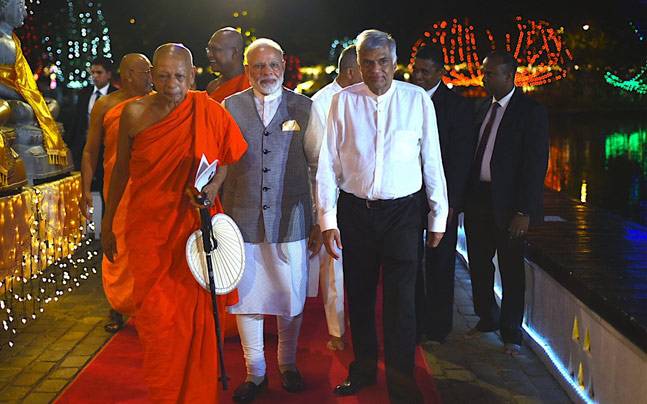
Successful Modi visit

May 14th, 2017

Editorial Courtesy The Island

It has been axiomatic that good relations with India must be the cornerstone of Sri Lanka’s foreign policy. This necessity has been largely observed during the post-Independence period, admittedly with some serious aberrations particularly during the war years. Relations were badly damaged when India, no doubt influenced by sub-regional concerns in Tamil Nadu and the demands of realpolitik, permitted the LTTE to train, base and stage from Indian territory during the early days of the civil war that wracked this country for nearly 30 years. Then India with its infamous parippu drop over Sri Lanka’s north weeks before the Rajiv-JR Indo-Lanka Agreement of 1987, prevented the Tigers being defeated at Vadamarachchi and indeed forced the agreement itself. Later, relations between the Premadasa government and India were strained due to the Sri Lankan president’s insistence that the Indian Peace Keeping Force (IPKF), here under the Indo-Lanka Agreement, must withdraw.

During the Sirima Bandaranaike years too there was a problem despite the special relationship between Mrs. Bandaranaike and Prime Minister Indira Gandhi. Mrs. B’s United Front Government during the Bangladesh war of 1971 surprisingly permitted technical stopovers at Katunayake to Pakistan Air Force flights denied entry into Indian air space while flying from West Pakistan to the East which eventually became Bangladesh. India’s unhappiness about this was palpable, but with Pakistan defeated and Bangladesh created, the Sirima – Indira relationship remained intact. But for the much greater part of Sri Lanka’s contemporary post-Independence history, relations with India were good primarily because Sri Lanka, at least tacitly, accepted India’s role as the regional power. We did not always totally fall in line with India’s wishes such as when the JRJ government permitted the Voice of America to set up a radio transmission station at Iranawila along the Western coast. But the broad brush canvas is that relations have been cordial without Sri Lanka ever becoming a client state of India. Incontrovertibly, India’s ongoing development thrust is offering Sri Lanka economic opportunities in many areas.

The Modi visit was undoubtedly a success with the visiting prime minister, despite his 66-years, shown on television sprightly bounding up the aircraft boarding ramp when he left on Friday evening demonstrating his physical fitness. Visiting dignitaries often interact with opposition personalities but the fact that the former President Mahinda Rajapaksa requested a meeting with the Indian prime minister came as a surprise in the context of Joint Opposition (JO) frontliner Wimal Weerawansa calling for a black flag protest over the visit. Neither the Indians nor the JO were forthcoming on the substance of the conversation between Modi and the Rajapaksas beyond saying that the 40-minute meeting at India House had been cordial. It wasn’t long ago that the JO had been freely alleging that India had a hand in the regime change in Sri Lanka two years ago. In fact, an Indian journalist who interviewed Rajapaksa recently pointedly put this question to him. The former president deftly fended her off saying there is no point in dwelling on the past; what we must do is focus on the present and the future, he said. That story had wide play in India.

Some analysts would surely have wondered whether Colombo leaked the news about the Chinese being refused a submarine docking in Sri Lanka, timing the story for the Modi visit to score brownie points with India. But well informed sources say this was not the case. After the story about the docking being denied broke, Reuters reported from Beijing that China’s Defence Ministry, in a statement sent to the news agency, did not directly mention the denial of the request but had said that in recent years, the Chinese and Sri Lankan militaries have had fruitful and effective cooperation in areas like mutual visits and training. It had said such cooperation “is beneficial to regional peace and stability and not aimed at any third party and should not be interfered in by a third party.” The ‘third party’ reference was obviously to India; equally obviously, Colombo’s denial of the submarine docking, last permitted in October 2014, was due to India’s unhappiness over the previous event. Sri Lanka has been quite open about the fact that the refusal was due to India’s concerns.

Contrary to what was said in some published reports, Prime Minister Modi did not “open” a new hospital at Dickoya. The plaque unveiled on this occasion made clear that this Indian-gifted hospital was dedicated by him. It had been completed and handed over to the Sri Lankan authorities in 2014 but had been only part-running since then due to equipment issues. Given that Modi was visiting Sri Lanka, and would welcome an opportunity of meeting of people of recent Indian descent upcountry, it had been decided that he would make the dedication and address the meeting that attracted a large crowd. Always the consummate politician, Modi who does not speak Tamil had worked hard on a few Tamil sentences to begin his speech, much to the delight of his audience, before switching to English. He said all the right things on this occasion although some carping critics have argued that any public meeting he had should have addressed a cross-section of the country’s population rather than exclusively people of Indian descent.

It was clear from the visit that India is keen on strengthening bilateral relations that are now excellent and is perceptive about the concerns and desires of the host. Agreeing to come here as chief guest for the UN’s International Vesak Day celebration was a generous gesture giving the event more weight and prestige than it would have otherwise attracted. This was of immense benefit to Sri Lanka. The occasion had great visibility in India and also elsewhere in the Buddhist world. In the context of domestic politics here, Indian diplomats were at pains to stress that the visit was purely Vesak related and no substantive issues would be taken up. That was the way it was played. Nobody would or could dispute the truth of Prime Minister Modi’s assertion India’s current development thrust would benefit her neigbours immensely. Sri Lanka has for long been using her location on the doorstep of the subcontinent as a major plank to attract foreign investment.

Long-term visas to attract expat Lankans, foreign investors and students

May 14th, 2017

 By Damith Wickremasekara Courtesy Sunday Times

Regulations are likely to be relaxed in the issue of visas to Sri Lankans currently holding foreign citizenship, investors, students and others, a Cabinet Minister said.   Internal Affairs Minister S.B. Nawinna told the Sunday Times the proposals, if approved by the Cabinet, would enable the Government to provide visas ranging from two to five years, instead of short term visas as currently issued.

He said the objective was to attract Sri Lankans domiciled overseas to return and stay here for longer spells, attract more foreign students and regularise the issue of visas for foreign investors. The minister said the move would help Sri Lankans who were unable to obtain dual citizenship in Sri Lanka would be able to apply for visas up to five years and visit the country to engage in professional services such as medicine and engineering. They would also be able to spend more time with their families

Mr. Nawinna said foreign students would be issued visas for the entire period of the course in one instance, instead of the requirement to extend the visas on a regular basis. Accordingly, the students would be able to apply for visas upto five years, depending on the duration of the courses.
We could attract more foreign students to study in Sri Lanka through the process,” he said.

The current system of issuing visas for foreign investors and workers would be relaxed enabling them to obtain long term visas, depending on the requirements of the project, instead of seeking extensions either every six month or every month.

He said the move will help the Government to reduce the number of persons overstaying visas and engaging in various professions or gaining employment as unskilled workers.

The move comes as the Government continued to issue dual citizenship to encourage Sri Lankans to return to the country, keeping with government policies.

At least 25,000 dual citizenships have been issued during the past two years.

Christian evangelist comperes at global Buddhist event!

May 13th, 2017

Janaka Perera

Did the organizers of 14th UN Day of Vesak (2561st ) at the BMICH Colombo lost their bearings or were they affected by amnesia?

Concerned Buddhists are raising the above question because a Christian fundamentalist Arun Dias Bandaranaike (Jehovah’s Witness) was invited to compere at the most important international Buddhist event on May 12? Could not the organizers find a Buddhist to be the English language compere at this ceremony? Which other predominantly Buddhist nation would do so? Will Muslims invite a non-Muslim to be compere at a Islamic event? Will Catholics invite a Jehovah’s Witness to be the compere at a religious event of theirs – let alone a Buddhist or a Hindu?

Surely did not the organizers have enough intelligence to realize that this was NOT a non-religious event where the compere’s religion does not matter?

https://youtu.be/K6OgHhKcNz8

The activities of Jehovah’s Witnesses have already been suspended in Russia, an Orthodox Christian country, over allegations of extremism. (I recall former Russian Presidential Candidate General Alexander Lebed saying in the 1990s that his country has four main religions – Orthodox Christianity, Judaism, Islam and Buddhism – and therefore did not need any more)

The dolts who organized the international ceremony at the BMICH were blind to the fact that it was essentially a Buddhist religious and cultural event – NOT a multicultural one.  This is the second attempt to multiculturalize a Buddhist event.  The first attempt was made during the 2600th Sambudhhatva Jayanthi in 2012 but did not succeed because of strong protests by concerned Buddhists.

Arun Dias (a relative of Chandrika Bandaranaike) may be a good presenter but that was not reflected at this event for reasons best known to the presenter.

He hardly had any praise for Buddhism or the Buddha in comparison to the Buddhist lady compere in Sinhala. Instead he adopted the multicultural line of speaking about inclusiveness, which was not relevant to the occasion. The content of his presentation differed qualitatively from the warm glowing presentation made in Sinhala by the other compere a lady who is a Buddhist.

His body language as a compere at the inaugural session of the UN Day of Vesak 2017 did not reflect great warmth towards the subject of Buddhism. There was no enthusiasm in his choice of words. This is to be expected given his close ties to an aggressive evangelical organisation.

Listen to the presentations by the two comperes and note the difference.

https://www.youtube.com/watch? v=K6OgHhKcNz8


WESAK CELEBRATIONS IN MALAYSIA

May 13th, 2017

Sumanananda Premseri 

Wesak was grandly commemorated througout Malaysia this last one week with thousands of devotees thronging temples and Buddhist centres in all 14 states of the country, where Wesak is a national public holiday, offering flowers, incense, candles, oil lamps, electric lights, etc and receiving blessings from monks and nuns. Buddhists make up 19% of Malaysia’s population and all three major Buddhist traditions of Theravada, Mahayana and Vajrayana are present here.

The Prime Minister, Datuk Seri Najib Tun Abdul Razak attended a Wesak Tea reception organized by the Joint Wesak Celebrations Committee which was attended by Ministers and also heads of various religious faiths.

Wesak candle light and float processions were also held throughout the country. In the capital, Kuala Lumpur, about 80,000 people headed towards the 122 year old Buddhist Maha Vihara which was founded by Sri Lankans who had migrated to Malaysia. The temple was a hub of activity. At the Wesak Dansal, about 15,000 packets of free vegetarian lunch were distributed and free cups of soya bean and juices were distributed throughout the day. An organ and blood donation campaign was held with more than 500 people successfully donating blood, after tests and checks by doctors. 

Thousands of free Buddhist books touching various aspects on Buddhism in 26 languages were distributed to the public which included Asian, European, African and South American languages. Hundreds were queuing to blessed by monks in the Main Shrine Room, built in 1894 and outside the towering International Buddhist Pagoda, built in 1971 where a relic of the Buddha is enshrined within a receptacle placed at the pinnacle. An Eight precepts observance program was also held.

On Wesak night, Federal Minister Datuk Seri Liow Tiong Lai launched the Wesak float procession which saw about 30,000 Malaysian Chinese, Indians, Sinhalese and Buddhist of various countries such as Sri Lanka, Bangladesh, India, Nepal, Myanmar, Thailand, Cambodians, etc participating in a candle light and float procession of 20 colourfully decorated floats.  

MAHAYANA BUDDHISM and NICHIREN DAISHONIN

May 13th, 2017

By Dr. Tilak S. Fernando

The value of life does not lie in the number of years, but in the use you make of them. Whether you have lived enough depends on your will, not on the number of years”.-Michael de Montaigne

1553-1592. According to Shakymuni, the term “Buddha” is applicable to an “enlightened one.” He who correctly perceives the true nature of all the phenomena and leads others to attain Buddhahood or development of mind. The “Buddha nature” according to Buddhism that exists in all beings is characterized by the qualities of wisdom, courage, compassion and life force.

Out of all the Shakyamuni’s discourses during the enlightened one’s sojourn on earth, the penultimate philosophy prior to Parinibbna (demise) was known as the Sathdharma Pundarika Sutta (Lotus Sutra) conferred from the Eagle Peak or Gijja Kuta Parwatha to Bodhisattvas on earth, devotees and millions of people. It is deemed to be Gautama Buddha’s the utmost discourse wrapping up all what Shakymuni had preached before.

Lotus flower

The term “Sathdharma” refers to the comprehensive nature of life; Pundarika indicates the lotus flower with a deep-rooted meaning. The lotus plant, which grows in muddy ponds blooms and produces seeds simultaneously. It is illustrated as an expression of the Mystic Law or the process of cause and effect and, when it blooms, it is regarded as a symbol of realization within the life of a common mortal.

The Lotus Sutra has been one of the most popular and influential Mahayana principles of Buddhism on the basis of which the Nichiren schools of Buddhism were established. In many Asian countries Mahayana Buddhists believe that the Lotus sutra contains the final teachings of the Buddha that is sufficient for one’s salvation.

Mahayana Buddhists believe that Gautama Buddha’s philosophy would meaningfully be cherished and captivated by the laity during the first thousand years, but it would begin to decline during the second thousand years and after 2500 years further. It is also mentioned that during the penultimate discourse, the Buddha addressed Bodhisattva Vishishta Chaaritra, who was present at the sermon, and conferred upon him to take over the responsibility of executing and upholding Buddha’s dharma, proclaiming Vishishta Chaaritra would be reborn in the eastern part of the world at the opportune moment for this purpose”.

Vishishta Chaaritra

As prophesied, Vishishta Chaaritra was reborn on 16 February 1221 in Japan and given the name Sen Nichi Maro. Young Sen Nichi Maro travelled up to the ancient temple in Nara where he came across the Lotus Sutra and studied it intensely and acquired a profound knowledge ‘spiritually’ to reach sainthood. He then assumed a sanctified name as Nichiren Daishonin. In Japanese, ‘Nichiren’ means sun, while ‘Daishonin’ means great sage. Thereafter, Nichiren Daishonin priest became the founder of Daishonin Buddhism and based his teachings on the Lotus Sutra in the 13th century (1222–1282). It is also known as “Kamakura Buddhism”.

Pathway to happiness

The Lotus Sutra defines Buddhism as a pathway to happiness and welfare of an individual. Three main elements in Nichiren Daishonin Buddhism are Faith, Practice and Study. Faith means to have expectation from the Gohonzon (Dharma Datu), which is the true object of worship for all people of the ‘latter Day’ (“fifth five hundred years” after the Parinirvanaya (demise) of Gautama Buddha or the present period of time of the law). “Go” means worthy of honour; “Honzon” means object of fundamental respect.

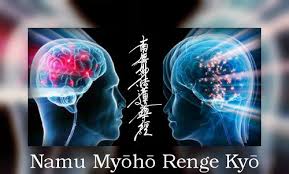
The Lotus Sutra has 28 chapters in all. Nichiren Daishonin summerised these 28 chapters into five simple Japanese segments to sound as: Nam–Myo–Ho-Renge-Kyo, (or Gohonzon).

In Nichiren Daishonin Buddhism, Gohonzon is regarded as the main object of fundamental respect that embodies the Law of Nam-Myo-Ho-Renge-Kyo (The ultimate law or true essence of life permeating everything in the universe). A remarkable feature in this religion is that devotees never worship statues or pictures except the Gohonzon.

Gohonzon

Gohonzon consists of the Japanese stanza (seven segments) written vertically surrounded by characters representing gods Buddhists believe in (Satharawaram devio) and the ten worlds representing (1) Hell: a condition in which one feels totally trapped by one’s circumstances. (2) Hunger: A condition characterized by insatiable desires. (3) Animality: A condition governed by instinct in which one has no sense of reason or morality and lives only for the present. (4) Anger: A condition dominated by the selfish ego, competitiveness, arrogance and the need to be superior in all things. (5) Humanity or Tranquility: Calm state. (6), Heaven or Rapture: The pleasure felt when desires are fulfilled (7) Learning: A condition in which one seeks some skill, lasting truth or self reformation through the teachings of others, (8) Realization or Absorption: A condition in which one discovers a partial truth through one’s own observations and effort, (9) Bodhisattva: A state of enlightenment of oneself and (10) Buddhahood: A true state, indestructible happiness, a condition of perfect and absolute freedom, characterized by boundless wisdom, courage, compassion and energy.

When one chants Nam-myo-ho-renge-kyo to the Gohonzon, ‘one is able to bring forth the law of life within oneself to fuse one’s life with the Gohonzon’. Through this fusion adherents are able to attain the objective of their practice- the Buddhahood. Everything in Gohonzon is based on the Dai-Gohonzon, which Nichiren Daishonin inscribed on 12 October 1279. It was chanted for the first time on 28 April 1253.

Gods

Who are gods identified by Buddhists? Nichiren Daishonin Buddhists believe anyone or anything in our environment working to protect and sustain life, or to support man’s efforts to attain enlightenment and achieve Kosen-rufu (to widely declare and spread Buddhism).

Chapter 23 of the Lotus Sutra refers to the “fifth five hundred years” (after the death of Gautama Buddha or the beginning of The Latter Day of the Law, and the present period of time). Sometimes Kosen-rufu is referred to as world peace that will come about as faith in the Mystic Law that spreads from person to person awakening their Buddha nature by chanting Nam-myo-ho-renge-kyo.

Daishonin has indicated an eternal flow of Kosen-rufu when he declared, “Nam-myo-ho-renge-kyo will spread for ten thousand years, and more, for all eternity”.

Nichiren Daishonin specified recitation of certain portions of the Lotus Sutra as a vital supporting practice for oneself. Doing both the primary and supporting practices each morning and evening is supposed to give rise to maximum joy and benefit in our daily lives. He has never given any specific instructions on the format for the sutra recitation, but has recommended reciting the “Expedient” in the 16th chapter, which is the heart of all Buddhist teachings. In the ‘Expedient” Shakyamuni Buddha reveals the purpose of Buddha’s advent in the world to lead all people to enlightenment, and how every being has the potential for Buddhahood. Gautama Buddha taught man’s existence as identical to the universe as a whole, and the universe as a whole is identical to our existence, and each individual human life as a microcosm of the life of the universe.

When devotees chant Nam-myo ho-renge-kyo (the universal law), their lives are supposed to perfectly harmonize with the universe. By carrying out these practices on a daily basis, they automatically tend to activate the infinite powers that the microcosm inherently possess by transforming a person’s fate and helping the person to break through apparent deadlocks and convert sufferings into happiness. In other words, it creates a transformation of inner realm, leaving the person invigorated, refreshed and positive. Through one’s primary practices one would be able to develop wisdom and compassion to lead both, one’s life and others to happiness.

Soka Gakki

Based on the teachings of Nichiren Daishonin, a group of intellectuals in Japan formed a movement known as Soka Gakki in November 1930. During the World War II,  many anchormen of the association were imprisoned under the ‘Peace Preservation and Law violations charges’. After the war, however Soka Gakki has expanded into more than 192 countries with millions of devotees around the world. The organisation’s third president, Dr. Dausaku Ikeda, visited Sri Lanka in 1961. Having fathomed the spiritual substance of Sri Lankans by visiting the Dalada Maligawa in Kandy, he developed a dream of establishing a branch of the Soka Gakki in Sri Lanka for the moral augmentation of all people.

An extraordinary feature of this Buddhist organization is the responsibility shared mutually by the laity who dedicatedly engage in promoting peace, education and culture through Buddhism based on Gautama Buddha’s Lotus Sutra. Soka Gakki Lanka Buddhist Association is a registered charity organization under the Company Act, engaged in voluntary work for the betterment of peace, harmony and education of the masses in Sri Lanka through the practice of Buddha’s dharma. During the Tsunami disaster Soka Gakki Lanka Buddhist Association donated Rs. 20 million worth of aid to the Tsunami affected people, schools and Buddhist temples.

Apart from religious guidance and practice, Soka Gakki Lanka Buddhist Association concentrates on peace, culture and education, including Kandyan dance, song and drama, with a multiple of other enlightening activities where even senior members share their experience in the belief of changing their past karma by practising this concept of Buddhism.

tilakfernando@gmail.com

Education as Embodied Cognition

May 13th, 2017

R Chandrasoma

It is traditionally supposed that learning – education in its broadest sense – is an activity of the Mind and that the body is a mere appurtenance that works in the service of the mind. Indeed, the  traditional view is that the corporeal must be subdued for the ‘unleashing’ of the mental.  In what may be called the ‘paradigmatic teaching set-up’, a ‘Know-All’ or ‘Teacher’ acts as an authoritative source of information that is ‘transferred’ to a pupil or set of pupils. A class-room serves a coercive function – a ‘trap’ that prevents a cross-classroom dialogue and other hindrances to efficient transfer of information. The ‘learning body’ is thus forced into passive subservience. No surprise, then, that ‘discipline’ is a much-admired virtue in schools. This strange arrangement has a history – schooling was first devised by monks and is rooted in the religious tradition of ‘imparting knowledge’ wherein a ‘Guru’ acts as a conduit for the transfer of the wisdom of the Sages to untutored and compliant pupils, In contrast to this ancient folly, we have today  – or hope to have in the future – what is called ‘embodied cognition’ where education is through an interaction of whole beings – of bodies and minds that jointly adapt to the intellectual challenge of existence. We learn through interaction of whole beings and ‘instruction’ must be collegial and democratic.

How does this new philosophy of education express itself in practice?  Above all, pupils must not be in competition – the group learns collectively by adopting the famous maxim – ‘Each for All and All for Each’. The class advances as a whole by the strong helping the weak- indeed, the class is no longer a test-bed for the advancement of an elite but an organic whole trying to make sense of the world. In Mathematics the gifted will feel it a duty to help the weak by working with them – not by outsmarting them and winning the plaudits of the teachers. In languages –where, again, there are natural differences in ability – the fluent must help those struggling to cope and the class must advance as a whole living system. This does not mean that natural differences must be erased – it means that such differences must be exploited for the good of the Whole – not for the aggrandizement of the favoured few. What is the part of the traditional teacher in this new dispensation? He moves into the class – abandoning his High Seat as the Teacher – and actively seeks to enhance the quality and sophistication of the general dialogue in the classroom by ‘injecting’ his expertise where necessary. Contrast this new image of the Teacher with that of the Cane-Welding Tyrant punishing the Fools. It was held in those bad days that ‘ignorance’ and ‘intellectual laziness’ were punishable offenses. It was also held that personal advancement was achieved by ‘defeating’ others. These ancient follies must be eradicated

In a broad sense, education that seeks to ‘fill the individual’ with a prepared ‘formulation’ served by those with a vocational commitment to do so, is not genuine. .Authentic education ought to be part of societal dynamic in which the individual uses both body and mind to enhance his viability and performance as a thinking citizen through collegiality and the intercourse of minds. That in Sri Lanka we are dismally short of this target becomes evident when we reflect on the ‘abyss’ of University Education and the pathetic  lack of  open and unfettered intellectual discourse in the public life of this country,

Saudi Arabia lobbies to amend JASTA law which allows 9/11 victims to sue the Gulf state

May 13th, 2017

Courtesy RT

Saudi Arabia has been pressing US legislators to make amendments to the controversial law that clears the way for lawsuits seeking damages from the kingdom regarding the 9/11 terrorist attacks, according to the Saudi foreign minister.

Following an extended trip to the United States, Adel al-Jubeir told reporters on Sunday he has been trying to persuade [US lawmakers] that there needs to be an amendment of the law,” the Justice Against Sponsors of Terrorism Act (JASTA), that legitimizes lawsuits by Americans regarding terrorist attacks committed on US soil.

We believe the law, that curtails sovereign immunities, represents a grave danger to the international system,” Jubeir said at a joint press conference with visiting US Secretary of State John Kerry, as cited by AFP news agency. Saudi Arabia has repeatedly expressed these views since the US Congress passed the legislation in September, overriding US President Barack Obama’s veto of JASTA. This time, however, negotiations on the matter have already been held, the Saudi minister said.

The question now becomes how do you go about amending the law,” he said.

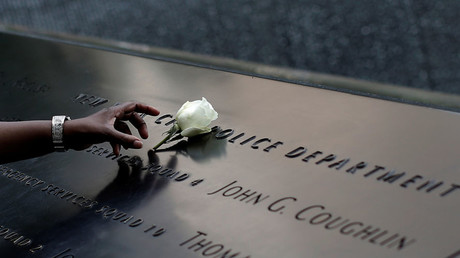
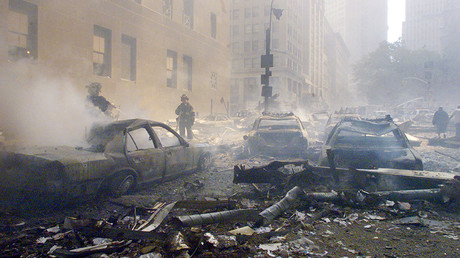
Fifteen out of the 19 hijackers involved in the 9/11 attacks that killed nearly 3,000 people were Saudi subjects. The kingdom, however, has denied any ties to the hijackers.

The JASTA law allows attack survivors and relatives of attack victims to file lawsuits against foreign countries for acts of terrorism that kill Americans on US soil. Also known as House Resolution 3815, it creates an exception to the sovereign immunity law introduced in 1976, allowing US citizens to sue foreign governments in US federal court and demand compensation if those governments are proven to bear some responsibility for attacks within the US.

This exception drew concern from many countries – both in the Gulf and globally – that the legislation will erode sovereign immunity, considered one of the founding principles of international relations.

Some British, French, and Dutch lawmakers have threatened retaliatory legislation to allow their courts to pursue US officials, which is why outgoing President Obama vetoed JASTA in the first place, explaining that it would harm American interests as it opens the United States up to private lawsuits over its military missions abroad.

The United States is, by eroding [the sovereign immunity] principle, opening the door for other countries to take similar steps and then before you know it international order becomes governed by the law of the jungle,” the Saudi foreign minister said.

Saudi Arabia recently warned it would pull its money out of the US economy, selling up to $750 billion in US treasury securities and other assets, before lawsuits demanding compensation start pouring in and put these assets in jeopardy. However, responding to a question on whether Saudi Arabia was still reconsidering its investment strategy on Sunday, Jubeir assured reporters that it plans to continue with its investments and does not plan to decrease them.

[The Kingdom] has tremendous investments in the United States and we review those investments on a regular basis. There are issues associated with risk, but our objective is to increase those investments. We won’t decrease them,” he said, as cited by Reuters. The US Treasury Department said that the kingdom owned $116.8 billion in securities in the US as of March this year.

SECRET HANDS IN AFGHANISTAN

May 13th, 2017

ALI SUKHANVER

Pakistan has closed its border with Afghanistan after the increasing tension between the two countries. According to Al-Jazeera the so-called Durand Line frontier drawn by the British in 1896 and disputed by Afghanistan has been witnessing unpleasant reaction of the Afghan government since Pakistan began patrolling along it last year. This 2,600 km long border line has ever been under severe tension. The situation along this border became more tense when on 5th of this May Afghan border forces opened fire on Pakistan’s security personnel guarding a census team in Balochistan’s Chaman area. At least nine people were killed and over 40 others injured as a result of this firing. Pakistan’s military’s media wing said narrating the details that  Afghan Border Police had been creating hurdles in conduct of census in divided villages of Killi Luqman and Killi Jahangir in Chaman area on Pakistani side of the border since April 30. After this grave loss the security forces of Pakistan had to pay back in the same coin. Media says more than 50 Afghan security personnel were killed and another 100 injured. However, the Inspector General Frontier Corps Balochistan Maj. Gen Nadeem Anjum said, “We are not happy over their losses since they are our Muslim brothers”. A senior officer of the Pakistan Army General Amir Riaz said talking to the media reporters on the same issue that the situation will remain the same “until Afghanistan changes its behaviour”. He further said that Afghanistan would not benefit from such attacks in any way and that the Afghan government should be ashamed of such acts.

Practically there had been two different incidents along the Durand Line; one of unprovoked firing on innocent Pakistani civilians and second of Pakistan’s response to this injustice; but it is something very unfair that Indian patronized Afghan media is trying to tell the world a one-sided story in which Afghanistan is being portrayed as a helpless and voiceless country which is in serious trouble at the hands of Pakistan. The Indian patronized Afghan media is trying to show the world that picture of Afghanistan which actually never belonged to Afghanistan. The land red poppies, the safe haven of suicide bombers and a paradise of across the borders miscreants is being painted as a very peaceful and safe country where all people are very happy with the Ashraf Ghani government; where the people have no reservations regarding Indian interference in the country; and where the Taliban have comfortably adjusted them with the present political scenario of Afghanistan with US sending more troops. But the realities are altogether otherwise there in Afghanistan. If Afghanistan were really such a beautiful land of peace and prosperity, millions of Afghans living in Pakistan would not have flatly refused to go back to their own country. For the last many decades Afghanistan has simply been a battle-field, a land of war-lords. No institution, no production, no system; Pakistan knows it very well that its own political, social and economic stability is directly linked with the peace and prosperity of Afghanistan; same thing is also to the knowledge of all hostile forces active in Afghanistan. They know it very well that by destabilizing Afghanistan, Pakistan shall be directly affected. Earlier these hostile forces had been trying to play the same game in Pakistan but Pakistan’s security forces and the government did not let them play. So now they are trying to kill two birds with one stone. Blaming Pakistan for Mazar-e-Sharif suicide attack and for other terrorist activities in Afghanistan is also a part of the same game. Sometimes it seems a hobby or a technical compulsion or an instinct of some people that they don’t feel satisfied unless they drag Pakistan and its Army into the affairs which in no way belong to both of them. Just cast a look at the recent suicide attack in Mazar-e-Shareef Afghanistan in which a group of disguised suicide attackers manning national army vehicles targeted an army base. In this deadly attack more than 140 Afghan soldiers were killed and countless injured. US military sources confirmed the presence of some important coalition personnel inside the Mazar-i-Sharif base but they all remained safe and there were no reports of casualties among their number. Just after the attacks a senior American military official in Kabul said that it appears likely the attack was either carried out by or planned by a Pakistan-based Taliban faction known as the Haqqani network which is a U.S. government-designated terrorist organization. The official added that the assault likely took four to six months to plan and that it was also likely the attackers had help in advance from Afghan troops on the base. The same story was narrated by a spokesman of the Afghan Ministry of External Affairs but in different words. He said, “The terrorist attack is a stark reminder of the need to immediately dismantle the safe havens and sanctuaries that support and sustain terrorism in Afghanistan from outside its borders.”  All these statements and analysis prove that the actual motive behind this ready-made attack on Mazar-e-Shareef base was to fix and frame Pakistan and to prepare ground for the recent bombing on innocent Pakistani citizens. Blaming Pakistan for all that goes wrong in Afghanistan is not the solution; the Afghan government must try to search for the facilitators of such terrorist activities from within Afghanistan. These facilitators might be among the US troops or among those local Afghans who are playing in the hands of Indian intelligence agencies and might be hidden in the ranks and files of Afghan police and army. Reports say that there are more than 30000 ghost soldiers in ANSF and many more aligned to warlords with tribal loyalties. Even Taliban are also not happy with the Ashraf Ghani government. Ashraf Ghani government must not waste it time and resources in defaming Pakistan for the things Pakistan has nothing to do with. This behaviour of the Afghan government would simply add more miseries to the millions of Afghan refugees in Pakistan.

Kuveni remembered at this time

May 13th, 2017

Courtesy Ceylon Today

Kuveni is remembered or should be at this time of year as it is written in historical texts of the island that Prince Vijaya landed in Tambapanni (proximate to present day Chilaw) on the day of Buddha’s Parinibbana dated variously, but usually accepted as 503 BC. Hence while Vesak commemorates the most important dates in the life of the Buddha, it is significant to the island and the Sinhala race that our origin could be traced to the meeting of Kuveni with Vijaya, the day he landed in this island having been banished from Bengal but now believed to be from Odissa on the full moon day in the fifth month of the calendar we follow.

Kuveni, also known as Sesapathi, was a Yakshini queen mentioned in the ancient Pali chronicles Mahavamsa and Dipavamsa, the primary source for her life-story being the former history mixed with legend. She is venerated as Maha Loku Kiriammaleththo by the Veddahs.

Kuveni and Vijaya

Kuveni is said to have been spinning when she got the news of the landing of a huge contingent of sailors. This is a pointer to the fact that the island had an ancient civilization. Legend has it that she possessed witchcraft and so enticed the Prince who was brought to her as a 16 year old beauty. Kumari does not hold with such a tale. She prefers to believe that Kuveni, perhaps older than the newly arrived prince, was attractive enough since Vijaya knew how to do best for himself as later events proved.

He would have thought it judicious, naturally, to be attracted by the woman who was the virtual ruler of the place. The abundance of her area is proven by the fact that she ordered that all 700 followers of Vijaya be fed, housed and clothed. Kuveni, falling in love with him, offered to share her reign. He soon took over as king and after having two children by Kuveni, banished her. The story has it that he banished only her, wanting the two children, son Jeevahatta and daughter Disala to remain with him. However, she took them with her and they are supposed to be the progenitors of the Veddas – Sri Lanka’s aboriginal population. According to the Mahavamsa, Vijaya encountered God Sumana Saman on landing, who, according to legend, was charged by the dying Buddha with looking after the island of Lanka and also Vijaya and his descendants.

Traitor

Kuveni was herself a traitor. Lanka, when approached by Vijaya and his 700 men had three gothras or tribes: Deva, Naga and Raksha, The first were the administrators, the Naga carrying out tasks delegated to them and the Raksha metal smiths, regarded as a descendant of the Rakshas of the Ramayana and of Ravana. Due to her consorting with Vijaya, Kuveni’s people were angered. Thus, once Vijaya was established as the ruler to the Raksha domain, she got him to command his 700 fellow Indians to slaughter the Rakshas to save herself. When banished by Vijaya from his palace, she went back to the remnants of her clan. She was killed by them, one legend avows. The two children were left in the forest glades of Bambawa of the North West region in Sri Lanka. And when the mother did not return they trekked towards Sabaragamuwa.

An alternative tale is that Kuveni flung herself from Yakdessa Gala, imploring the Gods to curse Vijaya for his cruelty and implored that none of his sons would rule the land. Interestingly the curse held since Vijaya had no children by his Indian wife.

Kuvenis ghost

Kumari remembers holidays spent with a brother long ago in Anamaduwa. Travelling to Puttalam, one passed a place called Thonigala. By the roadside was a single large boulder.The little child was told that on moonlit nights the ghost of weeping Kuveni would be seen on the rock. Kumari was terrified and remembers she would close her eyes until the car went well past Thonigala.

Night travel was often, because her brother had friends in Puttalam who would invite him and his very young pair of siblings to dinner. This necessitated a drive of about 17 miles in pitch darkness except for the car lights and pairs of glistening jewels – eyes of animals emerged from the jungle to the road. Elephants were very common, hence the journey home to the government bungalow at Anamaduwa was hazardous with wild animals in their numbers, plus a reputed wailing ghost on a rock.

That apart, Kuveni’s tale is tragic but all too common even in this day and age. How many women have been betrayed by lovers and husbands? No wonder her curse seemed to have worked. Although Vijaya chased Kuveni away to install a princess from India as his bride, his progeny did not ascend the throne fought for and created by him from the portion in the north western part of the island, bestowed on him by Kuveni.

He ruled for 38 years (543-505 BC). Having no children from his Indian queen, he sent a message to his twin brother Sumitta in India to come over to rule the newly acquired land. But Sumitta was too ill so he sent his son to Lanka. Upathissa, his chief minister ruled for one year from 505- 504. Then Panduwasa Deva, Sumitta’s elder son, ruled (504-474) and after him the crown of the region went to second son Abhaya (474- 454). Anuradhapura Kingdom

Pandukabhaya – grandson of Panduwasa- was the next king for 70 years (437- 367 BC) when the capital was moved to Anuradhapura and thus the beginning of the Anuradhapura Kingdom.

The curse of Kuveni is interesting, two pronged as it was against Vijaya and her own people. Some people believe that it still holds.

Why else is Sri Lanka eternally in trouble? The late dramatist, Henry Jayasena, created a stylized play by the title Kuveni which ended with the startling silhouette of a black figure with raised arms and outstretched finger against a red backdrop.

– Kumari

The contempt of court case against Dr Padeniya

May 13th, 2017

by C.A.Chandraprema Courtesy The Island

Two NGO activists have filed a contempt of court plaint against Dr Anuruddha Padeniya the President of the GMOA over certain comments he made at a public meeting held to demand the ‘state-ization’ of the SAITM medical course on 7 April 2017. The gist of what Padeniya said at that meeting was that in 2010 the GMOA had put out a 20 page document outlining the shortcomings in the medical course offered by SAITM. At the time this document was released, the Minister of Health was Maithripala Sirisena. The latter had seen the report and he had told the GMOA that he too agrees with the contents of that report and had asked what he should do about it as the Minister of Health. The GMOA had suggested to him that since this was a report prepared by a trade union, he should appoint an official five member committee through the Health Ministry to go into the issues raised in that report.

article_image

Dr Anuruddha Padeniya

Padeniya said that a five member committee made up of medical professionals, lawyers and administrators was duly constituted and the GMOA and other parties had made representations before this committee. The committee had put out their report in 2012 as the official view of the Ministry of Health and these had run parallel to the earlier report compiled by the GMOA. Padeniya complained that the present Minister of Health has not presented these two reports to courts. He stated that in every court case relating to SAITM that came up, the GMOA had tried to present these two reports but every time they did so, the lawyers representing SAITM had withdrawn the cases. He stated that the reason why the GMOA has had to come on to the streets is because these two reports have not been presented to courts. Padeniya stated that the Attorney General was also complicit in this by not presenting these two reports to court.

He stated that “some politicians say that if the Medical Council acts against a decision handed down by the judiciary, they will be taken to courts. Tell them to take the Medical Council to any court. If the courts can’t dispense justice, if the courts are unable to look at the two reports published by the GMOA and the five member committee appointed by the Health Minister, and they can look only at what is put before them by the Attorney General, what kind of justice can the people of this country expect?” Taking himself as an example, Padeniya said that if he goes to hospital and makes a decision based entirely on what is said to him by other doctors below him, how can he be considered a medical specialist? “If the court looks only at whatever is put before them by the Attorney General, what then is the purpose of paying salaries to judges?” That is the gist of what what Dr Padeniya said at that meeting which is now subject to contempt of court proceedings.

The present courts system in this country was set up by the British and the contempt of court laws that were introduced in the colonies served a purpose other than just upholding respect for the judiciary. As far back as 1899, Lord Michael Morris observed in McLeod v. St. Aubyn that contempt of court by ‘scandalizing the court’ had become obsolete in Britain, and added significantly that however, “in small colonies, consisting principally of coloured populations, the enforcement in proper cases of committal for contempt of Court for attacks on the Court may be absolutely necessary to preserve in such a community the dignity of and respect for the Court!” In this matter, it is important for us to stop thinking like ‘natives’ and to remember that we are now a sovereign nation and not a colony of some master that needs to preserve colonial rule by restricting the right of the natives to comment on the workings of the colonial courts system. This is also a democracy where the people are sovereign.

Scandalizing the court

It is important to see how the law in relation to the contempt of court has evolved in Britain itself (as against the colonies) with the revolution in communications and the appearance of the internet and the social media and other such developments. The observations of Lord Morris in McLeod v. St. Aubyn show that for well over a century, the idea has been prevalent at the very highest levels of the British judiciary that the category of contempt of court called scandalizing the court is obsolete. The British Law Commission has compiled a list of contempt of court and the only category of contempt of court that Padeniya’s comments would fall into would be ‘scandalizing the court’.  The British Law Commission (BLC) defines the offence of scandalizing the court as ‘publishing material or doing other acts likely to undermine the administration of justice or public confidence therein’.

It may be argued that when Padeniya poses the question as to why judges are paid salaries if they only look at what is put before them by the Attorney General, and questions what kind of justice people can expect in such circumstances, that he has indeed ‘scandalized the court’ because what he said may be construed as undermining confidence in the judiciary. However, the British Law Commission defines ‘publishing material or doing other acts likely to undermine the administration of justice or public confidence therein’ as having occurred only when there is ‘scurrilous abuse of the judiciary or imputing to them corruption or improper motives’. In this instance, Padeniya did neither. He was expressing a grievance about the way the courts functioned.

This grievance was expressed in public in the context where the GMOA had not been allowed to join as an intervenient petitioner in a case filed by students of SAITM in the Supreme Court against the failure of the authorities to provide them with clinical training in government hospitals. The GMOA had thus been debarred from stating their grievances in court. If someone argues now that the views that Padeniya expressed in public amounts to contempt of court, the GMOA will have no forum to express their views and will effectively have been gagged and silenced. This is why it is vitally important to take note of the developments in Britain with regard to this whole concept of ‘scandalizing the court’. The British Law Commission observes in this regard that:

“The rationale for an offence of scandalizing the court derives from the need to uphold public confidence in the administration of justice. In many ways, this need is particularly acute in a democracy, where the power and legitimacy of the judicial branch of government derives from the willingness of the people to be subject to the rule of law. In consequence, the public must have faith in the judicial system. Yet, in a democracy, the public also has the right to speak freely about the exercise of power, which must include the freedom to criticize the judicial system and the judiciary…Balancing this right to freedom of expression with the importance of upholding public confidence in the administration of justice is at the heart of the debate about the offence of scandalizing the court”.

What the Law Commission said

The British Law Commission (BLC) observed that in the 1985 case of Secretary of State for Defence v Guardian Newspapers Ltd  it had once again been stressed that scandalizing the court as a branch of contempt of court had been ‘virtually obsolescent’ in England and Wales and the last recorded successful prosecutions were in 1930 and 1931 and that most of the cases reported in England and Wales since the 1930s have been appeals to the Privy Council from Commonwealth countries (the very colonials that Lord Morris deemed to be most in need of contempt of court laws!) and that it appears that the offence of scandalizing the court has been used more frequently in Asia and the Pacific Rim than in England and Wales. (A telling statement that our legal fraternity should take good note of.)

The BLC also pointed out that it has been argued that the offence may be necessary as a means of preserving the dignity of and respect for the courts in jurisdictions where political conditions ‘are less stable’ than in England and Wales. (Again an obvious reference to the former colonies inhabited by us natives.) On the other hand, it has been argued that prosecutions for this offence may be counterproductive, as they may be perceived, rightly or wrongly, as attempts to suppress political dissent. (This is the post-colonial version of Lord Morris’ dictum with the British colonial master replaced by the local politician and the ‘native’ replaced by ‘the people’. If the people are to have due respect for the courts, the contempt of scandalizing the court has to be implemented in the now independent former colonies, but it’s not needed in more ‘civilized’ places like Britain.)

Interest in the offence in the UK was revived in March 2012 when the Attorney General for Northern Ireland obtained leave to prosecute a Member of Parliament, Peter Hain, for statements made in a book he had written criticizing a judge for his handling of a judicial review application. Hain’s counsel had argued that the facts did not amount to contempt of court; and also questioned whether scandalizing the court still existed as an offence. The prosecution was later discontinued. In the wake of this affair, two distinguished law lords, Lord Anthony Lester and Lord David Pannick, called for the offence of scandalizing the court to be abolished. The offence of ‘scandalizing the judiciary’ has now been abolished in England and Wales by Section 33 of the Crime and Courts Act of 2013 – a point that all former colonials should take note of.

Tracing the history of the concept of scandalizing the court, the BLC observed that the first mention of this concept was in a draft judgment in the 1765 case of R. v. Almon where Justice John Wilmot observed that “The arraignment of the justice of the judges, is arraigning the King’s justice; it is an impeachment of his wisdom and goodness in the choice of his judges, and excites in the minds of the people a general dissatisfaction with all judicial determinations, and indisposes their minds to obey them; and whenever men’s allegiance to the laws is so fundamentally shaken, it is the most fatal and most dangerous obstruction of justice, and, in my opinion, calls out for a more rapid and immediate redress than any other obstruction whatsoever…”

Even though a British judge said so in 1765, as we saw earlier, more than a century later, by 1899, another distinguished British judge said that the concept of scandalizing the court was virtually obsolete. In an early British case, R v. Grey (1900) a journalist was actually found guilty of scandalizing the court by describing a judge as an “impudent little man in horsehair, a microcosm of conceit and empty-headedness” and for stating that while no newspaper can exist except upon its merits, that is a condition ‘from which the bench, is exempt’. Even in delivering a guilty verdict in such a clear cut case of insulting a judge, the Lord Chief Justice of England Charles Russell took care to distinguish that from justifiable criticism. He observed in his judgment “Judges and courts are alike open to criticism, and if reasonable argument or expostulation is offered against any judicial act as contrary to law or the public good, no court could or would treat that as contempt of court.” It should be borne in mind that this case was heard way back in 1900. It can be seen from this that there has been a long standing and visceral dislike at the highest levels of the judiciary in Britain against penalizing anyone for justifiable or reasonable criticism of a judge or the judicial process.

The right to demand justice

In 1936, a case from Trinidad and Tobago, Andre Paul Terence Ambard v. The Attorney General came before the Privy Council in appeal. This was a case where the editor of a newspaper in Trinidad and Tobago published an article finding fault with the subjectivity of two judgments that were delivered within days of one another. The newspaper observed that the infliction of the sentence is entirely at the discretion of the judge who has wide latitude from a few days to life-long imprisonment for the crime of attempted murder and that some way should be devised for the greater equalization of punishment with the crime committed. The Supreme Court of Trinidad and Tobago imposed a fine of 25 Sterling pounds on the newspaper editor on the grounds that this article had been written with the direct object of bringing the administration of the criminal law in this colony into disrepute.

Lord James Atkin observed in upholding the appeal against the Trinidad and Tobago Supreme Court that there is no evidence in the article at the centre of the controversy or any facts placed before the court to justify the finding that contempt of court has been committed and that “no wrong is committed by any member of the public who exercises the ordinary right of criticizing in good faith in private or public the public act done in the seat of justice… provided that members of the public abstain from imputing improper motives to those taking part in the administration of justice, and are genuinely exercising a right of criticism and not acting in malice or attempting to impair the administration of justice, they are immune. Justice is not a cloistered virtue : she must be allowed to suffer the scrutiny and respectful even though outspoken comments of ordinary men”.

The British Law Commission observed that “formerly much emphasis was placed on the distinction between respectful criticism and scurrilous abuse. Increasingly today the style of the publication alleged to constitute the offence is not considered relevant, and vigorous criticism is allowed… no criticism of a judgment, however vigorous, can amount to contempt of court, providing it keeps within the limits of reasonable courtesy and good faith…”. The BLC observes that today, even ‘reasonable courtesy’ no longer seems to be a requirement. According to Justice James Munby in Harris v Harris (1995) “… that which is lawful if expressed in the temperate or scholarly language of a legal periodical… does not become unlawful simply because expressed in the more robust, colourful or intemperate language of the tabloid press or even in language which is crude, insulting and vulgar … Moreover, a much more robust view must, in my judgment, be taken today than previously of what ought rightly to be allowed to pass as permissible criticism. Society is more tolerant today of strong or even offensive language. Society has in large part lost its previous habit of deferential respect. Much of what might well even in the comparatively recent past, have been considered by the judges to be scurrilous abuse of themselves or their brethren has today, as it seems to me, to be recognized as amounting to no more than acceptable, if trenchant criticism”.

Acceptable and unacceptable criticism

The BLC observes that this more relaxed attitude is reflected in the fact that the Daily Mirror (in Britain) was not prosecuted when it published upside-down photographs of three Law Lords with the words ‘You Fools!’.  At this point, Sri Lankans would begin to think that the British press was exercising too many liberties with the judiciary. But an upside down photograph of three Law Lords with the caption ‘You fools!’ is nothing compared to what regularly happens in this country. Sri Lankan websites which mainly operate from overseas regularly publish articles vilifying judges, accusing them of being on the take and even publishing scurrilous stories about their sex lives. This happens when any judge delivers a ruling not to the liking of that website owner. The Sri Lankan judiciary has not been able to do anything about this even though such articles are always published with a view to influencing the administration of justice.

Compared to what the Sri Lankan judiciary has to go through on a regular basis at the hands of the websites, whatever mild indignities that British judges suffer at the hands of the British press, pales into insignificance. The British Law Commission is therefore right when they speak in favour of leaving even ‘robust’ criticism of judges and judgments outside the pale of contempt of court. This approach makes sense because if reasonable and justifiable criticism of the courts is allowed, the personal vilification of judges through the internet and social media will appear to the public as what it is – vilification with ulterior motives, and not criticism.  The BLC has expressed views in favour of considering it a sufficient defence that the allegations are true in ‘scandalizing the court’ proceedings. They also spoke in favour of making ‘intent’ a part of the test and not acting maliciously or deliberately trying to impair the administration of justice should grant immunity from prosecution. The BLC was moreover in favour of making it a sufficient defence that the allegations form part of a fair discussion on a question of public interest.

The BLC has approvingly quoted the words of Lord Denning in the 1968 case of R v Metropolitan Police Commissioner ” …we will never use this jurisdiction as a means to uphold our own dignity. That must rest on surer foundations. Nor will we use it to suppress those who speak against us. We do not fear criticism, nor do we resent it. For there is something far more important at stake. It is no less than freedom of speech itself.”

“It is the right of every man, in Parliament or out of it, in the press or over the broadcast, to make fair comment, even outspoken comment, on matters of public interest. Those who comment can deal faithfully with all that is done in a court of justice…” This Law Commission paper of 2012 obviously had much to do with the abolition of the offence of scandalizing the court in England in 2013.

The contempt of court proceedings against Padeniya will be a defining moment for the freedom of speech in this country. If one applies the tests mentioned by the BLC to what Padeniya said at that meeting, it’s very clear that he was not seeking to impair the administration of justice but to seek justice. Furthermore, the matter he spoke about is undeniably of public interest. The court can perhaps call for the two reports on the SAITM medical course mentioned by Padeniya, one written by the GMOA and the other by the Ministry of Health, to ascertain whether the non-presentation of these two reports to the courts by the government had in fact resulted in justice being denied to the GMOA.

UPFA risks losing 11 seats after Geetha’s judgement

May 13th, 2017

Courtesy The Island


ECONOMYNEXT – Sri Lanka’s Court of Appeal unseating Geetha Kumarasinghe could lead to a major shift in the balance of power with the United People’s Freedom Alliance possibly losing at least 11 seats in the 225-member parliament.

The May 3 decision of the court held that Kumarasinghe, a dual citizen of Sri Lanka and Switzerland, was unqualified to be a candidate at the August 2015 parliamentary election and thus she should be removed from parliament.

Apart from removing the 61-year-old former actress-turned-politician from the legislature, the court decision has far more serious repercussions for the entire UPFA list for Galle and Matara districts which returned six and five MPs for the party respectively. The future of those MP’s is now in question.

article_image

The 45-page judgement of the two judge bench of justices Vijith P. Malalgoda and P. Padman Surasena, noted that Kumarasinghe was not qualified to be a candidate in line with the 19th amendment to the constitution even though she had declared there was no impediment to her contesting the election.

There had been instances when the entire list of candidates had been rejected because of one person in the list was not qualified to be a candidate.

At the time of the election, the returning officers at Galle and Matara decided that despite objections to Geetha Kumarasinghe and another candidate, Manoj Prasanga Hewagampalage (son of H. G. Sirisena), they were conducting the election under the 1981 Parliamentary Elections Act which had not been updated in line with the 19th amendment to the constitution which bars dual nationals from being candidates.

This issue was settled by the Court of Appeal which held that the 19th amendment applied to the election, thus overturning the decision of the returning officers and unseating Kumarasinghe on the basis she was not qualified to be a candidate at the time the nomination was filed.

The People’s Action for Free and Fair Elections (PAFFREL) confirmed that the court decision could lead to several legal challenges against the entire list of UPFA candidates in Galle and Matara where there were dual citizens.

“There can be legal challenges from several angles,” PAFFREL chief Rohana Hettiarachchi said. “This is going to lead to complex legal issues that will eventually have to be settled by the Supreme Court.”

Kumarasinghe herself has appealed against the Court of Appeal decision and sought and obtained a stay order on her removal from parliament until the Supreme Court takes up the case on Monday. The apex court is required to rule on a point of law if the 19th amendment applied to Geetha Kumarasinghe at the time she filed the nomination, about two months after the Speaker passed the 19th amendment into law.

The potential loss of 11 UPFA seats in Galle and Matara for the UPFA could drastically change the balance of power in favour of the United National Party (UNP).

The UNP once had its entire list of candidates for the Colombo municipal council in 2006 rejected because there was an underage candidate in it.

The 1981 Parliamentary Elections Act says that the death, withdrawal or disqualification of a CANDIDATE before or after the election will not invalidate the entire list of candidates, but in Kumarasinghe’s case she has now been declared disqualified at the time the nomination and therefore she was never a legitimate “candidate” at the August 2015 election. Therefore, the UPFA list for Galle becomes incomplete and not in compliance with the law.

The Court of Appeal also held that the case was not decided on the basis of the 19th amendment imposing a disqualification on a dual citizen to be a candidate for a seat in parliament.

Had the returning officer accepted the objections to Kumarasinghe’s name on the basis of her being a dual citizenship holder, the entire list should have been rejected. The returning officer has caused an injustice to other parties by accepting a flawed nomination paper of the UPFA.

Since there is no precedent, the courts could, among other things, call for a by-election to the two districts or simply unseat the UPFA candidates and ask the elections commission to allocate seats disregarding the votes of the UPFA. That could give the JVP a few more seats in parliament.

Any change in the Galle and Matara results will impact the national lists that will also further alter the balance of power in parliament where the UNP has 106 and the UPFA 95 and JVP 6. The TNA has 16 and the EPDP and the SLMC have one each.

At the time of nominations, the Matara returning officer noted that anyone could go to court after the election and challenge the inclusion of a dual citizen in the UPFA list.

Both Kumarasinghe and Manoj Hewagampalage were not immediately available for comment.  Hewagampalage failed to secure a seat from Matara, but his name appears in the UPFA list and in the event of an elected MP resigning or dying, he could still be an MP.ax

Indian PM arrives in Sri Lanka to open a hospital already opened!

May 12th, 2017

Shenali D Waduge

When it was announced that the Indian PM would arrive to declare open the Vesak celebrations in Sri Lanka, eyebrows were raised by majority Sinhala Buddhists questioning why the Indian PM, a Hindu should be invited. Objections also covered displeasure at India pressuring a weak Sri Lankan Government to turning the island into a virtual Indian colony by way of gifting strategic assets to India. Even professional organizations raised a serious of contentious issues in a letter to the Indian PM. It was later announced that the Indian PM was making a detour to address the Indian Tamil community and open a hospital in Norwood. But, the Dick Oya Base hospital that the Indian PM was coming to open was completed in 2013 and officially opened in 2015. Who gave the Indian PM a dead rope? This is a great embarrassment for India & its PM.

The Dick Oya Base Hospital was originally built by the imperial British in 1885. In 2011 efforts to build a 3 storey hospital commenced and construction was completed in 2013. http://newsfirst.lk/english/tag/dickoya-base-hospital

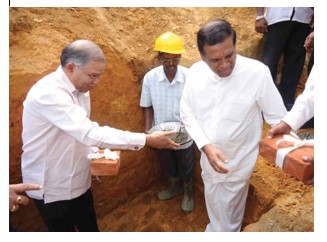
2011Foundation stone for hospital laid by then Minister of Health Maithripala Sirisena & Indian High Commissioner

http://www.businesstoday.lk/article.php?article=3514

Indian High Commission List of Completed Projects

http://www.hcicolombo.org/partner.php?id=209 Cost SLRs.1.2billion project started in 2011 and completed in 2015.

MOU signed between GOSL and GOI on 16 April 2008 to construct the hospital. Work commenced in 4 July 2011. Hospital officially handed over to the GOSL in July 2015. OPD, clinic & blood bank and hospital wards already functioning. It was proposed to call it the Mahatma Gandhi Hospital.

26 April 2013 Farewell call on CP Governor and Chief Minister

http://archives.dailynews.lk/2013/04/26/news21.asp

Indian HC Ashok Kantha assures the 150-bed base hospital at Dick Oya would be handed over by Aug/Sep 2013 when he arrived to pay farewell calls on Central Province Governor Tikiri Kobbekaduwa and Chief Minister Sarath Ekanayake,

15 June 2015People protest demanding the opening of new building of Kilankalan district Hospital in Dickoya

http://www.tamilcnn.ca/people-protest-demanding-the-opening-of-new-build-of-kilankalan-district-hospital-in-dickoya-photos.html

A mass public protest demanded the new Sri Lankan government open the Dick Oya hospital new unit which had been completed with the assistance of the Indian Government. (photos of the protestors and the slogans are interesting)

24 April 2015 The New Year celebration event in Kilankan Hospital in Dickoya

http://www.tamilcnn.ca/the-new-year-celebration-event-in-kilankan-hospital-in-dickoya.html

18 September 2015 – Dick Oya Base Hospital opened – the opening ceremony by Hospital Director Dr. Anwar Hamthani.

https://www.youtube.com/watch?v=l2EoDIqIFBI

What the news reports said

26 April 2017 – PM Modi to open Dick Oya hospital (News.lk)

11 May 2017 – Indian PM to open Dick Oya Glengairan Hospital (Daily News)

Daily Mirror – Modi to address Tamils of Indian Origin

http://www.dailymirror.lk/article/Modi-to-address-Tamils-of-Indian-Origin-128156.html

Indian PM to hold discussions with Tamil Progressive Alliance (TPP)

Here’s the unpalatable truth. Yes, Indians were imported by colonials to work as slave labor on Sri Lanka’s plantations. They were granted ‘stateless persons’ citizenship by Sri Lanka after independence. India does not officially recognize Sri Lankan Tamils as Persons of Indian Origin inspite of being originally born in South India. Sri Lankan Tamils are granted asylum under ‘strategic, political & humanitarian grounds’ not because they originated from India. Sri Lankan Tamils are NOT entitled to residence permits. Sri Lankan Tamil refugees CANNOT own land, houses or vehicles in India. Even a request by Tamil Nadu in 2009 to grant Sri Lankan Tamil refugees Indian citizenship was turned down by the Indian Centre.

April 2017 – ITN News – Delegation observing preparations for Indian PM’s visit to Hatton  

http://www.itnnews.lk/local-news/delegation-observing-preparations-for-indian-pms-visit-to-hatton/

An Indian delegation already in Hatton to handle preparations. the new building complex constructed with Indian assistance, at the Dickoya Base Hospital premises in Hatton, is due to be declared open under the auspices of the Indian Premier.”

How ‘new’ is this???

So the situation is this.

Minister of Health Maithripala Sirisena and the Indian High Commission lay the foundation stone for a 150bed Dick Oya hospital in 2011 which was to be completed by August/September 2013. In Jude 2015 people began protesting demanding the opening of the new unit. The new unit was officially handed over by the GOI to the GOSL in July 2015. In September 2015, Hospital Director Dr. Anwar Hamthani officially opened the Dick Oya Base Hospital. So the question is why was there such a media hype about opening of a hospital by no one other than the Indian Prime Minister himself which was operational since September 2015 (functioning for over 1 ½ years?)

Was the Indian PM’s office not aware that the Dick Oya Base hospital was officially opened in September 2015?

If an Indian delegation arrived in April 2017 to prepare for the arrival of the Indian PM, shouldn’t they have informed Delhi, that the Indian PM was coming to open an already opened and functioning hospital and raised the issue of the matter becoming an embarrassment to the Indian PM. Indian officials should have brought this fact to the attention of the Indian High Commission and Delhi so that the Indian PM would not be laughed at in going to Dick Oya to open an already opened and functioning hospital. The Indian PM should not have to make a state visit to open just a small wing unless it was to open the entire hospital!

Moreover, the other important issue is that a leader of a sovereign nation does not come to another sovereign nation as a state guest to address only one segment of community. Moreover, the leader of that sovereign country does not even legally recognize the community as being ‘theirs’ officially. So, to whose benefit has this charade been and what is the overall message being delivered by the visit?

Sri Lanka is a small country. But, Sri Lanka is a very proud country. We are an Asian country and proud of it too. We are proud because we are an island nation that has a very rich and long history. We are proud because we have weathered many attempts to invade us and it was only a bunch of traitors who betrayed the nation and we have always had brave patriots to fight for and defend the nation. Our pride has been dented because we have had attempts to destabilize us and these attempts continue. These give us every right to look at those who authored the destabilizing with caution and doubt. We cannot be faulted for that.

As a proud Asian nation, we want to maintain cordial relations with all our neighbors. We recall how past leaders have diplomatically handled countries that have been at loggerheads without jeopardizing the relationship of either. This is how we want future diplomacy to be.

It is a shame that a powerful leader such as the Indian PM has had to be embarrassed in arriving as state guest and not even staying in Colombo but travelling to Nuwara Eliya to open an already opened hospital – we hope the next visit is not to hand over roofing sheets.

Shenali D Waduge

Response to Lorenzo on the following two queries

May 12th, 2017

Dr Sudath Gunasekara

Response to Lorenzo on the following two queries

Dr Sudath Gunasekara

This is a short note on Lorenzo’s query on my article on Pitiful plight of the Kndyan peasants on 29.4 2017. I hope Lorenso can be satisfied with this.

Sudath

You highlighted an important issue. I have several questions related to how a solution can be crafted.

  1. Can the descendents of the Kandyan peasantry who were dispossessed by the British still be identified as a unique group and how?
  2. I expect that thd 600,000 acres stolen by British and given to British planters exist today as large government or privately owned tea estates. If so, they constitute a productive national asset. Are you proposing that they be acquired, formed into a large government overseen venture, and eithe thd annual income or the shares be distributed to the descendents of the Kandyan peasantry referred to above in my first question.

These two questions relate to who should be compensated and with what they should be compensated.

Lorenzo Says:

1Yes, Kadyan peasants (as named by the British) are the descendants of Sinhala people who were original natives in the hill country villages evolved by the  upstream  migrations from the Dry zone in the 1st, 2nd and 3rd centuries BC, though there is evidence to prove that there had been prehistoric settlements even on the present Horton plains ((Deraniyagala)

There are four categories of present day Kandyan Peasants

That is Descendants of

  1. Those who still live on degraded hill slopes adjoining tea plantations right round the central hills
  2. Those who lived in traditional native villages that survived mass exodus due to British onslaught in the valley bottoms within the  Kandyan Kingdom
  3. Those who lived within the boundaries of the traditional Kandyan Kingdom prior to 1815, leaving out the narrow littoral belt occupied by successive colonial invaders
  4. Those who were chased out of their native lands by the British during the 1817/8 and 1848 independence struggles or who escaped death by sword and presently living all over the country

Of these (a), (b) and c) categories could be easily identified by taking a census

But getting a count of the total in category d) will be very difficult. Still could be done if you have the political will and a genuine feeling for these people that is absolutely non-existent among Sinhala politicians of the day as it had been amply proved over the past 70 years since the so-called Independence in 1948.

My PhD research work in Umaoya basin had revealed that Sinhalese settlement s of the early period had extended up to 3700 ft above mean sea level being the highest level at which paddy could be grown. On the western side of the central hills this has gone up to Kotmale ,.So all those lands below this level would had been early settlements, irrespective of along what river basin they migrated while Mahaweli   Ganga was the main river even other rivers like Kala oya , Deduru oya and Mahaoya also contributed to this upstream expansion.

All lands above this level were virgin forest that covered the nation’s watersheds that provided the source for all the rivers which supported the entire life system and formed the foundation of the civilization of this Island nation. These forest lands were protected as strict reserves by the King. As such they belonged to the native people of this country, until they were taken by force by the British to open up their Coffee and Tea plantation. Until that time it was the people who lived in these peripheral villages who protected them on behalf of the Sinhala Nation As such the Kandyan peasants have a better claim for these lands, though all people living in Tun Sinhale have a say in them

In my opinion no other person other that the native Sinhalese can have a claim to an inch of these lands, because it had been their motherland for 2500 years at least. That is why I say the present Government’s policy of giving these lands either in 7 perch blocks or 2 acre blocks as planned by Ranil and Kiriella should be stopped forth with. Specially the programme of Upcountry Tamil Village Development of this Government to collect their votes should be immediately stopped. The Indian Government don’t recognize them as Indians, Even the request by Tamilnadu Govt to give citizenship  to refugees from      Sri Lanka has been rejected by the Indian Government They are also not even regarded as People of Indian Origin. Those refugees cant buy or own land or houses their either But these estate Tamils keep on wooing India and worshiping Indian politicians.

These are follies done by all Governments since 1948. All unpatriotic Sinhala politicians are responsible for this situation. Therefore at least now we must find a Sinhala leader who will say this is our land and those who want to live here, work here and eat here have to learn Sinhala, give up the Indian dream and get fully integrated or quit as Putin and Australian PM have said which I have already mentioned in one of my previous write ups. All Tamil politicians have to cease to be called Tamil Politicians anymore and get integrated with national political parties. We shall never allow Tamils or Muslims to have their own political divisions in this country. We must look for a leader who will restore this policy.

Regarding your query no 2

Large government or privately owned tea estates.

These estates are no longer a productive national asset as you say according to a recent study almost all these estates are run by money pumped by the Treasury. Even payment of wages and salaries of most plantations run by JEDB or the State Planation Corporation are paid by the government and as such they are running at a loss. My understanding is today most of these tea plantations are running at a loss. Many factors like poor management, land degradation, labour unrest we, low productivity etc and severe competition from other countries more particularly African are the main reasons for this sad state of affairs. In sum I think today they are run on State subsidies just to maintain the Indian Tamil labour force for political reasons. As for me I do not see any justification for continuing these plantations in the present form.

My plan for these tea lands is

1 Close down all tea estates above 5000 ft Msl and declare all that area as a strictly reserved forest for the protection of the Central water sheds , the Heart Land’ of the nation to protect the perennial river flow of the nation and control floods in the downstream regions.

2  Develop all tea land below that level

On the following basis

  1. Large scale Plantations run by JEDB and SPC on commercial basis
  2. Plantations run on a people’s cooperative societies
  3. Middle class Small Holders tea estates distributed among settlers settled on the farms of small holder settlers privately owned as mixed settlementsunder village expansion of Kandyan peasants and Indian labour who qualify to be citizens under Nehru/Kotalawala Agreement 1954.
  4. In any case the current mono Tamil Village development programme of the present Government should be immediately stopped as a precaution against converting the Central hill country in to a South Indian Tamil settlement, a Malayanadu, that would be a serious threat to the territorial integrity, security and unitary State of Sri Lanka. Once mixed settlements are developed it is expected the hill country Indian Tamil will integrate with the natives as it was done during the mediaeval periods in the South western sector of the Inland. That will also put an end to the estate Tamil issue in this country. Of cause the Estate Tamil should be prepared to undergo this social and cultural transformation. They have to give up all their Indian ness and be the people of this Land . They cant play double game That is the only way to achieve long term ethnic reconciliation and peaceful co-existence. I they want to live here they cant have one leg in India and the other only here and call this is the motherland and India is the Fatherland as Manoganeshen has said.

This is only a layman’s suggestion.  A detailed plan has to be developed by a committee of experts in Plantation, settlement development , economics and social development. We must have a national policy on this all important national issue that does not and cannot be changed with change of Government.


The Statue by the Parakrama Samudra and the place-name “Polonnaruwa”.

May 12th, 2017

by Chandre Dharmawardana, Ottawa, Canada.

Dr. Sudath Gunasekera, writing to the Lanka Web (6th may 2017) has discussed the imposing statue by the Parakrama Samudra and raised questions about the grain going across the statue and its interpretation as a silver thread of the Brahaminic tradition given by some scholars. I have raised similar issues and also issues about the interpretation of the place name in some of my articles on the Pollonnaruwa statue some years ago, when I was compiling a list of place names in Sri Lanka.

Indeed, learned scholars have confused the issue immensely by reading too much into non-existent clues, without staying close to terra firma, and we have ended up with several mythic constructions that have dominated the historical discourse about Pollonnaruwa. I have summarized the situation under the entry on Polonaruwa at the place-names website:

http://dh-web.org/place.names/#Pollonnaruva

In effect, while it is obvious to most people that the grain in the rock extends over the sculpture chiseled out of the rock, the grain has been claimed by some scholars as a “Puna-noola”. The Puna-noola is a silver thread worn by Brahamins. Ignoring the most likely possibility that the statue is that of Parakramabahu himself, many scholars have tried to claim that the statue is of the Indian Muni-sage “Pulasthi” mentioned in the Rig Veda. Archeological commissioner Raja de Silva has however speculated that the statue is that of the Indian Muni Agasthiya of South India. Another view has also been proposed, mainly by Siri Gunasinghe, whose thesis was that the statue is most likely to be that of a Lankan Rish known as Kapila ( Siri Gunasinghe, Statue in Pollonnaruva, Oct 26 Island 2011 midweek review ).

The evidence for these claims appears to be quite scanty. So one may ask, how did this spiral of speculation begin? In reading through the works of these scholars, one comes to the inescapable conclusion (as least for me), that this line of thinking was triggered by the mis-interpretation

of the origin of the place name “Pollonnaruwa” by a number of scholars including S. Paranawithana and Godakumbure who claimed that ‘Pollonnaruwa’ is derived from ‘Pulaththinagara’, presumably giving emphasis to the name used in the Chulavamsa (13th century). Starting from that premise they went on to identify the statue as that of Pulasthi the Indian Muni.

One a Brahamin Muni is hypothesized, now it becomes necessary to identify on him the customary priestly decorations – hence the need for the Puna-noola.

On the other hand, instead of using the Chulavamsa where the name could have got corrupted by re-copying it over the years by scribes, we can go to earlier sources as well. The Velakkaras were South Indian mercenaries used by King Vijayabahu to guard the Temple of the Tooth. The Vellakkara inscription (12th century or before) refers to a temple of the Tooth built by Vijayabahu at Pulanari, which is most probably modern Pollonnaruva. Pollonnaruwa is referred to in the 12th Century slab inscription from the reign of Vijayabahu I, where the names Polonnakara, Polonnakaru are used. On this basis I suggested that the Paranawithana-Godakumbure interpretation should be discarded, even though they are scholars of the highest distinction. The place-name ‘Pollon-nakara’ probably came from ‘Poron-nagara’, where ‘porana’, or ‘Paerani’ means old, or precedent, i.e., ‘Pala(mu)’. Thus “Poron-nagara” is “Paerani Nagaraya”. The Mahavamsa writer, a world-class scholar who should rank with Vyasa or Herdodotus, used “Pollasthinagara” to mean “Poorva-shthaavira nagara → Pollatthinagara”; thus it is consistent with “Poronnagara” and the stone slab-inscriptions.

Hence a correct rendering of the Pali, and rendering it into English as “Polatthinagara”, rather than “Pulasthinagar” clarifies its meaning and disconnects it from `Pulasthi’. It has nothing to do with “Pulasthi”, the Indain Muni-Sage . Any details of the “old town” which gave rise to Pollonnaruva are unknown at present. This would require deeper excavations in the area.

Furthermore, Prof. Siri Gunasinghe has stated that “it is important to find out, if at all possible, why Pulatthinagara was so named”, and says that “The word Pulatthi,.. (are)… curious Pali adaptations of Sinhala place names by the chroniclers; in this case Pollonnaruwa was turned into Pulatthi by Dhammakitti, … Such phonetically unorthodox transformations of Sinhala place names are quite common in the chronicle, e.g. Sankhanayakatthali (Hatnagoda), Badalatthali (Batalagoda), Guttahala (Buttala), Bhimatittha (Bentota), Jambukola (Dambulla), Donivagga (Denavaka), Gangasiripura (Gampala), to name only a few. If Pulatthinagara is merely the distorted Pali form of Pollonnaruwa, as I suggest, and has no connection to the Indian sage Pulastya”.

In our view, the authors of the Chronicles were excellent linguists, and they did NOT make any unorthodox transformations. It is the modern readers who have confused what the Mahawamsa writers have done, by wrong English transliterations, or by paying too much attention to Indian mythology and being ever ready to plant them in Sri Lanka to the detriment of the country’s own history. Today even “Seetha gangula” is claimed to have something to do with “Seethaa”, the consort of Rama, while the clear meaning of “seetha” as “cold” is simply ignored. Many of the place names now attributed to “Seethaa” has, in my view, nothing to do with the “Seetha-Raama legend”.

In regard to the use of ‘w’ or ‘v’ in the English form for Polonnaruwa, we should note that the ‘w’ was used in the south for rendering the sinhala “v” sound into English, while in the north the letter v, and not ‘w’ is used in English transliteration of Tamil place names. This is true for family names as well. Thus the Sinhalese write their family names with ‘W’ as in ‘Martin Wickramasinghe’. But traditional Jaffna Tamils write their name as, e.g., Vignesvaran, while a Colombo Tamil would write the name as Wigneswaran following the Sinhalese usage. The dutch ‘v’ is pronounced as an ‘f’, and led to this distinction in the south where names were europeanized prior to those in the North. The Jaffna names were anglicized by the American missionaries who used “v” for the corresponding Tamil sound.

Deprivation of HISTORY from students of Sri Lanka in 1972 was an unpardonable accusation 

May 12th, 2017

By Dr.Sripali Vaiamon. Canada   

Professor Pathmasiri Kannangara contributing an article to one of the Sinhala periodicals in Canada, DASATHA, in August 2016 (with courtesy) strongly stated History was taken out from the curriculum in 1972.It was a subject so deeply and fondly offered to all the students in the island as we possessed a very rich historical background.   This happened when Dr.Badurdeen Mohamud was holding the Portfolio of Education. .

Prime Minister was –mother of Lanka- Mrs.Srimao Bandaranaika, the first woman Prime Minister in the world. She was overblown with economic upheaval where she had to order poor inhabitants in the country to satisfy with manioc yam and sweetpotatos for two days of the week, instead of their staple food, RICE. So that was her position at that time.

Professor had stressed it was till 1995 nothing substantial was substituted. That means students who were in schools and universities deprived of learning history of the country. What a deprivation! Further comments those who were left schools and universities are NOW in the range of 30-55 of age limits. Who are ignorant of history of their own country.What a pity!  The salient requirements of the country that they should know, what had been occurred during the past. Past events that were the history. No body can obliterate it. It should be there as past records. Even if there were some short comings or misinformation there were competent historians in the country who were capable enough to ameliorate with facts and evidence with which people could be convinced. If evidence and facts were not available it could be furnished with appropriate reasons.   That means those who came out from big colleges and Universities who are now in this age range may not have sufficient  knowledge on the country’s history. The main language of the country was the supreme historical substance. In our case it was SINHALA. Which is existing from over 1000 BC. First I came across it in the great Sanskrit Epic,MAHABARATHA. Second or the third Epic in the world. First was GILGAMESH produced in ancient Babylonia. Mahabaratha or Ramayana was second or the Third. There is a controversy over the two productions. I came across the term Sinhala in the second book of Mahabaratha, Saba parva. Professor Van Beutenon who had translated from Sanskrit into English the first five books in the series which I borrowed from the Canadian Embassy. In the second book there was a poem (2-27-48  ) where a SINHALA deputation had gone to the Consecration ceremony of the king Udhistara with gifts such as Pearls, Conches, Elephant tusks, sea beryls etc. (Subsequently Dr.Kishan Ganguly who  translated all the 18 books of the Mahabaratha pointed out there was the term Sinhala in five places.(Bk.1-ch 177 Bk.2-chs 33 &51, Bk 3 Ch57 and Bk7 Ch 20 ) According to Dr.Monier Monier Williams who produced the very first English Sanskrit Dictionary believed it has been compiled in 1200 BC. where as Internet established as 900 BC. There were several other sources believed it to be 1000 BC. Besides this there are ancient Sanskrit classics where the term SINHALA had been embodied. Mathsya Purana, Markandya Purana, Brahath Sanhitha, Bagawatha and Jaina Canonical works. I illustrated this clearly in my book of Sociology, ( P186 Pre historic Lanka to end of Terrorism- Published in 2012 by Trafford Publishing, America.

Dr.Mortimer Wheeler, an acknowledged historian and archaeologist referred to writing of history in an introduction to a comprehensive history book of an Indian author as thus: A dozen years ago it could have been written. Dozen years hence it will have to be rewritten. That means History is a subject that has to be revised wherever necessary in time to time. Or at least go through and amend where deemed necessary with further details.

History is a subject that could not be completed. When historians, professors and those who have obtained doctorates on elaborative theses, what firmly expressed yesterday will be disproved by students today based on facts and artifacts discovered from recent excavations and relevant research findings.

Quality of a good historian, according to Professor Vaughen who was at Oxford University, is the principle of attraction to facts.

Dr.Siran Deraniagala, former Director General of Archaeology, Harvard Fellow in Pre-history, who carried out excavations at Anuradhapura a few years back arrived at a conclusion with the findings yielded that there had been a civilization 3 to 400 years prior to the advent of Aryan Vijaya from Gujarath with his entourage believed to be 700 males. C 14 process proved that the inhabitants of early Anuradhapura were associated with iron technology, paddy cultivation and horse breeding. The artifacts found had inscribed with some kind of Brahmi characters. That means even writing ability must have been there to a certain degree. Our prestigious chronicle, Mahavansa which impressed us to believe that Vijaya was the progenitor of the Sinhala race was nullified with the findings of Dr.Deraniyagala’s excavation.

Our veteran archaeologist Dr. Paranavithana meticulously defined in his Seegiri Gee foot notes as thus;Sinhala is Sanskrit, Sainhala is Prakrit, Sihala is Pali. The term Illu,Hela was available in several places of Seegiri Gee. As such Hela Mahapandu,Arisen Ahubudu and Professor.J.B.Dissanayake adopted SIHALA as the original term for our language. Also they projected Sihala as an adoption of the combination of Siv + Hela .Ancient major tribes Naga Deva Yakka and Raksa, who were in the country. When you say Naga please do not misunderstand that they were snakes, no! A human clan by the name naga. For an example Muchalinda Na Raja was a human king of the naga clan.

I can remember there were so many protests for taking history out of the curriculum.  If there was something redundant, unwanted or wanted would have ordered to replenish as there were veterans in the country who would have tackled the subject.

I can remember there was a very strong appeal from one Mr.Rangith C.Dissanayake, Deputy President, Eksath Sinhala Mahasabawa, Kandy. This had initiated nearly 50 years back I ‘ll quote his winding up para only….We appeal to all concerned, all patriots of the governing party…insist upon and compel the authorities concerned to take immediate action to re introduce the subject of history, as a special, separate and single subject into school  educational curriculum and arrange to teach same in all schools, be the Govt; private or international as a compulsory subject from grade 5 onward, as was done in our schools prior to 1972,the ACCHARU SOCIAL SERVICE SUBJECTS must be completely and totally separated from history.

( Mahavansa recorded Vijaya and entourage arrived on the day of the Buddha’s demise. Rajavaliya, an another commendable historical document reveals that they arrived seven days after the Buddha’s Parinirvana. Which one is correct? Laymen can’t decide. These matters although not much significant have to be rectified, for the sake of general public as well as particularly younger generation. The year has taken by Mahavansa as 543 BC. That was the year according to Mahavansa the Parinirvana had taken place. This is again quite different from the years elicited by other authorities. This I have illustrated in my book, ‘Views on Buddhism,Vol 1. p.22 and 23.This is also a matter that has to be finalized by World Buddhist Forum and a panel consists of erudite scholars and archaeologists).

Theravada, Heenayana  had  a conflict until 1950.This was rectified by the World Buddhist Forum and now there is no controversy. Now it is known as Theravada only.

Sri Lanka is the only country in the world where there is a documented history spanning over two and half millennia, according to our historians. Deepavansa and Mahavansa are the two cryptic chronicles compiled in the 4th and the 5th centuries respectively. But some of the prominent events depicted are minus evidence and invariably incorrect. But ancient kings were not in agreeable to alter what Rev.Mahanama of Deegasanda Pirivana complied as a respect to him. Ancient monks were agreeable with the kings. Now it is high time a rectification should be made.

Compiler of Mahavansa clicked the idea to build up the entire Suppadevi yarn  from Ghata Jathakaya, where a demon kept a damsel in a cave. In place of the demon he substituted a lion. Could it be biologically possible for a woman and a lion to have copulation and procreate human children as depicted in Mahavansa? Dr.Ananda W .J. Guruge (when he was living never uttered a word against Mahavansa.) contributing an article to Sri Lanka Guardian two months prior to his demise clearly stated it was not a lion but a man called Sinha. Compiler of Mahawansa had no knowledge on science as such he made this blunder.

Without any evidence he had written Lord Buddha visited this Island thrice. There is no record in the THRIPITAKA.Dr.G.P.Malalasekara,Sir Baron Jayathilaka .Dr.Krishna Swamy Iyanger says Buddha’s visits beyond historical recognition. I have clearly stated this in p.39 in my book of Sociology-Pre Historic Lanka to end of Terrorism.Published in America in 2012.

(To build up this fictitious story he has borrowed material from Janaka Jathakaya referred to a ship wreck with 700 passengers and Valahassa Jathakaya related about a shipwreck in the area where Vijaye landed. Nalapana Jathakaya gives a story where the retinue of the Bodhisattva visited a pond to quench their thirst but an ogre captured them. When the Bodhisattva visited and found that their footprints in the pond were in one direction only, he realized what had befallen. He cut a reef, knocked off the knots and drank water without stepping into the pond. Then Yakkini appeared. He pulled out the sward. Yakkini got frightened when he threatened and she agreed to release all the captives. Identical yarn is engulfed in the Vijaya story. So the entire Vijaya episode was built on these and it is just a yarn. Compiler of Mahavansa has established Vijaya as a grand -son of a human mother and a beastly father,a lion, which is fictitious. High time to discard unbelievable discrepancies and establish Mahavansa only as a  Great Buddhist history book . For further consideration may I quote a few more instances such as, when Buddha visited Mahiyangana  Yakkas got really frightened as he was hovering on the sky created a fire, storm, and terror. Can you ever believe compassionate Buddha will stoop down to terrorist level? As indicated in the Kevadda Suttha, Buddha dislikes, despises miracles of psychic power  and miracles of telepathy as such above cannot be ever expected. Moreover in the Lakkhana Sutta he  rejects harsh speech, spoke  what was pleasing to the ear, pleasing and attractive to the multitude. Even for that he did not know the language of Yakkas and Yakkas never knew Buddha’s language! So that itself is sufficient to shun this episode!

Compiler of Mahavansa at the end of 37 chapters have embodied apologetically I am compiling this for the emotion and serene joy of the pious” If you think deeply and analyze well this itself is sufficient to set a correct decision on Mahavansa. Moreover in the Vijaya story when he met Kuveni she has revealed that they have a king called MAHAKALASENA and he had the king dom at SIRASAWASTHU. With all that the monk who compiled has started the list of KINGS in Lanka with Vijaya (foreigner) where as Mahakalasena should have been the first king.(Incidentally YAKKA does not mean DEVILS as Kattandiyas depicting in Thoil ceremony.(Thoil is a word borrowed from Thavil of Kerala.) Yakka was human being who bears that name by their clan. Other than that not an evil sprit.) Perhaps when Secretary of State, Mr John.Kerry visited our Kelaniya temple recently may have seen our forefathers in frescos with two protruded teeth from either side of the mouth and would have arrived at a conclusion to say our forefathers may have been devils!.

It was in1837,George Turner ,CCS, who managed to trace a Tika from a temple at Mulkirigala and with the help of Buddhist monks translated accurately highlighting the apology the compiler priest stated at the end of  every chapter. Mahawansa was a Buddhist history book but not a general history book of Lanka where all the historical records were embodied. The foot print on Samanola was copied from Afganistan. The country which was earlier known as Bacteria, a Buddhist country. They who constructed both feet with so many symbols and a researcher Dr.Waldheim spent 25 years to study the purported meanings of those symbols. But he was not fully successful. The very first Buddha statue was built by them at Kabul or Gandhara.. The Gigantic Buddha statues were carved by them in the Bamiyan range in 1700 . The highest was 48 meters and were dynamited by Radical Muslims in March 2001. Even Milndappanna was Bacterian creation. They received Buddhism prior to Sri Lanka.

Early nineteensixtees there had been several petitions from Muslims, Christians and Tamils to  the World Bank as there are nothing historical about them in the Lankan history although Muslims came to the Island prior to the dawn of Islam in the 7th century. Tamils came in the 13th century and settled down in Jaffna. Along with them they brought The Hinduism. Christianity came along with Portuguese in 1505, Protestantism came along with Dutch and there were several other denominations but you can’t expect these things to go into MAHAVANSA which was started compilation in the 5th century primarily with Buddhist events. Other historical events embodied in other local history books.

Even if there were thousands other reasons, we had well qualified historians in the country and by 1972 it was not that difficult to furnish with facts and evidence to refurbish and presented   complete  historical volumes with comprehensive details for the inhabitants in the country to follow the history without a break.. Where ever evidence was absent acceptable reasons would have been provided particularly with regard to Buddhist events without hurting the susceptibilities of the pious people of the country.  It was the year where Lanka became Sri Lanka. Namo Namo matha substituted to Sri Lanka Matha, New Constitution was introduced as DEMOCRATIC SOCIALIST REPUBLIC OF SRILANKA. However our Tamil brothers refused to accept and hitherto they use ILLANGAI. The Lanka, the term picked up at Ramayana and used for considerably a long time. That is not how citizens in a country should sustain the UNITY. They should have adapted the term introduced by the govt.  Internet on the 24th Jan.’17 revealed in a monastery in Sri Lanka a 7 year old Muslim boy has been ordained to be along with many Sinhala, Tamil and Veddah boys to live together. This could be treated as an ideal precedent when we take all citizens in the country to live together, without splitting this small island in to pieces and create superfluous dissension.

sripaliv@gmail.com

How China Reacted To Sri Lanka Blocking Its Submarine With Eye On India

May 12th, 2017

Courtesy NDTV

Sri Lanka last allowed a Chinese submarine to dock in the capital of Colombo in October 2014, a move that triggered fierce opposition from India.

China defended its military relationship with Sri Lanka as good for regional peace and stability after Sri Lanka rejected a request from China to dock one of its submarines in Colombo this month. Sri Lanka’s decision was announced as Prime Minister Narendra Modi arrived on the island nation for an overnight trip.

Sri Lanka last allowed a Chinese submarine to dock in the capital of Colombo in October 2014, a move that triggered fierce opposition from India, which worries about growing Chinese activity in a country it has long viewed as part of its area of influence.

The timing of the incident is awkward as Sri Lankan Prime Minister Ranil Wickremesinghe is expected in Beijing this weekend to attend a summit on China’s new Silk Road plan.

China’s Defence Ministry, in a statement sent to Reuters, did not directly mention the rejected request for the submarine visit, but said its submarines needed a place to resupply on their way to anti-piracy missions.

“The stopping to resupply of our military’s submarines that are on their way to the Gulf of Aden and Somali waters for protection missions is an internationally accepted practice,” the ministry said.

In recent years, the Chinese and Sri Lankan militaries had fruitful and effective cooperation in areas like mutual visits and training, it added.

“The cooperation between the Chinese and Sri Lankan militaries is beneficial to regional peace and stability, is not aimed at any third party and should not be interfered in by a third party,” the ministry said, without elaborating.

According to news agency Reuters, a senior Sri Lankan government official said China’s request to dock one of its submarines in Colombo this month had been rejected. He said Sri Lanka was “unlikely” to agree to China’s request to dock the submarine at any time, given India’s concerns.

A second official, at the defence ministry, also said China’s request to dock this month had been rejected but that a decision on a further docking had been postponed.

A 1987 accord between India and Sri Lanka provides that their territories not be used for activities deemed prejudicial to each other’s unity, integrity and security.

China has invested heavily in Sri Lanka in recent years, funding airports, roads, railways and ports, unsettling India, traditionally the closest economic partner of the island nation of 21 million people.

More than 70 percent of the trans-shipment in Colombo port comes from India.

Sri Lanka is finalising a plan to lease 80 percent of its loss-making Hambantota port to China for 99 years, but the deal has been delayed because of opposition from trade unions.

Supreme Court suspends Appeal Court’s judgment on Geetha’s MP seat

May 12th, 2017

By Roosindu Peris Courtesy Adaderana

The Supreme Court has suspended the Appeal Court’s judgment regarding MP Geetha Kumarasinghe’s eligibility to hold a seat in parliament, till the 15 of May.

The Appeal Court has put forward the fact that Kumarasighe’s MP position violates a clause in the country’s constitution which states that dual citizenship holders will not be allowed to hold position in Parliament.

Meanwhile the Elections Commission has unanimously decided not to fill the seat left vacant in Parliament, until the Supreme Court’s verdict is announced.

The Court of Appeal had disqualified UPFA Galle District MP Geetha Kumarasinghe from holding a seat in Parliament due to her dual citizenship status, on May 3.

A petition was presented in March 2015 by four individuals from Galle challenging Kumarasinghe’s election to Parliament from the district at the last general election, due to her holding citizenship in Sri Lanka and Switzerland.

The verdict was delivered on the 3 of May by Judge Preethi Padman Surasena with agreement of the President of the Court of Appeal Vijith K. Malalgoda.

On March 14, the Attorney General had informed the Court of Appeal that Kumarasinghe cannot continue to serve as a Member of Parliament (MP) as she has failed to revoke her citizenship in Switzerland.

According to section 20 of the 19th Amendment to the Constitution, Article 91(1)(d)(xiii), a citizen of Sri Lanka who is also a citizen of any other country shall not be qualified to be elected as a Member of Parliament or to sit and vote in Parliament.

What did Mahinda Rajapaksa discuss with Indian PM Narendra Modi?

May 12th, 2017

Courtesy Adaderana

A hastily arranged meeting between visiting Indian Prime Minister Narendra Modi and Sri Lanka’s former President Mahinda Rajapaksa last evening (11 May) raised huge speculation within political circles in Colombo.

This was more since official from both sides had continued to maintain that Narendra Modi’s visit to Colombo had no economic or political objectives.

In the words of Taranjit Singh Sandhu, Indian High Commissioner to Sri Lanka, There are no economic or political objectives in the Indian Prime Minister’s visit to Sri Lanka.” This is what he said when he met a few senior journalists in Colombo at a hotel prior to the Indian Prime Minister’s visit.

This had also been repeated by Indian authorities long before Premier Narendra Modi’s visit.

However, Members of parliament from the Joint Opposition had gone to town while claiming that the Indian Prime Minister’s visit was to sign several agreements, contrary to the claims of the Sri Lankan government.

Furthermore, MPs like Jathika Nidahas peramuna leader Wimal Weerawansa, a close confidant of former President Mahinda Rajapaksa, had urged that Sri Lankans should protest against Modi’s visit and that they should hoist black flags to display their opposition.

Weerawansa who is a close ally of the Rajapaksa camp coming out with a statement of this nature raised several questions among many, since Weerawansa may have given voice to the intentions of former President Mahinda Rajapaksa.

With speculation thus doing the rounds, the former President was soon to clarify the statement made by Weerawansa, saying that it was not in protest of Modi. However, former President Rajapaksa also said that he would only attend the international Vesak day celebrations as it is an international event and that however he was against any kind of pacts with India that could sell the assets of the country to that country.

Meanwhile, India too confirmed that Premier Modi would make this visit purely a religious one and that he would not meet any political figures.

However, the Indian High Commission said, if at all, Modi may meet only Opposition and Tail National Alliance leader R. Sampanthan, apart from meeting President Maithripala Sirisena.

However, Ada Derana surprisingly learned last evening that former President Mahinda Rajapaksa was to meet Indian Prime Minister Narendra Modi at ‘India House’, the High Commissioner’s official residence in Colombo.

Ada Derana attempted to confirm this report, it proved unsuccessful, until Indian High Commissioner Taranjit Singh Sandhu disclosed such a meeting while speaking at a media briefing late last night at the Hotel Taj Samudra at around 11.45 pm.

In his brief statement to the media, Taranjit Singh Sandhu stated that Indian Prime Minister Narendra Modi received former President Mahinda Rajapaksa at his own request.

Ada Derana learned that this meeting at ‘India House’ had lasted over one hour.

This prolonged meeting at ‘India House’ did delay the news conference arranged for at 10.45 pm by over one hour, and it started at 11.45 pm instead.

Meanwhile, Ada Derana also learned that former Defence Secretary Gotabaya Rajapaksa and former foreign minister Prof. G.L. Peiris were also in the delegation that met the Indian Premier along with former President Rajapaksa.

From the Indian side, Ada Derana learns that Indian national Security Advisor Ajit Doval too had been present at this meeting along with Indian High Commissioner Taranjit Singh Sandhu.

When Ada Derana requested for more details, the Indian High Commissioner added that they had discussed further development ties of both countries.

Meanwhile, Ada Derana learned from sources that former President Mahinda Rajapaksa had been appreciative of Indian assisted development projects in Sri Lanka.

As these new developments unfolded within the political arena, the person who was mainly critical of Indian Prime Minister Narendra Modi’s visit to Sri Lanka, JNP leader Wimal Weerawansa was not available for comment when Ada Derana tried to obtain his reactions regarding the former President’s meeting with the Indian Prime Minister Narendra Modi.

what’s real reason behind MODI’s visit?

May 12th, 2017

By Shivanthi Ranasinghe Courtesy Ceylon Today

India needs to change its foreign policy vis-a-vis Sri Lanka immediately. These policies have not only failed, but have disastrously backfired on India, ending in a result totally unanticipated and always against India. The extent of the damage caused by their own policies to India can be measured against the success of their arch rival, China.

PM Modi visiting Sri Lanka for Vesak celebrations is viewed by the Sri Lankan public with extreme suspicion. Nobody accepts the government’s assurances that Modi is just being a good neighbour, popping in for tea and lanterns. In the fracas erupting with attempts to lease the Magampura Port to the Chinese, there was a significant fraction that saw the benefits of the Chinese coming in, and argued it would balance the Indians. However, no one has offered the same argument with respect to India’s interest in the Trincomalee oil wells. That is, the argument that the Indians in the East would balance the Chinese presence in Sri Lanka is not entertained by any quarter. It is the general view that Indians in Sri Lanka is bad news. This perception is entirely due to India’s own doing.

Since the ’70s, India had been playing deceptive politics with Sri Lanka as well as with their own people – especially in Tamil Nadu. Even at the height of friendship between the Indian PM Indira Gandhi and her Sri Lankan counterpart, Sirima Bandaranaike, India gave clandestine sanctuary and support to Tamil extremists from Sri Lanka. Starting actively with Gandhi, right up to and including Modi, these elements have found a sympathetic audience from the Indian government. Their sympathy for Sri Lankan separatists based on mono-ethnic claims is however disingenuous when they are also fighting separatism to maintain India’s overall unity and territorial integrity.

India fails because of a feudal mentality. They do not recognize Sri Lanka’s right to be a progressive sovereign State. They neither help Sri Lanka develop, nor let Sri Lanka get the necessary assistance from elsewhere. We saw this in the ’70s and its repetition after the successful conclusion of our war against terrorism.

JR Jayewardene’s attempts to forge relationships with other powers to neutralize the growing terrorist threat only brought the aggressiveness of India to the forefront. The USA, Pakistan and Israel factor was enough for India to arm and train the terrorists.

After 1983, this programme received renewed vigor. The intention was to destabilize Sri Lanka to force down our throats an Indian policy, but not a Tamil policy.

Coming in the guise of protecting the Tamils in the North and East, the conditions stipulated in the Indo-Lanka Accord reflect the foreign policies of the Indian central government. For instance, the Agreement extracted from the Sri Lankan Government that Trincomalee or any Sri Lankan port may not be used by a foreign country in a manner prejudicial to India’s interests.

Creation of PCs

The creation of the Provincial Councils (PCs) was to reduce the country’s control by the centre (as can be seen in today’s attempts to do away with the Executive Presidency). This way, the concessions extracted over Trincomalee can be further consolidated once power is devolved to the PC. That is why we see a Tamil polity that is subservient to India making strides in our halls of power whilst the Tamil leaders, whose thinking is independent of India, are near invisible.

Today – that is 30 years later – Trincomalee is again the focus of India. That is why Modi’s visit is viewed with such mistrust.

Former ambassador Bandu de Silva (BS), on whether Sri Lanka should offer more concessions to India over Trincomalee, says in his essay that “the Rajiv-JR Agreement of July 1987 should be read from back to front.” He explains that “India wanting to extract concessions over Trincomalee” was not brought suddenly into the Accord, but that Sri Lanka was under pressure to do so for quite some time. Indeed, according to former Indian Ambassador to Sri Lanka, JN Dixit, Gandhi did not rush JR or the Tamil parties concerned to accept the agreement. Instead, it had been under negotiations for nearly four years.

The other conditions, as major concerns to India, include that Sri Lanka may not employ foreign military and intelligence personnel and ensure any broadcasting facilities set up by a foreign broadcasting organization would be solely used for broadcasting purposes and not for any military or intelligence work.

An interesting condition India insisted then, and is still after, is that the restoring and operating of Trincomalee Oil Tank Farm must be undertaken as a joint venture between India and Sri Lanka. It was only if we fulfilled these conditions that India promised to deport all Sri Lankans engaged in either terrorist activities or advocating separatism or secessionism.

Self-determination

Clearly, none of these conditions address the need, nor provide the mechanism for self-determination that the Tamil separatists seek. The only mechanism this installs is one where India consolidates its power in Sri Lanka. Thus, Tamil civilians became hostages of both India’s foreign policy as well as that of the LTTE’s for nearly 30 years. India and the LTTE used the Tamils as an excuse to achieve their objectives. The Tamils who lived in the LTTE infested areas experienced rampant killing, torture, abductions, disappearances, conscription in their daily lives in addition to overall dehumanization. Tamils did not get the security they hoped for from the Indian Peace Keeping Force. Their many atrocities are yet to be investigated. Those who sought refuge in Tamil Nadu are still living in camps, under strict rules and regulations. They are not recognized by the Indian State at all, despite approaching their second generation. The Tamil Nadu fishing trawlers destroy the livelihoods of the Tamil fishermen. The Indian government refuses to take action. India appears unaware that their hypocrisy is exposed. What has India gained by deliberately destabilizing Sri Lanka? They transformed our ceremonial Army into the fighting force we have today. An important point India must deeply reflect upon is that the Vadamaarachchi Operation had the LTTE cornered. They were about to be annihilated, when India literally descended on us. They clearly thought that what they created, they can control.

The LTTE obviously disagreed and took on the IPKF. After two years, the IPKF was nowhere close to what the Sri Lankan military was about to achieve, had India not interfered. When the IPKF packed their bags to leave Sri Lankan shores, 1155 Indian officers and men had been killed and 36 permanently disabled. C.A. Chandraprema notes that not even in the battles with China and Pakistan, did India suffer so ignominiously. As a result of their deceptive politics, observes Chandreprema, the Indian Central Government, worried over the Tamil Nadu reaction, have not commemorated the deaths of these officers and men, despite the passage of time.

It was the Sri Lankan government that actually erected a monument in their honour, observes Chandreprema. Thus, until the defeat of the LTTE, the Indian military hierarchy was unable to even place a wreath at this memorial column and honour these officers and men. These two incidents – cornering the LTTE in 1987 and actually defeating them in 2009, and the decency of the Sri Lankan government to remember a force that invaded our country in all but name, should send a very important message to the Indian government. We proved that numbers and strength are two very different things. So are supremacy and decency things apart.

Instant hero

When India is dealing with Sri Lanka, India must not take their attention away from an incident that took place when Rajiv Gandhi was in Sri Lanka in 1987. He was here to sign the Indo-Lanka Accord. He had outsmarted JR the old fox and he was clearly very proud. At the Guard of Honour review, he was oozing with hubris until a naval rating stepped out of formation and swung his rifle at him as he was passing by.

To add to the shame and embarrassment, the naval rating upon being questioned as to his motives, explained that killing was not his intention, but would have whacked Gandhi even if all he had was a broom stick. Wijemuni Vijitha Rohana de Silva became an instant hero. Though he was sentenced to prison, as soon as Ranasinghe Premadasa succeeded JR, he had him released.
After that incident, no Indian PM dared visit Sri Lanka for the next 28 years. That was the legacy India inherited for destabilizing Sri Lanka.

Yet, India appears to have learnt nothing from these lessons. For 30 years we endured terrorism. During this time, India, lost their Rajiv Gandhi to the LTTE as he went on the campaign trail seeking re-election to power. Yet, it was India’s enemy States, Pakistan and China, which supported Sri Lanka in our efforts to eradicate terrorism. India not only procrastinated but also tried to dictate the weaponry we ought to get. Had it not been for Indian interference, we would have got the special radar equipment that would have detected the planes that flew over Colombo city, before they did so.

Against such experiences, our recognition of Pakistan and China as our all-weather friends is natural. Why India never factored this in when formulating their policies is indeed curious. At least, during the many cricket matches, India should have taken note that Sri Lankans cheer for the Pakistani team when they play against the Indian team.

When the Magampura Port was first offered to them, India should have helped. Instead, they dilly-dallied because their thinking was that a tiny country like ours does not need such infrastructural development. When we commenced the Colombo Port City Project, this was actually communicated to the then Defence Secretary, Gotabhaya Rajapaksa that besides the project being a security threat to India, we do not need such projects. This opinion did not come from an economist, but a national security advisor to the Indian government.

China on the other hand, understood the value of a port in Hambantota. Hence, while India baulked and belched, China quickly became our strategic infrastructure development partner and helped us with many of our other projects as well.

India should have been smart, but again decided to flex their muscles. This time of course, we did not get any dhal air drops or an Indian Peace Keeping Force. Instead we got Ajit Doval.

Considered second only to Modi in power, Doval has the dubious honour of being the architect behind our 8 January 2015 regime change. Former Director of Intelligence Bureau and now National Security Advisor, he is known as the Indian James Bond. An unconventional thinker, he has served his country well and has pulled off many dangerous heists and cunning strategies. Now in his 70s, more powerful than any ministers of defence or foreign affairs, he seems to have met his Waterloo by trying to do a Sikkim in Sri Lanka. Just as in Sikkim, through sheer cunning, he managed to change the face of political powers in Sri Lanka.

However, again due to the failure of Indian policy, Doval’s scheme has left egg on India’s face again. He managed to rid an administration that was forging close ties with China. If the new government is to survive, then obviously, someone had to fill the lacuna created by dislodging the Chinese from the picture. India again failed to understand this basic logic. They thus never brought any investments. Without investments, the government had no option but to go hat in hand back to the Chinese. The Chinese understood the Sri Lankan government’s difficulty and returned to develop the Colombo Port City, but naturally with conditions more favourable to China. Severely cash strapped, the government has opted to lease the Magampura Port to the Chinese – thereby further consolidating their presence in Sri Lanka.

India had stayed eerily quiet. They are yet to offer a solution to safeguard their interests. Instead, they are concentrating on the Trincomalee Oil Tanks. Susil Premajayantha – one time Minister of Power and Energy – is curious as to why India is after the oil tanks when their market share is less than 15pc. It has been noted that the Indians are not concerned about maintaining the oil tanks already in their custody.

This Oil Tank Farm, built in the vicinity of the Trincomalee Harbour – world’s second largest natural harbour – is a militarily strategic location with historic fame. Premajayantha categorically states that it is not the tanks that interest the Indians, but the land of 625 acres that holds the tanks.

As long as India stays with deceptive politics, they will continue to lose. They must understand that Sri Lanka is not their enemy, but also not their vassal. If they do not wish to be the stand-alone giant that they are today, then they must understand what they are doing wrong. In 1987, one lone naval rating, Wijemuni Vijitha Rohana de Silva, stood up for our honour. However, this time, judging from the crowds drawn to Joint Opposition’s May Day rally and from the demands made by Ceylon Petroleum Corporation and Government Medical Officers Association through their trade union actions, supported by many other trade unions – all standing against selling our assets to foreign interests, namely India – the gear has been shifted.

ranasinngheshivanthi@gmail.com


Sirisena’s grip tightens on the Presidency

May 12th, 2017

WINSTON DE VALLIERE Courtesy Ceylon Today

Considering the tremendous rapport she has with President Maithripala Sirisena and her ingrained comparatively ‘patrician’ revulsion she’s often harboured for the less than plebeian Rajapaksa clan, Chandika Bandaranaike Kumaratunga will exert considerable influence, needed or not, with President Sirisena, in matters pertaining to the relentless purge of the Sri Lanka Freedom Party. She was magnanimous and ‘big’ enough to let bygones be bygones and agree to accommodate S.B. Dissanayake’s subtle entry into the Sirisena camp and into a Cabinet portfolio as men of the ilk of Nimal Siripala also did, along with several other major-domos in the Rajapaksa Cabinet.

At best then, President Sirisena holds a bitter cup in his hand and is tested to the limits to keep his wits about him as he tries to steer a course that he and CBK hope will sometime in the medium term bring about a metamorphosis in the SLFP. Playing the numbers game in this exercise has imposed on him and CBK the indispensable need to let the weeds grow with the wheat until harvest time. To pull all the weeds out right now, especially within the government itself, can play havoc with the objective of maintaining a majority vote in the House to pass through some very radical reform Constitutional Bills and push through some very sensitive reconciliation issues in the overall selfless pursuit of securing the objectives of national communal reconciliation and subtly forge a national Sri Lankan identity.

This is an immensely daunting task and one that no former leaders in this country from any political party, have had the gumption to even consider let alone attempt to bring about. That’s an immense commitment, and I dare say, fraught with such tremendous dangers that can place at grave risk the lives of this duo. This is really what is back of the so-called slow progress in reconciliation efforts that the UNHRC Commissioner Zeid so naively criticized because of his lack of understanding the explosive social dimensions which can blow up in their faces as they tackle this seemingly impossible task.

With a rare psychological insight into the contemporary sometimes extremist Sinhala-Buddhist psyche, former President Chandrika said at a media briefing last Wednesday that if you do not work on this national policy of reconciliation to bring about religious and ethnic harmony, there can only be a continued isolation between the communities, triggering another war scenario, adding that only reconciliation can preempt such divisions, but some people do not understand this”.

With no intention to disagree, the fact is not a question of some people not understanding this but that they are rabidly against it for the simple reason that the supremacist status quo would be lost, submerged, in an egalitarian ethos.

The SLFP purge

Viewed in this context one then appreciates the more, longer-term objectives in President Sirisena inexorably pursuing the SLFP purge. It’s because these Rajapsaksa loyalists have one thing in common: THEY WILL BAULK AT AND VOTE AGAINST ANY ATTEMTP AT COSTITUTIONAL REFORM AND RECONCILIATION EFFORTS AND CONTINUE TO MAKE GOVERNANCE AT THE CENTRE AND PERIPHERY IMOSSIBLE. Wednesday’s sacking of

K.H. Nadasena from the Heath and Indigenous Medicine portfolio in the NCP Provincial Council is a case in point. Vitally important Bills presented in Parliament need a prior sanction by the Provincial Councils and Rajapaksa loyalists must hence be sent away, not only from Parliament and the PCs but also from the Party.

Early last year the purge began with 26 SLFP electorate and district organizers being sacked and new ones appointed in their place, by President Maithripala Sirisena.

Kolonnawa, Kotikawatte, Mulleriyawa, Minuwangoda, Maharagama were a few places from which MR loyalist were shown the door, with SLFP Treasurer, S.B. Dissanayake, made Chief Organizer of Hewaheta. Dehiwala followed. Peculiarly he has effected these changes not at meetings at Party headquarters but at the President’s official residence.

Much more are to follow because the Rajapaksa faction continues staging endless campaigns against the Sirisena government including the now exposed GMOA’s role as a political cat pulling MR’s chestnuts out of the fire.
Sirisena has often accused the Rajapaksa clan of trying to ‘divide’ and weaken the SLFP in a manner aimed at isolating Sirisena from its greater support base. But Rajapaksa’s former Health Minister who took him on at the polls in 2015 and beat him comfortably seems more than capable of thwarting every MR move.

Hence, the purge continues and the latest sacking in the North Central Province, where LG elections are expected by some in September this year, is significant. My bet is that LG elections all around will not be held until quite a few more MR loyalists have been kicked out of points considered key at provincial and central government level to Rajapaksa. The recent speculation about a Cabinet reshuffle was not so much supposedly because current UNP ministers are incompetent (though some are) but because the President is desperately looking for portfolios for more senior SLFPers who have been faithfully backing him. Premier Wickremesignhe has apparently thrown a damper on that plan going on record as having said that he’s not on the same page on that plan.

Breathing down the necks

The European Union is now breathing down the necks of the government pressing for constitutional reform and a host of other commitments as a trade off for restoring to Sri Lanka the GSP+ exports facility to EU markets. A cursory look at Sirisena’s team in Parliament will show that he’s got the same failed MPs who were Rajapaksa’s rubber stamps in Parliament and in the Cabinet most of whom functioned in default as it were because none of them had a say in governance in the former rubber stamp regime. The President and Wickremesinghe need each other for the next four years and have no option but to grin and bear their differences. But that the President has begun showing signs of impatience with the Premier (signs which were not there two months ago) might suggest that he wants a direct controlling role to play in economic affairs which he has hitherto largely left in the PM’s hands. But he now wants to have the final say on Hambantota as well as Trincomalee, and I presume in any future major economic plans. He is, therefore, not likely to go any further…not one single step further…in diluting the powers of the Executive Presidency because he now realizes that such powers do have their advantages. One is wont to presume, therefore, that he will the next time around be nominated as the SLFP’s own Presidential candidate…and that could suggest that party heavyweights now in his Cabinet can use that as a lever to make bigger demands of him as a trade-off in return for their continued support. He needs them more than they need him. This means he and the Premier will soon be getting together for a chat about a reshuffle in a manner that won’t ruffle feathers in the UNP or in Sirisena’s SLFP camp.

According to insiders, there are moles not only in Sirisena’s camp but in Wickremesinghe’s too.

This emerged when Justice Minister Wijeyedasa Rajapakshe apparently threatened to quit if Sarath Fonseka was given a prominent role in the UNP as well as in the Government. The grapevine has it that Wijeyedasa’s position in the Avant Garde affair threw up questions as to who was standing for what was right and who was trying to protect those who were wrong. So then, despite efforts being made to make it appear that the idea mooted that Fonseka be appointed to a position of high authority was all a mix up between Health Minister Rajitha Senaratne and his Cabinet colleagues, had there been no hard substance to it, the idea could have hardly been sufficient to rouse Wijeyedasa to such extremes. What prodded him to announce such a drastic decision?

That’s the current million dollar question…or perhaps more like a 10 million dollar question?

The joint opposition not planning to grab power: Former president Mahinda Rajapaksa

May 12th, 2017

  J.A.L. Jayasinghe Courtesy The Daily Mirror

Former president Mahinda Rajapaksa said today the joint opposition was not planning a conspiracy to grab power in the country.

“We are only opposed to the privatization and alienation of national resources,” he told journalists after visiting Sri Dalada Maligawa in Kandy.

When asked about the removal of a Sri Lanka Freedom Party (SLFP) provincial councillor from his portfolio, Mr. Rajapaksa said what happens when some members are removed is this his or her colleagues also resign in protest.

He said when agreements are being signed with the United National Party (UNP), other parties raised objections.

The crux of the problem is not the decrease or increase of the support to any party. The people will show displeasure when other parties join the UNP. These protests against the government increase day by day. This exposes the political instability in the country,” Mr. Rajapaksa said. (J.A.L. Jayasinghe)

– See more at: http://www.dailymirror.lk/article/JO-not-planning-to-grab-power-MR-128710.html#sthash.kFpxlZ22.dpuf

Govt. complicity in suspicious Bambalapitiya land deal?

May 12th, 2017

By C. A. Chandraprema

We have written extensively in this newspaper about the proposed Bambalapitiya flats redevelopment project. Despite the revelations about the lack of financial standing of the promoter UTL Global Projects Pte Ltd to undertake a project of this magnitude, in March this year, the Cabinet granted approval to the National Housing Development Authority (NHDA) to sign an agreement with City Square Projects (Pvt) Ltd., a fully owned subsidiary of UTL Global Projects Pte Ltd with the proviso that they had to bring USD 10 million into the country within four to six weeks of signing the agreement. The Bambalapitiya flats redevelopment project is an ambitious one which seeks to demolish the present apartments and to use the ten-acre land, on which they stand to build six towers of 36 storeys each with a total of 3,762 residential apartments along with shops, offices and hotels.

article_image
Bambalapitya flats

The present residents of the flats would be given 285 apartments and 12 shops after the completion of the project. Until the project is completed, they would be given a monthly allowance to live in rented houses. If financed and implemented properly, this would be a good project. However, the promoter of the project UTL Global Projects Pte Ltd, is a company that was incorporated in Singapore in February 2011 and its owners are three Indian nationals, Koorapati Premalatha Rani, Meena Pooja and Prashanth Koorapati – all members of the same family, without any known background in construction or real estate development or the financial resources to be able to handle a project of this nature. When this project was first mooted in 2014, UTL Global Projects Pte brought in as a partner, Patel Engineering Ltd a listed company in India, without extensive experience in real estate development or considerable financial clout.

A tripartite MOU was signed on 29 March 2014 between UTL Global Projects Pte Ltd, Patel Engineering Ltd and the NHDA for this project. Subsequently, however, Patel Engineering Ltd backed out of the project. At that point UTL Global Projects Pte Ltd purported to bring in another Indian investor, Engineering Projects India Ltd, a state-owned entity in India, with extensive experience in construction and real estate and solid financial backing. UTL Global Projects Pte Ltd and Engineering Projects India Ltd, jointly submitted a project proposal to the BOI on 12 September 2014 to redevelop the Bambalapitiya flats at a cost of USD 250 million over a seven-year period. On Dec. 30, 2014 Vinoo Gopal the Director Projects, of Engineering Projects India Ltd wrote to the NHDA hat they were, in principle, ready to join UTL Global Projects Pte in the project to redevelop the Bambalapitiya flats.

He also provided the NHDA with a letter from the Indian Overseas Bank, certifying that Engineering Projects India Ltd had the financial resources to be able to execute the USD 300 million project if it was awarded to them.

Based on this application, on Dec. 14, 2015, the BOI wrote to UTL Global Projects Pte Ltd that they had approved the application they had made jointly with Engineering Projects India Ltd to redevelop the Bambalapitiya flats. The project was also given a 15-year tax holiday. On April 19, 2016, the General Manager of the NHDA wrote to UTL Global Projects Pte Ltd and Engineering Projects India Ltd that the Cabinet had approved their joint project proposal and that, in terms of BOI requirements, the two partners in the consortium should incorporate a company in Sri Lanka as a special project vehicle for this project.

BOI rules bent and twisted

Thereupon, a company called City Square Projects Pvt Ltd was duly incorporated in Sri Lanka, but Engineering Projects India Ltd was not a part of this special project vehicle – a violation of BOI rules. City Square Projects Pvt Ltd is a fully owned subsidiary UTL Global Projects Pte Ltd., masquerading as a joint venture with Engineering Projects India Ltd. On June 22, 2016, a formal agreement was entered into between the BOI and City Square Projects Pvt Ltd. On March 05, 2016, City Square Projects Pvt Ltd signed an agreement with Engineering Projects India Ltd. But, up to the point of writing, Engineering Projects India Ltd does not own any shares in City Square Projects Pvt Ltd. The agreement states that Engineering Projects India Ltd ‘may’ purchase some equity in City Square Projects Pvt Ltd if their board and the Indian government agencies involved grant them permission.

The promoter UTL Global Projects Pte Ltd has not revealed to the Sri Lankan government what exactly Engineering Projects India Ltd has undertaken to do in terms of this agreement with City Square Projects (Pvt) Ltd. The BOI and the NHDA granted the approval for the project on the assumption that Engineering Projects India Ltd had undertaken to invest USD 300 million in this project on the strength of the letter written by the latter to the NHDA on Dec. 20, 2014. The promoter has provided only a redacted version of the agreement between Engineering Projects India Ltd and City Square Projects (Pvt) Ltd to the Sri Lankan government, claiming that the rest of it was ‘highly confidential’. The reason why UTL Global Projects Pte Ltd is keeping the most important parts of this agreement secret is to conceal the fact that Engineering Projects India Ltd has not made any worthwhile financial commitment to the project.

The redacted version of the agreement states that Engineering Projects India Ltd will ‘endeavour’ to find a third party to provide the working capital for the project. While this project proposal was being evaluated by the BOI and the NHDA, there was no talk of a still unknown and undiscovered third party who would be providing funding for the project. Furthermore, there are many ‘IFs’ in the agreement between Engineering Projects India Ltd and City Square Projects (Pvt) Ltd. The wording in the agreement is such that even if Engineering Projects India Ltd gets all the necessary clearances from the various agencies of the Indian government, they would still invest in equity in City Square Projects (Pvt) Ltd only at their discretion. Even if Engineering Projects India Ltd joins City Square Projects (Pvt) Ltd it will be playing only a limited role as per the agreement. The Sri Lankan government has no inkling of how limited this role is because it has not seen the full agreement entered into between these two entities.

If however, Engineering Projects India Ltd does not get permission from the Indian government, it will not be able to participate in this project even in that limited way. Now that the Cabinet has granted approval for the NHDA to sign an agreement for the project with City Square Projects (Pvt) Ltd, the land on which the Bambalapitiya flats stands will be transferred free of charge, on a 99-year lease to City Square Projects (Pvt) Ltd., which is wholly owned by three Indian nationals. If Engineering Projects India Ltd fails to join City Square Projects (Pvt) Ltd, three Indian nationals will hold a 99-year lease on ten acres of the best land in Colombo! Even if Engineering Projects India Ltd joins City Square Projects (Pvt) Ltd, that too means nothing because they have undertaken only a very limited role and the three Indian nationals who own UTL Global Projects Pte Ltd will still be calling all the shots.

Land to be mortgaged to third parties

We have incontrovertible proof that what UTL Global Projects Pte Ltd intends doing once they get their hands on the land is to mortgage it to third parties. What will happen after that is anybody’s guess. UTL Global Projects Pte Ltd has obtained a letter from a local bank expressing its willingness to provide an ‘overdraft facility’ of USD 25 million to City Square Projects (Pvt) Ltd for the construction of residential towers in Colombo 4. The security that the bank will retain against the money advanced will be a mortgage over the ‘project assets’ which is, in effect, the Bambalapitiya land, which is to be transferred to City Square Projects Ltd. The government has imposed the condition on City Square Projects (Pvt) Ltd that within 4 to 6 weeks of signing the agreement with the NHDA, they will have to bring in USD 10 million to the country. This will not be difficult because City Square Projects (Pvt) Ltd will be able to use that very agreement to obtain money by pledging the land as collateral.

Everything about this whole project smacks of a giant scam. The promoter has all made misrepresentations to the BOI and the NHDA and concealed information from the government without revealing the exact extent of the financial commitment made by Engineering Projects India Ltd. That can’t be the way a bona fide property developer goes about its business. Anyone can see from a mile away that this is not a project that is ever going to be completed. There is still no feasibility report for the project. The fact that the government has not shown any interest in seeing the full agreement signed between City Square Projects (Pvt) Ltd and Engineering Projects India Ltd indicates that powerful figures in the government are in on the deal along with the promoter UTL Global Projects Ltd. This is the kind of major project which should have solid financial backing by a developer as in the case of the Port City project, where the developer pumps in all the money and takes the subsequent profit as his reward.

The 300 odd families living in the Bambalapitiya flats should have the confidence that once they leave their apartments to make way for the project, they will get their rent allowance until the project is completed and they get their flats in the new development. The land on which the Bambalapitiya flats stand is a ten-acre rectangular block in a prime location, the likes of which cannot be found anywhere else in Colombo. As things stand now, the government is poised to give this prime land to a company which does not have the financial clout to be able to handle a project of this nature. This family owned company with no history worth talking about has brought in a reputed state owned Indian Company mainly for purposes of display. The government has shown no interest in finding out what Engineering Projects India Ltd has undertaken to do in relation to this project. Experience tells us that such governmental nonchalance can only be the result of massive kickbacks sloshing around.

It is definitely not a PUNANULA: is only THE NATURAL GRAIN OF THE ROCK

May 11th, 2017

Dr Sudath Gunasekara 6. May. 2017

Photo by Dr. Achala Gunasekara Rockwell of Alabama university USA.

The above statue is widely accepted as the figure of King Parakramabahu the Great. But it also has been interpreted as a statue of a sage, either Agastya or Pulasthi.    Three reasons are adduced by those who call it a stature of a sage.  First, its proximity to the Pothgul Viharaya; and the other, more importantly a visible ‘Punanula’ that runs diagonally across the left shoulder of the statue from left to right. Thirdly the notion that the object held in the hands is a book.

Both Bell and Paranavitana have interpreted it as a Punanula (a sacred thread).  Probably in keeping with their scholastic traditions they may have wanted to give a more dignified and supra-mundane recognition to the statue and may have described it as that of a sage rather than that of a human. Paranavitana later however has interpreted it as that of Parakramabahu as well.

But as an ordinary observer I see the so-called punanula as the natural grain of the rock. One can see it clearly and also feel it. It is more than obvious to the naked eye.  A closer examination clearly shows that this is the natural grain of the rock. For example on the left side this is seen not on the mid shoulder as it should be but far on the edge of the shoulder. There are no signs of rapping it round the body of the Statue, on either side. This ‘wonderful Punanula’ continuous diagonally as one straight line across the whole length of the rock slab from SW to NE. This argument is further confirmed by the fact that this ‘Punanula’ (sacred thread) is clearly visible running over the object (book) held in the hands of the statue. It could never be visible running over the book; if it was a sacred thread it should run under the object as a thread worn on the body of the person who is holding the object. Therefore I think the idea of a Punanula is either a mistake or an esthetic invention by someone made without a closer examination of the trend line.  All these visible characteristics clearly prove that this is actually the natural grain of the rock. Though this line is more conspicuous than others one can also see many more similar lines all over the statue running in the same direction. Particularly the line visible about 3 inches below the so-called Punanula is the most prominent; these lines are more common below that line.

Furthermore he same pattern could be seen even in other statues both in Anuradhapura and in Polonnaruwa. The most conspicuous of these grains are displayed on the Galviharaya statues in Polonnaruwa. The Standing Buddha being the most prominent among them. Therefore I opine this as the line indicating the natural grain of the rock on which the statue is carved.

.Any student of basic geology who is familiar with the general geological formation and the trend line pattern of this part of the Island will vouch for this argument.

Statue of Parakkramabahu

The fact that this is found on the tank of the Sea of Parakkrama and it is also accepted to have been built during the reign of Parakaramabahu the Great 1 further makes it more probable that it is the Statue of Parakkramabahu the Great and no one else. The fact that the statue depicts a majestic figure with a grave expression also support that this statue represents the colossal figure of the King. . According to Senarath Paranavithana this statue is an embodiment of strength, majesty and dignity

The object held by the hands is also interpreted as that of an ola leaf book may be to prove the original identification of the statue with a sage. There is also another opinion that the object is a yoke” of kingship. I understand that there is another reference to the yoke being used as the symbol of Rroyal authority  mentioned in the Panakaduwa Tamba sannasa where King Vijayabahu of Polonnaruwa handing over a nindagam to his Army Commander after the completion of a war against the enemy. This brings us to a new notion of the yoke (Viyagaha) being used as a mace, the modern symbol of power and authority used in a modern parliament. Also from this one could surmise that the yoke would have been used in ancient Lanka as a symbol of Royal power, on occasions where Royal power is displayed. The yoke an important indigenous tool used in ploughing would have been definitely more appropriate and meaningful for an agricultural society than a modern mace probably adopted from a Yagadawa in the hands of Hanuma the monkey King in the Ramayana.

Naturally the Great King being the greatest tank builder of the Sinhala nation must have caused to erect his statue on the bank of the greatest irrigation feat of ancient Sri Lanka overlooking his pet project, the Parakrama Samudraya, the greatest achievement of Parakramabahu the Great with the yoke held in the hands to depict the authority of royal power he swayed over his Kingdom, Sri Lanka.

Accepting the classical punanula as the natural grain of the rock and the object held in the hands as a yoke in the hand of the King will also support the notion given in the Panakaduwa copper sannasa. That in turn will throw new light on the yoke being identified as the symbol of royal power in ancient Sri Lanka during the time of scribing Panakaduwa Sannasa. If this idea is accepted then we can also send the colonial mace to the museum and replace it with the Parakramabahu yoke as the new Sennkolaya, thereby giving a novel concept to the world on State power without just blindly following the British tradition.

Therefore first I request archeologists to review their old concept and go by reality seen on rock and also to revisit the concept of the yoke as the symbol of state power as mentioned in the Panakaduwa Sannasa.

DEVELOPMNT OF CONSTITUTIONAL UNCERTAINTIES

May 11th, 2017

Sarath Wijesinghe Solicitor-Attorney at law and a former Ambassador

Appellate and Writ Jurisdiction

Court of Appeal has the appellate and writs jurisdiction including quo warrantor” – invoked by the five petitioners successfully challenging Geetha Kumarasinghe (called GK hereinafter)- Member of Parliament elected by the people in the Galle district as their representative. Court of appeal held that she is not duly elected and not eligible to hold office on the grounds that she was holding dual citizenship which is not denunciated before the nominations on 13th July 2015, based on the hurriedly introduced 19th amendment restricting former Presidents to contest more than two terms and holders of dual citizenships to be elected as members of parliament possibly to prevent his brother Gotabaya – the new contender to enter the arena. Hurriedly passed 18th and 19th amendments led to various controversies and complications resulting hardships to the citizen and constitutional uncertainties leading to greater uncertainties and complications, imposing restrictions for periodic and free elections as before. Objections were raised at the nominations against GK which was not accepted by the returning officer for reasons not very convincing. He said the nominations cannot be rejected due to a defect of one candidate when there are numerous precedents including the rejection of the entire list in the Colombo Municipal Council election due to inclusion of one underage candidate in the list when the entire UNP list was rejected. Returning Officer has further stated that there is no provision in law where he could have rejected nominations on the grounds that a candidate was holding dual citizenship which is a very weak argument. The resulting situation in the event it was rejected at the nomination would have been different and prevented the current controversies. Now we are in a maze of legal complications with uncertainties until the Supreme Court determines with long and rigorous exercise with unpleasant and drastic results for the political culture and economy. Today the Election Commission is facing critizsm from all corners on partiality, inefficiency and inert attitudes on implementation of law and procedure. Galle district politicians in both parties are currently busy in political and legal exercises in” making hay when sun shines” by making use of the confused situation, as there are possibilities to disqualifying all UPLF contenders which will have a ripple effect on Fowzie MP and Faizer MP the 11th and 12th in the main list of nominated MPs in the UPLF list, and the UNP politicians are agitating strict compliance of the rules so that there is a possibility for the UNP and the JVP to be benefited over UPLF. It is in an uncertain and confused state.

Nominations challenged and appeal procedure

The petitioners challenged the appointment/election of GK for holding it without authority being a holder of dual citizenship, that she has contested the 2015 parliamentary elections without divulging her immigration states at the time of tendering nominations. Constitution states No person shall be qualified to be elected as a member of Parliament to sit and vote in Parliament if (d) (X11) a citizen of Sri Lanka who is also a citizen of another country” Court of Appeal with the powers vested in articles 137 to 147 has declared that by virtue of the constitution respondent MP is not qualified to be elected as a member of Parliament and thus not entitled to represent the electorate she won with a majority of 63955 votes. Courts held with the petitioners and ordered the Election commission and Secretary General to take appropriate steps according to law and procedure. The Attorney General’s recommendation that the respondent still possess dual citizenship was vital evidence, on the decision of the Court of Appeal against the respondent. Under normal circumstances the next in the list will be named to be the Member of the Parliament to the district and steps will have to be taken by the Commission and the Secretary General accordingly. This matter has transformed to an

extraordinary issue due to the appeal made by the respondent GK to the Supreme Court within the stipulated period of 42 days which is laid down in the Supreme Court rules on appeal procedure resulting stay of the execution of the determination until the decision of the Supreme Court either way. Apparently the lawyers of the respondent have informed the authorities accordingly to stall the proceedings forthwith. Conflicting news reports are viral that the Attorney General has advised/given opinion to the Secretary General of the Parliament to appoint the next in line comments to the media by different groups with different views due to uncertainty of the law and procedure and conflicting and contrary information on the same issue. Everything will depend on how the SG and Election Commission will act or react. Whatever happens the resulting position will be still complicated, if the position was taken and accepted that the respondent was not qualified to be nominated at the time the nominations are accepted and whether the entire party list will be null and void as has taken place in previous occasions. According to media both parties have met the Speaker and the Secretary General. GK has declared the intention to lodge an appeal and the appellants to expedite the execution of the decision. Speed in which the steps taken have by the SG and the AG in the fast tract within the appealable period has raised eyebrows of impartial political observers and professionals waiting for peace and peaceful transformation of events.

Previous Precedents

When late Ratnasiri Wickramanayaka fielded a list with an underage candidate the entire list was rejected in local government elections in Horana. Now though late if the UPLF list fielded is proved to be illegal at the time of nominations with the possible result of disqualifying the entire list with uncertain remedies the implications will be disastrous. Election for the entire Galle district will be an option if and when the jurisdiction is invoked by a citizen over a FR case or an election petition challenging the nomination of the respondent and the steps taken by the officers and authority thereafter. When Pilapitiya – former MP in UNP government then was unseated on an election petition he was appointed as a nominated MP by JRJ but the Supreme did not allow him function as a member of the Parliament. 19th Amendment merely states that a dual citizen is not eligible to contest for parliamentary membership but silent on appointed members of Parliament. Leader of Pivituru Hela Urumaya has made a public announcement that there are already 8 Members of Parliament with dual citizenships and official inquiries have been made under the new right to information act to verify the truth. In that event the situation will be still complicated requiring clarifications from the Supreme Court by way of writs, applications or FR applications by citizens with drastic changes in the chemistry of the Parliament.

Complex nature of the issues

Due to the complex nature of the issue in the absence of precedents the Supreme Court will have to give rulings for each and every issues starting with the appeal lodged by GK. Now that the appeal of the respondent and the letters from the Secretary General is before the Election Commission, the Commission is bound to give a quasi-judicial decision on the matter based on law practice and practices in the Supreme Court and Court Appeal. It is the practice/convention that has become part of semi legal binding that when an appeal is lodged the proceedings are stalled and no steps will be taken for execution. Most information is based on media and the fact remains that the Commission is independent to use the discretion obviously contested vigorously by both parties. The practice and the convention that once the appeal is lodged the proceedings will be stalled is a crystalized convention court practice. It is a moot issue how the Election Commission will act/react to this issue and whether proceedings will be stayed until the determination of the Supreme Court Decision.

Constitutional Uncertainties

Constitutional uncertainties are brewing and developing in a rapid phase due to hurriedly prepared legislation in haste and applicability based on personal and political agendas with ulterior motives with no broad national programs or ideologies. Now it has reached the melting point resulting uncertain and complicated legal and

political complications misbalancing the political outlook and the chemistry of the Nation. Currently UNP has 106, UPLF 95, JVP 6, TNA 16, EPDP 1 and SLMC1 with the possibility of UPLF losing all seats with advantages to UNP and JVP or a by election for the entire Galle district depending on the decision of the Supreme Court on GK’s case and connected issues. This shows how outsiders are benefited when the household is fighting with each other without resolving matters within. In 1965 George Kotalawala was appointed MP by the courts considering the votes casted and accordingly what is the justification of the SLFP voters voted with great aspirations and ambitions for their future? Whilst UNP is busy in claiming their portion in the prey made available by GK before the arena. In the absence of any precedents the resolution will be still difficult but these will be lessons in the constitutional making process on the table which is also a hurriedly dratted document without the participation and involvement of the entire nation. (Author who takes responsibility for the contents in the article could be reached on sarath7@hotmail.co.uk( 0777880166)

‘The SAITM Issue’ and the politics of misnaming

May 11th, 2017

 BY MALINDA SENEVIRATNE

Whoever is against SAITM should also be opposed to fee-levying institutions such as private nurseries, tuition classes, outfits that offer all kinds of certification and practices such as channeling services.  This is an argument that is widely tossed around by those opposing opposition to SAITM.  The flak that Dr Anuruddha Padeniya of the GMOA has got over the past few days has been liberally padded with such logic.  His detractors have roundly castigated him for offering consultancy services in private hospitals even as he spearheads the agitation against SAITM.
The cause of the GMOA has not been helped by the fact that some of its fellow-travelers have waved the anti-privatization flag.  In other words, the ‘SAITM issue’ for them is but an expression of a process or even an economic policy preference they oppose, namely privatization.  
AITM: Means different things to different people on both sides of the divide
 
All causes have to deal with different stakeholders who have diverse outcome preferences.  The opponents have the option of picking out one or more of the claims or parties and target these.  That’s politics.  Misidentification, mislabeling, misrepresentation and such are part of the game.  
There are therefore people who are calling for the blood of the movers and shakers of GMOA, especially Dr Padeniya.  Naturally ‘the sick’ are used as grist.  The pro-SAITM or let’s say the anti-GMOA lobby would have us believe that no one cares more about the poor and the sickly of this country than them.  That again is politics.  It is useful, after all, to have the key issues shoved out of the debate.  Indeed, part of the story is to define ‘key issue’ in ways that make for easy engagement.  Everyone involved in this drama does this.
What all this helps displace is the important (let’s not say ‘THE key issue’) matter of a coherent policy with respect to education in general.   It is easy to say ‘we need more doctors’.  Of course we need more doctors, there’s no question there.  It’s easy to ask ‘if you are raising concerns about quality, can you give any guarantees about the quality of doctors produced by the state universities?’  It’s a valid question of course.  
 
It’s easy to take medical mishaps, inflate them, display them, throw them in the face of those who bring up the issue of standards (pertaining to SAITM) and scream ‘you don’t have a case, hoo-hoo’.  
 
It’s easy to say such things and raise such questions as long as you desist from talking about the realities in our hospitals — the congestion, the financial constraints, under-staffing across all categories, the consequent stress and say nothing about the incredible services rendered therein.  Easy and irresponsible. 
The SAITM issue” is a book that has not yet been written, or rather is a book whose pages are all over the media, including Facebook, Twitter, the blogsphere and elsewhere on the internet.  This is not an abridged version of that book and neither is it a review.  What’s written above is preface and what follows will be a short note on the seeming contradiction of GMOA members engaging in ‘private practice’ with a view to separate the issue of privatization or private income-earning practices from that of regulation and accreditation.  
One of the most sober comments on this element of the debate was offered on Facebook by Dr Waruna Jayasinghe.  It is worth translation.  He called it ‘From nurseries through SAITM to channeling….”
Montessori Schools: Whether or not a child has attended a Montessori is irrelevant when being enrolled in a school. The particular child is not required to have obtained instruction on any elements of the primary curriculum.
Tuition: Tuition gives students preparing for exams a boost.  However it is not the tutor who sets and conducts the exam, but the state.  Those who attend tuition classes and those who do not are assessed by a single institution and process.  (We can define the SAITM situation as one where the tuition master himself conducts an exam and produces doctors according to a Montessori system).  
Private degrees (e.g. IT) and private medical colleges: Since many don’t see a difference, let me use an example.  I obtain an IT degree of forgettable quality.  You give me a job.  I write software programmes at a rate.  You realize that they are useless.  You sack me.  In other words, the consumer, the quality controller and the boss are all one person and someone who knows the subject well.  Now assume I get a degree from SAITM.  Even if the quality controller, the Sri Lanka Medical Council, says ‘poor quality,’ the law forces recognition. Accordingly I am recruited and sent to serve in Wanathavilluva.  I prescribe medicines like crazy.  I also engage in private practice.  The patients’ conditions get worse courtesy my treatment and prescription, but they wouldn’t know I am the cause.  Since there are very few senior doctors in such facilities they too wouldn’t notice my idiocy.  So I will remain secure and happy.  Here the consumer, the quality-controller and the boss are independent of one another.  The quality controller has been crippled.  The consumer has no knowledge of quality and no authority either.  The boss doesn’t have the means nor the mechanisms to assess the work of junior physicians.  I continue to practice.  One day you come to me for treatment.  I prescribe. You die.  Your loved ones complain to the SLMC and my registration is cancelled.  This is of no use to you, since you are dead.  My friends will continue to treat and prescribe medicine to their patients.   
Channeling: I work in a government hospital.  After I clock-out, I have the freedom to make koththu or engage in channeling.  Since I am a doctor, I choose private practice.  I have knowledge and training to offer for a price.  You come to purchase these because you find it more convenient or of greater value to obtain these in this manner rather than getting it free at a government hospital.  You have the complete freedom to obtain treatment from a government hospital or from some other individual should you feel that I am expensive or that you would not get value for money from me. 
What this shows is that although people try to put everything in one heap, it is SAITM that disempowers people from choices and that if the quality of medical degrees is not strictly monitored the outcomes could be disastrous. 
Now some may argue that (say in the USA) universities offer their own degrees.  The issue there however is that there is assessment, there are ratings, there are minimum standards that have to be met for purposes of accreditation.
‘The SAITM issue’ is about accreditation.  It’s about quality control.  One can vilify the SLMC and argue about the quality of doctors produced by state universities, but one cannot shove under the carpet the issue of coherent and comprehensive assessment.  There has to be a single authority in the business of regulation or else a coherent and comprehensive process of evaluation.  
 
Someone can claim that the SLMC is not perfect.  That’s fine.  The solution would be to improve the institution and the processes therein.  The Government, as of now, appears to be ill-equipped intellectually and politically to sort out the mess to which it has contributed (as did the previous regime) by being frivolous and arrogant.  
 
What’s evident is a scandalous disregard for regulation and a bastardization of accreditation.   The Government should rise about the politics of  misidentification, mislabeling and misrepresentation because a) it is unhealthy, and b) as things stand it could maim or kill a lot of things, including the Government itself.
This cannot be healthy. 
Malinda Seneviratne is a freelance writer.  Email: malindasenevi@gmail.com.  Twitter: malindasene.  Blog:malindawords.blogspot.com

Did Modi’s Sri Lanka visit influence Colombo to reject China submarine request?

May 11th, 2017

Courtesy India Today

Sri Lanka last allowed a Chinese submarine to dock in the capital of Colombo in October 2014, a move that triggered fierce opposition from India, which worries about growing Chinese activity in a country it has long viewed as part of its area of influence

Sri Lanka has rejected China’s request to dock one of its submarines in Colombo this month, two senior government officials said on Thursday as Prime Minister Narendra Modi landed in the island nation.

Sri Lanka last allowed a Chinese submarine to dock in the capital of Colombo in October 2014, a move that triggered fierce opposition from India, which worries about growing Chinese activity in a country it has long viewed as part of its area of influence.

Prime Minister Narendra Modi arrived in Sri Lanka today for a two-day official visit.

A senior Sri Lankan government official said China’s request to dock one of its submarines in Colombo this month had been rejected. He said Sri Lanka was “unlikely” to agree to China’s request to dock the submarine at any time, given India’s concerns. The official asked not to be named because of the sensitivity of the matter.

The second official, at the defence ministry, also said China’s request to dock this month had been rejected but that a decision on a further docking had been postponed.

“It might happen later,” the second official told Reuters, adding that China had requested approval to use the port around May 16 “sometime back”.

A source close to the Chinese embassy in Colombo confirmed that China had requested permission for the submarine visit but was still awaiting a response.

China has invested heavily in Sri Lanka in recent years, funding airports, roads, railways and ports, unsettling India, traditionally the closest economic partner of the island nation of 21 million people.

More than 70 percent of the trans-shipment in Colombo port comes from India.

Sri Lanka is finalising a plan to lease 80 percent of its loss-making Hambantotata port to China for 99 years, but the deal has been delayed because of opposition from trade unions.

The Sri Lankan government also wants to establish a petroleum hub with the help of India in the eastern port city of Trincomalee, where Lanka IOC, the subsidiary of Indian Oil Corporation, handles 15 out of 99 oil tanks.

A 1987 accord between India and Sri Lanka provides that their territories not be used for activities deemed prejudicial to each other’s unity, integrity and security.

ශිවාජිලිංගම්ගේ තර්ජනය

May 11th, 2017

නලින් ද සිල්වා

ශිවාජිලිංගම් හෙට සිට සතියක් ජනසංහාර විරෝධතා උද්ඝෝෂණ පවත්වනවා. මෝදිත් අද ලංකාවට එනවා. මෝදි උඩරටටත් යන්න ඉන්නෙ. එහෙදි ඉන්දියානු ජාතික කොඩි වනා මෝදි පිළිගැනීමටත් ඉඩ තියෙනවා. එය හුදෙක් විදේශීය රාජ්‍ය නායකයකුට කරන සැලකිල්ලක් ලෙස හිතන්න බැහැ. වතුකරයේ ඇතැම් දෙමළ ජනයාට පමණක් නොව උතුරු හා නැගෙනහිර පළාත්වල ඇතැම් දෙමළ ජනයාටත් තාම තමිල්නාඩු පෙකෙණීිවැල කපා දාන්න බැරි වෙලා. ඒකෙන් ම පේනවා දෙමළ ජනයාට මෙරට දිර්ඝ ඉතිහාසයක් නැති බව.

අද දෙමළ ජාතික සංධානයේ නායකත්වයත් බෙදිලා. ශිවාජිලිංගම්, විග්නේස්වරන්, සම්බන්ධන්, සුමන්තිරන් කටයුතු කරන්නෙ එකම කණ්ඩායමක් ලෙස නො වෙයි. ඔවුනොවුන් අතර භේද තිබෙනවා.  පහුගිය දා විග්නේස්වරන් තමිල්නාඩු උසාවියෙන් වරදකරුවකු වූ ප්‍රේමානන්ද නමැති අයකු ක්‍රිස්තුස්වහන්සේ සමග සංසන්දනය කරලා. එයට දෙමළ ක්‍රිස්තියානින්ගෙ තදබල විරෝධයක් තියෙනවා. යාපනය විශ්වවිද්‍යාලයේ උපකුලපති පත්කිරීම සම්බන්ධයෙනුත් ප්‍රශ්න නැගුණා.

පසුගියදා කිලිනොච්චියේ දෙමළ ජනයා පෙළපාලි ගොස් තිබෙනවා හමුදා ඉඩම් පවරා ගැනීමට විරුද්ධව. ඔවුන්ට හමුදා කඳවුරු පවත්වා ගෙන යෑමට අවශ්‍යයි. දෙමළ ජනයා සහ දෙමළ දේශපාලනඥයන් අතර වෙනසක් තියෙනවා. ඒත් ජනමාධ්‍යවල ඒ බව පිළිබිඹු වන්නේ නැහැ. දෙමළ ජාතික සංධානයට අවශ්‍ය හමුදා පළවා හැරීම. ශිවාජිලිංගම් කරන්නේ නායකත්ව සටනක්. එහෙත් අපට ඒ ගැන සුළුවෙන් හිතන්න බැහැ. ශිවාජිලිංගම්ට මෝදිගේ අවධානය දිනා ගැනීමට අවශ්‍ය වෙලා. ශිවාජිලිංගම් මෛත්‍රිපාලට තර්ජනය කරනවා. ඔහුගේ විරෝධය අස්සේ මෛත්‍රිපාලට වවුනියාවේ උත්සවයකට සහභාගි වෙන්න එපා කියනවා. එසේ සහභාගි වුණොත් මෛත්‍රිපාල ද යුද්ධාපරාධකරුවකු ලෙස සලකනවාලු. මෝදිගේ සහාය මෛත්‍රිපාලට නොව රනිල්ට.

යුද්ධාපරාධකරුවකු ද නැද්ද යන්න තීරණය කරන්නේ එලෙස ද? ඉතා පැහැදිලිව ශිවාජිලිංගම් තම නිර්ණායක අනුව යුද්ධාපරාධකරුවකු ද නැද්ද කියා තීරණය කරනවා. ශිවාජිලිංගම් මෙරට ජනාධිපතිට තර්ජනය කරන්නේ ඔහු ප්‍රභාකරන්ගේ ප්‍රභාකරන්ගේ මස්සිනාකම හිතට ගෙන ද? ජනසංහාරයක් කියන්නෙ සමූල ඝාතනයක්. එහෙත් අදත් දෙමළ ජනගහනයක් උතුරු පළාතේත් නැගෙනහිර පළාතේත් කොළඹත් කඳුරටත් බටහිර රටවලත් ඉන්නවා. අතුරුදහන් වූවා යැයි කියන අය බටහිර රටවල ඉන්නවා. අද ඔවුන්ට මෙරට ඡන්ද බලය දීමටත් රනිල් කටයුතු කරනවා.

මෛත්‍රිපාල ඒවා නැවැත්විය යුතුයි.  ඔහු හැම තැනම කියනවා බුද්ධාගමට ප්‍රමුඛස්ථානය දෙනවා කියා. ඒත් අගමැති මෙහෙයුම් කමිටුවට ඉදිරිපත් කරන වාර්තාවේ එයට විකල්ප හතක් තිබෙනවා. ඉන් බුද්ධාමට නීතියෙන් ඇති ප්‍රමුඛස්ථානයත් නැති වෙනවා. මෙරට බුද්ධාගමට ප්‍රායෝගික ව නම් කිසිම තැනක් නැහැ. අද මහානායක හිමිවරුන්ට ඇති තැන මුමක් ද? කාදිනල්වරයාට ඊට වඩා තැනක් තිබෙනවා.

මෛත්‍රිපාලට රනිල් නවත්වන්න බැරි ද? රනිල් කියන්නෙ බටහිරයෙක්. ඔහුගේ සංස්කෘතිය යුදෙව් ක්‍රිස්තියානි සංස්කෘතිය. ඔහුට සිංහල බෞද්ධ සංස්කෘතිය ගැන හැඟීමක් නැහැ. ඔහු අගමැති වුණෙ මෛත්‍රිපාලට පින් සිද්දවෙන්න. ඔහුට කිසි දිනෙක මෙරට ඡන්දයෙන් ජනාධිපති වෙන්න බැහැ. ජනාධිපති තියා ඔහුට බියගම මන්ත්‍රී වෙන්නවත් බැහැ. ඔහුට දකුණු කොළඹ, බටහිර කොළඹ ආදී ඡන්දකොට්ඨාශවලින් පිටට ගිහින් දිනන්න බැහැ. බටහිර හා ඉන්දියාව මහින්ද පරදවා රනිල් බලයට පත් කිරීමට මෛත්‍රිපාල යොදා ගත්තා. මෛත්‍රිපාල දැන්වත් තම තදබල වැරදි නිවැරදි කර රනිල් ඉවත් කළ යුතුයි.

මෛත්‍රිපාලට බුද්ධාගමට නීතියෙන්වත් ප්‍රමුඛස්ථානය දිය හැක්කේ රට වටා යමින් රනිල් සුද්ද කිරීමෙන් නොව රනිල් ඉවත් කිරීමෙන්. බ්‍රවුන්රිග් මෙරට ආණ්ඩුකාරයා බවට පත් කර ගැනීමෙන් පසුව අප කළ භයානක ම  වැරුද්ද රනිල් අගමැති කිරීමයි. එය ජේ ආර් ජනාධිපති වීමටත් වඩා භයානකයි. අද ශිවාජිලිංගම්ලා පිම්බෙන්නේ රනිල් නිසයි. සුමන්තිරන් හා රනිල් එකම සංස්කෘතියක. හමුදාවල ක්‍රියාකාරීත්වය පිළිබඳ විවිධ කතා රටේ පැතිරෙනවා.

මෝදි එන්නෙත් රනිල් වෙනුවෙන්. මෛත්‍රිපාල වෙනුවෙන් නොවෙයි. මෛත්‍රිපාල අද රනිල් ගිරයට හසුවෙලා. එය මෛත්‍රිපාලගේ ම වරදින් සිදු වුවක්. මෛත්‍රිපාල ජාතියෙන් සමාව ගැනීමට රනිල් ඉවත් කළ යුතුයි. ඔහුට එය කළ හැකියි. රනිල් බටහිරයෙක්. බටහිරයන් කලක සිට ඉන්දියාවට අනුග්‍රහ දක්වනවා. ඒ බව ජේ ආර් ඉගෙන ගත්තෙ තරමක් පහුවෙලා. ඒත් රනිල් ඒක කලක සිට ම දන්නවා. රනිල් තව ටික කලක් හිටියොත් රට දෙකඩ කරලා එක් කොටසක් ඉන්දියාවෙ ප්‍රාන්තයක් කරන්නත් බැරි නැහැ. රනිල්ට ඕන ලංකාව නොවෙයි. ජාත්‍යන්තරවාදී සුපිරි ව්‍යුහය. ඔහු ඒ සංස්ථාපනයේ අයෙක්.

ශිවාජිලිංගම්ලා මෛත්‍රිපාලට මිසක් රනිල්ට චෝදනා කරන්නෙ නැහැ. මෙරට ඊනියා ජනසංහාරයක් සිදු වුණේ නැහැ. ඒක බටහිරයන් හා ඉන්දියානුවන් රනිල්ලාගේ උදවුවෙන් කළ ප්‍රචාරයක් පමණයි. ජී එස් පී + තහනම, විවිධ තහංචි ඊනියා රාජපක්‍ෂ රෙජිමය එළවා දැමීමට ගත් පියවර පමණයි. මෛත්‍රිපාල ශිවාජිලිංගම්ලාට  හා රනිල්ලාට යට වී බෙලහීන ජනාධිපති කෙනකු ලෙස ඉන්නවා ද? රනිල් ඉවත් කරනවා ද?

මේ ලිපිිය ද තවත් ලිපි ද කාලය වෙබ් අඩවියෙන් කියවිය හැකි ය.

http://www1.kalaya.org

නලින් ද සිල්වා

2017 මැයි 11

අපායට සමීකරණ නැහැ

May 11th, 2017

නලින් ද සිල්වා

සිංහල බුද්ධාගම අද පිරිහිලා. වෙසක් උත්සවයත් වැටිලා. අපේ නිර්මාණශීලීත්වය නැවතිලා. අද නිර්මාණ කියන්නෙ කලා නිර්මාණවලට විතරයි. ඒවත් එක එකා පිට කසා ගැනීමේ නිර්මාණ වෙලා. පවතින කෘතියකින් දශම බිංදුවයි බිංදුවයි එකකවත් වෙනසක් නැති කෘති ඉතා අනගි නිර්මාණ බවට පත්වෙලා. යමක වෙනසක් ඇති බව පේන්න ඕන ඒ පද්ධතිය ඇතුළෙ ඉන්න අයට නොවෙයි. පිට ඉන්න අයට. සාරිය නාභිය පේන්න අඳින එක මහා නිර්මාණයක් නොවෙයි. නාභියට සෙන්ටි මීටරයක් යටින් ද සෙන්ටි මීටර එකයි දශමයකට යටින් ද සාරිය අඳින්නෙ කියන එක මහා නිර්මාණයක්වත් ජනමාධ්‍යයේ හා වෙනත් තැන්වල ඊනියා විද්වත් මණ්ඩපවල කතාකරන්න දේවත් නොවෙයි. සාරි නොඅඳින සංස්කෘතියක අයකුට එහි වෙනසක් පේන්නෙ නැහැ. පිරිමින්ගෙ ඇඳුම්වලත් තත්වය එහෙමයි.

අද තරම් අපරාධ සිදුවන යුගයක් මෙරට තිබී තියෙනවා ද? අද දෙමව්පියන් දරුවන් මරණවා, දරුවන් දෙමව්පියන් මරණවා, මිනීමැරුම් තුනක් ගැනවත් අහන්න වෙන්නෙ නැති දවසක් නැහැ. අහන්න වෙන්නෙ නැති මරණ කෙතරම් තියෙනව ද? ස්ත්‍රී දූෂණ ගැන කියන්න තියෙන්නෙ මොකක් ද? එදා තරුණියකට අතේ මැණිකක් රැගෙන කිසි බියක් නැතිව යන්න පුළුවන් වුණාලු. ඒත් අද? ගැහැණුන් ආරක්‍ෂා කර ගන්න වෙලා තියෙන්නෙ වෙන කාගෙන්වත් නොවෙයි පිරිමින්ගෙන්. පිරිමි මත්පැනට ගිජු වෙලා. සියල්ලන් ම මසට ගිජු වෙලා. චිකන් නැතිව කන්න තියා දානයක්වත් දෙන්න පුළුවන් ද? පඬියකු අහන්න බැරි නැහැ බුදුන් වහන්සේ මස් කෑම තහනම් කරලා තියෙනව ද කියලා. බුදු හාමුදුරුවො ස්ත්‍රී දූෂණය හරි සම ලිංගික ක්‍රියා හරි තහනම් කරලා තියෙනවා ද? ළමා අපයෝජන තහනම් කරල තියෙනවා ද? බුදු හාමුදුරුවො කර්මය ගැන නම් දේශනා කරලා තියෙනවා. ඒත් ඒකත් නියතිවාදයක් නො වෙයි.

අපට කල්පනා කරන්න තියෙන්නෙ සසර කෙළවර කරන්නෙ කොහොම ද කියන එක. ඒත් ඉතින් අප සසරක් තියෙනව කියලා කියන්නෙ කොහොම ද? සසර කෙළවර කරන්න පුළුවන් කියලා කියන්නෙ කොහොම ද? ඊනියා විද්‍යාවෙන්  ඒවා පෙන්නන්න පුළුවන් ද? සසර පංචෙන්ද්‍රිය ගෝචර ද? මැරුණට පස්සෙ මොක ද වෙන්නෙ කියලා අප දන්නව ද? අප දකින්නෙ මිනිසුන් මැරෙන එකයි උපදින එකයි. ආවෙ කොහෙන් ද යන්නෙ කොහාට ද කියලා අපට පේනව ද? පංචෙන්ද්‍රිය ගෝචර නැති දේ අපට පිළිගන්න පුළුවන් ද? මෙරට ප්‍රාඥයන් ලෙස පිළිගැණුනු පිළිගැනෙන ඇතැමුන් සසර පිළිගත්තෙ/පිළිගන්නෙ නැහැ.

නොදරුවො හය හතර දැන සිටියෙ නැහැ. ඒ අපාය හතර හා දිව්‍ය ලෝක හය. අද වැඩි හිටියනුත් දන්නෙ නැහැ. ඔවුන් දන්නවා අපාය දිව්‍ය ලෝක නැති බව. අපාය හා දිව්‍ය ලෝක පංචෙන්ද්‍රිය ගෝචර නැහැ. එහෙම ඒවා තියෙන්න බැහැ. අද අප පවට බිය නැහැ. පව් කරන්න ලජ්ජත් නැහැ. විද්‍යාව අනුව පව් කළාම අපායෙ යන්න විධියක් නැහැ. නැති අපායකට යන්නෙ කොහොම ද? අද සිංහල බුද්ධාගම නැහැ. අද තියෙන්නෙ ආගන්තුක විද්‍යාවක්.

ඒ විද්‍යාව අපේ නො වෙයි. ඒක බටහිර විද්‍යාව. අපට ඒක අපේ කර ගන්න බැරි වෙලා. සිංහල බෞද්ධයන්ට විද්‍යාවෙ නිර්මාණ කරන්න බැහැ. සංකල්පයක් ප්‍රවාදයක් නිර්මාණය කරන්න බැහැ. සංකල්ප ආදිය නිර්මාණ හැටියට සලකන්න පුරුදු වෙලා නැහැ. ඒවා ගැන හිතන්න පුරුදු කරලා තියෙන්නෙ සොයා ගැනීම් හැටියට. සිංහල බෞද්ධයකු එවැනි ඊනියා සොයා ගැනීමක් කර නැහැ. අරය අරක හොයාගත්ත මෙයා මේක හොයා ගත්ත කියලා එක එකාගෙ පිට කසා ගන්නවා විතරයි. තවම කවුරුන්වත් අපාය හොයා ගෙන නැහැ. ඒක නිසා අපට පව් කරන්න බය නැහැ. අද වෙසක් දවසෙත් පව් කරන අය අපමණයි. පවට අපමණ අගයක් ලැබිලා. අප පන්සිල් ගන්නවා, රකින්නෙ නැහැ.

බටහිර විද්‍යාව අපේ කර ගන්න බැරි වුණ නිසා එය ආගන්තුක ලෙස පවතිනව. අපට බටහිර විද්‍යාවෙ චින්තනයෙ, ඒ කියන්නෙ ග්‍රීක යුදෙව් ක්‍රිස්තියානි චින්තනයෙ හිතන්න බැහැ. අපට බටහිර සංගීතයෙ නිර්මාණ කරන්න පුළුවන් ද? අපට පුළුවන් බටහිරයන් අනුකරණය කරලා ඔවුන් කටහඬ හසුරුවන විධිය යම්තම් පුරුදු වෙන්න පමණයි. ඒක මහා වෙනසක් හැටියට පෙන්නනවා. මෙරට පඬියන්, කලාකරුවන්, විද්වතුන් ආදීන් ව්‍යාජ තුට්ටු දෙකේ අනුකාරකයන්. 

අප බටහිර විද්‍යාව කියන්නෙ මොකක් ද කියන එකවත් දන්නෙ නැහැ. බටහිරයන් බටහිර විද්‍යාව ගැන කියන බොරු අප විශ්වාස කරනවා. පරීක්‍ෂණ, නිරීක්‍ෂණ, නිගමන සූත්‍රය අප කටපාඩම් කර ගන්නවා. එහි කෙරෙන්නෙ උද්ගමනය, අනපෝහනය, උද්ගමනය කළ අනුමාන නීති අනුව අපෝහනය, වියුක්තය හා සංයුක්තය පටළවා ගැනීම ආදී වශයෙන් අප කියන විට, බටහිර විද්‍යාව පට්ටපල් බොරුවක් බව අප කියන විට, අපට හිනහවෙනවා. දැනුම නිර්මාණය කරන දෙයක් කියන එක පඬියන්ට තේරෙන්නෙ නැහැ. දැනුම නිර්මාණය කරන්න තියෙන එකම විධිය බටහිර විද්‍යාව නොවෙයි කිව්වම අප මිථ්‍යා පතුරවන අය ලෙස හඳුන්වනවා. මුහුණු පොතේ පඬි පෝතකයන් අපට ප්‍රතිචාර දක්වන්නෙ නාථ දෙවියන්ට හිනහවෙමින්.

අප බටහිර සංස්කෘතියේත් නැහැ. සිංහල බෞද්ධ සංස්කෘතියේත් නැහැ. මේ ගන්ධබ්බ තත්වයක්වත් නො වෙයි. ගන්ධබ්බයා යම් දවසක එකක් තෝරා ගන්නවා. අපට එහෙම කරන්න බැහැ. බටහිරයන් අනුකරණය කරමින් අපේ ආත්මාර්ථකාමීත්වය, පෞද්ගලිකත්වය ඉහටත් උඩින් ගිහින්. ඒත් අප බටහිරයන් මෙන් අනෙකාගේ පෞද්ගලිකත්වයට සලකන්නේ නැහැ. බුදු හාමුදුරුවන්ට වඩා වෝල්ටෙයාර් අපට ලොකු වුණත් අප වෝල්ටෙයාර් කිව්වෙ මොකක් ද කියලා දන්නෙ නැහැ. අපට දැන් තිසරණය නැහැ. ඒක අර පන්සිල් ගන්න වෙලාවට මතුරන දෙයක් පමණයි. අපට දැන් සරණ ගොඩක් තියෙනවා. කොපර්නිකස්, ගැලීලියෝ, නිව්ටන්, අයින්ස්ටයින්, ඩාවින් ආදීන්ගේ සිට මාක්ස්, රසල්, ඩෙරීඩා ආදින් දක්වා. ඒ අතර සිදු නාට්‍යයෙ සරණයත් ඉන්නවා. ඩෙරීඩාගෙ විසංයෝජනයේ බුදුදහම තියෙනවා කියලා පඬියන් කියනවා. පඬියන් දන්න විසංයෝජනය. ඩෙරීඩා අපාය ගැන කියලා නැහැ. අපට පව් කරන්න ලජ්ජාවක් බයක් නැහැ.  අපායකුත් නැති එකේ මොනව කෙරුව ම මොක ද? නොපෙනෙන අපාය වගේ ද නොපෙනෙන ගුරුත්වාකර්ෂණය?  ඒක නිව්ටන්වත් දැක්කෙ නැහැ. ඒත් ඒකට සමීකරණයකුත් තියෙනවා. අපායට සමීකරණ නැහැ.

මේ ලිපිිය ද තවත් ලිපි ද කාලය වෙබ් අඩවියෙන් කියවිය හැකි ය.

http://www1.kalaya.org

නලින් ද සිල්වා

2017 මැයි 10


පිං හරක්ට දෙන වරදාන ලැයිිස්තුව…!!!

May 11th, 2017

උපුටා ගැන්ම lankanews.org

මේ තියෙන්නේ පාර්ලිමේන්තු මන්ත්‍රීවරුන්ට ලැබෙන වරදාන හා වරප්‍රසාද….

මන්ත‍්‍රීවරුන්ට හිමි වරප‍්‍රසාද

  1. වෛද්‍ය රක්ෂණයත් ලක්ෂ තුන හමාර දක්වා වැඩි කරයි.
    2. මන්ත‍්‍රීවරයෙකුගේ මාසික වැටුප රුපියල්54,285කි.
    3. පාර්ලිමේන්තු සභා වාරය පැමිණීම වෙනුවෙන් දිනක දීමනාව රුපියල් 500.
    4. කොළඹින් බැහැර අයට නිල නිවාසයක් (ව.අඩි. 900 ක දෙමහල් නිවස).
    5. රාජකාරි හා පෞද්ගලික දුරකථන පහසුකම් සඳහා බිල්පත් ගෙවීම.
    6. තීරු බදු රහිත වාහනයක් (වසර 5 කට වරක් ගත හැකිය) බොහෝ විට මෙම වාහන බලපත‍්‍රය ලක්ෂ 30 ක 40 ක ලාභයක් ඇතිව විකිණීම සිදු වේ.
    7. ඉන්ධන දීමනාව (බස්නාහිර පළාතෙන් පිටත) පෙට‍්‍රල් වාහනයක් සඳහා –රුපියල් 50,000 (ඞීසල් වාහනයක් සඳහා – රුපියල් 20,000)
    8. කාර්යාල, නිවාස හා ජංගම දුරකතන බිල් ගෙවීම.
    9. දේශීය හා බටහිර වෛද්‍ය පහසුකම් නොමිලයේ.
    10. නිරෝගී ශරීර සෞඛ්‍ය සඳහා ආයුර්වේද සම්බාහන මධ්‍යස්ථාන පහසුකම්.
    11. විශේෂඥ වෛද්‍යවරයෙකු නියම කරන බෙහෙත් ඖෂධ වර්ග පවා නොමිලයේ ලබා ගැනීමේ පහසුකම්ි.
    12. වසර 5 ක පාර්ලිමේන්තු නියෝජනයෙන් පසු විශ‍්‍රාම වැටුප් හිමිකම.
    13. ලිපි ද්‍රව්‍ය පහසුකම් නොමිලේ.
    14. ලැප්ටොප් පරිගණකයක්.
    15. ෆැක්ස් යන්ත‍්‍රයක්.
    16. විදේශ සංචාර.
    17. කාර්ය මණ්ඩලය සඳහා දුරකථන පහසුකම්.
    18. ආරක්ෂක නිළධාරීන්.
    19. බාධක වලින් තොරව පාර්ලිමේන්තුවේ රැුස්වීම් වලට සහභාගි වීමට හා ඒමට මාර්ග පහසුකම් සැපයීම.

ඇමතිවරයෙකුට හා නියෝජ්‍ය ඇමතිවරයකුට හිමි වරප‍්‍රසාද (මාසිකව මුදල් හිමිවීම්ද ඇතුළත්ය)

1. ඇමතිවරයෙකුගේ වැටුප – රුපියල් 65,000 කි.
2. නියෝජ්‍ය ඇමතිවරයෙකුගේ වැටුප රුපියල් – 63,000 කි.
3. පාර්ලිමේන්තු රැස්වීම් වලට සහභාගි වීමේ දිනක දීමනාව – රුපියල් 500 කි.
4. කොළඹ ප‍්‍රදේශයෙන් බංගලාවක්.
5. නිල නිවාසයක් නොමැති නම් පෞද්ගලික නිවසක් කුලියට ගැනීමට මාසික කුළිය – 40,000 කි.

  1. ඇමතිවරයෙකුගේ කාර්යාල දුරකථන දෙකට ගාස්තුව රුපියල්20,000 කි.
    7. රාජකාරි නිවාස දුරකථන දෙකට රුපියල්– 10,000 කි.
    8. ජංගම දුරකථනයට රුපියල් 4,000 කි.
    9. නියෝජ්‍ය ඇමතිවරයෙකුගේ කාර්යාල දුරකථන දෙකට රුපියල් 10,000 කි.
    10. නිවාස දුරකථන දෙකට රුපියල් – 5,000 කි.
    11. ජංගම දුරකථනයට රුපියල් 2,000 කි.

බස්නාහිර පළාතෙන් පිටත ඇමතිවරයෙකුට

පෙට‍්‍රල් වාහනයක් සඳහා ඉන්ධන – රුපියල් 75,000 කි.
ඞීසල් වාහනයක් සඳහා ඉන්ධන රුපියල් – 30,000 කි.

බස්නාහිර පළාතෙන් පිටත නියෝජ්‍ය ඇමතිවරයෙකුට

පෙට‍්‍රල් වාහනයක් සඳහා ඉන්ධන – රුපියල් 65,000 කි.
ඞීසල් වාහනයක් සඳහා ඉන්ධන රුපියල් – 30,000 කි.

බස්නාහිර පළාතේ ඇමතිවරයෙකුට

පෙට‍්‍රල් වාහනයක් සඳහා ඉන්ධන දීමනාව – රුපියල් 50,000 කි.
ඞීසල් වාහනයක් සඳහා ඉන්ධන දීමනාව රුපියල් – 20,000 කි.

නියෝජ්‍ය ඇමතිවරයෙකුට

බස්නාහිර පළාත ඇතුළත පෙට‍්‍රල් වාහනයක දීමනාව – රුපියල් 40,000 කි.
ඞීසල් වාහනයක දීමනාව රුපියල් – 20,000 කි

*මන්ත‍්‍රීවරුන්ට හිමි අනෙකුත් සියලූ වරප‍්‍රසාද ඇමතිවරුන්ට හිමි වේ.


Copyright © 2026 LankaWeb.com. All Rights Reserved. Powered by Wordpress