ව්‍යවස්ථාව ඉරා දමමින් පැමිණි ජාතිවාදී මුට්ටිය

February 21st, 2016

මතුගම සෙනෙවිරුවන්

පසුගිය දා නිදහස් උත්සවයේදී ලංකාවේ ජාතික ගීය දෙමළ භාෂාවෙන්ද ගායනා කරන ලදී. මෙය අහඹු සිද්දියක් නොවේ. මනා ලෙස සැලසුම් සහගතව කරන ලද වැඩකි. ව්‍යවස්ථාවේ නැති දෙයක් කිරීමට එ් අනුව රජය පෙළඹී ඇත. මෙය එක් අතිකින් ප‍්‍රජාතන්තුවාදය ගැන නන් දොඩවන යහපාලන ගැන වැදි බණ දෙසන පාලකයන් නිරුවත් කරලීමකි. ව්‍යවස්ථාව ඉරාගෙන පැමිණි මේ දෙමළ ජාතිවාදී මුට්ටිය නිසා රට තොට ඇවිස්සේ යයි රජය සිතනවා විය හැකිය. මාධ්‍ය එල්ල කරගෙන සිදු කරන බැණ අඩ ගෑම භික්ෂූන් වහන්සේලා සිරගත කොට දණ්ඩනයට යටත් කිරීමට ගන්නා  උත්සාහය මේ සියල්ල අගමැතිවරයාගේ උද්දච්ච කම නිසාවෙන්ද යන්න සාකච්ඡුාවක් බවට පත් වෙමින් තිබේ. එ් අතර නව ව්‍යවස්ථාව සකස් කරලීමට මහජන අදහස් විමසා ලන්නට එම කමිටුව රට පුර යමින් තිබේ. එහිදී මන්නාරම දිස්ත‍්‍රික් ලේකම් කාර්යාලයේදී , කිලිනොච්චිය සහ යාපනය දිස්ත‍්‍රික් ලේකම් කාරයාලයේදී ඉදිරිපත් වූ අදහස් විශේෂය. ඊට හේතුව ජාතික කොඩියෙන් සිංහයා ඉවත් කිරීම උතුර සහ නැගෙනහිර යළි එක්කොට ඊලාම් රාජ්‍යයක් ලෙස පිළිගැනීමක් ව්‍යවස්ථාව තුළ ලබා දීම යන කාරණා උතුරේ සහ මන්නාරමේ ද්‍රවිඩ සංවිධාන වලින් ගෙනා යෝජනා අතර වීමයි.
රටක ව්‍යවස්ථාව එක් අතකින් රටේ නීතිය පිලිබඳ ප‍්‍රතිපත්තිය ප‍්‍රකාශ කරයි.අනෙක් අතින් ජාතික ප‍්‍රතිපත්තියද හෙළිදරව් කරයි. වර්තමානය තුළ අප භාවිතයට ගන්නා ව්‍යවස්ථාව 1978 දී ඇති කළ ලියවිල්ලකි. එහි ඉතා වැදගත් වගන්ති කීපයක් වෙයි. රටේ එ්කීය භාවය, රටේ ජනාධිපතිවරයා සතු බලතල, බුද්ධාගම පිළිබඳ කියවෙන නවවන ව්‍යවස්ථාව. ජාතික කොඩිය, ජාතික ගීතය  වැනි දේ ප‍්‍රතිපත්ති ලෙසින් සැලකේ. එවැනි වගන්ති දොළසක් ජනමත විචාරණයකින් තොරව වෙනස් කල නොහැකිය. පළාත් සභා විසිරුවා හැරීම සඳහා ජනාධිපතිවරයා සතු බලතල ද මෙහිදී වැදගත් ව්‍යවස්ථාවකි. නව රජය පත් වූවායින් පසුව ව්‍යවස්ථාව වෙනස් කරලීම සඳහා අවශ්‍ය ඇයිද යන්න ප‍්‍රකාශ යට පත් කරන ලදී. නවීන ලෝකය සමග අත්වැල් බැද ගෙන යන ගමනේදී පවතින ව්‍යවස්ථාව බාධාවක් යයිද එ් මගින් සංහිඳියාව ඇති නොවන්නේ යයිද දක්වා තිබුණි.
සැබවින්ම 1978 ව්‍යවස්ථාව තුළ අඩුපාඩු නැත්තේ නොවේ. 1815 උඩරට ගිවිසුම ප‍්‍රකාරව රටේ පාලකයන් බුද්ධාගමට ප‍්‍රමුඛස්ථානය පිරිනමන්නේය යයි සඳහන් යෝජනාව අඛණ්ඩව ව්‍යවස්ථාවට ඇතුලත් වී තිබේ. එයට හේතුව ලංකාව චිරාත් කාලයක් තිස්සේ සිංහල බෞද්ධ රටක් වශයෙන් සිය ප‍්‍රතිපත්ති සහ මූල ධර්මයන් ක‍්‍රියාත්මක කළ බැවිනි. නමුත් 1978 ව්‍යවස්ථාව තුළ නවවන වගන්තිය සඳහන් පිටුව හිස් පිටුවක් ලෙස පවතී. බුද්ධ ශාසනය එහි අර්ථ දක්වා නොමැත. මූලික අයිතිවාසිකම් සඳහන් වන දහවන ව්‍යවස්ථාවෙන් එය හෑල්ලූවට ලක්කොට තිබේ.එවිට නව ලෝකය සමග ඉදිරියට යන කල්හි  බෞද්ධ  ආර්ථික ප`තිපත්ති ගලපාගන්නේ කෙසේ දැලි ප‍්‍රශ්ණයක් පැණ නගී. එම නිසා මේ වගන්තිය ශක්තිමත් කරලීමට නව යෝජනා ඉදිරිපත් විය යතුය. එලෙසම 13 වන ආණ්ඩුක‍්‍රම ව්‍යවස්ථා සංශෝධනය 1978 ව්‍යවස්්ථාවට එක් කරන ලද්දේ ජනතා විරෝධතා මධ්‍යයේය. එහි ප‍්‍රතිඵලය වන්නේ විශාල වියදමක් දරා (පුනරාවර්තන වියදම් *පළාත් සභාවන් නඩත්තු කරලීමට ජනතාවට සිදු වීමය. මේ නිසා පළාත් සභා අහෝසි කොට රටට ඔරොත්තු දෙන පළාත් පාලන ක‍්‍රමයකට අප යායුතු වීමේ අවශ්‍යතාවයද ඇත්තේය. තවද මනාප චන්ද ක‍්‍රමය තුළ රටේ ඇතිවූ මනාප පොරය සහ අධික වියදම රටක් වශයෙන් ඔරොත්තු නොදීම යන කාරණා මෑත කාලයේදී රටේ විශාල වශයෙන් සාකච්චාවට ලක් විය. මේ ක‍්‍රමය වෙනස් විය යුතු බව රටේ පොදු මතයයි. නමුත් ජනාධිපති ක‍්‍රමය තව දුරටත් රටේ පැවතිය යුතුය යන අදහස බහුතරයක් තුළ පවත්න්නේ එ් මගින් රටේ එ්කීය බව ආරක්ෂා වීම සහතික වන නිසාය.
කෙසේ නමුත් මෙවැනි කාරණා තිබුණද රටේ හදිසි ව්‍යවස්ථා වෙනසක් ජනතාව බලාපොරොත්තු වූයේ නැත. එයට හේතුව දරිද්‍රතාවයෙන් සහ විදේශ පීඩනවලින් තවමත් රට මිදී නොමැති බැවිනි. රටේ කෘෂි ආර්ථිකයට යහපත් අනාගතයක් හිමිවීම තවදුරටත් සිහිනයක් පමණි. කෘෂි භෝග මගින් රටේ දළ ජාතික නිෂ්පාදන වලට දක්වන දායකත්වයට සැබෑ වටිනාකමක් තවමත් ලැබී නොමැත.එවැනි තත්ත්වයක් තුළ ව්‍යවස්ථා වෙනසකට වඩා රටේ ආර්ථික ප‍්‍රතිපත්ති වල පැහැදිලි වෙනසක් ජනතාව බලාපොරොත්තු විය. ඊට අමතරව වංචා සහ ¥ෂණ පිටු දකිමින් ඉදිරියට යා හැකි ජන සම්මතවාදි පාලනයක් පිළිබඳ විශ්වාසයද කා තුළත් වූහ. කෙසේ නමුත් පසුගිය ජනවාරි මාසයේ සිට ව්‍යවස්ථා සංශෝධනයට අවශ්‍ය මහජන අදහස් ගැනීම සිදු වෙයි. කොළඹින් ආරම්භ කොට වෙනත් ප‍්‍රදේශ වලට ගොස් මහජන අදහස් විමසීමට කමිටුවක්ද පත් කර තිබේ. නමුත් මේ කමිටුව පිළිබඳ විශ්වාසයක් ජනතාවට නැත.  යාපනයේ සහ මන්නාරමේ ද්‍රවිඩ සංවිධාන වල ඉල්ලීම් වලට මහ ඉහළින් ඇහුම්කම් දුන් මේ කමිටුව යාපනයේ සහ අනුරාධපුරයේ සිංහල ජනතාව සහ වෘත්තිකයන් අදහස් ඉදිරිපත් කරන කල්හි බරපතල බාධා කිරීම් කළ ආකාරය දක්නට ලැබුණි. එයින් ප‍්‍රකට වූයේ රටේ එ්කීය භාවය වෙනස් කිරීමට, ජාතික කොඩියේ සිංහයා ඉවත් කිරීමට මෙන්ම පළාත් සභාවලට වැඩි බලතල ලබා දෙන ව්‍යවස්ථාවක් සම්මත කර ගැනීමට කමිටුවේ බහුතරයක් කැමැත්තෙන් පසුවන බවයි.සැබවින්ම බොහෝ ප‍්‍රදේශ වල මහජන අදහස්  ප‍්‍රමාණවත් තරම් දක්නට නොමැති විය. දෙමළ සමාජය උනන්දුවෙන් අදහස් ඉදිරිපත් කළද සිංහල සමාජය එලෙස කළ බවක් පෙන්නුම් නොකළහ. එ් මන්ද කියා විමසිය යුතුය.
මෙයට පැහැදිලි හේතුවක් වහයෙන් අපට ගත හැක්කේ රටේ වෙනත් ප‍්‍රශ්ණ මවා එ්වා සාක්ච්ඡුාවට ලක් කර  ගැටෙන්නට ඉඩ සලස්වා තිබීමයි. භික්ෂූන් වහන්සේලා දඩයම් කිරිම එක් කතාවකි. මේ නිසා ජනතාවගේ ඇස්  කන් සියල්ල එ් දෙට හැරී පවතී. එ් නිසා ව්‍යවස්තාව සකස් විය යුතු ආකාරය ගැනි නිසි පරිදි අදහස් ඉදිරපත් වන්නේ නැත. විපක්ෂයේ දෙශපාලඥයන් පවා මේ ගැන උනන්දුවක් නොදැක්වූ බව පෙනේ. ජාතික හෙළ උරුමය පවා තම අදහස් කමිටුවට මෙතෙක් ඉදිරිපත් කළ බවක් දැන ගන්නට නැත. මේ අතර වාරයේ දෙමළ බසින් ජාතික ගීය ගායනා කිරීමේ සංදර්ශනය නැරඹුවෙමු. මෙයින් ගම්‍ය  වන්නේ කුමක්ද .රජයේ අවශ්‍යතාවයයි. ව්‍යවස්ථාව තුළ ජාතික ගී දෙකක් පැවතීම රජයේ අභිලාශයයි. එය  උතුරේ විග්නෙශවරන් මහ ඇමතිගේ ද අභිලාශය වෙයි. රෙජිනොල්ඞ් කුරේ ආණ්ඩුකාරවරයා ද පසුගිය දා එලෙස ක‍්‍රියාකරනු දක්නට ලැබුණි. එවිට පෙනෙන්නේ නම් ව්‍යවස්ථාව අමුඅමුවේම උල්ලංඝණය කරමින්  කටයුතු කරන්නට වුවද රජය සූදානම් බවයි. එම් නිසා ව්‍යවස්තාව සකස් කිරීමට මහජන අදහස් විමසීම අවංක චේතනාවෙන් කරන්නේ යැයි අපට නොසිතේ. නමුත් සිංහල ජනතාවගේ වැඩි නියෝජනයක් මේ මහජන අදහස් තුළ තිබීම අත්‍යවශ්‍ය  කරුණකි. එසේ නැතහොත් ද්‍රවිඩ සංවිධාන වල අවශ්‍යතාවය වඩාත්ම උනන්දුවෙන් තහවුරු වීම වලක්වාලිය නොහැකිය. 1948-1951 වර්ෂයේ දී කොඩි කාරක සභාව ඉදිරියේ සාක්ෂි දුන් දෙමළ මුස්ලිම් ජනතාවගේ අදහස්  මත පැරණි රාජකීය කොඩියට පටි ගැසීමට තීරණය වීම මෙහිදී මතකයට නැගේ. එහිදී මේ රටේ ඓතිහාසික ජාතිය වූ සිංහලයා පරාජයට පත් වූ බව අමුතුවෙන් පැවසිය යුතු නැත.

Wikileaks show how Big-pharma sabotaged Bibile policies – EDITORIAL

February 21st, 2016

CourtesyThe Dialy Mirror (Sri Lanka)

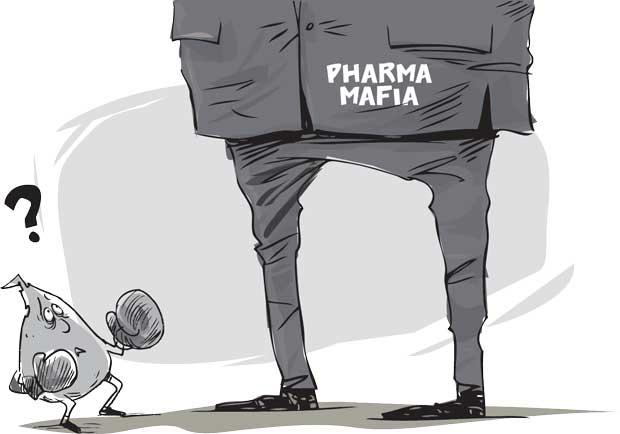
In the health sector, corruption could kill people. The Daily Mirror in its editorial on Wednesday highlighted a report by transparency International’s British branch. The report on corruption in the global healthcare and pharmaceutical sector showed the deadly extent to which corruption has spread like a cancer and was posing a danger to millions of people.

The crisis is similar in Sri Lanka though, after a 10 year delay, the national government last year passed legislation to implement Professor Senaka Bibile’s essential medicines concept. Today we highlight some world famous Wikileaks disclosures on how the Americans sabotaged Prof. Bibile’s National Medicinal Drugs policy during the 1970s.

According to the Colombo Telegraph, leaked US Diplomatic Cables show that the US did play a key role in sabotaging the drug policy which Prof. Bibile tried to implement through the State Pharmaceuticals Corporation and the State Pharmaceuticals Manufacturing Corporation. In 1970, during the Sirimavo Bandaranaike administration, local agents of transnational pharmaceutical corporations were making huge profits by selling medicinal drugs under their trade names. They were alleged to be giving out biased information about the branded drugs as against those named generically.

Ms. Bandaranaike’s United Front Government had appointed Prof. Bibile and the then communist party leader Dr. S.A Wickremasinghe recommended head a Commission to probe this issue and it recommend the implementation of a national policy and the setting up of a state body to regularise the trade. Accordingly, in 1971 the then Industries Minister T.B Subasinghe appointed Prof. Bibile as the founder chairman of the State Pharmaceuticals Corporation.

On February 13 this year, a ceremony was held in Kandy to mark the 96th birth anniversary of Prof. Bibile who was widely respected for his advocacy of the government-controlled pharmaceutical purchasing plans often referred to as rationalisation” of pharmaceuticals and the development of a national pharmaceuticals policy. His aim was to ensure that all people had access to quality drugs at affordable prices. According to the Wikileaks documents, In a Confidential US diplomatic cable dated March 23, 1973, the US State Department informed the US embassy in Colombo that the SPC had announced on March 9 that it would assume total control of imports of bulk raw materials and finished goods and would become the sole importer by the end of 1973. The Pharmaceutical Manufacturers Association (PMA) had requested that the embassy got in touch with the US drug firm representatives in Colombo and suggested that a protest to the government of Sri Lanka might be appropriate.

On March 27, 1973, the US Embassy replied to the Secretary of State saying that Embassy had been in touch with Warren Williams, the PFIZER representative in Sri Lanka. At a March 23 meeting, Prof. Bibile had laid down the laws to the local Pharmaceutical representatives including members of the Ceylon Pharmaceutical Manufacturers’ Association (CPMA). The document described the meeting as acrimonious.  The US embassy said it believed the SPC intended to carry out its national medicinal drugs policy in a doctrinaire manner. It said the SPC’s actions appeared to leave little scope for private drug businesses and Mr. Williams unofficially said that PFIZER would have to pull out of Sri Lanka. The Ambassador said he planned to raise the issues with Minister Subasingha.

According to the Wikileaks documents, on March 29, 1973, the US Department of State wrote to the US Embassy in Colombo saying the US endorsed the plan to take up the issues with the Minister.
Eventually in 1976, according to information available to the Daily Mirror, the then US ambassador met premier Bandaranaike and told her that if Prof. Bibile’s national medicinal drug policy was not scrapped, the US would be forced to reconsider aid to Sri Lanka including the PL480 under which wheat flour was supplied at a subsidized price. At that time Sri Lanka was heavily dependent on US aid. Left with no option, the Prime Minister called Prof. Bibile to her office and told him that the policy would have to be scrapped. A sad Prof. Bibile told the Prime Minister that he also had no option but to quit. Thus one of the world’s most respected pharmacy scientists was lost to Sri Lanka. He went to British Guyana where he took up a United Nations post but within a year he died in circumstances that are still mysterious.  What happened in the 1970s is happening now also. We hope the national government will give the newly-appointed national medicines regulatory authority, full powers to go ahead with the Bibile-principles and will not give in to the transnational drug Mafia.

– See more at: http://www.dailymirror.lk/105725/Wikileaks-show-how-Big-pharma-sabotaged-Bibile-policies-EDITORIAL#sthash.HPaRROEH.dpuf

The Constitutional Council and the tale 0f the Emperor’s New Clothes

February 21st, 2016

by Dr Nihal Jayawickrama Courtesy The Island


The Prime Minister stated on the floor of Parliament that the Constitutional Council had not yet been able to determine the “procedures” for the performance of its duties and functions as required by Article 41E (6) of the Constitution. He attributed the delay to the urgency with which the Council had to proceed to make appointments to the independent commissions. He explained that, as an interim measure, the Council was utilising the procedures that had been adopted in 2002 by the Constitutional Council established under the 17th Amendment. However, nearly five months have elapsed since those appointments were made, and the Council appears to have overlooked the fact that, unlike under the 17th Amendment, it has to “make rules relating to the performance and discharge of its duties and functions” and to publish them in the Gazette and then place them before Parliament.

article_image
by Dr Nihal Jayawickrama

It is interesting to examine whether the Constitutional Council did, in fact, act according to the 2002 procedures when it proceeded to “approve” the President’s several recommendations on the appointment of the Attorney General. The 2002 procedures state that, in respect of the office of Attorney General, the Council “deems the following persons eligible for appointment”: (i) a judge of the Supreme Court; (ii) the Solicitor-General; (iii) Additional Solicitors-General (normally in order of seniority); and (iv) a practitioner at the unofficial bar of at least 30 years’ standing who has a successful practice and is held in high esteem by the judges and the legal profession.

The 2002 procedures also state that the Council shall not approve for appointment a person who, inter alia, (i) is not impartial and independent or is apparently biased or prejudiced; (ii) is actively engaged in partisan activities; (iii) has been charged with ethical misconduct in his private life; (iv) has at any time associated with persons involved in inappropriate activities such as gambling; or (v) owes debts to the Department of Inland Revenue. It adds that the Council shall only approve the appointment of a person (a) of ability with appropriate training, experience and qualifications; (b) of integrity; and (c) who has demonstrated soundness of moral principle in his behaviour, is free of moral wrong or guilt, and is upright, veracious, honest and straightforward.

The application of such comprehensive criteria to a recommendation made by the President will require an exhaustive investigation into the credentials of a recommended candidate. It must be presumed that when the Constitutional Council twice approved the President’s recommendation that the Solicitor General be appointed to act in the vacant office of Attorney General, it applied these criteria and was satisfied that he fulfilled all of them. It has been reported that on the third occasion, the President recommended three persons as being qualified and suitable for appointment in a permanent capacity to the office of Attorney General. These three were the Solicitor General and two Additional Solicitors General. It has also been reported (and not denied) that a majority of five members of the Council were in favour of approving the appointment of the Solicitor General, whereupon the Chairman of the Council had ruled that the President should have recommended only one person. As reported, the reason for the Chairman’s decision to abort the meeting and request the President to forward only one name, was that if the Council approved one of three names recommended to it, the Council would, in effect, be making the appointment, instead of the President. That reason, if in fact it was stated, is beyond comprehension.

What the Constitution requires is that no person shall be appointed by the President to the office of Attorney General “unless such appointment has been approved by the Council upon a recommendation made to the Council by the President”. Nowhere is the President required to submit only one name. Indeed, if the objective of establishing the Constitutional Council was to bring to an end the arbitrary manner in which successive Presidents made appointments to the scheduled offices, often ignoring seniority, competence and integrity, and guided principally by political considerations, the fact that the current President submitted three names for the consideration of the Council was an initiative to be welcomed, rather than repudiated, as the Chairman reportedly did. Indeed, if the President, in full knowledge of the prescribed criteria, were to submit only one name, then, the role of the Constitutional Council, meeting in closed session, would be reduced to that of a cipher, mechanically stamping its approval on every recommendation it receives.

What the President did next, and what is reported to have happened at the next meeting of the Constitutional Council, is even more disturbing. Why did the President, in full knowledge of the criteria, recommend the Solicitor General on three occasions within one month, and then change his recommendation to that of an Additional Solicitor General on the fourth occasion? In the 48 hours that elapsed between his third and fourth recommendations, what events, if any, occurred that impelled the President to change his mind on the suitability of the person he had thrice recommended? In the absence of any explanation for this startling transformation, given that transparency is an essential element of good governance, it would appear that we are now beginning to sail too close to the rejected corrupt, autocratic and tyrannical regime of yesteryear.

Equally bewildering is the amazing speed with which the Constitutional Council reportedly approved the fourth recommendation of the President, namely that of an Additional Solicitor General. Did the Council inquire from the President which of its criteria the Solicitor General whom he had thrice recommended had now failed to satisfy? Did the Council provide an opportunity to the Solicitor General to respond to any allegation made against him, whether within or outside the Council? The principles of natural justice surely apply when procedures are prescribed and criteria are established. Did the Council summon the Acting Attorney General and the newly recommended candidate for that office and interview them both before approving the latter? How else did the Council satisfy itself that one was more suitable than the other? With what consummate ease did the five members who reportedly favoured one candidate at the previous meeting now express their enthusiastic support for the other (if indeed they did)? In the absence of good and credible answers to these questions, one is left with little option but to compare the much hyped Constitutional Council to the tale of the Emperor’s New Clothes.

Result was murderous mayhem in the M.E.! OBAMA & HILLARY’S OBSESSION WAS ‘REGIME CHANGE’ . . .

February 21st, 2016

by Selvam Canagaratna Courtesy The Island


“Boys and girls, / And women, that would groan to see a child / Pull off an insect’s leg, all read of war, / The best amusement for our morning meal.”

– Samuel Taylor Coleridge, Fears in Solitude, 1798.

Pulitzer-prize-winning investigative reporter Seymour Hersh keeps doing it at regular intervals, each time revealing an altogether new – and starkly real – story-behind-the-story that had first caught the headlines.

article_image

This time, in a recent issue of the London Review of Books, he relates a stunning tale of how the Barack Obama-Hillary Clinton duo’s aggressive pursuit of regime change in Syria [during his first term, with Hillary as his Secretary of State] sparked criticism and pushback from no less than, yes, the US Joint Chiefs of Staff (JCS) itself!

[If nothing else, Hersh’s account simply reinforces what Diana Johnstone has to say in Queen of Chaos, Diana’s riveting account of Hillary Clinton’s misadventures as Secretary of State under Obama. Wrote Diana: “Something new is needed. How about a Woman War President? Hillary Rodham Clinton has painstakingly groomed herself for the role. Her record as Secretary of State shows that she is fully qualified to be the first woman to be known as ‘the mother of all drones’ or even to launch World War III.”]

Hersh’s focus in the LRB article is Obama’s determination to unseat Syrian President Bashar al Assad and Obama’s false claim that ‘moderate’ rebels were in place to do the job disturbed key military thinkers who understood that moderates were weakly represented among Syria’s rebel movement and that the President’s obsession with removing Assad served jihadist forces leading the Syrian resistance.

Wrote Hersh: “Barack Obama’s insistence that Bashar al-Assad must leave office – and that there are ‘moderate’ rebel groups in Syria capable of defeating him – has in recent years provoked quiet dissent, and even overt opposition, among some of the most senior officers on the Pentagon’s Joint Staff . . .

Hersh was told that the JSC appraisal was an ‘all-source’ one, drawing on information from signals, satellite and human intelligence, and took a dim view of the Obama administration’s insistence on continuing to finance and arm the so-called moderate rebel groups. By then, the CIA had been conspiring for more than a year with allies in the UK, Saudi Arabia and Qatar to ship guns and goods – to be used for the overthrow of Assad – from Libya, via Turkey, into Syria.

The new intelligence, Hersh noted, singled out Turkey as a major impediment to Obama’s Syria policy. What was started as a covert US programme to arm and support the moderate rebels fighting Assad had been co-opted by Turkey, and had morphed into an across-the-board technical, arms and logistical programme for all of the opposition, including Jabhat al-Nusra and Islamic State. The Free Syrian Army was a rump group stationed at an airbase in Turkey. In short, the US was arming extremists.

“The military’s resistance dated back to 2013, when a highly classified assessment by the Defense Intelligence Agency (DIA) and the Joint Chiefs of Staff, then led by General Martin Dempsey, forecast that the fall of the Assad regime would lead to chaos and, potentially, to Syria’s takeover by jihadi extremists, much as was then happening in Libya.

The Obama administration refused to heed the DIA and JSC’s prescient warnings, rooted in solid intelligence, and massive CIA arms shipments to the jihadist rebels fighting Assad continued, helping fuel the rise of the IS. “The arms travelled from Libya to Syria through the leading IS sponsor and US ally, Turkey, in the wake of the killing of former Libyan head of state Muammar Gadaffi by Islamist extremists.

The operation to oust Assad, Hersh noted, was largely run out of a covert CIA annex in Benghazi, with State Department acquiescence. On 11 September 2012 the US ambassador to Libya, Christopher Stevens, was killed during an anti-American demonstration that led to the burning down of the US consulate in Benghazi; reporters for the Washington Post found copies of the Ambassador’s schedule in the building’s ruins which showed that on 10 September Stevens had met with the chief of the CIA’s annex operation. The next day, shortly before he died, he met a representative from Al-Marfa Shipping and Maritime Services, a Tripoli-based company which, [a JCS official told Hersh], was known by the Joint Staff to be handling the weapons shipments to the Syrian rebels.

Hersh reports matter-of-factly that Ambassador Stevens was in Benghazi to oversee the CIA’s technically illegal arms smuggling operation there. “The US consulate in Benghazi, attacked by jihadist extremists who roamed the city’s streets, was part of the US effort to bring down Assad. The White House concocted a story claiming that the Benghazi attack had emerged from a ‘spontaneous demonstration’ sparked by an Internet video that had mocked Prophet Mohammed. Obama instructed Secretary Clinton to play along with that fairy tale and she complied, Hersh notes.

“On September 11, 2012, Hillary released a statement connecting the attack to ‘inflammatory material posted on the Internet’ and ‘deplor[ing] any intentional effort to denigrate the religious beliefs of others.’ The message said that America’s “commitment to religious tolerance goes back to the very beginning of our nation.” [Hersh’s comment: “Thus was an incident that emerged from criminal and blood-soaked US imperialism wrapped in the flag of America’s supposed noble commitment to tolerance and diversity in its liberal struggle with religious fanatics.”]

The Joint Chiefs felt that a direct challenge to Obama’s policy would have ‘had a zero chance of success’, wrote Hersh. So in the autumn of 2013 they decided to take steps against the extremists without going through political channels, by providing US intelligence to the militaries of other nations, on the understanding that it would be passed on to the Syrian army and used against the common enemy, Jabhat al-Nusra and Islamic State.

It was through Germany, Israel and Russia that US intelligence was shared. Each had its reasons for co-operating with Assad: Germany feared what might happen among its own population of six million Muslims if Islamic State expanded; Israel was concerned with border security; Russia had an alliance of very long standing with Syria, and was worried by the threat to its only naval base on the Mediterranean, at Tartus.

It was clear that Assad needed better tactical intelligence and operational advice. The JCS concluded that if those needs were met, the overall fight against Islamist terrorism would be enhanced. Obama didn’t know, but Obama doesn’t know what the JCS does in every circumstance and that’s true of all US Presidents.’

There was no direct contact between the US and the Syrian military; instead, the adviser said, ‘we provided the information – including long-range analyses on Syria’s future put together by contractors or one of our war colleges – and these countries could do with it what they chose, including sharing it with Assad. We were saying: “Here’s some information that’s pretty interesting and our interest is mutual. End of conversation.” It was a military-to-military thing, and not some sort of a sinister Joint Chiefs’ plot to go around Obama and support Assad. It was a lot cleverer than that. If Assad remains in power, it will not be because we did it. It’s because he was smart enough to use the intelligence and sound tactical advice we provided to others.’

Hersh concludes: “The Joint Chiefs and the DIA were constantly telling Washington’s leadership of the jihadist threat in Syria, and of Turkey’s support for it. The message was never listened to. Why not?”

“PRESIDENT MAHINDA RAJAPAKSE IS THE FATHER OF WAR VICTORY”- SARATH FONSEKA ON 14 DEC 2009 (VIDEO RE-PRODUCED)

February 21st, 2016

By M D P DISSANAYAKE

https://www.youtube.com/watch?v=NXz2UdUwu9c     

 ( By Courtesy YouTube)

FM’s FM: FOUL MOUTH OF FIELD MARSHAL:

The Government of Good Governance is making ground work to use Foul Mouthed Sarath Fonseka to bring maximum political damage to the President Mahinda Rajapakse through various malicious allegations.     The stage is set to unravel these stories within next few weeks and months.

With this back drop, it is appropriate to listen to Sarath Fonseka’s statements and clarifications made at a Rupavahini interview on 14 December 2009. We urge patriotic readers of Lankaweb to re-visit this episode so that comparisons can be drawn between facts and fiction from the horse’s mouth.

SIGNALS OF MARCHING ORDERS FOR GOVERNMENT:

The loss of power is looming for the Government of Good Governance. The influential Ven. Sobitha Thero factor is no longer available for Ranil, Maithree and Chandrika. Dr Nirmal Ranjith Dewasiri ( the spokesperson of National Movement for Social Justice who pioneered with Ven Sobitha to bring Ranil into power ) has branded Prime Minister Ranil Wickremasinghe as a “Stubborn” man. The outright rejection of Bhikku Kathikawatha Bill by the Supreme Court having direct spin-off effect of advancing rights of Buddhists. Determination of Prime Minister to sign The Economic and Technology Cooperation Agreement (ETCA) is being condemned by the Organisation of Professional Associations (OPA) highlighting the threats to employment opportunities to Sri Lankans at all levels of employment.

The public anger is being translated into action on massive scale on daily basis. The protests from Professionals, Farmers, Teachers, Bhikkus are outpouring. Except JVP, Tamil and Muslim Leaders, majority of personnel and organisation which supported the formation of the government are either perished or abandoned it. Tamil and Muslims are continuing their support to obtain the maximum demands within the remaining period of rotten legacy of Ranil Wickremasinghe. A silent substantial group of UNP MPs are increasingly feeling uncomfortable with the modus operandi of the Prime Minister.

The media has realised the dangers of continuation of this government and for compelling reasons views of the public are largely being expressed through an independent manner, even though newspaper editors have been put under undue influence and political pressure.

According to Neurosurgeon, Dr Anurudha Padeniya,   the Prime Minister Mr Ranil Wickremasinghe is displaying (a) the weaknesses of ability to listen to others views, (b) the lack of flexibility and (c) the lack of leadership qualities.   This   is a serious observation.  

Can a decorated soldier in 2009, since found guilty of several criminal offences, provide much needed hype to an insane leadership?

Emergency heart surgery for Rajitha in Singapore

February 21st, 2016

By Dilanthi Jayamanne Courtesy The Island

article_image

Minister of Health and Indigenous Medicine, Dr Rajitha Senaratne was to be flown to Singapore for an emergency heart bypass surgery from Lanka Hospitals yesterday night after he was admitted to the hospital with chest pains.

Medical sources revealed that Dr Senaratne had come to Lanka Hospitals Thursday night (18) complaining of chest pain and he had returned home after being treated.

Sources said the Health Minister had returned to Lanka Hospital yesterday morning complaining that the chest pain persisted. After further tests it was decided that he should be flown to Mount Elizabeth Hospital in Singapore for an emergency surgery.

They said at the time of going to press a team from Singapore was on its way to Sri Lanka to accompany Dr Senaratne. A medical team from Lanka Hospitals, too, was also on standby, sources said.

නෙල්සන් මෙන්ඩිස් සර්

February 21st, 2016

වෛද්‍ය රුවන් එම් ජයතුංග

නෙල්සන් මෙන්ඩිස් සර් නාලන්දේ ක්‍රිකට් ගුරුවරයා මෙන්ම අංශ කීපයක් භාරව ක්‍රියා කලේය​. මට මුලින්ම නෙල්සන් මෙන්ඩිස් සර් හමු වන්නේ 1977 වසරේදී ය . එවකට මම පහ වසරේ සිසුවෙක්මි. අපගේ පන්තියට පැමිණි ඒ මහතා ( මගේ මතකය අනුව​) මාර්තු මාසයත්  දෙසැම්බර් මාසයත් අතර කාල පරාසයේ ඉපදුණු සිසුන් ක්‍රිකට් කණ්ඩායමට බඳවා ගැනීමට සුදුසු දැයි බැලීම සඳහා පසු දින පාසල අවසන් වීමෙන් පසුව ක්‍රීඩා පිට්ටනිය අසලට එන ලෙස දැනුම් දුන්නේය​.

ක්‍රිකට් කණ්ඩායමට බැඳීමට අාශා කල සිසුන් රොත්තක් පසුදා ක්‍රීඩා පිට්ටනිය අසල වූහ​. මේසා බඩගිනි හමුදාවක් අපේක්‍ෂා නොකල නෙල්සන් මෙන්ඩිස් මහතා සියළුම අපේක්‍ෂකයන්ට ක්‍රීඩා පිටිය වටා ෆ්‍රොග් ජම්ප් හෙවත් ගෙඹි පිමි වට පහක් දාන්නට කීවේය​. එසේ ගෙඹි පිමි වට පහක් දාන්නන් පූර්ව වටයට තේරේ.
මෙසේ ගෙඹි පිමි වට දෙකක් පමණ යන විට බඩගිනි හමුදාවේ සියයට 75 පමණ හැලී ක්‍රිකට් උණ කාරයන් පමණක් ඉතිරි වූහ​. ඔවුන් අතරින් ද ලේවල ක්‍රිකට් අන්තර්ගතවූ ස්වල්ප දෙනෙක් නාලන්දා කනිෂ්ඨ ක්‍රිකට් කණ්ඩායමට තේරුණහ​. ඔවුන් අතරින් සුනන්ත වික්‍රමසූරිය ( වර්තමානයේ ගලේවෙල ප්‍රදේශයේ වියාපාරිකයෙකි) කුෂාන්ත , පතිරගේ යන සිසුන් මේ කනිෂ්ඨ ක්‍රිකට් කණ්ඩායමේ ක්‍රීඩා කල බව මට මතකය​.
වරක් නාලන්දාවට හය වසරට පැමිණි එක් සිසුවෙක් තමා ගාල්ල රිච්මන්ඩ් විද්‍යාලයේදී ක්‍රිකට් සෙල්ලම් කර  තිබෙන බව නෙල්සන් මෙන්ඩිස් සර්ට කීවේය​. නෙල්සන් මෙන්ඩිස් මහතා ඔහුගෙන් රිච්මන්ඩ් විද්‍යාලය ගැන ප්‍රශ්න කීපයක් ඇසුවේය​. ඉන් ගොත ගැහුනු එම සිසුවා තමා ඉගන ගත්තේ ඇලෝසියස් විද්‍යාලයේ බව පසුව කීවේය​. ඉන් පසු කොල්ලන් මෙම සිසුවාට ඇලෝරිචා කියා නමක් පටබැන්දහ​.
නෙල්සන් මෙන්ඩිස් මහතා මෙන්ම එතුමාගේ සොහොයුරු ලයනල් මෙන්ඩිස් මහතාද නාලන්දයේ ගුරුවරු වූහ​.  ලයනල් මෙන්ඩිස් මහතා ආනන්දයට ගිය කතාවද රසවත් එකකි. මේ කතාව මට කීවේ නාලන්දයේ ආදි සිසුවෙකු වූ සරත් අයියා හෙවත් සරත් මෙන්ඩිස්ය​.
එක්දහස් නවසිය හැට ගනන් අවසන් භාගයේ හෝ හැත්තෑව මුල් කාලයේ මෙම සිද්ධිය සිදුවී තිබේ. නාලන්දාවේ එක් ගුරුවරයෙක්  ලයනල් මෙන්ඩිස් මහතාට බොහෝ බාල්දි පෙරලා තිබේ. මේ හිරිහැර උත්සන්න වූ අවස්ථාවක ලයනල් මෙන්ඩිස් මහතා අදාල ගුරුවරයාගේ දෙකන් රතු කොට ඇත​. මෙම සිද්ධිය වූයේ නාලන්දා විද්‍යාලයේ විශාල සීනුව යටදීය​. මේ ගැටුම නිසා ලයනල් මෙන්ඩිස් මහතා ආනන්ද විද්‍යාලයට මාරු කරන ලද අතර නෙල්සන් මෙන්ඩිස් මහතා නාලන්දාවේ  රැඳුනි.
නෙල්සන් මෙන්ඩිස් මහතා ජීවිත කාලයම කැප කෙරුවේ ක්‍රිකට් වෙනුවෙනි. එතුමා  නාලන්දාවේ ක්‍රිකට් ක්‍රීඩාවේ උන්නතිය සඳහා මෙන්ම ලංකාවේ ක්‍රිකට් ක්‍රීඩා ප්‍රවර්ධනය සඳහා ඉමහත් සේවයක් කල පුද්ගලයෙකි. නෙල්සන් මෙන්ඩිස් මහතා නාලන්දාව වෙනුවෙන් කැප කල සේවය නිසා බොහෝ දෙනෙක් එතුමා ආදි නාලන්දීයෙක් බවටද සිතූහ​.
නෙල්සන් මෙන්ඩිස් මහතා නාලන්දාවෙන් විශ්‍රාම ගිය දිනයද මට මතකය​. එදින විදුහලේ රැස්වීමක් පවත්වන ලදි. බොහෝ ක්‍රිකට් ක්‍රීඩකයෝ එතුමාගේ සේවය අගයා කතා කළහ​. අවසානයේදී  නැගී සිටි ලයනල් මෙන්ඩිස් මහතා රැස්වීම ඇමතූ අතර මගදී එතුමාගේ දෙනෙත් වලට කඳුළු ආවේය​. එසේම කතාව අවසනයේ ක්‍රිකට් පිට්ටනිය බාරව සිටි සුළු සේවකයන් දෙදෙනාවූ ඇඩ්ඩින්ටත් බෙනට්ටත් ඉස්තූති කලේය​.
නෙල්සන් මෙන්ඩිස් මහතාගෙන් සිසුන් ඉගන ගත්තේ ක්‍රිකට් පමණක් නොවේ. එතුමාට දැවැන්ත පෞරුෂත්වයක් තිබුනේය​. අද කාලයේ දේශපාලුවන්  දෙපා මුල වැඳ වැටෙන  ගුරු නිවටයන් හා විදුහල්පතිවරු යැයි කියා ගන්නා  පගා ගහන මව්වරුන් ගෙන් ලිංගික අල්ලස් ඉල්ලන කවටයන් දකින විට  නෙල්සන් මෙන්ඩිස් වැනි අදීන පෞරුෂවයකින් යුතු ගුරුවරුන් ගේ සෙවනේ අධ්‍යාපනය ලැබීමට අප වාසනාවන්ත වූයෙමු.
වෛද්‍ය රුවන් එම් ජයතුංග

Was the “Federal” Party (ITAK) a separatist party from the outset, or NOT?

February 21st, 2016

Chandre Dharmawardana

Those in the forefront of the Tamils’ agitation for devolution of power have always been  vague, deliberately or unconsciously, in the terminology used in their arguments, and the distinction between provincial autonomy, states’ rights in a federal union, and a separate state have been blurred by a fog of verbiage, and obfuscation K. M. de Silva [1]”

In this essay (see also website:thuppahi.wordpress.com/2016/02/17/was-the-federal-party-a-separatist-party-from-the-outset-or-not/) I will try to give an account of how the Federalist” politics of the Ilankai Thamil Arasu Kadchi is seen by me, an outsider who had no real access to the main players, except indirectly.

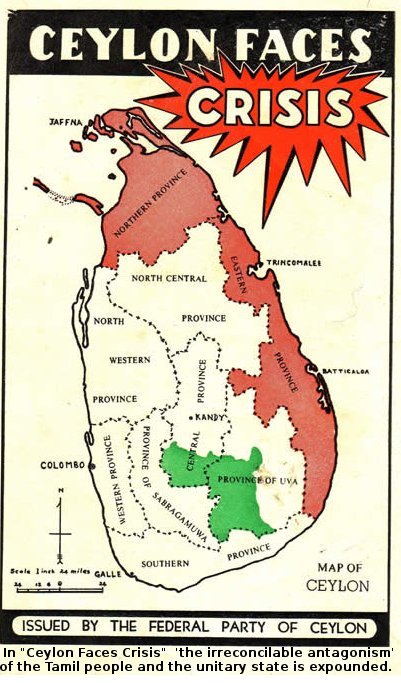
In my reading, it  is incorrect to claim that Federalism or  Eelam was the clear aim of the 1949 Maradana resolution. Both tendencies existed. The Ilankai Thamil Arasu Kadchi (ITAK) name was deliberate, and satisfied the separatist ginger group of the ITAK, while the Federal” name in English satisfied the moderate politicians from Colombo-7.  Mr. V. Navaratnam is representative of the important separatist  group inside the ITAK as he was the early theoretician of the ITAK.  He wrote the then well-known book  Ceylon Faces Crisis”, with an Eelam Map distributed in 1957 [2].  A Separatist Postage stamp was designed by Navaratnam in 1956, and issued in 1961 [3].The ‘separatists’ were not a fringe group inside the ITAK, but its veritable visionary driving force, while the smaller number of Federalists were the restraining force that wielded power initially, purely because of the ‘status’ of the Colombo-7 leaders.  The militant group  pushed forward the tarring of the Sri number plates, and the distribution of wooden pistols among the Sathyagrahi’s on Galle Face in 1957-58. Thus  Satchi Sathiyanandan, a  modern commentator on these events, does not spare the ITAK leaders [4]. Every militant act of the ITAK hardened the attitude of the Sinhalese politicians. Enraged mobs and opportunist looters did the rest [5]. These weakened the moderates in the ITAK, and inexorably drove the ITAK towards an unambiguous separatist policy.

The tussle between moderates and hardliners: Already by the middle of 1935 there were two well-defined groups of Tamil politicians, viz., the hardliners, and the moderates. Ponnanmbalam was  the hardliner and opponent of Universal Franchise, while Mahadeva and others working with DS Senanayaka were the moderates. There was also a Kandyan Lobby” demanding independent political recognition.  Ponnambalam claimed that (a) the British, using the Sinhalese in the state council discriminated against the Tamils in Jobs and government employment.  (b) He claimed government discrimination in Education, (c) He claimed discrimination in health pointing to the hospitals in Colombo (d) He claimed discrimination as there was no port in Jaffna comparable to the Colombo port. (e) He  objected to restoration of Anuradhapura and other ‘Sinhalese’ archaeological sites claiming discrimination (f) he objected to the Buddhist Temporalities act and clauses in treaties giving `special’ privileges to Buddhism (g) Ponnambalam claimed that Senanayake’s agricultural policies of tank restoration etc  were for the ‘colonization’ of Tamil lands. G. G. Ponnambalam’s solution for the country was to give equal representation (50-50) to the sinhalese and the Tamils who included the minorities with them, instead of the 15 seats that the Tamil constituency would get, according to demographic ratios [6].

Ponnambalam was already known for having triggered the first Sinhala-Tamil riot by an inflammatory speech that he gave in Nawalapitiya, in July 1939 [7]. At the time he was the Tamil ‘Enfant terrible‘. Both Ponnambalam and SWRD had been called ‘pocket Hitlers’ by their admiring supporters, at a time when Hitler’s name had not yet become demonic[8].

Senanayake used the clever scheme of forbidding any young  militant Sinhalese politician (like SWRD) from going before the Soulbury commission and attacking Ponnambalam, to prevent  the matter  going out of his control and causing public riots.  DS  enforced a boycott” of the Soulbury Commission in public, and wooed it behind the curtains”. This should be compared with the mishandling of such hot topics by less adroit politicians like John Kotelawala and SWRD who let the genie out of the bottle”, irrevocably.  Soulbury used the full research power of the Civil Service to demolish the (a)-(g) arguments of Ponnambalam completely and with detailed statistics.  I remember reading D.S. Senanayake’s  inauguration speech of the first parliament of Sri Lanka. for the first time in the 1970s, in the company of a young Historian [9] who also remarked that DS already recognized strong centrifugal threats to the Ceylonese nation”. It was the genius of Senanayake that prevented an ethnic split in the quest  for Independence.

The ‘two-nations’ concept: When the  Soulbury team rebutted GGP and  totally destroyed Ponnambalam’s political platform, DS Senanayake gave him a  hand and took him into the first Cabinet. That was when SJV declared that GGP is a Traitor to the Tamil cause” and took over the mantel of the hardliner  from Ponnambalam. SJV was a supporter of the extreme nationalist League of Tamil Federations” of the 1940s which  distributed a history book claiming that the Tamils had ruled Sri Lanka from time immemorial [10]. Unlike Ponnambalam’s platform which was based on claims of discrimination of the Tamils by the Sinhalese-controlled state council, the ITAK based its claims to ‘Arasu’ on the Concept of Traditional Homelands ruled by the Tamils since time immemorial.  Even today, many political commentators do not seem to understand the great difference in principle between Ponnambalam’s position and that introduced by Chelvanayagam.

It has been said that the  Indian citizenship act was drawn up largely by Sir Kandiah Vaithiyanathan and his team who were determined, among other things, to leave no room for Bracegirdle-type Marxist power politics in the Tea-Estates. However, Chelvanayagam and the ITAK began to use it against D.S. Senanayake and GGP, claiming that it was an act to discriminate against the Tamils. The act required continuous residence for 7 years for citizenship. This is less draconian than what is (and was)  required  in many western countries, in naturalizing immigrant workers.

In an article entitled Regarding some basic beliefs of Tamil Nationalism which have misled the Tamils”, the dissident Tamil writer Sebastian Rasalingam writes (Sri Lanka Guardian [11]  as follows: Chelvanayakam and others proposed the two-nation concept (instead of the failed fifty-fifty approach). One aspect of this proposal was to regard the Sinhalese as invaders of the Tamil homeland which had already begun to be defined, for example, with the formation of a society calling itself the All-Ceylon Aboriginal Inhabitants of Jaffna”, coming into being in May 1940 (Hindu Organ, May 13, 1940). The Ilankai Thamil Arasu Katchchi (ITAK) hoped to use the example from India, where the mass Satyagrahas finally drove out the British, as the weapon to unleash against the Sinhalese. This policy required a deliberate attempt to discredit the Seananayakas and others who stood for the one-nation of Ceylonese”concept. Collaborators with the Sinhalese automatically became traitors or thurogis. Thus it was how GG. Ponnambalam was declared a traitor by the ITAK. With this turn of events, the ITAK was not a pan-Ceylonese party even for appearance’s sake. Its task was to destroy any bridges which existed between the two communities, and insist that the Tamils, with their grander history and destiny, are utterly different from the Sinhalese, and should seek its own Arasu.

Sebastian Rasalingam, as judged from his own writings, had come from a highly  oppressed lower caste”.  He presents a rare but important  point of view regarding Tamil politics. However, his views may need to be moderated as the ITAK was not by any means a monolithic organization in its thinking. However,   unlike what was reflected in the English newspapers, those who have examined  the Tamil-Language newspapers from about 1935 to 1975 have noted the ever-growing strong separatist trend in Northern politics, with Tamil politicians claiming that the Tamil youth do not have jobs because all the jobs are taken by the Sinhalese in the South”, and presenting the vision of a rosy traditional homeland run by the Tamils for the Tamils”. Of course, in the South, the Sinhalese politicians claimed that all the jobs have been taken by the Tamils!

In reality, there were many structural reasons for the stagnation of the North. These were, climate, the sparse population in the North (except in the Jaffna area), malaria, refusal of Tamil politicians to upgrade roads, causeways etc., as they feared that this will make low-caste villagers uppity”, and similar caste politics  [4] playing a role in the stagnation of the North. Furthermore, as Tamils in the North prospered, they moved to Colombo, and if possible to greener pastures  abroad. Even the fact that most of the political leaders of the North lived in Colombo had a role in debilitating the North.  Although GGP claimed that the ‘Sinhalese government’ prevented the development of Jaffna,  he himself opposed the upgrading of Jaffna from an  urban council to a Municipal council as his land-owning political class did not wish to pay higher taxes for their  properties in Jaffna!  Those old debates about the building of causeways, upgrading of urban councils etc.,  are very revealing, as reflected in the Hansard records of that period, where Tamil delegates were at each others’ throats [12,13].

In my opinion the ITAK of the 1949-1970 period had a majority of separatists who were not very powerful and based in the North, while a minority of more moderate Colombo-based anglicized Federalists remained powerful. But the power inside the ITAK moved from the hands of the Federalists into the hands of the  Arasu group, with S.J.V. and E. M. V. Naganathan being more with the Arasu group but increasingly disagreeing with Navaratnam’s direct move towards Eelam as they felt that the Jaffna electorate was not ready for it. However, the glittering vision of an independent Tamil Nation” must have been more attractive and infectious than the cautious approach to Federalism supported by the moderates in the ITAK.

Thus the  ITAK tactics were not designed at any stage to win the heart of the Sinhalese majority, but more to inflame the ethnic divide. On the other hand, most  leaders of the Sinhalese parties always assumed that the Tamil question” could be manipulated for their short-term political advantage,  and often assumed that they can `bulldoze their way through’ and in the end force the Tamils to accept their political platform. We see this duplicity in the politics of Mrs. Bandaranaike, and much more blatantly  in J.R. Jayawardene, Chandrika Bandaranaike as well as in the politics of the Marxist parties.

The Marxist parties and their principled stand” for Parity: The LSSP  supported parity of status for Sinhala and Tamil”, and many of us who were young people at the time were impressed by their principled stand” which appeared heroic as their policy seemed electorally suicidal. Thus many of us  became fellow travelers of the Left,  as the Left seemed  likely to provide a non-emotional solution to ethnic saber rattling as well as to many economic woes.

However, much later, two members of the LSSP central committee [14] explained to me independently of each other that their policy was designed for strategic reasons and had nothing to do with bourgeois principles”. The trade unions controlled by the LSSP in the 1950s were comprised of members who were Sinhalese and Tamils with perhaps a Tamil majority in some unions. Thus Parity of status existed de facto in the unions.  The LSSP expected to succeed Bandaranaike ‘the Menshevik analogue’ within a short time, using the unions as their revolutionary instrument, rather than the electoral process. After the revolution, they hoped to capture the support of the Tea-plantation workers who are also Tamil speakers. Hence the Parity of status policy” was part of the strategy of the revolution and not a case of principles”. In fact, by the 1970s the expected revolution had not occurred, and the demographics of the unions had changed, as a Sinhala Senior School Certificate had become sufficient to join the government clerical service. Furthermore, the Tamil leaders had consistently rejected the LSSP and other Left parties which were labeled as the NPPs (Nalavar-Pallar Parties”) – the UNP was always their favoured Sinhala party. Not surprisingly, and now concerned with electoral tactics, N. M. Perera and Colvin R. de Silva moved to a different strategy in joining  Sirima Bandaranaike. Their  republican constitution, drawn up mainly by Colvin, had no hint of  the two languages, one nation” proposition so eloquently presented by Colvin only a decade before!

The Sinhala and Tamil Languages have had (officially, but not in prctice)  parity of status since 1988. K. M. de Silva writes [1]: Modifications initiated between 1956 and 1978, through political necessity (in 1958) and a realistic adjustment to life in a plural society (1978), all but conceded parity of status to the Tamil language with Sinhala. The clauses on language in the constitution of 1978 reflected a recognition of an existing reality. The explicit reversion to parity of status to the two languages, which came in 1987 and 1988 as a part of a political settlement brokered by the Indian government, was also a recognition of this.”

Demographics and power politics: The fact remains that although the Tamils have been  a small minority, they  have been  as powerful as the majority during many important historical decades, under the British and after independence. The percentage of Tamils  is smaller than the 18% Hispanics in the USA, or the similar high percentage of Arab speakers  in France. These minorities have no rights what so ever in comparison to the Tamils of Sri Lanka –  the French Arabs would never dare to ask the Marseillaise to be sung in Arabic, and similarly, no US Governor of Hispanic extraction will dare to propose to sing the US anthem in Spanish. Thus, the recent singing of the National Anthem in Tamil as and  its sporadic use [15] until 2010 can be presented to USA and France, pointing out that Sri Lanka is, and has been, far ahead of them in respecting minority rights!

In Canada the demographic ratio is close to being more even for French and English, and a very different political history applies. At independence the Tamil population in Ceylon  may have been 10 to 15%  (given as 12.5%  by K. M. de Silva [1]) depending on how you define `Tamils’. But their economic and administrative clout at the time was much much higher than the demographics would indicate, and remains so even today. In my view, political planners have to take such factors into account.

The current division in the TNA, with Wigneswaran moving to take up the mantel of the hardliner, there by undermining  Sampanthan is a repeat of what  happened in Tamil politics since the days of the legislative council, and then in the State council. It is also a matter of personal hubris. For Ponnambalam and SJV, being challenged for kingship by the other was a personal affront; and today, perhaps there is a sense that a Wigneswaran does not want to play second fiddle to a Sampanthan for ever.

Federalism as a still-born vision: Reconsidering the issue of Federalism from a completely a-historical, rational point of view, one can argue that Federalism is the optimal solution to Sri Lanka’s ethnic confrontations. However, such reasoning is only of academic interest. The past determines the future and we cannot be a-historical when the Sinhalese and the Tamils insist on  histories that read so differently, although there is  a great common ground  of co-existence and assimilation and also a few epic wars.

Almost all federations (e..g, Swiss, Canadian, etc) started from independent units WANTING to get together (i.e., a centripetal political force). In Sri Lanka, it is a wish to get away and separate (a centrifugal force) that drives the ITAK initiative. Most steps taken by the ITAK seem to have been designed to create fear in the minds of the Sinhalese, instead of reassuring them. That is why Federalism has failed, and will continue to fail to become a reality by popular vote. Perhaps it may be achieved by political manipulation, and then we will have years of border warfare” to deal with.

Imagine a scenario  where, in 1957, SJV offering to collaborate with SWRD to make  Swabhasha  the language of government, and even offering to join his government and supporting  him against Philip Goonawardena’s attempt to pull him down by daily strikes at the Colombo Port! At that time the Marxists regarded SWRD as the analogue of  Menshevik, and naively believed that their turn to form a government was immediate, as deemed by historical materialism”. If SJV had followed Sinhala Marikkar” (Minister of Posts in the SWRD Cabinet)’s tactics, or Thondaman’s tactics, SJV might have had a very different reception from the Sinhala public – but he would have been disowned by the Navaratnam hardliners!  He would have been declared a thurogi”. Meanwhile, SWRD would be facing the wrath of JR Jaywardene and others who agitated against the Banda-Chelva pact!

Instead of comprehending the true  nature of the 1956 revolution, political actions  of the ITAK antagonized  the Sinhala public and polarized  the ethnic divide [4]. Meanwhile, the tactics of  JR Jayawardene and KMP Rajaratne would have dismayed the moderates in the ITAK, while making the hardliners happy.  Wigneswaran’s recent demands to change the place-name ‘Nagadeepa’ to ‘Nainative’, or the NPC’s charge of ‘Genocide of the Tamils’ by all the governments since 1948 will have the effect (wittingly or unwittingly) of enraging the Sinhala public.  However,  the  push to change the place-name is within the ideology of the traditional homeland”. Ironically,  while Ptolemy’s 2nd century map gives the name as Nagadiba”, Mr. Wigneswaran did not  sponsor the classical Tamil place-name Nakatheev” or Nakanadu” .  The colloquial form Nainatheev” seems to have been brought into vogue by  the large Moor population and fisher community that existed in Jaffna at the turn of the 19th century (as  recorded by Captain Percival [16] who lived in Jaffna during that period) !

However, It is reported that after the singing of the National Anthem in Tamil on the Independence day in 2016, Mr. Wigneswaran had, for the first time, visited the Nagadeepa Buddhist temple, and made conciliatory gestures.

Think of the political process that led to the joining of Newfoundland with Canada. Here were two British-Empire English units without the recent bitter history of Sinhala-Tamil relations, and yet the going was very very tough. What is in store for Sri Lanka today is much tougher, and indeed tougher! It will take another 15-20 years for another crop of youngsters to grow up in the North, and there is a possibility that the saber rattlers will hold sway, which means that 2030-2035 period may herald a new spree of Terror that will further debilitate  the Tamil population. However, before that could happen, there is a large group of young Sinhalese who have been kept away from the Wijeweera-JVP-type activities as they have been conscripted members of the army. The TNA and the civil society” have asked for the de-conscription of the armed forces and the termination of their employment in hotels, retail shops and other activities. Such de-conscription will create a large pool of militant youth who will definitely rise against the present rulers, given current  grim economic prospects. Hence, is Sri Lanka  going to face the rounds of JVP-type terror and anti-terror that occurred in the 1986-1990 era, from about the 2020 onwards? It seems as if history has come full circle!

One cannot talk of Federalism under such conditions, without prior formation of inter-communal bridges.

Constitutional amendments:Given the historical circumstances, the 13th amendment is probably the most that can happen, and that too had to be imposed by external fiat. There are strong arguments for scrapping the 13th amendment and to look for something better, more efficient and more representative. But this seems to be impossible as the PCs  have become an ingrained part of local politics for nearly three decades. Every parliamentarian is beholden to his provincial counterparts for ‘grass-roots’ support, and no party leader will agree to cut the branch that he is sitting on. Sirisena’s current dilemma with the local election show the power of the PCs. So we need to make the most of the 13th amendment as is.

Perhaps the constitution should be modified to abolish the present legislature, and make the elected members of the provincial councils  (which remain intact) subject to a powerful central apex body. The latter should be made up of two delegates (say, the Chief Minister and his deputy) from each provincial council, together with an equal number of  independently elected national delegates based on professions, business and agriculture,   elected from the professional organizations, rather than from the regions. The latter step will ensure 18 well-educated non-parochial non-political legislators in the apex chamber, together with the 18 provincial politicians. The apex chamber will also form the (small) national cabinet elected from among its members, and replace today’s parliament completely.  It will also simplify the present mess of multiple levels of power with local councils, provincial councils and a parliament, with their parasitic hangers on, and with no one really responsible for anything in the existing set up. The development of rapid public transport (electric-train communication and not highways) between different parts of the country is the sine qua non for better economic integration and economic parity of the regions. Economic parity is essential for political parity.

It should also be mentioned that the language problem” is today a non-problem that has simple technical solutions that have come up  due to  advances in information technology.  The ease of translation of a language like Sinhala to a kindred language like Tamil, or vice versa  is also important.  Hence, although all administrative officers  and service professionals should strive to be trilingual, pursuing  the chimera of trying to make every child trilingual is bound to fail, as we see in the failure of bilingualism in Canada  In Canada, after half a century of pushing bilingualism, immersion classes in schools etc.,  and an expenditure of trillions of dollars, 80% of the anglophones are still monolingual!

Minority language inplementation has not been successfully even in India.[17].

I have outlined in a previous article how we can solve the Sinhala-Tamil language barrier via mobile-phone technology[18].  Incidentally, using modern technology, anyone can hear” the National Anthem in any language he pleases. Then, when the National Anthem is sung voicelessly as a bit-manipulation process in a computer chip, a Sri Lankan, be he Sinhala, Tamil,  Malay  or a Lankan-Chinese, he should be able to switch on” to  hear the national anthem in the language that he is emotionally linked to, via his handset!

This should be enough for any one to understand that the human-rights” concept is often misunderstood. The equal rights” that every one should have are equal opportunities” in education, health, housing,  justice, legislative representation, etc., but all are not equal in every circumstance. Unfortunately, no society can provide every service to every body equally, and also to every group equally, unless the groups are equal.

REFERENCES

[1] http://www.lankalibrary.com/pol/background.htm

[2] http://dh-web.org/hrsits/VNava-CeylonFacesCrisis.jpeg

[3] http://dh-web.org/hrsits/ITAK-stamp.jpeg

[4] See Satchi Sathiyanandan: http://www.srilankaguardian.org/2008/10/excellent-and-timely-feature-on-tamils.html

[5] Tarzie Vittachchi, Emergency 58: The story of Ceylon race riots.  Andre Deutsch, London (1958). Unfortunately, no commission of inquiry was launched to evaluate damage, compensate victims, or learn from the event.

[6]  An authoritative study of this era is found in  Jane Russell, Communal Politics under the Donoughmore Constitution, 1931-1947.  Tissara Publishers, Sri Lanka 1982)

[7] A summary of this, with references to newspapers of the era may be found in http://dh-web.org/place.names/riot1.htm

[8] Russell 1982, pp 156-157.

[9] Janice Jiggins

[10] Mentioned by S. Rasalingam, Ref. 11, quoting  ‘Hindu Organ’, 13-05-1940

[11] http://www.srilankaguardian.org/2008/03/regarding-some-basic-beliefs-of-tamil.htm

[12] Hansard, 1935, Columns 4015-4028

[13} Bandaranaike’s attempt to make Jaffna a municipal council was abandoned in 1945.

[14] Dr. Osmund Jayaratne, and Eng. C. B. Wijedoru.

[15] D. B. S. Jeyaraj, http://dbsjeyaraj.com/dbsj/archives/45154

[16] Robert Percival,An Account of the Island of Ceylon, Containing its History, Geography, Natural History, with the Manners and Customs of its various Inhabitants,  (1803) https://play.google.com/books/reader?id=8gpXAAAAMAAJ&printsec=frontcover&output=reader&hl=en&pg=GBS.PA20  It provides detailed  information on the coastal areas,  several important maps and charts. The  the last chapter  describes roads in detail.

[17] http://www.thehindu.com/news/national/tamil-nadu/tamil-learning-is-must-for-students-says-government/article6225010.ece

[18]  http://dh-web.org/place.names/posts/triling.pdf

Addtional:

  • Tamil Person and State. Essays, Colombo: Vijitha Yapa Publications, 2014 …ISBN 978-955-665-230-7 ….. 423 pages
  • Tamil Person and State. Pictorial, Colombo: 2014 Vijitha Yapa Publications, 2014 …. ISBN 978-955-665-231-4 …. 293 pages incl. of 164 pp of images


Health camp for lady journalists at Guwahati Press Club

February 21st, 2016

By Our Correspondent Guwahati.

On the eve of International Women’s Day (8th March), the city based Dispur Hospital has organized a health camp exclusively for lady journalists and better halves of scribes on 8th March 2016 (Monday) at Guwahati Press Club. The camp, to be conducted by only female doctors, lady assistants and nurses, will begin at 11 am and conclude by 2 pm.
Acknowledging the contributions of women to the society and also pledging for a global gender parity,  the International Women’s Day is observed globally. The auspicious day encourages women to get together, support each other and learn from each other.
To commemorate the day with a meaningful exercise, Assam’s well known Dispur Hospitals Private Limited under the leadership of Dr Jayanta Bardoloi has taken the noble initiative in association with Guwahati Press Club. Dr Bardoloi also informed that the participating media persons will get the opportunity for general health check-up with hemoglobin & thyroid tests in the camp.

සංවාදයට විවෘතයි යාපනේ දෙමළ රාජ්‍යය හා නිජබිමක සංකල්ප සම්ප්‍රදායික දෙමළ නිජබිම ඇත්තක්‌ද? බොරුවක්‌ද?

February 21st, 2016

ආචාර්ය සූරිය ගුණසේකර  Courtesy ඉරිදා දිවයින

ඊළම පිළිබඳව උතුරේ සිහිනය සඳහා පදනම වැටෙන්නේ, උතුරු පළාත සහ නැඟෙනහිර පළාත සම්ප්‍රදායික දෙමළ නිජභූමි යන සංකල්පය දෙමළ නායකයන් විසින් ප්‍රකාශ කිරීමත් සමඟය. සිංහල ජනතාව විශ්වාස නොකරන සහ දෙමළ ජනතාව විශ්වාස කරන මෙම ප්‍රවාදය එයින් ලේ විලක්‌ බවට රට පත්ව තිබිණි. සංහිඳියාවේ නාමයෙන් හෝ ත්‍රස්‌තවාදය විනාශ කළ පමණින් ඊළාම් සිහිනය බොඳ නොවී රැඳී පවතින්නේ මෙම සංකල්ප ගතවීම නිසාය. විපක්‍ෂ නායක සහ දෙමළ ජාතික සන්ධානයේ නායකයා වන ආර්. සම්බන්ධන් මහතා විසින් පසුගිය ‘දිවයින ඉරිදා සංග්‍රහය’ට ප්‍රකාශ කරන ලද්දේ තමන් ඉල්ලා සිටින්නේ ඓතිහාසිකව පැවැතෙන දෙමළ නිජ භූමිය බවය. මේ සඳහා වන ප්‍රතිඋත්තර බැඳීම් කිහිපයක්‌ ලැබී ඇති බැවින් මෙම මාතෘකාව සඳහා සංවාදයක්‌ ඇරඹීමට ‘දිවයින’ ඉඩ වෙන් කිරීමට තීරණය කළෙමු. මේ එහි පළමු වටයයි.
පසුගිය පෙබරවාරි 14 දින ඉරිදා දිවයින පුවත්පතේ විපක්‍ෂ නායක ආර්. සම්බන්ධන් මහතා විසින් දෙමළ රාජ්‍යයක්‌ ගැන අදහස්‌ දක්‌වා තිබිණි. එම කරුණු ඓතිහාසික මූලාශ්‍ර ඇසුරින් ගොඩනැංවුණ තොරතුරු නොව ඊළාම් සාහිත්‍යය අයත් මෑත කාලයේ ප්‍රබන්ධ කළ ඒවා වෙති. පුරාණ යාපනය (Ancient Jaffna) නමැති කෘතිය 1919 දී සම්පාදනය කළ රාසනාගයම් මුදලි විසින් ප්‍රකාශ කරන්නේ යාල්පානම් වයිපවමාලෙයි, පරරාජසේකරන් උලෙයි, වයියා පඩාල්, කයිල්‍ය මාලෙයි වැනි පොත්වල ඇති උක්‌ත කතා ගැහැනුන් තම දරුවන්ට නින්ද යනතුරු කියන ලද කතා බවය. මෙම කතා උපයෝගී කරගෙන පේරාදෙණියේ ඉතිහාස කථිකාචාර්ය කේ. ඉන්ද්‍රපාලන් විසින් ලන්ඩන් විශ්වවිද්‍යාලයට 1967 දී ඉදිරිපත් කළ ආචාර්ය උපාධිය සඳහා වන නිබන්ධනය වූ Early
Tamil Settlements in Jaffna කෘතිය සඳහා පී. එච්. ඩී. (ආචාර්ය) උපාධිය ලැබුණි. එහි කියෑවෙන්නේ 1215 කාලිංග මාඝ ආක්‍රමණයේ පටන් යාපනේ වෙනම දෙමළ රාජ්‍යයක්‌ ඇතිවූ බවය. ෙ-. ආර්. ජයවර්ධන හිටපු ජනාධිපතිවරයා විශ්‍රාම සුවයෙන් පසුවන 1996 දී කීවේ මහාචාර්ය කේ. එම්. ද සිල්වා විසින් තමාට විස්‌තර කළ පරිදි උතුර – නැඟෙනහිර වෙනම දෙමළ රාජ්‍යයක්‌ තිබූ නිසා 1987 ඉන්දු – ලංකා ගිවිසුමෙන් එම භූමිය දෙමළ නිජබිම ලෙස පිළිගෙන අත්සන් කළ බවය. දැන් සම්බන්ධන් මහතා ද එම කේ. එම්. ද සිල්වාගේ ඉතිහාසය පොත බලන ලෙස අපට කියයි. එහි ඇත්තේ ඉන්ද්‍රපාලන්ගේ පී. එච්. ඩී. නිබන්ධනයේ ඇති කතන්දර ඉතිහාසයයි.

1. උතුරේ දෙමළ රාජ්‍යයක්‌ පැවතුණි නම් චෝල දේශයේ (තමිල්නාඩුවේ) බදු ගොඩනැඟිලි හා මාලිගා නටබුන්, දේවාල හා කෝවිල්, ගල් කණු, සෙල්ලිපි, මූර්ති හා කැටයම් ආදී පුරාවස්‌තු ද සාහිත්‍ය කෘති ද තිබිය යුතුය. එබඳු කිසිවක්‌ යාපනේ නැත. මන්ත්‍රී මාලිගය සපුමල් කුමරුගේය. නල්ලූර් කෝවිල ඉදිකර වූයේ හයවැනි පැරකුම්බා රජුය.

2. ජැප්නා කිංඩම් යනු පෘතුගීසීන්ට සිදුවූ වැරැද්දක්‌ පමණි. ලංකාවේ සිතියමක්‌ නැති නිසා හා රටේ අභ්‍යන්තරයේ විශාලත්වය හෝ තත්ත්වය නොදත් නිසා ලංකාව විශාල අධිරාජ්‍යයක්‌ ලෙස පරංගීහු සැලකූහ. එම්පරර් ඔෆ් කෝට්‌ටේ, කිං ඔෆ් සීතාවක, කිං ඔෆ් රයිගම, කිං ඔෆ් ගම්පල, කිං ඔෆ් ජැෆ්නා ආදී නම් භාවිතා කළේ එම කිංලාගේ කිංඩම්ස්‌ ද සඳහන් කරමිනි. ඉංග්‍රීසීන් ගෙනවුත් පදිංචි කරවූ දෙමළ කතාකරන්නන් (දෙමළ හා මුස්‌ලිම්) බලාකියා ගැනීම ඔවුන්ගේ යුතුකමක්‌ විය. ඉතිහාසය ලිවූ ඉංග්‍රීසීහු සීතාවක, රයිගම, ගම්පල හලා දමා ජැෆ්නා කිංඩම් හා කිං ඔෆ් ජැෆ්නා පමණක්‌ ඉතිරි කළහ. µ්‍රeන්සිස්‌කෝ නිගරෝ පියතුමා විසින් සම්පාදනය කරන ලදුව ක්‌වේරෝස්‌ පියතුමා විසින් ප්‍රසිද්ධ කළ Temporal and Spiritual Conquest of Ceylon කෘතියේ කියවෙන්නේ කිංඩම් 14 ක්‌ තිබූ බවය. ඒ ඔවුන්ගේ දැනුමේ ප්‍රමාණයයි.

3. යාපනය පාලනය කළේ ජැෆ්නාපටම් හි සිටි මුදලි විසිනි. යාපනය වන ලැහැබ් සහිත කැලෑවක්‌ මිස රාජධානියක්‌ නොවේ. උතුරේ වැදිආරච්චි (වඩමරච්චි) නැඟෙනහිර පස්‌හෙලපාලි (පච්චලිප්පලෙයි), දකුණෙහි තෙන් ආරච්චි (තෙන්මරච්චි) හා බටහිර වැලිගම (යාපනය) යන ආරච්චි වසම් හතර වෙරළ ආසන්නයේ තිබූ කුඩා ජනාවාස හතරයි. මුදලි යනු “මුදල්” යන අර්ථයයි. යාපාපටුනේ රේගු බදු හා වරාය බදු මුදල් අය කළ නිසා ඔහු මුදලි ලෙස හැඳින් වුණ බව ක්‌වේරෝස්‌ ග්‍රන්ථය පවසයි. මාතොටද මුදලිවරයෙක්‌ විය.

4. 1619 දී සන්කිලිගෙන් පෘතුගීසීන් යාපනය අල්ලාගත් විට ගිවිසුමක්‌ අත්සන් කරන ලදී. එය සිංහල හා පෘතුගීසි දෙබසින් සැකසිණ. සංකිලිගේ බිසව බෞද්ධ කාන්තාවකි. ඔහුගේ ඇමැතිවරු දසදෙනාම සිංහලය. අගමැති ආනන්ද අමරකෝන්ය. (ක්‌වේරෝස්‌ ග්‍රන්ථයා

5. යාපනය පාලනය කළ පෘතුගීසි කැප්ටන්ට වැඩි පැමිණිලි ගණනක්‌ ලැබුණේ පරංගි සෙබළුන් විසින් භික්‍ෂූන්ට හා විහාරස්‌ථානවලට අගෞරව හා හානි කරන බවටය. මේ බෞද්ධයන්ගේ පැමිණිලිය. (ලිස්‌බන් කෞතුකාගාර ලේඛන)

6. යාපනය මුස්‌ලිම් වෙළෙඳ නගරයක්‌ බව ක්‌aවේරෝස්‌ පවසයි. සිංහල හා දකුණු ඉන්දියානු වෙළෙඳුන්ද ඔවුන්ට සේවා සපයන්නවුන්ද මලබාර් (දෙමළ) ධීවරයන්aද, තැනින් තැන වූ ජනාවාසවල විසූහ. (ක්‌වේරෝස්‌) ගොවිතැන් ගැන සඳහන් නැත. සිංහලයන් හැරුණු විට ඉතිරි ජනගහනය වූයේ ඉඩම් අහිමි කලින් කලට එන සංක්‍රමණිකයන්ය. (ක්‌වේරෝස්‌)

7. අලිමංකඩින් දකුණෙහි සිංහල රජුගේ නිලධාරීහු පාලනය කළහ. උතුරට ගෙනගිය භාණ්‌ඩවලට බදු අයකිරීම අලිමංකඩදී සිදුවිය. යාපාපටුනින් එන දකුණු ඉන්දීය ආක්‍රමණවලට මුහුණදී පරාජය කිරීමට කිලිනොච්චි අසල රණමඩුව වැව (ඉරණමඩු) ආශ්‍රිත එම යුද ජනපදය අනුරාධපුර යුගයෙහි සිට පැවතුණි. වඩාත් උතුරේ පිහිටි සිංහලයාගේ විශාල වැව හා විශාල ජනපදය එය විය. (ක්‌වේරෝස්‌)

8. ඕලන්ද පාලනය යටතේ යාපනයේදී වෙළෙඳ බෝගයක්‌ වන දුම්කොළ වගාව අරඹන ලදී. මුලදී මේ සඳහා ඉඩම් බද්දට ලබාගත් අතර වැඩිම බදු මුදල වූ රික්‌ස්‌ ඩොලර් 4000 ගෙවන ලද්දේ රත්නසිංහ නම් අයකුටය. (හේග් කෞතුකාගාර ලිපි ලේඛන) පසුව වගාකරුවන්ට ඉඩම්වල අඛණ්‌ඩ අයිතිය ලබාදීම සඳහා 1707 දී “තේසවලමෙයි” නීතිය ඇතිකෙරිණි.

9. ඕලන්ද පාලන සමයේ නැඟෙනහිර පළාත පූර්ණ සිංහල පළාතකි. ෂෂ රාජසිංහ විසින් ත්‍රිකුණාමලයේ ත්‍රිකෝණ කොටුව (ගලේ කොටුව) බඳින ලදී. මේ අසල කොට්‌ටියාරයට ගොඩබැසි රොබට්‌ නොක්‌ස්‌ පියපුතුන් කැඳවාගෙන ගියේ මහනුවර රජු වෙතටය.

10. 1761 යාපනේ දක්‌වන ඕලන්ද සිතියමෙහි චාවාකච්ෙච්රිය අසල (තෙන් ආරච්චි ජනාවාසයේ) කුඩා වැව් 21 ක්‌ දක්‌වා ඇත. මේ තනි සිංහල ජනපදයකි. එමෙන්ම තම දේශසීමාව වූ අලිමංකඩ අසල ඕලන්ද බලකොටුව සිතියමෙහි දැක්‌වේ. ඉන් දකුණ රජුගේ පාලනයයි.

11. මහනුවරට විරුද්ධව ඕලන්දයන් කළ ආක්‍රමණ අසාර්ථකවීම නිසා ජාන් මක්‌කාර් ඕලන්ද නිලධාරියා කළේ දෙමළ අය ලවා වැරදි ඉතිහාසයක්‌ ලියවීමය. ඉල්ලීම පිළිගත් මයිල්වාතනම් පුලවර් විසින් යාල්පානම් වයිපව මාලෙයි ලියා තෑගිබෝග හා මුදලි තනතුරක්‌ද ඕලන්දයන්ගෙන් ලබාගනී. 18 සියවසේ යාපනවාසීන් දැන සිටි කරුණු විජය කුමරුගේ පටන් දක්‌වන්නට ගොස්‌ පුලවර් තම කෘතිය මහා පැටලුම් ජාලයක්‌ කරගෙන ඇත. සම්බන්ධන් මහතා ඇතුළු ඊළාම්වාදීන් ඊට “දෙමළ මහවංශය” යනුවෙන් කියති. එහි එන සෑම කරුණක්‌ම ගොතන ලද ව්‍යාජ ඒවා බව ඔප්පු කළ හැක.

12. උතුරු හා නැඟෙනහිර පළාත්වල (ඊනියා දෙමළ නිජබිමේ) මුහුදුබඩ දිගට ගව්වක්‌ පළල ඇති බිම්පටියක්‌ 1766 දී හඟුරන්කෙත ගිවිසුම මගින් ඕලන්දයන් විසින් ලබාගත්තේ මහනුවර කීර්ති ශ්‍රී රාජසිංහ රජුගෙනි.

13. බ්‍රිතාන්‍ය පෙරදිග වෙළෙඳ සමාගම 1796 දී ඕලන්දයන් සතු මුහුදුබඩ ප්‍රදේශ ලබා ගැනීමේදී යාපනය හඳුන්වන්නේ යාපනේ දිසාවනිය (Jaffna Disawani) යනුවෙනි. ඕලන්දයන් පෘතුගීසීන්ගෙන් ලබාගන්නේද යාපනේ දිසාවනියයි. මේ සිංහල රජුගේ “දිසාව” නමැති යාපනය දිසාවනිය බව පැහැදිලිය.

14. 1818 ඇතිවූ වෙල්ලස්‌ස නිදහස්‌ අරගලය යාපනයටත් මුළු ලංකාවටත් තීරණාත්මක විය. තමනට අවිශ්වාසී වූ උඩරට රදල ප්‍රභූවරුන් සම්පූර්ණයෙන් වාෂ්පකර ඔවුන් තනතුරුවලින් ඉවත් කිරීම බ්‍රවුන්රිග් ආණ්‌ඩුකාර තැන විසින් කරන ලදී, ඉදිරියට පරිපාලනයට සහභාගි කරගන්නා අලුත් පංතිය උතුරේ දෙමළ කතාකරන අය අතුරින් බිහිකර ගැනීමට (Elite
class) ඇමෙරිකන් චර්ච් මිෂනාරින්ව ඉංග්‍රීසි ඉගැන්වීමට යාපනයට යෑවීය. අනාගතයේදී ලංකාවේ පාලක මධ්‍යම පන්තිය උතුරේ දෙමළ උගතුන්ගෙන් ඇති කිරීමේ එම ක්‍රියාවලිය අද ඊළාම් සටන යනුවෙන් හැඳින්වේ. 1818 අරගලය නිසා සිංහලයන්ගෙන් පළිගැනීමේ ක්‍රියාවලිය එදා සිට අද දක්‌වා ක්‍රියාත්මකය.

දෙවැනි කොටස

15. 1640 ක්‌වේරෝස්‌ සඳහන් කළ යාපනේ කැලෑව 1830 ජන. 25 දිනත් එසේමය. යාපනේ කලෙක්‌ටර් (දිසාපති) කෝල්බෲක්‌ට මෙදින එය පැවසීය. ස්‌ථිර ජනගහනයක්‌ නැති රජයේ හෝ පුද්ගලික ඉඩම් නැති ගොවිතැන් නැති කැලෑවෙන් වැසුණු වාරිමාර්ග ක්‍රම නැති යාපන අර්ධද්වීපයක්‌ ගැන කලෙක්‌ට සාක්‍ෂි දී ඇත. එනිසා කෝල්බෲක්‌ යෝජනා කළේ යාපනය දෙමළ කතා කරන්නන්ගෙන් ජනාවාස කිරීම ගැනය. පාරවල් සෑදීමට දකුණු ඉන්දියාවෙන් ගෙනා දෙමළ කතාකරන අය තම 15 අවුරුදු කොන්ත්‍රාත්තුව අවසන් වූ පසු ඔවුන්ගේ රටට නොයවා යාපනේ පදිංචිකරවා ඉඩම් හිමිකම ලබාදී ගොවි උපකරණ, සතුන් හා ගොවිතැන් කිරීමේ දැනුම ලබාදීම නිර්දේශ කළේය.

ඉඩම් අයිතිය සදාකාලිකව ස්‌ථිරකර දීමට තේසවලමෙයි සම්ප්‍රදාය මෙරට නීති පද්ධතිවලට ඇතුළත් කළේ කොමිසමේ දෙවැනි කොමසාරිස්‌ කැමරන්ය. සිංහලයාගේ හිස්‌ මුදුනට මෙසේ ඇණය ගසා ඉන් නොනැවතී ලංකාව පළාත් 5 ට බෙදීය. 1833 දී ඉන් බෙදුණු උතුරු හා නැගෙනහිර පළාත් අවුරුදු 3000 ක්‌ පැරණි දෙමළ නිජබිම විය. පුදුමය නම් ජයවර්ධන ජනාධිපති එය පිළිගෙන 1987 ජුලි 29 ගිවිසුමට අත්සන් කිරීමය. ජනාධිපතිවරයකුට රට ගැන දැනුමක්‌ තිබිය යුතු බව මින් පෙනේ. ලංකාවේ මුස්‌ලිමුන් දෙමළ කතාකරන්නේ ඔවුන් පාරේ වැඩට ආ අය නිසා බවත් ඔවුන්ද පාරේ භාෂාව  කතාකිරීමට පටන්ගත් බවත් කැප්ටන් ස්‌නයිඩර් පවසයි.

16. උතුරේ බිහිවන නව උගත් මධ්‍යම පන්තියට දේශපාලන බලතලද ලබාදිය යුතු බව කෝල්බෲක්‌ දිටී. එබැවින් ආසියාවේ ප්‍රථම වරට ලංකාවේ ව්‍යවස්‌ථාදායක සභාවක්‌ ඇතිකිරීමට යෝජනා කළේය. 96% වූ සිංහලයන්ට හා 3% වූ දෙමළ කතාකරන අයට දේශපාලන සම තත්ත්වය ලබාදීම ඉන් අදහස්‌ කළේය. ඉංග්‍රීසි උගතුන් දෙමළ නිසා පරිපාලනයේ පහළ මට්‌ටමේ දෙමළ අයට ආනිවාර්යයෙන් හිමි විය.

17. 1880 දී පමණ ඉංග්‍රීසි උගත් සිංහල මධ්‍යම පන්තියක්‌ බිහිවන විට දෙමළ අය දේශපාලනයේ හා පරිපාලනයේ වැජඹුණි. 1874 පී. අරුණාචලම් කේම්බ්‍රි- එම්. ඒ. සමර්ථවී ලංකාවට ආ විට කොළඹ වරාය ජැටියේ සිට ඔහුගේ නිවසට රික්‌ෂෝව ඇදගෙන ගියේ සිංහල ප්‍රභූවරුන්ය. ඉංග්‍රීසි උපාය සාර්ථකව තිබිණි.

18. 1914 දී උගත් ලාංකිකයන්ට තම ඡන්දයෙන් මන්ත්‍රීවරයකු පත්කර ගැනීමට මැකලම් ප්‍රතිසංස්‌කරණ ඉඩදුන් විට සිංහල ප්‍රභූහු තම දොස්‌තර මාකස්‌ ප්‍රනාන්දු පරදවා පී. රාමනාදන්ව ජයග්‍රහණය කරවූහ.

19. දෙමළ නායකත්වය පිළිගැනීම හේතුවෙන් සිංහල, දෙමළ, මුසිල්ම හැම දෙනාම පී. අරුණාචලම් විසින් නායකත්වය සපයමින් 1918 දී ලංකා ජාතික සංගමය පිහිටුවා සභාපතිද විය.

20. අනපේක්‍ෂිත සිදුවීමක්‌ නිසා 1920 මැනිං ප්‍රතිසංස්‌කරණ වලින් දෙමළ දේශපාලන ප්‍රමුඛත්වය බිඳවැටුණි. උගත් ලාංකිකයන්ගේ ඡන්දයෙන් මන්ත්‍රීන් 16 ක්‌ ව්‍යවස්‌ථාදායකයට පත්කර ගැනීමට ඉඩ දුන් විට සිංහල 13 ක්‌ හා දෙමළ 03 ක්‌ තේරුණි. එවිට රාමනාදන් හා අරුණාචලම් සහෝදරවරු ලංකා ජාතික සංගමයෙන් ඉවත් වී දෙමළ මහජන සභාව ඇරඹූහ.

21. 1931 සිට ඩොනමෝර් ආණ්‌ඩුක්‍රමය යටතට සර්වජන ඡන්ද බලය නිසා දෙමළ දේශපාලන බලය තවත් පිරිහී ගියේය. නමුත් දෙමළ පරිපාලන බලය එසේම විය. 1931 දී සර්ව සිංහල කැබිනට්‌ මණ්‌ඩලයක්‌ ද බිහිවුණි. දැන් දෙමළ ඉල්ලීම වූයේ ලංකාවේ පාලන බලය නොව පනහට පනහේ සිංහල – දෙමළ සමතැන් බලයයි.

22. සෝල්බරී කොමිසම මගින් ලංකාවට පාර්ලිමේන්තු ආණ්‌ඩුවක්‌ නිර්දේශ කරන ලදී. එවිට 1946 ජුනිවලදී ආණ්‌ඩුකාර මේසන් මුවර් විසින් සිංහල මහ සභාව, දෙමළ කොංග්‍රසය හා මුස්‌ලිම් ලීගය කැඳවා විමසුවේ “පාර්ලිමේන්තු ආණ්‌ඩුවක්‌ දීමට ප්‍රජාතන්ත්‍රවාදී දේශපාලන පක්‍ෂ කෝ” යනුවෙනි. මෙම සිංහල, දෙමළ හා මුස්‌ලිම් සංවිධාන තුන එකතු වීමෙන් වුවද පක්‍ෂයක්‌ සෑදිය හැකි බවට ආණ්‌ඩුකාරයා පොඩි “අයිඩියාවක්‌” දුණි. එය පිළිගත් සිංහල මහ සභාව, ලංකා දෙමළ කොංග්‍රසය හා මුස්‌ලිම් ලීගය එකතුවී තුන්ගොල්ලට 1/3 + 1/3 + 2/3 බල ව්‍යqහයක්‌ ඇති වඅබෝධය පිට 1946.09.06 දින සංවිධාන තුන එකතුකර යුනයිටඩ් නැෂනල් පාටි ලෙස ඉංග්‍රීසීන්ගේ වුමනවාට පක්‍ෂයක්‌ සෑදූහ.

23. දෙමළ මුස්‌ලිම් (1/3 + 1/3 + 2/3) බලය නිසා සෝල්බරි ව්‍යවස්‌ථාවේ 29 වගන්තිය මගින් ලංකාව ගැන සිංහලයාට ඇති අයිතිය වක්‍ර ලෙස නැතිකර දැමිණ. දෙමළ හා මුස්‌ලිම් අයට නැති අයිතියක්‌ සිංහලයාට නැති බව ඉන් කියවුණි.

24. මෙම සිංහල, දෙමළ, මුස්‌ලිම් සම අයිතිය සහතික වීමට සංකේතයක්‌ ලෙස 1951 දී ජාතික සිංහල කොඩිය තුළට මුස්‌ලිම් හා දෙමළ වර්ගයා ද ඇතුළත් කෙරිණි.

25. 1956 දී බණ්‌ඩාරනායක විසින් Sසබය්කැse sය්කක ඉe එයෑ දබැ දසෛජස්‌ක ක්‌බටම්ටැ සබ Ceහකදබ ලෙස සිංහල එක්‌ රාජ්‍ය භාෂාවක්‌ පමණක්‌ කරන ලදී.

26. 1972 දී මැතිනියගේ ආණ්‌ඩුව විසින් රටේ නම ශ්‍රී ලංකා ලෙස වෙනස්‌ කර ජාතිය ශ්‍රී ලාංකික ලෙස වෙනස්‌ කළාය. දැන් 1/3 + 1/3 + 1/3 } 3/3 එවිට ස්‌ථිරය සිංහලයා තවදුරටත් ජාතිය නොව ජන වර්ගයකි. ශ්‍රී ලාංකික ජාතිය තුළ ඔහු 1/3 ක ජන වර්ගයක්‌ වන්නේය. එදා 1833 දී 96% හා 3% පිරිස්‌වලට ව්‍යවස්‌ථාදායකයේ සමාන නියෝජනය ලැබීමට එය සමානය. එමෙන්ම ලංකාව 19 සියවසේ යුරෝපියන් විසින් ශිෂ්ටාචාර කළ රටක්‌ නොවේ.

27. සියල්ල සැකසුණ විට 1976 වඩුක්‌කොඩේ සම්මේලනයේ සිට ඊළාම් සටන ඇරැඹුණි. දේශපාලන පෙරමුණ, සන්නද්ධ පෙරමුණ හා ජාත්‍යන්තර පෙරමුණ (ඩයස්‌ පෝරාව) ලෙස පෙරමුණු 3 ක්‌ සටන සඳහා විය.

28. 1978 ව්‍යවස්‌ථාවෙන් බහුජාතික කොඩිය ව්‍යවස්‌ථා ගත කරන ලදී. ශ්‍රී ලාංකික ජාතියක්‌ මිස සිංහල ජාතිය හෝ සිංහල කොඩිය කතාකළ විට දඩයමට ලක්‌වේ.

29. 1987 ජුලි 29 දින එල්. ටී. ටී. ඊ. සංවිධානයට ත්‍රස්‌තවාදයෙන් බැහැර වී දේශපාලනයට අවතීර්ණ වීම සඳහා පළාත් සභා විසඳුම ලබා දුණි. ඉන්දු – ලංකා ගිවිසුම මගින් ජනාධිපති හා රජය විසින් සම්බන්ධන් මහතා පවසන බොරුව වන උතුරු – නැඟෙනහිර දෙමළ නිජබිම පිළිගෙන අත්සන් කෙරිණි. 2009 මැයි මස LTTE පරාජය වූ පසු දැන් දේශපාලන පෙරමුණ ක්‍රියාත්මකය. ඊට අර්ධ ස්‌වාධීන පාලන ක්‍රමයක්‌ උතුරේ ලබාදී ඇත. දැන් සටන වී ඇත්තේ රටේ බලය උතුරට හා නැඟෙනහිරට බෙදා ගැනීමටය.

1818 සිට 1948 දක්‌වා ඉංග්‍රීසීන් ඉටුකළ කොටස 1948 සිට මේ දක්‌වා වඩාත් හොඳින් ඉටුකිරීමට පසුගිය 68 වසර තුළ මෙරට බලයට පත්වූ එ.ජා.ප. සහ ශ්‍රීලනිප රජයන් විසින් වගබලාගෙන ඇත. 1948 දී නිදහස ලැබුණේ රටට හා ජාතියට ගැළපෙන අන්දමින් රට වෙනස්‌ කර ගැනීමට බව මේ අඳබාලයෝ නොදනිති.

ආචාර්ය සූරිය ගුණසේකර

Demolishing the Tamil Homeland myth

February 20th, 2016

Shenali D. Waduge

Jaffna was a kinglet subject to the Kandyan Kingdom: Military expedition under Mudaliar Attapattu despatched by Kandyan King Senerath to defend Jaffna Tamils from Portuguese conquest in 1619 is further evidence

Why would the Kandyan King Senarath dispatch a military expeditionary force under Mudaliar Attapattu to defend the Tamils against the Portuguese in 1619 AD? The answer is simple. The Jaffna province was a kinglet and tributary of the Kandyan Kingdom. Just as the Centre would rush in if Chief Minister Wigneswaran lands into a spot of bother, likewise King Senarath wanted to safeguard part of his kingdom and sent Mudaliyar Attapattu with some 10,000 Sinhala troops. It is also no different to the Senadhinayaka ordering the Sri Lanka Military to defeat the terrorist LTTE and the country’s soldiers saved close to 300,000 Tamils.

Father Fernao de Qeuyroz’s treatise ‘Conquest of Ceylon’ records that the King sent an army of 10,000 men under the command of Mudaliyar Atapattu to Jaffna. Unfortunately, the King’s expeditionary force lost the battle due to the overwhelming superiority of weapons that the Portuguese commanded and Attapattu himself together with 5000 troops of the King also perished. This was the last battle for the defense of Jaffna before it fell to European powers and it was fought not by a Tamil army but by a Sinhalese one and much Sinhalese blood was shed for it after the Tamil kingdom had capitulated to the Europeans”.

Queyroz’s book also states:

‘As long as Rajapure (Anuradhapura) was the capital of Ceylon, the whole island was subject to one King”

Queyroz records that when the Portuguese first arrived in Sinhale in 1505  there were 15 ‘kinglets’ subject to the King of Kotte among whom the ‘kinglet of Jaffnapatao was one. That the head of the Kinglets were known as the Emperor and there was only one Emperor in Sinhale and whenever the Portuguese or Dutch referred to Emperor it was to the ruler of the entire country. Another example to deny the separate Tamil homeland myth.

The 15 kinglets were Denavake, Valave, Putelao, Mantota, Tanagama, Muliauali, Triquilimale, Cutiar, Batecalou, Paneva, Vintena, Orupula, Mature, Candea and Jaffnapatao and Kingdom of Cota makes it 16. None of these were ‘independent’ or totally autonomous with sovereign rights or being governed  ‘separately’ and nullifies unfounded calls claiming any independent homeland ever existed.

Sending troops to Jaffna to defend and protect Tamils from a Portuguese invasion of territory under the overall jurisdiction of the Kandyan Kingdom gives numerous other messages.

When the Portuguese under Fellippe de Oliveria were attacking Tamils in the North in 1619 AD, the King of Kandy Senerath did not sit silent or behave like a Nero. He sent his troops immediately headed by Mudaliyar Attapattu who sacrificed his life in a bold attempt to save the lives of Tamils just like close to 30,000 Sri Lankan Troops in the current era made the supreme sacrifice to save the nation from terrorism. The King of Kandy sent his men to fight the Portuguese invasion of Jaffna because the North was part of the King’s Kingdom just like Sri Lanka’s Senadhinayaka did in 2009.

What were the consequences of the defeat of the Sinhala Army under Mudaliar Attapattu sent by King Senerath to protect the Tamils of Jaffna from the Portuguese?

Portuguese Inquisition in Jaffna

It resulted in an extension of the brutal and inhumane Portuguese Inquisition into Jaffna. The Portuguese Inquisition was already in full swing in both Goa and the Western Coastal areas of Portuguese Ceylon. Fellippe de Oliveria, the Portuguese conqueror of Jaffna, destroyed 500 Buddhist and Hindu temples in the Jaffna province. Fellippe de Oliveria punished all those who practiced anything non -Christian. This is the fundamental basis of the Catholic Inquisition. Punish all those who are different by religion or thought and practiced another faith. Homogeneity was compulsory. No room for pluralism. The respect for the human rights of the Tamil Hindus was honoured in the breach by the Catholic Portuguese.

The Society of Jesus (Jesuits) – a Roman Catholic missionary group, constructed nearly 30 Catholic churches by vandalizing and demolishing Hindu temples. Oliveria introduced compulsory proselytizing – a basic feature of the Catholic Inquisition. Franciscan Friars converted more than 6000 Tamils to Christianity (Prof. Endagama)

The Buddhist Sinhalese looked after the minority Tamils in the past in areas under their control with full respect for the religious rights of the Tamil Hindus. In contrast the Catholic Portuguese forced their religion down the throats of others who subscribed to another set of religious beliefs.

Magnanimity of King Senerath

The Sinhalese came to the rescue of the Muslims as well. When Muslims who were treated as aliens and non – citizen traders and were being hounded and killed by the Portuguese almost at every turn, it was the Sinhala Buddhist King Senerath who again came to their rescue in 1626. The King not only gave them shelter but even provided means of livelihood. The King of Kandy settled some 4000 Muslims in Batticaloa because the East of Sri Lanka was an integral part of the Kandyan Kingdom.

Had the Buddhist King Senerath not given protection and shelter to the Muslims fleeing the Portuguese controlled areas of the country by admitting them to the Kandyan Kingdom, what would have been the plight of the local Muslims?

The track record of the Portuguese and Spanish in South America and Africa is horrific. They destroyed wholesale the ancient Civilizations of the Incas, Aztecs, and Mayans. Hundreds of thousands of innocent people were massacred in cold blood. Muslims in Ceylon may have been subject to a genocide or annihilation by the Portuguese given what the Portuguese did to the Muslims in Goa. All Muslim males above 16 years of age were killed and all the Muslim women ( known as White Muslims) were captured and enslaved as mistresses or concubines of Portuguese soldiers.

What the Germans did to the Jews in World War Two is known as the “Final Solution of the Jewish Question” (in German “Endlö-sung der Judenfrage”).

This is nothing new when one examines European conquest and treatment of black, brown and yellow people during the last 500 years.

Human Rights Discourse – Hypocrisy of the West

Preaching Human Rights today by the very same colonial countries is just a smokescreen to conceal their dark past of genocide of native people, mass murder and crimes against humanity.

It was only in 1815 that the Muslims in Sri Lanka were first officially allowed to own land and property in Sri Lanka. Muslims as part of the Sri Lankan polity officially began to be counted from 1815 onwards only because prior to that they were designated as aliens and treated like foreigners, intruders or persona non grata.   Neither the Portuguese nor the Dutch gave them any recognition given the historical enmity of Christians towards Muslims that developed during the Crusades. This enmity continues in various degrees even today.

Donald Trumps diatribes against Muslims in USA constitute the latest manifestation of this perennial conflict between these two Abrahamic religions.

Moreover, the Portuguese & Dutch records referred to Tamils as Malabar (coming from India’s Malabar coast) and this changed only in 1911 when the British introduced for the first time the term ‘Ceylon Tamils’ under the influence of Ponnambalam Arunachchalam then Registrar General who compiled the National Census Report in 1911. 

Therefore Tamil politicians can only refer to period after 1911 refering to themselves as Ceylon Tamils because prior to that Tamils were known as those that had originated from South India. Is this why the Eelam campaign which originally kick started in Tamil Nadu was re – launched and rebranded in Sri Lanka boosted by the TULF/ITAK resolutions and forced upon Sri Lanka via the Indo – Lanka Accord of 1987?

We have given a few more examples to demolish the Tamil homeland myth and to showcase that while there were kingdoms or rather kinglets none of these were running separately as sovereign nations or independently of the whole country. At no point in time have parts of Sri Lanka functioned independently or separately other than when Portuguese and Dutch were ruling parts of Sri Lanka while the rest came under the Sinhala Emperor. It also reiterates a reminder to those drafting the constitution to be mindful of not including any clauses that changes this long standing status quo.

Shenali D. Waduge


පාවෙල් කොර්චාගීන් ගේ ගමට ගියෙමි

February 20th, 2016

නිවෛද්‍ය රුවන් එම් ජයතුංග

කොලායි  ඔව්ස්ට්‍රොව්ස්කිගේ වානේ පන්නරය ලැබුණු හැටි  කෘතියේ එන පාවෙල් කොර්චාගීන් චරිතය බොහෝ දෙනෙකුට විශාල බලපෑමක් ඇති කල බව  කීවේ  නම් නිවැරදිය.  අප පාවෙල් කොර්චාගීන් හඳුනා ගත්තේ දැදිගම වී රොද්‍රිගු හරහාය.    පාවෙල්  කොර්චාගීන්ට   අපි දශක ගණනාවක් පුරා ආදරය කළෙමු.  සැබවින්ම ඔහු අපගේ වීරයා  සහ  පරමාදර්ශය විය .  ඔහු ජීවත් වුයේ කෙටි කාලයකි.  එහෙත් පරාර්ථය , කැපවීම   සහ නොපසුබස්නා උත්සාහය   ජීවිතයේ හරයන් කරගත්  පාවෙල් මිනිසුන්ගේ හදවත් තුල තවමත් ජීවත් වේ.

පාවෙල් කොර්චාගීන්  යන සාහිත්‍යම චරිතය සහ නිකොලායි  ඔව්ස්ට්‍රොව්ස්කි යන සැබෑ චරිතය බොහෝ දුරට එක සමානය. ඔව්ස්ට්‍රොව්ස්කි වානේ පන්නරය ලැබුණු හැටි  කෘතිය තුලින් ඉදිරිපත් කලේ  ඔහුගේම චරිතයයි. එම නිසා  පාවෙල් කොර්චාගීන් සහ නිකොලායි ඔව්ස්ට්‍රොව්ස්කි එක අයෙකු ලෙසට සැලකුවාට වරදක් නැත.
ගිනි   උදුන් මොළවන දිළිඳු ගැටවරයෙකු  සිවිල් යුද්දයෙන් පසු   මිනිසෙකු බවට පරිවර්තනය වූ  අයුරු  නිකොලායි ඔව්ස්ට්‍රොව්ස්කි පාවෙල්ගේ චරිතය හරහා පෙන්නා දුන්නේය.   ළමා පාවෙල් පුජකයාගේ පිටි වලට දුම්කුඩු මිශ්‍ර කළේය, කුඩා කාලයේම දරිද්‍රතාව හා සමාජ විෂමතාව හඳුනාගත් ඔහු පොහොසත්  හා අහංකාර වික්ටර්ට හා නෙලීට   වෛර කලේ ඔවුන් දුප්පතුන්ගේ දුක නොහඳුනනන් නිසාය.
පාවෙල් කොර්චාගීන් රළුය, නුරුස්නා  සහගතය, මදාවිකම් කළේය.  එහෙත් පාවෙල් තුල  සංවේදී  මනුෂයේකු  සිටියේය. ඔහුගේ  දඩබ්බර වැඩ වලට  ආදරය කල    තෝන්‍යා  ඔහුගේ ප්‍රථම ආදරවන්තිය  වුවාය. පාවෙල්   පැවසූ පරිදි ඇයට කම්කරුවෙකුට ආදරය කිරීමට හැකි වුවද ඔහුගේ අදහස් වලට ආදරය කිරීමට නොහැකි වුවාය. එමනිසා ඔවුන් දෙදෙනා  දුරස්ථ  වූහ​.
කොම්සොමෝල් වියාපාරය හරහා ළදරු සෝවියට් දේශය ගොඩ නැගීමට  පාවෙල් අපමණ කැපකිරීම් කළේය, එක දිගට ශීත කාලයේ   එළිමහනේ  වැඩ කළේය, පෝලන්ත හමුදා  සහ ප්‍රති විප්ලව කොටස් වලට එරෙහිව සටන් කළේය. අවසානයේදී ඔහු   ස්නායු රෝගයකට ගොදුරු විය. අංශබාගය නිසා ඔහුගේ දිවිය ඇඳට කොටු විය.  බලාපොරොත්තු බිඳ වැටීම හේතුවෙන් ජීවිතය නැති කර ගැනීමට උත්සහ කලද අවසානයේදී ඔහු අලුත් අවියක් ගෙන සටන් බිමට  පැමිණියේය. තුවක්කුව වෙනුවට ඔහු පෑන අතට ගත්තේය. ඔහු තමා වටා තිබු අයෝමය වලල්ල බිඳ දැමීය.
කුණාටුවකින් උපත ලද්දෝ ඔහුගේ පළමු නවකතාව විය. එහි සාර්ථකත්වය හරහා ඔහු තම අවසාන සහ ලෝක ප්‍රකට නවකතාව රචනා කළේය. එය වානේ පන්නරය ලැබුණු හැටි නම් විය. වානේ පන්නරය ලැබුණු හැටි රුසියානු මූලකෘතියේ  පරිච්ඡේද කීපයක් රුසියන් බසින් මම කියවා තිබේ. එහෙත්  දැදිගම වී රොද්‍රිගු ගේ සිංහල පරිවර්තනයද අසම සමය​. රුසියානු හදවත ආයාසයකින් තොරව තේරුම් ගැනීමට හැකි වන ලෙස  වානේ පන්නරය ලැබුණු හැටි කෘතිය දැදිගම වී රොද්‍රිගු විසින් පරිවර්තනය කොට තිබේ.
නිකොලායි ඔව්ස්ට්‍රොව්ස්කි නොහොත් පාවෙල් කොර්චාගීන් ළමා සොල්දාදුවෙකු විය​. ඔහු ස්ව උත්සහයෙන් ඉගෙන ගත්තේය​. විප්ලවයේ රොමාන්තික පාර්ශවය මෙන්ම එහි බියකරු බවද ඔහු ඉඟි කරයි. එසේම නිලධාරීවාදයට යටවන කොමියුනිස්ට්වාදීන් , ස්ත්‍රීන් දූෂණය කරන අධමත්වය සහ දූෂිත බව පක්‍ෂ සාමාජික පත්‍රයෙන් වසන් කරන කොමියුනිස්ට්වාදීන් ගැනත් ඔහු ලිවීය​.
විප්ලවයෙන් පසු වික්ටර්  , නෙලී සහ ෂූරාගේ තත්වය ගැන ඔහු ඉඟියක් කරයි. ඔවුන් ෆීලික්ස් දෙර්ශීන්ස්කිගේ චෙකා භටයන් අතින් මිය යා යුතුය නැතහොත් පිටුවහල් විය යුතුය​. බොල්‍ෂවික්වාදීන් ගේ Terror against Classes  යන මෙහෙයුම ගැන නිකොලායි  ඔව්ස්ට්‍රොව්ස්කි පෙන්වා දෙයි. (නිකොලායි ඔව්ස්ට්‍රොව්ස්කිගේ මුල් කෘතියේ සමහක් පිටු ප්‍රකාශකයන් විසින් සංස්කරණය කොට තිබේ)
මෙම කෘතිය මගින් ඔහු චරිත බොහෝ ගනනක් ඉදිරිපත් කරයි.  සට කපට තරබාරු පූජකයා දෙවියන් පෙන්වා   භක්තිමතුන් රවටා මෙලොව සැප විඳින්නෙකි. ශුක්‍රායි ෆියදෝර් ආකෘතික නාවික භටයාය​. ඔහුගේ සහෝදරයා වන ශක්තිමත් අර්ට්‍යොම් පසුකාලීනව පවුල් බරින් වෙහෙසෙන්නෙකි.
1987 වසරේදී මම  නිකොලායි  ඔව්ස්ට්‍රොව්ස්කි උපන්   යුක්‍රයිනයේ   ශේපිතොව්කා  ගම්මානයට ගියෙමි. 1987 කාලය වන විටත් එහි පිටිසර ගතිය බොහෝ දුරට දක්නට තිබුණි. ඔහු තරුණ කාලයේ වැඩ කළ කියෙව් නගරයට ද මම ගියෙමි. කියෙව් නගරයයේ ඔහු දුම්‍රිය කම්කරුවෙකු විය​. 1993 දී මොස්කව් වලදී ඔව්ස්ට්‍රොව්ස්කි අවසන් කාලයේ  ජීවත්වූ  නිවසද    දුටුවෙමි. නමුත් එම නිවස ඇතුලට යාමට මට නොහැකි විය. ඒ පිලිබඳව  මම අද  කනගාටු වෙමි.
නිකොලායි  ඔව්ස්ට්‍රොව්ස්කි පිලිබඳව  මට එක ගැටලුවක් තිබේ.  ඔහු ස්ටාලින්ගේ කුමන්ත්‍රණ  දේශපාලනය හඳුනා ගැනීමට අපොහොසත් විය. ඔහු ස්ටාලින් හැඳින්වුයේ සමුර්ධිමත්   යුගයකට අපව ගෙන යන සදාදරණීය නායකයා වශයෙනි . ඇතැම් විට  ස්ටාලින්ගේ   තත්‍ය   ස්වභාවය  දැකීමට   ඔහුට නොහැකි වුවා විය හැක. එහෙත්   1936 දී  ඔහුගේ මරණය සිදුවන විට විටත් ස්ටාලින් දස දහස් ගණනින්   ජනයා ගුලර්ග් වහල් ශ්‍රම කඳවුරු වලට ගාල් කරමින් සිටියේය.
වෛද්‍ය රුවන් එම් ජයතුංග 
 

Is the United Nations racist?

February 20th, 2016

RAMESH THAKUR Courtesy The Hindu

Western countries occupy almost all powerful and big-budget posts in the organisation, and sadly developing countries, despite their numbers, have allowed the bias to persist

Ask it quietly, but ask it we must. Is the United Nations racist, either deliberately or unconsciously? Many years ago, the late Sergio Vieira de Mello, universally admired as one of the brightest and best U.N. officials, was pulled out of the Balkans because the Europeans would not accept a non-European as head of the U.N. mission there. This despite the fact that in personality, outlook and ways of thinking, he was more European than most Europeans. Their stance might have had credibility if, by the same logic, Europeans excused themselves from serving as heads of U.N. missions outside Europe. In fact, westerners dominate this category.

DOUBLE STANDARDS

We have seen the same double standard, rooted in the belief in the innate superiority of the westerners, in the choice of the chief executives of the World Bank and the International Monetary Fund. The former is always headed by an American. On any objective measure, the U.S. nominee last year would not have made it to the short list against the other two main candidates from Africa and Latin America. But under the cosy EU-U.S. arrangement, the American candidate got the job. This causes neither Americans nor Europeans to blush when they lecture others on good governance norms.

When Dominique Strauss-Kahn had to resign in the wake of a sex scandal, his successor as IMF chief was another French nominee. Again without blushes, where all the years previously they had justified the self-serving arrangements on grounds of how well Europe had done economically, this time it was because only a European could understand the grave crisis afflicting the eurozone and lead the IMF.

The position of U.N. Secretary-General (SG) is protected against such shenanigans by the rotation principle whereby each continent gets its turn for the top job. But almost all the top U.N. posts after that, at the ranks of deputy, under and assistant secretary-general, are within the personal discretion of the SG to fill. The same applies to the large number of his special representatives and envoys.

Unlike the parliamentary system of government, the top ranks of this international civil service are not filled by career officials. Instead the practice is closer to the U.S. system where the President gets to choose his own senior people. But in the U.S. system, senior appointments, including ambassadors, are subject to independent confirmation by the Senate. The U.N. practice does not have any comparable check on whimsical and unsuitable appointments.

Ban Ki-moon has been commendably conscious of and good at appointing women to the senior ranks. But both he and the system are yet to be sensitised to the fact that the top-level under-representation of non-westerners is even worse. The situation persists not just because western donor countries use money power and are more focused in lobbying for their nationals. An even more telling explanation is that the developing countries fail to act in pursuit of their collective interest, are not equally committed to backing their own, and do not wish to jeopardise their own individual chances of a cushy U.N. post.

Remarkably, many commentators seem to believe that the alleged waste, inefficiency and corruption in the U.N. system is rooted partly in affirmative action policies that prioritise incompetent and unqualified personnel from developing countries in recruitment and promotion. When I looked into the statistics almost a decade ago, I was astonished at the reality as compared to the myth. Almost all the powerful and big-budget senior posts in the Secretariat and in the U.N. system are filled by westerners, including peacekeeping, political and humanitarian affairs, management, development and environment programmes, children’s fund, refugees, etc. I suspect that for the same ability, qualifications and experience, western U.N. officials can expect to retire two ranks higher than the rest.

Asians contribute about half the U.N.’s total peacekeepers and one-quarter of its regular and peacekeeping budget (although most of this comes just from Japan). They have also suffered around one-quarter of total U.N. peacekeeping deaths. Yet a decade ago, two-thirds of senior peacekeeping officials were westerners. In the U.N. Secretariat overall, Asians comprised a mere 17 per cent of senior U.N. staff at the grades of director and above. This for a continent that accounts for well over half the world’s population, is not short of experienced and sophisticated diplomats, and has many high achievers. Between them, Canada and the U.S. had the same number of senior staff in the Secretariat as all of Asia, when they account for 5 per cent and 60 per cent of the world’s population respectively.

I no longer have access to U.N. data and cannot guess what the numbers might be today. But another set of figures is publicly available. A decade ago, Asians comprised a mere 12 per cent of high-level representatives. Today, according to the list available on the U.N. website, of the total of 94 special representatives/envoys of the SG, 16 per cent are Asian, 30 per cent African (almost all dealing with African crises), 2 per cent from Latin America and the Caribbean: and 52 per cent from Europe, North America and Australia with nine out of ten of them dealing with non-western and global problems. This is like western scholarship. If you are western, you can tackle any topic or region. If you are non-western, you are expected to inhabit the intellectual ghetto of your own country or continent.

Consider three specific examples. To avoid being misunderstood: my comments do not apply to particular individuals. I am interested only in the patterns of over and under-representation and the consequences for the U.N.’s legitimacy and effectiveness. We would have been rightly outraged if the first two heads of U.N. Women had been men, no matter how capable the individual might have been.

Why is there no matching outrage and unacceptability when the head of the Development Program is a westerner? No matter how well intentioned, they cannot possibly know the political and social imperatives driving development strategies and policies. This is compounded by having an American as a special adviser on development goals. A practising economist from a developing country would be an infinitely superior choice, instead of people whose knowledge of development is derived from books or as an aid donor. The developing-country background and experiences of Mahbub-ul Haq and Amartya Sen were crucial, not incidental, to the emergence and enduring appeal of the notion of human development.

The only part of the system that has its global headquarters in Asia is the U.N. University. Only one of its six chiefs to date has been Asian, when equity and justice would have seen only one non-Asian. On every table of university rankings, the Asian universities (although not, alas, Indian universities) have made the most dramatic progress. Asian university presidents and vice chancellors must be doing something right. How then to explain the bias against them?

Or take a third example, the responsibility to protect (R2P). The likely sites and targets of intervention in the foreseeable future will be developing countries. It is their people who will suffer if mass atrocities being committed are not stopped, or if geopolitical and commercial interventions are masked in humanitarian language. Conversely, people in developing countries will primarily benefit if interventions are motivated mainly by humanitarian concerns and executed responsibly. The interveners can come from advanced and/or developing countries. Conversations on R2P should occur therefore first among the civil societies and governments of developing countries, and secondly between developing and advanced countries.

NORM HIJACKED

And the SG’s special adviser on R2P should be a powerful (public) intellectual from the global South. Instead we have had an American and now a Canadian. This is not going to help as sentiment firms that the norm, in whose origins Africans (Kofi Annan, Francis Deng, Mohamed Sahnoun) have played the most crucial roles, is being hijacked and appropriated by the West to serve the old and discredited humanitarian intervention agenda, or to pursue regime change (Libya, Syria).

Why, with numbers to put a stop to it, do developing countries put up with such clear and heavy bias and permit it to persist? One dispiriting answer might be that a particularly insidious consequence of the century of European colonialism is that non-westerners have themselves internalised the sense of racial superiority of westerners. My own extensive experience suggests that the immigration, customs and security officials in developing countries are more obviously racist than in the West.

Part of India’s national identity is the self-belief in being a champion of developing countries. Is it prepared to take the lead in demanding an explanation-cum-correction of this anomaly in the U.N. system?

(Ramesh Thakur, a former senior U.N. official, is professor in the Crawford School of Public Policy, Australian National University)

Courtesy: The Hindu

Comments (selected)

1)  The author has used a very good reasoning. Racism is so loosely spread in the
western society. The west could only build institutions that can serve its end. Hence,
it does not surprise to say that the UN is racist. All the institutions spread from or via
the western society are mostly racist. We can see how disturbed they are when the
reversal happens. Of course the reversal is hard to come by. Even if it happens the
power centre is elsewhere. This can all the more benefit them to further their
agenda. United Nations in every sense is nothing but UNITED WESTERN NATIONS!

from:  A. Raj

Posted on: Jul 19, 2013 

…………………………..

I agree with the author. for me the problem lies with disunity among
the developing countries. when India proclaims itself being a champion
of developing countries is its just self belief but not true. because
in recent times it did not use the platforms like UN Security Council
as a non-permanent member to protest or just raise some very important
global problems, especially in the garb of R2P, human rights
violations and regime change in Libya and continuous Western efforts in
Syria do so.therefore India should do much more home work before eyeing
on global leadership as permanent member of the UNSC and declaring
itself as a leader of the developing countries.

from:  Santhosh Juvvaka

Posted on: Jul 19, 2013 at 10:42 IST

The report is not shocking as we know world bodies created for global help have always been dominated and manipulated by American and Western powers in order to keep their sense of superiority safe.

from:  Khaleelulla Khan

Posted on: Jul 19, 2013 at 10:41 IST

Racism is not only one reason for the westerners filling up top positions in UNO. It is power and money. They are used to these positions for long and do not easily let go of it. that s the reality…

from:  raghav uchil

Posted on: Jul 19, 2013 at 10:36 IST

Firstly the concept of the United nations. is a hoax. Perpetrated by neo fascist western nations as a means of twentieth century colonial imperialism, where the institutions concerned, is actually a tool to implement legal terrorism, legal blackmail and legal subjugation of world opinion to western opinion.,using the age old method of carrot and stick.what is the alternative?unfortunately,there is no cut and dried solution,no human conceived sociopolitical philosophy will do,but,only that which makes you fear the consequences of even the trivial act you commit,can affect a change!

from:  Dr N M SUDHIR

ජවිපෙ ‘බොක්සින් න්‍යායෙන්’ ජනතා සංගමයේ 19ක් මරුට

February 20th, 2016

ධර්මන් වික්‍රමරත්න

හැත්තෑ එකේ අප්‍රේල් කැරැල්ලෙන් පසු දේශපාලන සිරකරුවන් 1977 නොවැම්බර් 22 සහ ඒ ආසන්නව නිදහස් කිරීමෙන් පසු ජවිපෙට බාහිරව ක්‍රියාත්මකවූ විවිධ විප්ලවවාදී කණ්ඩායම් සමූහයක් රටතුළ ප්‍රබලව ක්‍රියාත්මක විය. ගාමිණී යාපා ප්‍රමුඛ පෙරදිග සුළඟ ව්‍යාපාරයද, කල්යානන්ද තිරානගමගේ ගිණි පුපුර කණ්ඩායමද, ශන්මුගදාසන්ලාගේ මාවෝවාදී ව්‍යාපාරයද, ටී.බී සුබසිංහගේ බෑනාවූ නිහාල් පෙරේරාගේ දේශ විමුක්ති ව්‍යාපාරයද, 71 කැරළිකරුවන්ගෙන් පිරිසක් එක්වී සිටි ජනතා සංගමයද, මහින්ද වි‍ජේසේකර 1976දී නායකත්වය දෙන ලද මහජන විමුක්ති පක්ෂයද, ප්‍රජාතන්ත්‍රවාදී ජාතික පෙරමුණ බවට 1976දී පත්වූ ධර්මසේකරගේ මෘතෘභූමි ආරක්ෂක සංගමය ඇතුළු කිහිපයක් ඒ අතර විය.

Dharman Wickremaratneධර්මන් වික්‍රමරත්න විසිනි.

මින් මුල්තැන ගත්තේ 1971 කැරළිකරුවන් 67ක් එක්වී 1977 දෙසැම්බර් 12 වැල්ලවත්තේදී ආරම්භ කල ජනතා සංගමය වේ. ඔවුහු කැරැල්ල තුළ ලැබූ අත්දැකීම්ද, සිරගෙදර තුළ ඇතිවූ විවාදයෙන් ලැබූ ආලෝකයෙන්ද පන්නරයක් ලබා තිබිණි. ජනතා සංගමය ප්‍රථමවරට 1978 මැයි දිනයක්ද සැමරූ අතර ජනතා අරගලය නමින් ප්‍රකාශයක්ද එළි දැක්වීය. මින් කලින් සඳහන් කල විප්ලවීය කණ්ඩායම් සහ කල්ලි බොහෝමයක් කැඩී විසිරී ගිය අතර සමහරක් දියවී ‍ගියහ. ජනතා සංගමය මගින් ජවිපෙ බොහෝ වැරදි පෙන්වා දෙමින් ජවිපෙට වෙනස්ව දෘෂ්ටිමය, දේශපාලනමය, සංවිධානමය අතින් කටයුතු කරමින් ඉදිරියට ගියේය.

dharman2002160271 අප්‍රේල් කැරළිකරුවන්ගේ සංසදය ඇරඹූවේද ජනතා සංගමයේ මැදිහත්වීමෙනි.

ජනතා සංගමයේ සාමාජිකයන් සහ හිතවතුන් අතර 300කට ආසන්න පිරිසක් 1986 වන විට සිටි අතර ඉන් ජනතා සංගමයේ මුල් පෙළේ ක්‍රියාකාරිකයින් වශයෙන් කටයුතු කල 1971 අප්‍රේල් කැරළිකරුවන් අතර පහත සදහන් අය සම්බන්ධ වී සිටියහ. සුනන්ද දේශප්‍රිය(මහ නඩුවේ 5 විත්තිකරු), නිහාල් ආනන්ද පෙරේරා(මහ නඩුවේ 19 විත්තිකරුය. සන්නද්ධ අංශයේ ප්‍රමුඛයින් 5 දෙනාගෙන් එක් අයෙකි. අප්‍රිකානු රටක් වන ලෙසෝතෝහි 1983 සිට ජීවත් වේ. කලක් වන තුරුම ජනතා සංගමයට එතෙර සිට අනුග්‍රහය දැක්වීය), ප්‍රේමපාල හේවාබටගේ(මහ නඩුවේ 38 විත්තිකරු), වසන්ත දිසානායක(පොඩි දිසා 71 කෑගල්ල දිස්ත්‍රික් උප ලේකම්වරයෙකි), පැට්‍රික් ප්‍රනාන්දු(පින්දෙණිය පොලිසියට ප්‍රහාර එල්ල කිරීමේ මූලිකයාය), කුරුණෑගල වෛද්‍ය රාජේන්ද්‍ර විජේතුංග, තඹුත්තේගම කරුණාරත්න(නොච්චියාගම පොලිසියට පහර දුන් අයෙකි), වාරියපොල ජේමිස් ඇතුගල, ජේ සමරතුංග නොහොත් බෝල සමරේ(විල්පත්තුවට පලාගිය කණ්ඩායමේ නායක), වඩුතන්ත්‍රි‍ගේ සිසිල් චන්ද්‍ර(මහ නඩුවේ 14 විත්තිකරු), තුල්හිරියේ එච්.පී ආරියදාස (වරකාපොල පොලිසිය සහ තුල්හිරිය යුධ හමුදා අනු ඛණ්ඩය යටත් කරගත් නායකයාය), හිරියාල ටී.බී. විජේසූරිය, හලාවත නීතිඥ මහින්ද ජයවර්ධන හෙවත් බුලට් මහින්ද(කුලියා‍පිටිය පොලිසියට පහරදුන් කණ්ඩායමේ නායකයෙකි), අකරගම ෂෙල්ටන් වීරසිංහ, බර්ටි රංජිත්(යාපනයේ සිරගෙදර ප්‍රහාරයේ මූලිකයෙකි. 1980 සිට ජර්මනියේ ජීවත්‍ වේ), අනුරාධපුර විජේරත්න රත්නායක හෙවත් කළු විජේ(රාජාංගනය පොලිසියට පහරදීමේ නායකයාය) වේ.

dharman20021603ජනතා සංගමයේ නිල නොවන ඉහළ නායකයින්වූ වමේ සිට, නායක ප්‍රේමපාල හේවාබටගේ(71 මහනඩුවේ 38 විත්තිකරු), න්‍යයාචාර්ය වසන්ත දිසානායක නොහොත් පොඩි දිසා(71 කැරැල්ලේ කෑගලු දිස්ත්‍රික් උප ලේකම්) සහ බහුජන සංවිධාන සම්බන්ධීකාරක පැට්‍රික් ප්‍රනාන්දු(71 පින්දෙණිය පොලිසියට ප්‍රහාර එල්ල කිරීමේ මූලිකයා).

එමෙන්ම ජනතා සංගමයේ සාමාජිකයන් අතර ගොනුවී සිටි 1971 අප්‍රේල් කැරැළිකරුවන් අතරින් තවත් පිරිසක් මෙසේය. තලාතුඔය සෙනෙවිරත්න, විල්බට් පෙරේරා, කෑගල්ලේ ඥානතිලක විජේසිංහ, උතුවන්කන්දේ ටී.කේ. සේනාරත්න නොහොත් ඉලුක්, කොට්ටේපොල විමලසිරි නවරත්න, නන්දසේන සිල්වා, කෑගල්ලේ උදේනි බන්දුල, කැගල්ලේ විපුලසේන, පාලිත චාම්දාස්, මහරගම කීර්ති විජේසිංහ, මොණරාගල ප්‍රේමසිරි ගමගේ, කෑගල්ලේ සරත් ප්‍රනාන්දු, කුරුණෑගල වදුරැස්සගම ගුණපාල පතිරාජ, අටාල සෝමතිලක, හලාවත ටෙනිසන් ලියනාරච්චි, මිල්ටන් ලියනාරච්චි, වරකාපොල නියදුරුපොල ගුණතිලක, හිගුරක්ගොඩ එම්.කේ. ජයතිස්ස නොහොත් කවුඩුල්ලේ ජයතිස්ස, කෑගල්ලේ හේමමාලී විජේසිංහ, කෑගල්ලේ දයාරත්න රණතුංග, රුවන්වැල්ලේ පොඩි දයාරත්න, දැදිගම ජී. කුලරත්න, නෙළුම්දෙණියේ ධර්මදාස, කුලියාපිටියේ මතව ජයතිලක, වාරියපොල පොල්පිතිගම නීල් ‍මුහන්දිරම්, වාරියපොල රත්නායක, කුරුණෑගල කහගල්ල පවුලේ සුනිල්, නිමල්, දයා, ලේලන්ඩ් පියදාස ඇතුළු පවුලේ සැවොම, රඹුක්කන ස්වර්ණා ප්‍රනාන්දු, රිදීගම ප්‍රේමචන්ද්‍ර, බඩල්ගම දෙල්වතුරේ කරූ සහ බර්ටි ඇතුළු පවුලේ අය, පොළොන්නරුවේ සරත් විජේසිංහ, ගාමිණී රණසිංහ, කොස්ගම ප්‍රේමරත්න, පොල්ගස්ඕවිට ප්‍රේමසිරි, මහරගම රංජිත් ජයසූරිය, දිවුලපිටියේ ජගත් සිරිවර්ධන, ගලේවල සිරා, මොණරාගල රංජිත් කොණ්ඩදෙණිය, හලාවත පී.එච් කමලරත්න නොහොත් ටොපි කමල්, පොතුහැර සෝමසිරි‍ දේශප්‍රිය, වේයන්ගොඩ ගාමිණී රණසිංහ, කෑගල්ලේ කාන්ති ඇතුළු කිහිප දෙනෙක්ම වේ.

dharman20021604.ජනතා සංගමයේ නියමුවන් අතර සිටි 71 අප්‍රේල් කැරළිකරුවන්වූ සුනන්ද දේශප්‍රිය, වඩුතන්ත්‍රිගේ සිසිල්චන්ද්‍ර, සරත් ජස්ටින් ප්‍රනාන්දුද, ජනතා සංගමයේ හිතවතුන් අතර සිටි 71 කැරළිකරුවන්වූ කෙලී සේනානයක, මහාචාර්ය ජයදේව උයන්ගොඩ, ලයනල් බෝපගේද(ජවිපෙ 1983 ජුලි තහනමින් පසු), 71 කැරැල්ලට සහභාගි නොවූවද ජනතා සංගමයේ දිරිමත් කිරීමට උරදුන් මහාචාර්ය කුමාරි ජයවර්ධන සහ එන්.ජී.ඕ නායිකා සුනිලා අබේසේකරද, ජවිපෙන් බිලිගත් නන්දසේන සිල්වාගේ තිරස්චින ඝාතනය නිරතුරුව හෙළිදරව් කරන ඔහුගේ දියණිය වන ජර්මනියේ පදිංචි රුවන්දි සිල්වා.(ඉහළ වමේ සිට).

ජනතා සංගමයේ සාමාජිකයන් නොවූවද හිතවතුන් වශයෙන් එයට 1978 සිට 1990 දක්වා කාල වකවානුව තුළ වරින්වර සහාය දැක්වූ 1971 අප්‍රේල් කැරළිකරුවන්වූ  ලයනල් බෝපගේ(මහ නඩුවේ 2 විත්තිකරු), කෙලී සේනානායක(මහ නඩුවේ 26 විත්තිකරු), නයනානන්ද විජේකුලතිලක(මහ නඩුවේ 39 විත්තිකරු), මහාචාර්ය ජයදේව උයන්ගොඩ, පියදාස මදරසිංහ, නාවික හමුදාවේ සේවය කල සුළු නිලධාරි උපාලි කුරේ, පියසිරි කුලරත්න බණ්ඩා, ලක්ෂ්මන් මහදූවගේ, මහින්ද විජේසේකර, බටපොල අතුල, ඇලඩින් සුබසිංහ, ලක්ෂ්මන් ජයපති මුණසිංහ නොහොත් පොඩි ලකී, චුකී ප්‍රේමරත්න, මෙරිල් ජයසිරි, විමලගුණේ, ජේ ජයකොඩි, පිලිමතලාවේ ජයතිස්ස කුමාර, මරදානේ ජයතිලක,  මෝදර විල්ෆඩ් ඇන්තනි සහ මත්තේගොඩ විජය උදුපිටිය ඇතුළු කිහිප දෙනෙක්ද විය.

dharman20021605ජනතා සංගමයේ මතවාදය පෝෂණය කිරීමට සහාය, යටිතල පහසුකම් සහ අනුග්‍රහය ලබාදුන් බවට ජවිපෙ චෝදනාකල කතෝලික පූජකවරුන්වූ(වමේ සිට) කුරුණෑගල දේවසරණ කේන්ද්‍රයේ යොහාන් දේවානන්ද පියතුමා, මරදාන සමාජීය සහ සාමාජික කේන්ද්‍රයේ තිස්ස බාලසූරිය පියතුමා, මහනුවර සත්‍යතෝදය ආයතනයේ පෝල් කැස්පස් පියතුමා සහ බුත්තල ‘සුබසෙත් ගෙදර’ මයිකල් පෝල් රුද්‍රිගූ පියතුමා(ජවිපෙ මගින් 1987 නොවැම්බර් 10දා මයිකල් පියතුමා ඝාතනය කරන ලදී).

ජනතා සංගමයට 80 දශකයේදී හිතවතුන් වශයෙන් සුවිශේෂි දායකත්වයක් ලබාදුන් පිරිස අතර අතිපූජ්‍ය බටපොල අනෝමදස්සි හිමි, චාල්ස් අබේසේකර, කුමාර් රූපසිංහ, නීතිඥ එස්.ජී. පුංචිහේවා, සුනිලා අබේසේකර, මහාචාර්ය කුමාරි ජයවර්ධන, ජෝ සෙනෙවිරත්න, නිතිඥ ඒන්ස්ලි සමරජීව, කුමුදුනී සැමුවෙල්, රාධිකා කුමාරස්වාමි, මහාචාර්ය කාලෝ ෆොන්සේකා, එස්. බාලක්‍රිෂ්නන්, රෙජී සිරිවර්ධන, සේපාලි මායාදුන්නේ, ගොවියා කර්තෘ චන්ද්‍රසේකර දොඩාවත්ත, පද්මිණී පල්ලියගුරු ඇතුළු පිරිසක් විය. ජනතා සංගමයට සහාය දැක්වීමට 71 කැරැල්ලට සහභාගි නොවූ පිරිසක්ද  80 දශකයේ මුල් භාගයේදී එහි සාමාජිකයන්වූ අතර අකුරැස්සේ සුනිල් ගරුසිංහ, මොරටු සරසවියේ ජයවර්ධන දිසානායක, මොණරාගල පැලෑලේ උදේනි විජිත නන්දසිරි නොහොත් කළු පුංචි ඇතුළු කිහිප දෙනෙක්ම ඒ අතර විය.

ජනතා සංගමයේ නිල ‍නොවන ඉහළ නායකයින් වූයේ ප්‍රේමපාල හේවාබට‍ගේ (නායක), වසන්ත දිසානායක(න්‍යායචාර්ය) සහ පැට්‍රික් ප්‍රනාන්දු (බහුජන සංවිධාන සම්බන්ධීකාරක)ය. අප්‍රේල් කැරැල්ල මහ නඩුවේ 38වැනි විත්තිකරු වූ ප්‍රේමපාල හේවාබටගේට 1964දී සරසවි ප්‍රවේශයට ඉගෙන ගනිමින් සිටියදී විජේවීර හමුවිය. කොමියුනිස්ට් පක්ෂයට සම්බන්ධව සිටි ප්‍රේමපාලට වඩා මාස 11කින් විජේවීර වැඩිමහල් විය. හම්බන්තොට, මොණරාගල දිස්ත්‍රික්කවල ජවිපෙ අධ්‍යාපන පන්ති පැවැත්වීමේ ප්‍රධානියෙකුවූ ප්‍රේමපාල වැලිසර නාවික සහ හෝමාගම හමුදා කඳවුරුවල සාමාජිකයින්ටද පන්ති පැවැත්වූවෙකි. කැරැල්ලේ පරාජයෙන් පසු 1971 අප්‍රේල් 8වැනිදා මාතලේ ලෙනදොර කඳවුරට එක්වූ ඔහු විල්පත්තුව ඇතුළු රටපුරා සැඟවී සිටි ජවිපෙ සාමාජිකයින් සම්බන්ධීකරණය කරමින් සිටියදී 1972 නොවැම්බර් මස 3වැනිදා ගාමිණී බාස්ගේ ඔත්තුවක් අනුව ගෙලිඔයේදී අත්අඩංගුවට පත්විය. මහ නඩුවේදී වසර 5ක සිර දඬුවමක් ලැබූ අතර පසුව 1977දී සියළු සිරකරුවන් සමඟ නිදහස් විය. ප්‍රේමපාල අවාහවී සිටියේ ජවිපෙට සම්බන්ධවී සිටි විජිතා සමඟය.

dharman20021606ජවිපෙ මගින් 1988 ජනවාරි 11වැනිදා හිසට වෙඩිතබා ඝාතනය කල ජනතා සංගමයේ නියමුවෙකුවූ කුරුණෑගල ජේමිස් ඇතුගලගේ දේහය සහ ඔහු.

පේරාදෙණිය සරසවියේ ශ්‍රාස්ත්‍ර පීඨයේ ඉගෙනුම ලබමින් සිටියදී සරත් විජේසිංහ මගින් 1968දී ජවිපෙට එක්වූ වසන්ත දිසානායක 1971 කෑගල්ල දිස්ත්‍රික් උප ලේකම්වරයාය. කෑගල්ල පොලිසියට 71 අප්‍රේල් 5වැනිදා පහරදීමට එක්වූ වසන්ත කෑගල්ල බලපත්තාව මූලස්ථානය කරගත් කැරළිකරුවන්ගේ ස්ථාවර හමුදාවක් ගොඩනැගීමට දායක විය. පසුව විල්පත්තුවට පසුබැස ගිය ඔවුහු 1971 ජුනි මස ඉගිනිමිටියේදී හමුදා අත්අඩංගුවට පත්විය. ඔහුගේ සරසවි පෙම්වතිය සහ කැරළිකාරිනියකවූ සුජාතා හඳගම නාරම්මල මැදගොඩදී හමුදා වෙඩි පහරකින් මියගියේ 1971 මැයි 13වැනිදාය. වසර දෙකක සිර දඬුවමක් ලැබීමෙන් පසු 1977 දෙසැම්බර් මස නිදහස්වූ වසන්ත පසුව අවාහ වූයේ පාසැල් ශිෂ්‍යාවක වශයෙන් 1969දී ජවිපෙට එක්වී විල්පත්තු කැලයට පසුබැස ගිය කණ්ඩායමේ හේමමාලි විජේසිංහ නොහොත් ජුලියට් සමඟය. ජුලියට් හේමමාලිගේ වැඩිමහල් සොහොයුරා කැරැල්ලේදී මියගිය කෑගල්ල දිස්ත්‍රික් නායක සරත් විජේසිංහවූ අතර පොඩි අයියා වූයේ නාරම්මලදී හමුදා වෙඩි ප්‍රහාරයකින් මියගිය බුලත්කොහුපිටිය භාරව සිටි ජස්ටින්ය.

dharman20021607ජවිපෙ 2වැනි කැරැල්ලේ කැරළිකරුවන් පිරිසක් ග්‍රාමීය ප්‍රදේශයකදී.

වාමාංශික පවුලකට උරුමකම් කියන පැට්‍රික් ප්‍රනාන්දුගේ පියා දේශීය වෛද්‍යවරයෙකි. ඔහුගේ පුතුන්වු විමල්, සරත් සහ පැට්‍රික් යන තිදෙනාම 71 කැරැල්ලට සම්බන්ධ විය. කැගලු විද්‍යාලයේ අධ්‍යාපනය ලැබීමෙන් පසු ගම්පහ ආයුර්වේද විද්‍යාලයේ ඉගෙනුම ලබමින් සිටියදී 1968දී ජවිපෙට බැදී 1969දී පූර්ණකාලීනයෙක්වූ පැට්‍රික් ප්‍රනාන්දු 71 කැරැල්ලේදී පින්දෙණිය පොලිසියේ ප්‍රහාරයක් එල්ල කිරීමේ මූලිකත්වය දැරීය. බෝල සමරේගේ නායකත්වයෙන් 1971 අප්‍රේල් 8 විල්පත්තුවට පසුබැස ගිය කණ්ඩායමට අයත්වූ පැට්‍රික් 1971 අප්‍රේල් 21වැනිදා වෙඩි වැදීමෙන් පසු බඹරගලදී හමුදා අත්අඩංගුවට පත්විය. නඩුවේදී ජීවිතාන්තය දක්වා සිර දඬුවම් ලැබූ පැට්‍රික් සෙසු දේශපාලන සිරකරුවන් සමඟ 1977 දෙසැම්බර් නිදහස ලැබීය. ඔහුගේ බිරිඳ වූයේ 71 කැරැල්ලට එක්ව සිටි ස්වර්ණාය.

ජනතා සංගමය විසින් රාජ්‍ය නොවන සංවිධාන සාමූහිකයන් රැසක් සමඟ සහෝදරත්වයෙන් වෙලී තම ගමනයෑමට අත්වැල් බැඳ ගත්තේය. ඒ අතර ජාතින් අතර යුක්තිය සහ සමානාත්මතාවය සඳහු වූ ව්‍යාපාරය(මර්ජ්), රාජගිරිය ප්‍රජාතන්ත්‍රීය අයිතීන් රැක ගැනීමේ ව්‍යාපාරය, බොරැල්ල යුක්තිය සහ සාමය පිළිබද කොමිසම, කොල්ලුපිටියේ දේශපාලන සිරකරුවන් නිදහස් කර ගැනීමේ ව්‍යාපාරය, බොරැල්ලේ සෙඩෙක්, රාජගිරියේ කාන්තාව සහ මාධ්‍ය සාමූහිකය, මාවත ප්‍රකාශකයෝ, ක්‍රිස්තියානු කම්කරු සහෝදරත්වය, මීගමුව ජනාබෝධ කේන්ද්‍රය, මාලඹේ ප්‍රජා අධ්‍යාපන මධ්‍යස්ථානය, නාරහේන්පිට සමාජ විද්‍යාඥයින්ගේ සංගමය ඇතුළු සංවිධාන කිහිපයක් ඒ අතර වේ. ජනතා සංගමයේ සාමාජිකයින් දේශපාලනය යම් ගැඹුරකින් වටහාගත් කණ්ඩායමක් බැවින් එම රාජ්‍ය නොවන සංවිධාන වලටද ඔවුන් ශක්තියක් විය. එමෙන්ම පෙරළා සිය කෙටි කාලීන ව්‍යාපෘති වලට ඔවුන්ට සම්බන්ධවීමටද අවස්ථාව ලැබිණි.

dharman20021608ඝාතනයට ලක්වු ජනතා සංගමයේ නියමුවෙකුවූ ටී.බිගේ දේහය සහිත අවමඟුල් පෙරහැරේ ප්‍රදේශවාසීන් අවසන් ගෞරව දක්වමින් ගමන් ගත් අයුරු

පාර්ලිමේන්තුවාදය, ප්‍රතිසංස්කරණවාදය සහ ආර්ථිකවාදය පරාජය කිරීම සදහා විප්ලවවාදීන් නිවැරදි ප්‍රතිපත්තියක සිට මැතිවරණවලට සහ වෘත්තීය සමිති ක්‍රියාකාරිත්වයට පමණක් නොව අධිරාජ්‍යවාදයට සහ ධනවාදයට හිතැතිව ඒ වෙනුවෙන් පෙනී සිටින දේශපාලන පක්ෂ සහ කණ්ඩායම් වලට සම්බන්ධ වන්නේ යම්සේද අධිරාජ්‍යවාදීන් සහ ධනපතීන් ක්‍රියාත්මක කරන එන්.ජී.ඕ. ජාලය තුළ සුබසාධනවාදයට පමණක් කොටු නොවී එම මඩ ගොහොරුවෙහි මුළුමනින්ම නොවැටී ඒවායේ සම්පත් සහ සේවා ජනතාවගේ හෝ ජනතා ව්‍යාපාරයේ ඵල ප්‍රයෝජනය සඳහා  සීමාසහිත දුරකට යොදවා ගැනීම සඳහා ක්‍රියාකිරීම වැරදි නොවන බව ජනතා සංගමයේ මතය විය.

dharman20021609රෝහණ විජේවීර ප්‍රකාශිත 1986 අප්‍රේල් එළිදැක්වූ දෙමළ ඊලම් අරගලයට විසඳුම කුමක්ද? ග්‍රන්ථයේ ජවිපෙ විරෝධී මූලස්ථානයක් ලෙසට නම්කල ජනතා සංගමයට තෝතැන්නක්වූ අක්කර 14කින් යුත් ඉබ්බාගමු‍වේ දේවසරණ කේන්ද්‍රය මෙහි වේ. පසුව 1988/89දී ජවිපෙ තර්ජන වලට ලක්වූ ජනතා සංගමයේ සාමාජිකයින් සහ හිතවතුන්ගේ පවුල් 25ක සහ පුද්ගලයින් 250කට ආසන්න පිරිසකගේ සරණාගත රැකවරණ මධ්‍යස්ථානයක් බවට දේවසරණ පත්විය.

ජනතා සංගමයේ අසූව දශකයේ නිල ‍නොවන මූලස්ථානය වූයේ කුරුණෑගල දේවසරණ සංවර්ධන කේන්ද්‍රයයි. එහි ප්‍රධානීයා වූයේ යොහාන් දේවානන්ද පියතුමාය. කුරුණෑගලින් කිලෝමීටර් 8ක් පමණ ඔබ්බෙන් පිහිටි ඉබ්බාගමුවේ 1960 දශකයේ අවසාන භාගයේදී දේශීය ඌරුව අනුව සැකසුණු ක්‍රිස්ත්‍රියානි ආරාමයක් වන දේවසරණාරාමය බිහිවී එහි ආරාමයක පැවැත්ම සහ සේවාව ඉටුවිය. ඉඩම් ප්‍රතිසංස්කරණයේ ප්‍රතිඵලයත් සමඟ එය 1970දී විවෘත ජනතා කමිටුවක් මගින් බාහිර ලෝකයත් සමඟ පෝෂණය වෙමින් දේවසරණ සමූහ ගොවිපොල වූ අතර 1971 කැරැල්ලෙන් පසු නව සමාජයක් සහ නව මනුෂ්‍යත්වයක් බිහිකිරීමේ අරගලයක් සඳහා  සංවර්ධනය, සාධාරණත්වය, විමුක්තිය යන පොදු තේමාව ඔස්සේ ජාත්‍යන්තර කතෝලික සංවිධානවල අනුග්‍රහයෙන් සිය නිම් වළලු පුළුල් කළේය. ක්‍රිස්ත්‍රියානු කම්කරු සහෝදරත්වය, අවුට්ලුක් වැනි සංවිධාන මෙන් දේවසරණද සමාජ කණ්ඩායම් අතර නව ආකල්පයක් ගොඩනැගීමට උත්සුක විය. දේවසරණාරාමය පසුව දේවසරණ සංවර්ධන කේන්ද්‍රය බවට පත්විය. රාජගිරියේ ප්‍රජාතන්ත්‍රීය අයිතීන් සුරකීමේ ව්‍යාපාරයේ(එම්.ඩී.ඩී.ආර්) කාර්යාලය ජනතා සංගමයේ කොළඹ සම්බන්ධීකරණ කාර්යාලය බවට  අසූව දශකයේ මුල් භාගයේ සිට පත්විය. නුවර සත්‍යතෝදය, මරදාන සමාජීය සහ සාමයික කේන්ද්‍රය ඇතුළු ස්ථාන කිහිපයක් ඔවුන්ගේ සහෝදරාත්මක මිතුරු සංවිධාන විය.

dharman20021610මෙටා ඉන්ටර්නැෂනල් බහුජාතික සමාගමේ ‍ඉඩම් කොල්ලයට එරෙහිව ජනතා සංගමයේ අදිසි නායකත්වයෙන්, සමස්ථ ලංකා ගොවි සම්මේලනයේ මැදිහත්වීමෙන් සහ ඝාතනයට ලක්වූ මොණරාගල ගොවි නායක ආනන්ද වීරකෝන්ගේ මෙහෙයවීමෙන් 1986දී පැවති විශාල ගොවි උද්ඝෝෂණ පෙලපාලියක්.

දේවසරණය කේන්ද්‍රකරගෙන ආරම්භවූ ප්‍රගතිශීලි කාන්තා පෙරමුණ ජනතා සංගමයේ සෙවන සහ මඟපෙන්වීම යටතේ ආරම්භවූ ව්‍යාපාරයකි. දොරවේරුවේ තිලකා හේරත්, වාරියපොල මැණික් දේශප්‍රිය, සුමිකා සහ වයලා පෙරේරා, පොල්පිතිගම දයා කහගල්ල, රිදීගම භද්‍රා වික්‍රමසිංහ, කෑගල්ලේ කාන්ති එහි නියමුවන් අතර විය. පසුව එය කාන්තා සංවර්ධන පදනම නමින් ස්ත්‍රී ව්‍යාපාරය තුළ එන්.ජී.ඕ සංවිධානයක් ලෙස ආයතන ගත විය. එඩ්වඩ් කාලිංගගේ ජනතා වේදිකාව වීදි නාට්‍ය කණ්ඩායමට සහ ගෝර්කි පුස්තකාලයද ඔවුන්ගේ මෙවලම් විය. යාපහුව දොරවේරුවේ සිට කුඹුක්ගැටය හරහා පොල්පිතිගම දක්වා 50ක පමණ කණ්ඩායමක් ටී.බී. විජේසූරියගේ නායකත්වයෙන් ජනතා සංගමය වෙනුවෙන් ක්ෂේත්‍රයේ කටයුතු කළේය. මෙම දේව සරණයේ පුරවැසි වැඩසටහන් වලට ක්‍රිස්තියන් ඒඩ්, බ්‍රෙඩ් ‍ෆොද වර්ල්ඩ්(ලෝකයටම ආහාර), නොවීබ්, ඇක්‍ෆොඩ්, හිවෝස් වැනි ආධාරක ආයතන වල අනුග්‍රහය ලැබිණි. ජර්මනියේ බ්‍රෙඩ් ‍ෆොද වර්ල්ඩ් ආයතනයේ වමට බර නිලධාරියෙකුවූ එන්ග්‍රිච් ඔස්මාන්ඩ් දේශපාලන මුහුණුවරකින් යුත් මෙම වැඩවලට නොමසුරුව සහාය දුන්නේය. රෝහණ විජේවීර 1986 අප්‍රේල් ප්‍රකාශිත දෙමළ ඊලම් අරගලයට විසදුම කුමක්ද? යන ග්‍රන්ථයේ සඳහන් කර ඇත්තේ ජවිපෙට එරෙහිව පක්ෂය පාවාදී සතුරන් අතරට පැනගිය පුද්ගලයින් ‍සෙඩෙක් වැනි ජාත්‍යන්තර සංවිධානවල මුදල් විශාල වශයෙන් යොදා ගනිමින් කටයුතු කරන ව්‍යාපාරයේ මූලස්ථානය කුරුණෑගල ඉබ්බාගමුවේ දේවසරණ නම් කතෝලික ආශ්‍රමයක රහසිගතව පිහිටා තිබූ බවය.

සමස්ථ ලංකා ගොවි සම්මේලනය 1942 ආරම්භවූ බහුජන සංවිධානයක්වූ අතර එහි ආරම්භක සභාපතිවරයා වූයේ වෛද්‍ය එස්.ඒ. වික්‍රමසිංහයන්ය. පසුව එහි නායකත්වයට මාඕ චින්තනය පිළිගත් ආරියවංශ ගුණසේකර නායකත්වයට පත්විය. ආරියවංශ 1981දී මියයෑමෙන් පසු සභාපතිවරයා වූයේ කුලරත්න වික්‍රමසිංහය. ගොවි සංවිධානය තුළ බලගතුම කණ්ඩායම වූයේ ජනතා සංගමයයි. සම්මේලනයේ සංවිධායක ලේකම්වරයාද ‍පැට්‍රික් ප්‍රනාන්දු විය. ගාමිණී යාපාගේ කණ්ඩායම මධ්‍යම පළාතේද, නිහාල් පෙරේරාගේ දේශවිමුක්ති කණ්ඩායම උතුරු මැදද, ආරියවංශ ගුණසේකර කණ්ඩායම අනුරාධපුරයේද, කල්යානන්ද තිරාණගම කණ්ඩායම දකුණු පළාතේද, ජනතා සංගමය වයඹ ප්‍රධාන‍ කොටගෙන දිවයින පුරාද කටයුතු කළේය. ලෝක බැංකුවේ සහ ඇමරිකාවේ උපදෙස් මත 1984දී සියළුම වාරිමාර්ග යටතේ ගොවිතැන් කටයුතු සඳහා අක්කරයකට රුපියල් 200ක් වූ නඩත්තු මෙහෙයුම් ගාස්තුවක් අයකිරීමට රජය තීරණය කල අතර එය පරාජය කිරීමට හැකිවූයේ ගොවි සම්මේලනය ගෙන ගිය දැවැත්තම සහ සුවිශේෂි උද්ඝෝෂණය හේතුවෙනි.

dharman20021611භීෂණ සමයේදී කැරළිකරුවන් අතින් ඝාතනයට පත්වූ අයෙකු දුෂ්කර මාර්ගයක් ‍ඔස්සේ ඔසවා ගෙන යන අයුරු.

මෙටා ඉන්ටර්නැෂනල් බහුජාතික සමාගමට උක් වගාව සඳහා මොණරාගලින් ඉඩම් අක්කර 84,000ක් දීමට එජාප රජය තීරණය කල අතර ඒ සඳහා ගොවි ජනයාට අයිති ඔප්පු සහිත ඉඩම් පවරා ගත්තේය. මෙයට එරෙහිව  වෙල්ලස්සේ ගොවි අරගලය ක්‍රියාත්මක කල ප්‍රධාන බලවේගය වූයේ ජනතා සංගමයයි. ජන අරගලය තුළ ජන අරගලයේ අවශ්‍යතාවන් සඳහා මොණරාගල බහුජාතික සමාගමට එරෙහිව ගොවි අරගලයේදි සැලසුම් සහගතව ප්‍රචණ්ඩ අයුරින් ආණ්ඩුවේ සහ බහුජාතික සමාගමේ ප්‍රචණ්ඩත්වයට මුහුණදීමේ අවශ්‍යතාවය ජනතා සංගමය පිළිගෙන තිබිණි. ජනතා සංගමය එයට හේතුවක් සේ දැක්වූයේ විප්ලවවාදී ව්‍යාපාරයක සාපේක්ෂ අවශ්‍යතාවයක් ලෙස සන්නද්ධවීම සහ අවි පුහුණුව පිලිගන්නා බවය. චීන විප්ලවයේ ගොවිජන අරගලයේ මුල්ම ගොවි අරගලයවූ හූනාන් සහ ඉන්දියාවේ නැක්සලයිට් ගොවි අරගලයන්හි අත්දැකීමේ දේශීය තත්ත්වයට ගලපා ක්‍රියාවේ යෙදවීමට ජනතා සංගමයේ දැක්ම විය.

බහුජන අරගල සඳහා පුළුල් පෙරමුණක් ගොඩනැගීම සඳහා ජනතා සංගමය සෙසු සංවිධාන සමඟ එක්වී ගුරු විදුහල් ශිෂ්‍ය අරගලය, ගොවි පෙත්සම් ව්‍යාපාරය, ගල්නෑව ගොවි අරගලය, ජලබදු විරෝධි සටන, සිලිකෝ බයිසිකල් කම්හල් වර්ජනය, මොරටුව සරසවියේ 1979 අරගලය, මිනිපේ කටුපොල් වගාවට එරෙහි අරගලය, කන්තලේ වැව් බැම්ම කැඩී යාමේදී සහන සැලසීමේ වැඩසටහන ඇතුළු බහුජන ව්‍යාපාරයේ වැඩකලද දේශපාලන ගොඩනැගීමක් බිහි ‍නොවීය. ඒවා දක්නට ලැබුණේ කෙටි කාලීන ව්‍යාපෘති ලෙසිනි. ඔවුන් වැපුරූ හේන්වල අස්වැන්න නෙලාගැනීමට හැකිවූයේ වෙනත් පක්ෂ සහ කණ්ඩායම්වලටය.

ජනතා සංගමයේ  14දෙනෙක් 1986 සිට 1988 දක්වා ඊ.පී.ආර්.එල්.එෆ් සංවිධානය යටතේ නැගෙනහිරදී අවි පුහුණුවද ලබාගත් අතර එයට කැප්ටන් විජේ, ටී.බී, සිරිමෙවන්, නන්දසේන, ෂෙල්ටන්, නවරත්න, විපුලේ ඇතුළු තවත් 7ක් අයත් විය. පළාත් සභාවට තරඟ කල අපේක්ෂකයින්ගේ ආරක්ෂාව සඳහා රජය මගින් ලබාදුන් ගිනි අවි වලින් ආත්මආරක්ෂාව සඳහා පමණක් ප්‍රහාරකයින්ට ප්‍රතිප්‍රහාර එල්ලකල යුතු බව අදහසේ ජනතා සංගමය සිටියහ. ආණ්ඩුවේ ආරක්ෂක හමුදා සහ ප්‍රා වැනි අර්ධ මිල්ටරි කණ්ඩායම් සමඟ ජවිපෙ වනසා දැමීමේ මෙහෙයුමක ජනතා සංගමය සෘජුව යෙදී සිටි බවට පිළිගත හැකි සාධක නොමැති වුවද  ඇතැම් ආරක්ෂකයින් ප්‍රහාරය ආරක්ෂාවට හොඳම මග යැයි සිතා ඇතැමුන්ගේ අනුදැනුම ඇතිව සතුරන් හඹා ගිය අවස්ථාවන්ද නැත්තේ නොවේ.

dharman20021612සමස්ථ ලංකා ගොවි සම්මේලනයේ මෙහෙයවීමෙන් ‘ජල බදු නොගෙවමු- සිරගෙවල් පුරවමු’ මැයින් පවත්වන උද්ඝෝෂණයක් පිළිබඳව කැකිරාවේ ගොවි සංවිධාන ක්‍රියාකාරිකයින් 1987 ජනවාරි දැනුවත් කරන දේශවිමුක්ති කණ්ඩායමේ නායක නිහාල් පෙරේරා සහ හෙද සංගමයේ සභාපති මුරුත්තෙට්ටුවේ ආනන්ද හිමි මෙහි වේ.

වසර 1986 සිට 90 දක්වා ජවිපෙ 2වැනි කැරැල්ලේදී  දෙමළ බෙදුම්වාදයට, ඉන්දීය ආක්‍රමණයට සහ ඉන්දු ලංකා ගිවිසුමට සහාය දක්වන වාමාංශිකයින් ජවිපෙ සන්නද්ධ අංශය වන දේශප්‍රේමි ජනතා ව්‍යාපාරය නම් කළේ තුන්වන සතුරු හමුදාව ලෙසිනි. ඒ අනුව තුන්වන සතුරු හමුදාව අතුගා දැමීම දේශප්‍රේමි අරගලේම කොටසක් බවට 1988 ජනවාරි 18වැනිදා නිකුත් කල නියෝගයක සඳහන් විය. මේ අනුව ජනතා සංගමය ඇතුළු ජවිපෙන් කැඩී ගිය  කල්ලි සහ කණ්ඩායම්ද, ශ්‍රී ලංකා මහජන, කොමියුනිස්ට්, ලංකා සමසමාජ සහ නව සමසමාජ පක්ෂ වහාම ක්‍රියාත්මකවන පරිදි ජවිපෙ විසින් තහනම් කල අතර ඒවායේ නායකයින්ට සහ ක්‍රියාකාරිකයින්ට ඉල්ලා අස්වන ලෙසද නොඑසේනම් දැඩි දඬුවම් විදීමට සූදානම් විය යුතු බවද 1988 ජනවාරි 25වැනිදා නියෝගයක් පැනවීය. ඔවුන් අතුගා දමන ලෙස ජනතාව ගෙන් ඉල්ලමින් 1988 පෙබරවාරි 10වැනිදා නිවේදනයක්ද ප්‍රකාශයට පත් කළේය.

කැරැල්ල නිමාවන විට ජවිපෙ මගින් ඝාතනය කරන ලද 6,577ක් අතුරින් 250කට ආසන්න වාමාංශික දේශපාලන පක්ෂවල නායකයින්, ක්‍රියාකාරිකයින් සහ සාමාජිකයින් අතරින් ජනතා සංගමයේ ක්‍රියාකාරිකයින් ගණන 19කි. එමෙන්ම ජනතා සංගමයේ සාමාජිකයින් නොවන එහි ක්‍රියාකාරින්ගේ හිතවතුන් 5ක්ද මරුමුවට පත්විය. ජවිපෙ මගින් ඝාතනයට ලක්වූ සෙසු වාමාංශිකයින් 250ක පිරිස අතර ශ්‍රී ලංකා මහජන පක්ෂයේ 117, ‍කොමියුනිස්ට් පක්ෂයේ 41, නව සමසමාජ පක්ෂයේ 22,  ලංකා සමසමාජ පක්ෂයේ 19, සමාජවාදී සමානතා පක්ෂයේ(පූර්වගාමී විප්ලවවාදී කොමියුනිස්ට් සංගමයේ) 3ක් සහ සෙසු වාමාංශික කණ්ඩායම්වලට අයත් කිහිප දෙනෙක්ද වේ. ජනතා විමුක්ති පෙරමුණේ(ජවිපෙ) 1977න් පසු පිළිවෙත වූයේ ශ්‍රී ලංකාවේ දෙවන බලවේගයට පත්වීම සඳහා ශ්‍රිලනිප සහ සෙසු වාමාංශික පක්ෂ ‘කටුගෙට’ යැවීම ඉලක්ක කරගත් උපාය මාර්ගයකි. එම ‘බොක්සිං න්‍යාය’ යටතේ ‘ශ්‍රිලනිප ගමනක අවසානය’ මැයින් රෝහණ විජේවීර විසින් රටවටා රැස්වීම් මාලාවක්ද පවත්වනු ලැබීය. ඒ අනුව එජාපය සමඟ සටන් වැදීම සඳහා ප්‍රථම වටයේදී ජවිපෙන් ඉවත්වූවනටද, දෙවන වටයේදී වාමාංශික පක්ෂ සහ කණ්ඩායම්වලටද, තෙවන වටයේදී ප්‍රධාන විපක්ෂයවූ ශ්‍රිලනිපයටද ජවිපෙ ප්‍රහාර එල්ල කළේය. එය යම්යම් විරාමයන්ට යටත්ව එජාපයට ආධාරවන දේශපාලන උපාය මාර්ගයක් බවට වර්තමානය දක්වා දිගින් දිගටම පත්ව ඇත්තේය.

ජවිපෙ 2වැනි කැරැල්ලේදී ජනතා සංගමයේ සාමාජිකයින් සහ හිතවතුන්ගේ ප්‍රධාන සරණාගත රැකවරණ මධ්‍යස්ථානයක් වූයේ දේවසරණ සංවර්ධන කේන්ද්‍රය වේ. සරත් ප්‍රනාන්දුගේ නායකත්වයෙන් පවුල් 25ක පුද්ගලයින් 250ක පිරිසක් 1988/89 කාලයේ එහි රැකවරණය ලබා ගත්හ. දේවසරණ මුලපිරුම ලෙසින් හැදින්වූ එම සැකිල්ල අනුව පසුව ජවිපෙ අවදානමට ලක්වු පිරිස් සහ වාමාංශික පක්ෂ එක්වී  එවැනි කඳවුරු රටපුරා ගණනාවක්ම පිහිටුවනු ලැබීය. පළාත් සභා මන්ත්‍රීවරුන් කිහිප දෙනෙක්ද එහි සිටියහ. එම සෑම මන්ත්‍රීවරයෙකුටම රිවෝල්වරය සහ රිපීටර් තුවක්කු ගත් ආරක්ෂකයින් තිදෙනෙකු සිටි බැවින් නිල ආරක්ෂාවක්ද හිමිවිය. දේවසරණට පහරදීමට ජවිප කැරළිකරුවන් දෙවරක් උත්සාහ කලද එය සාර්ථක නොවීය. වෛද්‍ය රාජා විජේතුංග සභාපතිවු බො‍රැල්ලේ එලියට් පෙදෙසේ අංක 16 පිහිටි ජීවිත සහ පරිසරය සුරකීමේ සංගමයේ(ඔස්ලෝන්) කාර්යාලයද ජනතා සංගමයේ සාමාජිකයින් සහ හිතවතුන්ගේ කොළඹ ආරක්ෂිත තිප්පොලක් විය. එකල එහිදී ජගත් සිරිවර්ධන, උදේනි බන්දුල, ඇන්ටන් මාකස්, සුනන්ද දේශප්‍රිය, ලීනස් ජයතිලක, සමන් වගආරච්චි, මාලනී කුලතුංග, ප්‍රේමා ඇඹුල්දෙණිය ඇතුළු පිරිසක් දැකගන්නට හැකිවිය. රටම අරාජික තත්ත්වයක තිබූ බැවින් ජවිපෙ ප්‍රහාරයක් එල්ලවීමට තිබූ අවදානම හමුවේ සරණාගත කඳවුරුවල ආරක්ෂාව සලසා ගැනීමට ජනතා සංගමයේ ක්‍රියාකාරිකයින්ට එසේ සිදුවිය.

ඝාතනයට ලක්වූ ජනතා සංගමයේ සාමාජිකයින් සහ හිතවතුන් 24 දෙනා අතර ප්‍රථමයෙන් ඝාතනයට ලක්වු වාරියපොල බණ්ඩාර කොස්වත්තේ ජේමිස් ඇතුගල 1969දී ජවිපෙට එක්වූ අතර 1971 අප්‍රේල් කැරළිකරුවෙකි. පුතුන් සිව් දෙනෙකුගේ පියෙකුවූ ඔහු උපන්නේ 1946 පෙබරවාරි 16වැනිදාය. පසුව ජවිපෙන් ඉවත්ව ජනතා සංගමයේ පූර්ණකාලීනයෙකු වෙමින් ශ්‍රී ලංකා මහජන පක්ෂය සමඟද එක්ව වැඩකළේය. ගොවි, කම්කරු, කාන්තා සහ මානව හිමිකම් අයිතීන් පිළිබඳව නොපැකිලිව පෙනී සිටි ජේමිස්ගේ බිරිඳ වූ‍යේ ලීලාවතීය. සමස්ත ලංකා ගොවි සම්මේලනයේ කුරුණෑගල දිස්ත්‍රික් කමිටුවේ නියෝජ්‍ය ලේකම්වරයාවූ ජේමිස් මහජන පක්ෂයේ පඩුවස්නුවර ආසනයේ උපලේකම්ද විය. නිවසට පැමිණි කැරළිකරුවන් ඔහු ඝාතනය කළේ 1988 ජනවාරි 11වැනිදා රාත්‍රී ඔහුගේ නිවසේදීය. ඇතුගලගේ භූමදානය ඉන් තෙදිනකට පසු බණ්ඩාර කොස්වත්තේ ගල්රූන සුසාන භූමියේ ප්‍රදේශවාසීන් විශාල පිරිසකගේ සහභාගිත්වයෙන් සිදුකරන ලදී. ජේමිස් මියයන විට ඔහුගේ වැඩිමහල් දරුවාට වයස අවුරුදු 11කි. ජනතා සංගමය ආරම්භ කල 1971 අප්‍රේල් කැරළිකරුවන්ගේ සංසදය ඉදිරියට ගෙන යෑම සඳහා  නව පරපුර වශයෙන් ජේමිස්ගේ පුතු දිවාකරද එක්ව ඇත.

හිරියාල තම්බුව දොරවේරුවේ පදිංචි වයඹ පළාත් සභා මන්ත්‍රී ටී.බී. විජේසූරිය ඝාතනය වන විට වයඹ පළාත් සභා මන්ත්‍රීවරයෙකි. තිදරු පියෙකුවූ ඔහු ජනතා සංගමයේ මුල් පෙලේ නායකයෙකු වශයෙන් පළාත් සභාවට එක්සත් සමාජවාදී පෙරමුණ යටතේ තරඟ කළේ ශ්‍රී ලංකා මහජන පක්ෂය හරහාය. පාසැල් වියේදී ජවිපෙට සම්බන්ධවී 71 කැරැල්ලටද සහභාගිවූ ඔහු වීර පුරං අප්පු ගොවිපොල සහ තඹුව ග්‍රාමයේ ගෝර්කි පුස්තකාලය කරගෙන ගිය අතර ක්‍රියාකාරින් විශාල පිරිසක් ඔහු වටා එක්ව සිටියේය. නැගෙනහිර පළාතට ආ සුළු සුළගින් විපතට පත්වූවන්ට සහ අසූව වර්ජනයෙන් පාරට වැටුනු වර්ජකයන්ට සහන බෙදා දීමේ වැඩසටහන් ක්‍රියාත්මක කල අයෙකි.

ඉඩම් නොමැති පවුල් 150කට පළාත් සභාවේන් ඉඩම් ලබාදීමේ ඉඩම් කච්චේරියකට යතුරු පැදි දෙකකින් ක්‍රියාකාරිකයින් තිදෙනෙකු සමඟ යෑමේදී පොල්පිතිගම මාහෝ මැදගල්ලේදී 1988 ඔක්තෝබර් 3වැනිදා ස්වයංක්‍රීය ගිනි අවිවලින් සැඟවී සිට වෙඩි ප්‍රහාරයක් ඔහු සමඟ යතුරු පැදි දෙකෙන් ගමන්කල සිව් දෙනාම කැරළිකරුවන් විසින් ඝාතනයකර තිබිණි.  මෙහිදී ටී.බී. විජේසූරිය සමඟ ජනතා සංගමයේ සාමාජිකයින්වූ ඩී.  විජේසූරිය බණ්ඩා(පොඩි විජේ), ටී. සිරිමෙවන් සහ එම්. සුමතිරත්න ඝාතනයට ලක්විය. මොවුන් සියළු දෙනාම බහුජන සංවිධාන හරහා කුරුණෑගල දිස්ත්‍රික්කයේ ගම්මාන රැසක දේශපාලන ක්‍රියාකාරකම්වල නියැලී සිටි අය වේ.

මොණරාගල දිස්ත්‍රික්කයේ ඇල්ල වැල්ලවාය පාරේ පදිංචි දෙදරු පියෙකුවූ ඩී.එම්. නන්දසේන සිල්වා 1971 අප්‍රේල් කැරැල්ලේ හිටපු ක්‍රියාධරයෙකි. අසූවේ ජුලි වැඩවර්ජකයෙකුවු නන්දසේන ජනතා සංගමයේ ක්‍රියාකාරිකයෙකු ‍වන අතර නිදහස් ගෘහ නිර්මාණ සැලසුම්කරුවෙකි. ජනතා සංගමයේ හිතවතුන් පවත්වාගෙන ගිය සමූහ ගොවිපොලක භාරකරුවෙකුද විය. හමුදා ඇඳුමින් සැරසුණු කැරළිකරුවන් කණ්ඩායමක් 1988 නොවැම්බර් 08 වැනිදා ඔහුගේ නිවසට පැමිණ නිවසේ සියළු දෙනාම යටත් කරගෙන ඝාතනය කරන ලදී. ඔහුගේ ආරක්ෂාව සඳහා නිවසේ ගිණිඅවි සඟවා තිබුණද රජයේ හමුදා කණ්ඩායමක්යැයි සිතා ඔහු ගිනිඅවි භාවිතා නොකළේය. ඔහුගේ නිවසට යාබදව පිහිටි සමූහ ගොවිපොලවල්හි සේවය කල ජනතා සංගමයේ සාමාජිකයන්වූ හොරණ වඩු කාර්මිකයෙකුවූ රෝහණ ජයරත්න සහ මොරටු සරසවියේ ඉංජිනේරු පීඨ ශිෂ්‍යයෙකුවූ එම්. ජයවර්ධන දිසානායක එම ගොවිපොලවල්හි සේවය කල ද්‍රවිඩ ජාතිකයන් දෙදෙනෙකුවූ ජයලත් සන්දමන් සහ ඩී.එල් ජෝෂප්ද ජවිපෙ මගින් මෙහිදී ඝාතනයකර නන්දසේන සිල්වා‍ගේ සිරුර නිවස තුලට දමා නිවස පිටින්ම ගිනිතබා විනාශ කරන ලදී.

ජනතා සංගමයේ නායකයෙකුවු වසන්ත දිසානායකගේ කණිටු සොහොයුරෙකුද වන සරසවි සිසු ජයවර්ධන දිසානායකගේ දකුණු අත කපා වෙන්කර එය සහ නන්දසේන සිල්වාගේ කදින් වෙන්කල හිස නිවසට එන ප්‍රධාන පාරේ ගසක එල්ලා තිබිණි. ජයවර්ධන දිසානායක මොරටු සරසවිය වසා තිබූ හෙයින් මෙම ගොවිපොලේ කටයුතු වලට සහභාගි විය. අවමඟුල් චාරිත්‍ර තහනම්කල හෙයින් පාසැල් නේවාසිකාගාරයේ සිට අධ්‍යාපනය හැදෑරූ දියණියන් දෙදෙනාට එම අවසාන කටයුතු වලට සහභාගිවීමට නොහැකි විය. කණිටු දියණිය වන රුවන්දි සිල්වා වර්තමානයේ ජර්මනියේ වාසය කරන අතර දියණිය රුවන්දි ජර්මනියට ගෙන යෑම සඳහා මුල්වූයේ 71 අප්‍රේල් කැරැල්ලේදී විජේවීර නිදහස් කරගැනීමට යාපනයට ගිය කණ්ඩායමේ සාමාජිකයෙකුවූ බඩල්ගම දෙල්මැල්වතුරේ පදිංචි බර්ටි රංජිත්ය. බර්ටි රංජිත්ගේ පවු‍ලේ සියළු දෙනාම වාගේ ජනතා සංගමයේ හිතවතුන්වූ අතර බර්ටි රංජිත් 1980 ජර්මනියට යෑමේදී  නන්දසේනගේ සහායද හිමිවිය. හෙදියක් වශයෙන් සේවය කරන නන්දසේනගේ වැන්දඹු බිරිඳ පුෂ්පා යළි විවාහ වී සිටී.

දිවුලපිටියේ මඩම්පැල්ලේ සිරිපාල වීරසිංහ(ෂෙල්ටන්) ගොවි සහ කම්කරු අරගල, කාන්තා අයිතීන් හා මානව හිමිකම් ගැන පෙනී සිටි 36 හැවිරිදි දෙදරු පියෙකි. ජනතා සංගමයේ නියමුවෙකි. ජවිපෙ 71 අප්‍රේල් කැරැල්ලට කටාන කෙහෙල්ඇල්ල ප්‍රදේශයෙන් සම්බන්ධවූ ඔහු සිරගෙයින් නිදහස්ව පැමිණ කෝට්ටේ නගර සභාවේ ලිපිකරුවෙකු ලෙස සේවය කරමින් සිටියේය. පසුව 1980 ජුලි වැඩ වර්ජනයට එක්වීම නිසා රැකියාව අහිමිවීමෙන් පසු ජනතා සංගමයේ පූර්ණකාලීනයෙකු විය. කැරළිකරුවන් ඔහුගේ නිවසට 1989 අගෝස්තු 5වැනිදා පැමිණ වෙඩිතබා ඝාතනයකර තිබිණි. නුවර තලාතුඔය සෙනෙවිරත්න(කැප්ටන් විජේ) ජනතා සංගමයේ මුල් පෙළේ ක්‍රියාකරුවෙකි. දෙදරු පියෙකුවූ ඔහු ත්‍රිකුණාමලයේ ඊ.පී.ආර්.එල්.එෆ් කාර්යාලයක සිට කුරුණෑගලට පැමිණීමේදී ස්වයංක්‍රීය ගිනි අවි කිහිපයක් සමඟ රජයේ ආරක්ෂක හමුදාවට කොටුවිය. පසුව වැහැර හමුදා කඳවුරට ගෙන ගිය අතර එහිදී වධ වේදනාවන්ට ලක්වෙමින් අවසානයේදී ඝාතනයට ලක්විය.

ඌව වෙල්ලස්ස ගොවි අරගලයේදී නියමුවෙකු වශයෙන් කටයුතු කල මොණරාගල සියඹලාණ්ඩුවේ ආනන්ද වීරකෝන් දෙදරු පියෙකි. සමූපකාරයේද සභාපතිවූ ඔහු ජනප්‍රිය සමාජ සේවකයෙකි. සමස්ථ ලංකා ‍ගොවි සම්මේලනයේ නායකයෙකු වශයෙන් ගොවින්ගේ ඉඩම් බහුජාතික සමාගම්වලට ගත් අවස්ථාවේදී එය බලහත්කාරයෙන් නතර කරලීමට නායකත්වය දුන්නේය. රජයේ ආරක්ෂක හමුදාවන් මගින් මොහු ඝාතනය කල බවට පුවතක්ද පැතිර ගියේය. පසුව එය ජවිපෙ කැරළිකරුවන් විසින් කරන ලද්දක් බවට පසුව වාර්තා විය. ඉන්දිය ආක්‍රමණයට එරෙහිව ශ්‍රී ලංකාවේ සිටින සියළුම ඉන්දීය ව්‍යාපාරිකයින්ට රටින් පිටවන ලෙස ජවිපෙ නියෝගයක් නිකුත්කල අතර එසේ නොගිය ශ්‍රී ලංකාවේ සිටින ඉන්දීය ව්‍යාපාරිකයින් 11 දෙනෙක් ඝාතනය කල අතර එයට පැලවත්ත සීනි කම්‍හලේ සේවය කල ඉන්දීය ජාතික නිලධාරින්වූ බන්ෂෝල් අඹුසැමි යුවලද ජවිපෙ මගින් 1988 නොවැම්බර් 23වැනිදා මොණරාගලදී ඝාතනය කරන ලදී. ඒ හා සමාන්තරව ආනන්ද වීරකෝන්ගේ ඝාතනය 1988 දෙසැම්බර් 12වැනිදා සිදුවූයේ දේවසරණ සහ ජනතා සංගමයේ ක්‍රියාකාරකම්වලට ඔහුගේ සෘජුවම මැදිහත්වීම් තිබුණු බවට චෝදනා කරමිනි. දෙදරු පියෙකු වූ ඔහුගේ පුතුන්  පළාත් සභා මන්ත්‍රීවරයෙකු සහ විදුහල්පතිවරයෙකු ලෙස කටයුතු කළේය.

කුරුණෑගල මදුරාගොඩ ආර්.ඩී. ජයසේන දොඩන්ගස්ලන්ද පතල් සේවකයින් සමඟ එක්වී කටයුතු කල උපාධිධාරි ගුරුවරයෙකි. එක්සත් පතල් සේවකයින්ගේ සහයෝගිතා කමිටුවේ ලේකම්වරයා වශයෙන් කටයුතු කරමින් පතල් සේවකයින්ගේ අයිතීන් වෙනුවෙන් නායකත්වය ලබා දුන්නෙකි. ජනතා සංගමය හරහා ශ්‍රී ලංකා මහජන පක්ෂයට එක්වූ අතර මහජන පක්ෂයේ දොඩන්ගස්ලන්ද ආසනයේ උප සභාපතිවරයෙකි. ජවිපෙ කැරළිකරුවන් විසින් 1988 දෙසැම්බර් 27වැනිදා නිවසට පැමිණ ඔහු රැගෙන ගොස් ලයිට් කනුවක බැඳ වෙඩිතබා ඝාතනය කර තිබිණි. යාපහුව වීර පුරන් අප්පු වීදි නාට්‍ය කණ්ඩායමේ සාමාජිකයන්වූ ජේ. ඒ මෛත්‍රීපාල ජයවීර, බී සරත් සහ එන්.පී උපාලි ප්‍රේමරත්න කැරළිකරුවන් විසින් ඝාතනය කරන ලද්දේ 1989 පෙබරවාරි 11වැනිදා යාපහුව ආසනයේ පොල්පිතිගම ප්‍රාදේශීය ලේකම් කොට්ඨාශයේ  කටුගම්පොලපුර ඔවුන්ගේ නිවෙස්වල සිටියදී එම නිවෙස්වලින් එළියට කැඳවාගෙන විත් මහමඟදීය. පසු දිනෙක එම නාට්‍ය කණ්ඩායම සම්බන්ධීකරණ කටයුතු වල නිරත වූ ජනතා සංගමයේ වදුරැස්ස ජී.පී.ඩී. ආනන්දද ඝාතනයට ලක්විය. මින් උපාලි, සරත් සහ ආනන්ද ජනතා සංගමයේ සාමාජිකයන් වූ අතර මෛත්‍රීපාල ජයවීර එහි හිතවතෙකු පමණක් විය. ආචාර්ය ගාමිණී හත්තෙට්ටුව ගමගේ මඟ උපදේශකත්වයෙන් 1975දී ආරම්භවූ මෙම විදි නාට්‍ය කණ්ඩායම ජනතා සංගමය මගින් අසූව දශකය මුල්භා‍ගයේ සිට උද්දීපනය කරන ලද කණ්ඩායමක් වූ අතර මොණරාගල ගොවි අරගලයේදී පමණක් නොව 1982 සිට රටේ විවිධ පළාත් වල ප්‍රගතිශීලි රැස්වීම් සහ පෙළපාලි වලදී වීදි නාට්‍ය ඉදිරිපත් කරන ලද කණ්ඩායමකි. මෙම නාට්‍ය කණ්ඩායමේ ක්‍රියාකාරිකයින් වශයෙන් එඩ්වඩ් කාලිංග, ප්‍රේමසිරි ගමගේ සහ රන්ජන් අබේපාල ඇතුළු කිහිප දෙනෙක්ම කටයුතු කළේය.

මොණරාගල පැලෑලේ උදේනි විජිත නන්දසිරි නොහොත් කළු පුංචි 1978 ජවිපෙට එක්වූ අතර තෙවසරක් පූර්ණකාලීනයෙකු ලෙස සේවය කළේය. ඉන් 1981දී ජවිපෙන් ඉවත්ව ජනතා සංගමය සමඟ එක්වි සමස්ථ ලංකා ගොවි සම්මේලනයේ මහා මණ්ඩලයට පත්වී ප්‍රබල ක්‍රියාකාරිකයෙකු විය. ජවිපෙ තර්ජන හේතුවෙන් ජවිපෙ ඉල්ලීම මස සිය මව සහ සොහොයුරියන්ගේ ආරක්ෂාව පතා ජනතා සංගමයේ සියළු කටයුතු වලින් ඉවත්වූ බව නිවස ඉදිරිපිට බැනරයක් දමා ඉල්ලා අස්විය. එහෙත් කැරළිකරුවන් විසින් නිවසට පැමිණ ඔහු රැගෙන ගොස් වෙඩිතබා ඝාතනය කරන ලදී. උදේනි විජිත සංගමයේ හිතවතුන් වූ එම ගමේම පදිංචි ගොවි ක්‍රියාකාරිකයෙකුවූ ආර්.එම්. විජේසෝම, පාසැල් උසස් පෙළ ශිෂ්‍යයෙකුවූ ඩී.එම්. පුංචිබණ්ඩාර, ශ්‍රී ජයවර්ධනපුර සරසවියේ උපාධිධාරියෙකුවූ එම්.බී. හේරත් යන තිදෙනාම එදිනම කැරළිකරුවන් විසින් ඝාතනය කර තිබිණි.

ෂන්මුගදාසන්ගේ පක්ෂයේ සිටි සාමාජිකයෙකුවූ කෑගල්ල කොට්ටේපොල නවරත්න  පසුව ජනතා සංගමය වෙනුවෙන් වතු කම්කරු ජනයා සංවිධානය කිරීමේ වැඩකටයුතු වලට මැදිහත් විය. ජවිපෙන් ඔහු ඝාතනය කිරීමෙන් පසු කැරළිකරුවන්ගේ නියෝග වලට අවනතව අවමඟුල් කටයුතු සිදුකිරීමට පවුලේ අයට සිදුවිය. මෙයට අමතරව ජනතා සංගමයේ සාමාජිකයන්වූ කැගල්ලේ විපුලසේන ඇතුළු කිහිපදෙනෙක්ද ඝාතනයට ලක්වූවන් අතර විය.

ජනතා සංගමය 90 දශකයේ මුල් භාගයෙන් පසුව බිඳ වැටී අනතුරුව වාෂ්පවී ගොස් එහි ක්‍රියාකාරිත්වය වෙන් වෙන් තැන්වලට අවශෝෂණය විය. එහි සිටි විවිධ අය එන්.ජී.ඕ ක්ෂේත්‍රයේ වඩ වඩා අත්දැකීම් සහ සම්බන්ධතා ගොඩනඟාගැනීමෙන් පසු රාජ්‍ය නොවන සංවිධාන රැසක් බිහි කිරීමට හෝ ඒවාට ක්‍රියාකාරීව දායකවීමට මැදිහත් විය. ඇතමෙකු  සිවිල් සමාජ දේශපාලනයට අවතීර්ණ විය. තවත් පිරිසක් විදේශ රටවල දේශපාලන රැකවරණය ලබා ගත්හ. ජනතා සංගමය පසුව වසන්ත දිසානායක සහ පැට්‍රික් ප්‍රනාන්දුගේ නායකත්වයෙන් දියැස අධ්‍යයන කවය බවට පත්වූ අතර එහි මූල්‍යමය හස්තය‍ වූයේ ජනතා ක්‍රියාකාරිත්වය සඳහා අධ්‍යයන සහ පර්යේෂණ ආයතනයයි. දියැස අධ්‍යයන කවය පසුව ආචාර්ය බාහුගේ නව සමසමාජ පක්ෂය, සිරිතුංග ජයසූරියගේ එක්සත් සමාජවාදී පක්ෂය සහ තම්බයියාගේ නව ප්‍රජාත්‍රන්ත්‍රවාදී පක්ෂය සමඟ එක්වී නව වාමාංශික එක්සත් පෙරමුණ බිහිකිරීමට උරදුන්  අතර ඒ යටතේ 1999 දෙසැම්බර් 21 පැවති සිව්වන ජනාධිපතිවරණයේදී ජවිපෙ අපේක්ෂක නන්දන ගුණතිලකට සහාය පලකළේය. නව වාමාංශික පෙරමු‍ණේ ලේකම් ලීනස් ජයතිලකගේ අර්බුදකාරී තත්ත්වයන් හේතුවෙන් එම සන්ධානයද බිඳ වැටුනේය. දියැස අධ්‍යයන කවයද පසුව ක්ෂයවී ගොස් ජන බලය උදෙසා සාමූහිකය සංවිධානය නමින් 2015 ජනවාරි 8 ජනාධිපතිවරණයේදී මෛත්‍රීපාල සිරිසේනට සහාය පලකර තිබුණි.

රාජ්‍ය නොවන සංවිධාන සමඟ කටයුතු  විප්ලවවාදී අරමුණුවලට වාසිදායක වෙනවාද, අවාසිදායක ‍වනවාද යන්න තීන්දු වන්නේ එම කාර්යයට මූලික වන පිරිසේ දැක්ම සහ වැඩපිළිවෙල සමස්ථ විප්ලවීය වැඩසටහනක නිශ්චිත කොටසක් ලෙස එම කාර්යය ස්ථානගත කිරීමටත් ඒ සඳහා විනයානුකූලව හැඩගැස්මක් ඇතිකර ගැනීමටත් ජනකොටස්වල පරික්ෂාවට සහ විවේචනයට භාජනය වෙමින් විනිවිදභාවයෙන් කටයුතු කිරීමට ඇති සූදානමත් මතය. එමගින් ඉතිහාසයේ ඔවුනට හිමි තැන ස්ථානගත වනු ඇත.

ජවිපෙ ‍දෙවැනි කැරැල්ලේදී වාමාංශික අදහස් දැරූ 250කට ආසන්න පිරිසක් ඝාතනය කිරීම මතුකර දක්වන්නේ ලොකු කථාවකි. ඒ මතවාදිමය විවිධත්වයන් ඉවසා දරා ගනිමින් පොදු අරමුණ වෙනුවෙන් පොදු සතුරාට එරෙහිව කටයුතු කිරීමේ වැදගත්කමය. ක්‍රමය වෙනස්කල හැක්කේ වඩාත් පුළුල් ජන සහ ඥාණ පදනමකින් යුත් වමේ කඳවුරේ සහ සිවිල් දේශපාලන සංවිධානවල එකතුවෙන් විකල්ප දේශපාලන බලවේගයක් ඇතිවීමෙන් පමණක් බව පසක් කර තිබේ. වසර 1971 අප්‍රේල් 5 ඇරඹුණු ජවිපෙ ප්‍රථම කැරැල්ලට වඩා 1986 සිට 1990 දක්වා පැවති ජවිපෙ 2වැනි කැරැල්ල වඩා පුළුල්ය. ප්‍රචණ්ඩත්වයද ඉහළය. මර්ධනයද වඩා කෲරය. ජනයා වෙනුවෙන් සටන් කිරීම වෙනුවට ජනයා, සටන් සමඟ එක්කර ගත යුතුය. බලාපොරොත්තු බිඳවැටීම් බොහෝමයක් ඇතුළත නව බලාපොරොත්තු ඉටුවනු ඇත්තේ එවිටය.(1986/90 සමයේ ඝාතනයට ලක්වූ ජනතා සංගමයේ සාමාජිකයින් සහ හිතවතුන් පිළිබදව ඔබ දන්නා ඡායාරූප සහ තොරතුරු පහත ආකාරයට යොමුකල හැකිය. ධර්මන් වික්‍රමරත්න, තැපෙ 26, ශ්‍රී ජයවර්ධනපුර.දුරකථනය: 011-5234384 විද්‍යුත් තැපෑල: ejournalists@gmail.com)


More than 30 years: We, the victims of LTTE war crimes are STILL awaiting justice

February 19th, 2016

Shenali D Waduge

LTTE’s terror was first unleashed on innocent border villages and since over 30 years, every month, every year the LTTE has been attacking innocent people. Where was the UN/INGOs/NGOs and the world before 2009? If true accountability is to prevail the UN is duty-bound to ensure that we are provided answers. We demand to know how the LTTE started, who armed, trained, financed and provided material support to the LTTE and the crimes that were perpetrated over this period until their defeat in May 2009. Therefore, any committee that the UN & GOSL has created cannot omit tabulating the following crimes and obtaining witness accounts from survivors & their families. We are surprised why the so-called human rights champions and justice-seeking NGOs making representations over 7 years to Geneva have not presented a list of these LTTE crimes against humanity.

The key failure of the Khmer Rouge Tribunal in Cambodia, another hybrid court was that it totally ignored 90% of the victims who were in rural Cambodia.

How many in the villages that LTTE attacked even know who Ban Ki Moon is or have even heard of the UNHRC to make submissions? Isn’t it always the same sets of people that foreign representatives end up meeting?

UN has nicely covered up itself through the Petrie Report but UN has failed to answer what it was doing from 1980s to May 2009 when the LTTE was unleashing terror on civilians? UN comes out with the red card only after LTTE was militarily defeated and produces all the violations that the Sri Lankan military has committed and passes minor reference to LTTE just to show LTTE has been covered.

Nonetheless, none of the UNHRC’s reports, UNHRC investigations or the NGOs that work closely with them have presented any of LTTE’s violations and the whole emphasis is always on the Sri Lankan military.

In the case of Cambodia, Congo, Sierra Leone, etc the hybrid court tribunals were all going against rebels. In the case of Sri Lanka, the rebels are not investigated but an unusual effort is being taken to somehow find evidence against the Sri Lankan military.

While people can name those that the LTTE killed, and 5000 soldier wives and parents can name their missing husbands/sons it has taken 7 years and 3 resolutions, 1 UNHRC investigation and we are still to be given the names of the supposed 40,000 to 100,000 that the army has killed. However, the entire mainstream media enjoys claiming that the tribunal is against war crimes committed by the Sri Lanka army with no mention about the LTTE.

This is getting beyond a joke now and officials will in years to come enter history books for the crass hypocrisy and injustice being meted out if true accountability is the aim.

The list of crimes of LTTE

  1. Pre-meditated murder
  2. Ethnic cleansing of Sinhalese & Muslims from the North in 1980s
  3. Theft of lands and property from Sinhalese & Muslims
  4. Emotional and Mental agony suffered by those chased out of their homes/lands/property
  5. Storming villages, cutting people & children to pieces (Committee must go to each village LTTE attacked since 1980s)
  6. Destroying cultivation and denying means of livelihood to villages
  7. Targeting civilian installations (Committee must forward a list of all public places LTTE attacked since 1980s)
  8. Violation of Additional Protocols of the Geneva Convention that prohibit acts aimed at spreading terror among civilian populations
  9. Instilling fear among the Sri Lankan civil polity who were too scared to even leave their homes
  10. Loss of revenue for the country as a result of LTTE’s terror reign affecting investments / development / tourism / productivity of people etc
  11. Violating Article 3 of the Universal Declaration of Human Rights – denying people right to life, liberty and security
  12. Violating Article 4 & 5 of UN Declaration of Human Rights – LTTE held Tamil low castes as slaves/in servitude and were severely punished
  13. Violation of Article 26 of the UN Declaration of Human Rights – LTTE’s denial of fundamental right to the Tamil children it abducted and turned into child soldiers
  14. Violating Freedom of Movement (a violation of international and Constitution of Sri Lanka) – Tamils given passes by LTTE’s Transport Monitoring Division while no Sinhalese / Muslims were allowed into LTTE controlled areas.
  15. Violating freedom of thought & expression and democratic rights – anyone opposing LTTE was killed or severely injured
  16. Forcing Tamil low caste families to ‘donate’ a child to the LTTE cause
  17. Forcible abduction & recruitment of low caste Tamil adults as ‘volunteers’ and children as child soldiers. Even pregnant women abducted were given medicines to abort their unborn foetus.
  18. Psychologically terrorizing people including Tamils who were physically attacked abroad if they did not contribute to the LTTE kitty
  19. Forced starvation – LTTE denied Tamils the essential goods sent by the GOSL
  20. Confiscating essential commodities (food, medicines, fuel) sent by GOSL and distributing them only among LTTE families.
  21. LTTE taxation – every business operator forced to pay tax to LTTE monthly
  22. Public execution for any Tamil providing information to the Sri Lanka Military/Police
  23. Crime against humanity – ordering Tamil cadres to commit suicide.
  24. Crime of suicide terrorism which has no legitimacy under international/local laws. Suicide attacks fall into category of murder with mens rea – willingness to kill and willingness to die.
  25. Assassinations – no entity has the right to deny the life of another.
  26. Illicit trade international network that continues still (narcotics, human smuggling, credit card, boat smuggling, money laundering)
  27. Violation of 3 & 4 Geneva Convention & Additional Protocol 1 – Using civilians as Human Shields. ICC declares that ‘utilizing the presence of a civilian or other protected person to render points, areas or military forces immune from military operations’ is a war crime
  28. Shooting fleeing civilians during end of conflict despite calls made by UN and foreign envoys to release them http://www.hrw.org/sites/default/files/reports/ltte1208webwcover_1.pdf / http://www.youtube.com/watch?v=9C3uYsnHIkw Anna Niesat of Human Rights Watch
  29. Sending children and untrained men and women to battle compromising their lives.
  30. Giving children, men and women who have never held a gun and ordering them to shoot turning them into armed combatants and thereby losing their status as civilians.
  31. Violating Article 5 of IHL Civilian population and individual civilians shall enjoy general protection against dangers arising from military operations. To give effect to this protection, the following rules, which are additional to other applicable rules of international law, shall be observed in all circumstances” (Protection of civilian population).
  32. Violating Article 23 of (Third Geneva Convention) specifically states that a prisoner of war is not to be used to render certain points or areas immune from military operation”. (Geneva Convention III).
  33. Violating Article 28 declaring illegal the practice of employing human shields under IHL Fourth Geneva Convention the presence of a protected person may not be used to render certain points or areas immune from military operation”.
  34. Violating Additional Protocol 1 to the Geneva Convention Article 51 (7) says the presence or movements of the civilian population or individual civilians shall not be used to render certain points or areas immune from military operation, in particular in attempts to shield military objectives from attacks or to shield, favor or impede military operations”. (LTTE used passive and active human shields – voluntary human shields or involuntary it is a violation)
  35. Violation of no fire zone/civilian safety zone – LTTE used area designated only for civilians and fired from inside. GOSL declared zones on 21 January 2009 and 12 February 2009. Loudspeakers/leaflets were dropped to direct Tamils. LTTE took its heavy machinery into these demarcated areas and shot at the SL Military from inside
  36. LTTE did not fight in uniform blurring distinction for soldiers to identify combatant from non-combatant.
  37. Using civilians to bargain and buy time.
  38. Violating Geneva Convention by hiding amongst civilians, keeping weapons amongst civilians and firing from amongst civilians.
  39. Killing LTTE’s own injured cadres – putting injured cadres into buses and blowing them up.

    Material support to LTTE

  • We want to know why LTTE and LTTE fronts declared under UNSC Resolution 1373 naming 16 organizations (operating from overseas) as LTTE fronts and 494 individuals in April 2014 were not designated and why some of these entities have suddenly ben deproscribed.
  • We would like to have the accountability include the lists of Tamil civilians living overseas who are coerced into contributing to the LTTE kitty and forced to take part in demonstrations carrying eelam flags.
  • Investigations into foreign kovils that had been collecting for the LTTE as well as links to Church-LTTE.
  • Investigate LTTE links to politicians / INGOs/NGOs / foreign envoys / UN officials / foreign parliamentarians / foreign governments etc
  • Investigation on LTTE’s violations of IHL (LTTE as a terrorist organization may not be granted prisoner of war status but LTTE had to abide by the laws of IHL and keep to rules of the Geneva Convention)

We await to see how far the Pakiasothy consultation committee tabulates the war crimes & crimes against humanity committed by the LTTE if as they say they are neutral players in a quest for justice. So far we have had no evidence of such but we shall give the benefit of the doubt to see whether the above will enter their reports. If not, we can all assume that like all other tribunals of the UN/UNHRC it has been a waste of time, money and made a handful of people richer by creating opportunities for them.

On both visits of the UNHRC head to Sri Lanka none of the LTTE victims were even met and UN local office / local NGO representatives or even foreign envoys did not even bother to arrange meetings with victims of LTTE terror and the attention was only on Tamils totally ignoring the Sinhalese & Muslim victims of LTTE terror through 3 decades. How fair is this?

Shenali D Waduge

Daily Protests Foretell Impending Regime Collapse

February 19th, 2016

 Dilrook Kannangara

Large protests have become an almost daily occurrence. Various cross sections of the society are affected by the incompetence of the government. Every step the government takes, it trespasses on people’s rights. Things will get even worse when IMF lays down tough conditions for the intended loan facility. Already $2 billion have been syphoned out of the country within a period of months with very serious effects on the balance of payment, economic growth and loan repayment. Promised Belgian money launderer failed to appear. UNP’s economic disaster is inexcusable at a time when petroleum is selling at a record low saving billions in the import bill.
Sensing the impending end, ministers are very busy ‘saving’ for a rainy day. Allegations of corruption keep rising and their value increasing. Ministers and MPs need at least 100 million rupees each to run a successful election campaign. As none has such a lot of money of their own, it must come from state coffers.
Disruptions to Chinese projects cost dearly in penalties, rework and cost overruns. These are yet to be felt. Slowing of the global economy will also impact export earnings and foreign direct investments. If ETCA is signed, hundreds of thousands will lose their livelihood. If it is not signed, India, as the biggest financier of the 2013-2015 regime change operation will turn against the regime. If war crimes investigations are done by foreigners, locals will escalate political tensions making the government unpopular. If not done, the international backers of this government will pull the plug.
Faced with these insurmountable problems, the regime has scaled back its ambitious constitution amendments. Clamping down on opposition members has worsened. Elections have been postponed indefinitely. Shadows of 2004 are now cast upon this UNP government. The President, in order to save himself and the political future of the Kumaratunga clan, will not hesitate to change the Prime Minister or even dissolve the parliament if things go too bad. His only comfort is that the Joint Opposition is highly disorganised, without a plan and has been unable to sell a bold action plan.

ඉට්කා අව-‘මඟුල’

February 19th, 2016

ධර්මන් වික‍්‍රමරත්න

ඉන්දියාව සහ ශ්‍රී ලංකාව අතර අත්සන් කිරීමට යෝජිත ඉන්දු-ලංකා තාක්ෂණික සහයෝගිතා ගිවිසුම හෙවත් ඉට්කා ගිවිසුම ශ්‍රී ලංකා වෘත්තිකයන්ගේ හෙට දවස අඳුරු කරන වැඩපිළිවෙලකි. එය සමාජ, ආර්ථික සහ සංස්කෘතික පරාධීනත්වය යළි මෙරටට උරුම කරවන අවමඟුලකි. එහෙත් මව්බිම විකුණා කෑමට සූදානම්වන ඉන්දීය ආර්ථික ආක්‍රමණිකයින් ඇතුළු ඔවුන්ගෙන් යැපෙන ‘ආර්ථික ඔස්තාර්ලා’ට නම් මඟුලකි. ඇත්ත ඇති සැටියෙන් කිවහොත් ඉට්කා යනු රටේ ආර්ථිකය ඉන්දියාවට බිලිදීමකි.

dharman190216

(වමේ සිට: ඉන්දු ලංකා ගිවිසුම 1987 ජුලි ‘රාජ්‍යතාන්ත්‍රිකව’ අත්සන් කලාක්මෙන් ශ්‍රී ලංකාව සමඟ එට්කා ගිවිසුම අත්සන් කිරීමට කටයුතු කරන ඉන්දියාව, ක්‍රමෝපාය සංවර්ධන සහ ජාත්‍යන්තර වෙළෙඳ පිළිබද ඇමති මලික් සමරවික්‍රම, එට්කා ගිවිසුමේ ‘ආර්ථික උපදේශකයින්’ වූ ආචාර්ය සමන් කැලේගම, මහාචාර්ය රොහාන් සමරජීව සහ ඉන්ද්‍රජිත් කුමාරස්වාමි).

ශ්‍රී ලංකාවේ ජනගහනය ලක්ෂ 218කි. ඉන්දියාවේ ජනගහනය ලක්ෂ 12,670කි. ශ්‍රී ලංකාවේ විරැකියාව තුන් ලක්ෂ පනස් දහසකි. ඉන්දියාවේ විරැකියාව ලක්ෂ 372කි. ඉට්කා ගිවිසුම ක්‍රියාත්මක වුවහොත් ශ්‍රී ලංකාවේ රැකියා විරහිත අයට පමණක් නොව රැකියාලාභීන්ටද දෙයියෝ සාක්කිය. එයට හේතුව වන්නේ ඉන්දීය ශ්‍රමය කුණු කොල්ලයට වෙළෙඳපොලේ ඇති බැවිනි. ඒ අනුව ඉට්කා ගිවිසුම සරළව කිවහොත් මහා ශ්‍රම කොල්ලයකි. කුණු එකතු කිරීමේ කම්කරුවාගේ සිට ඉංජිනේරුවා දක්වා ලංකාවේ රැකියා කේෂ්ත්‍රය මුළුමනින්ම ඉන්දීයාව විසින් ආක්‍රමණය කිරීමකි.

මෙයට කලින් ඉන්දියා සමඟ ශ්‍රී ලංකාව නිදහස් වෙළෙඳ ගිවිසුමක් ක්‍රියාත්මක කළේය. එම ඉන්දීය ශ්‍රී ලංකා ගිවිසුම ක්‍රියාත්මකවූ වසර 18ක කාලය තුළ අපට ලැබුණේ ආයෝජන කම්හල් දෙකකි. එකක් තඹ කුට්ටි කරන කම්හලකි. අනෙක වනස්පති ගිතෙල් හදන කම්හලකි. එම කම්හල් දෙකම ශ්‍රී ලංකාවට මෙලෝ වැඩක් නැති ඉන්දියාවට පමණක් වැඩක් ඇති දේවල්ය. ඉන්දීය ව්‍යාපාරික සමාගම් ලෙස නාරහේන්පිට ඇපලෝ රෝහලද, එයාටෙල් දුරකථන සමාගමද, ලංකා අයි.ඕ.සී තෙල් සමාගමද පමණක් ආරම්භ කර තිබේ. ඒවා පිහිටුවීමට ශ්‍රී ලංකා බැංකුවලින් ණය ගත්තා මිසක ප්‍රාග්ධනයක් රටට ආයෝජනය නොකළේය. ඉන්දීය අයි.ඕ.සී තෙල් සමාගම ලෝක‍ වෙළෙඳ පොලේ තෙල් මිල පහත වැටීමත් සමඟම දැන් ගජරාමෙට උ‍පයන ලාභයද ගිවිසුම අනුව දැඩි බදු කොන්දේසි වලින් නිදහස්ව ඉන්දියාවට පොම්ප කෙරේ. එමෙන්ම ඉන්දියාවේ නිෂ්පාදිත ගිණිපෙට්ටි, ඉටිපන්දම්, හදුන්කූරු වැනි ස්වයං රැකියා නිෂ්පාදන ශ්‍රී ලංකාවට එම නිදහස් වෙළෙඳ ගිවිසුමෙන් ගෙන ඒමේදී ශ්‍රී ලංකාවේ එම නිෂ්පාදන සකස්කල කම්හල් පමණක් නොව නිවෙස්වල ස්වයංරැකියාලාභීන් දහස් ගණනකට උන්හිටි තැන්ද නැතිවිය. එම ගිවිසුමෙන් ශ්‍රී ලංකාව සිදුවූ පාඩුව, ලාභයට වඩා දස ගුණයකින් වැඩිය. වෙහෙර ගිලපු එවුන්ට අග්ගලාත් කජ්ජක්ද?

ඉන්දියාව සමඟ සීපා ගිවිසුම ශ්‍රී ලංකාවට අත්සන් කිරීමට ‘බලකළේ’ 2008 සිටය. එහි ඵල විපාක දැනගත් මහින්ද රාජපක්ෂ ආණ්ඩුව 2015 ජනවාරි 8වැනිදා තෙක් එයට යටත් වුණේ නැත. සීපා වෙනුවට දැන් ආවේ ඉන්දු-ලංකා තාක්ෂණික සහයෝගිතා(ඉට්කා) ගිවිසුමය. විධිමත් තාක්ෂණික අධ්‍යයනයකින් තොරව ඉන්දියාව වැනි ප්‍රබල රාජ්‍යයක් සමඟ පුළුල් විවෘත ගිවිසුමකට එළැබීම ඉතා අවදානම්කාරී ක්‍රියාවකි. අගමැති රනිල් වික්‍රමසිංහ 2015 සැප්තැම්බර් 14,15 සහ 16 ඉන්දියාවට ගොස් කල සාකච්ඡාවෙන් අනතුරුව ඉට්කා ගිවිසුම කරළියට නැ‍ගිණි. ගිවිසුම දැනට පිටු 64කින් පමණ සමන්විත වන අතර තවමත් සම්පූර්ණකර නොමැති පරිච්ඡේද දෙකක් ගෙඩි පිටින් ගලවා ගැනීමට යන්නේ කලින් ලොප් වුණ සීපා ගිවිසුමෙනි.

ඉට්කා ගිවිසුම අනුව දැනට ආණ්ඩුව ප්‍රකාශකර ඇති පරිදි ඔවුන් අනුමත කර ඇත්තේ භාණ්ඩ සහ සේවා ක්ෂේත්‍රයන් දෙකටය. එයට තොරතුරු තාක්ෂණ සහ සමස්ථ ඉංජි‍නේරු සේවාවන්ට අදාළ වෘත්තීන් ඇතුළත්ය. එහිම සඳහන් වන්නේ ඉදිරියේදී ශ්‍රී ලංකාවේ රැකියා ක්ෂේත්‍රයට වෛද්‍ය, පශු සහ දන්ත වෛද්‍ය, නීතිඥ, හෙද, වින්නඹු, පරිගණක ශිල්පී, පොත් තැබීම්, ගෘහ නිර්මාණ, භෞතික චිකිස්සක, දේපල සහ ලීසීන්, ඇසුරුම්, ධීවර, ප්‍රචාරක සහ උත්සව, සිනමා සහ රූපවාහිනී, අධ්‍යාපන සේවා, පාරිසරික කටයුතු, කොණ්ඩා කැපීම සහ රූපලාවන්‍ය ශිල්පී වැනිදෑද ඇතුළත් සෞඛ්‍ය සහ සමාජ සේවා ඇතුළු කේෂේත්‍ර ගණනාවක රැකියාවන්ද ඉන්දියානුවන්ට විවෘතවන බවය. දැනුම නිෂ්පාදනය කල හැකි අති බහුතර ඉන්දියානුවන් එක්කෝ නවතින්නේ ඇමරිකාවේ හෝ යුරෝපයේය. ශ්‍රී ලංකාවට එනු ඇත්තේද ඉතිරිව ඇති අඩු සම්භාවිතාවයකින් යුත් ඉන්දීය ‘හාල් කෑලිය’. ඉන්දියානු රැකියාද ඒ අනුව ශ්‍රී ලංකිකයින්ට විවෘත වනු ඇත. සිදුවන්නේ ඉත්තෑවාගේ ගෙට කබල්ලෑවා රිංගුවා වගේ වැඩක් පමණි.

ඇමති මලික් සමරවික්‍රම පවසන පරිදි ඉට්කා ගිවිසුම ගහන්‍නේ ලංකාවට වාසි වෙන විදිහටය. එජාප ආණ්ඩුව 1987 ජුලි 29 වැනිදා ඉන්දු ලංකා ගිවිසු ඉන්දියාව සමඟ අත්සන් කරනකොටද කීවේ එහෙමය. ‍එම ගිවිසුමෙන් ශ්‍රී ලංකාවේ පැල පදියම්වීමට ගිය ඉන්දීය 90,000කට අධික හමුදාව ජනාධිපති ප්‍රේමදාස බලහත්කාරයෙන් 1990 මාර්තු 24 වැනිදා රටින් පිටකලේ බලහත්කාරයෙනි. එහෙත් ඉන්දු ලංකා ගිවිසුම අහෝසි කිරීමට හැකිවූයේ නැත. වසර 2001දී අගමැති රනිල් වික්‍රමසිංහ සහ දෙමළ බෙදුම්වාදී කොටි සංවිධානයේ නායක ප්‍රභාකරන් අතර නෝර්වේ රාජ්‍යයේ ආශිර්වාදය ඇතිව ගිවිසුමක් අත්සන් කල අතර කොටි සංවිධානය එය උල්ලංඝනය කල විට ඔවුන් සහමුලින් පරාජය කිරීමට හැකිවූයේ 2009 මැයි මස 18වැනිදා ජනාධිපති මහින්ද රාජපක්ෂටය. එවකට ජනාධිපති වශයෙන් කටයුතු කල මහින්ද රාජපක්ෂට ජීනීවා ජාත්‍යන්තර චෝදනා ඇත්තේ එදා ත්‍රස්ත්‍රවාදයට කල සටන හේතුවෙනි. එබැවින් ඉට්කා ගිවිසුම අත්සන් කල පසු එසේ මෙසේ ගිවිසුමක් නොවනු ඇත.

ඉට්කා ගිවිසුම සැමට එකවර නොගෙනවිත් කඩින් කඩ ගෙන ඒමෙන් විරෝධය කඩින් කඩ මතුවනු බැවින් සමනය කිරීම පහසු වනු ඇතැයි ඉන්දීය රෝ ඔත්තු සේවය උපකල්පනය කලා විය හැකිය. එහෙත් ඉකුත් පෙබරවාරි 11 වැනිදා දහස් ගණනින් විහාර මහාදේවි රංගපීඨයට රොද බැදගත් පරිගණක ශිල්පීන්ද, ඉංජිනේරුවන්ද, වෛද්‍යවරුන්ද සකල මෙකී නොකී ගිවිසුමෙන් බැට කෑමට නියමිත අය පමණක් නොව නිදහසින් පසු දෙවන ‘රාජ්‍යතාන්ත්‍රික ඉන්දීය ආක්‍රමණය’ට එරෙහිවූවන්ද එක හඬින් කියා සිටියේ කඩින් කඩ ආවද එකට විරෝධය ගොනු කරමින් එම උපායික අදහස පරාජය කල යුතු බවය. සරළව කිවහොත් වෙන්ව ගමන් කලද එක්ව පහරදිය යුතු බවය. වෘත්තීයවේදීන්ගේ පරිචිත භාවිතය සඳහා නීති කෙටුම්පත් සම්පාදනය කිරීමට වහ වහා රජයට බලකල යුතු බවය.

ඉට්කා ගිවිසුමට අමතරව රටපුරාම තවත් විරෝධතාවන්ය. රැකියා විරහිත උපාධිධාරීන් 2,000කට අධික උද්ඝෝෂණ පෙළපාලියට කඳුළු ගෑස් සහ ජල ප්‍රහාරයකි. ලංකා විදුලිබල මණ්ඩලයේ මෑන් පවර් සේවකයින් කොළඹ පිත්තල හන්දියේ උද්ඝෝෂණයකි. තොටලඟ ජනයා නිවාස වලින් එළියට ඇද දමා ඒවා සමතලා කිරීමට එරෙහිව ‘මෙගා පොලිස්’ උද්ඝෝෂණයකි. ගොවි පොහොර ඉල්ලා අතුරු බෝග ගොවියෝ විදි පුරා පෙළපාලිය. ඛනිජතෙල් නීතිගත සංස්ථාවේ සේවකයෝ අත්තනෝමතික ලෙස පත්වීම් ලබාදීමට එරෙහිව ගොඩනැගිල් වටලා විරෝධතාවයකි. නාවික හමුදා රග්බි ක්‍රීඩකයෝ පටි බැදගෙන නිහඬ විරෝධයකි. කුරුණෑගල දිස්ත්‍රික්කයේ මාධ්‍යවේදියෝ වයඹ පළාත් සභාවට එරෙහිව මාධ්‍ය නිදහස වෙනුවෙන් බ්‍රහ්ම දණ්ඩන ක්‍රියාවලියකි. හොද හොද සෙල්ලම් එළිවෙන ජාමෙටය. ආණ්ඩුව පවසන පරිදි මෙම විරෝධතාවන්ට මිනිසුන් ගෙන්වන්නේ කුලියටය. යහපාලන ඇත්තෝ ජීවත් වන්නේ සබන් බෝලයක් ඇතුලේය. එය පිපිරීමේ තීරණය ජනතාව සතුය. රටටම ඉන්ටර්නෙට් දෙන්නට දකුණු ඇමරිකාවේ සිට මෙරට අහසේ අඩි 50,000ක් උඩින් ස්ථානගත කිරීම සඳහා එවන ලද ඇමති හරීන්ගේ ගූගල් බැලුම ගම්පොල පුපුරැස්සට කඩා වැටුනාක් මෙන් යහපාලන ආණ්ඩුවද කඩා වැටෙන දිනය වැඩි ඈතක නොවේ.

අස්වනු කැපීම ඇරඹී ඇති අතර වී කිලෝව රුපියල් 20කට පල්ලම් බැසී ඇත. වී කිලෝවක් නිෂ්පාදනයට වැය වන මුදල 33කි. ගොවියාට සිදුවන්නේ එදා වගේ යළි වහ කන්නටය. කුඩා තේවතු හිමියන් දැන් රටට බරක්ය. වෙනස් වන ලෝකය සඳහා වෙනස් වීමට සහාය ගන්නේ හතේ හත වැදුනු ඉන්දියාවෙන්ය. ඇමති හරීන් ප්‍රනාන්දු කියන පරිදි ඉන්දියාව සමඟ ඉට්කා ගිවිසුම ගෙන්නේ එම වෙනසට ගරු කරමිනි. තෙල් මිල අසාමාන්‍ය ලෙස ලෝක වෙළෙද පොලේ අසාමාන්‍ය ලෙස පහලට කඩා වැටීම නිසා ආණ්ඩුවට මේ තරමින් හෝ අල්ලා සිටිය හැක. නැතිනම් මේවන විට රට ගොඩගත නොහැකි පරිදි අගාධයේය. ඩොලර් 108ට තිබූ තෙල් බැරගලය දැන් ඩොලර් 25කි. ඒ අනුව රුපියල් 117ට දෙන පෙට්රල් ලීටරය රුපියල් 52කට දිය හැකිය. රුපියල් 95ට දෙන ඩීසල් ලීටරය රුපියල් 42කට දිය හැකිය. ලෝක වෙළෙද පොළේ තෙල් මිල පහල යාමේ වාසිය ජනතාවට තවමත් ලැබී නැත. එදා කථා වැලක් ඇදබෑ ආලාපාළු ආර්ථිකය ගැන කඳුළු සැලූ ඇත්තෝ දැන් ‘යහපාලන’ ඉබි කටුව තුල සැඟව ඇත. ආණ්ඩුව සිදුකරන්නේ එදා වේල ටුවර්ස් දේශපාලනයකි.

අලි පැටියෙක් තියාගැනීමේ වරදට උඩුවේ ධම්මාලෝක හාමුදුරුවෝ අද හෙට අත්අඩංගුවේය. නීතියේ කන්‍යාවිය සමහරුන්ට සැලකුවේ එසේ නොවේ. මහේස්ත්‍රාත්වරයෙකු නීති විරෝධී අලි පැටියෙකු බත්තරමුල්ලේ වන ජීවී කාර්යාලයට දමා ගොස් තිබිණි. පින්නවල අලි කඳවුරට ගොස් ඔහු රාජකාරියට බාධාද කර තිබිණි.රටේ නීතිය දෙවිධියකටය. බුදු දහමට අවලාද කරන අලුත්ම උපක්‍රම ගණනාවක් ඇමරිකානු සහ ඉන්දියානු අධිරාජ්‍යවාදීන්ගේ අනුග්‍රහයෙන් දැන් ක්‍රියාත්මක වේ. වායු දූෂණයේ බලපෑමෙන් අපේ දූ දරුවන් රැකගනිමුයි කියා පෙබරවාරි 19වැනිදා නුවරදී එන්.ජී.ඕ. උද්ඝෝෂණයකි. මහනුවර මහියංගණය ඒ 26 මාර්ගය විවෘත කිරීමට බලකරන බවද එසේ වසා තැබීමෙන් මහනුවර පාසැල් දරුවන් 23,000කට ස්වසන ආබාධ වැළදෙන බවට ඩොලර් මත යැපෙන මහාචාරවරයෙකුගේ පාඨයක් හුවා දක්වමින් මෙය සංවිධානය කරති. මේ උද්ඝෝෂකයෝ සිදුකිරීමට යන්නේ බෞද්ධයින්ගේ මුදුන් මල්කඩවූ දළදා මාලිගයේ ඉදිරිපිට පාර විවෘත කරගෙන සටන් විරාම කාලයේ ඇරියස් එක ගන්නටය. ‍ලෝක උරුමයක්වූ දළදා මාළිගයට දෙමළ බෙදුම්වාදී කොටි ත්‍රස්තවාදීන් පහරදුන් අතර ඉකුත් වසරේ දියවඩන නිළමේට එරෙහිව අවලාද ව්‍යාපාරයක්ද ගෙන යමින් බෞද්ධාගමට පහර ගැසුවේය.

ඝාතන සිද්ධියක් සම්බන්ධයෙන් අත්අඩංගුවට ගැනීමෙන් පසු බෙන්තොට විහාරස්ථානයේ පිටමන් කරන ලද දැනට පුත්තලම කරඹ විහාරස්ථානයේ සිටින මිගෙට්ටුවත්තේ සුනන්ද හිමි කල්පිටිය ශාසනාරක්ෂක බලමණ්ඩලයේ ලේඛනාධිකාරි වශයෙන් කල්පිටිය ප්‍රාදේශීය ලේකම් විසින් පත්කර ඇත. එය ආණ්ඩුවේ දේශපාලඥයින්ගේ මැදිහත්වීමෙන් සිදුවූවක් බවට කල්පිටිය මහා නාහිමිවරුන්ගේ චෝදනාවකි.මහාධිකරණයෙන් මරණ දඬුවම නියමකල ප්‍රකට මත්ද්‍රව්‍ය ජාවාරම්කරු වෙලේ සුදාටද මුදල් විශුද්ධිකරණ පනත යටතේ ඇප ලැබී ඇත. ෆුල්ටෝස් වැටෙන විට පාතාලෙන් සික්සර්ය. අධිකරණ භූමියේදීම සාක්ෂිකරුවන් වෙඩිතබා ඝාතනයකර පලා යයි. වසරකට පසු යළි පතාලය නිදැල්ලේ හැසිරීමට පටන් ගෙන ඇත. නීතිපති පත්කිරීමේදි වසර 200ක් තිස්සේ පැවති සම්ප්‍රදායද කඩකර තිබේ. විගණකාධිපතිවරයා පත්කිරීමද ඒ බෝට්ටුවේමය. නීතියේ ආධිපත්‍යයට හෙනහුරා කලදසාව ලැබෙමින් පවතී.

රණවිරු දඩයමේද නිමක් නැත. මව්බිමේ ඒකීයභාවය වෙනුවෙන් ඇස්, ඉස්, මස් සහ ලේ කැපකල රණවිරුවන් අසරණය. බෙදුම්වාදී කොටින්ට වැඩි වැඩියෙන් දීමනාය. රණවිරුවන් දංගෙටය. භයානක ත්‍රස්තවාදයෙන් රට මුදාවා දුන් නීත්‍යානුකූල හමුදාවක් හා ප්‍රජාතන්ත්‍රවාදී නායකත්වයක් ගැන පරික්ෂණ කරන්නට විදේශිකයන් වද්දවා ගෙන විශේෂ අධිකරණ පිහිටුවා නඩු විභාග කරන කිසිදු රටක් මිහිපිට නැත. මහකොමසාරිස්ගේ හුසේන් කුමාරයාගේ කතා සීනි තැවරූ වෙඩි උණ්ඩය.

ශ්‍රිලනිප තුළම ඇතැම් ඇමතිවරුන් නව ප්‍රවණතාවයට දෙස් දෙවොල් තබති. ඔවුන්ගෙන් බහුතරයම වාගේ පරාජිතයන් වී ජාතික ලැයිස්තුවෙන් පාර්ලිමේන්තුවට පත්වූ අයය. ජනතා පරමාධිපත්‍යය වෙනුවෙන් පෙනී සිටින ඔවුහු ශ්‍රිලනිප පාක්ෂිකයින්ගේ අයිතිය අමු අමුවේ අපූරුවට උල්ලංඝනය කල අය‍ වේ. පෙබරවාරි 14 ඉරිදා මීගමුවට රැස්වූ ශ්‍රිලනිප පළාත් පාලන මන්ත්‍රීවරුන් 1,437න් 1,401ක් එක හඬින් කියා සිටියේ එජාපය සහ ඩාර්ලි පාරේ නෛතික ශ්‍රිලනිපයට විකල්පයක් ලෙස ප්‍රගතිශීලි සහ දේශප්‍රේමී පෙරමුණක් සඳහා නව දීගයකට ඔවුන්ගේ ඇති මනාපයය. පොළොන්නරුව දිස්ත්‍රික් පළාත් සභා මන්ත්‍රීවරුන් 7දෙනාගෙන්ම 6දෙනෙක්ද පළාත්පාලන මන්ත්‍රීවරුන් 71දෙනාගෙන් 55දෙනෙකුද එජාප සහ ශ්‍රිලනිප එකගෙයි කෑමට කැමති නැත. විනය කඩකල ශ්‍රිලනිප පළාත් පාලන හිටපු සභාපතිවරුන් 10කට දැනටමත් නිදහසට කරුණු විමසීමේ ලිපි එවා ඇත. කකුළුවා ඇ‍දේට යන ගමන් පැටියාට කෙලින් පලයන් කීම හාස්‍යජනකය. නෛතික ශ්‍රිලනිපයට පක්ෂපාතී පළාත් පාලන මන්ත්‍රීවරුන්ගේ ඌනතාවයෙන් හිමිනමක් ඝාතනයට සැකපිට අත්අඩංගුවට ගත් මොරටු උප නගරාධිපති සුජිත් පුෂ්පකුමාරටද දැන් ඇත්තේ අපමණ අගයකි.

ඇමති එස්.බීට අනුව හිටපු ජනාධිපති ශ්‍රිලනිප කඩාගෙන ගිය කලවැද්දෙකි. එස්.බීගේ කට නිසා ඔහු බොහෝ දුක් වින්දේය. වරෙක මහඋළු ගෙටද ගියේය. තවත් විටක හඟුරන්කෙත ඇමති එස්.බීගේ මාලිගය ගැන රූපවාහිනියෙන් ප්‍රචාරය කළේ වෙනින් කවුරුත් නොව ජනාධිපති චන්ද්‍රිකා කුමාරතුංග නෝනාය. මෙම ප්‍රවෘත්ති සාකච්ඡාවට උසස් අධ්‍යාපන රාජ්‍ය අමාත්‍ය මොහාන් ලාල් ග්‍රේරෝද සහභාගි විය. ඉන්ටනැෂනල් ස්කූස් හිමිකරුවෙකුවූ ග්‍රේරෝ ඇමතිගේ සහෝදරයාගේ දියණියන් ‍දෙදෙනා වන චිනූ සහ සෙනුරි මතභේදයට තුඩුදී ඇති මාලඹේ වෛද්‍ය විද්‍යාලයේ අධ්‍යාපනය හදාරයි. ‍ඇමති ග්‍රේරෝ මඩින් එන්නේ පෞද්ගලික වෙද විදුහල ගොඩින් බේරා ගැනීමට වන්නට ඇත.

හිටපු නියෝජ්‍ය ඇමති වැලිගම හේමාල් ගුණසේකර ගැනනම් දුකක් නැත. ඔහුට එරෙහිව ඉකුත් ආණ්ඩු කාලයේදී අධිවේගී මාර්ගයේ වාහනයකින් ගමන් කරමින් සිටියදී දඬ කොලයක් ඉරාදමා පොලිස් නිලධාරියාට තර්ජනය කිරීම පිළිබඳව පැමිණිල්ලක් තිබිණි. අවසානයේදී පොලිස් නිලධාරියාගේ වාහනයද සති කිහිපයකට පසු ගිනිගෙන දැවී ගියේය. ප්‍රවෘත්ති සාකච්ඡාවට සහභාගිවූ පිනෙන් හේමාල් ගුණසේකරට පරණ පවෙන් මිදිය හැකිවීම ‍ඔහුගේ නොමඳ සතුටට හේතුවනු ඇත. රාජපක්ෂ ආණ්ඩුව එදා ජනතා විරෝධයට පත්වූයේ මර්වින්ලා සහ හේමාල්ලා වැනි මිනිසුන් නිසාය. ඇතැම්විට මාතර හේමාල් ගුණසේකරද පක්ෂයේ නායක මෛත්‍රීපාල සිරිසේනට සහාය දෙන පරාජිත ශ්‍රිලනිප මන්ත්‍රීවරුන්වූ මොණරාගල ජගත් පුෂ්පකුමාර, කුරුණෑගල ශාන්ත බණ්ඩාර, කළුතර පරාක්‍රම ගුණවර්ධන මෙන් ජනාධිපති ව්‍යාපෘති අධ්‍යක්ෂක ධූරයකින් හෙට අනිද්දා පිදුම් ලැබුවාද පුදුමයක් නැත. එම තනතුරට පැවරෙන නිෂ්චිත කාර්යයක් හෝ වගකීමක් නැතිවූවද හතේ හත වැදුණු පරාජිත දේශපාලඥයින්ට එය ඇලඩින්ගේ පුදුම පහනකි. කළුතර පරාජිත අපේක්ෂක රෙජිනෝල් කුරේද මෙවැනි ප්‍රවෘත්ති සාකච්ඡාවලට පැමිණ මහින්ද විරෝධයක් මවාපා කඹුරුවේය. ඒ පිනෙන් දැන් ඔහු උතුරේ ආණ්ඩුකාර රෙජිනෝල් කුරේය.

සැබෑ ශ්‍රිලනිප පාක්ෂිකයින්ගේ දායකත්වයෙන් දැන් උදාවෙමින් පවතින්නේ අලුත් බලාපොරොත්තුවක් සමඟ රට දිනවන යුගයක ඇරඹුමය. එය බාධක අභියෝග මැදින් ජය මාවතට පිවිසෙන නව ගමනක් වනු ඇත. ලෝකය වඩාත් යහපත් තැනක් වී ඇත්තේ සියල්ල සිදුවෙමින් තිබියදී නිහඬව බලා සිටියවුන් ‍නිසා නොව යහපත් සමාජ පරිවර්තනයක් උදෙසා අරගල කලවුන්ගේ ධෛර්යයෙනි.

ධර්මන් වික්‍රමරත්න

ejournalists@gmail.com

Sri Lanka’s separatist armed conflict

February 19th, 2016

By Neville Ladduwahetty Courtesy The Island


The UN High Commissioner for Human Rights Zeid Al Hussein has made insulting and degrading comments about Sri Lanka’s judiciary in particular, and other institutions of the sovereign State, perhaps in a bid to humiliate and badger Sri Lanka into accepting international participation in the accountability mechanism. His efforts have turned out to be a diplomatic disaster, because what is realistically possible in Sri Lanka falls far short of the promised build-up contained in the UNHRC Resolution.

article_image

Prince Hussein

The approach adopted by the High Commissioner reflects an ignorance of the Constitutional constraints involved. These Constitutional constraints apply to any international involvement in any capacity, be it as Judges, Prosecutors, etc., if it involves revising existing judicial mechanisms in place, because of provisions in Article 4 and its relationship to Article 3 in the Constitution. Even Sri Lanka’s Foreign Ministry does not seem to be aware of these limitations. However, having subsequently realized the limitations involved, he did concede that “Whatever we see from our side, it’s your sovereign right to decide.”

Sovereignty is the context and the only context to judge the manner in which the Separatist Armed Conflict was conducted. Despite references to defeating terrorism, the ideology driving the conflict initiated by the Tamil leadership at Vaddukodai in 1976, and very much alive even today ,was the “Creation of a Separate State – Tamil Eelam”. Therefore, the conflict was a Separatist war that reached the threshold of an Armed Conflict; a threshold that has finally come to be acknowledged both nationally and internationally. Thus, International Humanitarian Law is what applies, as set out in “Protocol Additional to the Geneva Convention of 12 August 1949, and relating to the Protection of Victims of Non-International Armed Conflicts (Protocol II), 8 June 1977.

THE SEPARATIST ARMED CONFLICT

The Eelamist ideology was essentially to create a separate state consisting of the Northern and Eastern Provinces of Sri Lanka. It was because of this ideology that attempts to broker a negotiated settlement, initiated by Norway and backed by Co-Chairs failed repeatedly. These negotiations presented opportunities for the LTTE to increasingly strengthen their military capabilities, clearly with the intention of establishing the goal of a separate State of Tamil Eelam through a campaign to demoralize the Sri Lankan State to a point of ceding Tamil Eelam on the basis that the war was unwinnable. Therefore, the option finally was to prosecute the war to a conclusion or settle for a stalemate due to imperatives that made a mutually acceptable political solution an unrealistic proposition. Opting for the former is the responsibility of any sovereign State as stated in Protocol II cited below.

Article 3 of Protocol II states:

1. “Nothing in this Protocol shall be invoked for the purpose of affecting the sovereignty of a State or the responsibility of the government, by all legitimate means, to maintain or re-establish law and order in the State or to defend the national unity and territorial integrity of the State”.

2. “Nothing in this Protocol shall be invoked as a justification for intervening, directly or indirectly, for any reason whatever, in the armed conflict or in the internal and external affairs of the High Contracting Party in the territory of which that conflict occurs”.

Since the Separatist Armed conflict affected the sovereignty of the Sri Lankan State and its territorial integrity, any responsible Government is required and expected to re-establish law and order and defend its national unity “by all legitimate means”. The fact that legitimate means were deployed until the LTTE forced over 300,000 civilians to serve as a human shield by holding them hostage is evident from the cable cited below.

This cable from the US Embassy in Colombo to the US State Department states:

“The Government has gained considerable credit until this point for conducting a disciplined military campaign over the past two years that minimized civilian casualties” (WikiLeaks, 27 January 2009). The dilemma the Government had to face was when the LTTE took over 300,000 plus civilians hostage in complete defiance of prohibitions listed in Protocol II. Of the 8 Acts prohibited by Protocol II Part II the most relevant are: Article 4 ( c) taking of hostages; (d) acts of terrorism. The question before the Government was how best to restore territorial integrity and re-establish law and order under the circumstances presented by the LTTE.

In this regard the opinion of Major General (Retd.) John Holmes formerly of the UK Special Forces is of particular relevance:

Paragraph 67 of his report states:

“There is no military or political advantage to GoSL in killing civilians or shelling hospitals indiscriminately, indeed the reverse is the case. High civilian casualties would have made an international/Indian push for halting the final phase, more likely”.

Paragraph 83 of his report states:

“In my military opinion, faced with a determined enemy that were deploying the most ruthless of tactics and which involved endangering the civilian population, SLA had limited options with regard to the battle strategy they could deploy. This could have posed a dilemma for the very best trained and equipped armies in the world. The SLA had either to continue taking casualties and allow the LTTE to continue preying upon its own civilians, or take the battle to the LTTE, albeit with an increase in civilian casualties. The tactical options were stark, but in my military opinion, justifiable and proportionate given the unique situation SLA faced in the last phase”.

SOVEREIGNTY and NON-INTERVENTION

In his statement to the media the UN High Commissioner stated: “It (International Community) wants to help Sri Lanka become an economic power house…The world wants Sri Lanka to be a success story. It has seen the opportunity for lasting success in Sri Lanka, and that is why it has invested so much time and energy into providing that pathway laid down in last October’s Human Rights Councils resolution.”

Whether Sri Lanka should be a “power house” or a “success story” is not for the UNHRC to decide. What Sri Lanka decides to be and how it is to be achieved is the inalienable right of the People of Sri Lanka. After all, this is what self-determination is all about; a concept incorporated in most UN instruments. The legacy the International Community left behind when they last came to instruct Sri Lankans as to how they should live is what the nation is desperately trying to sort out. The last time the International Community came to Sri Lanka to broker peace was an utter failure. The fact that they failed came as a surprise to them because like the UNHRC they believed that their plan was faultless. This new blue print by the UNHRC for accountability too is bound to be a fetter to the reconciliation process. The consequences of the litter left behind would eventually have to be sorted out only by Sri Lanka. Therefore, the most the UNHRC can do is to live by its own creed of the twin principles of respect for the sovereignty and non-intervention in domestic affairs of States

The Commentary of Protocol II underscores the twin principles of the inviolability of national sovereignty and non-intervention in internal affairs that essentially are within the jurisdiction of States. Such internationally recognized principles are enshrined in the UN Charter. Since the UN Human Rights Commission and its High Commissioner should be abiding with provisions of the Charter, how is it possible for the High Commissioner to intervene in issues that essentially are related to the healing processes of a bruised nation in its efforts to heal and become whole again.

Paragraph 4499 of the commentary to the Protocol II states:

“This is a savings clause which brings to mind the two complementary principles of international law enshrined in the United Nations Charter: the principle of inviolability of national sovereignty and that of non-intervention in matters which are essentially within the domestic jurisdiction of a State”.

Paragraph 7 of Article 2 of the Charter of the United Nations states:

“Nothing contained in the present Charter shall authorize the United Nations to intervene in matters which are essentially within the domestic jurisdiction of any state or shall require the Members to submit such matters to settlement under the present Charter;”. The reforms proposed by the High Commissioner are in direct violation of what is stated above.

DOMESTIC MECHANISM

The comments by the UN High Commissioner for Human Rights could be broadly categorized as (1) reforms to improve and promote human rights in Sri Lanka and (2) as issues relating to accountability.

1. It must be clearly and unambiguously understood that reforms relating to human rights is a work in progress for Sri Lanka and the rest of the UN’s Member States. As it is with goodness and virtue it is a never ending process. Despite all the reforms suggested by the UNHRC there is no guarantee that the human rights situation in Sri Lanka would end up becoming a “success story”, judging from set-backs experienced even by countries such as Norway, and more recently in France where civil liberties and human rights are severely derogated following a spree of killings in the former, and terrorist attacks in the latter.

The imperatives of politics and government formations are often an impediment to improving the human rights situation in most Member States and Sri Lanka is no exception. Therefore, what may appear as a lack of political will often are inevitable imperatives that Governments have to contend with. A clear instance of such imperatives was demonstrated in Sri Lanka’s inability to accommodate foreign judges due to constitutional constraints. As a consequence of these existential realities Member States need to be left to their devises to improve human rights situations in their respective countries, because no amount of pressure from the UN or from the International Community would compel Member States to change their human rights profiles. It is only when the pressure to improve human rights comes from within, that improvements are not only possible but also durable. The lesson for the UNHRC is to respect Sri Lanka’s sovereignty and allow the space and time to work out its own mechanisms and arrangements without intervening in issues that essentially are domestic.

2. With regard to the second category of accountability, the number of “civilians” killed as being baseless is addressed extensively in the Paranagama Commission Report. It is because of the inability to distinguish between civilians and combatants that the task of “Counting or estimating the exact number of civilian casualties during different stages of the armed conflict (becomes) impossible…” (Paragraph 1267, OISL Report by the OHCHR). Furthermore, the UN Country Team, itself, put the death toll at 7,721 from August 2008 to 13 May 2009 (Darusman Report para. 134), a period of 9 months. Since the campaigns in Mannar and Kilinochchi cover a period of 5 months, the numbers killed in the 5 days between 13th to19th May cannot exceed this figure. Whatever be the count, International Experts such as Sir Desmond de Silva and his team and Maj. Gen. Holmes have all concluded that the actions taken by the Security Forces were proportionate in the contest of an armed conflict.

Under the circumstances, what is not possible is to inquire into and prosecute non-specific allegations whether committed by the Security Forces or by the LTTE. However, what is possible are individual violations of Human Rights and International Humanitarian Law committed either by the Security Forces or by the LTTE. Since these are alleged violations, it should be possible to set up a division within the existing framework of the Attorney General’s Department to conduct investigations for appropriate domestic action to follow. It is evident from the foregoing that issues of accountability could be addressed within existing frameworks without having to resort to elaborate arrangements proposed in the UN Resolution.

CONCLUSION

The UN High Commissioner for Human Rights arrived in Sri Lanka with the idea of scolding Sri Lanka in order to compel it to submit to a series of reforms and accountability related issues. The reforms suggested are strictly within the jurisdiction of Sri Lanka (as with any other Member State). Consequently, the UN has no jurisdiction to impose reforms; a fact acknowledged in the UN Charter and Protocol II cited above. The High Commissioner did indeed concede that “Whatever we see from our side, it’s your sovereign right to decide” (Daily Mirror, February 10, 2016).

The twin pillars recognized by the Protocol II and the UN Charter are respect for sovereignty and non-intervention in affairs that are strictly domestic. This requires the UN to give Sri Lanka the time and space to address reforms for its own sake and not to satisfy the UN, because the pace for implementing reforms is dependent on prevailing imperatives of political formations and the stability of Governments; factors over which the UN or Sri Lanka has no control over, no matter its professed commitments.

Hitherto, the conflict in Sri Lanka was seen as one that morphed from a conflict between a State and a non-State actor to that of an Armed Conflict. The fact that it essentially was a sSparatist Armed Conflict to establish Tamil Eelam has not been acknowledged in all of its dimensions. Therefore, issues relating to accountability should be judged from the perspective of International Humanitarian Law applicable to such Separatist conflicts. Consequently, the measures adopted by Sri Lanka were within the “legitimate” rights recognized in Article 3 of Protocol II of 1977 where a responsible sovereign Government is duty bound to restore law and order and re-establish the territorial integrity of Sri Lanka that had been violated under the terms of a Peace Accord brokered by foreign interventionists.

The problem could thus be broken down into specific and unspecific violations of Human Rights and Humanitarian Law. Of the two specific violations committed by the Security Forces or the LTTE could be prosecuted provided there is verifiable evidence, while the unspecific violations that essentially are general in nature are not prosecutable due to lack of evidence. Sri Lanka is eminently capable of meeting challenges associated with specific violations. On the other hand, it has been convincingly demonstrated by international experts that unspecific violations that were associated with the Separatist Armed Conflict were within the right of a sovereign State in order to restore its territorial integrity and establish its writ over the whole of Sri Lanka.

The inability of the UNHRC to perceive the conflicts as a Separatist Armed Conflict has resulted in a distorted perspective – that of Human Rights. Perhaps this was in order to bring it within its assigned remit. However, the appropriate perspective should be that of a Separatist Armed Conflict. Therefore, the UNHRC has an obligation to revisit its perspective for the sake of Truth and Justice.

ලෝකය හිනස්සන ශ්‍රී ලංකාවේ සංවර්ධන උපායමාර්ග

February 19th, 2016

තේජා ගොඩකන්දෙආරච්චි

දේශපාලනය යනු බොහෝ දෙනෙක් අකමැති නමුත් කිසිවෙකුට ගැලවීමක් නැති විෂයකි. දේශපාලනයෙන් තොරව අද ඉතාම සරල මිනිසුන් කොටසක් වන ආදිවාසීන්ටවත් ජීවත් වීමට නාෙහැකි තත්වයක් තිබෙන බව පැහැදිලිය.

දේශපාලන පුවතක් ඇසෙන බොහෝ අවස්ථාවල ‘සංවර්ධනය’ යන වචනයද ඒ හා බැඳී පවතී. කතාවේදී කෙතරම් සංවර්ධනය ගැන කියැවුනත් ක්‍රියාව තුල ඒ වචනය අර්ථවත් නොවන්නේ ඇයි? එය එසේ වෙනවා නම් දිනපතා මිනිසුන් බෝඩ් ලෑලි ගෙන පාරට බසින්නේ නැත. මෙසේ උද්ඝෝෂණය කරන ජනතාව පාරක් සාදා දෙන මෙන් ඉල්ලති. බීමට සුදුසු ජලය ඉල්ලති. තම දරුවාට පාසලක් ඉල්ලති. ගමට බස් රියක් ඉල්ලති. මෙකී නොකී ඉල්ලීම් ! ඒ සියල්ල ඒ මිනිසුන්ගේ එදිනෙදා ජීවිතයේ මූලික අවශ්‍යතා වෙනුවෙනි. එමෙන්ම සංවර්ධනයට ජාති කුළ භේද නොතිබිය යුතුය.

1948 දී අපි යටත් විජිතවාදී පාලනයෙන් මිදී නිදහස ලැබුවෙමු. 1965 දී සිංගප්පූරු අගමැති ලී ක්වාන් යූ පැවසූයේ තමාට සිංගප්පූරුව ශ්‍රී ලංකාව හා සමාන තැනකට ගෙන ආ යුතු බවයි. නමුත් අද වන විට අප කොහිද? සිංගප්පූරුව කොහිද? මේ අයුරින් අපට පසුපසින් සිටි රටවල් කෙතරම් ප්‍රමානයක් අප රට පසුකර ඉදිරියට ගොස් ඇත්ද?

රටක සංවර්ධනයට ධනාත්මකව බලපාන සාධක කිහිපයක් ජාත්‍යන්තරව පිලිගෙන තිබේ. වරායක් තිබීම, බලශක්ති උත්පාදන හැකියාව, ස්වභාවික සම්පත් බහුල පරිසරය, කෘෂිකාර්මික හැකියාව, වෙළඳපොල අවස්ථාවන් යන කරුණු මීට ඇතුලත්ය. මේ සාධක සියල්ලම පාහේ අප රටට නොඅඩුව තිබෙද්දීත්, අප මුහුණ දී සිටින අවාසනාව කුමක්ද? සංවර්ධන දර්ශකය මෙපමන යයි කියමින් මහ බැංකු ලොක්කන් ගණන් හිලව් පෙන්වූවත්, දිනපතා අප දකින යතාර්ථය අනුව කොතැනක හෝ වරදක් සිදුව ඇති බව පෙනේ.

සංවර්ධනය පිලිබඳ තීරණ ගැනීමට, යෝජනා කිරීමට තිබෙන ප්‍රධානම මූලස්ථානය පාර්ලිමේන්තුවයි. එහි සිටින්නේ තේරී පත්වූ මහජන නියෝජිතයන්ය. ‘සංවර්ධනයේ නියමුවා’ යන යෙදුම සහිතව පෝස්ටර් ගසා අර බෝඩ් ලෑලි දරාගෙන පාරවල් අවහිර කරන මහජනතාවගේ ඡන්දය සූරා කමින් පත්වූ ජනතා නියෝජිතයින්ය.

මේ නියෝජිතයින් බොහොමයකගේ තත්වය කුමක්ද? තත්වය යනු ඔවුන්ගේ අධ්‍යාපනය, සාමාන්‍ය දැනුම, කැපවීම ආදියයි. තම තමන්ගේ බඩ වඩා ගන්නට සැදුනක් මිස මහජනතාවගේ සුභසිද්ධිය සඳහා වූ න්‍යායපත්‍රයක් පැහැදිලිවම ඔවුන් ලඟ නැත.

අද බලයේ සිටින දේශපාලකයින් ආඩම්බරයෙන් පුන පුනා කියන දෙයක් නම්, පසුගිය රජය මෙන් නොව තමන් ජාත්‍යන්තර සහයෝගය ලබාගත් බවයි. වෙන්නට ඇති. අද ජනාධිපතිට ගමන් බිමන් බොහෝය. ඇමරිකාවට යයි. ඔබාමා සමග එක මේසයේ ඉඳගෙන කෑම කෑ බව කියයි. අවුරුදු 43ක ට පසු ජර්මනියට එන්නැයි ආරාධනා කල බව කියයි. තවත් කවුදෝ ඇමති කෙනෙක් කීවේ ඔවුන්ට ආධාර මලු ගනන් එන විට තව පිරිසක් ඒ සංවර්ධනය කරන්න නොදී කකුලෙන් අදින බවයි. 77න් පසු යුගයේද මෙසේ ඔලගුවත් පොල්කට්ටත් ගෙන ලොව වටා හිඟමනේ ගිය හැටි අමතකව ගිය පිරිසකුත් අප රටේ ඇත. මේ හිඟමන් ආධාර යුගය ඇරඹුනේ ඒ යුගයේය. සංවර්ධනයට අවශ්‍ය කරන සම්පත් බොහොමයක් තිබෙද්දීත් අද අප යලි පා නගන්නේ ඒ යුගයටය.

ඇමරිකාවේ හෝ යුරෝපයේ මිත්‍රත්වය ගැන පාරම්බාන මේ ජනාධිපති, අගමැති සහ රජය ඔවුන්ගෙන් ගත හැකි වෙනත් ආදර්ශ ලබා ගනිත්ද? එවන් රටක පාර්ලිමේන්තුවේ නියෝජිත ධුරයක් සඳහා ඉල්ලුම් කිරීමට සැපිරිය යුතු අධ්‍යාපන හා පලපුරුද්ද පිලිබඳ සුදුසුකම්? ඒ රටවල මැති ඇමතිවරුන්ට ලැබෙන වැටුප්, දීමනාවන්? මැතිවරණ පවත්වන පිලිවෙල; මාධ්‍ය හසුරුවන පිලිවෙල; ඇමති මණ්ඩලයේ සංඛ්‍යාව; ඇමති ධූරයක් ලබාදෙන විට සැලකිලිමත් වන කරුණු; මැති ඇමතිවරුන්ගේ සේවා ප්‍රගතිය; විනිවිදභාවය; මේවා තබා අඩු තරමින් යුරෝපා රටක පාර්ලිමේන්තු ගොඩනැගිල්ලේ දිග පලල වත් ආදර්ශයට ගන්නා හැඩක් පෙනෙන්නට නැත. නමුත් ජාත්‍යන්තරයේ හිත මිතුරුකම් හා මුදල් මලු ගැන නම් ලොකුවට කියනු ඇසේ. මේ ප්‍රදර්ශනය වන්නේ වීදි යාචක සංස්කෘතියේම වර්ධනය වූ චිත්‍රයකි. ඇති හැකි යයි පෙනෙන අයෙකුට අතපාන යාචකයා මුදල් ලැබුන විට පින් දෙයි. ඒ මුදල දුන් තැනැත්තාට ඒ හැකියාව ලැබුනේ කෙසේද, තමාටත් එසේ අතනොපා සිටිය නොහැකිද යන කරුණ ඔහුට අදාල නොවේ. ඉතින් මේ සිදුවීම් දෙක අතර වෙනස කුමක්ද?

එක්තරා යුගයක අපට උගත්, වියත් මැති ඇමතිවරු සිටියහ. 1977 දී දුරදිග නොදුටු අඳබාල ජනතාව ඉන් කොටසක් ස්ථිරවම ගෙදර යැවූහ. ජවිපෙ සහ එල්ටීටීඊ ත්‍රස්තවාදීන්ගේ අවි හරඹ තුල තවත් කොටසක් වැලලී ගියහ.

ඊ ලඟට අප රටේ නිතර සිදුවන කැබිනට් ප්‍රතිසංවිධාන යනු තවත් හෙනයකි.

එක උදාහරණයක් ගනිමු. ලලිත් ඇතුලත්මුදලි ප්‍රථමයෙන්ම වෙළඳ ඇමති ධූරය දරන යුගයේ නිතර පැවසුවේ රටක වෙළඳපල දියුණු වීමට නම් නවීකරණය වූ මාර්ග පද්ධතියක් අවශ්‍ය බවයි. එදා එය එසේ වූවා නම්, යාපනය, මඩකලපුව හා රටේ අනිකුත් ප්‍රදේශ සංවර්ධනය වීමට හා ජනතාව එකිනෙකාට විවෘත වීමට ඉඩ තිබිනි. නමුත් ප්‍රතිසංවිධාන ක්‍රියාවලිය තුල ඔහුට ඒ ඉලක්කය සපුරාලීම පසෙක තබා වෙනත් ඇමති ධූරයක් භාර ගැනීමට සිදුවිය. මාර්ග පද්ධති සෑදීම කෙසේ වෙතත් ඒකාධිපති විධායකය විසින් වැපුරූ භේද බින්නකම් තුල තිබුන මාර්ගද බාධක යොදා වසනු ලැබීය. එය හරියට ඉඳුරුවේ ආචාරියාට රට භාර දීමක් වැනිවිය. එයින් පසු ඇතුලත්මුදලි මහතාට ලැබුනු ආරක්ෂක ඇමතිකම හරියට කරන්නටත් ඉඩ ලැබුනිද?

අප රටේ දේශපාලනයේ ස්වභාවය එයයි. එක ඇමති කෙනෙක් අමාත්‍යංශයක් භාරගෙන වැඩ කරගෙන යනවිට අමාත්‍ය මණ්ඩල ප්‍රතිසංවිධානයක් මගින් ඔහු වෙනත් තැනකට ඇද දමයි. කෙසේ වුවද අද තම විෂය සම්බන්ධව කථා කරන ඇමතිවරු සිටිනුයේ එක අතක ඇඟිලි ගණනටත් අඩු සංඛ්‍යාවක් පමනි. විශේෂයෙන් සම්මුතිවාදී ආණ්ඩුවට එකතු වූ සන්ධාන ඇමතිවරුන්ගේ විෂයයන් නම් මොනවාද කියාවත් සිතාගත නොහැක. සරත් අමුණුගමට දී ඇති විශේෂ ව්‍යාපෘතිය රාජපක්ෂවරුන්ට දමා ගැසීමට මඩ ඇනීමදැයි සැක සිතේ.ඒ හැර අනිත් අය මොන මොන ඇමතිලාදැයි ජනතාවටත් මතක තිබේද යන්න ගැටලුවකි.

ඇමති මණ්ඩලයේ 90ක ට වැඩි සංඛ්‍යාවක් සිටියත් ජනතාව සැමදා සිටින්නේ පාරේය. ඇමති හා නියෝජ්‍ය ඇමති පක්ෂ දෙකකින් සිටින විට සම්මුතිවාදී ආණ්ඩුවේ සම්මුතිය කෙසේ වෙතත් හරස් වචන කියා ගැනීම් හා මතභේද කිසිම හිරිකිතයක් නැතිව ප්‍රදර්ශනය කරති.

ඒ අතර රජය පැත්තෙන් මේ තරම් වුවමනාවෙන් – පෙනෙන්නට ඇති අන්දමට – සාමදානයේ හස්තය දිගු කරද්දීත් විජයකලා මහේෂ්වරන් රාජ්‍ය ඇමතිනිය ජාතික කොඩිය එසවීම ප්‍රතික්ෂේප කලාය. බොරු ප්‍රවෘත්ති පල කරනවායැයි සමහරු මාධ්‍යවලට බැන්නත් පෙබරවාරි 4-7 දක්වා කාලය තුල උතුරේ සංචාරයක යෙදුනු ඉතාම මධ්‍යස්ථ මතධාරිනියක් කීවේ ඒ දින කිහිපය තුල උතුරේ කිසිදු තැනක තමා ජාතික කොඩියක් නොදුටු බවයි.

විපක්ෂය කතා කරන්නේ සෑම විටම ‘අපේ ජනතාව’ යන පදය යොදාගෙනය. ජාතිවාදය තිබෙන්නේ සිංහල ජනතාව අතර පමණක් නොවේ. මහජන නියෝජිතයන් ලෙස ඔවුන්ට ‘අපේ ජනතාව, ඔයගොල්ලන්ගෙ ජනතාව’ කියා කිව හැකිද? එතැනින් ගම්‍ය වනුයේ රජයට ඡන්දය නොදුන් ජනතාව වෙනුවෙන් කතා කරන්නට විපක්ෂයක් නැති බව නොවේද? මේ මහා අවුල් ජාලය මැදින් පෙනෙන දෙය නම් සම්මුතිවාදී රජයේ සම්මුතියක් නැති බවත්, ඊට රිංගාගෙන සිටින සංධාන පාර්ශවකරුවෝ තම වර්තමානය හා අනාගතය පිලිබඳ බියකින් යුතුව එජාපය අතේ නැටවෙන රූකඩ බවට පත්ව සිටින බවත්ය.

මහින්ද රාජපක්ෂ රජය යුද්ධය අවසන් කලේය. තමා නිසා මහින්ද විදුලි පුටුවෙන් බේරුනේ යයි වත්මන් ජනාධිපති කීවේය. නමුත් තමන් සියලු දෙනාම අද හිතේ හැටියට බඩ පිණුම් ගසමින් උතුරු නැගෙනහිර පවා කරක් ගසන්නේ මහින්ද විසින් යුද්ධය අවසන් කල හේතුවෙන් තම මරබිය නැති වීම බව ඔහුටත්, රජයේ අනිත් පිරිසටත් අමතක වීම කණගාටුදායකය.

ත්‍රස්දවාදය යුධමය වශයෙන් පරාජය කල රාජපක්ෂ රජය, නිවැරදි සැලැස්මකට අනුව රට සංවර්ධනය කලා නම් මේ ප්‍රශ්ණ බොහොමයක් ඇති නොවන්නට ඉඩ තිබිනි. නමුත් ඒ වෙනුවට සිදු වූයේ ප්‍රමුඛතාවයක් නොමැති සුඛෝපභෝගී සංවර්ධන වැඩපිලිවෙලක් ක්‍රියාවට නැංවීමයි. ඉන් සිදුවූයේ ජනතාව මත පැටවුන බර තව වැඩිවීමත්, සුලු පිරිසකගේ මඩි තර වීමත්ය. එදා ඔවුන් සමග එක්ව රටේ රුහිරු උරා බිව් රාක්ෂයින්ගෙන් පිරිසක් දැන් සම්මුතිවාදී ලේබලය යටතේ රජයේ තනතුරු දරති. රජයේ සිටින අනිත් අයගෙන් කොටසක් 77-94 පාලන සමයේදී එම පැටිකිරියම සහිත වූ පිරිසමය. නොඑසේ නම් එසේ ඉපයූ දූෂිත ධනයෙන් පෝෂණය වූ ඊළඟ පරපුරය.

දැන් මේ කඹ ඇදීමේ අලුත්ම ප්‍රතිඵලය වී ඇත්තේ පලාත් පාලන ආයතන මැතිවරණය කල් දැමීමය. පලාත් පාලන ආයතන යනු රටේ සංවර්ධනයේදී ජනතාවට ඉතාමත්ම සමීප පරිපාලන ව්‍යුහයයි. අපේ මහතැන්ලා හරි අධ්‍යයනයක යෙදෙනවානම් ඔය ආධාර මලු ඉල්ලන්නට යන ගමන් වලදී, දියුණු රටවල ඇති ක්‍රමවත් පලාත් පාලන ව්‍යුහයන් වෙතින් ගතහැකි පාඩම් එමටය. අද තිබෙන ව්‍යුහයත් අවුල් වියවුල් මැද අඩපණ වී යත්දී අසරණ වනුයේ ජනතාවම නොවේද?

වර්තමානයේ අප රටේ මධ්‍යම රජය, පලාත් සභා සහ පලාත් පාලන ආතන යනුවෙන් පරිපාලන ව්‍යුහයන් තුනක් පවතී. පලාත්සභා යනු 1987 දී ඉන්දියාවේ වුවමනාවට ශ්‍රී ලංකාව මත බලෙන් පටවන ලද්දකි. මේ පාලන ව්‍යූහයන් වැඩිවූ තරමට සංවර්ධන කටයුතු පිලිබඳ වගකීම් දැරීම සහ මුදල් ප්‍රතිපාදන පිලිබඳව ඇත්තේ යම් අපැහැදිලි බවකි. එබැවින් රට සංවර්ධනය වීම කෙසේ වෙතත් පලාත් සභා නම් නිකම්ම මහජන මුදල් කා දමන පලාත් මට්ටමින් තවත් දේශපාලන තක්කඩීන් පිරිසක් පෝෂනය කරන සුදු අලින් බවට පත්ව ඇත.

මේ සියලු අලකලංචි මැද්දේ තව තවත් වල පල්ලට තල්ලු වී යන්නේ රටේ සංවර්ධනයි. ආර්ථික විශේෂඥයින් සංඛ්‍යා ලේඛණ ගෙන හැර පාමින් මෙහි බර අඩු කරන්නට හැදුවත්, රටේ සෑම ප්‍රදේශයකම ගොස් ලැබුනු අත්දැකීම් අනුව අප රට තුල වැඩී විහිද යන ඇති නැති පරතරය ලඝු කොට සැලකීමට අපට නොහැකිය. මෙසේ දිනෙන් දින සංවර්ධන ඌණතා තුල කිඳී යන ජනතා ප්‍රශ්ණ වලට මේ ආත්මාර්ථකාමී, කුහක දේශපාලකයින් දෙන පිලිතුර කුමක්ද?

මේ කරුණු ගැන සිතන විට සිහියට නැගෙනුයේ මුහුදට පා වී ගිය අලියාගේ මළකුණේ වසා බුදිමින් යන කපුටන් පිලිබඳ කථාවය.

තේජා ගොඩකන්දෙආරච්චි

Meet The Sri Lankan Scientist Who Helped Detect Gravitational Waves

February 19th, 2016

Himal Kotelawala Courtesy roar.lk

The scientific community and the world at large was taken by storm last week when an international team of scientists managed to detect gravitational waves, finally confirming renowned physicist Albert Einstein’s century-old theory of General Relativity and opening up a brand new vista of the cosmos. This team, known as the the Laser Interferometer Gravitational-Wave Observatory, or LIGO, contains some of the brightest minds on the planet, and one of them just so happens to be Sri Lankan. Roar caught up with LIGO member, astronomer, and postdoctoral researcher at the Texas Tech University in Lubbock, Texas, Dr. Nipuni Palliyaguru for a quick chat on her contribution to this monumental discovery.
Dr. Nipuni Palliyaguru is part of the LIGO electromagnetic follow up team.

Having joined LIGO as part of her postdoctoral research, about six months ago, Dr. Palliyaguru became involved in a collaborative effort to pinpoint the elusive signal whose existence Einstein had predicted in 1905. It is a collaboration that consists of many scientists from around the world who are working on different aspects of gravitational wave signals. I am part of the electromagnetic follow-up team of LIGO,” she said.

As to how it works is, in her own words, the idea is, when a signal comes in, we send out alerts to partner telescope facilities all around the world. Usually, LIGO can’t pinpoint the exact location of the astrophysical system in the sky, because there are thousands of galaxies within the region. So it is important to do an electromagnetic follow-up in order to find out where the signal is coming from, and also to extract additional information about the gravitational wave sources.”

According to Dr. Palliyaguru, team members take turns to be on-call, as these events tend to be unpredictable and can occur anytime of the day. Special care is taken to ensure the validity of a detection, which means there can be no room for false alarm.

You have to carefully check for instrument status and for glitches in the data to make sure an event is real. Then we decide whether or not to alert the partner astronomers. It is a lot of fun to be on shift, especially when a trigger comes in. Then, because I’m also an astronomer, I got to do the actual follow-up observations for this event,” she said.

A lot has been said about LIGO’s detection and its significance, but as is often the case with popular science (pop-sci), there seems to be a lot of miscommunication surrounding the discovery. For example, a Sri Lankan TV news segment described it as a confirmation of the wave-like property of gravity, in a strictly Newtonian sense of the concept. As a real scientist who was actually part of the project, Dr. Palliyaguru helped shed some light on this.

Sometimes you have to use analogies to make the information more accessible. We say gravitational waves are ripples in spacetime, kind of like ripples in a pond. Gravitational waves basically distort the space so the time that light takes to travel between two points in space changes. This is the basic principle of any gravitational wave detector. They are called waves because they actually follow the usual wave equation in physics,” she said.

Going into further detail, Dr. Palliyaguru explained that light, as we know it, or more specifically electromagnetic radiation, is generated from accelerating charges (such as electrons). Gravitational radiation is generated from accelerating masses.

Even my waving hand can produce gravitational waves, but they are very very weak. To get detectable levels of gravitational waves, you need huge masses and for that you have to turn to the sky.”

When she was reading for her PhD at West Virginia University, USA, Dr. Palliyaguru heard what she called a very inspirational talk about efforts to detect gravitational waves using pulsar timing arrays (PTAs). It was then that it hit her: She was in this for life.

Ever since then, I knew this was what I wanted to work on, for the rest of my career. So I worked on PTAs for about five years for my PhD. Then I got the offer to work with the Texas Tech group as a postdoc on LIGO science. I was thrilled to get the opportunity to continue gravitational wave science with a sophisticated detector,” she said.

It’s not a stretch to say that, even in the 21st century, being a female scientist is not without its drawbacks. Sexism in the STEM (science, tech, engineering and math) fields has been well documented. According to Dr. Palliyaguru, however, things seem to be changing for the better.

I think women have to work a lot harder to prove themselves. STEM fields require a lot of hard work and sacrifice, which is why women are discouraged from advancing in these careers. But I think this is changing. People are a lot more aware of the situation and I’m fortunate to know many male colleagues who are very supportive and that makes a huge difference,” she said.

A product of the Sri Lankan education system, Dr. Palliyaguru spoke about her days as a student in the island.

Before any of this, I was a physics major at the University of Colombo and a student at CMS Ladies College in Colombo even before that. So yes, I did go through the local system and had very inspiring physics teachers from a very early stage,” she recalled.

The implications of LIGO’s work are many and will continue to have a profound impact on our understanding of the universe. Needless to say, it is every science student’s dream to be even a small part of something so groundbreaking. Dr. Palliyaguru has some great advice for anyone looking to make that dream a reality:

I’m still in the early stages of my scientific career, so I’m not sure if I can say a whole lot, but I think perseverance and grit is what it takes. Also, not letting opportunities go to waste. When bad things happen, you cry for a day, and the next day you wake up and pick up from where you left off,” she said.

ඊනියා ගුරුත්වාකර්ෂණ තරංග

February 19th, 2016

නලින් ද සිල්වා

ඩී එස් සී උපාධිධාරී සේවාර්ජිත (සම්මානීිත) මහාචාර්ය අශෝක අමරතුංග මහතා පසුගිය පෙබරවාරි 10 වැනි දා ලිපියෙන් ද තම මතය බටහිරෙන් හෝ නැගෙනහිරෙන් ගත් එකක් නොවන බව කීමට දැඩි උත්සාහයක් ගනියි. ඒ මහතා එහි මෙසේ කියයි. ජීවිතයේ අරුත පිළිබඳ අප ගේ මතවාදය සමඟ එකඟ වන හෝ නො වන කරුණු විද්යානවේ හෝ දර්ශනයේ ඇත්නම් ඒවා සාකච්ඡා කිරීම අප ගේ අදහස වී ඇත. අප ගේ මතවාදය දීර්ඝ ලෙස පහදා දී ඇත. කෙටියෙන් කියනවා නම් ජීවිතයේ අරුත විශ්වයට සේවයක්‌ කිරීම ය. එම සේවය වනාහි DNA, RNA, ප්රො ටීන නිෂ්පාදනය කිරීම ය. ඒ සඳහා අප ගේ ජීවිතය නිර්මාණය වී ඇත. මේ මතවාදය මා ගේ අදහසක්‌ මිස බටහිරෙන් හෝ නැෙගනහිරෙන් හෝ කොපි කරගත් එකක්‌ නො වේ. එය බුදුදහමට පටහැනි නො වන්නේ ය. බටහිර මතවාද ඔවුන් ගේ දර්ශනය මත පදනම් වී ඇත. ඔවුන් ගේ දර්ශනය වන්නේ විශ්වය දෙවියන් විසින් මවනු ලැබ ඇත්තේ මිනිසා ගේ ප්ර්යෝජනය පිණිස ය යන්න ය. ලෝකය, ඉර, හඳ, සතා සිව්පාවා ගහ කොළ මවා ඇත්තේ මිනිසාට සේවය කිරීමට ය.
මා පවසා සිටින්නේ ඊට හාත්පසින් විරුද්ධ අදහසකි. මා පවසන්නේ මිනිසා සහ අනෙකුත් ජීවීන් විශ්වයට සේවයක්‌ කරන බව ය. මෙතැන විශ්වය දෙවියකුට සමාන කොට ජීවීන් දෙවියන්ට සේවය කරන බවක්‌ අදහස්‌ වන්නේ නැත. බටහිර දර්ශනයට අනුව මිනිසා සහ දෙවියන් අවසානයේ එකක්‌ බවට පත් වන්නේ ය. ප්රැමුඛත්වය දී ඇත්තේ මිනිසාට ය. මා ප්රමුඛත්වය දී ඇත්තේ විශ්වයට/ස්‌වභාවධර්මයට ය. ඊටත් එහා ගොස්‌ ප්රමුඛත්වය දිය හැක්‌කේ ශක්‌තියට ය. ශක්‌තිය දෙවියකු යෑයි උපකල්පනය කළ හැකි ද? එසේ කරන අය සිටිති. ශක්‌තිය වෙනුවට දෙවියන් යන වචනය භාවිත කිරීම ලාමක මෝඩකමකි. බටහිර දර්ශනයේ සහ අනෙකුත් දෙවියන් අදහන දර්ශනවල දෙවියන් පෞද්ගලික දෙවි කෙනෙකි. දෙවියන්ට පුද සත්කාර යාඥා කිරීමෙන් නොයෙකුත් ලාබ ප්ර යෝජන ලබාගත හැකි බව කියති. ශක්‌තියට යාඥා කිරීමෙන් කිසි ලාබ ප්රශයෝජනයක්‌ ලබාගත නොහැකි ය. දෙවියන් සැම දෙයක්‌ ම අප ගේ හැඟීම් ඇතුළුව පාලනය කරයි. ශක්‌තිය සැම ක්රි යාවලියකට ම අවශ්ය් වන්නේ ය. ශක්‌තිය ද්රහව්ය් ද වන්නේ ය. අප විරුද්ධ වන්නේ පෞද්ගලික දෙවියන් (personal god) යන සංකල්පයට ය. ශක්‌තිය දෙවියන් යෑයි යමකු සිතනවා නම් එය අණුවණකමකි.”
 
අප මෙය දිර්ඝ වශයෙන් උපුටා දක්වන්නේ කරුණු කිහිපයක් නිසා ය. තමා විරුද්ධ වන්නේ පෞද්ගලික දෙවියන් යන සංකල්පයට යැයි අමරතුංග මහතා කියයි. එයින් ඒ මහතා අදහස් කරන්නේ කුමක් ද යන්න පැහැදිලි නැත. අමරතුංග මහතා පෞද්ගලික නොවන පොදු දෙවි කෙනකු ගැන විශ්වාසය තබන්නේ ද? බටහිර යුදෙවු ක්‍රිස්තියානි සංස්කෘතීන්හි ඇත්තේ සියල්ලන්ට ම පොදු වූ දෙවි කෙනෙකි. ඒ දෙවි මැවුම්කරු දෙවි කෙනෙක් විය. අයින්ස්ටයින් එවැනි දෙවි කෙනකුට විරුද්ධ විය. ඔහු ප්‍රකාශ කර සිටියේ තම දෙවියන් පෞද්ගලික දෙවි කෙනකු බව ය. කතෝලික චින්තනයෙහි දෙවියෝ සියල්ලන්ට ම පොදු වූහ. කතෝලිකයෝ පල්ලියෙහි දී දෙවියන්ට සමූහ යාඥා පැවැත්වූහ. මාටින් ලූතර් ඒ වෙනස් කෙළේ ය. ඔහුට අනුව පොදු දෙවියන්ට පෞද්ගලික ව යාඥා කළ හැකි විය. අමරතුංග මහතා විරුද්ධවන්නේ අයින්ස්ටයින් සඳහන් කර ඇති දෙවියන්ට ද? සාමූහික කතෝලික චින්තනයෙන් මාටින් ලූතර් පෞද්ගලිකත්වය ඉස්මතු කළ යුදෙවූ ක්‍රිස්තියානි චින්තනයට මාරු විය. බටහිර විද්‍යාව සංස්කරණය වූයේ කතෝලික චින්තනයෙහි නොව යුදෙවු ක්‍රිස්තියානි චින්තනයෙහි ය. එම චින්තනයෙන් බිහි කළ විශිෂ්ටත ම පුද්ගලයා වූ අයින්ස්ටයින් මාටින් ලූතර්ට ද එහා ගියේ ය. ඔහු පෞද්ගලික දෙවියන් ගැන විශ්වාසයක් තැබී ය.  
 
ශක්තිය දෙවි කෙනකු නොවේ යැයි කී විට අපි අමරතුංග මහතා සමග එකඟ වෙමු. එහෙත් බටහිර චින්තනයේ ශක්ති සංස්ථිති නියමය ලැබෙන්නේ දෙවියන්ගෙනි. එයින් කියැවෙන්නේ ඒ නියමය දෙවියන් ලබා දුන් එකක් බව නො වේ. දෙවියන් මැවූ ශක්තිය විනාශ කිරීමට හෝ එයට අලුතෙන් ශක්තියක් එකතු කිරීමට හෝ නො හැකි ය. දෙවියන් මැවූ ශක්තිය එසේ ම පවතියි. ඒ ඒ සංකල්ප නිර්මාණය වන්නේ ඒ ඒ චින්තනයෙහි ය. ශක්ති සංස්ථිති නියමයෙහි ආත්මවාදයක් හා නිත්‍යභාවයක් ගැබ් වී ඇත. බටහිර විද්‍යාවේ ශක්තිය නියත ය. එය සෑම විට ම නිත්‍ය අගයක් ගනියි. ශක්තිය ඒ ඒ ප්‍රභේදවලට පරිවර්තනය වන නමුත් මුළු ශක්තිය නියත ය. ශක්ති සංස්ථිති නියමය අනිත්‍යයට විරුද්ධ ය. එය සිංහල බෞද්ධ චින්තනයක සංස්කරණය විය නො හැකි ය. එමෙන් ම ශක්තිය යන සංකල්පයෙහි ආත්මවාදයක් ඇත. ආත්මය පෞද්ගලිකාත්මයක් විය යුතු ම නො වේ. ධර්මාත්මවාදයක් ද වෙයි. බොහෝ දෙනා නොපිළිගත්ත ද ථෙරවාදයෙහි ධර්මාත්මවාදයක් වෙයි. ශක්තිය දුක්ඛ යන්නට ද විරුද්ධ ය. දුක්ඛ යනු ත්‍රිලක්‍ෂණයෙහි කියැවෙන ආකාරයට නම් අයහපත් හිස් වූ දෙයක් වෙයි. එහෙත් ශක්තිය එසේ හිස් දෙයක් ලෙස බටහිර විද්‍යාවෙහි දී නො සැලකෙයි. කෙටියෙන් කියන්නේ නම් ශක්තිය යුදෙවු ක්‍රිස්තියානි චින්තනයෙහි සංස්කරණය වී ඇති අතර එය සිංහල බෞද්ධ චින්තනය සමග එකඟ නො වේ.  
 
බටහිර මතවාද ඔවුන්ගේ දර්ශනය මත පදනම් වේ යැයි කීමෙන් අමරතුංග මහතා දැනුමෙහි සාපේක්‍ෂතාව පිළිගනියි. ඒ මහතා කියන්නේ තම මතවාදය බුදුදහමට පටහැණි නොවන බව ය. පසුගිය සතියේ අප පැවසූ ආකාරයට ඒ පිළිබඳ ව අමරතුංග මහතාට අපේ කෘතඥතාව පිරිනැමෙයි. බටහිර මතවාද අනුව ලෝකය, ඉරහඳ මවා ඇත්තේ මිනිසාට සේවය කිරීමට ය. එහි දී ද අපි අමරතුංග මහතා සමග එකඟ වෙමු. එහෙත් අවාසනාවකට අපට ඉන් ඔබ්බට අමරතුංග මහතා සමග යා හැකි නො වේ. තම මතය බුදුදහමට පටහැණි නොවේය යනුවෙන් අමරතුංග මහතා කියන විට අපට ඒ සමග එකඟ විය හැකි නො වේ. 
 
අමරතුංග මහතා පෙබරවාරි 03 වැනි දා ලිපියෙන් මෙසේ කීවේ ය. බුදුන් විශ්වයේ අරුත පහදා නුදුන් සේක. ඒ ගැන සිතනවාට වඩා ශරීරයට ඇතුළු වී ඇති වස පෙවූ ඊතලයක්‌ වන තෘෂ්ණාව උගුල්ලා ගන්නට ක්රිේයා කරන මෙන් උන්වහන්සේ අවවාද කළ සේක. අප ගේ මතවාදය බුදු දහමට කිසිසේත් පටහැනි නො වන්නේ ය.” අප පසුගිය සතියේ ද පෙන්වා දුන් ආකාරයට අමරතුංග මහතා බුදුන්වහන්සේගේ අවවාදයට පිටුපා ජීවිතයේ අරුත සොයයි. ඒ අතර තම මතවාදය බුදුදහමට කිසිසේත් පටහැණි නොවන බව ද පවසයි. 
 
අමරතුංග මහතාට අනුව මිනිසා හා අනෙක් ජීවින් විශ්වයට සේවය කරයි. එය බුදුදහම සමග එකඟ වන්නේ කෙසෙ ද? බුදුන් වහන්සේ එලෙස විශ්වයට සේවය කිරීමක් ගැන දේශනා කර ඇත්තේ කොහේ ද? බුදුන් වහන්සේට අවශ්‍ය වූයේ සත්ත්වයාට සසරෙන් එතෙර වීමට මග දේශනා කිරීමට මිස සත්ත්වයා විශ්වයට සේවය කිරීමක් ගැන දෙසීමට නො වේ. අමරතුංග මහතා නොදැනුවත් ම සිංහල බෞද්ධ චින්තනයට පිටුපා යුදෙවු ක්‍රිස්තියානි චින්තනයේ සංකල්ප මත පදනම් වෙයි. ඊනියා සේවය කිරීම යන්න යුදෙවු ක්‍රිස්තියානි චින්තනයෙහි පමණක් නොව කතෝලික චින්තනයෙහි ද සංකල්පයකි. එහි පූජකවරු සේවය සඳහා බැඳී සිටිති. ඔවුන් කරන්නේ සේවයකි. මේ සංකල්පය අනුව රජයේ සේවකයා යන්න ද සංස්කරණය වී ඇත. අද දේශපාලනඥයෝ ද තමන් මහජන සේවකයන් බව පුන පුනා කියති. එහෙත් රජයේ සේවකයන් හා දේශපාලනඥයන් නමට පමණක් සේවකයන් බව අපි දනිමු. එහෙත් වැදගත් වන්නේ සංකල්පය ය. 
 
මිහිඳු හිමියෝ අපට සේවය කිරීම සඳහා මෙරටට වැඩම නො කළහ. අශෝක රජුගේ වෙනත් අවශ්‍යතා තිබුණ ද උන්වහන්සේ වැඩිම වුවහොත් මෙරටට වැඩම කෙළේ අපේ හිත සුව පිණිස ය. මෙය අන්කිසිවක් නොව අපට නිවන් මග හෙළි පෙහෙළි කිරීම ය. එහෙත් යුරෝපීය පූජකවරුන් මෙරටට පැමිණියේ මෙහයකට ය. මිෂන් යන ඉංගිරිසි වචනයෙහි මෙහෙය දුත මෙහෙය ආදිය අඩංගු වෙයි. සේවය යන්න කතෝලික හා යුදෙවු ක්‍රිස්තියානි චින්තනවල ඇති සංකල්පයකි. අමරතුංග මහතා තමා ක්‍රිස්තියානි දර්ශනයට පටහැණි වන්නේ යැයි කියමින් එහි සංකල්ප යොදා ගනියි. අමරතුංග මහතා දැනුම ඒ ඒ ධර්මය මත පදනම් වන්නේ යැයි සඳහන් කිරීම ගැන අප සතුටු වන අතර අපට කීමට ඇත්තේ ඒ මහතා බටහිර දර්ශනය හා ධර්මය මත පදනම් වන බව ය. අපේ සංකල්ප යොදාගන්නේ නම් ඒ මහතා යුදෙවු ක්‍රිස්තියානි චින්තනය මත පදනම් වෙයි. 
 
අමරතුංග මහතා එකී චින්තනය මත පදනම් වෙමින් කුඩා වෙනසක් කරයි. ඒ මහතා විශ්වය මවා ඇත්තේ මිනිසාට සේවය කිරීම සඳහාය යන්න වෙනස් කර මිනිසා විශ්වයට සේවය කිරීම සඳහා නිර්මාණය වී ඇතැයි පවසයි. අමරතුංග මහතාට අනුව බටහිර මතවාදය වන්නේ ගහ කොළ ආදිය මවා ඇත්තේ මිනිසා වෙනුවෙනි. එනම් මිනිසාට සේවය කිරීමට ය. එහෙත් අමරතුංග මහතා කියන්නේ මිනිසා නිර්මාණය වී ඇත්තේ විශ්වයට සේවය කිරීමට ය. අමරතුංග මහතාගේ මිනිසා නිර්මාණය වී ඇත්තේ ඩාවින්ගේ පරිණාමවාදය, මහා පිපිරුම ආදිය ආශ්‍රිත ව ය. එහි දෙවියන් නමින් මැවුම්කරුවකු නැත. එහෙත් එහි පටන්ගැන්මක් හා නිර්මාණයක් වෙයි. බුදුන් වහන්සේ ලෝක විෂය අචින්ත යැයි දෙසූහ. මම බටහිර විද්‍යාව හා එහි චින්තනය පිළිගන්නා කාලයෙහි නම් බුදුන් වහන්සේට පිටුපා ලෝක නිර්මාණය දැන ගැනීමට විශ්වවේදය හැදෑරුවෙමි. අමරතුංග මහතාට අනෙක් සිංහල බෞද්ධයනට මෙන් ම බටහිර විද්‍යාවෙහි සංකල්ප හා ප්‍රවාද සංස්කරණය කිරීමට නොහැකි වුවත් ඒ මහතා එහි චින්තනයෙහි එල්ලී සිටියි. ඔහුට කෙතරම් ඒ විෂය නොවන්නේ ද කිවහොත් ඔහු සිතා සිටින්නේ තමා බටහිර දර්ශනයට පටහැණි යමක් කියන බව ය. ඔහු අලුතෙන් සංකල්පයක් ගොතා නැත. ඔහු කර ඇත්තේ විශ්වය මිනිසාට සේවය කරන්නේ ය යන්න වෙනුවට මිනිසා විශ්වයට සේවය කරන්නේ ය යන්න ආදේශ කිරීම පමණකි. අමරතුංග මහතාට බටහිර යුදෙවු ක්‍රිස්තියානි චින්තනයෙන් ගැලවීමක් නැත. 
 
අපි මේ ලිපියෙහි ඉතිරි කොටසෙහි ඊනියා ගුරුත්වාකර්ෂණ තරංග නිරීක්‍ෂණය කර ඇති බවට බටහිර විද්‍යාඥයන් කණ්ඩායමක් කරන ප්‍රකාශය කෙටියෙන් සලකා බලමු. මෙය ගුරුත්වාකර්ෂණය පට්ටපල් බොටරුවකි යන්න යටතේ සාකච්ඡා කළ යුතු වුවත් ඒ සම්බන්ධයෙන් ඇති වී තිබෙන කාලීන උනන්දුවත් සමග අපි එය මෙසේ සාකච්ඡාවට ගනිමු. පළමුවෙන් ම කිවයුතු කරුණු දෙකක් වෙයි. එකක් මේ ඊනියා ගුරුත්වාකර්ෂණ තරංග ගැන තවමත් බටහිර විද්‍යාඥයන් අතර එකමතයක් නොමැති වීම ය. මේ නිරීක්‍ෂණය කර ඇත්තේ ඊනියා ගුරුත්වාකර්ෂණ තරංග ද යන්න පසුව තීරණය කෙරෙනු ඇත. කෙසේ වෙතත් ඒ ඊනියා ගුරුත්වාකර්ෂණ තරංග යැයි අපි තර්කය සඳහා උපකල්පනය කරමු.
 
දෙවනුව කිව යුත්තේ ගුරුත්වාකර්ෂණ තරංග යන්න වැරදි ව්‍යවහාරයක් බව ය. අවුරුදු සියයකට පමණ පෙර අයින්ස්ටයින් තම සාධාරණ සාපේක්‍ෂතාවාදයෙහි සන්නිකර්ෂණ සමීකරණ යොදා ගනිමින් ඊනියා ගුරුත්වාකර්ෂණ තරංග ප්‍රචාරණය වන බව කීවේ ය. පසු කලෙක ජෝසප් වෙබර් මේ සංසිද්ධිය ගැන බොහෝ දේ එකතු කෙළේ ය. මෙහි දී කිව යුත්තේ ගුරුත්වාකර්ෂණ තරංග යනුවෙන් තරංග ප්‍රචාරණය (propagation) නොවන බව ය. අයින්ස්ටයින්ගේ සාධාරණ සාපේක්‍ෂතාවාදය අනුව ඊනියා ගුරුත්වාකර්ෂණයක් නැත. එසේ නැති විට ගුරුත්වාකර්ෂණ තරංග තිබිය නො හැකි ය. සාධාරණ සාපේක්‍ෂතාවාදයෙහි ඒකජ සමීකරණ (linear equations) අනුව මෙහි දී සිදුවන්නේ ප්‍රමිතික ආතානකය (metric tensor) ප්‍රචාරණය වීම ය. ප්‍රමිතික ආතානකය මගින් අවකාශ කාලයෙහි ජ්‍යාමිතිය කියැවෙයි. ප්‍රමිතික ආතානකය ද්‍රව්‍ය හා විකිරණ මගින් නිර්ණය වෙයි. මෙය නිව්ටෝනීය කතන්දරයෙන් වෙනස් ය. නිව්ටෝනීය භෞතිකයෙහි අවකාශය දී ඇත. එහි කාලය ගලා යයි. අවකාශයෙහි ද්‍රව්‍ය හා විකිරණ පවතියි. එහෙත් අයින්ස්ටයින්ගේ කතන්දරයෙහි අවකාශ –- කාලය කල්තබා දී නැත. ඒ නිර්ණය කෙරෙන්නේ ද්‍රව්‍ය හා විකිරණ මගිනි. 
 
මෙයින් කියැවෙන්නේ ද්‍රව්‍ය හා විකිරණවල වෙනස්කම් සිදුවන විට අවකාශ – කාලය ද වෙනස් වන බව ය. එනම් ප්‍රමිතික ආතානකය වෙනස් වෙයි. එසේ වෙනස් වූ ප්‍රමිතික ආතානකය අභිශුන්‍ය භූමිතක (නඋලල ගඑඔඩඑසඉචස) ඔස්සේ ප්‍රචාරණය වෙයි. සාමාන්‍ය අංශු භූමිතක ඔස්සේ චලනය වන බව අමතක නොකළ යුතු ය. ඒ අංශු එසේ චලනය වන්නේ බලයක් (ඊනියා ගුරුත්වාකර්ෂණ බලයක්) නොමැතිව ය. නිව්ටන්ගේ කතන්දරයෙහි ඊනියා ගුරුත්වාකර්ෂණ බල වෙයි. ද්‍රව්‍ය හා විකිරණ වෙනස් වූ විට අභිශුන්‍ය ප්‍රමිතික ඔස්සේ ප්‍රචාරණය වන්නේ ප්‍රමිතික ආතානකය පමණක් නො වේ. රීමාන් ආතානකය (Reimann Tensor) ද එසේ ම අභිශූන්‍ය ප්‍රමිතික ඔස්සේ ප්‍රචාරණය වෙයි. රීමාන් ආතානකයෙන් අවකාශ කාලයෙහි වක්‍රතාව ගැන කියැවෙයි. 
 
මේ ආතානක දෙකම තරංග සමීකරණය සපුරාලයි. එනම් ආතානක දෙක අභිශූන්‍ය භූමිතික ඔස්සේ ප්‍රචාරණය වන අතර තරංග සමීකරණය සපුරාලයි. ඊනියා ගුරුත්වාකර්ෂණ තරංග යන්න පටබැඳෙන්නේ මේ හේතුවෙනි. ආතානක වෙනස්වීම හේතුවෙන් අංශුවල චලිතයෙහි ද වෙනසක් වෙයි. විද්‍යාඥයන් මැන බලන්නේ මේ වෙනස ය. අද කතාකරන ඊනියා ගුරුත්වාකර්ෂණ තරංග ඉතා ඈත අතීතයහෙි දී කළු කුහර දෙකක් ගැටීමෙන් ප්‍රමිතික ආතානකයෙහි සහ රීමාන් ආතානකයෙහි සිදු වූ වෙනස්කම් මේ වන විට පෘථිවියට  ප්‍රචාරණය වීම නිරීක්‍ෂණයෙන් ලැබෙයි. ඒ තවදුරටත් නිරීක්‍ෂණය කෙරෙනු ඇත. 
 
මෙහි දී ඇතැමුන් කියන්නේ ඊනියා ගුරුත්වාකර්ෂණ තරංග නිරීක්‍ෂණය හේතුවෙන් අයින්ස්ටයින්ගේ සාධාරණ සාපේක්‍ෂතා ප්‍රවාදය සත්‍ය බව සාධනය කෙරෙන බව ය. අප කිහිප වතාවක් ම කියා ඇත්තේ කිසිම නිරීක්‍ෂණයකින් කිසිම ප්‍රවාදයක් සත්‍ය වන බව පෙන්නුම් නොකෙරෙන බව ය. පළමුවෙන් ම ප්‍රවාදයක් යනු වියුක්ත කතන්දරයකි.ඒ වියුක්ත කතන්දරයෙන් අපෝහනය (deduce) කළ හැක්කේ  වියුක්ත නිගමන මිස සංයුක්ත නිගමන නොවේ. එහෙත් නිරීක්‍ෂණයක් යනු සංයුක්ත වූවකි. සංයුක්ත නිරීක්‍ෂණයක් වියුක්ත අපෝහනයක් හා සංසන්දනය කළ හැකි නො වේ. දෙවනුව එසේ කළ හැකි වුවත් එයින් වියුක්ත ප්‍රවාදය සත්‍ය යැයි ගම්‍ය නො වේ. එයින් කියැවෙන්නේ ප්‍රවාදයෙන් වැඩගත හැකි බව පමණ ය. ප්‍රවාදවලින් සත්‍ය දැනගත හැකි යැයි කියන අය සත්‍යය යනු කුමක් දැයි තේරුම් කර දිය යුතු ය. සත්‍යය යනු කුමක් දැයි නොදැන සත්‍යය ගැන කීම වංචාවකි.
අප බොහෝ විට කියා ඇති පරිදි සිංහල බෞද්ධයනට මම” යන්න බොරුවකි. එය ආත්මවාදී ය. මා යනුවෙන් කෙනකු නැති වුව ද ඒ සංකල්පයෙන් වැඩගත හැකි ය. මා, පුද්ගලයා ආදී සංකල්ප යොදාගෙන අසවලා අද රාත්‍රී ආහාරය ගන්නා බවත් එසේ නොවී නම් හෙට හෝ අනිද්දා හෝ එසේ කරන බවත් මට පුරෝකථනය කළ හැකි ය. ඒ පුරෝකථනය ඉටු වූ පමණින් මා යන සංකල්පය සත්‍යයක් යැයි කිව හැකි ද? සංකල්පයකින් වැඩ ගැනීමට හැකි වූ පමණින් ඒ සත්‍යයක් බවට පත් නො වේ. ඊනියා ගුරුත්වාකර්ෂණ තරංග මගින් අයින්ස්ටයින්ගේ ප්‍රවාදය සත්‍යය යැයි කිව නො හැකි ය.   
 
නලින් ද සිල්වා
 
2016 පෙබරවාරි 15

Neurobiological Basis of EMDR

February 19th, 2016

Ruwan M Jayatunge M.D.

In 1987 an accidental discovery revealed an association between certain eye movements and reduced levels of distress resulting from traumatic memories. The result was a new psychological intervention, eye movement desensitization and reprocessing (EMDR) (Blore, 1996). The American Psychiatric Association Practice Guideline (2004) has recommended EMDR as one of the first-line treatments of trauma. The Department of Veterans Affairs & Department of Defense (2010) have placed EMDR as one of the most effective PTSD psychotherapies. EMDR is now considered evidence based practice in the treatment of trauma symptoms (Lee & Cuijpers, 2013).

EMDR has received widely divergent reactions from the scientific and professional community (Perkins et al., 2002). However its mechanism of action remains unclear and much controversy exists about whether eye movements or other forms of bilateral kinesthetic stimulation contribute to its clinical effects beyond the exposure elements of the procedure (Servan-Schreiber et al., 2006). Therefore EMDR requires explanation (Hassard, 1996).

The search for EMDR’s mechanisms of action began in the early 1990s, initially proceeding slowly and tentatively (Bergmann, 2010). There are a number of theories that attempt to explain the mechanism of EMDR.

Adaptive Information Processing

EMDR is a therapeutic approach guided by the adaptive information processing (AIP) model (Solomon & Shapiro, 2008). The AIP model portrays an innate healing system hypothesized to be composed of neurophysiological mechanisms of action causally related to the resolution of disturbing life experiences (Cotraccia, 2012). According to Shapiro (2001) when trauma is overwhelming strong negative feelings or dissociation interfere with information processing. Therefore dysfunctionally stored memories with inappropriate associative connections impact the PTSD victim. EMDR transmute the dysfunctionally stored experiences into an adaptive resolution promoting psychological health (Bergmann, 2010). Hence in EMDR traumatic memories lose their emotional charge (de Jongh et al., 2013).

The REM Effect

Eye movements during recall of an aversive memory are a treatment element unique to EMDR (Leer et al., 2014). Eye movements are known to improve episodic memory retrieval in healthy adults and to facilitate the processing of traumatic memories in EMDR therapy (Samara et al., 2011). Furthermore Shapiro, in her original description of EMDR, proposed that its directed eye movements mimic the saccades of rapid eye movement sleep (REM) (Stickgold, 2002).  Eye movements during EMDR activate cholinergic and inhibit sympathetic systems and this reactivity has similarities with the pattern during REM-sleep (Elofsson et al., 2008).

REM sleep is physiologically different from the other phases of sleep (Ezenwanne, 2015) and has been associated with gains in semantic and emotional memory (Gujar et al., 2011) and the regulation of emotional reactivity (Nishida et al., 2009).

A recent study suggested that REM sleep is associated with modulation of expectation-mediated placebo analgesia (Chouchou et al., 2015). REM sleep is punctuated and immediately preceded by ponto-geniculo-occipital waves (PGO) waves, bursts of electrical activity originating in the brain stem (Steriade & McCarley, 1990). In addition REM sleep is suspected to have a memory consolidation function and induced eye movements could generate ponto-geniculo-occipital equivalent spikes and EMDR could be explained as a focused and artificial exploitation of the rapid-eye-movement sleep mechanism (Hassard, 1996).

Ponto-geniculo-occipital potentials appear in the brainstem, thalamus and cerebral cortex during rapid eye movement sleep (Amzica & Steriade, 1996) and play an important role in triggering and maintaining rapid eye movement sleep. Ponto-geniculo-occipital waves have been implicated in several important functions such as sensorimotor integration, learning, cognition, development of the visual system, visual hallucination, and startle response (Datta & Hobson, 1995).

Jeffries and Davis (2013) hypothesized that eye movements may be more effective at reducing distress. Bilateral ocular stimulation activates orbito-frontal, prefrontal and anterior cingulate cortex (Pagani et al., 2012). The findings by Leer and team (2014) suggested that recall with eye movements causes 24-h changes in memory vividness/emotionality, which may explain part of the EMDR treatment effect, and these effects are related to intervention duration. Eye movement also decreases the memory’s image clarity and the accompanying excitement (Zarghi, Zali & Tehranidost, 2013).

Stickgold (2002) proposed that the repetitive redirecting of attention in EMDR induces a neurobiological state, similar to that of REM sleep, which is optimally configured to support the cortical integration of traumatic memories into general semantic networks.

Rosas Uribe and colleagues (2010) denoted that EMDR has positive effect on emotional cognitive processing and   long-term memory conceptual organization.

EMDR facilitates accessing and processing of negative material while presumably creating new associative links (Herkt et al, 2014).

Some researchers have speculated that series of horizontal saccadic eye movements increase the functional connectivity of the two brain hemispheres (Samara et al., 20111).

A variety of nervous system components such as medulla, pons, midbrain, cerebellum, basal ganglia, parietal, frontal and occipital lobes have role in EMDR processes (Zarghi et al., 2013). Farina and team (2015) found a significant increase of alpha power in the left inferior temporal gyrus after administering EMDR.   Herkt et al (2014) found increased activation of the amygdala upon bilateral EMDR stimulation even in healthy subjects.

Activation of Benzodiazepine Receptor

There is accumulating evidence that benzodiazepines agents widely used as anxiolytics and hypnotics-could be regarded as “natural” drugs since they have been found in trace amounts also in plants, various tissues of different animal species and even humans (Klotz, 1991). Möhler and Okada (1977) found natural   benzodiazepine receptor in the brain. As described by Möhler and Okada (1978) the receptor is mainly localized in the synaptic membrane fraction and has its highest density in cortical areas of the brain. Naturally occurring benzodiazepines and benzodiazepine-like molecules in brain are involved in the modulation of memory processes (Medina, Paladini & Izquierdo, 1993). Jayatune (2008) hypothesized that EMDR activates natural benzodiazepine receptor in the brain.

Concluding Thoughts

EMDR is an effective mode of psychotherapy. There are several theoretical explanations of how EMDR might work. According to one explanation EMDR mimics the saccades of rapid eye movement sleep. Another theory elucidates that EMDR transmute the dysfunctionally stored experiences into an adaptive resolution. In addition activation of benzodiazepine receptor in the brain following EMDR is another hypothesis.

References

American Psychiatric Association (2004). Practice Guideline for the Treatment of Patients with Acute Stress Disorder and Posttraumatic Stress Disorder. Arlington, VA: American Psychiatric Association Practice Guidelines.

Amzica F, Steriade, M.(1996).Progressive cortical synchronization of ponto-geniculo-occipital potentials during rapid eye movement sleep.Neuroscience. ;72(2):309-14.

Bergmann, U.(2010).EMDR’s Neurobiological Mechanisms of Action: A Survey of 20 Years of Searching. Journal of EMDR Practice and Research, Volume 4, Number 1.

Blore,D.(1996). Use of eye movement to reduce stress after trauma. Times. 1-6;92(18):43-5.

Chouchou F , Chauny JM Rainville P , Lavigne, G.J.(2015).Selective REM Sleep Deprivation Improves Expectation-Related Placebo Analgesia. PLoS One. ;10(12):e0144992.

Cotraccia, A. J. (2012). Adaptive information processing and a systemic biopsychosocial model. Journal of EMDR Practice and Research, 6(1), 27-36.

Datta S , Hobson, J.A.(1995). Suppression of ponto-geniculo-occipital waves by neurotoxic lesions of pontine caudo-lateral peribrachial cells.Neuroscience. ;67(3):703-12.

de Jongh, A., Ernst, R., Marques, L., Hornsveld, H.(2013).The impact of eye movements and tones on disturbing memories involving PTSD and other mental disorders.J Behav Ther Exp Psychiatry.  ;44(4):477-83.

Elofsson, U.O. , von Schèele, B., Theorell, T., Söndergaard, H.P.(2008).Physiological correlates of eye movement desensitization and reprocessing.J Anxiety Disord. ;22(4):622-34.

Department of Veterans Affairs & Department of Defense (2010). VA/DoD Clinical Practice Guideline for the Management of Post-Traumatic Stress. Washington, DC: Veterans Health Administration, Department of Veterans Affairs and Health Affairs, Department of Defense.

Ezenwanne, E.B.(2015). Current Concepts of Neurophysiological Factors in Central Regulatory Mechanism of Rapid Eye Movement Sleep: A Review.West Indian Med J. 12. doi: 10.7727/wimj.2014.215.

Farina, B. , Imperatori, C. , Quintiliani, M.I. , Castelli Gattinara, P. Onofri, A , Lepore, M. , Brunetti, R. , Losurdo, A. , Testani, E. , Della Marca, G .(2015).Neurophysiological correlates of eye movement desensitization and reprocessing sessions: preliminary evidence for traumatic memories integration. Clin Physiol Funct Imaging.  ;35(6):460-8.

Gujar, N., McDonald, S.A., Nishida, M., Walker, M.P. (2011).A role for REM sleep in recalibrating the sensitivity of the human brain to specific emotions. Cereb Cortex. ;21:115–23.

Hassard, A. (1996).Reverse learning and the physiological basis of eye movement desensitization.Med Hypotheses. ;47(4):277-82.

Herkt, D., Tumani, V., Grön, G., Kammer, T., Hofmann, A., Abler B.(2014).Facilitating access to emotions: neural signature of EMDR stimulation.PLoS One.  28;9(8):e106350.

Jeffries, F.W., Davis, P.(2013).What is the role of eye movements in eye movement desensitization and reprocessing (EMDR) for post-traumatic stress disorder (PTSD)? a review. Behav Cogn Psychother.  ;41(3):290-300.

Jayatunge, R. M (2008) . EMDR Sri Lanka experience. Sarasavi Publications. Colombo. Sri Lanka.

Klotz, U.(1991).Occurrence of “natural” benzodiazepines.Life Sci. ;48(3):209-15.

Lee, C.W., Cuijpers, P.(2013). A meta-analysis of the contribution of eye movements in processing emotional memories. J Behav Ther Exp Psychiatry. ;44(2):231-9.

Leer, A. , Engelhard, M., van den Hout, M.A.(2014).How eye movements in EMDR work: changes in memory vividness and emotionality. J Behav Ther Exp Psychiatry.  ;45(3):396-401.

Medina, J.H. , Paladini, A.C., Izquierdo, I.(1993).Naturally occurring benzodiazepines and benzodiazepine-like molecules in brain. Behav Brain Res.   20;58(1-2):1-8.

Möhler,H., Okada, T.(1977). Benzodiazepine receptor: demonstration in the central nervous system. Science. 25;198(4319):849–851.

Möhler H, Okada T.(1978).The benzodiazepine receptor in normal and pathological human brain.Br J Psychiatry. ;133:261-8.

Nishida ,M., Pearsall, J., Buckner, R.L., Walker, M.P. (2009).REM sleep, prefrontal theta, and the consolidation of human emotional memory. Cereb Cortex.  ;19:1158–66.

Pagani, M., Di Lorenzo, G., Verardo, A.R., Nicolais, G., Monaco, L., Lauretti,G, Russo, R., Niolu, C., Ammaniti, M., Fernandez, I., Siracusano, A.(2012).  Neurobiological correlates of EMDR monitoring – an EEG study.PLoS One. ;7(9):e45753.

Perkins, B.R., Rouanzoin, C.C.(2002).A critical evaluation of current views regarding eye movement desensitization and reprocessing (EMDR): clarifying points of confusion.J Clin Psychol.  ;58(1):77-97.

Rosas Uribe, M.E., López Ramírez, E.O., Jarero Mena.(2010).Effect of the EMDR psychotherapeutic approach on emotional cognitive processing in patients with depression.Span J Psychol. 13(1):396-405.

Samara, Z. , Elzinga, B.M., Slagter, H.A., Nieuwenhuis, S.(2011).Do Horizontal Saccadic Eye Movements Increase Interhemispheric Coherence? Investigation of a Hypothesized Neural Mechanism Underlying EMDR.Front Psychiatry.   9;2:4.

Servan-Schreiber ,D., Schooler, J., Dew, M.A., Carter, C., Bartone P.(2006).Eye movement desensitization and reprocessing for posttraumatic stress disorder: a pilot blinded, randomized study of stimulation type. Psychother Psychosom.  ;75(5):290-7.

Shapiro, F., (2001). Eye Movement Desensitization and Reprocessing: Basic Principles, Protocols and Procedures (2nd edition). New York: Guilford Press.

Shapiro, F.(2002).EMDR 12 years after its introduction: past and future research.J Clin Psychol. ;58(1):1-22.

Solomon, R. M., Shapiro, F. (2008). EMDR and the adaptive information processing model – Potential mechanisms of change. Journal of EMDR Practice and Research, 2(4), 315-325.

Steriade & McCarley (1990), Brainstem Control of Wakefulness and Sleep.Plenum Press, New York.

Stickgold, R.(2002).EMDR: a putative neurobiological mechanism of action.J Clin Psychol. ;58(1):61-75.

Zarghi, A., Zali, A., Tehranidost, M.(2013).Methodological Aspects of Cognitive Rehabilitation with Eye Movement Desensitization and Reprocessing (EMDR).Basic Clin Neurosci.  ;4(1):97-103.

LEARNER DRIVERS AND INSTRUCTORS IN SRI LANKA

February 19th, 2016

By Dr. Tilak S Fernando

In Sri Lanka safety on the roads depends to a greater extent how a driving instructor moulds a beginner to become a licensed and confident driver with full knowledge of the Highway Code. However, it is a sad affair to observe some Driving School Instructors sitting like lemons, next to the learner, and allowing novices to drive erratically with no proper guidance thus breaking the law. First and foremost, what is indispensible would be to re-test all the present licensed instructors to assess whether they are fit to be ‘driving instructors’ before starting to give wrong instructions to potential new drivers.

driving by a dogPicture Credit: ​k21382936 Fotosearch Stock Photo Photograph Royalty Fre

Another frequent aspect is that most driving schools use vans rather than cars to train applicants. To eradicate this loophole, the new regulations suggested for the future will make all driving schools have a variety of vehicles-both manual and automatic transmission. It is unclear whether in Sri Lanka any motorist passing the test on an automatic transmission gearbox is permitted to drive a manually operated vehicle! In other countries, of course, those who take the driving test on an automatic transmission vehicle are banned from driving a manually operated vehicle.

The authorities in Sri Lanka completely ignore when driving instructors permit friends and family members of the learner to sit inside the same vehicle when a learner is on the road and taking instructions. In doing so they are taking unwanted risks, because in case of a sudden accident during training, it’s not only the instructor and the learner who will be injured, but the lot who are inside the vehicle during training. The Law therefore needs to be strict (if it is not there already) and the traffic police made responsible to execute the law vigilantly.

The Motor Traffic department’s latest plans include many new regulations on driving schools such as driving instructors having to pass a written and a practical examination before they could undertake to train others. A future-driving instructor should therefore possess the GCE (O.L) examination plus an additional work experience for five years as an ‘assistant instructor’. (Although such a provision as ‘Official Assistant Instructor’ is not found at present). Any future-driving instructor will have to be between 23-65 years of age with a clean driving licence for more than five years.

UK Model

In the UK only the Advanced Driving Instructors (ADI) are permitted to give learners instructions. To become an ADI one has to pass the Advanced Driving Test. The ADT consists of 3 part parts, the first is on theory, part 2 gives the necessary experience to train others to drive; simultaneously the applicant can prepare for the ADI part 3 test. Only on completion part 3 he becomes qualified as an ADI. An ADI should renew his licence once in every 4 years.

The ADI Register is operating on behalf of the Secretary of State for Transport in the UK. It is responsible for the Driver and Vehicle Standards Agency (DVSA). ADI Register can refuse anyone joining it, or it has the power to remove one if proven that one does not have a high standard of driving and instructional ability and lacks responsible attitude to the pupils and profession. If Sri Lanka is to adopt the British Model, the Motor Traffic Department will have to liaise with the Motor Vehicle Commissioner’s office to formulate a modus operandi.

The ADI Registrar is operating on behalf of the Secretary of State for Transport in the UK and it is responsible for the Driver and Vehicle Standards Agency (DVSA). Advanced Driving Instructor can refuse anyone joining the  ADI Register or can remove one from the Register in certain circumstances if proven that one does not have a high standard of driving and instructional ability and lacks responsible attitude to the pupils and profession as well. If Sri Lanka is to adopt the British model Motor Traffic Department will have to liaise with the Motor Vehicle Commissioner’s office to formulate a modus operandi.

Motor Cycles

In Sri Lanka there does not seem to have any institutions to train motorcyclists, except the Police conducting their Induction Courses for Asst. Superintendents, Probationary Sub Inspectors, Recruitment of Police Constables and Police Constable Drivers.

It becomes therefore vitally important to make it mandatory for all motorcyclists to undergo proper training prior to applying for a driving licence since accidents can happen to anyone, regardless of age and experience. In this regard, every motorcycle licence applicant should be made mandatory to take up a safety and a training course  (by emulating the British modes operandi) either through a school appointed by the State or an appointed official agent.

In the UK it is compulsory for motorcycle and moped riders to go through a basic training on Cognitive Behaviour Therapy (CBT) course first. Only after such training and within 2 years of possessing such training, the applicant can pass the full motorcycle licence test .

CBT courses in the UK are booked through an approved training body.  There are certified instructors authorised to conduct CBT courses who are over 21 years of age with a full current GB licence A2 or A. They should be ‘ fit and proper’ and have held a full motorcycle entitlement for at least 3 years. Emulating the British model would benefit the motorcycle community in Sri Lanka and reduce the ever increasing road accidents and deaths!

New Concepts

New concepts by the Motor Traffic Department would be the introduction of new regulations for all driving schools to display their charges with detailed & explanatory charging tariffs; all driving schools are to have adequate facilities from manual to automatic transmission gear boxes; proper buildings with toilet facilities; lecture halls with competent lecturers with an abundance of display of road signs and the provision driving school vehicles to be inspected and assessed by the DOT every six months for new appraisal.

tilakfernando@gmail.com


​e​

PPFA hails flying tri-colour at JNU

February 19th, 2016

By NJ Thakuria

Guwahati: Patriotic People’s Front Assam (PPFA) has hailed the initiative to raise the national flag in Jawaharlal Nehru University premises prominently as it would help erasing the unwanted impression about the prestigious institute in New Delhi that it had virtually turned into a hotbed for anti-India activities.
The Assam based patriotic forum also expressed hope that all other Indian Central Universities would fly the national tri-colour with due dignities.
It may be mentioned that the vice-chancellors of all 46 Central Universities had a meeting with the HRD minister Smriti Irani in the national capital on 18 February 2016 and resolved that ‘the national flag would be flown prominently and proudly on the campuses of Central Universities to signify a strong and united India’ here after.
The proposal for hoisting the tri-colour atop a 207-feet pole was put forward by Ms Irani and unanimously endorsed by all the attending Central University vice-chancellors, said the media report adding that the HRD minister also put forth the proposal for hoisting the first such flag on the restive JNU campus.
Earlier the PPFA expressed shocks that a section of JNU students intentionally indulged in anti-national activities terming the execution of Afzal Guru on 9 February 2013 a  ‘judicial killing’ and resolving to fight dividing India into thousand parts.
The participating JNU students organized the meeting on 9 February to commemorate the execution of Guru, who was punished for his involvement in 2001 Indian Parliament attack after exhausted judicial process. They also organized another commemorative meeting next day at Press Club of India in New Delhi, where too anti-India slogans were raised.
Underlining the importance of elevating the tri-colour, the PPFA argued that the national flag symbolizes the immense sacrifice made by millions of known & unknown freedom fighters to make India an independent nation and every responsible citizen should salute the tri-colour.
It has been observed that separatist elements and so-called intellectuals of the country have long been opposing the hoisting of tri-colour citing their grievances against the Union government in New Delhi. They must understand that the national flag simply does not belonged to the government agencies alone, rather it is owned by every Indian national,” said a statement issued by PPFA.

IMF bailout : Sri Lanka’s troubles only beginning

February 19th, 2016

Shenali D Waduge

The IMF was created at a conference in Bretton Woods, New Hampshire in 1944. IMF is accountable only to the 188 countries that compose the IMF. IMF’s role is a conduit to bail out countries dishing out loan packages tied to strict conditions (known as structural adjustment programs rechristened of Poverty Reduction Growth Facility (PRGP)) and thereby exerting leverage over the economies of these countries. Has the World Bank or IMF raised a single developing nation to a developed level to date through their policies and formulas? NO. World Bank’s president is always an American, IMF director is always a European one dollar – one vote / more dollars – more votes!. All preconditions for loans and debt relief have been to benefit only the rich shareholders that they represent.

The West has mastered the art of keeping the developing nations divided by catering to the weaknesses of politicians from the Third World who put their excesses before the needs of the people. The media that the rich owns ensures people are kept ignorant. NGOs and human rights organizations also in the hands of the rich solidifies the future of a handful of powerful and greedy people desiring to make rich-poor divide wider and thrive on people’s suffering.

‘Liberalization’ of the economy is nothing but cutting welfare and creating export-oriented open markets. Bribing politicians is a piece of cake and easy passage to reduce role of state in governance by privatizing thereby killing domestic industries. Once currency is forced to be devalued interest rates increases, regulations, standards labor laws are made flexible so that foreigners can ‘invade’ a nation and manipulate the weakened labor laws with few benefits to workers. We can recall how Koreans brought in by the Premadasa government ran off with the profits leaving thousands of garment workers in the lurch.

What happens to countries thereafter?

  • Countries end up exporting to pay off debts. Countries forced to abandon local agriculture to grow cash crops to earn foreign exchange to pay off debts.
  • In turn governments end up having no choice but to spend less, reduce consumption, decrease financial regulations which make capital flows volatile ultimately leading to social unrest by which time investors are quick to scoot off with the profits enabling IMF and world to introduce more stringent conditions for bailout.
  • IMF and World Bank are quick to suggest nations sell off local banks to foreign banks
  • Puppet corporate governments are installed

IMF has been forcing a number of countries to grow the same crops resulting in the decline in world prices and when countries rely on this single cash crop dire consequences have occurred – Ghana and cocoa is best example. The other example is that of Vietnam where lenders were not interested in Vietnam’s manufacturing industry but their own profits for loans given. Joint ventures resulted in takeover of Vietnam’s gas, natural resources, oil and mining and Japan benefitted.

Argentina was asked to sell of its assets and privatize all public assets. Argentina’s water was sold for a song to ENRON and the pipeline through Argentina and Chile was also sold to ENRON. ENRON’s assets were transferred to a dummy company and ENRON declared itself bankrupt and politicians became rich helping the transfer. High unemployment was not a factor when IMF insisted Argentina cut off unemployment benefits, remove pension funds, cut education budgets. Argentina’s loan package insisted on cutting doctors & teachers’ salaries and decreasing social security payments. Ghana was told to cut farming subsidies if it wanted more loans and Ghana ended up importing rice from US and has to use the money taken as loans to import the rice!

Somalia a nation that was self-sufficient in the 1970s despite droughts fell victim to IMF’s food ‘aid’.

IMF forced Haiti to open market to imported, highly subsidized US rice while prohibiting Haiti from subsidizing its own farmers. US corporation Early Rice sells 50% of rice consumed by Haiti. Haiti was told to remove statute that mandated increases in minimum wage. IMF has caused 200m ‘newly poor’ from South Korea, Thailand, Indonesia and other countries in the Asian world.

Greece is the most recent example of an IMF ruined nation.

With what moral stature can IMF stand when its loans are given on the conditions that governments cut aid state subsidies for education, health, transportation, food and even devalue national currency so as to make exports cheaper and to privatize national assets. While a handful serves to merit from privatization the majority ends up reduced to poverty enabling that handful to exploit workers further with the state removed from coming to their assistance.

Anyone who pictures this scenario will immediately realize that the IMF is representing only the rich & elite and the sustenance of their wealth. It is always the rich countries that dominate decision-making in the IMF because the nations with money gets a bigger say. US, Germany, UK, France and Japan control 38% of IMF’s decisions. This invariably means that the corporates that steer these powerful nations are the one’s dictating how the IMF is run. So much for democracy! In essence what happens is the world’s poor are feeding the rich and having to pay to feed the rich too! All the loans given come with interest and nations taking loans are trapped for eternity.

The uselessness of IMF can be better understood in comprehending how IMF insistent on export production has created more malnourished children in the countries that IMF gives loans to because these nations have been forced to give up growing food for local consumption and produce crops to export to wealthy nations. Removal of education subsidies always end up affecting the females as the first casualties are girls who have to stop attending state-run free schools as they cannot afford to go to fee-levying schools.

It doesn’t get any better. IMF also insists that developing nations eliminate assistance to domestic industries but provide incentives, tax holidays for multinational companies that wish to set up shop in these countries. IMF in so doing creates worse situations for countries. IMF also insists that countries sell of forest land, state utilities like electricity, water, phone companies for dirt cheap to multinational companies. Therefore, IMF is all about promoting corporate welfare and attracting foreign investors by weakening labor laws so that foreign companies can do as they like and leave with the profits.

What more can be said when IMF refuses to be publicly scrutinized and independently evaluated!

Loan terms for low-income countries Loan terms for more established countries
§  Extended Credit Facility (ECF) – Financing under the ECF currently carries a zero interest rate, with a grace period of 5 and a half years, and a final maturity of 10 years – Armenia / Benin / Burkino Faso / Burundi / Comoros / Congo / Ivory Coast / Djibuti / Ghana / Grenada / Guinea Bassau / Haiti / Kenya / Lesotho /Liberia / Malawi / Mali / Mauritiana / Moldova/ Nicaragua / Niger / Sao Tom Precipe / Sierra Leone / Tajikistan / Togo / Yemen / Zambia /

§  the Standby Credit Facility (SCF) – Financing under the SCF currently carries a zero interest rate, with a grace period of 4 years, and a final maturity of 8 years. Honduras / Soloman Islands

§  Exogenous Shock Facility (ESF) – ESF loans carry a zero annual interest rate until 2011, with repayments made twice a year, beginning at 5 and a half years and ending 10 years after the the loan was issued. The Fund reviews the level of interest rates for all concessional facilities every two years. Maldives /


§  Stand-By Arrangements (SBA) – The length of a SBA is typically 12-24 months, and repayment is due within 3-5 years of disbursement. The majority of Fund assistance to middle-income countries is provided through SBAs. – Angola / Antigua & Barbuda / Bosnia & Herzegovina / Dominican Republic / El Salvador / Georgia / Greece / Honduras / Iceland / Iraq / Jamaica / Kosovo / Latvia / Maldives / Pakistan / Romania / Sri Lanka / Ukraine

§  Extended Fund Facility (EFF) – Arrangements under the EFF are longer than SBAs usually 3 years. Repayment is due within 4-10 years from the date of disbursement. – Armenia / Ireland / Moldova / Seychelles

§  Flexible Credit Line (FCL) – The FCL is for crisis prevention or response purposes. The length of the FCL is one or two years (with an interim review of continued qualification after one year) and the repayment period the same as for the SBA but unlike SBA, this loan is available in a single up-front disbursement rather than phased. Colombia / Mexico / Poland /

§  Precautionary Credit Line (PCL) – The PCL can only be used for crisis prevention and countries with a good track record of recovery. It can have the length of between one and two years – Macedonia


Is BRICS the solution? Hungary asked IMF to leave, protestors in Peru wanted the IMF kicked out. Iceland has found another option. After the 2008-9 financial crisis, Iceland jailed top banking executives telling the world that bailing out ‘too big to fail’ banks wasn’t the solution. Iceland allowed the banks to fail resulting in $85billion defaults and justifying the jailing of bank executives on fraud related charges. The gamble paid off.

That the Sri Lankan Government has officially requested to be bailed out by the IMF means that the IMF will be bailing out the Government in power but the people are going to in turn have to face the music to what the government has agreed to sacrifice for the hand-out given.

What has the government agreed to cut as exchange for bailing out the government?

VISIT OF PRINCE ZEID AL HUSSAIN

February 19th, 2016

Sugath Samarasinghe 

Prince Al Hussein has come and gone after a four days visit. Our big talking duo, who bragged to the BBC, Al Jazeera and the latter to the Indian Media a little earlier, that there would be no Hybrid Courts here eventually cowed down and surrendered to the Prince to say that whatever was agreed at the UNHRC would be complied with after all. In fact, in anticipation of this visit, the President changed his original position on this matter in his Independence Day speech to the nation. Good to know their true colours. Only the Mahanayake Theros stood firm on this vital issue of national sovereignty. May be because they subsist on the rice fields given by the Kings and the alms offered by the devotees. Anyhow that seems to be how the national issues are dealt with by the government these days.

Giving justification for the suggestion of the UNHRC for the need for international participation in the accountability mechanisms to deal with alleged international crimes and human rights violations, the Prince is reported to have stated that Sri Lanka’s key institutions for Criminal Justice are ‘corroded and corrupted’ during the three decades of conflicts though Sri Lanka had many excellent judges lawyers and law enforcement officers, over the years they had become highly politicized and unreliable etc. The country’s history is according to him have been littered with judicial failures”. He had said, virtually every week passes giving a news story about failed investigations, a mob storming some court house or another example of crime unpunished.

I was left wondering even if all these allegations were true or otherwise, how could he have got such a ‘comprehensive’ idea of all what had happened, in a visit of four days?! I am tempted to think so in the face of what is happening in all theatres of war and strife in the world in utter turmoil, how he was able to concentrate on what is happening on a daily basis in this tiny island of Sri Lanka? I hear in his words resonance of the Tamil Diaspora on this one sided picture. If decisions are going to be made based on such coloured impressions, the world body is bound to arrive at wrong conclusions.

Now let us examine some parts of what the visitor had stated.

The Prince is reported to have stated that Sri Lanka’s key institutions for Criminal Justice are ‘corroded and corrupted’ during the three decades of conflicts though Sri Lanka had many excellent judges lawyers and law enforcement officers, over the years they had become highly politicized and unreliable etc. The country’s history is said to have been ‘littered with judicial failures’. He had said, virtually every week passes giving a news story about failed investigations, a mob storming of court huses or another example of crime unpunished. I would challenge this statement. It may be that the Sri Lanka judiciary and other law enforcement institutions may have suffered some body blows during the 30 years of turbulence. But have they become ‘corroded’ and so corrupted that their capacity to dispense Justice is impaired? There are facts to the contrary. Let us take the Police Department. Despite all the allegations made, they were able to successfully investigate one of their own DIGs and obtain a conviction for murder. They had investigated a case of obstruction to a police OIC station by the Chief security officer of the then President Chandrika Bandaranaike Kumaratunga and had him sentenced to jail. They had successfully investigated several cases of rape and murder of Tamil individuals during the fighting and had the accused sentenced to jail. Thus, as much as there are failures with all police forces in the world, it could be said that our police had done well under high pressure. Another police may have collapsed completely like in Sierra Leone. At least this is the country we have an instance where an Inspector General was asked to resign when he failed in a riot control effort.

In regard to the Military, it has already established its credentials as a professional outfit as the only military in the world that defeated an opponent admitted by the FBI to be the most dangerous terrorists in the world, on the battle field comprehensively which feat no other security force in the world has achieved so far. We saw on television news casts from the battle fields, the manner in which the armed forces rescued over 285,000 civilians held by terrorists as a human shield, at great cost to the military personnel involved. This again is an achievement that no other military in the world could boast. Though there may be an occasional case of individual misbehavior by military personnel fighting under grave stress and danger, as would be natural in any conflict, it was known that the government was working towards a clearly spelt out zero casualty goal. Anyway these failures will be nowhere near the million civilians that killed by the US and UK forces engaged in Iraq, Libya, Afghanistan and now in Syria, for which there are no war crimes inquiries initiated by the UNHCR headed by the Prince. He has no qualms of conscience here.

Now let us turn to the Judiciary. Despite being under pressure under terrorist terror the Sri Lanka Judiciary has stood firm. Late Justice Ambepitya was not intimidated by terrorism when he found Prabhakaran guilty and sentenced him to 200 years’ imprisonment. This decision was handed down amidst thick of terrorism where an attempt was made on the Army Commander and the Secy. Defence. That investigation was itself remarkable for the reason that a Police Sergeant dared to visit the house of a suspect in Muttur deep in the Eastern Province under Tiger control, to collect an object containing a finger print of Prabhakaran to secure this successful conviction against Prabhakaran while he was still alive. The same judge was killed engineered by a drug dealer who was imprisoned by him after conviction. This case too was successfully investigated by the police and the judges that comprised a Trial at Bar had no hesitation in finding him guilty. One could imagine if our judiciary had failed on that occasion how the drug cartels would have taken over this country backed by the Under World. Another judge had the courage to find guilty of former President of the country of effecting a fraudulent transaction in connection with the Water’s Edge property. She was fined by courts and I believe the fine was duly paid. The same judge on another occasion brought out a ruling against the conduct of the security forces at a Check Point in Colombo. There have been many instances during this period where the judges have upheld claims by the Public when they complained of violation of their Fundamental Rights. I could go on listing many instances if not for the constraints of space.

As far as I know, there have been only two instances where the supposed to be aggrieved groups of public engaged in mob attacks on court houses. One was in the Magistrate’s Court in Mannar and that too at the instigation of a Minister. The other was the recent incident at the Homagama courts where some Buddhist monks protested against the remanding of a belligerent monk. The important thing is that in both instances the Magistrates stood by their decisions. The other situation was when Prabhakaran had set up his own police and a courts system where his fascist control prevailed for a short time. That too is no more now that terrorism is wiped out in that part of the country. So the Judiciary in this country which has a proud history of over 150 years have held firm during this crisis time too. They say, the finest steel has to go through the hottest fire”. Our Judiciary has stood this test. Thus is well qualified to try the allegations of war time crime, missing persons inquiries or accountability issues. I am sure, given the chance they will prove themselves. The only technical assistance they may need may be to tell them how to avoid laws’ delays which is a bane in this country.

The Prince is said to have mentioned among other things that the government should reduce the number of military personnel in the North and East. Now is not this remark by the prince outside his mandate? What is his business here? As we understand, it is the prerogative our government to decide where to station its troops and how many in a place. He is not a military expert nor was he consulted on this. He is further said to have stated that the military should accelerate the return of land it has ‘seized’ in the North and East. Here too what is his status? Is it not the business of the government and the military? In the rest of the country, when the government requires land for any public purpose, they do it by gazette notification and after payment of compensation to the owners. Why should it be different in the case of the North and the East? Why should the rest of the country be discriminated against?

Sugath Samarasinghe

Exclusive : CSN චෝදනා ආපිට කැරකේ.. මෙන්න ඇත්ත..

February 18th, 2016

lanka C news

සී.එස්.එන්. නාලිකාව සම්බන්ධයෙන් හිටපු ජනපති පුත් යෝෂිත රාජපක්‍ෂ මහතා ඇතුළු පිරිසක් රිමාන්ඞ් කිරීම සම්බන්ධයෙන් පිවිතුරු හෙළ අරුමයේ මහ ලේකම් පාර්ලිමේන්තු මන්ත‍්‍රී උදය ගම්මන්පිල මහතා විසින් කොලඹදී පැවැති මාධ්‍ය හමුවකදී විශේෂ පැහැදිලි කිරීමක් කලේ මෙසේය.

සීඑස්එන් නාලිකාව පිළිබඳ ආණ්ඩුවේ කතාව ඇත්ත ද?

Exclusive : CSN චෝදනා ආපිට කැරකේ.. මෙන්න ඇත්ත..

චෝදනාව

ජනමාධ්‍යයන්හි සඳහන් වූ අයුරින් සීඑස්එන් නාලිකාවේ අධ්‍යක්ෂවරුන් සහ හිටපු ප්‍රධාන විධායක නිළධාරින් කුප්‍රකට මූල්‍ය අපරාධ විමර්ශන කොට්ඨාශය විසින් අත්අඩංගුවට ගනු ලැබුවේ 2006 අංක 05 දරණ මුදල් විශුද්ධිකරණය වැලැක්වීමේ පනත යටතේ සපයා ගත් ආකාරය හෙලිදරව් කල නොහැකි අරමුදල් යොදා සීඑස්එන් රූපවාහිනි නාලිකාව ආරම්භ කළ බවට චෝදනා කරමිනි.  වඩාත් සරලව පැවසුවොත් කළු සල්ලි සුදු කිරීමේ චෝදනාව යටතේය.

මාධ්‍ය වාර්තා කළ අයුරින් සපයා ගත් ආකාරය හෙලි කළ නොහැකි ඩොලර් මිලියන 5ක මුදලක් විදෙස් රටකින් සීඑස්එන් නාලිකාවට ලැබී තිබේ.  මෙම සම්පූර්ණයෙන්ම පදනම් විරහිත චෝදනාවකි.  කිසිම විදේශ රටකින් කිසිම මුදලක් සීඑස්එන් නාලිකාවට ලැබී නොමැත.  ඒ පිළිබඳ සාක්ෂි ඇත්නම් ඉදිරිපත් කරන මෙන් අපි ආණ්ඩුවට අභියෝග කරමු.

සමහර මාධ්‍ය වාර්තා කර තිබුණේ සමාගමේ ආයෝජනය කර ඇති රුපියල් මිලියන 207ක මුදලක් සපයා ගත් ආකාරය හෙලි කිරීමට නොහැකි වීමෙන් ඉහත කී චෝදනාවට ලක් වී ඇති බවයි.  මිලියන 7ක් ප්‍රාග්ධනය ලෙස ද මිලියන 200ක් ණය ලෙස ද රුපියල් මිලියන 207ක් සමාගමේ ආයෝජනය කර ඇති බව සත්‍යයකි.  නමුත් එම අරමුදල් සපයා ගත් ආකාරය පිළිබඳ සියළුම ලිඛිත සාක්ෂි පොලීසියට ඉදිරිපත් කර ඇත.  එසේ නම් පොලීසිය විසින් පදනම් විරහිතව මෙම චෝදනා නගන්නේ කෙසේද?

පසුබිම

යෝෂිත රාජපක්ෂ ක්‍රීඩකයෙකු මෙන්ම ක්‍රීඩා ලෝලියෙකි.  ඔහු නාවික හමුදාවේ රගර් කණ්ඩායමේ මෙන්ම ජාතික රගර් කණ්ඩායමේ ද නායකත්වය දරා ඇත.  එමෙන්ම ඉලක්කයට වෙඩි තැබීමේ තරග වලින් ජාතික ශූරතාවය දිනා ජාත්‍යන්තර තරග වල දී ද ලංකාව නියෝජනය කර ඇත.  එමෙන්ම ජාතික එල්ලේ සම්මේලනයේ සභාපති ධූරය ද දරා ඇත.

ලෝකය පුරා ක්‍රීඩා සඳහා වෙන් වුණු නාලිකාවන් තිබුණත් ලංකාවේ එවැනි නාලිකාවක් තිබුණේ නැත.  එබැවින් ප්‍රවෘත්ති සහ ටෙලි නාට්‍ය විකාශනය කිරීම් හරහා බාධා වීමකින් තොරව ක්‍රීඩා තරග නැරඹීමේ අවස්ථාව ශ්‍රී ලාංකික ක්‍රීඩා ලෝලින්ට නොවිණි.

මේ පිළිබඳ සිය මිතුරන් සමග සාකච්ඡා කර ක්‍රීඩා සඳහා වෙන් වූ රූපවාහිනි නාලිකාවක් කාල්ටන් ස්පෝර්ට්ස් නෙට්වර්ක් හෙවත් සීඑස්එන් නමින් ආරම්භ කිරීමට යෝෂිත විසින් සිය මිතුරන් දිරිමත් කරන ලදී.  යෝෂිත රාජපක්ෂ කිසිම දිනක කොටස් හිමියෙකු හෝ අධ්‍යක්ෂවරයෙකු වූයේ නැත.  නමුත් තමන්ගේ සංකල්පයක් මෙන්ම සිහිනයක් සැබෑ කරන ආයතනයක් බැවින් ඊට සෘජුවම මැදිහත් වී ආයතනයේ දියුණුවට කැප වන ලදී.  එමෙන්ම එම නාලිකාවේ සන්නාම තානාපතිවරයෙකු ලෙස ද කටයුතු කලේය.

සමාගමේ ආරම්භක ප්‍රාග්ධනය යොදන ලද්දේ අධ්‍යක්ෂවරු විසිනි.  යෙද වූ මුල් මුදල වන්නේ රුපියල් මිලියන 7කි.  ඒ අශාන් ප්‍රනාන්දු මිලියන 5ක් ද අශාඩියා කරුණාජීව මිලියනයක් ද කවිෂාන් දිසානායක මිලියනයක් ද වශයෙනි.  එම මුදල් වෙනුවෙන් අදාළ ආයෝජකයින්ට කොටස් නිකුත් කර ඇත.  අධ්‍යක්ෂවරයෙකු මෙන්ම පළමු ප්‍රධාන විධායක නිළධාරි ද වූ රොහාන් වැලිවිට තමන්ගේ තිනෙත නම් චන්ද්‍රිකා රූපවාහිනි නාලිකාව සතු වූ  මිලියන 4ක් පමණ වටිනා උපකරණ ද සේවකයින් ද සීඑස්එන් නාලිකාවට ලබා දෙන ලදී.

විකාශන කටයුතු ඇරඹීම සඳහා ගොඩනැගිල්ලක් රුපියල් ලක්ෂයක මාසික බදු කුලිය මත ලබා ගෙන ඇත.  වීඅයිඑස් බ්‍රෝඩ්කාස්ටින් සමාගමෙන් සංඛ්‍යාත සහ උපකරණ ද කුලියට ලබා ගෙන ඇත.  පසු කාලීනව මෙම නාලිකාව සඳහාම සංඛ්‍යාත ලබා ගන්නා ලදී.

ආයතනය කර ගෙන යෑමට ආරම්භක මුදල ප්‍රමාණවත් නොවුණු බැවින් 2011 මාර්තු සහ සැප්තැම්බර් අතර වරින් වර ණය මුදල් ලබා ගන්නා ලදී.  එසේ ලබා ගත් මුළු ණය මුදල රුපියල් මිලියන 200කි.  එයින් මිලියන 50ක් ලබා දී ඇත්තේ ලංකා ඔරික්ස් ෆිනෑන්ස් සමාගමයි.  ඒ සඳහා ටීපීඑල් හෝල්ඩිංග්ස් සමාගම සතු රුපියල් මිලියන 76ක බැංකු ස්ථාවර තැන්පතුවක් ඇපයට තබා ගෙන ඇත.  මේ පිළිබඳ ලංකා ඔරික්ස් ෆිනෑන්ස් සමාගම වෙනුවෙන් පෙනී සිටිමින් කඩුවෙල මහෙස්ත්‍රාත් ඉදිරියේ කරුණු දැක්වූ ජනාධිපති නීතිඥ රියෙන්සි අර්සකුලරත්න මහතා පැවසුවේ තමන්ගේ සාමාන්‍ය ව්‍යාපාරය වන්නේ ඇපයට දේපලක් තබා ගෙන ණය ලබා දීම බවත් ඒ අනුව සීඑස්එන් නාලිකාවට ඇපයක් තබා ගෙන ණයක් ලබා දීම තවත් එක් සාමාන්‍ය ගනුදෙනුවක් පමණක් බවත්ය.

තවත් මිලියන 50ක් ලබා ගෙන ඇත්තේ ලංකාවේ සුප්‍රකට ව්‍යාපාරිකයෙකුගෙනි.  ඒ සඳහා ණය ගිවිසුමක් ද අත්සන් කර ඇත.  එකී ණය මුදල ලබා දුන් ඔහු දැන් පවසන්නේ තමන් ණය මුදලක් නොදුන් බවත් තමන්ට තර්ජනය කර බිය ගන්වා මෙම ණය ගිවිසුමට අත්සන් කරවා ගත් බවකි.  එය හුදෙක්ම සීඑස්එන් නාලිකාවේ අධ්‍යක්ෂවරු අමාරුවේ දැමීමේ දුෂ්ට අරමුණින් පවසන කතාවක් බව පැහැදිලිය.  ඔහු ඒ පිළිබඳ කිසිම දිනක කිසිවෙකුට පැමිණිලි කර නැත.  එම කතාව පොලීසිය විශ්වාස කිරීමට නම් මුලින්ම කළ යුත්තේ ගිවිසුමේ ණය දුන්  බවට සඳහන් පුද්ගලයා දිසා උසාවියට මෙම කරුණු ඉදිරිපත් කර එම ගිවිසුම වලංගු නොමැති බවට ප්‍රකාශ කර ගැනීමයි.  මේ වන තෙක් එවැනි කිසිම ක්‍රියා මාර්ගයක් ගෙන නැත. එබැවින් එකී ණය ගිවිසුම නොසළකා හැරීමට පොලීසිය ගත් තීරණය නීති විරෝධිය.

ඉතිරි මිලියන 100 ලබා දුන්නේ කොස්මොස් ටෙක්නොලොජි සහ කොස්මොස් ප්‍රින්ටින් යන සමාගම් වලිනි.  එම මුදල චෙක්පත් වලින් සහ සල්ලි වලින් වරින් වර ලබා දී ඇත.  එම සමාගමේ අධ්‍යක්ෂවරුන් ද තමන් මුදල් ලබා නොදුන් බවත් තර්ජනය කර බලහත්කාරයෙන් ගිවිසුමට අත්සන් ලබා ගත් පවසා ඇත.  නමුත් එම ගිවිසුම අවලංගු බවට කිසිම අධිකරණයක් මගින් ප්‍රකාශ කර ගෙන නොමැත.

මීට අමතරව චෙස්මි ලිමිටඩ් ආයතනයෙන් රු මි 27ක් ණයට ලබා ගත් අතර එම මුදල සම්පූර්ණයෙන්ම ආපසු ගෙවා ඇත.

මේ අනුව පෙනෙන්නේ රුපියල් මිලියන 207 සපයා ගත් ආකාරය පිළිබඳ ලිඛිත සාක්ෂි ඉදිරිපත් කර තිබිය දී පදනම් විරහිතව මූල්‍ය විශුද්ධිකරණ චෝදනා ගොනු කර අත්අඩංගුවට ගෙන රක්ෂිත බන්ධනාගාර ගත කිරීමට සලස්වා ඇති බවයි.  මෙම පිරිස රක්ෂිත බන්ධනාගාර gammanpilaගත කිරීමේ අරමුණෙන් ලිඛිත ණය ගිවිසුම් නොසළකා හැරීමට තීරණය කර ඇති බවයි.  මූල්‍ය විශුද්ධිකරණය පිළිබඳ සැකකරුවන්ට ඇප ලබා දීමට මහෙස්ත්‍රාත්වරුන්ට බලය නොමැති හෙයින් දිගු කලක් රක්ෂිත බන්ධනාගාර ගත කිරීමේ දුෂ්ට අරමුණින් මෙම චෝදනා ගොනු කර ඇති බව පෙනේ.

රාජ්‍ය දේපල අපහරණය හෝ රේගුවට ව්‍යාජ ලිපි ලේඛණ ඉදිරිපත් කිරීම පිළිබඳ මාධ්‍ය වාර්තාවන්හි සඳහන් වුවත් 2016 ජනවාරි 30 දින අධිකරණයට ඉදිරිපත් කළ අවස්ථාවේ දී පොලීසිය ගොනු කළ වාර්තාවේ සඳහන් කර තිබුණේ මූල්‍ය විශුද්ධකරණ පනත යටතේ අත්අඩංගුවට ගත් බව පමණි.

රාජ්‍ය දේපල අපහරණය හෝ රේගුවට ව්‍යාජ ලේඛණ ඉදිරිපත් කිරීම හෝ වෙනත් යම් වරදක් කර ඇත්නම් එයට දඬුවම් කිරීම පිළිබඳ අපේ කිසිම විරෝධයක් නැත.  නමුත් නොකළ වරදක් පිළිබඳ පදනම් විරහිත චෝදනා නැගීම හුදෙක් දේශපාලන පලි ගැනීමකි.

මා මෙම ලිපිය සඳහා පදනම් කර ගත්තේ සීඑස්එන් නාලිකා අධ්‍යක්ෂවරුන් සමග පැවැත්වූ සාකච්ඡා සහ ආයතනය සතු ලිපි ලේඛණ පරිශීලනයෙන් ලබා ගත් තොරතුරුය.

– නීතිඥ උදය ගම්මන්පිල

වතුකරයේ දෙමළ වතු කම්කරුවන් සඳහා පමණක් වෙන් වු නව දෙමළ ගම්මාන පිහිටුවීමේ වැඩ පිළිවෙල වහාම අත් හිටුවීම

February 18th, 2016

Dr Sudath Gunasekara

2015-10-30
ශී්‍ර ලංකා ප්‍රජාතන්ත්‍රවාදී සමාජවාදී ජනරජයේ
ජනාධිපති මෛතී්‍රපාල සිරිසේන මැතිතුමා,
ජනාධිපති කාර්යාලය,
කොළඹ 01.

අතිගරු  ජනාධිපති තුමනි,

වතුකරයේ දෙමළ වතු කම්කරුවන් සඳහා පමණක් වෙන් වු නව දෙමළ ගම්මාන පිහිටුවීමේ වැඩ පිළිවෙල වහාම අත් හිටුවීම සහ කඳුරට නව ගම්මාන, යටිතල පහසුකම් හා ප්‍රජා සංවර්ධන අමාත්‍යංශය අහෝසි කරන මෙන් ඉල්ලීම

මේ සිංහල රටේ හරි මැද වතුකරයේ වෙනම ජාතියක් වශයෙන් පෙනී සිටින දස ලක්ෂයකට අධික ඉන්දීය දෙමළ ජනයා සඳහා ස්ථීර ගම්මාන පිහිටුවීම හා ඒවා අංග සම්පුර්ණ ලෙස සංවර්ධනය කිරීම සඳහා 2015-2025 දස අවුරුදු කඩිනම්  සංවර්ධන වැඩපිළිවෙලක් කි්‍රයාත්මක කිරීමට වර්තමාන රජය විසින් දැනට ලහි ලහියේ කටයුතු කරගෙන යන බව වාර්තා වී ඇත.
නව රජය යටතේ අගෝස්තු 17 මහ මැතිවරණයට පෙර බණ්ඩාරවෙල, පන්විල, නාවලපිටිය සහ රත්නපුරය යන ප්‍රදේශවල අග්‍රාමාත්‍ය රනිල් වික්‍රමසිංහ සහ එවකට වැවිළි කර්මාන්ත අමාත්‍යවරයාව සිටි ලක්ෂ්මන් කිරිඇල්ල යන අයගේ ප්‍රධානත්වයෙන් දෙමළ වතු කම්කරුවන්ට සින්නක්කර ඔප්පු මත ඉඩම් දීම ද ආරම්භ කරන ලදී. 1948 සිට වසර 67 ක් තිස්සේ නොවිසදුනු ප්‍රශ්නයක් විසදී යැයි කිරිඇල්ල ඇමතිවරයා උදම් ඇනිය. තවදුරටත් මෙම වැඩපිළිවෙල යටතේ මෙකී ප්‍රදේශ වලට අ.පො.ස.(උ.පෙළ) විද්‍යා පහසුකම් සහිත උසස් විද්‍යාල 25 ක් ඇතුලූ තවත් බොහෝ වරප්‍රසාද ලබා දීමට ද ඔවුහු පොරොන්දු වුහ.
මෙම වැඩපිළිවෙල නිසා 1910 මැතිවරණයේ දී ඡන්ද 53,690 ක් පමණක් ලබාගත් කිරිඇල්ල මන්ත්‍රීවරයට 2015 දී එය 199,046 දක්වා වැඩිකර ගත හැකි විය. එසේම ඒ නිසා මධ්‍යම, සබරගමුව හා ඌව යන පළාත් තුනේම දෙමළ ඡන්ද මුළුමුනින්ම ලැබීම නිසා සියළුම ආසන එ.ජා. පක‍ෂයට ලබා ගැනීමට හැකි විය. සිංහල දේශපාලනඥයින් සුළුජන ඡන්ද ලබා ගැනීම සඳහා රට ජාතීය පවාදෙන ආකාරය පෙන්වීමට මීට වඩා හොඳ උදාහරණ අවශ්‍ය නැත.
මහ මැතිවරණයෙන් පසු මෙම වැඩපිළිවෙල කි්‍රයාත්මක කිරීම සඳහා zzකඳුරට නව ගම්මාන යටිතල පහසුකම් හා ප්‍රජා සංවර්ධන අමාත්‍යංශයZZ නම් වු කැබිනට් අමාත්‍යංශ ද පිහිටුවා පලනි දිගම්බරන් නැමැති අයෙකු විෂයබාර අමාත්‍යවරයා වශයෙන් පත්කොට ඇත.(2015-09-21 අතිවිශේෂ ගැසට් පත්‍රය) කඳුරට යන වචනය කඳුරට සිංහලයන් රැවටීම සඳහා ඇස් බැන්දුමක් වශයෙන් මෙහි යොදා ඇතත්, ඇත්ත වශයෙන්ම මෙම අමාත්‍යංශය පිහිටුවා ඇත්තේ වතු දෙමළ ජනයාගේ සංවර්ධනයට හා යහපතට පමණක් බව එහි විෂය පථයෙන් මෙන්ම දෙමළ අමාත්‍යවරයෙකු පත්කොට තිබීමෙන් ද පැහැදිළි වේ.  
1848 මාතලේ නිදහස් සටනින් පසු මේ රටේ සටන්කාමී සිංහලයින් මර්ධනය කිරිම සඳහා දිර්ඝ කාලීන හා නොවරදින වැඩ පිළිවෙළක් වශයෙන්, ඉතිහාසය පුරාම සිංහලයින්ගේ පරම සතුරන් වු, දකුණු ඉන්දීය දෙමළ ජනයා ගෙන්වා මේ රට මැද වතුකරයේ පදිංචි කළ යුතු බවට ටොරින්ටන් සාමිවරයා විසින් බි්‍රතාන්‍ය රජයට කරන ලද යෝජනාවක් අනුව, සිංහල රාජ්‍ය විනාශ කිරීම සඳහා මෙහි ගෙන්වා පදිංචි කරන ලද පර දේශක්කාරයින් තවදුරටත් සවිබල ගැන්වීම සඳහා 1815 ආක්‍රමණිකයින් වු බි්‍රතාන්‍ය ඇතුලූ යටත් විජිත වාදින්ගේම උපදෙස් මත මෙම නව අමාත්‍යංශයද පිහිටුවා ඇති බව අපගේ විශ්වාසයයි. බහුතරයක් විසින්ම තම ඡන්දයෙන්ම පත් කර ඇති රජයක් විසින් දැනට ආරම්භ කොට ඇති ඉහත සඳහන් වැඩ පිළිවෙල පිළිබඳ සමස්ථ උඩරට ජනතාව තුලම මතු වී ඇති බලවත් විරෝධය කෙරෙහි ඔබතුමාගේ දැඩි සහ ක්ෂණික අවධානය මින් යොමු කරමු.
තවමත් සිහිනෙන් පවා ඉන්දියාව තම මව් රට වශයෙන් සලකන, දෙමළ කථා කරන, මේ රටෙන් යැපුන ද, තවමත් සෑම අතින්ම ඉන්දීය ජාතිකයින් මෙන් කන, බොන, අදින, පලඳින, කථා කරන හා හැසිරෙන එසේම උතුරු නැගෙනහිර සිටින දෙමළ ජනයා සම`ග එක්ව මේ රට තුළ වෙනම දෙමළ රාජ්‍යයක් බිහි කිරීමට දිවා රාත්‍රි කුමන්ත්‍රණය කරන අර අඳින දෙමළ මිනිසුන් දස ලක්ෂයකට අධික පිරිසකට, මිහිතලය මත සිංහලයින්ට ඇති එකම රට වු මෙම කුඩා දිවයිනේ, ජාතියේ හදවත බ`දු කන්ද උඩරට, මේ අන්දමින් පිටරටකින් ගෙනවිත් පදිංචි කරන ලද වතු දෙමළ ජනයාට සින්නක්කර ඔප්පු පිට ලියා දීමට ඔබගේ රජය තීන්දු කිරීම පිළිබඳව සමස්ථ කන්ද උඩරට ජනතාවම පසුවනුයේ දැඩි කෝපයෙන් හා කළකිරීමෙනි. මෙය අංක එකේ දේශද්‍රොහි හා ජාතිද්‍රොහි කි්‍රයාවක් වශයෙන් ඔවුහු දකිති.
බි්‍රතාන්‍යයන් විසින් වතුකරයේ දෙමළ ජනයා පදිංචි කිරීමේ අරමුණ, වතු ජනතාවගේ ආකල්ප, කි්‍රයාකාරකම් සහ අනාගත බලාපොරොත්තු පිළිබඳ ගැඹුරින් සලකා බලන විට මේ අන්දමින් තනි දෙමළ ගම්මාන රට මැද පිහිටුවා සිංහලයින්ගේ මව්බිමේ අයිතිය ඔවුන්ට අහිමි කොට, විශේෂයෙන්ම දෙමලූන් සතු කිරීම  නුදුරු අනාගතයේදී ඉතාමත් භයානය ප්‍රතිඵල ගෙනදෙන, සිංහල ජාතිය විනාශ කරන අදුරදර්ශි පටු දේශපාලන තීන්දුවක් බව අවධාරණය කල යුතුය. එසේම එයට වග කිව යුත්තන් මේ රටේ සිංහල ජනතාවගේ සදාකාලික සාපයට ලක්වන කි්‍රයාවකි.
මේ රටේ ඉතිහාසය පුරාම සම්බුද්ධ ශාසනයත් එසේම රාජ්‍යයත් ආරක්ෂා කිරීම බෞද්ධ භික්ෂුන් වශයෙන් අපගේ පරම යුතුකමක් වු බැවින් මෙම තීරණාත්මක අවස්ථාවේදී ද රාජ්‍ය නායකයින්ට සිදු විය හැකි ජාතික විපත පෙන්වා දී යලිත් රට ජාතිය හා සම්බුද්ධ ශාසනය බේරා ගැනීම අපගේ ජාතික මෙන්ම ශාසනික යුතුකමක් වන්නේය. එය අද අප ඉටු නොකළහොත් අනාගත පරම්පරාව අපට ද සාප කරනු ඇත.
වසර 2500 කට අධික කාලයක් පුරා මේ රට තුළ ශිෂ්ටාචාර ගොඩ නැගුවා වු ද, පරසතුරු උවදුරු ඉදිරියේ ලක‍ෂ සංඛ්‍යාත ජිවිත පරිත්‍යාගයෙන් ආක්‍රමණිකයින්ට එරෙහිව සටන් කොට රට රැක ගත්තා වූ ද, එසේ වුව ද 1815 සිට මේ දක්වා පාරම්පරික ඉඩකඩම් ඇතුලූ තමන්ගේ සියලූ අයිතිවාසිකම් අහිමිවී තම මව්බිමේම අනාථයින් පිරිසක් බවට අද පත්ව සිටින්නාවූ ද, දේශයේ පරම අයිතිකරුවන් වන උඩරට සිංහල බෞද්ධ ජනතාවගේ අහිමිවූ එම ජන්ම අයිතිවාසිකම් නැවත ලබාදීමට, නිදහස ලබා වසර 67 ක් ගතව ඇතත් කිසිම රජයක් තවමත් කිසිදු ක්‍රියාමාර්ගයක් ගෙන නැත. එසේ තිබියදී ඉතිහාසය පුරාම ඔවුන්ට අයිතිව තිබුණ පාරම්පරික ඉඩම්වල, සුද්දන් විසින් වවන ලද තේ වතු අධිරාජ්‍යයේ වහල් මෙහෙයට දකුණු ඉන්දියාවෙන් මෙහි ගෙන ආ පරම සතුරු කුලී හමුදාවකට, ඡන්දය ලබා ගැනීම එකම අරමුණින් ඔබගේ රජය සිංහලයින්ගේ මව්බිම මේ අයුරින් කඩිමුඩියේ පාවාදීම මින්පෙර පැවති කිසිම රජයක් නොකල පාවාදීමකි. ඒ  පිළිබඳ කන්දඋඩරට ජනතාවගේ දැඩි විරෝධය හා අප්‍රසාදය අප වෙත යොමු කොට ඇති බැවින් දැනට ඔබ රජය විසින් ක්‍රියාවට නංවා ඇති යතෝක්ත වැඩපිළිවෙල වහාම අත්හිටුවන මෙන් අපි රජයට මෙයින් බලකර සිටිමු.
එසේ නොකළහොත් දැනට රටතුළ පවත්නා දේශපාලන වාතාවරණය තුළ සමස්ත උඩරට ප්‍රදේශය පුරාම අප කිසිවෙකු නොසිතු අන්දමේ, එසේම රජයට පාලනය කිරීමට නොහැකි භයානක දේශපාලන, සමාජ කැරලි කෝලාහල පවා ඇතිවීමේ දැඩි අවදානමක් ද ඇති බව පෙන්වා දිය යුතුව ඇත.
එසේ වුවහොත් රජයේ ස්ථාවර භාවයට මෙන්ම රටේ සාමය හා අනාගතයට ද දැඩි හා භයානක තර්ජනයක් ඇති වනු නොඅනුමානය. තවද මේ  රටට ආගන්තුක වු ඇත්තවශයෙන්ම ඉන්දියාවේ හෝ බි්‍රතාන්‍යයේ පුරවැසියන් විය යුතු දෙමළ වතුකම්කරුවන්ගේ ශ=භසිද්ධිය සඳහා කුමන හෝ වැඩසටහනක් ගැන සිතීමට පෙර මේ රටේ සැබෑ උරුමකරුවන් වන සමස්ථ ජන ගහනයෙන් 75% වු සිංහලයින්ගේ ජන්ම අයිතිවාසිකම් සුරැකෙන පරිදි කටයුතු කිරීම ඕනෑම රජයක පරම වගකීම සහ යුතුකම බව පෙන්වා දෙනු කැමැත්තෙමු. එසේ කිරීමෙන් පසු උඩරට ප්‍රදේශයේ අනාගත තිරසාර සාමය සහ සංහිදියාව තහවුරු කිරීම සඳහා පහත සඳහන් ක්‍රියාමාර්ග ගැනීමට ද වහාම පියවර ගන්නා මෙන් අපි රජයට  යෝජනා කරමු.
1ග    දැනට වසා දමා ඇති උඩරට ගැමි පුනරුත්ථාපන දෙපාර්තමේන්තුව සහ අධිකාරිය වෙනුවට 1951 ප්‍රකාශයට පත් කරන ලද උඩරට ගැමි කොමිසමෙන් යෝජිත මෙතෙක් ක්‍රියාත්මකකොට නැති පුර්ණ බලය සහිත උඩරට සංවර්ධන අධිකාරිය වහාම පිහිටුවීමට පියවර ගැනීම සහ උඩරට සිංහල ජනතාවගේ, ඉඩම් නොමැතිකම, මංමාවත්, වාරිමාර්ග, අධ්‍යාපන, සෞඛ්‍ය, දරිද්‍රභාවය සහ සමාජ ආර්ථීක ගැටලූ විසඳීම සඳහා වහාම පියවර ගැනීම

2ග    1954 නේරු/කොතලාවල ගිවිසුමේ ප්‍රකාර පමණක් වතුකර දෙමළ ජනතාවගේ රටවැසි ප්‍රශ්නය නිශ්ඨාවට විසඳීම. (වතුකම්කරුවන් දේශයේ භාෂාව (සිංහල) ඉගෙන වසර 10ක් ඇතුලත ස්වදේශීය සමාජයට අන්තර්ග්‍රහනයවීම සහ එසේ අන්තර්ග්‍රහනය වීමට සූදානම් නැති සියලූ දෙනාම සිය මව්රට වන ඉන්දියාවට ආපසු යැවීම ඉන් යෝජිතය.)

3ග    1956 න් පසු 1962-64, 1977/87 ආදි වශයෙන් විවිධ අවස්ථාවලදී 1954 නේරු/කොතලාවල ගිවිසුමට පටහැනිව, වතු ජනතාවගේ ඡන්දය ලබාගැනීම සඳහා දේශද්‍රෝහි, බලලෝභි දේශපාලනඥයින් විසින් වරින් වර නීති විරෝධිව පිරිනමා ඇති සියලූ රටවැසිකම් අහෝසිකොට 1954/නේරු/කොතලාවල ගිවිසුමේ ප්‍රකාර නැවත රටවැසිකම් ලබාදීමට ක්‍රියාකිරීම සහ එම වැඩපිළිවෙල පිළිගැනීමට සූදානම් නැති සියලූ දෙනාම ඉන්දියාවට යැවීම.
(මේ අනුව රටවැසිභාවය නොලබන කිසිම අයෙකුට ලංකාවේ කිසිම තැනක භූමියේ අයිතිය ලබා නොදිය යුතුය.)
4ග    ඉහත 3 ප්‍රකාර රටවැසිකම් ලබන වතුකම්කරුවන් සහ ඉඩම් නොමැති උඩරට වතු ආශ්‍රිත ගම්වල සිංහලයින් ගම් පුළුල් කිරීමේ පදනම යටතේ මු ම අඩි 5000 ට පහල තෝරාගත් සීමාන්තික තේ වතුවල මිශ්‍ර ගම්මාන වශයෙන් පදිංචි කොට සමාජ අන්තර්ග්‍රහනය තහවුරු කිරීම
මෙම කරුණු 4 සම්පූර්ණ වූ පසු මධ්‍ය කඳුකරයේ zඉන්දීය දෙමළ ප්‍රශ්නයZ සදහටම විසඳී අවසාන වනු ඇත. එසේම තවදුරටත් ඉන්දියාවට ආලවන්තකම් නොදක්වන සිංහලේ වැසියන් බවට ඔවුන් පත්වනු ඇත.
ඒ සමඟම මුහුදු මට්ටමෙන් අඩි 5000 ට ඉහලින් පිහිටි සියලූම ඉඩම් රජයේ අධි ආරක්ෂිත හා රක්ෂිත වනාන්තර වශයෙන් ප්‍රකාශ කොට මධ්‍යම කඳුකරය සහ  එහි පිහිටි භූමිය, වනාන්තර, ගංගා සහ ඇළදොළ ඇතුළු පෝෂක  ප්‍රදේශ ආරක්ෂා කොට ගැනීමට ද වහාම පියවර ගත යුතුය.  එසේ කල යුත්තේ මේ රටේ සමස්ත ජීවී පද්ධතියේ සහ ශිෂ්ඨාචාරයේම පැවත්මේ පදනම මධ්‍යම කදුකරය වන බැවිනි.
ඉහත සඳහන් වැඩපිළිවෙල කි්‍රයාත්මක කිරීම සඳහා
පළමුව උඩරට ජනතාවට වසර 500 කට අධික කාලයක් පුරා සිදු වී ඇති ෙඓතිහාසික අසාධාරණකම් දැන්වත් නිවැරදි කිරීම සඳහා පුර්ණ බලැති අමාත්‍ය මණ්ඩල මට්ටමේ අමාත්‍යංශයක් ජනාධිපති වරයා යටතේ පිහිටුවා
දෙවනුව එම වැඩපිළිවෙල කි්‍රයාත්මක කිරීම සඳහා අපගේද අනුදැනුම හා අනුමැතිය ඇති උඩරට ප්‍රදේශ සහ එහි වැසියන්ගේ ගැටලූ පිළිබඳ මනා අවබෝධයක් ඇති එම ප්‍රදේශයේ පුද්්ගලයින් ගෙන් සමන්විත වන පරිදි මණ්ඩලය පත්කොට
ඉහත අංක (1) යටතේ යෝජිත කි්‍රයා මාර්ග ගැනීමට කි්‍රයා කරන මෙන් ද තවදුරටත් අපි යෝජනා කරමු.
මේ වගට සාසනාලයෙන්,

අතිගරු තිබ්බටුවාවේ ශී්‍ර සිද්ධාර්ථ සුමංගල          අතිගරු රාජකීය පණඩිත ගලගම ශී්‍ර අත්තදස්සි
සියම් මහා නිකායේ මල්වතු පාර්ශවයේ               සියම් නිකායේ අස්ගිරි පාර්ශවයේ මහානායක ස්ථවිර
මහා නායක ස්ථවිර                 

අතිගරු පණ්ඩිත දවුල්දෙන ශී්‍ර ඥානිස්සර           අතිගරු අග්ගමහා පණ්ඩිත නාපාන ප්‍රේමසිරි
ශී්‍ර  ලංකා අමරපුර මහා සංඝසභාවේ               ශී්‍ර ලංකා රාමඤ්ඤ මහා නිකායේ මහා නායක ස්ථවිර
උත්තරීතර මහා නායක ස්ථවිර         

1973 -1974 ලංකාවේ ආංශික සාගතය

February 18th, 2016

වෛද්‍ය රුවන් එම් ජයතුංග

 1973 -1974 කාලයේ ලංකාවේ ආංශික සාගතයක් තිබුනේය​. ලෝක ආහාර අර්බුධය මෙන්ම 1970 සමගි පෙරමුණු රජයේ ආර්ථික ප්‍රතිපත්ති නිසාද ආහාර හිඟයක් බලපැවැත්විනි. හාල් පොලු මිරිස් පොලු නිසා හාල් ප්‍රවාහනය තහනම් කොට තිබුනේය​. සතියට දින දෙකක් බත් කෑම තහනම් කරන ලදි. මගුල් ගෙදරකට ආරාධනා කල හැකිව තිබුනේ සීමිත පිරිසකට විය​. පාන් ඇතුළු වෙනත් අත්‍යාවශ්‍ය භාණ්ඩ බෙදා හරින ලද්දේ සලාක ක්‍රමයකටය​. මයියොක්කා , බතල පරිභෝජනයට බල කෙරුනි. සීනි හිඟය නිසා බොහෝ දෙනෙකු තේ බීමට හුඹස් මැටි සහිත හකුරු හෝ සක්කර යොදා ගත්හ​. ග්‍රාමීය ප්‍රදේශ වල මෙන්ම නාගරික ප්‍රදේශ වල දුප්පත් ජනයා අතර මන්ද පෝෂණය බහුල වූයේය​.  

1973 -1974 සාගත කාලය ගැන ලියවෙන්නේ බොහෝ අඩුවෙනි. අපගේ වර්තමාන Y , Z පරම්පරාව මෙම කාලය ගැන දන්නේම නැත​. මෙකී සාගත කාලය ගැන මෑතකදී  ලියවෙන ලද්දේ සන්නස්ගලගේ අම්මා චරිතාපදානයේ පමණි. 

ඒ කාලයේදී හිඟන පවුල් බොහෝ සෙයින් දක්නට ලැබුණි. එසේම නගර පුරවා හිඟන කොල්ලන් බෝවී තිබුනේය​. මේ හිඟන කොල්ලන් අතර ඉතා උග්‍ර ලෙස මන්දපෝෂණය පැතිර තිබුනේය​. කෝටු වැනි අතපය , කලගෙඩි වන් නෙරා ගිය බඩවල්, ගිලී ගිය ඇස් සහිත හිඟන කොල්ලන් කුණු බක්කි අවුස්සමින් කෑම සෙව්වෝය​. පසු කාලයක වෛද්‍ය පීඨයේදී මැරැස්මස් , ක්වොෂියර්කෝර් , බෙරි බෙරි රෝග පිළිබඳව රූප සටහන් මගින් ඉගෙන ගනිද්දී මට ලංකාවේ ආංශික සාගත කාලයේ කොලඹ නගරයේ සිටි මේ සෝපාකලා මතක් විය​. මොවුන් කිසිවෙකු තම 13 වන උපන් දිනය පසු කලේ නැත​. බොහෝ දෙනෙකු අකාලයේ මරු දුටුහ​.

එහෙත් දිවි බේරා ගැනීමට වාසනාවන්ත වූ එක් හිටපු මන්දපෝෂී හිඟන කොල්ලෙක් මගේ මතකයට නැගේ. ඔහු මේ කාලයේ බම්බලපිටිය ප්‍රදේශයේ කඩයක අත් උදව් වැඩ කලේය​. ඒ නිසා වැටුප් වෙනුවට ඔහුට ආහාර ලැබුණි. මේ නිසා ඔහු පණ නළ ගැට ගහ ගත්තේය​.  2008 පමණ කාලයේ මම මේ පුද්ගලයා යළි දුටුවෙමි. වයස 38 පමණ වූවද ළමා කාලයේදී මන්ද පෝෂණයට ලක් වීම නිසා ඔහුගේ සිරුර 16 වියැති ළමයෙකුගේ මෙනි. ඔහු 1973 -1974 කාලයේ ලංකාවේ පැවති ආංශික  සාගතයේ ජීවමාන සලකුණකි. 

මෙම ආංශික  සාගත කාලයේ ලංකාවේ මධ්‍යම පාන්තිකයන්ට පවා ආහාර හිඟයට මුහුණ දෙන්නට සිදු වූහ​. සලාක ක්‍රමයට ආහාර බෙදා හැරීම නිසා බොහෝ දෙනෙකු සමුපකාර මැනේජර්ලා මිතුරු කර ගන්නට වෑයම් දැරූහ​. ඒ කාලයේ ළමුන් සවස සෙල්ලම් කරමින් සිටියද පාන්කාරයා ආ විගස පෝලිම් වලට දිව ගියේ පාන් ගැනීමටය​. එක් අයෙකුට එක් පාන් ගෙඩියකි. එම නිසා නිවසේ සිටින කොල්ලා බල්ලා පවා පාන් පෝලිමේය​. 

මිනිසුන් කුණු බක්කි අවුස්සා කෑම සොයනවා මම දුටුවෙමි. එසේම  සරස්වතී තෝසේ කඩය ඉදිරි පස තිබූ කුණු බක්කියේ තිබූ කෙසෙල් ලෙලි අනුභව කරන මිනිසුන් මම දුටුවෙමි. සතියකට වරක් එක් සිඟන කොල්ලෙක් අපේ නිවසට ඒමට පුරුදුව සිටියේය​. ඔහු නිවසේ ඉතිරි වන ආහාර , පරණ ඇඳුම් එකතු කරගෙන යයි. ඔහු සිටියේ කැළනි පාලම යට පැල්පතකය​. පියා අංශභාගයෙන් පෙලෙන්නෙකි. සතියකට වරක් ඔහු පයින්ම කොලඹ එයි. ගෝනියක් පුරා පරණ කඩදාසි , ආහාර ද්‍රව්‍ය , පරණ ඇඳුම් එකතු කරගන්නා ඔහු පයින්ම කැළනියට යයි. ආර් ආර් සමර්කෝන් මහතා කැළනි පාලම නාට්‍ය සදන්නේ මෙම සත්‍ය ජීවිත දැකීමෙනි. 

වරක් නවසීලන්තයට ගිය අපගේ ඥාතියෙක් අනගි තෑග්ගක් එවා තිබුනේය​. එය කුඩා ප්‍රමාණයේ ක්‍රාෆ්ට්ස් චීස් පෙට්ටියකි.  ඇපල් , මිදි , චීස් , බටර් , බේකන් දකින්නටවත් නොලැබුණු යුගයක අප ඥාතියාගේ කුඩා  ක්‍රාෆ්ට්ස් චීස් පෙට්ටිය අතිශයින්  අගය කලෙමු. අරලියගහ මන්දිරයේ සහ ඔබරෝයි හෝටලයේ ඇරුණු කොට කොලඹ තිබූ එකම ක්‍රාෆ්ට්ස් චීස් පෙට්ටිය එය විය​. එම චීස් කෑල්ල සම සමව පවුලේ සැම දෙනාටම කපා දෙන ලදි. මගේ චීස් කෑල්ල කෑමට පෙර මම බොහෝ වේලාවක් සුවඳ බැලුවෙමි. වර්තමානයේ කෑමට අතපසුවීම නිසා නිසා ශීතකරණයටම පරණ වන චීස් ඉවතලන විට මට උක්ත අතීත සිද්ධිය මතක් වේ. 

ලංකාවේ පෙර පැවති සාගත තත්වය මම මගේ පුතා ඇතුළු ඤාතී පුතුන්ට කියා දෙමි. ඔවුන්ට එවැනි කාලයක් ගැන සිතා ගැනීමටවත් නොහැකිය​. ශීතකරණය ඇරිය විට ආහාර තොග ඔවුන් ගේ දෙනෙත් ඉදිරිපිටය​. දුරකතනයෙන් ඇණවුම් කිරීමෙන් විනාඩි 15 – 20 ඇතුලත පිත්සා හෝ ඉන්දියානු හෝ චීන කෑම ඔවුන්ට දොරකොඩටම ගෙන්වා ගත හැක​. අවන්හලකට ගොස් අවශ්‍යා ඕනෑම කෑමක් ඇණවුම් කල හැක​. සුපිරි වෙළඳ සැලකට ගිය විට චීස් වර්ග විසි තිස් ගනනකි. ඔවුන් ඇතැම් විට මගේ කතා අතිශයෝක්තියක්ද කියා සිතති. 

1973 -1974 කාලයේ ලංකාවේ ආංශික සාගතය සියැසින් දුටු අප වඩාත් ප්‍රත්‍යාස්ථ බව මට සිතේ. ඒ මන්ද යත් 2013 වසරේ දෙසැම්බර් මාසයේ ඔන්ටේ‍රියෝව හරහා ගිය අයිස් කුණාටුව නිසා දින කීපයක් විදුළිය රහිතව කල් ගෙවීමට සිදු විය​. වෙළඳසැල් වසා තිබුණි. ශීතකරණ වල තිබූ ආහාර නරක්ව ඉවතලන ලදි. එහෙත් මේ කාලය මට ආතතියක් ගෙන දුන්නේ නැත​. පාන් රාත්තල් දෙකකින් සහ රුසියානු වෙළඳසැලකින් මිලට ගත් කුඩා සාලා – ඌරුමස් මේදස් තෙල්  කෑල්ලකින් මම දින දෙකක් ගත කලෙමි.  අනෙකුත් පුද්ගලයන් සහන සේවා මධ්‍යස්ථාන සොයාගෙන යන විට මම බ්ලැන්කට් පෙරවාගෙන දිවා කාලයේ එළියෙන්  දොස්තොයොව්ස්කි ගේ කරමසෝ සහෝදරයෝ පොත කියවූයෙමි. 

කෙසේ නමුත් 1973 -1974 කාලයේ ලංකාවේ ආංශික සාගතය ගෙනදුන් අභාවවාචකයන් බොහෝ වෙති. සාගතයට අසුව ළමුන් 3000- 5000 අතර ප්‍රමාණයක් අකාලයේ මරු දුටු බව මම සිතමි. වීදි දරුවන් වූ ඔවුන් ගැන කිසිම ආයතනයක් සංඛ්‍යාලේඛන තබා ගත්තේ නැත​. විනාශව ගිය මෙම මනුෂ්‍ය කසළ ගැන අද දිනයේ කිසිවෙකු කතා නොකරති.


Shell Shock to Palali Syndrome- PTSD Sri Lankan Experience

February 18th, 2016

Author- Dr Ruwan M Jayatunge  

Published by Godage International Publishers (Pvt.) Ltd

Shell Shock to Palali Syndrome is an impressive endeavour to put together all experiences from different dramatic and tragic situations in war impacted society. This book is for me the monumental example of sufferings all kinds of disasters were tormenting people, leaving heavy consequences on actual and future generations. This takes the description and elaboration of all sufferings onto highest priority of mental health policy of Sri Lanka.
 Comparing similar experiences from other countries, former Yugoslavia included, it can be seen that all sufferings are on common denominator of human condition. In that way we can be compassionate with other human beings regardless of their cultural characteristics. This is of utmost importance when we are planning and organizing help for these psychologically traumatized people, and our experiences on a professional level become comparable.
Shellshock
 Shell Shock to Palali Syndrome is a very powerful book on human suffering, either caused by man-made or natural disasters, that were overwhelming Sri Lanka during last several decades. The long shadows of traumatic experiences should be recognised and treated, because time proved not to be a general healer, it fails to heal all wounds. Dr Ruwan Jayatunge and his colleagues and teams are drawing upon their experience, knowledge and newly gained wisdom in helping traumatized people to mourn losses and to open up the processes of transformation from hatred and violence to empathy.
Prof. Ivan Urlić, M.D., Ph.D., 
Neuropsychiatrist, group analyst, Medical School, University of Split, Croatia
KUDOS to Dr . Ruwan M Jayatunge for his astute clinical descriptions of the impact of combat. His cultural sensitivity of combat related trauma is a welcomed contribution.
Professor Donald Meichenbaum -Research Director of the Melissa Institute for Violence Prevention: Miami USA
 
In this fascinating book, Dr. Ruwan M. Jayatunge develops a caleidoscopic perspective which clearly shows that PTSD is not a western culture-bound syndrome 
Professor Onno van der Hart – Utrecht University, Utrecht, Netherlands  
Dr. Ruwan M. Jayatunga persuasively describes the psychological wounds of war. His book is remarkable for its comprehensiveness and historical research. This is a significant contribution to the literature.
Professor Roger Brooke -Director, Military Psychological Services Duquesne University USA

Copyright © 2026 LankaWeb.com. All Rights Reserved. Powered by Wordpress