Pathfinder Foundation Joins Quad Plus Dialogue

February 18th, 2016

Gamini Sarath Godakanda

The Pathfinder Foundation (PF) joined the Quad-Plus forum; comprising Australia, India, Japan and the United States of America, which held its third, round in Jaipur, India, the capital of Rajasthan.

In 2013, the Australian Strategic Policy Institute (Australia), the Heritage Foundation (USA), the Tokyo Foundation (Japan) and the Vivekananda International Foundation (India) met in Canberra, Australia to develop an agenda to address security related issues involving the Indian and the Pacific Oceans. The group extended partnership to the Yuchengco Center at De La Salle University in Manila and renamed the resulting dialogue the ‘Quad Plus’.

Since its inception, the QPD has attracted several other institutions to its membership. They include the Habibie Center (Indonesia), which provided Bali as the venue for the second meeting of the QPD, the Institute of Strategic and International Studies (Malaysia) and now the Pathfinder Foundation (Sri Lanka).

The Jaipur round of the dialogue held from 25 to 16 February deliberated on a number of important security related issues that the Indo-Pacific regions have to deal with. Evaluating and addressing common threats in cyber space that would destabilize not only security, but also the international finance system was one such subject that was taken up for discussion. Maritime Governance: Indian Ocean vs. the Pacific Ocean, China’s Role in the region, Enabling tools of Cooperation and Countering Terrorism & Extremism were the other subjects that were discussed during the two-day gathering.

Admiral Dr. Jayanath Colombage, former Commander of the Sri Lanka Navy, and a Distinguished Fellow of the Pathfinder Foundation (PF) presented a paper on the subject of terrorism focusing on the lessons learned from the Sri Lanka’s experience in countering terrorism, which was received with enthusiasm. He emphasized the need for the international community to be united in tackling the menace of terrorism and highlighted the fact that countries should not adopt double standard in dealing with terrorism. Bernard Goonetilleke, Chairperson of PF discussed China’s rise as a maritime power, its role as a permanent member of the United Nations Security Council and emerging global political and economic power and the need to involve that country in the dialogue relating to Indian Ocean security. He proposed that the major maritime users of the Indian Ocean and the states in the region should work to evolve a ‘Code of Conduct’ relating to their maritime operations in the Indian Ocean.

Quad-Plus forum has arranged to publish its work for dissemination by the public. The deliberations of the first session held in Canberra has already been publish with title The Quad Plus: Towards a Shared Strategic Vision for the Indo-Pacific’. The Jaipur round of discussion is will also be published in a similar manner, which would provide an opportunity for the public to study the multifaceted security related issues the world at large will have to grapple with in the 21st century.

A simmering volcano

February 18th, 2016

Editorial Courtesy The Island


The riot police yesterday liberally used water cannon and tear gas to disperse a protest by thousands of unemployed graduates who took to the streets in Colombo, demanding jobs. Their protests are not of recent origin. Successive governments have attempted ad hoc remedies without addressing the root causes of the problem.

The problem of graduate unemployment cannot be wished away. Nor can it be solved with tear gas, water cannon, road blocks and the appointment of various committees. There does not seem to be an alternative to recruiting graduates to the state service as a short-term solution if the present situation is to be defused. A long-term solution requires a well-thought out national strategy.

It is being argued in some quarters that thousands of graduates remain unemployed because they are simply unemployable. This assertion is not without some merit, but the question is what successive governments have done, all these years, to make them employable. There is a school of thought that university education needs to be geared towards employment if graduates are to secure employment without staging street protests. While there is a pressing need for enabling graduates to acquire what the job market requires, politicians and policymakers should not lose sight of the fact that universities are no job training centres. The role of seats of higher learning should not be limited to churning out workers for the job market while the need for a radical overhaul of the university system cannot be overemphasised.

The unemployed graduates’ protests serve as an eloquent argument against the proposed Economic and Technology Cooperation Agreement (ETCA) which, if implemented, will facilitate an influx of foreign workers here at the expense of educated Sri Lankan youth. A country with jobless, frustrated youth brimming with antipathy towards society is a simmering volcano.

Meanwhile, if ECTA is inked at India’s behest, it will certainly make an already bad situation worse. The Portuguese got the King of Kotte to agree to let them secure a toehold and went on to build a massive fort. This has been our experience with all the pacts with foreign powers throughout history.

India cannot be so keen to sign ETCA out of any love for Sri Lanka. It was only the other day that we published an article which revealed that 250 persons with PhDs had been among hundreds of thousands of candidates for a peon’s job in that country. Why Sri Lankan professionals including doctors are opposing ETCA is not difficult to understand. Old dogs, it is said, bark not for nothing. (We hope government pundits won’t accuse us of denigrating professionals by calling them canines!)

The Government Medical Officers’ Association (GMOA) has been a pillar of strength for the opponents of ETCA. It is only natural that not-so-surreptitious attempts are being made to debilitate and silence the GMOA and its leaders are being harassed. If the powerful doctors’ union is silenced the resistance campaign against ETCA is bound to fizzle out. This, we believe, is the battle plan of the proponents of ETCA all out to bulldoze their way through.

The signing of ill-conceived pacts like ETCA will only swell the ranks of educated youth staging street protests demanding jobs.

Defenders of Finality of Prophethood – a threat!

February 18th, 2016

By A. Abdul Aziz.

In Pakistan organisations like Khatme Nubuwwat have been allowed to grow and flourish and they now yield considerable power and influence over the government.  Their religious ideology is now intrinsically woven into the political structure leading to extremism that has now spiralled out of control.

…..it is now beyond the power of [the Pakistan] government to reverse the situation for Ahmadis. Over time the religious political parties have gained in strength, sensitising the population to the status of Ahmadis to the point where ‘the common man can be incited and brought to the street’ against Ahmadis.’ (Views of a senior government adviser in Pakistan, noted in the 2007 report of the UK Parliamentary Human Rights Group mission to Pakistan into internal flight for Ahmadis, entitled Rabwah: A Place For Martyrs?

It notes that the instigators behind the persecution of Ahmadis in Pakistan and other countries are connected with the Khatme Nubuwwat (‘finality of prophethood’) movement  meaning that there can be no prophets after the Prophet Muhammad (peace be upon him, and that the same movement is also active in Sri Lanka.

Khatme Nabuwwat is an international religious organisation founded in Pakistan which exerts considerable political and civic influence. Its main aim is to refute the beliefs of the Ahmadiyya Muslim Community (see its website www.khatm-e-nubuwwat.org). In Pakistan Khatme Nabuwwat openly promotes anti-Ahmadiyya sentiment through conferences, television programmes and leaflet distribution.

This vocal and active minority of Muslims are now exporting this ideology to Sri Lanka and spreading hatred against the Ahmadiyya Muslim Community.

The worrying development of such threats now being made against the Ahmadiyya Muslim Community in Sri Lanka

According to reports, the instigators behind the persecution of Ahmadis in Pakistan and other countries are connected with the “Khatme Nubuwwat” (finality of Prophethood) movement or defenders of finality of prophethood and they are the one, as being a challenge to the Government of Pakistan.

The worrying fact is, the same movement is activated in Sri Lanka. Recently (17 January 2016) in Negombo, a public meeting had been organized by All Ceylon Jammiyathul Ulema (ACJU), in the name of defending the finality of prophethood, in which representative from Government Ministers, Muslim MPs, other Parliamentarians, representatives of other faiths, representatives of legal body and Police Officers were present.

In his address, ACJU President Rizvi Mufthi publicly announced that an office for the defending of finality of prophethood should be opened in Negombo and he himself is prepared to offer his own land for this purpose.

In his most anti-Ahmadi provocative address, ACJU President went on to say that this sort of gatherings will be organized in Colombo and other places in the future.

According to reports, a Muslim Minister also addressed in the event. The Tamil Newspaper NAVAMANI DAILY” widely covered the event.

The media reports also confirm the link of “Khatme Nubuwwat” (finality of Prophethood) movement or defenders of finality of prophethood in Pakistan with their Sri Lankan counterpart.

It is our concern that unless this hatred and in some cases incitement to violence is stopped now it will escalate further and affect not just Ahmadi Muslims but other Muslims as well as wider society. We believe therefore that this is a serious and real threat to community cohesion in Sri Lanka.

The Ahmadi Muslim Community is a non-violent community and will remain so, but we urge the authorities to take note of the issues raised and take whatever action is necessary to prevent extremists from preaching hatred and violence against Ahmadi Muslims in Sri Lanka and to preserve the social harmony and peace for all its citizens.

Do the Jaffna Tamils have a culture?

February 17th, 2016

H. L. D. Mahindapala

The Tamils have a great culture. One of the best. But that is not found in Jaffna – the so-called heartland of the indigenous Tamils. Though they crow about their culture loudly and interminably, there is no significant evidence of great cultural achievements in Jaffna because they have been, at all times, merely mediocre imitators of S. Indian culture. To find the great Tamil culture one has to go across the Palk Straits to Tamil Nadu – the one and only homeland of all Tamils. The original and rich treasures of Tamil history and culture were forged in the creative anvil of Tamil Nadu. The Jaffna Tamils lacked the innovative genius to make their history shine with the splendour of any remarkable cultural icons to get anywhere near the magnificent achievements of Tamil Nadu in the north, or the Sinhala-Buddhist culture in the south. Unable to produce anything great, they were quite content to bask in the reflected glory of S. Indian culture. Focusing on the failure of the Sri Lankan Tamils to establish a cultural identity of their own, Prof. Sinnappah Arasaratnam, the Tamil historian, wrote: No original artistic tradition grew in Tamil Ceylon. Culturally, the Tamils looked upon their arts as part of the Dravidian tradition of south India. When any major work was to be undertaken, craftsmen would be brought from Tamil Nadu. Geographic proximity and political relations made this possible.” (p.115 – CEYLON, S. Arasaratnam, Prenctice Hall Inc., New Jersey, USA).

As the nearest outpost of Tamil Nadu – the motherland of all Tamils wherever they may be — the Sri Lankan Tamils continued to use Tamil Nadu as their spiritual, geographical and historical homeland. That is one advantages that the other Tamils spread out in far-flung domains do not have. To be next door to the motherland instilled in the Sri Lankans an affinity which was missing in, for instance, the Tamils of Malaysia, S. Africa or the Caribbean. Their nearness made accessibility so easy that they did not even feel the need to establish a permanent settlement in Sri Lanka. After all, in the pre-TV era, it was the common practice among the Velvettiturai Tamils, to dash across to the other shore, see a post-prandial Tamil film and come back to have a good night’s rest. There was no necessity for them to establish another homeland in Sri Lanka when they had the genuine and only homeland just next door. How many homelands do the Tamils need to prove that they are Tamils? Or that they are somebodies and not nobodies?

The northern coastal belt of Sri Lanka was only a temporary base for their fishing or trading expeditions, mainly. Though they claim to have been inhabiting the island before anyone else they evinced no interest in making Sri Lanka their permanent home. It was nothing more than a transit point in the Indian Ocean. It took a long time for them to settle down in Sri Lanka as their new home. It is true that they came as brides, priests, traders, mercenaries, craftsmen, fishermen, invaders and marauders but not as permanent settlers initially. It took a long while for them to settle down as permanent stake holders in Sri Lanka. What we can say with certainty is that by 1325 the Tamil kingdom had come onto the historical scene,” says Prof. Sinnappah Arasaratnam, (p.104 – Ibid).

Unlike the Sinhalese they neither acquired nor developed a sense of belonging to the land. The Sinhalese severed their connections with India and went their own way to develop a new identity of their own. The Jaffna Tamils, on the contrary, never cut off their umbilical cord. They remained tied to S. India with the primordial urge to go back into the womb. Their comfort zone was S. India and not an alien patch which was divorced from their motherland. With Tamil Nadu near at hand, there was no necessity either for them to uproot themselves from their homeland and transplant themselves in some alien land. Without sending their roots deep into Sri Lankan soil, they opted to live on the surface, as it were, as they derived their cultural/spiritual sustenance from the rich sources in S. India. This is natural. They were justifiably proud of their Tamil culture and it was there for them to claim without having to work for it.

There is no evidence of the Tamil culture rising to great heights outside Tamil Nadu either. Besides, being overwhelmed by the greatness of the S. Indian Tamil culture anything that the Jaffna Tamil could produce would have a been nothing more than a third-rate imitation. So Jaffna, which was held aloft as the heartland of the Tamils, remained as a pale imitation of the S. Indian culture without any notable achievements. But with the typical Jaffna Tamil predisposition to pose as being superior to everyone else, they had the brass to claim that their culture was of a higher grade, and therefore, superior to that of even Tamil Nadu simply because (S)ome archaic forms that are lost on the mainland have been retained in Jaffna.” (p. 115 – Ibid). Example : Om” (yes) is used in Jaffna for Aaam” (yes) in Tamil Nadu. And they take great pride in this speech pattern to claim superiority over the Tamil Nadu Tamil. Their pride reached the peak when the purists of Jaffna pleaded with Mrs. Sirimavo Bandaranaike, when she was Prime Minister, to ban the import of Tamil pop culture from Tamil Nadu, particularly its cheap magazines, to save the superior quality / purity of the Tamil language in Jaffna.

Undoubtedly, one way of judging a culture is by the calibre of its icons. For instance, Shakespeare stands out as the unchallenged icon of the English culture/ language. He had the genius to borrow heavily from other sources and enrich his own culture. All cultures achieve their greatness by interacting with each other. It is the openness of the Sinhala culture that let other cultures come in and mingle freely to make it great. The Jaffna Tamil culture was more like a billabong – a stagnant water hole where no new waters flowed in. It was a closed society that was not open to fertilising forces from outside. Like the Aborigines of Australia, for instance, a closed society stagnates while an open society flourishes with the new and invigorating input of outsiders.

Consider, for instance, the great cultural icons of Jaffna. There are only two noteworthy figures recognised by the Tamils : Arumuka Navalar and C. W. Thamotherampillai. They are elevated to the highest rank because they are considered to be revivalists” of the Tamil language. Note the word revivalist”. It does not mean creative innovators. Both are known not for producing any original or classical works of art of their own but only for digging up the buried Tamil literature in S. India and reviving them. Thamotherampillai is known for going round houses in Madras, as it was known then, and virtually begging to get hold of the old texts buried in boxes. Arumuka Navalar brought the first printing press and introduced the text unknown to the wider Tamil public. This then is the extent of the great Tamil revivalist movement of Jaffna. None produced any original or outstanding works that could add to the glory of Tamil culture. The narrow field in which they worked too reveal the failure of the Jaffna to produce a worthy culture of their own.

The history of the Sinhalese and the Tamil began to diverge from the time the original settlers began to discover Sri Lanka. The critical point in the Sinhala settlers came when they severed the links to their land of origin. The tyranny of distance made sure that there was no going back to their homeland. Historical and geographical circumstances did not give the Sinhalese any option. They had either to make it in their new homeland or perish. Severing of the umbilical cord made all the difference. They had no fall back position like the Tamil settlers. Their was no neighbouring motherland to run to for cover. This made all the difference to the two settlers. The Sinhalese were forced to toil on every grain of sand and channel every drop of water not only to survive but to turn it into a glorious civilisation. Above all, they fertilised the soil with their blood. This is why the bonds of the Sinhala people to the land are far more stronger than the latter-day claims to a homeland of the Tamils.

With or without the Mahavamsa the Sinhala-Buddhists had a rightful and historical claim to the land because it was they who made both the history and the land. History and the land belongs to those who make it and not to those who come to destroy it. The Mahavamsa is the literary embodiment of the spirit and the soul of the people who created the monumental history recorded in it. It has been a bonding agent, no doubt. It affirms that the destiny of the land and history is inextricably intertwined with that of the Sinhala-Buddhists who are its traditional and anointed caretakers. Eminent scholars read/study it with respect it deserves. Frustrated female canines who have no other way of letting off their pent up Freudian steam – and their male counterpart — bark at it like the way they bark at the moon that sheds benign light on all living beings. It records how the Sinhalese, driven by their creative energy, gave the world a new culture and a new civilisation.

On the contrary, the Tamils who migrated to the north were floating in an out of the island without a fixed permanent abode. The irony is that the Tamils whose claim to the land is based on the questionable assertion that they came here first never bothered to make it their home. If they came here first and if they were committed to make this their homeland why did they allow the Sinhalese to take over the island? They could have done it then quite easily without Chelvanayakam leading the Tamils to their death in Nandikadal! The tragedy is that each time they tried to take over it was not only late but beaten by the superior forces of the Sinhalese. This is not a triumphalist proclamation but only a simple clarification of known history.

Besides, what were their Mahalingams, Panchalingams, Pothalingams and all the others endowed with lingams doing to overcome the demographic dominance of the Sinhalese? Since they claim to have come first they had all the opportunities to flood the island with Tamils. But when the time came to go to bed they ran to S. India. It was quite late by the time they woke up to the fact that there was a land called Sri Lanka. By the sixteenth century, the Tamils were established as a people of the island,” says Prof. Arasaratnam. They had ceased looking to the original homeland except for cultural inspiration,” he added. (p.115 – Ibid). Clearly, they found it superfluous to create anything new of their own because everything that had to be made was already there in S. India. They were quite content to be second-rate imitators wearing the borrowed clothes handmade in S. India.

At one point Prof. Arasaratnam argues that the Tamils could not create a grand civilisation on the scale of the Sinhala-Buddhists because they lacked the natural resources gifted to the Sinhalese. But this is puerile argument for an historian. Had he not heard of the great Pharaohnic civilisation built on the burning sands of arid Sahara desert?

Influenced by third-rate imitators Jaffna bred a shallow Tamil psyche that took pride in illusions of grandeur and superiority. The Tamil Tiger flag is a typical product of the imitative and debased culture of Jaffna. Running parallel to the illusions of grandeur that haunt the Jaffna psyche (example: Radhika Coomaraswamy talks of Sir Muthu Coomaraswamy, one of her ancestors, parading as a prince of Ceylon in St. James Court in colonial London) is a more grim aspect to the Jaffna culture. It is a beastly culture that made Jaffna the darkest and bloodiest chapter in Sri Lankan history. Details can be read in the next article.

Reconciliation must rectify the historical injustices meted out to Sinhala Buddhists during 450 years of colonial rule under three global Christian Powers

February 17th, 2016

Shenali D. Waduge

 The time has come to raise the bar on accountability. Reconciliation cannot occur to knee-jerks nor can it close the eyes to over 450 years of persecution and discrimination meted out mostly to the Sinhala Buddhists of Sri Lanka. Crimes against humanity and destruction of deep seated Buddhist civilizations cannot be subject to a Statute of Limitations nor can it release the Christian Churches e.g. Catholic Church, Dutch Reformed Church and Church of England, from acknowledging, apologizing, compensating and returning to its rightful owners all that was unlawfully taken from the Sinhala Buddhists with the help of the oppressive colonial Governments.  

The entire western colonial project in Sri Lanka from 1505 – 1948 was anti – Buddhist.  It was targeted mainly against Buddhism and Sinhala Buddhists. This is a historical fact. It is substantiated not only by what is found in our folk lore and local historical chronicles but also by the writings of foreign historians drawn from western Christian backgrounds. They have expressed shame and remorse over the crimes committed in Sinhale (original name of Ceylon) by their co – religionists

While every ethnic group has a global voice to speak on behalf of them, it is unfortunate that apart from a handful of local voices not a single well established global entity is coming forward to even give an ear to the grievances of the Sinhala Buddhists. The silence of the International Buddhist Organisations e.g. World Fellowship of Buddhists (WFB), on the discrimination and intolerance faced by Buddhist minorities in Asian Countries e.g. Bangladesh, Indonesia, South Korea and the prospect of survival of Buddhists as majority groups in traditional Buddhist countries Myanmar, Sri Lanka, Thailand etc. is deafening.   

All that the Sinhala Buddhists in Sri Lanka had built over millennia is being taken away, demolished or in its place other religions are erecting their structures openly and with contempt towards Buddhists. Opposition to these are immediately responded by name calling because the mainstream media in Sri Lanka and rest of Buddhist Asia now lies more or less in the hands of Christian extremists with agendas and heavily funded by governments that support their expansionism. Journalism based on sinister agendas against Eastern Dharmic religious traditions e.g. Buddhism, Hinduism, Jainism is basically untrustworthy journalism. Unfortunately this is the media reality in both South Asia and South East Asia.

Sinhala Buddhists have watched in silence and horror their ancient temples razed to the ground, proclamations issued denying them their lands, and even Buddhist monks have been decimated during western colonial rule. Policies to exterminate Sinhala Buddhists have meant men, women, children and even babies been butchered. Always the forked-tongue of Christian West decides who is victim and who is not. If leaders of Western nations can openly declare that they are proud of their Christian heritage why cannot the same be applied to Sri Lanka. When the West tells immigrants that they have to conform to the western values and cultures why is it wrong to declare that the Buddhist identity of Sri Lanka cannot be diluted and Buddhist heritage sites, lands and historical artifacts must be preserved?

Vatican rejects pluralism and secularism  

Vatican does not cede its place of worship to declare it belongs to all religions neither does Mecca. They all reject religious pluralism in toto in their lands. The Vatican is dead against Catholic countries e.g. Portugal, Spain, becoming secular or plural. The idea of secularism is non – sequitur in Islamic countries. So why Sri Lanka?

Only two nations in Europe Russia and Austria have given official recognition to Buddhism. The rest of the Christian West refuses to grant official recognition to Buddhism, despite Buddhism being declared a global religion by the UN, largely at the behest of local European Christian Churches and the Vatican.  Islamic countries in the Middle East do not accept Buddhism as a religion because Buddhism does not accept the existence of a creator God. Therefore Buddhists do not have freedom of worship in these countries including our neighbouring country Maldives.

In contrast Muslims enjoy full freedom to practice their religion in Sri Lanka.

When it comes to religion people of Abrahamic faiths generally speaking do not believe or subscribe to the principle of reciprocity.     

But in Sri Lanka the traditional Buddhist sites e.g. Sri Pada, Kataragama, Dambulla are now being regarded as common places of worship and multi – religious. Denial of the Buddhist heritage is costing the entire nation its defense because no sooner the social-political influence shifts from a dharmic tone to a Church-capitalist one as in South Korea people would lose all sense of moral and ethical values, and respect for Buddhist history and heritage.

The crimes committed in Sri Lanka by the Portuguese were based on the Royal Edicts issued by the Roman Catholic King of Portugal, His Viceroy in Goa, Portuguese Captain – General in Ceylon, & the Roman Catholic Church. Together these are the chief crimes they committed:

Portuguese Inquisition in Portuguese held territory in Ceylon (1505 – 1658)

  • Conversion of Buddhists / Hindus / Muslims to Catholicism but prohibiting Catholics from converting to Buddhism/Hinduism/Islam
  • Imposing Catholicism violently upon Buddhists and Hindus
  • Dividing and separating the local Sri Lankan community on strict religious lines and favouring the Christians and openly discriminating against the non – Christians
  • Elevating Christianity to the status of State religion and suppressing all non – christian religions
  • Examples of churches built over temples – Kochchikade Church in Colombo, Madhu Church was a Pattini devale. Fellippe de Oliveria, conqueror of Jaffna had destroyed 500 Buddhist and Hindu temples. Filipe De Oliveriya punished all those who practiced anything non -Christian. The Society of Jesus (Jesuits) – the Roman Catholic missionary group, constructed nearly 30 Catholic churches by vandalizing and demolishing Hindu temples. Oliveria introduced compulsory proselytizing. Franciscan Friars converted more 6000 Tamils to Christianity (Prof. Endagama)
  • Papal Bulls of 1452, 1455, 1456 sanctioned Portugal to acquire territory and convert heathens (Lorna Devaraja). Coastal communities (Jaffna, Mannar, Negombo, Chilaw) underwent mass conversions (That anti-Portuguese feeling in Lanka) Prof Abeysinghe of University of Colombo, notes that in the period 1624-1626, the Franciscans alone converted 52,000 Jaffna Tamils.According to detailed statistics furnished in Friar Paulo da Trinidade’s work, there were in Jaffna in 1634, over 70,000 adult Christians and children being instructed in the faith under 25 parishes of the Franciscans alone.” Taking that figure as a rough basis for the calculation of the total number of Christians in Jaffna under the care of the 42 parishes, one gets the figure 115,000,” he concludes. Antonio Bocarro’s report of 1634 states that in Jaffna, nearly all natives are Christians”. Fernao de Queyroz, the renowned Portuguese chronicler of Ceylon (as Sri Lanka was then called) had described Jaffna as being wholly Christian”

    Demolishing all heathen i.e. Buddhist, Hindu, places of worship

  • Portuguese historian Father de Queyroz gives a list of all Buddhist temples razed to the ground on top of which Catholic Churches were erected.
  • Examples of temples destroyed are 1000 pillared temples in Devundara, Trincomalee, Kailasanathar Temple (Nallur), in 1575 Muneswaram Temple, Chilapam (Chillaw), Saman Devale in Ratnapura, Kelaniya temple (Dr. Susantha Goonetilleke) in 1575 Muneswaram Temple, Chilapam (Chillaw), in 1588 Vishnu Temple in Devinuwera, Tirukethieswaram Temple, Mathoddam (Matota) and in 1622 Tiru Konesar Temple, Thirukonamalai (Trincomalee), Nallur Kandasamy Kovil razed to the down and replaced with a Christian church at Nallur and a fort in Jaffna There are hardly any Buddhist temples over 150 years old in areas once ruled by the Portuguese.

    Killing non-Catholic clergy

  • Scores of Buddhist monks / Hindu priests were slain
  • According to MU de Silva from 1574 onwards Buddhist and Hindu temples were all destroyed along the West coast and Buddhist monks and Hindu swamis had to either flee to Sitawaka or Kandy or risk being killed.

    Crimes against Muslims

  • Captain – General Constantino De Sa de Noronha under orders by King Philip of Portugal expelled the Muslims. Muslims appealed to King Senerath (Ruler of the Kandyan Kingdom) in 1626. He very humanely and with great Buddhist compassion gave protection to Muslims  and re- settled the Muslims in Batticaloa – the Portuguese wrath against Muslims was because of the historical enmity of Christians towards Muslims in Europe, their refusal to convert and because Muslims posed a threat to the expanding Portuguese trade in spices in Asia.

    Looting, ransacking and destruction of Buddhist schools (pirivenas) and Buddhist mini universities

  • Sunethra Devi Pirivena in Kotte, Vidagama Pirivena in Raigama, Wijebahu Pirivena in Thotagamuwe, Hikkaduwa. Dr. Goonetilleke points out that the level of scholarship was so high in some of these schools that mathematicians could count up to 10 to the power of 54 when the Greeks knew to count only up to 10,000 while their knowledge of medicine was far higher than Europe.
  • Setting up of Catholic schools to teach Portuguese language (Had the Portuguese rule prevailed and spread throughout Sri Lanka, it would have completely lost its Buddhist heritage and become a slavish Westernized Catholic country like Goa.   

    Seizure of non-Christian texts

  • All sacred religious text books seized and destroyed

    Denial to practice religion

  • All Buddhists and Hindus prohibited from visiting their respective temples
  • Prohibiting non-Christian events
  • Buddhist/Hindu wedding ceremonies, religious processions prohibited

    Taking over non-Christian orphans

  • Non-Christian orphans given to Christians foster parents and baptized

    Prohibiting lodgings with non-Christians

  • Christians were prohibited from living or lodging with non-Christians

    Divide & Rule

  • Dividing the amity between the Sinhala Buddhists and Hindu Tamils (Prof. Endagama) for purpose of conversion

    Breaking the existing Eastern family system of respect for elders

  • the Asian family obligation structure broken to place God above all else and Catholic converts were told to view God as supreme (Prof. Endagama)

    Changing Sinhala Buddhist / Hindu Tamil names

  • changing rituals and ceremonies to adapt to western, and forcing Christian names on Sinhala Buddhists

    Destroying the traditional economy and social structure of the Sinhalas

  • downgrading agriculture and making the country reliant only on trade (Prof Endagama gives examples of how Sri Lanka sent engineers even to India to construct canals and storage tanks and the ancient Kashmiri chronicle Rajatarangini’ mentions this)
  • Introducing liquor to get Sinhala & Hindus intoxicated leading to numerous problems that would divide families and country

    Nurturing Sinhala/Tamil Christian mercenaries to denationalise school children through education and de- legitimise Buddhism

  • to promote self – hate against the Buddhist religion and Buddhist heritage and local cultural traditions and act against the State like a fifth column which continues unabated.

    Applying Roman law Cujus Regio, Illius Religio”

  • (he who rules the land determines the religion) famous Battle of Danture in 1594 when the heroic Kandyan peasants battled with the Portuguese Conquistadors to stop the kidnapped 12 year old Dona Catherina being married off to the Portuguese which would have given legal authority to the Portuguese to fully conquer and rule Sri Lanka. https://en.wikipedia.org/wiki/Campaign_of_Danture

The Buddhist Commission Report (1956) covers atrocities committed by the three Christian powers. The aim is simple enough to denationalize natives, remove their local heroes and replace them with foreign ones, to slowly uproot the historical links people have by subtly moving the people away from their dharmic faiths or projecting that the Church offers something more superior.

The persecution faced by the Sinhala Buddhists at the hands of three Christian global powers over a period of 450 years in Sri Lanka is by no means small in number and no true accountability or reconciliation can take place without rectification of these historical injustices to the majority populace of Sri Lanka. Any genuine Truth and Reconciliation Commission must start its inquiry beginning from year 1505 and not 1948.

Shenali D. Waduge

නො දන්නෝ බුදුන්ගේ ශ්‍රී ධර්මස් කන්දා

February 17th, 2016

ධර්මසිරි සෙනෙවිරත්න 

කිශානි ඔපෙරා වේ සොප්‍රාණෝ ක්‍රමයට දන්නෝ බුදුන්ගේ ගීතය ගැයීම  ගැන හරි අල කලන්චියකි . රනිල් වික්‍රමසිංහ අවස්ථාවෙන් ප්‍රයෝජනය ගෙන දෙරණට තර්ජය කරය් . අප්පුඩි ගගහ  ”බුධ්ධන්  සරනං ‘ කියන රනිල් ට ඔනා බුදුදහමක් නැත  කිශානි පැටලුනේ අනවශ්‍ය කරදරයකය ඇ  ය තම දක්ෂතාවන් පෙන්නීමට  නිදහස් උත්සවය තෝරා ගැනීමත්   බෞද්ධ ගීතයක් යය හංවඩු ගැහුන ගීතයක් ගයීමත් අවුලට මුලය .විශාකාවේ ඉගෙන ගත්තත් ඉගෙන ගන්නේ ”අපේ උරුමය නොවේ .නාලන්දාවෙන්   සරත් වී රසේකරලා  බිහිවුනේ එක්කෙනෙක් පමණය ඒ , පාසල නිසා නොවේ ඔහුගේ සංසාර පුරුද්ද නිසාය . වත්මන් අධ්ධ්යාපන  ක්‍රමය විසින්  බෝ කරන්නේ  අපේ උරුමයය  වටහා ගත නොහැකි පිරිසකි ඉන් ගැලවෙන්නේ අතලොස්සකි
1920 දී හියුබට් රාජපක්ෂ ගැයූ  ”ධර්මා බුදුන්ගේ ”’ ගීතයේදී  ඔහු”’ රහතුන්ගේ ”යන වචනය ශබ්ද කරන්නේ ””ර් රහතුන්ගේ ”යනුවෙන් බරදමාය ඒ ගායනය ඔපෙරා විදිහටය . රුක්මනී  ”’සීලේනී බන්දා ” යන්න ”’  භන්ධා ” යනුවෙන් කියය් . බෙග්   ට එහි වචන ශබ්ද කිරීමට බැරිය අමරදේව හා නන්දා මාලිනි   නම් අපට හුරු  විදිහටගායනා කර ඇත .එහෙත් ඒවා එදා විවේචනය වුයේ නැත .  රනිල් බලයේ සිටින විට  රට ගෙන යන්නේ කොහිදය් දන්නා පිරිස  කලබල වුයේ නිදහස් උත්සවයේදී  තම ප්‍රියතම බොදු ගීයක් මෙසේ විදේශීය ක්‍රමයට ගැයුණු නිසාය .””.අපි ආසියාතික මානසිකත්වයෙන්  මිදිය යුතුය”’ කියන එකෙක් සිංහල රටේ නායකයා වූ විට කලබල නොවන්නේ කවුද .. රනිල් ගේ පැටිකිරිය නොදන්නේ කවුද අපි . බටහිර ගැ ති විය යුතු යය් ඔහු නොකියා කියය් සිරිසේන උන්නැහේ මඩු වල්ගය අතට ගතයුත්තේ  රනිල්ටය
අමු අමුවේ හින්දි ගීත කොපිකර ගයමින් ජෝත්හිපාලලා  ලතාලා ජී එස් බී  ලා එදා ”’අසහාය ගායිකා  , ගායක”” පට්ටම් ලැබුවේ මාධ්‍යවේදී අබේසේකරලාගෙනි .බෙග් ට සිංහල සින්දු කිව්වායය් කියා පුරවසිකමද  දුන්නේයමේ එහෙව් රටකි
කෙසේ හෝ  වේවා  සංඛ ටත් ටිකක් වැරදුණේය ..පෙබරවාරි 4  නිදහස් උත්සවය යනු අර්ධ නිදහස් දිනයය් ඉංග්‍රීසි රැජිනට අඩක් බලය ඇති නිදහස් දින උත්සවයේදී  ඉංග්‍රීසි ක්‍රමයට  බුදුගුණ ගයුවාම මොකෝ සංඛ ,

දොස්තරලාගේ වර්ජන

February 17th, 2016

වෛද්‍ය රුවන් එම් ජයතුංග

 දොස්තරලා හෙදියෝ  වර්ජනය කිරීමට  නම් දැරුවෝ වෙති. වෛද්‍යවරයෙකු ලෙස 1994 – 2009 කාල පරාසය තුල මමද වර්ජන කිහිපයකට සහභාගි වූ බව හෙළි කරමි.

ඉන්ටර්න්වරයෙකු ලෙස මාතලේ මූලික රෝහලේ සේවය කල 1994-1995 අතර කාලයේ වර්ජන කරන්නට අපට ඉඩක් නොවීය​. නමුත් මේ කාලයේ දිවයින පුරා පැතිරී ගිය හෙදියන් ගේ වර්ජනයක් මතු විය​. හෙදියෝ රෝගී උවටැනින් අයින්ව අකුරට රාජකාරී කලහ . එම නිසා රෝගින්ට සේලයින් දීම , එන්නත් දීම පවා කෙරුනේ ආහාර ජාලයේ යටම කොටසේ සිටින ඉන්ටර්න්වරු හෙවත් සීමාවාසික වෛද්‍යවරුන් අතිනි.

ඒ කාලයේ පළාත් සෞඛ්‍ය බලධාරියෙක් හෙදියන් ගේ වැඩ කොටසත් කිරීම නිසා සීමාවාසික වෛද්‍යවරුන්ට අතිකාල දීමනා ගෙවන බව කී හෙයින් අප දිවා රාත්‍රියේ වෙහෙසවී අතිකාල කලෙමු. එහෙත් අපට ගෙවූ අතිකාල මුදලක් නොවීය​.

1995 මම මුල් පත්වීම ගෙන ස්ථාන භාර වෛද්‍ය නිලධාරී ලෙස කොලොන්ගොඩ ග්‍රාමීය රෝහලට ගියෙමි. මෙම රෝහල මිණිපේ දිස්ත්‍රිකයේ  තිබෙන රෝහලකි. ටික කාලයක් සේවය කරන විට මට පෙනී ගියේ ප්‍රාදේශීය​ දේශපාලාඥයන් රෝහලටත් රෝහල් කාර්‍ය මණ්ඩලයටත් අනිසි බලපෑම් කරන බවය​.

වරක් බාහිර රෝගී අංශයේදී එක් ප්‍රාදේශ්‍ය සභා මන්ත්‍රීවරයෙක් රෝහලේ කම්කරුවන් දෙදෙනෙකුට තර්ජනය කරනු මට ඇසුණි. මෙය සමථයකට පත් කිරීමට ගිය මටද මන්ත්‍රීවරයා රැස්පොට් දැමීය​. එකල වයස අවුරුදු 29 ක තරුණ වෛද්‍යවරයෙකු වූ  මට දේශපාලකයන් ගේ රැස්පොට් වගක් නොවීය​. මම ප්‍රාදේශීය මන්ත්‍රීවරයා බෙල්ලෙන් අල්ලගෙන පහරක් දීමට යත්ම සහකාර වෛද්‍ය නිලධාරී ප්‍රේමරත්න මහතාත් ඩිස්පැන්සරියේ රන්ජිතුත් මගේ අතේ එල්ලීම නිසා මන්ත්‍රීවරයාගේ මුහුනත් තහඩුව බේරුනි.

මන්ත්‍රීවරයා යන්නට ගිය අතර ඔහු විසින් කරන ලද ක්‍රියාවට විරෝධයක් වශයෙන් මම රෝහලේ වර්ජනයක් ආරම්භ කලෙමි. මා සමග මුළු රෝහල් කාර්‍ය  මණ්ඩලයද එලියට ආහ​. අවසානයේ මන්ත්‍රීවරයා හසලක පොලිස් ස්ථානාධිපති අබේසිංහ මහතා ඉදිරියේ රෝහල් කාර්‍ය මණ්ඩලයෙන් සමාව ගැනීමෙන් පසු වර්ජනය නිම විය​.

අද කාලයේ නවක වෛද්‍යවරුන්ට මා විසින් එදා කල ක්‍රියාව කිරීම​ මම අනුමත නොකරමි. ප්‍රාදේශීය මන්ත්‍රීවරයා  නූගත් මැරයෙක් වුවත් ඔහුගේ බෙල්ලෙන් අල්ලා පහර දීමට යාම ගැන අද මට ඇත්තේ පශ්චාත්තාපයකි. සංවාදයෙන් එය විසඳා ගත හැකිව තිබුණි. එකල මෙන් නොව අද කාලයේ සෞඛ්‍ය බලදාරීන්   දේශපාලනීකරණයවී අවසන් ය​. ඒ කාලයේ මෙන් දේශපාලකයන්ට හිස නොනැමූ වෛද්‍ය එල් බී දෙනුවර වැනි සෞඛ්‍ය අධ්‍යක්‍ෂකවරු අද දිනයේ නොමැත​. එසේම දේශපාලකයන් මිනීමරුවන් වෙති. ඔවුන් මුහුණට මුහුණ නොගැටී කුලී මිනීමරුවන් එවති.

ඒ කාලයේ මට නිසාන් මාච් වර්ගයේ දොර දෙකේ කාරයක් තිබුණි. එම මෝටර් රථයේ නැගී මගේ සුරතලා වූ රිංගෝ නම් ඇල්සේෂන් බල්ලා සමග මම කිසිදු බියක් සැකක් නොමැතිව දිවා රෑ ප්‍රදේශයේ කරක් ගැසුවෙමි. එහෙත් මන්ත්‍රීවරයා ඉන්පසු මා සමග ගැටුමට නාවේය​.

එසේම මම මිණිපේ ප්‍රාදේශීය සෞඛ්‍ය සේවා අධ්‍යක්‍ෂක ලෙස සේවය කරන ලද කාලයේ සෞඛ්‍ය දෙපාර්තමේන්තුවට කම්කරුවන් බඳවා ගැනීම සඳහා මුළු මහනුවර දිස්ත්‍රික්කය පුරා ප්‍රාදේශීය සෞඛ්‍ය සේවා අධ්‍යක්‍ෂක කාර්‍යාල වල සම්මුඛ පරීක්‍ෂණය තිබූ අතර මැදමහනුවර​, මාඩුගොඩ වැනි ප්‍රාදේශීය සෞඛ්‍ය සේවා අධ්‍යක්‍ෂකවරුන්ට ආර්. බී හේරත් නම් මන්ත්‍රීවරයා ඔහුගේ හෙන්චයියන් ගේ නම් ලයිස්තු දී ඔවුන්ට සම්මුඛ පරීක්‍ෂණයෙන් වැඩි ලකුණු දීමට බල කලද හෙතෙම මගේ කාර්‍යාලයට අඩියක්වත් නොතිබ්බේය​. මම හසලක ප්‍රාදේශීය සභාවේ නිලධාරියෙකුද අධීක්‍ෂණයට ගෙන ඉතා සාධාරන ලෙස සම්මුඛ පරීක්‍ෂණය පැවැත්වූයෙමි.

මම මීගමුව රෝහලෙ සේවය කල කාලයේ මා මිතුරු වෛද්‍ය ලිලිත් ප්‍රසන්න ලියනගේ ගේ බල කිරීම මත රජයේ වෛද්‍යවරුන්ගේ සංගමයේ (GMOA ) මීගමුව ශාකාවේ මොකක්දෝ තනතුරක් ද දැරුවෙමි. ඒ නිසා රජයේ වෛද්‍යවරුන්ගේ සංගමය විසින් දියත් කරන ලද වර්ජන වලට සහභාගි වීමට සිදු විය​. එහෙත් අප හදිසි අවස්ථාවන් සඳහා ප්‍රතිකාර කලෙමු.

වරක් මීගමුව රෝහලේ දිස්ත්‍රික් වෛද්‍ය නිලධාරී පී සිවරාජා මහතාට එදිරිව මුළු රෝහලම වර්ජනයට බැස්සේය​. වෛද්‍ය සිවරාජා මහතා සමග අපට ආරෝවක් නොතිබුණි. එහෙත් බහුතරයගේ තීරණයට හිස නවා අපද වර්ජනයට සහභාගී වූයෙමු. එදින රෝහල හිස් ය​. අපට කම්මැලි දැණුනු නිසා  මම , ලිලිත්, පීරා , ගෝවී , සමන් , රාම් මනෝහර් යන වෛද්‍යවරු පිරිස සමග මීගමුවේ මෝර වලේ නෑමට ගියෙමු.

දිය නෑමෙන් පසු අප දිවා ආහාරය ගැනීමට බීච් හෝටලයකට ගියෙමු. දිවා ආහාරය සූදානම් වන තෙක් අප පිරිස බියර් බෝතල් කීපයක් ඇණවුම් කරන ලදි. ඒ අතරවාරයේ රෝහලේ පවතින වර්ජනය නිසා හිතේ අමාරුවෙන් දෝ වෛද්‍ය සිවරාජාද ඒ හෝටලයට විත් බියර් බෝතලයක් තොලගානවා මම දුටිමි. අප වහාම ගොස් වෛද්‍ය සිවරාජා අපගේ මේසයට කැඳවාගෙන ආවෙමු. වර්ජනය කලේ වෛද්‍ය සිවරාජා සමග තරහකින් නොව බව කියා අප ඔහුගේ හිත හැදුවෙමු. අවසානයේදී වෛද්‍ය සිවරාජාත් වර්ජකයනුත් බියර් බී දිවා ආහාරය ගෙන එකට රෝහලට පැමිනියහ​.

මම උතුරු කොලඹ ශික්‍ෂණ රෝහල හෙවත් රාගම රෝහලේ සේවය කරන කාලයේ දී හෙදියන් සහ ඇටෙන්ඩන්වරුන්  අතර නිල ඇඳුම්  ඝට්ටනය නිසා හෙද වැඩ වර්ජනයක් පැණ නැගිනි. වරක් මම විශේෂඥ උගුර කන හා නාසය වෛද්‍ය ඩී. එස්. සී පෙරේරා මහතා සමග රෝහලට එමින් සිටියෙමි. රෝහල් බිත්තියක තීන්තෙන් ” ඔබට සිවුර අපට ගවුම” කියා විශාල අකුරින් ලියා තිබුණි. මෙය දුටු අප දෙදෙනාට සිනහව නවත්වා ගනු නොහැකි විය (හෙදියන් කමත්වා). මෙය ලියන ලද්දේ ශල්‍යාගාරයේ සිටි ඇටෙන්ඩන්වරයෙක් බව පසුව හෙලි විය​.

එසේම රාගම රෝහලේ වරක් වෛද්‍යවරුන් ගේ වැඩවර්ජනයක් විය​. නමුත් අප ශල්‍යාගාරයේ සේවයන් නොකඩවා කලෙමු. එම නිසා සමහර හෙදියන් විහිලුවට අපට හොරිකඩයන් කියා බී .බී. ක්‍රීම් අවශ්‍යද කියා ඇසුවෝය​. මේ වර්ජනය ගැන සමහර වෛද්‍යවරු නොදැනුවත්ව සිටියේද යත් එක් වෛද්‍යවරයෙක් ශල්‍යකර්මයක් කරන ගමන් ” අනේ මිස් අද ස්ට්‍රයික් එක මොකක් නිසාද දන්නේ නෑ නේද ? කියා සහායක හෙදියකගෙන් විමසුවේය​.

වෛද්‍ය රුවන් එම් ජයතුංග

සිංහල සංස්කෘතියේ් සොප්‍රානෝ තලයේ සංඛට නැති කිෂානිට ඇති වැදගත්කම

February 17th, 2016

නලින් ද සිල්වා 

සංඛ අමර්ජිත්ගේ වැඩ තහනම් කිරීමට දෙරණ ආයතනය තීරණය කර ඇත්තේ කිෂානි ජයසිංහගේ දන්නෝ බුදුන් ගීතය ගැයීම ගැන කරන ලද අදහස් දැක්වීමක් සම්බන්ධයෙනි. එය බලපෑමක් යටතේ සිදුවිණි ද නැද්ද යන්න ගැන මම නො දනිමි. එහෙත් එය රනිල් වික්‍රමසිංහ බදුල්ලේ දී කරන ලද තවත් විශේෂ ප්‍රකාශයකට පසුව සිදු වී ඇත. දෙරණ මාධ්‍යවේදීන්ගෙන් මා තරමක් දන්නේ චතුර අල්විස් පමණ ය. සංඛ ඇතුලු අනෙක් ඇතැමුන් සමග මා වචන කිහිපයක් හුවමාරු කරගෙන ඇති මුත් දැන ඇඳුනුම් කමක් නැත. මේ වචන හුවමාරු ඇතැම් විට බහින් බස් වීම් බවට ද පත් වී ඇත. දෙරණ ආයතනය මට වඩා වැදගත්කමක් ජාතික ව්‍යාපාරයේ අනෙක් අයට ලබා දෙයි. මා සහ දෙරණ අතර විශේෂ සම්බන්ධයක් නැත. දෙරණ ද මා ප්‍රතික්‍ෂෙප කරයි!

එහෙත් සංඛගේ වැඩ තහනම ගැන මට ඇත්තේ විරෝධයකි. එය සදාචාරාත්මක කඩතුරාවකින් වසා දැමීමට බොහෝ ජනමාධ්‍යවේදීන් කටයුතු කිරීම මෙරට ඇති ඊනියා මාධ්‍ය නිදහස පිළිබිඹු කිරීමක් ද? රනිල් වික්‍රමසිංහ පාර්ලිමේන්තුවේදී මාධ්‍යවේදීන්ට ගෙම්බා රීරියකා ආදී නම්බු නාම පටබඳීයි. ඔහු බදුල්ලේ දී මාධ්‍යවේදීන්ට බලු ගෞරවය පිදී ය. කලකට පෙර ගෝඨාභය රාජපක්‍ෂ ඩේලි මිරර් පුවත්පතේ කතෘවරිය වූ චම්පිකා ලියනාඅරච්චිට දුන් දුරකතන ඇමතුමක් සම්බන්ධයෙන් මාධ්‍යවේදීහු සටනට වැදුනහ. එහෙත් සංඛ වෙනුවෙන් කතාකිරීමට මාධ්‍යවේදීන් ඉදිරිපත් නොවන්නේ ඔවුන් තමන්ට දී ඇති ගෞරව නාම පිළිගන්නා බැවින් ද?

කෙසේ වෙතත් සංඛ චම්පිකා මෙන් ජනමාධ්‍යයේ සොප්‍රානෝ තලයේ නැත. ඔහු ඇත්තේ ජන ගී තලයේ විය හැකි ය. මාධ්‍යවේදීහු ද විවිධ තලවල වෙති. සොප්‍රානෝ යන්න සිංහල උගතුන් අතර වඩාත් භාවිතාවන්නේ සැමරීමට නිදහසක් නැති දිනයේ කිෂානි දන්නෝ බුදුන්ගේ ගීතය ගැයීමෙන් පසුව ය. ඒ දිනයට නම් අපේ යටත්විජිතබව ප්‍රකාශ කිරීම සඳහා ඒ උචිත ගායනයක් විය.  සොප්‍රානෝ යනු ඉතාම තීව්‍ර ස්වරයේ සම්භාව්‍ය ගායිකා කටහඬකි. එය බටහිර සංගීතයට අනුව මිඩ්ල් සී හා හයි ඒ අතර හෝ සොප්‍රානෝ සී හි හෝ පිහිටන්නේ යැයි කියැවෙයි. ඉහළ තලවලට සොප්‍රානෝ තල යැයි කීම උචිත යැයි සිතමි. කිෂානි සොප්ර්නෝ කටහඬකින් ඔපෙරා ශෛලියේ ගායනා ඉදිරිපත් කරයි. ඇය පසුගිය දා දන්නෝ බුදුන්ගේ ගීතය එසේ ඉදිරිපත් කර ඇත. අනුරූප ගායකයෝ සොප්‍රානිස්ට් ලෙස හැඳින්වෙති. එහෙත් අපි අදාළ තලය සොප්‍රානෝ නමින් ම හඳුන්වමු.

මම සංගීතඥයෙක් නො වෙමි. කිසිම ක්‍ෂෙත්‍රයක සොප්‍රානෝ තලයකට ද අයත් නො වෙමි. එහෙත් මම විවිධ සොප්‍රානෝවරුන් ඇසුරු කර ඇත්තෙමි. ඒ මා කුඩා කල සිට ලැබූ භාග්‍යයක් විය හැකි ය. ඔවුන්ගේ දුර්වලකම් දනිමි. මගේ තලය ජන ගී තලය ද නො වේ. මා කියන්නේ බයිලා යැයි ඇතැම්හු කියති. ඒ කුමක් වුවත් පසුගිය දා මා රනිල්, කිෂාන් හා සංඛ ගැන ලියු ලිපියකින් කොටසක් උපුටා දක්වමි. සංඛගේ නික්ම යෑමට හේතුව නිදහසක් නැති දිනයක කිශානි ජයසිංහ නම් ගායිකාවක දන්නෝ  බුදුන්ගේ  ගීතය ගැයීම පිළිබඳ ව සංඛ කළ විචාරයක් බව පැහැදිලි ය. මම එදින ද සුපුරුදු පරිදි දෙරණ අරුණ නැරඹීමි. සංඛ කියා සිටියේ දන්නෝ බුදුන්ගේ එකී ගායනය ඇසුණු ගැමියකු බැළලියක් කෑ ගසන්නේ යැයි සිතා ගඩොල් බාගයකින් දමා ගැසිය හැකි  බව ය. වචන කෙසේ වෙතත් ඔහුගේ ප්‍රකාශයේ අරුත වූයේ එය ය.” ඉන්පසු ඒ ලිපියෙහි මා සඳහන් කළ තවත් කොටසක් මෙසේ ය. සීයාගේ (ජෝන් ද සිල්වා) ගීතය ද ඔපෙරා ශෛලියෙන් ගැයූ බව කියැවෙයි. එහෙත් සීියාට ඔපෙරා ශෛලිය සිංහල සංස්කෘතියට අවශෝෂණය කර ගැනීමේ හැකියාව තිබී ඇත. සිංහල සංස්කෘතියට ඉතා තීව්‍ර ව ස්වර ගැයීමක් නො ගැලපෙයි. එවැනි ගැයුම් බැළලියන්ගේ කෑගැසීම් ලෙස සිංහල ගැමියන්ට  හැඟී යන්නේ නම් එහි වරද සංඛ අත නො වේ. ඔහු කර ඇත්තේ සිංහල සංස්කෘතියේ සිදුවිය හැකි යමක් ප්‍රකාශ කිරීම පමණ ය. අප බාහිර සංස්කෘතියකින් යමක් අවශෝෂණය කරගෙන ඒ අපේ දෙයක් බවට පත්කර ගැනීමේ වරදක් නැත. සීයා කර ඇත්තේ එයයි. මිණිබිරිය හුදු අනුකරණයක යෙදී ඇත. සිංහල සංස්කෘතිය විසින් ඇගේ ගායනය බැළලියකගේ කෑගැසීමකට සම කෙරෙයි. මිණිබිරිය සිංහල සංස්කෘතියේ ප්‍රතික්‍ෂෙප වෙයි. මිණිබිරිය දැනුවත් ව හෝ නොදැනුවත් ව හෝ බටහිර සංස්කෘතික ආධිපත්‍යය අප වෙත පැටවීමට උත්සාහ දරා ඇත.”

ඇතැමුනට සංස්කෘතියට අවශෝෂණය කෙරෙයි යන්න තේරී නැත. ඇතැම් සොප්‍රානෝලාට ජන ගී නො තේරේ. ඇතැමුනට සිංහල සංස්කෘතිය විසින් ඇගේ ගායනය බැළලියකගේ කෑ ගැසීමට සම කෙරෙයි යැයි මා කී දේ දිරවා ගත නොහැකි වී ඇත. එහෙත් මේ කිසිවකු රනිල්ගේ ගෞරවනීය වචන ගැන කතාකර නැත. සංඛ කිෂාණිට බැළලියක් යැයි කීවේ නැත. එහෙත් රනිල් නම් ඇතැම් ජනමාධ්‍යවේදීන් සුනඛ වර්ගයට ඇද දැමී ය. රනිල්ට ඒ නිදහස තිබිය යුතු යැයි ජනමාධ්‍යවේදීහු සිතත් ද? සුදු වෑන් නැති මෙකල ජනමාධ්‍යවේදීන් එසේ සිතනවා විය හැකි ය. මාර්තු මාසයෙන් පසු ඉන්දියාව සමග අත්සන් කිරීමට යන ගිවිසුම ආදියට විරෝධය පාන්නවුන්ට විරුද්ධව ජනතාව පාරට බසිනු ඇතැයි අගමැති කියයි. (මේ වචන කෙසේ වෙතත්  එහි අර්ථය එය යැයි සිතමි). රනිල් වික්‍රමසිංහ එයින් අදහස් කරන්නේ කුමක් ද?

අපි සංස්කෘතියට අවශෝෂණය කිරීම ගැන තරමක් දීර්ඝ ව කතා කරමු. ඔපෙරා ඉතාලියේ පිරෙන්ට්සි නගරයේ දහසය වැනි සියවස අග බිහි වී යැයි කියනු ලැබේ. මේ නගරයට සුද්දන් කියන්නේ ෆ්ලොරන්ස් කියා ය. ඒ අපේ කෑගල්ලට ඔවුන් තම සංස්කෘතියට අවශෝෂණය කර කේගෝල් යැයි කියන්නාක් මෙනි. මෙහි එන ඕ ශබ්දය සිංහල භාෂාවේ නැත. එය ජන ගී තලයේ නොව සොප්‍රානෝ තලයේ ශබ්දයකි. සාමාන්‍ය සිංහලයන්ට කේගෝල්, බෝයි (පිරිමි ළමයා) ආදී වචන සුද්දන් කියන ආකාරයට ම උච්චාරණය කළ නො හැකි ය. ඇතැම් සිංහලයෝ කෝළම යන්න කියන්නාක් මෙන් බෝයි යන්නෙහි ඕ ශබ්දය ජන ගී තලයේ හසුරවතිි. එවිට සොප්‍රානෝ තලයේ ඇත්තෝ සිනහසෙති.

පිරෙන්ට්සි නගරය යුදෙවු ක්‍රිස්තියානි චින්තනයෙහි නිජබිම යැයි මම සිතමි. එහි ඇති ඩේවිඩ්ගේ (දාවිද්?) පිළිමය යුදෙවු ක්‍රිස්තියානි චින්තනයෙහි දාවිත් කතෝලික චින්තනයේ ගෝලියාත් පරදවා ලැබූ ජයග්‍රහණය සිහිගන්වයි. එසේ වුවත් ඉතාලියෙහි කතෝලික චින්තනය මුළුමනින් අවසන් නොවී ය. කතෝලික චින්තනය මුළුමනින් ම පරාජය කෙරුණේ එංගලන්තයෙහි ය. ඔපෙරා බිහි වී ඇත්තේ කතෝලික චින්තනයෙහි ය. එහෙත් ඒ මට ය. වෙනත් අයට සමහරවිට ඒ නූතනත්වයේ සංකේතය විය හැකි ය. එක් එක් අය ලෝකය බලන්නේ (සංස්කරණය කරන්නේ) එක් එක් ආකාරයට ය.

ඔපෙරා යන ඉතාලි වචනයෙන් වැඩකට වැය වන ශ්‍රමය මෙන් ම වැඩය නිමවීමෙන් පසු ලැබෙන කෘතිය ද හැඳින්වේ යැයි කියැවෙයි. එය ලතින් ඔපෙරා යන්නෙන් බිඳී ඇත. අවුරුදු හැටකට පමණ පෙර ඉගෙන ගත් ලතින් බොහෝමයක් මට අමතක ය. නාම හා ක්‍රියා වරනැගීම, බහුවචන ආදිය පිළිබඳ ඉතාමත් මූලික දැනුමක් පමණක් තවමත් ඉතිරි වී ඇත. කොහොමටත් ලංකාවේ දී ලතින් සොප්‍රානෝ තලයට අයත් වෙයි. (පාලි අයත්වන්නේ ජන ගී තලයට ය. පාසලේ දී මම පාලි ද හැදෑරුවෙමි.) ඔපෙරා යන්න ඒකවචනයෙහි මෙන් ම ඔපුස් යන්නෙහි බහුවචනයෙහි ද යෙදෙන්නේ යැයි කියැවෙයි. යමකුගේ විශිෂ්ට කෘතිය හැඳින්වීමේ දී මග්නුම් ඔපුස් යන්න යොදා ගැනෙන බව ඇතැම්හු දනිති. සුද්දෝ එය තම සංස්කෘතියට අවශෝෂණය කර වෙනත් අයුරකින් උච්චාරණය කරති. මග්නුම් ඔපුස් යන්න බහුවචනයෙහි මග්නා ඔපෙරා වෙයි.  ඔපෙරා යන්න පසුව ඉතාලි බසින් කාව්‍යය, නෘත්‍යය, සංගීතය ආදිය එකතු කර ලැබෙන කලාකෘතිවලට යොදා ගෙන ඇත.

අද ලංකාවේ සිංහල උගතුන් ද අසන ප්‍රශ්නයක් වී ඇත්තේ ඔබ පොතක් කරන්නේ ද යන්න ය. මම දැන් පොත් කිරීමක් තබා ලිවීමක්වත් නොකරමි. ඒ මගේ පොත් නොවිකෙණෙන බැවිනි. එහෙත් පොතක් කරනවා යන්නෙහි තේරුම කුමක් ද? ගැමියකු පොතක් කරනවා යන්නෙන් අදහස් කරන්නේ කුමක් ද? ඒ කෘතියක් (ඔපුස්) කිරීම ද? ඒ ශරීර කෘතියෙන් වෙනස්වන්නේ ද? මෙවැනි දේ ලිවීම ගැන සොප්‍රානෝලා මා සමග උදහස් වෙති.  එහෙත් මට එයින් ප්‍රශ්නයක් නැත. ඇතැම් සිංහල උගතුන්ගේ අනුකාරකත්වය පමණක් එයින් හෙළිවෙයි. මට ඔවුන්ගෙන් තර්ජනයක් හෝ අභියෝගයක් හෝ නැත. ඔවුහු පුස්සෝ වෙති. අධ්‍යාපනය නොලබා ඒ හදාරන වත්මන් උගතුන්ට පොත් කිරීම ප්‍රශ්නයක් නොවේ යැයි සිතමි. අධ්‍යාපනය හැදෑරීම යනු කුමක් දැයි මට නම් නො තේරෙයි.

දන්නෝ බුදුන්ගේ ගීතය සිරිසඟබෝ නූර්තියෙහි ගැයීමට පෙර ඇතැම් වචන වෙනසක් සහිත ව ගායනා කර ඇතැයි කියැවෙයි. ඒ මුල් ම ගීතයෙහි ඇතැම් වචන වෙනස්කර දන්නෝ බුදුන්ගේ ගීතය රචනා කෙරී ඇත. ඒ ගීතයට සංගිතය නිර්මාණය කෙරී ඇත්තේ විශ්වනාත් ලෞජි නම් ඉන්දීය සංගීතඥයකු බවත් ඔහු සුප්‍රසිද්ධ ජර්මන් ඔපෙරා සංගීතඥයකු වූ වැග්නර්ගේ නිර්මාණයක් ආභාසය කර ගත් බවත් දන්නෝ බුදුන්ගේ ගීත පුරාණයෙහි සඳහන් ය. ඉතාලි හා ජර්මන් ඔපෙරා සංගීතඥයෝ කතෝලික චින්තනයෙන් මුලුමනින් කැඩුණු ඉංගිරිසින්ට වඩා ද’ක්‍ෂයෝ වෙතැයි කියැවේ. ඉතාලියේ හා ජර්මනියේ තවමත් කතෝලික චින්තනයේ නෂ්ටාවශේ’ෂ වෙයි. අද තරුණයන් ද’’ක්‍ෂයන්ට වැඩ්ඩන් යැයි කියනු මා අසා ඇත. ඔවුන් ඇතැම් විට ජෝන් ද සිල්වා වැඩ්ඩකු යැයි කියනු ඇත. කිෂානි ද දක්‍ෂ බව පැහැදිලි ය. ඇය එලිසබෙත් ඉදිරියේ ලන්ඩනයේ හදවතේ පිහිටි රෝයල් ඔපෙරා හවුස් හි ගායනය කර ඇත. මට සංගිතය ගැන දැනුමක් නැතත් ඇය එසේ ගී ගැයීම ඇගේ දක්‍ෂකමට සාක්‍ෂියක් යැයි කිව හැකි ය. ඇය එලිසබෙත්ට අත්වැසුම් නොමැතිව අතට අත දුන්නේ දැයි සඳහන් වී නැත.

කිෂානි  ඔපෙරා ගායනයෙහි යම් මට්ටමකට පැමිණ ඇත. ඇය ඔපෙරා සංගිත නිර්මාණ කර ඇත්දැයි මම නො දනිමි. එසේ කළත් ඇය විග්නර්ගේ හෝ වර්ඩිගේ හෝ මට්ටමට පැමිණ ඇතැයි නො සිතමි. ඇය අවුරුදු ගණනාවක් විදේශගතව සිට (එංගලන්තයේ?) ආපසු ලංකාවට පැමිණ ඇත. එ සම්බන්ධයෙන් (ආපසු පැමිණීම) අප ඇයට ගරු කළ යුතු ය. එහෙත් අවාසනාවකට ඇයට නිර්මාණ ශක්තියක් ඇතැයි කිව නො හැකි ය. ඇය ඉංගිරිසි ඔපෙරාව අනුකරණය කරයි. මම දන්නෝ බුදුන්ගේ හා දොයි දොයි දොයි ඇතුලු ඇය ගායනා කර ඇති ගීත කිහිපයක් යූ ටියුබ් මගින් ශ්‍රවණය කෙළෙමි. ඒ ඇගේ ගීත බව මම දැන සිටියෙමි. එහෙත් ඇගේ දෘශ්‍ය පටය නොමැතිව ශ්‍රව්‍ය පටයට පමණක් සවන් දුන්නේ නම් සංඛ කී ගඩොල් බාගය මා අතට නාවත් මට එය කන්දොස්කිරියාවක් වීමට ඉඩ තිබිණි. ඇගේ ගීතය ඇසීමෙන් මට අනුරාධ නගරය නො පෙනිණි.

මට බටහිර සම්භාව්‍ය සංගීතය ගැන දැනුමක් නැත. එහෙත් බටහිර සම්භාව්‍ය සංගීතය රස විඳින්නේ යැයි කියන ඇතැම් සිංහලයන් ඒ සංගීත ප්‍රසංගවලට ගොස් සංගිතය අවසන් නොවන තැන්වලදීත් සංගීතය අවසන් යැයි සිතා අත්පොළොසන් දෙනු මා අසා ඇත. සංගීතය රස විඳීම සඳහා හොඳ කණක් මෙන් ම අධ්‍යාපනයක් ද ලබා තිබිය යුතු ය. කණ  සංසාරයෙන් ලැබෙන්නක් විය හැකි ය. එහෙත් අධ්‍යාපනය සංස්කෘතියෙන් ලැබෙන්නකි.

අප එකිනෙකාගේ සංස්කෘතීන් වෙනස් ය. ඇඳුම් පැලඳුම් ආහාර පාන ගෙවල් දොරවල් වාහන ආදිය පමණක් නොව ආකල්ප, රසාස්වාදනය, භාෂා උච්චාරණය, වියුක්තව සිතීම ආදී මානසිකාර ද පුද්ගලයකුගේ සංස්කෘතියට අයත් ය. ජනසමාජයක, ජනවර්ගයක, ජාතියක සංස්කෘතිය යනු එයට අයත් පුද්ගලයන්ගේ සංස්කෘතීවල මහා පොදු සාධකය වෙයි. එවැනි ජන සංගයක සංස්කෘතිය සමජාතීය නොවන බව පැහැදිලි ය. එකිනෙකාගේ සංස්කෘති වෙනස් ය. එහෙත් ජන සංගයට සංස්කෘතික මහා පොදු සාධකයක් ඇත. ඇතැම් සංස්කෘතිකාංග ජනසංගයක බොහෝ දෙනකු අතරට යයි. අද සිංහල සංස්කෘතියෙහි දෙරණෙහි පේෂලගේ වැඩ සටහන සිංහල ජනසංගය පුරා ම මෙන් විහි දී ඇත. එහෙත් කිෂානිගේ සංගීතය ගායනය එසේ පැතිර නො යයි. එය රස වින්දත් නැතත් සොප්‍රානෝලාට පමණක් සීමා වෙයි. ඇතැම් සොප්‍රානෝලා තමන්ට ඒ රස විඳිය නොහැකි වුවත් එසේ කිරීමට හැකි බව අඟවති!

සිංහල සමාජයෙහි සොප්‍රානෝලාගේ සංස්කෘතිය ජන ගී තලයේ අයගේ සංස්කෘතියෙන් වෙනස් ය. ඒ ඒ අයගේ සංස්කෘතිය දෙමව්පියන්ගෙන්, වැඩිහිටියන්ගෙන්, ගුරුවරුන්ගෙන්, පාසලෙන්, විශ්වවිද්‍යාලයෙන්, පංසලෙන් ආදියෙන් ලැබෙයි. මා සිංහල සංස්කෘතිය යැයි කියන්නේ සිංහල සමාජයෙහි සංස්කෘතික මහා පොදු සාධකයට ය. ඒ කුමක් දැයි දැනගැනීමට මා ඊනියා විද්‍යාත්මක සමීක්‍ෂණයක් කර නැත. එහෙත් මා කුඩා කල සිට විවිධ පුද්ගලයන් ඇසුරු කර ඇත. මා පාසල් ගියේ දුම්රියෙනි. එහි දී මට හමු වූයේ කම්කරුවන් හා ලිපිකරුවන් ආදීන් ය. පාසලේ දී සොප්‍රානෝ තලයේ සිසුන් ද ඇසුරු කිරීමට ලැබිණි. විශ්වවිද්‍යාලයේ දී නොයෙකුත් තලවල, දේශපාලන පක්‍ෂවල සිසුන් හැඳින ගත්තෙමි. මාක්ස්වාදී දේශපාලන ක්‍රියාකරුවකු ලෙස වනාතමුල්ලේ සිට කුරුඳුවත්ත දක්වාත් සරසවි ඇදුරකු ලෙස පේරාදෙණියේ සිටි කාලයේ වතුවලත් ඉන් ඔබ්බෙහිත් සැරිසැරුවෙමි. ජාතික ව්‍යාපාරයෙහි දී උතුරේ හා මඩකලපුවේ හැරෙන්නට රට වටේ ම සංචාරය කිරීමට මට හැකි විය. මගේ සිසුන්ගෙන් ද මම සංස්කෘතිය දැන ගැත්තෙමි.

සිංහල සංස්කෘතිය ගැන මට යම් වැටහීමක් ඇත. එමෙන් ම පොතපත ඇසුරෙන් ද ක්‍රියාකාරීවීමෙන් ද ඉංගිරිසි සංස්කෘතිය ගැන හැඟීමක් ඇත. පාසලේ මගේ වසරේ දී ඉංගිරිසි ඉතිහාසය පිළිබඳ ත්‍යාගය ලැබුණේ මට ය. මම එංගලන්තයේ සසෙක්ස් විශ්වවිද්‍යාලයෙහි ලේබර් කණ්ඩායමෙහි සාමාජිකයෙක් වීමි. (එය මෙහෙයවනු ලැබුයේ ට්‍රොට්ස්කිවාදී ටෙඩ් ග්‍රාන්ට්ගේ අනුගාමිකයන් විසිනි. පසු කලෙක නව සමසමාජ පක්‍ෂය ජාත්‍යන්තර වශයෙන් ටෙඩ් ග්‍රාන්ට්ගේ පක්‍ෂය සමග සම්බන්ධකම් පැවැත්වූ අතර වරක් නව සමසමාජ පක්‍ෂයේ සම්මේලනයකට ටෙඩ් ග්‍රාන්ට් පැමිණියේ ය. එවකට මා පක්‍ෂයෙන් අස් වී සිටි නමුත් ටෙඩ් ග්‍රාන්ට්ට වීසා ප්‍රශ්නයක් වූ බව මට අමතක නො වේ.) විශ්වවිද්‍යාලයෙහි ලේබර් කණ්ඩායමෙහි අනෙක් සාමාජිකයන් සමග බ්‍රයිට්න් ඡන්ද කොට්ඨාශයෙහි කම්කරු පක්‍ෂ මැතිවරණ ව්‍යාපාරයෙහි යෙදුණෙමි. මා නිසා දකුණු එංගලන්තයේ සුදු ඡන්දදායකයන් කම්කරු පක්‍ෂයට ඡන්දය නොදී සිටින්නට ද ඇත! රෝයල් ඔපෙරා හවුස් නැරඹීමට වඩා දෙයක් මා අතින් සිදු වී නැත. එහෙත් ලන්ඩනයේ රාජකීය සංගමය (රෝයල් සොසයිටි) නම් ප්‍රධාන විද්‍යා සංගමයේ සම්මන්ත්‍රණවලට පමණක් නොව මගේ ගුරුවරයාගේ ආරාධනයෙන් එහි රාත්‍රී භෝජන සංග්‍රහයට ද සහභාගි වී ඇත්තෙමි. එදා එලිසබෙත් නම් පැමිණ නොසිටියා ය. මා මේ සියල්ල කියන්නේ ඉංගිරිසි සංස්කෘතිය ගැන මා ඉගෙන ගත් ආකාරය පැහැදිලි කිරීම සඳහා ය.

එහෙත් ඒ සියල්ලට ම වඩා ගණිතය හා භෞතික විද්‍යාව ඉගෙනීමෙන් ඉංගිරිසි සංස්කෘතිය මෙන් ම සිංහල සංස්කෘතිය ද දැනගැනීමට හැකි විය. වඩා වැදගත් ලෙස ඒ දෙකෙහි වෙනස එමගින් දැනගත්තෙමි. ලංකා විශ්වවිද්‍යාලයෙන් ගණිතය පිළිබඳ ප්‍රථම පංතියේ උපාධියක් ලබා  ගණිතය පිළිබඳ රජයේ ශිෂ්‍යත්වය ද දිනා තාරකාභෞතිකය හැදෑරීමට එංගලන්තයට යෑමෙන් පසු මට  භෞතික විද්‍යාඥයකු වීමට බැරි බව දැනගත්තෙමි. අවුරුදු ගණනාවකට පසු ඒ සංස්කෘතික වෙනසක ප්‍රතිඵලයක් බව මට අවබෝධ විය. සිංහල සංස්කෘතියෙහි කිනම් චින්තනයක් මත පදනම් ව වුවද කෙරෙන ප්‍රවාද ගෙතීම ප්‍රතික්‍ෂෙප කෙරෙයි. අවුරුදු තිහක කාලයක් සිංහල බෞද්ධ චින්තනයෙහි සිංහල සංස්කෘතියට සාපේක්‍ෂව ප්‍රවාද ගොතා ඒ ප්‍රචලිත කිරීමට මට අවශ්‍ය විය. එහෙත් මා අසාර්ථක වී ඇත. එයට හේතුව මා කලින් ලිපියහි සඳහන් කළ පරිදි ම සිංහල සංස්කෘතියෙහි ප්‍රවාද ගෙතීමක් නොමැති වීම ය. පැරුන්නෝ පංඩිතායට ඒදණ්ඩේ යෑමට නොහැකි ය කියා ප්‍රවාද කරුවන් ප්‍රතික්‍ෂෙප  කළහ. වර්තමානයෙහි තියරි කාරයා යැයි කියා ප්‍රවාද ගෙතීමට තැත්කරන්නෝ ප්‍රතික්‍ෂෙප කෙරෙති. චුල්ලහත්ථිපදොපම සූත්‍රයෙන් කියැවෙන්නේ ඊනියා පර්යේෂණ කිරීමක් නොව ප්‍රවාද ප්‍රතික්‍ෂෙප කිරීමක් ය. සිංහල සමාජයෙහි ප්‍රවාදවලට හා ප්‍රවාද ගොතන්නන්ට පිළිගැනීමක් නැත. මම ද සිංහල සමාජයෙන් ප්‍රතික්‍ෂෙප කෙරී ඇත්තෙමි. සිංහලයන්ට දෙමළ ජාතිවාදය තේරුම් ගැනීමට නොහැකි වී ඇත්තේත් සිංහලයන් ජාතිවාදී යැයි කීමට අනෙක් අයට හැකි වී ඇත්තේත් ප්‍රවාද නොමැති කමින් ය.

සිංහල සංස්කෘතියෙහි වියුක්ත ව සිතීමට පුහුණු නො කෙරෙයි. බටහිර ගණිතය හා ෙසෙද්ධාන්තික (ප්‍රවාදාත්මක) භෞතික විද්‍යාව ඉතා වියුක්ත ය. එබැවින් මෙරට සිංහල සිසුන්ට ඒ විෂය හොඳින් නො තේරෙයි. උසස් පෙළ ඒ සාමාර්ථ ලබාගැනීම නිසා ඒ ඒ විෂය හොඳින් අවබෝධ කරගෙන ඇතැයි නොසිතිය යුතු ය. මට ද බටහිර විද්‍යාඥයකු වීමට නොහැකි  මගේ වියුක්ත චින්තනය එතරම් ප්‍රශස්ත මට්ටමක නොවූ නිසා බව මට පසුව අවබෝධ විය. මෙරටින් රාජකීය සංගමය විසින් පිළිගැනෙන ප්‍රවාදාත්මක විද්‍යාඥයකු මෙතෙක් බිහි වී නැත. ඒ මෙරට අවුරුදු එකසිය පනහක් පමණ බටහිර විද්‍යාව ඉගැන්වීමෙන් පසුව ය.

සිංහල සමාජයෙහි බටහිර විද්‍යාව උගන්නේ බොහෝ විට රැකියාවක් බලාපොරොත්තුවෙන් මිස බටහිර විද්‍යාත්මක යැයි කියන චින්තනයක් දැනගැනීමට නො වේ. බටහිර විද්‍යාව ඉගෙන ගත්තත්, කාලෝ ෆොන්සේකා ගිනි පෑගීම ගැන කුමක් කීවත් සිංහලයෝ ගිනි පාගති. පොල් ගසති. කේන්දර බලති. ගංගොඩවිල සෝම හාමුදූරුවන් දේව රූප විසිකරන ලෙස ඉල්ලා සිටියත් තවමත් පංසල්වල දේවරූප වෙයි. දේශපාලන වශයෙන් කුමක් කළත් සෝම හාමුදුරුවන්ට සිංහල බෞද්ධ සංස්කෘතිය, සිංහල බුද්ධාගම අවබෝධ වී නැත. සුද්දන්ට තේරුණු සිංහල බුද්ධාගම ඇතැම් සිංහල පඬිවරුන්ට නො තේරෙයි. සුද්දෝ 1815 ගිවිසුමෙන් බුද්ධාගම හා දේවාගම, එනම් දෙවියන් සහිත බුද්ධාගම, එනම් සිංහල බුද්ධාගම රැකීමට පොරොන්දු වුහ. ඒ අතර එය විනාශ කරන්නේ කෙසේ දැයි සොයා බැලුහ!

ගැමුණු කුමරු එළාර සමග යුද්ධයට යැමට පෙර කතරගම මහසෙන් දේවාලයට ගියේ ය. මහාසෙන් හෙවත් මහාසේන දේවත්වයට පත් යක්‍ෂ ගෝත්‍රික නායකයෙකි. ගැමුණු රජු සිංහල බුද්ධාගමට නව අර්ථකථනයක් ලබාදුන්නේ ය. පසුව ඒ පිළිබඳ විස්තර කළ යුතු ය. එහෙත් ඒ ප්‍රවාදයක කොටසක් වනු ඇත. එබැවින් ඒ සිංහල සමාජයෙන් ප්‍රතික්‍ෂෙප වීමට බෙහෙවින් ඉඩ ඇත. කෙසේ වෙතත් අද කතරගමට ඉන්දියාවේ ප්‍රචාරයක් ලබා දීමට උත්සාහ කෙරෙනු පෙනෙයි. වැඩිකල් යෑමට පෙර සිංහලයන්ට කතරගම අහිමිවීමේ ලක්‍ෂණ පහළ වී ඇත.

ඊනියා සිංහල විද්‍යාඥයන් කරන පර්යේෂණ බළලුන්ගේ පහුරු ගෑමකට වඩා දෙයක් නො වේ. ඔවුන්ට වියුක්ත චින්තනය නුහුරු බැවින් ලන්ඩනයේ රාජකීය සංගමයේ අධිසාමාජිකත්වය නො ලැබෙයි. මේ කියමන ගැන විද්‍යා සොප්‍රානෝලා කිපෙනු ඇත. එහෙත් සිංහල සංස්කෘතියෙහි ඊනියා විද්‍යාත්මක චින්තනය නැත. එලෙස විද්‍යාත්මක චින්තනයක් නොවීම පේෂලගේ වැඩ සටහනටත් වඩා සිංහල සමාජයෙහි පැතිරී ගොස් ඇත. එහෙත් ඊනියා සිංහල බෞද්ධ විද්‍යාඥයන් කියන්නේ බටහිර විද්‍යාව හා බුදුදහම සමීප බව ය. එසේ නම් සිංහල බෞද්ධයන් අතරින් නොබෙල් ත්‍යාග ලාභීන් කෙසේ වෙතත් අඩුම තරමෙන් රාජකීය සංගමයේ අධිසාමාජිකයන්වත් බිහිවිය යුතු ය.

ඊනියා සිංහල විද්‍යාඥයන්ගේ පර්යේෂණ බළලුන්ගේ පහුරු ගෑමකට වැඩි දෙයක් නොවේ යැයි කියන්නේ මා ය. සිංහල ගැමියන්ට ඒ සම්බන්ධ මතයක් ප්‍රකාශ කිරීමට නොහැක්කේ ඔවුන්ට මේ ඊනියා පර්යේෂණ ගැන අවබෝධයක් නොමැතිකම නිසා ය. එහෙත් ගැමියන්ට කිෂානිගේ ගීතයක් ඇගේ රූපය නොමැතිව අසන්නට සැලැස්වුවහොත් ගැමියන් සංඛ කී ආකාරයට ගඩොල් බාගයක් ගැනීමට ඉඩ ඇත. ඔවුන්ට කිෂානිගේ ගායනය බැළලියකගේ කෑගැසීමට වැඩි දෙයක් නො වේ. එබැවින් මම සිංහල සංස්කෘතිය විසින් ඇගේ ගායනය බැළලියකගේ කෑගැසීමකට සම කෙරෙයි යනුවෙන් කීවෙමි. දැනුදු කියමි. මා මෙහි දී සිංහල සංස්කෘතිය ලෙස සලකන්නේ කලින් කී මහා පොදු සාධකය මිස බටහිර සම්භාව්‍ය සංගීතය ඇත්තට හෝ බොරුවට හෝ රස විඳින බව කියන සිංහල සොපර්නෝලාගෙ සංස්කෘතිය නො වේ. මගේ කියමනෙන් සිංහල සංස්කෘතියට අපහාසයක් වන්නේ යැයි කියන්නේ ව්‍යාජ විද්‍යාඥයකු හෝ වෙනත් එවැන්නකු ය. සිංහල සංස්කෘතියට ඉන් වන අපහාසයක් නැත. ක්‍රිස්තියානි ආධිපත්‍යයෙන් මුදා සිංහල සංස්කෘතියට හිමි තැන ලබාදීම මගේ ප්‍රධාන අරමුණ වෙයි. එහෙත් සිංහල සංස්කෘතිය විසින් මගේ ප්‍රවාද ගෙතීම ප්‍රතික්‍ෂෙප කෙරී ඇත. ප්‍රවාද නොමැතිව සිංහලයන්ට දෙමළ ජාතිවාදයත් බටහිර දැනුම් ආධිපත්‍යයත් පරාජය කළ නො හැකි ය. එහි දී කිෂානි වැන්නන් හා පුහු විද්‍යාඥයන් නොදැනුවත් ව හෝ දැනුවත් ව හෝ ගෙන එන බටහිර ආධිපත්‍යය පරාජය කළ යුතු ය. ඒ පට්ටපල් බොරු වූ බටහිර විද්‍යා ආධිපත්‍යය පරාජය කරන අතර ය.

බටහිර සංගීත ක්‍ෂෙත්‍රයෙහි කිෂානිට හිමි තැන මම නො දනිමි. ඇය ලන්ඩනයේ රාජකීය සංගමයට අනුරූප සංගමයක අධිසාමාජිකාවක් ද? ඇයට උපාධි කීයක් තිබේ ද යන්න අධිසාමාජිකාවක් වීමේ දී නිර්ණායකයක් වන්නේ නො වේ.  ඒ කෙසේ වෙතත් ඇයට ඔපෙරාව සිංහල සංස්කෘතියට අවශෝෂණය කිරීමට නොහැකි වී ඇත. සිංහල සමාජයෙහි ගීත ඇතුලු සංගිතය පැතිර යන්නේ ඒ සිංහල නාද රටාවලට කෙතරම් සමීප ද යන්න පදනම් කරගනිමිනි. ජෝන් ද සිල්වාගේ දන්නෝ බුදුන්ගේ ගීතය කවුරු ගායනය කළත් ඒ ඔපෙරා ශෛලියෙන් නිර්මාණය වුවත් ඒ සොප්‍රානෝ තලයට නො ගියේ ය. එය සිංහල සංස්කෘතියට අවශෝෂණය කර ගැනීමට ගැමියෝ සමත් වුහ. ගැමියන්ගේ ගීතයෙහි වැග්නර නො වී ය. පසු කලෙක අමරදේව හා නන්දා මාලිනී ගායනා කෙළේ ගැමියන් (ගැමි උගතුන් – බටහිර අධ්‍යාපනයෙන් බිහි වූ උගතුන් නො වේ) අතින් සිංහල සංස්කෘතියට අවශෝෂණය කෙරුණු ගීතය ය.

සිංහලයන් දෙමළ ගීත ද සිංහල සංස්කෘතියට අවශෝෂණය කර ඇත. නූර්ති පමණක් නොව පසුව නාඩගම් ද අපට ලැබුනේ ඉන්දියාවෙන් ය. අම්බලන්ගොඩ දී නාඩගම් සිංහල විය. ප්‍රේමයෙන් මන රංජිත වේ ගීතයේ තනුව අනුව දෙමළෙන් ගැයෙන ගීයක් මා අසා ඇත.  එය අවුරුදු එකසිය පනහකට පමණ පෙර කතෝලික පල්ලිවල ගායනය කරන ලද්දක් යැයි කියැවෙයි. එහෙත් එය සිංහල නාද රටාවලට සමීප ව ගායනය වෙයි. විවිධ ශෛලිවලින් ගායනා කළ ආනන්ද සමරකෝන්, සුනිල් ශාන්ත, අමරදේව ආදීන්ගේ පමණක් නොව කේමදාසගේ ද සංගිතය සිංහල ජනසමාජය (අඩු තරමෙන් මධ්‍යම පංතිකයන්) විසින් වැළඳ ගනු ලැබුයේ ඒ සිංහල නාද රටා සමග සමීප වූ විට ය. අනෙක් අවස්ථාවල ඒ සමාජයෙන් ප්‍රතික්‍ෂෙප විය. සරචචන්ද්‍රගේ ද මනමේ සිංහබාහු ජනප්‍රිය වූ නමුත් අමරදේච සංගීතය සැපයූ ශෛලිගත නාට්‍යය ප්‍රතික්‍ෂෙප විය. කේමදාසගේ මානසවිල බොහෝ කලකට පෙර ම ඉතිහාසයට එක් විය. මානසවිල ගැන කොළඹ විශ්වවිද්‍යාලයෙහි පැවති මා ද කතාකළ සම්මන්ත්‍රණයක් අතර කේමදාස බැණ බැණ පිට වී ගියේ ය. අප සංගීතය හදාරා නැත. එහෙත් සිංහල සංස්කෘතියෙහි ප්‍රතික්‍ෂෙප වන්නේ කුමක් දැයි අපට කිව හැකි ය. මෙයින් කියන්නේ අප සිංහල සංස්කෘතියෙහි භාරකරුවන් හෝ උරුමක්කාරයන් හෝ බව නො වේ. එහෙත් සොපර්නෝලාට වඩා අප සිංහල සංස්කෘතියට සමීප ය. සිංහල සංස්කෘතියෙන් අප ප්‍රතික්‍ෂෙප වන්නේ ප්‍රවද ගෙතීම සම්බන්ධයෙනි.

කිෂානි ට හැකිනම් ඔපෙරා  අනුකරණය නොකර සිංහල සංස්කෘතියට අවශෝෂණය කළ යුතු ය. එ කෙතෙක් දුරට කළ හැකි දැයි මම නො දනිමි. ඇය එසේ කරන්නේ නම් මම ඇයට සුබ පතමි. නැතහොත් ඇයගේ ගායනය සිංහල සංස්කෘතියෙහි (මහා පොදු සාධකයෙහි) බැළළියකගේ කෑ ගැසීමට සමවෙයි. ඊනියා බටහිර විද්‍යාඥයන්ගේ බළල් පහුරුගෑම් ගැමියන්ට නොතේරීම එකී විද්‍යාඥයන්ගේ වාසනාවකි.

නලින් ද සිල්වා

2016 පෙබරවාරි 17

මේ ශ්‍රීලනිපයේ ගමනක අවසානයද?

February 17th, 2016

තේජා ගොඩකන්දෙආරච්චි

එස් ඩබ් ආර් ඩී බන්ඩාරනායකයන් 1951 දී එජාපයෙන් ඉවත්ව ශ්‍රීලනිපය පිහිටවූයේ රටේ අති මහත් පීඩිත ජනයාගේ දැවෙන ප්‍රශ්න වලට එජාපයෙන් පිටිවහලක් නොලැබෙන බව ඉඳුරා අවබෝධ කරගත් බැවිනි. 1948 දී නිදහස ලබා එජාපය රටේ පාලනය ලබා ගත්තත් අධිරාජ්‍යවාදයේ අඳුරු සෙවනැලි වලින් ගැලවීමට නම් තවත් බොහෝ යායුතු යැයි තීරනය කල එතුමා එදා නිර්භය ලෙස ගත් තීරනය නොවන්නට අද රටේ සාමාන්‍ය ජනතාවගේ තත්වය බොහෝ අසුබවාදී වන්නට තිබිනි.

1952 මැතිවරනයනේ ආසන 9කුත් ඉනික්බිති 1956 මැතිවරනයනේ ආසන 51 ලබා විශිෂ්ඨ ජයග්‍රහනයක් ලැබු ශ්‍රීලනිප ය යටතේ රටේ වැඩ කරන පංතියේ ජනතාවට ප්‍රතිලාබ රැසක් ලබාදෙමින් රට නව දිශානතියකට යොමු කිරීමේ ආරම්භක පියවර තැබුවේය.

එය දැවැන්ත ක්‍රියාවලියකි. එවකට බ්‍රිතාන්‍යයන් විසින් පාලනය කල ප්‍රධාන අාරක්ෂක කඳවුරු ශ්‍රීලංකා රජයට පවරා ගැනීමේ සිට ජනසතුකරනය, සිංහල රාජ්‍ය භාෂාව කිරීම, නොබැඳි විදේශ ප්‍රතිපත්තිය, සේවක අර්ථ සාධක අර්මුදල ස්ථාපිත කිරීම, ලංකා ගමනාගමන මන්ඩලය පිහිටුවීම, කුඹුරු පනත සම්මත සම්මත කිරීම හරහා ග්‍රාමීය ගොවි ජනතාව වඩාත් ශක්තිමත් කිරීම, පොදු ජනතාව සඳහා වඩාත් ශක්තිමත් අධ්‍යාපන සහ සෞඛ්‍ය සේවාවන් සැපයීම ආදී වශයෙන් අවුරුදු 4 ක කෙටි පාලන කාලයක් තුල සාමාන්‍ය ජනතාවගේ සුබසාධනය සඳහා කල කාර්යභාරය අතිමහත්ය. එකල බන්ඩාරනායක-චෙල්වනායකම් ගිවිසුමට විරුද්ධව එජාපය සිංහල බෞද්ධ ජනතාව උසි ගන්වා එය කඩාකප්පල් නොකරන්නට ශ්‍රී ලංකාවේ අනාගතය වර්තමානයට වඩා බොහෝ සෙයින් වෙනස් වන්නට තිබිනි. එතුමන්ගේ ඝාතනයෙන් පසු බලයට පැමිණියේ සිරිමාවෝ බන්ඩාරනායක මැතිනියයි.  1960-65 ත් 1970-77ත් අතර වර්ෂ 12 ක කාලයක් අගමැතිදුරය දැරු ඇය එම ප්‍රගතිශීලී වැඩසටහන් තව දුරටත් ඉදිරියට රැගෙන ගියාය. ඒ අතර නව ව්‍යවස්ථාවක් සම්මත කර ශ්‍රී ලංකාව බ්‍රිතාන්‍ය පාලනයෙන් සම්පූර්නයෙන් වෙන්වී නිදහස් ජනරජයක් ලෙස ප්‍රකාශ කිරීමේ සිට බැංකු, රක්ෂන සහ විදේශ වත්කම් ජනසතුකරනය,  ඉඩම් අයිතිය සීමාකර ඉඩම් නොමැති දුප්පත් ග්‍රාමීය ජනයා අතර ඒවා බෙදා දීම, වගා සංග්‍රාමය, නොබැඳි සමුලුව පවත්වා නොබැඳි රටවල් අතර මනා සංහිඳියාවක් ඇති කිරීම ආදිය ප්‍රධානය. ඒ අතරේ 1971 දී ජවිපෙ කැරැල්ලට සාර්ථකව මුහුන දී ජය ගත්තාය.

ශ්‍රීලනිපයට කනකොකා හඬන්නේ 1977 න් පසුවය. ඒ ජේආර් ජයවර්ධනගේ අවුරුදු17 සාපයට පක්ෂය ගොදුරුවීමෙන්ය. සිරිමා බන්ඩාරනායකගේ සිවිල් අයිතිවාසිකම්අහෝසි කර ඇයව ඡන්ද සටනේ තම ප්‍රතිවාදියා නොවෙන ලෙස ගෙදරට කර තබන්නේ ඇය තමන්ගේ එකම එක ප්‍රතිවාදියා බව ජේආර් ඒකාන්තයෙන් දැන සිටි නිසාය. එජාපයේ නූල් සූත්තර හරහා ශ්‍රීලනිපය සීසී කඩගොස් අවුරුදු 17ක නිද්‍රාවකට පත්වන්නේය. එම කාලය රටේ පොදු ජනතාවගේද කරුමය විය. සාමාන්‍ය පීඩිත ජනයාගේ අයීතීන් එකිනෙක අහෝසි වී යද්දී ඒ වෙනුවෙන් පෙනී සිටින්නට ප්‍රබල විපක්ෂයක් නොමැති වී යද්දී ඒ හිඩැස පුරවන්නට ජවිපෙ ආයුද අතට ගත්තේත් එම කාලය තුලය. ජවිපෙ, ශ්‍රීලනිප සාමාජිකයින් ඝාතනය කලද පසුකාලීනව ඔවුන්ගේ මානව හිමිකම් සම්බන්ධයෙන් කටයුතු කිරීමට ඉදිරිපත්වූයේද ශ්‍රීලනිපයි.

මේ සියල්ල සිදුවන්නේ 1978 ඒකාධිපති වියරු ව්‍යවස්ථාවට පින්සිදු වන්නටය. එය රටේ ප්‍රජාතන්ත්‍රවාදය අහිමිවීමේ සිට පක්ෂ අභ්‍යයන්තරයේ මෙතෙක් පැවති ප්‍රජාතන්ත්‍රවාදී ව්‍යූහය අහෝසීවීයාම දක්වා දුරදිග යන්නකි. විධායක ජනාධිපති ක්‍රමය ඇතිවී පක්ෂ සභාපති ජනපති අපේක්ෂකයා වන්නේය. ජනාධිපතිට කල නොහැක්කක් නොමැත. එලෙසම පක්ෂය තුලත් ඔහුගේ හෝ ඇයගේ අනසක පැතිරෙන්නේය. ලැයිස්තු පහසුකම යටතේ ජනතා ප්‍රසාදය නොලැබූ ඕනෑම කෙනෙකුට මන්ත්‍රී කෙනෙකු වීමටත් ඇමති කෙනෙකු වීමටත් භාග්‍ය හිමිවන්නේ මේ 1978 ව්‍යවස්ථාවට පින්සිදු වන්නටය. පක්ෂ තුල නායකත්වය සඳහා ඇති තරඟය අහෝසිවී වඩාත් දුර්වලයා අගමැති වන්නේත් මින් පසුවය. පක්ෂය තුල වඩාත් පැරණි සාමාජිකයාගේ බලය අහෝසිවී පිටතින් කඩාවැටෙනවුන් රජ කරන්නට පටන් ගන්නේත්, පක්ෂ ප්‍රතිපත්තීන් කුනු බක්කියට ගොස් කලවන් ප්‍රතිපත්ති ආරුඩ වන්නේත් මින් පසුවය. මෙම අර්බුධය ජේ ආර් ජයවර්ධන පාලන කාලයෙන් පසු ප්‍රධාන පක්ෂ දෙකට එකසේ බලපෑවත් මෙයින් වඩාත් අමාරුවේ වැටුනේ ජේ ආර් යුගයෙන් පසු වැඩි කලක් බලයේ සිටි ශ්‍රීලනිපයටය. පලමුව පක්ෂයේ වාමවාදී ස්වරූපය වෙනස් වී ජේආර් ගේ ලිබරල් ආර්ථික ප්‍රතිපත්ති වලට පක්ෂය මාරුවී යන්නේ  චන්ද්‍රිකා ගේ පාලන සමයේදීය. ඒ හා සමගම එම ක්‍රමයේ සියලුම අලුකුත්තේරුකම් පක්ෂයට ආරුඩ වන්නේය. යුද ජයග්‍රහනයෙන් පසු විපක්ෂයට ඇති ඉල්ලුම අඩුවීමත් නිසා මහින්ද රාජපක්ෂ ආන්ඩුවද සුුුපුරුදු ගමනේම ගියේය. සෑම දෙයටම ඔහියියා කියා තමන්ගේ බඩ පමනක් ගැන සිතන දේශපාලයින් මැද අනිකුත් ජනාධිපතිවරුන් මෙන්ම මහින්ද රාජපක්ෂද සිතුවේ තමන්ට අභියෝගයක් නොමැති බවයි.

දැන් ජනපති මතෛර්‍රීපාල ගේ දේශපාලන කරනමත් ඉන්පසු ඔහු විධායක බලතල සහිත ජනාධිපති දුරයට පත්වීමත් ඉනික්බිති  පක්ෂ නායකයා වීමත් නිසා ශ්‍රීලනිපය පත්වී තිබෙන්නේ බලවත් අර්බූදයකටය. ඒ සමගම ආණ්ඩුවේ ඇමති සහ වෙනත් වරදාන ලබාගෙන එජාප රජයේ කොටස් කරුවන් වීම නිසාද  මේ අර්බුදය තවත් උග්‍ර අතට හැරී ඇත. මේ පක්ෂ දෙක තුලම වරින්වර කරනම් ගසා ඇති එස්බී දිසානායක, සරත් අමුනුගම වැනි අයවලුන්ට ගානක් නැත. ඔවුන්ගේ අවශ්‍යතාවය කිසිම හිරිකිතයකින් තොරව හුදෙක් තම මඩිය රැක ගැනීමට බලය අැති තැනට ගොනු වීමය. කෙසේවුවද ජනපති මතෛ්‍රීපාල එජාපය වෙත තම කෙලෙහි ගුනය ප්‍රකාශකිරීම සඳහා තවදුරටත්  ශ්‍රීලනිපය දුර්වලකර එජාපයහි සේවකයා ලෙස තබනු ඇත. විවිධ නම් වලින් අර්ථ කථනය කලත් සැබෑ සත්‍ය එයයි. මේ සඳහා පලමුව පක්ෂයේ විප්ලවකරුවන් දමනය කල යුතුයි. ඒ සඳහා යොදා ගැනෙන්නේ මූල්‍ය අපරාධ විමර්ශන අංශයයි.  සැබෑ ලෙසම රාජපක්ෂ ආන්ඩුවේ මූල්‍ය අපරාධ සිදුවූයේනම් එම රජයේම අවුරුදු 10 ක් මහින්ද රාජපක්ෂ සමග නිලතල දැරූ තවත් කොටසකට කිසිදු චෝදනාවක් නැත්තේ ඇයිද යන්න අවබෝධ කරගත හැක. සැබෑ ලෙසම මෙය දීර්ඝ කාලීනව ශ්‍රීලනිපය දුර්වල කිරීමේ ජේ ආර් 2 වැඩ සටහනයි. දුර්වල විපක්ෂයක් පවත්වා ගැනීමේ අරමුනයි.

යහපාලන ආන්ඩුව බලයට පත්වී කල පලමුකාර්යයම ප්‍රජාතන්ත්‍ර විරෝධීය. ඒ හුදෙක් තම බලය තහවුරු කරගැනීම සඳහා ජනමතයට පයින්ගසා ජනතාව විසින් ප්‍රතික්ශේපවුන පිිලුන්වූ දේශපාලකයින් පාර්ලිමේන්තුවට වැද්දාගෙන තනතුරුවලින් පුදදීමය. අදවන විට එය ප්‍රාදේශීය මට්ටම දක්වා දුරගොස් ඇත. ප්‍රජාතන්ත්‍රවාදය තහවුරු කිරීම සඳහා ප්‍රජාතන්ත්‍ර විරෝධී ගමන් මගක් තෝරා ගැනීම කෙතරම් ප්‍රඥාගොචරදැයි ලෝක ඉතිහාසයෙන් ඔීනෑතරම් උදාහරන ගතහැකිවුවත් අපට එය ප්‍රායෝගිකව අත්විඳිය හැකිවූ අවස්ථාවක් ගිලිහී ගියේය. අහම්බයෙන් හෝ  1988-90 ජවිපෙ ආණ්ඩුවක් බිහිවූයේනම් ඒ රස අපට ලැබෙන්නට ඉඩ තිබුනි.

දෙමල ජාතික සංධානයේ, විපක්ෂයේ කාර්යභාරය ඉතා උකටලී එකකි. ඔවුන් රඟපාන්නේ ‘එලුවාගේඅහවල් එක වැටෙන’ කම් සිටි නරියාගේ කාර්යබාරයයි.  ජනතා විමුක්ති පෙරමුනද එජාපය සුද්ධ කිරීමේ කටයුත්තේ යෙදී සිටී. මෙයින් අමාරුවේ වැටී සිටින්නේ සාමාන්‍ය ජනතාවයි. ඔවුන් වෙනුවෙන් පෙනී සිටින්නට නිලලත් ප්‍රරබල විපක්ෂයක කාර්යභාරය සිදුකිරීමට කෙනෙක් අද නැත. වර්ථමාන තත්වය පිලිබඳ සමහරු ඉතා උද්දාමයෙන් යුතුව කතා කරති. ඔවුන් බොහෝ දෙනාට 1977-1994 යුගය අමතකවී ඇතිසේය. පාර්ලිමේන්තු ප්‍රජාතන්ත්‍රවාදය අහෝසිවූවිට එයට එරෙහිව ගොඩනැගෙන විකල්පයන් පිලිබඳ අනන්තවත් අත්දැකීම් ලබා තිබුනත් අප ඉතිහාසයෙන් පාඩම් ඉගෙන නොගන්නා ජාතියකි. මේ අප උද්දාමයන් යුතුව කල්ගෙවන්නේ ‘ අපායේ ඉන්ටවල් එක’ වීමට බැරි නැත. පලමු දඩයම ඉවරවූ විට අදාල කාලයේදී දැනට පුරසාරම් දොඩමින් ආන්ඩුවේ නිලතල දරන ඉතිරි නඩය පස්සේ මූල්‍ය අපරාධ විමර්ශන අංශය ලුහු බඳිනු ඇත. ඔවුන්ට ඉතිරිවන්නේ එක්කෝ එජාපයට එකතුවන්නටය නැතහොත් දේශපාලනයෙන් විශ්‍රාම ගැනීමටය. ජනතාවට සිදුවන්නේ හිසේ අත්ගසාගෙන හූල්ලන්නටය.

තේජා ගොඩකන්දෙආරච්චි

Visit of Prime Minister John Key To Sri Lanka

February 17th, 2016

Dr. Chula Rajapakse MNZM Spokesperson, United Sri Lanka Association

Hon John Key
Prime Minister of New Zealand.

Dear Mr. Key,

The Sri Lankan community in Wellington and New Zealand are delighted to read that you would be making your second official visit to Sri Lanka from the 24th to 26th of February, We trust your visit  along with the accompanying business delegation would help to bolster the considerable trade between the two countries that already exists at around $325 million dollars .Investment in Sri Lanka with agricultural and industrial investments in the many investment promotion zones  through out  Sri lanka is the highest priority requirement of Sri Lanka today.

We would also hope that you will witness first hand the considerable efforts that has been made by the new administration at achieving ethnic reconciliation.

Permit me to draw attention to a few significant achievements  in this regard in the last few months.Viz. the appointment  of the Chief justice, Governor of the Central Bank, the High Commissioner to Australia and New Zealand all drawn from the Tamil community. The return of large areas of the Northern province to it’s Tamil owners as the Security Services reduce considerably the high security zones in this region , even though they are mindful that the international  diaspora that funded three decades of terrorism  based in some parts of the west still remain largely intact with their war chest of billions of dollars.

Last but not the least was the singing of the Sri Lankan national anthem in both Sinhalese and Tamil at the SL independence day celebrations on the 4th of February in Colombo. This example was followed when the community welcomed it’s new HC to their midst on Friday the 12th of Feb in Wellington.

Given these substantive initiatives we would hope that NZ would support the President & Prime Minister as they negotiate the tricky path to reconciliation further with the legal inquiries into allegations of war crimes in the last weeks of the liberation war from three decades of terrorism, as required by the UNHCR resolution of September 2014. As the High Commissioner of the UNHCR on his visit to SL last week conceded the preference of the GOSL is that the judiciary involved should be drawn from the ranks of the Sri Lankan judiciary now headed by an ethnic Tamil himself. He further went onto state  that though this is not their preference , the  UNHCR would be prepared to support the GOSL on what ever they decide on in the end.

As far as the Sri Lankan community in New Zealand and Australia are concerned one of their prime priorities is improved access from these regions to Sri Lanka and indeed to all of South Asia including , India,Pakistan and Bangladesh. These countries together account for nearly two billion people with large numbers from these countries being resident in Aus/NZ so accounting for the large traffic from here to south Asia not while there is also  the ever increasing outflow of tourist traffic from South Asia to Aus/NZ with it’s attended income to Aus/NZ.You may realise from your own journey to Colombo how you had to go to east Asia  before accessing Colombo in south Asia, an avoidable expense and time , had there been a direct access to Colombo. In fact there is a glorious opportunity for an airline to provide this access to Colombo, the southern most port of call for the South Asia region and with coordination with local airlines in Colombo to provide the connections to New Delhi. Mumbai. Chennai, Karachi  Decca etc etc and so draw in traffic to these destinations too. There is no reason why New Zealand and Sri Lanka cannot together seize this opportunity. I hope this issue is also spoken of in your dialogue.

On a personal note, as I write to you from Lisbon where I arrived yesterday to make a presentation at a rheumatology conference, I chose  the most direct rout to Europe on an Emirates A 380 flight that flew right over Colombo, which was the flight path from “down under” to Europe in the fifties as the shortest rout before the down turn of South Asia and the rise of  east Asia. With the realignment of axis new opportunities arise to be grabbed!

Once again  I wish to convey the best wishes of our community for a successful visit to  Sri Lanka, hope fully advancing some of the issues raised above.

Yours Sincerely,

Dr. Chula Rajapakse MNZM

Spokesperson,

United Sri Lanka Association

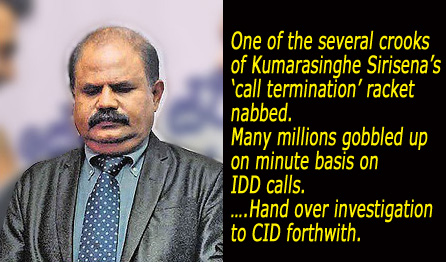
This is SIRA work -As LeN revealed so it is proved.! Kumarasinghe Sirisena’s G.M. nabbed over ‘Call Termination’ racket – Many millions of rupees gobbled up per day.!

February 17th, 2016

Courtesy Lanka-e-News

As LeN revealed so it is proved.! Kumarasinghe Sirisena’s G.M. nabbed over ‘Call Termination’ racket – Many millions of rupees gobbled up per day.!

(Lanka-e-News- 16.Feb.2016, 8.25PM)  Lanka e news on the 3 rd of February reported that a sum of Rs. 2-3 million revenue due to the Sri Lanka Telecom (SLT) /Mobitel daily on ‘call termination’ business is being siphoned off into the pockets of its chairman Kumarasinghe Sirisena . With the nabbing of  the  general manager (G.M.) of this ‘Call termination’ business of SLT now , our revelation made on 3rd February  has been proved as true. This G.M. , an engineer by the name of Ajith Silva has committed daylight robbery via the ‘call termination’  business. He  has robbed over 100,000 minutes of IDD every day through this scam.
If  the levy for a minute on   IDD call is assumed  as  Rs. 7/-, this individual alone has robbed over Rs. 700,000/- every day !.
Lanka e news in its previous report revealed that there is a robbery of 13 million call minutes per month at the SLT alone . In other words there is a robbery to the tune of over  Rs. 90 million per month taking place.
Based on our exposures , after  an operation was  conducted by the CEO , Dileepa Wijesundara , it had been possible to nab the General manager Ajith Silva the engineer . The latter has  given his password to the ‘Call termination’ racketeers .
The investigation into this was carried hitherto as an internal inquiry. But since this fraud involves public funds , it is abundantly clear this investigation must be entrusted to the CID or the FCID because this fraud has not  been committed by Ajith De Silva alone . The SLT  / Mobitel chairman Kumarasinghe Sirisena has also given his approval in this connection with full knowledge . Hence this investigation cannot be duly conducted while Kumarasinghe is still  occupying the chairman’s seat. Besides , this investigation should be handed over to the CID.
Lanka e news is in possession of all the details of how  Kumarasinghe Sirisena planned to line his pockets and gobble up funds via the ‘call termination’ racket , by creeping into the SLT as chairman at about the same time as Maithripala Sirisena became the president . In our first report we revealed that from the time of Rajapakse reign , it was Ranjith Roobasinghe the Godfather who provided protection to Kumarasinghe Sirisena. When the latter was removed from the post of Director Mobitel , he was appointed to the SLT campus and that was kept a secret . Kumarasinghe who went to UK along with Roobasinghe met with ‘Call termination ‘ dealers , and had discussions. Thereafter they travelled to China , and searched for the accoutrements associated with   this business . Lanka e news has all these details .( At the appropriate time these details supported  by evidence will  be revealed).
It must be pointed out that the SLT is having all the equipments to track down these call termination illicit dealers. In this connection the SLT Co. has created a separate division under the name of ‘fraud management’, and its chief was Sripathy Jayawardena , an honest intellectual. He is one who secured special  training in USA on how to nab the ‘call termination ‘ racketeers. Moreover ,the   latest American equipments too were supplied to this division .

Interestingly and intriguingly , the first thing Kumarasinghe Sirisena who was the general manager alias ‘general damager’ of Timber Corporation felling trees on the sly  did  as soon as he crept into the SLT Co. was de activating the fraud management division, and transferring talented Sripathy Jayawardena who had special training in America in this sphere to a most unimportant division , PEO TV . Thereafter the fraud management division was taken away from the financial division, and affiliated to  the Net working division.

Obviously Kumarasinghe did all these to streamline his impending call termination racket operation and to gobble up funds without impediments.
Now  that Ajith Silva has been nabbed , and several other rogues like him are still there to be trapped, it is  time to stop the internal  inquiry which is akin to asking about the accomplished rogue from his mother . This investigation shall be compulsorily entrusted to FCID or CID to flush out all the crooks and cronies hidden in the nooks and crannies , with a view to apprehending  all the culprits from the top to the bottom irrespective of whether it is Alibaba at the top or Malli baba at the bottom. If this measure is not taken it would be impossible to stop the creation of another Sirisena regime on the same lines of  the discarded , disdained and defeated Rajapakse regime.
Of course Kumarasinghe Sirisena has halted the media from publishing the news in this connection by threatening to stop the advertisements that are given to them .
By a Lanka e news special reporter 
Translated by Jeff

Reconciliation cannot divide or break up Sri Lanka

February 16th, 2016

Shenali D Waduge

 The word reconciliation has become quite effective of late. Use the word with any statement and it gets the nod of international approval. However, before people get carried away there is need to make some matters clear. Reconciliation must bring people together and not be used as a bogey to create a separate piece of land, a separate identity and separate norms.

  • If the noble attempt of reconciliation by the UN, human rights organizations, foreign envoys and all other peace facilitators is to make people live in peace and harmony the new constitution cannot include any provision to divide, separate, break up or promote any system of governance that one ethnic community is given a separate area to rule themselves. This has to be very clearly agreed upon and adhered to.
  • The other factor that is often ignored is that there was never a time that the Sinhalese, Tamils, Muslims or Burghers were living in disharmony. We live as neighbours, we work together as colleagues, we go shopping to the same places, we stand in queues, we share food and festivities, we cheer our national teams, we share good times and bad, we come to each other assistance in times of emergency – the common people have nothing against the other. In fact we have been living in harmony all the while that the propagandists say we have not. Nobody listens to this part of the story because happy stories never sells. What the people feel never really gets relayed over media. It is only those with agendas and who have money to campaign that enjoys fanning warped versions to enable them to enjoy undue privileges.
  • Another key factor often ignored is that in 2009 the Sri Lankan military ended an internationally banned terrorist movement. The military defeated the LTTE. If so the question arises why the nation needs to reconcile with terrorists because we never needed to reconcile with Tamils as the people were moving well with them. A good example of this can be proven in statistics that shows that more Tamils are living among Singhalese (by choice) than they are living among their own. Moreover, in the areas that Tamils are living among their own there are more differences than similarities. The Northern Tamils will not eat with the Eastern Tamils, both together denounce the Estate Tamils. If reconciliation needs to take place at all it is the need to break the caste divide among the Tamils. Let us remind everyone that Prabakaran (low caste) waged his rebellion against the Tamil caste system. This aspect has been slowly swept under the carpet because it is more appealing and more sensational to promote one ethnic group over another instead of highlighting caste divide amongst one’s own! The dubious hands involved in drafting the constitution must take this factor into account as well for reconciliation cannot divide people either by ethnicity or by caste!
  • Reconciliation cannot also omit other victims. So far since 2009 the world has been made to feel that only Tamils have been the victims while Sri Lanka Military are the perpetrators and the LTTE’s crimes have not even got honourable mention! In fact none of the UN’s resolutions have even suggested that LTTE’s crimes be investigated and LTTE’s victims be compensated. The Sinhalese & Muslims have been conveniently erased from getting international attention for their plight and misery. This is very unfair and unethical of the UN office to openly disregard two communities that suffered much. Both Sinhalese & Muslims were virtually ethnically cleansed from the North in the 1980s by the LTTE.
  • Reconciliation cannot go after one party and slowly disregard the other from investigation. All of the 3 resolutions on Sri Lanka have been about the supposed war crimes of the Sri Lankan Military but the scale of crimes committed by LTTE over 3 decades have not been tabulated or reported and UNHRC has never bothered to call for an investigation into how LTTE started, who LTTE was armed, how LTTE was trained, how LTTE campaigned abroad, how LTTE collected money, how LTTE purchased weapons, how LTTE promoted themselves etc. Why is this kept secret?

Reconciliation is certainly a nice word. The people and organizations formulated to promote reconciliation have a wonderful opportunity to set these discrepancies right. Afterall, given that they are the experts at showing how people should live in peace and harmony, they must show us that blueprint without creating a constitution that aims to do the opposite.

Let’s see what they offer as solution. We have been waiting for 30 odd years for this wonderful reconciliation pill from these entities that have been watching people get killed and blown to bits. We finally hope that their reconciliation pill is worth the wait.

The stakeholders of Sri Lanka must use these arguments if any attempts are being taken to do the opposite of what we expect from reconciliation.

Shenali D Waduge

Foreign Judges and UNHRC Investigation

February 16th, 2016

Janaki Chandraratna

It appears that the President and the Government have not been very candid with the electorate on UNHRC resolution from day one of their campaign to unseat the previous regime. It is no brainer to understand that to co-sponsor a resolution one needs to agree with its contents. The previous regime also could have adopted the earlier resolution to be popular with the West and perhaps avoided a regime change. But they purposely avoided that path because it was inimical to our sovereignty. Twenty-three out of the forty-seven UNHCR member states also did not support the resolution and backed the then Sri Lankan government, because it was an unwarranted interference in the internal affairs of a sovereign State.

The UN High Commissioner, Al Hussein, at his recent visit to the country, has made some uncharitable assessments that our key institutions are ‘corroded and corrupted’; our judiciary and law enforcement institutions are weak, politicized, unbalanced and virtually incapable of handling the UNHRC investigation without foreign participation. He also claimed that the government has agreed to implement the resolution in full. Despite the above it is amazing how the government is still trying to downplay the predicament to the electorate by asserting that President Sirisena and the government would not accept foreign judges in the UNHRC investigation and would not be pressurized by external agencies. (See Minister Musthapha’s claims in The Island, 11 February 2016).

It should be mentioned that although there is some truth in Al Hussein’s comments of our judiciary judging by the recent contraventions of the constitution, politically targeted investigations and human rights violations/killings due to unprecedented police powers, one could expect some kind of repudiation from self-respecting jurisdictions. The government’s silence only endorses Hussein’s comments and the case for the UNHRC investigation.

In view of the fact that Al Hussein had categorically informed the government of its responsibilities and obligations to the co-sponsored resolution, the government has no other option but to inform the world and the electorate of its true position on the resolution. Interpretations and misinterpretations of terminology and spurious verbiage would not assist the government to overcome the situation. In order to explain the current situation, the government may need to inform categorically, among many other things, that the country is not in favor of the resolution or the participation of foreign judges in the investigation. In addition, the UN stricture on the disclosure of the names of the war crime complainants for 20 years and the non-endorsement of the co-sponsorship of the resolution through domestic parliamentary processes are also matters of concern. It is only after a truthful disclosure of the ground reality that the UNHCR can consider an alternative, such as a Truth and Reconciliation commission instead of a back dated investigation to address the alleged war crime allegations. But whether our political leaders will have the courage and sincerity to rise up to the occasion is however, a big question.

World Bank warns Sri Lanka faces persistent poverty unless revenues increase

February 16th, 2016

By: Emma Rumney Courtesy publicfinanceinternational.org

 16 Feb 16

Sri Lanka’s chronic” revenue shortfalls must be addressed and its economy must become more competitive and inclusive if poverty is to be reduced, the World Bank has said.

Colombo, Sri Lanka

Colombo, Sri Lanka

The bank highlighted that Sri Lanka has one of the lowest tax-to-GDP rates in the world, undercutting the government’s ability to invest in public services. This is just one factor hampering efforts to reducing poverty to below 7% of the population.

As well as having little funds to invest in education, health and other services, the World Bank said the country also has an unduly large public sector, a deficit of skills, low foreign direct investment and an economy constrained by protectionist policies that hinder growth and job creation.

The country’s prime minister Ranil Wickremesinghe said that generating more jobs to minimise poverty and share prosperity more widely is a key priority, and agreed the country needs to enhance its capacity to successfully compete in global markets while creating the necessary space for investments to come in.

The bank found that while poverty has decreased, progress is uneven across location, gender and ethnicity and pockets of severe poverty still exist.

Large numbers of poor people live within or close to urban areas, and there are considerably higher rates of poverty in the north and the east.

Women’s participation in the labour market and social spending are both very low for a middle income country, the bank said, and as a result inequality is on the rise.

The bank warned that many are at risk of falling back into poverty, with 40% of the population living on less than 225 rupees per person per day.

Amena Arif, country manager for Sri Lanka and the Maldives at the World Bank’s International Finance Corporation, highlighted the role the private sector can play in driving sustainable growth and the need for policies that unleash its potential.

However the report also noted the continuing high levels of informal work, which tends to dampen productivity, access to credit and the generation of good jobs.

The findings also reinforce the need to further measures aimed at improving the government’s effectiveness, transparency, accountability and establishing strong institutions so all Sri Lankans can take part in the country’s increasing prosperity,” added Françoise Clottes, country director of Sri Lanka and the Maldives at the World Bank.

Earlier this month the International Monetary Fund also called on the Sri Lankan government to get its public finances in order after the country missed its budget target and public debt rose to over 74% of GDP.

“BE MY VALENTINE” …!

February 16th, 2016

Dr.Tilak S. Fernando

 When Henry Ward Beecher scribbled the following two sentences: Young love is a flame; very pretty, often very hot and fierce, but still only light and flickering. The love of the older and disciplined heart is as coals, deep burning, unquenchable“, I wonder whether he did ever envision his writing would become world famous and one day finally slot into a specific day in the  month of February to be characteristically named  as the Valentine’s day.

This particular day is now regarded, accepted and celebrated as a day dedicated mainly for ‘lovers’. Not only the meaning of the word has ingrained into the young minds, but the whole concept behind this theme has metamorphosed over the years to become 14th of February as the Valentine’s day. Presently Valentine’s Day is closely connected with the conjoint exchange of ‘love notes’ in the form of greeting cards. So, February 14th is regarded as the day of the Cupid, the child-like winged deity, the son of Venus, the Roman goddess of love.

According to Greek mythology, the Cupid is Aphrodite’s son Eros. The modern ‘valentine trend’ is to represent it with a variety of symbols, the most popular being the red rose and the red coloured heart-shaped contour with Cupid’s figure.

Opinions, of course, vary as to the formation and establishment of the Valentine’s Day. Some connoisseurs maintain that it originated out of St. Valentine, the Roman who was martyred for refusing to give up Christianity! He died on 14th of February, 269 A D, on the same day that had been dedicated to ‘love lotteries’.  The folklore also verbalises that St. Valentine left a farewell note for the jailer’s daughter, who happened to be his friend, autographed with the words: “From Your Valentine“. Other aspects of the story are Saint Valentine had served as a priest at the temple during the reign of Emperor Claudius; when Claudius jailed Valentine for defying him, Pope Gelasius, the third and the last Bishop of Rome of North African Origin (492- 496) in the Catholic Church, set aside 14th of February in honour of St Valentine.

Feeling of Love

It is of course far more problematic to understand or describe the real nature of LOVE beyond anything out of the two amorous lines, because love is a kind of sensation that cannot be examined under a microscope! One may use all the talents and charms in the world and spend hours on end pondering over the philosophical nature of this magic human reaction, yet fail to agree upon, the reason being that every individual’s experience of love and ways of showing it is unique indeed

.

According to the legend, all the young women in the city many moons ago used to place their names in a big urn on February 14 while the bachelors chose a name,  each from  the urn and became paired for one year with his chosen woman. These ‘ love’ matches often ended up in marriage!  Going beyond the human world, it was also commonly believed in France and England that on 14th of February every year birds’ mating season began, which broaden the idea that the Valentines’ day in mid February should be a day for romance!

Love communications

Charles, Duke of Orleans, wrote the oldest poem on a valentine greeting card to his wife while he was imprisoned in the Tower of London after his capture at the Battle of Agincourt. The friendly hint, which was written in 1415, was part of the manuscript collection of the British Library in London. Several years later, King Henry V was believed to have hired a writer named John Lydgate to compose a valentine message to Catherine of Valois.

Valentine’s Day began to be popularly celebrated around 17th Century in Britain. By the middle of the 18th Century, it became common for friends and lovers in all-social classes to exchange small tokens of affection or handwritten notes. By the end of the century  and with the advancement of printing technology, printed cards replaced original handwritten letters, which once directed one’s feelings and emotions.

Esther A Howland began to sell the first mass-produced valentine cards in America in the 1840s. Gradually, February 14 became the date for exchanging love messages and St. Valentine became the patron saint of lovers, marked by sending cards, flowers, simple gifts and often ending the day with a small gathering or a formal ball room dance.

Mythical daydreams

Valentine’s Day has become a mega commercial hype seemingly at present with special Valentine dances throughout the cities, and one billion valentine cards exchange hands on a single day throughout the world making just the perfect excuse to make lots of people spend even more money to avoid feeling disappointed, inadequate or insecure whilst enabling greeting card producers, stationery outlets and postal services  to become rich.

No one can deny the fact that we, as human beings,  all enjoy an overdose of sycophancy from time to time and indulge in mythical daydreams! We may try to be jolly on this special day being showered with romantic cards, bouquets of red roses, a single rose, boxes of chocolate with writings on them such as “All because the lady loves…”. Some become lavish and spend a fortune on eating out at star hotels while getting drunk like fish with ‘gal’, ‘pol’, wine or whiskey. For a different kind of valentine, it could yet be another occasion to hit a dance floor and enjoy a bit of pelvic thrust in romantic dim lights and say it is just what the cupid ordered!

But let’s face it, if you are forced to rely on one day of the year alone to feel that ‘love is in the air’ and ‘happily ever after’ you could be far way off! Haven’t we all heard the idiom, ‘to love another, one has to love oneself‘? In such a hypothesis, wouldn’t it be nicer to offer a little bit of love in an unexpected direction this year by sending valentine card to your own address with a simple sentence ‘ Be my Valentine’!

tilakfernando@gmail.com

Amber Light warning of Money Parking threats

February 16th, 2016

Chandra Jayaratne Courtesy The Island

article_image

An Open Letter to the Minister of Finance and the Governor of the Central Bank; To be duly noted by the President, the Prime Minister, the Government, Commercial and Financial Services Sectors and Professional Practitioners

Dear Minister and Governor,

You are accountable for your unwise and unacceptable actions and inactions

Transparency International Sri Lanka and many professionals in Civil Society, (including much respected retired Senior Central Bankers), have sounded “Amber Light” signals, warning you of your unwise and unacceptable actions and inactions, in connection with the open public call made by the Minister of Finance with the apparent concurrence of the Governor of the Central Bank, requesting investors to “park” foreign currency deposits in Sri Lanka, as “special deposits”, on “no questions asked” basis, with “no locked in investment period”.

The Minister has in fact boasted, a few weeks ago, of the success of the scheme, with an unnamed Belgian investor, working in partnership with a Sri Lankan, having agreed and partly funded, the ‘parking of one billion US Dollars in Sri Lanka’. He has also proudly announced this achievement as a due endorsement of the Sirisena-Wickremesinghe Government.

At the time of this first announcement, connected bank officials had informed the media that the remittances have topped USD 1.5 billion; and as the remitting banks overseas would already have cleared the customer and due diligence performed, there was no real need for “Know Your Customer” (KYC) validations at the receiving end bank. However, the media had later quoted the Central Bank chief as having confirmed that, commercial banks will continue to accept foreign inflows under mandatory international monetary regulations to know the source of funds.

The media today headlines “Many more” ready to deposit says Fin Min ; and “Why do you want aid when you can trade? Trade should substitute aid. Likewise, why do you need loans, when you can have deposits? “When deposits come, your reserves go up” quoting the Minister of Finance; who had asserted that “many more” are ready to help Sri Lanka defend its currency and bolster its reserves”; and says “these deposits will replace loans drawn at high interest rates.”

The Minister too has assured that the relevant KYC validations are carried out and that the critics need not worry whether these are hot money; and actions taken are without corrupt motives as a clean government is in power.

Civil Society, however, wishes to hold the Minister of Finance and the Governor of the Central Bank accountable for the following;

1. Potential consequential risks, in the medium to long term, of the scheme now in force and duly promoted by the Minister, as a way forward to protect the value of our currency and secure low cost funds in the short term, leading to monetary instability and a potential balance of payment crisis in the future.

2. Consequential potential negative national economic and social outcomes, if any, in the short to long term, in the absence of a transparent and publicly announced scheme, detailing the applicable guidelines, procedures and processes governing investors “parking” foreign currency deposits in Sri Lanka, as “special deposits”, on “no questions asked” basis, with “no locked in investment period”.

3. Consequential impact, due to the aforesaid scheme and its operations and reporting standards in practice in Sri Lanka, Sri Lankan Banks and Financial Institutions, violating any international conventions and commitments of Sri Lanka and the local legal and regulatory framework, in terms of;

a. International Anti Money Laundering and Terrorism Financing Conventions and Commitments

b. Acts and Regulations associated with the Financial Intelligence Unit of Sri Lanka – refer – http://fiusrilanka.gov.lk/acts_regulations.html

c. Financial Action Task Force on Money Laundering (FATF 40 recommendations)

d. Foreign Account Tax Compliance Act (FATCA) obligations

e. The new global standard on Automatic Exchange of Information (AEOI) introduced to minimize the possibility for tax evasion.

4. Consequential impact due to the aforesaid scheme and its operations and reporting standards in practice in Sri Lanka and Sri Lankan Banks and Financial Institutions on;

a. Sri Lanka’s International Credit and Risk Ratings

b. Sri Lanka’s Foreign Direct Investment attractiveness

c. Sri Lanka’s International Trade and Services linked Value added options

d. Sri Lanka’s Competitiveness and Investment Attractiveness as reflected by Internationally accepted Investment and Trading Indices

5. Assurance that none of the investors making deposits under this scheme, their actual beneficial interest holders, their proxies or associated or related parties, are presently or are likely to be, subject to prosecution in the future, for any international crimes or serious financial crimes, bribery or corruption, carried out by any of them, either in Sri Lanka or overseas; and further an assurance that none of the funds so deposited form a part of or are tainted by being proceeds of any such crimes carried out in Sri Lanka or overseas.

6. Assurance that the acceptance of such deposits under the scheme, will not be deemed tantamount to be a grant of a ‘general or special’ amnesty to such persons depositing proceeds, where such proceeds are later discovered to be out of any proceeds of serious crimes; and that such acceptance of deposits will thus not jeopardize any of the investigations or prosecutions which are currently being progressed against persons and their related parties and associates in Sri Lanka or overseas for having possessed or having deposited proceeds of serious crimes in banks in Sri Lanka or overseas.

Provided, the Minister and the Governor do hereby accept such accountability as outlined above, they are called upon to make a transparent public statement to that effect; and if not, the Minister and Governor are requested to make such changes to the scheme as essential to safeguard the long term interests of Sri Lanka and its civil society and advise the public of such amended scheme in a transparent way.

Chandra Jayaratne

බුදුන්ගේ ශ්‍රී ධර්මස් කන්දා දන්නවානම්

February 16th, 2016

ධර්මසිරි සෙනෙවිරත්න

ම හා ධර්මස්  කණ්ද යම නොවෙය්  අංශු මාත්‍රයක් හෝ දන්නවනම්  මේවා මෙහෙ ම නොවේ  විශාකා ආනන්ද නාලන්ද ඇතුළු සියලු පාසල් වල උගන්වන්නේ එකම  දේය .නමින් බෞද්ධ  වීම නිසා සිදුවන්නේ චන්ද්‍රිකා වැනිය වුන්ගේ  අපහාසයට ලක් වීම පමණය  . උපතින් බෞධ්ධලමය්  වැඩියෙන් මේ පාසල් වල ඇතත් ඔවුන්ගෙන් බොහෝ දෙනෙක්  බෞද්ධ වන්නේ  නමටය  කිශානි ජයසිංහ  පොඩි කාලයේ සිටම ගායනයට දක්ෂය. බෞද්ධ කම වසා මිෂනාරී අධ්ධ්යාපනය  ළමයින්ට දෙන විට  ඔවුන් යන්නේ  අඳුරේ අ ත  පත ගාමිණි. විශාකාවේ  ඉගෙන ගත පමණින් ඉන් මිදෙන්න්නට කාටවත් නොහැක .කිශානි හිතාමතා  මේ ගීතයට අපහාස කළා යය්  මම නොකියමි   කවුදෝඇ  ය නිදහස් උළෙලට ඇදගෙන ගොස් ලනුව දී ඇත .. ඔපෙරා   සොප්‍රානු දක්ෂ කම් ය විසි පෙන්විය යුතුව තිබුනේ  මේ ගීතයටනොවේ නිදහස් උත්සවයෙදීවත් නොවේ . සාමාන්‍ය යට මේ දෙකම ලොකුදෙවල්ය . සුනිල් ශාන්තගේ ගී හා  සෝමපාලගේ ගී  මෙවිදිහට ගයා  පෙන්නුවානම්  යට කවුරුත් දොස් කියන්නේ නැත . රනිල් මේ සිද්ධිය ලොකු කර පෙන්නා  කලබලයක් ඇති කලේ  මාධ්ධ්‍යය  ගැන  ඇති  කේන්තිය නිසය් නිවේදකයා  ගේ විවේචනය සර වැඩිවුණේ මෙය බෞද්ධ ගීතයක් වීමත් නිදහස් උත්සවය වීමත් නිසා ඇතිවූ කේන්තියෙනි
හැබය් අමරදේවගේ   ”අසේමතුවන  කඳුළු ”” ගීතය වැනි ගීත හෝ පිරිත් හෝ   ඔපෙරා ශය්ලියෙන් නොගයීමටඇ  ය හිතා ගත යුතුය .
ඒවාට නිසි තැනක් සිංහලේ ඇත
සල්මන්  , ශාරුක් ඛාන් ලාගේ  හා හොලිවුඩ් නැටුම්ද  විශාකවියන් විසි ප්‍රසංග වල නටා ඇත . විදුහල් පතිනියටවත් මේවා නැවැත්විය නොහැකිවූයේ          ළමයින්ගේ අම්මලා ඒවා අත්‍යවශය මය් කියූ නිසාය. අපේ දරුවන් ට නාටිකාන්ගනාවියන් වීමට අවශ්‍ය නම් ඒවාටත් පාසලේ ඉඩ ලැබිය යුතුය යන    තර්කය ගෙනාවේ ඒ අම්මලාය . විදුහල් පතිනිය පසුබෑ වාය  . රට යන්නේ එහෙමය  රනිල්ට අවශ්‍යත් තරුණ යන කුලප්පු කිරීමටය . අන්තිමේ සිදුවුයේ දක්ෂ ගායිකාවක් අපහාසයට ලක්වීම පමණය   අපි නොදැන ගියොත්  අතර මගය .සිංහලයෝ මීට වඩා හිතන්න පුරුදුවිය යුතුය 

US way to stop political interference in the Supreme Court

February 16th, 2016

EDITORIAL The Daily Mirror

 three-day workshop began in Parliament yesterday to educate MPs on the full restoration of parliamentary democracy by making Parliament to be like a virtual government with all MPs playing a proactive role in making laws and implementing them.
Prime Minister Ranil Wickremesinghe in his opening speech said one of the goals was to give more power to parliamentary select committees or oversight committees so that even backbenchers in the government and Opposition could take part actively in the effective implementation of laws for the common good of the people. He said at present the President, the Prime Minister, Ministers and Deputy Ministers, officials and other influential personalities ran the government while a large number of backbenchers had little or nothing to do with law-making or its implementation. This process was not good for effective parliamentary democracy and it needed to be amended through the proposed Constitutional Amendments. Some MPs from Britain, widely recognised as the home base of parliamentary democracy, also have come here to give keynote talks at the workshop.


Another vital area for the new government to tackle is the full restoration and consolidation of the Rule of Law and the independence of the judiciary specially the Supreme Court.  In the United States, where the Constitution is recognised as one of the most enlightened documents produced by human beings, the death of a Supreme Court Judge has created a controversy where heated debates are taking place in the race for the Presidential nomination.
Whatever the US may be doing or not doing in world politics, the checks and balances in its democratic processes are widely admired and Sri Lanka could take some lessons from it specially in our efforts to consolidate the independence of the Supreme Court.
Yesterday’s Guardian newspaper reported that the US Supreme Court vacancy created by the death of 79-year-old Justice Antonin Scalia could be monumental for a number of hugely controversial issues before the Court.
Paying tribute to Justice Scalia, President Barak Obama said he would nominate a successor. In the Senate and on the campaign trail, however, Republicans said they would not cooperate, even to the extent of scheduling a nomination hearing in the Senate they control, at any point in the president’s final year in office. The US could be saddled for a year or more with only eight justices on the Supreme Court, balanced four-four between Conservatives and Liberals. What will this – and the political identity of Justice Scalia’s eventual successor – mean for the key issues that divide America today—including abortion, gun control, immigration and the environment? At Saturday night’s Republican presidential debate in South Carolina, Texas Senator Ted Cruz warned: We are one justice away from a Supreme Court that will strike down every restriction on abortion adopted by the States.”
The US Constitution provides that Judges of the Supreme Court or Federal Courts shall hold their Offices during good behaviour.” The term good behaviour” is interpreted to mean that judges may serve for the remainder of their lives, although they may resign or retire voluntarily. A Judge may also be removed by impeachment and conviction by congressional vote (hence the term good behaviour). This has occurred fourteen times. Three other Judges, Mark W. Delahay, George W. English, and Samuel B. Kent, chose to resign rather than go through the impeachment process.
In Sri Lanka, the Chief Justice and the other Judges of the Supreme Court are required to retire at the age of 65 unless they are impeached as the Jayewardene-government tried to do in the case of Neville Samarakoon and the Rajapaksa government successfully did, though eventually to its undoing, in the case of Chief Justice Shirani Bandaranayake. The need to retire at 65 has positives and negatives. Among the negative effects, as we have seen often in the past few decades, is that some Judges are known to have given politically-motivated verdicts apparently because top posts could be obtained
after retirement.
Therefore the US provision for judges to go on for as long as they are physically and mentally capable may be good for Sri Lanka also unless there are questions related to good behaviour.

– See more at: http://www.dailymirror.lk/105477/US-way-to-stop-political-interference-in-the-Supreme-Court-EDITORIAL#sthash.KJpPFdb9.dpuf

BBS asks if Govt. knew Moon’s warning on ISIS

February 16th, 2016

Courtesy The  Daily Mirror

Chief Executive Officer of the Bodu Bala Sena (BBS) Dilantha Withanage today urged the Government that it had come to know about the warning of the danger of the Islamic State terror group spreading its tentacles to South Asia, from a recent report by the UN Secretary General Ban Ki-moon.

Chief Executive Officer of the Bodu Bala Sena (BBS) Dilantha Withanage today urged the Government that it had come to know about the warning of the danger of the Islamic State terror group spreading its tentacles to South Asia, from a recent report by the UN Secretary General Ban Ki-moon.

While addressing a media briefing today, he said the report had been handed over to the Defense Ministry last week.

The report warned about the spreading of the Islamic State terror groups in the country.

We are questioning the President’s office and the Prime Minister’s office about the knowing of this report,” Mr. Withanage said.

Foreign Minister Mangala Samaraweera might not have read this report,” he said.

In his report the UN Secretary General Ban Ki-moon had warned the danger of the IS terror group spreading its tentacles to South Asia including Sri Lanka through organisations. The report demonstrates the speed and scale at which the threat has evolved in just 18 months,” he said.

We should talk about this threat in terms of politics rather than looking at it in a racial manner as we are raising the issue.

Due to lax visa regulations, Sri Lanka is fast becoming a hotspot for terrorist activities for them to spread fear among our people,” he said.

If the government had a backbone, it should stop the spreading of the Islamic State terror group in the country instead of hunting BBS,” he said.

– See more at: http://www.dailymirror.lk/105468/BBS-asks-if-Govt-knew-Moon-s-warning-on-ISIS-#sthash.fO5i39LT.dpuf

PM’s office pressuring CID: GMOA

February 16th, 2016

Courtesy The Daily Mirror

The Government Medical Officers’ Association (GMOA) today claimed that the CID had received several telephone calls from the Prime Minister’s Office pressuring the CID to speed up investigations against the GMOA.

GMOA Spokesman Dr. Navin de Soysa said the doctor, on whose complaint the CID initiated investigations had previously been a GMOA member and a strong supporter of a very powerful minister in the present Yahapalanaya government.

He said GMOA members were being questioned by the government in an attempt to silence them over a typographical error in a booklet published by the GMOA in 2012 regarding the setting up of a specialists’ registry and the introduction of an evaluation procedure for foreign medical specialists due to the spate of ‘unqualified’ Indian doctors practicing in private hospitals.

The GMOA’s General Committee has decided to go ahead with the countrywide strike action unless the government took action to stop the CID from summoning its members.

As far as we are concerned, this is not a matter for the CID. We did not think our CID was that jobless to carry out investigation into some printing mistake of an old booklet. This book was launched under the direction of the ministry of health in 2012. In future we may have to send the proofs to the CID to check for any printing mistakes,” Dr. de Soysa said.

He said the GMOA would not be discouraged by the summoning of its members or filing lawsuits against it when they point out the misdeeds in the Heath Sector. (Piyumi Fonseka)

Video by Buddhi

– See more at: http://www.dailymirror.lk/105470/PM-s-office-pressuring-CID-GMOA#sthash.ATggjHyw.dpuf

AG directs to arrest Uduwe Thera

February 16th, 2016

Courtesy Daily Mirror

The Attorney General has directed to arrest Ven. Uduwe Dhammaloka Thera and produced before the Court for illegally keeping a baby elephant at the Alan Mathiniyaramaya Temple, Polhengoda, the Criminal Investigation Department (CID has informed Colombo Chief Magistrate Nishantha Peiris.

The CID had also informed that the AG had directed them to record a statement from the Uduwe Thera before the arrest of the Thera.

The CID had told the Court they have enough evidence to file a case against Ven. Uduwe Thera under the Fauna and Flora Protection Ordinance.

In January, 2015, a two and half year-old elephant calf had been found inside the Alan Mathiniyaramaya Temple.(Manopriya Gunasekera)

Govt. committed to developing SL economy: PM

February 16th, 2016

Courtesy The Daily Mirror

Prime Minister Ranil Wickremesinghe said today those who are paid to shout against the agreement with India will learn a lesson when the people get to the streets soon.

No one should waste time on unwanted things because the government will not stray from its journey towards developing Sri Lanka’s economy, myself, Minister S. B. Dissanayake and Deputy Minister Harsha De Silva will not deviate from our journey,” he said at Ape Gama during the launch of the systematic country diagnostic study by the World Bank Group.

He referred to the minister and the deputy minister because they were present at the launch.
The Prime Minister who insisted on a strong commitment from the state machinery said the government expected the effective use of funds allocated to each institution.

We expect results from public servants,” he said and urged the private sector to put its shoulder to the wheel instead of continuing a wait and see policy.

The Prime Minister said only ordinary people pay taxes and bear a great burden for the sake of the country. He said it was his generation which paid a host of taxes such as death duty, wealth tax and several other taxes while the present generation did not bear that much of a tax burden.

Besides, he said Sri Lanka should move away from the South-Asian way of thinking and adopt policies based on an East-Asian line of thinking. The Prime Minister said the government would ensure that money goes into the hands of the poor.

He said the government was focused on eradicating poverty, ensuing that the inflation rate is low, double the gross domestic product and make Sri Lanka a high-income-earning country by 2025. The Prime Minister said the World Bank would support the government to achieve these policies.(Yohan Perera)

Google’s ‘Project Loon’ enters Sri Lanka for Internet tests

February 16th, 2016

Courtesy The Manila Times

COLOMBO: Google’s balloon-powered high-speed Internet service known as Project Loon” began its first tests in Sri Lanka Monday (Tuesday in Manila) ahead of a planned joint venture with Colombo, the country’s top IT official said.

One of three balloons that will be used in the trials entered Sri Lankan airspace, the Information and Communication Technology Agency chief Muhunthan Canagey said.

The first balloon entered our airspace this morning. It was launched from South America.” Canagey told AFP. It is currently over southern Sri Lanka.”

He said a Google team was expected later this week to test flight controls, spectrum efficiency and other technical matters.

The government announced earlier this month it would take a 25 percent stake in a joint venture with Google to deliver a high-speed Internet service powered by helium-filled balloons.

Sri Lanka is not investing any capital, but will take the stake in return for allocating spectrum for the project. A further 10 percent of the joint venture would be offered to existing telephone service providers on the island.

It promises to extend coverage and cheaper rates for data services.

Service providers will be able to access higher speeds and improve the quality of their existing service once the balloon project is up and running.

The balloons, once in the stratosphere, will be twice as high as commercial airliners and barely visible to the naked eye. The balloons will have a lifespan of about 180 days, but can be recycled, according to Sri Lankan officials involved in the venture.

Official figures show there are 3.3 million mobile Internet connections and 630,000 fixed line Internet subscribers among Sri Lanka’s more than 20 million population.

Sri Lanka became the first country in South Asia to introduce mobile phones in 1989 and the first to roll out a 3G network in 2004. It was also the first in the region to unveil a 4G network two years ago.

Did Tamil language have official status under British rule?

February 15th, 2016

Shenali D Waduge

 There is much ado about Sinhalese denying the status for Tamil post-independence. The better question is, did Tamil language have any official status from 1832 to 1948 to warrant a grievance? Was Tamil used at all in an official capacity during British rule? No. If Tamils were never officially enjoying the use of Tamil language how can they claim that the Sinhalese have denied what they were enjoying? The other question is how did opposition to the Sinhala Only Act in 1956 end up with SWRD Bandaranaike agreeing to sign a devolution pact – how did devolution end up the solution for language rights?

The nation was built & ruled by Sinhale kings and it was the Sinhale language that prevailed officially. When the Kandyan Convention was signed the chieftains ceded powers of the entire island of Sri Lanka.

The Kandyan Convention was signed by those representing the Sinhale nation and the British. If there had been a separate kingdom functioning independently wouldn’t the British have signed a separate agreement with them too? This more or less nullifies the notion of a separate and independent Tamil kingdom prevailing which did not belong to the entire island and certainly beckons the new constitution to ensure that the island nation is not demarcated to be separated or divided under whatever liberal terminologies the constitution drafters are attempting to do.

The British having taken over the entire island brought in their form of governance, culture, education, legal systems etc. Prior to this we had our own indigenous forms of governance just as all other nations who territories and lands were taken over by Christian colonial invaders.

During British rule English was the medium of instruction in the superior schools from kindergarten to college. Schools that taught English produced English speaking locals most of whom had converted to Christianity and these became the elite of society and to whom the British were to hand over eventual administration. The British made sure the minorities were given privileges above the majority.

Lord Macaulay said “We must at present do our best to form a class who may be interpreters between us and the millions we govern; a class of persons, Indian in blood and colour but English in tastes, in opinion, in morals and in intellect”. The same applied to British Ceylon as well. We call this breed of people kalu suddas, another name for these clones are brown sahibs and there are plenty of them and their minds need to be decoloniized so as to appreciate their own.

“It has to be frankly recognised that the effect of the English school successfully and efficiently conducted on those of the native community must be one of denationalisation.” (Bridges report 1911)  

it was formerly the policy of the Government to make the natives learn English, rather than to make the public servants learn Cingalese [Sinhala]” (Evidence of Major T. Skinner, Select Committee, 1850: 294).

It is significant that in Ceylon the native languages are far less used than in India for the transaction of public business, and in the law courts the proceedings are conducted in English” (Clarence 1899: 439).

According to Rev. Cordiner, only one British official had mastered Sinhala, the language of the majority of the islanders (1804) he was John D’Oyly (1774-1824), who had a mastery of spoken and written Sinhala and who became Chief Translator (1805-1816) to the government.

In 1805 Samuel Tolfrey of the Civil Service, who came to the island in 1801 with D’Oyly, was interested in Sinhala and wanted to do a dictionary to assist Europeans to learn Sinhala for various transactions.

In 1802, regulations were drafted which made competency in local languages mandatory for promotions within the Civil Service. Sinhala and Portuguese were the languages in which proficiency was required.

It appears that the British prior to leaving decided to create a little mischief among the local elite to whom they would hand over governance and true to their divide and rule policy began infesting the minds of the elite politicians with new demands, grievances, rights etc none of which the British would hear of giving under their rule. An example of that mischief was the manner British separated Tamils as Ceylon Tamils in 1911 when before that time the category was Tamil (the British regarded all Tamils with their roots to Tamil Nadu). The usage of the ethnic category known as Ceylon Tamils came only after 1911. The census of 1881, 1891 and 1901 is the best evidence of this. The All Ceylon Tamil Congress emerged in 1944 while it was only after independence that the ITAK – Tamil Nation party was formed in 1949 falsely carrying Federal Party name in English.

Having being saddled with these headaches it is only our own that have confounded matters into worse proportions creating situations out of nothing.

If Tamils say their rights have been denied. They must first showcase that they were enjoying these rights. Under colonial British rule Tamil did not receive any official status so if Tamil had no official status under the British what is all this fuss about?

ජවිපෙන් බිලිගත් සමසමාජයේ අසඩක්ලා

February 15th, 2016

ධර්මන් වික්‍රමරත්න

ශ්‍රී ලංකීය වමේ ව්‍යාපාරයේ ඉතිහාසය ඇරඹෙන්නේ 1930 දශකයේ ආරම්භයත් සමගය. මාක්ස්වාදී අදහස් දැරූ විදේශ අධ්‍යාපනයක් ලබා සිටි මැද පාන්තික තරුණ කොටස් සමාජවාදය වැළඳගෙන ලංකාවට පැමිණි පසු තරුණ සංගම් තුළත්, සූරියමල් ව්‍යාපරය තුළත්, නාගරික කම්කරු පන්ති ව්‍යාපාරය තුළත් ක්‍රියාත්මක වෙමින් ස්වකීය දේශපාලනය ආරම්භකල ස්ථානයන් දක්වා වමේ ව්‍යාපාරයේ ඉතිහාසය දිවයයි. ලංකාවේ මාක්ස්වාදයේ පියා ලෙස සැලකෙන පිලිප් ගුණවර්ධන 1931දී ලංකාවට පැමිණ මාක්ස්වාදය ගැන උනන්දුව දක්වන පිරිස් ඒකරාශී කොට ඔවුන් සමඟ එක්වී 1935 දෙසැම්බර් 18වැනිදා ලංකා සමසමාජ පක්ෂය පිහිටුවීමට පුරෝගාමී විය.Dharman Wickremaratne

වමේ ව්‍යාපාරයේ සංවිධානාත්මක පක්ෂයක් ලෙස සමසමාජය කරළියට ගෙන ඒමට මුල්වූ අය අතර එන්.එම්. පෙරේරා, ලෙස්ලි ගුණවර්ධන, වර්නන් ගුණසේකර, කොල්වින් ආර්. ද සිල්වා, එඩ්මන් සමරක්කොඩි, රොබට් ගුණවර්ධන,  එස්. ඒ. වික්‍රමසිංහ  ඇතුළු කිහිප දෙනෙක්ම විය. ශ්‍රී ලංකාවේ වමේ ව්‍යාපාරය අහසින් කඩා වැටීමක් නොවේ. එය මෙරට සමාජ ආර්ථික තත්ත්වය විසින් සහේතුකව ජනිත කරන ලදී.

dharman02.
වසර 1935 දෙසැම්බර් 18වැනිදා ආරම්භකල ලංකා සමසමාජ පක්ෂයේ සමාරම්භක නායකයින් පිරිසක්(වමේ ඉහළ සිට) පිලිප් ගුණවර්ධන,  එන්.එම්.පෙරේරා, ලෙස්ලි ගුණවර්ධන, වර්නන් ගුණසේකර, කොල්වින් ආර්. ද සිල්වා, එඩ්මන් සමරක්කොඩි, රොබට් ගුණවර්ධන සහ එස්.ඒ. වික්‍රමසිංහ.

සමසමාජ පක්ෂය අධිරාජ්‍ය විරෝධී, රදළ සහ ධනේෂ්වර විරෝධී මෙන්ම සමාජවාදී සමාජ ක්‍රමයක් ගොඩනැගීම අරමුණු කොටගත් පක්ෂයක් වේ. සමසමාජය බිහිවූ තැන සිට වසර 4ක් යන තෙක් වමේ ව්‍යාපාරයත් සමසමාජයත් යනු එකක්ම විය. සමසමාජය දෙකඩ වූයේ 1939දීය. ශ්‍රී ලංකාවේ කොමියුනිස්ට් පක්ෂය 1943 ජුලි 3වැනිදා බිහිවූයේ එහි ප්‍රතිඵලයක් ලෙසය. ප්‍රතිසංස්කරණවාදී සීමාවන්හි කොටුවෙමින් වුවද 1953 අගෝස්තු හර්තාලය දක්වා සමසමාජ සහ කොමියුනිස්ට් පක්ෂ පීඩිත ජනයාට ශක්තියක් සහ ආශ්වාදයක් සපයමින් ආණ්ඩුවට අභියෝගයන් ඉදිරිපත් කිරීමට සමත්විය. එය වමේ ව්‍යාපාරයේ ස්වර්ණමය යුගය ලෙස හැදින්විය හැක. වම රටේ දෙවැනි ශක්තිමත් බලවේගය ලෙස පැවතුනද 1956 ශ්‍රිලනිප  ජයග්‍රහණයෙන් පසු එය තුන්වන තැනට වැටිණි. වැඩකරන ජනතාව වර්තමානයේද භුක්ති විදින බොහෝ අයිතීන් සහ වරප්‍රසාද ලංකා සමසමාජ පක්ෂය ප්‍රමුඛ වමේ ව්‍යාපාරය ලබාදුන් ජයග්‍රහණයන්ය.

dharman03.

සමසමාජ පක්ෂ සමුළුවකට රෙජි, ඩොරික්, එන්.එම් සහ බර්නාඩ් පැමිණෙමින්.

හැටේ දශකයේ මැද භාගයේ පැන නැගුණ විප්ලවිය කණ්ඩායම්වල ක්‍රියාකාරිත්වය එම වාම පක්ෂවල වැරදිවල පමණක් නොව ‘නිරවි යුද්ධයේ’ද ප්‍රතිඵලයකි. ජනතා විමුක්ති පෙරමුණ(ජවිපෙ) පැනනැගුණු සෙසු විප්ලවීය කණ්ඩායම් අභිබවා වර්ධනය වූයේ වේගවත් ප්‍රකාශනයක් ලෙසිනි. හැත්තෑවේ දශකය මෙරට ආර්ථික, දේශපාලන, සංස්කෘතික ජීවිතයේ එතිහාසික වකවානුවක් සලකුණු කරනු ලැබීය. 1948 නිදහසින් පසු උපන් තරුණ පරපුර කැරැල්ලක ස්වරූපයෙන් මතුවෙමින් එතෙක් පැවති සම්මත සමාජීය සංස්ථාව ප්‍රශ්න කරනු ලැබීය.  සමසමාජ පක්ෂය 1971 කැරැල්ලේදී එයට එරෙහිව සමගි පෙරමුණ රජයට සහායවීම හේතුවෙන් ජවිපෙ තදබල විවේචනයට සමසමාජය සහ කොමියුනිස්ට් පක්ෂ ලක්විය. ජවිපෙ 1971 අප්‍රේල් කැරැල්ල පැන නැගීමෙන් පසු පැරණි වම සහ ජවිපෙ අතර විශාල හිඩසක් ඇති විය.

dharman04.

ජවිපෙ ඝාතනය කල සමසමාජ පක්ෂයේ 19 දෙනා අතරින් පී.ඩී. විමලසේන, නිතිඥ ලෙස්ලි යටන්වල, නිතිඥ අමර වෙල්ලප්පුලි, වීරසේන පිටිගල, සරත් මල්ලිකාද සිල්වා, ඇල්බට් විජේරූප, ඩී. ලුවිස් සිල්වා, එම්.ආර්.හීන්බණ්ඩා, ඩබ්ලිව් එම්. චන්ද්‍රසේන, එන්.කේ.ඩී. ප්‍රඥාරත්න, එන්.ඩී. ජිනදාස, ඩී.ඒ සූරසේන, ජයන්ත විජේතුංග, වර්ණසූරිය සිල්වා, නිමල් ශාන්ත පෙරේරා, කේ.ඒ ජයදේව අමරවීර, බී. රත්නවීර(ඉහළ වමේ  සිට) පක්ෂයෙන් ඉල්ලා අස්වී ප්‍රසිද්ධියේ බැනරයක් දමන ලෙසට සහ නැතිනම් ඝාතනය කරන බවට දේශප්‍රේමී ජනතා ව්‍යාපාරය ඔවුන් වෙත එවන ලද නියෝගය ඇතුලත් ලිපි(අවසාන පේලියේ දකුණේ).

වසර 1986 සිට 90 දක්වා ජවිපෙ 2වැනි කැරැල්ලේදී  දෙමළ බෙදුම්වාදයට, ඉන්දීය ආක්‍රමණයට සහ ඉන්දු ලංකා ගිවිසුමට සහාය දක්වන වාමාංශිකයින් ජවිපෙ සන්නද්ධ අංශය වන දේශප්‍රේමි ජනතා ව්‍යාපාරය නම් කළේ තුන්වන සතුරු හමුදාව ලෙසිනි. ඒ අනුව තුන්වන සතුරු හමුදාව අතුගා දැමීම දේශප්‍රේමි අරගලේම කොටසක් බවට 1988 ජනවාරි 18වැනිදා නිකුත් කල නියෝගයක සඳහන් විය. මේ අනුව ලංකා සමසමාජ පක්ෂය, කොමියුනිස්ට්, නව සමසමාජ, ශ්‍රී ලංකා මහජන පක්ෂද ජනතා සංගමය ඇතුළු ජවිපෙන් කැඩී ගිය කණ්ඩායම් සහ කල්ලිද වහාම ක්‍රියාත්මකවන පරිදි ජවිපෙ විසින් තහනම් කල අතර ඒවායේ නායකයින්ට ඉල්ලා අස්වන ලෙසද නොඑසේනම් දැඩි දඬුවම් විදීමට සූදානම් විය යුතු බවද 1988 ජනවාරි 25වැනිදා නියෝගයක් පැනවීය. ඔවුන් අතුගා දමන ලෙස ජනතාව ගෙන් ඉල්ලමින් 1988 පෙබරවාරි 10වැනිදා නිවේදනයක්ද ප්‍රකාශයට පත් කළේය.

dharman05.එජාප ආණ්ඩුවේ 1987 මැයි දින තහනමට එරෙහිව  87 මැයි 1දා තහනම කඩමින් සමසමාජ මූලස්ථානය ඉදිරිපිට ටවුන් හෝල්හිදී පැවති රැළියේදී පොලිසිය කඳුළු ගැස් සහ බැටන් ප්‍රහාර එල්ල කිරීමෙන් කඳුළු ගෑස් ප්‍රහාරයට ලක්වූ සමසමාජ නායක ආචාර්ය කොල්වින් රෝහලට ගෙන යාමේදී.

පළාත් සභා මැතිවරණය 1988 පැවැත්වීමේදී එක්සත් සමාජවාදී පෙරමුණෙන් පළාත් සභා මන්ත්‍රීවරුන් 139 තේරී පත්වූ අතර එසපෙ සාමාජික පක්ෂවන ලංකා සමසමාජ පක්ෂයට මන්ත්‍රීවරුන් 26ක්ද, කොමියුනිස්ට් පක්ෂයට 25ද, නව සමසමාජයට 5ක්ද,  මහජන පක්ෂයට 83ද හිමිවිය. කැරැල්ල නිමාවන විට ජවිපෙ මගින් ඝාතනය කරන ලද 6,577ක් අතුරින් 250කට ආසන්න වාමාංශික දේශපාලන පක්ෂවල නායකයින්, ක්‍රියාකාරිකයින් සහ සාමාජිකයින් අතරින් ලංකා සමසමාජ පක්ෂයේ ක්‍රියාකාරිකයින් ගණන 19කි. එමෙන්ම සමසමාජ සාමාජිකයින් නොවන එහෙත් පක්ෂ ක්‍රියාකාරින්ගේ හිතවතුන් 3ක්ද මරුමුවට පත්විය. සමස්ථ ලංකා කවි සම්මේලනයේ ප්‍රධාන ලේකම් සහ එසපෙ පළාත් සභා මන්ත්‍රී දයාරත්න රනේපුරට ඝාතනය කිරීම සඳහා වෙඩි තැබුවද දිවි ගලවා ගැනීමට ‍ඔහු සමත්වූවද බරපතල තුවාල සිදුවිය.

dharman06.ජවිපෙ 2වැනි කැරැල්ල පැවති 1986/90 කාලයේ සමසමාජ පක්ෂය රැකගැනීමට නායකත්වය දුන් (ඉහළ වමේ සිට) නායක කොල්වින්, ලේකම් බර්නාඩ් සොයිසා, විවියන් ගුණවර්ධන, බැටී වීරකෝන්, මහාචාර්ය තිස්ස විතාරණ සහ භාණ්ඩාගාරික එන්. එස්. ඊ. පෙරේරා.

ජවිපෙ කැරැල්ල ආරම්භවීමත් සමඟම 8කගෙන් යුත් කැරළිකරුවන් පිරිසක් 1987 ඔක්තෝබර් 1වැනිදා පස්වරු 7ට පමණ කොළඹ 2 යුනියන් පෙදෙසේ පිහිටි ලංකා සමසමාජ පක්ෂ ප්‍රධාන කාර්යාලයට කඩාවැදුනහ. එම මොහොත වනවිට සමසමාජයේ කාල්මාක්ස් කම්කරු පාසැල මාසික දේශනය නිමවී සංවාදය ඇරඹුවා පමණි. වසර 1978දී සමසමාජ පක්ෂය මගින් එම ගොඩනැගිල්ල මිලදී‍ගත් අතර සාමාජිකයින්ගේ දැනුම වර්ධනය කිරීමට කාල් මාක්ස් කම්කරු පාසැල යටතේ 1983 සිට  මාසික දේශන එහිදී පවත්වාගෙන යනු ලබයි. ජාතික ගැටළුව සම්බන්ධයෙන් 87 ඔක්තෝබර් දේශනය එදින  පවත්වනු ලැබුවේ ලංකා කම්කරු සංගමයේ ප්‍රධාන ලේකම් නීතිඥ බැටී වීරකෝන් විසිනි. මුලසුන හෙබවූයේ විවියන් ගුණවර්ධනය. එම දේශනයට 30 දෙනෙකු පමණ සහභාගිවූ අතර පසුවරු 5.30ට ඇරඹූ දේශනය 7.00 වන විට නිමා වෙමින් තිබිණි. කඩා වැදුණු කැරළිකරුවන් රැගෙන ආ පෙට්ට්‍රල් දමා සියළු දෙනාම බියවද්දා කාර්යාලයේ ලිපිද්‍රව්‍ය වලට ගිනි තබා පලා ගියහ. එහි සිටි ඉලංගකෝන් සහ චන්ද්‍රලාල් ඇතුළු පිරිස ගින්න මැඩපැවැත්වූහ. රැස්වීමට පැමිණි ලංකා වතු කම්කරු සංගමයේ ප්‍රධාන ලේකම් එස්. රාමනාදන් බියවී ජනේලයෙන් බිමට පැනීම නිසා කකුල් ආබාධිතවී රෝහල් ගත කරන ලදී. දෙවන වරටද 1988 ජුනි 1වැනිදා ජවි‍පෙ මගින් සමසමාජ මූලස්ථානයට බෝම්බ ප්‍රහාරයක් එල්ල කරන ලදී.

dharman07සමසමාජ පාක්ෂිකයින් ආණ්ඩු විරෝධී උද්ඝෝෂණයකට එක්වෙමින්.

ජවිපෙ 2වැනි කැරැල්ලේදී සමසමාජ පක්ෂයේ කරන්දෙණිය ඌරගහ හිටපු පාඨශාලාචාර්ය පියසේන ජයකොඩි‍ගේ නිවසද හම්බන්තොට රංජිත් ජයසේකරට අයත් සූරියවැව නගරයේ රංජිත් සිනමාශාලාවටද මුළුමනින් ගිනිතබා විනාශකරන ලදී. ගාල්ලේ අශෝක වීරසිංහ විසින් පවත්වන ලද අම්බලන්ගොඩ බටපොල රැස්වීමට වෙඩි තැබීමෙන් දෙදෙනෙකු මරමුවට පත්විය. පක්ෂ නායක කොල්වින් ආර් ද සිල්වාගේ අබ්දුල් කපූර් මාවතේ නිවසටද ක්‍රියාකාරිකයින්වූ බදුල්ලේ එච්.එස්. සෝමදාසගේ නිවසටද, මොරටුව විමලසිරි ද මැල්ගේ නිවසටද, මොණරාගල ජෝන් සිරිසේනගේ නිවස ඇතුළු නිවෙස් කිහිපයකටම බෝම්බ ප්‍රහාර එල්ල කරන ලදී. ජවිපෙ ඝාතන තර්ජන වලට ලක්වූ සමසමාජ පක්ෂයේ සාමාජිකයින්ගේ ආරක්ෂාව සඳහා පළාත් සභා මන්ත්‍රීවරුන්වන බලපිටිය වැල්ලවවත්තේ අශෝක සිල්වා, අම්බලන්ගොඩ සිරිනාවතී ද සිල්වා, රුවන්වැල්ලේ එච්.ආර්. මිත්‍රපාල, කළුතර ධර්මසේන ප්‍රනාන්දු, පානදුර ඒ.ඩබ්ලිව් ලීලාරත්න යන අයගේ නිවාස වලද  යුනියන් පෙදෙසේ සමසමාජයේ මුලස්ථානය, බො‍රැල්ල එන්.එම්.පෙරේරා මධ්‍යස්ථානය සහ හෙක්ටර් අබේගුණවර්ධනගේ නිවසද ආරක්ෂිත කඳවුරු ලෙසින් පවත්වාගෙන යන ලදී.

dharman08රජයේ හමුදා විසින් පැහැරගෙන ගොස් වෙඩිතබා මරාදැමූ කැරළිකරුවන් යැයි කියන 24 දෙනෙකුගේ සිරුරු මහනුවරදී 1989 ඔක්තෝබර් මස ප්‍රදර්ශනයට තබා තිබූ අයුරු.

දෙවැනි කැරැල්ලේදී ජවිපෙ ඝාතනය කල ලංකා සමසමාජ පක්ෂයේ 19 දෙනා මෙසේය. සමසමාජ පක්ෂයේ දේශපාලන මණ්ඩල සභිකයෙකුවූ පිළියන්දල බෝකුන්දරදී 1940 ජනවාරි 21 උපන් පහළපතිරගේ දොන්(පී.ඩී) විමලසේන සත් දෙනෙකුගෙන් යුත් පවුලක දෙවැන්නාය. රජයේ මුද්‍රණාලයේ සේවයකල පී. ඩී. සීඩින්ගේ පුත්‍රයා ‍වශයෙන් ආධුනිකයෙකු ලෙස රජයේ මුද්‍රණාලයට විමලසේන බැදුණේ 1958 අප්‍රේල් 8වැනිදාය. සමසමාජ පක්ෂයට අයත් මරදානේ ස්ටාර් මුද්‍රණාලයේ කළමණාකරු සහ ජනසතිය මුද්‍රණ කටයුතු බාරව සිටි විමලසේන යතුරු පැදියකින් පැමිණි කැරළිකරුවන් දෙදෙනෙකු විසින් 1989 මැයි 29වැනිදා රාත්‍රී 7ට ඝාතනය කරන ලද්දේ මුද්‍රණාලීය සේවාවේ නියුක්තව සිටියදීය.

කොළඹ කේරි විද්‍යාලයේ ආදි ශිෂ්‍යයෙකුවූ විමලසේන මිය යන විට රජයේ මුද්‍රණාලයේ මුද්‍රණ ශිල්පි සංසදයේ සභාපතිවරයාවූ අතර 1968 දෙසැම්බර් මස දින 23ක් මුළුල්ලේ පැවති දීප ව්‍යාප්ත මහා වැඩ වර්ජනයට එක්වූ රජයේ මුද්‍රණ ශිල්පීන්ගේ සංගමයේ එවකට සම ලේකම්වරයා විය. රජයේ මුද්‍රණාලයේ 1976 පෙබරවාරි මස ආරම්භ කල ඓතිහාසික වැඩ වර්ජනයේදී එයට සහාය දක්වමින් රටපුරා 1976 පෙබරවාරි 20වැනිදා එක්දින සංකේත සහයෝගිතා වැඩ වර්ජනයක් සංවිධානය කිරීමට මුල්වෙමින් වර්ජනයට හරස්කල රජයේ සියළු සැලසුම් පරාජයට පත්කරමින් ජයග්‍රාහීව එය නිමකිරීමටද විමලසේනගේ නායකත්වයට හැකිවිය. අසූවේ ජූලි වැඩ වර්ජනයේදී ආණ්ඩුවේ කම්කරු සමිති සම්මේලනයේ ප්‍රධාන ලේකම් වශයෙන් එයට ක්‍රියාකාරීව දායකත්වය දුන් විමලසේන අවසානයේ පරාජිත වැඩ වර්ජනයේ මුද්‍රණාලයේ සියළු වර්ජකයින් හිඟ වැටුප් සහිතව යළි සේවයේ පිහිටුවීමට සමත්වූ අතර ඔවුන්ගේ උසස්වීම් පවා ලබාදීමට පාලකයින් පෙළඹවීය. සිය දශක තුනක වෘත්තීය සමිති ඉතිහාසය තුළ වැඩ තහනම්වීම්, සේවයෙන් ඉවත් කිරීම්, අත්අඩංගුවට ගැනීම් සහ නඩු හබ වලට මුහුණදුන් විමලසේන ඝාතනයට ලක්වන විට ජනසතිය පුවත්පත එළි දැක්වීමට කටයුතු කරමින් සිටියේය.

dharman09ජවිපෙ මගින් ඝාතනයට ලක්කල සමසමාජ වෘත්තීය සමිති නායක පී.ඩී. විමලසේන 1976 පෙබරවාරි 20 රජයේ මුද්‍රණාලයේ වැඩවර්ජනයට නායකත්වය දෙමින් එය ජයග්‍රාහීව අවසන් කල අවස්ථාව.

බෙලිඅත්ත වලස්මුල්ලේ අමර වෙල්ලප්පුලි හම්බන්තොට දිස්ත්‍රික්කයේ සමසමාජ නායකයෙකු වන අතර හම්බන්තොට, මුල්කිරිගල සහ තංගල්ල උසාවියන්හි ප්‍රකට නීතිඥයෙකි. දෙදරු පියෙකු වූ ඔහුගේ බිරිඳ ගුරුවරියකවූ රූපාය. මානව හිමිකම් නඩුවලටද ක්‍රියාකාරීව දායකවූ නීතිඥ වෙල්ලප්පුලි කැරළිකරුවන් විසින් ඝාතනයට ලක්කලේ 1988 මැයි 8වැනිදා මිද්දෙණිය වැලිපිටියේදීය. වලස්මුල්ල මොරකන්දගොඩ පවුලේ සුසාන භූමියේදී ඔහුගේ අවසන් කටයුතු සිදුකල අතර එම අවමඟුල් උළෙල ඇමතූ අය අතර සමසමාජ නායක නීතිඥ කොල්වින් ආර්. සිල්වා සහ ශ්‍රිලනිප හම්බන්තොට නායක නීතිඥ මහින්ද රාජපක්ෂද විය.

පාරම්පරික වාමාංශික පවුලක සාමාජිකයෙකුවූ නිතිඥ යටන්වල ගමරාලලාගේ ලෙස්ලිගේ මව රුවන්වැල්ලේ සුදු අක්කා නමින් ප්‍රකට කේ.ඒ. ඇසලින් නෝනාය. රාජසිංහ මහ විද්‍යාලයේ ආදි ශිෂ්‍යයෙකුවූ ලෙස්ලි යටන්වල දැරණියගල සමසමාජ සංවිධායකවරයාවූ අතර 1989 ජුනි 15 ඝාතනය ලක්වන විට සබරගමු පළාත් සභාවේ එක්සත් සමාජවාදී පෙරමුණේ මන්ත්‍රීවරයෙකි. ඔහු ඝාතනයවී සති කිහිපයකට පසු රජයේ මිනින්දෝරුවෙකුවූ යටන්වලගේ ගැබිනි බිරිඳ ප්‍රථම දරුවාවු දියණිය ප්‍රසූත කළාය. අවිස්සාවේල්ල උසාවිය අසළදී 1988 මැයි මස නීතිඥ යටන්වල වෙඩිතබා ඝාතනය කිරීමට කැරළිකරුවන් උත්සාහ කලද බරපතල තුවාල ලබා දිවි රැකගැනීමට ඔහු සමත් විය. මානව හිමිකම් නීතිඥයෙක් වශයෙන්ද ක්‍රියාකාරී මෙහෙයක් ඉටුකල යටන්වලගේ වැඩිමහල් සොහොයුරා වුයේ සමසමාජ පක්ෂයේ ජාතික සංවිධායක සහ හිටපු නියෝජ්‍ය ඇමති වයි. ජී. පද්මසිරිය.

dharman10රටපුරා දහස් ගණන් තරුණ ඝාතන වලට එරෙහිව 1989 අගෝස්තු 18වැනිදා කොළඹ ජනාධිපති මන්දිරය ඉදිරිපිට පැවති විරෝධතාවයකින් පසු සමසමාජ නායිකාවක්වූ විවියන් ගුණවර්ධන එයට සහභාගිවූ ක්‍රියාකාරිකයින් සමඟ බණ්ඩාරනායක ප්‍රතිමාව ඉදිරිපිටදී. වමේ සිට නුවරඑළිය මන්ත්‍රී එස්.බී. දිසානායක, මොප්සි සංවිධානයේ කැඳවුම්කරු ගලගම ධම්මරංසි හිමි, මාතලේ මන්ත්‍රී නන්දිමිත්‍ර ඒකනායක, විවියන්, දේශවිමුක්ති ජනතා පක්‍ෂයේ ලේකම් නිහාල් පෙරේරා, වෘත්තීය සමිති නායක අලෙවි මවුලානා මෙහි වේ.

කන්තලේ සරත් මල්ලිකාද සිල්වා සමසමාජ තරුණ සංගමයේ නියෝජ්‍ය ලේකම්වරයා සහ ත්‍රිකුණාමලයේ දිසා සංවිධායකවරයා වශයෙන්ද මධ්‍යම කාරක සභිකයෙකු ලෙසද කටයුතු කළේය. සිව්දරු පියෙකුවූ ඔහු කන්තලේ සීනි කම්හලේ වැඩ පරික්ෂකයෙකු වශයෙන් සිටියදී 1982 ජනමත විචාරණයේදී සෘජුව එයට එරෙහිව පෙනී සිටීම නිසා එජාප ආණ්ඩුව මගින් සේවය අහිමි කරන ලදී. කන්තලේ වැව් බැම්ම 1986 කැඩී යාමෙන් පසු ජනතාවට සහන සැලසීමේ කමිටුවේ සංවිධායක ලේකම්ය. කැරළිකරුවන් ඔහුව වෙඩිතබා ඝාතනය කල අතර අවසන් කටයුතු තර්ජන ‍නොතකා විප්ලවීය ආචාරය මැද කන්තලේ සුසාන භූමියේදී සිදු කරන ලදී. එයට විරෝධයක් ලෙසින් කැරළිකරුවන් යළි දේහය සහිත පෙට්ටිය ගොඩදමා තිබිණි. අක්මීමන කලෙයිගාන හන්දියේ ඇල්බට් විජේරූප දුම්රිය දේපාර්තමේන්තුවේ සේවය කල අතර එහි වෘත්තීය සමිතියේ නියමුවෙකි. ගාල්ල දිසා සංවිධායකයෙකුවූ ඔහු ඝාතනය වන විට එක්දරු පියෙකි.

හිගුරක්ගොඩ ගිරිතලේ ගොවි නායකයෙකුවූ එම්.ආර්.හීන්බණ්ඩා ශ්‍රී ලංකා කෘෂිකාර්මිකයින්ගේ සංගමයේ පොළොන්නරුව දිසා සංවිධායකවරයෙකි. එජාප ආණ්ඩුව ගොවීන්ට පැනවූ ජල බද්ධට එරෙහිව පොළොන්නරුව ගොවීන් සංවිධානය කල අතර ‘ජල බදු නොගෙවමු- සිරගෙවල් පුරවමු’ යන සටන් පාඨයෙන් ජල බදු නඩු විභාගයට ගන්නා අවස්ථාවන්හි අධිකරණයන් ඉදිරිපිටදී උද්ඝෝෂණවලද ගොවීන් සමඟ නියැළුනේය. දහසකට ආසන්න ගොවීන් පිරිසක් සමඟ පොළොන්නරුව දිසාපති කාර්යාලය වටලා දැවැන්ත ‍උද්ඝෝෂණයක් පැවැත්වීමටද මුල්විය. ගොවි සටන් හේතුවෙන් පොලිස් පහරදීම් සහ සිරගතවීම් කිහිපයකටම මුහුණදුන් හීන්බණ්ඩා සිය කුඹුරේ සිටියදී කැරළිකරුවන් විසින් වෙඩි තබා ඝාතනය කරන ලදී. අගලවත්ත පැලවත්තේ වීරසේන පිටිගල තැපැල් සේවකයෙකු වන අතර සමසමාජයේ දිසා සංවිධායකවරයෙකි. බස්නාහිර පළාත් සභා මන්ත්‍රීවරයෙකු වශයෙන් කටයුතු කල වීරසේන යතුරු පැදියකින් ගමන් කරමින් සිටියදී කැරළිකරුවන් විසින් 1988දී පිටිගලදී ඝාතනය කරන ලදී.

පැලවත්ත සීනි සමාගමේ සේවය කල ඩබ්ලිව් එම්. චන්ද්‍රසේන මොණරාගල ඉඩම් බහුජාතික සමාගම්වලට පවරාදීම්වලට එරෙහිව කල ජනතා අරගලයේදී එහි ක්‍රියාකාරිකයෙකු වශයෙන් කටයුතු කළේය. සමසමාජ ශාඛා ලේකම්වරයාවූ ඔහු පිහියෙන් ඇණ වෙඩිතබා ඝාතනය කරන ලදී. දික්වැල්ල බතීගම සමසමාජ ප්‍රාදේශීය නායකයෙකුවූ ඩී.ඒ සූරසේන දික්වැල්ල ඩිපෝවේ ලංගම වේලා සටහන් කරුවෙකි. සෑම මැයි දිනයකදීම සමසමාජ ප්‍රධාන ධජය පෙළපාලියේ ඉදිරියෙන්ම රැගෙන යන දෙදෙනාගෙන් අයෙකු වන්නේ ඔහුය. කැරළිකරුවන් ඔහු ඝාතනය කරන ලද්දේ සේවයට යමින් සිටියදීය. රාජගිරිය ස්ටේපල් පාරේ පදිංචි කම්කරු නීති උපදේශකයෙකුවූ ජේ.සී.එම් ඩයස් 1987 පැවති පළාත් පාලන ඡන්දයේදී නාම යෝජනා බාරදුන් සමසමාජ අපේක්ෂකයෙකි. නිවසට පැමිණි කැරළිකරුවන් විසින් බෙල්ල කපා වෙඩිතබා ඔහු ඝාතනය කර තිබුණේ 1989දීය.

කළුතර බද්ද ගම් කාර්ය සභාවේ සභාපති වශයෙන් 1954දී කටයුතු කල දේවගේ ලුවිස් සිල්වා සමසමාජ ප්‍රාදේශීය නායකයෙකු වන අතර ව්‍යාපාරිකයෙකි. සමසමාජ පක්ෂය සමඟ 1947 සිට සබදකම් පැවැත්වූ ඔහු 1953 හර්තාලයේදී සුවිශේෂි වැඩ කොටසක් සිදු කළේය. ගල්අස්ස ජනපදය දියුණු කලේද ඔහු විසිනි. නිවස අසළ ලිදේ දිය නාමින් සිටියදී කැරළිකරුවන් පැමිණ පොල්ලකින් පහරදී පිහියෙන් ඇන, වෙඩිතබන ලද්‍දේ  1988 අප්‍රේල්ය. සති කිහිපයක් බරපතල තුවාල සහිතව රෝහලේ ගත කල ඔහු අවසානයේ ජීවිතයෙන් සමුගත්තේය. ලුවිස් සිල්වා‍ගේ ආදාහනය නාගොඩ ගල්අස්ස ක්‍රීඩාංගනයේදී සිදුකල අතර සමසමාජ ප්‍රධාන ලේකම් බර්නාඩ් සොයිසාද එය ඇමතීය. සිව්දරු පියෙකු වූ ලුවිස් සිල්වාගේ පුත්‍රයෙකුවූ වර්ණසූරිය සිල්වාද සමසමාජ ක්‍රියාකාරිකයෙකුවූ අතර ඔහුද පසුව ඝාතනයට ලක්විය.

හෝමාගම එන්.කේ.ඩී. ප්‍රඥාරත්න විශ්‍රාමික විදුහල්පතිවරයෙකු වු අතර ශ්‍රී ලංකා එක්සත් ගුරු සංගමයේ පළාත් නායකයෙකි. කවියෙකු සහ ලේඛකයෙකු වශයෙන් කටයුතු කල ඔහු ප්‍රදේශයේ ශාඛා සමිති ලේකම්වරයෙකි.කැරළිකරුවන් විසින් ඝාතනය කරන ලද සෙසු අය අතර සමසමාජ තරුණ සමිති ක්‍රියාකාරිකයෙකුවූ ජයන්ත විජේතුංග, සමසමාජ ක්‍රියාකාරිකයින්වූ වලස්මුල්ලේ කේ.ජී.පී අමරවීර, නිමල් ශාන්ත පෙරේරා, බී. රත්නවීර, එන්.ඩී. ජිනදාස, කේ.ඒ ජයදේව අමරවීර ඇතුළු කිහිපදෙනෙක්ම විය.

මිනිස් සමාජයේ ප්‍රතිවිරෝධය සහ ප්‍රචණ්ඩත්වය ඓතිහාසිකය. ශිෂ්‍ඨයැයි පිළිගන්නා වත්මන් සමාජය තුළ පවා දේශපාලන සමාජ කරුණු මත මෙය තව තවත් උත්සන්න කෙරේ. සූරාකෑමෙන් සහ පන්ති භේදයෙන් තොර ‘සමාජවාදී සමාජයක්’ බිහිකිරීමේ පරමාර්ථයෙන් වසර 80 තිස්‍සේ සමසමාජ පක්ෂය නොසැලී යන ගමනද ‘සමාජවාදී සමාජයක්’ පිළිබඳ සිහින දකින මෙරට ප්‍රගතිශීලි ජනතාවගේ ධෛර්ය වඩවන්නකි.

ලංකා සමසමාජ පක්ෂය නියෝජනය කරමින් මහජන නියෝජිතයන්වූ බහුතරයටම වාගේ ඇත්තේ අභිමානවත් දේශපාලන ඉතිහාසයකි. ඔවුනට වෙනත්  දේශපාලඥයින්ට මෙන් චෝදනා නොමැත. අපමණ බාධක සහ දුෂ්කරතා මධ්‍යයේ තම මුළු ජීවිතයම සමාජ පෙරළියක් සඳහා කැපකල ඝාතනයට ලක්වූ සමසමාජ පක්ෂ ක්‍රියාකාරිහු අලුත් රටක් සහ අලුත් මිනිසුන් වෙනුවෙන් පෙනී සිටි අයවේ. නව යටත් විජිතවාදයට එරෙහි නොනිමි සටනේ ඉදිරි තීරණාත්මක මෙහෙවර වෙනුවෙන් වමේ ව්‍යාපාරය කැපවන අවස්ථාවන්හිදී ඔවුහු හිස් අහස් කුසේ දිදුලන පහන් තාරකාවන් සේය.(1986/90 සමයේ ඝාතනයට ලක්වූ ලංකා සමසමාජ පක්ෂයේ සාමාජිකයින් පිළිබදව ඔබ දන්නා ඡායාරූප සහ තොරතුරු පහත ආකාරයට යොමුකල හැකිය. ධර්මන් වික්‍රමරත්න, තැපෙ 26, ශ්‍රී ජයවර්ධනපුර.දුරකථනය: 011-5234384 විද්‍යුත් තැපෑල: ejournalists@gmail.com)


සහකාර වෛද්‍ය නිලධාරීන්

February 15th, 2016

වෛද්‍ය රුවන් එම් ජයතුංග

 සහකාර වෛද්‍ය නිලධාරීන් ලියාපදිංචි සහකාර වෛද්‍ය”  AMP හෙවත් AMO  හෝ අතීතයේ ඇපොතිකරි මහතුන් ලෙස හඳුන්වනු ලැබූ සෞඛ්‍ය අංශයේ වැදගත් භූමිකාවක් ඉටු කරන ලද වෘත්තිකයන් පිරිසකි. 1995 වසර ආසන්න තෙක් ලංකාවේ ග්‍රාමීය රෝහල් වල ස්ථාන භාර වෛද්‍යවරු ලෙසද දිස්පැන්සරි වලද සහකාර වෛද්‍ය නිලධාරීන් තම සේවා ලබා දුන්හ​. ඔවුන් පුරා ශතවර්ශයකටත් අධික  කාලයක්  ග්‍රාමීය ජනතාවගේ සෞඛ්‍ය ප්‍රවර්ධනයට උර දුන්හ​.

හමුදා රෝහලේද සහකාර වෛද්‍ය නිලධාරීන් වූහ​. සහකාර වෛද්‍ය නිලධාරී රන්දුණු මගේ මතකයට නැගෙයි. යුද්දය කාලයේ ඔවුන් පෙරමුණට ගියහ​. එහෙත් සෞඛ්‍ය අංශයේ තිබෙන කුහක බව නිසාදෝ ඔවුන් විසින් කරන ලද මේ සේවා ඇගයෙන්නේ නැත​.

පුත්තලම් දිස්ත්‍රික්කයේ මානසික සෞඛ්‍ය වැඩසටහන් වලදී   සහකාර වෛද්‍ය නිලධාරී දිනේජ් චන්ද්‍රසිරි , තොඩුවාව රෝහලේ   සහකාර වෛද්‍ය නිලධාරී සුනිල් මෙන්ම අනෙකුත්   සහකාර වෛද්‍ය නිලධාරීන් මට විශාල සහයෝගයක් දුන්හ​. මේ නිලධාරීන් සියළුම දෙනා මනා දැණුමක් සහ වෘත්තීය ගරුත්වයෙන් සේවය කල පිරිසක් වෙති.

1995 වසරේ මම ස්ථාන භාර වෛද්‍ය නිලධාරී ලෙස කොලොන්ගොඩ ග්‍රාමීය රෝහලට යන විට එම රෝහල බාරව සිටියේ නිමල් ජයවර්ධන නම් සහකාර වෛද්‍ය නිලධාරියෙකි. මේ කාලයේ වෛද්‍ය නිලධාරින් සහ සහකාර වෛද්‍ය නිලධාරින් අතර බොහෝ ගැටුම් තිබුණි. එකිනෙකාට වෛර කරන මඩ ගහ ගන්නා වාතාවරණයක මම රෝහල බාර ගත්තෙමි. එහෙත් මම සහකාර වෛද්‍ය නිලධාරී නිමල් ජයවර්ධනට වෘත්තීය ගරුත්වයකින් යුතුව සැලකුවෙමි. එය ඔහු අපේක්‍ෂා නොකර අතර පසුව ඔහුත් මා සමග ඉතා සහයෝගයෙන් කටයුතු කලේය​.

මේ කාලයේ හසලක ප්‍රාදේශීය සෞඛ්‍ය සේවා අධ්‍යක්‍ෂක වරයා පන්න පන්නා සහකාර වෛද්‍ය නිලධාරීන් ගෙන් පලි ගන්නා ක්‍රම වේදයක් භාවිතා කල අතර ඔහු මටද මගේ රෝහලේ  සහකාර වෛද්‍ය නිලධාරීට කිසිම බුරුලක් නොදී තදින් ක්‍රියා කරන ලෙස ඉල්ලා සිටියේය​. එසේම ඔහු ඇමතීමේදී AMO (Assistant Medical Officer) නොව AMP (Assistant Medical Practitioner ) ලෙස අමතන ලෙසද කීවේය​. එහෙත් මම මටත් වඩා වයසින් වැඩි මෙම නිලධාරියාට අනවතරයේ හිරිහැර නොකලෙමි. ඒ නිසා ප්‍රාදේශීය සෞඛ්‍ය සේවා අධ්‍යක්‍ෂක වරයා මා සමග මඳක් අමනාපද විය​.

මම සහකාර වෛද්‍ය නිලධායා සමග සහයෝගයෙන් ක්‍රියා කල නිසා එතෙක් පිල් බෙදී තිබූ රෝහල් කාර්‍ය මණ්ඩලයද සමගිව රෝගීන් වෙනුවෙන් වැඩ කලහ. සහකාර වෛද්‍ය නිලධාරී නිමල් ජයවර්ධන මහතා මාරුවක් ගෙන මාතලේ ප්‍රදේශයට ගිය අතර ඔහු වෙනුවෙන් ප්‍රේමරත්න මහතා සහකාර වෛද්‍ය නිලධාරී ලෙස ආවේය​.

මම සහ ප්‍රේමරත්න මහතා ඉතා සමගිව රෝහලේ වැඩ කරගෙන ගියෙමු. එසේම රෝහල් කාර්‍ය මණ්ඩලයේ ශ්‍රමදානයකින් ලිඳක් ද කැපුවෙමු.  මෙසේ වසර කීපයක් සේවය කිරීමෙන් පසු මම එම ග්‍රාමීය රෝහලේ සේවය නිම කොට මාරු වී ගියෙමි. මම මාරුවී යන දිනයේ සහකාර වෛද්‍ය නිලධරී ප්‍රේමරත්න මහතාට ඇඞුම්  ආ අතර මගේ බලවත් විරෝධය නොතකා ඔහු සහ කාර්‍ය මණ්ඩලය විසින් මට අගනා ලෑම්ප් ශේඩ් එකක් පරිත්‍යාග කරන ලදි.

අවසන් දිනයේදී කාර්‍ය මණ්ඩලය හමුවේදී මම මෙසේ කීවෙමි : සෞඛ්‍ය සේවයේ වෘත්තිකයන් ගහ මරා ගන්නේ නොමැතිව සිටින්නේ නම් රෝගීන්ට මනා සේවයක් කල හැකිය​. වෛද්‍ය නිලධාරීන් සහ සහකාර වෛද්‍ය නිලධාරින් අතර තිබෙන මේ නොනිමෙන ගැටුම මට නොතේරේ. මම 1979 හත් වන පන්තියට සමත් වන විට   ප්‍රේමරත්න මහතා සහකාර වෛද්‍ය නිලධරියෙකු ලෙස පත්වීම ගන්නේය​. ඔහුට බොහෝ අත්දැකීම් තිබේ. ඒ නිසා සහකාර වෛද්‍ය නිලධරියෙකු කියා මට ඔහුට අනවතරයේ හිරිහැර කල නොහැක​. වෛද්‍ය නිලධාරීත් සහකර වෛද්‍ය නිලධාරීත් සාමයෙන් රෝහල් පාලනය ගෙන ගිය අප රෝහල දුන් ආදර්ශය අනෙකුත් රෝහල් විසින් ලබා ගනු ඇතැයි මා සිතමි.

සහකාර වෛද්‍ය නිලධරී ප්‍රේමරත්න මහතා වර්තමානයේ මාරස්සන ග්‍රාමීය රෝහලේ සේවය කරයි.

Berlin Vihara conducts Pinkama to commemorate the altruistic services of Ven. Madulwawe Sobitha and other dedicated Buddhists

February 15th, 2016

German Dharmaduta Society

A Pinkama was held at the Berlin Buddhist Vihara (Das Buddhistische Haus) on Sunday February 14, 2016 to bestow merit and gratefully remember the altruistic and undying services rendered to the Buddha Sasana by Ven. Madulwawe Sobitha Thera, Dr. Paul Dahlke (founder of Das Buddhistische Haus), Asoka Weeraratna (later Ven. Mitirigala Dhammanisanthi Thera) – founder of the German Dharmaduta Society,  Berlin Vihara and Mitirigala Nissarana , and all other former resident monks at the Berlin Vihara  who  are no longer among the living.

Madulwawesobith1

Ven. Kongaspitiye Santharakkhitha Thera (senior resident monk at the Berlin Vihara) conducted the Pinkama. Several Buddhist monks from Sri Lanka namely Ven. Talalle Dhammajoti Thera (Senior Lecturer – University of Ruhuna), Ven. Udawalawe Gnanananda Thera (Viharadhipathi, Verona Buddhist Vihara), and Ven Thalpawila Kusalagnana Thera (Viharadhipathi, Hamburg Buddhist Vihara) also took part in the proceedings.

A special attraction at the Pinkama was the presence of a 35 member delegation from China comprising 25 Chinese Buddhist monks from the well known Da Xiang Guo Temple. They are currently on a tour of Germany and visited the Berlin Vihara for purpose of sightseeing and to extend their goodwill in acknowledgement of the services rendered to spread the teachings of the Buddha in Germany by Das Buddhistische Haus (Berlin Vihara).

Their tour of Germany to project Chinese Buddhist culture on stage to people of Europe is well illustrated in the following web site

http://www.berlin-entertainment.org/portfolio-view/da-xiang-guo_-_tempel-des-lichts/

His Excellency Mr. Karunatilaka Amunugama (Ambassador from Sri Lanka to Germany), Mr. Tissa Weeraratna (caretaker of the Berlin Vihara) and a representative gathering comprising primarily Sri Lankan, Chinese and German Buddhists who are dayakayas of the Berlin Vihara attended the Pinkama.


The Buddha in Sri Lanka – Remembered Yesterdays

February 15th, 2016

by Swarna Wickremeratne(Author)

This book provides both an erudite and intimate look at how Buddhism is lived in Sri Lanka. While India is known as the birthplace of Buddhism, Sri Lanka is its other home; Buddhism extends back over twenty-five hundred years on the island and remains at the center of its spiritual traditions and culture.

Throughout the book, author Swarna Wickremeratne incorporates a personal view, sharing stories of herself, her family, friends, and acquaintances as they lived Buddhism both during her Sri Lankan girlhood and during more recent times. This personal view makes the traditions come alive as Wickremeratne details Buddhist beliefs, customs, rituals and ceremonies, and folklore. She also provides a fascinating discussion of the Sangha, the institutional monkhood in Sri Lanka, including its history, codes of conduct, and evolution and resilience over time.

Wickremeratne explores the recent attempts by many monks to reinvent themselves in a society characterized by secularization, globalization, and a tide of aggressive Christian evangelization.

Top Customer Reviews

Format: Paperback

What a fascinating account of life in Sri Lanka, and Buddhist society. Her stories are concise, informative, and very entertaining. It was a great “visit” to Sri Lanka.


Format: Paperback

This is an engaging and insightful book, written with the heart and know how. Highly recommended. Dr.Jasna Svarc


Format: Hardcover

I found this book a fascination collection of the intracies of a beautiful culture that has retained traditional customs in the modern world.

By Dominique Thon on May 9, 2015

Format: Paperback Verified Purchase

As advertised

CC: Hobson’s choice

February 15th, 2016

Island Editorial Courtesy The Island

The manner in which the new Attorney General (AG) was appointed has left a bad taste in many a mouth. What is at issue is not the suitability or otherwise of the new AG but why the acting AG was so blatantly overlooked.

Initially, President Maithripala Sirisena sought to shift the onus for appointing the AG to the Constitutional Council (CC) by referring three names thereto. But, the CC sent them back to him, requesting him to choose one of them as it was empowered only to endorse or reject his recommendation and not appoint the AG. The President finally recommended a name, which was dutifully endorsed. No one in his or her proper senses would have expected the CC to do otherwise. For, seven out of its ten members are supportive of the government’s political project the implementation of which requires officials of their choice in key positions. Not even the Opposition Leader is independent in that he is beholden to the President for his appointment to that coveted post. One shouldn’t be so naïve as to expect them to leave the President with egg on his face by turning down a name recommended by him. They are working according to a common agenda.

One may stop short of calling the independence of the three civil society members of the CC into question, but the fact remains that most civil society organisations have been supportive of the present dispensation; they are ill-disposed towards the leaders of the previous administration all out to make a comeback.

We reported, quoting sources the other day, that CC member, Dr. A. T. Ariyaratne of Sarvodaya fame, had said something to the effect that why senior most official and Solicitor General Suhada Gamlath had been overlooked should be explained. One cannot but agree with him; the CC owes an explanation to the public as to why it allowed the President to overlook Gamlath. That is the least it can do to repair its badly damaged credentials and prove that it is not a mere rubber stamp for decisions made at the Presidential Secretariat. Transparency is a hallmark of good governance. If the CC can put forward some cogent reasons for its decision it will be able to put the matter to rest. Else, it will help bolster its critics’ argument that it is a mere appendage of the government like the so-called National Executive Council set up in the wake of the presidential election last year.

It is no secret that several prominent ministers, most of whom are political turncoats notorious for boot licking under the previous government, has been on a vilification campaign against Gamlath. For, it is believed that they failed to enlist his support to have key Opposition politicians arrested according to their whims and fancies to neutralise dissent. Therefore, there is reason to believe that they succeeded in swaying the President who had earlier said, according to CC member Minister John Seneviratne, that the senior most official would be appointed AG. If Gamlath had been found wanting, as claimed in some quarters, he should not have been appointed acting AG in the first place.

The Rajapaksas not only made bad decisions but also rammed them down people’s throats; today, under the present dispensation they are given thick yahapalana coating!

The CC will have to endorse the appointment of the next IGP shortly. Government politicians and their propagandists have already embarked on a campaign to tarnish the image of some eligible candidates obviously in a bid to have their man appointed to the top post.

Will it be a case of Hobson’s choice for the CC again?

සිංහල බෞද්ධ චින්තනය හා ජාතික ගීය

February 15th, 2016

නලින් ද සිල්වා

මට පුවත්පත්වලට ලිපි සැපයීම ගැන නැවත සිතීමට සිදු වී ඇත. අවුරුදු තිහක පමණ කාලයක් මා ලියූ ලිපිවලින් ප්‍රතිඵලයක් ලැබී නැති බව පැහැදිලි ය. ඒ ගඟට ඉණි කැපීමක් විය.  මේ ලිපි කියවන්නන් පිරිස ඉතා අල්ප ය. ලිපි නොකියවීමට හේතුව මා කිසිම දෙයක් අළුතෙන් නොකීම යැයි පැවසෙයි. ඔවුන්ට අනුව මා සැමදාමත් කියන්නේ එකම කරුණ ය! ඇතැමුනට අනුව එක්තරා ඉරිදා පුවත්පතක අලෙවිය පහත වැටණේ ප්‍රධාන වශයෙන් ම මගේ ලිපි පළකිරීම නිසා ය. ඉරිදා රිවිර පුවත්පතට එවැනි ඉරණමක් අත් නො වේවා යැයි පතමි.

මා 1968 දෙසැම්බර අග එංගලන්තයේ සසෙක්ස් විශ්වවිද්‍යාලයට ගියේ බටහිර විද්‍යාඥයකු වීමේ බලාපොරොත්තුවෙනි. මා සිතා සිටියේ මා ද’ක්‍ෂ ශිෂ්‍යයකු බව ය. එහෙත් අවුරුද්දක් යෑමට පෙර මට බටහිර විද්‍යාඥයකු වීමට නොහැකි බව අවබෝධ විය. එකල එයට හේතුව කුමක් දැයි අවබෝධ නොවූ නමුත් මා පසුව (අසූවේ දශකයේ මුල් භාගයේ) වටහාගත්තේ මට බටහිරයන්ගේ යුදෙවු ක්‍රිස්තියානි චින්තනයෙහි යම් ප්‍රමාණයකට ක්‍රියා කළ හැකි වුව ද එහි ප්‍රවාද සංස්කරණය කිරීමට නොහැකි බව ය. ඒ දශකයේ ම අග වන විට මම බටහිර විද්‍යවෙන් සම්පුර්ණයෙන් ම කැඩුනෙමි. මා ඉන්පසු බටහිර විද්‍යාවේ ඊනියා පර්යේෂණ කෙළේ මගේ උපදේශකත්වය ලබාගත් සිසු සිසුවියන් වෙුනුවෙන් ය.

මා අසූවේ දශකයේ සිතා සිටියේ මට සිංහල බෞද්ධ සංස්කෘතියෙහි ප්‍රවාද සංස්කරණය කිරීමට හැකි බව ය. ප්‍රවාද සංස්කරණය සිංහල බෞද්ධ සංස්කෘතියේ කටයුත්තක් නොවූව ද බටහිර දැනුම් ආධිපත්‍යයෙන් මිදීම සඳහා, නැවතත් ආධ්‍යාත්මික ව දැනුම සංස්කරණය කිරීමට අප හුරුවන තෙක්, බටහිරයන්ගේ ක්‍රමයට ම දැනුම සංස්කරණය කිරීමට අවශ්‍ය යැයි ආධ්‍යත්මික ව දියුණු වූ හෝ උසස් වූ හෝ නොවූ මම සිතුවෙමි. එහෙත් එසේ දැනුම සංස්කරණය කළ යුත්තේ බටහිර යුදෙවු ක්‍රිස්තියානි චින්තනයෙහි නොව සිංහල බෞද්ධ චින්තනය (ජාතික චින්තන අදහස සමග මෙහි ගැලපුමක් නැත) මත පදනම් ව යැයි මම සිතුවෙමි. එහෙත් මට ඒ ඒත්තුගැන්වීමට නො හැකි විය. එයට එක් හේතුවක් වනුයේ මගේ අදක්‍ෂකම විය හැකි ය. එහෙත් ප්‍රධාන හේතුව සිංහල බෞද්ධ චින්තනයට ප්‍රවාද සංස්කරණය පටහැණි වීම ය. චුල්ලහත්ථිපදොපම සූත්‍රයෙන් අපට කියා දෙන්නේ ප්‍රවාද කෙරෙහි නොව ප්‍රත්‍යක්‍ෂය ගැන විශ්වාසය තැබීමට ය. මා කියන්නේ කුමක් ද යන්නවත් සිංහල බෞද්ධ යැයි කියාගන්නා උගතුන්ට ගෝචර නො වේ. සිංහල බෞද්ධ සංස්කෘතියෙන් මා ප්‍රතික්‍ෂෙප වී ඇත. මට යුදෙවු ක්‍රිස්තියානි චින්තනයෙහි ප්‍රවාද සංස්කරණය නොහැකි බව අවුරුද්දකින් තේරුම් ගැනීමට හැකි වුවත් ප්‍රවාද නොමැති සිංහල බෞද්ධ සංස්කෘතියෙන් මා ප්‍රතික්‍ෂෙප වී ඇති බව තේරුම් ගැනීමට අවුරුදු තිහක් ගත විය! ප්‍රවාද නොමැති සිංහලයනට අමරසේකර මහතා සඳහන් කරන ජාතික චින්තනය යන්න විෂය වුවත් චින්තනය යන්න ගෝචර නො වේ. ඇතැමුන්ට අනුව මම ද ජාතික චින්තකයෙක්මි!

කෙසේ වෙතත් මම දැනුම ලබාගැනීම සඳහා යම් ආධ්‍යත්මික තත්ත්වයක් ඇතිකර ගත් පුද්ගලයන්ගේ ආධාරය ලබාගත්තෙමි. කෘෂිරසායනික වකුගඩු රෝගය හා සම්බන්ධ ආසනික් පිළිබඳ දැනුම එලෙස ලබාගත්තකි. මෙරට සිටින බටහිර විද්‍යාව කටගාගත් පුද්ගලයෝ මට විරුද්ධව අවි ගත්හ. කිසිම ප්‍රවාදයක් හෝ සංකල්පයක් හෝ ඉදිරිපත් කර නොමැති ඔවුහු මට තර්ජනයක් නො වූහ. කෙසේ වෙතත් ප්‍රවාද යනු වියුක්ත සාධාරණීකරණය වූ කතන්දර වෙයි. බටහිර දැනුමෙහි ප්‍රශ්නයකට පිළිතුරු සෙවීමේ දී සාධාරණ වූ (පොදු) කතන්දරයක්  ගොඩනගනු ලැබෙයි. එසේ කතන්දර ගෙතීමේ දී හැකිතාක් ප්‍රශ්නයේ මුලට යෑම ප්‍රවාද සංස්කරණය කරන්නන්ගේ සිරිත වෙයි. මුලට යෑමෙන් ඉහළට ම ගියේ ඇල්බට් අයින්ස්ටයින් ය. අවුරුදු පහළොවේ පමණ සිට මම ඔහුගේ හෝ ඔහු සම්බන්ධ හෝ පොත් පාසල් පුස්තකාලයෙන් රැගෙන කියවීමට පුරුදු වීමි. එහි අඩංගු ඇතැම් කරුණු මට එකල අවබෝධ නො වීය. අවකාශය හා කාලය සම්බන්ධ ඉතා මූලික කරුණු ඔහු ප්‍රශ්න කෙළේ ය.

සිංහල බෞද්ධ චින්තනයට ප්‍රශ්නයක ඈත මුල්වලට යැම  ද, ප්‍රවාද සංස්කරණය මෙන් ම නුහුරු ය. විශ්වයේ මුල සෙවීම සංසාරයේ මුල සෙවීම ආදිය සිංහල බෞද්ධයෝ ප්‍රතික්‍ෂෙප කරති. සිංහල බෞද්ධයන් බොහෝ විට ජීවත්වන්නේ වර්තමානයෙහි ය. අතීතය ගෙවී ගොස් ඇත. අනාගතය තවමත් පැමිණ නැත. අපි මේ මොහොතේ කළ යුත්ත කරමු. ගඟ හත්ගවුවක් තබා අමුඩ නොගසන ලෙස අපට සංස්කෘතියෙන් ඉගැන්වෙයි. මා තැත් කෙළේ හත්ගවුවක් කෙසේ වෙතත් ගවුවක්වත් තබා අමුඩ ගැසීමට ය. එහෙත් අපේ සංස්කෘතිය විසින් ඒ ප්‍රතික්‍ෂෙප කෙරෙයි. අපි ඉතා මෑත ඉතිහාසයෙන් උදාහරණයක් ගනිමු. 2015 නොවැම්බර් මස කුප්‍රසිද්ධ ආප්ප රාත්‍රියෙහි දී ශ්‍රී ල නි පක්‍ෂය ද ඒ සමග එක්සත් ජනතා නිදහස් සංධානය ද මරා දැමිණි යැයි මම සිතමි. එබැවින් වෙනත් පක්‍ෂයක් බිහිකිරීමේ අවශ්‍යතාව මට අවබෝධ විය. පසුගිය අගෝස්තු මස පැවති මැතිවරණයට වෙන ම තරග කළ යුතු යැයි මම කීවෙමි. එය ගඟ හත්ගවුවක් තබා අමුඩ ගැසීමක් වන්නට ඇත. එබැවින් දෝ සංධානයේ නායකයෝ එයට විරුද්ධ වූහ. ඔවුහු ගඟ අසළට පැමිණෙන තෙක් සිටියහ. දැන් ඔවුන්ට නව පක්‍ෂයක් අවශ්‍ය වී ඇත. එය වැඩිකල් නොගොස් බිහිවේවා යැයි ද එය සිංහල බෞද්ධ චින්තනය මත පදනම් වේවා යැයි ද මම පතමි.

එහෙත් කිව යුත්තක් වෙයි. අද ඒකාබද්ධ විපක්‍ෂයට නොයෙකුත් ප්‍රශ්න ඇති වී තිබෙන්නේ එදා සංධානයෙන් පිට වී වෙනත් පක්‍ෂයක් හෝ කණ්ඩායමක් හෝ ලෙස ඔවුන් කටයුතු නොකළ බැවිනි. ඔවුන් එදා ජාතිකත්ව පදනමකින් වෙන ම තරග කෙළේ නම් බොහෝ විට ජයගැනීමට තිබිණි. අඩුම තරමෙන් ඔවුන්ට විපක්‍ෂ නායකකමවත් ලැබීමට තිබිණි. ඒ බව සංධාන නායකයන් අදත් නොපිළිගනු ඇත. එහෙත් අද ඔවුහු සම්බන්ධන් හා අනුර දිසානායක යන එ ජා පක්‍ෂයේ ආධාරකරුවන් යටතේ විපක්‍ෂයේ ලැගුම් ගනිති. මා මෙය කියන්නේ මා නිවැරදි වීය යනුවෙන් පුරසාරමක් දෙඩීමට නො වේ. අප කැමති වුවත් නැතත් අපට වැඩකිරීමට සිිදු වී ඇත්තේ රෝම ලන්දේසි නීතියට යටත්ව එංගලන්ත පාර්ලිමේන්තු සම්ප්‍රදායෙහි ය. සිංහල බෞද්ධයන් රාජසභාවක් පිහිටුවා තම සිරිත් (නීති) පද්ධතියක් සකස් කර, අවශ්‍ය නම් බටහිරින් ද දැනුම අවශෝෂණය කර, තමන්ගේ නීතිපතිවරයකු (සිරිත් ලේනා) පත්කරගන්නා තෙක් රෝම ලන්දේසි නීතියෙහි හා ඉංගිරිසි පාර්ලිමේන්තු සම්ප්‍රදායෙහි ක්‍රියාත්මක විය යුතු ය.

එහෙත් භික්‍ෂු විනය රෝම ලන්දේසි නීතියෙන් බැහැර කළ යුූතු ය. ඊනියා කතිකාවතට විරුද්ධ භික්‍ෂූන් වහන්සේ ද මෙය අවබෝධ කරගෙන නැත. ඉංගිරිසිහු ගඟ හත්ගවුවක් තබා පිහිනුම් ඇඳුම් ඇඳගනිති. එනම් ඔවුහු ප්‍රවාද මත පදනම් ව සැලසුම් කරති. සිංහල බෞද්ධයෝ අමුඩ නැතිව ඉංගිරිසි ගඟේ ගිලී මිය යති.  කෙතරම් ඉංගිරිසිය ගැන කතා කළත් ඔවුන්ට ගඟ (ඉංගිරිසි සම්ප්‍රදාය හා ඉංගිරිසි පද්ධති හා පිළිවෙළ) ගැන තේරුමක් නැත. එක්සත් ජාතීන්ගේ සංවිධානයේ හුසේන් මහා කොමසාරිස් පැමිණ ජෙනීවා යෝජනා ක්‍රියාත්මක කරන බව වෙනත් වචනවලින් පැවසී ය. මෛත්‍රිපාල සිරිසේන සිංහල බෞද්ධයන් රැවටීමට කුමක් කීවත් දෙමුහුන් අධිකරණය පිහිටුවනු ඇත. අද අපි බටහිරයන් හා ඉන්දීයයන් කියන ආකාරයට යටත්විජිතවැසියන් සේ කටයුතු කරමු. එහෙත් බොහෝ සිංහලයනට ඒ ගැන තේරුමක් නැත. ඒකාබද්ධ විපක්‍ෂය මේ කොමසාරිස් හමුවීමට උත්සාහ දැරුවේ අහවල් දෙයකට ද? ආණ්ඩුව එයට ඉඩ නොදීම නිසා ඒකාබද්ධ විපක්‍ෂය හෑල්ලු වී ඇත.

දැන් කතාබහට ලක්වන ජාතික ගීය පිළිබඳ ප්‍රශ්නය ගනිමු. පසුගිය නිදහස් දින උත්සවය අවසානයේ ජාතික ගීය දෙමළෙන් ගැයු බව කියැවෙයි. එය වැළැක්වීමට චම්පක රණවකට නොහැකි වූ බවත් ඔහු එයට විරුද්ධව උත්සවයට සහභාගි නොවූ බවත් සඳහන් වෙයි. චම්පක සිරිසේනට එකතුවීම පිළිබඳ ඇතැමුන් දැරුවේ සුභවාදී ආකල්පයකි. ඔහු ආණ්ඩුවේ සිටින තාක් සිංහලයන්ට විරුද්ධව කිසිවක් කිරීමට නොහැකි යැයි ඔවුහු කීහ. එහෙත් ඒ එසේ නොවන බව අපි කීවෙමු. ජනබලයක් නැති චම්පකට එංගලන්තයට හා ඉන්දියාවට විරුද්ධව කළ හැකි කිසිවක් නොමැති බව අපි දැන සිටියෙමු. මේ ආණ්ඩුව ඇති කෙළේ ඔහුවත් සාධාරණ සමාජකාරයන් ඇතුළු සිවිල් සමාජයවත් නො වේ. ඔවුහු ඉත්තෝ පමණක් වූහ. ආණ්ඩුව බිහිකිරීමට මුල් ව කටයුතු කෙළේ ඉන්දියාව හා එංගලන්තය ය. එය ද මා අපේ ප්‍රවාද ඇසුරෙන් ලබාගත්තකි. එහෙත් ප්‍රවාද නොරිසි සිංහල බෞද්ධයෝ ඒ නො පීිළිගනිති. එහෙත් කිව යුත්තක් වෙයි. සාධාරණ සමාජකාරයන් වෙත චම්පක යෑමට පෙර විමල් වීරවංශ ගියේ ය. ඌව පළාත් සභා මැතිවරණයේ දී බදුල්ලේ දී ඔහුගේ පක්‍ෂය සංධානයෙන් වෙන් වී තරග කර රාජපක්‍ෂ ආණ්ඩුවට එරෙහි ව පළමු වෙඩි මුරය තැබී ය. උදය ගම්මන්පිළ ලෙන් දොර බිඳීමට හවුල් විය. ඔහු ඒ වසා දැමුවේ දැයි නො දනිමි.

ජාතික ගීය ගැන කතාකරන බොහෝ දෙනාට ව්‍යවස්ථාව හා නීතිය ගැන අවබෝධයක් නැත. නිල ජාතික ගීය සම්මත කෙරුණේ 1951 දී ය. එබැවින් 1949 දී ජාතික ගීය දෙමළෙන් ගැයූ බව කිව නො හැකි ය. එකල නමෝ නමෝ මාතා දෙමළෙන් ගයන්නට ඇත. එහෙත් එදා සිංහලෙන්වත් ගැයීමට සම්මත නිල ජාතික ගීයක් නො වී ය. අද ජාතික ගීයක් ඇත. එය ඇත්තේ සිංහලෙන් පමණකි. 1978 ව්‍යවස්ථාවේ හත්වන ඡෙදයට අනුව ජාතික ගීය ශ්‍රී ලංකා මාතා වෙයි. එහි වචන හා ස්වර ව්‍යවස්ථාවෙහි තුන්වැනි උපලේඛණයෙහි සඳහන් වෙයි. ඒ වචන ඇත්තේ සිංහලෙනි. ව්‍යවස්ථාවෙහි දෙමළ හා ඉංගිරිසි පරිවර්තන ද වෙයි. ඒ පරිවර්තන පමණකි. ව්‍යවස්ථාව දෙමළට හෝ ඉංගිරිසියට හෝ පරිවර්තනය කිරීමේ දී අන්තර්ගතය පමණක් පරිවර්තනය කළ යුතු ය. එහි ඇති ජාතික ගීය දෙමළට හෝ ඉංගිරිසියට හෝ පරිවර්තනය කිරීමට නො හැකි ය. ජාතික ගීයේ දෙමළ පරිවර්තන තිබිය හැකි ය. එහෙත් ඒ පරිවර්තන ව්‍යවස්ථාවට ඇතුළත් නොකළ යුතු ය. ජාතික ගීයේ ඉංගිරිසි පරිවර්තනයක් ව්‍යවස්ථාවෙහි ඉංගිරිසි පරිවර්තනයෙහි ඇතුළත් නො වේ. එසේ නම් එහි දෙමළ පරිවර්තනයක් ව්‍යවස්ථාවෙහි දෙමළ පරිවර්තනයෙහි අඩංගු වන්නේ කෙසේ ද? මේ දෙමළ පරිවර්තනය එසේ අඩංගු කළ තැනැත්තන් සොයා බලා ඔවුනට එරෙහි ව රාජද්‍රෝහි හා රාෂ්ට්‍රද්‍රෝහි චෝදනා යටතේ නඩු පැවරිය යුතු ය.

දහනවවැනි සංශෝධනයට අනුව (48 වැනි වගන්තිය) ද ව්‍යවස්ථාවෙහි සිංහල හා දෙමළ භාෂා පාඨ අතර යම් අනනුකූලතාවක් ඇත්නම් එවිට සිංහල පාඨය බලපවත්වයි. මෙයින් කියැවෙන්නේ දෙමළ පරිවර්තනයෙහි ඇති ඊනියා දෙමළ ජාතික ගීය බලනොපවත්වන බව ය. නිදහස් දා දෙමළෙන් ගායනා කර ඇත්තේ දෙමළ ජාතික ගීයක් නො වේ. එහෙත් අප එයින් සැනසිය යුතු නො වෙයි. දෙමළ ගීය නිදහස් දින උත්සවයේ අග දී ගැයීම ගැන විරුද්ධතාවක් මතු වී ඇත. ලබන වසරේ දී එය උත්සවය ආරම්භයේ දී ගයනු ඇත. පසුව සිංහල හා දෙමළ වචන කළවම් කර හෝ ඔපෙරා ශෛලියෙන් හෝ ගායනා කිරීමට ඉඩ ඇත. ඒ සිංහල බෞද්ධ සංස්කෘතියට හිමි තැන අහිමි කිරීමට ය.

නලින් ද සිල්වා

2016 පෙබරවාරි 11


Copyright © 2026 LankaWeb.com. All Rights Reserved. Powered by Wordpress