Main line of command to be investigated by Special Court – CBK War crimes allegations:

December 1st, 2015

by Zacki Jabbar Courtesy Island

article_image

… Including actions of living Ex- LTTE leaders

Former President and Head of the Office for National Unity and Reconciliation Chandrika Kumaratunga said in Colombo yesterday that the Special Court to be established shortly to inquire into alleged war crimes would examine the actions of those in the main line of command and not soldiers who were only carrying out orders they had received.

Addressing a news conference at the BMICH to announce that discussions were underway among all stakeholders to introduce a National Policy on Reconciliation, she said that the Special Court to be established before the end of January would comprise only Sri Lankans drawn from among judges and respected members of the private bar.

Kumaratunga emphasised that foreign technological and forensic assistance that had been offered would be accepted purely to assist the Special Court in performing its functions better and deliver evidence-based justice.

Rejecting accusations from certain quarters that the government had decided to investigate alleged war crimes under western pressure, Kumaratunga noted that it did not matter who said what. “No country can claim to be democratic when it does not apply the rule of law. If something wrong has happened it has to be probed and justice meted out no matter which community the perpetrators belong to. It is because the Mahinda Rajapaksa regime did nothing to probe the allegations of wrongdoings against the country’s own citizens that international pressure kept cranking up pressure on Sri Lanka with sanctions looming. But, we were able to change that course of action by engaging the global community with an open mind constructively without adopting an arrogant and confrontational approach like the Rajapaksas.”

Kumaratunga said that over the last decade, the Sri Lankan public in general and she in particular had lost confidence in the judiciary.”The Lokka had to give just one call to obtain Court orders that he wanted. But, there were also the honest and respected judges. So, we can draw from them as well as members of the private bar who are committed to protecting the dignity of their profession to serve as members of the Special Court.”

Allegations of crimes levelled against senior living members of the LTTE would also be probed, she added.

Responding to questions Kumaratunga noted that fewer than 300 LTTE cadres remained in police custody and some of them had been indicted while another group was being investigated. There were also 52 persons against whom there was no evidence. They would e released in batches. “The thousands who are said to have disappeared during the last stages of the war are not in state custody or in secret camps. So, it must be presumed that the majority of them are no longer in the land of the living.”

ගීත, විනෝද ගමන් හා අයවැය 

December 1st, 2015

නලින් ද සිල්වා

 ව්‍යාජ සංඛ්‍යාලේඛන හා බොරු පුරසාරම් සහිත අයවැය කතාව ගැන සිතමින් මම පසුගිය 21 වැනි සෙනසුරාදා ඩ්‍රීම්ස්ටාර් වැඩ සටහන නැරඹීමි. ඉඩක් ලැබෙතොත් මා ඒ වැඩසටහන අවසන් අදියරේ දී නරඹන්නේ විනිසුරුවන්ගේ, විශේෂයෙන් ම දේශපාලන ඉවක් ඇති නදීක ගුරුගේ මහතාගේ, ප්‍රතිචාරවලට ද සවන් දී සංගීතය ගැන යමක් ඉගෙනීමට හැකි බැවිනි. ගුරුගේ මහතා මට එක දවසක්  මුණ ගැසී ඇති අතර අනෙක් දෙදෙනා කිසි දවසක මුණ ගැසී නැත. (විද්වත්හු මා ඇසුරු නො කරති) එහෙත් ඒ සෙනසුරාදා මගේ සිත වෙනතකට යොමු වූයේ මා කළු ද සුදු ද නොදන්නා වසන්ත දුක්ගන්නාරාළ මහතාගේ වදන් කිහිපයකිනි. එක්තරා ගීතයකට ප්‍රතිචාර දක්වමින් ඒ මහතා  වත්මන් පරම්පරාවේ ගීත  විනෝද ගමනක් යෑමේ දී ගායනය කළ නොහැකි බව සඳහන් කෙළේ ඒ ගීතවල දොසක් දැකීමට නො වේ. ඔහුට අනුව අප තවමත් චාරිකාවලදී ගයන්නේ සිරිපාදේ සමනළ කන්ද පෙනේ වැනි ගීත ය. ඒ මහතා එවැනි ගීතවලට ද අබමල් රේණුවක දොසක් නොකී බව සඳහන් කළ යුතු ය.
 
දැනට අවුරුදු තිහක පමණ කාලයක් තිස්සේ මම චින්තනයක් ගැන කියමි. බොහෝ දෙනාට අනුව කියවමි. ඒ අමරසේකර මහතා ඉදිරිපත් කළ ජාතික චින්තන අදහස නොවේ. චින්තනය යන්න පළමුවෙන් එළිදැක්කේ 1986 පළ වු මගේ ලෝකය කෘතියෙනි. (කොළඹ විශ්වවිද්‍යාලයේ සිසුන්ට ඒ කලින් දැනගත හැකි විය. එය කෙළවර වූයේ මා විශ්වවිද්‍යාලයෙන් විසිවීමෙනි) ඒ පොත කියවා ඇත්තේ සුළු පිරිසකි. අවුරුදු තිහේ ම චින්තනය ගැන කතා කෙළේ මා පමණ ය. එහි අතුරුපලයක් විවේචනය කළ අය සිටිය නමුත් ඔවුහු චින්තනය යන වචනය යොදා නොගත්හ. ඔවුන්ට ප්‍රශ්නය වූයේ මා දැනුම (සොයා නොගෙනී) ත්‍රිලක්‍ෂණය නොදැනීම (අවිද්‍යාව) නිසා සංස්කෘතියට, පංචෙන්ද්‍රියට හා මනසට සාපේක්‍ෂව නිර්මාණය කෙරෙන බව කීම ය.
 
දුක්ගන්නාරාළ මහතා නැගුයේ වැදගත් ප්‍රශ්නයකි. ඔහු කියා සිටියේ සාධාරණ වශයෙන් ගත්කල නව පරපුරේ ගායකයන් සමූහ ගීත ගායනා නොකරන බව ය. (මා සමුහ ගීයක් ලෙස හඳුන්වන්නේ කිහිප දෙනකුට එකතු වී ගැයිය හැකි ගීතයකි) හැටේ දශකයේ හා එයට පෙර සමූහ ගීත ගැයුණු අතර  හැත්තෑවේ දශකයෙන් පසුව (මේ සංඛ්‍යා ගැන වුවමනාවට වඩා සැලකිලිමත් නොවිය යුතු ය. මේ දළ සටහනක් පමණ ය.) එය අභාවයට යමින් ඇත. ජනගායනා, පමණක් නොව වන්දනාවේ යනවිට අප කී තුන්සරණය ද සමූහ ගායනා විය.  සුභාවිත ගීත නමින් හැඳින්වෙන ගීත අතරමැදි තත්ත්වයක් නිරූපණය කෙළේ යැයි සිතමි.
 
හැත්තෑහත මෙරට දේශපාලනයේ වැදගත් වසරකි. ඒ අවුරුද්දේ විවෘත ආර්ථිකය හඳුන්වාදෙනු ලැබිණි. ඒ සමග බොහෝ දෙනා නොසලකා හැරිය ද විවෘත සංස්කෘතිය ද ලැබිණි. විවිධ ගුවන් විදුලි හා රූපවාහිනී නාලිකා එහි ප්‍රතිඵලයකි. පෙර කල ගුවන් විිදුලිය (මාධ්‍යය) පාලනය වූයේ විශ්වවිද්‍යාලවල ඉගෙන ගත් පිරිසක් අතිනි. ඔවුන්ගේ අනුකාරක අධීක්‍ෂණය යටතේ දේශීය හා විදේශීය අර්ධ ශාස්ත්‍රීය හා විදග්ධ ගැමි කෘති ඉදිරිපත් විණි. හැත්තෑහතේ දරුවනට එය ප්‍රිය නො වී ය. ඔවුන්ට මාධ්‍යය, විශේෂයෙන් ම විද්‍යුත් මාධ්‍යය, ඊනියා ප්‍රජාතන්ත්‍රකරණයට ලක්කර ජාත්‍යන්තරයකට ගෙනයෑමට අවශ්‍ය විය.
 
අප බොහෝ දෙනාට ඇත්තේ යටත්විජිත මානසිකත්වයකි. ඒ අතින් ඊනියා උගත්තු, තරුණයෝ හා මධ්‍යම පංතිකයෝ පහළම තත්ත්වයක පසුවෙති. අපි අවුරුදු දෙදහසක් පමණ සෑම දෙයක් ම ඉන්දියාවෙන් හෝ බටහිරින් හෝ ගැනීමට පුරුදු වී සිටිමු. අපට ධනපති ක්‍රමය, ප්‍රජාතන්ත්‍රවාදය, සමාජවාදය, බටහිර දැනුම, නූතන මතිමතාන්තර, විලාසිතා බොහෝමයක් බටහිරින් ලැබෙයි. අශෝක සංස්කෘතිය, රාගධාරී සංගීතය, සාරි, ඇතැම් කාන්තා විලාසිතා ඉන්දියාවෙන් ලැබිණිි. දැන් දැන් පිරිමි විලාසිතා ද ලැබෙන බව මෝදී ඇඳුමෙන් පැහැදිලි වෙයි. එක් අතකින් ගත්කල මේ සියල්ල අප විසින් අනුකරණය කෙරෙන විලාසිතා වෙයි. ඩ්‍රීම් ස්ටාර (රියැලිටි ෂෝ) ද අපේ දේ රැකගෙන අළුත් දේ අරගෙන යෑමක් නොව අනුකරණයකි.
 
සාමූහික චින්තනයෙන් පුද්ගලයා ඉස්මතු කෙරෙන පෞද්ගලික චින්තනයට හැරීම බටහිර ඇරඹුනේ පහළොස්වැනි සියවසෙහි ඉතාලියෙහි පිරෙන්ට්සි (ඉංගිරිසින්ට අනුව ෆ්ලොරන්ස්) නගරයෙහි ය. දාවින්චිලා මිචලාංජිලෝලා (ඉංගිරිසින්ට අනුව මයිකල් ඇංජිලො) ඇතිවුනේ මේ චින්තන විප්ලවයත් සමගම ය. පිරෙන්ට්සි නගරයෙහි ඇති දාවිත් ප්‍රතිමාව මේ විප්ලවයේ සංකේතය ලෙස මම දකිමි. එහෙත් මේ චින්තන විප්ලවය දේශපාලන විප්ලවයක් බවට පත්කරනු ලැබුයේ මාටින් ලූතර් පූජක තුමා විසිනි. එය වතිකානුවට විරුද්ධ ව ආපසු පොතට (බයිබලය යනු පොත ය) යෑමක් විය. දෙවියන් වහන්සේ පෞද්ගලිකව දැකිය හැකි බව පූජක තුමාගේ මතය විය.  කතෝලික (කැතලික් යන්නෙහි තේරුම සාමූහිකත්වය යන්න ය. වතිකානු පාප් මාලිගයෙහි පරාවලයික තාප්පය සියල්ලන් එකතු කිරීම වැනි අදහසක් දෙන්නේ යැයි සිතේ.) චින්තනය වෙනුවට යුදෙවු ක්‍රිස්තියානි චින්තනය ඉස්මතු විය. මේ විප්ලවයෙහි විද්‍යාව කොටස වර්ධනය වූයේ ගැලීලියෝ, නිව්ටන් ආදීන් අතිනි. ආගමින් කතෝලිකයකු වූ නමුත් චින්තනයෙන් ක්‍රිස්තියානි වූ ගැලීලියෝට එහි දී පාප්වහන්සේට විරුද්ධ වීමට සිිදුවිය. පළමු  යටත්විජිතවාදීන් වූ ස්පාඤ්ඤ හා පෘතුගීසි ජාතිකයෝ ද ආගමින් කතෝලිකයන් වූ නමුත් යටත්විජිත ගැන වූ චින්තනයෙන් ක්‍රිස්තියානි වූහ. මේ නව චින්තනය දකුණු යුරෝපයෙන් පටන්ගෙන ක්‍රමයෙන් ප්‍රංශය හරහා උතුරට ගොස් අටවැනි හෙන්රිගෙන් පසු එංගලන්තයේ ස්ථාපිත විය.
 
ධනපති ක්‍රමය, බටහිර විද්‍යාව ආදී සියල්ල නව චින්තනයෙහි ප්‍රතිඵල විය. එය සංගීතයට ද බලපෑවේ ය. සංද්ධවනි සංගීතය වෙනුවට පෞද්ගලික ගායනා මතුවිය. එහෙත් බටහිරයෝ කිසිවිටෙක ඉතිහාසය මුළුමනින් අමතක නො කළහ. එංගලන්තය පැරණි සංගීතය පමණක් නොව පැරණි රජපවුල ද යම් පමණකින් ආරක්‍ෂා කර ගත්තේ ය. අපි ද ඒ අනුකරණය කෙළෙමු. කුඩා පාසල් දරුවකු ලෙස දෙවැනි එලිසබෙත්්ගේ මෞලි මංගල්‍යය පිළිබඳ චිත්‍රපටිය අනෙක් සිසුන් සමග පාසල් කටයුත්තක් ලෙස රීගල් සිනමාහලේ නැරඹූ බව මට මතක ය. ඉන් අවුරුදු හැටකට පසුුවත් ඇයට අත්පළඳනා නැතිව අතට අත දීම අපි අගයමු.
 
එංගලන්තයේ ධනපති පංතිය මුල දී පෞද්ගලික ධනපතියන් වුවත් ක්‍රම ක්‍රමයෙන් ඔවුන්ට සමාගම්වල අගය තේරුම් ගියේ ය.  පසුව කම්කරු පක්‍ෂය රජසතු ව්‍යාපාර මගින් සාමූහික ප්‍රාග්ධනයක් එකතු කර දුන්නේ ය. කල්යෑමේ දී බහු ජාතික සමාගම් ද අවශ්‍ය විය. අද බටහිර ඇත්තේ ආරම්භයේ දී තිබූ පෞද්ගලික චින්තනය නො වේ. අගුවේ විද්‍යා පරීක්‍ෂණ කල ෆැරඩේලා අද දක්නට නැත. අද පට්ටපල් බොරු වූ භෞතික විද්‍යාවේ පමණක් නොව ජෛවතාක්‍ෂණයේ ද පරීක්‍ෂණ කෙරෙන්නේ සාමූහිකව ය. එතරම් සාර්ථකත්වයක් නැතත් ඒ පට්ටපල් බොරු සඳහා ඩොලර් කෝටි ගණන් වැයවෙයි. පර්යෙෂණ පත්‍රිකාවල විසි තිස් ගණන් කතෘවරු වෙති. කලාවෙහි ද මේ වෙනස දැකිය හැකි ය. කලා කෘතියක් යනු ඒක පුද්ගල නිර්මාණයක් නො වේ. බටහිර චින්තනය යුදෙවු ක්‍රිස්තියානි පෞද්ගලික චින්තනයක සිට නූතන සාමුහික චින්තනයකට මාරු වී ඇත. එය පැරණි කතෝලික සාමුහික චින්තනයෙන් වෙනස් ය. අපි නූතන බටහිර චින්තනය යුදෙවු ක්‍රිස්තියානි සාමූහික චින්තනය ලෙස නම් කරමු.
 
ලංකාවට සෑම දෙයක් ම මෙතෙක් බටහිරින් පැමිණියේ කාල පමාවක් සහිතව ය. අන්තර්ජාලයෙන් තොරතුරු කාලීනව ලබාගත හැකි වුව ද ඒ සමාජයට දිරවීමට තරමක කාලයක් ගතවෙයි. අපට සාමුහික ගීත වෙනුවට පෞද්ගලික ගීත පසුගිය දශක කිහිපයෙහි ලැබුණේ විවෘත සංස්කෘතියෙහි ප්‍රතිඵල ලෙස ය. නූතන බටහිර තාක්‍ෂණය හා සාමූහික චින්තනයෙන් කැඩුණු පෞද්ගලික නාලිකා එහි දී යම් කාර්යභාරයක් ඉටු කෙළේ ය. ටික කලෙකින් තරුණයන් යුදෙවු ක්‍රිස්තියානි සාමූහික චින්තනය අනුකරණය කරනු ඇත. ඔවුන් ඉන් මුදවා අපේ දැනුමක් ආර්ථිකයක් සහිත අපේ සාමුහික චින්තනයකට යොමු කිරීමට අවුරුදු තිහක් මා ගත් වෑයම අසාර්ථක වී ඇත. අද ජාතික ව්‍යාපාරය ද විද්‍යුත් මාධ්‍ය ද තරුණයෝ ද මා කොන්කරති.
 
මා ඩ්‍රීම් ස්ටාර් නැරඹුයේ අයවැය ගැන සිතමිනි. සාධාරණ වශයෙන් ගත්කල මෙරට ඇත්තේ සීමිත ප්‍රාග්ධනයක් ඇති හිඟන ධනපති පංතියකි. ඔවුන් ජීවත්වන්නේ දහනවවැනි සියවසේ ය. ඔවුන්ට බහු ජාතික සමාගම් යනු නොතේරෙන සංකල්පයකි. ඔවුන් තවමත් යුදෙවු ක්‍රිස්තියානි සාමූහික චින්තනයට පැමිණ නැත. ඔවුන් බොහෝ දෙනකු තවමත් කරන්නේ මිල දී ගෙන විකිණීම් (බයින් ඇන්ඩ් සෙලින්) ය. එ ජා පක්‍ෂය කෙතරම් බටහිර අනුකරණය කළ ද ඔවුන් තවමත් දහනවවැනි සියවසේ අගභාගයටවත් පැමිණ නැත. අයවැයෙන් පෞද්ගලික දේශීය හා විදේශීය ධනපතියන්ට සහන දී ඇත්තේ ඔවුන් ලවා ආර්ථිකය නංවාලීමට ය. එහෙත් දේශීය හිඟන ධනපතියන්ට විශාල ප්‍රාග්ධන නැත. විදේශිකයෝ කර්මාන්ත ඇතිකිරීමට මෙරටට නො පැමිණෙති. (ඔවුන් ද විසුරුණු දෙමළ ජනයා ද වැල්ල මිල දී ගැනීමට නම් පැමිණීමට ඉඩ ඇත.) හෙළ ගොවිකම නොසලකා හැර වස විස ආහාරවලට ඉඩ දී ඇත. ආර්ථිකය එක තැන පල්වෙයි. ශ්‍රී ල නි ප මධ්‍යම ප්‍රමාණයේ ප්‍රාග්ධන ණයට ගෙන රජසතු ව්‍යාපෘති ඇතිකරයි. එහි දී ඔවුන්ට ජාතිකත්වය යම් පමණකට බලපායි. විජාතික එ ජා ප රජසතු ව්‍යාපෘති හිඟන ධනපති පංතියට බෙදා දෙයි. තමන් පිහිටුවූ මේ රජයට ණය දීමටවත් බටහිර රටවල් සූදානම් නැත. එහෙත් බටහිරට අප පාලනය කිරීමට අවශ්‍ය වෙයි. ඒ කළ හැක්කේ දෙමළ ජාතිවාදයට ආධාර කිරීමෙන් හා එ ජා ප ප්‍රමුඛ ආණ්ඩුවක් බලයේ රඳවා ගනිමිනි. අද සමන්තා පවර් එන්නේත්, දෙමළ ජාතිවාදී දේශපාලනඥයන් උතුරේ හමුදා කඳවුරු විසුරුවා හැරීමට කියන්නේත්, තමන්ට ප්‍රභාකරන් සැමරීමට අවශ්‍ය යැයි කියන්නේත්, නාවික හමුදාවේ බුද්ධි අංශ පාවා දෙමින් ත්‍රිකුණාමලයේ නාවික කඳවුරට එක්සත් ජාතින්ගේ නියෝජිතයන් රිංගන්නේත්, කොටි ත්‍රස්තවාදීන් නිදහස් කරන්නේත්, රාජපක්‍ෂවරුන්ට දඬුවම් කිරීමට උත්සාහ කරන්නේත්, දෙමළ බෙදුම්වාදී සංවිධානවල තහනම අයින් කරන්නේත්, හිඟන ධනපති පංතිය නියෝජනය කරන, වයිෆයි ගැන කතාකරමින් වයිබර් තාක්‍ෂණය ගැන දොඩවමින් තවමත් දහනවවැනි සියවසේ මුල ජීවත්වන එ ජා ප නායකයන් බටහිරට ගැතිකම් කරමින් ඔවුන් කියන අයුරින් ඔවුන් වෙනුවෙන් මෙරට පාලනය කරන බැවිනි. තම තනතුරු රැකගැනීම සඳහා දෙමළ ජාතිවාදයට කප්පන් දීමට හිඟන ධනපති පංතියට හා ඔවුන්ගේ පක්‍ෂය වූ එ ජා පක්‍ෂයට සිදු වී ඇත. ඩ්‍රීම් ස්ටාර් සිට අයවැයට විනෝද ගමනක් නැත. එහෙත් පෞද්ගලික ගීතවලටත් අයවැයටත්් කාල පමාවක් සහිත එකම අනුකාරක චින්තනයක් ඇත.
 
නලින් ද සිල්වා
 
20015 නොවැම්බර් 26

රනිල් දෙමළ ජාතිවාදියෙකි

December 1st, 2015

– ලසන්ත වික්‍රමසිංහ විසිණි. උපුටා ගැන්ම හෙළබිම සිංහල පුවත්

රනිල් වික්‍රමසිංහ සමාජවාදියකු නොවේ. ඇතැමුන්ට අනුව ඔහු ලිබරල්වාදියෙකි. තවෙකෙකුට අනුව ඔහු ධනවාදියෙකි. ඔහු මේ රටේ දෙවරක්ම ඉතා බලගතු ලෙස අගමැති ධූරයට පත් විය. ඒ 2001දී සහ 2015 දීය. ඔහු භාවිතාවෙන් පෙන්වූයේ ඔහු ධනවාදියකු බව හෝ ලිබරල්වාදියෙකු බවද?

2001 දී ඔහු භාවිතාවෙන් පෙන්වූයේ ඔහු ධනවාදියෙකු හෝ ලිබරල්වාදියකු හෝ නොවන බවය. ධනවාදියෙකු නම් උත්සාහ කළ යුත්තේ මෙරට තුළ ධනවතුන් බිහි කිරීමටය. ඔවුන් උපයන අතිරික්ත ප්‍රාග්ධනය භාවිතා කොට ලෝකයේ අනෙක් රටවල සම්පත් සහ ශ්‍රමය වෙත යොමු වීමටය. රීගේනින් ශ්‍රී ලංකා වැඩසටහන ක්‍රියාත්මක කරන්නට උත්සාහ දැරීමෙන් ගම්‍ය වන්නේ ඔහු ධනවාදියෙකු හෝ ලිබරල්වාදියෙකු හෝ වන බව නොවේ. ඇමරිකාව ඇතුළු ධනවාදී රටවලට ලංකාව කොල්ල කන්න උදවු කරන්නට සූදානම් වූ ඔවුනගේ චක්ගෝලයකු බව පමණි ඒ මඟින් පෙනෙන්නේ.

2001දී ඔහු ගැන කීමට තිබූ එකම හොඳය සෘණ ආර්ථිකයක් ධන කළ බවය. නමුත් ඇත්ත වශයෙන්ම ලංකාව වැනි රටක සෘණ ආර්ථිකයක් ධන කිරීම, ධන ආර්ථිකයක් යළි ධන කරනවාට වඩා පහසුය. එය නිතැතින්ම වාගේ සිදුවන්නකි. මහා දුර්භීක්ෂයක් නොතිබීම ඒ සඳහා හොඳටම ප්‍රමාණවත් වේ. (සෘණ ආර්ථිකයක් ලෙස එදා දේශපාලකයන් විසින් හැඳින්වූයේ ආථික වර්ධන වේගය සෘණ අගයක් ගැනීමය.)

එකල ඔහු ජනතාවට කීවේ පටි තද කර ගන්න කියාය. මෙවරද එම වචනයෙන් නොකීවද සමස්ථ අයවැයේ මුඛ්‍ය අර්ථය පටි තද කර ගනු යන්නයි. මහින්ද සමයේ තත්වය මීට හාත්පසින්ම වෙනස් විය. මහින්දගේ පණිවුඩ වූයේ ඒක පුද්ගල ආදායම වැඩි කිරීම, දිළිඳු රටක සිට මැදි ආදායම් රටක් බවට පරිවර්තනය කිරීම, සාමයේ ප්‍රතිලාභ, සහ ආසියාවේ ආශ්චර්යය වැනි ඒවායි. අප මහින්ද හා එහිදී මතවාදීව එකඟ නොවන්නෙමු. ඒ පිළිබඳ වෙනම දීර්ඝ ලෙස කතා කළ යුතුය. නමුත් මහින්දට පැහැඳිලි දිශානතියක් විය. ඒ දිශානතියට රට ගමන් කළේය. එහි අඩුපාඩු කොතෙකුත් තිබුණද මහින්දට ගමනක් තිබුනි. නමුත් රනිල්ට කුමන හෝ දිශාවකට රට ගෙනයන ආර්ථික ගමනක් නැති බව පැහැඳිලිය. අතරමංවූ සිරිසේන මහතා පාර අසා ඇත්තේ මංමුලාවූ සමනලියකගෙනි. සිරිසේන මහතා ගැන නම් මට තේරුම් ගොස් ඇත්තේ කිසිදු තේරුමක් නැති අයකු ලෙසය. ඔහු උත්සාහ කරන්නේ “පරිසරයට” මුවා වී තම නොතේරුම් කම සඟවා තබා ගැනීමටය. නමුත් පරිසරයට ඔහුව සැඟවිය නොහැකි පරිසරයක් ළඟ එන ප්‍රාදේශීය සභා මැතිවරණයත් සමඟ උදාවනු ඇත.

රනිල් වික්‍රමසිංහ ධනවාදියෙකිය යන හැඟීම යමෙකු තුළ ඇති විය හැකිය. එය සදොස් නිගමනයක් වුව එවැන්නකට කිසියම් නෑකමක් රනිල්ගේ මතවාදයේ ඇත. තේරුම් ගැනීමට අපහසු මේ මිනිසා තේරුම් ගැනීමට සිත යොමු කිරීම උචිත සහ කාලීන වැදගත්කමකින් යුතු ක්‍රියාවක් වන්නේ අපගේ මවුබිමේ ඉරණම ඒ හා ගැට ගසා තබන්නට සිදු වී ඇති බැවිනි.

සිංහල කොටි සිටියේය. ප්‍රගීත් එක්නැළිගොඩ එවැන්නෙක් බව පුවත්පත් වාර්තා කළේය. ඒ වගේම සිංහලයන් වන දෙමළ ජාතීවාදීහු ද සිටිත්. දේශපාලකයන් අතර මෙන්ම වෙනසට හඬ දුන් විකල්ප ගෝත්‍රයේ විශ්ව විද්‍යාල ආචාර්යවරුන් අතර ද එවැන්නෝ වෙත්. නන්දිකඩාල් කලපුව දිගේ පාවී එන ප්‍රභාකරන්ගේ ශුක්‍රාණු සංසේචනය වී බිහිවන අළුත් පරපුරක් පතන ටියුෂන් ඇදුරෝද සිටිත්. මතවාදීව මුන්ගේ ශුක්‍රාණු හා ප්‍රභාකරන්ගේ ශුක්‍රාණු වෙනස් වන්නේ අවම සෛල ගණනකිනි. දෙගොල්ලන්ම බෝ කරන අලුත් පරපුර ඔවුන් මෙන්ම සිංහලයන්ට වෛර කරන්නෝ වෙත්.

2001දී මෙන්ම 2015දී රනිල්ගෙන් පැහැදිලි ලෙස ඉස්මතු වී පෙනෙන මතවාදය කුමක්ද?

ප්‍රභාකරන් සමග ජාතික සංවාද ඇමතිගේ සංවාදයක්..

ඔහුගේ මතවාදය හෙළි කරන එක තැනක් පමණක් ගෙනහැර දක්වන්නට අපට ඉඩ දෙන්න. ඔහු මනෝ ගනේෂන් මහතාට ලබා දෙන ඇමති කම කුමක්ද? ඒ අළුතෙන්ම තනා දුන් අපූරු ඇමතිකමේ නම “ජාතික සංවාද ඇමති” නම් වෙයි. මනෝ ගනේෂන් ප්‍රභාකරන් සමඟ එකට ප්‍රභාකරන්ට අයත් පිහිනුම් තටාකයේ දිය බුං ගැසූ බව පුවත් පත්වල එකල පළ විය. හෙතෙම එල් ටී ටී ඊ වේදිකාවල සිට එල් ටී ටී ඊ ය වෙනුවෙන් ජනතාව ආමන්ත්‍රණය කළේය. මනෝ ගනේෂන් දෙමළ ජාතිවාදියෙකි. දෙමළ ජාතිවාදියෙකුට ජාතික සංවාදය බාර දෙන්න සිත් දෙන්නේ දෙමළ ජාතිවාදියෙකුටම පමණක් නොවේද? රනිල් සිරිසේන ආණ්ඩුව පත්වූ දා සිට ත්‍රස්ත මර්ධන පනත යටතේ අත්අඩංගුවට ගන්නේ එල් ටී ටී ඊ සැක කරුවන් නොව, බුද්ධි අංශ නිලධාරීන් ඇතුළු රණවිරුවන්වය. අපට අභය දුන් රණ විරුවන් ත්‍රස්තවාදීන් ලෙස පෙනෙන්නේ අන්තවාදී දෙමළ ජාතිවාදීන්ට නොවේ නම් කා හටද?

රනිල් වික්‍රමසිංහ ඉතා පැහැඳිලිවම දෙමළ ජාතිවාදියෙකි. ඔහු දෙමළ ජාතිවාදයකු වන නිසා, ඔහු බෙදුම්වාදියකුද වෙයි. ඔහු ලංකාව දෙස බලන්නේ ඔහුගේ එම දෙමළ ජාතිවාදී චින්තනයෙන් යුතුවය. ඒ උපැස් යුවලෙන් බලන ඔහුට බෙදුම්වාදයට එරෙහි වූවන් පෙනෙන්නේ ජාතිවාදීන් ලෙසය. ඔහුට අනුව මහින්ද සුළඟ යනු ජාතිවාදී සුළඟකි. දමිළ දරුවන්ගේ බෙල්ලෙන් සයනයිඩ් කරල ඉවත් කර ඔවුනගේ අතට පොත් මිටිය ලබා දුන් මහින්ද ජාතිවාදියෙකු වන්නේ අන්තවාදී දෙමළ ජාතිවාදියෙකුගේ ඇසින් මිස අන් කවර ඇසකින්ද? ආර් සම්බන්ධන්ගේ සහ රනිල් වික්‍රමසිංහගේ මතවාදයන් අතර වෙනස කල්පනා කරන්නට උත්සාහ කළහොත් මේ බව වඩාත් පැහැඳිලි වනු ඇත. සම්බන්ධන් මෙන් රනිල් දෙමළ නිජබිමක් ඇතැයි මුවින් පවසා නැත. නමුත් ඔහු ක්‍රියා කරන්නේ දෙමළ නිජබිමක් ඇතැයි යන්න පිලිගත්තෙකු ලෙස නොවේද?

සිංහලයන් රටට ද්‍රෝහි වෙමින් කොටින් බවට පත් වූයේ මුදල් ලබා ගැනීමටය. රනිල් දෙමළ ජාතිවාදියෙකු වීම නිසා ඔහුට ලැබෙන්නේ කුමන කෙං ගෙඩියක්දැයි ඇතැමෙකු අසන්නට ඉඩ ඇත. අධිරාජ්‍යවාදීන් ලංකාව දුර්වල කර සිය අණසකට යටකර තබා ගන්නේ දෙමළ ජාතිවාදය උපයෝගී කරගෙනය. ඒ නිසාම දෙමළ ජාතිවාදියෙකු වන රනිල් වික්‍රමසිංහ ඔවුනගේ අංක එකේ තෝරා ගැනීමය. පක්ෂයේ මිනිසුන් රනිල්ට එරෙහිව සිරුරට ගිනි තබා ගෙන මිය යද්දී පවා රනිල්ට ඉන්ද්‍රඛීලයක් සේ නොසැලී පක්ෂ නායකත්වය අල්ලා සිටින්නට හයියක් ලැබගන්නේ දෙමළ ජාතිවාදියෙකු වීම තුළ තමාට විදෙස් රටවලින් ලැබෙන අනුග්‍රහය ගැන විශ්වාසය තබන නිසා විය නොහැකිද? කිනම් හෝ මොහොතක බටහිර බලවතුන් විසින් තමා බලයට ගෙන එන බව ඔහු විශ්වාස කළ නිසා නොවේද? මහින්ද පරදවන්නට තමා ඇමරිකාවට ගොස් ටියුෂන් ගත් බව ඔහු පැවසුවේ කිසිදු පැකිළීමකින් තොරවය.

ජනාධිපතිවරණයකින් පත් වූ ලෝකයේ එකම අගමැති ලෙස රනිල් අගමැති ධූරයේ ජනවාරි 9 දා ව්‍යවස්ථා විරෝධී ලෙස දිවුරුම් දීමට වාසනාව ලැබ ගන්නේ දෙමළ ජාතිවාදියෙකු වීම නිසාය. ඔහුට ඉදිරියටත් යමක් ලැබෙනවා නම් ලැබෙන්නේ දෙමළ ජාතිවාදී මතවාදයට අනුකූලව රට ගෙනයමින් සිංහලත්වය පරාජය කරමින් රට තුළ සංහිඳියාවේ නාමයෙන්ම අසමඟිය හා සැකය වපුරවමින් රට බෙදුම්වාදය කරා රැගෙන යාමට ඔහු කෙතරම් දක්ෂ සහ සූක්ෂම වන්නේද යන කාරණය මත පදනම්වය. බටහිරයන් විසින් රනිල්ගේ කාර්ය සාධන ඇගයීම සකසන්නේ දෙමළ ජාතිවාදී මතවාදය බලවත් ලෙස ඔසවා තබමින් සිංහලත්වය මරා දැමීමට ඔහුට ඇති දක්ෂතාවයට අනුවය. ඒ නිසා රනිල්ට පැවතිය හැක්කේ ඔහු දෙමළ ජාතිවාදියෙකු වන තුරු පමණි. ඔහුට නොපවතින්නට වුවමනාවක් ඇතැයි නොසිතමි.

-ලසන්ත වික්‍රමසිංහ

Appeasing separatists: The road to nowhere

December 1st, 2015

Janaka Perera

The recent suicide of a Tamil teenager, Senthuran Rajeswaran, demanding the release of LTTE detainees is a perfect example of how Sri Lanka has spoilt the military over the Tigers. Both the previous and present governments should share the blame for this unfortunate state of affairs.

Among the first things the Western Allies and the Soviets did after Nazi Germany’s unconditional surrender in World War II was to launch a programme of De-Nazification at all levels of German society. That is to eradicate Nazi racist ideas as far as possible from the minds of the German people.

In Sri Lanka however hardly any effective attempt was made to uproot Tamil racist separatist ideology from the minds of the young Tamils.  The so-called rehabilitation was mainly confined to advising them against resorting to violence and to finding for them legitimate employment.

The suicide victim Rajeswaran had been born in 1997 which means he must have been 12 years old at the time when the LTTE was militarily crushed in 2009.  If soon after the military victory the then Government had introduced at school level a strong anti-LTTE, anti-Prabhakaran programme exposing how the Tigers misled the Tamil people perhaps this tragedy could have been prevented.

Now some cockeyed ‘pundit’ might argue that World War II was a war between Nazi Germany and its opponents and therefore a De-Nazification type programme is not applicable to Sri Lanka.  Those who raise this argument forget that the LTTE and their sympathizers never accepted and still do not accept that the armed conflict was within one country but within two states.

It is for this reason they created a racist rogue state in the island’s North and East and hoped the UN would recognize it. If it was only an internal conflict why did Ranil Wickremesinghe sign a so-called MOU (‘ceasefire’) with Prabhakaran and almost paved the way for legitimizing ‘Tamil Eelam’? Did any Sri Lankan President or PM sign an MOU with JVP leader Rohana Wijeweera to usher in ‘peace’?

Now, the present regime has taken a step towards giving official recognition to LTTE aspirations, in the name of so-called reconciliation. It is the de-proscription of eight pro-separatist Tamil organisations.

The question is have any of these outfits publicly proclaimed that they have given up their separatist ideas and are willing to work for protection of Sri Lanka’s sovereignty and territorial integrity.  Have they severed links with Tamil Nadu racists like Vaiko and Seeman?

Among organisations which are no longer banned is the Global Tamil Forum, the President of which is Fr. S.J. Emmanuel, who re-Christened the LTTE cadres as ‘soldiers of Christ and LTTE suicide bombers as ‘martyrs’. Has Foreign Minister Mangala Samaraweera asked Emmanuel whether he is still believes in that garbage?  We wonder whether Samaraweera is aware that Emmanuel has been banned from entering India.

And what about the LTTE detainees which the Government is planning to release?  Can the ruling circles guarantee to the peace-loving, law-abiding citizens that these men would never resort to separatist terrorist violence again?

This government seems to be bending over backwards to appease the so-called international community and Tiger proxies in and outside Parliament by releasing LTTE detainees, de-proscribing pro separatist organisations and arresting security forces members who fought for the country’s defence, instead of taking into custody those in the North commemorating Prabhakaran’s birthday and ‘Maveer Day,’ even going to the extent of closing schools.  The government’s reaction to these events is obviously lukewarm so as not to displease in its opinion the Tamil community.  The rulers apparently think that the majority Sinhala opinion does not count on these issues.

We wonder which other country acted in this manner after crushing a separatist terrorist insurgency.

The time has come for patriots to voice their strong protests against these treacherous moves which are bound to drag the nation along the road to nowhere.

Making of a politician – Maiden speech but excellent

December 1st, 2015

කොලයක් බලාගෙන වත් කියවගන්න තේරුමක් නැති මුදල් ඇමති වරු ඉන්න රටක
පාර්ලිමේන්තුවට ආ පුංචි කොලුගැටයා නිරෝෂන්ගේ මංගල කතාව ……
විමල් වීරවංශගේ වාග් විලාශය නැවත මතක් වීමක් …….ආඩම්බරයි උඹ ගැන…..
විමල් යනමග පලයන් පුතේ …… පාර්ලිමේන්තුව හොලවපන් පුතේ …..

https://www.facebook.com/krishantha.kulatunga/videos/975474742510506/


Sri Lankan Farmers in Jeans – Ranil’s wish coming true

November 30th, 2015

MISSAKA A

In 2001 or thereabout Ranil W our Prime Minister made an announcement that he would like to see our farmers in JEANS. God knows why of all people, he would want to see farmers in jeans, but this was the vision of a man most UNPers feel is a blessing to the nation. There are of course many of us who believe a few more months of this cursed rule would end up the ruin of the nation. Here’s why

  1. Giving farmers land deeds is a cunning way to induce them to sell their farm land thus ruining agriculture/farming and giving the importers a lottery to import rice. This will bring whatever self-sustenance we have left to naught. We seem to have forgotten that this nation was once called the granary of the East.
  1. Invariably land will get sold to either foreigners or Tamil Diaspora eyeing to expand their eelam.
  1. Sinhala modayas in Parliament who only want to eat, drink, play around and make money do not realize or seem to care of the damage they are doing to a nation with a recorded 2600 history and a civilization extending over 30,000 years.
  1. Losing farmland that will be turned into cement will eventually affect all races – Sinhalese, Tamil and Muslims (the ordinary people) Ranil & Co appear to be eating only ham & bacon!
  1. DOES EVERYONE WANT TO SACRIFICE WHAT WE HAVE FREE AND END UP BUYING FROM OTHER NATIONS? IF SO, HOW STUPID ARE OUR PEOPLE.

Maithri blunders again: makes another unsuitable appointment -This time to Auditor General post

November 30th, 2015

Courtesy Lanka-e-News

(Lanka-e-News- 30.Nov.2015, 6.45PM) President Maithripala Sirisena has once again appointed a most unsuitable  individual to a most  high ranking post .The most perplexing and  reprehensible part of this deplorable appointment is , it has been approved by the constitutional council too.  This post of   Auditor General is responsible only to the parliament and a position most essential for good governance.

http://www.lankaenews.com/news/952/en

When this  post fell vacant it was the next most senior officer of the department  W.V. C. Wickremeratne who was acting for him. He was carrying on  duties as acting Auditor General for over a year , and he made his contribution  when   the new audit Act  was being formulated by the government of good governance.

Yet , Maithripala Sirisena proposed to the constitutional council (CC) , a favorite of his  -Gamini Wijesinghe , a villager from his native place who earlier held a high rank in the Inland revenue department . As the CC  did not wish to enter into a conflict with the president , it  gave the approval. Accordingly , Gamini Wijesinghe took up the appointment recently.

In any event , this  appointment entails serious and grave issues and is  full of portents  for , each time an Auditor General was appointed to the Auditor General’s department which has over a two hundred years old  history, it was the most senior officer of the department who was selected  . Never was an individual brought in from the backwoods or backyard of anyone to this post.. Neither was he brought down from the parachute , and groomed for that post.

It has come to light that Gamini Wijesinghe appointed by Maithripala Sirisena , has never worked in the Auditor General’s department . He has been having foreign business  deals , and is a shareholder in many large scale   business enterprises within the country . He is therefore not independent enough to hold that post.

The president who opposed the appointment of Arjun Mahendran to the post of governor of the  Central bank , must therefore , truly speaking oppose manifold more against this appointment – bringing in an individual who is totally alien to the environment  of the Audit department and whose appointment can lead to conflict of interests to the detriment of his official duties.

This action holds grave portents and militates against the creation of a country of good governance in the future. In the circumstances , all 110 civil and professional organizations that signed the pact to make this government emerge victorious must launch  a fierce campaign to halt this  move

ඔය පර්මිට් ප්‍රශ්නය දීපං ළමයෙකුට

November 30th, 2015

ලසන්ත වික්‍රමසිංහ උපුටා ගැන්ම යුතුකම සංවාද කවය  

  වාහන බලපත්‍රය නිසා වසරකට කෝටි 40 ක ආදායමක් රජයට අහිමි වන බව රවී කරුණානායක මහතා පාර්ලිමේන්තුවේදී පැවසීය. ඔහුගේ ගණන් හැදිලි නම් තඹ දොයිතුවකට විශ්වාස කළ නොහැකිය. අධ්‍යාපනයට දළ දේශීය නිෂ්පාදිත්යෙන් 5.4% ක් වෙන් කළ බව ඔහු පැවසීය. පසුව හෙළි වූයේ කාලයක් පුරා පැවති පාසල් ගොඩනැගිලි හා ඉඩම් වල වටිනාකමද (ඒවා පවතින වසර ගණනට බෙදා) එකතු කර මේ ඉලක්කම ඔහු සාදා ගත් බවයි. ඒ අනුව ඔහුගේ කිසිදු ඉලක්කමක් විශ්වාස නැතත්, මේ කෝටි හතළිහ හදා ගන්නට ඇත්තේ වසරකට නිකුත් කරන බලපත්‍ර ගණනට සමාන ප්‍රමාණයක් බලපත්‍ර රහිතව වාහන ගෙන්වූවා නම් දළ වශයෙන් කීයක් බදු වශයෙන් රජයට වැඩිපුර ලැබෙනවාදැයි බැලීමෙන් විය හැකිය. නමුත් සත්‍යය වශයෙන්ම බලපත්‍ර නොතිබුනා නම් එම වාහන ප්‍රමාණය හා ගෙන්වන වාහනවල වටිනාකමද අඩුවනවා ඇත. ඒ නිසා බලපත්‍ර දීමෙන් රජය මඟින් අඩු කරන බදු මුදලම බලපත්‍රය නොදීම මඟින් රජයට ලැබෙන්නේ නැත. එනිසා එම සම්පූර්ණ බඳු මුදල රජයේ පාඩුව ලෙස හැඳින්වීම දෝෂ සහගතය.
අපගේ අවධානය යොමු වන්නේ රවීගේ මේ ඉලක්කම් ගැන නොවේ. බලපත්‍ර අහෝසි කිරීම නිසා නැග ආ විරෝධයට රවීලා ඇතුළු ආර්ථික ඔස්තාර්ලා තොගයක් ඉන්නවා යැයි කියූ නළුවෙක් නොවේ මොළයක් අගමැති වී තිබෙන රජය මඟින් ලබා දෙන්නට යන මහදැන මුත්තා පන්නයේ තීන්දුවටය. පහත දැක්වෙන්නේ මේ පිලිබද හර්ෂ ද සිල්වා මහතා සිය මුහුණු පොතේ තබා තිබූ සටහනකි.


මේ පර්මිට් ප්‍රශ්නය ළමයෙකුට දී බලමු.

1). වාහන බලපත්‍ර ලබා දීම සදහා රජයට වැයවන මුදල කීයද? (කඩදාසි සහ මුද්‍රණ වියදම් ආදිය නොසළකා හරින්න)
ළමයා : බිංදුවයි.

2). අළුතෙන් යෝජනා වී ඇති පරිදි බලපත්‍රය වෙනුවට රජයේ නිලධාරීන්ට මුදල් ලබා දීමට රජයට මුදලක් වැය වේද?
ළමයා: නැතුව. මුදල් දෙන්න මුදල් වැය වෙනවා නේන්නම්. ගොන් ප්‍රශ්නයක්නේ.

3) වාහන බලපත්‍ර ලබා දීම සඳහා මහා භාණ්ඩාගාරයෙන් කීයක් වෙන් කළ යුතුද?
ළමයා: ඒ මොකටද? කීයක් වත් වෙන් කරන්න ඕනා නෑ. බලපත්‍රය අච්චු ගහලා දෙන එකනේ.

4) නව ක්‍රමයට මුදල් ලබා දීම සඳහා මහා භාණ්ඩාගාරයෙන් මුදල් වෙන් කළ යුතුද?
ළමයා: නැතුව. සල්ලි දෙන්නේ පොලීසියෙන්ද?

5) ඒ මුදල සොයා ගත යුත්තේ කෙසේද?
ළමයා: අපේ අම්මලා තාත්තලා කඩෙන් ගන්න බඩු ටිකට බදු ගහලා තමා ඉතින්. ලංකාවේ වක්‍ර බදුනේ වැඩි.

6) කොහොමද රවීල හර්ෂල මලික්ල රනිල්ල එකතු වෙලා රාජ්‍යය වියදම අඩු කරපු හැටි?
ළමයා: වෙනස සැපද?

මහදැන මුත්තා එලුවාගේ බෙල්ල කැපුවා මිස එළුවාගේ අයිතිකාරයාගේ (ගමරාළගේ) බෙල්ල කපා ගත්තේ නැත. නමුත් මේ ආර්ථික ඔස්තාර්ලා එළුවාගේ බෙල්ල කපා නවතින්නේ නැත. එළුවාට අහිමි කළ හිස සවි කරන්නට උත්සාහ කරන්නේ ගමරාළගේ බෙල්ල කපාගෙනවිත්ය.

සත්‍ය වශයෙන්ම වාහන බලපත්‍ර අහෝසි කිරීමට තීරණය කරන්නේ රවී කරුණානායක මහතා පැවසූ පරිදි රාජ්‍ය ආදායමේ ගැටළුවකට විසඳුමක් ලෙස නොවේ. මෙය ගෙවුම් ශේෂය හා බැදුනු ප්‍රශ්නයකි. එනම් මේ රට තුළින් පිටට ඇදී යන මුදල සහ පිට රටින් මෙරටට ඇදී එන මුදල අතර වෙනස වැඩි වීමේ ගැටලුවයි. ප්‍රශ්නය වන්නේ පසු ගිය රජයට මෙය ගැටළුවක් නොවූයේද යන්නයි. සැබවින්ම එවැනි අර්බුදයකට ඔවුනට නොතිබිනි. එකල රට තුළ විසල් ව්‍යාපෘති ක්‍රියාත්මක විය. එම ව්‍යාපෘති සඳහා ණය සහ ප්‍රාග්ධනය වශයෙන් විදෙස් මුදල් රට තුළට පැමිණියේය. එනිසා ගෙවුම් ශේෂය පාලනය කර ගත හැකි මට්ටමක පැවතීය. මේ රජය පත් වූ විගස හොරු අල්ලා ගැනීම සඳහා රාජ්‍ය ව්‍යාපෘති නතර කළේය. චීන ආයෝජකයන් හා චීන රජය අධෛර්යමත් කරමින් ඔවුන් මින් පිටමං වන තැනට කටයුතු කළේය. රටට විදේශ විනිමය ගෙනා ඇවන්ට්ගාඩ් වැනි ආයතන රණ විරුවන් හොරුන් කිරීමේ ව්‍යාපෘතිය වෙනුවෙන් බිලි ගත්තේය. මොවුනට හොරු ඇල්ලීමේ නාටකය මිස ආර්ථිකය මතක් වූයේ නැත. ආර්ථිකය මතක් වූයේ අය වැය එන විටය.

එකල රංජන් රාමනායක නම් අයෙක් මැදපෙරදිග දුක් විදින කාන්තාවන් ගැන හැඬූ කදුළින් පසු වූවා ඔබට මතකද? දැන් අර කොමඩ් උස්සා රත්තරං ඇත්දැයි බලන්නේ ඒ රංජන්ම දැයි සැකය. මොකද මේ රංජන්ට මැදපෙරදිග යන කාන්තාවන් ගැන වගේ වගක් නැත. මේ ඒ රංජන්ම නම් ගෙවුම් ශේෂය පියවන්නට වැඩියෙන්ම දායක වන්නේ මේ කාන්තාවන් බැවින් රනිල් ඔහුට ඒ ප්‍රශ්නය අමතක කර දමන ලෙස අවවාද කළා විය හැකිය.

 
රට තුළට එන මුදල අඩු වන නිසා රටින් පිටවන මුදලද දැන් අඩු කළ යුතුය. වාහන බලපත්‍රය අහෝසි කරන්නේ මෙරටින් ජපානයට යන මුදල අඩු කරන්න මිස රාජ්‍ය වියදම අඩු කරන්න නොවේ. වාහනවල බදු වැඩි කරන්නේද ආනයනය අධෛර්යමත් කරමින් පිට යන මුදල අඩු කරන්න මිස මේ මුසාබස් කාරයන් පවසන පරිදි පාරේ වාහන තදබදය අඩු කිරීමට නොවේ. මේ සියල්ල ගෙවුම් ශේෂය පාලනය කර ගැනීමටය. විරෝධය හමුවේ වාහන බලපත්‍රය යළි නොදී මුදල් ලබා දීමෙන් හෝ වැඩේ ගොඩ දාගන්න උත්සාහ දරන්නේ ඒ නිසාය. ඒ මුදල් දැන් දෙන්න වෙන්නේ මහජනයාටය. වාහන බලපත්‍රය දෙන විට මහජනයා පිට ඒ බර නොපැටවිනි. මහජනයා මේ ගෙවන්නේ හොරු ඇල්ලීමේ වියදමය. අවසානයේ අල්ලපු හොරෙකුත් නැත.
 

ලසන්ත වික්‍රමසිංහ
යුතුකම සංවාද කවය
www.yuthukama.com

විජේවීරගේ මස්‌සිනා දොස්‌තර සුභාෂ් චන්ද්‍ර ප්‍රනාන්දු පශ්චාත් ව්‍යසන ක්ලමථ අක්‍රමථාවයේ ගොදුරක් වූයේද ?

November 30th, 2015

වෛද් රුවන් එම් ජයතුංග 

මානසික වශයෙන් දැඩි පීඩනයකට ලක් විය හැකි සිදුවීමකින් පසුව නැගෙන මනෝවිද්‍යානුකූල රෝගී ලක්‍ෂණ, පෙන්නුම් කරන දූරාවලියක් ‛පශ්චාත් ව්‍යසන ක්ලමථ අක්‍රමතාවය (Post Traumatic Stress Disorder) යනුවෙන් හැඳින්වෙයි.(PSTD) යන කෙටි නාමයෙන් හැඳින්වෙන මෙම මානසික තත්ත්වය ව්‍යසනයකට මුහුණ දීමෙන් අනතුරුව ක්‍ෂණිකව හෝ කාලයක් ගතවීමෙන් පසුව හෝ ඇතිවිය හැකිය. කෙසේ වෙතත් එය භීතිය ගෙනෙන පීඩාකාරී හැඟීම් මුසු භයංකර අත්දැකීමකට පසුව ඇතිවන්නකි.

wijeweeramachan

යම් දරුණු ව්‍යසනකාරී අත්දැකීමකට මුහුණ දුන් පුද්ගලයකුට ඒ අවස්ථාව පිළිබඳ ඇත්තේ බියක්, සංත්‍රාසයක් හා අසරණ හැඟීමකි. ළමයකු නම් අවිචාරශීලී හා කලබලකාරී වීමට හැකියි. එකී ව්‍යසන අත්දැකීමේ ප්‍රතිඵලය අසීමිත පීඩනයක් අදාළ පුද්ගලයා මත පිහිටුවන අතර ඒ පිළිබඳ මතකාවර්ජනය යළි යළිත් ඒ සිදුවීමෙහි ඔහුව හෝ ඇයව පීඩාකාරී ලෙස ජීවත් කරවයි. මෙකී පීඩාකාරිත්වය තුළ ගොඩනැගෙන මානසික ව්‍යාකූලත්වය ඔවුන්ගේ සාමාන්‍ය ජීවිතයේ වගකීම් පසෙකට කරයි. මේ තත්ත්වය දීර්ඝ කාලයක් තිස්සේ පැවතීම චිකිත්සාමය කලමථය දක්වා නැත්නම් සමාජීය රැකියාමය හා වෙනත් අවශ්‍ය වගකීම් ඉටු නොකෙරෙන නැත්නම් ඒවායෙන් දුරස්ථ වන තත්ත්වය දක්වා වර්ධනය කෙරෙයි.

ජනතා විමුක්ති පෙරමුණේ නිර්මාතෘ රෝහණ විජේවීර මහතාගේ මස්සිනා වූ  වෛද්‍ය සුභාෂ් චන්ද්‍රා ප්‍රනාන්දු 71 කැරැල්ලේදී හා ඉන් පසුව දීර්ඝ වදබන්ධන වලට ලක් වූ වින්දිතයෙකි. ඔහුගේ ක්ලමථකාරී හැසිරීම් රටාව මාධ්‍ය විසින් වාර්ථා කල තිබුණි. වරක් අධිකරණය ඉදිරිපිටදී කැත්තක් රැගෙන කළහකාරි ලෙස හැසිරුණු  වෛද්‍ය සුභාෂ් චන්ද්‍රා ප්‍රනාන්දු මහතා කෙසෙල්වත්ත පොලිසිය මගින් අත්අඩංගුවට ගැනුනි. ඉන්පසු   කොළඹ අළුත් කඩේ මහේස්ත්‍රාත් අධිකරණයට ඉදිරිපත් කිරීමෙන් අණතුරුව වෛද්‍ය සුභාෂ් පිළිබඳව මානසික තත්ව වාර්තාවක් ලබා දෙන ලෙස නියෝග කිරීමෙන් පසුව ඔහුව   අංගොඩ මානසික රෝහලට යොමු කරන ලදි.

කාලයෙන් කාලයට රට කළඹන  විජේවීරගේ දොස්තර මස්සිනාඅනුර සොලමන්ස්‌ 

කාලයෙන් කාලයට දොස්‌තර සුභාෂ් චන්ද්‍ර ප්‍රනාන්දු ගැන ආරංචි ලැබේ . එක්‌කෝ ඔහු කිසිවකුට පහර දුන්නේය. නැත්නම් කාගෙන් හෝ ගුටි කෑවේය. විටෙක කෙනකුට එරෙහිව උසාවි ගියේය. වසර 2012 මැයි 2 වැනිදා හෝ ආසන්න දවසක කොටුව පොලිසියට දිව ගිය ඔහු යෝර්ක්‌ වීධියේ බැංකුවක කළමනාකාරියක්‌ තමාට විරුද්ධව පරුෂ වචන පාවිච්චි කළ බවත් ඇගේ ආධාරයට පැමිණි බැංකු ආරක්‍ෂකයෙක්‌ තමන්ට පහර දුන් බවත් කියා සිටියේ ය. බැංකු කළමනාකාරිය අත්අඩංගුවට ගන්නා ලදුව රුපියල් 50000 ක ඇපයක්‌ මත නිදහස්‌ විය.

එම අවුරුද්දේම ජුනි මාසයේ මුල් සතියේ දවසක හෝ ආසන්න දවසක ඔහු තම රියෑදුරාට එරෙහිව කොළඹ උසාවියකදී නඩු කීවේය. තමාට අයත් මෝටර් සයිකලයක්‌ සහ ඩිජිටල් කැමරාවක්‌ විත්තිකාර රියෑදුරා බලහත්කාරයෙන් ළඟ තබාගෙන සිටින බව ඔහුගේ පැමිණිල්ලේ සඳහන් විය.  ඉනුත් ඔබ්බෙහි පිහිටි ඉතිහාසයට ගමන් කරන විට දොස්‌තර සුභාෂ් චන්ද්‍ර ප්‍රනාන්දු පිළිබඳ ප්‍රචණ්‌ඩ සිද්ධි කිහිපයක්‌ තිබේ. වසර 2000 දෙසැම්බර් මාසයේදී “දිවයිනේ” සහෝදර ඉංග්‍රීසි ප්‍රකාශනය වන “දි අයිලන්ඩ්” පත්‍රයේ පළ වූ පුවතක්‌ සම්බන්ධයෙන් කෝපයට පත් වූ ඔහු ජීප් රියක නැගී පිස්‌තෝලයක්‌ ද සහිතව උපාලි පුවත්පත් සමාගමට කඩා වැදීමට තැත් කළේය. එවිට ආයතනයේ යකඩ ගේට්‌ටු වහාම වසා දමන ලදී. දොස්‌තර ප්‍රනාන්දු තම රිය යකඩ ගේට්‌ටුවෙහි වේගයෙන් හප්පන ලද්දේය. ගේට්‌ටුව කැඩී බිම පතිත විය. දොස්‌තර ප්‍රනාන්දු වහා රිය හරවා ගෙන පලා ගියේය.

2001 පෙබරවාරි 15 වැනිදා සිට දින තුනක්‌ තිස්‌සේ පිළියන්දල සමුපකාර ශාලාවේදී ඡායාරූප ප්‍රදර්ශනයක්‌ පැවැත්විණි. 88, 89, 90 කාලයේදී ජ.වි.පෙ. සිදු කළ මනුෂ්‍ය සංහාර පිළිබඳ ඡායාරූප එම ප්‍රදර්ශනයට අයත් විය. 16 වැනිදා සවස බස්‌ දෙකක පිරවූ දාමරිකයන් සමග දොස්‌තර ප්‍රනාන්දු එහි ළඟා විය. ජ.වි.පෙ. විසින් මරන ලද අය ගැන ප්‍රදර්ශන පැවැත්වීමට පෙර යූ. එන්. පී. ය විසින් මරන ලද ජ.වි.පෙ. සාමාජිකයන්ගේ පින්තූර ප්‍රදර්ශනය කරන ලෙස ඔහු ප්‍රදර්ශනයේ සංවිධායකයා වූ පිළියන්දල ශ්‍රී.ල.නි.ප. සංවිධායක සහ නියෝජ්‍ය ඇමැති චන්දන කත්‍රිආරච්චිට කීවේය. පසු දින ප්‍රදර්ශනය පැවැත්වීමට ඉඩ නොදෙන බවද සඳහන් කළේය. පොලිස්‌ කොස්‌තාපල්වරුන් දෙදෙනකුට පහර දුන්නේය. එහෙත් පසු දින චන්දන කත්‍රිආරච්චි හමු වී පෙර දින සිදුවූ වරදට සමාව ඉල්ලීය.

ඊට දින කිහිපයකට පෙර කොළඹ වරායේ 4 වැනි ගේට්‌ටුව ඉදිරියට ගිය ඔහු තමා පිටරටින් ගෙන්වූ රථයකට බදු ගැසීම ගැන විරෝධය පළ කළේය. එහිදී ඔහු මෙසේ ද කීවේය. “මම තමයි රන්ජන් විජේරත්නට වැඩේ දුන්නේ. මට ඒකට ලක්‍ෂ 80 ක්‌ ගෙව්වා…” එහෙත් පසු දින වරායේ හතර වැනි ගේට්‌ටුවට ගිය ඔහු පෙර දින හැසිරීම ගැන සමාව ඉල්ලා සිටියේය. වරායේ සිද්ධිය සහ පිළියන්දල සිද්ධිය අතර වාරයේදී කොළඹ වර්ල්ඩ් ටේ්‍රඩ් සෙන්ටර් ගොඩනැඟිල්ලට පැමිණ කළහ කළ ඔහුට තරුණයන් පිරිසක්‌ මිරිස්‌ කුඩු ගසා තිබිණි.(කාලයෙන් කාලයට රට කළඹන  විජේවීරගේ දොස්‌තර මස්‌සිනා -අනුර සොලමන්ස්‌)

වද බන්ධනයට ලක්වූ දොස්තර චන්ද් සුභාෂ් ප්රනාන්දු

දොස්‌තර චන්ද්‍ර සුභාෂ් ප්‍රනාන්දු මොරටුවේ විල්ලෝරවත්තේ පදිංචිකරුවෙකි. මොරටු මහ විදුහලේ උප විදුහල්පති වශයෙන් කලක් සේවය කල වික්ටර් ප්‍රනාන්දු ඔහුගේ පියා විය. ඔහුගේ එක් සොහොයුරෙකු වූයේ ලංකා ගරු සංගමයේ ප්‍රධාන ලේකම්වූ හේම නිහාල් ප්‍රනාන්දුය.  1969 ජවිපෙ සාමාජිකයෙකු වූ එච්. එන් 71 කැරැල්ලේදී අත්අඩංගුවට පත් විය​.

1965 දී චන්ද්‍ර සුභාෂ් ප්‍රනාන්දු කොළඹ විශ්වවිද්‍යාලයේ වෛද්‍ය පීඨයට තේරෙයි. විශ්වවිද්‍යාලයේදී සුභාෂ් චන්ද්‍රට  තරුණයෙක්‌ හමු වෙයි. ඔහු මහින්ද විජේසේකර ය. විෙද්‍යාදය විශ්වවිද්‍යාලයේ ශිෂ්‍ය සංගමයේ සභාපති වූ මහින්ද විජේසේකර  ඔහුගේ මිතුරකු බවට පත් වන්නේය. 1971 පෙබරවාරි මාසයේදී රත්නපුර පොලිසිය මගින්ද විජේසේකර අත්අඩංගුවට ගත් අතර සුභාෂ් චන්ද්‍ර ප්‍රනාන්දු ඔහුට ඇප දීමට පොලිසියට යයි. මෙහිදී සී. අයි. ඩී ය. ඔහුගේ පින්තූරයක්‌ ගනී.

1971 අප්‍රේල් මුල් සතියේදී පොලිස්‌පතිතුමාට සහ සී. අයි. ඩී. යට පෙත්සම් දෙකක්‌ ලැබෙයි. රත්නපුරේ ජ.වි.පෙ. නායකයා ලෙස දොස්‌තර සුභාෂ් චන්ද්‍ර කටයුතු කරන බව ඉන් කියෑවෙන්නේ ය. පොලිසිය වහාම ඔහු අත්අඩංගුවට ගනී. ජීප් රියට ඔහු පටවා ගන්නා පොලිසිය ඔහුට මඟ දිගේ දරුණු ලෙස පහර දෙන අතර රත්නපුරේ මුවගම පාලම අසලදී ජීප් රියෙන් එළියට ඇද දමා වෙඩි තැබීමට තීරණය කරයි. පාලමෙන් පල්ලට ඔහු පෙරළා දමන ලද නමුත් ඔහුට වෙඩි තැබීමට නියමිත වූ නිලධාරියා හදිසියේම අදහස වෙනස්‌ කර ගැනීම නිසා යළිත් ඔහු ජීප් රියට පටවා ගන්නා පොලිසිය ඔහු නිරුවත් කර කූඩුවට දමයි.

මෙකල චන්ද්‍ර ප්‍රනාන්දුගේ වයස අවුරුදු 25 කි. ඔහුට ලිංගික වධ දී මුත්‍රා පෙවීමට රත්නපුර පොලිසිය පියවර ගනී. ඔහුට දුන් වධවල සලකුණු අදටත් සිරුරෙහි ඇත. දිනපතා රාත්‍රි 10.00 සිට 2.00 දක්‌වා ඔහුට පහර දෙන රත්නපුර පොලිසියේ නිලධාරීහු රයිµලයෙන් ඔහුගේ කටට ඇන ඉදිරිපස දත් කඩා දමති. ඔහුගේ ඇඟිලි යකඩයකින් ද හිස්‌ කබල බැටන් පොල්ලකින් ද තලන ලදී, එහෙත් සවිමත් ප්‍රාණයක්‌ ඇති තරුණ දොස්‌තර මිය යන්නේ නැත.

දිනක්‌ රාත්‍රියේදී පණ පිටින් පුළුස්‌සා මැරීම සඳහා ඔහුගේ සිරුරට පෙට්‍රල් වත් කරනු ලැබේ. එහෙත් රත්නපුර රෝහලේ ටෙනිස්‌ පිටියේදී ඔහු සමග ටෙනිස්‌ ගැසූ පැරණි මිතුරකු වූ සහකාර පොලිස්‌ අධිකාරි නීල් වීරසිංහ ඔහු හඳුනාගෙන ඔහුගේ සිරුරට ගිනි තැබීම වළක්‌වයි. ඊළඟ දවසේදී ඔහුට වෙඩි තැබීමට රත්නපුර පොලිසිය කුමන්ත්‍රණය කරන මුත් නීල් වීරසිංහ ඔහු බේරා ගනී. 1973 වර්ෂයේ  චනද්‍රා ප්‍රනාන්දු යාපනයේ හිර ගෙදර රඳවා තබයි  මේ සියලු දුක්‌ කරදර මත හටගත් මානසික ප්‍රතිරෝධය නිසා සුභාෂ් චන්ද්‍ර ප්‍රනාන්දු පූර්ණකාලීන විප්ලවවාදියකු බවට පත් වෙයි.

1985 අගෝස්‌තුවේ දී කොටි සංවිධානය අනුරාධපුරයට පහර දෙන අතර කොළඹ සිටින දොස්‌තර ප්‍රනාන්දු එවකට ජ්‍යෙෂ්ඨ පොලිස්‌ අධිකාරි වූ ප්‍රේමදාස උඩුගම්පොල විසින් අත්අඩංගුවට ගනු ලබන්නේය. ඊට පෙර එනම් 1983 ජුලි කලබලයෙන් පසු ද එවකට සිටි සී. අයි. ඩී. ලොක්‌කා වූ ටිරල් ගුණතිලක විසින් ඔහු අත්අඩංගුවට ගෙන කිසිදු පොතක පැමිණිල්ලක්‌ නොලියා තබා හයමාසයක්‌ ගත් බැවින් 1985 අත්අඩංගුවට පත්වීම දොස්‌තර ප්‍රනාන්දුට එතරම් ගණන් ගත යුතු කාරණයක්‌ වන්නේ නැත. උඩුගම්පොල ඔහු දෙසතියකින් නිදහස්‌ කරන නමුත් පොලිසිය නිතර නිතර ඔහු අල්ලා ගන්නේය. සමහර විට දිනකට දෙවරක්‌ අත්අඩංගුවට පත්වන ඔහු නිදහස ලබයි. දිගුකාලීන සිර ජීවිතය නිසා ඔහු රෝගියකු බවට පත් වන්නේ ය.

රත්නපුර පොලිසිය පහර දීමෙන් ඔහුගේ උඩු තල්ලේ හටගන්නා වණ දෙකක්‌ වර්ධනය වීම නිසා 1988 දී සැත්කමක්‌ කර එය ඉවත් කරනු ලැබේ. එවිටත් ඔහු හිර ගෙදරය. 1989 දී ඔහු නිදහස ලබා ගම්පහ රෝහලේ වෛද්‍යවරයකුට පහර දීම නිසා යළි පොලිස්‌ කූඩුවට දමනු ලැබේ. ඊට දින කිහිපයකට පසු ගම්පහ පිහිටි “වයිට්‌ හවුස්‌” නමැති ඔහුගේ නිවස ජ.වි.පෙ. සාමාජිකයෝ ගිනි තබති. මේ වන විට ඔහු හත් වතාවක්‌ හිරේ ගොස්‌ ඇත. සිය වතාවකට වඩා පොලිස්‌ අත්අඩංගුවට පත්ව ඇත. (කාලයෙන් කාලයට රට කළඹන  විජේවීරගේ දොස්‌තර මස්‌සිනා -අනුර සොලමන්ස්‌)

රෝහණ විජේවීර, දොස්‌තර චන්ද්‍ර සුභාෂ් ප්‍රනාන්දු ගේ නැගෙනිය වූ චිත්‍රාංගනී විවහා කර ගැනීමට කැමති වූවද චිත්‍රාංගනී මුලදී එයට කැමති වී නැත​. ඉන් කුපිත වූ  චන්ද්‍ර සුභාෂ් තම නැගෙනියට හා තම මව​ට වෙඩි තබා මරා දමන බවට තර්ජනය කොට තිබේ. මෙම අසාමාන්‍ය හැසිරීම ගැන චිත්‍රාංගනී මෙසේ කියන්නීය​.

…….එයා අපේ ගෙදරින් ඇහැව්වට පස්‌සේ මට එක දවසක්‌ හම්බුවුණා. ඒ වෙනකොට මම අඬ අඞා තමයි හිටියේ… අම්මත් අඬනවා… අක්‌කා එනවා, එයත් අඩනවා… එච්.එන්. අයියාගේ බිරි`ද, සුසිලා අක්‌කා රෝහණට කැමැත්තක්‌ තිබුණේම නැහැ. මගේ ගැන යෝජනාව කරන්න කලින් ඉ`දලාම එයා එහෙමයි. රෝහණ අපේ මොරටුවේ ගෙදර එනවා කිව්වාම කෑමබීම එහෙම හදලා, “ඔය මිනිහා එනව නම් මම ඉන්නේ නැහැ” කියලා ගෙදරින් යන්න ගියා. එදා රෝහණ කෑම කාලා ආපු කට්‌ටියත් එක්‌කම ගියා… එදා ආවේ ගුරු සංගමේ කට්‌ටියක්‌.”  “මං දිගටම අඬනවා…. අම්මත් මේකට අකමැතියි… චන්ද්‍රා අයියා ඇවිල්ලා දිගටම මටයි, අම්මටයි, සැර දාලා යනවා. අන්තිමට චන්ද්‍රා අයියාට හොඳටම කේන්ති ගිහිල්ලා “මේ කසාදෙට කැමති වුණේ නැත්නම් උඹලා දෙන්නටම වෙඩි තියලා මරනවා…” කියලා අම්මටයි මටයි කෑ ගැහැව්වා. ඊට පස්‌සේ මම රෝහණව බ`දින්න කැමති වුණා. “සුදු අයියේ… මම කැමතියි…” කියලා චන්ද්‍රා අයියට මම කිව්වා.

හරියටම 1980 අවුරුද්දේ මාර්තු හත් වෙනිදා, චන්ද්‍රා අයියා අම්මවයි මාවයි එයාගේ කාර් එකේ දාගෙන ගම්පහ එයාගේ ඩිස්‌පෙන්සරියට එක්‌කගෙන ගියා. එතැනට රෝහණත් ආවා. මට අදත් මතකයි, රෝහණ මගෙන් අහපු පළවෙනි ප්‍රශ්නේ තමයි “මට ආරංචි වුණා ඔයා මට බයයි කියලා. ඇ`ඩුවා කියලා. ඒ මොකද .? ” කියලා. මං කිව්වා “ඔව් මං බය වුණා… ඇ`ඩුවා. දැන් බය නැහැ…” කියලා.  එයට ඇයගේ කැමැත්ත කියනවාද, ලැබීම කියනවාද, නැතිනම් බලහත්කාර ප්‍රයත්නයක කූටප්‍රාප්තිය කියනවාදැයි නොතේරේ. සිය සහෝදර දොස්‌තර චන්ද්‍රා ප්‍රනාන්දු විසින් ඇයගේ කැමැත්ත ලබා ගෙන තිබුණු ආකාරයෙන්ම එය ආදරය මරණ වරෙන්තුවක්‌ පෙන්වා උදුරා ගැනීමකට වැඩි යමක්‌ නොවීය. (චන්ද්‍ර අයියාට තියෙන බය නිසා විවාහයට කැමැතිවුනා-මනෝඡ් අබයදීර)

පසු සටහන ; වධ බන්ධනයට ලක් වීමත් හිසට සිදු කරන ලද පහර දීම් නිසාත් දොස්‌තර සුභාෂ් චන්ද්‍ර ප්‍රනාන්දු පශ්චාත් ව්‍යසන ක්ලමථ අක්‍රමථාවයෙන් මෙන්ම TBI (Traumatic Brain Injury) තත්වය නිසා හටගත් පෞරුෂ වෙනස් වීම් වලින් ද පෙලෙන බවට අනුමාන කිරීමේ සාධක තිබේ. වෛද්‍යවරයෙකු වී මිනිසුන් සුවපත් කිරීම පසෙක ලා  වරින් වර ක්ලමථ හැසිරීම් මගින් සමාජය කලඹන සුභාෂ් චන්ද්‍ර වද බන්ධනයේ වින්දිතයෙකු වූ අයුරු ශෝකනීය ය​.

වෛද් රුවන් එම් ජයතුංග 

පාලකයිණි රණ විරුවන් දඩයම කිරීම වහාම නවතන්න!

November 30th, 2015

චන්ද්‍රසේන පණ්ඩිතගේ විසිනි

පාලකයිණි,

මෙරට ජනතාව අලුත්ම ආකාරයේ අත්දැකීම් රාශියක් ඔබලාගේ පාලනය යටතේ අත් දකිමින් සිටින්නෙමු.

ඔබලා සියල්ලම නවතා දඩයම් බල්ලාගේ කර්තව්ය කිරීම මෙරට ජනතාව තවදුරටත් ඉවසා බලා සිටීමේ සීමාවෙන් ඔබ්බට තල්ලු කිරීමේ ක්රියාවලිය නවතන්න. රට ඉදිරියට යෑම නවතා ඇති ඔබලා, රට ආපස්සට ඇදගෙන යෑමේ ක්රියාවලියක්ද සිදුකරමින් සිටී.

මේ රට රැකගත් මැනවින් ආරක්ෂාකල රණ විරුවන් දඩයම් කිරීම මෙරට ජනතාව තවදුරටත් ඉවසා සිටීමට සූදානම් නැති බව දැඩිව පවසයි

ගෝඨාභය රාජපක්ෂ මූලික කරගත් මහා රණ විරුවන් දඩයම් කිරීමේ කොටි යාන්ත්රණය නුඹලා අතින් සිදුවීමට මෙරට ජනතාව කිසිසේත්ම ඉඩ නොතබන බව පාලකයින් වන ඔබලාට දන්වමු. අපගේ හඩට සවන් දීමට සූදානම් නොවන ඔබට අප මෙසේ හඩගා කියමු.

” ගොවීන්ගේ, කම්කරුවන්ගේ, රණ විරුවන්ගේ හා බුද්ධිමතුන්ගේ විප්ලවය දිනේවා!”

ගෝටා අත්අඩංගුවට ගන්න සියල්ල සූදානම්.. තව එක අත්සනකින් අත්අඩංගුවේ..හිටපු ආරක්ෂක ලේකම් ගෝඨාභය  රාජපක්ෂ මහතා සහ තවත් පස් දෙනෙකු අත්අඩංගුවට ගැනීම සඳහා උපදෙස් ලබාදෙන්නැයි අතිරේක සොලිසිටර් ජනරාල්වරයා විසින් නීතිපතිවරයා වෙත වාර්තාවක් යොමුකරමින් ඉල්ලා සිටී.

මෙසේ අවසර ඉල්ලා ඇත්තේ ඇවන්ට්ගාඩ් සමාගම පාවෙන අවි ගබඩාවක් පවත්වාගෙන යාම සම්බන්ධයෙන් අපරාධ පරීක්ෂණ දෙපාර්තමේන්තුව සිදු කරන ලද පරීක්‍ෂන පදනම්වයි.

ඒ අනුව අවසර ඉල් ඇත්තේ ගෝඨාභය රාජපක්ෂ, නිශ්ශංක සේනාධිපති, මංජුල කුමාර යාපා, ඩී.එම්.එස්. ජයරත්න, විශ්‍රාමික මේජර් ජෙනරාල් පාලිත ප්‍රනාන්දු අත්අඩංගුවට ගැනීමට

79,235 Viewer

Numerical deception and a hidden agenda in the budget – Joseph Stalin

November 30th, 2015

Joseph Stalin Courtesy Island

The Ceylon Teachers’ Union played a prominent role in bringing the present government into power. Some of the yahapalana pledges made during the last presidential election were specifically aimed at the trade unions that were allied with the cause. In this interview, Joseph Stalin the General Secretary of the CTU speaks to C.A.Chandraprema about the first fully fledged budget of the present government.

Q. What are your first impressions about this budget?

A. Even though it is said that more money has been allocated for education, that is just numerical deception. The burdens placed on parents of school going children have not been reduced an iota through this budget.

Q. The Ceylon Teacher’s Union played a major role in the yahapalana project. What really did you expect in extending your support for a change of government?

A. We were not in any political project to form a UNP government. We only wanted to put a stop to the destructive actions of the Rajapaksa regime. That was as far as our involvement went.

Q. There were many pledges made on the yahapalana platform which were aimed at public servants including teachers, such as the Rs. 10,000 allowance. There is no clarity in the budget about whether this allowance is going to be taken into account in calculating the pensions of retiring public servants. The term used is that the Rs. 10,000 allowance will be ‘considered’ in the calculation of the pensions of retiring public servants – which is rather vague.

A. The Rajapaksa government did not increase the basic salaries of public servants. They gave allowances. If the present government is also giving allowances instead of adding them to the basic salary, that will dash the hopes of public servants. What is even more dangerous is that a pension fund is being proposed for public servants. Just as it has been proposed to form a pension fund for the private sector by amalgamating the EPF and ETF, a similar contributory pension fund is to be set up for public servants who join from next year onwards. This is very similar to a proposal put forward by the UNP government back in 2002.

Q. In the universities system, pensions are paid through a contributory pension fund scheme. They had a provident fund scheme earlier and at one point this was converted to a contributory pension fund scheme. Some opted to remain in the old provident fund scheme and to get a lump sum when they retire. Those joining the university staff as new recruits were mandatorily required to join the contributory pension fund scheme. That system seems to be working quite satisfactorily. At least we have not heard any complaints about it. Since that is the case, you may have to show some very cogent reasons to the government as to why school teachers also should not have a contributory pension fund scheme like the university lecturers.

A. It is a well known fact that the main attraction of the government service is the pension. Converting this into a contributory pension scheme is a case of depriving public servants of a privilege they enjoyed.

Q. For arguments sake, if what is needed is a pension, does it really matter to the recipient whether this pension is paid from a pension fund or through the national budget? 

A. Yes it does. Someone who is not in government service may ask why his tax money has to be used to support retired public servants. This is a privilege given to public servants for serving the state. Public servants are prohibited from engaging in any other occupation or enterprise.

Q. One section of education professionals get pensions through allocations from the national budget. Another section has to make contributions to a fund if they are to get a lump sum or a pension when they retire. So things are not even.

A. We are not against university lecturers also being given a government pension. We see that the politicians have granted themselves and even members of their staff pensions after just five years.

Q. Trade unions in many countries usually take into account practical considerations when making demands. How practical was the demand for a Rs. 10,000 pay hike and the subsequent demand that this increase be added to the basic salary?

A. The Rs. 10,000 allowance is being paid even at present. All we are requesting is that this amount that is already being paid to us, be added to the basic salary.

Q. The Rs. 10,000 allowance is being paid, but obviously with much difficulty. If there are 1.3 million public servants, this Rs. 10,000 allowance alone will add an extra Rs. 156 billion to the annual salary bill. If you look at the weekly reports of the Central Bank you will see the Central Bank holdings of treasury bills going up overnight by massive jumps of Rs. 40, billion, 20, billion 15 billion and so on. The government is printing to money to pay the salaries! This is putting the entire economy in serious jeopardy. The trade unions should not be blind to this situation.

A. Due to the present cost of living, a public servant would need more than Rs. 40,000 to maintain a family. So we don’t see the demand for a salary hike to be unreasonable. It is the duty of the government to pay public servants a living wage. The government should see to it that they generate enough revenue to meet their expenditure.

Q. Your trade union played a prominent role in the yahapalana project. What is your priority now – the continuation of the yahapalana government or the consolidation of the Rs. 10,000 pay hike no matter what? 

A. All we wanted to do was to stop the harm that was being done by the Rajapaksa regime. We have no role to play in protecting governments. We can’t hold a brief for any government. But the government has a duty to pay public servants a living wage and they have to fulfil that duty.

Q. When university academic unions began that agitation in 2012 demanding that expenditure on education be raised to 6% of the GDP, your union also joined the agitation. But if we look at the World Bank figures, we see that that expenditure on education is only 4.9% of the GDP in Australia, 5.8% in Britain and 5.2% in the USA. These are all countries with huge education industries with massive private sector participation. In Australia, education is the third biggest foreign exchange earner. If expenditure on education is not 6% of the GDP even in such countries, how was expenditure going to be raised to 6% in countries like Sri Lanka where there are limitations on private sector participation in education?

A. In the recent past, expenditure on education was around 1.8% of the GDP. Enormous burdens have been placed on the parents of students by the system and the present government has continued the same way. After this new government came into power, circular 15/2015 was issued on 29 January this year. What this circular says in essence is that the cost of the day to day maintenance of the school such as the telephone, electricity and janitorial bills should be divided by the total number of students and the resulting amount charged from the parents of students. The monthly electricity bill of a school with about 2000 students could be about Rs. 60,000. Our request was to allocate more money for education and to reduce the burdens placed on parents. But that has not happened in the budget. Now we see that Rs. 2000 million has been allocated in this budget to provide electricity to schools that do not have electricity. But nothing has been said about who is going to pay the resulting electricity bills in those schools. Then Rs. 4000 million has been allocated to develop toilet facilities in schools. There is already a programme in place to distribute Rs. two million each to 1000 schools to develop toilets. Then how will Rs. 4000 million suffice for the whole country? Then they say that 1,360 schools that had never been developed have been allocated Rs. 30,000 million. The previous government also had allocated money for such schools. Was that work done by the previous government or not? They have mentioned a figure of Rs. 130 billion against another item called ‘capital cost of land and buildings’. What is this? The impression has been conveyed that a massive allocation has been made for education but this is plain deception.

Q. This budget also proposes to implement a radical privatisation programme involving the power, energy, petroleum and even water supply sectors – areas that no previous government dared to touch.

A. The whole philosophy of this government is based on privatisation. Even the proposed University in Malabe is to offer market oriented courses. There are two dangerous provisions in the budget in relation to education. One is proposal 317 which says that unutilised land in schools should be cultivated in conjunction with the private sector and the money used for educational activities. Now if huge amounts of money are being allocated for education why do they need to raise money in this manner? Furthermore, proposal number 320 instructs all schools to consider themselves a cost centre and to prepare a programme for cost accountability in conjunction with the Ministry of Education and the Treasury. There is a hidden agenda in all this. There is also the question of handing out vouchers instead of free cloth for school uniforms. The Minister says the voucher system has been adopted to save Rs. 900 million. If there was any issue concerning the tender or the quality of the material, they should seek to resolve those issues. The UNP government tried to give coupons to buy cloth for school uniforms in 2002 as well and it was a complete fiasco. So they had to revert back to giving cloth. Now we see that they are trying to hand out vouchers instead of coupons.

Making Sri Lanka a Knowledge and Services Hub

November 30th, 2015

By Dinesh Weerakkody Courtesy Island

Education attainment in Sri Lanka, which in the early 50s and 60s, maybe up to the mid 70s was better than that of countries like Malaysia, Singapore or South Korea, has fallen now behind, undermining the country’s growth prospects.

Human capital needs to be a strategic driver for inclusive economic growth to help Sri Lanka to become competitive. Sri Lanka certainly has the potential to become a knowledge hub in South Asia if we address our skills issues, before countries like Vietnam and Bangladesh get their act together. A knowledge hub is generally a location where you can source skills and capabilities for the creation of products, services, and knowledge and also for the creation of wealth. Some countries have targeted industries so that the country and the economy will be known for a particularly industry.

article_image

For example:

Ireland and – Manufacturing

China

Dubai – Tourism

India – Knowledge

processing

Singapore – Financial services

Switzerland – Pharmaceutical

Therefore, the above examples reveal that when a country targets an industry, investments may flow into the country to nurture and grow that industry.

Creating a Knowledge Hub

Becoming a knowledge hub would require the following building blocks:

A) A focus on that knowledge …

e.g., R&D in a particular industry sector.

B) A pool of experts and thought leaders. Especially, experts in a particular area

(e.g., management or leadership for a region)

For an example, Singapore’s vision is to become a human capital knowledge hub building a centre (Human Capital Institute) and also publishing books to create and sell knowledge. Singapore is striving to be recognized as the knowledge hub for South East Asia. The government and the private sector would however need to provide financial support; provide the cases and experiences, and academia (and/or consulting) provides ideas. This combination of players would enable new ideas to be generated and distributed.

Sri Lanka could work towards becoming the centre for transaction processing’ considering the large pool of world-class accountants the country has and is turning out annually.Other services can be structured around that industry creating new opportunities for Sri Lankan workers. Another potential opportunity could be high-end garment manufacturing.

Sri Lanka Strategy

However, to create a strong knowledge hub the country needs to build its strategy and investments around;

• Skills and capabilities that the markets/investors require. Therefore our higher education needs to be more effective and focused on targeted industries. Higher education success is often tied to investments in both physical facilities (campus, technology, infrastructure) and faculty resources. In many ways physical education investments are easier, requiring money and space. Acquiring faculty resources becomes more difficult, but better qualified faculty is key to better-qualified students. Increasing faculty quality may come from alliances with top universities in other countries and/or from sponsoring faculty to gain credibility and reputation through world-classresearch.

• Infrastructure (universities, the VTCs, facilities, networks, research labs, housing, social infrastructure etc.)

• Creating the right policy framework to attract knowledge hunters, creators, manufacturers and developers.

Generally, investment dollars flow to economies where there is growth so that the country will grow and the investment will have a return. This means that emerging economies would get foreign investment to put together the infrastructure. Moreover, most of the investment goes to infrastructure since these are the pathways for economic growth.?

Key Challenge

Finally, the biggest challenge would be to get all agencies and the private sector to work towards a common goal i.e. to create the skills and capabilities that the hubs demand.

Today many young people coming out of secondary education: only 25% attend higher education, where access is very low & inequitable. Of which too large a share of students are in humanities & arts relative to sciences/engineering (50% vs. 17%); great variation in quality and abysmal quality of External Degree Programs (40% of total enrollment) another 30% enroll in TVET with low quality and relevance to market needs the remaining 45% will have limited opportunity to acquire further job-specific skills (except on the job market) . On the other hand Employers see skills shortage as a major constraint; and question the quality and relevance of general education, TVET and higher education.

Therefore, the national education strategy needs to take into account that skill building is a continuous process starting from early childhood: “Skills beget skills” along the life-cycle. Focusing only on the end of the education cycle may be too late and not address the core issues. To address these issues we would need to have one powerful body/ person with a clear mind to take control of education from primary to higher education and then ensure the entire system works together. Singapore did this very well in the 80s and continues reinvent their policies to attract over 40000 skilled people in to their country annually. In summary, Sri Lanka does not have enough of the right skills, and not enough skilled people, we need to address this challenge without delay if are to realize our vision.

(The writer is a thought leader in HR)


The Inseparable Relationship between Buddhism and the Sinhala Nation and the Role of the Monk in Sinhala society

November 30th, 2015

Sudath Gunasekara BA. PhD. SLAS,

President Sinhala Bauddha Movement Mahanuwara, Retired Permanent Secretary to Prime Minister Sirimavo Bandaranaike,   29.11.2015

Introduction

Sinhale

According to Mahavamsa (the Great lineage of the Sinhala nation) the Sinhala Nation was founded by Vijaya, a north Indian Aryan Prince in 543 BC. Since then, it had been one Kingdom and one Nation for 2358 years with an unbroken lineal succession of 186 Kings, a world record no other nation can claim. This Kingdom was known as Sihale or Sihala deepa, meaning the Land of the Sinhala people, until it was ceded to the British on 2nd March 1815 by a Convention singed between the United Kingdom and Sinhale by intrigue cleverly manipulated by D’Oyly. It was also called Lanka or Lankadeepa from very early times by the Indians. But the people in this country were known as Sinhalayo as a nation. So obviously the land of the Sinhalayo was called Sinhale. Even the word Ceylon used by the British to refer to this country is nothing but a corrupted anglicized version of Sinhale.  The fact that the Kandyan Convention used the word Sinhale in the Sinhala translation clearly authenticates the name of the Country by which it was known at that time to the native people (the word Sinhale appears in 11 places in the Sinhala version of the Convention). The term Sinhala also had been used to refer to the people of this country by Indian Purana literature. For example Garuda Puranaya (4th CE) and Jotistatva had referred to the people of this country, as ‘Sinhala’ when they said ‘tat dveepavasin Sinhalan’ (the inhabitants of that Island are Sinhala).  Sinhala was the language they spoke. As such they were called Sinhala people. Buddhism on the other hand was introduced to this country in 307 BC by Mahinda Maha Thera and remained as its state religion up to 1815.

In the last leg of its long history it was ruled from Senkadagalapura (1474-1815) the last capital of the Kingdom excepting a narrow maritime belt (covering about 5% of the total area of the Island), which was occupied by Western invaders, Portuguese (1505-1638), Dutch (1638-1796) and British (1796-1815) respectively until 1815 (See Map 1 p2). The British called this country Ceylon- a corrupted version of Sinhale and they named the Kingdom as the Kandyan Kingdom and the capital as Kandy using a shortened and corrupted version of Kanda uda Pasrata, a term used to describe five territories in the immediate vicinity of the capital. The term Kandy simply meant Kanda in Sinhala (hill). Robert Knox called the King ‘King of Conde’ and the Kingdom ‘Conde Uda’. Later Knox himself spelled it as ‘Candy’ and finally it ended up as Kandy. Even Portuguese have called it Candia. This in short is how Senkadagala nuwara, the capital of the Kada uda  Pasrata, came to be known as Kandy and Sinhale as the Kandyan Kingdom to the world. The Sinhala version of the Kandyan Convention of 2nd March 1815 has used the word Sinhale to refer to this country throughout its pages. What more proof is needed to prove that this country was called Sinhale at the time of cession? As a tragic blunder of history, authorities failed to restore the legitimate name of the country ‘Sinhale’ that was ceded to British, at the time of Independence in 1948. Instead they adopted the name Lankawa from Lanka’ the name baptized by ancient Indians. Since then the nationality of this country became ‘Lankika’ instead of it being called Sinhala as it had always been prior to 1815. In 1972 when we became a Republic, again the name of the country was changed as Sri Lanka and the nationality became Sri Lankan.  Thus the concept of the Sinhala nation was buried forever by our idiotic politicians who were ignorant of their own history, thereby betraying the nationality of one of the greatest nations in the world. The tragedy is even today the country is being ruled by the same genre of politicians.
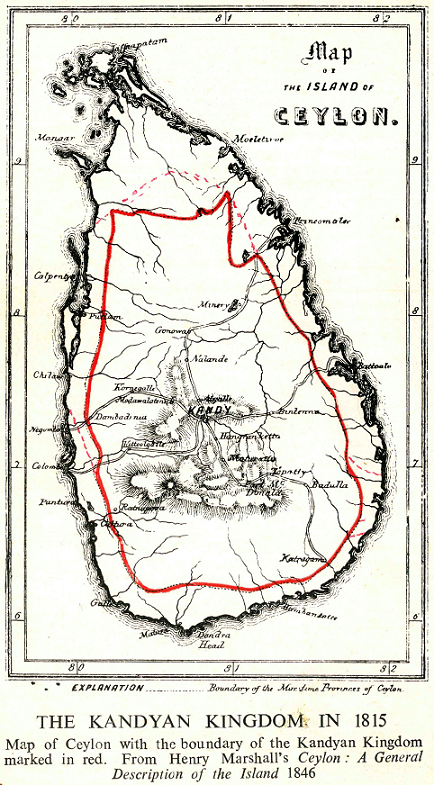
 kandyankingdom1

Lanka and Sri Lanka                                                                            

Early Indians called this country Lanka. The word Lanka had two meanings, resplendent or centrally situated country. Ancient Indian works like Puranas (e.i.Vahni purana) called it Lanka for its beauty and splendor. ‘Raman (beauty) thesyamiti Lanka’ Sri Harsha said. Both Ramayanaya and Mahabharataya consistently use the word Lanka or Lankapura perhaps in the same sense to refer to this country. Some historians say the name Lanka first appeared in the legendary Skanda Purana (6th CE).

According to ancient Indian astrologers it was called Lanka dvipa/dipa (island) as it was centrally located on the planet.   ‘Lankeeyati Bhu madhyaye ankeeyatiti Lanka’ was how it was defined in those sources. Lanka also may have been adopted from lakshaya meaning centre. The author of Mahavamsa referred to it as Lankadeepa may be burrowing it from the Indian usage.  But at no stage in history the nationality had been referred to as Lankika. Instead in all sources it had been referred to as Sinhala. This country was also named Tambapanni, as Vijaya and his people found their palms had got copper coloured when they touched the ground on their arrival. It was probably from this that Ptolemy also called it Taprobane. However the word Tambapanni also appears in Garuda Purana and in Valahassa Jatakaya among the Jataka Stories. These evidence show that even Tambapanni had been in use long before Ptolemy committed it to writing.

This country had been known by many other names such as Heladiva, Serendib, Ceilio. Cerendib, Seilan, Palaesimundu, Hsia-lan-san, Salica, Sarandib, Seeladib Seng-kiya-la, Sylun, Ilam, Seyllen and Taprobana by different people from different countries. A closer study of all these names, except Taprobane, Lanka and Serendib clearly shows that they all have been derived from the word Sinhale.

Regarding the origin of the word Sinhala there are three interpretations. First, the new nation was called Sihala, since Sihabahu the legendary father of Vijaya is said to have slain his father the Lion”. Second, as Vijaya descends from the Sinha clan, the nation founded by him was called Sinhala. Third interpretation is that it is so called as it is the nation which was formed by the integration of the four (Siv=four) ancient tribes, namely Yaksha, Raksha, Naga and Deva (Sivhela) who lived in Heladiva. It is also pertinent to note here that these four tribes along with those who came with Vijaya formed the new Sinhala nation along with the establishment of the Vijayan regime in the 6th Century BC.

Thus all historical evidence of the classical period, including, those of South India, undisputedly point to the fact that they all have referred to this country as the Land of the Sinhala Nation even from the time prior to the dawn of history. Therefore firstly, it is established beyond all reasonable doubts that this land had been the land of the Sinhala people from the beginning of history, even extending beyond historical times. Secondly, it is even more important to note here that this country had never been called the Land of the Tamils as present day Tamils so vociferously claim. South Indians Dravidayans including Tamils called it Eelam simply meaning the land of the Sinhala people from very early times. This is clearly proved by the Malayali saying ‘Eelam Kandavar Illam kanukka illei’(which means man who saw the Eelam (land of the Sinhala people) will never come home).


The Sinhala nation a historical outline

As stated before the Sinhala Nation was born in 543 BC with the arrival of a North Indian Prince called Vijaya of the lion clan of the Aryan stock with a retinue of seven hundred people. Interestingly this date coincides with the date of passing away of the Buddha.

It is recorded that the Buddha lying on his death bed had foreseen the arrival of Prince Vijaya in this Island and that his Doctrine will be preserved for 5000 years on this Island, Lankadipa as it was called by them at that time. Therefore the Buddha had instructed Sakka to protect the Prince and the Island and its people. Thus this Island is the only land on earth which has received his protection and blessings. Buddha himself has visited this Island thrice. First visit to Mahiyangana nine months after enlightenment 1st c BE/528 BC; the second in the 5th year of Buddhahood BE to Nagadeepa in the north (523BC) and the third to Kelanniya (9th year BE/519th BC). On all three occasions people of this country have offered this Island to the Lord and hence this country also had gone on record as the only country in the world that was offered to Buddha. That is why the people of this Island call it the ‘Land of the Buddha’’.

Though there had been social and religious intercourse between the two countries before, according to records Buddhism was formally and officially introduced only in 307 BC by Arahat Mahinda during the time of King Devanampiyatissa (307-267) who ruled Lanka from Anuradhapura. Soon after the whole Island embraced Buddhism it was declared the State religion and remained so up to 1815 AD for 2122 years and continues up to date as the religion of 70 % of the people in this country. The Sacred Bo tree was also brought by Sanghamitta Theiri (288 BC), Mahinda Thera’s sister. Mahinda was the son and Sanghamitta was the daughter of Asoka the Great Emperor, a close friend of Denampiyatissa. Buddha laid his foot print on Mt.Samanala (Adam’s Peak) on his third visit and has sanctified sixteen other spots in this country. Of all the stupas in the world, the Great Stupa Ruwanweliseya in Anuradhapura is said to contain the greatest number of Buddha relicts in the world.  All these events have made this Island the most sacred Buddhist country in the world.

Introduction of Buddhism in 307 BC marked the birth of a new nation ‘Sinhala Buddhist nation’. And it was the  beginning of a great and unique civilization, one of the greatest in the medieval world. This marked the emergence of a unique oriental civilization that dawned a period of political, social, economic, cultural and religious renaissance and stability in this country from the 4th century BC onwards. The peak of this great civilization was reached during the Anuradhapuraand Polonnaruwa periods. Enriched by the influence of the spiritual inspiration of Buddhism, religious monuments like stupendous stupas going up to 400 feet high, kissing the sky were built; colossal and masterpiece sculptures on stone like those of Samadhi statue in Anuradhapura, Avukana on the banks of Kalaweva, Galviharaya in Polonnaruwa and Maligavila in the south with no parallel in any other country were carved on stone and myriads of sculptures on stone and world wonders like Sigiriya frescoes were accomplished by these great people.

This period gave birth to a unique Sinhala Buddhist civilization like no other anywhere else in the world. It could stand along with any great ancient civilization like Roman, Greek, Egypt or Chinese, even surpassing them in hydraulic and stupa building technology. The great wealth of architectural and archaeological legacies spread throughout the country bear witness to that pristine glory that was Sinhale. 12,000 massive man made water bodies, some of them covering 5-6 thousand acres that provided water for paddy fields for three seasons in the year were built to store both rain water and that gushes down the perennial rivers to the sea making use of every drop of water, keeping to the words of one of their great kings Parakramabahu the Great, who advised us ‘not to allow a single drop of water that falls from the heavens to go to the sea without being used for the benefit of man’. The entire Dry Zone was interconnected and interwoven with a marvelous network of big and small irrigation canals; no land where ever water could be taken, from north to south, and east to west, was left unconverted to a paddy field. Even on the hills, lands were terraced in to paddy fields except where paddy could not flower due to shorter hours of sun shine. Human settlements began sprawling upstream by the 3rd c BC along the main river basins like Mahaweli and Kalaoya as the population increased and land became scarce in the lowlands. Having made it the granary of the East this country was also made a major trade hub with a thriving international trade of the then known world.

The invention of the Bisokotuwa by the Sinhala hydraulic engineers more than 2180 years ago and the construction of gigantic irrigation canals 40 and 50 feet wide and more that 50 miles long like Jayaganga and Minipe Yoda ela with a gradient of 6 inches to a mile and even constructing an underground trans-basin irrigation canal like the Bhoo Ela on the highest mountain country, nearly 100 feet long,10 ft in diameter and 40 ft below ground level across the Pattipola ridge, that diverted the waters of west bound Kotmala Oya headwaters to Uma oya in the east against the rules of nature, the Sinhala irrigation engineers invented a hydraulic technology par-excellence in the world. Eminent scholars in the fields of hydrology and irrigation like Parker, Prof Josehp Needham, Tennent and R.L. Brohier have eloquently vouched for this statement.

Blessed with bounties of nature like a perennial supply of rain and 12 hour sunshine, valuable gems under the earth and pearls in the ocean and elephants with tusks in the ever green jungle, not witnessed in other country in the world and an industrious multitude of people impregnated with ingenuity and imagination had put this country in par with all the great civilizations in the ancient world like Egypt, Greece and Rome in the west and China and India in the East. In fields like hydrology and irrigation and stupa building Sri Lanka has no peers. Sri Lanka’s geographical location right at the centre of the Indian Ocean lying midway on the Great east west oceanic Silk route, its economic prosperity, bountiful wealth and enchanting natural beauty have made it the meeting point of all Westerners and Easterners of the then known world. Throughout the medieval world it was known as the Granary of the east, Paradise on earth and the Pearl of the Indian Ocean. Enticed and captivated by this prosperity and grandeur Marcopolo had said that this Island was only 40 leagues from the heaven. That in short was the wonder that was Sinhale then. The golden period of Sinhala Buddhist civilization came to an end at Polonnaruwa in the 13th C with the advent of the barbaric Magha invasion, the most disastrous and devastative South Indian Tamil invasion ever experienced in the history of this country.

Sinhala Society and Political system

None but a Bodisattas would become King of Lanka (Mahinda 1V: Jetavanarama galpotha). Thus only a Buddhist could be a King of this country. The same slab-inscription says’ though Kings appear in human form, they are human divinities’. That was the concept of King in this country. We cannot speak of an ancient Sinhala culture without realizing how vitally permeated it was, by religion, says Prof M.B. Ariyapala. Kingship was based on Mahasammataya- that is popular acceptance. Kingship was hereditary. Although the King was the head of the State the Buddhist monk for all intent and purpose played the lead role in this social system. Thus the monks had been popularly accepted as the ‘Guardian Gods’ of the Nation. The monk more often than not made and unmade the Kings in Sinhale. They also protected and supported the King in war against invaders and in internal dissentions. The King followed the Buddhist practice of the Tenfold Kingly Virtues (Dasaraja Dharma) and adhered to the Dharmasokan tradition of Statecraft in discharging his duties. He treated the subjects as his own children ‘Save purisa mama paja’ (all subjects are my children) was his dictum.  The relationship between the King, subjects and the Dhamma was aptly demonstrated when author of Mahavamsa said, in Sinhale, the ‘King was one with the people and the religion’.  Welfare of the subjects was his primary concern. Thus King Siri Sanghabo said ‘Iman sarattan pisitan sariiran-Dharemi lokassa hitatta meva’(I bear this fragile body of mine with flesh and blood solely for the benefit of ate power. Buddha Dhamma provided the guiding principles and the solid foundation of statecraft that was consistently followed and never abused by the rulers of this Island. Thus the state of Sinhale was firmly established as ‘de facto and de jure’ Sambuddha Rajya on this planet.

The concept of, one Kingdom, one King, one Nation, one Language and one Law for the whole country was the corner stone and the secret of the political stability of this State since beginning. The Kingdom was divided in to three Ratas or sub kingdoms namely Ruhunu, Pihiti and Maya, under the King ruled from the capital at Anuradhapura in the Pihiti Rata. Ruhunu and Maya were ruled by viceroys. It was in 427 BC in the 10th year of his coronation King Pandukabhaya who first laid down the village boundaries for the whole country and laid the foundation for the Tun Rata political division as Rajarata, Dakkina desa and Ruhunurata, which was firmly established in the 12th c and lasted for 2242 years up to 1815 AD without a break.

Dasavassabhi sitto so – gamasima nivesayi

Lanka Deepamhi sakale-  Lankindo Pandukabhyo

(At the completion of his 10th year in office King Padukabhaya laid down village boundaries all over this Island 103 Chapter X. MV Buddhadatta Edition)

Thus Sinhale perhaps was the earliest known Federal State (to use a modern terminology) in the world and the only country in the world that had 186 Kings ruling over one country for 2242 years with an un-broken succession

The Kings ruled from Anuradhapura and Polonnaruwa (from 6th BC -1200AD) in Rajarata, and the other two Ratas were administered from Magama and Kelaniya by two sub-kings. After the fall of Polonnaruwa the capital was shifted to Yapahuwa, Kurunegala, Dambadeniya Gampola, Kotte and finally to Senkadagala (Kandy) in 1474. The Sinhale Kingdom was ceded to the British on 2nd March 1815.Throughout this entire period of 2242 years the whole country was administered under the village councils system and the village was the smallest unit of administration in that Kingdom. The village temple functioned as the nerve centre of the country’s administration, under the guidance of the village monk. The following Pali stanza succinctly describes the socio-economic and politico – religious philosophy of the Sinhala social system that was there prior to 1815 in this country.

Devo vassatu kalena –sassa sampatti hetuca

Pito bhvatu lokoca –raja bhavatu dhammiko

(May there be rain in due season – may the crop be bountiful

May the people be prosperous – may the King be righteous!)

What better wish than this, people living in an agrarian society could ever be made?

Besides protecting the country from the external enemies and maintaining law and order within the country the king had to provide land and irrigation facilities to farmers and sustenance to temples as the monks did not engage in any production process and manual labour. The King in Sinhale all ways had to rule righteously and peacefully (Dehemin Semin).  He was more a benefactor to his subjects than a ruler and never a despot. There was no fulltime warrior army in Sinhale. Everybody was given training in warfare and they were summoned when and where required under the command of the local chieftains called Dissawas, Rtateralas  , Mohottalas and Gamanis.

The main economic activity of its people being agriculture, husbandry was regarded as the most honourable of all occupations in Sinhala society. Robert Knox said if they wanted a King, they may take any man, of either of these two countries (referring to Udunuwara and Yatinuwara) from the plow and wash the dirt off him, and he by reason of his quality and descent is fit to be King”. The King himself got down to the paddy field with his subjects and this is how he became ‘one with the people and the religion’. The social structure of the Sinhale Kingdom has been described as a ‘Farnmer Aristocracy’by Devaraja. Though there was a caste system based on an occupational basis, it was never severe as in Indian society. Again though land formed the basis of the means of production there was no strict feudal social system in this country at any time. The tenants were free to leave at any time they wished to do so. They were not bonded to the landlord as in medieval European feudal societies. The state service was maintained at the lowest level without making it a burden unlike it is done today. There were no political parasites in ancient Sinhala society unlike in modern society. Everyone had to be engaged in one or other occupation to earn his living. Those who work in the Royal household were employed on a shift basis. They were hired in turns and released for farming in time.

Foreign invasions

Though there were many attempts made by South Indian elements from the 2nd c BC to capture this country, only two of them, Elara 2nd BC and Magha 13th AD had some marginal success. Elara held sway over Anuradhapura and its hinterland for 44 years while Magha ruled from Polonnnaruwa only for a short period of 21 years (Kalinga Magha the tyrant 1215–1236).  Though Vijayabahu 111 was able to defeat him, Magha established the Jaffna Kingdom and remained there until 1255. But no invader could capture the whole Island at any time. Though Maga was defeated and chased out of the country, the lost pristine glory that was Rajarata never returned. No ruler up to date  could recover the pristine glory of the Sinhala Kingdom we had before.   Following the Magha devastation that was so devastative and barbaric the Sinhala Kingdom had to shift to the South West resulting in the complete fall of the Rajarata Sinhala Civilization for a long period. All irrigation works, human settlements and religious monuments sprawling all over the northern plains from the central hills to the ocean, built by the Sinhala kings were vandalized and destroyed by Kalinga Magha and the jungle tide invaded the entire Rajarata in leaps and bounds. Only few descendents of the captured Chola invaders survived in sporadic settlements along the eastern coastal belt and Jaffna peninsula. The rest of the entire Rajarata remained under dense jungle until it was opened up in the 20th century.

After a long and dormant period of seven centuries, attempt at restoring this lost great civilization were made only in the early 20th century. This renaissance was marked by two movements; one a religious and literary movement led by Buddhist monks like Hikkaduwe Sumangala, Ratmalane Dharmarama and Mohottiwatte Gunananda and the other economic, social lead by patriotic men like Anagarika Dharmapala HarischandraWalisingha and D.S. Senanayaka. A third agitation movement for political reforms and freedom was also   deployed by the western educated elite that finally resulted in nominal political Independence in 1948.

Revisiting the lost Rajarata civilization began with a massive restoration programme of ruined irrigation works and religious monuments. This was followed by a massive resettlement and agricultural development programme under restored irrigation schemes. This was a commendable success programme and it was spearheaded by D.S. Senanayaka.  It was an attempt made by the government to send back and resettle the descendents of those original Sinhala peasants who were either murdered by the Chola army or who died in battle against the invaders or left the Rajarata for survival to the South West and the Hill country, to their own ancestral land. The fallacy and the irrelevance of the argument advanced by the present day Tamil politicians that the Sri Lankan government is trying to ‘colonize’ their Traditional Tamil Home land, a thing which never existed on the soils of this Island in known history is thereby disproved.

Anagarika dharmapala was the most outstanding layman who spearheaded the religious and socio-cultural renaissance movement among those who took the initiative in this patriotic movement. In spite of the national awakening he created he died on 29 April 1933 before he could see with his own eyes the Sinhale he wished to recreate. Two decades after his death, in the year 1956, a new government under S.W.R.D. Bandaranaike opened the gates for the Dharmapala chintanaya to flow.  But it was short lived and the 1956 expectations never saw the light of the day. Although we saw some new hopes of 1956 renaissance reappearing again in 2005 and a climax with the elimination of LTTE in 2009 under the heroic leadership of President Mahinda Rajapaksa, this country had produced since Independence, his lapses in the post war years and defeat in 2015 have put everything on a full reverse gear.

It is a tragedy that even after 67 years of so-called Independence we are supposed to have got in 1948, those who ruled the country since then have not been able to even restore the legitimate name of this country (Sinhale) that we lost to British in 1815.We are still to see  the emergence of a Diyasena Kumaraya or at least another patriotic Sinhala Buddhist leader of the caliber of Anagarika Dharmapala who could take this country out of the present quagmire and the Augean mess in to which it has been put by the vicious British Colonial rulers and those succeeded them in 1948, and take it back to the pristine golden period of Anuradhapura and Polonnaruwa.

Invasions by the Western colonial powers a turning point in the Islands history and culture

Invasions by western powers began in 1505 with the advent of Portuguese followed by Dutch in 1638. Both these powers were able to occupy only a narrow maritime coastal belt but none could capture the core Sinhala Kingdom which operated from Senkadagala Kandy , that had its sway up to 2nd of March 1815, over more than 90 % of the territory of the Island. (See Map1). ‘If such a Sinhala Buddhist Kandyan Kingdom had not fought and retained its independence in the central highlands of the Island this country would have been denationalized and its indigenous religion, language, economy and cultural institutions totally destroyed as it happened in many other countries and Sinhale would have ceased to exist and it would have been named after a sea pirate or a western colonial invader as it has happened many other lands.

The final fall of the Sinhale took place with the ceding of the Kandyan Kingdom on 2nd March in 1815 under the Kandyan Convention signed between the United Kingdom and the Sinhale. Thus it was the British who captured the whole country by deceit, though not by conquest, for the first time in its long history.  This brought to an end the proud saga of a 2358 year old Sinhala nation that was defended valiantly by our ancestors against South Indian invaders up to 1215 AD and then by the Kandyan Sinhala patriots from 1505 to 1815, at the last leg of heroic battles against the invasions by the Western Colonial invaders.  After the fall of the Kandyan Kingdom in 1815 the valiant people of the Sinhale, again revolted in 1817-1818 but was brutally and savagely suppressed by the British violating all the undertakings given and agreed upon by them under the Kandyan Convention.  On 21st Nov 1818 Brownrigg issued a Royal Proclamation unilaterally violating the Kandyan Convention and thereafter the country was ruled by them up to 1948 under such Royal Proclamations while the Kandyan Convention still held valid. To that extent, all what the British have done in this country since then should be deemed to be unconstitutional and illegal since the legality of the Kandyan convention stands still valid. 1840 British introduced one of the most draconian pieces of legislation called the Encroachment on Crown Land Ordinance and all land belonging to the natives especially the Temples and Devalas and all uncultivated forest lands were declared as Land belonging to the British Crown.

The second freedom fight was deployed by the Sinhalese in 1848 which was called the Matale rebellion by the British. That too was suppressed ruthlessly using the most savages’ methods of blooded mass murder and arson under Torrington for which Torrington finally had to forgo his Governorship and leave to UK. Having suppressed both freedom struggles of 1818 and 1848 they devastated native irrigation network, agriculture and all native institutions.  hey divided the country initially in to 5 Provinces as North, South, West and East and Central in 1832 and laid the firm foundation for a long term divide and rule mechanism on ethnic and regional basis to destroy the Sinhala civilization.

In 1853 they took over all lands belonging to Temples and Devalas and again in 1887 all other uncultivated lands were also taken by force under the Waste Land Ordinance. After taking over of the physical possession of the land the British deployed a multifaceted strategy to destabilize and divide the Sinhala nation and kill the native system and consolidate their hegemony over their newly netted ‘Big Fish’ as a British official had once referred to this country in 1814 in one of his correspondence to the Colonial Secretary.

1 Destroying the forest cover, on the central hills the source of all rivers that provide water to sustain the entire life system in the whole country

2 destroying the irrigation network including wevas and canals to cripple local agriculture so that people will die of starvation and others will submit to them

3 Opening up the central impassable hill citadel by rail and road which has kept the enemy at bay for 310 years

4 Destroying the native administrative, legal, social and religious institutions that mobilized the natives against the whites and replace them with their own systems

5 Introducing Malabar coolies to the central hill country and settling South Indian Tamils in the North and the East who were sworn enemies of the Kandyans and who will have an excellent effect on suppressing the Sinhalese, were the main steps among them.

With their experience in India they immediately saw the value of the central highlands as a potential gold mine for their ambitions in coffee plantations. So they first decided to open up these virgin forests with the duel objectives of building up a plantation economy and destroying the native economy along with its people. They first destroyed the entire forest cover on the central hill country about 600,000 acres of virgin jungle that was there from the dawn of history that provided the source for all the rivers in the country which sustained the entire life system in the Island and opened it up for coffee and thereafter Tea plantations.

British faced a serious labour problem as the Sinhala people refused to work for their enemies as labourers. Initially there was a proposal to get down the required labour from China. But they hesitated arguing that they might pose a problem in their long term empire building as the Chinese were also Buddhists. Therefore Torrington pleaded for South Indian labour as they had been sworn enemies of the Sinhala Nation throughout history and got down nearly 1 m and settled them on the hills as a separate ethnic enclave to tame the Sinhala nation.

The following quotation from Torrington’s letter dated Aug 11 1848 addressed to the Colonial Secretary clearly illustrates their vicious motives of bringing Malabars to this country. ‘I am most anxious to be allowed to introduce and locate on some of these very lands, Malabars, allowing them to cultivate and pay a portion of the produce to government. This would have an excellent effect. A population would soon spring up that would act as a check on the Kandyans, and gradually be the means of giving us a supply of labour without sending to the coast. The Kandyans hate the Malabars and on some of the states near Matale the coolies fought well for the protection of their master’s property. Pray give the plan some consideration-I need not remind you that the colony has been put to some expense in suppressing this outbreak” (The Great Rebellion 1818 Tennakoon Vimalananda 1970)

Concurrently Tamil labourers were also brought to work on roads and railways and other government works all over the Island particularly in the North adding to the already present Malabar population in Jaffna peninsula brought by Dutch to work on tobacco plantations.

Meanwhile they also adopted a cunning policy of educating and training Tamil elites in Jaffna. For example by 1843 out of the 105 English schools they had opened up in the Island, 45 were in Jaffna. This is how British persuaded a policy of empowering and promoting Tamils right from the beginning while discriminating against the Sinhalese. Everything was done to promote Tamils and suppress the Sinhalese. They introduced their political, administrative and legal systems and technology to destroy the native Sinhalese and their traditional institutions. They continue the same vicious policy even today.

They destroyed the Sinhala language, temples, Ayurveda and native education. Spread their own education programme through a state sponsored network of Missionaries all over the Island, particularly in Tamil areas and Western province. Promoted and encouraged division between Tamils, Sinhalese and Muslims and even dividing the Sinhalese as Kandyans and Low country they also promoted a western oriented educated Sinhala Elite group who would support them to achieve their goals and whom they were expecting to take over the administration of the Island as their successors one day.

The rails and roads they built and the indirect contribution by Civil Servants like Parker, Bell, Codrington and Tennant have contributed substantially for introducing Sri Lanka to the west but the negative effects like plundering our valuable books, artifacts and archaeological masterpieces far exceed the positive side. It is said what they have robbed and plundered and now lying in their museums are far more valuable than what we have in this country.

In this age of allegations and counter allegations being made jointly by the British government in collaboration with the entire West and India against human rights violation by this country, I would like to make an open plea to those patriotic Sinhala Buddhist leaders of this country and those living outside, to take up the issue of these historic violations against a nation at least from 1797 onwards and claim compensation and ask for repatriation of all what they have robbed.

Buddhism in modern world

Buddhism is described as a major world religion by modern writers. But in this essay I deliberately avoid calling it a religion and describe it as a ‘way of life’, as the Buddha himself has called it, and also as a philosophy, a philosophy deeper than any, ever known to man.

The word religion is a Western concept. Boquet a renowned scholar on comparative religions quoting from Cicero has said the word religion has come from a root ‘leg’ meaning to take up, gather or observe. i.e to observe the sings of a Divine communication or read the omens. Servius on the other hand held that it come from another root ‘lig’ to bind, so that ‘religio’ meant a relationship, i.e. Communication between the human and the Super Human”. Both these definitions clearly link religion with a divine or a superhuman element. But since Buddha has clearly described his Doctrine as A Middle Way (Majjima Patipada) Buddhism cannot be described as a religion. More over Buddhism does not include any divine or superhuman concept. Discarding the two extremes Self Indulgence and Self Mortification (Kamasukhallikanuyoga and Atttakilamatanuyoga) Buddha discovered the Middle Path (Majjima Patipada) which he described as a way leading to Chakkhukaranai, Gnanakarani, Upasamaya Abhinnaya, Sambodhaya Nibbanaya sanvattati. The Noble Eightfold Path he described as the Middle Path. This was the essence of his Doctrine.

The final objective of his doctrine was Nibbana, the eternal bliss,that is complete cessation of craving and re-birth. But it also has laid down the Way to be followed by one to lead a righteous life until he finally attains Nibbana. In Japan their religion is called Shinto the Way of the Gods. Therefore it is more appropriate to describe Buddhism as a ‘Way’ or ‘Path’ rather than a religion as described by the West.  At the same time it is also recognized as a deep philosophy, deeper than found in any other religion. Buddhism is also the only Doctrine that does not collapse before modern scientific analysis. Its openness and freedom of thought is not found in any other religion. It does not call for blind faith either. The Buddha laid down the salient features of his doctrine as swakkhato Bhagavata Dhammo, sanditthiko, akaliko, ehipassikko, opanaiko, paccattam veditabbo vinnuhiti’. It is well said, has to be realized by oneself, timeless, it has to be understood only by the wise”. This is the most rational and valuable quality of Buddhism something not found in any other religion. In Buddhism man is supreme and not the God. Allahu Akbar (God is the Greatest) says Islam. So is it in all other religions. Buddha has admonished his disciples succinctly what to be followed by his followers in Kalama Sutta in this regard.

Sabba papassa akaranan-Kusalassa upasampada

Sachitta pariyodapanam –Etan Buddhanusasanan

‘Abstain from all evils, ordain in Good, purify your own mind and that is the admonition of all Buddha’s’. What better admonition any sage or religious Teacher has preached for an exemplary way of life? What better prescription one can think of for world peace?

This is the most precise answer Buddha has given to a certain Brahmana, one day, when he was asked as to what his Doctrine is all about?

So in this backdrop Buddhism being the only world ‘religion’ cum philosophy that will remain in this that will survive beyond 2050, as eminent sears like Sir Arthur Clerk has forecast and this country being its head quarters, Sri Lanka is destined to hit new horizons in world history provided we Sinhalese succeeds in protecting the Sinhala Nation and Buddhism.

Role of Buddhism and the Monk in making a Nation

It has been said that in this country the Casket that carries sacred relicts of Buddha on the elephant is the Dispensation; the elephant that carries the relicts casket is the Sinhala nation and the Monk is the elephant keeper (Etgovva) of that elephant. I don’t think there is a better way to describe the ‘Role of Buddhism and the Monk in making a Nation’ than this all time truism. There was also an age old tradition in Sinhala society that every family must have three sons: one to guarantee the continuity of the family tradition; one to be given to the state service (mainly army to protect the country) and the other to be given to the Sasana, in other words to be ordained as a monk. This tradition too illustrates the unique place occupied by the religion and the monk within the fabrics of the Sinhala social system

The monk’s position in Sinhala society is therefore supreme. Everyone including the King has to worship him and rise from his seat and is not expected to sit on a higher seat or a seat of equal height. But the monk never rises from his seat or never worships anybody other than the Buddha and a monk who is senior to him in higher Ordination, which is mandatory. Even the mother and the father have to worship their own son once he becomes a monk. That is the social status of a monk in Sinhala Buddhist society. He is above the people and above the King as well. He is the King as well as the king maker and un-maker. He is the key figure in protecting the Kingdom the King and the sasana. That is why he has been duped as the Jatiye muradevatava– the Guardian God of the nation. Robert Brownrigg in a note to Bathurst the State Secretary in1816 said that in the Sinhale ‘the Buddhist monks are the chief conspirators of every conspiracy against the Whites’. Therefore he stressed on the need to destroy the Buddhist institutions and their influence on the people if the new regime is to contain the Sinhala people. Isn’t this statement epitomizes and put in correct perspective the role of the monk in Sinhala society?

Each village in the past had a temple that functioned both as the hub of spiritual and worldly affairs of villagers. It was the centre of leaning and the monk was the wellspring of all arts and sciences that had ramifications extending in to all aspect of human life in the village. He was the custodian and disseminator of both spiritual and worldly knowledge base of the people while he held the monopoly over the spiritual domain like bana preaching, pirith chanting, alms giving and performing the religious rituals (pansakula) at burial ceremonies. His role in worldly affairs such as astrology, medicine, education, literature and sciences in sustaining the society was far flung. The village Temples were the schools and the Pirivenas were the Universities of the nation. It was the village monk who casts auspicious times for all agricultural activities and social events and functions of all type. He sets the horoscope of a newly born child, gives the name and also reads the first letter in the alphabet to a child and set all auspicious times for all other occasions in domestic and social life. The monk was thus involved in one’s life from the womb to the tomb and even thereafter. The Monk was the preceptor, teacher, physician astrologer, guide, friend and advisor not only to ordinary villager but also to the King who protects and rules the country.

Fortunately even today, though in a different form, the same situation continues. The tradition that a monk is always named after the village where he is born (i.e. Aluthgama Dhammananda) speaks volumes on the role he plays within the Sinhala social system. To my knowledge I know of no other country in the ancient or modern world where such tradition exists. In short the history of this country from the pre-Christian times to 1956, the modern turning point of Sinhala Buddhist resurgence, is nothing but the story of the struggle by the temple and the heroic monks to protect the land, nation, language and the religion (Desa, Resa, Basa saha Samaya).

Unlike in the present day society there were no political monks in the ancient times.  In the past they stood above everyone including the King. The monk was the advisor to the King in both mundane and spiritual matters. He not only provided leadership to his people in spiritual and worldly liberation but also in national liberation; in state affairs, he gave leadership to his people both in war and peace.

Conclusion

No other country in the world has such a strong and well organized monastic cum statecraft institutional network. For all what he does to his people and country, whether it is spiritual or worldly the Sinhala Buddhist monk never expects any gain in return. But he expects and demands the King to protect and rule the land keeping to the Dasaraja Dharma and Satara Sangraha vastu for the good of the many and for the happiness of the many. The Buddha’s admonition to his disciples ‘charatha Bhikkhave charikan Bahujana hitaya, bahujana sukhaya attaya hitaya sadeva manussaya’ is the guiding light that illuminates his arduous path.  King depends on the monk both on spiritual and worldly matters for advice and guidance on all affairs of statecrafts and the Monk on the other hand expects the King to protect the country and the Sasana and work for the wellbeing of the citizens.

Buddhism and the Sinhala Nation are one.  They were so closely interconnected and interdependent from the day Buddhism was introduced to this country in 307 BC. One cannot treat them as two distinct entities.   So much so the Nation in this Island had been known as the ‘Sinhala Bauddha Jatiya’ right from the beginning. To use a famous Sinhala adage it is ‘like the bark unto the tree’ (gahata potta wage). The inseparable bond between Buddhism and the Sinhala Nation should certainly remain at least for another 2500 years to come,  to fulfill that prophesy as the Buddha had predicted. Protecting the Dhamma therefore, I think is the bounden duty of the Sinhala Buddhist monk than anyone else’s in this world. If they continue to be divided as they do now, neither Buddhism nor the Sinhala nation will last for more than few decades. Therefore it is high time that they discard their political, sectoral and all other non monastic affiliations and get united under the ‘banner of the Arahat’ (the robe) only, to fulfill their historic task of protecting the Sasana and the Sinhala nation. Meanwhile we also note with concern some unwelcome and rapid changes taking place in monastic culture in this country due to foreign influence. For example some novelties like lay devotees partaking meals after a dane offering in a temple and keeping women as secretaries in certain temples like in Thailand, Korea and Japan and the West pose a serious threat to the Sinhala Buddhist monastic traditions. It is high time for the Mahanayaka Nayaka Theras and concerned Buddhist scholars to take suitable measures to arrest this situation before it is too late. Theravada Buddhism  in Sinhale like no other” should be our motto and the goal of Mahasangha of Sinhale.

If they fail to do so immediately, preserving the Sasana for another 2500 years might end up a day dream.  Updating the Buddhist Temporalities Ordinance alone may not help to protect the Sasana. Similarly those who underestimate or do not recognize the Monks legitimate role in this country, and promote dissension among them for political or personal gain, whether he is subject, King or monk is also destined to be doomed sooner or later.

In the light of this background, today on this sacred grounds of Sri Sumatindarama/Sadananda Pirivena founded by Minister Sumatinda of King Devanpiyatissa in 307 BC, I appeal to the Mahasangha in this country on this historic occasion to begin ‘the Revolt in the Temple’ to protect the Sasana and the Sinhala nation, as successors to the Theraputthabhaya tradition of patriotic monks of this sacred land. ‘Kalo ayan te Bhante’! Arabhata ! Nikkhamata! Yunjata Buddha Sasane!

Further reading

Society in Medieval Ceylon 1968 Ariyapala M.B.

D’oyly John. A sketch of the Constitution of the Kandyan Kingdom Tisara Publication: 1975. Introduction

Vimalananda Tennakoon. The Great Rebellion 1818.

Walpola Rhula  History of Buddhism in Ceylon: The Anuradhapura period, 3rd Century BC–10th Century AD (1966)

Walpola Rhula  The Heritage of the Bhikkhu: A Short History of the Bhikkhu in Educational, Cultural, Social, and Political Life (1974, ISBN 0-394-49260-9)

Walpola Rhula  The Heritage of the Bhikkhu: The Buddhist Tradition of Service (2003, ISBN 0-8021-4023-8

Statement by Mr. Jack Maclaren in the Ontario Legislature Glorifying Tamil Terrorism in Sri Lanka

November 30th, 2015

Ira de Silva Ontario,Canada

Hon. Jack MacLaren, MPP
Provincial Legislature, Queens Park,
Toronto, Ontario.

Dear Sir:

I am writing to express my outrage at your unprincipled, ignorant, false statement in the Ontario Legislature on November 26,2015 “remembering and mourning those who were were killed during the war in Sri Lanka”.  It is particularly galling that you should make this statement at a time when the world is grieving for those who were killed by terrorism in Paris. Is it only terrorism when people in the west are killed by terrorists? What you do not seem to realize is that, in Sri Lanka, it was a war by Tamil terrorists on the people of Sri Lanka for a period of 27 years, funded and supported by Canadian citizens and Canadian politicians. I would like to remind you, your party leader, your party caucus and all other members of the Ontario Legislature as well as the Canadian public, that it was a cheque from Canadian citizens that “bought” the bombing of the Central Bank in Sri Lanka killing 120 people and injuring over 1200 people. It was the same cheque that “bought” the attack on the holiest Buddhist shrine in Sri Lanka. This information was published in the Canadian media. You obviously do not remember and do not care because it was Sri Lankans that were murdered.

For your information, there is no such country as Tamil Eelam so their are no “people of Tamil Eelam”. That was the goal of the Tamil terrorists and their leader.  They wanted to divide Sri Lanka to achieve this goal and to this end terrorised Sri Lankans for 27 years. Further, the 100,000 you remember and mourn were not only Tamils, but people of all communities killed by Tamil terrorism. The Tamil terrorists killed Tamils who did not support their goals. As for “none of the perpetrators of these war crimes have been brought to justice”, the leadership of the Tamil terrorists were killed which ended the war in Sri Lanka but those who supported them and funded them are still living in Canada and other countries and continue to work for their goal of dividing Sri Lanka. Perhaps you could provide the necessary information to the authorities so that they can be brought to justice because those who supplied the guns and bombs for terrorism in Sri Lanka are as guilty as the terrorists who used them. If you take this action, you will be a hero and in future you can say that, because of you, perpetrators of war crimes have been brought to justice. It would in a small way redeem you and your fellow politicians who openly support the supporters of the LTTE in Canada.

In an effort to educate you on what took place in Sri Lanka I am writing to you to give you a few facts.

1. There is no country of Tamil Eelam and therefore no “people of Tamil Eelam”. The only Tamil State is in India and it is Tamil Nadu,  which is the homeland of the Tamils. There are 70 million Tamils in Tamil Nadu.  If there is to be a Tamil State it would be in India, however at the first sign of such a campaign, India brought in laws which prevented this. The LTTE tried to divide Sri Lanka to create a Tamil only state and to that end terrorised Sri Lanka for 27 years. They had the support of western countries  including Canada.

2. As for “the genocidal onslaught for the Tamils on the island of Sri Lanka is still a reality”. Given that the terrorism was by the Tamils, the genocidal onslaught was by them on the other communities as well as Sri Lankan Tamils who did not support them. The reality was that to achieve the LTTE goal, Muslims and Sinhalese were killed or driven out of the areas that the LTTE wanted to claim for their racist, fascist, Tamil state.

3. The LTTE were recognized as the most ruthless terrorist organization. They invented the suicide vest for suicide bombers and recruited children to wear them. It was a suicide bomber of the LTTE that killed the Prime Minister of India, a President of Sri Lanka, many Sri Lankan politicians and civilians of ALL communities. In Sri Lanka, Muslims and Sinhalese were murdered by LTTE gunmen in temples and mosques as they PRAYED. In Paris civilians were killed while they were at concerts and cafes.  Canadian politicians of all levels of government condemned this act. Sri Lanka suffered on it’s own. At the same time that the world is remembering the attack in Paris, you are supporting those who carried out murderous acts on Sri Lankans and remembering and mourning not the victims but the perpetrators!  When are you going to remember and mourn for the leaders and followers of Al Quaeda and ISIS? Is it terrorism to you only when people in the west get killed? Your attitude is callous and immoral. Because your “Tamils for Patrick Team” have supported you in your election campaign you are supporting terrorism in Sri Lanka by the LTTE. You may be “honoured to rise and speak about Tamil remembrance day” but to Sri Lankans who are non LTTE supporters, it is an act of ignorance and callous contempt for Sri Lankan life.

4. “The genocidal onslaught for the Tamils on the island of Sri Lanka is still a reality on many parts of the island. They seek the attention of the greater Canadian community and its support in order to live with dignity and freedom in their own land”. Obviously, you either do not know the meaning of the words “genocidal onslaught” or are so ignorant about Sri Lanka that you are unaware that at the end of the war, rather than a genocidal onslaught, the Sri Lankan forces rescued 300,000 Tamils from the clutches of the LTTE who were holding them hostage as a human shield. They are now living in Sri Lanka with the same rights that ALL Sri Lankans have.

As for “their own” land”, Sri Lanka is for ALL Sri Lankans, there is no “Tamil land”in Sri Lanka. Tamils live in all parts of Sri Lanka. It was the LTTE that tried to create an exclusive Tamil only state in a part of Sri Lanka by terrorism and genocide. That goal was defeated in 2009 and Sri Lankans do not thank you for trying to revive that terrorist goal. As for “the Tamil population also wants the freedom to express their political will through a referendum”, why is there a need for a referendum when they have they have the right to vote and have elected members of parliament all in accordance with international norms and democracies in  other parts of the world? As for the Tamil diaspora, if they have chosen to live and become citizens of other countries, they should leave political decisions regarding  Sri Lanka to the people of Sri Lanka and stop using people like you to try to impose their will on another country. Please convey this message to your many Tamil friends who have made Ontario their home.

By copy to Mr. Patrick Brown, this statement is a damning report on the  Conservative Party and it’s support of terrorism in Sri Lanka. Are you going to act on this ignorant and false accusation or do you too support terrorism in Sri Lanka for Tamil votes in Ontario? Given the few facts on Tamil terrorism in this letter exposing  Mr. MacLaren’s false  opinions,  Mr. MaClaren should apologise in the Legislature for what he said merely to satisfy his “Tamils for MaClaren” so that the record will be corrected.

By copy to Premier Wynne, what is your view regarding remembering and mourning for terrorism in Sri Lanka. Do you agree with Mr. MaClaren? Please advise.

Yours truly,

Ira de Silva

Ontario,Canada

Jack MacLaren statement on Tamil Rememberance Day at Queens Park, Toronto

November 30th, 2015

Asoka Weerasinghe Kings Grove Crescent . Gloucester . Ontario . Canada

28 November 2015

Hon. Kathleen Wynne, MPP, Leader of the Liberal Party

Premier of the Province of Ontario

Province Legislature, Queens Park

Toronto. Ontario

cc.Yasir Nqvi, MPP,  Minister of Community Safety

Patrick Brown, MPP, Leader of the Opposition (Conservative Party)

Jack MacLaren, MPP, for Kanata (Conservative Party)

Dear Premier Wynne:

I saw on Television and read the Hansard of 26 November 2015 the statement by Ontario PC Member Jack MacLaren for Kanata, I mean ‘Con-Nut-Ta’ hailing the Tamil Tigers, saying:

We all remember and mourn people who were killed during the war in Sri Lanka.  For the people of Tamil Eelam, and for Tamils living in Canada and many other parts of the world, November 27 is the day on which they remember and mourn over 100,000 people who were killed during the war.  None of the perpetrators of these war crimes have been brought to justice.”

That statement by MacLaren stabbed at my heart that was enjoying my retirement from this file, and that got my goat.  I am livid, my anger is visceral and my cart-wheeling eye balls are spitting dragon breath at this disingenuous ‘humbug’ politician.

If he was alluding to the 100,000 killings during the Eelam War were all Tamils, that is a crock of Codswallop, Premier Wynne.  Over 50% of that number was of innocent Sinhalese and Muslims, killed by the Tamil Tigers for the want of their mono-ethnic, racist, separate Tamil State, Eelam.  And that is a FACT and MacLaren  should make a correction in his mental archival data bank of this War, which he seems to know sweet nothing about.  He is parroting what his Tamil constituents say.  Shish!  That  distortion is brutal and unacceptable in an honest society.

Premier Wynne, where does MacLaren think there is a ‘Tamil Eelam’?  There has never been a mythical ‘Tamil Eelam’, and hopefully there never will be one, unless he thinks it is in his back yard with a sign saying  Welcome to Con-Nut-Ta’s Tamil Eelam.”

With that disingenuous statement read standing at attention in the hallowed chamber of the Ontario’s Legislature, he has abused his privilege as an MPP by distorting Facts in his statement on the Tamils Remembrance Day, and dedicating the Legislature-Chamber as the ‘House of the Con-Nut-Ta Liar’.  This disrespective act of derision should never have been tolerated by the Speaker of the Legislature.

The genocidal onslaught for the Tamils on the island of Sri Lanka is still a reality….” he continued.  Genocidal onslaught…” he says.  This MacLaren is an immoral politician of the first order trying to glorify the most ruthless terrorist serial killers, the Tamil Tigers, who hijacked the ‘right-to-life’ of 21 million peoples of the island Sri Lanka for 27 bloody years, until they were annihilated on the 19th May 2009 on the sandy beach of the Nandikadal lagoon in the east coast of Sri Lanka.

Premier Wynne, perhaps, MacLaren may want to reconcile his words of genocidal onslaught” with the following TAMIL FACTS so that he could re-tool his image as an honest politician, although it seems to be a far cry.

  1. It is the separatist Tamils who terrorized and chased 27,000 of the majority Sinhalese community between 1971 and 1981, who had lived in the North of the island for generations. If MacLaren has an ounce of honesty in his bones, let us see him getting up in the legislature on the 27th November 2016 and apologize to this Sinhalese Sri Lankan-Canadian and the rest of the Sinhalese community in Canada  and around the world with his head hanging down in shame;
  1. It were the separatist Tamils who stoned and chased 400 Sinhalese undergraduates and lecturers from the Jaffna University campus in August 1977, while the Tamil students enjoyed being undergraduates at the southern University campuses untouched by a single flying stone-missile thrown at them by a Sinhalese wanting to chase them up north. And that is A FACT.

And when these Sinhalese students and lecturers were transported South in buses escorted by the army and police, they had to lie prostrate on the floor of the buses to dodge the stone-missiles that were storming at them.  And if MacLaren has an ounce of honesty in his bones, let us see whether he would get up in the legislature and apologize to this Sinhalese Sri Lankan-Canadian, other Sinhalese-Canadians  across Canada and others around the world with his head hanging down in shame for deliberately distorting FACTS in the Ontario’s Legislative chamber.

  1. It were MacLaren’s victimized separatist Tamils who in October 1990, gave 100,000 Muslims who lived in the North and East of Sri Lanka for generations, 48 hours to leave town leaving their gold and other valuables at the nearest mosque or else…..!   So the Muslims did and got away quickly before they would be shot dead by the Tamil Tigers.   This despicable act of ethnic cleansing made Uganda’s Idi Amin look like an angel as he gave the Ugandan Indians three months to get out of Uganda,   This man,  Jack MacLaren  from ‘Con-Nut-Ta’ knows sweet nothing.  And Premier Wynne, I say Boo”, to this disingenuous Conservative politician.
  1. So this MPP Jack MacLaren decides to provide a cloak of respectability to the Tamil Tiger terrorists who detonated 388 suicide bombers, over half of them being young Tamil women who had been kidnapped on their  way to school and brainwashed.  These are the Tamil terrorists who assassinated two heads of states, Rajiv Gandhi of India and President Premadasa of Sri Lanka.   Who assassinated the Foreign Minister of Sri Lanka, Lakshman Kadiragama who also happened to be a Tamil;  Minster of Defence, Ranjan Wijeratne; Minister of Industrial Development, C.V.Gunaratne; Minister of Highways and Road Development, Jeyaraj Fernandopulle, a Tamil; Leader of the Opposition, A. Amirthalingam, another Tamil killed by Tamil terrorists that MacLaren used the Ontario Legislature to give these killer Tamil terrorists  a cloak of respectability.  This man is insane.
  1. So MacLaren , the MPP for ‘Con-Nut-Ta’ honoured the Tamil Remembrance Day standing at attention in the Ontario Provincial Legislature and solemnly reciting his script like a page from the Bible, from a piece of paper.  You know, Premier Wynne, Jack MacLaren found it difficult to shed even one crocodile tear for the 700 Sinhalese soldiers who surrendered to them having been promised to be sent back south, but blind folded them, kneeling with their wrists tied at their backs,  and shot dead through their skulls on 11 June, 1990, by the despicable Tamil terrorists.   MacLaren nestles a bleeding heart inside a cage of ribs that has been programmed only to remember the Tamils who died during the war, but not the 33 Novice Buddhist monks, who were travelling  in a bus on a pilgrimage, hacked to death with machetes and shot with assault rifles at point blank range by the Tamil Tiger terrorists (2.6.1987), or the 62 Sinhalese settlers in the Dollar and Kent Farms in Vavuniya when they were hacked with machetes and shot dead while they were asleep in their adobe huts (30.11.1984) on an indigo-black morning.  And I am a Sinhalese-Buddhist to boot who has lived in Canada since August 26, 1968.   And I, as a law abiding Canadian, is not prepared to tolerate such political lying poppy-cock that targets to hurt my Motherland, Sri Lanka, by anyone, Canadian politician or not.   Amen!
  1. Premier Wynne, Jack MacLaren talked of ‘genocidal onslaught of the Tamil”.  He is now walking on thin ice, not knowing what the heck he is talking about.  Ha! ‘Genocide’ he says.  I am prepared to stand tall for my Motherland, Sri Lanka, and tell Jack MacLaren, Man…that’s  buckets full of Hog-wash.   If you don’t know your facts about the Sri Lankan Eelam War, it is only sensible that you Shut-Up and not make yourself look a fool.”
  1. Premier Wynne, let me ask MacLaren through you, to show this Sinhala Sri Lankan-Canadian Asoka Weerasinghe of Beaconhill North in Gloucester, the Premier of the Province of Ontario, Honourable Kathleen Wynne; the Speaker of Ontario’s Legislature; and his Colleagues of that pristine Ontario ‘s Provincial Legislature at Queens Park, how he would reconcile his brutal charge of ‘Tamil Genocide’ in Sri Lanka when the Sri Lankan Government soldiers rescued 295,873 Tamils from the clutches of the Tamil Tigers by the 19th May, 2009, who were used as a human shield by the Tamil Tigers for 30 long months and herded like unwashed cattle under the hot tropical sun from the west coast to the east coast, and didn’t snuff out the breath of a single Tamil. ‘Genocide’ my foot, MacLaren.  What the heck are you talking about?  What is this despicable game that you are trying to play?  You bet, I am prepared to challenge you on your own game.  I say, take me on, MacLaren!”
  1. Premier Wynne, this man MacLaren is not aware that the Sri Lankan government having housed these refugees in temporary refugee camps prepared a million meals a day for almost three years, to feed hearty breakfasts, lunches and dinners every day.  A miracle for a puny island nation, the size of New Brunswick, with a population of Quebec and Ontario put together and squeezed into New Brunswick.  And 90 percent of the people who prepared these  million meals  a day were from the majority Sinhalese community.  This is a classic story book example of respecting human life and human rights in action.  No one could challenge that amazing response by the Sri Lankan Government.  My question to Jack MacLaren is to show me,  us, the world, where such  humane acts finds a place in his genocide’ formula.   I will bet my last dollar that Jack MacLaren, will look a blithering fool trying to defend his cussed statement about the Tamil Remembrance day of 100,000 killed, alluding that they were all Tamils, and pointing his finger at the Sri Lankan Government  to be guilty of this cruel act of genocide.   I say, Try it Jack MacLaren….try it!”  And I can assure you that you will fall flat on your face like a 4-year old child trying his first steps on Winter ice on the Rideau Canal with skates on, trying to get up, and fall immediately on his/her face.
  1. Genocide, my foot! Premier Wynne, let me repeat myself and ask Jack MacLaren through you.  If you don’t know your FACTS on Sri Lanka and its 27 year long Eelam War,  then please SHUT UP.  As I am on a Mission to see that no one, absolutely no one is going to hurt my Motherland Sri Lanka, unfairly.  I mean no one, and that includes your leader Patrick Brown of the Conservative Party who has had his daggers drawn to draw blood out of Sri Lanka for many, many moons. I have been watching Patrick Brown and he has heard my sentiments in the past while he was the  Conservative Federal MP for Barrie.  Not pretty!
  1. And finally, Premier Wynne, it would be a worthwhile exercise for all bleeding hearts of the Ontario Legislature who are at sympathy with the Tamil refugees Eelam cause, to ask these simple questions:

Why did you all thumb your noses at your Motherland Tamil Nadu just 18 salt water miles away where 70 million of your Tamil people live when you all decided to fly out of the Koha’s nest  over Tamil Nadu and land on Canadian soil saying that you were running away from discrimination, persecution and genocide claiming to be convention refugees?   And why on earth do all of you have a ‘death-wish’ to return to Sri Lanka on the first plane after you receive your Canadian passport to add one more number to the Tamil Genocide statistics in Sri Lanka, after having run away scared of getting killed by the Sri Lankan soldiers?;

You all ran away from Sri Lanka fearing genocide, but, hey,

40 percent of the population in the capital Colombo are your people, Tamils.  Hey! How come then, in the mile long Main Street in Pettah in the commercial district of Colombo, three shops in every four are owned by your  Tamil people, and some are millionaires, owning jewellery shops, sari emporiums,  curry and thosai huts, you name it and your people have it, and inter-marrying with the Sinhalese.  They don’t seem to have a problem.  It is strange isn’t it?

And 75% of the prime real estate in the suburbs of  the capital Colombo, Wellawatte – Ottawa’s Rothwell Heights of Colombo are owned by your people.  Perhaps you can tell us why this extraordinary phenomena and they are living on the monies spent by the majority Sinhalese, 74 per cent of them, isn’t it?

We love to have an explanation as we feel that you all have taken us down the garden path for fools and suckers!”

Their response will speak volumes, and it is for you all, which includes Conservatives Patrick Brown and Jack MacLaren, to be Judge and Jury, and let us know your verdict.

And you know why Mayor Kathleen Wynne, I who was a card-carrying Conservative since Preston Manning’s Reform days,  and I couldn’t even hold my nose closed-tight enough to drop my ballot with an ‘X’ against the name of the Conservative candidate into the ballot box at the last Federal election.   My conscience will never, ever, let me support the Conservatives from here after.

When candidates like Jack MacLaren wants to run the country!

Hmmmmmmmmmmmmm….. I am no sucker!

Sincerely,

Asoka Weerasinghe


ප්‍රේමදාසලා සිරිසේන කුරේලා බෞද්ධයන්ව ඇන්දුව හැටි

November 30th, 2015

වෛද්‍ය රුවන් එම් ජයතුංග

ප්‍රේමදාස ජනපතිවරයාගේ උපන් දිනයට සියක් නමක් පැවිදි කරවීමේ මහා පුණ්‍යොත්සවයක් සූදානම් කරන ලදි. මේ සඳහා සිරිසේන කුරේ ආමාත්‍යවරයාගේ සහයෙන් කොළඹ මහ නගර සභාවේ කම්කරුවන් සහ වැඩ සුපවයිසර්වරු පිරිසක් තෝරාගෙන ඔවුනට  සිවුරු පොරවා කැමරාව ඉදිරියේ මහණ කරන ලදි. අහේතුවකට මෙන් මෙසේ තාවකලිකව ප්‍රදර්ශනයට මහණ කල වැඩ සුපවයිසර්වරයෙකු සාසනයේ රැඳුනේය​. ඔහු තලල්ලේ උපාලි හිමියන් ලෙස ප්‍රසිද්ධ විය​. මාරයාගේ හෝරාව වෙබ් අඩවිය විසින්  බොදුනුවන්ට කොකා පෙන්වූ නාටකය ගැන විස්තර අනාවරනය කරන්නේ මෙසේය​.

…………….තලල්ලේ උපාලි මෙම පිරිසට හසුවන්නේ කොළඹ මහ නගර සභාවේ සිටය… ඒ වන විට නගර සභාවේ වැඩ පරීක්ෂකයකු වන ඔහු උපත ලැබූවේත්, හැදී වැඩුනේත්, කොළඹ ජනාකීර්ණ පෙදෙසක් වූ කොම්පඤ්ඤ වීදීයේය… ඒද සාමාන්‍ය සිංහල පරිසරයක් තුල නොව අති මහත් මුස්ලිම් බහුතරයක් මැදය… ඔහු උපතේ සිට මැදිවිය දක්වාම ඇසුරු කලේ මුස්ලිම් ජනයාය.. කතා කලේ දෙමළ බසය… කෑවේ බිවේ ඔවුන් සමඟය… ඉගෙන ගත්තේ ඔවුන් ඇසුරේය… කොටින්ම උපතින් හැර අන් සෑම අයුරින්ම ඔහු මුස්ලිම් ජාතිකයකු විය. ඒ වන විට විවහා වී දරුවන් දෙදෙනෙකුද සිටි උපාලිව මෙම පැවිදි කරවන ගොඩට කෙසේ හෝ අයත් විය.

premadasa

වැඩි කලක් සිවුරේ සිටිය යුතු නොවේ.. අදාල දිනයට කෙසේ හෝ සියක් නම පෙන්නුවාට පසු සිවුර තබා ගෙදර ගියත් ලොක්කාටවත් එය කරවන්නාටවත් ගැටළුවක් නොවේ.. අද වන විට සෑම දේශපාලක නායකයකු හා පක්ෂයක් විසින්ම කරනු ලබන කසිප්පු/සල්ලි හා බත් පැකට්ටුවට මැයි දිනයට සෙනග ගෙන ආ ක්‍රමය ආරම්භ කල අයට මෙම පැවිදි කිරීමත් ශාසනයේ උන්තිය නොව තම අංක සම්පූර්ණ කිරීමක් පමණක්ම විය.

කෙසේ හෝ අවසානයේ උපාලිත් මහණ විය… ඒ කොම්පඤ්ඤවීදියේ උපාලි ලෙසින් නොව එයට පරම්පරා දෙකකට පෙරදී සිය මුත්තකු විසින් හැරදා ආ ගම වූ තලල්ල නාමය මුලට තබාගෙනය.. සැබවින්ම කියතහොත් ඔහු තලල්ල කලුද සුදුද යන්නවත් නොදනී… ඔහු තබා ඔහුගේ පියාවත් තලල්ල දැක ඇද්දයි විස්වාස නැත.. එහෙත් කෙසේ හෝ පරම්පරා උරුමයක් මත හෙතෙම අවසනදී තලල්ලේ උපාලි නම් විය…

උත්සවාකාරයෙන් පැවිදි වූ අය දිනෙන් දින සිවුරු හැර පිටව යද්දි ඒ අතර සිටි කිහිප දෙනෙකු සාසනයේ රැඳිණි.. අද වන විට ඇතැම් විට එම සියයෙන් අනූනවයක්ම ආපසු ගොස් ඇතුවා වන්නටත් පුළුවන .. එහෙත් උපාලි හිමියන් මෙම ජීවිතයට හුරු විය. එයට හේතුව හරියටම මේ යැයි කිව නොහැක. ඇත්තෙන්ම ඔහුට සාසනයට විනාසයක් කිරීමේ උවමනාවක් ඇති බවක් දකින්නට නැත. එසේම සාසනයේ වැඩක් කරන්නටද උවමනාවක්ද නැත.. ඔහු මා හට හමු වූයේ 2004 වසරේදී පමණය.. ඒ වන විට ඔහු වසර 15කට ආසන්න කාලයක් සිවුරේ සිට ඇත. එම කාලය පුරාවටම ඔහුට පන්සිල් දීම වැනි සුළුම සාසනික සේවාවක්වත් පිහිටා නැත. අඩුම තරමේ දෙමළ ඌරුව නැතිව මිනිසුන් සමඟ කතා කිරීමටවත් නොහැක. සිංහලෙන් බැරිනං දෙමළින්වත් බණක් කියනවා තබා සිතීමටවත් බැරිය.. ඔහුගේ සාසන දිවිය සිවුරටත්.. කොස්සට හා ඉඳලටත් සීමා විණි.

සාමාන්‍යයෙන් ගිහි අයකු පැවිදි කිරීමේදී එම තැනැත්තාට ආචාර්යයන් වහන්සේ නමක් සිටිය යුතුය… අප සාමාන්‍ය ව්‍යවහාරයේදී අහවල් හාමුදුරුවන්ගේ ලොකු හාමුදරුවෝ අසවල් හාමුදු‍රුවෝ යැයි කියන්නේ ඒ අනුවය… බොහෝ දෙනෙක් නොදන්නවා උනාට පැවිදි කිරීමකදී මෙන්ම උපසම්පදා කිරීමකදී තවත් වැඩිහිටි ධර්මධර විනයධර භික්ෂුවක් එයට සහභාගී කරවා ගනී… උපාධ්‍යායන් වහන්සේ යන නමින් හැඳින්වෙන මෙම තනතුර හුදෙක් නාමික තනතුරක් මෙන් පෙනුනද එහි ඇත්තෙන්ම ඉතා වැදගත්කමක් ඇත.මේ අනුව ඕනෑම භික්ෂුවකට ආචාර්යයන් වහන්සේ නමක් මෙන්ම උපාධ්‍යායන් වහන්සේ නමක්ද වෙයි. ඇතැම් විට පැවිදි වන විටත් නැතහොත් උපසම්පදාවේදී හෝ එසේ උපාධ්‍යායන් වහන්සේ නමක් හිමි වෙයි.

එහෙත්…  අපගේ තලල්ලේ හිමියන්ට සිය පැවිදි ගුරුවරයා ගැන මතකයක් නැත… සියක් නමක් පැවිදි කරවීමේදී ඒ සඳහා මුල් වන හිමිවරුනුත් බොහෝමයක් වෙති. ඒ අතුරෙන් තමාව පැවිදි කල අය හා ඊට මුල් උන අය මතක තබා ගැනීමට තලල්ලේ හිමියන්ට නොහැකි වී ඇත.. එහෙයින් කවුද තමන්ව මහණ කලේ කියා ඇසූ විට “පේමදාස මාතියායි ෂිරිෂේන කුරෙයි මාතියායි” යනුවෙන් කියන්නට පුරුදුව ඇත…  ඒ අනුව අප විසින් එකල කියන්නට යෙදුනේ උපාලි හිමියන්ගේ ආචාර්ය හා උපාධ්‍යායන් වන්නේ ප්‍රේමදාස හා කුරේ යනුවෙන්ය… ලෝකයේ ගිහියන් ආචාර්ය උපාධ්‍යාය වී පැවිදි වූ අය නැත..එසේම පැවිද්දන්ට ගිහියන් ආචාර්ය උපාධ්‍යාය වන්නේත් නැත… විහිළුවක් වූවද මේ අප දන්නා ඒ එකම අවස්ථාව වෙයි. වරද කාගේද..? එය සෙවීමෙන් ඇති පලක්ද නැත…(මාරයාගේ හෝරාව)

මෙලෙස කරකවා අතඇරියාක් මෙන් සාසනයට පැමිණි උපාලි හිමියන්  වකුගඩුවක් දන් දෙන්නට ගොස් නන්නත්තාර වූ බව මාරයාගේ හෝරාව වෙබ් අඩවිය වැඩිදුරටත් පවසයි

රාගම වෛද්‍ය සිසු උපාධි කඩය ජනසතු කල ‘රාජකීය’ නායකයා වෙද සිසුන්ගේ පරමාදර්ශය – වෙනුර එදිරිසිංහ

November 30th, 2015

ධර්මන් වික්‍රමරත්න

බැලූ බැලූ අත හිස් ගොඩකි. සටන් පාඨ වලින් දසත ගිගුම් දේ. මේ ඉකුත් නොවැම්බර් 23 සිට 27 සිකුරාදා දක්වා නුවර සිට කොළඹ දක්වා ඇදි ආ දස දහසක් පමණවූ සරසවි සිසු විරෝධතා පාගමනය. මාලඹේ  පෞද්ගලික වෛද්‍ය විද්‍යාලය ජනසතු කරන ලෙස ඉල්ලමින් ඔවූහු හඬ නඟති. ‘අපි යන්නේ මොන පාරේ – වෙනුර, ත්‍රිමා ගිය පාරේ’ ඒ එක් ප්‍රබල සටන් පාඨයකි. පද්මසිරි ත්‍රීමාවිතාන ගැනනම් බොහෝ දෙනා දනිති. මෙයට 30 වසරකට පෙර රාගම පෞද්ගලික වෛද්‍ය විද්‍යාලයට එරෙහිවද මෙවැනි අරගලයක් දියත් විය. අවසානයේ වෛද්‍ය සිසුන් 34 දෙනෙකු ජීවිත වලින් වන්දි ගෙවමින් රාගම වෛද්‍ය පීඨය ජනසතු විය. අද එය කැළණි විශ්ව විද්‍යාලයේ වෛද්‍ය පීඨය වේ. ‍වෙනුර එදිරිසිංහ යනු එම අරගලයට නායකත්වය දුන් නියමුවාය.

dharman28111502රාගම පෞද්ගලික වෙද විදුහලට එරෙහි සටනේ ජයග්‍රහණය ලබාදුන් සෙන්පතියාවූ වෙනුර එදිරිසිංහගේ ජීවිතයේ විවිධ අවස්ථාවන්.

අසූව දශකයේ රාජ්‍ය ත්‍රස්තවාදය ඉදිරියේ මුළු මහත් සමාජයම දණගසා සිටි මොහොතක, මිනිසුන් වහලුන් සේ දිවි ගෙවූ අදුරු කාල පරිච්ඡේදයක ඒ සියල්ලටම එරෙහිව පෙරට පැමිණියේ සරසවි සිසුන්ය. විවිධ ගැටලු සහ විරෝධතා අතර 1981දී ආරම්භ වූ පෞද්ගලික වෛද්‍ය විද්‍යාලය 1987 වන විට සිසුන් 700ක් ඇතුළත් කරගෙන තිබිණි. ජාතික අර්බුදය, ශිෂ්‍ය මර්ධනය, නිදහස් අධ්‍යාපන කප්පාදුව, රාජ්‍ය භීෂණය ඇතුළු ගණනාවක් හමුවේ සංවේදීවූ මෙම සිසුන්ගෙන් බහුතරයක් නිදහස් අධ්‍යාපනය සුරකීම සඳහා ශිෂ්‍ය අරගලයට කොන්දේසි විරහිතව බද්ධ විය.

මෙම අරගලයට ක්‍රියාකාරිව මැදිහත් වූ කොළඹ වෛද්‍ය සිසුන් වන වෙනුර එදිරිසිංහ, සරත් කොල්ලුරේ, අතුල සේනාරත්න, සිසිර ජයවර්ධන, පද්මසිරි ත්‍රීමාවිතාරණ, සුගත් අශෝක, නිශාන්ත එදිරිවික්‍රම, වසන්ත කුලතුංග, ලීල් සමරනායක ඇතුළු 9දෙනක්ද රුහුණු සරසවියේ වෛද්‍ය පීඨයේ පළමු වසරේ විපුල ඒකනායක ඇතුළු තිදෙනෙක්ද ඝාතනයට පත්විය.

dharman28111503පෞද්ගලික වෙද විදුහලට එරෙහි සටනේදී කොළඹ සරසවියේ වෛද්‍ය පීඨයේ ඝාතනයට ලක්වූ වෛද්‍ය සිසුන් 9දෙනා. ඉහළ වමේ සිට වෙනුර වර්ධිත එදිරිසිංහ, සරත් කොල්ලුරේ, අතුල සේනාරත්න, මැද වමේ සිට සිසිර කීර්ති ජයවර්ධන, පද්මසිරි ත්‍රීමාවිතාරණ,  සුගත් අශෝක ද සිල්වා, පහළ වමේ සිට නිශාන්ත සම්පත් එදිරිවික්‍රම, වසන්ත කුමාර කුලතුංග සහ ලීල් සමරනායක.

එමෙන්ම පේරාදෙණිය සරසවියේ වෛද්‍ය, පශු සහ දන්ත යන පීඨයන්හි අධ්‍යාපනය ලබමින් සිටියදී ඝාතනයට ලක්වූ වෛද්‍ය සිසුන් සංඛ්‍යාව 22කි. ඔවුන් නම් වෛද්‍ය පීඨයේ එච්.එම්. පොඩිබණ්ඩා, විමල් කුලතුංග, පාලිත සෙනෙවිරත්න, ජයශ්‍රී ජයසේකර, සිසිර කුමාර, නිශාන්ත තෙන්නකෝන්, උපාලි ජයසේකර, ඒ.එස්.එල්. අතපත්තු, උපුල් ඒකනායක, නීල් හේමන්ත ලියනගේ, සනත් ද සිල්වා, එම්.ඩී. ධර්මපාල, සුනිල් කුමාර, ප්‍රභාත් ආරියචන්ද්‍ර, රිෆ්ති සකාබ්, පූලස්ති ජයසේකර, සුනන්ද ජයවර්ධන, දන්ත වෛද්‍ය පීඨයේ ධර්මප්‍රිය ජයනන්ද ගජනායක සහ විපුල් පෙරේරා, පශු වෛද්‍ය පීඨයේ නිහාල් ප්‍රේමචන්ද්‍ර, ලක්ෂ්මන් රංජිත් අබේරත්න සහ ජනක සෙනෙවිරත්නය.

වසර 1980 ජුලි මස ඩේලි නිවුස් පුවත්පතේ පලවූ පුවතක් වූයේ පෞද්ගලික වෛද්‍ය විද්‍යාලයක් පිහිටුවීම සඳහා එජාප ආණ්ඩුවේ ජනාධිපති ජේ.ආර්. ජයවර්ධන අනුමැතිය දුන් බවය. රජයේ තලගොල්ල රෝහල සහ එම රෝහල පිහිටි හෙක්ටයාර් 14ක ඉඩම ඉතාම අඩු බද්දකට පෞද්ගලික වෙද විදුහලට පවරා දීමටද එයට ඇතුලත් කරන සිසුන්ගේ සායනික පුහුණුව ජන සතු වස්තුවක් වන රාගම පිහිටි උතුරු කොළඹ මහ රෝහලේ ලබාදීමටද එමගින් අනුමැතිය හිමිවිය.රාගම පෞද්ගලික වෛද්‍ය විද්‍යාලය ආරම්භ වූයේ 1978 අංක 16 දරණ විශ්ව විද්‍යාල පනතේ 25වැනි ඡේදය යටතේය. පෞද්ගලික වෛද්‍ය විද්‍යාලයට ඇතුළත් කරගෙන සිටි රජයේ වෛද්‍ය විද්‍යාලයට ප්‍රවේශ විභාගයෙන් අසමත් වූවන්ය. 1981දී ප්‍රථම කණ්ඩායමේ සිසුවෙකුගෙන් රුපියල් 69,000ක්ද සිව්වැනි කණ්ඩායමේ සිසුවෙකුගෙන් රුපියල් 125,000ක්ද අය කරගෙන තිබිණි.

dharman28111504
පෞද්ගලික වෙද විදුහලට එරෙහි සටනේදී පේරාදෙණිය සරසවියේ ඝාතනයට ලක්වූ වෛද්‍ය, පශු සහ දන්ත යන පීඨයන්හි වෛද්‍ය සිසුන් 22දෙනා මෙසේය. ඉහළ වමේ සිට වෛද්‍ය පීඨයේ එච්.එම්. පොඩිබණ්ඩා, විමල් කුලතුංග, පාලිත සෙනෙවිරත්න, ජයශ්‍රී ජයසේකර, සිසිර කුමාර, නිශාන්ත තෙන්නකෝන්, උපාලි ජයසේකර, මැද වමේ සිට ඒ.එස්.එල්. අතපත්තු, උපුල් ඒකනායක, නීල් හේමන්ත ලියනගේ, සනත් ද සිල්වා, එම්.ඩී. ධර්මපාල, සුනිල් කුමාර, ප්‍රභාත් ආරියචන්ද්‍ර, පහළ වමේ සිට රිෆ්ති සකාබ්, පූලස්ති ජයසේකර, සුනන්ද ජයවර්ධන, දන්ත වෛද්‍ය පීඨයේ ධර්මප්‍රිය ජයනන්ද, පශු වෛද්‍ය පීඨයේ නිහාල් ප්‍රේමචන්ද්‍ර, ලක්ෂ්මන් රංජිත් අබේරත්න සහ ජනක සෙනෙවිරත්න.(දන්ත වෛද්‍ය පීඨයේ 1987/88 කණ්ඩායමේ රත්නපුරයේ විපුල් පෙරේරාද ඝාතනයට ලක්විය. ඔහුගේ ඡායාරූපයක් ඇත්නම් අපවෙත යොමුකරන්නේනම් මැනවි)

විවිධ ගැටලු සහ විරෝධතා අතර 1981දී ආරම්භ වූ පෞද්ගලික වෛද්‍ය විද්‍යාලය 1987 වන විට සිසුන් 700ක් ඇතුළත් කරගෙන තිබිණි. එහි ප්‍රථම කණ්ඩායටම සිසුන් 120ක් අයත් වූවද එම කණ්ඩායම අවසාන වසරට එළඹෙන විට ඉතිරිව සිටියේ 60 දෙනෙක් පමණි. එයට හේතුව වී තිබුණේ කොළඹ වෛද්‍ය සිසුන්ට පැවැත්වෙන මූලික විභාග වලදී සිසුන් 50ක් පමණ අසමත් වී තිබීමය. තම අධ්‍යයන කාලය සම්පුර්ණ කල පෞද්ගලික විදුහලේ ප්‍රථම සිසු සංඛ්‍යාව 1987 ජුලි 30 වැනිදා කොළඹ වෛද්‍ය සිසුන් සමඟ අවසාන විභාගයට පෙනී සිටීමට නියමිතව තිබිණි.

ශිෂ්‍ය උද්ඝෝෂණවලට සමගාමීව කොළඹ වෛද්‍ය පීඨ ආචාර්ය මණ්ඩලයද 1987 මාර්තු 18වැනිදා රැස්වී එකම විභාගයක් පැවැත්වීමට තම විරෝධතාව ප්‍රකාශ කරන ලදී. අන්තර් විශ්ව විද්‍යාල ශිෂ්‍ය බල මණ්ඩලය සහ භික්ෂු බල මණ්ඩලය මෙම අරගලයට තම නායකත්වය දෙන ලදී. වෛද්‍ය පීඨ ශිෂ්‍ය ක්‍රියාකාරි කමිටුව පුළුල් වී අන්තර වෛද්‍ය පීඨ ශිෂ්‍ය කමිටුවක් ගොඩනගන ලදී. එහි ක්‍රියාකාරි දායකත්වය සිදුකලේ කොළඹ සහ පේරාදෙණිය වෛද්‍ය පීඨ සිසුන්ය. වෘත්තීය නායකත්වය සැපවූයේ රජයේ දන්ත වෛද්‍ය සංගමයේ සහාය ඇතිව රජයේ වෛද්‍ය නිලධාරි සංගමය මගිනි.  ලියුම්කරු 1984 සිට මෙම සටන වාර්තා කිරීමට ක්‍රියාකාරිව දායක වූ බැවින් සිදුවූ මුළු ක්‍රියාදාමය පැහැදිලිව දනී. මියගිය වෛද්‍ය සිසුන් බහුතරයම වාගේ ලියුම්කරුගේ වෘත්තීය මිතුරන්ය.

dharman28111505
වෙනුරගේ නායකත්වයෙන් යුත් අරගලයේදී ජනසතුවූ රාගම වෛද්‍ය විද්‍යාලය වර්තමානයේ(ඉහළ ඡායාරූපය) සහ මාලඹේ පෞද්ගලික වෛද්‍ය විද්‍යාලය සතු වර්තමානයේ අලුතින් ඉදිකරන ලද රෝහල(පහල ඡායාරූපය)

කොළඹ වෛද්‍ය පීඨ ශිෂ්‍ය කමිටුව වෙද සිසු හඬ නමින් පුවත්පතක්ද පලකර තම මතය ජනතාව අතරට ගෙන යෑම ආරම්භ කරන ලද්දේ 1987 සැප්තැම්බර් මසදීය. වෙද සිසු හඬ පුවත්පත සකස් කිරීමට දායක වූ වෙද සිසුන් හතකට පමණ දෙටු ප්‍රවීණ පුවත්පත් කලාවේදී දයාසේන ගුණසිංහ සහ  ලියුම්කරු එක්වී මාධ්‍ය පුහුණුවක්ද ලබාදුන්නෝය. වෙද සිසු සටනට ආධාර ලබා ගැනීමට සුගතපාල ද සිල්වාගේ මරාසාද් නාට්‍යය වෛද්‍ය පීඨ ශාලාවේදී වේදිකාගත කළේද එකලය. එමගින් ලක්ෂ 5ක පමණ ලාභයක් ලබාගත හැකි විය.

රජය වෛද්‍ය නිලධාරින්ගේ සංගමය 1987 ජුනි 27 වැනිදා මහා සභාවක් රැස්වී කලින් අප්‍රේල් 04වැනිදා ගත් තීරණ මහා සභාවේදී සම්මත කර ගත්හ. ඒ අනුව පෞද්ගලික වෛද්‍ය විද්‍යාලය සහ කොළඹ සරසවිය අතර ඇති සම්බන්ධය ඉවත් කරගත යුතුය. පෞද්ගලික වෙද සිසුන් කොළඹ වෛද්‍ය පීඨයේ විභාගවලට පෙනී නොසිටිය යුතුය. පෞද්ගලික වෛද්‍ය සිසුන්ට වෙනම උපාධියක් පිරිනැමිය යුතුය. එනම් ඔවුන්ට කොළඹ එම්.බී.බී.එස්. උපාධිය නොදිය යුතුය. සීමාවාසික පත්වීම් දීමේදී රජයේ වෛද්‍ය සිසුන්ට ප්‍රමුඛත්වය ලබාදිය යුතුය. මෙම ඉල්ලීම් හතරට 1987 ජුලි 31ට පෙර විසදුම් ලබාදිය යුතු බවද එසේ නොවුනහොත් වර්ජන තීරණයක් ගැනීමටද දින 14ක කාලයක් බලධාරින්ට ලබා දෙන ලදී. 

dharman28111506
වෙනුරගේ දෙමාපියන් 1964 විවාහවූදා.

රජයේ වෛද්‍ය සංගමයට එවැනි ඓතිහාසික තීරණයක් ගැනීමට හැකිවූයේ එහි ප්‍රධාන ලේකම් වන්නිනායක මුදියන්සෙලාගේ සුනිල් රත්නප්‍රිය ගේ මැදිහත්වීම මතය. එවකට ඔහු නව සම සමාජ පක්ෂයේ ක්‍රියාකාරියෙකි. වෛද්‍ය පියරිසි ඇතුළු කාරක සභිකයෝද තරුණ වෛද්‍යවරු බහුතරයද ඒ වෙනුවෙන් ක්‍රියාශීලී වූහ. එකල රත්නප්‍රිය කොල්ලුපිටිය මුහන්දිරම් මාවතේ නැවතී සිටි අතර බොහෝ සාකච්ඡා රාත්‍රී වන තෙක්ම පැවැත්වුණේ එහි මූලස්ථානය වූ කුරුදුවත්තේ ශ්‍රී ලංකා විද්වත් වෘත්තික මධ්‍යස්ථානයේදීය. සටනට එක්වූ වෛද්‍යවරුන්, සිසුන් සහ වෘත්තීය සමිතිවල සෑම සාකච්ඡාවකටම පාහේ ලියුම්කරුද එක්විය.

රජය සමඟ සාකච්ඡා අසාර්ථක වීමෙන් පසු පෞද්ගලික වෙද විදුහල පිළිබද තම ඉල්ලීම් ලබා ගැනීමට 1987 ජුලි 15වැනිදා සිට වැඩ වර්ජනයක් කිරීමට රජයේ වෛද්‍ය නිලධාරින්ගේ සංගමය තීරණය කළේය. එයට සහාය පල කරමින් රජයේ දන්ත වෛද්‍ය නිලධාරින්ගේ සංගමයද වෛද්‍ය විශේෂඥයින්ගේ සංගමයද 1987 ජුලි 16වැනිදා සිට වර්ජනයට එක්විය. සියළු වෛද්‍යවරු සේවය අතහැර ගියා සේ රජය නිවේදනය කළේය. ජුලි 17වැනිදා එම වර්ජනයට ගාල්ල, පේරාදෙණිය සහ කොළඹ  වෛද්‍ය පීඨයන්හි ආචාර්ය මණ්ඩලය සහාය පල කළහ. සෞඛ්‍ය සේවයේ වෘත්තීය සමිති 17ක් මෙහිදී සෞඛ්‍ය සේවා ඒකාබද්ධ වෘත්තීය සමිති කමිටුව ලෙස එකට පෙල ගැසිනි.

dharman28111507
වෙනුර‍ගේ පවුලේ අය 2015දී. පියා තිලකරත්න එදිරිසිංහ, මව ඥානවතී රාජකරුණා, කණිටු සොහොයුරා වසන්ත කුමාර සහ කණිටු සොහොයුරිය තුෂාරි ප්‍රියදර්ශනී.

වෛද්‍ය වර්ජනය වෙනුවෙන් ඉදිරිපත්කල ඉල්ලීම් ප්‍රතිපත්තියක් ලෙස පිලිගැනීමටත් කැබිනට් අනුකමිටුවක් ඒ සඳහා පත්කිරීමට රජය තීරණය කල බැවින් වෛද්‍යවරු අඛණ්ඩව ගෙන ගිය වර්ජනය 1987 අගෝස්තු 11වැනිදා සේවයට වාර්තා කරන ලදී. ඒ සමඟම පෞද්ගලික වෛද්‍ය විද්‍යාලයේ පෞද්ගලික වෛද්‍ය විද්‍යාලයේ අවසන් වසර සිසුන් සමඟ පරික්ෂණයට එකට පෙනී නොසිටීමට කොළඹ වෛද්‍ය පීඨයේ සිසුන් තීරණය කිරීමත් සමඟම පෞද්ගලික වෛද්‍ය විද්‍යාලයේ සියළු කටයුතු ඇණ හිටිනි. වෛද්‍ය පීඨයේ සිසුන් ශිෂ්‍ය සටන්වලට අවතීරණ කර ගැනීමට මුල් කාලයේ ඉතා අසීරු කරුණක් විය. ඒ සඳහා අන්තර් විශ්ව විද්‍යාල ශිෂ්‍ය බල මණ්ඩලය මැදිහත්වූ අතර සමස්ත අරගලයේම නායකයා වූයේ කොළඹ වෛද්‍ය පීඨයේ දෙවන වසරේ සිසුවෙකුවූ  වෙනුර එදිරිසිංහය.

වෙනුරගේ සීයාවූ එදිරිසිංහ ආරච්චිගේ කරෝලිස් අප්පුහාමි උපන්නේ නාත්තණ්ඩිය නාරාවිලය. ඔහුගේ බිරිඳ උඩවෙල පෙත්ම පෙරුම ආරච්චිගේ එලියාහාමිය. ගොවිතැන ජීවිකාව කරගත් එම දෙපලගේ දරුවන් 8 දෙනාගෙන් 7 වැනියාවූයේ 1936 අගෝස්තු 6වැනිදා උපන් එදිරිසිංහ ආරච්චිගේ තිලකරත්නය. පසුකළෙක වෘත්තියෙන් පාරම්පරික ආයුර්වේද ‍වෛද්‍යවරයෙකුවූ එදිරිසිංහ 1965 ජනවාරි 6වැනිදා අවාහ වූයේ ආණමඩුව සුරක්කුලමේදී 1946 ජනවාරි 26වැනිදා උපන් රාජකරුණා හේරත් මුදියන්සේලාගේ ඥානවතී සමගය. ඥානවතී සොයුරු සොයුරියන් 14දෙනෙකු සිටි පවුලේ 6වැනියාය.

dharman28111508.
වෙනුර හැදී වැඩුණු මාරවිල පිහිටි මහගෙදර.

තිලකරත්න එදිරිසිංහ සහ ඥානවතී රාජකරුණාට දරුවන් තිදෙනෙකි. ඒ 1966 සැප්තැම්බර් 8වැනිදා උපන් වෙනුර වර්ධිත, 1969 ජනවාරි 23 උපන් වසන්ත කුමාර සහ 1972 මාර්තු 3වැනිදා උපන් තුෂාරි ප්‍රියදර්ශනීය. වෛද්‍යාචාර්ය තිලකරත්න එදිරිසිංහ මාරවිල පහල හත්තිනියේ කැඩුම් බිදුම් ප්‍රතිකාර සඳහා ප්‍රකට විශේෂඥයෙකි. නාත්තණ්ඩිය, මහවැව පිහිටි ගොඩවල බෙහෙත් ශාලාවේ හිමිකරුය.

ඔහුගේ වැඩිමහල් දරුවාවූ වෙනුර වර්ධිත එදිරිසිංහ ප්‍රාථමික අධ්‍යාපනය ලැබුවේ මුදරන්කුලිය විදුහලේය. පළමු වසරේ සමත්විමෙන් පසු ඉහළ අධ්‍යාපන සුදුසුකම් මත තෙවන වසරට ඇතුළත් කරන ලදී. තෙවන වසරේද මාස 2ක් සිටීමෙන් පසු 4වන වසරට සමත් කරන ලදී. පස්වන වසරේ ශිෂ්‍යත්වය විභාග අංක ඉසෙඩ් 366 යටතේ 1976දී සමත්ව මිණුවන්ගොඩ ශාන්ත ජෝශප් කණිෂ්ඨ විද්‍යාලයට ඇතුළත් කළේය. අපොස සමාන්‍ය පෙළ විභාගයට පෙනී සිටින තෙක්  ත්‍රෛයිමාසිකව රුපියල් 225ක ශිෂ්‍යාධාරයක්ද හිමිවිය. මාදම්පේ මධ්‍ය මහා විද්‍යාලයෙන් අපොස සාමාන්‍ය පෙළ විභාගයට පෙනී සිටි වෙනුර වර්ධිත විශිෂ්ඨ සම්මාන 8ක් ලබාගනිමින් වයඹ පළාතේම ප්‍රථමයාවූ අතර ශ්‍රී ලංකාවේම සිව්වැනියා බවට පත්විය. අපොස උසස් පෙළ සඳහා කොළඹ රාජකීය විදුහලට පැමිණියේය.

dharman28111509
මාලඹේ පෞද්ගලික වෛද්‍ය විදුහලට එරෙහිව සරසවි සිසුන් දස දහසකගේ සහභාගිත්වයෙන් 2015 ‍නොවැම්බර් 23 සිට 27 දක්වා පැවති දින 5 පාගමනේ  අවස්ථාවන්.

කොළඹ රාජකීය විද්‍යාලයෙන් වෛද්‍ය විද්‍යාලයට ඇතුල්වූ කණ්ඩායමේ ඉහළම ලකුණු ලබාගත්තේද උසස් පෙළ විද්‍යා අංශයේ දිවයිනේ පළමුවැනියා වූයේද වෙනුරය. රාජකීය ‍විද්‍යාලයේ 1994 තැගි ප්‍රදානෝත්සවයේ විශිෂ්ඨතම ශිෂ්‍යයෙකු ලෙසින් අනුස්මරණ ත්‍යාගයන් 5ක්ද දිනාගත්තේ ඔහුය. ජේෂ්ඨ අංශයේ කලා තරඟයේදී කෙටි කථා සහ ගීත රචනා අංශයෙන් ප්‍රථමයාද. කාව්‍ය රචනා තරගයෙන් දෙවැනියාද වූයේ වෙනුරය. ඔහු ලියන ලද කළු වළාකුලේ කාව්‍ය රචනාව මෙසේය. “පිපාසයෙන් පීඩිත වී – මුව පොව්වන් මිරිඟු සොයා, දිව යනු දකිනා ඔබ ඉන් – සතුට සොයනවාදෝ…, පරවෙන මල් කැකුළු බලා – මැළැවුණු තුරුවැල් ගයනා, දුක් ගීතය කෙළෙසකවත් – ඔබට ඇසෙනවාදෝ, කළු වළාකුලේ//”. වෙනුර වර්ධිත ගායනයටද දක්ෂය. සිය මව ඉදිරියේ ඔහු ලයාන්විතව ගායනා කල ‘දණගාද්දි ඇවිදින්නට මට අත දුන්නා’ ගීතය තවමත් ඇයගේ මතකයෙන් බැහැරවී නැත. රාජකීය විද්‍යාලයේ සිසුවෙකුව සිටියදී වෙනුර වසර දෙකකට ආසන්න කාලයක් නැවතී සිටියේ සර් ඔලිවර් ගුණතිලකගේ ඥාතියෙකුට අයත් හෝර්ටන් පෙදෙසේ නිවසකය. එදිරිසිංහ පවු‍ලේ හිතවතෙකුගේ ඉල්ලීම අනුව නිවෙස් හිමියෝ ඒ සඳහා නොමිලේ නවාතැන් ලබාදුන්නේය.

වෛද්‍යාචාර්ය තිලකරත්න එදිරිසිංහ වෙනුර ඇතුළු සිය දරු පවුල සමඟ ප්‍රථමයෙන් වාසය කළේ ආණමඩුව මුදලක්කුලියේය. එහි විහාරස්ථානයක් වූ ථූපාරාමයේ අධිපති රඹෑවේ පියරත්න නාහිමියන් වෙතින් දහම් පාසලේ නිවේදකයෙකු වූ වෙනුර වර්ධිත කුඩා කලදීම කථික විද්‍යාව ප්‍රායෝගිකව ඉගෙන ගත්තේය. පසුව මාරවිල ‍ගොඩවෙල හන්දියේ පදිංචියට පැමිණි එදිරිසිංහ පවුල, 1985දී මාරවිල පහල හත්තිනියට පැමිණියහ.

dharman28111510
වෙනුරගේ දෙමාපියන්ගේ සැපදුක් ‍නිරතුරුව සොයන වෙනුරගේ සාමකාලීනයෙකුවූ මාරවිල රෝහලේ වෛද්‍ය ලාල් පෙරේරා සහ පුත්තලමේ ජනශ්‍රැති පර්යේෂක ශාන්ත නිමල් අහිංසක

 කොළඹ වෛද්‍ය විද්‍යාලයට සුදුසුකම් ලැබූ වෙනුර වර්ධිතට රුපියල් 300ක් හිමිවන මහපොල ශිෂ්‍යත්වයක්ද ලැබිණි. එය පන්නල වික්‍රමසිංහ විදුහලේ උත්සවයකදී ප්‍රධානය කරන ලද්දේ ඇමති ලලිත් ඇතුළත්මුදලි විසිනි. නීති-වෛද්‍ය ශිෂ්‍ය සංවිධාන කමිටුවේ සම සභාපතිවරයා වශයෙන් ප්‍රථම වසරේදීම පත්වූ වෙනුර වෛද්‍ය පීඨයේ වොලිබෝල් කණ්ඩායම ඇතුළු ක්‍රීඩා කිහිපයක්ම නියෝජනය කළේය. වෛද්‍ය ශිෂ්‍ය කමිටුවේ නායකයාය.

වෙද විදුහල් සටන වෛද්‍ය විද්‍යාල කමිටුව විසින් සිසු කම්කරු ඒකාබද්ධ රැස්වීම් ලෙස කළුතර, කොළඹ, මීගමුව, මහනුවර, ගම්පහ, බදුල්ල, රත්නපුරය ඇතුළු ස්ථාන 13කදී විශාල පිරිස්වල සහභාගිත්වයෙන් පැවති අතර ලියුම්කරු එම රැස්වීම් ගණනාවකට සහභාගි විය. සමස්ත ලංකා සරසවි සිසු දෙමාපිය සංගමයද වෙද සිසු සටනට සහාය පලකරමින් දිස්ත්‍රික්කයන් ගණනාවක උද්ඝෝෂණ කටයුතු සංවිධානය කෙරිණි.

කේරි විද්‍යාලයට යාබද කොළඹ වෛද්‍ය පීඨයේ බ්ලොම් නේවාසිකාගාරය ශිෂ්‍ය ක්‍රියාකාරිකයින්ගේ තාවකාලික නවාතැනක් සහ පණිවිඩ හුවමාරු මධ්‍යස්ථානයක් වශයෙන් හැදින්වූවාට වරදක් නැත. එහි පළමු මහලේ වෙනුර, හේමන්ත, ත්‍රීමා ඇතුළු කිහිපදෙනෙක්ම සිටි අතර එහි කාමර තුන හතරක අන්තරේ සහ ජවිපෙ ඕනෑම අයෙකුට විවෘත විය. බ්ලොම්හි බහුතර ශිෂ්‍යයන්ද ආගන්තුකයින්ට හැකි අයුරින් සැලකූහ. හදිසි අවස්ථාවකදී හමුවූ එවැනි තවත් ස්ථානයක් වූයේ මානව හිමිකම් ශිෂ්‍ය ක්‍රියාකාරිකයෙක් වූ නිති ශිෂ්‍ය ගැමුණු යසස් සෙනෙවිරත්න  සිටි රාජගිරියේ ඉම්පාලා සිනමා ශාලාව ඉදිරිපිට වුට් ඉන් නීති ශිෂ්‍ය නේවාසිකාගාරයයි.තිරස්චීන ලෙස 1988 ඔක්තෝබර් 22වැනිදා රත්නපුරයේදී ඝාතනය කල ත්‍රීමා විතාරණගේ දේහය කොළඹ සරසවියේ තිබූ කාලය තුළ ලක්ෂයකට අධික පිරිසක් අවසන් ගෞරව දැක්වීමට පැමිණියහ.

dharman28111511
රාජකීය විදුහලේ 1983 කලා තරඟයේදී ජේෂ්ඨ අංශයේ කෙටි කථා, කාව්‍ය සහ ගීත රචනා ප්‍රථම ස්ථානය දිනූ වෙනුරගේ අත්අකුරු සටහනක්.

වෙනුර එදිරිසිංහ පසුව අන්තරේ කැදවුම්කරු වශයෙන් 1988 මැයි සිට 1989 මැයි දක්වා කටයුතු කරන ලදී. 1989 මැයි සිට මිය යන තෙක්ම ජාතික ශිෂ්‍ය මධ්‍යස්ථානයේ කැදවුම්කරු වශයෙන් කටයුතු කළේය.

වෙනුර වර්ධිත අවසාන වශයෙන් නිවසට පැමිණියේ 1989 ඔක්තෝබර් 20වැනිදාය. මව පියා ඇතුළු නිවසේ සියලුදෙනා ආරක්ෂාව සඳහා යැයි කියමින් වෑන් රථයක නංවාගෙන හලාවත නිවසක නතරකල වෙනුර පසුදා අළුයම සිය මිතුරෙකු සමඟ හලාවත දුම්රිය ස්ථානයට ගොස් කොළඹට පැමිණියේය. කීර්තිධර මාධ්‍යවේදී රිචඩ් ද සොයියාගේ කොල්ලුපිටියේ පිහිටි නිවසට ගොස් පිටතට පැමිණෙමින් සිටියදී බම්බලපිටියේදී පැහැරගෙන ගියේ 1989 ඔක්තෝබර් 22වැනිදාය. පසුව‍ රේස්කෝස්හි පිහිටි වධකාගාරයට සහ හෙන්ද්‍රි ප්‍රේදිරිස් පිටියේ පිහිටි ‍වධකාගාරයට ගෙන ගොස් තිරස්චින වධබන්ධන වලට මුහුණ දුන්නද ඔහු කිසිදු තොරතුරක් අනාවරණය ‍නොකළේය. ඝාතනයට පෙර අවසන් වශයෙන් වධකයින්ට වෙනුර වර්ධිත කියා ඇත්තේ “මතු පරපුරේ නිදහස් අධ්‍යාපනය වෙනුවෙන් අපි සටන් වැදුනෙමු. නිදහස් අධ්‍යාපනය දිනේවා” යන්නය.

එදා පෞද්ගලික වෛද්‍ය විද්‍යාලයට එරෙහිවූ සියල්ලෝම ත්‍රස්තවාදීන් විය. එහි ප්‍රතිඑලයක් ලෙස 1986 සිට 1990 දක්වා සරසවි සිසුන් 396ක් ඝාතනයට ලක්වූ අතර තවත් සරසවි සිසුන් 227ක් අතුරුදහන් විය. නිදහස් අධ්‍යාපනය වෙනුවෙන් ඔවුන් කල උද්ඝෝෂණයන්හි එක් ප්‍රතිඵලයක් වශයෙන් රාගම පෞද්ගලික වෛද්‍ය විද්‍යාලයද ජනසතුවූ අතර දැන් එය කැළණිය විශ්ව විද්‍යාලය යටතේය. වාර්ෂිකව දැයේ දූ දරුවෝ 200කට අධික පිරිසක් දැන් එහි නිදහස් අධ්‍යාපනය ලබති.

dharman28111512
කොළඹ වෛද්‍ය පීඨයේ 1986 වොලිබෝල් කණ්ඩායම පීඨාධිපති මහාචාර්ය ඩැෆ්නි ආටිගල සමඟින්. දෙවන පෙළ සිටගෙන දකුණු පස මුළින් සිටින්නේ වෙනුරය.

වෙනුරගේ මව වන ඥානවතී එදිරිසිංහට ඉකුත් 26 වසර පුරාම නිදහස් අධ්‍යාපනය සුරකින සිසු විරුවන් සිහිකිරීමේ කොළඹ, කැළණිය(රාගම වෛද්‍ය පීඨය), ශ්‍රී ජයවර්ධනපුර සරසවියන්හිද මහජන පුස්තකාලය ඇතුළු බොහෝ ස්ථානයන්හිද ලියුම්කරුට හමුවිය. වෙනුරගේ මවගේ එකම ප්‍රාර්ථනය සිය පුතුගේ 50 වැනි ජන්ම දිනය යෙදෙන 2016 සැප්තැම්බර් 8 වැනිදා භික්ෂූන් 50 නමක් උදෙසා සාංඝික දානයක් පිරිනැමීමය. ඒ සඳහා කෘතගුණ දත් ජනයාගේ සහාය ඇයට නොමදව  හිමිවනු ඇත. ශේක්ස්පියර්ගේ හැම්ලට් නාට්‍යයේ එන කියමනක් වෙනුරගේ සමකාලීන වෛද්‍ය මිතුරෝ අදද ආවර්ජනය කරති. එනම් “ඔහු මිනිස් ගුණයෙන් පිරි මිනිසෙකි. එවැන්නකු කිසිදිනෙක නොදිටිමි.”

පෞද්ගලික වෛද්‍ය විද්‍යාලයට එරෙහි අරගලය වෙනුවෙන් වෛද්‍ය සිසු වෙනුර වර්ධිත එදිරිසිංහ ඇතුළු කොළඹ, පේරාදෙණිය සහ රුහුණේ වෛද්‍ය පීඨයන්හි වෛද්‍ය සිසුන් 34ක් වෛද්‍ය උපාධිය පසෙකලා තමන්ගේ හෙට දිනය දිවියෙන් කැප කලහ. බොහෝ මිනිසුන් සාමාන්‍ය ලෙස මෙලොව උපත ලබා කිසිදු හැලහැප්පීමකින් තොරව ජීවිතයේ කිසිදු සලකුණක් නොතබා මෙලොව හැරයති. නමුත් අතලොස්සක් දෙනා උල්කාපාතයක් සේ මහා හඬ නගමින් මිහිමතට කඩාවැටී පෘතුවියම දෙදරවා, මහා ආවාට දසත ඉතිරිකර, සැනෙකින් නිවී යති. ඔවුන් ජීවත්වන්නේ සැබවින්ම කුඩා නිමේශයක් වුවත් මිනිසුන්ගේ සිත් සතන් තුල ඔවුන් සදාදරණීය මතකයන් බවට පත් වේ. වෙනුර වර්ධිත ඇතුළු දිවිදුන් වෛද්‍ය සිසුන් 34 දෙනා තබාගිය පරමාදර්ශී සටහන් සමස්ත වෛද්‍ය පීඨ සිසුන්ගේ හදවත් තුළ ගැඹුරුම තැනක වර්තමානයේද ජීවමානය.(The writer is a senior journalist who could be reached at ejournalists@gmail.com OR 011-5234384)


ඡායාරූප විස්තර

  1. ධර්මන් වික්‍රමරත්න විසිනි.
  2. .

ටොයියන්ගේ අයවැය ගැන මහින්දගේ විග‍්‍රහය මෙන්න.. කොඳු පණ ඇති ශ‍්‍රිලනිප මන්ත‍්‍රීලා දැන් බලාගමු..

November 30th, 2015

lanka C news

ටොයියන්ගේ අයවැය ගැන මහින්දගේ විග‍්‍රහය මෙන්න.. කොඳු පණ ඇති ශ‍්‍රිලනිප මන්ත‍්‍රීලා දැන් බලාගමු..(හිටපු ජනාධිපති මහින්ද රාජපක්‍ෂ මහතා විසින් 2015 නොවැම්බර් 28 වන දින කොළඹ නාරාහේන්පිට අභයාරාම විහාරස්ථාන ශාලාවේදී 2016 අයවැය සම්බන්ධයෙන් කළ කතාවේ පිටපත)

රටේ ආර්ථික තත්වය හා 2016 අයවැය පිළිබද විෂ්ලේශණය

අති පූජනීය සංඝයාවහන්ස, සියලූ ආගම්වල පූජකතුමනි, හිතවතුනි, මේ ආකාරයට ඔබ අමතා අයවැය ගැන මගේ අදහස් කියන්න අවසථාවක් ලැබීම ගැන මම සතුටු වෙනවා. අයවැය ගැන කතාකරන්න නම් එයට පසුබිම් වෙලා තියෙන අර්ථික තත්වය ගැනත් සලකල බලන්න  ඕන.

මේ වසරේ ජනවාරි 09 වනදා අලූත් ආණ්ඩුවට මම පාලනය බාරදුන් අවස්ථාවේ දී රටේ ආර්ථිකය තිබුණේ ඉතාමත්ම ශක්තිමත් පදනමක. මගේ ආණ්ඩුව රට පාලනය කල අවුරුදු 09 තුළ මේ රටේ ඒකපුද්ගල ආදායම 2005 දී ඇමරිකානු ඩොලර් 1,241 සිට 2014 දී ඇමරිකානු ඩොලර් 3,654 දක්වා වැඩිවුණා. 2010 සිට 2014 දක්වා මගේ පාලන සමයේ අවසන් අවුරුදු 5 දී මේ රටේ වර්ධන වේගය පිලිවෙලින් 8‍% ක්, 8.2‍% ක්, 6.3‍%,ක් 7.3‍%ක් සහ 7.4‍% ක් වශයෙන් සනිටුහන් වුනා. 2006 හා 2009 යන කාල පරිච්ෙඡ්දය තුළ යුද්ධයේ උච්ඡතම අවස්ථාවේ දී වුනත් රටේ සාමාන්‍ය වර්ධන වේගය 6‍%ක් වුනා. 2010 හා 2014 යන වර්ෂ අතර උද්ධමනය පැවතුනේ 6‍% වැනි පහත් අගයක. 2014 අවසන් වන විට ඇමරිකානු ඩොලරයේ මිල රුපියල් 131.05 හැටියට සනිටුහන් වුනා. 2011 ත් 2014 අතර ඩොලරයේ මිල රුපියල් 127 ත් 131 ත් අතර යම්කිසි ස්ථාවර මට්ටමක පවත්වාගන්න අපට පුලූවන් වුනා. 2006 හා 2009 යන වර්ෂ අතර මේ රටේ විරැකියා ප‍්‍රතිශතය පැවතුනේ 5.9‍% ක මට්ටමක. යුද්ධයෙන් පසු 2010 ත් 2014 ත් අතර විරැකියාව 4.3‍% ක් දක්වා අඩුවුනා.

2005 දි ඇමරිකානු ඩොලර් මිලියන 2,735 ක් වූ විදේශ සංචිත වසරක් පාසා වැඩි වී 2014 අවසන් වන විට ඇමරිකානු ඩොලර් මිලියන 8,208 ක වාර්තාගත මට්ටමක පැවතුනා. දළ දේශීය නිශ්පාදිතයේ ප‍්‍රතිශතයක් හැටියට ආණ්ඩුවේ වියදම් 2006 වසරේදී 24.3‍% ක් වුනා. යුද්ධය පැවති කාලපරිච්ෙඡ්දය තුළ, ඒ කියන්නෙ 2009 දක්වා ආණ්ඩුවේ වියදම් පැවතුණේ 23.8‍% ක සාමාන්‍ය අගයක. 2010 සිට වසරක් පාසා ආණ්ඩුවේ වියදම අඩුකරනු ලැබු අතර 2014 වන විට එය 18.2‍% දක්වා පහත වැටුනා. මා බලයට පැමිණී 2005 වසරේදී දළ දේශීය නිශ්පාදිතයට සාපේක්‍ෂව ආණ්ඩුවේ ණය ප‍්‍රමානය 90.6‍%ක් වුනා. මෙයද වසරක් පාසා අපි අඩුකරනු ලැබූ අතර 2014 වන විට එය 75.5‍% ක් වුනා. ඒ තමයි අවුරුදු 35 කින් ආණ්ඩුවේ ණය බර පැවති පහත්ම අගය. මා 2005 දී බලයට පැමිණෙන විට ආණ්ඩුවේ ණය බරින් විදේශීය ණය ප‍්‍රතිශතය 39‍% ක් වුනා. මේ විදේශිය ණය ප‍්‍රතිශතයද වසරක් පාසා අඩුකල අතර එය 2014 අවසානයේ දී 31.8‍% ක අගයක පැවතුණා. 2010 සිට 2014 දක්වා මේ රටේ පොලී අනුපාතය 7‍% – 9% අතර ස්ථාවර අගයක අපි පවත්වාගෙන ගියා. මම 2005 දී බලයට එනකොට කොළඹ කොටස් වෙළද පොලේ මිල දර්ශකය 1,922 ක් වූ අතර කොටස් වෙළදපොලේ සමස්ථ අගය රුපියල් බිලියන 584 ක් වුනා. මම අලූත් රජයට රට බාරදෙන අවස්ථාවේ දී කොටස් මිල දර්ශකය 7,299 දක්වා වැඩි වී තිබුණු අතර කොටස් වෙළදපොලේ සමස්ථ අගය රුපියල් බිලියන 3104.09 ක් දක්වා වැඩිවෙලා තිබුනා.

අලූත් ආණ්ඩුව බලයට පත්වුණාට පස්සෙ ආර්ථිකයේ පැහැදිලි බිදවැටීමක් දකින්න තියෙනව. සංවර්ධන ව්‍යාපෘති ගනණාවක්ම අතරමග නවත්වල තියෙනව. මේ අවුරුද්දෙ ජනවාරි ඉදල අද දක්වා එකම අලූත් සංවර්ධන ව්‍යාපෘතියක් වත් ආරම්භ කරල නැහැ. ගිය වසර අවසන් වන විට බිලියන 8.2 ක් වුන විදේශ සංචිත ඇමරිකානු ඩොලර් බිලියන 6.4ක් දක්වා මාස කීපයක් ඇතුලත අඩු වුනා. මගේ ආණ්ඩු සමයේ අවසන් කාලයේ දී රුපියල් 131 ක් වූ ඩොලරය අදවන විට රුපියල් 145 ක් බවට පත්වෙලා තියෙනවා. ජාත්‍යන්තර මූල්‍ය අරමුදල පෙන්නලා දීල තියෙනවා මේ අවුරුද්දෙ වර්ධන වේගය 5.5‍% දක්වා අඩුවිය හැකි බව. මේ රටේ තේ හා රබර් කර්මාන්ත කිසිදාක අත්නොදුටු තරමේ දැවැන්ත අර්බුදයක එරී තිබෙනව. මේ වසරේ මහා පරිමාණයෙන් ලැබුණු වී අස්වැන්න මුලූ ජාතියටම මහත් ප‍්‍රීතියක් ගෙන දෙන කාරණයක් විය යුතු වුණත් ආණ්ඩුව නියම කල අවම මිලට ඒ වී අලෙවි කර ගැනීමට නොහැකි වුණ නිසා ලැබූ විශාල අස්වැන්නත් ගොවියාට දුකක් බවට පත්වුනා.

අලූත් ආණ්ඩුව බලයට පත් වුනාට පස්සේ කොටස් වෙළදපොලේ මිල දර්ශකය 7,000 ටත් පහලට වැටුණු අතර දැන් අවුරුද්දකට ආසන්න කාලක් තුළ එම පහත් අගය වටා සුලූ වශයෙන් උච්චාවචනය වෙමින් මොනම ඉදිරිගමනක් වත් නැතුව එකතැන පල්වෙලා තියෙනවා. ශ‍්‍රී ලංකා ආණ්ඩුවේ බැදුම්කර වල විදේශීය අයෝජකයන් 2014 දෙසැම්බර් අවසානය වන විට රුපියල් බිලියන 452 ක් අයෝජනය කරල තිබුණු අතර අද වන විට එය රුපියල් බිලියන 302 ක් දක්වා අඩුවෙලා තියෙනව. මේක ඇමරිකානු ඩොලර් බිලියනයකට වැඩි අඩුවීමක්. ඒ කියන්නෙ කෙලින්ම තුනෙන් එකක අඩුවීමක්. ඒකෙන් පෙන්නුම් කරන්නෙ ලංකාවේ අනාගතය ගැන විදේශීය අයෝජකයන් තුළ විශ්වාසය බිද වැටී තිබෙන බවයි. විදේශීය අයෝජකයන් මේ ආකාරයට බැදුම්කර වෙළදපලින් මුදල් දිගටම ඉවත්කර ගත්තොත් නුදුරු ආනාගතයේ දීම අපට ගෙවුම් ශේෂ අර්බුදයකට මුහුණ දෙන්න සිදුවෙනවා.

2015 වසර තුළ අලූත් ආණ්ඩුව අවස්ථා 2කදී ඇමරිකානු ඩොලර් මිලියන 2,150 ක සමස්ථ වටිනාකමක් ඇති බැදුම්කර නිකුත්කොට 6.5‍% ක පොළියට අති විශාල විදේශීය ණය ප‍්‍රමාණයක් ලබාගෙන තියෙනවා. මේ මුදල කොතරම්ද කියනවනම් නොරොච්චෝලෙ ගල් අගුරු බලාගාරයේ අදියර සියල්ලමත්, හම්බන්තොට වරායත්, මත්තල ගුවන් තොටුපලත්, මාතර දක්වා දක්‍ෂිණ අධිවේගී මර්ගය යන සියලූම ව්‍යාපෘති මෙම මුදලෙන් නිමකරන්න පුලූවන්. මේ වගේ විශාල ණයක් අරගෙන තිබුණත් මේ ආණ්ඩුවෙන් එකම සංවර්ධන ව්‍යාපෘතියක් වත් ආරම්භ කරල නෑ. අපි කිසිදාක දැකල නැති තරම් ඉහල පොලී අනුපාතයකට මේ විදේශීය ණය අරගෙන තියෙන්නෙ එදිනෙදා වියදම් පියවගන්නයි. පරිභෝජනයටයි. ආණ්ඩුව මෑතකදී භාණ්ඩාගාර බිල්පත් නිකුත් කිරීමේ සීමාවද රුපියල් බිලියන 850 සිට 1250 දක්වා බිලියන 400 කින් වැඩිකරගෙන දැන් දිගට හරහට මුදල් අච්චුගහනව.

මේ හැම දෙයක්ම සිදු වෙන්නේ අපි කිසිදාක අත් නොදුටු ආකාරයට. ලෝක තෙල් මිල බැහැල තියෙන අවස්ථාවක. තෙල් මිල බහිනව කියන්නේ අපේ වගේ රටවල් වලට අති විශාල සහනයක්. 2011 – 2014 අතරෙ බොරතෙල් බැරලයක් පැවැතුනේ හැමදාම ඩොලර් 100 ට වැඩියෙන්. නමුත් 2015 උදාවෙනවත් එක්කම බොරතෙල් බැරලයක මිල ඇමරිකානු ඩොලර් 50 ටත් වඩා අඩු වුණා. ඉතින් අපේ ආනයන වියදමුත් මහාපරිමාණයෙන් අඩු වුණා. මේ වසර පුරාම හොදට වැස්ස ලැබුනු හින්ද විදුලිය උත්පාදනය කරන්නත් ඉන්ධන ආනයනය කරන්න සිදු වුණේ නැහැ. ගල්අගුරු බලාගාරයත් හොදට ක‍්‍රියාත්මක වෙන හින්ද බලශක්තිය සදහා මේ අවුරුද්දෙ වියදම් වෙලා තියෙන්නේ බොහොම අඩුවෙන්. මේ වගේ වාසිදායක තත්වයක් තිබියදීත් අවපාලනය නිසාම අපි දැන් මහා ආර්ථීක අර්බුදයක් අභිමුඛව ඉන්නව. අලූත් ආණ්ඩුවේ පළමු සම්පූර්ණ අයවැය එන්නෙ ඒ වගේ පසුබිමකයි. 2016 සදහා මේ අයවැයෙන් රටට බරපතල ආනිසංස සහිත වෙනස්කම් කීපයක්ම කරන්න යෝජනා කරල තියෙනව. මේවා අතරින් වඩාත්ම හානිකර යෝජනා කීපයක් පමණක් ගෙනහැර දක්වන්න මම කැමතියි.

  1. මේ අයවැයෙන් රජයට අයත් ආයතන විශාල ප‍්‍රමාණයක් පුද්ගලීකරණය කරන්න ගෙනල්ල තියෙන යෝජනාවට මට කොහෙත්ම එකඟ වෙන්නෙ බැහැ. උපායමාර්ගික වැදගත්කමක් ඇති නොරොච්චෝලෙ ගල් අගුරු බලාගාරය, සියලූම ජල විදුලි බලාගාර, ලංකා ඛනිජ තෙල් සංස්ථාව, හම්බන්තොට හා කොළඹ වරායවල්වල මෙහෙයුම් කටයුතු, කටුනායක හා මත්තල ගුවන්තොටුපල, ජලසම්පාදන හා ජලාපවහාන මණ්ඩලය වැනි උපායමාර්ගික වැදගත් කමක් ඇති ආයතන සියල්ලම එක සමාගමක් යටතට ගෙන එහි කොටස් කොළඹ කොටස් වෙළදපල හරහා අයෝජකයන්ට විකිණීමට සැලසුම් කරල තිබෙන අතර මේ සමාගම ලාභ උපයන ව්‍යාපාරයක් හැටියට ඉන් ඉදිරියට පවත්වාගෙන යාමට සිදුවෙනව. මගේ විශ්වාසයට අනුව නම් ජලය, විදුලිය, ගමනාගමනය, ඉන්ධන සැපයුම වැනි මහජන උපයෝගීතාවයක් ඇති සැපයුම් ආයතන ලාභ ලබන ව්‍යාපාර හැටියට නොව මහජනතාවට සපයන සේවයක් හැටියට පවත්වාගෙන යන්න ඕන. මේ වාගේ සේවාවන්ට කරන අයකිරීම් මහජන සුබසිද්ධිය ගැනත් හිතල තමයි නියම කරන්න ඕන. ඒ නිසා මේ වගේ උපායමාර්ගික වැදගත් කමක් ඇති රජයේ ආයතන පුද්ගලීකරණය කරනවට මම එකහෙළාම විරුද්ධ වෙනව. මේ වගේ ආයතන හා සේවාවන් පුද්ගලීකරණය කිරීමට මේ රටේ ජනතාව වරමක් ලබලා දීලා නැති බව මම ආණ්ඩුවට මතක් කරලා දෙන්න කැමතියි. මේ නිසා අනාගත ආණ්ඩුවක් විසින් මේ වත්කම් නැවත රජයට පවරා ගැනීමට පසුබට නොවන බවද ඒවා මිලදී ගන්නා අය දැනගත යුතුයි.
  2. අයවැය යෝජනාවලට අනුව කලින් සදහන් කරපු ආයතන වගේ උපායමාර්ගික වැදගත්කමක් නැතත් ආණ්ඩුවට බහුතර කොටස් ප‍්‍රමාණයක් හිමි ලංකා හොස්පිටල්ස්, හිල්ටන් හොටෙල්, වෝටර්ස් එජ්, ග‍්‍රෑන්ඞ් ඔරියන්ටල් හොටෙල් හා මොබිටෙල් වැනි ආයතන වලින් රජයට අයත් කොටස් සියල්ල විකුණල දමන්න සැලසුම් කරල තියෙනවා. මේවා ආණුඩුවට ආදායමක් ගෙනදෙන ලාභදායි ව්‍යාපාර. ඒ නිසා වර්තමාන ආණ්ඩුවට ඉක්මනින් මුදල් හොයන්න තිබෙන උවමනාව නිසා මිස මේ වගේ ආයතන විකුණල දමන්න හේතුවක් මට පෙනෙන්නෙ නැහැ.
  3. ඒ වගේම මගේ ආණ්ඩුව පනවපු බද්ද නැතුව විදේශිකයන්ට දිගුකාලීන බදු පදනම මත ඉඩම් ලබා ගැනිමට ඉඩදීමත් මම කොහෙත්ම අනුමත කරන්නෙ නැහැ. පසුගිය වතාවේ යූ.එන්.පී ආණ්ඩුවත් මේ ආකාරයට බදු රහිතව විදේශිකයන්ට ඉඩම් මිලදී ගන්න ඉඩදුන්නම ගාල්ල කොටුවයි, දකුණේ වෙරළබඩ ඉඩම් විශාල ප‍්‍රමාණයක් විදේශිකයන්ට හිමි වුනා. මේ වාගේ ප‍්‍රතිපත්තියකින් කෙටිකාලීනව යම්කිසි විදේශ විනිමය ප‍්‍රමාණයක් ලබාගන්න පුලූවන් වුනත් මේකෙන් බරපතල දිගුකාලීන ආනිසංශ ඇතිවෙන නිසා මම ඒ යෝජනාවට විරුද්ධ වෙනවා.
  4. මේ අයවැයේ තවත් භයානක යෝජනාවක් වෙන්නෙ ලංකාවට පිටරටවලින් අඩුමිලට තේ ගෙන්වා ඒවා ලංකාවේ තේ සමග කලවම් කරල නැවත රට පැටවිමට ඉඩදීමට ගෙන ඇති තීරණයයි. මේකෙන් සිද්ධ වෙන්නෙ දේශිය තේවලට ඇති ඉල්ලූම එකවරම අඩුවෙන එකයි. තේ කර්මාන්තය මත සිය දහස් ගණන් කුඩා තේ වතු හිමියන් හා වතු කම්කරුවන් යැපෙනවා. පිටරටින් අඩු වියදමට තේ මිලදීගන්න පුලූවන් වෙන එකෙන් තේ අපනයන කරුවන් කීප දෙනෙක්ට වාසි සැලසුනත් ලක්‍ෂ ගණනකගේ ජීවනෝපාය විනාශ වෙනව. තේ කර්මාන්තයේ තිබෙන ඉහල නිශ්පාදන වියදම හා අඩු නිශ්පාදීතාවය වගේ ප‍්‍රශ්ණ වලට අපි විසදුම් හොයන්න ඕන. තේ කර්මාන්තය විනාශ කිරිම ඒකට තියෙන විසදුම නොවෙයි.
  5. ඒ වගේම පොහොර සහනාධාරය වෙනුවට මුදල් ආධාර ලබා දීම හා පාසැල් නිල ඇදුම් සදහා නොමිලේ රෙදි ලබාදීම වෙනුවට වවුචර් ලබාදීම තුළින් මේ සහනාධාර හෙමින්සීරුවේ නැති කර දැමීමේ සැලැස්මටත් මම විරුද්ධ වෙනවා. පාසැල් නිල ඇදුම් මෙන්ම පොහොර සහනාධාරයත් නිශ්පාදනය සදහා ලබල දෙන සහනාධාර හැටියට සලකන්න පුලූවන්. මේවා පරිභෝජන සහනාධාර නොවෙයි. රට සහලින් ස්වයංපෝශිත වීමට පොහොර සහනාධාරයත් විශාල වශයෙන් දායක වෙලා තියෙනවා.
  6. 2016 සිට රජයේ සේවයට බැදෙන අය දායකත්ව විශ‍්‍රාම වැටුප් ක‍්‍රමයක් යටතට ගෙන ඒමට කර තිබෙන යෝජනාවට මට එකඟ වෙන්න බැහැ. විශ‍්‍රාම වැටුප කියන්නෙ රජයේ සේවකන්ට ලැබෙන වරප‍්‍රසාදයක්. මගේ ආණ්ඩුවට පුද්ගලික අංශයේ සේවකයන් සදහා දායකත්ව විශ‍්‍රාම වැටුප් අරමුදලක් ආරම්භ කිරීමට අවශ්‍යතාවයක් තිබුනත් අපි එවැනි ක‍්‍රමයක් කිසිදාක රජයේ සේවකයන් සදහා යෝජනා කලේ නෑ. ඒ විතරක් නෙවෙයි අපි පුද්ගලික අංශය වෙනුවෙන් දායකත්ව විශ‍්‍රාම වැටුප් ක‍්‍රමයක් ඇති කරන්න උත්සාහ කලේ වර්ථමානයේ පවතින සේවක අර්ථසාධක අරමුදලට හෝ භාරකාර අරමුදලට පිටින් බවද කිව යුතුයි. නමුත් වර්ථමාන ආණ්ඩුව සේවක අර්ථසාධක හා භාරකාර අරමුදල් එකට එක්කර එයම දායකත්ව විශ‍්‍රාම වැටුප් අරමුදලක් බවට හැරවීමට පිඹුරුපත් සකස් කරලා තියෙනවා. පුද්ගලික අංශයේ වෘත්තීය සමිතිවල එකඟත්වයක් නැතුව එවැනි කිසිම පියවරක් නොගත යුතු බව මගේ අදහසයි. එමෙන්ම සේවක අර්ථසාධක අරමුදලේ පරිපාලය මහ බැංකුවෙන් පිටතට නොගත යුතු බවද මම විශ්වාස කරනවා.

අධ්‍යාපනය සදහා කරන වියදම් වැඩිකර තිබෙන බවක් ජනතාවට පෙන්වීමට ආණ්ඩුව කළ රැවටිලිකාර ප‍්‍රයෝගය ගැන මම කණගාටු වෙනවා. 2016 සදහා රුපියල් බිලියන 186ක මුදලක් අධ්‍යාපනය සදහා වෙන්කර තිබෙන බවක් පෙන්වුවද ඉන් තුනෙන් දෙකක්ම ඒ කියන්නෙ රුපියල් බිලියන 121 ක්ම ගණනය කරලා තියෙන්නෙ අධ්‍යාපන කටයුතු සදහා භාවිතා කරන ඉඩම් හා ගොඩනැගිලිවල වර්ථමාන අගය ගණනය කරල. පසුගිය අවුරුදුවල වැය ශීර්ෂය යටතේ ඉදි කරන ලද ගොඩනැගිලි හෝ මිලදී ගන්නා ලද ඉඩම්වල වටිනාකම ඉදිරි වසර සදහා කෙරෙන වියදමක් හැටියට පෙන්වන්නේ මොන මූලධර්මයක් මතද?

ශ‍්‍රී ලංකා නිදහස් පක්‍ෂය මේ ආණ්ඩුවේ කොටස් කාරයෙක් කියල කිවුවත් මේ අයවැය ශ‍්‍රී ලංකා නිදහස් පක්‍ෂයේ මතවාදය සමග කොහොත්ම පෑහෙන්නෙ නැහැ. (1994, 2001 සමයේ දී හැරුණු විට) ශ‍්‍රී ලංකා නිදහස් පක්‍ෂයේ ආණ්ඩුකාල තුළදී ෙඓතිහාසිකව ජාතික දේපල ගොඩනැගීමකුත් දේශීය ව්‍යවසායකයින් ගොඩනැගීමකුත් සිද්ධවෙලා තියෙනව. වටිනා රාජ්‍ය දේපල විකුණල දමන එක 1977 න් පස්සෙ එක්සත් ජාතික පක්‍ෂයේ ප‍්‍රතිපත්තියක් වුණා. 2005 දී මම ජනාධිපති වූ විට රජයේ දේපල විකිණීමත්, විදේශිකයන්ට ඉඩම් විකිණීමත් නවත්වල දැම්මා. මේ ආකාරයේ ඉවක් බවක් නැති පුද්ගලීකරණයට ශ‍්‍රී.ල.නි.ප.යට හෝ එක්සත් ජනතා නිදහස් සන්ධානයේ ප‍්‍රගතිශීලී බලවේග වලට කොහෙත්ම එකගවෙන්න බෑ කියන එක තමයි මගේ මතය වෙන්නෙ. මේ වගේ ආර්ථික ප‍්‍රතිපත්තියකින් සිදු වෙන්නේ අපේ වගේ රටවල් බටහිර ධනේෂ්වරයට තව තවත් යටවෙන එකයි. අපි කල යුත්තේ නිශ්පාදනය පදනම් කරගත් ආර්ථිකයක් ගොඩනැගීමත් දේශිය ව්‍යවසායකත්වය දියුණු කොට ඔවුන්ට ගෝලීය ආර්ථිකය තුළ තරග කළ හැකි තත්වයක් නිර්මාණය කිරීමයි. මේ අයවැය සාමාන්‍ය යූ.එන්.පී අයවැයක් වගේ විදේශිකයන් මතත් ආනයන මතත් සම්පූර්ණ විශ්වාසය රදවල තියෙන බව පෙනෙනව.

මේ අයවැයෙන් විදේශිකයන්ට විශාල සහන රැසක් දීල තිබුණත් දේශීය ජනතාව මත බර පටවල තියෙනවා. බලන්න මේ අයවැයෙන් වාහනවල දුම් පරීක්‍ෂාව සදහා අය කිරීම, ගමන් බලපත‍්‍ර ගාස්තුව, යතුරුපැදි, ත‍්‍රීරෝද රථ, ලොරි, අත්ට‍්‍රැක්ටර් හා වෙනත් වාහන මත පනවා ඇති අධික බදු සහ අධික බලපත‍්‍ර ගාස්තු දිහා. රජයේ සේවකයන්ගේ මූලික වැටුපට රුපියල් 10,000 දිමනාව එක්කරනව කිවුවට ඒකෙන් ලිස්සල ගිහිල්ල තියෙනවා. මහ බැංකුව විදේශ විනිමය වෙළදපලට මැදිහත් වෙන එක නැවත්තුවහොත් රුපියල තවත් බාල්දු වෙනව කියන එක තමයි හුගක් වෙළªන්ගෙ අදහස වෙන්නෙ. රුපියල තවත් බාල්දු වුනොත් ආන්ඩුවේ ණයබර තවත් වැඩිවෙල උද්ධමනයත් වැඩිවෙනව. ඒකත් එක්ක ජීවන වියදම හා බැංකු පොලී අනුපාතයත් වැඩිවෙලා ආර්ථිකේ අස්තාවර භාවයක් හටගන්නවා. වාහන ලීසිං කර්මාන්තයෙන් බැංකු වලට ඉවත්වෙන්න කියපු එකෙන් ලීසිං වියදමේද අනවශ්‍ය වැඩිවීමක් සිදුවෙන්න ඉඩ තියෙනවා. සියලූම පුද්ගලික මූල්‍ය සමාගම් වල තැන්පතු 100%ක්ම මහ බැංකුව විසින් සහතික කිරීමට ගෙනල්ල තියෙන යෝජනාවෙන් මහ බැංකුව මත දරාගත නොහැකි බරක් පැටවිල මුලූ මූල්‍ය ක‍්‍රමයම අස්තාවර වෙන්න ඉඩ තියෙනව.

මීට මාස ගනණකට කලින් ගෙන ආපු අතුරු අයවැයෙන් විදහා දැක්වුනු වගකීම් විරහිතභාවය මේ අයවැයෙත් පෙනෙන්න තියෙනව. අයවැය ලේඛනයට අනුව 2015 දී ඇස්තමේන්තුගත කරන ලද ආදායම වන රුපියල් බිලියන 1,478, ලබන වසරේදී රුපියල් බිලියන 2,047 ක් දක්වා වැඩිකරන්න යෝජනා කරල තියෙනව. මේ එක වසරක් ඇතුළත රුපියල් බිලියන 569 ක වැඩිවීමක්. මේ වැඩි වීම ආණ්ඩුව ලබා ගන්න බලාපොරොත්තු වෙන්නෙ බදු ආදායම රුපියල් බිලියන 300කින් වැඩිකරල. ඒ වගේම බදු නොවන වෙනත් ආදායම් 2015 ට ඇස්තමේන්තු කරල තිබෙන රුපියල් බිලියන 126 ඉදල රුපියල් බිලියන 378 ක් දක්වා තුන්ගුණයකින් වැඩිකරල තමයි ආණ්ඩුවේ ආදායම වැඩිකරගන්න බලාපොරෙත්තු වෙන්නෙ. මේ වගේ ඇස්තමේන්තු කොතෙක් දුරට ප‍්‍රායෝගිකද කියන එක අපි කල්පනාකරල බලන්න  ඕන. වසරක් ඇතුළත ආණ්ඩුවේ ආදායම් රුපියල් බිලියන 50 කට හෝ 100 කට වඩා වැඩියෙන් ඇස්තමේන්තු කරනව නම් ඒක කරන්න  ඕන බොහොම කල්පනාකාරීව.

කිසිම වගකිවයුතු ආණ්ඩුවක් එක අවුරුද්දක් ඇතුළත බදු ආදායම 40‍%කින් වැඩි කරන්න ඇස්තමේන්තු කරන්නෙ නැහැ. 2016 වසර තුළදී බදු නොවන ආදායම් 300%  කින් වැඩිකරන්න ආණ්ඩුව බලාපොරොත්තු වෙන්නෙ රජයේ දේපල ටික විකුණල දමල කියන එක පැහැදිලියි. ඉතින් 2016 අවුරුද්දෙ දී බදු නොවන ආදායම් එකපාරටම වැඩිවෙයි. ඊට පස්සෙ හැබැයි විකුණන්න දෙයක් නැති නිසා මොනවත් ආදායම් නැහැ. 2015 දීත් බදු වලින් අච්චර ලැබේවිය, බදු නොවන ආදායම් වලින් මෙච්චර ලැබේවිය කියල ඇස්තමේන්තු හදල තිබුණට මේ අවුරුද්ද සදහා මුදල් තාම සම්පූර්ණයෙන්ම එකතු කරල නැති බව අප මතක තියාගන්න  ඕන. මේ අවුරුද්ද ඇතුළත සිද්දවෙච්ච ආර්ථික පසුබෑම නිසා මේ වසරට ඇස්තමේන්තු කරල තියෙන ආදායම ඒ ආකාරයටම නොලැබී යන්න හොදටම ඉඩකඩ තියෙනවා. එහෙම වුනොත් සිද්දවෙන්නෙ 2015 දී ඇත්තටම ලැබුණු ආදායමත් 2016 දී ලබන්න බලාපොරොත්තු වන ආදායමත් අතරපරතරය තවත් විශාල වශයෙන් වැඩිවෙන එකයි. බලාපොරොත්තු වූ ආදායම නොලැබෙනකොට වියදම් කපන්න සිද්දවෙනවා. වැටුප් වගේ වියදම් කොහොමහරි ගෙවන්න වෙන හින්ද වැඩියෙන්ම කැපෙන්නෙ ප‍්‍රාග්ධන වියදම්.

ප‍්‍රාග්ධන වියදම් කපනවයි කියන එකෙන් අදහස් වෙන්නෙ සියලූම සංවර්ධන හා ඉදිකිරීම් ව්‍යාපෘති වලින් මුදල් එලියට අදින එකයි. විදේශීය මුදල් වලින් කරන ව්‍යාපෘති වලත් 15‍% ක දේශීය දායකත්වයක් තියෙනවා. මේ 15% දායක මුදල් කලින් ගෙවන්න බැරි වුනොත් ඒ විදේශීය මුදල් වලින් කරන ව්‍යාපෘතිත් ඇණහිටිනව. මම බලයට එන්න කලින් එහෙම දේවලූත් සිද්ද වුනා. මේ අයවැයෙන් ගෑස් මිල හා කට්ටකරවල ඇතුලූ ආහාර ද්‍රව්‍ය කීපයක මිල ගණන් හා ආදායම් බදු අඩු කිරීමෙන් ජනප‍්‍රියවාදී මුහුණුවරක් පෙන්නන්න හැදුවත් ඇත්තටම සිදුවෙලා තියෙන්නේ මුලූ රටම ආපස්සට ඇදගෙන යාම සහතික කිරීමක් බව මගේ මතයයි. මේ රජයේ බරපතලම අවපාලනය සිදු වෙලා තියෙන්නේ රාජ්‍ය මූල්‍ය හා ගෙවුම් ශේෂ කටයුතු වලයි. මේ අවස්ථාවේ දී මුලූ රටම සිටින්නේ සජීවී රාජ්‍ය මුල්‍යමය හා ගෙවුම්ශේෂ කාල බෝම්බයක් මත බවමට කණගාටුවෙන් ප‍්‍රකාශ කරන්න සිද්දවෙනවා.

ස්තුතියි.

මහින්ද රාජපක්‍ෂ (පා.ම.)
හිටපු ජනාධිපති

DON’T CRUSH KASHMIR

November 30th, 2015

ALI SUKHANVER

India has once again started blaming Pakistan of supporting the freedom fighters in the Indian Occupied Kashmir through it premier intelligence agency the ISI. The tradition of dragging Pakistan into Kashmir conflict is very old but after Modi’s coming into power this tradition has become stronger. On one hand where Muslim actors, film directors, poets and singers are being victimized in India, the blame game with reference to the Indian Occupied Kashmir is also on its bloom. Every day the Indian newspapers are replete with the anti-Pakistan statements of the Indian extremist leaders. Mr. Modi is the commander and the in-charge of this anti Pakistan movement. The only demand of the Kashmiris is the solution of Kashmir conflict in the light of the promise made by the first Indian Prime Minister Mr. Nehru; the plebiscite or the right to vote. Most of the Kashmiri leaders are of the opinion that a simple plebiscite is the only solution to this chronic problem of Kashmir. The government of India is never willing to act upon the resolution of UN or on the idea promoted by Mr. Nehru. Instead of talking to the Kashmiri leaders, the government of India is trying its best to crush the Kashmiris by force. Every day one finds countless examples of human rights violations in Kashmir.  Uncountable numbers have yet been wounded and maimed, mass imprisonment and exile and even the use of rape as a tool of occupation has ever been the lot of the Kashmiris and they are so helpless that except Pakistan no other country is ready to plead the case of helpless Kashmiris openly. The international community continues to engage India in trade, commerce, military, nuclear, and cultural relations, without insisting on answerability for the violations committed by its government and military and paramilitary forces. Moreover , publicly the Indian authorities are never willing to accept the reality that Kashmir is a controversial issue but inwardly they are very well aware of the fact that one day they will have to surrender before  the local and international pressure and hold a plebiscite.

The Indian government is continuously depriving the people of Kashmir of their basic human rights. Executive Orders like AFSPA are simply making the life of Kashmir people painful as much as possible. Armed Forces Special Powers Act grants special powers to the Indian Armed Forces in so-called disturbed areas. This Act of 1958 is commonly known as ‘a draconian law’ and it allows even a junior non-commissioned officer to ‘shoot to kill’ on mere suspicion in order to maintain ‘Public Order’. This license to murder is widely misused by the security forces in India particularly in Indian Occupied Kashmir. Some of the moderate politicians of India call this license ‘a trigger-happy culture of governance’. The Act has been employed in the Indian administrated state of Jammu and Kashmir since 1990. As per rules and regulations the security forces of any country must be the custodians of human rights and civil privileges but in the Indian Occupied Kashmir the situation is altogether different. Under the shield of AFSPA, the security forces are butchering and slaughtering the innocent people of the Indian Occupied Kashmir. Various human rights activists have ever been expressing their reservations regarding this inhuman and brutal Act but they are never listened to.

The Indian occupation forces are trying their utmost to suppress the freedom movement in Kashmir by using coercive techniques to intimidate Kashmiris but they have yet not succeeded in defeating the people of Kashmir who are determined with an unwavering resolve to fight for their just cause in order to get their rights of self-determination. The Indian media is making an effort to confuse the world by portraying the Kashmir movement as a Muslim movement. Some of the ‘paid’ analysts are struggling to connect this freedom movement with jihad and Muslim extremism. But there are countless Hindu and Sikh scholars to whom the Indian occupation on Kashmir is the worst example of human rights’ violation.

At present the innocent Kashmiris are passing through the ever-worst phase of their life but the International community has done nothing so far for them. The scenic paradise of the Indian Occupied Kashmir has been blazing with flames of fright and terror for the last many decades. Countless innocent Kashmiris have yet been injured and so many deprived of their lives. Schools, markets, offices, mosques and even the small mud-houses are presenting picture of a wasteland. Indian obstinacy to delay meaningful dialogue on Kashmir and presence of its Army in the state are the main causes of delay in resolution of Kashmir dispute. The situation demands for a serious action including ban on draconian laws like AFSPA. The Kashmiris are a nation according to any definition. They must be given the same rights which other nations are enjoying.

Heroes and prizes

November 30th, 2015

Editorial The Island

Minister John Amaratunga is reported to have told Parliament that some countries are planning to nominate President Maithripala Sirisena for the Nobel Peace Prize for forming a unity government. Minister Rajitha Senaratne once tried to have the then President Mahinda Rajapaksa nominated for the same prize following the defeat of terrorism and sought to place the latter on the same pedestal as Nelson Mandela. But, a little more than four years later, he joined ranks with those who condemned Rajapaksa as Sri Lanka’s Mugabe.

We are not in a position either to dispute Minister Amaratunga’s claim or to vouch for its veracity. Maybe he is privy to some information which we are unaware of. If so, he should share it with the public.

Some Sri Lankan leaders were falling over themselves to curry favour with the Norwegians as they were eyeing the Noble Peace Prize which was being dangled before them like a carrot to make them talk peace with the LTTE on Norway’s terms. Their ‘Nobel dream’ almost cost the country its territorial integrity and democracy. Even the entire Northern Province was offered to Prabhakaran without elections for ten years. Luckily, he turned it down. He was also allowed to run a de facto state on the pretext of negotiating peace.

The Nobel Peace Prize, in our opinion, lost its meaning the day it was denied to Mahatma Gandhi. The Nobel Committee regrets having overlooked him. It is believed that Norway did not want to sour its relations with Britain by awarding the coveted prize to Gandhi, who led India’s freedom struggle. Thus, it may be seen that the Nobel Peace Prize is not devoid of dirty politics.

Interestingly, President Obama was given the Nobel Peace Prize even before he was ensconced in power having scored his first presidential election win. He has been doing more of what his hawkish predecessors did; the committee that recommended him has been left with egg on its face.

Never mind the Noble Prize! If anyone is to be given an award for forming a joint administration consisting of the two main parties in this country, it should go to Ven. Maduluwawe Sobitha Thera posthumously.

The so-called Jan. 08 revolution has many fathers today because it yielded the desired results; if it had failed it would have been an orphan with some of those who claim to be its chief architects groveling before Rajapaksa and securing Cabinet posts. It was the late activist monk who had the courage to come forward and mobilise the people to topple the Rajapaksa administration at a time nobody thought a change of government was possible.

Ven. Sobitha campaigned hard to dislodge a seemingly monolithic government and lesser minions are enjoying the fruits of his labour. We believe his heart condition worsened because at the time of his death he must have been at least 15 years older than his chronological age thanks to his activism and the attendant stress. Regrettably, the venerable monk died a sad man; he could not achieve his goal of having the executive presidency abolished and electoral reforms introduced.

Attempts are also being made in some quarters to draw an analogy between the ongoing moves to abolish the executive presidency and the act of King Sirisangabo donating his head. But, that pious king, according to historical sources, abdicated the throne and left his kingdom, empty-handed. He did not curtail some of his powers and try to continue his reign for a few more years, promising that monarchy would be done away with after his reign so that no one else would be able to ascend the throne. Sirisangabo never appointed anyone detested or rejected by the people to his council of ministers.

It behoves the ministers to stop singing hosannas to boost their leaders’ egos and critically evaluate the performance of their government if they want to avoid the fate that befell the Rajapaksa administration.


HC commissioner to hear PTA cases: Govt. won’t budge

November 30th, 2015

By Shamindra Ferdinando Courtesy Island

Justice Minister Wijeyadasa Rajapakshe, PC, yesterday rejected calls for cancelling the appointment of a retired High Court judge as High Court Commissioner to expedite hearing of cases pertaining to the Prevention of Terrorism Act (PTA) as well as Emergency Regulations.

Minister Rajapakshe was responding to the Bar Association of Sri Lanka (BASL) call to cancel the controversial decision. Former External Affairs Minister Prof. G. L. Peiris, too, on behalf of the joint opposition has urged the government to reverse the decision. The government recently named recently retired Iranganie Perera as the High Court Commissioner.

article_image

BASL President Geoffrey Alagaratnam, PC, in a special statement issued on Saturday, urged the government to reverse the process immediately and take steps to fill existing vacancies in the High Court cadre to ensure what he called efficient administration of justice.

Minister Rajapakshe stressed that the appointment of High Court Commissioners was a long standing practice adopted by successive administrations including the previous UPFA government. In fact, a retired Tamil High Court judge currently functioned as High Court Commissioner in Jaffna, the minister said, adding that a Sinhala District Court judge functioned as High Court Commissioner in Mannar. Unfortunately, a section of the opposition was making a desperate attempt to mislead the public as regards steps taken by the government to address grievances of those held under the PTA. The minister alleged some political opportunists had been propagating a lie that terrorists were freed in accordance with pre-presidential poll agreement between the UNP and the TNA.

Minister Rajapakshe said that the war winning government had released about 12,000 LTTE cadres in batches and handed over substantial part of private land held by the military since the conclusion of the war. “But when the present government continued that process we are being called traitors.” The minister commended the then President Mahinda Rajapaksa for the gradual release of LTTE cadres. Nearly 400 suspects held at Boossa, too, were released at that time, the minister said, alleging that Rajapaksa loyalists appeared to have conveniently forgotten post-war national reconciliation measures taken by them.

Responding to a question, Minister Rajapakshe said that there was no basis for accusations that vacancies exist in the cadre of High Court judges. “Parliament approved cadre comprised 75 High Court judges. Currently, we don’t have vacancies, hence the appointment of a recent retired High Court judge as High Court Commissioner.”

The President’s Counsel stressed that the government wouldn’t jeopardise national security and those complaining about the Maithripala Sirisena-Wickremesinghe government undermining national security were bent on arousing communal feelings. They exploited so-called heroes’ week activities, particularly in the Jaffna peninsula to spread lies, the minister said. The attorney-at-law said that after having considered representations made by interested parties, the government was taking urgent measures to clear the backlog of PTA cases, said the Justice Minister.

The Lessons Learnt and Reconciliation Commission (LLRC) appointed by former President Rajapaksa also recommended speedy measures to hear cases of those who had been held under the PTA.

The minister said that the present government couldn’t be faulted for taking urgent measures to address contentious issues.

Asked whether the Justice Ministry had obtained President Maithripala Sirisena’s approval to name Iranganie Perera as the High Court Commissioner, Minister Rajapakshe said: “She was proposed by the Chief Justice and then endorsed by the President. Therefore, there is nothing to complain about


Making Nonsense of Bodu Bala Sena

November 28th, 2015

By Rohana R. Wasala

This article was written on July 24, 2014 in reply to one of Mr Izeth Hussain’s articles in The Island a few days before that date. Mr Hussain wrote under the title Making Sense of Bodu Bala Sena”; the title of my article was a play on that. But my article was not published. Now, having read the many articles about his favourite topic of alleged anti-Muslim Sinhala Buddhist racism, extremism, chauvinism, jingoism, xenophobia, Islamophobia, etc etc that Mr Hussain has written since and got published in The Island and elsewhere so far, and having read veteran journalist Mr H.L.D. Mahindapala’s excellent critique of Mr Hussain’s writings, which has been published in the Lankaweb in three parts recently, I feel that it would be relevant, at this stage, to place my previously unpublished article, exactly as it was originally written, before interested readers as a kind of (unsolicited) addendum to Mr Mahindapala’s response to Mr Hussein. I am just retrieving it from the document folder of computer. Please remember that what you are going to read below was written by me more than sixteen months ago during former president Mr Mahinda Rajapaksa’s tenure of office.

From now on you are reading my unpublished article dated July 24, 2014:-

Most ordinary Sri Lankans have now realized without anybody’s help that Bodu Bala Sena’s strategy makes no sense, though its ostensible purpose, that of defeating attempts at unethical conversion of Buddhists by certain as yet embryonic fanatical Christian and Muslim groups, is a plausible one. These fundamentalist sects are sustained by sources of foreign funds mostly in the form of INGOs executing subversive agendas.  Bodu Bala Sena seems to have high-jacked that legitimate objective for its own political or mercenary ends. (This is what seems to be the case, though what they are really up to, only time will reveal. But, one thing is clear: they are not likely to win enough support among Sinhalese Buddhists to make any appreciable political impact on the country unless they reform themselves.) Trying to make sense of nonsense is merely adding nonsense to nonsense. Writer Izeth Hussain has already done this successfully (or is still doing so, for the latest/8th installment  of his series of articles entitled Sri Lankan Muslims at cross roads” that appeared in The Island on Saturday 19th July, 2014 may not be his last on the topic of alleged Sinhala Buddhist extremism against his community).

Mr Hussain is one of The Island contributors whose opinions I read with special attention, though I hardly see eye to eye with him on this issue; not that my agreeing or disagreeing with him could matter much for him.  He commands our respect as a senior citizen who was privileged with the opportunity, or was assigned by the state the responsibility, to represent Sri Lanka’s interests abroad as an ambassador at a very critical time of its history. It is natural that we still look up to important senior veterans of our foreign service like him for inspiration and guidance in dealing with international affairs at this inaugural stage of national resurgence and communal normalization after three decades of civil war which brought untold suffering to all of us, especially to ordinary citizens like us. And he can’t deny that he is being ungrudgingly accorded the hospitality of an esteemed national newspaper like The Island, which is widely read by the educated in this Sinhalese majority country so he can safely present his views irrespective of their rational or irrational nature; the intelligent readers of The Island are capable of sifting through his prose for the truth that he is trying to conceal or reveal so zealously.

That fact does much to enhance the benign influence, if any, or deaden the incendiary potential, of his pronouncements. No. 8 of his series of articles referred to above  asserts that …what took place at Aluthgama/Beruwela should be seen as a Government-backed anti-Muslim pogrom” and that It should really be seen as signaling a new phase in the Government’s anti-Muslim project: a project to reduce them Muslims to the status of second-class citizens who are not entitled to the protection of the State, and to reduce their economic position to levels lower than those of the Sinhalese”. Obviously these are Mr Hussain’s personal opinions based on no more infallible authority than that of the likes of that noble UNP Parliamentarian Thewarapperuma to whom the Muslims acknowledge a debt of gratitude for having risked his life in trying to rescue the Muslims of the area….”. There is no doubt that that particular MP did what Mr Hussain claims he did; any sensible MP belonging to any political party or race or religion, or any other responsible citizen, unless mentally deranged by racial prejudice or sectarian madness (This is not a dig at you, Mr Hussain), would have done the same in those circumstances. But Thewarapperuma’s bona fides could have been easily disputed (though perhaps unreasonably) because of his recent infamous history of a physical confrontation with his party leader over a personal matter and the absurdity of his frivolous threat to give up his seat in the legislature unless the IGP resigned for his alleged failure to bring the situation in question under control soon enough; wasn’t the MP open to a charge of fishing in troubled waters? What is the worth of the authority of such a person whose own credibility was thus not very high? Then, Mr Hussain shows himself to be naïve enough to describe MP Mangala Samaraweera as a politician of high integrity” for allegedly authoritatively claiming that There is no Muslim extremism here”.  Mr Hussain being most probably confined to Colombo, which is no place for one ‘to feel the pulse of the nation’,  may be a stark stranger to the  commonalty elsewhere, and he may have missed pictures of that worthy’s acolytes armed with cinnamon clubs looking for adversaries within their own party ranks, and TV news pictures of him being publicly commissioned by the UNP general secretary Mr Tissa Attanayake to lead a propaganda brigade a la the Nazi Goebbels, as an experienced veteran in the job, for the express purpose of destroying the public image of the President as it was unassailable by fair means. I say There is no Sinhalese Buddhist extremism against Muslims or other minorities here”. This is not just a personal opinion, but an observable fact, a fact that I have verified with my gardener Tikiribanda, and family physician Dr Iqbal (fictitious names for real persons), whose nobility of character and personal integrity I have no reason to call in question.

For Mr Hussain’s charges against the government concerning the Aluthgama and Beruwala incidents to hold water, he must establish a plausible enough motive for it to act in that way. We, the ordinary people, cannot think of any. Mr Hussain should explain in a foolproof  manner how the government benefits by attacking the Muslims. Please remember that a public  street in Palestine has been named after Mahinda Rajapaksa in recognition of his long and consistent support of the Muslim Palestinian cause.  The violence occurred when the president was just finishing his visit in Bolivia where he attended the summit meeting of the Group of 77+China organization. Straight after a grueling 8-hour flight from there (on 17 June) he rushed to the trouble spot to see for himself the situation there in order to expedite a return to normalcy. Mr Rajapaksa is not a young man, he is probably not more than fifteen years junior to octogenarian Mr Hussain in age. Mr Rajapaksa’s indefatigable gesture was a demonstration of his absolute commitment to communal harmony and the welfare of all.

About the beginning of Mr Izeth Hussain’s correspondence in The Island a few years ago on the theme of alleged Sinhalese racism, Sinhala Buddhist extremism, etc., apparently based on trivial personal experiences, I faintly remember  a writer to the same paper (was it Mr Tissa Devendra, retired civil servant and author of repute, I wonder?) asked him what he was up to, implicitly suggesting in a friendly tone that he be more reasonable and responsible when writing about sensitive topics like that. Mr Hussain didn’t give an answer, as far as I know, perhaps leaving it to be inferred from his writings. It may be that the title of the current series of articles  he is writing gives a hint: the word ‘crossroads’ figuratively means a moment of decision, a point at which an important decision must be taken. The implications of this are too unsettling even to think about. But there is some consolation in the fact that our people can understand that Mr Hussain is only flogging a dead horse. Such an exercise will not benefit  the Lankan Muslims. In fact, the imaginary creation and inflation of a non-existent problem has the potential to harm not only the Muslims, but the whole nation. Does Mr Hussain want to relive the horrors of the treacherously unleashed, so-called ‘Sinhala Muslim riots’ of 1915 which the imperial government exploited, in their primitive inhuman way, to squash the nascent freedom struggle of the country’s patriotic leaders? If something like that is provoked through irresponsible speech or writing on the part of  the older people like Mr Hussain, who have almost lived out their lives without mishap while thousands of young Sri Lankans hardly into their adulthood died or got maimed for life in the recent civil war, who will again have to pay for their frivolous indiscretions, but today’s young?

Instead of succumbing to reason, Mr Hussain crossed swords with Professor Carlo Fonseka who made a graceful attempt to gently wean him away from his dangerous preoccupation and to cause him to lay down his quixotic cudgels against an imaginary foe. Professor Fonseka’s show of reasoned disagreement with him in his July 16th piece under the title Making sense of Bodu Bala Sena” seems to have come too late to be taken up by Mr Hussain in his July 19th installment. Even if he had read it early enough, he possibly could not deny that there is this extremely virulent form of global Islamic fundamentalism, which is lethal  to non-Muslims and moderate Muslims alike who do not accept it. In Iraq, while sectarian violence is dealing death to Muslims at the hands of their co-religionists, the fundamentalist rebels who are now partially in control there have ordered Christian Iraqis to choose conversion to Islam or death, or to leave the regions under their power. Could we blame the BBS if they raise an alarm at the appearance of what looks like signs of such Islamic extremism raising its ugly head here? If it is only a false alarm, let’s reason the matter out with them, but let’s take steps to forestall the rise the evil in the future.

In a piece under the heading Clarifications on genocide” in The Island (22 April 2014) the same Mr Hussain wrote:

We SL Muslims, however, have never committed genocide during the entirety of our existence in this island of over 1,400 years, for which I can give a convincing explanation: we lacked the means to do it”.

Isn’t the implication of this we would have carried out genocide if we had the means”. Genocide of whom?  What an escape Sinhalese Buddhists have had! That is something reminiscent of the historical fact that Muslim invaders in India slaughtered 18 million innocent Hindus and Buddhists in cold blood as infidels – the biggest genocide ever  in human history – over a one thousand year period in the past, and destroyed many sprawling international centres of higher learning (both secular and religious universities) and places of worship in India, belonging to those indigenous communities, which destruction the majority Hindus miraculously survived. This information is not a fabrication. It is recorded history. But no Muslims in this enlightened age are likely to look back on that sordid past with a smack of satisfaction except perhaps a rare few hate mongering Islamic fanatics.

නූතන හංස සන්දේශය

November 28th, 2015

චන්ද්‍රසේන පණ්ඩිතගේ විසිනි.

රාජාලියාගේ හංස ආරාධනවාව

1. දළ පැරකුම් නිරිදුු ගිය මග හෙළි පෙහෙළි කොට
කුමරු සපුමල් මෙන්වු සිය මල් ගෙන්වලාමෙරටට
යාපා පටුන ජයගත් මිහිදු නිරිදුන් පන්නලා දැමීමට
සැරසෙන් හංස රාජයාණෙනි, හනි හනිකට

2. ගලන වළා සුදු ගගුලේ වළා අතර සැතපෙන්නට
වළා පහස ලබන ගතට මනා සතුට ලැබ ගන්නට
වළා ඉරා‌‌ බලන් සබද සිරිලක් කෙත රස විදින්ට
ඉටා ගනින් එරස පුදන ලක් මෑණිට වින කටින්ට

3. නොබලන් මදෙස තරහින් රත් දෙ ඇසින් එලෙස
කල මැන කියන විලසට පවරනා වැඩ ටික විගස
එකතුව පවතිනා මේ දෙරණ යලි බිදිනා මනස
පුබුදාලන් මසුමිතුරු එය වෙයි නුඹ සතු වැඩ කොටස

4.පෙර රජ දවස ලෙස නොව දැන් සිතන නව විලසා
රට දැය සමය රැකුමක් ගැන නොසිතන සිත ඇත සකසා
හංසය පසු නොබැස මතු සිදු වෙන දේ ගැන ඉවසා
ධන ලැබ ගනිමු ලබනට සැප එක්ව මේ රට වනසා

5. දුකෙන් සතුට වෙන් කෙරුමට අන් ජගතෙක් නැත්තේ
කිරෙන් දියර වෙන් කරනා එක හපනයි ඇත්තේ
හපන නිසයි හස රජුව මේ වැඩේට ගත්තේ
ඉතින් රජුණි, නොසිටිනු මැන ලබන සැපත මත්තේ

6. පිවිරු බවේ සංකේතය නුඹයි සොදුරු හංස රජුණි
කිරෙන් දියර වෙන් කරන්න හැකියාවක් නුඹට තිබුණි
හංස විලම කලඹාගෙන නැගී සිටින් මිතුරු තුමණි
මිහිදු නිරිදු බලසුන් කොට දිලෙන් මෙපුර ගජමුතු මෙනි

කතෝලික පල්ලියේ කොටි සැමරුම!

November 28th, 2015

Yahapalana News

ස්වර්ගයේ වැඩසිටින්නාවූ අපගේ දෙවියන්වහන්ස!, ඔබ වහන්සේගේ දේව කරුණාවෙන්, මෙලොවට බිහිකලාවූ, වේළුපිල්ලේ පිරිබාහරන් නම්වූ දේව දරුවා මෙලොවට බිහිවීම සිහිකිරීම කරන කොටගෙන පවත්වන්නාවූ මේ දේව මෙහෙයට ඔබවහන්සේගේ කරුණාව, දයාව සමග සහභාගිත්වයද ශ්රී ලංකාවේ කතෝලික සභාව හා කතෝලික ප්රජාව වෙනුවෙන් අප ඔබ වහන්සේගෙන් ඉල්ලා සිටිමු.

ඔබවහන්සේගේ පූර්ණ ආධාරය හා ආරක්ෂාව ඇතිව, ඇතිව මෙරට කලයුතුවූ කාර්යයන් නිසි ලෙස ආරම්භ කල ඔබ වහන්සේගේ ඒ දරුවා 1972දී, දෙමළ ජනතාව ඉතා විනෝදයෙන් කල් ගත කල මොහොතකදී, ඔබවහන්සේ විසින් ලබාදෙන ලද බෝම්බයක් ඒ දොරෙඅප්පා ක්රීඩාංගනයේ පැවති සැනකෙළි භූමියේ අටවා පුපුරුවා හැර, ඔබ වහන්සේ විසින් උරුම කර දෙන ලද්දාවූ භීතිය පතුරුවා හැර, දෙමළ ජාතිය බිය ගන්වා, මහා පූජාවලියේ, පලමු කනිසම සනිටුහන් කරන ලදී.

LTTEChurch

මාගේ දෙවියන්වහන්ස, ඔබ වහන්සේ විසින් ඒකාලෝක කර පෙන්වා දෙන ලද එම ගමන් මාර්ගයට අනුව යමින්, පලමු බිල්ල ලෙස යාපනයේ නගරාධිපතිවූ දොරෙ අප්පාගේ ඝාතනයෙන් ඔබ වහන්සේගේ මනදොල පිනාගිය වග විශ්වාස කරන මෙරට කතෝලික සභාව එදා ඒ දේව දරුවාගේ මූලිකත්වයෙන් ඔබ මනදොල පිනවීම සදහා පලමුව දෙමළ ජන ලේ වලින්ම, ඔබ වහන්සේට පිදීමේ කටයුතු කලෙමු. වර්ෂ 1972 සිට වර්ෂ 1983 වන තෙක්ම දෙමළ ජන මලකදන් හා දෙමළ ලේ වලින් පමණක් පූජෝපහාර දැක්වූ ඒ දේව දරුවා, වර්ෂ 1983 ජූලි මාසයේදී සිංහල සෙබළුන් 13 දෙනෙකුගේ ලේ වලින් මහා පූජාවක් පවත්වා නවතම ආකාරයේ මහා උපහාර පූජාවක් පැවැත්වීම ආරම්භ කලහ.

අපගේ ස්වාමීන් වහන්ස, ඒ මහා බිලිපූජාවත් සමගම, මෙරට දෙමල ජනතාවගේ මාංශමය පූජාවන්ද, රුධිර පූජාවන්ද අපත් අප කතෝලික සභාවත් ඔබ වහන්සේගේ පුත්රයාණන්වූ පිරිභාහරනුත් සමග එකතුව, මනාව ඉටු කරන ලද්දාහ. මුලු රට පුරාම ලේ වලින්ම පවිත්ර කල ඒ මහා රුධිර ගංගාවට ඔබ වහන්සේගේ ඇති කැමත්ත අපි දකිමු. එතෙකින් ඇරඹි ඒ මහා රුධිර ගංගාවන් ඔබ වහන්සේගේ කැමැත්තට අනුව මනා ලෙස කළමණාකරමින් ගලා යෑමට සැලැස්සවීමට,  ඔබ වහන්සේගේ පුත්රයාණන්වූ වේළුපිල්ලේ පිරිබාහරන් අපරිමිත වෙහෙසකර කාර්යයක නිරතවූ බව අප මනාව දන්නෙමු.

ස්වර්ගයේ වැඩවසන්නාවූ දෙවියන් වහන්ස, ඔබ වහන්සේගේ පුත්රයා, ඔබ වහන්සේ උදෙසා දේව මෙහෙයන් සදහාම, ගම්මාන පිටින්ම කැතිගාන ලද්දේ ඔබ වහන්සේ උදෙසාය. කුඩා දරුන්ගේ රුධිරයට ඔබ වහන්සේගේ රුචිය ඉතා වැඩියයි සිතූ ඔබ වහන්සේගේ පුත්රයා වැඩි වැඩියෙන් කුඩා දරුවන්වම කැති ගෑමේ මහා පූජා පෙලහර ගනනාවන් රාශියක්ම පවත්වන ලදී. එතනකින් නොනැවතුණ ඔහු ඔබ වහන්සේ ඉතාම සතුටින් පිලිගන්නාවූ මහා පූජාවක්වූ ගැබ්බර මවුන්ගේ ගැබ පලා කුස තුල සිටින ඒ බිලිදුනඅගේ මස් හා ලේ වලින්ද මහා පූජාවන් ගණනාවක්ම පවත්වන ලදී. මෙවන් පූජාවන් ගනනාවක් සිදුකරමින් අඛණ්ඩව වරෂ 2009 මැයි මස තෙක්ම සේවය කල ඒ ඔබ වහන්සේගේ මහා අනර්ඝ පුත්ර රත්නයව, එම වර්ෂයේ මැයි මස 18 වෙනිදා මහින්ද රාජපක්ෂ මහතා විසින් ස්වර්ගස්ත කරවා බලහත් කාරයෙන්ම ඔබ තුරුලට එවන ලදී.

අපගේ දෙවි පියාණෙනි, එතෙක් පටන් වසර 6ක් පුරා අපට එවන් ආකාරයේ මහා දේව පූජාවන් පැවැත්වීමට අවස්ථාවක් නොලද අතර, ඒ සදහා පිරිභාහරන් වැන්නකුගේ දැඩි අවශ්යතාවයක් රටටද මනාව දැනේ. තවද ඒ බව ඉතා පැහැදිලිව කැපී පෙනෙන බැවින් වර්තමාන ජවාධිපතිතුමාද එදා දරුවන් හා බඩදරු අම්මලා කැති ගෑ කොටි දරුවන් මුදා හරිමින් පෝෂණය කිරීමද අරඹා ඇත. එබැවින් මේ වනවිට ඔබ තුරුලේ හුරතල්වෙමින් සිටින පිරිබාහරන්ව යලි මෙලොවට පමුණුවා ඒ මහා දේව පූජාවලිය යලි ඇරඹීමට මග පාදාදෙන මෙන් ඔබවහන්සේගෙන් ඉල්ලා සිටිමු. ආමේන්!


Honoring a Terrorist Organization

November 28th, 2015

Mal Munasinha Orleans, ON Canada

Mr. Jack McLaren

Room 421, Main Legislative Building,

Queen’s Park
Toronto, Ontario M7A 1A8

Dear Mr. MacLaren:

We are still reeling after the Paris Attack by a Terrorist group, that made an impact on me, since I had being in a 30 year terrorist war that was carried on in Sri Lanka by the Tamil Tigers.

Then I was appalled to learn that you had made a statement in the Ontario Legislative Assembly, on November 27th 2015, hailing the Tamil Tigers, and praising them, and even inviting them to the Assembly. These are the very people who had been supporting the terrorism to go on, from Canada. They funded the LTTE, (Liberation of Tamil Tigers Ealam) that carried out enormous amounts of suicide bombings, and bombing public places etc. The 100,000 people who died, that you mentioned in your statement, was not Tamils alone. They were mostly the Sinhalese, Burghers and Muslims who live in Sri Lanka peacefully. And the birth of Prabhakaran that you hailed, was the leader, who forcefully abducted children from families who were poor, living in the North and then brain washed them to go as suicide bombers.

In this day and age, I am disgusted to think, that you been a MPP for the Province of Ontario, does not know what really goes on. Here there have been terrorism on our door step, with a attack to the Parliament Hill, and you support a Terrorist organization and make them to be a hero.

It was Conservative Party of Canada that banned the LTTE and banned as the terrorist organization. I am simply trying to understand the whole aspect of what has happened here? What if one of the MPP’s made a statement for the Al-Queida leader or the ISIS, do you think the world would take it lightly? NO. The whole world would have jumped on you and you would not have a way of escaping. But what happened in Sri Lanka 30 years, is considered, a minute thing, may be because Sri Lanka does not have oil, and your election was funded by these Tamil Terrorist groups, in return that you would recognize them publicly.

Being a Canadian Sri Lankan I am disgusted with the double standards, that is there among the leaders of this country.

Yours sincerely,

Mal Munasinha

Canada

ROLE OF NGOs IN PAKISTAN

November 28th, 2015

ALI SUKHANVER

A recent report on the role of NGOs in Pakistan says that a Karachi-based NGO has been apparently working for the betterment of labourers but inwardly it is working for the hidden interests of Pakistan’s ever-worst hostile country India. The report says that Idara-e-Ilmo Aagahi has allegedly distributed Indian books in more than 150 primary schools of interior Sind. These books are published from Indian cities New Delhi and Bangalore. Report says that on the face of every book ‘Read India’ is printed. The runners of this NGO plead that they have distributed these books in few schools of Lasbaila, Quetta and Interior Sind. They say that they have acquired permission from the Secretary Education Sind for distribution of these books in Sind. In his writ-petition a resident of Khairpur Sind has asked the government of Sind to ban these books because there is objectionable material in these books. This report has put a question mark on the working of NGOs in Pakistan.

Throughout the world thousands of NGOs are providing helping hands to their respective governments in solving the issues of hunger, poverty and diseases. As far as the overall working of NGOs is concerned, NGOs play a very positive role in betterment of society. No doubt precious are those who spare their time and spend their resources on forming and running of NGOs. But sometimes these NGOs become so strong that they start influencing government policies and decisions. According to a report published by the European Council on Foreign Affairs (ECFR), Chinese government agencies are working towards establishing the first law on NGOs which would cut to the heart of China’s relations with the West and Europe in particular. Senior Policy Fellow and Deputy Director of the Asia and China Program Mathieu Duchâtel says that recent events such as the Arab Spring and the emergence of the Ukraine conflict have persuaded Beijing that the West is pursuing a strategy of regime change” that will ultimately target the Chinese Communist Party. The NGO law will allow the Ministry of Public Security to prohibit foreign NGOs from operating on Chinese soil if these organizations endanger China’s national security. Same is the case in most of the countries with the NGOs.

The basic aim and objective of NGOs must be to fill a gap in government services but unfortunately throughout the world a very few of the NGOs are limited to the work they are meant for. A lot of NGOs are found involved in the activities usually termed as illegal and anti-state. In some countries NGOs are found involved in criminal activities also. Particularly in India, the situation is most horrible. A report published in the ‘Care for Bharat’ says, India has 3.3 million NGOs or in other words one NGO for every 400 individuals. This may seem like a large number and it is. Many of Non Governmental Organizations in India are either dormant or fraudulent.  They are used for a wide range of illegal activities such as tax evasion and misappropriation of government funds.”Some of the NGOs work as MLOs too. MLOs are the Money Laundering Organizations sometimes involved in illegal money-transfer and money-laundering. Recently US authorities revealed the arrest of Altaf Khanani a well-known Pakistani money-changer for his involvement in laundering funds for designated terrorist organizations. The US Office of Foreign Assets Control said in a statement, The Khanani MLO facilitates illicit money movement between Pakistan, the United Arab Emirates, United States, United Kingdom, Canada, Australia, and other countries, and is responsible for laundering billions of dollars in organized crime proceeds annually.” There have been reports in media that this MLO is allegedly involved in facilitating some of the ethnic political parties and terrorist organization in transferring their money outside Pakistan , earned by extortion and other criminal activities in Karachi.

Usually NGOs are funded by governments, foundations, businesses, or private persons and some are run primarily by volunteers but in some cases hostile countries and hostile agencies also use them as their tool. For the people of Pakistan and the security agencies of Pakistan there was nothing shocking or appalling in this news because it is a routine practice of India to induct its agents in Pakistan using different means and sources. Sending secret-agents to the hostile countries in nothing new and queer but keeping an eye on their working is the responsibility of the government. Although the security agencies of Pakistan are very much vigilant and alert regarding the presence of the Indian agents in Pakistan yet there is a dire need of some strong legal frame work to put a check on the activities of these agents. Most of these agents take shelter of some NGO and try to intrude the social fiber of the Pakistani society. People will have to be very much careful in their dealings with NGOs.

The meaning of life and the nature of reality:.  An exercise in erecting and demolishing bogus strawmen?

November 28th, 2015

By Bodhi Dhanapala, Quebec, Canada  

An article in the Lankaweb (https://www.lankaweb.com/news/items/2015/11/22/ජීවිතයේ-අරුත-සොයා-අඳුර/) on 22nd November by Mr. Dharmasiri Seneviratne, written in Sinhalese under the title Searching in the dark for the meaning of life” ( ජීවිතයේ   අරුත  සොයා අඳුරේ අතපතගෑම ) prompted me to write this article, as I have been following the acrimonious debate between Dr. Nalin de Silva, and Prof. Amaratunga on similar topics, published in the weekly columns of the Vidusara magazine.

Prof. Amaratunga is a retired professor of dentistry, while Dr. Nalin de Silva is a retired professor of mathematics and an active polemicist. That is, they are (or have been) experts in different branches of science. Since science is a vast subject, no one can be an expert in all of it. As a science teacher in a technical college and a person who has tried science popularization among the public here, I am aware of the problem of error, and the need to check one’s views, writings, do google searches etc., before going public. As such, I have discusses these contents with several physics academics in Quebec.

It was amusing to read in the last issue of the Vidusara, a condemnation of Dr. Amaratunga’s article by Dr Silva, because the former  had  given a wrong phonetic rendering of the name of Schrodinger, a founding father  of the quantum theory. Not so long ago Dr. Silva  himself gave a wrong pronunciation to the name de Broglie, one of the key founders of the quantum theory, and held onto it even after the error was brought to his notice several times. We remember Dr. Silva’s steadfast attempts to claim that the Schrodinger equation came after the 1927 Solvay conference and that de Broglie revealed his theory there etc., contrary to well-known history.


While Prof. Amaratunga is interested in popularizing science”,  Dr. Nalin de Silva’s campaign lasting several decades is to claim that science is an utterly putrid lie” (පට්ට පල් බොරුවක් ). This position is politically expedient as he can champion popular but unscientific beliefs and garner public support. I patiently  examined some of Dr. Nalin de Silva’s writings during the past months (from March to August,2015) and published my critiques of them in the Lankaweb. Here I am indebted to the open-mindedness of the Lankaweb editor in publishing my unpopular ideas. In my humble view,  it seems that Dr. Silva’s technique is to mis-represent science (or state it within his ‘chinthanaya’), and there by build straw men that he proceeds to demolish with great gallantry.  Here we cannot  discuss all the strawmen raised by Dr Silva, but we look at  the latest  strawmen.  The issues raised by Mr. Dharmasiri Seneviratne’s will also be met by this discussion.

Meaning of life, distinct from purpose of life.
In my view, both Dr. Silva and Mr. Seneviratne, and perhaps Prof. Amaratunga too,  have  not attempted to distinguish  two distinct issues, namely, meaning” and  purpose” of  life”. Some of them have assumed that life” merely applies to humans. The human species is a negligible component of the bio-sphere.  Just the weight of insects (leave aside other life forms) exceeds the weight of all humans http://www.theglobeandmail.com/globe-debate/the-weight-of-all-those-creepy-crawlies/article4461850/  ).

So what is the meaning of life” in the general context of all phenomena? Why is there life in the first place? Why so many variations? If there are 7 billion humans, there are trillions and trillions of insects, bugs, and millions of microbes inside each human and each animal and everywhere else? So, to ask what is the meaning of life” in this context is like trying to make some sense of it all”.

On the other hand, the purpose” of life is something relevant only to a sentient, intelligent being. What should be the purpose of my life? What ought I do with my life? This is NOT an IS” question of the sort answered by science. Science  will tell you that the earth IS round, the grass IS green, the hydrogen atom IS smaller than a  nanometer, and so on. Those are IS statements. The answer to the question of the meaning” of life may also be an IS statement. However, all questions about purpose” are statements about what one SHOULD do. If you are a Buddhist, you SHOULD strive to end the cycle of suffering in samsara. Hindus or Christians have own  purpose” of life. Mr. Seneviratne should exercise compassion on others who hold views that differ from his.

Thus the criticisms levelled against Dr. Amaratunga by Dr. de Silva, and by Mr. Dharmasiri Seneviratne, are based on their confusion, or misrepresentation of  two distinct entities, viz., meaning” and purpose” as being one and the  same thing. They are distinct  logical categories, as stated by Buddhist philosophers of the 5th century like Asanga, or western philosophers like David Hume and Immanuel Kant.

Is there an external, objective reality?

Dr. Silva’s article  in the 25th November  Vidusara issue reveals many other straw men that Dr. Silva erects, in the hope of demolishing them. He also  exploits some minor technical errors  in Dr. Amaratunga’s article.   According to Dr. Silva, when a rubber plant sheds leaves in February, it only happens inside his mind and not for real”. If I understand him correctly, then the rubber plantation workers are all in his mind and there is no external mind-independent group of workers or rubber trees. This kind of thing is rejected as manasgaatha”  (මනස්ගාත, mental aberrations ) by the hard-headed Sinhala villager.

I have explained in some detail (see Vidusara, 25-11-2015) that science is based on converting all observations to  pointer readings, and deducing from these pointer readings, an external reality which is person independent. This is why mathematics is fundamental to science, as the deduction process is often non-trivial. For instance, a cup may be seen as having a mouth which is an ellipse from some view points, or a circle from some other view points. Its shape and size will also differ from different perspectives. However, we can take measurements using a 3-D scanner (or hire a surveyor) and use these measurements to deduce, using mathematics, a shape of an external object that we call the cup” which is invariant under all displacements of the surveyor. It  fits in with ALL the observations from ALL different perspectives. Furthermore, we can use surveyors of various skin colours, cultures, or political affiliations, and they would ALL come to the same conclusion about the cup, its dimensions, location and its existence in a person-independent, culture independent manner. We can say the same thing about all observations in science and constructions there of.  Thus astronomers in various cultures, in different parts of the world, concluded that the earth is a spheroid, as soon as each civilization acquired sufficiently accurate tools and mathematics, or by the diffusion of knowledge.

Mr. Ranjith Soyza, an esteemed indefatigable worker in the cause against terrorism also seems to believe that scientific truth” is culture dependent, although he would not give any specific examples when requested to be specific. This observer-independent quality of science is questioned by Dr. Silva by setting up his own straw man, where he begins by asserting  that … ඔහු කියන්නේ ලෝකයේ කවදත් කොතැනත් තිබුණේ එක ම විද්‍යාව බව ය”(he says that the same science existed in the world, whenever and where ever it be), which is clearly not what  Prof. Amaratunga had attempted to say.

As Dr. Silva says අමරතුංග මහතා ගේ ලිපිවල අපමණ වැරදි ඇති මුත් ඒ සියල්ල ගෙනහැර දැක්‌වීමට ඉඩක්‌ නැත …” although there are innumerable errors in Amaratunga’s articles, there is no room to display all of them).

What does the Quantum theory say?

There are innumerable errors in Dr. Silva’s  articles too, and in trying to correct” Dr. Amaratunga, he unleashes a plethora of errors. We cannot deal with them all. However, what seems to be fundamental errors in Dr. Silva’s notions of the quantum theory need to be stated.

Dr. Silva writes as follows (I give the original Sinhala version followed by an English rendering):
<begin quote>
H යනු හැමිල්ටෝනියානු කාරකය තරංග (අයිගන්) ශ්‍රීතය මත යෙදූ විට ලැබෙන අයිගන් අග Eවලින් දැක්‌වෙයි. අපට අවශ්‍ය වන්නේ H කාරකය තරංග ශ්‍රීතය මත යෙදූ විට ලැබෙන අගය පිළිබඳව විමසීමට ය. මේ අගය සාධාරණ ව ගත් කල විවික්‌ත (discrete) වෙයි. යම් පද්ධතියක්‌ සම්බන්ධයෙන් සමීකරණය ආකාරයෙන් ගෙන H කාරකයක්‌ ලෙස ගත හොත් Eට ගත හැක්‌කේ එක්‌ අගයක්‌ පමණක්‌ නො වේ. Eට අගයන් කිහිපයක්‌ ගත හැකි අතර ඒ ඒ අගය ලැබීමට ඇති සම්භාවිතාව කුමක්‌ දැයි ෂ්රොඩිංගර් සමීකරණය ආශ්‍රයෙන් ම දැනගත හැකි ය.
H is the Hamiltonian operator which acting on the eigenfunctions gives the eigenvalues E. We wish to examine the values obtained when the H operator acts on the wavefunction. In general this is discrete. Given a system, taking H as an operator, E does not get any single value. E can take several values, and which one applies can be deduced from the Schrodinger equation itself”.
<end quote>

What Dr. Silva forgets is that every properly constructed Hamiltonian operator  in physics has an eigenvalue spectrum bounded from below. This defines a unique minimum energy which is the energy  Dr. Amaratunga  considers. This is called the ground state energy” of the system.

Dr. Silva’s statement that E can take several values, and which one applies can be deduced from the Schrodinger equation itself.” is also incorrect, or at least very misleading. Which eigenvalue is applicable CANNOT be deduced from the Schrodinger equation,  but it is a consequence of the boundary conditions imposed by the experimental set up.

Then Dr. Silva says:
<begin quote>
අමරතුංග මහතා … අනුව “ෂ්රොඩින්ජර් සමීකරණය විසින් පූර්වකථනය කෙරෙන්නේ යම් පද්ධතියක ගුණ මැන්න විට ලැබෙන ප්‍රතිඵල ක්‌වොන්ටීකරණයට (Quantized) භාජන විය හැකි බව ය. මින් හැෙගන්නේ එම ප්‍රතිඵල නියත වූ වෙන් ව පවත්නා අගයන් (Specific Discrete Values) විය හැකි බවයි” අමරතුංග මහතාට එක ම ලිපියෙහි වුව ද පරස්‌පරවලින් තොර ව යමක්‌ ප්‍රකාශ කළ නො හැකි ය. ක්‌වොන්ටම් යාන්ත්‍රිකය සම්භාව්‍ය යාන්ත්‍රිකයට සමාන වන බව කියන ඒ මහතා කුමක්‌ කීව ද ක්‌වොන්ටම් යාන්ත්‍රිකය සම්භාව්‍ය යාන්ත්‍රිකයෙන් වෙනස්‌ වෙයි. ක්‌වොන්ටම් යාන්ත්‍රිකයෙහි මැනගත හැකි අගය ක්‌වොන්ටීකරණයට ලක්‌ වෙයි. එහෙත් සම්භාව්‍ය යාන්ත්‍රිකයෙහි එසේ නො වේ.
According to Dr. Amaratunga, ‘Schrodinger’s  equation predicts that if the properties of a system are measured, the resulting properties can be subject to quantization. This means that those results would take specific discrete values”. It is clear that Dr. Amaratunga cannot make statements which are free of contradictions even in the same article. Whatever  Dr. Amaratunga may say  does not matter as he says that classical mechanics is the same as quantum mechanics; in fact they are different. What is measurable in quantum mechanics is subject to quantization, while this is not so in classical mechanics.”
<end quote>

Ii seems that Dr. Silva (incorrectly) thinks that quantization is a property of the Schrodinger equation. This is vehemently not the case. Whether quantization occurs or not is a property of the boundary conditions imposed  by the experimental set up. Take the simplest case dealt by Newton’s first law, i.e., the free motion of a particle of mass m  in free space. It is trivial to solve the Schrodinger differential equation and conclude that the wave functions are plane waves, with the wavevector k, such that the energy  E is equal to hbar multiplied by k (squared) and  divided by 2m. Thus the energy is continuous, and not discrete, exactly as for a classical particle. That  is,  there is NO quantization even though  we are dealing with the Schrodinger equation. The Schrodinger equation and Newton’s equation give the same answers. But if the particle is confined in some direction, the motion in that direction becomes quantized due to the imposed boundary condition. So that could account for Dr. Amaratunga’s first paragraph and his second paragraph, while Dr. Silva prefers to mount a straw man and attempt to demolish it.

Is there a gravitational attraction or not?

Dr. Silva in his Vidusara article dated 18-11-2015 says that 
<begin quote>
“ඇල්බට්‌ අයින්ස්‌ටයින් විද්වතා ගුරුත්වාකර්ෂණයක්‌ නොමැති බව පවසා මේ අවුරුද්දට වසර සියයක්‌ ගෙවී ගොස්‌ ඇති නමුත් බටහිර වෙසෙන බොහෝ බටහිර විද්‍යාඥයන්ට මෙන්ම මෙරට වාසය කරන බටහිර විද්‍යාව ගැන දත් බොහෝ දෙනාට ද ගුරුත්වාකර්ෂණය ඊනියා යථාර්ථයක්‌ බවට පත් වී ඇත. නිව්ටන් ගේ ගුරුත්වාකර්ෂණය සහ තවත් දේ අයින්ස්‌ටයින්ට අනුව අවකාශ කාලය වෙයි. අවකාශ කාලයේ වස්‌තු බල (ගුරුත්වාකර්ෂණය ද ඇතුළු) රහිත ව චලනය වීම (නිදැල්ලේ චලනය වීම) අවකාශ කාලයක්‌ නොමැති, අවකාශය හා කාලය වෙන වෙන ම පැවති නිව්ටන්ට පෙනී ගියේ ගුරුත්වාකර්ෂණය ලෙස ය. ගුරුත්වාකර්ෂණය යනු නිව්ටන් ගෙතූ පට්‌ටපල් බොරුවකි. එහෙත් එම ප්‍රවාදයේ, එනම් පට්‌ටපල් බොරුවේ සාර්ථකත්වය නිසා ම දහ නව වැනි සියවස අග භාගය වන විට ගුරුත්වාකර්ෂණය යථාර්ථයක්‌ බවට පත් වී තිබිණි. එහෙත් පුදුමය එය නො වේ. අයින්ස්‌ටයින් ගේ සාධාරණ සාපේක්‌ෂතා ප්‍රවාදයෙන් අවුරුදු සියයකට පසුව ද ගුරුත්වාකර්ෂණය ඊනියා යථාර්ථයක්‌ ලෙස පැවතීම ය.
Although a hundred years have passed since Albert Einstein stated that there is no gravitational attraction”, gravity has become part of the so-called reality” accepted by  many western scientists as well as those living here who know western science. Newton’s gravitational attraction and other effects  are simply effects of spacetime according to Einstein. Objects in spacetime display free motion, without being subject to any forces (including gravity). But this appeared to Newton as being motion under gravity because he considered space and time as separate entities. Gravitational attraction is an utterly putrid lie concocted by Newton. But, due to the very success of this utterly putrid lie, by the end of the 19th century, gravitational attraction had become an accepted  reality. But that is not the surprise. What is surprising is that, even after 100 years of general relativity, gravitational attraction is considered  the so-called reality.
<end quote>
Here again Dr. Silva is building up straw men and demolishing them with great gusto. Newton defined a force to accompany any observed acceleration, or change of free motion. Given the energy scales, speeds and timescales used by humans, space and time ARE distinct entities. Most humans intuitively understand the “world” as evolving in “time”, with a clear past”, a  now”, and a distinct future”. They have been told that their Karma of the past will act on their future lives.  Karma is not claimed to be Lorentz invariant. If people regard anything as a patta-pal boruwa (utterly putrid lie), then that would be Einstein’s view that time and space have no independent existence, but form a four-dimensional object.

However, this four-dimensional manifold”, or 4-component field” has three space-like  components and one time-like component. The experiments that were completed by 1915 definitely required special relativity, and not general relativity. General relativity arose from Einstein’s attempts to write Newton’s gravitational law in a way analogous to Maxwell’s laws which satisfied Lorentz symmetry.  Einstein succeeded in banishing the gravitational field by constructing  a curved space-time field whose local curvature dictated the motion of bodies in it. While Newton made the orbits of bodies to be curved by introducing suitable force similar to what we experience on earth everyday,  Einstein curved the space where the bodies move, and obtained those same results of Newton as well as some new results. (In Sinhalese we say නටන්න බැරිනම්, පොලොව ඇදයි. Einstein stopped Newton’s dance by twisting the floor!).
Why is Dr. Silva so sure that Newton’s views are putrid lies”, while those of Einstein are not? After having championed Einstein, now Dr. Silva will say, even Einstein’s views  are putrid  lies”! If everything is a putrid lie, why does he bother to split hairs instead of trying to escape Samsara?

Einstein was trying to make the gravitational field  look like electromagnetism which is inherently Lorentz invariant. The modern view in quantum electrodynamics is that the attraction between two opposite charges, or the repulsion between two negative charges, is mediated by the exchange of a type of zero-mass particles known as photons. These are boson-like excitations of a gauge field, with an intrinsic spin of one. One can construct a theory of gravity along those lines, when we find that the gravitational field is a gauge field, where the bodies attract by the exchange of gravitons which are zero-mass bosons with two units of momentum. So gravitational attraction is very much alive and well. What is unsatisfying is that both Einstein’s version of gravity, and the gauge-theory of gravity cannot as yet be derived from one single set of assumptions that would form a grand unified theory. However, the gauge theory is more likely to be the winner, rather than the purely geometrical approach of Einstein which seems  a dead end, similar to the geometrical models of motion initiated by the Greeks. Furthermore,  Einstein’s theory predicts nonsense in the  quantum realm,  with impossible infinities popping up throughout the calculations.

No one said that science is a complete theory.  It is a highly successful, still evolving method of assimilating what we know in a manner which is not person-centered, nor culture-centered.

රූපික ලෝකය හා තරමක විද්‍යාව

November 28th, 2015

නලින් ද සිල්වා 

ඩී එස් සී උපාධිධාරී සේවාර්ජිත (සම්මානිත) මහාචාර්ය අශෝක අමරතුංග මහතා වැඩි වැඩියෙන් ලියන තරමට වැඩි වැඩියෙන් අසංගත (පරස්පර) කරුණු ප්‍රකාශ කරයි. එසේ ම ඔහු ජනප්‍රිය පොත් තමාට තේරෙන ආකාරයෙන් කියවා ඒවා විදුසර පාඨකයාට තේරුම්” කර දෙයි, එමගින් පාඨකයා අවුල් කරයි. ඔහු ක්වොන්ටම් යාන්ත්‍රිකය ගැන කර ඇති එකම නොමග යැවීම ස්ක්‍රොඩිංජර් යනුවෙන් ලිවීම පමණක් නො වේ. ඒ නොමග යැවීම් ගැන ඉඩ ලැබෙන පරිදි කරුණු දක්වමි. දැනට පහත දැක්වෙන පරස්පරය පමණක් සාකච්ඡා කරමි. අමරතුංග මහතා 2015 නොවැම්බර් 11 වැනි දින ලිපියෙහි මෙසේ කියයි.
 
ෂ්ක්රොැඩින්ජර් සමීකරණය සහ ඉන් ලැබුණු විසඳුම් නිසා භෞතික විද්යා ව පිළිබඳව අලුත් දැක්‌මක්‌ ඇති වූ බව කිව හැකි ය. එනමුත් එම සමීකරණය බලාපොරොත්තු නො වූ හෝ ආසාමන්යා දෙයක්‌ නො වේ. මක්‌ නිසා ද එය නිර්මාණය කිරීම සඳහා භාවිත කර ඇති මූලධර්මය වන්නේ ශක්‌ති සංස්‌ථිතිය පිළිබඳ මූලධර්මය වන හෙයිනි. අසාපේක්‌ෂතාවාදී (non-relativistic) ෂ්ක්රෝඩින්ජර් සමීකරණය භාවිත කිරීමේ දී ලැබෙන එලය පද්ධතියක මුළු ශක්‌ති ප්රමාණය වන්නේ ය. එය එහි මුළු චාලක ශක්‌තිය සහ විභව ශක්‌තියේ එකතුවට සමාන වන්නේ ය. මේ නයින් බලන විට පෙනී යන්නේ ෂ්ක්රොචඩින්ජර් සමීකරණය මේ අවස්‌ථාවේ දී සම්භාව්ය‌ භෞතික විද්යාවව බවට පත් වන බවයි.
 
ෂ්ක්රොයඩින්ජර් සමීකරණය විසින් පූර්වකථනය කෙරෙන්නේ යම් පද්ධතියක ගුණ මැන්න විට ලැබෙන ප්ර්තිඑල ක්‌වොන්ටීකරණයට (quantized) භාජන විය හැකි බව ය. මින් හැඟෙන්නේ එම ප්ර්තිඑල නියත වූ වෙන් ව පවත්නා අගයන් (specific discrete values ) විය හැකි බවයි.” ෂ්රොඩිංගර් සමීකරණය සාපේක්‍ෂතාවාදී නොවන (නිර්සාපේක්‍ෂතාවාදී) අවස්ථාවේ දී භාවිතා කිරීමේදී ලැබෙන ඵලය පද්ධතියක මුළු ශක්ති ප්‍රමාණය වන්නේ යැයි අමරතුංග මහතා පවසයි. මෙයින් ඒ මහතා අදහස් කරන්නේ කුමක් දැයි පැහැදිලි නැත. නිර්සාපේක්‍ෂතාවාදී ක්වොන්ටම් යාන්ත්‍රිකයේ අදාළ සමීකරණය ලිවීමේ දී ෑ හැමිල්ටෝනියානුව යොදාගැනීම හා රූපිකව H= T+V නිසා පමණක් ක්වොන්ටම් යාන්ත්‍රිකය හෝ ෂ්රොඩිංගර් සමීකරණය හෝ සම්භාව්‍ය යාන්ත්‍රිකය බවට පත් නො වෙයි. ක්වොන්ටම් යාන්ත්‍රිකයෙහි H යනු කාරකයකි (operator) . සම්භාව්‍ය යාන්ත්‍රිකයෙහි H (=T+V) යනු අදීශයකි (scalar). ඒ එකක් නොව දෙකකි. අවස්ථා දෙකෙහි ම රූපිකව H ආකාරයෙන් ලිවීම නිසා අමරතුංග මහතා ජනප්‍රිය පොතක් කියවා නොමග ගොස් ඇති බව පැහැදිලි ය. ඒ මහතාට නොමග යෑමට පූර්ණ අයිතිය ඇත. එහෙත් ඒ මහතා පාඨකයන් නොමග යැවිය යුතු නො වේ. 
 
නිර්සාපේක්‍ෂතාවාදී කාල ස්වායත්ත ෂ්රොඩිංගර් සමීකරණය දැන් ලියන්නේ (ෂ්රොඩිංගර් ඒ ලීවේ තරංග සමීකරණය අනුගමනය කරමිනි) Hѱ = Eѱ  ආකාරයට ය. එය අමරතුංග මහතා ලියා ඇත්තේ Eѱ=Hѱ ආකාරයට ය. සමීකරණයක් ලිවීමේ දී දෙපැත්ත ම සමාන නිසා දකුණු පැත්ත කුමක් ද වම් පැත්ත කුමක් ද ආදී වශයෙන් සලකා බැලීමට අවශ්‍ය නැතැයි අමරතුංග මහතා කීමට බැරි නැත. එහෙත් වම් පැත්තට හා දකුණු පැත්තට විශේෂිත වූ තේරුම් තිබේ. නිව්ටන්ගේ චලිත සමීකරණය  P=mf ආකාරයෙන් මිස mf= P  ආකාරයෙන් නො ලියැවෙයි. එයට හේතුව වන්නේ යම්කිසි බලයක් අංශුවකට (වස්තුවකට) යෙදූ විට ඉන් ඇතිවන ප්‍රතිඵලය (අංශුවට ත්වරණයක් ලබාදීම) කුමක් ද යන්න දැනගැනීම අපේ අවශ්‍යතාව බැවිනි. ෑ යන හැමිල්ටෝනියානු  කාරකය ѱ තරංග (අයිගන්)  ශ්‍රීිතය මත යෙදූ විට ලැබෙන අයිගන් අග ු වලින් දැක්වෙයි. අපට අවශ්‍ය වන්නේ ෑ කාරකය තරංග ශ්‍රිතය මත යෙදූ විට ලැබෙන අගය පිළිබඳ විමසීමට ය. මේ අගය සාධාරණ ව ගත්කල විවික්ත (discrete) වෙයි. යම් පද්ධතියක් සම්බන්ධයෙන් සමීකරණය Hѱ = Eѱ  ආකාරයෙන් ගෙන H කාරකයක් ලෙස ගතහොත් E ට ගත හැක්කේ එක් අගයක් පමණක් නො වේ. E ට අගයන් කිහිපයක් ගත හැකි අතර ඒ ඒ අගය ලැබීමට ඇති සම්භාවිතාව කුමක් දැයි ෂ්රොඩිංගර් සමීකරණය ආශ්‍රයෙන් ම දැනගත හැකි ය’.
 
මෙය කිසිසේත්ම සම්භාව්‍ය යාන්ත්‍රිකය සමග එකඟ නො වෙයි.  අමරතුංග මහතාට මේ කිසිවක් නොතේරෙන බව ඒ මහතාගේ මේ වාක්‍යයෙන් පැහැදිලි වෙයි. මේ නයින් බලන විට පෙනී යන්නේ ෂ්ක්රොගඩින්ජර් සමීකරණය මේ අවස්‌ථාවේ දී සම්භාව්යම භෞතික විද්යායව බවට පත් වන බවයි.” අමරතුංග මහතාගේ මේ ප්‍රකාශය අදහසක් ලෙස ගත්ත ද වැරදි ය. සමීකරණයක් සම්භාව්‍ය භෞතික විද්‍යාව බවට පත්වන්නේ කෙසේ දැයි ඒ මහතාට කිව හැකි ද? ඒ කෙසේ වෙතත් ක්වොන්ටම් යාන්ත්‍රිකය සම්භාව්‍ය යාන්ත්‍රිකයට වෙනස් බව පෙන්වීම සඳහා අපි ක්වොන්ටම් යාන්ත්‍රිකයෙහි ඉතා සරල උදාහරණයක් ගනිමු. රේඛීය අනුවර්ති දෝලකය (Linear Harmonic Oscillator) සඳහා ක්වොන්ටම් යාන්ත්‍රිකයෙහි ශක්තියට En = (n+1/2) Һω අගයන් පමණක් ලැබෙයි. මෙහි Һ යනු ප්ලෑන්ක් නියතයෙන් ලබාගන්නා නියතයක් වන අතර ω දෝලකයෙහි සංඛ්‍යාතිය වෙයි. n යනු ශුන්‍යය හෝ ධන නිඛිලයක් හෝ වෙයි. ක්වොන්ටම් භෞතිකයෙහි දී එසේ වුව ද සම්භාව්‍ය යාන්ත්‍රිකයෙහි ශක්තියට ගත හැකි අගය සිමා නො වේ. එහි දී නිව්ටෝනීය චලිත සමීකරණයට අනුව නිර්සාපේක්‍ෂතාවාදී දෝලකයකට ඕනෑම අගයක් (ඉතා විශාල අගයක් වුව ද ගත හැකි යැයි උපකල්පනය කරමින්) ලබාගත හැකි ය. එහෙත් ක්වොන්ටම් යාන්ත්‍රිකයෙහි එසේ නො වේ. ෂ්රොඩිංගර් සමීකරණය (කිනම් අර්ථයකින් වුව ද) අමරතුංග මහතා කියන ආකාරයට සම්භාව්‍ය භෞතික විද්‍යාව බවට පත්වන්නේ නම් මෙවැනි වෙනස්කම් ඇති විය හැකි නො වේ.
 
අමරතුංග මහතා කෙසේ වෙතත් ඉහත සඳහන් දෙවැනි ඡෙදයෙහි වෙනත් දෙයක් කියයි. ඔහුට අනුව ෂ්ක්රෝඩින්ජර් සමීකරණය විසින් පූර්වකථනය කෙරෙන්නේ යම් පද්ධතියක ගුණ මැන්න විට ලැබෙන ප්රතිඑල ක්‌වොන්ටීකරණයට (quantized) භාජන විය හැකි බව ය. මින් හැඟෙන්නේ එම ප්රතිඑල නියත වූ වෙන් ව පවත්නා අගයන් (specific discrete values) විය හැකි බවයි.”  අමරතුංග මහතාට එකම ලිපියෙහි වුව ද පරස්පරවලින් තොරව යමක් ප්‍රකාශ කළ නො හැකි ය. ක්වොන්ටම් යාන්ත්‍රිකය සම්භාව්‍ය යාන්ත්‍රිකයට සමාන වන බව කියන ඒ මහතා ඊළඟ ඡෙදයෙහි වෙනත් දෙයක් කියයි. ඒ මහතාට තමා කියන්නේ කුමක් ද යන්න පිළිබඳ පැහැදිලි හැඟීමක් නැත. ඒ මහතා කුමක් කීව ද ක්වොන්ටම් යාන්ත්‍රිකය සම්භාව්‍ය යාන්ත්‍රිකයෙන් වෙනස් වෙයි. ක්වොන්ටම් යාන්ත්‍රිකයෙහි මැන ගත හැකි අගය ක්වොන්ටීකරණයට ලක් වෙයි. එහෙත් සම්භාව්‍ය යාන්ත්‍රිකයෙහි එසේ නො වේ. 
 
සම්භාව්‍ය යාන්ත්‍රිකයෙහි රේඛීය අනුවර්ති දෝලකයකට ශුන්‍ය ශක්තිය වුව ද ලබාගත හැකි ය. වෙනත් වචනවලින්  කිවහොත් එහි දී දෝලකයකට කේන්ද්‍රයෙහි නිසලව පිහිටිය හැකි ය. එහෙත් (නිර්සාපේක්‍ෂතාවාදී) ක්වොන්ටම් යාන්ත්‍රිකයෙහි දෝලකයකට එලෙස කේන්ද්‍රයෙහි නිසලව පිහිටිය හැකි නො වේ. එයට ලබාගත හැකි අවම අගයක් වෙයි. එම අගය අයිගන් අගය සඳහා වූ  En = (n+1/2) Һω සූත්‍රයෙන් n=0 වූ විටEo = ½ Һω ලෙස ලැබෙයි. වෙනත් වචනවලින් කිවහොත් ක්වොන්ටම් යාන්ත්‍රිකයෙහි දෝලකයකට ලබාගත හැකි අවම අගය ½ Һω වෙයි. එය ශූන්‍ය නො වෙයි. එනම් ක්වොන්ටම් යාන්ත්‍රිකයට අනුව දෝලකයකට කේන්ද්‍රයෙහි නිසලව පිහිටිය හැකි නො වේ. ඇතැමුනට අනුව දෝලකයේ මේ වෙනස, එනම් නිශ්ශූන්‍ය අවම අගයක් තිබීම, සංශයතා මූලධර්මය (uncertainty principle) සමග බැඳී ඇත. දෝලකය කේන්ද්‍රයෙහි නිසලව පිහිටයි නම් එයින් කියැවෙන්නේ දෝලකයෙහි පිහිටීම මෙන් ම ගම්‍යතාව ද සමගාමීව මැනගත හැකි බව ය. එය සංශයතා මූලධර්මයට පටහැණි ය. 
 
අමරතුංග මහතාගේ ලිපිවල අපමණ වැරදි ඇතිමුත් ඒ සියල්ල ගෙනහැර දැක්වීමට ඉඩක් නැත. අවකාශ ලැබෙන පරිදි ඉන් කිහිපයක් පසුව ගෙනහැර දක්වමි. අමරතුංග මහතාගේ හිත සුව පිණිස එක් කරුණක් පමණක් කියමි.  ජනප්‍රීිය පොතපත කියවීමෙන් හා ඒ වැරදියට තේරුම් ගැනීමෙන් වැළකී සිටීම ඒ මහතාට පමණක් නොව විදුසර පුවත්පතෙහි පාඨකයනට ද කරන සේවයකි. සම්භාව්‍ය භෞතිකය හෝ ක්වොන්ටම් භෞතිකය හෝ නිවැරදිව ජනප්‍රිය පොතපතින් පමණක් දැනගත නො හැකි ය. ඒ සඳහා වියුක්තව කල්පනා කිරීමේ හැකියාවක් ද තිබිය යුතු ය. එහෙත් අවාසනාවකට අමරතුංග මහතා තවමත් වියුක්තය යනු කුමක් දැයි නො දනියි. 
 
අපි දැන් ලිපියෙහි ඉතිරි කොටසෙහි අමරතුංග මහතාගේ ලිපි කෙටියෙන් වර්ගීකරණයට ලක්කරමු.  අමරතුංග මහතා අවුල් සහගත ව කීව ද අවුල නිරවුල් කරගත් පසු ඔහු ප්‍රධාන මාතෘකා හතරක් ඔස්සේ කරුණු දක්වන බව පෙනෙයි. පළමුවෙන් ම ඔහු කියන්නේ ලෝකයේ කවදත් කොතැනත් තිබුණේ එකම විද්‍යාව බව ය. දෙවනුව ඔහු යථාර්ථයක්  ගැන සඳහන් කරයි. තුන්වනුව නියතිවාදයක් ගැන කතාකරයි. හතරවැනුව ඊනියා ජීවිතයේ අරුත ගැන ඔහු කියන පරිදි තමාගේ ම මතයක් ඉදිරිපත් කරයි. අපි අමරතුංග මහතාගේ එදිනෙදා ලිපිවලට පිළිතුරු දීමේ දී මේ මාතෘකා හතර සිහියේ තබා ගනිමු.
 
අපි පළමුවෙන් ම කවදත් කොතැනත් තිබුණේ එකම විද්‍යාවකි යන්න සලකමු. මේ කවදත් කොතැනත් තිබුණු (හා තිබෙන) විද්‍යාව අමරතුංග මහතා පිළිගන්නා ආකාරයට මානව විකාශයේ කවදා කොතැන පළමුවෙන් ඇතිවිණි ද? පරිණාමයේ මානවයා ඇති වූ දිනවල ම  කවදත් කොතැනත් ඇතැයි කියන විද්‍යාව ඇතිවිණි ද? එසේත් නැත්නම් මානවයා විකාශය වී (වර්ධනය වී, දියුණු වී) යම් අවස්ථාවකට පැමිණි පසු එතැන් සිට කවදත් කොතැනත් තිබෙන විද්‍යාව ඇතිවිණි ද?
 
මේ ප්‍රශ්නවලට අමරතුංග මහතා දෙන පිළිතුරු අපේ සාකච්ඡාවට ඉතා වැදගත් ය. මේ සාකච්ඡාව ඇරඹුනේ මා බටහිර විද්‍යාව යනු පට්ටපල් බොරුවක් බව කීම නිසා ය. ඔහු මට බටහිර විද්‍යාව පට්ටපල් බොරුවක් බව පෙන්වන ලෙස අභියෝග කෙළේ ය. මම ඒ බව පෙන්වීමි. එහෙත් වියුක්තය නොදත් ඔහුට එය නොතේරුණේ ය. ඔහු කවදත් කොතැනත් පැවතිණි යැයි කියන විද්‍යාව ගැන දන්නේ (කියන්නේ) ඉතා සරල කතාවකි.
 
2014 ජූලි 9 වැනි දා ලිපියෙහි ඔහු කවදත් කොතැනත් තිබූ විද්‍යාව ගැන අවුල් සහගත ව කරුණු කිහිපයක් ප්‍රකාශ කරයි. අපි පළමුව අදාළ කොටස් උපුටා දක්වමු. විද්යාවේ අත්තිවාරම බවට ගණිතය පත් වූයේ කෙසේ ද? ……….. මා පෙන්වා දී ඇත්තේ සිංහල වෙදකම පදනම් වී ඇත්තේ ඉන්ද්රිය ගෝචර සාක්ෂි මත බව ය. මේ නිසා එය යම් තරමකට විද්යාත්මක ක්රමවේදයක් අනුගමනය කරයි. යම් කිසි රෝග ලක්ෂණයකට සුදුසු බෙහෙත් සිංහල වෙද මහතා ඉන්ද්රිය ගෝචර සාක්ෂි මාගින් සොයාගෙන ඇත. මේ බෙහෙත් එම රෝග ලක්ෂණ ඇති ව පැමිණෙන රෝගියකුට ලබා දුන් විට එම රෝග ලක්ෂණය සුව වන බව සිංහල වෙද මහතා අත්දැකීමෙන් දනී. එම බෙහෙත එම රෝග ලක්ෂණය ඇති රෝගීන් සිය දෙනකුට ලබා දුන් විට අඩු තරමින් අනූවට වැඩි දෙනකු ගේ රෝග ලක්ෂණ සුව වන බව ඔහු අත්දැකීමෙන් දනී. මෙය පරීක්ෂණ, නිරීක්ෂණ සහ නිගමන යන විද්යාත්මක ක්රමවේදයේ භාවිත කරන ක්රමය මිස වෙන බහුභූතයක් නො වේ. එම බෙහෙත සිංහල වෙද මහතා සොයාගෙන ඇත්තේ නාථ දෙවියන් ගෙන් හෝ එවැනි ලණු දෙන වෙනත් දෙවියකු ගෙන් නො වේ. එම සොයාගැනීම විද්යාත්මත සොයාගැනීමක් වන්නේ ය. එය කවදත් කොතැනත් තිබුණු විද්යාව මිස වෙන දෙයක් නො වේ. මෙලෙස බලන කල සිංහල වෙද මහතා තරමක විද්යාඥයෙකි. ඔහු සිටින්නේ විද්යාව භාවිත කරමිනි.”
 
අමරතුංග මහතාට අනුව විද්‍යාවේ පදනම ගණිතය ය. මෙයින් ප්‍රශ්න තුනක් මතුවෙයි. පළමුවෙන් ම කවදත් කොතැනත් තිබූ විද්‍යාවේ පදනම කවදත් කොතැනත් තිබූ ගණිතයක් වී ද? දෙවනුව භෞතික විද්‍යාවෙන් ඔබ්බට යන කල ඒ ඒ විද්‍යාවන් ගණිතය මත කෙසේ පදනම් වී ඇත් ද? තුන්වනුව වැදගත් ම ප්‍රශ්නය විද්‍යාව ගණිතය මත පදනම් වී ඇත යනුවෙන් අමරතුංග මහතා අදහස් කරන්නේ කුමක් ද? භෞතික විද්‍යාවේ ගණිතය යොදා ගැනෙයි. එහෙත් භෞතික විද්‍යාව ගණිතය මත පදනම් වී ඇතැයි කිව නො හැකි ය. වෛදික ගණිතය කෙසේ වෙතත් වත්මන් බටහිර ගණිතය වියුක්ත බවින් ඉතා අධික ය. එය ප්‍රායෝගික ලෝකය තුට්ටුවකට මායිම් නො කරයි. වත්මන් බටහිර ගණිතය පරීක්‍ෂණ, නිරීක්‍ෂණ සහ නිගමන යන ඊනියා ක්‍රම වේදය අනුගමනය නො කරයි. ඒ ඊනියා ක්‍රම වේදය අනුගමනය නොකරණ ගණිතය මත අමරතුංග මහතාට අනුව ඒ ක්‍රම වේදය අනුගමනය කරන විද්‍යාව පදනම් වන්නේ කෙසේ ද? අනෙක් අතට භෞතික විද්‍යාවෙන් ඔබ්බට ගණිතය කෙතෙක් දුරට යොදා ගැනේ ද? දන්ත වෛද්‍ය විද්‍යාව හදාරණ සිසුන්ට නොව ජීව විද්‍යා හදාරණ සිසුන්ට ද ගණිතය පිළිබඳ විශේෂිත දැනුමක් ලබා නො දෙයි. ඔවුන්ට සංඛ්‍යානය පිළිබඳ මූලික දැනුමක් නම් ලබා දෙයි. එහෙත් සංඛ්‍යානය යනු ගණිතය නො වේ. ලංකාවේ උසස් පෙළ සංයුක්ත ගණිතය විෂය නිර්දේශය බලා ගණිතය යනු කුමක් ද යන්නට පිළිතුරක් දීමට උත්සාහ නොගත යුතු ය. එංගලන්තයේ ඉගැන්වූ අප තවමත් උගන්වන ව්‍යවහාරික ගණිතය යනු ගණිතය නොවන බව සඳහන් කළ යුතු ය.
 
සිංහල වෙදකමට අමරතුංග මහතා නිගරු කරයි. එක් පැත්තකින් සිංහල වෙදමහතා පරීක්‍ෂණ, නිරීක්‍ෂණ හා නිගමන ක්‍රම වේදය භාවිතා කරන්නේ යැයි කියන අමරතුංග මහතා ඒ විගස ම මෙන් සිංහල වෙද මහතා තරමක විද්‍යාඥයකු යැයි කියයි. තරමක විද්‍යාඥයකු යනු කවු ද? තරමක විද්‍යාඥයා හා විද්‍යාඥයා අතර වෙනස කුමක් ද? එය මැණිය හැක්කක් ද? තරමක විද්‍යාඥයා අනුගමනය කරන්නේ තරමක විද්‍යාවක් ද? තරමක විද්‍යාවේ ඇත්තේ තරමක ක්‍රම වේදයක් ද? අපි මේ තරමක් රසවත් ලෝකයට පසුව යමු.
 
නලින් ද සිල්වා
 
2015 නොවැම්බර් 23

No US airstrikes in Syria since Russia deployed S-400 systems

November 28th, 2015

Courtesy RT

Both the American and Turkish air forces halted their strikes on Syrian territory around the time Russia deployed S-400 air defense complexes at the Khmeimim airbase, from which it stages its own incursions against Islamic State (IS, formerly ISIS/ISIL).

A spokesperson of the Combined Joint Task Force Operation Inherent Resolve (CJTF-OIR) told Sputnik on Friday that the absence of anti-IS coalition airstrikes has nothing to do with the S400 deployment” in Syria.

READ MORE: Russia deploys cutting-edge S-400 air defense system to Syrian base after Su-24 downing

An S-400 air defence missile system is deployed for a combat duty at the Hmeymim airbase to provide security of the Russian air group's flights in Syria. © Dmitriy Vinogradov

The fluctuation or absence of strikes in Syria reflects the ebb and flow of battle,” the spokesperson said, adding that CJTF-OIR deliver airstrikes when and where it needs to, dedicating a lot of time to researching targets to ensure maximum effect and minimizing civilian casualties.

As CJTF-OIR reported on Friday, the US-led coalition had made no sorties against targets in Syria bsince Thursday, while airstrikes against Islamic State in Iraq continued, with the coalition making 18 strikes on terrorist positions.

On November 24, a Turkish F-16 fighter jet shot down a Russian Su-24 bomber, which had been bombing IS positions. Moscow says the bomber was in Syrian airspace which the F-16 violated, while Turkey claims the Russian jet crossed the Turkish border and was repeatedly warned before the attack.

Both the pilot and the navigator of the Su-24 ejected. The pilot was killed by a militant group while parachuting to the ground, while the rescue operation for the Russian navigator was successful to a certain extent: a Marine died providing covering fire in the rescue team drop zone and a helicopter was lost after it was hit with an American-made anti-tank TOW missile the terrorists are armed with.

READ MORE: US anti-tank TOW missile used in attack on RT journalists in Syria

After the incident, Russia’s Joint Staff took the decision to enhance air defenses at the Khmeimim airbase south of the Syrian port of Latakia.

The following day, on November 25, Defense Minister Sergey Shoigu announced the immediate deployment of S-400 misslies to Syria.

S-400 Triumph system missile launchers were airlifted to Syria by Antonov An-124 Ruslan super-jumbo aircraft 24 hours after the decision was announced on Wednesday.

According to open sources, the S-400 is capable of shooting down any existing aircraft, helicopter or missile traveling at speeds of up to 4.8 kilometer per second (over 17,000 km/h) The only target the system would have problems with is a nuclear warhead of intercontinental ballistic missile, which flies at speeds of up to 6-7 kilometer per second.

The S-400 engages targets at distances as far as 400 kilometers and heights of up to 27 kilometers (or higher with newer missiles). This is enough to cover at least 75 percent of Syrian territory, along with the airspaces of Lebanon, Cyprus, half of Israel and a vast part of Turkey.

© Google Maps

The S-400’s radar has a range of 600 kilometers and is capable of discriminating even objects moving on the ground, such as cars and military vehicles.

S-400 radar covers Syria, western regions of Iraq and Saudi Arabia, nearly all of Israel and Jordan, Egypt’s northern Sinai, a large part of the eastern Mediterranean and Turkish airspace as far as the capital Ankara.

විදුර වික‍්‍රමනායක ‘හිරු බලය’ට විත් ආර්ථික ඔස්ථාර්ලා දෙදෙනෙකු එකට තබා මැඩ පෙන්වයි.. [Video]

November 27th, 2015

lanka C news

හිරු රූපවාහිනියේ අවසන් වරට පැවති බලය දේශපාලන වැඩසටහන සඳහා ආණ්ඩුව වෙනුවෙන් නියෝජ්‍ය ඇමතිවරුන් වන හර්ෂද සිල්වා, එරාන් වික‍්‍රමරත්න සහභාගී වූ අතර විපක්‍ෂය නියෝජනය කරමින් බන්දුල ගුණවර්ධන, විදුර වික‍්‍රමනායක මන්ත‍්‍රිවරුන් සහභාගී විය.

පාර්ලිමේන්තුවට ඉදිරිපත් වූ අයවැය සම්බන්ධයෙන් වූ විවාදයේදී විපක්‍ෂය වෙනුවෙන් විදුර වික‍්‍රමනායක මහතා සරල ලෙස කරුණා සහිතව සිය විවේචනය ඉදිරිපත් කල අතර නියෝජ්‍ය ඇමතිවරුන් ඊට එරෙහිව කතා කරන්න ගියේ නැත.

(වීඩියෝව උපුටා ගත්තේ හිරු රූපවාහිනියෙනි)

Full Video


Copyright © 2026 LankaWeb.com. All Rights Reserved. Powered by Wordpress