MONEY EXPORTS: THERE IS NO INJUSTICE

April 18th, 2023

  BY EDWARD THEOPHILUS

      Many countries engage in animal exports for various purposes. Many Middle East countries import animal for various purposes such as getting meat, wools and skins and export of animal are major businesses and export of monkeys has no specific problems to Sri Lanka. It would be a business like in other countries export Sheep, Pigs. Cows and other animals for various economic purposes.

     Sri Lanka is also country like others and it has a right to export animals for economic purpose. Religious beliefs cannot prevent exporting monkeys and the issue in the country is the government should not do monkey business on this matter and should openly tell the public about how to treat exported monkeys. The other important matter is the government should respect the regulation relating to the transport of animals. Especially, the government should concern on the animal cruelty.   

CEYLON COLLEGE OF SURGEONS’ “HISTORY OF SURGICAL SERVICES IN SRI LANKA FROM EARLIEST TIMES TO 2021” (Part 1)

April 18th, 2023

KAMALIKA PIERIS

The first contemporary monograph on western medicine in Sri Lanka was C.G Uragoda’s History of medicine in Sri Lanka from the earliest times to 1948, issued as the centenary publication of the Sri Lanka Medical Association in 1987. It recorded the   development of western medicine during the Portuguese, Dutch and British occupation and discussed the treatment and control of select diseases such as malaria which were prevalent in that period. This book was immediately recognized as a landmark publication.

The Sri Lanka Medical Association  (SLMA) followed this up with History of Medicine in Sri Lanka: 1948-2018’ issued in 2018, edited by Iyanthi Abeywickrama,  Palitha Abeykoon, Philip Veerasingam and Lakshman Karaliadde. Two years before, in 2016 Hillary Coorey and Dileepa de Silva published ‘One hundred years of Dentistry in Sri Lanka’ placing on record the achievements of dentistry in Sri Lanka.

Pediatrician Manouri P Senanayake provided a history of pediatrics in her work Pediatrics and child care in Sri Lanka” (2007) .She described the development of pediatric services in the island, with special emphasis on Lady Ridgway Hospital. She records the work of Sri Lanka Pediatric Association and Sri Lanka College of Pediatricians, and gives a list of those who had held office in these organizations. The book also carried biographies of prominent pediatricians, complete with photograph. Manouri followed this up with Women in Pediatrics, eight portraits” (2 ed. 2011) recording the achievements of eight prominent female pediatricians in Sri Lanka.

Lastly, Ravindra Fernando provided a history of the National Poisions Information Centre, the first in South Asia, titled ‘Twenty years of disseminating lifesaving information’, published by the Centre in 2008.

In 2022, the College of Surgeons of Sri Lanka celebrated its 50th anniversary by publishing, a History of Surgical services in Sri Lanka from the Earliest Times to 2021.” This is the newest addition to the histories of medicine in Sri Lanka and a very valuable one.  

The book examines both schools of surgery known in Sri Lanka, the indigenous system practiced in ancient times and the western one which is practiced today.  It offers much new information on the ancient system of surgery and provides for the first time, definitive information on the western system which replaced it.  The information on modern surgery fills a large gap in the literature on western medicine, making it a significant addition to the history of medicine in Sri Lanka.

The book documents the evolution of modern surgery in Sri Lanka, from its beginnings, when surgeons worked with the limited resources and produced good results. The book then goes on to provide a comprehensive, up to date, account of the development of contemporary operative surgery in Sri Lanka, with special emphasis on the individual surgeons who pioneered the sub-disciplines and those who are carrying on the tradition today.

The College of Surgeons said it had several goals in mind when it planned this book. Firstly, to ensure that present day surgeons know about the past, secondly, to show the steady evolution of surgery amidst odds” to the intelligentsia as well as the doctors,  and thirdly, to show the range of sub specialties that are now available island wide and how they were developed.  That explains the size of the book.

The book is a large, heavy tome of over 500 pages, profusely illustrated with fine color photographs on quality paper, making it look like a coffee table book, which it is not. It   is a very comprehensive, reliable academic work, consisting of texts written by experts, collated and edited by Channa Ratnatunga, a former President of the College of Surgeons , and  winner of the Hallett prize (1969) and  Moynihan lectureship ( 1995) . It is a mammoth work and   a magnificent achievement.  The editor, Channa Ratnatunga and  those who assisted him must be congratulated on this document.

The compilation arose as we realized that with time, we were losing the memory of our surgical predecessors, who had contributed to the development of surgery in the country, said the Editor. Many of them were not only practicing surgical giants of their day, but also pioneers, teachers, trainers and role models to the next generation of surgical trainees. 

‘The giants of the past did not measure what they did, they worked with what they had, grasped new developments and worked for improvement.  We set an example to many other countries. They did what they could with whatever they had, at personal cost of time and family time. They also fought to improve the situation, said Arjuna Aluwihare, in his foreword. ‘Anesthesia was primitive, most facilities we enjoy today were non-existent, only the surgical skills of the surgeon enabled the patient to survive and recover’.

Earlier surgeons had only their five senses, to diagnose disease, but with experience they also developed a sixth sense in diagnosis and treatment, Shelton Cabraal observed in his Presidential address to Sri Lanka Medical Association (1974).

 The book carries substantial accounts of these surgeons. The first generation started with E.L. Koch (1838-1877) J.J. Loos, W.G. Rockwood, T.F.Garvin, H.G. Thomas, S.C .Paul, H.B. Mylvaganam and others ending with A.M. de Silva (1907-1940).  A M de Silva was known to the next generation of surgeons and they were able to say something about him.   PR Anthonis said A M de Silva, was a fine diagnostician and a great teacher.

The first surgeons had gone to Calcutta to study at Medical College, Bengal (est. 1835) then to Aberdeen or Edinburgh for postgraduate training.  On their return they were employed in Colombo and also posted to outstations such as Galle, Matara, Kalutara, Kegalle, Kandy and Jaffna.   

These surgeons kept records of their cases and presented them at meetings of the Ceylon Branch of the BMA (British Medical Association) held in Colombo. No one who looked at these reports can fail to be inspired by the achievements of the pioneer surgeons of this country. Working in remote places, they laid the foundations of sound surgical practice in Ceylon, said H.S. Kirthisingha.

The book carries descriptions of surgeries done in   colonial times. The first ever ovariectomy in the country was done by Dr P.D.Anthonisz In 1864, before a large audience.  He had also removed a thorny fish from a man’s throat, by going in through the side of the neck. The operation was acclaimed abroad, as no such operation had been attempted even in Europe. AM de Silva had removed a foreign body from the trachea of a patient using a magnet tied to a piece of string lowered into the trachea through a tracheotomy.

Surgery was reported from the outstations too. R.G Van Royen had removed a very large cyst at Haputale hospital in 1808 . Operations conducted between 1887 and 1890 were reported from Kalutara,  Galle,  Kegalle, Kandy,  Matara.The operations in those days had to be quick as chloroform, the anesthetic used,   was toxic to the liver. 

The book provides new information for the medical historian. Dr Nicholas Senn, Professor of Surgery at University of Chicago was in Ceylon in 1904 on a tour of inspection. He had  visited the General Hospital, Colombo and  described what he saw in  his work  Around the world via India, a medical tour” (1905). His  account is quoted in full in the book.

There are interesting extracts from the reminiscences of these surgeons. ATS Paul   had  recorded what he saw  in  the General Hospital Colombo  in the 1930s and 1940s.   Consultants wore waistcoats  despite the hot  weather,  said  Paul. Each week a day was  set apart  for operations of paying patients in an operating theatre specially reserved for them. It had marble flooring imported from Italy. There were only 10-20 medical students. They   were taught in the wards, there were no formal lectures.

When Milroy Paul  was stationed in Jaffna in 1931 , he found that the brass oil lamp  in the operating theatre was not to be used for operations. It must be kept intact for the annual audit. So no operations were performed at night. Milroy Paul   recalled that  surgical  gowns  were not sterilized, at that time,  they were dhobi washed and were worn before scrubbing..  

The book moves onwards from the British period to surgery in independent Sri Lanka .The first surgeons were General Surgeons” who were expected to   deal with all surgical cases that came their way.  They were sent to the provincial hospitals as well as the General Hospital, Colombo.   

 The book features, one by one, province by province, all the hospitals that offered general surgery. There is a descriptive note on each hospital and photographs of all the surgeons who are currently working there and those who were there in the past. There is also a brief account of the patterns of surgical disease  with comments on selected surgical conditions.

General surgery later gave way to surgical specialties.   The book allocates a separate chapter to each specialty, written by specialists in that subject.  The chapters follow a set pattern. How the specialty started, its entrenchment in Colombo and its development in each of the provinces. This is given in great detail, with much description, and includes a table which shows the expansion of the specialty in each province, by number of beds and number of surgeons. Every chapter carries biographical information on each of the surgeons,   past and present, who   practiced that specialty.

Some of the   chapters end dramatically with an eye catching map showing the surgeons available in this specialty in the island as at 2021. This is presented in a novel manner, with photographs of the surgeons, neatly blocked with arrows linking them to the province they are working in. This is original and very effective.

The book has a separate chapter  for  the teaching of surgery in the university .It has extensive sections on each of the university departments of surgery in Sri Lanka, located in the medical faculties of    University  of Colombo,  Peradeniya , Jaffna, Ruhuna, Kelaniya, Sri Jayawardenepura,  Rajarata,  Eastern, Wayamba and  the  Kotelawala Defense University. The history of each department of surgery, its beginnings,   subsequent development and the new services introduced to the hospitals by these departments are meticulously recorded.

The medical services which support surgery, Anesthesia, Intensive care, Blood transfusion, Imaging and   Pathology are also in the book. The history and development of each of these are given in great detail, including the doctors who worked in these departments. There are names, dates, quick description of services rendered by selected doctors accompanied by photographs.

The   nursing staff   are vital to the success of any surgical operation. They are not forgotten in this book. Among other references, there is special mention of an enthusiastic male nurse,  IWMP Wanigasuriya who was nurse in charge of the Endotherapy centre  in Colombo South Teaching hospital in 2001. He made an enormous contribution to the  development of the Centre and post graduate training. He had developed  a sustainable training program for endoscopy nurses. 

The editors have  used photographs, lists, tables and maps,  very cleverly  as a substitute for text. There is a  full list of the Sri Lanka surgeons invited to give the Hunterian Oration at the Royal College of Surgeons , London,  and those awarded the  Hallett prize. Historical information is also given via lists. There is a list of FRCS surgeons working in Colombo 1910-1948  and a list of the antiseptics available in 1946. For the  College of Surgeons, there is a list of the Orations given  ,winners of  awards  and even a list of  the names of the editors of its journal.

 Among the many tables in this book there is  one table showing the expansion of general surgeons in the public sector 1996 – 2019, another showing the provincial distribution of general surgeons  1948-2019   and a third table giving the number of beds in surgical wards, by district  1991- 2019.. 

The book ends with an extensive  account of the work of the College of Surgeons. The early history of the Association  is given. There is a chapter for each year, from 1971 to  2021, giving the names of President and  Council and the  main achievements for that year, with photographs. That section increases in size as it goes on, indicating that the College has  expanded its activities and is going from strength to strength. A  colour photograph of the staff  working  in the office of the College of Surgeons  is a nice touch.

The College of Surgeons was entrusted with the task of setting up the  SAARC Surgical Care Association .It did so successfully in 2002. The headquarters was to be in Sri Lanka and in 2012  the College  was able to set up a  SAARC SCA headquarters in a building owned by the College in Rajagiriya.  ( Continued)


“HISTORY OF SURGICAL SERVICES IN SRI LANKA FROM EARLIEST TIMES TO 2021”   Part 2   

April 18th, 2023

KAMALIKA PIERIS

 The History of surgery in Sri Lanka published by the College of Surgeons of Sri Lanka contains surgical information which will be greatly valued by the surgeons. But the book also contains information which will appeal to those interested in the history of medicine.

 The book is a gold mine of medical biography. The biographies are presented    in three clusters, 1860-1910, 1911-1948 and 1949-1975. These biographies are neat and well written.  The biographies focus on the professional career of the surgeon, not his personal life. They record the hospitals the surgeon worked in, appointments held and contributions made to surgery. Anecdotes and reminiscences from fellow surgeons, seamlessly woven together by the Editor, make these biographies come alive. Each biography has a pleasing photograph beside it.

The development of general surgery in Sri Lanka during this period is shown through the biographies in these three clusters. This is a clever double use of the biographies. We learn that it was R.L.Spittel who had introduced masks and gloves for the surgeons. Nicholas Attygalle was the first to train his assistants and registrars to conduct operations directly under his supervision. They went on to do major operations on their own.

The emphasis on biographies does not end with these three clusters. Biographies are woven into   the rest of the book. The sections on surgical specialties carry biographical information on each surgeon who worked in that specialty, in the early days and now. The section on provincial and teaching hospitals provide at least a mention of each of the surgeons who had worked there, at one time or another.

 In the section on undergraduate training, there is a detailed description for each university teacher, the date of joining the department, his academic achievements, including prizes and awards. There is a detailed description of the overseas training, special techniques learned are listed. The surgeon’s career in the state health service prior to joining the university is given. Many of the services introduced to the hospitals by the university departments of surgery are presented through biographies of the surgeons who worked there and are working there today, a clever strategy.

The tone in all these biographies is very generous. One surgeon was described as he is a popular trainer of postgraduate surgical trainees and a mentor to many of the unit’s younger surgeons.

In addition to these capsule biographies, the book makes special mention of one family which produced three generations of surgeons, the Jaffna Tamil family of surgeons, starting with W.T. Paul. WT Paul had trained in medicine under Samuel Greene in Jaffna. His son was S.C Paul, an outstanding surgeon of his time. He was First Surgeon in General Hospital, Colombo in 1908. S.C. Paul had got rid of all surgical instruments with wooden handles and replaced them with metal instruments which could be sterilized. There is a photograph of SC Paul’s his home, Rao Mahal in Ward Place built in 1901.

 SC Paul produced two sons, who were   outstanding surgeons, Milroy Paul and ATS Paul.  A T S Paul was a pioneer in cardiac surgery in Sri Lanka . Milroy Paul (1900-1989) was a brilliant and versatile surgeon. This book devotes several pages to him. He won many awards in London when he went there to study. He was the first Professor of Surgery at Ceylon Medical College, a position he held until his retirement. Milroy Paul had over 80 publications in prestigious peer reviewed journals.  He was the first Ceylonese to deliver the prestigious Hunterian Oration at the Royal College of Surgeons, London.  He was invited to do so three times. 

There were no pediatric surgeons at the time and Milroy Paul generously ran a pediatric surgical ward at Lady Ridgway Hospital Colombo, in addition to his work at General Hospital. He was on call for emergency surgery at Lady Ridgway Hospital, twice a week.  He had done post mortems on all fatal cases, much can be learnt from these, he said.

 Dr P.R.Anthonis (1911-2009) is given a whole chapter, the only surgeon to be recognized in this manner. It is also the only chapter with personal information, such as origins, education,   and marriage. Anthonis did not come from an affluent family. His father was a carpenter.  Father rose to be the supervisor of the carpentry workshop at Browns for the salary of fifty cents per day. Father had only a little English but was a voracious reader in Sinhala and composed refined poetry.

The Anthonis family lived in Bambalapitiya, in Colombo. Anthonis had learnt his first letters at the Dharmasalawa, later known as Vajiraramaya.  At that time Vajira Road was a narrow, gravel road with thick jungle all round. My brother, sister and I would walk barefoot to school. I wore a white sarong, he recalled. The family kept a cow. ‘We used to wake up at 4.30 am to feed the cow, he said. 

Anthonis has practiced as a surgeon for a record period of 70 years and had performed over a hundred thousand operations. He had kept a record of all his cases, in bound volumes listed by year. The account ends with the operation on Prime Minister SWRD Bandaranaike after he was shot in 1959. There was general agreement at the time that Anthonis had performed the operation very satisfactorily, though ‘the patient died’.

One of the striking features of this book, is the enormous number of photographs included in it .It is most unusual for a work of this type to have so many photographs of such clarity and good quality.

 The majority of the photographs are photos of surgeons.  They are part of the biographical slant in the book .But they are also cleverly used to function as lists. Instead of an inanimate list of names we have photographs of all the doctors who had worked in a specific hospital. A clever device.

For instance, there are two pages of photos of the surgeons of the   National Hospital, Colombo, those who are currently working there and those who were there in the past.  There are similar pages of photos for surgeons who had worked in the other hospital in Colombo District, at Kalubowila, Colombo North and Kelaniya.  There are similar photo galleries for the other provinces too.

The book also has many photographs of surgical equipment and surgical operations, which will be interest to the surgeons. There is a photo of the first Surgical Intensive Care unit at the General Hospital Colombo in 1968.  This was probably a significant advance.  There are some photographs of interest to the layman. My favorite is the lovely colour photograph of the  General Hospital, Colombo, in 1914, taken from a   postcard. It has a very ornate front.  A photo of the ‘kadamandiya’ where Karapitiya hospital was built is an unexpected inclusion in the book. (Continued)


Lucrative Employment Opportunities for Sri Lankan Skilled Workers in several Countries

April 18th, 2023

Manusha Media

Caregiver jobs in Japan and Europe – Hospitality industry jobs in England, Canada, Australia – Construction industry jobs in the Middle East
 
Agreement inked for a vocational training programme aimed at foreign employment
 
Labour and Foreign Employment Minister Manusha Nanayakkara said  his Ministry has been able to secure lucrative employment opportunities in several countries for skilled workers including caregiver jobs in Japan and Europe, hospitality industry jobs in England, Canada, Australia and Construction industry jobs in the Middle East.
 But the Minister lamented it has been difficult to find workers with necessary skills to meet this job demand.
The Minister said that to secure these job opportunities, the necessary skilled workers should be produced, and that an agreement will be made with the Vocational Training Authority to provide vocational training for youth aimed at foreign employment.
The Minister was speaking on the occasion of signing a memorandum of understanding between the Sri Lanka Bureau of Foreign Employment and the Vocational Training Authority this morning (18) to provide vocational training for youth aimed at foreign employment.
The Minister speaking at the event further said;
In accordance with this Memorandum of Understanding, the Sri Lanka Vocational Training Authority will train professionals with necessary skills for foreign employment, provide them with the national vocational qualifications and provide other professional certificates according to the guidelines provided by the Sri Lanka Bureau of Foreign Employment.
Priority will be given to workers who have received training from the Vocational Training Authority when providing foreign employment opportunities in the future.
According to this Memorandum of Understanding, registration of students for vocational training, the standard of training, skills and certification process will be done subject to the guidelines of the SLBFE.
Under the SLBFE Act, which functions under the Ministry of Labour and Foreign Employment, there is an opportunity to train workers
targeting foreign jobs. But training is not our main task. The main task of this institution is to regulate the field of foreign employment. Also, the welfare of expatriate workers and their family members becomes a major responsibility of this institution. The primary responsibility for training workers for employment is assigned to the Ministry of Education and to the Ministry of Vocational Training. So we took a decision to leave such matters in the hands of the vocational training institutes in the public sector and the private vocational training institutes recognized by the government. It will be implemented as a policy decision. We are paying more attention to the welfare and protection of expatriate workers and their families.
The Vocational Training Authority spends over three billion rupees for vocational training. Although the Sri Lanka Bureau of Foreign Employment received a lot of income through vocational training, we are now working with the Vocational Training Authority to produce workers with the necessary skills for foreign jobs and to produce the kind of vocational training needed by the labour market. When sending workers for foreign jobs, we had identified problems such as lack of training and necessary skills.
According to the agreement made with the Vocational Training Authority, it will be possible to produce a worker with necessary skills for foreign jobs.
From here on, the Foreign Employment Bureau will deal with the welfare and safety of the expatriate worker and also intervene in streamlining remittances sent by the expatriate worker in the correct way through legally accredited channels.
By May of last year, the amount of foreign reserves had dropped to about 200 million US dollars. We have been able to improve foreign reserves significantly now. Our goal was to bring 500 million US dollars a month to this country from foreign workers. Last month, we were able to bring in an amount of 580 million US dollars from overseas workers alone.
 Now the world’s labour market is demanding Sri Lankan workers. We have not been able to supply workers according to the demand of the world labour market. Today, we have not been able to send the required number of workers with Japanese language proficiency requested by Japan. We have not been able to send the required number of caregivers that Japan has requested. We have not been able to send the required number of workers to the hospitality sector in countries like England, Canada and Australia. We have not been able to fill the job orders we have got from Europe for caregivers. By the year 2030, there is a demand of 3.5 million nurses in the world’s labour market. We have not been able to meet the required numbers. There has been a great growth in the construction sector in Saudi Arabia. A large number of construction workers are needed for the Neom City project with an investment of five hundred billion dollars. There is a big demand for foreign workers in the IT sector in Japan.
There is a big demand for welders in South Korea. When we received these job offers, we faced difficulties in finding workers with necessary skills and experience. After working with the Vocational Training Authority and Korean Tech Institute, we have been able to send nearly four hundred people as welders to Korea. We will get job offers from Korea’s shipping industry and Japan’s shipping industry. During my visit to Japan last week, we were able to secure many job opportunities in the building maintenance service and construction industry. We will also get jobs in the aviation sector.
We expect the full support of the Vocational Training Authority to produce the workers with necessary skills for the foreign employment opportunities we receive.
 

Acting Chairman of the SLBFE Saminda Jayasekara and Chairman of Sri Lanka Vocational Training Authority Retired Air Vice Marshal Prasanna Ranasinghe signed the agreement on behalf of their respective institutions. Minister of Education Susil Premajayantha and Minister of State for Foreign Employment Promotion Jagath Pushpakumara were also present on this occasion.

Ghana first to approve ‘world-changer’ malaria vaccine

April 18th, 2023

By James Gallagher Health and science correspondent Courtesy BBC

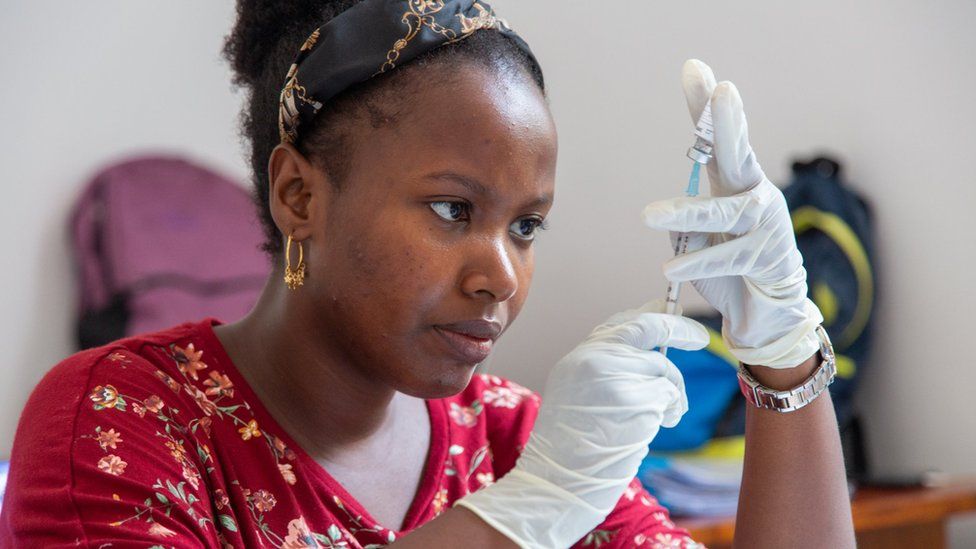
Woman preparing malaria vaccine

Ghana is the first country to approve a new malaria vaccine that has been described as a “world-changer” by the scientists who developed it.

The vaccine – called R21 – appears to be hugely effective, in stark contrast to previous ventures in the same field.

Ghana’s drug regulators have assessed the final trial data on the vaccine’s safety and effectiveness, which is not yet public, and have decided to use it.

The World Health Organization is also considering approving the vaccine.

Malaria kills about 620,000 people each year, most of them young children.

It has been a massive, century-long, scientific undertaking to develop a vaccine that protects the body from the malaria parasite.

Trial data from preliminary studies in Burkina Faso showed the R21 vaccine was up to 80% effective when given as three initial doses, and a booster a year later.

But widespread use of the vaccine hinges on the results of a larger trial involving nearly 5,000 children.

These had been expected to take place at the end of last year, but have still not been formally published. However, they have been shared with some government bodies in Africa, and scientists.

I have not seen the final data, but have been told it shows a similar picture to the earlier studies.

Ghana’s Food and Drugs Authority, which has seen the data, has approved the vaccine’s use in children aged between five months to three years old.

Other African countries are also studying the data, as is the World Health Organization.

Prof Adrian Hill, director of the Jenner Institute at the University of Oxford, where the vaccine was invented, says African countries are declaring: “we’ll decide”, after being left behind in the rollout of Covid-19 vaccines during the pandemic.

He told me: “We expect R21 to make a major impact on malaria mortality in children in the coming years, and in the longer term [it] will contribute to overall final goal of malaria eradication and elimination.”

The Serum Institute of India is preparing to produce between 100-200 million doses per year, with a vaccine factory being constructed in Accra, Ghana.

Each dose of R21 is expected to cost a couple of dollars.

Adar Poonawalla, CEO of the Serum Institute, said: “Developing a vaccine to greatly impact this huge disease burden has been extraordinarily difficult.”

He added that Ghana, as the first country to approve the vaccine, represents a “significant milestone in our efforts to combat malaria around the world”.

ත්‍රස්ත විරෝධී පනත් කෙටුම්පත ගැන අධිකරණ ඇමතිගේ පැහැදිලි කිරීම

April 18th, 2023

උපුටාගැණීම  මව්බිම

ප්‍රධාන කරුණු දෙකක් පදනම් කර ගනිමින් ත්‍රස්ත විරෝධී පනත් කෙටුම්පත සම්පාදනය කළ බව අධිකරණ, බන්ධනාගාර කටයුතු හා ආණ්ඩුක්‍රම ව්‍යවස්ථා ප්‍රතිසංස්කරණ අමාත්‍ය ආචාර්ය විජයදාස රාජපක්ෂ පවසයි.

විජයදාස රාජපක්ෂ මහතා මේ බව සඳහන් කළේ, අද (අප්‍රේල් 18) පැවැති කැබිනට් තීරණ දැනුම් දීමේ මාධ්‍ය හමුවේදී ය.

රැඳවුම් නියෝග නිකුත් කිරීම සහ පාපොච්චාරණය මත චූදිතයන් වරදකරුවන් බවට පත් කර ගැනීම යන කරුණු දෙක මෙම කෙටුම්පත සම්පාදනය කිරීමේදී සලකා බලා ඇති බව ඔහු කියා සිටියේ ය.

රැඳවුම් නියෝග නිකුත් කිරීමේ බලය තියෙන්නේ ආරක්ෂක ඇමතිට රටේ ආණ්ඩුක්‍රම ව්‍යවස්ථා නීතියට අනුව ආරක්ෂක අමාත්‍යවරයා විය හැක්කේ ජනාධිපතිට විතර යි. එතකොට මේ තනතුරු දෙක ම දේශපාලන තනතුරු ඒ නිසා මෙම දේශපාලනඥයින් නිසා රැඳවුම් නියෝග නිකුත් කිරීම නිසා නීතිය අවභාවිත වෙනවා කියන චෝදනාව බරපතළ චෝදනාවක් විදියට තියෙනවා.

දෙවන කාරණය පාපොච්චාරණයන් මත චූදිතයින් වරදකරුවන් බවට පත් කිරීම. රටේ සාමාන්‍ය නීතිය යටතේ අපි පොලිසියට ගිහිල්ලා කිව්වොත් එහෙම මම අපරාධයක් සිද්ධ කළා කියලා පොලිස් නිලධාරියා එය පොලිසියට වාර්තා කළොත් කට උත්තරයක් විදියට සටහන් කළොත් ඒ වරද කළ බවට අධිකරණය එය පිළිගන්නවා හැබැයි ත්‍රස්තවාදය වැළැක්වීමේ පනත යටතේ පමණ යි.”

මෙම පනත මගින් රඳවා තබා ගැනීමේ නියෝග නිකුත් කිරීමේ බලය ආරක්ෂක අමාත්‍යවරයාගෙන් ඉවත් කර එම බලය නියෝජ්‍ය පොලිස්පතිවරයෙකුට ලබා දෙන බව විජයදාස රජාපක්ෂ මහතා මෙහිදී පැවසීය.

මෙහිදී මාධ්‍යවේදියෙකු මෙම පනත් කෙටුම්පත මගින් මාධ්‍ය මර්දනයක් සිදු වන බවට චෝදනා එල්ල වන බව ත් එය එසේ සිදු වන වාද යන්න පිළිබඳව මාධ්‍යවේදියෙක් මෙහිදී ප්‍රශ්න කර සිටියේ ය.

ඊට පිළිතුරු දෙමින් අමාත්‍යවරයා මෙසේ සඳහන් කළේ ය.

මෙතන අපි මාධ්‍ය සම්බන්ධව සඳහන් කරලා තියෙන්නේ ත්‍රස්තවාදී කටයුත්තක් වෙනුවෙන් මාධ්‍ය පෙනී හිටිනවා නම් ප්‍රචාරයක් දෙනවා නම් ඒක මේ පනතට ඇතුළු වෙනවා. හැබැයි පනතේ ම ව්‍යතිරේඛ අවස්ථා දීලා තියෙනවා. ඇත්තට ම ත්‍රස්තවාදී ක්‍රියාවක් තම යි ත්‍රස්තවාදයට පොළඹවන දෙයක් තම යි මාධ්‍යවේදීන් ප්‍රචාරය කරලා තියෙන්නේ. හැබැයි ඔහු එය ප්‍රචාරණය කරන වෙලාවේ එය ත්‍රස්තවාදී ක්‍රියාවක් බව නොදැන තමයි කරලා තියෙන්නේ. එහෙම අවස්ථාවකවත් මාධ්‍යවේදියෙක් එම පනතට යටත් කරන්න බැහැ .”

Certain political elements behind delaying A/L answer script correction: Minister

April 18th, 2023

Courtesy The Daily Mirror

An intelligence report revealed that certain extremist political groups wanted to promote extremist political ideologies by using the frustration of the youth by delaying the scrutinization of GCE (A/L) answer scripts, Education Minister Susil Premajayantha said.

After signing a Memorandum of Understanding (MoU) between the Vocational Training Authority (VTA) and the Sri Lanka Foreign Bureau of Foreign Employment (SLBFE) at the Bureau office in Battaramulla, he told the media that the intelligence report was released last week and that the report said that extremist political groups are trying to cause inconvenience among the youth who are in the 18, 19 and 20 age group by delaying the scrutinizing answer scripts.

https://youtu.be/A2q0LrdyGdI

The minister said that the teachers’ unions had agreed to the government’s program of scrutinizing answer scripts.

“We need 19,000 teachers to complete the task.” A/L practical tests have already begun, and teachers are already engaged in their duties. The Ministry had taken measures to minimise the delay in scrutinizing the answer scripts to some extent. We hope that the Federation of University Teachers’ Association (FUTA) will engage with the program soon,” he said.

“Political groups and unions must consider this a national constraint without considering their personal benefits. 350,000 students had faced the A/L examination, and 600,000 students were to face the Ordinary Level (O/L) exam. The O/L exam was postponed by the examination department by two weeks to create a gap between the two main examinations,” Minister Premajayantha said.

Therefore, the minister requested that the unions begin the work of scrutinizing answer scripts in the name of their children. (Chaturanga Pradeep Samarawickrama)

Railway Department to be made a corporation: Minister

April 18th, 2023

Courtesy The Daily Mirror

The government has initiated discussions for the conversion of the Department of Railways to a public corporation as part of the process of reforming the state-owned enterprises (SOEs), a minister said today.

A public corporation or a statutory corporation is operated on a commercial basis and governed by a chairman and director board. A department does not possess commercial qualities as such and is directly controlled by the government. Reforming the SOEs has been prescribed by the International Monetary Fund (IMF) to qualify for financial assistance to tide over the current economic crisis.

Transport and Highways Minister Bandula Gunawardane told Daily Mirror that the Department of Railways had been run at an annual loss of Rs.10 billion during the recent past years, and its commercial viability should be improved to make it more passenger friendly.

In 2021, the Department generated revenue of Rs.2.6 billion. However, Rs.2.3 billion had been spent for the payment of overtime work by the employees, and Rs. 2.7 billion for salaries,” the Minister said.

The Minister said he held talks with the rail trade unions representing engine drivers, station masters and guards, and got their positive responses to the proposed restructuring plan.

Sri Lanka has a rail network of around 1,500 kilometers. However, the Minister said some rails were as old as 50 years, and they should be replaced immediately.

We have placed orders for the import of 10,000 rails. The rails of the coastal line have to be replaced every five years. But it has not been done for the last ten or more years. Therefore, trains cannot speed up to Panadura on the southern coastal line. The speed limit has been restricted to 20 kilometres per hour,” he said. (Kelum Bandara

Vietnam to boost traditional friendship and multifaceted collaboration with Sri Lanka

April 18th, 2023

Courtesy Adaderana

President of Vietnam Vo Van Thuong has affirmed that his country always attaches importance to developing its traditional friendship and multifaceted collaboration with Sri Lanka.

This was mentioned when the new Ambassador of Sri Lanka to Vietnam, Sajeewa Umanga Mendis presented their credentials to President Thuong on Tuesday (April 18).

The Sri Lankan envoy appreciated Vietnam’s socio-economic development achievements and showed his hope that the two sides will maintain cooperation and experience sharing, and boost people-to-people exchanges.

President Thuong emphasized the importance of promoting high-level contacts and people-to-people diplomacy to intensify friendship and mutual understanding; and stepping up the implementation of existing cooperation mechanisms.

The two sides agreed to promote bilateral cooperation in trade and investment, and share experience in poverty reduction, human development, education, health and culture.

Meanwhile, Ambassadors of the United Arab Emirates (UAE) and Chile also presented their credentials to the Vietnamese president alongside their Sri Lankan counterpart.

Welcoming UAE Ambassador Bader Almatrooshi, President Thuong has extended his best wishes to the diplomat during the holy month of Ramadan – the month of fasting for Muslims. He expressed his hope that the diplomat will act as a bridge boosting the two countries’ relations.

Ambassador Almatrooshi suggested the two countries promote cooperation in socio-culture and education.

The UAE is currently Vietnam’s leading trade partner in the Middle East, with annual two-way trade of USD 8 billion, he said, adding that his country wants to expand collaboration with Vietnam in various fields, as the potential remains huge.

He proposed both sides step up high-level contacts to tighten political ties, especially on the occasion of the 30th anniversary of diplomatic relations.

President Thuong stressed the need for appropriate measures to soon bring two-way trade to USD 10 billion, adding he hopes the UAE will promote investment in Vietnam, particularly in education, culture and tourism.

Receiving Chilean Ambassador Sergio Narea Guzman, the leader expressed his delight at the development of Vietnam-Chile relations through the regular exchange of delegations and people-to-people diplomacy.

The two sides also need to promote existing cooperation mechanisms, support each other at multilateral forums, and share views and visions on international and regional issues.

With a two-way trade of more than USD 2 billion, there remains ample room for bilateral cooperation, noted Thuong.

The Chilean ambassador expressed his hope that the two nations will expand collaboration in all fields, especially politics, economics and people-to-people exchanges.


-with inputs from Vietnam Plus

X-Press Pearl’s insurer bribed local official to disrupt litigation processes?

April 18th, 2023

Courtesy Adaderana

Justice Minister Wijeyadasa Rajapakshe says he has been tipped off on several occasions about a local official being bribed by the insurer of the tanker MV X-Press Pearl, which was gutted in a fire that erupted off the western coast of Sri Lanka two years ago.

The lawmaker made this staggering revelation while addressing a media briefing in Colombo today (April 18).

According to him, speculations are rife that a local official has received a bribe of USD 250 million from the vessel’s insurers to disrupt the litigation and compensation processes.

The justice minister said he has given directives to the Inspector-General of Police and the DIG in charge of the Criminal Investigation Department (CID) to initiate an investigation to uncover the truth.

Sri Lanka witnessed what is considered as one of the worst marine environmental disasters after the Singapore-flagged container ship vessel, only three months after being commissioned, caught fire some 16 kilometers off Colombo in on May 20, 2021 while transporting 1,500 containers including 25 tonnes of nitric acid.

The fire that continued for nearly two weeks resulted in a massive spillage of damaged containers, microplastics, plastic pellets, chemicals and other harmful substances into the sea.

Following the disaster, the Marine Environment Protection Authority (MEPA) appointed a committee of experts comprising professors and other relevant top public officials to assess the damage.

The MEPA says it has provided all necessary documents to the Attorney General’s Department to prosecute the ship owner or the operator or the ship’s agents in Sri Lanka under the Criminal Law, in terms of Section 26 of the Prevention of Maritime Corruption Act.

As the approval of the Cabinet of Ministers is given to continue the litigation process in Singapore, the Attorney General’s Department recently mentioned that it is proceeding with the legal matter accordingly.

However, the committee of expert lawyers appointed to look into the matter has suggested that the prosecution be done in Sri Lanka to recover the estimated USD 6.2 billion in damages.

The decision to continue the legal proceedings in Singapore attracted criticism as it was deemed a very costly move.

According to experts, only 32 days are left to file a lawsuit on the matter.

ත්‍රස්ත විරෝධී පනත සකස් කර ඇත්තේ ජනතාවාදී අයුරින් – විජේදාස රාජපක්ෂ (වීඩියෝ)

April 18th, 2023

උපුටා ගැන්ම  හිරු පුවත්

ත්‍රස්ත විරෝධී පනත සකස් කර ඇත්තේ ජනතාවාදී අයුරින් බව අධිකරණ අමාත්‍ය විජේදාස රාජපක්ෂ පවසනවා.

ප්‍රවෘත්ති දෙපාර්තමේන්තුවේ අද (18) පැවති කැබිනට් තීරණ දැනුම්දීමේ මාධ්‍ය හමුවට එක්වෙමින් අමාත්‍යවරයා මේ බව කියා සිටියා.

“ත්‍රස්ත විරෝධී පනතින් ජනතාවට හානියක් නැහැ – එක්ස්ප්‍රස්පර්ල් වන්දිය යට ගහන තැන

Government restricts holding events, meetings at Galle Face Green

April 18th, 2023

Courtesy Hiru News

The Cabinet of Ministers has decided to permit only religious events at the Galle Face Green from 20th April 2023.

According to a document from the Department of Government Information, permission will not be granted for musical shows, political meetings, or mass gatherings to be held at the Galle Face Green in the future.

The government document further noted that apart from religious events, the Galle Face Green will only be opened for the public to freely spend their leisure time.

The Sri Lanka Ports Authority has spent Rs. 220 million to develop the Galle Face Green as a CSR project. A sum of Rs. 6.6 Million has been spent on renovating the damages that had been caused during the “Aragalaya” people’s movement at the Galle Face Green, it noted.

The government document points out that due to difficulties in maintaining the Galle Face Green due to public gatherings, it has been decided to prohibit mass public events at the location.

ජාත්‍යන්තර මූල්‍ය අරමුදල සහ සැඟවුණු ආර්ථික යුද්ධය

April 17th, 2023

ධරිණී රාජසිංහම් සේනානායක

නැගී එමින් පවතින සහ වියැකි යමින් පවතින සුපිරි බල කඳවුරු අතර සැඟවුණු ආර්ථික යුද්ධය උත්සන්න වෙමින් ආසියානු 21 වැනි සිය වස ” තුළටද ව්‍යාප්ත වෙමින් පවතී. එක්සත් ජනපදයේ නාවික හමුදාව විසින් කරාට්-මා-රෙක්ස් (CARAT/ MAREX) නාවික යුද අභ්‍යාස මෑතකදී ශ්‍රි ලංකාවට අයත් සමුද්‍ර කලාපය තුළ පැවැත්වීම මගින් මෙන්ම ඒ අතර ශ්‍රී ලංකාවේ ජාත්‍යන්තර මූල්‍ය අරමුදල විසින් මෙහෙය වන ණය ප්‍රතිව්‍යුහගතකරණය ප්‍රමාද වීම පිළිබඳව එක්සත් ජනපද සහ චීන නිලධාරින් අතර සිදුවන රාජ්‍ය තාන්ත්‍රික අදහස් හුවමාරු කරගැනීම් ” මගින් ද මෙය තවදුරටත් පැහැදිලි වේ. එක් ප්‍රකාශකයෙකු පැවසූ පරිදි ශ්‍රි ලංකාව පෙබරවාරි 4 වැනි දින තමන්ට අහිමි ස්වාධීනත්වය, ප්‍රජාතන්ත්‍රවාදය සහ ආර්ථික ස්වෛරීත්වය ” සැමරීමට සුදානම් වන්නේ මේ සිදුවීම් අතරය.

මා-රෙක්ස් හෙවත් සාගරයේ අධිපති (MA-REX-King of the Ocean?) නම් යුද අභ්‍යාස පැවැත්වීමට පෙර පොසයිඩන් (Poseidon- P-2) නිරීක්ෂක සහ ප්‍රහාරක ගුවන්යානාව සමග පැමිණි එක්සත් ජනපද 7 වන නාවික බලකායේ නැංගුරම් ලෑමද, නාවික හමුදා ජෑස් වාදක කණ්ඩායම විසින් the natives of Paradise Lost” (අහිමි පාරාදීසයේ උරුමකරුවන්) ගායනයද ඉන්දීය විදේශ ඇමැති ආචාර්ය ජායිෂන්කර් ලෝකයේ ඉතාම කාර්ය බහුල බලශක්ති, වෙළඳ, සහ මුහුදු යට සන්නිවේදන කේබල් පද්ධති මාර්ගයන්ගේ සන්ධිස්ථානයක පිහිටා ඇති මෙම දිවයිනට පැමිණීම ද සිදු විය. යහපත් අසල්වැසියෙකු වන සහ කලාපීය බලවතෙකු වන ඉන්දියාව පසුගිය වසරේ අප්‍රේල් මාසයේදී ශ්‍රී ලංකාව සිය ප්‍රථම ස්වෛරී ණය පැහැර හැරීමෙන් පසු ඩොලර් බිලියන 4 කට ඇප ලබා දී තිබුණි.

උපාය මාර්ගික වැදගත්කමක් සහිත මෙම දිවයින පශ්චාත් කොවිඩ්-19 යථාර්ථය තුළ තවදුරටත් එම රටවල අවශ්‍යතාවන් සඳහා සේවය නොකරන්නා වූ අන්තර් ජාතික සංවර්ධන සහ මූල්‍ය රටාව විසින් නිර්මාණය කරන ලද යුරෝ බැඳුම්කර ණය උගුලට ගොදුරු වූ ගෝලීය දකුණේ සෙසු රටවල් 54 සඳහා පර්යේෂණාත්මක නිදර්ශකයක් ලෙස සැළකිය හැකිය.

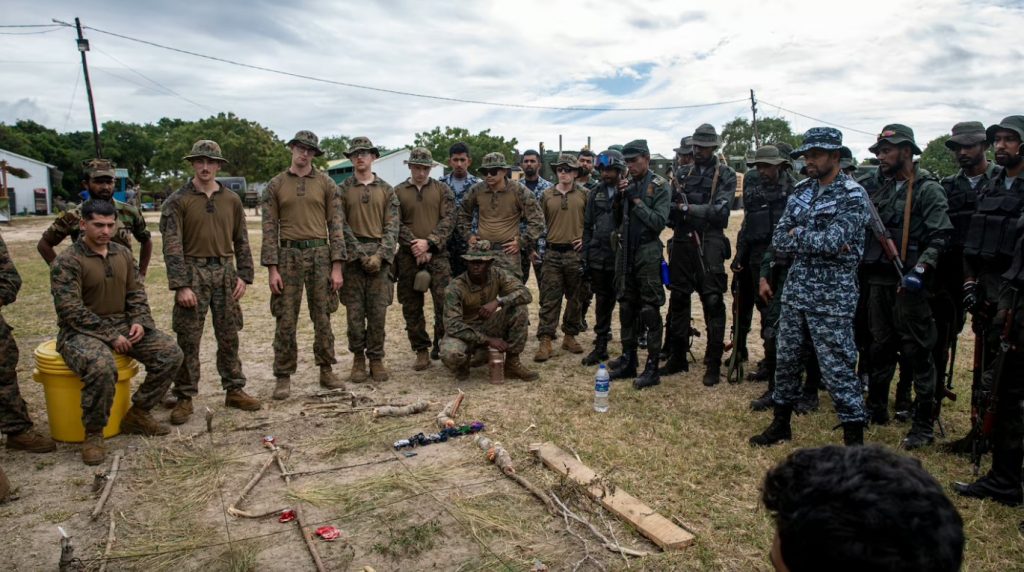
කලාපීය ආරක්ෂාව, ආරක්ෂක සහයෝගිතාව, ප්‍රායෝගික මානුෂික සහාය සහ ආපදා සහන කටයුතු ප්‍රවර්ධනය කිරීමේ අරමුණින්” එක්සත් ජනපදය සහ ශ්‍රි ලංකාව අතර පැවැත්වෙන කරෙට්-මරෙක්ස් නාවික පුහුණු ස්විපාර්ශ්වික අභ්‍යාස මාලාව යටතේ එක්සත් ජනපද නාවික හමුදාවේ 13 වැනි කොම්බැට් ලොජිස්ටික් බැටෑලියනය, 13 වැනි නාවික ගවේෂණ ඒකකය සහ ශ්‍රී ලංකා නාවික හමුදාව මානුෂික ආධාර සහ ආපදා සහන මෙහෙයුම් අභ්‍යාසයක නිරත වෙමින් මෙහෙයුම් මාර්ග අධ්‍යයනයක නිරත වන අයුරු (2023 ජනවාරි 23 වැනි මුල්ලිකුලම්-photo by Sgt. Brendan Custer)

ජාත්‍යන්තර මූල්‍ය අරමුදලේ වර්තමාන ණය ප්‍රතිව්‍යුහගතකරණයේ අවසාන ඉලක්කය ලෙස පෙනී යන්නේ තමන්ට ගෙවාගත නොහැකි තරම් නින්දිත ණය උගුලකට සිර වී බංකොලොත් බව ප්‍රකාශ කිරීමට සිදු වූ රටකට තමන් එම ණය උගුලේ සිර කරන ලද පුද්ගලික මූල්‍ය වෙළෙඳපොළ තුලින්ම ණය ලබාගැනීමට ඉතාමත් අතාර්කික ලෙස සිදු වී තිබීමය. මෙම ණය බැඳුම්කර අලෙවිකරුවන් ණය දෙනු ලබන්නේ මිනීමරු පොලී අනුපාතිකයකටය. එහෙයින් වඩ වඩාත් පැහැදිලි වෙමින් පවතින්නේ වොෂින්ටන් නිවුන් සහෝදරයන් වන ලෝක බැංකුව සහ ජාත්‍යන්තර මුදලේ සහ යටත්විජිතවාදි පැරිස් කණ්ඩායමේ(Club de Paris) ‘ඇප ගණුදෙනු ” වලින් මිදී යුරෝ බැඳුම්කර ණය ලබාදෙන්නන්ගේ ග්‍රහණයෙන් ගැලවීම සඳහා ශ්‍රි ලංකාව කටයුතු කළ යුතුව ඇති බවයි. ජාත්‍යන්තර මූල්‍ය අරමුදල සමග පැවැත්වෙන සාකච්ඡාවන්ගේ අවසන් ප්‍රතිඵලය කුමක් වුව ද සිවිල් සමාජ කණ්ඩායම් වල සංවාදයට ලක්වෙමින් පවතින්නේ ජාත්‍යන්තර පුද්ගලික මූල්‍ය ජාවාරකම්කාර සමාගම් වෙතින් දූෂිත දේශපාලකයන් සහ ඔවුන් විසින් පත් කරන ලද මහබැංකු නිලධාරින් විසින් රාජ්‍ය ණය ලබාගැනීම තහනම් කිරීම සඳහා ව්‍යවස්ථා සංශෝධනයක් ගෙන ඒමට ඇති ඉඩ ප්‍රස්ථාවන් මොනවාදැයි යන්නය. මක් නිසාද යත් මේ ණය බර අවසානයේදී පැටවෙන්නේ දුප්පත් පුරවැසියන් මත හෙයිනි.

මේ අතර මෙයට සමාන්තරව ලංකාවේ වර්තමාන ආර්ථික අර්බුදයට බලපාන ලද සැබෑ හේතුන් වසං කරමින් ඒ පිළිබඳව ව්‍යාකූලතාවයක් නිර්මාණය කිරීමට ද සාවද්‍ය හේතූන් ඉදිරිපත් කිරීමට ද ජාත්‍යන්තර මූල්‍ය අරමුදලේ විශේෂඥයන් උත්සාහ දරමින් සිටිති. ව්‍යුහාත්මක සීරුමාරු කිරීම්, ප්‍රතිසංස්කරණ, වෙළඳාම ලිබරල්කරණය, මහජන දේපල පුද්ගලිකකරණය ආදිය සිදු කළ යුතු යැයි දිගින් දිගටම අවධාරණය කරමින් සිටින්නේ මොවුන්ය. පසුගිය අප්‍රේලයේදී ශ්‍රී ලංකාවේ පැන නැගුනු ස්වෛරී ණය අර්බුදයට හේතුව ලෙස ඔවුන් විසින් දක්වන්නේ ඔවුන්ගේ ඊර්ෂ්‍යාවට සහ වෛරයට දිගින් දිගටම ලක් වී ඇති රාජ්‍ය සුබසාධන පිළිවෙත් සහ ආණ්ඩුවල සහනාධාර සංස්කෘතිය ” බවයි.

සංවර්ධනය වෙමින් පවත්නා රටවල ඊර්ෂ්‍යාව: ලංකාවේ සුබ සාධන රාජ්‍යය

ආචාර්ය අමර්ත්යා සෙන්

ලංකාව 1960 සහ 70 දශකයන් තුළ තෙවන ලෝකයේ රටවල සංවර්ධනය පිළිබඳ ආදර්ශමත් නිදසුනක් ලෙස ලෙස නොබෙල් සම්මානලාභි ප්‍රකට ආර්ථික විද්‍යඥයෙකු වන ආචාර්ය අමර්ත්යා සෙන් නිතර පෙන්වා දී තිබේ. ලංකාවේ දළ ජාතික නිෂ්පාදන සහ ආර්ථික වර්ධනය පහළ මට්ටමක පැවතියද එහි මානව සහ සමාජ සංවර්ධන දර්ශකයන් දියුණු කාර්මික රටවල මට්ටමට සමාන වන අතර ඒ හේතුවෙන් ශ්‍රී ලංකාව (ඉන්දියාවේ කේරලය මෙන්ම) ලෝක සංවර්ධනය තුළ විශේෂිත උදාහරණයක්” බවට ඔහු විසින් පෙන්වා දී තිබේ. ශ්‍රී ලංකාව තුළ විශිෂ්ට සෞඛ්‍ය පහසුකම්, උසස් සාක්ෂරතා මට්ටමක් පවතින අතර නිදහස ලැබීමෙන් පසු ගත වූ කාලය තුළ ස්ත්‍රීන්ට සහ පුරුෂයන්ට ලැබෙන අධ්‍යාපන අවස්ථාවන් බොහෝ දුරට සමාන මට්ටමක් කරා ළඟා වී තිබේ. සිංගප්පූරුව විසින් ශ්‍රි ලංකාවේ මට්ටමට ලඟා විය යුතු යැයි එවකට සිංගප්පූරු අගමැති ලී ක්වාන් යූ වරෙක ප්‍රකාශ කරන ලද්දේ එනිසාය.

සටහන
කෙසේ වුව ද ශ්‍රි ලංකාවේ ඉහත සෞඛ්‍ය පහසුකම්, සාක්ෂරතාව, අධ්‍යාපන පහසුකම් ආදිය පිළිබඳව සාමාන්‍ය දර්ශක සහ ලංකාවේ ඉන්දීය සම්භවයක් සහිත වතු කම්කරු ජනතාවගේ ජීවන තත්ත්වය අතර විශාල වෙනසක් පවතී. ශ්‍රි ලංකාවේ සුබසාධනවාදි රාජ්‍ය යේ පිරිවැය දරනු ලැබුවේ තේ රබර් වැනි අපනයන වගාවන්හි නිරත කම්කරු ජනතාවන්ගේ අතිරික්ත ශ්‍රමය මත නමුත් සමාජ සුබසාධන කටයුතුවලදී සිංහල ආණ්ඩු විසින් මෙම ජනතාව සහමුලින්ම නොසළකා හරිනු ලැබිණි.
පරිවර්තක

ආචාර්ය සෙන් සිය දීර්ඝ සහ විශිෂ්ට ශාස්ත්‍රීය දායකත්වය තුළ නව ලිබරල් සංවර්ධන අර්චනකාමය වෙත දිගටම අභියෝග කළ අතර සංවර්ධනයේදී ශක්‍යතාවන් පිළිබඳ සියුම් වෙනස්කම් සැලකිල්ලට ගත් ප්‍රවේශයක් ” අනුගමනය කළ යුතු යැයි උපදෙස් දුන්නේය.මිශ්‍ර ආර්ථිකයක් සහිත ශ්‍රී ලංකාවේ සංවර්ධනීය සුභසාධක රාජ්‍යය, සීතල යුද්ධය හා බැඳුණා වූ අභ්‍යන්තර සන්නද්ධ ගැටුම් පැවති දිගු වසර 30ක කාලය තුළ රටේ ආර්ථිකය සාපේක්ෂ වශයෙන් යහපත් ස්ථානයක තබා ගත්තේය. 2009 දී අවසන් වූ විමුක්ති කොටි සමග යුද්ධයෙන් පසු ඉක්මනින් ආපසු පැමිණීමට මෙමගින් හැකි විය.

මේ අනුව 2019 දී ලෝක බැංකුව විසින් කලාපයේ හොඳම මානව සහ සමාජ දර්ශක සහිත දකුණු ආසියාවේ එකම ඉහළ මධ්‍යම ආදායම් රට (Middle Income Country-MIC) ලෙස උපායමාර්ගික වැදගත් කමකින් යුතු මේ දිවයින ලැයිස්තුගත කරන ලදි. කෙසේ වෙතත්, වොෂින්ටන් නිවුන්නු(ලෝක බැංකුව සහ ජාත්‍යන්තර මූල්‍ය අරමුදල) විසින් සිදු කරන ලද එම MIC ලැයිස්තුගත කිරීම විසින් සිදු වූයේ සහනදායි ණයලබාගැනීමට ලංකාවට තිබූ හැකියාව සහ අයිතිය අහිමි කිරීමය. ඒ හේතුවෙන් 2019 දී අභිරහස් ඉස්ලාමීය රාජ්‍යය ”(IS) නම් සංවිධානය විසින් ලංකාවේ සංචාරක කර්මාන්තය මත යැපෙන ආර්ථිකයට පාස්කු ඉරිදා ප්‍රහාරය දියත් කිරීමෙන් පසුව රටට අවශ්‍ය වූ සහනදායී ණය සඳහා රටේ ප්‍රවේශය අක්‍රීය කළේය.
ලෝක බැංකුව විසින් ලංකාව මධ්‍යම අදායම් ලබන රටක් ( MIC) ලෙස ලැයිස්තුගත කර තිබීම නිසා පුද්ගලික වෙලඳපොල බැඳුම්කර වෙළෙන්දන්ගෙන් (ISB) කොල්ලකාරී පොලී අනුපාතවලට ණයට ගැනීමට රටට බල කෙරිණ:මෙහිදී ඇසිය යුතු වැදගත් ම ප්‍රශ්නය මෙයයි. මේ මගින් අධික පොලී සහිත ණය ලංකාව වෙත පොම්ප කරමින් එය එක්සත් ජනපද ඩොලර් ණය උගුලේ සිර කර ගනිමින් ලංකාවේ කටයුතු වලට මැදිහත් වීමට එක්සත් ජනපදයට මාර්ගයක් විවර කර ඇත්ද? එසේ නම් එය මේ මොහොත තුළ සිදුවන්නේ ඇයි?

යම් රටක් සතුව භූ මූලෝපායික සම්පත් පැවතීම ශාපයක් ලෙස ඇතැමුන් විසින් හඳුන්වනු ලබති. ශ්‍රී ලංකාව භූ මූලෝපායික සම්පත්වල ආශිර්වාදයක් සහිත සශ්‍රීක හා සාරවත් රටකි. ලංකාවේ සමෘද්ධිය රඳා පවතින්නේ එය වෙත ස්වභාව ධර්මය විසින් තිළිණ කොට ඇති එහි භූමිය සහ සාගරය කලාපය තුළ පවත්නා විශාල සම්පත් හෝ මානව සහ සමාජ ප්‍රාග්ධනය මතයි. කෙසේ වුව ද මෙම දිවයින දැන් එක්සත් ජනපද ඩොලර් ණය උගුලේ සිර වී දුක් විඳියි.

ඒ අනුව, දිවයිනේ ප්‍රථම ස්වෛරී ණය ගෙවීම පැහැර හැරීම මෑත කාලීන ගෝලීය සහ දේශීය ආර්ථික ඉතිහාසයේ සාධක සහ සිදුවීම් වලට සෘජුවම සම්බන්ධ වූ බව පැහැදිලිය, මූලික වශයෙන්:

1) 2015 සිට අනුප්‍රාප්තික රජයන් විසින් කොල්ලකාරී හෙජ් අරමුදල්වලින් පුද්ගලික වෙළඳපොල ණය ගැනීම් වැඩි කිරීම සහ

2) පසුගිය වසර හතර තුළ ක්‍රියාත්මක වී ඇති බාහිර ආර්ථික කම්පන මාලාව ඊට බලපෑ ප්‍රධාන හේතුන් දෙක ලෙස දැක්විය හැකිය.

මෙම බාහිර ආර්ථික කම්පනයන් මොනවාද
A) 2019 දී සංචාරකයන් මත යැපෙන ආර්ථිකය විනාශ කළ අද්භූත ISIS ත්‍රස්ත ප්‍රහාරය,
B) ඉන්පසුව වසර දෙකක අනවශ්‍ය, ආර්ථික වශයෙන් විනාශකාරී කොවිඩ්-19 ලොක් ඩවුන් හෙවත් රට වසා දමමින් සිදු කළ ඇඳිරි නීති පැනවීම්,
C) ජාතික අයවැයෙන් සියයට 40 ක් කොවිඩ්-19 වසංගතය” සඳහා ‘එන්නත්’ මිලදී ගැනීම, PCR පරීක්ෂණ, සහ අනෙකුත් සෞඛ්‍ය තාක්‍ෂණය ආදිය සඳහා සඳහා වියදම් කිරීම.
D) ලෝක බැංකුව සහ ජාත්‍යන්තර මූල්‍ය අරමුදලෙන් වසංගත ප්‍රතිචාර සඳහා ඩොලර් බිලියන ගණන් ණය ලබා ගැනීම
F) ලෝක බැංකුව සහ ජාත්‍යන්තර මූල්‍ය අරමුදල ඇතුළු බාහිර බලවේගයන්ගේ බලපෑම මත 2022 අප්‍රේල් මාසයේදී රටට තව දුරටත් ණය සහ වාරික ගෙවිය නොහැකි බවට ප්‍රකාශයක් නිකුත් කිරීම,
G) 2022 ජූනි-ජූලි මාසවලදී එක්සත් ජනපද නාවික හමුදාව විසින් දිවයින තුළ හා ඊට නුදුරු මුහුදේ දියත් කරන ලද ‘සී විෂන්’නාවික මෙහෙයුම් මගින් ලංකාව වෙත තෙල් හා ගෑස් සැපයීම අවහිර කිරීම මගින් ආර්ථිකය අඩාල කිරීම

මෙම සියලු බාහිර ‘සිදුවීම්’ පසුගිය වසර 4 තුළ ආර්ථිකය විනාශ කළේ රට යුරෝබොන්ඩ් ණය උගුලේ සිර කරමිනි.

කෙසේ වුව ද විවිධ ආර්ථික විශේෂඥයන් සහ ජාත්‍යන්තර මූල්‍ය අරමුදලේ උපදේශකයන් ”විසින් මෙම තත්ත්වය වසං කරමින් වත්මන් ආර්ථික අර්බුදයට හේතු අතීතයට ප්‍රක්ෂේපණය කරමින් ශ්‍රී ලංකාවේ වර්තමාන ණය අර්බුදයේ ප්‍රධාන වරදකරුවා ලෙස සුබසාධන රාජ්‍යය සහ එහි මිශ්‍ර ආර්ථික සංවර්ධන ආකෘතිය වෙත චෝදනා කොට ඇත. ඔවුන් පවසා සිටින්නේ නව ලිබරල්වාදී ‘ආර්ථික ප්‍රතිසංස්කරණ’, වෙළඳ ලිබරල්කරණය සහ ව්‍යුහාත්මක ගැලපීම් ප්‍රමාණවත් පරිදි සිදු නොවීම, ශීඝ්‍රයෙන් වැඩෙමින් පවතින දූෂිත රාජ්‍ය නිලධාරි තන්ත‍්‍රය ආදි හේතුන් ණය ගෙවීමට නොහැකි තත්ත්වය ඇතිවීමට බලපා ඇති බවය.

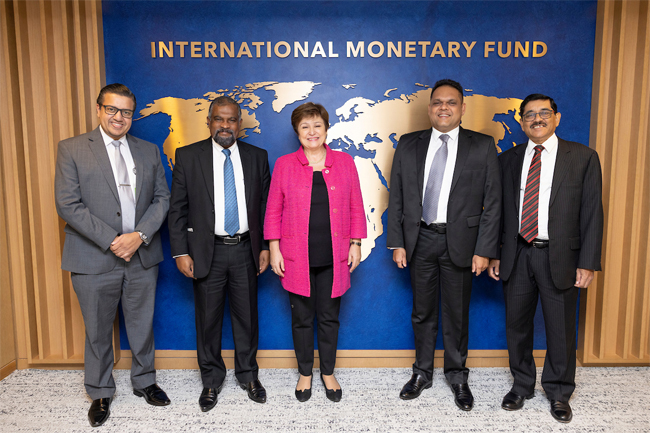
ජාත්‍යන්තර මූල්‍ය අරමුදලේ කළමණාකාර අධ්‍යක්ෂ ක්‍රිස්ටිනා ජෝර්ජීවා ඇමෙරිකාවේ ජාත්‍යන්තර මූල්‍ය අරමුදලේ වොෂින්ටන් මූලස්ථානයේදී ශ්‍රී ලංකා නියෝජිත පිරිස සමග. මුදල් රාජ්‍ය ඇමැති ෂෙහාන් සේමසිංහ, මහබැංකු පාලක ආචාර්ය නන්දලාල් වීරසිංහ, භාණ්ඩාගාර ලේකම් මහින්ද සිරිවර්ධන මෙම සේයාරූපයේ දැක්වේ

නමුත් සමහර රාජ්‍ය අංශවල නිලධාරින්ගේ දූෂණ මර්දනය කිරීමේ විසඳුම ලෙස දශක ගණනාවක් පුරා තුන්වන ලෝකයේ සංවර්ධනය වෙමින් පවතින රටවල ඊර්ෂ්‍යාවට හේතු වූ සුබසාධකවාදි රාජ්‍යයේ යටිතල ව්‍යුහයන් සහ සේවාවන් කඩා බිඳ දැමීමට යෝජනා කිරීම කොරහත් සමග දරුවා විසිකිරීමට සමානය. කෙසේ වුව ද 2015 දී මහ බැංකු බැඳුම්කර වංචාව මගින් වාසි ලැබූ දැනට විපක්ෂයේ සමගි ජනබලවේගයේ (SJB) ආර්ථික සිහින කණ්ඩායම වන ආචාර්ය හර්ෂ ද සිල්වා, කබීර් හෂිම් සහ එරාන් වික්‍රමරත්න ආදින් විසින් ජාත්‍යන්තර මුල්‍ය අරමුදලේ ආචාර්ය ෂාර්මිනි කුරේ සහ ශාන්ත දේවරාජා වැනි අය උපුටා දක්වමින් සිදු කිරීමට යෝජනා කරන්නේ ද මෙයමය.

ආර්ථික ප්‍රතිසංස්කරණ, වෙළඳ ලිබරල්කරණය සහ ව්‍යුහාත්මක ගැලපීම් ” ආදිය ජාත්‍යන්තර මූල්‍ය අරමුදලේ කප්පාදු පියවරයන් සඳහා භාවිතා වන අලංකාර වචන බවට පත්ව ඇති අතර එම කප්පාදු පියවර විසින් ණය උගුල්වල සිරවුණු රටවල ආර්ථිකය කඩා බිඳ දමමින්, සුබසාධන රාජ්‍යය සහ ඒ ආශ්‍රිත සේවාවන් පෞද්ගලීකරණය කිරීමට බල කරනු ලබයි.ජාත්‍යන්තර මූල්‍ය අරමුදල විසින් අතර ජාත්‍යන්තර ස්වෛරී ණය පියවීම සඳහා ප්‍රවාහනය, ටෙලිකොම් යටිතල ව්‍යුහයන් සහ ලංකා විදුලි බල මණ්ඩලය වැනි රාජ්‍ය ආයතන සහ සේවාවන් තුට්ටු දෙකට විකිණීම ද යෝජනා කර ඇත. ඒ අතරම ඔවුන් විසින් පෙර දමන දේශගුණික විපර්යාස විනාශයන් පිළිබඳ ආඛ්‍යානයට අනුව හරිත බලශක්ති භාවිතය” විසින් ජාතික බලශක්ති සුරක්ෂිතතාව මුළුමණින්ම අහොසි කර දමනු ඇත.

මෙම උපදේශකයන් විසින් නිතර ජප කරනු ලබන මන්ත්‍රයක් නම් පුද්ගලික අංශය වනාහි ආර්ථික සංවර්ධනයේ එන්ජිම” සහ කාර්මිකකරණයේ නියමුවා ”යන්නය. කෙසේ නමුත් මෙම පුද්ගලික අංශය ඔවුන් යටතේ පවත්නා ග්‍රැෆයිට්, සර්කොන්, ටයිටේනියම්, තෝරියම් සහ පොස්පේට් වැනි ශ්‍රී ලංකාවේ වටිනා ඛනිජ සම්පත් කර්මාන්ත නවීකරණය සඳහා කිසිවක් කර නැත. විශේෂයෙන් ම දැනට දශක ගණනාවක් තිස්සේ ලංකාවේ ධීවර සම්පත් බහුතරයක් අත්පත් කරගෙන සිටින පුද්ගලික ධීවර සමාගම් තාක්ෂණිකකරණය හෝ වටිනාකම් එක්කිරීම මගින් ධීවර අපනයන සහ වෙළඳපොළ විවිධාංගිකරණය සඳහා කිසිවක් කිරීමට අසමත්ව ඇත. නමුත් අනෙක් අතට පුද්ගලික අංශය සාවද්‍ය සංඛ්‍යා ලේඛන, මිල ගණන් සහ ගිණුම් ඉදිරිපත් කරමින් ප්‍රාග්ධනය විදේශවලට ගලායාමට සැලැස්වීම මගින් වර්තමාන ඩොලර් අර්බුදය උත්සන්න කිරීමට දායක වී තිබේ. ඒ අනුව බලන කල පෙනී යන්නේ පුද්ගලික අංශය විසින් දූෂණය අඩු කරනු ඇතැයි යන්නට කිසිදු සහතිකයක් දිය නොහැකි බවයි.

ඇත්ත වශයෙන්ම, රාජ්‍ය හා පෞද්ගලික අංශයේ මූලිකත්වයෙන් යුත් වර්ධනය පිළිබඳ ද්විකෝටිකය අවසාන විග්‍රහයේ දී සැබෑ ලෙසම අවධානය යොමු විය යුතු කරුණුවලින් අවධානය වෙනතකට යොමු කිරීමකි. මක් නිසාද යත් මේ අංශ දෙකටම කාර්මිකකරණය සිදු කිරීමේ හෝ වැලැක්වීමේ හැකියාවන්ද වටිනා ජීවි සහ අජිවි සම්පත්වලින් ප්‍රයෝජනය ගැනීමේ හැකියාවන් ද පවතින බැවිනි. ලංකවේ ණය අර්බුදයට පුද්ගලික සහ රාජ්‍ය යන අංශ දෙකේම දූෂණ හේතු වී තිබේ. නවීකරණය සහ සංවර්ධන කටයුතු චීනයේදී රාජ්‍යයේ මෙහෙයවීමෙන් සිදුවන අතර බටහිර දී පුද්ගලික අංශයේ මෙහෙයවීමෙන් සිදු වේ.

ජාත්‍යන්තර මූල්‍ය අරමුදල සහ සංවර්ධන ආකෘතින්ගේ භූමිකාව

ජාත්‍යන්තර මූල්‍ය අරමුදලේ (IMF) ණය ප්‍රතිව්‍යුහගත කිරීමේ මෙහෙයුම් සම්බන්ධයෙන් චීන සහ එක්සත් ජනපද නිලධාරීන් අතර මෑතකාලීන මත ගැටුම් විසින් යුරෝබොන්ඩ් ණය දෙන්නන් විසින් අවුලුවන ලද ශ්‍රී ලංකාවේ ප්‍රථම ස්වෛරී ණය පැහැර හැරීම පිටුපස ඇති භූ දේශපාලනික ගැටුම හෙළි කර ඇත.
‘අහිමි වූ නිදහසේ’ 75 වසර සැමරීම සඳහා පෙබරවාරි 4 වැනිදාට යෙදෙන උත්සවයට පෙර ශ්‍රී ලංකාවේ ආර්ථික දුෂ්කරතා සම්බන්ධයෙන් එක්සත් ජනපදයේ ඉහළ පෙළේ නිලධාරීන් චීනයට දෝෂාරෝපණය කළහ.

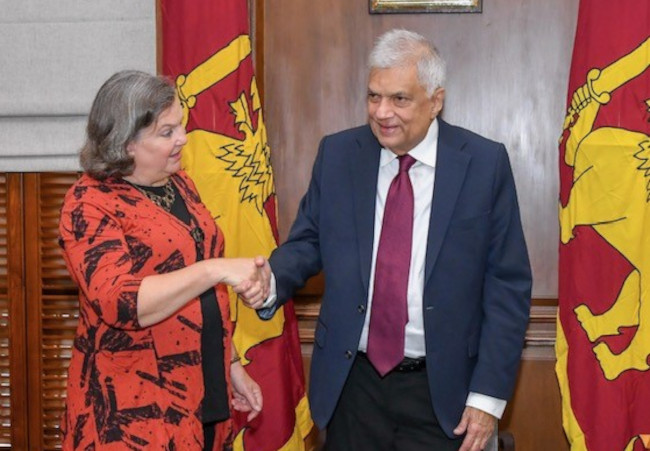
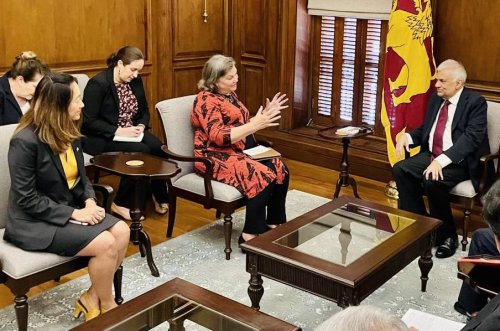
වික්ටෝරියා නූලන්ඩ් සහ රනිල් වික්‍රමසිංහ ජනාධිපති ලේකම් කාර්යාලයේදී

කොළඹට පැමිණ සිටි එක්සත් ජනපද රාජ්‍ය දෙපාර්තුමේන්තුවේ දේශපාලන කටයුතු පිළිබඳ උප ලේකම් වන වික්ටෝරියා නූලන්ඩ් පෙබරවාරි 1 වැනිදා ජාත්‍යන්තර මූල්‍ය අරමුදලේ ණය ප්‍රතිව්‍යුහගතකරණය ප්‍රමාද වීම පිළිබඳ චීනයට දෝෂාරෝපණය කරමින් මෙසේ පැවසුවාය.චීනය විසින් මේ දක්වා ඉදිරිපත් කර ඇති දේ ප්‍රමාණවත් නැත. ණය සහන සැලසීමේදී ජාත්‍යන්තර මූල්‍ය අරමුදලේ ප්‍රමිතීන්ට ගැලපෙන විශ්වාස කළ හැකි සහ විශේෂිත සහතික කිරීමක් දැකීමට අපට අවශ්‍ය වී තිබේ.”
මෙයට ප්‍රතිචාර දක්වමින් චීන විදේශ අමාත්‍යාංශයේ ප්‍රකාශිකා නාඕ නින්ග් විසින් චීනය සහ ශ්‍රි ලංකාව අතර පවතින සමීප සම්බන්ධතාවන් වෙත ඇඟිල්ල දික් කිරීමට වඩා එක්සත් ජනපදය විසින් කළ යුතුව ඇත්තේ ශ්‍රි ලංකාව මුහුණ දී ඇති වර්තමාන දුෂ්කර තත්ත්වයෙන් මිදීමට කිසියම් අවංක සැබෑ උත්සාහයක් දැරීමය.” යනුවෙන් එවැනිම දැඩි ප්‍රකාශයක් නිකුත් කරන ලදි.

ජාත්‍යන්තර මූල්‍ය අරමුදල යනු එක්සත් ජනපදය විසින් චීනයේ ගෝලීය ආර්ථික සම්බන්ධීකරණය සඳහා දියත් කර ඇති සැපයුම් මාර්ග සමාරම්භක ව්‍යාපෘතිය (Belt and Road Initiative- BRI) කඩාකප්පල් කිරීම සඳහා දියත් කර ඇති ආර්ථික යුද්ධයේදී භාවිතා කෙරෙන බළල් අණ්ඩක්ය යන කරුණ නූලන්ඩ්ගේ ප්‍රකාශය විසින් සඟවා නැත. මේ අතර ශීඝ්‍රයෙන් යල් පනිමින් පවතින බ්‍රෙට්න්වුඩ් නිවුන්නුන්ගේ (ජාත්‍යන්තර මූල්‍ය අරමුදල සහ ලෝක බැංකුව) නීති වලට මෙන්ම ඔවුන්ගේ සහ ආසියානු ශත වර්ෂයේ ” ණය ප්‍රතිව්‍යුහගත කිරීමේ ප්‍රමිතීන්වලටද තමන් යටත් වීමට සුදානම් නැති බවට චීනය විසින් සංඥා නිකුත් කර තිබේ. ඒ වෙනුවට චීනය විසින් ණය වාරික සහ පොලී අයකිරීම වසර දෙකකට අත්හිටවීමේ සහනයක් ලංකාවට ලබා දෙමින් ශ්‍රි ලංකාව සමග වෙනම ද්විපාර්ශ්වික එකඟතාවකට පැමිණීමට සුදානම් බව ප්‍රකාශ කර තිබේ. ඒ අතරම චීන බලධාරිහු ජාත්‍යන්තර මූල්‍ය අරමුදල වෙත වෙනම ලිපියක් යවමින් ඒ වෙත සිය සහයෝගය ප්‍රකාශ කර ඇත.

චීන සහ එක්සත් ජනපද ගැටුම විසින් දැන් සංඛ්‍යාමය ක්‍රීඩාවක් බවට පත්ව ඇති ශ්‍රි ලංකාවේ ප්‍රතිව්‍යුහගත කළ යුතු බාහිර හා අභ්‍යන්තර මෙන්ම ඩොලර් සහ ඩොලර් නොවන ණය ප්‍රමාණය පිළිබඳ දත්ත හා සම්බන්ධ දැවැන්ත ගැටලුව වෙතින් අවධානය වෙනතකට යොමු කර තිබේ. ශ්‍රී ලංකාව වැනි කුඩා රටක ණය ප්‍රතිව්‍යුහගත කිරීම තරමක් සෘජු ගණනය කිරීමක් විය යුතු වුවද, එය අනන්ත ප්‍රතිගාමීත්වයේ කළු කුහරයක් සහිත සැබෑ ‘රොකට් විද්‍යාවක්’ බවට පත් කර ඇත.

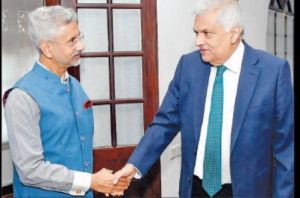
ඉන්දීය විදේශ ඇමැති ජායි ෂංනර් සහ ජනාධිපති රනිල් වික්‍රමසිංහ

ජාත්‍යන්තර මූල්‍ය අරමුදලේ ස්වෛරී ණය ‘ඇප ලබා දීමේ කටයුතු’ අනවශ්‍ය ලෙස සංකීර්ණ, තාක්ෂණික සහ තේරුම්ගැනීමට අපහසු භාෂාවකින් පිරී ඇති අතර එය විසින් හෙළිදරවු කරන දේවල්වලට වඩා බොහෝ දේ සඟවා ඇති බවක් පෙන්නුම් කරයි. ඒ මගින් පුද්ගලික මූල්‍ය වෙළඳපොල සමග සිදුවන ජාත්‍යන්තර බැඳුම්කර ගනුදෙනුවල (ISB) පාරාන්ධ සහ රහසිගත භාවය වසංකර තිබේ. එමෙන්ම එය විසින් යටත්විජිතවාදින්ගේ නිල නොවන සංවිධානයක් වන ආර්ථික සහයෝගිතාව සහ සංවර්ධනය පිළිබඳ සංවිධානයේ (Organization for Economic Co-operation and Development – OECD) පැරිස් කණ්ඩායමේද,වොෂින්ටන් සම්මුතියේද (Washington Consensus)ඔවුන්ගේ නීතිමය සහ ගිණුම්කරණ උපදේශකයන් වන ලසාර්ඩ් ක්ලිෆෝර්ඩ් සහ චාන්ස් සමාගමේ ද වෙනත් විවිධ උපදේශක මණ්ඩලවලද සෑබෑ අවශ්‍යතාවන් ද සඟවා තිබේ.

භූ දේශපාලනික ආතතීන්, ණය දත්ත ක්‍රීඩාව සහ ‘අන්තර් ණය ගැලපුම් ප්‍රතිකාරය’ පිළිබඳ කතා මධ්‍යයේ, බැඳුම්කර හිමියන්ගේ අනන්‍යතාවයන්, ඔවුන් සතුව තිබූ අරමුදල් ප්‍රමාණය, ඒවා වියදම් කළ ආකාරය, මෙන්ම, බාහිර හේතු සහ ශ්‍රී ලංකාවට (සහ ඇත්ත වශයෙන්ම අනෙකුත් ගෝලීය දකුණු රටවල් 54කට බලපාන ණය අර්බුදය) වැදගත් විසඳුම් වැනි ප්‍රධාන තොරතුරු සඟවා තිබේ.දැනට නිකුත් කර ඇති ජාත්‍යන්තර මූල්‍ය අරමුදලේ ණය තිරසාර විශ්ලේෂණයේ (Debt Sustainability Analysis-DSA)කොටස් තුළ පැහැදිලිවම යථාර්ථවාදී නොවන උපකල්පන සහ ප්‍රක්ෂේපණයන් ඉදිරිපත් කර ඇති අතර ඒවා ද විවාදාත්මකය.

ශාස්ත්‍රාලීය වෘත්තිකයන් 182 කගේ ප්‍රකාශනය : අඥානයෙනි, මේ වනාහි භූ දේශපාලනයයි!

උපාය මාර්ගික වැදගත්කමකින් යුතු වූ ඉන්දියන් සාගර දිවයින තුළ පසුගිය වසරේදී මතු වූ ස්වෛරී ණය ගෙවීමේ අර්බුදය පිළිබඳව එක්සත් ජනපදය සහ චීනය අතර සිදුවන ප්‍රචාරක සහ දෝෂාරෝපණය පිළිබඳ ක්‍රීඩාවන් අතර මැද ජාත්‍යන්තර ආර්ථික විද්‍යාඥයන් සහ ශාස්ත්‍රාලීය වෘත්තිකයන් 182ක් විසින් අත්සන් තබන ලද ලියවිල්ලක් මගින් තමන් විසින් වග නොකිව යුතු ණය උගුලකට ගොදුරු වූ රටවල ජනතාවන් සිය සහයෝගය පළ කර තිබේ. භූ දේශපාලනික අවශ්‍යතාවන් මත ක්‍රියාත්මක වීම වෙනුවට ශ්‍රී ලංකාවේ සියලු ණය හිමියන් විසින් මෙම ණය අර්බුදයෙන් ගොඩ යාමට ප්‍රමාණවත්වන මට්ටමට ණය අවලංගු කරන බවට සහතික විය යුතුය.” යනුවෙන් එම ප්‍රකාශනයේ සඳහන් විය.

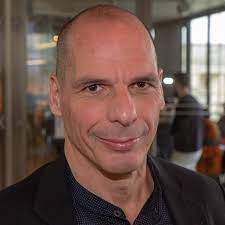
යානිස් වරූෆාකිස්

ජවහලාල් නේරු විශ්ව විද්‍යාලයේ ජයති ගෝෂ්, හාවඩ්හි ඩැනි රොඩික්, හිටපු ග්‍රීක මුදල් අමාත්‍ය යානිස් වරූෆාකිස්, 21 වන සියවසේ ප්‍රාග්ධනය නම් කෘතියේ කතුවරයා වන තෝමස් පිකෙටි වැනි විවිධ මතවාදී ධාරාවන් තුළ සිටින සම්භාව්‍ය බුද්ධිමතුන් සමූහය විසින් අත්සන් තබන ලද මේ ප්‍රකාශය මගින් පෙන්වා දී ඇත්තේ පුද්ගලික මූල්‍ය වෙළඳපළ හෝ පැරිස් කණ්ඩායමට අයත් යුරෝබොන්ඩ් ණය අලෙවි කරුවන් ශ්‍රි ලංකාවේ සමස්ත ඩොලර් ණයවලින් 40%කට අධික ප්‍රමාණයකට හිමිකම් කියන බවය. ගෝලීය දකුණේ රටවලට මෙම ණය අලෙවිකරුවන් විසින් ණය ලබාදෙන්නේ 50%කට වැඩි ලේ පිපාසිත පොලී අනුපාතයකටය. එයට හේතුව ලෙස ඔවුන් දක්වා ඇත්තේ ණය ආපසු අයකරගැනීමේ විශාල අවදානමක් මෙම රටවලට ණය දීමේදී මතුවන බවයි.මෙම ණය ලබා දෙන හෙජ් අරමුදල් විශාල ලාභයක් උපයන බැවින් ඊනියා මායිම් වෙළඳපළවල් ”තුළ අවදානමක් මතු වූ විට ණය දෙන්නා ඔවුන්ට ඇප දෙනු ඇතැයි අපේක්ෂා කරනවාට වඩා ඒ්වා ඔවුන් විසින්ම දරාගත යුතු නොවේද?

චීනය ශ්‍රී ලංකාවේ විශාලතම ද්විපාර්ශ්වික ණය හිමිකරුවා වන අතර එය සතු ණය ප්‍රමාණය ශ්‍රි ලංකාවේ සමස්ත ණය ප්‍රමාණයෙන් 15%ක් පමණ වේ. නමුත් ශ්‍රි ලංකාවේ ඉතිහාසයේ පළමු වරට ණය ගෙවාගත නොහැකිව බංකොළොත් තත්ත්වයක් පසුගිය වසරේ අප්‍රේලයේදී ප්‍රකාශයට පත් කිරීමට සිදු වූයේ චීන ණය සම්බන්ධයෙන් නොව යුරෝබොන්ඩ් ණය සම්බන්ධවය. බංකොළොත් බව ප්‍රකාශ කිරීම සිදු වූයේ බාහිර බලපෑම් මත කෘත්‍රිම සහ අතාත්ත්වික තත්ත්වයන් යටතේය. මධ්‍යම ඇමෙරිකානු කුඩා දූපතක සෙන්ට් කිට්ස් ඇන්ඩ් නෙවිස් නම් ප්‍රදේශයේ ලියාපදිංචි කර ඇති ගුප්ත මූල්‍ය ආයතනයක් වන හැමිල්ටන් රිසව් බැංකුව විසින් ශ්‍රි ලංකාවට එරෙහි නඩුවක් නිව්යෝර්ක් අධිකරණයේ පවරා තිබේ. ලෝක සෞඛ්‍ය සංවිධානය විසින් ඊනියා ප්‍රෝඩාකාරි කොවිඩ්-19 වසංගතය මැඩ පැවැත්වීමට යැයි කියමින් ලෝකය පුරා රටවල ආර්ථික ක්‍රියාකාරිත්වය අඩාල කරමින් ඒවා වසා දමමින් ලොක්ඩවුන් නීති ක්‍රියාත්මක කිරීමට බල කරන ලද කාලයේදී එක්සත් ජනපද රජය විසින් බ්ලැක්රෝක් සමාගමට ඩොලර් බිලියන සියගණනක් වටිනා දැවැන්ත කොවිඩ්-19 ඇප මුදලක් ලබාදුන්නේ ලෝකය පුරා ලොක්ඩවුන් මගින් ආර්ථිකය කඩා වැටෙන රටවල වත්කම් කුණුකොල්ලයට මිලදී ගැනීම සඳහාය. බ්ලැක්රොක් ඉන්දියාවේ අදානි සමාගම් සමූහයේ හවුල්කරුවෙකු වන අතර ශ්‍රි ලංකාවේ ස්වෛරී ණයවලින් (ISB) විශාලතම ප්‍රතිශතයකට හිමිකම් කියන්නේ බ්ලැක්රොක් සමාගමය.

ජාත්‍යන්තර මූල්‍ය අරමුදල සහ එහි කම්පන ප්‍රතිකාරයන්ට එරෙහි විකල්ප

මෙම සන්දර්භය තුළ චීනය සිය ඔට්ටුව රැකගෙන ,කල් මැරීමේ ක්‍රීඩාවක නිරතවන අතරම BRICS රටවල් සමඟ වැඩ කරමින්, ඉතා විෂම,පාරදෘෂ්‍යභාවයක් රහිත සහ අවශ්‍යතාවන් පිළිබඳ ගැටුම් සහිත වර්තමාන ජාත්‍යන්තර මූල්‍ය ව්‍යුහය ප්‍රතිසංස්කරණය කිරීමට උත්සාහ කරන බව පෙනේ.

ඉහළ පොලී අනුපාතයන් පනවමින් එක්සත් ජනපද ඩොලරය ආයුධයක් ලෙස භාවිතා කිරීම උත්සන්න කිරීම, එක්සත් ජනපදය සහ යුරෝපය විසින් රුසියාවට, ඉරානයට සහ වෙනිසියුලාව වැනි රටවලට සම්බාධක පැනවීම වැනි තත්ත්වයන් යටතේ ප්‍රාග්ධන වෙලඳපොලෙන් ණය ගැනීම සඳහා ආපසු යොමු වීම වෙනුවට ඊට විකල්ප ලෙස ජාත්‍යන්තර වෙළඳ ගනුදෙනුවලදී එක්සත් ජනපද ඩොලර් භාවිතය නැවැත්වීම, මුදල් හුවමාරු කිරීම (currency swaps) සහ විවිධ වටිනාකම් සහිත මුදල් වර්ග කීපයක්(basket of currencies) භාවිතා කරමින් වෙළඳාම් කිරීම , නව කලාපීය සංවර්ධන මූල්‍ය ව්‍යුහයට සම්බන්ධ වීම සහ නව සංවර්ධන බැංකුවෙන් (NDB) හෝ ආසියානු යටිතල ආයෝජන බැංකුවෙන් (Asia Infrastructure Investment Bank-AIIB) ණයට ගැනීම ආදි ක්‍රියාමාර්ග වෙත යොමු විය හැකිය.

ශ්‍රී ලංකාවේ ආනයන අපනයනවියදම් පිළිබඳ දත්ත පැහැදිලි වූ පසුව එහි විශාලතම ආනයන වියදම වන තෙල් සහ ගෑස් ආනයනයේදී ඉන්දියාව දැනට සිදු කරමින් සිටින්නාක් මෙන් වට්ටම් සහිත මිලකට රුසියාවෙන් ඒවා මිලදී ගැනීම, ඒ සඳහා රූබල්-රුපියල් හුවමාරුව මගින් ගෙවීම හෝ ශ්‍රී ලංකාවේ හරිත රත්රන් ලෙස සැලකෙන තේ සහ රුසියාවේ කළු රත්රන් ලෙස සැලකෙන තෙල් හුවමාරු ගිවිසුම් ඇතිකරගැනීම නිසැක ලෙසම ශ්‍රී ලංකාවට යුරොබොන්ඩ් සහ ඩොලර් ණය උගුලෙන් ගැලවීමට ආධාර වනු ඇත.

ඊට සමගාමීව, අපනයන නිෂ්පාදන සහ වෙළඳපල විවිධාංගීකරණය කිරීම, තාක්‍ෂණය සංවර්ධනය සහ කාර්මිකකරණය මඟින් ශ්‍රී ලංකාවේ වටිනා දුර්ලභ ඛනිජ සම්පත් (Rare Earth Minerals-REM) සහ විස්තීර්ණ ජීව හා අජීවී සමුද්‍ර සම්පත් ප්‍රයෝජනයට ගැනීම ආදිය මගින් ආර්ථිකය වර්ධනය කිරීමටද එක්සත් ජනපද ණය උගුලෙන් ගැලවීමට ද හැකි වේ. දිවයිනේ පොහොසත් සහ පුළුල් සමුද්‍රීය සුවිශේෂී ආර්ථික කලාපයේ ධීවර කර්මාන්තය ඉතා ප්‍රයෝජනවත් සහ පහසුවෙන් ප්‍රතිඵල ලැබිය හැකි ක්ෂේත්‍රයකි..

අවසාන වශයෙන් ශ්‍රි ලංකාවට අයත් පුළුල් සමුද්‍රීය සුවිශේෂී ආර්ථික කලාපය පත්ලේ එලා ඇති සන්නිවේදන කේබල් සමාගම්වලින් සහ ඔවුන්ගේ විශාල දත්ත ගණුදෙනුකරුවන් වන ගූගල්, ඇපල්, ෆේස්බුක්,ඇමසෝන් සහ මයික්‍රොසොෆ්ට් යන සමාගම්වලින් බදු මුදල් අයකිරීම මගින් ශ්‍රි ලංකාවට යුරෝබොන්ඩ් ණය හිමියන්ගෙන් සහ ඔවුන්ගේ ණය එකතුකරන්නන්ගෙන් ගැලවීමේ පහසු මාර්ගයක් උදාකර දෙනු ඇත.

අවසාන විග්‍රහයේ දී යුරෝබොන්ඩ් ණය උගුලට විසඳුම ප්‍රාථමික සහ සරල එකකි. ඒ සඳහා රොකට් විද්‍යාව හැදෑරිය යුතු නොවේ. නමුත් ඒ සඳහා අපි මනස හිරිවට්ටන සංඛ්‍යාමය ක්‍රීඩාවන්,සහ ජාත්‍යන්තර මූල්‍ය අරමුදලේ දිගු කරන ලද අරමුදල් පහසුකම්”, අන්තර් ණයවර ගිවිසුම් ”, හිඟ මුදල්වලට ණය දීම ” ප්‍රලාපයන්ගෙන් මිදී ඉවතට ගමන් කළ යුතුව තිබේ. මේ සියල්ලටම වඩා අපි සාගතය, කොවිඩ් හෝ දේශගුණික ව්‍යසනයන් පිළිබඳ ආඛ්‍යායනයන් හමුවේ කලබලයට පත් නොවී සන්සුන්ව සිටිය යුතු වෙමු. ඒ සඳහා නයෝමි ක්ලයින්ගේ ආපදා ධනවාදයේ නැගීම ” නම් පොත කියවීම සහායක් වනු ඇත.

ආචාර්ය ධරිණී රාජසිංහම් සේනානායක
සමාජ මානව විද්‍යාඥ

පරිවර්තනය: අජිත් සී හේරත්

දෙමළ චේ ගුවේරා? (Tamil Che Guvera)

April 17th, 2023

C. Wijeyawickrema, LL.B., Ph.D.

දැනට වසර කීපයකට පෙර ගෝඨාභය පාලන කාලයේදී සේපාල් අමරසිංහ විසින් යාපනේ <අරුන් සිද්ධාර්ත් කියන කඳුළු කතාව> නමින් වීඩියෝවක් පලකරණ ලදී.

(60) ” අරූන් සිද්ධාර්ත් කියන කඳුළු කතාව…” – YouTube

අරුන්ට හිස එසවීමට අතදෙන ලෙස දෙමළ බෞද්ධයෙක් යයි කියන උතුරේ ආණ්ඩුකාරයෙක්වූ සුරේෂ් රඝුවාන්ටත්, බෞද්ධ ධර්මය වර්ණනා කරණ හා උතුරේ දෙමළ දුක ගැන කතාකරණ බ්‍රදර් චාල්ස්ටත් 2021 මාර්තු හා මැයි මාසවල මා විසින් ලිපි යවන ලදී.

LankaWeb – බ්‍රදර් චාල්ස් තෝමස්ගේ හා සිංහල බුද්ධාගම  2021/5/24

LankaWeb – Tamil genocide, Geneva fiasco and a Tamil Che Guerra – Part 2  2021/3/2

කටින් බලතල කොළ සිටවන මේ අය වෙනුවට, යාපනේ <පහත් කුලවල> යයි සැළකෙන ජනයා වෙනුවෙන් මැදිහත්වූයේ නාගානන්ද කොඩිතුවක්කු පමණය. දෙමළ නීතීඥයින් විසින් අසරණ දෙමළ ජනයා සූරාකන ආකාරය ඔහු එලිදරව් කලේය. ඇමෙරිකාවේ කැලිෆොර්නියාවේ වාසයකල දොස්තර වෝල්ටර් ජයසිංහගේ අනුග්‍රහයෙන් නොබෝදා කොළඹ පැවත්වූ සංහිඳියා සමුළුවකදී, තමන් අවුරුදු 30 ක් තිස්සේ බලා සිටි අවස්ථාවක් යාපනේ රා මදින්නෙකුගේ මුනුපුරෙක් වුන අරුන්ට ලැබුණේය. එහිදී කාරණා දෙකක් සිදුවිය. එකක් නම් ඔහු මෛත්‍රී ගුණරත්න හා පාකියසෝති සරවනමුත්තු (M&P) යන දෙන්නාට පාඩමක් කියා දීමය. අනික නම්, පසුව දැනගැනීමට ලැබුණු ආරංචිය වන, ඔහු විසින් පාකියසෝතිව  නිර්වස්ත්‍ර කිරීමය.

සෙනාලි වඩුගේ විසින් එම සම්මන්ත්‍රණය පිළිඹඳව ලියූ වාර්තාව හා මුහුණුපොතේ වීඩියෝව පසුගියදා ලංකාවෙබ් වෙබ් අඩවියේ පලවිය. දකුණේ ජනයාගේ, විශේෂයෙන් හාමුදුරුවරුන්ගේ, අවධානය අරුන් වෙත යොමුවෙමින් පවතින අවස්ථාවක ඔහුගේ භූමිකාව සළකා බැලීම වැදගත්ය. උතුරේ හා රටින් පිට දෙමළ බෙදුම්වාදීන්ට ඔහු බලවත් හිසරදයක්වී ඇත.

 LankaWeb – Why does Arun Siddharth stand out from Tamil leaders?

ද්‍රවිඩස්ථාන්-පකිස්ථාන්

1956 දී සිංහල රාජ්‍ය භාෂාව කිරීම දෙමළ බෙදුම්වාදයට හේතුව වූවාය යන M&P දෙන්නාගේ තර්කයට අරුන්ගේ පිලිතුර වූයේ දෙමළ ජාති වාදය ආරම්භවුනේ 1940 ස් ගණන් වල නම් (GG පොන්නම්බලම්ගේ හා චෙල්වනායගම්ගේ (SJVC) දෙමළ කතාකරණ තනිකර දෙමළ පක්ෂ දෙක) දෙමළ බෙදුම් වාදයට හේතුව වූයේ 1956 දී සිංහල රාජ්‍ය භාෂාව කිරීමය කියා කියන්නට පුළුවන්ද යනුය (ඇත්ත වශයෙන්ම දෙමළ රටක් යන කතාව ප්‍රථමයෙන් ගෙනාවේ පොන්නම්බලම් අරුණාචලම් විසින් 1923/24 දීය. එය 1918 වනවිට ආරම්භවූ මැඩ්‍රාස් ප්‍රාන්තයේ වෙනම ද්‍රවිඩස්ථාන් නම් රටක් [අලි ජින්නාගේ පකිස්ථාන් මෙන්] පිහිටුවීමේ ව්‍යාපාරයේම දිගුවකි). 1944 දී GG පොන්නම්බලම් හා SJVC ඕල් සිලෝන් ටැමිල් කොන්ග්‍රස් නම් තනිකර ද්‍රවිඩ පක්ෂයත්, 1949 දී SJVC ඉන් කැඩී ටැමිල් රාජ්‍ය පක්ෂයත් පිහිටුවා ගත්තේය. GGP ට අවශ්‍යවූයේ සමතැන මිස පෙඩරල් නොවේ. SJVC ට ඕනෑවූයේ පෙඩරල් හරහා දෙමළ රටක්ය.

දෙමළ බැරි පාකියසෝති

අරුන් පාකියසෝතිගෙන් අසන්නේ දෙමළ ජනයා සිංහල ඉගෙන ගන්නවාට දෙමළ දේශපාලකයින් විරුද්ධ වන්නේ කුමක් නිසාද යන්නය. චන්ද්‍රිකා මැතිණිය සමඟ කොළඹ බාල් නටනා පාකියසෝතිට දෙමළ බැරි යයි අරුන් සිතයි. සරණාගතයින් හෝ economic refugees වශයෙන් රටින් පැනයන දමිළයින් තමන්ගේ අළුත් රටේ භාෂාව ඉතාමත් කෙටිකාලයකින් ඉගෙන ගන්නවා නම් සිංහල ඉගෙන ගන්නට දශක ගණන් කල් යනවාද යන්න පාකියසෝති ඔහුගෙන් ඇසු ප්‍රශ්ණයට අරුන්  දුන් පිළිතුරය.

යාපනේට ඉන්දියාව

යාපනේට ඉන්දියන් තානාපති කාර්යාලයක් කුමකටදැයි අසණ අරුන්, ඉන්දියානු රජය  යාපනේ හින්දි ඉගැන්වීමට ආධාර මුදල්, කොම්පියුටර් යනාදිය දෙනවා වෙනුවට, සිංහල ඉගැන්වීමට උපකාර නොකරන්නේ මක්නිසාද කියා ප්‍රශ්ණ කරයි. හින්දි රාජ්‍ය භාෂාව වන්නේ ඉන්දියාවේ මිස යාපනේ නොවේ. තමන් දැනටමත් උතුරේ තරුණයින්ට සිංහල පන්ති පවත්වනවායයි අරුන් පාකියසෝතිට දැන්වූයේය.

ඉන්දියාවේ සරණාගත කඳවුරුවල ඉන්නා යාපනේ දෙමළ ජනයාට වැසිකිලි පහසුකම්වත් නැතිව සිටිද්දී යාපනේ ඉන්දියන් තානාපති කාර්යාලය හින්දි ඉගැන්වීම අරුන් අනුමත කරන්නේ නැත. ඉන්දියන් තානාපති කාර්යාලය රෝ ඔත්තු සේවයේ තිප්පලක් බව යාපනේ ජනයා සලකයි.

One toilet for one household

යාපනේ දෙමළ බෙදුම්වාදීන්ගෙන් අරුන් ඉල්ලන්නේ යාපන මහනගර සභා සීමාව තුල ඉන්නා දුගී, කුලහීන යයි සලකන ජනයාගේ ගෙවල් වලට වැසිකිලියක් බැගින් සාදා දෙන ලෙසය. ඔවුන් පොලිස් බලතල, ඉඩම් බලතල ඉල්ලන්නේ නැත.

LankaWeb – Global Tamil Eelam Project: where are the toilets? 2022/12/2

අරුන් සිද්ධාර්ත් හා කොටි ප්‍රභාකරන්

මා සමඟ කැනඩාවේ ඉගෙනගත් කොටි ප්‍රභාකරන්ගේ ඥාතියෙක්වූ තවත් එක් ප්‍රභාකරන් නමැති තරුණයෙක් මට  කී දෙයක් මෙහිදී සිහිපත්වේ. ඔහු කී අන්දමට පෙඩරල් පක්ෂයේ මධ්‍යම කාරක සභාව ප්‍රභාකරන් නම් කොළු ගැටයාට පක්ෂය තුල හිස එසවීමට ඉඩක් නොදුන්නේය. ඔහුගේ සිත වෙල්ලාල පෙඩරල් නායකයින්ට විරුද්ධව ගොඩනැඟුණේ මෙම ඩිස්ක්‍රිමිනේෂන් එක නිසාය. අරුන්ගේ වෙනස ඔහු සතුරාව මරණ පාරක් වෙනුවට සතුරාව මතවාදයෙන් දමණය කරමින් සිටීමය. නොබෝදා කොළඹ පැවති සම්මන්ත්‍රණයකදී අරුන් කල කතාව පාකියසෝති විසින් අසාසිටි ඉරියව්ව හා ඔහු ඇසු ප්‍රශ්ණය දෙස බලනවිට පාකියසෝති අසරණවු අන්දම පසක්වේ.

පසුව අරුන් විසින් එලිකල අන්දමට, අරුන්ට වේදිකාවේ ඉඩක් ලබාදීම පිළිඹඳව NGO මුදලාලි කෙනෙක් වන පාකියසෝති එහි සංවිධායකයාගෙන් ප්‍රශ්ණ කලේ අරුන් ත්‍රස්තවාදියෙක් යයි චෝදනා ඇතිබව පවසමිනි. අරුන්ට අවස්ථාවක් ලබාදිය යුතුම බව සංවිධයාකයාගේ මතය විය. උතුරේ බෙදුම්වාදී දේශපාලකයින්. TNA හා සංවිධාන අරුන්ව කොන් කරන්නේ කලින් පෙඩරල්-TNA කාරයින් ප්‍රභාකරන්ව කොන් කල ආකාරයටමය.

දෙමළ ඔබාමා  වෙනුවට දෙමළ චේ ගුවේරා

තමන්ගේ නිවැරදි මතවාදය නිසා අවුරුදු 30  කට පසු අරුන්ට දකුණේ පිළිගැනීමක් ලැබී තිබේ. මෙයට හොඳම නිදසුණ නම් දෙරන 360 විසින් ඔහුට දෙන ලද වේදිකාවය

(50) Derana 360 | අරූන් සිද්ධාර්ත් | With Arun Siddharth – YouTube

සිවකුමාර් නමැති මිනීමරුවාගේ පිලිරුවට මල්මාලයක් දමා, යාපනේ ගාන්ධි වශයෙන් පෙනී සිට අන්තිමේදී තම සටන දෙවියන්ට භාරදී පරාජිතයෙකු වශයෙන් මියගිය චෙල්වනාගම්ව, ලංකාවේ දෙමළ මෝසස් යයි වර්ණනා කිරීමට බිෂොප් ලක්ෂ්මන් වික්‍රමසිංහට (ජනාධිපති රනිල්ගේ ඥාතියාට) හැකි නම්, උතුරේ නැගී එන තරුණයෙකු වන රා මදින කුලයේ යයි කියන අරුන් සිද්ධාර්ථ් නමැති, (සමහර විට දෙමළ බෞද්ධයෙක් වියහැකි), තරුණයාව,  යාපනේ චේගුවේරා යයි හැඳින්වීමට ඇති හේතු කාරණා එමටය.

ටැමිල් ට්‍රේටර්ස්ලා

සමහරු ඒ කාලයේ ලක්ෂ්මන් කදිරගමාර්ට හා ජෙයරාජ් ප්‍රනාන්දු පුල්ලේට දෙමළ ඔබාමා කෙනෙක් (ලංකාවේ අගමැතී) විය හැකිව තිබුණා යයි ලිව්වේය. මා දන්නා හැටියට ඒ දෙන්නාම 13-A+ පෙඩරල්වාදීන් විය.  විග්නේෂ්වරන්ට අනුව කොටි ප්‍රභාකරන් දෙමළ කැප්පෙට්ටිපොල කෙනෙක්ය! දකුණේ ආණ්ඩු සමඟ සහයෝගයෙන් ක්‍රියා කල හැමකෙනෙක්ම ද්‍රවිඩ බෙදුම්වාදීන් විසින් හංවඩු ගැසුවේ ටැමිල් ට්‍රේටර්ස්ලා කියාය. ඉන්ස්පෙක්ටර් බස්තියන් පිල්ලේ, යාපනේ නගරාධිපති ඇල්ෆ්‍රඩ් දුරෙයියප්පා පමණක් නොව GGP ට පවා මේ ලේබල් එක ගැසුවේය. උතුරට ගොස් ප්‍රභාකරන්ගේ නාන තටාකයේ පීනූ කොළඹ වසන මනෝ ගනේෂන්, කරුණා අම්මාන්ව හැඳින්වුයේද දෙමළ ට්‍රේටර් කෙනෙක් ලෙසය.

දෙමළ බෙදුම්වාදයේ මඟුල හා මළගම

ජනාධිපති රනිල් යටතේ යළිත් වරක් (ඔරුමිත්තනාඩු ජරමරයට පසු) දෙමළ බෙදුම්වාදයට කදිම අවස්ථාවක් උදාවී තිබෙනවා මෙන්ම ඒ සමඟම එම ගමනේ අවසානයත් හොල්මන් කරමින් සිටී. ගෝඨාභය නෙරපූ අරගලය  පිටිපස ඩයස්පොරා කොටි සිටියේය. අරගලය රනිල් ගෙන් කෙළවර විය. එහෙත් උතුරේ ජනයා අතර දෙමළ බෙදුම්වාදී  දේශපාලකයින් බලවත් අර්බුදයකට මුහුණ දී සිටී. ඔවුන්ට දැන් දෙමළ ජනයා රැවටීමට ඉතිරිව ඇත්තේ බුදු පිළිම ආක්‍රමණයක් හා පුරා විද්‍යා කැණීම් හරහා දෙමළ ඉඩම් අල්ලා ගැනීමේ සංග්‍රාමයක් පවතිනවා යන කතා දෙක පමණය. උතුරු මුහුදේ ඉන්දියන් ධීවර ආක්‍රමණය ඉදිරියේ ඔවුන් ගල උඩ ඉන්නා බළලුන් වැනිය.

හිට්ලර් හා විග්නේශ්වරන්/සුමන්තිරන් පුත්තු

දැනට ලබාඇත්තේ දෙමළ බෙදුම්වාදයේ බහින කලාවය. මේ නිසා TNAකාරයින් ඇතුළු පිරිස් අරුන්ට මේ ලේබල් එක ගසන්නට නොහැකි අඩියකට පත්වී සිටී. ඒ වෙනුවට ඔවුන් සදන්නේ ඔහු ත්‍රස්තවාදියෙක් යයි කියමින් ඔහුට යාපනේ දේශපාලන සාකච්චා වලට ඒමට ඉඩ නොදීමය. සුමන්තිරන්ගේ පුතා සිංහල ස්ත්‍රියකටත්, විග්නේෂ්වරන්ගේ පුත්තු දෙන්නාම සිංහල ස්ත්‍රීන් දෙන්නෙකුටත් අහුවුනා නම් (කසාද බැඳගත්තානම්)   උතුරේ ජනයා මේ දෙමළ මාමන්ඩිලා දෙන්නාට දෙමළ ද්‍රෝහීන් යයි නොකියන්නේ සිංහලයා දෙමළාගේ සතුරාය යන මිථ්‍යාව උතුරේ ජනයා තවදුරටත් බදා නොගන්නා නිසාද?  මෙය හිට්ලර්ගේ පුතා යුදෙව් ස්ත්‍රියක් හා විවාහවීමට සමානවන්නේ සිංහලයින් දෙමළ ජන සංහාරයක් කරනවා යන කතාව නිසාය.

අරුන් හා බොදු බල සේනා සංවිධානය

2012 මැයි මාසයේ සිට බොදු බල සේනා සංවිධානයත්, අරුන් ගෙන යන යාපනේ සටනත් කළු සුද්දන්ගේ සිස්ටම් එකට එල්ලකල අභියෝග දෙකකි. දකුණේ සිංහල පක්ෂ දේශපාලක කළුසුද්දන් ඥානසාර හිමියන් නොමරා මරාදැමීමට කල හැකි හැම දෙයක්ම කලේ උන්වහන්සේ ඔවුන්ගේ හොර දේශපාලනය රටට එලිකර දීම නිසාය. අරුන් මුහුණදී සිටින්නේද එවන් ඉරණමකටය.

මෙතෙක් අරුන්ගේ ක්‍රියාකලාපය නිසා දෙමළ බෙදුම්වාදයට පක්ෂ ඉන්දියාව, ඇමෙරිකන් තානාපති ඇතුළු බටහිර රටවල්, එරික් සොල්හයිම්, සුමන්තිරන්, පොන්නම්බලම්, රාසමානික්කම් කොළුවා, විග්නේශ්වරන් මහළු සීයා පමණක් නොව දකුණේ සිංහල කළු සුද්දන්, (ඩිලාන් පෙරේරා, ඩලස් අලහප්පෙරුම වැනි අයද ඇතුළුව) හොර දේශපාලකයින්, රොත්තම අන්දමන්දවී භීතියට පත්වී සිටී. එපමණක් නොව දෙමළ බෞද්ධයෙක් යයි කියාගන්නා සුරේස් රඝුවාන් (කලින් ආණ්ඩුකාර, දැන් රාජ්‍ය අමත්‍ය) මෙන්ම  උතුරේ සංවර්ධනය ගැන දේශනා දෙන බ්‍රදර් චාල්ස් තෝමස්ද උතුරේ උග්‍ර කුලභේදය ගැන නිහඩව සිටින්නේ කුමක් නිසාද?

මැත් ප්‍රොපෙසර් සුන්දරලිංගම් හා රනිල් ජනාධිපති

අම්බෙඩ්කාර් විසින් ඩලිත් ජනයා ලක්ෂ ගණනින් බුද්ධාගමට හරවා ගත්තේ ලංකාවේ හාමුදුරුවරුන් උතුරේ කුල භේදය ගැන නිහඬව සිටියදීය. යුරෝපයට බුද්ධ ධර්මය ගෙනයාම වැනි ක්‍රියාවක් මිස දෙමළ පෙඩරල්කාරයින් හා ගැටීමට හාමුදුරුවරුන්ට ආගම පැතිරවීමේ උණක් නොතිබුණි. එහෙත් සුන්දරලිංගම්, පහත් කුලවල ජනයාගෙන් හින්දු කෝවිල් අපිරිසිදුවීම බේරා ගැනීමට කල සටන පොලිසිය මැදිහත්වීමෙන් අවසාන වූයේ නැත. අන්තිමේදී බණ්ඩාරණායක රජය 1957 දී කුලය අනුව සිදුවන සමාජ අසාධාරණය වැලැක්වීමේ නීතියක් 1957 දී ගෙනාවේය. මෙහිදී අරුන් විසින් රනිල් ජනාධිපතිට කල අභියෝගය නම් 1987 ගෙනා 13-A සංශෝධනය  ක්‍රියාත්මක නොවීම ගැන නාහෙන් අඬන ඔහු, 1957 කුලභේද විරෝධී නීතිය ක්‍රියාත්මක නොකරන්නේ කුමක් නිසාද යනුය.

ලංකාවේ ඩොනමෝර් සමය ගැන (1931-47) ආචාර්ය උපාධියක් කල ජේන් රසල් විසින් කුල භේදය නිසා උතුරේ ජනයාට සිදුවූ හිරිහැර ගැන දීර්ග ලෙස වාර්තාකර ඇත. එසේ තිබියදී සමාජ විද්‍යා උපාධිධාරී ක්‍රිස්තියානි වෙල්ලාල ස්ටැන්ලි තම්බයියා මෙම දෙමළ සමාජ ප්‍රශ්ණය වෙනුවට තායිලන්තයේ ථේරවාද බුද්ධාගම ගැන පර්යේෂණ කරන්නට ශිෂ්‍යත්වයක් ලබාගෙන අන්තිමේදී හාවර්ඩ් යුනිවසිටි එකේ පලපැදියම්වී මිය යන තුරුම දෙමළ බෙදුම් වාදයට කත් ඇද බුඩිසම් බිට්‍රේඩ් (Buddhism Betrayed) යයි පොතක්ද ලියුවේ සිංහල බෞද්ධයා දෙමළාට හිරිහැර කරනවා යන මතයක් උඩය.

ඒ පොතේ පිටකවරය සඳහා මාදුළුවාවේ සෝභිත හිමියන්ගේ යක්ෂාවේශාකාර මුහුණක් සපයා දුන්නේ විශාකා කුමාරි ජයවර්ධනය. පොතට අරමුදල් සපයාදී පෙරවදනක්ද ලිව්වේ ඇගේ සැමියාවූ ලාල් ජයවර්ධනය. මොහු මිලින්ද මොරගොඩගේ මාමාය. චාපා බණ්ඩාරට අනුව රට අරාජික කිරීමේ ලෝක ව්‍යාපාරයේ කෙන්ද්‍රය මිලින්දය. පොත තහනම් කිරීමට විරුද්ධ සටනේ තම්බයියාගේ ගෝලයින් වැනි අය වූයේ ගණනාත් ඔබේසේකර, H.L. සෙනෙවිරත්න, A.J. විල්සන් වැනි ඇමෙරිකන්/කැනඩා ප්‍රොපෙසර්ලාය. මෙම කරුණු විශේෂයෙන් සිංහල බෞද්ධ ජනයාවත් දැනසිටිය යුතු නොවේද?

සිංහල බෞද්ධයා අතරමංකිරීම

2010 දී සරත් ෆොන්සේකා හරහා ගත් උපාය වැරදුනත්, මහින්ද රාජපක්ෂ ආණ්ඩුවේ නොමනා ක්‍රියාකලාපය නිසා සිරිසේන ජනාධිපති කිරීමේ කුමන්ත්‍රණයකට ඉඩ ලැබුණි. 2015 න් පසු ඔරුමිත්තනාඩු ව්‍යාපාරය, 2000 චන්ද්‍රිකාගේ රට කැඩීමේ පැකේජ් ඩීල් එකමය. මෙම ව්‍යසනකාරී ක්‍රියා ඉදිරියේ සිංහල බෞද්ධ ජනයා 2019/2020 දී  ගෝඨාභය කෙරෙහි තැබූ බලාපොරොත්තුව ඛේදජනක ලෙස අවසානවී සිංහල බෞද්ධයා කබලෙන් ගින්දරට වැටුනේය. දැන් බලාගෙන යනවිට සිදුවී ඇත්තේ ගොඨාභයගේ හතුරන් විසින් ඔහුව ඥානක්කා මැණියන් හා සම්බන්ධකර, ඒ මඟින් ජුලි චන්, ඇමෙරිකන් තානාපතිනි සමඟ තිබූ යාඥා සැඟවීමය. මෙවැනි කූට උපාය වලට අසුවූ ලෝක නායකයින් එමටය. ගෝටා රට අල්ලාගෙන ඇති බෝන් අගේන් දැලට අසුවී සිට ඇති ඇතිසේය.

මෙම කුමන්ත්‍රණවල ප්‍රතිපලයක් වශයෙන් ඉන්දියාව සමඟ එකතුව රට කැබලි කිරීමේ තම දිගුකාලීන ප්ලෑනට අවස්ථාවක් රනිල් ජනාධිපතිට උදාවී ඇත. TNA, සුමන්තිරන්, විග්නේශ්වරන්, පොන්නම්බලම්ලා තම දේශපාලන ගේම් එකේ ඉතාමත් දුර්වලව සිටින අවස්ථාවක ඔහු විසින් රට බංකොලොත්වීම දඩමීමා කරගනිමින් කරන්නට යන රට බෙදීමට මඟ පාදාදීම සිදුවිය හැක්කක්ද?

දෙමළ ට්‍රේටර්

අරුන්ට දෙමළ ට්‍රේටර් කෙනෙක් යයි කියන්නට ඔවුන්ට ශක්තියක් නැත. අරුන් නමැති භූමිකාවේ වැදගත්කම මෙම පසුබිම නිසාය. එහෙත් පුදුමයකට මෙන් පොහොට්ටු ජරමරයෙන් කැඩී ආ කිසිම පංචස්කන්ධයක් වත්, සජිත් ප්‍රේමදාස්ගෙන් වෙන්වෙන පාටලි චම්පිකලා වත් අරුන්ගේ අගය වටහාගෙන නැත. මීට හේතුව දෙමළ චන්ද වලට ඇති කෑදරකම මිස  අන් කිසිවක් නොවේ. තවද විමල්, උදය හැරුණ විට ඩලස්, G.L.ලා පෙඩරල් කාරයින්ය.

(60) ” සුමන්තිරන්ලාට මේක හිඟන්නාගේ තුවාලේ වගේ…” – අරූන් සිද්ධාර්ත් – YouTube

2021 මාර්තු මාසයේ ලියූ ලිපියකින් දෙමළ බෙදුම් වාදයට යාපනේ ජනයා තවදුරටත් රැවටීමට නොහැකි උපන්තියකට ශාක්ෂි ඇති බව මා විසින් පෙන්නා දුන්නේය. එම දිග ලිපියෙන් උපුටා ගත් කරුණු මෙසේය.

1.Drastic erosion of Tamil separatist politicians’ voter base (kitchen on fire)

2.Tamil not using their voting right

3. Significant votes for Gota at 2019 election

4. Anti-TNA votes at 2020 parliamentary elections

5. Arun- anathema to Tamil politicians

6. Caste issue becoming a political issue

7. Army and the low caste bonding

 (60) වසර 7ක් කොළඹ හිගන්නෙකුගේ වෙස් ගෙන කොළඹ වනසන්නට සැලසුම් සැදූ පොට්ටුගේ හෙළිදරව්ව | WANESA TV – YouTube

8. Sri Lanka Hindu Society- Bodu Bala Sena / Ven. Ratana joint projects.

===================================

LankaWeb – Tamil genocide, Geneva fiasco and a Tamil Che Guerra – Part 2 (March 2, 2021)

Russia Leaves the Neoliberal West to Join the World Majority

April 17th, 2023

Courtesy The Unz Review

In this episode of their program Geopolitical Economy Hour, economists Radhika Desai and Michael Hudson discuss Russia’s economic transition away from the neoliberal West and integration with what it calls the World Majority” in the Global South.

Transcript

RADHIKA DESAI: Hi everyone, welcome to the seventh Geopolitical Economy Hour, a program about the political and geopolitical economy of the fast-changing world of today. ‘m Radhika Desai.

MICHAEL HUDSON: And I’m Michael Hudson.

Russia Leaves the Neoliberal West to Join the World Majority, by Michael Hudson – The Unz Review

An Open Letter to Minister of Power & Energy Sri Lanka

April 17th, 2023

Sasanka De Silva Pannipitiya

Mr Kanchana Wijesekara.
Ministry of Power and Energy
No:72,
Ananda Coomaraswamy Mawatha,
Colombo 07.
Sri Lanka.

Dear Mr Wijesekara.

The purpose of this mail is not to discuss the tariff hike but to bring to your attention the neglect and unfair treatment we, the solar power generators (home installations), received after the price hike.

Tariffs have gone up exorbitantly, but your buyback rate still remains unchanged.

There was a discussion in parliament to increase it to Rs 37/- per unit from the current rate of Rs 22/-, but we are yet to see any work done on this issue.

We opted for solar installation for a few reasons, and they are:

  • To avoid the hassle of paying one more bill,
  • As an investment,
  • to reduce our carbon footprint.

But surely not to prop up another mismanaged state-owned enterprise.

To prove this fact, we received our buyback money for the amount we generated in October 2022; this was 6 months ago, and it proves how efficient this establishment is.

If the buyback rate can’t be increased immediately, the right formula to charge such households is to charge them based on their individual generation and consumption only.

Based on the final plus or minus factor, charge according to existing rates.

I am awaiting a favourable response.

Thanks.

Sasanka De Silva

Pannipitiya.

සෝබනකාරයා ගැන සංවාදය අප්‍රියෙල් 20 වැනිදා

April 17th, 2023

කල්පනා ඇම්බ්‍රෝස්

ප්‍රභාත් විතානගේ විසින් රචිත ‘සෝබනකාරයා‘ කෙටි නවකතාව ගැන සංවාදයක් මෙමඅප්‍රියෙල්

මස 20 වැනි බ්‍රහස්පතින්දා හවස 4  බොරැල්ල එන්එම්පෙරේරා ශාලාවේ දී පැවැත්වේ.

ප්‍රභාත් විතානගේ ලියූ සෝබනකාරයා නවකතාව පිළිබඳ සාහිත්‍ය සංවාදය

අදහස් දැක්වීම

________

විමල් කැටිපෙආරච්චි 

කල්පනා ඇම්බ්‍රෝස් 

විවිමරී වැන්ඩර්පූටන්

තාරක එරන්ද කල්දේරා

සඳිනි ප්‍රාර්ථනා තෙන්නකෝන්

දිල්ෂානි චතුරිකා දාබරේ

රශ්මික මණ්ඩාවල

සංවාදය මෙහෙයවීම:

අනිල් හේරත්

නිර්මාණාත්මක විනාශය

April 17th, 2023

සසංක ද සිල්වා

නිර්මාණාත්මක විනාශය යනු නව සොයාගැනීම් සහ තාක්ෂණයන් පැරණි, අඩු කාර්යක්ෂම ඒවා විස්ථාපනය කිරීමේ ක්‍රියාවලිය විස්තර කිරීම සඳහා ආර්ථික විද්‍යාඥ ජෝසෆ් ෂුම්පීටර් විසින් නිර්මාණය කරන ලද යෙදුමකි.

වෙනත් වචන වලින් කිවහොත්, එය නව සහ වඩා හොඳ නිෂ්පාදන, සේවා සහ දේවල් කිරීමේ ක්‍රම නිරන්තරයෙන් හඳුන්වා දීමෙන් වැඩිහිටි ඒවා යල් පැනීමට හා අවසානයේ වඳ වී යාමට නොවැළැක්විය හැකි බව අදහස් කරයි.

“නිර්මාණාත්මක විනාශය” යන යෙදුම මෙම ක්‍රියාවලියේ ධනාත්මක පැතිකඩ අවධාරණය කරයි, එය නව ව්‍යාපාර සහ ව්‍යවසායකයින් සඳහා අවස්ථා නිර්මාණය කරන අතරම ආර්ථික වර්ධනයට සහ ප්‍රගතියට ද හේතු වේ.

කෙසේ වෙතත්, එය වේදනාකාරී ක්‍රියාවලියක් ද විය හැකිය, තාක්‍ෂණික වෙනස්වීම් හමුවේ වරක් ප්‍රමුඛ වූ කර්මාන්ත සහ රැකියා අතහැර දැමිය හැකිය.

සමස්තයක් වශයෙන්, නිර්මාණාත්මක විනාශය ආර්ථික සංවර්ධනයේ සහ නවෝත්පාදනයේ ප්‍රධාන ධාවකයක් වන අතර එය ධනේශ්වර පද්ධතියේ අත්‍යවශ්‍ය අංගයක් ලෙස සැලකේ.

AI (කෘතිම බුද්ධිය) නිර්මාණාත්මක විනාශය සඳහා හොඳම උදාහරණයකි.

AI තාක්ෂණයන් සංවර්ධනය කිරීම සහ ක්‍රියාත්මක කිරීම දැනටමත් ප්‍රවාහනය, සෞඛ්‍ය සේවා, මූල්‍ය සහ නිෂ්පාදන වැනි විවිධ කර්මාන්ත කඩාකප්පල් කිරීමට සහ පරිවර්තනය කිරීමට පටන් ගෙන ඇත.

නිදසුනක් වශයෙන්, ස්වයං-රිය පැදවීමේ මෝටර් රථවලට සම්ප්‍රදායික මෝටර් රථ කර්මාන්තය කඩාකප්පල් කිරීමේ හැකියාවක් ඇති අතර, AI බලයෙන් ක්‍රියාත්මක වන වෛද්‍ය රෝග විනිශ්චය මඟින් සෞඛ්‍ය සේවා සැපයීම පරිවර්තනය කළ හැකිය.

AI තාක්‍ෂණය අඛණ්ඩව දියුණුව සහ පරිණත වන බැවින්, එය නවෝත්පාදන සහ වර්ධනය සඳහා නව අවස්ථා නිර්මාණය කරන අතරම පවතින සමහර රැකියා සහ කර්මාන්ත යල්පැනීමට ඉඩ සලසයි.

කෙසේ වෙතත්, ඕනෑම ප්‍රධාන තාක්‍ෂණික පරිවර්තනයක් මෙන්ම, ආමන්ත්‍රණය කළ යුතු අභියෝග සහ අනපේක්ෂිත ප්‍රතිවිපාක ද තිබිය හැකිය.

සමස්තයක් වශයෙන්, AI නිර්මාණාත්මක විනාශය සහ ආර්ථික හා සමාජ වෙනස්කම් ඇති කිරීමට එහි ඇති හැකියාව පිළිබඳ සැලකිය යුතු උදාහරණයක් නියෝජනය කරයි.

නිර්මාණාත්මක විනාශ කිරීමේ ක්රියාවලිය සමඟ සම්බන්ධ විය හැකි අඩුපාඩු කිහිපයක් තිබේ.

වඩාත්ම කැපී පෙනෙන අඩුපාඩුවක් වන්නේ කම්කරුවන් සහ කර්මාන්ත කඩාකප්පල් කිරීම සහ අවතැන් වීමයි.

නව තාක්ෂණයන් සහ නවෝත්පාදනයන් මතුවන විට, ඒවා බොහෝ විට පැරණි, අඩු කාර්යක්ෂම ක්‍රම වෙනුවට රැකියා අහිමිවීම් සහ කර්මාන්ත ප්‍රතිව්‍යුහගත කිරීම්වලට හේතු විය හැක.

නිර්මාණාත්මක විනාශය අවසානයේ දී දිගු කාලීනව ආර්ථික වර්ධනයට සහ රැකියා උත්පාදනයට හේතු විය හැකි අතර, කෙටි කාලීනව, බලපෑමට ලක් වූවන්ට එය දුෂ්කර හා වේදනාකාරී ක්රියාවලියක් විය හැකිය.

තවත් විභව අවාසියක් නම් කුඩා සමාගම් සහ පුද්ගලයන් අතර ධනය හා බලය සංකේන්ද්‍රණය වීමයි.

නව තාක්‍ෂණයන් සහ ව්‍යාපාර ආකෘතීන් මතු වන විට, ඔවුන් බොහෝ විට ජයග්‍රාහකයින්-ගැනීමේ වෙළඳපල නිර්මාණය කරයි, එහිදී ප්‍රමුඛ ක්‍රීඩකයින් කුඩා සංඛ්‍යාවක් වෙළඳපොලේ සහ ලාභයේ අසමානුපාතික කොටසක් අල්ලා ගත හැකිය.

මෙම බලය සංකේන්ද්‍රණය වීම තරඟය, නවෝත්පාදනය සහ සමාජ අසමානතාවය සඳහා ඍණාත්මක ප්‍රතිවිපාක ඇති කළ හැකිය.

AI, ස්වයංක්‍රීයකරණය සහ ජෛව තාක්‍ෂණය වැනි ඇතැම් තාක්‍ෂණ භාවිතය හා සම්බන්ධ විභව සදාචාරාත්මක සහ සමාජීය උත්සුකයන් ද ඇත.

උදාහරණයක් ලෙස, පෞද්ගලිකත්වය, ආරක්ෂාව, පක්ෂග්‍රාහීත්වය සහ මෙම තාක්ෂණයන්හි අනපේක්ෂිත ප්‍රතිවිපාක පිළිබඳ උත්සුකයන් තිබිය හැක.

එහි ප්‍රතිඵලයක් වශයෙන්, නිර්මාණාත්මක විනාශ කිරීමේ ක්‍රියාවලියේ කොටසක් ලෙස මෙම උත්සුකයන් හොඳින් සලකා බලා ඒවාට විසඳුම් සෙවීම වැදගත් වේ.

කෙසේ වෙතත්, නිර්මාණාත්මක විනාශය “කැලෑ නීතිය” සංකල්පයට සමාන නොවේ.

කැලෑ නීතියහෝ “වනාන්තරයේ නීතිය” යන යෙදුම බොහෝ විට භාවිතා කරනුයේ ශක්තිමත් ආධිපත්‍යය දරන සහ දුර්වලයන් සූරාකෑමට හෝ තුරන් කරන ස්වභාවධර්මයේ තත්වයක් විස්තර කිරීමට ය.

එය බොහෝ විට අනුකම්පා විරහිත තරඟකාරීත්වය, ප්‍රචණ්ඩත්වය සහ සුදුසු අයගේ පැවැත්ම සමඟ සම්බන්ධ වේ.

අනෙක් අතට, නිර්මාණාත්මක විනාශය යන්නෙන් අදහස් කරන්නේ නව නවෝත්පාදන සහ තාක්ෂණයන් පැරණි, අඩු කාර්යක්ෂම ඒවා විස්ථාපනය කරන ආර්ථික ක්‍රියාවලියයි.

එය තරඟකාරීත්වය සහ නවෝත්පාදනයන් විසින් මෙහෙයවනු ලබන ක්‍රියාවලියක් වන නමුත් එය ප්‍රචණ්ඩත්වය හෝ සූරාකෑම මගින් අනිවාර්යයෙන්ම සංලක්ෂිත නොවේ.

නිර්මාණාත්මක විනාශය සමහර පුද්ගලයන්ට සහ කර්මාන්ත සඳහා වේදනාකාරී ක්‍රියාවලියක් විය හැකි නමුත්, එය අවසානයේ ආර්ථික වර්ධනයට සහ ප්‍රගතිය සඳහා ධනාත්මක බලවේගයක් ලෙස සැලකේ.

සමස්තයක් වශයෙන්, නිර්මාණාත්මක විනාශය පිළිබඳ සංකල්පය ආර්ථික සංවර්ධනය සඳහා නවෝත්පාදන හා තරඟකාරිත්වයේ වැදගත්කම අවධාරණය කරන අතර, මෙම ක්‍රියාවලියට සම්බන්ධ වියදම් සහ අභියෝග තිබිය හැකි බව හඳුනා ගනී.

Creative Destruction

April 17th, 2023

Sasanka De Silva Pannipitiya

Creative destruction is a term coined by economist Joseph Schumpeter to describe the process by which new innovations and technologies displace older, less efficient ones.

In other words, it refers to the idea that the constant introduction of new and better products, services, and ways of doing things inevitably leads to the obsolescence and eventual extinction of older ones.

The term “creative destruction” emphasizes the positive aspect of this process, in that it creates opportunities for new businesses and entrepreneurs to emerge, while also driving economic growth and progress.

However, it can also be a painful process, as industries and jobs that were once dominant can be left behind in the wake of technological change.

Overall, creative destruction is a key driver of economic development and innovation and is seen as an essential part of the capitalist system.

AI (Artificial Intelligence) is a prime example of creative destruction.

The development and implementation of AI technologies have already begun to disrupt and transform various industries, such as transportation, healthcare, finance, and manufacturing.

For example, self-driving cars have the potential to disrupt the traditional automotive industry, while AI-powered medical diagnostics could transform healthcare delivery.

As AI technology continues to advance and mature, it is likely that it will create new opportunities for innovation and growth, while also rendering some existing jobs and industries obsolete.

However, as with any major technological transformation, there may also be challenges and unintended consequences that need to be addressed.

Overall, AI represents a significant example of creative destruction and its potential to drive economic and social change.

There are several potential drawbacks associated with the process of creative destruction.

One of the most significant drawbacks is the disruption and displacement of workers and industries.

As new technologies and innovations emerge, they often replace older, less efficient methods, which can result in job losses and industry restructuring.

While creative destruction can ultimately lead to economic growth and job creation in the long term, in the short term, it can be a difficult and painful process for those impacted.

Another potential drawback is the concentration of wealth and power among a smaller group of companies and individuals.

As new technologies and business models emerge, they often create winner-take-all markets, where a small number of dominant players can capture a disproportionate share of the market and profits.

This concentration of power can have negative consequences for competition, innovation, and social inequality.

There are also potential ethical and societal concerns associated with the use of certain technologies, such as AI, automation, and biotechnology.

For example, there may be concerns about privacy, security, bias, and the unintended consequences of these technologies.

As a result, it is important to carefully consider and address these concerns as part of the process of creative destruction.

However, creative destruction is not similar to the concept of “jungle law”.

The term “jungle law” or “law of the jungle” is often used to describe a state of nature where the strong dominate and the weak are exploited or eliminated.

It is often associated with ruthless competition, violence, and survival of the fittest.

Creative destruction, on the other hand, refers to the economic process by which new innovations and technologies displace older, less efficient ones.

It is a process that is driven by competition and innovation, but it is not necessarily characterized by violence or exploitation.

While creative destruction can be a painful process for some individuals and industries, it is ultimately seen as a positive force for economic growth and progress.

Overall, the concept of creative destruction emphasizes the importance of innovation and competition in driving economic development, while recognizing that there may be costs and challenges associated with this process.

Sasanka De Silva

Pannipitiya.

Sri Lanka President Ranil Wickremesinghe To Make Fresh Clarion Call For All-Party National Government

April 17th, 2023

Courtesy Outlook India

Sri Lanka is in the midst of its worst economic crisis since its independence from Great Britain in 1948, triggered by a severe paucity of foreign exchange reserves

Sri Lanka’s President Ranil Wickremesinghe is expected to make a fresh call for the formation of an all-party government for the cash-strapped country when Parliament takes up the debate on the IMF bailout programme next week, a senior opposition party leader said on Monday.  

In March, the International Monetary Fund (IMF) approved a $3 billion bailout programme to help Sri Lanka overcome its economic crisis and catalyse financial support from other development partners, a move welcomed by Colombo as a “historic milestone” in the critical period.

He (Wickremesinghe) will make an open invitation to all political parties to join the national government when the Parliament meets on April 25 to debate on the IMF bailout programme,” Mano Ganesan, the leader of the Tamil Progressive Alliance, told the media.  

Related Stories

Sri Lanka President Ranil Wickremesinghe Instructs Ministries To Slash 5% Of Funds Allocated In Budget

Sri Lanka President Ranil Wickremesinghe Terms 2023 ‘Critical Year’ For Country’s Economy

Sri Lankan Tamil Parties To Meet President Ranil Wickremesinghe To Settle Outstanding Issues

President Wickremesinghe, also the country’s finance minister, is keen to win the approval of the 225-member assembly for the IMF bailout package, which is a timely antidote to Sri Lanka’s economic travails. In July last year, Wickremesinghe urged lawmakers from all political parties to put their differences aside and work towards lifting Sri Lanka out of the throes of the economic crisis.  

The Sri Lanka Podujana Peramuna (SLPP) party led by the powerful Rajapaksa family voted for Wickremesinghe, the leader of the United National Party (UNP), as the president in July last year.  Wickremesinghe currently heads a cabinet of SLPP ministers. Sri Lanka is in the midst of its worst economic crisis since its independence from Great Britain in 1948, triggered by a severe paucity of foreign exchange reserves. 

In April last year, Sri Lanka declared its international debt default due to the forex crisis. Earlier this month, Sri Lanka’s election commission said the local body polls, which were scheduled to be held on April 25, were postponed indefinitely due to an acute shortage of funds.

Ethiopia celebrates Sinhala and Tamil New Year 2023

April 17th, 2023

Courtesy APO Group

The New Year festival was attended by a large number of Sri Lankan citizens in Ethiopia along with the diplomatic community

ADDIS ABABA, Ethiopia, April 17, 2023/APO Group/ -The Embassy of the Democratic Socialist Republic of Sri Lanka to the Federal Democratic Republic of Ethiopia and to the African Union Commission (AUC) in Addis Ababa, Ethiopia in collaboration with the Sri Lankan citizens living and employed in Ethiopia organized a Sinhala and Tamil New Year festival 2023 in Ethiopia on 15 April 2023 at the Addis Ababa Golf Club in Ethiopia.

The Sinhala and Tamil New Year festival held in Ethiopia transcended all barriers of ethnicity, religion, race or political beliefs

The New Year festival was attended by a large number of Sri Lankan citizens in Ethiopia along with the diplomatic community.

During the New Year festival the participants took part in various entertaining games throughout the day while enjoying traditional Sri Lankan food and sweetmeats.

This festival was supported in many ways by various business entities in Ethiopia along with several individuals who were keen to make this a successful festival.

The Sinhala and Tamil New Year festival held in Ethiopia transcended all barriers of ethnicity, religion, race or political beliefs and it portrayed a true Sri Lankan identity uniting all Sri Lankans living and working in Ethiopia.

The right way to tackle the monkey menace.

April 17th, 2023

By P.k. Balachandran Courtesy Ceylon Today

Last week, Minister of Agriculture Mahinda Amaraweera announced that the Government is considering a Chinese proposal to import 100,000 ‘toque monkeys’ from Sri Lanka for 1,000 zoos in that country. The international media promptly commented that the deal stemmed from Sri Lanka’s dire need for foreign exchange. The Indian TV outlet WION even doubted that the monkeys were meant for exhibition in Chinese zoos and insinuated that they were meant for Chinese dinner tables as monkey meat is a delicacy in China.

Media reports also pointed out that the toque monkey is on the Red List of the International Union for Conservation of Nature (IUCN) as an endangered species.

However, the real reason for contemplating the export of the toque monkey is none of the above but their ‘overpopulation’ in Sri Lanka and the damage they have been doing to crops, houses and house gardens in rural and suburban areas.

They not only raid our gardens but enter houses and destroy roofs,” said a resident of one of the residential areas in the outskirts of Colombo.

According to Minister Amaraweera, Sri Lanka has a population of 3 million toque monkeys. Efforts to control their population have failed. Hence, the decision to consider the Chinese offer to buy 100,000 of them.

The Minister also pointed that Sri Lanka has no law for the export of animals and therefore the legal aspect of the proposed export of monkeys will have to be taken into account. He added that the entire gamut of issues related to the export of the said monkey species and its environmental impact will be considered by experts before a final decision is taken.

The financial aspect of the deal with China has not been disclosed, giving rise to speculation because deals with China are believed to be non-transparent.

Environmentalist Jagath Jayawardena refused to comment on the deal in the absence of full information. For example, I would like to know from which areas in Sri Lanka they propose to catch the monkeys,” he said.

Environmental impact

While monkeys may be predators, they could also be playing a useful function in preserving the ecological balance, environmentalists say.

Writing on a public interest website, environmentalist Dr. Murali Vallipuranathan highlighted the environmental damage that would be caused by a large-scale reduction of the toque monkey population. According to him, it is a gross exaggeration to say that the toque monkey population is 3 million. The population is likely to be no more than 200,000, he contends. Sending away 100,000 of them would mean reducing their population by half!

And that could be deleterious for the environment. Toque macaques are involved in seed dispersing. A rapid decline of these monkeys may affect the spread of the plants feeding these monkeys. A rapid decline of macaques can lead to an increase in lizards and small birds because these monkeys are known to feed on them. On the other hand, leopards, fishing cats, pythons and mugger crocodiles are known to prey on these monkeys. A rapid decline of monkeys can lead these predators to look for alternative prey including domestic animals,” Vallipuranathan warns.

The Jaffna environmentalist also mentioned the lack of animal protection laws in China and said the exported monkeys could be badly treated.

Booming international monkey trade

Be that as it may, the Chinese demand is not unusual. Monkeys are extensively traded internationally, both legally and illegally. The main reason for the import of toque macaques by Western countries is research on drugs and vaccines because of their genetic and other similarities with humans. Vallipuranathan says that between 2000 and 2020, the US alone imported 482,000 monkeys.

According to Science Direct, more than five million tonnes of bushmeat (meat of wild animals) were harvested each year from the African rainforest in 2011, impacting 500 species, mostly mammals.

Bushmeat hunting has become a major threat to biodiversity in West and Central Africa, the journal says. While bushmeat is an essential and perhaps the only source of protein for the poor in rural Africa, its booming export and smuggling to other well-off countries have become a major source of worry.   

In a piece in The Observer of the UK in 2002, Anthony Browne talked of ‘a horrific trade in apes and monkeys being sold as meat in Britain’. This was threatening chimpanzees and gorillas with extinction, he asserted.

Scientists warn that the bushmeat trade has become so large that much of the wildlife in the forests of Central and West Africa is threatened with extinction within decades. One species of monkey – Miss Waldron’s red colobus – was eaten to extinction last year (2001), and conservationists say that, at the present rate of consumption, gorillas, bonobos (pygmy chimps) and chimpanzees have only about 10 years left,” Browne said. Indeed, the number of chimpanzees in the wild had fallen from 2 million a century ago to 110,000 in 2002.

In 2001, more than 15.1 tonnes of illegal meat was impounded at Heathrow Airport. A whole smoked monkey was selling in the London market for about £ 350. Bushmeat was smuggled with officials turning a blind eye. Browne quotes Clive Lawrence of Ciel Logistics, which disposed of illegal hauls of meat at Heathrow saying: It is organised, it is big money.”

Poor deprived of protein

According to available literature on the subject, the large-scale export and smuggling of bushmeat is depriving the poor in Africa of a traditional source of protein. By some estimates, bushmeat contributes 80-90 per cent of the animal protein consumed in certain rural regions of West and Central Africa.

Beyond its nutritional contribution, bushmeat also provides an important source of income where few alternatives exist, since it is easily traded, has a high value-to-weight ratio and can be preserved (dried) at low cost.

However, the other side of the coin is that approximately 805 million of the world’s people (11.3 per cent of the total population) remain chronically undernourished. Nearly all of them (98 per cent) reside in low-income areas, with at least one in four people in Sub-Saharan Africa presently lacking sufficient protein and calories for energy, says an FAO publication in 2014.

Micronutrient deficiencies, coined as ‘hidden hunger’, affect about two billion people worldwide, the prevalence of which is similarly highest in developing countries.

At the other end of the spectrum, over one billion people are overweight and 475 million are obese, with most of these being in the developed world, according to the FAO in 2013. It is this population which benefits from bushmeat export and smuggling, including the sale of monkey meat.

Prevent deforestation 

Dr. Vallipuranathan says that the more sensible way of tackling the monkey problem is to prevent deforestation. Deforestation has led to the shrinking of the natural habitat of monkeys, leaving them no alternative to encroaching on human habitats and eating up their resources.

Sri Lanka has been undergoing extensive deforestation with successive political regimes destroying the forests under the name of development projects. In 2021 alone, it lost 13.3 kha of natural forest.”

He further says that a wrong impression has been created about an explosion in the monkey population. He calls on environmentalists and zoologists to enlighten the public and stop the impending environmental disaster.

By P.K. Balachandran

‘Let the Rich Pay’ Mentality

April 17th, 2023

BY Shivanthi Ranasinghe Courtesy Ceylon Today

In an effort to convince that the IMF is here to help Sri Lanka, IMF Senior Mission Chief for Sri Lanka Peter Breuer says, When a crisis strikes, the poor are hit the hardest.” From the onset of the negotiations with the IMF, as Sri Lanka sought a bailout, IMF had been insistent on strengthening social safety nets for the economic vulnerable. 

This insistence challenges those who are highly suspicious of IMF’s motives. The opponents of the IMF intervention, oppose in the belief that the IMF is an arm of the West’s hegemony and so will bleed the country dry of her resources. 

The worry does not stem from xenophobia, but from real life experiences. Sri Lanka has been fighting against West’s aggressive and often conniving maneuvers in their efforts of expansionism for over 400 years. Even for a nation, this is a long period of time. For the past two decades, the West has a renewed interest in our affairs. Therefore, it is only natural to worry that the IMF bailout might actually be a Trojan horse. 

Past traumas fuelling present fears

It has been our unfortunate experience that when the West gets involved, we lose heavily. We tend to lose territorial integrity, economic autonomy, social harmony and our voice, though not necessarily in that order. To be part of the West-enforced systems, we are forced to choose between religion, language, cultural and traditional values and even food habits. We usually end up in a worse situation than we were before the ‘intervention’.  

Therefore, to the skeptic, the IMF’s insistence on protecting the poor and vulnerable sounds both odd and suspicious. Usually, it is by expressing concern for human and democratic rights that the West manages to get their toe in the door. Once through the door, the promised utopian never materialises and we watch helplessly as our resources are channelled to enrich another nation, forcing us into poverty. 

When we speak of most present day dilemmas, especially political and economic, we always identify the time frame as since 1948. Perhaps the question at hand did arise after we regained our Independence. However, the popular misconception that all our problems began with Independence and life before was good is incorrect. 

The issue is, as we try to overcome our present day challenges, we are being put under the microscope by the West and West funded civil organisations. Every decision we take is then questioned, criticised and condemned. Through various means, the West continues to exert influence on our decisions. The constant threat to withdraw GSP+ and the UNHRC resolutions continuously adapted against Sri Lanka are few examples of West’s interferences into our internal matters. 

IMF finds a way into the Sri Lankan heart

However, the IMF bailout has promised us a condition that will comfort us and take our minds off from our suspicions. As Breuer notes, To raise spending for the poor and vulnerable, strengthen social safety nets and introduce progressive tax reforms to ensure growth,” the IMF programme aims to ensure greater contribution comes from high income earners.”

The promise to tax and make the rich pay for our woes will make a convert out of most skeptics. If there could be one thing most nationalists despise than the West, it is the Sri Lankan rich. For many, the Sri Lankan well-to-do is synonymous with the Western Hegemony. 

Hence, IMF’s pledge to make the rich to pay for all and carry the entire nation’s burden is enough of a bone to distract the socialist minded nationalists from worrying over IMF’s actual motives. In the relish to see the rich being made to pay, many would miss the contradiction in Breuer’s observation and proposed solution. 

Breuer observes that there are no easy solutions to overcome the ongoing economic crisis. He thus advocates that everyone must come together to tackle this enormous problem.  

He then contradicts himself as he pushes for a solution where the burden of both looking after the vulnerable and ensuring economic growth falls squarely on the high income earners. How the economically vulnerable can be part of the solution or what opportunities that can be created for the poor to be stakeholders of the envisioned economic growth is missing from the IMF’s proposals. 

Why do Sri Lankans hate their Rich?

In Sri Lanka, proprietors and entrepreneurs are looked upon through the same lens with which western hegemony is viewed. That is because for a very long time in Sri Lanka, only those who adapted to Western ways and thinking could access economic independence. 

However, it was not a simple case of blindly adapting an English name or converting to Christianity that paved the path to economic opportunity. Even if one acquired the ability to speak the English language more eloquently than the ordinary Englishman and ranked top in education qualifications, Asians were far from treated as equals by the European forced occupiers. 

Citizens had to pay higher taxes to purchase land than the Europeans. Those who carved a better life for themselves did so overcoming enormous obstacles. They had to be shrewd in their own ways. 

Most of those who gained economic wealth never forgot their origins or fellow citizens. Many turned philanthropic and provided facilities for various vocations as well as helped build schools of the same standing as those established by the missionaries. 

However, the gap between the rich and the poor continued in more than one way. Language and social skills also defined this gap. Since Independence, the Constitution may dictate that all citizens must be treated equally regardless of race, religion or creed. However, language and social skill still play a large role in one’s economic independence as well as acceptance in society. 

Today, entrepreneurs and proprietors face different sets of challenges, which are as complicated, if not more, as the days of European forced occupation. Nevertheless, the path to success still lies in the systems left behind by the Europeans. Regardless of how much socialism might be advocated, capitalism still rules the game. 

Therefore, for the ordinary masses, there is a thick glass ceiling between economic and social ascendancy. Looking at a class that talks and behaves like the English, knowing such social acceptance is not possible unless one too changes accordingly, it is easy to transfer the anger that was channeled at the English towards the Sri Lankan elite society who behave just like the English. 

However, targeting the high income earners and expecting them to shoulder the bill of economic growth and looking after the vulnerable societies will not work. It will only exacerbate our economic woes. 

One of the biggest deterrents for investors is high interest rates and taxes. Hence, trying to impose high-interest rates will only result in further contraction of economic activities. As the economy shrinks, brain and skill drain will accelerate. This will push us further into debt, as we struggle to meet our basic recurring expenditures. 

Therefore, we need solutions where every citizen shoulders an equitable share of the responsibility. It must be a solution that addresses the core issues that caused the economic crisis, so that economic independence is accessible to all. 

It is important to understand that the IMF’s criteria is different and that our economy is not IMF’s responsibility. Thus, IMF cannot map our path to progress on our behalf. We must figure this on our own. 

ranasingheshivanthi@gmail.com

(The views and opinions expressed in this column are writer’s own and do not necessarily reflect the official policy or position of
Ceylon Today)

COULD SRI LANKA REJECT THE CITIZENSHIP BY DESCENT DEPORTING SUCH PEOPLE FROM THE COUNTRY

April 16th, 2023

BY EDWARD THEOPHILUS

 Citizenship by descent is considered the clear cut-right of a person and it is a universal human right. Any person born to this world he/ she /bisexual has right to live in the world and nobody can deny this right. This is not written in the list of human rights in United Nations. Many countries recognize that citizenship by descent is a concrete right of people.  However, in Sri Lanka citizenship right by descent undermines and if such a person migrated to another country that descendent citizenship of such a person will be cancelled. Is this an accurate practice in Sri Lanka?

Concerning with citizenship, Sri Lanka had encountered various problems dealing with the imported labour for plantation industry. The problem was settled offering citizenship to all imported labour, however, the nature of the citizenship given to imported labour was citizenship by registration, but not descent.

The Citizenship Act No 18 of 1948 describes citizenship as Citizenship by Descent and citizenship by Registration. The imported labour was not given citizenship by registration as the concept of citizenship by descent is described in the Ceylon Citizenship Act No 18 of 1948.

4(1) (1) Subject to the other provisions of this part, a person born in Ceylon before the appointed date shall have the status of a citizen of Ceylon, by descent, if

  • his father was born in Ceylon, or     
  • his paternal grandfather and paternal grandfather were born in Ceylon.

(2) Subject to the provisions of this part a person born outside Ceylon before the appointed date shall have the status of a citizenship of Ceylon by descent, if

(a)  his father and paternal grand father were born in Ceylon, or

(b) his paternal great grand fathers were born in Ceylon   

Citizenship by descent is broadly defined and described in the act and it clear that citizenship by descent is a strong position that could not be cancelled by any action and it is a human right.

Despite this constitutional situation, it seems that the practice of Sri Lanka’s government is to cancel the citizenship by descent when a Sri Lankan gets citizenship in other country and if such a person wants regaining the citizenship (Dual Citizenship) the person has to pay a large sum of money in foreign currency.

It seems that the practice of Sri Lanka’s government is contrary to the universal human right. Why couldn’t the government abolish this malpractice?

THE POLITICS IN “ARCHIVE OF MEMORY” Part 1

April 16th, 2023

KAMALIKA PIERIS

The book Archive of memory, reflections on 70 years of independence” curated by Malathi de Alwis and Hasini Haputhanthri was published in 2019 by HistoricalDialogue.lk.(ISBN 978-642-5313-00-6) There was also a traveling exhibition which displayed the same objects and text given in this book. The book and exhibition seem to have been planned together, to cater to     those who   like to see something displayed before them and for those who prefer the printed page. However, there is no mention of the exhibition in the book.

The late Malathi de Alwis was a well known feminist writer and anthropologist with a commitment to   Tamil issues. Hasini Haputhanthri is a graduate in sociology and has specialized in Oral History and Museum Anthropology at Columbia University, New York.

 Historicaldialogue.lk   says in its website that it aims at creating a critical discourse on historical dialogue in Sri Lanka, to bring together researchers, organizations, journalists, students and anyone with an open and questioning mind” interested in issues relating to memorialization and the post-war situation in Sri Lanka. It   explores the various narratives related to the country’s history of violence and supports those specializing in the field of memory.  Critics say that Memory”, unless selectively used, is a very questionable approach to history.

 Historicaldialogue.lk is supported by European Union, British Council and two German government agencies, German Development Cooperation, and Deutsche Gesellschaft für Internationale Zusammenarbeit (GIZ).  The idea for this book came from Christoph Feyn of the GIZ.

Archive of Memory is a collection of 70 narrative fragments, selected from over one hundred and fifty stories, received or collected. They contain multiple observations which include several events in one recollection. Each narration has a catchy title and a full page black and white photograph facing it. Dates are always given, date and month not just year, indicating a terrific long term memory, especially in the case of traumatized persons. A few narrations sound authentic, such as ‘Baby shoe” but others appear artificial, and some seem highly doubtful.  All this is shown in the episodes described   in this essay.

Our primary criterion was that the narrations should be thought provoking, compelling narratives which recalled key moments in Sri Lanka political economy or cultural history and were associated with a particular object, said the curators. They were ‘distilled from lengthy reflections and recollections that were submitted to us or shared with us during face to face as well as phone and email conversations.  We stopped as seventy to recall the 70   years of independence.

The photographer, Sharni Jayawardene had the difficult task of making everyday objects, look interesting and evocative. They were photographed in isolation and not as part of a still life composition. The photographs are very effective.  Some of the objects photographed were the very ones mentioned in the stories.This adds to the authenticity of the work.

The book has a lofty purpose. We have curated a collection of memories that foreground the complexity and contradictions that inhere in historical narratives and collective memory. These aspects are woefully absent in our history and social studies textbooks, which are compulsory reading for successive generations of students. 

 We hope that his book will   stimulate a discussion on history making and how we recall and reflect on our many varied pasts, fostering a deeper and more complete understanding of contemporary Sri Lanka history, politics and culture, particularly from a people’s perspective. This we believe is crucial to nurturing tolerance, sympathy and empathy within our fissured and fractured society of today. We urge you to more reflect more deeply on the events that are recounted in this book and the joys and tragedies that are entwined in them, concluded the curators.

Now let us examine the contents of the book. This book is not the result of a spontaneous outpouring of emotions and memory waiting to be tapped. The respondents were searched out and encouraged to speak. Stories that ‘did not fit the ambit of the book’ were left out.

Majority of the story tellers were introduced to us by family members, friends, friends of friends, and acquaintances, said the curators. They either approached us or we approached them.   Others   had helped by spreading word of our book, introduced us to potential story tellers, and collected stories on our behalf.  A significant number of respondents wished to remain anonymous and two did not want their locations revealed.

This book is not interested in marking the major events that took place in the past 70 years. These are well known but they are apparently too much for Memory”.  The important political moments which Memory recalls in this book are lopsided.

Here is the full list as given in the book : Pageant of Lanka 1948, Sinhala only Act of 1956,    First woman head of state  in 1960,  Bread queues of 1970, Anti Tamil riots of 1983, World cup victory of 1996,  Tsunami of 2004 and End of civil war in 2009.  This list is a howler all by itself.  Winning the cricket World Cup was not the most important event in Sri Lanka in the 1980s and the tsunami was an external event unconnected to Independence.

Some of the events mentioned in the book are highly personal and have no historic significance whatsoever. Sunethra Rajakarunanayake recalled that when she was small, reading material was scarce and she read the newspaper cone in which all the dried goods were wrapped in the kade.  Sunethra Bandaranaike wrote of the   necklace her mother Sirimavo had gifted to her. Irangani Serasinghe wrote of her role in Yashorawaya.Sumitra Pieris mourned the loss of the Golden Peacock award which was stolen at Lester’s funeral.

Some references are isolated ones, such as the recollection of Ven. Gangodawila Soma’s funeral around Christmas time . British rule is recalled nostalgically, through the visit of Queen Elizabeth II in 1954. They were a lovely couple and the country was agog with excitement, said the narrator in the episode white Cadillac’. This recollection is dead correct. I also remember this period.

 There is a sentimental recall of a lovely rubber estate, with a stream and panoramic views.  It was their playground, said the narrator. They sold rubber seeds and brought their school books with the money. After land reform, the plantation has been divided up into building allotments. Later generations will probably not know what a rubber seed looked like, lamented the narrator.

 The JVP is presented in a sympathetic manner. In ‘Rifle’ the narrator said he was assistant superintendent at Penrose Estate Nawalapitiya in 1988 during Bheeshanaya time. A  JVPer came to demand the planter’s rifle. They had a chat. JVPer said his grandparents were robbed of their land, by the British. He had sat for A levels but would probably end up as a laborer. There is another howler here. The Waste Lands Ordinance was enacted in 1897 long before grandfather. In Saree pota”   the narrator recalls seeing several bodies of young men burning on a pile of tyres.

 In the episode”Radio” narrator said her father was principle of a school in a remote village in Matale district in 1988-1989. This village was a JVP stronghold. The Sri Lanka army had taken a school building near the principal’s quarters and used it as a torture chamber at night. They had instructed father to play the radio at full blast to drown the screams. He did so. He used to listen to Radio Veritas before that. (Radio Veritas Asia is a Catholic radio station broadcasting to Asia from the Philippines.)  

 In the episodes ‘T 56” the narrator said had been a member of the JVP and in the late 1980s, he had met an air force officer who had told him that he, the narrator, was on the top of their hit list. The officer did not shoot the narrator. Instead the officer said he was leaving the Air Force and was going to find a job in Qatar. Better stay vigilant of the military”, he warned.

The Muslim community is presented in a sympathetic manner. One item Stethoscope’ presents a Muslim lady doctor as a caring person who reverted from curative to community medicine to serve society better. In ‘Jujubes’ the narrator says that father’s shop was located opposite a mosque. In the 1950s I woke up to the call to prayer, no body considered this to be a nuisance then.  In the episode ‘Beef lamprais’ the narrator sympathizes with the Muslim butcher in Kalutara who lost his livelihood because Buddhist monks intervened to stop tenders for butcher shops.

In the episode ‘Handbill’ Razeeka Rajabdeen records that she was the first Muslim woman to contest a pradeshiya sabha election. She was nominated by ITAK. (IllankaI Tamil Arasu Kadchi).  She lost the election.  (continued)

THE POLITICS IN “ARCHIVE OF MEMORY” Part 2

April 16th, 2023

KAMALIKA PIERIS

The Sinhalese, the Buddhists and the Sri Lanka Army are presented in an unflattering, negative manner in the book ‘Archive of memory.’ The episode ‘Beef lamprais’ is on Buddhism.” The    narrator who lived in Kalutara, says we ate beef every day though we were Buddhist, so did the rest.  The majority in Kalutara were   Buddhist but you should see the long queue to buy beef every evening. 

In  the episode ‘Silver bangle the narrator, who had taken part in the Pageant of Lanka in 1948, said she had a small role in the Sri Wickrama Rajasinha episode where Ehelepola Kumarihamy was drowned in the lake. That is all there is in this book on the Pageant of Lanka which had many other, far more pleasing scenes.

The MEP election victory of 1956 is without a doubt a major event in the history of Sri Lanka. In the episode ‘Dutugemunu statue’ the narrator recalls that when the 1956 election was due to take place,   over 100 buses transported singing, shouting VLSSP members to Anuradhapura. At Anuradhapura this mass of boisterous, enthusiastic men, took an oath at Dutugemunu statue which was in front of Ruvanveli seya to protect Sinhala language, Buddhism, local values and local culture. The narrator further recalled that his father was the VLSSP organizer for Moratuwa. He had been invited to breakfast at Horagolla.”When I saw Banda eating kiribath and beef curry with fork and knifeI realized then and there the way things would go” said father.

The Sinhala Only Act is presented in a negative light.  In Killota”   Rita from Melbourne said we left Sri Lanka after the infamous Sinhala Only Act. In Report card” the narrator stated that at S Thomas Prep he was the first in the family to study in Sinhala, after the Sinhala Only Act. This created a major language divide in the family. Five older siblings studied in English and spoke it   flawlessly while my four younger sisters had studied in Sinhala and were fluent in Sinhala. However, not surprisingly, when he joined university he found that his English was better than most.’ There is a howler here. Sinhala only” was not responsible for any of this. Teaching in the mother tongue in school started long before the Sinhala Only Act. The legislation was passed in the 1940s.

Sinhala Buddhist patriotism is given a quick mention in the episode ‘Pavana cassette’ .The narrator had attended a Nanda Malini concert and bought the Pavana cassette. When bheeshanaya started in 1987, mother burned all the leftist magazines in the house and the Pavana cassette as well.

‘Tea Bags’ is an interesting item.  It is on women tea pluckers and is narrated by an adult whose mother was a tea plucker. The narrator had done an art work on the subject. It is   of a Sigiriya fresco surrounded by used and unused tea bags.   

The main focus of the book however, is the Ceylon Tamil. 39 of the 70 episodes is about Tamils, mostly the Tamil riots and the Eelam war. The intention in this book is to bring public attention back to the ‘Tamil cause’

 In the episode Pottu” the Tamil narrator recalls that they had experienced three anti Tamil riots in 1958,   1977 and 1983. They had lost homes, loved ones. They decided that it was best not to show that they were Tamil. So we stopped wearing the Pottu. It was heart breaking to see Amma without her pottu.  She didn’t look like Amma, she looked different.”

The episode ‘Sinhala board’ is on the 1958 riots. The narrator recalled I grew up in a wonderful multiethnic and multi religious neighborhood in Ratmalana. My playmates were Moors, Malays, Tamil Hindu, Tamil Christian, Sinhala Buddhist and Sinhala Christian. Our favorite hangout was the Sufi shrine, where we were treated to mutton buriyani on feast days.  During the anti- Tamil riots of 1958   a lady down our lane who had  sheltered many Tamils had put up a board Api Sinhala” .The house was known thereafter as ‘Api Sinhala gedera’.

In the episode Asmi”   the narrator said he had an idyllic childhood at Torrington flats in Colombo. He had Sinhala, Tamil, Muslim and Burgher friends. They shared Thai pongal murukku and Sinhala avurudu sweets. He departed to Jaffna after 1977 to escape anti Tamil violence in Colombo.

 In the episode Slate pencil” Parakrama Niriella recalled that he had a friend called Prabhakaran when he studied at Hunumulla Kanishta Vidyalaya.  When we were in the 4th grade we were taught the Dutugemunu -Elara war. The story was told from the Dutugemunu point of view and we assumed that Elara was an evil guy. Then at play time, a boy stabbed Prabhakaran in the cheek with a slate pencil. Prabhakaran left the village after the 1977   Tamil riots. (p 30)

 In the episode Biling tree’  the narrator   says that on a hot afternoon in July 1983 my son saw a gang armed with iron rods and poles smashing a Tamil home and setting it on fire. Mrs. Bertha Nash a Burgher neighbor took them in for safety. The children were sent through the back gardens of houses. Four Tamil school teachers were hounded out of a bus and clubbed to death in front of our gate.

In the episode ‘Spectacles’ the narrator said that   the house of Mr. Thurairaja, an outstanding mathematics teacher, was looted and burnt in 1983. Our family rescued him and his family.  In the episode Icy Chocs” the narrator recalls that they used to go to the Rio cinema in Colombo. The Manager Mr. Dharmalingam was a close family friend, he had been a boarder in our home. We  got the best seats in the cinema. Rio cinema was set on fire in 1983 and Dharmalingam went  back to Jaffna.

In the episode Jujubes narrator Upali recalled that father owned a jewelry shop in Kegalle town It was sandwiched between other shops owned by Muslim, Tamil and Sinhala traders. Father leant Tamil to converse  with  Tamil and Muslim traders.  As a toddler  I  recall   freely eating jujubes at the  Tamil  sweet shop.In 1983, shops of Tamil traders were burnt, while Sinhala  and Muslim shops were left untouched. The Tamil sweet shop owner was never seen again. The comment on language  sounds artificial because Muslim and Tamil traders spoke Sinhala to their customers. There was no need to learn Tamil.

In the episode Notebook” Jean Arasanayagam  recalled becoming a refugee in 1983.. We were first housed at Pushpadana School, Kandy .  The  ground floor held estate Tamils, upper floor  by middle class Tamils. Everyone however slept on the floor.

In the episode Suitcase” Bandara Menike had worked  happily as a domestic servant, in Badulla and  Colombo  She recalled going to the Dehiwela  zoo where she saw elephants dancing ,but in her narration  she also remembered  July 1983  and the civil war. She clings to the suitcase her mistress bought for her at Badulla market  I like to pack and  repack it when the rest of the house is asleep.”  

  In the episode Mushroom’  the narrator recalled  my father, mother and two sisters all worked on a rubber plantation  in Kegalle.  In 1983 Tamil riots we went to Kilinochchi. The journey was difficult. We were resettled in the middle of a forest and we had to clear the land,  on an empty stomach. Then we found that after each   rain storm there  was a mass of mushrooms. My mother prepared them in different ways.  The mushrooms sustained us till we could grow our own food.

In the episode School bag” narrator said that in 2005 she was a Tamil teenager growing up in a  tense and suspicious Colombo with checkpoints at every corner. She  was discriminated  in school because of her ethnicity,. She had also felt public hostility outside. She stopped speaking in Tamil outside the home for many  years. Her father worked for Tommy Hilfiger as quality assurance manager and he had got her a beautiful Hilfiger bag for  school. I was speaking in Tamil to a friend in the bus and the conductor asked whether there was a bomb in the bag.”

Language and religions are not forgotten.The episode ‘Sneakers’ is about the Pada Yatra from Murugan shrine in Nallur, Jaffna to Murugan shrine in Maharagama.

‘Rattan chair’ is on the strong opposition to the Tamil language. Narrator says that in 1966 when they was in school, they    saw a huge mass of people came marching down the road, chanting slogans against  the reasonable use of Tamil, They included Buddhist  monks. In ‘License plate’ Dennis McGilvray shows the license plate for his Toyota car in the 1970s, which had the contentious Shri” symbol.

 Sinhala-Tamil amity is shown.  In the episode Asmi” the narrator said, my relatives in Jaffna who had only encountered Sinhala soldiers would often tell me, Sinhala people  are cruel and I would reply ‘ Not all’. In the episode ‘Glass teacup”  two women, one Sinhala and other Tamil, who worked next door to each other in Dubai as maids, became friends and communicated in Arabic, as neither knew the others language.  In Pottu” the Tamil narrator said we spoke fluent Sinhala. (Continued)

THE POLITICS IN “ARCHIVE OF MEMORY” Part 3

April 16th, 2023

KAMALIKA PIERIS

Lastly,  Archive of Memory looked at  the Eelam War. There is a brief reference to LTTE activity. Two narrators recall LTTE bombs, one  at No Limit, Nugegoda on November 27, 2007 and the explosion at  Katunayake airport on 24.7 2001. In ‘Chain and bangles’ we are told of LTTE attacks on Sinhala villages.

But the main   focus is the  Sri Lanka army.  the army is shown as the aggressor in the Eelam war. Deaths due to  military attacks were remembered and  grieved over. In Baby Shoe” the narrator’s  son, daughter in law and four children  all  died in an air strike.  In the episode Drum” we are told of a daughter killed instantly.  An air force missile had hit  our bunker. We were constantly strafed from above.  

 Secondly, disappearances. In the episode ‘Teacup” the narrator said her husband  was taken away by the army after a cordon and search operation of May 23 2009. He  could not even drink the tea I had prepared in this   teacup. In the  episode ‘Plate’ the narrators two sons were LTTE so army harassed us a lot. The army  then arrested the younger son and  that was the last time I saw him. 

Thirdly,  destruction of property. In the episode Keys” the narrator said  in 1990 they had to had to abandon our home  as the Sri Lanka army advanced  towards our village, they locked up and left with the keys held by Amma. Thereafter we wandered around, sleeping under trees ,in kovils,  relatives homes and living in rented houses. We were permitted to visit our house only in 2011, when army reduced the perimeter of the high security zone. They went eagerly  flourishing  the house keys, to find that  house  did not exist, only a few walls remained.

 War time desperation is  well illustrated in the episode Water jug”. Grandmother, living in Kokuvil was very caste conscious . laborers were given water to drink in coconut  shells. The family had to leave  for Jaffna town  due to the war. On the way, they became  thirsty. a  low caste woman offered a plastic water jug to  drink from and  grandma took and drank from it.

In the episode ‘Boat engine’  the  narrator says that in January 2009, the entire village fled to the  No Fire Zone. Life in NFZ was horrific. Food was scarce, and there was constant shelling.Their group escaped in a boat,  got lost at sea and were rescued by the navy. The narrator thanked God, not the navy.

The episode Micro light” narrator stated that as the civil war was drawing to a close, Uncle Ray Wijewardene was commissioned to design UAVs for Sri Lanka military surveillance operations.

The army  is given a negative image. In the episode ‘Police form”  the narrator and husband, newly married    were spending their first night at Pegasus Reef Hotel. Army woke them up  at           3 am. and took them away.  they were conducting  a cordon and search operation. There were about 3000 others. We were finger printed, photographed, video recorded.   There was a hooded man with only slits for eyes. He scrutinized each person. If he nodded, that person was taken away.

The army was engaged in sexual violence. In the episodeWhite van”  the narrator, who was a sex worker said she was blindfolded and taken in a white van to  an army camp where she  was sexually abused by countless men for over a week. Then they sent her back.

 In the episode “Chain and bangles’  the narrator who was a soldier in the army, recalls his dead colleague Nimal  who was from a  poor farming family..  Nimal had invited the narrator to his  sister’s wedding. Nimal had told him that  to secure the marriage for his sister, he had  made use of the gold chain and  gold bangles  which he had found buried in the garden of a Tamil home during a search operation.

However,  in  ‘Piano’ the narrator said most middle class families in Jaffna in the 1980 had two prized possessions sewing machine and piano. Aunt gifted  her one in 1986. and she looked after it lovingly, then LTTE said leave Jaffna. When they returned, their furniture was gone, including piano. One night army commander wailed in with piano they had taken it for safekeeping because Chundikuli area was getting  heavily bombed. They brought it back, in pristine condition. One octave was marked ‘sari gama padanisa’.

The episodeBo Tree” takes us to the world of fantasy and  back. The narrator who had lived in Kilinochchi said on his  sixth birthday  in September  1984, his parents had shown  him  a Bo tree in their compound which had put out  shoots that day. The narrator gave the Bo tree a name,  talked to it   and made it his friend.   

 Due to military activity the family  had to leave home in October 2008.  The narrator had cried that he could not leave his Bo tree .He  returned to his home in  Kilinochchi in 2010. There  was a sign board in Tamil with many spelling errors which said ‘this is an army camp.’ Army had  built a stupa near the Bo tree. The narrator was unable to enter  the premises. His father and mother had died in an aerial attack in 2009 and he  had wanted to tell this to the Bo tree. ( concluded)

උදය-වය දකින ආකාරය – 5 අවසාන කොටස – එකායනො අයං මග්ගො – සතරසතිපට්ඨානය

April 16th, 2023

තිස්ස ගුණතිලක

සිත හා සිහිය යනු දෙකක් බව දැන් ඔබට පැහැදිලිවී ඇතැයි සිතමි. ‘සිත’ යනු භාහිරයේ පවතින රූප හැඩතලයකින් නික්මෙන තරංගය (වර්ණ තරංග, ශබ්ද තරංග ආදිය) අධික වේගයකින් විපරිනාමවන ඉංද්‍රියන් හා ගැටීමෙන් (ප්‍රසාදයවීමෙන්) ඇතිවන ස්කන්ධ ක්‍රියාවලියෙන් (රූප වේදන සංඥා ආදි) ආරම්භවී පටිච්චපමුප්පාදය තුල දිවෙන අරමුන නැතහොත් සිතුවිල්ල නැමති ක්‍රියාවලියයි. තත්පරයකට කෝටියකටත් වඩා වැඩි වේගයකින් සිතුවිල්ල/අරමුන/සිත ඇතිවි නැතිවෙමින් පවතී. ජීවත්වනවා යනු මෙම සිතේ වේගයයි.

බුද්ධ කාලීන දඹදිව විසූ ජටිල ජෛන හා බ්‍රහ්මණයෝ, සියල්ලට මුල සිත බව දැනසිටි අතර සිත දමනය/පාලනය කිරීමට විවිධ පර්යේෂණවල නිරතවිය. භාවනාව ධ්‍යාන සිල වෘත ආදිය මෙම පර්යේෂණයන් සිදුකල ආකාරයි. සිදුහත් තවුසාද මෙම පර්යේෂණතුලින් සිත දමනය/පාලනය කරන ක්‍රම අත්හදාබැලූ අතර ඒවා ප්‍රතිඵල රහිතබව දැක අත්හැර දමා තනිවම දුක ඇතිවන ආකාරය (සමුදය) හා නැතිවන ආකාරය  (නිරෝධ) සොයනා පර්යේෂණයක නිරතවිය. එහි ප්‍රතිපලය ශ්‍රී සද්ධර්මය ලෙස ලොවට ඉදිරිපත් කලේය.

කොණ‍්ඩඤ‍්ඤ තාපසතුමා දුටු උදය අසලම පවතින වය ප්‍රසාදය

සිතේ ක්‍රියාවලිය යනු භාහිර රූප තරංගය ප්‍රසාදවීමත් සමග ආරම්භවන ස්කන්ධ ක්‍රියාවලියයි. එය ප්‍රභාශ්වර සිතෙන් පටන්ගෙන (රෑප, වේදනා, සංඥා) සංකාර විඤ්ඤාණ හරහා ගලායයි.

ප්‍රසාදයේ හා භාහිර රූප හැඩතලයෙන් නිකුත්වන තරංගවල වේගයන්ගේ වෙනස නිසා ප්‍රසාද ධාරා/කලා phases තුනක් ඇතිවන ආකාරයත් එයින් උදය හා වය ප්‍රසාද ධාරාවන් ප්‍රකට වන ආකාරයත් පෙර ලිපිවලින් පැහැදිලි කර ඇත. ‘වය’ ප්‍රසාද ධාරාව ස්කන්ධයේ රූප වේදනා සංඥා නැමති ප්‍රභාශ්වරය තුල හටගන්නා හා පවතින අතර සංකාර නොවී ක්‍රියා සිතක් පමනක් ඇති කරයි. බුදුන් වහන්සේ භාහියට දේශනාකලේ ස්කන්ධ මට්ටමේ දිට්ඨ සුත මුත විඤ්ඤාත මාත්‍රය වශයෙන් පවත්නා මෙම වය ප්‍රසාද ධාරාව සිහියට හසුකර ගන්නා ලෙසයි. ඉතා සුළු මොහොතකින් මෙම දේශනාව වටහාගත් භාහිය තාපසතුමා රහත්භාවයට පත්වී පිරිනිවන් පෑ බව ධර්මසංග්‍රහයේ දැක්වෙයි.

මෙහිදි අප වටහාගත යුතුවන්නේ නිතර දෙවේලේ අප දකින සිතුවිල්ල/අරමුන/සිත නැමති ආස්‍රව ඇතිකරන උදය ප්‍රසාද ධාරාවට අමතරව ආස්‍රව/කෙලෙස් නූපදවන වය නැමති තවත් ප්‍රසාද ධාරාවක් (උදය ප්‍රසාද ධාරාව අසලම) පවතින බවයි. කොණ‍්ඩඤ‍්ඤ තාපස තුමා ධම්මචක්කපවත්තන සූත්‍ර දේශනාව අසා සෝවාන් පලයට පත්වූයේ උදය අසල මෙසේ වය ප්‍රසාදයක් පවතින බව අවබෝධවීමෙනි. 

“යං කිඤ‍්චි සමුදයධම‍්මං, සබ‍්බන‍්තං නිරොධධම‍්මන‍්ති”. උදය අසලම වය පවතිනබව

අපට වැරදුන තැන

සද්ධර්මය තුල සිත දමනයක්/පාලනයක් නොමැතිබවත් එවන්නක් හමුවන්නේ වේදය ආදි බ්‍රහ්මණ ජෛන ප්‍රතිපදාවන් තුල පමනක් බවත් ඔබට අවබෝධ වියයුතුය. තත්පරයකට කෝටියකටත් වඩා වැඩි වේගයකින් ඇතිවන නැතිවන සිත කෙසේනම් පාලනයකට හසුකර ගන්නද? එන සිත පාලනය කරන්නට වැර දරනාවිට එය නැතිවී අළුත් සිතක් ඇතිවෙයි. ගිය සිත කෙසේනම් පාලනයකට හසුකර ගන්නද?

අප සියළු දෙනාටම වැරදුන තැන මෙයයි. එනම් භාවනා සීල ධ්‍යාන ආදී බුදුන් වහන්සේ කලකිරී අතහැරිය ක්‍රම (අර්ය පරියේෂණ සූත්‍රය) මගින් සිත පාලනයකට හසුකරගැනීමට කල උත්සාහයයි. මෙම වේදාන්තය තුල පමනක් ඇති, බුදුදහම තුල නැති සිත පාලන ක්‍රම අනුගමනය කල හා තවමත් අනුගමනය කරන නිසා අද ලෝකය රහතුන්ගෙන් තොර ස්ථානයක් බවට පත්වී ඇත.

කායානුපස්සනාව

අප සියළු දෙනාම නිතරම සිටින්නේ අනුසෝතගාමි ප්‍රතිපදාවක් වූ උදය ප්‍රසාද ධාරාව තුලය. මෙම උදය ප්‍රසාද ධාරාව තුල භාහිර රූප හැඩතලය සංකාර වී කාම ලෝකය (විඤ්ඤාණ පච්චයා නාම රූප) තුල ඇතිකරනා සලායතන වලින් භාහිරය දිට්ඨ සුත මුත හා විඤ්ඤාත කරයි (විඳියි). එනම් අප භාහිරය දකින්නේ අසන්නේ විඳින්නේ හා මනසිකාර කරන්නේ මේ උදය ප්‍රසාද ධාරාව තුල ඇතිවන සලායතන වලිනි. මෙසේ කාම ලෝකයේ ඇතිවන සලායතන ‘අජ්ඣත්තකාය’ ලෙස ධර්මය තුල හමුවෙයි. අජ්ඣත්තං වා කායෙ කායානුපස්සී විහරති‘. නිතර දෙවේලේ සිදුවන ක්‍රියාකාරකම් අපේ සිහියට දැනෙන්නේ උදය ප්‍රසාදය හරහා මෙලෙසිනි. 

හුස්ම ගැනීම හෙලීම (ආස්වාස ප්‍රස්වාස) ගැන සිතනවිට හුස්මේ උණුසුම නාසාග්‍රයේ (ආස්වාස) හෝ තොලාග්‍රයේ (ප්‍රස්වාස) ගැටෙනු සිහියට දැනෙන්නේ එම ක්‍රියාවලිය උදය ප්‍රසාදයේ හටගන්නා සලායතනවලට හසුවන බැවිනි. උදය ප්‍රසාද ධාරාව තුල ඇතිවන අජ්ඣත්තං කාය හොදින් දැකීමට මුළු ශරීරයටම දැනෙන ලෙස (සබ්බකායපටිසංවෙදී) ආස්වාස ප්‍රස්වාස ක්‍රියාවලිය පුරුදු කීරීම ප්‍රගුණ (සික්ඛති) කලයුතුය. පිම්බීම හැකිලීම ලෙස ආනාපානසතියේ දැක්වෙන්නේ මෙම උත්සාහයයි.

‘සබ්බකායපටිසංවෙදී අස්සසිස්සාමී’ති සික්ඛති, ‘සබ්බකායපටිසංවෙදී පස්සසිස්සාමී’ති සික්ඛති’

ආස්වාසය ප්‍රස්වාසය දිගටම සිදුවනවිට එක්තරා අවස්ථාවකදී එය නොදැනීයයි (පස්සම්භයං)

‘පස්සම්භයං කායසඞ්ඛාරං අස්සසිස්සාමී’ති සික්ඛති, ‘පස්සම්භයං කායසඞ්ඛාරං පස්සසිස්සාමී’ති සික්ඛති’

මේ ‘නොදැනීයාම’ යනු උදය ප්‍රසාද අවස්ථාවේ (අජ්ඣත්තං) තිබූ හුස්ම පිළිබඳ දැනීම (මුතය) වය ප්‍රසාද අවස්ථාවට (බහිද්ධාවා) මාරුවීමයි (switch). එනම් භාහියට දේශනාකල ප්‍රභාශ්වරයට (මුත මාත්‍රයට) ආස්වාස ප්‍රස්වාසය මාරුවී පිහිටීමයි. 

‘බහිද්ධා වා කායෙ කායානුපස්සී විහරති’

අජ්ඣත්ත ආයතන (සලායතන) වලට කලින් දැනුන හුස්ම දැන් නොදැනෙන ස්වභාවයට පත්වනවා යනු බහිද්ධ ආයතන (රූප වේදන සංඥා) වලට පමනක් හසුවී නිරෝධ (වය) වීමයි. එනම් සංකාර වීමක් නැත. මෙය ‘සබ්බ සංකාර සමතෝ’ ස්වභාවයයි.

තවදුරටත් මෙසේ ‘යමක් දෙයක් කෙනෙක්’ සේ දැනෙන (භව හෙවත් ආස්‍රව සහිත) උදය ප්‍රසාදයේ සිට ආස්‍රව රහිත වයට වන මාරුව හොදින් මෙනෙහි වීමට මෙම අවස්ථා දෙක අතර දෝලනය වීම (අජ්ඣත්තබහිද්ධා) සතිපට්ඨානය තුල අනුමතයි.

‘අජ්ඣත්තබහිද්ධා වා කායෙ කායානුපස්සී විහරති’ යනු මෙම දෝලනයයි.

සතිපට්ඨානයේ කායානුපස්සනාව තුල වැඩිය යුතු වන්නේ මෙයයි. එනම් උදය ප්‍රසාදය තුල සිහියට හසුවන ‘ක්‍රියාව’ වය ප්‍රසාදය තුල සංකාර නොවී, නොදැනී ‘ක්‍රියාවක්’ (ක්‍රියා සිතක්) පමනක් වන ආකාරයයි. එවිට ඔබ මාර්ගඵල ලැබීමට දැකිය යුතුවූ ‘ස්කන්ධයේ උදය-වය දක්කේ’ වෙයි.

කායානුපස්සනාවේ ඉතිරිය

ඉහත සඳහන් පරිදි ආනාපානපබ්බයේ ලෙසම ඉතිරි පබ්බ පහේම කලයුතු වන්නේ සෑම ඉරියව්වකම කරන ක්‍රියාවන්ගේ (සතර ඉරියව්) හා පැවතීම්වල (දෙතිස් කුණප, ඝණ සංඥාව (පඨවි), ගලන ස්වභාවය (ආපෝ) ආදි සතර භූත ස්වභාවය) වරෙක සිහියට දැනෙන ස්වභාවය (උදය) හා සිහියට නොදැනීයාම (වය) දැකීමයි.

වේදානුපස්සනාව හා චිත්තානුපස්සනාව

වේදානුපස්සනාවේදී වේදනාවේ උදය-වය දැකීන (වේදනාව සිහියට දැනීම හා නොදැනී යාම) ආකාරය : සුඛ වේදනාව හා දුඛ වේදනාව සලායතන මගින් සිහියට හසුවන උදය ප්‍රසාද ධාරාව තුලත් උපේක්ඛාව (අදුක්ඛම සුඛය) වේදනාවක් නොදැනීම වය ප්‍රසාද ධාරාව තුලත් පවතී. සුඛ හා දුඛ වේදනාවන් සිහියට දැනෙන අතර උපේක්ඛාව යනු ඒවා නොදැනීයන ස්වභාවයයි.

මෙලෙසම චිත්තයේ උදය-වය දැකීම චිත්තානුපස්සනාව තුල ගැබ්වී ඇත.

වය ප්‍රසාදයේ සබ්බ සංකාර සමතය හා උදය ප්‍රසාදයේ උපාදානයෙන් මිදීම (සබ්බූපධි පටිනිස්සගෝ)

යෝගාවචරයාට වැඩිකාලයක් වය ධාරාව තුල ගතකල හැකි අතර ඒ මගින් ආස්‍රව අඩුවී අර්හත් තත්වයට පත්වීමට ඇති හැකියාව වැඩිවෙයි. රහතන්වහන්සේ වය අවස්ථාවේ වැඩවසන අතර නිතරම ‘සමාපත්තියේ’ ගතකරයි. අවශ්‍යයවූ විටෙක පමනක් රහතන් වහන්සේට සම්මතයට (උදය ප්‍රසාද ධාරාවට) පනවාගෙන පත්විය හැකිය. රහතන්වහන්සේලා සම්මතයේ ධර්ම දේශනා ඇතුළු අනෙකුත් කර්තව්‍යයන් මෙලෙස ඉටුකරගනී.

යෝගාවචරයාට වය ප්‍රසාදයට අමතරව උදය ප්‍රසාදයද හටගනී. උදය ප්‍රසාදයේ ඇතිවන සමහර අරමුණු බැසගන්නා (උපාදානවූ) බව සිහියට/ඤාණයට හසුවෙයි. එවැනි අවස්ථාවක බැසගත් අරමුණ මෙනෙහි කිරීමෙන් (පාලනයක් නොවේ) එවැනි අවස්ථාවක් නැවත ඇතිවීමට ඇති ඉඩකඩ අවම කරගත හැකිය. බැසගත් අරමුණ මෙනෙහි කරනවා යනු එම අරමුණේ නාම හා රූප වෙන්කර දැක නාමය මායාවක් බවත්, රූපය ස්වභාව ධර්මය ලෙස ආත්මීය ස්වභාවයකින් තොර වූවක් බවත් අවබෝධයයි. මෙය නාම රූප පරිච්චේදයයි. උපාදානවූ අරමුණ ඉහත ආකාරයට මෙනෙහි කිරීමෙන් එවැනි අවස්ථා අවම කිරීම ‘සබ්බූපධි පටිනිස්සග්ගය’ යි.

වය ප්‍රසාදය තුල ඇති ප්‍රභාශ්වරය තුල පිහිටීම සතිපට්ඨානයේ ප්‍රධාන අරමුනයි (prime aim). යම් අවස්ථාවක වය ප්‍රසාද ධාරාවෙන් මිදී සිත/අරමුණ හටගත හොත් එනම් උදය ප්‍රසාදයට switch මාරුවුවහොත් එහිදී උපාදානවන (බැසගන්නා) අරමුණු පමනක් නාම රූප පරිච්චේදය කිරීම (මෙනෙහි) කලයුතුය. 

මෙම ක්‍රියාවලිය නිවනට මගයි.

එතං සන‍්තං එතං පණීතං යදිදං සබ‍්බසඞ‍්ඛාරසමථො සබ‍්බූපධිපටිනිස‍්සග‍්ගො, තණ‍්හක‍්ඛයො විරාගො නිරොධො නිබ‍්බානන‍්ති”.

tgunite@tpg.com.au

තිස්ස ගුණතිලක

2023 අප්‍රේල් මස 17වනදා

විදේශීය සංචාරකයින්ට අලුත් අවුරුදු අත්දැකීම් ලබාදුන් “New Year in Paradise 2023” අවුරුදු උත්සවයේ අවුරුදු කුමරාට සහ කුමරියට සිංගප්පූරුවට ගුවන් ටිකට්පත්

April 16th, 2023

Manusha Media

විදේශීය සංචාරකයින්ට අලුත් අවුරුදු අත්දැකීම් ලබාදීම සදහා සංවිධානය කර තිබූ  “New Year in Paradise 2023” අලුත් අවුරුදු උත්සවයේ අවුරුදු කුමරා සහ කුමරියට සිංගප්පූරුවට යාමට සහ ඒමට ශ්‍රී ලංකන් ගුවන් සමාගමෙන් ගුවන් ටිකට්පත් දෙකක් ප්‍රදානය කළේය.

මෙරට සංචාරය කරන විදේශීය සංචාරකයින්ට අලුත් අවුරුද්ද හා බැදුණ දේශීය සංස්කෘතික අංගයන්හි අත්දැකීම් ලබාදෙමින් “New Year in Paradise 2023” කම්කරු හා විදේශ රැකියා අමාත්‍ය මනුෂ නානායක්කාර මහතාගේ ප්‍රධානත්වයෙන් උණවටුන මුහුදු තීරයේදී ඊයේ පැවැත්විණි. අලුත් අවුරුද්ද හා බැදුන ජන ක්‍රීඩා සහ සංස්කෘතිකාංග රැසක් ඇතුළත්ව තිබූ අලුත් අවුරුදු උත්සවයට විදේශීය සංචාරකයෝ දැඩි උන්දුවකින් සහභාගී වී සිටියහ.

විදේශිකයින් සදහා කණා මුට්ටිය බිදීම, අලියාට ඇස තැබීම, කඹ ඇදීම, බනිස් කෑම, වැනි අලුත් අවුරුදු ක්‍රීඩා සංවිධානය කර තිබූ අතර එම තරග සදහා විදේශිකයින් දැඩි උනන්දුවකින් සහභාගී වී සිටියහ.

අලුත් අවුරුදු කුමරා සහ කුමරිය තේරීමේ තරගය සදහා විදේශීය සංචාරකයින් දැඩි උනන්දුවකින් සහභාගී වී සිටි අතර අලුත් අවුරුදු කුමරාට සහ කුමරියට සිංප්පූරුවට යාමට සහ ඒමට ගුවන් ටිකට්පත් ප්‍රදානය කරනු ලැබීය. මීට අමතරව දේශීය ඇදුමින් සැරසී තරගයට ඉදිරිපත්වූ තරගකරුවන්ට විශේෂ ඇගයීම් ත්‍යාගද ප්‍රදානය කළේය.

අලුත් අවුරුදු උත්සවය අවසානයේදී විදේශීය සංචාරකයින් වෙනුවෙන් විශේෂ සංගීත ප්‍රසංගයක්ද සංවිධානය කර තිබුණි.

Sri Lanka’s Christian Colonial Dark History

April 16th, 2023

Senaka Weeraratna

Sri Lanka’s Christian Colonial Dark History

The Govt. Sri Lanka must :
1) Inquire into Colonial Crimes committed by the three Colonial Rulers including Genocidal crimes and wholesale destruction of Buddhist Temples and illegal seizure, occupation of Buddhist Temple lands, and the prohibition of the practice of Buddhism,
2) Establish a Museum dedicated to remembering the freedom struggles of the people of Sri Lanka against Colonial Rule (1505 – 1948),
3) Convene an International Conference on Colonialism jointly with former European colonies,
4) Teach History in our schools giving due place to the Freedom struggles, and
5) Demand Accountability from the Portuguese, Dutch, and British for crimes committed against both humans and non – humans e.g., the holocaust of elephants in the upcountry during British Rule, in the form of an a) Apology and Remorse b) Repentance and Atonement c) Catharsis d) Reparations e) Restitutio in Integrum (A Latin phrase meaning Restoration)


Copyright © 2026 LankaWeb.com. All Rights Reserved. Powered by Wordpress