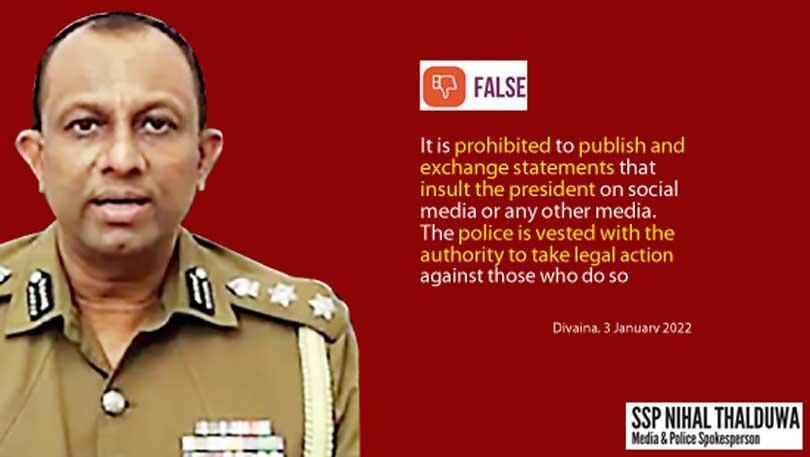
SSP Thalduwa: Critically wrong on criticism of the president

January 6th, 2022

Courtesy The Daily Mirror

SSP Thalduwa made these claims to the media in relation to the incident where an activist was questioned by the CID for posting a video on social media of the public verbally protesting against President Gotabaya Rajapaksa as he was travelling through Mirihana. FactCheck.lk assessed these claims by analysing the provisions of the Constitution and judgments of the Supreme Court of Sri Lanka. 


Article 14(1)(a) of the Constitution of Sri Lanka vests every citizen with the freedom of speech and expression. Under the Constitution, the freedom of expression can be restricted only by law for the protection of, among other things, national security, public order, racial and religious harmony, parliamentary privilege, or to prevent incitement to an offense.  The legality of publishing insulting statements against the president or government was dealt with in the 2015 judgement of the Supreme Court (SC) in Wahalathanthri v. Jayantha Wickramaratne, Inspector General of Police [S.C. (F.R.) Application No. 768/2009]. In this case, the police sought to prosecute two persons under Section 120 of the Penal Code for carrying harshly worded placards that protested the government. In its determination, the SC declared that the publication of defamatory, embarrassing, or insulting statements against the president or government is a lawful and democratic exercise of the freedom of expression. 

The SC also held that the police cannot prosecute members of the public for merely publishing defamatory, embarrassing, or insulting statements against the president or government, and that Section 120 of the Penal Code would apply only if such statements were intended to incite violence.


The above analysis confirms that publishing statements that merely insult or defame the president does not attract any criminal liability. As no criminal liability attaches to the making of statements that insult or defame the president, there is no lawful basis for the police to take legal action against persons who publish or exchange such statements. Therefore, we classify SSP Thalduwa’s statement as FALSE.


**FactCheck.lk’s verdict is based on the most recent information that is publicly accessible. As with every fact check, if new information becomes available, FactCheck.lk will revisit the assessment.

FactCheck is a platform run by Verité Research. 
For comments, suggestions and feedback, please visit www.factcheck.lk.

Over 11,000 tourists visit SL within four days: Russians top list

January 6th, 2022

Courtesy The Daily Mirror

A total number of 11,380 tourists had arrived in the island in the first four days of the new year Russian tourists head the list with 2,032 visitors, Tourism Minister Prasanna Ranatunga said.

Moreover, 1,809 tourists, from India, 1,041 from Ukraine, 775 from Germany, 709 from the UK, 506 from Kazakhstan, 506 from the Maldives, 420 from Australia, 414 from France and 282 from Poland were among those arrived in the first four days of January.

The minister said 194,888 tourists have arrived in the country in the year 2021 after the reopening of the country.

The Minister said that only 1,682 tourists have visited Sri Lanka in January 2021.

He said steps will be taken to make this year, the best year for the tourism industry.(Darshana Sanjeewa Balasuriya)

Agreemnt to develop Trinco Oil Tank Farm signed: Ministry

January 6th, 2022

Courtesy The Daily Mirror

Agreement to develop Trincomalee Oil Tank Farm was signed this evening, Energy Minister Udaya Gammanpila said.He said in a twitter post that signatories were Treasury Secretary, Land Commissioner General, Ceylon Petroleum Corporation (CPC), LIOC and Trinco Petroleum Terminal Ltd.”85 of the 99 tanks will come under Sri Lanka’s purview, which were under India,” the Minister tweeted.

Sri Lanka’s Covid-19 case total tops 59,000 and 18 new COVID deaths for January 04

January 6th, 2022

Courtesy Adaderana

The Ministry of Health reports that another 584 persons have tested positive for coronavirus within today (06), as the country’s tally of confirmed cases crossed the 59,000-mark on Thursday.

This figure includes 12 persons who had arrived from overseas while the rest are new community cases. 

The total number of Covid-19 cases registered in the country thus far stands 590,063 with this while the number of infected patients currently undergoing treatment is 13,423

Meanwhile, the Director-General of Health Services has confirmed 18 more coronavirus-related deaths for January 04, increasing the death toll in the country due to the virus pandemic to 15,065.

According to the figures released by the Government Information Department, the deaths reported today include 12 males and 06 females.

Five of the patients are between the ages of 30-59 years. The remaining 13 are in the age group of 60 years.

Sri Lankan families forced to forego meals as economic crisis intensifies

January 6th, 2022

By Aanya Wipulasena Courtesy LaPrensaLatina.com

Colombo, Jan 5 (EFE).- The severe economic crisis affecting Sri Lanka, with record inflation and the possibility of the country failing to pay its financial debts, has forced families to give up meals due to shortage of food and steep prices.

Our only option was to cut down on food consumption. Sometimes we only have two meals a day. At other times we cook once a day and eat sparingly,” Priyanka Kumari, 44, from Boralesgamuwa in the country’s Western Province, told EFE.

Household incomes have been hit hard by the crisis, while inflation shot up to 11 percent in November, the highest in 13 years.

Kumari said she used to make a living by selling cooked food but had to stop when prices of the ingredients soared, after the government imposed import restrictions to mitigate a foreign currency crisis.

When we increase prices, people don’t buy,” she said.

Vegetable prices have tripled this December compared to the same month last year, according to the latest National Consumer Price Index.

Prices of rice, a basic food item in the country, have also shot up along with flour and bread, while fuel prices have risen sharply, up to 85 percent in the case of cooking gas.

A drastic fall in tourism due to the pandemic, with the crucial sector coming to a complete halt due to borders being closed for months at a time, has been another blow for Sri Lankans.

When Covid-29 first hit, the country stopped allowing tourists. As a result, my salary was reduced by 50 percent,” Lahiru Sameera, a 26-year-old former employee of the sector, told EFE.

On Tuesday, the Sri Lankan government announced an aid package worth $1 billion for the poorest section of the country, public sector employees and senior citizens.

Cabinet spokesperson Dullas Alahapperuma said that the aid would help ease economic pressure on these sections of the population.

The measure includes a payout of 10,000 Sri Lankan rupees (around $50) per family to promote home gardening.

Amid the grave economic crisis, Sri Lanka has witnessed its foreign currency reserve dwindle in recent years and is now burdened with high levels of both public and private foreign debt.

The country needs to pay $500 million in international sovereign bonds by the end of January, and around $6.9 billion by the end of the year in domestic and foreign loans, according to rating agency Fitch, which reduced Sri Lanka’s long-term sovereign rating to CC from CCC last month, due to the possibility of the government defaulting on payments.

Sri Lanka’s foreign currency reserves have dropped by around $2 billion since August, going down to $1.6 billion by late November, according to the agency.

However, Colombo has insisted that it would not default on the payments.

Cabinet co-spokesperson and Plantations Minister Ramesh Pathirama told reporters on Tuesday that the tourism sector and exports were gradually improving.

We are also planning to increase local production. For example, distributing fresh milk instead of powdered milk. We have imported a large amount of medicine for a long time. We have started to produce our medicine,” he said in a presser.

The government is also negotiating credit line facilities with China, India and Japan.

2022 Kathina sponsorship at Dharma Vijaya Buddhist Vihara

January 5th, 2022

Rev Walpola Piyananda 

Dear friends,

Dharma Vijaya Buddhist Vihara organization has planned to give the opportunity to a team of youngsters (age 17+) to be sponsors and organizers of the 2022 Kathina ceremony. Our goal is to give full responsibility to this young team for conducting all the tasks and events from the initiation- Kathina invitation day (Saturday, July 9th, 2022) to the Katina Robe offering day (October 8 & 9th, 2022) at the end of the ceremony.

We kindly invite all the young devotees to join the “sponsoring and organizing team of the Kathina ceremony 2022” to gain experience of every single task of this wonderful and meritorious ceremony and help preserve our traditions for future generations.

May the triple gem bless you.

If you wish to join this, fill out this form!

https://docs.google.com/forms/d/e/1FAIpQLSe_uxLkSm7vtCco7_Yxb9tUUS3fGxD_SCAbWsD46fUP3lH1QQ/viewform?usp=sf_link

සමහර අයට ලොකුවට දැන් බලය තියෙනවා කියලා ටිකක් උඩින් යන ගතියක් දැන් ඇවිත්.-මෛත්‍රීපාල සිරිසේන මහතා

January 5th, 2022

තිසර සමල් – අනුරාධපුර  

මං කථාව සැරට කරලා පෙන්නුවේ අපිටත් සැරට කථා කරන්න පුලුවන් කියලා පෙන්නන්නයි.මොකද සමහර අය හිතන් ඉන්නවා බෑ කියලා.සමහර දේශපාලන පක්ෂ දැන් ආණ්ඩු හදලා දිනලා ජනාධිපතිත් වෙලා ඉවරයි.සමහර අයට ලොකුවට දැන් බලය තියෙනවා කියලා ටිකක් උඩින් යන ගතියක් දැන් ඇවිත්.මේ රටේ දේශපාලනයේ 1956 බණ්ඩාරනායක මැතිතුමන්ගේ ආණ්ඩුවේ ඉඳලම මේ ආණ්ඩුව වෙනකම්ම සියලු ආණ්ඩු සන්ධාන ආණ්ඩු, පෙරමුණු ආණ්ඩු කවුරුත් තනියෙම හදපු ආණ්ඩු නෙමෙයි යැයි හිටපු ජනාධිපති, ශ්‍රී ලංකා නිදහස් පක්ෂ නායක මෛත්‍රීපාල සිරිසේන මහතා පැවසීය.

ශ්‍රී ලංකා නිදහස් පක්ෂ අනුරාධපුර දිස්ත්‍රික් සමුළුව අමතමින් ඒ මහතා මේ බව පැවසීය.අනුරාධපුර පිහිටි ශ්‍රී ලංකා නිදහස් පක්ෂ ප්‍රධාන කාර්යාලයේදී, ශ්‍රී ලංකා නිදහස් පක්ෂ නායක, හිටපු ජනාධිපති මෛත්‍රීපාල සිරිසේන මහතාගේ ප්‍රදානත්වයෙන් පැවැත්විණි.මෙම සමුළුව ශ්‍රී ලංකා නිදහස් පක්ෂ ජාතික සංවිධායක රාජ්‍යය අමාත්‍යය දුමින්ද දිසානායක මහතා විසින් සංවිධානය කර තිබිණි.

ගොවියාගේ ප්‍රශ්නය ගැන විශේෂයෙන්ම ප්‍රමුඛත්වය දීමේ අවශ්‍යතාවයක් වර්ථමාන ආණ්ඩුවට තිබුණාද කියන ප්‍රශ්නය මතුවෙනවා.එහෙම තිබුණා නම් බෙල්ල කැපුවා වගේ එක පාරම ගොවීන්ගේ රසායනික පොහොර කපලා දාන්නේ නෑ.මම අවුරුදු දා හත හමාරක් වරින් වර  මහවැලි ඇමති, අවුරුදු 06 ක් කෘෂිකර්ම ඇමති, ඒ සෑම කාළයේමත්, ජනාධිපති කාලයේත් මම කාබනික පොහොර පටන් ගත්තා.ලංකාවේ පළමුවැනි වතාවට කාබනික පොහොර අධිකාරියක් හැදුවේ මම 2007 දී, ඒකත් කරන්න දුන්නේ නෑ ඒ දවස් වල.ඒ නිසා විශේෂයෙන් කියන්නට ඕන අපි අනුරාධපුර, පොළොන්නරුවේ ජීවත් වෙන මිනිස්සු හැටියට අපේ ඓතිහාසික මහා උරුමයත් සමඟ ශ්‍රේෂ්ඨ ඉතිහාසයේ අපි ඔක්කොම ගොවියෝ අපි එදා, අනුරාධපුර හා පොලොන්නරු යුගයෙන් පැවත එන ගොවි පරපුරවල් වල පරම්පරාවන් ඉන්නේ, වර්ථාමය තුළ ගොවිතැන, කෘෂිකර්මය වැටිලා තියෙන සෝචනීයයි.

ඊයේ (04) මම මාතලේ කරපු කථාව මගේ හිතවත් අය කථා කරලා කිව්වා ටොපේ ටොප් කියලා, ඒ අතරට මම විනාඩි 45 ක් කථා කලා.තවත් කීප දෙනෙක් ඊයේ (04) හවසයි අද (15) උදේයි කිව්වා, පොලොන්නරුවේ ඉඳන් උදේ එද්දිනුත් ෆෝන් එකෙන් කථාව ටිකක් සැර වැඩියි නේද කියලා.මං කථාව සැරට කරලා පෙන්නුවේ අපිටත් සැරට කථා කරන්න පුලුවන් කියලා පෙන්නන්නයි.මොකද සමහර අය හිතන් ඉන්නවා බෑ කියලා.සමහර දේශපාලන පක්ෂ දැන් ආණ්ඩු හදලා දිනලා ජනාධිපතිත් වෙලා ඉවරයි.සමහර අයට ලොකුවට දැන් බලය තියෙනවා කියලා ටිකක් උඩින් යන ගතියක් දැන් ඇවිත්.මේ රටේ දේශපාලනයේ 1956 බණ්ඩාරනායක මැතිතුමන්ගේ ආණ්ඩුවේ ඉඳලම මේ ආණ්ඩුව වෙනකම්ම සියලු ආණ්ඩු සන්ධාන ආණ්ඩු, පෙරමුණු ආණ්ඩු කවුරුත් තනියෙම හදපු ආණ්ඩු නෙමෙයි.අවස්ථා දෙකක් තියෙනවා, එකක් තමා 1960 ජූලි මැතිවරණයේදී බණ්ඩාරනායක මැතිණිය ශ්‍රී ලංකා නිදහස් පක්ෂයේ තනියෙන් ආණ්ඩු හැදුවා, 1977  ජේ.ආර් ජයවර්ධන 6/5 ක් අරගෙන අපේ පක්ෂය  ආණ්ඩුව කෑලී – කෑලී කැඩිලා තියෙන වෙලාවක, ජේ.ආර්ගේ අවශ්‍යාතවක් නෙමෙයි ඒක අපේ පක්ෂයේ අයගේ තිබුණ අඩුපාඩු හා වැරදි , පවුලේ අය ගහ ගත්තා.

මම හිතන්නේ නෑ, මේ රටේ ජනතාව මේ කාළයේ විඳින දුකේ හැටියට දේශපාලඥයින්ට රැවටිලා ඊළඟ අවස්ථාවේ ඡන්දේ දෙයිද කියලා මට විශ්වාසයක් නෑ, හුඟක් වෙලාවට මොන අඩුපාඩු තිබුණත් ඡන්දේ කාලයට ආයේ, කන්න දීලා, මොනවා හරි දීලා, සල්ලි දීලා, බඩු බෙදලා,බෙදන්න තියෙන ඔක්කොම බෙදලා , හැබැයි ඉතින් ඔය බෙදන්න තියෙන ඔක්කොම බෙදලා, මම ඇල් වතුරවත් දෙන්නේ නැතිව  මම දිනුවේ 2015 ජනාධිපතිවරණය.ජනතාව තීන්දු ගන්න වෙලාවල් තියෙනවා සමහර අය ඒවාට රැවටුණාට.නැවත අවශ්‍යය වෙන්නේ මේ රට ඉදිරියට ගෙන යන්න පවතින ආර්ථික,සමාජ, දේශපාලන අර්බුධ තුළ අපි අපේ ගමන යන්න සකස් කර ගන්න ඕන.වංචාව, දූෂණය, හොරකම ගැන අපි අවුරුදු 25-30 ක් කථා කරලා තියෙනවා.මේ රටේ ජනතාව හොරු නැති ආණ්ඩු හදන්න පහුගිය අවුරුදු 15-20 ක් ඡන්ද දීලා තියෙනවා, ඡන්ද ගත්තාට පස්සේ ආණ්ඩුව හොරුන්ගේ ආණ්ඩුවක් බවට පත් වෙනවා.මේ රටේ තියෙන සංවර්ධනයන්ට බාධාවක් ඒක.මම 2014 නොවැම්බර් 21 එදා රාජපක්ෂ මහත්වරුන්ගේ ආණ්ඩුවෙන් එළියට ආවේ, බොහෝම පවිත්‍ර, අවංක චේතනාවෙන් මගේ බිරිඳ ඇතුළු දරුවන් සියලු දෙනාගේම ජීවත පිළිබඳව දැඩි අවධානමකින් පොදු අපේක්ෂකයා විදිහට එළියට ආවේ.සමහරු ඔලුවේ අත ගහගෙන කිව්වා කළු ගලේ ඔලුව ගහගන්න එපා, ඔක කවදාවත් කරන්න බෑ, දිනන්න බෑ කිව්වා.මහ රජානෝ දිනන්න, මෛත්‍රීපාල සිරිසේන වගේ පොලොන්නරුවේ කෙනෙක්ට පුලුවන්ද ඇහුවා.නමුත් වෙච්ච දේ කවුරුත් දන්නවා.

මෙතෙක් පැවති සාම්ප්‍රදායික ආණ්ඩු නොව, පැවති ආණ්ඩු වලට වඩා වෙනස් ආණ්ඩුවක් අපි සෑදිය යුතුයි.ඒ වෙනස් ආණ්ඩුව මොන විදිහේ ආණ්ඩුවක්ද කියලා ප්‍රශ්නය තියෙනවා.අද තියෙන තත්වයට බොහෝ අය දොස් කියනවා, නිදහසින් පසු 1948 ඉඳන් අවුරුදු 73 ක් මේ රට මේ තත්වයට පත් කලේ, රට පාලනය කරපු සියලු පාලකයෝ හා ආණ්ඩු කියලා. මම ඒකට එකඟ වෙන්නේ නෑ.මේ රටේ වංචාව දූෂණය කියන එක තිබුණා 77 ට කලින් තමන්ගේ ආණ්ඩුවේ වංචා දූෂණ කරපු ඇමතිවරයෙක් එළියට දාපු එකම නායකයා එස්.ඩබ්ලිව්.ආර්. බණ්ඩාරනායක මැතිතුමා 1957 දී මරික්කාර්ව එළියට දැම්මා  අල්ලස් චෝදනා ඔප්පු වුණාට පස්සේ.එතුමාගෙන් පස්සේ තමන්ගේ ආණ්ඩුවේ ඇමතිවරයෙක්ගේ වංචා දූෂණයක් නිසා ඇමතිවරයෙක් එළියට දැම්මේ මම ජනාධිපති කාලේ මමයි.අර කොළඹ පැත්තේ මහත්තයා.තව නඩු තියෙනවා උසාවියේ.මට යූ.එන්.පී එකත් එක්ක බොහෝම ලස්සන ගමනක් යන්න තිබුණා මම හොරුන්ට විරුද්ධව පියවර ගත්තේ නැත්නම්, මහ බැංකු මූළ්‍ය වංචාවට මම ජනාධිපති කොමිසමක් දැම්මේ නැත්නම් කිසිම ගැටුමක් ආණ්ඩුවේ නෑ, කොමිසමේ නිර්දේශ අනුව අපරාධ පරීක්ෂණ දෙපාර්තමේන්තුව පර්පචුවල් ටෙසරිස් සමාගමට විරුද්ධව පරීක්ෂණ කරගෙන යන කොට ආණ්ඩුවේ මැතිඇමතිවරු හොරුයි කියලා අහුවෙන කොට අපරාධ පරීක්ෂණ දෙපාර්තමේන්තුව ආණ්ඩුවේ මැති ඇමතිවරුන්ගේ ටෙලිෆෝන් බැලුවේ නෑ,ඒ පිළිබඳව ප්‍රධාන වග උත්තරකාරයෙක් වෙච්ච අර්ජුන් ඇලෝසියස්ගේ ටෙලිෆෝන් එක පරික්ෂා කලා.එතනදී පෙනී ගියා මැති-ඇමතිවරු එක්ක මෙයාගේ හුඟක් කථා බහ තියෙනවා කියලා.අපරාධ පරීක්ෂණ නිළධාරීන් ඒ වගඋත්තරකරුගේ ෆෝන් එකට කථා කරපු මැති ඇමතිවරුන්ගේ ටෙලිෆෝන් පරික්ෂා කළා, රනිල් වික්‍රමසිංහ මහත්තයා පාර්ලිමේන්තුවට ආවේශ වෙලා ඇවිත් කෑ ගැහුවා කියලා මට ආරංචි වුණා. පාර්ලිමේන්තු මැති-ඇමති වරප්‍රසාද තුළ මැතිඇමති දුරකථන පරික්ෂා කිරීම වරප්‍රසාද කඩ කිරීමක් කියලා රනිල් පාර්ලිමේන්තුවේ කථාවක් කරලා තිබ්බා.මගේ අතේ ඒ වන විට පොලීසිය, සී.අයි.ඩිය, නීතීපති මගේ අතේ තිබුනේ නෑ, ඔක්කොම හිටියේ රනිල්ලාගේ පැත්තේ අමාත්‍යංශ වලට යටත්ව.රනිල් වික්‍රමසිංහ මහත්තයා මැතිඇමතිවරුන්ගේ ටෙලිෆෝන් පරික්ෂා කලා කියලා අපරාධ පරීක්ෂණ දෙපාර්තමේන්තුවේ නිළධාරීන්ට විරුද්ධව රනිල්ගේ පොලීසිය දාලා රනිල් ඒ අයට විරුද්ධව පරික්ෂණ කරන්න පටන් ගත්තා.අපරාධ පරීක්ෂණ දෙපාර්තමේන්තුවේ සමහර නිළධාරීන් අස්වෙලා යන්න ගියා, සමහරු භය වෙලා කිව්වා අපිව මරයිද දන්නෙ නෑ කියලා.මම කිව්වා භය වෙන්න එපා මම ඉන්නවා කියලා.නමුත් හැම කෙනෙක්ම ජීවිත භයත් එක්ක සමහර අය තනතුරු දාලා ගියා.මම වංචා හොයන්න කොමිෂන් දැම්මා, මේ රටේ කිසිම ජනාධිපතිවරයෙක් වංචා දූෂණ වලට විරුද්ධව ඒ විදිහට කොමිෂන් දාන්න කටයුතු කරලා නෑ,

අද ආණ්ඩුව ගන්න තීන්දු තීරණ දේශපාලන කළමණාකරනය වරද්දාගෙනද?, රාජ්‍යය පරිපාලන කළමණාකරනය වරද්දගෙන තියෙනවා.රටේ ආර්ථිකය, ජාත්‍යන්තර සම්බන්ධතා කළමනාකරනය වරද්දගෙන තියෙනවා.ගිය අවුරුද්දේ සම්මත කරපු 20 වැනි සංශෝධනය අවලංගු කරන්න ඕන, මම සම්මත කරපු 19 වැනි ආණ්ඩුක්‍රම ව්‍යවස්ථා සංශෝධනය අරගෙන ඒකේ තිබුණ වැරදි අඩුපාඩු නිවැරදි කරලා, අපි සම්මත කරපු 19 ය සංශෝධන සහිතව සම්මත කිරීම අවශ්‍ය වෙනවා රට ඉස්සහරට ගෙන යන්න.19 වැනි සංශෝධනය සම්මත වෙන්නේ 18 අහෝසි කරනවාත් එක්කම, 18 ත් තිබුණේ එවකට හිටපු ජනාධිපතිතුමාට රජෙකුටත් වඩා බලතල.රාජාණ්ඩුක්‍රම බලතල 18 තිබුණේ, ඇමතිවරු- පාර්ලිමේන්තුව නැතිව අවුරුද්දක් ගෙනියන්න පුලුවන් ජනාධිපතිවරයාට.මම දන්න විදිහට 20නුත් පුලුවන්.අමාත්‍යංශ ලේකම්ලත් එක්ක අවුරුද්දක් ගෙනියන්න පුලුවන්.තියෙන ගැසට් නිවේදන ආණ්ඩුක්‍රම ව්‍යවස්ථාවේ බලතල අනුව ගෙනියන්න ඕන, ඒ තුළ අපි ප්‍රජාත්‍රන්තවාදය දකින්නේ නෑ, ඒ නිසා 19 වැනි සංශෝධනයේ, සංශෝධනය කළ යුතු තැන් සංශෝධනය කරලයි සම්මත කරන්න ඕන, මගේ කාලේ 19 ය සම්මත කරලා වෙච්ච අවුල තමයි, රටේ නායකයෝ 03 දෙනෙක් හැදුනා විදායක බලතල තියෙන.ජනාධිපති, අගමැති, කථානායක කියන 03 දෙනාටම විධායක බලතල තියෙනවා 19 වැනි සංශෝධනයෙන්.ඒ නිසා කථානායක කරූ ජයසූරිය එයාගේ පාර්ලිමේන්තු සාකච්ජා වලට අග්‍රවිනිශ්චකාර , ශ්‍රේෂ්ඨාධිකරණ විනිශ්චකාරවරු, නීතීපති, පොලිස්පති, ස්වාධින කොමිෂන් සභා ඔක්කොම කැන්දනවා.ඒ තුළ මුළු විදායක බලය 19 වැනි සංශෝධනයෙන් ආපූ ව්‍යවස්ථා සභාව තුළට අරගෙන ව්‍යවස්ථා සභාවේ සභාපති කරූ ජයසූරිය, ඒකේ ඉන්නවා අගමැති රනිල් වික්‍රමසිංහ මේ දෙන්නා එකතු වෙලා වෙනම ආණ්ඩුවක් හදාගෙන ගියා.ඒ අයට ඕන විදිහට ස්වාධීන කොමිෂන් සභා ටික අරගෙන ගියා.ඒ නිසා 19යෙන් බලාපොරොත්තු වෙච්ච දේ සිද්ධ වුණේ නෑ.රනිල් වික්‍රසිංහ මහත්තයාගෙයි, මගෙයි ගැටුම තිබුණේ අපි දෙන්නාගේ පුද්ගලික ගැටුමක් නෙමෙයි, ඒ ගැටුම රනිල්ගේ අන්ත නව ලිබරල්වාදයයි, මගේ සමාජ ප්‍රජාතන් ත්‍රවාදී ජාතික දුෂ්ටිය නැත්නම්, ජාතික චින්තනය පිළිබඳ මගේ දේශපාලන දර්ශනය මේ දෙක තමයි ගැටුනේ යහපාලන ආණ්ඩුවේ, රනිල් බටහිර ගැන විශ්වාසය තිබ්බා, මම මගේ ජාතිය ගැන රට ගැන විශ්වාසය තිබ්බා.

 දූෂණය, වංචාව, හොරකම කියන එක ගලාගෙන ගිහින් තියෙන්නේ, ඒ නිසා තමයි හොරු හොඳටම ප්‍රබල, දේශපාලනය කරන හොරුන්ට පක්ෂයක් නෑ,ආගමක්, ජාතියක්, භාෂාවක් නෑ, දේශපාලනය කරන හොරු එකෙකුට ප්‍රශ්නයක් වෙච්ච ගමන් ඔක්කොම  හොරු ටික එකතු වෙලා ඌව බේර ගන්නවා. මට වුණෙත් ඒකයි, ආණ්ඩු කරන කොට විශේෂයෙන්ම මගේ ආණ්ඩුවෙත් හිටපු හොරු රනිල් වික්‍රමසිංහ මහත්තයලගේ කණ්ඩායම, මහ බැංකු කඩපු මිනිස්සුයි, අද පොහොට්ටුවේ නායකයොයි ඔක්කොම එකතු වෙලා මට ගැහුවා.මම ආණ්ඩු කෙරුවේ ලෝකේ කිසිම රටක නොකර ආණ්ඩුවක් මම කෙරුවේ, මට කියලා අගමැති කෙනෙක්, ඇමති මණ්ඩලයක්  හිටියේ නෑ, වැඩි බලය තිබුණේ එක්සත් ජාතික පක්ෂයට, මට කියලා පාර්ලිමේන්තුවේ ආණ්ඩු පක්ෂය- විපක්ෂය හිටියේ නෑ, හැබැයි අවුරුදු 05 ට මාස 1 ½ ක් අඩු වෙන්න මම රට පාලනය කළා.මට බනින එක, කුණුහර්ප කියන එක නෙමෙයි මට සම්මානයක් දෙන්න ඕන ලෝකේ කවුරුත් එහෙම කරලා නෑ.ලෝකේ කිසිම රටක රාජ්‍යය නායකයෙක් තමන්ගේ බලතල ඉවත් කරගෙන නෑ, ලෝකේ එහෙම කරපු එකම දේශපාලඥයා මම, 19 වැනි සංශෝධනය රාජාආණ්ඩුවක රජෙකුට තිබුණ බලතල මම අයින් කරලා දැම්මා.

ආර්ථික අර්බුධය ඩොලර් අර්බුධය විසඳගන්න අපේ බැසිල් උන්නැහැ දිගට හරහට බියගම ෆැක්ටරියෙ අච්චු ගහනවා. මම ජනාධිපති කාලේ ඕක බලන්න ගියා, සල්ලි අච්චු ගහන හැටි, අපේ රටේ සල්ලි විතරක් නෙමෙයි, වෙන රටවල සල්ලිත් බියගම ගහනවා.රුපියල් ගහලා ඕන තරම් එළියට දාන්න පුලුවන්, ඒකෙන් ඇති වෙන ආර්ථික අර්බුධය වෙනම කථාවක්.ඩොලර් ලැබෙන්නේ කොහොමද ලෝකය සලකන්නේ රටේ රාජ්‍යය කරන අයගේ මූණ දිහා බලලා තනතුරට නෙමෙයි.මම ලෝකයට පෙන්නුවේ ආණ්ඩුව කරන ප්‍රථිපත්තිය.ලෝකය මාත් සමඟ එකතු වුණේ 19 වැනි ව්‍යවස්ථා සංශෝධනය නිසා.රාජාණ්ඩුවක් අවසන් කරපු නිසා, විදේශ සම්බන්ධතා හදාගෙන රාජ්‍යය නායකයින්ගේ හිත් දිනා ගැනීම එක්තරා කළාවක්.

මේ ආණ්ඩුවේ ඉන්නවාද නැද්ද කියලා හිතලා බලන්න කියලා මට කෙනෙක් කිව්වා, එහෙම හිතපු හුඟක් දේවල් තියෙනවා.විශේෂයෙන්ම අපි කියන්න ඕන ශ්‍රී ලංකා නිදහස් පක්ෂය අපි කාගෙවත් පස්සේ යන්නේ නෑ,අපි පක්ෂය සංවිධානය කරනවා රට පුරාම, අපි අපේ වැඩපිළිවෙල ඉදිරිපත් කරනවා, ඒ වැඩපිළිවෙලට එකතු වෙන අයත් එක්ක අපි එකතු වෙනවා.එහෙම නැතිව අපි කාගෙවත් නැට්ට වෙන්න ලෑස්ති නෑ, අපි තමයි පාර්ලිමේන්තුවේ 03 වැනි බලවේගය.අපි නැත්තනට නැති වුණ විනාශ වුණ පක්ෂයක් නෙමෙයි.අපේ දැන් 14 ක් ඉන්නවා.අපේ අලුත් වැඩපිළිවෙලත් එක්ක අපි නැගිටිනවා.යැයිද පැවසීය.


මෙම අවස්ථාවට මහා සංඝරත්නය ඇතුළු අන්‍ය ආගමික පූජකතුමන්ලා ශ්‍රී ලංකා නිදහස් පක්ෂ මහ ලේකම් අමාත්‍ය දයාසිරි ජයසේකර, ශ්‍රී ලංකා නිදහස් පක්ෂ ප්‍රචාරක ලේකම් ශාන්ත බණ්ඩාර, හිටපු අමාත්‍යය වීරකුමාර දිසානායක, තිස්ස කරල්ලියද්ද යන මහත්වරුන් ඇතුළු අනුරාධපුර දිස්ත්‍රික් ආසන සංවිධායකවරුන්, පොලොන්නරුව දිස්ත්‍රික් තරුණ පෙරමුණු සභාපති දහම් සිරිසේන මහතා ඇතුළු ශ්‍රී ලංකා නිදහස් පක්ෂ අනුරාධපුර දිස්ත්‍රික් අනුබද්ධ සංවිධාන වල නිළධාරීන් ඇතුළු පාක්ෂිකයන් විශාල පිරිසක් සහභාගී වූහ.

What Sri Lanka Can Learn From Duty-Free-Quota-Free Facility Extended By Thailand For Bangladesh?

January 5th, 2022

By  Courtesy Eurasia Review

Recently, Thailand has decided to provide the duty-free, quota-free (DFQF) market facility for Bangladeshi products in its market until 2026 to increase two-way trade volume. The declaration came as such facilities to Bangladesh by Thailand expired on 31 December 2020. It is high time to analyze the market situation of Thailand to devise appropriate strategies to get optimum benefits from the DFQF market facilities offered to Bangladesh.

The journey of Bangladesh–Thailand relations began on 5 October 1972 when Thailand recognized Bangladesh as a sovereign nation-state. The diplomatic ties began with the establishment of the Thai Embassy in Bangladesh in 1974. In order to promote bilateral trade between Bangladesh and Thailand, these two friendly countries signed a bilateral trade agreement on 22 August 1997. They have also formed a joint chamber of commerce to generate maximum output from their economic engagement.

From the very beginning of their relations, these two countries have been enjoying very warm bindings and have been working to deepen their bilateral ties for mutual benefits. The bilateral linkage between these two countries has been strengthened over time because of shared strong commitment to democratic values, efforts to foster international peace, harmony, and security. Their cultural, social, and religious linkage also contributed to blossoming the ties.

The current trade scenario between Bangladesh and Thailand

In South Asia, Bangladesh is the third-largest trading partner of Thailand. Although the bilateral trade between these two countries crossed USD 1.25 billion in 2018, it has experienced a declining trend after that time period. As Bilateral trade between them dropped to USD 910.05 million in 2020 from USD 1,067.90 million in 2019, they should work together to increase bilateral trade and investment.

Bangladesh basically exports vegetables, plastic items, rubber products, soap, animal goods, apparel, electrical & electronic equipment, fish, medicines, etc. to Thailand. On the other hand, Bangladesh imports cement, iron and steel, cereals, organic chemicals, machinery and mechanical appliances, synthetic fiber, and cotton fabrics, sugar, and sugar confectionery, etc. from Thailand. Bangladesh has a huge untapped bilateral trade prospect to discover with Thailand. It can export pharmaceuticals and health care goods, chemical products, leather goods, jute goods, frozen fish, knitwear and woven garments, ceramic tableware, tea, etc. to the Thai market. As these products have huge demand in Thailand, Bangladesh can earn huge foreign currency by exporting these goods with easy access, the DFQF, provided by Thailand. Bangladesh should also utilize this DFQF market access offered by Thailand to have competitive advantages

How can Bangladesh generate optimum benefit from the Thai Market?

If Bangladesh does its homework properly, then it can get maximum output from the DFQF facility offered by Thailand. Firstly, Bangladesh should analyze the Thai market to understand the Thai economy, its cultural practices, and social norms and then assess the consumption habits and patterns of Thai consumers. Bangladesh Embassy in Thailand, Ministry of Commerce and Industry, and Bangladesh-Thai Chamber of Commerce and Industry can jointly conduct this analysis.

Secondly, Bangladesh should promote local producers to boost their export to Thailand by providing different facilities such as creating backward linkage for easing production, arranging raw materials for the products that will be exported to Thailand, offering easy loans, etc. Thirdly, responsible government agencies should take initiative to promote and brand Bangladeshi products in the Thai market to increase market demand for Bangladeshi products.

 Fourthly, Bangladesh may arrange or participate in a Trade fair organized in Thailand to inform the people there about Bangladeshi goods and services. Fifthly, a team of Bangladeshi businessmen may visit Thailand to have a better understanding of the products being sold there and to have an idea about the goods that might be exported there. Sixthly, the existing relations among the businessmen of both countries should be nurtured and expanded for giving the economic engagement a new shape. Seventhly, the governments of both countries should work shoulder-to-shoulder to simplify the regulations to boost exports and enhance bilateral economic engagement.

As Bangladesh has eight export processing zones (EPZs) and has undertaken initiatives to establish 100 Special Economic Zones (EZs), it should try to attract Thai investors by informing them of the different incentives and facilities available here such as tax holiday, One-Stop Service, etc. in EPZs and EZs. Government should allocate lands for the businessmen of Thailand in these EZs with easy terms and conditions. Both countries may rethink and take the joint initiative to flourish the tourism sectors in their respective countries. They should work to ease visa restrictions which not only will boost trade and investment but also make it easy for Bangladeshi to avail Thai healthcare facilities.

Bangladesh and Thailand have common membership in BIMSTEC which reflects that they have common interests and goals. Besides, in order to address bilateral trade-related issues, they have set up a joint trade commission which is really a praiseworthy initiative. As Bangladesh is officially going to be an LDC-graduate by 2026, it may face different challenges, e.g., cancellation of GSP facilities, which may have a negative impact on its export earnings. In order to avoid the decline in export earnings, Bangladesh should sign Free Trade Agreements with its friendly countries such as Thailand. 

Sri Lanka And Bangladesh’s Opportunities From Upcoming BIMSTEC Summit

January 5th, 2022

By Jubeda Chowdhury

BIMSTEC or Bay of Bengal Initiative for Multi-Sectoral Technical and Economic Cooperation has 7 members – India, Nepal, Bhutan, Bangladesh, Myanmar, Thailand, and Sri Lanka. The grouping is more than 20 years old and was formed in 1997. The last summit took place in Kathmandu in 2018 with PM Modi and other member-leaders attending the meet. BIMSTEC region has huge prospects for economic cooperation.

Sri Lanka is the chair of the grouping and had earlier proposed holding a virtual summit on 9th December which has now been postponed. According to the media reports, the Bay of Bengal Initiative for Multi-Sectoral Technical and Economic Cooperation, better known as BIMSTEC, is likely to hold a summit of the heads of governments in Sri Lanka on March 30 in a hybrid setting providing scopes for both in-person and virtual participation.

Sri Lanka is a founding member of the Bay of Bengal Initiative for Multi-sectoral Technical and Economic Co-operation (BIMSTEC). Since its inception in 1997, Sri Lanka has been an active member of the Multilateral Forum. The archipelago presided over for the first time between 2002-2003, during which time Colombo promoted member states’ political commitments to strengthen sub-regional cooperation. As of 2016, BIMSTEC members accounted for only 17.4 percent of the total trade in Colombo trade goods. On the other hand, Bangladesh maintains friendly ties with almost all the neighbouring nations. This allows the country to play a bigger role in regional affairs.

Its imports from BIMSTEC accounted for only 23 per cent of its total imports and Sri Lankan exports to BIMSTEC members accounted for only 7 per cent. Moreover, India contributes more than 70 per cent of Sri Lanka’s trade with BIMSTEC. In parallel with the slow progress of BIMSTEC, Sri Lanka’s cooperation with BIMSTEC members has grown in place of snails.

In this context, Sri Lanka has been the Chairman of BIMSTEC from 2018-2020. Following which, Sri Lanka has the opportunity to ensure rapid cooperation between the member states of the Gulf region. During the Fourth Summit, the former President of Sri Lanka, Maithripala Sirisena, emphasized that BIMSTEC countries share shared aspirations for growth, development, trade and technology, and that Sri Lanka would facilitate this natural platform for the implementation of regional connectivity and economic cooperation. Actually, BIMSTEC has an important role to play in the regional trade area. All member states including Sri Lanka and Bangladesh should reap the benefits and exchanges this regional advantages. The BIMSTEC region has huge prospects for economic cooperation much of which still remains unexplored and unexploited.

Five members of the seven-member international organisation have already confirmed their participation in the summit, called by Sri Lankan president Gotabaya Rajapaksa, according tomedia reports. The countries that conveyed their confirmation are Bhutan, Myanmar, Nepal, Sri Lanka and Thailand.

Bangladesh and India, the two other members of the regional group of the countries around the Bay of Bengal, are expected to formally confirm their participation soon as the host, Sri Lanka, the outgoing chair of the group, sought concurrence of all member countries discretely about holding the meeting on March 30, media report said.

Prime minister Sheikh Hasina is expected to join the summit, to be held in Colombo. It is yet to be decided whether she will travel to Sri Lanka or join the meeting virtually. Foreign ministers and foreign secretaries of the BIMSTEC member countries are scheduled to meet on March 28 and 29 respectively for facilitating decision making at the summit on March 30.

The heads of the governments of the BIMSTEC member countries are expected to approve a charter for the organisation in the meeting after 24 years of its journey. The member countries ‘have completed the negotiation of the BIMSTEC charter and it is expected to be signed’ in the forthcoming fifth summit with participation of the heads of the governments in Colombo, BIMSTEC secretary general Tenzin Lekphell said in October.

The Colombo summit, the fifth meeting of the heads of the governments, was postponed twice in 2020 and 2021 due to the Covid pandemic. In addition to the BIMSTEC charter, three other legal instruments are expected to be signed at the summit. These are a BIMSTEC convention on mutual legal assistance in criminal matters, a memorandum of association on the establishment of BIMSTEC technology transfer facility in Colombo and a memorandum of understanding on mutual cooperation between diplomatic academies and training institutions of the member countries.

Bangladesh as the lead country for Trade, Investment and Development is strongly committed to strengthen BIMSTEC cooperation in this field. There is the importance of making all entities of the BIMSTEC process fully functional and operational. The BIMSTEC process needs concerted and quicker efforts and more intense engagements amongst the member states. It is imperative to forge more realistic partnership and shared endeavours to prosper together through exploitation of the full potential of this region.

The summit is also expected to reconstitute and rationalise 14 areas of cooperation into seven sectors, where each sector will be led by a member country. The foreign secretaries met 21 times, foreign ministers 17 times and heads of governments four times since the establishment of the BIMSTEC 24 years ago in 1997, while security advisers met thrice since 2017. Thailand is scheduled to take over the responsibilities of the BIMSTEC chair in the fifth summit in Sri Lanka.

BIMSTEC has identified 13 priority sectors, including trade and investment, transport and communication, counter-terrorism and transnational crimes, energy, climate, agriculture, poverty alleviation, tourism, public health and people-to-people contact. Bangladesh is the lead country for three areas – trade, investment, and climate, and has reiterated its fullest cooperation in this regard during the successive BIMSTEC ministerial meetings and summits.

According to media reports, in the current structure of bilateral trade among these countries, we see that most of the BIMSTEC members have experienced a considerable rise in bilateral trade over the years. A larger volume of exports was observed in the case of Thailand’s exports to India (US$ 5.5 billion in 2015); India’s exports to Sri Lanka (US$ 4.4 billion), Bangladesh (US$ 3.4 billion), and Nepal (US$ 2.6 billion); and Myanmar’s exports to Thailand (US$ 3.3 billion) and India (US$ 1.3 billion). Overall, India and Thailand are two major economies – both in terms of export and import – while Bangladesh, Sri Lanka, and Myanmar are three major economies in terms of import. The bilateral trade record of BIMSTEC countries indicates that the existing pattern of trade is heavily influenced by geographical proximity, relative size of the economies, and predominant trade routes.

BIMSTEC has received greater attention in the context of progressing co‑operation in the region. In addition to high-level diplomatic engagements, substantial steps have been taken towards co‑operation in a wide range of areas. In the fourth BIMSTEC summit meeting—which was held in Nepal’s capital, Kathmandu, in August 2018—member countries signed a memorandum of understanding on establishing a BIMSTEC Grid Interconnection to enhance energy co‑operation. This is expected to expedite the buying and selling of electricity between the countries—including those not directly bordering each other—once the cross-country grid infrastructure is in place. We expect tangible progress to be made in the field of energy co‑operation in 2019‑23.

New ground is also being broken in the security arena, as evidenced by the successful hosting of the first-ever joint military exercise between India and other BIMSTEC countries in September 2018. Each of the 14 areas of co‑operation under BIMSTEC is led by a particular country. That relating to security is headed by India and covers counterterrorism and transnational crimes. We expect that India will continue pushing for greater security co‑operation, particularly on counterterrorism. Furthermore, it is likely that in the next few years, member countries will undertake full ratification of conventions on mutual legal assistance in criminal matters and co‑operation in combating international terrorism.

The most significant breakthrough, however, is expected to be in connectivity. Five of the seven BIMSTEC member countries share a border with India, which includes the busiest land-customs checkpoint in Asia: The Petrapole-Benapole checkpoint between India and Bangladesh. Despite this, intra-regional trade accounts for only 5% of the grouping’s total trade; poor road connectivity is one of the main reasons. We expect progress to be made on transport connectivity over the 2019‑23 forecast period. In particular, the two main agreements, the BIMSTEC Coastal Shipping Agreement and the BIMSTEC Motor Vehicle Agreement—which are aimed at facilitating trade and transport linkages between member countries—are likely to be finalised over the next five years.

Despite the strong political thrust in favour of BIMSTEC, the organisation still faces manpower constraints and limited resources. This will be addressed partly by member countries’ increased commitment towards financial and human resources. Furthermore, areas such as negotiating a free-trade agreement—traditionally the focus of organisations that advocate regional co‑operation—will remain on the backburner in 2019‑23. Nevertheless, the importance of BIMSTEC will continue to grow, with India relying heavily on it to further its regional agenda. However, the upcoming BIMSTEC summit will ensure to create a common regional platform to address some common regional problems. Sri Lanka and Bangladesh as regional stakeholders have some common agenda such as strengthening connectivity, growing trade, tackling covid-19, terrorism, climate change, resolving and meditating Rohingya refugee crisis between Myanmar and Bangladesh etc. The upcoming BIMSTEC summit will provide the benefits for all regional states including Myanmar and Bangladesh. Sri Lanka and Bangladesh should fully utilize the potential.

වෛද්‍ය නිලධාරීන්ගේ මාරු මණ්ඩලයේ ගැටලුවට සියලු පාර්ශව එකඟතාවෙන් තීන්දුවකට එළැඹෙන්නැයි සෞඛ්‍ය සේවා අධ්‍යක්ෂ ජනරාල්වරයාට අග්‍රාමාත්‍යතුමාගෙන් උපදෙස්

January 5th, 2022

අග්‍රාමාත්‍ය මාධ්‍ය අංශය

වෛද්‍ය නිලධාරීන්ගේ මාරු මණ්ඩලය පිළිබඳව උද්ගතව ඇති ගැටලුවට සියලු පාර්ශව එකඟතාවෙන් තීන්දුවකට එළැඹෙන්නැයි  අග්‍රාමාත්‍ය මහින්ද රාජපක්ෂ මහතා සෞඛ්‍ය සේවා අධ්‍යක්ෂ ජනරාල්වරයාට උපදෙස් දුන්නේය.

රජයේ වෛද්‍ය නිලධාරීන්ගේ සංගමය සමඟ අරලියගහ මන්දිරයේ ඊයේ (04) පැවැති සාකච්ඡාවේ දී ඉදිරිපත් වූ කරුණු සැළකිල්ලට ගනිමින් අග්‍රාමාත්‍යතුමා මේ බව සඳහන් කළේය.

වෛද්‍ය නිලධාරීන්ගේ මාරු මණ්ඩලය මෙතෙක් පැවති ආකාරයට පවත්වාගෙන යෑමට උපදෙස් දෙන්නැයි රජයේ වෛද්‍ය නිලධාරීන්ගේ සංගමය මෙම හමුවේ දී ඉල්ලා සිටියේය.

ඒ සඳහා එකඟවිය නොහැකි බව සෞඛ්‍ය අමාත්‍ය කෙහෙළිය රඹුක්වැල්ල මහතා මෙහි දී අග්‍රාමාත්‍යතුමාට පෙන්වා දුන්නේය.

පැවැති ක්‍රමයම පවත්වාගෙන යාමට නොව යම් ගැටලුවක් ඇත්නම් ඒ සඳහා සාකච්ඡා කිරීමට සූදානම් බව අමාත්‍ය කෙහෙළිය රඹුක්වැල්ල මහතා මෙහි දී විශ්වාසය පළ කළේය.

අමාත්‍යතුමා ඇතුළු නිලධාරීන් සමඟ සාකච්ඡා කරමින් මෙම ගැටලුව දෙපාර්ශවයේ එකඟතාවයෙන් විසඳා ගන්නැයි අග්‍රාමාත්‍ය  මහින්ද රාජපක්ෂ මහතා මෙහි දී දැනුම් දුන්නේය.

මෙම කරුණ සාකච්ඡා මාර්ගයෙන් විසඳා ගැනීමට ගිය අවස්ථාවේ දී රජයේ වෛද්‍ය නිලධාරීන්ගේ සංගමය ඇමතිතුමා දේශපාලන බලපෑම් යොදා ගන්නා බවට මාධ්‍යයේ ප්‍රකාශ කළා යැයි අමාත්‍ය කෙහෙළිය රඹුක්වැල්ල මහතා මෙහි දී චෝදනාවක් ද කළේය.

ඇතැම් ගැටලු එසේ විසඳිය හැකි වුවත් තවත් ගැටලු එසේ විසඳාගත නොහැකි බව මෙහි දී සාකච්ඡා විය.

එහෙත් මෙම ක්‍රියාවලියේ අවසාන තීන්දුව ගත යුත්තේ සෞඛ්‍ය අමාත්‍යවරයා විසින් බව අග්‍රාමාත්‍ය මහින්ද රාජපක්ෂ මහතා සාකච්ඡාව අවසානයේ ප්‍රකාශ කළේය.

වෛද්‍ය පරිපාලනය ජ්‍යෙෂ්ඨ කනිෂ්ඨ ලෙස දෙකොටසකට බෙදා ක්‍රියාත්මක නොකර මින් ඉදිරියට එකම නියැදියක තබා කටයුතු කරන්නැයි රජයේ වෛද්‍ය නිලධාරීන්ගේ සංගමය  වෙනුවෙන් අදහස් දක්වමින් විශේෂඥ වෛද්‍ය අනුරුද්ධ පාදෙනිය මහතා ඉල්ලා සිටියේය.

මෙම අවස්ථාවට සෞඛ්‍ය අමාත්‍ය කෙහෙළිය රඹුක්වැල්ල, අග්‍රාමාත්‍ය ලේකම් ගාමිණී එස් සෙනරත්, සෞඛ්‍ය අමාත්‍යංශයේ ලේකම් විශේෂඥ වෛද්‍ය එස්.එච් මුණසිංහ, ජාතික වැටුප් කොමිෂන් සභාවේ ලේකම්  චන්ද්‍රානි සේනාරත්න, අග්‍රාමාත්‍ය අතිරේක ලේකම් චමින්ද කුලරත්න, සෞඛ්‍ය සේවා අධ්‍යක්ෂ ජනරාල් වෛද්‍ය අසේල ගුණවර්ධන, රාජ්‍ය සේවා පළාත් සභා හා පළාත් පාලන අමාත්‍යාංශයේ අධ්‍යක්ෂ ජනරාල් චන්දන කුමාරසිංහ, අග්‍රාමාත්‍ය ජ්‍යෙෂ්ඨ සහකාර ලේකම් ප්‍රියංග නානායක්කාර, අග්‍රාමාත්‍ය සහකාර ලේකම් ෆාතිමා ෆර්සානා , රජයේ වෛද්‍ය නිලධාරීන්ගේ සංගමයේ විශේෂඥ වෛද්‍ය අනුරුද්ධ පාදෙනිය මහත්ම මහත්මීහු ඇතුළු එම සංගමයේ වෛද්‍යවරු රැසක් සහභාගී වුහ.

Sri Lanka’s current economic challenges and overcoming them

January 5th, 2022

Chula Rajapakse

Sri Lankan  economic  challenges are  because of many factors. Most important of these was the economy was run down for 5 years by the Ayahapalana govt where not a shred of economic activity was initiated and what had been started before was thwarted ( Colombo Port City, Hambantota Port activity) and then went back to the same after two to three years of delay on terms more adverse to SL, Sri Lanka borrowed 7 Billion $ external debt for spending spree and consumer goods to keep consumers happy blissfully ignorant of the damage being done while the leaders thrived , while Islamic Terrorist funders  had a field day with unmonitored and unrestricted gulf money,.During this period of no economic activity not even a ulvert (bokkuwa) was built.

 The prime  activity then  was creating a FCID an extra judicial force under the direct control  of PM, RW , above all law  with the primary objective of imprisoning MR & GR using bribery, threats , coercion and victimisation  of potential witnesses who all refused to testify against GR & MR despite these. The other activity was a Constitutional Council to appease the Tiger Diaspora that was funding them but had to fold up after 4 years without anything  show for the effort. The worst of them all were not one but two central bank robberies which money they are still using to fund their misinformation campaign.

When Covid hit against this back ground , the results were not unexpected with loss of $4.5billion from tourism and $3.5 billion from remittances with workers returning to SL from ME

This admin. realised the prime importance of eradicating covid, embarked on a vaccination program delayed to May because India  who had earlier promised their locally produced astra Zeneca vaccination renaged because they had to use it on their population that was badly affected by then. President GR managed to secure Chinese Zinofarm vaccination to replace it at short notice , testimony to GR’s efforts and Chinese goodwill.. When it’s  affects were seeing a reductio in cases by June end, they released the Guru Udghoshanas which spewed millions of viruses from their screaming throats which caused a relapse starting  July.

The prophets of gloom led by the ex Ayahapalan leaders who had all the liability for the current challenges had the unexpected help from an ill-advised sudden total withdrawal of chemical fertiliser leading to shortfalls in production which is being orchestrate by all sections of media , driven by rating competition given that only negative news gets ratings, consistentg basest of human emotions.Remedial actions for these errors are being instituted without losing all the gains of organic farming.

This was compounded by gas explosions consequent to  ill-advised changes in mixture of Propane/Butane probably done by a combination of motivation to increase profit margin by decreasing the more expensive component unaware of it leading to increase in it’s inflammability in the already existent gas cookers designed for the earlier mixture.There might have been an element of deliberate commission in this  change too to embarrass the govt.

Now with the very commendable though rarely mentioned monumental control of  Covid  and tourism and foreign remittances returning the traitorous prophets of gloom being their opportunity slipping through their fingers  are trying their level best to reactivate Covid and thwart the recovery with more Uthgoshana’s , spreading rumour and destroying self confidence and moral. These have been complemented by  a series of traitorous undermining activities including hoarding of essential food items and creating a blackmarket.

The improvement of FOREX.  from returning tourism, foreign remittances , increase in local industry especially agro industry, manufacture of tyres for export , local motor car assembly,  never mentioned in media, increasing in economic activity related to port city especially port city luxary Yatch Marina now up and running,and activity in Hambantota free trade manufacturing zone especially pharmaceutical  and Hambantota port activity.. Nor is there any mention of new economic activity stimulated by the current adversities, like firewood industry , cottage food industry using every inch ov available space in the household gardens of which there is limit. So also potential for pot based foods using modern technology.

The choice of whether more temprorary borrowings be made from friendly nations with no adverse conditions or from the IMF that would impose harsh conditions that would make the govt even more unpopular is obvious depending on whom you support , the Govt  or the opposition who when they were in power barely two years ago, did nothing as made clear from the above. 

The people of  SL have a choice. Believe the failed leaders who are largely responsible for the current economic challenges despite all their vociferous pontifications and promises now, or  practice patience , wisdom and mindfulness focussing on the positives and the light now being seen  at the end of the tunnel likely to become  progressively brighter in the coming months .Are the people of to be moved by the orchestrated baseless negatives , that seems to be the order of the day from ratings driven media and unregulated social media or continue with mindfulness and wisdom,

To. me the choice is clear

කොවිඩ් හමුවේ වුවත් 2021 වසරේ දී නිවාස ඉදිකිරීම් හා නාගරික සංවර්ධන ක්ෂේත්‍රවල ඉලක්කගත අභියෝග ජයගත්තා – අග්‍රාමාත්‍ය මහින්ද රාජපක්ෂ මහතා

January 5th, 2022

අග්‍රාමාත්‍ය මාධ්‍ය අංශය

කොවිඩ්-19 වසංගතය හමුවේ වුවද 2021 වර්ෂය තුළ නිවාස ඉදිකිරීම් හා නාගරික සංවර්ධන ක්ෂේත්‍රවල ඉලක්කගත අභියෝග ජයගැනීමට හැකි වූ බව අග්‍රාමාත්‍ය මහින්ද රාජපක්ෂ මහතා පැවසීය.

2022 වර්ෂය සඳහා අමාත්‍යාංශයේ වැඩ සැලැස්ම ඉදිරිපත් කිරීම අද (05) දින බත්තරමුල්ල සුහුරුපාය අමාත්‍යාංශ ශ්‍රවණාගාරයේ දී පැවැති අවස්ථාවේ අග්‍රාමාත්‍යතුමා මේ බව සඳහන් කළේය

2022 වර්ෂයේ දී නිවාස ඉදිකිරීම් හා නාගරික සංවර්ධන ක්ෂේත්‍රයට පැමිණෙන අභියෝගවලට මුහුණ දීමට ද සුදානම් බව අග්‍රාමාත්‍යතුමා මෙහි දී අවධාරණය කළේය.

නාගරික සංවර්ධන හා නිවාස අමාත්‍යාංශය යටතේ රාජ්‍ය අමාත්‍යාංශ හතරක් ක්‍රියාත්මක වන අතර නාගරික සංවර්ධන අපද්‍රව්‍ය බැහැරලීම හා ප්‍රජා පවිත්‍රතා කටයුතු රාජ්‍ය අමාත්‍යාංශය, වතු නිවාස හා ප්‍රජා යටිතල පහසුකම් රාජ්‍ය අමාත්‍යාංශය, ග්‍රාමීය නිවාස ඉදිකිරීම් හා ගොඩනැගිලි ද්‍රව්‍ය කර්මාන්ත රාජ්‍ය අමාත්‍යාංශය සහ වෙරළ සංරක්ෂණ හා පහත්බිම් සංවර්ධන රාජ්‍ය අමාත්‍යාංශය ඊට අයත් වේ. 

නාගරික සංවර්ධන හා නිවාස අමාත්‍යාංශයේ ලේකම් සිරිනිමල් පෙරේරා මහතා විසින් මෙහි දී අමාත්‍යාංශය 2021 වර්ෂයේ තුළ පෙන්නුම් කළ ප්‍රගතිය හා 2022 වර්ෂයේ වැඩ සැලැස්ම ඉදිරිපත් කළේය.

ඉන් අනතුරුව එක් එක් රාජ්‍ය අමාත්‍යාංශ නියෝජනය කරමින් රාජ්‍ය ආමාත්‍යාංශ ලේකම්වරු 2022 වර්ෂයේ යෝජිත වැඩ සැලැස්ම අග්‍රාමාත්‍යතුමා හමුවේ ඉදිරිපත් කළහ.

ග්‍රාමීය නිවාස ඉදිකිරීම් හා ගොඩනැගිලි ද්‍රව්‍ය කර්මාන්ත රාජ්‍ය අමාත්‍යාංශයේ ලේකම් කීර්ති අබේවර්ධන මහතා අදහස් පළ කරමින් අග්‍රාමාත්‍යතුමාගේ උපදෙස් පරිදි ග්‍රාමීය නිවාස යෝජනා ක්‍රමය යටතේ ඉදිකළ නිවාස 20,000ක සංඛ්‍යාවෙන් 15,000ක දැනටමත් අඩු අදායම්ලාභීන් පදිංචි කර ඇතැයි පෙන්වා දුන්නේය.

එමෙන්ම ඉදිකිරීම් ක්ෂේත්‍රයට අවශ්‍ය අමුද්‍රව්‍ය රට පුරා ක්‍රියාත්මක ශාඛා 18ක් ඔස්සේ සාධාරණ මිලට පාරිභෝගිකයන් වෙනුවෙන් ලබා දීමට හැකියාව ලැබී ඇතැයි ද හෙතම කියා සිටියේය.

අමාත්‍යාංශයේ ලේකම් මෙන්ම නාගරික සංවර්ධන අපද්‍රව්‍ය බැහැරලීම හා ප්‍රජා පවිත්‍රතා කටයුතු රාජ්‍ය අමාත්‍යාංශයේ ලේකම් සිරිනිමල් පෙරේරා මහතා අදහස් පළ කරමින් සියක් නගර ව්‍යාපෘතියේ වැඩකටයුතු සියයට 70ක් දැනටමත් අවසන් කර ඇති බවත් නව අය-වැය යෝජනා යටතේ තවත් නගර 118ක් සංවර්ධනය කිරීමේ සැලසුම ක්‍රියාත්මක බවත් සඳහන් කළේය.

එමෙන්ම කිසිදා සංවර්ධනය නොවු නගර මෙන්ම ගම්බද ප්‍රදේශ සංවර්ධනය සඳහා විශේෂ සංවර්ධන වැඩපිළිවෙලක් ඉදිරියට ක්‍රියාත්මකවන බව  හෙතම විශ්වාසය පළ කළේය.

වතු නිවාස හා ප්‍රජා යටිතල පහසුකම් රාජ්‍ය අමාත්‍යාංශ ලේකම් ඩී.පී.ජී කුමාරසිරි මහතා අදහස් පළ කරමින් වතු නිවාස 10,000 වැඩසටහන මෙන්ම ඉන්දු ලංකා මිත්‍රත්ව වැඩසටහන යටතේ නව නිවාස 900ක් ලබාදීමේ වැඩසටහන දැනට සාර්ථකව ක්‍රියාත්මක බව කියා සිටියේය.

වතුකරයේ වෘත්තිය පුහුණු මධ්‍යස්ථාන ඇති කිරීම මෙන්ම වතු නිවාසවල ජීවත්වන නමුත් මේ දක්වා ඒවායේ නිත්‍යානුකූල අයිතියක් නොමැති පවුල් සඳහා එම අයිතිය ලබා දීමට රාජ්‍ය අමාත්‍යාංශය කටයුතු කරමින් සිටින බව මෙහිදී අනාවරණය විය.

වෙරළ සංරක්ෂණ හා පහත්බිම් සංවර්ධන රාජ්‍ය අමාත්‍යාංශයේ ලේකම් එල්.එල්.ඒ විජේසිරි මහතා මෙහි දී පෙන්වා දුන්නේ සාගරයට සිදුවන හානි අවම කිරීම වෙනුවෙන් වෙරළ සංරක්ෂණ කළමනාකරණ මධ්‍යස්ථානයක් අලුතින් පිහිටුවීමට අවධානය යොමුව ඇති බවයි.

කුලී පදනම මත සිටිමින් එම නිවාසවල අයිතිය හිමිවන කුලී සින්න නිවාස යෝජනා ක්‍රමයක් ඉදිකිරීම වෙනුවෙන් රුපියල් මිලියන 2500ක් වෙන් කර ඇති බවත් මහල් නිවාස හිමිකම් ඔප්පු නොමැති පවුල් සඳහා ජාතික නිවාස සංවර්ධන අධිකාරිය යටතේ එම ඔප්පු 10,000ක් ලබා දීම වැඩසටහනක් කඩිනමින් ක්‍රියාත්මක වන බවත් මෙහි දී අනාවරණය විය.

ඉලක්කගත අභියෝග ජයගැනීම වෙනුවෙන් කැප වූ අමාත්‍යාංශයේ සියලු නිලධාරී මහත්ම මහත්මීන් හා සේවක සේවිකාවන්ට අග්‍රාමාත්‍යතුමා මෙහි දී සිය ප්‍රණාමය පුද කළේය.

මෙම අවස්ථාවට රාජ්‍ය අමාත්‍යවරුන් වන ආචාර්ය නාලක ගොඩහේවා, ඉන්දික අනුරුද්ධ, ජීවන් තොන්ඩමන්, මොහාන් පී ද සිල්වා, නාගරික සංවර්ධන අමාත්‍යාංශයේ ලේකම් සිරි නිමල් පෙරේරා, අතිරේක ලේකම් එම්.එම්.එස්.එස්.බී යාලේගම, රාජ්‍ය අමාත්‍යාංශ ලේකම්වරුන්වන ඉංජිනේරු කීර්ති අබේවර්ධන, ඩී.පී.ජී කුමාරසිරි, එල්.එල්.ඒ විජේසිරි මහත්වරු සහ ආයතනවල සභාපතිවරු, අධ්‍යක්ෂ ජනරාල්වරු ඇතුළු රාජ්‍ය නිලධාරී මහත්ම මහත්මීහු රැසක් එක්ව සිටියහ.

PRIANTHA KUMARA -Sialkot Fanatics’ Senseless Lynching

January 5th, 2022

BY DR. TILAK S. FERNANDO

Sialkot Fanatics’ Senseless Lynching

The Coffin carrying the remains of Priantha Kumara at BIA

Priyantha Kumara, a Sri Lankan Export Manager, employed by Rajko Industries, Sialkot, became an Islamic fanatic group’s victim on 3 December 2021. Police records revealed that he was beaten with sticks, fists and kicks by a group consisting of dozens of assemblies before being dragged to the road outside the factory and set on fire alive. 

Rajko Industries manufactured cricket jerseys and other gear for the Pakistan cricket team in T20 World Cup. Priyantha Kumara was the youngest of six siblings. His mother was not told how he was lynched and later burnt alive. Kamal, his brother, told the international media how they concealed the facts from their mother. 

His family informed his mother that his death was due to an accident and kept her mother away from social media and television. His mother is 80 years old, suffering from diabetes and hypertension. Priyantha’s family members said they were unable to explain to her what exactly happened. The mother was repeatedly weeping from the moment she heard about Priyantha’s death. 

The family told the mother they did not know the exact details about how the accident occurred. Priyantha and his brother Kumara have lived in Pakistan for over ten years. They seemed to have no complaints whatsoever while living in Pakistan. Kumara told the international Media that many Pakistani friends made condolence calls. They all sympathised with me and were crying and ashamed to call themselves Pakistanis.” 

Blaspheme means death 

Priyantha Kumara was alleged of blasphemy by Pakistan’s mob leader. The punishment for blasphemy is death under a Pakistani law made by President Zia ul Haq in the 1980s. This incident of Priyantha goes down in the annals of modern-day international history as the worst act of criminality. According to Aljazeera TV, blasphemy allegations have led to extrajudicial murders or mob lynching, with at least 80 people killed in such attacks since 1990.

 The savage killing of Priyantha Kumara shocked Pakistan. Religious leaders, civil society and politicians in Pakistan utterly condemned the lynching. On Sunday, 5 December, civil society groups demonstrated against Priyantha’s killing in Sialkot. It appears to be an excuse for radicals to gain support and mileage for the lynching. A recent news flash in a newspaper disclosed how the massacre of Priyantha purposely prevented the perpetrators from manslaughter and the investigations. 

Priyantha Kumara worked in Sialkot in Pakistan for over ten years. Protesters accused him of defacing posters bearing Prophet Muhammad’s name and throwing it into a trash bin. Another viewpoint was that he was a foreigner and may not have comprehended Urdu lettering on the poster! Nevertheless, the whole world condemned the lynching and setting fire to Priyantha’s body in a public place witnessed by hundreds of spectators, who did not utter a word about the slaughter, except for one decent Pakistani who tried to shield Priyantha and suffered. Pakistan Government paid the highest honour to the man who attempted to rescue Priyantha Kumara from mob violence. Videos on YouTube shared on social media showed hundreds of men and young boys gathered at the scene.

 Amnesty International 

Amnesty International requested an impartial inquiry into the killing. Authorities in Pakistan caught the perpetrators responsible for the lynching. They emphasised the urgency where it enables such abuses and risks lives. In South Asian (Muslim) countries religious violence in connection with blasphemy rose in recent years, especially with the rising of the far-right Tehreek-e-Labbaik Pakistan (TLP). The Pakistani authorities made an immediate investigation and arrested several key suspects. 

Meanwhile, Pakistani religious scholars expressed sympathy on behalf of the entire Muslim community in Pakistan. They declared: Islam is a religion of peace that declares a murder of an innocent man as the murder of all humanity.” They further mentioned that Rajko Industries have pledged to bear expenses for Priyantha Kumara’s two children. The Muslim community in Pakistan said: We are satisfied with measures taken by the Government of Pakistan concerning the probe and action against culprits regarding the lynching.”

 The Pakistani Police have so far produced eighty-five suspects in connection with the Sialkot lynching. Pakistan Court (ATC) initially remanded thirty-four people accused of the murder of Priyantha Kumara. The judge remanded thirteen suspects and ordered the Police to produce them in court on 3 January 2022. Meanwhile, the Pakistani Upper House of Parliament unanimously passed a resolution condemning the lynching of the Sri Lankan Export Manager at Rajko industries in Sialkot. 

The Chairman of the Parliamentary Committee said he would send a delegation of senators to Sri Lanka to hand over the parliamentary resolution to Priyantha Kumar’s family ( a copy of the senate resolution) and express their deepest sympathies to the family. He further added that the religion of Islam had nothing to do with lynching, and several people interpreted blasphemy to suit themselves.” The Prime Ministerial representative visited the Sri Lanka High Commission in Islamabad to reveal how Priyantha’s loss was replaced by the administration of Rajko industries in Sialkot by another Sri Lankan citizen in the factory stating that, we are thankful to Sri Lankans in this hour of fear.”

 History 

Pakistan is a friend of Sri Lanka. During the LTTE separatist war that lasted for thirty years, Pakistan helped Sri Lanka by supplying the much needed arms and ammunition. But this incident of lynching Priyantha Kumara and burning him alive by religious fanatics in Sialkot may have affected the openness between the two countries. 

The Pakistan regime is desperately endeavouring to alleviate any diplomatic confrontation over the lynching incident. His brother in Sri Lanka had a completely different interpretation. He said, Priyantha lived in Pakistan for so many years, and he knew about the country, including the religious fanatics. Therefore, as claimed by the mob, there was no question of blasphemy.”

 Another aspect highlighted was the pending salary increase for the factory workers! Nevertheless, the whole world condemned Pakistan for the brutal killing of Priyantha Kumara and burning his body alive in a public place. According to his brother Kamal, Priyantha was not concerned about religious issues because he always focussed on the workload in the factory. 

He never participated in any religious discussions. We both respect every religion, and we never had any disrespectful opinions on any religion.” On Tuesday, Priyantha’s post-mortem was carried out. His funeral took place in his native Gampaha District. There are two factions of Islam – Wahhabism and Sufism. Wahhabism originated in the 18th-century by an Islamic scholar, preacher and activist named Muhammad ibn Abd al-Wahhab. For more than two centuries in Saudi Arabia, Wahhabism remained the dominant faith. 

It played a rigidly puritanical outlook of Islam. Wahhabis sternly believe that those who do not adhere to their way of tradition are heathens and their enemies. Sufism is the opposite of Wahhabism. Sufism is concerned with the soul or the spirit rather than material things. It is opposed to Wahhabism seeking to find the absolute truth in God. 

tilakfernando@gmail.com

          Pic credit: Ceylon Today Newspaper

If there’s a scarcity food will be imported – Aluthgamage

January 5th, 2022

By Tharaka Samman Courtesy Ceylon Today

Agriculture Minister Mahindananda Aluthgamage said, if there is a food shortage in the country, then food items will be imported just like Dubai and Singapore do.

He was speaking at a ceremony to mark the 50th Anniversary of the Eppawala Phosphate Limited.

Many speak about food security and food shortages these days. Dubai does not have any agricultural produce. They import agricultural produce and the people never go hungry. The same applies to Singapore. If there is a food shortage, we will import it. This is standard procedure. Some people are trying to make an undue fuss about this,” Aluthgamage added.

Susil: Those not qualified to be even sanitary workers hold key positions in govt.

January 5th, 2022

by Saman Indrajith Courtesy The Island

Susil Premjayantha, who was stripped of his mintierial portfolio yesterday, said that he would return to his legal profession.

Premjayantha, speaking to journalists said: Last week, when I visited the Delkanda fair, I was asked by journalists there to comment on prices of essential goods. I responded that agriculture had failed and the government’s policy decisions were a disaster. I said that price of a kilo of chillies sold at Rs 1,200. I was speaking on behalf of the people. Losing this portfolio is not a big issue. It was in 2000 that I first became a minister. I held many ministerial posts under many presidents since then,” Premjayantha said.

He said some persons with no eductional qualifications were in the decision-making positions of the government. Some of them were not qualified to become even sanitary workers. They don’t know the value of education,” Premajayantha said.

Chief Government Whip and Highways Minister Johnston Fernando said Premajayantha had made public statements detrimental to the interests of the government. He being a senior politician should have known better. He as a state minister representing the government has responsibilities and should have acted within limits. He has a responsibility to protect the government and its policies. If there were shortcomings in those policies there are many forums where they should have been raised. There are many occasions when the President meets the ministers. Premjayantha should have raised the problems or opinions he had about the government policies then. Not even a minister, anyone who had played in a team, knows the need for standing as a single team of players. As a senior politician, Premajayantha is expected to set an example to the new MPs. We are bound by our duties and responsibilities and should uphold them.

රාජ්‍ය ඇමතිවරයෙකුගෙන් සුසිල්ට බිරියානි සංග්‍රහයක්-අගමැති මහින්ද රාජපක්ෂ, සිද්ධිය සම්බන්ධයෙන් සිය කනස්සල්ල පළකරයි

January 5th, 2022

උපුටා ගැන්ම  හිරු පුවත්

රාජ්‍ය අමාත්‍ය ධුරයෙන් ඉවත්කළ නීතිඥ සුසිල් ප්‍රේම්ජයන්ත් මන්ත්‍රීවරයාට ඊයේ (04) දුරකථන ඇමතුමක් ලබාදී ඇති අගමැති මහින්ද රාජපක්ෂ, සිද්ධිය සම්බන්ධයෙන් සිය කනස්සල්ල පළකර ඇතැයි ආණ්ඩුවේ අභ්‍යන්තර ආරංචි මාර්ග පවසනවා.

” ඔබතුමාව ඇමතිකමෙන් අයින් කරලා කියල මම දැනගත්තේ දැන්” යයි පැවසූ අගමැති මහින්ද තමන්ට හිටපු ජනාධිපතිනි චන්ද්‍රිකා කුමාරණතුංග 2005 දී ජනාධිපති අපේක්ෂකත්වය නොදීමට තීරණය කර තිබිය දී එය ලබා ගැනීමට සන්ධාන මහ ලේකම් ලෙස දුන් සහය අමතක නැතැයි ද පවසා තිබෙනවා.

එහිදී අග්‍රාමාත්‍යවරයාට ප්‍රතිචාර දැක්වූ රාජ්‍ය අමාත්‍ය සුසිල් ප්‍රේම්ජයන්ත් සඳහන් කර ඇත්තේ තමන්ට කිසිදිනක අග්‍රාමාත්‍යවරයා සමග ගැටලුවක් නොතිබූ බවයි.

එමෙන්ම මෙම සිදුවීමට අග්‍රාමාත්‍යවරයාගේ මැදිහත්වීමක් නොතිබූ බවටත් තමන් දැනුවත් බවත් එහි දී හිටපු රාජ්‍ය අමාත්‍යවරයා පවසා තිබෙනවා.

ජනාධිපතිවරයා සතු බලතල භාවිත කරමින් වහාම ක්‍රියාත්මක වන පරිදි ධුරයෙන් ඉවත් කළ සුසිල් ප්‍රේම්ජයන්ත් රාජ්‍ය අමාත්‍යවරයා ඊයේ (04) රාත්‍රියේ කොළඹ තරු පහේ හෝටලයක බිරියානි සංග්‍රහයකට එක් වී ඇති බවටත් වාර්තා පළ වුණා.

මේ සම්බන්ධයෙන් ඔහුගෙන් සිදු කළ කළ විමසීමකදී හිටපු රාජ්‍ය අමාත්‍යවරයා කියා සිටියේ, තමා යම්කිසි වැඩ කටයුත්තකට කොල්ලුපිටිය ප්‍රදේශයට පැමිණ සිටි අවස්ථාවේවේ දී නිමල් ලන්සා රාජ්‍ය අමාත්‍යවරයා තමන්ට දුරකථන ඇමතුමක් ලබා දෙමින් තමාගේ තොර තොරතුරු විමසා සිටි බවයි.

එහිදී තමන් කොල්ලූපිටියේ සිටින බව පැවසීමෙන් අනතුරුව රාජ්‍ය අමාත්‍යවරයා පවසා ඇත්තේ තමන් තවත් කිහිප දෙනෙකුත් සමඟ කොළඹ තරු හෝටලයක රාත්‍රී ආහාරය සඳහා පැමිණ සිටින බවයි.

එම හෝටලයට පැමිණියහොත් තමන්ට ද ඒ සඳහා එක් විය හැකි බවට රාජ්‍ය අමාත්‍යවරයා පවසා තිබෙනවා.

තමන් අදාළ තරු හෝටලයට ගිය පසු රාජ්‍ය අමාත්‍ය ලන්සාට අමතරව එහි ලක්ෂ්මන් යාපා අබේවර්ධන හිටපු අමාත්‍යවරයා හා නලින් ප්‍රනාන්දු මන්ත්‍රීවරයා ද සිටි බවත් තමන් බිරියානි අනුභව නොකරන බැවින් නාන් ආහාරයට ගත් බවත් හිටපු රාජ්‍ය අමාත්‍යවරයා කියා සිටියා.

සුසිල් ප්‍රේමජයන්ත හිටපු ඇමතිවරයා කියා සිටියේ එතැන සාදයක් නොපැවති බවත් එය තමන් වෙනුවෙන් සූදානම් කළ දෙයක් නොවන බවත්ය.

ආහාර හිඟ වුණොත්, රටින් ගේනවා ! – මහින්දානන්ද (වීඩියෝ)

January 5th, 2022

උපුටා ගැන්ම  හිරු පුවත්

ශ්‍රී ලංකාවේ ආහාර හිඟයක් ඇතිවුවහොත් ඊට පිළියම් ලෙස විදෙස් රටවලින් ආහාර ආනයනය කරන බව කෘෂිකර්ම අමාත්‍ය මහින්දානන්ද අලුත්ගමගේ පවසනවා.

මේ අතර, රජයේ අනුවණ තීරණ හේතුවෙන් වගා හානි වූ ගොවීන්ට ආණ්ඩුව කොන්දේසි විරහිතව වන්දි ලබා දිය යුතු බව සමස්ත ලංකා ගොවිජන සම්මේලනයේ කැඳවුම්කරු නාමල් කරුණාරත්න පවසනවා.

පොහෙර නොමැතිව වගා හානි වීම හේතුවෙන් ප්‍රදේශ රැසක ගොවි ජනතාව තවදුරටත් පත්ව සිටින්නේ දැඩී පීඩාවකටයි.

රජය කාබනික පොහොර ප්‍රතිපත්තිය ක්‍රියාත්මක කිරීමත් සමඟ ගොවීන් මේ වන විට දැඩි අර්බුදයකට මුහුණ දී සිටින්නේ කාබනික හෝ රසායනික පොහොර කිසිවක් සපයාගත නොහැකි වීමෙන්.

මෙම තත්තවයත් සමග ඉදිරියේදී දැඩි ආහාර හිඟයක් ද ඇතිවීමේ අවදානමක් ඇති බවට බොහෝ කෘෂි විශේෂඥයින් අනතුරු අඟවන පසුබිමක මෙරට වැඩි වශයෙන් වී වගාකරන පොළොන්නරුව දිස්ත්‍රික්කයේ ගොවීන් සිය වගාවන් නිසරු වීමෙන් දැඩි අර්බුදයකට මුහුණ දී සිටිනවා.

රජය මගින් ලබා දුන් කාබනික පොහොර යෙදුව ද වී වගාව අසාර්ථක බවටයි පොළොන්නරුව – තඹලවැව ගොවි ජනපද ව්‍යාපාරයේ ගොවීන් චෝදනා කරන්නේ.

මේ අතර වී සඳහා රුපියල් 75ක සහතික මිලක් ලබා දෙන බවට මුදල් අමාත්‍යවරයා කළ ප්‍රකාශය සම්බන්ධයෙන් ද ගොවීන් මෙලෙස විරෝධය පළ කළා.

සමස්ත ලංකා ගොවිජන සම්මේලනයේ කැඳවුම්කරු නාමල් කරුණාරත්න ප්‍රවෘත්ති සාකච්ඡාවකදී පැවසුවේ වගා හානි වූ සියලු දෙනාට ආණ්ඩුව කොන්දේසි විරහිතව වන්දි ලබා දියයුතු බවයි.

මෙවන් පසුබිමක වෙළෙඳපොලේ යළි සහල් මිලද සිග්‍ර ලෙස ඉහළ ගොස් තිබෙනවා.

නාඩු සහල් කිලෝවක් රුපියල් 170ක් දක්වාත්, සම්බා කිලෝවක් රුපියල් 190ක් දක්වාත්, කීරි සම්බා කිලෝවක් රුපියල් 240ක් දක්වාත් ඉහළ ගොස් ඇති බවයි එක්සත් සහල් නිෂ්පාදකයින්ගේ සංගමය පවසන්නේ.

මීට පෙර සහල් සඳහා පාලන මිලක් පනවා තිබුණේ කීරි සම්බා කිලෝ ග්‍රෑම් 1ක් සඳහා රුපියල් 125ක්, සුදු/ රතු සම්බා කිලෝග්‍රෑම් 1ක් රුපියල් 103ක්, සුදු/රතු නාඩු වාෂ්පයෙන් තැම්බූ කිලෝ ග්‍රෑම් 1ක් රුපියල් 98ක් සහ සුදු/ රතු කැකුළු සහල්<br />කිලෝ ග්‍රෑම් 1ක් රුපියල් 95ක් ලෙසයි.

කෙසේවෙතත් අදාළ පාලන මිල පසුගිය නොවැම්බර් මාසයේදී ඉවත් කිරීමටයි රජය කටයුතු කළේ.

ඒ අනුව මෙලෙස වරින් වර සහල් මිල ගණන් ඉහළයාම සම්බන්ධයෙන් පාරිභෝගිකයින් දැක්වූයේ මෙවන් අදහසක්.

මේ අතර, පහතරට එළවළු වගා කරන ගොවීන් ද පොහොර නොමැතිවීම හේතුවෙන් පත්ව ඇත්තේ දැඩි පීඩාවකටයි.

මේ එම ප්‍රදේශවල පිපිඤ්ඤා, කරවිල සහ වැටකොළු වගාවට අද අත්ව ඇති ඉරණමයි.

එමෙන්ම උඩරට බෝංචි ගොවීන් ද වගාකරුවන් ද සිය වගාවන් සඳහා රසායනික පොහොර නොමැතිව දැඩි අසීරුතාවකට පත්ව සිටිනවා.

මේ අතර තම වගා හානි සඳහා වගකිවයුත්තන්ට දඬුවම් ලබා දෙන්නැයි නියාගම – අමරගම වෙල්යායේදී ඊයේ (04) රාත්‍රී දේව කන්නලව්වක් ද පැවැත්වුණේ මෙලෙසින්.

මේ මොහොතේ ජනතාවට අවශ්‍ය අන්දන ආණ්ඩුවක් නෙවෙයි – සජිත් (වීඩියෝ)

January 5th, 2022

උපුටා ගැන්ම  හිරු පුවත්

ජනතාවට මේ මොහොතේ අවශ්‍ය ජනතාව අන්දන විකල්පයක් නොව රටට වැඩ කරන ආණ්ඩුවක් බව විපක්ෂ නායක සජිත් ප්‍රේමදාස පවසනවා.

පසුගියදා කින්නියා ප්‍රදේශයේ පාරු අනතුර සිදු වු ස්ථානය නීරික්ෂණයට එක් වෙමින් විපක්ෂ නායකවරයා මේ බව සදහන් කළා.

මෙහිදී ජීවිත අටක් අහිමි කරමින් පසුගියදා කින්නියා ප්‍රදේශයේ සිදු වු පාරු අනතුර සිදු වු ස්ථානය විපක්ෂ නායක සජිත් ප්‍රේමදාස මහතාගේ නිරීක්ෂණයට ලක් වුණා.

එහිදි කින්නියා පාලම් අනතුරෙන් ජීවිතක්ෂයට පත්වූ සහ අනතුරට ලක්වූ පවුල් සඳහා මූල්‍ය ආධාර ලබා දීමක් ද විපක්ෂ නායකවරයාගේ ප්‍රධානත්වයෙන් සිදු වුණා.

Sri Lanka sees 550 new COVID cases and 10 more deaths

January 5th, 2022

Courtesy Adaderana

The Director-General of Health Services has confirmed 10 more coronavirus-related deaths for January 04, increasing the death toll in the country due to the virus pandemic to 15,065.

According to the figures released by the Government Information Department, the deaths reported today include 07 males and 03 females.

Three of the patients are between the ages of 30-59 years. The remaining 07 are in the age group of 60 years.

The Ministry of Health reported that another 550 persons have tested positive for coronavirus today (January 05). 

This figure includes 02 individuals who recently arrived in the country from overseas.

Following the new development, Sri Lanka’s tally of confirmed COVID-19 cases climbed to 589,479.

The number of virus-infected patients currently undergoing treatment now stands over 13,000.

Meanwhile, the recoveries count reached 561,412 earlier today as 141 more patients were discharged after regaining health.

‘No regrets about speaking the truth’ (Video)

January 5th, 2022

Courtesy Hiru News

Susil Premajayantha, who was recently removed from the post of Minister of State, says that when he speaks the truth on behalf of the people, he does not regret losing his ministry post.

He also said that if those who point out the wrong policies and decisions of the government are punished without question, the people will give the verdict for such things.

The response by the former State Minister to a question raised by a journalist while he visited the Delkanda Fair to purchase vegetables, received heat from many parties.

The former minister said that the cause of all crises such as teacher problems, fertilizer, gas, fertilizer ships and rice was that the government was going in the wrong direction. He also said that the poor people of the country were affected by all these.

“Everyone will turn into thieves if they are elected to the Govt” (Video)

January 5th, 2022

Courtesy Hiru News

Former President Maithripala Sirisena says that even if the people of this country vote to create governments without thieves, after the formation of a government all members of the government will become thieves.

The former President also accused some party leaders of thinking that they are the President of the country from now on.

Sirisena stated this while participating in a public meeting held in Anuradhapura today.

CEB trade unions issue warnings over a power outage

January 5th, 2022

Courtesy Hiru News

The CEB trade unions warn that there could be another power cut in the country amid the fuel crisis. They point out that the Sapugaskanda thermal power plant has also been closed due to a shortage of diesel

The Sapugaskanda Oil Refinery Complex was closed for the second time and the refined fuel is currently in use.

However, the issuance of letters of credit for the unloading of fuel from ships carrying such refined fuel has been hampered by the current dollar crisis.

However, Captain Nirmal Silva, Harbor Master of the Port of Colombo stated that the unloading of fuel from a ship that arrived at the Port of Colombo on 03 January has already commenced at Muthurajawela.

Meanwhile, it was reported to Hiru News team that a fuel crisis has arisen in the thermal power plants of the Ceylon Electricity Board. Our investigation revealed that the fuel available at those plants was only available for a few days.

Convener of the Ceylon Electricity Board Joint Trade Union Alliance Ranjan Jayalal said that there could be a power cut in the future due to the fuel crisis.

When we inquired about this warning, a senior spokesman for the Ceylon Electricity Board said that if the demand for electricity increased during peak hours, the power system could break down due to the prevailing situation.

Meanwhile, two ships owned by Litro and Laugfs have begun unloading gas.

However, even today (05) people who had come to obtain gas in many parts of the island were seen queuing up.

Meanwhile, a group of Samagi Jana Balawega MPs visited the CID today to inquire into the progress of investigations into a previous complaint seeking an inquiry into the gas incident.

පාර්ලිමේන්තුව පාලනය කරන්නේ අට පාස් නැති නූගතෙක්..- සුසිල් පිට පිට ප‍්‍රහාරයේ.. වියත්මගත් පතුරු අරී…

January 5th, 2022

Lankacnews

වත්මන් ආණ්ඩු පාලනය කරන්නේ කවුදැයි තමන් නොදන්නා බව ඊයේ දිනයේ අමාත්‍ය ධුරයෙන් ඉවත් කරන ලද පාර්ලිමේන්තු මන්ත්‍රී සුසිල් ප්‍රේමජයන්ත මහතා සඳහන් කරයි.

අද පාර්ලිමේන්තුව පාලනය කරන්නේ සනීපාරක්ෂක කම්කරු තරම්වත් අධ්‍යාපනයක් නැති අයෙක් බවද ඔහු පැවසීය.

තමන් අමාත්‍ය ධුර ඉවත් කිරීම ආශිර්වාදයක් සේ සලකන බවත් ඔහු කියා සිටියි.

මහින්දානන්ද අලුත්ගමගේ, බන්දුල ගුනවර්ධන අමාත්‍යවරුන් අසමත් කියා තමන් ඔවුන් පාස් කරන්නේ දැයි ඔහු ප්‍රශ්න කළේය.

අන්තර්ජාලය නාලිකාවක සාකච්ඡාවක දී ඒ මහතා මෙම අදහස් පළ කලේය.

වියත්මග සංවිධානය සම්බන්ධයෙන් ද ඔහු එහිදී විවේචන ඉදිරිපත් කළේය.

The Chinese ‘Debt Trap’ Is a Myth – The narrative wrongfully portrays both Beijing and the developing countries it deals with.

January 5th, 2022

By Deborah Brautigam and Meg Rithmire Courtesy The Atlantic

Breakdown of Sources SL’s Debt Burden

China, we are told, inveigles poorer countries into taking out loan after loan to build expensive infrastructure that they can’t afford and that will yield few benefits, all with the end goal of Beijing eventually taking control of these assets from its struggling borrowers. As states around the world pile on debt to combat the coronavirus pandemic and bolster flagging economies, fears of such possible seizures have only amplified.

Seen this way, China’s internationalization—as laid out in programs such as the Belt and Road Initiative—is not simply a pursuit of geopolitical influence but also, in some tellings, a weapon. Once a country is weighed down by Chinese loans, like a hapless gambler who borrows from the Mafia, it is Beijing’s puppet and in danger of losing a limb.

The prime example of this is the Sri Lankan port of Hambantota. As the story goes, Beijing pushed Sri Lanka into borrowing money from Chinese banks to pay for the project, which had no prospect of commercial success. Onerous terms and feeble revenues eventually pushed Sri Lanka into default, at which point Beijing demanded the port as collateral, forcing the Sri Lankan government to surrender control to a Chinese firm.

The Trump administration pointed to Hambantota to warn of China’s strategic use of debt: In 2018, former Vice President Mike Pence called it debt-trap diplomacy”—a phrase he used through the last days of the administration—and evidence of China’s military ambitions. Last year, erstwhile Attorney General William Barr raised the case to argue that Beijing is loading poor countries up with debt, refusing to renegotiate terms, and then taking control of the infrastructure itself.”

As Michael Ondaatje, one of Sri Lanka’s greatest chroniclers, once said, In Sri Lanka a well-told lie is worth a thousand facts.” And the debt-trap narrative is just that: a lie, and a powerful one.

Read: What happens when China leads the world

Our research shows that Chinese banks are willing to restructure the terms of existing loans and have never actually seized an asset from any country, much less the port of Hambantota. A Chinese company’s acquisition of a majority stake in the port was a cautionary tale, but it’s not the one we’ve often heard. With a new administration in Washington, the truth about the widely, perhaps willfully, misunderstood case of Hambantota Port is long overdue.

The city of Hambantota lies at the southern tip of Sri Lanka, a few nautical miles from the busy Indian Ocean shipping lane that accounts for nearly all of the ocean-borne trade between Asia and Europe, and more than 80 percent of ocean-borne global trade. When a Chinese firm snagged the contract to build the city’s port, it was stepping into an ongoing Western competition, though one the United States had largely abandoned.

It was the Canadian International Development Agency—not China—that financed Canada’s leading engineering and construction firm, SNC-Lavalin, to carry out a feasibility study for the port. We obtained more than 1,000 pages of documents detailing this effort through a Freedom of Information Act request. The study, concluded in 2003, confirmed that building the port at Hambantota was feasible, and supporting documents show that the Canadians’ greatest fear was losing the project to European competitors. SNC-Lavalin recommended that it be undertaken through a joint-venture agreement between the Sri Lanka Ports Authority (SLPA) and a private consortium” on a build-own-operate-transfer basis, a type of project in which a single company receives a contract to undertake all the steps required to get such a port up and running, and then gets to operate it when it is.

The Canadian project failed to move forward, mostly because of the vicissitudes of Sri Lankan politics. But the plan to build a port in Hambantota gained traction during the rule of the Rajapaksas—Mahinda Rajapaksa, who served as president from 2005 through 2015, and his brother Gotabaya, the current president and former minister of defense—who grew up in Hambantota. They promised to bring big ships to the region, a call that gained urgency after the devastating 2004 tsunami pulverized Sri Lanka’s coast and the local economy.

We reviewed a second feasibility report, produced in 2006 by the Danish engineering firm Ramboll, that made similar recommendations to the plans put forward by SNC-Lavalin, arguing that an initial phase of the project should allow for the transport of non-containerized cargo—oil, cars, grain—to start bringing in revenue, before expanding the port to be able to handle the traffic and storage of traditional containers. By then, the port in the capital city of Colombo, a hundred miles away and consistently one of the world’s busiest, had just expanded and was already pushing capacity. The Colombo port, however, was smack in the middle of the city, while Hambantota had a hinterland, meaning it offered greater potential for expansion and development.

Read: The undoing of China’s economic miracle

To look at a map of the Indian Ocean region at the time was to see opportunity and expanding middle classes everywhere. Families in India and across Africa were demanding more consumer goods from China. Countries such as Vietnam were growing rapidly and would need more natural resources. To justify its existence, the port in Hambantota would have to secure only a fraction of the cargo that went through Singapore, the world’s busiest transshipment port.

Armed with the Ramboll report, Sri Lanka’s government approached the United States and India; both countries said no. But a Chinese construction firm, China Harbor Group, had learned about Colombo’s hopes, and lobbied hard for the project. China Eximbank agreed to fund it, and China Harbor won the contract.

This was in 2007, six years before Xi Jinping introduced the Belt and Road Initiative. Sri Lanka was still in the last, and bloodiest, phase of its long civil war, and the world was on the verge of a financial crisis. The details are important: China Eximbank offered a $307 million, 15-year commercial loan with a four-year grace period, offering Sri Lanka a choice between a 6.3 percent fixed interest rate or one that would rise or fall depending on LIBOR, a floating rate. Colombo chose the former, conscious that global interest rates were trending higher during the negotiations and hoping to lock in what it thought would be favorable terms. Phase I of the port project was completed on schedule within three years.

For a conflict-torn country that struggled to generate tax revenue, the terms of the loan seemed reasonable. As Saliya Wickramasuriya, the former chairman of the SLPA, told us, To get commercial loans as large as $300 million during the war was not easy.” That same year, Sri Lanka also issued its first international bond, with an interest rate of 8.25 percent. Both decisions would come back to haunt the government.

Finally, in 2009, after decades of violence, Sri Lanka’s civil war came to an end. Buoyed by the victory, the government embarked on a debt-financed push to build and improve the country’s infrastructure. Annual economic growth rates climbed to 6 percent, but Sri Lanka’s debt burden soared as well.

In Hambantota, instead of waiting for phase 1 of the port to generate revenue as the Ramboll team had recommended, Mahinda Rajapaksa pushed ahead with phase 2, transforming Hambantota into a container port. In 2012, Sri Lanka borrowed another $757 million from China Eximbank, this time at a reduced, post-financial-crisis interest rate of 2 percent. Rajapaksa took the liberty of naming the port after himself.

By 2014, Hambantota was losing money. Realizing that they needed more experienced operators, the SLPA signed an agreement with China Harbor and China Merchants Group to have them jointly develop and operate the new port for 35 years. China Merchants was already operating a new terminal in the port in Colombo, and China Harbor had invested $1.4 billion in Colombo Port City, a lucrative real-estate project involving land reclamation. But while the lawyers drew up the contracts, a political upheaval was taking shape.

Rajapaksa called a surprise election for January 2015 and in the final months of the campaign, his own health minister, Maithripala Sirisena, decided to challenge him. Like opposition candidates in Malaysia, the Maldives, and Zambia, the incumbent’s financial relations with China and allegations of corruption made for potent campaign fodder. To the country’s shock, and perhaps his own, Sirisena won.

Steep payments on international sovereign bonds, which comprised nearly 40 percent of the country’s external debt, put Sirisena’s government in dire fiscal straits almost immediately. When Sirisena took office, Sri Lanka owed more to Japan, the World Bank, and the Asian Development Bank than to China. Of the $4.5 billion in debt service Sri Lanka would pay in 2017, only 5 percent was because of Hambantota. The Central Bank governors under both Rajapaksa and Sirisena do not agree on much, but they both told us that Hambantota, and Chinese finance in general, was not the source of the country’s financial distress.

There was also never a default. Colombo arranged a bailout from the International Monetary Fund, and decided to raise much-needed dollars by leasing out the underperforming Hambantota Port to an experienced company—just as the Canadians had recommended. There was not an open tender, and the only two bids came from China Merchants and China Harbor; Sri Lanka chose China Merchants, making it the majority shareholder with a 99-year lease, and used the $1.12 billion cash infusion to bolster its foreign reserves, not to pay off China Eximbank.

Read: How Xi Jinping blew it

Before the port episode, Sri Lanka could sink into the Indian Ocean and most of the Western world wouldn’t notice,” Subhashini Abeysinghe, research director at Verité Research, an independent Colombo-based think tank, told us. Suddenly, the island nation featured prominently in foreign-policy speeches in Washington. Pence voiced worry that Hambantota could become a forward military base” for China.

Yet Hambantota’s location is strategic only from a business perspective: The port is cut into the coast to avoid the Indian Ocean’s heavy swells, and its narrow channel allows only one ship to enter or exit at a time, typically with the aid of a tugboat. In the event of a military conflict, naval vessels stationed there would be proverbial fish in a barrel.

The notion of debt-trap diplomacy” casts China as a conniving creditor and countries such as Sri Lanka as its credulous victims. On a closer look, however, the situation is far more complex. China’s march outward, like its domestic development, is probing and experimental, a learning process marked by frequent adjustment. After the construction of the port in Hambantota, for example, Chinese firms and banks learned that strongmen fall and that they’d better have strategies for dealing with political risk. They’re now developing these strategies, getting better at discerning business opportunities and withdrawing where they know they can’t win. Still, American leaders and thinkers from both sides of the aisle give speeches about China’s modern-day colonialism.”

Over the past 20 years, Chinese firms have learned a lot about how to play in an international construction business that remains dominated by Europe: Whereas China has 27 firms among the top 100 global contractors, up from nine in 2000, Europe has 37, down from 41. The U.S. has seven, compared to 19 two decades ago.

Chinese firms are not the only companies to benefit from Chinese-financed projects. Perhaps no country was more alarmed by Hambantota than India, the regional giant that several times rebuffed Sri Lanka’s appeals for investment, aid, and equity partnerships. Yet an Indian-led business, Meghraj, joined the U.K.-based engineering firm Atkins Limited in an international consortium to write the long-term plan for Hambantota Port and for the development of a new business zone. The French firms Bolloré and CMA-CGM have partnered with China Merchants and China Harbor in port developments in Nigeria, Cameroon, and elsewhere.

The other side of the debt-trap myth involves debtor countries. Places such as Sri Lanka—or, for that matter, Kenya, Zambia, or Malaysia—are no stranger to geopolitical games. And they’re irked by American views that they’ve been so easily swindled. As one Malaysian politician remarked to us, speaking on condition of anonymity to discuss how Chinese finance featured in that country’s political drama, Can’t the U.S. State Department tell the difference between campaign rhetoric that our opponents are slaves to China and actually being slaves to China?”

The events that led to a Chinese company’s acquisition of a majority stake in a Sri Lankan port reveal a great deal about how our world is changing. China and other countries are becoming more sophisticated in bargaining with one another. And it would be a shame if the U.S. fails to learn alongside them.Deborah Brautigam is Bernard L. Schwartz Professor of International Political Economy at the School of Advanced International Studies at Johns Hopkins University

World Bank, IMF turned poor Third World nations into loan addicts

January 5th, 2022

By John Cavanagh and Jerry Mander Courtesy tru.ca

A CRITIQUE OF CORPORATE GLOBALIZATION (PART III):

Creating a world that works for all must begin with an effort to undo the enormous damage inflicted by the free trade economic policies that so badly distort economic relationships among people and countries. The thrust of those policies is perhaps most dramatically revealed in the structural adjustment programs imposed on low- and intermediate-income countries by the International Monetary Fund (IMF) and the World Bank. Structural adjustment requires governments to do the following
: • cut government spending on education, health care, the environment, and price subsidies for basic necessities such as food grains and cooking oils;
• devalue the national currency and increase exports by accelerating the plunder of natural resources, reducing real wages, and subsidizing export-oriented foreign investments;
• liberalize (open) financial markets to attract speculative short-term portfolio investments that create enormous financial instability and foreign liabilities while serving little, if any, useful purpose;
• eliminate tariffs and other controls on imports, thereby increasing the import of consumer goods purchased with borrowed foreign exchange, undermining local industry and agricultural producers unable to compete with cheap imports, increasing the strain on foreign exchange accounts, and deepening external indebtedness.

The World Bank

According to its charter, the World Bank was created to assist in the reconstruction and development of territories of member nations by facilitating the investment of capital for productive purposes” and to promote the long-range balanced growth of international trade.

” The World Bank was originally intended to focus on financing the post-World War II reconstruction of Europe, using capital subscribed by member governments against which it could borrow in international financial markets at favourable rates and then lend out for development projects. When Europe showed little interest in mortgaging the future of its economy to foreign bankers, the World Bank set about marketing its loans in the newly independent former colonies. At first, that too proved a hard sell. So the Bank invested in training and education to indoctrinate scores of Third World bureaucrats and economists in an economic ideology that equates development with export-led economic growth fuelled by foreign borrowing and investment—the basic fallacy that remains a cornerstone of its policy today.

Originally, the loans were used to finance infrastructure projects and imports beyond the means of the country’s export earnings. Eventually, ever-larger new loans were needed just to service payment of interest and principle due on previous loans. The more the borrowing, the greater the need for still larger loans, and borrowing became something of an economic addiction. Aside from a handful of citizen watchdog groups, few paid attention to the burden these loans placed on domestic economies when the time came to repay.

During the 1970s, OPEC sharply increased oil prices and hence the cost of energy imports. Northern banks, awash with OPEC deposits, lavished loans on Third World countries— often with the encouragement of the World Bank. Soon the costs of debt service exceeded repayment capacity by such a wide margin that there was a threat of a global financial crisis. Beginning with Mexico in 1982, the World Bank and the IMF swung into action with structural adjustment as their primary response. Together they reoriented national economies to focus on debt repayment and to further open their resources, labour, and markets to foreign corporations. Adjusted” countries came under great pressure to increase the export of their natural resources and the products of their labour, become more import-dependent, and increase the foreign ownership of their economies. Once the countries accepted these conditions, the IMF and the World Bank rewarded them with still more loans, thus deepening their indebtedness—rather like a fireman pouring gasoline on a burning house to stop the blaze.

The results have been disastrous, not only in human and environmental terms, but also in economic terms. In 1980, the total external debt of all developing countries was $609 billion; in 2001, after 20 years of structural adjustment, it totalled $2.4 trillion. In 2001, sub-Saharan Africa paid $3.6 billion more in debt service than it received in new long-term loans and credits. Africa spends about four times more on debt-service payments than it does on health care.

In recent years, the World Bank has provided hundreds of billions of dollars in low-interest loans to subsidize the efforts of global corporations to establish control over the natural resources and markets of assisted countries. Corporations in the energy and agriculture sectors have been among the main beneficiaries. Often World Bank-financed roads, power plants, and electrical grids were built primarily to serve the global corporations establishing operations in the service area of the loan-financed facilities, rather than to serve the local populations. Indeed, as documented by the Institute for Policy Studies, the World Bank has become the major contributor to global greenhouse gas emissions through fossil fuel projects that primarily benefit global corporations. Regional development banks such as the Asian Development Bank (ADM) and the Inter-American Development Bank have generally copied the World Bank’s model.

Structural adjustment socially, economically, ecologically disastrous

The International Monetary Fund
The International Monetary Fund (IMF) was originally created to work with member nations to implement measures to ensure the stability of the international financial system and correct balance-of-payment maladjustments. By the early 1980s, however, it took a different course. Rather than helping governments avoid currency crises, it has persistently pressured them to abandon the regulation of crossborder trade and financial flows, resulting in massive trade imbalances and reckless financial speculation.

IMF-sanctioned policies helped attract huge inflows of foreign money to what were called the emerging market economies” of Asia and Latin America in the form of loans and speculative investment. As Walden Bello and Martin Khor have documented, the rapid buildup of foreign financial claims set the stage for the subsequent financial meltdown in Mexico in 1994 and in Asia, Russia, and Brazil from 1997 to 1998.

This is why: When it became clear that the huge financial bubbles the inflows had created could not be sustained and that claims against foreign exchange could not be covered, speculators were spooked and suddenly pulled out billions of dollars. Currencies and stock markets went into freefall. Millions of people fell back into poverty. Then the IMF stepped in with new loans to bail out the foreign banks and financiers involved—leaving it to the taxpayers of the devastated economies to pick up the bill once the loan payments came due. In many instances, at IMF insistence, uncollectible private debts were converted into public debt.

Over the last two decades, structural adjustment programs were imposed by the IMF and the World Bank on close to 90 developing countries, from Guyana to Ghana. The objective of these SAPs went beyond debt repayment or attainment of short-term macroeconomic stability, seeking nothing less than the dismantling of protectionism and other policies of governmentassisted capitalism that their theorists judged to be the main obstacles to sustained growth and development.

Two decades after the first structural adjustment loan, the Bank states that it has formally abandoned the entire program, replacing it with what it calls the Comprehensive Development Framework.” This new paradigm, according to a statement by the Group of Seven Finance Ministers and Central Bank Governors, has the following elements:
• increased and more effective fiscal expenditures for poverty reduction, with better targeting of budgetary resources, especially on social priorities in basic education and health;
• enhanced transparency, including monitoring and quality control over fiscal expenditures;
• stronger country ownership of the reform and poverty reduction process and programs, involving public participation;
• stronger performance indicators that can be monitored for followthrough on poverty reduction; and
• assurance of macroeconomic stability and sustainability, and reduction of barriers to access by the poor to the benefits of growth.

What brought about this shift in plans? Clearly, it was spectacular failure that could no longer be denied at the pain of totally losing all credibility. With dozens of countries under adjustment” for over a decade, even the World Bank had to acknowledge that it was hard to find a handful of success stories. In most cases, structural adjustment caused economies to fall into a hole wherein low investment, reduced social spending, reduced consumption, and low output interacted to create a vicious cycle of decline and stagnation rather than a virtuous circle of growth, rising employment, and rising investment, as originally envisaged by the World Bank-IMF theory.

With much resistance from the Bank’s entrenched bureaucracy, President James Wolfensohn moved slowly to distance the Bank from hard-line adjustment policies, and even convinced some of his staff (grudgingly) to work with civil society groups to assess SAPs in the so-called Structural Adjustment Program Review Initiative (SAPRI). For the most part, however, the change in attitude did not translate into changes at the operational level because of the strong internalization of the structural adjustment approach among Bank operatives.

Although self-doubt began to engulf the World Bank, the IMF plowed confidently on. Lack of evidence of success was interpreted to mean simply that a government lacked the political will to push adjustment. Through the establishment of the Enhanced Structural Adjustment Facility (ESAF), the IMF sought to fund countries over a longer period in order to institutionalize more fully the desired freemarket reforms.

It was the Asian financial crisis that finally provoked the IMF to make some cosmetic changes. In 1997-98, it moved with grand assurance into Thailand, Indonesia, and Korea with its classic formula of short-term fiscal and monetary policy cum structural reform in the direction of liberalization, deregulation, and privatization. This was the price it exacted from governments for financial rescue packages that would allow them to repay the massive debt incurred by their private sectors. Instead, a shortterm crisis turned into a deep recession as governmental capacity to counteract the drop in private-sector activity was destroyed by budgetary and monetary repression. If some recovery is now discernible in a few economies, it is widely recognized as coming in spite of, rather than because of, the IMF.

For a world that had long been resentful of the IMF’s arrogance, this was the last straw. In 1998-99, criticism of the organization rose to a crescendo. Criticism went beyond the IMF’s stubborn adherence to structural adjustment and its serving as a bailout mechanism for international finance capital to its being non-transparent and unaccountable. Its vulnerable position was exposed during an early-2000 debate in the U.S. Congress over a G-7 initiative to provide debt relief to 40 poor countries. Legislators depicted the IMF as the agency that had caused the debt crisis of the poor countries in the first place, and some called for its abolition within three years. Said Representative Maxine Waters: Do we have to have the IMF involved at all? Because, as we have painfully discovered, the way the IMF works causes children to starve.

WTO serves U.S., corporate interests over civil-society interests

” In the face of such criticism from legislators in the IMF’s most powerful member, Clinton Administration Treasury Secretary Larry Summers claimed that the IMF-centred process would be replaced by a new, more open and inclusive process that would involve multiple international organizations and give national policy-makers and civil society groups a more central role.

” What did that mean? Was structural adjustment dead, and had the Bretton Woods institutions seen the light? The fact is, in the case of the IMF, as well as that of the World Bank, jettisoning the paradigm of structural adjustment left them adrift, with the rhetoric and broad goals of reducing poverty but without an innovative macroeconomic approach. Wolfensohn and his former chief economist, Joseph Stiglitz, talked about bringing together” the macroeconomic” and social” aspects of development, but World Bank officials cannot point to a larger strategy beyond increasing lending to health, population, nutrition, education, and social protection to 25% of its total lending. Most at sea are IMF economists, some of whom have openly admitted to NGO representatives that the new approach was limited to changing the name of the Enhanced Structural Adjustment Facility to the Poverty Reduction Facility, and that they were looking to the World Bank to provide leadership.

It is not surprising that in such circumstances the old paradigm would reassert itself. For example, the IMF told the Thai government—already its most obedient pupil—to cut its fiscal deficit despite a very fragile recovery, and it pushed Indonesia to open its retail trade to foreign investors despite the consequences of higher unemployment. Similarly, technocrats of the Asian Development Bank made energy loans contingent on the Philippine government’s accelerating the IMF-promoted privatization of the country’s National Power Corporation, even though consumers were likely to end up paying more to the seven private monopolies that will succeed the state enterprise. It’s the same old approach of deregulation, privatization, and liberalization, but with safety nets,” is the acccurate description of one Filipino labour leader.

The GATT and the World Trade Organization

The World Trade Organization (WTO) has emerged as the third pillar of the Bretton Woods system.

A very healthy debate was launched after World War II about the need for a global trade and investment institution that could help generate full employment, protect worker rights around the world, and protect against what were then referred to as global cartels”—small groups of corporations that gained too much power over a sector. These broad-based goals were enshrined in a charter that proposed the formation of an International Trade Organization (ITO). Rejected by the U.S. Senate on the grounds that its broad mandate would compromise U.S. sovereignty, only one element of the ITO—the General Agreement on Tariffs and Trade (GATT)— was created instead, with the more narrow goal of reducing tariffs in goods and services and setting up a handful of broad trade principles.

World trade grew dramatically following World War II, under the guidance of the GATT. While initially limited to this trade expansion mandate, the GATT evolved into an institution that promoted corporate rights over human rights and other social and environmental priorities.

In the early 1980s, economists and politicians, powered by the so-called Reagan Revolution in the U.S. and the Thatcher and Kohl acendancies in Europe, began planning a new but substantially different GATT negotiating round. Their goal was to expand the GATT disciplines to bind signatory governments to a set of multilateral policies regarding the service, government procurement, and investment sectors; to establish global limits on government regulation of environmental, food safety, and product standards; to establish new protections for corporate intellectual property rights granted in rich countries; and to have this broad panoply of one-sizefits-all rules strongly enforced over every level of government in every signatory country.

This agenda was translated into the Uruguay Round of GATT negotiations, a transformational undertaking pushed largely by U.S.-based global corporations and their allies in the U.S. government. When completed in 1994, the Uruguay round replaced the old GATT trade contract with a new institution, the World Trade Organization. The WTO was given a built-in enforcement system more powerful than that of any previous treaty. This system, with closed tribunals of trade bureaucrats who determined if a country’s laws exceeded the constraints set by the new rules, included automatic, permanent trade sanctions against any country refusing to comply with WTO demands. In short, the WTO took on the role of implementing globally much of the same policy agenda that the World Bank and the IMF had already imposed on most of the Third World.

Proponents of the WTO argue that it is needed to regulate trade, prevent trade wars, and protect the interests of poor nations, but its actions tell a different story. [It has ruled against nearly all the national environmental laws that have been challenged by corporations.] WTO panels have also ruled against Canada’s cultural protections, which taxed U.S. magazines. India has been told it was in violation of WTO rules for providing its people with inexpensive generic drugs, because that reduced the profits of the big pharmaceutical companies who produce the more costly brand-name drugs.

Policies of IMF, World Bank, WTO spur growth in global inequality

Given the claim that the WTO protects the poor and prevents trade wars, its 1999 decision on Caribbean-grown bananas is especially revealing. Europeans were told by the WTO that they could not give import preference to bananas produced by small bananafarmer cooperatives in the Caribbean because it was unfair to two giant U.S. agribusiness corporations, Chiquita and Dole, which control half the world’s banana trade. When Europe refused to obey the WTO, the WTO sanctioned a retaliatory move by the United States to impose 100% tariffs on a wide variety of European exports. Thus, in a single case, the WTO struck down a preference for the poor and sanctioned a trade war.

Specifically, the WTO has served primarily U.S. government and U.S. corporate interests over developing country and civil-society interests. Just as it was the United States that blocked the founding of the International Trade Organization in 1948 [fearing the ITO might obstruct its overwhelming economic dominance in the post-war world], so it was the United States that became the dominant lobbyist for the comprehensive Uruguay Round and the founding of the WTO when it felt that global conditions then favoured U.S. corporate interests.

It was U.S. pressure that brought agriculture fully under the WTO in 1995. Said then U.S. Agriculture Secretary John Block: The idea that developing countries should feed themselves is an anachronism from a bygone era. They [should be] relying on U.S. agricultural products, which are available in most cases at much lower cost.” Of course Washington did not just have developing country markets in mind, but also the European Union, Japan, and South Korea.

It was also the United States that pushed to bring services under WTO coverage, and to expand WTO jurisdiction to Trade-Related Intellectual Property Rights (TRIPs) and Trade-Related Investment Measures (TRIMs). It was again the United States that forced the creation of the WTO’s formidable dispute-resolution and enforcement mechanism after being frustrated with what U.S. trade officials considered weak GATT efforts to enforce rulings favourable to the U.S.

In sum, it was not global necessity that gave birth to the WTO, but rather the U.S. government’s assessment that the interests of its corporations were no longer served by a loose and flexible GATT. In the course of the 1990s, what had been a U.S. idea spread to become the mantra of the wealthiest countries, then known as the G-7 (the United States, Japan, Germany, France, the United Kingdom, Italy, and Canada). From the free-market paradigm that underpins it to the rules and regulations set forth in the various trade agreements to its system of decisionmaking and accountability, the WTO is a blueprint for the global dominance of the largest corporations based in the richest nations.

The WTO rules and enforcement system is regularly used by corporations and their allied governments to attack measures taken by national governments to protect the health, safety, and culture of their people and to preserve the environment. Yet, under WTO rules, governments are allowed (even encouraged) to take ever stronger steps to protect the profits and property rights of corporations and financiers.

Although the WTO presumes to impose a one-size-fits-all set of rules constraining the public interest policies of WTO member nations, it does nothing to limit the excesses of global corporations and financial speculators— two priority regulatory needs. Instead, it regulates national and local governments to prevent them from regulating international trade and investment.

In short, the WTO regulates governments to protect corporations.

Conclusion

The World Bank, IMF, and WTO have a distorted view of economic progress. Their embrace of unlimited expansion of trade and foreign investment in order to achieve economic growth suggests that they consider the most advanced state of development to be one in which all productive assets are owned by foreign corporations producing for export; that the currency that facilitates day-to-day transactions should be borrowed from foreign banks; that education and health services should be operated by foreign corporations on a fee-for-profit basis; and that almost everything that local people consume should be imported.

When stated in such stark terms, the absurdity of this ideology becomes obvious. It also becomes clear who is served by such policies. Rather than enhancing the life of people and the planet, they consolidate and secure the wealth and power of a small corporate élite.

The relevant data demonstrate that trade and investment liberalization does not necessarily bring increased economic growth or prosperity. It does, however, contribute to serious imbalances in the global economy, including alarming growth in inequality, both inside and between nations. Alternative models that emphasize domestic production for domestic markets and that direct trade and foreign investment to the service of national needs hold greater promise.

–––––––––––––––––––

(John Cavanagh is director of the Washington-based Institute for Policy Studies, and Jerry Mander is a senior fellow at the Public Media Center. They co-chaired the committee that drafted a report—Alternatives to Economic Globalization: A Better World Is Possible—for the International Forum on Globalization. This article was adapted from the report, which has been published in book form by Berrett-Koehler Publishers, Inc., San Francisco. All rights reserved. See www.bkconnection.com)

https://www.tru.ca/library/pdf/cavanagh-mander.pdf

Susil Premajayantha leaves his office gracefully in a three-wheeler after he was sacked by the troubled president. Can Gotabaya leave his office the same way at the end of his term?

January 5th, 2022

Sri Lanka News

State Minister Susil Premajayantha left his office so gracefully after he has been removed from his post with immediate effect,

The decision was made by President Gotabaya Rajapaksa in accordance with the powers vested in him.

Susil Premajayantha served as the State Minister of Education Reforms, Open Universities, and Distance Learning Promotion.

 Premajayantha says he intends to return to his legal profession.

The former State Minister of Education Reforms, Open Universities and Distance Learning Promotion made this remark speaking to the media following his dismissal.

Responding to queries, Premajayantha said he learned of his dismissal through media reports.

This is nothing big. I first became a minister in 2000, right after [I] entered the parliament. I have worked under three presidents. I have a profession. I’ll return to that from tomorrow, to the court.” Premajayantha continued.

When asked if he was told of a reason for being sacked from his state ministerial post, Premajayantha responded, There is no need to give such reasons. The Executive President is vested with the powers to appoint and to remove anyone [from their position].”

Speaking further, he said, A media person recently asked me about the prices of goods while I was at the market. I responded that the agriculture has failed completely and that the policy decisions that have been taken have failed. I spoke on behalf of the people.”

Premajayantha stressed that he is not surprised by this move, given the direction the country is moving towards.

Most of the people who were present at his departure welcomed his departure and wished him good luck for his future ambitions leaving behind a question Can Gotabaya leave his office so gracefully at the end of his term?”.

Sri Lanka leader sacks minister who criticized farm policy

January 5th, 2022

Courtesy MailOnline

COLOMBO, Sri Lanka (AP) – Sri Lankan President Gotabaya Rajapaksa sacked a government minister on Tuesday after he criticized a now-abandoned government decision to ban chemical fertilizers.

Rajapaksa´s office said State Minister of Education Reforms and Open Universities Susil Premajayantha was dismissed with immediate effect. It did not give a reason for his removal.

Premajayanta was not immediately available for comment. However, he said on local television stations that he believed his dismissal was the result of his recent comments about government agricultural policy and rising food prices.

On Sunday, Premajayantha was shown on television buying food at a vegetable market and criticizing the government´s prohibition of chemical fertilizers and rising vegetable prices.

There has been a growing public outcry over sharply higher rice and vegetable prices resulting from shortages in food production as farmers complain that they have no proper fertilizer.

The government imposed a ban on chemical fertilizers in May, but lifted it after widespread criticism in November. Farmers say they still have not received chemical fertilizers.

Many analysts say the ban was chiefly an effort to preserve Sri Lanka´s scarce foreign reserves. The coronavirus pandemic has dealt a severe blow to the tourism industry, one of the country’s main sources of foreign currency.

Opposition parties and farmers have been holding near-daily protests for many months, condemning the chemical fertilizer ban and criticizing the government for failing to control the rising cost of living.

Why was Susil Premajayantha fired? Former President reveals (Video)

January 4th, 2022

Courtesy Hiru News

Former President Maithripala Sirisena stated that the Sri Lanka Freedom Party (SLFP) has embarked on a new program to save the country from the situation it is facing.
He stated that the present government is an alliance government and that the strongest third party in parliament is the SLFP.

Maithripala Sirisena also stated that although some people thought that the SLFP had fallen into a state where it could not recover, it had not reached such a stage.

He further stated that the SLFP suffered a serious setback in the 1977 election.

සිංහල බෞද්ධ සංස්කෘතියේ, සභ්‍යත්වයේ සහ රටේ දිගටම සිදුවන බිඳ වැටීම

January 4th, 2022

චානක බණ්ඩාරගේ

නිදහස ලැබීමෙන් අනතුරුව සිංහල බෞද්ධ සංස්කෘතියේ සහ සභ්‍යත්වයේ නැඟීමක් වෙනුවට වුයේ තව දුරටත් බිඳ වැටීමකි.  ධර්මපාල තුමන් සඳහන් කල පරිදිම සුද්දන් ගිය පසු කළු සුද්දන් සිංහලත්වය පාගා දැමීමට, ගැරහීමට ලක් කළහ.

බෞද්ධයන් දිගින් දිගටම ක්‍රිස්තියානිකරණය වුහ. මෙය අද ඉතා සීග්‍ර ලෙස නගරවල පමණක් නොව ගම් වලද පැතිර යයි. 1994ට පමණ  පසුවයි මේ තත්ත්වය බොහෝ සෙයින් වැඩි වුයේ. 

රහසින් ක්‍රිස්තියානු ධර්මය අදහන බෞද්ධයෝ බොහෝය – ඒ අතර දේශපාලකයෝද ඇත. බෞද්ධයෙක් ක්‍රිස්තියානුවෙකු හා විවාහ වූ පසු බොහෝ විට එම තැනැත්තා සහ ලැබෙන ළමුන් ක්‍රිස්තියානි භක්තිකයෝ වෙත්.

අද රටේ සිංහලයන් සිටින්නේ 65%ක් නම් (රටේ මුළු ජනගහනය කෝටි 2.2) අඩු තරමින්  ඔවුන්ගෙන් 12% -15% තරම වත් ක්‍රිස්තියානුවන් විය යුතුය. මේ සම්බන්ධව මෑතක ලබා ගත් සංඛ්‍යා ලේඛන නොමැත.

අන්‍යාගමිකරණය පමණක් නොව ස්ව කැමැත්තෙන් ද බොහෝ බෞද්ධයන් ක්‍රිස්තියානි පල්ලි, දෙවියන් වහන්සේ කෙරෙහි යොමු වෙත්. මේ පිළිබඳව ක්‍රිස්තියානි පුජකයින්ට හෝ ක්‍රිස්තු භක්තිකයනට දොස් කීමෙන් පලක් නැත. ඔවුන් වරදක් කර නැත (බලෙන්/මුදලට ක්‍රිස්තියානුකරණය කරන්නේ නම් එය බලවත් වරදකි).

මේ තත්ත්වය බෞද්ධ නායකයන් සැලකිලිමත් විය යුතු කරුණකි. අප බෞද්ධයන් ක්‍රිස්තියානිකරණය වන තත්ත්වය නැති/අඩු කිරීමට වැඩ පිළිවෙල් පන්සල් ආශ්‍රයෙන් සකස් කල යුතුයි.  බෞද්ධ කටයුතු අමාත්‍යංශය විශේෂයෙන්ම තිබෙන්නේ එවැනි දේටය.

1994න් පමණ පසු කිසිම ශීලාචාර කමක් නැති තක්කඩි, මදාවීන් මධ්‍යම රජයේ සහ පළාත් සභා පාර්ලිමේන්තුවලට ඇතුල් වුහ. ප්‍රාදේශීය සභා, පළාත් පාලන ආයතන වල තත්ත්වයද එසේම  විය. රටේ මත්පැන්, මත් ද්‍රව්‍ය භාවිතය පුදුමාකාර ලෙස ස්ත්‍රී පුරුෂ දෙපක්ෂය තුලම වැඩි වුණි. අප බලාසිටියදීම රට තුල හැදියාව, ගුණ ගරුක බව, සාර ධර්ම අතුරුදහන් වී යාම මේ සියල්ලට හේතුවයි.

පසුගියදා තරුණ විශ්ව විද්‍යාල සිසුන් වයෝවෘද්ධ සංඝයාවහන්සේ නමකට උපාධි ප්‍රධානෝත්සවය අවස්ථාවේ සැලකු ආකාරය වැරදිය. අප සිංහල බෞද්ධ රටකි; මෙහි සැමදාම සංඝයාවහන්සේලාට ගෞරවාන්විතව සලකණු ලැබීය. ඔවුනට සුදු රෙද්දක් දමායි අප සැමවිටම අසුන් පනවන්නේ.  ඒ සිවුරට කරන ගරු කිරීමක් නිසායි (බුද්ධ පුත්‍රයන් වහන්සේ නමකට). ආණ්ඩුව සමඟ යමෙකුගේ තරහක් තිබුනත් එවැනි ඉතා වැදගත් ආයතනයක/උත්සවයක තිබෙන්නාවූ සම්ප්‍රදායට, විනය ගරුක බවට අප සැම දෙනාම ගරු කල යුතුයි.

අපගේ දෙමව්පියන් යම් වරදක් කල විට අප ප්‍රසිද්ධියේ අසංවර ලෙස ඔවුනට විරුද්ධව හැසිරෙන්න නොයන්නෙමු.

සම්ප්‍රදායන්, ශිෂ්ට සම්පන්න බව කඩා බිඳ දමා පුජකත්වයට, වැඩිහිටි කමට නොසලකන සමාජයකට වැඩි දුරක් යා නොහැක.

 ‘ජංගි හොරා’ නමින් විශාල කට් අවුට්, බිල් බෝර්ඩ් ගසා මේ දිනවල එක් චිත්‍රපටියක් ප්‍රවර්ධනය කෙරේ. මේ ‘ජංගි’ බැලීමට වැඩිපුරම පිරිමි සිනමා ශාලා වෙත වැල නොකැඩි දුවති. නිෂ්පාදකයන් කෝටි ගණන් හම්බ කරනු ඇත. නමුත් මුදල් හම්බකිරීමේ වානිජකරණය යටතේ අපේ සංස්කෘතිය, සභ්‍යත්වය වැනසෙන්න ඉඩ දිය නොහැක. අප රටේ සිටින්නේ  වැදගත්, ශිෂ්ට සම්පන්න කාන්තාවන්ය. මෙවැනි නම් දමා චිත්‍රපට ගැසීමෙන්, දැවැන්ත බිල් බෝර්ඩ් මඟින් ඒ නම් ප්‍රවර්ධනය කිරීමෙන් අප කාන්තාවෝ අපහසුවට පත් වෙති. දරුවනට මුහුණ දිය නොහැකි තත්ත්වයන් නිවෙස්වල මතුවේ. කාර්යාලවල/කම්හල්වල කාන්තා හිංසනය ඇතිවේ. 

මේ ශ්‍රී ලංකාවය, ඇමරිකාව හෝ ඕස්ත්‍රේලියාව නොවේ. කාන්තා පෞද්ගලිකත්වය බටහිර රටවලට වඩා ශ්‍රී ලංකාවේ වැඩිය/පුජනීයය. අපේ සම්ප්‍රදායන්, හැදිච්ච කම පිළිබඳව වන අගය කිරීම් ඒ රටවලට වඩා වැඩිය.

මේ චිත්‍රපටයට ඒ නම ලැබුනේ ඔවුන් දුන් ඉංග්‍රීසි නම  සිංහලට පරිවර්තනය කිරීම නිසා බව නිෂ්පාදකවරු  පවසත්. නමුත්,  ‘ජංගි හොරාට’ (මෙය සිංහල චිත්‍රපටියකි) ඔවුන් ලබාදුන් ඉංග්‍රීසි නම Panty Thief නොවේ, Underpants Thief ය. එසේ නම් නම ‘ජංගි හොරා’ වුයේ හුදු වානිජමය අරමුණක් නිසා නොවේද? ඒ වෙනුවෙන් අපේ සංස්කෘතිය, සභ්‍යත්වය පවා දීම වැරදි නොවන්නේද?

‘අඩෝ’ කියා එක් ප්‍රසිද්ධ නාලිකාවකින් ටෙලි නාට්‍යක් මෑතකදී විකාශණය කරන ලදී. පෝස්ටර් පවා ගසා ඒ නමට ඒ නාලිකාව විසින් දැඩි ප්‍රසිද්ධියක් ලබා දෙන ලදී. මේවා හිතා මතා අපේ සමාජයේ වැදගත්කම, සාරධර්ම දුර්වල කිරීමට දරන උත්සාහයන්ය.

ජාත්‍යාන්තර සම්මාන පවා දිනු ලෙස්ටර් මහතා චිත්‍රපට හැදුවේ ලිංගිකත්වය විකුණා නොවෙයි. අද සෑම චිත්‍රපටයකම වගේ දෙතොල් සිප ගන්නා දර්ශනය (‘ජංගි හොරා’ ගැන නොවේය මේ කියන්නේ).

ජාත්‍යාන්තරය කෙසේ වෙතත් දේශය තුලද ඉහලම සම්මානද ලැබෙන්නේ රණ විරුවන්, සිංහල බෞද්ධයන් පවා දෙන/පහත් කර පෙන්වන චිත්‍රපටවලටය.

අද හොඳම සංඛ්‍යාත (frequencies) ලබාදී ඇත්තේ ද්‍රවිඩ බසින් වන රූපවාහිනී/FM ගුවන් විදුලි නාලිකා වලටය. මේවායේ ප්‍රමාණය සමහරවිට සිංහල නාලිකා ප්‍රමාණයට වඩා වැඩි විය හැක. සිංහල FM ගුවන් විදුලි වැඩසටහන් අපැහැදිලිය. ශබ්ධ, ඝෝෂා වලින් බහුලය. දෙමළ FM විකාශනයන් මෙන් නොව සිංහල FM විකාශනයන් හරිහැටි ‘ටියුන්’ කර ගත නොහැක. මේ තත්ත්වය නිවැරදි කිරීමට රජය කටයුතු කල යුතුය.

මහා බැංකු මංකොල්ල, සීනි වංචාව, පොල්තෙල් වංචාව, පැනමා පේපර්ස්, පැන්ඩෝරා පේපර්ස් අද අපට අමතක වී ඇත්තා සේය.

ආණ්ඩුවල හොර දේශපාලනඥයනට විරුද්ධව විරුද්ධ පක්ෂ සටන් ගෙන යා යුත්තේ  පාර්ලිමේන්තුව තුලය. වෙනත් තැනක් නැත. විපක්ෂයේ සියළු පක්ෂ ටික කලක් පාර්ලිමේන්තුව තුල (සහ ඉන් පිටත) බොරුවට මහ හඬින් කෑ ගසා නිහඬ වෙත්.  ඒ නිසා, ජනතාවගෙන් ඔවුහු ‘එක’ දා ගනිත්.  නමුත්, ඔවුන් ඇත්තටම කරන්නේ – පාර්ලිමේන්තුවේ 225ම, එකිනෙකාගේ පිට කසා ගැනීමයි. මොවුන් රටට ආදරය නොමැති අයය.

අවසානය දක්වා සටනක් රැගෙන ගොස් හොර දේශපාලනඥයන් ඔවුන්ගේ  තනතුරු වලින් අස් කිරීමට, පාර්ලිමේන්තුවෙන් පහ කිරීමට, ඔවුන්ව නඩු අසා හිරේ යැවීමට කිසිම දේශපාලන පක්ෂයකට නුවුවමනාය.  ‘මුං  ඔක්කොම හොරු මල්ලි’ කියා රංජන් කීවේ ඒ නිසාය.

සාමාන්‍ය ජනතාවට මේ පිළිබඳව තිබෙන අවබෝධය අඩුය.  විපක්ෂයේ පක්ෂ බොරු කරන නිසා නිර්භීත මාධ්‍යය වලටද ඒ සටන් පාර්ලිමේන්තුවෙන් පිටත සිට ගෙන යාමට තරම් ගැම්මක්/ශක්තියක් නොමැත.

ආණ්ඩුවල දුෂණ, වංචා වලට එරෙහිව විපක්ෂයේ පක්ෂ, සියළු මාධ්‍යය එකාවන්ව වැඩ කර හොර දේශපාලනඥයනට ක්ෂණිකව දඬුවම් ලබා දීමට වැඩ කල යුතුය.  නමුත්, අද ශ්‍රී ලංකාව තවමත් එවැනි තත්ත්වයකට පැමිණ නැත. ඉදිරියේදී පැමිණීමේ අවකාශ දැන් දක්නට ලැබේ.

A crisis of the Nannied

January 4th, 2022

Sugath Kulatunga

We are a much-nannied society. We live on subsidies from womb to tomb. We enjoy free health, free education, subsidized electricity, and water. Our farmers get their irrigation water-free and are given a guaranteed price for their main products. Besides all these, we also enjoy the fundamental right to defend these rights. We do not for a moment think that there is no free meal. Somebody else is paying for it.

One has to be happy with the present predictions of the serious food crisis by March this year. I hope the nanny mollycoddled population and the government is groping for solutions and pushed in different directions by the next election and percentage-minded politicians, gutless set of bureaucrats and one-track-minded professionals will wake from their slumbers and get down to work. Subsidies are not properly targeted. The fuel subsidy benefits the owner of a luxury limousine or a three-wheeler owner. It is the same with education and health subsidies.

Public Servants and Shop and Office workers enjoy 104 days of weekends and 25 public holidays. No government has had the courage to demand a reduction of holidays and do more work when salaries are increased. No wonder that productivity has suffered and FDI is discouraged.

We have had a series of crises in sugar, cooking gas, fertilizer, and vegetables, some of which are associated with scams. We expect an acute crisis in rice soon. We continue to be troubled by the balance of payments and the burden of debt which are outside this note.

Crisis in Sugar

This was a crisis that could have been avoided. The first mess-up was in the sugar swindle. Here it is the Consumer Affairs Authority and the Ministry in charge which did not go by the clear provision of the CAA Act. When the CAA ended the price control of Sugar (which was at Rs 80), the Authority should have entered into an agreement in terms of Article 14. (1) where the Authority is empowered to enter into such written (binding) agreements as it may deem necessary, with any manufacturer or trader or with any association of manufacturers or traders to provide for— (a) the maximum price above which any goods shall not be sold; (c) any other conditions as to the manufacture, import, supply, storage, distribution, transportation, marketing, labelling or sale of any goods.

The CAA did not do it and allowed the traders to sell sugar over Rs 200 and making massive profits. The state minister lamented that the Ministry had no power to act. Only conclusion that one can come to is that this was purely a crisis created by the CAA and the Ministry of trade.

Crisis in LPG

This foul-smelling crisis in cooking gas was again allowed to aggravate by the Ministry of Trade. It was quite obvious that the explosions were due to what was inside the cylinders. What are outside i.e. regulators, burners, tubes had been used for years without any problem? The Minister and the regulatory authorities were unable to get the gas companies to declare the composition of the gas inside the cylinders. Even today they have not revealed that information.

Crisis in vegetables

In the past, there were a few serious attempts to increase food production. The first one I remember was the grow more food campaign launched by Dudley Senanayake, with an emphasis on the production of rice. The campaign was personally led by Dudley, who had a genuine love for agriculture and was following in the footsteps of the Father of the Nation, DS.

The next prominent campaign was launched as a cultivation war (waga sangramaya) by Mrs. Bandaranayake. At that time there was a grave shortage of food- mainly rice, so much so, people were requested to skip a rice meal on one day of the week and were encouraged to eat manioc and pulses. The UNP went to town against the consumption of manioc. They invented reports of manioc poisoning and people dying of eating manioc. Today manioc consumption is recommended even to control cancer.

It is unfortunate that our Agriculture authorities have not done much research on foods other than on rice of which they have excelled. For example, Manioc as a food has been overlooked whereas it is the staple food of around 800 million people in the world. There are so many varieties of yams that are not seriously promoted. In this country, even a temporary shortage of food items is used as a platform to denounce the ruling government. There is never a national approach to rectify the perennial problem. Breadfruit trees are one of the highest-yielding food plants known. A single tree can produce between 50 to 150 fruits per year can be propagated through tissue culture. But the Agriculture authorities did not think it was important. Today a fruit is Rs150 plus.

To make an immediate impact on vegetables we can adopt greenhouse technology which has been implemented successfully by the EDB for vegetable cultivation from a few years back with the cooperation of leading exporters of vegetables. Idle land around cities could be leased out to Super Markets to grow vegetables under greenhouses.

A strategy that has tremendous potential to increase the production of vegetables and fruits is home gardening. It has been promoted with fits and starts but not on a continuous and comprehensive scale. One does need a vast space of land to grow a few papaya trees or a few chilies and brinjal plants which can be grown in pots. Of course, it is not as dramatic as exhibiting the exorbitant price of a single chili in public. There is no efficient system for the supply of seeds and providing instructions. The present government had a program for the distribution of quality seeds, but it has fizzled out.

Railway land, in the centers of production of fruits and vegetables, could be used with cooling facilities,as collection and packing centers of fruits and vegetables. Thereafter the products could be transported in crates to wholesale distribution centers in consumption areas in refrigerated wagons. It is suggested that the Railway learns from the Assam Rail which uses Reefer wagons to transport perishable products all the way to Calcutta. GMR is perhaps the biggest landowner of developed land in the country. All that idle land from Dematagoda to Fort could be used for development.

Village Fairs have been the centers of the exchange of rural products. At present they lack even the basic facilities. They need to be improved.

As I was writing this note I heard the belated news of the incentives for home gardens. This is good news but this exercise too has to be well planned.  There are 24 agro-ecological regions in the country which represent a combination of particular characteristics of climate, relief, and soil and farming systems (C.R.Panabokke). This advantage should be made use of to get optimal results. There has to be ground-level planning to prevent gluts in the market. The media should give more space for the dissemination of information on agriculture. It will be useful to make home gardening a compulsory subject in Schools and have school gardens. It is also useful to introduce new crops popular in other countries.

Crisis in Milk foods

Not only self sufficiency but an increase in the consumption of milk foods was envisaged 60 years back in the agriculture development plan of Philip Gunawardhana. The quality of the local herd was to be upgraded through Artificial insemination and stud services. The Animal’s Act prevented cross breeding with local bulls. The dairy farms with improved breeds like fresian, and Ayrshire were maintained in upcountry farms for dairy products as well as for breeding stock. Thamankaduwa Livestock project was launched to breed cattle crossed with Jersey. A large herd of

Jersey heifers were imported and bred in Ambewela. Ridiyagama buffalo farm was meant to supply quality breeding material.

There is no need to import cows as the quality herds in the existing farms can supply all the semen needed. The bull calves from these herds can be distributed to stud centers island wide. The government can learn from the Private sector farm in Ambewela on importing semen, animal feed and establishing pastures.

Food self Sufficiency is generally considered as the self-sufficiency in the staple foods. It is a mistake to consider that we have achieved food self-sufficiency when there is no import of rice. In 2020 SL produced 5000 million MT of Paddy. When this is converted into rice it is around 3200 million MT of rice. The same year we imported 1.29 million MT of wheat. This means that we were only around 67% self-sufficient in our staple cereals.

Conclusion- What we see today is that the nursemaid has heard the crying babies and come to soothe them with some sweets stolen from the same babies (as duties and taxes). I for one would have liked the crises other than that of LPG to continue so that the necessary structural changes could take place. It is the bitter medicine.


Copyright © 2026 LankaWeb.com. All Rights Reserved. Powered by Wordpress