THE New Buddhism and its Eschatological Focus

August 24th, 2017

R Chandrasoma

In the exegesis of religion, the term eschatology refers to concepts and anticipations of things ‘post mortem’ – such as the immortality of the ‘soul’, rebirth, resurrection, metempsychosis etc. In most religions, the greater life lies in that which follows the extinction of this life and our current existence is thought to be a mere prelude or preparation for the redeeming life to come. (Let us ignore the Hells and other Punishment Centres that play a big part in popular religions). In this regard, Buddhism is fundamentally different in that the genuine pilgrim seeks a vision, revelation or fundamental  insight that negates life and puts an end to  the samsaric journey that enslaves us as karmic agents. The liberating truth is that there is a state of transcendence – a preparation of the mind – that abstracts us from the errors, follies and pains of samsaric existence. It is the acquisition of this redeeming (Nirvanic) vision that must be the ineradicable goal of the authentic Buddhist pilgrim.

What do we actually see in the kind of religious practice – nominally Buddhist – that is culturally rooted in Sri Lanka? There are Priests and Supplicants, ornate ceremonies and incense-filled chambers that are redolently holy. But what is that which is so ardently sought? Is it the liberating vision that frees us from the endless cycle of Births and Deaths? Or is it the fear of an afterlife with punitive terrors that drives us to seek the assistance of religious officiants (priests or Bhikkus) to ward off another round of existential misery? With rare exceptions, what is sought is a ‘better life’ which excludes such things as the tortures of manifold kinds in a multiplicity of Hells, degraded life as a ‘Prethya’ and the untold miseries of Animal Existence. In short, it is the karmic improvement of life rather than its radical cessation that is ardently sought.  In this transformative adventure the notion of samsaric merit transfer – a feature of Late Buddhism under Mahayanist influence – plays a key role and it is this development that has made Temple Services (Poojas and the like) so pivotally important – with Monks or Bhikkus  serving as ‘sacerdotal agents’.  That genuine Buddhist religious practice has  been upstaged by monkish rituals is an undeniable fact  . Suppose something meritorious is done – for example a ‘dana’ given to monastic residents of great piety. According to the prevailing orthodoxy, this pious action creates a transferable quantum of karmic ‘merit’ or ‘ping’ with the monks acting as ‘bankers’ or ‘transfer agents’. The word ‘bankers’ sounds impious but the accepted wisdom is that the good done by X can be transferred to Y with the sacerdotal acts of the monks – thereby imitating a ‘banking service’ with the karmic goodness treated as transferable capital. It is now the ‘standard’ belief that most of our dear departed ones are reborn as ‘Prethayas’ and that our ‘Buddhist Duty ‘ is to transfer ‘ping’ or transferable karmic merit to the fallen beings through services (dana) or poojas in holy places. The latter (poojas) can be roughly translated as hallelujahs to the Divine Beings.

It is not suggested that all this is a travesty of sincere religious practice – our point is that it is not Buddhism in its pristine meaning – where the religious effort is ideally singular and personal with Monks and temples as historic institutions rooted in an inalienable and distinctive religious culture. Many sincere Buddhists will reject the possibility of karmic transfer – but it has become the very foundation  of Buddhist practice in this country where sacerdotal (temple) services in favour of the departed dear ones have an institutional strength that is  indefeasible even in the practice of a religion that is quintessentially singular and personal.

Rajitha’s personal medical bill Rs 10 M – JVP

August 24th, 2017

Sudath Gunasekara 24.8.2017.

Dear readers I copy the following news item flashed in the CT of Aug 24 2017 for your serious consideration and open your eyes on the mega robberies committed by our politicians with impunity


The JVP in Parliament yesterday charged the Government was boasting of high level State medical facilities, while its own Health Minister seeks medical treatment in a foreign nation.

Chief Opposition Whip and Leader of the JVP, MP Anura Kumara Dissanayake, while moving an adjournment motion on the plight of those affected by the prevailing drought, said that affected farming families were suffering due to a lack of medicines at State Hospitals.

“Thousands of farming families are in dire need of affordable medical care but State Hospitals are ill equipped, compelling one of the most vulnerable groups of society to buy medicines from private pharmacies at excessive prices,” the Chief Opposition Whip said.

Minister of Health Rajitha Seneratne: “Where are these hospitals with a shortage of medicines?”

Chief Opposition Whip: “Moneragala.”

Minister Seneratne: “I will immediately conduct an investigation into the work of the director of that hospital.”

Chief Opposition Whip: “The Government brags that our State Hospitals were at optimal conditions and that all laboratory services are provided free of charge. Why then are there countless numbers of private laboratories surrounding State Hospitals to analyse blood and urine? If Government hospitals have enough stocks of medicines, why are there so many private pharmacies near State Hospitals? In the past we had funeral parlours and casket houses near hospitals because hospitals didn’t provide coffins for deceased patients during those times.Today we have scores of private pharmacies and laboratories providing the same services the Government claims State Hospitals provide free of charge.”

At this point Minister Seneratne attempted to respond but the Chief Opposition Whip continued his tirade. “If State Hospitals offer the best medical care, why then did the Minister withdraw Rs 10 million from the President’s fund to go to Singapore to procure treatment at Mount Elizabeth Hospital? What kind of beggar is he?”

Opposition were seen shouting criticism at Minister Seneratne and Speaker Karu Jayasuriya called on the House to maintain order.

Chief Opposition Whip: “Why should I sit down? This is my allocated time. Ask the Minister to sit down. Why is he barking like a dog? While he was the Minister of Fisheries he rented the Mutwal Fisheries Harbour at an estimated Rs 1.7 million a month but he gave it away for a mere Rs 125,000 per month for 300 months. When the Bribery Commission was investigating the matter he got the President to transfer the commissioner.

He has put his brother-in-law to head the Ayurvedic Corporation. His wife is giving appointments. He is a thief. Do not make me speak more of your misdeeds. The Minister lost Parliament seat because of his business. He should worship Prime Minister Ranil Wickremesinghe for giving him a Parliament seat through the National List.

He is the only person who lost his MP post because of his business. Ask him to sit down. Today the Health sector is in ruin. Villagers die because they do not have the money to buy medicine from private pharmacies. Farmers are suffering from Chronic Kidney disease.

look at the Kind of Ministers in this Yahapalanaay Government

In the first place, why the hell a corrupt politician like this should spend in millions of public/tax payers like this to save the life of this type of rouges. Had they being allowed to the country would have been cleaner thousand times than today die Apart from that what action these bloody Governments have taken against these rouges who are a veritable burden and a curse to the nation who have destroyed the country for 70 years from 1948.

On the other hand a poor man or a one who has toiled for 30—40 years in the service of the nation gets only a maximum of Rs 150,000 from the Presidents Fund, and that is also after pleading and begging for months But we call it a Government of the people, for the people and of the People. This is not the only man who has got such big money form the President Fund. I can list the names of many who have gone all over the world to countries like USA, Australia, UK, Singapore India and many others. None of them in my opinion has done 10 cents worth of service to the people or the country. Majority of them have only got a super luxury job, perhaps without any qualification or education to hold such exalted positions

Just see the stinging CB scam, not only the biggest robbery in Sri Lanka  but as observers say one of the biggest in the world. The present Prime Minister is the Father, God Father, mentor as well as the guardian and the key man who protect the Ex- Governor CB and his son in law. But sadly the President has failed to take any action against him. This is only one case. He may be not taking any action against these rouges for political expediency and his own grey political survival.  It is a tragedy that he does not realize that they want be in power for ever. What will happen the day another government comes to power may be beyond imagination.

Apart from punishing these politicians the people don’t have even a recalling power as they have in other countries. Under the prevailing system no one get defeated at elections. Even if they get defeated what harm? The Government in power get them appointed to Parliament though the So-called anti-national list. So they become masters of robbing public money with the experience they get over the years.

Normally politicians all over the world are corrupt with very rare exceptions. But I don’t think we have a more corrupt and more selfish and self-centered gang of politricians who can beat ours, in the whole universe. Should we ever remain complacent thinking ‘ A country gets the leaders it deserves’?

But one thing is certain we can never move forward as a nation without a patriotic, honest and visionary political leadership deeply imbibed with the Buddhist perception and principles of statecraft that had guided this nation for the past 2600 years.

What I can’t understand is as to why the masses want rise against these dishonest, corrupt and rogue politicians and start a  mass agitations against all those  who openly flout all known human values. Should it be a Russian model Revolution or a French model one or an entirely a new Sri Lankan model revolution led by the Mahasangha , I leave it for the patriotic readers to think.

අධිකරණයට අපහාස කල රන්ජන්ට නඩු.. අවුරුදු දෙකක් සිර දඬුවම් ස්ථිරයි..

August 24th, 2017

lanka C news

දිගින් දිගටම යහපාලන ආණ්ඩුවේ මැති ඇමතිවරු රටේ අධිකරණයට එරෙහිව අපහාස කිරීම මේ දිනවලදී සුලභව සිදුවන බව මාධ්‍ය මගින් දැකගත හැකිය.

පසුගිය දා රන්ජන් රාමනායක ආණ්ඩුවේ නියෝජ්‍ය අමාත්‍යවරයාට අධිකරණයටත් අධිකරණ විනිසුරන්ටත් අපහාස කිරීම ප්‍රසිද්ධියේ සිදු කෙරෙනි.

අද රැස්වූ ශ්‍රීලංකා නීතිඥ සංගමයේ විධායක සභාව මේ සම්බන්ධයෙන් රන්ජන් රාමනායක නියෝජ්‍ය අමාත්‍යවරයාට එරෙහිව අධිකරණයය අපහාස කිරීම සම්බන්ධයෙන් නඩු පැවරීමට ඒකමතිකව තීරණය කර ඇත.

මීට පෙරද අධිකරණයට අපහාස කිරීම හේතුවෙන් දේශපාලඥයින් කිහිප දෙනෙකුටම සිර දඬුවම් හිමි වූ අතර නියෝජ්‍ය ඇමති රන්ජන් රාමනායකටද අඩුම තරමේ වසර දෙකක සිර දඬුවමක් හිමිවීමේ වැඩි ඉඩක් ඇති බව නීතීවේදීන්ගේ මතයයි.

2018 වාර්ෂික ස්ථානමාරු අයදුම්කළ නිලධාරීන් අපහසුතාවට

August 24th, 2017

Public Service Management Assistant Union

2017.08.24

ලේකම්,
ස්වදේ්ශ කටයුතු අමාත්‍යාංශය,
නිදහස් චතුරස‍්‍රය,
කොළඹ 07.

ලේකම්තුමණි,

2018 වාර්ෂික ස්ථානමාරු අයදුම්කළ නිලධාරීන් අපහසුතාවට පත්කිරිම.

ස්වදේශ කටයුතු අමාත්‍යාංශය යටතේ පවතින ආයතන ගණනාවක් තුළ සිටින ඒකාබද්ධ සේවාවේ නිලධාරීන්ගේ ස්ථානමාරු අයදුම්පත් නියමිත කාලය තුළ ඒකාබද්ධ සේවා අධ්‍යක්ෂ වෙත නොඑවීමට කටයුතු කිරීම නිසා එසේ ස්ථානමාරු අයදුම්කළ නිලධාරීන්ට මාරුවීම් ලබාගත නොහැකිවීමෙන් ඔවුන් දැඩි අපහසුතාවට පත්ව ඇත.

මොණරාගල, අම්පාර, අනුරාධපුර, මාතලේ යන දිස්ත‍්‍රික්කවල ප‍්‍රාදේශීය ලේකම් කාර්යාල හා දිස්ත‍්‍රික් ලේකම් කාර්යාල සහ කොළඹ දිස්ත‍්‍රික්කයේ රත්මලාන හා හෝමාගම යන ප‍්‍රාදේශීය ලේකම් කාර්යාලවල නිලධාරීන් මෙම ගැටළුවට මුහුණ පා ඇත. මොණරාගල දිස්ත‍්‍රික්කයේ පසුගිය වසරේදීත් (2017) අයදුම්පත් නියමිත කාලයට නොඑවීම නිසා එකී නිලධාරීන්ට ස්ථානමාරු ලබාගැනීමට නොහැකිවිය. මෙම දිස්ත‍්‍රික් අතර දිස්ත‍්‍රික් කිහිපයක පැවැත්විය යුතු අභ්‍යන්තර ස්ථානමාරු මණ්ඩල පවා නො පැවැත්වීම නිසා ගැටළුව තවත් උග‍්‍රවී ඇත. 

මේ සම්බන්ධව සොයාබැලීමේ දී අපට දැනගන්නට ලැබුණේ බොහෝ දිස්ත‍්‍රික් ලේකම් කාර්යාලවලින් ජූලි මස අගවන විට ස්වදේශ කටයුතු අමාත්‍යාංශය වෙත අදාළ මාරු ලේඛණ එවා ඇති බවත්ය. ඒකාබද්ධ සේවා අංශය වෙත අගෝස්තු 08 දා තෙක් පැමිණි අයදුම්පත‍්‍ර බාරගැනීමට කටයුතු කර තිබුණි. මේ අනුව පෙනීයන්නේ මෙම ප‍්‍රමාදය ඔබ අමාත්‍යාංශය තුළ දී සිදුවූවක් බවත්ය. මෙහි ඇති හාස්‍යයට කරුණ නම් එකම ගොඩනැගිල්ලක 08 වැනි මහළේ ස්වදේශ කටයුතු අමාත්‍යාංශයේ සිට 05 වැනි මහළේ ඒකාබද්ධ සේවා අංශය වෙත මෙම අයදුම්පත‍්‍ර නිසිවේලාවට යවාගැනීමට නොහැකි තරමටම පරිපාලනය බිඳවැටීමට ලක්වීමයි. 

විශේෂයෙන් මේ තත්ත්වයට බලපෑ ප‍්‍රධාන හේතුව, මීට පෙර සෘජුවම ඒකාබද්ධ සේවා අධ්‍යක්ෂ වෙත මාරුලේඛණ එවීමට තිබූ ඉඩකඩ අහුරමින් ස්වදේශ කටයුතු අමාත්‍යාංශය හරහා එවීමට අමාත්‍යාංශ ලේකම්වරයා විසින් ලබාදී තිබූ නියෝගයයි. අනෙක් පැත්තෙන් ආණ්ඩුවේ ලොක්කන් විසින් එකම ගොඩනැගිල්ලක එකට තිබූ රාජ්‍ය පරිපාලන හා ස්වදේශ කටයුතු අමාත්‍යාංශය ලෙස මුලින් පැවති අමාත්‍යාංශය, අමාත්‍යාංශ 02 කට කඩා තම හිතවතුන් සැනසීමට ගත් අමනෝඥ තීරණය ද මෙයට සෘජුවම බලපා ඇත.

කෙසේ වෙතත් මෙකී තත්ත්වය නිසා පීඩාවට පත් නිලධාරීන්ට සාධාරණයක් ඉටුවිය යුතුව ඇත. මෙහිදී පැහැදිලිව ම ප‍්‍රධාන ප‍්‍රමාදය සිදුව ඇත්තේ ඔබ අමාත්‍යාංශය තුළදී බව අපට හැඟීයන අතර ඒ වෙනුවෙන් ඔබ විසින් ඉහත නිලධාරීන්ට ලබාදෙන සාධාරණීකරණය කුමක්ද වේද යන්න පිළිබඳව අපි අවධාරණයෙන් යුතුව බලාසිටිමු.

මෙහිදී අවධාරණය කළයුතු අනෙක් කරුණ නම් ඔබ අමාත්‍යාංශයේ මෙකී කි‍්‍රියාවලිය වාර්ෂික ස්ථාන මාරුවීම්වලට පමණක් නොව සාමාන්‍ය ස්ථාන මාරුවීම්, සුහද ස්ථාන මාරුවීම්වලට ද දැඩි ලෙස බලපෑම් කරමින් සිටී. විශේෂයෙන් සුහද ස්ථාන මාරුවීම් සඳහා අයදුම් කරන ඉතාම සානුකම්පික හා මානුෂිකව සලකා බැලිය යුතු මාරුවීම් පවා ප‍්‍රතික්ෂේප කිරිමට දක්වන හේතු දැක්වීම පිළිගත නොහැකිවීමයි. එනිසා එකී තත්ත්වය ද කඩිනමින් වෙනස්විය යුතු අතර නිලධාරීන් පීඩාවට පත්කිරිම වෙනුවට, සොච්චම් වැටුපකට කඹුරන රාජ්‍ය නිලධාරීන්ට තමන්ට පහසු ස්ථානයකට ස්ථානමාරු වී යාමට ඇති ඉඩකඩ වළක්වා ඔවුන් පීඩාවට පත්කිරිමෙන් වළකින ලෙසත් දැඩිව අවධාරණය කරමු.  

තවදුරටත් මෙකී ප‍්‍රමාදයන් සිදුවීමට ඇති ඉඩකඩ අහුරාලීමට නම්, මීට පෙර ක‍්‍රියාත්මක වූ සෘජුවම ඒකාබද්ධ සේවා අධ්‍යක්ෂ වෙත එකී අයදුම්පත් එවීමට අවශ්‍ය විධිවිධාන සලස්වන ලෙසත්, එසේ නොමැති නම් අමාත්‍යාංශයේ හා ක්ෂේත‍්‍රයේ සියලූ නිලධාරීන් හා එක්ව වෘත්තීය ක‍්‍රීයාමාර්ගයක් වෙත අකමැත්තෙන් වුව අවතීර්ණවීමට සිදුවන බව දැඩි වගකීමෙන් යුතුව ප‍්‍රකාශ කරමු.

ස්තූතියි.

මෙයට,

චන්දිම විමලසුරේන්ද්
රධාන ලේකම්,
සංගමයේ නියමය පරිදි.

පිටපත්ඃ

  1. ලේකම්රාජ් සේවා කොමිසමකාරුණික අවධානයට.
  2. ලේකම්රාජ් පරිපාලන හා කළමනාකරණ අමාත්යාංශයකාරුණික අවධානයට
  3. ඒකාබද්ධ සේවා අධ්යක්ෂකාරුණික අවධානයට
  4. සියලූ ජනමාධ්    

CATS ARE COMING OUT OF THE BAG NOW!

August 24th, 2017

By Dr. Tilak S. Fernando

On the day (15 August 2017) the Former First Lady Shiranthi Rajapaksa was summoned by the Criminal Investigations Department (CID) and grilled for nearly four hours, according to news media, over a vehicle that had been donated by the INGO Red Cross to the ‘Siriliya Saviya,’ a Foundation that functioned under the former First Lady. The vehicle allegedly has been identified as being involved in the murder of rugby player Wasim Thajudeen. In the midst of such a hullabaloo, an interesting email was going viral and hit the writer’s mailbox too. The contents of the mail, in fact, may be of particular interest to the North Central Provincial Council JVP Member, Wasantha Samarasinghe, who is well known for his enthusiastic involvement in lodging files with the Presidential Investigation Unit (PIU), pertaining to politicians who have been misappropriating money.

In a turbulent political climate, the common topic of the general civilian forums has become nothing but corruption and bribery of politicians. The Finance Minister was forced to resign under heavy public pressure along with parliamentary colleagues. In the meanwhile it was followed by the intense verbal diarrhoea and bombardments of the same government colleagues and, the UNP (United National Party) working committee agreed to table a ‘No Confidence Motion’ or oust the Minister of Justice. All in all, the whole political sphere in Sri Lanka seems to get entangled with a load of garbage even worse than the Meethotamulla rubbish dump and begun to stink to high heaven!

In the midst of composing this article, the identical email to the one the writer received earlier, which is doing the rounds, reached the writer’s mailbox as the second one of its kind. This clearly indicates to what extent the people are frustrated, annoyed and exasperated for allowing the so called ‘culprits’ getting vamoosed for the past two years despite the Yahapalanaya, which was established purely for the purpose of elimination of the scum of the previous regime,” has become worse than what they got rid of; instead people are beginning to realise to what extent they are well and truly trapped in a tricky situation currently, which can only be described as out of the prying fan into the fire.

Both emails (carry the same attachments) to expose a crime committed by the former First Lady, who appeared to have gone bonkers in spending public money, running up to nearly 26 (twenty six) million rupee rupee equivalent in foreign exchange, together with her Aunt Mrs. Daisy Forrester, another person named Mrs. Poththawadu N. Lakshmi de Silva, and a the 4th person mentioned in the hotel bill as the Embassy of Sri Lanka”, for accommodation at the ‘Four Seasons Hotel, George V, Paris, for 4 days including transport charges, on the pretext of ‘ participating to celebrate the eleventh official UN Day of Vesak held at Bai Dinh Temple in Ninh Binh province, held from 8th to 11th May, 2014 in Vietnam.

UN & Vesak

Vesak celebration was made internationally a cultural and humanistic commemoration by the United Nations’ International Organising Committee on 15th December 1999 at the 54th United Nations Assembly to officially recognise the full moon day in the month of May as the ‘UN Day of Vesak,’ to honour Prince Siddhartha’s birth, enlightenment as ‘Buddha’ and passing away also on a full moon day, in 623 B.C. Ever since, Buddhists commemorate this triple event on the full moon day in the month of May and celebrate as Vesak.

In this connection, initial tribute has to go to the Sinhala Balamandalaya in London, a group consisting Sri Lankan expatriates in the UK, who worked vigorously to propagate and uphold Sri Lankan culture and religious values, as well as organising a mammoth procession across Central London on a Vesak day, (which the writer witnessed). They in turn approached the former Foreign Minister, the late Lakshman Kadirigamar, to take Vesak celebration up to UN level. Lakshman Kadirigamar in turn, with his irresistible and sophisticated approach, appealed to the UN to recognise this holy day and declare Vesak as a holiday. Fifteen other countries, some including non-Buddhist such as Russia, Pakistan, India and Bangladesh supported the Sri Lankan request.

Despite the support and the backing of other countries, Sri Lanka’s endeavour was not one hundred percent successful mainly due to the lack of sympathy on the part of the UN Secretariat.  However, finally the UN compromised and recognised Vesak day in a low-key manner, and ever since from year 2000, Vesak was celebrated at the UN (New York city, USA), and it’s Regional Offices over the world.

Thai Celebrations

In 2004, Thailand Royal Government hosted the UN Day of Vesak celebrations, which spread to various other centres in the world at every consecutive year. The eleventh UN Day of Vesak celebration expected more than 3000 delegates from 95 countries and territories worldwide, including about 1200 delegates being Buddhist dignitaries and scholars overseas, and tens of thousands of domestic and foreign Buddhist monks, nuns and followers at the Bai Dinh Temple, Ninh Binh Province in Viet Nam from 8th to 11th May 2014. The Main theme of the celebration was Buddhist Contribution towards Achieving the United Nations Millennium Development Goals”

According to the Socialist Republic Vietnam’s Government Committee for Religious Affairs website distinguished guests of the UN Day of Vesak 2014 included: the King and Queen of Tooro Kingdom; Prime Minister of Sri Lanka; Chairman of Vietnam’s National Assembly Nguyễn Sinh Hùng; President of Vietnam Fatherland Front Nguyễn Thiện Nhân; Deputy Prime Minister Nguyễn Xuân Phúc, Deputy Prime Minister of Thailand; Former Secretary General of Vietnam’s Communist Party Lê Khả Phiêu; Former Vietnam’s National Assembly Chairman Nguyễn Văn An; several Vietnamese ministers, deputy ministers and more than 20 ambassadors”

E-mail disclosure.

As per the anonymous email that is doing the rounds, the First Lady of the previous regime, was supposed to have represented Sri Lanka on this gracious occasion, but points a finger at her for visiting Paris instead, which posses the question and intense doubt in anyone’s mind as to why she has had to make a trip to Paris and visited Lourdes on the pretext of attending UN Vesak Celebrations in Viet Nam?

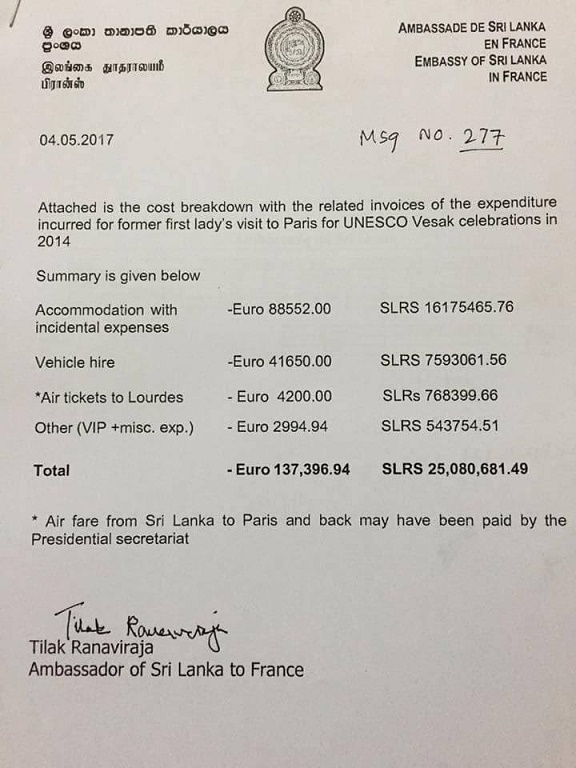
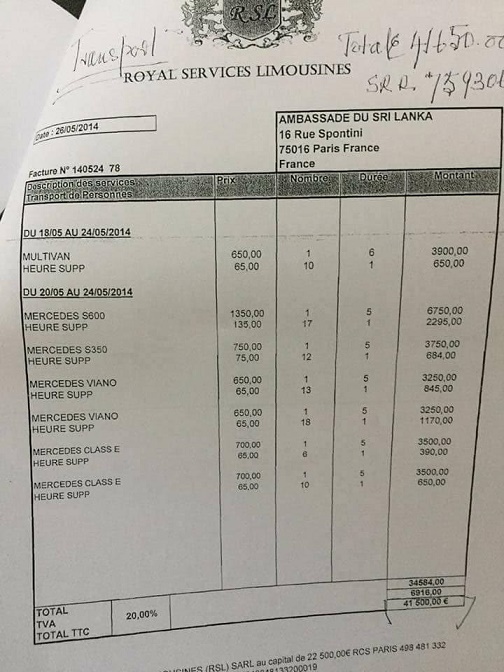
The email also carries an attachment, which is an official document issued by the Embassy of Sri Lanka in France, marked in pen as Message No. 277” with a detailed bill including hotel charges for four VIPs with a copy of the invoice from the Four Seasons Hotel, George V, Paris for accommodation and hired limousines covering four days from 20 May to 24 May 2014, for a total sum of Euro €137,396.94 (SLR   25,080,681.49), which the email highlights as all out of Sri Lankan tax payers’ money in may forms. The email carries a strong condemnation too about the officials who approved such expenses, without question or fear, for such a large sum of money to be wasted under false pretense and they too should be charged as collaborators in the theft. By doing so would be the only way to prevent government servants helping corruption it continues. Tilak Ranarajah, The Sri Lankan Ambassadors of the Embassy in France, has signed and explained in a letter dated 4 May 2017, the subject of which sates as follows:

ATTACHED IS THE COST BREAKDOWN WITH RELATED INVOICES OF THE EXPENDITURE INCURRED FOR FORMER FIRST LADY’S VISIT TO PARIS FOR UNESCO VESAK CELEBRATION IN 2014. SUMMARY IS GIVEN BELOW:

Accommodation with incidental expenses                  Euro €8852.00          SLR. 16,175,465.76

Vehicle Hire                                                               Euro €41650.00       SLR.    7,593,061.56

*Air Tickets to Lourdes                                              Euro €  4200.00        SLR     768,399.66

Other (VIP+Misc. Expenses)                                      Euro €2994.94          SLR      543,754.51

Total                                                                                  Euro €137,396.94      SLR      25,080,681.49

*The Presidential Secretariat may have paid airfare from Sri Lanka to Paris and back.


 Along with the invoice was a bill from FOUR SEASON’S HOTEL, George V, and Paris, giving the breakdown of room charges, incidentals covering for 4 VIPs for 4 days as follows:


Ambassade du Sri Lanka

NAME                                               Arrival   Dep    Room    Rate   Nights Revenue        Incidentals                                         Total        To

PR Rajapaksa Shiranthi Mrs.   20 Mai    24 Mai 101    14,500.00     4      € 58,000      € 5945.50                                              €  63945.50
Forest, Daisy  Mrs.                     20 Mai   24 Mai   103     €1350.00        4      €   5,400      €  1524.00                                             €    6924.00
De Silva P.  Lakshmi N  Mrs.     20 Mai   24 Mai   104      €1350.00       4      €   5,400      €  1986.00                                             €    7386.00
Embassy of Sri Lanka                 20 Mai   24 Mai   105     €1350.00      4       €   5400     €   4897.00                                             €   10 297.00
                                                                                                 Sub Total                € 74,200    €    14,352.50                                        €   88552.50
                                                                                                                                                                       Deposit                                 €   49200.00
                                                                                                                                                                      Total                                       €   39353.50

The email categorically states that, ultimately the tax payers had to bear all these expenses on a false pretense by the First Lady, and the officers who approved these expenses, without question or fear, should be charged as collaborators in the theft. That would be the only way to prevent government servants helping corruption”.

The email on a further emphasis states that Marie Antoinette would be so proud of our former Queen Shiranthi Rajapaksa for spending  €137K for her to celebrate Vesak in Paris”.

Queen Marie Antoinette, of course was linked with her damaged reputation further with an expensive Diamond Necklace participating in a crime to defraud the crown jewelers. This indecorous affair goes down in history as one of the noteworthy events that led to the French public’s embitterment with the monarchy, which among other causes eventually precipitated the French Revolution, akin to the political revolution that took place in January 2015 in Sri Lanka.

The citizens of this country would raise the million-dollar question as to what transformation has taken place after the unity government has been elected to power except twiddling their thumbs for two years in office. It is no wonder why the Yahapalanaya is irritating the public forums due to unfulfilled promises so far!

tilakfernando@gmail.com

Encl:  1.Communication from the High Commission in France.

  1. Four Seasons Hotel, Paris breakdown of charges. N

  1. Invoice detailing limousine hire.

“20 වන සංශෝධනය ව්‍යවස්ථා විරෝධියි“-මැතිවරණ නිරීක්ෂකයෝ එක හඩින් කියති

August 24th, 2017

මාධ්‍ය ඒකකය කැෆේ සංවිධානය 

රජය විසින් ඉදිරිපත් කර ඇති 20 වන ආණ්ඩුක්‍රම ව්‍යවස්ථා සංශෝධනය සම්පූර්ණයෙන්ම නීති විරෝධී බව මැතිවරණ නිරීක්ෂකයෝ පෙන්වා දෙති. සියලුම මැතිවරණ නිරීක්ෂන සංවිධානවල ප්‍රධානත්වයෙන් කොළඹදී අද පැවති මාධ්‍ය හමුවකදී එම සංවිධාන වල නියෝජිතයෝ මේ  බව අවධාරණය කළහ. 

කැෆේ සංවිධානයේ විධායක අධ්‍යක්ෂ කීර්ති තෙන්නකෝන්,  පැෆරල් සංවිධානයේ විධායක අධ්‍යක්ෂ රෝහණ හෙට්ටිආරච්චි, CMEV සංවිධානයේ සම්බන්ධීකාරක මංජුල ගජනායක,ට්‍රාන්ස්පේරන්සි ආයතනයේ ශෂි ද මෙල්

ජාතික මැතිවරණ නිරීක්ෂණ මධ්‍යස්ථානයේ ජාතික සංවිධායක රසාංග හරිස්චන්ද්‍ර යන මහත්ම මහත්මීන්  මෙම මාධ්‍ය හමුවට එක්ව සිටියහ.

මෙහිදී අදහස් දැක්වූ CMEV සංවිධානයේ සම්බන්ධීකාරක මංජුල ගජනායක මහතා පෙන්වා දුන්නේ  20 වන සංශෝධනයට මුවාවී මැතිවරණ කල්දමා ගැනීමේ ක්‍රයාවලියක රජය නිරත බවයි. එබැවින් මෙම 20 වන සංශෝධනය ප්‍රජාන්ත්‍රවිරෝධි ක්‍රියාවලියක් බවහ ගජනායක මහතා සඳහන් කළේය. 

ජාතික මැතිවරණ නිරීක්ෂණ මධ්‍යස්ථානයේ ජාතික සංවිධායක රසාංග හරිස්චන්ද්‍ර මහකකා මෙහිදී කියා සිටියේ රටම ලේ ගංගාවක් බවට  යළි පත් වීමේ අවධානමක් මැතිවරණ කල්දමාගැනීමේ රජයේ කූට උපාය පසුපස ඇති බවයි. මැතිවරණ කල්දැමීමෙන් වැඩිම බලපෑම එල්ල වන්නේ නැගෙනහිර පළාත් සභාවට බවත් එය සුළු ජාතින්ගේ අයිතීන් බරපතල ලෙස උල්ලංඝනය කිරීමක් බවත් හරිස්චන්ද්‍ර මහතා කියා සිටියේය.

ට්‍රාන්ස්පේරන්සි ආයතනයේ ශෂි ද මෙල් මෙහිදී පෙන්වා දුන්නේ ප්‍රජාතන්ත්‍රවාදය අගය කරන රටක ජනතාවගේ බලාපොරොත්ත 20 වන ව්‍යවස්ථා සංශෝධනය මඟින් බිදී යන බවයි. මැතිවරණයක් යනු ප්‍රජාතන්ත්‍රිය අයිතියක් බවත් එම අයිතිය පැහැරගැනීම හෙලා දැකිය යුතු බවත් ඇය පෙන්වා දුන්නාය.

පැෆරල් සංවිධානයේ විධායක අධ්‍යක්ෂ රෝහණ හෙට්ටිආරච්චි මහතා මෙම මාධ්‍ය හමුවට එක්වෙමින් කියා සිටියේ 20 වන ව්‍යාවස්ථා සංශෝධනයට එරෙහිව අධිකරණ ක්‍රියාමාර්ග ගන්නා බවයි.ප්‍රජාතන්ත්‍රවාදය පිහිටුවන බවට පොරොන්දු දුන් යහපාලන රජය ප්‍රජාතන්ත්‍ර විරෝධි ලෙස කටයතු කිරීම දැඩිව හෙළා දකින බවත් ඒ මහතා කීය. ස්වාධින කොමිෂන් සභාවල බලතල හීන කරමින් ඉදිරිපත් කර ඇති 20 වන ව්‍යවස්ථා සංශෝධනය සම්මත කර  ගැනීමට නම් ජනමත විචාරණයක් පැවැත්වීම අනිවාර්ය බවද හෙතෙම මෙහිදී පෙන්වා දුන්නේය.

මෙම මාද්‍ය හමුව ඇමතූ කැෆේ සංවිධානයේ විධායක අධ්‍යක්ෂ කීර්ති තෙන්නකෝන් මහතා අවධාරණය කළේ 2019 ඔන්තෝබර් මාසය දක්වා මැතිවරන කල් දමාගැනීමේ සැලසුමක් මෙම ව්‍යවස්ථා සංශෝධනය  පසුපස ඇති බවයි. මෙය ජනතාව සතු පරාමාධිපත්‍ය බලය උල්ලංඝනය කිරීමක් බවද  තෙන්නකෝන් මහතා පෙන්වා දුන්නේය. 20 වන ව්‍යවස්ථා සංශෝධනයේ ඇති බරපතල තත්වය පළාත් සභාවල ඒ පිළිබඳව පැවැත්වෙන ඡන්දවීමසීම් වලින් පැහැදිලි වන්නේ යැයි ද ඒ මහතා වැඩිදුරටත් පැවැසීය. මැතිවරණ නිරීක්ෂකයින්ට, දේශපාලන විශේෂඥයින්ට තබා මහජන නියෝජිතයින්ට වත් පෙර කියවා අවබෝධකරගැනීමට විධිමත් කාලයක් නොදී හදිසියේ ලහි ලහියේ 20 වන සංශෝධනය ඉදිරිපත් කිරීම තුළින්  මැතිවරණ කල්දැමීමේ රජයේ උපාය පැහැදිලි වන බව ද තෙන්නකෝන් මහතා මෙහිදී අවධාරණය කළේය.

මාධ්‍ය ඒකකය 

කැෆේ සංවිධානය 

2017 අගෝස්තු 24 

මිනිසුන් තුළින් ලෝකය දුටුවෙමි ; චානුක වත්තේගමගේ ඇසින්

August 24th, 2017

 චානුක වත්තේගම

වෛද්‍ය රුවන් එම්. ජයතුංගගේ “මිනිසුන් තුළින් ලෝකය දුටුවෙමි.” කෘතිය මා අතට පත් වන්නේ මා ප්‍රේමකීර්ති ද අල්විස් ගැන කියවමින් සිටියදීය. මේ දෙදෙනා අතර අපූරු සමානකමක් මම දකිමි. ඒ ඔවුන්ගේ ගවේෂණාත්මක නිර්මාණකරණය සම්බන්ධයෙන් පමණක් නොවේ. ප්‍රේමකීර්ති ගීත රචක මැෂිමකි. වෛද්‍ය රුවන් එම්. ජයතුංග පොත් ලියන මැෂිමකි. ප්‍රේමකීර්තිට ඕනෑම නීරස මාතෘකාවක් ඔස්සේ රසවත් අරුත්බර ගීතයක් ලියන්ට හැකියාව තිබුණේය. රුවන්ට එසේම ඕනෑම නීරස මාතෘකාවක් ඔස්සේ රසවත් අර්ථවත් එසේම කියැවියැකි පොතක් ලියන්ට හැකියාව තියේ. “මිනිසුන් තුළින් ලෝකය දුටුවෙමි.” එබඳු පොතකි.  

මේ පොත ඇසුරින් රුවන් කියන්ට උත්සාහ ගන්නේ ලොව විවිධ සංස්කෘතීන් පිළිබඳ කතාවකි. මේ සංස්කෘතීන් රුවන් දකින්නේ අජීවී සංචාරක සිහිවටන තුළින් නොව සජීවී මිනිසුන් තුළිනි. ඒ මිනිස්සු ඔහු දිවියේ යම් යම් කාල වකවානු වල හමු වූවෝය. මින් වැඩි දෙනකු රුවන්ට හමුවන්නේ ඔහු පැරැණි සෝවියට් සංගම් ශිෂ්‍යත්වයක් යටතේ රුසියාවේ වෛද්‍ය අධ්‍යාපනය ලබමින් සිටියදීය. රුසියාවේදී ඔහුට සෙනිත් කැමරාවක් විකුණන ටැක්සි රියැදුරා, “අපි උඹලාගේ රට තියෙන ඉසව්වත් දන්නෙ නැහැ. ඒත් උඹලා ෆෝක්ලන්ත යුද්ධයේදී අපට විරුද්ධව ඡන්ද දුන්නු රටක් කියලා අපේ මිනිස්සු දන්නවා” කියූ ආජෙන්ටිනා පාපන්දු ක්‍රීඩකයා, බ්‍රිතාන්‍ය අධිරාජ්‍යය සඳහා සටන් වැදුණු වෙතරණුවකු වූ ආතර් ස්මිත්, කරාතේ කළුපටි ධාරියකු වූ කම්පුචියානු සොත්තිය හාමුදුරුවෝ, අමිතාභ් බච්චන් බඳු වූ මුරිසියානුවා, කැඩුණු මෝටර් රථයක් අඩු මුදලට මිළට ගෙන එය ගත් මිළ මෙන් හත් අට ගුණයකට එස්තෝනියාවකුට විකිණූ සැම්බියානුවා මේ පොතේදී ඔබට හමුවන චරිත කිහිපයක් පමණෙකි.  

මේ තථ්‍ය කෙටිකතා එකතුවේ මා දකින විශේෂත්වය මෙයයි. දීර්ඝ කාලයක් තිස්සේ ලංකාව බ්‍රිතාන්‍ය යටත් විජිතයක්ව තිබීම නිසා හා අපේ රට විධිමත් ලෙස ගොඩ නඟන ලද්දේ බ්‍රිතාන්‍යයන් නිසා හිරු නොබසින අධිරාජ්‍යයෙන් නිදහස ලබා වසර සැත්තෑවකට පමණ පසුව අදත් අප බොහෝ දෙනකුට ලෝකය පෙනෙන්නේ බ්‍රිතාන්‍ය ඇසිනි. ලෝකයේ විවිධ සංස්කෘතීන් පිළිබඳව ‘සුද්දන්’ ගොඩ නැඟූ විවිධාකාරයේ මිථ්‍යා මත රාශියක් අදත් අපි එසේම විශ්වාස කරමු. වෛද්‍ය රුවන් එම්. ජයතුංග මේ බ්‍රිතාන්‍ය ඇසින් මිදී ලෝකයේ විවිධ සංස්කෘතීන් පියවි ඇසින් දකින්ට පාඨකයාට ආරාධනා කරයි. එහි සැඟැවීමක් හෝ අතිශයෝක්තියක් නැත. එසේම පක්ෂග්‍රාහී බවක්ද නැත. පාඨකයා මේ සියළු සංස්කෘතීන් හඳුනා ගන්නේ ඒවා සංසන්දනාත්මකව අධ්‍යයනය කිරීමෙනි. 

ලෝකයේ විවිධ සංස්කෘතීන් පිළිබඳ පළමෝත අත්දැකීම් ඇති ලේඛකයකු අතින් ලියැවුණු මේ ග්‍රන්ථය ඒවා අධ්‍යයනයෙහි රිසි කවර වයසෙක කවරාකාරයෙක හෝ පාඨකයකු පිණිස නිර්දේශ කරනු කැමැත්තෙමි. 

– චානුක වත්තේගම

YAHAPALANA ELECTIONS AND ‘REGIME CHANGE’ Part 3

August 23rd, 2017

KAMALIKA PIERIS

There is deep dissatisfaction with the Yahapalana government. People are asking what kind of change have we got, observed Sinharaja Tammita Delgoda in January 2017.  He reports the reaction of one dissatisfied voter. Sisira had been driving a bus for the last 15 years. Although he was from the deep south, he had voted against Rajapaksa in the last two elections. Now look! I wish I had never done it. Nothing is happening! Two years later they are still saying it is Mr. Mahinda’s fault. Development? What development? The only things they are doing are the things that Mahinda started,  said Sisira.

Razeen Sally, Chairman, Institute of Policy studies, compared the Rajapaksa administration and Yahapalana administration. Razeen Salley said that the former in spite of waste, corruption and irregularities at every level was able to achieve development objectives whereas the present day UNP-SLFP coalition was struggling.  Yahapalana government hadn’t been able to achieve even the basic requirements. He criticized the government heavily for the shocking state of mismanagement at every level and further rapid deterioration of the national economy for want of proper strategy.

In 2014, we had a government with one powerful head. It was doing alright as it had managed to eliminate terrorism, overcoming huge obstacles, local and foreign. A feat no other government in the world has been able to do, said N.A. de S Amaratunge.       Then    that head launched a massive development project that took the country into the fast track of growth with all economic parameters showing positive values. Roads, electricity, and water visibly reached the four corners of the country. New harbors and redundant airports were built. Employment, inflation, GDP, foreign exchange rate went down. Corruption and nepotism were rampant, but things were better than what we have now.

What do we have now, asked Amaratunge. There is rampant corruption and nepotism but no development. Earlier we had corruption and nepotism but also development. The present government has betrayed the country in co- sponsoring the UN resolution with the US. Development projects started by the earlier government have been stopped.  Ministry of Agriculture has rented a building unnecessarily for Rs 20 million, luxury vehicles for the MPs. The imperialist powers have succeeded in getting the UNP back to destabilize the country; UNP obligingly follows their dictates to the detriment of security, constitution, economy and sovereignty of the country, Amaratunge concluded.

Public animosity to Yahapalana was shown through political demonstrations. These started as mammoth ‘pro- Mahinda rallies’ drawing crowds of about 200-300 monks and about 700-800 laymen. The first was ‘Mahinda sulanga’ rally in Nugegoda in February 2015. Then came the Matara meeting of June 2015. There was much open opposition to American and Indian meddling in Sri Lanka. There was a clenched fist oath taken at this meeting to protect the nation against enemies within and without.

The Joint Opposition rally on March 17, 2016 at Hyde Park in Colombo, became a ‘bring back Mahinda rally. ‘  The audience overflowed on to the roads around and Rajapakse was given a great welcome.  The ‘bring back Mahinda’ movement as it progressed became an opposition movement which was barreling along on its own regardless of whether Mahinda was there or not, observed Chandraprema.

On May Day 2016 the biggest May Day rally was at Kirulapone. The entire High Level Road, all four lanes from near the Kirulapone public market to and beyond the Y junction was one sea of heads and so tightly packed that no one could get through, said Chandraprema. The   crowd has accumulated up to Baseline road.  All four lanes of Baseline road was also a sea of heads.  This was the biggest crowd ever to assemble at a political rally anywhere in Colombo within living memory, Chandraprema concluded.

The Joint Opposition’s Pada Yatra from Kandy to Colombo,    from      28 July to 1 August 2016 made political history. The country has not seen anything like this before, reported Island. The march attracted massive numbers. It could not have been any bigger given the population of the country. People walked distances that nobody would walk in normal circumstances. It is a grueling and exhausting form of protest but the crowd that participated was larger than at most political meetings.  There were more than 1.5 million participants in the Pada Yatra said observers.  Many Muslims were seen in the march flowing into Colombo. They joined the Pada Yatra from Kegalle, Mawanella and Thihariya.

At Kiribathgoda, on the last day, police had cleared three lanes. People were walking 25-30 abreast from pavement to the centre fence and the entire road was full of them. It took an hour for the procession to pass one point. The pavements and the balconies of houses had supporters, waving away. Others had prepared refreshments for the participants and were busy serving them.  Rajapakse could be seen waving to his supporters in a regal manner. He had to. They were directly cheering him, not simply urging on a procession. Both at Kandy and at Kiribathgoda, there was a mass of protesters who were assembled ahead and they joined the procession on their own and went ahead of the pilot vehicles.

There were academics  medical specialists, trade unionists, farmers, workers, teachers and artistes in the procession. The whole of Lipton Circus was one sea of heads.  There were about 50,000 to 60,000 which is politically significant said Kumar David. While Rajapaksa was speaking at Lipton Circus, the crowd also was yelling on its own, about VAT, ECTA, cost of living.  They were not quietly listening to Rajapakse and applauding, as audiences are expected to do. They were   protesting on their own. That was what they had come to do, not to listen to speeches.  This, I think, is something new in the local rallies. When Rajapaksa asked who is benefiting from the paddy issue, the crowd shouted ‘Araliya’ the brand name of a rice miller in Polonnaruwa who   has links with the government.

The crowd at the Joint Opposition rally held in Nugegoda in January 2017 was huge. The fact that there was such a turnout despite overcast skies the whole day and torrential rains in many parts of the country was telling, said Chandraprema. The large crowd at Nugegoda showed the unpopularity of the present government.  Unlike at previous such meetings that this writer has observed, continued Chandraprema, this was an uncommunicative and almost unfriendly crowd. Attempts to engage people in conversation elicited only grunts and monosyllables. Everybody wanted to listen to the speeches that were being made even though nothing new was being said.

At previous meetings, people did not seem to have come to listen to speeches but to express solidarity with a cause. But this time, people were very serious, with hardly a smile on their faces. They were listening to the speeches as if their lives depended on it. A request to raise their hands and cheer elicited a single minded response even from the fringes of the crowd on the Nawala and Pagoda Roads with people lustily bellowing their allegiance to the cause. Each person seemed to be bound to the stage, not to his fellows around him.

Then came the pro-Rajapakse May Day rally of 2017 on Galle Face Green. This rally was larger than anything seen before. The crowd was well over 100,000. It is possible that Galle Face was given as venue to Rajapakse on the instructions of the west, as the west wished to see the true support for the Joint Opposition and Rajapakse.

What we saw on May Day, 2017 was a phenomenon that no one has ever seen in this country, said Chandraprema. The Galle Face green, the broad walkway on the seaside and the main road were just one sea of heads from the Galle Face Hotel to the Bandaranaike statue on the other side of the esplanade and beyond, said Chandraprema. There were people lining the road up to the roundabout near the Kingsbury and Galadari hotels. The crowds had come in private coaches and smaller vehicles since state run buses were not given to them. There was a broad cross section of society, including professionals, doctors, engineers, lawyers, accountants   Many of the protesters feel that they brought this on themselves by voting for this government, observed Chandraprema.

The parallel UNP May Day rally in Campbell Park, had turnout of 45,000 whilst at the Getambe   Yahapalana rally the turnout was around 40,000. This means that the crowds at Galle Face Green were more than both the UNP and the pro-Maithripala SLFP crowds put together. the Getambe rally had the usual long faces, unlike the enthusiastic crowd at Rajapakse rally.

That the large turnout at the Galle Face Green last Monday has come as a wakeup call to the Government is in no doubt. There is also little doubt, judging by their reactions, that both the SLFP and the UNP are shaken by the developments, reported Sunday Times. Yahapalana accepted that the rally showed that there is anti-Government feeling in the country, noted Chandraprema. The fact that they were able to muster a vast crowd and have a good media strategy makes them a force to reckon with. it demonstrated the anti-Government feeling in the country” It shows that people were fed up with this Government which has imposed great hardships on them.

An organized opposition to Yahapalana is starting. ‘Political watch’ observed in June 2016 that an  opposition force which does not even have a name is gaining ground while the JVP, UNP and the Sirisena controlled SLFP are losing ground. This opposition is coming in from two opposite sides, political and non-political.

The political dimension is seen in the Sri Lanka Podujana Party formed to contest future elections. This party is just a year old, yet they have already broken all records as a crowd puller, not once but on multiple occasions, in different locations, said Chandraprema. Galle Face May day rally being the most impressive show of strength yet. Podujana activists are holding meetings in different parts of the island. Ada Derana news of 22.7.17 and 23.7.17 showed two such meetings. the first Podujana outstation branch was in Ratnapura. The entire political future of this country is being determined by a political force that has taken shape outside the main political parties of the country said Chandraprema.

There are ‘non-political’ movements too. A centre called National Assets Protecting Centre was started at Abhayarama, Narahenpita in February, 2017, by the Joint Opposition. Setting up a centre and creating a movement to protect public assets at this moment is the need of the hour as the government has lined up several state ventures to sell or privatize, the Opposition said.

‘Viyathmaga’ is a network of academics, professionals, and entrepreneurs who love this country and wish to contribute actively towards its development. Viyathmaga said it was a civil society movement, not a political organization.  It has members of all communities.   Viyathmaga calls on professionals, academics, intellectuals and entrepreneurs to join them and become a force that guides the country, irrespective of party politics.

We formed Viyathmaga because our highly-talented professionals, academics and entrepreneurs lack the opportunity to speak out, said Dr. Nalaka Godahewa, former Chairman of the Securities and Exchange Commission. If the present government overlooks our views, we will contribute our expertise to the next government. Viyathmaga is growing into a forceful professional body today, he concluded.

Other professionals agreed. We doctors are ready to share our expertise, but we don’t get the opportunity, said ENT Surgeon Arambepola.  Viyathmaga has opened the door for us. Viyathmaga has   held a series of successful conferences in Anuradhapura, Kurunegala, Kandy, Galle, Matara and Kuliyapitiya in 2016. Viyathmaga has branches in Italy and Switzerland.

Viyathmaga, as one would expect, deals in hard facts. FCID could be established only on an order from the Defence Minister, who is also the President of the country. The IGP has no authority to create the FCID, said lawyer Dolawatta . A Viyathmaga publication written by Prof Janitha Liyanage, S.R.D. Rosa, Raja Guneratne, Jayampathi Molligoda and Shermila Rajapakse  has a detailed analysis of Yahapalana economics.[i]

We have seen the 2017 budget, said Viyathmaga in its home page. Telecommunication is now one of the highest taxed industries. There is 25% Telecommunication Levy 3% NBT 2% Cess 4% NBT 15% VAT 2016. International Telecommunication Operator Levy (ITOL) has increased from USD Cents 9 to USD Cents 12 and total increase is to be credited to the Consolidated Fund.

Viyathmaga strongly supports Mahinda Rajapakse. Viyathmaga publication ‘Conflict and Stability’ drew attention to several anti-Mahinda actions of the Yahapalana government .These included the removal of information on development activities during the period 2009 – 2015 in some ministry websites, removal of plaques which recorded the work of the  Rajapaksa government ,   taking   credit for development activity commenced by the previous Government, adopting a relentless propaganda campaign against the former President Mahinda Rajapaksa and his family with ‘unfounded and exaggerated allegations of corruption and misgovernment as a part of a strategic plan to undermine the popularity of the former President’. [ii]


Viyathmaga emphasizes the need for strong leadership. Kamil Hussein,   President of the Tiles and Sanitary-ware Importers Association, said financial giants like Shangri-La came into Sri Lanka due to presence of a strong leadership. They invested in Sri Lanka because of the confidence they had in the political leadership. He said the country needed a strong leadership, which could take effective and timely decisions and also has the vision and passion to build investor confidence. [1] We need a strong leader, who is able to take correct decisions, listen to experts and implement their ideas, agreed Arambepola.

‘Viyath Maga’ annual convention was held at the Golden Rose in Boralesgamuwa in March 2017. This was not open to the public and was not advertised on Facebook or on any of the websites or the mainline media. It was just representatives of the membership of the organization which was started barely a year ago, reported Chandraprema. Usually an AGM of an organization is followed by a relaxed dinner where people listen to speeches, sitting around dinner tables. This however was different. The Viyath Maga AGM resembled a Nugegoda rally inside a ballroom. The enormous ballroom was packed wall to wall with row upon row of chairs and it was filled to capacity with standing room only. The corridors and walkways were also full, approximating an audience of about 2,000,  added another commentator.

The audience consisted predominantly of young professionals, academics and businessmen, both male and female.  The attendance records  showed that there were 185 doctors, 103 lawyers, 47 engineers, 46 accountants and 57 university academics, not to mention the other categories such corporate executives, artists, marketers, IT professionals, architects, journalists, hoteliers, businessmen, school teachers and principals etcetera  who attended in large numbers.

The excitement amongst the crowd was electrifying and the deliveries of the speakers were excellent. The key message of the Viyath Maga Convention was that the professionals of this country should play a more active role in planning and implementing the national policies. This was highlighted by speaker after speaker and finally endorsed even by the chief guest of the event.  This shows that Viyath Maga has made an impact on the public mindset within a short period of time, providing independent professional input towards the much-needed political, sociological and economic policy formulation.  The fact that they have come so far in such a short time, is a sign of the times.  The impact and landmark nature of the Viyath Maga annual convention is discernible in the coverage given to it in the media, said Dayan Jayatilleke.

Mahinda Rajapaksa, Gotabhaya Rajapaksa, Basil Rajapaksa Prof. G.L. Peiris, Vasudeva Nanayakkara, Gamini Lokuge, Pavitra Wanniarachchi, Udaya Gammanpila, Ajith Nivard Cabraal, Rear Admiral Mohan Wijewickrema and Maj. Gen. G. A. Chandrasiri were present at the Convention. ( continued)


[i]  The authors say that the   Sirisena- Wickremesinghe administration has caused massive economic turmoil. They have listed 12 causes of the current economic downturn. They say the previous government had been successful in sustained fiscal consolidation during 2010-2014 period. They faulted the present government for the alarming increase in local and foreign borrowing, approximately USD3.1 million had been borrowed through Sri Lanka development bonds from March 2015- May 2015 whereas only USD 1.500 had been borrowed between 2011 and 2014. Yahapalana has caused massive crisis while accusing the previous government of  manipulating the data. The Super Gains tax imposed by the present government had caused grave concerns among major private sector investors, leading to a crisis in the stock market. The 100 day administration had wasted foreign reserved in the run-up to August general elections thereby transforming a healthy BOP balance of payments surplus of USD1.3 million in 2014 to a deficit of USD 1.489 in 2015. The government had also failed to profit from the plummeting price of  crude oil. [i] ( Island 15.8.16 p 3 )


[ii] The primary reason for the writers to embarking presenting this document, said the text,  was to give a clear account to the public and the international community who could have been misled, of the actual security and economic situation that prevailed in the Northern and Eastern Provinces at the commencement of presidency of President Rajapaksa in November 2005 and to describe the dedication and dynamism displayed by him and his Government to usher in peace and stability. In addition this document showcases and enlightens the reader the unprecedented development which took place post-conflict in the Northern and the Eastern Provinces with massive funds pledged and expended towards this goal. It also highlights the strategies adopted in eliminating and reducing the distrust between communities as normally experienced in societies emerging from a long drawn conflict and the process adopted by the Government to transform the lives of majority of the people living in Northern and Eastern Provinces to what it is today from virtually nothing.


The Ongoing Constitution-Making Process in Sri Lanka:  An Inquiry into its Legality

August 23rd, 2017

Dharshan Weerasekera, Attorney-at-Law

[Author’s Note:  A version of the present paper has been handed over to the President of the Human Rights Council]

In September 2015, the United Nations Human Rights Council adopted resolution 30/1 on Sri Lanka which called among other things for constitutional reform in this country.  The following remarks by the UN High Commissioner for Human Rights in his update to the Council in June 2016, summarizes the background, main provisions and intention behind the resolution:

Building on the recommendations made in the High Commissioner’s report based on the OHCHR investigation, Resolution 30/1 sets out a comprehensive package of judicial and non-judicial measures necessary to advance accountability and reconciliation in Sri Lanka as well as to strengthen protection of human rights, democracy and the rule of law.  The resolution represents a historic commitment by the Government of Sri Lanka not only to the international community, but also most importantly to the Sri Lankan people, of its determination to confront the past and end corrosive decades of impunity, serve justice, achieve reconciliation, and build inclusive institutions to prevent the recurrence of violations in the future.[1]

On 9th March 2016, the Parliament of Sri Lanka formally initiated a constitution-making process in line with resolution 30/1.  That process is now at an advanced stage:  all that remains is for the ‘Constitutional Steering Committee’ to submit its final report to Parliament, and if it is approved, to draft a Constitutional proposal.  The international community, particularly the High Commissioner, has commended what has transpired so far.[2]

Normally, on account of Article 2(7) of the UN Charter, the UN and its subsidiary organs are prohibited from interfering in the internal affairs of nations.   Therefore, it is important for the international community to know if there is any reason that the present constitution-making process will lead to harm instead of good for Sri Lankans, because the international community will be morally and legally responsible for such harm if it were to occur.  .

The purpose of this paper is to argue that the ongoing constitution-making process is illegal.  My argument is briefly as follows.

The Framework Resolution of 9th March 2016, which officially launched the present process, begins with the preambular statement:  Whereas there is broad agreement among the People of Sri Lanka that it is necessary to enact a Constitution for Sri Lanka.”[3]

Furthermore, Parliament cites Article 75 of the Constitution as the sole legal basis for bringing the Framework Resolution.[4]  Article 75 confers wide powers on Parliament to ‘pass laws’ and that includes the power to amend or repeal the Constitution.

The issue is not whether there is broad agreement among the People that amendments or a new Constitution are needed, but whether there is agreement that the present Parliament ought to bring the said amendments or new Constitution.

Under Article 82(5) of our Constitution, a 2/3 majority in Parliament is sufficient to initiate constitutional changes.  However, the 2/3 majority that was cobbled together to initiate the present constitution-making process is the result of the forming of a ‘National Government,’ the first time such an entity has been formed in the Parliamentary history of this country.

The National Government consists of the UNP[5] that won the 2015 Parliamentary Elections plus about 45 MP’s from the SLFP[6].  The SLFP contested under UPFA[7] banner, and the UPFA won 95 seats at the said elections.

In my view, because of the way that the National Government was formed, circumstances that I shall explain in more detail later, there is a question over the legitimacy of the said entity.  Therefore, there is a question over whether Parliament as constituted by the Framework Resolution into a Constitutional Assembly’ has the requisite mandate from the people to initiate a constitution-making process.

Under the circumstances, the crucial question is, Can Article 75 of the Constitution be interpreted as covering a situation such as the one under which Parliament launched the present constitution-making process?”  I argue that it cannot, because of the irreparable harm caused to the People if Parliament presumes to change the Constitution without a mandate to bring such changes directly from the People.

The paper is divided into 3  parts.  In Part One I provide a brief account of the events leading to the forming of the National Government.  In Part Two, I explain why the present Parliament does not have a mandate to bring constitutional changes.

In Part Three, I discuss the ambit of Articles 75 and 82(5), and draw out the implications of this to the legality of the ‘Framework Resolution,’ and thereby to the constitution-making process as such.

The paper is intended primarily for a Sri Lankan audience, to encourage a richer and more substantive discussion of constitutional reform in this country, but is relevant for international readers also.  It is my hope that information contained in this paper will lead international readers to do what they can to urge the UN and especially the UNHRC to reassess resolution 30/1, because of the ramifications in respect of Article 2(7) of the UN Charter mentioned earlier.

Part One:  A brief account of the events leading to the forming of the National Government

On 8th January 2015, Maithripala Sirisena defeated Mahinda Rakapaksa to become President of Sri Lanka.  Sirisena ran as the ‘Common Candidate’ of a coalition of parties including the UNP, the TNA, the Muslim Congress, and a number of others.  Rajapaksa contested under the UPFA banner.

Sirisena campaigned on a promise to restore democracy, good governance and the rule of law, and this included an explicit promise to bring sweeping legislative and constitutional changes.[8] He won by 51% of the vote to Rajapaksa’s 47.8%, with 81.52% of eligible voters voting.[9]

While Sirisena got a certain portion of votes from the majority-community, the Sinhala-Buddhists, a more significant factor in his victory was the fact that the minorities voted en mass for him.[10]  In contrast, Rajapaksa’s primary source of support was the Sinhala Buddhist vote, of which he got 58.26%.[11]

As I mentioned earlier, Rajapaksa contested on the UPFA ticket.  The main constituent of the UPFA is the SLFP, of which Rajapaksa at the time was the Chairman.  Sirisena, though he ran against the UPFA (and therefore also the SLFP) was a SLFP’er and in fact the Secretary of that party before he joined the anti-UPFA coalition in order to contest the elections.

After the election, by asserting a certain provision in the SLFP Constitution that says that if a member of the SLFP were to become President of the country such member also automatically becomes the Chairman of the party, Mr. Sirisena took over as Chairman of the SLFP, and proceeded to assert control over that party.  By a similar maneuver, he became Chairman of the UPFA also.

We must now turn to the Parliamentary elections, announced in May and held in August.  For these elections, the parties that backed Sirisena at the Presidential elections were contesting separately.  The UPFA (and this included the SLFP) was contesting as a coalition.

By May, rank-and-file SLFP’ers had come to dislike if not detest Sirisena, because they saw him as a person who had ‘betrayed’ the Party.  Meantime, Rajapaksa’s popularity among rank-and-file SLFP’ers had not waned and in fact appeared to be increasing since his fall in January.[12]

In May, conventional wisdom was that the UPFA could not win if Rajapaksa did not lead the campaign.[13]  Not surprisingly, therefore, Sirisena allowed Rajapaksa to contest under the UPFA banner, but he (Sirisena) made it known that he wanted Rajapaksa to lose.[14]

And so the campaign started, a campaign characterized more than anything by UPFA candidates trying to outdo one another distancing themselves from Sirisena, and associating themselves with Rajapaksa.  And in fact, at the elections, a number of candidates who had persisted in associating themselves with Sirisena were rejected by the voters, precisely for that reason.[15]

The results of the elections were as follows:  The UNP led by Ranil Wickremasinghe won 93 seats (plus 13 National List seats gave it a total of 106 seats), the UPFA led by Rajapaksa won 82 seats (plus 12 National List seats the total became 95), the TNA won 14 seats (with 2 National List seats their total became 16), and the Muslims 1.[16]  The 95 seats secured by the UPFA gave it the potential to form a powerful opposition.

At that point, Sirisena did the following.  Asserting his powers as Chairman of the SLFP, he had a number of his henchmen, including certain UPFA candidates who had been rejected by the voters at the elections that had just been concluded, appointed to Parliament through the National List.[17]

(The Sri Lanka Constitution reserves 29 seats for the National List, which was originally envisioned as a means of bringing to Parliament persons of eminence and proven competence who for whatever reason may not be inclined to contest elections, but whose services would enhance the work of Parliament and thereby also benefit the country.  The seats are allotted to the parties in proportion to their share of the national vote.)

To repeat, Sirisena availed himself of the above facility to appoint a number of his favorites to Parliament, which meant that, out of the SLFP group in Parliament, the number loyal to him increased, thus giving him more control over that group.  In this situation, he got about 45 or so SLFP MP’s (all of whom were offered Ministerial portfolios including cabinet positions along with all accompanying perks) to join the UNP and form a so-called ‘National Government.’

It should be noted that, prior to the election, the UPFA published its manifesto and nowhere in that manifesto did it say that if the UPFA failed to win a majority of seats in Parliament, its MP’s reserved the right to join the party that won the majority of seats and form a ‘National Government.’[18]

Thus, the ‘National Government’ came into being, the net result of which was:  once the 45 or so SLFP’ers joined the UNP, the UNP (which already had 106 seats,) acquired an overwhelming majority in Parliament.  They got within about 4 seats of a 2/3 majority in Parliament (and they can easily get those four seats from the JVP or one of the minority Parties if and when they want it).  With a 2/3 majority in Parliament, the Government can do almost anything it wants.

In short, a situation has been created where the UNP is able to pursue its policies, agendas and programs in a way and to an extent it simply would not have been able to do if the UNPFA, with its original strength of 95 seats, had functioned as an official Opposition.

There is a final ingredient in this story.  The UPFA MP’s who did not join the government formed themselves into something called the ‘Joint Opposition’ (JO) to defend what were considered to be Sinhala Buddhist interests.

Part Two:  Does the present Parliament have a mandate to bring constitutional changes? 

In my view, the answer to the above question is in the negative, because the 45 or so SLFP  MP’s who joined the UNP to form the ‘National Government,’ did not have a mandate from their voters to do so.  My argument is based on the following three considerations.

First, the contents of the UPFA elections manifesto; second, reasonable inferences that can be drawn from the circumstances surrounding the run-up to the elections as to what UPFA voters expected of their candidates; and finally, reasonable inferences that can be drawn from the fact that at present the Government is to postponing local government elections indefinitely.  I shall take each of these in turn.

With respect to the manifesto, my argument is this.  For the act of voting to have any meaning, one must suppose that voters must have the assurance that if they vote for a particular candidate, say candidate ‘X,’ and ‘X’ says before the elections that if elected he will do such and such things, then if he is elected he will do what he said and not something entirely different.

As I pointed out earlier, the UPFA manifesto for the 2015 Parliamentary Elections did not state anywhere that in the event the UPFA lost, UPFA candidates reserved the right to join their rivals in the UNP or other winning Party and carry on a common legislative program that would include bringing constitutional amendments.  I take as self-evident that an elections manifesto is the best documentary means through which voters for any particular Party can know what their candidates stand for.

Therefore, prima facie, UPFA voters could not have intended their candidates, in the event they lost, to join with the UNP or any other winning party and carry on a common legislative program including constitutional changes.   However, it is true that just because the UPFA manifesto does not state anything about UPFA candidates reserving a right to carry on a common legislative program with other Parties, it doesn’t mean that UPFA voters would have necessarily disapproved of what their candidates did.

One must therefore probe a little more into what may have been the real intentions or expectations of UPFA voters before the elections.  For that purpose, I shall turn to the two factors mentioned earlier.  I shall first turn to the circumstances surrounding the run-up to the elections (circumstances I have discussed in Part One of this essay) in order to draw certain reasonable inferences as to the possible mind-frame of UPFA voters going into the said elections.

Recall that, Mr. Rajapaksa led the UPFA election campaign, and Mr. Sirisena had been forced to permit this because of Rajapaksa’s enormous popularity among UPFA voters.  Therefore, it is reasonable to suppose that a UPFA voter’s vote at the 2015 Parliamentary elections was really a vote for Rajapaksa – or at any rate policies and programs associated with Rajapaksa – than policies and programs associated with Sirisena.

The above supposition gains further support from the fact that after the elections Sirisena was forced to bring in a number of MP’s through the National List in order to increase the number of UPFA MP’s in his camp.  It is significant that, a number of MP’s thus brought in had been voted out at the elections, precisely because UPFA voters had seen them as being loyal to Sirisena.

Finally, I shall turn to the fact that the Government keeps postponing local government elections.  The term of local government councils is four years, and the last local government elections were held in 2011.  So, elections were due in 2015.  They have not been held since then, and the Government has been forced to resort to various tactics in order to keep postponing elections indefinitely.

One such tactic is to claim that elections could only be held after the new Delimitation Report is filed, a seemingly reasonable pretext.  However, the lengths to which the Government has gone in order to maintain this pretext is now generally recognized by most Sri Lankans as bordering on the comic.

To convey something of the general opinion in the country as to the real reasons behind the postponement of LG elections, and also the Delimitation Committee report saga, I present below three quotes from newspapers and other relevant sources.  The first is from an editorial in The Island, one of Sri Lanka’s leading English newspapers, the second from CAFFE[19], a respected elections-monitoring group, and third from a published interview with the Chairman of the Delimitation Commission.

The following is the quote from The Island editorial:

President Maithripala Sirisena not only accepted but also praised the original report submitted by the delimitation Committee headed by Jayalath Dissanayake.  It was duly ratified by Parliament and signed by Speaker Karu Jayasuriya.  But, the government made a volte-face as it was looking for an excuse to postpone the local government polls which it was not ready to face.  It appointed the Asoka Peiris committee to review the Jayalath committee report obviously in a bid to delay the mini polls in the hope that it would be able to get its act together in time for the next electoral contest.  But, its plans have manifestly gone awry and it is scared of an election owing to several factors such as the ignominious defeats its constituents have suffered at the first round of co-operative society elections, over rising cost of living, mega rackets like the central bank bond scandal, unfulfilled pre-election pledges, rampant corruption, the absence of development drive and the not-so-cold war within the ruling coalition between the UNP and the SLFP.[20]

The following, meanwhile, is the quote from CAFFE:

Although the Committee was to hand over its report to the Minister of Local Government and Provincial Councils yesterday (27) [27th December 2016] it has not handed over the report stating that they still need to finalize translating the document to all three languages.  The Committee initially said that they will hand over the report on March 2016 but it continuously extended the deadline stating various reasons.  Chairman of the Committee Asoka Peiris once said that they were given an extension even without them requesting for such an extension adding the report can be presented by 30th November.  However a few days later he stated that the report can be only handed over on the 15th December and the Minister of Local Government and Provincial Councils said that if he receives the document on 15th December he will gazette it on the 16th.  But as usual the deadline was extended again and the Committee was to hand over the report yesterday but the report was not handed over.  CAFFE believes that the Committee has come under the influence of a powerful force that wants to delay the election to fulfill narrow political agendas.’[21]

Finally, the following is a portion of an interview with Mr. Asoka Peiris the Chairman of the Delimitation Committee published in the Daily Mirror on 4th January 2017.

Q:  ‘Could you explain to us the present status of the Delimitation Report?’

A:  The Committee had taken a decision to hand over the report the Delimitation Committee report on December 27, 2016.  Though it was not a constitutional requirement we felt that it was getting dragged on.  I with my experience in a government department, we know that the date for an election is decided early, and we strive together to hold the election.  Following the same procedure, we handed over the report on the above date.  There are three sections to this report.  One about the changes to the electorates and our comments, second the gazette notification showing the composition of the electorate, and third the relevant map which refers to the gazette.  We finalized all these, including the criteria of delimitation.  But in accordance with the State language policy this had to be translated into the Tamil and English languages.  It was apparent that certain individuals were keen on delaying this.

Q:  ‘Who is keen on delaying this?’

A:  ‘The Ministry or better to say the government.  Both the main parties in the government are keen to delay this.’

Q:  ‘What do you think is the main reason for these groups to delay this?’

A: ‘There is a political need.  It is very clear but it does not apply to us.  Due to an administrative issue, the Tamil translations were not available in five districts up to December 27.  This has happened in the most essential districts such as Jaffna, Kilinochchi, Mannar, Mullatitivu and Vavuniya.  Without Tamil translations, introducing the report was very unjustifiable.  We had only two translators and that was inadequate.  These facilities were to be provided by the Ministry of Local Government and Provincial Councils.  I am not leveling allegations but the Ministry failed to provide these facilities well in time.  I made a request about two months ago for additional translators since two were inadequate.  As we failed to get the two translators whom I knew personally were attached to the Ministry of Lands were taken by us for this job.  Even after acting in this manner, and if someone is trying to delay it, it is an act against the people of this country.’[22]

Anyone with an ounce of common sense can gather from the above quotes that the Government does not want to have elections because it is afraid of losing very badly at those elections.  The question is, from this state of affairs, can we infer anything about the possible mandate that UPFA voters may have given their candidates at last year’s Parliamentary Elections?  I believe we can.

Mr. Sirisena as President is the head of the government, and he can order the LG Polls to be held post haste if he so wished.  So, regardless of who else in the government may not want the polls to be held, it is impossible not to conclude that, in the final analysis, Sirisena himself is either directly or indirectly for the delays, i.e. it is being done with his knowledge and consent.

But, why would Sirisena be afraid of elections?  As the editorial in The Island quoted earlier makes clear, the country is in a bad way, with rampant corruption, soaring cost of living, and so on.  So, this is a perfect opportunity for Sirisena to advance his Party.  It is not in dispute that, between the UNP and SLFP faction in the Government, the UNP is the predominant partner:  the UNP after all has 106 seats in Parliament.

No SLFP voter will vote for the UNP, especially if the country is in as bad a shape as suggested by The Island’s editorial.  Is it possible that Sirisena fears that SLFP voters will abandon their party because the SLFP (at least Sirisena’s faction) has been cooperating with the government?

In my view, it is unreasonable to suppose so, because Sirisena’s faction can make the excuse that, it is the UNP that is responsible for the various disasters, and they (i.e. Sirisena’s SLFP’ers) have been out-voted when they have tried to prevent the disasters in question.  Besides, they can ask the SLFP voter, If you leave us, where would you go?  The UNP?”

Therefore, if Sirisena is afraid of facing elections, it is because he knows that SLFP voters will go somewhere other than the UNP.  But, where could they go?  Clearly, to Rajapaksa, or some other SLFP’er with the requisite credentials.


So, Sirisena’s fear is that the SLFP voter will turn to Rajapaksa, or at any rate some SLFP’er other than Sirisena, at a future election.  But, why would Sirisena have this fear if just a year-and-a-half ago those voters voted wholeheartedly for a Party that he headed?

The natural inference that flows from the above is that, Sirisena’s fear stems from the knowledge that the vast majority of SLFP voters voted at the 2015 Parliamentary elections not because of Sirisena’s association with the SLFP, but in spite of it:  in other words, because of their loyalty to Rajapaksa.  (It should be noted that, Rajapaksa was the de facto Prime Ministerial candidate of the UPFA, until Sirisena wrenched that option away at the last moment.)

To put it another way, Sirisena’s fear stems from his knowledge that nothing he has done since August 2015 has made SLFP voters change their opinion of him:  i.e. they loath him just as much today they did in August 2015, perhaps more.  The only reasonable inference possible from this situation is that SLFP voters could not and would not have endorsed 45 of their MP’s joining the UNP, at Sirisena’s behest.

The sum of the above considerations is that, it cannot be said by any stretch of the imagination that the 45 or so SLFP MP’s who joined the UNP to form the ‘National Government had a mandate to do such a thing.  Hence, the present Parliament does not have a mandate to bring constitutional changes.

A critic, however, can raise the following objection at this stage:  Even if everything you say is true, all that it proves is that the present Parliament does not have the moral right to bring constitutional changes.  Unfortunately, what is moral and what is lawful can sometimes be different.  In order for the present constitution-making process to be considered illegal, one has to make an argument with reference to the relevant constitutional provisions, in this case Articles 75 and 52(5).”

It is a fair objection.  I shall proceed to my argument with respect to the aforesaid provisions.

Part Three:  The ambit of Articles 75 and 82(5) and whether the present constitution-making process can be justified under those Articles.

Recall that, Article 75 is the sole legal authority that Parliament cites for the Framework Resolution.  It is not in dispute that Article 75 gives Parliament wide powers to make laws” and that includes the power to amend or repeal the Constitution.  Meanwhile, Article 82(5) of the Constitution states inter alia:

A Bill for the Amendment of any provision of the Constitution or for the repeal and replacement of the Constitution, shall become law is the number if the votes cast in favor thereof amounts to not less than two-thirds of the whole number of Members (including those not present[23]


The question is, Can Article 75 be interpreted as covering a situation such as the one under which the present constitution-making process was initiated?”  In my view it cannot, because of the following reasons.

It is well-established in Sri Lankan constitutional jurisprudence that when Parliament exercises legislative power it exercises a delegated power, delegated to it by the People.  As such, when Parliament exercises legislative power it does so in trust for the People.  (Vide 19th Amendment to the Constitution, 2002, 3 SLR 85)

Therefore, the relationship between voters and their MP’s envisioned by our Constitution is basically that of a fiduciary relationship, which means that the principles associated with such relationships necessarily apply here.  One of the key principles that underpins fiduciary relationships is that of loyalty, i.e. the trustee must administer the trust solely in the interest of the beneficiary.  For instance, some experts have said:

The essence of fiduciary duty requires the trustee to be always promoting the beneficiary’s interests.[24]

To put it in layman’s terms, under our Constitution – as is the case with most representative democracies – elected officials have a duty to actually represent their constituency.

It is now clear that, at the time Parliament adopted the Framework Resolution, there were at least 45 MP’s within its ranks who were actively violating their fundamental obligation to their voters.  Therefore, what the Framework Resolution has done is to permit Parliament to hide the aforesaid fact and set in motion a constitution-making process which would not have been possible under normal circumstances, i.e. if the wishes of UPFA voters who voted at the 2015 parliamentary Elections had been honored.

I concede that, in a representative democracy, a certain leeway and freedom of action is allowed to the representatives of the people, during national emergencies such as natural disasters or foreign invasions, to act according to their conscience and what they consider to be the best interests of the country, even if such actions are against the wishes of their particular voters.

I am willing to concede further that, the aforesaid discretion can be extended to  occasions where there is a need to break a stalemate or deadlock in Parliament over an issue of national importance, if a representative sincerely believes it is in the interests of his or her voters.

However, one cannot by any stretch of the imagination suppose that the aforesaid discretion extends to permit representatives of the people to do whatever they want, including to bring constitutional changes, against the wishes of their voters, while denying to those voters the protections available to them under the Constitution itself.

The Constitution does not privilege Article 75 over other Articles.  For instance, it does not preface Article 75 by saying something like, Notwithstanding anything contained in other provisions of the Constitution, Article 75 empowers Parliament to pass laws, etc.”  Therefore, Article 75 must be read in the context of the other provisions of the Constitution, which necessarily includes the safeguards both expressed and implied in those provisions.

Under the circumstances, the crucial question is, In initiating the present constitution-making process under the Framework resolution, has Parliament denied to the people rights or safeguards they have under other provisions of the Constitution, and if so, what safeguards?”

I shall now discuss three safeguards found in the prescribed amending procedure set out in the Constitution (i.e. Chapter 12 which includes Article 82(5)) and the irreparable harm caused to the People as a result of Parliament deviating from that procedure.  For convenience, I shall discuss general reasons first, and then turn to the specific ones.

First, as a general matter, under the prescribed procedure, there are two safeguards for the People when it comes to constitutional changes:  one, there has to be a 2/3 majority in Parliament in order to bring such changes; and two, for entrenched provisions (i.e. Articles 1, 2, 3, 6, 7, 8, 9, 10 and 11), there has to be a 2/3 majority plus a referendum.

However, to win a referendum, the Government only needs to get 50% + 1 of the valid votes cast at such referendum.  Therefore, if a large segment of the population, say, as high as 45% oppose a particular constitutional change for whatever reason, but the Government can generate 2/3 support for that change within Parliament, the change can be made.  So, the one and only chance the aforesaid voters have to block the changes in question is in Parliament.

Suppose for a moment that a large segment of the population, say 45% or something close, have the requisite number of representatives in Parliament to prevent the forming of a 2/3 majority, but a portion of those representatives choose to join the Government in order to give it a 2/3 majority, and help push though a particular constitutional change.

In that event, the voters ‘betrayed’ by their representatives lose their only real chance to protect their interests.  The UPFA voters who voted at the 2015 parliamentary Elections have now suffered such harm.

Second, under our Constitution, all laws other than constitutional amendments can be repealed by a simple majority. So, voters whose wishes are contravened when their MP’s participate in passing such a law – – and this includes laws (other than constitutional amendments ) that require a 2/3 majority in order to pass – have a chance later on to bring pressure on those MP’s to join with other in Parliament and repeal the law in question by a simple majority.

In the event that the MP’s fail to take action, the voters can always elect different MP’s at the next elections and get the impugned law repealed.  Either way, for any law other than a constitutional amendment, the voters who are ‘betrayed’ when their MP’s participate in enacting such a law, have a chance to hold those MP’s accountable and thereby to undo the damage caused by the impugned law.

Now, let’s turn to a constitutional amendment.  If the Government gets a constitutional amendment approved in Parliament with a 2/3 majority but some of the MP’s in the coalition don’t have a mandate to participate in such action, the voters whose interests are thereby compromised have a much more difficult time if they want to recoup their losses.  This is because of three reasons, as follows.

First, a constitutional amendment cannot be repealed by a simple majority.  So, voters whose interests are compromised as aforesaid need to get a 2/3 in Parliament to support their ‘cause’:  that is much harder to do than getting the support of a simple majority.

Second, with a constitutional amendment the Government can postpone elections, or even cancel them.  That means that, voters who wish to hold their representatives accountable at a future election have to wait longer for their chance, and there is a possibility they may never get that chance at all.

Finally, and most importantly, by changing the Constitution, the Government can change the political and legal environment in the country in such a way that it becomes easier to carry out various actions against political rivals and thereby prevent them from giving leadership to popular fronts capable of  defeating the Government.  Since the Constitution is the framework within which all other laws function, if the framework changes, it has the potential to affect the operation of all those other laws.

To digress a moment, there is historical precedence in this country for some of the things suggested in the points above.  The UNP Government of Mr. J. R. Jayawardena that enacted the present Constitution cancelled the General Elections scheduled for 1982 and held a referendum instead.[25]  They also prosecuted Mrs. Sirimavo Bandaranaike, the leader of the SLFP, considered at the time the person most capable of marshalling a successful campaign against the UNP, and deprived her of her civic rights.[26]

It is the considered view of many commentators that, the aforesaid two acts, more than anything else, helped the UNP at the time to extend its reign of power for more than a decade, when in all likelihood it would have ended with the `1982 elections.[27]  History is known to repeat itself (‘the first time as tragedy, and the second as farce’ as Marx observed) so it is not inconceivable that some version of the tactics once deployed by JRJ will be repeated again.[28]

The point is this.  With constitutional amendments, there is always a possibility that the voters whose interests are compromised when their MP’s participate in enacting constitutional changes against their (the voters’) wishes, those voters will never be able to recoup their losses.  We must presume that, UPFA voters have potentially suffered this harm as well.

Finally, if the prescribed amending procedure had been followed, it is the Government – or the ‘National Government’ in this case – that would have drafted the amendments.  Actions of the Government can be challenged in courts of law, i.e. government officials no matter how high their positions can be hauled up before the courts.  But, actions of Parliament cannot be so challenged, or at any rate such challenges usually fail in the preliminary stages.[29]

So, if the Government had initiated the process of drafting the present amendments, then voters aggrieved by the forming of the ‘National Government’ could have challenged the said act in the courts.  I am not saying they will have necessarily won the case.  But, at the very least, they will have been have been able to obtain a definitive ruling on the legality of the ‘National Government.’

The ruling itself might have gone either way. But, the voters will have been able to vindicate their rights under the Constitution, something which the citizens of this country are entitled to do with respect to practically any other issue, and something which no one, especially the MP’s who have betrayed the trust place in them, ought to be able to deprive them of.

In sum, the Framework Resolution has permitted Government to do three things:  first, undertake a constitution-making process without a requisite mandate for it; second, set up an opportunity to prolong its life beyond 2020 by postponing Parliamentary Elections (the next Parliamentary Elections are scheduled to be held in 2020); and finally, deprive aggrieved voters of the chance to challenge the legitimacy of the ‘National Government’ in the courts.

To interpret Article 75 as permitting a situation such as the above is to make a mockery of the very concept of representative democracy.  The conclusion is inescapable that, the present constitution-making process, which derives its purported validity from the Framework Resolution and the related ‘Constitutional Assembly,’ is quite illegal.

Meanwhile, reason, common sense and the interests of justice dictate that Article 82(5), which says that a 2/3 majority in Parliament is sufficient to initiate constitutional changes, must be read as including an implied condition, namely, that when the 2/3 majority in question is the result of a coalition of Parties, those Parties must themselves have received a mandate to bring the proposed constitutional changes directly from their constituents.

I would be remiss if I didn’t address an objection from history that certain critics have raised to the argument in this paper.  They say that, there is precedence in this country for Parliament turning itself into a ‘Constitutional Assembly,’ i.e. that Parliament converted itself into a ‘Constitutional Assembly’, therefore the present process cannot be illegal.

I have two replies.  First, the United Front Government that enacted the ’72 Constitution had an overwhelming majority in Parliament, which it had received at the 1970 elections.[30]  So, there is no similarity between the possible mandate that the ’72 parliament may have had to bring change the Constitution and the mandate that the present Parliament has to bring such changes.

I am, however, aware that the longstanding claim of the Tamils is that they were shortchanged in ’72, because the Sinhala majority took full advantage of its superiority in numbers[31] to bind the Tamils to an unfair Constitution.

The constraints of time prevent me from going into the merits of the Tamils’ argument, since, to do the matter justice, one must go into issues such as whether the ’72 Constitution was in fact prejudicial to the Tamils, i.e. whether the Tamils were denied any of the rights given to the Sinhalese, and also whether a minority group has a right to prevent the majority from changing the constitution at any cost.

One must also consider that, the UNF could not have gained its overwhelming majority in Parliament without getting at least a fraction of its vote from the Tamils.  In any event, the point is that, there is no similarity between the mandate that the present Parliament has to bring constitutional changes, with what the ’72 Parliament had to do such a thing.

Second, and more important, to the best of my knowledge, what happened in ’72 was that the House of Representatives first abolished the Senate by amending the Constitution, and then turned itself into a Constitutional Assembly in order to generate the new constitution.  In other words, they first amended the amending process.[32]

In the instant case, there has been no attempt to amend Chapter 12.  Quite the contrary, what Parliament is trying to do, is to resort to Chapter 12 after the new Constitution has been generated.  (If there’s an attempt to amend the prescribed procedure, the safeguards associate with that procedure discussed earlier come into play.)  So, there’s no comparison with what happened in ’72.  On this ground also the objection fails.

Conclusion

I have in this paper argued that the ongoing constitution-making process in this country is illegal, because it is being carried out without the requisite mandate from the people, and in fact by the use of a certain trick or ploy the effect of which is to invalidate the franchise of a significant portion of the voters who voted at the August 2015 Elections.

On account of the dire consequences for Sri Lanka, it is my hope that international readers will urge the UN and especially the UNHRC to stop pushing for constitutional reform in this country, or to do so in a more informed and fair manner, commensurate with the real needs of the people, and the political realities of the country.

[1] A/HRC/32/CRP.4, Paragraph 2, 28 June 2016, www.ohchr.org

[2] For instance, in his report to the Council in March 2017, the High Commissioner said:  Unlike the limited progress made with regard to transitional justice, some visible progress has been made in the constitutional reform process commencing in March 2016….The High Commissioner is encouraged by the manner in which political dialogue has progressed, and understands that there is a focus on political settlement and devolution.”  A/HRC/34/20

[3] Preamble, Framework Resolution, The Secretariat of the Constitutional Assembly of Sri Lanka, www.constitutionalassembly.lk

[4] Paragraph 1, Framework Resolution

[5] United National party

[6] Sri Lanka freedom Party

[7] United Peoples Freedom Alliance

[8] Manifesto:  Maithri, New Democratic Front, www.president.gov.lk

[9] ‘Presidential Elections 2015 – Final Results’, www.news.lk

[10] Sirisena got 84% of the minority vote while Rajapaksa got 12.79% (‘2015 Sri Lanka Presidential Elections, Analysis of Voting Patterns’, www.argylex.com)

[11] ‘2015 Sri Lanka Presidential Elections, Analysis of Voting Patterns’, www.argylex.com

[12] See, ‘Sri Lanka Between Elections,’ International Crisis Group, Asia Report No. 272, 12 August 2015, www.crisisgroup.org

[13] See ‘Sri Lankan President Postpones Parliamentary Elections,’ K. Ratnayake, World Socialist Website, 29 May 2015, www.wsws.org ; also, ‘Heavy wait battle:  Sirisena wants to wait, but UNP cannot,’ Political Columns, 21 June 2015, The Sunday Times, www.sundaytimes.lk

[14] See ‘President battles with his own Party amid furor and turmoil,’ Political Columns, 19 July 2015, The Sunday Times, www.sundaytimes.lk ; also, ‘Outcome of tomorrow’s poll crucial for Lanka,’ Political Columns, 16 August 2015, The Sunday Times, www.sundaytimes.lk

[15] See ‘Another Jumbo Cabinet with National Govnt,’ Political Columns, 23 August 2015, The Sunday Times, www.sundaytimes.lk

[16] ‘Sri Lanka Parliamentary Elections 2015 Result:  What Direction Will Foreign Policy Take?’ Dr. M. Samatha, Indian Council on World Affairs, 1 September 2015, www.icwa.in

[17] See footnote 15

[18] The version of the manifesto I have relied on is the one posted on www.adaderana.com , titled, UPFA Manifesto, Long Version, 28th July 2015”

[19] Campaign for Free and Fair Elections

[20] ‘Waiting for Godot,’ The Island, Editorial, 4 January 2017

[21] ‘Legal action against those who delay delimitation report – CAFFE, 1st January 2017, www.lankaweb.com

[22] Interview of  Asoka Peiris, Delimitation Committee report, Daily Mirror, 4th January 2017)


[23] Article 82(5), Sri Lanka Constitution

[24] Fiduciary Duties and Trustees,” www.inbrief.co.uk

[25] See ‘1982 Referendum and July 1983,’ Rajan Hoole, 7th January 2017, www.colombotelegraph.com

[26] See ‘Sirimavo Bandaranaike,’ The Telegraph, 11th  October 2000, www.telegraph.co.uk

[27] For instance, the article by Rajan Hoole cited in footnote 25, if I’m not mistaken, takes this position.

[28] In this regard, it is pertinent to consider an editorial in The Island that discusses a recent attempt by the Government to set up a special tribunal to handle bribery and corruption cases (which cases would invariably involve political rivals).  The paper opines:  ‘One is reminded of how the late Prime Minister Sirimavo Bandaranaike was stripped of her civil rights and her parliamentary seat in the most despicable manner for seven years through a special Presidential Commission in 1980. …The Civil Rights Movement, in a hard-hitting statement on Dec. 10, 1980 said the course of action the JRJ government had resorted to had ‘inflicted a kind of second class justice for political offenders.’  Is the UNP-led government planning a repeat performance?’  Justice hurried, justice buried,’ The Island, 6 January 2017

[29] The principal reason for this is, Article 4(c) says that judicial power is to be exercised by Parliament though courts, tribunals etc.  Our courts have consistently interpreted this as conveying on Parliament a certain immunity from suit.  The following, from the ruling of the Supreme Court that overturned a judgment of the Court of Appeal with respect to the impeachment of Chief Justice Shirani Bandaranaike, is representative of the reasoning of the court on this matter:  ‘It is significant that the legislative, executive and judicial powers of the People is vested either with Parliament or the President, both elected by the People, so as to maintain accountability and transparency, and the courts and like tribunals and institutions which are not elected by the People, are accountable and responsible to the People through Parliament….In light of the constitutional arrangements contained in Article 4 and other provisions of our constitution, there is no room for doubt that Parliament including its select committees cannot be regarded as inferior to our Court of Appeal when it exercises its writ jurisdiction conferred by Article 140 of the constitution, and would therefore not be amendable to such jurisdiction.’  (SC/Appeal No. 67/2013, p.18)

[30] The UNF Government had a majority of 121 members in the 157 member House.  (See L. J. M. Cooray, Constitutional Government in Sri Lanka, 1796 – 1977 (Stamford Lake, 1984 and 2005, p. 155)

[31] The Sinhalas comprise roughly 75% of the population while the Tamils comprise roughly 15%.

[32] See L.J.M Cooray, Constitutional Government in Sri Lanka 1796 – 1977,  Stamford  lake, Colombo, 1984, pages 155 – 158

ඕල්කොට් බෞද්ධයෝ  -නලින් ද සිල්වා නැමැති පුහු චින්තකයාට දෙන දෙවැනි පිලිතුර

August 23rd, 2017

නීල මහා යෝදයා

අද ශ්‍රි ලංකාව  තුල ඉතා භයානක අන්දමට පුහු චින්තකයන්ගෙන් සන්තෘප්තවූ රටක් බවට පරිවර්තනය  වී ඇති බව සඳහන් කලයුත්තේ අසරන බෞද්ධ පොදුජනතාව මෙම විනාශමුඛයෙන් බේරාගැනීම සඳහා අප කලයුතු පරම යුතුකමක් වන හෙයිනි. නලින් ද සිල්වා නැමති පුහු චින්තකයා පමනක් නොව මීවනපලානේ සිරි ධම්මාලංකාර, තිත්තගල්ලේ අනන්දසිරි යන විපරීත දෘෂ්ටි ඇති අඥාන භික්ෂූන්ද , තමන් රහත් ඵලය ලබා ඇතයි පුරසාරම් දොඩන ගිහි පැවිදි මිඨ්‍යාදෘෂ්ටිකයන් ගැනද පොදු ජනතාව දැනුවත් කලයුත්තේ නිර්මලවූ බෞද්ධ දර්මය චිරාත් කාලයක් ලක්පොලව මත පවතා ගතයුතුයි යන පිරිසිදු චේතනාව පෙරදැරි කරගෙනය.

අප උපන් මේ හෙළබිම බුදුන් උපන් ජම්බුද්වීපයයි තේමාව යටතේ මීවනපලානේ සිරිධම්මාලංකාර හිමියන් විසින් රචිත සියලූ ග්රන්ථ පුස්තකාලවලින් ඉවත් කරනමෙන් පසුගියදා පුස්තකාල මණ්ඩලයට  හෝමාගම මහේස්ත්රාත් අධිකරණය විසින් නියෝගයක් නිකුත්කෙරිනි.  එම නියෝගයේ වැඩිදුරටත් සඳහන් වන්නේ උන්වහන්සේ විසින් රචිත සෙසු ග්රන්ථද පුස්තකාලවලින් ඉවත් කළ යුතු බවයි. එකී ග්රන්ථ යළි මුද්රණය කිරීම නතර කරන්නැයි රජයේ මුද්රණාලයටද නියෝගයක් නිකුත් කෙරුනබව තවදුරටත් එහි සඳහන් විය.

තිත්තගල්ලේ අනන්දසිරිද ලොවවටා යමින් මෙවැනිම ප්රකාශ කරමින් සිටී. පසුගියදා ලංඩන් බෞද්ධ විහාරයේ පවත්වූ ධර්ම දෙශනාවකින් පැය දෙකක් තිස්සේ ඔහු කියාසිටියේ දැනුම (ඥානය ) ඉතා භයානක දෙයක් බවත් එය පංචනීවරණ වලටත් වඩා භයන්කර නිවන වසා තැබියහැකි ධර්මතාවයක්  බවයි

මීවනපලානේ සිරි ධම්මාලංකාර හිමියන්ද බුද්ධිය යනු රාග බව, දෝෂ බව සහ මෝහ බව වර්ධනය වීම ලෙස වරදවා අර්ථ කථනයකරයි. බුද්ධිමත් යනු බුද්ධියෙන් මත්වීමක් ලෙසත්  එනම්, බුද්ධිමත් යනු රාග බව, දෝෂ බව සහ මෝහ බව වර්ධනය වී මත්වීමක් ලෙසත් ඔහු අර්ථ දක්වයි.

මීවනපලානේ සිරි ධම්මාලංකාර හිමියන්ගේ සහ තිත්තගල්ලේ අනන්දසිරි හිමියන්ගේ වැරදි අර්ථයන් හේතුවෙන් දැනටමත් සමහරු ත්රිපිටකයේ පාලිභෂාවෙන් සහ සිංහලෙන් නිවැරදිව ඇති කරුණු නොපිළිගන්නා බවට පත් වී තිබේ. මේ ආකාරයට වචන වලට වැරදි අර්ථයන් දීම හේතුවෙන් බුදුරජානන් වහන්සේ දේශනා කළ ධර්මය සහ විනය  අධර්මයක් සහ අවිනයක් වශයෙන් ඉතා භයානක අන්දමට සමාජගත වෙමින් පවතී.

බුද්ධකාලයේද දෙවදත්ත වැනි  අධර්මය ධර්මය මෙන් ප්රචාරය කල අයත් සිටි බැවින් නලින් ද සිල්වා වැනි නූතන මිථ්‍යාදෘෂ්ටිකයන් සිටී ම පුදුමයට කරුනක් නොවේ.

සිංහල බෞද්ධ සංස්කෘතිය, බෞද්ධාගම සහ බෞද්ධ ධර්මය

සිංහල බෞද්ධ සංස්කෘතිය, බෞද්ධාගම සහ බෞද්ධ ධර්මය අතර එකිනෙක හා සම්බන්ද අන්‍යසාධාරණ සමානකම් තිබුනද මේ වචනවලින් ආවර්ජනා කරන අර්ථයන් සර්‍ව්සම්පූර්ණයෙන්ම විවිධාකාර වේ.

සිංහල බෞද්ධ සංස්කෘතිය

එක් එක් රටවලට අයත් තමතමන්ගේ ශිෂ්ටත්වය, සංස්කෘතිය, චාරිත්‍ර,  ඕනෑ එපාකම්  සහ හැදියාව මත ගොඩනැගුන ඒ රටවලටම ආබාශවූ අතුල්‍ය බෞද්ධ සංස්කෘතියක් සෑම බෞද්ධ රටක් විසින්ම නිර්මානය කරගෙන ඇත.

ජපානයේ බෞද්ධ සංස්කෘතිය ඒරටේ ඇති ශින්ටො සංස්කෘතිය හා සබැඳිව අසමසම සංස්කෘතියක් වශයෙන් ව්‍යාප්තවී ඇත. චීන බෞද්ධ සංස්කෘතිය චීන කොන්ෆියුසියනිස්ම් සහ ටාඔයිස්ම් සංස්කෘතියන් හා සබැඳිව අසමසම සංස්කෘතියක් වශයෙන් ව්‍යාප්තවී ඇත. සිංහල බෞද්ධ සංස්කෘතියද හෙල සංස්කෘතිය හා සබැඳිව අසමසම සංස්කෘතියක් වශයෙන් ව්‍යාප්තවී ඇත.

ලෝකයේ අන්කවර හෝ ශිෂ්ටාචාරයක නොදැකිය හැකි ලක්ෂණයන්ගෙන්  පරිපෝෂිතවූ හෙල සංස්කෘතියක් මිහිඳු මාහිමියන්ගේ ලංකා ගමනට පෙර තිබූ බවට නොබෝදා ලංකාවේ සහ ඉන්දියාවේ කරනලද භෞතික ශේෂයන් විශ්ලේෂණය කිරීමෙන් හා පුරා විද්‍යා කැණීමෙන් පෙන්වාදී ඇත.  භෞතික ශේෂයන් විශ්ලේෂණය හා පුරා විද්යා කැණීමෙන් පෙන්වාදී ඇත්තේ මිහිඳු මාහිමියන්ගේ ලංකා ගමනට පෙර භාවිතාකරනලද හෙල භාෂාව එකල උතුරු ඉංදියානුන් භාවිතාකරනලද පාකෘත භාෂාවෙන් බිඳීගිය ප්‍රාදේශික පාකෘත භාෂාවක් වශයෙනුයි.

පළමු රූප රාමුවෙන් දැක්වෙන්නේ විජය රජතුමාගේ පියරජුවන සිංහභාහු රජතුමාගේ මාලිගාවයයි සැලැකෙන ඉංදියාවේ බෙන්ගාල ප්‍රාන්තයේ අගනුවර වන කල්කටා නගරයට කිලෝ මීටර් 40ක් නැගෙනහිරව පිහිටි චන්ද්‍රකේතුගර් යන ස්ථානයෙන් සොයා ගන්නාලද රතට පිලිස්සූ දම් මැටියෙන් සෑදූ අර්ධගෝලා කාර කෞතුක වස්ථුවක් විශ්ලේෂණය කිරීමෙන් පළ කරන ලද වාර්තාවක අනුපිටපතකි. මෙහි අභිලේඛනය කර ඇත්තේ පුරාණ ඉන්දු-බ්‍රහ්මී අඛ්ශර වලින් ලියනලද පුරාණ පාකෘත වලින් ලිවූ සන්දේශයකි. සිංහල භාෂාවට පරිවර්තනය කල විට එයින් කියවෙන්නේ “සිංහභාහුගේ මුණුපුරාට පඩුවස්දේව යයි සිංහපුරදී නම්තැබිණ” යනුවෙනි.

දෙවන රූප රාමුවෙන් දැක්වෙන්නේ එම ස්ථානයෙන්ම සොයා ගන්නාලද රතට පිලිස්සූ දම් මැටියෙන් සෑදූ අර්ධගෝලා කාර කෞතුක වස්ථුවක් විශ්ලේෂණය කිරීමෙන් පළ කරන ලද තවත් වාර්තාවක අනුපිටපතකි. මෙහි අභිලේඛනය කර ඇත්තේ පුරාණ ඉන්දු-බ්රහ්මී අඛ්ශර වලින් ලියනලද පුරාණ පාකෘත වලින් ලිවූ සන්දේශයකි. සිංහල භාෂාවට පරිවර්තනය කල විට එයින් කියවෙන්නේ “සිංහපුරවරයෙන් පැවත එන විජය සිංහ තම්භපන්නියෙන් පැවත එන කුවෙනි නම් වූ කුලස්ත්‍රීය හා විවාහ වූ බවයි” යනුවෙනි. මෙහි පාකෘත භාෂාවෙන් යක්කිනි කුවේනි යනුවෙන් සඳහන් වී ඇත්තේ  කුලස්ත්‍රීය කුවෙනි යන්න හැඳින්වීමටය.

නමුත් සිංහල බෞද්ධ සංස්කෘතිය මෙරට ගොඩනැගීම ඇරඹුණේ මිහිඳු මාහිමියන්ගේ ලංකා ගමනින් පසුවය. බෞද්ධ මූර්ති කලාවත්, වාස්තු විද්‍යාවත්, සිතුවම් කලාවත්, අපගේ සාහිත්‍යයත් ඉටුකර ඇති සේවය සලකා බලන කල සිංහල බෞද්ධ සංස්කෘතිය ජනතාවගේ ජීවිත කෙරෙහි සැලකියයුතු බලපෑමක් කර ඇත

බෞද්ධාගම

ආගම යනු පුද්ගලයන් හෝ සාමූහික ගණනාවක්  විසින් නිශ්චිත මූලධර්මයක්  මත එකඟ වී ඇති විශ්වාසයයි.  ඉංග්රීසි භාෂාවෙන්ද  (ආගම”)  religion”  යන වචනය බිඳි එන්නේ ලතින් භාෂාවේ “religo” යන වචනයෙනි එයින්  අදහස් කරනුයේ “යහපත් ඇදහිල්ල”, “චාරිත්ර” යනුයි,

නමුත් ආගම” යන වචනය සිංහල භාෂාවට ඇතුල්වූයේ ආගම” යන පාලි භාෂාවෙන් එන මූල්‍ය වචනයෙනි.

පාලිභාෂවතරනය, පාලිපාඨාවලී ආදී ග්‍රන්ථ සමූහයක සම්පාදකවූ අම්බලම්ගොඩ අග්ගාරාමාධිපති අග්ගමහාපණ්ඩ්ත පොල්වත්තේ බුඞදත්ත නායක ස්ථ්විර විසින් ලියනලද පාලි-සිංහල අකාරාදියට අනුව ආගම” යන පාලි වචනය්හි තේරුම “ඇදහීම”, “බෞද්ධ ධර්මයේ දීඝ නිකායාදී කොටස් පස” යනුවෙන් දක්වා ඇත..

සූත්‍ර පිටකයේද “ආගම” යන වචනය කිහිපතැනකම සඳන් වී ඇත.

අඞ්ගුත්තරනිකායේ මහාපදේස සූත්රයහි මෙසේ සඳහන් වේ. ’’මහණෙනි, මේ ශාසනයෙහි මහණ කෙණෙක් අසවල් ආවාසයෙහි බහුශ්රුතවූ, ආගම දත්, ධර්මධර, විනයධර, මාතිකාධර බොහෝ ස්ථවිර භික්ෂූහු වාසය කරත්. මා විසින් ඒ තෙරුන්ගේ සම්මුඛයෙන් අසන ලදී. සම්මුඛයෙන් පිළිගන්නා ලදී. මේ ධර්ම, මේ විනය, මේ ශාස්තෘ ශාසනයයි කියන්නේය”.

… ශාසනයෙහි මහණ කෙණෙක් අසවල් ආවාසයෙහි බහුශ්රුතවූ, ආගම දත්, ධර්මධර, විනයධර, මාතිකාධර බොහෝ ස්ථවිර භික්ෂූහු …

……ශාසනයෙහි මහණ කෙණෙක් අසවල් ආවාසයෙහි බහුශ්රුතවූ, ආගම දත්, ධර්මධර, විනයධර, මාතිකාධර බොහෝ ස්ථවිර භික්ෂූහු….

අඞ්ගුත්තරනිකායේ සෙනාසනඞ්ග සූත්රය

…..බෙහෙත් පිරිකර උපදිත්ද, ඒ සෙනස්නෙහි බහුශ්‍රුතවූ, ආගම ධර්‍මය දත්, ධර්‍මධර, විනයධර, උභයමාතෘකාධර, ස්ථවිර…..

අඞ්ගුත්තරනිකායේ AN 10.44 චොදකධම්ම සූත්‍රය

……දෘෂ්ටියෙන් පිළිවිදින ලද්දාහ. ඔහුට ආයුෂ්මත්නි, පළමුකොට ආගම ඉගෙන ගන්නැයි කියන්නාහු වන්නාහ. මෙසේ ඔහුට කියන්නාහු…….

මජ්ඣිම නිකාය MN 33 : මහා ගොපාල සූත්‍රය

……මේ ශාසනයෙහි මහණතෙම බොහෝ ඇසූ පිරූ තැන් ඇති, උගත් ආගම ඇති, දහම් දරන්නාවූ, විනය දරන්නාවූ මාතෘකා පාලි දරන්නාවූ…..

…..’’මාගේ පුත්‍ර තෙමේ ගෘශාභිනිෂ්ක්‍රමණයකොට විශිෂ්ඨ නායකවූ බුදුරජ තෙමේ විය. පසුව මම ප්‍රාඥවූ පන්සියයක් ශාක්‍ය කාන්තාවන් සමග පැවිදිව ශාන්ති සුඛයවූ නිවණ ස්පර්‍ශ කෙළෙමි. හෙවත් අවබෝධ කෙළෙමි. එකල්හි යමෙක් තුමූ පෙර ජාතියෙහි අපගේ ස්වාමීහු වූවාහුද,

’’ඔවුහු සමගිව පින් කරන්නාහූ, දැඩිසේ ආගම ධර්මයෙහි යෙදෙන්නාහු, බුදුරජුන් විසින් අනුකම්පා කරණ ලද්දාහු රහත්බව ස්පර්‍ශ කළාහුය. හෙවත් රහත්වූහ.

’’ඒ සෙසු භික්‍ෂුණීහු අහස්තලයට නැංගාහුය. අහසෙහිවූ තාරකාවන් මෙන් මහර්ධි ඇති (එම භික්‍ෂුණීහු) බැබලුණාහුය……..

බුද්ධාගම යනු බෞද්ධ ධර්මය නැමැති සත්‍යය වටා ගොඩ නැංවුනු ඇදහීම් ක්‍රමයෙකි. මෙහි ප්රධාන කාර්ය්ය වන්නේ ඇදහීම අරමුණු කරගෙන නිවන් දැකීම සඳහා අවශ්ය මානසික තත්වයන් මිනිස්සු තුල ගොඩ නැංවීමයි. පන්සිල්, අටසිල් සමත භාවනා, දානමය පිංකම්, බෝධිපූජා, චෛත්ය වන්දනා, බෞද්ධ සිද්ධස්ථාන වැනිදේ අයිති වෙන්නේ බුද්ධාගමටයි. ඒවායින් බලාපොරොත්තු වෙන්නෙ මිනිස්සුන් ගෙ සිත සන්සුන් කිරීම, ශීලය, යම්දුරට සමාදිය ඇතිකිරීම, ඇලීම  හා ආශාව අඩු කිරීම, සමාජය සාමකාමී කිරීම වැනි ප්‍රතිපලයන්ය.  නමුත් මෙයින් නිවන් අවබෝධයට සුදුසු පරිසරයක් සකස් කරනවා මිස නිවන් අවබෝධයක් ලැබීමට නොහැකිය. සූත්‍ර පිටකයේ ආගම ගැන සඳහන් වන හැම අවස්තාවේම ආගම දත්, ධර්මධර” යන වචන යුගල යොදන්නේ ධර්මය නොදැන ආගමින් පමනක් නිවන් අවබෝධකර ගැනීමක් කල නොහැකි නිසාය.

පැරණි හා නව තෙස්තමෙන්තුව යන දෙකෙහිම ” “religion” ” යන වචනය එහි ශබ්දාර්ථ විෂයයට අන්තර්ගතවී නොමැත. එහෙයින් ආගම” යන වචනයට පුහු චින්තකයා කියන අන්දමට  යුදෙව් ක්රිස්තියානි සංස්කෘතියේ ඇති සංකල්පයක් නොවේ.

බෞද්ධාගම සිංහල ජනයාගේ ජීවිතයේ පැවති විශාල අඩුවක් පිරිමසාලීය.   බෞද්ධ ශිෂ්ටාචාරය මගින් අපගේ ජීවිත හසුරුවා ඇත්තේ අල්පේච්ඡුව ජීවත්වීමටත්, නිදහස්ව සිතීමටත්, සරල ජීවිතයක් ගත කිරීමටත්, ලෝකයේ අනිත්‍ය හා දුක්ඛ යන ස්වභාවයන් අවබෝධ කරගෙන ජීවත්වීමේ වැදගත්කම වටහා දීමටත් ය.  අපගේ ජීවිත වටා අවට පරිසරය නිර්මාණය වී ඇත්තේ බෞද්ධාගම මගින් දුන් ඒ පණිවිඩය මාර්ගයෙනි.

අද සිංහල බෞද්ධාගම අදහන්නන් ආගම පමනක් දැනගත් හෙයින්, බුද්ධකාලයට පෙරසිටම  වේදය දත් බ්‍රාහ්මනයින් විසින් දියුනු කරනලද සමථ භාවනාවෙහි හිරවී බ්‍රහ්මජාල සූත්‍රයෙහි සඳහන් ආකරයට විතර්කය හා විචාරය සහිතවූ විවේකයෙන් හටගන්නා වූ ප්‍රීතිය හා සුඛය  ඇත්තා වූ ප්‍රථම ධ්යානයට පැමින මහත්සේ ප්‍රීතිවී පරම දෘෂ්ට ධර්ම නිර්වානයට පැමිනියෙයයි උදම්  අනති.

බෞද්ධ ධර්මය නොදැන බෞද්ධාගම පමනක් ඇදහීමෙන් වන විනාශය අද ශ්‍රී ලංකා සමාජය දෙස බැලීමෙන් විදේශීය රටවල ජීවත්වන අපට ලෙහෙසියෙන් තෙරුම්ගත හැකිය.

බෞද්ධ ධර්මය

බෞද්ධ ධර්මය යනු බුදුරජානන් වහන්සේ විසින් නිවන් දැකීම අරමුණු කරගෙන දේශනා කරන ලද චතුරාර්ය සත්යයි. එහි අන්තර්ගත ආර්ය අෂ්ඨාංගික මාර්ගය නිවන් දැකීමට අවශ්‍යවන මාර්ගයයි.

ධර්මය යනු ස්වභාවික යථාර්ථවාදී සත්‍යය වටා ගෙතුන ව්‍යයවහාරික විස්තරයකි. බෞද්ධ ධර්මය අනුව විස්තර වශයෙන් පරමාර්ත සත්යයයි කියා  හෝ සම්මුති සත්යය කියා හෝ අර්ථ දැක්වීම කළ හැකිමුත් එය පරමාර්ත සත්යතාව  සම්මුති ව්යවහාරයෙන් කෙරෙන විස්තරයක් යයි සූත්‍ර පිටකයේ පටිසම්භීදාමග්ගයෙහි සඳහන් කරයි

ආර්ය අෂ්ඨාංගික මාර්ගය වැඞීමේ අනුපිළිවෙලක් ඇත. එනම් පළමුව ශීල කොටසේ ඇති වාචා, කම්මන්ත, ආජීව, සම්මා කළ යුතුය. දෙවනුව සමාධි කොටසේ ඇති වායාම, සති, සමාධි, සම්මා කළ යුතු වේ. අවසානයේ ප‍්‍රඥා කොටසේ ඇති සංකප්ප දිට්ඨි සම්මා කළ යුතු වේ.

සමාධි කොටසේ ඇති වායාමය සම්මා කිරීම සමථ භාවනා ලෙස හඳුන්වයි.

සමාධි කොටසේ ඇති වායාමය, සතිය, සම්මා කිරීම විපස්සනා භාවනා ලෙස හඳුන්වයි.

සමථ භාවනා සම්මා වායාමය දියුණු කිරීමෙන් ලැබෙන සමාධිය එකඟකම අනුව රූපාවචර, අරූපාවචර, ධ්‍යාන ලබා ගත හැකි වේ.

විපස්සනා භාවනාව සම්මා වායාම, සම්මා සති දියුණු කිරීමෙන් සම්මා සමාධිය ලබා ගත හැකි වේ. එමඟින් ප‍්‍රඥා ශික්ෂාවට ඇතුල්වීමට හැකියාව ලැබෙන අතර එයම දියුණු කිරීමෙන් සතර මාර්ග සතර ඵල ලැබේ.

දිට්ඨි හා සංකප්ප මනසේ අභ්‍යන්තරයේ ඇති ගුප්ත කොටස් දෙකක් වේ. දිට්ඨි, සංකප්ප යන කොටස් රැුකීමට හෝ වැඞීමට හැකි ධර්මතා නොවේ. මෙම කොටස් අවබෝධ කර ගැනීමට හැකියාව පමණක් ඇති බැවින් ප‍්‍රඥා කොටස ලෙස හඳුන්වයි. මෙය අවබෝධ කලයුත්තේ බෞද්ධ ධර්මය තුලිනි. එමනිසා නිවන් අවබෝධකර ගත හැක්කේ බෞද්ධ ධර්මය තුලින් පමනකි.

ඕල්කොට් බෞද්ධයෝ

දැන් අපි නලින් ද සිල්වා නැමති පුහු චින්තකයා විසින් නිර්මානය කරන ලද ඕල් කොට් බෞද්ධයෝ යන සංකල්පයගැන සොයාබලමු.

ලක්දිව බෞද්ධ ප්‍රබෝධයේ පුරෝගාමියෙකු මෙන්ම මාර්ගෝපදේශකයෙක් වූ අමෙරිකානු ජාතික සෙන්පති හෙන්රි ස්ටීල් ඕල්කට් තුමා අපේම යුගයේ ජීවත් වී ඔහුගේ ජීවිතයේ පසුකාලය බුදුදහම සහ ආසියාවේ ජනයා විශේෂයෙන් ම ඉන්දියාව හා ලංකාව සඳහා කැප කළ මනුෂ්යවර්ගයාගේ  ආත්මාභිමානය දිනාගත් ශ්‍රේෂ්ඨ ජාතික වීරයකි.

වසර 200 කට වැඩි කාලයක සිට බටහිර ක්රිස්තියානි යටත්විජිත වාදීන්ට යටත්වී තම ආගම පවත්වාගෙන යාමට සිංහල බෞද්ධයන් බලවත් සටනක යෙදී සිටියදී මොහු 1880 දී ලංකාවට පැමිනියේ 1873 අගෝස්තු වලදී වාදිභසිංහ මිගෙට්ටුවත්තේ ගුණානන්ද හිමිපාණන් සහ නලින් ද සිල්වා පැවතගෙන එන එකම වරිගයටම අයත් කතොලික පියතුමමෙක්වූ  ඩේවිඩ් ද සිල්වා  ඇතුලු ඉතා ව්‍යක්ත කතොලික ශාස්ත්රාලිකයන් අතර වත්වන ලද පානදුරා වාදය ගැන ඉංග්රීසි බසින් ලියා බෙදාහරිනලද පොතක් කියවීමෙන් අනතුරුවය.

1880 දී ඕල්කට් තුමා ලංකාවට පැමිනෙන විට 1815 දී සිංහල නායකයන් සහ බ්‍රතාන්‍ය ආන්ඩුව හා අත්සන්කරනලද ගිවිසුමද  උල්ලංඝනය කරමින් බෞද්ධාගම කතෝලික මිශනාරීන් විසින් බලවත් විනාශයකට පත්කොට තිබුනි.

හිංදු භක්තිකයන්ට සහ මුස්ලිම් භක්තිකයන්ට ලැබූ ආගම ඇදහීම නිදහස වත් බෞද්ධයින්ට නොලැබී තිබින.

බෞද්ධ පෙරහැරවල් පැවැත්වීම සහ බෞද්ධ සිද්ධස්ථානවලද බෙර, දවුල් තම්මැට්ටන් සහ වෙනත් සංගීත උපකරණ භාවිතය තහනම් වූ අතර බෞදයන් පවා විවාහ මංගල්‍ය සිදු කල යුතුව තිබුනේ කතෝලික පල්ලිය මගිනි. ක්‍රිස්තියානි නිවාඩු දින පමණක්  රජයේ නිවාඩු දින හැටියට නීතිගතවී තිබුනි.

16 වන ශතවර්ෂයේ ආරම්භයේ සිටම යටත් විජිතවාදී යුරෝපීය රටවල් වලින් යුරෝපී ජාතිකයින් ශ්රී ලංකාවට ගොඩ බැස්සවීමත් සමග සිංහල සංස්කෘතිය යුරෝපයේ සංස්කෘතියෙන් ප්රතිස්ථාපනය කිරීමට යටත් විජිතවාදීහු හැමවිටම  උත්සාහ කළහ. මිෂනාරිවරු මෙම ව්යාපාරය තුල වඩාත් කැපී පෙනෙන කොටස ඉටු කළ අය අතර විය. අවාසනාවට මෙන්  ඔවුන් ශ්රී ලංකාවට පැමිණියේ සිංහලයන් නොදියුනු අශිෂ්ට සම්පන්න, සභ්‍යත්වයක් නොමැති, ජනතාවක් යයි ගැඹුරටම මුල්බැසගත් නිගමනයකින් පමනක් නොව  දේශීය ආගමද සෑම අවස්ථාවකදීම කිසියම්  ක්‍රමයකින් හෝ මුලිනුදු උපුටා දැමියයුතු යුතු යයි යන ස්ථිර අධිෂ්ඨානය ඇතිවය..

මෙලෙස සිංහල බෞද්ධ සංස්කෘතිය මුලිනුපුටා දැමීමේ ක්රියාවලිය ආරම්භ වූයේ දශක ගණනාවක් පුරාය..  මිෂනාරි ව්යාපාරයෙහි සෘජු ප්රතිවිපාකය වූයේ සිංහල ජාතියේ පරාජිත මානසිකත්වය සිංහල බෞද්ධන් අතර වඩ වඩා ප්රකට විමෙනි.

මුලු සිංහලයම මෙවැනි සංස්කෘතික හා ආද්‍යාත්මික විනාෂයකට මුහුනදී ඇති අවස්ථාවක බෞද්ධාමික කටයුතු මන්දගාමීව ගමේ පන්සලේ බුදුගෙයට පමනක් සීමාවී තිබුනි.

1873 වනවිට බෞද්ධ පුනර්ජීවනයට සඳහා ඇක කැප යූයේ අතලොස්සක් පමනවූ භික්ෂූන් වහන්සේලා කිහිපදෙනෙක් පමනි.

මේ අතර මිගෙට්ටුවත්තේ ගුණානන්ද හිමිපාණන් වහන්සේ  පෙරදැරිකරගෙන හික්කඩුවේ සුමංගල හිමි  , බුලත්ගම ධම්මලංකාර හිමි, පොතුවිල ඉන්ද්‍රජෝති හිමි, කොග්ගල සංඝතිස්ස හිමි සහ වැලිගම ශ්රී සුමංගල හිමි වැනි භික්ෂූන් වහන්සේලා බෞද්ධ පුනර්ජීවනයේ සටන දියත්කලහ.

මෙවන් අවස්ථාවක ඕල්කට් තුමාගේ පැමිනීම බෞද්ධ පුනර්ජීවනයට සඳහා ඇක කැප කල අතලොස්සක් පමනවූ භික්ෂූන් වහන්සේලාගේ ධෛර්ය්‍යට  හේතුවිය.

පානදුරවාදයේදී වාදිභසිංහ මිගෙට්ටුවත්තේ ගුණානන්ද හිමිපාණන්සේ  කිතුනුවන් හා මුහුණට මුහුණ ලා අභියෝගයට පත් කල බවත්, ඔවුන් එයින් පරාජයට පත්වූ බවත් සිලෝන් ටයිම්ස්හි ජෝන් කැපර් නැමැති ලේඛකයා විසින්  මෙම ඓතිහාසික මතභේදය පිලිබඳ පූර්න විස්තරය ග්‍රන්ථයක් ලෙස ප්රකාශයට පත් කරන ලදී. මෙම ග්‍රන්ථය යුරෝපයේ හා ඇමරිකා එක්සත් ජනපදයේ මෙන්ම ලෝකයේ දසදෙසම අනපේක්ෂිතව පුළුල් සංසරණයකට ලක් විය.

බුදුදහම හා සිරිලක ගැන ඕල්කොට්තුමාගේ පැහැදීමට හේතු වූයේ වාදිභසිංහ මිගෙට්ටුවත්තේ ගුණානන්ද හිමිපාණන්ගේ පානදුරවාදයේ වාර්තාව ග්‍රන්ථය කියවන්නට ලැබීමෙනි .

1878 දී ඔහු මැඩම් බ්ලැව්ට්ස්කි සමග  ඉන්දියාවට පැමිණියේ ආසියානු ආගමික පද්ධතියන් අධ්යයනය කිරීමත් බුදුදහම අධ්යයනය කිරීම සඳහාත් මෙන්ම මිෂනාරීන්ගේ භීෂණයට භාජනය වූ ශ්රේෂ්ඨ සටන්කරුවෙකුවූ මිගෙට්ටුවත්තේ ගුණානන්ද හිමිපාණන් හමුවීමටත්ය.

ඕල්කොට්තුමා ලක්දිවට පා තැබූයේ 1880 මැයි 17 දින දී ගාලු වරායෙනි.

මීට පෙර මෙම නැව කොළඹට පමිණ තිබූ අතර කොළඹට ළඟා වීමට පෙර දින “නව සහ දැවැන්ත වගකීම් මුහුණ දීමට සිදුවනු ඇත” යන අනාවැකි දර්ශනය ඔල්කොට් විසින් සිය දිනපොත තුල ලියා තිබුනි.

පැමිණි දිනට පසුව ඕල්කොට්තුමා මැඩම් බ්ලැව්ට්ස්කි සමග විජයානන්ද විහාරවාසී අහංගම ධම්මාරාම හිමියන් වෙතින් පන්සිල් සමාදන් වී බෞද්ධයන් බවට පත්විය.

එතුමා මහත් උනන්දුවෙන් බෞද්ධයින් විසින් පිළිගනු ලැබූබව ඕල්කොට් දිනපොත දක්වයි.

‘මුහුදු වෙරළෙහිත්, ජැටියෙහිත්, රොක් වී සිටියහ. ඔවුන්ගේ සාදු නදින් මුළු ප්‍රදේශයම ඒක නාද විය. ජැටියේ පඩි පෙළෙහි සිට අප කැඳවාගෙන යන්නට පිළියෙළ කළ රථය දක්වාම පාවාඩ එළා තිබිණි. දහස් ගණන් ජනයා කොඩි ඔසවා තිබුණු අතර ඇතැම්හු කොඩි වනමින් පිළිගත්හ’

බුදුසමය අන්ධ විශ්වාසයට ඉඩ නොදෙන්නක් හෙයින්ම  ඒ පිළිබඳ විශෙෂයින් ඔහුගේ අවදාරනය යොමු විය.

‘”විශ්වාසයක් වශයෙන් භාරගත යුතුම වූ එකම ධර්මයක් වත් බුදු දහමෙහි තිබිණි නම් අප පන්සිල් නොගන්නවා පමණක් නොව ඉතා සුළු කලක් වත් බෞද්ධයින් වශයෙන්  නොරැදෙන බව කිව හැකියි” යනුවෙන්ද, අපගේ බුද්ධාගම ගෞතම බුදුන්ගේ බුදුසමය වෙයි’යනුවෙන්ද  ඔහු තම දිනපොතෙය් සදහන් කලේ ඔහු ඇත්තෙන්ම බුදුදහමට මිස බෞද්ධාගම ගැන  ඔහුගේ පැහැදීමක් නොතිබූ නිසාය.(ඕල්කොට් දිනපොත 2 කාණ්ඩය)

ඕල්කට් තුමා සහ ඔහුගේ සගයන් ගාල්ල සිට කොළඹට පැමිණියේ බෞද්ධ පුනර්ජීවනය සඳහා ඇක කැප කල සැබෑ ජයග්රාහී පාගමනක් වශයෙනි. විවිධ දේශන හා ප්රසිද්ධ රැස්වීම්වලට අමතරව, බෞද්ධ නායකයන්, භික්ෂූන් සහ ගිහියන් සමඟ පැවැත්වූ පෞද්ගලික සම්මන්ත්රණද, කොළඹ 1843 ජූනි 17 දින කොම්පඤ්ඤවීදියෙහි රෙඩ් ක්ලිෆ් නම් නිවසේදී, සාමාජිකයන් හතළිහකින් පමණක් සමන්විත් පරම විඥානාර්ථ සංගමයේ කොළඹ ශාඛාව (බෞද්ධ පරමවිඥානාර්ථ සමිතිය යනුවෙන් හැඳින්වෙන) පිහිටුවීමද එහි ප්‍රධානතම අංඟය විය. එහි මූලික පරමාර්ථය වූයේ ” බුද්ධාගම ප්රවර්ධනය සඳහා වෙනත් ආගම් ප්රචාරකයන් ගෙන් එය ආරක්ෂා කිරීම, බෞද්ධයන්ව බෞද්ධ ධර්මයන් අනුගමනය කිරීම සඳහා ධෛර්යයමත් කිරීම ,බෞද්ධ ධර්මය උගන්වමින් බෞද්ධ ධර්මය පැතිරීම” යන ප්‍රධාන් කර්ය්‍ය භාර්යයි.

ඕල්කට් තුමා සහ ඔහුගේ සගයන් ගාල්ල සිට කොළඹට පැමිණියේ බෞද්ධ පුනර්ජීවනය සඳහා ඇක කැප කල සැබෑ ජයග්රාහී පාගමනක් වශයෙනි. විවිධ දේශන හා ප්රසිද්ධ රැස්වීම්වලට අමතරව, බෞද්ධ නායකයන්, භික්ෂූන් සහ ගිහියන් සමඟ පැවැත්වූ පෞද්ගලික සම්මන්ත්රණද, කොළඹ 1843 ජූනි 17 දින කොම්පඤ්ඤවීදියෙහි රෙඩ් ක්ලිෆ් නම් නිවසේදී,සාමාජිකයන් හතළිහකින් පමණක් සමන්විත් පරම විඥානාර්ථ සංගමයේ කොළඹ ශාඛාව (බෞද්ධ පරමවිඥානාර්ථ සමිතිය යනුවෙන් හැඳින්වෙන) පිහිටුවීමද එහි ප්‍රධානතම අංඟ විය. එහි මූලික පරමාර්ථය වූයේ ” බුද්ධාගම ප්රවර්ධනය සඳහ වෙනත් ආගම් ප්රචාරකයන් ගෙන් එය ආරක්ෂා කිරීම, බෞද්ධයන්ව බෞද්ධ ධර්මයන් අනුගමනය කිරීම සඳහා ධෛර්යයමත් කිරීම, සහ බෞද්ධ ධර්මය උගන්වමින් බෞද්ධ ධර්මය පැතිරීම” යන ප්‍රධාන් කර්ය්‍ය භාර්යයි

ඕල්කට් දිවයින තුල රැඳී සිටියදී දිවයිනපුරා ගමන් කළේය. ඔහු කොහේ ගියත්, පිළිගැනීම් පුලුල්ව හා නිරායාසයෙන්ම සිදුවිය. ඔහුගේ මනස සකස් වී තිබුනේ ශ්රී ලංකාවේ බෞද්ධයන්ට මහත් සේ ආධාර කිරීමට හැකි සෑම දෙයක්ම කිරීමටය. ශ්රී ලංකාවට සෑම විටම ඔහුගේ හද තුල මෘදු කෙළවරක් තිබිණි. “අහෝ! ආදරවන්ත ලංකා” ඔහු වසර ගණනාවකට පසු සිය දිනපොත මෙසේ  ලිවීය. “ඔබගේ සුභදායී ළමයින් අතර මගේ අත්දැකීම් පිළිබඳ කථාව මා ලියන විට ඔබගේ කන්කලු ඡායාරූපය මා පෙරට නැගී එනු ඇත. ඔවුන්ගේ හදවත් උණුසුම් කරවූ මාගේ සාර්ථකත්වය ඔවුන්ගේ අසමසම භාවය උත්කර්ෂයට නැංවීවූ ආගමත් එහි අතිශයින්ම නිර්මලවූ නිර්මාතෘවරයාත් වේ”.

ආරම්භයේ පටන්ම ඕල්කට් තුමා බොහෝ දක්ෂ හා උද්යෝගිමත් ස්වේච්ඡා සේවකයින් කන්ඩායමක් ඔහු වටා රැස්කර ගත්තේය. ඔහු ඔවුන්ගේ “මාර්ගෝපදේශකයා, දාර්ශනිකයා සහ මිතුරා” බවට පත්විය.

සුප්‍රසිද්ධ බෞද්ධ පුනර්ජීවනයේ  නයකයෙක් වූ අනගාරික ධර්මපාල තුමා ඕල්කට් තුමාගේ භාෂා පරිවර්තකයා ලෙස කටයුතුකලේය.

නවෝදමත් උද්යෝගය ප්රායෝගික කරගෙන දිගුකාලීන සහ සැබවින්ම  ප්රතිඵල සාක්ෂාත් කර ගැනීම සඳහා වූ නොවැරදිය හැකි පරිවර්තනයකට අවශ්ය වූ පියවරයන් ඔහු විසින් පෙන්වා දෙනලදී. ඔහු නිශ්ශබ්දව සිටි මිනිසෙක් විය. ඔහු ඉදිරියේ ඇති බාධක ඔහුට    අවහිරයක් වූයේ නැත. ප්‍රතිවිරෝද ප්‍රචාරය  ඔහුට වැඩි ශක්තියක් ලබා දුන්නා පමණක් නොව, ඔහු සුළු පරිමාණයෙන් මතුවූ ආණ්ඩුවේ විරුද්ධත්වයෙන් පවා ඔහුගේ ප්රයත්නය වඩා දෙගුණයක් කර ගත්තේය. සමහර ක්රිස්තියානි භක්තිකයන් විසින් ඔහුගේ ජීවිතය නැතිකිරීමට කළ ප්රයත්නය පවා ඔහුගේ උද්යෝගය වැඩි කිරීමට හේතු විය.

බෞද්ධ අධ්යාපනය

ඔහු සිංහල බෞද්ධයා ගේ  දුර්වලම ස්ථානයවූ බෞද්ධ දරුවන්ගේ අධ්යාපනය බෞද්ධ පරිසරයක් මත ලබා ගත යුතු බව ඔහු අවධාරණය කළේය. ඔහු ශ්රී ලංකාවට පැමිණි අවස්ථාවේ දී දිවයිනේ බෞද්ධ පාසල් දෙකකට පමණක් සීමාවී තිබුනි. මෙයින් එකක් දොඩන්දූවේදී පූජ්ය පියරතන හිමියන් විසින් ආරම්භ කළ පාසැලක් වන අතර  අනෙක පානදුරේ පිහිටි බෞද්ධ සමාජයක් විසින් මෙහෙයවන ලද ගුණරතන නාහිමිගේ අධීක්ෂණය යටතේ  වූ පාසලක් විය. පාසල් දෙකෙහිම මුළු ශිෂ්‍යයන්ගේ පැමිණීමේ ප්රමාණය 246 වූ අතර මේ වන විට දරුවන් 78,086 ක් සහභාගි වූ ක්රිස්තියානි පාසල් 805 ක් රටතුල පිහිටා තිබින. එහි  වැඩි දෙනෙක් ක්රිස්තියානි නොවන දෙමාපියන්ගේ පවුල්වලින් පැමිනි අයවූහ. වසර ගණනාවකට පසුව බෞද්ධ පාසල් සඳහා රජය විසින් රු. 532 ප්‍රදානය කර ඇතිතර එම වසරේම ක්රිස්තියානි පාසල් සඳහා රජය විසින් රු. 174,420 ප්‍රදානය කර ඇත

සෑම ප්‍රදේශයකම  බෞද්ධ පාසල් ස්ථාපිත කිරීම සඳහා වූ සටන මෙහෙයවීමට ඔල්කොට් සිය හදවතින්ම නැගී ආ ආත්ම පරිත්යාගයෙන් සිදු කළේය.

ඔහු  බෞද්ධ අධ්යාපනය නගාසිටවීම බෞද්ධ මිශනාරි ක්‍රමයකට සිදුකිරීමට කිසිසේත් එකඟ නොවීය.

බෞද්ධ අධ්යාපනික ව්යාපාරය ප්‍රධාන වශයෙන්  මහජනතාවගේම  ව්‍යාපාරයක් බවත් එය  ජනතා විසින්  ජනතා වෙත කෙරෙන ව්‍යාපෘතියක් විය යුතු අතර, එය පරිස්ථානීව වර්ධනය විය යුතු බවත්, එහි පදනම ජනතාවගේ ජීවිතවලට ගැඹුරටම සමීපව වියයුතු යුතු බවත් ඔහු අවදාරනය කලේය.

සිංහලයින්ගේ භාෂාව, ඔවුන්ගේ චාරිත්ර හා ඔවුන්ගේ උතුම් සංස්කෘතිය ගැන උඩඟු වීමට ජනයාට ඉගැන්විය යුතු බවත් ජාතික පුනර්ජීවනයකින් හා එය සම්බන්ධ කර ගැනීමට කැමති විය. ඔහු තමාගේ කාලය, සේවා සහ මුදල් පවා නොමිලේ ලබා දුන්නේය. එහෙත් ඔහු කිසි විටෙකත් සැලසුම් හෝ කාර්යයන් නොකළමුත් ඔහු පසුබිම් සිට එදෙස බලාගෙන, අරගල කරන්නට, වැරදි කිරීමට හෝ සමච්චල් කිරීමට පවා ඉඩ දුන්නේය. ජයග්රාහකයන්ගේ සාර්ථකත්වය අත්පත් කර ගැනීමේ ප්රීතිය, ඔවුන් සටන් කර දිනා ගත් ජයග්රාහකයන්ට ප්‍රධානය කිරීමට ඔහුට අවශ්ය විය. මුදල් අවශ්ය වූ විට, ඔහු බොහෝ විට හිඟාකමින්ද මුදල් එකතුකලේය.

1883 දෙසැම්බර් මස 23 වන දින බෞද්ධ අධ්යාපනය සඳහා ප්රථම බෞද්ධ සල්පිල” පැවැත් වූ අතර, මෙම ආරම්භය සඳහා ආරම්භයේ පටන්ම බෞද්ධයන්ගේ විරෝධය දක්නට ලැබුණි. පසුව මෙම “සල්පිල” බෞද්ධ ක්රියාකාරකම් වල නිත්ය අංගයක් බවට පත් විය. එතෙර ඉඩම්වලින්ද තායිලන්තය, බුරුමය, එංගලන්තය හා ඇමරිකාව යන රටවල භාන්ඩද මෙහිදී අලෙවි කරන ලදි.

1881 වෙසක් මංගල්යයේදී කැලණි විහාරයේ බෞද්ධ ජාතික පුස්තකාලයේදී  ඕලෙකොට්  තුමා විසින් “බෞද්ධ දරුවන්ගේ ආගමික හා ලෞකික අධ්යාපනය ප්රවර්ධනය කිරීම සහ බෞද්ධ සාහිත්යයේ ව්‍යාප්තිය” සඳහා අරමුදලක් ආරම්භ කරන ලදී. ඔහුගේ අවාසනාවන්ත අකාල මරණයට පත් වූ කාලය දක්වා බෞද්ධ  ප්‍රබෝධයේ ශ්රේෂ්ඨ සේවකයෙකු වූ ආර් මිරන්ඩෝ සිය කතාවෙන් පසුව පළමු චෙක්පත (රුපියල් 100) ඕල්කට්  වෙත ලබා දෙන ලදී. 1886 වන විට බෞද්ධ ජාතික අරමුදල රුපියල් 13,000 ක් එකතු කර ඇත. ඔල්කොට් තුමා ජනතාවගේ උද්යෝගය නගාසිටුවීම  සඳහා බොහෝ දේ කළහ. ඔහු වෙසක් දිනය සඳහා ප්රසිද්ධ නිවාඩු දිනයක් ලෙස බෞද්ධයන් සඳහා එය ලබා ගැනීමට උපකාර කළේය. නව ව්යාපාරයක් සඳහා මූලස්ථාන ගොඩනැගිල්ලක් අවශ්ය බව ඔහු අවධාරණය කළ අතර, 1885 මැයි මාසයේදී එය මිලදී ගැනීමට බෞද්ධයන්ට හැකි විය.

ධර්ම ප්‍රචාරය කිරීමේ වැදගත්කම පෙන්වාදෙමින් ඔහු බෞද්ධ පුවත්පතක් පිහිටුවීම  යෝජනා කළේය. එහි ප්රතිඵලයක් වූයේ 1889 දෙසැම්බරයේ ආරම්භ කළ ” සරසවි සඳරැස” යි. එය සිංහල කාව්යයට අලංකාර ශෛලියක්, ආකර්ෂණීය හා ජනප්රියත්වයක් දුන් අතර එමගින් සිංහල සාහිත්යයේ නව යුගයක් නිර්මාණය විය. ” ‘සරසවි සඳරැස” ඉක්මනින්ම පිළිගත්  ආයතනයක් බවට පත්විය.

සංස්කාරකවරයා සුමුදු රාජකීය වාතාවරණයට හුරුවී සිටි රාජ්‍ය සේවයේ සාමාජිකයන් අතර දූෂණය හා බොරු අහංකාරකම හෙලිදරව් කිරීමේ දී ඔහු අනුකම්පා විරහිත විය. රාජ්‍ය සේවකයෝ කර්තෘවරයාට විරුද්ධව කැරලි ගසමින් හඬ නැගූ අතර, “දිවයිනේ සාමය හා සමෘද්ධිය සඳහා නව අන්තරායක්” ගැනද කතා කලේය. බි්රතාන්ය පුවත්පත්වල ඔවුන්ගේ අනුචරයින් විසින් නිතිපතා “දේශීය” පුවත්පත් නිර්මානය කිරීමේ වැඩෙන ප්රවනතාවය දැඩි ලෙස මර්දනය කිරීම අරභයා කතුවැකි මගින් ඉල්ලීම් ඉදිරිපත් කලේය. එහෙත් “සරසවි සඳරැස” කර්තෘවරයා නොසැලී සිටියේය. එංගලන්තයේ ලිඛිත මාධ්යවේදීන් හා මහජනතාව අතර සබඳතා ඇති කරගත්  ඔහුව මර්දනය මගින් යටපත් කිරීමට අපහසු විය. “The Buddhist” පසුව “සරසවි සඳරැස” ට ඉංග්රීසි අතිරේකයක් වශයෙන් ලංකාවේ පරම විඥානාර්ථ සමාගම මගින් ආරම්භ කරන ලද අතර  1918 දී එය  Y.M.B.A (බෞද්ධ තරුණ සංගමය)වෙත පවරන ලදී. “The Buddhist” පුවත්පතේ පළමු සංස්කාරක වූයේ සී.ඩබ්ලිව්. ලෙඩ්බීටර්. එයින් පසු මුඩලියාර් එල් සී විජේසිංහ (මහාවංශයේ ප්රසිද්ධ පරිවර්තක) , ඒ.ඊ. බුල්ජෙන්ස්, ඩී. බී. ජයතිලක සහ ඩබ්ලිව්. ඒ. ද සිල්වා යන  බෞද්ධ පුනරුප්පාදන ව්යාපාරය තුළ කැපී පෙනුණි අය වූහ .

දරුවන් සහ ගිහියන් පමණක් නොව බොහෝ බෞද්ධ භික්ෂූන් පවා ආගම ධර්මයේ මූලධර්ම පවා නොදන්නා බව තම අත්දැකීම් තුලින් ඔල්කොට් තුමා වටහා ගත්තේය. එමනිසා බෞද්ධ භික්ෂුවන් ලවා බෞද්ධ වන්දනාව සහ බෞද්ධ ධර්ම ඉගැනීමට ප්‍රශ්නෝත්තර මාර්ගයෙන් ඉගැන්වීමට හැකි බෞද්ධ වන්දනා පොතක් (කැතිකීස්මයක්) ලියා ප්‍රසිද්ද කිරීමට උත්සාහකලත් එය සාර්ථක වූයේ නැත. එබැවින් ඕල්කට්තුමා ඔහුගේ දෙවන සංචාරය අතරතුර, තම සංචාරයන්, දේශන හා අනෙකුත් ක්රියාකාරකම්වලට අමතරව ඔහු විසින්ම එය ලිවීමට පටන් ගත්තේය.

ඔහුගේ අදහස වූයේ කිතුනු නිකායවලින් ඉතා සාර්ථක ලෙස භාවිත කළ කැතිකීස්මයකට හා සමාන මූලික අත්පොතක් ලියා ප්රසිද්ද කිරීමයි. මෙම කර්තව්යය සඳහා මෙම උත්සාහවත්ත ඇමරිකානුවාහට  බෞද්ධ පොත් පත් වල ඉංග්රීසි සහ ප්රංශ පරිවර්තන පිටු 10000 කට වඩා කියවීම සිදුවිය. මෙම බුද්ධ ඇදහිල්ලේ අත්පිටපත අවසන් වූ පසු එය විද්යෝදය පිරිවෙනේ ප්රධානී හික්කඩුවේ සුමංගල මහනායක තුමා විසින් අනුමත කරන ලදී.

සිංහල සහ ඉංග්රීසි අනුවාදයන් 1881 ජූලි 24 දිනදී එකවර  ප්‍රකාශයට පත් කරනලදී. එය පාසල්වල පොතක් වූ අතර සෑම සිංහල පවුලකටම එය සොයාගත හැකි විය. ඔල්කොට් පොත පසුව භාෂා 20 කට පරිවර්ථනය කර ඇත.

අපේක්ෂා කළ හැකි පරිදි මෙම විවිධාකාර බෞද්ධ ප්‍රබෝදයේ ක්රියාකාරකම් වලට සෑම පැත්තකම සිටම  විරුද්ධත්වය උසිගැන්වීය.  නිල වශයෙන් බෞද්ධ අධ්යාපනයේ ප්‍රබෝදය දැඩි විරුද්ධවාදීන්ගේ කලහකාරී පැවැක්මත් බවත් එය කෙසේ හෝ මර්දනය කලයුතුම් බවත් නිගමනය වීය. බෞද්ධ ප්‍රබෝදයට බාධා කරවන මර්දන පියවරවල්  බොහෝ විට අනුමත කරන ලදී. බොහෝ විට ආගමික වෙනස්කම් සහිත රෙගුලාසි අත්තනෝමතිකව පනවා ඇත .බෞද්ධ පෙරහැරවල් පැවැත්වීම සහ බෞද්ධ සිද්ධස්ථානවලද බෙර, දවුල් තම්මැට්ටන් සහ වෙනත් සංගීත උපකරණ භාවිතය තහනම් වූ අතර හින්දූන් හෝ මුස්ලිම්වරුන් මත එවන් සීමා කිරීම් කිසිවක් තැබුවේ නැත.

1883 පාස්කු ඉරිදා කොළඹ බෞද්ධ සිද්ධස්ථානයක බෞද්ධයන්ගේ සාමකාමී පෙරහරකට කොටහේන දී ක්රිස්තියානි භක්තිකයින් විසින් දරුණු ප්රහාරයක් එල්ල කර ඇති අතර කැරලි ගැසීම අතර මිනීමැරුමක්ද සිදුවී ඇත. එහෙත් බෞද්ධයන් සම්බන්ධයෙන් නිලධාරීන්ගේ උදාසීනභාවය පිලිබිබු වී තිබුනේ, වැරදිකරුවන් සොයා ගැනීමට කිසිදු උත්සාහයක් නොගැනීම නිසාය. මෙයින් බෞද්ධයන් ඔවුන්ගේ අනාරක්ෂිත භාවය නිරාවරණය ලද අතර, ඔවුන්ගේ අවශ්යතා ආරක්ෂා කර ගැනීම සඳහාත්, ඇතැම් දුක්ගැනවිලි පිලිබඳ සුරක්ෂිත තීරණයක් ගැනීම සඳහාත් බෞද්ධ ආරක්ෂක කමිටුව ලෙස හැඳින්වෙන සංවිධානයක් පිහිටුවීය.  කර්නල් ඕල්කට් මෙම සංවිධානය වෙනුවෙන් ලන්ඩන් බලා පිටත්ව යාමටත්  රාජ්‍ය ලේකම් හමුවී සම්මුඛ සාකච්ඡාවක් ලබා ගැනීමටත් මෙම සංවිධානය පෙලඹීය. ඔල්කොට් සිය සේවය සඳහා කිසිදු දීමනාවක් බලාපොරොත්තුවූයේ නැත

ඕල්කට්ගේ යටත් විජිත කාර්යාලය වෙත ගිය දූත මෙහෙය  විවිධාකාරයෙන්ම ඵලදායී විය. ඔහුට සාර්ථකව බෞද්ධ විවාහ ලියාපදිංචි කරුවන් විවිධ ස්ථානවල පත්කර ගැනීමට හැකිවූ අතර  පල්ලියේ උත්සවයේ අවශ්යතාවයක් නොමැතිව මින් පසු බෞද්ධයින්ට ඔවුන්ගේ විවාහයන් කරගැනීමට හැකි විය. බෞද්ධයන් පවා අධිකරණයට කැඳවූ අවස්ථා වල  බයිබලය මත දිවුරුම් ලබා දීමේ පුරුද්ද  මින්පසු සත්‍ය ස්ථාපනයක් ලෙස ගෙන බෞද්ධයින්ට එය අනවශ්‍ය විය. බෞද්ධ නිවාඩු දිනයක් ලෙස නිල දින දර්ශනයෙහි දැක්වුණු අතර බෞද්ධයන් වෙසක් උත්සවය ආලෝකවත් උළෙලක් ලෙස පැසසීමට  ආරම්භ විය.

මිෂනාරිවරු මුලින් හිතාමතාම නොතැකීමකින් පසු බෞද්ධ පුනර්ජීවනය වෙත අවඥා සහගතව බැලූහ. ඉන්පසු ඔවුන් එය සැලකිල්ලට ගෙන එය හැඳින්වූයේ “ඊනියා බෞද්ධ පුනර්ජීවනය” ලෙසිනි. 1889 වනවිට ඔවුන්ගේ දෘෂ්ටිකෝණයෙන් මතු තත්වය ගැන සෑහීමකට පත්විය නොහැකි විය. එම වසරේදී නිකුත් කරන ලද අභියාචනයක දී ඔවුන්  විශ්වාසවන්තයින්ගේ යාච්ඤා සහ උපකාරය ඉල්ලා සිටියහ. “අප වටා පැතිරෙන සතුරන්ගේ බලවේග සමග සාර්ථකව මුහුණ දීමට අපට මෙම යාච්ඤා සහ මෙම උපකාර අවශ්යය. බෞද්ධගම ඔවුන්ගේ නියොජිතයින් දෙගුන තෙගුන කර  අපගේ ස්වාමීන් වන යේසුස් ක්රිස්තුස්ගේ සුවිශේෂයේ ප්රගතියට විරෝධය දැක්වීමේ ක්‍රියාවලියේ යෙදීඇත .

වර්ෂ 1902 දී බෞද්ධ කටයුතුවල සාර්ථකත්වය හේතුකොටගෙන බෞද්ධ පාසල්වල සේවය කළ  කිසිදු කිතුනුවකු සිය පාසල්වල සේවයේ නොයෙදීමට යෝජනාවක් සම්මත කිරීම පල්ලියගේ මිෂනාරු සංගමය සමත්විය. 1903 වන විට ඔවුන්ගේ පැමිණිලි බලවත් විය “බෞද්ධයන් විසින්  උද්ඝෝෂණ පැවැත්වීම නිසා, බෞද්ධ  දෙමව්පියන් අප විසින් රැකබලා ගන්නා දරුවන් ඉවත් කර ගැනීම නිස අපට ලැබෙන ආධාර මුදල සීග්‍රයෙන් පහතට වැටේ” යනුවෙනි.

මෙම නොයෙකුත් අඩුපාඩු හමුවේ බෞද්ධ අධ්‍යාපන පුනර්ජීවන ව්යාපාරය ආරම්භයේ දී සිදු වූ ප්රගතිය සැබැවින්ම අති විශිෂ්ට විය.

1881 පෙබරවාරි මස 13 වන දින මැලිබන් වීදියේ පිහිටි ලංකාවේ පරම විඥානාර්ථ සමාගම පරිශ්රයේ පළමු බෞද්ධ දහම පාසල ආරම්භ කරන ලදී. එම වසරේ මැයි මස සිට ඕල්කට් සමඟ ශ්රී ලංකාවට පැමිණ සිටි සී.ඩබ්ලිව්. ලෙඩ්බීටර්, ඉරිදා පාසල භාරව කටයුතු කරන ලදී. 1886 නොවැම්බර් මස 1 වන දින පිටකොටුවේ පිහිටි එම පාසල පිටකොටුව බෞද්ධ ඉංග්රීසි පාසලක් බවට පරිවර්තනය කරන ලද අතර එය පසුව ආනන්ද විද්යාලය බවට පත් විය. ලෙඩ්බීටර් මහතා සම්භාවනීය විදුහල්පති වශයෙන් පත්වී එතුමාගේ ප්‍රදානත්වයෙන් ශිෂ්‍යයින් 37 දෙනෙක් ගෙන් සමන්විත මෙම පාසල  ආරම්භ විය.

මෙම ව්යාපාරය ආරම්භ කිරීමට 1886 ඔක්තෝබර් 23 දින පවත්වන ලද ප්‍රසිද්ධ රැස්වීමට අදාල, ආරාධනා ලිපියට “මෙම අවස්ථාවේ  කිසිදු මුදල් එකතු කිරීමක් සිදු නොකරන බව” සඳන් සිංහල භාෂාවෙන් මුද්රණය කරන ලද වචන අඩංගු කිරීමට සිදු විය. ලෙඩ්බීටර් පසුව සඳහන් කලපරිදි පාසැල් ආරම්භ වීමට පෙර ඉරිදා දින සවස  කිරිබත් සහ අනෙකුත් භෝජන සංග්රහයක් පවත්වන ලදි. පළමු වසරේ දීම මෙම බෞද්ධ ඉංග්රීසි පාසලට රු. 359ක ආධාර මුදලක් ලැබින.

1899 වන විට ශිෂ්‍යයින් 15,490 ක් සහිතව බෞද්ධ පාසල් 194 ක් පිහිටුවන ලද  අතර ඉන් 92 ක්ම ලියාපදිංචි කර තිබුනි. ඒ කාලයේම රෝමානු කතෝලික පාසල්වල ශිෂ්‍යයින් 30,425 ක්ද වෙස්ලියන්ස්හි ශිෂ්‍යයින් 22,808 ක්ද සහ සී. එම්. එස් ශිෂ්‍යයින් 14,110ද වූහ.

බෞද්ධයන්ට ලැබුණු ආධාර රුපියල් 27,430 ක් විය. පරම විඥානාර්ථ සමාගමේ වියදම රුපියල් 34,000ක් වූ අතර ප්රාදේශීය කළමනාකරුවන් සහ ප්රාදේශීය කමිටු විසින් වියදම් කළ මුදල රුපියල් 15,000ක් විය.

ඕල්කට්තුමාගෙන් ලංකාවේ බෞද්ධයන්ට ලැබූ මාර්ගෝපදේශකත්වය ලංකාවේ බෞද්ධ අධ්යාපනයේ පුනර්ජීවනයට බෙහෙවින්ම උපකාරී විය.

නිසි ගෞරවය හා කෘතඥතාව පිරිනැමිය යුතු, බෞද්ධ පුනර්ජීවනයේ මුල් වූ නායකයින් බලාපොරොත්තු වූයේ,   ඔවුන්ගේ ආගම සහ ඔවුන්ගේ රට වෙනුවෙන් ඉටු කළ යුතු සිය රාජකාරිය කිරීමෙන් ඇතිවූ තෘප්තිය පමණි.

එහෙත් බෞද්ධ අධ්යාපන ව්යාපාරයේ පුරාවෘත්තයන් තුළ මුලින්ම සඳහන් කලයුතු ස්වේච්ඡා සේවකයන් අතර,  ඩබ්ලිව්. ඩබ්ලිව්.බවුල්ස්-ඩේලි සහ මරී මියසියුස් හිගින්ස් වැනි ලංකාවේ බෞද්ධ අධ්යාපනයේ පුරෝගාමීනූත් විවිධ ක්ෂේත්රවල සේවය කල ඇන්ඩෲ පෙරේරා, බී. ටී, එස්. මුහන්දිරම් ධර්ම ගුණවර්ධන; බෞද්ධ ආරක්ෂක කමිටුවේ ලේකම් ජෝන් ආර්. ද සිල්වා; විලියම් ඩි ඇබෲ, හැරී ඩයස්, ජේ. මුණසිංහ, සී. ඩො. බැස්ටියන් වැනන් ඉතා ගෞරවපුර්වකව සිංහල බෞද්ධයන් වශයෙන් සදා අනුස්මරණය කලයුතුව ඇත.

ඕල්කට්තුමාගෙන් ලංකාවේ බෞද්ධයන්ට ලැබූ මාර්ගෝපදේශකත්වය ලංකාවේ බෞද්ධ අධ්යාපනයේ පුනර්ජීවනයට බෙහෙවින්ම උපකාරී විය.

වයස අවුරුදු 16 දී, ඩේවිඩ් හේවාවිතාරණට ( පසුව අනගාරික ධර්මපාල නමින් හැඳින්වූ)  කර්නල් හෙන්රි ස්ටීල් ඕල්කට් හා බ්ලැවට්ස්කි මැතිණිය හඳුනා ගැනීමට ඉඩ සැලසුණි. වයස අවුරුදු 19 දී විශේෂ සාමාජිකත්වයකින් පරම විඥානාර්ථ සමාගමට බඳවා ගන්නා ලදි. 1886 දී හෙන්රි ස්ටීල් ඕල්කට් හා සී. ඩබ්. ලෙඩ්බීටර් බෞද්ධ අධ්‍යාපන අරමුදලට ආධාර එකතු කරනු පිණිස ලංකාවට පැමිණියහ​. ඔවුනගේ භාෂා පරිවර්තක ලෙස කටයුතු කිරීමට ඩේවිඩ් හේවාවිතාරණ රජයේ රැකියාවෙන් ඉවත් විය​. ඕල්කට්තුමා සමග රට පුරා කළ සංචාරය ඔහු ගේ ඇස් අරවන්නක් විය​. සිංහල ජාතියට හා බුදු දහමට​ සිදුව ඇති පරිහාණිය එහි දී ඔහු සියැසින් දුටුවේ ය​.

සිදුව ඇති පරිහාණියට ප්‍රතිකර්ම යෙදීම උදෙසා, තමන් ස්වකීය දිවියම බුදු දහමේ උන්නතිය උදෙසා කැප කිරීමට අධිෂ්ඨාන කර ගත් බවත්, තමාට ගිහි ගෙයින් ඵලක් නැති බවත්, අනගාරිකව විසීමට අවසර දෙන ලෙසත් ඉල්ලමින් 1886 ජනවාරි 12 වන දින තම පියාට ලිපියක් යවන ලදි. හික්කඩුවේ සුමංගල හිමි ගේ කරුණු පහදා දීමකින් අනතුරුව, පියා, ඩේවිඩ් හේවාවිතාරණට අනගාරික වීමට අවසර ලබා දුන්නේ ය​. තරුණ ධර්මපාලතුමා කර්නල් ඕල්කොට් තුමාගේ පරිවර්තකයා ලෙස කටයුතු කර ඇත. අනගාරික ධර්මපාලතුමාට පාලි ඉගෙන ගැනීමටත් මානව වර්ගයාගේ යහපත උදෙසා කටයුතු කිරීමට උපදෙස් දුන් මැඩම් බ්ලැවට්ස්කි සමීප වූවාය. ධර්මපාල (ඔහුගේ නම “ධර්මයේ භාරකාරයා” යන්නෙහි අර්ථය ඇති ධර්මපාල යන නමට ඔහු විසින්ම වෙනස් කරන ලදී).

වර්‍ෂ 1886 සිට 1890 දක්වා කාලය තුළ බෞද්ධ පරම විඥානාර්ථ සංගමයේ බෞද්ධ අංශ​යේ මහ ලේකම්, බෞද්ධ මුද්‍රණාලයේ හා සඳරැස පත්‍රයේ කළමණාකරු, බෞද්ධ පාසල් කළමණාකරු, බෞද්ධ ආරක්‍ෂක කමිටුවේ සහයක ලේකම් යනාදි තනතුරු ධර්මපාලතුමා විසින් දරණ ලදි.

1891 දී අනගාරික ධර්මපාල විසින්  නවතම පිහිටුවන ලද මහාබෝධි විහාරය සඳහා වන්දනා චාරිකාවක නිරතව සිටි අතර,වැඩි කාලයක් ඉංදියාවේ ගතකර ඇත

ඕල්කට්තුමා 1893 දී චිකාගෝහි පැවති පළමු ලෝක ආගම් පිලිබඳ පාර්ලිමේන්තුවට සහභාගී වීම සඳහා ධර්මපාලතුමාට අනුග්රහය දැක්වීය. මෙය බෞද්ධ ධර්මය ගැන බටහිර ලෝකයට කල පළමු පිළිගැන්වීමයි . මහා බෝධි සමාගම පිහිටුවීම සඳහාද ඔහු දායක වූ අතර තවත් රටවල් කීපයක් හැර ඉන්දියාවේ බුද්ධාගම සංවිධානය කිරීම සඳහාද දායක විය.

ඕල්කට්තුමාට ශ්රී ලංකාවෙන් සමුගැනී පෙර , මෙම වෙරළ තීරයට මුලින් ගොඩබැසූ දා ඔහුට තිබූ බලාපොරොත්තු සියල්ලම ඉටුවීම දැක ගැනීමට ඔහුට හැකි විය. ඔහුගේ කාර්ය භාර්ය තුල තිබූ බොහෝ අංගයන් අතරෙන් අධ්යාපන ක්ෂේත්රය තුළ ලැබූ ජයග්රහණය ඉතාමත් දීප්තිමත්ම විය. ඔහු ශ්රී ලංකාවෙන් පිටත් වූයේ, පළමු පංතියේ බෞද්ධ පාසල් තුනක් සහ අනෙකුත් පාසල් දෙසීයක් ඔහුගේ ව්යාපාරය මගින් ඇතිකරග්ත්තවූ ගෞරවයට පාත්ර වූ අවස්ථාවේ ය.

ඕල්කට්ගේ සංචාරයේ ප්රථිඵල ඇත්තෙන්ම සාර්ථක වූ අතර, ඔහුගේ දිනපොතෙහි පහත දැක්වෙන සටහන අනාගත පරම්පරාවගේ     පුනරීක්ෂණය සඳහා තබා තිබුනි. “සෑම තැනකම බීජ වැපිරීමෙන් ලබාගත් අතිවිශිෂ්ට අස්වැන්න දැන් අපිට නෙලා ගත හැකිය, සෑමතැනම ඉදිවූ බෞද්ධ පාසැල්වලින්  අන්‍යාඅගමික ගුරුවරුන්ගෙන් සහ පූජක වරුනගෙන් 20,000 ක් බෞද්ධ දරුවෝ බේරා ගැනීමට අපි සමත් වීමු. බෞද්ධාගම නැවත පණගන්වූ අතර ඉදිරියේ  සෑම වසරකින්ම දීප්තිමත් අනාගතයක් බලපොරොත් වියහැක”.

ඕල්කට් තුමා  පසුව ආගමික සංහිඳියාවේ සංකේතයක් ලෙස ලොව පුරා භාවිතා කරන බෞද්ධ කොඩිය නිර්මාණය කළේය. මෙම ධජය “වර්ණ හය” කින් සමන්විත වන අතර එය බුදුරජානන් වහන්සේගෙන් විහිදුනු රැස් මඬල හැටියට අර්ථකතනය කරනු ලැබීය

1889 දී ඕල්කට් තුමා  ජපානයට පැමිනෙන ලෙස ආරාධනා කළේය. ඉන්පසු ඔහු මාස තුන හමාරක කාලයක් ජපානයෙහි රැඳී සිටිමින් 187,500 ක් පමණ ජනතාවකට ප්රසිද්ධ දේශන පැවැත්වීය. ජපානයේ පදිංචි වී සිටින ලෙසට ඔහුගෙන් ඉල්ලා සිටියත්, බුරුමය (දැන් මියන්මාරය) ඇතුළු අනෙකුත් ස්ථානවල පවා බෞද්ධ කටයුතු කිරීමට තිබෙන බැවින් එම ඉල්ලීම ප්‍රතික්ශේප කර තිබේ.

වර්ෂ 1906 සැප්තැම්බර් 25 දා එක්සත් ජනපදයෙන් ඉවත්ව ලංකාවට එද්දී නැවේ තරප්පුවකින් වැටී රෝගී බවට පත්ව නොවැම්බර් 24 දා ලංකාවට පැමිණි නමුත් රෝගී බව නිසා මදුරාසියේ අඩයාර් වෙත කැඳවා ගනු ලැබීය. 1907 පෙබරවාරි 17 හා මේ ශ්‍රේෂ්ඨ වීරයා බෞද්ධ ධර්මයේ අනිත්‍යතාවය පසක් කරමින් අවසන් හුස්ම හෙළීය.

මිහිඳු මහ රහතුන් වහන්සේ මෙරටට වැඩියේ නැතිනම් අපේ භාෂාව, සංස්කෘතිය සහ සභ්යත්වය බෞද්ධ ආභාශය නොලබා මීට වැඩිය නොදියුණු තත්ත්වයක පවතින්නට ඉඩ තිබිණි.

1880 දී ඕල්කට්තුමා මෙරටට පැමිණියේ නැතිනම් බ්රිතාන්ය අධිරාජ්යවාදීන්ගේ යකඩ සපත්තුවට පෑගී උන් සිංහල බෞද්ධයන්ගේ ඉරණම ඉතා දුක්ඛදායක වන්නට ඉඩ තිබිණි.

එදා වාදිභසිංහ මිගෙට්ටුවත්තේ ගුණානන්ද හිමිපාණන් හා වාදකල  ඩේවිඩ් ද සිල්වා නැමැති කතොලික පියතුමා ගේ පුනර්භවය නලින් ද සිල්වා තුලින් මනාව දෘශ්ෂමානවේ.

බෞද්ධ පාසැල් වලින් පිටවෙන සිංහල බෞද්ධ උගතුන්   ඕල්කොට් බෞද්ධයෝ යයි මනඃකල්පිතව වර්ග කරනන්හට කිවයුත්තේ බෞද්ධ පාසැල් පිහිටවීමට කරදුන් මිගෙට්ටුවත්තේ ගුණානන්ද හිමිපාණන් වහන්සේ  පෙරදැරිකරගෙන හික්කඩුවේ සුමංගල හිමි  , බුලත්ගම ධම්මලංකාර හිමි, පොතුවිල ඉන්ද්රජෝති හිමි, කොග්ගල සංඝතිස්ස හිමි සහ වැලිගම ශ්රී සුමංගල හිමි වැනි භික්ෂූන් වහන්සේලාත්, අනගාරික ධර්මපාල  ඩී. බී. ජයතිලක සහ ඩබ්ලිව්. ඒ. ද සිල්වා යන අයත් ඕල්කොට් බෞද්ධයෝද.?

මෝඩකමේ සීමාවක් තිබිය යුතුය.

INNOVATIONS IN YAHAPALANA ADMINISTRATION

August 23rd, 2017

KAMALIKA  PIERIS

The Yahapalana ‘regime change’  was intended to bring the island under western control and get the administration to run the way the west wanted. The existing government institutions were not suitable for this task, therefore new agencies were needed.

The first of these was the Cabinet Committee on Economic Management (CCEM), chaired by Prime Minister Ranil Wickremesinghe.  It was established on September 23, 2015 through a Cabinet decision. CCEM was empowered to make decisions on all economic matters, including military procurements. It was the central authority for all key economic policy decisions. All economic decisions first went to CCEM and thereafter to the Cabinet. In March 2017, the CCEM was given the right to engage directly with line ministries and the Board of Investment to fast track investment projects.   Influential persons in the CCEM included Charitha Ratwatte and R. Paskaralingam, a retired CCS officer who had served under President Jayawardene and President Premadasa. He would be around 90 years now.

The CCEM was like a parallel cabinet, said critics. Most financial and economic issues   no longer came before Cabinet.  They were discussed and decided by the CCEM and sent for rubber-stamping to the Cabinet of Ministers. A copy of the minutes of the CCEM meetings, usually very brief, were placed before the Cabinet of Ministers for approval.  Vital information such as full details of costs and including the terms under which the project was approved were withheld. In April 2017 it was stated that a separate Secretariat would be set up to service the CCEM. Ministers will be invited to attend when their subjects are discussed.

CCEM lacked transparency and it sometimes blundered. One such instance was when a particularly influential UNP minister pushed through a deal for a project for the manufacture of radial tyres in Horana. Even before formal approval was granted by the Board of Investment (BOI), ‘permission’ had been given to the company involved, and the company cleared the land marked for the project and had an opening ceremony.

In July 2017, President announced that he would create a National Economic Council (NEC) which   would rank above the CCEM. The NEC will be headed by the President and will consist of Prime Minister, Minister of Finance, Secretary to the President, Secretary to  Prime Minister, Secretary to  Cabinet, Secretary to  Ministry of Finance, Secretary to  Ministry of National Policy and Economic Affairs, Governor of the Central Bank and Secretary-General of the NEC.

The NEC would be an advisory body on economic policy reporting directly to the President of Sri Lanka. It will make recommendations to the Cabinet of Ministers on economic policy. The President may refer any economic matter to the NEC for its review and advice. CCEM will function under the NEC and will be required to follow policy guidelines and other matters it may lay down from time to time. The NEC will have its own staff under a Secretary-General appointed by the President. This Secretary-General would represent the NEC in the Cabinet Committee on Economic Management (CCEM) and other relevant bodies.

In November 2016, Yahapalana put forward the Development (Special Provisions) Bill .This startling Bill created a Super Minister, who was given the title, ‘Minister for National Policy and Economic Development’. This position was to be held by Prime Minister Ranil Wickremesinghe.

This Super Minister’s powers exceeded the powers of the President, Cabinet and the Provincial Councils combined. Any regulation made by the Super Minister must go before Parliament, but even if Parliament rejected the regulation, all actions taken by the Super Minister remained in force. This places the Super Minister even above Parliament, observed critics. He will enjoy legal immunity and have the power to veto cabinet decisions, as well.

This Super Minister is given the authority to designate any area of the country as an economic development area and to issue a Gazette notification to that effect. He also has the power to decide for what purpose land in that area can be utilized. If he declares it to be an agricultural area, non-agricultural activities in that area will be prohibited .

The Super Minister   has the power to register investors and those who are registered by him, are exempt, with regard to the utilization of land, from restrictions that apply to other investors. This  Bill states specifically that the Land Registration and Alienation Act will not apply to such investors. Not only will this give  exclusive privileges to  one group of investors but  it will also be an open invitation to corruption, said critics.

The Super Minister   will have under him a powerful Development Agency, which will coordinate all development plans of the state. The Agency could delegate its powers to ‘regional boards’. There are no limits on the delegation.  The Agency will be run by a Managing Director handpicked by the Minister. This Development Agency will di­rectly issue licenses to investors.  The Board of Investment (BOI) will need authorization from this Development Agency before ap­proving any investment project.

The Agency will also have the power to give directions to a number of important institutions including  Board of Investment,  Export Development Board,  Information and Communication Technology Authority,  Civil Aviation Authority,  Sri Lanka Ports Authority,  National Water Supply and Drainage Board and  Sri Lanka Tourism Promotion Bureau.

At present these institutes carry powers and responsibilities given to them by different Acts of Parliament. This Bill removes these powers. The institutes must now act according to the direction given by the Development Agency. If the Board of Investment wishes to develop a project, they must apply to the Development Agency to seek approval for such a project.

There is something else. At present the ministers under whose purview these institutions come under are responsible to Parliament regarding these institutions. The Minister for Trade is answerable in Parliament for matters pertaining to the Export Development Board. Once this Bill is passed, the ministers in charge of those bodies will no longer have control over those bodies.

Below the  Development Agency  came  several nested agencies. There would be a Policy Devel­opment Office (PDO) to formulate policy and monitor implementa­tion across the entire state machinery. It reports to the Minister of National Policy and Economic Affairs, but all policy drafts are presented to Cabinet for ap­proval. The PDO is not limited to formulating national policy on economic mat­ters, it can cover any subject and set the agenda for any public insti­tution and review their functions. The PDO can call for any information which they claim is related to economic development, from any individual, including private individuals. There are penal sanctions for non-compliance.

An Agency for Development will be created under the PDO to imple­ment government policy. It will have powers to direct other de­velopment-related institutions like the Board of Investment. It will have the au­thority to direct the activities of the Export Development Board, Urban Development Authority, Mahaweli Authority, Information and Com­munication Technology Agency, Sri Lanka Ports Authority, Civil Aviation Authority, National Water Supply and Drainage Board, and Sri Lanka Tourism Promotions Bureau.

The Development (Special Provisions) Bill   also proposes five regional Development Boards for economic development, namely Northern, Southern, Central, Eastern and Wayamba Development Boards.  They will be under the Agency for Development. The North Central, Sabaragamuwa and Uva Provinces will cease to exist.

Galle, Matara, Hambantota, Moneragala, Ratnapura districts  will be transferred to the Southern Development Board . Puttalam, Kurunegala, Kegalle districts   to Wayamba. Anuradhapura, Polonnaruwa, Trincomalee, Batticaloa , Ampara districts    to  Eastern Development Board. Matale, Kandy, Nuwara Eliya, Badulla  district  to the Central Development Board. Jaffna, Kilinochchi, Mannar, Vavuniya, Mullaitivu  districts to Northern Development Board. These Boards would function for three years, after which they  will cease to exist, leaving in its wake what would probably be complete chaos, observed critics.

There is to be an Agency for International Trade established under the  Minister for International Trade and Development Strategy.  The governing board will include persons from the private sector. This Agency has the power to give binding directions to the Department of Commerce, the Import- Export Control Department, the Tea Board and the Tourism Authority.

The Department of Commerce functions under the Minister for Trade and Commerce. The Tea Board functions under another minister. All these bodies will now have to take instructions not from their respective ministers but from the  Minister for International Trade and Development Strategy. It will be the Minister for International Trade and Development Strategy who determines the criteria for tax incentives, not the Minister of Finance. What happens to the responsibility of those ministers to Parliament, asked critics.

The Bill confers immunity on the Agency for International Trade. If   its officers cause any loss to a private citizen who applies to court and gets an award for damages, the Bill says that the damages will have to be paid out of the consolidated fund. This means that the taxpayers will have to pay for the misdeeds not only of government officials but also individuals from the private sector serving on this body, noted critics.

There will also be an Agency for Internal Trade to be managed by a Board. The officers in this Agency will also be immune from prosecution. This Agency will also take over WTO, UNCTAD, BIMSTEC, SAARC, ASEAN, and APEC. At present these organizations are administered by the Ministry of Foreign affairs.

All  the institutions set up by Development (Special Provisions) Bill    except for the Policy Devel­opment Office (PDO) will function for three years, only winding up just before the next election. The whole Bill seems to be designed to grab power from other ministers and concentrate power in the hands of a  single person. The country is heading for a dictatorship, said Chandraprema.

In accordance with the 13th Amendment, the Development (Special Provisions) Bill was sent to the Chief Ministers of the Provincial Councils. The Chief Ministers of Central, Southern, North Western, North Central, Uva and Sabaragamuwa vehemently refused to support the Bill.  It would  curtail the powers  of the Provincial Councils, they said. The Bill was thereafter re-named as ‘Sri Lanka Sustainable Development Bill’ and presented  to Parliament in January 2017. This is the Super Ministry Bill under another name, said critics. The Bill had not yet come up for debate in Parliament.

Ravi Karunanayake ,then Finance Minister  set up a Private Public Partnership (PPP) division  under the Treasury,  with World Bank funding.  The purpose was to secure private sector support for public services,   and to   operate state-owned enterprises in a businesslike manner.

A division with a  large cadre of staff was created  for this Partnership in May 2017. Persons  were recruited for the positions of Coordinating Secretary, Back Office Manager, Director Investment, Director Economic and Financial, Director Legal, Director Transaction and Risk, as well as executives for the  Business, Investment, Economic, Financial, Legal, Promotional, Transaction Management and Risk Management sections. Bradley Emerson, the controversial former CEO of CIMA, Sri Lanka was appointed as CEO ‘at a massive salary’. Emerson was also Director General, Department of Fiscal Policy, also appointed by Karunanayake.

Normally applications for recruitments for departments under the Finance ministry are called under the signature of the Secretary to the Treasury. For the PPP applications were called by Private Secretary, Minister of Finance. This was considered most unusual.   When Mangala Samaraweera took over as Minister of Finance, in May 2017, the PPP division was closed down and a high-powered ‘National Agency for Public Private Partnership’ was created with Former BOI Chairman Thilan Wijesinghe as its Head.

The Central Bank of Sri Lanka is a semi autonomous body responsible for the conduct of monetary policy in Sri Lanka. It also has wide supervisory powers over the financial system and management of the public debt of Sri Lanka. As soon as Yahapalana took power, the Central Bank was taken out of the Finance Ministry and placed under the Prime Minister. There were objections  but the transfer was made.

Yahapalana   government wished to take away the powers of the Central Bank  and moved quickly to do so.  Yahapalana announced that a new unit would be set up under the Finance Ministry to oversee some of the functions of the Central Bank, including the printing of currency notes.  The Exchange control department, the EPF, Staff Training College and the Public Debt department would be taken out of the Central Bank and put under independent agencies.

A new debt management unit was to be set up at the Finance Ministry for transactions in government securities, to be extended later to other instruments including corporate debt security.  Prime Minister Ranil Wickremesinghe said the Central Bank’s task is to raise money to pay the loans, settling the debt could be done by a separate office. Central Bank insiders said taking away debt management from Central Bank   means taking over most functions of the Central Bank. Managing debt is one of the primary functions of the Central Bank.

The function of regulating and supervising banks had been traditionally assigned to the Central Bank. The Ministry of Finance, under Ravi Karunanayake   is attempting to take this away from the Central Bank, said critics in 2016. An advisory group on bank regulation was to be set up in the Ministry, under a retired Deputy Governor of the Central Bank. Critics observed that the Ministry and the ‘advisory group’ lack the skills and the funds for bank regulation.

The bank supervision function would    also be taken away from the Central Bank  and assigned to a parallel agency set up in the Ministry specifically to undertake bank supervision., said the media. Leave bank supervision to the Central Bank, said critics. It is best to let a Central Bank handle this rather than give it to an outside authority.  

The Ministry of Finance is planning to rate financial institutions and give them a rating based on color coding like the coding used in traffic lights on the road, reported the media. Accordingly, good commercial banks will be given ‘green coding’, while those in emerging risk category will be given the color coding of ‘amber’ and the hopeless cases would be given ‘red coding’. At present, all commercial banks and other financial institutions are subject to rating by rating companies. Such ratings are released to the public domain to help investors and depositors to make informed judgments. So this is nothing new, said critics.

An advisory group would also be formed within the Finance Ministry to assess the solvency levels of banking and financial institutions  and a   National Payments Gateway would be set up outside the Central Bank, announced the government . Both these functions are preserves of the Monetary Board, assigned to it by law, to be implemented through its operational arm, the Central Bank, observed critics.

Former Central Bank Deputy Governor W.A. Wijewardena said that the Finance Minister was trying to interfere with the responsibilities of the Monetary Board of the Central Bank. Never before has the Central Bank been compromised as much as now  and never before have the functions of the Central Banks been undermined like this by a Finance Minister,  he said.

Yahapalana attempts to  take away key functions from the Central Bank came under strong criticism from many including the Bank’s own officials. Central bank authorities  warned that such interference  will  put monetary management into a chaotic situation. According to the Constitution, only Parliament shall have full control of Public Finance. What is the purpose of a Central Bank when its departments are handed over to private companies, they asked.

The independence of a Central Bank is vital for a country’s economic stability,  said the  economists. The  economies that have performed well are those that have strong, independent Central Banks.  A strong Central Bank  can make sound assessment of the economy, give sound advice and take correct action to curb inflation. Economists  also  stressed the need for an independent Central Bank. It is of vital importance, they said, that all sections of the community protest against any moves to undermine the independence of the Central Bank of Sri Lanka .

The government announced in its 2017 Budget that it would set up a National Payment Platform (NPP) to be managed and controlled by the Information and Communication Technology Agency (ICTA). Yahapalana clearly had plans for ICTA. Within a month of Yahapalana taking over, ICTA was transferred from Ministry of Telecommunication and Digital Infrastructure  to the Foreign Ministry.  The media was       watching. ‘We’ve been wondering what changes the new government would bring to ICTA,’ they said.

They did not have to wait long. Reshan Dewapura who had headed ICTA for twelve years was   removed and Muhunthan Canagey, a young Tamil entrepreneur, founder of several software companies, was appointed its CEO. ‘Controversial businessman Muhunthan Canagey is to assume duties as the Chief Executive Officer of the Information and Communication Technology Agency’ reported Asian Mirror.

We now return to the subject of the payment platform. The  National Payment Platform is intended to facilitate persons, businesses and government to make peer-to-peer payments, including fund transfers and online payments for goods and services, using computing devices, including mobile devices, said the government . This would include the collection of taxes and other levies by revenue collection agencies of the government. The National Payment Platform will bring in savings for the government by reducing cash movement and the cash float in the market and thereby increasing efficiency.

The Central Bank  opposed  this. ‘This is dangerous stuff, said a Central Bank official. No country allows a payments gateway to be managed by private parties. The payment system is the responsibility of the Monetary Board of the Central Bank. This NPP must be designed and handled by the Monetary Board. The reason is that, when we make an electronic payment we should be satisfied that the payment reaches the person or institution we intended to,  say an account in Nigeria or somewhere.

Treasury and private sector experts did not think that ICTA could deliver this project, either. ICTA has very limited powers under its Act  and ICTA’s ability to implement and monitor the National Payment Platform (NPP) was doubtful. ICTA might jeopardize the National Payment Platform, experts warned. Critics observed in November 2016 that ICTA had not yet produced any tangible results.

ICTA   it appears, had around September 2015, awarded the National Payment Platform contract to Transact Lanka, a mobile payments and funds transfer service provider,  without following due tender procedures. According to ICTA, eight companies initially agreed to test the NPP software but that number reduced to three companies, Transact Lanka Pvt Ltd, Payment Services Pvt Ltd and Total Pay Pvt Ltd.

ICTA remained silent after that, but Transact Lanka, issued a media statement on September 2015, saying ICTA has awarded and granted it permission to operate the Lanka Government Payment Service (LGPS) Web Portal to enable citizens to make cash-based payments for all government related payments, including customs duties, port charges, revenue license and taxes.

On July 12, 2016, 10 months after ICTA had   selected Transact Lanka, the Cabinet approved the introduction of a NPP to facilitate digital commerce and online transactions, with the Central Bank facilitating its implementation.  The media reported that Central Bank Deputy Governor P. Samarasiri, closely associated with former Governor Arjuna Mahendran and the Treasury bond scam, had been appointed to oversee the implementation of the NPP. It was unclear, said the media, whether  Samarasiri had pursued the matter or held discussions with ICTA officials. How was Transact Lanka   selected in 2015,   if Cabinet approval was given in July 2016 on a budget proposal made in November 2016, asked critics.

A National Payment system should be operated by the Central Bank, said bankers. The Payments and Settlements Act No. 28 of 2005  specifically says the Central Bank shall be the authority responsible for the preparation of a plan for a national payment system. Therefore ICTA cannot do this,  without the knowledge of the  Central Bank .

Payments need a settlement agent explained  bankers.  ‘Settlement’ means transferring the payment from one bank to another, providing liquid funds to the  bank if it is short of funds and making  sure the payment goes where it should. The Central Bank is the best suited for this. It can effect payments among banks just by debiting the account of the paying bank and crediting the account of the recipient bank. It can provide liquid funds, and it has safeguards to mitigate risks involved in payments. It has the necessary audit trails to prevent frauds. A commercial bank or another agency is unlikely to perform this job effectively, efficiently and speedily.

The Central Bank pointed out that Sri Lanka already had an advanced digital payment system, the Real Time Gross Settlement System ( RTGS) owned and operated by the Central Bank. Sri Lanka was the first country in the region to implement Real Time Gross Settlement Systems (RTGS) in 2003 and is far ahead of other neighbouring nations.

Central Bank  also had LankaClear, the agency for clearing cheques and operating a nationwide payment system. It is operated by banks under the supervision and part ownership of the Central Bank. It has now upgraded and modernized its service. It is now in the process of introducing a system of sharing Automated Teller Machine or ATM system of banks. It is  LankaClear which is best placed as the agency for operating a national payments system “There is nothing wrong with the existing Lanka Clear driven National Payment system. It is fully secured, highly confidential and trustworthy.

LankaClear also  operates  LankaPay, a trusted National Payment Network. This became the first entity in Sri Lanka to obtain the certification of Payment Card Industry Data Security Standard (PCI-DSS), version 3.2. This certification is at the zenith of international data security standards in the payment card industry.

Central Bank had other achievements in this area and it drew public attention to them through an official statement. The statement said that  Central Bank ‘s  Nationwide T + 1 Cheque Clearing launched in 2006, was 1st in South Asia and 2nd in the world. The nationwide Same Day Electronic Fund Transfer launched in 2010 was 1st in South Asia. BankCSIRT (Computer Security Incident Response Team) launched  in 2014 and CITS Online mode launched in 2016 were    1st in South Asia, as well.

There was also  ‘LankaSecure’, launched in 2004. This was a Scripless Securities Settlement System (SSSS) and Scripless Securities Depository System (SSDS) to facilitate Government securities and Central Bank securities for settlement and the recording of ownership. ‘LankaSign’, launched in 2009,  was  the Only Commercially Operating Certification Authority (CA) in Sri Lanka. Central Bank has invested sufficiently in the needed digital infrastructure  and  has the trained staff necessary  for these functions. Central Bank should be asked to set up the  national payment system in collaboration with ‘LankaClear’. ICTA can provide the technical expertise if necessary, said  critics.

The Central Bank, now under Governor  Indrajit Coomaraswamy, spoke up in August 2017. Central Bank said it has not given power to ICTA with regard to the digitalisation of country’s payment operations. No private company has been given approval to operate the NPP, and no legal agreement has been signed so far with regard to this. Central Bank  has been raising concerns over the ICTA’s role in NPP for several months, saying it should be properly regulated and cannot operate independently as  ICTA wanted, Central Bank  said. Central Bank had asked for more information when ICTA presented the NPP proposal to the Central Bank in May 2016, but ICTA  had not responded to date.

Any payment platform. NPP or otherwise,  needs to be regulated as is done in other parts of the world, since they have a significant impact  on the financial stability of a country, said Central Bank . The regulator’s role is important. The regulator must ensure that the platform and associated systems contain the required security measures to protect the interests of the public and to maintain the stability of the financial system as a whole.

Central Bank observed that ICTA had publicly stated that its NPP was  merely an open platform dealing with messaging via mobiles phones on Internet, with payment requests included.  Central Bank observed that such services, which offered payment messaging, will also fall under the scope of a payment transaction, and therefore be subject to regulation by Central Bank   Further, as the NPP constitutes an amalgamation of payments and settlement systems, it will inherently need to be under the regulation and supervision of  Central Bank

The government intended to use ICTA to break the monopoly of the Central Bank and hand the  national payment system  over to the private sector, accused critics. UPFA’s Bandula Gunawardene    filed a FR violation petition over this ICTA managed National Payment Platform in November 2016.  But Gunawardene need not have bothered.

The National Payment Platform (NPP)   collapsed as soon as Ravi Karunanayake left the post of Minister of Finance and Mangala Samaraweera took over. ICTA CEO Muhunthan Canagey,  was asked by the President to resign. Sri Lanka’s controversial National Payment Platform (NPP) developed by the Information and Communication Technology Agency (ICTA) has been suspended, reported the media in August 2017. the Finance Ministry  has ordered an investigation into the matter.  Government had not authorised any private company to operate the National Payment Platform (NPP)   said  Harsha de Silva,  Deputy Finance Minister, in Parliament .

විජේදාස රාජපක්ෂ සහ චම්පික රණවක-රෑ වැටුණු වලේ දවල් නොවැටෙමු – විමසිල්ලෙන් විජේදාස දෙස බලමු !

August 23rd, 2017

රවිප්‍රිය තුෂාර- යුතුකම සංවාද කවය

විජේදාස රාජපක්ෂ මහතා මෑතකදී කරන ප්‍රකාශ සහ හැසිරීම බොහෝදෙනෙක්ගේ කතා බහට සහ ගැටළුවට ලක් වී ඇත. එයට හේතුව එ.ජා.ප.යේ ප්‍රබල චරිතයක් වූ සහ සිංහල බෞද්ධ විරෝධී බවට ප්‍රසිද්ධියක් ඉසිලූ මෙතුමා ජාතිකත්වය දෙසට මාරු වීමයි. විජේදාස අවංකයිද? මේක කරන්නේ මිනිස්සු රවට්ටල බලය ලබා ගන්නද? මෙතන යටින් තියෙන සැලසුම මොකද්ද? කවද ආපහු ජාතිකත්වයටම විරුද්ධ වේවිද වගේ සාධාරණ ගැටළු සහ සැකයන් බොහොමයක් තිබෙනව. මෙම ගැටළු නිස ඔහුව තේරුම් ගැනීමට අපහසු තත්වයක් උදා වී ඇත. අද ජාතික මතවාදයේම සිටින එක් කොටසකට විජේදාස රාජපක්ෂගේ මෑත කාලීන ප්‍රකාශ නිසා ඔහු රට ජාතියේ ගැලවුම්කරුවා, දියසේන කුමාරයෙක් වී ඇත. ඒ අතර තවත් කොටසකට ඔහුගේ අතීත ක්‍රියාකාරකම් නිසා තවමත් මහා සිංහල බෞද්ධ විරෝධියෙක් ලෙසත් මෑත කාලීන ප්‍රකාශ රැවටීමක් ලෙසත් දක්වයි. මේ පිලිබඳව අපි විමසා බලමු. 

විජේදාස මහතාගේ ගැටලුකාරී පැත්ත සලකා බලමු. ඔහුගේ අතීතය බැලූ විට එය බොහෝ විට එජාප ප්‍රතිපත්ති සහ ජාතිකත්වයට විරුද්ධ ගමනේ ප්‍රබල චරිතයක් ලෙස පැවතුනේය. අවසන් ජනාධිපතිවරණ දෙකේදීම ඔහු විජාතික කණ්ඩායමේ ප්‍රබල කාර්යයක් ඉටු කලේය. ඒ වගේම මට මතක හැටියට ඔහු ජාතිකත්වය පැත්තට කරනම ගසන්නේ නැගෙනහිර පන්සල් නිරික්සීමට කරන චාරිකාවකදීය. මෙහිදී ඔහු සමඟ යන්නේ සහ ඔහුව ජාතිකත්වයට උස්සා තබන්නේ බොදු බල සේනාවයි. බොදු බල සේනාව අවිශ්වාසී නිසා මේ සිදුවීම තවත් සැක සහිත වෙයි. තවත් කරුණක් නම්, විජේදාස මහතාගේ ක්‍රියාවලිය රනිල් ඇතුලු විදෙස් බලවේගයන්ගේ විශාල කුමන්ත්‍රණයක කොටසක්ද යන සැකය මතු වෙයි. අද තිබෙන තත්වය බැලූවිට සාම්ප්‍රදායික එ.ජා.ප. පාක්ශිකයන්, ලිබරල් ඊනියා උගත් බුද්ධිමත් ජනතාව, දෙමළ සහ මුස්ලිම් අන්තවාදය, ජවිපෙ, ඊනියා වම සහ පාර්ලිමේන්තුවෙ විපක්ශය යන සියළු කොටස් ක්‍රියාත්මක වන්නේ එක අරමුණකටයි. අද ක්‍රියාත්මක වන බලවේගය ජවිපෙ සහ වම සූක්ශම ලෙස ඔවුන්ගේ පාලනයට නතු කරගෙන ඇත. ඇත්තෙන්ම දැන් ඇත්තේ ව්‍යාජ වමක් සහ ව්‍යාජ ජවිපෙක්ය. මෙම එකතුවට පිටින් සහ විරුද්ධව ඉන්නේ ජාතිකත්වය මුල් කරගත් කණ්ඩායමයි. මෙම විදෙස් කුමන්ත්‍රණකරුවන් විජේදාස මහතා හරහා උත්සාහ කරන්නේ ව්‍යාජ ජාතිකවාදී කණ්ඩායමක් නිර්මාණය කරගැනීම විය හැකිය. ඒ ඔස්සේ ජාතිකවාදීන් රවටා ඔවුන්ගේ සහය ඉදිරියේ එන මැතිවරණ වලදී විදෙස් බලවේග වලට උවමනා ආකාරයට හැසිරවීමට විය හැකිය. නැතහොත් මැතිවරණ තෙක් ජාතිකවාදීන් රවටා ඔවුන්ගේ සහය ලබාගෙන මැතිවරණයෙන් පසු ව්‍යාජ ජාතිකවාදය අත් හැර සැබෑ ජාතිකත්ව විරෝධය වෙත නැවත යනු ඇත. මේවා සියල්ල විය හැකි දේවල්ය. 

දැන් මේ සම්බන්ධ අනෙක් පැති විමසා බලමු. ජාතිකවාදියෙක් සදාකාලිකවම එම මතය දරන්නෙක්ද? ඔවුන් එම මතය දරන්නේ අවංකවමද නැතහොත් වෙනත් යටි අරමුණක් ඇතිවද? වත්මන් දේශපාලනඥයන් සම්බන්ධයෙන් මෙම ගැටළු වලට නිශ්චිත පිලිතුරු ලබා දිය නොහැකි බව මගේ මතයයි. මේ සඳහා හොඳම උදාහරණය චම්පික රණවක, රතන හිමි ඇතුළු හෙළ උරුමයේ හැසිරීමයි. ජාතිකවාදින් බොහොමයක් කුමන හෝ කාලයක හෙළ උරුමය වටා පෙල ගැසීමත් ඔවුන් අනුමත කිරීමත් සිදු විය. ඔවුන් දීර්ඝ කාලයක් තිස්සේ ජාතික මතවාදය වෙනුවෙන් පෙනී සිටි අතර ඇත්තටම ජාතිකත්වය වෙනුවෙන් ඉතිහාසයේ යම් සේවයක් කර ඇත. නමුත් අද ඔවුන් ඉන්නේ කොතනද? වඩාත්ම කපටි සහ අවස්ථාවාදී දේශපාලනයක නිරත වෙන චම්පික රණවක මහතා අද සිංහල බෞද්ධ විරෝධී පිලේ ඔවුන් සිටිමින් අසතුටු වන දේවල් කිරීමෙන් වැලකී සිටින අතර රාජපක්ශ විරෝධී මඩ ව්‍යාපාරයක නියැලෙයි. මධ්‍යම පාංතික ඊනියා ‘උගත් බුද්ධිමත් ජනතාව’ ආකර්ශනය කරගැනීමට විවිධ උපක්‍රම යොදයි. ඒ අතරම වක්‍රාකාරයෙන් සිංහල බෞද්ධ නායකයෙකු ලෙස පෙනී සිටීමට කරන උත්සාහයද අත් හැර නොමැත. මෙයින් එකිනෙකට වෙනස් පාඩම් 2ක් අපිට ඉගෙන ගත හැකිය. මේ කවරෙක්වත් තදින් විශ්වාස කළ නොහැක එසේ නොකළ යුතුය. බොහෝ කලක් ජාතිකත්වයේ සිටි හෙළ උරුමය වෙනස් වූවා නම්, මීට පෙර සැමදා ජාතිකත්ව විරෝධී වූ අයෙක් විශ්වාස කළ හැකිද? චම්පික සහ විජේදාස යන මහතුන් දෙදෙනාම අවස්ථාවාදී කපටි දේශපාලකයන් බව මගේ පෞද්ගලික අදහසයි. එමෙන්ම කුමන අරමුණකට හෝ හෙළ උරුමයට ඒ පැත්තට යා හැකි නම්, විජේදාස මහතාටද එයට විරුද්ධ පැත්තට පැමිණිය හැකි විය යුතු නොවේද? 

දේශපාලනයේදී හෝ යුද්ධයේදී සදාකාලික මිතුරන් හෝ සතුරන් නොමැත. සරත් ෆොන්සේකා මහතා කැනඩාවේ සභාවකදී මේක සිංහලයන්ගේ රට යයි ප්‍රකාශ කළ නිසා අපි තවදුරටත් ඔහු ජාතිකවාදියෙක් ලෙස සලකනවාද? එම නිසා විජේදාස රාජපක්ශ මේක සිංහල බෞද්ධ රටක් ලෙස ලියා ඇත්තේ කොහේදැයි ඇසූ ප්‍රකාශයට සැමදා බැඳ තැබිය යුතුද? අපි කල යුත්තේ අන්ධ ලෙස විශ්වාස කිරිම නොව වඩා විචක්ෂණශීලී ලෙස මෙය සමඟ ගනුදෙනු කිරීමයි. සිංහල බෞද්ධ නායකයන් ලෙස අපි විජේදාස හෝ දැනටත් ජාතික මතයේ සිටින ඇතැම් දේශපාලකයන් නම් කල යුතු නැත. මොවුන් දේශපාලකයන්ය. අවංක හෝ අවංක නොවූ හේතු නිසා ඔවුන් ජාතික මතවාදයට පක්ශපාතීය. මොවුන්ගේ දේශපාලන අනාගතය ජාතිකත්වය සමඟ කෙසේ වේ දැයි අපිට කිව නොහැක. අප සැලකිය යුතුවන්නේ වර්තමාන කාලයේ ඔවුන්ගේ හැසිරීමයි. චම්පික රණවක සහ සරත් ෆොන්සේකා ජාතිකවාදීන් ලෙස ‘අද’ අපි සලකන්නේ නැත. විජේදාස රාජපක්ශ සහ කරුණා අම්මාන් ජාතිකත්වයට පක්ශ බව ‘අද’ අපිට සැලකිය හැකිය. එයිනුදු කරුණා අම්මාන් විජේදාස මහතාට වඩා විශ්වාසී බවටද සැලකිය හැකිය. අපි මෙසේ කොන්දේසි සහිතව සහ විචක්ශණශීලීව මෙය සලකා බැලිය යුතුය. අපිට මෙසේ කිරීමට වී ඇත්තේද අපිට ජාතිකවාදී නායකයන් සිය දහස් ගණනක් නොමැති නිසා බවද තේරුම් ගත යුතුය. 

අද විජේදාස මහතාගේ ක්‍රියාවන් යහපාලනයටම ගැටළුවක් වී ඇති බව පෙනෙයි. යහපාලන මැති ඇමති වරුම ඔහු ප්‍රසිද්ධියේ විවේචනය කරන අතර විශ්වාස භංගයක් ගෙන එන බව තර්ජනය කරති. යමපාලනයට තිබෙන ප්‍රශ්නය විජේදාස නීතිය නමා ඒකාබද්ධ විපක්ශයේ අය රිමාන්ඩ් භාරයට ගෙන පීඩනය එල්ල කිරීමට සහය නොදැක්වීමයි. සරලවම, පොලිස්පති CID,FCID විවිධ කොමිසම් මඟින් නමන දිග හරින නීතිය, විජේදාස මහතා හරහා නැමිය නොහැකි වී ඇත. එමෙන්ම විජේදාස මහතාගේ ක්‍රියාවන් සහ ප්‍රකාශන නිසා රජය අපහසුතාවයට පත් වී හිරවී ඇති බවක් පෙනෙයි. ඔවුන්ට විජේදාස මහතා අධිකරණ ඇමති ධූරයේ තියන්නත් බැරි, එයින් ඉවත් කරත් හානියක් සහ අපකීර්තියක් ලැබෙන තත්වයක් නැගී ඇත. මේ සියල්ල රජය විසින්ම කරන යම් මවා පෑමක්, රංගනයක් විය හැකි වුවත් යම් හෙයකින් විජේදාස මහතා ඉවත් කර ඒ වෙනුවට සරත් ෆොන්සේකා හෝ රංජන් රාමනායක වැන්නෙක් පත් කලහොත් නීතිය නවා සිදු වෙන දේශපාලන දඩයම් නව ව්‍යවස්ථාවක් ගෙන ඒමට උත්සාහ කරන මේ වකවානුවේ රටට බොහෝ අවාසිදායක විය හැකිය. එමෙන්ම යහපාලන ආණ්ඩුව ඇතුලේ සිට එහි රටේ සම්පත් විකුනන ක්‍රියාවන් ඇතුලු එහි යම් යම් ක්‍රියාවන් විවේචනය කිරීම වැදගත්ය. මෙයින් යහපාලනයම අපහසුතාවයට පත් වෙන අතර ඔවුන්ට එරෙහි පීඩනයද වැඩි වෙයි. මේ ආකාරයෙන් වන බොහෝ හේතු නිසා විජේදාස මහතාගේ වත්මන් ක්‍රියා කලාපයට අපි විචක්ශන ශීලී ලෙස සහය ලබා දිය යුතූ බව මගේ අදහසයි. විජේදාස මහතා මෙම සිදුවීම් නිසා යහපාලනයේත්, NGO කණ්ඩායම් වලත්, ඊනියා උගත් බුද්ධිමත් ජනතාවගේත් විවේචනයට ලක් වී ඇත. එහිදී අපි ඔහුගේ සාධනීය ක්‍රියාවන් වෙනුවෙන් පෙනී සිටිය යුතුය. 

මෙය බොහෝ විට විජේදාස මහතාගේ අවස්ථාවාදී දේශපාලනයේ තවත් එක් පියවරක් වීමට බොහෝ ඉඩ ඇත. කෙසේ වුවත් ජාතිකවාදීන් මෙහිදී උපක්‍රමශීලීව මෙම අවස්ථාව ප්‍රයෝජනයට ගත යුතුය. ඔහුගේ ඉතිහාසය ගැන හැඟීම්බර නොවී, පවතින වාතාවරණය යටතේ යහපාලනයට එල්ල කර හැකි පීඩනයට විජේදාස මහතාගේ ක්‍රියාවන්ට උදව් දීමත්, ඔහුට ඇති මර්දනය පිටු දැකීමත් කළ හැකිය. නමුත් ඔහුගේ ප්‍රකාශයන් නිසා උද්දාමයට පත් වී ජාතිකත්වයේ ධජය ඔහු අතට නොදිය යුතුය. ඔහුව මාර්ගෝපදේශකය කරගත නොයුතුය. මෙය ජාතිකවාදීන් සහ ඒකාබද්ධ විපක්ශයේ දේශපාලකයන්ද එක ලෙස තේරුම් ගත යුතු දෙයකි. රැවටීමට ලක් වෙන්නේ නැතුව, මෙය අපගේ යහපාලන විරෝධී ක්‍රියාවලියේ තවත් එක් උපකරණයක් ලෙස බුද්ධිමත්ව සහ උපක්‍රමශීලීව භාවිත කළ යුතුය.

Lap tops for  MPs in house ……….News

August 23rd, 2017

Dr Sarath Obeysekera

This is dangerous .

Members can take video’s ,photos ,record speeches ( especially when there are cat calls !) go to face book and place unnecessary photos and videos which can be damaging nature to  another member ,get messages from people who demonstrate on the roads about police attacking them ( which can create uproar in the house ) watch porno and enjoy rather than listening to crap by some other member .check the latest model of the car  ( and a model for the evening !) check where he can buy duty free car ,install CCTV in your house and office to check whether your partner is up to any mischief , so on,,so on ……..

Most of the MP,s do not have brains ( or damaged brains or brain with Dementia etc can have a lap top to re freshen the memories )  as they keep forgetting what they said during last election –i.e in the case of Justice minister for  an example ! ) .

One rule should be imposed, that is No -Face Book ,No- twitter ,No- Blogging and limited data transfer for each MP and no memory sticks be allowed to the house.

Lap top should be kept in the house and it should be allowed out of the house as they may take parts for the lap at home and claim a new one )

I wonder whether it will be of one brand ( apple ,IBM.Lenmovo,Smasund,Dell ??and which company will get the order for 2225 MP’s ?

We should learn from British Parliament where all the MP’s squeezed on wooden benches with a thin cushion and no lap tops ,no mikes >>>>>>>>

Dr Sarath Obeysekera

Germany: New Ahmadiyya Mosque opened in Giessen by Head of Ahmadiyya Muslim Community

August 23rd, 2017

By A. Abdul Aziz.

Hazrat Mirza Masroor Ahmad says all immigrants must be loyal to country of residence and calls for religious tolerance and understanding.

According to our International Press Department UK., that on 21 August 2017, the World Head of the Ahmadiyya Muslim Community, the Fifth Khalifa (Caliph), His Holiness, Hazrat Mirza Masroor Ahmad inaugurated the Baitus Samad Mosque in Giessen, Germany.

Upon arrival, His Holiness officially inaugurated the Mosque by unveiling a commemorative plaque and offering a silent prayer in thanks to God Almighty. Thereafter, His Holiness led the Zuhr and Asr prayers at the Mosque.

Later, a special reception, attended by 265 dignitaries and guests, was held to mark the opening of the Mosque at the Kongresshalle Giessen.

The highlight of the event was the keynote address delivered by Hazrat Mirza Masroor Ahmad during which he emphasised the need for religious tolerance and also spoke about widespread immigration to the West.

At the beginning of his address, the Head of the Ahmadiyya Muslim Community referred to the name of the new Mosque. Hazrat Mirza Masroor Ahmad said:

This mosque is named Baitus-Samad. Al-Samad is an attribute of God which means a Being which is Everlasting and is completely Independent, whereas everything else is dependent upon God.” 

Hazrat Mirza Masroor Ahmad continued:

Chapter 21, verse 31 of the Holy Quran has explained that the heavens and the earth were a closed-up mass, which were then wrought asunder by Allah the Almighty. Thus, centuries before modern scientists had come up with the ‘Big Bang Theory’, the Holy Quran had enlightened us regarding the creation of the universe. Subsequently, in the same chapter, the Holy Quran speaks of a time when everything in the world will be sealed and brought to an end, which refers to what scientists now define as the ‘black hole’. Yet, as He is Everlasting, the Holy Quran makes it clear that God Almighty has always existed and always will. Thus, Allah the Almighty has called on mankind to worship Him alone and seek refuge only in His existence as He alone is Al-Samad, the Everlasting.”

His Holiness said that religious tolerance and a respect for the beliefs of others was a fundamental tenet of Islam. Hazrat Mirza Masroor Ahmad said:

Islam teaches that all the major religions were true in their original form and that their respective founders were prophets who came to spread the teachings of God Almighty and were sent to all parts of the world. Given this, it is incumbent on true Muslims to hold the founders of all religions in great esteem and similarly to respect and care for the followers of their faiths. Indeed, the Holy Quran and the Holy Prophet of Islam (peace be upon him) have repeatedly instructed Muslims to care for and respect the sentiments of other people under all circumstances.”

Hazrat Mirza Masroor Ahmad continued:

When we speak of Jews and say the name of Moses, we say ‘peace be upon him’ due to our respect for Moses and his followers. When we speak of Jesus, we also say ‘peace be upon him’ as we believe him to be a righteous prophet of God who was sent to spread peace in the world. Thus, we respect and honour all prophets and their teachings and this is the means of establishing true peace and harmony in the world.”

His Holiness also called on immigrants to abide by the laws of the land in their adopted nations and to serve their communities to the best of their abilities.

Hazrat Mirza Masroor Ahmad said:

Certainly, all Ahmadi Muslims who are living in this country, whether born or immigrants, must be loyal citizens and seek to help the nation progress and develop. Students should strive to excel so that they can go on to serve the nation, whilst businessmen or women should always be honest in their dealings and display integrity and should ensure that they pay all their taxes and fulfil their duties to the State. Our members should always remember the favours of this nation whereby they are able to practice their faith freely and are being accepted into this nation. They should live here as true loyal citizens of this nation.” 

Referring to the demands of ‘true integration’ according to Islamic teachings, Hazrat Mirza Masroor Ahmad said:

Just prior to this event, I was asked by a journalist about how Muslims can integrate into the West because seemingly there are many differences amongst us. I explained to her that if there are religious differences that exist between us, such as men and women sitting separately or if Muslim women observe Hijab, it does not affect our integration into society. Rather, true integration requires that all people live peacefully with one another, manifest a spirit of love and kindness and, whether male or female, use all their faculties and capabilities to serve their nation and to help it advance. Hence, our Ahmadi Muslim women are working as doctors, nurses and in many other fields and are contributing to society in the very best fashion.”

Hazrat Mirza Masroor Ahmad continued:

If Muslim women prefer to sit separately from men during their prayers or during certain events then others should not criticise them for this or object. Such preferences do not lessen their love for their nation or their loyalty to it. Ahmadi Muslim women are very loyal citizens, they are educated and are fully integrated in whichever countries they live. Thus, people should not object unnecessarily to religious differences that may exist between people because that will foster division and needlessly provoke the sentiments of people.” 

His Holiness also mentioned how moments before the event he had been asked by the Lord Mayor of Giessen to water a tree which she was gifting to the new Mosque. His Holiness said that he had, in turn, invited the Lord Mayor to join him as he watered the tree.

Narrating the reaction of the Lord Mayor, Hazrat Mirza Masroor Ahmad said:

The Lord Mayor was very happily surprised and asked if I was sure it would be ok for her to join me and so I told her that I would be delighted as this was an example of true integration in practice, whereby a religious leader and the Lord Mayor of the city joined together to beautify this town and more importantly to foster an environment of love, peace and tolerance.”

Concluding, Hazrat Mirza Masroor Ahmad said:

Our desire, our hope and dream is that the world comes to recognise its Creator and that all of mankind lives together in a spirit of mutual love, kindness and brotherhood. We desire to live in a world of compassion and mercy, instead of a world consumed by increasing hostility, disorder, grievances and conflict. These are our objectives and it is for these reasons that we build Mosques throughout the world.”

Earlier, a welcome address was given by the National President of the Ahmadiyya Muslim Community Germany, Abdullah Wagishauser, followed by comments from guest speakers.

Representing the Chief Minister of Hesse, Martin Rossler, Vice President of Giessen Division said:

The members of the Ahmadiyya Muslim Community are an example of love and loyalty to their country. You follow the laws of the land and live peacefully and so I am delighted that you have been able to build a Mosque here in Giessen.”

තනි විජේදාස ආණ්ඩුවම නැට්ටෙන් අල්ලා කණපිට ගසයි.. මහා ප‍්‍රාඥයාගේ ප‍්‍රතාපවත් ගරු ගාම්භීර සම්පූර්ණ කතාව මෙන්න..[Video]

August 23rd, 2017

 lanka C news

රටේ ජාතික සම්පත් විකුණා දමන කැබිනට් මණ්ඩලයක් තුළ සිටීමට සිදුවීම තම හෘද සාක්ෂියට අනුව ලැජ්ජාවට කරුණක් බව හිටපු අධිකරණ අමාත්‍ය විජේදාස රාජපක්ෂ මහතා පවසයි.

ඉතිහාසයේ සෑම අධිකරණ අමාත්‍යවරයෙකුටම එල්ල වූ චෝදනාවට වඩා වෙනස් වූ චෝදනාවක් තමන්ට එල්ල කරමින් තමන්ව ධූරයෙන් පහ කළ බව ඒ මහතා කියා සිටියේය.

ඒ මහතා මේ බව කියා සිටියේ අද(23) දිනයේ අමාත්‍යවරයා දරණ සියලු කැබිනට් අමාත්‍ය ධූරවලින් ඔහු ඉවත් කරන ලෙස එක්සත් ජාතික පක්ෂ නායකත්වය යොමුකළ ලිපිය සඳහා ජනාධිපතිවරයා අනුමැතිය ලබා දීමෙන් අනතුරුව මාධ්‍ය වෙත අදහස් දක්වමිනි.

එහිදී ඒ මහතා කියා සිටියේ ඉතිහාසයේ සෑම අධිකරණ අමාත්‍යවරයෙකුටම එල්ල වූ චෝදනාව වූයේ අධිකරණයට බලපෑම් කිරීම හා නීතිපති දෙපාර්තමේන්තුවට බලපෑම් කිරීම යැයි වුවත් තමන්ට ඇති චෝදනාව වූයේ අධිකරණයට හා නීතිපති දෙපාර්තමේන්තුවට බලපෑම් නොකිරීම බවයි.


එමෙන්ම අප රට තුළ ඇත්තේ ආණ්ඩුක්‍රම ව්‍යවස්ථාව උල්ලංඝණය කළ අමාත්‍ය මණ්ඩලයක් බවත්, ආණ්ඩුක්‍රම ව්‍යවස්ථාවේ 157 වෙනි ව්‍යවස්ථාව අනුව හම්බන්තොට ගිවිසුම වැනි ගිවිසුමකට ඇතුළුවීමේදී එය අත්‍යවශ්‍ය යෙන්ම පාර්ලිමේන්තුවට ඉදිරිපත් කර තුනෙන් දෙකක ඡන්දයෙන් සම්මත විය යුතු බවද ඒ මහතා කියා සිටියේය.

එමෙන්ම මෙම හම්බන්තොට ගිවිසුම අත්සන් කරනු ලැබුවද එය කඩදාසියකට පමණක් සීමා වූ බල ශූණ්‍ය වූ කොළයක් පමණක් බවද ඒ මහතා කියා සිටියේය.

එය හෙළිදරව්වීමත් සමඟ යම් කුපිත වූ කණ්ඩායමක් විසින් තමන්ට මෙම තත්ත්වය උදා කළ බවත්, එවැනි ජාතික සම්පත් විකුණා දමන කැබිනට් මණ්ඩලයක් තුළ සිටීමට සිදුවීම තම හෘද සාක්ෂියට අනුව ලැජ්ජාවට කරුණක් බවද ඒ මහතා පැවසීය.

එමෙන්ම තමන් මේ ආකාරයෙන් කතා කරන්නේ අස් කළ අමාත්‍යවරයෙකු ලෙස බවද ඒ මහතා කියා සිටියේය.

එමෙන්ම මහ බැංකු බැඳුම්කර මඟඩිය වැනි මහා පරිමාන දූෂණ හා වංචා ජනාධිපතිවරයා විසින් පත් කළ කොමිසම හමුවේ දිග හැරෙමින් තිබෙන බවත්, ඒ හේතුවෙන් එහි මහ මොළකරුවන්ද එළියට එන බවත් කියා සිටි ඒ මහතා පවසා සිටියේ ඔවුන් මේ වන විට බිය වී ඇති බවයි.

එමෙන්ම එවැනි තත්ත්වයක් තුළ නීතිපති දෙපාර්තමේන්තුව ස්වාධීනව පවත්වාගෙන ආ බවත්, ඒ නිසාවෙන් වැරදි වසා ගැනීමට හා යට ගැසීමට සුදුසු පුද්ගලයෙකු පත් කිරීමට මෙලෙස ස්වාධීන නීතිපති දෙපාර්තමේන්තුවේ කොදු නාරටික කඩා දැමූ බවද ඒ මහතා පැවසීය.

එමෙන්ම පසුගිය 15 දා දින චන්ඩි මන්ත්‍රී මැති ඇමතිවරුන් හා පසුපෙළ මන්ත්‍රීවරුන් ජනාධිපති මන්දිරයට රැස්වී නීතිපතිවරයාට විවිධ ලෙස දෑ ප්‍රකාශ කර බලපෑම් කර ඇති බවත් , එහිදී තරහකාරයින්ගේ නඩු හැකි විගස විභාගයට ගන්නා ලෙසද ප්‍රකාශ කර ඇති බව ඒ මහතා කියා සිටියේය.

එමෙන්ම පසුගිය රාජපක්ෂ ආණ්ඩුව සමඟ තමාගේ සම්බන්ධයක් ඇති බවට ප්‍රචාරයන් පතුරමින් තමන්ව බිල්ලට දීමට මේ ආණ්ඩුව උත්සහ කරන බවද ඒ මහතා පවසා තිබේ.

එමෙන්ම පසුගිය සමයේ එජාපය විසින් ලංගම විකිණූ බවත්, තමන් නඩු කියා එය නැවත ලබා නොගත්තේ නම් මේ වන විට ලංගමක් නොමැති බවද ඒ මහතා කියා සිටියේය.

ඒමෙන්ම රක්ෂණ සමාගම විකිණීම, ඇපලෝ රෝහල විකිණීම, කොළඹ වරායේ අක්කර ගණනක් විකිණීම යනාදී ජාතික සම්පත් විකිණීමේදී ඒ සෑම අවස්ථාවකදීම නීති මාර්ගයෙන් එය නැවත ලබා ගැනීමට තමන් පෙරමුණ ගෙන කටයුතු කළ බවද ඒ මහතා පෙන්වා දුනි.

එමෙන්ම ඇවන්ගාඩ් නඩුවට තමන්ව සම්බන්ධ කරමින් විවිධ ප්‍රකාශයන් සිදු කළ බවත්, එම නඩුව හරි ආකාරව විභාගයට ගන්නවානම් වර්තමාන ආරක්ෂක ලේකම්ගේ සිට පිරිස් අත්අඩංගුවට ගත යුතු බවත් ඒ මහතා කියා සිටියේය.

එනම් මේ වන විට නාවික හමුදාවට අයත් තුවක්කු 500ට වඩා එහි තැන්පත් කර ඇති බවත්, එයත් නීති විරෝධී කටයුත්තක් බවත් ඒ මහතා පැවසීය.

එමෙන්ම තමන් අමාත්‍යධූරයෙන් ඉවත් නොවූ බවත්, ඉවත් කළ බවත්, තමන්ගේ ගමන ඉදිරියේදී ප්‍රකාශ කරන බවත්, එතෙක් තමන් ස්වාධීනව කටයුතු කරන බවත් ඒ මහතා වැඩිදුරටත් පැවසීය.

– adaderana.lk

‘පට්ට හොරා, හිගන්නා, ටොමියා,*******’ අනුර දිසානයක ඇමති රාජිතට බඩ කටා පුරා බැණ වදී..[Unedited Video]

August 23rd, 2017

 lanka C news

ජනතා විමුක්ති පෙරමුණේ නායක අනුර දිසානායක මහතා මහ සෞඛ්‍ය ඇමති රාජිත සේනාරත්න මහතා අතර උණුසුම් වචන හුවමාරුවක් අද දිනයේ පාර්ලිමේන්තුවේදී සිදුවිය.

‘පට්ට හොරා, හිගන්නා, ටොමියා’ ආදී වචන භාවිත කරමින් අනුර දිසානායක විසින් ඇමතිවරයාට බැණ වැදුනි.

https://youtu.be/O-GdeHpnFas

Why did Sri Lanka seek Chinese investments in ports?

August 23rd, 2017

By Thilini Kahandawaarachchi Courtesy Ceylon Today

During the last decade, China has heavily invested in ports across the world spanning from Africa to Australia. In South Asia, they built the Gwadar Port in Pakistan and the Hambantota Port in Sri Lanka. Despite being a staggering US$1.12 billion investment, tripartite agreement between Sri Lanka Ports Authority, China Merchant Port, and the Ministry of Ports and Shipping has left many criticizing China’s investments in the Hambantota Port. In light of China’s potential long-term strategic goals, many view Chinese involvement in Sri Lanka with unease. However, it is often conveniently ignored that it is the successive governments of Sri Lanka that actively sought Chinese investments. Therefore, it is important to examine why we sought Chinese investments in the first place.

China has been a forthcoming and non-interfering alternative to funding from international financial institutions and Western donors. They have the excess capital and the capacity to take high risks, and they financed the construction of the Hambantota Port at a time when no other country or development partner was willing to invest in it. Now a Chinese company has yet again come forward to further invest in the Hambantota Port to develop it rather than let it squander its immense potential while generations of Sri Lankans serve the debts on a non-performing port. From an International Relations point of view, China also serves as a counter balance against the regional hegemony of India and other influences on Sri Lanka.

Therefore, rather than solely blaming China for their opportunistic investments, it is important to recognize that it is our governments that have voluntarily and actively sought these investments and exercised their (our) will when they reached out to China to fund a massive port project among other infrastructure projects.

An investor, a donor, and a trade partner

Since the turn of the century, China’s exponential growth and increasing influence in many regions spanning Australia, Africa, and South America have attracted the attention of the world. China has not spared South Asia in its unquenchable thirst for resources, search for strategic locations, and reach for emerging markets.

According to the Heritage Foundation’s China Global Investment Tracker, from 2005 to 2014 China spent US$870.4 billion in worldwide investments and contracts, out of which US$8.9 billion was invested in Sri Lanka. In contrast, according to the International Finance Corporation (IFC), which is part of the World Bank group has made cumulative investments worth US$596 million in Sri Lanka.
Even though Chinese investments in Sri Lanka are a very small fraction compared to China’s global investments in regions such as Africa or South America, taken in context and compared to other global investors such as the IFC, these are considerable figures, and China’s investments in infrastructure are prominent.

Chinese investments, grants, and trade are all intricately interlinked. In Sri Lanka, China is the biggest source of Foreign Direct Investment (FDI) pumping in more than US$ 400 million in 2014. China has been involved in a variety of projects such as the Norochcholai Coal Power Plant, Mattala International Airport, Katunayake Airport Expressway, Moragahakanda Irrigation Development Project, and the Southern Expressway, which is also the country’s first highway.

China has also been the largest donor since 2009. China extended US$1.2 billion worth of assistance in the form of grants, loans, and credit amounting to 54% of the total US$2.2 billion committed by foreign countries and multilateral agencies. On the other hand, the Asian Development Bank invested only US$423 million and the World Bank US$241 million. China provided Sri Lanka US$5 billion in aid over the last decade.
Some of China’s lavish gifts to Sri Lanka include prominent landmarks such as the BMICH, the Superior Law Courts complex, and the Lotus Pond (Nelum Pokuna) Performing Arts Theatre among others. China also fulfilled 65% of its total pledged assistance to Sri Lanka.
China is not only a key investor and donor, but also a significant trading partner. It surpassed the United States as Sri Lanka’s second-largest trading partner behind India in 2013. In the same year, Sri Lanka’s bilateral trade with China exceeded US$3 billion. All these growing aid packages, trade relations, and investments indicate China’s increasing involvement in Sri Lanka and its lasting footprint in the region.

From String of Pearls to One Belt One Road

Foreign policy analysts have explained China’s expansion in South Asia in the new millennium with diverse arguments. The most well-known among them, especially with regard to port construction is the theory of “string of pearls” which examines the intention of China in building commercial and potential naval bases along the Indian Ocean region, including countries encircling India.
Earlier this year, China turned the string of pearls theory propounded by the West on its head with the launch of One Belt One Road (OBOR) initiative. With OBOR, China is expected to play a global leadership role in building infrastructure connecting China, Asia, Europe, and Africa through ports, highways, railroads, pipelines, power, fibre and other networks.

A favourable alternative funder

Sri Lanka has enjoyed strong bilateral ties with China for decades. There are a number of reasons for Sri Lanka to prefer China to Western countries and multilateral organisations such as the International Monetary Fund (IMF), the International Development Agency (IDA), the World Bank, and the Asian Development Bank (ADB) to obtain funds. Unlike multilateral institutions, which impose numerous conditionalities based on human rights, democracy, and good governance, when extending development loans, China does not interfere in the internal workings of loan/investment recipient countries. Many countries perceive the conditionalities imposed by international organizations as undermining their sovereignty.

According to former Sri Lankan Foreign Secretary Palitha Kohona, the Chinese government believes that low-key communication and mutually beneficial dialogue, carried out on an equal footing is more efficient than the US approach of distributing money and exerting pressure. He has pointed out that Sri Lanka’s traditional donors such as the EU, USA, and Canada have been replaced by countries in the East, and the reasons for building closer ties with countries in the region such as China are because they are rich neighbours, and because they conduct themselves differently from Western countries. According to Kohona, “Asians don’t go around teaching each other how to behave…there are ways we deal with each other – perhaps a quiet chat, but not wagging the finger.” His words clearly manifest one of the main reasons why not only Sri Lanka, but many other countries in the developing world prefer China as a development partner.

Graduation of Sri Lanka to the status of a middle-income country, with a per capita income of US$2,923 in 2012 closed the doors to obtain concessionary loans and forced the country to find alternative sources of funding. European donors no longer provide concessionary loans but lend through export-import banks, where markets guide their terms. Funds from some UN agencies such as the World Food Programme (WFP) are also no longer accessible unless in exceptional circumstances such as natural disasters.
Further, Western countries distanced themselves from Sri Lanka post-2009 based on war crimes allegations. During the nine-year tenure of President Rajapaksa, Sri Lanka moved away from its traditional funding partners such as the ADB, IMF, the World Bank and Western countries, and inched closer to China. Though the present government initially seemed to distance itself from China in 2015, soon it realized that the West does not have the kind of resources that China has to support Sri Lanka, and that China’s tentacles in Sri Lanka are too deep. Besides, in the new world order, China is too big a player to take for granted anyway.

Unlike Western donors who have been reluctant to invest in these high-risk, large-scale infrastructure projects, China is ‘forthcoming’ with their development support and investments. They are willing and able to take long term risks and invest in countries with higher political risk.During a 2010 interview with Singapore’s Straits Times, former President Mahinda Rajapaksa said, “…take Hambantota Port. It was offered to India first. I was desperate for development work. But ultimately the Chinese agreed to build it.” Several large China-funded infrastructure projects in South Asia are high-risk ventures in which no other multilateral organization or Western donor country wants to be involved in.
China’s Ministry of Commerce and the Exim Bank have a mandate to strengthen China’s economy that extends development aid through these projects.During the last decade, China has also emerged as an expert in construction and engineering which has influenced many countries to choose China, particularly for port projects. All these aspects have played a role in Sri Lanka choosing China’s involvement in building port infrastructure.

A counter balance for India and external influences

India has long seen itself as the natural leader in the Indian Ocean region and wants to ensure that its namesake ocean remains India’s Ocean. However, many countries both within and outside the region consider that the Indian Ocean is not only India’s backyard but also a region to which both littoral States and outside powers have a claim. With increasingly strong ties with the US and aims to curb China’s expansion in the region, India threatens to become an ever-greater hegemony in the region. While the US is strengthening ties with India, countries such as Pakistan and Sri Lanka are strengthening their ties with China as a way to counterbalance the regional hegemony of India.

A closer look at Asia reveals that one of the biggest fears for many countries in the region is strategic encirclement. India fears encirclement by China, while China fears encirclement by the US based on the close relations that US has with Japan, Taiwan, South Korea, and also its military presence in Afghanistan. When countries in South Asia reach out to China to fund their infrastructure projects, they are also driven by the fact that closer ties with China will be a way to balance power with India.

China has also been a formidable friend by supporting Sri Lanka in diverse international fora. For example, in 2012, China was strongly against the United States backed UN Human Rights Council Resolution against Sri Lanka. Supporting Sri Lanka against the UNHRC resolution, the former Chinese Foreign Ministry spokesperson Hong Lei stated that China opposes “using a country-specific human rights resolution to impose pressure” and China believes that the Sri Lankan government and people are capable of handling their own affairs.Though not openly admitted, Sri Lanka’s closer ties with China is also a balancing act to prevent the influence or interference from India, USA and other global players.

Achieving long term development goals

Chinese investments are also justified as a way to achieve long-term development goals in terms of infrastructure development, employment generation, and trade expansion. The former government claimed that one of its main targets at the end of the war was to catch up on thirty years of lost development opportunities. China with its multi-million-dollar investments to put in place much-needed infrastructure became a dependable friend.

Considering that Sri Lanka is located at a strategically significant point along the Indian Ocean, Hambantota aims to be a hub port between Singapore and Dubai. When the Hambantota Port project was proposed, the Sri Lankan Government claimed it would bring in prosperity to one of the least developed regions of the country and create job opportunities and boost the local and regional economy. The increased economic activity is expected to boost economic development and contribute towards improving regional transport linkages.

The recent agreement for Chinese investment in Hambantota is endorsed with expectations of skilled employment generation, regional and national economic development, stabilizing the Sri Lankan rupee, and the reduction of national debt percentage. Further, better transport infrastructure will provide better access to regional markets, especially those of growing economies such as China and India.

Whats in it for China?

There are a number of strategic, political and economic reasons for China to be interested in the Indian Ocean region and South Asia in particular. Though a Chinese naval base in Sri Lanka is far-fetched, it is evident that China is interested in maintaining its presence in the Indian Ocean region because of its strategic, economic, and political importance. Sri Lanka is key to gaining a strong foothold in the region and as a mid-point in the Indian Ocean where its vessels can refuel and crews can rest and recuperate.

As the world’s leading manufacturing hub and the second largest economy, China also needs to secure energy and goods supply routes along the Indian Ocean. Therefore, it is only natural that China is interested in gaining a firm foothold on strategic locations along the Indian Ocean such as Hambantota and find alternatives to chokepoints such as the narrow Malacca strait.

Further, these projects provide Chinese companies opportunities to engage in large-scale investments and earn revenue for decades. They also provide employment opportunities for Chinese labourers and for businesses to export Chinese machinery to be used in these projects. These investments also boost China’s soft power strategies by creating a presence and by being a catalyst for development. The growing economy of Sri Lanka provides a market, albeit small, for China’s manufactured goods. China is also strategically gathering supporters with these intricately linked economic, trade, and cultural relations.

In 2014, China established the Asian Infrastructure Investment Bank (AIIB), a multilateral organization, which will fund infrastructure projects in Asia. It will enable Asian countries to improve their infrastructure while China can strengthen its economic and geopolitical leadership. China has taken a bold step by stepping outside of the established US-centric multilateral funding agency system and creating a China led-bank to fund diverse infrastructure projects in the region. The AIIB is also a strategy for China to legitimize its involvement in building infrastructure across the world and expand its reach beyond the periphery. Further, it is also a move away from the Washington based banks and Western norms to adopt a new set of norms and values based on China’s own experiences both as an investor and a developing country.

It is based on all those interests that China is making large-scale investments in maritime infrastructure in Sri Lanka and other South Asian states, and China insists that their investments are only pacific and based on goodwill between long standing friends such as Sri Lanka.

Conclusion

By nature, infrastructure developments are long-term projects that often take decades to actually reap their intended benefits. They often requirefurther investment to develop facilities to make these projects profitable. Hambantota port was built as a transhipment and bunkering facility to refuel and provide supplies to the large number of ships that ply the main east-west shipping route. It still requires considerable investments to improve its services and facilities to make it a fully functional port.

The proposed Industrial Zone in Hambantota is important because a port needs goods to export, and the Chinese investments in the Industrial Zone will help to generatethat volume. To reach its potential and reap the intended benefits of this port, it is important to implement long-term plans for Hambantotaand not abandon it. That is where continued Chinese investments in Hambantota port makes sense. The Sri Lankan government does not have the funds to develop it, no other global port operator is interested in developing it, and now there is a global Chinese port operator investing in it albeit for 99 years on terms largely favourable to them.For Sri Lanka, what better alternative is there?

Speaking of China’s initial involvement in Hambantota, a senior Sri Lankan shipping professional says, “beggars are not choosers. We did not have the money or the expertise to develop a port. We had not built a port in the last 100 odd years… we could have bargained much better terms (with the Chinese investors) but at that particular time, we needed to see fast development.” No other country would be able to give some of the instruments that are required to build these infrastructure projects and the Chinese are very particular about timing and speed. That sums up yet another reason why Sri Lanka reached out to China for funding this port in the first place.

While it is true that Sri Lanka did not have many options but to depend on Chinese loansand investments, there are also a number of factors such as non-interference, lack of conditionalities, China’s expertise and effectiveness in infrastructure development, and continued good relations that makeChina’s investments attractive.

The high interest rates, strict commercial conditions, and the alleged lack of respect for laws or the environment are some of the numerous drawbacks of Chinese financing and moreover, the lack of transparency in agreements with China has led to many controversies and alleged corruption. Now, add to all of that a 99-year foothold for China in Sri Lanka, and there is also the question what will China want next?

However, despite the common perception that China is opportunistically using Sri Lanka and many other countries as pawns in their great game in the Indian Ocean, it is in fact the Sri Lankan governments that have sought Chinese loans and investments. If our government plays its cards right, it is Sri Lanka that will eventually benefit from China’s investments. For that, it is important that the Sri Lankan government does what is needed to attract more FDI, develop an export economy, address issues of corruption and deliver on the promised good governance. Irrespective of whatever government is in power, it is also crucialto ensure that Sri Lanka does not become a playground for regional power struggles. Only time will tell whether that is too much to expect from our governments and its servants.

(ThiliniKahandawaarachchi is an experienced research and communications professional and has served several diplomatic missions and the private sector. She is also an Attorney-at-Law. This article is based on her Master’s thesis titled “Politics of Ports: China’s investments in Pakistan, Sri Lanka and Bangladesh” at the University of Washington, where she was a Fulbright Scholar. The views expressed here are solely those of the author in her private capacity.)(Email

Wijeyadasa not common candidate: JO

August 23rd, 2017

Lahiru Pothmulla Courtesy The Daily Mirror

The joint opposition today refuted the allegation that former Justice Minister Wijeyadasa Rajapakshe would contest the general election as the common candidate of the JO.

Addressing a news briefing, MP Dilum Amunugama said the joint opposition never went behind any common candidate and would not do so in future.

We will field our own candidate, not a common candidate,” he said.

However, when asked if the JO would accept MP Rajapakshe to their party, MP Amunugama said they would accept not only MP Rajapakshe but anyone who were willing to join them.

He said the JO would not have any special meeting with MP Rajapakshe or any other individual as long as they followed the same ideology.

He said the removal of ministerial portfolios from Mr. Rajapakshe reflected the extent to which the UNP would go to take revenge on their opponents.

Although the party gave MP Rajapakshe a deadline to withdraw the statements he made over the Hambantota Port, he didn’t to do so. He stood by his word and therefore, the UNP wanted him removed,” MP Amunugama said. ()

“I was removed to sweep bond scam under the carpet”

August 23rd, 2017

Lahiru Pothmulla Courtesy The Daily Mirror

Former Justice and Buddha Sasana Minister Wijeyadasa Rajapakshe said today he didn’t resign from any portfolio but was removed in an attempt to sweep the bond scam under the carpet.

He told the media outside the Justice Ministry that baseless charges had been made against him saying he had struck deals with former government members to delay court cases filed against them.

This is an attempt to sweep the bond scam under the carpet by sacrificing me. In Sri Lanka’s history, this is the first time a minister was accused of not influencing the judiciary and the Attorney General’s Department whereas former justice ministers had been accused of influencing the judiciary,” he said.

Mr. Rajapakshe said the AG had been summoned to Temple Trees last Tuesday and the UNP backbench MPs had criticized and ridiculed him.

They have urged him to finish, within two weeks, the court cases filed against individuals named and selected by them,” he said and added that he was accused of breaching the collective responsibility of the Cabinet when he revealed that the agreement to handover Hambantota Port to China was against the Constitution.

He said according to Article 157 of the Constitution, a two-thirds majority was required Parliament to enter into an agreement like the one to handover the Hambantota Port.

The Cabinet has collectively violated the Constitution by agreeing to the Hambantota deal. When I revealed this as a minister, then I was accused of breaching the collective responsibility of the Cabinet. Today, the agreement is only a paper which is legally null and void,” he said.

Mr. Rajapakshe said it was the Sri Lanka Ports Authority (SLPA) which had the authority to handover operations of the port but not the port.

There is a group of people who are angered by my revelation. On the other hand, according to my conscience there is nothing more shameful than staying in a Cabinet when the assets are being sold,” he said and added that the second reason behind his removal was the Central Bank bond scam.

The CB bond scam is the biggest financial fraud ever committed in Sri Lanka since the days of King Pandukabhaya. With a presidential commission being appointed unexpectedly, the names of the big shots behind the scam are being revealed now. When the deals of the footnote gang which attempted to conceal the scam was revealed, people are afraid now. I maintained the independence of the AG’s Department. People accept the Bond Commission to recommend more action against more people. When the AG’s Department was continueing to function independently under me, those who are involved in the bond scam can’t go free. Therefore, they want to break the AG Department’s spinal cord,” he said.

When asked about the Avant Garde issue, Mr. Rajapakshe said the former Attorney General had said no criminal case could be filed over the issue.

If action is being taken against anyone, then the arrests should begin with the defence secretary because the navy still stores government weapons on an Avant Garde ship docked in the Red Sea. About 500 such weapons are stored there. Therefore, officials beginning with the current defence minister should be held responsible. No action can be taken against me,” he said.

Mr. Rajapakshe said a special presidential commission appointed to look into the issue had submitted its report to the President saying the Avant Garde issue was not illegal.

While saying he would reveal his political journey later, the former minister said, I invite people to decide the fate of the government which feeds on national assets,”.

Election delays: Watchdogs to seek legal action

August 23rd, 2017

Courtesy The Daily Mirror

Election monitoring organisations today warned the Government that they would seek stern legal action if the Government failed to pass the proposed amendments to the Elections Act, which would delay Local Government elections further.

Addressing a press briefing the ‘March-12 Movement’, a voluntary organisation consisting of representatives from election monitoring organisations, civil society groups and trade unions charged that following the mutual consensus of all political parties the LG elections were delayed for four years.

While expressing their displeasure to the Government for violating the people’s voting right, Manjula Gajanayaka of the Centre for Monitoring Election Violence (CMEV) said commencing the elections in a timely manner was the cornerstone of Good Governance that people expected after 2015.

The electoral term of the Batticaloa Municipal Council was the first to end, which was around four years ago. Subsequently, the electoral terms of numerous other Local Government institutions too concluded.

If nothing happens in the coming two weeks the Elections Commissioner will receive the full authority to hold the election in North Central, Sabaragamuwa and Eastern Provinces,” he said.

Meanwhile, PAFFREL Director Rohana Hettiarachchi said election monitoring organisations feared the delay of LG polls, citing the debate for the amendments of the new Elections Act.

The Act is to be debated in House on 24 and voted on September 6. If this was not passed the election would be further delayed. Moreover, the Government is also attempting to reduce the 25 percent female representation quota. We are totally against such a move,” he said.

Further, the movement said the two delimitation reports, which were prepared in order to implement this mixed system of elections, while the first report was flawed and the second report was delayed, became the decisive factors that affected the delay in holding the elections.

Although such was the reasoning for the said delay, the point that warrants further contemplation is attributed to the fact that on which day, would be the Local Government elections, which should empower the closest institutions to the general public, be held,” it said.

Further, it said that a continual postponement would not be palatable for the general public, regardless of what is set out in the Constitution.

Amidst the delay, the immediate task at hand is the passing of the proposed draft amendments to the Act that has already been presented to Parliament,” it said. (Thilanka Kanakarathna)

“So You want our Vote” – First Agree to these Demands of Sinhala Buddhist voters

August 21st, 2017

Shenali D Waduge

There are over 15million registered voters. Over 70% are Sinhala Buddhists. However, schemes and strategies have ensured the Sinhala Buddhist voters were split while other strategies have been used to prevent Sinhala politicians from voicing the concerns of the majority populace. Every country has a majority-minority populace – minorities cannot rule the majority. Checks and balances come in ensuring equality before the law. If laws are equal, then no citizen can complain of violations to their fundamental rights. Group demands are not fundamental rights. However, it has become fashionable to flog the ‘minorities are denied rights/discriminated’ card overlooking all that they actually enjoy over and above what the majority are in reality denied or neglected. Therefore, it is time for the Sinhala Buddhist voter, irrespective of the political party they are aligned to, to clearly make demands of the politicians who come to plead their vote. Do not fall for the silly reduction of bread, fuel, gas slogans. Insist on Sinhala Buddhist voters committing to some solid demands as part of their election manifesto and publicly commit to implementing them once in power.

Our Demands if you want Our Vote

  1. Publicly state that Sri Lanka is a predominantly Sinhala Buddhist country that will uphold that civilizational status constitutionally & legally but provide all rights for minorities.
  2. Secure the foremost status of Buddhism & foster it in Sri Lanka & internationally, while securing the right to freedom of religious practice for all other religions so long as these religions do not attempt to undermine the status of Buddhism in Sri Lanka. The Buddha Sasana Ministry must carry our regular research and reports covering distortions by media/NGOs/others on Buddhists/Buddhism/Sri Lanka’s history/School curriculum etc
  3. Uphold unitary status of Sri Lanka – no division or separation of the island under any nomenclature.
  4. Denounce initiatives that seek to destabilize Sri Lanka
  5. Repeal of the 13th amendment – the provincial council system is a proven failure.
  6. No new constitution drafted by foreigners/NGOs & paid local agents
  7. Protecting Armed Forces from any foreign war crimes tribunals – any malpractices will be dealt in local military tribunals
  8. No land to be sold to foreigners & owned by foreigners & any transnational corporate endeavor must have minimum 60% control vested in the State with provision to nullify agreement if the other party has violated clauses.
  9. Legal experts to deal with & respond to all violations and illegalities by the UN/UNHRC related to the Resolutions against Sri Lanka
  10. Assurance that no foreign interference would be allowed in Judiciary, Public Sector, Education, Heritage sites, National assets, Strategic national areas to be protected.
  11. Uphold principle of ‘One law applicable to all’ – no two laws to be allowed (civil or criminal). No sub-laws per different religions to be entertained as such did not exist pre-colonial or even post-colonial
  12. Agree to declare Sinhala the ONLY Official Language in Sri Lanka, Tamil the Secondary Language and English the Link Language. Mandatory for all citizens to speak & write basic Sinhalese. State to facilitate teaching of Simple Sinhala to non-Sinhalese (local & foreign)
  13. Declare that every citizen of Sri Lanka has equal land rights & ownership in any part of Sri Lanka and no personal laws can deny or obstruct the right of a citizen to purchase land & live wherever he/she so pleases. Politicians wanting the Sinhala Buddhist vote must publicly declare that there is no Tamil land or Muslim land in Sri Lanka. Every person is entitled to live & purchase land in any part of Sri Lanka.
  14. Prevent ethno-religious ghettos by following an ethnic ratio representation at all levels of Government – Legislature, Executive, Judiciary, Public service etc to maintain the majority demographic ratio. Allocation of housing/land based on same ethnic ratio formula (70-30 representation)
  15. Declare special regulations for dual citizens/citizens marrying foreigners to ensure land ownership does not fall into hands of foreigners. Land in Sri Lanka must belong ONLY to citizens.
  16. Secure the majority Sinhala Buddhist demography by implementing measures as being adopted by other countries – banning polygamy, one national law for all applicable to all equally.
  17. Declare Buddhist heritage sites as National Heritage Sites giving State protection & funds for preservation. There is no joint-heritage as no other religion has evidence to claim to have existed prior to 2600 Buddhist history.
  18. Agree to take action against extremists/extremism – moratorium on construction on new places of religious worship via foreign funds, introduce anti-conversion bill, implement 6th amendment of Sri Lanka’s constitution against anyone indulging in acts of terror or assisting terror
  19. Agree to bring constitutional provisions forbidding political parties (elected for only a term of office) to barter heritage sites, space and historically sacred areas for petty political/commercial gain.
  20. Assure action against illegal immigrants & ensure they are returned to their place of origin. If necessary DNA tests must be done to confirm South Indian illegal immigrants are not living in Sri Lanka enjoying rights of Sri Lankan citizens
  21. Remove provision for ethnic-based political parties from contesting elections. Communal politics cannot be allowed. There cannot be reconciliation where there are communal parties creating ethno-religious tensions
  22. Assure that no food/beverages will be labelled in Sri Lanka to the religious preference of one minority ethno-religious community where it has become a business enterprise for this group to collect parallel taxes for the certification!
  23. Assure to give National History is given a prominent place in State Education with a panel of patriotic educators/historians proud of heritage tasked to write the syllabus relevant to public, private, semi-government & international schools. International Schools to be brought under the purview of the Ministry of Education and not function as a private business as presently happening.
  24. Assure that the Sri Lanka Foreign Service & Public Service are briefed on Sri Lanka’s pre-colonial/post-colonial history and the staff know the real patriots/heroes of Sri Lanka not pseudo heroes created by foreign invaders.
  25. Agree to promote a compassionate Sri Lanka – right livelihood to sustainable development, principle of Ahimsa needed in a society that is today valueless and in much need of compassion for all living beings including animals. The State is bound to uplift the lives of people and bring them towards a humane and compassionate lifestyle.
  26. Propose to initiate state programs that would bring communities together to look after animals, nurture sustainable development, grow more trees/flora & fauna, make Sri Lanka eco-friendly, have State structures to ensure factories and businesses adhere to proper environment protection guidelines,

There are some factors that Sinhala politicians need to take serious stock of. While as politicians, they are leaders of all citizens, they must also ensure that they protect the rights of the Sinhalese who is the only ethnic/racial group found in Sri Lanka. This is nothing anyone can object to as the 50 majority Muslim nations automatically stand on behalf of the Muslims in Sri Lanka, while India jumps to the rescue of the Tamils in Sri Lanka while the West/Vatican influence the Christian/Catholic voters.

It is also important that the Sinhala politicians realize that modern imperialism uses the UN & foreign diplomacy to tie countries to various initiatives to denationalize people and remove their sense of patriotism/nationalism to defend their land of birth. The slogans of multiculturalism is applicable to countries that were created and developed by immigrants who were enticed to come and work/live on foreign shores. The multi-faith initiatives are really to distance people from valuing philosophies like Buddhism that faith-based religions find difficult to counter & destroy as these teaching are scientifically proven and not based on myths. Shared values are simply programs that seek to again distance and totally confuse children from following Buddhism the base with which a child develops the core of his/her thinking. For all this the Wahhabis use $87billion and faith-based religions use $170billion to promote only their faiths.

The Sinhala politicians have taken the majority for a ride since independence. We should refuse to be fooled again. Put aside political parties and realize that the Sinhalese race/ethnic group is found only in Sri Lanka and needs to be preserved. It is the duty of the politicians who come on our vote to protect and preserve our history and heritage.

No one should feel offended or complain about Sinhalese wanting to protect & preserve their history & heritage.

https://www.youtube.com/watch?v=PgbZpbOc-SA – Me Ape Swarna Bhoomiyai

https://www.youtube.com/watch?v=PuQGuO8oJTU – Rathna Deepa Janmabhoomi

https://www.youtube.com/watch?v=Cp-z6xrHHDw – Me Sinhala Apage Ratai

Shenali D Waduge

H. K. D. Chandrasoma’s Case: A Response to D. B. S. Jeyaraj

August 21st, 2017

Dharshan Weerasekera, Attorney-at-law

Who is this that darkeneth counsel by words without knowledge?

                                                                                                Job, 38:2

  1. B. S. Jeyaraj has written a lengthy commentary on the judgment in H. K. D. Chandrasoma’s case, published in the Daily Mirror of 19th August 2017 and titled, ‘Federalism is not Separatism, rules the Supreme Court.’

As far as I understand it, Mr. Jeyaraj’s argument is that the judgment is important because of two reasons:  first, it has definitively established that the Illangai Tamil Arasu Kadchi (ITAK) political party is not a separatist party, and second, to advocate for federalism in Sri Lanka is not the equivalent of advocating for separatism.

If Chandrasoma had won the case, the ITAK would have been proscribed as a separatist party, which means that R. Sampanthan, M. A. Sumanthiran PC, C.V. Wigneswaran, and a host of lesser lights in the TNA elected to the Parliament or to Provincial Councils under the ITAK banner will have immediately lost their jobs.  So in that sense they dodged a bullet.

As Counsel for the Petitioner, I have certain insights into the case that I hope will contribute to a more robust and meaningful public discussion of this important case.  I shall briefly discuss four issues:  one, why Chandrasoma filed the case; two, some salient facts about the background to the 6th Amendment; three, the Petitioner’s main argument and the court’s responses to them  (i.e. the essence of the judgment); and finally, why I think the judgment is important for our times.

The reason for filing the case

As much as I understand it, Chandrasoma’s fear – and I think it is a fear shared by many other Sinhalas not just the nationalists – is that the TNA, ITAK and their assorted allies are laying the legal groundwork for a future unilateral secession either through a referendum held just for the residents of the North and East, or by a unilateral declaration of independence by a Provincial Government or an independent group operating within such a province (we can call this later the ‘Kosovo method.’)

My instructions were to explore legal means of preventing such an eventuality.  We decided to go with the 6th Amendment to the Constitution, because it had never been interpreted in its 35-year existence.  Win or lose, at the end of the case there was going to be an interpretation of the 6th Amendment, and that was going to be an advancement of the law.  Now, we do have such an interpretation, and in that sense, Chandrasoma has won.

The background to the 6th Amendment

The 6th Amendment to our Constitution is almost a word for word replication of India’s Unlawful Activities Prevention Act of 1967, enacted to combat secessionist and separatist movements.  The difference between the Indian version and our own is that in India the action is filed at the High Court, whereas in our country the action is filed in the Supreme Court.

The advantage in the Indian version is that if the respondent is found guilty he has a chance to appeal, whereas with us, there is no such option.  (In my view, this is a weakness in our law that needs to be addressed, but in any event the petitioner resorted to the law he had in hand.)

The point is that, the Indians have been making vigorous use of their law, unlike in our country, and in fact the Indian Parliament has seen fit to amend the Act six times since `1967, each time making it more rigorous.  There is a rich body of Indian case law which has interpreted the Act and its uses over the years.

In my view, the above facts reveal two things:  first, the Indian Parliament plus the courts have considered that the Unlawful Activities Prevention Act is an effective means of combating secessionism and separatism in that country, and two, that perhaps given a federal system such as what the Indians have, coupled with the realities of communalism which are an integral part of Indian politics, a device such as the UAPA is essential in order to maintain the territorial integrity of the country in the long run.

Since Sri Lanka has adopted key elements of the Indian federal system with the 13th Amendment, Sri Lanka has important lessons to learn from the above two points, especially with respect to using the 6th Amendment.  By facilitating an interpretation of the 6th Amendment, Chandrasoma has made it possible for other concerned citizens to resort to this provision more easily.  So, in that sense also Chandrasoma has won.

The Petitioner’s main arguments  

The Petitioner’s claim was that explicit statements in the ITAK’s Constitution plus reasonable inferences that can be drawn from relevant passages in that document indicate that the arrangement of government the ITAK is seeking is that of a ‘Confederation,’ and that, since a ‘Confederation’ by definition involves a union of sovereign states, ITAK seeks is to establish such a sovereign state, namely, Tamil Eelam.

The Petitioner relied on three arguments in order to support the above claim:  first, an Amendment to the ITAK Constitution in 2008, which substituted the word ‘Innaipachi’ for the word ‘Samasthi’ with reference to the type of government what the ITAK is seeking.  It is not in dispute that the Sanskrit work ‘Samasthi’ means ‘federal.’  Chandrasoma’s claim was that the word ‘Innaipachi,’ read in the context of certain ideas and concepts contained in the relevant passage, can only mean ‘Confederation.’

Second, in its passage on ‘aims and objects’ the ITAK asserts that the Tamils of Sri Lanka have a right to self-determination under international law.  Chandrasoma’s claim was that, a right to self-determination is only claimed by people who want to liberate themselves from another people or a country, such as in the case of colonial occupation.  Therefore, to assert a right to self-determination indicates that the ITAK harbours an intention of separating from the Sinhalas and the rest of Sri Lanka, and this in turn indicates they have an intention of setting up a separate state.

Third and finally, the Petitioner focused on ‘Rule 17’ of the Amendment to the ITAK’s Constitution where ITAK unambiguously endorses ‘all resolutions and actions taken by the Tamil United Liberation Front and the Illankai Tamil Arasu Kadchi from 14th May 1976.’  It is not in dispute that the Vaddukodai Declaration, a seminal separatist document (among other things it was considered by Vellupillai Prabakaran as giving him a mandate for his actions) was signed by the TULF on 14th May 1976.

So, Chandrasoma’s claim was that, the fact that the ITAK has endorsed all TULF resolutions going back specifically to 14th May 1976 means that ITAK has unmistakably endorsed the Vaddukoddai Resolution, which indicates that it continues to harbour separatist intentions.

What does the court say to these charges?  On the first count, the court says that the change in words from ‘Samasthi’ to ‘Innaipachi’ does not connote a change in meaning or objective, and that what ITAK had done was to substitute for a Sanskrit word a pure Tamil word of equivalent meaning.  The court pointed out that ITAK had made such substitutions in a number of other places in the Constitution also.

On the second count, court says that ‘self-determination’ has an internal dimension, and that the fact that someone asserts ‘self-determination,’ does not necessarily mean they harbor an intention to secede, but could mean that they wish to gain more power for themselves within the existing system.  Such an ambition cannot be considered as amounting to a separatist intention.

On the third count, court says that, because the Petitioner had not listed the TULF as a Respondent, and it was the TULF that had originally signed the Vadukoddai Declaration, the fact that the ITAK has endorsed all resolutions and acts of the TULF going back to 14th May 1976 is irrelevant for purposes of the present case.

It is an astute point, because it is possible that the TULF, between 1976 and 2008, adopted a resolution renouncing the Vaddukodai Declaration, in which case the ITAK would necessarily have endorsed such resolution also, as per ‘Rule 17’ of its Constitution.

Such then is the judgment.  All in all, it is a balanced and well-reasoned judgment and far be it for me to criticize it.  I shall now turn to the reasons that I think the judgment is especially important for our times.

The reasons that make the judgment important

I shall discuss two reasons.  First, the court sets out certain principles relating to the definition of ‘federalism.’ The court bases its discussion on the dictionary-definition of ‘federalism,’ and compliments that by referring to certain observations of Chief Justice Sharvananda from the judgment in the 13th Amendment case.

The conclusion of the court, which is an amalgamation of the aforesaid dictionary-definition plus CJ Sharvananda’s observations is that the terms ‘Unitary’ and ‘Federal’ are misleading (i.e. there can be unitary elements in a federal system and vice versa) but the fundamental juxtaposition is between unitary/federal on the one hand and ‘Confederation’ on the other.   The key passage with respect to this is as follows:

‘It is established that there is a clear distinction between the words ‘federation’ and ‘confederation.’  The main issue in this case is whether advocating the establishment of a federal state is tantamount to establishment of a separate state….The labeling of states as unitary and federal sometimes may be misleading.  There could be unitary states with features or attributes of a federal state and vice versa.  In a unitary state if more powers are given to the units it could be considered as a federal state.  Similarly, in a federal state if the centre is more powerful and the power is concentrated in the centre it could be considered as a unitary state.  Therefore, sharing of sovereignty, devolution of power and decentralization will pave the way for a federal form of government within a unitary state.  The Thirteenth Amendment to the Constitution devolved power to the provinces.  The ITAK is advocating for a federalist form of government by devolving more powers to the provinces within the framework of a unitary state.  Advocating for a federal form of government within the existing state could not be considered as advocating separatism.’ (page 17)

To the best of my knowledge, this is the first time that a Sri Lankan court has explicitly articulated the above point, and it has profound ramifications, particularly to ongoing discussions about devolution of power to the Provinces.

To digress a moment, as a general matter, to my knowledge all hitherto discussions of federalism in this country have been based on definitions proffered by various academics, public intellections and suchlike pundits, and the common element in these definitions is that they see federalism as being part of a single continuum, with ‘Unitary’ at one extreme end of it and ‘Confederation’ at the other.

Under the aforesaid definitions, it is possible to interpret federalism as permitting an arrangement where the central government and the peripheral units are equals, or co-equals, ‘supreme within their own spheres of influence.’

What the court has done with Chandrasoma’s judgment is to put an end to the aforesaid speculations.  The court has established that the valid definition of ‘federalism’ at least in terms of its application in Sri Lanka is the dictionary-definition (which is also the classical definition of the concept ‘federalism’), where the fundamental dichotomy is between federalism on the one side and confederation on the other.

Furthermore, by relying on CJ Sharvananda’s observations in the 13th Amendment judgment, the court has identified the distinctive element that turns a federal system into a confederation, to wit:  it is division of sovereignty.  Court cites with approval the following passage from the CJ Sharvananda’s judgment in the 13th Amendment case:

‘In a Unitary State the national government is legally supreme over all other levels.   The essence of a Unitary State is that sovereignty is undivided – in other words, that the powers of the central government are unrestricted.  The two essential qualities of a Unitary State are 1) the supremacy of the central Parliament and 2) the absence of subsidiary sovereign bodies.  It does not mean the absence of subsidiary law-making bodies, but it does mean that they exist and can be abolished at the discretion of the central authority.’  (page 10)

To repeat, the distinctive characteristic of the existing system of government in Sri Lanka, whether we wish to call it ‘Unitary’ or ‘Unitary/Federal,’ is undivided sovereignty. The practical manifestation of this in terms of the distribution of powers between the center and the provinces is that, no matter how much power may be devolved to the provinces, the center must always retain the power to keep the provinces under control, which necessarily includes the capacity to take back the powers of the provinces if needed.

It follows from the aforesaid that if an attempt is made to dilute the powers of the center to an extent where the center can no longer exert effective control over the provinces, such an attempt cannot be justified as an attempt to enhance or further federalism: it is instead an attempt to break out of the federal model and pursue a confederation.

The importance of Chandrasoma’s case is that the aforesaid ideas have now become a part of the constitutional jurisprudence of Sri Lanka.  What are the ramifications of this?  I’ll just explain three lasting ramifications.

First, ITAK is permitted to advocate for ‘federalism,’ but only within the ‘existing system,’ which is to say, the unitary/federal model as now defined by court.  In such a system, there is a distinct limit to the amount of power that can be devolved to the peripheral units, and that limit – the red-line, as it were – is where the centre loses the capacity to impose effective control over the peripheral units, including to take back at its discretion the powers devolved to the units.

Second, under the definition of ‘federalism’ set out by the court, a right to external self-determination does not exist in our country for people dissatisfied for whatever reason with the amount of power devolved to the Provinces.  They must adjust their own demands and expectations and function within the parameters of the existing system.  Court confirms this by citing with approval the famous ruling of the Canadian Supreme Court in Reference re Secession of Quebec.   Court specifically cites the following passage from the aforesaid judgment:

‘The Court was also required to consider whether a right to unilateral secession exists under international law….a right to secession only arises under the principle of self-determination of people at international law where ‘a people’ is governed as part of a colonial empire, where ‘a people’ is subject to alien subjugation, domination or exploitation, and possibly where a ‘people’ is denied any meaningful exercise of its rights of self-determination within the state of which they are a part.  In other circumstances peoples are expected to achieve self-determination within the framework of their existing state.  A state whose government represents the whole of the people or peoples resident within its territory, on the basis of equality and without discrimination and respects the principle of self-determination in its internal arrangements, is entitled to maintain its territorial integrity under international law and to have that territorial integrity recognized by other states.’  (p. 16)

Since the Tamils of Sri Lanka are not under colonial occupation, or under ‘alien subjugation and domination,’ and furthermore, since the democratic rights of Tamils are respected – as evidenced by the fact that members of ITAK are in Parliament and in Provincial Councils – the ITAK cannot claim that the Tamils of Sri Lanka have a right to external self-determination under international law.

The judgment in Chandrasoma’s case now makes it easier to make the above case before the international community, because it has clarified what the ‘existing system’ is.  Also, it opens the way for opponents of devolution – not just of further devolution but even of the amount of devolution that has been affected so far (i.e. under the 13th Amendment)- to say something like this:

‘If what ITAK wants is more power or autonomy for Tamils, and a unitary/federal system allows for devolution of powers as long as the Center retains the unshakeable capacity to control the Provinces effectively including to withdraw the powers given to the Provinces, let’s have such a system, but let the unit of devolution be something other than the Province, say, the District.’

ITAK, and all other ‘federalists’ in this country, will have to give a reasonable reply to a query such as the above, especially if it is asked in the international arena.  And until such an answer is given, they will find it difficult to advance any arguments about the purported right of Tamils in this country to external self-determination under international law.

Third, if it had been the idea of the TNA, the ITAK and their assorted allies to permit the word ‘Unitary’ to remain in the Constitution, but bring in constitutional changes that diluted the powers of the center over the periphery to an extent where the center can no longer effectively control the actions of the Provincial Governments – for instance by curtailing the powers of the President over the Provincial Governor or by eliminating the concurrent list –  without subjecting the related constitutional amendment to a referendum, such a thing is no longer possible.

Now that the meaning of ‘federalism’ has been clarified with respect to its defining characteristic, no matter what one calls the resulting form of government, if there’s a reduction or a change in the power of the Centre vis a vis the Provinces, the issue of whether there’s the potential for that change to result in a division of sovereignty arises.

Sovereignty, as everyone knows, is a matter that comes under Article 3 of the Constitution, long recognized as the very backbone of the Constitution, and one of the Articles that automatically requires a referendum in order to amend.

Therefore, if an attempt is made to sneak in constitutional changes that dilute the power of the Centre vis a vis the Provinces by relying solely on a two-third majority in Parliament, now there’s a chance to challenge the related Bill under Article 3 of  the Constitution, and seek a referendum.  That is a huge advantage for the People at this moment.

Finally, the important point about Chandrasoma’s case is that in the course of it Court ordered an English translation of the ITAK Constitution to be produced by the Department of Official Languages.  To the best of my knowledge this is the only such official translation of the document because the version in the Elections Commissions’ office is in Tamil.

As already mentioned, in ‘Rule 17’ of the Amendment to the ITAK Constitution in 2008, it explicitly states that ITAK endorses all resolutions and acts of the TULF going back to 14th May 1976.  That means ITAK endorses the Vaddukoddai Declaration, an indisputably separatist document, unless in the time between 1976 and 2008 the TULF has passed a resolution renouncing the said Declaration.

In Chandrasoma’s case, the court deemed the above fact irrelevant, and for good reason.  However, the fact that ITAK has endorsed the resolutions and acts of the TULF going back to 14th May 1976 is now in the public domain, thanks to Chandrasoma.  All that is required is for a civic-minded Sri Lankan to re-file an application  against the ITAK solely on ‘Rule 17’ of its Constitution, and this time list the TULF as a respondent also, and then let them come before court and explain themselves.

To the best of my knowledge, the TULF has now renounced the Vaddukoddai Declaration.  So, all they have to do is get on the stand (figuratively speaking) and say so.  In that event, the ITAK is caught, well and good.   Meanwhile, if ITAK tries to amend its Amendment and belatedly renounce the ‘VD,’ they’ll be caught inter alia under Section 8(2)(f) of the Evidence Ordinance (‘subsequent conduct’).  So, they are stuck.

In short, if the ITAK thought that with Chandrasoma’s case they were rid of a headache, they are mistaken.  It may well be that, their troubles – or rather the ‘fun’ – is just beginning.

Proposed Suduhumpola -Tennekumbura Tunnel(Kandy).  Is it going to be another disaster and a white elephant?

August 21st, 2017

Sudath Gunasekara21.8.2017.

Plans are said to be underway to construct a 5.5 long tunnel from Suduhumpola to Tennekumbura on the left bank of the Kandy Lake as an  utopian solution to Kandy traffic congestion. The proposed tunnel starts at Suduhumpola and comprises 4 tunnels on plan. Tunnel one is 900 m; Tunnel 2 is  660 m; Tunnel 3 is 1120 and Tunnel 4 is 1680 m with  2 openings in between; the first at the upper end of Bogambara grounds and the second at the upper end of Kandy Lake, facilitating connections to the existing city road network.

Kandy

Tunnel 1 runs through a relatively less developed area with a big slope. Tunnel 2 runs above the General Hospital below the IFS up to the upper end of Bogambara grounds. Both tunnels 1 and 2 traverse through highly earth slip prone and heavily settled zones. Tunnel 3 I think is the most critical zone as it runs through a highly developed area sloping towards and overlooking the historic Kandy Lake and the Temple of the Sacred Tooth. Among other important institutions is the historic Malwatta temple, the Head Quarters of Theravada Buddhism not only of in Sri Lanka but the Whole world. This area is the most heavily built up luxury residential are with tourist guest houses with high rising storied buildings on extremely sloping and earth slip prone land. All these three tunnel cut across the foot hills of Hanthana range. The last and the 4th tunnel (1680 m) runs under the Dharmaraja hill and it appears to run along the trend of the land. Comparatively it is the least settled and least developed area. As such while earth slips and environmental problems in this part should be hopefully minimal. Even compensation for buildings could be much less in this part as the entire extent is running deep under the ridge up to Tenne kumbura bridge outlet and even the number of buildings here are comparatively less and not palatial either.

Considering the physical terrain and the geological structure of the major part of the tunnel trace, as a lay citizen I visualize serious problems to crop up. This is specially so when one think of the lessons learned from the Uma Oya Project. The physical instability of the area might give way and as a result if the whole or part of the area in tunnel 3 area together with some of the buildings, collapse, the possibility of the Kandy lake getting wiped out along with the Malwatta temple cannot be ruled out as mere guess work.

Bedside such catastrophes one wonders whether the enormous cost that is going to be incurred for feasibility studies, construction and maintenance and compensation for buildings and other damages over time probably exceeding US$ 500 m also has to be seriously considered compared with the benefit expected. I read in papers that already South Korea has agreed to provide a loan of US 200 m for this work. Mind you this has to be paid back in hard currency. At a time when the country is said to be overburdened with paying billions and trillions of loans  is it advisable to take further loans for this kind of luxuries has to be questioned. At a time we are talking about preserving the heritage of the Kandy city isn’t it advisable that we go for less expensive and environmentally and physically less harmful projects to solve the Kandy problem. In any case a 5.5 km long tunnel of that magnitude in my opinion is a luxury for a country like ours. Therefore I would advise for an alternative solution

I would like to repeat the following proposal by me that appeared in Lankaweb on September 15th, 2010 for the serious consideration of authorities

Beside the minor improvements in traffic management required both in infrastructure and management within the city, I make the following major suggestions.

1 Open up four bus terminuses on the outskirts of the city at Peradeniya, Katugastota, Tennekumbura and Ampitiya for all the incoming busses from the hinterland.

2 Start a town bus service by the KMC from there for passengers to attend to their business in the town.

3 Have a separate school bus service run by the KMC that will pick up all school children from present school vans and busses at the bus terminuses that will have parking facilities for school vans as well

4 Shift all whole sale activities to Katugastota and Pallekele so that congestion in the town could be minimized

(These few steps alone will reduce the traffic jam in the city and near the schools at least by 75 %)

5 Have a master circular Kandy city road connecting Peradeniya, Katugastota, Tennekumbura and Ampitiya. This could be done by improving the existing Peradeniya-Katugastota- Tennekumbura (either via Polgolla or via Polgolla bridge Aruppola connecting Lewella with Tennekumbura by anew road along the RB of Mahaweli). To link Peradeniya with Tennekumbura  you can improve the Rajapihilla mawatha on the upper side of the Kandy lake firstly by linking it up by a road connecting Sudahumpola with Reservoir road by a new link road constructed through lower Hanthana above the Kandy Hospital with a bridge over the Dunumandalawa Reservoir dam. This also could be made use of to redo the Dunumandalawa Reservoir dam presently in a bad condition. Ampitiya end could be linked with Tennekumbura with a suitable point on the Kandy Talatuoya road using a shorter tunnel. The section of the tunnel proposed under the Suduhumpola –Tennekumbura Project is 5544 feet,that is 264 ft longer than a mile.

6 Widen the Queens Hotel Junction-Wase Park- Ampitiya junction and link up this road with the Anagarika Dharmapala Mavatha with an overhead bridge (Four lane) opposite the Mahanayaka Nila Nivasa, being the narrowest point in the Weva, to overcome the problem caused by the closure of the Maligava road.

7 Join the Tricommallee Street with the Dharmasoka Mawatha on the other side of the Udawattakele with a tunnel (2 lane) starting near the Kandy Town Hall

8 Improve the Kandy railway service with 2 track lines between Gampola, Kaduganawa and Wttegama and with a new line linking Mawilmanda with Pallekele via Tennekumbura  on the Mahaweli RB.

These proposals will need much less money and will definitely minimize environmental, physical and social disasters an d will also speed up the work

For these reasons I am of the opinion that we must go for a less expensive, less dangerous but cost benefit wise more profitable solution to solve the traffic congestion in this city, Care should be taken to avoid more bungling as we have already made enough

Finally I would request the Government to first discuss this proposal in detail with Mahasanga of Asgiriya and Malwatta Chapters and other responsible citizens in the area before giving OK to this gray Project.

Rajapaksa explains why they oppose new Inland Revenue Bill

August 21st, 2017

Former President Mahinda Rajapaksa says that the policy on which the proposed new Inland Revenue law is based, is in keeping with the ideology of the UNP but is contrary to that of the SLFP.

Issuing a statement today (21), he said that no member of the SLFP can pass legislation that seeks to tax provident fund contributions, to tax individuals more and companies in the same industry less, to increase the tax burden on the struggling middle class, and to tax places of worship.

He stated that this new law is weighted against local production, local entrepreneurship, local creativity and local people and favours multinationals and foreigners.

I wish to remind all SLFP parliamentarians serving in the government that even though the President was elected to power largely on UNP votes, that all SLFP parliamentarians were elected to parliament by SLFP/UPFA voters in a campaign led by me.”

Therefore, all MPs of the SLFP are duty bound to vote against this Bill when it comes up in Parliament, Rajapaksa said.

A Bill to replace the Inland Revenue Act No: 10 of 2006, is to be taken up in Parliament on Friday (25). In his statement he gave the following reasons as to why they oppose this Inland Revenue Bill.

1. Under Clause 5(2)(f) of the Bill, the employer’s contribution to a provident fund will be considered a part of an employee’s taxable income. This will make EPF payments a burden to employees. Under Item 8 of its First Schedule, the tax on income generated by provident funds through their investments will increase from the present 10% to 14% thus reducing the income available to fund members.

2. The tax exemption granted to all places of worship has been dropped in the proposed law and Item 6 of the First Schedule has fixed the tax for such charitable institutions at 14%. According to the Third and Fifth Schedules, places of worship and charitable institutions will be eligible for a tax concession only if the money is used to provide care to children, the elderly or the disabled. The incomes of some places of worship are supervised by the government and such institutions will be taxed to the maximum whereas other places of worship not supervised by the government will be able to escape the tax net. Such discriminatory practices will give rise to social tensions.

3. Furthermore, the existing 2006 Inland Revenue Act provides concessions through Chapter III on tax exemptions to various fields deemed worthy of preservation such as local handicraft industries, film and drama producers etc. This Chapter also has concessions for various economic activities such as new undertakings in pharmaceuticals, renewable energy, production for import substitution etc. There are over 200 such exemptions in the present law. All those concessions are to be removed by the proposed new law.

4. Independent professionals are at present taxed at flat rates for incomes above the tax free threshold of Rs. 500,000, at 12% for up to Rs. 25 million a year, going up to 16% for anything above 35 million. Under the proposed law, professionals will be taxed at the rates applicable to individuals – tax free for the first Rs. 600,000 and for each succeeding Rs. 600,000 at rates starting at 4%  and increasing gradually to 8%, 12%, 16%,20% with the maximum rate of 24% applying to any income above Rs. three million a year. The income tax for professionals had been kept low so as to encourage them to remain in Sri Lanka without moving overseas.

5. Under Item 10(b)(iii) of Schedule One, rental income will be subject to a 10% withholding tax. This will cause immense hardship to middle class people trying to supplement their income by renting out properties.

6. Under the First Schedule of the Bill, the maximum rate of tax applicable to individuals will be 24%. Though the maximum rate applicable to companies is 28%, in certain specified fields such as education, agriculture, tourism, IT based services and exports, the applicable rate will be 14% regardless of the size of the enterprise. This will result in anomalous situations where a large company providing educational services may be taxed at 14% while a teacher who gives private tuition in his home will be taxed at 24%; a major agricultural company will be taxed at 14% while an enterprising youth engaging in market oriented agriculture will be taxed at 24%. The tax on the small and medium sector is also to go up from the present 12%, to 14% under the new law.

7. Under the 2006 Inland Revenue Act, and the Acts that preceded it, the law had conferred power directly on the Assessors and Assistant Commissioners of the Inland Revenue Department.  However under Clauses 97 and 98 of this Bill, all power is concentrated in the hands of the Commissioner General who may delegate his powers to individual officers entirely at his discretion. The Commissioner General of Inland Revenue is appointed by cabinet and functions under the Finance Minister. Under Clause 100, the Minister will have access to confidential information on tax files. The concentration of all power in the hands of the Commissioner General will give rise to a situation where politicians are able to stage manage the tax assessments that are served on individuals. The conferring of powers directly on the officers of the Inland Revenue Dept. was a safeguard to prevent the concentration of power.  When power is vested in the Assessors and Assistant Commissioners, it is more difficult to misuse ministerial power to obtain confidential information on individual cases.

8. At present, there are several dispute resolution mechanisms in the Inland Revenue Department. A party that is not in agreement with a tax assessment will first be given a hearing by another Assessor. If unresolved, the grievance will be heard by a higher official. At the next stage, the Commissioner General will appoint a senior official to go into the matter. After this an appeal can be addressed to the Tax Appeals Commission which is an independent body outside the IRD. The final recourse for an aggrieved party would be the courts. This system will work only when the law confers power directly on the Assessors or Assistant Commissioners. When all power is concentrated in the hands of the Commissioner General, there will be little point in having appeals heard against the Commissioner General by other officers under him. Hence if the new law is passed, some taxpayers may have no option but to go directly to either the Tax Appeals Commission or the Courts.

Expressways to be sold to Chinese company – UDAYA

August 21st, 2017

by Maheesha Mudugamuwa Courtesy The Island

The cash-strapped government was planning to sell the southern expressway, the Colombo Outer Circular expressway and Colombo-Katunayake expressway to China for USD 600 million, Pivithuru Hela Urumaya (PHU) leader MP Udaya Gammanpila alleged yesterday.

He told The Island that the three vital roads would be initially handed over to an authority and thereafter sold to a Chinese firm named ‘Shangdong’.

The relevant cabinet paper would be submitted to the cabinet this week, Gammanpila said.

He said, “The government will say that they will not sell the three highways but will go for a 35- -year lease agreement. But, a lease which exceeds ten years is considered a sale.”

This new proposal had been discussed at last week’s Cabinet meeting, Gammanpila said adding that, “At the meeting one retired patriotic Minister came up with the proposal to handover the three highways to an authority to ward off public opposition to selling assets.”

The Southern Expressway was partly funded by the Japan Bank for International Cooperation, responsible for the 65 km section between Kurundugahahetekma and Kokmaduwa and the Asian Development Bank for the 161km section between Kurundugahahetekma and Pinnaduwa.

The extension of the expressway to Hambantota was inaugurated in 2015 at a cost of USD180 million which is being funded by the Exim Bank of China.

The Colombo Outer Circular Expressway is funded by the Japan International Cooperation Agency (JICA).

The total cost of the Colombo-Katunayake Expressway is USD292 million. Exim Bank of China funded USD 248.2 million of the total cost and the government of Sri Lanka spent USD 45 million on the project.

It’s been only three weeks since the government signed a USD 1.4 billion deal with a Chinese company to lease out a majority stake in a controversial deep port in a bid to slash the debt. The deal was signed after months of renegotiation following strident opposition to the project.

Two weeks ago, the government sought Cabinet approval for a 40-year lease of the Mattala International Airport to an Indian company. The Cabinet paper was presented by Transport and Civil Aviation Minister Nimal Siripala de Silva. An Indian company has made a bid to develop the airport which was built under the previous government with financial assistance from China. In addition to India, Sri Lanka has received a total of eight proposals from various other parties including China.

However when The Island contacted Highways and Higher Education Minister Lakshman Kiriella said there were no such plans to sell any expressway to China.

Refuting the allegations Minister Kiriella said that there had been no Cabinet proposal to sell expressways to China.

දුම්රිය දෙපාර්තමේන්තුවේ වංචා දූෂණ හා අක‍්‍රමිකතා සෙවීම සඳහා කමිටුවක් පත් කරන ලෙස ඉල්ලීම

August 21st, 2017

All Ceylon Railway Employees’ General Union 

ගරු ජනාධිපති,
මෛතීරපාල සිරිසේන මැතිතුමා,
ජනාධිපති ලේකම් කාර්යාලය,
කොළඹ 01.

දුම්රිය දෙපාර්තමේන්තුවේ වංචා දූෂණ හා අකරමිකතා සෙවීම සඳහා කමිටුවක් පත් කරන ලෙස ඉල්ලීම

           කාලයක සිට දුම්රිය දෙපාර්තමේන්තුවේ පවතින වංචා, දූෂණ, අක‍්‍රමිකතා  නිසා දුම්රිය සේවයේ මෙහෙවර ප‍්‍රකාශයට අනුව අරමුණු සහ ඉලක්ක සාක්‍ෂාත් කර ගැනීමට නොහැකි  වුවා පමණක් නොව, ජනතාව බලාපොරොත්තු වන අවම පහසුකම් සහිත දුම්රිය සේවයක් ලබා දිීමට අපොහොසත් වී ඇත.

            දියුණු තාක්‍ෂණික දැනුම ලබා නොගැනීම, එන්ජින්, ගැල් සහ මැදිරි හා දුම්රිය මාර්ග නිසි පරිදි නඩත්තු නොකිරීම, එ්වාට අවශ්‍ය අමතර කොටස්, උපාංග හා තාක්‍ෂණික මෙවලම් යොදා නොගැනීම, දුම්රිය දෙපාර්තමේන්තුවට කළ හැකි ඉදිකිරීම් හා පොදු කාර්යයන්, අනියම් ආදායම් ලබාගැනීමේ අරමුණින් පුද්ගලයින්ට හා සමාගම්වලට වාසි වන ආකාරයට බදු දීම, දුම්රිය ඉඩම් සම්බන්ධයෙන් සිදු කරමින් තිබෙන අවිධිමත් ක‍්‍රමවේදය සහ තවත් බොහෝ  කරුණු හේතුකොට ගෙන දුම්රිය දෙපාර්තමේන්තුවට සිදු කරන ලද හානිය ඉතා බරපතලය. එමෙන්ම මෑත කාලයේ එලිපිටම සිදුකරන  ලද වංචා දූෂණ හා අක‍්‍රමිකතා නිසාත්, පරිපාලනයේ අකාර්යක්‍ෂමතාව නිසාත් හා අවිධිමත් පත්වීම් නිසාත්, දුම්රිය දෙපාර්තමේන්තුව, පරිපාලනය, දුම්රිය ධාවනය හා මූල්‍ය කළමණාකරණය ආදි වශයෙන් දැවැන්ත පරිහානියකට පත්ව ඇත. ප‍්‍රවාහන අමාත්‍යාංශ පරිපාලනය මෙන්ම දුම්රිය ඉහල බලධාරීන් මේ සම්බන්ධයෙන් වගකිව යුතු බව දුම්රිය වෘත්තිය සමිතිවල සහ බොහෝ දුම්රිය සේවකයින්ගේ අදහස වී ඇති බවද අවධාරණයෙන් පෙන්වා දෙන අතර, මෙවැනි තත්වයක් දිගින් දිගටම පැවතුනහොත් ඔබ තුමාගේ ආණ්ඩුවේ කාල සීමාව තුලදී ම දුම්රිය සේවය විනාශවී යනවාට කිසිදු සැකයක් නැත.

            එය එසේ නොවිය යුත්තක් බව අවධාරණය කරන අතර, පසුගිය කාලය පුරා සිදුකර ඇති වංචා දූෂණ අක‍්‍රමිකතා හා විවිධ අකටයුතු කි‍්‍රයා සම්බන්ධයෙන් විමර්ශනය කර විධිමත් කි‍්‍රයාමාර්ග ගැනීමට බලතල සහිත කමිටුවක් පත්කරන මෙන් ගෞරවයෙන් යුතුව ඉල්ලා  සිටිමු.

ස්තූතියි.

මෙයට,
දුම්රිය සේවයේ උන්නතිය වෙනුවෙන්
එස්. පී. විතානගේ
සම කැඳවුම්කරු

Forgiveness and Reconciliation

August 21st, 2017

By A. Abdul Aziz.

(Given below is an excerpt of the Friday Sermons of Hazrat Mirza Masroor Ahmad, Supreme Head of the world-wide Ahmadiyya Muslim Community in Islam, delivered on 18TH August 2017, at ‘Baithul Futhuh’, London, U.K. gave a discourse on Forgiveness and Reconciliation.

Ahmadiyya Supreme Head said:

Founder of the Ahmadiyya Muslim Community (Jama’at) Hazrat Mirza Ghulam Ahmad – The Promised Messiah (peace be on him), in his book Kashti Nuh [Noah’s Ark], states: “God desires a complete transformation in your being and He demands from you a death where after He should revive you. Hasten to make peace with one another and forgive your brethren their sins. For he who is not inclined to make peace with his brother is wicked and will be cut off, because he is the cause of dissension.” The Promised Messiah (as) continues by saying: “Part with your ego in every way and do away with mutual grievances. Be humble like the guilty, though truth be on your side, so that you may be forgiven. Do not feed your vanity, for those who are distended with ego cannot enter the gate to which you have been called… The one who most forgives the transgressions of his brother is the more honourable among you.”

Ahmadiyya Khalifa went on to say, in the previous Friday sermon, I also spoke about Qadha and cases of dispute. When one reads the section of ‘Our Teaching’ in Kashti Nuh in its entirety, one is shaken to the core. Those, who are slow to forgive, the Promised Messiah (peace be on him) says about them ‘will be cut off’. He further stated that “Unfortunate is the one who is obstinate and does not forgive.” This attitude is not consistent with fulfilling the conditions of Bai’at (oath of allegiance). The Ahmadiyya Founder – Promised Messiah (peace be on him), at one occasion, stated that:”Our Jama’at should be such that they do not remain content with mere words”. This means that they should not prove themselves to be Ahmadis by mere words. He states: “Rather they should be such as fulfil the true intent and purpose of the bai’at. ….”

Thus, the Promised Messiah (peace on him) has very clearly stated that Allah the Almighty cannot be pleased without fulfilling the purpose of the bai’at. And in order to please Allah the Almighty, the fulfilment of the rights of His servants and being at absolute peace with them is also important. The Promised Messiah (peace be on him) said that he would not even think of turning away the extended hand of peace from even his arch enemy who has called him the Antichrist and a liar even a thousand times.

His Holiness continued: The Promised Messiah (peace be on him) then counsels us by saying: “My advice is to keep two things in mind. Firstly, fear the One God. Secondly, show sympathy to your brothers in the same manner that you show towards yourself.” The Promised Messiah (peace be on him) says that “If someone commits a mistake or an error, they should be forgiven. His mistakes and errors should not be highlighted further. One should not get into the habit of holding grudges.” In this world of chaos and disorder, we regard ourselves fortunate to be inside the protective fortress of the Bai’at (the oath of allegiance) to the Promised Messiah (peace be on him) but our protection is conditional to treating others with tenderness. We should lay the foundation of peace, otherwise, we will be making empty claims and will not benefit from joining the Community (Jama’at of the Promised Messiah (peace be on him).

The Holy Prophet (PBUH) said ‘a strong person is not one who can wrestle with and defeat the other, rather a strong person is the one who can control his temper in a moment of rage and anger. Hence, it is the hallmark of a believer to demonstrate such high is an incident of Hazrat Ali (ra) let go of an enemy who he has overpowered and was about to kill, when the enemy spat at his face. Hazrat Ali (ra) explained that he was fighting the enemy as the enemy was attacking and fighting against Islam. But, by spitting on my face, he provokes my inner ego; and I do not wish to kill anyone for the sake of my person.’

These are the high standards presented by our elders. The true Islamic teaching that spreads the knowledge of forgiveness and forbearance.

Hence, on one occasion, during one of his sittings the Promised Messiah (peace be on him) said “Our community does not require the strength of powerful men and warriors, (we do not need strong people or wrestlers) but instead we require the powerful ones who endeavour to enhance their morals and take them to higher levels. …. So, keep in mind that you should exert all your efforts and strengths into changing your morals as this is true strength and bravery.” Thus, this should be our target.

Hazrat Mirza Ghulam Ahmad – the Promised Messiah (peace be on him) states that to abandon evil and adopt good habits is a miracle and phenomenon for him. After taking the oath of allegiance, attaining the moral excellence is a miracle in itself. The Promised Messiah (apeace be on him) states, “If there is ever an eternal miracle then it is this miracle, phenomenon and revolution which you must instil in yourselves (i.e. to abandon sin and bad morals and to adopt high morals). It behoves a believer to demonstrate the miracle of spiritual excellence in the sight of the creation and the Creator. Excellence in morals can help the most immoral person to become convinced of the truthfulness of the message, many people accepted the true faith by witnessing the moral miracles.” The Promised Messiah (peace be on him) displayed a practical example of that when two Sikhs came to his meetings and used foul and abusive language. No one responded to these verbal excesses and they let without provoking any response. Thus, this is the high level and his example which the Promised Messiah (peace be on him) displayed before his followers.

Whilst explaining that if the worm of selfishness does not leave man then he does not believe in the oneness of God, the Promised Messiah (peace be on him) states “In reality, these worms of selfishness cannot leave without the grace of God Almighty. So we must strive to attain the grace of God Almighty. …. I say with utmost conviction that if man recognises the truth about the Kalima Tayyiba (declaration of faith) and puts it into practice then he can make great progress and witness God Almighty’s most wondrous powers.” The Promised Messiah (peace be on him) further states: “Behold, I stand not on this station as a mere admonisher or to tell stories, but I stand to bear witness. I must convey that message which God Almighty has given me. I must fulfil my duty. I understand that many people have joined my community and profess the unity of God but I say with regret that they do not believe in it. Whoever violates the right of his brother or abstains not from other evils, I cannot trust that he is a believer in the oneness of God.

Ahmadiyya Founder states: ‘One is free of idols in the form of hatred, bitterness, jealousy, vanity, etc. and draws closer to God Almighty. This transformation and also to truly believe in the oneness of God can only happen when the internal idols in the form of arrogance, self-conceit, vanity, malice, enmity, jealousy, miserliness, hypocrisy, disloyalty, etc. have been removed.’ He states that one must do away with all these ill-habits and it is only then that one can truly believe in the oneness of God Almighty and develop a true comprehension of the creed: ‘There is none worthy of worship except Allah.’ The Promised Messiah (peace be on him) states: ‘Until these idols exist within, one cannot be truthful in his declaration of the creed: ‘There is none worthy of worship except Allah’ because [the presence of such ills] rejects one’s belief in God. Thus, it is an undeniable fact that simply uttering belief in the oneness of God is of no benefit.’

In short, without the grace of God Almighty, one cannot rid himself from the disease of the inner self and ego, and nor can one without His grace become truly established on Tauhid [Oneness of God]. Simply uttering: ‘There is none worthy of worship except Allah’ cannot make one a believer in the Unity of God. It is essential to consider Allah the Almighty as the Most Powerful being and the One Who is truly worthy of worship, only then can one abstain from employing different worldly ploys and means to usurp the rights of others. Thus, the essence of this extract of the Promised Messiah (peace be on him) is that one who does not fulfil the rights of others, does not make an effort to seek reconciliation and does not end his enmity with others, does not truly profess belief in Tauhid [Oneness of God]. This is such a point that if we understand this then we will become those who shall always lay the foundations of reconciliation and peace and will also enable us to fulfil the rights of others.

Therefore, every one of us needs to understand this and assess themselves, otherwise this will be a state of great concern for us if we claim to profess belief in Tauhid [oneness of God] but our practise is completely contrary to it. Ahmadiyya Founder – The Promised Messiah (peace be on him) has outlined the various methods to discard Shirk [associating partners with God] in his book, The Philosophy of the Teachings of Islam. There are various methods of how one can, and should, refrain from Shirk. In regard to one of these, he states: ‘Refraining from inflicting physical pain on anyone and becoming harmless and behaving peacefully.’

One of the methods of discarding Shirk is that one should lead a life wherein one does not perpetrate any kind of injustice against anyone and nor cause them any harm. In fact, one should become completely harmless and should lay the foundations to establish peace and reconciliation, and it’s very important to increase love and affection between one another.

The Promised Messiah (peace be on him) further states: ‘Without a doubt, peacefulness is a high moral quality and is essential for humanity. … It becomes a moral quality when a person deliberately makes himself harmless and exercises the quality of peacefulness on its proper occasion and refrains from using it out of place. In this context, the Divine teaching is: And set things right among yourselves (Holy Qur’an: 8:2)And reconciliation is best (4:129)And if they incline towards peace, incline you also towards it (8:62)And the servants of the Gracious God are those who walk on the earth in a dignified manner (25:64)And when they pass by anything vain, they pass on with dignity (25:73).

Then, the Promised Messiah (peace be on him) quoted the following part of the verse: Repel evil with that which is best. And lo, he between whom and yourself was enmity will become as though he were a warm friend(41:35). The Promised Messiah (as) states: ‘That is, try to promote accord between yourselves; Peace is best; when they incline towards peace, do you incline towards it also. The true servants of the Gracious One walk upon the earth in humility; and when they come upon something vain, which might develop into strife, they pass on with dignity.’ The Promised Messiah (peace be on him) further states: “Should anyone behave mischievously towards you, you should try to repel it with peacefulness, whereby he who is your enemy will become your warm friend.”

Ahmadiyya Founder – The Promised Messiah (peace be on him) stated: “The reason for establishing this community is that one’s tongue, eyes and in fact every part of their body should be infused with Taqwa (God-fearing righteousness). The radiance of righteousness should be visible inside them and prominent on their exterior. They should become an outstanding model of pristine virtue and morals. The Promised Messiah (peace be on him) further elaborates about how we should respond to someone who uses hurtful language and tactics against us, by saying: “The best method of reformation is that if someone uses offensive language against you, then you should pray to God Almighty with a sincere heart that God Almighty reforms that individual. At the same time, you should not harbour any malice towards that person.” He further states: “God Almighty never desires that one should abandon outstanding moral qualities such as gentleness, patience and forbearance and then to replace them with callousness. If you make progress in terms of your moral virtues, then you will quickly find the path that leads to God Almighty.”

On one occasion whilst advising us, the Promised Messiah (peace be on him) said: “If one has forged a relationship with me, and one claims to have become part of my army, then they must adopt the highest of morals and abandon the habit of rebellion and agitation…. you should cleanse your hearts, increase your sympathy and empathise with those who are in need. You should ensure that peace and harmony is established in the world. In turn, this will enable their faith to flourish and Islam will spread as new avenues of propagating the message will open up.” The Promised Messiah (peace be on him) then states: “Therefore, arise, seek repentance and please your True Creator with your virtuous deeds.”

At another instant whilst advising us to remove all malice and rancour from our hearts, empathising with fellow man, and establishing the foundations for peace, the Promised Messiah (peace be on him) said: “At this time, I would like to advise my community – who accept me as the Promised Messiah – that they should always stay away from these immoral customs. God has sent me as the Promised Messiah and has adorned me with mantle of the Messiah, son of Mary. I therefore admonish you: Refrain from evil and be truly compassionate towards mankind. Cleanse your hearts of malice and spite, for you will become like angels through this habit.… Be compassionate towards all for the sake of God so that you may be shown mercy in the heavens. Come, and I will teach you a way that will cause your light to prevail over all other lights. Abandon all lowly spite and jealousy, be compassionate for mankind, and lose yourselves in God. Being with God, achieve the highest levels of purification. This is the path on which miracles are bestowed, prayers are accepted, and angels descend to one’s aid. But it is not a single day’s work. Advance and continue advancing. Learn from the example of an individual who washes clothes. He places them in boiling hot water until the heat causes dirt and filth to separate from them. Then, .. he … beats the clothes on stone sills. The dirt that had settled in the clothes is thus slowly removed. This process of heating clothes and beating them continues until they are as clean as they were when new. This is the only strategy for cleansing the human soul. Your entire salvation depends on this purity alone. This is precisely what Allah the Most High has said in the Holy Qur’an that only that soul will attain salvation that is cleansed of all types of dirt and filth.”

May Allah the Almighty grant us the opportunity to act upon the teachings of the Promised Messiah (peace be on him) and through this may we show compassion to our fellow mankind. May we lay the foundations of peace, whilst also understanding the true meaning of the oneness of God. May we spread love and compassion in the society we live in. May we prevent ourselves from succumbing to our worldly desires, in fact, may we always seek the path that leads to attaining the pleasure of God and may this be our primary target.

Moses, Jesus and Muhammad (Peace be on all of them).

August 21st, 2017

By A. Abdul Aziz.

1. Muhammad is not a God. Moses is not a God. But,  Jesus is a God, according to Christian beliefs.

2. Muhammad did not die for the people’s sin. Moses did not die for people’s sin. But, Jesus died for people’s sin, according to Christian beliefs.

3. Muhammad had parents, Moses had parents, But, Jesus had only mother.

4. Muhammad’s birth was natural. Moses’s birth was natural. But,
Jesus’s birth was not natural.

5. Muhammad was married and had children. Moses was married and had children. But, Jesus did not…… according to Christians.

6. Muhammad was accepted by the people as a Messenger of God, while he was alive. Moses was accepted by the people as a Messenger of God, while he was alive. But, when Jesus was alive, he was not accepted by the people.

7. Muhammad became the head and ruled the people of his period. Moses became the head and ruled the people of his period.
But, Jesus did not rule anyone.

8. Muhammad died naturally. Moses died naturally. But,
Jesus was put on cross and had death, according to Christians whereas Bible says, death on Cross – a cursed one.

9. Muhammad was buried on earth after death. Moses was buried on earth after death. But, Jesus is still alive in heaven, according to Christian beliefs.

10. Muhammad was a Messenger for the whole mankind on earth. Moses was a Messenger for the whole Israelis. But, Jesus came only for the 12 tribes.

Above all, the most important of all is, Muhammad, was a law – bearing prophet. Mosses, was a law-bearing prophet. But,
Jesus did not bring any laws, rather he brought only the teachings.

Polythene manufacturers to stage protest today..  News  Item The Island’’’’’’’’

August 21st, 2017

Sarath Obeysekera

Pan Malla manufacturers’ should demonstrate and ask for subsidy ?


Yahplanaya has become a joke ?

Motorcyclists were demonstrating against full face ban though the criminals were using them to rob people.Railway Guards went on strike because of bugs ,Three wheeler drivers and Private bus owners on also against heavy traffic violations , Samurdi demonstrating for amending rules to avoid unqualified people getting money, Ex-soldiers demonstrating against none  payment of full pensions. Uma Oya residents shouting against a national project Etc etc and we can have a never ending list .

Only people who may not demonstrate may be sex workers for being harassed by Police ( like in India) , and beggars who work as gangs under a leader robbing money from people ?

We need to popularise our village based Pan Malla ( bag made of staws) ? It reminds me of the old saying Kohheda Yanne? And answer being Malle Pol not  bag ekke Pol

Polythene manufacturers did know about this rule already a year ago and they could have come into Pan Mallu” Industry and sells to people.

They waited after government delayed implementation and restarted after identifying that  garbage menace ( and Meethotamulle carnage ) was due to Polythene which does not decay.

Sri Lankans do not like changes ,They want to keep all habits .We have to change ,other wise we cannot go forward

Every woman in Sri Lanka carries a bag and let that be a Pan Malla

Sarvodaya can help to promote …….

Let us use paper recycled paper bags or Man Malla

Sarath Obeysekera

Hobson’s choice for voters

August 21st, 2017

Editorial Courtesy The Island


Special Assignments Minister Dr. Sarath Amunugama has recently urged the public to vote wisely and elect only educated, competent, honest candidates in the fray. His advice should be heeded and his keenness to cleanse politics appreciated. It is incumbent upon voters to exercise their franchise responsibly. There have been instances where anti-social elements such as drug dealers, cattle rustlers, fraudsters and rapists were elected. A notorious drug baron known as Kudu Lal was once elected to the Colombo Municipal Council. Thankfully, he had to flee the country.

However, the blame for the heavy presence of undesirables in the garb of people’s representatives in political institutions cannot be laid entirely on the public. Even the people who vote wisely are compelled to pick the best out of a bad lot for want of a better alternative. It is a case of Hobson’s choice for the voting public.

Political parties are, therefore, duty bound to nominate only clean candidates. Their holier-than-thou leaders should instruct their nomination boards to select educated, competent, honest candidates. The absence of a proper sifting mechanism has adversely affected not only politics but also the country’s cricket. If gentlemen contest elections then there will be gentlemanly politics. Similarly, gentlemen must be handpicked to play and administer cricket. Political leaders and their parties cannot absolve themselves of the blame for having turned politics into a stinking mess.

People voted wisely at the last general election in 2015––for once. They denied a working majority to both main parties and sought to relegate some candidates to the political dustbin. Their message was loud and clear. But, rejecting bad candidates at elections has become an exercise in futility under the yahapalana government. For, President Maithripala Sirisena, Prime Minister Ranil Wickremesinghe and leaders of other parties like the JVP shamelessly appoint political rejects to parliament via the National List. This, they do while claiming to uphold democratic principles and moral values.

The present parliament is full of defeated candidates brought in through the backdoor and even appointed to the Cabinet. The National List mechanism, which was introduced to enable eminent citizens who are averse to the hustings to enter parliament has now become a sewer of sorts carrying political flotsam and jetsam.

The yahapalana leaders have, through such despicable appointments, brutally subverted the will of the people and made a mockery of their much avowed commitment to good governance. On their watch, democracy has already suffered a double whammy. People have been deprived of their franchise and local government institutions dissolved and placed under bureaucrats; candidates rejected by the voting public have been brought into parliament.

Today, failures have become the pillars of the SLFP in that most of its ministers are failed politicians turned National List MPs. Their only qualification to hold ministerial positions is their remarkable ability to switch their allegiance and lick their new bosses’ sandals.

Yahapalana politicians ought to hold elections without trotting out lame excuses before urging people to vote wisely. Canines afflicted with hydrophobia fear water. They are usually put down as they are a danger to others. Politicians suffering from polls phobia are scared of elections. They are a threat to democracy. They must be kicked out of power. Those who try to roll back the electoral map won’t baulk at anything to perpetuate their hold on power.

Let the current political leaders be urged to act wisely and responsibly when they nominate candidate to contest future elections.


Copyright © 2026 LankaWeb.com. All Rights Reserved. Powered by Wordpress